
Documentary credits, collections and bank guarantees
|
|
|
- Trevor Montgomery
- 10 years ago
- Views:
Transcription
1 Documentary credits, collections and bank guarantees

2 Documentary credits, collections and bank guarantees This book is aimed primarily at import or export companies purchase department employees, CFOs, logistics specialists or people who draft sales contracts and conduct related negotiations. It is also useful reading for those wanting to reduce risks in any financial relationship (e.g. lease contracts, purchase or sale of various rights). The book gives an overview of documentary credits, documentary collections and bank guarantees, describes their types, advantages, disadvantages and possibilities of use. Therefore it is suitable for all those who want to get acquainted with the basics of documentary payments and guarantees. Since the topic is very broad we have attempted to introduce the most important aspects that you must be aware of when using documentary payments and guarantees. On the issues not touched upon in this publication our Documentary Payments and Guarantees Department is always ready to assist you. Enjoy the book! Your Swedbank 3

3 Methods of payment In trade transactions goods move from the seller to the buyer, while money moves from the buyer to the seller. At the time of entering into the contract of sales it is decided how the settlements must be arranged between the buyer and the seller. Each method of payment has its advantages and disadvantages, depending on which party you are, the buyer or the seller. The most common methods of payment are: Advance payment Open account The goods are first paid for; thereafter, the goods are shipped The buyer has to take into account the possibility that the seller does not ship (the right kind of) goods the seller fails to meet the agreed deadlines the seller goes bankrupt The goods are first shipped; thereafter, the goods are paid for The seller has to take into account the possibility that the buyer does not pay the buyer fails to pay as agreed Regardless of which of the aforementioned payment methods is used, one of the business partners is inevitably the weaker side i.e. exposed to certain risks. If the described risks are acceptable for the parties, everything is fine. If not, a bank as a neutral intermediary can step in with the following methods of payment which can help better balance the risks between the parties. Collection Documentary credit The goods are first shipped; thereafter, a collection order along with the documents is submitted to the buyer s bank the buyer decides whether it wants the goods and is willing to pay for them, but the buyer will not receive the documents giving evidence of shipment of goods before the buyer has agreed to pay for the goods Documentary credit (= letter of credit or LC) is first issued in favour of the seller; thereafter, the goods are shipped the letter of credit cannot be cancelled or amended without the seller s approval, i.e. the buyer cannot stop the trade or refuse to pay the seller has to submit to the bank only the documents required by LC, but the money is not paid if the documents do not comply with the terms and conditions of the LC 4

4 Regardless of which method of payment to use there is always the risk that cannot be hedged entirely for instance, the risk of not receiving money upon settlements with an open account, the risk of the goods not being shipped in the case of using documentary credit, etc. With a bank guarantee the bank covers urgently and following a simple procedure expenses arising from non-performance with breach of contracts. Guarantee The bank will be called upon only if the parties run into problems in the course of performance of the contract and the party receiving the guarantee wants financial compensation. 5

5 Collections

6 Description of collection In a collection transaction the buyer s bank delivers the documents evidencing the shipment of goods (commercial documents) to the buyer in accordance with the collection instructions either against payment or against acceptance. The terms and conditions of collection are established by the seller and reflected in the collection instructions. The role of the bank as a neutral intermediary is to introduce the terms and conditions of release of commercial documents and payment of money. Since the buyer needs the commercial documents in order to receive and use the goods and the seller does not want to hand them over to the buyer before the buyer has agreed to pay, the bank as an intermediary assumes the obligation to strictly follow the seller s instructions regarding how and when to release the documents to the buyer. The bank s obligations upon handling collection are confined to following the terms and conditions of collection, intermediation of collection to the buyer and secure holding of commercial documents. The bank does not assume any payment obligation the buyer must pay for the goods. If the buyer refuses to pay because of lack of funds, or if he does not consent to collection, the seller will not be paid under the collection process. For the purpose of regulation and harmonisation of handling collections the International Chamber of Commerce (ICC) has issued Publication No. 522, ICC Uniform Rules for Collections (URC 522). 7
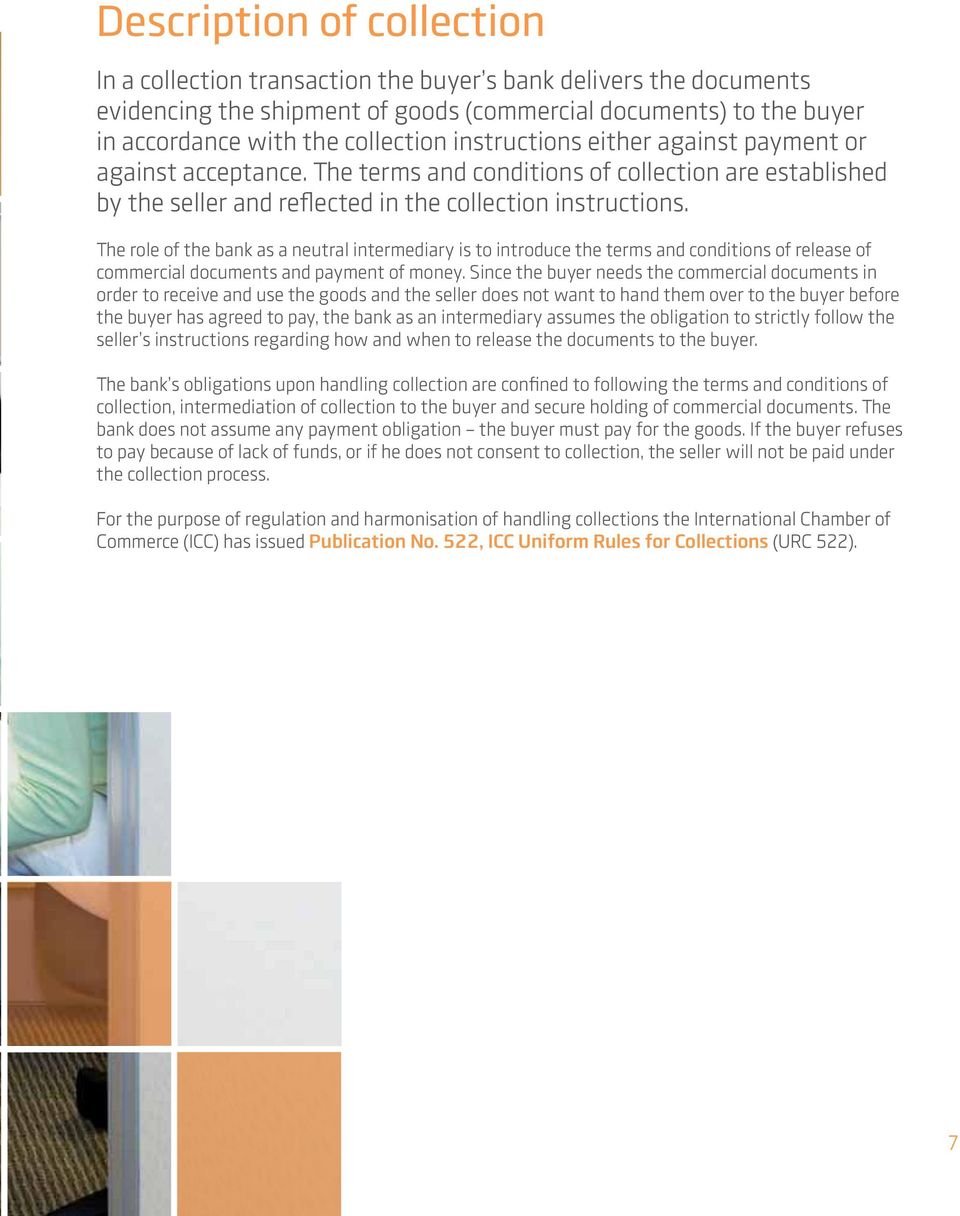
7 Collection process The buyer and the seller agree on the terms and conditions of the trade and that goods are paid for using collection. 2. The seller ships the goods to the buyer. 3. The seller gives the documents relating to the goods to its bank (= remitting bank) for collection along with the instruction specifying the terms and conditions of release of the documents to the buyer. 4. The remitting bank sends the documents by a courier to the buyer s bank (= collecting bank). 5. The collecting bank notifies the buyer of the received collection and the terms and conditions thereof. 6. The buyer consents to the terms and conditions of collection. 7. The collecting bank hands over the documents to the buyer in accordance with the collection instructions either against payment or acceptance. 8. Depending on the terms and conditions of collection, the collecting bank debits the sum from the buyer s account either immediately (payment at sight) or on the due date (deferred payment) and makes the payment to the remitting bank. 9. The remitting bank pays the money to the seller. 8
8 Collection from the exporter s viewpoint Collection is a reasonable option for the seller if: the seller trusts the country where the buyer is located (the country is economically and politically stable); the seller trusts the buyer; the seller trusts the buyer s solvency. NB! The buyer can always refuse the collection order, whereas the goods have usually been shipped to the buyer by the time of submission of the documents for collection. If the goods are shipped by train, airplane, truck or post the goods will usually be delivered to the buyer without the need to present the transport document (provided the goods are consigned to the buyer). In such cases the buyer therefore does not need the document sent for collection. Only where the goods are shipped using marine transport and the originals of the negotiable bill of lading are sent for collection, the buyer will not get the goods right away but will need to present the original bill of lading. If the buyer refuses collection, the seller may face a situation where the goods have to be stored at the destination for a long time; the seller has to start looking for a new buyer for the goods; the goods have to be sold at an auction; the goods have to be returned to the place of departure; the goods have to be destroyed (e.g. highly perishable goods). Some of the risks listed can be prevented by using documentary credit instead of collection. If the buyer sends collection documents for payment, the banks retain control over the documents until the buyer has paid the collection amount. If the documents are sent for acceptance, the buyer s bank releases them to the buyer against an undertaking to pay at maturity or acceptance of a bill of exchange and the actual payment on the required due date depends solely on the buyer s solvency. To exert pressure on the buyer the seller may demand that the collecting bank protest the refusal to pay or accept, which is the prerequisite for claiming payment of the money in a court in most countries and which results in the disclosure of the party who refused to pay or accept. A protest can be filed if a bill of exchange has been submitted to the buyer along with the collection documents (see the chapter titled Bill of Exchange ). In Estonia the procedure for protesting bills of exchange is regulated by the Law of Obligations Act. If the sums are big and the seller does not completely trust the buyer, the seller may prefer to use documentary credit. 9

9 Collection from the importer s viewpoint For an importer, i.e. the buyer collection involves relatively little risk and constitutes a convenient method of settlement. In the case of collection the buyer is the one who decides over the documents compliance or non-compliance with the contract and assumption of the payment obligation. When refusing the collection documents the buyer can always refuse payment of the service fees relating to the collection order. The buyer has an opportunity to see collection documents in the bank before making a decision regarding payment. The bank however does not have the right to hand over the collection documents or copies made of them to the buyer before the buyer has consented to the terms and conditions of collection. NB! After consenting to collection the buyer must under no circumstances pay the collection sum to the seller by a payment order! In that case the transfer would take place outside the collection order and the bank would be unable to release the documents to the buyer without the approval of the consignor s bank The submitted bill of exchange can be accepted, i.e. signed in the presence of a bank employee only by a person authorised by the buyer. Authorised persons can be people who have been specified as members of the management board of the company in part B of the commercial register. The seller of the goods may demand that the buyer s bank provide an aval for the bill of exchange to guarantee the payment on due date. If the buyer s bank does not agree to provide an aval for the bill of exchange, the buyer will not have the right to receive the collection documents. For further information on provision of bill of exchange an aval see the Classification of guarantees by purpose section in the chapter titled Bank guarantees. 10
10 Documentary credits

11 Description and cornerstones of the documentary credit A documentary credit is often named credit, but also known as Letter of Credit or just LC. In the following the term LC will be used. A bank that issues an LC (= the issuing bank) is obligated to pay the LC amount to the seller of the goods (= the beneficiary) if he submits to the issuing bank the documents listed in the LC in compliance with the terms and conditions stated in the LC. The regulatory background for LC is defined and regulated by Publication No. 600 of the International Chamber of Commerce (2007 edition), the Uniform Customs and Practice for Documentary Credits (UCP 600). The uniqueness of LC lies in the fact that not the buyer, but a neutral party (a bank) that assumes the obligation to pay the seller for the goods. Banks are obligated by law to be transparent in their activities and not to take too high risks, as a result of which the creditworthiness and liquidity of banks is considered to be higher than that of other companies. Upon using the LC service, the buyer can improve its creditworthiness and increase the seller s certainty regarding receipt of the money. A letter of credit is irrevocable. It cannot be amended or cancelled without the seller s consent. It gives the seller the certainty that the buyer cannot change its mind with regard to the transaction or unilaterally amend the terms and conditions to make them more suitable for itself. The irrevocable nature of LC influences the buyer and the issuing bank to issue such LC that does not need to be changed or cancelled. Although LC is usually based on a sales or another contract, it is an independent transaction and no obligations derive from the contract to the bank which issued the LC (as well as to other banks involved in handling the LC) even if the text of the credit refers to the contract (Article 4 of the UCP 600). The seller certifies compliance with the terms and conditions of the LC, submitting the documents listed in the LC to the bank. The issuing bank must honour the documents complying with the terms and conditions, i.e. pay their value to the seller by the due date specified in the LC. Thus, banks only examine the compliance of the documents against the terms and conditions of the LC, but they are not liable for the goods (services) relating to the documents (Article 5 of the UCP 600). Banks are not liable for the effectiveness of the documents either. Only the issuer of the document is liable for it (Article 34 of UCP 600). The buyer (= the applicant) determines the terms and conditions of the LC. The issuing bank interferes with the establishment of the terms and conditions only if the buyer s instructions are confusing or ambiguous or do not comply with international rules and practice or if the bank is involved in financing the transactions associated with the LC. Thus, the buyer and the seller play the greatest role in smooth progress of the LC transaction before issuing the LC the terms and conditions of the LC have to be negotiated thoroughly. 12
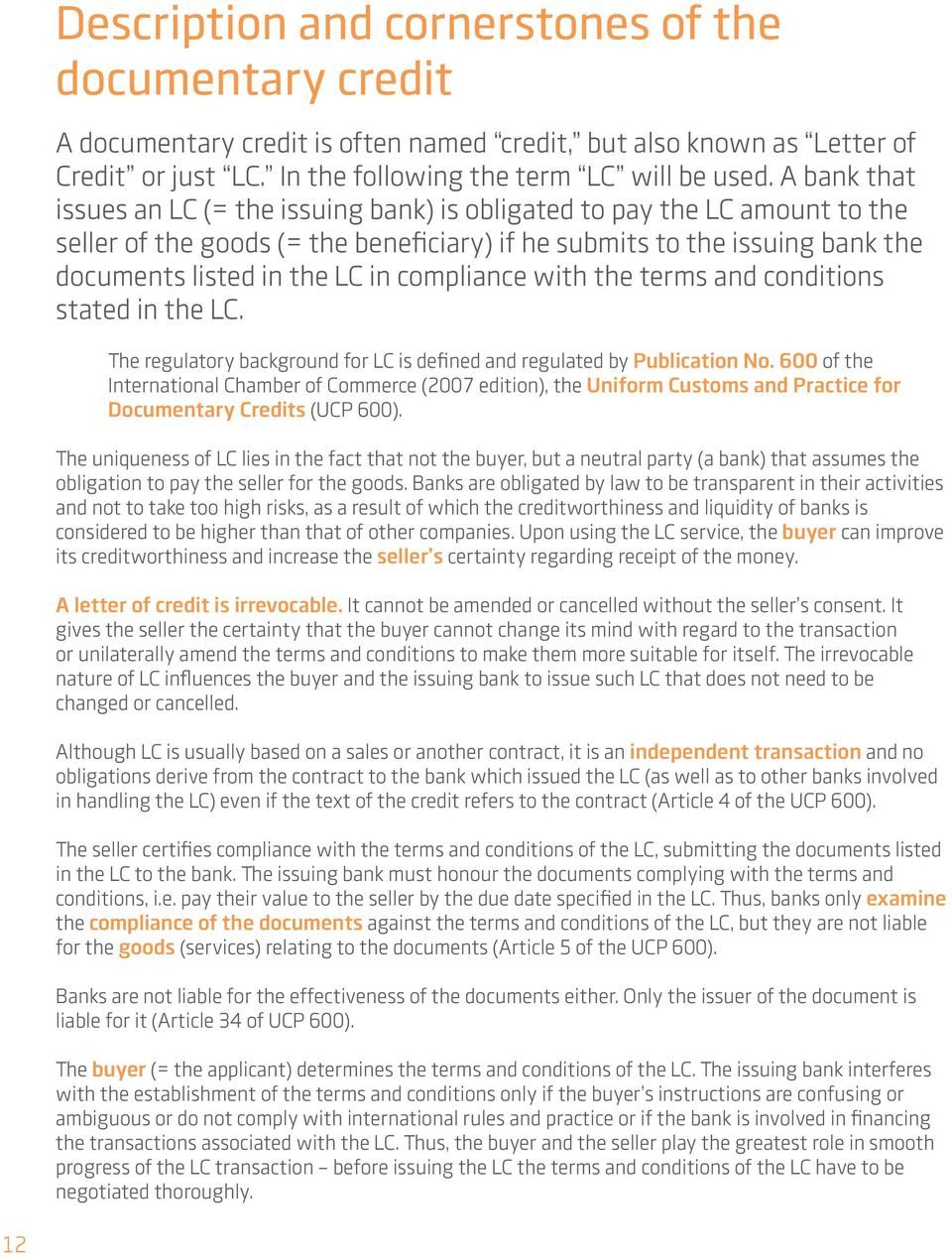
12 LC is a precisely regulated and harmonised banking service used throughout the world most of the banks understand the obligations, examination of documents and other principles of LCs in the same way. Such commercial LCs, which are not handled in accordance with the UCP rules are extremely rare in practice. LC process The buyer and the seller agree on the terms and conditions of the trade and that goods are paid for using LC. 2. The buyer contacts its bank and applies for opening an LC in favour of the seller. The bank may, but not have to accept the application. If the bank approves the application the buyer must give the bank collateral acceptable to the latter. 3. The issuing bank drafts the LC on the basis of the instructions received from the buyer and sends it electronically (SWIFT message) to the seller s bank (= the advising bank). SWIFT (= The Society for Worldwide Interbank Financial Telecommunication) is a member-owned cooperative through which the financial world conducts its business operations. 4. The advising bank verifies the authenticity of the LC and advises the seller of the received LC. 5. The seller examines the text of the LC and makes certain that it complies with the agreement made with the buyer of the goods. Thereafter the seller ships the goods to the buyer. 6. The seller presents the documents requested in the LC, which certify that the seller has fulfilled all the terms and conditions of the LC to its bank. The seller s bank may guide the seller in interpretation of the terms and conditions and issuance of the documents. 7. The seller s bank forwards the documents to the issuing bank. Thereafter the issuing bank examines the documents within five working days and decides if they comply with the terms and conditions of the LC. 8. If the documents comply with the terms and conditions of the LC, the issuing bank will confirm acceptance of the documents to the seller s bank and release the documents to the buyer. With an LC payable at sight the issuing bank pays the amount of the LC to the seller (through the seller s bank) immediately. The buyer s consent to the given operations is not required. 9. The buyer pays the issuing bank the amount paid. 10. The advising bank pays the seller the money after the payment has accrued. 13

13 Why use LC and when? Being a very flexible payment instrument, LC offers various opportunities for reduction of risk and spreading it between partners. LC can be compared to the work of a tailor: the parties get the result that fits their needs. LC can be used if: the buyer and the seller do not know each other well enough the other party is unfamiliar, the cooperation experience is short-term and the trust is little; one party or both parties are located in an economically or politically unstable country (region); the legislation of one or another country requires the use of the LC; the goods constitute a special order or are very specific; the goods are price-sensitive; if the buyer or intermediary has no money of its own it can carry out the transaction only by using the LC; in the case of deferred payment transactions the LC is suitable for reducing the payment risk and, where necessary, quicker receipt of the money. In international business transactions you need to take into account different laws and customs, foreign exchange risks, foreign government or central bank regulations and decrees, trade embargos and black lists. Many of these risks can be prevented or reduced by using LCs. If necessary, LC can be combined with guarantees, invoice discounting, factoring, etc. If you have little or no experience in using LCs it is wise to consult a bank before entering into a trade agreement. 14

14 LC payment methods LC must specify how it is available: by sight payment, deferred payment, acceptance or negotiation. In the LC the issuing bank may authorise another bank (= the nominated bank) to act under the LC, e.g. to evaluate compliance of the documents submitted by the beneficiary with the terms and conditions of the LC and to pay the amount of the LC to the beneficiary. This bank may be the advising bank and, in the case of freely negotiable LCs, a bank chosen by the beneficiary. The issuing bank may choose not to give such a nomination to other banks. Payment at sight The value of the documents is paid to the beneficiary immediately after the documents have been submitted to the nominated bank and the nominated bank has determined that the documents comply with the terms and conditions of the LC. Example: The nominated bank receives the documents Monday, May 2. On May 5 the bank decides, after examining the documents, that they comply with the terms and conditions of the LC and makes the payment value date Monday, May 9. Usually, the issuing bank pays the nominated bank before having the possibility to examine documents compliance with the terms and conditions of the LC. Therefore the issuing bank must trust the nominated bank and its ability to evaluate the compliance of the documents with the terms and conditions of the LC as well as its ability to return the funds should the documents be refused due to valid discrepancies. Deferred payment The value of the documents is not paid to the beneficiary immediately after presentation of the documents, but on the date calculated pursuant to the formula specified in the LC. One of the most common methods of calculation of the due date is the one whereby the agreed period in days is added to the date of shipment of the goods or to the date of presentation of the documents to the bank. This way the applicant can defer payment for the goods purchased by the LC until the money from the resale of the goods is received. Example: The LC is payable 60 days after loading the goods on board the ship. The nominated bank receives the documents on May 2. On May 5 the bank decides, after examining the documents, that they comply with the terms and conditions of the LC. According to the bill of lading the goods were loaded on board April 12. The bank is obligated to pay the beneficiary on June
15 Negotiation In the case of negotiation the nominated bank pays (or promises to pay) the beneficiary the value of the documents (or the bill of exchange) before it receives money from the issuing bank. Example: The LC is payable by negotiation at sight in the seller s bank. The seller s bank receives the documents on May 2. On May 5 the bank decides, after examining the documents, that they comply with the terms and conditions of the LC. The bank agrees to negotiate and pays the money to the beneficiary on the same date. By mutual agreement the negotiating bank pays the beneficiary the document amount less interest charged for two weeks. The money accrues from the issuing bank to the negotiating bank on May 16. The nominated bank is not obligated to negotiate. Its activities depend on how certain it is in the issuing bank and the beneficiary. If the nominated bank negotiates the documents, it does so with the right to claim the money back (right of recourse), i.e. the bank which negotiated the documents can reclaim the paid sums from the beneficiary if the issuing bank does not pay for some reason. The issuing or confirming bank does not have the right of recourse (see the chapter titled Confirmed LCs ). Unlike other methods of payment, in case of freely negotiable LCs any bank may be chosen by the beneficiary (except the issuing bank) as a nominated bank to negotiate. Obviously, the circle of banks nominated to negotiate can be limited in the terms and conditions of the LC, e.g. to the banks of the country of location of the beneficiary or a specific bank. In the case of negotiation the banks usually charge interest on the period that remains between negotiation and the receipt of money from the issuing bank. Acceptance It is a traditional form of deferred payment LCs whereby the beneficiary must, along with other documents specified in the LC, submit a bill of exchange whose due date is calculated pursuant to the terms and conditions of the LC. If the documents presented by the beneficiary are in compliance with the terms and conditions of the LC, the issuing bank or the nominated bank accepts the bill of exchange, thus undertaking to pay the amount of the bill of exchange on the due date. If the beneficiary wants to receive money right away, it can sell the bill of exchange with a discount. NB! Banks make the LC available in the other bank if a) the applicant or the beneficiary has requested it; b) the LC has to be confirmed by the other bank; c) the LC has to be transferable in another bank; d) the issuing bank trusts the nominated bank; e) in the region or country where the seller of the goods is located it is common practice to use freely negotiable LCs for the purpose of financing.. 16

16 Types of LC Confirmed LC If the LC has been confirmed, the confirming bank undertakes, in addition to the issuing bank, to pay for the complying documents. Sellers who want to avoid the possible political or other risks of the issuing bank or its country of location should always ask for the confirmation of the LC. Confirmation of the LC also helps to obtain settlements faster and more conveniently after receiving the payment from the confirming bank the transaction is over for the seller. Possible disputes between the issuing and confirming bank are no longer its concern. NB! The bank is not obligated to confirm the LC. Before asking the buyer for a confirmed LC the seller should always ask the bank about the possibility of confirmation. Transferable LC A transferable LC gives the intermediary the opportunity to apply to the nominated bank for the transfer of the LC for the benefit of its supplier. Thus, the intermediary buys the goods using the same LC that it resells to the buyer. NB! The seller of the goods (supplier) knows that it deals with an intermediary! The transferable LC allows for intermediating major goods transactions without making any investments. The supplier (= the second beneficiary) has to fulfil the terms and conditions of the LC and submit the documents. The intermediary (= the first beneficiary) replaces only the invoice and bill of exchange of the second beneficiary (higher by its commission/profit) upon the arrival of the documents at the transferring bank. If the terms and conditions of the LC allow for partial consignments, the LC can be transferred to several second beneficiaries (to the extent of the initial amount or quantity of goods). If the intermediary would like to build up a transaction using a transferable LC, it must keep in mind that upon transfer of the LC the terms and conditions of the LC must not be changed, except the latest shipment date, the validity and the period for presentation of documents (all may be curtailed) and the amount and the unit price (both may be reduced); all the documents listed in the letter of credit (incl. transport documents) must be submitted by the second beneficiary (the first beneficiary may only substitute its own invoice and bill of exchange for those of the second beneficiary). Therefore, the terms and conditions of the LC must specify the shipment of the goods directly from the supplier to the buyer. NB! The LC may be transferred only if it specifically states to be transferable. This will normally be based on an indication to this effect in the LC application issued by the buyer. 17

17 In the transfer application the intermediary should shorten the period of submission of the documents and the validity of the LC in such a manner that upon arrival of the documents to the transferring bank the intermediary would be able to replace the invoice and the bill of exchange submitted by the supplier. The use of transferable LCs is regulated by an article 38 in the UCP 600. Back-to-back LC The bank opens a back-to-back LC at the request of the intermediary in favour of the supplier. This form of LC is based on and secured by another LC (= the master credit) opened by the buyer in favour of the intermediary. Unlike the transferable LC, the master credit and the back-to-back LC are two legally independent LCs, although both are meant for the same transaction. To reduce the risks banks usually demand that the intermediary provide additional collateral for issuing such LC. Since the back-to-back LC formally are two legally independent LCs the back-to-back LC is not mentioned in the UCP 600. Revolving LC In the case of a revolving LC the conditions of the LC are renewed periodically or after a certain event and the seller of goods can ship another consignment in the amount and on the terms and conditions of the LC. Since the terms and conditions of the LC are exactly the same in the case of each consignment, the revolving LC is suitable only in the case of regular consignments which have exactly the same terms. Red clause LC LCs of this type allow the seller to receive advance payment before fulfilment of all the terms and conditions (for acquisition or production of goods, coverage of transportation expenses, etc.). Usually, to receive such an advance payment some document, for instance, a certificate stating that the goods complying with the terms and conditions of the LC are in the port or at the storage site (if the advance payment is necessary for financing transportation) must be submitted. In such an event the seller receives the remaining amount after shipping the goods to the buyer and submitting all the documents listed in the LC, including the transport document. Standby letter of credit A standby letter of credit is, in essence, a guarantee. This means that the beneficiary demands money only if the applicant fails to perform its obligation, e.g. does not pay for the goods if the applicant is the buyer. The list of documents of such a letter of credit usually contains only a copy of the invoice unpaid by the buyer and the seller s claim to the bank for payment of the amount of the letter of credit. Transport documents are rarely requested. 18 More information on standby letters of credit can be found in the section on guarantees.
18 Trade agreement between the buyer and the seller To make the transaction a success and to avoid wasting time and money on amendment of the terms and conditions the buyer and the seller should agree on the terms and conditions of the LC in as great detail as possible before issuance of the LC and preferably set them out in a trade agreement binding upon both of them. The recommended list of terms and conditions that are important from the point of view of the LC is as follows: description of the goods as long as necessary, but as short as possible (e.g. blue men s socks as specified in Order No. 123); quantity of the goods either exact (e.g. 1,250) or more vague (e.g. 1,000 kg +/ 5%); price of the goods; other essential parameters of the goods, which have to be specified in the LC (e.g. highly perishable goods must be transported in a refrigerated container); deadlines for shipping the goods and other activities; means of transport and places of loading and unloading; delivery terms (e.g. CIF Tallinn, Incoterms 2000); time of payment for the goods, i.e. whether the documents of the LC are paid for immediately after their presentation to the bank or the seller gives the buyer some time to make the payment (e.g. the due date is 90 days after the date of invoicing); list of the documents of the LC, i.e. these documents that certify the fulfilment of the terms and conditions of the agreement those needed by the buyer in order to obtain and clear the goods; special type of the LC, i.e. whether the LC has to be confirmed or transferable; the bank to advise the seller of the LC once issued usually the seller s bank; the bank (if any) to be nominated to act under the LC, e.g. to pay the beneficiary. Depending on the characteristics of the specific trade it may be necessary to specify other terms and conditions in the agreement. If you have little or no experience in using LC-s and/or transaction complex, it is strongly advisable to consult a bank before enetring into the trade agreement. 19

19 LC from the buyer s viewpoint In LC settlements the bank pays the LC amount to the seller only if the seller submits to the bank the document required in the LC and these documents are in full compliance with the terms and conditions of the LC. The buyer determines the terms and conditions of the LC. Thus, the LC allows the buyer to dictate what goods have to be shipped, in what quantity they have to be, and when and where they have to be shipped. If the terms and conditions (e.g. the price, quantities) have been fixed once they cannot be amended unilaterally and the beneficiary interested in the sale must fulfil them exactly in order to get the money. NB! The seller does not have to use LC! If the seller does not agree with the terms and conditions and does not ship the goods, the buyer s expenses on the LC may prove to be worthless. The usage of LC may give the buyer the opportunity to negotiate a lower price, because the closure of the transaction and receipt of the money are guaranteed to the seller by the issuing bank. LC also allows the buyer to manage cash flow more flexibly, because upon agreement with the bank the buyer can postpone its obligation to pay the amount of the LC to the bank to a time that is more suitable for the buyer. However, the buyer must take into account that the bank s approval of LC application takes time and requires collateral the buyer cannot unilaterally cancel the LC or amend the terms and conditions thereof the LC service is expensive and in any event the buyer is (ultimately) responsible for payment of all service fees If the banks involved in the LC settlements do not receive their service fees from the seller for some reasons regardless of the fact that the terms and conditions of the LC so demand, the issuing bank (and thereby the buyer) will be liable for payment of all the respective service fees (Article 37(c)). the payment is made on the basis of the right documents, not the goods It is important to remember that if the seller submits the documents complying with the terms and conditions of the LC, the issuing bank will be obligated to pay the amount of the LC to the seller. Thus, the buyer is obligated to compensate the issuing bank for such payment regardless of whether the goods shipped or the service provided by the seller complies with the agreement or the expectations of the applicant or whether the goods have been shipped in compliance with the submitted documents. upon making the payment decision, the bank will not take into account the terms and conditions which have not been stipulated in the LC 20

20 The bank verifies the fulfilment of only those terms and conditions which have been stipulated in the LC and the fulfilment of which has been certified by the required documents. The bank does not take into account the fulfilment or non-fulfilment of other terms and conditions (e.g. the terms and conditions of the trade agreement) and/or other documents. shipped goods may not comply with the documents submitted NB! Bank employees cannot be experts in a single chapter of goods or branch of industry, but are merely LC specialists. Banks verify the compliance of the documents based on the terms and conditions of the LC, not the compliance of the goods against the agreement, the standards of the industry, etc. It is the issuers of the documents (not the banks) that are liable for the correctness of the data contained in the documents. If the goods do not meet the expectations, they are not shipped or they are shipped later or otherwise in conflict with the transport documents, complaints should not be addressed to the bank but the seller and/or the carrier who has issued the documents. fraud cannot be precluded entirely The banks are not liable if the documents which seem to comply with the terms and conditions of the LC prove to be forged later on. The buyer of the goods itself has to learn to know the other party to the agreement before it trusts the party! LC from the seller s viewpoint For the seller LC gives clarity and certainty about the activities required for receiving the money and the time of payment: if the seller fulfils the LC terms and conditions, the issuing bank must pay the money in accordance with the LC terms. The main advantage for the seller is the replacement of the buyer s payment risk with the bank s payment obligation. Banks better liquidity and the need to retain their international reputation ensure that they usually perform their obligations accurately. Secondly, LC is an irrevocable payment obligation of the bank. If the buyer changes its mind after LC is issued, the buyer and the issuing bank cannot unilaterally amend or cancel the fixed terms and conditions (e.g. deadlines, quantities) without the seller s consent. 21
21 The bank s payment obligation can be made even more certain through confirmation. If the seller cannot evaluate the issuing bank located in another country the seller may demand that the LC be confirmed by a bank that the seller is more familiar with. In the case of confirmed LC the confirming bank, in addition to the issuing bank, assumes the irrevocable obligation to pay the value of the documents complying with the terms and conditions of the LC to the beneficiary. The seller can consider the transaction completed right after the submission of the documents to the confirming bank and receipt of the payment or the promise of payment from the bank. Possible later disputes between the confirming and issuing bank are none of the seller s concern. The seller can plan the time of accrual of the money exactly. In the UCP and/or international banking practice there are time standards for examination of documents and making payments, which banks must follow. LC allows for better management of cash flow by discounting deferred payments the seller s bank, using the good name and reputation of the issuing bank as the collateral, pays the seller the value of the documents along with reasonable interest before the due date of the LC. The seller should check already before issuing the LC whether its bank agrees to take the risk of the issuing bank, i.e. to discount the accrual of the LC. In countries where the government strictly controls import LC is often the only way of getting the business deal through. NB! The mere fact that a bank has decided to issue an LC can be considered an indirect confirmation of the buyer s trustworthiness. Banks do not issue LCs for clients who are not trusted or whose solvency is in doubt. In addition to many good qualities the seller has to take into account that the LC service may be considered expensive (at least when compared to other payment instruments like collections), because the compilation of each LC, considering the terms and conditions, clarity and unambiguity of the transaction and the international practice, calls for manual work by specialists such as later handling of documents and verification of their compliance with the terms and conditions of the LC and the requirements of UCP 600; The time limits of the LC must be adhered to (e.g. time limits for shipping goods, presentation of documents, etc.). If the seller exceeds the limits even by one day, the seller loses the right to receive money from the bank; formalisation of sales documents is a daily and routine activity for companies, which usually does not take much time, but formalisation of the documents of LC may well be much more labour-intense; the buyer is the one on whose instructions LC is opened. The seller cannot make any amendments to the LC but refuse the LC and/or negotiate with the buyer; banks go bankrupt as well (when replacing the buyer s payment risk with the payment obligation of a bank the beneficiary must of course carefully consider that risk as well). 22
22 Evaluation of terms and conditions of LC The seller is interested in receiving in a timely manner the payment for fulfilment of the terms and conditions of the agreement made with the buyer. The amount of the LC is paid to the seller if the seller fulfils the terms and conditions specified in the LC (submits the documents). Thus, for the seller it is very important to review the terms and conditions of the LC before shipping the goods. When evaluating the terms and conditions of an LC the seller has to reply at least to the following questions Yes : Has the LC been opened or confirmed by the bank that the seller knows and trusts? Are all the names and addresses correct? Are the following terms and conditions in compliance with the agreement made with the buyer: amount and currency of the LC place and date of expiry place and manner of payment all deadlines description, quantity and price of the goods delivery terms payment for bank services Can the terms and conditions described in the LC for inspection, packaging, transportation, etc., be fulfilled? Can the documents be submitted in the format required by the LC? Can the documents be certified, attested and legalised in accordance with the requirements? Can the required transport document and an insurance document be issued according to the terms and conditions of the LC? NB! If necessary, consult the carrier and the insurer regarding these issues. Are the remaining terms and conditions of the LC understandable and can they be fulfilled? Is the LC issued subject to the rules of UCP 600? If the LC does not meet the seller s expectation or some condition cannot be fulfilled, the buyer must be contacted and asked for amendments. 23
23 Preparation and presentation of documents for payment The seller certifies fulfilment of LC terms and conditions and its right to the amount of the LC, presenting the documents listed in the LC to the nominated bank. The nominated bank examines the compliance of the documents very carefully. If the seller has submitted documents that seem to contain even minor differences compared to the terms and conditions of the LC, the issuing (or confirming) bank may refuse to pay, as their payment obligation is depending on all the terms and conditions of the LC being complied with Banks check the compliance of the documents with: terms and conditions of the LC, requirements of UCP 600, principles of the international standard banking practice. NB! There is publication titled International Standard Banking Practice for the Examination of Documents under Documentary Credits 2007 Revision for UCP 600 (hereinafter ISBP). The ISBP can be explained as an official interpretation of the practical application of the UCP 600. It collects a number of acknowledged practices within the documentary credit area. The ISBP focuses mainly on the examination of the documents, and its approach is very practical ISBP contains, among other things, more detailed requirements for preparation of the following documents: Invoice; Bill of exchange; Transport documents: - Multimodal Transport Document - Bill of Lading - Charter Party Bill of Lading - Air waybill - Road, Rail or Inland Waterway Transport documents; Insurance documents; Certificate of origin. The data in a document need not be identical to, but must not conflict with the data given in other documents or the terms and conditions of the LC. Example: The weight of the goods can be shown as 910 kg or 0.91 tons. If in one place the weight is 910 kg and in another it is 0.9 tons, it is considered to be in conflict. 24
24 Before submitting the documents to the nominated bank you should make certain that the LC has not expired and that the presentation made is within the given deadline (the default rule is that presentation must be made no later than 21 calendar days after the date of shipment); the goods have been dispatched within the term permitted in the LC; the presentation contains the required number of originals and copies of the documents. NB! At least one original of each required document must be presented. If the LC in describing how many copies of each document are required, uses expressions like folds, duplicates, triplicates, then at least one of those copies must be original, and the remaining may be copies. the documents have been duly signed, certified, legalised, etc.; the corrections or amendments made to the documents have been confirmed by the signature of the issuer; the data in the documents is in compliance with the data given in the terms and conditions of the LC and other documents: names, addresses, description of goods, quantities, prices, weight, volume, notations, etc.; all such documents, which confirm or certify something have been confirmed by the signature of the issuer and bear the date of issue; the documents are in the language in which the LC has been issued or in the language required in the LC. Usually, only English language documents are accepted. If a document cannot be made in English, it must be agreed upon entry into the trade agreement that documents in Estonian, Russian, etc., are permitted in the LC. Bill of exchange A bill of exchange is a document whose issuer (drawer ) claims the amount of the bill of exchange from the payer of the bill of exchange, (drawee ). A bill of exchange (unlike other documents required in LCs) is a financial document. you cannot find any connection with the trade or the reason for payment on a bill of exchange. A bill of exchange must be presented if LC is payable by negotiation or acceptance. In that case the LC specifies the requirement of submission of a bill of exchange (field 42C in SWIFT message MT700 of issuing LCs, hereinafter MT700/42C) and the bank that is the drawee (MT700/42A) usually the issuing or confirming bank. Often the issuing bank (especially if it is a British bank or former British colony bank) demands a bill of exchange also in the case of sight payment and although the bill of exchange does not have any practical meaning in such an event, its submission is necessary for fulfilment of the terms and conditions of the LC. 25
25 A bill of exchange must be signed by the issuer and contain the following data: it must mention that it is a bill of exchange in the language in which the bill of exchange is issued, usually draft or bill of exchange; traditional wording pay the order of... [name of the beneficiary]. It is necessary that the person indicated as the drawer has assigned the payment to the intermediary on the reverse side of the bill of exchange, confirming it with their signature, i.e. specifically to one s own bank (e.g. pay Swedbank) or without specifying the bank (e.g. pay the submitter of the bill of exchange); the payer, i.e. the drawee the bank required in the LC; the issuer of the bill of exchange, i.e. the name and address of the beneficiary exactly in the same format as in the LC; the due date in accordance with the terms and conditions of the LC: at sight in the case of payment at sight or negotiation, at... days sight, if the payment is to be made...days after presentation of the documents, fixed date if the payment is made days after the date of issue of the transport document (or another document); the place and date of issue; whether it is a sole bill of exchange or, if the bill of exchange has been issued in duplicate, the first copy or the second copy (two equal copies have to be issued if the issuing bank requires it; only one is paid); the amount in numbers; the amount in words; the place of payment; the number of the LC and the issuing bank if the LC demanded showing it on the bill of exchange (or in all documents). BILL OF EXCHANGE Place/date of issue: Paikuse, May 07, 2008 At sight please pay against this sole Bill of Exchange to the order of ourselves the amount of GBP ,50 British Pounds Forty Nine Thousand Seven Hundred One and 50/100 Drawee: Barclays Bank Plc Drawer: OÜ Tipp-Topp London Paikuse Rural Municipality Estonia Payable in Barclays Bank Plc, London Drawn under Documentary Credit No. BMDC of Barclays Bank Plc, London 26
26 A bill of exchange must be signed by the issuer and contain the following data: it must mention that it is a bill of exchange in the language in which the bill of exchange is issued, usually draft or bill of exchange; traditional wording pay the order of... [name of the beneficiary]. It is necessary that the person indicated as the drawer has assigned the payment to the intermediary on the reverse side of the bill of exchange, confirming it with their signature, i.e. specifically to one s own bank (e.g. pay Swedbank) or without specifying the bank (e.g. pay the submitter of the bill of exchange); the payer, i.e. the drawee the bank required in the LC; the issuer of the bill of exchange, i.e. the name and address of the beneficiary exactly in the same format as in the LC; the due date in accordance with the terms and conditions of the LC: at sight in the case of payment at sight or negotiation, at... days sight, if the payment is to be made...days after presentation of the documents, fixed date if the payment is made days after the date of issue of the transport document (or another document); the place and date of issue; whether it is a sole bill of exchange or, if the bill of exchange has been issued in duplicate, the first copy or the second copy (two equal copies have to be issued if the issuing bank requires it; only one is paid); the amount in numbers; the amount in words; the place of payment; the number of the LC and the issuing bank if the LC demanded showing it on the bill of exchange (or in all documents). BILL OF EXCHANGE Place/date of issue: Paikuse, May 07, 2008 At sight please pay against this sole Bill of Exchange to the order of ourselves the amount of GBP ,50 British Pounds Forty Nine Thousand Seven Hundred One and 50/100 Drawee: Barclays Bank Plc Drawer: OÜ Tipp-Topp London Paikuse Rural Municipality Estonia Payable in Barclays Bank Plc, London Drawn under Documentary Credit No. BMDC of Barclays Bank Plc, London 26
27 A bill of exchange must be signed by the issuer and contain the following data: it must mention that it is a bill of exchange in the language in which the bill of exchange is issued, usually draft or bill of exchange; traditional wording pay the order of... [name of the beneficiary]. It is necessary that the person indicated as the drawer has assigned the payment to the intermediary on the reverse side of the bill of exchange, confirming it with their signature, i.e. specifically to one s own bank (e.g. pay Swedbank) or without specifying the bank (e.g. pay the submitter of the bill of exchange); the payer, i.e. the drawee the bank required in the LC; the issuer of the bill of exchange, i.e. the name and address of the beneficiary exactly in the same format as in the LC; the due date in accordance with the terms and conditions of the LC: at sight in the case of payment at sight or negotiation, at... days sight, if the payment is to be made...days after presentation of the documents, fixed date if the payment is made days after the date of issue of the transport document (or another document); the place and date of issue; whether it is a sole bill of exchange or, if the bill of exchange has been issued in duplicate, the first copy or the second copy (two equal copies have to be issued if the issuing bank requires it; only one is paid); the amount in numbers; the amount in words; the place of payment; the number of the LC and the issuing bank if the LC demanded showing it on the bill of exchange (or in all documents). BILL OF EXCHANGE Place/date of issue: Paikuse, May 07, 2008 At sight please pay against this sole Bill of Exchange to the order of ourselves the amount of GBP ,50 British Pounds Forty Nine Thousand Seven Hundred One and 50/100 Drawee: Barclays Bank Plc Drawer: OÜ Tipp-Topp London Paikuse Rural Municipality Estonia Payable in Barclays Bank Plc, London Drawn under Documentary Credit No. BMDC of Barclays Bank Plc, London 26
28 A bill of exchange must be signed by the issuer and contain the following data: it must mention that it is a bill of exchange in the language in which the bill of exchange is issued, usually draft or bill of exchange; traditional wording pay the order of... [name of the beneficiary]. It is necessary that the person indicated as the drawer has assigned the payment to the intermediary on the reverse side of the bill of exchange, confirming it with their signature, i.e. specifically to one s own bank (e.g. pay Swedbank) or without specifying the bank (e.g. pay the submitter of the bill of exchange); the payer, i.e. the drawee the bank required in the LC; the issuer of the bill of exchange, i.e. the name and address of the beneficiary exactly in the same format as in the LC; the due date in accordance with the terms and conditions of the LC: at sight in the case of payment at sight or negotiation, at... days sight, if the payment is to be made...days after presentation of the documents, fixed date if the payment is made days after the date of issue of the transport document (or another document); the place and date of issue; whether it is a sole bill of exchange or, if the bill of exchange has been issued in duplicate, the first copy or the second copy (two equal copies have to be issued if the issuing bank requires it; only one is paid); the amount in numbers; the amount in words; the place of payment; the number of the LC and the issuing bank if the LC demanded showing it on the bill of exchange (or in all documents). BILL OF EXCHANGE Place/date of issue: Paikuse, May 07, 2008 At sight please pay against this sole Bill of Exchange to the order of ourselves the amount of GBP ,50 British Pounds Forty Nine Thousand Seven Hundred One and 50/100 Drawee: Barclays Bank Plc Drawer: OÜ Tipp-Topp London Paikuse Rural Municipality Estonia Payable in Barclays Bank Plc, London Drawn under Documentary Credit No. BMDC of Barclays Bank Plc, London 26
29 Invoice For the invoice it is important that it has been issued by the seller (the beneficiary). The seller s name must be exactly in the same form as specified in the LC (MT700/59); the seller s location (address) must be in the country specified in the LC; it contains the signature of the seller if a signed invoice has been required in the LC; it has been issued to the buyer (the applicant), whereby the buyer s name must be in the form specified in the LC (MT700/50), the buyer s location must be in the country specified in the LC; the description of the goods (MT700/45A) must comply with the LC exactly, whereby the invoice must reflect the goods actually sent, the actual quantity and the actual price. Additions are permitted if they are not in conflict with the terms and conditions of the LC. Example: Goods can be sent in batches and the description of goods in the LC is as follows: 5555 pairs of blue men s socks and 6666 pairs of red women s socks. In the first batch only goods of the first variety are sent and their quantity is smaller than the total quantity specified in the order. A sufficient description on the invoice is: 4444 pairs of blue men s socks. the delivery terms are in accordance with the terms and conditions of the LC, whereby the total amount of the invoice must contain transport and insurance fees (if any) in accordance with the delivery terms; the total amount and the unit price of the goods are in accordance with the terms and conditions of the LC and the goods actually sent; all other data (numbers, weight, notations, etc.) are in accordance with (and not in conflict with) the terms and conditions of the LC and the documents required in the LC; the permitted quantity of the goods has not been exceeded and other goods which have not been listed in the LC have not been sent. Example: Free samples or advertising materials added to the goods free of charge must not appear from the invoice (unless called for by the LC). Combined transport bill of lading Transport is considered multimodal or combined if it involved at least two modes of transport (e.g. road and maritime transport). The most common multimodal transport document is the multimodal or combined transport bill of lading which grants title to the goods. Unless otherwise required in the LC, all originals issued must be submitted to the bank. The following must be specified in the document: the shipper s name (the shipper does not have to be the beneficiary of the LC); the carrier s name and identification that it is the carrier of the goods (e.g. carrier: ABC Shipping Inc.); 27
30 the name and signature of the issuer of the document, whereby the issuer must identify himself or herself next to the signature as: the carrier of the goods or the captain of the vessel (master) or o the agent of the carrier or master (e.g. XYZ Ltd. as agents for the carrier ABC Shipping Inc.); NB! If the master s signature is identified as master ( captain ) or if the agent is signing on behalf of the master, then the name of the master need not be stated. the place of loading and unloading in full conformity with the terms and conditions of the LC; the consignee in full conformity with the LC; depending on the terms and conditions of the LC, the following must be specified in the document with regard to the consignee: name, or to order of [name] if the given consignee must have the opportunity to assign the title to the goods, or to order (without name) if the shipper assigns the title to the goods to the person submitting the document confirming the title to the goods on the reverse of the bill of lading (endorsement); the carrier s notation regarding acceptance of the goods for carriage or notation on board and the date of acceptance for carriage or loading on board (the notation regarding acceptance for carriage or loading on board may be pre-printed on the document form in that case the date of issue of the document is enough); the date of issue of the document; a notation about payment of the carriage charges in accordance with the delivery terms specified in the LC: freight prepaid, if the seller pays the carriage charges (CIF, CFR, etc.), freight collect, if the buyer has to pay the carriage charges (FAS, FOB, FCA, etc.); the terms and conditions of the carriage contract or a reference to their existence in other sources (banks examine the existence of the terms and conditions of the carriage contract, not their content). The following must not appear from the document: The goods have been sent using only one type of transport; the goods have been loaded on the deck of the vessel; the goods have been or the packaging has been damaged (i.e. the bill of lading contains respective notations); that the document has been issued subject to a charter party. 28
31 Marine/Ocean bill of lading A bill of lading is a transport document used in the case of maritime transport, which involves the title to the goods (the consignee must submit the original of the bill of lading to the carrier in order to receive the goods). Unless otherwise required in the LC, all originals of the bill of lading must be submitted to the bank (usually three).
32 The following must be specified in the bill of lading: the shipper s name (the shipper does not have to be the beneficiary of the LC); the carrier s name and confirmation that it is the carrier of the goods (e.g. carrier: ABC Shipping Inc.); the name and signature of the issuer of the bill of lading, whereby the issuer must identify himself or herself next to the signature as: the carrier of the goods or the captain of the vessel (master) or the agent of the carrier or master (e.g. XYZ Ltd. as agents for the carrier ABC Shipping Inc.); NB! If the master s signature is identified as master ( captain ) or if the agent is signing on behalf of the master, then the name of the master need not be stated. the port of loading and unloading in full conformity with the terms and conditions of the LC; the consignee in full conformity with the LC; depending on the terms and conditions of the LC, the following must be specified in the bill of lading with regard to the consignee: name, or to order of [name] if the given consignee must have the opportunity to assign the title to the goods, or to order (without name) if the shipper assigns the title to the goods to the person submitting the document confirming the title to the goods on the reverse of the bill of lading (endorsement); the assignment of the title to the goods (endorsement), if required in the LC; the endorsement may be: to the named party (endorsed to [name]), or blank endorsed; the name of the vessel; notation on board and the date of loading the goods on board (the notation regarding loading on board may be pre-printed on the form of the bill of lading in that case the date of issue of the bill of lading is enough); The notation on board must clearly show that the goods have been loaded to the vessel in the port of loading specified in the LC. a notation about payment of the carriage charges in accordance with the delivery terms specified in the LC: freight prepaid, if the seller pays the carriage charges (CIF, CFR, etc.), freight collect, if the buyer has to pay the carriage charges (FAS, FOB, FCA, etc.); in the case of container transport the number(s) of the container(s); the terms and conditions of the carriage contract or a reference to their existence in other sources (banks examine the existence of the terms and conditions of the carriage contract, not their content). The following must not appear from the bill of lading: that the goods have been loaded on the deck of the vessel; that the goods have been or the packaging has been damaged (i.e. the bill of lading contains respective notations); that the bill of lading is issued subject to a charter party. 30 NB! If the parties want to use a charter party, it must be specified in the LC!
33 Road or rail transport document In Europe the usual transport document in the case of international road transport is the consignment note CMR and the copy for sender can be submitted to the bank. CMR is an abbreviation of the Convention on the Contract for the International Carriage of Goods by Road (Geneva, 1956). In the case of rail transport the rail transport consignment note is issued. Usually that would be a CIM consignment note (a transport document issued subject to the 1999 Uniform Rules Concerning the Contract of International Carriage of Goods by Rail). The duplicate thereof is submitted to the bank. The following must be specified in the consignment note: the shipper s name (the shipper does not have to be the beneficiary of the LC); the carrier s name and identification that it is the carrier of the goods (e.g. carrier: ABC Shipping Inc.); the name and signature of the issuer of the consignment note, whereby the issuer must identify himself or herself next to the signature as: the carrier of the goods or the agent of the carrier (e.g. XYZ Ltd. as agents for the carrier ABC Inc.). NB! In the case of rail transport any signature or stamp of the railway company will be accepted as evidence that the document has been signed by the carrier the place of loading and unloading in full conformity with the terms and conditions of the LC; the consignee s name in full conformity with the LC; the carrier s notation regarding acceptance of the goods for carriage; the date of issue of the consignment note or the date of acceptance of the goods for carriage; a notation about payment of the carriage charges in accordance with the delivery terms specified in the LC: freight prepaid, if the seller pays the carriage charges (CIP, CFR, etc.), freight collect, if the buyer has to pay the carriage charges (FAS, FCA, etc.). The consignment note must not contain any notations regarding the defective condition of the goods or packaging. 31
34 Air waybill An air waybill is a document covering the carriage of goods by plane from one airport to another. The original for shipper, usually original No. 3 of the air waybill remains with the seller for submission to the bank. The following must be specified in the waybill: the shipper s name (the shipper does not have to be the beneficiary of the LC); the carrier s name and identification that it is the carrier of the goods (e.g. carrier: ABC Shipping Inc.); the name and signature of the issuer of the waybill, whereby the issuer must identify himself or herself next to the signature as: the carrier of the goods or the agent of the carrier (e.g. XYZ Ltd. as agents for the carrier ABC Inc.); the airport of loading and unloading in full conformity with the terms and conditions of the LC; the consignee s name in full conformity with the LC; the carrier s notation regarding acceptance of the goods for carriage; the date of issue of the waybill or the date of acceptance of the goods for carriage; a notation about payment of the carriage charges in accordance with the delivery terms specified in the LC: freight prepaid, if the seller pays the carriage charges (CIP, CFR, etc.), freight collect, if the buyer has to pay the carriage charges (FAS, FCA, etc.); the terms and conditions of the carriage contract or a reference to their existence in other sources (banks verify the existence of the terms and conditions of the carriage contract, not their content). The waybill must not contain any notations regarding the defective condition of the goods or packaging. 32
35 Insurance document All originals of the insurance document (insurance policy or certificate) must be submitted to the bank. The insurance document must: be issued and signed by the insurance company, the underwriter or their agents and/or their proxies, whereby the issuer must be identified next to the signature as: the insurer (insurance company or underwriter), or the agent of the insurer (e.g. ZYX Ltd. as agents for the insurance company/underwriter CBA Inc.); the authorised representative of the insurer (e.g. Mr. Smith as proxy for the insurance company/underwriter CBA Inc.); indicate the sum insured; be in the same currency as the LC; have entered into force not later than on the date when the goods were loaded, accepted for carriage or shipped according to the transport document. The issue date of the document must not be later than the date of shipment (unless it appears from the document that the insurance cover is effective from a date not later than the date of shipment); cover at least 110% of the CIF or CIP value of the insured goods (unless another sum insured has been specified in the LC); cover all the risks specified in the LC; describe the shipment of the goods (place of departure and destination, description of the goods, type of transport, in the case of marine/ocean transport the name of the vessel) in full conformity with the terms and conditions of the LC and other documents; specify that the insurance cover is valid at least starting from the place of loading the goods up to the place of unloading the goods as specified in the LC; show as the assured or insured (unless otherwise required in the LC): the applicant of the LC (buyer), the holder of the insurance document (the holder of this policy), or someone else, if the person has assigned the LC to the applicant or the holder of the insurance document by his or her endorsement on the reverse of the insurance document. 33
36 Other documents If the LC requires other documents such as the certificate of origin, quality certificate, packing list, weight certificate, etc., besides the transport and insurance documents and the invoice, it must be kept in mind in preparation of these documents that the content of the document must comply with the requirements of the LC; if the content or wording of the document has not been determined in the LC, it may be formulated in any manner, provided that it is not in conflict with other required documents and seems to fulfil the function of the document (e.g. the certificate of origin shows the country of origin of the goods, etc.); the document must have been issued by the institution or agency specified in the LC; if the issuer of the document has been specified vaguely in the LC (e.g. official, local, competent, independent or other similar person or agency), the document may be issued by anyone except the beneficiary (seller) itself; if the LC does not specify the issuer of the document at all, the document may be issued by anyone, including the beneficiary itself. In the case of some documents there are restrictions with regards to the issuer or contents of the document already in the name of the document (GSP certificate of origin, EUR 1 certificate, export licence, etc.); the document may be issued before the date of issuing the LC, but not later than on the date of presentation of the documents. Documents not complying with the terms and conditions of the LC If the documents are discrepant they do not comply with the terms and conditions of the LC, the seller of the goods has to choose between one or several steps: to amend the documents not complying with the terms and conditions of the LC. It is possible only in the following events: there is time for re-presentation of the documents; the documents contain formal, not material errors (e.g. if the goods have been shipped late, you cannot change the actual date of shipment with an earlier date); ask the issuing bank (who will in turn ask the buyer) whether acceptance of the documents as presented would be possible; send the documents to the issuing bank as presented and hope that the issuing bank and the buyer of the goods consent to the payment (it is advisable to negotiate with the buyer of the goods directly at the same time); demand that the buyer amend the terms and conditions of the LC. At the same time you have to take into account that making changes takes time. The buyer or the issuing bank may also refuse amendment of the LC. 34 The buyer of the goods and the issuing bank make a decision about acceptance of the discrepant presentation of documents, whereby the issuing bank has the right to refuse payment in the case of the buyer s consent. In the worst case the documents are refused by the issuing bank and returned to the presenter without payment which effectively means a refusal of the goods.
37 Bank guarantees
38 Independent bank guarantee An independent bank guarantee is the bank s obligation to pay the beneficiary of a guarantee an indemnity to the extent of the sum specified in the guarantee if the beneficiary presents a correct demand. An independent bank guarantee is not legally bound to a contract, etc., concluded by the parties and the terms and conditions of which call for a guarantee, although factually there is a connection. The bank cannot guarantee that the beneficiary s partner will perform its obligations. An independent bank guarantee does not presume that the bank is the judge in disputes over performance or nonperformance of a contract there are courts or arbitration for that purpose. The bank is involved as the guarantor in a transaction with the sole purpose of providing financial security. A bank guarantee gives the beneficiary the security that if the agreement is not performed for any reason, the beneficiary shall be entitled to quick monetary compensation. Bank guarantees are actively used in national as well as international business and other activities. Guarantees are an effective means of hedging risk for exporters and importers and other clients doing business. The bank issues the guarantee in favour of the beneficiary upon request of its client (= the principal) and will make the payment, provided that the beneficiary submits the demand to the bank within the prescribed time and all the terms and conditions of the guarantee have been fulfilled. Bank guarantees have a documentary nature like LCs, i.e. a payment under a guarantee is made only if the beneficiary submits to the bank the document(s) enlisted in the guarantee. 36
39 Using guarantees in business transactions Business transaction involving a guarantee I. Business transaction is concluded correctly 1 4 5, The buyer and seller of the goods agree that the buyer s bank secures the buyer s obligation to pay for the goods with a payment guarantee given to the seller. 2. The buyer applies to the bank for a payment guarantee in favour of the seller. 3. The buyer s bank gives the seller a payment guarantee either by mail or via the seller s bank by a SWIFT message. 4. The seller ships the goods to the buyer and issues an invoice (and other documents accompanying the goods) to the buyer. 5. The buyer pays for the goods by the due date according to the invoice. 6. The buyer has performed its contractual obligations before the seller, the seller has no complaints against the buyer and thus the guarantee expires without being used. II. The buyer does not pay for the goods If the events specified in clauses 1-4 above have occurred, but no money accrued on the due date: 7. The seller demands that the buyer s bank pay the payment guarantee, presenting a written demand to the seller s bank along with a copy of the unpaid invoice.* 8. The buyer s bank examines whether the demand complies with the guarantee and if it does, pays the requested sum to the seller immediately.** 9. The buyer s bank has notified the buyer of the demand and offsets the paid amount with the buyer when making the payment. Also, if the buyer does not have any money the buyer s bank will pay the amount of the demand to the seller in any case. * The documents, which must be submitted in addition to the guarantee demand, must be enlisted in the guarantee. ** The guarantee amount is paid usually within three to five working days, unless otherwise specified in the guarantee. 37
40 Laws and rules The handling of bank guarantees is usually regulated by local laws, i.e. those of the country of location of the bank that issued the guarantee. In Estonia guarantees are regulated by the Law of Obligations Act. There are also international rules which are used by agreement. In that case the guarantee must contain a reference to such rules and the parties proceed from these rules in their guarantee operations. Local supreme) or if the dispute over the guarantee cannot be resolved between the parties and it is referred to court. The most popular rules are as follows: Publication No. 758 of the International Chamber of Commerce of 2010 (Uniform Rules for Demand Guarantees, i.e. URDG 758) a new version of it is being prepared; International Standby Practices ISP98 made jointly by the International Chamber of Commerce and the Institute of International Banking Law & Practice, which is the most popular in the United States. Swedbank issued international guarantees usually in accordance with the requirements of URDG 758 and Estonian laws and national guarantees in accordance with Estonian laws. 38
41 Classification of guarantees by purpose Although a bank guarantee is separate transaction from the contract signed by the principal and beneficiary, its purpose is to ensure performance of a specific contractual obligation. Thus, the guarantee must describe this purpose, i.e. say what the guarantee is meant for. For instance, if the seller is waiting for a guarantee from the buyer s bank, which would secure the buyer s contractual obligation to pay for the goods, the wording of the guarantee says so. Upon payment of guarantee demands, banks do not ask questions about the actual performance or non-performance of the contractual obligation. Nevertheless, the exact wording of the purpose of the guarantee is useful for the beneficiary, principal and the guarantor: the probability of submission of false demands decreases, because everyone can see what contract (agreement, order, etc.) and obligation are involved. Payment guarantee For sellers, it is essential to reduce the payment risk of the buyer(s). For that purpose, a payment guarantee that guarantees the seller payment for goods if the buyer has not fulfilled its payment obligations by the due date is used. The amount of a payment guarantee is usually the value of the goods and the due date to which a certain number of days for making a demand have been added is the term of validity. Bid, tender guarantee The aim of a tender guarantee is to secure compensation to a party notifying of an invitation to tender if the tenderer changes or cancels its tender or refuses to conclude an agreement and/or provide required additional guarantees after having accepted the tender. The amount of a tender guarantee is set out in the tender conditions, being usually 2-5% of the tender value. In general, tender guarantees are shortterm. Advance payment guarantee An advance payment guarantee ensures compensation to the payer to the extent of the advance payment if the seller does not send the goods (or if less goods than agreed are sent) or does not provide the service or perform other contractual obligations after having received the advance payment. The amount of an advance payment guarantee is the amount of the advance payment and the expiry date is usually the date of receipt of goods or provision of the service or other date or a certain number of 39
42 Performance guarantee The aim of a performance guarantee is to guarantee compensation for a party to the agreement if the counterparty does not perform its contractual obligations (for example, delivery of goods, performance of work, provision of services, etc.). The amount of a performance guarantee is agreed between the parties. Usually, a performance guarantee is 5-20% of the contract value. The date of expiry of the guarantee is the due date of performance of the obligation specified in the contract to which a certain number of days has been added for submission of the demand. Guarantee for warranty obligations A guarantee for warranty obligations secures compensation to the recipient of a guarantee if any defects appear in delivered goods, constructions, etc. The amount of a guarantee is agreed in an agreement and the date of expiry depends on the field of activity, the object of guarantee, etc. Aval A bill of exchange or draft guarantees the recipient of a payment under the bill of exchange, i.e. the drawer compensation if the payer of the bill of exchange or draft, i.e. the drawee, does not redeem the bill of exchange or draft on the due date, i.e. does not make the payment. Both the acceptance of the drawee and the bank s aval is noted on the bill of exchange with a relevant note and signatures. Operations of the bill of exchange are regulated by the laws of different countries. In Estonia bills of exchange/drafts are regulated by the Law of Obligations Act. Other guarantees The guarantees described so far help to hedge the most common risks, but there are many other different risks, for instance, the incorrect loan repayment risk, risk of late payment of rent, the risk of non-payment of customs duties risk, etc., for covering of which banks issue corresponding guarantees. 40
43 Direct guarantees and counter-guarantees The guarantors issue most of the guarantees directly to the beneficiaries. Such guarantees are called direct guarantees. A direct guarantee may be given on paper or sent electronically to the intermediating bank whose obligations are confined to identification of the authenticity of the direct guarantee and notification of the beneficiary of the guarantee. In the case of a direct international guarantee the guarantor and the beneficiary are usually from different countries. Therefore it is important for the parties to the contract to conclude an agreement on what rules and laws the issued guarantee must comply with before the guarantee is issued. Often exporters and importers face the demand of the foreign partner that the guarantee must be issued by a local bank of the other party, not the principal s bank. Usually, the reason for such demand is the fact that the beneficiary does not know the bank that issued the guarantee or the respective country well enough and does not want to risk with such bank or the laws of another country. It is also more complicated to manage one s affairs with a bank that is not located in the home country and with which you cannot communicate in the native language. In many countries limits have been established to certain transactions regarding the bank issuing the guarantee, i.e. a guarantee of the bank of the country of location of the beneficiary is required. In that case the principal s bank, i.e. the foreign bank gives a counter-guarantee to the local bank who, according to the instructions of the counterguarantee and on the basis thereof, issues its direct guarantee to the beneficiary. Regardless of the type of the direct guarantee the counter-guarantees are usually payment guarantees payable on first demand. Example: A Latvian state agency invites an international public tender for purchasing equipment and one of the documents to be submitted is a tender guarantee issued by a Latvian bank. In the name of an Estonian company which submits its tender a Latvian bank issues a direct guarantee to the Latvian state agency, which is secured by a counter-guarantee given to the Latvian bank by an Estonian bank. 41
44 Standby letters of credit A standby letter of credit is a special form of an independent guarantee, which looks like LC, but is still a guarantee. The standby letter of credit was introduced in the United States as an alternative to the guarantee which the local banks had long been prohibited to issue. Similarly to the guarantee the standby letter of credit is used for securing the performance of any contractual obligations. For instance, in the case of a sales transaction the buyer pays the seller for the shipped goods using an ordinary bank transfer outside the letter of credit. The seller submits documents to the bank for payment only if the buyer fails to perform its obligation to pay for the goods purchased. The difference between the standby letter of credit and the bank guarantee lies in the fact that it is handled by different rules: either UCP 600 or ISP98 (International Standby Practices ISP98 of the International Chamber of Commerce). The content of the obligation is the same as that of the bank guarantee, i.e. to indemnify the party to the extent of the amount specified in the standby letter of credit if the other party fails to perform its contractual obligations. 42
45 Guarantee payment mechanism The most common payment mechanism is payment on first demand. In the case of the first demand guarantee, to obtain the indemnity the beneficiary does not have to submit any other documents than a written demand or a written demand and a confirmation that the principal has not fulfilled its obligations. In the confirmation the beneficiary must indicate what contractual obligations the principal has failed to perform. The bank is obligated to pay the amount of the demand to the beneficiary immediately after receiving the demand complying with the terms and conditions of the guarantee. The guarantee payable on first demand is internationally the most common type of guarantee. A second type of payment mechanism is where the beneficiary has to, besides the written demand, submit other documents listed in the guarantee attesting the non-performance of the contract. The principal does not have to worry about the fact that the beneficiary submits the demand without the slightest obligation to certify the foundedness of the demand. The beneficiary, in turn, knows that if the demand and other documents complying with the terms and conditions of the guarantee have been submitted to the bank, the bank will be obligated to make the payment. The sub-type of the second type is guarantees, which require documents issued by an independent third party, e.g. a tender guarantee with the requirement to submit a notary public s certificate that the principal of the guarantee won the tender, but refused to enter into the contract. This type of guarantee gives the principal a greater certainty against unfounded guarantee demands. In the case of the third type of payment mechanism along with the presentation of a written demand the beneficiary must submit a court judgment or arbitration award to the guarantor by which the principal has been found guilty of a breach of the contract against the beneficiary. Since the bank is not involved in the court dispute and the bank s payment mechanism is triggered by the submission of a claim complying with the terms and conditions of the guarantee (a court judgment or arbitration award along with a written demand), it is nevertheless an independent guarantee. Such guarantees may be issued pursuant to the requirements of URDG 458 or ISP98 as well. Guarantees of the third type are used rarely. 44
46 Submission of demands If the beneficiary submits a payment demand it means that the beneficiary exercises its right under the guarantee to receive the indemnity. Before submission of the demand the beneficiary must be convinced that the guarantee is still valid and the beneficiary is able to send the demand documents to the address specified in the guarantee by the right time (i.e. on or before the date of expiry); the amount of the demand does not exceed the guarantee amountt; the demand has been made in writing (phone call, or fax are unacceptable); the demand refers to the guarantee number and underlying document of the transaction (contract, order, etc.); the demand has been signed by the authorised representative of the company; all other documents and confirmations required in the guarantee (e.g. confirmation of the breach of the terms and conditions of the contract) are available; all other terms and conditions of the guarantee have been or can be fulfilled. After receipt of the demand, the obligations of the bank that issued the guarantee are as follows: to make certain that the demand was filed by the beneficiary. For instance, in the case of international guarantees it is common that the guarantee contains the requirement to submit the demand through the local bank who, in turn, has to notify the guarantor that the payment demand was signed by the authorised representative of the beneficiary; to verify the compliance of the payment demand with the terms and conditions of the guarantee; to verify the existence of other documents required in the guarantee and their compliance with the terms and conditions of the guarantee; to verify whether the payment demand has been submitted in a timely manner. After the aforementioned examination and a positive result (i.e. all terms and conditions of the guarantee have been fulfilled) the bank must pay the sum of the demand to the beneficiary. NB! The pay or extend clause If the beneficiary would like to extend the validity of the guarantee, it may submit to the bank the pay or extend demand. The purpose of submitting such a demand is not to receive indemnity for the breach of the contract, but the desire to achieve amendment of the date of expiry of the guarantee. Only if the guarantee is not extended, the guarantor has to pay the sum of the demand. It is a prerequisite that that pay or extend demand comply with the terms and conditions of the guarantee, otherwise the guarantor may refuse to both extent and pay. 45
47 Expiry of guarantees A guarantee expires in the following events: the date of expiry; upon full payment of the sum of the guarantee; upon cancellation of the guarantee. Counter-guarantees expire upon full payment of the sum of the guarantee or cancellation of the guarantee, but there are two dates of expiry in the case of counter-guarantees: the date of expiry of the direct guarantee and the date of expiry of the counter-guarantee, which is usually longer than the date of expiry of the direct guarantee (usually by 14 calendar days). Thus, the obligation of the bank which issued the counter-guarantee and that of the principal does not expire before the date of the counter guarantee is over and no demands were submitted during that time. The laws of some countries do not allow for acceptance of direct and counter-guarantees with a fixed date of expiry as a result of which the validity of such guarantees does not expire before the beneficiary of the direct or counter-guarantee has official confirmed the cancellation or expiry of the guarantee. 46
48 A bill of exchange must be signed by the issuer and contain the following data: it must mention that it is a bill of exchange in the language in which the bill of exchange is issued, usually draft or bill of exchange; traditional wording pay the order of... [name of the beneficiary]. It is necessary that the person indicated as the drawer has assigned the payment to the intermediary on the reverse side of the bill of exchange, confirming it with their signature, i.e. specifically to one s own bank (e.g. pay Swedbank) or without specifying the bank (e.g. pay the submitter of the bill of exchange); the payer, i.e. the drawee the bank required in the LC; the issuer of the bill of exchange, i.e. the name and address of the beneficiary exactly in the same format as in the LC; the due date in accordance with the terms and conditions of the LC: at sight in the case of payment at sight or negotiation, at... days sight, if the payment is to be made...days after presentation of the documents, fixed date if the payment is made days after the date of issue of the transport document (or another document); the place and date of issue; whether it is a sole bill of exchange or, if the bill of exchange has been issued in duplicate, the first copy or the second copy (two equal copies have to be issued if the issuing bank requires it; only one is paid); the amount in numbers; the amount in words; the place of payment; the number of the LC and the issuing bank if the LC demanded showing it on the bill of exchange (or in all documents). BILL OF EXCHANGE Place/date of issue: Paikuse, May 07, 2008 At sight please pay against this sole Bill of Exchange to the order of ourselves the amount of GBP ,50 British Pounds Forty Nine Thousand Seven Hundred One and 50/100 Drawee: Barclays Bank Plc Drawer: OÜ Tipp-Topp London Paikuse Rural Municipality Estonia Payable in Barclays Bank Plc, London Drawn under Documentary Credit No. BMDC of Barclays Bank Plc, London 26
49 A bill of exchange must be signed by the issuer and contain the following data: it must mention that it is a bill of exchange in the language in which the bill of exchange is issued, usually draft or bill of exchange; traditional wording pay the order of... [name of the beneficiary]. It is necessary that the person indicated as the drawer has assigned the payment to the intermediary on the reverse side of the bill of exchange, confirming it with their signature, i.e. specifically to one s own bank (e.g. pay Swedbank) or without specifying the bank (e.g. pay the submitter of the bill of exchange); the payer, i.e. the drawee the bank required in the LC; the issuer of the bill of exchange, i.e. the name and address of the beneficiary exactly in the same format as in the LC; the due date in accordance with the terms and conditions of the LC: at sight in the case of payment at sight or negotiation, at... days sight, if the payment is to be made...days after presentation of the documents, fixed date if the payment is made days after the date of issue of the transport document (or another document); the place and date of issue; whether it is a sole bill of exchange or, if the bill of exchange has been issued in duplicate, the first copy or the second copy (two equal copies have to be issued if the issuing bank requires it; only one is paid); the amount in numbers; the amount in words; the place of payment; the number of the LC and the issuing bank if the LC demanded showing it on the bill of exchange (or in all documents). BILL OF EXCHANGE Place/date of issue: Paikuse, May 07, 2008 At sight please pay against this sole Bill of Exchange to the order of ourselves the amount of GBP ,50 British Pounds Forty Nine Thousand Seven Hundred One and 50/100 Drawee: Barclays Bank Plc Drawer: OÜ Tipp-Topp London Paikuse Rural Municipality Estonia Payable in Barclays Bank Plc, London Drawn under Documentary Credit No. BMDC of Barclays Bank Plc, London 26
50 A bill of exchange must be signed by the issuer and contain the following data: it must mention that it is a bill of exchange in the language in which the bill of exchange is issued, usually draft or bill of exchange; traditional wording pay the order of... [name of the beneficiary]. It is necessary that the person indicated as the drawer has assigned the payment to the intermediary on the reverse side of the bill of exchange, confirming it with their signature, i.e. specifically to one s own bank (e.g. pay Swedbank) or without specifying the bank (e.g. pay the submitter of the bill of exchange); the payer, i.e. the drawee the bank required in the LC; the issuer of the bill of exchange, i.e. the name and address of the beneficiary exactly in the same format as in the LC; the due date in accordance with the terms and conditions of the LC: at sight in the case of payment at sight or negotiation, at... days sight, if the payment is to be made...days after presentation of the documents, fixed date if the payment is made days after the date of issue of the transport document (or another document); the place and date of issue; whether it is a sole bill of exchange or, if the bill of exchange has been issued in duplicate, the first copy or the second copy (two equal copies have to be issued if the issuing bank requires it; only one is paid); the amount in numbers; the amount in words; the place of payment; the number of the LC and the issuing bank if the LC demanded showing it on the bill of exchange (or in all documents). BILL OF EXCHANGE Place/date of issue: Paikuse, May 07, 2008 At sight please pay against this sole Bill of Exchange to the order of ourselves the amount of GBP ,50 British Pounds Forty Nine Thousand Seven Hundred One and 50/100 Drawee: Barclays Bank Plc Drawer: OÜ Tipp-Topp London Paikuse Rural Municipality Estonia Payable in Barclays Bank Plc, London Drawn under Documentary Credit No. BMDC of Barclays Bank Plc, London 26
51 A bill of exchange must be signed by the issuer and contain the following data: it must mention that it is a bill of exchange in the language in which the bill of exchange is issued, usually draft or bill of exchange; traditional wording pay the order of... [name of the beneficiary]. It is necessary that the person indicated as the drawer has assigned the payment to the intermediary on the reverse side of the bill of exchange, confirming it with their signature, i.e. specifically to one s own bank (e.g. pay Swedbank) or without specifying the bank (e.g. pay the submitter of the bill of exchange); the payer, i.e. the drawee the bank required in the LC; the issuer of the bill of exchange, i.e. the name and address of the beneficiary exactly in the same format as in the LC; the due date in accordance with the terms and conditions of the LC: at sight in the case of payment at sight or negotiation, at... days sight, if the payment is to be made...days after presentation of the documents, fixed date if the payment is made days after the date of issue of the transport document (or another document); the place and date of issue; whether it is a sole bill of exchange or, if the bill of exchange has been issued in duplicate, the first copy or the second copy (two equal copies have to be issued if the issuing bank requires it; only one is paid); the amount in numbers; the amount in words; the place of payment; the number of the LC and the issuing bank if the LC demanded showing it on the bill of exchange (or in all documents). BILL OF EXCHANGE Place/date of issue: Paikuse, May 07, 2008 At sight please pay against this sole Bill of Exchange to the order of ourselves the amount of GBP ,50 British Pounds Forty Nine Thousand Seven Hundred One and 50/100 Drawee: Barclays Bank Plc Drawer: OÜ Tipp-Topp London Paikuse Rural Municipality Estonia Payable in Barclays Bank Plc, London Drawn under Documentary Credit No. BMDC of Barclays Bank Plc, London 26
INTERNATIONAL TRADE FINANCE SERVICES
 INTERNATIONAL TRADE FINANCE SERVICES DOCUMENTARY LETTERS OF CREDIT A PRACTICAL GUIDE CONTENTS LETTERS OF CREDIT SIMPLY DEFINED.............................................2 BENEFITS OF A LETTER OF CREDIT...............................................3
Guide to importing and exporting
 Guide to importing and exporting September 2011 Version 41 Table of contents Introduction 4 We have the solutions for your needs...4 Important Information...4 Getting started 5 What do I do first?...5
Financial Instruments
 There are two basic forms of Letters of Credit: Standby (SBLC) and Documentary (DLC). Financial Instruments Documentary Letters of Credit can be either Revocable or Irrevocable, although the first is extremely
A GuiDe to DoCumentArY Business. Documentary Credits and Collections.
 A GuiDe to DoCumentArY Business. Documentary Credits and Collections. Contents. The Documentary Collection. Documentary collection process. 7 General information. 7 The collection order. 8 What you should
BEST FORMS OF MONEY TRANSFER AND PAYMENT CONDITIONS
 BEST FORMS OF MONEY TRANSFER AND PAYMENT CONDITIONS BEST FORM FOR MONEY TRANSFER FORMS OF MONEY TRANSFER INTRODUCTION: Sending or receiving money for either payment of salaries, settlement of business
BAFT-IFSA Product Definitions for Traditional Trade Finance Publication Date: May 2011
 BAFT-IFSA BAFT-IFSA Product Definitions for Traditional Trade Finance Publication Date: May 2011 1 BAFT-IFSA Product Definitions for Traditional Trade Finance Section 1: Introduction Banks have long provided
Flashcards for Chapter 6 Introduction to Working Capital Management [ ]
![Flashcards for Chapter 6 Introduction to Working Capital Management [ ]](/thumbs/26/8471578.jpg "Flashcards for Chapter 6 Introduction to Working Capital Management [ ]") Flashcards for Chapter 6 Introduction to Working Capital Management [ ] [Type the abstract of the document here. The abstract is typically a short summary of the contents of the document. Type the abstract
Flashcards for Chapter 6 Introduction to Working Capital Management [ ] [Type the abstract of the document here. The abstract is typically a short summary of the contents of the document. Type the abstract
Global Transaction Services
 Global Transaction Services Cash Management Trade Services and Finance Securities and Fund Services Maximizing the Benefits of Export Letters of Credit: A Risk Mitigation Tool William E. Morrissey Director
Al-Saudia Virtual Academy Pakistan Online Tuition Online Tutor Pakistan
 Al-Saudia Virtual Academy Pakistan Online Tuition Online Tutor Pakistan LETTERS OF CREDIT Introduction: As the world s economy expanded, international trade started. In the beginning, there were serious
OVERSEAS TRADE FINANCE ( OTF )
 OVERSEAS TRADE FINANCE ( OTF ) Port to Port Trade Finance Trade Finance Equity Trade Finance Report 3 Port to Port Trade Finance Trade Finance Equity Overseas Trade Finance specialise in sourcing trade
Frequently Asked Questions Trade Services
 Frequently Asked Questions Trade Services IMPORT LETTER OF CREDIT What are the various forms of Import Services? (Payment instruments) in International Trade? There are two main options: Letter of Credit
Letters of Credit. A Guide to Letters of Credit
 Letters of Credit A Guide to Letters of Credit These manuals are created as resource guides for members of Saskatchewan Trade and Export Partnership (STEP). For more information on these manuals please
SITPRO. International Trade Guides. Financial. Methods of Payment in International Trade
 SITPRO International Trade Guides Financial Methods of Payment in International Trade Methods of Payment in International Trade This guide explains the different methods of getting paid and the different
STUDENT LOAN INFORMATION
 STUDENT LOAN INFORMATION 1. Data of the creditor Creditor Address Activity licence Telephone number E-mail Fax number Web address Membership in associations Supervisory authority Swedbank AS, registered
FORFAITING. A useful tool in Trade Finance
 1. What is Forfaiting? 2. Which instruments are eligible for forfaiting? 3. Why does the Exporter like the forfaiting tool? 4. What is the advantage for the Importer? 5. Any advantage for the Importers
Index. call options 102 cap and floor options 103 capital goods 125 capital markets 145 capital risk 111 cargo insurance 16
 Index acceptance 50 accessory obligation 71 Act of God 24 advance payment 35 advance payment guarantee 77 adverse business risks 20 advising bank 48, 73 air waybill 43 amendments 55 annuities 150 anti-corruption
LECTURE NO.8 THE ROLE OF GUARANTEES AND BONDS IN INTERNATIONAL TRADE
 LECTURE NO.8 THE ROLE OF GUARANTEES AND BONDS IN INTERNATIONAL TRADE A guarantor issues a guarantee or bond, usually a bank or an insurance company, on behalf of an exporter. It is a guarantee to the buyer
METHODS OF PAYMENT OR SETTLEMENT
 METHODS OF PAYMENT OR SETTLEMENT Objectives: After studying this chapter you should be able to understand: 4.1 Advance payment 4.2 Open account 4.3 Documentary collections Some of the inherent risks involved
DOCUMENT PREPARATION UNDER LETTERS OF CREDIT
 There are some universal requirements, including those listed below: DOCUMENT PREPARATION UNDER LETTERS OF CREDIT Document: THE LETTER OF CREDIT it is the correct referenced letter of it is still valid
Appendix 16 Trade Finance
 Appendix 16 Trade Finance Trade finance is the term used to describe the means by which companies finance and secure payment for the provision of goods and services. It is usually used to describe international
MODULE 2 PRICING, FINANCING, PAYMENT METHODS DRAFTED BY: MYCCI BULGARIA
 MODULE 2 PRICING, FINANCING, PAYMENT METHODS DRAFTED BY: MYCCI BULGARIA NOVEMBER 2012 Contents PRICING, FINANCING, PAYMENT METHODS...2 INTRODUCTORY NOTES:...2 ABSTRACT:...2 PRICING...3 Price, pricing &
Contents. List of Tables. List of Figures. Preface. About the Authors. Acknowledgements
 Contents List of Tables List of Figures Preface About the Authors Acknowledgements Glossary xii xiii xv xvii xviii xix 1 International Trade and Inherent Risks 1 Background of International Trade 1 Exporters
TERMS AND CONDITIONS FOR PAYMENT CARDS SERVICING
 TERMS AND CONDITIONS FOR PAYMENT CARDS SERVICING 1. TERMS AND DEFINITIONS 1.1. Authorisation is a query to check Card validity and availability of corresponding funds on the Card s account. 1.2. Card means
Bank Guarantees in International Trade
 Bank Guarantees in International Trade Table of contents Preface.................................................... 3 Acknowledgement.......................................... 4 Introduction...............................................
SERVICE OF PAYMENT CARDS ON THE INTERNET (E-COMMERCE) ( date ) Bank. SWEDBANK AS Registry code: 10060701 Address/postal code: Liivalaia 8, 15040
 SERVICE OF PAYMENT CARDS ON THE INTERNET (E-COMMERCE) Bank SWED AS Registry code: 10060701 Address/postal code: Liivalaia 8, 15040 Town/County: Phone: 6 132 222 Bank's representative: Service Provider
GENERAL TERMS AND CONDITIONS APPLICABLE TO HUF ACCOUNTS FOR NON-RESIDENT CREDIT INSTITUTIONS
 ERSTE BANK HUNGARY ZRT. GENERAL TERMS AND CONDITIONS APPLICABLE TO HUF ACCOUNTS FOR NON-RESIDENT CREDIT INSTITUTIONS 1. General Provisions 1.1. These General Terms and Conditions (hereinafter GTC ) apply
A Guide to Letters of Credit. Import Export
 A Guide to Letters of Credit Import Export Table of Contents Introduction 2 Parties Involved in a Letter of Credit 3 What is a Letter of Credit? 4 Advantages and Disadvantages of Using a Letter of Credit
Export Transactions. Finance and Risk
 Export Transactions Finance and Risk Table of Contents Export Finance Export Finance Methods Pre-Export Export Finance Methods Post-Export Structured Commodity Finance Export Risk Forms of Export Risk
TERMS AND CONDITIONS APPLICABLE TO CREDIT INSTITUTIONS
 ERSTE BANK HUNGARY ZRT TERMS AND CONDITIONS APPLICABLE TO CREDIT INSTITUTIONS Effective from: 01 September 2014 1. General Provisions 1.1. These Terms and Conditions (hereinafter TC ) apply to all correspondent
Guidelines for completion of APPLICATION FOR IRREVOCABLE DOCUMENTARY LETTER OF CREDIT
 Guidelines for completion of APPLICATION FOR IRREVOCABLE DOCUMENTARY LETTER OF CREDIT Dear valued customer, Please find below guidelines for completion of the APPLICATION FOR IRREVOCABLE DOCUMENTARY LETTER
Partnership for Global Reach Trade Products Brochure
 I I Partnership for Global Reach Trade Products Brochure I I INTRODUCTION Whether you are a buyer or seller of goods or services, we at Hong Leong Bank, with our extensive network of agent banks worldwide
FAQs Trade Finance. ecobank.com
 FAQs Trade Finance ecobank.com TRADE FINANCE FAQS Q. What are the products used by banks in international trade? A. Cheques, transfers, bill of exchange, documentary bill, documentary collection, letter
LECTURE No.9 INSTRUMENTS OF PAYMENT
 LECTURE No.9 INSTRUMENTS OF PAYMENT Cash and cash instruments The cashier s work consists in receiving cash and cash instruments such as cheques and other instruments ( documents of title to cash ) in
MODEL CONTRACTS FOR SMALL FIRMS LEGAL GUIDANCE FOR DOING INTERNATIONAL BUSINESS
 MODEL CONTRACTS FOR SMALL FIRMS LEGAL GUIDANCE FOR DOING INTERNATIONAL BUSINESS International Trade Centre, August 2010 Model Contracts for Small Firms: International Commercial Sale of Goods Contents
Russian Federation Federal Law No. 161-FZ of June 27, 2011, "On the National Payment System" Chapter 1. General Provisions
 Russian Federation Federal Law No. 161-FZ of June 27, 2011, "On the National Payment System" Adopted by the State Duma on June 14, 2011 Approved by the Federation Council on June 22, 2011 Chapter 1. General
By using a documentary credit, an exporter is certain of receiving payment at the agreed time, and of having a source of finance.
 Documentary Credits Security of settlement through documentary credit With the exporter's interest in optimising security for the payments he is to receive, especially those from the faraway markets, interest
The attached is a draft of the type of working capital facility document that National Australia Bank, Mumbai branch, might enter into with its
 The attached is a draft of the type of working capital facility document that National Australia Bank, Mumbai branch, might enter into with its customers. The draft is not meant to be, nor should it be
General Terms and Conditions of Irlbacher Blickpunkt Glas GmbH
 General Terms and Conditions of 1. Scope 1.1 All supplies and services by (in the following: Irlbacher) are subject exclusively to the following terms and conditions: 1.2 Terms and conditions of commercial
NEW RULES ON FOREIGN EXCHANGE TRANSACTIONS IMPORT, EXPORT AND RE-EXPORT OF GOODS
 NEW RULES ON FOREIGN EXCHANGE TRANSACTIONS IMPORT, EXPORT AND RE-EXPORT OF GOODS Notice nr. 19/2012, 19.04., of National Bank of Angola establishes the new regime for foreign exchange transactions relating
TERMS AND CONDITIONS OF AGREEMENT FOR CREDIT CARD WITH FIXED PAYMENT Valid as of 01.01.2012
 1. GENERAL PROVISIONS 1.1 Agreement for credit card with fixed payment (hereinafter the Agreement) regulates the rights and obligations for using a credit card issued by (hereinafter the Bank). 1.2 A credit
Global Transaction Services
 0 Global Transaction Services Cash Management Trade Services and Finance Securities Services Fund Services Unlocking the Benefits of Export Letters of Credit Phyllis Kai-Kee Director/Global Product Manager
Trade Services Service & Price Guide
 Trade Services Service & Price Guide Version1: April-2014 Standard pricing applicable for Trade Services (applicable for Wholesale Banking / Transaction Banking / SME & Consumer Banking Clients of Standard
CONDITIONS OF PAYMENT SERVICES AGREEMENT
 CONDITIONS OF PAYMENT SERVICES AGREEMENT Effective as of 01.01.2011 1. GENERAL PROVISIONS 1.1. The Payment Services Agreement a.k.a current account agreement (hereinafter the Agreement) is an agreement
Credit cards Personal loans Credit lines Leasing What you should know before entering into an agreement
 Credit cards Personal loans Credit lines Leasing What you should know before entering into an agreement Pre-agreement information on personal financing products for private clients Taking out a loan is
CERTIFIED TRADE FINANCE & BANKING Join Banks in Prestigious Designation
 CERTIFIED TRADE FINANCE & BANKING Join Banks in Prestigious Designation ADVANCED STUDIES TRAINING COACHING - ASSIGNMENT Be the Top Professional in - Trade Finance & Banking Specialisation in : SWIPE YOUR
Want to start or grow your import/export business? Learn how from industry experts. View our training schedule. International Payment Methods
 Want to start or grow your import/export business? Learn how from industry experts. View our training schedule International Payment Methods As the globe is becoming smaller and international trade is
TERMS AND CONDITIONS OF THE CURRENT ACCOUNT AGREEMENT
 1. Terms and General Provisions 1.1. Business Day is a day when the Bank is open for making a respective payment transaction. The Bank may have different business days for different types of payment transactions.
INTERNATIONAL PAYMENT METHODS
 S T R I C T L Y P R I V A T E A N D C O N F I D E N T I A L INTERNATIONAL PAYMENT METHODS Broward Economic and Small Business Development Export Readiness Semiar February, 2012 Abby Martinez Vice President
Vanilla Options. Product Disclosure Statement. 21 May 2015
 Vanilla Options Product Disclosure Statement Issued by Western Union Business Solutions (Australia) Pty Limited (NZ Branch) (Company Number 3527631, FSP 168204) 21 May 2015 This document provides important
RULES FOR PROVIDING PAYMENT SERVICES AND MANAGEMENT OF BANK ACCOUNT AND PAYMENT CARD ACCOUNT
 RULES FOR PROVIDING PAYMENT SERVICES AND MANAGEMENT OF BANK ACCOUNT AND PAYMENT CARD ACCOUNT Valid from 19 April 2015 1. INTRODUCTION 1.1. The Rules for Providing Payment Services and Management of Bank
9. LETTERS OF CREDIT General Letter of Credit Issuing Bank
 9. LETTERS OF CREDIT 9.1 General (a) Clearing Members may use a letter of credit drawn in compliance with these Procedures and the Clearing Membership Agreement ("Letter of Credit") to satisfy Original
FCI GENERAL RULES FOR INTERNATIONAL FACTORING (Printed July 2013)
 FCI GENERAL RULES FOR INTERNATIONAL FACTORING (Printed July 2013) TABLE OF CONTENTS SECTION I Article 1 Article 2 Article 3 Article 4 Article 5 Article 6 Article 7 Article 8 Article 9 Article 10 Article
GLOSSARY OF TRADE AND PAYMENT TERMS
 GLOSSARY OF TRADE AND PAYMENT TERMS ACCEPTANCE: Under a Letter of Credit, an acceptance drawn on and accepted by a bank that thereby becomes primarily liable to pay on the maturity date. ACCOUNTS PAYABLE:
Law No. 59/1934 on cheque, with subsequent amendments and supplements ( Law No. 59/1934 );
 333 Chapter 28 Bill of exchange, Promissory Note and Cheque 1. General Romania is not part of the Geneva Convention of June 7, 1930 for a unitary law of the bills of exchange and promissory notes, neither
Optimizing Payment Cycles for Trade Payables and Receivables
 Optimizing Payment Cycles for Trade Payables and Receivables Houston Treasury Management Association Space City Cash Conference September 2013 Madeline Sprague, HSBC Bank USA, N.A. Global Trade & Receivables
FCI GENERAL RULES FOR INTERNATIONAL FACTORING (Printed June 2010)
 FCI GENERAL RULES FOR INTERNATIONAL FACTORING (Printed June 2010) TABLE OF CONTENTS SECTION I Article 1 Article 2 Article 3 Article 4 Article 5 Article 6 Article 7 Article 8 Article 9 Article 10 Article
After studying this chapter you should be able to understand: 8.1 The role of guarantees and bonds in international trade
 GUARANTEES OR BONDS Objectives After studying this chapter you should be able to understand: 8.1 The role of guarantees and bonds in international trade 8.2 Bonds: definition, parties involved, elements,
GUIDE TO INTERNATIONAL PAYMENT METHODS. Making international trade accessible to every business
 GUIDE TO INTERNATIONAL PAYMENT METHODS Making international trade accessible to every business 2 As the globe is becoming smaller and international trade is becoming easily accessible, the issue of moving
Chapter 19. Georgia Law for the Real Estate Sales Contract INTRODUCTION
 Chapter 19 Georgia Law for the Real Estate Sales Contract INTRODUCTION As discussed in the previous chapter, one of the most important requirements of a real estate sales contract is that it must be "definite
How To Pay For International Trade
 A FirstBank Presentation PAYMENTS SYSTEM IN NIGERIAN INTERNATIONAL TRADE An Overview Presented by the Group Managing Director. 26 November 2012. Introduction Payment Systems To succeed in today s global
GRTGAZ NETWORK TRANSMISSION CONTRACT
 Page 1 of 9 GRTGAZ NETWORK TRANSMISSION CONTRACT APPENDIX A3 STANDARD EVIDENCE AGREEMENT English translation for information. Disclaimer The present translation is not binding and is provided by GRTgaz
GENERAL RULES FOR INTERNATIONAL FACTORING WITH COMMENTARY (Printed July 2010)
 GENERAL RULES FOR INTERNATIONAL FACTORING WITH COMMENTARY (Printed July 2010) TABLE OF CONTENTS SECTION I Article 1 Article 2 Article 3 Article 4 Article 5 Article 6 Article 7 Article 8 Article 9 Article
R Routledge LEGAL ASPECTS OF TRADE FINANCE. Dr C Chatterjee LL.M (Cambridge), LL.M, Ph.D (London) Barrister. Taylor & Francis Croup
 LEGAL ASPECTS OF TRADE FINANCE Dr C Chatterjee LL.M (Cambridge), LL.M, Ph.D (London) Barrister R Routledge Taylor & Francis Croup LONDON AND NEW YORK CONTENTS List of Cases xii 1 Chapter 1 Methods of Payment
SBS - Schedule of charges
 Account charges Minimum balance required Fall below fee on breach of minimum balance Debit card issuance Debit card replacement Cheque book issuance Customized cheque book Fixed deposit (premature closure)
R e a d i n g a n d U n d e r s t a n d i n g a Mortgage Contract
 s m a r t m o n e y R e a d i n g a n d U n d e r s t a n d i n g a Mortgage Contract Since buying a house or an apartment is one of the most important financial decisons you will ever make, you need to
Terms and Techniques to Manage Receivables, Protect Assets and Enhance Working Capital
 Terms and Techniques to Manage Receivables, Protect Assets and Enhance Working Capital TERM / TECHNIQUE DEFINITION APPLICATIONS ADVANTAGES DISADVANTAGES Open Account Terms Seller makes shipment and awaits
Bank Payment Obligations (BPOs) Basics for Corporates
 Bank Payment Obligations (BPOs) Basics for Corporates What you need to know in order to start replacing Standby Letters of Credit and/or Documentary Letters of Credit (LCs) with the BPO or BPO-Plus process
GENERAL TERMS & CONDITIONS
 GENERAL COMMERCIAL TERMS & CONDITIONS in case of deliveries in the non-eu 1 GENERAL TERMS & CONDITIONS The Order Confirmation and the General Terms & Conditions (GCT&C) regulate the relationship of the
Required Details to be filled in the Applications:
 2 5. Account Number. Cheque No. 5. Amount. Cheque Date. Drawer Name. Customer Signature & Stamp. Cheque(s) must be signed by the Drawer. 2. Cheque(s) must not be Non- Negotiable.. Cheque(s) must be Blank
ACT ON PAYMENT SERVICES
 492 ACT ON PAYMENT SERVICES The full text of Act No 492/2009 Coll. on payment services and on amendments to certain laws, as amended by Act No 130/2011 Coll., Act No 394/2011 Coll., Act No 520/2011 Coll.,
GENERAL RULES FOR INTERNATIONAL FACTORING
 GRIF GENERAL RULES FOR INTERNATIONAL FACTORING 03/10/2011 GRIF General Rules for International Factoring Page 2 of 20 TABLE OF CONTENTS SECTION I General provisions... 4 Article 1 Factoring contracts and
How To Settle A Trade At Fish Pool
 Appendix 4 to the Fish Pool Rulebook Finalisation, default and settlement of Non-Cleared (bilateral) trades Table of contents: 1. General provisions:... 2 2. Matching of Non-Cleared Trades... 2 3. Confirmation
Parties to a guarantee. Direct guarantees
 Guarantees The request for bank guarantees in support of contractual obligations has become common practice in the market and different forms of guarantees have evolved to cater for the diverse types of
RAKfinance. Liability Certificate AED 500. Loan Statement Charges AED 500. Part Settlement of Loan
 RAKfinance Service and Price Guide with effect from 05-08-2015 Loan Processing Fee 2.50% of the loan amount* Liability Certificate AED 500 Loan Statement Charges AED 500 Early Settlement of Loan Business
Import LC application form where Master Facility agreement (MFA) along with LC product schedule has been executed
 Import LC application form where Master Facility agreement (MFA) along with LC product schedule has been executed To ICICI Bank Limited Branch Date: Place: I/We, the below mentioned Applicant, hereby request
How To Understand The International Factoring Rules
 GRIF GENERAL RULES FOR INTERNATIONAL FACTORING 08/10/2013 GRIF General Rules for International Factoring Page 2 of 21 GRIF General Rules for International Factoring Page 3 of 21 TABLE OF CONTENTS SECTION
General Terms of Public Procurement in Service Contracts JYSE 2014 SERVICES
 General Terms of Public Procurement in Service Contracts January 2015 Contents Introduction...3 Issues to be observed in applying...5 General Terms of Public Procurement in Service Contracts ()...9 1 Definitions...9
SAMPLE CASE STUDIES International Business
 SAMPLE CASE STUDIES International Business Case Study 1 - Documentary Credit M/S Auto India Introduction M/S Auto India is a public limited company; they manufacture SUVs (sports utility vehicle), in technical
Service Tariffs Guide
 Service Tariffs Guide Subscribe in Al Ahly Murattabat programs & Enjoy numerous benefits and special offers Account Charges Current Accounts Opening an individual / joint account EGP 25 Cash loans Auto
VCB-MONEY SERVICE PROVISION CONTRACT
 SOCIALIST REPUBLIC OF VIETNAM Independence - Freedom - Happiness -----o0o----- Customer Code CIF No:......,Date.. VCB-MONEY SERVICE PROVISION CONTRACT Contract.../VCB-MONEY... - Pursuant to the Civil Code
SWEDBANK AS TERMS AND CONDITIONS FOR PAYMENT CARDS SERVICING Valid from 01.12.2014
 SWEDBANK AS TERMS AND CONDITIONS FOR PAYMENT CARDS SERVICING Valid from 01.12.2014 1. TERMS AND DEFINITIONS 1.1 Account is a current account of the Merchant specified in the Agreement. 1.2 Agreement is
Basic Trade Finance Tools: Payment Methods in International Trade Daniele Giovannucci 1
 A Guide to Developing Agricultural Markets and Agro-enterprises 1 Basic Trade Finance Tools: Payment Methods in International Trade Daniele Giovannucci 1 Keywords: Trade, finance, credit, export, payment,
eucp V1.1 Supplement to UCP 600
 eucp V1.1 Supplement to UCP 600 Article e1 Scope of the eucp a. The Supplement to the Uniform Customs and Practice for Documentary Credits for Electronic Presentation ("eucp") supplements the Uniform Customs
GENERAL TERMS OF PURCHASE of Globe Chemicals GmbH valid for contracts with merchants effective May 1 st, 2005
 GENERAL TERMS OF PURCHASE of Globe Chemicals GmbH valid for contracts with merchants effective May 1 st, 2005 1. General 1.1 The terms of purchase set out below are valid for all also future purchases
ESTONIA MONEY LAUNDERING AND TERRORISM FINANCING PREVENTION ACT
 ESTONIA MONEY LAUNDERING AND TERRORISM FINANCING PREVENTION ACT Important Disclaimer This translation has been generously provided by the Estonian Financial Supervision Authority. This does not constitute
David Jones Storecard and David Jones American Express Card Member Agreement, Financial Services Guide and Purchase Protection. Terms and Conditions
 David Jones Storecard and David Jones American Express Card Member Agreement, Financial Services Guide and Purchase Protection Terms and Conditions Issued May 2016 DAVID JONES STORECARD AND DAVID JONES
Small and Medium Enterprises
 Small and Medium Enterprises YOUR LOANS Small and Medium Enterprises Financing Products for Your Business A consumer education programme by: contents 1 Introduction 2 The right product for the right purpose
GENERAL TERMS ANC CONDITIONS OF BROKERAGE SERVICES PROVIDED BY BZ WBK BROKERAGE S.A. (UNIFORM TEXT)
 Appendix to the Resolution No. 17/2011 of the Management Board of BZ WBK Brokerage S.A. dated 25 February 2011 concerning adoption of the amended General Terms and Conditions of Brokerage Services Provided
GENERAL TERMS OF ORDERS AND DEFINITIONS FOR A PROFESSIONAL INVESTOR. April 2007
 1 I. SCOPE OF APPLICATION OF THE GENERAL TERMS OF ORDERS AND DEFINITIONS 1 Purpose and scope of application of the Terms of Orders These Terms of Orders shall be applied to the Order Relationship on the
THE WORKING CAPITAL CYCLE IN INTERNATIONAL TRADE
 THE WORKING CAPITAL CYCLE IN INTERNATIONAL TRADE Introduction The working capital cycle is the period of time which elapses between the points at which cash is used in the supply/production process, to
LAW ON THE PROTECTION OF FINANCIAL SERVICES CONSUMERS
 LAW ON THE PROTECTION OF FINANCIAL SERVICES CONSUMERS Chapter I GENERAL PROVISIONS Subject matter Article 1 This Law shall regulate the rights of consumers of financial services provided by banks, financial
How To Get A Premium From An Insurance Contract
 Swedbank P&C Insurance AS general terms and conditions of insurance contracts 3 This is a translation. In case of dispute the Estonian terms and conditions are valid. Swedbank P&C Insurance AS 01 March
TERMS and CONDITIONS Applicable to Foreign Correspondents
 TERMS and CONDITIONS Applicable to Foreign Correspondents Issue April 4th, 2012 These Terms and Conditions supersede all those previously issued and are subject to change at any time without prior notice.
GENERAL TERMS AND CONDITIONS OF SALE AND DELIVERY SENSUS
 Article 1 Applicability GENERAL TERMS AND CONDITIONS OF SALE AND DELIVERY SENSUS 1.1 These terms and conditions are used by Sensus B.V., as well as by its affiliated companies, hereinafter referred to
PRIVATE FOREIGN CURRENCY EXCHANGE AGREEMENT EUROS ( EUR) FOR US DOLLARS ($ USD) Bank to Bank SWIFT MT103
 PRIVATE FOREIGN CURRENCY EXCHANGE AGREEMENT EUROS ( EUR) FOR US DOLLARS ($ USD) Bank to Bank SWIFT MT103 This private foreign exchange transaction agreement and the three (3) attached Annexes are entered