
Fighting to close the gap
|
|
|
- Kory Stafford
- 10 years ago
- Views:
Transcription
1 Insights on IT risk November 2012 Fighting to close the gap Ernst & Young s 2012 Global Information Security Survey
2 Contents The speed of change, a widening gap 3 Unfathomable just a few years ago, the velocity of change in information security is staggering. Our 15th annual Global Information Security Survey suggests that although organizations are taking steps to enhance their information security capabilities, few are keeping up with an ever-changing risk landscape. Why the gap has grown 11 The gap between where information security is now and where it needs to be is rooted in a wide range of compounding issues in the areas of alignment, people, process and technology. Looming government intervention and new regulatory pressures will only increase the growing gap between vulnerability and the security of vital information. A fundamental transformation 35 Short-term, incremental changes and bolt-on solutions are not enough. The only way an organization can close the gap is by fundamentally transforming its information security function. Conclusion: make the shift, close the gap 43 Implementing an information security transformation aimed at closing the ever-growing gap between vulnerability and security does not require complex technology solutions. Rather, it requires leadership, as well as the commitment, capacity and courage to act not a year or two from now, but today. Survey methodology 44

3 Welcome Paul van Kessel Global IT Risk and Assurance Services Leader, Ernst & Young The Ernst & Young Global Information Security Survey is one of the longest running, most recognized and respected annual surveys of its kind. Now in its 15th year, our survey has helped our clients focus on the most critical risks, identify their strengths and weaknesses, and improve their information security. We invited CIOs, CISOs, CFOs, CEOs and other information security executives to participate in the survey. This year, we received feedback from 1,836 participants in 64 countries and across all industry sectors. In our 2012 report, we start by taking a look back to understand the advances organizations have made to improve their information security programs. What we have learned is that for every step forward many organizations have taken to secure their data, they are failing to keep pace with the speed and complexity of change. As each year passes, the speed and complexity of change accelerates, creating a gap between where an organization s information security program is and where it needs to be. Eight years ago, the gap was narrow. Today, it s a chasm. The origins of the gap are as complex as the variety of issues information security professionals face. However, based on our survey results, the issues can be organized into four distinct categories: alignment, people, process and technology. What cannot be categorized yet are the issues looming on the horizon in the form of governmental intervention and renewed regulatory pressures to address information security risk. to narrow the gap that mobile computing, social media, cloud, cyber crime and advanced persistent threats create, need to fundamentally transform their approach to information security. This year s survey will disclose what fundamental transformation looks like and the steps organizations can take to make such a shift successful. I would like to send a personal thank you to all our survey participants who took the time to share their thoughts and experiences with us. We are with our clients and prospects, regulators and governments, as well as analysts and universities. Paul van Kessel IT Risk and Assurance Services Global Leader, Ernst & Young Fighting to close the gap Ernst & Young s Global Information Security Survey

4 Questions for the C-suite done to adjust information security to address the changing environment? implemented the necessary information security improvements to keep up with the pace of change? to security levels had on your organization? done enough? security objectives and measures aligned to your business strategy?

5 The speed of change, a widening gap Virtualization, cloud computing, social media, mobile, the disappearing lines that once divided business and personal IT activities the velocity of change in information security can be dizzying if we think about how quickly and how far technology has evolved in such a short period of time. The rise of emerging markets, the financial crisis and offshoring only add to the complexity of ever-evolving information security issues and the urgency to address them. Organizations have substantially improved information security programs to address accelerating threats. They have added new features to their information security systems, redefined strategies, installed new information security function components and added more people. These step-by-step adjustments have undoubtedly improved information security capabilities. It just hasn t improved them enough. In fact, our survey results suggest that for as many steps as organizations are taking to enhance their information security capabilities, few are keeping up with what is going on around them. Even fewer are able to get far enough ahead to anticipate not only today s threats, but also tomorrow s. In the pages that follow, we chart how far information security capabilities have come from 2006 until today and how far they still need to go to close the gap between vulnerability and security. Fighting to close the gap Ernst & Young s Global Information Security Survey

6 Ernst & Young s 2008 Global Information Security Survey Ernst & Young s 12th annual global information security survey Moving beyond compliance Outpacing change Information security survey themes Achieving success in a globalized world Achieving a balance of risk and performance Moving beyond compliance Outpacing change Key trends Prior to 2006, information security was mainly seen as an important component of mitigating requirements, such as SOX 404. After 2006, the scope of information security expanded in two directions: 1. Information security needed to protect the organizations more broadly, especially in a globalized world. 2. Information security needed to have a clear return on investment, requiring an alignment of risk and performance. In 2008, information security matured beyond compliance. Protecting brand and reputation became the primary driver in an environment of escalating threats. Identifying and managing new risks and leveraging technology to secure the business were also focal points. At the same time, the world changed dramatically: downturn hit many organizations hard. Emerging markets gained much more prominence. The competitive landscape changed. Confronted with these challenges, organizations focused on reshaping, restructuring and reinventing themselves to keep up with the new requirements and increasing cost pressures. Impact on organizations Speed of change Complexity of response Severity of impact Low High Speed of change Complexity of response Severity of impact Low High Recommended steps 2006 Stay proactively involved in achieving regulatory compliance Improve risk management of third-party relationships Invest more in privacy and personal data protection 2007 Align information security with the business security functions 2008 Take a more business-centric view Keep up investments in information security despite economic pressures Invest in training and awareness programs to keep people from being the weakest link 2009 Consider co-sourcing to address a lack of resources and tighter budgets Assess the potential impact of new technology and the organization s ability to protect its assets Know the risks posed by increasing external and internal threats 4 Fighting to close the gap Ernst & Young s Global Information Security Survey 2012
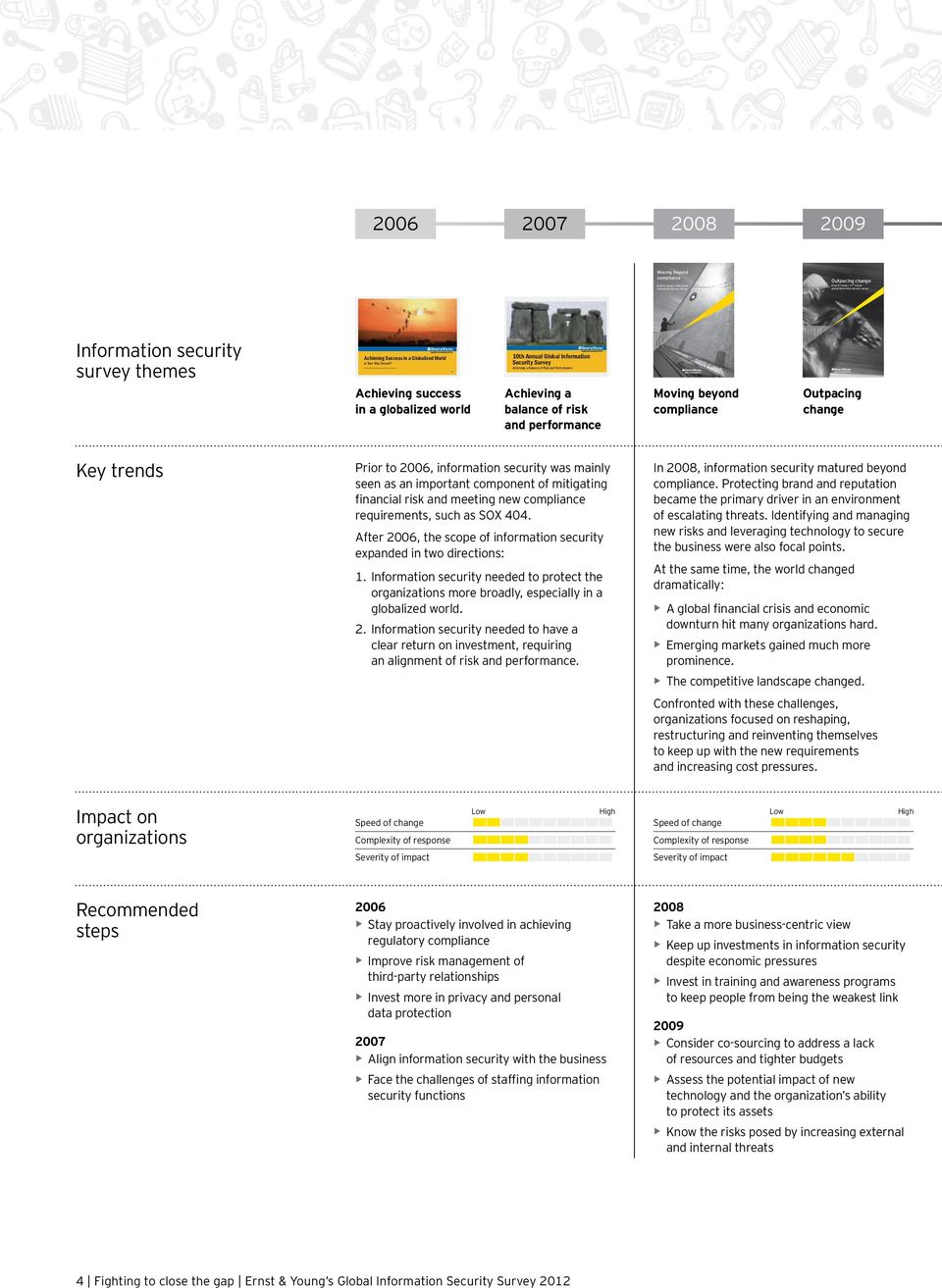
7 Ernst & Young s 2010 Global Information Security Survey Insights on IT risk November Borderless security 2012 Fighting to close the gap Ernst & Young s 2012 Global Information Security Survey Borderless security Into the cloud, out of the fog The information security gap Information security survey themes With a global economy still in recovery, and in an environment of sustained cost pressures and scarce resources, two new waves of change emerged: 1. Organizations started to realize that with globalization, data is everywhere. Employees were increasingly sending data to business partners over the internet or carrying the data with them on mobile devices. The traditional boundaries of an organization were vanishing along with the traditional security paradigms. 2. Data processing moved into the cloud. Organizations understood the security requirements associated with IT outsourcing. Moving to the cloud required the information security function to completely rethink its approach to securing information. The velocity and complexity of change accelerates at a staggering pace: Virtualization, cloud computing, social media, mobile, and other new and emerging technologies open the door to a wave of internal and external threats. Emerging markets, continuing economic volatility, offshoring and increasing regulatory requirements add complexity to an already complicated information security environment. Organizations have made great strides in improving their information security capabilities. But for as many steps as they have taken, they continue to fall behind, creating an information security gap that grows ever larger. Key trends Speed of change Complexity of response Severity of impact Low High Speed of change Complexity of response Severity of impact Low High Impact on organizations 2010 Address the risks associated with emerging technologies Increase investment in data loss prevention tools Take an information-centric view of security that better aligns to the business 2011 Bring information security into the boardroom Protect the information that matters most Embrace encryption as a fundamental control Focus on the fundamentals 2012 Continue to make information security a board-level priority Develop an integrated strategy around corporate objectives, and consider the whole risk landscape Use data analytics to test the risk landscape and understand the data you need to protect most budgeting to enable long-term planning Innovate, innovate, innovate Start working on a fundamental transformation, as described later in this report Recommended steps Fighting to close the gap Ernst & Young s Global Information Security Survey

8 How far do organizations still need to go? The improvements that organizations are making In response to the key recommendations that have been made over the years, to address changes in the risk environment. organizations view the security of information. Once referred to as IT security, the responsibility for protecting an organization s data used to belong solely or primarily to the IT function. No more! Today, organizations understand that data security is a strategic business imperative that requires an enterprise response under the broader information security umbrella. Other improvements have included: Stronger compliance to regulatory requirements For years, external threats from worms and viruses were information security s primary driver. All that changed in 2005 when compliance became a board-level issue. Since that time, with the exception of 2008 when brand and reputation supplanted it, achieving compliance with regulations has consistently been the most important driver of information security for approximately 80% of respondents. services industry one of the most regulated industries banks in the US are talking about collaborating on identifying ways to address information security risks, despite competitive sensitivities. Information security is on President Barack Obama s radar, and banks are trying to improve governance around how they manage information security risk before regulators do it for them. Better transparency In 2008, only 18% of respondents indicated that their information security was an integrated part of the organization s business strategy; 33% suggested that their information security strategy was integrated as part of the organization s IT strategy. By 2012, these numbers have jumped to 42% and 56%, respectively. 6 Fighting to close the gap Ernst & Young s Global Information Security Survey 2012

9 Threats seen as unforeseeable and diverse The dependence of civilizations on large IT-centric infrastructures has increased over the past decades. President Barack Obama recently wrote in a column, So far, no one has managed to seriously damage or disrupt our critical infrastructure networks. But foreign governments, criminal syndicates and lone individuals are probing our financial, energy, and public safety systems every day. Taking down vital banking systems could trigger a financial crisis. (Barack Obama, Taking the Cyberattack Threat Seriously, The Wall Street Journal, 19 July 2012). Sources of catastrophic threats are increasingly seen as unforeseeable and diverse state-sponsored attacks, organized crime, hacktivists, natural disaster, terrorism. Especially for critical infrastructure networks, organizational resilience is a desired end state. It is a descriptive rather than prescriptive term denoting the capability of an organization to withstand disruption and achieve longterm prosperity. The question arises whether a cyber security-driven event may trigger another catastrophic 9/11-scale event. This would automatically put the emphasis on high-impact and low occurrence types of risk the most difficult risks to analyze and mitigate. Developing an integrated information security strategy is critical to gaining a holistic view of the risk landscape and fully addressing those risks. Leading organizations have recognized this and are working harder to ensure that information security is embedded into both business and IT strategies. Increasing importance of business continuity management In 2006, business continuity was just beginning to appear on the radar for information security. In 2008, the primary responsibility for business continuity management resided with IT, where the focus was really more on disaster recovery rather than full business continuity. By 2012, organizations ranked business continuity as the second most mature information security function within the organization. However, they still need to do more; 47% of respondents say that they expect to spend more on business continuity and disaster recovery in the next year. Responding to new technologies When it comes to new technologies, organizations have needed to move quickly. In 2006, smartphones were primarily used by executives and tablets didn t even exist in a consumable form. Risks related to mobile devices, social media and the cloud weren t high on anyone s agenda because they hadn t Since then, the proliferation of mobile devices and networks, and the blurring lines between business and personal use, have forced organizations to urgently implement policies that address the risks associated with an evolving array of emerging technologies. Organizations are making policy adjustments, stepping up awareness programs, and, in the case of cloud computing, improving oversight of the contract management process for cloud services providers and boosting their encryption techniques. Fighting to close the gap Ernst & Young s Global Information Security Survey

10 The new normal for the CIO is that fast is not fast enough. The same holds true for information security. Paul van Kessel IT Risk and Assurance Services Global Leader, Ernst & Young Accelerating threats Despite all the improvements organizations are making, the pace of change is picking up speed. In 2009, 41% of respondents noticed an increase in external attacks. By 2011, that number had leapt to 72%. This year, the number of respondents indicating an increase in external threats has risen again to 77%. Examples of accelerating external threats include hacktivism, state-sponsored espionage, organized crime and terrorism. In the same span of time, organizations have also noticed an increase in internal vulnerabilities. In this year s survey, nearly half of respondents (46%) say they have noticed an increase. Thirty-seven percent rank careless or unaware employees as the threat that has increased the most over the last 12 months. Interestingly, this number is not much smaller, relatively speaking, to the 50% of respondents in 2008 who cited organization information security initiatives. The remaining gap What this year s survey clearly shows is that threats are accelerating concern, in some critical areas, not only has there been little improvement, there s been stagnation or even erosion in addressing important information security initiatives. Such issues include: Alignment with the business Processes and architecture New and evolving technologies These are subjects upon which we have consistently reported and for which we have provided recommendations in previous reports. Without appropriate and effective action, the gap between necessary information security levels and actual information security levels continues to grow. Left unattended, organizations face risks that could ultimately impact their brand or even market share. 8 Fighting to close the gap Ernst & Young s Global Information Security Survey 2012

11 Enhancements needed based on accelerating threats Actual enhancements in information security Necessary level of information security The gap Current level of information security In the Asia-Pacific region, the financial services industry is genuinely interested in taking on additional, but measured, business risks. Organizations hope to either gain greater returns or expand their business footprint in Asian countries. Although critics may agree this is an admirable business strategy, organizations need to think about the compliance implications of multiple regulatory requirements in regional hubs, such as Singapore, Hong Kong and the Philippines. Fighting to close the gap Ernst & Young s Global Information Security Survey

12

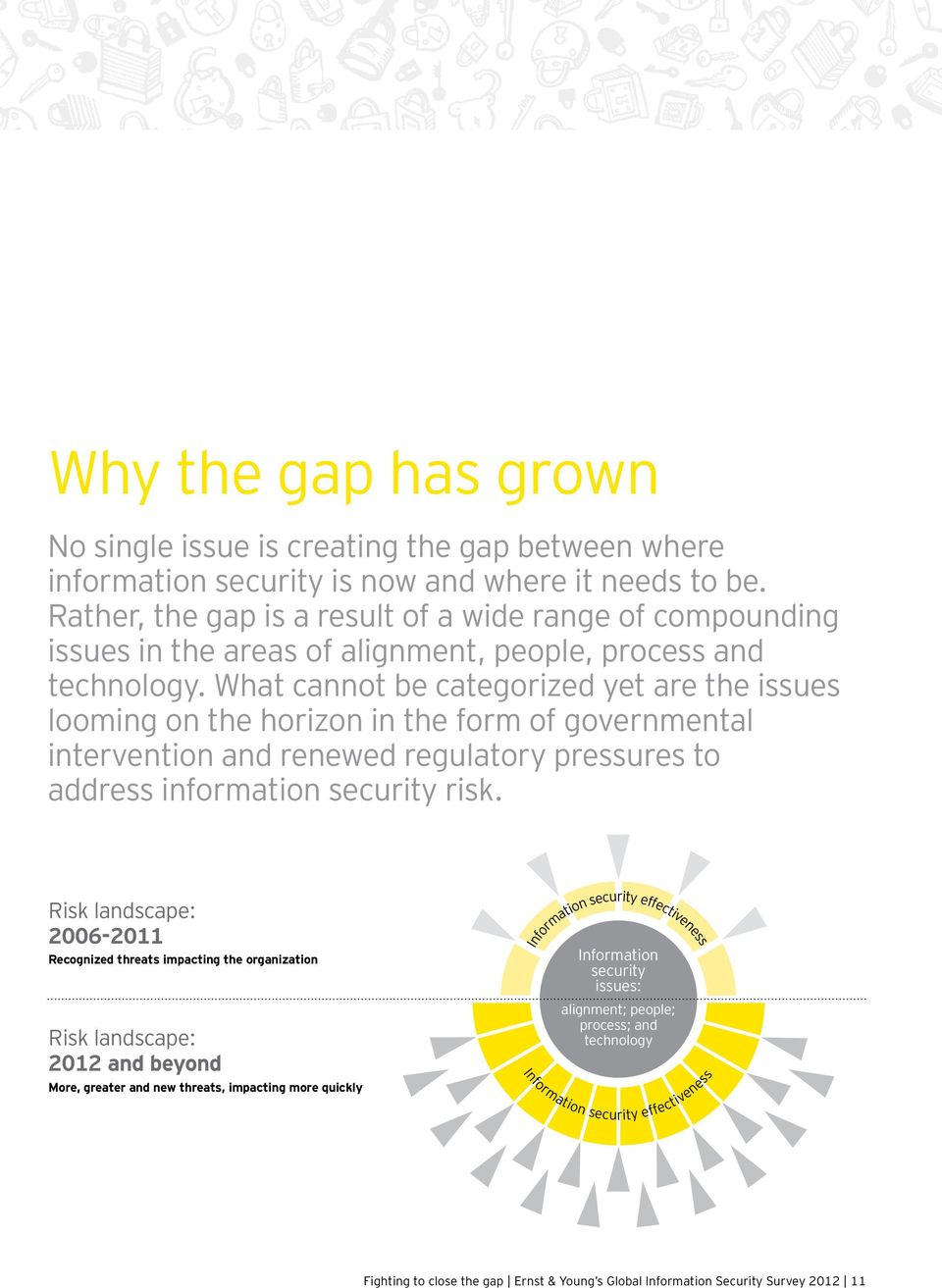
13 Why the gap has grown No single issue is creating the gap between where information security is now and where it needs to be. Rather, the gap is a result of a wide range of compounding issues in the areas of alignment, people, process and technology. What cannot be categorized yet are the issues looming on the horizon in the form of governmental intervention and renewed regulatory pressures to address information security risk. Risk landscape: Recognized threats impacting the organization Risk landscape: 2012 and beyond More, greater and new threats, impacting more quickly Information security effectiveness Information security issues: alignment; people; process; and technology Information security effectiveness Fighting to close the gap Ernst & Young s Global Information Security Survey
14 56% of respondents say their information security strategy is aligned to their IT strategy 42% of respondents say that their information security strategy is aligned to their business strategy 38% of respondents say their information security strategy is aligned to the organization s risk appetite Unbalanced alignment For years, Ernst & Young has advocated that information security needs to be more strategically positioned beyond the IT function. Information security needs to become a board-level priority and its executives need to have a seat at the boardroom table. And for a time, information security executives made great strides in achieving this level of visibility, accountability and value. But in recent years, as threats accelerate and economic volatility, emerging markets, offshoring and new technologies add complexity to the role, information security is having to compete with other board-level priorities. As a result, although information security is heading in the right direction, it may not be getting the attention it needs to keep pace with the velocity of change. Broader alignment needed The information security agenda continues to be IT-led rather than focused on the overall business strategy. An effective information security strategy needs to stretch across the entire enterprise and work in tandem with many different functional areas. That s why it is so important that information security s goals are aligned not only with the overall enterprisewide business goals, but also with the various departmental and functional goals. Admirably, the number of respondents who indicate that their information security strategy is aligned to their IT strategy has risen from 33% in 2008 to 56% in Similarly, the number of respondents suggesting that their information security strategy is aligned to their business strategy has risen from 18% in 2008 to 42% in And yet, in 2012: Little more than one third (38%) align their information security strategy to their organization s risk appetite and risk tolerance. A little over half (54%) discuss information security topics in the boardroom on a quarterly basis or more frequently. The remaining 46% almost never or never discuss the topic with the top governing structure of their organization. 12 Fighting to close the gap Ernst & Young s Global Information Security Survey 2012

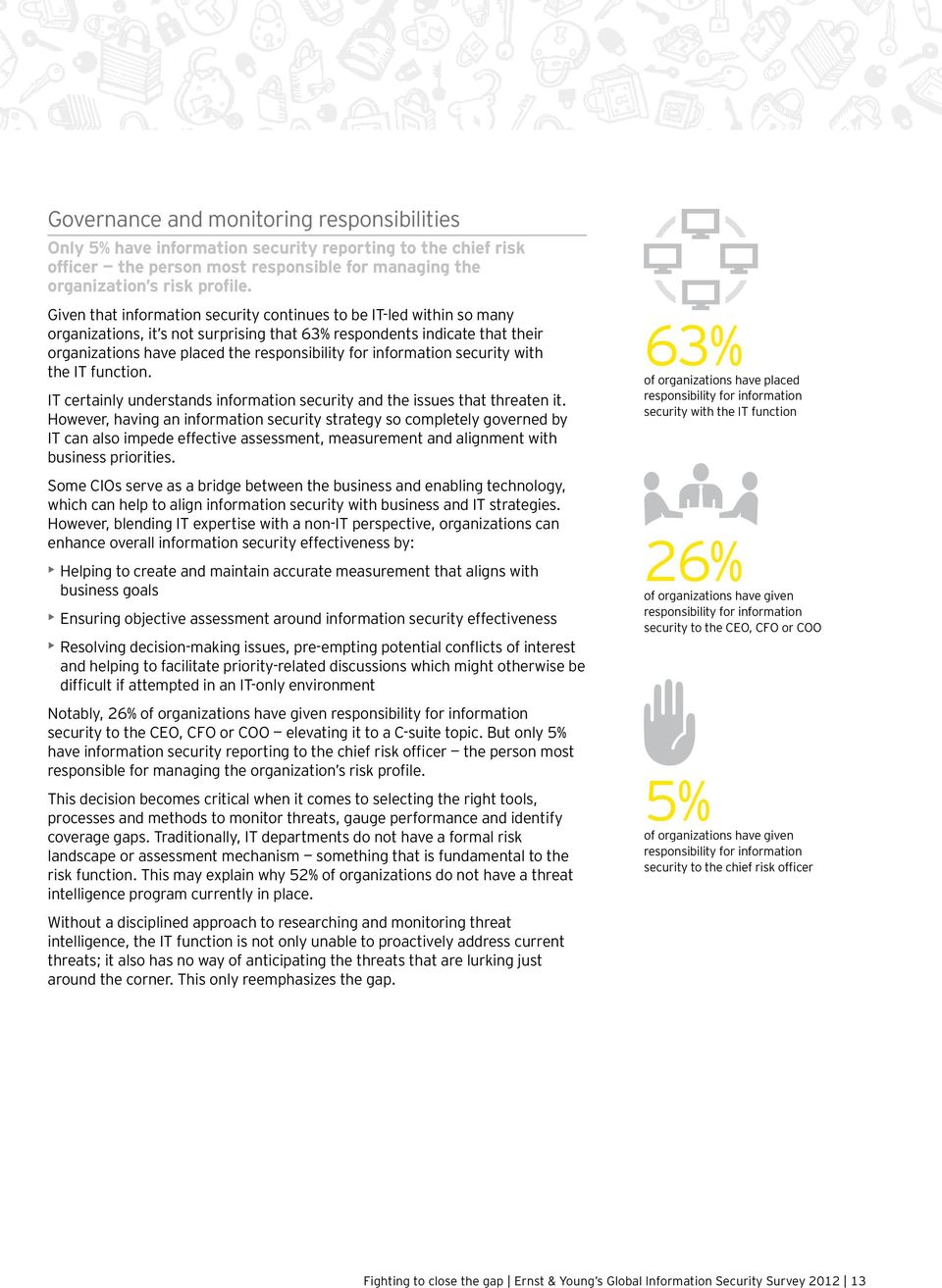
15 Governance and monitoring responsibilities Only 5% have information security reporting to the chief risk officer the person most responsible for managing the organization s risk profile. Given that information security continues to be IT-led within so many organizations, it s not surprising that 63% respondents indicate that their organizations have placed the responsibility for information security with the IT function. IT certainly understands information security and the issues that threaten it. However, having an information security strategy so completely governed by IT can also impede effective assessment, measurement and alignment with business priorities. Some CIOs serve as a bridge between the business and enabling technology, which can help to align information security with business and IT strategies. However, blending IT expertise with a non-it perspective, organizations can enhance overall information security effectiveness by: Helping to create and maintain accurate measurement that aligns with business goals Ensuring objective assessment around information security effectiveness and helping to facilitate priority-related discussions which might otherwise be Notably, 26% of organizations have given responsibility for information security to the CEO, CFO or COO elevating it to a C-suite topic. But only 5% This decision becomes critical when it comes to selecting the right tools, processes and methods to monitor threats, gauge performance and identify coverage gaps. Traditionally, IT departments do not have a formal risk landscape or assessment mechanism something that is fundamental to the risk function. This may explain why 52% of organizations do not have a threat intelligence program currently in place. 63% of organizations have placed responsibility for information security with the IT function 26% of organizations have given responsibility for information security to the CEO, CFO or COO 5% of organizations have given responsibility for information Without a disciplined approach to researching and monitoring threat intelligence, the IT function is not only unable to proactively address current threats; it also has no way of anticipating the threats that are lurking just around the corner. This only reemphasizes the gap. Fighting to close the gap Ernst & Young s Global Information Security Survey
16 Further obscuring the clarity around assessment are the multiple means used to monitor information security. As the chart below indicates, a majority of of information security. Slightly fewer (64%) use the IT function or information security itself to conduct internal self-assessments. information security? Choose all that apply. Assessments performed by internal audit function Internal self-assessments by IT or information security function 68% 64% Assessment by external party 56% 70% of respondents indicate that their information security function only partially meets organizational needs and improvements are underway Monitoring and evaluation of security incidents and events In conjunction with the external Benchmarking against peers/competition 27% Evaluation of information security operational performance 48% 35% 19% ISO/IEC 27001:2005) Payment Card Industry Data Security Standard) 15% 15% Evaluation of information security costs 14% Evaluation of return of investment (or similar such as ROSI) performance 5% No assessments performed 4% In fact, the proliferation of threats and the widening gap between vulnerability and security requires multiple sources of assessments. Ideally, companies by internal audit; internal self-assessments; third-party assessments; and the monitoring and evaluation of security incidents. High-performing organizations use a combination of two or more assessment techniques to high percentage of responses to the top four assessment options, many of the survey s respondents are high performers. Unfortunately, strong assessment performance does not shield many information security functions from criticism of their performance overall. Only 16% of respondents say that their information security function fully meets organizational needs. Instead, 70% indicate that their information security function partially meets organizational needs and that improvements are underway. 14 Fighting to close the gap Ernst & Young s Global Information Security Survey 2012

17 Insights on risk July 2012 Increasing relevance by turning risk into results Changing risk landscape Physical measures can be built to prevent criminal acts. But it is often more difficult to prevent incompetence, mischief or revenge. Organizations recognize that the risk environment is changing. Nearly 80% agree that there is an increasing level of risk from increased external threats, and nearly half agree that internal vulnerabilities are on the rise. Change in the risk environment in the last 12 months Decreasing level of risk due to: 6% Decreased internal vulnerabilities 18% Decreased external threats Increasing level of risk due to: 46% Increased internal vulnerabilities 77% Increased external threats Additionally, 31% of respondents have seen increases in the number of security incidents compared to last year, while only 10% saw a corresponding decrease. Fifty-nine percent indicate that the number of incidents have stayed the same. As the frequency and nature of information security threats increase and the number of security incidents rises, so too does the potential impact of security lapses. External threats are not the only security gap facing global organizations. Inadvertent employee data loss is also rising. loss, and physical measures can be built to prevent criminal acts. But it is often reasons of mischief, revenge or greed. Organizations need to readjust their thinking from protecting the perimeter to protecting the data. It s all about having the right focus. Manuel Giralt Herrero IT Risk and Assurance Services EMEIA Leader, Ernst & Young The future of internal audit is now Information security a priority for internal audit professionals In 2012, Ernst & Young commissioned a global survey to explore the evolving role of internal audit. Almost half of respondents (48%) indicated that information security and privacy risk were top priorities for their organizations. In fact, 14% devote between 10% and 20% of their audit time to information security risk and expect to continue doing so in the next two years. To read our report, The future of internal audit is now, please visit Fighting to close the gap Ernst & Young s Global Information Security Survey

18 44% of respondents expect to keep their information security budgets the same over the next 12 months More money, yes. But is it well spent? Survey respondents rank business continuity management as their highest spending priority in the next 12 months. As organizations around the world are seeing the rise in the threat levels, they are responding by spending more and adjusting their priorities: 44% of respondents will be keeping their budgets the same over the next 12 months 9% expect to see an information security budget increase of 25% or more In terms of budgets, size varies widely: 32% spend US$1 million or more on information security 30% of respondents expect an information security funding increase of 5% to 15% 9% of respondents expect to see an information security budget increase of 25% or more 32% of respondents spend US$1 million or more on information security As the chart at right illustrates, the highest priority area (51% of respondents) for investment in the next 12 months is business continuity management highlighted earlier in the report, that business continuity is an area in which organizations have worked hard to improve. We expect it is also, at least in part, a reaction to the disruptive and sometimes catastrophic events of the technology, wiped out supply chains and sliced earnings. Interestingly, the second-highest ranked spending priority for respondents was a fundamental redesign of their information security program. This underlines the fact that leading companies recognize the gap described in the An information security transformation (or fundamental shift) is necessary to face today s issues. At almost the opposite end of the spectrum, security testing was considered a high priority by only 6% of businesses. Low response rates at the bottom of in these areas that they are doing enough and can therefore turn their attention to the higher-priority areas. In terms of where organizations plan to increase their investment in the coming year, it s no surprise that securing new technologies, business continuity and disaster recovery top the list. As the chart on page 19 suggests, more than half (55%) expect to spend more on securing new technologies. A slightly lower percentage (47%) are planning to spend more on their number one priority business continuity. A little more than one quarter (26%) plan on spending more on their number two priority information security transformation. 16 Fighting to close the gap Ernst & Young s Global Information Security Survey 2012

19 Business continuity/disaster recovery Information security transformation (fundamental redesign) Data leakage/data loss prevention technologies and processes Implementing security standards (e.g., ISO/IEC 27002:2005) Information security risk management Securing new technologies (e.g., cloud computing, virtualization and mobile computing) Compliance monitoring Identity and access management technologies and processes Security operations (antivirus IDS IPS patching encryption) Security governance and management (e.g., metrics and reporting architecture program management) Privacy Offshoring/outsourcing security activities Forensics/fraud support Recruiting security resources Security incident and event management Incident response capabilities Security awareness and training Threat and vulnerability management technologies and processes Security testing (e.g., attack and penetration) Secure development processes (e.g., secure coding QA process) Key: 1st 2nd 3rd 4th 5th Fighting to close the gap Ernst & Young s Global Information Security Survey

20 A whole new paradigm In the war over government data security, statistics indicate the bad guys are winning. And some security experts say any hope of reversing that trend will take a whole new paradigm in IT security. increased by 19%, or about 13,000 to 15,500, from 2010 to At least some of the time, victims of those breaches are being left in the dark about it for months. About 123,000 Thrift Savings Plan participants whose personal information was This is not the only instance. The Washington Business Journal reported that the U.S. Environmental Protection Agency (EPA) waited months to notify 5,100 employees and 2,700 other individuals of a data security breach in March 2012 that exposed their Social Security numbers and banking information. 2 1 Data breaches up 19 percent, GAO reports; 31 July 2012; 2 Aitoro, Jill; EPA security breach exposes personal information of 8,000 people; Washington Business Journal; 2 August 2012; Interesting fact Organizations that benchmark against their competition to gauge information security effectiveness indicate higher than average financial impact. Also, significantly, nearly 25% of all respondents indicate that they do not know the financial impact. For organizations that do no assessment of effectiveness (4% of all respondents), the percentage that does not know the impact of information security issues rises to 40%. 18 Fighting to close the gap Ernst & Young s Global Information Security Survey 2012
21 Compared to the previous year, does your organization plan to spend more, spend relatively the same amount or spend less over the next year for the following activities? Securing new technologies Business continuity/disaster recovery Data leakage/data loss prevention technologies and processes Identity and access management technologies and processes Security awareness and training Information security risk management Security testing Security operations Security governance and management Threat and vulnerability management technologies and processes Compliance monitoring Security incident and event management Implementing security standards Incident response capabilities Information security transformation Secure development processes Privacy Recruiting security resources Forensics/fraud support Offshoring/outsourcing security activities Key: Spend more Spend the same Spend less Fighting to close the gap Ernst & Young s Global Information Security Survey
22 Key obstacles to information security effectiveness 62% Budget constraints 43% Lack of skilled resources 26% Lack of tools 20% Lack of executive support Not enough resources, not the right skills It s a familiar refrain, particularly in today s era of economic volatility and spending restraint: too much work, not enough resources. But a lack of resources only tells part of the story. Information security doesn t just need more resources; it needs people with the right skills and training to meet rapidly evolving changes in the information security landscape. Resource constraints Only 22% of respondents indicate that they are planning on spending more in this area in the next 12 months. When we asked organizations which main barriers and obstacles are challenging the ability of their information security function to deliver, 43% to the only factor that scored above it budget constraints. And yet, only 22% of respondents indicate that they are planning on spending more in this area in the next 12 months. Limited security awareness training Organizations need to train employees outside of the information security function about the role they must play in keeping the organization s information safe. Finding the right skilled resources within information security is only one part of the equation. Given the acceleration of external threats, coupled with the proliferation of mobile devices and networks that are being used for both work and play, organizations also need to devote resources and money to train employees outside of the information security function about the role they must play in keeping the organization s information safe. As we mention earlier, 37% of respondents see the threat that has most increased their organization s risk exposure as careless or unaware employees. As well, the number of actual incidents caused by inadvertent employee data loss has risen by 25% in the last year. Respondents indicate that they intend to spend more, but that amount will still only capture approximately 5% of the overall information security spend. 20 Fighting to close the gap Ernst & Young s Global Information Security Survey 2012
23 What threats and vulnerabilities have most increased your risk exposure over the last 12 months? Careless or unaware employees Outdated information security controls or architecture Cyber attacks to disrupt or deface the organization Fraud Natural disasters Malware Cyber attacks to steal intellectual property or data Vulnerabilities related to mobile computing use Vulnerabilities related to cloud computing use Espionage Phishing Unauthorized access Spam Internal attacks Vulnerabilities related to social media use Key: 1st 2nd 3rd 4th 5th Data stolen from employee s car According to eweek.com, softpedia.com and nakedsecurity.com reports, in August 2012, a group of Indiana-based doctors, the Cancer Care Group, acknowledged that backup media containing information on 55,000 patients and employees was stolen from an employee s car the month before. Although small on the scale of data breaches reported by organizations, the stolen data included patient names, addresses, dates of birth, Social Security numbers, medical record numbers, insurance information and clinical information; as well as their employees dates of birth, Social Security numbers and beneficiary names. Fighting to close the gap Ernst & Young s Global Information Security Survey
24 Information security must be business back rather than technology forward. Bernie Wedge IT Risk and Assurance Services Americas Leader, Ernst & Young LLP In 2009, we suggested that organizations needed to take an informationcentric view of security to help ensure better alignment with their information within critical business processes could an organization, and in particular its information security function, truly begin to manage its security needs. We offered these recommendations assuming that organizations had in place, or would implement, the necessary processes including a structured, effective framework or information security management system. In 2012, we learned that a majority of organizations still don t have a framework. No security architecture framework A patchwork of non-integrated, complex and frequently fragile defenses creates significant gaps in security. Surprisingly, 63% of respondents in this year s survey indicated that their organizations have no formal security architecture framework in place, nor are they necessarily planning on using one. For some organizations, skill resources, security maturity or budget may be playing a role in their decision-making. Other organizations may simply be hoping the issue will go away on its own. However, it is encouraging to see in the chart on the right that 37% use one or more framework, with The Open Group Architecture Framework being the most popular. between 1 and 10 attack and penetration tests annually, and why 19% don t conduct any tests at all. 56% of respondents only conduct between 1 and 10 attack and penetration tests annually 19% of respondents don t conduct any attack and penetration tests at all 22 Fighting to close the gap Ernst & Young s Global Information Security Survey 2012
25 What formal security architecture frameworks are used (or are you planning to use) within your organization? We do not have a formal security architecture framework in place 63% The Open Group Architecture Framework 11% ANSI/IEEE 1471:ISO/IEC % SABSA framework and methodology 3% U.S. Department of Defense Architecture Framework Zachman Framework 2% Extended Enterprise Architecture Framework 1% The UK Ministry of Defense Architecture Framework 3% 1% Organizations need to constantly refresh their security posture to address rapidly evolving needs. Jenny Chan IT Risk and Assurance Services OBASHI 0% Other 12% In responding to short-term information security needs, organizations seem increasingly inclined to bolt on or stack work-around solutions. This results in a patchwork of non-integrated, complex and frequently fragile defenses, easy to understand, use or update. Nearly a third of organizations rate their architecture as the threat or vulnerability that has increased the most over the last 12 months, largely because controls are outdated and can t easily Interesting fact Sectors that have the most exposure are the ones most likely to do the most attack and penetration testing. This is especially true of banking and capital markets. Interestingly, however, the insurance and telecommunications industries did disproportionately more testing compared to their respective exposures. Fighting to close the gap Ernst & Young s Global Information Security Survey
26 Insights on IT risk Business brie ng April % of respondents say they are currently using or planned to use cloud computing services 44% of respondents say they are currently using or planned to use cloud computing services 59% of respondents say they are currently using or planned to use cloud computing services A torrent of technology Innovation is the secret weapon that will help business keep pace with change. growing and evolving, adapting to change particularly as threats evolve and risks grow. But the very technologies that help propel a business forward are the same ones that create new risks. New technologies open up tremendous opportunities for organizations, but the information security function needs to pay particular attention to, and manage, the associated risks. Up in the cloud Cloud computing continues to be one of the main drivers of business model innovation and IT service delivery. Cloud computing can enable many organizations to do much more with IT by becoming more strategy-focused and less operations-focused. Cloud-based services are nimble and adaptive, increasing the capability to read and react to changing marketplace conditions by responding to customer needs and competitors actions. For these reasons, cloud computing continues to be one of the main drivers of business model innovation and IT service delivery. In 2010, only 30% of organizations indicated they were currently using or planned to use cloud computing services. In 2011, that number rose to 44%. Today, 59% of organizations are in, or are headed to, the cloud. This number doesn t include the number of organizations that may be unaware of the extent of their own involvement. Although a majority of respondents indicate they are using or will use the cloud in the next 12 months, 38% have not taken any measures to mitigate the risks. This number is down from more than 50% in 2011 as organizations vulnerable. The most frequently taken measures include stronger oversight on the contract management process for cloud service providers (28%) and the use of encryption techniques (28%). 38% of respondents say they have not take any measures to mitigate the risks of using cloud computing services Interesting fact More than a quarter of respondents who indicate that they do not use cloud and/ or use cloud services and have no plans to do so in the next year say they rely on external assessment to gauge the effectiveness of their information security function. Ready for takeoff Preparing for your journey into the cloud Interested in learning more? Please see our publication Ready for takeoff: preparing for your journey into the cloud available at informationsecurity. 24 Fighting to close the gap Ernst & Young s Global Information Security Survey 2012
27 Exploring the top 10 risks and opportunities for global organizations Global report Which of the following controls have you implemented to mitigate the new or increased risks related to the use of cloud computing? Stronger oversight on the contract management process for cloud service providers 28% Encryption techniques 28% Increased due diligence of service providers 25% Stronger identity and access management controls On-site inspection or assessment by your security/it risk teams 22% 16% Adjusted compliance monitoring processes 15% Increased auditing of cloud service provision 15% Adjusted incident management processes 15% Increased liability for cloud service providers in contracts Contracting with a third party to test controls at a cloud service provider Financial penalties in the case of security breaches More reliance on third-party Financial penalties in the case of compliance and privacy issues 14% 13% 13% 12% 12% None 38% Turn risks and opportunities into results Emerging technologies named top 10 risk for global organizations In a recent Ernst & Young survey of 700 leading organizations, emerging technologies risk was identified as number 5 in a list of top 10 risks to be faced by businesses in the coming years. Looking at the drivers of risk, survey respondents most frequently pointed to difficulties in developing an innovation culture. A similar number also identified the inherent uncertainty that accompanies untested technologies. A majority of organizations surveyed indicated that they were actively managing this risk. By far the most frequently reported mitigation strategy was to develop an organization-specific innovation culture to monitor new technologies and review products, services and internal processes continuously. For more details relating to emerging technologies risk, please read our report, Turn risks and opportunities into results, available at top10challenges. Fighting to close the gap Ernst & Young s Global Information Security Survey
28 Social media in business Social media can quickly build an organization s brand, and just as quickly crush it. Once taboo within the four walls of many organizations, social media is now considered a key component of product development, feedback and customer interaction and engagement. Social media has reinvented the relationship among organizations, customers, employees, suppliers and regulators. And it has shortened processes that used to take days or weeks down to just a few hours or minutes. But in addition to the many opportunities that social media generates, there are also many new challenges. In a 24/7, anytime, anywhere world, social media and everyone who has internet access can quickly build an organization s brand, and just as quickly crush it. Challenges include data security, privacy concerns, regulatory and compliance requirements, issues over employees use of work time and business tools to engage in social media. As noted in the chart opposite, our survey shows that 38% of organizations do not have a coordinated approach to address social media usage within or by their organization. The result is an increase in overall risk and limited capability to fully exploit social media channels in the future. How does your organization address social media? 43% We have a coordinated approach led by a department other than the information security department 38% We do not have a coordinated approach to address social media 19% We have a coordinated approach led by the information security department 26 Fighting to close the gap Ernst & Young s Global Information Security Survey 2012
29 Insights on IT risk Business brie ng May 2012 Which of the following controls have you implemented to mitigate the new or increased risks related to the use of social media? Limited or no access to social media sites 45% Policy adjustments 45% Security and social media awareness programs 40% Monitoring of social media sites 32% New disciplinary processes 11% Adjusted incident management processes 10% None 20% For those organizations that do have a formal approach for using social media, the chart above shows that the most frequently implemented risk mitigation measures include: limited or no access to social media sites (45%), policy adjustments (45%) and awareness programs (40%). Protecting and strengthening your brand Social media governance and strategy Interesting fact Almost universally, most respondents say policy adjustments are their preferred way of mitigating concerns around social media, regardless of how they measure the effectiveness of their information security function. However, most of the respondents who indicate that they perform no assessment of their information security function s effectiveness, also indicate that to mitigate social media-related concerns, they simply prohibit or limit employees access to social media sites. Interested in learning more? Please see our publication, Protecting and strengthening your brand, related to social media available at informationsecurity. Fighting to close the gap Ernst & Young s Global Information Security Survey
30 Making the most of mobile As the mobility of today s workforce continues to grow, the phrase According to a recent Cisco forecast, by 2016 there will be 10 billion internetenabled mobile devices nearly 1.5 for every man, woman and child on the planet. Once meant solely for telephone calls, mobile devices today are a vital communications tool and knowledge source for both business and personal activities. They enable connectivity to the internet and cloud on a 24/7 basis. Does your organization currently permit the use of tablet computers for business use? Tablets are under evaluation or in very limited use Yes, company-owned tablets devices are widely in use Yes, privately-owned tablets are widely in use and supported by the organization by means of a Bring Your Own Device policy Yes, privately-owned tablets are widely in use but not supported by the organization No, and there are no plans to use tablets in the next 12 months No, but we plan to use tablets within the next 12 months 35% 19% 13% 12% 11% 9% increased adoption rates of mobile technology. According to our survey, and illustrated in the chart above, tablet computer use for business has more than doubled since last year. From 20% in 2011, 44% of organizations now allow the use of company or privately-owned tablets within their organization 19% indicate that company-owned tablets are widely in use; 13% support the use of privately-owned tablets through a bring your own device policy; and 12% allow the private use of tablets, but do not support them. As the mobility of today s workforce continues to grow, the phrase out of As the chart on the next page highlights, 52% of respondents have implemented policy adjustments; 40% have invested in awareness programs. But organizations recognize the need to do more. They are beginning to educate themselves about the capabilities and design of the mobile device security software products that are available in the market; however, the adoption of security techniques and software in the fast-moving mobile computing market is still low. For instance, encryption techniques are used by fewer than half (40%) of the organizations. 28 Fighting to close the gap Ernst & Young s Global Information Security Survey 2012
31 Which of the following controls have you implemented to mitigate the new or increased risks related to the use of mobile computing including tablets and smartphones? Policy adjustments 52% Increased security awareness activities 40% Encryption techniques 40% New mobile device management software 36% Allow the use of company-owned devices, but disallow use of personal devices Governance process to manage the use of mobile applications 34% 31% Architectural changes 24% Adjusted incident management processes 15% Attack and penetration testing of mobile applications 14% Increased auditing capability 12% New disciplinary processes 9% Disallow the use of all tablets/ smartphones for professional use 6% None 14% Mobile technologies: opportunities vs. threats Opportunities: Increased productivity Choice of technologies Reduced capital expenses Promotes a more creative environment Keep employees happy and motivated Threats: Theft/loss/data leakage Malware infection Unauthorized access Legal considerations Privacy concerns Increase in administrative overheads Work/play balance Enterprise ready/system integration Fighting to close the gap Ernst & Young s Global Information Security Survey
32 BYOD bring your own device As sales of mobile and smartphones outpace those for PCs, and organizations their work devices with their personal devices, they must consider in detail the data and information security issues. Employees are buying phones and data plans anyway. Supporting device enablement in the workplace helps not only to lower employee costs, but also removes some of the overhead formerly associated with massive company-sponsored mobile phone purchases. This integration of personal devices with company access can help lower collective costs, and increase employee productivity, morale and creativity. However, with opportunity also comes risk. Increasing BYOD activities mean that employees are able to upgrade their tablet or smartphone themselves without the involvement of IT. This can impact both the functionality and security of any corporate or otherwise authorized apps that may be installed on the device. This is why mobile device management becomes so critically important. Organizations should consider the following activities when supporting BYOD. 1. Once decided, an organization can then better set policies around its limits. For example, the organization could install an app that allows it to turn off cameras and applications, or block social media sites through which data can leak. This allows the employees to choose whether they want the organization to help pay for the device and its use in exchange for potential loss in freedom, including limits that protect the organization s data security. 2. Secure the corporate network. To prevent data loss caused by authorized access by unsupported devices, consider having a parallel guest network that is separate from your main network. This allows employees to use their personal device to get access to the web directly, perhaps even through a work-only account. Also, consider using third-party services or their own coding to create sandboxes in those devices where company data and company-issued applications reside and are walled off from interaction with personal data, applications or online services. 3. Maintain basic data security. Organizations need to make sure that the data stored on the device is protected from any hacking, outsider access and from viruses. 30 Fighting to close the gap Ernst & Young s Global Information Security Survey 2012
33 Data spills Increasingly sophisticated malware is providing a conduit for sensitive information to be released unknowingly outside the organization. The global digitization of products, services and processes have a profound impact on organizations. The availability of huge amounts of data creates fantastic opportunities to extract insight and value. Organizations that master separate themselves from their competitors. in the volume of intentional and unintentional data leakage. Increasingly, sophisticated malware is providing a conduit for sensitive information to be released unknowingly outside the organization. As the chart below demonstrates, this year s survey suggests that most (72%). As well, many organizations (68%) have executed awareness programs. The adoption of DLP (data loss prevention) technology, however, remains relatively low (38%). Which of the following actions has your organization taken to control data leakage of sensitive information? and handling of sensitive information Employee awareness programs 68% Implemented additional security mechanisms for protecting information (e.g., encryption) 72% 57% Organizations need to implement flexible, adaptable defences that remain resilient, even when data breaches occur and they will occur. Haruyoshi Yokokawa IT Risk and Assurance Services Japan Leader, Ernst & Young Locked down/restricted use of certain hardware components (e.g., USB drives, FireWire ports) 43% Utilized internal auditing for testing of controls 41% telework regarding the protection of information Implemented data loss prevention tools (e.g., McAfee, Symantec, Verdasys) 39% 38% Implemented log review tools 38% Restricted or prohibited use of instant messaging or for sensitive data transmission Prohibited use of camera devices within sensitive or restricted areas Restricted access to sensitive 31% 23% 16% Fighting to close the gap Ernst & Young s Global Information Security Survey
34 Looming gaps more on the horizon in the form of government intervention and new regulatory pressures. Businesses may have been looking more or less effectively at the risk landscape, and evaluating threat intelligence, but they are not the only ones to be concerned. Governments and regulators have also observed the increasing risks to information security. And they are beginning to do something about it. If organizations don t take action of their own, the combined consequence of current issues (described above) and future issues (described below) will only widen the gap. Critical infrastructure providers Governments are likely to start producing directives backed up by regulators to any organization it considers economically critical, to ensure it does not fall victim to an information security threat. Although individual businesses worry about their own performance, governments want reassurance that organizations providing key services that support the continued well-being of society can continue to operate with the minimum of disruption, whatever the circumstances. Energy companies, telecoms, water suppliers, food producers and expected to implement robust measures to safeguard against an information security incident that could interrupt or damage operations. Interesting fact In response to gridlock in the US Congress over the Cybersecurity Act of 2012, Senator John D. Rockefeller IV is challenging 500 of the US' largest companies to play a leading role in reforming information security laws. Lobbying by the US Chamber of Commerce and other anti-security parties scuttled the approval of legislation that both the Commanding General of Cyber Command and the Chairman of the Joint Chiefs of Staff both felt were absolutely vital given the severity of the cyber threat America faced. Through a series of questions in a letter to Exxon Mobil, Wal-Mart Stores, General Electric, AT&T, Apple, Citigroup, UnitedHealth Group and others, Senator Rockefeller asked these corporate leaders to differentiate themselves by working together to develop action-oriented solutions to combat the increasing information security threats the US faces. With the Cybersecurity Act of 2012, Senator Rockefeller and other supporters seek to protect critical infrastructure such as power plants, pipelines, utilities, hospitals, transportation networks and telecommunications that Americans define as essential for their everyday lives. 32 Fighting to close the gap Ernst & Young s Global Information Security Survey 2012
35 Interesting fact Many organizations are still having difficulty finding security breaches and properly logging them to meet required regulatory disclosures. When large data breaches or outages are made public, they receive extensive media coverage, demonstrating that breaches are of societal importance. But ENISA, the European Union s cyber security agency, warned in a recent report 3 that even though reliable internet and electronic communications are now central to the economy, many incidents remain undetected or unreported. Cyber incidents are most commonly kept secret when discovered, leaving customers and policy-makers in the dark about frequency, impact and root causes, say the report s authors. Their report identifies gaps in the regulatory framework around incident reporting, and calls for an improvement in sharing across the EU. There is still little exchange of information between national authorities about lessons learned and leading practices, despite the cross-border nature of the threat. 3 Dr. Marnix Dekker, Christoffer Karsberg, Barbara Daskala, Cyber Incident Reporting in the EU: An overview of security articles in EU legislation, European Network and Information Security Agency, August Governments don t just have the protection of its citizens to consider. It also has its reputation as an effective government to bear in mind, and the protection of GDP. Beyond the critical infrastructure organizations, other top 100 or top 500 businesses of all industries are coming under scrutiny. Economic growth is high on government agendas. Organizations that do the most to support that growth, and drive GDP through productivity and employment, will also need to deliver highly effective information security programs. Governments are likely to start producing directives backed by regulators to any organization it considers economically critical, to ensure it does not fall victim to an information security threat. These directives will likely require businesses to share their knowledge of threats and the measures they have implemented to mitigate against or manage them. Ideally, businesses would come together of their own volition to share experiences and establish common frameworks and solutions. It has worked for other issues and it may be the best choice organizations have to stem Fighting to close the gap Ernst & Young s Global Information Security Survey
36
37 A fundamental transformation Organizations are working hard to keep up with the pace of technology, and the increasing number of information security threats, with varying levels of success. Those that can minimize the gap between what their information security functions are doing now and what they need to do will secure competitive advantage. Organizations need to take four key steps to fundamentally shift how their information security functions operate: 1 2 Start 3 Execute 4 When Link the information security strategy to the business strategy, and the overall desired results for the business. with a blank sheet when considering new technologies and This presents an opportunity to break down barriers and remove existing biases that may hamper fundamental change. the transformation by creating an environment that will enable the organization to successfully and sustainably change the way information security is delivered. considering new technologies, conduct a deep dive into the opportunities and the risks they present. Social media, big data, cloud and mobile are here to stay, but organizations must prepare for their use. Fighting to close the gap Ernst & Young s Global Information Security Survey
38 1 Linking to the business strategy that organizations align their information security strategy with their business strategy and objectives. But would that vary depending on the organization s business objectives? What does the information security strategy need to do? What actions and tactics need to be on the organization s information security agenda? In today s economic environment, organizations are typically focusing their efforts on achieving one or more of the following results: growth, innovation, optimization and protection. As organizations take steps to deliver these results, information security has a key role to play. Growth Organizations are seeking to expand their businesses into new markets, and attract new customers with new products, all with the aim of generating revenue. Effective information security can protect the whole business, safeguard revenue and free up resources to increase revenue opportunities. Innovation Organizations are using new technology to interact directly with customers in new ways. The data that is generated needs to be secure, with privacy a critical issue. In the light of today s threats, effective information security will enable an organization to demonstrate leadership in the matter of keeping their customers, and their organizations, safe. Optimization Information security structures and methods cost money, but businesses are not always spending the money they have wisely. Organizations can reduce costs across the business with well-structured and well-managed information security. Protection Information security needs good governance and transparency to provide stakeholders with. Strong and effective monitoring and testing need to be a key component throughout the information security framework. It is also important to develop the strategy and framework, and identifying the activities that need to be done. 36 Fighting to close the gap Ernst & Young s Global Information Security Survey 2012
39 Redesigning the architecture and demonstrating how information security can deliver business results The best place to start is with a blank sheet so that in the initial stages the overall design is free of bias, legacy issues and other distorting factors. Instead of looking at the existing landscape and how they can rework it, information security functions should undertake a fundamental redesign. They will need to allow for innovation and the need to constantly leverage new and emerging technologies, to help organizations achieve the results that promote protection and progress. When the results that information security should be how to get there. Identify the real risks As a starting point, organizations need to develop a brand new information security strategy. This strategy should start with the inclusion of technologies and issues such as cloud, social media, big data, mobile computing, globalization and borderless, rather than simply adding these topics as bolt ons to an existing strategy. The focus should also be on identifying the current risks (the real risks ), which will be different from what the organization has perspective starting with a recognition of what is most important today. Organizations should begin with looking at their risk appetite and how that translates to information risks. There should be a clear picture of what the most important data, applications and other IT assets are and where they reside, which may not be easy to answer in the case of cloud computing. The next step is to assess the threat landscape and determine the points of exposure. 2 Fighting to close the gap Ernst & Young s Global Information Security Survey
40 2 Protect what matters most With the real risks in mind, the next step is to develop an enterprisewide information security framework. Historically, frameworks were often static, to adapt, change and respond rapidly and effectively. An information security framework should be focused on the fundamentals and the emerging threats. It should also assume that breaches will occur and therefore planning and protecting is just as important as detecting and responding (two components that are easily overlooked). The framework should cover information security governance (including who is responsible for what), the link between the business drivers and the information security measures, the information security monitoring (the dashboards, the compliance processes, the key control indicators) and how to respond when incidents are detected. Embed in the business Information security is everyone s responsibility and not just a task for management or the information security department. Therefore, any information security framework needs to be embedded in the business. All employees, functions, business projects and related elements have a role to play. However, embedding information security in the business is not an easy task. A number of fundamental decisions have to be made, such as: What needs to be done in the day-to-day business and what should be the responsibility of an information security function? What should be done manually and what should or can be incorporated via technology? What should be done in-house and what should or can be outsourced? Sustain your security program One of the most critical questions of risk management in general is: how can we make sure that our risk management framework is continuously up and running as intended? The same applies to an information security framework that is embedded throughout the organization. Organizations can have a presence in multiple countries, have large numbers of employees and manage huge number of IT assets. How can they make sure that all information security measures are effective, day in, day out? As a result, sustain your information security program is a key component of the fundamental shift. Your compliance measures, self-assessments, continuous learning and improvement measures, and how you follow up on incidents, will keep your information security framework effective. In doing so, it will allow the organization to answer questions concerning whether the organization is continuously applying the information security measures as designed. And more importantly, it will solidify whether the framework is up-to-date by determining which emerging risks could trigger changes in the information security framework and the response required while the issues are small. 38 Fighting to close the gap Ernst & Young s Global Information Security Survey 2012
41 What organizations need to do to deliver information security that supports the business Identify the real risks: Develop a security strategy focused on business drivers and protecting high-value data Identify the most important information and applications, where they reside and who has/needs access Assess the threat landscape and develop predictive models highlighting your real exposures Protect what matters most: Assume breaches will occur improve processes that plan, protect, detect and respond Balance fundamentals with emerging threat management Establish and rationalize access control models for applications and information Sustain your security program: Get governance right make security a board level priority Allow good security to drive compliance, not vice versa Measure leading indicators to catch problems while they are still small Accept manageable risks that improve performance Embed in the business: Make security everyone s responsibility Align all aspects of security (information, privacy, physical and business continuity) with the business Spend wisely in controls and technology invest more in people and processes Selectively consider outsourcing operational security program areas Fighting to close the gap Ernst & Young s Global Information Security Survey
42 3 Adoption Execution Client issues Leadership Alignment Executing the transformation successfully and sustainably Fundamental transformation isn t just about implementing a program and walking away. To make the changes stick, organizations need to: Make leaders accountable for delivering results and visibility throughout the life of the program. Align the entire organization in the transformation approach from planning and delivery of the program to the sustained adoption of the performance objectives. Continually predict, monitor and manage risk throughout the execution of the program. Fully adopt new solutions before closing a program so that the old ways don t creep back in. Leadership Link external analysis and alerts to the program approach Create a multilayered case for change Alignment owning the future state Drive results early and often to accelerate the move to future state Perform active listening to identify issues and implement continuous improvement Provide dedicated specialist skills to support various stakeholders across the enterprise Execution Provide more extensive support in the execution phases to enable successful delivery Implement careful design of technology and process foundations to bring stability and adaptability Use data to model program delivery risks and continually improve approaches and plans Adoption Build long-term relationships with stakeholders to sustainably adopt program solutions Leverage social media to facilitate interaction and increase the level Identify adoption techniques 40 Fighting to close the gap Ernst & Young s Global Information Security Survey 2012
43 A deep dive into the new technologies Despite their risks, new technologies are here to stay. Organizations need to growth. Any information security framework needs to constantly assess the role of new technologies and how to maximize their potential for the organization while keeping them safe. Virtualization, mobilization and cloud technology have increased the threat of serious attacks by increasing the number of entry points to an organization s business. Hacktivism and state-sponsored espionage are becoming more sophisticated and persistent. And the high rewards for selling an organization s data are feeding the growth of criminal organizations at an unprecedented rate. These attacks can result in brand damage. What is surprising, considering the truly sinister nature of these crimes, is that these attacks often occur without the business being aware of it. Short-term, incremental changes and temporary solutions are not enough. Organizations need to take new technologies to identify and offset the associated risks. Cloud business continuity and availability Cloud security and privacy Cloud risk and communication Cloud compliance and regulations Cloud vision and strategy What are the key cloud risks and the development of a cloud risk model to help mitigate? Assurance that cloud will support the concerns of continuous operations Issues around giving up control and new trust cultures Adherence to rules and regulations in the borderless world of cloud Cloud systems and development Setting the right cloud direction and having appropriate cloud decision-making structure Cloud portfolio assessment and rationalization Cloud assurance Using cloud platforms for development and associated new governance Review application landscape determining commodity vs. strategic business value alignment Defining your short-, mediumand longer-term enterprise architecture approach Cloud architecture and deployment model Cloud business models and opportunities Sector-by-sector thinking on new cloud-enabled industry business Economic models development support for cloud from around the world Cloud positioning Cloud view Cloud realization The maturity and adoption of standards and wider challenges for integration of services Cloud provisioning Cloud standards and interoperability 4 Cloud governments and incentives Cloud supplier research, fit, agreements, lock-in and exit strategy New thinking on SLAs and multisupplier governance Cloud business models and pricing models that optimize them Accounting management systems, location thoughts and tax characterization Transition/ transformation program management; new skills and training required Cloud adoption and change management Cloud sourcing and procurement Cloud tax and accounting Cloud vendor management and governance Cloud pricing and ROI Across all aspects of the cloud, assurance is a core consideration, and in our view there are four key components to delivering cloud assurance: 1. Cloud risk and communication: identifying the key cloud risks and the development of a cloud risk model to help mitigate 2. Cloud business continuity and availability: gaining assurance that the cloud will support the concerns of continuous operations 3. Cloud security and privacy: addressing issues around giving up control and a new trust culture 4. Cloud compliance and regulations: ensuring adherence to rules and regulations in the borderless world of cloud For more details relating to cloud, please read our report: Cloud computing issues and impacts, available at informationsecurity. Fighting to close the gap Ernst & Young s Global Information Security Survey
44
45 Conclusion Make the shift, close the gap From 2006 until today, our survey findings suggest that the disparity between accelerating threats and organizations responses is not narrowing. In fact, it is growing at an exponential rate, expanding the information security gap from a sliver to a chasm. Effective information security transformation does not require complex technology solutions. It requires leadership and the commitment, capacity and willingness to act. Not 12, 24 or 36 months from now, but today. Any delay and many organizations may fall too far behind to catch up. Ernst & Young believes that by following the four key steps discussed on the previous pages: 1. Link the information security strategy to the business strategy 2. Redesign the architecture 3. Execute the transformation successfully and sustainably 4. Deep dive into the opportunities and risks of new technology organizations can fundamentally shift how their information security functions operate and be better able to close the ever-widening IT risk gap. What some leading organizations are doing Moving from protecting the security perimeter to protecting their data with the understanding that some attackers will inevitably penetrate perimeter defenses. Creating dynamic capabilities to manage information security so that they can react quickly in a rapidly evolving environment. Actively involving senior business leaders across functions in making security trade-offs. Creating information security strategies and processes based on a much higher degree of transparency into critical assets, attackers, security capabilities, business risks and options for defense. Fighting to close the gap Ernst & Young s Global Information Security Survey
46 Survey methodology Ernst & Young s Global Information Security Survey was conducted between May 2012 and July We had 1,836 respondents across all major industries and in 64 countries participated. For our survey, we invited CIOs, CISOs, CFOs, CEOs and other information security executives to participate. We distribute a questionnaire to designated Ernst & Young professionals in each country practice, along with instructions for consistent administration of the survey process. The majority of the survey responses were collected during face-to-face interviews. When this was not possible, the questionnaire was conducted online. If you wish to participate in Ernst & Young s 2013 Global Information Security US/en/Home/Home-ContactUs and complete a simple request form. Respondents by area (1,836 respondents from 64 countries) Japan 11% 20% 46% EMEIA Americas 23% 44 Fighting to close the gap Ernst & Young s Global Information Security Survey 2012
47 Respondents by industry (1,836 respondents from 64 countries) Banking and capital markets 358 Insurance 154 Technology 148 Government and public sector Consumer products 121 Retail and wholesale 96 Telecommunications 79 Media and entertainment 64 Real estate Power and utilities 56 Automotive 49 Oil and gas 41 Health care 41 Asset management 38 Chemicals 37 Life sciences 33 Transportation 32 Mining and metals 29 Provider care 15 Aerospace and defense 15 Airlines 12 Private households 2 Private equity 2 Other 50 Fighting to close the gap Ernst & Young s Global Information Security Survey
48 Respondents by total annual company revenue Less than US$50 million 326 US$50 million to US$99 million 167 US$100 million to US$249 million 169 US$250 million to US$499 million 172 US$500 million to US$999 million 178 US$1 billion to US$1.9 billion 170 US$2 billion to US$2.9 billion 86 US$3 billion to US$3.9 billion 50 US$4 billion to US$4.9 billion 42 US$5 billion to US$7.49 billion 81 US$7.5 billion to US$9.9 billion 48 US$10 billion to US$14.9 billion 65 US$15 billion to US$19.9 billion 30 US$20 billion to US$49.9 billion 60 More than US$50 billion Fighting to close the gap Ernst & Young s Global Information Security Survey 2012
49 Respondents by position Information technology executive 347 Information security executive Internal audit director/manager Network/system administrator 40 Business unit executive/vice president General counsel/legal department 1 Other 440 Fighting to close the gap Ernst & Young s Global Information Security Survey
50 Insights on IT risk Business brie ng January 2012 Insights on IT risk Business brie ng May 2012 Insights on IT risk Business brie ng April 2012 Social media governance and strategy Preparing for your journey into the cloud The case for growing accountability Insights on IT risk Technical brie ng January 2012 Insights on IT risk Technical brie ng January 2012 Other thought leadership resources Ernst & Young regularly publishes thought leadership on a wide range of IT and information security topics, including our ongoing Insights on IT Risk series, focused on IT risk and its related challenges and opportunities. These timely perspectives are designed to help clients offer timely and valuable insights that address issues of importance for C-suite executives. To access the reports listed below, please use the QR code provided, or visit Protecting and strengthening your brand Protecting and strengthening your brand: social media governance and strategy For many organizations, long-term success depends on the success of a number of individual critical transformation programs. Businesses focused on responding to today s market turmoil need to execute numerous change programs and projects in parallel, while at the same time keep the business functioning. Many organizations struggle with doing the right things and doing things right. As a result, many get poor returns from their investment in projects or programs. Ready for takeoff Ready for takeoff: preparing for your journey into the cloud Many organizations are looking to cloud computing to increase the effectiveness of IT initiatives, advantage. Through an effective strategy, cloud computing can enable many companies to do much more with IT by becoming strategy-focused and not operations-focused. Cloud-based services are nimble and adaptive, increasing capability to read and react to changing marketplace conditions by responding to customer needs and competitors actions. Privacy trends 2012 Privacy trends 2012 As quickly as governments are taking steps to regulate privacy, industry groups are exploring opportunities for self-regulation to limit an increase in government intervention. Ultimately, however, it is the organizations themselves that need to take action. To achieve greater accountability, many organizations will have to rethink their approach to privacy. Mobile device security Understanding vulnerabilities and managing risks Mobile device security Huge technological advances in mobile devices have extended the virtual boundaries of the enabling new mobile business applications and allowing the access to, and storing of, sensitive company data. We explore the risks related to today s most popular mobile device platforms and technologies, along with methods by which an organization may assess its exposure to and attempt to mitigate to risks. Cloud computing issues and impacts Cloud computing is a fundamental shift in IT that alters the technology industry power structure, enhances business agility and improves everyone s access to computing. This report describes the issues and impacts of all aspects of cloud computing. Bringing IT into the fold Lessons in enhancing industrial control system security Bringing IT into the fold: lessons in enhancing industrial control system security Power and utility companies, as well as other enterprises with industrial operations such as oil and gas and many manufacturing companies, are facing increasing risk of cyber attacks as they converge their real-time operational technology environments with their enterprise IT environments. A path to making privacy count Is the personal information you collect from your customers safe from prying eyes? As IT departments everywhere grapple with the technology evolution and how it impacts legacy systems and new integrations alike, privacy needs to be a vital consideration. Effectively managing privacy-related risks can safeguard against costly breaches that can harm reputations and shareholder value. It can also provide opportunities to improve business performance and achieve competitive advantage. 48 Fighting to close the gap Ernst & Young s Global Information Security Survey 2012
51 Ernst & Young s approach to IT risk business needs and issues because we recognize that every need and issue is unique to that business. IT is a critical enabler for organizations to compete in today s global business environment. IT provides the opportunity to get closer to customers and leverage new technologies, the risks also increase. Our 6,000 IT Risk and Assurance professionals draw on extensive personal experience to give you fresh perspectives and open, objective advice wherever you are in the world. We view IT as both a business and a business enabler. IT is critical in helping businesses continuously improve their performance and sustain that improvement in a rapidly changing business environment. Beyond IT, our other Advisory professionals bring the experience of working with major organizations to help you deliver measurable and sustainable improvement in how your business performs. requirement. Using consistent methodologies that have been tried and tested experience and deep subject-matter knowledge to help you win the battle against ever-changing IT risks. For more information on how we can make a difference in your organization, contact your local Ernst & Young professional or any of the people below. Contacts Global Telephone Norman Lonergan Advisory Services Leader [email protected] Paul van Kessel IT Risk and Assurance Services Leader [email protected] Advisory Services Robert Patton Americas Leader [email protected] Andrew Embury Europe, Middle East, India and Africa Leader [email protected] Doug Simpson [email protected] Shohei Harada Japan Leader [email protected] IT Risk and Assurance Services Bernie Wedge Americas Leader [email protected] Manuel Giralt Herrero Europe, Middle East, India and Africa Leader [email protected] Jenny Chan [email protected] Haruyoshi Yokokawa Japan Leader [email protected]
52 Ernst & Young Assurance Tax Transactions Advisory About Ernst & Young Ernst & Young is a global leader in assurance, tax, transaction and advisory services. Worldwide, our 167,000 people are united by our shared values and an unwavering commitment to quality. We make a difference by helping our people, our clients and our wider communities achieve their potential. Ernst & Young refers to the global organization Limited, each of which is a separate legal entity. Ernst & Young Global Limited, a UK company limited by guarantee, does not provide services to clients. For more information about our organization, please visit About Ernst & Young s Advisory Services The relationship between risk and performance improvement is an increasingly complex and central business challenge, with business performance directly connected to the recognition and effective management of risk. Whether your focus is on business transformation or sustaining achievement, having the right advisors on your side can make all the difference. Our 25,000 Advisory professionals form one of the broadest global advisory networks of any professional organization, delivering seasoned multidisciplinary teams that work with our clients to deliver a powerful and superior client experience. We use proven, integrated methodologies to help you achieve your strategic priorities and make improvements that are sustainable for the longer term. We understand that to achieve your potential as an organization issues, so we bring our broad sector experience and deep subject-matter knowledge to bear in a proactive and objective way. Above all, we are committed to measuring the gains and identifying where the strategy is delivering the value your business needs. It s how Ernst & Young makes a difference EYGM Limited. All Rights Reserved. EYG no. AU This publication contains information in summary form and is therefore intended for general guidance only. It is not intended to be a substitute for detailed research or the exercise of professional judgment. Neither EYGM Limited nor any other member of the global Ernst & Young organization can accept any responsibility for loss occasioned to any person acting or refraining from action as a result of any material in this made to the appropriate advisor. ED CLE
Cybersecurity. Considerations for the audit committee
 Cybersecurity Considerations for the audit committee Insights on November 2012 governance, risk and compliance Fighting to close the gap Ernst & Young s 2012 Global Information Security Survey 2012 Global
Italy. EY s Global Information Security Survey 2013
 Italy EY s Global Information Security Survey 2013 EY s Global Information Security Survey 2013 This year s survey our 16th edition captures the responses of 1,909 C-suite and senior level IT and information
www.pwc.co.uk Cyber security Building confidence in your digital future
 www.pwc.co.uk Cyber security Building confidence in your digital future November 2013 Contents 1 Confidence in your digital future 2 Our point of view 3 Building confidence 4 Our services Confidence in
www.pwc.com Cybersecurity and Privacy Hot Topics 2015
 www.pwc.com Cybersecurity and Privacy Hot Topics 2015 Table of Contents Cybersecurity and Privacy Incidents are on the rise Executives and Boards are focused on Emerging Risks Banking & Capital Markets
trends and audit considerations
 Bring your own device (BYOD) trends and audit considerations SIFMA IT audit session 4 October 2012 Disclaimer Ernst & Young refers to the global organization of member firms of Ernst & Young Global Limited,
January IIA / ISACA Joint Meeting Pre-meeting. Cybersecurity Update for Internal Auditors. Matt Wilson, PwC Risk Assurance Director
 January IIA / ISACA Joint Meeting Pre-meeting Cybersecurity Update for Internal Auditors Matt Wilson, Risk Assurance Director Introduction and agenda Themes from The Global State of Information Security
Address C-level Cybersecurity issues to enable and secure Digital transformation
 Home Overview Challenges Global Resource Growth Impacting Industries Address C-level Cybersecurity issues to enable and secure Digital transformation We support cybersecurity transformations with assessments,
Cyber security. Cyber Security. Digital Employee Experience. Digital Customer Experience. Digital Insight. Payments. Internet of Things
 Cyber security Digital Customer Experience Digital Employee Experience Digital Insight Internet of Things Payments IP Solutions Cyber Security Cloud 2015 CGI IT UK Ltd Contents... Securing organisations
Security and Privacy Trends 2014
 2014 Agenda Today s cyber threats 3 You could be under cyber attack now! Improve 6 Awareness of cyber threats propels improvements Expand 11 Leading practices to combat cyber threats Innovate 20 To survive,
ACE European Risk Briefing 2012
 #5 ACE European Risk Briefing 2012 IT and cyber risk respondent profiles The research was carried out between 13 April and 3 May 2012. The sample comprised 606 European risk managers, CROs, CFOs, COOs
Global IT Security Risks
 Global IT Security Risks June 17, 2011 Kaspersky Lab leverages the leading expertise in IT security risks, malware and vulnerabilities to protect its customers in the best possible way. To ensure the most
Managing cyber risks with insurance
 www.pwc.com.tr/cybersecurity Managing cyber risks with insurance Key factors to consider when evaluating how cyber insurance can enhance your security program June 2014 Managing cyber risks to sensitive
Cybersecurity in the States 2012: Priorities, Issues and Trends
 Cybersecurity in the States 2012: Priorities, Issues and Trends Commission on Maryland Cyber Security and Innovation June 8, 2012 Pam Walker, Director of Government Affairs National Association of State
CYBER SECURITY TRAINING SAFE AND SECURE
 CYBER SECURITY TRAINING KEEPING YOU SAFE AND SECURE Experts in Cyber Security training. Hardly a day goes by without a cyber attack being reported. With this ever-increasing threat there is a growing need
Borderless security. Ernst & Young s 2010 Global Information Security Survey
 Borderless security Ernst & Young s 2010 Global Information Security Survey Foreword... 1 Borderless security... 2 Data on the move... 4 Processing in the clouds... 8 Web connections... 12 Summary... 16
CLOSING THE DOOR TO CYBER ATTACKS HOW ENTERPRISES CAN IMPLEMENT COMPREHENSIVE INFORMATION SECURITY
 CLOSING THE DOOR TO CYBER ATTACKS HOW ENTERPRISES CAN IMPLEMENT COMPREHENSIVE INFORMATION SECURITY CLOSING THE DOOR TO CYBER ATTACKS Cybersecurity and information security have become key challenges for
Cybersecurity The role of Internal Audit
 Cybersecurity The role of Internal Audit Cyber risk High on the agenda Audit committees and board members are seeing cybersecurity as a top risk, underscored by recent headlines and increased government
Sytorus Information Security Assessment Overview
 Sytorus Information Assessment Overview Contents Contents 2 Section 1: Our Understanding of the challenge 3 1 The Challenge 4 Section 2: IT-CMF 5 2 The IT-CMF 6 Section 3: Information Management (ISM)
Managing IT Security with Penetration Testing
 Managing IT Security with Penetration Testing Introduction Adequately protecting an organization s information assets is a business imperative one that requires a comprehensive, structured approach to
12/11/15. Evolving Cybersecurity Risks. Agenda. The current cyber risk landscape Overview. Results on EY s Global Information Security Survey
 Evolving Cybersecurity Risks Results on EY s Global Information Security Survey Agenda Market insights: What are we seeing? Factoring cybersecurity into your planning and risk appetite Marketplace response
IT risk management discussion 2013 PIAA Leadership Camp May 15, 2013
 IT risk management discussion 2013 PIAA Leadership Camp May 15, 2013 Debbie Lew Agenda Review what is IT governance Review what is IT risk management A discussion of key IT risks to be aware of Page 2
Cybersecurity and internal audit. August 15, 2014
 Cybersecurity and internal audit August 15, 2014 arket insights: what we are seeing so far? 60% of organizations see increased risk from using social networking, cloud computing and personal mobile devices
Cyber security Time for a new paradigm. Stéphane Hurtaud Partner Information & Technology Risk Deloitte
 Cyber security Time for a new paradigm Stéphane Hurtaud Partner Information & Technology Risk Deloitte 90 More than ever, cyberspace is a land of opportunity but also a dangerous world. As public and private
A NEW APPROACH TO CYBER SECURITY
 A NEW APPROACH TO CYBER SECURITY We believe cyber security should be about what you can do not what you can t. DRIVEN BY BUSINESS ASPIRATIONS We work with you to move your business forward. Positively
10 Smart Ideas for. Keeping Data Safe. From Hackers
 0100101001001010010001010010101001010101001000000100101001010101010010101010010100 0100101001001010010001010010101001010101001000000100101001010101010010101010010100000 0100101001001010010001010010101001010101001000000100101001010101010010101010010100000
RETHINKING CYBER SECURITY Changing the Business Conversation
 RETHINKING CYBER SECURITY Changing the Business Conversation October 2015 Introduction: Diane Smith Michigan Delegate Higher Education Conference Speaker Board Member 2 1 1. Historical Review Agenda 2.
OECD PROJECT ON CYBER RISK INSURANCE
 OECD PROJECT ON CYBER RISK INSURANCE Introduction 1. Cyber risks pose a real threat to society and the economy, the recognition of which has been given increasingly wide media coverage in recent years.
www.pwc.com The data breach lifecycle: From prevention to response IAPP global privacy summit March 6, 2014 (4:30-5:30) Draft v8 2-25-14
 www.pwc.com The data breach lifecycle: From prevention to response IAPP global privacy summit (4:30-5:30) Draft v8 2-25-14 Common Myths 1. You have not been hacked. 2. Cyber security is about keeping the
CYBER SECURITY, A GROWING CIO PRIORITY
 www.wipro.com CYBER SECURITY, A GROWING CIO PRIORITY Bivin John Verghese, Practitioner - Managed Security Services, Wipro Ltd. Contents 03 ------------------------------------- Abstract 03 -------------------------------------
Security Risk Management Strategy in a Mobile and Consumerised World
 Security Risk Management Strategy in a Mobile and Consumerised World RYAN RUBIN (Msc, CISSP, CISM, QSA, CHFI) PROTIVITI Session ID: GRC-308 Session Classification: Intermediate AGENDA Current State Key
Assessing the strength of your security operating model
 www.pwc.com Assessing the strength of your security operating model May 2014 Assessing the strength of your security operating model Retail stores, software companies, the U.S. Federal Reserve it seems
Cybersecurity: Mission integration to protect your assets
 Cybersecurity: Mission integration to protect your assets C Y B E R S O L U T I O N S P O L I C Y O P E R AT I O N S P E O P L E T E C H N O L O G Y M A N A G E M E N T Ready for what s next Cyber solutions
WHITE PAPER KEEPING CLIENT AND EMPLOYEE DATA SECURE DRIVES REVENUE AND BUILDS TRUST PROTECTING THE PROTECTOR
 KEEPING CLIENT AND EMPLOYEE DATA SECURE DRIVES REVENUE AND BUILDS TRUST Protecting Identities. Enhancing Reputations. IDT911 1 DATA BREACHES AND SUBSEQUENT IDENTITY THEFT AND FRAUD THREATEN YOUR ORGANIZATION
Cyber Security and Privacy Services. Working in partnership with you to protect your organisation from cyber security threats and data theft
 Cyber Security and Privacy Services Working in partnership with you to protect your organisation from cyber security threats and data theft 2 Cyber Security and Privacy Services What drives your security
Information Security Services
 Information Security Services Information Security In 2013, Symantec reported a 62% increase in data breaches over 2012. These data breaches had tremendous impacts on many companies, resulting in intellectual
Accenture Risk Management. Industry Report. Life Sciences
 Accenture Risk Management Industry Report Life Sciences Risk management as a source of competitive advantage and high performance in the life sciences industry Risk management that enables long-term competitive
State of Security Survey GLOBAL FINDINGS
 2011 State of Security Survey GLOBAL FINDINGS CONTENTS Introduction... 4 Methodology... 6 Finding 1: Cybersecurity is important to business... 8 Finding 2: The drivers of security are changing... 10 Finding
Cyber security: Are consumer companies up to the challenge?
 Cyber security: Are consumer companies up to the challenge? 1 Cyber security: Are consumer companies up to the challenge? A survey of webcast participants kpmg.com 1 Cyber security: Are consumer companies
The Changing IT Risk Landscape Understanding and managing existing and emerging risks
 The Changing IT Risk Landscape Understanding and managing existing and emerging risks IIA @ Noon Kareem Sadek Senior Manager, Deloitte Canada Chris Close Senior Manager, Deloitte Canada December 2, 2015
Experience the commitment WHITE PAPER. Information Security Continuous Monitoring. Charting the Right Course. cgi.com 2014 CGI GROUP INC.
 Experience the commitment WHITE PAPER Information Security Continuous Monitoring Charting the Right Course May 2014 cgi.com 2014 CGI GROUP INC. During the last few months of 2013, six federal agencies
www.pwc.nl/cybersecurity Cyber security Building confidence in your digital future
 www.pwc.nl/cybersecurity Cyber security Building confidence in your digital future 2015 Contents 1 Confidence in your digital future 2 Our point of view 3 Building confidence 4 Our services Confidence
Secure by design: taking a strategic approach to cybersecurity
 Secure by design: taking a strategic approach to cybersecurity The cybersecurity market is overly focused on auditing policy compliance and performing vulnerability testing when the level of business risk
Internal audit of cybersecurity. Presentation to the Atlanta IIA Chapter January 2015
 Internal audit of cybersecurity Presentation to the Atlanta IIA Chapter January 2015 Agenda Executive summary Why is this topic important? Cyber attacks: increasing complexity arket insights: What are
Consumer Goods and Services
 Accenture Risk Management Industry Report Consumer Goods and Services 2011 Global Risk Management Point of View Consumer Goods and Services 2011 Global Risk Management Point of View Consumer Goods and
Five keys to a more secure data environment
 Five keys to a more secure data environment A holistic approach to data infrastructure security Compliance professionals know better than anyone how compromised data can lead to financial and reputational
Cybersecurity Strategic Consulting
 Home Overview Challenges Global Resource Growth Impacting Industries Why Capgemini Capgemini & Sogeti Cybersecurity Strategic Consulting Enabling business ambitions, resilience and cost efficiency with
CA Enterprise Mobility Management MSO
 SERVICES DESCRIPTION CA Enterprise Mobility Management MSO At a Glance Today, your customers are more reliant on mobile technologies than ever. They re also more exposed by mobile technologies than ever.
2015 NETWORK SECURITY & CYBER RISK MANAGEMENT: THE FOURTH ANNUAL SURVEY OF ENTERPRISE-WIDE CYBER RISK MANAGEMENT PRACTICES IN EUROPE
 2015 NETWORK SECURITY & CYBER RISK MANAGEMENT: THE FOURTH ANNUAL SURVEY OF ENTERPRISE-WIDE CYBER RISK MANAGEMENT PRACTICES IN EUROPE February 2015 2015 Network Security & Cyber Risk Management: The FOURTH
Connecting the dots: A proactive approach to cybersecurity oversight in the boardroom. kpmg.bm
 Connecting the dots: A proactive approach to cybersecurity oversight in the boardroom kpmg.bm Connecting the dots: A proactive approach to cybersecurity oversight in the boardroom 1 Connecting the dots:
CYBERSECURITY IN HEALTHCARE: A TIME TO ACT
 share: TM CYBERSECURITY IN HEALTHCARE: A TIME TO ACT Why healthcare is especially vulnerable to cyberattacks, and how it can protect data and mitigate risk At a time of well-publicized incidents of cybersecurity
Be Prepared. For Anything. Cyber Security - Confronting Current & Future Threats The role of skilled professionals in maintaining cyber resilience
 Cyber Security - Confronting Current & Future Threats The role of skilled professionals in maintaining cyber resilience Mike O Neill Managing Director Graeme McGowan Associate Director of Cyber Security
CYBERSECURITY IN FINANCIAL SERVICES POINT OF VIEW CHALLENGE 1 REGULATORY COMPLIANCE ACROSS GEOGRAPHIES
 POINT OF VIEW CYBERSECURITY IN FINANCIAL SERVICES Financial services institutions are globally challenged to keep pace with changing and covert cybersecurity threats while relying on traditional response
Defending Against Data Beaches: Internal Controls for Cybersecurity
 Defending Against Data Beaches: Internal Controls for Cybersecurity Presented by: Michael Walter, Managing Director and Chris Manning, Associate Director Protiviti Atlanta Office Agenda Defining Cybersecurity
Mitigating and managing cyber risk: ten issues to consider
 Mitigating and managing cyber risk: ten issues to consider The board of directors is responsible for managing and mitigating risk exposure. A recent study conducted by the Ponemon Institute 1 revealed
Single-Vendor Security Ecosystems Offer Concrete Benefits Over Point Solutions
 A Custom Technology Adoption Profile Commissioned By Trend Micro April 2014 Single-Vendor Security Ecosystems Offer Concrete Benefits Over Point Solutions Introduction Advanced attacks on an organization
the evolving governance Model for CYBERSECURITY RISK By Gary owen, Director, Promontory Financial Group
 the evolving governance Model for CYBERSECURITY RISK By Gary owen, Director, Promontory Financial Group 54 Banking PersPective Quarter 2, 2014 Responsibility for the oversight of information security and
2014 NETWORK SECURITY & CYBER RISK MANAGEMENT: THE THIRD ANNUAL SURVEY OF ENTERPRISE-WIDE CYBER RISK MANAGEMENT PRACTICES IN EUROPE
 2014 NETWORK SECURITY & CYBER RISK MANAGEMENT: THE THIRD ANNUAL SURVEY OF ENTERPRISE-WIDE CYBER RISK MANAGEMENT PRACTICES IN EUROPE February 2014 Sponsored by: 2014 Network Security & Cyber Risk Management:
The Path Ahead for Security Leaders
 The Path Ahead for Security Leaders Executive Summary What You Will Learn If you asked security leaders five years ago what their primary focus was, you would likely get a resounding: securing our operations.
Keynote Speech. Beth Dugan Deputy Comptroller for Operational Risk. The Clearing House s First Operational Risk Colloquium
 Keynote Speech by Beth Dugan Deputy Comptroller for Operational Risk at The Clearing House s First Operational Risk Colloquium February 11, 2015 Washington, D.C. Thank you. It s an honor to be invited
IT Governance. What is it and how to audit it. 21 April 2009
 What is it and how to audit it 21 April 2009 Agenda Can you define What are the key objectives of How should be structured Roles and responsibilities Key challenges and barriers Auditing Scope Test procedures
10Minutes. on the stark realities of cybersecurity. The Cyber Savvy CEO. A changed business environment demands a new approach:
 10Minutes on the stark realities of cybersecurity The Cyber Savvy CEO Highlights Business leaders must recognise the exposure and business impact that comes from operating within an interconnected global
Defending yesterday. Financial Services. Key findings from The Global State of Information Security Survey 2014
 www.pwc.com/security Defending yesterday While organizations have made significant security improvements, they have not kept pace with today s determined adversaries. As a result, many rely on yesterday
Microsoft s cybersecurity commitment
 Microsoft s cybersecurity commitment Published January 2015 At Microsoft, we take the security and privacy of our customers data seriously. This focus has been core to our culture for more than a decade
Risk Considerations for Internal Audit
 Risk Considerations for Internal Audit Cecile Galvez, Deloitte & Touche LLP Enterprise Risk Services Director Traci Mizoguchi, Deloitte & Touche LLP Enterprise Risk Services Senior Manager February 2013
20+ At risk and unready in an interconnected world
 At risk and unready in an interconnected world Key findings from The Global State of Information Security Survey 2015 Cyber attacks against power and utilities organizations have transitioned from theoretical
Get ahead of cybercrime EY s Global Information Security Survey 2014
 Insights on governance, risk and compliance October 2014 Get ahead of cybercrime EY s Global Information Security Survey 2014 Contents Welcome 1 The cyber threat landscape 2 Get ahead of cybercrime focus
Cyber, Social Media and IT Risks. David Canham (BA) Hons, MIRM
 IIA South Event 16 th June 2015 Cyber, Social Media and IT Risks 1 st and 2 nd Line Perspective David Canham (BA) Hons, MIRM Agenda This evening we ll cover the following: Who, why and what? Traditional
New York State Department of Financial Services. Report on Cyber Security in the Banking Sector
 New York State Department of Financial Services Report on Cyber Security in the Banking Sector Governor Andrew M. Cuomo Superintendent Benjamin M. Lawsky May 2014 I. Introduction Cyber attacks against
APICS INSIGHTS AND INNOVATIONS SUPPLY CHAIN RISK CHALLENGES AND PRACTICES
 APICS INSIGHTS AND INNOVATIONS SUPPLY CHAIN RISK CHALLENGES AND PRACTICES APICS INSIGHTS AND INNOVATIONS ABOUT THIS REPORT This report examines the role that supply chain risk management plays in organizations
Cyber Risks and Insurance Solutions Malaysia, November 2013
 Cyber Risks and Insurance Solutions Malaysia, November 2013 Dynamic but vulnerable IT environment 2 Cyber risks are many and varied Malicious attacks Cyber theft/cyber fraud Cyber terrorism Cyber warfare
Close the security gap with a unified approach. Detect, block and remediate risks faster with end-to-end visibility of the security cycle
 Close the security gap with a unified approach Detect, block and remediate risks faster with end-to-end visibility of the security cycle Events are not correlated. Tools are not integrated. Teams are not
THE HUMAN FACTOR AT THE CORE OF FEDERAL CYBERSECURITY
 THE HUMAN FACTOR AT THE CORE OF FEDERAL CYBERSECURITY CYBER HYGIENE AND ORGANIZATIONAL PLANNING ARE AT LEAST AS INTEGRAL TO SECURING INFORMATION NETWORKS AS FIREWALLS AND ANTIVIRUS SOFTWARE Cybersecurity
Who s next after TalkTalk?
 Who s next after TalkTalk? Frequently Asked Questions on Cyber Risk Fraud threat to millions of TalkTalk customers TalkTalk cyber-attack: website hit by significant breach These are just two of the many
THE NEW REALITY OF RISK CYBER RISK: TRENDS AND SOLUTIONS
 THE NEW REALITY OF RISK CYBER RISK: TRENDS AND SOLUTIONS Read the Marsh Risk Management Research Briefing: Cyber Risks Extend Beyond Data and Privacy Exposures To access the report, visit www.marsh.com.
The Impact of Cybercrime on Business
 The Impact of Cybercrime on Business Studies of IT practitioners in the United States, United Kingdom, Germany, Hong Kong and Brazil Sponsored by Check Point Software Technologies Independently conducted
Addressing APTs and Modern Malware with Security Intelligence Date: September 2013 Author: Jon Oltsik, Senior Principal Analyst
 ESG Brief Addressing APTs and Modern Malware with Security Intelligence Date: September 2013 Author: Jon Oltsik, Senior Principal Analyst Abstract: APTs first came on the scene in 2010, creating a wave
CIBECS / IDG Connect DATA LOSS SURVEY. The latest statistics and trends around user data protection for business. www.cibecs.
 CIBECS / IDG Connect 2014 DATA LOSS SURVEY The latest statistics and trends around user data protection for business. REPORT www.cibecs.com 2 Table of ontents EXECUTIVE 01 02 03 04 05 06 SUMMARY WHO PARTICIPATED
How to Develop Successful Enterprise Risk and Vendor Management Programs
 Project Management Institute New York City Chapter January 2014 Chapter Meeting How to Develop Successful Enterprise Risk and Vendor Management Programs Christina S. Kite Senior Vice President Corporate
Cyber Security and the Board of Directors
 Helping clients build operational capability in cyber security. A DELTA RISK VIEWPOINT Cyber Security and the Board of Directors An essential responsibility in financial services About Delta Risk is a
Gaining the upper hand in today s cyber security battle
 IBM Global Technology Services Managed Security Services Gaining the upper hand in today s cyber security battle How threat intelligence can help you stop attackers in their tracks 2 Gaining the upper
The Cost of Insecure Mobile Devices in the Workplace Sponsored by AT&T
 The Cost of Insecure Mobile Devices in the Workplace! Sponsored by AT&T Independently conducted by Ponemon Institute LLC Publication Date: March 2014 Part 1. Introduction The Cost of Insecure Mobile Devices
Seamus Reilly Director EY Information Security [email protected] 0207 951 3179 Cyber Security
 Seamus Reilly Director EY Information Security [email protected] 0207 951 3179 Cyber Security An Internal Audit perspective on the threats and responses within the Retail Sector 15 th May 2014 Agenda Introductions
Executive Management of Information Security
 WHITE PAPER Executive Management of Information Security _experience the commitment Entire contents 2004, 2010 by CGI Group Inc. All rights reserved. Reproduction of this publication in any form without
Changing the Enterprise Security Landscape
 Changing the Enterprise Security Landscape Petr Hněvkovský Presales Consultant, ArcSight EMEA HP Enterprise Security Products 2012 Hewlett-Packard Development Company, L.P. The information contained herein