
GridFTP: Protocol Extensions to FTP for the Grid
|
|
|
- Victor Ford
- 10 years ago
- Views:
Transcription
1 Page 1 of 37 GridFTP: Protocol Extensions to FTP for the Grid Status of this Memo This document is an Global Grid Forum Draft and is in full conformance with all provisions of?. Conventions used in this document The key words "MUST", "MUST NOT", "REQUIRED", "SHALL", "SHALL NOT", "SHOULD", "SHOULD NOT", "RECOMMENDED", "MAY", and "OPTIONAL" in this document are to be interpreted as described in RFC-2119 [5]. Abstract This document fully describes the GridFTP protocol. This protocol builds on RFC 959 FILE TRANSFER PROTOCOL (FTP), RFC 2228 FTP Security Extensions, RFC 2389 Feature negotiation mechanism for the File Transfer Protocol, the IETF draft draft-ietf-ftpextmlst-14 FTP Extensions, which are incorporated by reference. Additionally, the following extensions are defined: SPAS Striped Passive This enables striping and parallelism SPOR Striped Port This enables striping and parallelism ERET Extended Retrieve This enables server side processing on a retrieved file ESTO Extended Store This enables server side processing on a stored file SBUF Set TCP Buffer Size Allows the TCP buffer size to be set explicitly ABUF Auto-negotiate TCP Allows the TCP buffer size to be DCAU Buffer Size Data Channel Authentication Options have been added as shown below: RETR: Parallelism and Striped Layout. determined automatically Enables authentication on the data connection
![interpreted as described in RFC-2119 [5]. Abstract This document fully describes the GridFTP protocol.](/docs-images/45/2786789/images/page_1.jpg "This protocol builds on RFC 959 FILE TRANSFER PROTOCOL (FTP), RFC 2228 FTP Security Extensions, RFC 2389 Feature negotiation mechanism for the File Transfer Protocol, the IETF draft")
2 Page 2 of 37 Appropriate feature responses (FEAT) have been defined so that a client may determine if an implementation supports these commands. A new mode has been defined: EBLOCK (Extended block): defined to support parallel and striped transfers. This combination of features will allow secure, fast, efficient, flexible, and extensible data transfer and data access. Table of Contents Error! No table of contents entries found.

3 Page 3 of 37 Introduction Background In Grid environments, access to distributed data is typically as important as access to distributed computational resources. Distributed scientific and engineering applications require: * transfers of large amounts of data (terabytes or petabytes) between storage systems, and * access to large amounts of data (gigabytes or terabytes) by many geographically distributed applications and users for analysis, visualization, etc. Unfortunately, the lack of standard protocols for transfer and access of data in the Grid has led to a fragmented Grid storage community. Users who wish to access different storage systems are forced to use multiple protocols and/or APIs, and it is difficult to efficiently transfer data between these different storage systems. We propose a common data transfer and access protocol called GridFTP that provides secure, efficient data movement in Grid environments. This protocol, which extends the standard FTP protocol, provides a superset of the features offered by the various Grid storage systems currently in use. We chose the FTP protocol because it is the most commonly used protocol for data transfer on the Internet, and of the existing candidates from which to start it comes closest to meeting the Grid s needs. The GridFTP protocol includes the following features: * Grid Security Infrastructure (GSI) and Kerberos support * Third-party control of data transfer * Parallel data transfer (multiple TCP steams between 2 hosts) * Striped data transfer (1 or more TCP streams between m hosts on the sending side and n hosts on the receiving side) * Partial file transfer * Manual control of TCP buffer/window sizes * Support for reliable and restartable data transfer * Integrated instrumentation

4 Page 4 of 37 Motivation There are already a number of storage systems in use by the Grid community. These storage systems have been created in response to specific needs for storing and accessing large datasets. They each focus on a distinct set of requirements and provide distinct services to their clients. For example, some storage systems (DPSS, HPSS) focus on highperformance access to data and utilize parallel data transfer streams and/or striping across multiple servers to improve performance. Other systems (DFS) focus on supporting high-volume usage and utilize dataset replication and local caching to divide and balance server load. The SRB system connects heterogeneous data collections and provides a uniform client interface to these repositories, and also provides metadata for use in identifying and locating data within the storage system. Still other systems (HDF5) focus on the structure of the data, and provide client support for accessing structured data from a variety of underlying storage systems. Unfortunately, most of these storage systems utilize incompatible, and often unpublished protocols for accessing data, and therefore require the use of their own client libraries to access data. The use of multiple incompatible protocols and client libraries for accessing storage effectively partitions the datasets available on the grid. Applications that require access to data stored in different storage systems must either choose to only use a subset of storage systems, or must use multiple methods to retrieve data from the various storage systems. One approach to breaking down partitions created by these mutually incompatible storage system protocols is to build a layered client or gateway which can present the user with one interface, but which translates requests into the various storage system protocols and/or client library calls. This approach is attractive to existing storage system providers because it does not require them adopt support for a new protocol. But it also has significant disadvantages, including:

5 Page 5 of 37 * Performance: Costly translations are often required between the layered client and storage system specific client libraries and protocols. In addition, it can be challenging to efficiently transfer a dataset from one storage system to another. * Complexity: Building and maintaining a client or gateway that supports numerous storage systems is considerable work. In addition, staying up to date as each storage system independently evolves is very difficult. This is further exacerbated by the need to provide support for multiple client languages, such as C/C++, Java, Perl, Python, shells, etc. It would be mutually advantageous to both storage providers and users to have a common level of interoperability between all of these disparate systems: a common but extensible underlying data transfer protocol. Storage providers would gain a broader user base, because their data would be available to any client. Storage users would gain access to a broader range of storage systems and data. In addition, these benefits can be gained without the performance and complexity problems of the layered client or gateway approach. Terminology * Parallel transfer: From a single data server, splitting file data for transfer over multiple data connections. * Striped transfer: Distributing a file's data over multiple independent data nodes, and transferring over multiple data connections. * Data Node: In a striped data transfer, a data node is one of the stripe destinations returned in the SPAS command, or one of the stripe destinations sent in the SPOR command. * DTP: The data transfer process establishes and manages the data connection. The DTP can be passive or active. * PI: The protocol interpreter. The user and server sides of the protocol have distinct roles implemented in a user-pi and a server-pi.
6 Page 6 of 37 * Features: A response from a server indicating it supports a set of specified functionality. This is in accordance with RFC * Options: A command to a server defining alternative behavior. This is in accordance with RFC 2389.

7 Page 7 of 37 The Extensions Summary This section describes the extensions to RFC 959. These extensions consist of commands, options, features, and a new mode. The commands are as follows: Commands Striped Passive (SPAS) This extension is used to establish a vector of data socket listeners for each stripe of the data. To simplify interaction with the parallel data transfer extensions, the SPAS MUST only be done on a control connection when the data is to be stored onto the file space served by that control connection. The SPAS command requests the FTP server to "listen" on a data port (which is not the default data port) and to wait for one or more data connections, rather than initiating a connection upon receipt of a transfer command. The response to this command includes a list of host and port addresses the server is listening on. This command MUST always be used in conjunction with the extended block mode. Syntax The syntax of the SPAS command is: spas = "SPAS" <CRLF> Responses The server-pi will respond to the SPAS command with a 229 reply giving the list of host-port strings for the remote server-dtp or user-dtp to connect to. spas-response = "229-Entering Striped Passive Mode" CRLF 1*(<SP> host-port CRLF) 229 End

8 Page 8 of 37 Where the command is correctly parsed, but the server-dtp cannot process the SPAS request, it must return the same error responses as the PASV command. OPTS for SPAS There are no options in this SPAS specification, and hence there is no OPTS command defined.

9 Page 9 of 37 Striped Data Port (SPOR) This extension is to be used as a complement to the SPAS command to implement striped third-party transfers. To simplify interaction with the parallel data transfer extensions, the SPOR MUST only be done on a control connection when the data is to be retrieved from the file space served by that control connection for a third-party transfer. This command MUST always be used in conjunction with the extended block mode. Syntax The syntax of the SPOR command is: SPOR 1*(<SP> <host-port>) <CRLF> The host-port sequence in the command structure MUST match the host-port replies to a SPAS command. Responses The server-pi will respond to the SPOR command with the same response set as the PORT command described in the ftp specification. OPTS for SPOR There are no options in this SPOR specification, and hence there is no OPTS command defined.

10 Page 10 of 37 Extended Retrieve (ERET) The extended retrieve extension is used to request that a retrieve be done with some additional processing on the server. This command is an extensible way of providing server-side data reduction or other modifications to the RETR command. This command is used in place of OPTS to the RETR command to allow server side processing to be done with a single round trip (one command sent to the server instead of two) for latency-critical applications. Syntax The syntax of the ERET command is ERET <SP> <retrieve-mode> <SP> <filename> retrieve-mode ::= P <SP> <offset> <SP> <size> offset ::= 64 bit integer size ::= 64 bit integer The retrieve-mode defines behavior of the extended-retrieve mode. There is one mode defined by this specification, but others may be added later. Extended Retrieve Modes Partial Retrieve Mode (P): A section of the file will be retrieved from the data server. The section is defined by the starting offset and extent size parameters. Responses The response to the ERET command should be per RFC 959 for the RETR command. Options There are no options in this ERET specification, and hence there is no OPTS command defined.

11 Page 11 of 37 Extended Store (ESTO) The extended store extension is used to request that a store be done with some additional processing on the server. Syntax The format of the ESTO command is ESTO <SP> <store-mode> <filename> store-mode ::= A <SP> <offset> offset ::= 64 bit Integer The store-mode defines the behavior of the extended store. There is one mode defined by this specification, but others may be added later. Store Modes Adjusted store (A): The data in the file is to stored with offset added to the file pointer before storing the blocks of the file. In extended block mode, this value is added to the offset in the extended block header, and may be a positive or negative value. In block, compressed, or stream modes modes, the offset is added to the implicit offset of 0 for the beginning of the data. Responses The response to the ESTO command should be per RFC 959 for the STOR command. Options There are no options in this ERET specification, and hence there is no OPTS command defined.

12 Page 12 of 37 Set Buffer Size (SBUF) This extension adds the capability of a client to set the TCP buffer size for subsequent data connections to a value. This replaces the server-specific commands SITE RBUFSIZE, SITE RETRBUFSIZE, SITE RBUFSZ, SITE SBUFSIZE, SITE SBUFSZ, and SITE BUFSIZE Syntax The syntax of the SBUF command is: sbuf = SBUF <SP> <buffer-size> buffer-size ::= <number> The buffer-size value is the TCP buffer size in bytes. The TCP window size should be set accordingly by the server. Response Codes If the server-pi is able to set the buffer size state to the requested buffer-size, then it will return a 200. Note: Even if the SBUF is accepted by the server, an error may occur later when the data connections are actually created.

13 Page 13 of 37 AutoNegotiate Buffer Size (ABUF) This extension allows the invocation of an algorithm to determine and set the TCP buffer size. No specific algorithms are defined here, but support is provided in the protocol for the arbitrary addition of algorithms. Any algorithm added should have an associated FEAT response defined Syntax The syntax of the ABUF command is: abuf = ABUF <SP> <Algoithm-ID> SP <Algorithm Parameters> Algorithm-ID ::= <Unique String Identifying the Algorithm> Algorithm Parameters ::= <Algorithm defined Opaque String> The command should be parsed and an algorithm selected based on matching the Algorithm ID. This algorithm is passed the Algorithm parameters, which it must parse and then act on. Response Codes If the server-pi is able to set the buffer size state to the calculated buffer-size, then it will return a 200 and SHOULD include the buffer size set in the text. If the algorithm is not identified, a 501 MUST be returned and the text SHOULD include a list of available algorithms. If the algorithm selected can not parse the parameters a 502 MUST be returned and the text should identify proper syntax.. Note: Even if the server accepts the ABUF, an error may occur later when the data connections are actually created.

14 Page 14 of 37 Data Channel Authentication (DCAU) This extension provides a method for specifying the type of authentication to be performed on FTP data channels. This extension may only be used when the control connection was authenticated using RFC 2228 Security extensions. Syntax The format of the DCAU command is DCAU <SP> <authentication-mode> <CRLF> authentication-mode ::= <no-authentication> <authenticate-with-self> <authenticate-with-subject> no-authentication ::= N authenticate-with-self ::= A authenticate-with-subject ::= S <subject-name> subject-name ::= string Authentication Modes * No authentication (N) No authentication handshake will be done upon data connection establishment. * Self authentication (S) A security-protocol specific authentication will be used on the data channel. The identity of the remote data connection will be the same as the identity of the user which authenticated to the control connection. * Subject-name authentication (S) A security-protocol specific authentication will be used on the data channel. The identity of the remote data connection MUST match the supplied subject-name string. The default data channel authentication mode is S for FTP sessions which are RFC 2228 authenticated. If the security handshake fails,

15 Page 15 of 37 the server must return the error response 432 (Data channel authentication failed).

16 Page 16 of 37 Features RFC 2389 provides for the addition of the FEAT and OPTS commands to allow for the negotiation of feature sets. The following new feature names are to be included in the FTP server's response to FEAT if it implements the following sets of functionality * PARALLEL: The server supports the SPOR and SPAS commands, the RETR options, and extended block mode as described in this document. * ESTO: The server implements the ESTO command as described in this document. * ERET: The server implements the ERET command as described in this document. * SBUF: The server implements the SBUF command as described in this document. * ABUF: The server implements the ABUF command as described in this document. * DCAU: The server implements the DCAU command as described in this document, including the requirement that data channels are authenticated by default, if RFC 2228 authentication is used to establish the control channel. * PIPE: The server supports pipelining (i.e. queueing) of commands.

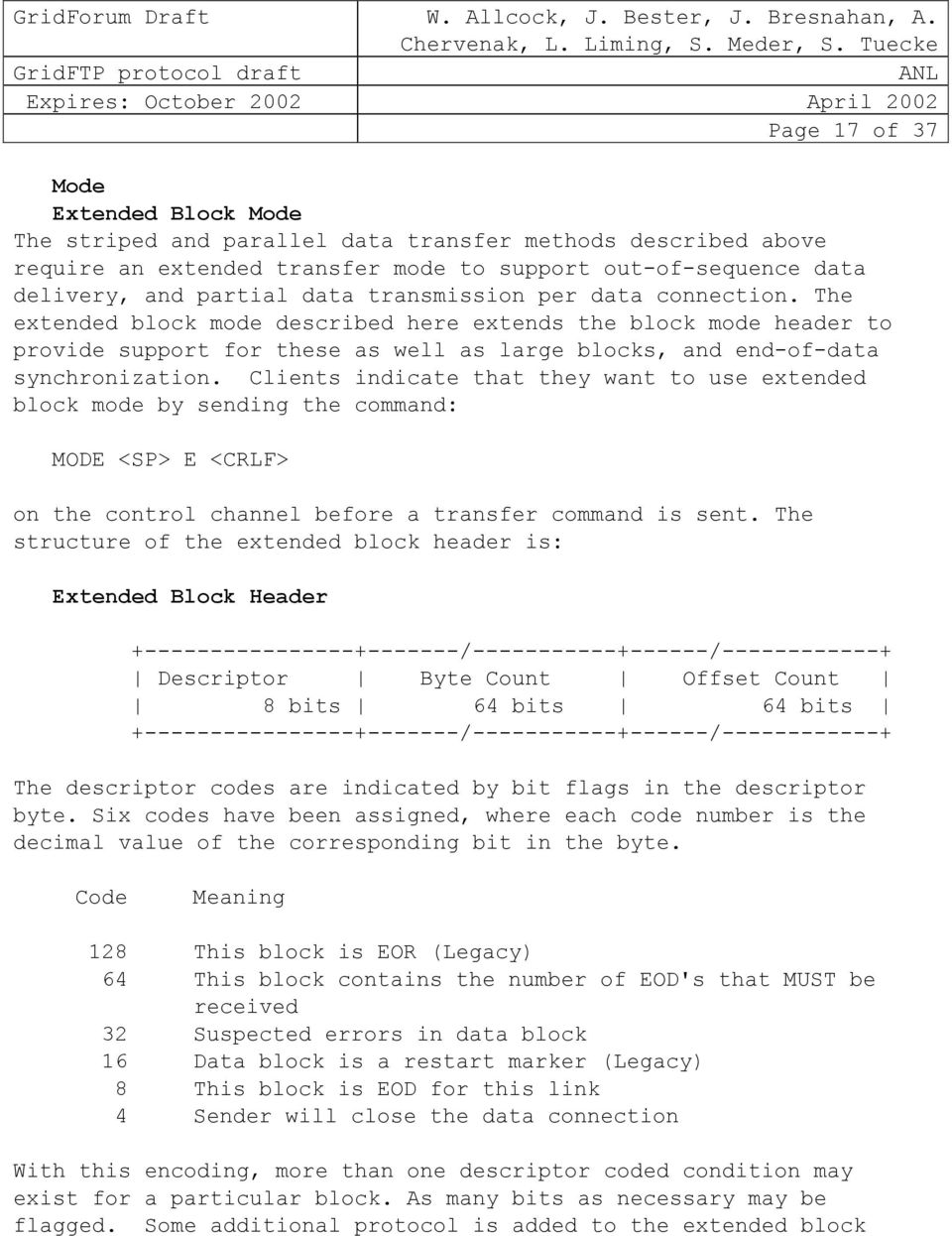
17 Page 17 of 37 Mode Extended Block Mode The striped and parallel data transfer methods described above require an extended transfer mode to support out-of-sequence data delivery, and partial data transmission per data connection. The extended block mode described here extends the block mode header to provide support for these as well as large blocks, and end-of-data synchronization. Clients indicate that they want to use extended block mode by sending the command: MODE <SP> E <CRLF> on the control channel before a transfer command is sent. The structure of the extended block header is: Extended Block Header / / Descriptor Byte Count Offset Count 8 bits 64 bits 64 bits / / The descriptor codes are indicated by bit flags in the descriptor byte. Six codes have been assigned, where each code number is the decimal value of the corresponding bit in the byte. Code Meaning 128 This block is EOR (Legacy) 64 This block contains the number of EOD's that MUST be received 32 Suspected errors in data block 16 Data block is a restart marker (Legacy) 8 This block is EOD for this link 4 Sender will close the data connection With this encoding, more than one descriptor coded condition may exist for a particular block. As many bits as necessary may be flagged. Some additional protocol is added to the extended block
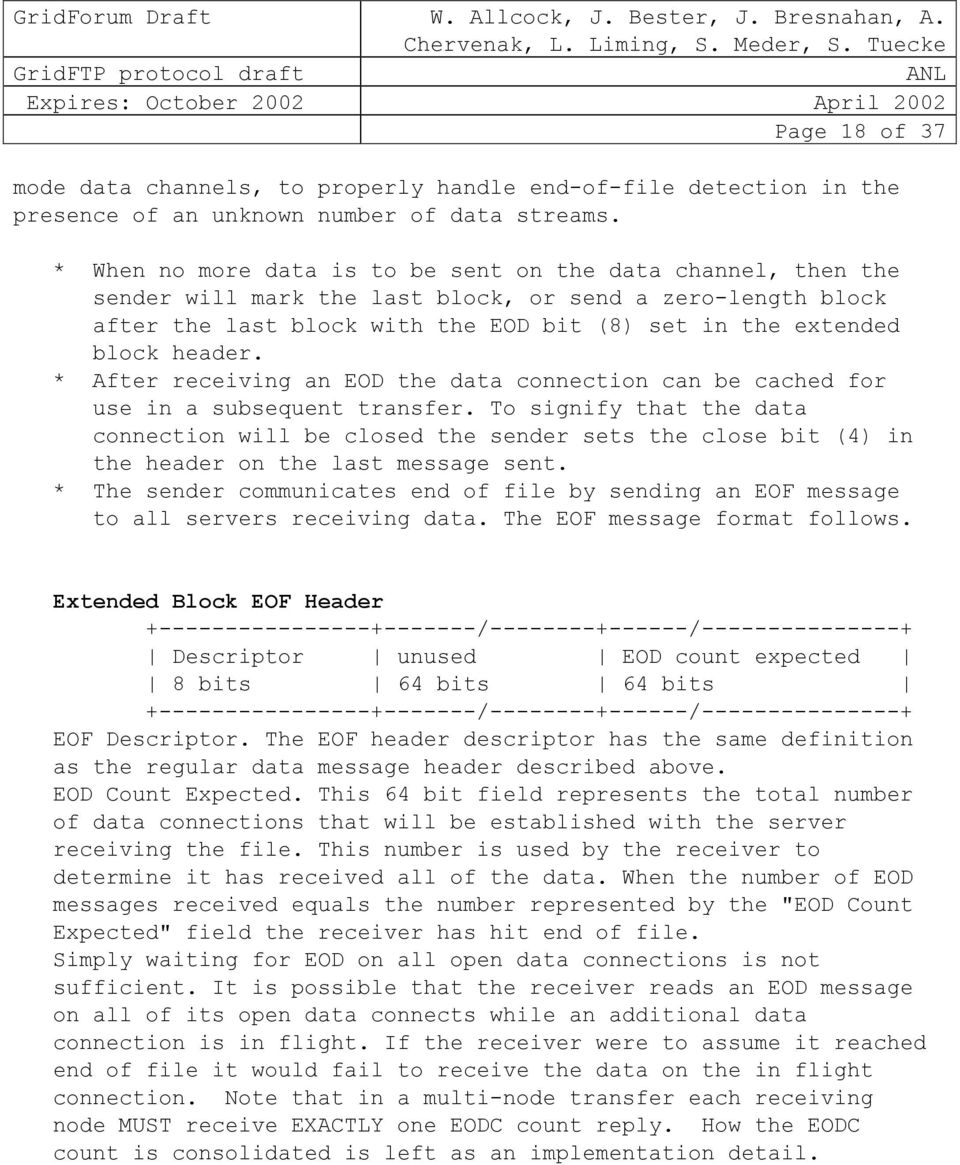
18 Page 18 of 37 mode data channels, to properly handle end-of-file detection in the presence of an unknown number of data streams. * When no more data is to be sent on the data channel, then the sender will mark the last block, or send a zero-length block after the last block with the EOD bit (8) set in the extended block header. * After receiving an EOD the data connection can be cached for use in a subsequent transfer. To signify that the data connection will be closed the sender sets the close bit (4) in the header on the last message sent. * The sender communicates end of file by sending an EOF message to all servers receiving data. The EOF message format follows. Extended Block EOF Header / / Descriptor unused EOD count expected 8 bits 64 bits 64 bits / / EOF Descriptor. The EOF header descriptor has the same definition as the regular data message header described above. EOD Count Expected. This 64 bit field represents the total number of data connections that will be established with the server receiving the file. This number is used by the receiver to determine it has received all of the data. When the number of EOD messages received equals the number represented by the "EOD Count Expected" field the receiver has hit end of file. Simply waiting for EOD on all open data connections is not sufficient. It is possible that the receiver reads an EOD message on all of its open data connects while an additional data connection is in flight. If the receiver were to assume it reached end of file it would fail to receive the data on the in flight connection. Note that in a multi-node transfer each receiving node MUST receive EXACTLY one EODC count reply. How the EODC count is consolidated is left as an implementation detail.
19 Page 19 of 37 EOF Handling in Extended Block Mode If you are in either striped or parallel mode, you will get exactly one EOF on each SPAS-specified ports (stripes). Hosts in extended block mode must be prepared to accept an arbitrary number of connections on each SPOR port before the EOF block is sent. Options Options to RETR The options described in this section provide a means to convey striping and transfer parallelism information to the server-dtp. For the RETR command, the Client-FTP may specify a parallelism and striping mode it wishes the server-dtp to use. These options are only used by the server-dtp if the retrieve operation is done in extended block mode. These options are implemented as RFC 2389 extensions. The format of the RETR OPTS is specified by: retr-opts = "OPTS" <SP> "RETR" [<SP> option-list] CRLF option-list = [ layout-opts ";" ] [ parallel-opts ";" ] layout-opts = "StripeLayout=Partitioned" "StripeLayout=Blocked;BlockSize=" <block-size> parallel-opts = "Parallelism=" <starting-parallelism> "," <minimum-parallelism> "," <maximum-parallelism> block-size ::= <number> starting-parallelism ::= <number> minimum-parallelism ::= <number> maximum-parallelism ::= <number> Layout Options The layout option is used by the source data node to send sections of the data file to the appropriate destination stripe. The various StripeLayout parameters are to be implemented as follows:

20 Page 20 of 37 Partitioned A partitioned data layout is one where the data is distributed evenly on the destination data nodes.only one contiguous section of data is stored on each data node. A data node is defined here a single host-port mentioned in the SPOR command Blocked A blocked data layout is one where the data is distributed in round-robin fashion over the destination data nodes. The data distribution is ordered by the order of the host-port specifications in the SPOR command. The block-size defines the size of blocks to be distributed. Parallelism Options The parallelism option is used by the source data node to control how many parallel data connections may be established to each destination data node. This extension option provides for both a fixed level of parallelism, and for adapting the parallelism to the host/network connection, within a range. If the startingparallelism option is set, then the server-dtp will make startingparallelism connections to each destination data node. If the minimum-parallelism option is set, then the server may reduce the number of parallel connections per destination data node to this value. If the maximum-parallelism option is set, then the server may increase the number of parallel connections to per destination data node to at most this value. Declarative Specifications Minimum Implementation The extensions described in this document are designed to provide a data access and transport mechanism that is secure, fast, reliable, flexible, and extensible. However, not all applications require all these features and it is desirable that they still be able to be part of the grid. This means, that in fact, none of the extensions described here are required for the minimum implementation. Our recommendation for a minimum implementation is as recommended in RFC 959 with the addition of the RFC 2228

21 Page 21 of 37 Security extensions. Clear text passwords simply are no longer acceptable. We have listed the details below: Per RFC 959: TYPE: ASCII Non-print MODE: Stream STRUCTURE: File, Record COMMANDS: USER, QUIT, PORT, TYPE, MODE, STRU, COMMANDS: RETR, STOR, NOOP (these commands with default values only) The default values for transfer parameters are: TYPE: MODE: STRU: ASCII Non-print Stream File All hosts must accept the above as the standard defaults. Per RFC 2228: COMMANDS:AUTH, ADAT, MIC, CONF, ENC Recommended Implementation In order to gain all the benefits and to fully take advantage of the grid, we recommend the following for a full featured implementation. Note that there are some commands, modes, features, etc, that are being deprecated as they are seldom implemented and in some cases simply no longer apply: RFC 959, FILE TRANSFER PROTOCOL (FTP), J. Postel, R. Reynolds (October 1985) Commands used by GridFTP USER PASS ACCT CWD CDUP QUIT REIN PORT PASV TYPE MODE RETR STOR STOU APPE ALLO REST RNFR RNTO ABOR DELE RMD MKD PWD LIST NLST SITE SYST STAT HELP NOOP
22 Page 22 of 37 Features used by GridFTP Type:ASCII, Image Mode: Stream, EBlock Structure: File structure RFC 2228, FTP Security Extensions, Horowitz, M. and S. Lunt (October 1997) Commands used by GridFTP AUTH ADAT MIC CONF ENC Features used by GridFTP GSSAPI authentication RFC 2389, Feature negotiation mechanism for the File Transfer Protocol, P. Hethmon, R. Elz (August 1998) Commands used by GridFTP FEAT OPTS Features used by GridFTP FTP Extensions, R. Elz, P. Hethmon (September 2000) Commands used by GridFTP SIZE Features used by GridFTP Restart of a stream mode transfer Sequencing of Commands and Replies Security Considerations Security is one of the key considerations for the grid and what makes FTP as defined by RFC 959 unacceptable for use today. GridFTP was designed with security in mind from the start and was, in fact, the driving force that started this effort. While we will retain anonymous FTP, and support for the USER and PASS commands, we strongly discourage their use, particularly PASS. We
23 Page 23 of 37 incorporate the GSS API extensions defined in RFC 2228, with both GSI and Kerberos bindings. Known Issues Unidirectional data transfer in EBLOCK mode: Currently if you are in MODE E (EBLOCK) mode, PASV must be paired with STOR, and PORT must be paired with RETR. In other words, the direction of the connection on the data channels must go from the sending (RETR) to the receiving (STOR) side. While this works, it raises the following issues: 1) The current FTP protocol does not have this restriction. 2) Firewalls: It can help you traverse some firewalls more easily to be able to set the direction to connect out from behind the firewall. 3) A mixture of partial gets/puts currently requires two control channel connections. This is less than ideal. The restriction is necessary because in the reverse situation end of file cannot be reliably determined, allowing for the possibility of lost data. As discussed above, the sender has to send an EOD on each connection and an EOD count. If the receiver were making connections, it would be possible for n connections to have been formed, all data sent on those n connections, the EOD's sent on each connection and the EODC with a count of n sent, while the receiver has another connection in flight. No EOD would be received on this connection and thus EOF would not be properly determined. At first blush, this problem seems quite simple to solve. However, when arbitrary number and timing of streams, multi-node transfers, cached data connections, data layout on the receiving side, and the fact that the listener does not know what host or how many are making connections to its port are taken into account, it is quite difficult.
24 Page 24 of 37 Order dependency between PASV/SPAS and STOR/RETR: In simple terms, the sequence of events in a GET or PUT operation as defined by RFC 959, is as follows: One end of the transfer listens on a port. The other end forms a connection to that port One end is told to RETR (read) a file, where the filename is an argument to RETR The other end is told to STOR (write) a file. Again, the filename is an argument to the STOR command. This sequence of events imposes an unnecessary, and in some instances, significant limitation. This limitation is that the connection must be established before the file to be transferred has been identified. This prevents any decision about the connection being made based on the filename. The ability to make decisions based on the filename will large installations to do load balancing and internal relocation of files transparently. If a front end server is presented with a URL, prior to the data connection being formed, then the front end could make a decision about the optimal host to service the data connection. For instance: The host specified in the URL may be down for maintenance and its files are being hosted elsewhere. The front end could simply could direct the new host to form the data connection. A heavily accessed file may be present on multiple backend servers and the front end can choose which one to service this request based on current load. Several solutions to this problem have been proposed: A new response should be defined for the PASV command: This response would a delayed IP/Port. This response would indicate that the IP/Port information would be returned as the first intermediate response in the STOR/RETR command. Then when the STOR/RETR command is received, a decision can be made about which host should form the data connection based on the filename/url
25 Page 25 of 37 provided. With this information now available, connections can be established and normal STOR/RETR behavior can follow. This functionality would be turned on and off via some mechanism, perhaps an OPT or SITE command. Redefine the state machine to allow PORT/PASV and STOR/RETR in any pairs, but unordered: Currently, the state machine is such that the STOR/RETR command knows that the data connection MUST already exist and therefore it can immediately begin transmission. If instead the state machine were redefined so that a state of OK TO BEGIN TRANSMISSION were defined and that state was reached by receiving one each of PORT/PASV and STOR/RETR, then there would no longer be an ordering restriction. Introduce a new command called the Pre Transfer (PRET) command (see further description below in the section on new commands under consideration). This command would allow arbitrary state information to be set for a single transfer before any other command were issued. This option has the advantage that state information other than the filename could be provided. File size is one option that comes to mind. However, this system allows information not anticipated today to be made available. The disadvantage is that this requires additional state and complicates the RFC 959 state machine. In the absence of a PRET command, the standard RFC 959 state machine is used.
26 Page 26 of 37 Reuse of eblock data channels: In order to amortize the overhead of authentication and channel setup, it is desirable to reuse existing data channels if multiple transfers are to be made to the same host. The issue is whether or not modifications are required or desirableto the protocol itself in order to support this, perhaps as OPTS or FEATURES. Pipelining of commands & reuse of eblock data channels: In order to get maximal efficiency when issuing multiple RETR/ERET/STOR/ESTO commands, in addition to reusing the data channels, you would also want to pipeline the issuing of commands. That is, for example, while the data for one RETR is still being sent by the server, the client could issue another RETR command. This would, in theory, allow the server to keep the data channel pipes full. As soon as it finishes sending the data for the first RETR, it can immediately start sending the data for the next RETR, at the same time as it sends the control channel response to the first RETR. The issue here is making sure that the receiving end can figure out where the data for the first RETR ends, and the second begins. The obvious complication is when there are multiple data channels. Support for disk resource management: Is there a need for protocol support that addresses disk resource management needs such as verifying and reserving available disk space, advanced reservations, requesting that a file be maintained on disk for a minimum specified period of time (pinning), etc? The current belief is that this is not necessary. A higher level service will interact with disk resource management services (if any) and get space allocated, files pinned or staged, etc, and then direct the transfer service (GridFTP) to move the files once this is all in place.
27 Page 27 of 37 Appendix I: Restarting In general, opaque restart markers passed via the block header should not be used in extended block mode. This capability is provided for back compatibility with BLOCK mode. Instead, the destination server should send extended data marker responses over the control connection, in the following form: extended-mark-response = "111" <SP> "Range Marker" <SP> <byte-ranges-list> byte-ranges-list = <byte-range> [ *("," <byte-range>) ] byte-range = <start-offset> "-" <end-offset> start-offset end-offset ::= <number> ::= <number> The byte ranges in the marker are an incremental set of byte ranges which have been stored to disk by the data server. The complete restart marker is a concatenation of all byte ranges received by the client in 111 responses. The client MAY combine adjacent ranges received over several range responses into any number of ranges when sending the REST command to the server to restart a transfer. For example, the client, on receiving the responses: 111 Range Marker Range Marker may send, equivalently, REST 0-29,30-89 REST 0-89 REST 30-59,0-29,60-89 to restart the transfer after those 90 bytes have been received.
28 Page 28 of 37 The server MAY indicate that a given range of data has been received in multiple subsequent range markers. The client MUST be able to handle this. For example: 111 Range Marker Range Marker 0-89 is equivalent to 111 Range Marker Range Marker 0-29,60-89 Similarly, the client, if it is doing no processing of the restart markers, MAY send redundant information in a restart.
29 Page 29 of 37 Appendix II: Performance Monitoring In order to monitor the performance of extended block mode transfer, an additional preliminary reply MAY be transmitted over the control channel. This reply is of the form: extended-perf-response = "112-Perf Marker" CRLF <SP> "Timestamp:" <SP> <timestamp> CRLF <SP> "Stripe Index:" <SP> <stripe-number> CRLF <SP> "Stripe Bytes Transferred:" <SP> <byte count> CRLF <SP> "Total Stripe Count:" <SP> <stripe count> CRLF "112 End" CRLF timestamp = <number> [ "." <digit> ] <timestamp> is seconds since the epoch The performance marker can contain these or any other perf-line facts which provide useful information about the current performance. All perf-line facts represent an instantaneous state of the transfer at the given timestamp. The meaning of the facts are Timestamp - The time at which the server computed the performance information. This is in seconds since the epoch ((00:00:00 UTC, January 1, 1970). Stripe Index - the index (range of 0 to n where n is the number of stripes on the STOR side of the transfer) that this marker pertains to. Stripe Bytes Transferred - The number of bytes which have been received on this stripe. A transfer start time can be specified by a perf marker with 'Stripe Bytes Transferred' set to zero. Only the first marker per stripe can be used to specify the start time of that stripe. Any
30 Page 30 of 37 subsequent markers with 'Stripe Bytes Transferred' set to zero simply indicates no data transfer over the interval. A server should send a 'start' marker for each stripe. A server should also send a final perf marker for each stripe. This is a marker with 'Stripe Bytes Transferred' set to the total transfer size for that stripe.
31 Page 31 of 37 Appendix III: Additional Extensions Under Consideration Below is a description of other extensions that are currently under consideration for inclusion in the GridFTP protocol. These are not the only ones under consideration, but are the ones for which we have a solid design. CKSM Checksum Command This would provide the ability to give true end to end guarantee of data transfer. A checksum could be done on a file or region of a file on disk, it could be transferred, then the checksum verified. This would obviously have a tremendous performance impact and would be optional. We should provide the ability to choose a checksum algorithm and determine supported algorithms. TREV TRansfer EVent Command Currently, the protocol has a REST command, but no specification for the markers. It is left to the implementation to decide when to send them. The protocol has no support at all for performance information, again it is left to the implementation. The Transfer Event command would allow the timing and format of any type of transfer event. This could potentially be expanded beyond restart and performance to include any interesting information from the server. An example might be server load. The TREV commands allows a client to register to receive periodic information from a server during a transfer. TREV <event name> <frequency> [info list] event name: a session unique character string frequency: an int representing the frequency that the event should be delivered in seconds. A frequency of zero should be interpreted by the server as "as often as possible," a frequency of -1 will disable the event from happening in future transfers.
32 Page 32 of 37 attribute list: a list of information to be included in the response. The individual members of this list can be server defined. The following should be defined by all servers: stripe index=<int>, total bytes=<long>, current throughput=<float>, restart marker=<restart marker> The response to a TREV command is "200 Command Successful." If a TREV command is successfully received by a server the server will generate 112 responses (described below) during a file transfer, That is while a STOR or RETR class command is in progress. 112 response format: A 112 response corresonds to a TREV command. Any number of them can be sent across the control channel during a transfer, depending on the frequency passed to the TREV command described above and the duration of the transfer. The response has the following format. 112-<Event Name><CRLF> 1*<attribute>=<value><CRLF> 112 End<CRLF> The event name corresponds to the name registered with the TREV command and is followed by the list of attribute value pair pairs requested in the corresponding TREV command. PRET PRETransfer Command FTP has no way of specifying critical information (such as filename) before the start of a transfer. The introduction of PRET (pre-transfer) is designed to fix this inadequacy. The PRET commands sets state for the *next* transfer only. It does not set global state, and is tightly coupled to a single STOR/RETR command.
33 Page 33 of 37 PRET <RETR/STOR> [attribute list] arguments: <RETR/STOR>: The first argument MUST be the string "RETR" or the string "STOR". In order to make key decisions the server must know what type of transfer this command is in regard to. [attribute list]: The attribute list contians comma seperated attribute value pairs. The attribute is defined by the specific server implementation. This allows it to be modified as new requirements come up. However all servers MUST define the following: filename=<the name of the file to be transferred>; size=<comma seperated list>; In the case of a STOR the list contains a single value representing the overall size of the file to be stored. In the case of a RETR the list is ordered based on logical receiving stripe address and contains the size that each stripe is willing to receive. [This implies that the STOR side must respond to this command before the RETR side can receive it] StripeCount=<min>,<max>,<preferred>; This species the minimum, maximum and preferred number of stripes to be used in the transfer. Response: The response to the PREV is a logical local stripe ordered list which is by default in the following format: <size><crlf> The format can be changed by using the OPTS PERF command. 250-Pretransfer Information Successful 1*(response format)
34 Page 34 of End. OPTS PERT Distribution={even,any};ReponseFormat=<describe it like MLST> Open question: Is it ok to say the STOR side MUST get the PRET before the RETR side? Since the PRET command can take a growing number of arguments and the PRET response can be modified this allows the decision support information sent to the server to grow with requirements. With the attributes suggested above the PRET command is enabled to make decisions about the number of stripes to use and the number of bytes that each host will allow. This way prior to getting a SPAS/SPOR command the server has all of the information needed to decide what local hosts and how many will be in the transfer. PRET should also allow the following situations (bi-directional connects): RETR STOR PRET fname;total size;stripe counts; returns stor side stripe count and size for each host. PRET fname;host sizes; stripe count SPAS returns listeners SPOR listeners RETR STOR PRET fname;total size;stripe counts; returns stor side stripe count and size for each host. PRET fname;host sizes; stripe count
35 Page 35 of 37 SPOR SPAS returns 200 Ok. return listeners RETR STOR
36 Page 36 of 37 Appendix IV: RFCs Considered During Development The RFCs listed below were considered for inclusion of their functionality in the GridFTP protocol. There are other RFCs that are related in some way to the FTP protocol, but were either purely informational in nature, or were a form of File Transfer protocol, but completely different from the protocol defined in RFC 959. We chose the set of features that best fit the needs of Grid applications, and then added our own extensions as necessary. RFC0959 File Transfer Protocol Oct-85 Comments: The primary basis of the GridFTP protocol. We chose the common features (STOR, RETR, PORT, PASV), and features that were defined, but not often implemented (third party transfer). RFC2773 Encryption using KEA and SKIPJACK Feb-00 Comments: We chose to use existing encryption within Globus at the SSL level. RFC2640 Internationalization of FTP Jul-99 Comments: Defines how to use UniCode characters in FTP. This is a good idea and is under consideration for future addition, but right now there is no definite requirement. RFC2428 FTP Extensions for IPv6 and NATs Sep-98 Comments: Defines new commands (EPRT and EPSV) to allow for arbitrary addressing schemes. IPV4 and IPV6 are defined, but addition of other schemes is straight forward. This is a good idea and is under consideration for future addition, but right now there is no definite requirement. If implemented, it is likely that we would map the other commands such as PORT, PASV, SPAS, and SPOR to EPRT and EPSV transparently. RFC2389 Feature negotiation mechanism for FTP Aug-98 Comments: The FEAT and OPTS extensions as defined in the RFC are incorporated in the GridFTP protocol. RFC2228 FTP Security Extensions Oct-97
37 Page 37 of 37 Comments: The AUTH, ADATA, PROT, PBSZ, CCC, MIC, CONF, ENC, and 6yz replies as defined in this RFC are incorporated in the GridFTP protocol. RFC1639 FTP Operation Over Big Address Records (FOOBAR) Jun-94 RFC1545 FTP Operation Over Big Address Records (FOOBAR) Nov-93 Comments: It was felt that the method described in RFC 2428 was a better way of dealing with non-ipv4 addressing schemes. RFC1068 Background File Transfer Program (BFTP) Aug-88 Comments: We consider a reliable file transfer service based on the GridFTP protocol to be a key service for the Grid. Material in this RFC is one source of input for design of such a service. References [1] Postel, J. and Reynolds, J., " FILE TRANSFER PROTOCOL (FTP)", STD 9, RFC 959, October [2] Hethmon, P. and Elz, R., " Feature negotiation mechanism for the File Transfer Protocol", RFC 2389, August [3] Horowitz, M. and Lunt, S., " FTP Security Extensions", RFC 2228, October [4] Elz, R. and Hethom, P., " FTP Extensions", IETF Draft, September 2000.
GridFTP: Protocol Extensions to FTP for the Grid
 Expires: August 2001 Page 1 of 21 GridFTP: Protocol Extensions to FTP for the Grid 1. Status of this Memo This document is an Internet-Draft and is in full conformance with all provisions of Section 10
GridFTP: A Data Transfer Protocol for the Grid
 GridFTP: A Data Transfer Protocol for the Grid Grid Forum Data Working Group on GridFTP Bill Allcock, Lee Liming, Steven Tuecke ANL Ann Chervenak USC/ISI Introduction In Grid environments,
FTP protocol (File Transfer Protocol)
 FTP protocol (File Transfer Protocol) Introduction to FTP protocol FTP protocol (File Transfer Protocol) is, as its name indicates a protocol for transferring files. The implementation of FTP dates from
File Transfer Protocol (FTP) Chuan-Ming Liu Computer Science and Information Engineering National Taipei University of Technology Fall 2007, TAIWAN
 File Transfer Protocol (FTP) Chuan-Ming Liu Computer Science and Information Engineering National Taipei University of Technology Fall 2007, TAIWAN 1 Contents CONNECTIONS COMMUNICATION COMMAND PROCESSING
2.5 TECHNICAL NOTE FTP
 Version 2.5 TECHNICAL NOTE FTP Protocol Agent Overview Stonesoft Corp. Itälahdenkatu 22A, FIN-00210 Helsinki Finland Tel. +358 (9) 4767 11 Fax. +358 (9) 4767 1234 email: [email protected] Copyright 2002
Globus Striped GridFTP Framework and Server. Raj Kettimuthu, ANL and U. Chicago
 Globus Striped GridFTP Framework and Server Raj Kettimuthu, ANL and U. Chicago Outline Introduction Features Motivation Architecture Globus XIO Experimental Results 3 August 2005 The Ohio State University
TOE2-IP FTP Server Demo Reference Design Manual Rev1.0 9-Jan-15
 TOE2-IP FTP Server Demo Reference Design Manual Rev1.0 9-Jan-15 1 Introduction File Transfer Protocol (FTP) is the protocol designed for file sharing over internet. By using TCP/IP for lower layer, FTP
$ftp = Net::FTP->new("some.host.name", Debug => 0) or die "Cannot connect to some.host.name: $@";
 NAME Net::FTP - FTP Client class SYNOPSIS use Net::FTP; $ftp = Net::FTP->new("some.host.name", Debug => 0) or die "Cannot connect to some.host.name: $@"; $ftp->login("anonymous",'-anonymous@') or die "Cannot
Administrasi dan Manajemen Jaringan 2. File Transfer Protocol (FTP)
 Administrasi dan Manajemen Jaringan 2. File Transfer Protocol (FTP) M. Udin Harun Al Rasyid, Ph.D http://lecturer.eepis-its.edu/~udinharun [email protected] Lab Jaringan Komputer (C-307) Table of
Avid Technology, Inc. inews NRCS. inews FTP Server Protocol Specification. Version 2.8 12 January 2006
 Avid Technology, Inc. inews NRCS inews FTP Server Protocol Specification Version 2.8 12 January 2006 NOTICE: Avid Technology, Inc. accepts no responsibility for the accuracy of the information contained
File Transfer And Access (FTP, TFTP, NFS) Chapter 25 By: Sang Oh Spencer Kam Atsuya Takagi
 File Transfer And Access (FTP, TFTP, NFS) Chapter 25 By: Sang Oh Spencer Kam Atsuya Takagi History of FTP The first proposed file transfer mechanisms were developed for implementation on hosts at M.I.T.
Windows Based FTP Server with Encryption and. other Advanced Features.
 Project Number: MXC MQP 1096 Windows Based FTP Server with Encryption and other Advanced Features. A Major Qualifying Project Report Submitted to the Faculty of the WORCESTER POLYTECHNIC INSTITUTE in partial
Protocolo FTP. FTP: Active Mode. FTP: Active Mode. FTP: Active Mode. FTP: the file transfer protocol. Separate control, data connections
 : the file transfer protocol Protocolo at host interface local file system file transfer remote file system utilizes two ports: - a 'data' port (usually port 20...) - a 'command' port (port 21) SISTEMAS
A Tutorial on Configuring and Deploying GridFTP for Managing Data Movement in Grid/HPC Environments
 A Tutorial on Configuring and Deploying GridFTP for Managing Data Movement in Grid/HPC Environments John Bresnahan Michael Link Rajkumar Kettimuthu Dan Fraser Argonne National Laboratory University of
File Transfer: FTP and TFTP
 CHAPTER 9 File Transfer: FTP and TFTP Exercises. 2... If the control connection is accidentally severed during an FTP transfer, there would be no problem until the data transfer completed and the client
IBM Sterling Connect:Enterprise for z/os
 IBM Sterling Connect:Enterprise for z/os Remote User s Guide Version 1.5 This edition applies to the 1.5 Version of IBM Sterling Connect:Enterprise for z/os and to all subsequent releases and modifications
REMOTE FILE TRANSFER PROTOCOL BY USING MULTITHREDING
 , pp.-31-35. Available online at http://www.bioinfo.in/contents.php?id=322 REMOTE FILE TRANSFER PROTOCOL BY USING MULTITHREDING GAMPAWAR A.D., BHAKTI JAIN, GABANE P. AND NARSWANI A.B. Department of Computer
1 Introduction: Network Applications
 1 Introduction: Network Applications Some Network Apps E-mail Web Instant messaging Remote login P2P file sharing Multi-user network games Streaming stored video clips Internet telephone Real-time video
Remote login (Telnet):
 SFWR 4C03: Computer Networks and Computer Security Feb 23-26 2004 Lecturer: Kartik Krishnan Lectures 19-21 Remote login (Telnet): Telnet permits a user to connect to an account on a remote machine. A client
FL EDI SECURE FTP CONNECTIVITY TROUBLESHOOTING GUIDE. SSL/FTP (File Transfer Protocol over Secure Sockets Layer)
 FL EDI SECURE FTP CONNECTIVITY TROUBLESHOOTING GUIDE This troubleshooting guide covers secure file transfers using the SFTP and SSL/FTP file transfer protocols for Claims, POC, and Medical EDI transmissions.
Comparisons between HTCP and GridFTP over file transfer
 Comparisons between HTCP and GridFTP over file transfer Andrew McNab and Yibiao Li Abstract: A comparison between GridFTP [1] and HTCP [2] protocols on file transfer speed is given here, based on experimental
Application-layer Protocols
 Application-layer Protocols Based on Notes by D. Hollinger Based on UNIX Network Programming, Stevens, Chapter 9 Also Java Network Programming and Distributed Computing, Chapter 3,8 Also Online Java Tutorial,
FF/EDM Intro Industry Goals/ Purpose Related GISB Standards (Common Codes, IETF) Definitions d 4 d 13 Principles p 6 p 13 p 14 Standards s 16 s 25
 FF/EDM Intro Industry Goals/ Purpose GISB defined two ways in which flat files could be used to send transactions and transaction responses: interactive and batch. This section covers implementation considerations
Appendix. Web Command Error Codes. Web Command Error Codes
 Appendix Web Command s Error codes marked with * are received in responses from the FTP server, and then returned as the result of FTP command execution. -501 Incorrect parameter type -502 Error getting
FILE TRANSFER PROTOCOL INTRODUCTION TO FTP, THE INTERNET'S STANDARD FILE TRANSFER PROTOCOL
 FTP FILE TRANSFER PROTOCOL INTRODUCTION TO FTP, THE INTERNET'S STANDARD FILE TRANSFER PROTOCOL Peter R. Egli INDIGOO.COM 1/22 Contents 1. FTP versus TFTP 2. FTP principle of operation 3. FTP trace analysis
Dissertation Title: SOCKS5-based Firewall Support For UDP-based Application. Author: Fung, King Pong
 Dissertation Title: SOCKS5-based Firewall Support For UDP-based Application Author: Fung, King Pong MSc in Information Technology The Hong Kong Polytechnic University June 1999 i Abstract Abstract of dissertation
File Transfer Protocol - FTP
 File Transfer Protocol - FTP TCP/IP class 1 outline intro kinds of remote file access mechanisms ftp architecture/protocol traditional BSD ftp client ftp protocol command interface ftp trace (high-level)
Email Electronic Mail
 Email Electronic Mail Electronic mail paradigm Most heavily used application on any network Electronic version of paper-based office memo Quick, low-overhead written communication Dates back to time-sharing
Request for Comments: 3395. Category: Standards Track Hifn, Inc. A. Warth September 2002
 Network Working Group Request for Comments: 3395 Updates: 2895 Category: Standards Track A. Bierman C. Bucci Cisco Systems, Inc. R. Dietz Hifn, Inc. A. Warth September 2002 Remote Network Monitoring MIB
Ethernet. Ethernet. Network Devices
 Ethernet Babak Kia Adjunct Professor Boston University College of Engineering ENG SC757 - Advanced Microprocessor Design Ethernet Ethernet is a term used to refer to a diverse set of frame based networking
Chapter 17. Transport-Level Security
 Chapter 17 Transport-Level Security Web Security Considerations The World Wide Web is fundamentally a client/server application running over the Internet and TCP/IP intranets The following characteristics
ShareIt FTP User Guide. Includes setup, configuration and administrative information.
 ShareIt FTP User Guide Includes setup, configuration and administrative information. NSC (c) 2003-2004 NSC. All rights reserved. Under the copyright laws, this manual may not be copied, in whole or in
The Data Grid: Towards an Architecture for Distributed Management and Analysis of Large Scientific Datasets
 The Data Grid: Towards an Architecture for Distributed Management and Analysis of Large Scientific Datasets!! Large data collections appear in many scientific domains like climate studies.!! Users and
Objectives of Lecture. Network Architecture. Protocols. Contents
 Objectives of Lecture Network Architecture Show how network architecture can be understood using a layered approach. Introduce the OSI seven layer reference model. Introduce the concepts of internetworking
Network Working Group Request for Comments: 840 April 1983. Official Protocols
 Network Working Group Request for Comments: 840 J. Postel ISI April 1983 This RFC identifies the documents specifying the official protocols used in the Internet. Annotations identify any revisions or
Understanding Slow Start
 Chapter 1 Load Balancing 57 Understanding Slow Start When you configure a NetScaler to use a metric-based LB method such as Least Connections, Least Response Time, Least Bandwidth, Least Packets, or Custom
StreamServe Persuasion SP4 Service Broker
 StreamServe Persuasion SP4 Service Broker User Guide Rev A StreamServe Persuasion SP4 Service Broker User Guide Rev A 2001-2009 STREAMSERVE, INC. ALL RIGHTS RESERVED United States patent #7,127,520 No
UNICORE UFTPD server UNICORE UFTPD SERVER. UNICORE Team
 UNICORE UFTPD server UNICORE UFTPD SERVER UNICORE Team Document Version: 1.0.0 Component Version: 2.3.2 Date: 14 09 2015 UNICORE UFTPD server Contents 1 UNICORE UFTP 1 1.1 UFTP features...................................
Evolution of the WWW. Communication in the WWW. WWW, HTML, URL and HTTP. HTTP Abstract Message Format. The Client/Server model is used:
 Evolution of the WWW Communication in the WWW World Wide Web (WWW) Access to linked documents, which are distributed over several computers in the History of the WWW Origin 1989 in the nuclear research
Communication Systems Network Applications - Online Services
 Scope Communication Systems Network Applications - Online Services Prof. Dr.-Ing. Lars Wolf TU Braunschweig Institut für Betriebssysteme und Rechnerverbund Mühlenpfordtstraße 23, 38106 Braunschweig, Germany
2. IP Networks, IP Hosts and IP Ports
 1. Introduction to IP... 1 2. IP Networks, IP Hosts and IP Ports... 1 3. IP Packet Structure... 2 4. IP Address Structure... 2 Network Portion... 2 Host Portion... 3 Global vs. Private IP Addresses...3
IP - The Internet Protocol
 Orientation IP - The Internet Protocol IP (Internet Protocol) is a Network Layer Protocol. IP s current version is Version 4 (IPv4). It is specified in RFC 891. TCP UDP Transport Layer ICMP IP IGMP Network
EXTENDED FILE SYSTEM FOR FMD AND NANO-10 PLC
 EXTENDED FILE SYSTEM FOR FMD AND NANO-10 PLC Before you begin, please download a sample I-TRiLOGI program that will be referred to throughout this manual from our website: http://www.tri-plc.com/trilogi/extendedfilesystem.zip
µtasker Document FTP Client
 Embedding it better... µtasker Document FTP Client utaskerftp_client.doc/1.01 Copyright 2012 M.J.Butcher Consulting Table of Contents 1. Introduction...3 2. FTP Log-In...4 3. FTP Operation Modes...4 4.
Configuring Health Monitoring
 CHAPTER4 Note The information in this chapter applies to both the ACE module and the ACE appliance unless otherwise noted. The features that are described in this chapter apply to both IPv6 and IPv4 unless
Week Date Teaching Attended 2 Jan 2013 Lab 1: Linux Services/Toolkit Dev t
 Week Date Teaching Attended 2 Jan 2013 Lab 1: Linux Services/Toolkit Dev t Aim: The aim of this lab is to investigate the discovery and configuration of services within Linux. It uses a Linux Ubuntu Virtual
Syslog Windows Tool Set (WTS) Configuration File Directives And Help
 orrelog Syslog Windows Tool Set (WTS) Configuration File Directives And Help The CO-sysmsg.cnf file contains all the parameters and specifications related to the program s operation. This file is found
Computer Networks. Chapter 5 Transport Protocols
 Computer Networks Chapter 5 Transport Protocols Transport Protocol Provides end-to-end transport Hides the network details Transport protocol or service (TS) offers: Different types of services QoS Data
State of Michigan Data Exchange Gateway. SSLFTP/SFTP client setup
 State of Michigan Data Exchange Gateway SSLFTP/SFTP client setup SSLFTP/SFTP (WsFTP) Setup for the State of Michigan Data Exchange Gateway (DEG) This is not a user doc on how to setup SSLFTP clients because
Communication Security for Applications
 Communication Security for Applications Antonio Carzaniga Faculty of Informatics University of Lugano March 10, 2008 c 2008 Antonio Carzaniga 1 Intro to distributed computing: -server computing Transport-layer
A programming model in Cloud: MapReduce
 A programming model in Cloud: MapReduce Programming model and implementation developed by Google for processing large data sets Users specify a map function to generate a set of intermediate key/value
Design Notes for an Efficient Password-Authenticated Key Exchange Implementation Using Human-Memorable Passwords
 Design Notes for an Efficient Password-Authenticated Key Exchange Implementation Using Human-Memorable Passwords Author: Paul Seymer CMSC498a Contents 1 Background... 2 1.1 HTTP 1.0/1.1... 2 1.2 Password
Safe and Secure Transfers with z/os FTP
 Safe and Secure Transfers with z/os FTP I FT P Original presentation by Alfred B Christensen Modified by Andy Tracy - [email protected] December 2013 Copyright SHARE and International Business Machines
Email, SNMP, Securing the Web: SSL
 Email, SNMP, Securing the Web: SSL 4 January 2015 Lecture 12 4 Jan 2015 SE 428: Advanced Computer Networks 1 Topics for Today Email (SMTP, POP) Network Management (SNMP) ASN.1 Secure Sockets Layer 4 Jan
(Refer Slide Time: 02:17)
 Internet Technology Prof. Indranil Sengupta Department of Computer Science and Engineering Indian Institute of Technology, Kharagpur Lecture No #06 IP Subnetting and Addressing (Not audible: (00:46)) Now,
Appendix B RCS11 Remote Communications
 Appendix B RCS11 Remote Communications B.1 Host Computer Remote Communications Control and status messages are conveyed between the RCS11 and the host computer using packetized message blocks in accordance
File Transfer Protocol (FTP) User Guide Express Logic, Inc.
 File Transfer Protocol (FTP) User Guide Express Logic, Inc. 858.613.6640 Toll Free 888.THREADX FAX 858.521.4259 www.expresslogic.com 2002-2015 by Express Logic, Inc. All rights reserved. This document
FTP e TFTP. File transfer protocols PSA1
 FTP e TFTP File transfer protocols PSA1 PSA2 PSA3 PSA4 PSA5 PSA6 PSA7 PSA8 PSA9 Firewall problems with FTP Client-side Firewalls the client is behind a firewall and cannot be reached directly from the
Network Attached Storage. Jinfeng Yang Oct/19/2015
 Network Attached Storage Jinfeng Yang Oct/19/2015 Outline Part A 1. What is the Network Attached Storage (NAS)? 2. What are the applications of NAS? 3. The benefits of NAS. 4. NAS s performance (Reliability
TCP Session Management (SesM) Protocol Specification
 TCP Session Management (SesM) Protocol Specification Revision Date: 08/13/2015 Version: 1.1e Copyright 2015 Miami International Securities Exchange, LLC. All rights reserved. This constitutes information
Overview. Securing TCP/IP. Introduction to TCP/IP (cont d) Introduction to TCP/IP
 Overview Securing TCP/IP Chapter 6 TCP/IP Open Systems Interconnection Model Anatomy of a Packet Internet Protocol Security (IPSec) Web Security (HTTP over TLS, Secure-HTTP) Lecturer: Pei-yih Ting 1 2
CS 356 Lecture 27 Internet Security Protocols. Spring 2013
 CS 356 Lecture 27 Internet Security Protocols Spring 2013 Review Chapter 1: Basic Concepts and Terminology Chapter 2: Basic Cryptographic Tools Chapter 3 User Authentication Chapter 4 Access Control Lists
Connecting with Computer Science, 2e. Chapter 5 The Internet
 Connecting with Computer Science, 2e Chapter 5 The Internet Objectives In this chapter you will: Learn what the Internet really is Become familiar with the architecture of the Internet Become familiar
Evolution of the WWW. Communication in the WWW. WWW, HTML, URL and HTTP. HTTP - Message Format. The Client/Server model is used:
 Evolution of the WWW Communication in the WWW World Wide Web (WWW) Access to linked documents, which are distributed over several computers in the History of the WWW Origin 1989 in the nuclear research
File Transfer Protocol
 CHAPTER File Transfer Protocol 20 What You Will Learn In this chapter, you will learn how FTP provides a method to move files around the Internet. We ll examine various aspects of FTP as a protocol and
This sequence diagram was generated with EventStudio System Designer (http://www.eventhelix.com/eventstudio).
 Client App Network Server App 25-May-13 15:32 (Page 1) This sequence diagram was generated with EventStudio System Designer (http://www.eventhelix.com/eventstudio). TCP is an end to end protocol which
Large-Scale TCP Packet Flow Analysis for Common Protocols Using Apache Hadoop
 Large-Scale TCP Packet Flow Analysis for Common Protocols Using Apache Hadoop R. David Idol Department of Computer Science University of North Carolina at Chapel Hill [email protected] http://www.cs.unc.edu/~mxrider
Napster and Gnutella: a Comparison of two Popular Peer-to-Peer Protocols. Anthony J. Howe Supervisor: Dr. Mantis Cheng University of Victoria
 Napster and Gnutella: a Comparison of two Popular Peer-to-Peer Protocols Anthony J Howe Supervisor: Dr Mantis Cheng University of Victoria February 28, 2002 Abstract This article presents the reverse engineered
RTP / RTCP. Announcements. Today s Lecture. RTP Info RTP (RFC 3550) I. Final Exam study guide online. Signup for project demos
 Announcements I. Final Exam study guide online RTP / RTCP Internet Protocols CSC / ECE 573 Fall, 2005 N. C. State University II. III. Signup for project demos Teaching evaluations at end today copyright
System Requirement Specification for A Distributed Desktop Search and Document Sharing Tool for Local Area Networks
 System Requirement Specification for A Distributed Desktop Search and Document Sharing Tool for Local Area Networks OnurSoft Onur Tolga Şehitoğlu November 10, 2012 v1.0 Contents 1 Introduction 3 1.1 Purpose..............................
WS_FTP Server. User s Guide. Software Version 3.1. Ipswitch, Inc.
 User s Guide Software Version 3.1 Ipswitch, Inc. Ipswitch, Inc. Phone: 781-676-5700 81 Hartwell Ave Web: http://www.ipswitch.com Lexington, MA 02421-3127 The information in this document is subject to
2057-15. First Workshop on Open Source and Internet Technology for Scientific Environment: with case studies from Environmental Monitoring
 2057-15 First Workshop on Open Source and Internet Technology for Scientific Environment: with case studies from Environmental Monitoring 7-25 September 2009 TCP/IP Networking Abhaya S. Induruwa Department
Web Service Robust GridFTP
 Web Service Robust GridFTP Sang Lim, Geoffrey Fox, Shrideep Pallickara and Marlon Pierce Community Grid Labs, Indiana University 501 N. Morton St. Suite 224 Bloomington, IN 47404 {sblim, gcf, spallick,
Guideline for setting up a functional VPN
 Guideline for setting up a functional VPN Why do I want a VPN? VPN by definition creates a private, trusted network across an untrusted medium. It allows you to connect offices and people from around the
Computer Network. Interconnected collection of autonomous computers that are able to exchange information
 Introduction Computer Network. Interconnected collection of autonomous computers that are able to exchange information No master/slave relationship between the computers in the network Data Communications.
Chapter 7 Transport-Level Security
 Cryptography and Network Security Chapter 7 Transport-Level Security Lectured by Nguyễn Đức Thái Outline Web Security Issues Security Socket Layer (SSL) Transport Layer Security (TLS) HTTPS Secure Shell
Using RADIUS Agent for Transparent User Identification
 Using RADIUS Agent for Transparent User Identification Using RADIUS Agent Web Security Solutions Version 7.7, 7.8 Websense RADIUS Agent works together with the RADIUS server and RADIUS clients in your
DATA COMMUNICATOIN NETWORKING
 DATA COMMUNICATOIN NETWORKING Instructor: Ouldooz Baghban Karimi Course Book: Computer Networking, A Top-Down Approach By: Kurose, Ross Introduction Course Overview Basics of Computer Networks Internet
Data Grids. Lidan Wang April 5, 2007
 Data Grids Lidan Wang April 5, 2007 Outline Data-intensive applications Challenges in data access, integration and management in Grid setting Grid services for these data-intensive application Architectural
GlobalSCAPE DMZ Gateway, v1. User Guide
 GlobalSCAPE DMZ Gateway, v1 User Guide GlobalSCAPE, Inc. (GSB) Address: 4500 Lockhill-Selma Road, Suite 150 San Antonio, TX (USA) 78249 Sales: (210) 308-8267 Sales (Toll Free): (800) 290-5054 Technical
Job Reference Guide. SLAMD Distributed Load Generation Engine. Version 1.8.2
 Job Reference Guide SLAMD Distributed Load Generation Engine Version 1.8.2 June 2004 Contents 1. Introduction...3 2. The Utility Jobs...4 3. The LDAP Search Jobs...11 4. The LDAP Authentication Jobs...22
Simple Network Management Protocol
 CHAPTER 32 Simple Network Management Protocol Background Simple Network Management Protocol (SNMP) is an application-layer protocol designed to facilitate the exchange of management information between
TFTP TRIVIAL FILE TRANSFER PROTOCOL OVERVIEW OF TFTP, A VERY SIMPLE FILE TRANSFER PROTOCOL FOR SIMPLE AND CONSTRAINED DEVICES
 TFTP - Trivial File TFTP Transfer Protocol TRIVIAL FILE TRANSFER PROTOCOL OVERVIEW OF TFTP, A VERY SIMPLE FILE TRANSFER PROTOCOL FOR SIMPLE AND CONSTRAINED DEVICES Peter R. Egli INDIGOO.COM 1/10 Contents
Single Pass Load Balancing with Session Persistence in IPv6 Network. C. J. (Charlie) Liu Network Operations Charter Communications
 Single Pass Load Balancing with Session Persistence in IPv6 Network C. J. (Charlie) Liu Network Operations Charter Communications Load Balancer Today o Load balancing is still in use today. It is now considered
Ipswitch WS_FTP Server
 Ipswitch WS_FTP Server User s Guide Software Version 5.0 Ipswitch, Inc Ipswitch Inc. Web: http://www.ipswitch.com 10 Maguire Road Phone: 781.676.5700 Lexington, MA Fax: 781.676.5710 02421 Copyrights The
WS_FTP Professional 12. Security Guide
 WS_FTP Professional 12 Security Guide Contents CHAPTER 1 Secure File Transfer Selecting a Secure Transfer Method... 1 About SSL... 2 About SSH... 2 About OpenPGP... 2 Using FIPS 140-2 Validated Cryptography...
2- Electronic Mail (SMTP), File Transfer (FTP), & Remote Logging (TELNET)
 2- Electronic Mail (SMTP), File Transfer (FTP), & Remote Logging (TELNET) There are three popular applications for exchanging information. Electronic mail exchanges information between people and file
Application Note. Windows 2000/XP TCP Tuning for High Bandwidth Networks. mguard smart mguard PCI mguard blade
 Application Note Windows 2000/XP TCP Tuning for High Bandwidth Networks mguard smart mguard PCI mguard blade mguard industrial mguard delta Innominate Security Technologies AG Albert-Einstein-Str. 14 12489
Application Layer. CMPT371 12-1 Application Layer 1. Required Reading: Chapter 2 of the text book. Outline of Chapter 2
 CMPT371 12-1 Application Layer 1 Application Layer Required Reading: Chapter 2 of the text book. Outline of Chapter 2 Network applications HTTP, protocol for web application FTP, file transfer protocol