
fs viewpoint
|
|
|
- Sara Newton
- 10 years ago
- Views:
Transcription
1 fs viewpoint January Point of view Competitive intelligence A framework for response How PwC can help Appendix Love them or lose them: Why becoming a top provider is an all or nothing game with your top clients
2 Point of view

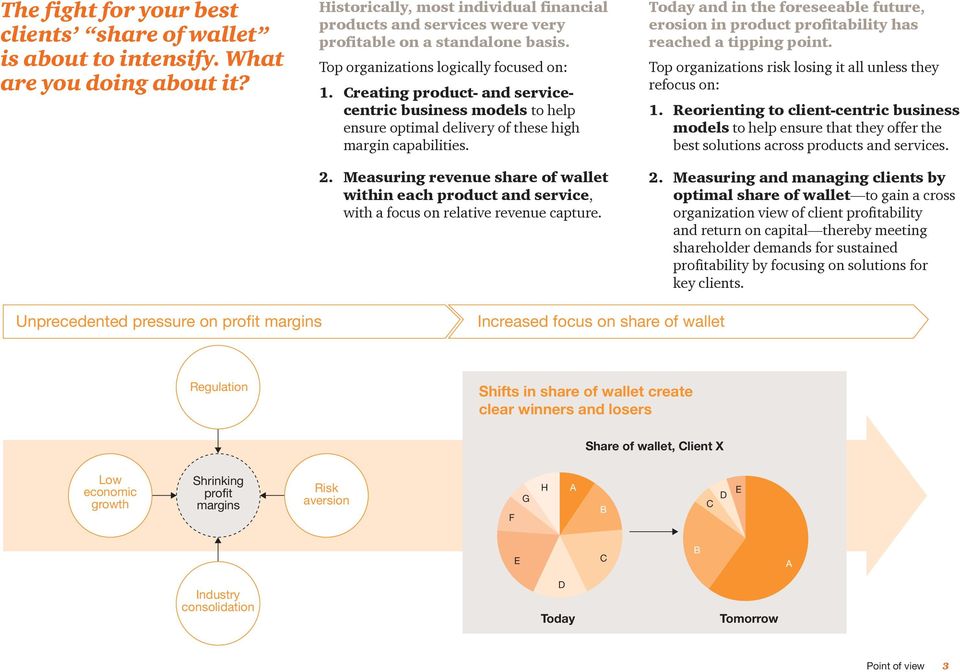
3 The fight for your best clients share of wallet is about to intensify. What are you doing about it? Historically, most individual financial products and services were very profitable on a standalone basis. Top organizations logically focused on: 1. Creating product- and servicecentric business models to help ensure optimal delivery of these high margin capabilities. 2. Measuring revenue share of wallet within each product and service, with a focus on relative revenue capture. Today and in the foreseeable future, erosion in product profitability has reached a tipping point. Top organizations risk losing it all unless they refocus on: 1. Reorienting to client-centric business models to help ensure that they offer the best solutions across products and services. 2. Measuring and managing clients by optimal share of wallet to gain a cross organization view of client profitability and return on capital thereby meeting shareholder demands for sustained profitability by focusing on solutions for key clients. Unprecedented pressure on profit margins Increased focus on share of wallet Regulation Shifts in share of wallet create clear winners and losers Share of wallet, Client X Low economic growth Shrinking profit margins Risk aversion F G H A B C D E E C B A Industry consolidation D Today Tomorrow Point of view 3
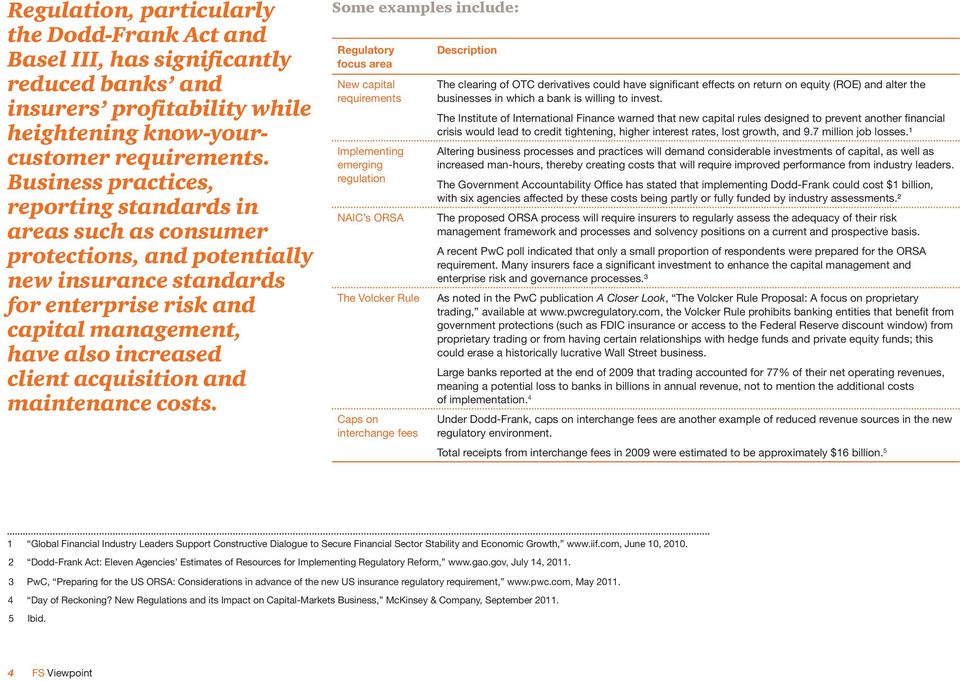
4 Regulation, particularly the Dodd-Frank Act and Basel III, has significantly reduced banks and insurers profitability while heightening know-yourcustomer requirements. Business practices, reporting standards in areas such as consumer protections, and potentially new insurance standards for enterprise risk and capital management, have also increased client acquisition and maintenance costs. Some examples include: Regulatory focus area New capital requirements Implementing emerging regulation NAIC s ORSA The Volcker Rule Caps on interchange fees Description The clearing of OTC derivatives could have significant effects on return on equity (ROE) and alter the businesses in which a bank is willing to invest. The Institute of International Finance warned that new capital rules designed to prevent another financial crisis would lead to credit tightening, higher interest rates, lost growth, and 9.7 million job losses.¹ Altering business processes and practices will demand considerable investments of capital, as well as increased man-hours, thereby creating costs that will require improved performance from industry leaders. The Government Accountability Office has stated that implementing Dodd-Frank could cost $1 billion, with six agencies affected by these costs being partly or fully funded by industry assessments.² The proposed ORSA process will require insurers to regularly assess the adequacy of their risk management framework and processes and solvency positions on a current and prospective basis. A recent PwC poll indicated that only a small proportion of respondents were prepared for the ORSA requirement. Many insurers face a significant investment to enhance the capital management and enterprise risk and governance processes.³ As noted in the PwC publication A Closer Look, The Volcker Rule Proposal: A focus on proprietary trading, available at the Volcker Rule prohibits banking entities that benefit from government protections (such as FDIC insurance or access to the Federal Reserve discount window) from proprietary trading or from having certain relationships with hedge funds and private equity funds; this could erase a historically lucrative Wall Street business. Large banks reported at the end of 2009 that trading accounted for 77% of their net operating revenues, meaning a potential loss to banks in billions in annual revenue, not to mention the additional costs of implementation. 4 Under Dodd-Frank, caps on interchange fees are another example of reduced revenue sources in the new regulatory environment. Total receipts from interchange fees in 2009 were estimated to be approximately $16 billion. 5 1 Global Financial Industry Leaders Support Constructive Dialogue to Secure Financial Sector Stability and Economic Growth, June 10, Dodd-Frank Act: Eleven Agencies Estimates of Resources for Implementing Regulatory Reform, July 14, PwC, Preparing for the US ORSA: Considerations in advance of the new US insurance regulatory requirement, May Day of Reckoning? New Regulations and its Impact on Capital-Markets Business, McKinsey & Company, September Ibid. 4 FS Viewpoint
5 Industry consolidation, which has accelerated as a result of the financial crisis, has caused a greater concentration of financial institutions across the board. Industry consolidation, as shown in the chart, 1 has concentrated the wallet, particularly in institutionally oriented businesses that are serving other financial institutions. Consolidation not only increases the demand for more services from fewer players but creates the opportunity to capture more profit points. Clients, also challenged with profit reductions, will demand top-tier services to run their businesses such as cash management, collateral management, and global clearing capabilities. Only banks that are able to capture profit percentages spread throughout products and services and across lines of business will thrive in the new competitive landscape. Historically, siloed structures in many banks have proven difficult when attempting to implement new cross-selling programs and integrated business models. Organizations will be challenged to re-conceptualize traditional approaches to client service. Buyer Target American International Group, Inc. HSB Group, Inc. American General Corporation Excess, Inc. GE Edison Life/GE s US auto and home business Matrix Direct, Inc. Substantially all assets of SRO Napa Bank of America Fleetboston Financial MBNA US Trust Countrywide Financial Merrill Lynch Citigroup European American Bank Banamex JPMorgan Chase Chase Manhattan Bank One Washington Mutual Bear Stearns MetLife, Inc. Travelers Life & Annuity Co./CitiInsurance International Hldgs SafeGuard Health Enterprises, Inc. American Life Insurance Company/Delaware American Life Insurance Company Wells Fargo Wachovia 1 SNL Financial, June Point of view 5

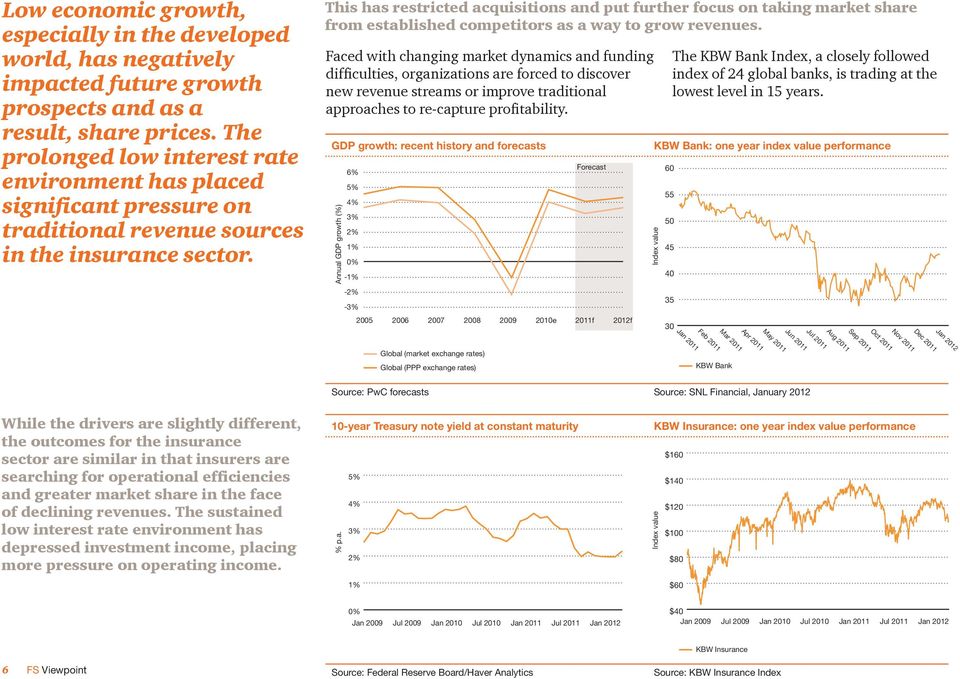
6 Low economic growth, especially in the developed world, has negatively impacted future growth prospects and as a result, share prices. The prolonged low interest rate environment has placed significant pressure on traditional revenue sources in the insurance sector. This has restricted acquisitions and put further focus on taking market share from established competitors as a way to grow revenues. Faced with changing market dynamics and funding difficulties, organizations are forced to discover new revenue streams or improve traditional approaches to re-capture profitability. GDP growth: recent history and forecasts Annual GDP growth (%) 6% 5% 4% 3% 2% 1% 0% -1% -2% -3% Forecast e 2011f 2012f KBW Bank One Year Index Value Performance KBW Bank: one year index value performance Index value The KBW Bank Index, a closely followed index of 24 global banks, is trading at the lowest level in 15 years Jan 2012 Dec 2011 Nov 2011 Oct 2011 Sep 2011 Aug 2011 Jul 2011 Jun 2011 May 2011 Apr 2011 Mar 2011 Feb 2011 Jan 2011 Global (market exchange rates) Global (PPP exchange rates) KBW Bank Source: PwC forecasts Source: SNL SNL Financial, Financial, January 2012 January 2012 Source: PwC forecasts While the drivers are slightly different, the outcomes for the insurance sector are similar in that insurers are searching for operational efficiencies and greater market share in the face of declining revenues. The sustained low interest rate environment has depressed investment income, placing more pressure on operating income. 10-year Treasury note yield at constant maturity % p.a. 5% 4% 3% 2% 1% KBW Insurance: one year index value performance Index value $160 $140 $120 $100 $80 $60 0% Jan 2009 Jul 2009 Jan 2010 Jul 2010 Jan 2011 Jul 2011 Jan 2012 $40 Jan 2009 Jul 2009 Jan 2010 Jul 2010 Jan 2011 Jul 2011 Jan FS Viewpoint Source: Federal Reserve Board/Haver Analytics KBW Insurance Source: KBW Insurance Index
7 Risk aversion is compelling clients to reevaluate the right balance among price, service quality, and safety. This is particularly true in situations where the product/service creates a significant credit, market, or operational exposure to the company. As a result, clients are increasingly aligning themselves with leading, stable providers of service. They are also limiting their business relationships to counterparties, thus aggressively consolidating providers to drive greater volumes through fewer relationships at better pricing. European debt crisis Operation Twist This crisis could force banks to write down assets as hard-to-quantify credit default swap (CDS) exposure, which is exacerbating already-shrinking profit margins. The European bank index has lost a third of its value this year, and many European banks would not survive having to revalue sovereign debt held on the banking book at market levels. 1 Under this program, the Federal Reserve is attempting to lower long-term interest rates, which will create difficulty for banks basic lending structures. This will also depress insurers profitability from investments. Banks make money by borrowing over the short term and lending over the long term. This mechanism is one of the basic principles of banking profitability, and any reduction in this spread will reduce revenue. 2 Similarly, for insurers who offer annuity products, the prolonged low interest rate environment has given rise to negative spreads. Volatility Has Spiked Above Its Historic Range Volatility has spiked above its historic range Number of of Banks banks on on FDIC FDIC Problem problem List list /2/91 1/2/92 1/2/93 1/2/94 1/2/95 1/2/96 1/2/97 1/2/98 1/2/99 1/2/00 1/2/01 1/2/02 1/2/03 1/2/04 1/2/05 1/2/06 1/2/07 1/2/08 1/2/ Deutsche Bank says Europe crisis could kill off the weakest lenders, global.factiva.com, accessed January Vix Index (VIX) VIX Long-Term Avg Jan 2009 Sept 2009 Jan Present 2 Federal Reserve launches Operation Twist, September 22, 2011, accessed December Source: New New Methodology: Methodology: Vix data for 2004 Vix to data present for & , to present CBOE and New Methodology: Vix data for , CBOE Source: Troubled Banks: Why Don t They All Fail?, FDIC Source: Troubled Banks: Why Don't They All Fail?, FDIC Point of view 7

8 The market is already moving in a direction where institutions will need to be top providers in terms of wallet share of top clients or risk losing it all. Being a top provider means different things depending on what market the financial institution is serving. In some areas, such as custody, being a top provider means being in the #1 or #2 position. On the other hand, in the area of cash equities execution, there is a larger group of top-tier providers. Market evidence Lost business to solutionoriented competitors Quantitative evidence of cross-selling Concentration of broker relationships Consolidation of asset servicing relationships Flight to quality hedge funds Revamping of business models and risk controls Description One of the leading equities franchises found that it had lost all execution business of a certain class of clients over the last several years to competitors that had bundled execution, clearing, and financing. The company was offering execution only, having lost sight of both its clients needs for additional services and the activities of its competitors to present a different value proposition. The profitability of financial institutions is increasingly correlated with a higher number of products per client. Banks with more client-centric models tend to be gaining more market share than their product-centric competitors. Many buy-side clients are concentrating their business volumes in a smaller number of prime brokers, even while expanding the number of prime brokerage relationships for risk diversification reasons. A number of the largest asset owners and prime brokers have been consolidating their asset servicing relationships and eliminating smaller providers where possible. This, together with regulatory changes and overall pricing pressure, has led to a new wave of industry consolidation that clearly favors only the largest institutions in the industry. Sovereign wealth funds are allocating their assets increasingly to top hedge funds as global risk aversion continues. This also provides for improved economics and greater control over portfolio selection, and it reduces the over-diversification inherent in fund-to-fund portfolios. Money managers seasoned by the crisis of 2008 and aware of marketplace risks are apprehensive about potential mismanagement of their assets. Hence, we have seen the explosive growth of such services as prime custody and a significant increase in demands for transparency and access. 8 FS Viewpoint
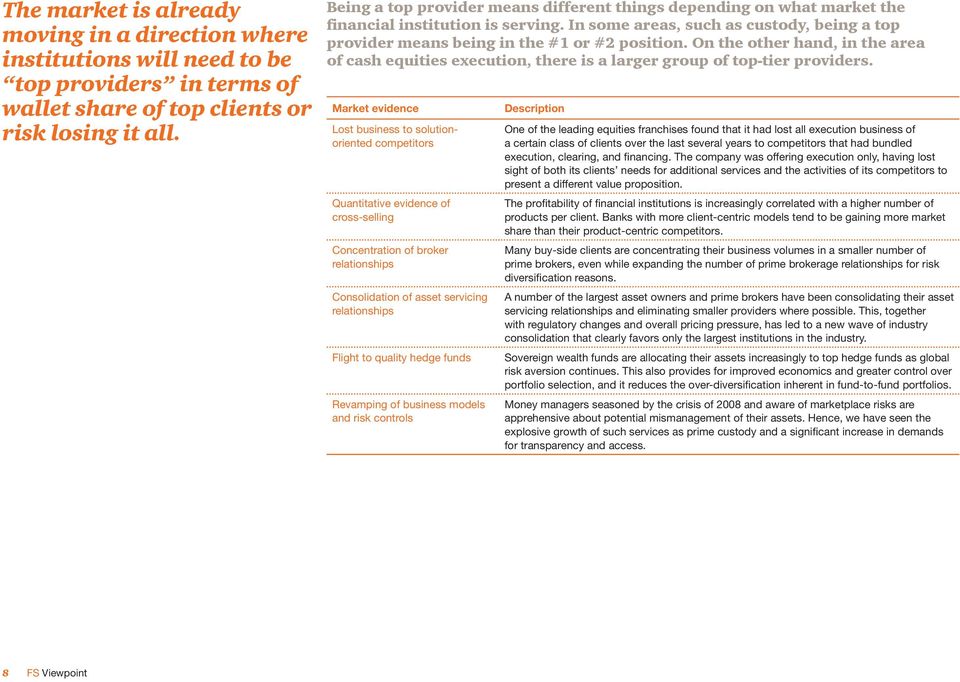
9 Leading institutions are taking drastic action and revamping their product offerings, business models, and client relationship strategies to gain trusted advisor status with their targeted clients. While devoting time and resources to headline regulatory changes, leading institutions are also using this as an opportunity to make drastic changes in their business, including: Reorganizing individual product groups into either clusters of products (for example, merging equities and fixed income businesses) or client-driven teams (such as creating special relationship and product teams around particular industries such as healthcare, energy, or logistics). Adding new products and services to core offerings to capture greater portions of the client value chain and wallet. Examples of this include asset servicers adding middle office outsourcing services to product portfolios and the bundling of derivatives structuring and execution with clearing, collateral management, and financing capabilities Re-segmenting clients and corresponding changes in client coverage models. Several institutions have created new senior relationship teams outside of product areas for key clients and developed new training and compensation systems for those individuals. In one firm, these teams succeeded by creating a unique customer experience by delivering one-stop shop type value propositions in areas where competitors offered more fragmented solutions and products.??? Moving existing relationship team members from product sales to providing solutions. One firm started to develop more substantial issues-based thought leadership versus the classic product and pricing sheets. This helped the firm gain mindshare with its top clients and engage in more strategic discussions and propositions at a higher executive level than in the past. Client Product Client Rel. Mgr Solutions Redesigning the business model in response to changes in client preferences. One example related to shifting client assets from multiple prime brokers into custodial prime custody models in order to manage client risk exposure and protect assets from being commingled or re-hypothecated. Similar issues are being discussed in the context of better protecting client margin. PB PB PB PB Custody PB PB Point of view 9
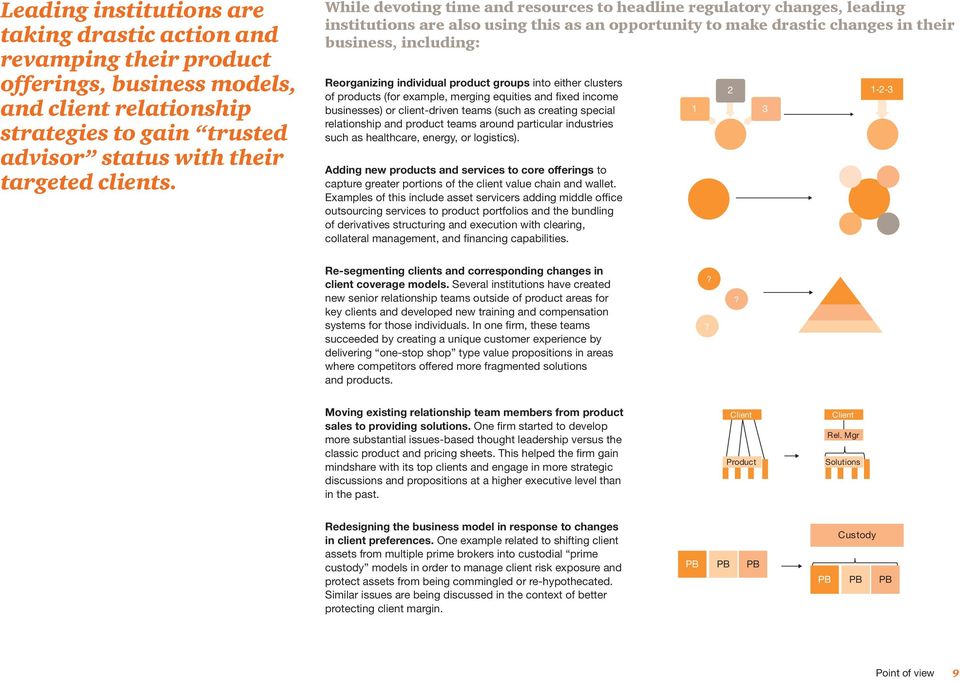
10 Voice of the customer analyses are increasingly being used as a tool to best determine the types of business changes needed to better attain top provider status. Voice of the customer (VOC) is a process by which interviews, surveys, and focus groups are used to inform and, in some cases, to co-develop a new enterprise-wide program of vision, goals, and execution related to the customer experience. A detailed VOC analysis typically yields significant and sometimes surprising insights. What is our strategic goal? Setting strategic goals VOC capture How and where can we listen to customers? How can we leverage VOC to inform business decisions? Implementation & governance Data interpretation How can we analyze and interpret data? We have a dedicated relationship manager from your competitor that can bring the full breadth of product and service offerings to us in a holistic manner. We think you are a great firm, but we only use you in one area. All of our other needs are handled by someone else. Even though your product s great, we like that your competitor bundles a similar product with other products you don t offer. We think your products are great, but we are uncomfortable with the legal structure and business model under which you operate. 10 FS Viewpoint
11 Beyond the products and services themselves, which tend to be fairly similar among competitors, voice of the customer tends to focus on the main differentiator of market success the quality of the customer experience. VOC has been used consistently by a number of firms to obtain important insights into their clients that enable them to competitively position products and services. This analysis is leading to the development of more complex value propositions, the creation of innovative cross-selling strategies, and more seamless delivery and execution. Some examples of insights gained through the use of VOC include: Observations Most financial institutions and/or business units, while clearly dependent on a handful of clients, have much lower share of wallet at their clients than expected. Relationship managers (RMs) are less costly to leverage for analyses, but frequent contact and established norms make it less likely that they will reveal new insight. In almost every case, competitors were positioning themselves in new ways to take market share away from the firm s largest and most important clients. Most financial institutions obtained significant insights regarding their quality of products/services, the depth and breadth of their relationships, and their level of service. Insights gained New knowledge of this alone was enough to drive urgency and innovation in some cases. Having senior management conduct interviews often yielded more insight and sent the message that the firm was truly committed to really understanding the clients issues. Specifically, many clients pointed out that they reacted negatively to product sales or were looking for a trusted partner or service provider that brought solutions and ideas. All firms conducting VOC obtained knowledge of activities of their competitors, often including areas such as new product offerings, innovation activities, technology, and pricing. Point of view 11

12 There has been a significant shift in the definition of customer in the insurance industry. Traditionally, insurers have viewed their intermediaries (producers) as their customers. However, more recently, the focus has shifted to both the end customer (policy holder) and the intermediary producers. Customer experience must address the significant gaps policyholders and producers face throughout their respective decision-making lifecycles to address pain points and enhance experience. Consumer lifecycle Consumer challenges Agent lifecycle Agent challenges Awareness Recognition gap What do I need? Presence Brand gap Are you well known? Consideration, education, and advice Confidence gap Who do I trust? Recruit and place business Confidence gap Do I join you or consider you as one of the top three? Purchase Reach gap Where do I go? Train Simplicity gap What is my learning curve to sell your products? Service Understanding gap Is this right for me? Service Ease-of-doing-business gap Are you easy to deal with? Ongoing relationship Value gap Was that worth it? Retention Value gap Is it worth selling your products? 12 FS Viewpoint

13 In our experience, many institutions have experienced significant difficulty designing and implementing effective VOC programs. Avoiding these common pitfalls is a key to success. VOC strategy VOC data management Common pitfalls Unsolicited data is often overlooked. Programs become siloed and non-insightful; a small portion of employees have a partial picture of client feedback. VOC is seen as a quick fix rather than a process. Unstructured feedback is not utilized and not linked to the same database as other data. Business owners can tell how key metrics changed but they do not know why they have changed. Data from multiple sources do not talk with each other, leaving business owners with only a partial view of the problem (such as operations vs. sales). Solutions Listen to a wide variety of client feedback. Establish and orchestrate multiple listening posts. Treat VOC programs as a long-term investment. Recognize the value of unstructured feedback, and incorporate it in the same manner as structured feedback. Create a set of metrics to provide business owners with actionable information. Create a unified database to store all customer data from multiple sources. Implementation and governance Data is collected but not distilled into an actionable plan to inform training or strategic planning. VOC programs cut across the organization, bringing to light misalignments within the firm. Do not allow data to sit unused, and create a process around how data will be interpreted and incorporated into planning. Align the organization behind VOC programs. VOC programs can be viewed as a local effort and lose steam before they yield fruit. Help ensure strong executive support. Point of view 13
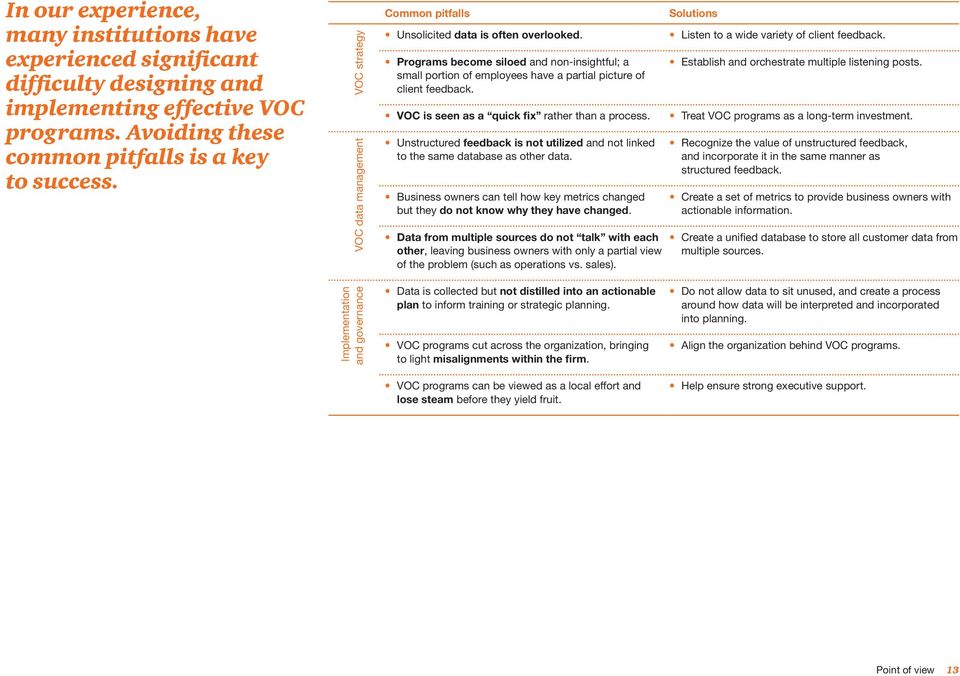
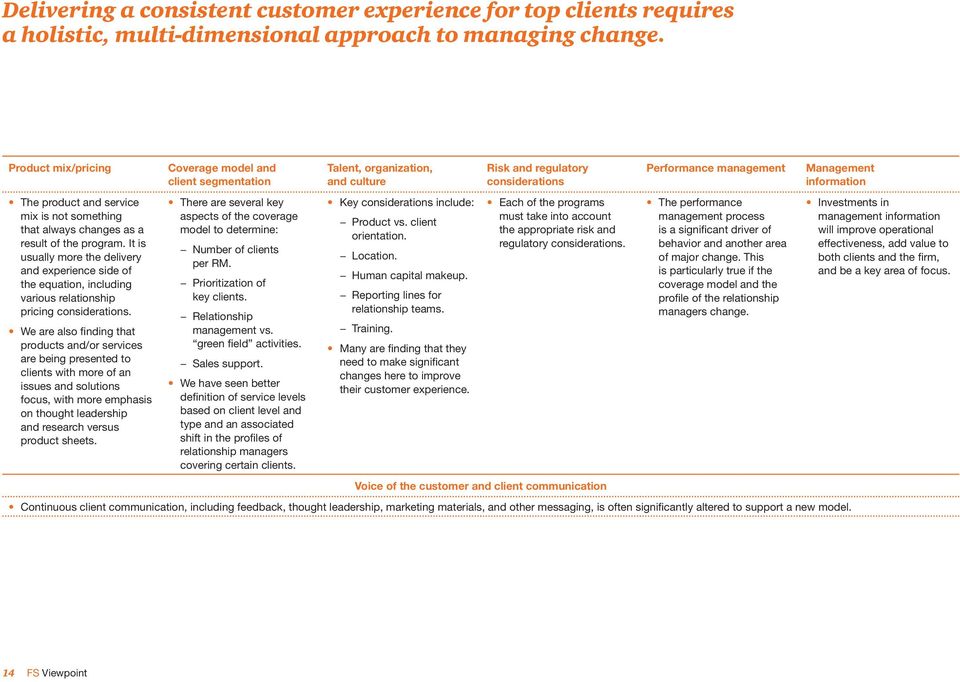
14 Delivering a consistent customer experience for top clients requires a holistic, multi-dimensional approach to managing change. Product mix/pricing The product and service mix is not something that always changes as a result of the program. It is usually more the delivery and experience side of the equation, including various relationship pricing considerations. We are also finding that products and/or services are being presented to clients with more of an issues and solutions focus, with more emphasis on thought leadership and research versus product sheets. Coverage model and client segmentation There are several key aspects of the coverage model to determine: Number of clients per RM. Prioritization of key clients. Relationship management vs. green field activities. Sales support. We have seen better definition of service levels based on client level and type and an associated shift in the profiles of relationship managers covering certain clients. Talent, organization, and culture Key considerations include: Product vs. client orientation. Location. Human capital makeup. Reporting lines for relationship teams. Training. Many are finding that they need to make significant changes here to improve their customer experience. Risk and regulatory considerations Each of the programs must take into account the appropriate risk and regulatory considerations. Voice of the customer and client communication Performance management The performance management process is a significant driver of behavior and another area of major change. This is particularly true if the coverage model and the profile of the relationship managers change. Management information Continuous client communication, including feedback, thought leadership, marketing materials, and other messaging, is often significantly altered to support a new model. Investments in management information will improve operational effectiveness, add value to both clients and the firm, and be a key area of focus. 14 FS Viewpoint
15 Competitive intelligence Our observations of industry practices.

16 What we observe in the industry. Organizational profile Financial institution A Financial institution B Financial institution C Large global banking and financial services group with a commercial banking organization. Major international bank with retail banking operations in more than 150 countries. Offers insurance, credit cards, and investment products. One of the largest financial services firms globally, with more than 5,100 branches. Large and diversified client base. Provides wide range of products and services to the retail market and is a leading provider of banking, finance, and risk management services to the corporate sector. Provides an extensive range of debt and equity financing, risk management, and investment services. Business lines include money markets; rates flow trading; currencies and commodities; equities; credit markets; and portfolio management and origination. Holds over 100 million client accounts and offers deposits, loans, investment banking, brokerage, wealth management, and other financial services. Owns stakes in several international regional banks, and has more than 30 million credit cards in circulation. Among the top mortgage lenders and credit card issuers. Active in some 60 countries, it has formidable investment banking division. Includes private banking, institutional investment, and asset management, with more than $1 trillion in assets under supervision. 16 FS Viewpoint

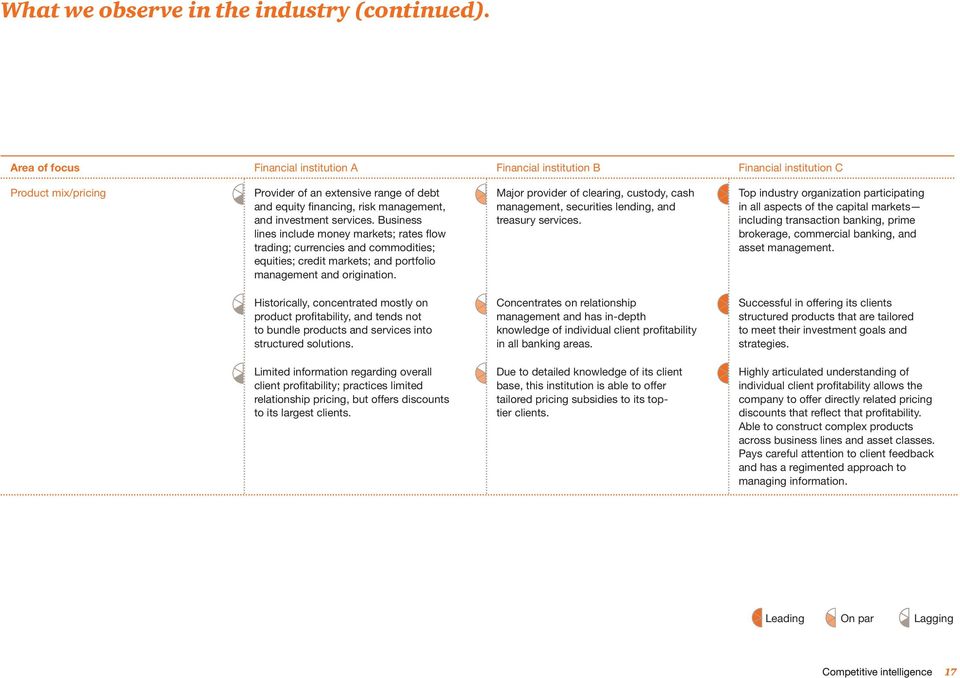
17 What we observe in the industry (continued). Area of focus Financial institution A Financial institution B Financial institution C Product mix/pricing Provider of an extensive range of debt and equity financing, risk management, and investment services. Business lines include money markets; rates flow trading; currencies and commodities; equities; credit markets; and portfolio management and origination. Major provider of clearing, custody, cash management, securities lending, and treasury services. Top industry organization participating in all aspects of the capital markets including transaction banking, prime brokerage, commercial banking, and asset management. Historically, concentrated mostly on product profitability, and tends not to bundle products and services into structured solutions. Concentrates on relationship management and has in-depth knowledge of individual client profitability in all banking areas. Successful in offering its clients structured products that are tailored to meet their investment goals and strategies. Limited information regarding overall client profitability; practices limited relationship pricing, but offers discounts to its largest clients. Due to detailed knowledge of its client base, this institution is able to offer tailored pricing subsidies to its toptier clients. Highly articulated understanding of individual client profitability allows the company to offer directly related pricing discounts that reflect that profitability. Able to construct complex products across business lines and asset classes. Pays careful attention to client feedback and has a regimented approach to managing information. Leading On par Lagging Competitive intelligence 17
18 What we observe in the industry (continued). Area of focus Financial institution A Financial institution B Financial institution C Client segmentation/coverage model Employs client tiering and articulates this approach across business areas. Top-tier clients are offered more complete coverage and dedication based on rank. Designations, however, differ depending on product area and, therefore, hamper an over-arching client-based strategy for coverage. Three-tier approach to client segmentation, which runs across global, regional, and local lines. Coverage models and client services are dictated by the tier of the client and differ vastly according to that tier. Uses an extensive tiering matrix for all of its client accounts. Approach to client segmentation is clearly articulated and outlined, and considers a series of indicators. Tiering practice is based on existing business as opposed to the overall potential wallet of the client, which prevents the company from strategically originating new, potentially lucrative business and limits its sales to a product response effort. Client segmentation is based on existing business as opposed to considering the overall business and/or holdings of individual clients, which does not allow properly for growth targets or sales goals. Takes into consideration the financial overview of key clients, and sets specific sales and revenue targets. Coverage models are actively reviewed to help ensure that important opportunities are uncovered and strategically realized. Assigns relationship managers, aided by some product support, to service key accounts. Invests heavily in relationship management for its top-tier clients. Leading On par Lagging 18 FS Viewpoint

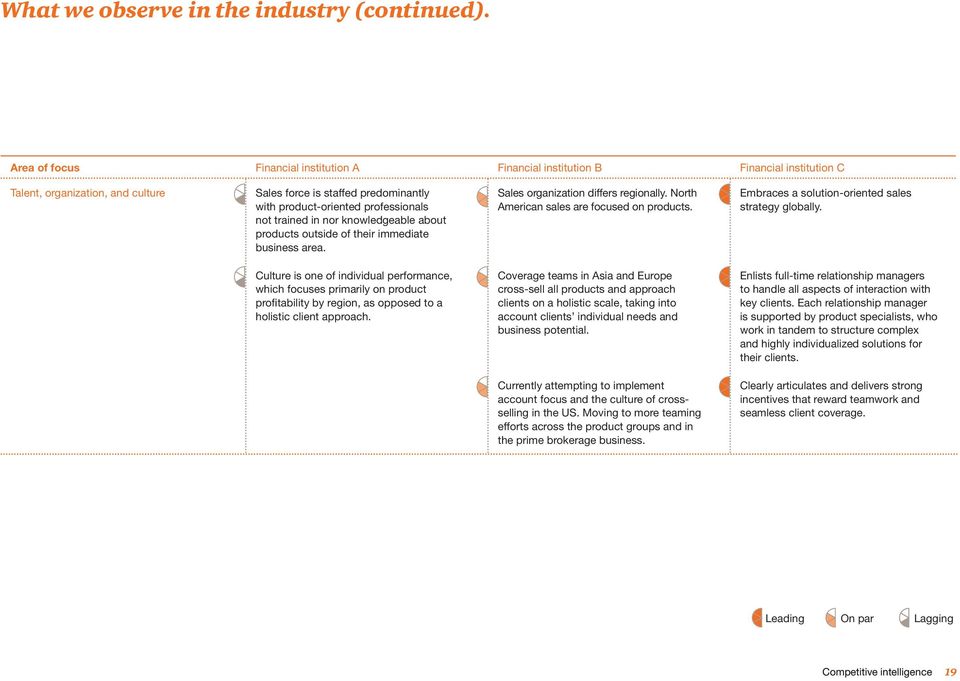
19 What we observe in the industry (continued). Area of focus Financial institution A Financial institution B Financial institution C Talent, organization, and culture Sales force is staffed predominantly with product-oriented professionals not trained in nor knowledgeable about products outside of their immediate business area. Sales organization differs regionally. North American sales are focused on products. Embraces a solution-oriented sales strategy globally. Culture is one of individual performance, which focuses primarily on product profitability by region, as opposed to a holistic client approach. Coverage teams in Asia and Europe cross-sell all products and approach clients on a holistic scale, taking into account clients individual needs and business potential. Enlists full-time relationship managers to handle all aspects of interaction with key clients. Each relationship manager is supported by product specialists, who work in tandem to structure complex and highly individualized solutions for their clients. Currently attempting to implement account focus and the culture of crossselling in the US. Moving to more teaming efforts across the product groups and in the prime brokerage business. Clearly articulates and delivers strong incentives that reward teamwork and seamless client coverage. Leading On par Lagging Competitive intelligence 19
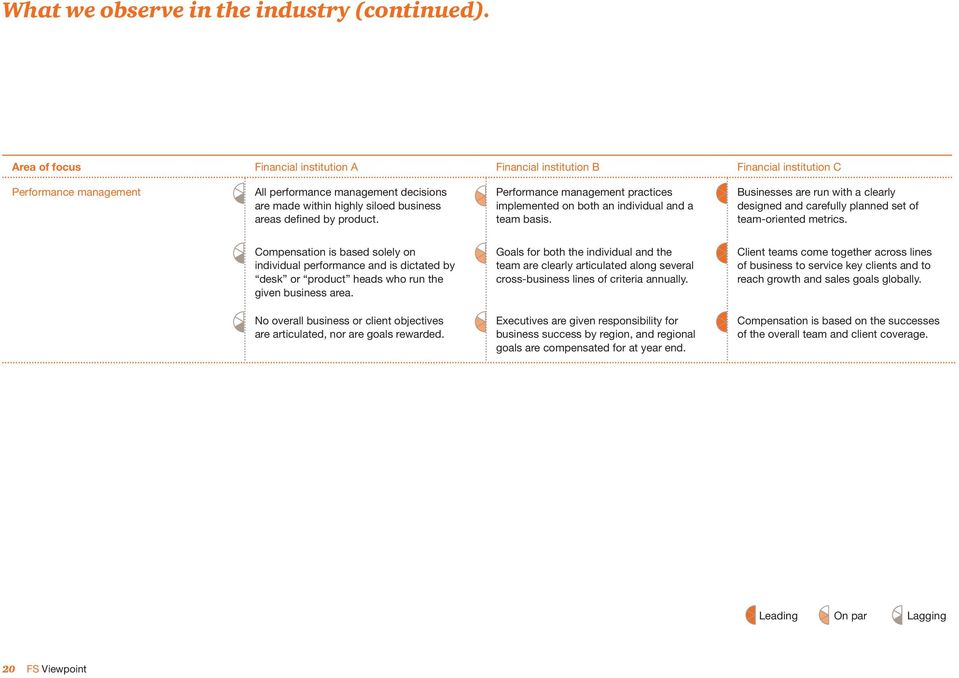
20 What we observe in the industry (continued). Area of focus Financial institution A Financial institution B Financial institution C Performance management All performance management decisions are made within highly siloed business areas defined by product. Performance management practices implemented on both an individual and a team basis. Businesses are run with a clearly designed and carefully planned set of team-oriented metrics. Compensation is based solely on individual performance and is dictated by desk or product heads who run the given business area. Goals for both the individual and the team are clearly articulated along several cross-business lines of criteria annually. Client teams come together across lines of business to service key clients and to reach growth and sales goals globally. No overall business or client objectives are articulated, nor are goals rewarded. Executives are given responsibility for business success by region, and regional goals are compensated for at year end. Compensation is based on the successes of the overall team and client coverage. Leading On par Lagging 20 FS Viewpoint
21 What we observe in the industry (continued). Area of focus Financial institution A Financial institution B Financial institution C Voice of the customer (VOC) Relies on its existing sales force and relationships to understand the VOC. Possesses a solid understanding of client needs, and considers a client s business with a holistic approach. Has an extremely deep understanding and knowledge of client needs and business requirements. Management has extremely limited insight into the depth of potential for clients on an individual level, and opportunities across business lines. Made concerted effort to ensure strong management interaction with key clients. Invests in dynamic research to clearly understand clients, and is keenly aware of its competitors activities at key clients. Considered VOC analysis on several occasions, but budget restraints have limited investment in this area. Conducted selected VOC engagements to gain additional perspective into prime areas of concern for top-tier clients. Has a highly organized approach to capture client feedback, which allows design of individual client strategies and highlights new opportunities. VOC considerations drive client planning. Leading On par Lagging Competitive intelligence 21
22 What we observe in the industry (continued). Area of focus Financial institution A Financial institution B Financial institution C Management information Has limited information regarding revenues and transaction volumes per product. Inconsistent reporting and data quality across various products. Limited historical information. Not able to produce client-level profitability. Has both detailed and summary information regarding revenues and transaction volumes per products. Recent improvements regarding reporting and data quality across various products as a result of systems consolidation and improvements in data management. Limited historical information. Is producing overall client revenues, but has yet to include costs to calculate clientlevel profitability. Has both detailed and summary information regarding revenues and transaction volumes per products. Data quality across various products as a result of systems consolidation and investments in data management is high. Can support various breakdowns of client segments and scenarios, including reasonable client profitability. Has good historical information. Client reporting at various levels of quality, largely driven by one-off requests. Client reporting is improving, with the deployment of self-service tools to better support ad hoc requests. Client reporting is solid and constantly improving, with the continued deployment of self-service tools to better support ad hoc requests. Extensive provision of analytics and other tools to clients to support their what if scenarios. Leading On par Lagging 22 FS Viewpoint
23 A framework for response Our recommended approach to the issue.
24 Building a top-provider program requires a comprehensive approach that looks not only at clients needs but also at the organization, talent, processes, and tools required to support new initiatives. Activities Deliverables Product mix/pricing Develop a strategy and business case for crossselling solutions. Assess current product adequacy and pricing mix. Conduct external scan of competitor product and pricing. Identify pain points and required remediation. Design and prioritize remediation actions. Define implementation roadmap. Strategy and business case. Current state product/ pricing diagnostic. External market/ client analysis. Implementation roadmap. Client segmentation/ coverage Assess current client segmentation and coverage model. Define segmentation and coverage criteria. Develop target client segmentation and coverage model. Refine business case. Define client segmentation operating model, including: Refine/design. Organization structure and headcount. Relationship manager and support functions, roles, and responsibilities. Governance and decision rights. Client segmentation and coverage model. Operating model design. Refined business case. Develop strategy for capturing client data, needs, and feedback. Collect and analyze voice of the customer (VOC) data. Organization and talent Develop job descriptions. Analyze jobs to determine required level and compensation range. Develop competency model. Assess current employee competencies. Identify competency gaps and develop talent strategy remediation (build, buy, rent). Define target culture, values, and behaviors. Build and launch leadership development programs. Conduct internal selection and/or external hiring. Define and roll out training program. Launch internal communications plan. Job descriptions. Competency model. Talent assessment and strategy. Leadership development and training programs. Communications plan. Risk and regulatory environment Identify and evaluate risk/regulatory impacts of new client segmentation program. Design and implement required risk/ regulatory solutions. Clarify interaction model and decision-making accountabilities among risk, compliance, legal, and sales and marketing functions. Design and launch ongoing risk and regulatory monitoring programs. Risk and regulatory assessment. Implementation solutions. Interaction model. Ongoing monitoring programs. Voice of the customer and client communications Performance management Develop incentive and rewards strategy. Define team versus individual goals. Develop base and incentive compensation. Develop relationship manager performance scorecard (objectives, metrics, behaviors). Define changes in incentives and rewards for support roles. Refine current performance management programs as required. Launch, monitor, and evolve rewards strategy to incent desired behaviors. Rewards strategy. Performance scorecards. Incentive plan changes. Ongoing monitoring. Management information Define required client reporting metrics and data sources. Analyze current technology and reporting tools to determine reporting gaps. Remediate gaps as required. Develop client-specific reports for account teams. Develop aggregated dashboard. Develop external client reporting as required. Track and evolve reporting as required. Program metrics. Analysis/remediation of technology reporting gaps. Client and aggregated dashboard. Develop and launch proactive high touch client marketing and communications. 24 FS Viewpoint
25 Client segmentation/coverage Segmenting clients in a way that allows for the most coverage and differentiated service will enhance their experience. Sample deliverables Account prioritization Client profile Account service strategy Gold Silver Global priority accounts with high revenue giving our organization bulk of share of wallet. Can also include strategic partners and highloyalty accounts. Accounts with medium revenue but high growth potential. Can include emerging high-loyalty accounts. Retain Dedicated relationship manager and leadership team liaison. Master service agreements required, with up to 20% discounting. Grow and cross-sell Dedicated relationship manager and sales partner. Master service agreements, with up to 10% discounting potential after reaching target revenue threshold. Bronze Accounts with medium revenue and low growth potential. Serve Focus on cost-efficient service and retention by account service team. Client Domestic International <$250mn $250mn < x < $750mn >$750mn # of products Client tenure Growth potential Target industry Individual total Segment 1 11 Gold 2 7 Silver 3 10 Gold 4 5 Bronze 5 8 Silver A framework for response 25
26 Organization and talent Ensure that organizational structure, talent, and culture are all focused on holistic client needs rather than on individual goals. Each customer s goals should be aligned with the execution of the business strategy. The culture and vision for the customer experience define how an individual should achieve his or her goals. Structure Culture Talent Define organizational structure. Launch internal communications plan. Help ensure that changes are focused on both the relationship managers and support functions (such as marketing, finance, HR, IT) that are required to drive a holistic approach. Define target culture, values, and behaviors. Clearly define and reinforce cultural and behavioral expectations (such as collaboration, solutions focus, relationship management). Define roles and competencies needed to support a solutionsfocused business model. Analyze the roles to determine the required level and compensation range. Develop competency model, and assess current employee competencies. Conduct skills gap analysis for target operating model. Identify competency gaps. Develop talent strategy remediation; determine the need to build, buy, or rent talent. Conduct internal selection and/or external hiring. Build and launch ongoing leadership development programs. 26 FS Viewpoint
27 Organization and talent Sample framework/ overall approach. Our vision Our culture Performance goals Revenue Business model/profit Lead the network Brand/client experience Personal responsibility Sample deliverables Relationship manager role description Relationship manager performance development plan Relationship manager talent development program Please describe your primary responsibilities Relationship manager talent development program Describe increased responsibilities or specific role you aspire to over the next 3 5 years. Years 1 to 3 Years 4 to 7 Years 8 to 20 Years 21 and beyond Describe a specific experience or exposure you believe is important to achieve your goals. Sales associate Sales manager Relationship manager Sales executive Business priorities Relationship manger development lifecycle Development that spans each relationship manager s career List 3 5 strategic goals for your business unit, with the metrics to be used to measure progress toward the goals. Join the company Build a client base Expand client relationships Demonstrate Ieadership Teamwork Develop product knowledge. Develop client relationships. Increase cross-selling. Lead a business. Base expectations are pre-populated. Develop sales skills. Generate profitable growth. Lead account teams. Develop the team. Relationship management-specific metrics: Build key internal relationships. Develop relationships. Hone sales skills. Increase client loyalty. Identify and build growth opportunities. Cross-sell population. Introduce other resources to client. Client Revenue goal Your actions 2 3 Year financial goal Development opportunities Matched to career stage Sales skill development. Relationship management. Advanced team building. Executive development programs. Sales rotation program. Advanced sales skills. Relationship management 1&2. Clients Base expectations are pre-populated. Development levers Growth through new opportunities Relationship management-specific metrics: Institutional support Work assignments Mentoring Self-directed development Build key client relationships. Technical training. Client assignments. Mentorship programs. Owning your plan. Client satisfaction feedback. Skills training, formal curricula. Rotational opportunities. Informal relationships. Keeping current on products. New relationships with clients. Role-based programs. Special programs. Business unit leaders. Self-improvement. Client Annual goal vs. relationship Your actions 2 3 Year goals Executive coaching. Profitable growth Base expectations are pre-populated. Relationship management-specific metrics. Role expectations FY12 FY13 FY14 Mid-year Role-based development Development tailored to specific roles Client focus Building profitable relationships. Leadership focus Executive development series. Revenue Leadership development program for relationship manager. Leading a business unit program. Margin Knowledge/expertise leader development. Understanding the client s strategic agenda. A framework for response 27
28 Organization and talent Sample relationship manager performance development plan. Please describe your primary responsibilities Describe increased responsibilities or specific role you aspire to over the next 3 5 years. Describe a specific experience or exposure you believe is important to achieve your goals. Business priorities List 3 5 strategic goals for your business unit, with the metrics to be used to measure progress toward the goals. Teamwork Base expectations are pre-populated. Relationship management-specific metrics: Build key internal relationships. Cross-sell population. Introduce other resources to client. Client Revenue goal Your actions 2 3 Year financial goal Clients Base expectations are pre-populated. Relationship management-specific metrics: Build key client relationships. Client satisfaction feedback. New relationships with clients. Client Annual goal vs. relationship Your actions 2 3 Year goals Profitable growth Base expectations are pre-populated. Relationship management-specific metrics. Role expectations FY12 FY13 FY14 Mid-year Revenue Margin 28 FS Viewpoint
29 Organization and talent Sample relationship manager talent development program. Relationship manager talent development program Years 1 to 3 Sales associate Years 4 to 7 Sales manager Years 8 to 20 Relationship manager Years 21 and beyond Sales executive Relationship manager development lifecycle Development that spans each relationship manager s career Join the company Build a client base Expand client relationships Demonstrate Ieadership Develop product knowledge. Develop client relationships. Increase cross-selling. Lead a business. Develop sales skills. Generate profitable growth. Lead account teams. Develop the team. Develop relationships. Hone sales skills. Increase client loyalty. Identify and build growth opportunities. Development opportunities Matched to career stage Sales skill development. Relationship management. Advanced team building. Executive development programs. Sales rotation program. Advanced sales skills. Relationship management 1&2. Development levers Growth through new opportunities Institutional support Work assignments Mentoring Self-directed development Technical training. Client assignments. Mentorship programs. Owning your plan. Skills training, formal curricula. Rotational opportunities. Informal relationships. Keeping current on products. Role-based programs. Special programs. Business unit leaders. Self-improvement. Executive coaching. Role-based development Development tailored to specific roles Client focus Building profitable relationships. Leadership development program for relationship manager. Knowledge/expertise leader development. Understanding the client s strategic agenda. Leadership focus Executive development series. Leading a business unit program. A framework for response 29
30 Risk and regulatory environment/performance management/management information Building a customer experience program requires a comprehensive approach. A customer experience program should not only look at clients needs but also consider the organization, talent, processes, and tools required to support new initiatives. Activities Risk and regulatory environment Identify and evaluate risk/ regulatory impacts of new client segmentation program. Design and implement required risk/regulatory solutions. Clarify interaction model and decision-making accountabilities among risk, compliance, legal, and sales and marketing functions. Design and launch ongoing risk and regulatory monitoring programs. Performance management Develop incentive and rewards strategy. Define team versus individual goals. Determine base and incentive compensation. Develop relationship manager performance scorecard (objectives, metrics, behaviors). Define changes in incentives and rewards for support roles. Refine current performance management programs as required. Launch, monitor, and evolve rewards strategy to incent desired behaviors. Management information Define required client reporting metrics and data sources. Analyze current technology and reporting tools to determine reporting gaps. Remediate gaps as required. Develop client-specific reports for account teams. Develop aggregated dashboard. Develop external client reporting as required. Track and evolve reporting as required. Deliverables Risk and regulatory assessment. Rewards strategy. Program metrics. Implementation solutions. Interaction model. Ongoing monitoring programs. Performance scorecards. Incentive plan changes. Ongoing monitoring. Analysis/remediation of technology reporting gaps. Client and aggregated dashboard. 30 FS Viewpoint
31 Voice of the customer Understanding the voice of your customers and how well you are meeting their needs is a critical input in continuously improving your program. Doing well well Promoters Response category history: global and national accounts 70% 60% 50% 40% 30% 20% Committed Expertise and responsive and teams experience 41% 51% 59% 60%63% Business judgment and point of view 43% 39% Breadth of services 33% 34% 30% Insights and opportunities 18% Business impact There are various measures to assess feedback, such as Net Promoter Score, which measures: Value and health of client relationships. Segment performance. Competitor analysis. Product comparison. Internal operations management (transactional focus). Direct and variable compensation. Needs improvement Neutrals and detractors Committed Expertise and responsive and teams experience Business judgment and point of view Breadth of services Insights and opportunities Revenue growth for for non-audit clients by by client type 5% 0% -5% -10% -15% 4% -4% -14% Business impact Key considerations Assess current client feedback programs. Understand client feedback best practices. Develop VOC strategy, feedback measures, processes, metrics, and followup strategy. Consider metrics approach, tools, and dashboard. Develop communications infrastructure to help ensure appropriate response to data. Collect and analyze data. Publish initial results. Follow up with individual clients as appropriate. Adjust program based on feedback; assess impact. Develop and launch proactive high touch client marketing and communications. Develop strategy for capturing client data, needs, and feedback. Collect and analyze VOC data. 10% 9% 7% 6% 7% -20% 0% Promoters Neutrals Detractors -25% Promoters Neutrals Detractors A framework for response 31
32 Voice of the customer While the following core and sub-drivers are frequently reported as impacting customer engagement and behavior, they vary in importance across segments. Client understanding should drive all aspects of segmentation and experience efforts. Core driver Insight-gathering question Sub-driver Product/service What are you looking for from your bank? How does your bank factor into your capital raising and retention strategy? Quality Meeting expectations Value for money Channel delivery How responsive is your bank when you need it? Accessibility Reliability Expertise How well does the bank understand your business? What new and innovative ideas has the bank provided to you and your team? Understanding Insight/new ideas Knowledge/skills Professionalism Proactivity Relationships What is the strength of the relationship between you and your bank? Flexibility/helpfulness Reliability/consistency Integrity Relationship strength Communications How often do you have meaningful contact with the bank? Communication Access Responsiveness Feedback 32 FS Viewpoint
33 Voice of the customer Identifying the drivers of customer engagement drives the tailoring of our approach and the management of project outputs. (1) Prepare (2) Listen and engage A) WHO: Understand stakeholders in various customer groups BU 1 - Large corp - FI - NBFIs BU 2 - Corp Customer journey B) WHAT: Align stakeholder type(s) to questionnaire matrix to determine relevant questions Areas of measurement SOW Drivers Brand Cust. eng score Strategic Economic/ Operational technical Stakeholder C) WHAT: Tailored set of questionnaires for each relevant stakeholder D*) WHEN: Identify opportunities for event driven feedback across the customer journey, examples include: Event significant flow: Key events (e.g., bonds issuance) Significant flow/flow: PIR (FX, Trxn banking), key bids All: Key interactions with operations D) HOW: Segmentation of customer base/roles will determine channel treatment BU 1 BU 2 Two types: Alignment of customer segments to channel treatment strategy Segmentation of roles across segments to channel treatment (e.g., operations get tele/ online feedback\) D) HOW: Obtain feedback leveraging appropriate channel Obtain feedback Calls Web E) HOW: Capture feedback leveraging flexible measurement framework Customer engagement score: Consistently applied across all feedback Satisfaction Trust Rapport Value Loyalty Drivers of engagement (variable/ dependent on role) Product/service Channel delivery Expertise Relationships Communications Advocacy Emotion Market/brand (variable/dependent on role) Brand awareness Brand reputation Brand usage Share of wallet Competitor * NB: Initial solution will be annual feedback. Transition to event driven will be possible using the same approach and methodology, (4) & (5) React and monitor (3) Interpret and analyze Leadership behaviors: Client input into required actions F) SO WHAT: Suite of actionable insight and analytics to meet the needs of the different stakeholders Client-specific feedback will enable the leadership teams (across all levels) to engage with teams to deliver the target attitudes and behaviors. Country heads (overall balanced scorecard/ benchmarks, trend analysis) Product heads (specialist sales performance, competitors, product, SOW) Channel owners (touch point experience/ opportunities for improvement) Marketing/brand (market share) Marketing/brand (share of wallet/ competitive positioning) Relationship managers: Pragmatic client planning/actions Portfolio decisions/priorities Client-specific reports that provide clear feedback to the relationship manager on: Status of overall account Individual relationship status by role Areas for improvement Based on the insights provided, the business can make decisions on development of customer value propositions, project priorities to address gaps, alignment of resources/capital to market opportunities, etc. Relationship managers (client specific relationship dashboards, competitor, SOW, specific areas for improvement) Operations (process heat maps identifying opportunities for improvement) Customer groups (value proposition feedback/ competitor profile/sow) Marketing/brand (brand health tracking) Marketing/brand (statistical analysis to provide insight into the drivers of engagement A framework for response 33
34 Voice of the customer A truly client-centric organization leverages VOC data to impact both customer-facing and non-customer-facing functions. Country heads (Overall balanced scorecard/trend analysis) Product heads (Overall balanced scorecard/trend analysis) Client engagement Brand effectiveness Market metrics Channel owners (Touch point improvement opportunities) Marketing/brand (Market share) Marketing/brand (Share of wallet/competitive positioning) Multivariate statistical analysis (correlation, regression, indexing, PPA, etc.) Automated reporting (Microsoft Excel, Access, PowerPoint) Online reporting Marketing/brand (Drivers of engagement) Marketing/brand (Brand health tracking) Customer groups (Value proposition feedback) Individual feedback reports Relationship manager reports Management reports Product reports Operations (Process heat maps/improvement opportunities) Relationship managers (Client-specific relationship dashboards) 34 FS Viewpoint
35 Voice of the customer Define strategic goals and establish channels to capture VOC. Sample deliverables Industry best practices in VOC Competitor trends in customer support and feedback collection mechanisms. Trends in customer behavior and shifts in traffic. Analysis of available internal and external VOC channels Channels available for VOC collection (phone, IVR, , web, blogs). Channels used. Target channel mix assessment Classification of transaction types performed by customers. Analysis of the optimal channels for different segments and transaction types. Prioritization matrix for VOC sources Recommendation of types of channels that should be targeted and in what time frame. Cost-benefit analysis for pursuing specific VOC channels. Analysis of available internal and external VOC channels Target channel mix assessment Prioritization matrix for VOC sources Novice user Advanced user Wikis, Blogs, User Forums Remote Diagnostics , FAQs, Click Stream Data User Trials Call Center Learn Troubleshoot Transact A framework for response 35
36 Voice of the customer Collecting and interpreting information. Sample deliverables Application of relevant VOC tools to organize data Analysis of technology options available on the market (blog scraping, voice to text). Recommendation on VOC collection options for existing channels. Customer contact reason analysis Hierarchical tracker and data sampling framework. Statistical significance of sample size. Analysis of customer contact tracking data (root cause analysis). Triangulation of root cause findings with additional data points. Tagging schema Examples of best practices of contact tracking framework. A classification tree for cataloging customer contact reasons. Analysis of relevant VOC tools Root cause analysis Tagging schema 36 FS Viewpoint
37 Voice of the customer Leveraging the VOC to make business decisions. Sample deliverables Customer information management process Process to help ensure consistent use of multiple sources of information. Optimal uses for leading and lagging indicators that VOC sources provide. Identification of success metrics that can be derived from VOC sources. Communication and governance models for VOC Recommendation for cross-functional team structure. Rewards and compensation. Integrating VOC into the product lifecycle Recommendation for cross-functional team structure. Rewards and compensation. Process to ensure a structured VOC collection and usage Leading and lagging indicators Governance structure A framework for response 37
38 How PwC can help Our capabilities and tailored approach.
39 What makes PwC s Financial Services practice distinctive. Integrated global network Extensive industry experience Multidisciplinary problem solving Practical insight into critical issues Focus on relationships With 34,000 industry-dedicated professionals worldwide, PwC is the number one Financial Services practice in the world. We have a network that enables the assembly of both cross-border and regional teams. PwC s large, integrated global network of industry-dedicated resources means that PwC deploys the right personnel with the right background on our clients behalf, whenever and wherever they need it. PwC serves multinational financial institutions across banking and capital markets, insurance, asset management, hedge funds, private equity, payments, and financial technology. As a result, PwC has the extensive experience needed to advise on the portfolio of business issues that affect the industry, and we apply that knowledge to our clients individual circumstances. The critical issues financial institutions face today affect their entire business. Addressing these complexities requires both breadth and depth, and PwC service teams include specialists in strategy, risk management, finance, regulation, operations, and technology. This multidisciplinary approach allows us to provide support to corporate executives as well as key line and staff management. We help address business issues from client impact to product design, and from go-tomarket strategy to operating practice, across all dimensions of the organization. We excel at solving problems that span the range of our clients key issues and opportunities, working with the heads of business, risk, finance, operations, and technology. In addition to working directly with clients, our practice professionals and Financial Services Institute (FSI) regularly produce client surveys, white papers, and points of view on the critical issues that face the industry. These publications as well as the events we stage provide clients with new intelligence, perspective, and analysis on the trends that affect them. PwC US helps organizations and individuals create the value they are looking for. We are a member of the PwC network of firms with 169,000 people in more than 158 countries. We are committed to delivering quality in assurance, tax, and advisory services. How PwC can help 39
40 PwC Advisory We look across the entire organization focusing on strategy, structure, people, process, and technology to help our clients improve business processes, transform organizations, and implement technologies needed to run the business. Innovate and grow profitably Leverage talent Client needs Reduce costs Manage risk and regulation Build effective organizations Client needs Innovate and grow profitably Manage risk and regulation Build effective organizations Reduce costs Leverage talent Issues we help clients address Reshaping the IT function into a source of innovation. Transforming business information to drive insight and fact-based decision making. Evaluating acquisition and divestiture strategies to position the organization for the future. Building a risk-resilient organization. Managing ERP investment and project execution risk. Safeguarding the currency of business; keeping sensitive data out of the wrong hands. Ensuring capital project governance and accountability. Establishing effective strategic sourcing and procurement. Realizing competitive advantage through effective sales operations inventory planning. Transforming the close and consolidation process to work for you rather than against you. Driving efficiency through shared services. Redesigning finance to realize efficiency and competitive advantage. Taking control of cost through effective spend management and cash forecasting practices. Defining and implementing an effective HR organization. Rethinking pivotal talent. 40 FS Viewpoint
41 PwC is helping many of the world s leading financial services institutions to leverage VOC and make gamechanging moves that drive awareness, customer acquisition, and customer retention. New customer segments Market entry Identifying customer characteristics PwC helped one of the top 10 global banks leverage the development of a new product to enter a new client segment. PwC conducted a detailed market study, including a VOC analysis, and assisted in the determination of the target clients, talent needs, coverage models, and financial projections. PwC helped one of the world s leading insurance companies conduct a market study of 21 new markets, covering each major product and demographic. This study, which leveraged PwC s proprietary Information Advantage platform, led to the implementation of a prioritized and focused entry and customer acquisition program. Awareness Acquisition Retention PwC helped researchers at a leading financial institution use ethnographic research methods by observing families in their homes and interviewing them on the street to identify the characteristics of actual consumers. Client experience Keeping clients happy Product development and improvement PwC implemented a total PwC Experience that segments clients and drives consistent customer experience across industries, territories, and other areas of importance. We also implemented a VOC-driven approach to improve market position and client profitability. PwC is helping a top 10 global financial services organization conduct periodic VOC surveys and studies in commercial banking and capital markets in order to increase client satisfaction and cross-selling by driving the strategies of its sales teams, relationship managers, and product development groups. PwC has also assisted the client in constructing a coverage model and implementing a customer experience program. PwC assisted two of the world s leading financial institutions in developing a joint venture to combine their resources and capabilities in post-trade processing, clearing, and custody in ten emerging markets to create a new and differentiated value proposition. This work included client targeting, VOC work, and size of wallet analysis. In addition, an operating model from a coverage, revenue sharing, and client communications perspective was developed. How PwC can help 41
42 PwC is capable of rapidly designing and deploying VOC studies that produce significant, actionable insight that leads to improvements in client experience and outcomes. VOC design Implementation Analysis and reporting Sample outputs Client selection Client information review. Third-party data support. Discussion with management/ relationship managers. Initial communication with clients. Survey/interview design Consultation with stakeholders and subject-matter experts. Pilot questionnaires. Deliverables design Consultation with stakeholders. Report output formatting. Internal interviews Client background. Interviewer briefings. Mobilization of PwC teams. Client interviews On-site visits. Response development and collation. Follow-up. Response maximization Ongoing client communication. Relationship manager engagement. Data preparation Data cleansing and preparation. Data validation. Analysis Correlation analysis. Root cause. Trends, patterns. Reporting Executive summary. Client snapshots. Recommendations. Ongoing communications, change management, and program management 42 FS Viewpoint
43 Appendix Select qualifications.
44 Voice of the customer and client coverage Leading global commercial and investment bank Issues Approach Benefits The client wanted to convert its account coverage structure from a country-based, industry-agnostic model to a consistent regional and global model. The client also wanted to implement a strategy that segmented clients into key industry sectors, with a greater focus on priority accounts that met target profiles. Historically, the client had made strategic decisions by relying solely on its relationship management team as well as its understanding of its client base and preferences. When implementing this proposed change, the client wanted to combine its knowledge of the client base with an independent client assessment and an outside perspective focused on how its major competitors were organized by region. PwC provided the client with a comprehensive approach, the capacity to create and sustain a voice of the customer (VOC) program, and the ability to incorporate those results into its client segmentation, coverage, and product strategies. Specifically, PwC provided assistance in the following areas: Presented a well-tested framework and methodology that allowed the client to evaluate all relevant aspects of its existing client program. Helped analyze the management s existing principles and vision for the future, and then created a detailed gap analysis covering such areas as segmentation, industry and country relationship coverage strategies, and management information. Leveraged PwC s International Survey Unit to support our team in designing and executing an efficient and effective VOC, and then incorporated the results into all aspects of the priority client program. This process included both surveys and client interview sessions, and the results were fed back into the client team s work in key countries. Created an ongoing program to receive consistent and high-quality feedback that took into account the bank s annual strategy and client review process. Upon completion of the project, the bank had a complete view of client preferences and feedback regarding its products and services. The bank also had in place coverage teams and an approach to satisfying its clients needs and was better able to align its strategy, coverage, and products to meet those client needs. The bank has seen substantial improvement in client satisfaction, cross-selling activities, and productivity across its relationship teams around the world. 44 FS Viewpoint
45 Priority client program and supporting customer relationship management infrastructure Global financial institution Issues Approach Benefits The client recently implemented a top provider program covering its most important 50 clients. The goal of this program was to create differentiated customer experiences and to expand the share of wallet within this group through a greater emphasis on cross-selling and bringing the firm to the clients. The financial institution also designated a handful of senior relationship managers who were paid through the achievement of qualitative and quantitative client goals, instead of through a particular product or service area. One of the primary challenges for the financial institution was to generate the management information needed to support the account teams and to track that progress on a global basis, taking into account the nature of these clients and the extent of operations around the world. PwC provided assistance in the following areas: Applied our comprehensive, top-provider framework to compare elements of the financial institution s program to industry best practices, thereby highlighting key gaps. Once management information was identified as a key gap, helped identify the types of management information needed to improve the program. This included such areas as client profitability, goal tracking versus actual performance, client meeting summaries, and follow-up items. Compared these baseline requirements to standard reporting, identifying additional reporting or changes needed to match the program objectives. Implemented selected client relationship management technology, including project management, detailed design, configuration, and user acceptance testing. With an improved infrastructure and reporting, the client was better able to set and measure progress toward specific goals for its relationship managers and team. In addition, the client profitability analysis is being used to adjust pricing for both its priority and non-priority clients and to make decisions regarding client investments and targeting, among other things. Appendix 45
46 Market study for proposed joint venture Global universal bank and major custodian Issues Approach Benefits A global universal bank and a leading custodian were discussing a joint venture to offer post-trade services (middle office, clearing, and custody) to their equities clients in 10 Asian markets. Before creating this venture, both entities wanted an independent third party to assess both the market opportunity and feasibility of such a venture. PwC provided assistance in the following areas: Analyzed the market opportunity for the venture, concentrating on the most likely client segments, the potential wallet at stake, and the competitive landscape. Developed a model focused on the overall cost basis of the venture and the pricing necessary to be competitive in the marketplace. These model elements were then used as key inputs into the overall financial projections for the joint venture. Analyzed various structures for the venture, including the likely costs, risks, and benefits of each structure. Assessed the various regulatory and risk issues associated with the venture, generated pros and cons for each model, and developed recommendations that were incorporated into the financial projections. Created a target operating model for sales, relationship management, and client services aimed at balancing both the market opportunity and the cost. The two firms were able to complete the joint venture. They integrated the operational infrastructures supporting their own businesses, and launched a full third-party offering for the external marketplace. The two firms projected that the joint venture will save a approximately $10 15 million in 2013 and generate approximately $50 75 million per year by FS Viewpoint
47 Global customer and channel experience strategy Leading global property and casualty insurance company Issues Approach Benefits To enhance its competitive position in today s dynamic global marketplace, this insurer sought to assess its relationships with customers around the world. Over time, the company had built its operations organically in dozens of farflung countries, but management sensed that various inconsistencies among its worldwide locations coupled with a lack of cross-border sharing of industry best practices was affecting the company s ability to be competitive in certain regions. The firm s management believed that a systematic, globe-spanning review of its customer relationships would enable the company to gain a customer-experience advantage in today s increasingly competitive international markets, prompting management to ask for PwC s assistance in gaining a clear picture of the current state, creating a target experience, and defining the capabilities required to deliver a new distribution vision. PwC first separated the client s customers and partners into nine distinct segments. Then, by combining interviews and research, we employed the following methodologies to define the current and target customer experiences for each segment: Definition of nine key customer types such as large firms, global brokers, agents, small and medium enterprises, and consumers. Use of customer lifecycle analysis to identify opportunities to interact with customers. Analysis of customer types and interviews with the client s global and country managers supported this process. Development of core customer-experience themes for each segment, based on the analysis and interviews. Definition of target-customer experiences, including required capabilities for each customer type. The client incorporated PwC s customer-experience recommendations into its new worldwide organizational structure. Global customer-experience managers were given authority for defining and developing the relationship with each of the nine customer types. Additionally, the client s global and regional leadership employed our capability gap analysis to identify high-priority development and/or investment areas. Appendix 47
48 To have a deeper conversation, please contact: John Garvey Bhushan Sethi Gary Meltzer Chris Pullano Amy Peirce Joseph Demmler Stephen Rose [email protected] [email protected] [email protected] [email protected] [email protected] [email protected] [email protected] Follow us on Love them or lose them: Why becoming a top provider is an all or nothing game with your top clients, PwC FS Viewpoint, January PricewaterhouseCoopers LLP, a Delaware limited liability partnership. All rights reserved. PwC refers to the US member firm, and may sometimes refer to the PwC network. Each member firm is a separate legal entity. Please see for further details. This content is for general information purposes only, and should not be used as a substitute for consultation with professional advisors. NY
1 Copyright Phoenix Marketing International 2012. All rights reserved.
 1 Copyright Phoenix Marketing International 2012. All rights reserved. D A V I D M. T H O M P S O N Managing Director Phoenix Affluent Market +44 (0) 20 3427 6157 / London +011 860 404 5414 / New York
New Channels Create New Growth Opportunities for Insurers. North American Insurance Distribution Survey Findings
 New Channels Create New Growth Opportunities for Insurers North American Insurance Distribution Survey Findings Introduction After a period marked by disruption of the financial systems and heightened
Exceptional Customer Experience AND Credit Risk Management: How to Achieve Both
 Exceptional Customer Experience AND Credit Risk Management: How to Achieve Both Lynn Brunner Experian and the marks used herein are service marks or registered trademarks of Experian Information Solutions,
SUSTAINING COMPETITIVE DIFFERENTIATION
 SUSTAINING COMPETITIVE DIFFERENTIATION Maintaining a competitive edge in customer experience requires proactive vigilance and the ability to take quick, effective, and unified action E M C P e r s pec
Organization transformation in times of change
 Organization transformation in times of change Insurance is sold, not bought is a phrase of unknown attribution, but common wisdom for decades. Thus, insurers and most financial services organizations
GE Capital The Net Promoter Score: A low-cost, high-impact way to analyze customer voices
 GE Capital The Net Promoter Score: A low-cost, high-impact way to analyze customer voices The Net Promoter Score: A low cost, high impact way to analyze customer voices GE Capital s Net Promoter survey
Capital Markets Day Athens, 16 January 2006 ALPHA. Retail Banking. G. Aronis Senior Manager, Retail Banking
 Capital Markets Day Athens, 16 January 2006 ALPHA BANΚ Retail Banking G. Aronis Senior Manager, Retail Banking Contents: page Retail Banking at a Glance 3 Strategic Emphasis on Retail Banking 4 Household
Armchair Quarterbacking in Sales Organizations
 Armchair Quarterbacking in Sales Organizations A fresh look at optimizing the sales force Michael T. Spellecy, Corporate Vice President and Managing Consultant, Maritz 2012 Maritz All rights reserved Abstract
Survey Report. Business strategy and technology priorities in the wealth management industry. Examination of top US wealth management firms
 Survey Report Business strategy and technology priorities in the wealth management industry Examination of top US wealth management firms Balaji Yellavalli Infosys Ltd. Jaroslaw E. Knapik Datamonitor In
Consumer Goods and Services
 Accenture Risk Management Industry Report Consumer Goods and Services 2011 Global Risk Management Point of View Consumer Goods and Services 2011 Global Risk Management Point of View Consumer Goods and
Improving Financial Advisor Productivity through Automation
 Wealth Managment the way we see it Improving Financial Advisor Productivity through Automation How wealth management firms are embracing change by developing next generation advisor platforms Contents
View Point. Customer Centric banking: A 360 degree view. Abstract. - Ashok Gopinath, Navdeep Gill
 View Point Customer Centric banking: A 360 degree view - Ashok Gopinath, Navdeep Gill Abstract Banks today are moving back to basics, shifting attention from complex product offerings to developing greater
Resetting digital strategy in Australia: Delivering what customers really want
 Resetting digital strategy in Australia: Delivering what customers really want Digital strategies in Australian financial services By Peter Stumbles and Gary Turner Peter Stumbles is a Sydney-based partner
The what, why, when and how of Strategic Workforce Planning
 Future-proof your workforce The what, why, when and how of Strategic Workforce Planning Susan DeFazio Table of contents 3 Introduction 5 What does good SWP look like? 7 Why SWP matters to risk & operational
Wealth and Asset Management Services. Accenture Health and Wealth Visualization Tool
 Wealth and Asset Management Services Accenture Health and Wealth Visualization Tool Accenture Wealth and Asset Management Services Part of our capital markets industry group, Accenture s Wealth and Asset
Annual Shareholder Meeting. June 2012
 Annual Shareholder Meeting June 2012 Agenda Call to Order; Opening of Polls Introduction of Directors Introduction of Management Introduction of Independent Registered Public Accounting Firm Designation
SSgA CAPITAL INSIGHTS
 SSgA CAPITAL INSIGHTS viewpoints Part of State Street s Vision thought leadership series A Stratified Sampling Approach to Generating Fixed Income Beta PHOTO by Mathias Marta Senior Investment Manager,
Talent Management Leadership in Professional Services Firms
 Talent Management Leadership in Professional Services Firms Published by KENNEDY KENNEDY Consulting Research Consulting Research & Advisory & Advisory Sponsored by Table of Contents Introduction.... 3
Integrated Communications in Insurance The road to new winning strategies
 Integrated Communications in Insurance The road to new winning strategies Table of Contents New Winning Strategies in Insurance 3 A Key Lever for Success Winning Across All Lines of Business Drivers of
Virtual Detailing in Life Science Organizations
 Healthcare Virtual Detailing in Life Science Organizations Table of Contents Problem Summary Pharmaceutical Life Science Product Sales The Deteriorating Dynamics Life Science Sales & Marketing: Between
The Financial Services Industry: Sales Trends and Strategic Initiatives
 Contact the Richardson Team at 215-940-9255 RICHARDSON 1818 MARKET STREET SUITE 2800 PHILADELPHIA, PA 19103 TEL 215.940.9255 WWW.RICHARDSON.COM or visit us on the web at www.richardson.com COPYRIGHT 2014
Product and Distribution Update: Looking Beyond the Headlines
 HIGHLIGHTS OF A WEB SEMINAR FOR SEI CLIENTS Product and Distribution Update: Looking Beyond the Headlines Mutual funds, ETFs, managed accounts and alternatives all of these product categories enjoyed robust
What s Trending in Analytics for the Consumer Packaged Goods Industry?
 What s Trending in Analytics for the Consumer Packaged Goods Industry? The 2014 Accenture CPG Analytics European Survey Shows How Executives Are Using Analytics, and Where They Expect to Get the Most Value
Development of the Client-Focused, Capital-Efficient Business Model
 Development of the Client-Focused, Capital-Efficient Business Model David Mathers, Chief Operating Officer, Investment Bank at the Goldman Sachs European Financials Conference, Madrid, June 10, 2010 Cautionary
The Coming Volatility
 The Coming Volatility Lowell Bolken, CFA Vice President and Portfolio Manager Real estate Securities June 18, 2015 www.advantuscapital.com S&P 500 Percent Daily Change in Price September 2008 to April
Twelve Initiatives of World-Class Sales Organizations
 Twelve Initiatives of World-Class Sales Organizations If the economy were a season, we are looking at an early spring after a long, hard winter. There is still uncertainty that it is here to stay, but
Exploiting the Single Customer View to maximise the value of customer relationships
 Exploiting the Single Customer View to maximise the value of customer relationships October 2011 Contents 1. Executive summary 2. Introduction 3. What is a single customer view? 4. Obstacles to achieving
Insurance customer retention and growth
 IBM Software Group White Paper Insurance Insurance customer retention and growth Leveraging business analytics to retain existing customers and cross-sell and up-sell insurance policies 2 Insurance customer
Get Better Business Results
 Get Better Business Results From the Four Stages of Your Customer Lifecycle Stage 1 Acquisition A white paper from Identify Unique Needs and Opportunities at Each Lifecycle Stage It s a given that having
Commercial Banking. C. Douglas Lefferson. EVP & Chief Banking Officer. Investor Day August 15, 2012
 Commercial Banking C. Douglas Lefferson EVP & Chief Banking Officer Investor Day August 15, 2012 Commercial Banking 41 C&I / owner-occupied CRE and 10 ICRE lenders located across footprint with concentrations
Customer effectiveness
 www.pwc.com/sap Customer effectiveness PwC SAP Consulting Services Advance your ability to win, keep and deepen relationships with your customers. Are your customers satisfied? How do you know? Five leading
Wealth Management and Securities Services
 U.S. Bancorp Investor Day Wealth Management and Securities Services Terry Dolan Vice Chairman September 12, 2013 # Forward-looking Statements and Additional Information The following information appears
The rise of consumerization in financial services
 FINANCIAL SERVICES PRACTICE The rise of consumerization in financial services Gone are the days when banks, asset managers, and insurance companies could get by with an incomplete understanding of their
Relationship management is dead! Long live relationship management!
 XRM: From Fragmentation to Integration Executive Summary Relationship management is dead! Long live relationship management! But it s not just about customers anymore. The value chain has grown so long
The CFO leads cultural transformation and acts as a guiding light for the whole organization.
 TELSTRA CASE STUDY The CFO leads cultural transformation and acts as a guiding light for the whole organization. I set out to transform the Finance Group into a support group that would create new value,
Credit Suisse 2015 Financials Conference
 Credit Suisse 2015 Financials Conference Gregory J. Fleming President of Morgan Stanley Wealth Management and Morgan Stanley Investment Management February 10, 2015 Notice The information provided herein
African Bank Investments Limited Strategies to grow in the mass market
 African Bank Investments Limited Strategies to grow in the mass market June 2007 Presentation agenda Who we are Our target market A transforming business Is this a good time to be in this market? Outlook
HR Trends & Priorities for 2012. McLean & Company 1
 HR Trends & Priorities for 2012 McLean & Company 1 Executive Summary McLean & Company fielded its 2012 HR Priorities Survey with both HR and business respondents. Of the seven main areas in HR, Leadership
Strategies to Serve Your Small Business Relationships Heather Fraser Vice President, Commercial Sales
 Strategies to Serve Your Small Business Relationships Heather Fraser Vice President, Commercial Sales Today we will cover: Small Business Market Overview Small Business Trends and Concerns Attracting,
Breaking with Tradition in the Insurance Industry: Strategies to Insure Operational Efficiency and Future Growth
 Breaking with Tradition in the Insurance Industry: Strategies to Insure Operational Efficiency and Future Growth An Executive Perspective Authored by Deb Miller 1 Business process SOLUTIONS EXEcutive Perspective
Credit Suisse Private Banking: Strategy update
 Credit Suisse Private Banking: Strategy update Martin Mende Head Business Development Private Banking 2009 Zurich, November 16, 2009 Cautionary statement Cautionary statement regarding forward-looking
How To Create A Social Media Management System
 Best Practices Brochure Best Practices for Optimizing Social CRM Maximizing the Value of Customer Relationships Social CRM Companies must do more than participate in today s social environment. They must
Fixed Income Liquidity in a Rising Rate Environment
 Fixed Income Liquidity in a Rising Rate Environment 2 Executive Summary Ò Fixed income market liquidity has declined, causing greater concern about prospective liquidity in a potential broad market sell-off
Capabilities overview. Retail Banking: A Transformational Model for Growth Using a Customer-Centric Approach
 Capabilities overview Retail Banking: A Transformational Model for Growth Using a Customer-Centric Approach Capabilities Overview It s a New World The retail banking industry is in the midst of a seismic
Wealth management offerings for sustainable profitability and enhanced client centricity
 Wealth the way we do it Wealth management offerings for sustainable profitability and enhanced client centricity The wealth management business is transforming. To delight their clients, firms must adopt
Navigating Uncertainty: Keys to Success in a Changing Environment
 Navigating Uncertainty: Keys to Success in a Changing Environment CAIB 37 Annual Conference Presentation November 2010 A new reality for banking: managing uncertainty Banks are facing a new environment
Portfolio Management for Banks
 Enterprise Risk Solutions Portfolio Management for Banks RiskFrontier, our industry-leading economic capital and credit portfolio risk management solution, along with our expert Portfolio Advisory Services
Deutsche Bank UK Banks Conference 07 April 2011 Chris Lucas, Group Finance Director
 Deutsche Bank UK Banks Conference 07 April 2011 Chris Lucas, Group Finance Director Slide: Name Slide Thanks very much, it s a great pleasure to be here today and I d like to thank our hosts Deutsche Bank
fs viewpoint www.pwc.com/fsi
 fs viewpoint www.pwc.com/fsi June 2013 02 11 16 21 24 Point of view Competitive intelligence A framework for response How PwC can help Appendix It takes two to tango: Managing technology risk is now a
Accenture Credit Services. Mortgage lending within the Everyday Bank. From transactions to relationships
 Accenture Credit Services Mortgage lending within the Everyday Bank From transactions to relationships Digital innovators and disruptors continue to shape customer preferences for banking. In a recent
Interview Guide for Hiring Executive Directors. April 2008
 Interview Guide for Hiring Executive Directors April 2008 Introduction This interview guide has been developed to help the Board of Directors of Big Brothers Big Sisters agencies interview candidates for
GLOBAL WEALTH & INSURANCE. September 25, 2013
 GLOBAL WEALTH & INSURANCE September 25, 2013 Global Wealth & Insurance Investor Day September 2013 Global Wealth Barb Mason Executive Vice President Global Wealth Management Agenda The business today Canada
Metrics by design A practical approach to measuring internal audit performance
 Metrics by design A practical approach to measuring internal audit performance September 2014 At a glance Expectations of Internal Audit are rising. Regulatory pressure is increasing. Budgets are tightening.
Best Practices Brochure. Best Practices for Optimizing Social CRM Maximizing the Value of Customer Relationships. Customer Care
 Best Practices Brochure Best Practices for Optimizing Social CRM Maximizing the Value of Customer Relationships Customer Care Social CRM Companies must do more than participate in today s social environment.
Part 3: Business Case and Readiness
 The Fundamentals of Managed Service Provider (MSP) Programs Part 3 of 3 Part 3: Business Case and Readiness By Jennifer Spicher contents This is the final of a three-part series designed to outline key
WHITEPAPER. How to Credit Score with Predictive Analytics
 WHITEPAPER How to Credit Score with Predictive Analytics Managing Credit Risk Credit scoring and automated rule-based decisioning are the most important tools used by financial services and credit lending
INSTITUTIONAL INVESTMENT & FIDUCIARY SERVICES: Building a Better Portfolio: The Case for High Yield Bonds
 14\GBS\22\25062C.docx INSTITUTIONAL INVESTMENT & FIDUCIARY SERVICES: Building a Better Portfolio: The Case for High Yield Bonds By Adam Marks, Area Vice President and Jamia Canlas, Senior Analyst By looking
How a thoughtful FX strategy can give Fund Managers a competitive edge
 How a thoughtful FX strategy can give Fund Managers a competitive edge Executive summary Each alternative investment fund takes a different approach to its investment strategy, but the ultimate goals are
Corporate & Investment Banking Top 5 position in Europe
 15 June 2010 Corporate & Investment Banking Top 5 position in Europe Séverin Cabannes Deputy Chief Executive Officer Michel Péretié Head of Corporate and Investment Banking A model able to generate strong
Reacting to the Challenges: Business Strategies for Future Success. Todd S. Adams, Chief Executive Officer Adams Bank & Trust Ogallala, Nebraska
 Reacting to the Challenges: Business Strategies for Future Success Todd S. Adams, Chief Executive Officer Adams Bank & Trust Ogallala, Nebraska Adams Bank & Trust Family Owned for 95 Years $525 Million
Changing the game: The new face of customer experience
 Changing the game: The new face of customer experience Why should you care? I m so close to dropping my bank, because they keep having promos to get new clients, but what are they doing to keep me happy?
Goldman Sachs Presentation to Deutsche Bank Global Financial Services Investor Conference Comments by Gary Cohn, President and Chief Operating Officer
 Goldman Sachs Presentation to Deutsche Bank Global Financial Services Investor Conference Comments by Gary Cohn, President and Chief Operating Officer Slide 3: Thanks, Matt. Today I d like to give a brief
Westpac Banking Corporation
 Westpac Banking Corporation Philip Coffey Chief Financial Officer 31 March 2006 Westpac at a glance Established 1817 Top 40 bank globally 1 Core markets - Australia, New Zealand and near Pacific Total
ANALYTICS. Acxiom Marketing Maturity Model CheckPoint. Are you where you want to be? Or do you need to advance your analytics capabilities?
 ANALYTICS Analytics defined Analytics is the process of studying data to identify potential trends, evaluate decisions, or assess the performance of a tool, event, or scenario. The process should include
Customer Management & Experience
 1 Customer Management & Experience Roland Berger perspectives on client-centric banking Dubai, 07 May 2013 2 Executive Summary Customer Management is the conscious effort to maximize revenue by building
Planning, Budgeting and Forecasting
 MANAGEMENT CONSULTING Planning, Budgeting and Forecasting How is your planning process helping you identify and unlock value? kpmg.co.uk Key considerations How effective and efficient is your organisation
The Impact of Interest Rates on Real Estate Securities
 The Impact of Interest Rates on Real Estate Securities The challenge for real estate securities investors is determining how monetary policy and interest rates affect prices and returns. Highlights Not
2012 Benchmark Study of Product Development and Management Practices
 2012 Benchmark Study of Product Development and Management Practices 2012 Benchmark Study of Product Development and Management Practices Contents 1. Introduction 2 2. Participant Profile 3 3. Methodology
AXA INVESTMENT MANAGERS
 AXA INVESTMENT MANAGERS Entering a new phase of growth Investor Day November 20, 2014 Andrea ROSSI CEO AXA Investment Managers Member of the AXA Group Executive Committee Certain statements contained herein
Customer-centric default management Taking collections to the next level
 Experience the commitment ISSUE PAPER Customer-centric default management Taking collections to the next level This issue paper describes how customer-centric default management can generate both short-term
YE08 Consolidated Financial Results. February 13, 2009
 YE08 Consolidated Financial Results February 13, 2009 1 We support our strategy with strong risk management Proven risk management track record and the highest credit ratings given to a bank in Turkey
How To Select Differently From The Standard
 Want to Change the Game with Contact Center Vendors? Select Them Differently. The Accenture Vendor Management Framework In today s marketplace, companies in a wide range of industries rely on outsourcing
Defining Treasury Success. Establishing and Automating Treasury Metrics
 Defining Treasury Success Establishing and Automating Treasury Metrics B How do we know when treasury is operating effectively? That is the key question many of our corporate clients are asking. They are
THE CUSTOMER EXPERIENCE
 THE CUSTOMER EXPERIENCE PRIORITY ONE FOR CMOs IN ASSOCIATION WITH: CONTENTS Foreword...2 Introduction...3 Customer experience is the #1 priority for marketing executives... 4 Driving Growth Strategy...7
Wealth and Asset Management Services Spotlight. Redefining the Wealth Management Client Onboarding Experience
 Wealth and Asset Management Services Spotlight Redefining the Wealth Management Client Onboarding Experience Why is Client Onboarding an Imperative? As competition in the wealth management industry becomes
> Cognizant Analytics for Banking & Financial Services Firms
 > Cognizant for Banking & Financial Services Firms Actionable insights help banks and financial services firms in digital transformation Challenges facing the industry Economic turmoil, demanding customers,
Financial Analyst. Financial Analyst
 Financial Analyst It s about you Do numbers talk to you and tell you a story? Do you enjoy researching, synthesizing and modeling financial data and finding trends? If you thrive under pressure and enjoy
An Alternative Way to Diversify an Income Strategy
 Senior Secured Loans An Alternative Way to Diversify an Income Strategy Alternative Thinking Series There is no shortage of uncertainty and risk facing today s investor. From high unemployment and depressed
Art or Science? Modeling and Challenges in the Post-Financial Crisis Economy
 Art or Science? Modeling and Challenges in the Post-Financial Crisis Economy Emre Sahingur, Ph.D. Chief Risk Officer for Model Risk Fannie Mae May 2015 2011 Fannie Mae. Trademarks of Fannie Mae. 2015 Fannie
We d like to do the same for you. Owen J. Sullivan CEO, Right Management President, Specialty Brands ManpowerGroup
 Business & Talent. Aligned. Regardless of the economic environment, your industry or geography, your size or your earnings, your most valuable asset is your workforce. How you manage this asset spells
Calculating and Reporting Customer Profitability at: North Shore Credit Union. A Case Study
 Calculating and Reporting Customer Profitability at: North Shore Credit Union A Case Study Site Visit Date: November 20, 2005 Site Visit Location: Vancouver, British Columbia Site Visit Hosts: Marni Johnson
Accenture Risk Management. Industry Report. Life Sciences
 Accenture Risk Management Industry Report Life Sciences Risk management as a source of competitive advantage and high performance in the life sciences industry Risk management that enables long-term competitive
Conceptual Framework: What Does the Financial System Do? 1. Financial contracting: Get funds from savers to investors
 Conceptual Framework: What Does the Financial System Do? 1. Financial contracting: Get funds from savers to investors Transactions costs Contracting costs (from asymmetric information) Adverse Selection
Employee performance management in a global setting. Brenda Wilson
 Employee performance management in a global setting Brenda Wilson Performance management overview What is performance management? Performance management is a CORE business process driven by business strategy,
www.pwc.com Next presentation starting soon Next Gen Customer Experience Enabled by PwC & Oracle s Cloud CRM & CX Applications
 www.pwc.com Next presentation starting soon Next Gen Customer Experience Enabled by & Oracle s Cloud CRM & CX Applications Agenda Introductions & Customer Experience / CX Defined Why CX is Critical Today?
Solutions for Balance Sheet Management
 ENTERPRISE RISK SOLUTIONS Solutions for Balance Sheet Management Moody s Analytics offers a powerful combination of software and advisory services for essential balance sheet and liquidity risk management.
Critical Steps to Help Small and Mid-Sized Businesses Ensure CRM Success
 Critical Steps to Help Small and Mid-Sized Businesses Ensure CRM Success Table of Contents Abstract............................................ 3 CRM Drivers and Benefits............................. 4
Just-in-Time Marketing: Lessons from the Masters
 Just-in-Time Marketing: Lessons from the Masters Marketers have changed the way they engage consumers, but have their changes taken them all the way back to the factory floor where marketing is produced?
Customer Experience Management
 Customer Experience Management Best Practices for Voice of the Customer (VoC) Programmes Jörg Höhner Senior Vice President Global Head of Automotive SPA Future Thinking The Evolution of Customer Satisfaction