
2410 Digital Telephone User s Guide Release 2
|
|
|
- Austen Sullivan
- 10 years ago
- Views:
Transcription
1 2410 Digital Telephone User s Guide Release Issue 2 November 2004

2 Copyright 2004, Avaya Inc. All Rights Reserved Notice Every effort was made to ensure that the information in this document was complete and accurate at the time of printing. However, information is subject to change. Warranty Avaya Inc. provides a limited warranty on this product. Refer to your sales agreement to establish the terms of the limited warranty. In addition, Avaya s standard warranty language as well as information regarding support for this product, while under warranty, is available through the following Web site: Hearing Aid Compatibility The 2400-Series telephones are Hearing Aid Compatible (HAC) when the Automatic Gain Control is disabled, and thus all units have HAC printed on them. Preventing Toll Fraud Toll fraud is the unauthorized use of your telecommunications system by an unauthorized party (for example, a person who is not a corporate employee, agent, subcontractor, or is not working on your company's behalf). Be aware that there may be a risk of toll fraud associated with your system and that, if toll fraud occurs, it can result in substantial additional charges for your telecommunications services. Avaya Fraud Intervention If you suspect that you are being victimized by toll fraud and you need technical assistance or support, in the United States and Canada, call the Technical Service Center's Toll Fraud Intervention Hotline at Disclaimer Avaya is not responsible for any modifications, additions or deletions to the original published version of this documentation unless such modifications, additions or deletions were performed by Avaya. Customer and/or End User agree to indemnify and hold harmless Avaya, Avaya's agents, servants and employees against all claims, lawsuits, demands and judgments arising out of, or in connection with, subsequent modifications, additions or deletions to this documentation to the extent made by the Customer or End User. How to Get Help For additional support telephone numbers, go to the Avaya support Web site: If you are: Within the United States, click the Escalation Contacts link. Then click the appropriate link for the type of support you need. Outside the United States, click the Escalation Contacts link. Then click the International Services link that includes telephone numbers for the international Centers of Excellence. Providing Telecommunications Security Telecommunications security (of voice, data, and/or video communications) is the prevention of any type of intrusion to (that is, either unauthorized or malicious access to or use of) your company s telecommunications equipment by some party. Your company's telecommunications equipment includes both this Avaya product and any other voice/data/video equipment that could be accessed via this Avaya product (that is, networked equipment ). An outside party is anyone who is not a corporate employee, agent, subcontractor, or is not working on your company's behalf. Whereas, a malicious party is anyone (including someone who may be otherwise authorized) who accesses your telecommunications equipment with either malicious or mischievous intent. Such intrusions may be either to/through synchronous (time-multiplexed and/or circuit-based), or asynchronous (character-, message-, or packet-based) equipment, or interfaces for reasons of: Utilization (of capabilities special to the accessed equipment) Theft (such as, of intellectual property, financial assets, or toll facility access) Eavesdropping (privacy invasions to humans) Mischief (troubling, but apparently innocuous, tampering) Harm (such as harmful tampering, data loss or alteration, regardless of motive or intent) Be aware that there may be a risk of unauthorized intrusions associated with your system and/or its networked equipment. Also realize that, if such an intrusion should occur, it could result in a variety of losses to your company (including but not limited to, human/data privacy, intellectual property, material assets, financial resources, labor costs, and/or legal costs). Responsibility for Your Company s Telecommunications Security The final responsibility for securing both this system and its networked equipment rests with you - Avaya s customer system administrator, your telecommunications peers, and your managers. Base the fulfillment of your responsibility on acquired knowledge and resources from a variety of sources including but not limited to: Installation documents System administration documents Security documents Hardware-/software-based security tools Shared information between you and your peers Telecommunications security experts To prevent intrusions to your telecommunications equipment, you and your peers should carefully program and configure: Your Avaya-provided telecommunications systems and their interfaces Your Avaya-provided software applications, as well as their underlying hardware/software platforms and interfaces Any other equipment networked to your Avaya products Standards Compliance Avaya Inc. is not responsible for any radio or television interference caused by unauthorized modifications of this equipment or the substitution or attachment of connecting cables and equipment other than those specified by Avaya Inc. The correction of interference caused by such unauthorized modifications, substitution or attachment will be the responsibility of the user. Pursuant to Part 15 of the Federal Communications Commission (FCC) Rules, the user is cautioned that changes or modifications not expressly approved by Avaya Inc. could void the user s authority to operate this equipment. Product Safety Standards This product complies with and conforms to the following international Product Safety standards as applicable: Safety of Information Technology Equipment, IEC 60950, 3rd Edition, or IEC , 1st Edition, including all relevant national deviations as listed in Compliance with IEC for Electrical Equipment (IECEE) CB-96A. Safety of Information Technology Equipment, CAN/CSA-C22.2 No / UL 60950, 3rd Edition, or CAN/CSA-C22.2 No / UL Safety Requirements for Customer Equipment, ACA Technical Standard (TS) One or more of the following Mexican national standards, as applicable: NOM 001 SCFI 1993, NOM SCFI , NOM 019 SCFI 1998.

3 Electromagnetic Compatibility (EMC) Standards This product complies with and conforms to the following international EMC standards and all relevant national deviations: Limits and Methods of Measurement of Radio Interference of Information Technology Equipment, CISPR 22:1997 and EN55022:1998. Information Technology Equipment Immunity Characteristics Limits and Methods of Measurement, CISPR 24:1997 and EN55024:1998, including: Electrostatic Discharge (ESD) IEC Radiated Immunity IEC Electrical Fast Transient IEC Lightning Effects IEC Conducted Immunity IEC Mains Frequency Magnetic Field IEC Voltage Dips and Variations IEC Power Line Emissions, IEC : Electromagnetic compatibility (EMC) Part 3-2: Limits Limits for harmonic current emissions. Power Line Emissions, IEC : Electromagnetic compatibility (EMC) Part 3-3: Limits Limitation of voltage changes, voltage fluctuations and flicker in public low-voltage supply systems. Federal Communications Commission Statement Part 15: This equipment has been tested and found to comply with the limits for a Class B digital device, pursuant to Part 15 of the FCC Rules. These limits are designed to provide reasonable protection against harmful interference when the equipment is operated in a commercial environment. This equipment generates, uses, and can radiate radio frequency energy and, if not installed and used in accordance with the instruction manual, may cause harmful interference to radio communications. Operation of this equipment in a residential area is likely to cause harmful interference in which case the user will be required to correct the interference at his own expense. Part 68: Answer-Supervision Signaling Allowing this equipment to be operated in a manner that does not provide proper answer-supervision signaling is in violation of Part 68 rules. This equipment returns answer-supervision signals to the public switched network when: answered by the called station, answered by the attendant, or routed to a recorded announcement that can be administered by the customer premises equipment (CPE) user. This equipment returns answer-supervision signals on all direct inward dialed (DID) calls forwarded back to the public switched telephone network. Permissible exceptions are: A call is unanswered. A busy tone is received. A reorder tone is received. Avaya attests that this registered equipment is capable of providing users access to interstate providers of operator services through the use of access codes. Modification of this equipment by call aggregators to block access dialing codes is a violation of the Telephone Operator Consumers Act of Canadian Department of Communications (DOC) Interference Information This Class B digital apparatus complies with Canadian ICES-003. Cet appareil numérique de la classe B est conforme à la norme NMB-003 du Canada. This equipment meets the applicable Industry Canada Terminal Equipment Technical Specifications. This is confirmed by the registration number. The abbreviation, IC, before the registration number signifies that registration was performed based on a Declaration of Conformity indicating that Industry Canada technical specifications were met. It does not imply that Industry Canada approved the equipment. Installation and Repairs Before installing this equipment, users should ensure that it is permissible to be connected to the facilities of the local telecommunications company. The equipment must also be installed using an acceptable method of connection. The customer should be aware that compliance with the above conditions may not prevent degradation of service in some situations. Repairs to certified equipment should be coordinated by a representative designated by the supplier. Any repairs or alterations made by the user to this equipment, or equipment malfunctions, may give the telecommunications company cause to request the user to disconnect the equipment. Declarations of Conformity United States FCC Part 68 Supplier s Declaration of Conformity (SDoC) Avaya Inc. in the United States of America hereby certifies that the equipment described in this document and bearing a TIA TSB-168 label identification number complies with the FCC s Rules and Regulations 47 CFR Part 68, and the Administrative Council on Terminal Attachments (ACTA) adopted technical criteria. Avaya further asserts that Avaya handset-equipped terminal equipment described in this document complies with Paragraph of the FCC Rules and Regulations defining Hearing Aid Compatibility and is deemed compatible with hearing aids. Copies of SDoCs signed by the Responsible Party in the U. S. can be obtained by contacting your local sales representative and are available on the following Web site: All Avaya media servers and media gateways are compliant with FCC Part 68, but many have been registered with the FCC before the SDoC process was available. A list of all Avaya registered products may be found at: by conducting a search using Avaya as manufacturer. European Union Declarations of Conformity Avaya Inc. declares that the equipment specified in this document bearing the CE (Conformité Europeénne) mark conforms to the European Union Radio and Telecommunications Terminal Equipment Directive (1999/5/ EC), including the Electromagnetic Compatibility Directive (89/336/EEC) and Low Voltage Directive (73/23/EEC). Copies of these Declarations of Conformity (DoCs) can be obtained by contacting your local sales representative and are available on the following Web site: Japan This is a Class B product based on the standard of the Voluntary Control Council for Interference by Information Technology Equipment (VCCI). If this equipment is used in a domestic environment, radio disturbance may occur, in which case, the user may be required to take corrective actions. To order copies of this and other documents: Call: Avaya Publications Center Voice or FAX or Write: Globalware Solutions 200 Ward Hill Avenue Haverhill, MA USA Attention: Avaya Account Management [email protected] For the most current versions of documentation, go to the Avaya support Web site:

4

5 Contents Overview Headset Compatibility Safety Information Telephone Components Telephone User Checklist The Home Screen Navigating in the Home Screen Pages Call Appearance and Call Identification Displays Status Icons Call-Handling Features Answer a call Make a call Speed Dial Hold Redial Speakerphone Transfer Conference Getting Messages Message The Speed Dial Screen Working in the Speed Dial Screen Managing Your Speed Dial List Quick Access to Speed Dial Entries Editing Speed Dial Entries Entering Characters Dialing Conventions Adding Speed Dial Entries Editing Speed Dial Entries Deleting Speed Dial Entries The Call Log Screens The Call Log Summary Screen Working in the Call Log Summary Screen Call Log Detail Screen Working in the Call Log Detail Screen Issue 2 November
6 Contents Using the Call Log Viewing the Call Log Making Calls from the Call Log Saving a Call Log Entry to Your Speed Dial List Deleting a Call Log Entry The Label Action Screen Working in the Label Action Screen Managing Your Call Appearance/Feature Button Labels Editing Labels Viewing the System Labels Restoring the System Labels The Options Screen Working in the Options Screen Selecting Personalized Options Ring Pattern Visual Ring (Flash Message Lamp) Show Phone Screen Display Contrast Call Log Setup Erase Stay in Speed Dial Screen Self Test Language Using Selected Voice Features Abbreviated Dialing/Automatic Dialing (AD) Call Forwarding All Calls Call Park Call Pickup and Directed Call Pickup Leave Word Calling Send All Calls Whisper Page Using Display Features Call Timer and Timer Directory Inspect Tones and Their Meaning Index Digital Telephone User s Guide

7 Overview The 2410 Digital Telephone is a multiline digital telephone for use with an Avaya call processing system. The 2410 telephone puts convenient features and capabilities at your fingertips, including: a large display that allows you to view - call appearance/feature button labels - the call log - speed dial lists - call identifier information a flexible call appearance/feature button display that eliminates the need for paper button labels. a customizable interface that allows you to - create personal speed dial lists - specify the call types you want to appear in the call log - select the telephone ring pattern - customize the call appearance/feature button labels - choose the language you want displayed on your 2410 telephone You can choose to view screen text in English, German, French, Spanish, Italian, Dutch, Portuguese, or Japanese. a programmable speed dial list that allows you to store up to 48 entries. a programmable call log that supports up to 48 entries. Each entry includes calling party name and number, when available, for incoming calls. The call log also allows you to specify the call types that are logged and displayed. The call log can contain entries for outgoing calls and answered or unanswered incoming calls. customizable call appearance/feature button labels that allow you to change the labels for the call appearance/feature buttons programmed on your call processing system. Up to 13 characters can be displayed for each label. compatibility with a variety of headsets works with one headset directly connected to the 2410 telephone by an amplifier adapter (HIC-1) cord. See Headset Compatibility on page 8 for the list of compatible headpieces and equipment. support for the Group Listen feature when this feature is programmed, you can use the handset (or headset) and speaker of the 2410 telephone simultaneously. While you use the handset (or headset) to talk with the other party, another person can use the speaker to listen to the conversation. See Speakerphone on page 12 for details. Issue 2 November

8 When you install the 2410 telephone, your call processing system recognizes your telephone instantly. If the system manager administers the 2410 telephone properly, you can move the 2410 to another office at your location, and it will work without interruption. There is no need to wait for reprogramming or technical support. Headset Compatibility The headset interface is compatible with the following H-top headpieces and equipment. Headpieces - Starset top H31 - Mirage top H41 - Mirage top H41N - Supra Monaural top H51 - Supra Monaural NC top H51N - Supra Binaural top H61 - Supra Binaural NC top H61N - Encore Monaural Voice Tube H91 - Encore Monaural NC top H91N - Encore Binaural Voice Tube H101 - Encore Binaural NC top H101N - Tristar Voice Tube top H81 - Tristar Noise Canceling top H81N - Duoset (Supra Starter) Voice Tube H141 Headband only - Duoset (Supra Starter NC) Noise Canceling top H141N Headband only - Duoset (Earset Starter) Voice Tub top H141 Earhooks only - Duoset (Earset Starter NC) Noise Canceling top H141N Earhooks only - Duoset (Starter Special VT) Voice Tube top H141 Headband and Earhooks - Duoset (Starter Special NC) Noise Canceling top H141N Headband and Earhooks Base Units - M12LUCM Modular Base Unit Digital Telephone User s Guide

9 2410 Telephone Components Adapter Cord - HIC-1 H-top Headset Adapter Cord Cordless Headpiece/Base Unit - LKA 10 Cord Free Headset (900 MHz RF) Safety Information Your 2410 telephone is manufactured according to industry standards for quality and safety assurance. When you use your telephone, follow recommended safety precautions to reduce the risk of fire, electrical shock, and personal injury. See the 2400 Series Telephone Installation and Safety Instructions that were packaged with your telephone Telephone Components See Figure 1 to familiarize yourself with your 2410 telephone screen display, buttons, and programmable features. Figure 1: 2410 Telephone Components Issue 2 November

10 Table 1 describes the 2410 telephone components presented in Figure 1. The following items correspond to the numbers in Figure 1. Table 1: The 2410 Telephone Components 1) Call appearance/feature buttons Use to access incoming/outgoing lines and programmed features. An underscore indicates the currently selected call appearance. 2) Display Shows the status for the call appearances, information for a call, information provided by the Avaya call server, the Home screen, the Speed Dial screen, the Call Log screen, and the Options screen. 3) Message lamp This lamp is lit when a message has arrived in your voice mailbox. When you enable the Flash Message Lamp option, this lamp flashes to alert you to incoming calls. You can retrieve messages using. 8) Dialpad Standard 12-button pad that allows you to dial telephone numbers. 9) Volume control buttons Use to adjust speaker, handset, headset, or ringer/button click volume depending on which component is in use. 10) Mute button Turns off the microphone in the handset, headset, or speaker. When the Mute feature is active, the associated light turns on, and the person at the other end of the call cannot hear you. 4) Softkeys Allow you to perform specific functions. The functions available and the corresponding softkey labels change according to the screen displayed. To initially view softkey labels, press any softkey. 5) Message button Use to retrieve messages. 6) Arrow keys Use to move between screen pages, to cycle through Call Log entries and Speed Dial entries, and to move the cursor during data entry. 11) Headset button Use to activate a headset that is connected to the 2410 headset jack. The light associated with this button turns on when the headset is active. 12) Speaker button Use to access the built-in, two-way speakerphone. The light associated with this button turns on when the speakerphone is active. 13) Exit button Returns you to the first page of the Home screen. 7) Call handling buttons For call handling activities. See Call-Handling Features on page 16 for more information Digital Telephone User s Guide

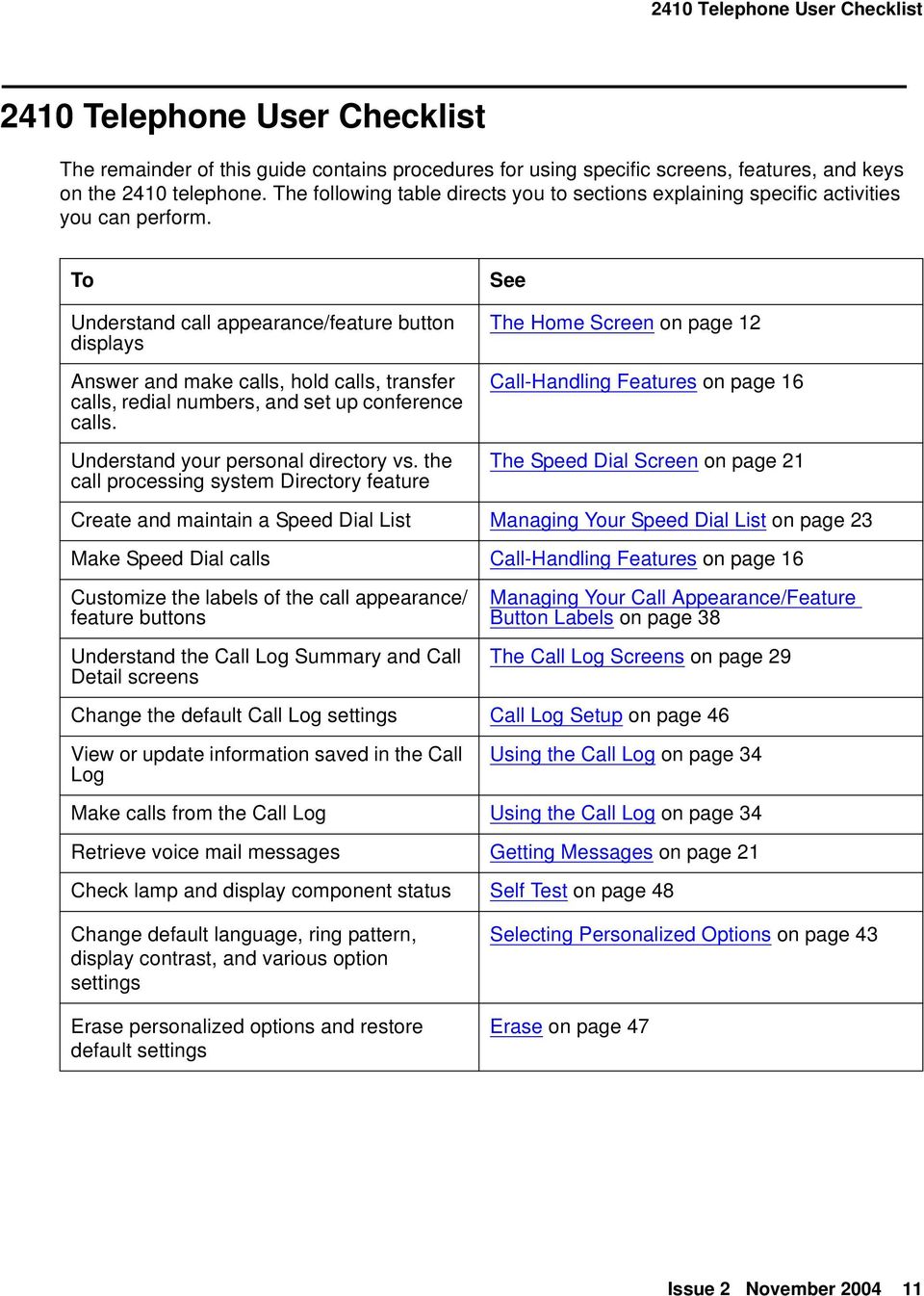
11 2410 Telephone User Checklist 2410 Telephone User Checklist The remainder of this guide contains procedures for using specific screens, features, and keys on the 2410 telephone. The following table directs you to sections explaining specific activities you can perform. To Understand call appearance/feature button displays Answer and make calls, hold calls, transfer calls, redial numbers, and set up conference calls. Understand your personal directory vs. the call processing system Directory feature See The Home Screen on page 12 Call-Handling Features on page 16 The Speed Dial Screen on page 21 Create and maintain a Speed Dial List Managing Your Speed Dial List on page 23 Make Speed Dial calls Call-Handling Features on page 16 Customize the labels of the call appearance/ feature buttons Understand the Call Log Summary and Call Detail screens Managing Your Call Appearance/Feature Button Labels on page 38 The Call Log Screens on page 29 Change the default Call Log settings Call Log Setup on page 46 View or update information saved in the Call Log Using the Call Log on page 34 Make calls from the Call Log Using the Call Log on page 34 Retrieve voice mail messages Getting Messages on page 21 Check lamp and display component status Self Test on page 48 Change default language, ring pattern, display contrast, and various option settings Erase personalized options and restore default settings Selecting Personalized Options on page 43 Erase on page 47 Issue 2 November
12 The Home Screen The Home screen consists of two pages and displays: the available call appearance/feature buttons caller ID information the current date and time softkeys information provided by the Avaya call processing system Usually, you use the Home screen to perform standard call handling. Six call appearance/ feature buttons appear on each page of the Home screen. See Figure 2. Your call processing system provides the date and time information. This information appears below the call appearance/feature button area when the telephone is idle. When the 2410 telephone receives power, several minutes might elapse before the time and date appear on the screen. This situation occurs after a power outage or when you connect the 2410 telephone to the jack. If an incorrect date and time appear, contact your system manager. If you program your 2410 telephone to log unanswered, incoming calls, the missed calls counter appears below the date and time. This counter displays the number of missed calls. Whenever you access the Call Log Summary screen to view the unanswered, incoming call information in the call log, the counter is reset to 0. See The Call Log Screens on page 29 for more information. Figure 2: Sample Home Screen - Page 1 a 206 : Timer b 206 : Abr Program c 206 : Call Pickup 4:10pm 2/10/04 New Calls: 4 MENU To view the softkey labels, press any one of the unlabeled softkeys. (See Figure 3.) You must press one of the labeled softkeys to access the softkey features (that is, Speed Dial, Call Log, Options, and Labels.) Digital Telephone User s Guide

13 The Home Screen Figure 3: Sample Home Screen with Softkey Labels a 206 : Timer b 206 : Abr Program c 206 : Call Pickup 4:10pm 2/10/04 SpDial Log Option Label MENU Navigating in the Home Screen Pages Navigating in the Home Screen Pages To Press Move to the other Home screen page or Return to page 1 of the Home screen at any time Access the Speed Dial screen Access the Call Log Summary screen Access the Options screen Access the Label Action screen The SpDial softkey The Log softkey The Option softkey The Label softkey Issue 2 November

14 Call Appearance and Call Identification Displays The 2410 telephone has six call appearance/feature buttons per screen page. Starting with the first button in the upper left corner of the 2410 telephone and going down, the display identifies the buttons in the left column. These buttons are considered call appearance/feature buttons 1 through 3. On the display, these buttons have the default labels a, b, c, etc., where a represents call appearance/feature button 1. The buttons in the right column run from 4 through 6. When you receive or make calls, the available call identification information is displayed where the date and time appear when the telephone is idle. For example, when you dial an extension, that number is shown and then replaced by the called party s name and extension. The call processing system provides the call identification information that is associated with an extension. When you receive a call from another extension, the caller s name appears. When you receive a call from outside the system, the calling number (if available), OUTSIDE CALL, or a trunk identifier appears. One call appearance is usually underlined. When a call arrives at the 2410 telephone, the bell icon blinks on the corresponding call appearance. After you answer the call, the active call icon is displayed. See Status Icons on page 15 for more information. If the call appearance is not displayed on the current Home screen page, use or to locate and answer the appropriate call appearance. The display remains in call handling mode until you activate one of the other softkey features. When you press one of the softkeys, the softkey labels are displayed. After you use any of these features, press to return to page 1 of the Home screen Digital Telephone User s Guide

15 The Home Screen Status Icons The icons displayed on the call appearance/feature buttons of your 2410 telephone are explained in the following table. These icons replace the functionality of the green LEDs and equivalent flash rates. Status Icons Icon Definition Ringing Active On hold An incoming call is waiting to be answered. See Tones and Their Meaning on page 57 for information about the corresponding audio alert. The call you are currently handling. If you have a bridged call appearance on your telephone, this icon appears when that appearance is active. A call currently on hold. On soft hold Feature active Feature active Feature pending A call put on hold during a transfer or conference. Feature on left side of the display currently is active. Feature on right side of the display currently is active. Your request is being processed but is not immediately available. Issue 2 November

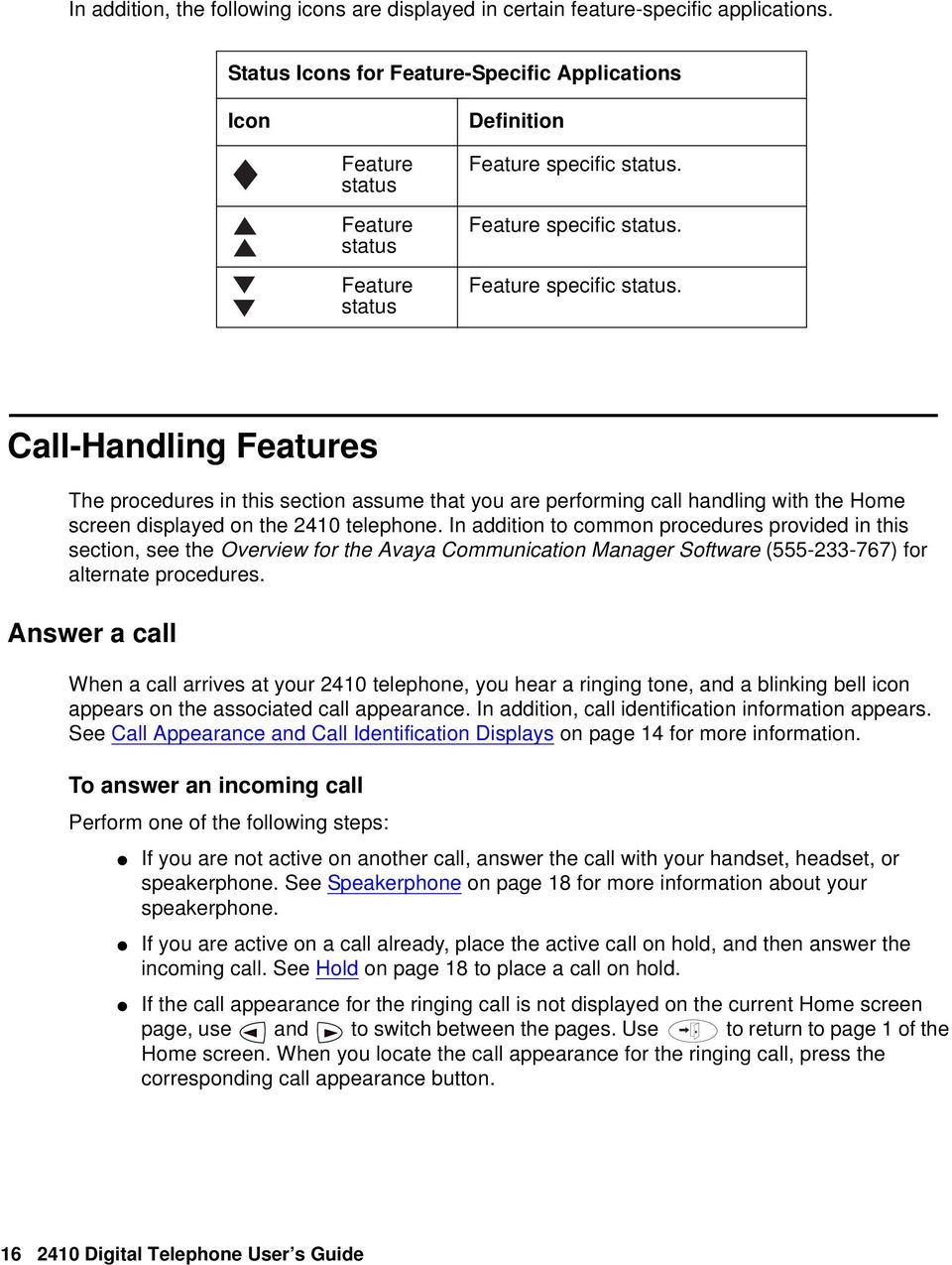
16 In addition, the following icons are displayed in certain feature-specific applications. Status Icons for Feature-Specific Applications Icon Definition Feature status Feature status Feature status Feature specific status. Feature specific status. Feature specific status. Call-Handling Features The procedures in this section assume that you are performing call handling with the Home screen displayed on the 2410 telephone. In addition to common procedures provided in this section, see the Overview for the Avaya Communication Manager Software ( ) for alternate procedures. Answer a call When a call arrives at your 2410 telephone, you hear a ringing tone, and a blinking bell icon appears on the associated call appearance. In addition, call identification information appears. See Call Appearance and Call Identification Displays on page 14 for more information. To answer an incoming call Perform one of the following steps: If you are not active on another call, answer the call with your handset, headset, or speakerphone. See Speakerphone on page 18 for more information about your speakerphone. If you are active on a call already, place the active call on hold, and then answer the incoming call. See Hold on page 18 to place a call on hold. If the call appearance for the ringing call is not displayed on the current Home screen page, use and to switch between the pages. Use to return to page 1 of the Home screen. When you locate the call appearance for the ringing call, press the corresponding call appearance button Digital Telephone User s Guide
17 Call-Handling Features Make a call You can make calls manually or automatically from the 2410 telephone. To make a call manually 1. Go off hook with the handset, headset, or speaker. 2. When you hear dial tone, press the dialpad buttons to enter the extension or telephone number. If you are calling an external number, you must include the required code (for example, 9 ) to access an outside line. To have the 2410 telephone make a call automatically Perform one of the following steps: Press to have the 2410 telephone dial the last number that you dialed. Speed Dial Access the Call Log and start a call to a specific entry. See Using the Call Log on page 34 for more information. Access the Speed Dial List in your personal directory and start a call to a specific entry. See Speed Dial on page 17. The Speed Dial feature allows you to have the 2410 telephone automatically dial calls to telephone numbers stored in your personal directory. See the procedures in Managing Your Speed Dial List on page 23 to create and maintain your personal 2410 telephone directory. To use the Speed Dial feature to make a call to a personal directory entry 1. If the softkey labels are not displayed, press any softkey button to display the softkey labels. 2. From the Home screen, press the SpDial softkey. The Speed Dial screen appears. 3. Press the button next to the entry you want to call. If the entry you want is not displayed on the current page, use and to cycle through the entries. The 2410 telephone dials the number for you. Issue 2 November

18 Hold The Hold feature puts a call on hold until you can return to it. To put a call on hold Press. To return to the held call Press the call appearance button of the held call. Your system manager might have administered the Unhold feature. In this case, you can return to the held call by pressing. Redial The Redial or Last Number Dialed feature automatically redials the last extension or outside number you dialed. To redial the last number that you dialed Press. Speakerphone The two-way built-in speakerphone allows you to make and answer calls without lifting your handset. Two-way speakerphones may not operate satisfactorily in very noisy locations. To make or answer a call without lifting the handset, or to use the speakerphone with any feature 1. Press. 2. Make or answer the call, or access the selected feature. 3. Adjust speakerphone volume if necessary. To raise the volume, press the volume control button. To lower the volume, press the volume control button. The display shows the volume level. There are eight volume levels. If you want to make the speakerphone volume louder, you can disable the speakerphone AGC. To disable the speakerphone AGC, set Speaker AGC Enabled to No in the second page of the Options screen. When enabled, speakerphone AGC automatically adjusts volume levels by increasing low signals and decreasing high signals. If you disable the speakerphone AGC, low volume levels are not increased automatically. See Working in the Options Screen on page Digital Telephone User s Guide

19 Call-Handling Features To change from the speakerphone to the handset Pick up the handset and talk. To change from the handset to the speakerphone 1. Press. 2. Hang up the handset. To change from the headset to the speakerphone Press. To end a speakerphone call Press Transfer again. To use the Group Listen feature (if administered) in which the handset or headset and the speaker are active at the same time While you are active on the handset or headset, press. The Transfer feature allows you to transfer a call from your telephone to another extension or outside number. To transfer the current call to another extension 1. While on a call, press. 2. When you hear dial tone, dial the number to which the call is to be transferred. 3. Perform one of the following steps: To transfer the call without announcing it, press again, and hang up. The transfer is complete. To announce the call before transferring it, wait for the called party to answer. See Step When the called party answers, announce the call. If the line is busy or if there is no answer, press. Then, you can return to the held call by pressing its call appearance button. 5. Press again and hang up to complete the transfer. The Transfer Completed message appears. Issue 2 November

20 Your system manager might have administered the Transfer-on-Hang-up feature. In this case, you can transfer a call by pressing, dialing the number to which the call is to be transferred, and then hanging up. To cancel an attempted transfer, press the original call appearance. If your system has auto-hold activated, use to cancel a transfer so the potential transfer recipient is not left on hold. Conference The Conference feature allows you to conference up to six parties (including yourself) on a call. To add another party to a call 1. Press. 2. When you hear dial tone, dial the number of the person you want to add to the call. 3. Wait for an answer. 4. To add the person to the call, press again. If the called party does not answer or does not want to join the conference, press. Then, you can return to the held call by pressing its call appearance button. 5. Repeat Steps 1 through 4 for additional conference connections. To add a held call to an active call 1. Press. 2. When you hear dial tone, press the call appearance button that corresponds to the held call. 3. Press again. To remove the last person added to the conference call 1. Ensure that the conferenced call appearance is selected. 2. Press Digital Telephone User s Guide

21 Getting Messages Getting Messages Message Your Message lamp turns on when a caller has left a message for you. Press your messages, and follow the prompts. to retrieve Your system manager must program certain features to activate the Message button. See your system manager if the Message button is not working properly. See Chapter 21, Features and Technical Reference, of the Administrator s Guide for Avaya Communications Manager Software, Document No for Message button programming information. The Speed Dial Screen Using the Speed Dial screen, you can store up to 48 speed dial entries in the personal directory of your 2410 telephone. You can access this screen by pressing the SpDial softkey at the Home screen. You might have to press any one of the softkeys to display the softkey labels. The personal directory containing your speed dial entries of numbers you call frequently is stored in your 2410 telephone. The personal directory is separate from the Directory feature, which resides on the call processing system. The Directory feature allows any call processing system user to search for the extension of another user in the call processing system directory. Your system manager administers the Directory feature. For more information about the Directory feature, see Using Display Features on page 55. When you have created a speed dial list, the Speed Dial screen displays the saved entries in alphabetical order. A single page displays six entries. You can make a call directly from this screen by pressing the button associated with a displayed entry. See Stay in Speed Dial Screen on page 48 if you want to set the 2410 to continue to display the Speed Dial screen when you make a call from a speed dial. Figure 4 shows a sample Speed Dial screen. Issue 2 November
22 Figure 4: Sample Speed Dial Screen Home : Lou Jane : Mary Jim : Patty Select name to CALL Add Edit Delete Done MENU From the Speed Dial screen, you can also: add entries delete entries make changes to saved entries in your personal speed dial list See Managing Your Speed Dial List on page 23 for more information. Working in the Speed Dial Screen Working in the Speed Dial Screen To Place a call to a displayed entry and return to the current Home screen Press The button associated with the entry View the next page of speed dial entries View the previous page of speed dial entries Use the index feature to locate a specific entry quickly The telephone must be on-hook when you use the index feature. Add an entry to the speed dial list Change information stored in the speed dial list Press 1 on the dialpad to move directly to the beginning of the speed dial list. Press keys 2 through 9 to locate entries that start with the letters that correspond to these keys. For example, press 3 to locate the first entry that starts with the letter D. The Add softkey The Edit softkey Digital Telephone User s Guide
23 Managing Your Speed Dial List Working in the Speed Dial Screen To Delete an entry from the speed dial list Return to the Home screen in which you worked previously Press The Delete softkey The Done softkey. See the following Note. Return to page 1 of the Home screen at any time When you manage your speed dial entries, the softkeys displayed at the bottom of the screen change to reflect the activities you can perform. For example, when you access the Edit screen, you can choose from the Add, Delete, and Done keys. The Edit and Delete softkeys are not displayed, though, until you have saved at least one entry in your personal speed dial list. Whenever you are working in the Speed Dial screens, you cannot use the telephone dialpad for dialing. Managing Your Speed Dial List Using the Speed Dial screen, you can store up to 48 speed dial entries in your personal 2410 telephone directory. You can access this screen by pressing the SpDial softkey at the Home screen. When you have created a speed dial list, the Speed Dial screen displays the saved entries in alphabetical order. A single page displays six entries. You can add entries, delete entries, and make changes to saved entries in your personal speed dial list. You can also save Call Log entries to your Speed Dial List. Issue 2 November
24 Quick Access to Speed Dial Entries When you access your speed dial list to select, edit, or delete entries, you can use the index feature to locate a specific entry quickly. For example, press 1 on the dialpad to move directly to the beginning of the list. You can use keys 2 through 9 on the dialpad to locate entries that start with the letters that correspond to these keys. For example, press 3 to locate the first entry that starts with the letter D. If no entries start with the letter D, then the first entry that starts with the letter E is selected. Editing Speed Dial Entries After you select a speed dial entry for editing, you can use the Backspace feature button and Clear feature button. The Backspace feature button deletes the character to the left of the cursor. The Clear feature button deletes all the characters in the selected field. Use to move the cursor to the left without erasing characters. For example, you can press to insert an area code in front of an existing telephone number in a saved entry. Use to move the cursor to the right without erasing characters. Entering Characters Whenever you press a key on the dialpad, the alphabetic character associated with the key appears on the screen display. In some cases, you might need to press the same key repeatedly to select other alphabetic characters. For example, to enter Jack: Press 5 for J. This first letter is automatically entered as an uppercase letter. All the following characters in the word appear in lowercase. Press 2 for a. Then, press to advance the cursor. Press 2 three consecutive times for c. Press 5 twice for k. Note that you must use if the next character you want to enter uses the same key as the character you just entered. For example, you use the 2 key to enter the characters a and c Digital Telephone User s Guide
25 Managing Your Speed Dial List Dialing Conventions It is important that you observe the following conventions as you enter speed dial numbers: You can enter telephone numbers up to 24 characters long, including special characters and spaces. You must include the code required to access an outside line (for example, 9 ) for external telephone numbers. You can use the Pause softkey to insert a 1.5-second pause. It is often useful to include a pause or series of pauses in beeper/pager numbers to allow a paging system enough time to answer. You can use the Hyphen softkey to insert hyphens between segments of a telephone number (for example, ). The hyphen might make the number easier for you to read but does not affect dialing. Adding Speed Dial Entries You can store up to 48 personal speed dial entries in the 2410 telephone. When the maximum number of entries is stored, you must delete existing entries before the 2410 telephone allows you to enter new entries. To add speed dial entries to your personal directory 1. From the Home screen, press the SpDial softkey. The Speed Dial screen appears. If no Speed Dial List already exists, the Empty Speed Dial List screen appears. 2. Press the Add softkey. The Edit Name screen appears with the Name field underscored. If the directory is full, a message appears indicating that your Speed Dial list is full. You must delete an existing entry before a new entry can be added. See Deleting Speed Dial Entries on page Using the dialpad, enter the name for your speed dial entry. You can enter up to 13 characters. By default, the first letter you enter appears in uppercase, and the following characters in the word appear in lowercase. Issue 2 November
26 You can use the Case softkey to switch between uppercase and lowercase. You can use the Space softkey to insert a space between words. After you enter a space, by default the next character is an uppercase letter. The following characters in that word appear in lowercase. If you enter special characters, you can use the * (star key) to cycle through the period and star characters. You can use the # (pound key) to cycle through the hyphen and pound characters. Use to move the cursor to the left without erasing characters. Use to move the cursor to the right without erasing characters. 4. When you finish entering a name, press the feature button to the left of the Number field to advance to that field. 5. Using the dialpad, enter the telephone number for this speed dial entry. You can enter numbers up to 24 characters long, including special characters. 6. When you finish entering the telephone number, perform one of the following steps: To save your entries and return to the Speed Dial screen, press the Save softkey. To continue without saving your entries, press the Cancel softkey. To return to page 1 of the Home screen without saving your entries, press. 7. Repeat Steps 2 through 6 to add more entries. Editing Speed Dial Entries You can edit information for any of the speed dial entries saved in your personal 2410 telephone directory. To edit stored speed dial entries 1. From the Home screen, press the SpDial softkey. The Speed Dial screen appears. 2. Press the Edit softkey. The Edit Name screen appears. You can use and or the index feature to locate the entry you want to edit. 3. Press the feature button that corresponds to the entry you want to edit. The Edit screen appears with the Name field underscored Digital Telephone User s Guide
27 Managing Your Speed Dial List 4. Using the dialpad, edit the name for your speed dial entry. You can enter up to 13 characters. By default, the first letter you enter appears in uppercase, and the following characters appear in lowercase. You can use the Case softkey to switch between uppercase and lowercase. You can use the Space softkey to insert a space between words. To enter special characters, you can use the * (star key) to cycle through the period and star characters. You can use the # (pound key) to cycle through the hyphen and pound characters. You can use the Backspace feature button to delete the character to the left of the cursor. You can use the Clear feature button to delete all the characters in the field. Use to move the cursor to the left without erasing characters. Use to move the cursor to the right without erasing characters. 5. When you finish editing the name, press the feature button to the left of the Number field to advance to that field. Otherwise, see Step Using the dialpad, edit the telephone number for this speed dial entry. You can enter numbers up to 24 characters long, including special characters. You can use the feature button to the right of the Number field to go to the end of existing text in that field. The feature button to the left of the Number field takes you to the start of any existing text in that field. The feature button at the top of the left column returns you to the Edit Name screen. 7. When you finish making changes, perform one of the following steps: To save your entries and return to the Edit screen, press the Save softkey. To return to the Edit screen without saving your entries, press the Cancel softkey. To return to page 1 of the Home screen without saving your entries, press. 8. Repeat Steps 3 through 7 to edit more entries. Deleting Speed Dial Entries You can delete any of the speed dial entries saved in your personal 2410 telephone directory. To delete stored speed dial entries 1. From the Home screen, press the SpDial softkey. The Speed Dial screen appears. 2. Press the Delete softkey. The Delete screen appears. Issue 2 November
28 3. Press the feature button that corresponds to the entry you want to delete. If the entry you want to delete is not displayed on the current screen page, use and to cycle through the speed dial list. You can also use the index feature to move to the page that contains the entry. The DELETE this entry? prompt appears. 4. Perform one of the following steps: To delete the selected entry, press the Yes softkey. To return to the Delete screen without deleting the entry, press the Cancel softkey. To return to page 1 of the Home screen without deleting the entry, press. 5. Repeat Steps 3 through 4 to delete more entries Digital Telephone User s Guide
29 The Call Log Screens The Call Log Screens The 2410 telephone can store up to 48 entries in the Call Log. By default, the 2410 telephone logs all types of calls and displays the number of missed calls below the date and time. See The Home Screen on page 12 for more information. When power to the telephone is interrupted, the 2410 telephone erases all entries in the Call Log. You can use the Log Setup option on the Options screen to disable the Call Log or specify certain call types you want logged. See The Options Screen on page 41 for more information. Two screens allow you to view Call Log information: The Call Log Summary screen The Call Detail screen The Call Log Summary Screen The Call Log Summary screen, which is accessed by pressing the Log softkey on the Home screen, displays the following call identification information: For incoming calls calling party name and telephone number, if this information is available from the call processing system. The caller s name might be abbreviated if it is longer than 16 characters. For outgoing calls the telephone number that you entered on the 2410 telephone dialpad. If you used the speed dial list to make a call, the speed dial entry name and number appear in the log. Outgoing calls made using the or other abbreviated dialing buttons cannot be logged. Each page of the Call Log Summary screen can display three entries. You can use and to page through all logged calls. See Figure 5. Issue 2 November
30 Figure 5: Sample Call Log Summary Screen 1 Jane King Mary Smith John Jetzt Select entry to view details Missed InAns Outgo More MENU The Call Log Summary screen contains two sets of softkeys. The first set of softkeys allows you to view missed calls, answered calls, or outgoing calls. See Figure 5. The second set of softkeys allows you to view all calls and to delete the displayed call log entries (for example, Outgoing call log entries). See Figure 6. Press the More softkey and the Back softkey to move back and forth between the first set of softkeys and the second set of softkeys. Figure 6: Sample Call Log Summary Screen with Second Set of Softkeys 1 Jane King Mary Smith John Jetzt Select entry to view details All Delete Back Done MENU When you select a call type, an arrow ( ) appears next to the softkey of the selected call type. The entries for the selected call type are displayed until you press the softkey of a different call type. By default, missed calls are displayed. The most recent call appears in the top-most position of the first page. When the log is full (that is, 48 calls), the log automatically deletes the oldest call information to allow for continuous logging without interruption. In addition, you can delete specific entries from the Call Log Detail screen. Whenever you access the Call Log Summary screen to view the missed call information in the call log, the counter resets to 0. To view more information for a specific entry, press the button associated with the entry to access the Call Log Detail screen Digital Telephone User s Guide
31 The Call Log Screens Working in the Call Log Summary Screen Working in the Call Log Summary Screen To View information about a specific log entry Press The button associated with the entry View the next page of call log entries View the previous page of call log entries View unanswered (missed) calls View incoming calls you answered View calls call you made View all entries in the call log. The 2410 telephone displays Answered entries, Unanswered entries, and Outgoing entries. Delete all entries in the displayed call log Use the index feature to locate a specific entry quickly The telephone must be on-hook when you use the index feature. Return to the Home screen in which you worked previously The Missed softkey The InAns softkey The Outgo softkey The More softkey, and then press the All softkey The More softkey, and then press the Delete softkey Press 0 on the dialpad to move directly to the first call log entry. Press 1 to view the page containing the tenth call log entry. Press 2 to view the page containing the twentieth call log entry. Press 3 to view the page containing the thirtieth call log entry. Press 4 to view the page containing the fortieth call log entry. Press 5 to view the last call log entry. The Done softkey Return to page 1 of the Home screen at any time Issue 2 November
32 Call Log Detail Screen The Call Log Detail screen, which is accessed from the Call Log Summary screen, allows you to: View additional information, such as call type and the date and time that the call was processed. Make a call to the entry displayed directly from this screen. See Using the Call Log on page 34 for more information. Figure 7 shows a sample Call Log Detail screen. Figure 7: Sample Call Log Detail Screen 4 Un-Answered Patty Yee :34pm 3/29/04 Call Delete Save Done MENU The number displayed in the upper left corner of the screen indicates the position of this call in the log summary. The call type appears in the upper right corner. The possible call types are Answered, Un-answered, or Outgoing. For answered calls and outgoing calls, the duration of the call appears in the lower right corner of the screen Digital Telephone User s Guide
33 The Call Log Screens Working in the Call Log Detail Screen Working in the Call Log Detail Screen To Make a call to the entry displayed Press The Call softkey View the next call log entry View the previous call log entry Use the index feature to locate a specific entry quickly The telephone must be on-hook when you use the index feature. Remove the selected entry Save the selected entry as a speed dial entry Return to the Call Log Summary screen in which you worked previously Press 0 on the dialpad to move directly to the first call log entry. Press 1 to view the tenth call log entry. Press 2 to view the twentieth call log entry. Press 3 to view the thirtieth call log entry. Press 4 to view the fortieth call log entry. Press 5 to view the last call log entry. The Delete softkey The Save softkey The Done softkey Return to page 1 of the Home screen at any time Issue 2 November
34 Using the Call Log The Call Log feature is factory set to record answered, unanswered (missed), and outgoing calls. For information on disabling the Call Log or changing the call types you want logged, see Call Log Setup on page 46. Viewing the Call Log To view the list of all calls recorded in the Call Log 1. If the softkey labels are not displayed, press any softkey button to display the softkey labels. 2. From the Home screen, press the Log softkey. The Call Log Summary screen appears. 3. Press the appropriate softkey for the type of call entries you want to view. Your choices are missed, answered, and outgoing. By default, missed calls are displayed. If you want to view all entries, press the More softkey, and then press the All softkey. 4. Use and to scroll through the Call Log Summary pages. 5. To view information about a specific entry, press the button that corresponds to the entry. The Call Log Detail screen for this entry appears. 6. Press to return to the Home screen. Making Calls from the Call Log To make a call to an entry in the Call Log 1. From the Home screen, press the Log softkey. The Call Log Summary screen appears. 2. Use and to scroll through the Call Log Summary pages. 3. When you locate an entry you want to call, press the button that corresponds to the entry. The Call Log Detail screen for this entry appears. 4. Press the Call softkey to make the call. You can use this method to make calls directly to extensions. To call outside numbers, go off-hook and dial the required code to access an outside line (for example, 9 ). Then, press the Call softkey to make the call Digital Telephone User s Guide
35 Using the Call Log Saving a Call Log Entry to Your Speed Dial List To save an entry in the Call Log to your Speed Dial List 1. From the Home screen, press the Log softkey. The Call Log Summary screen appears. 2. Use and to scroll through the Call Log Summary pages. 3. When you locate an entry you want to save, press the button that corresponds to the entry. The Call Log Detail screen for this entry appears. 4. Press the Save softkey. The Edit Name screen appears and shows the name and number information from the Call Log. 5. Perform one of the following steps: To save the entry to your Speed Dial List as shown on the current screen, press the Save softkey. To edit the name, press the feature button to the left of the Name field twice. The cursor appears at the beginning of the name. Make your changes. Use the Backspace feature button to delete the character to the left of the cursor. Use the Clear feature button to delete all the characters in the field. If you want to edit the telephone number, see the next bulleted item. When you finish entering changes, press the Save softkey. To edit the telephone number to include a code required to access an outside line (for example, 9 ), press the feature button to the left of the Number field twice. The cursor appears at the beginning of the telephone number. Make your changes. Use the Backspace feature button to delete the character to the left of the cursor. Use the Clear feature button to delete all the characters in the field. When you finish entering changes, press the Save softkey. The entry is saved to your Speed Dial List. If you see the message Speed Dial List Full, you must delete some Speed Dial List entries before you can add new entries. Deleting a Call Log Entry To delete an entry from the Call Log 1. From the Home screen, press the Log softkey. The Call Log Summary screen appears. 2. Use and to scroll through the Call Log Summary pages. Issue 2 November
36 3. When you locate an entry you want to delete, press the button that corresponds to the entry. The Call Log Detail screen for this entry appears. 4. Press the Delete softkey. The entry is deleted from the Call Log. To delete all entries from the Call Log 1. From the Home screen, press the Log softkey. The Call Log Summary screen appears. 2. To delete the entries for a specific call type, press the appropriate softkey. If you want to delete all entries, press the More softkey, and then press the All softkey. The entries for the selected call type appear. 3. Press the Delete softkey. The Confirm Delete All screen appear. 4. Press the Erase softkey. The entries are deleted from the Call Log. The Label Action Screen The Label Action screen, which is accessed by pressing the Label softkey at the Home screen, allows you to: customize the labels for the call appearance/feature buttons programmed on the call processing system view the system labels for the call appearance/feature buttons programmed on the call processing system erase the labels you modified for the call appearance/feature buttons and restore the system labels from the call processing system Figure 8 shows the Label Action screen Digital Telephone User s Guide
37 The Label Action Screen Figure 8: Label Action Screen Choose action below Edit Inspect Restore Done MENU Working in the Label Action Screen Working in the Label Action Screen To Change the label of a call appearance/feature button View the system labels for the call appearance/feature buttons Delete the customized labels of all the call appearance/feature buttons and restore all the system labels. Return to the Home screen in which you worked previously Press The Edit softkey The Inspect softkey The Restore softkey The Done softkey. See the following Note. Return to page 1 of the Home screen at any time When you manage the labels of your call appearance/feature buttons, the softkeys displayed at the bottom of the screen change to reflect the activities you can perform. Whenever you change the labels of call appearance/feature buttons in the Label Select screen, you cannot use the telephone dialpad for dialing. Issue 2 November
38 Managing Your Call Appearance/Feature Button Labels Using the Label Action screen, you can: customize the labels of the call appearance/feature buttons on the 2410 telephone view the labels of the call appearance/feature buttons on the call processing system restore the system labels of all the call appearance/feature buttons You can access this screen by pressing the Label softkey at the Home screen. Editing Labels You can change the labels of the call appearance/feature buttons on your telephone. These new labels are stored in your 2410 telephone. To edit call appearance/feature button labels 1. If the softkey labels are not displayed, press any softkey button to display the softkey labels. 2. From the Home screen, press the Label softkey. The Label Action screen appears. 3. Press the Edit softkey. The Label Select screen appears. You can use and to locate the label you want to edit. 4. Press the feature button on the 2410 telephone that corresponds to the label you want to edit. The Label Edit screen appears. The New Label field displays the current customized label (if any), and the System Label field displays the system label. If you have not yet changed the system label, a cursor appears next to the New Label field. If you selected a call appearance, a letter (such as a ) and a space appear next to the New Label field. You can delete the letter and space by pressing the Backspace feature button twice. If you have already changed the system label, a cursor appears after the last letter of the information displayed in the New Label field Digital Telephone User s Guide
39 Managing Your Call Appearance/Feature Button Labels 5. Using the dialpad, edit the label. You can enter up to 13 characters. By default, the first letter you enter appears in uppercase, and the following characters appear in lowercase. You can use the Case softkey to switch between uppercase and lowercase. You can use the Space softkey to insert a space between words. If you are entering special characters, you can use the * (star key) to cycle through the period and star characters. You can use the # (pound key) to cycle through the hyphen and pound characters. You can use the Backspace feature button to delete the character to the left of the cursor. You can use the Clear feature button to delete all the characters in the field. Use to move the cursor to the left without erasing characters. Use to move the cursor to the right without erasing characters. If you want to restore the system label, press the Clear feature button to delete all the characters in the field. Leave this field blank, and see Step When you finish making changes, perform one of the following steps: To save your entries and return to the Label Select screen, press the Save softkey. To return to the Label Select screen without saving your entries, press the Cancel softkey. To return to page 1 of the Home screen without saving your entries, press. 7. Repeat Steps 3 through 5 to edit more labels. Viewing the System Labels You can view the system labels for the call appearance/feature buttons on the call processing system. To view the system labels 1. From the Home screen, press the Label softkey. The Label Action screen appears. 2. Press the Inspect softkey. The Label Inspect screen appears. This screen displays the system labels for the 2410 telephone. 3. Use and to scroll through the Label Inspect screen pages on the 2410 telephone. 4. Perform one of the following steps: To return to the Label Action screen, press the Done softkey. To return to page 1 of the Home screen, press. Issue 2 November
40 Restoring the System Labels You can delete the custom labels you created for the call appearance/feature buttons and restore the system labels from the call processing system. This procedure restores the system labels for all the call appearances/feature buttons. If you want to restore the system label for one call appearance/feature button, delete the label for that button. See Editing Labels on page 38. To restore the system labels 1. From the Home screen, press the Label softkey. The Label Action screen appears. 2. Press the Restore softkey. The Label Restore screen appears. 3. Press the Erase softkey. The Confirm Erase prompt appears. 4. Perform one of the following steps: To erase the custom labels and restore the system labels, press the Erase softkey. To return to the Label Action screen without erasing the custom labels and restoring the system labels, press the Cancel softkey. To return to page 1 of the Home screen without erasing the custom labels and restoring the system labels, press Digital Telephone User s Guide
41 The Options Screen The Options Screen The Options screen, which you access by pressing the Option softkey at the Home screen, allows you to set the following options: ring pattern screen contrast log setup visual ring (Flash Message Lamp option) whether you want the 2410 to continue to display the current screen when you receive an incoming call instead of showing the Home screen (Show Phone Screen option) whether you want the 2410 to continue to display the Speed Dial screen when you make a call from a speed dial (Stay in Speed Dial option). self test language English, German (Deutsch), French (Français), Spanish (Español), Italian (Italiano), Dutch (Nederlands), Portuguese (Português), or Japanese (Katakana) From the Options screen, you can also erase some or all of your personalized settings and return the 2410 telephone to its default settings. Figure 9. shows a sample Options screen. Figure 9: Sample Options Screen Ring Options : Miscellaneous Contrast : Self Test Log Setup : Language Select OPTION above Done MENU Issue 2 November
42 Working in the Options Screen Working in the Options Screen To Select an option Return to the Home screen in which you worked previously Press The associated button The Done softkey Return to page 1 of the Home screen at any time If If you press, a second screen appears. Use this screen to enable and disable the Automatic Gain Control (AGC) feature for the handset, headset, or speakerphone. We strongly recommend that you leave the default settings unchanged. However, hearing aid users might benefit if the AGC feature for the handset is disabled. Changing the default settings can adversely affect audio quality. See your system manager for more information. you press (or twice), a third screen appears. This screen allows you to select items such as speed dials to be erased and reset the 2410 telephone to its default settings Digital Telephone User s Guide
43 Selecting Personalized Options Selecting Personalized Options Ring Pattern The Ring Pattern option on the Ring Options screen allows you to choose a personalized ringing pattern for your telephone. You can choose from among eight different patterns. If you receive an incoming call while working in the Ring Pattern option screen, the Home screen appears automatically to facilitate call handling. To select a personalized ringing pattern 1. If the softkey labels are not displayed, press any softkey button to display the softkey labels. 2. From the Home screen, press the Option softkey. The Options screen appears. 3. Press the Ring Options feature button. The Ring Options screen appears. 4. Press the Ring Pattern feature button. The Select Ring Pattern screen with the current ring pattern appears. 5. Use and or the dialpad to cycle through all eight ringing patterns. To listen to a specific ring pattern, press the Play softkey for a selected ring pattern number. 6. Perform one of the following steps: If you want to save the ringing pattern that you have just selected, press the Save softkey. You will hear a confirmation tone, and you are returned to the Ring Options screen. If you want to return to the Ring Options screen without changing the ring pattern, press the Cancel softkey. If you want to return to page 1 of the Home screen without changing the ring pattern, press. If you go off-hook, receive a call, or lose power during selection, the process is canceled and you must start again. Issue 2 November
44 Visual Ring (Flash Message Lamp) The Ring Options option on the Options screen allows you to choose a visual alert for incoming calls. When you enable the Flash Message Lamp option, the telephone rings and the lamp above the 2410 display area flashes when an incoming call arrives. By default, the Flash Message Lamp option is disabled. To set the Flash Message Lamp option 1. From the Home screen, press the Option softkey. The Options screen appears. 2. Press the Ring Options feature button. The Ring Options screen appears. 3. Press the Flash Message Lamp feature button. The option setting is underlined. 4. Press the Yes/No softkey or feature button 5 to indicate whether you want Flash Message Lamp enabled. 5. Perform one of the following steps: If you want to save the setting you just selected, press the Save softkey. You will hear a confirmation tone, and you are returned to the Options screen. Show Phone Screen If you want to return to the Options screen without changing the setting, press the Cancel softkey. If you want to return to page 1 of the Home screen without changing the setting, press. The Show Phone Screen option on the Ring Options screen allows you to set the 2410 to display the Home screen and the ringing call appearance when you receive an incoming call. However, if you want the 2410 to continue to display the current screen when you receive an incoming call instead of showing the Home screen, you must disable this feature. By default, the Show Phone Screen option is disabled. To set the Show Phone Screen option 1. From the Home screen, press the Option softkey. The Options screen appears. 2. Press the Ring Options feature button. The Ring Options screen appears Digital Telephone User s Guide
45 Selecting Personalized Options 3. Press the Show Phone Screen feature button. The underline appears on this line. 4. Press the Yes/No softkey or feature button 4 to indicate whether you want the Show Phone Screen option enabled. 5. Perform one of the following steps: If you want to save the setting you just selected, press the Save softkey. You will hear a confirmation tone, and you are returned to the Options screen. Display Contrast If you want to return to the Options screen without changing the setting, press the Cancel softkey. If you want to return to page 1 of the Home screen without changing the setting, press. The Contrast option on the Options screen allows you to choose a contrast level for your telephone display. You can choose from among fifteen levels of contrast. To select a contrast level 1. From the Home screen, press the Option softkey. The Options screen appears. 2. Press the Contrast feature button. The Display Contrast screen appears. 3. Use and to adjust the level of contrast. 4. Perform one of the following steps: To return to the Options screen, press the Done softkey. To return to page 1 of the Home screen, press. The new contrast level is set. Issue 2 November
46 Call Log Setup The Log Setup option on the Options screen allows you to specify which types of calls you want the 2410 to log. These call types include: Answered (incoming) Unanswered (incoming) Outgoing You can choose to have some, none, or all these call types logged. For information about viewing the Call Log Summary, see The Call Log Screens on page 29, earlier in this guide. To specify the call types that you want to appear in the Call Log 1. From the Home screen, press the Option softkey. The Options screen appears. 2. Press the Log Setup feature button. The Call Log Setup screen appears. The current Yes/No setting is underscored for the selected item. 3. Press the appropriate button on the right side of the display. For example, press feature button 4 to select the Answered call type and change the Yes/No setting with a single button press. 4. Perform one of the following steps: If you want to save the selections that you have just made, press the Save softkey. You will hear a confirmation tone, and you are returned to the Options screen. If you want to return to the Options screen without saving your entries, press the Cancel softkey. If you want to return to page 1 of the Home screen without saving your entries, press. If you press the Save softkey, all entries that do not match the call types you specified are deleted from the call log Digital Telephone User s Guide
47 Selecting Personalized Options Erase The third Options screen allows you to erase some or all of your personalized settings. From this screen, you can erase the following settings: all entries saved in your Speed Dial list all entries saved in your Call Log all customized call appearance/feature button labels options such as ring pattern, flash message lamp, show phone screen, and stay in speed dial The contrast level setting is not changed. language Pressing the All feature button selects all five of the items to erase. To erase all personalized settings 1. From the Home screen, press the Option softkey. The Options screen appears. 2. Press or until the Erase screen appears. 3. Press the feature button next to each item you want to select to be erased. If you want to select all the items to be erased, press the All feature button. An icon ( ) appears next to each setting you selected. To unselect an item, press its feature button again. 4. Press the Erase softkey. The Confirm Erase screen appears and displays a message that you cannot undo this action. 5. Perform one of the following steps: If you want to erase the selected settings, press the Erase softkey. The selected settings are erased, and you are returned to the Options screen. If you want to return to the Options screen without erasing any settings, press the Cancel softkey. If you want to return to page 1 of the Home screen without erasing any settings, press. Issue 2 November
48 Stay in Speed Dial Screen Self Test The Stay in Speed Dial option on the Options screen allows you to set the 2410 to continue to display the Speed Dial screen when you make a call from a speed dial. If you make a call from a speed dial when this option is enabled, the 2410 will continue to display the Speed Dial screen instead of automatically exiting to show the Home screen. The Stay in Speed Dial option is useful if you want to dial multiple speed dials for a single call. An example is if you have one speed dial that dials the telephone number of your bank and another speed dial that dials your account code. By default, the Stay in Speed Dial option is disabled. To set the Stay in Speed Dial option 1. From the Home screen, press the Option softkey. The Options screen appears. 2. Press the Miscellaneous feature button. The Stay in Speed Dial screen appears. 3. Press the Yes/No softkey or feature button 4 to indicate whether you want Stay in Speed Dial enabled. 4. Perform one of the following steps: If you want to save the setting you just selected, press the Save softkey. You will hear a confirmation tone, and you are returned to the Options screen. If you want to return to the Options screen without changing the setting, press the Cancel softkey. If you want to return to page 1 of the Home screen without changing the setting, press. The Self Test option, which appears on the Options screen, verifies the operation of the 2410 telephone s lamps and display components. This screen also provides information regarding the 2410 telephone firmware version and link status. While the Test softkey is held down, you are unable to make calls and use the dialpad and call-handling buttons. You can answer calls with the handset. To have the 2410 telephone perform a self test 1. From the Home screen, press the Option softkey. The Options screen appears. 2. Press the Self Test feature button. The Self Test screen appears Digital Telephone User s Guide
49 Selecting Personalized Options Language 3. Press and hold the Test softkey to begin the test process. 4. Perform one of the following steps: If you want to exit test mode and return to the Options screen, press the Done softkey. If you want to exit test mode and to return to page 1 of the Home screen, press. When the 2410 telephone is first installed, it is set to display screen text in English. The Language option on the Options screen allows you to choose another language, including: German (Deutsch) French (Français) Spanish (Español) Italian (Italiano) Dutch (Nederlands) Portuguese (Português) Japanese (Katakana) To select a screen display language 1. From the Home screen, press the Option softkey. The Options screen appears. 2. Press the Language feature button. The Select Language screen appears. 3. Use the More softkey or or to switch between the two pages of languages. 4. Press the button next to the language in which you want text displayed. The screen text is reappears in the language you selected. 5. Perform one of the following steps: If you want to return to the Options screen, press the Done softkey. If you want to return to page 1 of the Home screen, press. Your language selection is saved. Issue 2 November
50 Using Selected Voice Features The following features are available only if your system manager has administered them as feature buttons on your 2410 telephone or has supplied you with the required feature access codes. Abbreviated Dialing/Automatic Dialing (AD) The Abbreviated Dialing (AD) feature allows you to store selected telephone numbers for quick and easy dialing. Each number can be a complete or partial telephone number, an extension number, or a trunk or feature access code and can contain up to 24 digits. Abbreviated Dialing offers four possible types of lists Personal, Group, System, and Enhanced, and you can have a total of three lists. Of these three lists, you can have only one System List and one Enhanced List. You program numbers on a Personal List. The controller of the Group List programs numbers on Group Lists. The system manager programs System Lists and Enhanced Lists. Calls you make with the Abbreviated Dialing/Automatic Dialing feature are not stored in the Call Log even if you programmed the 2410 telephone to log outgoing calls. To place a call using an Abbreviated Dialing list button or feature access code 1. Press the Abbreviated Dialing list button (if administered) or Dial the appropriate Abbreviated Dialing List code for List 1, or List 2, or List When you hear dial tone, dial the desired list item (1, 2, 3...). An Enhanced List may also be available. See your system manager. You can also program a number on an Abbreviated Dialing button that is not stored on an Abbreviated Dialing list. This Automatic Dialing number can be up to 16 digits and have a five-character label. To program a number on an Abbreviated Dialing button You must have an Abbreviated Program (Abr Program) button administered as well as the Abbreviated Dialing button. For this feature to work, the speaker is activated. Pressing does not exit programming mode. You must hang up to update the display and exit programming mode. 1. Press the Abr Program button. 2. Follow the prompts on your display to program the number and label. 3. Press the # key to save the entry Digital Telephone User s Guide
51 Using Selected Voice Features 4. Press another Abbreviated Dialing button to program. If you make a mistake while programming, press the # key to save the entry and then start over. To call a number using an Abbreviated Dialing button Press the Abbreviated Dialing button to automatically dial the stored number. Call Forwarding All Calls The Call Forwarding feature temporarily forwards all your calls to another extension or to an outside number, depending on your system. To temporarily redirect all calls to an extension or outside number of your choice 1. Press the Call Fwd button (if administered) (while on-hook or off-hook) or Dial the Call Forward feature access code (while off-hook). If you have console permission, next, dial the extension number whose calls are to be forwarded; receive dial tone. 2. When you hear dial tone, dial the extension or number where calls will be sent. 3. When you hear confirmation tone, hang up. Call Park To cancel Call Forwarding Press the Call Fwd button again (while on-hook) or Dial the Call Forward cancel code (while off-hook). The Call Park feature allows you to put a call on hold at your telephone for retrieval at any extension. To park a call at your extension (for retrieval at any extension) when a Call Park button is administered 1. Press the Call Park button. 2. Hang up. Issue 2 November
52 To park a call at your extension (for retrieval at any extension) when a Call Park button is not administered 1. Press. 2. Enter the Call Park feature access code. 3. When you hear confirmation tone, hang up. To retrieve a parked call from another extension 1. Pick up the handset or press. 2. Dial the Answer Back feature access code. 3. When you hear a dial tone, dial the extension at which you parked the call. If returning to a call parked at your telephone, dial your own extension. Call Pickup and Directed Call Pickup The Call Pickup feature lets you answer a call at your telephone for another extension in your pickup group. If you can use the Directed Call Pickup feature, you can pick up a call ringing at a specific extension without the extension being a member of your pickup group. To answer a call placed to a member of your pickup group when your telephone is idle Press the CallPickup button (if administered) or Dial the Call Pickup access code. Called telephone stops ringing, and you are connected to the ringing call. To pick up a call directly for someone else in your office Again, the Directed Call Pickup feature is designed for covering calls for associates while they are away from their desk. In this case, you do not have to be a member of the same pickup group. 1. Press the DirCall PkUp button or Dial the Directed Call Pickup access code. 2. Dial the extension of the ringing telephone. The called telephone stops ringing, and you are connected to the ringing call Digital Telephone User s Guide
53 Using Selected Voice Features Leave Word Calling The Leave Word Calling (LWC) feature leaves a message for a person at another extension to call you back. The called party can dial the message service such an attendant, a voice mail system, or a covering user to retrieve a short, standard message that provides the following information: your name and extension the date and time you called the number of times you called To leave a message after dialing an extension when your call is not answered, you hear a coverage or busy tone, or you have been put on hold Press the LWC button (if administered) and listen for confirmation tone before hanging up. Message lamp goes on at the called telephone (if so equipped). If you hear reorder tone, the message is not stored; try again. To leave a message without ringing an extension 1. Press the LWC button or Dial the Leave Word Calling access code (while off-hook). 2. When you hear dial tone, dial the extension and listen for the confirmation tone. Message lamp goes on at the called telephone (if so equipped). 3. Hang up. To cancel a Leave Word Calling message You cannot cancel a message left for an AUDIX subscriber. 1. Press the Cancel LWC button (while on-hook or off-hook) or Dial the Leave Word Calling cancel code (while off-hook). 2. When you hear dial tone, dial the extension and listen for confirmation tone. If you hear reorder tone, the message is not canceled. Try again. Issue 2 November
54 Send All Calls The Send All Calls feature temporarily sends all your calls to your voice mail system or to another extension in the same system. Priority calls and automatic callbacks are not redirected by the Send All Calls feature. Before you can use this feature, your system manager must provide a coverage path for your extension. To send all calls except priority calls and automatic callbacks immediately to coverage 1. Press the Send Calls button (while on-hook) or Dial the Send All Calls access code (while off-hook) 2. Listen for confirmation tone. You hear confirmation tone only when you use a feature access code. To cancel Send All Calls 1. Press the Send Calls button again (while on-hook) or Dial the Send All Calls cancel code (while off-hook). 2. Listen for confirmation tone. Whisper Page The Whisper Page feature allows you, if you have appropriate permissions, to make an announcement to a person at another extension currently on another call. The Whisper Page feature forms a one-way speaking path to the destination you call. The person at the destination extension can hear you but not speak to you. Both people on the other call will hear a beep that indicates an incoming Whisper Page. However, only the person at the destination extension hears the announcement. The other person on the call cannot hear your announcement. If the person at the other extension wants to speak with you when you make a Whisper Page, that person can press the WhisperAnbk button. If the person whom you have called is not using the telephone at the time you activate Whisper Page, the call is converted to a normal call. Any person in the system can block Whisper Page calls. To block a Whisper Page call, press the WhisperOff button. When Whisper Page is off, the Whisper Page caller hears busy tone Digital Telephone User s Guide
55 Using Display Features To make an important announcement such as an incoming call to someone at another extension busy on another call 1. While off-hook, press the WhisperAct button or dial the Whisper Page access code, and dial the extension. Both people on the other call hear a beep. Only the person whom you called will hear your announcement. 2. Speak to the person you called. If that person wants to speak with you, that person can press the WhisperAnbk button, which forms a two-party speaking path with your telephone. The other call at the destination extension is put on hold, and that person cannot hear your conversation. When the call is complete, the person to whom you were speaking can press the call appearance button of the held call. To respond to a Whisper Page 1. When you receive a Whisper Page, you hear a beep, and then you hear the person calling you. If you want to speak to the Whisper Page caller, press the WhisperAnbk button. Your existing call is placed on hold, and you can speak to the Whisper Page caller. 2. When you finish with the Whisper Page call, press the call appearance of the held call. Using Display Features The following features are available only if your system manager administered them as feature buttons on your 2410 telephone. Call Timer and Timer The Call Timer and the Timer features measure elapsed time on a call. The Call Timer feature, once activated, measures elapsed time automatically on all calls until you turn off the Call Timer feature. The Timer feature, which you turn on and off manually, allows you to determine which calls you want to time on an individual basis. Check with your system manager to see if you can use either of these features. Issue 2 November
56 Directory To use the Call Timer feature to measure elapsed time on telephone calls 1. Press the Call Timer button (if administered). The Call Timer measures elapsed time automatically on all calls until you turn off the Call Timer feature. 2. When you want to turn off the Call Timer feature, press the Call Timer button again. To use the Timer feature to measure elapsed time on an individual telephone call 1. Press the Timer button (if administered). 2. To stop the timer and clear the display, press Timer again. The elapsed time appears for three seconds. The Directory feature allows you to search for the extension of another user in your call processing system directory by entering the user s name at the dialpad. To search the directory for a name 1. Press the Directory button if administered. 2. Enter the selected name with dialpad keys: last name, comma (use * ), first name or initial. 3. Press the Next button for each successive directory name you want to see. Your system manager must administer the Next button. 4. To search for a new name, press the Directory button, and repeat Steps 2 and When you are ready to exit the directory, press. To place a call to the name shown on the display 1. Pick up the handset. 2. While the name is shown, press the Make Call button if administered or, if you do not have a Make Call button on your telephone, press, and then dial the number from the dialpad. You can also leave your handset on-hook. The speakerphone turns on automatically when you press Make Call if this system feature is enabled Digital Telephone User s Guide
57 Tones and Their Meaning Inspect The Inspect feature shows you call-related information for an incoming call when you are already active on a call. To use the Inspect feature 1. Press the Inspect button if administered. 2. Press the call appearance button in question. Information appears on the display screen. You remain connected to the present call. 3. To return to the held call, press and then the call appearance button of the held call. Tones and Their Meaning The following tables describe the defaults for each ringing and feedback tone. Check with your system manager to verify if the descriptions in the Meaning column are accurate for your system. Ringing Tones are produced by an incoming call. Ringing Tones Rings Meaning 1 ring A call from another extension. 2 rings A call from outside or from the attendant. 3 rings A priority call from another extension or from an Automatic Callback call you placed. ring-ping (half-ring) A call redirected from your telephone to another telephone because Send All Calls or Call Forwarding All Calls is active. Issue 2 November
58 Feedback tones are those which you hear through the handset, headset, or the speaker. Feedback Tones Tones Meaning busy call waiting ringback confirmation coverage dial intercept/ time-out recall dial reorder ringback A low-pitched tone repeated 60 times a minute. This tone indicates that the number you dialed is in use. A ringback tone with lower-pitched signal at the end. This tone indicates that the extension you called is busy. The called party hears a call waiting tone. If you hear the call waiting ringback tone, you may want to activate Automatic Callback. Three short bursts of tone. This tone indicates that the system accepted a feature activation or cancellation. One short burst of tone. This tone indicates that the system sent your call to another extension to be answered by a covering user. A continuous tone. This tone indicates that you can start to dial. An alternating high and low tone. This tone indicates a dialing error, a denial of the service requested, or a failure to dial within a preset interval (usually 10 seconds) after you lifted the handset or dialed the previous digit. Three short bursts of tone followed by a steady dial tone. This tone indicates that the system accepted the feature request. You can start to dial. A fast busy tone repeated 120 times a minute. This tone indicates that all trunks are busy. A low-pitched tone repeated 15 times a minute. This tone indicates that the number you dialed is ringing Digital Telephone User s Guide
59 Index Index Numerical 2410 telephone display features feedback tones personal directory ringing tones supported languages telephone components telephone display A Abbreviated Dialing AD button adding Speed Dial entries AGC feature arrow keys Automatic Dialing Automatic Gain Control feature B buttons C call appearance displays call appearance/feature buttons , 14 Call Forwarding , 51 call handling buttons call handling features call identification call identification displays Call Log saving entries setting up viewing Call Log Detail screen , 33 Call Log feature Call Log screens Call Log Summary screen , 31 Call Park Call Pickup Call softkey Call Timer call type calls answering conferencing holding making redialing speakerphone Speed Dial transferring Case softkey , 39 checklist Conference feature Contrast feature button D deleting entries deleting Speed Dial List entries dialing conventions dialpad Directed Call Pickup Directory Directory feature display contrast display contrast level display features Call Timer Directory Inspect E editing Speed Dial entries Erase All feature button Erase All option Erase option Erase softkey Exit button F feature , 52 feedback tones Flash Message Lamp option G Group Listen feature Issue 2 November
60 Index H Headset button headsets headsets supported Hold feature Home screen navigating pages I index feature Inspect L Label Action screen navigating Label softkey Labels Language feature button Language option Last Number Dialed feature Leave Word Calling Log Setup feature button Log Setup option Log softkey M Message button Message lamp , 21 message retrieval message service Mute button N navigating , 33 O Option softkey , 45 options Call Log setup display contrast Erase Erase All Flash Message Lamp Language ring pattern Self Test Show Phone Screen options, (continued) Stay in Speed Dial Visual Ring Options screen navigating overview P personal directory , 25 personal directory calls personalized options Play softkey R Redial feature ring pattern Ring Pattern feature button ringing ringing tones S safety information saving Call Log entries screen Self Test feature button Self Test option self-test mode Send All Calls Show Phone Screen option softkeys Speaker button speakerphone calls speakerphone feature Speed Dial List , 27 adding entries editing entries index feature saving entries from Call Log Speed Dial screen navigating status icons Stay in Speed Dial option T Test softkey Timer tones feedback Transfer feature trunk identifier Digital Telephone User s Guide
61 Index U user checklist V Visual Ring feature button , 45 Visual Ring option voice features Abbreviated Dialing Call Park Call Pickup Leave Word Calling Send All Calls Whisper Page volume control buttons W Whisper Page Issue 2 November
62 Index Digital Telephone User s Guide
2420 Digital Telephone User s Guide Release 5
 2420 Digital Telephone User s Guide Release 5 555-250-701 Issue 5 July 2013 Copyright 2013, Avaya Inc. All Rights Reserved Notice Every effort was made to ensure that the information in this document was
Avaya 2410 Digital Telephone End User Guide
 Avaya 2410 Digital Telephone End User Guide 2410 Digital Telephone End User Guide 1 P age Table of Contents About Your Telephone... 3 The Home Screen... 5 Navigating in the Home Screen Pages... 6 Call
2420 Digital Telephone Quick Reference
 2420 Digital Telephone Quick Reference 555-250-201 Issue 2 November 2002 NOTICE While reasonable efforts were made to ensure that the information in this document was complete and accurate at the time
2402 Digital Telephone User s Guide
 2402 Digital Telephone User s Guide 555-233-789 Issue 1 October 2003 NOTICE While reasonable efforts were made to ensure that the information in this document was complete and accurate at the time of printing,
Avaya 2420 Digital Telephone End User Guide
 Avaya 2420 Digital Telephone End User Guide 2420 Digital Telephone End User Guide 1 P age Table of Contents About Your Telephone... 3 Overview... 3 Support for Call Center Users... 3 Support for Optional
2420 Digital Telephone Instruction Booklet
 2420 Digital Telephone Instruction Booklet * 7 line x 29 character display * 24 system call appearance/feature button * Provides automated call tracking with 100-entry call log * Provides access to 104
TABLE: The 2420 Telephone Components
 2420 Telephone TABLE: The 2420 Telephone Components 1. Display, Call Appearance and Feature buttons: Call Appearance Keys allow the user to handle multiple calls and the display shows call information.
Avaya Campus PBX MICHIGAN STATE UNIVERSITY. Telecommunication Systems. Avaya 2410 User Guide
 Avaya Campus PBX MICHIGAN STATE UNIVERSITY Telecommunication Systems Avaya 2410 User Guide MICHIGAN STATE UNIVERSITY Avaya 2410 Telephone User Guide Michigan State University Telecommunication Systems
Avaya 1616/1616-I IP Deskphone User Guide
 Avaya 1616/1616-I IP Deskphone User Guide 16-601448 Issue 2 February 2010 2009 Avaya Inc. All Rights Reserved. Notice While reasonable efforts were made to ensure that the information in this document
Avaya 1608/1608-I IP Deskphone User Guide
 Avaya 1608/1608-I IP Deskphone User Guide 16-601446 Issue 2 February 2010 2009 Avaya Inc. All Rights Reserved. Notice While reasonable efforts were made to ensure that the information in this document
4610SW IP Telephone. Release 2.0 User s Guide
 4610SW IP Telephone Release 2.0 User s Guide 555-233-784 Issue 2.0 December 2003 Copyright 2003, Avaya Inc. All Rights Reserved Notice Every effort was made to ensure that the information in this document
Avaya 9400 Series Digital Deskphone User Guide for Avaya Aura Communication Manager
 Avaya 9400 Series Digital Deskphone User Guide for Avaya Aura Communication Manager 16-603535 Issue 1 August 2011 2011 Avaya Inc. All Rights Reserved. Notice While reasonable efforts have been made to
4620SW/4621SW SIP IP Telephone Release 2.2 User Guide
 4620SW/4621SW SIP IP Telephone Release 2.2 User Guide 16-300474 Issue 2.2 August 2005 Copyright 2005, Avaya Inc. All Rights Reserved Notice Every effort was made to ensure that the information in this
IP Office 5420/2420 Phone User Guide
 IP Office 5420/2420 Phone User Guide Issue 6d (15 th September 2005) Table of Contents The Telephone... 4 Overview... 4 Call Appearance Keys... 6 Call Appearance Keys Icons... 7 System Features... 7 Basic
How To Use A 9608 Phone On A Cell Phone On Sim Sims 2 (Satellite) On A Sims 3 (Cell Phone) On An Iphone Or Ipad Or Ipa 2 (Cellphone) On Sims 4
 AVAYA 9608 SIP DESKPHONE INSTRUCTIONS MESSAGE WAITING INDICATOR YOUR PHONE 9608 PHONE INSTRUCTIONS If there are messages in your Avaya Voice Mailbox, the light on the top right corner of your telephone
Security Topics for Avaya S8500 Media Server and S8700 Media Server Configurations
 Security Topics for Avaya S8500 Media Server and S8700 Media Server Configurations Please disregard any references to the S8710 Media Server in this document. The S8700 Media Server is the currently available
201-Type Module Recorder Interface
 201-Type Module Recorder Interface User s Guide 555-250-704 Issue 2 July 2006 2006 Avaya Inc. All Rights Reserved NOTICE While reasonable efforts were made to ensure that the information in this document
IP Office 2410/5410 Phone User Guide
 2410/5410 Phone User Guide 15-601076 Issue 06a - (16 July 2009) 2009 AVAYA All Rights Reserved. Notice While reasonable efforts were made to ensure that the information in this document was complete and
IP Office 5610/4610 Phone User Guide
 IP Office 5610/4610 Phone User Guide Issue 2d (15 th September 2005) Table of Contents The Phone... 4 Overview... 4 Call Appearance Keys... 6 Call Appearance Keys Icon Icons... 7 System Features... 7 Basic
DEFINITY 4612 IP Telephone. Release 1 User s Guide
 DEFINITY 4612 IP Telephone Release 1 User s Guide 555-233-777 Issue 1 Comcode 700206428 July 2001 Copyright 2001, Avaya, Inc. All Rights Reserved Notice Every effort was made to ensure that the information
IP Office 4610/5610 Phone User Guide
 4610/5610 Phone User Guide 15-601124 Issue 05a - (16 July 2009) 2009 AVAYA All Rights Reserved. Notice While reasonable efforts were made to ensure that the information in this document was complete and
AVAYA 9608/9611G SIP DESKPHONE INSTRUCTIONS
 AVAYA 9608/9611G SIP DESKPHONE INSTRUCTIONS MESSAGE WAITING INDICATOR PHONE DISPLAY NAVIGATION ARROWS and the OK BUTTON PHONE BUTTON MESSAGE BUTTON CONTACTS HISTORY HOME HEADSET SPEAKER VOLUME BUTTON MUTE
Avaya one-x Deskphone Edition for 9630/9630G IP Telephone User Guide
 Avaya one-x Deskphone Edition for 9630/9630G IP Telephone User Guide 16-300700 Issue 3 May 2007 Contents Contents Notices... 5 Introduction to the 9630/9630G IP Telephone... 7 Overview... 7 Scrolling and
IP Office 5410/2410 Phone User Guide
 IP Office 5410/2410 Phone User Guide Issue 3f (7 th October 2005) Table of Contents The 2410 Telephone... 4 Overview... 4 Call Appearance Keys... 6 System Features... 7 Call Appearance/Function Key Icons...
Avaya one-x Deskphone Edition for 9620 IP Telephone User Guide
 Avaya one-x Deskphone Edition for 9620 IP Telephone User Guide 16-300699 Issue 3 January 2007 Contents Contents Notices... 5 Introduction to the 9620 IP Telephone... 7 Overview... 7 About Scrolling and
How to Use Your IP Office 5410/5420 Telephone
 Performance figures and data quoted in this document are typical, and must be specifically confirmed in writing by Avaya before they become applicable to any particular order or contract. The company reserves
Avaya one-x Deskphone Edition for 9640 IP Telephone User Guide
 Avaya one-x Deskphone Edition for 9640 IP Telephone User Guide 16-600910 Issue 1 January 2007 Contents Contents Notices... 5 Introduction to the 9640 IP Telephone... 7 Overview... 7 About Scrolling and
AVAYA 9608 & 9611G IP DESKPHONE INSTRUCTIONS
 AVAYA 9608 & 9611G IP DESKPHONE INSTRUCTIONS 1 MESSAGE WAITING INDICATOR PHONE DISPLAY NAVIGATION ARROWS and the OK BUTTON PHONE BUTTON MESSAGE BUTTON CONTACTS HISTORY HOME HEADSET SPEAKER VOLUME BUTTON
How To Use Avaya For Free
 1403 Phone User Guide 15-601013 Issue 02c - (01 April 2011) 2011 AVAYA All Rights Reserved. Notice While reasonable efforts were made to ensure that the information in this document was complete and accurate
IP Office. 1403 Phone User Guide. 15-601013 Issue 04a - (16 January 2015)
 1403 Phone User Guide 15-601013 Issue 04a - (16 January 2015) 2015 AVAYA All Rights Reserved. Notice While reasonable efforts have been made to ensure that the information in this document is complete
How To Use A Fortivoice Phone On A Cell Phone On An Ipad Or Ipad (For A Sim Sim) On A Simplon (For An Ipod) On An Iphone Or Ipod (For Ipad)
 FortiFone QuickStart Guide for FON-260i FortiFone QuickStart Guide for FON-260i Revision 3 27-400-195511-20130729 Copyright 2013 Fortinet, Inc. All rights reserved. Fortinet, FortiGate, and FortiGuard,
Avaya 9650 IP Telephone End User Guide
 Avaya 9650 IP Telephone End User Guide 9650 IP Telephone End User Guide 1 P age Table of Contents About Your Telephone... 3 9650 IP Telephone Button/Feature Descriptions... 3 About Application Buttons,
Avaya 9608 IP Phone Quick Reference User Guide
 Avaya 9608 IP Phone Quick Reference User Guide The phone supports 24 programmable call appearance/feature buttons. The labels for these are displayed in the main display and can be controlled by the adjacent
9608/9611 IP Phone User Guide
 CTI INSIGHT www.cons ol tech.com 9608/9611 IP Phone User Guide Answering and Making Calls Placing a call Lift the handset and dial the number. Answering a call Lift the handset If you are using a headset,
How To Use An Avaya Phone With A Sim Sim Sims On A Sims 2.5 (Phone) Or Sims 1.5.1 (Phone Phone) On A Cell Phone On A Computer Or Phone On An Iphone
 4620, 4621, 4625, 5620 and 5621 Phone User Guide 15-601123 Issue 05a - (16 July 2009) 2009 AVAYA All Rights Reserved. Notice While reasonable efforts were made to ensure that the information in this document
IP Office 2420/5420 Phone User Guide
 2420/5420 Phone User Guide 15-601127 Issue 09a - (16 July 2009) 2009 AVAYA All Rights Reserved. Notice While reasonable efforts were made to ensure that the information in this document was complete and
Modular Messaging Client Enablement Tool for Microsoft Windows XP SP2 Installation Guide
 Modular Messaging Client Enablement Tool for Microsoft Windows XP SP2 Installation Guide Issue 3.0 April 2005 2005, Avaya Inc. All Rights Reserved, Printed in U.S.A. Notice Every effort was made to ensure
Avaya 4610SW IP Telephone End User Guide
 Avaya 4610SW IP Telephone End User Guide 4610SW IP Telephone End User Guide 1 P age Table of Contents About Your Telephone... 3 Telephone Diagram... 4 Navigating Application Screens... 5 IP Telephony Applications...
Avaya 1408 and 1416 Telephones - connected to Integral Enterprise - User Guide
 Avaya 1408 and 1416 Telephones - connected to Integral Enterprise - User Guide 16-603463 Issue 1.09 January 2010 2009 Avaya Inc. All Rights Reserved. Notice While reasonable efforts were made to ensure
4690 IP Conference Telephone. Release 2.0 User s Guide
 4690 IP Conference Telephone Release 2.0 User s Guide 555-233-787 Issue 2.0 February 2006 2006 Avaya Inc. All Rights Reserved. Notice While reasonable efforts were made to ensure that the information in
IP Office Basic Edition IP Office Basic Edition - Quick Mode 1400 Series Phone User Guide
 - Quick Mode 1400 Series Phone User Guide - Issue 6b - (23 November 2011) 2011 AVAYA All Rights Reserved. Notices While reasonable efforts have been made to ensure that the information in this document
Avaya 4610 Quick Reference Guide
 Avaya 4610 Quick Reference Guide USING THE SOFT KEYS Used to navigate to or initiate application-specific actions, such as Speed Dial, Call Log, or Web applications as well as control certain actions within
Modular Messaging for Avaya Message Storage Server (MSS) Configuration Release 5.2 Staged Upgrade from Release 3.x, 4.0, 5.0, and Release 5.
 Modular Messaging for Avaya Message Storage Server (MSS) Configuration Release 5.2 Staged Upgrade from Release 3.x, 4.0, 5.0, and Release 5.1 to Release 5.2 November 2009 143238 2009 Avaya Inc. All Rights
ISDN 970 Telephone USER MANUAL. Copyright 1999 Lucent Technologies Inc. All rights reserved. Printed in Mexico. Issue L3 847937794
 ISDN 970 Telephone USER MANUAL Copyright 1999 Lucent Technologies Inc. All rights reserved. Printed in Mexico. Issue L3 847937794 Table of Contents ABOUT ISDN... 3 ISDN TERMS... 3 A GUIDE TO THIS MANUAL...
IP Phone 1100 User Guide. IP Phone 1110 Business Communications Manager
 IP Phone 1100 User Guide IP Phone 1110 Business Communications Manager Document Status: Standard Document Version: 01.01 Document Number: NN40050-117 Date: August 2007 Copyright Nortel Networks 2007, All
Polycom SoundPoint 650 Quick Guide
 Polycom SoundPoint 650 Quick Guide ISC Networking & Telecommunications University of Pennsylvania October 2009, v.2 Contents Icons and Indicator Lights Telephone Icons 4 Envelope/Message Waiting Icon.4
User s manual. Corded telephone. w w w.v t e c h c a n a d a. c o m. Big Button Big Display. Model:CD1281 DIR CID
 User s manual w w w.v t e c h c a n a d a. c o m DIR CID Model:CD1281 Corded telephone Big Button Big Display Congratulations on purchasing your new VTech product. Before using this telephone, please read
1608 PHONE INSTRUCTIONS FOR IP OFFICE. 1 Proprietary to CPCS 1608 Document
 1 Proprietary to CPCS 1608 Document CALL HANDLING FEATURES PLACING A CALL To Place an Outside Call Lift the handset and dial the number. To place a call using a headset, press the Headset button and dial
LIP-8002/8002A IP Phone
 LIP-8002/8002A IP Phone for ipecs Please read this guide carefully before operating your set. Retain this guide for future reference. Regulatory and Safety Notices LIP-8002/8002A 1. Radio Frequency Emissions:
Nortel VoIP Phone User Guide An overview of features
 Nortel VoIP Phone User Guide An overview of features IP Phone 1120E Click phone for enlarged and labeled picture. IP Phone 1140E Click phone for enlarged and labeled picture. Basic Phone Functions Adjusting
4610SW IP Telephone User Guide
 4610SW IP Telephone User Guide 555-233-784 Issue 3 April 2006 2006 Avaya Inc. All Rights Reserved. Notice While reasonable efforts were made to ensure that the information in this document was complete
Cisco IP 7961 Telephone & Unity Voicemail User s Guide
 Cisco IP 7961 Telephone & Unity Voicemail User s Guide Office of Information Technology Telecommunications and Network Operations Table of Contents General Information...1 Understanding Lines vs. Calls...2
Avaya MultiVantage Call Center Software Basic Call Management System (BCMS) Operations
 Avaya MultiVantage Call Center Software Basic Call Management System (BCMS) Operations 555-230-706 Issue 3 May 2002 Compas ID 89244 2002, Avaya Inc. All Rights Reserved Notice Every effort was made to
IP Office Essential Edition IP Office Essential Edition - PARTNER Version 1400 Series Phone User Guide
 - PARTNER Version 1400 Series Phone User Guide - Issue 5a - (25 October 2011) 2011 AVAYA All Rights Reserved. Notices While reasonable efforts have been made to ensure that the information in this document
Avaya one-x Deskphone Edition 9620 IP Telephone User Guide for University of North Dakota users
 Avaya one-x Deskphone Edition 9620 IP Telephone User Guide for University of North Dakota users 16-300699 Issue 5 February 2009 1 9620 User Guide 2 9620 User Guide Blank Page Contents Chapter 1: Introduction
LG 8820 IP Phone. User Guide. for Bell Aliant Call Servers
 LG 8820 IP Phone User Guide for Bell Aliant Call Servers Please read this guide carefully before operating your set. Retain this guide for future reference. 1 Regulatory and Safety Notices 1. Radio Frequency
Avaya one-x Deskphone Edition for 9630/9630G IP Telephone User Guide
 Avaya one-x Deskphone Edition for 9630/9630G IP Telephone User Guide 16-300700 Issue 4 May 2008 Contents Contents Notices...5 Introduction to the 9630/9630G IP Telephone...7 Overview...7 Scrolling and
About Your Telephone. Call appearances/feature buttons
 About Your Telephone Your 8410B is a multi-appearance digital telephone. To familiarize yourself with your telephone, refer to the figure below and then read the following explanations. Call appearances/feature
4625SW IP Telephone User Guide
 4625SW IP Telephone User Guide 16-300306 Issue 3 November 2006 2006 Avaya Inc. All Rights Reserved. Notice While reasonable efforts were made to ensure that the information in this document was complete
M6320 Featurephone. User Guide
 M6320 Featurephone User Guide Introduction The M6320 Featurephone is a practical and convenient way to use a wide range of business telephone features, including Call Forward, Conference Calling, and Speed
Shaw Business Hosted PBX user guide
 Shaw Business Hosted PBX user guide Contents 4 Welcome 5 AASTRA Hosted IP Phone 7 Handling Calls 9 Voicemail / Greetings 11 Voicemail / Playback Features 12 Additional Voicemail Features 13 Call Forward
DEFINITY Enterprise Communications 6408D Plus Telephone User s Guide
 DEFINITY Enterprise Communications 6408D Plus Telephone User s Guide 1 About Your Telephone The 6408D Plus is a multi-line telephone with conventional touch-tone dialing, a 2-line by 24-character display,
AMERICA S BEST SMALL BUSINESS PBX/PHONE SYSTEM!
 TELEPHONE MAN OF AMERICA Earning Your Business Every Step of the Way! Specializing in Telecom Equipment of all Brands, Carrier Services, Technician Services, Maintenance Agreements & Purchasing Excess
6408-6416 - 6424 Voice Terminal User s manual. DEFINITY G3 - Release 6.3 or later
 6408-6416 - 6424 Voice Terminal User s manual DEFINITY G3 - Release 6.3 or later 555-230-758 Issue 1, July 2000 Disclaimer Intellectual property related to this product (including trademarks) and registered
NEC SV8100 Telephone System User Guide (for SV8100 12-button and 24-button phones with CAP/PARK keys)
 NEC SV8100 Telephone System User Guide (for SV8100 12-button and 24-button phones with CAP/PARK keys) KEYS AND BUTTONS ON YOUR PHONE Incoming Call/Message Waiting indicator light Flashes red quickly when
2 Session buttons. 1 Phone Screen
 1 Phone Screen 2 Session buttons Shows information about your phone, including directory number (extension), call information (for example caller ID, icons for an active call or call on hold) and available
Avaya Extension to Cellular and Off-PBX Station (OPS) Installation and Administration Guide
 Avaya Extension to Cellular and Off-PBX Station (OPS) Installation and Administration Guide 210-100-500 Release 5.1 Issue 7 Copyright 2004, Avaya Inc. All Rights Reserved Notice Every effort was made to
User Guide for Cisco Unified IP Phones 7961G and 7941G
 User Guide for Cisco Unified IP Phones 7961G and 7941G Common Phone Tasks Softkey Definitions View online help on the phone Press. Place a call Redial a number Switch to the handset during a call Switch
4406D+, 4412D+. 4424D+, and 4424LD+ Telephones User s Guide
 4406D+, 4412D+. 4424D+, and 4424LD+ Telephones User s Guide Back Panels: Programming and Feature Codes Displays Front Panels: Your Telephone Call Handling Using Features Programming and Feature Codes 555-710-127
User Guide. Nortel Networks. i2004 Internet Telephone
 User Guide Nortel Networks i2004 Internet Telephone Table of Contents Description of the i2004 Internet Telephone 1 Control keys... 1 Display screen... 1 Description of keys...2 Notification of message
Cisco Unified IP Phone 6945 User Guide for Cisco Unified Communications Manager Express Version 8.8 (SCCP)
 Cisco Unified IP Phone 6945 User Guide for Cisco Unified Communications Manager Express Version 8.8 (SCCP) First Published: July 22, 2011 Last Modified: July 22, 2011 Americas Headquarters Cisco Systems,
M7208 Telephone User Guide
 M7208 Telephone User Guide - Issue 02a - (03 October 2011) 2011 AVAYA All Rights Reserved. Notices While reasonable efforts have been made to ensure that the information in this document is complete and
5000 COMMUNICATIONS PLATFORM (CP)
 MITEL 5000 COMMUNICATIONS PLATFORM (CP) MITEL 5320e/5330e/5340e USER GUIDE NOTICE This guide is released by Mitel Networks Corporation and provides information necessary to use the 5320e/5330e/5340e IP
NEC SV8100 Telephone System User Guide (for SV8100 12-button and 24-button phones)
 NEC SV8100 Telephone System User Guide (for SV8100 12-button and 24-button phones) KEYS AND BUTTONS ON YOUR PHONE Incoming Call/Message Waiting indicator light Flashes red quickly when a call is ringing
Avaya 9630 IP Telephone End User Guide
 Avaya 9630 IP Telephone End User Guide 9630 IP Telephone End User Guide 1 P age Table of Contents About Your Telephone... 3 9630 IP Telephone Button/Feature Descriptions... 3 Scrolling and Navigation...
Avaya one-x Deskphone Edition for 9650 and 9650C IP Telephone User Guide
 Avaya one-x Deskphone Edition for 9650 and 9650C IP Telephone User Guide 16-600911 Issue 5 March 2012 2012 Avaya Inc. All Rights Reserved. Notice While reasonable efforts have been made to ensure that
Polycom Conference Phone Quick Reference Guide ACC-1144 PUG
 ACC-1144 PUG Polycom Conference Phone Quick Reference Guide Table of Contents INTRODUCTION TO YOUR POLYCOM CONFERENCE PHONE... 2 WELCOME... 2 CONFERENCE PHONE... 2 HOW TO USE YOUR POLYCOM CONFERENCE PHONE...
Ipiphony Phone System. User Manual. 1 P a g e
 Ipiphony Phone System User Manual 1 P a g e About this Guide This guide explains how to use the basic features of your new Aastra phones. Not all features listed are available by default. Contact your
Cisco IP Phone Models 7941 and 7945 Quick Reference Guide December 23, 2011
 Emergency Calls Dial 911 or 3 911 Cisco IP Phone Models 7941 and 7945 Quick Reference Guide December 23, 2011 Place a Call Lift handset (or press the Speaker button, the line button, or New Call soft key)
Toshiba Business Phones Quick Reference Guide
 Toshiba Business Phones Quick Reference Guide Training Videos and User Guides are available online at www.cdcomm.net 1 Index. Phone Button Overview... 3 Making A Call... 4 Answering A Call... 4 Placing
Avaya one-x Deskphone SIP for 9620 IP Telephone User Guide
 Avaya one-x Deskphone SIP for 9620 IP Telephone User Guide 16-601945 Issue 2 December 2007 Contents Contents Notices...5 Introduction to the 9620 SIP IP Telephone...7 Overview...7 Scrolling and Navigation...8
BT 8528 Digital Phone
 0 BT 8528 Digital Phone 2 3 1 8 4 5 1 Handset 2 Display 3 Ring/Message Indicator 4 Feature Keys 5 Dialpad 6 Navigation Keys 7 Programmable Keys 8 External Speaker 7 6 Handset: The handset is hearing aid
Using Avaya 9601 IP Deskphone SIP
 Using Avaya 9601 IP Deskphone SIP Release 6.4 June 2014 2014 Avaya Inc. All Rights Reserved. Notice While reasonable efforts have been made to ensure that the information in this document is complete and
DP 5000 Series Telephone Button Overview.
 DP 5000 Series Telephone Button Overview. A. Status LED (message and ringing) B. LCD Display C. Softkeys D. Programmable Feature Buttons E. Message Waiting LED F. Microphone Mute Button G. Speaker Phone
Avaya one-x Deskphone H.323 for 9620, 9620C, and 9620L IP Deskphone User Guide
 Avaya one-x Deskphone H.323 for 9620, 9620C, and 9620L IP Deskphone User Guide 3.2 16-300699 9.0 January 2013 2013 Avaya Inc. All Rights Reserved. Notice While reasonable efforts have been made to ensure
How To Use A 9640/9640G Deskphone
 Avaya one-x Deskphone H.323 for 9640 and 9640G IP Deskphone User Guide 3.2 16-601503 8.0 January 2013 2013 Avaya Inc. All Rights Reserved. Notice While reasonable efforts have been made to ensure that
3904 USER GUIDE. Stores one phone number per key for quick dial.
 AUTO DIAL To Program NOTE To Dial CALL PARK - Park a call - Retrieve the call CALL PICKUP Without Call Pickup key With Call Pickup key CALLING PARTY PRIVACY Stores one phone number per key for quick dial.
4622SW IP Telephone User Guide
 4622SW IP Telephone User Guide 16-300297 Issue 4 November 2006 2006 Avaya Inc. All Rights Reserved. Notice While reasonable efforts were made to ensure that the information in this document was complete
Meridian 8314 Business Terminal User Guide
 For additional information, Dial Telecommunications Center Centrex Services... - University of Nebraska - Lincoln Telecommunications Center Nebraska Hall Lincoln, NE 6888-0 (0) 7-000 The University of
IP Phone System: Cisco 7960G and 7940G
 IP Phone System: Cisco 7960G and 7940G Table of Contents: IP Phone System 7940G and 7960G CISCO IP PHONE ROAD MAP...1 NAVIGATE THE PHONE SYSTEM AND USE THE LCD SCREEN...2 SOFT KEYS... 2 USE THE NAVIGATION
Avaya one-x Deskphone H.323 for 9630 and 9630G IP Deskphone User Guide
 Avaya one-x Deskphone H.323 for 9630 and 9630G IP Deskphone User Guide 3.2 16-300700 9.0 January 2013 2013 Avaya Inc. All Rights Reserved. Notice While reasonable efforts have been made to ensure that
Polycom 2-Line Desk Phone Quick Reference Guide
 Polycom 2-Line Desk Phone Quick Reference Guide ACC-1142 PUG Table of Contents INTRODUCTION TO YOUR POLYCOM 2-LINE DESK PHONE... 2 WELCOME... 2 DESK PHONE... 2 HOW TO USE YOUR POLYCOM 2-LINE DESK PHONE...
EP4300 4 Line Intercom Speakerphone with Caller ID and Jumbo Pivoting Display
 EP4300 4 Line Intercom Speakerphone with Caller ID and Jumbo Pivoting Display User s Guide Please read before using telephone Getting Started Congratulations! You ve purchased a HGC EP4300 System Intercom