
ANNUAL REPORT 2014 STRÖER MEDIA SE
|
|
|
- Barnaby Bailey
- 10 years ago
- Views:
Transcription
1 ANNUAL REPORT 2014 STRÖER MEDIA SE

2 TABLE OF CONTENTS Mission Statement Key Performance Indicators Highlights 2014 Profile of Ströer Foreword by the board of management Supervisory board report Combined management report Fundamental principles of the Ströer Group - Business model - Strategy and management Economic report - Business environment - Business performance and result of operations of the group and the segments - Net assets and financial position Information on Ströer Media SE Information on the share Employees Remuneration report Opportunities and risk report Forecast Subsequent events Information required under takeover law Consolidated financial statements Consolidated income statement Consolidated statement of comprehensive income Consolidated statement of financial position Consolidated statement of cash flows Consolidated statement of changes in equity Notes to the consolidated financial statements Responsibility statement Audit opinion Adjusted income statement Other information Contacts and imprint Financial calendar Ströer Media SE (formerly Ströer Media AG, hereinafter Ströer SE )
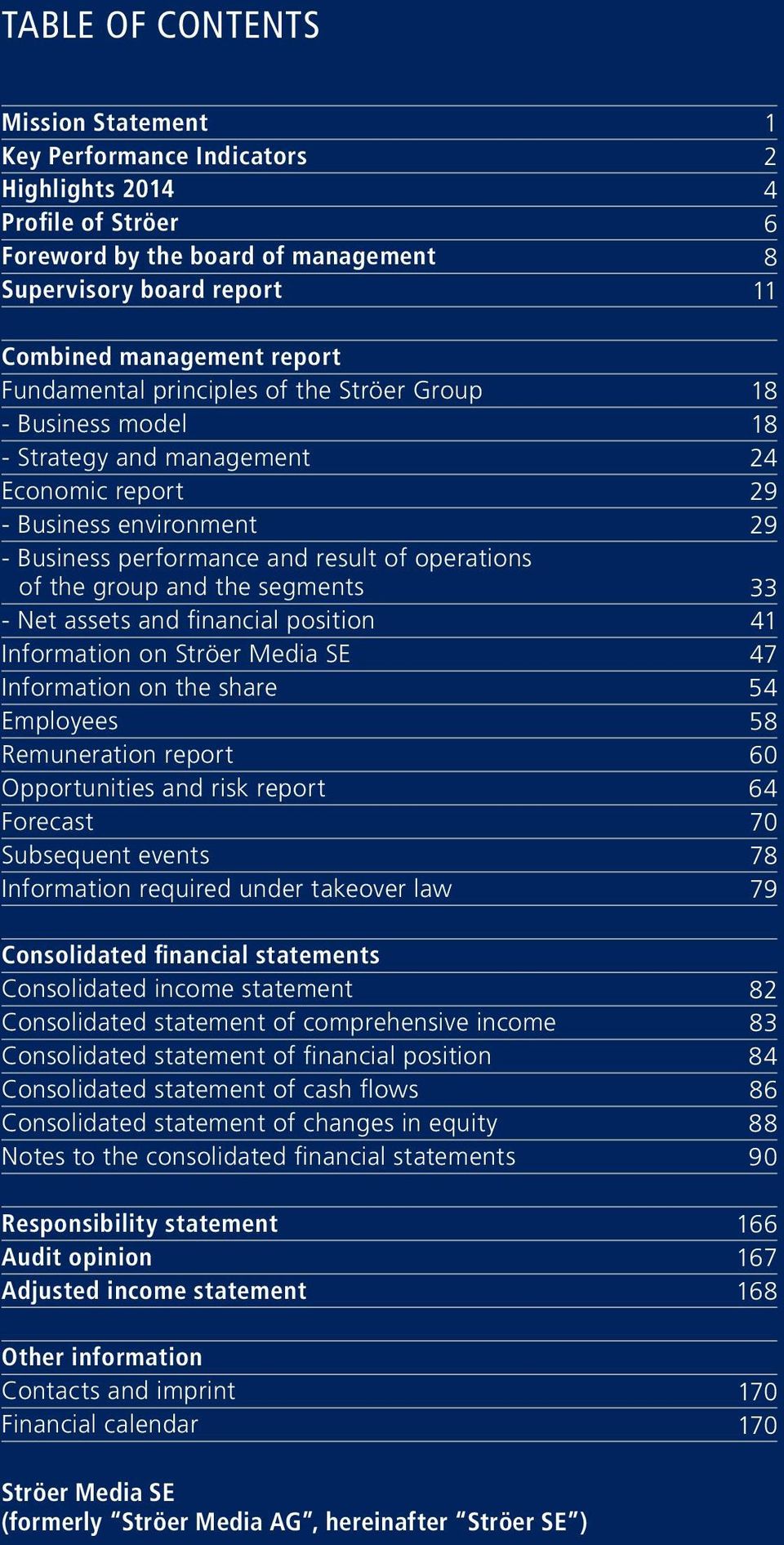
3 The Ströer Group is the No. 1 in the out-of-home advertising industry 1)... is the online marketer in Germany with the widest reach 2)... operates the largest giant poster network in Europe through BlowUP Media... is a digital full-service provider 1) in Germany and in Turkey 2) Ströer Digital 37.2m Unique Users for the month of November 2014, AGOF e.v. / Internet Facts , adscale 41.4m Unique Visitors, comscore per month
4 2 KEY PERFORMANCE INDICATORS Change Revenue 1) EUR m % Revenue by segment Ströer Germany 2) EUR m % Ströer Turkey EUR m % Ströer Digital (Online) EUR m % Other (Poland and BlowUP) EUR m % Revenue by product group Billboard 2) EUR m % Street Furniture 2) EUR m % Transport 2) EUR m % Digital (Online) EUR m % Other 2) EUR m % Organic growth 3) % Gross profit 4) EUR m % Operational EBITDA 5) EUR m % Operational EBITDA 5) margin % Adjusted EBIT 6) EUR m % Adjusted EBIT 6) margin % Adjusted profit or loss for the period 7) EUR m % Adjusted earnings per share 8) % Profit or loss for the period 9) EUR m > +100% Earnings per share 10) > +100% Investments 11) EUR m % Free cash flow 12) EUR m > +100% 31 Dec Dec Dec Dec 2014 Change Total equity and liabilities 1) EUR m % Equity 1) EUR m % Equity ratio % Net debt 13) EUR m % Employees 14) number 1,730 1,750 2,223 2, % 1) Joint ventures are consolidated at-equity according to IFRS 11 (since 2013) 2) Joint ventures are consolidated proportional (management approach) 3) Excluding exchange rate effects and effects from the (de-)consolidation and discontinuation of operations (Joint ventures are consolidated proportional) 4) Revenue less cost of sales (Joint ventures are consolidated at-equity according to IFRS 11 (since 2013)) 5) Earnings before interest, taxes, depreciation and amortization adjusted for exceptional items (Joint ventures are consolidated proportional) 6) Earnings before interest and taxes adjusted for exceptional items, amortization of acquired advertising concessions and impairment losses on intangible assets (Joint ventures are consolidated proportional) 7) Adjusted EBIT before non-controlling interest net of the financial result adjusted for exceptional items and the normalized tax expense (Joint ventures are consolidated proportional) 8) Adjusted profit or loss for the period net of non-controlling interests divided by the number of shares outstanding after the IPO (42,098,238) plus time-weighted addition of the shares from the capital increase (6,771,546) on 3 June ) Profit or loss for the period before non-controlling interest (Joint ventures are consolidated at-equity according to IFRS 11 (since 2013)) 10) Actual profit or loss for the period net of non-controlling interests divided by the number of shares outstanding after the IPO (42,098,238) plus time-weighted addition of the shares from the capital increase (6,771,546) on 3 June ) Including cash paid for investments in property, plant and equipment and in intangible assets (Joint ventures are consolidated at-equity according to IFRS 11 (since 2013)) 12) Cash flows from operating activities less cash flows from investing activities (Joint ventures are consolidated at-equity according to IFRS 11 (since 2013)) 13) Financial liabilities less derivative financial instruments and cash (Joint ventures are consolidated proportional) 14) Headcount of full and part-time employees (Joint ventures are consolidated proportional)

5 XXXXXXXXXX AT A GLANCE 1) Revenue by segment in EUR m Revenue by product group in EUR m 721 2) 721 2) 622 2) 622 2) n Ströer Germany n Ströer Turkey n Ströer Digital n Other n Billboard n Street Furniture n Transport n Digital n Other Operational EBITDA and EBITDA margin in EUR m 18.6% % Adjusted profit for the period in EUR m Free cash flow in EUR m Net debt in EUR m ) The footnotes to the Group s financial figures at a glance apply to all figures presented. 2) Joint ventures are consolidated at equity according to IFRS 11

6 HIGHLIGHTS 2014 Involvement on all channels The boundaries between different media are diminishing. The modern, multi-screen user watches moving-picture content on all platforms. Advertisers who plan campaigns across all digital screens achieve additional reach and better impact. Ströer demonstrated its multi-screen marketing strengths in time for the leading digital trade fair, dmexco: Philips successfully used Ströer s multi-screen products for its word-of-mouth campaign, the first to be played out across all Ströer media channels display, mobile, public video as well as the internally-developed cross-media recommendation-based marketing platform, mytest. Ströer continues expanding its technology strengths With its data science team and a total of around 100 tech developers, Ströer is able to analyze user data even more precisely and target advertising at specific groups. A data management platform (DMP) is being implemented in cooperation with ad pepper media. The information gained via the marketed websites is used for even more precise targeting. adscale, Germany s largest marketplace for digital advertising is also introducing new targeting options that complement the established management mechanisms. By using these options, advertisers achieve increased attention among recipients for their advertised products, while at the same time minimizing scattering loss.
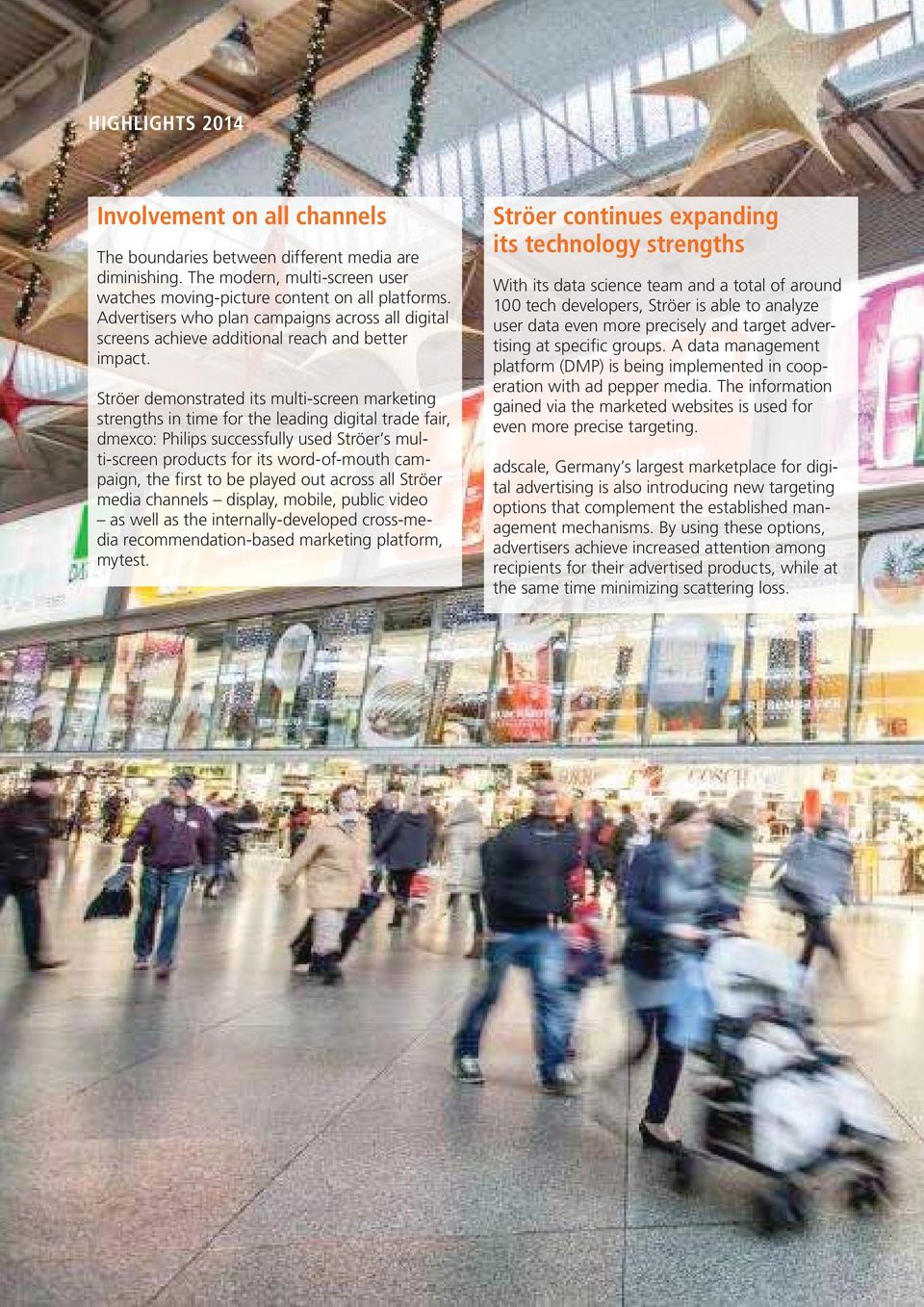
7 Moving uniquely The Ströer Group bundles its digital, public video network under the term public video and connects the network s playout system to a Ströer online ad server. This automates and simplifies public video advertising booking and reporting. Furthermore, it guarantees customers great flexibility in terms of time and space when delivering public moving-pictures. In this way, the Ströer Group creates a uniform platform for all of its moving-picture media by adapting established online approaches to fit the public moving-picture sector. Online video continues to make headway Moving-picture content on the internet is increasingly providing competition to television. Our marketer TubeOneNetworks GmbH receives around 400 million video views per month on social media platforms such as YouTube and Facebook 1). The YouTube channels of celebrities such as Simon Desue or DieAussenseiter have well over a million subscribers. 1) own survey Largest public beacon testing platform in Düsseldorf main station Ströer enabled agencies and advertisers to test the infrastructure for future communications: together with Deutsche Bahn and Sensorberg, Ströer set up ibeacon technology at Düsseldorf main station and in doing so made its advertising media fully interactive. This gave agencies and advertisers access to the largest and first public beacon testing platform in Germany the DUS Open Playground. Interested parties could test their own campaigns using beacon technology and try out forward-looking solutions free of charge until March 2015.
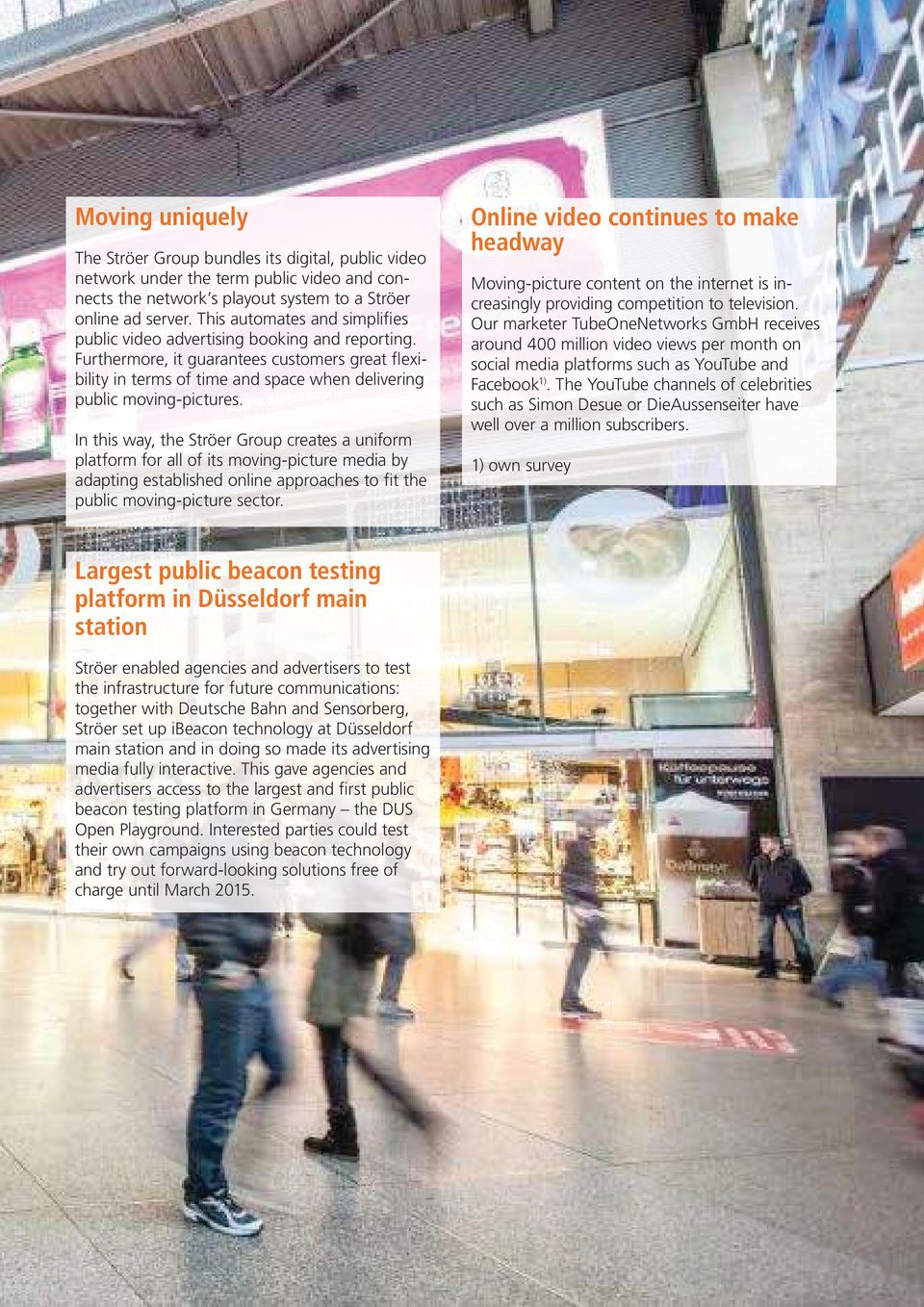
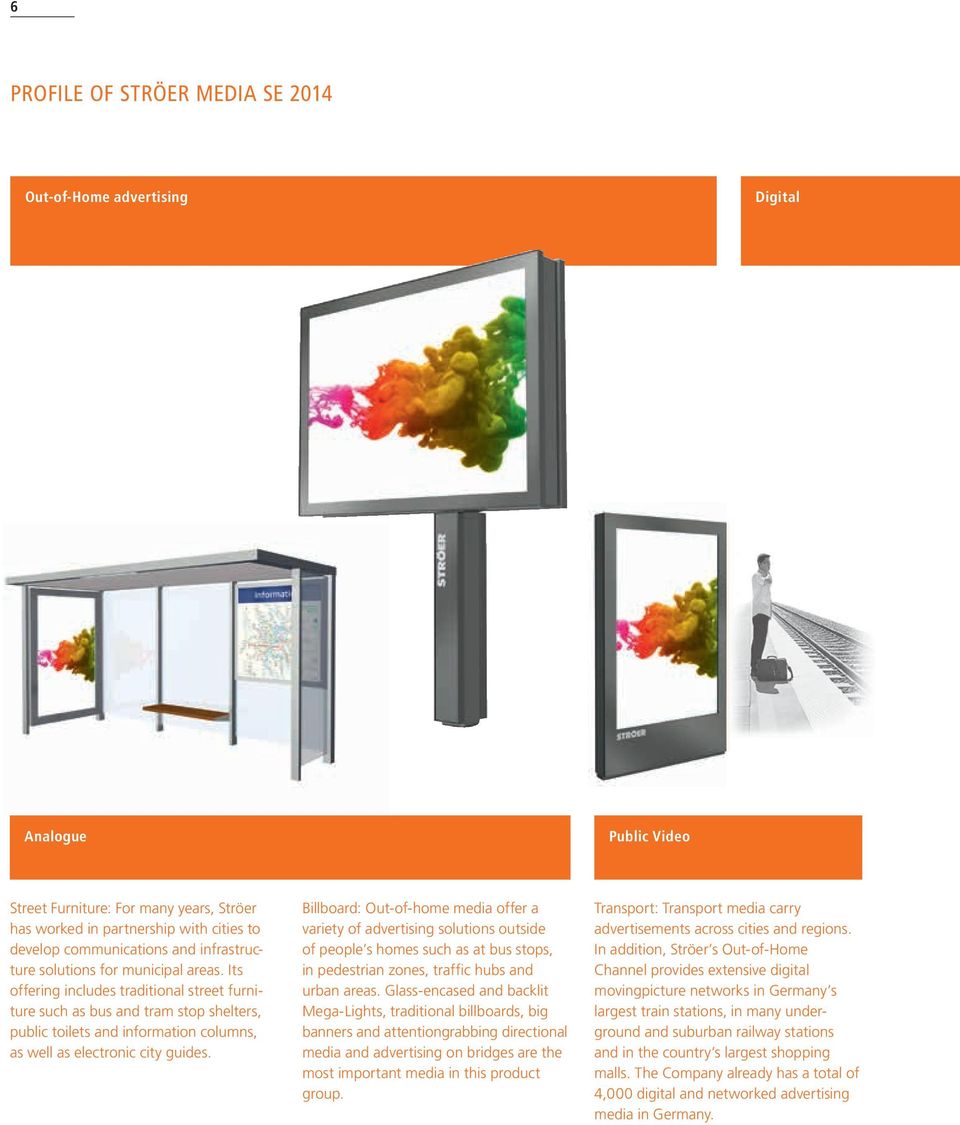
8 6 PROFILE OF STRÖER MEDIA SE 2014 Out-of-Home advertising Digital Analogue Public Video Street Furniture: For many years, Ströer has worked in partnership with cities to develop communications and infrastructure solutions for municipal areas. Its offering includes traditional street furniture such as bus and tram stop shelters, public toilets and information columns, as well as electronic city guides. Billboard: Out-of-home media offer a variety of advertising solutions outside of people s homes such as at bus stops, in pedestrian zones, traffic hubs and urban areas. Glass-encased and backlit Mega-Lights, traditional billboards, big banners and attention grabbing directional media and advertising on bridges are the most important media in this product group. Transport: Transport media carry advertisements across cities and regions. In addition, Ströer s Out-of-Home Channel provides extensive digital movingpicture networks in Germany s largest train stations, in many underground and suburban railway stations and in the country s largest shopping malls. The Company already has a total of 4,000 digital and networked advertising media in Germany.
9 PROFILE OF STRÖER MEDIA SE Display and special advertising formats Video advertising Mobile advertising Technology and platform Ströer Digital Group GmbH offers more than 20 different display advertising formats. These include both standardized Internet Advertising Bureau (IAB) formats as well as ad packages that meet the standards of the German Circle of Online Marketers [ Online-Vermarkterkreis : OVK]. The company also focuses on developing creative special advertising formats, concept marketing and customized integration. Moving-picture advertising is one of the fastest-growing segments in the online advertising market. By marketing publisher brands such as Promiflash.de, MySpass.de (Brainpool) and tape.tv, Ströer Digital Group GmbH offers advertisers attractive environments for their online advertisements. At the same time, it creates additional advertising and presentation options for advertisers and publishers by linking these marketing activities with the digital out-of-home business. Advertising on mobile devices is becoming increasingly important due to the growing use of smartphones and tablets. With its extensive product portfolio of mobile advertising formats, special mobile targeting technologies and hyperlocalized approaches, Ströer Digital Group GmbH is positioning itself as one of the strongest players in this segment. Ströer Digital Group GmbH has state-of-the-art technologies to manage and optimize digital advertising campaigns. Ströer Digital Group GmbH offers innovative and market-leading solutions, particularly in the automatic trading of digital advertising faces, real-time advertising, location-based advertising and new customer acquisition via online advertising (new customer prediction and pro-targeting).
![These include both standardized Internet Advertising Bureau (IAB) formats as well as ad packages that meet the standards of the German Circle of Online Marketers [ Online-Vermarkterkreis : OVK].](/docs-images/42/2525120/images/page_9.jpg "The company also focuses on developing creative special advertising formats, concept marketing and customized integration.")
10 8 FOREWORD BY THE BOARD OF MANAGEMENT Dr. Bernd Metzner CFO (since 15 June 2014) Dr. Bernd Metzner was born in 1970 in Ruit auf den Fildern near Stuttgart, Germany. The 44 year-old studied business management at the University of Siegen. After completing his PhD he joined the Flick Gocke Schaumburg law firm and then went on to assume various management positions in finance at the Bayer Group. He was responsible for coordinating the spin-off and IPO of Lanxess, CFO of Bayer Italy and head of finance at Bayer Schering Pharma. From mid-2011 to mid-2014 Dr. Bernd Metzner was CFO of the family-owned Döhler Group. Udo Müller CEO Udo Müller, born in 1962 in Rüdesheim, entered the field of out-of-home advertising in 1987 marketing his handball team, the Reinickendorfer Füchse, in Berlin. In 1990, he teamed up with Heiner W. Ströer to establish Ströer City Marketing GmbH, which was reorganized as an Aktiengesellschaft (German stock corporation) in With the takeover of Deutsche Städte Medien (2004) and Deutsche Eisenbahn Reklame (2005), he advanced the growth of the company, which he took public in In 2011, he was awarded the title of Senator h.c. by the German Association for Small and Medium-sized Businesses in recognition of his exceptional entrepreneurial achievements. Christian Schmalzl COO Christian Schmalzl, born in 1973 in Passau, studied politics, philosophy, literature and sociology at the Universities of Passau, Munich and Cardiff. After his studies, he joined MediaCom in Munich in 1999 and became the youngest managing director of the agency group in In 2007, he assumed responsibility for the entire Germany business, before being appointed Worldwide Chief Operations & Investment Director (COO) of the international media group in As of year end 2012, Christian Schmalzl was appointed to the board of management of Ströer Media SE and, as COO, is responsible for international operational management.

11 FOREWORD 9 Dear shareholders, ladies and gentlemen 2014 was a game-changing, defining year for Ströer, characterized by further expansion in the digital segment. Ströer completed its transformation from a pure-play out-of-home advertising provider to an integrated media company and is now one of the five largest marketers in the German advertising market across all media. Ströer offers its customers individual and customized communications solutions from a broad product portfolio in the out-of-home advertising and online segment. As an integrated provider, we can offer a one-stop service, from branding to performance, from internet to Outernet, from large, still pictures to moving pictures. The Group s results improved year-on-year, with revenue of EUR 721m, operational EBITDA of EUR 148m and a group revenue growth of around 16%, thereby delivering on its promise to grow. These positive developments are due not least to the successful strategic expansion of the business on the basis of the continuing digitization of the market. Fiscal year 2014 was characterized by widespread dynamics. The capital market rewarded us for the strategic expansion and the share price almost doubled within the year. Thus Ströer significantly outperformed the benchmark index of the SDAX. The overall positive business performance had a favorable effect on the financial position. For the first time in the Company s history, a dividend of EUR 0.10 per qualifying share was paid out. The leverage ratio, a key indicator, decreased substantially as of the end of the fiscal year to 1.9, thus reaching its lowest level since the IPO. We were also able to actively shape the market with a wide range of innovations in fiscal year Together with Deutsche Bahn and Sensorberg, Ströer set up ibeacon technology at Düsseldorf main station and in doing so made its advertising media fully interactive. This gave agencies and advertisers access to the largest and first public beacon testing platform in Germany and enabled them to test the infrastructure of future communications as well as their own campaigns using beacon technology and forward-looking solutions free of charge. As an infrastructure provider, Ströer has the opportunity to connect the real world with the online universe and enable the digital handshake throughout Germany using ibeacon technology.

12 10 In the digital segment, moving-picture content is increasingly providing competition to television. It is currently one of the central drivers of the online market. Our marketer Tube One Networks GmbH receives around 400 million video views per month on social media platforms such as YouTube and Facebook. The YouTube channels of celebrities such as Simon Desue or DieAussenseiter have well over a million subscribers and in the last few months have become a key component of the campaigns of many brand manufacturers. We expect to record organic growth in the mid-single-digit range in fiscal year Based on the forecast increase in business volume and moderate increase in costs, we expect to see a noticeable increase in operational EBITDA and a further slight increase in the operational EBITDA margin. We would like to thank our business partners, investors and employees for the trust they have placed in us and wish you all a successful year in business and on the markets in Udo Müller Dr. Bernd Metzner Christian Schmalzl CEO CFO COO

13 SUPERVISORY BOARD REPORT 11 SUPERVISORY BOARD REPORT Christoph Vilanek Chairman of the supervisory board Ladies and gentlemen, For Ströer Media SE, fiscal year 2014 was characterized by the strategic expansion of the portfolio to include online marketing. Revenue from online marketing accounted for a substantial proportion of total revenue in the fiscal year. Revenue from traditional out-of-home business also grew substantially, providing a stable platform to continue developing the business. The supervisory board again carefully and regularly monitored the work of the board of management during fiscal year It mainly reviewed the legality, expediency and propriety of the board of management. It also supported the strategic development of the Group and significant individual measures. The main focuses of the supervisory board in fiscal year 2014 were on the conclusion of another refinancing arrangement for the Ströer Group and the payment of a dividend to the shareholders. Furthermore, it was extensively involved in the further expansion of the online advertising segment through various transactions and in the integration of companies taken over in the Ströer Group. Another important point of discussion was the transformation of Ströer Media AG into a Societas Europaea (SE) and the structure of the new articles of incorporation and bylaws for the Company.

14 12 The board of management informed the supervisory board at supervisory board meetings as well as through written and oral reports on the business and all relevant aspects of business planning. It therefore complied in full with its duties to provide information. In addition to the financial, investment and personnel planning, the development of business, the economic situation of the Company and the Group (including the risk situation and risk management), the financial position and the Group s profitability were discussed. For all decisions important for the Group, the board of management consulted the supervisory board in good time. For transactions requiring approval, the supervisory board granted its approval after careful consideration and review of the documents it was presented by the board of management. If legal provisions, the articles of incorporation and bylaws or the rules of procedure required the supervisory board to adopt a resolution, it passed a corresponding resolution after careful review. During fiscal year 2014, the supervisory board of Ströer Media AG convened for three in-person meetings and adopted resolutions by telephone in three teleconferences. Furthermore, the supervisory board of Ströer Media AG adopted two resolutions by written procedure. The supervisory board of Ströer Media SE convened for two in-person meetings in the fiscal year and adopted one resolution by written procedure. In additional meetings, the chairman of the supervisory board, the deputy chairman of the supervisory board and the chairman of the audit committee discussed key business events with the board of management in particular with the CEO and the CFO. The supervisory board received regular written and oral reports on these deliberations. The audit committee convened three times in the fiscal year. Focus of deliberations and review by the supervisory board of Ströer Media AG At the meeting to discuss the financial statements on 27 March 2014, the supervisory board approved and endorsed Ströer Media AG s separate financial statements for fiscal year It also approved the consolidated financial statements for fiscal year The supervisory board adopted its recommendations for the Company s shareholder meeting to exonerate the board of management and supervisory board, to appoint Ernst & Young GmbH Wirtschaftsprüfungsgesellschaft, Cologne, as the Company s auditor for fiscal year 2014 and to reelect Mr. Dirk Ströer and Mr. Ulrich Voigt to the supervisory board, each for another three years. It also dealt with the question of a dividend payment. Furthermore, the supervisory board approved the replacement of the existing loan agreement by concluding a new loan agreement with a syndicate of banks for a loan volume of EUR 500m and a term of five years. Mr. Ulrich Voigt, member of the supervisory board of Ströer Media AG and member of the board of management of Sparkasse Köln Bonn, one of the refinancing banks, took part in the adoption of the resolution by the Company s supervisory board, but abstained from the resolution concerning the refinancing at the level of the board of management and the committees of Sparkasse Köln Bonn. The supervisory board also addressed the issue concerning the structure of the articles of incorporation and bylaws of Ströer Media SE, its authorized capital, and the size of the future supervisory board.

15 SUPERVISORY BOARD REPORT 13 In a telephone conference on 28 April 2014, the supervisory board addressed once again the dividend proposal by the board of management and resolved to propose payment of EUR 0.10 per share to the shareholder meeting on 18 June The supervisory board also approved the agenda for the shareholder meeting. Furthermore, the supervisory board approved the conclusion of an agreement with Superposter Media GmbH. Mr. Dirk Ströer did not take part in the resolution due to a possible conflict of interest. At the meeting on 26 May 2014, the supervisory board approved the expansion of the existing marketing agreement with Media Ventures GmbH. Mr. Dirk Ströer did not take part in the resolution due to a possible conflict of interest. On 2 June 2014, the supervisory board approved the purchase of 90% of the shares in GIGA Digital AG by written procedure, following detailed examination and review of extensive written documents. At the meeting following the shareholder meeting on 18 June 2014, the new supervisory board was constituted and elected from among its members Mr. Christoph Vilanek as chairman and Mr. Dirk Ströer as deputy chairman of the supervisory board. At its meeting on 2 October 2014, the supervisory board resolved to increase the Ströer Group s shareholding in Kölner Aussenwerbung GmbH to 100%. In addition, the supervisory board intensively examined the capital market strategy and the segment reporting. Focus of deliberations and review by the supervisory board of Ströer Media SE The supervisory board of Ströer Media SE convened for its inaugural constituent meeting on 28 July From among its members, it elected Mr. Christoph Vilanek as chairman and Mr. Dirk Ströer as deputy chairman of the supervisory board. In addition, the supervisory board agreed to also appoint the members of the board of management of Ströer Media AG as members of the board of management of the Company following its transformation into an SE, and to appoint Mr. Udo Müller as chairman of the board of management. In this connection, the supervisory board resolved to appoint the board of management members Udo Müller and Christian Schmalzl as members of the board of management for a period of five years from the completion of the transformation and to extend their employment contracts accordingly. Furthermore, the supervisory board set itself rules of procedure. At the last meeting of the fiscal year on 15 December 2014, the supervisory board discussed the budget presented by the board of management for the Ströer Group for fiscal year 2015 and approved it. The supervisory board resolved to set up an audit committee and adopted rules of procedure for the committee. It also reviewed the efficiency of its work and of the committee. The new employment contract for a board of management member was also approved.

16 14 Deliberations of the audit committee of Ströer Media AG and Ströer Media SE On 4 March 2014, the audit committee of Ströer Media AG reviewed the consolidated financial statements for fiscal year At its further meetings on 8 May 2014 and 14 August 2014, the audit committee examined the respective interim financial statements. The CFO took part in one of the meetings. At the constituent meeting of the audit committee on 15 December 2014, it elected from among its members Mr. Ulrich Voigt as chairman and Mr. Christoph Vilanek as deputy chairman of the audit committee. Audit of the separate and consolidated financial statements The separate and consolidated financial statements of Ströer Media AG prepared by the board of management for fiscal year 2013 were audited by Ernst & Young GmbH Wirtschaftsprüfungsgesellschaft, Cologne, together with the underlying books and records and the combined management report of the Company and the Group. An unqualified audit opinion was issued in each case. The documentation on the financial statements and the audit reports were presented to all members of Ströer Media AG s supervisory board in good time. The documents were the subject of intensive discussions in the audit committee and in the meeting of the supervisory board of Ströer Media AG to discuss the financial statements on 27 March The responsible auditor participated in the plenum discussions. He reported on the key findings of the audit and was available to answer questions. We reviewed all documents presented by the board of management and the auditor in detail. Based on the final results of our review, we had no reservations and agreed with the conclusion of the audit of the financial statements by Ernst & Young GmbH Wirtschaftsprüfungsgesellschaft, Cologne. We approved the separate and consolidated financial statements prepared by the board of management. The financial statements were thus approved.
17 SUPERVISORY BOARD REPORT 15 Changes to the composition of the board of management The board of management department for finance underwent changes in fiscal year Effective 21 February 2014, Mr. Alfried Bührdel resigned as CFO. The supervisory board wishes to thank Mr. Bührdel for his many years of service to the Company. In the period from 22 March 2014 to 14 June 2014, the chairman of the board of management assumed responsibility for the finance department. On 15 June 2014, Dr. Bernd Metzner took up office as CFO of the Company. In the course of the Company s transformation, Mr. Udo Müller, Mr. Christian Schmalzl and Dr. Bernd Metzner were reappointed to their offices. Changes to the composition of the supervisory board There were also changes in personnel on the supervisory board. On 18 June 2014, Prof. Dr. h.c. Dieter Stolte s term of office ended. He left his position as chairman of the supervisory board of Ströer Media AG after 13 years of service, shortly before his 80th birthday. We would like to express our warmest thanks to Prof. Dr. h.c. Dieter Stolte for his outstanding work for the Company and the supervisory board of Ströer Media AG over the years. Prof. Dr. h.c. Dieter Stolte s outstanding skills and industry expertise were instrumental in the successful development of the Ströer Group. He presided over the supervisory board first as deputy chairman and then chairman, and led it for many years as a highly accomplished networker with a clear focus on vision, diplomacy and prudence. The office of chairman of the supervisory board of Ströer Media AG was assumed by Mr. Christoph Vilanek as of the meeting on 18 June 2014; Mr. Dirk Ströer was appointed as his deputy. The supervisory board of Ströer Media AG, its audit committee, and its executive committee were dissolved upon the transformation of the Company into Ströer Media SE on 15 October Mr. Dieter Keller s and Mr. Martin Diederichs positions on the supervisory board ended with the transformation as they are not members of the supervisory board of Ströer Media SE. Mr. Keller had been a member of the supervisory board since its formation in 2002 and sat on the audit committee as an auditor. His particular expertise in connection with the analysis of the economic and financial situation of the Ströer Group and on issues relating to financial reporting and accounting were of key importance to the supervisory board and the audit committee, especially in connection with the audit and approval of the separate and consolidated financial statements. Mr. Diederichs also sat on the supervisory board for many years, with an interruption, and he too deserves our warmest thanks. The supervisory board of Ströer Media SE now comprises three members: Mr. Christoph Vilanek as chairman of the supervisory board, Mr. Dirk Ströer as deputy chairman and Mr. Ulrich Voigt. The audit committee of the supervisory board of Ströer Media SE comprises Mr. Ulrich Voigt as chairman and Mr. Christoph Vilanek.

18 16 Thanks The supervisory board would like to thank the board of management, the management of the group entities, the works council and all employees for their outstanding personal dedication, hard work and unwavering commitment. On behalf of the supervisory board Christoph Vilanek Chairman of the supervisory board Cologne, March 2015

19 COMBINED MANAGEMENT REPORT 17 COMBINED MANAGEMENT REPORT The references made in this combined management report of Ströer Media SE (formerly Ströer Media AG ; hereinafter Ströer SE ) and of the Group to page numbers refer to the numbering in the annual report. Combined management report Fundamental principles of the Ströer Group Economic report Information on Ströer Media SE Information on the share Employees Remuneration report Opportunities and risk report Forecast Subsequent events Information required under takeover law

20 18 FUNDAMENTAL PRINCIPLES OF THE STRÖER GROUP Business model Ströer Media SE is a leading provider of out-of-home and online advertising, and offers its advertising customers individualized and integrated communications solutions. Its portfolio of branding and performance products offers customers new opportunities for addressing specific target groups while increasing the relevance of the Ströer Group as a contact for media agencies and advertisers. The Company s business model is based on offering traditional out-of-home (OOH) advertising, public video (formerly the digital Out-of-Home Channel (DOOH)) that is shown on screens installed in train stations and shopping malls, as well as online display and video marketing via stationary internet and mobile devices and tablets. This means that we can offer advertisers a platform for optimizing campaigns, combining substantial reach with the precise targeting of customer groups. Particular mention should be made of the development departments for online and out-of-home advertising. Furthermore, on the sales side, Ströer has the market presence needed to offer national and regional customers comprehensive out-of-home advertising and online products. Our more than 90 offices across Europe maintain close relationships with our contracting partners, while offering our advertising customers a wide range of communication opportunities. The sales organizations in each country manage the sales and marketing activities that are flanked by target group analyses and market research, and serve regional and national advertisers, media agencies and media specialists. For further information on the development department, see page 25 On the cost side, the Ströer Group leverages positive economies of scale arising in areas such as finance, procurement, development, information technology and human resources, as well as synergies arising from cooperation between the individual segments and entities. One such example is the crosssegment bundling of moving-picture advertising in Ströer Primetime. Segments and organizational structure The Ströer Group has bundled its business into four segments, which operate independently on the market in close cooperation with the group holding company Ströer Media SE. This cooperation relates in particular to the Group s central strategic focus and enables a targeted transfer of expertise between the different segments. The Group s financing and liquidity are also managed centrally. The resulting refinancing of the segments and their provision with sufficient liquidity gives the operating units the flexibility they need to exploit market opportunities quickly. For further information on strategy and management, see page 24 Our reporting segments comprise Ströer Germany, Ströer Turkey and the Other segment, which includes the business in Poland and the giant poster business BlowUP. In addition, the Ströer Digital segment includes all online / mobile display and video marketing activities, including the required technology platforms.

21 COMBINED MANAGEMENT REPORT Fundamental principles of the Ströer Group 19 Out-of-home business The out-of-home advertising business is based on an attractive portfolio of agreements with private and public-sector owners of land and buildings, which furnish us with advertising concessions for high-reach sites. Of particular importance are the agreements with municipalities, for which we, as a system provider, develop smart and tailored infrastructure solutions that also enhance cityscapes. The agreements with Deutsche Bahn, the ECE group and local public transport providers are also highly significant. Our product portfolio for out-of-home advertising covers all forms of outdoor advertising media, from traditional posters (billboards) and advertisements at bus and tram stop shelters (street furniture) and on public transport through to digital and interactive offerings. Our portfolio currently comprises around 290,000 marketable advertising faces in Europe. Agreements with private owners of land and buildings generally provide for the payment of a fixed lease, whereas the majority of the concession contracts with municipalities entail revenue-based lease payments. Ströer Germany segment The Ströer Germany segment is managed operationally by Ströer Media Deutschland GmbH. Management is based at the headquarters in Cologne. Together with its many subsidiaries, Ströer Media Deutschland GmbH is active in all of the Group s product groups (street furniture, billboard, transport, other) with the exception of online. While day-to-day business is conducted from the individual regional locations and our headquarters in Cologne, key operating decisions and all accounting and financial control functions are managed centrally by the management company in Cologne. With some 230,000 marketable advertising faces in more than 600 cities, we generate by far the highest net revenue in the largest out-of-home advertising market in Europe. Ströer Turkey segment The Ströer Turkey segment is operationally managed by Ströer Kentvizyon Reklam Pazarlama A.S., in which the Ströer Group holds a 90% interest. Ströer Turkey has a presence in 7 of the 10 largest Turkish cities and operates in all product groups. With some 43,000 marketable advertising faces in approximately 20 cities and provinces, we also generate the highest revenue in our sector in Turkey and have a much larger share of the Turkish market than any other competitor. Other segment The Other segment comprises the Ströer Poland and BlowUP Media sub-segments. The Ströer Poland sub-segment is managed by Ströer Polska Sp. z.o.o. In terms of like-for-like revenue, Ströer is the joint leader of the Polish market with a similar-sized competitor. Our national company has a presence in approximately 130 cities and municipalities with some 14,000 marketable advertising faces and operates in all of the Group s product groups. The BlowUP Media sub-segment is a leading western European provider of giant posters of up to more than 1,000m 2 positioned on building façades. The company currently markets more than 150 sites, some of which are digitized, which are booked either individually or in blocks, both nationally and internationally, by well-known advertisers. The normally shorter concession terms pose different challenges for portfolio management to those that arise in traditional out-of-home advertising. In Europe, BlowUP Media has operations in Germany, the UK, the Netherlands, Spain and Belgium.
22 20 Digital business Ströer Digital segment In the Ströer Digital segment (formerly the Online segment), the Ströer Group offers digital advertising on the internet and on mobile devices. The segment comprises in particular the three intermediate holding companies, Ströer Digital Group GmbH, Ströer Venture GmbH and Ballroom International GmbH, with their respective subsidiaries. The Ströer Digital Group with its various subsidiaries holds a strong position in the commercialization of advertising in Germany and covers the entire digital marketing value chain, from traditional online banner advertising, special advertising formats and individual advertising integration through to video and mobile advertising. Through its extensive offering of various advertising formats, its comprehensive portfolio of attractive advertising environments and sophisticated technological solutions, Ströer Digital Group matches the demand for both branding (image campaigns) and performance campaigns (transaction-related solutions). The Ballroom International group offers similar communication solutions with a particular focus on our foreign core markets of Turkey and Poland. Technology platform The technology platform is largely provided by the subsidiaries adscale GmbH in Munich and MBR Targeting GmbH in Berlin. adscale is one of the biggest marketplaces for digital advertising in Germany. It offers advertisers and website owners a transparent and high-reach exchange for digital advertising faces. The company works with reputable marketers and all major media agencies as well as with direct customers and third-party providers. Various optimization technologies, such as targeting and real-time bidding, allow campaigns to be managed efficiently on adscale. Advertisers can use adscale to filter out target groups for their campaigns from a portfolio of more than 5,000 websites. Each month, adscale records around 41 million unique visitors and some 10 billion ad impressions (as of the end of 2014). With its wide-ranging portfolio of some 5,000 websites, adscale reaches more than three quarters of all German internet users. 1) MBR has proprietary technologies for precisely identifying online target groups, delivering transaction-based performance campaigns and generating new customers in the digital segment. Anonymous data on the surfing behavior of users is compiled using the consumer action mining (CAM) algorithm and used in real time to assign products to consumers. Display, video and mobile marketing With its portfolio of nearly 400 websites and a reach of more than approximately 37 million unique users 2), Ströer Digital Media was ranked the number one marketer by the industry group Arbeitsgemeinschaft Online Forschung (AGOF), making it one of the most important online marketers in the German advertising market. 3) Ströer Primetime bundles our activities in moving-picture advertising on personal screens (smartphones and tablets), home screens (PCs) and public screens (public videos). This exclusive marketer is a one-stop provider of multi-screen solutions from cross-media planning and booking to campaign monitoring. 1) Source: comscore, December ) Per month 3) Source: AGOF internet facts, November 2014
23 COMBINED MANAGEMENT REPORT Fundamental principles of the Ströer Group 21 Ströer Mobile Media is a mobile advertising provider. The company s location-based advertising network specializes in localized and hyperlocalized online advertising on mobile devices. Ströer Venture GmbH is a new company of Ströer Media SE established in the fiscal year and works on enhancing the digital assets in our portfolio. The Company s registered office is in Cologne. International online marketing The Ballroom group is one of the biggest independent marketing networks for online advertising with a focus on south-eastern European markets. Its portfolio ranges from ad exchange services, video and display advertising to performance marketing. For this purpose, Ballroom uses proprietary technologies, from real-time bidding as well as ad server and video solutions, through to targeting components. Shareholdings and activities The following overview as of 31 December 2014 outlines the main investment structure and its allocation to the core markets. Ströer Media SE Management company Geographical activity Subsidiaries 1) Sales by segment 2014 Segment 100% 90% 100% 90% 100% 75% Ströer Media Deutschland GmbH Ströer Kentvizyon Reklam Pazarlama A. S. Ströer Polska Sp. z.o.o. Germany Turkey Poland BlowUP Media GmbH Germany/GB/ Belgium/Spain/ Netherlands Ströer Digital Group GmbH Germany Ballroom International GmbH Germany/Hungary, Turkey/Poland/ Czech Republic EUR 465m EUR 86m EUR 62m EUR 123m Ströer Germany Ströer Turkey Other Ströer Digital 1) Number of fully consolidated companies 100% Ströer Venture GmbH Germany 8
24 22 Management and control The board of management of Ströer SE as of 31 December 2014 comprises three members: Udo Müller (CEO), Christian Schmalzl (COO) and Dr. Bernd Metzner, who was appointed to the board of management as CFO on 15 June He succeeds Alfried Bührdel, who left the board of management on 21 February The following overview shows the responsibilities of each member of the board of management in the Group: Name Member since Appointed until Responsibility Udo Müller July 2002 October 2019 Chairman Strategy Dr. Bernd Metzner June 2014 June 2017 Chief Financial Officer Group finance and tax Group HR Group IT Group legal Group M&A / Corporate Finance Group revision Group investor relations Christian Schmalzl November 2012 October 2019 Management and supervision of national, international and digital companies Group business development Group corporate communications The members of the board of management collectively bear responsibility for management. The supervisory board currently comprises three members: Christoph Vilanek, Dirk Ströer and Ulrich Voigt. In its meeting on 18 June 2014, the supervisory board of Ströer Media AG appointed Christoph Vilanek as the new chairman with immediate effect. He replaces Prof. Dr. h.c. Dieter Stolte, whose term of office ended at the end of the reporting period and was not renewed at his own request. For more information on the cooperation between the board of management and the supervisory board and on other standards of corporate management and control, see the corporate governance declaration pursuant to Sec. 289 HGB [ Handelsgesetzbuch : German Commercial Code], which also includes the declaration of compliance with the German Corporate Governance Code pursuant to Sec. 161 AktG [ Aktiengesetz : German Stock Corporation Act]. In addition, the board of management and supervisory board issue a joint corporate governance report each year in accordance with 3.10 of the German Corporate Governance Code. All documents are published on the website of Ströer SE ( Markets and factors The Ströer Group s business model means that it operates on the markets for out-of-home advertising and online and mobile marketing. The Group s economic situation is naturally affected by the advertising markets that it serves, which in turn are highly sensitive to macroeconomic developments and changes in the behavior of consumers, advertisers and media agencies. Out-ofhome advertising is affected in particular by the conditions relating to the advertising concessions granted by municipalities.
25 COMBINED MANAGEMENT REPORT Fundamental principles of the Ströer Group 23 Customers in the out-of-home advertising industry sometimes place bookings with a lead time of not much more than eight weeks. This underlines the trend toward ever shorter advance booking times. Seasonal fluctuations in the order intake are in line with the trend on the rest of the media market. There is generally a concentration of out-of-home activities in the second and fourth quarters. In terms of costs, the development of lease payments, personnel expenses and other overheads are key factors. In the online segment, advance booking times by customers are even shorter due to the high degree of automation compared with out-of-home advertising. In the online industry, the highest revenue activity generally falls in the fourth quarter. A key factor for online advertising is the further penetration of the market using targeting / re-targeting, real-time bidding (RTB) and moving-picture offerings. Apart from the commissions paid to website operators, the main cost drivers are personnel and IT operating expenses. The regulatory environment also impacts on the economic situation of the Ströer Group. The content of advertising is subject to different legal restrictions and conditions in the countries in which we operate. In Turkey and (with the exception of beer) Poland, out-of-home advertising of tobacco and alcohol is prohibited, whereas in Germany, these products can be advertised in out-of-home campaigns. If regulatory amendments are made, we will be able to mitigate the impact on our business volume thanks to the usual lead times applicable to changes in legislation through appropriate marketing and sales activities. The regulatory environment in the online advertising segment is mainly determined by data privacy aspects at European and national level, which give national legislatures leeway in drafting guidelines. Overall, the Ströer Group is very well positioned with its integrated portfolio to profit from the medium to long-term market trends. The expectation is that the market will focus more and more directly on media users and their usage behavior, which will increasingly involve media consumption via mobile end devices in the private, professional and public environments. This blurs the boundaries between the individual content channels, pushing centrally managed online marketing to the fore. This also gives added importance to performance products, especially as it is possible to reach target groups with increasing accuracy by analyzing large data volumes and using targeting technologies. Disproportionately high growth in the online advertising market is expected for moving-picture and mobile offerings. At the same time, there is substantial potential for regional online advertising campaigns. Out-of-home advertising is also affected by advances in digital media, but is the only medium to retain its physical presence.
26 24 Strategy and management Value-based strategy We have significantly developed the Ströer Group s growth and value-based strategy by expanding our business model and developing our online portfolio. We are one of the first fully integrated digital marketers to also focus our strategy on generating revenue and earnings potential from the integration of traditional and digital out-of-home advertising with online display advertising. Traditional out-of-home advertising campaigns, which are primarily aimed at increasing brand awareness (branding), are strategically supplemented by attractive and innovative performance marketing products and solutions. By integrating the rapid expansion of reach offered by out-of-home media with the precise targeting provided by online media, the Ströer Group can offer customized communications solutions to meet almost all customer requirements. New multi-screen offering The significant growth potential of our multi-screen products arises from the increasing use of media across a range of screens in public, professional and private environments. As a result, advertisers are increasingly aiming for a combination of different screens when planning their campaigns, to synchronize their communication strategy as far as possible as well as to maximize their reach among target groups. One core element of Ströer s multi-screen offering is the integration of public video and online/ mobile video. The Ströer Group has established a new kind of media channel to complement traditional moving pictures in television and online. Hence we are no longer talking about digital OOH, but rather public video i.e., moving pictures in the public space. Online and public video particularly appeal to young and mobile target groups, who react positively to moving pictures and who are reached less and less by linear television. The aim is to sharply increase the share of total revenue from multi-screen products in the next few years and, in connection with this, to also generate a larger proportion of out-of-home advertising revenue through public and online video. The main growth driver here is Ströer Primetime, the exclusive marketer of our multi-screen portfolio, which has been bundling moving-picture advertising on personal screens (smartphones and tablets), home screens (PCs) and public screens since September The OC Mall and OC Station media are now marketed under Mall Video and Station Video. Together with Infoscreen and Adwalk, they form the Ströer Group s public video network. In this way, customers receive all the main services for their moving-picture campaigns from a single source from cross-media planning and booking to campaign monitoring. The group-wide marketing of multi-screen campaigns was made easier in the reporting year by an ad server solution in the form of a multi-screen planning and booking tool that enables dynamic and regional campaign management. In order to make the reaches comparable, Ströer converted the video views achievable via out-of-home advertising into ad impressions, with the help of GfK s (Gesellschaft für Konsumforschung) Media Efficiency Panel. Ströer generates up to three billion video ad impressions per month via online video and public video. 1) Our digital out-of-home advertising portfolio currently comprises approximately 3,000 screens at the most highly frequented locations in public spaces. The cross-media combination aims to create benefits for both advertisers and publishers, since the additional digital moving-picture screens tap into new target groups and increase overall reach. 1) GfK (Gesellschaft für Konsumforschung)
27 COMBINED MANAGEMENT REPORT Strategy and management 25 Increase in local and regional advertising revenue In Germany, advertising in a local or regional environment is currently largely distributed between free advertising publications and daily newspapers. There is also substantial growth potential here due to the shift in advertising budgets from local print media to local online services. The relatively small marketing budgets available in the local environment to individual, usually medium-sized advertisers means that there is also strong demand for standardized solutions. In developing its local online advertising business, the Ströer Group can build on its broad customer base and sales strength from traditional out-of-home activities. In addition to our existing strong regional presence with around 40 offices across Germany, we are planning to strengthen our regional sales activities by making structural improvements and recruiting sales staff (hunters) to acquire new customers, as well as by further expanding the organization of independent sales representatives. We successfully increased our revenue at the regional level during the reporting year. We also strengthened our regional sales force by more than 100 sales representatives. The extensive exploitation of structural growth potential should ensure an above-average increase in net revenue from local and regional advertising and, in the medium term, account for at least half of our German OOH revenue. Innovative product development secures technology position The Ströer Group sees itself as a driver of innovation in digital out-of-home advertising and online marketing. Targeted investments in innovative premium formats, market research and audience reach measurement also ensure the Ströer Group s outstanding position in out-of-home advertising technology. The focus is on developing extremely powerful, functional and maintenance-friendly solutions that win over customers with their modern design. In 2014, our activities were dominated by the continued systematic modularization and standardization of the product portfolio to enhance product quality. In addition, product development also focused on optimizing the lighting/background lighting systems of advertising media and the related reduction in energy consumption in existing product ranges. In Frankfurt am Main, the Ströer Group has already converted some 2,900 advertising media to LED operation as part of a pilot project. Crucial to the attractiveness of public video for advertising and media agencies is the timely synchronization of the screens, which ensures an attention-grabbing brand presence and visually dominant video advertising messages. The next step in development will also include LED videoboards, which can also be used in the outdoor segment. Two-sided LED systems were planned and tested in 2014, and are to be launched on the market in the coming years. Currently, a combination of digital display screens and analog scrolling posters is also planned. There are further digital products on the R&D roadmap for 2015.
28 26 In addition, this year, in cooperation with Deutsche Bahn, we set up the first ibeacon testing platform (Düsseldorf), and in so doing made our advertising media fully interactive. The use of this technology, which is based on Bluetooth low energy, makes it possible to connect the analogue world with the digital world. Retail customers in particular could profit from this development as the ibeacon technology allows the mechanisms of e-commerce to be integrated into stationary trade. In this way, additional information that is pinpointed in terms of time and place concerning products, advertising campaigns or coupons is channeled to consumers directly and can guide them to the POS. Validated and accepted audience measurements as well as the effectiveness of out-of-home media near to the point of sale, as proven in numerous studies, make Ströer a first-choice partner for the advertising industry. New studies published in the reporting year by renowned, independent institutions show that information that is presented using out-of-home advertising has a significant influence on implicit memory and thus on the spontaneous brand preferences of consumers. We also support the initiative of the leading out-of-home advertising providers with regard to the systematic analysis of reach in our core markets. In Turkey and Poland, Ströer was involved in the introduction of measurement systems in the reporting period that are comparable with the internationally recognized audience measurement system POSTAR. The digital strategy is based on the Group s technology position, which is being continuously developed and enables local and regional performance strategies as well as direct marketing. Technologies for precisely controlling campaigns and professionally managing large volumes of anonymized data are crucial for success. This enables the smooth integration of branding and performance marketing as part of the multi-screen strategy. Ströer is working with developers in New Zealand, Germany and the Czech Republic to expand its leading marketplace for digital advertising, especially in the areas of real-time bidding and targeting. Thus a demand-side platform (DSP) was developed that enables advertisers to automatically procure the advertising faces of other providers. With the launch of the DSP, Ströer is now able to cover almost the entire German market for online display advertising. Thanks to its improved targeting mechanisms, our supply-side platform (SSP) adscale helps customers to optimize their advertising campaigns. The new targeting algorithms make it possible, among other things, to identify potential new customers on the internet (new customer prediction) and then to address them with a specific campaign. The retargeting of existing customers is also more precise. Ultimately, programmatic buying means that advertising customers can procure precisely the ad impressions that will increase the probabilities that their target groups will purchase the relevant product. Technology position in terms of precisely identifying online target groups was improved continuously in the reporting period. MBR s user-centric consumer action mining (CAM) algorithm enables the processing of large data volumes in real time, is less prone to failure and much more dynamic and efficient than comparable targeting technologies. Thus Ströer can meet its customers growing performance requirements and better capitalize on the inventory of publishers. With our products geared to performance, we cover the entire digital value chain, from ad servers through demand and supply-side platforms, real-time bidding and ad exchanges to targeting driven by proprietary technology. In the Digital segment, product development accounted for around 100 employees as of the end of Added to this were 44 employees in the Company s internal product development department for out-of-home advertising.
29 COMBINED MANAGEMENT REPORT Strategy and management 27 Introduction of multi-screen Ad Server Booking Video Adformat Public Video Advertiser Realtime Reporting Booking Mediasystem Encoding & Ad serving Disposition Tracking Reporting Ad Server Mobile Online Desktop Selective expansion of digital assets at Ströer Venture In order to complement our portfolio, we will fully integrate individual attractive publishers into our portfolio in the future. In the reporting year, Ströer Media SE already added a small number of attractive publishers to its portfolio, such as GIGA Digital AG. This company brings together the product worlds of GIGA APPLE, GIGA ANDROID, GIGA GAMES, GIGA SOFTWARE and GIGA FILM and is a digital media company with a focus on technology, games and entertainment. Our portfolio also includes kino.de and OnlineFussballManager. kino.de is one of the most popular websites for information on the latest cinema program. OnlineFussballManager is one of the biggest providers of free browser-based games in Germany. We would also like to further expand our market position in the online video segment. Movingpicture content on the internet is increasingly providing competition for television. It enjoys huge popularity, and not just among younger target groups. In the last year, we took over one of Germany s biggest video marketing networks. The marketer Tube One receives around 400 million video views per month on social media platforms such as YouTube and Facebook. 1) The YouTube channels of celebrities such as Simon Desue or DieAussenseiter have well over a million subscribers. 1) Own survey
30 28 Value-based management We manage our Group using internally defined financial and non-financial key performance ratios in the interests of sustainable development. Our group-wide reporting structure that is implemented at all subsidiaries ensures that we keep abreast of the value added of all group entities and of the Group. Our objective is sustainable value creation over the entire economic cycle. At the same time, this ensures that we observe the covenants set by our lenders. Our value-based management is also reflected in the performance-related remuneration of the board of management. As a value driver, we understand the main internal and external factors affecting business development. Key financial indicators for the Group are revenue, operational EBITDA, free cash flow, ROCE (return on capital employed), as well as net debt and the leverage ratio derived from it. For more information on the financing strategy, see page 41 Revenue development is one of the key indicators for measuring the growth of the Group as a whole. It is also an important metric for managing the Ströer Group s segments. As part of the budgeting and medium-term planning process, the individual segments are set revenue targets that are broken down to the relevant level, and adherence to these targets is continuously monitored during the year. Both organic growth (excluding the effects of acquisitions and exchange rate changes) and nominal revenue growth are analyzed in this context. Operational EBITDA gives an insight into the sustainable development of earnings of our Group adjusted to exclude one-time effects in expenses and income. The main one-time effects, which we eliminate to determine operational EBITDA, primarily result from reorganization and restructuring measures, changes in the investment portfolio (including as a result of M&A measures) and capital measures (including debt and equity capital market transactions). Furthermore, operational EBITDA is a key input for determining the leverage ratio to be reported to the syndicate of banks on a quarterly basis as one of several covenants. In addition, sustainable operational EBITDA is used on the capital market as part of the multiplier process for simplifying the determination of business value. Free cash flow is calculated from the difference between cash flows from operating activities and cash flows from investing activities and as such represents the earnings power of our Company. Free cash flow is an important determining factor for our investment, financing and dividend policy. Our aim is to sustainably increase our return on capital employed. To achieve this, we have systematically enhanced our management and financial control systems. ROCE is calculated as adjusted EBIT divided by capital employed and provides us with a tool that enables value-based management of the Group and its segments. Positive value added and thus an increase in the Company s value are achieved when ROCE exceeds the cost of capital. The Company s net debt and net debt ratio are also key performance indicators for the Group. The net debt ratio is measured as the ratio of net debt to operational EBITDA. As non-financial indicators, we take into account the increasing digitalization of our business model in terms of the percentage of our total revenue accounted for by digital out-of-home and online business, as well as certain key figures on the employment situation, such as the headcount in the Group.
31 COMBINED MANAGEMENT REPORT Business environment 29 ECONOMIC REPORT Business environment Economic development Anticipated real change in GDP in the key regional markets of the Ströer Group (2014) In % General economic developments in 2014 The global economy proved to be less dynamic in fiscal year 2014 than initially anticipated at the beginning of the year. According to the International Monetary Fund s World Economic Outlook, the global economy grew by 3.3%, meaning growth remained on a par with the prior-year level. 1) Overall, however, the second half of the year was more robust. This marginally positive trend was driven chiefly by strong growth in the US, but also by an upturn in economic activity during the course of the year in emerging economies, such as China and India in particular, which had previously stuttered. The sharp drop in the price of oil is also expected to have had a positive effect on the economy. 2) Slight growth of 0.8% was once again recorded in the eurozone in 2014 following two years of decline. At 1.3%, growth in the EU proved to be more dynamic owing, in particular, to buoyant economic activity in the UK. Germany Turkey Poland Source: OECD Economic Outlook 96, November 2014 Economic activity in our three key markets Germany, Poland and Turkey also remained stable overall in the reporting year, although continued macro uncertainties had a detrimental impact in Turkey, in particular. After cooling off slightly as the year progressed, moderate overall growth compared with the two prior years was recorded in our most important market, Germany. In Poland, GDP returned to its robust growth path following a weak phase in the prior year. Overall, GDP growth in all three core markets was again higher than the European average. Nonetheless, geopolitical uncertainty in Ukraine, Syria and Iraq had a negative impact on the advertising climate in these core markets. Germany Following a strong start to the year and a weak phase towards the middle of the year, the German economy proved stable on average over the course of According to initial calculations by the German Federal Statistical Office [ Statistisches Bundesamt ], price-adjusted GDP increased by 1.5% year on year and has grown above the average of the last 10 years (1.2%). 3) This puts Germany above the European average. According to the German Federal Statistical Office, the German economy maintained its position in a difficult global economic environment and profited, above all, from strong domestic demand. Adjusted for price changes, consumer spending rose by 1.1% and public-sector spending by 1.0%. The number of people in employment reached 42.7 million in 2014, a new record high for the eighth consecutive year. Households real disposable income increased about 2.2%. This growth was almost matched by household spending calculated on the basis of current prices, which grew by 2.1%. Due to historically low interest rates, preliminary calculations put the household saving ratio in 2014 at 9.2%, the lowest level seen since Price development in Germany was clearly subdued in 2014, due mainly to lower prices for petroleum products. Prices for energy products such as electricity and gas also fell on average in Germany. 1) Source: World Economic Outlook Update, International Monetary Fund, January 2015; see also Global Economic Perspectives, World Bank, January ) Source: See, for instance, Review of World Economics 2014/Q4, Kiel Institute for the World Economy, December ) Source: Gross domestic product 2014 for Germany, German Federal Statistical Office, January 2015
32 30 Turkey In Turkey, Europe s sixth largest economy, economic development slowed in the reporting period. Consumer spending and investment were adversely affected by political measures aimed at curbing domestic demand in view of the country s substantial current account deficit, increased volatility on the capital markets and continued political uncertainty. According to IMF and OECD estimates, GDP growth was around 3.0% in 2014, compared with 4.1% in The increase in consumer prices accelerated in the first half of 2014 from 7.8% in January to 9.7% in May and reached 8.2% as of year end. Market share of advertising media in Germany (2014) In % Poland The Polish economy continued to grow in the reporting period at a stronger rate than in the prior year. While growth of only 1.7% was achieved in 2013 (the lowest rate since 2001), OECD figures suggest that real GDP is likely to have almost doubled to 3.3% in ), putting Poland again in the lead in terms of real GDP growth in the EU. This positive development was driven mainly by domestic demand, which benefited from stable consumer spending and surprisingly robust investment (up 9.1%). The labor market in the manufacturing industry gained considerable momentum at the beginning of 2014, which resulted in a corresponding reduction in unemployment of around 12%. This was a significant improvement on the two prior years. The rate of inflation remained at a historically low level and even turned negative in the third quarter. This was the first instance of deflation recorded in a three-month period in Poland since the change of political regime in Poland in An average rate of inflation of 0.2% is anticipated over the course of the year. The combination of higher employment and historically low inflation (and therefore growing real wages) boosted the purchasing power of Poles with their high propensity to consume. Development of the out-of-home and online advertising industry in 2014 The impact of muted economic growth in Europe as a whole also filtered through to the western European advertising market in ZenithOptimedia 2), for example, estimates that net advertising spending on the main media increased by 2.4% in this region, after falling slightly by 0.8% in the prior year. While print media continued to contend with substantial losses of market share, net advertising spending in the online segment once again rose sharply by 11.6%. Out-of-home advertising in the western European advertising market increased only marginally by 1.4%. In eastern and central European countries 3), overall development in the advertising industry was less dynamic (up 1.3%). Here, too, the main growth driver was the internet. However, there were major disparities between developments in individual countries in this region. Germany According to the gross advertising spending calculated by Nielsen Media Research, the advertising market in Germany grew by 4.5% in ) In our view, however, the gross advertising data provided by Nielsen only indicate trends and can only be used to a limited extent to draw conclusions about net figures due to differing definitions and market territories. We currently expect net advertising investments to have increased only slightly in 2014 in line with the most recently announced forecasts of the Central Association of the German Advertising Industry [ Zentralverband der deutschen Werbewirtschaft e.v. : ZAW]. ZAW is scheduled to publish the official net media spending figures in May Our estimate for 2014 is also supported by a ZenithOptimedia forecast, which expects a 1.5% increase in net advertising spending following a stagnation in ) 30.4 n Television n Print n Internet n Radio n Out-of-Home n Cinema Source: Nielsen Media Research Germany: Gross advertising expenditure in the out-ofhome segment* In EUR m 1,483 1, *Out-of-home = Poster + Transport + At-Retail-Media Source: Nielsen Media Research Germany: Gross advertising expenditure in the internet segment In EUR m 3,125 3,249 1) Source: OECD Economic Outlook, November ) Source: Publicis 3) Includes the remaining countries of western Europe as well as selected central European countries with a moderate growth profile and strong economic connections to western Europe, such as the Czech Republic, Hungary and Poland. 4) Source: Nielsen advertising trends for , Nielsen, January ) Source: ZenithOptimedia Advertising Expenditure Forecast, December Source: Nielsen Media Research
33 COMBINED MANAGEMENT REPORT Business environment 31 In terms of gross advertising spending, the out-of-home segment grew by 5.3% in 2014, following an increase of 11.0% in For the digital segment, growth in gross advertising spending was measured at 4.0%. At 0.1%, the print segment is expected to have stagnated in the fiscal year, while substantial growth in gross advertising spending of 8.0% was once again recorded in the TV segment. Reliable estimates of any shifts in market share cannot be made until the net market figures are published. However, we anticipate that our market share will increase slightly due to the rising share of digital revenue in out-of-home advertising and strong growth in poster media. Turkey The Turkish advertising market was subdued in 2014 compared with prior years owing to continued domestic and international political uncertainty and the impact this had on the country s macroeconomic environment. Based on the ZenithOptimedia report published in December 2014, we still anticipate nominal growth (i.e., before adjustment for inflation) of around 6% in the overall advertising market in ) Nonetheless, this is the lowest level of growth since Similar indications can be gleaned from intra-year publications by the Turkish Association of Advertising Agencies (TAAA). Although the association has not yet published its statement on the performance of the media market in 2014 as a whole, it can be assumed that, contrary to the prior year, the media market will not have grown in real terms. Consistent information on the net development of the Turkish out-of-home media market is not available. However, we expect nominal growth in this market segment to be just above the prior-year level. Based on ZenithOptimedia s data, the internet segment is expected to have grown considerably above-average again and gained further market share in 2014, mainly at the expense of the print segment, whose decline in market share in recent years looks set to continue despite slight nominal growth. Poland The economic upturn had a positive effect on the Polish advertising industry in the reporting year. According to the ZenithOptimedia report from December 2014, a 2.4% increase in advertising spending is expected compared with This is an encouraging development following the marked decline of 5.3% in 2013 and 5.5% in However, the out-of-home advertising sector was hit disproportionately hard by cuts in the budgets of advertisers in the telecommunications sector, which resulted, among other things, in the year-on-year decrease in advertising spending of 0.9% reported by ZenithOptimedia. Compared with the marked decline of 11.2% in the prior year, however, the situation has clearly stabilized in a market environment that has continued to be fraught with difficulty. We anticipate that, in 2014, market share in the advertising market will have mainly shifted to online media from print media, but to some extent also from out-of-home advertising. TV, radio and cinemas will also record slight gains in market share. 1) Source: ZenithOptimedia Advertising Expenditure Forecast, December 2014
34 32 Development of the exchange rate In 2014, the development of the euro exchange rate against the Turkish lira, the Polish zloty and the pound sterling were primarily relevant for our business. The Turkish lira initially continued to plummet at the beginning of the year, a development which began in the second half of 2013 in the wake of political uncertainty, and reached a record low of 3.19 TRY / EUR in January The Turkish lira was able to gain back some ground during the course of the year and was quoted at 2.83 TRY / EUR as of year-end, around 5% higher than at the end of Nonetheless, the average exchange rate quoted for the Turkish lira against the euro in 2014 was 13% below the prior-year average. The Polish zloty remained broadly stable in the reporting period and was quoted at an annual average of 4.18 PLN / EUR, almost exactly the same as the prior-year average. The zloty was quoted at 4.17 PLN / EUR at the beginning of the year and 4.27 PLN / EUR at year-end, which represents an increase of just over 2% against the euro over the course of the year. 1) The pound sterling appreciated considerably against the euro over the course of the year, primarily due to the UK s stronger economic development compared with the eurozone and to the European Central Bank s more expansionary monetary policy. At the end of the year, it was quoted at 0.78 GBP / EUR, well above the initial level of 0.83 GBP / EUR at the beginning of the year. The average exchange rate for 2014 of 0.81 GBP / EUR is 5% higher than the prior-year level. Development of the exchange rate in 2014 Indexed * 80 Jan. Feb. March April May June July Aug. Sept. Oct. Nov. Dec. PLN / EUR TRY / EUR GBR / EUR *2 January 2014 = 100, exchange rate indexed Source: European Central Bank (ECB) 1) Source: European Central Bank (ECB)
35 COMBINED MANAGEMENT REPORT Results of operations of the group and the segments 33 Results of operations of the group and the segments Overall assessment of the board of management on the economic situation 2014 was a very successful fiscal year for the Ströer Group. The further expansion of the digital business, the central management and optimization of the national out-of-home business and the stronger expansion of regional sales in Germany had a particularly positive effect on the results. As a result of these strategic measures, consolidated profit rose significantly to EUR 24.0m. At the same time, the two main performance indicators for the Ströer Group revenue and operational EBITDA also improved considerably. It is also worth mentioning in this context that all segments and sub-segments of the Group made a positive contribution to the growth of operational EBITDA. The Group s net assets and financial position improved again in A marked increase in free cash flow and a considerable reduction in net debt are just two of many indicators that reflect this positive development. With a comfortable equity ratio of 33.6%, this gives us a very sound overall financial position as of 31 December We therefore believe that the Ströer Group is well positioned both operationally and financially to make appropriate use of the opportunities arising from the structural changes in the media market in the future. Comparison of forecast and actual business development The Ströer Group had drawn up its targets for fiscal year 2014 as presented in its prior-year forecast on the basis of a cautiously optimistic assessment of the economic conditions. However, annual forecasts in our industry are naturally subject to major uncertainties due to extremely short-term bookings by our customers, volatile market sentiment and economic fluctuations. The development of the operating environment assumed in our forecast in 2014 was largely in line with our expectations. As such, we either fully met or exceeded our targets. Organic revenue growth came to 11.4% in fiscal year Based on the ambitious forecast we made at the end of fiscal year 2013, we expected growth to be in the mid-single-digit range. Organic revenue growth therefore developed better than expected and overall significantly outperformed the advertising market. We had also strived to achieve inorganic revenue growth in the double-digit million range. At EUR 42.2m, this goal was also clearly achieved. Operational earnings before interest, taxes, depreciation and amortization (operational EBITDA) amounted to EUR 148.1m, EUR 30.1m above the prior-year figure. We had predicted a moderate increase in operational EBITDA. This result therefore exceeded our expectations.
36 34 The Group s operational EBITDA margin 1) was 20.2% in 2014, just above the prior-year figure of 18.6%. In our 2013 report, we forecast a slight improvement in this margin, which proved to be a correct assumption. Consolidated profit after taxes amounted to EUR 24.0m in fiscal year 2014, a substantial EUR 19.6m above the prior-year figure. Our forecast projected a further increase in consolidated profit, our expectations were thus exceeded. The leverage ratio at the end of 2014 was 1.9, a significant reduction on the 2013 year-end figure of 2.8. In our forecast from 2013, we said that we wanted to bring the leverage ratio back down to a level of between 2.0 to 2.5, on the basis of an expected moderate increase in operational EBITDA and a slight decrease in net debt. We exceeded this expectation in the fiscal year. We expected a slight increase in relation to the return on capital employed adjusted for amortization of our advertising concessions (ROCE). Ströer s ROCE ultimately came to 13.8% and was thus considerably up on the prior year (prior year: 10.3%). An overview of the development of the Group in the last five years can be found in the following overview. The economic situation in our segments is explained in detail below. Results of operations of the Group Consolidated income statement In EUR m * 2011* 2010* Revenue Cost of sales Gross profit Selling expenses Administrative expenses Other operating income Other operating expenses Share in profit or loss of equity method investees EBIT EBITDA Operational EBITDA Financial result EBT Income taxes Consolidated profit or loss for the period * A retrospective adjustment in relation to IFRS 11 was not made 1) Operational EBITDA margin: Joint ventures are accounted for on a proportionate basis in both revenue and operational EBITDA
37 COMBINED MANAGEMENT REPORT Results of operations of the group and the segments 35 See our comments in the notes to the consolidated financial statements in section 4 Changes in accounting policies With effect from 1 January 2014, the EU Commission adopted the new provisions of IFRS 11 issued by the International Accounting Standards Board (IASB) with binding effect for the whole European Union. As a result of these new requirements, four joint ventures which the Ströer Group previously accounted for on a proportionate basis were accounted for using the equity method with retroactive effect as of 1 January Consequently, the pro rata contributions of these four entities are no longer included in the individual income and expense items of the consolidated income statement, but are presented as a net item under Share in profit or loss of equity method investees (see below). The prior-year figures were restated accordingly. Development of revenue The Ströer Group expanded its business extremely successfully in fiscal year 2014 and once again increased its revenue significantly on the prior year. Revenue totaled EUR 721.1m in 2014 and therefore exceeded the prior-year figure by an encouraging EUR 99.1m. EUR 58.5m of this increase is attributable to the digital advertising companies acquired successively from April The revenue from these companies was not included in the comparative prior-year figures or was only included on a pro rata basis. By comparison, EUR 40.6m of this increase is attributable to our out-of-home business, whereby the Ströer Germany segment and the BlowUP sub-segment proved particularly dynamic. By contrast, the weak position of the Turkish lira against the euro dampened much of the positive development of our business activities in Turkey. If the exchange rates had remained unchanged on the prior year, the Ströer Group would have generated total revenue of EUR 734.1m in The following table presents the development of external revenue by segment: In EUR m Ströer Germany Ströer Turkey Ströer Digital Other Reconciliation using the equity method IFRS Total A breakdown by geographical region shows that domestic revenue (without joint ventures) increased considerably by 20.1% to EUR 556.8m (prior year: EUR 463.8m), while external revenue increased only slightly by 3.8% to EUR 164.2m (prior year: EUR 158.2m), with some core markets recording declines. Revenue development in the online and out-of-home advertising industry is subject to generally similar seasonal fluctuations, as is the rest of the media industry. This also affects the development of the Ströer Group during the year. While the second and fourth quarters are generally marked by higher revenue and earnings contributions, the first and third quarters are usually weaker. This pattern is reflected in the table below, which shows the quarterly distribution of revenue and operational EBITDA. Revenue development by quarter In EUR m Q Q Q Q Q1 Q
38 36 Operational EBITDA development by quarter In EUR m Q Q Q Q Q1 Q Earnings development In light of the positive business development, gross profit also increased appreciably by EUR 28.0m to EUR 215.9m. This is a reflection, in particular, of the Group s dynamic revenue growth paired with considerably lower increases in the cost of sales. The gross profit margin came to 29.9%, which was down only slightly on the prior-year level (30.2%). The significant improvement in operating activities had a corresponding effect on the Ströer Group s consolidated profit. Positive contributions were also made by the other operating result and the sustainably optimized financial result. By contrast, higher administrative expenses and selling expenses and a higher tax expense had a negative impact, although these effects only had a minimal impact on the positive developments described above. Ströer ultimately generated a consolidated profit of EUR 24.0m in the fiscal year, a significant increase of EUR 19.6m on the prior year. The earnings indicators adjusted for exchange gains / losses and other exceptional items also reflect the positive trend in the operating business. Net income (adjusted) 1) rose by EUR 20.0m year on year to EUR 56.3m, due mainly to the impact of operational EBITDA 2) of EUR 148.1m, which exceeded the prior-year figure by EUR 30.1m. By contrast, the adjusted tax result, with a EUR 9.6m increase in the tax expense, tangibly reduced net income (adjusted). Return on capital employed (ROCE) adjusted for amortization of our advertising concessions came to 13.8% (prior year: 10.3%). Additional explanations on the development of cost of sales can be found in the section below, Development of key income statement items See the adjusted income statement on page 168 Development of key income statement items The revenue increase was accompanied by an increase in cost of sales, which rose by EUR 71.0m year on year to EUR 505.2m in the reporting period. This was primarily attributable to acquisitions of digital advertising companies. At the same time, higher revenue in the Ströer Germany segment and the blowup sub-segment gave rise to a revenue-driven rise in lease expenses. By contrast, cost of sales in Turkey was considerably lower due to conservative cost management and the weakness of the Turkish lira against the euro. The cost of sales in Poland also fell, mainly as a result of a comprehensive cost cutting program and lower lease expenses. 1) Adjusted EBIT before non-controlling interests net of the financial result adjusted for exceptional items and the normalized tax expense 2) Earnings before interest, taxes, depreciation and amortization adjusted for exceptional items
39 COMBINED MANAGEMENT REPORT Business performance and results of operations 37 Selling expenses rose by EUR 7.5m in the reporting period and came to EUR 91.7m at the end of the fiscal year. EUR 6.2m of this rise relates to newly acquired companies in the digital advertising business. At the same time, regional sales force in the Ströer Germany segment once again grew considerably, which contributed to a corresponding rise in selling expenses. However, due to an increase in revenue selling expenses as a percentage of revenue decreased by 0.8 percentage points and came to 12.7%. Administrative expenses amounted to EUR 87.9m in the fiscal year, EUR 5.3m above the prioryear level; after adjustment for the new Digital segment, however, they were significantly lower than the prior-year level. This adjusted decrease was primarily due to rigorous cost management and the exchange rate effects of the weak Turkish lira. At 12.2%, administrative expenses as a percentage of revenue ended the year 1.1 percentage points down on the prior year. A detailed presentation of other operating income and expenses can be found in notes 13 and 14 to the consolidated financial statements Other operating income increased by EUR 6.5m in the fiscal year to EUR 25.1m. This increase was due, among other things, to compensation claims for acquired advertising rights that could not be used to the agreed extent and to a variety of other effects that, when viewed in isolation, were of only marginal importance. Other operating expenses amounted to EUR 11.5m, up EUR 1.7m on the prior year. Adjusted for the companies in the Digital segment, the increase was EUR 0.8m and can be attributed to a number of insignificant individual factors. Other operating expenses include bad debt allowances, exchange losses from operating activities and losses from the disposal of assets. The share in profit or loss of equity method investees fell slightly year on year by EUR 0.4m and amounted to EUR 3.7m as of the reporting date. More information on the financial result can be found in note 15 to the consolidated financial statements For more information, see the reconciliation in note 16 to the consolidated financial statements The financial result improved by EUR 5.0m on the prior year, resulting in net expenses of EUR 14.8m as of the end of the fiscal year. In addition to the continued favorable interest rate development in the capital markets, this was due mainly to the substantially improved interest rates secured under the new credit facilities agreement concluded in April At the same time, the significant decrease in the leverage ratio in the course of the year had a very positive effect on the interest margin payable to our lenders. Unlike in prior years, there were scarcely any exchange rate effects in The income tax expense amounted to EUR 14.7m in the fiscal year (prior year: EUR 9.7m). The increase in this expense is mainly due to the improvement in the Ströer Group s operating business and the corresponding significant increase in the tax assessment base. Due to the higher assessment base, individual effects such as the additions of lease expenses for trade tax purposes had a smaller impact and the tax rate decreased overall.
40 38 Business performance and results of operations of the segments Ströer Germany In EUR m Change (%) Segment revenue Billboard Street Furniture Transport Other Operational EBITDA The adjustment to the provisions of IFRS 11 explained above also had an effect on significant KPI s of the Ströer Group. Notwithstanding these new provisions, however, reporting on the individual segments continues to follow the management approach under IFRS 8, according to which external segment reporting should follow the internal reporting structure. The internal reporting structure of the Ströer Group is still based on the concept of proportionate consolidation of joint ventures. As a result, 50% of the joint ventures contributions are still included in the figures for the Ströer Germany segment detailed below. The other segments are not affected by the new provisions. For information on the reconciliation of segment figures to group figures, see our explanations in note 34 of the notes to the consolidated financial statements Segment reporting Revenue in the Ströer Germany segment rose sharply in the reporting period. This positive development was the result of both organizational restructuring of national sales and the expansion of our regional sales with a number of individual sales activities that ultimately benefited all product groups. In the billboard product group, inadequately utilized billboard space was removed from the network on a large scale for the first time in fiscal year 2014 in order to be able to generate revenue through the selected marketing of these individual spaces. This enabled national geotargeting campaign buyers as well as regional and local customers to selectively use individual premium advertising media in the billboard product group. In addition, Ströer has taken on more than 100 field staff since the beginning of 2013 in order to strengthen its regional sales force. Start-up costs of around EUR 6.5m were incurred in this connection in fiscal year 2014, which had a corresponding effect on operational EBITDA. In addition, Ströer also benefited from agreements signed with third-party providers on the marketing of additional advertising inventory and from renewing and concluding new advertising concession contracts with municipal partners and grew its revenue as a result. While the billboard product group targets mainly regional and national customers, the majority of customers in the street furniture product group operate on a national or international level. The street furniture product group therefore benefited greatly from the rise in demand from our national customers, both winning new customers and, in many cases, intensifying cooperation with existing customers. Revenue growth in the transport product group largely stems from business with digital out-of-home advertising media. Digital formats accounted for 10.5% of Ströer Germany s revenue. The overall performance of the other product group under which very different revenue sources are subsumed, such as from event media, production and procurement, declined slightly.
41 COMBINED MANAGEMENT REPORT Business performance and results of operations 39 Revenue growth was accompanied by an increase in cost of sales. However, the additional revenue was only partially offset by these higher expenses. The increase in the cost of sales related mainly to a revenue-driven rise in lease expenses. Running costs and overheads benefited from rigorous cost management and were slightly lower than in the prior year. Overall, the Ströer Germany segment reported an EUR 18.5m increase in operational EBITDA and an improvement in the operational EBITDA margin by 1.7 percentage points to 25.6%. Ströer Turkey In EUR m Change (%) Segment revenue Billboard Street Furniture Transport Other Operational EBITDA The Ströer Turkey segment generated revenue of EUR 85.5m in the fiscal year, a EUR 9.0m decline on the prior year. This was due primarily to the ongoing weakness of the Turkish lira against the euro. In local currency, however, the segment grew again and delivered a convincing result that was driven chiefly by impetus from regional sales. The positive development in local currency is reflected in organic growth adjusted for exchange rate effects of 3.5%. Geopolitical instability in this region, which had an impact on the advertising budgets of our customers, slowed growth in this segment. In line with the revenue trend, cost of sales was also influenced by exchange rate effects and therefore decreased noticeably in the reporting period. In local currency, cost of sales also fell slightly. While the considerable volume and price-related increase in electricity costs had a negative impact, this was more than offset by other savings made in the operational business. Overall, operational EBITDA improved slightly by EUR 0.2m to EUR 14.0m, while the operational EBITDA margin rose by 1.8 percentage points to 16.4%. Other In EUR m Change (%) Segment revenue Billboard Street Furniture Transport Other Operational EBITDA The Other segment includes our Polish out-of-home activities and the western European giant poster business of the BlowUP group.
42 40 In spite of the persistently challenging market environment, revenue in the Poland sub-segment remained stable in the fiscal year at just below the prior-year level after suffering substantial losses in The market was shaped by higher utilization rates and lower capacities in the fiscal year, which were negatively impacted by continued price pressure. Nevertheless, the Polish out-of-home advertising market increasingly showed growing signs of a budding recovery. As in the prior year, the sub-segment also harnessed considerable savings potential on the cost side, thus leading to another perceptible improvement in operational EBITDA and an operational EBITDA margin almost double the prior-year figure. The BlowUP sub-segment ended the fiscal year with a strong increase in revenue, thus continuing on its road to success. The main growth drivers in this sub-segment were business activities in Germany and the UK, where demand for our product portfolio, which now includes our digital boards, was especially high. By contrast, the increase in cost of sales was relatively moderate, which meant that the BlowUP sub-segment was also able contribute to the improvement in operational EBITDA. The Other segment generated total revenue of EUR 61.8m in the fiscal year, EUR 5.4m more than in the prior year. Operational EBITDA also improved significantly, amounting to EUR 10.6m as of year-end, which represents an increase of EUR 4.2m. Ströer Digital In EUR m Change (%) Segment revenue Digital Other > 100 Operational EBITDA In addition to the revenue and earnings contributions of the companies acquired in 2013, the new Ströer Digital segment (called the Online segment until the end of 2013) contains the contributions from the interest in the GAN group acquired in 2014 and from Tube One Networks GmbH, GIGA digital AG, the kino.de and video.de portals and in Webguidez Entertainment GmbH. While comparative prior-year figures are available for the segment, they only contain the revenue and earnings contributions of adscale GmbH, the location-based advertising segment of servtag GmbH, Ströer Digital Group and the Ballroom companies. These companies, which were acquired in 2013, recorded a sharp rise in revenue as well as earnings increases which fully met our expectations. Integration of these operations into the Ströer Group is proceeding as planned.
43 COMBINED MANAGEMENT REPORT Net assets and financial position 41 Net assets and financial position Main features of the financing strategy Ströer is systematically pursuing a conservative and long-term financing strategy. Securing financial flexibility is a top priority of the Ströer Group. We ensure this through a selection of financing instruments that adequately reflects criteria such as market capacity, investor diversification, flexibility in utilization, covenants and the maturity profile. The main objectives of the Ströer Group s financial management include: Safeguarding liquidity and its efficient management throughout the Group Maintaining and continuously optimizing the Group s financing capabilities Reducing financial risks, including by using financial instruments Optimizing the cost of capital for debt and equity The financing of the Ströer Group is structured in such a way that it provides us with a sufficient degree of business flexibility to react appropriately to changes in the market or competition. We also see the ongoing optimization of our financing costs and loan covenants as well as the diversification of our investors as further important financing objectives. As part of our financing components, we ensure that our financial liabilities have an appropriate maturity profile and that the portfolio of banks and financial intermediaries with which we work is appropriate and stable. We operate on the basis of binding standards that ensure transparency and fairness for lenders. In working with our lending banks, it is of particular importance to us that we establish long-term and sustainable relationships. The Ströer Group currently obtains its external financing from a syndicate of banks comprising 12 selected national and international institutions. The financing comprises a new long-term bullet loan of EUR 250m granted until April 2019, which was agreed in the fiscal year (economic effect: 8 April 2014) and a revolving working capital facility, also of EUR 250m, with the same maturity. The loans were issued without collateral. The funds were used to repay the existing syndicated credit agreement, which also had a volume of EUR 500m. This provides the Ströer Group with stable, long-term financing at low borrowing costs. The one-time costs incurred in connection with the new financing arrangement are amortized over the term of the agreement. As of the reporting date, no single bank accounted for more than 15% of all loan amounts, hence there is a balanced diversification with regard to the provision of credit. Since we had only utilized EUR 71.5m (including utilization by bank guarantees) of our groupwide working capital facilities amounting to a total of EUR 260.6m as of the 2014 reporting date, we still have substantial unutilized financing facilities available beyond the existing cash on hand (EUR 46.1m). The credit margins for the different loan tranches range between 130 and 275 basis points, depending on the leverage ratio (prior year: 175 to 360 basis points). The financial covenants reflect customary market conditions and relate to two key performance indicators (leverage ratio and fixed charge ratio), which were met as of the end of the year with plenty of leeway to the relevant covenant limit. As of 31 December 2014, the Group had unutilized short and long-term credit facilities of EUR 189.2m (prior year: EUR 166.1m). The loans largely have a floating rate of interest. As of the balance sheet date, there were still fixed interest rate swaps for around EUR 40m of these syndicated credit facilities, although their terms ended at the beginning of As part of the financing strategy, the board of management regularly examines the possibility of hedging interest rate risks by using fixed-interest derivatives.
44 42 In cash management, we focus on managing our liquidity and optimizing the cash flows within the Group. The financing requirements of subsidiaries, if they cannot be covered by the entity s internal financing, are primarily met by intercompany loans as part of automated cash pooling. In exceptional circumstances, credit facilities are also agreed with locally based banks in order to meet legal, tax or operational requirements. In accordance with these guiding principles, the subsidiaries were once again mainly financed via the group holding company in At group level, any liquidity surpluses in the individual entities are pooled, where legally possible. Through the group holding company, we ensure at all times that the financing requirements of the individual Ströer group entities are adequately covered. Due to the encouraging earnings development, the net debt of the entire Ströer Group fell considerably by EUR 50.6m in the fiscal year to EUR 275.4m. In 2014, Ströer SE and its group entities complied with all loan covenants and obligations from financing agreements. Continuously increasing capital requirements, primarily due to the Basel III reform package, are having a significant impact on bank lending. As a result, our objective in the medium term is to diversify our financing structure, which is currently based heavily on banks, in favor of more capital market-oriented debt. For this purpose, we will periodically examine various alternative financing options as part of our financing management (such as issuing borrower s note loans or corporate bonds) and also take into account the further optimization of the maturity profile of our financial liabilities. Further information on our financial liabilities in fiscal year 2014 can be found in note 30 to the consolidated financial statements The Ströer Group only makes limited use of off-balance sheet financing instruments in the form of factoring. In fiscal year 2014, such an agreement was in place for a period on the sale of trade receivables between a Turkish group entity and a bank based in Turkey. Other instruments are not currently used in the Ströer Group. We primarily use operating leases for IT equipment and to finance our company vehicles. Due to the low volumes involved, however, operating leases do not have a significant effect on the economic situation of the Group. Overall assessment of net assets and financial position The Ströer Group has a balanced and sound financial position and net assets. Financing is secured by a syndicated credit facility until April The credit facilities granted provide Ströer with ample scope to remain flexible in exploiting opportunities arising on the market in the future and to adapt its corporate strategy to changes in the market. As of the reporting date, the Group had cash of EUR 46.1m (prior year: EUR 40.5m) as well as unutilized long-term agreed credit facilities of EUR 189.2m (prior year: EUR 166.1m). The leverage ratio the ratio of net debt to operational EBITDA amounted to 1.9 as of the end of the reporting year (prior year: 2.8). This extremely positive development is chiefly due to a tangible increase in operating activities, which is also reflected in a significant rise in operational EBITDA. The Ströer Group s equity gearing also improved further on the prior year. The equity ratio rose from 31.1% to 33.6%, thereby remaining very comfortable.
45 COMBINED MANAGEMENT REPORT Net assets and financial position 43 Financial position In EUR m * 2011* 2010* Cash flows from operating activities Cash flows from investing activities Free cash flow Cash flows from financing activities Change in cash Cash at the end of the period * A retrospective adjustment in relation to IFRS 11 was not made Liquidity and investment analysis Cash flows from operating activities amounted to EUR 123.4m in the fiscal year, an impressive EUR 49.0m increase on the already strong prior-year figure. This rise is primarily a reflection of the significant improvement in EBITDA and thus the tangible upward trend in the Ströer Group s operating activities. Lower income tax payments also had a favorable effect compared with the prior year, when cash flows from operating activities were weighed down by non-recurring trade tax backpayments. The reduction in working capital likewise contributed to the significantly higher cash flow. Cash flows from investing activities resulted in outflows of EUR 57.9m in the fiscal year, EUR 12.3m less than the prior year. This was largely due to significantly lower investments in connection with acquisitions. While substantial start-up investments were required in the prior year to establish the new Digital segment, investments in the current fiscal year focused on further acquisitions to expand and round off the portfolio. Payments for acquisitions relate mainly to the acquisition of MBR Targeting GmbH, GIGA Digital AG, the kino.de and video.de portals, and Webguidez Entertainment GmbH. By contrast, payments relating to investments in property, plant and equipment were slightly above and in intangible assets on prior year level. At the end of the fiscal year, free cash flow totaled EUR 65.5m, up EUR 61.4m on the prior year. Strong internal financing power therefore remains a defining feature of the Ströer Group. In the last five years, it has financed all replacement and expansion investments and payments for growth projects and acquisitions entirely from the total amount of cash flows from operating activities. Cash flows from financing activities resulted in outflows of EUR 59.9m in fiscal year 2014 and primarily include repayments of loan liabilities of EUR 47.5m. EUR 11.3m was paid to share holders, around EUR 4.9m of which as a dividend to shareholders of Ströer Media SE. The remaining amount relates to further distributions to non-controlling interests in various subsidiaries and purchase price payments made to non-controlling interests who offered us their shares in connection with the exercise of put options. At the end of the reporting period, cash came to EUR 46.1m, up EUR 5.6m on the prior-year figure. In conjunction with the additional free credit facilities of EUR 189.2m that are available long term, we believe that the Ströer Group s liquidity remains very comfortable. Financial structure analysis As of the end of 2014, around 76% of the Ströer Group s financing was covered by equity and non-current debt (prior year: 78%). Even after entering the digital advertising business, well over 100% of the current liabilities of EUR 230.2m (prior year: EUR 212.5m) is financed at matching maturities by current assets of EUR 169.1m (prior year: EUR 160.3m) as well as available, long-term credit facilities of EUR 189.2m (prior year: EUR 166.1m).
46 44 As of 31 December 2014, financial liabilities in the Ströer Group amounted to EUR 348.6m, down EUR 50.1m on the prior-year figure. EUR 33.9m of this reduction was attributable to the further repayment of our liabilities to banks (of our facilities agreement). We also reduced our liabilities incurred in connection with acquisitions by EUR 14.2m in the fiscal year. Net debt, operational EBITDA and the leverage ratio are calculated in accordance with the Ströer Group s internal reporting structure. As such, these three ratios are unaffected by the transition to IFRS 11. In EUR m 31 Dec Dec Dec 2012* 31 Dec 2011* 31 Dec 2010* (1) Non-current financial liabilities** (2) Current financial liabilities** (1) + (2) Total financial liabilities (3) Derivative financial instruments** (1) + (2) (3) Financial liabilities excluding derivative financial instruments (4) Cash** (1) + (2) (3) (4) Net debt Leverage ratio** Equity ratio (in %) * A retrospective adjustment in relation to IFRS 11 was not made ** Joint ventures are consolidated proportional (management approach) Despite further investments in the digital advertising companies, the Ströer Group was able to significantly scale back its net debt by EUR 50.6m in fiscal year 2014 to EUR 275.4m. The Group profited from the strong upturn in the operating business and the resulting substantial improvement in free cash flow and operational EBITDA. Consequently, the leverage ratio, defined as the ratio of net debt to operational EBITDA, also improved considerably to 1.9. Trade payables rose significantly by EUR 18.6m in 2014 to EUR 121.7m. The majority of this increase (EUR 10.0m) was due to our newly acquired digital advertising companies. The Ströer Group s equity increased by EUR 23.4m in the fiscal year to EUR 320.1m, primarily due to the consolidated profit of EUR 24.0m generated in the fiscal year. Exchange rate effects, especially those relating to the translation of our Turkish activities, had a positive effect on equity, while the dividend of EUR 4.9m distributed to the shareholders of Ströer Media SE decreased equity. Overall, the equity ratio improved from 31.1% to 33.6%.
47 COMBINED MANAGEMENT REPORT Net assets and financial position 45 For more information, see note 19 Intangible assets to the consolidated financial statements Capital structure costs In the Ströer Group, cost of capital relates to risk-adjusted return on investment requirements and, for the purpose of measurement in the consolidated financial statements, is determined in accordance with the capital asset pricing model and the WACC (weighted average cost of capital) approach. Cost of equity is derived from capital market information as the return expected by shareholders. We base borrowing costs on returns on long-term corporate bonds. In order to account for the different return / risk profiles of our main activities, we calculate individual cost of capital rates after income taxes for our business units. Net assets Consolidated statement of financial position In EUR m 31 Dec Dec Dec 2012* 31 Dec 2011* 31 Dec 2010* Assets Non-current assets Intangible assets Goodwill Property, plant and equipment Investments in equity method investees Tax assets Receivables and other assets Sub-total Current assets Receivables and other assets Cash Tax assets Inventories Sub-total Total assets Equity and liabilities Equity and non-current liabilities Equity Financial liabilities Deferred tax liabilities Provisions Sub-total Current liabilities Trade payables Financial and other liabilities Provisions Income tax liabilities Sub-total Total equity and liabilities * A retrospective adjustment in relation to IFRS 11 was not made
48 46 Analysis of the net asset structure The Ströer Group s total assets amounted to EUR 952.0m as of 31 December 2014, down EUR 1.6m on the prior year. The Ströer Group s non-current assets fell by EUR 10.4m in fiscal year 2014 to EUR 782.9m, due mainly to changes in intangible assets, which were EUR 17.8m lower than in the prior year. In this context, additions from investments were more than offset by amortization. Another significant change relates to goodwill, which increased by EUR 8.9m due to acquisitions. In the case of property, plant and equipment, additions from investments were slightly less than depreciation, which resulted in a EUR 2.4m decrease in the carrying amounts. The EUR 4.4m increase in receivables and other assets is mainly attributable to additional advance lease payments. By contrast, deferred tax assets decreased slightly. Current assets came to EUR 169.1m as of 31 December 2014, EUR 8.8m above the prior-year level. The only significant change in current assets resulted from the planning-related high level of cash as of the reporting date, which was EUR 5.6m higher than the prior-year figure. The Ströer Group s off-balance sheet assets include a substantial portfolio of internally generated advertising concessions with municipalities and private landlords. This is due to the fact that only advertising concessions that were acquired as part of business combinations are recognized as intangible assets. Thanks to our strong market position, we also have a broad-based portfolio of sustainable customer relationships on the sales side. The majority of these customer relationships can also be classified as off-balance sheet assets. Other financial obligations amounted to EUR 1,011.6m as of 31 December 2014 (prior year: EUR 1,062.9m) and relate to obligations from not yet completed investments and leases based on operating lease agreements. Due to the selected agreement structures, the latter may not be recognized in non-current assets. In addition, there are obligations of EUR 5.8m arising from acquisitions of shares in companies contractually agreed in 2014 and executed in For more information on the offbalance sheet assets in the Ströer Group s human capital, see our report in the section Employees on page 58
49 COMBINED MANAGEMENT REPORT Ströer Media SE 47 STRÖER MEDIA SE The management report of Ströer Media SE ( Ströer SE ) (formerly Ströer Media AG) and the group management report for fiscal year 2014 have been combined pursuant to Sec. 315 (3) HGB [ Handelsgesetzbuch : German Commercial Code] in conjunction with Sec. 298 (3) HGB. The separate financial statements and the combined management report of the Company and the Group are published at the same time in the elektronischer Bundesanzeiger [Electronic German Federal Gazette]. Description of the Company Ströer SE operates as the holding company. It exclusively performs group management duties and renders administrative and other services for the Group. These include in particular finance and group accounting, corporate and capital market communication, IT services, group financial control and risk management, research and product development as well as the legal and compliance and corporate development functions. The following figures and comments relate to the separate financial statements of Ströer SE which were prepared in accordance with the provisions of the HGB and the AktG [ Aktiengesetz : German Stock Corporation Act]. Results of operations The result from ordinary activities amounted to EUR 31.9m in the fiscal year, thereby almost matching the excellent result achieved in the prior year. As in the prior fiscal year, this was due mainly to intragroup profit or loss transfers that came to EUR 46.0m in 2014 (prior year: EUR 47.5m). Ströer SE s income from equity investments also improved by EUR 4.2m. By contrast, the lower intragroup interest rates on loans to subsidiaries had a major impact on income from loans classified as non-current financial assets, resulting in an overall decline of EUR 5.5m. Other operating income and personnel expenses also include the effects from the acquisition of an intragroup shared service center, which, however, had no significant impact on the result overall. At EUR 5.6m, the tax expense remained roughly at the prior-year level. Profit for the reporting period therefore ultimately fell slightly by EUR 2.7m year on year due to the various opposing effects described above. In EUR k Other own work capitalized Other operating income 26,699 21,828 Personnel expenses 21,361 16,996 Amortization, depreciation and impairment of intangible assets and property, plant and equipment 5,825 3,962 Other operting expenses 16,475 19,524 Income from equity investments 4, Income from loans classified as non-current financial assets 2,640 8,132 Income from profit and loss transfer agreements 45,952 47,495 Interest and similar expenses / income 4,339 4,343 Result from ordinary activities 31,877 33,752 Extraordinary result Income taxes 5,641 5,033 Other taxes Profit for the period 25,955 28,631 Profit carryforward 48,631 39,987 Allocation to other retained earnings 23,744 19,987 Dividend distribution 4,887 0 Accumulated profit 45,955 48,631
50 48 Other operating income increased by EUR 4.9m on the prior year to EUR 26.7m. This was due principally to the considerable increase in intragroup services, which rose by EUR 4.4m to EUR 22.2m (prior year: EUR 17.7m) owing, in particular, to the acquisition of the intragroup shared service center. In addition to commercial services amounting to EUR 11.8m (prior year: EUR 5.1m), intragroup services primarily relate to IT services totaling EUR 8.0m (prior year: EUR 9.5m). This item also includes income from cost allocations of EUR 2.7m (prior year: EUR 3.2m), income from the reversal of provisions of EUR 0.8m (prior year: EUR 0.9m) and miscellaneous other income of EUR 1.0m (prior year: EUR 0.0m). Ströer SE s personnel expenses increased by EUR 4.4m in the fiscal year to EUR 21.4m, due chiefly to the acquisition of the intragroup shared service center, as described above. At the same time, other effects also contributed to this increase, which were only marginally when considered in isolation. Amortization, depreciation and impairment of intangible assets and property, plant and equipment amounted to EUR 5.8m, up EUR 1.9m on the prior year. As in the prior year, notable developments in this connection include the additional amortization charge on intangible assets recognized within the context of the restructuring of the IT landscape. Other operating expenses came to EUR 16.5m in the fiscal year, a reduction of EUR 3.0m. This was driven by the EUR 2.2m decline in IT expenses and the EUR 1.2m reduction in legal and consulting fees. Income from equity investments of EUR 4.5m (prior year: EUR 0.3m) relates mainly to a dividend payment by BlowUP Media GmbH, Cologne. Income from profit and loss transfer agreements of EUR 46.0m (prior year: EUR 47.5m) largely comprises the profit and loss transferred by Ströer Media Deutschland GmbH to Ströer SE for fiscal year 2014 under the profit and loss transfer agreement concluded in As in the prior year, the pleasingly high transfer of profit is attributable to the continued robust development of the German group s business. Income from loans classified as non-current financial assets relates primarily to intragroup loans that Ströer SE granted to its subsidiaries in the fiscal year or in prior years. The significant decline in this item relates, among other things, to the reduction in the Ströer Group s cost of refinancing, which we passed on to our subsidiaries in the form of reduced interest rates. In addition, significant shares of existing loans to our subsidiaries in Poland and Turkey were converted into equity.
51 COMBINED MANAGEMENT REPORT Ströer Media SE 49 At EUR 4.3m, interest and similar expenses / income remained at the prior-year level. As the total group refinancing of EUR 500m with the term loan of EUR 250m is largely attributable to Ströer Media Deutschland GmbH and only the working capital facility, which was used to only a limited extent, is attributable to Ströer SE, the considerable reduction in the cost of group refinancing had only a marginal effect on Ströer SE and was also offset by opposing effects. For detailed information on deferred taxes, see section C.9 in the notes to the financial statements of Ströer SE The tax expense came to EUR 5.6m, a slight increase on the prior-year level. Among other things, this reflects the improved tax result of the German tax group, which was contrasted by the reduction in deferred tax liabilities.
52 50 Net assets and financial position Ströer SE s total assets rose by EUR 27.1m in fiscal year 2014 to EUR 663.1m due mainly to the EUR 15.9m increase in financial assets. Further notable increases include the EUR 5.4m rise in receivables from affiliates and the EUR 5.1m rise in cash. Under equity and liabilities, the most marked increases relate to equity (up EUR 21.1m), liabilities to affiliates (up EUR 20.1m) and liabilities to other investees (up EUR 4.0m). By contrast, both provisions and liabilities to banks decreased. Both items had declined by EUR 8.3m by the end of the year. In EUR k Assets Non-current assets Intangible assets and property, plant and equipment 13,868 15,925 Financial assets 569, , , ,876 Current assets Receivables and other assets 61,082 54,052 Cash on hand and bank balances 14,375 9,247 75,457 63,298 Prepaid expenses 3,924 2,815 Total assets 663, ,989 Equity and liabilities Equity 526, ,597 Provisions Provisions for pensions and similar obligations Tax provisions 7,568 3,931 Other provisions 7,161 19,132 14,749 23,096 Liabilities Liabilities to banks 49,167 57,512 Trade payables and other liabilities 5,403 5,713 Liabilities to affiliates 48,411 28,319 Liabilities to other investees 3, ,971 91,544 Deferred tax liabilities 14,686 15,753 Total equity and liabilities 663, ,989
53 COMBINED MANAGEMENT REPORT Ströer Media SE 51 Analysis of the net asset structure Intangible assets and property, plant and equipment fell by EUR 2.1m in the fiscal year to EUR 13.9m. This decrease was chiefly the result of amortization charges on software and the amortization of expenses within the context of the restructuring of the IT landscape that had been recognized as assets in prior years. Shares in affiliates came to EUR 523.9m as of the end of fiscal year 2014, an increase of EUR 69.3m. The increase in shares arose primarily from a capital increase of EUR 45.0m at the Turkish subsidiary Ströer Kentvizyon Reklam Pazarlama A.S., Istanbul, Turkey, and a capital increase of EUR 20.0m at the Polish subsidiary Ströer Polska Sp. Z.o.o., Warsaw, Poland. Within the scope of the two capital increases, existing loan receivables of EUR 45.0m and EUR 20.0m were contributed to equity by way of a non-cash contribution. In the fiscal year, Ströer SE also acquired an additional share of 13.9% in Ballroom International GmbH (formerly Ballroom International CEE Holding GmbH) for a purchase price of around EUR 4.6m. Loans to affiliates fell by EUR 53.5m in the fiscal year to EUR 45.9m. This decrease relates primarily to the abovementioned exchange of debt for equity totaling EUR 65.0m at our foreign subsidiaries in Turkey and Poland. At the same time, the Polish subsidiary repaid EUR 5.0m of its loan. By contrast, this item was increased in particular by loans of EUR 10.6m granted to our newly founded subsidiary Ströer Venture GmbH and of EUR 2.3m granted to GIGA Digital AG, which was acquired in the fiscal year. Receivables and other assets amounted to EUR 61.1m at the end of the year, EUR 7.0m higher than in the prior year. The EUR 5.4m increase in receivables from affiliates was particularly noticeable in this regard. This resulted mainly from the EUR 4.7m increase in cash pooling receivables vis-à-vis Ströer Digital Group GmbH. By contrast, receivables resulting from profit and loss transfers vis-à-vis Ströer Media Deutschland GmbH came to EUR 46.9m, slightly below the prior-year level (down EUR 0.6m). Furthermore, other assets increased moderately by EUR 1.6m, due mainly to tax-related receivables. For further information, see the liquidity analysis in the following section Bank balances amounted to EUR 14.4m as of the reporting date, up EUR 5.1m on the prior-year value. Prepaid expenses came to EUR 3.9m on balance as of the end of the fiscal year, which represents an increase of EUR 1.1m. This was chiefly due to the capitalization of costs incurred in April 2014 as part of the new refinancing arrangement, which will be amortized over the loan period of five years. Financial structure analysis Ströer SE s equity rose by EUR 21.1m to EUR 526.7m in fiscal year This was mainly attributable to the profit of EUR 26.0m generated in the fiscal year. By contrast, the dividend of EUR 4.9m distributed to the shareholders of Ströer SE during the course of the year led to a reduction in equity. The structure of equity changed such that, by way of a resolution of the shareholder meeting on 18 June 2014, EUR 23.7m was transferred from the accumulated profit to other retained earnings and EUR 20.0m was carried forward to new account. Ströer SE s equity ratio remains very comfortable at 79.4% (prior year: 79.5%). Ströer SE s provisions decreased by EUR 8.3m year on year to EUR 14.7m. This was primarily attributable to provisions for performance-based purchase price obligations (earn-out liabilities) that decreased by EUR 11.0, mainly as a result of drawdowns. At the same time, provisions for onerous losses fell by EUR 1.7m, as the interest rate hedging instruments entered into in prior years had almost all expired by the end of By contrast, tax provisions increased by EUR 3.6m to EUR 7.6m. Among other things, this reflects the improved tax result of the German tax group.
54 52 Liabilities to banks amounted to EUR 49.2m at the end of the reporting period, EUR 8.3m lower than the prior-year figure. This was due chiefly to the lower utilization of working capital facilities. Trade payables and other liabilities changed only marginally year on year. Totaling EUR 5.4m, they were just EUR 0.3m below the prior-year level. Liabilities to affiliates came to EUR 48.4m as of the reporting date, an increase of EUR 20.1m. EUR 19.7m of this increase relates to higher liabilities from the Group s cash pooling, which Ströer SE manages. Liquidity analysis In EUR m Cash flows from operating activities Cash flows from investing activities Free cash flow Cash flows from financing activities Change in cash Cash at the end of the period In fiscal year 2014, Ströer SE generated cash flows from operating activities of EUR 27.6m, up EUR 22.1m on the prior year. This was due mainly to Ströer Media Deutschland GmbH s payment of EUR 47.5m from the transfer of profit and loss, which increased by EUR 17.1m. In addition, it should be noted that the prior year 2013 was still affected by significant tax backpayments for prior assessment periods of around EUR 9.8m owing to a one-time tax effect. By contrast, tax provisions increased slightly in Cash flows from investing activities were reduced by EUR 28.1m in the fiscal year to EUR 28.5m. While cash flows from investing activities in the prior year were affected by the substantial start-up investments needed to establish the digital business, the majority of investments in the fiscal year (EUR 10.9m) related to the settlement of outstanding liabilities in connection with prior-year acquisitions, while EUR 10.6m related to the significant increase in loans to Ströer Venture GmbH. The remaining investments relate chiefly to additional intragroup loans. Free cash flow defined as cash flows from operating activities less cash flows from investing activities amounted to EUR 0.9m in fiscal year 2014, up EUR 50.2m on the prior year. Cash flows from financing activities were influenced significantly by the substantial improvement in free cash flow. At the same time, Ströer SE also recorded additional cash received from cash pooling and from equity investments. Payments related to the working capital facility, which was reduced by EUR 8.0m to EUR 49.0m, and to the payment of dividends amounting to EUR 4.9m to Ströer SE shareholders. Cash increased slightly by EUR 5.1m year on year as of the reporting date to EUR 14.4m for planning reasons.
55 COMBINED MANAGEMENT REPORT Ströer Media SE 53 Ströer SE s net financial assets break down as follows: In EUR m 31 Dec Dec 2013 (1) Non-current financial liabilities (2) Current financial liabilities (including intragroup financial liabilities) (1)+(2) Total financial liabilities (3) Intragroup non-current and current financial receivables (1)+(2) (3) Financial liabilities (less intragroup financial receivables) (4) Cash (1)+(2) (3) (4) Net financial assets Equity ratio (in %) At EUR 16.7m, net financial assets fell by EUR 54.7m compared with the prior year (EUR 71.4m). Although the free cash flow increased by a substantial EUR 50.2m year on year, mirroring the dramatic improvement in Ströer SE s liquidity position, this positive development was overshadowed by the conversion of intragroup loans to equity at our Turkish and Polish subsidiaries. In spite of this technical effect, Ströer SE s net financial assets remain positive and the Company thus has an extremely stable financing structure. As the holding company, Ströer SE is closely linked to the performance of the entire Ströer Group. Due to its comfortable equity ratio, the continued very positive results of its subsidiaries and the significant improvement in the free cash flow, we are confident that the Company, like the entire Group, is extremely well positioned to meet future challenges. Anticipated development of the Company Due to its role as group parent, the anticipated development of Ströer SE depends on the development of the Group as a whole. Based on the Group s predicted results of operations for 2015 presented under Forecast, we expect the subsidiaries to generate even higher earnings contributions overall and Ströer SE to achieve even higher results in the future.
56 54 INFORMATION ON THE SHARE Despite a number of sharp fluctuations, the DAX performed extremely positively in 2014, reaching a record high of 10, points in December. This increase was supported by low base interest rates and the ECB s expansive monetary policy. Overall, the DAX gained around 3% compared with the start of the year. Ströer stock performed well above average in 2014, achieving the best performance on the SDAX. After closing 2013 at around EUR (as of 30 December 2013), the share closed the reporting year at EUR (as of 30 December 2014). This corresponds to an increase of more than 90% over the year as a whole. The Ströer share compared with the SDAX and DAXsector Media in * 50 Jan. Feb. March April May June July Aug. Sept. Oct. Nov. Dec. Ströer Media SDAX Performance-Index DAXsector Media *2 January 2014 = 100, exchange rates indexed, closing price in XETRA Source: Bloomberg Targeted investor relations In addition to complying with the statutory disclosure requirements, we aim to ensure a trustbuilding and transparent dialog through continuous and personal contact with analysts, investors and interested capital market players. We provide information about current developments through roadshows, meetings at our group headquarters and regular telephone contact. Active dialog with capital market players also helps to optimize our investor relations work in order to guarantee sustainable shareholder value. We continuously assess our shareholder structure and adapt our roadshow destinations accordingly. The main venues for our presentations in the reporting year were Frankfurt, London and New York. We also regularly visit Paris, Zurich, Scandinavia and the west coast of the US. In addition, we hold Capital Market Days, Analyst Days and Lender Days to address individual issues from different capital market perspectives. Furthermore, we place value on a personal dialog with private shareholders, to whom we also pay close attention by participating in public shareholder forums. Another key communication channel is our website where we promptly publish capital market-related information and documents.
57 COMBINED MANAGEMENT REPORT Information on the share 55 Shareholder meeting Ströer Media AG s shareholder meeting was held at the Koelnmesse Congress Center on 18 June 2014 and was attended by approximately 60 shareholders, guests and representatives of the press. Overall, nearly 75% of the capital stock was represented. All resolutions proposed by the supervisory board and board of management were accepted by majorities of more than 80%. This also included the distribution of a dividend of EUR 0.10 per qualifying share. Stock exchange listing, market capitalization and trading volume Ströer Media SE stock is listed in the Prime Standard of the Frankfurt Stock Exchange and has been listed in the SDAX, a selection index of Deutsche Börse, since September Based on the closing share price on 30 December 2014, market capitalization came to around EUR 1.2b. The average daily volume of Ströer stock traded on German stock exchanges was some 70,000 shares over the 12 months of 2014, almost double the prior-year volume. Analysts coverage The performance of Ströer Media SE is tracked by 12 teams of analysts. Based on the assessments at the end of the 12-month reporting period, 10 of the analysts are giving a buy recommendation and 2 say hold. The latest broker assessments are available at and are presented in the following table: Investment bank Recommendation* Berenberg Bank Citigroup Global Markets Close Brothers Commerzbank KeplerCheuvreux Deutsche Bank Exane BNP Goldman Sachs Hauck & Aufhäuser J.P. Morgan Liberum Morgan Stanley *As of 30 December 2014 Hold Buy Buy Buy Buy Buy Buy Buy Buy Buy Buy Hold
58 56 Shareholder structure CEO Udo Müller holds 24.22%, supervisory board member Dirk Ströer holds 29.95% and Christian Schmalzl holds around 0.06% of Ströer Media SE shares. The free float comes to around 40%. According to the notifications made to the Company as of the date of preparation of this report on 16 March 2015, the following parties reported to us that they hold more than 3% of the voting rights in Ströer Media SE: Sambara Stiftung (5.73%), Allianz Global Investors Europe (5.13%) and Credit Suisse (4.63%). Information on the current shareholder structure is permanently available at Shareholder structure of Ströer Media SE In % Total number of shares 48,869, * includes the share of voting rights held by the Ströer Beteiligung GmbH (Shareholding: 100% Dirk Ströer) and Media Ventures GmbH in accordance with the WpHG [ Wertpapierhandelsgesetz : German Securities Trading Act] (Shareholdings: 51% Dirk Ströer, 49% Udo Müller) which are attributable. ** Free float, thereof: Christian Schmalzl 0.06% Sambara Stiftung 5.73% Allianz Global Investors Europe % Credit Suisse 1, 2, % n Dirk Ströer* n Udo Müller n Christian Schmalzl n Sambara Stiftung n Free float** 1 According to voting right notification in accordance with Sec. 21, 22 (1) WpHG [ Wertpapierhandelsgesetz : German Securities Trading Act] 2 According to voting right notification in accordance with Sec. 25 (1) WpHG 3 According to voting right notification in accordance with Sec. 25a (1) WpHG Dividend policy In the reporting year, Ströer Media SE paid a dividend of EUR 0.10 per qualifying share for the first time. Ströer Media SE intends to continue to allow shareholders to participate in any successful profit development.
59 COMBINED MANAGEMENT REPORT Information on the share 57 Key data of Ströer Media SE stock Capital stock EUR 48,869,784 Number of shares 48,869,784 Class Bearer shares of no par value (share in capital stock of EUR 1.00 per share) First listing 15 July 2010 ISIN DE SIN Stock ticker SAX Reuters SAXG.DE Bloomberg SAX / DE Market segment Prime Standard Index SDAX Designated sponsors Close Brother Seydler Bank AG Opening price 2014 (2 January) EUR Closing price 2014 (30 December)* EUR Highest price 2014 (20 November)* EUR Lowest price 2014 (19 March)* EUR *Closing price in XETRA in EUR
60 58 EMPLOYEES Training and developing our employees is crucial for the success of the Ströer Group. The main tool here is our qualified on-the-job training. Demographic change and the altered expectations of young graduates mean that requirements are constantly increasing for the recruitment and internal development of suitable employees, especially for future management roles. This is why committed and competent employees play a key role in business success and in the ability to innovate and increase value. Ströer aims to ensure that its employees stay with the Company in the long term and identify with it. Ströer therefore places great importance on being an attractive employer by pursuing a sustainable HR policy and offering flexible working time models. Headcount As of year-end, the Ströer Group had 2,380 (prior year: 2,223) full and part-time employees. The increase of around 150 positions is attributable to the digital business in Germany. In the coming year, we expect our headcount to rise, due in particular to the further expansion of our sales structure. Length of service Employees by segment as of 31 December ,144 As of the reporting date, employees had been working for an average of 7.4 years (prior year: 7.9 years) for the Ströer Group. The decline is due to the inclusion of employees in the Digital segment. Age structure We have a balanced age structure. We aim to retain young employees through targeted training programs and to sustain their enthusiasm for our Company in the long term. They work with mentors who can support them in their careers and draw on their own extensive professional experience. Gender structure The percentage of female employees declined by 1.9%, but remained high. As of year-end, the Ströer Group employed roughly the same number of women and men. This is due not least to our attractive working time models that help our staff combine work and family life, for example, and make us a modern company. Vocational training We systematically pursued our vocational training strategy again in As of the reporting date, Ströer provided a total of 64 young talents throughout Germany with vocational training as digital and print media designers, office management assistants, marketing communications assistants and IT specialists, a substantial increase against the prior year. We recruited 28 new trainees/ba students in Germany in the course of n Ströer Germany n Ströer Turkey n Ströer Digital n Other 1) n Holding company 1) Other: BlowUP and Poland Age structure of the Ströer Group 2014 in % 12 Total 2,380 3 Total 2, Our trainees receive practical training at our group headquarters and at large regional offices. In addition to traditional vocational training, Ströer offers places on cooperative study programs (BA degree), with numbers currently in the double-digit range. This also offers the Company a variety of ways to ensure the supply of qualified young staff. 37 n < 35 years n years n years n > 60 years
61 COMBINED MANAGEMENT REPORT Employees 59 Gender structure by segment 2014 in % Men n Ströer Germany n Ströer Turkey n Holding n Ströer Digital n Other 1) Women 1) Other: BlowUP and Poland Ströer offers BA students and trainees good chances of receiving permanent positions. In 2014, we again hired a large number of young talents in a wide range of business areas. We began recruiting our next trainee intake for 2015 at the end of Last year, we successfully introduced trust-based working hours in Germany. We also plan to introduce target agreements in the future. In this way, we would also like to enable employees to better combine their work and personal lives and to be individually responsible for implementing business goals. Ströer is thus laying the foundations for an open and trust-based working relationship. We believe that this will significantly increase employee efficiency and satisfaction.
62 60 REMUNERATION REPORT The remuneration report provides information on the structure and amount of remuneration paid to the board of management and supervisory board. The report takes statutory regulations into account along with the recommendations of the German Corporate Governance Code with the exception stated in the Company s declaration of compliance pursuant to Sec. 161 AktG [ Aktiengesetz : German Stock Corporation Act] and is a component of the consolidated financial statements. Remuneration of the board of management The remuneration of the members of the board of management is determined by the supervisory board and reviewed on a regular basis. In accordance with the provisions of the VorstAG [ Gesetz zur Angemessenheit der Vorstandsvergütung : German Act on the Adequacy of Management Board Remuneration], the supervisory board deliberated on the decisions to be made regarding the board of management s remuneration and made appropriate resolutions. In fiscal year 2014, the board of management s remuneration once again comprised two significant components: 1. A fixed basic salary 2. Variable compensation, broken down into: an annual short-term incentive (STI) a long-term incentive (LTI) The basic salary is a fixed monetary component and is paid out in equal monthly installments. In addition, the Company grants fringe benefits (remuneration in kind) for which members of the board of management are liable for tax. The variable component for the remuneration of the board of management (STI and LTI) is linked to the performance of the board of management, the Company s performance and its increase in value. Variable compensation is linked to the achievement of key performance indicators or business targets. The variable remuneration for fiscal year 2014 is based on the following key performance indicators and business targets: Short-term incentives (STI) Cash flows from operating activities Long-term incentives (LTI) Return on capital employed (ROCE) Revenue growth Share price The long-term incentives span a period of three to four years and carry a greater weighting than the short-term incentives. ROCE on the basis of adjusted EBIT / capital employed This remuneration depends on the return on capital over a period of three years. The benchmark for this is the achievement of a return equivalent to the Company s cost of capital. The agreed amount upon reaching the target in full is EUR 275k. The remuneration is limited to a maximum of double this amount, which would require a return that is considerably above the cost of capital during the three-year period. Conversely, if the benchmark is not met, the remuneration is adjusted by the percentage shortfall but cannot decrease below EUR 0. Revenue growth The Company s average revenue growth over a three-year period is compared with the average growth of the advertising market as a whole, measured by the development of gross domestic product in the markets served by the Company. The agreed amount upon reaching the target in full is EUR 307k. If the Company s average revenue growth in the three-year period exceeds this comparative value, the remuneration can increase to a maximum of double the amount. Conversely, if the benchmark is not met, the remuneration is adjusted by the percentage shortfall but cannot decrease below EUR 0.
63 COMBINED MANAGEMENT REPORT Remuneration report 61 Share price This LTI component is linked to the development of the Company s share price over a four-year period against the reference price set at the beginning of this period. The agreed amount for the fiscal year 2014 upon reaching the target in full is EUR 226k, which as of the reporting date corresponds to 16,962 phantom stock options each with a fair value of EUR If the share price rises during the four-year period, the remuneration component increases by the same percentage as the share price, but is limited to a maximum of double the amount. Conversely, if the reference price is not met, the remuneration is adjusted by the percentage shortfall but cannot decrease below EUR 0. The members of the board of management can also decide to have the remuneration paid out in shares in the Company. If the Company s situation should deteriorate to such an extent that continuing to grant remuneration to the board of management would be unfair, the supervisory board is authorized to reduce the remuneration of the board of management to an appropriate amount. Share-based payment The Company s supervisory board granted stock options under a stock option plan for the first time in fiscal year The stock options constitute additional long-term remuneration components and are intended to create performance incentives that promote the sustainable and long-term success of the Company. Option rights can be exercised at the earliest after the expiry of the four-year vesting period beginning on the grant date of the subscription right. The options have a contractual term of seven years. Instead of issuing new shares, the Company may choose to grant a cash payment in order to service the stock options. The right to exercise the stock options is dependent on the fulfillment of a certain length of service (vesting period), the value of the Company s share price and the Group s operational EBITDA. The gain that can be achieved by option holders from exercising their stock options may not be more than three times the corresponding exercise price. By resolution dated 14 May 2010, the shareholder meeting waived the disclosure of the remuneration paid to each member of the board of management for a period of five years. Total remuneration for fiscal year 2014 (2013) is presented in the table below: Benefits granted for 2014 (2013) in EUR Minimal achievable value 2014 Maximal achievable value Fixed remuneration 2,240,000 2,070,800 2,070,800 2,070,800 Fringe benefits 490, , , ,000 Total 2,730,000 2,308,800 2,308,800 2,308,800 One-year variable remuneration (target reached in full) 1,280, , ,006,000 Severance payment 400, Multi-year variable remuneration (amount based on a probability scenario) LTI ROCE (3 years) 257, , ,900 LTI revenue growth (3 years) 714, , ,700 LTI share price (4 years) 481, , ,900 LTI other (4 years) 0 55, ,000 Share-based subscription rights (5 years)* 1,453,280 1,535, ,672,500 Total remuneration 5,863,280 4,695,900 2,308,800 4,987,300
64 62 Re LTI other : The remuneration of EUR 55k to a member of the board of management is dependent on the member remaining four years with the Company. The amount is fully repayable in the event of early termination. *Re Share-based subscription rights : 2013: 1,400,000 stock options each with a weighted fair value of EUR 1.41 as of the grant date 2014: 554,700 stock options each with a weighted fair value of EUR 3.61 as of the grant date Post-employment benefits for members of the board of management Benefits granted to the board of management in the event of regular termination Retirement benefits There are no retirement benefit plans or other pension commitments. Severance payments An arrangement has been agreed for two members of the board of management which stipulates that if their employment contract is not extended, they are entitled to fixed remuneration pro rata temporis for a further six months as a severance payment. Benefits granted to the board of management in the event of early termination Severance payments An arrangement has been agreed for one member of the board of management that stipulates that in the event of termination by the Company or at the Company s request, the fixed remuneration and variable compensation will be paid out as a severance payment for the agreed contractual term. Non-compete clause With the exception of one member of the board of management, non-compete clauses have been agreed with the members of the board of management. The Company undertakes to pay compensation corresponding to half of the last contract-based remuneration for each full year of the non-compete clause.
65 COMBINED MANAGEMENT REPORT Remuneration report 63 Remuneration of the supervisory board The remuneration paid to the supervisory board is approved by the shareholder meeting. The members of the supervisory board receive fixed basic remuneration, attendance fees and out-of-pocket expenses. In EUR Annual remuneration Attendance fee per meeting Chairman of the supervisory board 60, Deputy Chairman of the supervisory board 40, Chairman of the audit committee 40, Member of the audit committee 30, Member of the supervisory board 25, Total remuneration in fiscal year 2014 came to EUR 199,542k (excluding any VAT).
66 64 OPPORTUNITIES AND RISK REPORT Overall assessment of the opportunity and risk situation by the board of management The Ströer Group s risk management system forms the basis for the board of management s comprehensive risk assessment. Our risk strategy is not based on the strict avoidance of risks but on ensuring that the business decisions we make are based on careful consideration of the opportunities and risks. At the same time, we aim to identify risks that could jeopardize the Company s ability to continue as a going concern in good time to ensure that we can immediately take action to avoid or limit any such risks. We expect all employees to deal with risks in a responsible manner. We revised our risk management process in the reporting period in order to better reflect our risk strategy. In doing this, we focused on streamlining the process and risk reporting in order to direct employee discussions and the board of management s attention more strongly toward key risk issues. We believe that, as of the publication date of this report, the risks currently identified and described below are manageable. There are no recognizable individual risks that could jeopardize the Company s ability to continue as a going concern. We are also confident that Ströer is in a good strategic and financial position and will take advantage of opportunities that arise. Despite the mixed economic environment in our core markets, the board of management expects market conditions to stabilize overall in the current fiscal year. If a less favorable scenario were to occur, the Ströer Group would be able to react quickly and implement the internal measures needed to adjust its investment and cost budgets. Opportunity and risk management system Our Chief Financial Officer is responsible for opportunity and risk management, which is an integral part of corporate governance. Ströer s opportunity management is based on the success factors identified in the corporate strategy. Depending on the goals and strategies of the individual segments, responsibility for opportunity management lies with the segment s operational management in close collaboration with the headquarter offices and the board of management. The regular management of opportunities is an integral component of the planning and control process. Ströer also has a group-wide risk management system that complies with the legal requirements under Sec. 91 (2) AktG [ Aktiengesetz : German Stock Corporation Act]. The consolidated group for risk management purposes is the same as the overall consolidated group. The opportunities and risk report optimized in the reporting period covers the identification, assessment, management and monitoring of core risks. These risks include all matters which pose a significant threat to our success factors and have a material effect on our earnings and liquidity situation. They can be assigned to individual risk classes according to their expected loss value (significant, high, medium, low, insignificant), which in turn are linked to various requirements for risk management. The expected loss value is determined as part of a standardized group-wide control process based on the metrics expected loss to earnings (EBITDA) and/or cash flows and probability of occurrence. The following figure shows the scale of both metrics (expected loss and probability of occurrence) and the related risk matrix. The risk relating to the expected loss value (ELV) is classified as significant, high, medium, low or insignificant based on the expected loss amount together with the probability of occurrence.
67 COMBINED MANAGEMENT REPORT Opportunities and risk report 65 > 7.5 m Expected loss value m m > 2.5 m significant high medium low insignificant < 50% 50% 75% > 75% Probability of occurrence A risk officer is appointed for each business unit and is responsible for managing the risk situation in his / her unit (decentralized risk management) and reports to the group risk management department. Each business unit has risk owners for the different risk areas who report to the respective risk officer in their business unit. In order to ensure close collaboration on operational and financial matters, the group risk management department is part of the group controlling unit at the Company s headquarters. It has the methodological and system expertise. It ensures the functionality and efficiency of the early warning system for the detection of risk and informs the board of management and the supervisory board regularly about current risks to which the Group is exposed. The internal risk report is issued regularly and addresses the various causes of the core risks, their probability of occurrence and effects (gross and net assessment). The report also provides information on the changes in risk profiles over time. All risk officers are obligated to report ad-hoc on any unexpected risks that are identified outside the scheduled dates for the control process and exceed specific materiality thresholds. The effectiveness of the risk management system is reviewed at regular intervals and improved when necessary. As part of the audit of the financial statements, the external auditors also regularly evaluate whether the risk management system is suitable for promptly identifying risks that could jeopardize the Company s ability to continue as a going concern. They report the results to the board of management and supervisory board. Internal control system The accounting-related internal control and risk management system is an important part of the Ströer Group s risk management. We understand the internal control and risk management system to be a holistic unit and refer to the definitions of the Institute of Public Auditors in Germany, Dusseldorf [Institut der Wirtschaftsprüfer in Deutschland e.v. : IDW] with regard to the accounting-related internal control system (ICS) and the risk management system. According to the definition, an internal control system comprises the policies, procedures and measures installed by management which are aimed at implementing management s decisions in order to ensure the effectiveness and efficiency of operations, correct and reliable internal and external financial reporting, and compliance with legal provisions relevant to the Ströer Group. Furthermore, the internal control system aims to help the reporting convey a true and fair view of the net assets, financial position and results of operations of the Ströer Group. We have the following structures and processes in place with regard to the group financial reporting process:
68 66 The Chief Financial Officer is responsible for the internal control and risk management system with regard to the group financial reporting process. All entities included in the consolidated financial statements are integrated in this system by way of a defined management and reporting organization. The policies, structures and procedures and the processes of the Group s accounting-related internal control and risk management system are defined for the entire Group. We consider those elements of the internal control and risk management system which could have a considerable impact on the Group s financial reporting process and the overall picture conveyed by the consolidated financial statements and combined management report to be significant. Those elements include: Identification of the main risk fields and control areas relevant to the group financial reporting process. Controls for monitoring the group financial reporting process and the results thereof at the level of the Group s board of management and the significant consolidated entities. Preventative control measures in the finance and accounting functions of the Group and the entities included in the consolidated financial statements and in operating processes which generate key information for the preparation of the consolidated financial statements (and the combined management report). Measures to ensure that group financial reporting issues and data are processed using appropriate IT systems. Measures to monitor the Group s accounting-related internal control and risk management system. Defined channels for communicating changes in controls promptly and in full. In addition, we also focus on monitoring the effectiveness of the internal control system, which goes beyond the Group s financial reporting, allowing us to comply with the requirements of the BiIMoG [ Bilanzrechtsmodernisierungsgesetz : German Accounting Law Modernization Act]. Taking all identified opportunities and risks into account, the following section describes the areas that, from today s perspective, could have a significant positive or negative effect on the net assets, financial position and results of operations in the forecast period. The following risks are classified according to their risk of expected loss value based on the above evaluation of the expected loss value relating to the expected EBITDA and/or cash flow and probabilitay of occurrence (e.g., ELV: medium). Market risks (ELV: medium) Macroeconomic developments could prove to be worse than assumed in the forecast due to political uncertainty or recent financial market turbulence, among other factors. As the advertising market is dependent on the economic environment, this represents a risk for all segments of the Ströer Group that, if it were to occur, could mean that the Group does not achieve its revenue and earnings targets. We see particular economic risks for the Turkish advertising market which was impacted at the beginning of 2015 by domestic political uncertainties and geopolitical issues concerning Turkey s southern borders to Syria and Iraq. In the area of procurement, significant deviations from targets could result in particular from the loss of concessions for out-of-home advertising or large publisher contracts in the digital segment. Adverse effects could also arise from delays in the approval process, an increase in the cost of obtaining the required building approval and the rejection of attractive locations by the approval authorities. In the online media segment, there is the risk that websites in our portfolio attract less user interest than expected due to rival offerings, among other things. Fewer than anticipated unique visitors, unique users or ad impressions could adversely affect revenue from reach-based advertising. These risks, however, are very limited thanks to our highly diverse portfolio in the outof-home and digital segment.
69 COMBINED MANAGEMENT REPORT Opportunities and risk report 67 Procurement risks can also arise from potential increases in the prices of primary products and energy or from price volatility. Other conceivable risks include the loss of key suppliers and problems with the quality of delivered products. To limit these risks, we use cross-product standardization of components and a multi-source procurement strategy. With regard to commercialization, deviations from targets in the individual segments could arise through potential losses in income from orders placed by major advertisers or agencies, the loss of customers in intra and intermedia competition or reduced margins as a result of higher discounting in the media industry. In this connection, we regularly review our sales activities and take appropriate measures to counter the pressure for discounts. The fast-growing change in user surfing behavior away from stationary computers toward mobile devices is presenting new challenges in particular for online display advertising. We are addressing this risk in particular by expanding our mobile advertising activities. The increased use of ad blockers is also posing a risk to online advertising. The wider proliferation of these technologies could have a negative impact on advertising revenue from the performance-based areas of our online advertising activities. We are working on technological measures and increasing our communication with different partners in the advertising industry. Political and legal risks (ELV: medium) The ongoing discussion on data protection in politics and society at large presents a risk for our digital business activities, for which data processing is a key element. Uncertainty arises here in particular with regard to the EU s proposed General Data Protection Regulation. Changes in legal conditions, e.g., for cookie identifiers or similar technologies, are, among other things, the subject of discussion here. Even though such legal changes would only affect individual business models in our portfolio and large volumes of data are used anonymously, we are currently working on technological measures aimed at limiting the risk from any earnings losses. In addition, there is a general risk from an increase in the scope of advertising bans as has been repeatedly called for in political discussions over the last years. We are addressing this risk with different communications measures and by reducing our dependency on individual advertising customers and industries. Process risks (ELV: insignificant) Our business processes and communication are highly dependent on information technology. IT security is therefore a critical factor and must be ensured with regard to data integrity, confidentiality of information, authenticity and availability. A disruption or system failure could result in a loss of data and have an adverse effect on IT-based business processes. These processes are subject to ongoing improvement measures aimed to reducing these risks. In our operating process, we focus in particular on potential quality risks to ensure the high quality and best management of our advertising media. The same applies to potential disruptions to the proper handling of quote and proposal preparation, order processing and complaints and receivables management.
70 68 Employee risks (ELV: insignificant) A risk for Ströer is the unwanted turnover of key management personnel if they are not adequately replaced or not replaced in good time by in-house or new staff. We counter personnel risks with a number of established measures such as a performance-based remuneration system, training courses or deputization arrangements. We also strengthened our profile as an innovative and attractive media company by establishing and expanding our new Digital segment. Financial risks (ELV: low) Ströer s current debt poses a relatively high financing risk. The significance of this risk is dependent on meeting the covenants set out in the loan agreements with the banking syndicate as well as duties to provide information and obtain authorization. However, this risk has decreased considerably over the course of the reporting period due to refinancing arranged in spring and the systematic reduction of debt. For more detailed information on financial risks see note 35 to the consolidated financial statements Ströer is also subject to currency risks, in particular a risk arising from the translation of the financial statements of foreign operations prepared in foreign currency. Transaction-based currency risks, however, do not pose a significant risk to the Ströer Group. The Ströer Group is mainly exposed to interest rate risks in connection with non-current floating-rate financial liabilities and existing cash and cash equivalents. If the subsidiaries and other investees generate losses, an investment risk could arise that could have a negative effect on the Ströer Group s results of operations and liquidity. The impairment of goodwill cannot be completely ruled out if the business performance of individual companies falls short of expectations. Due to the complexity of tax law, it is possible that the tax authorities and courts will take a different view of relevant tax issues, or that they will challenge previous procedures. We mitigate this risk by maintaining a close dialog with internal and external tax specialists. Other risks (ELV: insignificant) The Ströer Group is also exposed to communication risks that could ultimately lead to reputational risks. However, we have two important functions group communication and investor relations that make the relevant information available to recipients in good time and enable us to take appropriate action. Company acquisitions such as the acquisition of several companies in the digital segment over the past two years naturally entail risks stemming from, for example, customer migration, unwanted employee turnover, an increased working capital requirement or from tax and compliance issues. We mitigate such risks through appropriate analyses and control measures. The Ströer Group also has extensive experience in the integration of newly acquired companies. Our business activities must comply with existing laws. We take a range of measures to mitigate the legal risks associated with this. Compliance with the law is ensured by a compliance organization under the umbrella of our legal department. Its main focus is on adherence to antitrust and capital market regulations, regulations on upstanding business practices and data protection rules. Other measures include support from business experts and law firms. Ongoing legal disputes could result in litigation risks that ultimately differ from the risk assessments undertaken and the associated provision.
71 COMBINED MANAGEMENT REPORT Opportunities and risk report 69 Opportunities General economic opportunities arise for us if increases in the net advertising volume in our core markets of Germany, Turkey and Poland prove to be higher than in our baseline forecasts. This could be the case if the general economic trend is better than expected and if the shift in advertising budgets towards out-of-home and online advertising is more pronounced than anticipated. The structural change in the advertising industry that is reflected in particular by the continuing digitalization of media offerings could further accelerate the migration of advertising business from print media to online media in fiscal year In this context, demand for multi-screen solutions (public video, desktop, mobile) only offered in this form by the Ströer Group could exceed forecasts. Given the continuing megatrends of digitalization, urbanization and the increasing mobility of the population, our range of out-of-home and online media products puts us in a good position to offer optimal solutions to our customers. This will give rise to opportunities to gain more market share in intermedia competition than previously forecast. Equally, bookings for mobile advertising including those linked to regional campaigns could be higher than expected. Our strong positioning in performance technologies and in our core out-ofhome business also offers us considerable growth potential that could result from greater customer demand for content-independent advertising. In addition, strategic opportunities arise from the ongoing consolidation pressure in the online advertising market. The Ströer Group s credible positioning as a largely content-independent media company could lead to further specific opportunities for inorganic growth in the future. The continuing expansion of the Group s online inventory and the further improvement of its technology position as well as the accelerated international roll-out of its fully integrated business model could result in positive economies of scale and synergy effects that are not included in baseline forecasts. With our fully integrated business model, we are confident that we can position ourselves even better when competing against the large publisher-based marketers and TV offerings and that we can gain market share. The increased integration efforts currently being implemented at the numerous companies acquired over the past two years may lead to unexpected synergies at the revenue / cost level. The increased exchange of technological know-how between the newly acquired units provides us with an additional opportunity to further improve our position in this area. The quality of our advertising media portfolio is a key success factor here. Our close partnership with cities and train station operators in the area of out-of-home advertising and with publishers in the online segment could enable us to leverage additional potential at both national and international level. In Germany as well as in Turkey and Poland, the Ströer Group has a prominent position that allows it to actively shape the out-of-home and online advertising markets. We also expect to see good growth opportunities from the recent strong increase in our regional sales presence. Synergies between digital and analog products may be greater than originally expected.
72 70 FORECAST 1) Overall assessment of the board of management of the Group s expected performance in 2015 Digitalization continues to be the driving force behind structural change in the media industry. More and more content is available in digital format and finds its way to the consumer via an ever wider variety of channels. The market penetration of smartphones and tablets is driving the use of mobile media content and services. At the same time, the universal availability of high-performance broadband technologies is boosting both demand and supply for videos in relation to editorial content and advertising. For the Ströer Group, these market changes offer great opportunities that we are systematically looking to leverage. With Ströer Primetime, we plan to expand our multi-screen approach in 2015 by managing moving-picture content on online desktop, mobile and public video screens for the first time via a central ad server. We are therefore strengthening our position as a one-stop media shop for our advertising customers and our reputation as a provider of innovative communication solutions. We also consider the regional marketing of our out-of-home portfolio to be a major growth area. To harness this potential, we plan to drive forward the expansion of our regional sales organization, especially our sales representative organization, in Germany in We will continue to work intensively to safeguard and further expand our marketable portfolio in both the out-ofhome and digital segments. Based on our excellent market position, we again expect significant organic growth for the entire Ströer Group in Organic growth should be in the mid-single-digit percentage range with a further slight improvement in the operational EBITDA margin compared with fiscal year Based on a higher cash flow forecast and owing to optimized financing terms in the fiscal year, we expect a further decline in finance costs. Notwithstanding M&A transactions, we will strive to further reduce the Ströer Group s leverage ratio (net debt to operational EBITDA). Factoring in investment requirements for the coming year, we anticipate (without M&A transactions) a significant increase in free cash flow. We also anticipate a further rise in our return on capital employed (ROCE) in the coming year. Forward-looking statements Our forward-looking statements for future business development reflect only the significant factors that were known at the time the financial statements were prepared and that could influence our activities in Based on past experience, the Ströer Group s revenue and earnings development is dependent on economic developments in our markets and developments in the relevant advertising markets. Revenue development is also influenced by the country-specific market share of digital and out-of-home media as a percentage of the overall advertising market. However, it is not possible to directly forecast revenue on the basis of these macroeconomic or industry-specific parameters, as the correlations between these parameters and revenue can vary considerably from year to year. In addition, conditions can change during the course of the year, which can result in significant deviations between the actual and forecast development of revenue and earnings. The booking behavior of advertising customers throughout the advertising industry is characterized by extremely short and increasingly shorter booking lead times. This is true of out-of-home marketing and, in particular, digital marketing, where campaigns can be booked at even shorter notice for technical reasons. The expansion of RTB platforms, which enable transactions to be processed in real time, has played a major role in this development. Short booking lead times severely restrict our ability to forecast revenue and therefore earnings development. 1) Comparisons to the forecast values for the next year are generally based on the actual 2014 values
73 COMBINED MANAGEMENT REPORT Forecast 71 In addition, it should be noted that for the outlook on consolidated profit, it is almost impossible to forecast the development of the relevant external market parameters, such as yield curves and exchange rates. Uncertainties in the forecasting of these parameters can also impact non-cash items in the financial result. The derivatives used to hedge these uncertainties expired in January There are currently no plans to utilize new hedging instruments. In this forecast, we expect the parameters to remain largely unchanged compared with the end of the reporting period. Future macroeconomic conditions While global economic development fell short of expectations in 2014, a slight improvement is expected in In its World Economic Outlook for 2015, the International Monetary Fund (IMF) projects an increase of 3.8% in world output versus just 3.3% in the prior year. The OECD expects the eurozone s GDP to grow by 1.1% in The main drivers of this growth will be the ECB s continued expansionary monetary policy, favorable financing conditions, a gradual improvement in the labor market and the easing of the slowdown caused by the consolidation of government budgets. In structural terms, however, it appears that the eurozone crisis is not yet over. Furthermore, the economic sanctions imposed in connection with the political conflict with Russia are curbing economic expectations. We do not anticipate any major year-on-year changes in interest rates or capital markets. Expected real GDP growth in 2015 In % Germany Turkey Source: OECD 3.0 Poland Following a surprisingly good start to 2014, the German economy slowed somewhat towards the end of the year. This was due mainly to the effects of the conflict in Ukraine and the EU s sanctions against Russia. The German government expects growth of 1.3% for 2015, which is roughly in line with the forecasts of several economic research institutes and the German Council of Economic Experts (1.0% to 1.5%), while the OECD anticipates GDP growth of as much as 1.1%. In 2015, overall economic output is expected to rise due to higher business investment and increased capacity utilization. This development will be supported by the historically low interest rate level and the falling price of crude oil. The stable labor market is expected to stimulate consumer spending. Although Turkey developed at a slower pace than predicted by long-term forecasts, the Turkish government and the OECD expect robust GDP growth of 3.2% in Economic development in the coming months will depend, among other things, on the outcome of the parliamentary elections scheduled for June 2015 and the economic situation in the EU. Uncertainty may arise in connection with the development of the conflict in the neighboring south-eastern countries of Syria and Iraq and due to the exchange rate volatility of the Turkish lira against the US dollar and the euro. The quantitative estimates for economic growth in Poland are positive. The OECD expects GDP growth of 3.0% for This positive outlook is based chiefly on growing domestic demand stemming from large-scale investment plans, higher business investment and an increase in consumer spending. The promise of EU funds is also likely to have a positive effect on the economy. Fluctuations in the zloty exchange rate, however, pose a financial risk for imports and exports.
74 72 Future industry performance According to MagnaGlobal s calculations, global advertising investments are set to rise by 4.8% in the coming year. Compared with growth of 5.5% in 2014, the anticipated strong economic conditions will not be able to fully compensate for the absence of major media events, such as the Winter Olympic Games and the FIFA World Cup. In the eurozone, too, the positive growth forecast should have a stabilizing effect on the traditionally cyclical advertising sector. MagnaGlobal expects growth of 2.8% in western Europe. Zenith Optimedia also predicts average growth of 2.8% and expects growth rates in the peripheral countries (Greece, Ireland, Italy, Portugal and Spain) to return to levels closer to those of other countries in western Europe. The increasing dominance of digital media is reflected nowhere better than in the advertising sector. In its study, Global Entertainment and Media Outlook, PricewaterhouseCoopers (PwC) predicts that one-third of all advertising revenue will stem from digital channels in Development of the German advertising market The development of the advertising market in Germany was also characterized by strong growth in the digital segment in According to ZenithOptimedia, the advertising market grew by 1.5% and is expected to grow by 1.3% in MagnaGlobal predicts that advertising revenues will grow at an even more stable rate of 2.0% in These positive forecasts for 2015 are consistent with the results of a survey conducted by the German Advertisers Association [ Organisation Werbungtreibende im Markenverband : OWM]. Owing to the stable economic outlook, advertising companies are cautiously optimistic about In the German Advertisers Association s survey, 45% of advertisers said that they expect advertising revenue to rise, just under half expect revenue to remain stable and only 11% expect a decline. This mood is also reflected in the results on the development of advertising budgets. According to the survey, one in three companies plan to raise their advertising budgets in 2015, while 39% plan to keep their budgets stable. Established studies forecast a slightly stronger rise in advertising revenue in the out-of-home segment compared with the advertising market as a whole. According to PwC, advertising revenue will grow at a rate of 2.7% in ZenithOptimedia forecasts slightly lower growth of 2.5%. The main growth drivers are likely to be digital advertising media, which PwC expects to grow by an average rate of 9% in the coming years. In addition, the increased flexibility and regionalization of advertising formats as well as society s increasing level of mobility will bolster the positive development of out-of-home advertising. New technological innovations, such as ibeacons and near field communication (NFC) are opening up new potential uses for out-of-home media by combining these with other forms of advertising and through new formats that enable interaction between advertisers and consumers via their smartphones. Based on the positive market outlook, we expect growth in the low to mid-single-digit range in the out-of-home segment. The positive development in the online advertising market in 2014 is also expected to continue in The most dynamic growth among the various media types stems from the increasing digitization of the media landscape and the strong development of the internet as an advertising medium. Improved advertising efficiency through more precise targeting and performance-based offerings provides sustainable opportunities for growth. PwC and ZenithOptimedia both predict growth in online advertising revenue of 7.1% for PwC expects growth in the stationary online advertising market to gradually slow in light of the increasing maturity of the market. Average growth of 5.2% is expected until Mobile online advertising offers greater growth potential. PwC expects this area to grow by an average of 25.6% until This growth will be driven by the increasing penetration of internet-enabled mobile devices (smartphones and tablets), the associated shift in media usage and improved monetization opportunities. We agree with these market
75 COMBINED MANAGEMENT REPORT Forecast 73 assessments. Based on our excellent market position in the display, video and mobile advertising segments, we expect to gain further market share in these areas. Our recently attained position as the online marketer with the widest reach in Germany will contribute to this growth. Development of the Turkish advertising market Revenue development in the advertising market in Turkey also depends largely on the prevailing economic conditions. Provided that the political environment remains stable, revenue in the Turkish advertising market should rise in 2015 owing to the positive economy. We believe, based on sound fundamental socioeconomic data, that the Turkish market offers a positive long-term environment for the development of the advertising market. Following relatively low growth of 2.5% (adjusted for inflation) in 2014, ZenithOptimedia expects advertising spending to grow by a similar level in With a growth rate of 23.0%, growth will be primarily driven by the online advertising market. In the out-of-home segment, ZenithOptimedia expects stable advertising revenue in 2014 to be followed by growth of 2.0% in 2015 in local currency. Development of the Polish advertising market The positive outlook on the Polish advertising market is underpinned by economic growth prospects. After several years of decline, advertising revenue started to increase in the first half of This resulted in an increase in total advertising spending of 2.4% (ZenithOptimedia). For 2015, ZenithOptimedia expects growth of as much as 3.1%. This is largely attributable to the rapidly advancing online advertising segment, where ZenithOptimedia forecasts double-digit growth. In outof-home advertising, advertising revenue is expected to stagnate or decrease slightly. We also anticipate an increase in revenue in the overall advertising market and a largely unchanged market environment for out-of-home advertising. Anticipated revenue and earnings development Ströer Group We expect the Ströer Group to record organic consolidated revenue growth in the mid-single-digit percentage range in As well as strong growth impulses in both the Digital segment and in Turkey, this will be driven primarily by robust revenue growth in the Germany segment (out-of-home). The full-year positive effects on revenue of the acquisitions made in the fiscal year and after the reporting date will be in the low double-digit million range. For the first time, we met the requirements in the fiscal year for combining public video infrastructure (digital out-of-home displays) with online assets in both the desktop and the mobile sectors. Initial customer feedback on this novel product combination in the moving-picture sector has been remarkably positive. In terms of marketing this product innovation and the associated growth of digital media in 2015, we expect digital revenue as a percentage of consolidated revenue to increase to over 25%.
76 74 Revenue in Poland and Turkey, and some BlowUP and digital advertising revenue, is generated in foreign currency and therefore subject to exchange rate effects. Because it is almost impossible to predict the development of exchange rates, this can have a positive or negative effect on revenue and earnings in the group currency. This forecast is based on the assumption that the parameters will remain virtually unchanged compared with the end of the reporting period. We expect a slight volume and inflation-related increase in direct advertising media costs in The increase is expected to remain below the level of organic revenue growth as we anticipate further cost savings and a more favorable product mix for the margin in the out-of-home segment. We expect an increase in overheads for the Group as a whole, which will also be smaller than the increase in revenue. The planned cost increases which will be subject to strict cost management relate primarily to inflation-related salary and other cost adjustments, as well as the strengthening of regional sales structures in Germany and the significant increase in business volume in the digital segment. Based on the anticipated increase in business volume combined with a moderate rise in costs, we expect provided there are no negative exchange rate effects a noticeable increase in operational EBITDA in The EBITDA margin in the fast-growing digital business tends to be lower than that of the out-of-home segment; however, the associated investment expenditure is also much lower. Overall, we expect the Group s operational EBITDA margin to remain stable or to increase slightly since costs are likely to increase at a slower rate than revenue. Notwithstanding significant M&A transactions in 2015, the Group s finance costs are likely to fall further due to the reduction in financial leverage in the fiscal year, the further decrease in the base interest rate and the successful renegotiation of borrowing terms in the fiscal year. We expect the consolidated tax expense to rise considerably in connection with the planned increase in taxable profit in the forecast period. In view of the higher anticipated consolidated profit after taxes, we expect a further rise in earnings per share in Ströer Germany segment In Germany we are optimistic about The economic outlook and consumer sentiment are positive given the persistently low interest rate level and robust labor market. We believe that the advertising sector will also benefit from this general mood, although there is no way to reliably predict the availability and distribution of actual advertising budgets or the development of discounts. Among other things, this is because of radical changes in the media landscape and the increasing diversity of advertising offerings, especially in digital media channels, and growing importance of social networks for the advertising industry. In this market environment, we are carving out a position for ourselves with a portfolio of attractive out-of-home and digital media that is unrivaled in Germany. In the Germany segment, we expect organic revenue growth in the mid-single-digit percentage range, which will be slightly higher than the market growth of 2.5% predicted by ZenithOptimedia in the out-of-home advertising segment. 1) The digital public video infrastructure (out-of-home displays) is expected to make a bigger contribution to anticipated growth than traditional out-ofhome media. 1) ZenithOptimedia Advertising Expenditure Forecast, December 2014
77 COMBINED MANAGEMENT REPORT Forecast 75 On the cost side, we expect revenue-related higher leasing fees and inflation-driven changes in direct costs. Thanks to our advantageous product mix, we also anticipate cost reductions. Due to the further expansion of the regional sales organization, in particular, overheads are likely to increase at a faster rate than inflation, but at a slower rate than revenue. In Germany we expect a slight increase in the operational EBITDA margin in the next fiscal year. Ströer Turkey segment In the Turkish market, the economic situation appears to have stabilized despite the socio-political uncertainty of This should also filter through to the advertising sector. With the roll-out of an audience measurement system based on the internationally recognized POSTAR standard, the Turkish out-of-home advertising sector laid the foundations in the fiscal year for the long awaited measurement system that enables the performance of different media to be directly benchmarked for advertising customers. We are also making efforts to strengthen the quality of our advertising media portfolio by very selectively expanding our premium advertising media in a number of major cities in Turkey. In the coming year, we expect organic revenue growth before exchange rate effects in the mid to high single-digit percentage range. Digital out-of-home displays play only a minor role in our Turkish business and therefore account for a negligible percentage of total revenue in this segment. Combined with further targeted cost management, we expect the increase in revenue to result in an improvement in operational EBITDA and a perceptible rise in the operational EBITDA margin in Other segment Despite challenging market conditions, our Polish subsidiary realized considerable cost savings in the fiscal year that more than offset the decline in revenue. For 2015, we agree with the market forecasts and expect a slight single-digit percentage increase in revenue in Poland, although we believe that the conditions in the out-of-home market and the products we offer to advertising customers and agencies have improved. After several years of preparation, an audience measurement system based on the international POSTAR standard is also due to be introduced in Poland in This will for the first time enable participating out-of-home providers to objectively demonstrate their performance based on data. We expect this to generate even more commercialization success in the coming year. In the giant poster business (BlowUP), we plan to build on this year s positive result in We expect revenue growth to remain robust in continental Europe, especially in Germany, and more moderate growth at a high level in the UK. Overall, we expect a revenue increase in the Other segment in the mid to high single-digit percentage range. The full-year effects of cost savings in Poland and other savings resulting from portfolio optimization should result in Polish activities making a significant contribution to the segment result. Having started at a high level, the BlowUP group expects the earnings development to remain positive. We anticipate another increase in operational EBITDA in the segment and a further significant improvement in the operational EBITDA margin.
78 76 Ströer Digital segment The Ströer Digital segment is benefiting greatly from strong growth in the online advertising market, particularly in Germany. In addition to positive business development, revenue in 2015 will encompass the full-year effects of the first-time consolidation of new acquisitions in the fiscal year and in the months following the reporting date. We started 2015 on a sound footing in the Digital segment. According to the most recent figures published by the industry group Arbeitsgemeinschaft Online Forschung (AGOF) (reach in November 2014), Ströer Digital was the number one online marketer in Germany with 37.2 million unique users. 1) This ranking should further raise Ströer Digital s profile among customers and publishers, which will again improve our reputation as an advertising and marketing partner in As described above in the Germany segment, we have combined personal (desktop, tablets, smartphones) and public screens (out-of-home displays) in a new multi-screen solution. We expect this dovetailing to give rise to marketing success in 2015 in the Digital and Germany segment alike. In the area of performance-based digital products, technological advancement is playing an ever greater role in business expansion. We expect the recently developed demand-side platform (DSP), which enables customers of our RTB subsidiary adscale to automatically buy advertising space from other providers via the adscale platform, to boost revenue in the digital business. Thanks to DSP, adscale now covers nearly the entire German market for online display advertising. An improved retargeting mechanism that is able to identify the new customer potential of users will also improve the attractiveness of our offering. In 2015, some 100 internationally active product developers in the digital segment will continue to strive to improve our technology position to safeguard our innovative power and competitiveness. Via our subsidiary Ströer Venture GmbH, which was founded in the fiscal year, we plan to focus on harnessing business potential in the online sector that will usefully complement our existing activities in the digital segment to achieve greater reach and better marketing opportunities. It should be possible to seize external growth opportunities in this area in 2015 as well. In the Digital segment, we are optimistic about 2015 and subsequent years. Based on the above initiatives and revenue synergies between acquired entities, we expect organic revenue growth of significantly more than 10% in We expect this revenue growth to be driven by higher expenditure in the high-demand mobile and video segments. In particular, the harnessing of cost synergies in the area of marketing in Germany is likely to have a positive effect on operating costs. In conjunction with the revenue growth, we therefore expect a clear rise in operational EBITDA and a gradual increase in the operational EBITDA margin. Planned investments Our investments in the forecast period will focus on the installation and exchange of out-of-home advertising media due mainly to the extension or acquisition of public advertising concessions. In this way, we are maintaining, modernizing and expanding our advertising infrastructure, which forms the basis for marketing out-of-home advertising faces in national and regional networks in our regions. Major investments are planned for 2015, e.g., in Cologne, where we won the city contract for large-format advertising faces in 2014, and in the Turkish cities of Izmir and Samsun. We also plan to install additional glass-encased and backlit premium billboards in Istanbul. 1) Per month
79 COMBINED MANAGEMENT REPORT Forecast 77 In Germany, in addition to investments in analog and digital advertising media, we plan to convert more lighting systems to LED technology in order to further reduce the energy consumption of our advertising media. Due to the impressive demand for large-format digital advertising media, blowup plans to continue to pursue its digital strategy and to install further digital advertising media in select, highly frequented locations in European cities. In Poland, by contrast, relatively little investment in portfolio improvements is in the pipeline. The majority of investments in the digital segment will relate to software and rights. At group level, we remain committed to further developing our IT landscape. Moderate investments are also planned for earnouts and subsequent purchase price payments. In the Ströer Group, we anticipate the volume of total investments excluding M&A activities to amount to a mid to high double-digit million figure in fiscal year As a considerable proportion of these investments is not backed by binding investment commitments, we can significantly scale back investments if this is necessitated by market developments or the Company s situation. With regard to investments for M&A, the necessary process prevents us from making any forecast. We are constantly looking for acquisition opportunities with a view to sustainably increasing the value of the Company. At present, possible options include further consolidation steps in the digital segment and strategic fill-in acquisitions in the domestic and international out-of-home segment. In existing business areas, we regularly review various strategic options, which may include M&A strategies. Expected financial position As a result of the further year-on-year increase in the Ströer Group s results of operations, we also anticipate a further improvement in the Group s financial position. While we expect a growthrelated increase in working capital and higher business taxes, these effects should be more than offset by the improvement in the results of operations. We therefore expect an increase in cash flows from operating activities. Based on our assessment of investment requirements in the coming year, we forecast free cash flow before M&A transactions in the mid to high double-digit million range. Due to the increase in our adjusted EBIT and an improved capital structure there should be a noticable increase of our Return on Capital Employed in the next year. Following refinancing in the fiscal year, the Ströer Group s syndicated loan is secured until the middle of During the course of refinancing, we were able to adjust our borrowing terms in line with the declining spreads on the financial markets. The covenants are designed to provide sufficient headroom even during economic and seasonal fluctuations. The leverage ratio of 1.9 at the end of the reporting period means that we exceeded our target of bringing the leverage ratio back down to between 2.0 and 2.5. Notwithstanding large M&A transactions, we expect to further reduce the leverage ratio. We maintain our view that the existing loan gives us sufficient scope to carry out planned investments and seize any additional business opportunities that may arise during the forecast period. We assess the terms of our financing arrangements on an ongoing basis with regard to the current developments on the debt capital markets. If necessary, we will pursue any economically favorable opportunities to adjust these terms.
80 78 SUBSEQUENT EVENTS Erdbeerlounge GmbH With economic effect as of 2 January 2015, the Ströer Group acquired all the shares in Erdbeerlounge GmbH, Cologne. Erdbeerlounge GmbH runs a website with an interactive online offering aimed expressly at women. It offers users a communication network, a magazine with editorial content on women-specific issues and an entertainment section. The purchase price for the acquired shares amounts to approximately EUR 2.3m. Pacemaker AOS GmbH With economic effect also as of 2 January 2015, the Ströer Group acquired a further 10.0% stake in Pacemaker AOS GmbH, Cologne, and now holds 90.0% of the shares overall. The company operates in the area of re-targeting advertising on the internet. The purchase price for the acquired shares amounts to approximately EUR 2.2m. Kölner Aussenwerbung Gesellschaft mit beschränkter Haftung In addition, with economic effect as of 1 January 2015, Ströer acquired the remaining 49.0% of the shares in Kölner Aussenwerbung Gesellschaft mit beschränkter Haftung, Cologne, for a purchase price of EUR 2.5m. The Ströer Group now thus holds all shares in the company. spieletipps.de With economic effect as of 1 February 2015, the Ströer Group assumed a business unit for the operation of the spieletipps.de internet portal. Under this domain, the business unit operates an internet games portal with a database containing tips and solutions for computer and video games, as well as an online editorial that offers news, test reports and background reports. The overall purchase price for the assumed business unit is EUR 3.5m. SpielAffe / KralOyun / Games1.com With economic effect as of 1 January 2015, the Ströer Group assumed a business unit for the operation of the SpielAffe, KralOyun, and Games1.com internet portals. These portals offer free online games to internet users. The purchase price for the assumed business unit is EUR 4.4m. Ballroom International GmbH (formerly Ballroom International CEE Holding GmbH) On 2 February 2015, the Ströer Group entered into a contractual agreement whereby the remaining shares in Ballroom International GmbH, Glonn, were transferred to Ströer by being offset against warranty claims without any further purchase price payment. A purchase price liability originally recognized as of the reporting date was no longer paid.
81 COMBINED MANAGEMENT REPORT Information in accordance with sec. 315 HGB 79 INFORMATION IN ACCORDANCE WITH SEC. 315 HGB AND EXPLANA- TORY REPORT OF THE BOARD OF MANAGEMENT OF STRÖER SE The following information required under takeover law is presented in accordance with Sec. 315 (4) HGB. Composition of subscribed capital On 3 June 2013, Ströer SE s capital stock was increased by EUR 6,771, from EUR 42,098, to EUR 48,869, due to the utilization of the authorized capital. It is divided into 48,869,784 bearer shares of no par value. Each share has a nominal value of EUR 1 in the capital stock. Restrictions concerning voting rights or the transfer of shares The board of management is not aware of any restrictions between shareholders concerning voting rights or the transfer of shares Investments in capital exceeding 10% of voting rights Udo Müller holds 24.22% and Dirk Ströer 29.95% of total stock. Both shareholders are resident in Germany. The board of management has not received any notification as required by the WpHG [ Wertpapierhandelsgesetz : German Securities Trading Act] of other investments which exceed 10% of voting rights. Special rights granting control authority [ Wertpapierhandelsgesetz : German Securities Trading Act] There are no shares with special rights granting control authority. Appointment and dismissal of members of the board of management and amendments to the articles of incorporation and bylaws Pursuant to Sec. 84 AktG, the supervisory board is responsible for the appointment and dismissal of members of the board of management. The composition of the board of management is governed by Art. 8 of the articles of incorporation of Ströer SE. In accordance with Sec. 119 (1) No. 5 AktG, the shareholder meeting decides on amendments to the articles of incorporation and bylaws. More information on the procedure for amendments can be found in Sec. 181 AktG in conjunction with Art. 12 of the articles of incorporation of Ströer SE.
82 80 Authorization of the board of management to issue or reacquire shares Under a resolution approved by the shareholder meeting on 13 July 2010, the board of management is authorized, with the approval of the supervisory board, to issue convertible bonds and / or bonds with warrants of up to a maximum of EUR 11,776k until 12 July The capital stock of Ströer SE was increased conditionally by a maximum of EUR 11,776k by issuing up to 11,776,000 new bearer shares of no par value. The purpose of the conditional capital increase is to grant bearer shares of no par value to owners / creditors of convertible bonds and/or bonds with warrants which are issued as a result of the above resolution. According to the resolution adopted by the shareholder meeting on 10 July 2010, the board of management of Ströer SE is authorized to acquire treasury shares of up to 10% of capital stock. The authorization expires on 9 July Use has not been made to date of the option to acquire treasury shares. Furthermore, the capital stock has been increased conditionally by a maximum of EUR 3,176,400 by issuing a maximum of 3,176,400 bearer shares of no par value (conditional capital 2013). The sole purpose of the conditional capital increase is for the board of management to grant, as authorized by resolution of the shareholder meeting dated 8 August 2013, rights to bearers of stock options under the Stock Option Plan The conditional capital increase will only be implemented to the extent that the bearers of stock options granted under the authorization of the shareholder meeting on 8 August 2013 exercise these rights and that the Company does not settle the stock options in cash. Significant agreements entered into by the Company in the event of a change in control as a result of a takeover bid and the ensuing effects Facility agreement A facility agreement is in place between Ströer SE and a syndicate of various banks and credit institutions. The syndicate granted the Company a loan of EUR 250m and a credit line of EUR 250m. This facility agreement concluded in fiscal year 2014 replaced the previous facility agreement dating from The provisions relating to a change in control reflect normal market arrangements. They do not result in automatic termination but grant the contracting partners the option to terminate in the event of a change in control. Put option In 2010, a non-controlling shareholder of the Turkish company Ströer Kentvizyon Reklam Pazarlama A.S. was granted the right to offer Ströer SE his interest in the company for sale in the event of a change in control under a put option.
83 CONSOLIDATED FINANCIAL STATEMENTS 81 CONSOLIDATED FINANCIAL STATEMENTS Consolidated financial statements Consolidated income statement Consolidated statement of comprehensive income Consolidated statement of financial position Consolidated statement of cash flows Consolidated statement of changes in equity Notes Notes to the consolidated financial statements Responsibility statement Audit opinion Adjusted income statement
84 82 CONSOLIDATED INCOME STATEMENT In EUR k Note ) Revenue (9) 721, ,020 Cost of sales (10) 505, ,187 Gross profit 215, ,833 Selling expenses (11) 91,703 84,207 Administrative expenses (12) 87,947 82,608 Other operating income (13) 25,117 18,655 Other operating expenses (14) 11,501 9,800 Share in profit or loss of equity method investees (5) 3,660 4,110 Finance income (15) 3,239 4,406 Finance costs (15) 18,036 24,214 Profit before taxes 38,709 14,174 Income taxes (16) 14,660 9,702 Post-tax profit 24,049 4,472 Consolidated profit or loss for the period 24,049 4,472 Thereof attributable to: Owners of the parent 21,709 3,494 Non-controlling interests 2, ,049 4,472 Earnings per share (EUR, basic) Earnings per share (EUR, diluted) ) Adjusted retroactively due to the first-time adoption of IFRS 11 and finalization of the purchase price allocation for the digital advertising companies acquired in the third and fourth quarter of 2013
85 CONSOLIDATED FINANCIAL STATEMENTS Consolidated income statement / Consolidated statement of comprehensive income 83 CONSOLIDATED STATEMENT OF COMPREHENSIVE INCOME In EUR k Note ) Consolidated profit or loss for the period 24,049 4,472 Other comprehensive income Amounts that will not be reclassified to profit or loss in future periods Actuarial gains and losses (28) 3, Income taxes (16) 1, , Amounts that could be reclassified to profit or loss in future periods Exchange differences on translating foreign operations (8) 6,697 31,695 Income taxes (16) ,465 30,764 Other comprehensive income, net of income taxes 4,764 31,143 Total comprehensive income, net of income taxes 28,813 26,671 Thereof attributable to: Owners of the parent 26,229 25,751 Non-controlling interests 2, ,813 26,671
86 84 CONSOLIDATED STATEMENT OF FINANCIAL POSITION Assets (in EUR k) Note 31 Dec Dec ) 1 Jan ) Non-current assets Intangible assets (19) 540, , ,639 Property, plant and equipment (20) 198, , ,915 Investment property 0 0 1,300 Investment in equity method investees (5) 23,990 24,516 28,388 Financial assets (21) Trade receivables (22) Other financial assets (23) 1,815 1,181 2,008 Other non-financial assets (23) 13,005 9,209 10,282 Income tax assets Deferred tax assets (16) 4,308 7,222 4,259 Total non-current assets 782, , ,626 Current assets Inventories (24) 928 2,801 5,309 Trade receivables (22) 87,438 86,676 65,558 Other financial assets (23) 8,868 7,590 6,830 Other non-financial assets (23) 21,467 17,554 19,922 Income tax assets 4,280 4,244 4,633 Cash (25) 46,071 40,461 21,704 Total current assets 169, , ,955 Non-current assets held for sale (26) Total assets 951, , ,581 1) Adjusted retroactively due to the first-time adoption of IFRS 11 and finalization of the purchase price allocation for the digital advertising companies acquired in the third and fourth quarter of 2013
87 CONSOLIDATED FINANCIAL STATEMENTS Consolidated statement of financial position 85 Equity and liabilities (in EUR k) Note 31 Dec Dec ) 1 Jan ) Equity (27) Subscribed capital 48,870 48,870 42,098 Capital reserves 348, , ,490 Retained earnings 49,956 66,397 47,838 Accumulated other comprehensive income 46,281 53,465 24, , , ,156 Non-controlling interests 19,411 20,308 13,419 Total equity 320, , ,575 Non-current liabilities Pension provisions and similar obligations (28) 27,025 23,856 23,924 Other provisions (29) 13,782 14,494 12,173 Financial liabilities (30) 307, , ,952 Deferred tax liabilities (16) 53,121 54,873 50,087 Total non-current liabilities 401, , ,136 Current liabilities Other provisions (29) 23,147 20,560 18,337 Financial liabilities (30) 40,865 47,487 40,067 Trade payables (31) 121, ,154 76,669 Other liabilities (32) 33,959 34,650 32,910 Current income tax liabilities 10,476 6,617 14,887 Total current liabilities 230, , ,870 Total equity and liabilities 951, , ,581
88 86 CONSOLIDATED STATEMENT OF CASH FLOWS In EUR k Note ) Cash flows from operating activities Profit or loss for the period 24,049 4,472 Expenses (+) / income ( ) from the financial and tax result 29,456 29,510 Amortization, depreciation and impairment losses (+) on non-current assets 80,769 74,799 Interest paid ( ) 14,402 17,969 Interest received (+) Cash received from profit distributions of equity method investees 3,133 5,896 Income taxes paid ( ) / received (+) 8,375 17,038 Increase (+) / decrease ( ) in provisions 192 3,700 Share in profit or loss of equity method investees 3,660 4,110 Other non-cash expenses (+) / income ( ) 3,419 7,820 Gains ( ) / loss (+) on the disposal of non-current assets 648 1,244 Increase ( ) / decrease (+) in inventories, trade receivables and other assets 1,727 10,082 Increase (+) / decrease ( ) in trade payables and other liabilities 16,696 8,436 Cash flows from operating activities 123,414 74,374 Cash flows from investing activities Cash received (+) from the disposal of property, plant and equipment 1,406 3,922 Cash paid ( ) for investments in property, plant and equipment 30,932 24,278 Cash paid ( ) for investments in intangible assets 14,313 14,698 Cash paid ( ) for investments in financial assets Cash received (+) from / paid ( ) for the acquisition of consolidated entities (6) 13,751 35,211 Cash flows from investing activities 57,917 70,265 1) Adjusted retroactively due to the first-time adoption of IFRS 11 and finalization of the purchase price allocation for the digital advertising companies acquired in the third and fourth quarter of 2013
89 CONSOLIDATED FINANCIAL STATEMENTS Consolidated statement of cash flows 87 In EUR k ) Cash flows from financing activities Cash received (+) from equity contributions by non-controlling interests 2,859 0 Cash paid ( ) to (non-controlling) interests 11,316 10,475 Cash received (+) from borrowings 0 29,700 Cash paid ( ) to obtain and modify borrowings 3,924 0 Cash repayments ( ) of borrowings 47,506 4,577 Cash flows from financing activities 59,887 14,648 Cash at the end of the period Change in cash 5,610 18,757 Cash at the beginning of the period 40,461 21,704 Cash at the end of the period 46,071 40,461 Composition of cash Cash 46,071 40,461 Cash at the end of the period 46,071 40,461
90 88 CONSOLIDATED STATEMENT OF CHANGES IN EQUITY Subscribed capital In EUR k 1 Jan ) 42,098 Consolidated profit or loss for the period 0 Other comprehensive income 0 Total comprehensive income 0 Change in basis of consolidation 0 Capital increase by way of non-cash contribution 6,772 Share-based payment 0 Capital increases from non-controlling interests 0 Effects of changes in ownership interests in subsidiaries without loss of control 0 Obligations to purchase own equity instruments 0 Dividends 0 31 Dec 2013 / 1 Jan ) 48,870 Consolidated profit or loss for the period 0 Other comprehensive income 0 Total comprehensive income 0 Change in basis of consolidation 0 Capital increase by way of non-cash contribution 0 Share-based payments 0 Capital increases from non-controlling interests 0 Effects of changes in ownership interests in subsidiaries without loss of control 0 Obligations to purchase own equity instruments 0 Dividends 0 31 Dec ,870 1) Adjusted retroactively due to the first-time adoption of IFRS 11 and finalization of the purchase price allocation for the digital advertising companies acquired in the third and fourth quarter of 2013
91 CONSOLIDATED FINANCIAL STATEMENTS 89 Consolidated statement of changes in equity Capital reserves Retained earnings Accumulated other comprehensive income Total Non-controlling interests Total equity Exchange differences on translating foreign operations 296,490 47,838 24, ,156 13, , , , , ,871 29,244 1,899 31, ,121 28,871 25, , ,511 6,511 50, , , , , , , ,904 2,778 10, ,879 1, ,391 66,397 53, ,400 20, , , ,709 2,341 24, ,663 7,183 4, , ,046 7,183 26,229 2,585 28, ,859 2, , ,956 1,381 3, , ,238 3,229 1, , ,887 2,496 7, ,094 49,956 46, ,727 19, ,138
92 90 NOTES TO THE CONSOLIDATED FINANCIAL STATEMENTS Basis of the consolidated financial statements 1 General Ströer Media SE (formerly Ströer Media AG), Cologne ( Ströer SE ), was established by way of a change in legal form under its articles of incorporation and bylaws dated 18 June It was entered in the commercial register on 15 October 2014 under HRB no The transformation of Ströer Media AG, Cologne (Cologne Local Court, HRB no ), by way of a change in legal form was executed in accordance with the conversion plan of 30 April 2014 and the resolution adopted by the shareholder meeting on 18 June The purpose of Ströer SE and the entities (the Ströer Group or the Group) included in the consolidated financial statements is the provision of services in the areas of media, advertising, commercialization and communication, in particular, but not limited to, the commercialization of out-ofhome media and online advertising. The Group markets all forms of out-of-home media, from traditional billboards and transport media through to digital media. The consolidated financial statements of Ströer SE for fiscal year 2014 have been prepared in accordance with the International Financial Reporting Standards (IFRSs) of the International Accounting Standards Board (IASB) applicable as of the reporting date as adopted by the EU as well as the additional requirements of German commercial law pursuant to Sec. 315a (1) HGB [ Handelsgesetzbuch : German Commercial Code]. These consolidated financial statements cover the period from 1 January 2014 to 31 December The board of management of Ströer SE approved the consolidated financial statements on 16 March 2015 for issue to the supervisory board. The supervisory board has the task of reviewing the consolidated financial statements and declaring whether it approves them. The income statement has been prepared in accordance with the function of expense method (also called the cost of sales method). The consolidated financial statements are presented in euros. Unless stated otherwise, all figures are disclosed in thousands of euros (EUR k). Due to rounding differences, figures in tables may differ slightly from the actual figures. The references made in these notes to the consolidated financial statements to page numbers refer to the numbering in the annual report. 2 Assumptions, accounting estimates and the use of judgment Preparation of the consolidated financial statements in compliance with IFRSs requires management to make assumptions and estimates which have an impact on the figures disclosed in the consolidated financial statements and the notes thereto. The estimates are based on historical data and other information on the transactions concerned. Actual results may differ from such estimates. Assumptions based on estimates are reviewed regularly. Assumptions, accounting estimates and the use of judgment essentially relate to the following (for more details on the carrying amounts and other explanations, see the relevant individual disclosures in these notes):
93 CONSOLIDATED FINANCIAL STATEMENTS Notes to the consolidated financial statements 91 Impairment of goodwill The annual impairment test for goodwill entails estimating future cash flows and selecting an appropriate capitalization rate. See note 19 for further details. Fair value in business combinations The fair value of assets and liabilities acquired in a business combination is measured on the basis of an estimate of future cash flows and an appropriate capitalization rate or an estimate of the acquisition-date fair value. In addition, the fair value of previously held equity interests in business combinations achieved in stages is determined using a discounted cash flow method (DCF). See note 6 for further details. Pension and restoration obligations In addition to estimating an appropriate capitalization rate, accounting for pension and restoration obligations requires assumptions to be made on additional actuarial parameters and the probability and timing of utilization. See notes 28 and 29 for further details. The expected restoration costs are determined on the basis of service specifications and restoration probabilities over the estimated contractual term of the advertising concessions. The restoration probabilities vary according to the type of the underlying advertising concessions (private vs. municipal concessions). For information on the estimated contractual terms, see note 3, Significant accounting policies. Due to the fact that provisions for restoration obligations are calculated for a large number of different advertising concessions, it would not be meaningful to provide information on sensitivity to significant factors here. Deferred tax assets arising from unused tax losses The Group recognizes deferred tax assets arising from unused tax losses based on tax planning opportunities that would increase income taxes in future periods and allow for the tax losses to be utilized in the next five years. See note 16 for further details. 3 Significant accounting policies Revenue and expense recognition Revenue is mainly generated from the commercialization of advertising faces in the billboard, street furniture and transport product groups as well as the commercialization of online advertising. Revenue is recognized when the commercialization is rendered. In the out-of-home media segment, this corresponds to the date on which the advertising is displayed. With regard to the commercialization of online advertising, revenue is recognized when the advertising reaches the advertising customer. It is disclosed net of trade discounts, including agency commissions, outdoor media specialist payments and rebates. Revenue from services is recognized when the service is rendered, i.e., on the date on which ownership of the internally generated or purchased advertising media is transferred. Royalties are recognized pro rata temporis on the basis of the periods agreed in the licensing agreement. In the case of revenue from multi-component transactions, the revenue attributable to the separately identifiable components is broken down to its relative fair value and recognized in accordance with the above policies.
94 92 Advertising media owned by third parties are marketed in addition to the Company s own media. Revenue from the commercialization of advertising media for non-group entities is recognized net of the revenue-based rent attributable to these transactions provided the Group does not bear an economic risk. Hence, only the agreed sales commissions are disclosed on a net basis under revenue (agent). In its digital advertising face business, Ströer usually bears the economic commercialization risk. As a result, such revenue is recognized without deduction of publisher fees (principal). Revenue from barter transactions is measured at the market value of the consideration received and adjusted as appropriate by an additional cash payment. If the market value cannot be reliably measured, barter transactions are measured at the market value of the advertising service rendered and adjusted as appropriate by an additional cash payment. Income from services rendered and included in other operating income is recognized at the time of performance. Operating expenses are recognized in profit or loss when the service is used or when the costs are incurred. Interest is recognized on an accrual basis in the financial result applying the effective interest method. Dividends are recognized at the time when the right to receive is established. Goodwill and other intangible assets Pursuant to IFRS 3, goodwill is measured as the excess of the cost of the business combination over the interest in the net fair value of the acquired identifiable assets, liabilities and contingent liabilities as of the date of acquisition. Amortization is not charged. All intangible assets acquired for a consideration, largely advertising concessions and software, have a finite useful life and are recognized at cost. The depreciable amount of intangible assets is allocated on a straight-line basis over their useful lives. Amortization in the fiscal year is allocated to cost of sales, administrative expenses and selling expenses on the basis of the function of expense method. Amortization of advertising rights is allocated to cost of sales. Amortization is based on the following useful lives: Useful life In years Advertising concessions awarded by municipalities 1 to 17 Other advertising concessions 4 to 30 Other intangible assets 1 to 10 Goodwill indefinite The appropriateness of the useful lives and of the method of amortization is reviewed annually. The cost for the development of new or considerably improved products and processes is capitalized if the development costs can be measured reliably, the product or process is technically or economically feasible and future economic benefits are probable. In addition, the Ströer Group must intend and have adequate resources available to complete the development and to use or sell the asset. The Group can incur development costs from the development of advertising media and software.
95 CONSOLIDATED FINANCIAL STATEMENTS Notes to the consolidated financial statements 93 Capitalized costs mainly include personnel expenses and directly allocable overheads. All capitalized development costs have a finite useful life and are recognized at cost. Amortization is charged using the same useful life for comparable intangible assets acquired. Development costs which do not meet the recognition criteria for capitalization are expensed in the period in which they are incurred. Property, plant and equipment Property, plant and equipment are recognized at depreciated cost less any impairment losses. Cost comprises the purchase price, acquisition-related costs and subsequent expenditure net of purchase price reductions. Since no qualifying assets have been identified within the meaning of IAS 23, cost does not include any borrowing costs. Separately identifiable components of an item of property, plant and equipment are recognized individually and depreciated. Depreciation is charged on a straight-line basis over the respective useful life of the asset. The depreciation expense is allocated on the basis of the function of expense method. If the reasons for impairment cease to apply, the impairment loss is reversed. The residual carrying amount, the assumptions on the useful lives and the appropriateness of the depreciation method are reviewed annually. Depreciation is based on the following useful lives: Useful life In years Buildings 50 Plant and machinery 5 to 13 Advertising media 3 to 35 Other furniture and fixtures 3 to 15 The costs estimated for the probable dismantling and removal of advertising media at the end of an advertising concession contract are recognized at cost using the components approach. The amount is measured on the basis of the provision recognized for restoration obligations in accordance with IAS 37, Provisions, Contingent Liabilities and Contingent Assets. Under IFRIC 1, changes in the provisions are added to or deducted from the cost of the asset in question in the current period. If government grants are made for the purchase of property, plant and equipment in accordance with the InvZulG [ Investitionszulagegesetz : German Investment Grant Act], these grants are deducted in arriving at the carrying amount of the asset in question.
96 94 Impairment testing The Ströer Group tests intangible assets and property, plant and equipment for impairment if there is an indication that the asset may be impaired. Goodwill is tested for impairment at least once annually or more frequently if events or changes in circumstances indicate that the asset might be impaired. If the recoverable amount of an asset is less than the carrying amount, an impairment loss is allocated and the asset is written down to its recoverable amount. The recoverable amount is the higher of the fair value less costs to sell and value in use. Recoverable amount is determined for an individual asset, unless the asset does not generate cash inflows that are largely independent of those from other assets or groups of assets. If this is the case, the recoverable amount is determined for the cash-generating unit (CGU) to which the asset belongs. If the reasons for impairment recognized in prior periods cease to apply, the impairment losses, with the exception of goodwill, are reversed, but by no more than the amount of amortized cost. Leases Leases are classified as either operating or finance leases. Contractual provisions that transfer substantially all the risks and rewards incidental to ownership to the lessee are recognized as finance leases. Where the Ströer Group is the lessor, a receivable from the finance lease is recognized at the amount equal to the net investment in the lease. In the case of finance leases where the Ströer Group is the lessee, the leased asset is recognized and matched by a lease liability. The leased asset is recognized at the lower of the fair value at the inception of the lease or the present value of the minimum lease payments. Leased assets are depreciated on a straight-line basis over the shorter of their useful lives or the lease term if there is no reasonable certainty that the lessee will obtain ownership by the end of the lease term. The corresponding lease liabilities are recognized in the statement of financial position in accordance with their terms. The interest portion of the lease liabilities is recognized in the financial result through profit or loss over the lease term. Lease income from operating leases is recognized in income over the lease term. Financial assets and liabilities Under IAS 39, Financial Instruments: Recognition and Measurement, financial assets are classified and measured as either Financial assets at fair value through profit or loss, as Loans and receivables or as Available-for-sale financial assets. With the exception of derivative financial instruments, all financial liabilities are classified as Financial liabilities measured at amortized cost. A financial asset/financial liability is recognized when the reporting entity becomes party to the contractual provisions of the instrument (settlement date). Financial assets not at fair value through profit or loss are measured at the transaction costs that are incremental costs directly attributable to the acquisition. The other investments reported under financial assets are designated as Available-for-sale financial assets. Other investments exclusively relate to shares in German limited companies and comparable non-german legal forms. They are carried at cost as their fair value cannot be reliably measured.
97 CONSOLIDATED FINANCIAL STATEMENTS Notes to the consolidated financial statements 95 Trade receivables and the financial receivables disclosed under financial receivables and other assets are designated as Loans and receivables, and are initially measured at fair value, which represents the cost on the date of acquisition. In subsequent periods, these items are measured at amortized cost. Non-interest and low-interest-bearing non-current receivables are carried at the present value of estimated future cash flows where the effect of the time value of money is material. The effective interest method is used for the calculation. Assets are classified as non-current if they are not due to be settled within 12 months after the reporting date. Derivative financial instruments that are not part of a hedging relationship are designated as Financial assets at fair value through profit or loss and Financial liabilities at fair value through profit or loss. They are measured at fair value and a gain or loss arising from a change in the fair value is recognized in profit or loss. Financial liabilities and trade payables are included under Financial liabilities measured at amortized cost. They are measured at fair value upon initial recognition and at amortized cost subsequently using the effective interest method. The fair value is calculated by discounting the estimated future cash flows at current market interest rates. Current liabilities are stated at the redemption amount or settlement amount. Transaction costs are deducted from cost if they are directly attributable. Non-interest and low-interest-bearing non-current financial liabilities are carried at the present value of estimated future cash flows discounted at the market rate of interest where the effect of the time value of money is material. Liabilities are classified as non-current if they are not due to be settled within 12 months after the reporting date. Changes in the fair value of derivatives hedged by a cash flow hedge are recognized directly in equity in accordance with IAS 39, Financial Instruments: Recognition and Measurement, provided the hedge is effective. The amounts recognized in equity are recognized in the income statement in the period in which the hedged transaction affects profit or loss, e.g., when hedged finance income or expenses are recognized. If the forecast transaction is no longer expected to occur, the amounts previously recorded under equity are reclassified to profit or loss. The fair value of derivatives is calculated by discounting the estimated future cash flows at current market interest rates. If there are indications of impairment for financial assets carried at cost, a write-down to the lower expected realizable value is made. When determining whether there are indications of impairment, information on the creditworthiness of the counterparty is analyzed. Uncollectible receivables are written off. If the reasons for an impairment loss cease to apply, the impairment loss is reversed as appropriate. If an available-for-sale financial asset is impaired, an amount comprising the difference between its cost (net of any principal payment and amortization) and its current fair value, less any impairment loss previously recognized in profit or loss, is reclassified from equity to the income statement. Reversals of impairment losses on equity instruments classified as available for sale are not recognized in profit or loss. A financial asset is derecognized when the contractual rights to receive cash flows expire, i.e., when the asset was realized or expired or when the asset is no longer controlled by the reporting entity. A financial liability is derecognized when the obligation underlying the liability is discharged, canceled or expires.
98 96 Inventories Inventories are carried at acquisition cost. Cost is calculated on the basis of the weighted average method. Inventories are measured at the lower of cost or net realizable value as of the reporting date. Deferred taxes Deferred taxes are calculated in accordance with IAS 12, Income Taxes. They are recognized on temporary differences between the carrying amounts of assets and liabilities in the IFRS statement of financial position and their tax base as well as on consolidation entries and on potentially realizable unused tax losses. Deferred taxes on items recognized directly in equity according to the relevant standards are also recognized directly in equity. The accumulated amounts of deferred taxes recognized directly in equity as of the reporting date are presented in the consolidated statement of comprehensive income. Deferred tax assets are recognized on deductible temporary differences and unused tax losses to the extent that it is probable that taxable profit will be available against which the deductible temporary differences and unused tax losses can be utilized. The carrying amount of deferred tax assets is reviewed at each reporting date and reduced to the extent that it is no longer probable that sufficient taxable profit will be available against which the deferred tax assets can be utilized. Unrecognized deferred tax assets are reviewed at each reporting date and recognized to the extent to which it has become probable that future taxable profit will allow the deferred tax asset to be recovered. Deferred taxes are determined on the basis of the tax rates which apply in the individual countries at the time of realization. These are based on tax rates that have been enacted or substantively enacted as of the reporting date. Effects from tax rate changes are recognized in profit or loss, unless they relate to items recognized directly in equity. Deferred tax assets and liabilities are netted when there is a legally enforceable right to offset current tax assets against the current tax liabilities, and when the deferred taxes relate to the same tax type and tax authority. Non-current assets and liabilities held for sale Non-current assets (or a disposal group) are classified as held for sale and measured at the lower of their carrying amount and fair value less costs to sell if their carrying amount will be recovered through a sale transaction rather than through continuing use. Provisions Provisions are recognized for obligations to third parties arising from past events, the settlement of which is expected to result in an outflow of cash and whose amount can be reliably estimated.
99 CONSOLIDATED FINANCIAL STATEMENTS Notes to the consolidated financial statements 97 Post-employment benefit plans are classified as either defined contribution plans or defined benefit plans, depending on the economic substance of the plan as derived from its principal terms and conditions. Provisions for defined benefit and similar obligations are measured using an actuarial technique, the projected unit credit method. This method takes into account the pensions known and expectancies earned as of the reporting date as well as the increases in salaries and pensions expected in the future. Pension obligations are calculated on the basis of actuarial reports. All actuarial gains and losses are disclosed directly in equity. Gains or losses on the curtailment or settlement of a defined benefit plan are recognized when the curtailment or settlement occurs. They comprise any resulting change from a curtailment or settlement in the present value of the defined benefit obligations and any related actuarial gains and losses and past service cost that had not previously been recognized. In the case of defined contribution plans (e.g., direct insurance policies), the contributions payable are immediately expensed. Provisions for pension obligations are not recognized for defined contribution obligations as the Ströer Group does not have any other obligations in these cases apart from premium payment obligations. Other provisions are measured on the basis of the best possible estimate of the expected net cash flows, or in the case of long-term provisions, at the present value of the expected net cash flows provided the time value of money is material. If legal or contractual obligations provide for the removal of advertising media and the restoration of the site at the end of the advertising concession contract, a provision is recognized for this obligation if it is probable that the obligation will have to be settled. The provision is measured on the basis of the estimated future costs of restoration at the end of the term, discounted to the date the provision was initially set up on. The provision is then recognized in this amount directly in the statement of financial position and is matched by the same amount under property, plant and equipment. Changes in the value of the provisions are immediately reflected in the corresponding value under property, plant and equipment. Provisions for onerous losses are recognized if the unavoidable costs of meeting the obligations under the contract exceed the economic benefits expected to be received under it. The provision for archiving costs is recognized to cover the legal obligation to retain business documents. Other non-financial assets and liabilities Deferrals, prepayments and non-financial assets and liabilities are recognized at amortized cost.
100 98 Contingent liabilities Contingent liabilities are potential obligations which are based on past events and whose existence will be confirmed only by the occurrence of one or more uncertain future events which are beyond the Ströer Group s control. Furthermore, present obligations are deemed contingent liabilities if an outflow of resources is not sufficiently probable for the recognition of a provision and/or the amount of the obligation cannot be reliably estimated. Contingent liabilities reflect the scope of liability existing as of the reporting date. They are disclosed off the face of the statement of financial position in the notes to the financial statements. Share-based payment Goods or services received or acquired in a share-based payment transaction are recognized when the goods are obtained or as the services are received. A corresponding increase in equity is recognized if the goods or services were received in an equity-settled share-based payment transaction, or a liability is recognized if the goods or services were acquired in a cash-settled share-based payment transaction. For cash-settled share-based payment transactions, the goods or services acquired and the liability incurred are recognized at the fair value of the liability. Until the liability is settled, the fair value of the liability must be remeasured at the end of each reporting period, with changes in fair value recognized in profit or loss for the period. For share-based payment transactions in which the terms of the arrangement provide Ströer SE with the choice of whether to settle in cash or by issuing shares (see the current stock option plan), the Company assumes that it will settle by issuing shares. The fair value is therefore measured at the grant date and is allocated to profit or loss over the vesting period until the claims for share-based payment vest in full and are settled by issuing shares. Put options Put options written on shares held by non-controlling interests are presented as a notional acquisition on the reporting date. The adjustment item for these interests recognized in equity was derecognized and a liability in the amount of a notional purchase price liability was recognized instead. The cumulative difference between the derecognized adjustment item and the notional purchase price liability was offset directly against retained earnings. The value of the notional purchase price liability and details on its calculation are presented in note 35.
101 CONSOLIDATED FINANCIAL STATEMENTS Notes to the consolidated financial statements 99 Overview of selected measurement methods Line item in the statement of financial methods Measurement method Assets Goodwill Other intangible assets Property, plant and equipment Financial assets Loans and receivables Held to maturity Available for sale At fair value through profit or loss Trade receivables Inventories Cash and cash equivalents Lower of cost and recoverable amount At (amortized) cost At (amortized) cost At (amortized) cost At (amortized) cost At fair value through other comprehensive income At fair value through profit or loss At (amortized) cost Lower of cost and net realizable value Nominal value Equity and liabilities Provisions Provisions for pensions and similar obligations Other provisions Financial liabilities of which earn-out liabilities Trade payables Other liabilities Projected unit credit method Settlement amount At (amortized) cost Fair value At (amortized) cost Settlement amount 4 Changes in accounting policies All new and amended standards and interpretations published by the IASB and the IFRIC that are effective for fiscal years beginning on 1 January 2014 and are required to be applied in the EU were applied in preparing the consolidated financial statements. Changes in accounting policies and accounting estimates In May 2011, the IASB amended or published the following five standards as part of its consolidation project. The standards are effective for fiscal years beginning on or after 1 January 2014: IFRS 10, Consolidated Financial Statements IFRS 11, Joint Arrangements IFRS 12, Disclosure of Interests in Other Entities IAS 27, Separate Financial Statements IAS 28, Investments in Associates and Joint Ventures Of these new and amended standards, IFRS 11 has a significant effect on accounting and presentation in the consolidated financial statements. The new IFRS 11, which replaces IAS 31, places very strict requirements on the existing option to consolidate joint ventures on a proportionate basis. These requirements are not met by the joint ventures in which the Ströer Group has an interest, as
102 100 Ströer has neither a legal nor beneficial interest in the assets attributable to the arrangements in question nor is it liable for their debts. Ströer merely holds rights in their respective net assets (joint ventures under IFRS 11). As a result, these entities, which all belong to the Ströer Germany segment, are recognized using the equity method. The statement of financial position, the income statement and the other elements of these financial statements were converted to IFRS 11 as of 1 January This is the date of the opening statement of financial position for the comparative period presented in the current financial statements which is therefore to be used as the conversion date. The following table presents a reconciliation of the items of the statement of financial position as of 1 January 2013: According to Assets Adjusted IFRS 11 adjustments 2013 annual report In EUR k 1 Jan Jan 2013 Non-current assets Intangible assets 468,639 19, ,128 Propert, plant and equipment 219,915 5, ,873 Investment property 1, ,300 Investments in equity method investees 28,388 28,388 0 Financial assets Trade receivables Other financial assets 2, ,008 Other non-financial assets 10, ,743 Income tax assets Deferred tax assets 4, , ,626 2, ,258 Current assets Inventories 5, ,453 Trade receivables 65, ,607 Other financial assets 6,830 4,251 11,080 Other non-financial assets 19, ,059 Income tax assets 4, ,799 Cash and cash equivalents 21,704 1,762 23, ,955 6, ,463 Total assets 859,581 4, ,721
103 CONSOLIDATED FINANCIAL STATEMENTS Notes to the consolidated financial statements 101 According to Equity and liabilities Adjusted IFRS 11 adjustments 2013 annual report In EUR k 1 Jan Jan 2013 Equity Subscribed capital 42, ,098 Capital reserves 296, ,490 Retained earnings 47, ,838 Accumulated other comprehensive income 24, , , ,156 Non-controlling interests 13, , , ,575 Non-current liabilities Pension provisions and similar obligations 23, ,924 Other provisions 12,173 1,071 13,244 Financial liabilities 310, ,952 Deferred tax liabilities 50,087 5,030 55, ,136 6, ,237 Current liabilities Other provisions 18, ,558 Financial liabilities 40,067 8,483 31,584 Trade payables 76,669 3,797 80,466 Other liabilities 32,910 1,419 34,329 Income tax liabilities 14,887 1,086 15, ,870 1, ,910 Total equity and liabilities 859,581 4, ,721 The Group s share in the earnings contributions of the four joint ventures is no longer included in the individual items of the consolidated income statement. Instead, their post-tax profit or loss is presented on a net basis in the item Share in profit or loss of equity method investees in the consolidated income statement. Accordingly, the revenue for fiscal year 2013 has to be adjusted downwards by EUR 12.8m retrospectively to reflect the conversion. This change did not have any impact on earnings per share. Aside from the changes under IFRS 11, the comparative figures for fiscal year 2013 also have to be adjusted to account for the final figures from the purchase price allocation for the entities of the Ballroom Group, which were included in the basis of consolidation for the first time in the third quarter of 2013, and for MBR Targeting GmbH, which was consolidated for the first time in the fourth quarter of The adjustment of the purchase price allocation for Ballroom also included an error correction with respect to initially allocated receivables of EUR 2,205k and liabilities of EUR 760k. Goodwill decreased by a total of EUR 754k in this context. The corresponding adjustments in the income statement are presented in the following reconciliation.
104 102 Income statement Adjusted Purchase price allocation IFRS 11 adjustments According to 2013 annual report In EUR k 12M M 2013 Revenue 622, , ,820 Cost of sales 434, , ,583 Gross profit 187, , ,237 Selling expenses 84, ,733 Administrative expenses 82, ,562 Other operating income 18, ,710 Other operating expenses 9, ,835 Share in profit or loss of equity method investees 4, ,110 0 Finance income 4, ,481 Finance costs 24, ,228 Profit before taxes 14, ,018 17,070 Income taxes 9, ,018 11,957 Post-tax profit 4, ,113 Consolidated profit or loss for the period 4, ,113 Thereof attributable to: Owners of the parent 3, ,786 Non-controlling interests ,327 4, ,113 In accordance with IFRS 11, the comparative figures in the statement of financial position as of 31 December 2013 must also be restated retrospectively. The following overview provides a reconciliation of the original published statement of financial position as of 31 December 2013 to the retrospectively adjusted comparative figures as of 31 December 2013 contained in these financial statements. It also shows adjustments to reflect the aforementioned purchase price allocations for the entities first consolidated in the third and fourth quarters of 2013.
105 CONSOLIDATED FINANCIAL STATEMENTS Notes to the consolidated financial statements 103 Assets Adjusted Purchase price allocation IFRS 11 adjustments According to 2013 annual report In EUR k 31 Dec Dec 2013 Non-current assets Intangible assets 549,393 4,210* 18, ,421 Property, plant and equipment 201, , ,666 Investments in equity method investees 24, ,516 0 Financial assets Trade receivables Other financial assets 1, ,181 Other non-financial assets 9, ,604 Income tax assets Deferred tax assets 7, , ,311 4, ,858 Current assets Inventories 2, ,910 Trade receivables 86,676 2,205* 10 88,871 Other financial assets 7, ,621 10,210 Other non-financial assets 17, ,670 Income tax assets 4, ,498 Cash and cash equivalents 40, ,688 43, ,326 2,205 5, ,309 Non-current assets held for sale Total assets 953,600 2,005 5, ,130 * The carrying amounts of these items were adjusted further after finalization of the purchase price allocation. These adjustments were treated as a correction under IAS 8.
106 104 Equity and liabilities Adjusted Purchase price allocation IFRS 11 adjustments According to 2013 annual report In EUR k 31 Dec Dec 2013 Equity Subscribed capital 48, ,870 Capital reserves 347, ,391 Retained earnings 66, ,681 Accumulated other comprehensive income 53, , , ,209 Non-controlling interests 20,308 1, , ,708 1, ,031 Non-current liabilities Pension provisions and other obligations 23, ,856 Other provisions 14, ,017 15,512 Financial liabilities 351, ,199 Deferred tax liabilities 54,873 1,707 4,181 57, ,423 1,707 5, ,914 Current liabilities Other provisions 20, ,630 Financial liabilities 47, ,218 42,270 Trade payables 103, * 4, ,928 Other liabilities 34, ,609 Income tax liabilities 6, , , ,185 Total equity and liabilities 953,600 2,005 5, ,130 Similarly, conversion to IFRS 11 affected the Group s revenue (down EUR 12.5m), gross profit (down EUR 6.9m) and EBITDA (down EUR 3.9m) in fiscal year In the statement of financial position as of 31 December 2014, only non-current assets increased (up EUR 1.0m), while current assets (down EUR 6.4m), non-current liabilities (down EUR 5.3m) and current liabilities (EUR 0.0m) were reduced as a result of conversion to IFRS 11. Notwithstanding these new provisions under IFRS 11, however, reporting on the individual segments continues to follow the management approach under IFRS 8, according to which external segment reporting should follow the internal reporting structure. The internal reporting structure of the Ströer Group is still based on the concept of proportionate consolidation of joint ventures. As a result, 50% of the joint ventures earnings contributions are still included in all segment figures. The significantly increased disclosure requirements under IFRS 12 also had further effects on the consolidated financial statements. See our additional disclosures in note 5 of these notes to the financial statements.
107 CONSOLIDATED FINANCIAL STATEMENTS Notes to the consolidated financial statements 105 The first-time adoption of IFRS 10 had no effect on the consolidated financial statements as the application of the new control concept under IFRS 10 as compared with the previously applied IAS 27 has no impact on the number of entities to be consolidated by the Ströer Group. Please refer to the consolidation principles in note 7 of these notes to the financial statements. Standards and pronouncements adopted that have no effect on the Group s financial reporting The following standards and pronouncements by the IASB became effective or were applied for the first time in fiscal year The specific nature of the amendments meant that they had no or no significant effect on the Group s financial reporting: IAS 32, Offsetting Financial Assets and Financial Liabilities (effective for fiscal years beginning on or after 1 January 2014) IAS 36, Recoverable Amount Disclosures for Non-Financial Assets (effective for fiscal years beginning on or after 1 January 2014); this amendment was adopted early by Ströer in fiscal year 2013 IFRS 10, IFRS 12 und IAS 27, Investment Entities (effective for fiscal years beginning on or after 1 January 2014) IFRIC 21, Levies (effective for fiscal years beginning on or after 1 January 2014) Standards and pronouncements that are not yet effective The following standards are not yet effective and have not been previously applied by the Group. The IASB published amendments to IAS 1, Presentation of Financial Statements in December These amendments become effective for fiscal years beginning on or after 1 January 2016, with earlier adoption permitted. The amendments have yet to be endorsed by the EU Commission. Ströer is currently assessing their effects on the consolidated financial statements. The amendments principally include the following: Clarification that disclosures in the notes need to be made only if the information is not immaterial. This also explicitly applies to instances in which a standard prescribes a list of minimum disclosures. Explanations regarding the aggregation and disaggregation of items in the statement of financial position and in the statement of comprehensive income. Clarification of how an entity s share in the other comprehensive income of entities accounted for using the equity method must be presented in the statement of comprehensive income. Replacement of the originally intended model structure of the notes to the financial statements by an approach based on individual relevance to an entity. The IASB issued amendments to IAS 16, Property, Plant and Equipment and IAS 38, Intangible Assets in May These amendments provide guidance on acceptable methods of depreciation of property, plant and equipment and amortization of intangible assets. The amendments become effective for fiscal years beginning on or after 1 January 2016, with earlier adoption permitted. They have yet to be endorsed by the EU Commission. In July 2014, the IASB issued the fourth and final version of the new IFRS 9, Financial Instruments on accounting for financial instruments. The new standard provides revised guidance on the classification and measurement of financial assets, including provisions on impairment, and complements the new hedge accounting rules published in The new provisions become effective for fiscal years beginning on or after 1 January 2018, with earlier adoption permitted. They have yet to be endorsed by the EU Commission. Overall, no significant adjustments to individual items in Ströer s consolidated financial statements are anticipated.
108 106 The IASB issued IFRS 15, Revenue from Contracts with Customers in May IFRS 15 provides consistent guidance for all aspects of recognizing revenue from contracts with customers. This standard replaces all existing standards and interpretations on revenue recognition (IAS 11, IAS 18, IFRIC 13, IFRIC 15 and IFRIC 18). The standard becomes effective for fiscal years beginning on or after 1 January 2017, with earlier adoption permitted. It has yet to be endorsed by the EU Commission. Ströer is currently assessing the effects that the first-time adoption of the new standard will have on the consolidated financial statements. In addition, the IASB and the IFRIC issued or amended the following standards. The first-time adoption of these standards is not expected to have a significant effect on the Group s net assets, financial position and results of operations: IAS 19, Employee Contributions (these amendments become effective for fiscal years beginning on or after 1 July 2014; they had not been endorsed by the EU by the date of preparation of this report) Improvements to IFRSs (collection of amendments for 2010 to 2012) (effective for fiscal years beginning on or after 1 July 2014) Improvements to IFRSs (collection of amendments for 2011 to 2013) (effective for fiscal years beginning on or after 1 July 2014) Improvements to IFRSs (collection of amendments for 2012 to 2014) (effective for fiscal years beginning on or after 1 January 2016; this interpretation had not been endorsed by the EU by the date of preparation of this report) IFRS 11, Joint Arrangements (these amendments become effective for fiscal years beginning on or after 1 January 2016; they had not been endorsed by the EU by the date of preparation of this report) IFRS 14, Regulatory Deferral Accounts (effective for fiscal years beginning on or after 1 January 2016; this interpretation had not been endorsed by the EU by the date of preparation of this report) 5 Basis of consolidation The consolidated financial statements include the financial statements of all entities which Ströer Media SE directly or indirectly controls. In addition to Ströer Media SE, a further 42 German and 22 foreign subsidiaries were consolidated as of 31 December 2014 on the basis of full consolidation and 4 German joint ventures were included in these consolidated financial statements using the equity method. With the exception of blowup Media Belgium BVBA, the Ströer Group owns more than 50% of the shares in every fully consolidated entity, thus controlling each entity in accordance with IFRS 10 by holding the majority of voting rights in the relevant corporate bodies. The Ströer Group does not hold over 50% of the shares in any other entity than those which are fully consolidated. Control over blowup Media Belgium BVBA is obtained through option rights (from a call option) with respect to additional shares in this entity which can be exercised by the Ströer Group at any time. The equity interests are disclosed in accordance with Sec. 16 (4) AktG [ Aktiengesetz : German Stock Corporation Act].
109 CONSOLIDATED FINANCIAL STATEMENTS Notes to the consolidated financial statements 107 Fully consolidated entities Equity interest in % Name Registered office Country 31 Dec Dec 2013 adscale GmbH Munich Germany Adscale Laboratories Ltd. Christchurch New Zealnd Adselect GmbH Duisburg Germany 50 AdSolutions CEE GmbH Glonn Germany 100 Ballroom International GmbH (formerly Ballroom International CEE Holding GmbH)* Glonn Germany Ballroom International GmbH Glonn Germany 100 BBelements Sp. z.o.o. Warsaw Poland BlowUP Media Belgium BVBA Antwerp Belgium 50 BlowUP Media Belgium N.V. Antwerp Belgium BlowUP Media Benelux B.V.* Amsterdam Netherlands BlowUP Media España S.A.* Madrid Spain BlowUP Media France SAS* Paris France 100 BlowUP Media GmbH* Cologne Germany BlowUP Media U.K. Ltd.* London UK Business Advertising GmbH Düsseldorf Germany City Design Gesellschaft für Außenwerbung mbh Cologne Germany Click Motion Sp. z.o.o. Warsaw Poland CulturePlak Marketing GmbH Berlin Germany DERG Vertriebs GmbH Cologne Germany Digital Partners Reklam Hizmetleri A.S. Istanbul Turkey 90 DSM Deutsche Städte Medien GmbH Frankfurt Germany DSM Krefeld Außenwerbung GmbH Krefeld Germany DSM Zeit und Werbung GmbH Frankfurt Germany ECE flatmedia GmbH Hamburg Germany Evolution Media Net Sp. z.o.o. Warsaw Poland Fahrgastfernsehen Hamburg GmbH Hamburg Germany
110 108 Equity interest in % Name Registered office Country 31 Dec Dec 2013 GAN Ströer GmbH (formerly GAN Support GmbH) Hamburg Germany GAN Technologies UG Hamburg Germany 70 GIGA Digital AG Berlin Germany 90 GIGA fixxoo GmbH Berlin Germany 75 GIGA Kino GmbH Cologne Germany 100 Hamburger Verkehrsmittel-Werbung GmbH Hamburg Germany ibillboard Internet Reklam Hizmetleri ve Bilisim Teknolojileri A.S. Istanbul Turkey ibillboard Poland Sp. z.o.o. Warschau Poland INFOSCREEN GmbH Cologne Germany Internet BillBoard a.s. Ostrava Czech Republic INTREN Informatikai Tanácsadó és Szolgáltató Kft. Budapest Hungary Kölner Aussenwerbung Gesellschaft mit beschränkter Haftung Cologne Germany Kultur-Medien Hamburg GmbH Gesellschaft für Kulturinformationsanlagen Hamburg Germany Linkz Internet Reklam Hizmetleri ve Bilisim Teknolojileri A.S. Istanbul Turkey MBR Targeting GmbH Berlin Germany NEODAU GmbH & Co. KG Hamburg Germany 100 NEODAU Verwaltungs GmbH Hamburg Germany 100 Objektif Kentvizyon Reklam Pazarlama Ticaret Ltd. Sti. Istanbul Turkey OnlineFussballManager GmbH Cologne Germany 50 Pacemaker AOS GmbH Cologne Germany PRIME Networks GmbH Cologne Germany 100 Reklamz Internet Reklam Hizmetleri ve Bilisim Teknolojileri A.S. Istanbul Turkey 100 RZV Digital Medya ve Reklam Hizmetleri A.S. (formerly Vidyoda ve Reklam Hizmetleri A.S.) Istanbul Turkey SEM Internet Reklam Hizmetleri ve Danismanlik A.S. Istanbul Turkey Ströer City Marketing Sp. z.o.o. Warsaw Poland 100 Ströer DERG Media GmbH Kassel Germany Ströer Deutsche Städte Medien GmbH Cologne Germany Ströer Digital Group GmbH* Cologne Germany Ströer Digital Media GmbH Hamburg Germany Ströer Entertainment Web GmbH Cologne Germany 100 Ströer KAW GmbH Cologne Germany 100 Ströer Kentvizyon Reklam Pazarlama A.S.* Istanbul Turkey Ströer Kulturmedien GmbH Cologne Germany Ströer Media Deutschland GmbH* Cologne Germany Ströer Media Sp. z.o.k. Warsaw Poland Ströer Media Sp. z.o.o. Warsaw Poland Ströer Mobile Media GmbH Cologne Germany Ströer Polska Sp. z.o.o.* Warsaw Poland Ströer Primetime GmbH Cologne Germany Ströer Sales & Services GmbH Cologne Germany Ströer Venture GmbH* Cologne Germany 100 Tube One Networks GmbH Hamburg Germany 51 Webguidez Entertainment GmbH Berlin Germany 90 * Indicates entities in which Ströer SE holds a direct interest.
111 CONSOLIDATED FINANCIAL STATEMENTS Notes to the consolidated financial statements 109 Reklamz Internet Hizmetleri ve Bilisim Teknolojileri A.S. was sold for EUR 0.0k in the reporting year. No significant gain on disposal was realized. The following entities were acquired by other group entities in intragroup mergers in 2014: AdSolutions CEE GmbH Ballroom International GmbH Ströer City Marketing Sp. z.o.o. Subsidiaries with a material non-controlling interest The table below provides financial information on subsidiaries with a material non-controlling interest and, with respect to parents of a subgroup, on the group of entities comprising the subgroup. Non-controlling interest in % Company / parent of the subgroup Registered office Country 31 Dec Dec 2013 BlowUP Media GmbH Cologne Germany Kölner Aussenwerbung GmbH Cologne Germany Ströer Kentvizyon Reklam Pazarlama A.S. Istanbul Turkey The following tables present financial information on subsidiaries and groups of entities with a material non-controlling interest from the Group s perspective (excluding put options): In EUR k 31 Dec Dec 2013 Accumulated balances of material non-controlling interests BlowUP group 1,174 1,138 Ströer Kentvizyon group 9,689 7,068 Kölner Aussenwerbung GmbH 13,134 13,349 In EUR k Profits (+) / losses ( ) attributable to material non-controlling interests BlowUP group Ströer Kentvizyon group 181 1,380 Kölner Aussenwerbung GmbH 1,322 1,439 The following tables provide summarized financial information on these subsidiaries and groups of entities. All figures are presented before elimination of intercompany balances, intercompany income and expenses and intercompany profits and losses, as well as before taking into account any put options for shares held by non-controlling interests.
112 110 Summarized income statements for fiscal years: 2014 In EUR k BlowUP group Ströer Kentvizyon group Kölner Aussenwerbung Revenue 31,242 85,630 20,064 Cost of sales 19,332 74,612 12,485 Selling and administrative expenses 9,406 12,169 3,428 Other operating result 331 6, Financial result Profit or loss before taxes 2,818 5,208 4,486 Income taxes 1,191 1,565 1,545 Post-tax profit or loss 1,627 6,773 2,941 Profit or loss for the period 1,627 6,773 2,941 Thereof attributable to non-controlling interests ,441 Dividends paid to non-controlling interests , In EUR k BlowUP group Ströer Kentvizyon group Kölner Aussenwerbung Revenue 24, ,419 19,591 Cost of sales 15,165 86,026 11,741 Selling and administrative expenses 8,481 42,825 3,375 Other operating result 4,375 1, Financial result 2,115 5,838 5 Profit or loss before taxes ,101 4,750 Income taxes 876 2,815 1,569 Post-tax profit or loss 1,786 13,916 3,181 Profit or loss for the period 1,786 13,916 3,181 Thereof attributable to non-controlling interests 179 1,392 1,559 Dividends paid to non-controlling interests 0 0 1,478
113 CONSOLIDATED FINANCIAL STATEMENTS Notes to the consolidated financial statements 111 Summarized statements of financial position as of: 31 Dec 2014 In EUR k BlowUP group Ströer Kentvizyon group Kölner Aussenwerbung Current assets 14,927 38,118 6,183 Non-current assets 9,793 83,385 3,562 Current liabilities 16,571 19,834 4,122 Non-current liabilities 2,362 21, Equity 5,787 80,432 4,832 Thereof attributable to: Equity holders of the parent 5,208 72,389 2,464 Non-controlling interests 579 8,043 2, Dec 2013 In EUR k BlowUP group Ströer Kentvizyon group Kölner Aussenwerbung Current assets 15,984 55,577 4,534 Non-current assets 8, ,227 4,014 Current liabilities 13,128 44,189 2,631 Non-current liabilities 1,759 64, Equity 9,158 78,611 5,025 Thereof attributable to: Equity holders of the parent 8,242 70,750 2,563 Non-controlling interests 916 7,861 2,462 Summarized statements of cash flows: 31 Dec 2014 In EUR k BlowUP group Ströer Kentvizyon group Kölner Aussenwerbung Operating activities 2,340 5,400 2,376 Investing activities 893 8, Financing activities 4,950 2,850 1,027 Total net cash flow 3, , Dec 2013 In EUR k BlowUP group Ströer Kentvizyon group Kölner Aussenwerbung Operating activities 4,730 5,167 1,992 Investing activities 1,257 6, Financing activities ,478 Total net cash flow 3,
114 112 Joint ventures The following joint ventures are engaged in the commercialization of out-of-home media. The Group s investments in these joint ventures are accounted for in these consolidated financial statements using the equity method. Equity interest in % Name Registered office Country 31 Dec Dec 2013 DSMDecaux GmbH Munich Germany mediateam Werbeagentur GmbH / Ströer Media Deutschland GbR Cologne Germany Trierer Gesellschaft für Stadtmöblierung mbh Trier Germany X-City Marketing Hannover GmbH Hanover Germany The following tables provide selected financial information on DSMDecaux GmbH taken from this entity s separate financial statements, which were prepared in accordance with IFRSs, and a reconciliation of this information to the carrying amount of the investment in this joint venture: In EUR k 31 Dec Dec 2013 Cash and cash equivalents 1,143 1,006 Other current assets 9,034 11,252 Non-current assets 7,563 7,667 Current financial liabilities Other current liabilities 2,850 4,268 Other non-current liabilities 3,308 3,148 Equity 11,570 12,490 Group s share in equity (in %) 50 % 50 % Group s share in equity 5,785 6,245 Residual carrying amount of the allocated hidden reserves, net of deferred taxes 7,105 8,005 Goodwill 4,458 4,458 Carrying amount of the investment 17,348 18,708 In EUR k Revenue 18,961 18,597 Cost of sales 6,115 5,067 Selling and administrative expenses 1,801 1,740 Other operating result Interest income Interest expenses Profit before taxes 11,098 11,993 Income taxes 3,900 3,984 Post-tax profit 7,198 8,009 Group s share in profit 3,599 4,004 Amortization / depreciation of hidden reserves 1,185 1,185 Deferred taxes affecting profit Group s share in profit under the equity method 2,799 3,204
115 CONSOLIDATED FINANCIAL STATEMENTS Notes to the consolidated financial statements 113 The Group received a dividend of EUR 4,159k from this joint venture in the fiscal year (prior year: EUR 7,908k). Selling and administrative expenses include amortization and depreciation of EUR 100k (prior year: EUR 95k). In the fiscal year and in 2013, there were no contingent liabilities or capital commitments. The following tables provide selected financial information on X-City Marketing Hannover GmbH taken from this entity s separate financial statements, which were prepared in accordance with IFRSs, and a reconciliation of this information to the carrying amount of the investment in this joint venture: In EUR k 31 Dec Dec 2013 Cash and cash equivalents 1,109 3,726 Other current assets 5, Non-current assets 3,746 3,653 Current financial liabilities 3 7 Other current liabilities 1,464 1,277 Other non-current liabilities Equity 8,310 6,795 Group s share in equity (in %) 50% 50% Group s share in equity 4,155 3,398 Residual carrying amount of the allocated hidden reserves, net of deferred taxes Goodwill 1,479 1,479 Carrying amount of the investment 5,713 4,941 In EUR k Revenue 7,321 7,454 Cost of sales 2,997 2,928 Selling and administrative expenses 2,115 2,081 Other operating result Interest income 8 7 Interest expenses 5 2 Profit before taxes 2,332 2,503 Income taxes Post-tax profit 1,516 1,686 Group s share in profit Amortization / depreciation of hidden reserves Deferred taxes affecting profit Group s share in profit under the equity method
116 114 The Group did not receive a dividend from this joint venture in the fiscal year or in Cost of sales and selling and administrative expenses include amortization and depreciation of EUR 280k (prior year: EUR 248k). In the fiscal year and in 2013, there were no contingent liabilities or capital commitments. The following tables provide summarized financial information on the rest of the Group s joint ventures taken from these entities separate financial statements, which were prepared in accordance with IFRSs, and a reconciliation of this information to the carrying amount of the investments in these joint ventures: In EUR k 31 Dec Dec 2013 Current assets Non-current assets 1,078 1,118 Current liabilities Non-current liabilities Equity 1,527 1,413 Group s share in equity (in %) 50% 50% Carrying amount of the investments In EUR k Revenue 1,155 1,101 Cost of sales Selling and administrative expenses Financial result 1 1 Profit before taxes Income taxes Post-tax profit Group s share in profit The Group received a dividend of EUR 75k from these joint ventures in the fiscal year (prior year: EUR 73k). There were no contingent liabilities or capital commitments. Associates In addition to the aforementioned investments, the Group holds a 40% interest in Instytut Badan Outdooru IBO SP. z.o.o., Warsaw, Poland, an unlisted entity that analyzes the reach of out-of-home media. The Group s interest in Instytut Badan Outdooru is accounted for in the consolidated financial statements using the equity method. The following table provides summarized financial information on the Group s investment in Instytut Badan Outdooru: In EUR k 31 Dec Dec 2013 Current assets Non-current assets 1, Current liabilities 1,557 1,083 Non-current liabilities 0 0 Equity Group s share in equity (in %) 40% 40% Carrying amount of the investments 9 57
117 CONSOLIDATED FINANCIAL STATEMENTS Notes to the consolidated financial statements 115 In EUR k Revenue 2 0 Cost of sales Financial result 7 1 Loss before taxes Income taxes 0 0 Post-tax loss Group s share in loss 47 6 The entity was granted a loan of EUR 585k and promised an increase of the loan by around EUR 328k in the first half of No dividend was distributed in the fiscal year or in Significant business combinations Transactions not involving a change in control Ballroom International CEE Holding GmbH With economic effect as of 2 May 2014, the Ströer Group acquired an additional 9.9% of the shares in Ballroom International CEE Holding GmbH, Glonn (Ballroom Holding). The final purchase price for these shares is EUR 0.8m. With economic effect as of 3 July 2014, Ströer also acquired an addi tional 1.0% of the shares in Ballroom Holding. The purchase price for these shares is around EUR 0.4m. It is not subject to any further modification and is thus final. Furthermore, in connection with the exercise of a put option by non-controlling interests, Ströer acquired an additional 4.0% of the shares in Ballroom Holding with economic effect as of 30 July The purchase price charged upon exercise of this put option is around EUR 1.3m. These acquisitions were presented as transactions between shareholders in accordance with IFRS 10. In EUR k Purchase price 2,746 Non-controlling interests 1,178 Change in equity held by owners of the parent 1,568 The transactions mainly affected the retained earnings of the owners of the parent. Due to immateriality, further acquisitions of shares in other subsidiaries are not stated. Finally, the remaining 25.3% of the shares in Ballroom Holding were beneficially transferred to Ströer in December As of the reporting date, an obligation to purchase own equity instruments of EUR 3.6m was recognized in respect of these shares.
118 116 Transactions involving a change in control GAN Game Ad Net GmbH Effective 8 January 2014, the Ströer Group acquired a 70% stake in the GAN group via its group company Ströer Digital Media GmbH and expanded its online portfolio. The GAN group includes specialist gaming marketer GAN Game Ad Net, the games marketing specialist NEODAU and the technology provider GAN Technologies. The purchase price for the shares is EUR 0.2m. In the fiscal year, the acquisition gave rise to transaction costs of EUR 137.5k which were reported under administrative expenses. The assets acquired and liabilities assumed were allocated to the Digital Germany cash-generating units. Tube One Networks GmbH Effective 11 April 2014, the Ströer Group acquired a total of 51.0% of the shares in Tube One Networks GmbH, Kassel, via its group company PRIMETIME Networks GmbH. Tube One Networks GmbH is a broadly positioned online video network covering entertainment, gaming, beauty and sport. This acquisition allows the Ströer Group to further expand its online video inventory. The purchase price for the shares is EUR 0.5m. In the fiscal year, the acquisition gave rise to transaction costs of EUR 13.7k which were reported under administrative expenses. GIGA Digital AG Effective 1 July 2014, the Ströer Group acquired a total of 90.2% of the shares in GIGA Digital AG, Berlin. GIGA Digital AG is a digital media firm focusing on technology, games and entertainment. The final purchase price for the shares amounts to around EUR 4.0m. In the fiscal year, the acquisition gave rise to transaction costs of EUR 35.9k which were reported under administrative expenses. The following table shows the provisional fair values of the assets acquired and liabilities assumed at the acquisition date: In EUR k Other intangible assets 275 Property, plant and equipment 28 Trade receivables 307 Financial assets 60 Other assets 86 Income tax assets 10 Cash and cash equivalents 124 Trade payables 36 Financial liabilities 616 Other liabilities 82 Net assets acquired 155
119 CONSOLIDATED FINANCIAL STATEMENTS Notes to the consolidated financial statements 117 The fair value and gross amount of the receivables acquired break down as follows: In EUR k Fair value Gross amount Trade receivables Financial assets Other assets The fair value of the receivables acquired is the best estimate for the expected cash flows from these receivables. The fair value of the assets and liabilities in the purchase price allocation is still provisional. Hence, the fair values of the assets acquired and liabilities assumed as well as goodwill may be adjusted. Provisional goodwill is calculated as follows: In EUR k Purchase price already transferred 3,995 Non-controlling interests 15 Net assets acquired 155 Goodwill 3,855 Since control was obtained, GIGA Digital AG has made the following contributions to revenue and profit or loss after taxes which are included in the consolidated income statement. In EUR k Revenue Profit after taxes 1 Jul to 31 Dec , kino.de / video.de Effective 1 July 2014, the Ströer Group acquired all rights to market and operate the kino.de and video.de portals. The acquisition of these business units marked a further effective expansion of the Ströer Group s portal business. The portals provide a wide range of content and trailers on new movies and multimedia services. The purchase price for these business units is EUR 4.5m. In the fiscal year, the acquisition gave rise to transaction costs of EUR 29.3k which were reported under administrative expenses. The provisional fair values of the acquired assets totaled EUR 4,500k at the date of acquisition. They were recognized as intangible assets in their entirety. The fair value of the assets in the purchase price allocation is still provisional. Hence, the fair values of the acquired assets as well as of any goodwill recognized may be adjusted.
120 118 Since control was obtained, the kino.de and video.de portals have made the following contributions to revenue and profit or loss after taxes which are included in the consolidated income statement. In EUR K Revenue Profit after taxes 1 Jul to 31 Dec Webguidez Entertainment GmbH Effective 31 December 2014, the Ströer Group acquired a total of 90.0% of the shares in Webguidez Entertainment GmbH, Berlin. Webguidez Entertainment GmbH is a developer of web-based services and internet solutions. It also provides game server hosting services, edits and publishes online magazines, creates and sells editorial and advertising content for internet publication, offers webhosting, community management and support services, operates e-commerce solutions and engages in all related business as well as consulting services. The purchase price for these shares is around EUR 2.0m. There are also call and put options on the remaining 10% of the shares that can be exercised progressively over the coming years, provided that certain contractual conditions are met. In the fiscal year, the acquisition gave rise to transaction costs of EUR 5.4k which were reported under administrative expenses. The following table shows the provisional fair values of the assets acquired and liabilities assumed at the acquisition date: In EUR k Property, plant and equipment 17 Inventories 8 Trade receivables 314 Financial assets 48 Other assets 117 Income tax assets 22 Cash and cash equivalents 364 Other provisions 2 Trade payables 134 Other liabilities 150 Income tax liabilities 3 Net assets acquired 601 The fair value and gross amount of the receivables acquired break down as follows: In EUR k Fair value Gross amount Trade receivables Financial assets Other assets The fair value of the receivables acquired is the best estimate for the expected cash flows from these receivables.
121 CONSOLIDATED FINANCIAL STATEMENTS Notes to the consolidated financial statements 119 The fair value of the assets and liabilities in the purchase price allocation is still provisional. Hence, the fair values of the assets acquired and liabilities assumed as well as goodwill may be adjusted. Provisional goodwill is calculated as follows: In EUR k Purchase price 1,953 Non-controlling interests 60 Net assets acquired 601 Goodwill 1,412 As control was obtained with economic effect as of 31 December 2014, Webguidez Entertainment GmbH did not contribute to the Ströer Group s revenue and profit or loss after taxes in fiscal year The assets acquired and liabilities assumed from Tube One Networks GmbH, GIGA Digital AG, kino.de / video.de and Webguidez Entertainment GmbH were allocated to the Ströer Venture cash-generating unit. Purchase price allocation for Ballroom International CEE Holding GmbH The purchase price allocation has now been finalized in relation to the measurement of the assets and liabilities of the acquired Ballroom entities. Hence, the amount of goodwill has been finalized. The adjustment of the purchase price allocation had the following effects on the income statement for fiscal year 2013 and the statement of financial position as of 31 July 2013: In EUR k Internally generated intangible assets 4,370 Trade receivables 2,205 Deferred tax liabilities 1,180 Trade payables 760 Net assets acquired 1,745 In EUR k Amortization and depreciation 878 Income taxes 237 The internally generated intangible assets mainly comprise internally developed software and existing publisher contracts. The useful life of the software is four years, and the publisher contracts have useful lives of four to five years.
122 120 Goodwill is calculated as follows: In EUR k 31 Jul 2013 Adjusted 31 Jul 2013 Initial Purchase price 19,715 19,715 Net assets acquired 5,105 3,360 Non-controlling interests 2,997 2,006 Goodwill 17,608 18,362 The allocation of hidden reserves and charges was in part performed after the 12-month measurement period. The reserves and charges in question related to overstated receivables (EUR 2,205k) and liabilities (EUR 760k). This part of the allocation process was thus treated as an error correction in accordance with IAS 8. The goodwill is based on the positive prospects of generating additional cash flows above and beyond existing technology and customer relationships by continuing to develop technology and further expanding customer relationships. The allocation to the adjustment item for non-controlling interests was made on the basis of the share in equity. The assets acquired and liabilities assumed were allocated to the Digital International cash-generating unit. Purchase price allocation for MBR Targeting GmbH The purchase price allocation in connection with the acquisition of the shares in MBR Targeting GmbH as of 1 October 2013 was finalized upon expiry of the 12-month measurement period. Hence, the amount of goodwill has been finalized. The purchase price allocation had no effect on the income statement for fiscal year 2013 as all of the hidden reserves were related to projects that were not completed until fiscal year However, adjustments were made to the statement of financial position as of 1 October These are shown in the following table: In EUR k Internally generated intangible assets 3,160 Deferred tax liabilities 953 Net assets acquired 2,207 The internally generated intangible assets mainly comprise internally developed software, which has a useful life of four years. Goodwill is calculated as follows: In EUR k 1 Oct 2013 Adjusted 1 Oct 2013 Initial Purchase price 5,740 5,740 Net assets acquired 2, Non-controlling interests Goodwill 4,042 5,787
123 CONSOLIDATED FINANCIAL STATEMENTS Notes to the consolidated financial statements 121 The goodwill is based on the positive prospects of generating additional cash flows above and beyond existing technology by continuing to develop that technology. The allocation to the adjustment item for non-controlling interests was made on the basis of the share in equity. The assets acquired and liabilities assumed were allocated to the Digital Germany cash-generating unit. Summary information The contractually agreed purchase prices for acquisitions involving a change in control totaled EUR 12,613k (prior year: EUR 115,324k) including payments in subsequent periods (excluding earn-out adjustments made in the meantime). The effects on the cash flows from investing activities are presented below: In EUR k Total payments made 12,513 43,356 Total cash acquired 1,003 8,145 Cash outflows for acquisitions in prior years 2,240 0 Net cash flows from business combinations 13,751 35,211 The aggregate increases in the asset and liability items are shown below. Please note that the purchase price allocations for 2014 are still provisional: In EUR k Internally generated intangible assets ,164 Other intangible assets 5,723 19,712 Property, plant and equipment Financial assets 14 0 Deferred tax assets Inventories Trade receivables 1,909 25,607 Financial assets Other assets 578 2,046 Income tax assets Cash and cash equivalents 1,003 8,145 Other provisions Deferred tax liabilities 0 9,905 Trade payables 1,125 21,863 Financial liabilities 2,219 1,862 Other liabilities 1,375 6,347 Income tax liabilities Net assets 5,688 30,848
124 122 The effect on the Group s revenue and profit or loss after taxes in the consolidated financial statements had all the entities acquired in 2014 been fully consolidated as of 1 January 2014 is presented below. The amounts shown do not yet reflect the effects of the purchase price allocations for the entities acquired in fiscal year In EUR k Revenue Profit / loss after taxes 1 Jan to 31 Dec ,935 25,332 7 Consolidation principles The assets and liabilities of the consolidated entities are measured on the basis of uniform accounting policies. The reporting date of all entities consolidated is 31 December. Subsidiaries are fully consolidated from the date of acquisition, i.e., the date on which the Group obtains control. Control within the meaning of IFRS 10, Consolidated Financial Statements is achieved when Ströer is exposed, or has rights, to variable returns from the subsidiary and has the ability to affect those returns through its power over the subsidiary. Consolidation ends as soon as the parent ceases to have control. The cost of foreign entities acquired is translated into euros at the exchange rate applicable on the date of acquisition. The acquisition method is applied for the initial accounting. The cost of a business combination is allocated by recognizing the assets acquired and liabilities assumed as well as certain contingent liabilities at fair value (purchase price allocation). Any excess of the cost of the combination over the Group s interest in the fair value of the identifiable assets, liabilities and contingent liabilities is recognized as goodwill. Goodwill attributable to non-controlling interests is also recognized as an asset on a case-by-case basis in accordance with IFRS 3. Any remaining negative goodwill is recognized immediately in profit or loss. The hidden reserves and charges recognized are subsequently measured applying the accounting policy for the corresponding assets and liabilities. Goodwill recognized is tested for impairment annually (see note 19). Write-ups or write-downs in the fiscal year on shares in consolidated entities recognized in the individual financial statements are eliminated in the consolidated financial statements. Intragroup profit and losses, revenue, expenses and income as well as receivables and liabilities between consolidated entities are eliminated. Effects of consolidation on income taxes are accounted for by deferred taxes. Non-controlling interests in equity and profit or loss are recognized in a separate item under equity. If additional interests are acquired or sold in fully consolidated entities, this difference is directly set off against equity. A joint venture is defined as a type of joint arrangement whereby the parties that have joint control of the arrangement have rights to the net assets of the arrangement. Under IFRS 11, the question of whether legal or beneficial rights to net assets are held is assessed on the basis of the contractual relationships (e.g., articles of incorporation and bylaws, shareholder agreements, exchange of goods and services) between the vehicle and its partners. Joint ventures and associates are consolidated using the equity method. In the income statement, the Group s share in the profit or loss of associates and joint ventures is stated before the financial result and taxes. Changes in the other comprehensive income of these investees are reflected in the Group s other comprehensive income.
125 CONSOLIDATED FINANCIAL STATEMENTS Notes to the consolidated financial statements 123 Significant investments in which the Ströer Group holds between 20% and 50% of the shares and over which it can therefore exercise significant influence are accounted for in accordance with the equity method. This involves recognizing the interests in an associate in the statement of financial position at the cost of the acquisition plus the changes in the Group s share in the net assets of the associate arising since its acquisition. The Group s share in the profit or loss of an associate is presented in the income statement. This is the profit after taxes attributable to the owners of the associate. For the purpose of measurement, other investments are classified pursuant to IAS 39 as Available-for-sale financial assets and are recognized at cost or fair value, provided this can be reliably measured. 8 Currency translation The financial statements of the consolidated foreign entities whose functional currency is not the euro are translated pursuant to IAS 21, The Effects of Changes in Foreign Exchange Rates into the Group s presentation currency (euro). The functional currency of the foreign entities is the respective local currency. Assets and liabilities are translated at the closing rate. Equity is reported at the historical rate. Expenses and income are translated into euros at the weighted average rate of the respective period. Exchange differences recognized directly in equity are only recognized in profit or loss if the corresponding entity is sold or deconsolidated. Transactions conducted by the consolidated entities in foreign currency are translated into the functional currency at the exchange rate valid on the date of the transaction. Gains and losses arising on the settlement of such transactions or on translating monetary items in foreign currency at the closing rate are recognized in profit or loss. Exchange rate effects from intragroup loans are recorded in other comprehensive income if the loans meet the criteria of a net investment as defined by IAS 21. The following exchange rates were used for the most important foreign currencies in the Ströer Group: Closing date Weighted average rate Currency 31 Dec Dec Hungary HUF Czech Republic CZK Romania RON Poland PLN Turkey TRY UK GBP
126 124 NOTES TO THE INCOME STATEMENT 9 Revenue Revenue breaks down as follows: In EUR k Revenue from the commercialization of advertising media 685, ,525 Revenue from services 32,321 29,267 Royalties 1,101 1,192 Other operating income 2,510 2,036 Total 721, ,020 See the disclosures under segment information for a breakdown of revenue by segment. Revenue includes income of EUR 709k (prior year: EUR 611k) from barter transactions. As of the reporting date, outstanding receivables and liabilities from barter transactions amounted to EUR 424k (prior year: EUR 155k) and EUR 289k (prior year: EUR 29k), respectively. 10 Cost of sales Cost of sales includes all costs which were incurred in connection with the sale of products and provision of services and breaks down as follows: In EUR k Rental, lease and royalty payments 216, ,099 Amortization, depreciation and impairment losses 69,262 65,379 Personnel expenses 4,499 2,607 Other cost of sales 214, ,102 Total 505, , Selling expenses Selling expenses include all expenses incurred in connection with direct selling expenses and sales overheads. They can be broken down into: In EUR k Personnel expenses 67,017 59,061 Amortization, depreciation and impairment losses 2,237 1,840 Other selling expenses 22,449 23,306 Total 91,703 84,207 The non-capitalizable components of product development costs are disclosed in the income statement under selling expenses and amounted to EUR 1,524k in the reporting period (prior year: EUR 1,444k).
127 CONSOLIDATED FINANCIAL STATEMENTS Notes to the income statement Administrative expenses Administrative expenses include the personnel and non-personnel expenses as well as amortization, depreciation and impairment losses relating to all administrative areas which are not connected with technology, sales or product development. Administrative expenses break down as follows: In EUR k Personnel expenses 50,267 46,036 Amortization, depreciation and impairment losses 9,270 7,580 Other administrative expenses 28,410 28,992 Total 87,947 82, Other operating income The breakdown of other operating income is shown in the following table: In EUR k Income from the reversal of provisions and derecognition of liabilities 6,576 7,768 Income from exchange differences 769 1,122 Income from the reversal of bad debt allowances Income from services Income from the disposal of property, plant and equipment and intangible assets Miscellaneous other operating income 15,497 7,511 Total 25,117 18,655 EUR 6,765k of the increase in miscellaneous other operating income relates to compensation payments received in connection with acquired advertising concessions within the Ströer Germany segment which could not be used to the extent agreed. 14 Other operating expenses Other operating expenses break down as follows: In EUR k Expenses related to the recognition of bad debt allowances and derecognition of receivables and other assets 3,974 2,543 Loss from the disposal of property, plant and equipment and intangible assets 1,248 1,582 Expenses from exchange differences 1,585 1,349 Out-of-period expenses 3,838 2,303 Miscellaneous other operating expenses 856 2,023 Total 11,501 9,800
128 Financial result The following table shows the composition of the financial result: In EUR k Finance income 3,239 4,406 Income from exchange differences on financial instruments 2,058 3,651 Income from financial instruments measured at fair value through profit or loss 0 13 Interest income from loans and receivables Other finance income Finance costs 18,036 24,214 Interest expenses from loans and liabilities 14,733 17,272 Expenses from exchange differences on financial instruments 1,680 5,175 Expenses from financial instruments measured at fair value through profit or loss Other finance costs 1,560 1,715 Financial result 14,797 19,808 Interest expenses from loans and liabilities continued to decrease due to the optimization of the Group s financing structure in April 2014, favorable interest rate trends on the capital markets and the expiry of interest rate swaps in April Income / expenses from exchange differences on financial instruments contain non-cash exchange gains / losses from the translation of the group loans granted in euros to the Turkish and Polish entities. In the course of fiscal year 2013, Ströer SE restructured the intragroup loans to the foreign subsidiaries in Poland and Turkey. As the loans have an indefinite term, they have since met the criteria of a net investment as defined by IAS 21. As a result, any exchange rate effects from intragroup loans are recorded in other comprehensive income and not, as was previously the case, in the financial result. In December 2014, substantial parts of the loans to the subsidiaries in Poland and Turkey were converted to equity. The remainder of the Turkish loan is still classified as a net investment within the meaning of IAS 21. Income/expenses from financial instruments measured at fair value through profit or loss include the change in the fair values of the stand-alone interest rate swaps.
129 CONSOLIDATED FINANCIAL STATEMENTS Notes to the income statement Income taxes Taxes on income paid or due in the individual countries as well as deferred taxes are stated as income taxes. Including minimum taxation and prior-year effects, current tax expense decreased by some EUR 3.2m on the prior year. Deferred tax expense increased in 2014 due to the decrease in deferred tax assets arising from unused tax losses and the interest carryforward. Income taxes break down as follows: In EUR k Expenses from current income taxes 11,061 14,301 thereof for prior years 561 2,790 Expenses (+) / income ( ) from deferred taxes 3,599 4,599 thereof for prior years 1, Expenses (+) / income ( ) 14,660 9,702 The changes in the transactions recognized directly in equity and the deferred taxes arising thereon are presented in the following table: 2014 In EUR k Before taxes Taxes After taxes Exchange differences on translating foreign operations 6, ,465 Actuarial gains and losses 3,995 1,294 2,701 2,702 2,062 4, In EUR k Before taxes Taxes After taxes Exchange differences on translating foreign operations 31, ,764 Actuarial gains and losses ,256 1,113 31,143 Deferred taxes are calculated on the basis of the applicable tax rates for each country. The rate ranges from 10% to 33% (prior year: from 19% to 33%). Deferred taxes recognized for consolidation procedures are calculated based on the tax rate of 32.5% (prior year: 32.5%). This comprises corporate income tax of 15%, solidarity surcharge of 5.5% and average trade tax of 16.6%. If consolidation procedures relate to a foreign subsidiary, the respective country-specific tax rate is applied.
130 128 Deferred taxes are allocated to the following items in the statement of financial position: 31 Dec Dec 2013 In EUR k Assets Liabilities Assets Liabilities Intangible assets 2,529 60,209 2,684 67,183 Property, plant and equipment , ,869 Financial assets Receivables, other financial and non-financial assets 7,337 4,210 5,886 2,758 Inventories Pension provisions 3, , Other provisions 3,619 1,521 3, Liabilities 22,871 21,801 26,952 24,989 Deferred taxes 41, ,002 41, ,705 Tax loss and interest carryforwards 17, ,314 0 Total 58, ,002 67, ,705 Set-offs 53,881 53,881 59,832 59,832 Carrying amount 4,308 53,121 7,222 54,873 As of 31 December 2014, there were unused tax losses of EUR 116,934k (prior year: EUR 133,401k) as well as an interest carryforward of EUR 86k (prior year: EUR 16,721k). Out of the total amount of tax losses, no deferred tax assets were recognized for EUR 21,962k (prior year: EUR 21,912k). These unused tax losses relate in their entirety to German group entities. The majority of unused tax losses attributable to consolidated foreign entities for which deferred tax assets were recognized will expire as follows: Year Amount in EUR k , , , , , After impairment losses, deferred tax assets arising from unused tax losses were recognized in the amount of EUR 52,583k; the entities to which these unused tax losses are attributable generated losses in prior years. On the basis of the tax planning of the entities concerned, however, we assume that we will be able to use these unused tax losses in future periods due to an increase in taxable income. In accordance with IAS 12, deferred taxes must be recognized on the difference between the share in equity held in subsidiaries recognized in the consolidated statement of financial position and the carrying amount of the equity interest for these subsidiaries recognized in the parent s tax accounts ( outside basis differences ) if this difference is expected to be realized. Deferred taxes were recognized in the consolidated financial statements for equity investments if distributions are expected in the near future. Overall, deferred tax liabilities on outside basis differences of EUR 372k (prior year: EUR 447k) were recognized.
131 CONSOLIDATED FINANCIAL STATEMENTS Notes to the income statement 129 For outside basis differences of EUR 50,062k (prior year: EUR 27,429k), no deferred taxes were recognized as Ströer SE can control the timing of the reversal of the temporary differences for these equity investments and does not expect them to reverse in the future. The dividends paid in 2014 for fiscal year 2013 had no income tax consequences. Any dividend payments made in 2015 for fiscal year 2014 will, in all likelihood, not have any income tax consequences either. The reconciliation of the expected tax expense and the actual tax expense is presented below: In EUR k Earnings before income taxes pursuant to IFRSs 38,709 14,174 Group income tax rate 32.45% 32.45% Expected income tax expense for the fiscal year 12,561 4,599 Effect of tax rate changes Trade tax additions / deductions 2,798 2,653 Effects of taxes from prior years recognized in the fiscal year 867 2,901 Effects of deviating tax rates Effects of tax-exempt income 2, Effects of equity method accounting 1,143 1,286 Effects of non-deductible business expenses 1,704 1,667 Effects of non-recognition or subsequent recognition of deferred taxes 0 0 Recognition of interest carryforward for tax purposes (interest limitation rules) 15 1,323 Correction of unused tax losses 214 1,428 Other deviations Total tax expenses (+) / tax income ( ) 14,660 9, Notes to earnings per share In EUR k Basic earnings attributable to the shareholders of Ströer SE 21,709 3,494 In thousands Weighted average number of ordinary shares issued as of 31 Dec 48,870 46,013 Effects from subscription rights issued Effects from the obligation to purchase treasury shares 0 0 Weighted average number of ordinary shares issued as of 31 Dec (diluted) 49,086 46,163 As a result of a capital increase as of 3 June 2013, the number of shares (42,098,238) was increased by an amount of 6,771,546 shares. As a result, earnings per share for fiscal year 2013 were calculated based on a time-weighted number of shares, whereas the number of shares in fiscal year 2014 stood at 48,869,784 throughout the year. Earnings per share are subject to a potential dilution due to the new stock option plan launched in fiscal year 2013 (we refer to the section Conditional capital 2013 in note 27 Equity ).
132 130 In addition, earnings per share could potentially be diluted by the contingent put options that were granted to a non-controlling interest in fiscal year 2010 in respect of its shares in a Ströer group entity. Settlement may take the form of the issue of shares in Ströer SE. These potential shares had no dilutive effect in fiscal years 2013 and 2014 since the exercise price of the options was less favorable than the market price of the underlying share. 18 Other notes Personnel expenses Personnel expenses of EUR 121,783k (prior year: EUR 107,705k) are included in the cost of sales, administrative expenses and selling expenses. The average number of employees in the fiscal year breaks down as follows: Number Salaried employees 2,111 1,911 Wage earners 2 6 Total 2,113 1,917 The number is based on the average number of employees at the end of the four quarters, taking into account their employment relationships. Part-time employees are included in full. Members of management, trainees, interns, pensioners and employees on parental leave are not included. The Group has a total headcount (full and part-time employees) of 2,380 (prior year: 2,223). The difference of 267 largely relates to employees on parental leave, trainees and temporary workers. These employees are not included in the above disclosure in accordance with Sec. 314 (1) No. 4 HGB in conjunction with Sec. 285 No. 7 HGB. Amortization, depreciation and impairment losses The amortization, depreciation and impairment losses included in the cost of sales, administrative expenses and selling expenses are shown in notes 10 to 12. The increase in amortization, depreciation and impairment losses by EUR 5,970k to EUR 80,769k is primarily attributable to additional amortization as part of the acquisition of the digital advertising companies.
133 CONSOLIDATED FINANCIAL STATEMENTS Notes to the income statement 131 Leases Cost of sales, administrative expenses and selling expenses include the following expenses from operating leases: In EUR k Rent 5,795 5,515 Vehicle leasing 2,420 2,405 Hardware and software leasing 665 1,319 Leasing of buildings 1,631 1,631 Rental / lease of facilities Total 10,744 11,120 Currency effects In the reporting period, losses of EUR 438k (prior year: losses of EUR 1,751k) arising from exchange differences were recognized in the income statement. Thereof, income of EUR 378k (prior year: losses of EUR 1,524k) was recognized in the financial result.
134 132 NOTES TO THE STATEMENT OF FINANCIAL POSITION 19 Intangible assets The development of intangible assets in the year under review and in the prior year is presented in the following table: In EUR k Rights and royalties Goodwill Prepayments Development costs Total Cost Opening balance 1 Jan , ,713 4,448 8, ,089 Change in the consolidated group 21,524 91, , ,477 Additions 3, ,511 3,825 16,364 Reclassifications Disposals 3,328 1, ,293 Exchange differences 19,375 8, ,639 Closing balance 31 Dec 2013 / Opening balance 1 Jan , ,268 13,691 23, ,207 Change in the consolidated group 5,666 7, ,486 Additions 10, ,179 5,681 17,695 Reclassifications 1, , Disposals 1, ,550 3,461 Exchange differences 2,099 1, ,455 Closing balance 31 Dec , ,193 13,388 28, ,422 Amortization and impairment losses / reversals Opening balance 1 Jan ,586 5, , ,449 Change in the consolidated group Amortization and impairment losses 32, ,177 2,543 37,206 Reclassifications Disposals 2, ,961 Exchange differences 6, ,647 Closing balance 31 Dec 2013 / Opening balance 1 Jan ,361 5,847 2,177 4, ,814 Change in the consolidated group Amortization and impairment losses 33, ,114 5,247 42,047 Reclassifications Disposals 1, ,416 3,172 Exchange differences 1, ,230 Closing balance 31 Dec ,494 5,828 5,291 8, ,919 Carrying amount as of 31 Dec , ,421 11,513 19, ,393 Carrying amount as of 31 Dec , ,364 8,097 19, ,503 In the fiscal year, an impairment loss of EUR 0k (prior year: EUR 1,278k) was charged due to publisher contracts that were not extended. In the prior year, these charges were included in cost of sales. The amortization and impairment losses on prepayments of EUR 3,114k (prior year: EUR 2,177k) primarily relate to expenses capitalized as part of the restructuring of the Ströer Group s IT landscape.
135 CONSOLIDATED FINANCIAL STATEMENTS Notes to the statement of financial position 133 All goodwill acquired in business combinations was tested for impairment in the fiscal year. The table below gives an overview of the allocation of goodwill to cash-generating units (CGUs) as well as the assumptions made in performing the impairment test: In EUR k Ströer Germany Ströer Turkey Digital Germany Digital International Ströer Poland Ströer Venture BlowUP group Carrying amount as of 31 Dec ,321 31,629 73,716 16,103 6, ,595 Changes in the consolidated group ,040 0 Exchange rate effects 0 1, Carrying amount as of 31 Dec ,321 33,065 74,353 16,103 5,887 7,040 4,595 Detailed forecast period (in years) Revenue growth after the forecast period 1% (PY: 1%) Interest rate (after taxes) 6.8% (PY: 7.8%) 6.2% (PY: 4.4%) 14.0% (PY: 13.3%) 1% (PY: 1%) 6.8% (PY: 7.1%) 5.2% ( PY: 3.6%) 13.3% (PY: 12.1%) 1.4% (PY: 1.6%) 8.5% (PY: 10.0%) 1% (PY: ) 6.8% (PY: ) 1% (PY: 1%) 7.5% (PY: 7.5%) The recoverable amount of the CGUs has been determined using cash flow forecasts generated as of 30 September of each year based on financial forecasts approved by management. The main growth driver for the Turkey cash-generating unit were identified as inflation, the generally high level of market growth as well as more efficient and more profitable product mixes. The development of the EBITDA growth rates at Ströer Germany and Ströer Poland is primarily due to the shift in the product mix towards higher-quality advertising media and rigorous cost management. The key driver of EBITDA growth in the Digital Germany, Digital International and Ströer Venture cash-generating unit is the high market growth expected from exploiting new product formats and technologies. In this regard, the budgeted EBITDA is determined on the basis of detailed forecasts about the expected future market assumptions, income and expenses. The projected growth of EBITDA in the detailed forecast period is closely related to expected advertising investments in the advertising industry, the ongoing development of the competitive situation, the prospects of innovative advertising formats, local inflation rates, the respective prospects for the out-of-home advertising industry and the expansion investments planned by Ströer in individual segments. These expectations are primarily based on publicly available market data. With regard to the individual cash-generating units, these expectations lead to average EBITDA growth rates that are depending on the market environment in the low-single-digit (Ströer Germany), in the high-single-digit (Ströer Venture) or in the low-double-digit (Ströer Turkey, Ströer Poland, Digital Germany, Digital International, BlowUP group) percentage range. In a second step, using the planned investments and working capital changes, EBITDA is transformed into a cash flow forecast. The detailed forecasts are then aggregated into financial plans and approved by management. These financial plans reflect the anticipated development in the forecast period. For the purpose of performing an impairment test on goodwill, the fair value less costs to sell was classified as the recoverable amount (Level 3 of the fair value hierarchy). The discount rate used for the cash flow forecast was determined on the basis of market data and key performance indicators of the peer group and depends on the economic environment in which the cash flows were generated. As a result, separate interest rates for foreign CGUs were calculated on the basis of local circumstances.
136 134 The growth rate used in the terminal value (TV) is determined on the basis of long-term economic expectations and the expectations regarding the inflation trend in each market. To calculate these growth rates, information from central banks, economic research institutes and official statements by the relevant governments is gathered and evaluated. We conducted a scenario analysis to assess the effect of significant parameters on the need for impairment at the cash-generating units. This was based on the difference between the recoverable amount and the carrying amount which the system set at EUR 0k on the date of initial consolidation and increased / decreased thereafter. In the case of Ströer Poland, the difference between the recoverable amount and the carrying amount of the sub-segment as of the measurement date is EUR 71,047k (prior year: EUR 37,943k). The recoverable amount would equal the carrying amount of the cash-generating unit if the discount rate increased by more than 9.1 percentage points or if average forecast EBITDA (i.e., the amount expected in the detailed forecast period and in the terminal value) decreased by more than 51%. In the case of Ströer Turkey, the difference between the recoverable amount and the carrying amount of the segment as of the measurement date is EUR 30,749k (prior year: EUR 32,180k). The recoverable amount would equal the carrying amount of the cash-generating unit if the discount rate increased by more than 1.6 percentage points or if the growth rate after the forecast period decreased by more than 2.8 percentage points or if average forecast EBITDA (i.e., the amount expected in the detailed forecast period and in the terminal value) decreased by more than 12%. In the case of Digital International, the difference between the recoverable amount and the carrying amount of the segment as of the measurement date is EUR 16,124k (prior year: EUR 41,824k). The recoverable amount would equal the carrying amount of the cash-generating unit if the discount rate increased by more than 5.3 percentage points or if average forecast EBITDA (i.e., the amount expected in the detailed forecast period and in the terminal value) decreased by more than 33%. In the case of the other cash-generating units, the difference between the recoverable amount and the carrying amount is high enough that no scenario analysis is required.
137 CONSOLIDATED FINANCIAL STATEMENTS Notes to the statement of financial position Property, plant and equipment The development of property, plant and equipment is shown in the following statement of changes in non-current assets: In EUR k Land, land rights and buildings Plant and machinery Other plant and equipment Property, plant and equipment (finance lease) Prepayments made and assets under construction Total Cost Opening balance 1 Jan , ,275 4,077 29, ,412 Change in the consolidated group Additions , ,706 29,234 Reclassifications , , Disposals 1, , ,575 15,676 Exchange differences , ,582 Closing balance 31 Dec 2013 / Opening balance 1 Jan , ,311 3,824 26, ,965 Change in the consolidated group Additions , ,097 36,117 Reclassifications 0 0 6, , Disposals ,060 1,361 1,172 10,661 Exchange differences , ,370 Closing balance 31 Dec , ,178 2,468 27, ,092 Depreciation and impairment losses / reversals Opening balance 1 Jan , ,453 1,361 2, ,492 Change in the consolidated group Depreciation and impairment losses ,638 1, ,576 Reclassifications Write-ups Disposals , ,987 Exchange differences , ,129 Closing balance 31 Dec 2013 / Opening balance 1 Jan , ,737 2,409 2, ,868 Change in the consolidated group Depreciation and impairment losses ,052 1, ,722 Reclassifications Write-ups Disposals ,911 1, ,330 Exchange differences Closing balance 31 Dec , ,065 2,110 2, ,349 Carrying amount as of 31 Dec , ,574 1,415 23, ,097 Carrying amount as of 31 Dec , , , ,744 Other assets mainly include advertising media (carrying amount for the fiscal year: EUR 156,356k; prior year: EUR 159,044k).
138 136 In the fiscal year, investment grants pursuant to the InvZulG [ Investitionszulagegesetz : German Investment Grant Act] totaling EUR 5k (prior year: EUR 21k) were accounted for as a reduction in cost. EUR 1,037k (prior year: EUR 1,155k) was recognized as income from compensation for damage to or destruction of property, plant and equipment. 21 Financial assets The development of financial assets in non-listed companies is shown in the following statement of changes in non-current assets. In EUR k Cost Opening balance 1 Jan Additions 72 Closing balance 31 Dec 2013 / opening balance 1 Jan Additions 25 Disposals 47 Closing balance 31 Dec Impairment losses / reversals Opening balance 1 Jan Closing balance 31 Dec 2013 / opening balance 1 Jan Closing balance 31 Dec Carrying amount as of 31 Dec Carrying amount as of 31 Dec The development of the carrying amounts of these investments is presented in the table above. There is no active market for these interests. The fair value could only be measured reliably in the context of concrete sales negotiations. There are currently no plans to sell these shares. 22 Trade receivables Specific bad debt allowances on trade receivables developed as follows: In EUR k Bad debt allowances at the beginning of the fiscal year 4,850 4,221 Additions (recognized in profit or loss) 3,877 2,122 Reversals (recognized in profit or loss) Utilization Exchange differences Change in the consolidated group Bad debt allowances at the end of the fiscal year 8,312 4,850
139 CONSOLIDATED FINANCIAL STATEMENTS Notes to the statement of financial position 137 General bad debt allowances on trade receivables developed as follows: In EUR k Bad debt allowances at the beginning of the fiscal year Additions (recognized in profit or loss) Reversals (recognized in profit or loss) Utilization 0 2 Exchange differences 5 1 Change in the consolidated group Bad debt allowances at the end of the fiscal year Specific bad debt allowances with a gross invoice value of EUR 22,316k were recognized for trade receivables as of the reporting date (prior year: EUR 9,100k). Net of specific bad debt allowances of EUR 8,312k (prior year: EUR 4,850k), the carrying amount of these receivables came to EUR 14,004k as of the reporting date (prior year: EUR 4,250k). The following table shows the carrying amounts of overdue trade receivables which have not been written down yet. Overdue by In EUR k 1 to 30 days 31 to 60 days 61 to 90 days 91 to 180 days more than 180 days 31 Dec ,721 4,272 3,020 1, Dec ,606 4,147 2,261 3, As of the reporting date, trade receivables of EUR 0k (prior year: EUR 1,466k) were sold to a factor. Following the sale of the receivables, all opportunities and risks were transferred to the factor, which led to the receivables being derecognized in accordance with IFRSs and reported as other assets in the statement of financial position. For trade receivables for which no bad debt allowance has been charged and which are not in default, there were no indications as of the reporting date that the debtors will not meet their payment obligations.
140 Other financial and non-financial assets A breakdown of non-current financial and non-financial assets is shown below: In EUR k 31 Dec Dec 2013 Financial assets Other loans Other non-current financial assets Total 1,815 1,181 Non-financial assets Prepaid expenses 9,905 7,139 Miscellaneous other non-current assets 3,100 2,070 Total 13,005 9,209 Miscellaneous other non-current (non-financial) assets mainly include capitalized transaction costs which are amortized over the term of the credit facility. Current financial and non-financial assets break down as follows: In EUR k 31 Dec Dec 2013 Financial assets Receivables from existing and former shareholders of group entities 11 0 Creditors with debit balances 2, Securities deposits Other loans 0 2,382 Other financial assets 6,300 3,929 Total 8,868 7,590 Non-financial assets Prepaid expenses 9,635 9,312 Tax assets 8,329 6,023 Prepayments made on shares 0 78 Other prepayments 2, Receivables from investment grants Miscellaneous other assets 1,122 1,127 Total 21,467 17,554 In the prior year, other financial assets chiefly included receivables from the sale of trade receivables to a Turkish factoring company. The assumption of the significant risks by the factor led to the derecognition of the receivables. There was no continuing involvement on the part of Ströer. The recognized financial assets corresponded to the receivables sold. The sale of receivables was ceased in October 2014 and therefore no remaining financial assets were stated as of the reporting date. In the reporting period, other financial assets include guarantees relating to tenders and other claims from existing contractual relationships.
141 CONSOLIDATED FINANCIAL STATEMENTS Notes to the statement of financial position 139 Impairment of financial assets relates to the category Loans and receivables and developed as follows: In EUR k Impairment at the beginning of the fiscal year Additions (recognized in profit or loss) Reversals (recognized in profit or loss) Utilization Exchange differences 3 0 Other changes 0 1 Impairment at the end of the fiscal year Specific bad debt allowances with a nominal value of EUR 515k were charged on financial assets as of the reporting date (prior year: EUR 960k). Net of specific bad debt allowances of EUR 508k (prior year: EUR 622k), the carrying amount of these receivables came to EUR 7k as of the reporting date (prior year: EUR 338k). The following table shows the carrying amount of overdue financial assets which have not been written down yet. Overdue by In EUR k 1 to 30 days 31 to 60 days 61 to 90 days 91 to 180 days more than 180 days 31 Dec Dec For current financial assets which have not been written down and which are not in default, there were no indications as of the reporting date that the debtors will not meet their payment obligations. 24 Inventories In EUR k 31 Dec Dec 2013 Raw materials, consumables and supplies 589 2,712 Finished goods and merchandise Prepayments made on inventories 0 25 Total 928 2,801 Inventories disclosed as expenses in the income statement amounted to EUR 281k in the fiscal year (prior year: EUR 1,183k). 25 Cash In EUR k 31 Dec Dec 2013 Bank balances 45,994 40,398 Cash Total 46,071 40,461
142 140 The bank balances include overnight money and time deposits of EUR 3,775k (prior year: EUR 6,126k). The interest rates achieved range between 0.01% and 0.05% (prior year: 0.01% and 0.25%). As of the reporting date, bank balances of EUR 0k (prior year: EUR 5,000k) were subject to shortterm restraints on disposal. 26 Non-current assets held for sale In the prior year, non-current assets held for sale included land and buildings owned by DSM Deutsche Städte Medien GmbH in Essen which were transferred to the buyer as of 1 January Equity The development of the individual components of equity in the reporting period and the prior year is presented in the consolidated statement of changes in equity. Subscribed capital In fiscal year 2013, subscribed capital was increased by EUR 6,772k from EUR 42,098k to EUR 48,870k by virtue of the authorization granted to the Company s board of management and entered in the commercial register on 14 July 2010 (approved capital I). The increase was implemented on 3 June 2013 by way of a non-cash contribution by issuing 6,771,546 new bearer shares of no par value carrying full dividend rights. Since then, subscribed capital has remained unchanged at EUR 48,870k. Subscribed capital is split into 48,869,784 bearer shares of no par value. They have a nominal value of EUR 1 and are fully paid in. The following notes are mainly taken from the articles of incorporation and bylaws of Ströer SE. Approved capital 2014 By resolution of the shareholder meeting on 18 June 2014, the previous approved capital I was canceled and new approved capital 2014 was created. Subject to the approval of the supervisory board, the board of management is authorized to increase the Company s capital stock once or several times until 17 June 2019 by a maximum of EUR 18,938, in total (in words: eighteen million nine hundred and thirty-eight thousand four hundred and ninety-five euros) by issuing up to 18,938,495 (in words: eighteen million nine hundred thirty eight thousand four hundred ninety five) new bearer shares of no par value for contributions in cash or in kind (approved capital 2014); the increase, however, may not exceed the amount and the number of shares comprising the remaining approved capital pursuant to Sec. 5 (1) of the articles of incorporation and bylaws of Ströer Media AG on the date the change in the legal form of Ströer Media AG to a European Company (SE) pursuant to the conversion plan of 30 April 2014 took effect. The shareholders must be granted a subscription right. The legal subscription right may also be granted such that the new shares are acquired by a bank or an entity active in accordance with Sec. 53 (1) Sentence 1 or Sec. 53b (1) Sentence 1 or (7) KWG [ Kreditwesengesetz : German Banking Act] subject to the requirement that they are offered indirectly to shareholders for subscription in accordance with Sec. 186 (5) AktG [ Aktiengesetz : German Stock Corporation Act]. However, the board of management is authorized, with the approval of the supervisory board, to exclude the shareholders legal subscription right for one or several capital increases within the scope of approved capital
143 CONSOLIDATED FINANCIAL STATEMENTS Notes to the statement of financial position 141 (i) in order to exclude fractional amounts from the shareholders subscription rights; (ii) if the capital increase is made in return for non-cash contributions, especially for but not limited to the purpose of acquiring entities, parts of entities or investments in entities; (iii) if the capital increase is made in return for cash contributions and the issue price of the new shares is not significantly below the market price of shares of the same class and voting rights already listed on the stock market on the date the final issue price is determined in accordance with Sec. 203 (1) and (2) and Sec. 186 (3) Sentence 4 AktG and the portion of capital stock allocable to the new shares issued in accordance with this section (iii) subject to the exclusion of subscription rights pursuant to Sec. 186 (3) Sentence 4 AktG does not exceed 10% of the total capital stock at the time that such authorization becomes effective or is exercised. The following portions of capital stock must be credited to this maximum amount: the portion which is attributable to new or treasury shares issued or sold since 18 June 2014 and subject to the simplified exclusion of subscription rights pursuant to or by analogy to Sec. 186 (3) Sentence 4 AktG, as well as the portion of capital stock which is attributable to shares with attaching option and/or convertible bond rights / obligations from debt securities or participation certificates issued since 18 June 2014 applying Sec. 186 (3) Sentence 4 AktG as appropriate; and / or (iv) to the extent necessary to issue subscription rights for new shares to owners of warrants or to creditors of convertible bonds or participation certificates with conversion or option rights that are issued by the Company or those entities it controls or majority owns in the scope to which they would be entitled after exercising the option or conversion rights or after fulfillment of the conversion obligation. The board of management decides on the content of the respective share rights, the issue price, the consideration to be paid for the new shares and the other conditions of share issue with the approval of the supervisory board. After full or partial increase in the capital stock from approved capital or after expiry of the authorization period, the supervisory board is authorized to make any amendments to the articles of incorporation and bylaws, provided that such amendments are only to the wording. Conditional capital 2010 The Company s capital stock is subject to a conditional increase by a maximum of EUR 11,776, by issuing a maximum of 11,776,000 new bearer shares of no par value (conditional capital 2010). This conditional capital increase, however, may not exceed the amount and the number of shares relating to the conditional capital increase pursuant to Sec. 6 of the articles of incorporation and bylaws of Ströer Media AG which had not yet been carried out on the date the change in the legal form of Ströer Media AG to a European Company (SE) pursuant to the conversion plan of 30 April 2014 took effect. The purpose of the conditional capital increase is to grant shares of no par value to owners / creditors of convertible bonds and/or bonds with warrants which are being issued by the Company or an investee as a result of the authorization granted by the shareholder meeting of 13 July 2010 based on item 4 of the agenda. New shares of no par value are issued at particular conversion and option prices determined by the abovementioned authorization resolution. Conditional capital is only to be increased to the extent that conversion or option rights are exercised or owners / creditors who are obliged to do so fulfill their obligation to exercise their conversion rights and provided that a cash settlement is not granted or use is not made of treasury shares or of new shares issued from approved capital. The new shares of no par value participate in profit from the beginning of the fiscal year in which they are issued through the exercise of options or conversion rights or the fulfillment of conversion obligations. The board of management, having obtained the approval of the supervisory board, is authorized to determine the further details of the conditional capital increase.
144 142 Conditional capital 2013 The capital stock is subject to a conditional increase by a maximum of EUR 3,176,400 by issuing a maximum of 3,176,400 bearer shares of no par value (conditional capital 2013). This conditional capital increase, however, may not exceed the amount and the number of shares relating to the conditional capital increase pursuant to Sec. 6A (1) of the articles of incorporation and bylaws of Ströer Media AG which had not yet been carried out on the date the change in the legal form of Ströer Media AG to a European Company (SE) pursuant to the conversion plan of 30 April 2014 took effect. The sole purpose of the conditional capital increase is for the board of management to grant, as authorized by resolution of the shareholder meeting dated 8 August 2013, rights to bearers of stock options under the Stock Option Plan The conditional capital increase will only be implemented to the extent that the bearers of stock options granted under the authorization of the shareholder meeting on 8 August 2013 exercise these stock options and that the Company does not settle the stock options in cash. The new shares participate in profit from the beginning of the fiscal year for which no resolution on the appropriation of the accumulated profit has been adopted by the shareholder meeting at the time of their issue. The Company s board of management, having obtained the approval of the supervisory board, is authorized to determine the further details of the conditional capital increase unless stock options and shares are to be granted to members of the Company s board of management. In that event, the supervisory board will determine the further details of the conditional capital increase. The supervisory board is authorized to amend the articles of incorporation and bylaws to reflect the scope of the capital increase from the conditional capital Capital reserves In fiscal year 2014, the Company s capital reserves were increased by EUR 703k from EUR 347,391k to EUR 348,094k. This increase is exclusively attributable to allocations in connection with the stock option plan launched in Retained earnings Retained earnings contain profits that were generated in the past by entities included in the consolidated financial statements and that have not been distributed. By resolution of the shareholder meeting on 18 June 2014, EUR 20,000k from the accumulated profit for 2013 was carried forward to new account and EUR 23,744k was allocated to other retained earnings. The shareholder meeting also resolved to distribute a dividend of EUR 0.10 per qualifying share, which corresponds to a distribution of EUR 4,887k in total. Accumulated other comprehensive income Accumulated other comprehensive income includes exchange differences from the translation of foreign currency financial statements of foreign operations as well as the effects from the valuation of hedged derivative financial instruments after deduction of the deferred taxes arising thereon. The amount also includes exchange differences of EUR 3,746k (income) (prior year: EUR 10,992k (expense)) resulting from the translation of the loans granted by Ströer SE to its foreign group entities. These loans are designated as net investments and therefore did not affect consolidated profit. Deferred taxes on net valuation effects of hedged derivative financial instruments offset directly against equity amount to EUR 0k (prior year: EUR 0k) in total. This is due to the current absence of hedges. Non-controlling interests Non-controlling interests comprise minority interests in the equity of the consolidated entities.
145 CONSOLIDATED FINANCIAL STATEMENTS Notes to the statement of financial position 143 Obligation to purchase own equity instruments By granting put options to the non-controlling shareholders of subsidiaries, the Company has undertaken to purchase the non-controlling interest if certain contractual conditions are met. We have presented these options as a notional acquisition on the reporting date as specified in the explanations on accounting policies. Liabilities of EUR 20,715k (prior year: EUR 21,724k) have been allocated for these obligations. Appropriation of profit Profit is appropriated in accordance with German commercial and stock corporation law, which is used to calculate the accumulated profit of Ströer SE. In fiscal year 2014, the financial statements of Ströer SE reported profit for the period of EUR 25,955k (prior year: EUR 28,631k) and accumulated profit of EUR 45,955k (prior year: EUR 48,631k). Capital management The objective of capital management at the Ströer Group is to ensure the continuation and growth of the Company, and maintain and build on its attractiveness to investors and market participants. In order to ensure the above, the board of management continually monitors the level and structure of borrowed capital. The borrowed capital included in the general capital management system comprises financial liabilities (incl. positive and negative market values from interest rate hedges) and other liabilities such as those disclosed in the consolidated statement of financial position. With regard to group financing through bank loans, the Ströer Group observes the external covenant of the maximum leverage ratio permitted. Key elements of the internal control system are the planning and ongoing monitoring of the adjusted operating result (operational EBITDA) as the latter is included in the determination of the applied credit margin by way of the leverage ratio. This dynamic leverage ratio is defined as the ratio of net debt to the operating result before interest, depreciation and amortization (operational EBITDA). The relevant performance indicators are submitted to the board of management for consideration as part of regular reporting. The Company comfortably remained within the permitted net debt ratio as of the closing date as well as in the prior year. See also operational EBITDA in note 34, Segment information. Furthermore, the board of management monitors the Group s equity ratio. The equity used as a basis for determining the equity ratio corresponds to the equity disclosed in the statement of financial position including non-controlling interests. Equity is also monitored by the individual entities within the scope of monitoring compliance with the minimum capital requirements to avert insolvency proceedings due to overindebtedness. The equity monitored in this context corresponds to the equity disclosed according to German law. There were no other changes to the capital management strategy against the prior year. 28 Pension provisions and similar obligations The major pension plans in place are defined benefit plans in Germany, where the pension obligation either depends on the remuneration of the employee in question upon reaching retirement age, or is based on a fixed commitment. As the actuarial gains and losses are recognized immediately in equity, the present value of the benefit obligation less plan assets corresponds to the pension provision disclosed in the statement of financial position.
146 144 Provisions for pensions and similar obligations break down as follows: In EUR k 31 Dec Dec 2013 Present value of the benefit obligation as of 1 Jan 23,856 23,924 Current service cost Past service cost Interest expense Actuarial gains ( ) / losses (+) 3, Benefits paid 1,850 1,603 Change in the consolidated group 0 0 Exchange differences Other changes Present value of the benefit obligation as of 31 Dec / carrying amount 27,025 23,856 The increase in actuarial losses recognized in other comprehensive income of EUR 3,434k to EUR 3,995k is primarily due to the discount rate, which was significantly lower than in the prior year. In the prior year, a virtually unchanged discount rate led to lower actuarial losses. There were no curtailments in the fiscal year. Sensitivities were calculated with half of a percentage point above and below the interest rate used. Raising the interest rate by 0.5 percentage points would decrease the present value of the benefit obligation by EUR 1,515k (prior year: EUR 1,337k) while lowering the interest rate by 0.5 percentage points would increase the benefit obligation by EUR 1,678k (prior year: EUR 1,479k) as of the reporting date. In addition to a change in the interest rate, the pension trend was identified as a significant factor influencing the present value of the benefit obligation. Raising the pension trend by 0.5 percentage points would increase the present value of the benefit obligation by EUR 1,430k (prior year: EUR 1,143k) while lowering the pension trend by 0.5 percentage points would decrease the benefit obligation by EUR 1,319k (prior year: EUR 1,059k) as of the reporting date. The present value of the pension benefits was calculated using the following assumptions: Group (in %) 31 Dec Dec 2013 Interest rate Pension trend Salary trend Employee turnover
147 CONSOLIDATED FINANCIAL STATEMENTS Notes to the statement of financial position 145 The components of the cost of retirement benefits recognized in profit or loss are presented below: In EUR k Interest expense Current service cost and other changes Net defined benefit costs 1,012 1,015 Expenses for statutory pension contributions (defined contribution) 6,889 6,721 Total benefit expenses 7,901 7,736 Interest expense from pension obligations is included in the interest result, current service cost is included in personnel expenses. Actuarial gains and losses are recognized immediately in equity. Cumulative actuarial gains (+) and losses ( ) recognized directly in equity amounted to EUR 4,472k after taxes at the reporting date (prior year: EUR 1,808k). The present values of the benefit obligations and actuarial gains and losses break down as follows: In EUR k 31 Dec Dec Dec Dec Dec 2010 Present value of the shortfall 27,025 23,856 23,924 20,928 21,317 Gain / loss for the period from Experience adjustments on plan liabilities Adjustments to actuarial assumptions 4, , , Other provisions Provisions developed as follows in the fiscal year: In EUR k 1 Jan 2014 Exchange differences Change in the consolidated group Allocation Effects from unwinding the discount and changes in interest rates Utilization Reversal Reclassification 31 Dec 2014 Restoration obligations 16, , ,970 thereof non-current 11,111 12,874 Personnel 9, , , ,758 thereof non-current 1, Miscellaneous 9, , ,201 thereof non-current 1, Total 35, , ,486 1, ,929 The personnel provisions include management and employee bonuses as well as severance payments. The provision for restoration obligations is based on the anticipated costs of restoration. The provision was discounted using an interest rate of 1.05% (prior year: 2.75%).
148 146 Miscellaneous other provisions primarily relate to litigation risks in Germany and Turkey. They also include provisions for restructuring measures of EUR 271k (prior year: EUR 457k). EUR 125k was utilized and EUR 61k was released in the fiscal year. 30 Financial liabilities Non-current financial liabilities break down as follows: Carrying amount In EUR k 31 Dec Dec 2013 Loan liabilities 296, ,573 Obligation to purchase treasury shares 6,060 14,364 Liabilities from acquisitions 4,458 3,929 Other financial liabilities 564 1,142 Finance lease liabilities Derivative financial instruments Total 307, ,199 With effect as of 14 April 2014, the Ströer Group modified its previous syndicated loan agreement, which will lead to a significant decrease in its future financing costs. The new financing arrangement, which has a term until 14 April 2019, consists of a term loan of EUR 250,000k and a revolving credit facility of EUR 250,000k that can be flexibly used. Under a supplementary agreement to the existing loan agreement, a financial covenant was already adjusted in favor of the Ströer Group in The loan and the credit facility bear interest at the EURIBOR plus a variable margin that now ranges between 130 and 275 basis points (bp) (prior year: between 175 and 360 bp) depending on the leverage ratio. Transaction costs totaling EUR 3,924k (prior year: EUR 625k) were incurred for the restructuring of the Group s financing in 2014 and for the adjustment of the existing loan agreement in the prior year, of which EUR 1,962k (prior year: EUR 344k) was deducted from the carrying amount of the loan. The remaining amount was capitalized in other assets over the term of the credit facility. See note 23 for more details.
149 CONSOLIDATED FINANCIAL STATEMENTS Notes to the statement of financial position 147 Current financial liabilities break down as follows: In EUR k 31 Dec Dec 2013 Liabilities from acquisitions ,373 Obligation to purchase treasury shares 14,655 7,360 Current account liabilities 4,923 6,642 Debtors with credit balances 7,094 6,341 Interest liabilities 1,314 2,192 Finance lease liabilities 348 1,119 Loan liabilities 8,374 6,275 Other current financial liabilities 2, Derivative financial instruments 878 1,708 Total 40,865 47,487 See note 6 for more information on liabilities from acquisitions. As of the reporting date, the future minimum lease payments for finance leases that result primarily from the acquisition of ECE flatmedia in 2011 and that relate to furniture and fixtures were: In EUR k 31 Dec Dec 2013 Future minimum lease payments Interest Present value Future minimum lease payments Interest Present value Up to one year , ,119 One to five years Total , , Trade payables Current trade payables break down as follows: In EUR k 31 Dec Dec 2013 Trade payables 80,045 64,867 Deferred liabilities from outstanding invoices 41,694 38,287 Total 121, ,154 Of the total increase of EUR 18,585k, EUR 4,390k is attributable to liabilities of the digital advertising companies that were included in the Group for the first time in fiscal year Other liabilities Other current liabilities break down as follows: In EUR k 31 Dec Dec 2013 Liabilities from other taxes 13,268 12,547 Deferred contributions 12,843 10,171 Miscellaneous other liabilities 7,848 11,932 Total 33,959 34,650
150 148 OTHER NOTES 33 Notes to the statement of cash flows The statement of cash flows has been prepared in accordance with IAS 7, Statement of Cash Flows and shows the cash flows of the fiscal year broken down by cash flows from operating, investing and financing activities. Cash flows from operating activities are presented using the indirect method by deducting non-cash transactions from profit or loss for the period in accordance with IAS 7. Furthermore, items which are attributable to cash flows from investing or financing activities are eliminated. The starting point for cash flows from operating activities is consolidated profit or loss, which is then reduced by the financial result (including exchange differences) and tax result in a second step. Cash flows from operating activities include, among other things, cash received from distributions by associates and joint ventures. As in the prior year, however, cash flows from operating activities do not include any other dividends received. In addition to other amounts contained in the cash flows from investing activities, transactions within the meaning of IAS 7.43 totaling EUR 2,630k (prior year: EUR 0k) were carried out in the fiscal year. These were non-cash transactions that led to an increase in non-current assets without resulting in cash flows in the reporting period. Cash consists of the cash and cash equivalents disclosed in the statement of financial position. Cash and cash equivalents comprise cash on hand and bank balances. Cash totaling EUR 0k (prior year: EUR 5,000k) is subject to a short-term restraint on disposal. See note 25 for more details. 34 Segment information Reporting by operating segment Ströer has identified three reportable segments that are organized and operated independently in terms of the internal control and reporting of the operating segments In EUR k Ströer Germany Ströer Turkey Ströer Digital Other Reconciliation Reconciliation at equity Group value External revenue 464,564 85, ,792 61, , ,092 Internal revenue , Segment revenue 465,095 85, ,869 61,759 1,612 12, ,092 Operational EBITDA 118,940 14,020 12,412 10,580 7, ,052 Amortization, depreciation and impairment 44,317 16,226 9,857 4,611 7,647 1,890 80,769 Interest income Interest expenses 9,593 3, , ,733 Income taxes 2,187 1, ,159 15,608 1,956 14,660
151 CONSOLIDATED FINANCIAL STATEMENTS Other notes In EUR k Ströer Germany Ströer Turkey Ströer Digital Other Reconciliation Reconciliation at equity Group value External revenue 419,590 94,497 64,364 56, , ,020 Internal revenue 1, , Segment revenue 420,627 94,560 64,364 56,397 1,128 12, ,020 Operational EBITDA 100,482 13,816 6,368 6,425 9, ,984 Amortization, depreciation and impairment 41,727 18,334 6,524 4,522 5,724 2,032 74,799 Interest income Interest expenses 12,605 6, ,003 5, ,272 Income taxes 3,562 1, ,487 2,018 9,702 Ströer Germany The segment Ströer Germany comprises the Group s entire German operations in the street furniture, billboard, transport and other business. Ströer Turkey This segment comprises the Group s entire operations in Turkey in the street furniture, billboard, transport and other business. Ströer Digital The segment Ströer Digital comprises the Group s entire operations relating to the commercialization of digital advertising. Other This segment comprises the Group s operations in the street furniture, billboard, transport and other business in Poland and the Group s operations in the giant poster business in western Europe. Internal control and reporting is based on the IFRS accounting principles described in note 1, General. The Group measures the performance of its segments by their internally defined operational EBITDA. From the board of management s perspective, this indicator provides the most appropriate information to assess each individual segment s economic performance. The segment performance indicator operational EBITDA comprises the sum total of gross profit, selling and administrative expenses and the other operating result (in each case before amortization, depreciation and impairment) less certain adjustment effects. The Group has defined gains and losses from changes in the investment portfolio, reorganization and restructuring measures, capital measures and other extraordinary expenses and income as adjustment effects.
152 150 Adjustment effects are broken down into individual classes in the table below: In EUR k Gains and losses from changes in the investment portfolio 887 1,005 Gains and losses from capital measures 15 1 Reorganization and restructuring expenses 5,006 2,557 Other extraordinary expenses and income 3,943 1,651 Total 9,851 5,214 Inter-segment income is calculated using prices on an arm s length basis. The reconciliation from segment to group values contains information on group units that do not meet the definition of a segment ( reconciliation items ). In the revenue item, the reconciliation of revenue from all segments to the Group s revenue only includes effects from consolidation. The following table shows the reconciliation of the segment performance indicator to the figures included in the consolidated financial statements: In EUR k Total segment results (Operational EBITDA) 155, ,091 Reconciliation items 7,900 9,107 Group operational EBITDA 148, ,984 Adjustment effects (exceptional items) 9,851 5,214 Adjustment effects (IFRS 11) 3,926 3,988 EBITDA 134, ,782 Amortization, depreciation and impairment 80,769 74,799 Finance income 3,239 4,406 Finance costs 18,036 24,215 Consolidated earnings before income taxes 38,709 14,174
153 CONSOLIDATED FINANCIAL STATEMENTS Other notes 151 Reporting by geographical location Revenue and non-current assets are allocated according to the location principle (i.e., the geographical location of the revenue-generating Ströer company) In EUR k Germany Turkey Rest of world Reconciliation at equity Group value External revenue 569, ,677 57,567 12, ,092 Non-current assets (IFRS 8) 593, ,541 64, , In EUR k Germany Turkey Rest of world Reconciliation at equity Group value External revenue 476, ,233 52,012 12, ,020 Non-current assets (IFRS 8) 596, ,495 70,511 1, ,723 Reporting by product group 2014 The Group has defined five product groups on the basis of the products and services it provides. In EUR k Billboard Street Furniture Transport Digital Other Reconciliation at equity Group value External revenue 322, , , ,172 38,008 12, , In EUR k Billboard Street Furniture Transport Digital Other Reconciliation at equity Group value External revenue 288, ,926 97,659 64,185 39,246 12, ,020 Street furniture The street furniture product group mainly comprises standardized small-format advertising media no larger than 2m 2 which blend into the urban environment. Billboard The billboard product group largely includes the large-format advertising media of up to 9m 2 and above which are predominantly found at prominent locations (e.g., arterial roads, squares and public buildings). In addition, this product group comprises the products from the giant poster business.
154 152 Transport The advertising media included in this product group consist of advertisements in or on public transport vehicles and specially developed (digital) product solutions for use at airports, train stations and shopping malls. Digital This product group comprises all income from the commercialization of digital advertising. Other This product group comprises income from promotional and event media as well as the production and creation of advertising media from our full service offer for customers. In the fiscal year, we did not generate 10% or more of our total revenue with any one of our end customers. 35 Other notes pursuant to IFRS 7 and IFRS 13 on financial risk management and financial instruments Financial risk management and derivative financial instruments In the course of its operating activities, the Group is exposed in the area of finance to credit, liquidity and market risks. The market risks mainly relate to interest rate and exchange rate changes. Credit risk The credit risk is related to the deterioration of the economic situation of Ströer s customers and counterparties. This brings about the risk of a partial or full default on contractually agreed payments as well as the risk of credit-related impairment losses on financial assets. Excluding securities, the maximum risk of default equates to the carrying amount. Credit risks mainly result from trade receivables. To manage the credit risk, the receivables portfolio is monitored on an ongoing basis. Customers intending to enter into transactions with large business volumes undergo a creditworthiness check beforehand; credit risk is at a level customary for the industry. Bad debt allowances are charged to account for the residual risk. The Ströer Group is exposed to a lesser extent to credit risks arising from other financial assets that mainly relate to cash and cash equivalents and derivative financial instruments. As part of the risk management process, the functional departments regularly analyze whether in particular credit risk concentrations have arisen from the build-up of receivables with similar features. The Group has defined similar features as a high amount of receivables accumulated against a single debtor or group of related debtors. As of the reporting date of 31 December 2014, no such risk concentrations involving significant amounts were evident.
155 CONSOLIDATED FINANCIAL STATEMENTS Other notes 153 Interest rate risk The Ströer Group is mainly exposed to interest rate risks in connection with non-current floating-rate financial liabilities and existing cash and cash equivalents. The liabilities bear a floating rate of interest. The interest rate trend is monitored regularly to enable a swift response to changes. Hedging measures are coordinated and executed centrally. As in the prior year, there are no interest rate hedges in a hedge relationship. In EUR k The nominal and fair values of interest rate swaps existing as of the reporting date that are treated as stand-alone instruments are as follows: Fair value Derivative Nominal volume End of term 31 Dec Dec 2013 Cash flow hedge Stand-alone Interest rate swap 40,000 January , ,000 The interest rate swaps are valued as of the relevant reporting date using current yield curves by means of a discounted cash flow method. As in the prior year, no remeasurement gains on interest rate swaps were taken to equity in fiscal year There was no close-out for the remaining interest rate swaps that are not in a hedging relationship and also no offsetting transaction concluded, meaning there is an interest rate risk for the remaining term of these interest rate swaps (a liquidity risk as well as market value risk). The stand-alone swaps are not part of a hedge pursuant to IAS 39 or part of an economic hedging relationship. Due to the end of the term on 1 January 2015, this exposure will not have an impact on post-tax profit or cash flows.
156 154 The sensitivity analysis of the interest rate risk shows the effect of an upward shift in the yield curve by 100 bp and a downward shift by 10bp, ceteris paribus, on the profit or loss for the period. The yield curve was only shifted down 10bp as the Group believes that this decrease corresponds to the maximum interest rate risk arising from the current low interest rate level. The analysis relates to stand-alone derivatives, floating-rate financial liabilities and existing cash and cash equivalents. The results are summarized in the table below: 31 Dec Dec 2013 In EUR k bp 10 bp bp 10bp Change in profit or loss for the period 2, , Currency risk Following the designation of the group refinancing carried out in 2013 in Turkey and Poland as net investments as defined by IAS 21 and the subsequent contribution of major loan components to the equity of these subsidiaries as of year-end 2014, with the exception of the translation of the operating results of these segments into euros, currency risk is of minor significance for the Ströer Group. The functional currency of the foreign operations is the local currency. Currency risks arising on monetary financial instruments that are not denominated in the functional currencies of the individual Ströer group entities were included in the sensitivity analysis. Effects from the translation of foreign currency financial statements of foreign operations into the group reporting currency (euro) are not included in the sensitivity analysis in accordance with IFRS 7. A 10% increase/decrease in the value of the euro against the Turkish lira as of 31 December 2014 would decrease/increase the profit or loss for the period by EUR 152k (prior year: EUR 18k). A 10% increase/decrease in the value of the euro against the Polish zloty would decrease/increase the profit or loss for the period by EUR 1,666k (prior year: EUR 1,082k). The designation of the euro-denominated loans as a net investment in a foreign operation (IAS 21) was considered in this analysis, which was performed on the assumption that all other variables, in particular interest rates, remain unchanged and is based on the foreign currency positions as of the reporting date.
157 CONSOLIDATED FINANCIAL STATEMENTS Other notes 155 Liquidity risk The liquidity risk is defined as the risk that Ströer SE will not have sufficient funds to settle its payment obligations. The liquidity risk is countered through systematic liquidity management. A liquidity forecast for a fixed planning horizon and the unutilized credit lines in place ensure that the Group has adequate liquidity at all times. The following table shows the liquidity situation and the contractual maturity dates for the payments due under financial liabilities as of 31 December 2014 (the expected cash flows for derivatives were forecast on the basis of the yield curve as of 31 December 2014): Contractual maturity of financial liabilities including interest payments as of 31 Dec 2014 In EUR k Carrying amount Up to 1 year 1 to 3 years 3 to 5 years More than 5 years Total Financial liabilities 326,972 35,850 65, , ,013 Trade payables 121, , ,739 Derivatives not in a hedging relationship Obligation to purchase treasury shares 20,715 14,655 4,616 1, ,715 Total 470, ,122 70, , ,345 Contractual maturity of financial liabilities including interest payments as of 31 Dec 2013 In EUR k Carrying amount Up to 1 year 1 to 3 years 3 to 5 years More than 5 years Total Financial liabilities 374,421 65,957 55, ,957 2, ,904 Trade payables 103, , ,154 Derivatives not in a hedging relationship 2,533 1, ,539 Obligation to purchase treasury shares 21,724 7,360 6,988 8, ,860 Total 501, ,182 63, ,469 2, ,457
158 156 Additional disclosures on financial instruments The following table presents the carrying amount and fair value of the financial instruments included in the individual items of the statement of financial position, broken down by class and measurement category according to IAS 39. Carrying amount in accordance to IAS 39 In EUR k Measurement category pursuant to IAS 39 Carrying amount as of 31 Dec 2014 Amortized cost Fair value recognized directly in equity Fair value through profit or loss Fair value as of 31 Dec 2014 Assets Cash L&R 46,071 46,071 46,071 Trade receivables L&R 87,438 87,438 87,438 Other non-current financial assets L&R 1,815 1,815 1,815 Other current financial assets L&R 8,868 8,868 8,868 Available-for-sale financial assets AFS n. a. Equity and liabilities Trade payables AC 121, , ,739 Non-current financial liabilities AC 301, ,392 4,248 1) 301,640 Current financial liabilities AC 25,332 24, ) 25,332 Derivatives not in a hedging relationship FVTPL Obligation to purchase treasury shares AC 20, , ,715 Thereof aggregated by measurement category pursuant to IAS 39: Loans and receivables 144, , ,192 Available-for-sale financial assets n.a Financial liabilities measured at amortized cost 469, ,903 20,715 4, ,426 Financial liabilities at fair value through profit or loss ) Earn-out liabilities (Level 3)
159 CONSOLIDATED FINANCIAL STATEMENTS Other notes 157 Carrying amount in accordance to IAS 39 In EUR k Measurement category pursuant to IAS 39 Carrying amount as of 31 Dec 2013 Amortized cost Fair value recognized directly in equity Fair value through profit or loss Fair value as of 31 Dec 2013 Assets Cash L&R 40,461 40,461 40,461 Trade receivables L&R 86,689 86,689 86,689 Other non-current financial assets L&R 1,181 1,181 1,181 Other current financial assets L&R 7,590 7,590 7,590 Available-for-sale financial assets AFS n. a. Equity and liabilities Trade payables AC 103, , ,154 Non-current financial liabilities AC 336, ,072 3,929 1) 336,001 Current financial liabilities AC 38,420 26,273 12,147 1) 38,420 Derivatives not in a hedging relationship FVTPL 2,533 2,533 2,533 Obligation to purchase treasury shares AC 21, , ,724 Thereof aggregated by measurement category pursuant to IAS 39: Loans and receivables 135, , ,921 Available-for-sale financial assets n. a. Financial liabilities measured at amortized cost 499, ,499 21,724 16, ,299 Financial liabilities at fair value through profit or loss 2,533 2,533 2,533 Due to the short terms of cash and cash equivalents, trade receivables, trade payables, other financial assets and current financial liabilities, it is assumed that the fair values correspond to the carrying amounts. The fair values of the liabilities to banks included in non-current financial liabilities are calculated as the present values of the estimated future cash flows taking into account Ströer s own credit risk (Level 2 fair values). Market interest rates are used for discounting, in relation to the relevant maturity date. It is therefore assumed as of the reporting date that the carrying amount of the non-current financial liabilities is equal to the fair value.
160 158 The fair value hierarchy levels and their application to the Group s assets and liabilities are described below. Level 1: Listed market prices are available in active markets for identical assets or liabilities. Level 2: Quoted or market prices for similar financial instruments on an active market or for identical or similar financial instruments on a market that is not active or inputs other than quoted prices that are based on observable market data. Level 3: Valuation techniques that use inputs which are not based on observable market data. Changes in the assessment of the level to be used for measuring the assets and liabilities are made at the time any new facts are established. At present, derivative financial instruments are measured at fair value in the consolidated financial statements and are all classified as Level 2. Purchase price liabilities from business acquisitions and put options Additionally, there are contingent purchase price liabilities from acquisitions as well as put options for shares in various group entities that are each classified as Level 3. These liabilities which are tied to contractually agreed conditions are remeasured as financial liabilities at fair value as of the reporting date on the basis of the measurement model laid down in the contract. The fair values of liabilities from contingent purchase price payments or to acquire non-controlling interests are determined on the basis of discounted cash flows using unobservable inputs. The valuation model includes the EBITDA figures forecast for the interests concerned (which are probability-weighted in individual cases) as well as risk-adjusted interest rates in line with the underlying terms. The EBITDA figures result from the respective short and medium-term business planning and are estimated and, if appropriate, adjusted on a quarterly basis. The following table shows the changes in the liabilities classified as Level 3: In EUR k 1 Jan 2014 Additions Remeasurements Disposals 31 Dec 2014 Contingent purchase price liabilities 16,077 1, ,223 4,808 Liabilities from the acquisition of treasury shares 21,724 2,547 2,225 1,331 20,715 In EUR k 1 Jan 2013 Additions Remeasurements Disposals 31 Dec 2013 Contingent purchase price liabilities 7,222 12, ,776 16,077 Liabilities from the acquisition of treasury shares 5,619 18,678 2, ,724 In the fiscal year, the remeasurement of contingent purchase price liabilities did not lead to additional expenses, whereas in the prior year, expenses of EUR 0.9m were incurred and were reported in other operating expenses. Interest expenses from write-ups amounted to EUR 0.1m (prior year: EUR 0.4m). In addition, the derecognition of expired contingent purchase price liabilities led to income of EUR 0.3m (prior year: EUR 1.9m) that was reported in other operating income. The valuation models are sensitive to the amount of the forecast and actual EBITDA figures. For example, if the respective EBITDA increased by 20% (or decreased by 20%), the fair values of the contingent purchase price liabilities would increase by EUR 0.1m (prior year: EUR 0.2m) (or decrease by EUR 0.1m (prior year: EUR 3.9m)). Liabilities from put options would rise by EUR 1.0m (prior year:
161 CONSOLIDATED FINANCIAL STATEMENTS Other notes 159 EUR 5.5m) or fall by EUR 1.0m (prior year: EUR 4.3m). The valuation models are also sensitive to the discount rates used. However, due to the predominantly short terms, if the discount rate increased or decreased by 100 basis points, there would only be a marginal change in the liabilities. This also applies to the prior-year amounts. The following table shows the net gains and losses on financial instruments in the income statement, broken down by measurement category according to IAS 39 (excluding derivative financial instruments which are part of a hedge): In EUR k Financial liabilities recognized at fair value through profit or loss Loans and receivables 3,047 1,884 Available-for-sale financial assets 0 0 Financial liabilities measured at amortized cost 756 1,081 Net gains and losses resulting from financial assets and liabilities recognized at fair value through profit and loss include the gain or loss on the interest rate swaps classified as stand-alone derivatives. Net gains and losses on loans and receivables include the impairment losses (EUR 3,046k; prior year: EUR 1.588k), write-ups and exchange differences. Net gains and losses on financial liabilities measured at amortized cost include effects from exchange differences and the unwinding of the discount on loans. The total interest income for financial assets or financial liabilities that are not at fair value through profit or loss came to EUR 462k in the fiscal year (prior year: EUR 587k). The total interest expense for financial assets or financial liabilities that are not at fair value through profit or loss came to EUR 13,296k in the fiscal year (prior year: EUR 15,985k). 36 Contingent liabilities and other financial obligations Contingent liabilities One group entity is a member of a municipal supplemental pension plan for the purpose of providing post-employment benefits. The secondary liability from post-employment benefits arising from the shortfall between the pension obligations/expectancies and the fund assets amounts to a total of EUR 1,925k (prior year: EUR 1,509k). The nature of the underlying legal transactions gives rise to uncertainty with regard to the amount and due date of the figures stated. The figures stated thus represent maximum amounts.
162 160 Financial obligations There are other financial obligations from the following contractual obligations, which are shown by maturity as of the reporting date below: 31 Dec 2014 thereof due in In EUR k Total up to 1 year 1 to 5 years more than 5 years Minimum leases 565,302 90, , ,783 Site leases 384,894 72, ,989 18,605 Investment obligations 31,939 14,095 13,669 4,175 Other rental and lease obligations 28,995 7,773 14,594 6,628 Maintenance services In the prior year, obligations broke down as follows: 31 Dec 2013 thereof due in In EUR k Total up to 1 year 1 to 5 years more than 5 years Minimum leases 663,312 92, , ,403 Site leases 335,819 65, ,789 16,308 Investment obligations 32,212 12,852 14,123 5,237 Other rental and lease obligations 30,683 8,357 13,973 8,353 Maintenance services In 2014, the Ströer Group also concluded agreements for the acquisition of shares in Erdbeerlounge GmbH and Kölner Aussenwerbung Gesellschaft mit beschränkter Haftung. However, as these agreements did not take economic effect until 2015, the purchase price obligations were not yet recognized as liabilities as of 31 December 2014 and therefore constitute other financial obligations as of this date. For more information, see our comments in the Subsequent events section. 37 Related parties The board of management and supervisory board as well as their close family members are deemed related parties. Besides the entities included in the consolidated financial statements, related parties include in particular those entities in which related parties hold a controlling position alone or jointly with others. All transactions with related parties were conducted at arm s length in the fiscal year. The following transactions were conducted between the Ströer Group and related parties in fiscal year 2014: Mr. Udo Müller is a shareholder as well as the president and CEO of Ströer SE. Furthermore, he holds shares in entities from which the Ströer Group procured services of EUR 439k in the fiscal year (prior year: EUR 432k). These services were mainly expenses relating to rights of use for sites. Income of EUR 7k (prior year: EUR 91k) was also generated from transactions with these entities. The income results mainly from marketing commissions received. As of the reporting date, there was a receivable of EUR 30k (prior year: EUR 6k) and a liability of EUR 20k (prior year: EUR 30k) from these transactions.
163 CONSOLIDATED FINANCIAL STATEMENTS Other notes 161 Mr. Dirk Ströer is a shareholder and member of the supervisory board of Ströer SE. He also holds shares in entities with which business transactions were conducted in the fiscal year, largely involving the commercialization of advertising media and the leasing of buildings. The services received in the fiscal year amounted to EUR 21,566k (prior year: EUR 20,368k). The receivables and liabilities resulting from this trade came to EUR 382k (prior year: EUR 566k) and EUR 2,849k (prior year: EUR 257k), respectively, as of 31 December The Ströer Group generated a margin of EUR 5,389k (prior year: EUR 5,981k) from marketing these advertising media to third parties. Moreover, in the reporting year the Ströer Group acquired advertising rights for a purchase price of EUR 3,300k from an entity in which Mr. Dirk Ströer holds an interest. In addition, the Ströer Group acquired all shares in Ströer Digital Group GmbH effective 3 June Mr. Udo Müller held an indirect equity investment of less than 50% in this company, whereas Mr. Dirk Ströer held an indirect equity investment of more than 50%. The outstanding purchase price liability of EUR 10,708k resulting from this acquisition was settled in fiscal year Ströer SE distributed a dividend totaling EUR 4,887k in the fiscal year. Udo Müller and Dirk Ströer participated in this distribution to the extent of the interests held by them. The services received in the fiscal year from business relationships with companies accounted for using the equity method amounted to EUR 5,753k (prior year: EUR 5,818k) and the income generated to EUR 1,574k (prior year: EUR 1,667k). As of 31 December 2014, these services led to receivables of EUR 253k (prior year: EUR 288k) and liabilities of EUR 4,510k (prior year: EUR 5,737k). 38 Auditor s fees The following expenses for services rendered by the group auditor, Ernst & Young GmbH Wirtschaftsprüfungsgesellschaft, were posted in fiscal year 2014: In EUR k Auditor s fees Fees for audit services Fees for audit-related services Fees for tax services Fees for other services Total 869 1,232 The fees for audit-related services mainly comprise expenses for due diligence services. 39 Disclosures pursuant to Sec. 264 (3) HGB The following incorporated subsidiaries based in Germany make use of the exemption from certain provisions concerning the presentation, audit and publication of the financial statements / management report in accordance with Sec. 264 (3) HGB: CITY-DESIGN Gesellschaft für Aussenwerbung mbh, Cologne CulturePlak Marketing GmbH, Berlin DERG Vertriebs GmbH, Cologne DSM Deutsche Städte Medien GmbH, Frankfurt am Main DSM Zeit and Werbung GmbH, Frankfurt am Main INFOSCREEN GmbH, Cologne Ströer DERG Media GmbH, Kassel Ströer Deutsche Städte Medien GmbH, Cologne
164 162 Ströer Digital Group GmbH, Cologne Ströer Digital Media GmbH, Hamburg Ströer Kulturmedien GmbH, Cologne Ströer Media Deutschland GmbH, Cologne Ströer Mobile Media GmbH, Cologne Ströer Primetime GmbH, Cologne Ströer Sales & Service GmbH, Cologne 40 Declaration of compliance with the German Corporate Governance Code The board of management and supervisory board of Ströer SE submitted the annual declaration of compliance with the German Corporate Governance Code in accordance with Sec. 161 AktG on 15 December The declaration of compliance was made permanently available to shareholders on the Company s website at in the Corporate Governance section. 41 Remuneration of the board of management and the supervisory board The cost of payment arrangements with the board of management and the supervisory board of the Ströer Group is presented below: In EUR k Board of management Short-term benefits 3,161 3,874 Other long-term benefits 1,056 1,119 Termination benefits Share-based payments 1, Total 5,508 6,594 Supervisory board Short-term benefits Total Short-term benefits comprise in particular salaries, remuneration in kind and performance-linked remuneration components which are paid during the following year. Long-term benefits comprise performance-based remuneration components granted to the board of management (excluding share-based payments) that are only paid in later years. The share-based payment relates to longterm incentives (LTI) and remuneration under the stock option plan resolved in 2013, under which stock options were issued in 2013 and 2014.
165 CONSOLIDATED FINANCIAL STATEMENTS Other notes 163 A reference price for the shares in Ströer SE is determined at the end of each fiscal year for sharebased payments granted to the board of management (excluding the stock option plan). After four fiscal years, the reference price is compared with the share price at the end of the year and the payment of remuneration is based on the share price reached (cash-settled transaction). An upper limit has been agreed for share-based payments. Calculating the value of the share-based payment requires an estimate to be made of the future share price as of each reporting date. This is done using a Black-Scholes valuation model that was based on volatility of 36% to 42% and a dividend yield of 1.5% as of 31 December The interest rate used for the model is 0.1%. For the share-based payment attributable to 2014, we currently assume that the share price at the end of the vesting period will be 200% of the reference price. The 16,963 phantom stock options granted in 2014 each have a fair value of EUR This led to an expense from allocations to provisions of EUR 453k in 2014 (prior year: 482k). Another allocation to the share-based LTI payments granted to the board of management (excluding the stock option plan) of EUR 224k (prior year: EUR 173k) relates to share-based payments for 2011 to The corresponding provision totaled EUR 1,255k as of 31 December 2014 (prior year: EUR 874k). Stock option plan Under the stock option plan resolved by the shareholder meeting in 2013, the board of management received a total of 1,954,700 options in 2013 and 2014, which resulted in an expense of EUR 614k in 2014 (prior year: EUR 246k). The weighted average fair value of options granted during the fiscal year was EUR 3.61 (prior year: EUR 1.41). The weighted average fair value of all options granted under the Stock Option Plan 2013 was EUR 1.99 (prior year: EUR 1.41). For further details, see note 43 Share-based payment. As of 31 December 2014, a total of EUR 4,397k (prior year: EUR 3,330k) was recognized as provisions for all potential future short and long-term bonus entitlements of the board of management, EUR 1,255k (prior year: EUR 874k) of which is attributable to current entitlements from sharebased payments. For further information, see the remuneration report, which is part of the group management report. EUR 638k of other long-term benefits (LTI) are due for payment in 2015.
166 Executive bodies Name Membership of statutory supervisory boards Membership of other oversight bodies comparable with supervisory boards Board of management Udo Müller (Chairman) Alfried Bührdel (Deputy Chairman) (until 21 February 2014) Christian Schmalzl Dr. Bernd Metzner (since 15 June 2014) TARTECH eco industries AG, Berlin Kölner Aussenwerbung GmbH, Köln ECE flatmedia GmbH, Hamburg Sparkasse Köln Bonn, Cologne Stiftung Deutsche Sporthilfe, Frankfurt am Main Kölner Aussenwerbung GmbH, Cologne DSM Krefeld Außenwerbung GmbH, Krefeld Anavex Life Sciences Corp., New York (USA) Supervisory board Prof. Dr. h. c. Dieter Stolte (Chairman), Journalist, retired director of ZDF (until 18 June 2014) Dieter Keller (Deputy Chairman), Auditor and tax advisor (until 15 October 2014) Christoph Vilanek Chairman of the Board of management of freenet AG, Büdelsdorf (Chairman since 18 June 2014) Dirk Ströer Managing director of Ströer Außenwerbung GmbH & Co. KG, Cologne (Deputy Chairman since 18 June 2014) Ulrich Voigt Member of the board of management of Sparkasse Köln Bonn Martin Diederichs Lawyer (until 15 October 2014) Netzpiloten AG, Hamburg mobilcom-debitel GmbH, Büdelsdorf Vebowag AG, Bonn DSD Steel Group GmbH, Saarlouis 43 Share-based payment Stock option program for executives and employees In 2013, the Group launched a stock option plan that entitles the relevant members of the board of management and executives to acquire shares in the Company. The option rights can be exercised at the earliest after the expiry of the four-year vesting period beginning on the grant date of the subscription right. The options have a contractual term of seven years. Instead of issuing new shares, the Company may choose to grant a cash payment in order to service the stock options. The options are expected to be equity-settled. The right to exercise the stock options is dependent on the fulfillment of a certain length of service (vesting period), the value of the Company s share price and operational EBITDA of the Group of EUR 150m. The gain that can be achieved by option holders from exercising their stock options may not be more than three times the corresponding exercise price. As of the grant date, the fair value of the stock options granted is determined using a Black-Scholes model and taking into account the conditions at which the stock options were issued.
167 CONSOLIDATED FINANCIAL STATEMENTS Other notes 165 The following table illustrates the number and weighted average exercise prices (WAEP) of, and movements in, stock options during the fiscal year. In EUR 2014 Number 2014 WAEP 2013 Number 2013 WAEP Outstanding on 1 Jan 1,650, Granted 624, ,650, Forfeited 0 0 Exercised 0 0 Expired 0 0 Outstanding on 31 Dec 2,274, ,650, Exercisable on 31 Dec The expense recognized for employee services received during the fiscal year is shown in the following table: In EUR k Expenses arising from equity-settled share-based payment transactions The weighted average remaining contractual life for the stock options outstanding as of 31 December 2014 is 5.8 years (prior year: 6.5 years). The weighted average fair value of options granted during the fiscal year was EUR 3.48 (prior year: EUR 1.37). The weighted average fair value of all options granted under the Stock Option Plan 2013 was EUR 1.91 (prior year: EUR 1.37). The following table lists the inputs to the models used for the stock option plans for the fiscal years ended 31 December 2014 and 31 December 2013: Board of management members Executives Board of management members Executives Dividend yield (%) Expected volatility (%) Risk-free interest rate (%) Expected life of stock options (years) Share price at grant date (EUR) Model used Black Scholes Black Scholes Black Scholes Black Scholes The expected volatility is based on an assessment of the historical volatility of the Company s share price, in particular in the period that corresponds to the expected life. The expected life of the stock options is based on estimates by the board of management. 44 Subsequent events See the disclosures made in the group management report for information on subsequent events.
168 166 RESPONSIBILITY STATEMENT To the best of our knowledge, and in accordance with the applicable financial reporting principles, the consolidated financial statements give a true and fair view of the assets, liabilities, financial position and profit or loss of the Group, and the group management report includes a fair review of the development and performance of the business and the position of the Group, together with a description of the principal opportunities and risks associated with the expected future development of the Group. Cologne, 16 March 2015 Udo Müller Dr. Bernd Metzner Christian Schmalzl
169 CONSOLIDATED FINANCIAL STATEMENTS Audit opinion 167 AUDIT OPINION We have audited the consolidated financial statements prepared by Ströer Media SE (formerly: Ströer Media AG), Cologne, comprising the income statement, the statement of comprehensive income, the statement of financial position, the statement of cash flows, the statement of changes in equity and the notes to the consolidated financial statements, together with the combined management report of the Company and the Group for the fiscal year from 1 January to 31 December The preparation of the consolidated financial statements and the combined management report of the Company and the Group in accordance with IFRSs [International Financial Reporting Standards] as adopted by the EU, and the additional requirements of German commercial law pursuant to Sec. 315a (1) HGB [ Handelsgesetzbuch : German Commercial Code] is the responsibility of the Company s management. Our responsibility is to express an opinion on the consolidated financial statements and on the combined management report of the Company and the Group based on our audit. We conducted our audit of the consolidated financial statements in accordance with Sec. 317 HGB and German generally accepted standards for the audit of financial statements promulgated by the Institut der Wirtschaftsprüfer [Institute of Public Auditors in Germany] (IDW). Those standards require that we plan and perform the audit such that misstatements materially affecting the presentation of the net assets, financial position and results of operations in the consolidated financial statements in accordance with the applicable financial reporting framework and in the combined management report of the Company and the Group are detected with reasonable assurance. Knowledge of the business activities and the economic and legal environment of the Group and expectations as to possible misstatements are taken into account in the determination of audit procedures. The effectiveness of the accounting-related internal control system and the evidence supporting the disclosures in the consolidated financial statements and the combined management report of the Company and the Group are examined primarily on a test basis within the framework of the audit. The audit includes assessing the annual financial statements of those entities included in consolidation, the determination of entities to be included in consolidation, the accounting and consolidation principles used and significant estimates made by management, as well as evaluating the overall presentation of the consolidated financial statements and the combined management report of the Company and the Group. We believe that our audit provides a reasonable basis for our opinion. Our audit has not led to any reservations. In our opinion, based on the findings of our audit, the consolidated financial statements comply with IFRSs as adopted by the EU and the additional requirements of German commercial law pursuant to Sec. 315a (1) HGB and give a true and fair view of the net assets, financial position and results of operations of the Group in accordance with these requirements. The combined management report of the Company and the Group is consistent with the consolidated financial statements and as a whole provides a suitable view of the Group s position and suitably presents the opportunities and risks of future development. Cologne, 16 March 2015 Ernst & Young GmbH Wirtschaftsprüfungsgesellschaft Muzzu Wirtschaftsprüfer (German Public Auditor) Kamann Wirtschaftsprüferin (German Public Auditor)
170 168 ADJUSTED INCOME STATEMENT Reconciliation of the consolidated income statement to the non-ifrs figures disclosed in the financial reports In EUR m Income statement in accordance to IFRSs Reclassification of amortization, depreciation and impairment losses Reclassification at equity in proportionate consolidation Reclassifications of adjustment items Income statement for management acccounting purposes Revenue Cost of sales Selling expenses 91.7 Administrative expenses 87.9 Overheads Other operating income 25.1 Operating expenses 11.5 Other operating result Share in profit or loss of equity method investees Operational EBITDA Amortization, depreciation and impairment losses Operational EBIT Exceptional items Finance income 3.2 Finance costs 18.0 Financial result Income taxes Profit or loss for the period
171 CONSOLIDATED FINANCIAL STATEMENTS Adjusted income statement 169 Impairment and amortization of advertising concessions and publisher contracts Valuation effects from derivatives Exchange rate effects from intragroup loans Tax normalization Elimination of exceptional items Adjusted income statement for 2014 Adjusted income statement for
172 IMPRINT FINANCIAL CALENDAR IR contact Ströer Media SE Dafne Sanac Investor Relations Manager Ströer Allee Cologne Phone +49 (0) Fax +49 (0) / 13 May 2015 Publication of the quarterly report / Q1 for June 2015 Annual shareholder meeting, Cologne 13 August 2015 Publication of the H1 / Q2 report for November 2015 Publication of the 9M / Q3 report for 2015 Press contact Ströer Media SE Marc Sausen Director Corporate Communications Ströer Allee Cologne Phone +49 (0) Fax +49 (0) [email protected] / [email protected] Imprint Publisher Ströer Media SE Ströer Allee Cologne Phone +49 (0) Fax +49 (0) [email protected] Cologne Local Court HRB no VAT identification no.: DE This annual report was published on 25 March 2015 and is available in German and English. In the event of inconsistencies, the German version shall prevail. Disclaimer This annual report contains forward-looking statements which entail risks and uncertainties. The actual business development and results of Ströer Media SE and of the Group may differ significantly from the assumptions made in this annual report. This annual report does not constitute an offer to sell or an invitation to submit an offer to purchase securities of Ströer Media SE. There is no obligation to update the statements made in this annual report.
173
174 Ströer Media SE Ströer Allee Cologne Phone +49 (0) Fax +49 (0)
ANNUAL REPORT 2013 STRÖER MEDIA AG
 ANNUAL REPORT 2013 STRÖER MEDIA AG 2 TABLE OF CONTENTS Mission Statement Highlights 2013 Profile of Ströer 2013 Foreword by the board of management Supervisory board report Combined management report Fundamental
Ströer Media AG. OutdOOr Media impact in MInd
 Ströer Media AG OutdOOr Media impact in MInd annual report 2012 Outdoor media Impact in mind Highlights 2012 Profile of Ströer 2012 Foreword of the board of management Interview: We are riding the momentum
Ströer continuing on its profitable course of digital growth in Q3 and significantly raising its guidance for both 2015 and 2016
 PRESS RELEASE Ströer continuing on its profitable course of digital growth in Q3 and significantly raising its guidance for both 2015 and 2016 Ströer anticipating consolidated revenue of between EUR 1.1b
Reaching the audience. Ströer enters the online advertising business Investor call, 17 December 2012
 1 Reaching the audience Ströer enters the online advertising business Investor call, 17 December 2012 Agenda Key beliefs: Premium formula: Plus points: Why Ströer is going online Technology + audience
Ströer Out-of-Home Media AG Commerzbank Sector Conference 29 August 2012, Frankfurt
 1 Ströer Out-of-Home Media AG Commerzbank Sector Conference 29 August 2012, Frankfurt 2 1990 Foundation of Ströer City Marketing GmbH # 1 player in underpenetrated and attractive growth markets #1 in GERMANY
Ströer Out-of-Home Media AG: Building a unique digital platform Investor Presentation Cheuvreux German Corporate Conference Frankfurt, 16 18 January
 1 Ströer Out-of-Home Media AG: Building a unique digital platform Investor Presentation Cheuvreux German Corporate Conference Frankfurt, 16 18 January 2012 2 1990 Foundation of Ströer City Marketing GmbH
9M/Q3 2012 Results Presentation. Ströer Out-of-Home Media AG 13 November 2012
 9M/Q3 2012 Results Presentation Ströer Out-of-Home Media AG 13 November 2012 1 Ströer developments in Q3 2012 Group organic revenue growth rate at -5.4% Sales increase in German digital operations across
Ströer SE 1 Quarterly financial report Q3 2015. Quarterly financial report Q3 2015. Ströer SE
 Ströer SE 1 Quarterly financial report Q3 2015 Ströer SE Ströer SE 2 CONTENTS The Group s financial figures at a glance 3 Foreword by the board of management 4 Share 6 Interim group management report Background
Ströer Out-of-Home Media AG: On Track for Growth. Cheuvreux German Corporate Conference Frankfurt January 17-19, 2011
 Ströer Out-of-Home Media AG: On Track for Growth Cheuvreux German Corporate Conference Frankfurt January 17-19, 2011 # 1 operator in underpenetrated and very attractive growth markets #1 in GERMANY Europe
Ströer Out-of-Home Media AG: On Track for Growth
 Ströer Out-of-Home Media AG: On Track for Growth Berenberg Bank European Conference London December 1-3, 2010 # 1 operator in underpenetrated and very attractive growth markets #1 in GERMANY Europe s largest
STRÖER MEDIA SE All things digital. June 23 rd 2015 London
 STRÖER MEDIA SE All things digital June 23 rd 2015 London Agenda 01 02 03 04 Company Overview Digital Transformation Media Sales regional Guidance and Outlook Ströer at a glance Ströer Reporting Transformation
Financials at a glance: Strong growth in topline and net adjusted income
 1 Ströer Financials Financials at a glance: Strong growth in topline and net adjusted income Change Revenues Organic growth (1) Operational EBITDA 282.3 242.2 +16.6% 7.3% 10.0% 59.8 52.4 +14.0% Net adjusted
STRÖER COMPANY SNAPSHOT. JP MORGAN CEO CONFERENCEl 24-25 June London
 STRÖER COMPANY SNAPSHOT JP MORGAN CEO CONFERENCEl 24-25 June London Strong Player in its Core Markets Strong player in its core markets #1 Ooh in Germany Europe s largest ad market Core markets blowup
Full Year Results 2015. 22 March 2016 Ströer SE & Co. KGaA
 Full Year Results 2015 22 March 2016 Ströer SE & Co. KGaA Agenda 01 02 03 04 Key Developments Good Start into 2016 Dividend Proposal for 2015 Operational Highlights Deep dive into Digital Financials Net
TO OUR SHAREHOLDERS PROFITABLE GROWTH COURSE INTERNATIONALIZATION FURTHER EXTENDED US MARKET IN FOCUS
 QUARTERLY STATEMENT AS OF MARCH 31, 2015 TO OUR SHAREHOLDERS Patrik Heider, Spokesman of the Executive Board and CFOO The Nemetschek Group has made a dynamic start in the 2015 financial year and continues
Unaudited Financial Report
 RECRUITING SERVICES Amadeus FiRe AG Unaudited Financial Report Quarter I - 2015 Temporary Staffing. Permanent Placement Interim Management. Training www.amadeus-fire.de Unaudited Amadeus FiRe Group Financial
MOVING. OUT-OF-HOME ADVERTISING.
 MOVING. OUT-OF-HOME ADVERTISING. annual report 2011 Ströer Out-of-Home Media AG Key performance indicators 2008 2009 2010 1) 2011 Change Revenue EUR m 493.4 469.8 531.3 577.1 8.6% Revenue by segment Ströer
Semi-annual Report 01/2000
 Semi-annual Content Page 1. At a Glance 1 2. The Company 2 3. Business Trends 2 4. Group Profit and Loss 4 5. Group Balance Sheet 5 6. Group Cash Flow Statement 6 7. Development of Shareholders' Equity
HALF YEAR REPORT AS OF JUNE 30
 2 0 1 4 HALF YEAR REPORT AS OF JUNE 30 T O O U R S H A R E H O L D E R S Dear shareholders, ladies and gentlemen, The Nemetschek Group continued its successful development in the second quarter of 2014
Ströer 3.0 Roadshow Presentation February 2013
 1 Ströer 3.0 Roadshow Presentation February 2013 Table of Contents 1 2 Business Profile Ströer 3.0 3 Details on Recent Acquisitions A Annex 2 Management Profile Udo Müller CEO Alfried Bührdel CFO Christian
Ströer Out-of-Home Media AG
 Ströer Out-of-Home Media AG Ströer Konzernzentrale, Köln An overview of Ströer Ströer Out-of-Home Media AG specialises in all forms of outdoor advertising from the traditional poster and advertising on
Check against delivery. Hans Dieter Pötsch Speech at the Annual Media Conference and Investor Conference on March 13, 2014.
 Check against delivery Hans Dieter Pötsch Speech at the Annual Media Conference and Investor Conference on March 13, 2014 Part II Good morning, Ladies and Gentlemen, I, too, would like to wish you a very
TO OUR SHAREHOLDERS DYNAMIC FIRST HALF YEAR
 HALF YEAR REPORT AS OF JUNE 30, 2015 TO OUR SHAREHOLDERS Patrik Heider, Spokesman of the Executive Board and CFOO The Nemetschek Group maintained its dynamic development from the first quarter of 2015
INTERIM REPORT ON FIRST QUARTER OF 2015 201fehlungBild austauschen) Q1
 Interim Report Q1 2015 INTERIM REPORT ON FIRST QUARTER OF 2015 201fehlungBild austauschen) Q1 1 Interim Report Q1 2015 2 Letter from the Management Board Dear Shareholders, Ladies and Gentlemen, These
Ahlers AG, Herford. ISIN DE0005009708 and DE0005009732 INTERIM REPORT
 Ahlers AG, Herford ISIN DE0005009708 and DE0005009732 I N T E R I M R E P O R T for the first six months of the 2006/07 financial year (December 1, 2006 to May 31, 2007) BUSINESS DEVELOPMENT IN THE FIRST
Ströer SE. 13th August 2015 Q2/H1 2015 Presentation
 Ströer SE 13th August 2015 Q2/H1 2015 Presentation Agenda H1/Q2 2015 01 02 03 04 Highlights H1/Q2 2015 Key financials Segment overview Update on sales Mobile & Shazam Acquisition of T-Online.de & Interactive
Quarter Report 2014 ESSANELLE HAIR GROUP AG
 Quarter Report 2014 ESSANELLE HAIR GROUP AG Q1 2 Q1/2014 ESSANELLE HAIR GROUP KEY FIGURES for 1 January to 31 March 2014/2013 (IFRS) million 2014 2013 Change* Consolidated sales 32.3 30.8 +4.7% essanelle
NorCom Information Technology AG, Munich. Interim Report for the 1st half of 2006
 2006 NorCom Information Technology AG, Munich Interim Report for the 1st half of 2006 NorCom Information Technology AG at a glance IFRS Group indicators Jan-Jun 2006 Jan-Jun 2005 Revenues 13,144,811 12,374,916
Report on the 1 st quarter of 2009/10
 Report on the st quarter of 009/0 BRAIN FORCE Key Data Earnings Data ) 0-/009 0-/008 Chg. in % 008/09 ) Revenues in million.0 7.5-4 89.0 EBITDA in million.5.5 +56.05 Operating EBITDA ) in million..5-5.44
Annual General Meeting of Fresenius SE on May 12, 2010. Speech of Dr. Ulf M. Schneider, Chairman of the Management Board
 Annual General Meeting of Fresenius SE on May 12, 2010 Speech of Dr. Ulf M. Schneider, Chairman of the Management Board The spoken word has precedence. Chart: Welcome Good morning, ladies and gentlemen.
CENIT AG Systemhaus. Industriestraße 52-54 D-70565 Stuttgart Tel: + 49 711 7825-30 Fax: + 49 711 7825-4000 Internet: http://www.cenit.
 9 Months Report 2007 CENIT AG Systemhaus Industriestraße 52-54 D-70565 Stuttgart Tel: + 49 711 7825-30 Fax: + 49 711 7825-4000 Internet: http://www.cenit.de Investor Relations: ISIN:DE0005407100 Fabian
Earnings Release Q1 FY 2016 October 1 to December 31, 2015
 Munich, Germany, January 25, 2016 Earnings Release FY 2016 October 1 to December 31, 2015 Strong start into the fiscal year earnings outlook raised»we delivered a strong quarter and are well underway in
Overview of the key figures for the first half of the year
 Half-Year Report 2015 Q2 Revenues increase in the first half of the year by 23% EBIT increased by 1.5 million euros compared to the previous year Order book is growing Overall annual forecast remains unchanged
RTL Group reports strong digital growth and a record fourth quarter EBITA in 2014
 RTL Group reports strong digital growth and a record fourth quarter EBITA in 2014 Q4/2014: EBITA up 7.1 per cent to 466 million, driven by Mediengruppe RTL Deutschland and Groupe M6 Full-year revenue and
PRESS RELEASE. Ana Botín: Santander is well positioned to face the challenges. We will lead change GENERAL SHAREHOLDERS MEETING
 PRESS RELEASE GENERAL SHAREHOLDERS MEETING Ana Botín: Santander is well positioned to face the challenges. We will lead change Banco Santander has room for growth within our customer base and in our ten
ARTICLES OF ASSOCIATION
 ARTICLES OF ASSOCIATION OF STRÖER MEDIA SE I. GENERAL CONDITIONS ARTICLE 1 COMPANY, REGISTERED OFFICE AND TERM (1) The Company has the name Ströer Media SE. (2) The Company s registered office is in Cologne.
Corporate Governance Report and Declaration Pursuant to Section 289a of the German Commercial Code (HGB)
 Corporate Governance Report and Declaration Pursuant to Section 289a of the German Commercial Code (HGB) Good and responsible corporate governance geared towards sustainable, long-term value creation is
Consolidated Interim Report
 Consolidated Interim Report as of 31 March 2015 UNIWHEELS AG CONTENTS 1. Key performance data 2. Condensed group management report as of 31 March 2015 3. Condensed consolidated financial statements as
Dear shareholders, TAKKT highlights during the first six months of 2001. The TAKKT group. Half-year report 2001
 Half-year report 2001 Stuttgart, July 2001 Dear shareholders, TAKKT AG continued its dynamic development during the first six months of 2001. Compared to the same period last year, the group increased
News Release. Barry Callebaut reports results for fiscal year 2004/05: Strong volume and profit growth
 Barry Callebaut reports results for fiscal year 2004/05: Strong volume and profit growth Sales volume grew by 4.1% to 1,052,467 tonnes Strong fourth quarter for all business units As announced in July
Financial Summary. as a % of balance sheet total
 InVision AG Financial Report 6M 2015 Consolidated Interim Financial Statements of InVision AG as of 30 June 2015 in accordance with IFRS and 315a of the German Commercial Code as well as the Group management
Ströer Out-of-Home Media AG Cologne, Germany Price Range: E17.00 to E24.00
 PROSPECTUS DATED JULY 2, 2010 NOT FOR GENERAL DISTRIBUTION IN THE UNITED STATES OF AMERICA Prospectus for the public offering of up to 16,176,471 newly issued ordinary bearer shares from a capital increase
Interim Report HORNBACH HOLDING AG GROUP. 1st QUARTER 2004/2005 (March 1 to May 31, 2004)
 Interim Report HORNBACH HOLDING AG GROUP 1st QUARTER 2004/2005 (March 1 to May 31, 2004) page 2 HORNBACH HOLDING AG Group Interim Report (IFRS) for the First Quarter of 2004/2005 (March 1 to May 31, 2004)
Ströer SE. 11th November 2015 Q3/9M 2015 Presentation
 Ströer SE 11th November 2015 Q3/9M 2015 Presentation Agenda 9M Q3 2015 01 02 03 04 Highlights 9M Q3 2015 Strategy Update Financials 9M Q3 2015 Summary Key financials Segment overview Strategic update Operational
Management Presentation Q2/2012 Results. 8 August 2012
 Management Presentation Q2/2012 Results 8 August 2012 Cautionary statement This presentation contains forward-looking statements which involve risks and uncertainties. The actual performance, results and
Commerzbank: Strategy successful net profit of over 1 billion euros and dividend
 IR release 12 February 2016 Commerzbank: Strategy successful net profit of over 1 billion euros and dividend Operating profit in 2015 more than doubled to EUR 1,909 m (2014: EUR 689 m) Operating profit
Analyst Roundtable. Cologne, December 12, 2013
 QSC AG Analyst Roundtable Cologne, December 12, 2013 AGENDA 1. Operational Update Barbara Stolz CFO 2. Strategic Update Juergen Hermann CEO 3. Presentation of Selected Innovations - QSC-WiFi - QSC-tengo
Full Year Results 2014
 Full Year Results 2014 18 March 2015 Conference call on FY Results 2014 Corporate Finance & Investor Relations AGENDA FY 2014 results presentation Highlights 2014 Financials 2014 Outlook 2015 Appendix
GrandVision reports Revenue growth of 13.8% and EPS growth of 31.7%
 GrandVision reports Revenue of 13.8% and EPS of 31.7% Schiphol, the Netherlands 16 March 2015. GrandVision NV (EURONEXT: GVNV) publishes Full Year and Fourth Quarter 2015 results. 2015 Highlights Revenue
Quarterly Financial Report. as of March 31, 2010. Qarterly Financial Report. as of March 31, 2010
 Quarterly Financial Report as of March 31, 2010 Qarterly Financial Report as of March 31, 2010 PULSION Quarterly Financial Report as at March 31, 2010 1 PULSION at a glance PULSION (Group) according to
Annual General Meeting of Beiersdorf AG, Hamburg March 31, 2015
 Annual General Meeting of Beiersdorf AG, Hamburg March 31, 2015 Speech by Stefan F. Heidenreich Chairman of the Executive Board Check against delivery Page 1 / 9 Dear shareholders, ladies and gentlemen,
CPI PROPERTY GROUP continues in successful business operations, expansion plans and refinancing of existing projects
 CPI PROPERTY GROUP continues in successful business operations, expansion plans and refinancing of existing projects Corporate highlights Annual General Meeting of 28 May 2015 The Annual General Meeting
3 M O N T H S R E P O R T 2 O O 3 / 2 O O 4
 3 M O N T H S R E P O R T 2 O O 3 / 2 O O 4 Content 03 Hönle at a glance 04 Letter to the Shareholders 06 Management Report 09 Consolidated financial statement 17 Shareholdings of the corporate bodies
NET INCOME FOR 2014 OF 557 MILLION (2013: 431 MILLION) NET ASSET VALUE INCREASES BY 380 MILLION
 Press release HAL NET INCOME FOR 2014 OF 557 MILLION (2013: 431 MILLION) NET ASSET VALUE INCREASES BY 380 MILLION Net income of HAL Holding N.V. for 2014 amounted to 557 million ( 7.64 per share) compared
Quarterly Report II/2004
 Quarterly Report II/ Foreword Group management report Dear Shareholders, Result of operations Stagnating share prices and declining trading volumes dominated the German stock exchanges in Q2. The hike
Travel24.com AG. Quarterly Report Q1 2015
 Travel24.com AG Quarterly Report Q1 2015 2 Selected Key Group Data January 1 - March 31 Change In thousands of euro 2015 2014 % Revenue 4,494 7,810-42 % EBIT 806 1,231-35 % Net profit 66 518-87 % Earnings
Strategic Planning and Organizational Structure Standard
 Table of contents Strategic Planning and Organizational Structure Standard 1. General provisions Grounds for application of the Standard Provisions of the Standard 2. Contents of the Standard 3. Corporate
Half Year 2015 Results
 Half Year 2015 Results Letter to shareholders LifeWatch First Half Highlights Revenue growth of 9.1% to USD 52.5 million Above-market growth of over 12% in core monitoring services resulting in market
2015 Quarterly Report II
 2015 Quarterly Report II 2 Key data Eckert & Ziegler 01 06/2015 01 06/2014 Change Sales million 69.0 61.9 + 11 % Return on revenue before tax % 16 % 9 % + 87 % EBITDA million 15.6 9.7 + 61 % EBIT million
Unaudited Nine Months Financial Report
 RECRUITING SERVICES Amadeus FiRe AG Unaudited Nine Months Financial Report January to September 2015 Temporary Staffing. Permanent Placement Interim Management. Training www.amadeus-fire.de Unaudited Nine
QSC AG. Company Presentation. Results Q2 2014 Cologne, August 11, 2014
 QSC AG Company Presentation Results Q2 2014 Cologne, August 11, 2014 AGENDA 1. Operating development Q2 2014 2. Financial development Q2 2014 3. Outlook for 2014 4. Questions & Answers 2 DISAPPOINTING
Annual Report 2007 COMMERCIAL FINANCE WWW.INGCOMFIN.PL
 2007 Annual Report 2007 COMMERCIAL FINANCE WWW.INGCOMFIN.PL It is with pleasure that I present to you the Annual Report of 2007 which describes the activity of ING Commercial Finance Polska S.A. Last year
Deutsche Telekom wins droves of customers in the second quarter
 MEDIA INFORMATION Bonn, August 8, 2013 Deutsche Telekom wins droves of customers in the second quarter 1.38 million mobile contract net additions Group-wide Net total of 688,000 new branded postpaid customers
CONFERENCE CALL PRELIMINARY FIGURES FISCAL YEAR 2014
 WELCOME DÜRR AKTIENGESELLSCHAFT CONFERENCE CALL PRELIMINARY FIGURES FISCAL YEAR 2014 Ralf W. Dieter, CEO Ralph Heuwing, CFO Bietigheim-Bissingen, March 9, 2015 www.durr.com DISCLAIMER This presentation
9-MONTHS REPORT. Stable development of business in Q3 Lila Logistik confirms full-year forecast
 /08 9-MONTHS REPORT Stable development of business in Q3 Lila Logistik confirms full-year forecast Key figures for the first three quarters of 2008 in accordance with IFRS 01.01. 01.01. Change in Change
2014 Quarterly Report II
 2014 Quarterly Report II 2 Key data Eckert & Ziegler 01 06/2014 01 06/2013 Change Sales million 61.9 55.3 12% Return on revenue before tax % 9 % 12 % 26 % EBITDA million 9.7 10.2 5 % EBIT million 6.2 6.9
GrandVision reports 2.8 billion Revenue and 449 million EBITDA for 2014
 GrandVision reports 2.8 billion Revenue and 449 million EBITDA for 2014 Schiphol, the Netherlands 18 March 2015. GrandVision N.V. publishes Full Year and Quarter 2014 results. 2014 Highlights Revenue grew
Ahlers AG, Herford. ISIN DE0005009708 and DE0005009732 INTERIM REPORT
 Ahlers AG, Herford ISIN DE0005009708 and DE0005009732 on the first nine months of fiscal 2005/06 (December 1, 2005, to August 31, 2006) BUSINESS DEVELOPMENT IN THE FIRST NINE MONTHS OF FISCAL 2005/06 According
DIVISIONS OVER THE PAST FIVE YEARS
 ANNUAL REPORT 2009 DIVISIONS OVER THE PAST FIVE YEARS 2005 2006 2007 2008 2009 Medical division Order intake million 1,156.4 1,275.1 1,223.5 1,276.9 1,339.6 Orders on hand million 181.5 209.0 190.9 219.8
Postbank Group Interim Management Statement as of September 30, 2013
 Postbank Group Interim Management Statement as of September 30, 2013 Preliminary Remarks Macroeconomic Development Business Performance Preliminary Remarks This document is an interim management statement
Interim report April-June 2003
 Interim report April-June 2003 Pre-tax profit for the second quarter amounted to SEK -34m, which is a SEK 30m improvement compared to last year (SEK -64m). Software revenue grew by 5% during the second
Speech at the annual press conference on the 2010 financial year Bonn, February 25, 2011
 The spoken word shall prevail Speech at the annual press conference on the 2010 financial year Bonn, February 25, 2011 Timotheus Höttges Chief Financial Officer Deutsche Telekom AG Thank you, René Obermann!
EUROPE S LEADING ONLINE FASHION DESTINATION Q1 2015 Earnings Call 12 May 2015
 EUROPE S LEADING ONLINE FASHION DESTINATION Q1 2015 Earnings Call 12 May 2015 Results highlights and business update 1 REACCELERATED REVENUE GROWTH WHILE PROFITABILITY IMPROVEMENTS CONTINUE Strong Revenue
DEUFOL SE JOHANNES-GUTENBERG-STR. 3 5 65719 HOFHEIM (WALLAU), GERMANY PHONE: + 49 (61 22) 50-00 FAX: + 49 (61 22) 50-13 00 WWW.
 SEMI-ANNUAL REPORT 5 Key Figures for the Deufol Group figures in thousand 6M 2015 6M 2014 Results of operations Revenue (total) 152,088 141,450 Germany 83,770 77,730 Rest of the World 68,318 63,720 International
EUROPE S LEADING ONLINE FASHION DESTINATION Q3 2015 Earnings Call 12 November 2015
 EUROPE S LEADING ONLINE FASHION DESTINATION Q3 2015 Earnings Call 12 November 2015 Results highlights and business update 1 ACCELERATING GROWTH THROUGH TARGETED INVESTMENTS Strong Growth revenue accelerates
Interim consolidated financial statements as of September 30, 2007
 1 Interim consolidated financial statements as of September 30, 2007 January 1 through September 30, 2007 MeVis Medical Solutions AG laying the foundation for further dynamic growth: Sales plus other operating
QSC AG. Company Presentation. Preliminary Results 2013 / Outlook for 2014 Cologne, February 26, 2014
 QSC AG Company Presentation Preliminary Results 2013 / Outlook for 2014 Cologne, February 26, 2014 AGENDA 1. Strategic Development 2013 2. Financial Development 2013 3. Outlook for 2014 4. Questions &
Investor Presentation. April 2014
 Investor Presentation April 2014 Safe Harbor Statement This document includes supplemental financial measures that are or may be non-gaap financial measures. These supplemental financial measures should
CONSOLIDATED INTERIM FINANCIAL STATEMENTS
 CONSOLIDATED INTERIM FINANCIAL STATEMENTS AND GROUP INTERIM MANAGEMENT REPORT SECOND QUARTER OF 2008 JUNE 30, 2008 FRANCONOFURT AG FRANKFURT AM MAIN FRANCONOFURT AG, FRANKFURT AM MAIN CONSOLIDATED INTERIM
Q1 / 2015: INTERIM REPORT WITHIN THE FIRST HALF-YEAR OF 2015. Berentzen-Gruppe Aktiengesellschaft Haselünne / Germany
 Q1 / 2015: INTERIM REPORT WITHIN THE FIRST HALF-YEAR OF 2015 Berentzen-Gruppe Aktiengesellschaft Haselünne / Germany Securities Identification Number 520 163 International Securities Identification Numbers
FOSSIL GROUP, INC. REPORTS THIRD QUARTER 2014 RESULTS. Third Quarter Net Sales Increase 10% to $894 Million; Diluted EPS Increases 24% to $1.
 FOSSIL GROUP, INC. REPORTS THIRD QUARTER RESULTS Third Quarter Net Sales Increase 10% to $894 Million; Diluted EPS Increases 24% to $1.96 Updates Full Year Guidance and Provides Fourth Quarter Guidance
METRO GROUP increases sales 2012 in a challenging consumer environment
 METRO GROUP increases sales in a challenging consumer environment Sales rose by 1.2% to 66.7 billion (adjusted for portfolio measures: +2.3%); EBIT before special items reached around 2.0 billion Operating
CONFERENCE CALL Q1-Q3 2010. 10 November 2010
 CONFERENCE CALL Q1-Q3 2010 10 November 2010 Agenda Overview Q1-Q3 Q3 2010 Dr Helmut Leube, Chairman of the Management Board Key financials i Q1-Q3 Q3 2010 Dr Margarete Haase, CFO Outlook Dr Helmut Leube,
Quarterly Financial report
 Quarterly Financial report Q1 2007/2008 Technology AG Steinbeisstraße 2-5 D-72510 Stetten a. k. M. Germany Phone: +49 75 73 / 9 52-0 Fax: +49 75 73 / 9 20 34 [email protected] www..eu Integrated Security Technology
FOR IMMEDIATE RELEASE
 FOR IMMEDIATE RELEASE O-I REPORTS FULL YEAR AND FOURTH QUARTER 2014 RESULTS O-I generates second highest free cash flow in the Company s history PERRYSBURG, Ohio (February 2, 2015) Owens-Illinois, Inc.
Financial Results. siemens.com
 s Financial Results Fourth Quarter and Fiscal 2015 siemens.com Key figures (in millions of, except where otherwise stated) Volume Q4 % Change Fiscal Year % Change FY 2015 FY 2014 Actual Comp. 1 2015 2014
EUROPE S LEADING ONLINE FASHION DESTINATION Q4 / Full-Year 2014 Earnings Call 5 March 2015
 EUROPE S LEADING ONLINE FASHION DESTINATION Q4 / Full-Year 2014 Earnings Call 5 March 2015 Results highlights and business update 1 CONTINUED CLEAR FOCUS ON EXECUTION Strong revenue growth outperforms