
INTERDISCIPLINARY CLINICAL MANUAL Policy & Procedure
|
|
|
- Thomasine Dalton
- 9 years ago
- Views:
Transcription
1 INTERDISCIPLINARY CLINICAL MANUAL Policy & Procedure TITLE: Section: Initiation and Administration of Medications Via an Indwelling Winged Set (Subcutaneous Butterfly Needle) Parenteral/Line Care NUMBER: CC Date Issued: July 2007 Source: Distribution: Subcu Meds Working Group Capital Health Holders of Interdisciplinary Clinical Manual Date To Be Reviewed: Issuing Authority: March 2010 Vickie Sullivan Health Services Director A. CAPPED INDWELLING WINGED SET (SUBCUTANEOUS BUTTERFLY NEEDLE) POLICY 1. Administration of intermittent subcutaneous medications via capped indwelling winged set (butterfly) may be managed on any nursing unit, in any nursing clinic and at home. 2. LPNs, in approved practice settings only, may initiate and administer intermittent medications via an indwelling winged set. (Refer to LPN Skills CC for the list of currently approved practice settings.) 3. A physician must write the order for subcutaneous medications. 4. Only safety winged sets (butterfly needles) are to be used. 5. When initiating a winged set subcutaneously, tubing can be primed with the medication if medication is to be administered at time of insertion and the medication used to prime the tubing is part of the total dose to be administered (i.e. Prepare medication to be administered and prime tubing with same, leaving syringe attached to administer remaining medication. Flush with normal saline). Otherwise, prime with normal saline if for later use. 6. A single indwelling winged set is to be used when: 6.1. Administering a single medication (flush with 1 ml normal saline flush) Administering multiple compatible medications (flush with 1 ml normal saline flush following the last medication given). Initiation and Administration of CC Page 1 of 8
2 6.3. Administering multiple incompatible medications (flush with 1 ml normal saline flush in between medications, and following administration of the last medication given). If incompatible medications are to be administered frequently, the establishment of an additional subcutaneous site should be considered. 7. The RN, or LPN (in approved practice settings), administering the medication is to check the compatibility if administering multiple medications via the same winged set. 8. The winged set must always be left with normal saline in the tubing once medication(s) is administered. 9. The site is to be assessed a minimum of once a shift, or on each home visit, for signs of redness, swelling, leakage, pain or induration. The nurse in the home setting is to teach patients and/or caregivers how to perform site assessments. 10. The subcutaneous site is to be changed every 7 days, or more frequently if there is any sign of local redness swelling, leakage, pain or induration (hardness). GUIDING PRINCIPLES 1. The preferred subcutaneous sites include upper chest, abdomen, upper arms and thigh. When choosing the site, consideration should be given to offering the patient the greatest freedom of movement. The following areas should be avoided: 1.1. Bony prominences and radiotherapy-treated areas 1.2. Limbs with a hemodialysis fistula, or same side as previous lymph node dissection surgery. 2. If the patient complains of burning during or immediately after the medication is given: 2.1. the concentration may be irritating. Inject more slowly the rate of injection may be too fast. Inject more slowly the needle may have pulled back into the intradermal space. If this happens, place a folded 2x2 gauze under the butterfly wings to elevate the needle to 45 degrees. If this is not successful the needle should be changed. 3. The maximum volume to be administered per site at one time is 5 ml. At this time there is no consensus in the literature regarding the frequency that the maximum volume can be administered. It is the responsibility of the RN, or LPN (in approved practice settings), to assess patient tolerance and site, and to establish a second site if needed for larger volumes or incompatibility. 4. Home palliative care patients should always have a second winged set (subcutaneous butterfly) site established, regardless of the number of medications to be given, to ensure there is a back-up line available if required. 5. Check to see that the subcutaneous route is indicated for the specific medication The list of other medications that have been approved by the Capital Health Drugs and Therapeutics Committee for administration via a capped indwelling winged set or via a continuous subcutaneous infusion is appended and will be updated as required. (See Appendix A). Initiation and Administration of CC Page 2 of 8
3 INITIATION OF A CAPPED INDWELLING WINGED SET (SUBCUTANEOUS BUTTERFLY) EQUIPMENT 23 or 25 gauge Winged Set (e.g. Safety-Lok Blood Collection Set) *The Push Button Blood Collection Set is not to be used for the delivery of subcutaneous medications. Needle-Free Adaptor (Clave Connector) Antiseptic Swab (such as Soluprep- 70% alcohol and 2% Chlorhexidine) *If patient has an allergy to alcohol, povidine-iodine may be used. Small Transparent Dressing Syringe with Medication Normal Saline Flush Syringe PROCEDURE 1. Connect the winged set and needle-free adaptor. 2. Prime the winged set tubing with medication or normal saline (see policy statement #4 - page 1). 3. Cleanse the skin with Antiseptic Swab (i.e. Soluprep). 4. Insert the needle subcutaneously at a 45-degree angle. 5. Secure with a transparent dressing. 6. Document the procedure. Indicate date and time of insertion on the transparent dressing, nursing Kardex (careplan) and progress notes. ADMINISTRATION OF SUBCUTANEOUS MEDICATION VIA A CAPPED INDWELLING WINGED SET (SUBCUTANEOUS BUTTERFLY) EQUIPMENT Syringe(s) - One for each medication to be administered. Needle(s). Medication(s) Normal Saline Flush Syringe Alcohol Swab PROCEDURE (One Medication) 1. Prepare the medication. 2. Swab the injection cap with an alcohol swab and allow to air dry. 3. Remove the needle. Initiation and Administration of CC Page 3 of 8
4 4. Attach the syringe with medication into the clave connector and administer medication. 5. Flush with 1 ml sterile saline for injection. 6. Document on the MAR. PROCEDURE (Two or More Medications) 1. Prepare medications and label the syringes. 2. Swab the injection cap with an alcohol swab and allow to air dry. 3. Remove the needle. 4. Attach the syringe with medication to the needle-free adaptor and administer medication. Repeat steps 2, 3 and 4 for each of the medications. Do not flush with sterile saline between medications unless medications are incompatible. 5. Flush with 1 ml sterile saline for injection after the last medication is given. 6. Complete the MAR. B. CONTINUOUS SUBCUTANEOUS INFUSION OF MEDICATIONS POLICY 1. Administration of continuous subcutaneous medications via an indwelling winged set may be managed on any nursing unit, in any nursing clinic and at home, by a Registered Nurse. 2. LPNs do not administer or manage continuous subcutaneous medication infusions. 3. A physician must write the order for continuous subcutaneous medication(s) to be administered indicating: 3.1. the dose(s), 3.2. rate and/or length of time over which the medication should be administered, and 3.3. the type of infusion device to be used (refer to specific Policy and Procedure or Clinical Practice Guideline, as stated below in the Related Capital Health Documents section). 4. Monitoring parameters are to be clearly written in the physician s orders. 5. Policy statements for the Capped Indwelling winged set (see above) are to be followed if initiating an indwelling subcutaneous winged set. 6. Initiation of a continuous medication infusion via a subcutaneous winged set is to be documented on the Medication Administration Record (MAR), Kardex and nursing flowsheet. 7. The CADD Pump Record or Syringe Drive form (# CD0303MR) is to be completed at the end of each shift. Initiation of and changes in type or dose of medication, are to be documented at the top of the Record with the date when the change was made. Initiation and Administration of CC Page 4 of 8
5 GUIDING PRINCIPLES 1. Intermittent subcutaneous dosing is tried first and if there is an increase in the frequency of injections needed, or if the dosing schedule is ineffective, a continuous infusion may be considered appropriate. 2. The same Guiding Principles for the Capped Indwelling Winged set should be followed (see above), with the exception of the maximum volume being at a rate of 5 ml per hour. (Remember, maximum volumes tolerated depend upon the concentration and irritability of the specific medication(s) being administered). 3. A second subcutaneous winged set should be in place for use with intermittent breakthrough medications, and/or as a back-up line, especially for patients in the home setting.. 4. A continuous subcutaneous infusion can be delivered through a Computerized Ambulatory Drug Delivery Pump (CADD), a Syringe Driver, a Patient Controlled Analgesia pump (PCA), or a regular infusion pump (e.g. Plum XL Micro/Macro), provided the nurse has received education on the use of the specific model and type of medication delivery device. Refer to specific Policy and Procedure or Clinical Practice Guideline, as stated below in the Related Capital Health Documents section. EQUIPMENT Alcohol Swab Small Transparent Dressing Continuous Infusion Device (i.e. Syringe Driver, CADD Pump, PCA, or Intravenous Pump), and related equipment (refer to specific Policy and Procedure or Clinical Practice Guideline, as stated below in the Related Capital Health Documents section, and/or operator s manual) PROCEDURE 1. Refer to specific CDHA Policy & Procedure, Clinical Practice Guideline, and/or operator s manual related to continuous infusion device being used to deliver medication (i.e. Syringe Driver, CADD Pump, PCA, or Intravenous Pump) for instructions on set up and operation. 2. Use existing winged set if one is in place by removing needle-free connector and attaching the primed extension tubing. 3. Follow procedure for Capped Indwelling Winged Set (Section A, above) and attach the primed extension tubing. OR Initiation and Administration of CC Page 5 of 8
6 RELATED CAPITAL HEALTH DOCUMENTS Policies Continuous S/C Med Adm via Graseby Syringe Driver CC CADD Ambulatory Infusion Pump, Care of a Patient Receiving Medication Via a CC- (pending) Patient Controlled Analgesia CC (SC) LPN Skills CC Forms CADD Pump Record or Syringe Drive (CD0303MR) REFERENCES Coyle, N., Adelhardt, J. (1996). Cancer patients and subcutaneous infusions. American Journal of Nursing, 96(3), 61. Fonzo-Christe, C., Vukasovic, C., Wasilewski-Rasca, A., Bonnabry, P. (2005). Subcutaneous administration of drugs in the elderly: survey of practice and systematic literature review. Palliative Medicine, 19: Lee, L. & Headland, C. (2003). Administration of as required subcutaneous medications by lay carers: developing a procedure and leaflet. Int.J.Palliat.Nurs., 9, Letizia, M., Shenk, J., & Jones, T. D. (1999). Intermittent subcutaneous injections of pain medication: effectiveness, manageability, and satisfaction 2. Am.J.Hosp.Palliat.Care, 16, Letizia, M., Shenk, J., Jones, T.( 2000). Intermittent subcutaneous injections for symptom control in hospice care: A retrospective investigation. The Hospice Journal, 15(2): Macmillan, K., Bruera, E., Kuehn, N., Selmser, P., & Macmillan, A. (1994). A prospective comparison study between a butterfly needle and a Teflon cannula for subcutaneous narcotic administration. J.Pain Symptom.Manage., 9, Palliative.org., Regional Palliative Care Program in Edmonton Alberta: Palliative Care Tips: Subcutaneous Administration of Opioids and Antiemetics. Initiation and Administration of CC Page 6 of 8
7 Read-Paul, L., Shantz, H., Fisher, K., van Wijk, L., Hos, T., Janzen, C.: Alberta Cancer Board Palliative Care Research Initiative: Single versus multiple medications administered intermittently into a subcutaneous site: Impact on site duration, patient comfort and cost Registered Nurses Association of Ontario, (2002). Assessment and Management of Pain. Toronto, Canada: Registered Nurses Association of Ontario. Rice, A., Warfield, C., Justins, D., Eccleston, C. (2003). Cancer Pain: Clinical Pain Management. Oxford University Press Inc. New York. 51, 147. Ripamonti, C., Zecca, E., DeConno, D. (1998) Pharmacological Treatment of Cancer Pain: Alternative Routes of Opioid Administration. Tumori, 84: University Health Network Policy & Procedure Manual, Subcutaneous Cannulas Policy & Procedure April Winnipeg Regional Health Authority, Procedure for Subcutaneous Over-the-needle Cannula Insertion, Removal, Medication Administration, and Fluid Administration for the Individual in the Home, Jan Common Questions (and More) About Palliative Care: A Nurse s Handbook (2 nd Edition). Regional Palliative Care Program, Capital Health, Edmonton, Alberta , HISTORICAL DATES Integrated March 2007 Replaces: DGH Continuous Sub-cutaneous Analgesic Infusion Oct 1990; MVMH II-S-60; TOMH 1-B-26; ESMH II-P-415, II-P-415A; QEII NC Initiation and Administration of CC Page 7 of 8
8 APPENDIX A Medications That May be Administered by the Subcutaneous (sc) Route Medications may be given by the subcutaneous route if specified in their manufacturer's prescribing information (e.g., CPS, package insert, package label). The following is a list of additional medications (i.e., medications for which the subcutaneous route is not described by the manufacturer), approved by the District Drugs and Therapeutics Committee, Capital Health that may be administered by the subcutaneous (sc) route of administration. Clinical practice and/ or documentation in the literature supports the subcutaneous route of administration for these medications. MEDICATION Atropine Chlorpromazine Codeine Dexamethasone Dimenhydrinate Fentanyl Furosemide Glycopyrrolate Haloperidol Hydromorphone Hyoscine butylbromide Hyoscine hydrobromide (scopolamine) Hydroxyzine Ketamine Ketorolac Lidocaine Lorazepam Loxapine Meperidine Methotrimeprazine Metoclopramide Midazolam Morphine Octreotide Ondansetron Phenobarbital Ranitidine COMMENTS Subcutaneous route recommended by manufacturer. Mild to severe local irritation; too irritating for continuous sc infusion. May cause transient burning and stinging (inject slowly). Based on experience with Palliative Care patients. Data for continuous sc infusion only. Data for continuous sc infusion only. Reports of intermittent administration. May cause irritation. Not usually used in Palliative Care. Based on experience with Palliative Care patients. Reference: Plante M. Innovative routes of therapy. In: Néron A, editor. Care beyond cure. Management of pain and other symptoms. Montreal (QC): Association des pharmaciens des établissements de santé du Québec; 2009: Last Update: April 2011 Initiation and Administration of CC Page 8 of 8
A. ADMINISTERING SUBCUTANEOUS MEDICATIONS INTERMITTENTLY/CONTINUOUSLY B. (SUBCUTANEOUS INFUSION) HYDRODERMOCLYSIS
 SUBCUTANEOUS THERAPY A. ADMINISTERING SUBCUTANEOUS MEDICATIONS INTERMITTENTLY/CONTINUOUSLY B. (SUBCUTANEOUS INFUSION) HYDRODERMOCLYSIS PARTS I. Purposes II. General Information III. Responsibilities IV.
POSSIBLE NURSING DIAGNOSIS: Pain Potential for Infection / Infection Fluid volume deficit
 1 Procedure for Subcutaneous Over-the-needle Cannula Insertion, Removal, Medication Administration, and Fluid Administration for the Individual in the Home PURPOSE: To provide medication via the subcutaneous
PROCEDURE FOR SUBCUTANEOUS INSERTION, REMOVAL, MEDICATION ADMINISTRATION AND FLUID ADMINISTRATION FOR COMMUNITY PALLIATIVE CARE PATIENTS
 PROCEDURE FOR SUBCUTANEOUS INSERTION, REMOVAL, MEDICATION ADMINISTRATION AND FLUID ADMINISTRATION FOR COMMUNITY PALLIATIVE CARE PATIENTS Approved: February 2010 Date for review: February 2010 1 PROCEDURE
Using a Graseby MS26 Syringe Driver for Continuous Subcutaneous Infusions (CSCI) Protocol
 Using a Graseby MS26 Syringe Driver for Continuous Subcutaneous Infusions (CSCI) Protocol Who Division 1 Registered Nursing staff for the purposes of administering and monitoring of infusion Division 2
Policies & Procedures. ID Number: 1118
 Policies & Procedures Title: INTRAVENOUS AND/OR PERIPHERAL SALINE LOCK INSERTION AND MAINTENANCE ID Number: 1118 Authorization [X] SHR Nursing Practice Committee Source: Nursing Date Revised: September
Medications or therapeutic solutions may be injected directly into the bloodstream
 Intravenous Therapy Medications or therapeutic solutions may be injected directly into the bloodstream for immediate circulation and use by the body. State practice acts designate which health care professionals
Peripherally Inserted Central Catheter (PICC)
 Peripherally Inserted Central Catheter (PICC) Disclaimer This is general information developed by The Ottawa Hospital. It is not intended to replace the advice of a qualified healthcare provider. Please
Patient Information Guide Morpheus CT Peripherally Inserted Central Catheter
 Patient Information Guide Morpheus CT Peripherally Inserted Central Catheter IC 192 Rev C A measure of flexibility and strength. Table of Contents 1. Introduction 2. What is the Morpheus CT PICC? 3. What
Objectives At the completion of this module, unlicensed assistive personnel (UAP) should be able to:
 Objectives At the completion of this module, unlicensed assistive personnel (UAP) should be able to: 1. administer medications by subcutaneous injections. 2. document medication administration in the client
MISSISSIPPI BOARD OF NURSING IV THERAPY COURSE FOR THE EXPANDED ROLE LICENSED PRACTICAL NURSE COURSE OUTLINE
 THEORY MINIMUM 40 HOURS COURSE OUTLINE UNIT TOPIC HOURS* I LEGAL ASPECTS AND PRACTICE OF IV THERAPY 1 II REVIEW OF ANATOMY AND PHYSIOLOGY 6 III FLUID AND ELECTROLYTE BALANCE 10 IV EQUIPMENT AND PROCEDURES
END OF LIFE MEDICINES INFORMATION PACK
 END OF LIFE MEDICINES INFORMATION PACK Advice on end of life medication is available from the nursing and medical team at St Nicholas Hospice Care - telephone 01284 766133. Many drugs used in palliative
NIH Clinical Center Patient Education Materials Giving a subcutaneous injection
 NIH Clinical Center Patient Education Materials What is a subcutaenous injection? A subcutaneous injection is given in the fatty layer of tissue just under the skin. A subcutaneous injection into the fatty
02 DEPARTMENT OF PROFESSIONAL AND FINANCIAL REGULATION REGULATIONS RELATING TO ADMINISTRATION OF INTRAVENOUS THERAPY BY LICENSED NURSES
 02 DEPARTMENT OF PROFESSIONAL AND FINANCIAL REGULATION 380 BOARD OF NURSING Chapter 10: REGULATIONS RELATING TO ADMINISTRATION OF INTRAVENOUS THERAPY BY LICENSED NURSES SUMMARY: This chapter identifies
I-140 Venipuncture for Blood Specimen Collection
 I-140 Venipuncture for Blood Specimen Collection Purpose Obtain a blood specimen by venipuncture for laboratory analysis using aseptic technique. Applies To Registered Nurses Licensed Practical/Vocational
Caring for a Tenckhoff Catheter
 Caring for a Tenckhoff Catheter UHN A Patient s Guide What is a Pleural Effusion? There is a small space between the outside of your lung and the chest wall (ribs). This space is called the pleural space.
Carla Duff, CPNP MSN CCRP Clinical Advanced Registered Nurse Practitioner University of South Florida Division of Allergy, Immunology, and
 Carla Duff, CPNP MSN CCRP Clinical Advanced Registered Nurse Practitioner University of South Florida Division of Allergy, Immunology, and Rheumatology Intravenous Subcutaneous IVIg SCIg What should you
PATIENT GUIDE. Understand and care for your peripherally inserted central venous catheter (PICC). MEDICAL
 PATIENT GUIDE Understand and care for your peripherally inserted central venous catheter (PICC). MEDICAL Introduction The following information is presented as a guideline for your reference. The best
All About Your Peripherally Inserted Central Catheter (PICC)
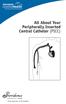 All About Your Peripherally Inserted Central Catheter (PICC) General Information Intravenous (IV) therapy is the delivery of fluid directly into a vein. An intravenous catheter is a hollow tube that is
To maintain a port of entry to venous flow when all available peripheral ports have failed.
 I. Purpose: To maintain a port of entry to venous flow when all available peripheral ports have failed. II. General Comments: Since its development, these catheters have been used with increasing frequency
Guy s, King s and St Thomas Cancer Centre The Cancer Outpatient Clinic Central venous catheter: Peripherally inserted central catheter
 Guy s, King s and St Thomas Cancer Centre The Cancer Outpatient Clinic Central venous catheter: Peripherally inserted central catheter This information leaflet aims to help answer some of the questions
Appendix L: Accessing/Deaccessing Implanted Central Venous Access Port
 Effective Date: 03/01/2008 Page 1 of 5 Recommendations for Use Insertion Considerations Implanted Port Dressing Access/ Reaccess An implanted port is strongly recommended for patients in whom more than
Instructions for Use PROCRIT (PRO KRIT) (epoetin alfa)
 Instructions for Use PROCRIT (PROKRIT) (epoetin alfa) Use these Instructions for Use if you or your caregiver has been trained to give PROCRIT injections at home. Do not give yourself the injection unless
Clinical protocol for the use of syringe drivers in palliative care patients (adults)
 Clinical protocol for the use of syringe drivers in palliative care patients (adults) These guidelines are written for the use of health care professionals in the Oxford Radcliffe NHS Trust and were produced
Administration of Medications & Fluids via a Peripheral Intravenous Cannula
 Administration of Medications & Fluids via a Peripheral Intravenous Cannula Clinical S.O.P. No.: 22.0 Compiled by: Approved by: Review date: November 2016 Administration of Medications & Fluids via S.O.P.
Guidelines for the Use of Subcutaneous Medications in Palliative Care
 Guidelines for the Use of Subcutaneous Medications in Palliative Care Dec 2009 Review Dec 2011 1 Acknowledgments These guidelines have been adapted for local use with kind permission from NHS Greater Glasgow
X-Plain Subclavian Inserted Central Catheter (SICC Line) Reference Summary
 X-Plain Subclavian Inserted Central Catheter (SICC Line) Reference Summary Introduction A Subclavian Inserted Central Catheter, or subclavian line, is a long thin hollow tube inserted in a vein under the
Guideline for the use of subcutaneous hydration in palliative care (hypodermoclysis)
 Guideline for the use of subcutaneous hydration in palliative care (hypodermoclysis) Date Approved by Network Governance September 2012 Date for Review September 2015 Page 1 of 7 1 Scope of Guideline 1.1
DISTRIBUTION: All Clinical Units JHCH, J1, J2, H1, Oncology Day Stay Unit & J2 Day Stay Unit. JHH Intensive Care Unit and Emergency Department
 13.12 PROCEDURE SUBJECT: (This guideline is relevant to inpatient use only) DOCUMENT NUMBER: 13.12 DATE DEVELOPED: May 2013 LAST REVISED DATE: NEW PLANNED REVIEW DATE: November 2017 DISTRIBUTION: All Clinical
Ward 29 guide to the safe preparation and administration of intravenous (IV) antibiotics at home
 Ward 29 guide to the safe preparation and administration of intravenous (IV) antibiotics at home Contents Page Important contact numbers 1 General information on preparing and administering IV antibiotics
Within the Scope of Practice/Role of APRN RN _ X_LPN CNA
 Wyoming State Board of Nursing 130 Hobbs Avenue, Suite B Cheyenne, WY 82002 Phone (307) 777-7601 Fax (307) 777-3519 E-Mail: [email protected] Home Page: https://nursing-online.state.wy.us/ OPINION:
Patient Information. PORT-A-CATH Implantable Venous Access Systems
 Patient Information PORT-A-CATH Implantable Venous Access Systems Your doctor has prescribed treatment that requires the frequent administration of medications or other fluids directly into your bloodstream
PICC & Midline Catheters Patient Information Guide
 PICC & Midline Catheters Patient Information Guide medcompnet.com 1 table of contents Introduction 4 What is a PICC or Midline Catheter? 4 How is the PICC or Midline Catheter Inserted? 6 Catheter Care
Care for your child s Central Venous Catheter (CVC)
 Care for your child s Central Venous Catheter (CVC) This booklet is intended for general informational purposes only. You should consult your doctor for medical advice. Please call the clinic or your home
Dehydration and Fluid Therapy Guide
 Dehydration and Fluid Therapy Guide Background: Dehydration occurs when the loss of body fluids (mainly water) exceeds the amount taken in. Fluid loss can be caused by numerous factors such as: fever,
Peripherally Inserted Central Catheter (PICC) for Outpatient
 Peripherally Inserted Central Catheter (PICC) for Outpatient Introduction A Peripherally Inserted Central Catheter, or PICC line, is a thin, long, soft plastic tube inserted into a vein of the arm. It
V: Infusion Therapy. Alberta Licensed Practical Nurses Competency Profile 217
 V: Infusion Therapy Alberta Licensed Practical Nurses Competency Profile 217 Competency: V-1 Knowledge of Intravenous Therapy V-1-1 V-1-2 V-1-3 V-1-4 V-1-5 Demonstrate knowledge and ability to apply critical
PICCs and Midline Catheters
 Patient Education PICCs and Midline Catheters Patient s guide to PICC (peripherally inserted central catheter) and midline catheters What are PICCs and midline catheters used for? Any medicine given over
ADMINISTRATION OF INTRAVENOUS PUSH/DIRECT MEDICATIONS
 SASKATOON DISTRICT HEALTH Department of Nursing Affairs ADMINISTRATION OF INTRAVENOUS PUSH/DIRECT MEDICATIONS SPECIAL NURSING PROCEDURE LEARNING PACKAGE This package provides the basic information necessary
Collaborative Care Plan for PAIN
 1. Pain Assessment *Patient s own description of pain is the most reliable indicator for pain assessment. Pain intensity to be assessed using the ESAS (Edmonton Symptom Assessment Scale) Use 5 th Vital
Understanding your Peripherally Inserted Central Catheter (PICC) Patient Information
 Understanding your Peripherally Inserted Central Catheter (PICC) Patient Information The Purpose of this Information Sheet This information sheet has been written by patients, members of the public and
Collaboration Anesthesia
 HPC hpcconnection.ca Nursing Neuro - axial Analgesia cross sector Pharmacists Intractable patient centered Opioids Interventional Consensus Collaboration Anesthesia Physicians epidural evidence based Intraspinal
BEAUMONT HOSPITAL DEPARTMENT OF NEPHROLOGY RENAL BIOPSY
 1 BEAUMONT HOSPITAL DEPARTMENT OF NEPHROLOGY GUIDELINES ON ADMINISTRATION OF INTRAVENOUS IRON SUCROSE (VENOFER) AS A BOLUS DOSE IN THE RENAL OUTPATIENT SETTING Date Developed: August- October 2007 RENAL
CUESTA COLLEGE REGISTERED NURSING PROGRAM CRITICAL ELEMENTS
 CUESTA COLLEGE REGISTERED NURSING PROGRAM CRITICAL ELEMENTS LEVELS I through IV A. OVERRIDING CRITICAL ELEMENTS Violation of an overriding area will result in termination and failure of the particular
How to care for a Midline Catheter
 How to care for a Midline Catheter Developed by the health care professionals of the IV Program with assistance from the Department of Learning and Development. All rights reserved. No part of this book
Flushing and Dressing a Peripherally Inserted Central Catheter (PICC Line)
 Flushing and Dressing a Peripherally Inserted Central Catheter (PICC Line) Patient Information Introduction This booklet has been written to provide information to patients with a Peripherally Inserted
Berkshire Healthcare NHS Foundation Trust Becky White CHS Pharmacist April 2013
 Berkshire Healthcare NHS Foundation Trust Becky White CHS Pharmacist April 2013 Access to palliative care drugs out of hours Agreement set up with local community pharmacy s to hold stock of commonly prescribed
A Guide to pain relief medicines For patients receiving Palliative Care
 A Guide to pain relief medicines For patients receiving Palliative Care 1 Which pain medicines are you taking? Contents Page No. Amitriptyline 8 Codeine 9 Co-codamol 10 Co-dydramol 11 Diclofenac (Voltarol
Flushing and Dressing a Peripherally Inserted Central Catheter (PICC Line): a Guide for Nurses
 Flushing and Dressing a Peripherally Inserted Central Catheter (PICC Line): a Guide for Nurses Information for Nurses Introduction This information is for community nursing staffs who have been asked to
BD Saf-T-Intima. Hidden talents of BD Saf-T-Intima. BD SAF-T-Intima and SUBCUTANEOUS THERAPY REHYDRATION PALLIATIVE CARE. POST OPERATIVe PAIN RELIEF
 Hidden talents of BD Saf-T-Intima BD Saf-T-Intima SUBCUTANEOUS INFUSION REHYDRATION PALLIATIVE CARE BD SAF-T-Intima and SUBCUTANEOUS THERAPY PAEDIATRIC CARE POST OPERATIVe PAIN RELIEF BD Saf-T-Intima First
First published in 2006 as Guidelines for syringe driver management in palliative care. Reprinted 2007
 Centre for Palliative Care Research and Education Queensland Health First published in 2006 as Guidelines for syringe driver management in palliative care. Reprinted 2007 Second edition 2010 COPYRIGHT
VA SAN DIEGO HEALTHCARE SYSTEM MEMORANDUM 118-28 SAN DIEGO, CA
 GUIDELINES FOR PATIENT-CONTROLLED ANALGESIA (PCA) AND PATIENT- CONTROLLED EPIDURAL ANALGESIA (PCEA) FOR ACUTE PAIN MANAGEMENT 1. PURPOSE: To assure the safe and effective use of patient controlled analgesia
Biliary Drain. What is a biliary drain?
 Biliary Drain What is a biliary drain? A biliary drain is a tube to drain bile from your liver. It is put in by a doctor called an Interventional Radiologist. The tube or catheter is placed through your
INJECTION TECHNIQUE. IVF NURSING OFFICE: (301) 400-2151 Darshana (301) 400-2146 Nicole
 IVF NURSING OFFICE: (301) 400-2151 Darshana (301) 400-2146 Nicole PLEASE NOTE: If you do not have medications for the next day s dose, you MUST go to the clinic that morning at 6:30 AM for more medications.
PICC and Midline Catheters
 PICC and Midline Catheters Infusion RN s Deb Bucher RN BSN CRNI Dawn Finch RN CRNI Marianne Hansen RN BSN CRNI Karman Youngblood RN BS CRNI Infusion Pharmacist Kathy Cimakasky Pharm D Tamara Migut RPh
Policy and Procedure Flushing and / or Blood withdrawal Aspiration Procedure For PICC Line and Midline Catheters
 Policy and Procedure Flushing and / or Blood withdrawal Aspiration Procedure For PICC Line and Midline Catheters Purpose: Blood Withdrawal: To obtain blood samples for laboratory evaluation, eliminating
BC PALLIATIVE CARE BENEFITS PRESCRIBER GUIDE
 BC PALLIATIVE CARE BENEFITS PRESCRIBER GUIDE VERSION 2.5 OCTOBER 29, 2015 BC PALLIATIVE CARE BENEFITS PRESCRIBER GUIDE CHANGE RECORD DATE VERSION CHANGE DETAILS Dec 1, 2009 1.0 Original version Jun 21,
HUMULIN (HU-mu-lin) N
 Instructions for Use HUMULIN (HU-mu-lin) N (human insulin [rdna origin] isophane suspension) vial (100 Units/mL, U-100) Read the Instructions for Use before you start taking HUMULIN N and each time you
Documentation Summary for Chemotherapy Administration, Nonchemotherapy Injections and Infusions
 Documentation Summary for Chemotherapy Administration, Nonchemotherapy Injections and Infusions Documentation to Support Medical Necessity of Chemotherapy Services Date: April 23, 2012 Source Information:
Tell your doctor about all the medicines you take, including prescription and nonprescription medicines, vitamins, and herbal supplements.
 SOMAVERT pegvisomant for injection PATIENT INFORMATION SOMAVERT (SOM-ah-vert) (pegvisomant for injection) Read the patient information that comes with SOMAVERT before you start using it and each time you
Cytotoxic and Biotherapies Credentialing Programme Module 6
 Cytotoxic and Biotherapies Credentialing Programme Module 6 1. Safe Handling and Administration of Cytotoxic and Biotherapies 2. Waste and Spill Management At the completion of this module the RN will
A4.7 Management of a totally occluded central catheter and persistent withdrawal occlusion (PWO)
 A4.7 Management of a totally occluded central catheter and persistent withdrawal occlusion (PWO) Types of Catheter Related Thrombotic A catheter-related thrombus may be intraluminal (inside the catheter)
PERIPHERALLY INSERTED CENTRAL CATHETERS (PICC) Fong So Kwan APN, Haematology unit Medical Department, QMH
 PERIPHERALLY INSERTED CENTRAL CATHETERS (PICC) Fong So Kwan APN, Haematology unit Medical Department, QMH 1 What is a PICC catheter? Primary vascular access device since their introduction in the mid-1970s,
Peripherally Inserted Central Catheter (PICC) Patient Instructions
 Patient Care Services 300 Pasteur Drive Stanford, CA 94305 Peripherally Inserted Central Catheter (PICC) Patient Instructions A Peripherally Inserted Central Catheter (PICC) is a soft flexible tube inserted
Subcutaneous Medications and Palliative Care: A guide for caregivers
 Caring Safely at Home palliative care education for caregivers Subcutaneous Medications and Palliative Care: A guide for caregivers Contents Disclaimer 2 Introduction 3 1. FAQ Frequently Asked Questions
Insulin Administration by Syringe 10/24/2012 1
 Insulin Administration by Syringe 10/24/2012 1 This PowerPoint and test will satisfy the knowledge portion of medication training for High Alert/High Risk Medication - Insulin. This PowerPoint covers basic
1. Dosing Schedule: your customized schedule of your weekly injections as provided by the center.
 Home Immunotherapy Raza Pasha, MD Congratulations. You are now on the path to better control of your allergies. The following is your instruction guide to allow you to become more familiar with proper
Electronic Medication Administration Record (emar) (For Cerner Sites Only)
 POLICY NO. 1009 Approved: 12/05 Effective: 12/05 Reviewed: 9/10; 5/12 1. Purpose: Electronic Medication Administration Record (emar) (For Cerner Sites Only) To provide direction for the transcription and
IVF CLASS. IVF NURSE CONTACT INFORMATION: Darshana 301-400-2151, [email protected] Nicole 301-400-2146, nicole.l.sobers.ctr@health.
 IVF CLASS IVF NURSE CONTACT INFORMATION: Darshana 301-400-2151, [email protected] Nicole 301-400-2146, [email protected] PLEASE NOTE: If you do not have medications for the next
Corporate Medical Policy
 Corporate Medical Policy File Name: Origination: Last CAP Review: Next CAP Review: Last Review: infusion_therapy_in_the_home 3/1998 2/2016 2/2017 2/2016 Description of Procedure or Service Home infusion
Managing Your Non-Tunneled (Percutaneous) Catheter: PICC, SICC, and JCC. What is a PICC catheter?
 Managing Your Non-Tunneled The staff of the Procedure, Vascular Access, Conscious Sedation Service has written this information to explain your new PICC (peripherally inserted central catheter), SICC (subclavian
Going home with your Tunneled Catheter
 Going home with your Tunneled Catheter Your Tunneled Catheter was put in by on Interventional Radiologist Date Your Tunneled Catheter was put in at: McMaster University Medical Centre Hamilton General
INSTRUCTIONS FOR USE. Read this information before you start. Important things to know about your SmartJect autoinjector. Important things to remember
 INSTRUCTIONS FOR USE SIMPONI (SIM-po-nee) (golimumab) SmartJect autoinjector If your doctor decides that you or a caregiver may be able to give your injections of SIMPONI at home, you should receive training
Baxter Elastomeric Pumps CLINICIAN GUIDE
 Baxter Elastomeric Pumps CLINICIAN GUIDE Portfolio Overview: Baxter Elastomeric Pumps are non-electronic medication pumps designed to provide ambulatory infusion therapy. Medication is delivered to the
Peripherally Inserted Central Catheter (PICC) Benefits Long-term access - dwell time varies (can be > one year) Decreased length of stay in hospital a
 Nursing Management of Venous Access Devices: Peripherally Inserted Central Catheter (PICC) Mimi Bartholomay, RN, MSN, AOCN Denise Dreher, RN, CRNI, VA-BC Theresa Evans, RN, MSN Susan Finn, RN, MSN, AOCNS
Vaxcel PICCs Valved and Non-Valved. A Patient s Guide
 Vaxcel PICCs Valved and Non-Valved A Patient s Guide Information about your Vaxcel PICC is available by calling the Navilyst Medical Vascular Access Information Line 800.513.6876 Vaxcel Peripherally Inserted
Beaumont Hospital Department of Nephrology and Renal Nursing. Guideline for administering Ferinject
 Beaumont Hospital Department of Nephrology and Renal Nursing Guideline Name: Guideline for administering Ferinject Guideline Number: 18 Guideline Version: a Developed By: Louise Kelly CNM 1 Renal Day Care
You will be having surgery to remove a tumour(s) from your liver.
 Liver surgery You will be having surgery to remove a tumour(s) from your liver. This handout will help you learn about the surgery, how to prepare for surgery and your care after surgery. Surgery can be
HUMULIN 70/30 KwikPen
 1 Instructions for Use HUMULIN 70/30 KwikPen (70% human insulin isophane suspension 30% human insulin injection [rdna origin]) Read the Instructions for Use before you start taking HUMULIN 70/30 and each
Care of Your Hickman Catheter
 Care of Your Hickman Catheter Johns Hopkins Kimmel Cancer Center, Revised 7/11 Contents What is a Hickman Catheter? Page 3 Does the Catheter Limit My Activities? Page 4 How Do I Care for My Catheter? Page
INSTRUCTIONS FOR USE HUMIRA 40 MG/0.8 ML, 20 MG/0.4 ML AND 10 MG/0.2 ML SINGLE-USE PREFILLED SYRINGE
 INSTRUCTIONS FOR USE HUMIRA (Hu-MARE-ah) (adalimumab) 40 MG/0.8 ML, 20 MG/0.4 ML AND 10 MG/0.2 ML SINGLE-USE PREFILLED SYRINGE Do not try to inject HUMIRA yourself until you have been shown the right way
1-800-862-2731 Administration of Meropenem For Child
 1 Drug Name: _Meropenem 1-800-862-2731 Administration of Meropenem For Child Dosage: milligrams every hours over 5 minutes Key Points: FLUSHING: Meropenem Heparin flush 1. Always wash your hands with an
Hypodermoclysis (HDC) Administration
 Approved by: Hypodermoclysis (HDC) Administration Vice President and Chief Medical Officer; and Vice President and Chief Operating Officer Corporate Policy & Procedures Manual Number: VII-B-315 Date Approved
Medication Guide Rebif (Re-bif) Interferon beta-1a (in-ter-feer-on beta-one-â)
 Medication Guide Rebif (Re-bif) Interferon beta-1a (in-ter-feer-on beta-one-â) Please read this leaflet carefully before you start to use Rebif and each time your prescription is refilled since there may
GUIDELINES ON THE MANAGEMENT OF PAIN DUE TO CANCER IN ADULTS
 GUIDELINES ON THE MANAGEMENT OF PAIN DUE TO CANCER IN ADULTS Bristol Palliative Care Collaborative Contact Numbers: Hospital Specialist Palliative Care Teams: Frenchay 0117 340 6692 Southmead 0117 323
How To Prepare and Give a Prefilled Syringe Injection
 Diablo Valley Onc&Hem Med Grp, Inc Phone Number: (925)6775041 How To Prepare and Give a Prefilled Syringe Injection Patient Education Quick Reference Guide The following are instructions for use of prefilled
INTERDISCIPLINARY CLINICAL MANUAL Policy & Procedure
 INTERDISCIPLINARY CLINICAL MANUAL Policy & Procedure TITLE: Section: Source: Distribution: Chest Drainage and Chest Tube Management Respiratory/Thoracic Joy Tarasuk, CNE, Thoracic Surgery Capital Health
GUIDELINE FOR ADMINISTRATION OF FENTANYL FOR PAIN RELIEF IN LABOUR
 GUIDELINE FOR ADMINISTRATION OF FENTANYL FOR PAIN RELIEF IN LABOUR INTRODUCTION Intravenous (IV) Fentanyl is a good option for pain management during labour and should be administered in a safe and competent
Epidural Management. Policy/Purpose. Scope
 Fluid & Medications Management Policy/Purpose... 1 Scope... 1 Associated documents... 2 General... 2 Epidural Indications... 2 Contra-indications:... 2 Educational requirements... 3 Procedural Considerations...
Syringe. Product Usage Information: Precautions:
 Syringe Standard Draw Procedure In-Patient, Automated Retraction Non-Reusable. Prepare and give injection using aseptic technique according to institutional policy.. For injection into patients, continue
Eliminating Infusion Confusion. Agenda
 Eliminating Infusion Confusion (Drug Administrations in Facility and Non-facility Settings) Presented by Maria Rita Genovese, CPC, PCS & Maryann C. Palmeter, CPC, CENTC 1 Agenda Review of CPT codes What
How to Care for your Child s Indwelling Subcutaneous Catheter
 The Emily Center How to Care for your Child s Indwelling Subcutaneous Catheter Procedure/Treatment/Home Care Si usted desea esta información en español, por favor pídasela a su enfermero o doctor. #1054
Post-operative Pain Management
 Post-operative Pain Management Total Hip Replacement www.ormc.org A member of the Greater Hudson Valley Health System Post-operative Pain MANAGEMENT Post-operative pain management after total joint replacement
Policies & Procedures. I.D. Number: 1073
 Policies & Procedures Title:: CENTRAL VENOUS CATHETERS INSERTION ASSISTING I.D. Number: 1073 Authorization [] Pharmacy Nursing Committee [] MAC Motion #: [x] SHR Nursing Practice Committee Source: Nursing
Page 1 of 10 MC1482 Peripherally-Inserted Central Catheter. Peripherally-Inserted Central Catheter (PICC)
 Page 1 of 10 MC1482 Peripherally-Inserted Central Catheter Peripherally-Inserted Central Catheter (PICC) Page 2 of 10 MC1482 Peripherally-Inserted Central Catheter Introduction A peripherally-inserted
How To Take A Strong Opioid Painkiller
 Using strong painkillers for cancer pain This information is an extract from the booklet Controlling cancer pain. You may find the full booklet helpful. We can send you a copy free see page 8. Contents
Contents. Overview. Removing the womb (hysterectomy) Overview
 This information is an extract from the booklet Understanding womb (endometrial) cancer. You may find the full booklet helpful. We can send you a free copy see page 9. Overview Contents Overview Removing
FRAGMIN Please bring this booklet the day of your surgery.
 FRAGMIN Please bring this booklet the day of your surgery. QHC#72 Fragmin (dalteparin sodium injection); an anticoagulant (blood thinner) is used to help prevent blood clots after surgery. While on Fragmin,
Care of your peripherally inserted central catheter
 Care of your peripherally inserted central catheter A guide for patients and their carers We care, we discover, we teach Contents What is a PICC?.... 1 How is it put in?.... 1 What are the benefits of
Instructions for Use HUMALOG KwikPen insulin lispro injection (rdna origin)
 1 Instructions for Use HUMALOG KwikPen insulin lispro injection (rdna origin) Read the Instructions for Use before you start taking HUMALOG and each time you get a refill. There may be new information.