
Avaya Communication Manager Call Center Software Basic Call Management System (BCMS) Operations
|
|
|
- Octavia Holt
- 10 years ago
- Views:
Transcription
1 Avaya Communication Manager Call Center Software Basic Call Management System (BCMS) Operations Issue 5.0 May 2005
2 2004 Avaya Inc. All Rights Reserved. Notice While reasonable efforts were made to ensure that the information in this document was complete and accurate at the time of printing, Avaya Inc. can assume no liability for any errors. Changes and corrections to the information in this document may be incorporated in future releases. Documentation disclaimer Avaya Inc. is not responsible for any modifications, additions, or deletions to the original published version of this documentation unless such modifications, additions, or deletions were performed by Avaya. Customer and/or End User agree to indemnify and hold harmless Avaya, Avaya's agents, servants and employees against all claims, lawsuits, demands and judgments arising out of, or in connection with, subsequent modifications, additions or deletions to this documentation to the extent made by the Customer or End User. Link disclaimer Avaya Inc. is not responsible for the contents or reliability of any linked Web sites and does not necessarily endorse the products, services, or information described or offered within them. We cannot guarantee that these links will work all of the time and we have no control over the availability of the linked pages. Warranty Avaya Inc. provides a limited warranty on this product. Refer to your sales agreement to establish the terms of the limited warranty. In addition, Avaya s standard warranty language, as well as information regarding support for this product, while under warranty, is available through the following Web site: Preventing toll fraud "Toll fraud" is the unauthorized use of your telecommunications system by an unauthorized party (for example, anyone who is not a corporate employee, agent, subcontractor, or person working on your company's behalf). Be aware that there may be a risk of toll fraud associated with your system and that, if toll fraud occurs, it can result in substantial additional charges for your telecommunications services. Avaya fraud intervention If you suspect that you are being victimized by toll fraud and you need technical assistance or support, call Technical Service Center Toll Fraud Intervention Hotline at for the United States and Canada. For additional support telephone numbers, see the Avaya Web site: Providing telecommunications security Telecommunications security (of voice, data, and video communications) is the prevention of any type of intrusion to (that is, either unauthorized or malicious access to or use of) your company's telecommunications equipment by some party. Your company's "telecommunications equipment" includes both this Avaya product and any other voice/data/video equipment that could be accessed via this Avaya product (that is, "networked equipment"). An "outside party" is anyone who is not a corporate employee, agent, subcontractor, or person working on your company's behalf. Whereas, a "malicious party" is anyone (including someone who may be otherwise authorized) who accesses your telecommunications equipment with either malicious or mischievous intent. Such intrusions may be either to/through synchronous (time-multiplexed and/or circuit-based) or asynchronous (character-, message-, or packet-based) equipment or interfaces for reasons of: Use (of capabilities special to the accessed equipment) Theft (such as, of intellectual property, financial assets, or toll-facility access) Eavesdropping (privacy invasions to humans) Mischief (troubling, but apparently innocuous, tampering) Harm (such as harmful tampering, data loss or alteration, regardless of motive or intent) Be aware that there may be a risk of unauthorized intrusions associated with your system and/or its networked equipment. Also realize that, if such an intrusion should occur, it could result in a variety of losses to your company (including, but not limited to, human and data privacy, intellectual property, material assets, financial resources, labor costs, and legal costs). Your responsibility for your company's telecommunications security The final responsibility for securing both this system and its networked equipment rests with you, an Avaya customer's system administrator, your telecommunications peers, and your managers. Base the fulfillment of your responsibility on acquired knowledge and resources from a variety of sources, including, but not limited to: Installation documents System administration documents Security documents Hardware-/software-based security tools Shared information between you and your peers Telecommunications security experts To prevent intrusions to your telecommunications equipment, you and your peers should carefully program and configure: Your Avaya-provided telecommunications systems and their interfaces Your Avaya-provided software applications, as well as their underlying hardware/software platforms and interfaces Any other equipment networked to your Avaya products. Trademarks Avaya is a trademark of Avaya Inc. All non-avaya trademarks are the property of their respective owners. Document ordering information: Avaya Publications Center Voice: (Toll-free, U.S. and Canada only) Fax: (Toll-free, U.S. and Canada only) Write: Globalware Solutions 200 Ward Hill Avenue Haverhill, MA USA Attention: Avaya Account Manager Web: [email protected] Order: Document No , Issue 5.0 May 2005 For the most current versions of documentation, go to the Avaya support Web site: COMPAS This document is also available from the COMPAS database. The COMPAS ID for this document is Avaya support Avaya provides a telephone number for you to use to report problems or to ask questions about your contact center. The support telephone number is in the United States. For additional support telephone numbers, see the Avaya Web site:

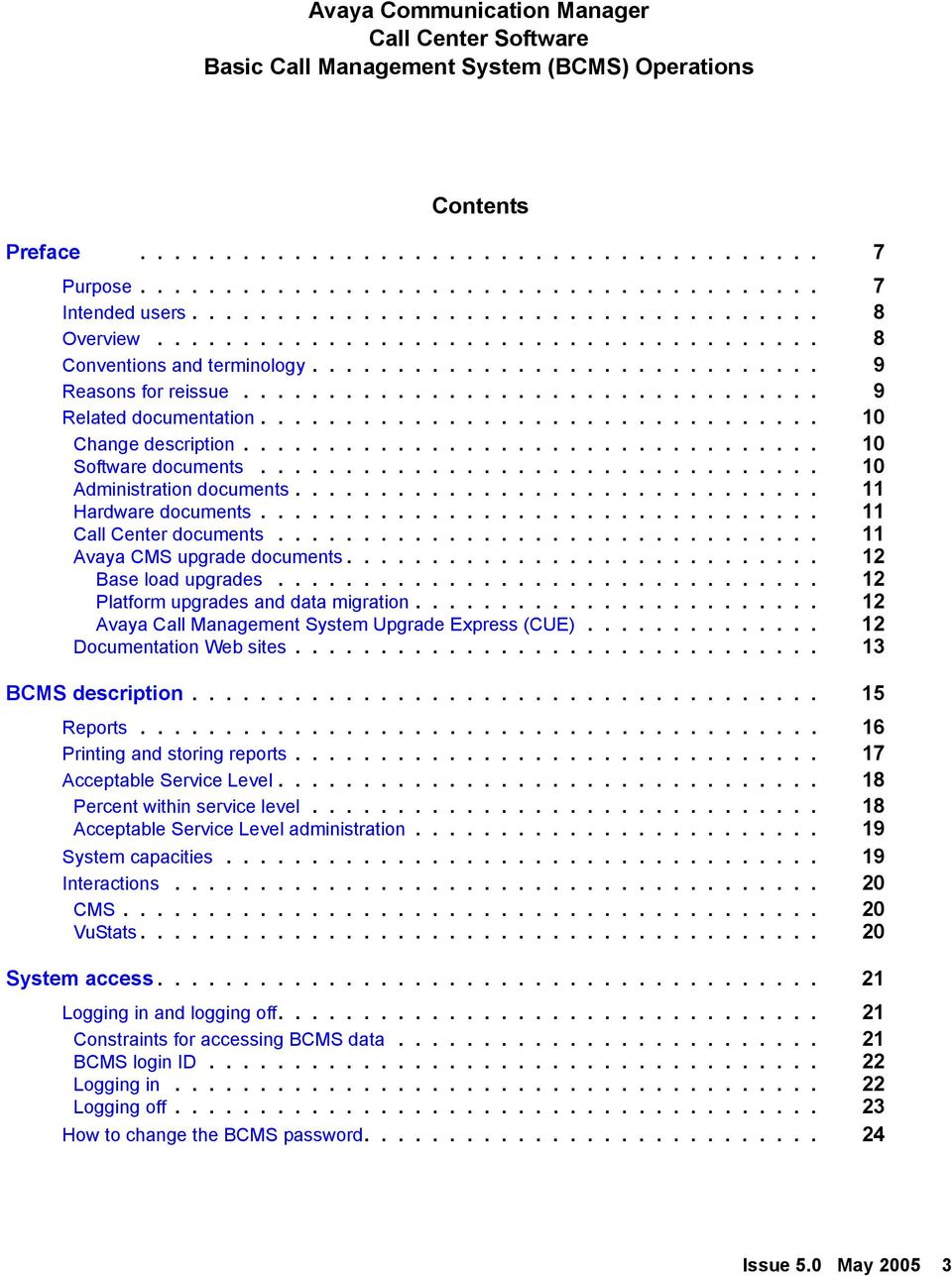
3 Avaya Communication Manager Call Center Software Basic Call Management System (BCMS) Operations Contents Preface Purpose Intended users Overview Conventions and terminology Reasons for reissue Related documentation Change description Software documents Administration documents Hardware documents Call Center documents Avaya CMS upgrade documents Base load upgrades Platform upgrades and data migration Avaya Call Management System Upgrade Express (CUE) Documentation Web sites BCMS description Reports Printing and storing reports Acceptable Service Level Percent within service level Acceptable Service Level administration System capacities Interactions CMS VuStats System access Logging in and logging off Constraints for accessing BCMS data BCMS login ID Logging in Logging off How to change the BCMS password Issue 5.0 May
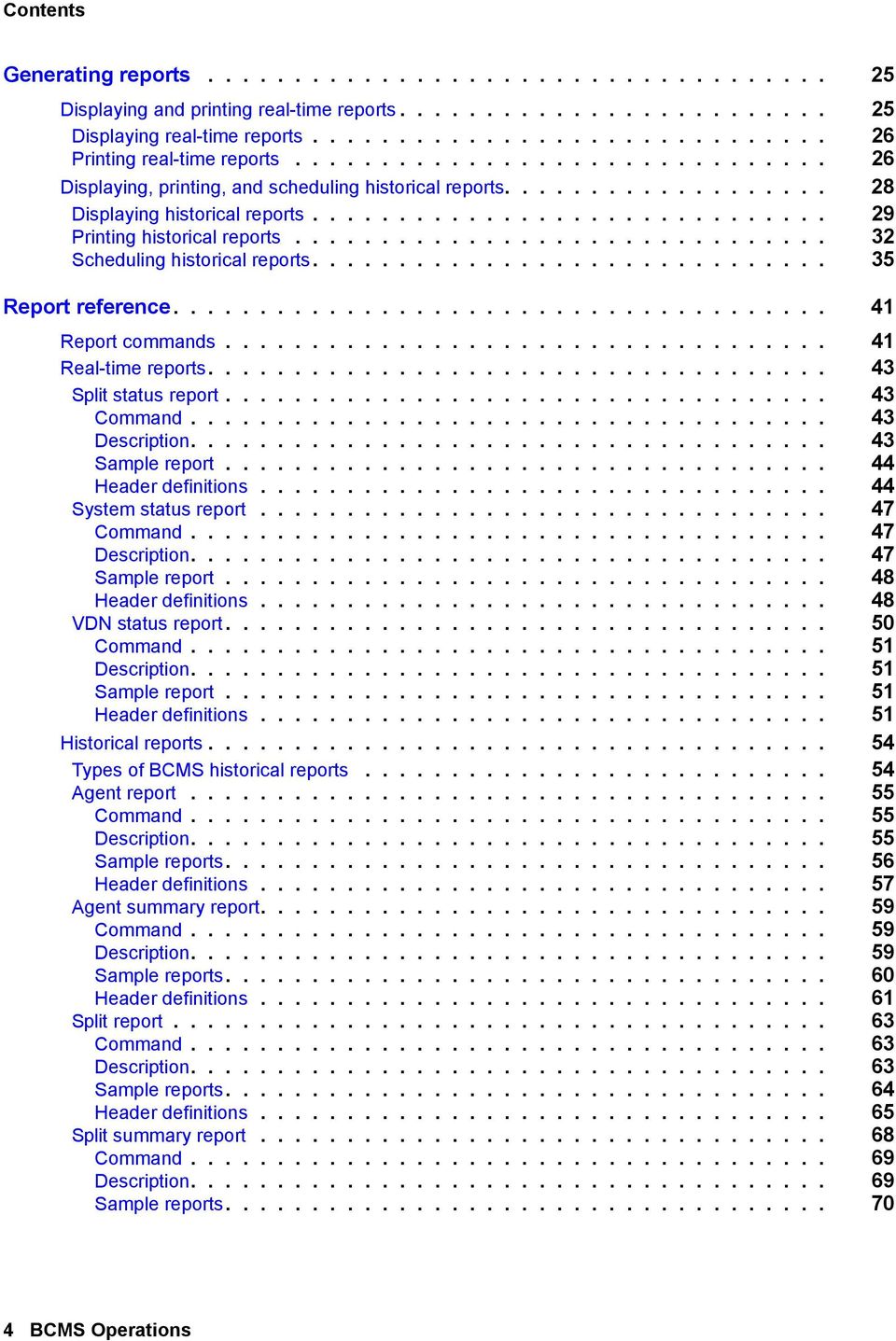
4 Contents Generating reports Displaying and printing real-time reports Displaying real-time reports Printing real-time reports Displaying, printing, and scheduling historical reports Displaying historical reports Printing historical reports Scheduling historical reports Report reference Report commands Real-time reports Split status report Command Description Sample report Header definitions System status report Command Description Sample report Header definitions VDN status report Command Description Sample report Header definitions Historical reports Types of BCMS historical reports Agent report Command Description Sample reports Header definitions Agent summary report Command Description Sample reports Header definitions Split report Command Description Sample reports Header definitions Split summary report Command Description Sample reports BCMS Operations
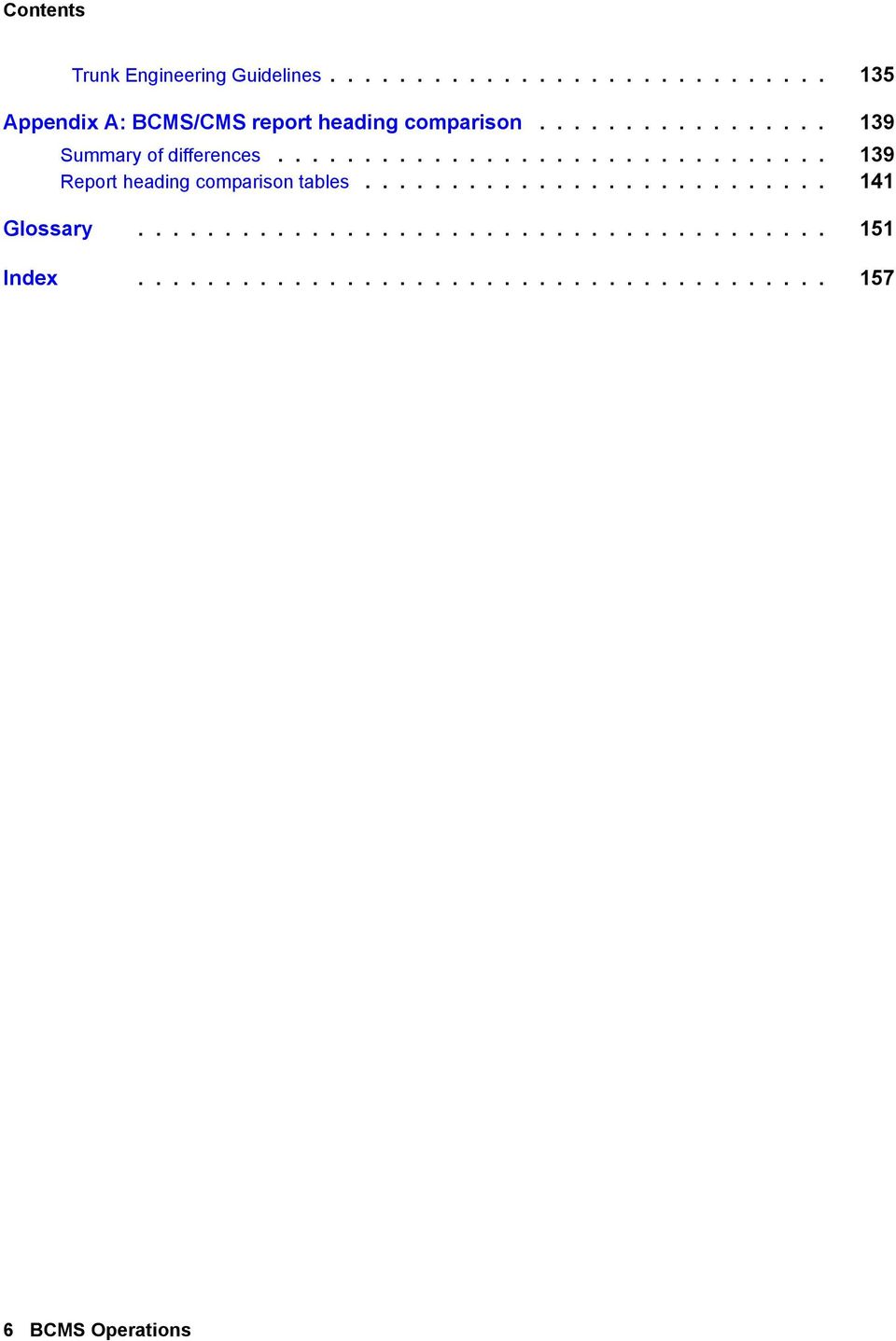
5 Contents Header definitions Trunk group report Command Description Sample reports Header definitions Trunk group summary report Command Description Sample reports Header definitions VDN report Command Description Sample reports Header definition VDN summary report Command Description Sample reports Header definitions System printer and Report Scheduler System printer System printer administration System printer data link operation and maintenance Report Scheduler Print intervals Adding a report to Report Scheduler Printing reports on the system printer Listing scheduled reports Changing scheduled reports Removing scheduled reports Using reports for ACD planning Planning/engineering objectives System status report Split status report VDN status report Trunk group report Agent report Split report VDN report Engineering ACD applications with report data About interpolation Agent engineering/optimizing guidelines Agent engineering examples Average service time engineering tables Issue 5.0 May

6 Contents Trunk Engineering Guidelines Appendix A: BCMS/CMS report heading comparison Summary of differences Report heading comparison tables Glossary Index BCMS Operations
7 Preface This section includes the following topics: Purpose on page 7 Intended users on page 8 Overview on page 8 Conventions and terminology on page 9 Reasons for reissue on page 9 Related documentation on page 10 Purpose The purpose of this document is to provide a comprehensive description of the Basic Call Management System (BCMS) feature, which is available with Avaya Communication Manager Call Center Software and Enterprise Communications Server (ECS) products. This document also describes the Report Scheduler feature, which is often used with BCMS. Issue 5.0 May
8 Preface Intended users This document is written for BCMS administrators.this document might be useful for system administrators, Automatic Call Distribution (ACD) split supervisors, ACD administrators, and ACD agents. Overview This document includes the following topics: BCMS description on page 15 Provides a brief overview of the BCMS feature and lists the types of BCMS reports. System access on page 21 Provides procedures on how to log in and log off BCMS. This section also provides the procedures for changing the BCMS password. Generating reports on page 25 Describes the procedures for displaying, printing, and scheduling BCMS reports. Report reference on page 41 Provides a detailed description of each type of BCMS report. System printer and Report Scheduler on page 91 Describes the optional Report Scheduler feature. This section also includes a description of Report Scheduler commands and a display of the reports. Using reports for ACD planning on page 101 Describes desirable objectives and how the BCMS reports can be used to plan, engineer, and optimize ACD splits and trunk groups. 8 BCMS Operations

9 Conventions and terminology Conventions and terminology If you see any of the following safety labels in this document, take careful note of the information presented. CAUTION: WARNING: DANGER: SECURITY ALERT:! CAUTION: Caution statements call attention to situations that can result in harm to software, loss of data, or an interruption in service.! WARNING: Warning statements call attention to situations that can result in harm to hardware or equipment.! DANGER: Danger statements call attention to situations that can result in harm to personnel.! SECURITY ALERT: Security alert statements call attention to situations that can increase the potential for unauthorized use of a telecommunications system. Reasons for reissue This document was updated to include information for the R12 release of the Avaya Call Management System software A general update and correction of a variety of small problems, such as typographical errors, was done. Issue 5.0 May
10 Preface Related documentation You might find the following Avaya CMS documentation useful. This section includes the following topics: Change description on page 10 Software documents on page 10 Administration documents on page 11 Hardware documents on page 11 Call Center documents on page 11 Avaya CMS upgrade documents on page 12 Documentation Web sites on page 13 Change description For information about the changes made in Avaya CMS R13, see: Avaya Call Center 3.0 and Call Management System (CMS) Release 13 Change Description, Software documents For more information about Avaya CMS software, see: Avaya Call Management System Release 13 Software Installation, Maintenance, and Troubleshooting Guide, Avaya CMS Open Database Connectivity Version 4.2, Avaya Call Management System Release 13 LAN Backup User Guide, Avaya Call Management System Release 13 External Call History Interface, Avaya CMS Custom Reports, Avaya CMS Forecast User Guide, Avaya Visual Vectors Release 13 Installation and Getting Started, Avaya Visual Vectors Release 13 User Guide, Avaya Call Management System (CMS) Supervisor Release 13 Report Designer, BCMS Operations

11 Related documentation Administration documents For more information about Avaya CMS administration, see: Avaya Call Management System Release 13 Administration, Avaya Call Management System (CMS) Release 13 Database Items and Calculations, Avaya Call Management System Supervisor Release 13 Reports, Avaya Call Management System (CMS) Supervisor Release 13 Installation and Getting Started, Avaya Call Management System High Availability User Guide, Avaya Call Management System High Availability Connectivity, Upgrade and Administration, Hardware documents For more information about Avaya CMS hardware, see: Avaya Call Management System Sun Fire V880/V890 Computer Hardware Installation, Maintenance, and Troubleshooting, Avaya Call Management System Sun Blade 100/150 Workstation Hardware Installation, Maintenance, and Troubleshooting, Avaya Call Management System Terminals, Printers, and Modems, Call Center documents For more information about Avaya Call Center documents, see: Avaya Communication Manager Call Center Software Basic Call Management System (BCMS) Operations, Avaya Call Management System Switch Connections, Administration, and Troubleshooting, Avaya Communication Manager Call Center Software Call Vectoring and Expert Agent Selection (EAS) Guide, Avaya Communication Manager Call Center Software Automatic Call Distribution (ACD) Guide, Avaya Business Advocate User Guide, Issue 5.0 May

12 Preface Avaya CMS upgrade documents There are several upgrade paths supported with Avaya CMS. There is a document designed to support each upgrade. This section includes the following topics: Base load upgrades on page 12 Platform upgrades and data migration on page 12 Avaya Call Management System Upgrade Express (CUE) on page 12 Base load upgrades Use a base load upgrade when upgrading CMS to the latest load of the same version (for example, r13ak.g to r13al.k). A specific set of instructions is written for the upgrade. The instructions are shipped to the customer site with the CMS software CD-ROM as part of a Product Correction Notice (PCN). For more information about base load upgrades, see: Avaya Call Management System Release 13 Base Load Upgrade Platform upgrades and data migration Use a platform upgrade when upgrading to a new hardware platform (for example, upgrading from a SPARCserver 5 to a Sun Blade 150). The new hardware platform is shipped from the Avaya factory with the latest CMS load. Therefore, as part of the upgrade you will have the latest CMS load (for example, R3V9 to R13). For more information about platform upgrades and data migration, see: Avaya Call Management System Release 13 Platform Upgrade and Data Migration, Avaya Call Management System Upgrade Express (CUE) Use CUE when CMS is being upgraded from an earlier version (for example, R3V9) to the latest version (for example, R13). A specific set of upgrade instructions is written for the upgrade. These instructions are included on the CUE software CD-ROM that is shipped to the customer site with the CUE kit. For information about customer requirements for CUE upgrades, see: Avaya Call Management System Release 13 CMS Upgrade Express (CUE) Customer Requirements, BCMS Operations
13 Related documentation For information about CUE upgrade procedures, see: Avaya Call Management System Release 13 Sun Blade 100/150 Workstation Mirrored and Nonmirrored Systems CMS Upgrade Express (CUE), Avaya Call Management System Release 13 Sun Fire V880/V890 Computer CMS Upgrade Express (CUE), Documentation Web sites For Avaya product documentation, go to Additional information about new software or hardware updates will be contained in future issues of this book. New issues of this book will be placed on the Web site when available. Use the following Web sites to view related support documentation: Information about Avaya products and service Sun hardware documentation Informix documentation Tivoli Storage Manager documentation Issue 5.0 May
14 Preface 14 BCMS Operations

15 BCMS description BCMS helps you monitor the operations of your ACD application. BCMS collects data related to the calls on the switch and organizes the data into reports that help you manage ACD facilities and personnel. The BCMS reports allow you to manage the hourly and/or daily operations of the ACD by: Monitoring trunk group usage Monitoring the calling volume for each split Monitoring VDNs Monitoring the work load of each agent Comparing agent performance. These reports can be displayed on a video display terminal in real time, printed immediately, scheduled to print at a later time, or scheduled to print periodically at times you specify. Note: Note: All references to splits in this book also apply to skills as used with the Expert Agent Selection (EAS) feature. See Interactions on page 20 for more information. This section includes the following topics: Reports on page 16 Printing and storing reports on page 17 Acceptable Service Level on page 18 System capacities on page 19 Interactions on page 20 Issue 5.0 May

16 BCMS description Reports The BCMS feature provides the following reports: Real-time reports that present data on: - All splits, on a system basis, that are administered for internal measurement or for both internal and external measurement - Individual splits and the agents staffing them that have been administered for internal measurement or for both internal and external measurement - VDNs that are administered for internal measurement or for both internal and external measurement. Historical reports that present historical information and can be printed immediately or scheduled for subsequent printing. These reports present data on: - Individual agents or a group of agents, based on the time of day - Individual agents or a group of agents, based on the day of the week - Individual splits or a group of splits, based on the time of day - Individual splits or a group of splits, based on the day of the week - Individual trunk groups or a group of trunk groups, based on the time of day - Individual trunk groups or a group of trunk groups, based on the day of the week - Individual Vector Directory Numbers (VDNs) based on the time of day - Individual VDNs based on the day of the week Note: Note: Agents can be measured by their physical extension (that is, the extension number they use), or by their Login IDs when either EAS or BCMS/VuStats Login IDs is optioned. Report reference on page 41 describes each BCMS report in detail while Using reports for ACD planning on page 101 describes how to plan and maintain an ACD based on the information provided by these reports. 16 BCMS Operations
17 Printing and storing reports Printing and storing reports The BCMS reports may be displayed on an administration terminal or printed on its associated printer. The reports can also be scheduled to print at a later time using the Report Scheduler. As an option, a personal computer (PC) or host computer may be used to store the reports and provide additional data manipulation capabilities. Note: Note: The BCMS software resides completely on the switch and does not include any special software or unique communications protocol for the PC/host computer application. Although Avaya does propose the use of a PC to collect, store, and print the reports, Avaya does not recommend an applications software package for the PC. Since Avaya does not install, administer, or control the PC application, Avaya does not guarantee correct operation of this arrangement. Customers using a PC to collect report data will need the following report output information for each report: 1. Begin with one-half page of line feeds. 2. Print a four-line banner containing the following information: Print job ID Command Time of day User 3. Provide a form feed. 4. Begin report data using 80 characters per line. Use spaces where there are no data, and a newline character at the end of each line. 5. Provide a form feed after each page of data. The page length is defined in system parameters. 6. Provide a form feed when the report has finished printing. BCMS data is stored in volatile switch memory; it cannot be saved to or retrieved from tape. The switch preserves historical data if a Reset System 1, Reset System 2, or Reset System Interchange (in a duplicated system) occurs. Real-time data is preserved if a Reset System 1 or Reset System Interchange occurs. The switch loses all data (historical and real-time) during software upgrades. Issue 5.0 May
18 BCMS description Acceptable Service Level Before using BCMS, you should understand the concept of Acceptable Service Level and set the acceptable service level field on various screens. Acceptable Service Level is the desired time for an agent to answer a call for a given VDN or hunt group. Timing for a call begins when the call encounters a VDN or enters a hunt group queue. If the number of seconds to answer the call is equal to or less than the administered acceptable service level for the VDN or hunt group, the call is recorded as acceptable. This section includes the following topics: Percent within service level on page 18 Acceptable Service Level administration on page 19 Percent within service level A service level can be administered for each hunt group or VDN if the BCMS/VuStats Service Level customer option has been enabled and if the hunt group or VDN is measured by BCMS. To calculate the percentage of calls within the acceptable service level, BCMS divides the number of acceptable calls by the calls offered. For hunt groups, BCMS calculates the Percent Within Service Level as follows: where: accepted - Is the number of calls answered for which the queue time was less than or equal to the administered service level for the split. dequeued - Is the number of calls that encountered the split queue, but were NOT answered, abandoned, or outflowed. This occurs with multiple split queuing. For VDNs, BCMS calculates the Percent Within Service Level as follows: where: % IN SERV LEVL = accepted * ACDcalls + abandons + outflows + dequeued % IN SERV LEVL = accepted * calls offered accepted - Is the number of answered calls (num ans) for which the time to answer was less than or equal to the administered service level for the VDN. num ans here refers to the data item on the screen. 18 BCMS Operations

19 System capacities calls offered - Is the total number of completed calls that accessed the VDN during the current interval. Acceptable Service Level administration The Acceptable Service Level is administered on the System-Parameters Customer-Options, VDN, and Hunt Group screens. On the System-Parameters Customer-Options screen (changeable using a superuser ID), verify that the field BCMS/ VuStats Service Level is set to y. On the Hunt Group screen, set the Acceptable Service Level field to a number between 0 and 9999 seconds. Set the Measured field to either internal or both. On the Vector Directory Number screen, set the Acceptable Service Level field to a number between 0 and 9999 seconds. Set the Measured field to either internal or both. The column % IN SERV LEVL on a report will be blank if: The BCMS/VuStats Service Level field on the Customer Options screen is set to n No service level is defined for the split or VDN (it cannot be set if BCMS Service Level is set to n) No call ended in the interval System capacities Because system capacity limits change often, this information is now being maintained in a document for each switch release. For switch releases up to R9, consult the System Description document. For switch releases R10 and later, see the Capacity Tables document. All of these documents can be accessed from the Avaya documentation Web site: Issue 5.0 May
20 BCMS description Interactions This section includes the following topics: CMS on page 20 VuStats on page 20 CMS From the administration perspective, the ACD parameters associated with trunk groups, hunt groups, and VDNs are any of the following: Not measured Internally measured by BCMS Externally measured by CMS Measured both internally by BCMS and externally by CMS. Note that using BCMS in conjunction with CMS increases the maximum number of agents and trunk groups that can be measured for a particular ACD application. In other words, the capacities for BCMS are additive to those of CMS. Note: Note: If both BCMS and CMS are used simultaneously, switch performance may be degraded. VuStats VuStats enables agents and supervisors with telephone displays to view data about agents, splits, and VDNs. Much of this information is the same as that provided by BCMS. 20 BCMS Operations

21 System access This section includes the following topics: Logging in and logging off on page 21 How to change the BCMS password on page 24 Logging in and logging off A BCMS terminal is treated by the system as a remote management terminal. You can access BCMS reports either from a local system management terminal, on a dial-up basis, or by using the Avaya Site Administration terminal emulator tool. This section includes the following topics: Constraints for accessing BCMS data on page 21 BCMS login ID on page 22 Logging in on page 22 Logging off on page 23 Constraints for accessing BCMS data When dial-up access is used, the following constraints affect the number of terminals that can access BCMS data simultaneously: The number of dial-up (Netcon) channels The number of Terminal User IDs (TUIs). A TUI is a switch resource used by: - The Technical Service Center (TSC) when logged in - The management terminal when powered up - A remote management terminal when logged in - A BCMS terminal when logged in Issue 5.0 May
22 System access - The system printer while printing - A journal/log printer when administered When the switch is configured with more than one management terminal, typically one terminal is dedicated to administration and/or maintenance tasks while the others are used for ACD/BCMS features. BCMS login ID The switch provides several different categories of login IDs. The login ID identifies the user and that user s permitted capabilities to the system. You must create a login ID for each supervisor or user that you want to view BCMS reports. A BCMS login ID can allow you to display, print, and schedule BCMS reports. Logging in There are many ways to log in to BCMS: from a local terminal, from a remote terminal, or using the Avaya Site Administration tool. The remote terminal requires a data module for dialing up the system and Avaya Site Administration can use a modem or a LAN connection. To log into BCMS: 1. If remote, dial in to the switch. If local, turn on the terminal and press BREAK if a login prompt is not displayed. The terminal displays a login prompt. 2. Enter your login ID and press RETURN. The screen displays the password prompt. 3. Enter your password and press RETURN. The system verifies that the login ID and password you entered are valid. If you entered an invalid login ID or password, the system displays a message and requires you to log in again. 22 BCMS Operations
23 Logging in and logging off 4. Enter the appropriate terminal type. In most cases, use the default terminal type that the system displays. After you enter the appropriate terminal type, the system displays the command screen. This system is restricted to authorized users for legitimate business purposes. Unauthorized access is a criminal violation of the law. Copyright (c) Avaya Inc. Unpublished & Not for Publication All Rights Reserved Command: The system is now ready for you to enter a command to generate a BCMS report. Logging off SECURITY ALERT:! SECURITY ALERT: Whenever you are not using BCMS, log off the system. To log off the system, perform the following steps: 1. Enter: logoff The system displays a message questioning if you want to log off. 2. Enter: y You are logged off from the system. Issue 5.0 May
24 System access How to change the BCMS password Any user can change the password for their own login ID. Only users with special privileges, such as the system administrator, can change the password for other users.! SECURITY ALERT: SECURITY ALERT: To protect access to the system, the password should be changed at regular intervals, each time a new person takes over a login ID, and if an unauthorized person has discovered the password. Once a password is assigned or changed, do not give the password to anyone and keep any written passwords in a locked place. To change a password: 1. At the command prompt, enter: change password <login name> The system displays the Password Administration screen. The cursor is positioned on the Password of Login Making Change field. change password bcms Page 1 of 1 PASSWORD ADMINISTRATION Password of Login Making Change: LOGIN BEING CHANGED Login Name: bcms LOGIN'S PASSWORD INFORMATION Login's Password: Reenter Login's Password: 2. Enter your password and press RETURN. The cursor is positioned on the Login s Password field. 3. Enter your new password and press RETURN. Valid passwords contain a minimum of four characters either alphabetic or numeric. The cursor is positioned on the Reenter Login s Password field. 4. Re-enter your new password and press ENTER. The system displays the following message: command completed successfully 24 BCMS Operations
25 Generating reports This chapter describes the procedures for displaying and printing real-time reports and for displaying, printing, and scheduling historical reports. Before attempting to print these reports, make sure that a system printer is connected and administered. This section includes the following topics: Displaying and printing real-time reports on page 25 Displaying, printing, and scheduling historical reports on page 28 Displaying and printing real-time reports The monitor command is used to display and print real-time status reports. These reports display data accrued since the last interval boundary. Data is based on hourly or half-hourly intervals as administered in the BCMS/VuStats Measurement Interval field on the Feature-Related System Parameters screen. There are three monitor commands, one to display or print each real-time report: monitor bcms split monitor bcms system monitor bcms vdn Whenever a status report is displayed on the management terminal, it updates automatically approximately every 30 seconds. You can immediately update the on-screen status report by pressing UPDATE. To cancel the monitor command and return to the command prompt, press CANCEL. If the status report consists of more than one page, press NEXTPAGE to display any subsequent pages and PREVPAGE to display any previous pages. If you incorrectly enter the command, or if the qualifier is not applicable or is not measured, an error message displays on the message line located on the bottom of the screen. If you require more information about the error message, press HELP. Complete the steps in the following topics to display or print real-time reports. This section includes the following topics: Issue 5.0 May
26 Generating reports Displaying real-time reports on page 26 Printing real-time reports on page 26 Displaying real-time reports To display a real-time report, complete the following steps: 1. Type the monitor command that will display the report you want to view. See Commands for displaying real-time reports on page Press RETURN. The report displays on your screen. 3. Press NEXTPAGE to display subsequent pages and PREVPAGE to display previous pages. 4. To immediately update the report data, press UPDATE. 5. To exit the report, press CANCEL. Commands for displaying real-time reports To view the Enter Where Split status report monitor bcms split ## ## is an administered split measured by BCMS. System status report monitor bcms system ## ## is an administered split or range of splits measured by BCMS. ## is optional. If not included, the report shows all splits. VDN status report monitor bcms vdn ## ## is an administered VDN extension measured by BCMS. Printing real-time reports To print a real-time report, complete the following steps: 1. Type the monitor command that will print the report. See Commands for printing real-time reports. 2. Press RETURN. The report prints on the printer that is attached to your terminal. 26 BCMS Operations
27 Displaying and printing real-time reports Commands for printing real-time reports To view the Enter Where Split status report monitor bcms split ## print ## is an administered split measured by BCMS. System status report monitor bcms system ## print ## is an administered split or range of splits measured by BCMS. ## is optional. If not included, the report shows all splits. VDN status report monitor bcms vdn ## print ## is an administered VDN extension measured by BCMS. Issue 5.0 May
28 Generating reports Displaying, printing, and scheduling historical reports The list commands are used to display historical information for agents, splits, trunk groups, and VDNs. There are eight secondary list commands: list bcms agent list bcms summary agent list bcms split list bcms summary split list bcms trunk list bcms summary trunk list bcms vdn list bcms summary vdn With these commands, you can specify: Whether you want data that is collected during a specified range of dates or during a specified period of time. Data collected during a specified period of time is based on hourly or half-hourly intervals as administered in the BCMS/VuStats Measurement Interval field on the Feature-Related System Parameters screen.! CAUTION: CAUTION: The switch stores time interval data in a time database that holds a maximum of 25 intervals. Data for the 26th interval overwrites the first interval in the time database (and so on). Therefore, if the half-hour option is selected, care should be exercised to ensure that time interval reports are run while the data for the desired interval is still available in the time database. For example, if you select the half-hour option, print the report twice daily to ensure that you do not lose information. The times or days for which you want to see data. That the system immediately display the report on your terminal. That the system print the report. If you include print at the end of the command, the system will immediately print the report to the printer attached to the management terminal. If you include schedule at the end of the command, the system will allow you to schedule the report to print to the system printer immediately (immediate), at a later time (deferred), or routinely at specified times (scheduled). Use the steps in the following topics to display, print, or schedule historical reports. 28 BCMS Operations
29 Displaying, printing, and scheduling historical reports This section includes the following topics: Displaying historical reports on page 29 Printing historical reports on page 32 Scheduling historical reports on page 35 Displaying historical reports To display an historical report, complete the following steps: 1. Type the list command that will display the report you want to view. See Commands for displaying historical reports on page Press RETURN. The report displays on your screen. 3. Press NEXTPAGE to display subsequent pages and PREVPAGE to display previous pages if appropriate. Commands for displaying historical reports To view the Enter Where Agent report (hourly/ half-hourly) Agent report (daily) list bcms agent ## time staffed xx:xx xx:xx list bcms agent ## day staffed xx/xx xx/xx ## is a valid agent extension or login ID measured by BCMS. staffed lists data only for the intervals that the agent has staffed time. The first xx:xx is the start time. The second xx:xx is the stop time. Both use a 24-hour clock. ## is a valid agent extension or login ID measured by BCMS. staffed lists data only for the days that the agent has staffed time. The first xx/xx is the start day. The second xx/xx is the stop day. Issue 5.0 May
30 Generating reports Commands for displaying historical reports (continued) To view the Enter Where Agent summary report (hourly/ half-hourly) Agent summary report (daily) Split report (hourly/ half-hourly) Split report (daily) Split summary report (hourly/half-hourly) Split summary report (daily) list bcms summary agent ## time staffed xx:xx xx:xx list bcms summary agent ## day staffed xx/xx xx/xx list bcms split ## time xx:xx xx:xx list bcms split ## day xx/xx xx/xx list bcms summary split ## time xx:xx xx:xx list bcms summary split ## day xx/xx xx/ xx ## is a valid agent extension or login ID or range of extensions/ login IDs measured by BCMS. staffed lists data only for agents with staffed time. The first xx:xx is the start time. The second xx:xx is the stop time. Both use a 24-hour clock. ## is a valid agent extension or login ID or range of extensions/ login IDs measured by BCMS. staffed lists data only for agents with staffed time. The first xx/xx is the start day. The second xx/xx is the stop day. ## is an administered split measured by BCMS. The first xx:xx is the start time. The second xx:xx is the stop time. Both use a 24-hour clock. ## is an administered split measured by BCMS. The first xx/xx is the start day. The second xx/xx is the stop day. ## is an administered split or range of splits measured by BCMS. The first xx:xx is the start time. The second xx:xx is the stop time. Both use a 24-hour clock. ## is an administered split or range of splits measured by BCMS. The first xx/xx is the start day. The second xx/xx is the stop day. 30 BCMS Operations
31 Displaying, printing, and scheduling historical reports Commands for displaying historical reports (continued) To view the Enter Where Trunk group report (hourly/half-hourly) Trunk group report (daily) Trunk group summary report (hourly/half-hourly) Trunk group summary report (daily) VDN report (hourly/ half-hourly) VDN report (daily) list bcms trunk ## time xx:xx xx:xx list bcms trunk ## day xx/xx xx/xx list bcms summary trunk ## time xx:xx xx:xx list bcms summary trunk ## day xx/xx xx/ xx list bcms vdn ## time xx:xx xx:xx list bcms vdn ## day xx/xx xx/xx ## is a trunk group measured by BCMS. The first xx:xx is the start time. The second xx:xx is the stop time. Both use a 24-hour clock. ## is a trunk group measured by BCMS. The first xx/xx is the start day. The second xx/xx is the stop day. ## is a trunk group or range of trunk groups measured by BCMS. The first xx:xx is the start time. The second xx:xx is the stop time. Both use a 24-hour clock. ## is a trunk group or range of trunk groups measured by BCMS. The first xx/xx is the start day. The second xx/xx is the stop day. ## is an administered VDN extension measured by BCMS. The first xx:xx is the start time. The second xx:xx is the stop time. Both use a 24-hour clock. ## is an administered VDN extension measured by BCMS. The first xx/xx is the start day. The second xx/xx is the stop day. Issue 5.0 May
32 Generating reports Commands for displaying historical reports (continued) To view the Enter Where VDN summary report (hourly/half-hourly) VDN summary report (daily) list bcms summary vdn ## time xx:xx xx:xx list bcms summary vdn ## day xx/xx xx/xx ## is an administered VDN extension or range of extensions measured by BCMS. The first xx:xx is the start time. The second xx:xx is the stop time. Both use a 24-hour clock. ## is an administered VDN extension or range of extensions measured by BCMS. The first xx/xx is the start day. The second xx/xx is the stop day. Printing historical reports If you do not have a printer directly connected to your terminal, see Scheduling historical reports on page 35. To print an historical report, complete the following steps: 4. Type the list command for the report that you want to print. See Commands for printing historical reports on page BCMS Operations
33 Displaying, printing, and scheduling historical reports 5. Press RETURN. The report prints on the printer that is attached to your terminal. Commands for printing historical reports To print the Enter Where Agent report (hourly/ half-hourly) Agent report (daily) Agent summary report (hourly/ half-hourly) Agent summary report (daily) Split report (hourly/ half-hourly) list bcms agent ## time staffed xx:xx xx:xx print list bcms agent ## day staffed xx/xx xx/xx print list bcms summary agent ## time staffed xx:xx xx:xx print list bcms summary agent ## day staffed xx/xx xx/xx print list bcms split ## time xx:xx xx:xx print ## is a valid agent extension or login ID measured by BCMS. staffed prints data only for the intervals that the agent has staffed time. The first xx:xx is the start time. The second xx:xx is the stop time. Both use a 24-hour clock. ## is a valid agent extension or login ID measured by BCMS. staffed prints data only for the days that the agent has staffed time. The first xx/xx is the start day. The second xx/xx is the stop day. ## is a valid agent extension or login ID or range of extensions/ login IDs measured by BCMS. staffed prints data only for agents with staffed time. The first xx:xx is the start time. The second xx:xx is the stop time. Both use a 24-hour clock. ## is a valid agent extension or login ID or range of extensions/ login IDs measured by BCMS. staffed prints data only for agents with staffed time. The first xx/xx is the start day. The second xx/xx is the stop day. ## is an administered split measured by BCMS. The first xx:xx is the start time. The second xx:xx is the stop time. Both use a 24-hour clock. Issue 5.0 May
34 Generating reports Commands for printing historical reports (continued) To print the Enter Where Split report (daily) Split summary report (hourly/half-hourly) Split summary report (daily) Trunk group report (hourly/half-hourly) Trunk group report (daily) Trunk group summary report (hourly/half-hourly) Trunk group summary report (daily) list bcms split ## day xx/xx xx/xx print list bcms summary split ## time xx:xx xx:xx print list bcms summary split ## day xx/xx xx/xx print list bcms trunk ## time xx:xx xx:xx print list bcms trunk ## day xx/xx xx/xx print list bcms summary trunk ## time xx:xx xx:xx print list bcms summary trunk ## day xx/xx xx/xx print ## is an administered split measured by BCMS. The first xx/xx is the start day. The second xx/xx is the stop day. ## is an administered split or range of splits measured by BCMS. The first xx:xx is the start time. The second xx:xx is the stop time. Both use a 24-hour clock. ## is an administered split or range of splits measured by BCMS. The first xx/xx is the start day. The second xx/xx is the stop day. ## is a trunk group measured by BCMS. The first xx:xx is the start time. The second xx:xx is the stop time. Both use a 24-hour clock. ## is a trunk group measured by BCMS. The first xx/xx is the start day. The second xx/xx is the stop day. ## is a trunk group or range of trunk groups measured by BCMS. The first xx:xx is the start time. The second xx:xx is the stop time. Both use a 24-hour clock. ## is a trunk group or range of trunk groups measured by BCMS. The first xx/xx is the start day. The second xx/xx is the stop day. 34 BCMS Operations
35 Displaying, printing, and scheduling historical reports Commands for printing historical reports (continued) To print the Enter Where VDN report (hourly/ half-hourly) VDN report (daily) VDN summary report (hourly/ half-hourly) VDN summary report (daily) list bcms vdn ## time xx:xx xx:xx print list bcms vdn ## day xx/xx xx/xx print list bcms summary vdn ## time xx:xx xx:xx print list bcms summary vdn ## day xx/xx xx/xx print ## is an administered VDN extension measured by BCMS. The first xx:xx is the start time. The second xx:xx is the stop time. Both use a 24-hour clock. ## is an administered VDN extension measured by BCMS. The first xx/xx is the start day. The second xx/xx is the stop day. ## is an administered VDN extension or range of extensions measured by BCMS. The first xx:xx is the start time. The second xx:xx is the stop time. Both use a 24-hour clock. ## is an administered VDN extension or range of extensions measured by BCMS. The first xx/xx is the start day. The second xx/xx is the stop day. Scheduling historical reports The Report Scheduler allows you to schedule the day or days for the system to print the report. If you do not have a printer directly connected to your terminal, you can use the Report Scheduler feature to print the report immediately to the system printer. For more detailed information about the Report Scheduler, see System printer and Report Scheduler on page 91. To schedule an historical report, complete the following steps: 1. Type the list command that will schedule the report. See Commands for scheduling historical reports on page 37. Issue 5.0 May
36 Generating reports 2. Press RETURN. The Report Scheduler screen displays on your screen. The cursor is located in the Print Interval field. list bcms agent ## time xx:xx xx:xx REPORT SCHEDULER Page 1 Date: 11:00 pm MON APR 23, 1990 Job Id: 1 Job Status: none Command: list bcms agent ## time xx:xx xx:xx Print Interval: immediate Note: Note: If you do not have a printer directly connected to your terminal, you can immediately print the report to the system printer by pressing ENTER. 3. Enter schedule and press RETURN. The Print Time field displays beneath the Print Interval field, and fields for each day of the week display at the bottom of the screen. The cursor is located in the Print Time field. list bcms agent ## time xx:xx xx:xx Page 1 REPORT SCHEDULER Date: 11:00 pm MON APR 23, 1990 Job Id: 1 Job Status: none Command: list bcms agent ## time xx:xx xx:xx Print Interval: scheduled Print Time: xx:xx Sun: n Mon: n Tue: n Wed: n Thu: n Fri: n Sat: n 4. Enter the time you want the report printed and press RETURN. The cursor moves to the Sun field. 5. Enter y for the days you want the report printed. Press RETURN to move the cursor to the next field. 36 BCMS Operations
37 Displaying, printing, and scheduling historical reports 6. When you are finished, press ENTER. The report has been scheduled, and the system presents the enter command: prompt.! CAUTION: CAUTION: Note: Note: The commands for scheduling historical reports also can be used to defer printing of a report to a later time. See Report Scheduler on page 94 for more information. Commands for scheduling historical reports To Print the Type Where Agent report (hourly/ half-hourly) Agent report (daily) Agent summary report (hourly/ half-hourly) list bcms agent ## time staffed xx:xx xx:xx schedule list bcms agent ## day staffed xx/xx xx/xx schedule list bcms summary agent ## time staffed xx:xx xx:xx schedule ## is a valid agent extension or login ID measured by BCMS. staffed prints data only for the intervals that the agent has staffed time. The first xx:xx is the start time. The second xx:xx is the stop time. Both use a 24-hour clock. ## is a valid agent extension or login ID measured by BCMS. staffed prints data only for the days that the agent has staffed time. The first xx/xx is the start day. The second xx/xx is the stop day. ## is a valid agent extension or login ID or range of extensions/ login IDs measured by BCMS. staffed prints data only for agents with staffed time. The first xx:xx is the start time. The second xx:xx is the stop time. Both use a 24-hour clock. Issue 5.0 May
38 Generating reports Commands for scheduling historical reports (continued) To Print the Type Where Agent summary report (daily) Split report (hourly/ half-hourly) Split report (daily) Split summary report (hourly/half-hourly) Split summary report (daily) Trunk group report (hourly/half-hourly) Trunk group report (daily) list bcms summary agent ## day staffed xx/xx xx/xx schedule list bcms split ## time xx:xx xx:xx schedule list bcms split ## day xx/xx xx/xx schedule list bcms summary split ## time xx:xx xx:xx schedule list bcms summary split ## day xx/xx xx/xx schedule list bcms trunk ## time xx:xx xx:xx schedule list bcms trunk ## day xx/xx xx/xx schedule ## is a valid agent extension or login ID or range of extensions/ login IDs measured by BCMS. staffed prints data only for agents with staffed time. The first xx/xx is the start day. The second xx/xx is the stop day. ## is an administered split measured by BCMS. The first xx:xx is the start time. The second xx:xx is the stop time. Both use a 24-hour clock. ## is an administered split measured by BCMS. The first xx/xx is the start day. The second xx/xx is the stop day. ## is an administered split or range of splits measured by BCMS. The first xx:xx is the start time. The second xx:xx is the stop time. Both use a 24-hour clock. ## is an administered split or range of splits measured by BCMS. The first xx/xx is the start day. The second xx/xx is the stop day. ## is a trunk group measured by BCMS. The first xx:xx is the start time. The second xx:xx is the stop time. Both use a 24-hour clock. ## is a trunk group measured by BCMS. The first xx/xx is the start day. The second xx/xx is the stop day. 38 BCMS Operations
39 Displaying, printing, and scheduling historical reports Commands for scheduling historical reports (continued) To Print the Type Where Trunk group summary report (hourly/half-hourly) Trunk group summary report (daily) VDN report (hourly/ half-hourly) VDN report (daily) VDN summary report (hourly/half-hourly) VDN summary report (daily) list bcms summary trunk ## time xx:xx xx:xx schedule list bcms summary trunk ## day xx/xx xx/xx schedule list bcms vdn ## time xx:xx xx:xx schedule list bcms vdn ## day xx/xx xx/xx schedule list bcms summary vdn ## time xx:xx xx:xx schedule list bcms summary vdn ## day xx/xx xx/xx schedule ## is a trunk group or range of trunk groups measured by BCMS. The first xx:xx is the start time. The second xx:xx is the stop time. Both use a 24-hour clock. ## is a trunk group or range of trunk groups measured by BCMS. The first xx/xx is the start day. The second xx/xx is the stop day. ## is an administered VDN extension measured by BCMS. The first xx:xx is the start time. The second xx:xx is the stop time. Both use a 24-hour clock. ## is an administered VDN extension measured by BCMS. The first xx/xx is the start day. The second xx/xx is the stop day. ## is an administered VDN extension or range of extensions measured by BCMS. The first xx:xx is the start time. The second xx:xx is the stop time. Both use a 24-hour clock. ## is an administered VDN extension or range of extensions measured by BCMS. The first xx/xx is the start day. The second xx/xx is the stop day. Issue 5.0 May
40 Generating reports 40 BCMS Operations
41 Report reference This section includes a quick reference to the commands that you can use to display, print, and schedule BCMS reports. See Generating reports on page 25 for more detailed instructions for displaying, printing, and scheduling reports. The remainder of this chapter describes each report in detail, providing a brief description of each report, sample reports, and a description of the information contained in each report. Note: Note: Most BCMS measurement data is collected at the end of a call, whereas hunt group measurements count calls as soon as they begin. Therefore, calls spanning a time interval boundary will be counted differently by the two. If comparing the measurements from BCMS with those from the hunt groups, there may be slight differences. However, both hunt group and BCMS measurements should indicate the same trends. This section includes the following topics: Report commands on page 41 Real-time reports on page 43 Historical reports on page 54 Report commands The following table is a quick reference to the commands that you can use to display, print, and schedule BCMS reports.. Issue 5.0 May
42 Report reference Report commands table Action Object Qualifiers 1 2 monitor bcms split split number [print] bcms system bcms vdn [split number] [print] extension [print] list bcms agent extension loginid 3 [time] [staffed] [start time] [stop time] [print schedule] bcms summary agent bcms split bcms summary split bcms trunk bcms summary trunk bcms vdn bcms summary vdn extension loginid [day] [staffed] [start day] [stop day] [print schedule] extension loginid [time] [staffed] [start time] [stop time] [print schedule] extension loginid [day] [staffed] [start day] [stop day] [print schedule] split number [time] [start time] [stop time] [print schedule] split number [day] [start day] [stop day] [print schedule] split number [time] [start time] [stop time] [print schedule] split number [day] [start day] [stop day] [print schedule] group number [time] [start time] [stop time] [print schedule] group number [day] [start day] [stop day] [print schedule] group number [time] [start time] [stop time] [print schedule] group number [day] [start day] [stop day] [print schedule] extension [time] [start time] [stop time] [print schedule] extension [day] [start day] [stop day] [print schedule] extension [time] [start time] [stop time] [print schedule] extension [day] [start day] [stop day] [print schedule] 1. Items depicted within brackets, such as [print], are optional. Items separated by a pipe symbol, such as extension loginid indicate that you must select one or the other. 2. Whenever the command line qualifier [schedule] is initially executed, the system defaults the report for immediate printing (unless a day/time of day is scheduled) and generates a Job ID. The Job ID is required by the Report Scheduler feature for updating and deleting the schedule of reports 3. If BCMS/VuStats Login IDs is enabled on the System-Parameters Customer-Options screen, you must enter an agent login ID or a range of login IDs in place of the physical extension or range of extensions. 42 BCMS Operations
43 Real-time reports Real-time reports BCMS provides three real-time reports: BCMS split status BCMS system status BCMS VDN status The BCMS split status report provides the current (real-time) status and cumulative measurement data for those agents assigned to the split you specify. The BCMS system status report provides current (real-time) status information for either all BCMS splits or selected splits. The BCMS VDN status report provides the current (real-time) status and cumulative measurement data for VDNs monitored by BCMS. This section includes the following topics: Split status report on page 43 System status report on page 47 VDN status report on page 50 Split status report Command Description This section includes the following topics: Command on page 43 Description on page 43 Sample report on page 44 Header definitions on page 44 monitor bcms split (split number) [print] The BCMS split status report provides the current (real-time) status and cumulative measurement data for those agents assigned to the split you specify. This report displays data accrued since the last interval boundary. For example, if the interval is set for hourly, and you issue the command to display the BCMS Split Status report at 11:10 a.m., the report displays the data accrued since 11:00 a.m. Although this report is updated Issue 5.0 May
44 Report reference Sample report approximately every 30 seconds, you can immediately update the information on the screen by pressing UPDATE. At the beginning of the next interval, the report resets. monitor bcms split 30 Page 1 of 1 BCMS SPLIT (AGENT) STATUS Split: 30 Date: 14:25 FRI OCT Split Name: HNT-61 Calls Waiting: 5 Acceptable Service Level: 20 Oldest Call: 1:39 % Within Service Level: Staffed: 7 Avail: 1 ACD: 1 ACW: 2 AUX: 2 Extn Calls: 2 Other: 1 ACD EXT IN EXT OUT AGENT NAME LOGIN ID EXT STATE TIME CALLS CALLS CALLS Agent Avail 12: Agent ACD 12: Agent ACW 12: Agent AUX 11: Agent Ext In 12: Agent Ext Out 12: Agent Other 11: $ INIT 00: Header definitions Split status report Header Split Split Name Calls Waiting Definition The split number specified with the command line. The administered name of the split. This name usually describes the purpose or service of the split (for example, sales, service, or help line). If no name exists, BCMS displays the split extension (for example, EXT 65222). The split name is limited to a maximum of 11 characters. If you enter more than 11 characters, the additional characters are not printed on the system printer. The number of calls currently queued and calls ringing at an agent telephone. If any of the calls in the queue are Direct Agent calls, an asterisk displays before the value in this field. 44 BCMS Operations
45 Real-time reports Split status report (continued) Oldest Call Acceptable Service Level % Within Service Level Staffed Avail ACD ACW AUX Header Extn Calls Definition The number of minutes and seconds that the oldest call in queue has been waiting to be answered. This includes calls ringing at an agent telephone. The desired time for an agent to answer a call for a given hunt group or VDN. Timing for a call begins when the call enters the hunt group queue. The percentage of calls answered within the administered service level. This field is blank if no calls have been recorded for this time interval or if there is no Acceptable Service Level administered on the Hunt Group screen. The number of agents currently logged into the split. Staffed equals available agents, agents on ACD calls and agents in ACW, AUX, and Other. The number of agents in this split currently available to receive an ACD call. In order to be counted as being available, agents must be in either Auto-In (AI) or Manual-In (MI) work mode. If the agent is on another split call or is performing After Call Work for another split, the agent is not considered available and is not recorded here. If a call is ringing at the agent telephone or a call is on hold, the agent is not considered available unless Multiple Call Handling is active and the agent selects AI/MI with a call on hold. The number of agents who are currently on an ACD call for this split. This value also includes Direct Agent calls and those agents who are currently on ACD calls that flowed in from another split. The number of agents in this split who are currently in ACW mode for this split. If an agent is in ACW mode for another split, the agent is included in the Other state count for this split. ACW includes agents who are on extension-in and extension-out calls while in ACW. The number of agents in this split who are currently in the AUX work mode for this split. If an agent is answering a call from another split or is in ACW work mode for another split, that agent is not considered in AUX work mode for this split and is not included in this number. The agent is included in the Other state count. AUX includes agents who are on extension-in and extension-out calls while in AUX, Auto-In, and Manual-In. The number of agents in this split who are currently on non-acd calls. These non-acd calls may be either incoming (direct to the extension) or outgoing (direct from the extension). Those agents receiving or making extension calls while available, or while in the ACW or AUX work modes are recorded as being on extension calls. Issue 5.0 May
46 Report reference Split status report (continued) Other AGENT NAME LOGIN ID EXT STATE TIME Header ACD CALLS EXT IN CALLS EXT OUT CALLS Definition The number of agents in this split who: Are on a call from another split Are in ACW work mode for another split Have placed a call on HOLD and made no other state selections Have a call ringing at their telephones Are dialing a number (to place a call or activate a feature) All of the agents in the Other state are unavailable for ACD calls. The name of the agent. Generally, this is the first or last name of the agent. However, if no name is administered on the telephone display, this field is left blank. When the field is blank, the data can be identified by the extension. The BCMS login IDs (taken from the BCMS/VuStats Login ID screen or EAS Login screen) for which you requested the report. This column is empty if BCMS login IDs are not optioned. The extension number for the agent. The current work state for the agent. Possible work states are Avail, ACD, ACW, AUX, Extn, and Other. Unstaffed agents do not display on the report. When the system time is changed, agents are in the INIT state. Each agent remains in the INIT state until that agent takes a call or pushes a work mode button. The 24-hour clock time at which the agent entered this work state. The number of ACD calls that the agent has completed since the beginning of the current interval. This value includes any calls that flowed in from other splits. (Calls in process are not counted until they are completed.) The number of non-acd calls that the agent has received (incoming) since the beginning of the current interval. (Calls in process are not counted until they are completed.) The maximum value is 255. If an extension-in call is active for less than the time set for the Abandon Call Timer, the call will not be counted in this field. The duration of such calls is counted as AUX/OTHER time. The number of non-acd calls that the agent has made (outgoing) since the beginning of the current interval. (Calls in process are not counted until they are completed.) The maximum value is BCMS Operations
47 Real-time reports System status report Command Description This section includes the following topics: Command on page 47 Description on page 47 Sample report on page 48 Header definitions on page 48 monitor bcms system [split number] [print] The BCMS system status report provides current (real-time) status information for either all BCMS splits or selected BCMS splits. This report displays data accrued since the last interval boundary. For example, if the interval is set to hour, and you issue the command to display the BCMS system status report at 11:10 a.m., the report displays the data accrued since 11:00 a.m. Although this report is updated approximately every 30 seconds, you can immediately update the information on the screen by pressing UPDATE. This report is reset at the beginning of the time interval (for example, hour or half-hour). When analyzing this report, keep the following things in mind: All averages are for completed calls only. A completed call may span more than one time interval. ACD calls that are in process (have not terminated) are counted in the time interval in which they terminate. For example, if an ACD call begins in the 10:00 to 11:00 time interval, but terminates in the 11:00 to 12:00 time interval, the data for this call is counted in the 11:00 to 12:00 time interval. Asterisks indicate that the maximum for the associated field has been exceeded. Issue 5.0 May
48 Report reference Sample report monitor bcms system BCMS SYSTEM STATUS Date: 12:53 MON MAY 15, 1995 AVG AVG AVG AVG % IN CALLS OLDEST SPEED AVAIL ABAND ABAND ACD TALK AFTER SERV SPLIT NAME WAIT CALL ANS AGENT CALLS TIME CALLS TIME CALL LEVL Service 3 1:03 : : :30 1:25 85 EXT :33 : : :32 :35 91 Header definitions System status report Header SPLIT NAME CALLS WAIT OLDEST CALL Definition The name of the split (for example, sales, service, or help line). If no name exists, the split extension (for example, EXT 12345) is displayed. The number of calls in the split queue that are currently waiting to be answered and calls ringing at an agent telephone. If any of the calls in the queue are Direct Agent calls, an asterisk displays before this field. The number of minutes and seconds the oldest call in queue has been waiting to be answered. This includes calls ringing at an agent telephone. 48 BCMS Operations
49 Real-time reports System status report (continued) Header AVG SPEED ANS AVAIL AGENT ABAND CALLS AVG ABAND TIME ACD CALLS Definition The average amount of time it takes before the calls are answered by agents. This value includes time waiting in the queue and time ringing at the agent telephone. The calculation is: Sum of Each Completed Call's Time In Queue + Time Ringing Total Number of ACD Calls Answered Keep the following things in mind: Calls that flow in from other splits do not include time in queue from the other splits in this calculation. Also, the AVG SPEED ANS does not include time spent listening to a forced first announcement. A completed call may span more than one time period. ACD calls that are in process (have not terminated) are counted in the time period in which they terminate. For example, if an ACD call begins in the 10:00 to 11:00 time period, but terminates in the 11:00 to 12:00 time period, the data for this call is counted in the 11:00 to 12:00 time period. Asterisks indicate that the maximum for the associated field has been exceeded. The number of agents in this split who are currently available to receive an ACD call directed to this split. The total number of ACD callers that have hung up while waiting to be answered. This includes those calls that have abandoned while in queue or while ringing. Calls that are not queued (for example, because the queue is full, the caller receives a forced first announcement and abandons during the announcement, or because no agents are staffed) are not counted as abandoned for the hunt group. The average time before an ACD call abandons. This does not include any time spent in another split queue before intraflowing to this split. The calculation is: Total Abandon Time Total Number of Abandoned Calls This value does not include time spent listening to a forced first announcement or calls that abandon while listening to a forced first announcement. The number of ACD calls completed during the current interval. This number also includes those calls that flow in from other splits. Issue 5.0 May
50 Report reference System status report (continued) Header AVG TALK TIME AVG AFTER CALL % IN SERV LEVL Definition The average duration of ACD calls for each split. This calculation includes the time each agent spent talking but does not include ring time at an agent telephone. Split talk time appears less than the VDN talk time in the reports. This is because AVG TALK/HOLD time by VDN includes the time spent on hold while the split/agent AVG TALK does not. Also, VDN talk time does not include talk time for a call that becomes part of a conference while split/agent talk time does. This situation will show a greater talk time for the split. The calculation is: Total ACD Talk Time Total Number of ACD Calls Answered The average ACW time for call-related ACW time completed by agents in this split during this time interval. Call-related ACW is the time that occurs immediately after an ACD call (that is, when an agent was in Manual mode and an ACD call ended, or when the agent presses the ACW button during an ACD call). AVG AFTER CALL does not include time spent on direct incoming or outgoing calls while in ACW or time that immediately follows an EXTN call. The calculation is: Total Call-Related ACW Time Number of Call-Related ACW Sessions The average is for ACW sessions, which may not correspond to the number of ACD calls, either because some ACD calls did not have ACW time or because the call was recorded in another interval. The percentage of calls answered within the administered service level for this split. Calculation is based on the following accepted * ACDcalls + abandons + outflows + dequeued where: accepted is calls answered whose queue time was less than or equal to the administered service level for the split. dequeued is a call that encountered the split queue, but which was not answered, abandoned, or outflowed. This occurs with multiple split queuing. VDN status report This section includes the following topics: Command on page 51 Description on page BCMS Operations
51 Real-time reports Command Description Sample report Sample report on page 51 Header definitions on page 51 monitor bcms vdn extension [print] The VDN status report gives real-time status information for internally measured VDNs. You must specify the extensions of the VDNs you want the system to monitor. You can specify the extensions in a list or in a range format. For example, monitor bcms vdn monitor bcms vdn BCMS VECTOR DIRECTORY NUMBER STATUS Date: 15:30 Mon May 15, 1995 AVG AVG AVG CALLS % IN CALLS OLDEST ACD SPEED ABAND ABAND TALK/ CONN FLOW BUSY/ SERV VDN NAME WAIT CALL CALLS ANS CALLS TIME HOLD CALLS OUT DISC LEVL knives 5 :25 50 :39 5 :45 2: EXT 12346* 0 :00 0 :00 0 :00 : Header definitions VDN status report Header Date VDN NAME CALLS WAIT Definition The current date and time (updated every 30 seconds or when Update is pressed). The name of the VDN being reported. If the VDN does not have a name administered, this field displays EXT ## where ## is the VDN extension. The number of calls that encountered this VDN and have not been answered, abandoned, outflowed, or forced busy/disc. Includes calls in queues, in vector processing, and ringing at an agent telephone. Issue 5.0 May
52 Report reference VDN status report (continued) Header OLDEST CALL ACD CALLS AVG SPEED ANS ABAND CALLS AVG ABAND TIME AVG TALK/ HOLD CONN CALLS FLOW OUT Definition The time the oldest call currently waiting has waited in the VDN. Timing starts when the call enters the VDN. The number of completed ACD calls answered in a BCMS-measured split. The split may have been reached via the queue-to-main, check backup, route-to, messaging split, or adjunct routing commands. Includes Direct Agent calls (EAS only). The average speed of answer for ACD and connect calls (see CONN CALLS below) that have completed for this VDN during the current period. This includes the time in vector processing, in a split queue, and time ringing. The calculation is: Total Answer Time Total ACD Calls + Total CONNect CALLS Answer time for a call is recorded when the call ends. For example, if a call originates in interval x, is answered in interval y, and ends in interval z, the associated answer and talk times are recorded in interval z. The number of calls to this VDN that have abandoned before being answered during the current period. This includes VDN calls that were routed to an attendant, telephone, or announcement, and abandoned before being answered. The average time abandoned calls waited before abandoning during the current period. The calculation is: Total Abandon Time Total Calls Abandoned The average talk time for ACD calls completed by this VDN during the current period. This does not include ring time, but it does include any time the caller spent on hold. Split talk time appears less than the VDN talk time in the reports. This is because AVG TALK/HOLD time by VDN includes the time spent on hold while the split/agent AVG TALK does not. Also, VDN talk time does not include talk time for a call that becomes part of a conference while split/agent talk time does. This situation will show a greater talk time for the split. The calculation is: Total Talk Time ACD Calls The number of completed calls that were routed to a telephone, attendant, announcement, messaging split, or call pickup and were answered there. The number of calls that were routed to another VDN or to a trunk, including successful look-ahead attempts. 52 BCMS Operations
53 Real-time reports VDN status report (continued) Header CALLS BUSY/DISC % IN SERV LEVL Definition The number of calls that were forced busy or forced disconnect during the current interval. This value includes: Calls that encountered a busy or disconnect vector step Calls disconnected by a stop vector step Calls forwarded to a split with a full queue Calls forwarded to a split with no available agents and no queue This value does not include abandoned calls. The percent of calls offered that completed and were answered within the acceptable service level defined on the VDN screen. The calculation is: accepted * calls offered calls offered is defined as: acdcalls + flowout calls + abandoned + connect + busy/disc accepted is the number of ACD and CONNect calls that were answered within the administered service level. This field is blank if no calls were recorded for this time interval. This field is also blank if no Acceptable Service Level has been administered on the VDN screen. Issue 5.0 May
54 Report reference Historical reports BCMS provides eight historical reports. These reports give you information for an interval of time. You can print the reports for a period of time measured in minutes or hours, or a period of time measured in days. This section includes the following topics: Types of BCMS historical reports on page 54 Agent report on page 55 Agent summary report on page 59 Split report on page 63 Split summary report on page 68 Trunk group report on page 74 Trunk group summary report on page 78 VDN report on page 82 VDN summary report on page 86 Types of BCMS historical reports The types of BCMS historical reports are as follows: Agent Agent summary Split Split summary Trunk group Trunk group summary VDN VDN summary 54 BCMS Operations
55 Historical reports Agent report Command Description This section includes the following topics: Command on page 55 Description on page 55 Sample reports on page 56 Header definitions on page 57 list bcms agent extension/loginid [time] [staffed] [start time] [stop time][print/schedule] list bcms agent extension/loginid [day] [staffed] [start day] [stop day] [print/schedule] The BCMS agent report provides traffic information for the specified agent. Depending on specifics from the command line, the information may be displayed as either a time interval or a daily summary. If neither time nor day is specified, time is the default. In this case, the report displays data accrued for the previous 24 time intervals (hour or half-hour), including data from the most recently completed time interval. To get information on the current time interval, you must use a monitor bcms command. When analyzing this report, keep the following in mind: All averages are for completed calls only. A completed call may span more than one time interval. ACD calls that are in process (have not terminated) are counted in the time interval in which they terminate. For example, if an ACD call begins in the 10:00 to 11:00 time interval, but terminates in the 11:00 to 12:00 time interval, the data for this call is counted in the 11:00 to 12:00 time interval. Asterisks indicate that the maximum for the associated field has been exceeded. Issue 5.0 May
56 Report reference Sample reports Hourly report list bcms agent :00 BCMS AGENT REPORT Switch Name: Lab Model Date: 11:05 am MON MAY 15, 1995 Agent: 4222 Agent Name: s-jones AVG TOTAL TOTAL TOTAL AVG TOTAL TOTAL ACD TALK AFTER AVAIL AUX/ EXTN EXTN TIME HOLD TIME CALLS TIME CALL TIME OTHER CALLS TIME STAFFED TIME 8:00-9: :15 7:30 25:00 10:40 1 4:00 60:00 :20 9:00-10: :40 18:00 4:20 :00 2 3:20 60:00 1:00 10:00-11: :20 8:20 16:10 :00 0 :00 38:00 : SUMMARY 38 1:28 33:50 45:30 10:40 3 3:33 158:00 1:30 Daily report list bcms agent 4222 day 5/13 BCMS AGENT REPORT Switch Name: Lab Model Date: 11:05 am MON MAY 15, 1995 Agent: 4222 Agent Name: s-jones AVG TOTAL TOTAL TOTAL AVG TOTAL TOTAL ACD TALK AFTER AVAIL AUX/ EXTN EXTN TIME HOLD DAY CALLS TIME CALL TIME OTHER CALLS TIME STAFFED TIME 5/14/ :30 100:00 35:00 80: :00 540:00 5:00 5/13/ :28 34:12 45:30 10:40 3 3:33 158:00 1: SUMMARY 238 1:30 134:12 80:30 90: :22 698:00 6:30 56 BCMS Operations
57 Historical reports Header definitions Agent report Agent Header Agent Name TIME/DAY ACD CALLS AVG TALK TIME TOTAL AFTER CALL Definition The extension or login ID of the agent. The name of the agent. If no name is administered, this field displays EXT ## where ## is the agent extension. The time or day interval specified in the command line. Time is always expressed in 24-hour format. Start and stop times are optional. Reports always start at the earliest time interval (either hour or half-hour). If no start time is given, the oldest time interval is the default. A stop time requires an associated start time. If no stop time is given, the last completed time interval (hour or half-hour) is the default. If no start time or stop time is given, the report displays data accrued for the previous 24 time intervals. If you specify day in the command and do not include a start day or stop day, the report displays data accrued for the previous 6 days and data accrued through the most recently completed interval (hour or half-hour) for the current day. The number of ACD calls answered by this agent for all splits during the reporting interval. This value includes calls that flowed in from other splits and Direct Agent calls. The average duration of ACD calls for all splits the agent was logged into. This value includes time spent talking but does not include the amount of time the agent was holding an ACD call or ring time at the agent telephone. Split talk time appears less than the VDN talk time in the reports. This is because AVG TALK/HOLD time by VDN includes the time spent on hold while the split/agent AVG TALK does not. Also, VDN talk time does not include talk time for a call that becomes part of a conference while split/agent talk time does. This situation will show a greater talk time for the split. The calculation is: Total ACD Talk Time Total Number of ACD Calls Answered The total amount of time that the agent spent in call-related or non-call-related ACW work states for all splits during the reporting interval. This includes time agents spent on extension-in and extension-out calls while in the ACW work mode. If an agent entered ACW in one interval, but ended ACW in another interval, the appropriate amount of ACW time is credited to each of the intervals. Issue 5.0 May
58 Report reference Agent report (continued) Header TOTAL AVAIL TIME TOTAL AUX/ OTHER EXTN CALLS AVG EXTN TIME Definition The sum of the time that the agent was available to receive ACD calls during the reporting interval. During this time, the agent: Was in Auto-In or Manual-In work mode for at least one split Was not in ACW in any split Was not on any call or placing any call (unless Multiple Call Handling [MCH] is active) Did not have ringing calls The total time that this agent was unavailable to receive calls in any split during the reporting interval. A split totals AUX TIME whenever any agent is logged into the split and: Receives an EXTN call while in AUX or AVAIL state Makes an EXTN call while in AUX or AVAIL state Presses his or her AUX button Note that if the agent was in Other for all logged-in splits, that time is reflected here. For example, ringing calls can cause several seconds of AUX/OTHER time to accrue. For the agent report, any non-acd call time is also totaled in the AVG EXTN TIME column. Two points of contrast are: The measurement TOTAL AUX/OTHER is time-interval based, rather than call-related. For example, assuming that the previously identified stipulations are met, if the agent is in AUX from 9:55 to 10:05, 5 minutes is recorded in the 9:00 to 10:00 time interval and 5 minutes is recorded in the 10:00 to 11:00 time interval. The measurement AVG EXTN TIME is call related. For example, if an agent is on a non-acd call from 9:55 to 10:05, the call and 10 minutes of EXTN time is recorded in the 10:00 to 11:00 time interval. Because the agent report includes some call-related items, the sum of all items for a given hour may not exactly equal 60 minutes. The total number of non-acd incoming and outgoing calls for this agent during the reporting interval. Only those non-acd calls that are originated and/or received while the agent is logged into at least one split are counted. If an extension-in call is active for less than the time set for the Abandon Call Timer, the call will not be counted in this field. The average amount of time that the agent spent on non-acd calls while logged into at least one split during the reporting interval. This average does not include time when the agent was holding the EXTN call. The calculation is: Total Ext Time Total Number of Ext Calls If an extension-in call is active for less than the time set for the Abandon Call Timer, the call will not be counted and the duration of the call will be counted as AUX/OTHER time. 58 BCMS Operations
59 Historical reports Agent report (continued) Header TOTAL TIME STAFFED TOTAL HOLD TIME SUMMARY Definition The total time that the agent spent logged into at least one split during the reporting interval. Staff time is clocked for an agent who is in multiple splits as long as the agent is logged into any split. Concurrent times for each split are not totaled. The total time that the agent placed ACD calls on hold. This time is the caller hold time and is independent of the state of the agent. TOTAL HOLD TIME does not include the hold time for non-acd calls. The total of each of the columns that do not contain averages. Columns that do contain averages are the total time divided by the total number of calls. Agent summary report Command Description This section includes the following topics: Command on page 59 Description on page 59 Sample reports on page 60 Header definitions on page 61 list bcms summary agent extension loginid [time] [staffed] [start time] [stop time][print/schedule] list bcms summary agent extension loginid [day] [staffed] [start day] [stop day] [print/schedule] This report is similar to the BCMS agent report except that this report provides one line of data for each agent. You can specify one or more agents by entering agent IDs or extensions. Data for an agent does not appear on the report if there is no data for that agent. If you specify that you want the report to include more than one time period, and the data exists for one or more, but not all of the specified times, the system uses the available data to calculate and display the one-line summary; the system does not identify which times are not included in the calculations. Issue 5.0 May
60 Report reference Sample reports Hourly summary list bcms summary agent time 8:00-12:00 BCMS AGENT SUMMARY REPORT Switch Name: Lab Model Date: 11:05 am MON MAY 15, 1995 Time: 8:00-12:00 AVG TOTAL TOTAL TOTAL AVG TOTAL TOTAL ACD TALK AFTER AVAIL AUX/ EXTN EXTN TIME HOLD AGENT NAME CALLS TIME CALL TIME OTHER CALLS TIME STAFFED TIME s-jones 10 1:15 7:30 25:00 10:40 1 4:00 60:00 :20 t-anderson 18 1:40 18:00 4:20 :00 2 3:20 60:00 1:00 j-jacobsen 10 1:20 8:20 16:10 :00 0 :0 38:00 : SUMMARY 38 1:28 33:50 45:30 10:40 3 3:33 158:00 1:30 Daily summary list bcms sum agent day 5/14 BCMS AGENT SUMMARY REPORT Switch Name: Lab Model Date: 11:05 am MON MAY 15, 1995 Day: 5/14 AVG TOTAL TOTAL TOTAL AVG TOTAL TOTAL ACD TALK AFTER AVAIL AUX/ EXTN EXTN TIME HOLD AGENT NAME CALLS TIME CALL TIME OTHER CALLS TIME STAFFED TIME s-jones 10 1:15 7:30 25:00 10:40 1 4:00 60:00 :20 t-anderson 18 1:40 18:00 4:20 :00 2 3:20 60:00 1:00 j-jacobsen 10 1:20 8:20 16:10 :00 0 :0 38:00 : SUMMARY 38 1:28 33:50 45:30 10:40 3 3:33 158:00 1:30 60 BCMS Operations
61 Historical reports Header definitions Agent summary report Header Time/Day AGENT NAME ACD CALLS AVG TALK TIME TOTAL AFTER CALL Definition The time or day interval specified in the command line. Time is always expressed in 24-hour format. Start and stop times are optional. Reports always start at the earliest time interval (either hour or half-hour). If no start time is given, the most recent time interval is the default. A stop time requires an associated start time. If no stop time is given, only the start interval/day is used. If no start time or stop time is given, the most current interval/day is used. If you specify day in the command and do not include a start day or stop day, the report displays data for the current day accrued through the most recently completed interval (hour or half-hour). The name of the agent. If no name is administered, this field displays EXT ## where ## is the agent extension. The number of ACD calls answered by this agent for all splits during the reporting interval. This value includes calls that flowed in from other splits and Direct Agent calls. The average duration of ACD calls for all splits the agent was logged into. This value includes time spent talking but does not include the amount of time the agent was holding an ACD call or ring time at the agent telephone. Split talk time appears less than the VDN talk time in the reports. This is because AVG TALK/HOLD time by VDN includes the time spent on hold while the split/agent AVG TALK does not. Also, VDN talk time does not include talk time for a call that becomes part of a conference while split/agent talk time does. This situation will show a greater talk time for the split. The calculation is: Total ACD Talk Time Total Number of ACD Calls Answered The total amount of time that the agent spent in call-related or non-call-related ACW work states for all splits during the reporting interval. This includes time agents spent on extension-in and extension-out calls while in the ACW work mode. If an agent entered ACW in one interval, but ended ACW in another interval, the appropriate amount of ACW time is credited to each of the intervals. Issue 5.0 May
62 Report reference Agent summary report (continued) Header TOTAL AVAIL TIME TOTAL AUX/ OTHER EXTN CALLS AVG EXTN TIME Definition The sum of the time that the agent was available to receive ACD calls during the current interval. During this time, the agent: Was in Auto-In or Manual-In work mode for at least one split Was not in ACW in any split Was not on any call or placing any call (unless Multiple Call Handling [MCH] is active) Did not have ringing calls The total time that each agent was unavailable to receive calls in any split during the reporting interval. A split totals AUX TIME whenever any agent is logged into the split and: Receives an EXTN call while in AUX or AVAIL state Makes an EXTN call while in AUX or AVAIL state Presses his or her AUX button Note that if the agent was in Other for all logged-in splits, that time is reflected here. For example, ringing calls can cause several seconds of AUX/OTHER time to accrue. For the agent report, any non-acd call time is also totaled in the AVG EXTN TIME column. Two points of contrast are: The measurement TOTAL AUX/OTHER is time-interval based, rather than call-related. For example, assuming that the previously identified stipulations are met, if the agent is in AUX from 9:55 to 10:05, 5 minutes is recorded in the 9:00 to 10:00 time interval and 5 minutes is recorded in the 10:00 to 11:00 time interval. The measurement AVG EXTN TIME is call related. For example, if an agent is on a non-acd call from 9:55 to 10:05, the call and 10 minutes of EXTN time is recorded in the 10:00 to 11:00 time interval. Because the agent report includes some call-related items, the sum of all items for a given hour may not exactly equal 60 minutes. The total number of non-acd incoming and outgoing calls for this agent during the reporting interval. Only those non-acd calls that are originated and/or received while the agent is logged into at least one split are counted. If an extension-in call is active for less than the time set for the Abandon Call Timer, the call will not be counted in this field. The average amount of time that the agent spent on non-acd calls while logged into at least one split during the reporting interval. This average does not include time when the agent was holding the EXTN call. The calculation is: Total Ext Time Total Number of Ext Calls If an extension-in call is active for less than the time set for the Abandon Call Timer, the call will not be counted and the duration of the call will be counted as AUX/OTHER time. 62 BCMS Operations
63 Historical reports Agent summary report (continued) Header TOTAL TIME STAFFED TOTAL HOLD TIME SUMMARY Definition The total time that the agent spent logged into at least one split during the reporting interval. Staff time is clocked for an agent who is in multiple splits as long as the agent is logged into any split. Concurrent times for each split are not totaled. The total time that the agent placed ACD calls on hold. This time is the caller hold time and is independent of the state of the agent. TOTAL HOLD TIME does not include the hold time for non-acd calls. The total of each of the columns that do not contain averages. Columns that do contain averages are the total time divided by the total number of calls. Split report Command Description This section includes the following topics: Command on page 63 Description on page 63 Sample reports on page 64 Header definitions on page 65 list bcms split (split number) [time] [start time] [stop time] [print/schedule] list bcms split (split number) [day] [start day] [stop day] [print/schedule] The BCMS split report provides traffic information for the specified split number. Depending on specifics from the command line, the information may be displayed as either a time interval or a daily summary. If neither time nor day is specified, time is the default. In this case, the report displays data accrued for the previous 24 time intervals (hour or half-hour), including data from the most recently completed time interval. To get information on the current time interval, you must use a monitor bcms command. When analyzing this report, keep the following in mind: All averages are for completed calls only. Issue 5.0 May
64 Report reference Sample reports A completed call may span more than one time interval. ACD calls that are in process (have not terminated) are counted in the time interval in which they terminate. For example, if an ACD call begins in the 10:00 to 11:00 time interval, but terminates in the 11:00 to 12:00 time interval, the data for this call is counted in the 11:00 to 12:00 time interval. Asterisks within a field indicate that the maximum for that field has been exceeded. Hourly report list bcms split 3 time 8:00-10:00 BCMS SPLIT REPORT Switch Name: Lab Model Date: 11:05 am MON MAY 15, 1995 Split: 03 Split Name: services Acceptable Service Level: 17 AVG AVG AVG TOTAL TOTAL % IN ACD SPEED ABAND ABAND TALK AFTER FLOW FLOW AUX/ AVG SERV TIME CALLS ANS CALLS TIME TIME CALL IN OUT OTHER STAFF LEVL 8:00-9:00 32 :25 4 :32 5:15 16: : * 9:00-10:00 8 :07 1 :03 3:20 : : SUMMARY 40 :21 5 :26 4:52 : : Daily report list bcms split 3 day 5/14/95 BCMS SPLIT REPORT Switch Name: Lab Model Date: 11:05 am MON MAY 15, 1995 Split: 03 Split Name: services Acceptable Service Level: 17 AVG AVG AVG TOTAL TOTAL % IN ACD SPEED ABAND ABAND TALK AFTER FLOW FLOW AUX/ AVG SERV DAY CALLS ANS CALLS TIME TIME CALL IN OUT OTHER STAFF LEVL 5/14/95 40 :21 5 :26 4:52 17: : SUMMARY 40 :21 5 :26 4:52 17: : BCMS Operations
65 Historical reports Header definitions Split report Split Header Split Name Acceptable Service Level TIME/DAY ACD CALLS AVG SPEED ANS Definition The split number specified with the command line. Displays the name that is administered for this split number. If no name exists, BCMS displays the split extension (for example, EXT 65432). The desired time for an agent to answer a call for a given hunt group. Timing for a call begins when the call enters the hunt group queue. The time or day interval specified in the command line. Time is always expressed in 24-hour format. Start and stop times are optional. Reports always start at the earliest time interval (either hour or half-hour). If no start time is given, the oldest time interval is the default. A stop time requires an associated start time. If no stop time is given, the last completed time interval (hour or half-hour) is the default. If no start or stop time is given, the report displays data accrued for the previous 24 time intervals. If you specify day in the command and do not include a start day or stop day, the report displays data accrued for the previous 6 days and data accrued through the most recently completed interval (hour or half-hour). The number of ACD calls completed for this split during the current interval. This number also includes calls that flowed in from other splits and Direct Agent (EAS only) calls. The average amount of time answered ACD calls (split and Direct Agent) spent in queue and ringing at an agent telephone before being answered during the reporting interval. Calls that flowed in do not have queue time from the previous split included in this average. This calculation is: Sum of Each Completed Call's Time In Queue + Time Ringing Total Number of ACD Calls Answered Keep the following in mind: This value does not include time listening to a forced first announcement. A completed call may span more than one time period. ACD calls that are in process (have not terminated) are counted in the time period in which they terminate. For example, if an ACD call begins in the 10:00 to 11:00 time period, but terminates in the 11:00 to 12:00 time period, the data for this call is counted in the 11:00 to 12:00 time period. Issue 5.0 May
66 Report reference Split report (continued) Header ABAND CALLS AVG ABAND TIME AVG TALK TIME TOTAL AFTER CALL FLOW IN Definition The total number of ACD calls that have hung up while waiting to be answered during this time interval. This value includes those calls that have abandoned while in queue or while ringing. Calls that are not queued (because the queue is full, the caller receives a forced first announcement and abandons during the announcement, or because no agents are staffed) are not counted as abandoned. Also, calls that abandon while on hold are not counted as abandoned. The average time before an ACD call abandons. This value does not include any time spent in another split queue before flowing into this split. The calculation is: Total Abandon Time Total Number of Abandoned Calls This value does not include time listening to a forced first announcement or calls that abandon while listening to a forced first announcement. The average amount of time agents are active on ACD calls (split and direct agent) for each split. This includes time spent talking. The calculation does not include ring time at an agent telephone or time spent on hold. Split talk time appears less than the VDN talk time in the reports. This is because AVG TALK/HOLD time by VDN includes the time spent on hold while the split/agent AVG TALK does not. Also, VDN talk time does not include talk time for a call that becomes part of a conference while split/agent talk time does. This situation will show a greater talk time for the split. The calculation is: Total ACD Talk Time Total Number of ACD Calls Answered The amount of time that the agents in this split spent in call-related or noncall-related ACW mode during the reporting interval. This value includes time spent on direct incoming or outgoing calls while in ACW. If an agent entered ACW in one interval, but left ACW in another interval, each interval is credited with ACW time. The total number of completed calls that this split received as a coverage point (intraflowed) from another BCMS-measured split, or are call forwarded (interflowed) to this split and completed during the reporting interval. This total does not include calls that are interflowed from a remote switch by means of the Look Ahead Interflow feature. FLOW INs are recorded when a call ends. 66 BCMS Operations
67 Historical reports Split report (continued) Header FLOW OUT FLOW OUT (continued) Definition The total number of calls queued to this split that were: Successfully sent to the split coverage point after queuing for the specified don t answer interval. (This does not include calls that went to coverage based on any other criterion.) Forwarded-out via call forwarding. Forwarded-out via a route-to extension vector step. Answered via the Call Pickup feature. Forwarded-out via Look Ahead Interflow. First queued to this split and were answered by the second or third split. Redirected back to this split or its coverage path due to Redirect On No Answer timing. FLOW OUTs are recorded when a call ends. In a multiple split-queuing environment, inflows and outflows become a bit more complicated. Consider the following scenarios: If a multiple queued call is answered in a nonprimary split (that is, a second or third split), an outflow is recorded in the statistics for the first split, and an inflow and an answer are recorded in the statistics for the answering split. For example, suppose there are three splits numbered 1 through 3. A call comes in for split 1, but all agents in this split are busy. The call goes into queue for splits 2 and 3. An agent in split 3 answers the call. In this example, an outflow is recorded in the statistics for split 1, and an inflow and an answer are recorded in the statistics for split 3. A dequeued call is counted for split 2. If the call is answered in the primary split, no inflows or outflows are recorded for any split. Splits 2 and 3 record the call as dequeued. If a call is queued to three splits (for example, splits 1, 2, and 3, with split 1 being the primary split), encounters a route-to command that sends the call to another VDN, that queues to different splits (for example, splits 4 and 5), an outflow is recorded in the statistics for split 1. If the call is answered in split 4, an answer is recorded in the statistics for split 4. However, no inflow is recorded to the statistics for split 4. If the call is answered in split 5, an outflow is recorded for the statistics for split 4, and both an inflow and an answer are recorded in the statistics for split 5. Similarly, if a multiple queued call routes to another split, an outflow is recorded to the statistics for the primary split, but no inflow is recorded to the statistics for the routed-to split. Issue 5.0 May
68 Report reference Split report (continued) Header TOTAL AUX/ OTHER AVG STAFF % IN SERV LEVL SUMMARY The total time that logged-in agents in this split were unavailable to receive calls during the reporting interval. This value includes time spent on non-acd calls while in AUX for this split. This value does not include the time agents spent on another split call or in ACW for another split. For example, a split totals AUX TIME whenever any agent logs into the split and: Receives an EXTN call while in AUX or AVAIL state Makes an EXTN call while in AUX or AVAIL state Presses his or her AUX button Furthermore, the split report measurement AUX TIME is time-interval based, since it is not directly related to a call. For example, if an agent is in AUX for any of the previously identified reasons from 9:55 to 10:05, 5 minutes is recorded in the 9:00 to 10:00 time interval and 5 minutes is recorded in the 10:00 to 11:00 time interval. The average number of agents who were logged into this split (staffed) during the reporting interval. Total Staff Time Time Interval The percentage of calls answered within the administered service level. where: Definition accepted * ACDcalls + abandons + outflows + dequeued accepted is calls answered when queue time for that call was less than or equal to the administered service level for the split dequeued is a call that encountered the split queue, but that was not answered, abandoned, or outflowed. This occurs with multiple split queuing. An asterisk next to a value in this field indicates that the acceptable service level changed during the time period. For those columns that specify averages, the summary is an average for the entire reporting interval. For the ACD CALLS, ABAND CALLS, TOTAL AFTER CALL, FLOW IN, FLOW OUT, AUX TIME, and TOTAL HOLD TIME columns, the summary is the sum of individual time intervals or specified days. Split summary report This section includes the following topics: Command on page BCMS Operations
69 Historical reports Command Description Description on page 69 Sample reports on page 70 Header definitions on page 71 list bcms summary split (split number) [time] [start time] [stop time] [print/schedule] list bcms summary split (split number) [day] [start day] [stop day] [print/schedule] The BCMS Split Summary report provides traffic measurement information for a specified group of BCMS splits. Depending on specifics from the command line, the information may be displayed as either a time interval or a daily summary. If neither time nor day is specified, time is the default. In this case, the report displays data accrued for the previous 24 time intervals (hour or half-hour), including data from the most recently completed time interval. To get information on the current time interval, you must use a monitor bcms command. This report is similar to the split report except that this report provides one line of data for each split, which includes all data for the specified times. Data for a split does not appear on the report if there is no data for that split. If you specify more than one time period, and data exists for one or more, but not all, of the specified times, the system uses the available data to calculate and display the one-line summary; the system does not identify which times are not included in the calculations. When analyzing this report, keep the following in mind: All averages are for completed calls only. Asterisks indicate that the maximum for the associated field has been exceeded. Issue 5.0 May
70 Report reference Sample reports Hourly summary list bcms summary split 5 3 time 9:00-16:00 BCMS SPLIT SUMMARY REPORT Switch Name: Lab Model Date: 11:05 am MON MAY 15, 1995 Time: 9:00-16:00 AVG AVG AVG TOTAL TOTAL % IN ACD SPEED ABAND ABAND TALK AFTER FLOW FLOW AUX/ AVG SERV SPLIT NAME CALLS ANS CALLS TIME TIME CALL IN OUT OTHER STAFF LEVL Sales 32 :25 4 :32 5:15 16: : Service 8 :07 1 :03 3:20 : : * SUMMARY 40 :21 5 :26 4:52 16: : Daily summary list bcms summary split 5 3 day BCMS SPLIT SUMMARY REPORT Switch Name: Lab Model Date: 11:05 am MON MAY 15, 1995 Day: 5/15/95 AVG AVG AVG TOTAL TOTAL % IN ACD SPEED ABAND ABAND TALK AFTER FLOW FLOW AUX/ AVG SERV SPLIT NAME CALLS ANS CALLS TIME TIME CALL IN OUT OTHER STAFF LEVL Sales 32 :25 4 :32 5:15 16: : Service 8 :07 1 :03 3:20 : : * SUMMARY 40 :21 5 :26 4:52 16: : BCMS Operations
71 Historical reports Header definitions Split summary report Header Time/Day SPLIT NAME ACD CALLS AVG SPEED ANS ABAND CALLS Definition The time or day interval specified in the command line. Time is always expressed in 24-hour format. Start and stop times are optional. Reports always start at the earliest time interval (either hour or half-hour). If no start time is given, the oldest time interval is the default. A stop time requires an associated start time. If no stop time is given, the last completed time interval (hour or half-hour) is the default. If no start or stop time is given, the report displays data accrued for the previous 24 time intervals. If you specify day in the command and do not include a start day or stop day, the report displays data accrued for the previous 6 days and data accrued through the most recently completed interval (hour or half-hour). Displays the name that is administered for this split number. If no name exists, BCMS displays the split extension (for example, EXT 65432). The number of ACD calls completed for this split during the current interval. This number includes calls that flowed in from other splits and Direct Agent calls. The average amount of time answered ACD calls (split and Direct Agent) spent in queue and ringing at an agent telephone before being answered during the reporting interval. Calls that flowed in do not have queue time from the previous split included in this average. This calculation is: Sum of Each Completed Call's Time In Queue + Time Ringing Total Number of ACD Calls Answered Keep the following in mind: This value does not include time listening to a forced first announcement. Asterisks indicate that the maximum for the associated field has been exceeded. The total number of ACD calls that have hung up while waiting to be answered during this time interval. This value includes those callers that hung up while in queue or while ringing. It also includes calls with a talk time that is less than the value administered for the BCMS/VuStats Abandon Call Timer. Calls that are not queued (because the queue is full, the caller receives a forced first announcement and abandons during the announcement, or no agents are staffed) are not counted as abandoned. Also, calls that abandon while on hold are not counted as abandoned. Issue 5.0 May
72 Report reference Split summary report (continued) Header AVG ABAND TIME AVG TALK TIME TOTAL AFTER CALL FLOW IN FLOW OUT Definition The average time before an ACD call abandons. This value does not include any time spent in another split queue before flowing into this split. The calculation is: Total Abandon Time Total Number of Abandoned Calls This value does not include time listening to a forced first announcement or calls that abandon while listening to a forced first announcement. The average duration of ACD calls (split and direct agent) for each split. This includes time spent talking. The calculation does not include ring time at an agent telephone or time spent on hold. Split talk time appears less than the VDN talk time in the reports. This is because AVG TALK/ HOLD time by VDN includes the time spent on hold while the split/agent AVG TALK does not. Also, VDN talk time does not include talk time for a call that becomes part of a conference while split/agent talk time does. This situation will show a greater talk time for the split. The calculation is: Total ACD Talk Time Total Number of ACD Calls Answered The amount of time that the agents in this split spent in call-related or noncall-related ACW mode during the reporting interval. This value includes time spent on direct incoming or outgoing calls while in ACW. If an agent entered ACW in one interval, but left ACW in another interval, each interval is credited with ACW time. The total number of completed calls that this split received as a coverage point (intraflowed) from another BCMS-measured split, or that are call forwarded (interflowed) to this split and completed during the reporting interval. This total does not include calls that are interflowed from a remote switch by means of the Look Ahead Interflow feature. FLOW INs are recorded as they occur. The total number of calls queued to this split that were: Successfully sent to the split coverage point after queuing for the specified don t answer interval. (This does not include calls that went to coverage based on any other criterion.) Forwarded-out via call forwarding. Forwarded-out via a route-to extension vector step. Answered via the Call Pickup feature. Forwarded-out via Look Ahead Interflow. First queued to this split and were answered by the second or third split. Redirected back to this split or its coverage path due to Redirect On No Answer timing. FLOW OUTs are recorded when a call ends. 72 BCMS Operations
73 Historical reports Split summary report (continued) Header FLOW OUT (continued) TOTAL AUX/ OTHER AVG STAFF Definition In a multiple split-queuing environment, inflows and outflows become a bit more complicated. Consider the following scenarios: If a multiple queued call is answered in a nonprimary split (that is, a second or third split), an outflow is recorded in the statistics for the first split, and an inflow and an answer are recorded in the statistics for the answering split. For example, suppose there are three splits numbered 1 through 3. A call comes in for split 1, but all agents in this split are busy. The call goes into queue for splits 2 and 3. An agent in split 3 answers the call. In this example, an outflow is recorded in the statistics for split 1, and an inflow and an answer are recorded in the statistics for split 3. A dequeued call is counted for split 2. If the call is answered in the primary split, no inflows or outflows are recorded for any split. Splits 2 and 3 record the call as dequeued. If a call is queued to three splits (for example, splits 1, 2, and 3, with split 1 being the primary split), encounters a route-to command that sends the call to another VDN, that queues to different splits (for example, splits 4 and 5), an outflow is recorded in the statistics for split 1. If the call is answered in split 4, an answer is recorded in the statistics for split 4. However, no inflow is recorded to the statistics for split 4. If the call is answered in split 5, an outflow is recorded for the statistics for split 4, and both an inflow and an answer are recorded in the statistics for split 5. Similarly, if a multiple queued call routes to another split, an outflow is recorded to the statistics for the primary split, but no inflow is recorded to the statistics for the routed-to split. The total time that logged-in agents in this split were unavailable to receive calls during the reporting interval. This value includes time spent on non-acd calls while in AUX for this split. This value does not include the time agents spent on another split call or in ACW for another split. For example, a split totals AUX TIME whenever any agent is logged into the split and: Receives an EXTN call while in AUX or AVAIL state Makes an EXTN call while in AUX or AVAIL state Presses his or her AUX button Furthermore, the split report measurement AUX TIME is time-interval based, since it is not directly related to a call. For example, if an agent is in AUX for any of the previously identified reasons from 9:55 to 10:05, 5 minutes is recorded in the 9:00 to 10:00 time interval and 5 minutes is recorded in the 10:00 to 11:00 time interval. The average number of agents who were logged into this split (staffed) during the reporting interval. Total Staff Time Time Interval Issue 5.0 May
74 Report reference Split summary report (continued) Header % IN SERV LEVL SUMMARY The percentage of calls answered within the administered service level. where: Definition accepted * ACDcalls + abandons + outflows + dequeued accepted is calls answered when the queue time for that call was less than or equal to the administered service level for the split dequeued is a call that encountered the split queue, but that was NOT answered, abandoned, or outflowed. This occurs with multiple split queuing. An asterisk next to a value in this field indicates that the acceptable service level changed during the time period. For those columns that specify averages, the summary is an average for the entire reporting interval. For the ACD CALLS, ABAND CALLS, TOTAL AFTER CALL, FLOW IN, FLOW OUT, AUX TIME, and TOTAL HOLD TIME columns, the summary is the sum of individual time intervals or specified days. Trunk group report Command Description This section includes the following topics: Command on page 74 Description on page 74 Sample reports on page 75 Header definitions on page 76 list bcms trunk (group number) [time] [start time] [stop time] [print/schedule] list bcms trunk (group number) [day] [start day] [stop day] [print/schedule] The BCMS trunk group report gives statistical information for all BCMS measured trunk groups. The BCMS trunk group report may be used by the ACD administrator and/or manager to monitor use of the trunk group and to determine the optimal number of trunks 74 BCMS Operations
75 Historical reports Sample reports for the trunk group. Depending on specifics from the command line, the information may be displayed as either a time interval or a daily summary. If neither time nor day is specified, time is the default. In this case, the report displays data accrued for the previous 24 time intervals (hour or half-hour), including data from the most recently completed time interval. When analyzing this report, keep the following in mind: All averages are for completed calls only. A completed call may span more than one time interval. ACD calls that are in process (have not terminated) are counted in the time interval in which they terminate. For example, if an ACD call begins in the 10:00 to 11:00 time interval, but terminates in the 11:00 to 12:00 time interval, the data for this call is counted in the 11:00 to 12:00 time interval. Asterisks in a field indicate that the maximum for that field has been exceeded. A single asterisk at the end of a time or date field indicates that during the interval, trunk group administration that changed the number of trunks occurred. Time interval report list bcms trunk 1 time 8:00 11:00 BCMS TRUNK GROUP REPORT Switch Name: Lab Model Date: 12:59 pm THU APR 20, 1995 Group: 1 Group Name: TG 1 Number of Trunks: 11 INCOMING OUTGOING %ALL %TIME TIME CALLS ABAND TIME CCS CALLS COMP TIME CCS BUSY MAINT 8:00-9:00* : : :00-10: : : :00-11: : : SUMMARY : : Issue 5.0 May
76 Report reference Daily report list bcms trunk 1 day 4/17 BCMS TRUNK GROUP REPORT Switch Name: Lab Model Date: 12:59 pm THU APR 20, 1995 Group: 1 Group Name: TG 1 Number of Trunks: 11 INCOMING OUTGOING %ALL %TIME DAY CALLS ABAND TIME CCS CALLS COMP TIME CCS BUSY MAINT 4/17/95* : : SUMMARY : : Header definitions Trunk group report Header Group Group Name Number of Trunks TIME/DAY INCOMING CALLS Definition The trunk group number specified with the command line. The name that is administered for this trunk group. If no name is administered, this field is displayed as blank. The number of individual trunks in the trunk group at the end of the first interval being reported. The time or day interval specified in the command line. Time is always expressed in 24-hour format. Start and stop times are optional. Reports always start at the top of the time interval (either hour or half-hour). If no start time is given, the report displays data accrued for the previous 24 time intervals. A stop time requires an associated start time. If no stop time is given, the last completed time interval (hour or half-hour) is the default. If no start time or stop time is given, the report displays data accrued for the previous 24 time intervals. If you specify day in the command and do not include a start day or stop day, the report displays data accrued for the previous six days and data accrued through the most recently completed interval (hour or half-hour). If switch administration causes the number of trunks in a BCMS-measured trunk group to change during a day or a time interval, an asterisk displays in the DAY/TIME field. The total number of incoming calls carried by this trunk group. 76 BCMS Operations
77 Historical reports Trunk group report (continued) Header INCOMING ABAND INCOMING TIME INCOMING CCS OUTGOING CALLS OUTGOING COMP OUTGOING TIME OUTGOING CCS Definition The number of incoming calls that queued to ACD splits, then abandoned without being answered by a staffed agent within this split during the reporting interval. This value also includes calls with a talk time that is less than the value administered for the BCMS/VuStats Abandon Call Timer. Calls that cannot queue (for example, queue full, or calls that receive a busy signal from the Central Office because there are no available trunks) are not included in the INCOMING ABAND number. Included are calls directly to staffed ACD agents that are unanswered. The average holding time for incoming calls to this trunk group during the specified reporting interval. Holding time is defined as the length of time in minutes and seconds that a facility is used during a call. The calculation for incoming time is: Total Holding Time for all Incoming Calls Total Number of Incoming Calls The total holding time (usage) for incoming calls to the trunk group during the specified reporting interval. The units are expressed in hundred call seconds (CCS). The total number of outgoing calls for this trunk group during the specified reporting interval. The total number of outgoing calls that were placed over this trunk group and answered during the specified reporting interval. Completion is determined by whichever occurs first: return of network answer supervision, or a call that lasts longer than the answer supervision time-out parameter. The average holding time for outgoing calls during the specified reporting interval. The calculation is: Total Holding Time for Outgoing Calls Total Number of Outgoing Calls The total holding time (usage) for outgoing calls from this trunk group. The units are expressed in CCS. Issue 5.0 May
78 Report reference Trunk group report (continued) Header Definition % ALL BUSY The percentage of time that all the trunks in this trunk group were busy. This value includes trunks that are maintenance busy. The calculation is: Total of all Busy Times X( 100) Time Interval where Busy Times is expressed in minutes and is the sum of all times when all trunks were simultaneously busy. % TIME MAINT The percentage of time that one or more trunks have been busied-out for maintenance. The calculation is: where: Total Maintenance Busy Time x Time Interval x Number of Trunks in Group Total Maintenance Busy Time is the sum of Maintenance Busy Time (in minutes) for all trunks (individually) in this trunk group during this interval Time Interval is expressed in minutes (for example, 30 if using a half-hour interval, 60 if using a one-hour interval, and 1440 if using a daily summary) For reporting purposes, call data is stored during the time interval (hour or half-hour) that the trunk goes idle, not when the telephone releases. Also, changing the number of trunks in a trunk group can cause unexpected results for that interval. Trunk group summary report Command This section includes the following topics: Command on page 78 Description on page 79 Sample reports on page 79 Header definitions on page 80 list bcms summary trunk (group number) [time] [start time] [stop time] [print/schedule] list bcms summary trunk (group number) [day] [start day] [stop day] [print/schedule] 78 BCMS Operations
79 Historical reports Description Sample reports The BCMS trunk group summary report provides information about BCMS-measured trunk groups. You can specify the trunk groups you want included in the report. The BCMS trunk group report can be used by the ACD administrator and/or manager to monitor use of one or more trunk groups and to determine the optimal number of trunks for the trunk groups. Note that this applies only to trunk groups measured by BCMS. This report is similar to the BCMS trunk group report except that the information for a trunk group displays on separate lines of the report, with totals of activity for all trunks in the trunk group for the specified time. You can print the report for a certain time period specified in either hours or days (up to 7 days). The report displays only the information that exists and does not identify absent data. If data does not exist for a specified trunk group, that trunk group does not appear on the report. Also, if information does not exist for a portion of the specified time period, the report displays all existing information but does not identify where there is no data. When analyzing this report, keep the following in mind: All averages are for completed calls only. Asterisks in a field indicate that the maximum for that field is exceeded. A single asterisk at the end of a time or date field indicates that during the interval, trunk group administration that changed the number of trunks occurred. Hourly report list bcms trunk sum time 8:00 BCMS TRUNK GROUP SUMMARY REPORT Switch Name: Lab Model Date: 12:59 pm THU APR 20, 1995 Time: 8:00-13:00 INCOMING OUTGOING %ALL %TIME GROUP NAME CALLS ABAND TIME CCS CALLS COMP TIME CCS BUSY MAINT IN : : OUT-WATTS* : : TIE-GROUP : : SUMMARY : : Issue 5.0 May
80 Report reference Daily report list bcms trunk sum 23 day 5/17/92 BCMS TRUNK GROUP SUMMARY REPORT Switch Name: Lab Model Date: 12:59 pm THU APR 20, 1995 Day: 5/17/95 INCOMING OUTGOING %ALL %TIME GROUP NAME CALLS ABAND TIME CCS CALLS COMP TIME CCS BUSY MAINT IN-800* : : SUMMARY : : Header definitions Trunk group summary report Header Time/Day GROUP NAME INCOMING CALLS INCOMING ABAND Definition The time or day interval specified in the command line. Time is always expressed in 24-hour format. Start and stop times are optional. Reports always start at the top of the time interval (either hour or half-hour). If no start time is given, the report displays data accrued for the previous 24 time intervals. A stop time requires an associated start time. If no stop time is given, the last completed time interval (hour or half-hour) is the default. If no start time or stop time is given, the report displays data accrued for the previous 24 time intervals. If you specify day in the command and do not include a start day or stop day, the report displays data accrued for the previous six days and data accrued through the most recently completed interval (hour or half-hour). If switch administration causes the number of trunks in a BCMS-measured trunk group to change during a day or a time interval, an asterisk displays in the DAY/TIME field. The name that is administered for this trunk group. If no name is administered, this field is displayed as blank. The total number of incoming calls carried by this trunk group. The number of incoming calls that queued to ACD splits, then abandoned without being answered by a staffed agent within this split during the reporting interval. Calls that cannot queue (for example, queue full, or calls that receive a busy signal from the Central Office because there are no available trunks) are not included in the INCOMING ABAND number. Included are calls directly to staffed ACD agents that are unanswered. 80 BCMS Operations
81 Historical reports Trunk group summary report (continued) Header INCOMING TIME INCOMING CCS OUTGOING CALLS OUTGOING COMP OUTGOING TIME OUTGOING CCS Definition The average holding time for incoming calls to this trunk group during the specified reporting interval. Holding time is defined as the length of time in minutes and seconds that a facility is used during a call. The calculation for incoming time is: Total Holding Time for all Incoming Calls Total Number of Incoming Calls The total holding time (usage) for incoming calls to the trunk group during the specified reporting interval. The units are expressed in hundred call seconds (CCS). The total number of outgoing calls for this trunk group during the specified reporting interval. The total number of outgoing calls that were placed over this trunk group and answered during the specified reporting interval. Completion is determined by whichever occurs first: return of network answer supervision, or a call that lasts longer than the answer supervision time-out parameter. The average holding time for outgoing calls during the specified reporting interval. The calculation is: Total Holding Time for Outgoing Calls Total Number of Outgoing Calls The total holding time (usage) for outgoing calls from this trunk group. The units are expressed in CCS. Issue 5.0 May
82 Report reference Trunk group summary report (continued) Header Definition % ALL BUSY The percentage of time that all the trunks in this trunk group were busy. This value includes trunks that are maintenance busy. The calculation is: Total of all Busy Times X( 100) Time Interval where Busy Times is expressed in minutes and is the sum of all times when all trunks were simultaneously busy. % TIME MAINT The percentage of time that one or more trunks have been busied-out for maintenance purposes. The calculation is: where: Total Maintenance Busy Time x Time Interval x Number of Trunks in Group Total Maintenance Busy Time is the sum of Maintenance Busy Time (in minutes) for all trunks (individually) in this trunk group during this interval Time Interval is expressed in minutes (for example, 30 if using a half-hour interval, 60 if using a one-hour interval, and 1440 if using a daily summary) For reporting purposes, call data is stored during the time interval (hour or half-hour) that the trunk goes idle, not when the telephone releases. Also, changing the number of trunks in a trunk group can cause unexpected results for that interval. VDN report Command This section includes the following topics: Command on page 82 Description on page 83 Sample reports on page 83 Header definition on page 84 list bcms vdn extension [time] [start time] [stop time] [print/ schedule] list bcms vdn extension [day] [start day] [stop day] [print/ schedule] 82 BCMS Operations
83 Historical reports Description Sample reports The BCMS VDN report provides statistical information for the specified VDN. Depending on specifics from the command line, the information may be displayed as either a time interval or a daily summary. If neither time nor day is specified, time is the default. In this case, the report displays data accrued for the previous 24 time intervals (hour or half-hour), including data from the most recently completed interval. When analyzing this report, keep the following in mind: All averages are for completed calls only. A completed call may span more than one time period. ACD calls that are in process (have not terminated) are counted in the time period in which they terminate. For example, if an ACD call begins in the 10:00 to 11:00 time period, but terminates in the 11:00 to 12:00 time period, the data for this call is counted in the 11:00 to 12:00 time period. Asterisks indicate that the maximum for the associated field has been exceeded. Hourly report list bcms vdn time 8:00 12:00 BCMS VECTOR DIRECTORY NUMBER REPORT Switch Name: Lab Model Date: 11:05 am MON MAY 15, 1995 VDN: VDN Name: Ginsu Knives Acceptable Service Level: 17 AVG AVG AVG CALLS % IN CALLS ACD SPEED ABAND ABAND TALK/ CONN FLOW BUSY/ SERV TIME OFFERED CALLS ANSW CALLS TIME HOLD CALLS OUT DISC LEVL 08:00-09: :39 5 :45 2: * SUMMARY :39 5 :45 2: Issue 5.0 May
84 Report reference Daily report list bcms vdn day 5/14 BCMS VECTOR DIRECTORY NUMBER REPORT Switch Name: Lab Model Date: 11:05 am MON MAY 15, 1995 VDN: VDN Name: Ginsu Knives Acceptable Service Level: 17 AVG AVG AVG CALLS % IN CALLS ACD SPEED ABAND ABAND TALK/ CONN FLOW BUSY/ SERV DAY OFFERED CALLS ANSW CALLS TIME HOLD CALLS OUT DISC LEVL 5/14/ :39 5 :45 2: * SUMMARY :39 5 :45 2: Header definition VDN report VDN Header VDN Name Acceptable Service Level TIME/DAY CALLS OFFERED Definition The VDN specified with the command line. The name that is administered for this VDN. If no name exists, the VDN extension (for example, EXT 64532) is displayed. The desired time to answer calls to the VDN. Timing for a call begins when the VDN is encountered. The time or day interval specified in the command line. Time is always expressed in 24-hour format. Start and stop times are optional. Reports always start at the top of the time interval (either hour or half-hour). If no start time is given, the report displays data accrued for the previous 24 time intervals. A stop time requires an associated start time. If no stop time is given, the last completed time interval (hour or half-hour) is the default. If no start time or stop time is given, the report displays data accrued for the previous 24 time intervals. If you specify day in the command and do not include a start day or stop day, the report displays data accrued for the previous 6 days and data accrued through the most recently completed interval (hour or half-hour). The total number of completed calls that accessed the VDN during the current interval. This calculation is: ACD CALLS + FLOW OUT + CALLS BUSY/DISC + ABAND CALLS 84 BCMS Operations
85 Historical reports VDN report (continued) Header ACD CALLS AVG SPEED ANSW ABAND CALLS AVG ABAND TIME AVG TALK/ HOLD CONN CALLS Definition The total number of calls to the VDN that ended in the specified interval and were answered by an agent in a BCMS-measured hunt group. ACD calls include calls that reached the split via the queue-to-main, check backup, route-to, messaging split, or adjunct routing commands. The average speed of answer for answered ACD and CONNect calls that have ended for this VDN during the current period. This includes time in vector processing, time in a split queue, and time ringing. This calculation is: Total Answer Time Total ACD Calls + Total CONNect CALLS A completed call can span more than one time period. ACD calls that are in progress (have not terminated) are counted in the time period in which they terminate. For example, if an ACD call begins in the 10:00 to 11:00 time period, but terminates in the 11:00 to 12:00 time period, the data for this call is counted in the 11:00 to 12:00 time period. The total number of calls that have abandoned from the VDN before being answered or outflowed to another position during the current interval. This value includes calls that abandoned while in vector processing or while ringing an agent. It also includes calls with a talk time that is less than the value administered for the BCMS/VuStats Abandon Call Timer. The average time calls spent waiting in this VDN before being abandoned by the caller during the current interval. The calculation is: Total VDN Abandon Time Total Number of Abandoned VDN Calls The average duration of calls (from answer to disconnect) for this VDN during the current interval. This includes time spent talking and on hold. The calculation does not include ring time at an agent telephone. Split talk time appears less than the VDN talk time in the reports. This is because AVG TALK/HOLD time by VDN includes the time spent on hold while the split/agent AVG TALK does not. Also, VDN talk time does not include talk time for a call that becomes part of a conference while split/agent talk time does. This situation will show a greater talk time for the split. The calculation is: Total VDN Talk/Hold Time NUM ANS The number of completed calls that were routed to a telephone, attendant, announcement, messaging split, or call pickup and were answered there. Issue 5.0 May
86 Report reference VDN report (continued) Header FLOW OUT CALLS BUSY/DISC % IN SERV LEVL SUMMARY The total number of completed calls that were routed to another VDN or to a trunk, including successful lookahead attempts. FLOW OUT does not include calls that encounter a goto vector command. Once a call outflows, the system does not take further measurements on the call for this VDN. As a result, if an outflowed call later abandons, it is not recorded in ABAND CALLS for this VDN. The total number of calls that were forced busy or forced disconnect during the current interval. This value includes: Calls that encountered a busy or disconnect vector step Calls disconnected by a stop vector step Calls forwarded to a split with a full queue Calls forwarded to a split with no available agents and no queue This value does not include abandoned calls. The percentage of calls that were answered with the administered service level for this VDN. Calculate as the following: where: Definition accepted * calls offered accepted is the number of answered calls when the answer time for that call was less than or equal to the administered service level for the VDN. calls offered is the total number of completed calls that accessed the VDN and completed during the current interval. This field is blank if no calls have been recorded for this time interval. This field is also blank if no Acceptable Service Level is administered on the VDN screen. An asterisk next to a value in this field indicates that the acceptable service level changed during the time period. For those columns that specify averages, the summary is an average for the entire reporting interval. For the TOTAL ATTEMPTS, ACD CALLS, ABAND CALLS, FLOW OUT, and OTHER CALLS columns, the summary is the sum of individual time intervals or specified days. VDN summary report This section includes the following topics: Command on page 87 Description on page BCMS Operations
87 Historical reports Command Description Sample reports Sample reports on page 87 Header definitions on page 88 list bcms summary vdn extension [time] [start time] [stop time] [print/schedule] list bcms summary vdn extension [day] [start day] [stop day] [print/schedule] This report is similar to the VDN report except that it provides one line of data for each VDN included in the report, and the one line includes all data for the specified times. If no data exists for a VDN, the VDN does not appear on the report. Hourly summary report list bcms summary vdn 12345, time 8:00-12:00 BCMS VECTOR DIRECTORY NUMBER SUMMARY REPORT Switch Name: Lab Model Date: 11:05 am MON MAY 15, 1995 Time: 8:00-12:00 AVG AVG AVG CALLS % IN CALLS ACD SPEED ABAND ABAND TALK/ CONN FLOW BUSY/ SERV VDN NAME OFFERED CALLS ANSW CALLS TIME HOLD CALLS OUT DISC LEVL EXT :00 0 :00 : EXT :00 0 :00 : EXT :00 0 :00 : EXT :00 0 :00 : EXT :00 0 :00 : EXT :00 0 :00 : Ginsu Knive :39 5 :45 2: * SUMMARY :39 5 :45 2: Issue 5.0 May
88 Report reference Daily summary report list bcms summary vdn day 5/14 BCMS VECTOR DIRECTORY NUMBER SUMMARY REPORT Switch Name: Lab Model Date: 11:05 am MON MAY 15, 1995 Day: 5/14/95 AVG AVG AVG CALLS % IN CALLS ACD SPEED ABAND ABAND TALK/ CONN FLOW BUSY/ SERV VDN NAME OFFERED CALLS ANSW CALLS TIME HOLD CALLS OUT DISC LEVL Ginsu Knives :39 5 :45 2: * SUMMARY :39 5 :45 2: Header definitions VDN summary report Header Time/Day VDN NAME CALLS OFFERED ACD CALLS Definition The time or day interval specified in the command line. Time is always expressed in 24-hour format. Start and stop times are optional. Reports always start at the top of the time interval (either hour or half-hour). If no start time is given, the report displays data accrued for the previous 24 time intervals. A stop time requires an associated start time. If no stop time is given, the last completed time interval (hour or half-hour) is the default. If no start time or stop time is given, the report displays data accrued for the previous 24 time intervals. If you specify day in the command and do not include a start day or stop day, the report displays data accrued for the previous 6 days and data accrued through the most recently completed interval (hour or half-hour). The name that is administered for this VDN. If no name exists, the VDN extension (for example, EXT 64532) is displayed. The total number of completed calls that accessed the VDN during the current interval. This calculation is: ACD CALLS + FLOW OUT + OTHER CALLS + ABAND CALLS The total number of calls to the VDN that ended in the specified interval and were answered by an agent as a result of a queue-to-main or check-backup split step. 88 BCMS Operations
89 Historical reports VDN summary report (continued) Header AVG SPEED ANSW ABAND CALLS AVG ABAND TIME AVG TALK/ HOLD CONN CALLS FLOW OUT Definition The average speed of answer for answered ACD and CONNect calls that have ended for this VDN during the current period. This includes time in vector processing, time in a split queue, and time ringing. This calculation is: Total Answer Time Total ACD Calls + Total CONNect CALLS A completed call can span more than one time period. ACD calls that are in process (have not terminated) are counted in the time period in which they terminate. For example, if an ACD call begins in the 10:00 to 11:00 time period, but terminates in the 11:00 to 12:00 time period, the data for this call is counted in the 11:00 to 12:00 time period. The total number of calls that have abandoned from the VDN before being answered or outflowed to another position during the current interval. This value includes calls that abandoned while in vector processing or while ringing an agent. Calls that abandoned immediately after the agent answered are recorded as ACD CALLS. The average time calls spent waiting in this VDN before being abandoned by the caller during the current interval. The calculation is: Total VDN Abandon Time Total Number of Abandoned VDN Calls The average duration of calls (from answer to disconnect) for this VDN during the current interval. This includes time spent talking and on hold. The calculation does not include ring time at an agent telephone. Split talk time appears less than the VDN talk time in the reports. This is because AVG TALK/HOLD time by VDN includes the time spent on hold while the split/agent AVG TALK does not. Also, VDN talk time does not include talk time for a call that becomes part of a conference while split/agent talk time does. This situation will show a greater talk time for the split. The calculation is: Total VDN Talk/Hold Time NUM ANS The number of completed calls that were routed to a telephone, attendant, announcement, messaging split, or call pickup and were answered there. The total number of completed calls that were routed to another VDN or to a trunk. FLOW OUT does not include calls that encounter a goto vector command or calls that forward to another extension (which are tracked as CONN CALLS). Once a call outflows, the system does not take further measurements on the call for this VDN. As a result, if an outflowed call later abandons, it is not recorded in ABAND CALLS for this VDN. Issue 5.0 May
90 Report reference VDN summary report (continued) Header CALLS BUSY/DISC % IN SERV LEVL SUMMARY The total number of calls that were forced busy or forced disconnect during the current interval. This value includes: calls that encountered a busy or disconnect vector step calls disconnected by a stop vector step calls forwarded to a split with a full queue calls forwarded to a split with no available agents and no queue. This value does not include abandoned calls. The percentage of calls that were answered with the administered service level for this VDN. Calculate as the following: where: Definition accepted * calls offered accepted is the number of answered calls whose answer time was less than or equal to the administered service level for the VDN. calls offered is the total number of completed calls that accessed the VDN and completed during the current interval. An asterisk next to a value in this field indicates that the acceptable service level changed during the time period. For those columns that specify averages, the summary is also an average for the entire reporting interval. For the TOTAL ATTEMPTS, ACD CALLS, ABAND CALLS, FLOW OUT, and OTHER CALLS columns, the summary is the sum of individual time intervals or specified days. 90 BCMS Operations
91 System printer and Report Scheduler The Report Scheduler is enabled on the System-Parameters Features screen. Only an authorized representative can access and make changes to the System-Parameters Customer-Options screen. The parameters of the system printer, which are used by the Report Scheduler feature, are administered on the Feature-Related System Parameters screen. If the parameters for the system printer are not administered, scheduled reports cannot be printed. The system administrator may access this screen by entering the change system-parameters features command. This command and the requirements for using the Feature-Related System Parameters screen to set up the Report Scheduler are covered in this section. This section includes the following topics: System printer on page 91 Report Scheduler on page 94 System printer The system printer, rather than the printer that is attached directly to the management terminal, is used to print scheduled reports. Scheduled reports cannot be sent to the management terminal or to its printer. Note: Note: The system printer should not be confused with and does not replace the printers dedicated to journal, Call Detail Records (CDR), or Property Management System (PMS). The Report Scheduler is intended to print all system reports and the output of virtually all list, display, and test commands. This section includes the following topics: System printer administration on page 92 System printer data link operation and maintenance on page 93 Issue 5.0 May
92 System printer and Report Scheduler System printer administration Use the Feature-Related System Parameters screen to administer the hardware parameters of the system printer. The system administrator may access this screen by entering the change system-parameters features command. The following screen shows the system printer parameters. System printer hardware administration on page 92 describes the printer-related data fields for this screen. change system-parameters features Page 4 of 12 SPE A FEATURE-RELATED SYSTEM PARAMETERS SYSTEM PRINTER PARAMETERS System Printer Endpoint: Lines Per Page: 66 EIA Device Bit Rate: 9600 SYSTEM-WIDE PARAMETERS Switch Name: Aramis Emergency Numbers - Internal: External: 911 No-License Incoming Call Number: MALICIOUS CALL TRACE PARAMETERS Apply MCT Warning Tone? y MCT Voice Recorder Trunk Group: Delay Sending RELease (seconds)? 0 SEND ALL CALLS OPTIONS Send All Calls Applies to: extension Auto Inspect on Send All Calls? n UNIVERSAL CALL ID Create Universal Call ID (UCID)? n UCID Network Node ID: System printer hardware administration Field System Printer Endpoint Description Enter one of the following: SYS_PRNT if the system printer is connected to the switch using a terminal server. The data module extension number associated with the system printer. eia if the DCE jack is used to interface the printer. The eia option is not available for G3r systems. 92 BCMS Operations
93 System printer System printer hardware administration (continued) Field EIA Device Bit Rate Lines Per Page Description Enter 1200, 2400, 4800, or 9600 to match the printer speed setting. Default is Enter the number of lines per page required for the report. Valid entries are 24 through 132. Default is 60. System printer data link operation and maintenance Operation and maintenance of the system printer data link is significantly different from that of the CDR and journal printer data links. For example, the CDR and journal printer data links are maintained in a constant link up state, while the system printer data link is only brought up once every 15 minutes, provided there are reports to be printed, or when an immediate report is scheduled. The system printer data link has three states that identify its operational condition. The states are: Link up Link down Maintenance busyout When the communication path (including software processes, hardware cabling, and printer) functions properly and data is exchanged successfully, the data link is defined as being in the link up state. The link down state refers to all times except: When reports are being printed When maintenance personnel have disabled the link The maintenance busyout state is the result of executing the busyout sp-link command from the administration terminal. While the link is in the maintenance busyout state, the switch software processes are disabled and the link retry operation is disabled. Monitor the operating status of the system printer and, as necessary, refill the paper bin, relieve any paper jams, verify that the printer is receiving power, and so forth. Note: Note: Only personnel with maintenance permissions can execute the busyout sp-link command. This is normally only performed via the maintenance login. Therefore, as necessary, all nonmaintenance personnel should simply flip the printer power switch to the OFF position to refill the paper bin and remove jammed paper. Subsequently, the system printer can be restored on-line by turning the power switch ON. Issue 5.0 May
94 System printer and Report Scheduler If the system printer link generates either a Warning alarm or a Minor alarm, the problem should be referred to the proper maintenance personnel. Report Scheduler The Report Scheduler may be used with many switch features. Specifically, virtually all list, display, or test commands may be executed with the schedule qualifier. Whenever a command containing the schedule option is executed, it results in generating a Job ID. A maximum of 50 different Job IDs (50 different reports) can be scheduled for printing. The Report Scheduler feature is used to specify the actual days and time of day that each report will be printed. This section includes the following topics: Print intervals on page 94 Adding a report to Report Scheduler on page 94 Printing reports on the system printer on page 96 Listing scheduled reports on page 97 Changing scheduled reports on page 98 Removing scheduled reports on page 100 Print intervals For purposes of printing reports, three print intervals are available: immediate - If you select this option, the report will be printed immediately. scheduled - If you select this option, the date, time, and days parameters for the report are set administratively. To change them, readministration is required. deferred - If you select this option, the report will be generated once for the date, time, and day specified. Adding a report to Report Scheduler To add a report to Report Scheduler, enter a list, test, display, or other command followed by the schedule option. Whenever a report is initially scheduled, the print interval of immediate is automatically assigned as the default. Therefore, if immediate 94 BCMS Operations
95 Report Scheduler printing is not wanted, the print interval must be changed to deferred or scheduled and a day and print time must be added to Report Scheduler. Report Scheduler field descriptions describes the data fields for this screen. list measurements attendant group Page 1 of 1 REPORT SCHEDULER Job Id: 1 Job Status: none Command: list measurements attendant group Print Interval: scheduled Print Time: : Sun: n Mon: n Tue: n Wed: n Thu: n Fri: n Sat: n Report Scheduler field descriptions Field Job Id Job Status Command Print Interval Description This is a display-only field. Whenever a command is executed with the qualifier schedule, the system responds by generating a unique Job ID number. The Job ID assigned by the system is the lowest number within the range of 1 through 50 that is not in use. Jobs are printed in order based on the Job ID unless the print job has been rescheduled. The rescheduled job is moved to the bottom of the print queue. This is a display-only field. It identifies the print status of the report. Until the job is on the Report Scheduler, this field is blank (empty). This is a display-only field. It displays the command being scheduled. This field has three options: immediate, deferred, and scheduled. The immediate option is initially assigned as a default. Use this option to print reports immediately. Use the deferred option to schedule a report for a single printing. Thereafter, the Job ID is automatically removed from the Report Scheduler. If you select the deferred option, you must enter the Print Time and Days of Week. Use the scheduled option to schedule a regular printing of a report. If you select the scheduled option, you must enter the Print Time and Days of Week. Issue 5.0 May
96 System printer and Report Scheduler Report Scheduler field descriptions (continued) Field Print Time Days of Week Description This field is displayed only when the Print Interval is set to deferred or scheduled. Within a given hour, reports may be scheduled at 15-minute intervals (that is, xx:00, xx:15, xx:30, or xx:45). The system printer requires significant switch processor resources. It is important that the reports be scheduled for off-peak hours. The reports should not all be scheduled for the same hour and time interval, but should be staggered across multiple off-peak time intervals. If, because of printing volume or other problems, a report is not printed within four hours of its scheduled time interval, it will not be printed until its next scheduled time interval. Immediate and deferred jobs would be removed from Report Scheduler under this scenario and would require that you reschedule them. For each day of the week that the report is to be printed, enter y (yes). Alternatively, enter n (no) for those days when the report should not be printed. Selecting an n for all seven days of the week will effectively disable a report from being printed. Days are defaulted to n. Printing reports on the system printer To print a report on the system printer: 1. Execute a command with the schedule qualifier. The first screen of Report Scheduler is displayed. It indicates that the print interval is immediate. 2. Either: Press ENTER to print the report (immediately) on the system printer, or Enter scheduled or deferred. Press ENTER. Note: Note: If you are using a PC running the 513 terminal emulation package, your keyboard will not have an ENTER key. You must map a function key to serve in this capacity. Pressing RETURN will not achieve the correct results. When the print interval is changed to scheduled or deferred, the Print Time and the days of the week fields are displayed. 3. Enter the print time and press ENTER. The cursor is now on the days of the week field. For those days that you want to print the report, enter a y. 4. Press ENTER to execute the command. The system responds with a prompt for the next command. 96 BCMS Operations
97 Report Scheduler Listing scheduled reports To display a list of all reports that are on Report Scheduler, enter the list report-scheduler command. Reports will be printed in the order listed. The following screen shows an example of the report scheduler. Report Scheduler field descriptions on page 97 describes the headers for this screen. list report-scheduler REPORT SCHEDULER Job Id Days(smtwtfs) Time User Status Type Command 4 nynnnnn 18:45 bcms printing immediate list measurements attendant-group time 14:15 2 nynynyn 19:00 bcms waiting scheduled list measurements call-rate time 07:00 7 nnnnnyn 19:15 bcms waiting deferred list bcms agent 5000 time 08:00 12:00 23 nnynnnn 19:15 bcms waiting scheduled list bcms agent 4000 day 09/11 09/15 Note: Note: In instances such as those for Job ID 4, if an immediate report is scheduled, the Days field is completed with one y for the current day and n for the others. All fields are display-only. If, after reviewing this report, you determine that change needs to be made, use the change report-scheduler command to make the changes. See Changing scheduled reports on page 98. Report Scheduler field descriptions Field Job Id Days (smtwtfs) Time Description Whenever a command is executed with the schedule qualifier, the system responds by generating a unique Job ID number. The Job ID assigned by the system is the lowest number, within the range of 1 through 50, that is not in use. On a per-day basis, n indicates that the report will not be printed that day; y indicates that the report will be printed that day. Selecting n for all seven days of the week will effectively disable the printing of a report. The time interval that the report is scheduled to be printed. Issue 5.0 May
98 System printer and Report Scheduler Report Scheduler field descriptions (continued) Field User Status Type Command Description The login ID of the user who scheduled the identified report. This is a display-only field. It identifies the print status of the report. The four possible states are: Waiting - The report is not scheduled for any activity during the current 15-minute time interval. Print-Next - The report is scheduled to be printed within the current 15-minute time interval. Printing - The report is currently being printed. Printed - The report has been successfully printed during the current 15-minute interval. Indicates the type of print interval that is scheduled for the report (immediate, scheduled, or deferred). This field displays the complete command line (excluding the schedule option) that the user entered to produce the identified report. Changing scheduled reports Use the change report-scheduler command to change the schedule of a report. To display this screen, enter the change report-scheduler xx command, where xx corresponds to the Job ID. The following screen shows an example of the Change Report-Scheduler screen. Change Report-Scheduler field descriptions describes the data fields for this screen. change report-scheduler 1 Page 1 of 1 REPORT SCHEDULER Job Id: 1 Job Status: waiting Command: list measurements attendant group Print Interval: scheduled Print Time: 12:30 Sun: y Mon: n Tue: y Wed: n Thu: y Fri: n Sat: n 98 BCMS Operations
99 Report Scheduler Note: Note: When an existing print job is rescheduled, that print job is moved to the bottom of the print queue, regardless of the Job ID number. Change Report-Scheduler field descriptions Job Id Field Job Status Command Print Interval Print Time Days of Week Description This is a display-only field. It is the unique identifier for the report. The Job ID assigned by the system is the lowest number, within the range of 1 through 50, that is not in use. This is a display-only field. It identifies the print status of the report. The four possible states are: Waiting - The report is not scheduled for any activity during the current 15-minute time interval. Print-Next - The report is scheduled to be printed within the current 15-minute time interval. Printing - The report is currently being printed. Printed - The report has been successfully printed during the current 15-minute interval. This is a display-only field. It is the command that is to be executed. The three possible options are immediate, scheduled, and deferred. If the print time of a report is changed, so that its scheduled time now falls inside the current 15-minute time interval (that is, the Job Status field changes from waiting to print-next), the report will not be printed in the current interval. This field is displayed only when the Print Interval is set to deferred or scheduled. Within a given hour, reports may be scheduled at 15-minute intervals (that is, xx:00, xx:15, xx:30, or xx:45). The system printer requires significant switch processor resources. It is important that the reports be scheduled for off-peak hours. The reports should not all be scheduled for the same hour and time interval, but should be staggered across multiple off-peak time intervals. If, because of printing volume or other problems, a report is not printed within four hours of its scheduled time interval, it will not be printed until its next scheduled time interval. Immediate and deferred jobs would be removed from Report Scheduler under this scenario and would require that you reschedule them. For each day of the week that the report is to be printed, enter y (yes). Alternatively, enter n (no) for those days when the report should not be printed. Selecting an n for all seven days of the week will effectively disable a report from being printed. Days are defaulted to n. Issue 5.0 May
100 System printer and Report Scheduler Removing scheduled reports Use the remove report-scheduler command to remove a report from Report Scheduler. To display this screen, enter the remove report-scheduler xx command, where xx corresponds to the Job ID. The following screen shows an example. remove report-scheduler 1 Page 1 of 1 REPORT SCHEDULER Job Id: 1 Job Status: waiting Command: list measurements attendant group Print Interval: scheduled Print Time: 12:30 Sun: y Mon: n Tue: y Wed: n Thu: y Fri: n Sat: n All fields are display-only. Once you have verified that the identified report is the one to be removed, press ENTER. The system displays the command prompt. 100 BCMS Operations
101 Using reports for ACD planning This section includes the following topics: Planning/engineering objectives on page 101 Engineering ACD applications with report data on page 106 Planning/engineering objectives Before presenting examples of how you can use the BCMS reports to optimize the operations of an ACD application, this chapter reviews certain relevant points. First, recall that the ACD hunt groups and trunk groups may be administered for: Internal measurements (BCMS) External measurements (CMS) Both internal and external measurements (BCMS and CMS) No measurements Second, the ACD feature can support a maximum number of agents, splits, and trunk groups. Since the BCMS feature may measure fewer agents, splits, and trunk groups, those agents, splits, and trunk groups that are not measured with the BCMS feature either are measured with external CMS or are not measured at all. If you are planning to implement BCMS and you do not have accurate traffic information, you can used defaults, which are based on an estimated volume of incoming traffic. The primary purpose of the BCMS reports is to monitor the ACD application and provide information that details how the splits, agents, and trunk groups are being used. By analyzing these reports, you can determine the optimum number of agents and trunks needed to support a given ACD application. Your overall design of an ACD should be based on to what extent your business values a lost or blocked call. For example, if the ACD split handles sales and each blocked or dropped call represents potential lost revenue, it will probably be desirable to provide more trunks than agents to minimize the lost calls. As a contrast, if the ACD split handles calls from a captive customer base and each agent performs a significant amount of After Call Issue 5.0 May
102 Using reports for ACD planning Work that results in an expense to your organization, it will probably be desirable to provide fewer trunks than agents. Finally, remember that the report scheduler allows only 50 reports each night. If you do not need to view historical data on an hour-by-hour basis, or if you prefer to see data sorted by entity (such as agents, splits, or VDNs) rather than sorted by time, you should use the summary reports. These reports can include up to 30 entities at one time, and thus can allow you to make better use of the 50 available scheduler slots. This section includes the following topics: System status report on page 102 Split status report on page 103 VDN status report on page 103 Trunk group report on page 104 Agent report on page 104 Split report on page 105 VDN report on page 105 System status report You should use the system status report (monitor bcms system) as the first step toward determining how the ACD is functioning. This report displays data that details how each split queue is currently functioning. Specifically, the report lists: The number of calls waiting in the queue (this includes calls ringing) The length of time that the oldest call has been queued The average length of time before calls are answered The number of agents that are available to receive ACD calls The number of calls that have abandoned The average length of time before a call abandons the queue The number of ACD calls that have been answered The average length of time the agents spend talking The average length of time the agents spend in ACW mode. The percentage of calls answered within service level. If any of the numbers are not within their desired range, the individual splits should be observed more closely using the split status report. Some of the more obvious indications of a problem are: An excessive number of calls waiting in the queue, or a very old oldest call. 102 BCMS Operations
103 Planning/engineering objectives An excessive number of calls that have abandoned the queue A large number of agents that are available to receive ACD calls If only a small number of ACD calls have been answered, but the split is staffed with a large number of agents An excessive amount of time is spent in ACW mode, AUX work, or station-to-station calls. Split status report You can use the split status report (monitor bcms split) to determine: Whether there are enough staffed agents for the current level of incoming calls. - If after monitoring the Avail field for several minutes and no agents are indicated as being available to receive calls, you will probably want to staff some of the unstaffed positions, especially if this loss of business represents a loss in revenue. - If all agent positions are staffed, it may be appropriate to add more agents to the split. - If an excessive amount of time is being spent answering ACD calls for another split, it may be appropriate to determine the reason and possibly to assign more agents to the other split. Whether any particular agent or agents are spending too much time on station-to-station, not ACD calls. If an agent is suspected of spending too much time on these types of calls, the BCMS agent report should be used to investigate further. Whether, based on a comparison of agents within this split, any particular agent is taking more time to handle calls than is appropriate. More specifically, this would be referred to as excessive ACD talk time. The BCMS agent report should be used to investigate further. VDN status report You can use the VDN status report (monitor bcms vdn) to determine how one or more internally-measured VDNs and vectors are functioning. This report can help you to determine whether you need to change a VDN instead of move agents between splits when ACD traffic changes. Specifically, some information this report indicates is: How many calls have encountered a VDN but have not been answered The time the oldest call has been waiting in the VDN The average length of time for a call to be completed in the VDN during the current period Issue 5.0 May
104 Using reports for ACD planning The average length of time a call waited before abandoning during the current period The average length of talk time for calls to the VDN completed during the current period The percent of calls being answered in the VDN within the acceptable service level during the current period Trunk group report You can use the trunk group report (list bcms trunk) to determine: The number of incoming and outgoing calls. The average amount of time for incoming calls. The average amount of time for outgoing calls. The number of incoming calls that abandoned. This may be an indication that there are not enough staffed agent positions rather than not enough trunks. The number of outgoing calls that were placed over this trunk group and answered during the specified reporting period. The CCS traffic load for incoming calls. The CCS traffic load for outgoing calls. The percent of time that one or more trunks were busied-out for maintenance. The percent of time that all trunks within this group were busy. This field should serve as an indication of whether additional trunks are needed. If the designated trunk group serves a split that provides a revenue-producing function, it will generally be desirable for the trunk group to contain enough trunks to accommodate the peak level of traffic. After identifying when peak traffic occurs, schedule a trunk report for that time of day. The information from this report and other reports may be used with the Trunk Engineering Guidelines on page 135 to determine the correct number of trunks for the trunk group. Agent report You can use the agent report (list bcms agent) to determine exactly how the specified agent uses his or her time. Subsequently, and depending on the specifics of the data, you may find that certain changes are in order. For example, if the TOTAL AVAIL TIME field shows a high number, you may find it desirable to: Change the work schedule for the agent. 104 BCMS Operations
105 Planning/engineering objectives Place the agent into multiple splits via an administration change. You can identify those splits that may be in need of additional agents by analyzing the individual BCMS Split Reports. If the AVG TALK TIME field shows high numbers, this may indicate that the agent needs additional instruction and training. Split report You can use the split report (list bcms split) to identify the time of day and days of the week when the split is most and least busy. Actions you take based on report data depend on the business function provided by the split. (For example, consider whether the split provides a revenue-producing function, such as sales, or a revenue-draining function, such as warranty service.) If the split is revenue-producing, it may be desirable to identify the time and day when peak traffic occurs and provide enough trunks and agents to keep the number of blocked calls low and the service level high. On the converse, this report will also assist you to determine low-traffic periods when you can reduce the number of agents in a split. VDN report You can use the VDN report (list bcms vdn) to determine if your calls are being handled in a timely manner. For example, the AVG ABAND TIME indicates how long callers will wait for an agent before hanging up. If the AVG ABAND TIME is less than the AVG SPEED ANS, you may assume that callers are not being serviced fast enough by an agent. As a result, this VDN may need more staffing. If the percentage in service level (% IN SERV LEVL) is not high enough, you may need more agents, or it may be appropriate to provide backup splits when the primary split is under heavy load. The FLOW OUT and CALLS BUSY/DISC values help you determine the performance of your vectors. A high FLOW OUT value indicates that the VDN cannot handle the calls within an acceptable period of time. A high CALLS BUSY/DISC value may indicate that your vectors are written incorrectly. You should use the Agent engineering/optimizing guidelines on page 107 to determine the correct number of agents for each ACD split. Issue 5.0 May
106 Using reports for ACD planning Engineering ACD applications with report data When engineering and/or optimizing an ACD, use the Average service time engineering tables on page 112 and ACD trunk engineering table on page 137 to determine how many agents and trunks will be required to handle a given number of incoming calls. Each split should be designed individually for the number of agents and trunks required, subject to any pertinent system limitations. You should anticipate any planned future growth, but do not exceed the maximum values of the ACD parameters supported by the BCMS feature. This section includes the following topics: About interpolation on page 106 Agent engineering/optimizing guidelines on page 107 Average service time engineering tables on page 112 Trunk Engineering Guidelines on page 135 About interpolation Interpolation is a method of estimating tabular values of a function between two known values of that function. When determining the number of agents required and the number of trunks required for a given ACD, you may find that the expected number of call arrivals or the carried load lies somewhere between two entries in the tables. Therefore, the number of agents or trunks required will also lie somewhere between the two entries. If this is the case, the number of agents required or number of trunks needed can be found by interpolation. Use the following equation to interpolate between tabular values: y = y 0 + (y 1 y 0 ) x x 0 x 1 x 0 where: x y x 0 Is the independent variable calls per hour Is the dependent or functional variable agents or trunks needed Is the tabular value of the independent variable that immediately precedes x 106 BCMS Operations
107 Engineering ACD applications with report data x 1 y 0 y 1 Is the tabular value of the independent variable that immediately succeeds x Is the tabular value of the dependent variable that immediately precedes y Is the tabular value of the dependent variable that immediately succeeds y Agent engineering/optimizing guidelines The Average service time engineering tables on page 112 list the number of ACD agents required to handle a given incoming call load. The top rows on each of these tables show the possible delay times for a given incoming call load (calls per hour or busy hour calls), and the Number of agents columns list the agents required to handle the incoming call load so that 90 percent the incoming calls will be answered by the agents before the specified delay has occurred. Note: Note: The entries in these tables are in busy-hour calls, which are the number of calls received by the ACD during peak levels of caller activity. To determine how many agents will be required to handle the incoming call load of an ACD split: 1. Use the BCMS split report (list bcms split) to determine the average talk time (the time an agent spends processing a call, or talking to a caller). The Average service time engineering tables on page 112 contain data that describe 7, 15, 30, 45, 60, 90, 120, 180, 240, 300, and 600 second service times. Choose the appropriate table for the average talk time of the ACD split. Note: Note: Within this document the term average talk time is equivalent to the term average service time. 2. At the top of the table, choose the closest possible average speed of answer in seconds. Average speed of answer is actually a delay time that is defined as the elapsed time from when a call is routed to the ACD split until it is answered by an agent. The delay criterion states that 90 percent of the incoming calls will be answered by the agents before the specified delay has occurred. 3. If the calling volume, otherwise referred to as the busy-hour calls, is known, use the number indicated on the report. Otherwise, you must estimate this number. The value for busy-hour calls denotes the number of calls received by the ACD during peak levels of caller activity. A typical busy-hour calling rate might be 120, 130, or 160 calls per hour. Issue 5.0 May
108 Using reports for ACD planning Note: Note: The actual busy-hour calling rate depends on the number of agents staffed and the particular application. Obviously, the numbers that are identified here as being typical would be much too high for five agent positions and too low for 30 agent positions. The numbers given are only for illustration. 4. After choosing the appropriate table and delay column, find the entry in the table for busy-hour calls that is greater than or equal to the number of busy-hour calls chosen. 5. The number of agent positions required is found in the Number of agents column of the table. 6. You can interpolate between the tables (for different call service times), between the columns (for different delay times), and between the rows (for different number of calls per hour). The Average service time engineering tables on page 112 were prepared by using a range of 1 to 1000 agents. For small service times, this yields high traffic rates, even for a small number of agents. The high traffic rates are presented in the tables for completeness only. Agent engineering examples This section provides agent engineering examples. Example 1 The classified ads department of a newspaper receives 160 calls per hour. The average time an agent spends on each call is three minutes. If most of the calls should be answered in less than 30 seconds, how many agents should be employed in this department? The engineering table 180 seconds average service time on page 127 provides data for 180-second (3-minute) call durations. Under the 30-second column heading (Average speed of answer), find the first entry greater than 160 calls per hour (175). Follow this row left to the agents column and find 12 agents. The number of agents required to answer 160 calls (of 3-minute duration) per hour with 90 percent of the callers waiting less than 30 seconds is 12 agents. For this example, consider the efficiency of the agents and the sensitivity of the parameters to changes in the call arrival rate. The efficiency of the agents is the ratio of the number of agent hours spent on the telephone to the number of agent hours in an hour. The number of agent hours spent on the telephone is 160 calls per hour times 0.05 hours (3 minutes), which equals 8 agent hours. Therefore, the efficiency is 8/12 (12 agents for 1 hour), which equals 0.67 or 67 percent. Suppose the calls per hour increased to 185 calls per hour. The efficiency is now (185 x 0.05)/12 = 0.77 or 77 percent. The efficiency has increased, but this added efficiency is not free of charge. The delay criterion has changed significantly from about 1.6 percent of all calls taking longer than 30 seconds for an agent to answer to about BCMS Operations
109 Engineering ACD applications with report data percent (175 calls per hour yield 10.0 percent, but 160 calls per hour were stated). To get the delay criterion back to 1.6 percent would require a delay time of about 55 seconds. Another measure of what is happening with the queue is the average time spent waiting for service in the queue. With 160 calls per hour, the mean time spent in the queue is 7.53 seconds. With 185 calls per hour, the mean time in the queue is seconds. The point of this example is to emphasize the sensitivity of the time in the queue to the arrival rate. In other words, increasing the agent efficiency from 67 percent to 77 percent nearly doubles the various measures of queuing time. Example 2 Note: Note: For Examples 2 and 3, the?s in the tables represent the unknown values you are looking for. The italicized numbers in the tables represent numbers that are not included in the engineering tables. The reservations department for a hotel chain knows that the average call duration is five minutes and that most of the potential customers will not wait more than one minute for their call to be answered. How many agents are required to handle 150 calls per hour? Under the 60-second column of 300 seconds average service time on page 131, you will find the following information: Agents ? y = number o f agents needed y = y 0 + (y 1 y 0 ) x x 0 x 1 x 0 y = 14 + ( ) _ y = 14 + ( ) y = 15.9 Therefore, 16 agents are needed to support the reservations department. Issue 5.0 May
110 Using reports for ACD planning Example 3 The manager of a split in an ACD knows that calls average 75 seconds and that the split receives 200 calls per hour. The manager wants most of the calls to be answered in less than 40 seconds. How many agents are required? To answer this question, you must interpolate between all parameters-first, between delay time and calls per hour to obtain the number of calls per hour for a 40-second delay. Under the 30- and 45-second columns of 60 seconds average service time on page 121 and 90 seconds average service time on page 123 you will find: 60 seconds average service time Average speed of answer 75 seconds 90 seconds average service time Average speed of answer Agents Agents ? ? 205? 200? ? ? 242 Interpolate between delay time and calls per hour in both tables to obtain calls per hour for a 40-second delay. y = number o f calls per hour y = y 0 + (y 1 y 0 ) x x 0 x 1 x 0 y = ( ) _ y = ( ) y = BCMS Operations
111 Engineering ACD applications with report data Now you can fill in the first blank: 197 calls per hour under the 40-second delay time heading. Repeat the interpolation process three more times to come up with the figures 251, 201, and seconds average service time Average speed of answer 75 seconds 90 seconds average service time Average speed of answer Agents Agents ? 200? y = number o f agents needed when a 60 second service time is desirable y = y 0 + (y 1 y 0 ) x x 0 x 1 x 0 y = 5 + ( 6 5 ) _ y = 5 + ( ) y = So now we know that 5.05 agents would be needed when a 60-second service time is desirable. Repeat the above interpolation process once (for a 90-second service time) to come up with the result: Issue 5.0 May
112 Using reports for ACD planning y (number of agents) = 7 60 seconds average service time Average speed of answer 75 seconds 90 seconds average service time Average speed of answer Agents Agents y = number o f agents needed when a 75 second service time is desirable y = y 0 + (y 1 y 0 ) x x 0 x 1 x 0 y = ( ) _ y = ( ) y = (or 6 ) From exact calculations, the use of six agents implies that 1 percent of the incoming calls will wait more than 40 seconds. Average service time engineering tables Use these tables to determine how many agents and trunks will be required to handle a given number of incoming calls. Each split should be designed individually for the number of agents and trunks required, subject to any pertinent system limitations. You should anticipate any planned future growth, but do not exceed the maximum values of the ACD parameters supported by the BCMS feature. These tables contain data that describe 7, 15, 30, 45, 60, 90, 120, 180, 240, 300, and 600 second service times. Choose the appropriate table for the average talk time of the ACD split. These tables were prepared by using a range of 1 to 1000 agents. For small service 112 BCMS Operations
113 Engineering ACD applications with report data times, this yields high traffic rates, even for a small number of agents. The high traffic rates are presented in the tables for completeness only. 7 seconds average service time Number of agents Average speed of answer Issue 5.0 May
114 Using reports for ACD planning 7 seconds average service time (continued) Number of agents Average speed of answer BCMS Operations
115 Engineering ACD applications with report data 15 seconds average service time Number of agents Average speed of answer Issue 5.0 May
116 Using reports for ACD planning 15 seconds average service time (continued) Number of agents Average speed of answer BCMS Operations
117 Engineering ACD applications with report data 30 seconds average service time Number of agents Average speed of answer Issue 5.0 May
118 Using reports for ACD planning 30 seconds average service time (continued) Number of agents Average speed of answer BCMS Operations
119 Engineering ACD applications with report data 45 seconds average service time Number of agents Average speed of answer Issue 5.0 May
120 Using reports for ACD planning 45 seconds average service time (continued) Number of agents Average speed of answer BCMS Operations
121 Engineering ACD applications with report data 60 seconds average service time Number of agents Average speed of answer Issue 5.0 May
122 Using reports for ACD planning 60 seconds average service time (continued) Number of agents Average speed of answer BCMS Operations
123 Engineering ACD applications with report data 90 seconds average service time Number of agents Average speed of answer Issue 5.0 May
124 Using reports for ACD planning 90 seconds average service time (continued) Number of agents Average speed of answer BCMS Operations
125 Engineering ACD applications with report data 120 seconds average service time Number of agents Average speed of answer Issue 5.0 May
126 Using reports for ACD planning 120 seconds average service time (continued) Number of agents Average speed of answer BCMS Operations
127 Engineering ACD applications with report data 180 seconds average service time Number of agents Average speed of answer Issue 5.0 May
128 Using reports for ACD planning 180 seconds average service time (continued) Number of agents Average speed of answer BCMS Operations
129 Engineering ACD applications with report data 240 seconds average service time Number of agents Average speed of answer Issue 5.0 May
130 Using reports for ACD planning 240 seconds average service time (continued) Number of agents Average speed of answer BCMS Operations
131 Engineering ACD applications with report data 300 seconds average service time Number of agents Average speed of answer Issue 5.0 May
132 Using reports for ACD planning 300 seconds average service time (continued) Number of agents Average speed of answer BCMS Operations
133 Engineering ACD applications with report data 600 seconds average service time Number of agents Average speed of answer Issue 5.0 May
134 Using reports for ACD planning 600 seconds average service time (continued) Number of agents Average speed of answer BCMS Operations
135 Engineering ACD applications with report data Trunk Engineering Guidelines The number of trunks required for a typical ACD ranges from 1.1 to 1.7 times the number of agents (whenever a blocked call represents potential lost revenue). As in the case of agents, the number of trunks required for an ACD is based on the incoming traffic to each split, not the ACD as a whole. The left-most column in the ACD trunk engineering table on page 137 lists the number of trunks required to service a split, depending on the carried load in Erlangs and the blocking probability. Erlang is a unit of traffic intensity, or load, used to express the amount of traffic it takes to keep one facility busy for one hour. Blocking probability relates to the desired grade of service. The possible blocking probabilities are shown across the top of the ACD trunk engineering table on page 137, and the entries under the blocking probabilities are carried loads in Erlangs. To determine the number of trunks needed for a given split: You will need a split report for the peak busy-hour (list bcms split ## time xx:xx xx:xx) for the busiest day of the week. Tip: Note: Tip: If the time interval is sufficiently long to cover the busiest hours of the day (such as 8:00 to 18:00) you need only scan the report to determine which hour is the busy hour. For the identified peak busy hour, you need to determine the average talk time and the average speed of answer. Otherwise, you must estimate the average call duration: the total time a caller spends waiting for an answer, plus any time on hold (in queue), and plus the service time (the time the caller spends talking to an agent). If you know the calling volume, also referred to as the busy-hour calls, use that value. As an alternative, you must estimate the number of busy-hour calls received by the ACD split during peak levels of caller activity. Note: The calling volume is simply the sum of the two fields (ACD CALLS and ABAND CALLS) for the identified busy hour. This does not include: Calls never queued Calls given Central Office (CO) busy Multiply the call duration (in fractions of an hour) by the rate of busy-hour calls (in calls per hour). This number is the carried load in Erlangs. Abandoned calls should be multiplied by the AVG ABAND time. Determine the desired grade of service (the blocking probability). The blocking probability for each split is defined as the ratio of blocked calls to the total number of incoming calls. Issue 5.0 May
136 Using reports for ACD planning In the column corresponding to the desired grade of service (for example, 1 percent blocking probability), choose the nearest higher carried load. The number of trunks required is then read from the left-most column. Note: Note: The entries in the ACD trunk engineering table on page 137 are offered loads in Erlangs. Example: An insurance agency has an ACD that queues calls incoming from the public switched network. The agency knows that the average caller spends 30 seconds on hold (in queue) and requires 6 minutes and 20 seconds to service. The busy-hour call arrival rate is 70 per hour. How many trunks does the agency need to provide a service level of 99 percent (1 percent blocking probability)? The average call duration is calculated as follows: average call duration = = 410 seconds or hours Therefore, the carried load in Erlangs is: carried load = x 70 = Under the 1 percent column, you will find that 14 trunks can service a carried load of Erlangs while 16 trunks can service Erlangs. Interpolate as follows: y = number o f trunks y = y 0 + (y 1 y 0 ) x x 0 x 1 x 0 y = 14 + ( ) y = 14 + ( ) y = BCMS Operations
137 Engineering ACD applications with report data Therefore, the agency will need 15 trunks to satisfy its customers. ACD trunk engineering table Number of trunks Blocking probability 0.01% 0.02% 0.05% 0.10% 0.20% 0.50% 1.00% 2.00% 5.00% Issue 5.0 May
138 Using reports for ACD planning ACD trunk engineering table (continued) Number of trunks Blocking probability 0.01% 0.02% 0.05% 0.10% 0.20% 0.50% 1.00% 2.00% 5.00% BCMS Operations
139 Appendix A: BCMS/CMS report heading comparison This appendix provides a comparison of reports and report headings for BCMS and CMS. The tables detail each column from each BCMS report, its corresponding column from a standard CMS report (or a database item in the CMS database or a calculation, if no corresponding column appears in a standard CMS report), and present notes on any differences between the two.! Important: Important: Do not compare report statistics collected from BCMS with report statistics collected from CMS. The two collection systems are different and do not operate in the same manner. This section includes the following topics: Summary of differences on page 139 Report heading comparison tables on page 141 Summary of differences The following are the primary differences between the BCMS report items and those in CMS: Names of measured entities on the switch are limited to 27 characters. On CMS, they are limited to 20 characters. (Note that both systems may truncate names to fit on some reports.) Almost all database items in CMS are call-based rather than interval-based. This means that almost all data for a call is recorded in the interval in which the call and any associated after-call work (ACW) completed. In BCMS, most items are recorded when the call itself completes (not following ACW), except for transfers, which are recorded when the transfer takes place, that is, when the agent pushes the Transfer button for the second time. In fact, half of the call ends with the transfer and is recorded at that point (since one of the facilities goes away on a transfer). Issue 5.0 May
140 BCMS/CMS report heading comparison The system supports ring state when reporting on ACD calls to the CMS. CMS tracks the time that calls spend ringing and shows an agent with a call ringing as being in the ring state on real-time reports. BCMS receives notification when a call is ringing at the agent telephone and puts the agent into the Other state in real-time reports. It does not have a ring state nor does it explicitly track the time calls spend ringing at agent telephones. CMS collects both interval-based and call-based ACW time. The interval-based ACW time includes any time in ACW not associated with a call (for example, the agent pushed the ACW button while not on an ACD call) as well as call-related ACW time. The call-based ACW time includes only ACW time associated with a call. CMS agent reports that show the time agents spent in the various work states display interval-based ACW time. CMS split and VDN reports that show average ACW time use the call-based ACW time to calculate the average. BCMS historical reports display the equivalent of interval-based ACW time, that is, the ACW time reported includes both call-related and non-call related ACW time. The monitor system (BCMS system status) report displays only call-related ACW time. The BCMS real-time agent report shows the clock time at which the agent entered the current work state. CMS real-time agent reports show the elapsed time the agent has spent in the current work state. CMS does not include direct agent ACD calls with split ACD calls on split reports. BCMS does include direct agent ACD calls in ACD CALLS on split reports. CMS records dequeues for calls that dequeue from non-primary splits in a VDN. BCMS does not display a count of dequeued calls in any reports, however dequeued calls do count as calls offered to the split and thus affect the percent within service level calculation for the split. BCMS reports hold time only for ACD calls. CMS reports hold time for ACD calls on split reports, but reports hold time for ACD and extension calls in agent reports. If you are viewing CMS reports using Supervisor, the report headings may be slightly different. 140 BCMS Operations
141 Report heading comparison tables Report heading comparison tables This section contains tables that show the differences between BCMS and CMS report headings. BCMS agent status (real-time) report BCMS column Description CMS report CMS column/db item CMS notes Split Split number Split Status Split Name Split name Split Status Split Split name or number name or number Calls Waiting Oldest Call Staffed Avail ACD ACW AUX Extn ACD/DA calls waiting time oldest ACD/DA call waited agts logged into split agts available in split agts on ACD/ DA calls for split agts in ACW for ACD/DA calls agts in AUX for split agents on extn calls; these agents are also counted in ACW and AUX Split Status Split Status Split Report Split Report Split Report Split Report Split Report Calls Waiting Oldest Call Waiting Agents Staffed - Agents Available - Agents ACD Calls Agents After Call Work Agents Aux Work - - ONACWIN +ONAUXIN +ONACWOUT +ONAUXOUT ACD calls only time oldest ACD call waited ACD calls only - Not on standard CMS RT reports Issue 5.0 May
142 BCMS/CMS report heading comparison BCMS agent status (real-time) report (continued) BCMS column Description CMS report CMS column/db item CMS notes Other agts on ACD or in ACW for another split, with calls ringing or calls on hold Split Report AGENT name or extn Agent Report LOGIN ID agent login ID Agent Report EXT STATE TIME ACD CALLS EXT IN CALLS EXT OUT CALLS agent extension Avail, ACD, ACW, AUX, Ext In, Ext Out, Other,INIT clock time agent entered state number in/out ACD + DA calls completed extension in calls completed extension out calls completed Agent Report Agent Report Agent Report Agents Other Agent Name - Login ID - Extn - State Time - ACDCALLS + DA-ACD CALLS - ACWINCALLS+ AUXINCALLS - ACWOUTCALLS+ AUXOUTCALLS includes agents on DA calls CMS states: AVAIL, ACDIN,ACDOUT, ACW,ACWIN, ACWOUT,AUX, AUXIN,AUXOUT, DACD,DACW,RING, UNKNOWN,OTHER elapsed time in state Not on standard CMS RT reports Not on standard CMS RT reports Not on standard CMS RT reports 142 BCMS Operations
143 Report heading comparison tables BCMS system status (real-time) report and CMS real-time split report BCMS column Description CMS column/db item CMS notes SPLIT Split name or ext Split - CALLS WAIT OLDEST CALL AVG SPEED ANS ACD and DA calls waiting time oldest ACD/ DA call has waited avg speed of ans for ACD/DA calls Calls Waiting Oldest Call Waiting Avg Speed of Answer AVAIL AGENT avail agts Agents Available - ABAND CALLS AVG ABAND TIME ACD CALLS AVG TALK TIME AVG AFTER CALL ACD/DA calls abandoned from queue or ringing avg time for ACD/ DA calls to abandon ACD/DA calls completed avg talk time for ACD/DA calls avg ACW time for ACD/DA calls for call-related ACW % IN SERV LEVL % calls answered within service level Abandoned Calls Avg Time to Abandon Split ACD Calls Avg Split ACD Talk Time ACD calls only ACD calls only ACD calls only ACD calls only ACD calls only ACD calls only ACD calls only - Not on standard CMS RT reports %Within Service Level on Queue/Agent Summary and Call Profile repts BCMS VDN status report and CMS VDN report BCMS column Description CMS column/db item CMS notes VDN NAME VDN name or VDN name or number extension CALLS WAIT calls waiting in VDN Calls Wait - Issue 5.0 May
144 BCMS/CMS report heading comparison BCMS VDN status report and CMS VDN report (continued) BCMS column Description CMS column/db item CMS notes OLDEST CALL ACD CALLS AVG SPEED ANS ABAND CALLS AVG ABAND TIME AVG TALK/ HOLD CONN CALLS FLOW OUT CALLS BUSY/ DISC % IN SERV LEVL time oldest call has waited completed ACD/DA calls avg speed of answer for ACD and connect calls VDN calls that abandoned avg time for VDN calls to abandon avg time ACD caller spent talking and on hold calls routed to telephone, attendant or annc and answered there calls routed to another VDN or to a trunk calls that executed busy or disconnect step % ACD and connect calls answered within service level Oldest Call - ACD Calls - Avg Speed Answer - Calls Aban - Aban Time - Avg ACD Talk CONNECTCALLS VDN Flow Out - Busy/Disc - % Within Service Level CMS number does not contain hold time not on standard CMS RT report on VDN Call Profile rept 144 BCMS Operations
145 Report heading comparison tables BCMS agent report and CMS agent summary BCMS column Description CMS column/db item CMS notes Agent ACD CALLS AVG TALK TIME TOTAL AFTER CALL TOTAL AVAIL TIME TOTAL AUX/ OTHER EXTN CALLS AVG EXTN TIME TOTAL TIME STAFFED TOTAL HOLD TIME Agent extn or Login ID ACD/DA calls completed for all splits avg time talking on ACD/DA calls, all splits Total ACW time for ACD/DA calls and non-call related ACW; includes time on extn calls time avail in at least one split time in AUX in ALL splits and time on AUX extn calls; does include Other time, ringing time in/out extn calls completed avg time on extn calls total time staffed in any split time ACD calls on hold Agent Name ACD Calls - Avg Talk Time - I_ACWTIME - Agent Time Avail - Agent Time AUX Extn In Calls, Extn Out Calls Avg Extn In Talk Time, Avg Extn Out Talk Time Agent Time Staff - HOLDTIME login ID if no name does not include time ringing, in other CMS has two columns CMS has two columns ACD and personal calls Issue 5.0 May
146 BCMS/CMS report heading comparison BCMS split summary and CMS split summary BCMS column Description CMS column/db item CMS notes Split split number Split name or number Split Name split name or extn Split name or number ACD CALLS AVG SPEED ANS ABAND CALLS AVG ABAND TIME AVG TALK TIME TOTAL AFTER CALL FLOW IN FLOW OUT TOTAL AUX/ OTHER ACD/DA calls completed by this split avg speed of ans for ACD/ DA calls ACD/DA calls abandoned for this split avg time to abandon for ACD/DA calls avg talk time for ACD/DA calls total ACW time for ACD/ DA calls and non-call related ACW calls split accepted as coverage pt, or call-forwarded (non-vectoring); calls answered by non-primary split (vectoring). Must have outflowed from a BCMS-measured split. calls split extends to its coverage pt, which call-forward out or are answered via call pickup (non-vectoring); calls that dequeue (and are not answered) from primary splits queue (vectoring) time agents spent in AUX, including Other time ACD Calls Avg Speed Ans Aban Calls Avg Aban Time Avg Talk Time I_ACWTIME Flow In - Flow Out - I_AUXTIME ACD calls only ACD calls only ACD calls only ACD calls only ACD calls only for ACD calls and non-call related ACW other time not included 146 BCMS Operations
147 Report heading comparison tables BCMS split summary and CMS split summary (continued) BCMS column Description CMS column/db item CMS notes AVG STAFF % IN SERV LEVL avg # people staffed during period % calls answered within service level Avg Pos Stf - % Within Service Level on Split Status report Issue 5.0 May
148 BCMS/CMS report heading comparison BCMS trunk group summary and CMS trunk group summary report BCMS column Description CMS column/db item CMS notes Group trunk group number Trunk group name or number Group Name trunk group name Trunk group name or number Number of Trunks trunks in group Number of trunks - INCOMING CALLS INCOMING ABAND INCOMING TIME INCOMING CCS OUTGOING CALLS OUTGOING COMP OUTGOING TIME OUTGOING CCS incoming calls carried incoming calls abandoned avg holding time, incoming calls total holding time in CCS, incoming calls outgoing calls carried outgoing calls answered avg holding time, outgoing calls total holding time in CCS, outgoing calls % ALL BUSY % time all trunks in tk gp busy % TIME MAINT % time trunks busied out for maint Inbound Calls Carr Inbound Calls Aban Inbound Avg Trk Holding Time Inbound Total CCS Outbound Calls Carr Outbound Far End Comp Outbound Avg Trk Holding Time Outbound Total CCS % Time All Trunks Busy % Time Maint Busy BCMS VDN summary and CMS VDN report BCMS column Description CMS columns CMS notes VDN Ext VDN extension VDN name or number VDN Name VDN name or extension VDN name or number 148 BCMS Operations
149 Report heading comparison tables BCMS VDN summary and CMS VDN report (continued) BCMS column Description CMS columns CMS notes CALLS OFFERED ACD CALLS AVG SPEED ANS ABAND CALLS AVG ABAND TIME AVG TALK/ HOLD CONN CALLS FLOW OUT CALLS BUSY/ DISC % IN SERV LEVL calls that used the VDN ACD/DA calls answered by agent; for queue to main and check backup only avg speed ans for ACD/DA calls calls abandoned from VDN from queue to main and check backup only avg time in VDN before abandon avg talk time on ACD/ DA calls, including time on hold calls routed to telephone, attendant, announcement, call pickup, or messaging split, and answered there calls that execute route to, messaging split or adjunct routing successfully calls forced busy or disconnected % ACD and connect calls answered within service level Calls Offered - Calls Ans Avg Speed Ans - Calls Aban Avg Aban Time - Avg Talk Time Other Calls Connect VDN Flow Out Calls Forced Busy, Calls Forced Disc % Within Service Level includes calls from queue to main, check backup, route to split, messaging split and adjunct routing includes calls from queue to main, check backup, route to split, messaging split and adjunct routing excludes time on hold - calls that route to external or VDN only - on VDN Status rept Issue 5.0 May
150 BCMS/CMS report heading comparison 150 BCMS Operations
151 Glossary abandoned call ACD ACD agent ACW access code ACD work mode active-notification call active notification domain adjunct-controlled split after-call work (ACW) mode agent agent report An incoming call in which the caller hangs up before the call is answered. See Automatic Call Distribution (ACD). See agent. See after-call work (ACW) mode. A dial code used to activate or cancel a feature, or access an outgoing trunk. See work mode. A call for which event reports are sent over an active-notification association (communication channel) to the adjunct. Sometimes referred to as a monitored call. VDN or ACD split extension for which event notification has been requested. An ACD split that is administered to be under adjunct control. Agents logged into such splits must do all telephony work, ACD login/ logout, and changes of work mode through the adjunct (except for auto-available adjunct-controlled splits, whose agents may not log in/out or change work mode). A mode in which agents are unavailable to receive ACD calls. Agents enter the ACW mode to perform ACD-related activities such as filling out a form after an ACD call. A person who receives calls directed to a split. A member of an ACD hunt group or ACD split. Also called an ACD agent. A report that provides historical traffic information for internally measured agents. Issue 5.0 May
152 Auto-In Work mode Auto-In Work mode Automatic Call Distribution (ACD) Automatic Call Distribution (ACD) split AUX-Work mode BCMS Call Management System (CMS) call vector call work code CCS or hundred call seconds CMS CWC One of four agent work modes: the mode in which an agent is ready to process another call as soon as the current call is completed. A feature that answers calls and, depending on administered instructions, delivers messages appropriate for the caller and routes the call to an agent when one becomes available. A method of routing calls of a similar type among agents in a call center. Also, a group of extensions that are staffed by agents trained to handle a certain type of incoming call. A work mode in which agents are unavailable to receive ACD calls. Agents enter AUX-Work mode when involved in non-acd activities such as taking a break, going to lunch, or placing an outgoing call. Basic Call Management System An application, running on an adjunct processor, that collects information from an ACD unit. CMS enables customers to monitor and manage telemarketing centers by generating reports on the status of agents, splits, trunks, trunk groups, vectors, and VDNs, and enables customers to partially administer the ACD feature for a communications system. A set of up to 32 vector commands to be performed for an incoming or internal call. A number entered by ACD agents to record the occurrence of customer-defined events (such as account codes, social security numbers, or telephone numbers) on ACD calls. A unit of call traffic. Call traffic for a facility is scanned every 100 seconds. If the facility is busy, it is assumed to have been busy for the entire scan interval. There are 3600 seconds per hour. The Roman numeral for 100 is the capital letter C. The abbreviation for call seconds is CS. Therefore, 100 call seconds is abbreviated CCS. If a facility is busy for an entire hour, it is said to have been busy for 36 CCS. See also Erlang. See Call Management System (CMS). See call work code. 152 BCMS Operations
153 OQT direct agent calling domain Erlang extension-in extension-out external measurements ICM internal measurements LDN Manual-In work mode OCM offered load OQT An Expert Agent Selection (EAS) capability that makes it possible for a caller to reach the same agent every time and still include the call in the management tracking of the call center. This is ideal for claims processing where a client need to speak with the agent handling the claim. This flexibility ensures a high level of customer service without reducing management control. VDNs, ACD splits, and telephones. The VDN domain is used for active-notification associations. The ACD-split domain is for active-notification associations and domain-control associations. The telephone domain is used for the domain-control associations. A unit of traffic intensity, or load, used to express the amount of traffic needed to keep one facility busy for one hour. One Erlang is equal to 36 CCS. See also CCS or hundred call seconds. Extension-In (ExtIn) is the work state agents go into when they answer (receive) a non-acd call. If the agent is in Manual-In or Auto-In and receives an extension-in call, it is recorded by CMS as an AUX-In call. The work state that agents go into when they place (originate) a non-acd call. Those ACD measurements that are made by the external CMS adjunct. Inbound Call Management BCMS measurements that are made by the system. ACD measurements that are made external to the system (via external CMS) are referred to as external measurements. Listed directory number One of four agent work modes: the mode in which an agent is ready to process another call manually. See Auto-In Work mode for a contrast. Outbound Call Management The traffic that would be generated by all the requests for service occurring within a monitored interval, usually one hour. Oldest queued time Issue 5.0 May
154 other split other split POE queue queuing Redirection on No Answer report scheduler split split number split report split (agent) status report staffed stroke counts system administrator system printer system report The work state that indicates that an agent is currently active on another split call, or in ACW for another split. Processor occupancy evaluation An ordered sequence of calls waiting to be processed. The process of holding calls in order of their arrival to await connection to an attendant, to an answering group, or to an idle trunk. Calls are automatically connected in first-in, first-out sequence. An optional feature that redirects an unanswered ringing ACD call after an administered number of rings. The call is redirected back to the agent. Software that is used with the system printer to schedule the days of the week and time of day that the reports are to be printed. A group of ACD agents. The split identity to the switch and BCMS. A report that provides historical traffic information for internally measured splits. A report that provides real-time status and measurement data for internally measured agents and the split to which they are assigned. Indicates that an agent position is logged in. A staffed agent functions in one of four work modes: Auto-In, Manual-In, ACW, or AUX-Work. A method used by ACD agents to record up to nine customer-defined events per call when CMS is active. The person who maintains overall customer responsibility for system administration. Generally, all administration functions are performed from a management terminal. The switch requires a special login, referred to as the system administrator login, to gain access to system-administration capabilities. An optional printer that may be used to print scheduled reports via the report scheduler. A report that provides historical traffic information for internally measured splits. 154 BCMS Operations
155 work state system-status report system manager UCD VDN vector directory number (VDN) vector-controlled split work mode work state A report that provides real-time status information for internally measured splits. A person responsible for specifying and administering features and services for a system. Uniform call distribution See vector directory number (VDN). An extension that provides access to the Vectoring feature on the switch. Vectoring allows a customer to specify the treatment of incoming calls based on the dialed number. A hunt group or ACD split administered with the vector field enabled. Access to such a split is possible only by dialing a VDN extension. One of four states (Auto-In, Manual-In, ACW, AUX-Work) that an ACD agent can be in. Upon logging in, an agent enters AUX-Work mode. To become available to receive ACD calls, the agent enters Auto-In or Manual-In mode. To do work associated with a completed ACD call, an agent enters ACW mode. An ACD agent may be a member of up to three different splits. Each ACD agent continuously exhibits a work state for every split of which it is a member. Valid work states are Avail, Unstaffed, AUX-Work, ACW, ACD (answering an ACD call), ExtIn, ExtOut, and OtherSpl. An agent work state for a particular split may change for a variety of reasons (example: when a call is answered or abandoned, or the agent changes work modes). The BCMS feature monitors work states and uses this information to provide BCMS reports. Issue 5.0 May
156 work state 156 BCMS Operations
157 Index A acceptable service level administration of definition ACD definition of parameters determine how it is functioning engineering of interpolation method using BCMS reports example application classified ads department insurance agency reservations department split management managing operations with BCMS monitoring the operations of an application optimization of overall design criteria planned future growth , 112 planning when excessive time in answering calls ACD feature ACD planning agent engineering/optimizing guidelines planning/engineering objectives ACD trunk engineering table agents changing their schedule determine how time utilized determining required number determining when to add more to a split evaluating time spent answering ExtnCalls evaluating when more training needed measured by Login IDs measured by physical extension placing in multiple splits when to add more , 106, 112 average amount of time for incoming calls for outgoing calls average length of time before a call abandons the queue taken before the ACD calls are answered the agents spend in ACW mode the agents spend talking average service time table 113, 115, 117, 119, 121, 123, 125, 127, 129, 131, 133 AVG ABAND TIME field AVG TALK TIME field , 107 B BCMS changing password collection of data compare report headings with CMS data loss during software upgrades description of feature interactions with external CMS interactions with VuStats feature login password changing reports how to access list of primary differences from CMS reports. 139 storage of data terminal configurations for logging in type of reports list monitor reports BCMS Agent Report ACD planning purpose table of differences with CMS Reports BCMS Agent Summary Report purpose BCMS commands table of BCMS Login IDs BCMS Split or Skill Report ACD planning BCMS Split or Skill Status Report ACD Planning Issue 5.0 May
158 purpose , 103 BCMS Split Report purpose BCMS Split Status Report BCMS Split Summary Report purpose BCMS System Status Report ACD planning description purpose , 47 table of differences with CMS Reports BCMS Trunk Group Report ACD planning purpose BCMS Trunk Group Summary Report purpose BCMS VDN Report ACD planning purpose BCMS VDN Status Report ACD planning purpose , 103 table of differences with CMS Reports C call handling evaluation of CCS traffic load change command Change Report-Scheduler screen field descriptions commands table of comparing agent performance Customer Options screen D dial-up access constraints displaying real-time status reports E EAS feature error messages evaluating a VDN or vector excessive ACD talk time expert agent selection feature external CMS interactions with BCMS F Feature-Related System Parameters screen H historical reports definition hunt group collection of data Hunt Group screen I interpolation equation L length of time that the oldest call has been queued. 102 list commands purpose listing scheduled reports logging in , 22 logging off steps M monitor command purpose Monitor Split Status Report monitoring the calling volume for each split the work load of each agent trunk group usage VDNs N number of agents available to receive ACD calls number of calls that have abandoned that have been answered waiting in the queue number of incoming and outgoing calls number of incoming calls that abandoned P password for BCMS changing BCMS Operations
159 PC requirements for collecting report data peak traffic percent of time that all trunks within this group are busy104 percent within service level calculation for hunt groups calculation for VDNs how calculated percentage of calls answered with in service level performance print intervals , 95 printer hardware administration problem indicators concerning splits R real-time status reports description remove command Report Scheduler feature adding a report change command enabling print intervals purpose remove command what it prints Report Scheduler screen field descriptions reports adding to Report Scheduler BCMS BCMS Agent Report ACD planning BCMS Agent Summary Report BCMS Split or Skill Report ACD planning BCMS Split or Skill Status Report ACD planning BCMS Split Report BCMS Split Status Report BCMS Split Summary Report BCMS System Status Report ACD planning BCMS Trunk Group Report ACD planning BCMS Trunk Group Summary Report BCMS VDN Report ACD planning BCMS VDN Status Report S ACD planning BCMS VDN Summary Report changing schedule CMS VDN Status Report displaying list of scheduled reports displaying real-time status reports listing scheduled maximum number for printing maximum per night on agents on splits on trunk groups on VDNs removing from Report Scheduler specifying day and time to print steps for printing using Report Scheduler feature. 96 type of list reports monitor reports when scheduled reports cannot be printed screen Customer Options Hunt Group System-Parameters Customer Options VDN service level acceptable percent within setting the field Split or Skill Status Report purpose Split Status Report Split Summary Report splits backup when to add more identifying busy times staffed agents determining if enough for incoming calls system printer administering hardware parameters assumptions about operation data link maintenance operation operational states minor alarm operation different from CDR and journal printer. 93 Issue 5.0 May
160 paper jams parameters refill paper bin warning alarm System Status Report System-Parameters Customer-Options form form System-Parameters Customer-Options System-Parameters Customer-Options screen T Trunk Group Report trunks determining the number required guidelines for engineering range of typical number ratio to number of agents when to add more , 112 V VDN screen VDN Status Report purpose vectors evaluation of performance VuStats feature description of BCMS Operations
Avaya MultiVantage Call Center Software Basic Call Management System (BCMS) Operations
 Avaya MultiVantage Call Center Software Basic Call Management System (BCMS) Operations 555-230-706 Issue 3 May 2002 Compas ID 89244 2002, Avaya Inc. All Rights Reserved Notice Every effort was made to
How To Use An Avaya Cms High Availability
 Avaya Call Management System High Availability User Guide 07-300066 Issue 2.0 May 2005 2005 Avaya Inc. All Rights Reserved. Notice While reasonable efforts were made to ensure that the information in this
Avaya Call Management System (CMS) Custom Reports
 Avaya Call Management System (CMS) Custom Reports 585-5-8 Comcode 0550867 Issue 30 May 00 00, Avaya Inc All Rights Reserved Notice Every effort was made to ensure that the information in this document
Avaya Call Management System Customer requirements for backup and recovery processes
 Avaya Call Management System Customer requirements for backup and recovery processes July 2005 2005 Avaya Inc. All Rights Reserved. Notice While reasonable efforts were made to ensure that the information
Avaya Call Management System Release 13 Platform Upgrade and Data Migration
 Avaya Call Management System Release 13 Platform Upgrade and Data Migration 07-600968 May 2006 2005-2006 Avaya Inc. All Rights Reserved. Notice While reasonable efforts were made to ensure that the information
Avaya Call Management System Release 14 External Call History Interface
 Avaya Call Management System Release 14 External Call History Interface 07-601586 February 2007 2007 Avaya Inc. All Rights Reserved. Notice While reasonable efforts were made to ensure that the information
Avaya Operational Analyst Release 6.1 Maintenance and Troubleshooting
 Avaya Operational Analyst Release 6.1 Maintenance and Troubleshooting 585-248-120 Issue 1.0 August 2003 Compas ID 96432 2003 Avaya Inc. All Rights Reserved. Notice While reasonable efforts were made to
Avaya Call Center Automatic Call Distribution (ACD) Guide
 Avaya Call Center Automatic Call Distribution (ACD) Guide 07-300478 Release 3.1 February 2006 2006 Avaya Inc. All Rights Reserved. Notice While reasonable efforts were made to ensure that the information
Modular Messaging Client Enablement Tool for Microsoft Windows XP SP2 Installation Guide
 Modular Messaging Client Enablement Tool for Microsoft Windows XP SP2 Installation Guide Issue 3.0 April 2005 2005, Avaya Inc. All Rights Reserved, Printed in U.S.A. Notice Every effort was made to ensure
Avaya MultiVantage Call Center Software Guide to ACD Call Centers
 Avaya MultiVantage Call Center Software Guide to ACD Call Centers 555-230-716 Issue 2.0 October 2002 2002, Avaya Inc. All Rights Reserved Notice Every effort was made to ensure that the information in
Avaya Call Center Release 4.0 Automatic Call Distribution (ACD) Guide
 Avaya Call Center Release 4.0 Automatic Call Distribution (ACD) Guide 07-600779 Release 4.0 February 2007 2000-2007 Avaya Inc. All Rights Reserved. Notice While reasonable efforts were made to ensure that
Modular Messaging for Avaya Message Storage Server (MSS) Configuration Release 5.2 Staged Upgrade from Release 3.x, 4.0, 5.0, and Release 5.
 Modular Messaging for Avaya Message Storage Server (MSS) Configuration Release 5.2 Staged Upgrade from Release 3.x, 4.0, 5.0, and Release 5.1 to Release 5.2 November 2009 143238 2009 Avaya Inc. All Rights
Administering Communication Manager for Avaya one-x Agent
 Administering Communication Manager for Avaya one-x Agent Release 2.0 November 2009 2009 Avaya Inc. All Rights Reserved. Notice While reasonable efforts were made to ensure that the information in this
IP Office 8.1 Using Voicemail Pro in Intuity Mode
 Using Voicemail Pro in Intuity Mode 15-601066 Issue 13a - (12 June 2012) 2012 AVAYA All Rights Reserved. Notices While reasonable efforts have been made to ensure that the information in this document
Avaya Call Management System (CMS) Open Database Connectivity
 Avaya all Management System (MS) Open Database onnectivity 585-780-701 Issue 1.0 May 2002 OMPAS ID 89705 2002, Avaya Inc. All Rights Reserved Notice Every effort was made to ensure that the information
Avaya Operational Analyst Release 7.0 Maintenance and Troubleshooting
 Avaya Operational Analyst Release 7.0 Maintenance and Troubleshooting 07-300073 Issue 2.0 February 2005 2005 Avaya Inc. All Rights Reserved. Notice While reasonable efforts were made to ensure that the
IP Office Embedded Voicemail Mailbox User Guide
 Embedded Voicemail Mailbox User Guide 15-604067 Issue 07b - (15 May 2010) 2010 AVAYA All Rights Reserved. Notices While reasonable efforts have been made to ensure that the information in this document
323203_6.book Page 1 Friday, March 5, 2004 5:38 AM. MERLIN Messaging System User s Guide
 323203_6.book Page 1 Friday, March 5, 2004 5:38 AM MERLIN Messaging System User s Guide 585-323-203 Issue 6 May 2004 323203_6.book Page 2 Friday, March 5, 2004 5:38 AM Copyright 2004, Avaya Inc. All Rights
Avaya Call Center Release 4.0 Automatic Call Distribution (ACD) Guide
 Avaya Call Center Release 4.0 Automatic Call Distribution (ACD) Guide 07-600779 Release 4.0 February 2007 2000-2007 Avaya Inc. All Rights Reserved. Notice While reasonable efforts were made to ensure that
IP Office Platform. Avaya IP Office Platform Embedded Voicemail User Guide (IP Office Mode) 15-604067 Issue 15b - (22 January 2015)
 Avaya Embedded Voicemail User Guide (IP Office Mode) 15-604067 Issue 15b - (22 January 2015) 2015 AVAYA All Rights Reserved. Notice While reasonable efforts have been made to ensure that the information
Application Notes for P&W Solutions Sweet Series with Avaya Call Management System using Open Database Connectivity (ODBC) Interface Issue 1.
 Avaya Solution & Interoperability Test Lab Application Notes for P&W Solutions Sweet Series with Avaya Call Management System using Open Database Connectivity (ODBC) Interface Issue 1.0 Abstract These
IP Office Release 7.0 IP Office Embedded Voicemail User Guide
 IP Office Embedded Voicemail User Guide 15-604067 Issue 09a - (21 February 2011) 2011 AVAYA All Rights Reserved. Notices While reasonable efforts have been made to ensure that the information in this document
Administering Avaya one-x Agent with Central Management
 Administering Avaya one-x Agent with Central Management Release 2.0 November 2009 2009 Avaya Inc. All Rights Reserved. Notice While reasonable efforts were made to ensure that the information in this document
Avaya 1608/1608-I IP Deskphone User Guide
 Avaya 1608/1608-I IP Deskphone User Guide 16-601446 Issue 2 February 2010 2009 Avaya Inc. All Rights Reserved. Notice While reasonable efforts were made to ensure that the information in this document
Avaya 1616/1616-I IP Deskphone User Guide
 Avaya 1616/1616-I IP Deskphone User Guide 16-601448 Issue 2 February 2010 2009 Avaya Inc. All Rights Reserved. Notice While reasonable efforts were made to ensure that the information in this document
IP Office Essential Edition IP Office Essential Edition - Quick Version Phone Based Administration
 - Quick Version Phone Based Administration - Issue 3d - (31 May 2011) 2011 AVAYA All Rights Reserved. Notices While reasonable efforts have been made to ensure that the information in this document is
BCMS VU. BCMS Vu Training. Table of Contents
 BCMS Vu Training Table of Contents How the Definity Stores Data. Page 2 Real-Time Graphical Reports. Page 3 Real-Time Pie Chart Reports.. Page 5 Real-Time Text Reports.. Page 7 Time Trace Reports. Page
Avaya MultiVantage Call Center Software Call Vectoring Guide for Business Communications System (BCS) and GuestWorks
 Avaya MultiVantage Call Center Software Call Vectoring Guide for Business Communications System (BCS) and GuestWorks 555-230-715 Issue 1.0 May 2002 2002, Avaya Inc. All Rights Reserved Notice Every effort
Avaya Aura Contact Center Integration with salesforce.com for Access to Knowledge Management
 Avaya Aura Contact Center Integration with salesforce.com for Access to Knowledge Management August 2010 2010 Avaya Inc. All Rights Reserved. Notice While reasonable efforts were made to ensure that the
IP Office. 1403 Phone User Guide. 15-601013 Issue 04a - (16 January 2015)
 1403 Phone User Guide 15-601013 Issue 04a - (16 January 2015) 2015 AVAYA All Rights Reserved. Notice While reasonable efforts have been made to ensure that the information in this document is complete
Avaya Engagement Assistant Web Portal Administration
 Avaya Engagement Assistant Web Portal Administration Release 3.0 April 2015 2014-2015, Avaya, Inc. All Rights Reserved. Notice While reasonable efforts have been made to ensure that the information in
How To Backup A Database In Navision
 Making Database Backups in Microsoft Business Solutions Navision MAKING DATABASE BACKUPS IN MICROSOFT BUSINESS SOLUTIONS NAVISION DISCLAIMER This material is for informational purposes only. Microsoft
Modular Messaging Web Subscriber Options Release 5.1 Server Installation
 Modular Messaging Web Subscriber Options Release 5.1 Server Installation June 2009 2009 Avaya Inc. All Rights Reserved. Notice While reasonable efforts were made to ensure that the information in this
Avaya Extension to Cellular User Guide Avaya Communication Manager Release 3.1
 Avaya Extension to Cellular User Guide Avaya Communication Manager Release 3.1 210-100-700 Issue 9 February 2006 2006 Avaya Inc. All Rights Reserved. Notice While reasonable efforts were made to ensure
Avaya Communication Manager Contact Center. Guide to ACD Contact Centers
 Avaya Communication Manager Contact Center Guide to ACD Contact Centers Release 1.3 555-233-516 Issue 1.0 May 2003 2003 Avaya Inc. All Rights Reserved. Notice While reasonable efforts were made to ensure
Avaya Extension to Cellular User Guide Avaya Aura TM Communication Manager Release 5.2
 Avaya Extension to Cellular User Guide Avaya Aura TM Communication Manager Release 5.2 210-100-700 Issue 12 April 2009 2009 Avaya Inc. All Rights Reserved. Notice While reasonable efforts were made to
ORACLE USER PRODUCTIVITY KIT USAGE TRACKING ADMINISTRATION & REPORTING RELEASE 3.6 PART NO. E17087-01
 ORACLE USER PRODUCTIVITY KIT USAGE TRACKING ADMINISTRATION & REPORTING RELEASE 3.6 PART NO. E17087-01 FEBRUARY 2010 COPYRIGHT Copyright 1998, 2009, Oracle and/or its affiliates. All rights reserved. Part
Avaya Interaction Center Release 6.1.3 Installation Planning and Prerequisites
 Avaya Interaction Center Release 6.1.3 Installation Planning and Prerequisites 07-300099 Issue 2.0 June 2004 2004 Avaya Inc. All Rights Reserved. Notice While reasonable efforts were made to ensure that
Avaya CMS Supervisor Reports
 Avaya CMS Supervisor Reports Release 17 June 2014 2014 Avaya Inc. All Rights Reserved. Notice While reasonable efforts have been made to ensure that the information in this document is complete and accurate
IP Office Basic Edition IP Office Basic Edition - Quick Mode Phone Based Administration
 - Quick Mode Phone Based Administration - Issue 4c - (28 November 2011) 2011 AVAYA All Rights Reserved. Notices While reasonable efforts have been made to ensure that the information in this document is
4690 IP Conference Telephone. Release 2.0 User s Guide
 4690 IP Conference Telephone Release 2.0 User s Guide 555-233-787 Issue 2.0 February 2006 2006 Avaya Inc. All Rights Reserved. Notice While reasonable efforts were made to ensure that the information in
IP Office Avaya Radvision Interoperation Notes
 Avaya Radvision Interoperation Notes Issue 1d (02 October 2012) 2012 AVAYA All Rights Reserved. Notices While reasonable efforts have been made to ensure that the information in this document is complete
Modular Messaging. Release 4.0 Service Pack 4. Whitepaper: Support for Active Directory and Exchange 2007 running on Windows Server 2008 platforms.
 Modular Messaging Release 4.0 Service Pack 4 Whitepaper: Support for Active Directory and Exchange 2007 running on Windows Server 2008 platforms. April 2009 2006-2009 Avaya Inc. All Rights Reserved. Notice
Avaya Microsoft Lync Integration User Guide for IP Office
 Avaya Microsoft Lync Integration User Guide for IP Office Release 8.1 02-604138, 01.01 December 2012 2012 Avaya Inc. All Rights Reserved. Notice While reasonable efforts have been made to ensure that the
Using Avaya Aura Messaging
 Using Avaya Aura Messaging 6.0 November 2011 2010 Avaya Inc. All Rights Reserved. Notice While reasonable efforts have been made to ensure that the information in this document is complete and accurate
Using Avaya B189 Conference IP Phone
 Using Avaya B189 Conference IP Phone Release 1.0 16-604295 Issue 1 January 2014 2013 Avaya Inc. All Rights Reserved. Notice While reasonable efforts have been made to ensure that the information in this
IP Office Embedded Voicemail User Guide (IP Office Mode)
 Embedded Voicemail User Guide (IP Office Mode) 15-604067 Issue 10b Standard (12 December 2011) 2011 AVAYA All Rights Reserved. Notice While reasonable efforts were made to ensure that the information in
Accessing and Managing Avaya Aura Utility Services
 Accessing and Managing Avaya Aura Utility Services Release 6.3 03-603628 Issue 3 May 2013 2013 Avaya Inc. All Rights Reserved. Notice While reasonable efforts have been made to ensure that the information
Modular Messaging for the Avaya MSS Release 5.0 Messaging Application Server (MAS) Catastrophic Disk Failure Recovery
 Modular Messaging for the Avaya MSS Release 5.0 Messaging Application Server (MAS) Catastrophic Disk Failure Recovery Issue 1.0 February 2009 2009 Avaya Inc. All Rights Reserved. Notice While reasonable
IP Office IP Office Softphone Installation
 Softphone Installation - Issue 1a - (15 March 2010) 2010 AVAYA All Rights Reserved. Notices While reasonable efforts have been made to ensure that the information in this document is complete and accurate
Avaya Aura Call Center Release 5.2 Avaya Aura Call Center 5.2 Automatic Call Distribution Reference
 Avaya Aura Call Center Release 5.2 Avaya Aura Call Center 5.2 Automatic Call Distribution Reference 07-602568 Release 5.2 April 2009 2000-2009 Avaya Inc. All Rights Reserved. Notice While reasonable efforts
Avaya Contact Center Express Release 5.0 Database Deployment and Management User Guide
 Avaya Contact Center Express Release 5.0 Database Deployment and Management User Guide Release 5.0 August 2010 Contents Contents Preface........................................... 3 Purpose............................................
IP Office 4.2 Embedded Voicemail Mailbox
 Embedded Voicemail Mailbox 15-601067 Issue 06a - (29 June 2008) 2008 AVAYA All Rights Reserved. Notice While reasonable efforts were made to ensure that the information in this document was complete and
IP Office Contact Center Contact Recorder Configuration Task Based Guide
 IP Office Contact Center Contact Recorder Configuration Task Based Guide Release 9.0.3 Issue 1.01 10 2014 Legal 2014 Avaya Inc. All Rights Reserved. Notice While reasonable efforts have been made to ensure
Avaya Campus PBX MICHIGAN STATE UNIVERSITY. Telecommunication Systems. Avaya 2410 User Guide
 Avaya Campus PBX MICHIGAN STATE UNIVERSITY Telecommunication Systems Avaya 2410 User Guide MICHIGAN STATE UNIVERSITY Avaya 2410 Telephone User Guide Michigan State University Telecommunication Systems
Getting Started with IntelleView POS Administrator Software
 Getting Started with IntelleView POS Administrator Software Administrator s Guide for Software Version 1.2 About this Guide This administrator s guide explains how to start using your IntelleView POS (IntelleView)
PARTNER ACS R4.0 Remote Administration R4.0. Getting Started
 PARTNER ACS R.0 Remote Administration R.0 Getting Started 8-6-66 700080 Issue May 00 Copyright 00, Avaya Inc. Document 8-6-66 All Rights Reserved 700080 Printed in USA Issue May 00 Notice Every effort
Avaya Extension to Cellular User Guide Avaya Aura TM Communication Manager Release 6.0
 Avaya Extension to Cellular User Guide Avaya Aura TM Communication Manager Release 6.0 210-100-700 Issue 14 June 2010 2010 Avaya Inc. All Rights Reserved. Notice While reasonable efforts have been made
AMERICA S BEST SMALL BUSINESS PBX/PHONE SYSTEM!
 TELEPHONE MAN OF AMERICA Earning Your Business Every Step of the Way! Specializing in Telecom Equipment of all Brands, Carrier Services, Technician Services, Maintenance Agreements & Purchasing Excess
IP Office Embedded Voicemail Mailbox User Guide
 Embedded Voicemail Mailbox User Guide 15-604067 Issue 07a - (06 July 2009) 2009 AVAYA All Rights Reserved. Notice While reasonable efforts were made to ensure that the information in this document was
IP Office IP Office Mode Mailbox User Guide
 IP Office 15-601131 Issue 9 (23 May 2006) 2006 Avaya Inc. All Rights Reserved. Notice While reasonable efforts were made to ensure that the information in this document was complete and accurate at the
BCM Rls 6.0. Remote Access. Task Based Guide
 BCM Rls 6.0 Remote Access Task Based Guide Copyright 2010 Avaya Inc. All Rights Reserved. Notices While reasonable efforts have been made to ensure that the information in this document is complete and
Avaya 9400 Series Digital Deskphone User Guide for Avaya Aura Communication Manager
 Avaya 9400 Series Digital Deskphone User Guide for Avaya Aura Communication Manager 16-603535 Issue 1 August 2011 2011 Avaya Inc. All Rights Reserved. Notice While reasonable efforts have been made to
IP Office Basic Edition IP Office Basic Edition - Quick Mode 1400 Series Phone User Guide
 - Quick Mode 1400 Series Phone User Guide - Issue 6b - (23 November 2011) 2011 AVAYA All Rights Reserved. Notices While reasonable efforts have been made to ensure that the information in this document
Application Notes for Aceyus with Avaya Aura Communication Manager and Avaya Call Management System with RT_Socket Interface Issue 1.
 Avaya Solution & Interoperability Test Lab Application Notes for Aceyus with Avaya Aura Communication Manager and Avaya Call Management System with RT_Socket Interface Issue 1.1 Abstract These Application
IP Office Essential Edition IP Office Essential Edition - PARTNER Version 1400 Series Phone User Guide
 - PARTNER Version 1400 Series Phone User Guide - Issue 5a - (25 October 2011) 2011 AVAYA All Rights Reserved. Notices While reasonable efforts have been made to ensure that the information in this document
IP Office Analog Phone User Guide
 Analog Phone User Guide 15-601073 Issue 05a - (06 September 2008) 2008 AVAYA All Rights Reserved. Notice While reasonable efforts were made to ensure that the information in this document was complete
Avaya Call Management System (CMS) Database Items and Calculations
 Avaya Call Management System (CMS) Database Items and Calculations 585-780-702 Comcode 700197544 Issue 1.0 May 2002 COMPAS ID 88116 2002, Avaya Inc. All Rights Reserved Notice Every effort was made to
Security Topics for Avaya S8500 Media Server and S8700 Media Server Configurations
 Security Topics for Avaya S8500 Media Server and S8700 Media Server Configurations Please disregard any references to the S8710 Media Server in this document. The S8700 Media Server is the currently available
IP Office TAPILink Installation
 TAPILink Installation 15-601034 Issue 11d - (03 December 2009) 2009 AVAYA All Rights Reserved. Notice While reasonable efforts were made to ensure that the information in this document was complete and
Avaya one-x Deskphone Edition for 9620 IP Telephone User Guide
 Avaya one-x Deskphone Edition for 9620 IP Telephone User Guide 16-300699 Issue 3 January 2007 Contents Contents Notices... 5 Introduction to the 9620 IP Telephone... 7 Overview... 7 About Scrolling and
Verint ContactStore for Communication Manager Release 7.8 Planning, Installation and Administration Guide
 Verint ContactStore for Communication Manager Release 7.8 Planning, Installation and Administration Guide Issue 5 May, 2008 2003-2008 Verint Systems, Inc. All Rights Reserved. Notice While reasonable efforts
Synchronizing Call Center Moves, Adds and Changes between two Avaya Communication Manager ACDs using Consistacom Multi-System Synchronizer - Issue 1.
 Avaya Solution & Interoperability Test Lab Synchronizing Call Center Moves, Adds and Changes between two Avaya Communication Manager ACDs using Consistacom Multi-System Synchronizer - Issue 1.0 Abstract
VPNremote for the 4600 Series IP Telephones Release 2.1 Administrator Guide
 VPNremote for the 4600 Series IP Telephones Release 2.1 Administrator Guide 19-600753 Issue 3 June 2007 2007 Avaya Inc. All Rights Reserved. Notice While reasonable efforts were made to ensure that the
Avaya one-x Deskphone Edition for 9640 IP Telephone User Guide
 Avaya one-x Deskphone Edition for 9640 IP Telephone User Guide 16-600910 Issue 1 January 2007 Contents Contents Notices... 5 Introduction to the 9640 IP Telephone... 7 Overview... 7 About Scrolling and
Avaya Identity Engines Ignition Server Release: 8.0 2013 Avaya Inc. All Rights Reserved.
 / 8.0.1 Ignition Server Release: 8.0 2013 Avaya Inc. All Rights Reserved. Notices While reasonable efforts have been made to ensure that the information in this document is complete and accurate at the
Using Avaya one-x Agent
 Using Avaya one-x Agent Release 2.0 November 2009 2009 Avaya Inc. All Rights Reserved. Notice While reasonable efforts were made to ensure that the information in this document was complete and accurate
Overview of Avaya Aura System Platform
 Overview of Avaya Aura System Platform Release 6.3 Issue 5 June 2015 2015 Avaya Inc. All Rights Reserved. Notices While reasonable efforts have been made to ensure that the information in this document
PREPARED BY: AUDIT PROGRAM Author: Lance M. Turcato. APPROVED BY: Logical Security Operating Systems - Generic. Audit Date:
 A SYSTEMS UNDERSTANDING A 1.0 Organization Objective: To ensure that the audit team has a clear understanding of the delineation of responsibilities for system administration and maintenance. A 1.1 Determine
Avaya CTI Adapter Salesforce.com Integration Installation and Configuration Guide
 Avaya CTI Adapter Salesforce.com Integration Installation and Configuration Guide Document Change Control Document Title Comments File Name Installation and Configuration Guide AvayaCTIAdapter-InstConfGuide.doc
IP Office 7.0 one-x Portal for IP Office User Guide
 one-x Portal for IP Office User Guide 15-601131 Issue 04b - (21 February 2011) 2011 AVAYA All Rights Reserved. Notices While reasonable efforts have been made to ensure that the information in this document
Using Avaya Aura Messaging
 Using Avaya Aura Messaging Release 6.2 Issue 2.1 February 2013 2013 Avaya Inc. All Rights Reserved. Notice While reasonable efforts have been made to ensure that the information in this document is complete
Ultimus and Microsoft Active Directory
 Ultimus and Microsoft Active Directory May 2004 Ultimus, Incorporated 15200 Weston Parkway, Suite 106 Cary, North Carolina 27513 Phone: (919) 678-0900 Fax: (919) 678-0901 E-mail: [email protected]
Job Aid: Creating Additional Remote Access Logins
 This job aid describes the steps required to add an additional remote access login to the Avaya S8300, S8500, and S8700 Series Media Servers. These logins may be used to establish a Point to Point Protocol
IP Office 4602/5602 Phone User Guide
 4602/5602 Phone User Guide 15-601076 Issue 04d - (12 December 2008) 2008 AVAYA All Rights Reserved. Notice While reasonable efforts were made to ensure that the information in this document was complete
Avaya Proactive Contact 4.1 Internet Monitor Release Notes
 Avaya Proactive Contact 4.1 Internet Monitor Release Notes March 2009 Notice While reasonable efforts were made to ensure that the information in this document was complete and accurate at the time of
CentreVu CMS Administration
 CentreVu CMS Administration 585 210 910 Comcode 108501743 Issue 1 November 1999 Copyright 1999 Lucent Technologies. All Rights Reserved. This material is protected by the copyright laws of the United States
Avaya one-x Deskphone Edition for 9630/9630G IP Telephone User Guide
 Avaya one-x Deskphone Edition for 9630/9630G IP Telephone User Guide 16-300700 Issue 3 May 2007 Contents Contents Notices... 5 Introduction to the 9630/9630G IP Telephone... 7 Overview... 7 Scrolling and
Version 5.0. MIMIX ha1 and MIMIX ha Lite for IBM i5/os. Using MIMIX. Published: May 2008 level 5.0.13.00. Copyrights, Trademarks, and Notices
 Version 5.0 MIMIX ha1 and MIMIX ha Lite for IBM i5/os Using MIMIX Published: May 2008 level 5.0.13.00 Copyrights, Trademarks, and Notices Product conventions... 10 Menus and commands... 10 Accessing online
Eclipse Palm Sales Force Automation. Release 8.6.2 (Eterm)
 Eclipse Palm Sales Force Automation Release 8.6.2 (Eterm) Legal Notices 2007 Activant Solutions Inc. All rights reserved. Unauthorized reproduction is a violation of applicable laws. Activant and the Activant
Microsoft Dynamics TM NAV 5.00. Making Database Backups in Microsoft Dynamics NAV
 Microsoft Dynamics TM NAV 5.00 Making Database Backups in Microsoft Dynamics NAV MAKING DATABASE BACKUPS IN MICROSOFT DYNAMICS NAV Information in this document, including URL and other Internet Web site
Auto Attendant Setup & Operation
 SCS 4.0 Auto Attendant Setup & Operation Task Based Guide Copyright 2010 Avaya Inc. All Rights Reserved. Notices While reasonable efforts have been made to ensure that the information in this document
IP Office one-x Portal for IP Office User Guide
 one-x Portal for User Guide 15-601131 Issue 02d - (29 April 2010) 2010 AVAYA All Rights Reserved. Notice While reasonable efforts were made to ensure that the information in this document was complete
Programming Call Vectors in Avaya Aura Call Center
 Programming Call Vectors in Avaya Aura Call Center 6.0 June 2010 2010 Avaya Inc. All Rights Reserved. Notice While reasonable efforts have been made to ensure that the information in this document is complete
Avaya Web Conferencing User Guide
 Avaya Web Conferencing User Guide Version 4.1.20 October 2008 Document number 04-603078 2008 Avaya Inc. All Rights Reserved. Notice While reasonable efforts were made to ensure that the information in
Avaya TM Computer Telephony 1.2. Telephony Services PBX Driver Interface Specification
 Avaya TM Computer Telephony 1.2 Telephony Services PBX Driver Interface Specification Issue 1 December 2002 Copyright 2002, Avaya, Inc. All Rights Reserved Printed in U.S.A. Notice Every effort was made
Modular Messaging. Release 3.0 / 3.1. Diminished Permissions for Exchange.
 Modular Messaging Release 3.0 / 3.1 Diminished Permissions for Exchange. Issue 1 March 2007 2006-2007 Avaya Inc. All Rights Reserved. Notice While reasonable efforts were made to ensure that the information