
UNIVERSITY OF MUMBAI
|
|
|
- Adelia Charles
- 9 years ago
- Views:
Transcription
1

2 UNIVERSITY OF MUMBAI Enclosure to Item No A.C. 25/05/2011 Manual for the (1) B.Com. (2) B.Com Accounting & Finance, (3) B.Com Financial Markets (4) B.Com Banking & Insurance & (5) Bachelor of Management Studies (BMS) Programs : B.Com/ B.Com(A&F)/ B.Com(FM)/ B.Com(BI) & BMS Credit Based and Grading System with effect from the academic year ) Page 1 of 63

3 University of Mumbai * * * * * NAAC ACCREDITED ( ) Manual On Credit Based and Grading System For Programmes Under The Faculty of Commerce With Effect from the Academic Year Page 2 of 63
4 Unit 6 Programmes Under the Faculty of Commerce along with the assignment of Credits Title of the Programme: Bachelor of Commerce (B.Com.) Degree Course Structure of the Programme with Credit System Year Course Code Title of the Course Lectures / Tutorials Credit I I Core Courses / Commerce Discipline 1 UBCOMFSI.1 Accountancy and Financial Management I UBCOMFSI.2 Commerce I (Business Development) UBCOMFSI.3 Business Economics I Allied Courses 4 UBCOMFSI.4 Business Communication I 03 (Tut. 1 per Batch) 5 UBCOMFSI.5 Environmental Studies I UBCOMFSI.6 Mathematical and Statistical Techniques I Foundation Course (Interdisciplinary) 05 (Tut. 1 per Batch) 7 UBCOMFSI.7 Foundation Course I I II Core Courses / Commerce Discipline 1 UBCOMFSII.1 Accountancy and Financial Management II UBCOMFSII.2 Commerce II (Business Development) UBCOMFSII.4 Business Economics II Allied Courses 4 UBCOMFSII.3 Business Communication II 03 (Tut. 1 per Batch) 5 UBCOMFSII.5 Environmental Studies II UBCOMFSII.6 Mathematical and Statistical Techniques II 05 (Tut. 1 per Batch) 03 Page 3 of 63

5 Foundation Course (Interdisciplinary) 7 UBCOMFSII.7 Foundation Course II Year Course Code Title of the Course Lectures /Tutorials Credit II III Core Courses / Commerce Discipline 1 UBCOMSSIII.1 Accountancy and Financial Management III UBCOMSSIII.2 Commerce III (Management and Finance) UBCOMSSIII.4 Business Economics III Allied Course 4 UBCOMSSIII.3 Business Law I Applied Component Courses (Any One)* 5 UBCOMSSIII.5 Any One Course from the List Foundation Course (Interdisciplinary) 6 UBCOMSSIII.6 Foundation Course III II IV Core Courses / Commerce Discipline 1 UBCOMSSIV.1 Accountancy and Financial Management IV UBCOMSSIV.2 Commerce IV (Management and Finance) UBCOMSSIV.4 Business Economics IV Allied Course *Referred the List of the courses 4 UBCOMSSIV.3 Business Law I Applied Component Courses (Any One)* 5 UBCOMSSIV.5 Any One Course from the List Foundation Course (Interdisciplinary) 6 UBCOMSSIV.6 Foundation Course IV Page 4 of 63

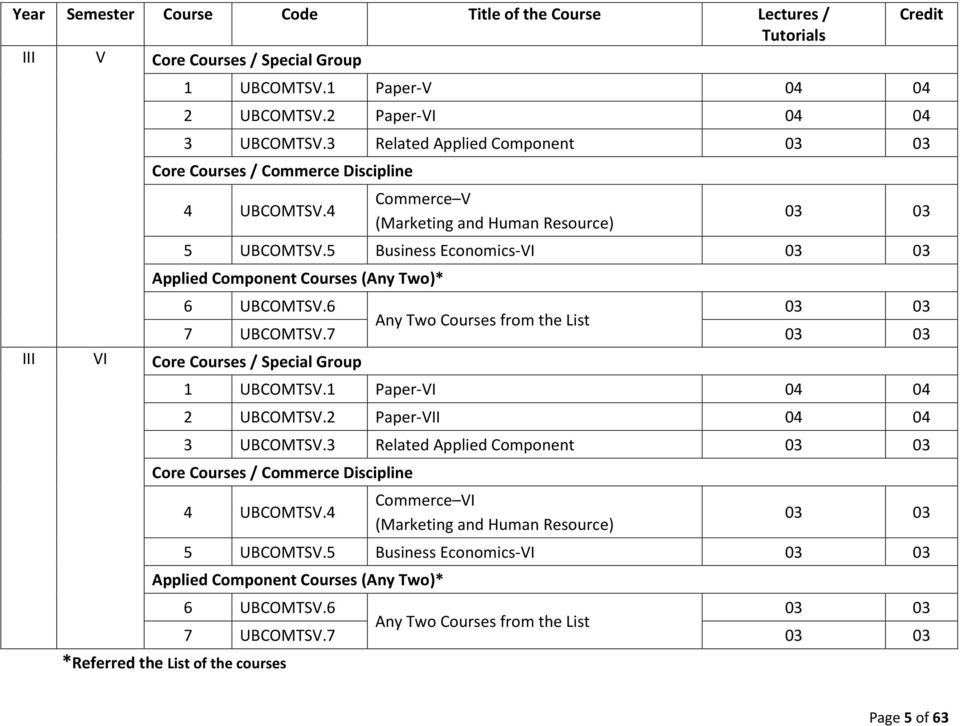
6 Year Course Code Title of the Course Lectures / Tutorials Credit III V Core Courses / Special Group 1 UBCOMTSV.1 Paper V UBCOMTSV.2 Paper VI UBCOMTSV.3 Related Applied Component Core Courses / Commerce Discipline 4 UBCOMTSV.4 Commerce V (Marketing and Human Resource) UBCOMTSV.5 Business Economics VI Applied Component Courses (Any Two)* 6 UBCOMTSV Any Two Courses from the List 7 UBCOMTSV III VI Core Courses / Special Group 1 UBCOMTSV.1 Paper VI UBCOMTSV.2 Paper VII UBCOMTSV.3 Related Applied Component Core Courses / Commerce Discipline 4 UBCOMTSV.4 Commerce VI (Marketing and Human Resource) UBCOMTSV.5 Business Economics VI Applied Component Courses (Any Two)* 6 UBCOMTSV Any Two Courses from the List 7 UBCOMTSV *Referred the List of the courses Page 5 of 63
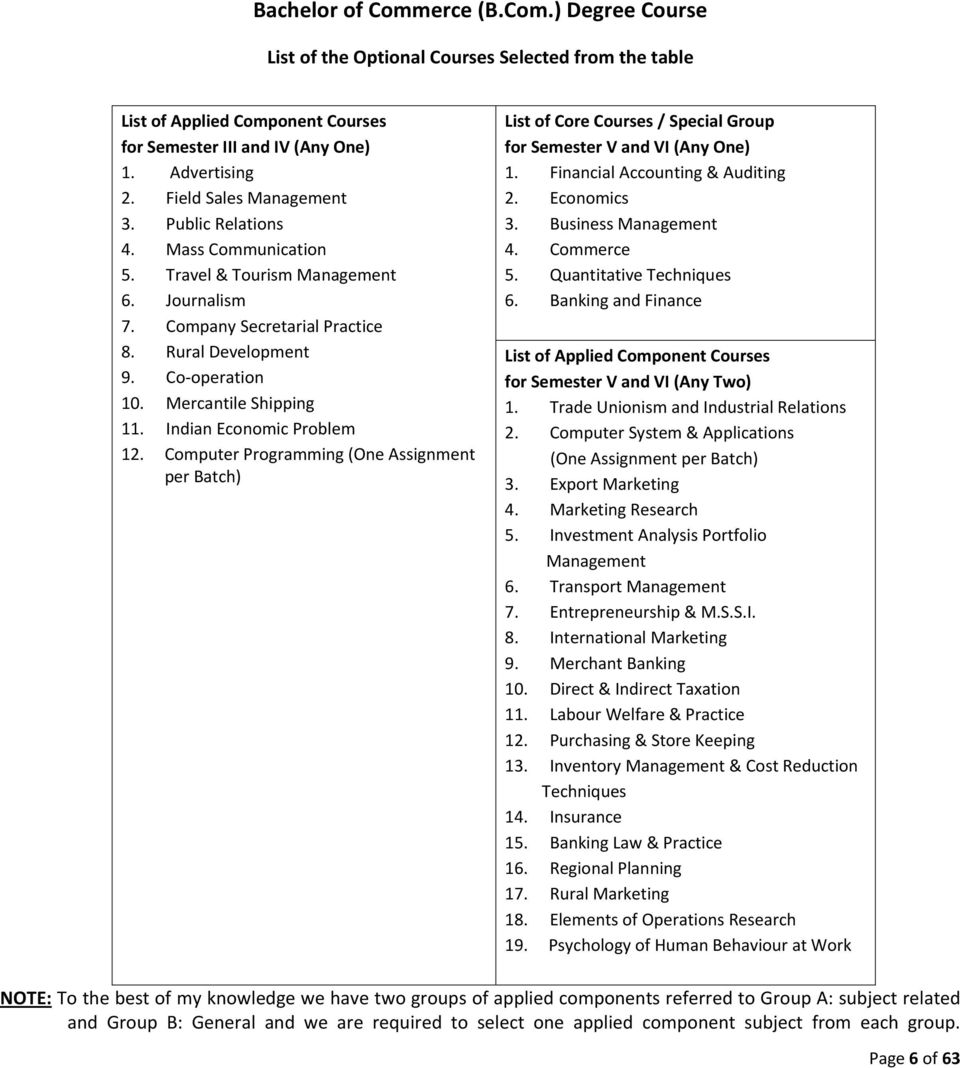
7 Bachelor of Commerce (B.Com.) Degree Course List of the Optional Courses Selected from the table List of Applied Component Courses for III and IV (Any One) 1. Advertising 2. Field Sales Management 3. Public Relations 4. Mass Communication 5. Travel & Tourism Management 6. Journalism 7. Company Secretarial Practice 8. Rural Development 9. Co operation 10. Mercantile Shipping 11. Indian Economic Problem 12. Computer Programming (One Assignment per Batch) List of Core Courses / Special Group for V and VI (Any One) 1. Financial Accounting & Auditing 2. Economics 3. Business Management 4. Commerce 5. Quantitative Techniques 6. Banking and Finance List of Applied Component Courses for V and VI (Any Two) 1. Trade Unionism and Industrial Relations 2. Computer System & Applications (One Assignment per Batch) 3. Export Marketing 4. Marketing Research 5. Investment Analysis Portfolio Management 6. Transport Management 7. Entrepreneurship & M.S.S.I. 8. International Marketing 9. Merchant Banking 10. Direct & Indirect Taxation 11. Labour Welfare & Practice 12. Purchasing & Store Keeping 13. Inventory Management & Cost Reduction Techniques 14. Insurance 15. Banking Law & Practice 16. Regional Planning 17. Rural Marketing 18. Elements of Operations Research 19. Psychology of Human Behaviour at Work NOTE: To the best of my knowledge we have two groups of applied components referred to Group A: subject related and Group B: General and we are required to select one applied component subject from each group. Page 6 of 63
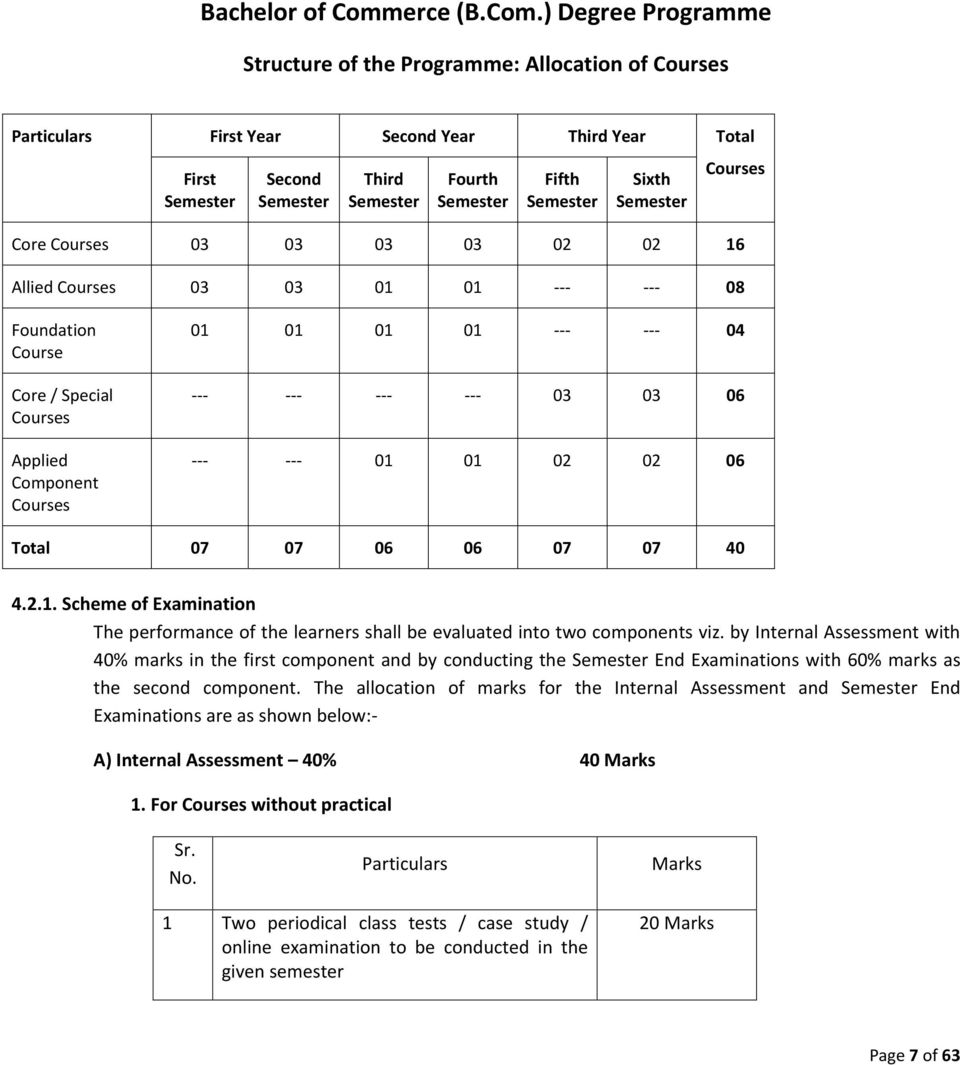
8 Bachelor of Commerce (B.Com.) Degree Programme Structure of the Programme: Allocation of Courses Particulars First Year Second Year Third Year Total First Second Third Fourth Fifth Sixth Courses Core Courses Allied Courses Foundation Course Core / Special Courses Applied Component Courses Total Scheme of Examination The performance of the learners shall be evaluated into two components viz. by Internal Assessment with 40% marks in the first component and by conducting the End Examinations with 60% marks as the second component. The allocation of marks for the Internal Assessment and End Examinations are as shown below: A) Internal Assessment 40% 40 Marks 1. For Courses without practical Sr. No. Particulars Marks 1 Two periodical class tests / case study / online examination to be conducted in the given semester 20 Marks Page 7 of 63
9 2 One assignment based on curriculum to be assessed by the teacher concerned 3 Active participation in routine class instructional deliveries 4 Overall conduct as a responsible learner, mannerism and articulation and exhibit of leadership qualities in organizing related academic actives 10 Marks 2. For Courses with practicals Sr. No. Particulars Marks 1 End Practical Examination 20 Marks Journal Viva Machine Work / Laboratory Work 10 Marks 2. One assignment/project with class 10 Marks presentation to be assessed by teacher concerned Written Document Presentation 3 Active participation in routine class instructional deliveries 4 Overall conduct as a responsible learner, mannerism and articulation and exhibit of leadership qualities in organizing related academic actives Eligibility norms to appear for the additional class test or assignment for learners who remained absent: a. The learner must apply to the Head of the Institution giving the reason(s) for absence within 8 days of the conduct of the examination along with the necessary documents and testimonials. b. If the learner is absent for participation in Inter Collegiate events, State or National or International level events, Training camp or coaching camp organized by authorized university or state or national or international bodies, NSS / NCC Events / Camps / cultural activities / sports activities / research festival or any other activities authenticated by the head of the institution, the head of the Institution shall generally grant permission to the learner to appear for the additional class test or assignment. Page 8 of 63
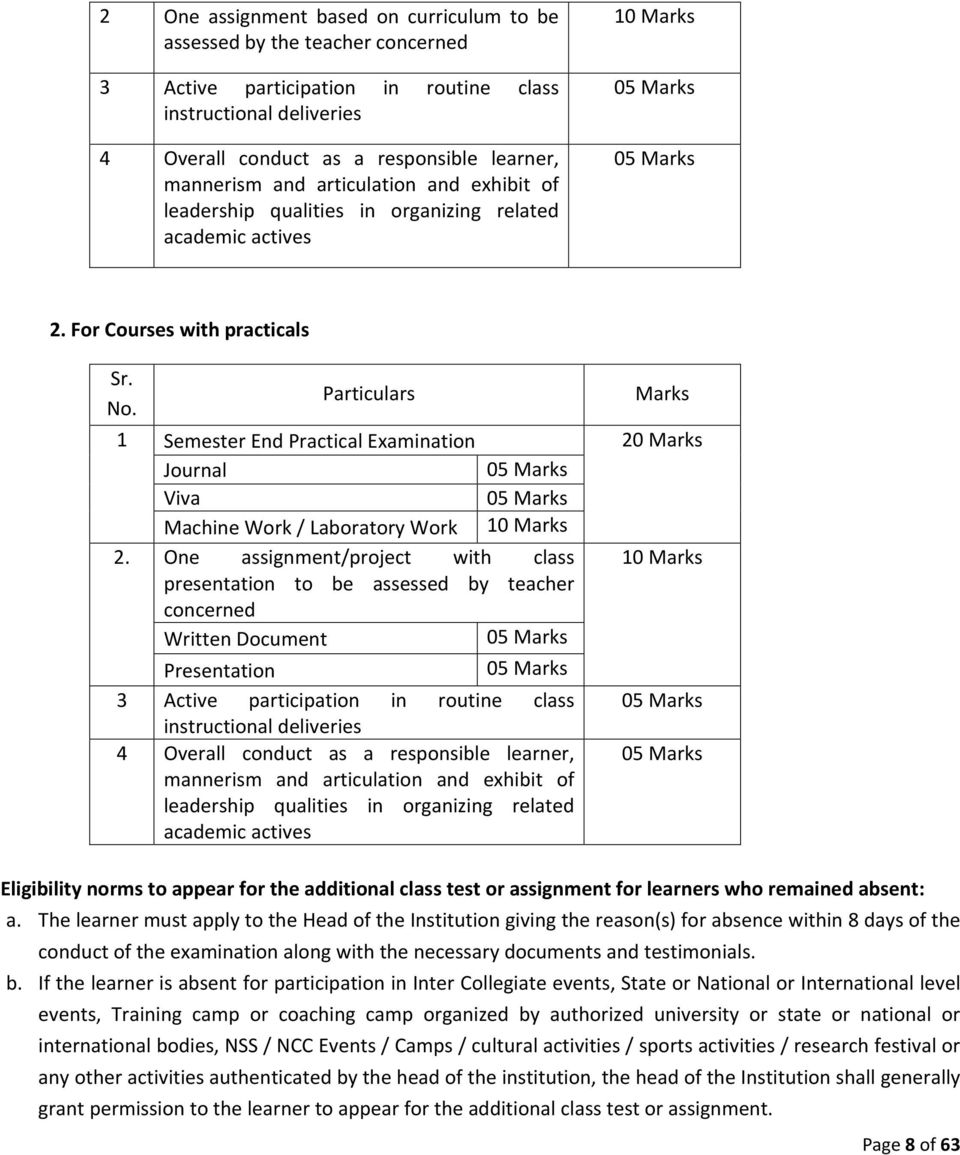
10 c. The Head of the Institution, on scrutiny of the documents and testimonials, may grant the permission to the learner to appear for the additional examination. Mode of Internal Assessment for Additional Examination: For courses without practical: 1. A learner who is absent for the two periodical class tests/ case study / online examination and the assignment will be declared fail in the Internal Assessment Scheme. 2. A learner who is absent for the two class tests and has appeared for the assignment will be allowed to appear for one additional class test of 10 marks. However, his marks for the class tests will be taken as out of 20 (without conversion i.e. if the learner gets 4/10 marks in his additional test, his/her marks for the class tests will be taken as 4/20) and internal assessment will be calculated as out of 40 marks and not 30 marks. 3. A learner who has appeared for both the class test but remains absent for the assignment will be allowed to appear for the additional assignment and the internal assessment will be calculated as out of 40 marks. 4. A learners who is absent for one of the two class tests/assignment as the case may be the learner will be allowed to appear for one additional class test/one additional assignment and the internal assessment will be calculated as out of 40 marks. For Courses with practicals: 1. A learner who is absent for the End Practical Examination and the assignment/project will be declared fail in the Internal Assessment Scheme. 2. A learner who is absent for the End Practical Examination and has appeared for the assignment will be awarded marks for the Journal (out of 5 marks) & Viva (out of 5 marks) component of the End Examination. Thus he will be evaluated for 10 marks instead of 20 marks and will lose the 10 marks for the Laboratory work. However, his marks for the End Practical Examination will be taken as out of 20 (without conversion i.e. if the learner gets 4/10 marks in for Journal & Viva, his/her marks for the End Practical Examination will be taken as 4/20) and internal assessment will be calculated as out of 40 marks and not 30 marks. 3. A learner who has appeared for End Practical Examination but remains absent for the assignment will be allowed to appear for the additional assignment and the internal assessment will be calculated as out of 40 marks. The Additional Class Test (or viva examination) or Assignment must be conducted 15 days prior to the commencement of the End Examination after following the necessary procedure and completing the formalities. B) End Examinations 60% 60 Marks Page 9 of 63

11 i. Duration These examinations shall be of 2 Hours duration. ii. Question Paper Pattern: 1. There shall be four questions each of 15 marks. 2. All questions shall be compulsory with internal choice within the questions. 3. Question may be subdivided into sub questions a, b, c and the allocation of marks depend on the weightage of the topic. Responsibility of Assessment i) The assessment of Part A and B i.e. Internal Assessment & End Examination as mentioned above for the I to IV shall be processed by the Colleges / Institutions of their learners and issue the grade cards to them after the conversion of marks into grade as per the procedure mentioned in this manual. The format of the grade card is given in the Chapter 5 of this manual to maintain the uniformity across the all colleges for the examinations conducted by the colleges on behalf of the University. ii) The assessment of Part A i.e. Internal Assessment as mentioned above for the V & VI shall be processed by the Colleges / Institutions of their learners admitted for the programme while the University shall conduct the assessment of Part B i.e. the End Examination for s V & VI. The Internal Assessment marks of learners appearing for semester V & VI shall be submitted to the University by the respective colleges/ Institutions before the commencement of respective End Examinations. The results shall be declared by the University after processing the marks obtained by the learner in the Internal Assessment and the marks awarded to the learners in End Examination. The grade card shall be issued by the University after converting the marks into grades STANDARD OF PASSING AND PERFORMANCE GRADING: Standard of Passing The learners to pass a course shall have to obtain a minimum of 40% marks in aggregate for each course where the course consists of Internal Assessment & End Examination. The learners shall obtain minimum of 40% marks (i.e. 16 out of 40) in the Internal Assessment and 40% marks in End Examination (i.e. 24 Out of 60) separately, to pass the course and minimum of Grade E in each project wherever applicable to pass a particular semester. A learner will be said to have passed the course if the learner passes the Internal Assessment & End Examination together PERFORMANCE GRADING The PERFORMANCE GRADING of the learner shall be on the SEVEN point Grading system as under: Grade Marks Grade Points Page 10 of 63

12 O 70 & above 7 A 60 to B 55 to C 50 to D 45 to E 40 to F (Fail) & below 1 The performance grading shall be based on the aggregate performance of Internal Assessment and End Examination Carry Forward of the Marks in Case if the Learner Fails in One or More Courses: 1) A learner who passes in the Internal Examination but fails in the End Examination of the course shall reappear for the End Examination of that course. However his/her marks of the Internal Examinations shall be carried over and he/she shall be entitled for grade obtained by him/her on passing. 2) A learner who passes in the End Examination but fails in the Internal Assessment of the course shall reappear for the Internal Examination of that course. However his/her marks of the End Examination shall be carried over and he/she shall be entitled for grade obtained by him/her on passing. 3) a. For Courses without practical In case of learner who is reappearing for the Internal Examination, the examination will consist of one project of 40 marks which will be divided into 20 marks for the documentation of the project, 10 marks for the presentation and 10 marks for the viva and the interaction. b. For Courses with practicals In case of learner who is reappearing for the Internal Examination for subjects with Practical, the examinations will consist of practical examination of 40 marks which will be divided into 20 marks for the machine work / laboratory work, 10 marks for the Viva Examination and 10 marks for the Journal Allowed to Keep Terms (ATKT): 1. A learner shall be allowed to keep term for II irrespective of number of courses of failure in the I. 2. A learner shall be allowed to keep term for III if he/she passes each of I and II OR A learner fails in not more than two courses of I and II taken together. Page 11 of 63
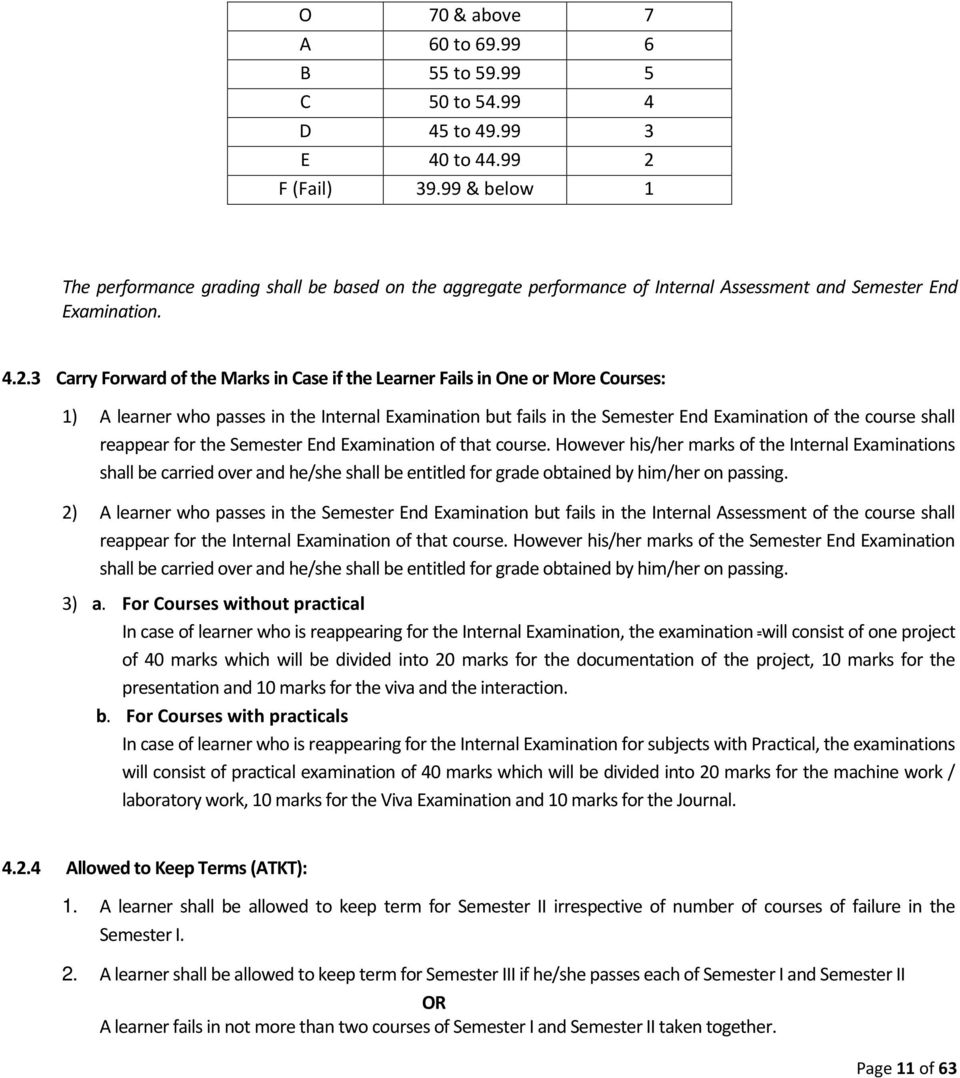
13 3. A learner shall be allowed to keep term for IV irrespective of number of courses of failure in III. However, the learner has to pass each of I and II in order to appear for IV. 4. A learner shall be allowed to keep term for V if he/she passes I, II, III and IV OR A learner shall pass I and II and fails in not more than two courses of III and IV taken together. 5. A learner shall be allowed to keep term for VI irrespective of number of courses of failure in the V. 6. The learner can appear for the semester VI examination but the result of VI shall be kept in abeyance until the learner passes each of I, II, III, IV and V ADDITIONAL SEMESTER END EXAMINATION: ELIGIBILITY TO APPEAR FOR ADDITIONAL SEMESTER END EXAMINATION: A learner who does not appear i.e. remains absent in some or all the courses on medical grounds or for representing the college / university in sports, cultural activities, activities of NSS, NCC or sports training camps conducted by recognized bodies / competent authorities or for any other reason which is considered valid under exceptional circumstances and to the satisfaction of the Principal or the Head of the Institute OR fails in some or all the subjects is eligible to appear for the additional examination. A learner who does not appear for both the Internal Assessment and End Examination shall not be eligible to appear for the additional End Examination. The additional End Examination shall be of two hours duration and of 60 marks per course. The learner shall appear for the course of the End Examination for which he/she was absent or has failed. Learners who are punished under O.5050 are not eligible to appear for this additional examination. MODE OF SEMESTER END ADDITIONAL EXAMINATION: a) There will be one additional examination for semester I, II, III and IV for those who have failed or remained absent. b) The absent learner will be allowed to appear for the examination by the head of the institution after following the necessary formalities subject to the reasons to the satisfaction of the head of the institution. c) This examination will be held 20 days after the declaration of results but not later than 40 days. PROJECT EVALUATION (IF APPLICABLE) Page 12 of 63
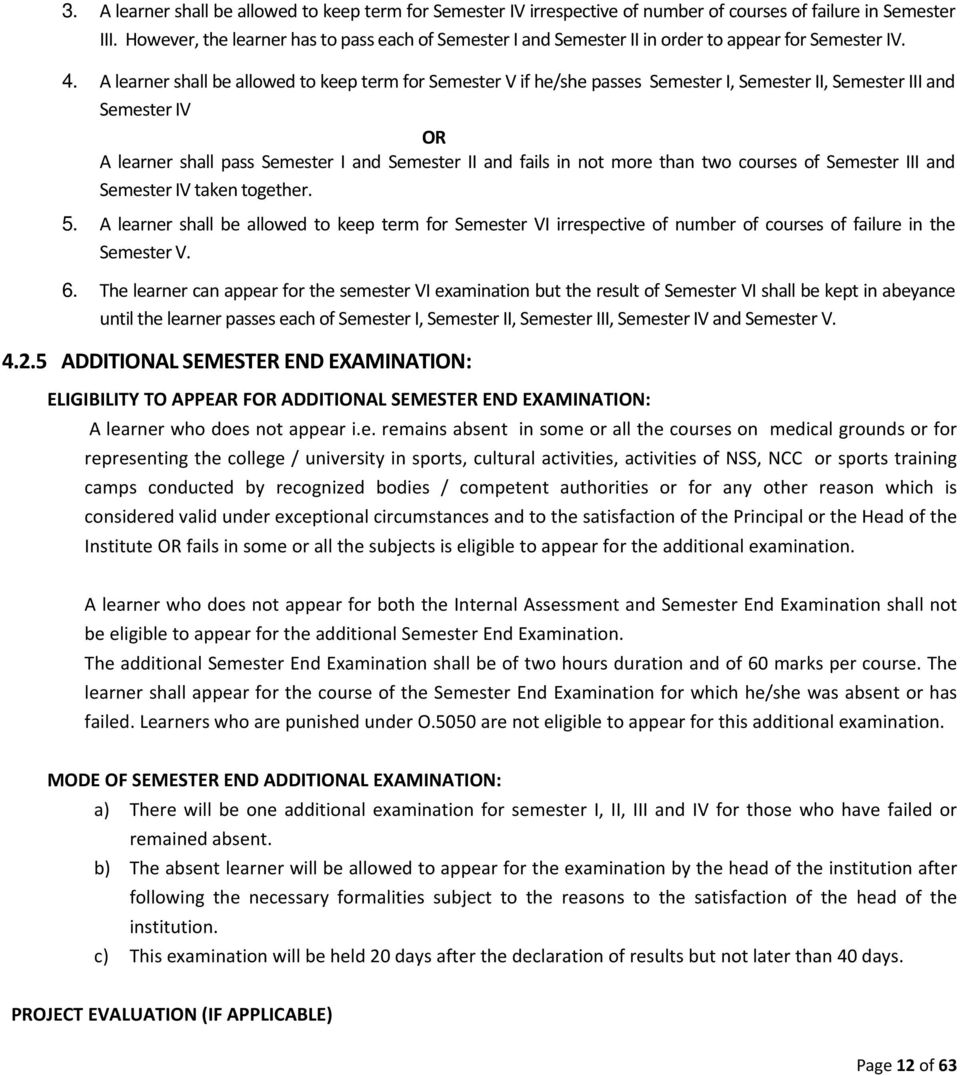
14 a. A learner who PASSES IN ALL THE COURSES BUT DOES NOT secures minimum grade of E in project as applicable has to resubmit a fresh project for evaluation till he/she secures a minimum of grade E. His/her marks in the theory papers that the learner has passed will be carried forward and he/she shall be entitled for grade obtained by him/her on passing. b. The evaluation of project and viva voce examination shall be by awarding grade in the seven point scale as given in the grade point table. c. A learner shall have to obtain minimum of Grade E (or its equivalent marks) in project evaluation and viva voce taken together. ****************** Page 13 of 63
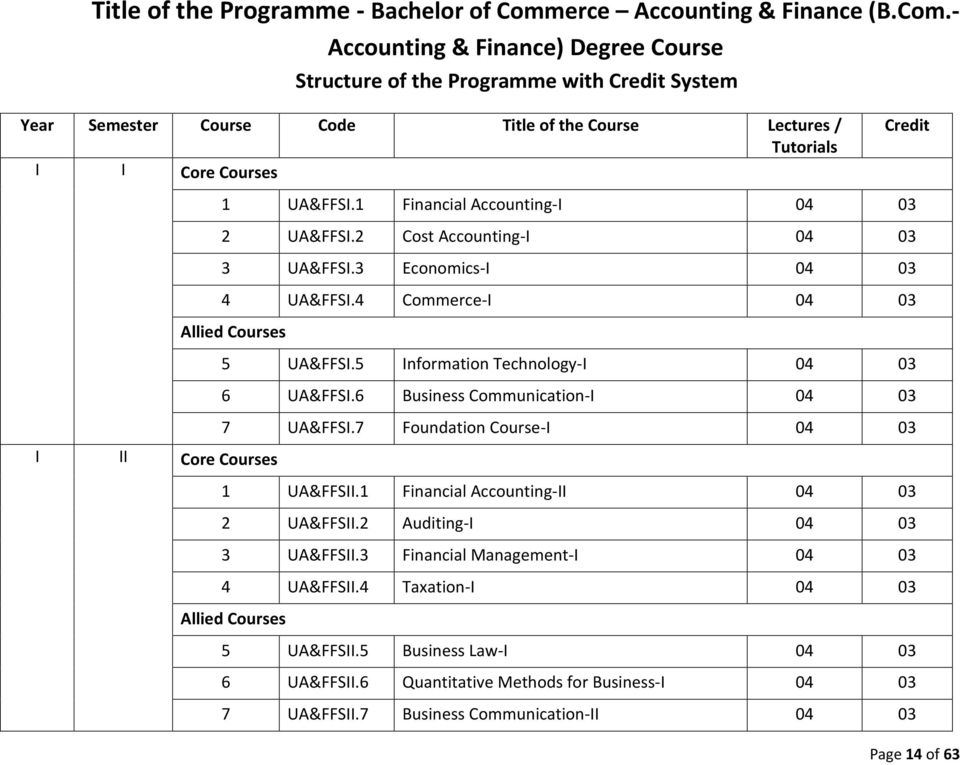
15 Title of the Programme Bachelor of Commerce Accounting & Finance (B.Com. Accounting & Finance) Degree Course Structure of the Programme with Credit System Year Course Code Title of the Course Lectures / Tutorials I I Core Courses Credit 1 UA&FFSI.1 Financial Accounting I UA&FFSI.2 Cost Accounting I UA&FFSI.3 Economics I UA&FFSI.4 Commerce I Allied Courses 5 UA&FFSI.5 Information Technology I UA&FFSI.6 Business Communication I UA&FFSI.7 Foundation Course I I II Core Courses 1 UA&FFSII.1 Financial Accounting II UA&FFSII.2 Auditing I UA&FFSII.3 Financial Management I UA&FFSII.4 Taxation I Allied Courses 5 UA&FFSII.5 Business Law I UA&FFSII.6 Quantitative Methods for Business I UA&FFSII.7 Business Communication II Page 14 of 63
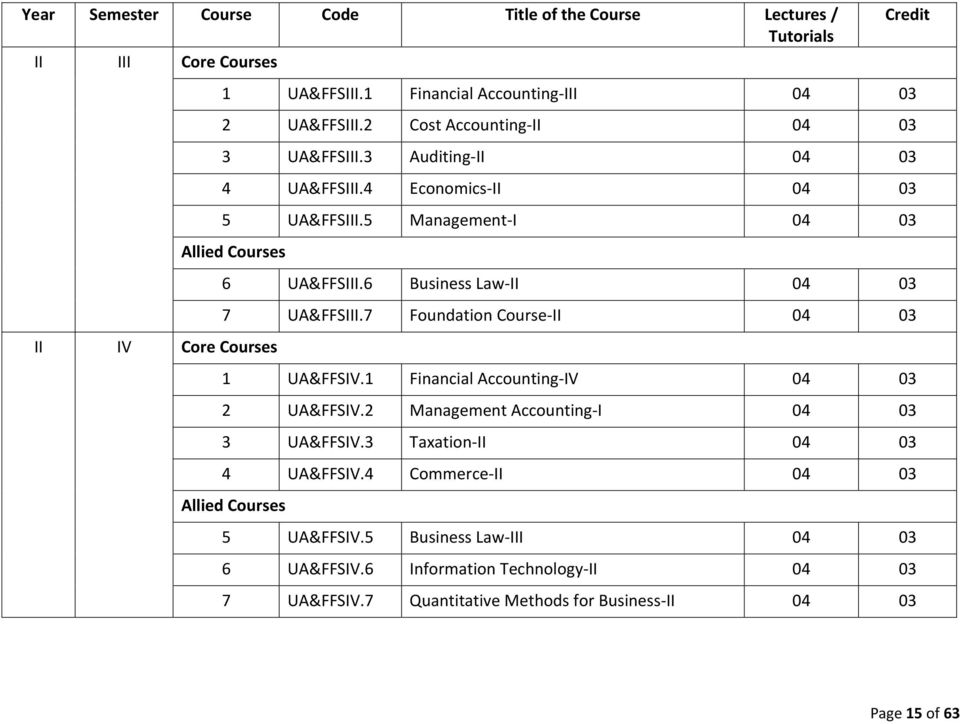
16 Year Course Code Title of the Course Lectures / Tutorials II III Core Courses Credit 1 UA&FFSIII.1 Financial Accounting III UA&FFSIII.2 Cost Accounting II UA&FFSIII.3 Auditing II UA&FFSIII.4 Economics II UA&FFSIII.5 Management I Allied Courses 6 UA&FFSIII.6 Business Law II UA&FFSIII.7 Foundation Course II II IV Core Courses 1 UA&FFSIV.1 Financial Accounting IV UA&FFSIV.2 Management Accounting I UA&FFSIV.3 Taxation II UA&FFSIV.4 Commerce II Allied Courses 5 UA&FFSIV.5 Business Law III UA&FFSIV.6 Information Technology II UA&FFSIV.7 Quantitative Methods for Business II Page 15 of 63
17 Year Course Code Title of the Course Lectures / Tutorials III V Core Courses Credit 1 UA&FFSV.1 Financial Accounting V UA&FFSV.2 Cost Accounting III UA&FFSV.3 Financial Accounting VI UA&FFSV.4 Management Accounting II UA&FFSV.5 Taxation III UA&FFSV.6 Economics III III VI Core Courses 1 UA&FFSVI.1 Financial Accounting VII UA&FFSVI.2 Cost Accounting IV UA&FFSVI.3 Auditing III UA&FFSVI.4 Financial Accounting VIII UA&FFSVI.5 Taxation IV UA&FFSVI.6 Management II Page 16 of 63

18 Structure of the Programme: Allocation of Courses Particulars First Year Second Year Third Year Total First Second Third Fourth Fifth Sixth Courses Core Courses Allied Courses Total Scheme of Examination The performance of the learners shall be evaluated into two components viz. by Internal Assessment with 40% marks in the first component and by conducting the End Examinations with 60% marks as the second component. The allocation of marks for the Internal Assessment and End Examinations are as shown below: A) Internal Assessment 40% 40 Marks 1. For Courses without practical Sr. No. Particulars Marks 1 Two periodical class tests / case study / online examination to be conducted in the given semester 2 One assignment based on curriculum to be assessed by the teacher concerned 3 Active participation in routine class instructional deliveries 4 Overall conduct as a responsible learner, mannerism and articulation and exhibit of leadership qualities in organizing related academic actives 20 Marks 10 Marks Page 17 of 63

19 2. For Courses with practicals Sr. No. Particulars Marks 1 End Practical Examination 20 Marks Journal Viva Machine Work / Laboratory Work 10 Marks 2. One assignment/project with class 10 Marks presentation to be assessed by teacher concerned Written Document Presentation 3 Active participation in routine class instructional deliveries 4 Overall conduct as a responsible learner, mannerism and articulation and exhibit of leadership qualities in organizing related academic actives Eligibility norms to appear for the additional class test or assignment for learners who remained absent: a. The learner must apply to the Head of the Institution giving the reason(s) for absence within 8 days of the conduct of the examination along with the necessary documents and testimonials. b. If the learner is absent for participation in Inter Collegiate events, State or National or International level events, Training camp or coaching camp organized by authorized university or state or national or international bodies, NSS / NCC Events / Camps / cultural activities / sports activities / research festival or any other activities authenticated by the head of the institution, the head of the Institution shall generally grant permission to the learner to appear for the additional class test or assignment. c. The Head of the Institution, on scrutiny of the documents and testimonials, may grant the permission to the learner to appear for the additional examination. Mode of Internal Assessment for Additional Examination: For courses without practical: 1. A learner who is absent for the two periodical class tests/ case study / online examination and the assignment will be declared fail in the Internal Assessment Scheme. 2. A learner who is absent for the two class tests and has appeared for the assignment will be allowed to appear for one additional class test of 10 marks. However, his marks for the class tests will be taken as out of 20 (without conversion i.e. if the learner gets 4/10 marks in his additional test, his/her marks for Page 18 of 63

20 the class tests will be taken as 4/20) and internal assessment will be calculated as out of 40 marks and not 30 marks. 3. A learner who has appeared for both the class test but remains absent for the assignment will be allowed to appear for the additional assignment and the internal assessment will be calculated as out of 40 marks. 4. A learners who is absent for one of the two class tests/assignment as the case may be the learner will be allowed to appear for one additional class test/one additional assignment and the internal assessment will be calculated as out of 40 marks. For Courses with practicals: 1. A learner who is absent for the End Practical Examination and the assignment/project will be declared fail in the Internal Assessment Scheme. 2. A learner who is absent for the End Practical Examination and has appeared for the assignment will be awarded marks for the Journal (out of 5 marks) & Viva (out of 5 marks) component of the End Examination. Thus he will be evaluated for 10 marks instead of 20 marks and will lose the 10 marks for the Laboratory work. However, his marks for the End Practical Examination will be taken as out of 20 (without conversion i.e. if the learner gets 4/10 marks in for Journal & Viva, his/her marks for the End Practical Examination will be taken as 4/20) and internal assessment will be calculated as out of 40 marks and not 30 marks. 3. A learner who has appeared for End Practical Examination but remains absent for the assignment will be allowed to appear for the additional assignment and the internal assessment will be calculated as out of 40 marks. The Additional Class Test (or viva examination) or Assignment must be conducted 15 days prior to the commencement of the End Examination after following the necessary procedure and completing the formalities. B) End Examinations 60% 60 Marks i. Duration Theses examinations shall be of 2 Hours duration. ii. Question Paper Pattern: 1. There shall be four questions each of 15 marks. 2. All questions shall be compulsory with internal choice within the questions. 3. Question may be subdivided into sub questions a, b, c and the allocation of marks depend on the weightage of the topic. Responsibility of Assessment i) The assessment of Part A and B i.e. Internal Assessment & End Examination as mentioned above for the I to IV shall be processed by the Colleges / Institutions of their learners and issue Page 19 of 63

21 the grade cards to them after the conversion of marks into grade as per the procedure mentioned in this manual. The format of the grade card is given in the Chapter 5 of this manual to maintain the uniformity across the all colleges for the examinations conducted by the colleges on behalf of the University. ii) The assessment of Part A i.e. Internal Assessment as mentioned above for the V & VI shall be processed by the Colleges / Institutions of their learners admitted for the programme while the University shall conduct the assessment of Part B i.e. the End Examination for s V & VI. The Internal Assessment marks of learners appearing for semester V & VI shall be submitted to the University by the respective colleges/ Institutions before the commencement of respective End Examinations. The results shall be declared by the University after processing the marks obtained by the learner in the Internal Assessment and the marks awarded to the learners in End Examination. The grade card shall be issued by the University after converting the marks into grades STANDARD OF PASSING AND PERFORMANCE GRADING: Standard of Passing The learners to pass a course shall have to obtain a minimum of 40% marks in aggregate for each course where the course consists of Internal Assessment & End Examination. The learners shall obtain minimum of 40% marks (i.e. 16 out of 40) in the Internal Assessment and 40% marks in End Examination (i.e. 24 Out of 60) separately, to pass the course and minimum of Grade E in each project wherever applicable to pass a particular semester. A learner will be said to have passed the course if the learner passes the Internal Assessment & End Examination together PERFORMANCE GRADING The PERFORMANCE GRADING of the learner shall be on the SEVEN point Grading system as under: Grade Marks Grade Points O 70 & above 7 A 60 to B 55 to C 50 to D 45 to E 40 to F (Fail) & below 1 The performance grading shall be based on the aggregate performance of Internal Assessment and End Examination. Page 20 of 63
22 4.2.3 Carry Forward of the Marks in Case if the Learner Fails in One or More Courses: 1) A learner who passes in the Internal Examination but fails in the End Examination of the course shall reappear for the End Examination of that course. However his/her marks of the Internal Examinations shall be carried over and he/she shall be entitled for grade obtained by him/her on passing. 2) A learner who passes in the End Examination but fails in the Internal Assessment of the course shall reappear for the Internal Examination of that course. However his/her marks of the End Examination shall be carried over and he/she shall be entitled for grade obtained by him/her on passing. 3) a. For Courses without practical In case of learner who is reappearing for the Internal Examination, the examination will consist of one project of 40 marks which will be divided into 20 marks for the documentation of the project, 10 marks for the presentation and 10 marks for the viva and the interaction. b. For Courses with practicals In case of learner who is reappearing for the Internal Examination for subjects with Practical, the examinations will consist of practical examination of 40 marks which will be divided into 20 marks for the machine work / laboratory work, 10 marks for the Viva Examination and 10 marks for the Journal Allowed to Keep Terms (ATKT): 1. A learner shall be allowed to keep term for II irrespective of number of courses of failure in the I. 2. A learner shall be allowed to keep term for III if he/she passes each of I and II OR A learner fails in not more than two courses of I and II taken together. 3. A learner shall be allowed to keep term for IV irrespective of number of courses of failure in III. However, the learner has to pass each of I and II in order to appear for IV. 4. A learner shall be allowed to keep term for V if he/she passes I, II, III and IV OR A learner shall pass I and II and fails in not more than two courses of III and IV taken together. 5. A learner shall be allowed to keep term for VI irrespective of number of courses of failure in the V. 6. The learner can appear for the semester VI examination but the result of VI shall be kept in abeyance Page 21 of 63
23 until the learner passes each of I, II, III, IV and V ADDITIONAL SEMESTER END EXAMINATION: ELIGIBILITY TO APPEAR FOR ADDITIONAL SEMESTER END EXAMINATION: A learner who does not appear i.e. remains absent in some or all the courses on medical grounds or for representing the college / university in sports, cultural activities, activities of NSS, NCC or sports training camps conducted by recognized bodies / competent authorities or for any other reason which is considered valid under exceptional circumstances and to the satisfaction of the Principal or the Head of the Institute OR fails in some or all the subjects is eligible to appear for the additional examination. A learner who does not appear for both the Internal Assessment and End Examination shall not be eligible to appear for the additional End Examination. The additional End Examination shall be of two hours duration and of 60 marks per course. The learner shall appear for the course of the End Examination for which he/she was absent or has failed. Learners who are punished under O.5050 are not eligible to appear for this additional examination. MODE OF SEMESTER END ADDITIONAL EXAMINATION: d) There will be one additional examination for semester I, II, III and IV for those who have failed or remained absent. e) The absent learner will be allowed to appear for the examination by the head of the institution after following the necessary formalities subject to the reasons to the satisfaction of the head of the institution. f) This examination will be held 20 days after the declaration of results but not later than 40 days. PROJECT EVALUATION (IF APPLICABLE) a. A learner who PASSES IN ALL THE COURSES BUT DOES NOT secures minimum grade of E in project as applicable has to resubmit a fresh project for evaluation till he/she secures a minimum of grade E. His/her marks in the theory papers that the learner has passed will be carried forward and he/she shall be entitled for grade obtained by him/her on passing. b. The evaluation of project and viva voce examination shall be by awarding grade in the seven point scale as given in the grade point table. c. A learner shall have to obtain minimum of Grade E (or its equivalent marks) in project evaluation and viva voce taken together. ****************** Page 22 of 63
24 Title of the Programme Bachelor of Commerce Financial Markets (B.Com. FM) Degree Course Structure of the Programme with Credit System Year Course Code Title of the Course Lectures / Tutorials Credit I I Core Courses 1 UFMFSI.1 Principles of Investment UFMFSI.2 Micro Economics UFMFSI.3 Financial Accounting UFMFSI.4 Business Environment Allied Courses I II Core Courses 5 UFMFSI.5 Basic Statistics UFMFSI.6 Basic Computer Skills UFMFSII.1 Environment of Financial System UFMFSII.2 Macro Economics UFMFSII.3 Management Accounting UFMFSII.4 Principles of Business Management Allied Courses 5 UFMFSII.5 Statistical Applications UFMFSII.6 Communication Skills Page 23 of 63
25 Year Course Code Title of the Course Lectures / Tutorials II III Core Courses Credit 1 UFMFSIII.1 Debt Markets UFMFSIII.2 Corporate Finance I UFMFSIII.3 Equity Markets I UFMFSIII.4 Banking in Financial System UFMFSIII.5 Business Ethics UFMFSIII.6 Organizational Behavior Allied Course II IV Core Courses 7 UFMFSIII.7 Computer Applications in Investments UFMFSIV.1 Commodities Markets UFMFSIV.2 Corporate Finance II UFMFSIV.3 Equity Markets II UFMFSIV.4 Financial Services UFMFSIV.5 Taxation for Investments UFMFSIV.6 Security Analysis Allied Course 7 UFMFSIV.7 Business Law Page 24 of 63
26 Year Course Code Title of the Course Lectures / Tutorials III V Core Courses Credit 1 UFMFSV.1 Global Capital Markets UFMFSV.2 Regulations of Securities Markets UFMFSV.3 Insurance (Fund) Management UFMFSV.4 Derivative Markets UFMFSV.5 Foreign Exchange Markets UFMFSV.6 Portfolio Management Allied Course 7 UFMFSV.7 Project I III VI Core Subjects 1 UFMFSVI.1 Risk Management UFMFSVI.2 Corporate Governance UFMFSVI.3 Computer Applications in Financial Services UFMFSVI.4 Marketing of Financial Services UFMFSVI.5 Mutual Fund Management UFMFSVI.6 Allied Course Customer Relationship Management in Financial Services UFMFSVI.7 Project II Page 25 of 63
27 Structure of the Programme: Allocation of Courses Particulars First Year Second Year Third Year Total First Second Third Fourth Fifth Sixth Courses Core Courses Allied Courses Total Scheme of Examination The performance of the learners shall be evaluated into two components viz. by Internal Assessment with 40% marks in the first component and by conducting the End Examinations with 60% marks as the second component. The allocation of marks for the Internal Assessment and End Examinations are as shown below: A) Internal Assessment 40% 40 Marks 1. For Courses without practical Sr. No. Particulars Marks 1 Two periodical class tests / case study / online examination to be conducted in the given semester 2 One assignment based on curriculum to be assessed by the teacher concerned 3 Active participation in routine class instructional deliveries 4 Overall conduct as a responsible learner, mannerism and articulation and exhibit of leadership qualities in organizing related 20 Marks 10 Marks Page 26 of 63
28 academic actives 2. For Courses with practicals Sr. No. Particulars Marks 1 End Practical Examination 20 Marks Journal Viva Machine Work / Laboratory Work 10 Marks 2. One assignment/project with class 10 Marks presentation to be assessed by teacher concerned Written Document Presentation 3 Active participation in routine class instructional deliveries 4 Overall conduct as a responsible learner, mannerism and articulation and exhibit of leadership qualities in organizing related academic actives Eligibility norms to appear for the additional class test or assignment for learners who remained absent: a. The learner must apply to the Head of the Institution giving the reason(s) for absence within 8 days of the conduct of the examination along with the necessary documents and testimonials. b. If the learner is absent for participation in Inter Collegiate events, State or National or International level events, Training camp or coaching camp organized by authorized university or state or national or international bodies, NSS / NCC Events / Camps / cultural activities / sports activities / research festival or any other activities authenticated by the head of the institution, the head of the Institution shall generally grant permission to the learner to appear for the additional class test or assignment. c. The Head of the Institution, on scrutiny of the documents and testimonials, may grant the permission to the learner to appear for the additional examination. Mode of Internal Assessment for Additional Examination: For courses without practical: 1. A learner who is absent for the two periodical class tests/ case study / online examination and the assignment will be declared fail in the Internal Assessment Scheme. Page 27 of 63
29 2. A learner who is absent for the two class tests and has appeared for the assignment will be allowed to appear for one additional class test of 10 marks. However, his marks for the class tests will be taken as out of 20 (without conversion i.e. if the learner gets 4/10 marks in his additional test, his/her marks for the class tests will be taken as 4/20) and internal assessment will be calculated as out of 40 marks and not 30 marks. 3. A learner who has appeared for both the class test but remains absent for the assignment will be allowed to appear for the additional assignment and the internal assessment will be calculated as out of 40 marks. 4. A learners who is absent for one of the two class tests/assignment as the case may be the learner will be allowed to appear for one additional class test/one additional assignment and the internal assessment will be calculated as out of 40 marks. For Courses with practicals: 1. A learner who is absent for the End Practical Examination and the assignment/project will be declared fail in the Internal Assessment Scheme. 2. A learner who is absent for the End Practical Examination and has appeared for the assignment will be awarded marks for the Journal (out of 5 marks) & Viva (out of 5 marks) component of the End Examination. Thus he will be evaluated for 10 marks instead of 20 marks and will lose the 10 marks for the Laboratory work. However, his marks for the End Practical Examination will be taken as out of 20 (without conversion i.e. if the learner gets 4/10 marks in for Journal & Viva, his/her marks for the End Practical Examination will be taken as 4/20) and internal assessment will be calculated as out of 40 marks and not 30 marks. 3. A learner who has appeared for End Practical Examination but remains absent for the assignment will be allowed to appear for the additional assignment and the internal assessment will be calculated as out of 40 marks. The Additional Class Test (or viva examination) or Assignment must be conducted 15 days prior to the commencement of the End Examination after following the necessary procedure and completing the formalities. B) End Examinations 60% 60 Marks i. Duration Theses examinations shall be of 2 Hours duration. ii. Question Paper Pattern: 1. There shall be four questions each of 15 marks. 2. All questions shall be compulsory with internal choice within the questions. 3. Question may be subdivided into sub questions a, b, c and the allocation of marks depend on the weightage of the topic. Page 28 of 63
30 Responsibility of Assessment i) The assessment of Part A and B i.e. Internal Assessment & End Examination as mentioned above for the I to IV shall be processed by the Colleges / Institutions of their learners and issue the grade cards to them after the conversion of marks into grade as per the procedure mentioned in this manual. The format of the grade card is given in the Chapter 5 of this manual to maintain the uniformity across the all colleges for the examinations conducted by the colleges on behalf of the University. ii) The assessment of Part A i.e. Internal Assessment as mentioned above for the V & VI shall be processed by the Colleges / Institutions of their learners admitted for the programme while the University shall conduct the assessment of Part B i.e. the End Examination for s V & VI. The Internal Assessment marks of learners appearing for semester V & VI shall be submitted to the University by the respective colleges/ Institutions before the commencement of respective End Examinations. The results shall be declared by the University after processing the marks obtained by the learner in the Internal Assessment and the marks awarded to the learners in End Examination. The grade card shall be issued by the University after converting the marks into grades STANDARD OF PASSING AND PERFORMANCE GRADING: Standard of Passing The learners to pass a course shall have to obtain a minimum of 40% marks in aggregate for each course where the course consists of Internal Assessment & End Examination. The learners shall obtain minimum of 40% marks (i.e. 16 out of 40) in the Internal Assessment and 40% marks in End Examination (i.e. 24 Out of 60) separately, to pass the course and minimum of Grade E in each project wherever applicable to pass a particular semester. A learner will be said to have passed the course if the learner passes the Internal Assessment & End Examination together PERFORMANCE GRADING The PERFORMANCE GRADING of the learner shall be on the SEVEN point Grading system as under: Grade Marks Grade Points O 70 & above 7 A 60 to The performance grading shall be based on B 55 to the aggregate performance of Internal Assessment and C 50 to End Examination. D 45 to E 40 to Carry Forward of the Marks in Case if the F (Fail) & below 1 Learner Fails in One or More Courses: Page 29 of 63
31 1) A learner who passes in the Internal Examination but fails in the End Examination of the course shall reappear for the End Examination of that course. However his/her marks of the Internal Examinations shall be carried over and he/she shall be entitled for grade obtained by him/her on passing. 2) A learner who passes in the End Examination but fails in the Internal Assessment of the course shall reappear for the Internal Examination of that course. However his/her marks of the End Examination shall be carried over and he/she shall be entitled for grade obtained by him/her on passing. 3) a. For Courses without practical In case of learner who is reappearing for the Internal Examination, the examination will consist of one project of 40 marks which will be divided into 20 marks for the documentation of the project, 10 marks for the presentation and 10 marks for the viva and the interaction. b. For Courses with practicals In case of learner who is reappearing for the Internal Examination for subjects with Practical, the examinations will consist of practical examination of 40 marks which will be divided into 20 marks for the machine work / laboratory work, 10 marks for the Viva Examination and 10 marks for the Journal Allowed to Keep Terms (ATKT): 1. A learner shall be allowed to keep term for II irrespective of number of courses of failure in the I. 2. A learner shall be allowed to keep term for III if he/she passes each of I and II OR A learner fails in not more than two courses of I and II taken together. 3. A learner shall be allowed to keep term for IV irrespective of number of courses of failure in III. However, the learner has to pass each of I and II in order to appear for IV. 4. A learner shall be allowed to keep term for V if he/she passes I, II, III and IV OR A learner shall pass I and II and fails in not more than two courses of III and IV taken together. 5. A learner shall be allowed to keep term for VI irrespective of number of courses of failure in the V. 6. The learner can appear for the semester VI examination but the result of VI shall be kept in abeyance until the learner passes each of I, II, III, IV and V ADDITIONAL SEMESTER END EXAMINATION: Page 30 of 63
32 ELIGIBILITY TO APPEAR FOR ADDITIONAL SEMESTER END EXAMINATION: A learner who does not appear i.e. remains absent in some or all the courses on medical grounds or for representing the college / university in sports, cultural activities, activities of NSS, NCC or sports training camps conducted by recognized bodies / competent authorities or for any other reason which is considered valid under exceptional circumstances and to the satisfaction of the Principal or the Head of the Institute OR fails in some or all the subjects is eligible to appear for the additional examination. A learner who does not appear for both the Internal Assessment and End Examination shall not be eligible to appear for the additional End Examination. The additional End Examination shall be of two hours duration and of 60 marks per course. The learner shall appear for the course of the End Examination for which he/she was absent or has failed. Learners who are punished under O.5050 are not eligible to appear for this additional examination. MODE OF SEMESTER END ADDITIONAL EXAMINATION: a) There will be one additional examination for semester I, II, III and IV for those who have failed or remained absent. b) The absent learner will be allowed to appear for the examination by the head of the institution after following the necessary formalities subject to the reasons to the satisfaction of the head of the institution. c) This examination will be held 20 days after the declaration of results but not later than 40 days. PROJECT EVALUATION a. A learner who PASSES IN ALL THE COURSES BUT DOES NOT secures minimum grade of E in project as applicable has to resubmit a fresh project for evaluation till he/she secures a minimum of grade E. His/her marks in the theory papers that the learner has passed will be carried forward and he/she shall be entitled for grade obtained by him/her on passing. b. The evaluation of project and viva voce examination shall be by awarding grade in the seven point scale as given in the grade point table. c. A learner shall have to obtain minimum of Grade E (or its equivalent marks) in project evaluation and viva voce taken together. Page 31 of 63
33 Title of the Programme Bachelor of Commerce Banking & Insurance (B.Com. Banking & Insurance) Degree Course Structure of the Programme with Credit System Year Course Code Title of the Course Lectures /Tutorials Credit I I Core Courses 1 UBIFSI.1 Environment and Management of Financial Services UBIFSI.2 Principles of Management UBIFSI.3 Economics I (Micro) Allied Courses I II Core Courses 4 UBIFSI.4 Effective Communication I UBIFSI.5 Qualitative Methods I UBIFSI.6 Introduction to Computer Systems UBIFSII.1 Principles and Practices of Banking and Insurance UBIFSII.2 Financial Accounting UBIFSII.3 Economics II (Micro) Allied Courses 4 UBIFSII.4 Effective Communication II UBIFSII.5 Qualitative Methods II UBIFSII.6 Business Law Page 32 of 63
34 Year Course Code Title of the Course Lectures / Tutorials Credit II III Core Courses 1 UBIFSIII.1 Laws Governing Banking and Insurance UBIFSIII.2 Financial Management I UBIFSIII.3 4 UBIFSIII.4 Management Accounting (Tools and Techniques, Focus on Banking and Insurance) Customer Relationship Management in Banking and Insurance UBIFSIII.5 Taxation of Financial Services UBIFSIII.6 Organizational Behaviour Allied Course 7 UBIFSIII.7 II IV Core Courses Information Technology in Banking and insurance UBIFSIV.1 Universal Banking UBIFSIV.2 Financial Management II UBIFSIV.3 Innovations in Banking and Insurance UBIFSIV.4 Cost Accounting of Banking and Insurance UBIFSIV.5 Entrepreneurship Management UBIFSIV.6 Allied Course 7 UBIFSIV.7 Financial Markets (Equity, Debt, Forex and Derivatives Corporate Law and Laws Governing Capital Markets Page 33 of 63
35 Year Course Code Title of the Course Lectures / Tutorials III V Core Courses 1 UBIFSV.1 Marketing in Banking and Insurance UBIFSV.2 Financial Services Management UBIFSV.3 International Banking and Finance UBIFSV.4 Financial Reporting and Analysis (Corporate Banking and Insurance) Credit UBIFSV.5 Security Analysis and Portfolio Management UBIFSV.6 Auditing Project Work III VI Core Courses 7 UBIFSV.7 Project on Banking UBIFSVI.1 Strategic Management (Banking and Insurance) UBIFSVI.2 Central Banking UBIFSVI.3 4 UBIFSVI.4 International Business (Banking and Insurance) Human Resource Management in Banking and Insurance UBIFSVI.5 Business Ethics and Corporate Governance UBIFSVI.6 Turnaround Management Project Work 7 UBIFSVI.7 Project on Insurance Page 34 of 63
36 Structure of the Programme: Allocation of Courses Particulars First Year Second Year Third Year Total First Second Third Fourth Fifth Sixth Courses Core Courses Allied Courses Total Credits Structure of the Programme: Allocation of Courses Particulars First Year Second Year Third Year Total First Second Third Fourth Fifth Sixth Courses Core Courses Allied Courses Total Scheme of Examination The performance of the learners shall be evaluated into two components viz. by Internal Assessment with 40% marks in the first component and by conducting the End Examinations with 60% marks as the second component. The allocation of marks for the Internal Assessment and End Examinations are as shown below: A) Internal Assessment 40% 40 Marks 1. For Courses without practical Page 35 of 63
37 Sr. No. Particulars Marks 1 Two periodical class tests / case study / online examination to be conducted in the given semester 2 One assignment based on curriculum to be assessed by the teacher concerned 3 Active participation in routine class instructional deliveries 4 Overall conduct as a responsible learner, mannerism and articulation and exhibit of leadership qualities in organizing related academic actives 20 Marks 10 Marks 2. For Courses with practicals Sr. No. Particulars Marks 1 End Practical Examination 20 Marks Journal Viva Machine Work / Laboratory Work 10 Marks 2. One assignment/project with class 10 Marks presentation to be assessed by teacher concerned Written Document Presentation 3 Active participation in routine class instructional deliveries 4 Overall conduct as a responsible learner, mannerism and articulation and exhibit of leadership qualities in organizing related academic actives Eligibility norms to appear for the additional class test or assignment for learners who remained absent: Page 36 of 63
38 a. The learner must apply to the Head of the Institution giving the reason(s) for absence within 8 days of the conduct of the examination along with the necessary documents and testimonials. b. If the learner is absent for participation in Inter Collegiate events, State or National or International level events, Training camp or coaching camp organized by authorized university or state or national or international bodies, NSS / NCC Events / Camps / cultural activities / sports activities / research festival or any other activities authenticated by the head of the institution, the head of the Institution shall generally grant permission to the learner to appear for the additional class test or assignment. c. The Head of the Institution, on scrutiny of the documents and testimonials, may grant the permission to the learner to appear for the additional examination. Mode of Internal Assessment for Additional Examination: For courses without practical: 1. A learner who is absent for the two periodical class tests/ case study / online examination and the assignment will be declared fail in the Internal Assessment Scheme. 2. A learner who is absent for the two class tests and has appeared for the assignment will be allowed to appear for one additional class test of 10 marks. However, his marks for the class tests will be taken as out of 20 (without conversion i.e. if the learner gets 4/10 marks in his additional test, his/her marks for the class tests will be taken as 4/20) and internal assessment will be calculated as out of 40 marks and not 30 marks. 3. A learner who has appeared for both the class test but remains absent for the assignment will be allowed to appear for the additional assignment and the internal assessment will be calculated as out of 40 marks. 4. A learners who is absent for one of the two class tests/assignment as the case may be the learner will be allowed to appear for one additional class test/one additional assignment and the internal assessment will be calculated as out of 40 marks. For Courses with practicals: 1. A learner who is absent for the End Practical Examination and the assignment/project will be declared fail in the Internal Assessment Scheme. 2. A learner who is absent for the End Practical Examination and has appeared for the assignment will be awarded marks for the Journal (out of 5 marks) & Viva (out of 5 marks) component of the End Examination. Thus he will be evaluated for 10 marks instead of 20 marks and will lose the 10 marks for the Laboratory work. However, his marks for the End Practical Examination will be taken as out of 20 (without conversion i.e. if the learner gets 4/10 marks in for Journal & Viva, his/her marks for the End Practical Examination will be taken as 4/20) and internal assessment will be calculated as out of 40 marks and not 30 marks. Page 37 of 63
39 3. A learner who has appeared for End Practical Examination but remains absent for the assignment will be allowed to appear for the additional assignment and the internal assessment will be calculated as out of 40 marks. The Additional Class Test (or viva examination) or Assignment must be conducted 15 days prior to the commencement of the End Examination after following the necessary procedure and completing the formalities. B) End Examinations 60% 60 Marks i. Duration Theses examinations shall be of 2 Hours duration. ii. Question Paper Pattern: 1. There shall be four questions each of 15 marks. 2. All questions shall be compulsory with internal choice within the questions. 3. Question may be subdivided into sub questions a, b, c and the allocation of marks depend on the weightage of the topic. Responsibility of Assessment i) The assessment of Part A and B i.e. Internal Assessment & End Examination as mentioned above for the I to IV shall be processed by the Colleges / Institutions of their learners and issue the grade cards to them after the conversion of marks into grade as per the procedure mentioned in this manual. The format of the grade card is given in the Chapter 5 of this manual to maintain the uniformity across the all colleges for the examinations conducted by the colleges on behalf of the University. ii) The assessment of Part A i.e. Internal Assessment as mentioned above for the V & VI shall be processed by the Colleges / Institutions of their learners admitted for the programme while the University shall conduct the assessment of Part B i.e. the End Examination for s V & VI. The Internal Assessment marks of learners appearing for semester V & VI shall be submitted to the University by the respective colleges/ Institutions before the commencement of respective End Examinations. The results shall be declared by the University after processing the marks obtained by the learner in the Internal Assessment and the marks awarded to the learners in End Examination. The grade card shall be issued by the University after converting the marks into grades STANDARD OF PASSING AND PERFORMANCE GRADING: Standard of Passing The learners to pass a course shall have to obtain a minimum of 40% marks in aggregate for each course where the course consists of Internal Assessment & End Examination. The learners shall obtain minimum of 40% Page 38 of 63
40 marks (i.e. 16 out of 40) in the Internal Assessment and 40% marks in End Examination (i.e. 24 Out of 60) separately, to pass the course and minimum of Grade E in each project wherever applicable to pass a particular semester. A learner will be said to have passed the course if the learner passes the Internal Assessment & End Examination together PERFORMANCE GRADING The PERFORMANCE GRADING of the learner shall be on the SEVEN point Grading system as under: Grade Marks Grade Points O 70 & above 7 A 60 to B 55 to C 50 to D 45 to E 40 to F (Fail) & below 1 The performance grading shall be based on the aggregate performance of Internal Assessment and End Examination Carry Forward of the Marks in Case if the Learner Fails in One or More Courses: 1) A learner who passes in the Internal Examination but fails in the End Examination of the course shall reappear for the End Examination of that course. However his/her marks of the Internal Examinations shall be carried over and he/she shall be entitled for grade obtained by him/her on passing. 2) A learner who passes in the End Examination but fails in the Internal Assessment of the course shall reappear for the Internal Examination of that course. However his/her marks of the End Examination shall be carried over and he/she shall be entitled for grade obtained by him/her on passing. 3) a. For Courses without practical In case of learner who is reappearing for the Internal Examination, the examination will consist of one project of 40 marks which will be divided into 20 marks for the documentation of the project, 10 marks for the presentation and 10 marks for the viva and the interaction. b. For Courses with practicals In case of learner who is reappearing for the Internal Examination for subjects with Practical, the examinations will consist of practical examination of 40 marks which will be divided into 20 marks for the machine work / laboratory work, 10 marks for the Viva Examination and 10 marks for the Journal. Page 39 of 63
41 4.2.4 Allowed to Keep Terms (ATKT): 1. A learner shall be allowed to keep term for II irrespective of number of courses of failure in the I. 2. A learner shall be allowed to keep term for III if he/she passes each of I and II OR A learner fails in not more than two courses of I and II taken together. 3. A learner shall be allowed to keep term for IV irrespective of number of courses of failure in III. However, the learner has to pass each of I and II in order to appear for IV. 4. A learner shall be allowed to keep term for V if he/she passes I, II, III and IV OR A learner shall pass I and II and fails in not more than two courses of III and IV taken together. 5. A learner shall be allowed to keep term for VI irrespective of number of courses of failure in the V. 6. The learner can appear for the semester VI examination but the result of VI shall be kept in abeyance until the learner passes each of I, II, III, IV and V ADDITIONAL SEMESTER END EXAMINATION: ELIGIBILITY TO APPEAR FOR ADDITIONAL SEMESTER END EXAMINATION: A learner who does not appear i.e. remains absent in some or all the courses on medical grounds or for representing the college / university in sports, cultural activities, activities of NSS, NCC or sports training camps conducted by recognized bodies / competent authorities or for any other reason which is considered valid under exceptional circumstances and to the satisfaction of the Principal or the Head of the Institute OR fails in some or all the subjects is eligible to appear for the additional examination. A learner who does not appear for both the Internal Assessment and End Examination shall not be eligible to appear for the additional End Examination. The additional End Examination shall be of two hours duration and of 60 marks per course. The learner shall appear for the course of the End Examination for which he/she was absent or has failed. Learners who are punished under O.5050 are not eligible to appear for this additional examination. MODE OF SEMESTER END ADDITIONAL EXAMINATION: a) There will be one additional examination for semester I, II, III and IV for those who have failed or remained absent. Page 40 of 63
42 b) The absent learner will be allowed to appear for the examination by the head of the institution after following the necessary formalities subject to the reasons to the satisfaction of the head of the institution. c) This examination will be held 20 days after the declaration of results but not later than 40 days. PROJECT EVALUATION a. A learner who PASSES IN ALL THE COURSES BUT DOES NOT secures minimum grade of E in project as applicable has to resubmit a fresh project for evaluation till he/she secures a minimum of grade E. His/her marks in the theory papers that the learner has passed will be carried forward and he/she shall be entitled for grade obtained by him/her on passing. b. The evaluation of project and viva voce examination shall be by awarding grade in the seven point scale as given in the grade point table. c. A learner shall have to obtain minimum of Grade E (or its equivalent marks) in project evaluation and viva voce taken together. ****************** Page 41 of 63
43 Title of the Programme Bachelor of Management Studies (B.M.S.) Degree Course Structure of the Course and the Scheme of Examination with Credit System Year Course Code Title of the Course Lectures / Tutorials Credit I I Core Courses I II Core Courses 1 UBMSFSI.1 Foundation of Human Skills UBMSFSI.2 Introduction to Financial Accounts UBMSFSI.3 Principles of Management I Allied Courses 4 UBMSFSI.4 Business Law UBMSFSI.5 Business Statistics UBMSFSI.6 Business Communication UBMSFSI.7 Introduction to Computers UBMSFSII.1 Business Environment UBMSFSII.2 Industrial Law UBMSFSII.3 Managerial Economics I UBMSFSII.4 Business Mathematics UBMSFSII.5 Introduction to Cost Accounting Allied Courses 6 UBMSFSII.6 Computer Applications in Business UBMSFSII.7 Environmental Management Page 42 of 63
44 Year Course Code Title of the Course Lectures / Tutorials Credit II III Core Courses 1 UBMSFSIII.1 Management Accounting UBMSFSIII.2 Managerial Economics II UBMSFSIII.3 Marketing Management UBMSFSIII.4 Materials Managements UBMSFSIII.5 Principles of Management II Allied Course II IV Core Courses 6 UBMSFSIII.6 Effective Communication UBMSFSIV.1 International Marketing I UBMSFSIV.2 Elements of Direct & Indirect Taxes UBMSFSIV.3 EXIM Procedures & Documentation UBMSFSIV.4 Management of Small Scale Industries UBMSFSIV.5 Productivity & Quality Management UBMSFSIV.6 Public Relations Management Page 43 of 63
45 Year Course Code Title of the Course Lectures / Tutorials Credit III V Compulsory Courses 1 UBMSFSV.1 Human Resource Management UBMSFSV.2 Service Sector Management UBMSFSV.3 Financial Management UBMSFSV.4 5 UBMSFSV.5 Elective Courses (Any One) Elements of Logistics and Supply chain Management Business Ethics and Corporate Social Responsibility UBMSFSV.6 Special Studies in Marketing UBMSFSV.7 Special Studies in Finance UBMSFSV.8 E Commerce Project Work III VI Compulsory Courses 9 UBMSFSV.9 Project Work I 03 1 UBMSFSVI.1 Entrepreneurship & Management of Small & Medium Enterprises UBMSFSVI.2 Operations Research UBMSFSVI.3 International Finance UBMSFSVI.4 Indian Management Thought and Practices UBMSFSVI.5 International Marketing UBMSFSVI.6 Retail Management Applied Component Courses (Any Two) 7 UBMSFSVI.7 Investment Analysis & Portfolio Management UBMSFSVI.8 Econometrics Page 44 of 63
46 Structure of the Programme: Allocation of Courses Particulars First Year Second Year Third Year Total First Second Third Fourth Fifth Sixth Courses Core Courses Allied Courses / Projects Elective Courses Total Credits Structure of the Programme: Allocation of Courses Particulars First Year Second Year Third Year Total First Second Third Fourth Fifth Sixth Courses Core Courses Allied Courses Total Scheme of Examination The performance of the learners shall be evaluated into two components viz. by Internal Assessment with 40% marks in the first component and by conducting the End Examinations with 60% marks as the second component. The allocation of marks for the Internal Assessment and End Examinations are as shown below: A) Internal Assessment 40% 40 Marks 1. For Courses without practical Page 45 of 63
47 Sr. No. Particulars Marks 1 Two periodical class tests / case study / online examination to be conducted in the given semester 2 One assignment based on curriculum to be assessed by the teacher concerned 3 Active participation in routine class instructional deliveries 4 Overall conduct as a responsible learner, mannerism and articulation and exhibit of leadership qualities in organizing related academic actives 20 Marks 10 Marks 2. For Courses with practicals Sr. No. Particulars Marks 1 End Practical Examination 20 Marks Journal Viva Machine Work / Laboratory Work 10 Marks 2. One assignment/project with class 10 Marks presentation to be assessed by teacher concerned Written Document Presentation 3 Active participation in routine class instructional deliveries 4 Overall conduct as a responsible learner, mannerism and articulation and exhibit of leadership qualities in organizing related academic actives Eligibility norms to appear for the additional class test or assignment for learners who remained absent: Page 46 of 63
48 a. The learner must apply to the Head of the Institution giving the reason(s) for absence within 8 days of the conduct of the examination along with the necessary documents and testimonials. b. If the learner is absent for participation in Inter Collegiate events, State or National or International level events, Training camp or coaching camp organized by authorized university or state or national or international bodies, NSS / NCC Events / Camps / cultural activities / sports activities / research festival or any other activities authenticated by the head of the institution, the head of the Institution shall generally grant permission to the learner to appear for the additional class test or assignment. c. The Head of the Institution, on scrutiny of the documents and testimonials, may grant the permission to the learner to appear for the additional examination. Mode of Internal Assessment for Additional Examination: For courses without practical: 1. A learner who is absent for the two periodical class tests/ case study / online examination and the assignment will be declared fail in the Internal Assessment Scheme. 2. A learner who is absent for the two class tests and has appeared for the assignment will be allowed to appear for one additional class test of 10 marks. However, his marks for the class tests will be taken as out of 20 (without conversion i.e. if the learner gets 4/10 marks in his additional test, his/her marks for the class tests will be taken as 4/20) and internal assessment will be calculated as out of 40 marks and not 30 marks. 3. A learner who has appeared for both the class test but remains absent for the assignment will be allowed to appear for the additional assignment and the internal assessment will be calculated as out of 40 marks. 4. A learners who is absent for one of the two class tests/assignment as the case may be the learner will be allowed to appear for one additional class test/one additional assignment and the internal assessment will be calculated as out of 40 marks. For Courses with practicals: 1. A learner who is absent for the End Practical Examination and the assignment/project will be declared fail in the Internal Assessment Scheme. 2. A learner who is absent for the End Practical Examination and has appeared for the assignment will be awarded marks for the Journal (out of 5 marks) & Viva (out of 5 marks) component of the End Examination. Thus he will be evaluated for 10 marks instead of 20 marks and will lose the 10 marks for the Laboratory work. However, his marks for the End Practical Examination will be taken as out of 20 (without conversion i.e. if the learner gets 4/10 marks in for Journal & Viva, his/her marks for the End Practical Examination will be taken as 4/20) and internal assessment will be calculated as out of 40 marks and not 30 marks. Page 47 of 63
49 3. A learner who has appeared for End Practical Examination but remains absent for the assignment will be allowed to appear for the additional assignment and the internal assessment will be calculated as out of 40 marks. The Additional Class Test (or viva examination) or Assignment must be conducted 15 days prior to the commencement of the End Examination after following the necessary procedure and completing the formalities. B) End Examinations 60% 60 Marks i. Duration These examinations shall be of 2 Hours duration. ii. Question Paper Pattern: 1. There shall be four questions each of 15 marks. 2. All questions shall be compulsory with internal choice within the questions. 3. Question may be subdivided into sub questions a, b, c and the allocation of marks depend on the weightage of the topic. Responsibility of Assessment i) The assessment of Part A and B i.e. Internal Assessment & End Examination as mentioned above for the I to IV shall be processed by the Colleges / Institutions of their learners and issue the grade cards to them after the conversion of marks into grade as per the procedure mentioned in this manual. The format of the grade card is given in the Chapter 5 of this manual to maintain the uniformity across the all colleges for the examinations conducted by the colleges on behalf of the University. ii) The assessment of Part A i.e. Internal Assessment as mentioned above for the V & VI shall be processed by the Colleges / Institutions of their learners admitted for the programme while the University shall conduct the assessment of Part B i.e. the End Examination for s V & VI. The Internal Assessment marks of learners appearing for semester V & VI shall be submitted to the University by the respective colleges/ Institutions before the commencement of respective End Examinations. The results shall be declared by the University after processing the marks obtained by the learner in the Internal Assessment and the marks awarded to the learners in End Examination. The grade card shall be issued by the University after converting the marks into grades STANDARD OF PASSING AND PERFORMANCE GRADING: Standard of Passing The learners to pass a course shall have to obtain a minimum of 40% marks in aggregate for each course where the course consists of Internal Assessment & End Examination. The learners shall obtain minimum of 40% Page 48 of 63
50 marks (i.e. 16 out of 40) in the Internal Assessment and 40% marks in End Examination (i.e. 24 Out of 60) separately, to pass the course and minimum of Grade E in each project wherever applicable to pass a particular semester. A learner will be said to have passed the course if the learner passes the Internal Assessment & End Examination together PERFORMANCE GRADING The PERFORMANCE GRADING of the learner shall be on the SEVEN point Grading system as under: Grade Marks Grade Points O 70 & above 7 A 60 to B 55 to C 50 to D 45 to E 40 to F (Fail) & below 1 The performance grading shall be based on the aggregate performance of Internal Assessment and End Examination Carry Forward of the Marks in Case if the Learner Fails in One or More Courses: 1) A learner who passes in the Internal Examination but fails in the End Examination of the course shall reappear for the End Examination of that course. However his/her marks of the Internal Examinations shall be carried over and he/she shall be entitled for grade obtained by him/her on passing. 2) A learner who passes in the End Examination but fails in the Internal Assessment of the course shall reappear for the Internal Examination of that course. However his/her marks of the End Examination shall be carried over and he/she shall be entitled for grade obtained by him/her on passing. 3) a. For Courses without practical In case of learner who is reappearing for the Internal Examination, the examination will consist of one project of 40 marks which will be divided into 20 marks for the documentation of the project, 10 marks for the presentation and 10 marks for the viva and the interaction. b. For Courses with practicals In case of learner who is reappearing for the Internal Examination for subjects with Practical, the examinations will consist of practical examination of 40 marks which will be divided into 20 marks for the machine work / laboratory work, 10 marks for the Viva Examination and 10 marks for the Journal. Page 49 of 63
51 4.2.4 Allowed to Keep Terms (ATKT): 1. A learner shall be allowed to keep term for II irrespective of number of courses of failure in the I. 2. A learner shall be allowed to keep term for III if he/she passes each of I and II OR A learner fails in not more than two courses of I and II taken together. 3. A learner shall be allowed to keep term for IV irrespective of number of courses of failure in III. However, the learner has to pass each of I and II in order to appear for IV. 4. A learner shall be allowed to keep term for V if he/she passes I, II, III and IV OR A learner shall pass I and II and fails in not more than two courses of III and IV taken together. 5. A learner shall be allowed to keep term for VI irrespective of number of courses of failure in the V. 6. The learner can appear for the semester VI examination but the result of VI shall be kept in abeyance until the learner passes each of I, II, III, IV and V ADDITIONAL SEMESTER END EXAMINATION: ELIGIBILITY TO APPEAR FOR ADDITIONAL SEMESTER END EXAMINATION: A learner who does not appear i.e. remains absent in some or all the courses on medical grounds or for representing the college / university in sports, cultural activities, activities of NSS, NCC or sports training camps conducted by recognized bodies / competent authorities or for any other reason which is considered valid under exceptional circumstances and to the satisfaction of the Principal or the Head of the Institute OR fails in some or all the subjects is eligible to appear for the additional examination. A learner who does not appear for both the Internal Assessment and End Examination shall not be eligible to appear for the additional End Examination. The additional End Examination shall be of two hours duration and of 60 marks per course. The learner shall appear for the course of the End Examination for which he/she was absent or has failed. Learners who are punished under O.5050 are not eligible to appear for this additional examination. MODE OF SEMESTER END ADDITIONAL EXAMINATION: a) There will be one additional examination for semester I, II, III and IV for those who have failed or remained absent. Page 50 of 63
52 b) The absent learner will be allowed to appear for the examination by the head of the institution after following the necessary formalities subject to the reasons to the satisfaction of the head of the institution. c) This examination will be held 20 days after the declaration of results but not later than 40 days. PROJECT EVALUATION a. A learner who PASSES IN ALL THE COURSES BUT DOES NOT secures minimum grade of E in project as applicable has to resubmit a fresh project for evaluation till he/she secures a minimum of grade E. His/her marks in the theory papers that the learner has passed will be carried forward and he/she shall be entitled for grade obtained by him/her on passing. b. The evaluation of project and viva voce examination shall be by awarding grade in the seven point scale as given in the grade point table. c. A learner shall have to obtain minimum of Grade E (or its equivalent marks) in project evaluation and viva voce taken together. ****************** Page 51 of 63
53 Programmes Under the Faculty of Commerce along with the assignment of Credits Title of the Programme: Master of Commerce (M.Com.) Degree Course Structure of the Post graduate Degree Programme with Credit System Year Course Code Title of the Course Lectures Credits I I Compulsory Courses (Any One Group having Two Courses) Group I 1 Course I Strategic Management Course II Economics of Global Trade and Finance Group II Business Studies 1 Course I Production Management Course II Organizational Development Group III Business Economics 1 Course I Economic Growth and Planning Course II Fiscal and Monetary Policies Special Courses (Any One Group having Two Courses) Group I Advanced Accounting 1 Course I Advanced Financial Accounting Course II Advanced Cost Accounting Group II Business Management 1 Course I Human Resource Management Course II Marketing Strategies and Plans Group III Banking and Finance 1 Course I Commercial Bank Management Course II Financial Service Group IV Qualitative Techniques 1 Course I Mathematical Methods Course II Statistical Methods Page 52 of 63
54 Year Course Code Title of the Course Lectures Credits I II Compulsory Courses (Any One Group having Two Courses) Group I 1 Course I Strategic Management Course II Economics of Global Trade and Finance Group II Business Studies 1 Course I Production Management Course II Organizational Development Group III Business Economics 1 Course I Economic Growth and Planning Course II Fiscal and Monetary Policies Special Courses (Any One Group having Two Courses) Group I Advanced Accounting 1 Course I Advanced Financial Accounting Course II Advanced Cost Accounting Group II Business Management 1 Course I Human Resource Management Course II Marketing Strategies and Plans Group III Banking and Finance 1 Course I Commercial Bank Management Course II Financial Service Group IV Qualitative Techniques 1 Course I Mathematical Methods Course II Statistical Methods Page 53 of 63
55 Year Course Code Title of the Course Lectures Credits II III Compulsory Courses (Any One Group having One Course) 1 Course I Research Methodology Special Courses (Any One Group having Three Courses) Group I Business Studies 1 Course I Corporate Finance Course II Global Business Operations Course III Group II Business Economics Related Applied Component Business Negotiation Course I Industrial Economics Course II Labour Economics Course III Group III Advanced Accountancy Related Applied Component Managerial Economics 1 Course I Advanced Financial Management Course II Advanced Auditing Course III Group IV Business Management Related Applied Component Direct and Indirect Tax Course I Organizational Behavior Course II International Marketing Course III Group V Banking and Finance Related Applied Component Entrepreneurship Management Course I Financial Markets in India Course II International Finance Page 54 of 63
56 3 Course III Group VI Related Applied Component Investment Management Course I Applied Statistics Course II Industrial Statistics Group III Related Applied Component Operation Research Page 55 of 63
57 Year Course Code Title of the Course Lectures Credits II IV Compulsory Courses (Any One Group having One Course) 1 Course I Research Methodology Special Courses (Any One Group having Three Courses) Group I Business Studies 1 Course I Corporate Finance Course II Global Business Operations Course III Group II Business Economics Related Applied Component Business Negotiation Course I Industrial Economics Course II Labour Economics Course III Group III Advanced Accountancy Related Applied Component Managerial Economics Course I Advanced Financial Management Course II Advanced Auditing Course III Group IV Business Management Related Applied Component Direct and Indirect Tax Course I Organizational Behavior Course II International Marketing Course III Group V Banking and Finance Related Applied Component Entrepreneurship Management Course I Financial Markets in India Course II International Finance Course III Related Applied Component Investment Management Page 56 of 63
58 Group VI 1 Course I Applied Statistics Course II Industrial Statistics Group III Related Applied Component Operation Research Page 57 of 63
59 4.3 Credit Based Evaluation System Scheme of Examination The performance of the learners shall be evaluated into two components viz. by Internal Assessment with 40% marks in the first component and by conducting the End Examinations with 60% marks in the second component. The allocation of marks for the Internal Assessment and End Examinations are as shown below: A) Internal Assessment 40% 40 Marks 1. For Courses without practical Sr.No. Particulars Marks 1 Project 40 Allocation of 40 marks is as under a. 20 Marks for Documentation / Hard Copy of the project b. 5 Marks for Presentation c. 10 marks for interaction d. for Viva Marks 2. For Courses with practicals Sr. No. Particulars Marks 1 End Practical Examination 20 Journal Marks Viva Machine Work 10 Marks 2. One assignment/project with class presentation to be 10 assessed by teacher concerned Marks Presentation Written Document 3 05 Active participation in routine class instructional deliveries Marks 4 Overall conduct as a responsible learner, mannerism and 05 articulation and exhibit of leadership qualities in organizing Marks related academic actives Page 58 of 63
60 Additional Project One additional opportunity can be given to the learner who remains absent on valid reasons to the satisfaction of the Head of the Institute / Department for the Presentation and Viva Examination Component of the Internal Assessment Scheme after completing the necessary formalities. B) End Examinations 60% 60 Marks i) Duration These examinations shall be of 2 Hours duration. ii) Question Paper Pattern: 1. There shall be four questions each of 15 marks. 2. All questions shall be compulsory with internal choice within the questions. 3. Question may be subdivided into sub questions a, b, c and the allocation of marks depend on the weightage of the topic. The assessment of Part A i.e. the Internal Assessment Scheme as mentioned above for the semester I to IV shall be processed by the Colleges / Institutions / Departments of their learners. The marks scored by the learners in the Internal Assessment Scheme shall be submitted by the heads of the institutions / colleges / departments to the University as per the schedule prescribed by the. The examination and assessment of Part B i.e. the End Examination shall be processed by the University STANDARD OF PASSING The learners shall have to obtain a minimum of 40% marks in aggregate for each course where the course consists of Internal Assessment & End Examination. The learners shall obtain minimum of 40% marks (i.e. 16 out of 40) in the Internal Assessment and 40% marks in End Examination (i.e. 24 Out of 60) separately, to pass the course CARRY FORWARD OF THE MARKS IN CASE IF THE LEARNER FAILS IN ONE OR MORE SUBJECTS: 1) A learners who passes in the Internal Examination but fails in the End Examination of the course shall reappear for the End Examination of that course. However his/her marks of the Internal Examinations shall be carried over and he/she shall be entitled for grade obtained by him/her on passing. 2) A learner who passes in the End Examination but fails in the Internal Assessment Page 59 of 63
61 of the course shall reappear for the Internal Examination of that course. However his/her marks of the End Examination shall be carried over and he/she shall be entitled for grade obtained by him/her on passing. 3) a. For Non practical Courses In case of learner who is reappearing for the Internal Examination, the examination will consist of one project of 40 marks which will be divided into 20 marks for the documentation of the project, 10 marks for the presentation and 10 marks for the viva and the interaction. b. For Courses with practical In case of learner who is reappearing for the Internal Examination for subjects with Practical, the examinations will consist of practical examination of 40 marks which will be divided into 20 marks for the machine work, 10 marks for the Viva Examination and 10 marks for the Journal ALLOWED TO KEEP TERMS (ATKT): a. A learner shall be allowed to keep term for II irrespective of number of courses of failure in the I. b. A learner shall be allowed to keep term for III if he/she passes each of I and II OR A learner fails in not more than two courses of I and II taken together. c. A learner shall be allowed to keep term for IV irrespective of number of courses of failure in III. However, the learner has to pass each of I and II in order to appear for IV. d. The learner can appear for the semester IV examination but the result of VI shall be kept in abeyance until the learner passes III. The Additional Examination for the End Examinations will have to be conducted by the University and not by the colleges. The conduct of the Internal Assessment for the failed learner is to be conducted by the Colleges / Institutions / Department. Page 60 of 63
62 4.3.5 ADDITIONAL EXAMINATION For learners who have failed or have remained absent on valid grounds, to the satisfaction of the Head of the College / Institution / Department, in the Internal Assessment Scheme at I, II, III or IV, there shall be a repeat examination for the Internal Assessment Scheme. This examination will be conducted by the Head of the College / Institution / Department after completing the necessary formalities within 15 days after the declaration of results but not later than 25 days Evaluation of Projects (Wherever Applicable) 1) A learner who passes in all the courses but does not secure minimum Grade E in project as applicable has to resubmit a fresh project till he/she secures a minimum Grade E. His/her marks in the theory papers that the learner has passed will be carried forward and he/she shall be entitled for grade obtained by them on passing. 2) The evaluation of project and viva voce examination shall be by awarding grade in the seven point scale as given in (1) above. 3) A learner shall have to obtain minimum Grade E (or its equivalent marks) in project evaluation and viva/voce taken together to obtain 40% marks in project work Calculations of GPA & SGPA Grade Point Average (SGPA Calculation) Grade point Average (SGPA): It is the summation of product of Credit Points and Grade Points divided by the summation of Credits of all Courses. CG SGPA = for a semester. C Where G is grade and C is credit for Course Cumulative Grade Point Average (CGPA) for the Entire Course CG CGPA = for all semesters taken together. C The total credits cover the core, elective, field work or extension activities, soft skills etc. GPA is calculated at the end of each term after grades have been processed and after any grade have been updated or changed. Page 61 of 63
63 Same criteria are to be followed for Individual assignment / Quizzes / Test / Unit Test / Tutorials / Practical / Projects/ Seminar. The teacher should convert his/ her marking in to the quality points and letter grade. Page 62 of 63
64 4.4 PERFORMANCE GRADING The PERFORMANCE GRADING of the learners shall be on the SEVEN point Grading system as under: Grade Marks Grade Points O 70 & above 7 A 60 to B 55 to C 50 to D 45 to E 40 to F (Fail) & below 1 The performance grading shall be based on the aggregate performance of Internal Assessment and End Examination. ====x==== Page 63 of 63
Bachelor of Vocation. B. Voc. (Financial Markets and Services) Structure of the Programme with Credit System
 Bachelor of Vocation B. Voc. (Financial Markets and Services) Structure of the Programme with Credit System Year Course Code Title of the Course Credit 1 I Skill Component 1 UVFM-SI.1 Business Communication
AICTE Guidelines for starting. Dual Degree course in Management
 All India Council for Technical Education (A Statutory body under Ministry of HRD, Govt. of India) 7th Floor, Chandralok Building, Janpath, New Delhi- 110 001 PHONE: 23724151/52/53/54/55/56/57 FAX: 011-23724183
SUBHARTI INSTITUTE OF MANAGEMENT & COMMERCE BBA
 SUBHARTI INSTITUTE OF MANAGEMENT & COMMERCE COURSE CONTENTS, EXAMINATION SYSTEM AND FEE STRUCTURE BBA First Semester Principles Of Management Business Communication Business Laws Business Statistics Financial
ANNA UNIVERSITY, CHENNAI DEGREE OF BACHELOR OF SCIENCE / BACHELOR OF COMPUTER APPLICATIONS CREDIT SYSTEM AFFILIATED COLLEGES REGULATIONS 2010
 ANNA UNIVERSITY, CHENNAI DEGREE OF BACHELOR OF SCIENCE / BACHELOR OF COMPUTER APPLICATIONS CREDIT SYSTEM AFFILIATED COLLEGES REGULATIONS 2010 (Common to all Bachelor of Science (B.Sc.) and Bachelor of
REGULATIONS FOR MBA DEGREE PROGRAMME * (For the batches of candidates admitted in 2015-16 and subsequently)
 REGULATIONS FOR MBA DEGREE PROGRAMME * (For the batches of candidates admitted in 2015-16 and subsequently) TSM-MBA Program, as indicated, is divided into 6 trimesters over 2 years, with a summer internship
Rules and Regulations Relating to Degree of Bachelor of Engineering / Bachelor of Technology (B.E. /B. Tech.)
 Rules and Regulations Relating to Degree of Bachelor of Engineering / Bachelor of Technology (B.E. /B. Tech.) Preamble (To Be Introduced from Academic Year, 2012-13) Degree Course (Modified) with Effect
M.C.A Rules & Regulations
 M.C.A Rules & Regulations 1.0 Duration for the Programme The postgraduate programme leading to the degree of Master of Computer Applications will extend over a period of six semesters (3 academic years);
DEPARTMENT OF BUSINESS MANAGEMENT UNIVERSITY OF CALCUTTA
 DEPARTMENT OF BUSINESS MANAGEMENT UNIVERSITY OF CALCUTTA REGULATIONS & SYLLABI - 2006 Regulations Relating to the Two-Year Post Graduate Degree in BUSINESS MANAGEMENT (MBM) 1. General 1.01 The course of
ANNA UNIVERSITY, CHENNAI. Five year Integrated M.Sc. Programmes REGULATION 2010 CREDIT SYSTEM AFFILIATED COLLEGES
 ANNA UNIVERSITY, CHENNAI Five year Integrated M.Sc. Programmes REGULATION 2010 CREDIT SYSTEM AFFILIATED COLLEGES The following Regulation is applicable to the students to be admitted to the all Engineering
MBA Degree Course RULES AND REGULATIONS FOR THE TWO YEAR MBA DEGREE COURSE
 A Degree Course RULES AND REGULATIONS FOR THE TWO YEAR A DEGREE COURSE CHAITANYA BHARATHI INSTITUTE OF TECHNOLOGY (AUTONOMOUS) Gandipet, Hyderabad 500 075, Andhra Pradesh, India (with effect from 2013-14)
ANNA UNIVERSITY, CHENNAI
 ANNA UNIVERSITY, CHENNAI UG (B.E. / B. Tech.) REGULATIONS 2008 CREDIT SYSTEM AFFILIATED COLLEGES DEGREE OF BACHELOR OF ENGINEERING / TECHNOLOGY The following Regulations are applicable to all Engineering
(Diploma in Business Management) (DBM)
 FACULTY OF COMMERCE (Diploma in Business Management) (DBM) DIRECTION NO. OF 2012. DIRECTION GOVERNING THE EXAMINATION LEADING TO THE DIPLOMA OF COMMERCE FACULTY (ANNUAL PATTERN) WHEREAS, the University
AC 31/08/2015 Item No. 4.14
 AC 31/08/2015 Item No. 4.14 UNIVERSITY OF MUMBAI Ordinances, Regulations and the Curriculum for the Three-year Integrated B.Ed.-M.Ed. Degree Programme (Semester I, II, III, IV, V and VI) (As per Credit
PARUL UNIVERSITY MASTER OF HUMAN RESOURCE MANAGEMENT SYLLABUS UNDER CBCS PATTERN
 MASTER OF HUMAN RESOURCE MANAGEMENT ADMISSION DETAILS ACADEMIC CALENDAR: Odd Semester period is from Mid-June to Mid-December Even Semester period is from Mid-December to Mid-June The course will be spread
U. P. TECHNICAL UNIVERSITY
 U. P. TECHNICAL UNIVERSITY Ordinances for Bachelor of Hotel Management & Catering Technology Programme [Approved by Academic Council in its meeting dated 6 th Nov. 2004 and by Executive Council in its
UNIVERSITY OF MUMBAI
 AC 6/6/2012 Item No. 4.86 UNIVERSITY OF MUMBAI Manual on CREDIT and GRADING SYSTEM for Postgraduate Program M. C. A. (Master of Computer Application) under FACULTY OF TECHNOLOGY (with effect from the academic
ACADEMIC REGULATIONS PERTAINING TO MBA DEGREE (DAY) OF BANGALORE UNIVERSITY
 ACADEMIC REGULATIONS PERTAINING TO MBA DEGREE (DAY) OF BANGALORE UNIVERSITY (2014 201 ONWARDS) Under Choice Based Credit System (BU-PG-CBCS, 2014) (Framed under section 44 (1), (C) of K.S.U. Act 2000)
O. 5694 Entry levels into the course, eligibility criteria, admission authority and procedures.
 University of Mumbai Ordinances, Regulations and Syllabi relating to the Degree of Bachelor of Pharmacy (B. Pharm.) Course (Revised) (with effect from academic year 2007 2008). O. 111 A student from another
B.E./ B.TECH. (PART TIME) PROGRAMMES
 ANNA UNIVERSITY : : CHENNAI - 600 025 REGULATIONS 2013 CREDIT SYSTEM UNIVERSITY DEPARTMENTS B.E./ B.TECH. (PART TIME) PROGRAMMES This Regulation is applicable to the students admitted to all B.E. / B.Tech.
ANNA UNIVERSITY, CHENNAI AFFILIATED COLLEGES REGULATIONS 2009 CREDIT SYSTEM POST-GRADUATE PROGRAMMES
 ANNA UNIVERSITY, CHENNAI AFFILIATED COLLEGES REGULATIONS 2009 CREDIT SYSTEM POST-GRADUATE PROGRAMMES The following Regulations are applicable to all Engineering Colleges affiliated to Anna University,
Dr. BABASAHEB AMBEDKAR MARAHWADA UNIVERSITY, AURANGABAD. Syllabus of Post Graduate Diploma in Human Resource Management [PGDHRM]
![Dr. BABASAHEB AMBEDKAR MARAHWADA UNIVERSITY, AURANGABAD. Syllabus of Post Graduate Diploma in Human Resource Management [PGDHRM]](/thumbs/26/7747450.jpg "Dr. BABASAHEB AMBEDKAR MARAHWADA UNIVERSITY, AURANGABAD. Syllabus of Post Graduate Diploma in Human Resource Management [PGDHRM]") Dr. BABASAHEB AMBEDKAR MARAHWADA UNIVERSITY, AURANGABAD Syllabus of Post Graduate Diploma in Human Resource Management [PGDHRM] As Per Credit System Effective From Academic Year 2009-2010 O- 819 A Candidate
Dr. BABASAHEB AMBEDKAR MARAHWADA UNIVERSITY, AURANGABAD Syllabus of Post Graduate Diploma in Human Resource Management [PGDHRM] As Per Credit System Effective From Academic Year 2009-2010 O- 819 A Candidate
2) Eligibility of Admission
 JNTUH COLLEGE OF ENGINEERING HYDERABAD (Autonomous) Kukatpally, Hyderabad. 500085 ACADEMIC REGULATIONS 2013 FOR 5 Year (10 Semesters) INTEGRATED DUAL DEGREE PROGRAMME (IDP) LEADING TO B.Tech. & /MBA) (Effective
Regulations Governing THE DEGREE OF BACHELOR OF ENGINEERING / TECHNOLOGY TITLE AND DURATION OF THE COURSE
 Regulations Governing THE DEGREE OF BACHELOR OF ENGINEERING / TECHNOLOGY OB 1 OB 1.1 OB 1.2 OB 1.3 OB 1.4 OB 2 OB 2.1 OB 2.2 TITLE AND DURATION OF THE COURSE The course shall be called the degree course
ANNA UNIVERSITY :: CHENNAI 600 025 REGULATIONS 2013 CREDIT SYSTEM UNIVERSITY DEPARTMENTS POST GRADUATE PROGRAMMES
 ANNA UNIVERSITY :: CHENNAI 600 025 REGULATIONS 2013 CREDIT SYSTEM UNIVERSITY DEPARTMENTS POST GRADUATE PROGRAMMES This Regulation is applicable to the students admitted to M.E./M.Tech. (Full- Time, Part
2.1.2. A candidate must not have a third division or a GPA less than 2.00 in more than one occasion.
 KHULNA UNIVERSITY MANAGEMENT AND BUSINESS ADMINISTRATION SCHOOL BUSINESS ADMINISTRATION DISCIPLINE ORDINANCE FOR MASTER OF BUSINESS ADMINISTRATION (MBA) (Session: 2012-13, Effective from MBA-2012 Batch)
DEPARTMENT OF CULINARY ARTS, MANIPAL UNIVERSITY. Regulations and Course Structure for B.A. in Culinary Arts
 DEPARTMENT OF CULINARY ARTS, MANIPAL UNIVERSITY Regulations and Course Structure for B.A. in Culinary Arts 1. Title of the Programme: The programme shall be called as B.A. in Culinary Arts 2. Admission
Victoria University Delaware, USA
 FOR INTERNATIONAL STUDENTS STUDENT HANDBOOK FOR SCHOOL OF BUSINESS Victoria University 1102N Market Street Suite 801 Wilmington, Phone: 1 302 421 5737 Fax: 1 302 421 5737 Email: [email protected] Web-site:
Section B. FACULTY OF COMPUTER APPLICATIONS SPECIFIC REGULATIONS APPLICABLE TO THE DEGREES OF B.C.A., M.C.A. and M.Phil. (COMPUTER APPLICATIONS)
 Section B FACULTY OF COMPUTER APPLICATIONS SPECIFIC REGULATIONS APPLICABLE TO THE DEGREES OF B.C.A., M.C.A. and M.Phil. (COMPUTER APPLICATIONS) 30.0 PROGRAMMES OFFERED, CODE AND DURATION S. No Faculty
Semester Rules and Regulations for the. 4-Years Undergraduates (BS) Degree Programs. at the Colleges Associated with University of the Punjab
 Semester Rules and Regulations for the 4-Years Undergraduates (BS) Degree Programs at the Colleges Associated with University of the Punjab This document describes the semester rules and regulations for
Loyola College (Autonomous), Chennai-34 M.A. Social Work
 Loyola College (Autonomous), Chennai-34 M.A. Social Work Established by Rev.Fr. Devasia, S.J., in 1954, the Institute of Social Science initially offered Diploma in Social Work. The Institute was restructured
6.0 Choice Based Credit System: 6.1 PREAMBLE
 6.0 Choice Based Credit System: 6.1 PREAMBLE Ewing Christian College, Allahabad in consonance with the vision of the University Grants Commission (UGC) feels that there is need to allow the flexibility
REGULATIONS. for the. B.Tech Degree Programmes offered under Faculty of Engineering. (With effect from 2015 Admissions)
 REGULATIONS for the B.Tech Degree Programmes offered under Faculty of Engineering (With effect from 2015 Admissions) COCHIN UNIVERSITY OF SCIENCE AND TECHNOLOGY COCHIN 682 022 2 REGULATIONS FOR B.Tech
ANNA UNIVERSITY, CHENNAI REGULATIONS 2013 CREDIT SYSTEM AFFILIATED COLLEGES POST-GRADUATE PROGRAMMES
 ANNA UNIVERSITY, CHENNAI REGULATIONS 2013 CREDIT SYSTEM AFFILIATED COLLEGES POST-GRADUATE PROGRAMMES The following Regulations is applicable to the students admitted to M.E / M.Tech., M.C.A and M.B.A.
U. P. TECHNICAL UNIVERSITY Ordinances for Bachelor of Technology Programmes [Approved by Academic Council in its meeting dated 6 th Nov.
 U. P. TECHNICAL UNIVERSITY Ordinances for Bachelor of Technology Programmes [Approved by Academic Council in its meeting dated 6 th Nov. 2004 and by 1. Admission Executive Council in its meeting dated
Study Regulations for the Bachelor of Business Administration Program in Tourism and Hospitality Management
 Study Regulations for the Bachelor of Business Administration Program in Tourism and Hospitality Management (06/18/2012) Due to the accreditation as a private university (decision of the Austrian Accreditation
M.A. Programme in Mass Communication Improved Programme for 2007
 M.A. Programme in Mass Communication Improved Programme for 2007 1. Programme Title Master of Arts Programme in Mass Communication 2. Degree Full Title: Abbreviated Title: Master of Arts (Mass Communication)
Preamble: The Salient Features of the Credit Based Semester Scheme:
 REGULATIONS GOVERNING THE CREDIT BASED SEMESTER SCHEME FOR BACHELOR DEGREE PROGRAMME IN HOTEL MANAGEMENT (B.H.M.) (Framed under Section 44 (1) (c) of the KSU Act 2000) Preamble: The University Grants Commission,
CBCS : Master of Education (M.Ed.) CURRICULUM
 M.Ed. SYLLABUS RashtraSant Tukadoji Maharaj Nagpur University,Nagpur CBCS : Master of Education (M.Ed.) CURRICULUM (For Two Years) Direction, Regulations andcbcs M.Ed. Curriculum Semester - I to IV With
THE DEGREE OF BACHELOR OF ENGINEERING / TECHNOLOGY (With effect from 2006-2007)
 THE DEGREE OF BACHELOR OF ENGINEERING / TECHNOLOGY (With effect from 2006-2007) OB 1 TITLE AND DURATION OF THE COURSE OB 1.1 The course shall be called the degree course in Bachelor of Engineering / Technology
MBA (Executive) 2016-18 Batch Program Structure
 MBA (Executive) 2016-18 Batch Program Structure MBA (Executive) is a 30 months program conducted on Weekdays in the evening and Weekends Saturdays & Sundays from morning to evening, so you avail the benefits
THE MASTER OF TECHNOLOGY COURSE IN ENGINEERING (Full Time / Part Time)
 THE MASTER OF TECHNOLOGY COURSE IN ENGINEERING (Full Time / Part Time) OM 1 OM 1.1 OM 2 OM 2.1 OM 2.2 OM 2.3 OM 2.4 OM. 2.5 TITLE OF THE COURSE The Course shall be called Master of Technology Course, abbreviated
UNIVERSITY OF DAR ES SALAAM BUSINESS SCHOOL (UDBS) UNDERGRADUATE PROGRAMMES
 UNIVERSITY OF DAR ES SALAAM BUSINESS SCHOOL (UDBS) UNDERGRADUATE PROGRAMMES Historical Perspective The Faculty of Commerce and Management (FCM) became the UDBS in October, 2008. FCM was established in
University of Pune Rule No.1 Rule No.2: Rule No. 3 Rule No. 4
 University of Pune Rules and Regulations for B.E Degree Course under the Faculty of Engineering Four Year Degree Course 2008 Rule No.1: A candidate shall be admitted to the First Year Course in Engineering
SCHOOL OF MANAGEMENT STUDIES
 ORDINANCE NO. BPSMV/SMS/PG/MBA/2009/1 SCHOOL OF MANAGEMENT STUDIES B.P.S. Mahila Vishwavidyalaya, Khanpur Kalan Academic Ordinance for Duration, Admission, Fees, Teaching Methodology, Credit Weightage,
Master of Philosophy (M.Phil) in Library and Information Science
 Dr Ranganathan Institution of Library and Information Science Bundelkhand University, Jhansi About Institute: Year of Establishment : 1986 Faculty Members : Dr. Rochna Srivastava Dr. V. P. Khare Dr. M.
Admission Procedure. The final selection is based on the performance in the qualifying examination, entrance test and interview.
 Admission Procedure Admissions open for MA(Eng), MCA, MBA, MFA and M.Sc (Organic Chemistry) courses for the academic year 2014-2015 Students fulfilling the eligibility criteria may seek admission through
2' (1f Subject_ to these By-Laws, a student may be awarded the Degree of
 Degree of Bachelor of Business Administration. \3,.ra ) lv-laws made by the Council of the University of Colombo under section 135 of the universities Act No. 16 of 1978 as subsequently amended. By-Laws
For Master of Business Administration (M.B.A.) Course Code : MBA
 SWAMI VIVEKANAND UNIVERSITY, SIRONJA, SAGAR (M.P.) SCHEME For Master of Business Administration (M.B.A.) Course : MBA Duration of Course : Examination Mode : Examination System : 2 Year Semester Non-Grading
KONERU LAKSHMAIAH EDUCATION FOUNDATION. K L University
 KONERU LAKSHMAIAH EDUCATION FOUNDATION (A DEEMED TO BE UNIVERSITY U/S 3 OF UGC ACT) ` K L University Vaddeswaram 522 502 (A.P) INDIA ACADEMIC REGULATIONS MASTER OF ARTS (ENGLISH) Page 1 1.0 INTRODUCTION
ALAGAPPA UNIVERSITY, KARAIKUDI - 630 003
 ii) DATE AND MBA International Business (328) MBA Banking and Finance (330) MBA Corporate Secretaryship (331) MBA Project Management (332) MBA Hospital Management (333) MBA Tourism (338) MBA Education
CHOICE BASED CREDIT SYSTEM (CBCS) REGULATIONS GOVERNING THE DEGREE OF BACHELOR OF ENGINEERING / TECHNOLOGY (B.E./B.Tech.) DEFINITIONS OF KEY WORDS:
 CHOICE BASED CREDIT SYSTEM (CBCS) REGULATIONS GOVERNING THE DEGREE OF BACHELOR OF ENGINEERING / TECHNOLOGY (B.E./B.Tech.) DEFINITIONS OF KEY WORDS: 1. University: Visvesvaraya Technological University,
SECTION II. Academic Ordinances
 SECTION II Academic Ordinances Academic Ordinances Doctor of Philosophy (Ph.D.) (Chapter XXV (A)) 1. A candidate will be eligible for admission to a course of study leading to the Degree of Doctor of Philosophy
TAMIL NADU STATE COUNCIL FOR HIGHER EDUCATION CHENNAI 600 005
 TAMIL NADU STATE COUNCIL FOR HIGHER EDUCATION CHENNAI 600 005 REGULATION AND CURRICULUM FRAMEWORK FOR DEGREE OF BACHELOR OF EDUCATION (B.Ed.) AND FOR DEGREE OF MASTER OF EDUCATION (M.Ed.) JANUARY 2008
Academic Auditing Manual
 Academic Auditing Manual Kerala Technological University July 2015 1 CONTENTS 1.0 INTRODUCTION... 3 2.0 OBJECTIVES OF ACADEMIC AUDITING:... 3 3.0 COURSE DELIVERY... 4 3.1 Lecture Based Courses... 4 3.2
Jaipur National University, Jaipur
 Research Project Report (MBA-211): Jaipur National University, Jaipur School of Distance Education and Learning Every student will have to submit a research based project report on any topic related to
RULES AND REGULATIONS UG CREDIT SYSTEM PROGRAMME UNDER FACULTY OF ENGINEERING
 Savitribai Phule Pune University RULES AND REGULATIONS FOR UG CREDIT SYSTEM PROGRAMME UNDER FACULTY OF ENGINEERING EFFECTIVE FROM JUNE 2015 PREFACE: In a bid to fine tune our technical education system
M.S. Regulations. (Effective from 2007) NATIONAL INSTITUTE OF TECHNOLOGY TIRUCHIRAPPALLI 620 015, TAMILNADU INDIA.
 M.S. Regulations (Effective from 2007) NATIONAL INSTITUTE OF TECHNOLOGY TIRUCHIRAPPALLI 620 015, TAMILNADU INDIA. R.1 Areas of Specialization M.S. REGULATIONS M. S. (by Research) programme shall be offered
MBA Financial Markets (With Dual Specialization) In collaboration with National Stock Exchange
 MBA Financial Markets (With Dual Specialization) In collaboration with National Stock Exchange Eligibility and Admission Process Details Graduate with 50% marks (45% for SC/ST) Appeared for All India entrance
Master of Technology (M.Tech.)Programme
 RULES AND REGULATIONS Master of Technology (M.Tech.)Programme Academic Affairs (2014-2015) NATIONAL INSTITUTE OF TECHNOLOGY GOA M. Tech. ORDINANCES AND REGULATIONS (Effective from 2014-15 admissions) ORDINANCES
CHATTISGARH SWAMI VIVEKANAND TECHNICAL UNIVERSITY BHILAI Established under Act. No. 25 of 2004 Ordinance No. 19 (Under Section 38)
 CHATTISGARH SWAMI VIVEKANAND TECHNICAL UNIVERSITY BHILAI Established under Act. No. 25 of 2004 Ordinance No. 19 (Under Section 38) ORDINANCE FOR M.B.A. DEGREE COURSE 1. This Ordinance/general rules apply
Bachelor of Social Sciences (BSS) Honors
 Bachelor of Social Sciences (BSS) Honors 1.0. Admission: Students shall be admitted in the BSS (Hons.) Degree Program in the International Relations department under the Faculty of Social Sciences as per
INFORMATION BROCHURE
 INFORMATION BROCHURE ENTRANCE EXAM -2010 INSTITUTE OF BUSINESS MANAGEMENT ACADEMIC PROGRAMMES B.B.A (BACHELOR OF BUSINESS ADMINISTRATION ) M.B.A (PART TIME) CHHATRAPATI SHAHU JI MAHARAJ UNIVERSITY, KANPUR-208024
Placement Brochure MBA Programme 2012-14
 Placement Brochure MBA Programme 2012-14 Department of Business Administration and Management (DBAM) Sant Gadge Baba Amravati University (SGBAU) Amravati (M.S) - 444602 Transforming Students in to Competent
1. The degree of Doctor of Philosophy may be granted in any Faculty of the University.
 Ordinance Vl-B. Doctor of Philosophy (Ph.D) 1. The degree of Doctor of Philosophy may be granted in any Faculty of the University. 2. All academic matters related to this degree shall be supervised by
RULES & REGULATIONS FOR M.SC. NURSING PROGRAMME
 1. General : 2. Faculty : RULES & REGULATIONS FOR M.SC. NURSING PROGRAMME These rules and regulations are framed as per directives of Indian Nursing Council and MOA of Pravara Institute of Medical Sciences.
COURSE CATALOGUE 2013-2014
 COURSE CATALOGUE 2013-2014 Field: BUSINESS ADMINISTRATION Programme: Bachelor s Degree Programme in BUSINESS ADMINISTRATION Length of studies: 3 years (6 semesters) Number of ECTS Credits: 180 +20 for
ONLINE DISTANCE EDUCATION
 Programme Details ONLINE DISTANCE EDUCATION Bachelor of Computer Applications (B.C.A.) Bachelor of Business Administration (B.B.A.) Master of Business Administration (M.B.A.) For the academic year 2009-10
Indian Education. The Institute of Chartered Accountants of India
 A Review of Indian Education and The Institute of Chartered Accountants of India with Recommendations by Ravi Kallur, Ph.D., William Paver, Ph.D., and Robert Watkins, M.A. Contents I. Educational Ladder
Institute of Public Administration University College Dublin (IPA-UCD) Academic Programme Board Terms of Reference
 Institute of Public Administration University College Dublin (IPA-UCD) Academic Programme Board Terms of Reference 1. and function of the Board 1.1. The IPA-UCD Academic Programme Board is responsible
Ph.D. Programme. Rules and Regulations. INDIAN INSTITUTE OF FOREIGN TRADE (DEEMED UNIVERSITY (Set up by Department of Commerce, Government of India)
 Ph.D. Programme (Full Time and Part Time) Rules and Regulations INDIAN INSTITUTE OF FOREIGN TRADE (DEEMED UNIVERSITY (Set up by Department of Commerce, Government of India) 1 INDIAN INSTITUTE OF FOREIGN
COURSE REGULATIONS: BACHELOR OF MARKETING AND PUBLIC RELATIONS / BACHELOR OF SPORT AND RECREATION MANAGEMENT RELATIONS (HONOURS) / BACHELOR OF SPORT
 COURSE REGULATIONS: BACHELOR OF MARKETING AND PUBLIC RELATIONS / BACHELOR OF SPORT AND RECREATION MANAGEMENT [BMKTGPR BSPRECMGMT] BACHELOR OF MARKETING AND PUBLIC RELATIONS (HONOURS) / BACHELOR OF SPORT
BACHELOR OF EDUCATION - B.ED. Duration: 1 year (2 Semesters) 1. Eligibility for Admission to the Course A Candidate shall be eligible for admission
 123456789012345678901234567890121234 123456789012345678901234567890121234 123456789012345678901234567890121234 123456789012345678901234567890121234 BACHELOR OF EDUCATION - B.ED. Duration: 1 year (2 Semesters)
BHARATHIAR UNIVERSITY : COIMBATORE 641 046 Master of Philosophy (M.Phil.) Modified Regulations effective from the academic year 2013-14
 M.Phil. Regulations (from the academic year 2013-14) Page 1 of 11 BHARATHIAR UNIVERSITY : COIMBATORE 641 046 Master of Philosophy (M.Phil.) Modified Regulations effective from the academic year 2013-14
Institute of Forensic Science & Criminology
 Institute of Forensic Science & Criminology Bundelkhand University, Jhansi- 284128 Ordinance for PG Diploma, Post Graduate and Graduate Courses 1 A. Eligibility: (a) M.Sc. Forensic Science: B.Sc. Pass/
2. Common Academic Regulations
 2. Common Academic Regulations To ensure uniform system of education, duration of post graduate degree programmes, residential requirements, eligibility criteria for and mode of admissions, credit load
TAMIL NADU OPEN UNIVERSITY SAIDAPET, CHENNAI 600 015
 TAMIL NADU OPEN UNIVERSITY SAIDAPET, CHENNAI 600 015 TIME TABLE FOR MBA / PG DIPLOMAS IN MANAGEMENT / DIM / SHIPPING & LOGISTICS MANAGEMENT & HOSPITAL ADMINISTRATION SEMESTER AND NON SEMESTER EXAMINATIONS
REGULATIONS FOR BACHELOR OF TECHNOLOGY / BACHELOR OF ENGINEERING COURSES
 REGULATIONS FOR BACHELOR OF TECHNOLOGY / BACHELOR OF ENGINEERING COURSES General The University shall undertake and supervise the instructions and award of Bachelor's Degree in the following disciplines
UNIVERSITY OF KABIANGA SCHOOL OF BUSINESS AND ECONOMICS
 UNIVERSITY OF KABIANGA SCHOOL OF BUSINESS AND ECONOMICS BACHELOR OF BUSINESS MANAGEMENT Rationale of the Programme The bachelor of business management (BBM) degree programme is one of the premier programmes
* ACADEMIC REGULATIONS FOR POST GRADUATE DEGREE PROGRAMMES M. Sc. UNDER THE FACULTY OF SCIENCE
 * ACADEMIC REGULATIONS FOR POST GRADUATE DEGREE PROGRAMMES M. Sc. UNDER THE FACULTY OF SCIENCE DEFINITIONS PROGRAMME -- M.Sc. (Programmes as per Annexure 1) COURSE SEMESTER TERM REGISTRATION LETTER GRADE
Institute of Banking University College Dublin (IOB-UCD) Academic Programme Board Terms of Reference
 Institute of Banking University College Dublin (IOB-UCD) Academic Programme Board Terms of Reference 1. Purpose and function of the Board 1.1. The IOB-UCD Academic Programme Board is responsible to the
SRM UNIVERSITY Ph.D Regulations 2014
 1. DEFINITIONS AND NOMENCLATURE In the Regulations, unless the context otherwise requires, i. University means SRM University ii. Programme means Doctoral Programme leading to the award of Ph.D. in Engineering
Regulations for the Degree of Doctor of Philosophy (PhD)
 Regulations for the Degree of Doctor of Philosophy (PhD) (August 2013) Centre for Research Christ University Bangalore 560 029 [email protected] www.christuniversity.in 1. Preamble Christ University,
PROSPECTUS. AURA Management Studies Light of Knowledge
 PROSPECTUS YEAR 2010-2011 AURA Management Studies Light of Knowledge Vision Aura s core values are respect for the individual, continuous learning, achievement in spreading education and student s satisfaction.
Passed in the meeting of B.O.M. dated 7/11/2009 MADHYA PRADESH BHOJ (OPEN) UNIVERSITY, BHOPAL ORDINANCE. FOR THE DEGREE OF MASTER OF EDUCATION (M.Ed.
 Passed in the meeting of B.O.M. dated 7/11/2009 MADHYA PRADESH BHOJ (OPEN) UNIVERSITY, BHOPAL ORDINANCE FOR THE DEGREE OF MASTER OF EDUCATION (M.Ed.) Preamble: The Objective of M.Ed Programme through Open
DoQuP project. WP.1 - Definition and implementation of an on-line documentation system for quality assurance of study programmes in partner countries
 DoQuP project WP.1 - Definition and implementation of an on-line documentation system for quality assurance of study programmes in partner countries Deliverable 1.3 - Methodologies and procedures of definition,
TAMIL NADU OPEN UNIVERSITY SAIDAPET, CHENNAI 600 015
 TAMIL NADU OPEN UNIVERSITY SAIDAPET, CHENNAI 600 015 TIME TABLE FOR MBA / PG DIPLOMAS IN MANAGEMENT / DIM / SHIPPING & LOGISTICS MANAGEMENT / HOSPITAL ADMINISTRATION & IT ENABLED FINANCIAL SERVICES SEMESTER
B.Com. SEM 1. Code LEVEL I Language Through Literature I 1 Written and Spoken Communication I 2
 B.Com. SEM 1 Language Through Literature I 1 Written and Spoken Communication I 2 p\ryiyn ki]sl ( Gujarati ) I 3 p\ryiyn ki]sl ( Hindi ) I 4 EFQFF ;FlCtI SF{X, su]hzftlf-i 5 Environmental Studies I 1 I
DOCTOR OF PHILOSOPHY (Ph.D.) Clinical Neuropsychology
 DESIGNATION OF THE DEGREE DOCTOR OF PHILOSOPHY (Ph.D.) in Clinical Neuropsychology The Ph.D degree is awarded by the Institute shall be designated as Doctor of Philosophy of the All India Institute of
Program Information and Course Outline
 Program Information and Course Outline BBA-COURSE OUTLINE COURSE OBJECTIVE-The aim of this course is to make the students aware of the various aspects of business and its management. The bachelor of business
SYMBIOSIS LAW SCHOOL, PUNE BACHELOR OF BUSINESS ADMINISTRATION AND BACHELOR OF LAWS (BBA. LL.B.) PROGRAMME STRUCTURE (2010-2015)
 SYMBIOSIS LAW SCHOOL, PUNE BACHELOR OF BUSINESS ADMINISTRATION AND BACHELOR OF LAWS (BBA. LL.B.) PROGRAMME STRUCTURE (2010-2015) 1. OBJECTIVE The use of word multi is indeed multiplying in today s world,
B. Tech. Ordinance, Rules & Regulations
 B. Tech. Ordinance, Rules & Regulations 1. The degree Bachelor of Technology acronym as B.Tech. shall be of four years (eight semesters) in the branches of Engineering prevalent in the institute at a point
AHMEDABAD UNIVERSITY, AHMEDABAD DOCTORAL PROGRAMME GUIDELINES 2013
 AHMEDABAD UNIVERSITY, AHMEDABAD DOCTORAL PROGRAMME GUIDELINES 2013 INTRODUCTION Ahmedabad University proposes to commence its Doctoral programme from the current academic year. To begin with, the Doctoral
UGC(Minimum Standards of Instruction for the Grant of the Master's Degree through Formal Education)Regulations, 2003.
 UNIVERSITY GRANTS COMMISSION BAHADUR SHAH ZAFAR MARG NEW DELHI UGC(Minimum Standards of Instruction for the Grant of the Master's Degree through Formal Education)Regulations, 2003. (In supersession of
UNIVERSITY OF PUNE RULES FOR. Five years degree course Of BACHELOR OF ARCHITECTURE (CONSTRUCTION MANAGEMENT) (To be implemented from 2011-12)
 UNIVERSITY OF PUNE RULES FOR Five years degree course Of BACHELOR OF ARCHITECTURE (CONSTRUCTION MANAGEMENT) (To be implemented from 2011-12) FACULTY OF ENGINEERING BOARD OF STUDIES IN ARCHITECTURE. BACHELOR
SRM UNIVERSITY MBA IN HOSPITALITY HOTEL & TOURISM MANAGEMENT SEMESTER SYSTEM REGULATIONS
 SRM UNIVERSITY MBA IN HOSPITALITY HOTEL & TOURISM MANAGEMENT SEMESTER SYSTEM REGULATIONS 1. Conditions for Candidates Admission (Eligibility): Candidates seeking admission for the first year of the MBA
AICTE Guidelines for starting Integrated course in Engineering/Tech/Pharmacy/Architecture/HMCT/Management
 All India Council for Technical Education (A Statutory body under Ministry of HRD, Govt. of India) 7th Floor, Chandralok Building, Janpath, New Delhi- 110 001 PHONE: 2372151/52/53/5/55/56/57 FAX: 011-2372183
ASSESMENT POLICY FOR SESSION 2015-16
 ASSESMENT POLICY FOR SESSION 15 16 FOR BEGINNERS (PRE PRIMARY) Classes Nursery, KG and Prep will get Performance Report thrice in Academic Year i.e. August, November and March. Promotion to the next class
FACULTY OF MEDICINE AND ALLIED HEALTH SCIENCES SPECIFIC REGULATIONS FOR THE FACULTY OF MEDICINE AND ALLIED HEALTH SCIENCES
 FACULTY OF MEDICINE AND ALLIED HEALTH SCIENCES SPECIFIC REGULATIONS FOR THE FACULTY OF MEDICINE AND ALLIED HEALTH SCIENCES 78.0 SHORT TITLE AND COMMENCEMENT 78.1 These regulations shall be called Specific
Statute AB2 Degree of Bachelor of Business. 1. The period of study for the degree of Bachelor of Business is three academic years.
 STATUTE AB2 DEGREE OF BACHELOR OF BUSINESS 1. The period of study for the degree of Bachelor of Business is three academic years. 2. During the period of study for the degree of Bachelor of Business, a