
How To Calculate A Balance Sheet Of A Large Corporation
|
|
|
- Lorraine Harrell
- 5 years ago
- Views:
Transcription
1 Schlumberger Limited 2008 Annual Report

2 Financial Performance (Stated in millions, except per share amounts) Year ended December Revenue $ 27,163 $23,277 $ 19,230 Income from continuing operations $ 5,397 $ 5,177 $ 3,710 Diluted earnings per share from continuing operations $ 4.42 $ 4.20 $ 3.01 Cash dividends declared per share $ 0.84 $ 0.70 $ 0.50 Return on sales 20% 22% 19% Return on equity 33% 41% 41% Net debt $ 1,129 $ 1,857 $ 2,834 Safety and Environmental Performance Combined Lost Time Injury Frequency (CLTIF) Industry Recognized (OGP) Auto Accident Rate mile (AARm) Industry Recognized Direct Emissions Tonnes of CO 2 per employee per year Schlumberger quantifies its direct carbon dioxide emissions by employee by year. Schlumberger is the world's leading supplier of technology, integrated project management, and information solutions to customers working in the oil and gas industry worldwide. Employing more than 87,000 people representing over 140 nationalities and working in approximately 80 countries, Schlumberger provides the industry's widest range of products and services from exploration through production. Schlumberger Limited has principal offices in Paris, Houston, and The Hague. In This Report Inside Front Cover Financial, Safety and Environmental Performance Page 1 Letter from the Chairman Page 3 Performed by Schlumberger The Safaniya Project Page 5 Integrating Reservoir Technology From Discovery to Ultimate Recovery Page 17 Annual Report on Form 10-K Inside Back Cover Directors and Officers Inside Back Cover Corporate Information Front Cover Schlumberger Petrel * seismic-to-simulation workflow software is the E&P industry standard for seismic interpretation, reservoir modeling, and reservoir simulation. Caroline Le Turdu, Petrel domain leader in West Africa, explains the Petrel workflow to the Schlumberger Investor Conference in Houston, Texas, USA, September 2008.

3 Letter from the Chairman Schlumberger revenue in 2008 grew by 17% to reach a high of $27.16 billion in a year that saw the price of oil climb to $147 per barrel in July before falling to under $40 per barrel at year end. Within this volatile market, Oilfield Services revenue grew by 20% with demand strongest in international markets. Year-on-year growth rates reached 28% in Latin America, 24% in Europe/CIS/Africa, 18% in Middle East & Asia, and 11% in North America. All Technologies experienced double-digit growth, most notably in Well Services, Drilling & Measurements and Wireline. These overall results mask, however, a rapid reversal that occurred late in the year in response to the worsening economic climate, and, after three quarters of sequential growth, revenues in the fourth quarter declined through weakening local currencies and reduced customer spending in addition to seasonal factors. The performance of WesternGeco, where full-year 2008 revenue fell by 4% versus 2007, was limited by a combination of lower Multiclient sales, reduced Land activity, and cost inflation that affected Marine operations. Among these factors, Multiclient sales were particularly weak, with the sharp decrease reported in the first quarter not being reversed later in the year as a clear indication of customers restricting discretionary spending for seismic data. Contract awards remained strong, however, and WesternGeco reported a record backlog of $1.8 billion at the end of the year, up $700 million from that reported at the end of the third quarter. A variety of new Schlumberger products and services contributed to growth in These included further penetration of Scanner Family * advanced wireline logging services and Scope * imaging-while-drilling technologies into new markets as customers sought to increase their understanding of complex reservoirs. Growth through measurement integration also extended into the production domain with offerings such as the StimMAP * LIVE real-time fracture monitoring service that combines the measurement capability of Wireline with the pressure pumping expertise of Well Services to track the progress of fracture stimulation in real time to be able to control the operation for maximum effect. Other new production-related services included ACTive * coiled-tubing services that combine a downhole sensor package with a fiber-optic communications system to monitor coiled-tubing-enabled operations in real time. WesternGeco also made significant progress in the introduction of new technology during the year. These included a new proprietary full-azimuth marine acquisition technique, known as coil shooting, that leverages the signal fidelity and streamer-steering capability of Q * technology to provide resolution in sub-salt applications where wide-azimuth techniques require the mobilization of too many resources. Coil shooting provides the same quality survey but uses only one vessel to do so. In other new technology developments, the UniQ * latest-generation land acquisition system was unveiled. This substantially increases the number of acquisition channels available and, in combination with proprietary vibrator source technology, delivers a sharper image and wider coverage. Growth in 2008 was also supported by acquisitions that increased Schlumberger capabilities or added specific new technologies to our portfolio. In Canada, Schlumberger and First Reserve Corporation acquired Saxon Energy Services Inc., a land drilling contractor with major activity in North and South America. Schlumberger had already enjoyed a long association with Saxon, which included operation of joint ventures in Mexico and Colombia for the supply of drilling services that support integrated project management activities. Also in Canada, Schlumberger acquired the business of Extreme Engineering Limited, a leading supplier of unmanned measurement-while-drilling systems to land markets in the USA and Canada. Other technology acquisitions included Integrated Exploration Systems, a Germany-based technology leader in petroleum systems modeling, and Staag Imaging, a Houston-based provider of leading-edge depth imaging technologies for seismic data processing. In another technology development, Schlumberger signed a joint-venture agreement with National Oilwell Varco to accelerate the engineering of intelligent drilling solutions through the expanded use of wired drillpipe that will open new opportunities for advanced drilling technologies and well placement techniques. This transaction is expected to close in the first quarter of

4 Over the last four years, Schlumberger has more than doubled in revenue, while adding over 30,000 employees to the workforce. With such rapid growth, it is essential to pay even more critical attention to safety. With more than 35,000 Schlumberger-certified drivers working for us and our contractors, we drove almost 1,000,000 miles per day in Regretfully, we suffered a number of driving-related fatal accidents. I am sorry to say 25 people lost their lives as a result. This is clearly unacceptable, and in 2009 we will be reinforcing our efforts in driver training and approval both among our own workforce, and among those of our contractors and suppliers. Turning now to the future, the sharp drop in oil and gas prices in the latter part of 2008 resulting from lower demand, higher inventories, and the belief that demand will erode further in 2009 as a result of the economic slowdown, has led to rapid and substantial reductions in exploration and production expenditure. At current prices most of the new categories of hydrocarbon resources such as heavy oil, tar sands, coal-to-liquids, or gas-to-liquids are not economic to develop. In addition, it will take time for inflation to be removed from the exploration and production supply chain to bring finding and development costs more in line with lower oil and gas prices. We therefore expect 2009 activity to weaken across the board, with the most significant declines occurring in North American gas drilling, Russian oil production enhancement, and in mature offshore basins. Exploration offshore will also be somewhat curtailed but commitments already planned are likely to be honored. Seismic expenditures, particularly for multiclient data, are likely to decrease from the levels of Furthermore, pricing erosion will compound these effects on revenue. In this market we are taking the necessary actions early in 2009 to adjust our operating cost base while preserving our long-term commitments to technology development, key skill sets, and service and product quality. The most important indicator of a future recovery in oil field services activity will be a stabilization and recovery in the demand for oil. The recent years of increased exploration and production spending, however, have not been sufficient to substantially improve the supply situation. The age of the production base, accelerating decline rates, and the smaller size of recently developed fields will mean that any prolonged reduction in investment will lead to a strong rebound in activity in the future. This letter would not be complete without recognition of the contribution that Didier Primat, grandson of Marcel Schlumberger, made to the company. Didier joined the board in 1988 and until his untimely death in July 2008 provided both guidance and support as the company grew and developed. In conclusion, I would like to thank our customers for their confidence and support as well as our employees for the dedication and commitment that they have shown in a volatile year. Although we are entering a period of consolidation and retrenchment, I am confident that Schlumberger will emerge a stronger company once global energy demand inevitably resumes its upward path. Andrew Gould Chairman and Chief Executive Officer 2
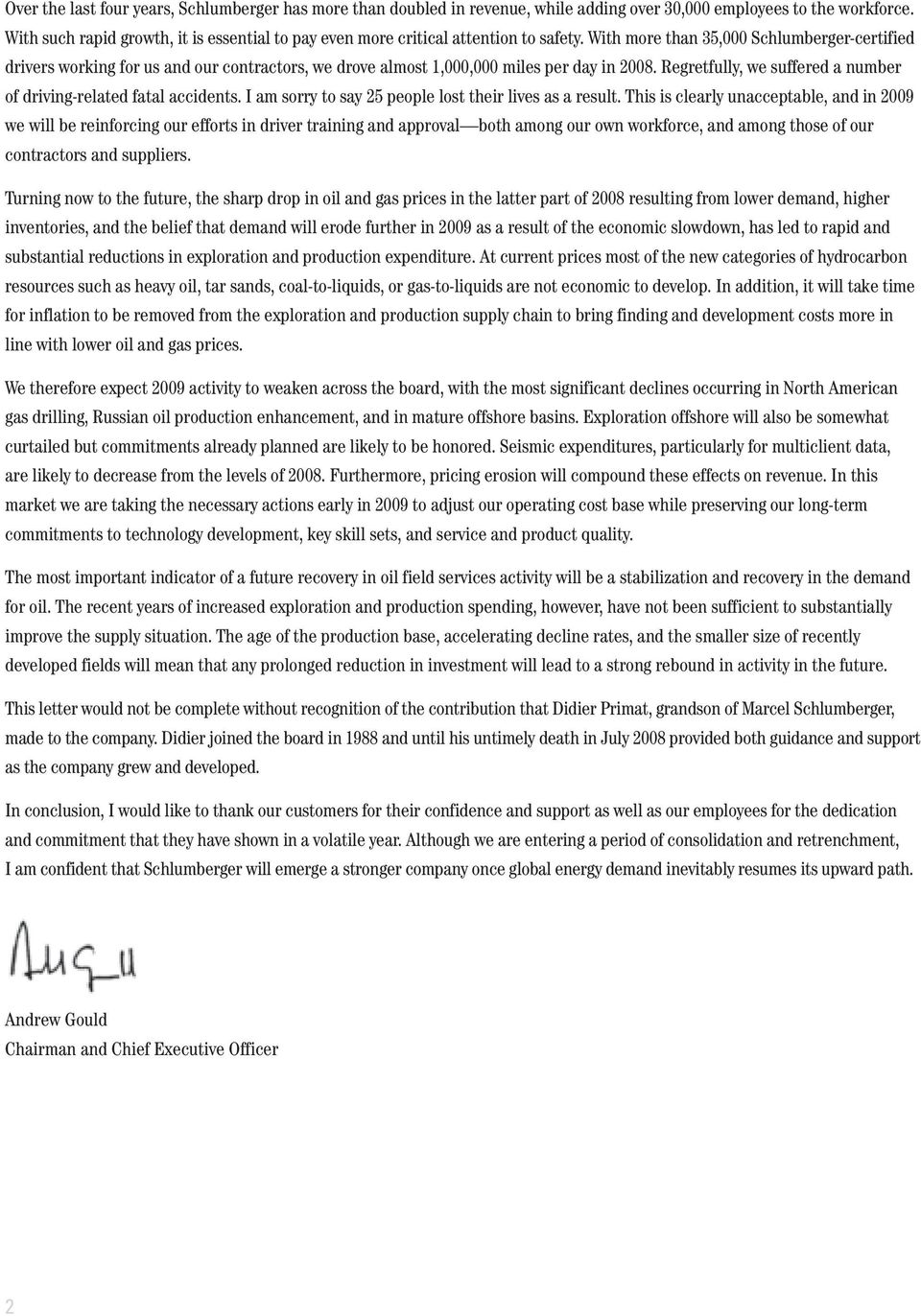
5 Performed by Schlumberger The Safaniya Project Proving the Value of Technology Integration and Teamwork The Performed by Schlumberger program is founded on the Schlumberger corporate values of people, technology, and profit. Each year we identify those projects that have demonstrated superior performance when measured against the criteria of teamwork, innovation, and business impact, which correspond to our corporate values. The highest recognition goes to the project with the greatest overall impact, and this project receives the Schlumberger Chairman s Award. In 2008, this honor went to the Saudi ARAMCO and Schlumberger Safaniya Project Team in Saudi Arabia. Located in the northeastern part of the Arabian Peninsula, measuring 74 km by 22 km, Safaniya is the largest offshore oil field in the world. It was discovered in 1951 and has been producing oil since In 2007, a reservoir enhancement program was initiated by Saudi ARAMCO, with the goal of significantly increasing daily productivity. Saudi ARAMCO initiated a plan to push the envelope on productivity gains in the next phase of the program, and in December of 2007, 50 of the brightest technical experts from the two companies met in a forum dedicated to solving the challenge of revitalizing Safaniya. This was the catalyst for an integrated project that was remarkable in terms of its response time, use of new technology, and close collaboration between Saudi ARAMCO and Schlumberger. Within a very short period, 30 highly technical horizontal wells were drilled and completed ahead of schedule and with exceptional results overall production from the wells drilled had increased substantially, exceeding all expectations. Technology integration and teamwork were at the center of this success. Reservoir contact was maximized by actively controlling the well trajectory using PeriScope * imaging-while-drilling services to achieve over 70% contact with the pay-zone. ResFlow * completion with formation isolation valves and optimum sand control screen slot opening provided the highest possible levels of flow distribution and control needed to efficiently drain oil from each selected interval along the horizontal wellbore while limiting the inflow of water. But it was not only technology that made this project so impressive; it was the way in which Saudi ARAMCO and Schlumberger were able to work together to seamlessly integrate highly complex services and technologies to dramatically improve well productivity and reservoir recovery. The result is proof indeed that the true value of technology is achieved through its combined application with knowledge and teamwork. Terje Moen, Reslink * research and development manager who developed the revolutionary sand screen and inflow control device, and Mohammed Bayoumi, Schlumberger completions engineer in Saudi Arabia, were key to the successful application of this technology to the Safaniya project. 3

6 Ultimate Recovery An Integration Timeline Integration of information provides the basis of the model that oil and gas companies use to manage reservoir production. The model, which represents the collective knowledge of the reservoir, is refined over time as new information from production data and further drilling is added. Schlumberger Petrel seismic-tosimulation software is the industry standard for managing the model-based processes of seismic interpretation, reservoir characterization, and reservoir simulation to guide reservoir production decision making. 4

7 From Discovery to Ultimate Recovery Technology is the lifeblood of the exploration and production (E&P) industry. Ever since the introduction of the rotary drill bit in 1915 and seismic imaging in 1924, our industry has unceasingly developed and deployed technology of increasing sophistication to extract hydrocarbon from reservoirs deep underground. Today that need is greater still. With much of the world s easy oil and gas already produced, the cost and complexity of meeting future energy needs demand technology that reduces risk and improves performance. Whether exploring for new reserves to replace those produced or optimizing the development of those already found, oil and gas producers are constantly seeking more efficient means of supplying cost-effective fossil-fuel energy. Yet in spite of extensive efforts in research and development, almost twice as much oil is left behind as is actually produced. As a result, increasing emphasis is being placed on ways to improve recovery. It would, of course, be much easier if we could actually see what is being produced from thousands of meters below ground. But the reservoir is hidden from direct view, and many different technologies are required to image its characteristics. Just as medical science uses many techniques to determine the health of the human being, so does petroleum science in its quest to understand the performance of the oil and gas reservoir. In both cases, the technologies and the measurements they capture must be used in The Schlumberger Petrel seismic-to-simulation workflow process has become the industry standard in measurement integration for reservoir modeling, providing the basis for ultimate reservoir recovery. In Houston, Texas, USA, Nigerian Geophysicist Benedict Chukwudebe discusses simulation results with Petrel Product Analyst Sandra Quental from Brazil. Technology for productivity The many skills and domains needed to build and validate the reservoir model include not only all the geosciences disciplines but also those of financial experts and oil and gas company management. Their ability to work together seamlessly, efficiently, and accurately is key to delivering the best possible decisions when and where needed. Petrel software offers a wide breadth of functionality, an exceptionally interactive environment, and a highly productive process for users to build multiple scenarios that help determine risk and reduce uncertainty through evaluating alternative development plans. 5
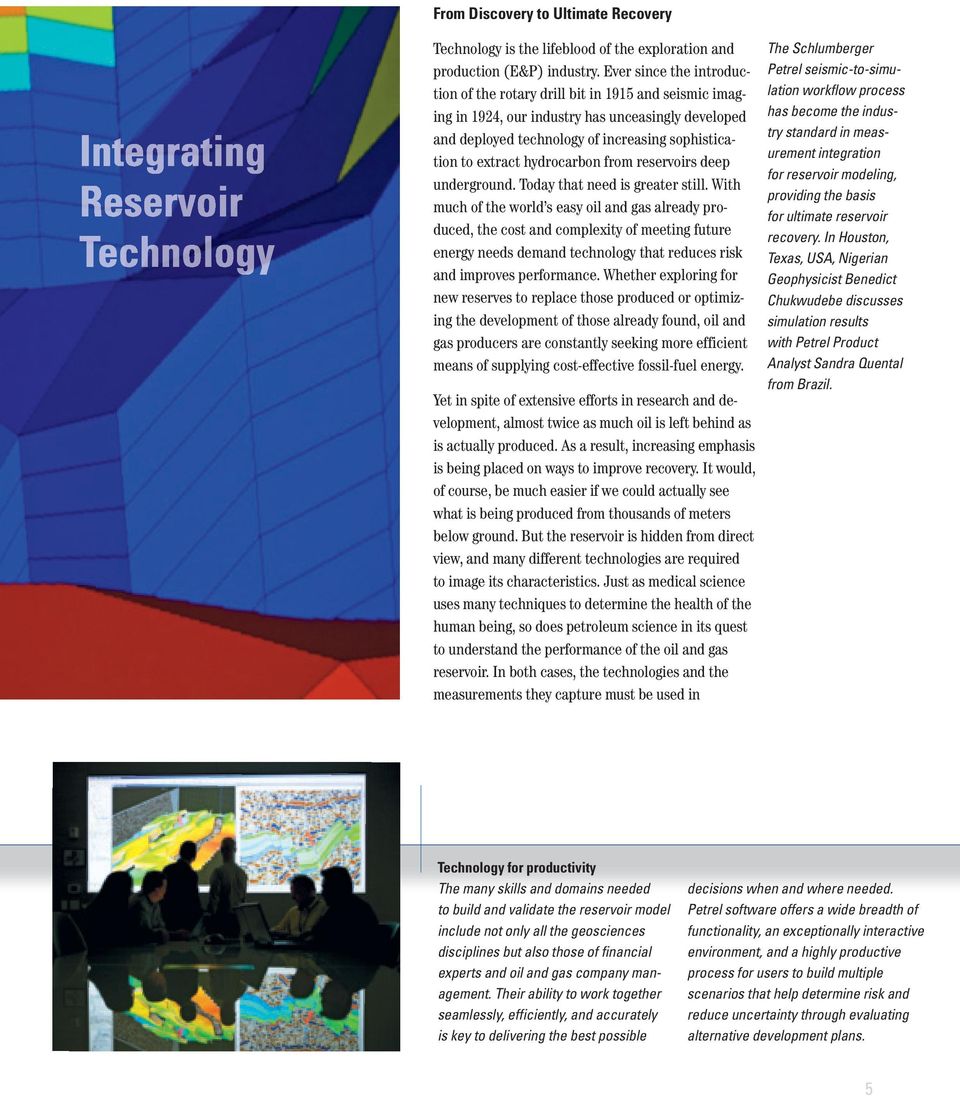
8 combination, must be integrated at varying scales, and must be used consistently over time. This multiple integration of information provides the basis of the model that every oil and gas producer uses to manage the reservoir over its active life. The science of measurement, or metrology, has been at the heart of Schlumberger ever since the founding brothers conceived the means of measuring the subsurface from above. From a single electrical measurement in 1912, the Schlumberger technology portfolio has grown to include almost every service that adds to the understanding of an oil or gas reservoir. That same portfolio also includes a range of technologies that improve reservoir performance. The Schlumberger portfolio is unique in many ways in both breadth and depth. First, Schlumberger technologies are industry leaders in the key disciplines of geophysics, well logging, drilling engineering, and well testing. In exploration and development work, the unparalleled insight delivered by these technologies is essential because technical risks are high. Having knowledge of what to expect is paramount particularly for the more complex projects of today. Second, the company s technology leadership is growing in vital areas such as stimulation and completion, where the goal is to sustain production over the life of the reservoir. Third, because information is not enough, Schlumberger provides the industry with the tools to model the reservoir from discovery to abandonment. This ability to continually add new information as it becomes available increases understanding, reduces uncertainty, and maximizes financial return. Integrating Reservoir Geophysics New discoveries are critical to growing the global reserves base and helping meet future production demands. Since 2002, WesternGeco, the seismic business segment of Schlumberger, has changed the game in the acquisition and processing of surface seismic data through the introduction of Q technology. By treating each signal separately, Q technology provides clear advantages in the fidelity and repeatability of surface surveys, and its commercial success can be gauged by a compound growth rate of 93% over the past three years. Yet the market penetration of Q technology is far from reaching saturation. Marine operations, for example, are being conducted more and more over immense salt deposits that in the past have rendered seismic surveys inconclusive. The industry s adoption of wide-azimuth techniques, in which the source position is offset from the acquisition geophones, has considerably improved clarity but at significant incremental cost for the required mobilization of multiple vessels. The combination of the flexible Q system and precise streamer steering has led to a proprietary coil shooting technique that enables using just one vessel to acquire full-azimuth data equivalent in quality to that obtained with the heavy logistics of conventional wide-azimuth surveying. The use of Q technology is also expanding on land. As E&P companies have seen the value of single-sensor recording, they have demanded an increasing number of channels as well as the capability to operate Beginning the process Starting the Petrel process begins with an interface showing a map of the target area and the locations of available seismic surveys. In this display of the coast of Norway, each green block defines an operating area. The white and yellow shapes correspond to oil and gas fields. 6

9 WesternGeco Q-Land * technology provides a fundamentally better measurement through single-sensor acquisition and processing. The benefit lies in highquality data to support accurate drilling decisions and better reservoir understanding. On location in Kuwait, Senior Acquisition Specialist Pattabhi Srinivasa Rao from India prepares Q-Land sensor equipment with Argentine Acquisition Engineer Claudia Tarpin. Building the model Interpreting the seismic data is the job of the geophysicist. Today s 3D surveys are presented as volumes of data, or cubes, that can be viewed progressively, line by line and slice by slice. The geophysicist can search within the data, tracking and tracing the features that correspond to the shape of any geological structure thought to contain hydrocarbon. Once key features have been selected by the geophysicist, the Petrel process automates propagation across the data volume to map the selected horizon, or surface, under the earth. This leads to a map of the subsurface that identifies changes in rock type and structural features such as ridges, faults, and cracks that could be potential hydrocarbon traps. 7

10 8 Modeling in depth Seismic data is recorded versus time. Converting the data to depth is a critical step that gives the first calculations of reservoir volume and hydrocarbon in place. It also indicates zones of potential drilling problems that present risk. In both cases, accuracy depends on quality data.

11 in environments from the desert to the Arctic, in line with new areas of activity. In response, WesternGeco is introducing the UniQ system in combination with proprietary vibrator source technology to deliver wider coverage and clearer imaging. UniQ technology not only produces a sharper image, but also allows inverting the seismic signal to extract detailed reservoir properties such as fracture patterns the knowledge of which can help guide more productive field development. The identification of fractures in the reservoir is just one potential application of the superior density of the UniQ system. The integration of reservoir geophysical technology is well suited to meeting the challenges of the rapidly evolving global exploration landscape. Access to prime acreage is becoming a challenge at a time when national oil companies are expanding international operations. Never before has the need to mitigate exploration risk been so great, and with the overall costs of some of the latest-generation deepwater rigs approaching USD 1.5 million per day, operational performance has also become more critical. Geophysical technologies provide a view of the invisible, and their combination with such techniques as logging-while-drilling services can significantly mitigate the risk of drilling the well. The result is SGD * seismic-guided drilling, which uses a model updated in real time to track the progress of the well as it is drilled. The addition of finer data to the surface seismic dataset refines the model and enables the seismic-guided drilling team at an Operations Support Center to correct the well s trajectory to match the new predictions of the model. This is just one example of Schlumberger integration combining surface and downhole technologies, technical experts, workflow and software designed for integrated solutions, and modeling capability to ensure that the well meets its planned objectives. The primary value lies in the potential cost savings that can be achieved in wells that no longer need to be sidetracked to reach their targets. In the US Gulf of Mexico, for example, nearly 800 rig days were lost in 2006 to the drilling of sidetracks the need for which could be greatly reduced by using seismicguided drilling to reach the planned objective. Characterizing Complex Reservoirs As each new well is drilled, more information becomes available and is added to the reservoir model. But even if every well in a particular reservoir were logged and cored, the resulting data would only represent a minute fraction of the total reservoir volume. Integration of the various measurements within the model must therefore account not only for their responses to different reservoir parameters but also for their vastly different scales. Seismic information, for example, is typically recorded at very large scale, covering many cubic kilometers of reservoir volume. Well logging information, on the other hand, is acquired at very fine scale, with resolution measured in centimeters or meters rather than kilometers. The amount of detail will continue to expand as E&P operations shift to more complex environments and more sophisticated measurements deliver more accurate information. Schlumberger is the world leader in integrated well testing technology that provides critical information about complex reservoir-scale fluid connectivity. The integration of new testing technology with completion systems is observed by Development Engineers Sylvain Chambon from France and Fahira Sangare from Senegal in a well at the European Learning Center in France. With the seismic model built, the geologist begins work incorporating available well data. Logging measurements are introduced and key features picked to adjust the model to align these features with the same formation tops in all the wells across the field. This time-consuming task is helped by data integration. 9

12 Schlumberger has led the well logging industry since 1926, and today the data recorded by wireline logging and logging-while-drilling tools cover a wide range of parameters that characterize the reservoir. Schlumberger Scanner * wireline technology, introduced in 2005, represents both evolution and revolution in well logging services. Scanner tools are unique in capturing 3D data of critical reservoir characteristics from both the rock and its fluid content. Yet even these advanced measurements are not always sufficient to understand difficult formations and complex hydrocarbons. Reservoirs, for example, are often assumed to be in hydraulic communication from zone to zone. If they are, it is likely that the crude oils contained in each zone are the same making completion, production, and refining much simpler. If they are not, it may be necessary to design more complex completions capable of handling the different crudes separately. In fact, the determination of fluid properties is critical to all stages in the life of the reservoir because this understanding guides materials selection, completion design, field production facility capacity, and flow assurance while helping combat corrosion and scale and wax formation. But characterizing fluids has been an expensive, time-consuming process involving the recovery of a variety of different samples and then maintaining their integrity for later analysis. Responding to this need, Schlumberger began development in the early 1990s of a new wireline instrument capable of measuring fluid properties downhole. Development of a number of significant new technologies was necessary to produce the new tool, introduced as the InSitu Fluid Analyzer * system at the end of The InSitu Fluid Analyzer tool leverages Schlumberger expertise in wireline sampling going back almost 50 years with additional innovations such as the Quicksilver Probe * zero-contamination sampling technique and the packaging of a laboratory-quality grating spectrometer into a tool that can operate in extreme conditions of temperature and pressure. Schlumberger characterization technologies are enjoying increasing market penetration, meeting the challenges of developing increasingly complex reservoirs. But the Schlumberger portfolio goes far beyond the characterization needs of the complex reservoir. Once production of the reservoir has begun, sustaining it is a much larger challenge, requiring the addition of another dimension to technology integration. Producing Difficult Reservoirs For the majority of oil and gas reservoirs around the world, there is a strong correlation between drilling and production the greater the number of feet drilled in the reservoir, the greater the production. Whether the number of feet is increased by more wells, or by more-complex wells, the determining factor is the degree of contact with the reservoir. This can be improved by keeping the wellbore within the most productive part of the reservoir, by placing the well to leverage natural fractures, or by stimulating to induce artificial fractures within the reservoir. In all cases, Schlumberger is leading the industry in 10
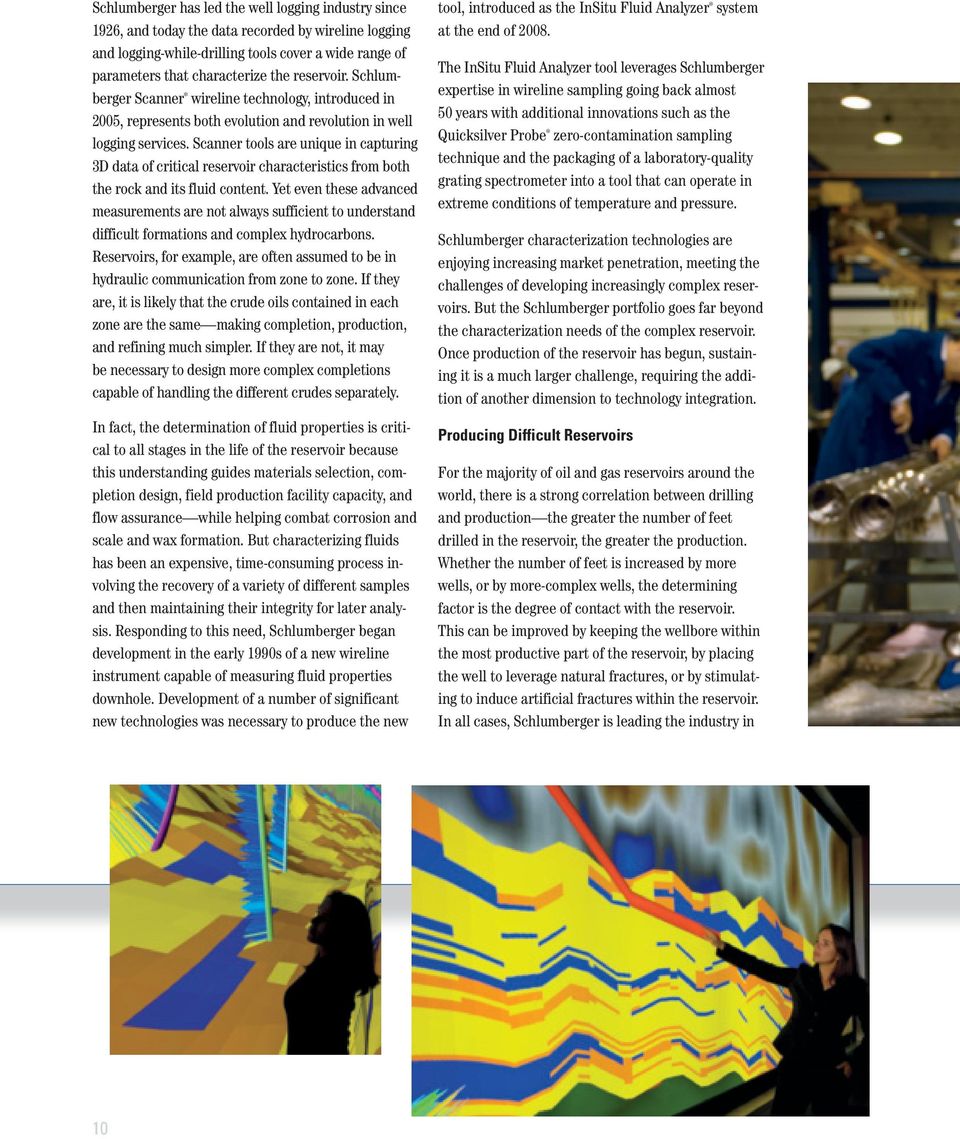
13 Schlumberger leadership in downhole fluid pressure measurements and sampling extends over nearly 50 years. Today s tools conveyed on either wireline or drillpipe provide the latest technology for accurate measurements. Indian Manufacturing Engineer Kavya Malladi is working on one of the latestgeneration tools in the Sugar Land Technology Center, Houston, Texas, USA. Drilling the well Petrophysical data contain detailed information on rock type, porosity, and fluid content. The Petrel workflow takes this information and assigns it to the layers identified by the geologist. Extrapolation across the field gives maps that lead to detailed calculations of the volume of hydrocarbon in place. This forms one of the bases for economic evaluation of the field. The colors in the display correspond to the scale of the parameter being mapped and indicate how the well should be drilled. The drilling engineer uses this information to plot the well trajectory required to enter the reservoir as effectively as possible, translating the planned wellpath into the equipment to be used to actually drill the well. As the well is drilled, more information becomes available from loggingwhile-drilling measurements, which can be used to update the Petrel model. 11

14 helping optimize production through the real-time integration of measurements and technologies. In 2006, Schlumberger Drilling & Measurements introduced the PeriScope imaging-while-drilling service to map reservoir boundaries up to 4.5 m away from the tool. This unique technology in combination with industry-leading PowerDrive * rotary steerable systems has had a significant effect on the horizontal well market because it enables steering wells in complex geologies to improve production through increased reservoir contact. No other service combination offers this flexibility. Looking ahead, the next generation of PeriScope technology will detect formation changes as far as 30 m from the well, while new PowerDrive systems will build deviation at rates almost double that of today s standard technology. Well placement technologies can also be used to exploit any natural fracture networks within the reservoir to put more reservoir surface in contact with the well. The geovision * logging-while-drilling tools, for example, can identify fractures through the real-time measurement of resistivity anomalies, which indicate the directions of any fractures, so that the well can be steered to intersect as many of them as possible. Reservoir contact can also be improved through fracture stimulation. In tight and unconventional reservoirs, for example, even an optimally placed horizontal well does not provide enough contact to produce the volumes of hydrocarbon necessary to make the well an economic success. The solution is to place multiple hydraulic fractures along the wellbore to significantly increase the reservoir surface in contact. In the past, hydraulic fracturing was not particularly precise. Schlumberger technology integration has improved that to make the control of fracture propagation a science. By measuring the microseismic events that occur as the fracture progresses, fracture direction and length can be determined and the stimulation treatment modified to ensure optimum fracture placement. This is the StimMAP LIVE service that integrates Schlumberger well logging measurements with pressure pumping expertise and completion diversion and control. Once again, the reservoir model is essential because it provides the vital workspace for capturing, analyzing, and interpreting data of different types in real time as operations progress. Industry acceptance of microseismically monitored hydraulic fracture stimulation has been rapid. Compound growth rates over the past three years have exceeded 80%. Its application in the large natural gas market in North America has greatly increased productivity, and its deployment to other markets around the globe is expanding. Production-related technology integration is clearly demonstrating its value in improving the performance of both new and established fields. Improving production performance As more wells are drilled, the model can be used to evaluate development options with the Petrel process simulating the effect of each to pick the most favorable. In natural gas fields, for example, fracture stimulation of long horizontal wells is necessary to render their return economic. In such wells, many zones may need to be stimulated independently and their identification is critical. On the job, the progress of each individual fracture can be plotted and the operation modified to ensure the best possible economic return. The economic modeling capability of the Petrel workflow renders this highly interactive. 12

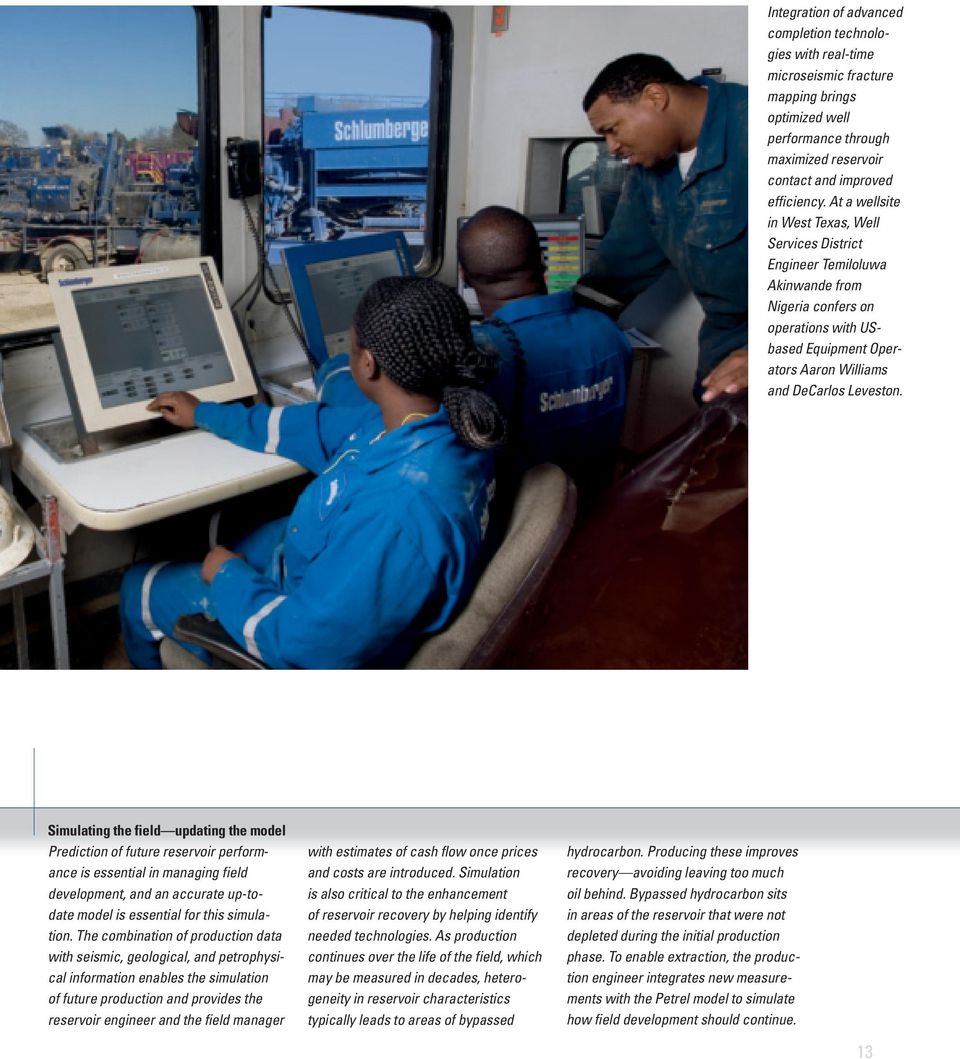
15 Integration of advanced completion technologies with real-time microseismic fracture mapping brings optimized well performance through maximized reservoir contact and improved efficiency. At a wellsite in West Texas, Well Services District Engineer Temiloluwa Akinwande from Nigeria confers on operations with USbased Equipment Operators Aaron Williams and DeCarlos Leveston. Simulating the field updating the model Prediction of future reservoir performance is essential in managing field development, and an accurate up-todate model is essential for this simulation. The combination of production data with seismic, geological, and petrophysical information enables the simulation of future production and provides the reservoir engineer and the field manager with estimates of cash flow once prices and costs are introduced. Simulation is also critical to the enhancement of reservoir recovery by helping identify needed technologies. As production continues over the life of the field, which may be measured in decades, heterogeneity in reservoir characteristics typically leads to areas of bypassed hydrocarbon. Producing these improves recovery avoiding leaving too much oil behind. Bypassed hydrocarbon sits in areas of the reservoir that were not depleted during the initial production phase. To enable extraction, the production engineer integrates new measurements with the Petrel model to simulate how field development should continue. 13
16 Enhancing Reservoir Recovery The International Energy Agency estimates that twice as much conventional oil remains to be produced as that already recovered. With global recovery factors averaging only about 30%, each percentage point improvement in recovery represents more than two years supply at today s rate of consumption. But to increase recovery factors globally by one percentage point, technology has many challenges to overcome in finding, reaching, and producing the reservoir. Global recovery rates of 30% also mean that more oil is currently being left in the ground than is being produced. Although it will never be possible to produce all the original oil in place, it is thought that an additional 20% 45% can be recovered in future developments. Central to enhancing recovery however is having a good model of the reservoir from initial discovery through final abandonment. For a model to be good does not mean simply having many different measurements. Indeed, measurements and data must be carefully chosen to monitor events at both the micro- and macro-scale, from the single well to the entire reservoir. Although many of today s technologies provide measurements finetuned at these two ends, the industry lacks the means to see what is happening in between. Fortunately, new techniques are in development to fill the gap. In the Middle East, Schlumberger has been helping perform an experiment using deepreading electrode arrays to monitor the electrical behavior of a complex carbonate formation as water is injected into the oil-producing zone. During injection, pressure and flow rates are also measured in the test borehole. The combination of the different data types has provided essential insight into the flow mechanisms within the reservoir, clearly showing zones that had already been swept of oil and zones where oil remained for future recovery. In another approach using electromagnetic techniques, measurements from well to well have shown how resistivities vary with distance between wells as the field is produced. This method also identifies parts of the reservoir where oil remains even though the surrounding volumes have already been produced. With this knowledge, it becomes much easier to choose the location of future wells to tap remaining pockets of oil and increase the ultimate recovery of the field. None of these advances in technology integration would have been possible without an accurate model of the reservoir that combines all available measurements. A model must be updatable in real time so that new information can be seamlessly added. When existing data are combined with newer measurements, such as those from electrical arrays or cross-well techniques, the model is then able to more accurately predict, monitor, and optimize the production of a field to enhance its ultimate recovery. This process makes it possible to measure what used to be estimated: where to place the next well, where to find bypassed hydrocarbon, and how to extract the greatest amount of hydrocarbon in a cost-effective manner. 14

17 Locating research centers close to oil company headquarters and centers of academic excellence is proving to be a valuable model in technology development and integration. The new Schlumberger Carbonate Research Center in Dhahran, Saudi Arabia, was opened in 2006 for closer collaboration with universities and clients. Achieving ultimate recovery The simulation process identifies those parts of the reservoir from which hydrocarbon can still be produced. The field management team, and all its technical disciplines, can plan how to place further wells within the reservoir to access the remaining oil or gas. Each option for doing so can be economically evaluated in exactly the same way as the initial production strategy. The E&P cycle is complete and continues until technology can no longer enable recovery from the field in an economic manner. Petrel seismic-to-simulation workflow processes support the complex world of the geoscientist in the pursuit of increased recovery. 15

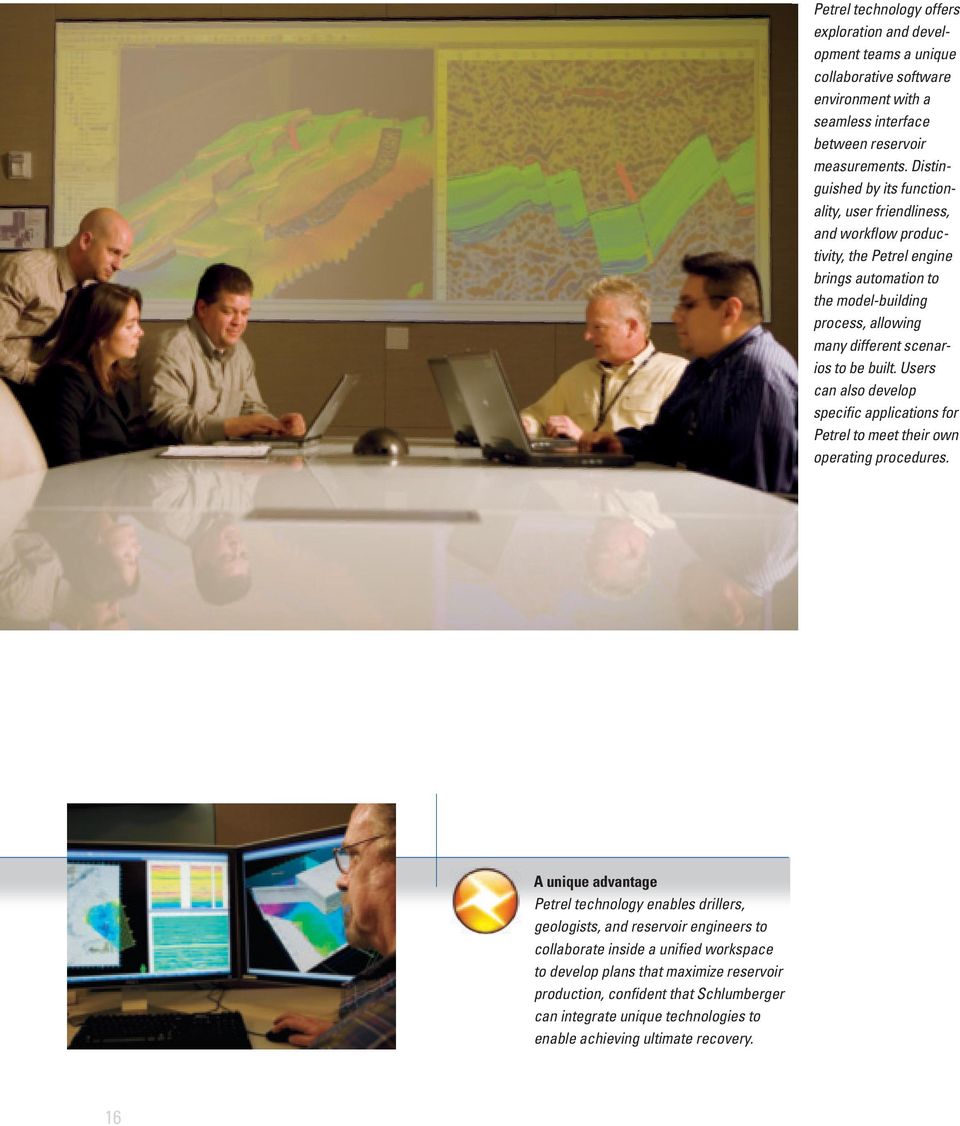
18 Petrel technology offers exploration and development teams a unique collaborative software environment with a seamless interface between reservoir measurements. Distinguished by its functionality, user friendliness, and workflow productivity, the Petrel engine brings automation to the model-building process, allowing many different scenarios to be built. Users can also develop specific applications for Petrel to meet their own operating procedures. A unique advantage Petrel technology enables drillers, geologists, and reservoir engineers to collaborate inside a unified workspace to develop plans that maximize reservoir production, confident that Schlumberger can integrate unique technologies to enable achieving ultimate recovery. 1616
19 UNITED STATES SECURITIES AND EXCHANGE COMMISSION Washington, D.C Form 10-K (Mark One) È ANNUAL REPORT PURSUANT TO SECTION 13 OR 15(d) OF THE SECURITIES EXCHANGE ACT OF 1934 For the fiscal year ended December 31, 2008 OR TRANSITION REPORT PURSUANT TO SECTION 13 OR 15(d) OF THE SECURITIES EXCHANGE ACT OF 1934 For the transition period from to Commission File Number Schlumberger N.V. (Schlumberger Limited) (Exact name of registrant as specified in its charter) Netherlands Antilles (State or other jurisdiction of (IRS Employer Identification No.) incorporation or organization) 42, rue Saint-Dominique Paris, France 5599 San Felipe, 17 th Floor Houston, Texas, United States of America Parkstraat 83, The Hague, The Netherlands 2514 JG (Addresses of principal executive offices) (Zip Codes) Registrant s telephone number in the United States, including area code, is: (713) Securities registered pursuant to Section 12(b) of the Act: Title of each class Name of each exchange on which registered Common Stock, par value $0.01 per share New York Stock Exchange Euronext Paris The London Stock Exchange SIX Swiss Exchange Ltd. Securities registered pursuant to Section 12(g) of the Act: None Indicate by check mark if the registrant is a well-known seasoned issuer, as defined in Rule 405 of the Securities Act. YES È NO Indicate by check mark if the registrant is not required to file reports pursuant to Section 13 or Section 15(d) of the Act. YES NO È Indicate by check mark whether the registrant (1) has filed all reports required to be filed by Section 13 or 15(d) of the Securities Exchange Act of 1934 during the preceding 12 months (or for such shorter period that the registrant was required to file such reports), and (2) has been subject to such filing requirements for the past 90 days. YES È NO Indicate by check mark if disclosure of delinquent filers pursuant to Item 405 of Regulation S-K is not contained herein, and will not be contained, to the best of the registrant s knowledge, in definitive proxy or information statements incorporated by reference in Part III of this Form 10-K or any amendment to this Form 10-K. Indicate by check mark whether the registrant is a large accelerated filer, an accelerated filer, a non-accelerated filer, or a smaller reporting company. See the definitions of large accelerated filer, accelerated filer and smaller reporting company in Rule 12b-2 of the Exchange Act. Large accelerated filer È Accelerated filer Non-accelerated filer Smaller reporting company Indicate by check mark whether the registrant is a shell company (as defined in Rule 12b-2 of the Act). YES NO È As of June 30, 2008, the aggregate market value of the common stock of the registrant held by non-affiliates of the registrant was approximately $125.2 billion. As of January 31, 2009, the number of shares of common stock outstanding was 1,195,989,819. DOCUMENTS INCORPORATED BY REFERENCE Portions of the following document have been incorporated herein by reference into Part III of this Form 10-K to the extent described therein: Definitive Proxy Statement relating to Schlumberger s 2009 Annual General Meeting of Stockholders ( Proxy Statement ).
20 SCHLUMBERGER LIMITED Table of Contents Form 10-K Page PART I Item 1. Business 3 Item 1A. Risk Factors 6 Item 1B. Unresolved Staff Comments 10 Item 2. Properties 10 Item 3. Legal Proceedings 10 Item 4. Submission of Matters to a Vote of Security Holders 10 PART II Item 5. Market for Schlumberger s Common Stock, Related Stockholder Matters and Issuer Purchases of Equity Securities 12 Item 6. Selected Financial Data 15 Item 7. Management s Discussion and Analysis of Financial Condition and Results of Operations 17 Item 7A. Quantitative and Qualitative Disclosures About Market Risk 33 Item 8. Financial Statements and Supplementary Data 35 Item 9. Changes in and Disagreements with Accountants on Accounting and Financial Disclosure 71 Item 9A. Controls and Procedures 71 Item 9B. Other Information 71 PART III Item 10. Directors, Executive Officers and Corporate Governance of Schlumberger 72 Item 11. Executive Compensation 72 Item 12. Security Ownership of Certain Beneficial Owners and Management and Related Stockholder Matters 72 Item 13. Certain Relationships and Related Transactions, and Director Independence 73 Item 14. Principal Accounting Fees and Services 73 PART IV Item 15. Exhibits and Financial Statement Schedules 74 Signatures 75 Certifications

21 Part 1, Item 1 PART I Item 1. Business. All references in this report to Registrant, Company, Schlumberger, we or our are to Schlumberger Limited and its consolidated subsidiaries. Founded in 1926, Schlumberger is the world s leading supplier of technology, integrated project management and information solutions to customers working in the oil and gas industry worldwide. As of December 31, 2008, the Company employed approximately 87,000 people of over 140 nationalities operating in approximately 80 countries. Schlumberger has principal executive offices in Paris, Houston, and The Hague and consists of two business segments Schlumberger Oilfield Services and WesternGeco. Schlumberger Oilfield Services provides the industry s widest range of products and services from exploration to production, while WesternGeco is the world s most technologically advanced surface seismic company. Schlumberger Oilfield Services is the world s leading provider of technology, integrated project management and information solutions to the international oil and gas exploration and production industry. Schlumberger Oilfield Services manages its business through GeoMarket* regions, which are grouped into four geographic areas: North America, Latin America, Europe/CIS/Africa and Middle East & Asia. The GeoMarket structure offers customers a single point of contact at the local level for field operations and brings together geographically focused teams to meet local needs and deliver customized solutions. Schlumberger invented wireline logging as a technique for obtaining downhole data in oil and gas wells. Today, Schlumberger Oilfield Services operates in each of the major oilfield service markets, providing services that cover the entire life cycle of the reservoir. These services, in which Schlumberger holds a number of market leading positions, are organized into a number of technology-based product and service lines, or Technologies, to capitalize on technical synergies and introduce innovative solutions within the GeoMarket regions. The Technologies are also responsible for overseeing operational processes, resource allocation, personnel and quality, health, safety and environmental matters in the GeoMarket. The Technologies are: Š Wireline provides the information necessary to evaluate the subsurface formation rocks and fluids to plan and monitor well construction, and to monitor and evaluate well production. Wireline offers both open-hole and cased-hole services. Š Drilling & Measurements supplies directional-drilling, measurement-while-drilling and loggingwhile-drilling services for all well profiles. Š Well Testing provides exploration and production pressure and flow-rate measurement services both at the surface and downhole. The Technology also provides tubing-conveyed perforating services. Š Well Services provides services used during oil and gas well drilling and completion as well as those used to maintain optimal production throughout the life of a well. The services include pressure pumping, well cementing and stimulation operations as well as intervention activities. The Technology also develops coiled-tubing equipment and services. Š Completions supplies well completion services and equipment that include gas-lift and safety valves as well as a range of intelligent well completions technology and equipment. Š Artificial Lift provides production optimization services using electrical submersible pumps and associated equipment. 3
22 Part 1, Item 1 Š Data & Consulting Services supplies interpretation and integration of all exploration and production data types, as well as expert consulting services for reservoir characterization, production enhancement, field development planning and multi-disciplinary reservoir and production solutions. Š Schlumberger Information Solutions (SIS) provides consulting, software, information management and IT infrastructure products and services that support core oil and gas industry operational processes. Supporting the Technologies are 20 research and engineering centers. Through this organization, Schlumberger is committed to advanced technology programs that enhance oilfield efficiency, lower finding and producing costs, improve productivity, maximize reserve recovery and increase asset value while accomplishing these goals in a safe and environmentally sound manner. Schlumberger Oilfield Services also offers customers its services through a business model known as Integrated Project Management (IPM). IPM combines the required products and services of the Schlumberger Technologies with drilling rig management expertise and project management skills to provide a complete solution to well construction and production improvement. IPM projects are typically of multi-year duration and include start-up costs and significant third-party components that cover services that Schlumberger does not provide directly. Some projects may be fixed price in nature and may contain penalties for non-performance. Schlumberger Oilfield Services uses its own personnel to market its products and services. The customer base, business risks and opportunities for growth are essentially uniform across all services. There is a sharing of manufacturing and engineering facilities as well as research centers, and the labor force is interchangeable. Technological innovation, quality of service, and price differentiation are the principal methods of competition, which varies geographically with respect to the different services offered. While there are numerous competitors, both large and small, Schlumberger believes that it is an industry leader in providing wireline logging, well testing, measurement-while-drilling, logging-while-drilling and directional-drilling services, as well as fully computerized logging and geoscience software and computing services. A large proportion of Schlumberger offerings are non-rig related; consequently, revenue does not necessarily correlate to rig count fluctuations. Schlumberger is a 40% owner in M-I SWACO a joint venture with Smith International which offers the drilling and completion fluids used to stabilize subsurface rock strata during the drilling process and minimize formation damage during completion and workover operations. WesternGeco, the world s most technologically advanced seismic company, provides comprehensive reservoir imaging, monitoring and development services with the most extensive seismic crews and data processing centers in the industry as well as a leading multiclient seismic library. Services range from 3D and time-lapse (4D) seismic surveys to multi-component surveys for delineating prospects and reservoir management. WesternGeco benefits from full access to the Schlumberger research, development and technology organization and shares similar business risks, opportunities for growth, principal methods of competition and means of marketing as Schlumberger Oilfield Services. Seismic solutions include proprietary Q* technology for enhanced reservoir description, characterization and monitoring throughout the life of the field from exploration through enhanced recovery. Other WesternGeco solutions include development of controlledsource electromagnetic and magneto-telluric surveys and their integration with seismic data. Positioned for meeting a full range of customer needs in land, marine and shallow-water transition-zone services, WesternGeco offers a wide scope of technologies and services: Š Land Seismic provides comprehensive resources for seismic data acquisition on land and across shallow-water transition zones. 4
23 Part 1, Item 1 Š Š Š Š Š Marine Seismic provides industry-standard marine seismic acquisition and processing systems as well as a unique industry-leading, fully calibrated single-sensor marine seismic system that delivers the seismic technology needed for new-generation reservoir management. Multiclient Services supplies high-quality seismic data from the multiclient library, including industry-leading Q technology data. Reservoir Services provides people, tools and technology to help customers capture the benefits of a completely integrated approach to locating, defining and monitoring the reservoir. Data Processing offers extensive seismic data processing centers for complex data processing projects. Electromagnetics provides controlled-source electromagnetic and magneto-telluric data acquisition and processing. Acquisitions Information about acquisitions made by Schlumberger appears in Note 4 of the Consolidated Financial Statements. GENERAL Research Centers Research to support the engineering and development efforts of Schlumberger activities is principally conducted at Cambridge, Massachusetts, United States; Cambridge, England; Stavanger, Norway; Moscow, Russia; and Dhahran, Saudi Arabia. Patents While Schlumberger seeks and holds numerous patents covering various products and processes, no particular patent or group of patents is considered material to Schlumberger s business. Seasonality Although weather and natural phenomena can temporarily affect delivery of oilfield services, the widespread geographic location of such services precludes the overall business from being characterized as seasonal. Customers and Backlog of Orders No single customer exceeded 10% of consolidated revenue. Oilfield Services has no significant backlog due to the nature of its business. The WesternGeco backlog at December 31, 2008 was $1.8 billion (2007: $1.2 billion), of which an estimated $1.3 billion is expected to be realized in Government Contracts No material portion of Schlumberger s business is subject to renegotiation of profits or termination of contracts by the United States or other governments. Employees As of December 31, 2008, Schlumberger had approximately 87,000 employees. 5
24 Part 1, Item 1, 1A Financial Information Financial information by business segment for the years ended December 31, 2008, 2007 and 2006 is provided in Note 18 of the Consolidated Financial Statements. Available Information The Schlumberger Internet website can be found at Schlumberger makes available free of charge on or through its Internet website at access to its Annual Report on Form 10-K, Quarterly Reports on Form 10-Q, Current Reports on Form 8-K, its proxy statement and Forms 3, 4 and 5 filed on behalf of directors and executive officers, and amendments to each of those reports as soon as reasonably practicable after such material is filed with or furnished to the Securities and Exchange Commission ( SEC ). Alternatively, you may access these reports at the SEC s Internet website at Schlumberger s corporate governance materials, including Board Committee Charters, Corporate Governance Guidelines and Code of Ethics, may also be found at From time to time, corporate governance materials on our website may be updated to comply with rules issued by the SEC and the New York Stock Exchange ( NYSE ) or as desirable to promote the effective governance of Schlumberger. In addition, amendments to the Code of Ethics and any grant of a waiver from a provision of the Code of Ethics requiring disclosure under applicable SEC or NYSE rules will be disclosed on our website. Any stockholder wishing to receive, without charge, a copy of any of the SEC filings or corporate governance materials should write to the Secretary, Schlumberger Limited, 5599 San Felipe, 17 th Floor, Houston, Texas 77056, USA. Schlumberger has filed the required certifications under Section 302 of the Sarbanes-Oxley Act of 2002 as Exhibits 31.1 and 31.2 to this Report. In 2008, Schlumberger submitted to the NYSE the CEO certification required by Section 303A.12(a) of the NYSE s Listed Company Manual. The information on our website or any other website is not incorporated by reference in this Report and should not be considered part of this Report or any other filing Schlumberger makes with the SEC. Item 1A. Risk Factors. The following discussion of risk factors contains forward-looking statements, as discussed immediately following Item 7A. of this Report. These risk factors may be important to understanding any statement in this Report or elsewhere. The following information should be read in conjunction with Management s Discussion and Analysis, and the consolidated financial statements and related notes included in this Report. We urge you to carefully consider the risks described below, as well as in other reports and materials that we file with the SEC and the other information included or incorporated by reference in this Report. If any of the risks described below or elsewhere in this Report were to materialize, our business, financial condition, results of operations, cash flows or prospects could be materially adversely affected. In such case, the trading price of our common stock could decline and you could lose all or part of your investment. Additional risks and uncertainties not currently known to us or that we currently deem immaterial may also adversely affect our business and operations. Demand for the majority of our services is substantially dependent on the levels of expenditures by the oil and gas industry. Current global economic conditions have resulted in a significant decline in oil and gas prices. If current global economic conditions and the availability of credit worsen or continue for an extended period, this could reduce our customers levels of expenditures and have a significant adverse effect on our revenue and operating results. 6
25 Part 1, Item 1A The current global credit and economic environment has reduced worldwide demand for energy and resulted in significantly lower crude oil and natural gas prices. A substantial or extended decline in oil and natural gas prices can reduce our customers activities and their spending on our services and products. Demand for the majority of our services substantially depends on the level of expenditures by the oil and gas industry for the exploration, development and production of crude oil and natural gas reserves. These expenditures are sensitive to oil and natural gas prices and generally dependent on the industry s view of future oil and gas prices. As the worldwide deterioration in the financial and credit markets has deepened in recent months, demand for oil and gas has reduced dramatically and oil and gas prices have fallen sharply, causing some of our customers to start to reduce or delay their oil and gas exploration and production spending. This has started to reduce the demand for our services and has begun to exert downward pressure on the prices that we charge. If economic conditions continue to deteriorate or do not improve, it could result in further reductions of exploration and production expenditures by our customers, causing further declines in the demand for our services and products. This could result in a significant adverse effect on our operating results. Furthermore, it is difficult to predict how long the economic downturn will continue, to what extent it will worsen, and to what extent this will continue to affect us. The reduction in cash flows being experienced by our customers resulting from declines in commodity prices, together with the reduced availability of credit and increased costs of borrowing due to the tightening of the credit markets, could have significant adverse effects on the financial condition of some of our customers. This could result in project modifications, delays or cancellations, general business disruptions, and delay in, or nonpayment of, amounts that are owed to us, which could have a significant adverse effect on our results of operations and cash flows. Additionally, our suppliers could be negatively impacted by current global economic conditions. If certain of our suppliers were to experience significant cash flow issues or become insolvent as a result of such conditions, it could result in a reduction or interruption in supplies or a significant increase in the price of supplies, and adversely impact our results of operations and cash flows. The prices for oil and natural gas are subject to a variety of additional factors, including: Š Š Š Š Š Š Š Š demand for energy, which is affected by worldwide population growth, economic development and general economic and business conditions; the ability of the Organization of Petroleum Exporting Countries( OPEC ) to set and maintain production levels for oil; oil and gas production by non-opec countries; political and economic uncertainty and socio-political unrest; the level of worldwide oil exploration and production activity; the cost of exploring for, producing and delivering oil and gas; technological advances affecting energy consumption; and weather conditions. A significant portion of our revenue is derived from our non-united States operations, which exposes us to risks inherent in doing business in each of the approximately 80 countries in which we operate. Our non-united States operations accounted for approximately 78% of our consolidated revenue in 2008, 76% in 2007 and 73% in Operations in countries other than the United States are subject to various risks, including: Š unsettled political and economic conditions in certain areas; 7
26 Part 1, Item 1A Š Š Š Š Š Š Š Š Š exposure to possible expropriation or other governmental actions; social unrest, acts of terrorism, war or other armed conflict; confiscatory taxation or other adverse tax policies; deprivation of contract rights; trade restrictions or embargoes imposed by the United States or other countries; restrictions on the repatriation of income or capital; exchange controls; inflation; and currency fluctuations and devaluations. In addition, we are subject to risks associated with our operations in countries, including Iran, Syria, Sudan and Cuba, which are subject to trade and economic sanctions or other restrictions imposed by the United States or other governments or organizations. If any of the risks described above materialize, it could reduce our earnings and our cash available for operations. We are also subject to risks related to investment in our common stock in connection with certain US state divestment or investment limitation legislation applicable to companies with operations in these countries, and similar actions by some private investors, which could adversely affect the market for our common stock. Environmental compliance costs and liabilities could reduce our earnings and cash available for operations. We are subject to increasingly stringent laws and regulations relating to importation and use of hazardous materials, radioactive materials and explosives, environmental protection, including laws and regulations governing air emissions, water discharges and waste management. We incur, and expect to continue to incur, capital and operating costs to comply with environmental laws and regulations. The technical requirements of these laws and regulations are becoming increasingly expensive, complex and stringent. These laws may provide for strict liability for damages to natural resources or threats to public health and safety. Strict liability can render a party liable for damages without regard to negligence or fault on the part of the party. Some environmental laws provide for joint and several strict liability for remediation of spills and releases of hazardous substances. We use and generate hazardous substances and wastes in our operations. In addition, many of our current and former properties are or have been used for industrial purposes. Accordingly, we could become subject to potentially material liabilities relating to the investigation and cleanup of contaminated properties, and to claims alleging personal injury or property damage as the result of exposures to, or releases of, hazardous substances. In addition, stricter enforcement of existing laws and regulations, new laws and regulations, the discovery of previously unknown contamination or the imposition of new or increased requirements could require us to incur costs or become the basis of new or increased liabilities that could reduce our earnings and our cash available for operations. We believe we are currently in substantial compliance with environmental laws and regulations. We could be subject to substantial liability claims, which would adversely affect our results and financial condition. Certain equipment used in the delivery of oilfield services, such as directional drilling equipment, perforating systems, subsea completion equipment, radioactive materials and explosives and well completion 8
27 Part 1, Item 1A systems, are used in hostile environments, such as exploration, development and production applications. An accident or a failure of a product could cause personal injury, loss of life, damage to property, equipment or the environment, and suspension of operations. Our insurance may not adequately protect us against liability for some kinds of events, including events involving pollution, or against losses resulting from business interruption. Moreover, in the future we may not be able to maintain insurance at levels of risk coverage or policy limits that we deem adequate. Substantial claims made under our policies could cause our premiums to increase. Any future damages caused by our products that are not covered by insurance, or are in excess of policy limits or are subject to substantial deductibles, could reduce our earnings and our cash available for operations. If we are unable to maintain technology leadership in the form of services and products, this could affect any competitive advantage we hold. If we are unable to develop and produce competitive technology or deliver them to our clients in the form of services and products in a timely and cost-competitive manner in the various markets we serve, it could materially reduce our operating revenue and net income. Limitations on our ability to protect our intellectual property rights, including our trade secrets, could cause a loss in revenue and any competitive advantage we hold. Some of our products or services, and the processes we use to produce or provide them, have been granted United States patent protection, have patent applications pending or are trade secrets. Our business may be adversely affected if our patents are unenforceable, the claims allowed under our patents are not sufficient to protect our technology, our patent applications are denied, or our trade secrets are not adequately protected. Our competitors may be able to develop technology independently that is similar to ours without infringing on our patents or gaining access to our trade secrets. We may be subject to litigation if another party claims that we have infringed upon its intellectual property rights. The tools, techniques, methodologies, programs and components we use to provide our services may infringe upon the intellectual property rights of others. Infringement claims generally result in significant legal and other costs and may distract management from running our core business. Royalty payments under licenses from third parties, if available, would increase our costs. If a license were not available we might not be able to continue providing a particular product or service, which would reduce our operating revenue. Additionally, developing non-infringing technologies would increase our costs. Failure to obtain and retain skilled technical personnel could impede our operations. We require highly skilled personnel to operate and provide technical services and support for our business. Competition for the personnel required for our businesses intensifies as activity increases. In periods of high utilization it may become more difficult to find and retain qualified individuals. This could increase our costs or have other adverse effects on our operations. Severe weather conditions may affect our operations. Our business may be materially affected by severe weather conditions in areas where we operate. This may entail the evacuation of personnel and stoppage of services. In addition, if particularly severe weather affects platforms or structures, this may result in a suspension of activities until the platforms or structures have been repaired. Any of these events may have a material adverse effect on our operating revenue. 9
28 Part 1, Item 1B, 2, 3, 4 Item 1B. None. Unresolved Staff Comments. Item 2. Properties. Schlumberger owns or leases manufacturing facilities, administrative offices, service centers, research centers, data processing centers, sales offices and warehouses throughout the world. No significant lease is scheduled to terminate in the near future, and Schlumberger believes comparable space is readily obtainable should any lease expire without renewal. Schlumberger believes its properties are generally well maintained and adequate for their intended use. Outside the United States the principal owned or leased facilities of Oilfield Services are located in Beijing, China; Clamart and Abbeville, France; Fuchinobe, Japan; Oslo, Norway; Singapore; Abingdon, Cambridge and Stonehouse, United Kingdom; and Novosibirsk, Russia. Within the United States, the principal owned or leased facilities of Oilfield Services are located in Boston, Massachusetts; Houston, Rosharon, and Sugar Land, Texas; and Lawrence, Kansas. The principal owned or leased facilities of WesternGeco are located in Bergen and Oslo, Norway; Gatwick, United Kingdom; Houston, Texas, United States; and Mumbai, India. Item 3. Legal Proceedings. The information with respect to Item 3 is set forth in Note 17 of the Consolidated Financial Statements. Item 4. Submission of Matters to a Vote of Security Holders. No matters were submitted to a vote of Schlumberger s security holders during the fourth quarter of the fiscal year covered by this Report. 10
29 Part 1, Item 4 Executive Officers of Schlumberger Information with respect to the executive officers of Schlumberger and their ages as of February 11, 2009 is set forth below. The positions for each executive officer have been held for at least five years, except where stated. Name Age Present Position and Five-Year Business Experience Andrew Gould 62 Chairman and Chief Executive Officer, since February Simon Ayat 54 Executive Vice President and Chief Financial Officer, since March 2007; Vice President Treasurer, February 2005 to March 2007; and Vice President, Controller and Business Processes, December 2002 to February Chakib Sbiti 54 Executive Vice President, since February Dalton Boutte 54 Executive Vice President, since February 2004; and President WesternGeco, since January Ellen Summer 62 Secretary and General Counsel, since March Ashok Belani 50 Vice President and Chief Technology Officer, since April 2006; Senior Advisor, Technology, January 2006 to April 2006; Director, President and Chief Executive Officer NPTest, May 2002 to December Mark Danton 52 Vice President - Director of Taxes, since January Howard Guild 37 Chief Accounting Officer, since July 2005; Director of Financial Reporting, October 2004 to July 2005; and Senior Manager, PricewaterhouseCoopers LLP, July 2001 to October Paal Kibsgaard 41 Vice President Engineering, Manufacturing and Sustaining, since November 2007; Vice President Personnel, April 2006 to November 2007; and President, Drilling and Measurements, January 2003 to April Catherine MacGregor 36 Vice President Personnel, since November 2007; Director of Personnel, Oilfield Services, January 2007 to November 2007; Operations Manager, Drilling & Measurements, Brunei/Malaysia/Philippines GeoMarket August 2005 to January 2007; Management Development Champion, Oilfield Services, September 2004 to August 2005; and DVD Product Champion, Drilling & Measurements, July 2002 to March Rodney Nelson 50 Vice President Communications, since October 2007; VP Innovation and Collaboration, July 2006 to October 2007; VP Strategic Marketing, July 2004 to July 2006; and VP Marketing Oilfield Services, February 2003 to July H. Sola Oyinlola 53 Vice President Treasurer, since March 2007; Deputy Treasurer, July 2006 to March 2007; and Oilfield Services GeoMarket General Manager, Nigeria, April 2001 to July Satish Pai 47 Vice President, Operations, Oilfield Services, since May 2008, President Europe Africa & Caspian, March 2006 to May 2008; and Vice President Oilfield Technologies, March 2002 to March Malcolm Theobald 47 Vice President Investor Relations, since June 2007; and Global Account Director, September 2001 to June Sophie Zurquiyah-Rousset 42 Chief Information Officer, since December 2006; Director of Personnel, Oilfield Services, April 2005 to December 2006; and Oilfield Services GeoMarket Manager, Latin America South, February 2003 to April
30 Part II, Item 5 PART II Item 5. Market for Schlumberger s Common Stock, Related Stockholder Matters and Issuer Purchases of Equity Securities. As of January 31, 2009, there were 1,195,989,819 shares of common stock of Schlumberger outstanding, exclusive of 138,222,345 shares held in treasury, and approximately 19,483 stockholders of record. The principal United States market for Schlumberger s common stock is the NYSE, where it is traded under the symbol SLB. Schlumberger s common stock is also traded on the Euronext Paris, Euronext Amsterdam, London and SIX Swiss stock exchanges. Common Stock, Market Prices and Dividends Declared per Share Quarterly high and low prices for Schlumberger common stock as reported by the NYSE (composite transactions), together with dividends declared per share in each quarter of 2008 and 2007, were: Price Range Dividends High Low Declared 2008 QUARTERS First $ $72.30 $0.210 Second Third Fourth QUARTERS First $ $ $ Second Third Fourth There are no legal restrictions on the payment of dividends or ownership or voting of such shares, except as to shares held as treasury stock. Under current legislation, stockholders are not subject to any Netherlands Antilles withholding or other Netherlands Antilles taxes attributable to the ownership of such shares. The following graph compares the yearly percentage change in the cumulative total stockholder return on Schlumberger common stock, assuming reinvestment of dividends on the last day of the month of payment into common stock of Schlumberger, with the cumulative total return on the Standard & Poor s 500 Stock Index and the cumulative total return on Value Line s Oilfield Services Industry Group over the preceding five-year period ending on December 31, The stockholder return set forth below is not necessarily indicative of future performance. The following graph and related information shall not be deemed soliciting material or to be filed with the SEC, nor shall such information be incorporated by reference into any future filing under the Securities Act of 1933 or the Securities Exchange Act of 1934, except to the extent that Schlumberger specifically incorporates it by reference into such filing. 12
31 Part II, Item 5 COMPARISON OF FIVE-YEAR CUMULATIVE TOTAL RETURN AMONG SCHLUMBERGER LIMITED, S&P 500 INDEX AND VALUE LINE S OILFIELD SERVICES INDUSTRY INDEX $400 $ $300 Indexed Stock Price $250 $200 $150 $ $50 $0 12/31/03 12/31/04 12/31/05 12/31/06 12/31/07 12/31/08 Schlumberger Limited S&P 500 Value Line s Oilfield Services Industry Index Assumes $100 invested on December 31, 2003 in Schlumberger Limited stock, in the S&P 500 Index, and in Value Line s Oilfield Services Industry Index. Reflects reinvestment of dividends on the last day of the month of payment and annual reweighting of the Industry Peer Index portfolio. 13
32 Part II, Item 5 Share Repurchases On April 17, 2008, the Board of Directors of Schlumberger approved an $8 billion share repurchase program for shares of Schlumberger common stock to be acquired in the open market before December 31, The following table sets forth information on Schlumberger s common stock repurchase program activity for the three months ended December 31, (Stated in thousands, except per share amounts) Total number of shares purchased Average price paid per share Total number of shares purchased as part of publicly announced program Maximum value of shares that may yet be purchased under the program October 1 through October 31, ,450.0 $ ,450.0 $ 7,125,799 November 1 through November 30, $ $ 7,079,286 December 1 through December 31, $ $ 7,065,715 2,700.0 $ ,700.0 In connection with the exercise of stock options under Schlumberger s incentive compensation plans, Schlumberger routinely receives shares of its common stock from optionholders in consideration of the exercise price of the stock options. Schlumberger does not view these transactions as implicating the disclosure required under this Item. The number of shares of Schlumberger common stock received from optionholders is immaterial. Unregistered Sales of Equity Securities During the quarter ended December 31, 2008, Schlumberger issued 286,400 shares of its common stock upon conversion by holders of $11 million aggregate principal amount of its 2.125% Series B Convertible Debentures due June 1, Such shares were issued in transactions exempt from registration under Section 3(a)(9) of the Securities Act of 1933, as amended. 14
33 Part II, Item 6 Item 6. Selected Financial Data. The following selected consolidated financial data should be read in conjunction with Item 7. Management s Discussion and Analysis of Financial Condition and Results of Operations and Item 8. Financial Statements and Supplementary Data, both contained in this Report: (Stated in millions except per share and employee data) Year Ended December 31, SUMMARY OF OPERATIONS Revenue: Oilfield Services $24,282 $20,306 $16,762 $12,647 $10,236 WesternGeco 2,838 2,963 2,476 1,663 1,241 Eliminations and other 43 8 (8) (1) 3 Total revenue $27,163 $23,277 $19,230 $14,309 $11,480 % increase over prior year 17% 21% 34% 25% 15% Pretax Segment income: Oilfield Services $ 6,505 $ 5,959 $ 4,644 $ 2,827 $ 1,802 WesternGeco 836 1, Eliminations and other (268) (312) (346) (233) (208) Pretax Segment income $ 7,073 $ 6,707 $ 5,110 $ 2,889 $ 1,717 % increase over prior year 5% 31% 77% 68% 25% Interest income Interest expense Charges (credits), net (25) 46 (172) 243 Taxes on income 2 1,430 1,448 1, Minority interest 2 (25) (49) (91) (36) Income from Continuing Operations 3 $ 5,397 $ 5,177 $ 3,710 $ 2,199 $ 1,014 Income from Discontinued Operations Net Income $ 5,435 $ 5,177 $ 3,710 $ 2,207 $ 1,224 Basic earnings per share Income from Continuing Operations $ 4.51 $ 4.36 $ 3.14 $ 1.87 $ 0.86 Income from Discontinued operations Net Income per share 3 $ 4.54 $ 4.36 $ 3.14 $ 1.87 $ 1.04 Diluted earnings per share Income from Continuing Operations $ 4.42 $ 4.20 $ 3.01 $ 1.81 $ 0.85 Income from Discontinued Operations Net Income per share $ 4.45 $ 4.20 $ 3.01 $ 1.82 $ 1.02 Cash dividends declared per share $ $ $ $ $
34 Part II, Item 6 (Stated in millions except number of employees) Year Ended December 31, SUMMARY OF FINANCIAL DATA Capital expenditures $ 3,723 $ 2,931 $ 2,457 $ 1,593 $ 1,216 Depreciation expense $ 1,904 $ 1,526 $ 1,232 $ 1,092 $ 1,007 Avg. number of shares outstanding: Basic 1,196 1,188 1,182 1,179 1,178 Assuming dilution 1,224 1,239 1,242 1,230 1,226 AT DECEMBER 31 Net Debt 4 $ 1,129 $ 1,857 $ 2,834 $ 532 $ 1,459 Working capital $ 4,769 $ 3,551 $ 2,731 $ 3,121 $ 2,359 Total assets $31,991 $27,853 $22,832 $18,077 $16,001 Long-term debt $ 3,694 $ 3,794 $ 4,664 $ 3,591 $ 3,944 Stockholders equity $16,862 $14,876 $10,420 $ 7,592 $ 6,117 Number of employees continuing operations 87,000 80,000 70,000 60,000 52, Excludes amounts which are either included in the segments or Charges and Credits. 2. For details of Charges and Credits and the related income taxes and minority interest, see Note 3 of the Consolidated Financial Statements. 3. Amounts may not add due to rounding. 4. Net Debt represents gross debt less cash, short-term investments and fixed income investments, held to maturity. Management believes that Net Debt provides useful information regarding the level of Schlumberger s indebtedness by reflecting cash and investments that could be used to repay debt. 16
35 Part II, Item 7 Item 7. Management s Discussion and Analysis of Financial Condition and Results of Operations. The following discussion and analysis contains forward-looking statements including, without limitation, statements relating to our plans, strategies, objectives, expectations, intentions and resources. Such forwardlooking statements should be read in conjunction with our disclosures under Item 1A. Risk Factors of this Report. Executive Overview As 2008 progressed, early optimism of continuing growth in oil and natural gas exploration and production activity was dampened by growing evidence of weakening economic conditions that began to significantly weigh upon the energy markets in early October. While such weakening did not prevent oil prices from ramping up steeply to $147-per-barrel in July, the velocity of the subsequent reversal to under $40-per-barrel by the end of the year was supported by economic reports and forecasts that confirmed the majority of the OECD (Organization for Economic Co-operation and Development) countries to be in recession by the end of the third quarter. Consequently, global oil demand forecasts for 2008 dropped from quarter to quarter and it became apparent that moderating oil demand growth in the non-oecd economies would no longer be sufficient to offset a continuing three-year demand decline within the OECD countries. As a result, 2008 saw the first global oil demand decrease in 25 years. In the fourth quarter OPEC elected to cut production by a total of 3.7 million barrels per day to remove supply and support prices, however, the time taken for these cuts to be felt in the market, and for the resultant increased spare capacity to be reabsorbed by future growth, was large enough for E&P customers to cut investment. This translated to lower demand and weaker prices for oilfield services in an increasing number of areas late in the fourth quarter. The natural gas markets presented a similar picture. While activity was initially maintained in the first part of the year, the developing recession in the latter part of 2008 led to lower industrial demand in the developed economies although commercial and residential demand was maintained. In North America, supply increased by 6% in 2008 largely as a result of industry deployment of advanced drilling, production and completion technologies leading to higher gas production and consequently greater storage levels in spite of lower Canadian imports and decreased LNG (Liquified Natural Gas) supplies. Consequently, more LNG has become available for other international importers and, as a result, the majority of the developed economies are well supplied for their needs. Within the United States, the world s largest natural gas market, this translated to reduced gas exploration and production investment with lower demand for oilfield services and consequent pressure on service pricing in a number of areas by the fourth quarter as the market price of natural gas fell. In international markets however, increasing demand for natural gas in the developing economies led to sustained drilling activity with drilling rigs previously deployed on oil exploration and development moving to natural gas activity in some regions. Within this volatile market, Schlumberger Oilfield Services revenue in 2008 grew by 20% versus 2007, with demand strongest in international markets. Year-on-year growth rates reached 28% in Latin America, 24% in Europe/CIS/Africa, 18% in Middle East & Asia and 11% in North America. All Technologies experienced doubledigit growth, most notably in Well Services, Drilling & Measurements and Wireline. These results mask, however, a rapid reversal that occurred late in the year in response to the worsening economic climate, and, after three quarters of overall growth, revenues in the fourth quarter declined sequentially through weakening local currencies and reduced customer spending, in addition to seasonal factors. A variety of new Schlumberger products and services contributed to growth in These included further penetration of Scanner Family* advanced wireline logging services and Scope* imaging-while-drilling technologies into new markets as customers sought to increase their understanding of complex reservoirs. Growth through measurement integration also extended into the production domain with offerings such as the StimMAP* LIVE real-time fracture monitoring service that combines the measurement capability of Wireline with the pressure pumping expertise of Well Services to track the progress of fracture stimulation in real time 17
36 Part II, Item 7 to be able to control the operation for maximum effect. Other new production-related services included ACTive* coiled-tubing services that combine a downhole sensor package with a fiber-optic communications system to monitor coiled-tubing-enabled operations in real time. Acquisitions in 2008 also served to increase Schlumberger capabilities or added specific new technologies to the portfolio. In Canada, Schlumberger and First Reserve Corporation acquired Saxon Energy Services Inc., a land drilling contractor with major activity in North and South America. Schlumberger had already enjoyed a long association with Saxon, including operation of joint ventures in Mexico and Colombia for the supply of drilling services that support integrated project management activities. Also in Canada, Schlumberger acquired the business of Extreme Engineering Limited, a leading supplier of unmanned measurement-whiledrilling systems to land markets in the United States and Canada. Other technology acquisitions included Integrated Exploration Systems, a Germany-based technology leader in petroleum systems modeling, and Staag Imaging, a Houston-based provider of leading-edge depth imaging technologies for seismic data processing. The performance of WesternGeco, where full-year 2008 revenue fell by 4% versus 2007, was limited by a combination of lower Multiclient sales, reduced Land activity, and cost inflation that affected Marine operations. Among these factors, Multiclient sales were particularly weak with the sharp decrease reported in the first quarter not being reversed later in the year as a clear indication of customers restricting discretionary spending for seismic data. Contract awards remained strong, however, and WesternGeco reported a record backlog of $1.8 billion at the end of the year, up $700 million from the end of the third quarter. In spite of this weaker-than-expected performance, WesternGeco made significant progress in the introduction of new technology during the year. These included a new proprietary full-azimuth marine acquisition technique, known as coil shooting, that leverages the signal fidelity and streamer-steering capability of Q* technology to provide resolution in sub-salt applications where wide-azimuth techniques mobilize too many resources. Coil shooting provides the same quality survey but uses only one vessel to do so. In other new technology developments, the UniQ* latest-generation land acquisition system was unveiled. This substantially increases the number of acquisition channels available and in combination with proprietary vibrator source technology delivers a sharper image and wider coverage. The sharp drop in oil and gas prices in the latter part of 2008 that resulted in lower activity, higher inventories, and the belief that demand will erode further in 2009 as a result of the economic slowdown, has led to rapid and substantial reductions in exploration and production expenditure. At current prices most of the new categories of hydrocarbon resources such as heavy oil, tar sands, coal-to-liquids, or gas-to-liquids are not economic to develop. In addition, it will take time for inflation to be removed from the E&P supply chain to bring finding and development costs more in line with lower oil and gas prices. Schlumberger therefore expects 2009 activity to weaken across the board, with the most significant declines occurring in North American gas drilling, Russian oil production enhancement, and in mature offshore basins. Exploration offshore will also be somewhat curtailed but commitments already planned are likely to be honored. Seismic expenditures, particularly for multiclient data, are likely to decrease from the levels of Furthermore, pricing erosion will compound these effects on revenue. In this market we are taking the necessary actions early in 2009 to adjust our operating cost base while preserving our long-term commitments to technology development, key skill sets and service and product quality. The most important indicator of a future recovery in oilfield services activity will be a stabilization and recovery in the demand for oil. The recent years of increased exploration and production spending, however, have not been sufficient to substantially improve the supply situation. The age of the production base, accelerating decline rates and the smaller size of recently developed fields will mean that any prolonged reduction in investment will lead to a strong rebound in activity in the future. 18
37 Part II, Item 7 The following discussion and analysis of results of operations should be read in conjunction with the Consolidated Financial Statements. (Stated in millions) Total Year 2008 Total Year 2007 (1) % Change Total Year Total Year 2007 (1) 2006 (1) % Change OILFIELD SERVICES Revenue $24,282 $20,306 20% $20,306 $16,762 21% Pretax Operating Income $ 6,505 $ 5,959 9% $ 5,959 $ 4,644 28% WESTERNGECO Revenue $ 2,838 $ 2,963 (4)% $ 2,963 $ 2,476 20% Pretax Operating Income $ 836 $ 1,060 (21)% $ 1,060 $ % Fourth Qtr Third Qtr % change OILFIELD SERVICES Revenue $6,256 $6,356 (2)% Pretax Operating Income $1,599 $1,699 (6)% WESTERNGECO Revenue $ 599 $ 892 (33)% Pretax Operating Income $ 88 $ 355 (75)% 1. Effective January 1, 2008, a component of the Middle East & Asia Area was reallocated to the Europe/CIS/Africa Area. Prior period data has been reclassified to conform to the current organizational structure. Pretax operating income represents the business segments income before taxes and minority interest. Pretax operating income excludes corporate expenses, interest income, interest expense, amortization of certain intangibles, interest, stock-based compensation costs and the Charges and Credits described in detail innote3totheconsolidated Financial Statements, as these items are not allocated to the segments. Oilfield Services Fourth Quarter 2008 Results Fourth-quarter revenue of $6.26 billion was 2% lower sequentially but was 15% higher year-on-year. Sequentially, Europe/CIS/Africa revenue declined primarily due to a weakening of the local currencies against the US dollar and from lower activity in Russia as the result of reduced customer spending and seasonal slowdowns. In Latin America, revenue fell due to weaker local currencies and lower activity in the Venezuela/ Trinidad & Tobago and Mexico/Central America GeoMarkets. Middle East & Asia declined on lower activity in the Australia/Papua New Guinea/New Zealand and Qatar GeoMarkets. These decreases, however, were partially offset by an increase in North America as the result of strong activity in the US Gulf of Mexico and US land West GeoMarkets. Local currency changes reduced Oilfield Services fourth-quarter revenue by approximately 3%. Fourth-quarter pretax operating income of $1.60 billion was 6% lower sequentially but 4% higher year-on-year. Sequentially, pretax operating margin decreased from 26.7% to 25.6% primarily as a result of reduced activity levels in the Europe/CIS/Africa, Latin America and Middle East & Asia Areas, partially offset by the improvement in overall activity and a more favorable revenue mix in North America. North America Revenue of $1.56 billion increased 4% sequentially and 17% year-on-year. Pretax operating income of $346 million increased 9% sequentially and 2% year-on-year. 19
38 Part II, Item 7 Sequentially, the US Gulf of Mexico GeoMarket activity recovered from the slowdown experienced during the hurricane season of the third quarter and realized further growth on a higher ultra deep-water rig count that led to strong demand for Wireline, Well Testing and Well Services technologies. The US land West GeoMarket revenue increased on strong demand for Well Services and Drilling & Measurements services and Artificial Lift products while the Alaska GeoMarket experienced a seasonal increase in activity that resulted in robust demand for Well Services and Drilling & Measurements technologies. SIS experienced growth from strong year-end software and hardware sales. These increases were partially offset by decreased revenue in the US land Central and North GeoMarkets on reducing rig count that accelerated at quarter end. Canada GeoMarket revenue was also lower primarily as the result of the weakening of the Canadian dollar. Pretax operating margin improved sequentially from 21.1% to 22.3% mainly as a result of stronger activity levels and increased high-margin services in the US Gulf of Mexico, US land West and Alaska GeoMarkets. These increases were partially offset by pricing pressure in the US land Central and North GeoMarkets. Latin America Revenue of $1.11 billion was 3% lower sequentially but increased 18% year-on-year. Pretax operating income of $200 million decreased 13% sequentially and 4% year-on-year. Sequentially, revenue in the Venezuela/Trinidad & Tobago GeoMarket declined as a result of lower demand for Wireline and Well Services technologies and Completions products, while the Mexico/Central America GeoMarket experienced lower activity in Integrated Project Management (IPM) projects. These decreases were partially offset by higher offshore exploration-related activity in the Brazil GeoMarket that led to robust demand for Wireline, Well Testing and Drilling & Measurements services, while activity in the Peru/Colombia/ Ecuador GeoMarket increased due to strong demand for Artificial Lift and SIS products. Area revenue was also reduced by approximately 4% due to the weakening of local currencies against the US dollar. Pretax operating margin declined sequentially from 20.1% to 18.0% from lower activity and a less favorable revenue mix in the Venezuela/Trinidad & Tobago GeoMarket, reduced gain share from IPM projects in the Peru/Colombia/Ecuador GeoMarket, and cost inflation and a less favorable revenue mix in the Mexico/Central America GeoMarket. Europe/CIS/Africa Revenue of $2.05 billion decreased 5% sequentially but increased 16% year-on-year. Pretax operating income of $533 million decreased 15% sequentially but was 8% higher year-on-year. Sequentially, Area revenue was 5% lower due to the weakening of local currencies against the US dollar particularly in the North Sea, Continental Europe and Russia. Additionally, Russia experienced significant reductions in activity from lower customer spending and the seasonal slowdown in Sakhalin. Lower Framo revenue also contributed to the decline. These decreases were partially offset by significantly increased activity in the Libya GeoMarket from strong demand for Artificial Lift products and for Drilling & Measurements, Well Testing and Wireline services, as well as in the Continental Europe GeoMarket from higher demand for Wireline and Drilling & Measurements technologies. Pretax operating margin decreased sequentially from 29.0% to 26.1% primarily due to lower activity and a less favorable revenue mix in the North Sea and Nigeria & Gulf of Guinea GeoMarkets and Russia. The decrease in Framo revenue also contributed to this result. Middle East & Asia Revenue of $1.47 billion was 2% lower sequentially but 9% higher year-on-year. Pretax operating income of $491 million decreased 7% sequentially but increased 4% year-on-year. Sequentially, Area revenue declined mainly as a result of weather-related effects in the Australia/Papua New Guinea/New Zealand and China/Japan/Korea GeoMarkets, lower activity in Qatar, a less favorable activity 20
39 Part II, Item 7 mix in Brunei/Malaysia/Philippines and reduced customer spending in the China/Japan/Korea and Arabian GeoMarkets. These declines primarily affected demand for Wireline, Drilling & Measurements and Well Services technologies, but were partially offset by the positive impact of retroactive price adjustments for a Wireline contract in addition to growth in the Gulf GeoMarket for Artificial Lift products and Well Services and Drilling & Measurements technologies. Pretax operating margin declined sequentially from 35.5% to 33.5% primarily due to the overall lower level of activity in the Area as well as a less favorable revenue mix in the Arabian and India GeoMarkets. Total Year 2008 Results Full-year 2008 revenue of $24.28 billion increased 20% versus 2007 driven by Area growth of 28% in Latin America, 24% in Europe/CIS/Africa, 18% in Middle East & Asia and 11% in North America. All Technologies experienced double-digit growth most notably in Well Services, Drilling & Measurements and Wireline. Pretax operating income of $6.50 billion in 2008 was 9% higher than However, pretax operating margin declined 256 basis points (bps) to 26.8% primarily due to reduced pricing for well stimulation services in the US land GeoMarkets, a higher mix of low-margin third-party managed services in the Mexico/Central America GeoMarket and cost inflation across all Areas. North America Revenue of $5.91 billion grew 11% versus Growth was led by the US land West GeoMarket mostly due to increased gas shale activity that resulted in robust demand for Well Services and Drilling & Measurements technologies and by the US land Central GeoMarket on higher rig activity and strong Artificial Lift product sales. The Canada GeoMarket revenue was higher from demand for Well Services and Drilling & Measurements technologies while the US Gulf of Mexico GeoMarket grew on increased deepwater activity the resulted in strong demand for Drilling & Measurements and Wireline services in addition to Completion Systems products. Pretax operating margin decreased 557 bps to 23.2% primarily as the result of lower pricing for well stimulation services in the US land GeoMarkets and cost inflation across the Area. Latin America Revenue of $4.23 billion was 28% higher than 2007 on double-digit growth across all GeoMarkets. The Mexico/ Central America GeoMarket increased on significantly higher IPM activity while the Peru/Colombia/Ecuador GeoMarket also experienced increased IPM activity in addition to robust demand for Wireline services and for Artificial Lift and SIS products. The Brazil GeoMarket grew on higher offshore activity that resulted in stronger demand for Well Testing, Wireline and Well Services technologies. The Venezuela/Trinidad and Tobago GeoMarket experienced increased demand for Wireline, Drilling & Measurements and Well Services activities. Pretax operating margin of 20.3% declined 262 bps versus 2007 as a result of an increased mix of low-margin third-party managed services in the Mexico/Central America GeoMarket and cost inflation across the Area. Europe/CIS/Africa Revenue of $8.18 billion increased 24% versus the same period last year. Growth was led by Russia which experienced strong demand for Wireline, Well Services and Drilling & Measurements technologies. The West & South Africa, North Sea and Caspian GeoMarkets grew on increased exploration-related services as well as strong demand for Well Services technologies. The Continental Europe GeoMarket was higher due to strong drilling-related activities and demand for SIS products. The consolidation of Framo also contributed to the increase. 21
40 Part II, Item 7 Pretax operating margin decreased 112 bps to 27.4% primarily as a result of reduced pricing in the Libya GeoMarket and a less favorable revenue mix in the Nigeria & Gulf of Guinea GeoMarket and Russia. The consolidation of Framo also reduced total Area margin. Middle East & Asia Revenue of $5.72 billion was 18% higher than the prior year. All GeoMarkets experienced growth, most notably in the Arabian, Australia/Papua New Guinea/New Zealand, Gulf, and East Mediterranean GeoMarkets. Among the Technologies, growth was strongest in Wireline, Drilling & Measurements, Well Services and Well Testing. Pretax operating margin was nearly flat at 35.0% as the positive impact of the higher overall activity level was offset by cost inflation. Total Year 2007 Results Full-year 2007 revenue of $20.31 billion increased 21% versus 2006, led by Area growths of 31% in both the Middle East & Asia, and in Europe/CIS/Africa and 29% in Latin America, while North America remained essentially flat. Pretax operating income of $5.96 billion in 2007 was 28% higher than Pretax operating margins of 29.3% improved 164 bps in 2007 versus Higher activity and expansion of higher-margin new technology deployment across Europe/CIS/Africa, Middle East & Asia and Latin America Areas were the principal contributors to this performance. In North America, pricing erosion in pressurepumping well-stimulation activities moderated year-on-year margin growth within the Area. Among the GeoMarkets, the greatest increases in revenue were recorded in the North Sea, followed by Mexico/Central America, Arabian, West & South Africa, and Venezuela/Trinidad & Tobago. Significant demand was seen for all Technologies led by Drilling & Measurements, Wireline, Well Testing, and Completions Systems as customers continued to improve exploration and production performance in the search for new hydrocarbon reserves and in the need to increase production and boost recovery from existing fields. North America Revenue of $5.34 billion increased marginally over 2006 primarily due to higher demand for Drilling & Measurements, Well Testing and Wireline activities in the US Land Central, US Land North and the US Gulf Coast GeoMarkets. However, this performance was offset by pricing erosion in well stimulation activities across the Area. Activity across US Land continued to grow driven by the increase in rig count and higher service intensity in unconventional natural gas reservoirs. However, weakness in natural gas prices and excess well stimulation related pressure pumping capacity led to a year-on-year decline in pricing in stimulation related activities. The US Gulf Coast GeoMarket continued to grow driven by demand for exploration related activities. In Canada year-on-year revenue declined sharply due to operator slowdown driven by weakness in natural gas prices and uncertainty over the fiscal regime. Pretax operating margin declined by 167 bps to 28.8% primarily due to lower pricing in well stimulation related activities across the Area together with lower activity in Canada. Latin America Revenue of $3.30 billion in 2007 increased 29% over 2006, led by a surge in IPM-related activity in Mexico following the budget-related slowdowns in the previous year, followed by the growth in exploration-related activities in the Peru/Columbia/Ecuador and Latin America South GeoMarkets. The Venezuela/Trinidad & Tobago GeoMarket also grew with higher rig count-driven activity in addition to finalization of the contracts related to drilling barges. 22
41 Part II, Item 7 The Mexico/Central America GeoMarket recorded robust growth with the start of several integrated projects. Peru/Columbia/Ecuador and Latin America South witnessed strong growth in exploration-related activities. Demand was strong for all Technologies led by IPM, followed by Drilling & Measurements, Wireline and Well Testing services. Pretax operating margin increased strongly by 358 bps to reach 22.9%. This increase resulted mainly from a favorable activity mix and improved pricing. Europe/CIS/Africa Revenue of $6.60 billion in 2007 increased 31% over 2006 with the highest growth recorded in the North Sea, West & South Africa and North Africa GeoMarkets. Strong revenue increases were recorded in the North Sea, West & South Africa and North Africa driven by the expansion of exploration-related activities. GeoMarkets in Russia continued to grow strongly due to a combination of organic growth and the completion of the acquisition of Tyumenpromgeofizika during the second quarter of the year. Pretax operating margins increased by 301 bps to reach 28.6%. This performance was due to a combination of increased activity, improved pricing and accelerated new technology deployment across most GeoMarkets partially offset by a pricing decline in well stimulation activities in the East Russia and subdued activity in Nigeria. Middle East & Asia Revenue of $4.87 billion in 2007 increased 31% over 2006 with the largest increases recorded in the Arabian GeoMarket, followed by East Mediterranean, Australia/Papua New Guinea, Qatar, Gulf and India. The Australia/Papua New Guinea GeoMarket recorded the highest growth rate in the Area driven by higher exploration related activity. Growth in East Mediterranean, Qatar, Gulf and India resulted from higher exploration and development activity while the Arabian GeoMarket continued to grow, albeit at a lower rate than the previous year, as new rig additions slowed down in Saudi Arabia. Pretax operating margin increased by 296 bps to an impressive 35.1%. This performance was driven by continued increase in activity and pricing increases together with deployment of higher-margin Wireline and Drilling & Measurements new technologies. WesternGeco Fourth Quarter 2008 Results Fourth-quarter revenue of $599 million decreased 33% sequentially and 25% year-on-year. Pretax operating income of $88 million was 75% lower sequentially and 68% lower year-on-year. Sequentially, Marine revenue decreased significantly due to seasonal vessel transits, dry docks and project startups. Multiclient revenue was also down markedly as customers reduced discretionary spending. Land revenue, however, increased due to higher utilization and the start of new projects in Latin America and Africa while Data Processing recorded modest growth. Pretax operating margin decreased sequentially from 39.8% to 14.7% due to lower Marine vessel utilization, higher transits and the slowdown in Multiclient sales, the effects of which were only partially offset by the higher Land crew utilization. Total Year 2008 Results Full-year 2008 revenue of $2.84 billion was 4% lower than Multiclient revenue was down 18%, primarily as the result of significantly lower client discretionary spending in the fourth quarter of 2008, while Land 23
42 Part II, Item 7 decreased 15% on lower crew utilization. These decreases were partially offset by a 4% revenue increase in Marine, as a result of additional vessel capacity and higher pricing, and a 19% increase in Data Processing, which experienced a growth in activity in all geographic areas. Pretax operating margin of 29.5% decreased 634 basis points due to significantly lower Multiclient sales, reduced Land activity and cost inflation that affected Marine operations. Revenue backlog was $1.8 billion at the end of 2008, compared to $1.2 billion at the end of 2007, of which an estimated $1.3 billion is expected to be realized in Total Year 2007 Results Full-year 2007 revenue of $2.96 billion increased 20% versus Pretax operating income of $1.06 billion in 2007 was 31% higher than Pretax operating margin reached 35.8% an increase of 299 bps in 2007 versus 2006 demonstrating continued high vessel utilization, pricing increases in Marine and accelerating demand for exploration-driven seismic services. Q-Technology revenue reached $1.14 billion, representing 38% of 2007 full-year revenue. Marine revenue grew 17% due mainly to strong activity in Asia, Middle East, India, Europe and North America as operators continued to focus on new exploration horizons. High vessel utilization, continued adoption of Q-Technology and improved pricing contributed to this performance. Multiclient revenue increased 30% driven by higher sales in North America as the demand for E-Dog and E-Cat surveys remained strong during the first half of the year augmented by strong demand for E-Octopus surveys during the second half. Data Processing revenue increased 26%, reflecting higher acquisition volumes, higher levels of Q processing, and higher activity in India, Asia, North Africa, Europe and the Caspian. Land revenue increased 6% with the continued adoption of Q-Land* technology in Africa and in the Middle East. During the second quarter of 2007, the seventh Q-Technology equipped vessel the Western Spirit was launched. Revenue backlog was $1.2 billion at the end of 2007 compared to $1.1 billion at the end of Interest and Other Income Interest and other income consisted of the following: (Stated in millions) Interest income $119 $162 $117 Equity in net earnings of affiliated companies Other 1 (10) 25 (9) 1. Refer to Note 3 to the Consolidated Financial Statements for details. $402 $431 $287 Interest Income The average return on investments decreased to 3.5% in 2008 from 5.2% in 2007 and the weighted average investment balance of $3.4 billion in 2008 increased $286 million compared to The average return on investments increased to 5.2% in 2007 from 4.5% in 2006 and the weighted average investment balance of $3.1 billion in 2007 increased $531 million compared to Equity in Net Earnings of Affiliated Companies The equity in net earnings of affiliated companies primarily represents Schlumberger s share of the results of its 40% interest in the M-I SWACO drilling fluids joint venture with Smith International Inc. 24
43 Part II, Item 7 Interest Expense Interest expense of $247 million in 2008 decreased by $27 million compared to 2007 due to a decline in the weighted average borrowing rates, from 5.0% to 4.5%. The weighted average debt balance of $5.5 billion in 2008 was essentially flat compared to Interest expense of $275 million in 2007 increased by $40 million compared to The weighted average borrowing rates of 5.0% in 2007 increased from 4.6% in The weighted average debt balance of $5.5 billion in 2007 increased by $420 million compared to 2006, primarily due to the funding, in the second quarter of 2006, of the WesternGeco transaction described in Note 4 to the Consolidated Financial Statements. Other Gross margin was 30.2%, 33.5% and 31.4% in 2008, 2007 and 2006, respectively. The decline in gross margin percentage in 2008, compared to 2007, was primarily attributable to the following factors: reduced pricing for well stimulation services in the US Land GeoMarkets, a higher mix of low-margin third-party managed services in the Mexico/Central America GeoMarket, significantly lower Multiclient sales in WesternGeco and the impact of cost inflation across all Areas within Oilfield Services as well as the Marine operations of WesternGeco. The increase in gross margin percentage in 2007, compared to 2006, was primarily due to increased pricing, stronger demand for higher-margin technologies, and operating efficiency improvements. As a percentage of Revenue, Research & engineering, Marketing and General & administrative expenses were as follows: Research & engineering 3.0% 3.1% 3.2%* Marketing 0.4% 0.4% 0.4% General & administrative 2.2% 2.2% 2.4% * Research & engineering in 2006 included $27 million of in-process research and development charges associated with acquisitions. See discussion of the Charges and Credits in Note 3 to the Consolidated Financial Statements. Research & engineering expenditures, by segment, were as follows: (Stated in millions) Oilfield Services $686 $595 $496 WesternGeco In-process R&D charges 1 27 Other $819 $728 $ See discussion of Charges and Credits in Note 3 to the Consolidated Financial Statements. 2. Includes $16 million of cost in 2006 associated with Schlumberger s relocation of its United States research center from Ridgefield to Boston. Income Taxes The effective tax rate was 20.9% in 2008, 21.9% in 2007 and 24.0% in The Schlumberger effective tax rate is sensitive to the geographic mix of earnings. When the percentage of pretax earnings generated outside of North America increases, the Schlumberger effective tax rate will generally decrease. Conversely, when the percentage of pretax earnings generated outside of North America decreases, the Schlumberger effective tax rate will generally increase. 25
44 Part II, Item 7 The decrease in the effective tax rate in 2008, as compared to 2007, was primarily attributable to the geographic mix of earnings. Oilfield Services had a lower proportion of pretax earnings in North America. Also, outside North America, various GeoMarkets with lower tax rates contributed a greater percentage to pretax earnings. The decrease in the effective tax rate in 2007, as compared to 2006, was primarily attributable to the geographic mix of earnings. Both Oilfield Services and WesternGeco had a lower proportion of pretax earnings in North America. Outside North America, various GeoMarkets with lower tax rates contributed a greater percentage to pretax earnings. Charges and Credits Schlumberger recorded significant charges and credits during 2008, 2007 and These charges and credits, which are summarized below, are more fully described in Note 3 to the Consolidated Financial Statements. The following is a summary of the 2008 Charges and Credits: (Stated in millions) Pretax Tax Minority Interest Net Income Statement Classification Charges and Credits Workforce reduction $ 74.4 $ (9.1) $ $65.3 Cost of goods sold and services Provision for doubtful accounts 31.8 (7.8) (6.1) 17.9 Cost of goods sold and services Other Interest and other income Net Charges $116.0 $(16.9) $(6.1) $93.0 The following is a summary of the 2007 Charges and Credits: (Stated in millions) Pretax Tax Minority Interest Net Income Statement Classification Charges and Credits - Gain on sale of workover rigs $(24.5) $7.1 $ $(17.4) Interest and other income The following is a summary of the 2006 Charges and Credits: (Stated in millions) Pretax Tax Minority Interest Net Income Statement Classification Charges and Credits WesternGeco in-process R&D charge $21.0 $ $ $21.0 Research & engineering Loss on liquidation of investments to fund WesternGeco transaction Interest and other income WesternGeco visa settlement (3.2) 6.8 Cost of goods sold and services Other in-process R&D charges Research & engineering Net Charges $45.7 $0.3 $(3.2) $42.8 Cash Flow Net Debt represents gross debt less cash, short-term investments and fixed income investments, held to maturity. Management believes that Net Debt provides useful information regarding the level of Schlumberger s indebtedness by reflecting cash and investments that could be used to repay debt. 26
45 Part II, Item 7 Details of Net Debt follow: (Stated in millions) Net Debt, beginning of year $(1,857) $(2,834) $ (532) Net income 5,435 5,177 3,710 Excess of equity income over dividends received (235) (189) (181) Depreciation and amortization 1 2,269 1,954 1,561 Increase in working capital (591) (541) (341) Pension plan contributions (290) (250) (251) Capital expenditures (3,723) (2,931) (2,457) Multiclient seismic data capitalized (345) (260) (180) Proceeds from employee stock plans Stock repurchase program (1,819) (1,355) (1,068) Dividends paid (964) (771) (568) Eastern Echo acquisition (699) Acquisition of minority interest in WesternGeco (2,406) Other business acquisitions (345) (286) (577) Conversion of debentures Distribution to joint venture partner (60) Translation effect on net debt 166 (128) (66) Other 371 (22) 140 Net Debt, end of year $(1,129) $(1,857) $(2,834) 1. Includes Multiclient seismic data costs. (Stated in millions) Dec. 31 Dec. 31 Dec. 31 Components of Net Debt Cash $ 189 $ 197 $ 166 Short-term investments 3,503 2,972 2,833 Fixed income investments, held to maturity Bank loans and current portion of long-term debt (1,598) (1,318) (1,322) Convertible debentures (321) (769) (1,425) Other long-term debt (3,372) (3,379) (3,239) $(1,129) $(1,857) $(2,834) Key liquidity events during 2008, 2007 and 2006 included: Š In September 2008, Schlumberger Finance B.V. issued 500 million 5.25% Guaranteed Notes due Schlumberger entered into agreements to swap these Euro notes for US dollars on the date of issue until maturity, effectively making this a US dollar denominated debt on which Schlumberger Finance B.V. will pay interest in US dollars at a rate of 4.74%. The proceeds from these notes were used to repay commercial paper borrowings. Š On July 22, 2004, the Board of Directors of Schlumberger approved a share repurchase program of up to 30 million shares of common stock to be acquired in the open market before December 2006, subject to market conditions. This program was completed during the first quarter of On April 20, 2006, the Board of Directors of Schlumberger approved a share repurchase program of up to 40 million shares of common stock to be acquired in the open market before April 2010, subject to market conditions. This program was completed during the second quarter of On April 17, 2008, the Board of Directors of Schlumberger approved an $8 billion share repurchase program for shares of Schlumberger common stock to be acquired in the open market before December 31, 2011, of which $934 million has been repurchased as of December 31,
46 Part II, Item 7 The following table summarizes the activity under these share repurchase programs during 2008, 2007 and 2006: (Stated in thousands except per share amounts and prices) Total cost of shares purchased Total number of shares purchased Average price paid per share 2008 $1,818,841 21,064.7 $ $1,355,000 16,336.1 $ $1,067,842 17,992.7 $59.35 Given the current credit and economic environment, Schlumberger anticipates that the total dollar amount of stock repurchases in 2009 may be significantly less than the $1.8 billion spent during This anticipated reduction will serve to increase Schlumberger s financial flexibility during these uncertain times. Stock buy-back activity during 2009 will continue to be targeted to offset any dilution caused by the Schlumberger stock-based compensation programs. Š Cash flow provided by operations was $6.9 billion in 2008, $6.3 billion in 2007 and $4.7 billion in These improvements were driven by the revenue and net income increases experienced in 2008 and 2007 offset by required investments in working capital. Š Š Š Š During 2008, 2007 and 2006, Schlumberger announced that its Board of Directors had approved increases in the quarterly dividend of 20%, 40% and 19%, respectively. Total dividends paid during 2008, 2007 and 2006 were $964 million, $771 million and $568 million, respectively. Capital expenditures were $3.7 billion in 2008, $2.9 billion in 2007 and $2.5 billion in These increases were a result of the increased activity levels experienced in recent years. Capital expenditures are expected to approach $3.0 billion in 2009, including $385 million relating to the construction of seismic vessels. During 2008, 2007 and 2006 Schlumberger made $290 million, $250 million and $251 million, respectively, of contributions to its defined benefit pension plans. The US qualified pension plan was 71% funded at December 31, 2008 based on the projected benefit obligation. This compares to 109% funded at December 31, Outside of the US, Schlumberger s International Staff Pension Plan, which was converted to a defined benefit pension plan during the fourth quarter of 2008 (and therefore accounts for approximately half of the increase in the Postretirement Benefits liability on the Consolidated Balance Sheet at December 31, 2008), and UK pension plan are a combined 69% funded at December 31, 2008 based on the projected benefit obligation. The UK pension plan was 92% funded at December 31, Schlumberger currently anticipates contributing approximately $400 million to $500 million to its defined benefit pension plans in 2009, subject to market and business conditions. During 2008 and 2007, certain holders of Schlumberger Limited 1.5% Series A Convertible Debentures due June 1, 2023 and 2.125% Series B Convertible Debentures due June 1, 2023 converted their debentures into Schlumberger common stock. The following table summarizes these conversions: (Stated in millions) Conversions Shares issued Conversions Shares issued 1.5% Series A debentures $ $ % Series B debentures $ $
47 Part II, Item 7 At December 31, 2008, there were no outstanding Series A debentures and there were $321 million outstanding Series B debentures. Š Š Š On December 10, 2007, Schlumberger completed the acquisition of Eastern Echo for $838 million in cash. Net assets acquired included $320 million of cash and investments and $182 million of long-term debt. On April 28, 2006, Schlumberger acquired the remaining 30% minority interest in WesternGeco from Baker Hughes Incorporated for $2.4 billion in cash. Approximately 50% of the purchase price was funded from Schlumberger s cash and investments. The remaining 50% was financed through existing Schlumberger credit facilities. In September 2006, Schlumberger Finance B.V. issued 400 million Guaranteed Floating Rate Notes due Interest is payable quarterly at the rate of 10 basis points over 3-month Euribor. Schlumberger entered into an agreement to swap these Euro notes for US dollars on the date of issue until maturity, effectively making this US dollar denominated debt on which Schlumberger Finance B.V. will pay interest in US dollars at the rate of 3-month LIBOR plus %. The proceeds from these notes were used to repay commercial paper borrowings. As of December 31, 2008, Schlumberger had approximately $3.7 billion of cash and short-term investments on hand. Wholly-owned subsidiaries of Schlumberger had separate committed debt facility agreements aggregating $3.9 billion with commercial banks, of which $1.8 billion was available and unused as of December 31, Schlumberger believes that these amounts are sufficient to meet future business requirements for at least the next twelve months. The current portion of long-term debt at December 31, 2008 has increased by $0.5 billion to $1.1 billion, as compared to December 31, This increase is primarily attributable to the outstanding 400 million Guaranteed Floating Rate Notes due 2009 being reclassified from long-term debt at December 21, 2008 to current at December 31, 2008 due to their maturity in the next twelve months. Schlumberger s total outstanding debt at December 31, 2008 was $5.3 billion and included approximately $1.1 billion of commercial paper borrowings. The total outstanding debt decreased approximately $0.2 billion compared to December 31, Summary of Major Contractual Obligations (Stated in millions) Payment Period Contractual Obligations Total After 2013 Debt 1 $5,291 $1,597 $1,546 $2,148 $ Operating Leases $1,025 $ 293 $ 318 $ 156 $258 Purchase Obligations 2 $1,588 $1,461 $ 127 $ $ $7,904 $3,351 $1,991 $2,304 $ Excludes future payments for interest. Includes amounts relating to the $321 million of Convertible Debentures which are described in Note 11 of the Consolidated Financial Statements. 2. Represents an estimate of contractual obligations in the ordinary course of business. Although these contractual obligations are considered enforceable and legally binding, the terms generally allow Schlumberger the option to reschedule and adjust their requirements based on business needs prior to the delivery of goods. Refer to Note 19 of the Consolidated Financial Statements for details regarding Schlumberger s pension and other postretirement benefit obligations. 29
48 Part II, Item 7 As discussed in Note 15 of the Consolidated Financial Statements, included in the Schlumberger Consolidated Balance Sheet at December 31, 2008 is approximately $877 million of liabilities associated with uncertain tax positions in the over 100 jurisdictions in which Schlumberger conducts business. Due to the uncertain and complex application of tax regulations, combined with the difficulty in predicting when tax audits throughout the world may be concluded, Schlumberger cannot make reliable estimates of the timing of cash outflows relating to these liabilities. Schlumberger has outstanding letters of credit/guarantees which relate to business performance bonds, custom/excise tax commitments, facility lease/rental obligations, etc. These were entered into in the ordinary course of business and are customary practices in the various countries where Schlumberger operates. Critical Accounting Policies and Estimates The preparation of financial statements and related disclosures in conformity with accounting principles generally accepted in the United States requires Schlumberger to make estimates and assumptions that affect the reported amounts of assets and liabilities, the disclosure of contingent assets and liabilities and the reported amounts of revenue and expenses. The following accounting policies involve critical accounting estimates because they are particularly dependent on estimates and assumptions made by Schlumberger about matters that are inherently uncertain. A summary of all of Schlumberger s significant accounting policies is included in Note 2 to the Consolidated Financial Statements. Schlumberger bases its estimates on historical experience and on various assumptions that are believed to be reasonable under the circumstances, the results of which form the basis for making judgments about the carrying values of assets and liabilities that are not readily apparent from other sources. Actual results may differ from these estimates under different assumptions or conditions. Multiclient Seismic Data The WesternGeco segment capitalizes the costs associated with obtaining multiclient seismic data. The carrying value of the multiclient seismic data library at December 31, 2008 and 2007 was $287 million and $182 million, respectively. Such costs are charged to Cost of goods sold and services based on the percentage of the total costs to the estimated total revenue that Schlumberger expects to receive from the sales of such data. However, under no circumstances will an individual survey carry a net book value greater than a 4-year straight-line amortized value. The carrying value of surveys is reviewed for impairment annually as well as when an event or change in circumstance indicates an impairment may have occurred. Adjustments to the carrying value are recorded when it is determined that estimated future revenues, which involve significant judgment on the part of Schlumberger, would not be sufficient to recover the carrying value of the surveys. Significant adverse changes in Schlumberger s estimated future cash flows could result in impairment charges in a future period. For purposes of performing the annual impairment test of the multiclient library, future cash flows are analyzed primarily based on two pools of surveys: United States and non-united States. The United States and non-united States pools were determined to be the most appropriate level at which to perform the impairment review based upon a number of factors including (i) various macroeconomic factors that influence the ability to successfully market surveys and (ii) the focus of the sales force and related costs. Certain larger surveys are analyzed for impairment on a survey by survey basis. These surveys are typically significantly prefunded by customers and accordingly, management has determined that it is not appropriate to include them within the United States and non-united States pools for impairment review purposes. 30
49 Part II, Item 7 Allowance for Doubtful Accounts Schlumberger maintains an allowance for doubtful accounts in order to record accounts receivable at their net realizable value. A significant amount of judgment is involved in recording and making adjustments to this reserve. Allowances have been recorded for receivables believed to be uncollectible, including amounts for the resolution of potential credit and other collection issues such as disputed invoices. Depending on how such potential issues are resolved, or if the financial condition of Schlumberger customers were to deteriorate resulting in an impairment of their ability to make payments, adjustments to the allowance may be required. Goodwill, Intangible Assets and Long-Lived Assets Schlumberger records as goodwill the excess of purchase price over the fair value of the tangible and identifiable intangible assets acquired. Statement of Financial Accounting Standards No. 142, Goodwill and Other Intangible Assets (SFAS 142), requires goodwill to be tested for impairment annually as well as when an event or change in circumstance indicates an impairment may have occurred. Goodwill is tested for impairment by comparing the fair value of Schlumberger s individual reporting units to their carrying amount to determine if there is a potential goodwill impairment. If the fair value of the reporting unit is less than its carrying value, an impairment loss is recorded to the extent that the implied fair value of the goodwill of the reporting unit is less than its carrying value. For purposes of performing the impairment test for goodwill as required by SFAS 142, Schlumberger s reporting units are primarily the geographic areas comprising the Oilfield Services segment in addition to the WesternGeco segment. Schlumberger estimates the fair value of these reporting units using a discounted cash flow analysis and/or applying various market multiples. Determining the fair value of a reporting unit is a matter of judgment and often involves the use of significant estimates and assumptions. Schlumberger s estimates of the fair value of each of its reporting units were significantly in excess of their respective carrying values at the time of the annual goodwill impairment tests for 2008, 2007 and Long-lived assets, including fixed assets and intangible assets, are reviewed for impairment whenever events or changes in circumstances indicate that the carrying value may not be recoverable. In reviewing for impairment, the carrying value of such assets is compared to the estimated undiscounted future cash flows expected from the use of the assets and their eventual disposition. If such cash flows are not sufficient to support the asset s recorded value, an impairment charge is recognized to reduce the carrying value of the long-lived asset to its estimated fair value. The determination of future cash flows as well as the estimated fair value of long-lived assets involves significant estimates on the part of management. If there is a material change in economic conditions or other circumstances influencing the estimate of future cash flows or fair value, Schlumberger could be required to recognize impairment charges in the future. Schlumberger evaluates the remaining useful life of its intangible assets on a periodic basis to determine whether events and circumstances warrant a revision to the remaining estimated amortization period. Income Taxes Schlumberger s tax filings are subject to regular audit by the tax authorities in most of the over 100 jurisdictions in which it conducts business. These audits may result in assessments for additional taxes which are resolved with the authorities or, potentially, through the courts. Tax liabilities are recorded based on estimates of additional taxes which will be due upon the conclusion of these audits. Estimates of these tax liabilities are made based upon prior experience and are updated in light of changes in facts and circumstances. However, due to the uncertain and complex application of tax regulations, it is possible that the ultimate resolution of audits may result in liabilities which could be materially different from these estimates. In such an event, Schlumberger will record additional tax expense or tax benefit in the period in which such resolution occurs. 31
50 Part II, Item 7 Pension and Postretirement Benefits Schlumberger s pension and postretirement benefit obligations are described in detail in Note 19 to the Consolidated Financial Statements. The obligations and related costs are calculated using actuarial concepts, which include critical assumptions related to the discount rate, expected return on plan assets and medical cost trend rates. These assumptions are important elements of expense and/or liability measurement and are updated on an annual basis, or upon the occurrence of significant events. The discount rate Schlumberger uses reflects the prevailing market rate of a portfolio of high-quality debt instruments with maturities matching the expected timing of the payment of the benefit obligations. The following summarizes the discount rates utilized by Schlumberger for its various pension and postretirement benefit plans: Š The discount rate utilized to determine the liability for Schlumberger s United States pension plans and postretirement medical plans was 6.50% at both December 31, 2008 and December 31, Š The weighted-average discount rate utilized to determine the liability for Schlumberger s international pension plans was 6.48% at December 31, 2008 and 5.80% at December 31, Š Š The discount rate utilized to determine expense for Schlumberger s United States pension plans and postretirement medical plans was increased from 6.00% in 2007 to 6.50% in The weighted-average discount rate utilized to determine expense for Schlumberger s international pension plans was increased from 5.20% in 2007 to 5.80% in A higher discount rate decreases the present value of benefit obligations and decreases expense. The expected rate of return for our retirement benefit plans represents the average rate of return expected to be earned on plan assets over the period that benefits included in the benefit obligation, are expected to be paid. The expected rate of return for Schlumberger s United States pension plans has been determined based upon expectations regarding future rates of return for the investment portfolio, with consideration given to the distribution of investments by asset class and historical rates of return for each individual asset class. The expected rate of return on plan assets for the United States pension plans was 8.50% in 2008 and The expected rate of return on plan assets for the international plans was 8.00% in 2008 and A lower expected rate of return would increase pension expense. Schlumberger s medical cost trend rate assumptions are developed based on historical cost data, the nearterm outlook and an assessment of likely long-term trends. The overall medical cost trend rate assumption utilized in both 2008 and 2007 was 9% graded to 6% over the next four years and 5% thereafter. The following illustrates the sensitivity to changes in certain assumptions, holding all other assumptions constant, for the United States and international pension plans: (Stated in millions) Change in Assumption Effect on 2008 Pretax Pension Expense Effect on Dec. 31, 2008 Liability 25 basis point decrease in discount rate +$15 +$ basis point increase in discount rate - $14 - $ basis point decrease in expected return on plan assets +$ 7 25 basis point increase in expected return on plan assets - $ 7 32
51 Part II, Item 7, 7A The following illustrates the sensitivity to changes in certain assumptions, holding all other assumptions constant, for Schlumberger s United States postretirement medical plans: (Stated in millions) Change in Assumption Effect on 2008 Pretax Postretirement Medical Expense Effect on Dec. 31, 2008 Liability 25 basis point decrease in discount rate +$ 3 +$ basis point increase in discount rate -$ 3 -$ basis point decrease per annum in medical cost trend rate - $19 - $ basis point increase per annum in medical cost trend rate +$23 +$127 Item 7A. Quantitative and Qualitative Disclosures About Market Risk. Schlumberger is subject to market risks primarily associated with changes in foreign currency exchange rates, commodity prices and interest rates. As a multinational company, Schlumberger conducts business in approximately 80 countries. Schlumberger s functional currency is primarily the US dollar, which is consistent with the oil and gas industry. Approximately 80% of Schlumberger s revenue in 2008 was denominated in US dollars. However, outside the United States, a significant portion of Schlumberger s expenses is incurred in foreign currencies. Therefore, when the US dollar weakens in relation to the foreign currencies of the countries in which Schlumberger conducts business, the US dollar-reported expenses will increase. A 5% change in the average exchange rates of all the foreign currencies in 2008 would have changed revenue by approximately 1%. If the 2008 average exchange rates of the US dollar against all foreign currencies had strengthened by 5%, Schlumberger s income from continuing operations would have increased by approximately 2%. Conversely, a 5% weakening of the US dollar average exchange rates would have decreased income from continuing operations by approximately 3%. Schlumberger maintains a foreign-currency risk management strategy that uses derivative instruments to protect its interests from unanticipated fluctuations in earnings and cash flows caused by volatility in currency exchange rates. Foreign currency forward contracts and foreign currency options to provide a hedge against currency fluctuations either on monetary assets/liabilities denominated in other than a functional currency or on expenses. At December 31, 2008, contracts were outstanding for the US dollar equivalent of $2.9 billion in various foreign currencies. These contracts mature on various dates in Schlumberger is subject to interest rate risk on its debt and its investment portfolio. Schlumberger maintains an interest rate risk management strategy that generally does not involve derivatives and instead primarily uses a mix of variable and fixed rate debt combined with its investment portfolio to mitigate the exposure to changes in interest rates. At December 31, 2008, Schlumberger had fixed rate debt aggregating approximately $2.2 billion and variable rate debt aggregating approximately $3.1 billion. Schlumberger s exposure to interest rate risk associated with its debt is also partially mitigated by its investment portfolio. Both Short-term investments and Fixed income investments, held to maturity, which totaled approximately $4.0 billion at December 31, 2008, are comprised primarily of money market funds, eurodollar time deposits, certificates of deposit, commercial paper, euro notes and Eurobonds and are substantially all denominated in US dollars. The average return on investment was 3.5% in
52 Part II, Item 7A The following table represents principal amounts of Schlumberger s debt at December 31, 2008 by year of maturity: (Stated in millions) Expected Maturity Dates Total Fixed rate debt 5.25% Guaranteed Bonds (Euro denominated) $ 714 $ % Series B Convertible Debentures $ % Guaranteed Notes (Canadian dollar denominated) % Guaranteed Bonds (Euro denominated) $ % Notes $ Total fixed rate debt $ $524 $355 $ 647 $714 $2,240 Variable rate debt $1,597 $245 $422 $ 771 $ 16 $3,051 Total $1,597 $769 $777 $1,418 $730 $5,291 The fair market value of the outstanding fixed rate debt was approximately $2.4 billion as of December 31, The weighted average interest rate on the variable rate debt as of December 31, 2008 was approximately 4.5%. Schlumberger does not enter into foreign currency or interest rate derivatives for speculative purposes. Forward-looking Statements This Report and other statements we make contain forward-looking statements within the meaning of the federal securities laws, which include any statements that are not historical facts, such as our forecasts or expectations regarding business outlook; growth for Schlumberger as a whole and for each of Oilfield Services and WesternGeco (and for specified products or geographic areas within each segment); oil and natural gas demand and production growth; operating margins; operating and capital expenditures as well as research & development spending, by Schlumberger and the oil and gas industry; the business strategies of Schlumberger s customers; the Schlumberger effective tax rate; Schlumberger s stock repurchase program; expected pension and post-retirement funding; expected stock compensation costs; exploitation and integration of technology; and future results of operations. These statements are subject to risks and uncertainties, including, but not limited to, the current global economic downturn; changes in exploration and production spending by Schlumberger s customers and changes in the level of oil and natural gas exploration and development; general economic and business conditions in key regions of the world; the financial condition of our suppliers and customers in light of current global economic conditions; operational and project modifications, delays or cancellations; political and economic uncertainty and socio-political unrest; and other risks and uncertainties described elsewhere in this Report, including under Item 1A. Risk Factors. If one or more of these risks or uncertainties materialize (or the consequences of such a development changes), or should underlying assumptions prove incorrect, actual outcomes may vary materially from those forecasted or expected. Schlumberger disclaims any intention or obligation to update publicly or revise such statements, whether as a result of new information, future events or otherwise. 34
53 Part II, Item 8 Item 8. Financial Statements and Supplementary Data. SCHLUMBERGER LIMITED AND SUBSIDIARIES CONSOLIDATED STATEMENT OF INCOME (Stated in thousands, except per share amounts) Year Ended December 31, Revenue $27,162,933 $23,276,542 $19,230,478 Interest and other income, net 401, , ,716 Expenses Cost of goods sold and services 18,967,031 15,481,746 13,182,753 Research & engineering 818, , ,316 Marketing 95,120 81,545 75,704 General & administrative 584, , ,347 Interest 247, , ,916 Income from Continuing Operations before taxes and minority interest 6,852,455 6,624,449 4,948,158 Taxes on income 1,430,124 1,447,933 1,189,568 Income from Continuing Operations before minority interest 5,422,331 5,176,516 3,758,590 Minority interest (25,380) (48,739) Income from Continuing Operations 5,396,951 5,176,516 3,709,851 Income from Discontinued Operations 37,850 Net Income $ 5,434,801 $ 5,176,516 $ 3,709,851 Basic earnings per share: Income from Continuing Operations $ 4.51 $ 4.36 $ 3.14 Income from Discontinued Operations 0.03 Net Income $ 4.54 $ 4.36 $ 3.14 Diluted earnings per share: Income from Continuing Operations $ 4.42 $ 4.20 $ 3.01 Income from Discontinued Operations 0.03 Net Income $ 4.45 $ 4.20 $ 3.01 Average shares outstanding 1,196,237 1,187,944 1,181,683 Average shares outstanding, assuming dilution 1,223,894 1,238,675 1,242,196 See the Notes to Consolidated Financial Statements 35
54 Part II, Item 8 SCHLUMBERGER LIMITED AND SUBSIDIARIES CONSOLIDATED BALANCE SHEET (Stated in thousands) December 31, ASSETS Current Assets Cash $ 188,928 $ 197,233 Short-term investments 3,502,742 2,971,800 Receivables less allowance for doubtful accounts (2008 $133,185; 2007 $85,780) 6,257,861 5,361,114 Inventories 1,918,503 1,638,192 Deferred taxes 184, ,562 Other current assets 841, ,482 12,893,677 11,055,383 Fixed Income Investments, held to maturity 469, ,127 Investments in Affiliated Companies 1,869,820 1,412,189 Fixed Assets less accumulated depreciation 9,690,340 8,007,991 Multiclient Seismic Data 287, ,282 Goodwill 5,188,996 5,142,083 Intangible Assets 819, ,700 Deferred Taxes 564, ,745 Other Assets 206, ,872 $31,990,725 $27,853,372 LIABILITIES AND STOCKHOLDERS EQUITY Current Liabilities Accounts payable and accrued liabilities $ 5,268,019 $ 4,550,728 Estimated liability for taxes on income 1,006,816 1,071,889 Dividend payable 252, ,599 Long-term debt current portion 1,137, ,633 Bank & short-term loans 459, ,594 Convertible debentures 353,408 8,124,650 7,504,851 Convertible Debentures 321, ,897 Other Long-term Debt 3,372,183 3,378,569 Postretirement Benefits 2,369, ,311 Other Liabilities 868, ,975 15,056,433 12,915,603 Minority Interest 71,923 61,881 Stockholders Equity Common stock 4,667,999 4,136,363 Income retained for use in the business 19,890,842 15,461,767 Treasury stock at cost (4,795,687) (3,549,243) Accumulated other comprehensive loss (2,900,785) (1,172,999) See the Notes to Consolidated Financial Statements 16,862,369 14,875,888 $31,990,725 $27,853,372 36
55 Part II, Item 8 SCHLUMBERGER LIMITED AND SUBSIDIARIES CONSOLIDATED STATEMENT OF CASH FLOWS (Stated in thousands) Year Ended December 31, Cash flows from operating activities: Net Income $ 5,434,801 $ 5,176,516 $ 3,709,851 Less: Income from discontinued operations (37,850) Adjustments to reconcile net income to net cash provided by operating activities: Depreciation and amortization 1 2,268,508 1,953,987 1,561,410 Earnings of companies carried at equity, less dividends received (235,409) (189,127) (179,084) Deferred income taxes (5,698) 21,866 4,598 Stock-based compensation expense 171, , ,843 Provision for losses on accounts receivable 64,730 8,596 24,392 Other non-cash items 75,030 23,886 88,287 Change in operating assets and liabilities: 2 Increase in receivables (944,294) (1,016,545) (860,564) Increase in inventories (299,142) (356,294) (222,142) Increase in other current assets (198,373) (92,442) (94,612) Increase in accounts payable and accrued liabilities 683, , ,941 (Decrease) increase in estimated liability for taxes on income (94,254) 328, ,893 (Decrease) increase in postretirement benefits (193,554) (135,763) 5,827 Increase (decrease) in other liabilities 97,407 16,321 (4,544) Other net 111,019 (90,507) 17,358 NET CASH PROVIDED BY OPERATING ACTIVITIES 6,897,682 6,286,869 4,745,454 Cash flows from investing activities: Capital expenditures (3,722,976) (2,931,366) (2,457,093) Multiclient seismic data capitalized (345,208) (259,675) (179,623) Capitalization of intangible assets (10,714) Acquisition of Eastern Echo, net of cash acquired (837,684) Acquisition of minority interest in WesternGeco (2,406,331) Other business acquisitions, net of cash acquired (345,164) (281,006) (584,097) (Purchase) sale of investments, net (597,985) (88,815) 700,986 Other (131,222) (229,681) (123,904) NET CASH USED IN INVESTING ACTIVITIES (5,142,555) (4,628,227) (5,060,776) Cash flows from financing activities: Dividends paid (964,140) (771,350) (567,673) Distribution to joint venture partner (59,647) Proceeds from employee stock purchase plan 177, , ,679 Proceeds from exercise of stock options 174, , ,866 Stock options windfall tax benefit 137,491 75,231 27,883 Stock repurchase program (1,818,841) (1,355,000) (1,067,842) Proceeds from issuance of long-term debt 1,281, ,129 1,413,874 Repayment of long-term debt (601,094) (584,253) (91,811) Net (decrease) increase in short-term debt (210,729) (72,243) 194,177 NET CASH (USED IN) PROVIDED BY FINANCING ACTIVITIES (1,824,408) (1,630,428) 290,506 Cash flow from discontinued operations operating activities 63,382 Net (decrease) increase in cash before translation effect (5,899) 28,214 (24,816) Translation effect on cash (2,406) 3,202 (321) Cash, beginning of year 197, , ,954 Cash, end of year $ 188,928 $ 197,233 $ 165, Includes multiclient seismic data costs 2. Net of the effect of business acquisitions. See the Notes to Consolidated Financial Statements 37
56 Part II, Item 8 SCHLUMBERGER LIMITED AND SUBSIDIARIES CONSOLIDATED STATEMENT OF STOCKHOLDERS EQUITY (Stated in thousands) Common Stock Accumulated Other Comprehensive Income (Loss) Deferred Employee Issued In Retained Marked to Benefits Treasury Income Market Liabilities Translation Adjustment Comprehensive Income (Loss) Balance, January 1, 2006 $2,750,570 $(2,113,276) $ 7,999,770 $ (17,042) $ (291,486) $(736,951) $2,102,481 Translation adjustment $ (50,862) $ (50,862) Derivatives marked to market 37,754 37,754 Minimum pension liability 286, ,152 Tax benefit on minimum pension liability (105,860) (105,860) Adjustment to initially apply FASB Statement No. 158 (489,579) Tax benefit on adjustment to initially apply FASB Statement No ,125 Shares sold to optionees less shares exchanged 165, ,581 Shares granted to Directors 1, Proceeds from employee stock plans 61,912 34,457 Stock repurchase program (1,067,842) Acquisition of PetroAlliance 260,600 69,782 Stock-based compensation cost 113,843 Shares issued on conversions of debentures 3 Net income 3,709,851 3,709,851 Dividends declared ($0.50 per share) (591,142) Tax benefit on stock options 27,883 Balance, December 31, ,381,946 (2,911,793) 11,118,479 20,712 (401,648) (787,813) $3,877,035 Translation adjustment (33,072) $ (33,072) Derivatives marked to market 10,915 10,915 Amortization of prior service cost (20,327) (20,327) Amortization of actuarial net loss 55,930 55,930 Unrecognized prior service cost arising in the year (32,128) (32,128) Actuarial net gains arising in the year 120, ,210 Deferred taxes (105,778) (105,778) Shares sold to optionees less shares exchanged 194, ,724 Shares granted to Directors 1, Proceeds from employee stock plans 86,588 46,039 Stock repurchase program (1,355,000) Stock-based compensation cost 135,510 Shares issued on conversions of debentures 263, ,384 Other (2,109) Net income 5,176,516 5,176,516 Dividends declared ($0.70 per share) (833,228) Tax benefit on stock options 75,231 Balance, December 31, ,136,363 (3,549,243) 15,461,767 31,627 (383,741) (820,885) $5,172,266 Translation adjustment (82,180) $ (82,180) Derivatives marked to market (135,310) (135,310) Amortization of prior service cost (19,831) (19,831) Amortization of actuarial net loss 34,444 34,444 Unrecognized prior service cost arising in the year (1,076,711) (1,076,711) Actuarial net losses arising in the year (724,817) (724,817) Deferred taxes 276, ,619 Shares sold to optionees less shares exchanged 20, ,906 Shares granted to Directors 1, Proceeds from employee stock plans 115,393 56,776 Stock repurchase program (1,818,841) Stock-based compensation cost 171,559 Shares issued on conversions of debentures 86, ,262 Other (537) Net income 5,434,801 5,434,801 Dividends declared ($0.84 per share) (1,005,726) Tax benefit on stock options 137,491 Balance, December 31, 2008 $4,667,999 $(4,795,687) $19,890,842 $(103,683) $(1,894,037) $(903,065) $3,707,015 See the Notes to Consolidated Financial Statements 38
57 Part II, Item 8 SCHLUMBERGER LIMITED AND SUBSIDIARIES SHARES OF COMMON STOCK Issued In Treasury Shares Outstanding Balance, January 1, ,334,212,164 (156,607,946) 1,177,604,218 Shares sold to optionees less shares exchanged 11,169,313 11,169,313 Shares granted to Directors 34,000 34,000 Employee stock plan 2,347,586 2,347,586 Stock repurchase program (17,992,700) (17,992,700) Acquisition of PetroAlliance 4,730,960 4,730,960 Shares issued on conversions of debentures Balance, December 31, ,334,212,164 (156,318,705) 1,177,893,459 Shares sold to optionees less shares exchanged 13,693,493 13,693,493 Shares granted to Directors 20,000 20,000 Employee stock plan 2,305,594 2,305,594 Stock repurchase program (16,336,138) (16,336,138) Shares issued on conversions of debentures 18,039,916 18,039,916 Balance, December 31, ,334,212,164 (138,595,840) 1,195,616,324 Shares sold to optionees less shares exchanged 5,395,390 5,395,390 Shares granted to Directors 16,000 16,000 Vesting of restricted stock 18,200 18,200 Employee stock plan 1,995,751 1,995,751 Stock repurchase program (21,064,662) (21,064,662) Shares issued on conversions of debentures 12,123,842 12,123,842 Balance, December 31, ,334,212,164 (140,111,319) 1,194,100,845 See the Notes to Consolidated Financial Statements 39
58 Part II, Item 8 Notes to Consolidated Financial Statements 1. Business Description Schlumberger Limited (Schlumberger N.V., incorporated in the Netherlands Antilles) and its subsidiaries form the world s leading supplier of technology, integrated project management, and information solutions to customers in the oil and gas industry worldwide. Schlumberger consists of two business segments: Oilfield Services ( OFS ) and WesternGeco. The Oilfield Services segment provides the industry s widest range of exploration and production services required during the life of an oil and gas reservoir. WesternGeco provides comprehensive worldwide reservoir imaging, monitoring, and development services, with extensive seismic crews and data processing centers as well as a large multiclient seismic library. Services range from 3D and time-lapse (4D) seismic surveys to multi-component surveys for delineating prospects and reservoir management. 2. Summary of Accounting Policies The Consolidated Financial Statements of Schlumberger Limited ( Schlumberger ) have been prepared in accordance with accounting principles generally accepted in the United States of America. Principles of Consolidation The accompanying Consolidated Financial Statements include the accounts of Schlumberger, its whollyowned subsidiaries, and subsidiaries over which it exercises a controlling financial interest. All significant intercompany transactions and balances have been eliminated. Investments in entities in which Schlumberger does not have a controlling financial interest, but over which it has significant influence are accounted for using the equity method. Schlumberger s share of the after-tax earnings of equity method investees is included in Interest and other income. Investments in which Schlumberger does not have the ability to exercise significant influence are accounted for using the cost method. Both equity and cost method investments are classified in Investments in Affiliated Companies. Reclassifications Certain items from prior years have been reclassified to conform to the current year presentation. Use of Estimates The preparation of financial statements in conformity with generally accepted accounting principles requires management to make estimates and assumptions that affect the reported amounts of assets and liabilities, disclosure of contingent assets and liabilities at the date of the financial statements and the reported amounts of revenue and expenses during the reporting period. On an on-going basis, Schlumberger evaluates its estimates, including those related to collectibility of accounts receivable; valuation of inventories and investments; recoverability of goodwill, intangible assets and investments in affiliates; income taxes; multiclient seismic data; contingencies and actuarial assumptions for employee benefit plans. Schlumberger bases its estimates on historical experience and on various other assumptions that are believed to be reasonable under the circumstances, the results of which form the basis for making judgments about the carrying values of assets and liabilities that are not readily apparent from other sources. Actual results may differ from these estimates under different assumptions or conditions. 40
59 Part II, Item 8 Revenue Recognition Oilfield Services Services and Products Revenue Schlumberger recognizes revenue for services and products based upon purchase orders, contracts or other persuasive evidence of an arrangement with the customer that include fixed or determinable prices. Revenue is recognized for services when they are rendered and collectibility is reasonably assured. Revenue is recognized for products upon delivery, customer acceptance and when collectibility is reasonably assured. Software Revenue Revenue derived from the sale of licenses of Schlumberger software may include installation, maintenance, consulting and training services. If services are not essential to the functionality of the software, the revenue for each element of the contract is recognized separately based on its respective vendor specific objective evidence of fair value when all of the following conditions are met: a signed contract is obtained, delivery has occurred, the fee is fixed or determinable and collectibility is probable. If an ongoing vendor obligation exists under the license arrangement, or if any uncertainties with regard to customer acceptance are significant, revenue for the related element is deferred based on its vendor specific objective evidence of fair value. Vendor specific objective evidence of fair value is determined as being the price for the element when sold separately. If vendor specific objective evidence of fair value does not exist for all undelivered elements, all revenue is deferred until sufficient evidence exists or all elements have been delivered. The percentage of completion method of accounting is applied to contracts whereby software is being customized to a customer s specifications. WesternGeco Revenue from all services is recognized when persuasive evidence of an arrangement exists, the price is fixed or determinable and collectibility is reasonably assured. Revenue from contract services performed on a dayrate basis is recognized as the service is performed. Revenue from other contract services, including pre-funded multiclient surveys, is recognized as the seismic data is acquired and/or processed on a proportionate basis as work is performed. This method requires revenue to be recognized based upon quantifiable measures of progress, such as square kilometers acquired. Multiclient data surveys are licensed or sold to customers on a non-transferable basis. Revenue on completed multiclient data surveys is recognized upon obtaining a signed licensing agreement and providing customers with access to such data. Multiple Deliverable Arrangements Revenue in both segments may be generated from contractual arrangements that include multiple deliverables. Revenue from these arrangements is recognized as each item is delivered based on their relative fair value and when the delivered items have stand-alone value to the customer. Other Taxes assessed by governmental authorities that are imposed concurrently on specific revenue-producing transaction, such as sales and value added taxes, are excluded from revenue in the Consolidated Statement of Income. 41
60 Part II, Item 8 Translation of Non-United States Currencies The functional currency of Schlumberger is primarily the US dollar. All assets and liabilities recorded in functional currencies other than US dollars are translated at current exchange rates. The resulting adjustments are charged or credited directly to the Stockholders Equity section of the Consolidated Balance Sheet. Revenue and expenses are translated at the weighted-average exchange rates for the period. All realized and unrealized transaction gains and losses are included in income in the period in which they occur. Transaction gains, net of hedging activities, of $41 million were recognized in In 2007 and 2006, the transaction losses net of hedging activities were $17 million and $20 million, respectively. Investments The Consolidated Balance Sheet reflects the Schlumberger investment portfolio separated between current and long term, based on maturity. Under normal circumstances it is the intent of Schlumberger to hold the investments until maturity, with the exception of investments that are considered trading (December 31, 2008 $194 million; December 31, 2007 $201 million). Both Short-term investments and Fixed Income Investments, held to maturity are comprised primarily of money market funds, eurodollar time deposits, certificates of deposit, commercial paper, euro notes and Eurobonds, and are substantially denominated in US dollars. They are stated at cost plus accrued interest, which approximates market. Short-term investments that are designated as trading are stated at market. The unrealized gains/losses on investments designated as trading were not significant at both December 31, 2008 and For purposes of the Consolidated Statement of Cash Flows, Schlumberger does not consider short-term investments to be cash equivalents as a significant portion of them have original maturities in excess of three months. Long-term fixed income investments of $470 million mature as follows: $140 million in 2010, $202 million in 2011 and $128 million in Inventories Inventories are stated at average cost or at market, whichever is lower. Inventory consists of materials, supplies and finished goods. Costs included in inventories consist of materials, direct labor and manufacturing overhead. Fixed Assets and Depreciation Fixed assets are stated at cost less accumulated depreciation, which is provided for by charges to income over the estimated useful lives of the assets using the straight-line method. Fixed assets include the manufacturing cost of oilfield technical equipment manufactured or assembled by subsidiaries of Schlumberger. Expenditures for replacements and improvements are capitalized. Maintenance and repairs are charged to operating expenses as incurred. Upon sale or other disposition, the applicable amounts of asset cost and accumulated depreciation are removed from the accounts and the net amount, less proceeds from disposal, is charged or credited to income. Multiclient Seismic Data The multiclient library consists of completed and in-process seismic surveys that are licensed on a nonexclusive basis. This data may be acquired and/or processed by Schlumberger or subcontractors. Multiclient surveys are primarily generated utilizing Schlumberger resources. Schlumberger capitalizes costs directly incurred in acquiring and processing the multiclient seismic data. Such costs are charged to Cost of goods sold and services based on the percentage of the total costs to the estimated total revenue that 42
61 Part II, Item 8 Schlumberger expects to receive from the sales of such data. However, under no circumstance will an individual survey carry a net book value greater than a 4- year straight-line amortized value. The carrying value of the multiclient library is reviewed for impairment annually as well as when an event or change in circumstance indicating impairment may have occurred. Adjustments to the carrying value are recorded when it is determined that estimated future cash flows, which involves significant judgment on the part of Schlumberger, would not be sufficient to recover the carrying value of the surveys. Significant adverse changes in Schlumberger s estimated future cash flows could result in impairment charges in a future period. Goodwill, Other Intangibles and Long-lived Assets Schlumberger records as goodwill the excess of purchase price over the fair value of the tangible and identifiable intangible assets acquired. Statement of Financial Accounting Standards 142, Goodwill and Other Intangible Assets (SFAS 142), requires goodwill to be tested for impairment annually as well as when an event or change in circumstance indicates an impairment may have occurred. Goodwill is tested for impairment by comparing the fair value of Schlumberger s individual reporting units to their carrying amount to determine if there is a potential goodwill impairment. If the fair value of the reporting unit is less than its carrying value, an impairment loss is recorded to the extent that the implied fair value of the goodwill of the reporting unit is less than its carrying value. For purposes of performing the impairment test for goodwill as required by SFAS 142, the Schlumberger reporting units are primarily the geographic areas comprising the Oilfield Services segment in addition to the WesternGeco segment. Schlumberger estimates the fair value of these reporting units using a discounted cash flow analysis and/or applying various market multiples. Determining the fair value of a reporting unit is a matter of judgment and involves the use of significant estimates and assumptions. Schlumberger s estimates of the fair value of each of its reporting units were significantly in excess of their respective carrying values for 2008, 2007 and Schlumberger performs the annual goodwill impairment test of its WesternGeco reporting unit on October 1 st of every year while the reporting units comprising the Oilfield Services segment are tested as of December 31 st. Long-lived assets, including fixed assets and intangible assets, are reviewed for impairment whenever events or changes in circumstances indicate that the carrying value may not be recoverable. In reviewing for impairment, the carrying value of such assets is compared to the estimated undiscounted future cash flows expected from the use of the assets and their eventual disposition. If such cash flows are not sufficient to support the asset s recorded value, an impairment charge is recognized to reduce the carrying value of the long-lived asset to its estimated fair value. The determination of future cash flows as well as the estimated fair value of long-lived assets involve significant estimates on the part of management. If there is a material change in economic conditions or other circumstances influencing the estimate of future cash flows or fair value, Schlumberger could be required to recognize impairment charges in the future. Schlumberger capitalizes certain costs of internally developed software. Capitalized costs include purchased materials and services, payroll and payroll related costs. The costs of internally developed software are amortized on a straight-line basis over the estimated useful life, which is principally 5 to 7 years. Other intangible assets consist primarily of technology and customer relationships acquired in business combinations. Acquired technology is generally amortized over periods ranging from 5 to 15 years and acquired customer relationships are generally amortized over periods ranging from 7 years to 20 years. Taxes on Income Schlumberger and its subsidiaries compute taxes on income in accordance with the tax rules and regulations of the many taxing authorities where the income is earned. The income tax rates imposed by these taxing authorities vary substantially. Taxable income may differ from pretax income for financial accounting purposes. To the extent that differences are due to revenue or expense items reported in one period for tax 43
62 Part II, Item 8 purposes and in another period for financial accounting purposes, an appropriate provision for deferred income taxes is made. Any effect of changes in income tax rates or tax laws are included in the provision for income taxes in the period of enactment. When it is more likely than not that a portion or all of the deferred tax asset will not be realized in the future, Schlumberger provides a corresponding valuation allowance against deferred tax assets. Schlumberger s tax filings are subject to regular audit by the tax authorities in most of the jurisdictions in which it conducts business. These audits may result in assessments for additional taxes which are resolved with the authorities or, potentially, through the courts. Tax liabilities are recorded based on estimates of additional taxes which will be due upon the conclusion of these audits. Estimates of these tax liabilities are made based upon prior experience and are updated in light of changes in facts and circumstances. However, due to the uncertain and complex application of tax regulations, it is possible that the ultimate resolution of audits may result in liabilities which could be materially different from these estimates. In such an event, Schlumberger will record additional tax expense or tax benefit in the year in which such resolution occurs. Approximately $16 billion of consolidated income retained for use in the business on December 31, 2008 represented undistributed earnings of consolidated subsidiaries and Schlumberger s share of equity method investees. No provision is made for deferred income taxes on those earnings considered to be indefinitely reinvested or earnings that would not be taxed when remitted. Postretirement Benefits Effective December 31, 2006, Schlumberger adopted the provisions of SFAS 158, Employer s Accounting for Defined Benefit Pension and Other Postretirement Plans, an amendment of FASB Statements No. 87, 88, 106 and 132(R) ( SFAS 158 ). SFAS 158 required Schlumberger to recognize the funded status (i.e., the difference between the fair value of plan assets and the benefit obligation) of its postretirement benefit plans in its Consolidated Balance Sheet, with a corresponding adjustment to Accumulated Other Comprehensive Income (Loss), net of tax. Concentration of Credit Risk Schlumberger s assets that are exposed to concentrations of credit risk consist primarily of cash, short-term investments, fixed income investments held to maturity, receivables from clients and derivative financial instruments. Schlumberger places its cash, short-term investments and fixed income investments held to maturity with financial institutions and corporations, and limits the amount of credit exposure with any one of them. Schlumberger regularly evaluates the creditworthiness of the issuers in which it invests. The receivables from clients are spread over many countries and customers. Schlumberger maintains an allowance for uncollectible accounts receivable based on expected collectibility and performs ongoing credit evaluations of its customers financial condition. By using derivative financial instruments to hedge exposure to changes in exchange rates and, commodity prices, Schlumberger exposes itself to credit risk. Schlumberger minimizes this credit risk by entering into transactions with high-quality counterparties, limiting the exposure to each counterparty and monitoring the financial condition of its counterparties. Research & Engineering All research and engineering expenditures are expensed as incurred, including costs relating to patents or rights that may result from such expenditures. Earnings per Share Basic earnings per share is calculated by dividing net income by the weighted average number of common shares outstanding during the year. Diluted earnings per share is calculated by first adding back to net income 44
63 Part II, Item 8 the interest expense on the convertible debentures and then dividing this adjusted net income by the sum of (i) unvested restricted stock units; and (ii) the weighted average number of common shares outstanding assuming dilution. The weighted average number of common shares outstanding assuming dilution assumes (a) that all stock options which are in the money are exercised at the beginning of the period and that the proceeds are used by Schlumberger to purchase shares at the average market price for the period, and (b) the conversion of the convertible debentures. The following is a reconciliation from basic earnings per share to diluted earnings per share from continuing operations for each of the last three years: (Stated in thousands except per share amounts) Income from Continuing Operations Weighted Average Shares Outstanding Earnings Per Share from Continuing Operations 2008: Basic $5,396,951 1,196,237 $4.51 Assumed conversion of debentures 11,517 12,979 Assumed exercise of stock options 12,958 Unvested restricted stock 1,720 Diluted $5,408,468 1,223,894 $ : Basic $ 5,176,516 1,187,944 $ 4.36 Assumed conversion of debentures 23,671 28,986 Assumed exercise of stock options 20,868 Unvested restricted stock 877 Diluted $ 5,200,187 1,238,675 $ : Basic $ 3,709,851 1,181,683 $ 3.14 Assumed conversion of debentures 28,788 38,210 Assumed exercise of stock options 21,874 Unvested restricted stock 429 Diluted $ 3,738,639 1,242,196 $ 3.01 Employee stock options to purchase approximately 5.8 million, 0.8 million and 0.6 million shares of common stock at December 31, 2008, 2007 and 2006, respectively, were outstanding but not included in the computation of diluted earnings per share because the option exercise price was greater than the average market price of the common stock, and therefore, the effect on diluted earnings per share would have been anti-dilutive. Recently Issued Accounting Pronouncements In December 2007, the Financial Accounting Standards Board ( FASB ) issued SFAS 141 (revised 2007), Business Combinations ( SFAS 141(R) ). SFAS 141(R) establishes principles and requirements for how an acquirer in a business combination recognizes and measures the assets acquired, liabilities assumed, and any noncontrolling interest (previously referred to as minority interest) in the acquiree. The provisions of SFAS 141(R) are effective for business combinations occurring on or after January 1, In December 2007, the FASB issued SFAS 160, Noncontrolling Interests in Consolidated Financial Statements, an Amendment of ARB No. 51 ( SFAS 160 ). This statement amends ARB 51 to establish accounting and reporting standards for the noncontrolling interest in a subsidiary and for the loss of control of 45
64 Part II, Item 8 a subsidiary. Upon its adoption on January 1, 2009, noncontrolling interests will be classified as equity in the Schlumberger financial statements. SFAS 160 also changes the way the consolidated income statement is presented by requiring net income to include the net income for both the parent and the noncontrolling interest, with disclosure of both amounts on the consolidated statement of income. The calculation of earnings per share will continue to be based on income amounts attributable to the parent. The provisions of this standard must be applied retrospectively upon adoption. 3. Charges and Credits Schlumberger recorded the following Charges and Credits in 2008, 2007 and 2006: 2008 Fourth quarter 2008: Š Due to the continuing slowdown in oil and gas exploration and production spending and its effect on activity in the oilfield services sector, Schlumberger is taking actions to reduce its global workforce. As a result of these actions, Schlumberger recorded a pretax charge of $74 million ($65 million aftertax), which is classified in Cost of goods sold and services in the Consolidated Statement of Income. Depending on how the market situation evolves, further actions may be necessary, which could result in additional charges in future periods. Š Schlumberger wrote off certain assets, primarily accounts receivable relating to one client with liquidity issues. Accordingly, Schlumberger recorded a pretax charge of $42 million ($28 million after-tax and minority interest). $32 million of the pretax charge is classified in Cost of goods sold and services in the Consolidated Statement of Income, with the remaining $10 million classified in Interest and other income, net. The following is a summary of 2008 Charges and Credits: (Stated in millions) Pretax Tax Minority Interest Net Charges and Credits - Workforce reduction $ 74.4 $ (9.1) $ $ Provision for doubtful accounts 31.8 (7.8) (6.1) Other $116.0 $(16.9) $(6.1) $ Fourth quarter of 2007: Š Schlumberger sold certain workover rigs for $32 million, resulting in a pretax gain of $25 million ($17 million after-tax) which is classified in Interest and other income, net in the Consolidated Statement of Income Second quarter of 2006: Š As discussed in further detail in Note 4 Acquisitions, Schlumberger acquired the remaining 30% minority interest in WesternGeco held by Baker Hughes Incorporated for $2.4 billion in cash during 46
65 Part II, Item 8 Š Š the second quarter of In connection with this transaction, a pretax and after-tax charge of $21 million was recorded, representing the portion of the purchase price that was allocated to in-process research and development. Schlumberger recorded an additional $6 million of in-process research and development charges, primarily related to a small acquisition which was also completed in the second quarter of These amounts were determined by identifying research and development projects that had not yet reached technological feasibility at the time of the acquisition. These charges are classified in Research & engineering in the Consolidated Statement of Income. Schlumberger recorded a pretax and after-tax loss of $9 million relating to the liquidation of certain investments in connection with the funding of the previously mentioned WesternGeco transaction. These losses are classified in Interest and other income, net in the Consolidated Statement of Income. In connection with the settlement of a visa matter, a pretax charge of $10 million ($7 million after-tax and minority interest) was recorded in the second quarter of 2006 and is classified in Cost of goods sold and services in the Consolidated Statement of Income. The following is a summary of 2006 Charges and Credits: (Stated in millions) Pretax Tax Minority Interest Net Charges & Credits - WesternGeco in-process R&D charge $21.0 $ $ $ Loss on liquidation of investments to fund WesternGeco transaction WesternGeco visa settlement (3.2) Other in-process R&D charges $45.7 $0.3 $(3.2) $ Acquisitions Acquisition of Eastern Echo Holding Plc On December 10, 2007, Schlumberger completed the acquisition of Eastern Echo Holding Plc ( Eastern Echo ) for $838 million in cash. Eastern Echo was a Dubai-based marine seismic company that did not have any operations at the time of acquisition, but had signed contracts for the construction of six seismic vessels. The purchase price has been allocated to the net assets acquired based upon their estimated fair values as follows: (Stated in millions) Cash and short-term investments $ 266 Other current assets 23 Fixed income investments, held to maturity 54 Vessels under construction 694 Accounts payable and accrued liabilities (17) Long-term debt (182) Total purchase price $
66 Part II, Item 8 Acquisition of WesternGeco Minority Interest On April 28, 2006, Schlumberger acquired the remaining 30% minority interest in WesternGeco from Baker Hughes Incorporated for $2.4 billion in cash. Schlumberger also incurred direct acquisition costs of $6 million in connection with this transaction. As a result of this transaction, Schlumberger owns 100% of WesternGeco. The purchase price has been allocated to the proportionate share of net assets acquired based upon their estimated fair values as follows: (Stated in millions) Book value of minority interest acquired $ 460 Fair value adjustments: Technology 293 Customer relationships 153 Vessels 84 Other fixed assets 10 Multiclient seismic data 41 Other identifiable intangible assets 49 In-process research and development 21 Deferred income taxes (43) Goodwill 1,338 Total purchase price $2,406 The amount allocated to goodwill represents the excess of the purchase price over the fair value of the net assets acquired. Approximately $0.8 billion of the $1.3 billion of goodwill is tax deductible. In addition, approximately $650 million of the goodwill created as a result of this transaction has been allocated to the Oilfield Services business segment in recognition of the estimated present value of future synergies paid for in this transaction that will directly benefit that segment. Acquisition of PetroAlliance Minority Interest On December 9, 2003, Schlumberger announced that it had signed an agreement to acquire PetroAlliance Services Company Limited ( PetroAlliance Services ) over a 3-year period based on a formula determined at that time. During the second quarter of 2006, Schlumberger acquired the remaining 49% of PetroAlliance Services that it did not own for $165 million in cash and 4,730,960 shares of Schlumberger common stock valued at approximately $330 million. This brought the aggregate purchase price paid for PetroAlliance Services over the 3-year period to $650 million. The $495 million purchase price paid in the second quarter of 2006 has been allocated to the proportionate share of net assets acquired based upon their estimated fair values as follows: (Stated in millions) Book value of minority interest acquired $ 33 Fair value adjustments: Customer relationships (life of 12 years) 69 Other identifiable intangible assets (life of 5 years) 7 Deferred income taxes (18) Goodwill 404 Total purchase price $495 The amount allocated to goodwill represents the excess of the purchase price over the fair value of the net assets acquired. The goodwill is not tax deductible. 48
67 Part II, Item 8 Other Acquisitions Schlumberger has made other acquisitions and minority interest investments, none of which were significant on an individual basis, for cash payments of $345 million during 2008, $306 million during 2007, and $356 million during Under the terms of certain acquisitions, Schlumberger has obligations to pay additional consideration if specific conditions were met. Schlumberger made cash payments of $63 million during 2006 with respect to certain transactions that were consummated in prior years, which were recorded as additional goodwill. Pro forma results pertaining to the above acquisitions, including the WesternGeco and PetroAlliance Services transactions, are not presented as the impact was not significant. 5. Investments in Affiliated Companies The MI-SWACO drilling fluids joint venture is owned 40% by Schlumberger and 60% by Smith International, Inc. Schlumberger records income relating to this venture using the equity method of accounting. Schlumberger s investment in the joint venture on December 31, 2008 and 2007 was $1.3 billion and $1.2 billion, respectively. Schlumberger s equity income from this joint venture in 2008 was $210 million, $174 million in 2007 and $135 million in Schlumberger received cash distributions from the joint venture of $57 million in 2008 and $40 million in There were no such distributions in Schlumberger s joint venture agreement with Smith International, Inc. contains a provision under which either party to the joint venture may offer to sell its entire interest in the venture to the other party at a cash purchase price per percentage interest specified in an offer notice. If the offer to sell is not accepted, the offering party will be obligated to purchase the entire interest of the other party at the same price per percentage interest as the prices specified in the offer notice. 6. Inventory A summary of inventory follows: (Stated in millions) As at December 31, Raw materials & field materials $1,674 $1,359 Work in process Finished goods $1,919 $1, Fixed Assets A summary of fixed assets follows: (Stated in millions) As at December 31, Land $ 119 $ 78 Buildings & improvements 1,611 1,365 Machinery & equipment 16,593 14,431 Seismic vessels and related equipment Seismic vessels under construction 1, ,152 17,345 Less accumulated depreciation 10,462 9,337 $ 9,690 $ 8,008 49
68 Part II, Item 8 The estimated useful lives of Buildings & improvements are primarily 30 to 40 years. The estimated useful lives of Machinery & equipment range from 2 years to 10 years, with 90% being depreciated over 5 to 10 years (determined on a gross book value basis). Seismic vessels are depreciated over periods ranging from 20 to 30 years with the related equipment generally depreciated over 5 years. Depreciation and amortization expense relating to fixed assets was $1.9 billion, $1.5 billion and $1.2 billion in 2008, 2007 and 2006, respectively. 8. Multiclient Seismic Data The change in the carrying amount of multiclient seismic data is as follows: (Stated in millions) Balance at beginning of year $ 182 $ 227 Capitalized in year Charged to cost of goods sold & services (240) (305) 9. Goodwill The changes in the carrying amount of goodwill by business segment in 2008 were as follows: $ 287 $ 182 (Stated in millions) Oilfield Services Western Geco Total Balance at December 31, 2007 $4,185 $ 957 $5,142 Additions Impact of change in exchange rates (60) (60) Balance at December 31, 2008 $4,174 $1,015 $5,189 The changes in the carrying amount of goodwill by business segment in 2007 were as follows: (Stated in millions) Oilfield Services Western Geco Total Balance at December 31, 2006 $4,049 $940 $4,989 Additions Impact of change in exchange rates 7 7 Balance at December 31, 2007 $4,185 $957 $5, Intangible Assets Intangible assets principally comprise software, technology and customer relationships. At December 31, the gross book value and accumulated amortization of intangible assets were as follows: (Stated in millions) Gross Book Value Accumulated Amortization Net Book Value Gross Book Value Accumulated Amortization Net Book Value Software $ 337 $233 $104 $ 341 $204 $137 Technology Customer Relationships Other $1,271 $451 $820 $1,260 $357 $903 50
69 Part II, Item 8 Amortization expense was $124 million in 2008, $124 million in 2007 and $113 million in The weighted average amortization period for all intangible assets is approximately 12 years. Amortization expense for the subsequent five years is estimated to be as follows: 2009 $113 million, 2010 $100 million, 2011 $91 million, 2012 $85 million and 2013 $66 million. 11. Long-term Debt and Debt Facility Agreements Series A Convertible Debentures During 2003, Schlumberger Limited issued $975 million aggregate principal amount of 1.5% Series A Convertible Debentures due June 1, The Series A debentures were convertible, at the holders option, into shares of common stock of Schlumberger Limited at a conversion rate of shares for each $1,000 of principal amount (equivalent to an initial conversion price of $ per share). During 2007, $622 million of the Series A debentures were converted into 17.2 million shares of Schlumberger common stock. During 2008, all of the remaining $353 million of outstanding Series A debentures were converted into 9.8 million shares of Schlumberger common stock. Series B Convertible Debentures During 2003, Schlumberger Limited issued $450 million aggregate principal amount of 2.125% Series B Convertible Debentures due June 1, The Series B debentures are convertible, at the holders option, into shares of common stock of Schlumberger Limited. Holders of the Series B debentures may convert their debentures into common stock at a conversion rate of shares for each $1,000 of principal (equivalent to an initial conversion price of $40.00 per share). The conversion rate may be adjusted for certain events, but it will not be adjusted for accrued interest. On or after June 6, 2010, Schlumberger may redeem for cash all or part of the debentures, upon notice to the holders, at the redemption prices of 100% of the principal amount of the debentures, plus accrued and unpaid interest to the date of redemption. On June 1, 2010, June 1, 2013 and June 1, 2018, holders may require Schlumberger to repurchase their Series B debentures. The repurchase price will be 100% of the principal amount of the debentures plus accrued and unpaid interest to the repurchase date. The repurchase price for repurchases on June 1, 2010 will be paid in cash. On the other repurchase dates, Schlumberger may choose to pay the repurchase price in cash or common stock or any combination of cash and common stock. In addition, upon the occurrence of a Fundamental Change (defined as a change in control or a termination of trading of Schlumberger s common stock), holders may require Schlumberger to repurchase all or a portion of their debentures for an amount equal to 100% of the principal amount of the debentures plus accrued and unpaid interest to the repurchase date. The repurchase price may be paid in cash, Schlumberger common stock (or if Schlumberger is not the surviving entity in a merger, the securities of the surviving entity) or a combination of cash and the applicable securities, at Schlumberger s option. The applicable securities will be valued at 99% of their market price. Schlumberger s option to pay the repurchase price with securities is subject to certain conditions. The debentures will mature on June 1, 2023 unless earlier redeemed or repurchased. During 2008 and 2007, $95 million and $34 million of the Series B debentures were converted into 2.4 million and 0.9 million shares of Schlumberger common stock, respectively. At December 31, 2008, there were $321 million of the Series B debentures outstanding. The fair value of the Series B debentures at December 31, 2008 was $398 million. 51
70 Part II, Item 8 Other Long-Term Debt A summary of other long-term debt by currency, analyzed by Bonds and Notes, Commercial Paper (CP) and Other, at December 31 follows. As described in further detail below, the currencies are presented after taking into account currency swaps entered into on the date of issuance until maturity. (Stated in millions) Bonds and Notes CP Other Total Bonds and Notes CP Other Total US dollar $1,361 $525 $188 $2,074 $1,420 $522 $207 $2,149 Euro Pound sterling Canadian dollar Norwegian kroner Bonds and Notes consist of the following at December 31, $1,919 $771 $682 $3,372 $2,047 $688 $644 $3,379 (Stated in millions) % Notes due 2012 $ 647 $ % Guaranteed Notes due % Guaranteed Bonds due % Guaranteed Notes due Guaranteed Floating Rate Notes due % Senior Secured Bonds due $1,919 $2,047 The fair value of the $647 million of Schlumberger Technology Corporation 6.5% Notes due 2012 was $651 million at December 31, In September 2008, Schlumberger Finance B.V. issued 500 million 5.25% Guaranteed Notes due Schlumberger entered into agreements to swap these Euro notes for US dollars on the date of issue until maturity, effectively making this a US dollar denominated debt on which Schlumberger Finance B.V. will pay interest in US dollars at a rate of 4.74%. The fair value of these Notes was $731 million at December 31, The fair value of the $355 million of Schlumberger SA euro denominated 5.875% Guaranteed Bonds due 2011 was $390 million at December 31, The fair value of the $203 million of Schlumberger Canada Limited 5.14% Guaranteed Notes due 2010, which are Canadian dollar denominated, was $209 million at December 31, In September 2006, Schlumberger Finance B.V. issued 400 million Guaranteed Floating Rate Notes due At December 31, 2008 these Notes are classified within Long-term debt current portion in the Consolidated Balance Sheet. In connection with the Eastern Echo acquisition (see Note 4, Acquisitions), Schlumberger assumed % Senior Secured Bonds due May 2012 with par value of $160 million. The fair value of these bonds at the time of the acquisition was approximately $182 million. These bonds were redeemed by Schlumberger during the second quarter of Commercial paper borrowings outstanding at December 31, 2008 and 2007 include certain notes issued in currencies other than the US dollar which were swapped for US dollars and pounds sterling on the date of issue until maturity. Commercial paper borrowings are classified as long-term debt to the extent of their backup by available and unused committed credit facilities maturing in more than one year and to the extent it is Schlumberger s intent to maintain these obligations for longer than one year. 52
71 Part II, Item 8 On December 31, 2008, wholly-owned subsidiaries of Schlumberger had separate committed debt facility agreements aggregating $3.9 billion with commercial banks, of which $1.8 billion was available and unused. This included $2.5 billion of committed facilities which support commercial paper programs in the United States and Europe, and mature in April Interest rates and other terms of borrowing under these lines of credit vary from country to country. Borrowings under the commercial paper programs at December 31, 2008 were $1.1 billion, of which $0.4 billion was classified within Long-term debt current portion in the Consolidated Balance Sheet due to Schlumberger s current intent to repay such amount in The weighted average interest rate on variable rate debt as of December 31, 2008 was 4.5%. Other Long-term Debt as of December 31, 2008, which excludes the Series B debentures, is due as follows: $447 million in 2010, $777 million in 2011, $1.418 billion in 2012 and $730 million in Derivative Instruments and Hedging Activities Schlumberger is subject to market risks primarily associated with changes in foreign currency exchange rates, commodity prices and interest rates. To mitigate these risks, Schlumberger utilizes derivative instruments. Schlumberger does not enter into derivatives for speculative purposes. Foreign Currency Exchange Rate Risk As a multinational company, Schlumberger conducts its business in approximately 80 countries. Schlumberger s functional currency is primarily the US dollar, which is consistent with the oil and gas industry. Approximately 80% of Schlumberger s revenue in 2008 was denominated in US dollars. However, outside the United States, a significant portion of Schlumberger s expenses is incurred in foreign currencies. Therefore, when the US dollar weakens in relation to the foreign currencies of the countries in which Schlumberger conducts business, the US dollar reported expenses will increase. Schlumberger is exposed to risks on future cash flows to the extent that local currency expenses exceed revenues denominated in local currency that are other than the functional currency. Schlumberger uses foreign currency forward contracts and foreign currency options to provide a hedge against a portion of these cash flow risks. These contracts are accounted for as cash flow hedges under the provisions of SFAS No. 133, Accounting for Derivative Instruments and Hedging Activities (SFAS No. 133), with the effective portion of changes in the fair value of the hedge recorded on the Consolidated Balance Sheet and in Other Comprehensive Income (Loss). Amounts recorded in Other Comprehensive Income (Loss) are reclassified into earnings in the same period or periods that the hedged item is recognized in earnings. The ineffective portion of changes in the fair value of the hedged item is recorded directly to earnings. At December 31, 2008, Schlumberger recognized a cumulative net $104 million loss in Stockholders Equity relating to revaluation of foreign currency forward contracts and foreign currency options designated as cash flow hedges at December 31, Schlumberger is also exposed to changes in the fair value of assets and liabilities which are denominated in currencies other than the functional currency. Schlumberger uses foreign currency forward contracts and foreign currency options to hedge this exposure as it relates to certain currencies. These contracts are accounted for as fair value hedges under the provisions of SFAS No. 133, with the fair value of the contracts recorded on the Consolidated Balance Sheet and changes in the fair value recognized in the Consolidated Statement of Income along with the change in fair value of the hedged item. At December 31, 2008, contracts were outstanding for the US dollar equivalent of $4.3 billion in various foreign currencies, the majority of which expire on various dates in Commodity Price Risk Schlumberger is exposed to the impact of market fluctuations in the price of commodities, such as copper and lead. Schlumberger has entered into forward contracts on these commodities to manage the price risk 53
72 Part II, Item 8 associated with forecasted purchases. The objective of these contracts is to reduce the variability of cash flows associated with the forecasted purchase of those commodities These contracts do not qualify for hedge accounting treatment under the provisions of SFAS No. 133 and therefore, changes in the fair value of the forward contracts are recorded directly to earnings. Interest Rate Risk Schlumberger is subject to interest rate risk on its debt and its investment portfolio. Schlumberger maintains an interest rate risk management strategy that generally does not involve derivatives and instead primarily uses a mix of variable and fixed rate debt combined with its investment portfolio to mitigate the exposure to changes in interest rates. At December 31, 2008, Schlumberger had fixed rate debt aggregating approximately $2.2 billion and variable rate debt aggregating approximately $3.1 billion. Schlumberger s exposure to interest rate risk associated with its debt is also partially mitigated by its investment portfolio. Both Short-term investments and Fixed income investments, held to maturity, which totaled approximately $4.0 billion at December 31, 2008, are comprised primarily of money market funds, eurodollar time deposits, certificates of deposit, commercial paper, euro notes and Eurobonds and are substantially all denominated in US dollars. The following tables detail the effect of derivatives on the financial position and performance of Schlumberger: Fair Values of Derivative Instruments (Stated in millions) As at December 31, Asset Derivatives Fair Value Liability Derivatives Derivatives designated as hedging instruments under SFAS No Foreign exchange contracts $ $102 Derivatives not designated as hedging instruments under SFAS No. 133 Commodity contracts $ $ 5 Total derivatives $ $107 The fair value of all outstanding derivatives are determined using a model with inputs that are observable in the market or can be derived from or corroborated by observable data, and are included in Accounts payable and accrued liabilities on the Consolidated Balance Sheet. The effect of Derivative Instruments on the Consolidated Statement of Income (Stated in millions) For the year ended December 31, Derivatives in SFAS No. 133 Fair Value Hedging Relationships Location of Gain or (Loss) recognized Gain (Loss) 2008 Foreign exchange contracts Cost of goods sold and services $(122) 54
73 Part II, Item 8 Gain (Loss) DerivativesinSFASNo.133CashFlowHedgingRelationships Gain or (Loss) recognized in OCI on Derivatives 2008 Location of Gain or (Loss) reclassified from Accumulated OCI into Income reclassified from Accumulated OCI into Income 2008 Foreign exchange contracts $(149) Cost of goods sold and services $(19) Research & engineering 5 $(14) Derivatives not designated as hedging instruments under SFAS 133 Gain (Loss) recognized in Income on Derivatives Gain (Loss) recognized in Income on Derivatives 2008 Foreign exchange contracts Cost of goods sold and services $(11) Commodity contracts Cost of goods sold and services (6) $(17) 13. Capital Stock Schlumberger is authorized to issue 3,000,000,000 shares of common stock, par value $0.01 per share, of which 1,194,100,845 and 1,195,616,324 shares were outstanding on December 31, 2008 and 2007, respectively. Schlumberger is also authorized to issue 200,000,000 shares of preferred stock, par value $0.01 per share, which may be issued in series with terms and conditions determined by the Board of Directors. No shares of preferred stock have been issued. Holders of common stock are entitled to one vote for each share of stock held. 14. Stock Compensation Plans Schlumberger has three types of stock-based compensation programs: stock options, a restricted stock and restricted stock unit program (collectively referred to as restricted stock ) and a discounted stock purchase plan ( DSPP ). Stock Options Key employees are granted stock options under Schlumberger stock option plans. For all of the stock options granted, the exercise price of each option equals the average of the high and low sales prices of Schlumberger stock on the date of grant; an option s maximum term is generally ten years, and options generally vest in increments over four or five years. The gain on the awards granted during the period from July 2003 to January 2006 is capped at 125% of the exercise price. Awards granted subsequent to January 2006 do not have a cap on any potential gain and generally vest in increments over five years. The fair value of each stock option grant was estimated on the date of grant using the Black-Scholes optionpricing model with the following weighted-average assumptions and resulting weighted-average fair value per share: Dividend yield 1.0% 1.1% 0.8% Expected volatility 31% 33% 33% Risk free interest rate 3.2% 4.7% 4.3% Expected option life 7.0 years 6.9 years 6.1 years Weighted-average fair value per share $ $ $
74 Part II, Item 8 The following table summarizes information concerning outstanding and exercisable options by five ranges of exercise prices as of December 31, 2008: OPTIONS OUTSTANDING OPTIONS EXERCISABLE Range of exercise prices Number outstanding as of 12/31/08 Weightedaverage remaining contractual life Weightedaverage exercise price Number exercisable as of 12/31/08 Weightedaverage exercise price $ $ ,307, $ ,307,406 $ $ $ ,543, $ ,312,660 $ $ $ ,938, $ ,745,381 $ $ $ ,367, $ ,078,501 $ $ $ ,144, $ ,200 $ ,301, $ ,501,148 $ The weighted average remaining contractual life of stock options exercisable as of December 31, 2008 was 4.32 years. The following table summarizes stock option activity during the years ended December 31, 2008, 2007 and 2006: Shares Weightedaverage exercise price Shares Weightedaverage exercise price Shares Weightedaverage exercise price Outstanding at beginning of year 35,718,782 $ ,678,601 $ ,978,806 $31.39 Granted 5,421,900 $ ,398,500 $ ,055,140 $55.86 Exercised (5,443,552) $32.69 (13,788,401) $34.89 (11,277,006) $29.89 Forfeited (3,395,813) $42.68 (3,569,918) $31.74 (2,078,339) $29.53 Outstanding at year-end 32,301,317 $ ,718,782 $ ,678,601 $36.36 The aggregate intrinsic value of stock options outstanding as of December 31, 2008 was approximately $175 million. The aggregate intrinsic value of stock options exercisable as of December 31, 2008 was approximately $161 million. The total intrinsic value of options exercised during the years ended December 31, 2008, 2007 and 2006, was approximately $119 million, $607 million and $366 million, respectively. Restricted Stock Schlumberger began granting restricted stock in Executive officers of Schlumberger may not receive grants of restricted stock unless the grants are subject to performance-based vesting. Restricted stock awards generally vest at the end of three years, with the exception of certain grants which vest over a two-year period with a two-year holding period. There have not been any grants to date that are subject to performance-based vesting. 56
75 Part II, Item 8 The following table summarizes information about restricted stock transactions: Restricted Stock Weighted Average Grant Date Fair Value Restricted Stock Weighted Average Grant Date Fair Value Restricted Stock Weighted Average Grant Date Fair Value Unvested at beginning of year 884,600 $ ,800 $65.21 $ Granted 862, , , Vested (18,200) Forfeited (28,300) (38,000) (24,200) Unvested at end of year 1,700,600 $ ,600 $ ,800 $65.21 Discounted Stock Purchase Plan Under the terms of the DSPP, employees can choose to have a portion of their earnings withheld, subject to certain restrictions, to purchase Schlumberger common stock. The purchase price of the stock is 92.5% of the lower of the stock price at the beginning or end of the plan period at six-month intervals. The fair value of the employees purchase rights under the DSPP was estimated using the Black-Scholes model with the following assumptions and resulting weighted average fair value per share: Dividend yield 0.9% 0.9% 1.1% Expected volatility 34% 34% 25% Risk free interest rate 2.7% 5.0% 3.9% Weighted average fair value per share $17.21 $11.52 $6.19 Total Stock-based Compensation Expense The following summarizes stock-based compensation expense recognized in income: (Stated in millions) Stock options $111 $94 $90 Restricted stock DSPP Total stock-based compensation expense $172 $136 $114 As of December 31, 2008, there was $305 million of total unrecognized compensation cost related to nonvested stock-based compensation arrangements. Approximately $128 million is expected to be recognized in 2009, $80 million is expected to be recognized in 2010, $62 million in 2011, $32 million in 2012 and $3 million in Income Tax Expense Schlumberger and its subsidiaries operate in more than 100 taxing jurisdictions where statutory tax rates generally vary from 0% to 50%. 57
76 Part II, Item 8 Pretax book income subject to United States and non-united States income taxes for each of the three years ended December 31, was as follows: (Stated in millions) United States $1,432 $1,754 $1,582 Outside United States 5,420 4,870 3,366 Pretax income $6,852 $6,624 $4,948 The components of net deferred tax assets were as follows: (Stated in millions) Postretirement benefits, net $ 556 $249 Multiclient seismic data Intangible assets (106) (97) Other, net $ 749 $397 The above deferred tax assets at December 31, 2008 and 2007 are net of valuation allowances relating to net operating losses in certain countries of $197 million and $214 million, respectively. The deferred tax assets are also net of valuation allowances relating to a capital loss carryforward of $140 million at December 31, 2008 ($144 million at December 31, 2007) which $124 million expires in 2009 and $16 million expires in 2010, and a foreign tax credit carryforward of $49 million at December 31, 2008 ($55 million at December 31, 2007) of which $2 million expires in 2009, and $47 million expires in years 2010 through The components of consolidated income tax expense were as follows: (Stated in millions) Current: United States Federal $ 453 $ 538 $ 495 United States State Outside United States $1,436 $1,426 $1,185 Deferred: United States Federal $ 23 $ (3) $ 8 United States State Outside United States (12) 38 (10) Valuation allowance (18) (21) (5) $ (6) $ 22 $ 5 Consolidated taxes on income $1,430 $1,448 $1,190 A reconciliation of the United States statutory federal tax rate (35%) to the consolidated effective tax rate is: US statutory federal rate 35% 35% 35% US state income taxes Non-US income taxed at different rates (13) (12) (10) Effect of equity method investment (1) (1) (1) Other (1) (1) (1) Effective income tax rate 21% 22% 24% 58
77 Part II, Item 8 Schlumberger adopted the provisions of FASB Interpretation No. 48, Accounting for Uncertainty in Income Taxes an Interpretation of FASB Statement No. 109 ( FIN 48 ) on January 1, This interpretation clarifies the accounting for uncertain tax positions and requires companies to recognize the impact of a tax position in their financial statements, if that position is more likely than not of being sustained on audit, based on the technical merits of the position. The adoption of FIN 48 did not have any impact on the total liabilities or stockholders equity of Schlumberger. A reconciliation of the beginning and ending amount of liabilities associated with uncertain tax positions for the years ended December 31, 2008 and 2007 is as follows: Balance at beginning of year $ 858 $730 Additions based on tax positions related to the current year Additions for tax positions of prior years Impact of changes in exchange rates (72) 21 Settlements with tax authorities (20) (8) Reductions for tax positions of prior years (111) (55) Reductions due to the lapse of the applicable statute of limitations (20) (33) Balance at end of year $ 877 $858 Included in the Schlumberger Consolidated Balance Sheet at December 31, 2008 is approximately $877 million of liabilities associated with uncertain tax positions in the over 100 jurisdictions in which Schlumberger conducts business, a number of which have tax laws that are not fully defined and are evolving. This amount excludes $136 million of accrued interest and penalties. All of the unrecognized tax benefits, if recognized, would impact the Schlumberger effective tax rate. Schlumberger classifies interest and penalties relating to uncertain tax positions within Taxes on income in the Consolidated Statement of Income. During 2008 and 2007, Schlumberger recognized approximately $25 million and $36 million in interest and penalties, respectively. The following table summarizes the tax years that are either currently under audit or remain open and subject to examination by the tax authorities in the most significant jurisdictions in which Schlumberger operates: Canada Mexico Russia Saudi Arabia United Kingdom United States In certain of the jurisdictions noted above, Schlumberger operates through more than one legal entity, each of which has different open years subject to examination. The table above presents the open years subject to examination for the most material of the legal entities in each jurisdiction. Additionally, it is important to note that tax years are technically not closed until the statute of limitations in each jurisdiction expires. In the jurisdictions noted above, the statute of limitations can extend beyond the open years subject to examination. Due to the geographic breadth of the Schlumberger operations, numerous tax audits may be ongoing throughout the world at any point in time. Tax liabilities are recorded based on estimates of additional taxes which will be due upon the conclusion of these audits. Estimates of these tax liabilities are made based upon prior experience and are updated in light of changes in facts and circumstances. However, due to the uncertain and complex application of tax regulations, it is possible that the ultimate resolution of audits may result in liabilities which could be materially different from these estimates. In such an event, Schlumberger will record additional tax expense or tax benefit in the period in which such resolution occurs. 59
78 Part II, Item Leases and Lease Commitments Total rental expense was $1.1 billion in 2008, $913 million in 2007, and $686 million in Future minimum rental commitments under noncancelable operating leases for each of the next five years are as follows: (Stated in millions) 2009 $ Thereafter Contingencies In July 2007, Schlumberger received an inquiry from the United States Department of Justice ( DOJ ) related to the DOJ s investigation of whether certain freight forwarding and customs clearance services of Panalpina, Inc., and other companies provided to oil and oilfield service companies, including Schlumberger, violated the Foreign Corrupt Practices Act. Schlumberger is cooperating with the DOJ and is conducting its own investigation with respect to these services. Schlumberger and its subsidiaries are party to various legal proceedings from time to time. A liability is accrued when a loss is both probable and can be reasonably estimated. At this time the ultimate disposition of these proceedings is not determinable and therefore, it is not possible to estimate the amount of loss or range of possible losses that might result from an adverse judgment or settlement in any of these matters. However, in the opinion of management, any liability that might ensue would not be material in relation to Schlumberger s consolidated liquidity, financial position or future results of operations. 18. Segment Information Schlumberger operates two business segments: Oilfield Services and WesternGeco. The Oilfield Services segment falls into four clearly defined economic and geographical areas and is evaluated on the following basis: North America is a major self-contained market; Latin America comprises regional markets that share a common dependence on the oil and gas industry; Europe is a major self-contained market that includes the CIS and Africa, whose economy is increasingly linked to that of Europe; Middle East & Asia includes the remainder of the Eastern Hemisphere, which consists of many countries at different stages of economic development that share a common dependence on the oil and gas industry. The Oilfield Services segment provides virtually all exploration and production services required during the life of an oil and gas reservoir. The WesternGeco segment provides comprehensive worldwide reservoir imaging, monitoring, and development services, with extensive seismic crews and data processing centers, as well as a large multiclient seismic library. Services range from 3D and time-lapse (4D) seismic surveys to multi-component surveys for delineating prospects and reservoir management. $1,025 60
79 Part II, Item 8 Financial information for the years ended December 31, 2008, 2007 and 2006, by segment, is as follows: (Stated in millions) 2008 Revenue Income after tax &Min.Int. Minority Interest Tax Expense Income before tax & Min. Int. Assets Depn. & Amortn. Capital Expenditure OFS North America $ 5,914 $ 922 $ $ 449 $ 1,371 $ 3,229 $ 433 $ 750 Latin America 4, , Europe/CIS/Africa 8,180 1, ,244 4, Middle East & Asia 5,724 1, ,005 3, Elims/Other 234 (29) ,689 (9) ,282 5, ,287 6,505 18,097 1,743 3,042 WESTERNGECO 2, , Corporate items and eliminations 43 (157) (7) (104) (268) 4, Goodwill and Intangible assets 6,009 $ 27,163 $ 5,618 $ 25 $ 1,430 $31,991 $ 2,269 $ 3,723 Interest income 112 Interest expense (217) Charges & credits (116) $ 6,852 (Stated in millions) 2007 Revenue Income after tax &Min.Int. Minority Interest Tax Expense Income before tax & Min. Int. Assets Depn. & Amortn. Capital Expenditure OFS North America $ 5,345 $ 1,040 $ $ 497 $ 1,537 $ 2,841 $ 367 $ 591 Latin America 3, , Europe/CIS/Africa 6,602 1, ,885 3, Middle East & Asia 4,869 1, ,707 3, Elims/Other ,022 5 (18) 20,306 4,760 1,199 5,959 14,791 1,401 2,557 WESTERNGECO 2, ,060 3, Corporate items and eliminations 8 (267) (1) (44) (312) 3, Goodwill and Intangible assets 6,045 $ 23,277 $ 5,259 $ $ 1,448 $27,853 $ 1,954 $ 2,931 Interest income 160 Interest expense (268) Charges & credits 25 $ 6,624 61
80 Part II, Item 8 (Stated in millions) 2006 Revenue Income after tax &Min.Int. Minority Interest Tax Expense Income before tax & Min. Int. Assets Depn. & Amortn. Capital Expenditure OFS North America $ 5,273 $ 1,053 $ $ 551 $ 1,604 $ 2,577 $ 310 $ 623 Latin America 2, , Europe/CIS/Africa 5,057 1, ,292 2, Middle East & Asia 3,721 1, ,194 2, Elims/Other , ,762 3, ,008 4,644 11,778 1,130 2,089 WESTERNGECO 2, , Corporate items and eliminations (8) (290) 5 (61) (346) 3, Goodwill and Intangible assets 5,896 $ 19,230 $ 3,871 $ 49 $ 1,190 $22,832 $1,561 $ 2,457 Interest income 113 Interest expense (229) Charges & credits (46) $ 4,948 Oilfield Services Elims/Other include certain headquarters administrative costs which are not allocated geographically, manufacturing and certain other operations, and costs maintained at the Oilfield Services level. Corporate items, which are not included in the segments income, principally comprise nonoperating expenses, such as interest on postretirement medical benefits, stock-based compensation costs and corporate expenses. Corporate assets largely comprise short-term investments and fixed income investments, held to maturity. During the three years ended December 31, 2008, no single customer exceeded 10% of consolidated revenue. Schlumberger did not have revenue from third-party customers in its country of domicile during the last three years. Revenue in the United States in 2008, 2007 and 2006 was $5.9 billion, $5.6 billion and $5.2 billion, respectively. Interest income excludes amounts which are included in the segments income (2008 $7 million: 2007 $2 million; 2006 $2 million). Interest expense excludes amounts which are included in the segments income (2008 $30 million; 2007 $7 million; 2006 $6 million). Depreciation & Amortization includes Multiclient seismic data costs. Effective January 1, 2008, a component of the Middle East & Asia Area was reallocated to the Europe/CIS/ Africa Area. Prior period data has been reclassified to conform to the current organizational structure. 19. Pension and Other Benefit Plans Pension Plans Schlumberger and its United States subsidiary sponsor several defined benefit pension plans that cover substantially all U.S. employees hired prior to October 1, The benefits are based on years of service and compensation, on a career-average pay basis. 62
81 Part II, Item 8 In addition to the United States defined benefit pension plans, Schlumberger sponsors several other international defined benefit pension plans. The most significant of these international plans are the International Staff Pension Plan, which was converted from a defined contribution plan to a defined benefit pension plan during the fourth quarter of 2008, and the UK pension plan (collectively, the International plans ). The International Staff Pension Plan covers certain international employees and is based on years of service and compensation on a career-average pay basis. The UK plan covers employees hired prior to April 1, 1999, and is based on years of service and compensation, on a final salary basis. The weighted-average assumed discount rate, compensation increases and the expected long-term rate of return on plan assets used to determine the net pension cost for the US and International ( Int l ) plans were as follows: US Int l US Int l US Int l Discount rate 6.50% 5.80% 6.00% 5.20% 5.75% 4.90% Compensation increases 4.00% 4.90% 4.00% 4.50% 3.00% 4.20% Return on plan assets 8.50% 8.00% 8.50% 8.00% 8.50% 8.00% Net pension cost for 2008, 2007 and 2006 included the following components: (Stated in millions) US Int l US Int l US Int l Service cost benefits earned during the period $ 56 $ 33 $ 58 $ 35 $ 59 $ 26 Interest cost on projected benefit obligation Expected return on plan assets (162) (75) (147) (67) (134) (53) Amortization of net loss Amortization of prior service cost Net pension cost $ 44 $ 28 $ 64 $ 38 $ 72 $ 32 As the International Staff Pension Plan was converted to a defined benefit pension plan during the fourth quarter of 2008, the net pension cost included above for this pension plan was not significant in The weighted-average assumed discount rate and compensation increases used to determine the projected benefit obligations for the US and International plans were as follows: US Int l US Int l Discount rate 6.50% 6.48% 6.50% 5.80% Compensation increases 4.00% 4.80% 4.00% 4.90% 63
82 Part II, Item 8 The changes in the projected benefit obligation, plan assets and funded status of the plans were as follows: (Stated in millions) US Int l US Int l Projected benefit obligation at beginning of the year $2,030 $1,063 $2,006 $ 991 Service cost Interest cost Contributions by Plan participants 2 2 Actuarial losses/(gains) 33 (218) (57) (30) Currency effect (257) 26 Benefits paid (100) (28) (97) (25) Impact of International Staff Pension Plan 2,114 Other 12 Projected benefit obligation at end of the year $2,150 $2,767 $2,030 $1,063 Plan assets at market value at beginning of the year $2,170 $ 977 $1,913 $ 810 Actual (loss)/return on plan assets (572) (103) Currency effect (259) 21 Contributions Contributions by Plan participants 2 Benefits paid (100) (28) (97) (25) Impact of International Staff Pension Plan 1,037 Other (10) (1) (10) 14 Plan assets at market value at end of the year $1,490 $1,913 $2,170 $ 977 Net (underfunded)/overfunded position at end of year $ (660) $ (854) $ 140 $ (86) The underfunded/overfunded position represents the difference between the plan assets and the projected benefit obligation ( PBO ). The PBO represents the actuarial present value of benefits based on employee service and compensation and includes an assumption about future compensation levels. The amounts recognized on the Consolidated Balance Sheet for the Schlumberger defined benefit pension plans are as follows: (Stated in millions) As at December 31, US Int l US Int l Postretirement Benefits $(660) $(877) $ $(86) Other Assets Netamountrecognized $(660) $(854) $140 $(86) The following is a weighted-average breakdown of the plans assets: US Int l US Int l Equity securities 57% 64% 66% 67% Debt securities Cash and cash equivalents Other investments % 100% 100% 100% 64
83 Part II, Item 8 The following is the weighted-average target allocation of the defined benefit pension plans assets: US Int l Equity securities 55% 65% Debt securities Other investments % 100% The asset allocation objectives are to diversify the portfolio among several asset classes to reduce volatility while maintaining an asset mix that provides the highest expected rate of return consistent with an acceptable level of risk. There is no investment of any plan assets in Schlumberger common stock. Schlumberger s asset allocation strategy is reviewed at least annually. Other investments above consist primarily of alternative investments such as real estate and private equity. The expected long-term rate of return on assets assumptions reflect the average rate of earnings expected on funds invested or to be invested. The assumptions have been determined by reflecting expectations regarding future rates of return for the portfolio considering the asset distribution and related historical rates of return. The appropriateness of the assumptions is reviewed annually. The funding policy is to annually contribute amounts that are based upon a number of factors including the actuarial accrued liability, amounts that are deductible for income tax purposes, legal funding requirements and available cash flow. Schlumberger currently anticipates contributing approximately $400 million to $500 million to its defined benefit pension plans in 2009, subject to market and business conditions. Postretirement Benefits Other than Pensions Schlumberger and its United States subsidiary provide certain health care benefits to former US employees who have retired. The actuarial assumptions used to measure net periodic benefit costs were a discount rate of 6.50% in 2008, 6.00% in 2007 and 5.75% in The overall medical cost trend rate assumption is 9% graded to 6% over the next four years and 5% thereafter. The net periodic benefit cost for the US postretirement medical plan included the following components: (Stated in millions) Service cost benefits earned during the period $23 $22 $26 Interest cost on projected benefit obligation Expected return on plan assets (3) (2) Amortization of prior service credit (27) (27) (28) Amortization of net loss $55 $53 $59 65
84 Part II, Item 8 The changes in the accumulated postretirement benefit obligation, plan assets and funded status were as follows: (Stated in millions) Accumulated postretirement benefit obligation at beginning of the year $792 $ 785 Service cost Interest cost Contributions by Plan participants 5 Actuarial losses/(gains) 22 (35) Benefits paid (33) (28) Accumulated postretirement benefit obligation at end of the year $862 $ 792 Plan assets at market value at beginning of the year $ 39 $ 23 Contributions Contributions by Plan participants 5 Benefits paid (33) (28) Actual return on plan assets (10) 2 Plan assets at market value at end of the year $ 29 $ 39 Underfunded position at end of year $(833) $(753) The underfunded position is included in Postretirement Benefits in the Consolidated Balance Sheet. The assumed discount rate used to determine the accumulated postretirement benefit obligation was 6.50% for 2008 and 6.50% for The overall medical cost trend rate assumption used to determine the accumulated postretirement benefit obligation for both 2008 and 2007 was 9% graded to 6% over the next four years and 5% thereafter. Assumed health care cost trend rates have a significant effect on the amounts reported for the U.S. postretirement medical plan. A one percentage point change in assumed health care cost trend rates would have the following effects: (Stated in millions) One percentage point increase One percentage point decrease Effect on total service and interest cost components $ 13 $ (11) Effect on accumulated postretirment benefit obligation $127 $(109) Other Information The expected benefits to be paid under the US and International pension plans as well as the postretirement medical plan (which is disclosed net of the annual Medicare Part D subsidy, which ranges from $3 million to $6 million per year) were as follows: Pension Benefits US Int l Postretirement Medical Plan 2009 $100 $103 $ Included in Accumulated Other Comprehensive Income at December 31, 2008 are the following non-cash pretax charges which have not yet been recognized in net periodic pension cost. Also presented is the estimated portion of each component of Accumulated Other Comprehensive Income which is expected to be recognized as a component of net periodic benefit cost during the year-ending December 31,
85 Part II, Item 8 (Stated in millions) Amt. recognized in Acc. Other Comp. Income at December 31, 2008 Pension Postretirement Plans Medical Plan Amount expected to be charged to net periodic cost in 2009 Pension Plans Postretirement Medical Plan Net actuarial losses $1,018 $168 $ 33 $ 8 Prior service cost / (credit) $1,125 $(92) $129 $(27) In addition to providing defined pension benefits and a postretirement medical plan, Schlumberger and its subsidiaries have other deferred benefit programs, primarily profit sharing and defined contribution pension plans. Expenses for these programs were $482 million, $408 million and $351 million in 2008, 2007 and 2006, respectively. 20. Supplementary Information Cash paid for interest and income taxes was as follows: (Stated in millions) Year ended December 31, Interest $ 289 $ 269 $234 Income taxes $1,158 $1,127 $997 Accounts payable and accrued liabilities are summarized as follows: (Stated in millions) As at December 31, Payroll, vacation and employee benefits $1,126 $1,076 Trade 1,872 1,554 Other 2,270 1,921 Interest and other income, net includes the following: $5,268 $4,551 (Stated in millions) Year ended December 31, Interest income $119 $162 $117 Equity in net earnings of affiliated companies Other (10) 25 (9) Allowance for doubtful accounts is as follows: $402 $431 $287 (Stated in millions) Year ended December 31, Balance at beginning of year $ 86 $115 $103 Provision Amounts written off (18) (38) (12) Balance at end of year $133 $ 86 $115 Discontinued Operations During 2008, Schlumberger recorded an after-tax gain of $38 million related to the resolution of a contingency associated with a previously disposed of business. This gain is included in Income from Discontinued Operations in the Consolidated Statement of Income. 67
86 Part II, Item 8 Management s Report on Internal Control Over Financial Reporting The management of Schlumberger Limited is responsible for establishing and maintaining adequate internal control over financial reporting as defined in Rule 13a 15(f) of the Securities Exchange Act of 1934, as amended. Schlumberger Limited s internal control over financial reporting is a process designed to provide reasonable assurance regarding the reliability of financial reporting and the preparation of financial statements for external purposes in accordance with generally accepted accounting principles. Because of its inherent limitations, internal control over financial reporting may not prevent or detect misstatements. Also, projections of any evaluation of effectiveness to future periods are subject to the risk that controls may become inadequate because of changes in conditions, or that the degree of compliance with the policies or procedures may deteriorate. Schlumberger Limited management assessed the effectiveness of our internal control over financial reporting as of December 31, In making this assessment, it used the criteria set forth by the Committee of Sponsoring Organizations of the Treadway Commission (COSO) in Internal Control Integrated Framework. Based on our assessment we have concluded that, as of December 31, 2008, our internal control over financial reporting is effective based on those criteria. The effectiveness of Schlumberger Limited s internal control over financial reporting as of December 31, 2008, has been audited by PricewaterhouseCoopers LLP, an independent registered public accounting firm, as stated in their report which appears herein. 68
87 Part II, Item 8 Report of Independent Registered Public Accounting Firm To the Board of Directors and Stockholders of Schlumberger Limited In our opinion, the accompanying consolidated balance sheet and the related consolidated statements of income, of stockholders equity and of cash flows present fairly, in all material respects, the financial position of Schlumberger Limited and its subsidiaries at December 31, 2008 and 2007, and the results of their operations and their cash flows for each of the three years in the period ended December 31, 2008 in conformity with accounting principles generally accepted in the United States of America. Also in our opinion, the Company maintained, in all material respects, effective internal control over financial reporting as of December 31, 2008, based on criteria established in Internal Control Integrated Framework issued by the Committee of Sponsoring Organizations of the Treadway Commission (COSO). The Company s management is responsible for these financial statements, for maintaining effective internal control over financial reporting and for its assessment of the effectiveness of internal control over financial reporting, included in Management s Report on Internal Control Over Financial Reporting appearing on page 68 of this Annual Report on Form 10-K. Our responsibility is to express opinions on these financial statements and on the Company s internal control over financial reporting based on our integrated audits. We conducted our audits in accordance with the standards of the Public Company Accounting Oversight Board (United States). Those standards require that we plan and perform the audits to obtain reasonable assurance about whether the financial statements are free of material misstatement and whether effective internal control over financial reporting was maintained in all material respects. Our audits of the financial statements included examining, on a test basis, evidence supporting the amounts and disclosures in the financial statements, assessing the accounting principles used and significant estimates made by management, and evaluating the overall financial statement presentation. Our audit of internal control over financial reporting included obtaining an understanding of internal control over financial reporting, assessing the risk that a material weakness exists, and testing and evaluating the design and operating effectiveness of internal control based on the assessed risk. Our audits also included performing such other procedures as we considered necessary in the circumstances. We believe that our audits provide a reasonable basis for our opinions. As discussed in Note 15 to the consolidated financial statements, the Company changed its method of accounting for uncertainty in income taxes on January 1, Additionally, as discussed in Note 2 to the consolidated financial statements, the Company changed its method of accounting for defined benefit pension and other postretirement plans on December 31, A company s internal control over financial reporting is a process designed to provide reasonable assurance regarding the reliability of financial reporting and the preparation of financial statements for external purposes in accordance with generally accepted accounting principles. A company s internal control over financial reporting includes those policies and procedures that (i) pertain to the maintenance of records that, in reasonable detail, accurately and fairly reflect the transactions and dispositions of the assets of the company; (ii) provide reasonable assurance that transactions are recorded as necessary to permit preparation of financial statements in accordance with generally accepted accounting principles, and that receipts and expenditures of the company are being made only in accordance with authorizations of management and directors of the company; and (iii) provide reasonable assurance regarding prevention or timely detection of unauthorized acquisition, use, or disposition of the company s assets that could have a material effect on the financial statements. 69
88 Part II, Item 8 Because of its inherent limitations, internal control over financial reporting may not prevent or detect misstatements. Also, projections of any evaluation of effectiveness to future periods are subject to the risk that controls may become inadequate because of changes in conditions, or that the degree of compliance with the policies or procedures may deteriorate. /s/ PricewaterhouseCoopers LLP Houston, Texas February 11, 2009 PRICEWATERHOUSECOOPERS LLP 70
89 Part II, Item 8, 9, 9A, 9B Quarterly Results (UNAUDITED) The following table summarizes Schlumberger s results for each of the four quarters for the years ended December 31, 2008 and (Stated in millions except per share amounts) Gross Margin 1 Net Income 2 Earnings per share 2 Basic Diluted Revenue Quarters-2008 First $ 6,290 $1,932 $1,338 $1.12 $1.09 Second 6,746 2,137 1, Third 7,259 2,292 1, Fourth 3 6,868 1,835 1, $27,163 $8,196 $5,435 $4.54 $4.45 Quarters-2007 First $ 5,464 $ 1,842 $ 1,181 $ 1.00 $ 0.96 Second 5,639 1,902 1, Third 5,926 2,021 1, Fourth 4 6,248 2,030 1, $ 23,277 $ 7,795 $ 5,177 $ 4.36 $ Gross margin equals Revenue less Cost of goods sold & services. 2. Due to rounding, the addition of net income and earnings per share by quarter may not equal the total for the year. 3. Net income in the fourth quarter of 2008 includes an after-tax charge of $93 million. 4. Net income in the fourth quarter of 2007 includes an after-tax credit of $17 million. * Mark of Schlumberger Item 9. None. Changes in and Disagreements with Accountants on Accounting and Financial Disclosure. Item 9A. Controls and Procedures. Schlumberger has carried out an evaluation under the supervision and with the participation of Schlumberger s management, including the Chief Executive Officer ( CEO ) and the Chief Financial Officer ( CFO ), of the effectiveness of the design and operation of Schlumberger s disclosure controls and procedures. Based upon Schlumberger s evaluation, the CEO and the CFO have concluded that, as of December 31, 2008, the disclosure controls and procedures were effective to provide reasonable assurance that information required to be disclosed in the reports Schlumberger files and submits under the Securities Exchange Act of 1934 is recorded, processed, summarized and reported within the time periods specified in Securities and Exchange Commission rules and forms. There has been no change in Schlumberger s internal control over financial reporting that occurred during the quarter ended December 31, 2008 that has materially affected, or is reasonably likely to materially affect, Schlumberger s internal control over financial reporting. See page 66 of this Report for Management s Report on Internal Control Over Financial Reporting. Item 9B. None. Other Information. 71
90 Part III, Item 10, 11, 12 PART III Item 10. Directors, Executive Officers and Corporate Governance of Schlumberger. See Item 4. Submission of Matters to a Vote of Security Holders Executive Officers of Schlumberger of this Report for Item 10 information regarding executive officers of Schlumberger. The information under the captions Election of Directors, Section 16(a) Beneficial Ownership Reporting Compliance, Corporate Governance Director Nominations and Corporate Governance Board Committees Audit Committee in Schlumberger s Proxy Statement to be filed with the SEC with respect to the 2009 Annual General Meeting of Stockholders is incorporated herein by reference. Schlumberger has adopted a Code of Ethics that applies to all of it directors, officers and employees, including its principal executive, financial and accounting officers, or persons performing similar functions. Schlumberger s Code of Ethics is posted on its corporate governance website located at In addition, amendments to the Code of Ethics and any grant of a waiver from a provision of the Code of Ethics requiring disclosure under applicable SEC rules will be disclosed on Schlumberger s corporate governance website located at Item 11. Executive Compensation. The information set forth under the captions Compensation Discussion and Analysis, Executive Compensation, Compensation Committee Report and Director Compensation in Schlumberger s Proxy Statement to be filed with the SEC with respect to the 2009 Annual General Meeting of Stockholders is incorporated herein by reference. Item 12. Security Ownership of Certain Beneficial Owners and Management and Related Stockholder Matters. The information under the caption Security Ownership of Certain Beneficial Owners and Management in Schlumberger s Proxy Statement to be filed with the SEC with respect to the 2009 Annual General Meeting of Stockholders is incorporated herein by reference. Equity Compensation Plan Information The table below sets forth the following information as of December 31, 2008 for (1) all compensation plans previously approved by our stockholders and (2) all compensation plans not previously approved by our stockholders. Plan Category Number of securities to be issued upon exercise of outstanding options, warrants and rights Weighted-average exercise price of such outstanding options, warrants and rights Number of securities remaining available for future issuance under equity compensation plans (excluding securities reflected in column (a)) Equity compensation plans approved by security holders 32,301,317 $ ,599,548 Equity compensation plans not approved by security holders N/A N/A N/A 32,301,317 $ ,599,548 Equity compensation plans approved by our stockholders include the Schlumberger 1994 Stock Option Plan as amended, the Schlumberger 1998 Stock Option Plan as amended, the Schlumberger 2001 Stock Option Plan, as amended, the Schlumberger 2005 Stock Incentive Plan, as amended, the Schlumberger 2008 Stock Incentive Plan, as amended, and the Schlumberger Discounted Stock Purchase Plan and the Schlumberger Stock and Deferral Plan for Non-Employee Directors. 72
91 Part III, Item 13, 14 Item 13. Certain Relationships and Related Transactions, and Director Independence. The information under the captions Corporate Governance Director Independence and Corporate Governance Policies and Procedures for Approval of Related Person Transactions in Schlumberger s Proxy Statement to be filed with the SEC for the 2009 Annual General Meeting of Stockholders is incorporated herein by reference. Item 14. Principal Accounting Fees and Services. The information under the caption Appointment of Independent Registered Public Accounting Firm in Schlumberger s Proxy Statement to be filed with the SEC with respect to the 2009 Annual General Meeting of Stockholders is incorporated herein by reference. 73
92 Part IV, Item 15 PART IV Item 15. Exhibits and Financial Statement Schedules. (a) The following documents are filed as part of this Report: Page(s) (1) Financial Statements Consolidated Statement of Income for the three years ended December 31, Consolidated Balance Sheet at December 31, 2008 and Consolidated Statement of Cash Flows for the three years ended December 31, Consolidated Statement of Stockholders Equity for the three years ended December 31, and 39 Notes to Consolidated Financial Statements 40 to 67 Report of Independent Registered Public Accounting Firm 69 Quarterly Results (Unaudited) 71 Financial statements of 20% 50% owned companies accounted for under the equity method and unconsolidated subsidiaries have been omitted because they do not meet the materiality tests for assets or income. (2) Financial Statement Schedules not required (3) Exhibits: the exhibits listed in the accompanying Index to Exhibits are filed or incorporated by reference as part of this Form 10-K report. 74
93 SIGNATURES Pursuant to the requirements of Section 13 or 15(d) of the Securities Exchange Act of 1934, the Registrant has duly caused this Report to be signed on its behalf by the undersigned, thereunto duly authorized. Date: February 11, 2009 SCHLUMBERGER LIMITED By: /s/ HOWARD GUILD Howard Guild Chief Accounting Officer Pursuant to the requirements of the Securities Exchange Act of 1934, this Report has been signed below by the following persons on behalf of the Registrant and in the capacities and on the dates indicated. Name * Andrew Gould /s/ SIMON AYAT Simon Ayat /s/ HOWARD GUILD Howard Guild * Philippe Camus * Jamie S. Gorelick * Tony Isaac * Nikolay Kudryavtsev * Adrian Lajous * Michael E. Marks * Leo Rafael Reif * Tore Sandvold * Nicolas Seydoux * Linda G. Stuntz /s/ ELLEN SUMMER *By Ellen Summer Attorney-in-Fact Title Director, Chairman and Chief Executive Officer (Principal Executive Officer) Executive Vice President and Chief Financial Officer (Principal Financial Officer) Chief Accounting Officer (Principal Accounting Officer) Director Director Director Director Director Director Director Director Director Director February 11,
94 INDEX TO EXHIBITS Articles of Incorporation of Schlumberger Limited (Schlumberger N.V.), as last amended on April 12, 2006 (incorporated by reference to Exhibit 3.1 to Schlumberger s Quarterly Report on Form 10-Q for the quarter ended March 31, 2006) Amended and Restated By-Laws of Schlumberger Limited (Schlumberger N.V.), as last amended on April 21, 2005 (incorporated by reference to Exhibit 3.1 to Schlumberger s Current Report on Form 8-K filed on April 22, 2005) Indenture dated as of June 9, 2003, by and between Schlumberger Limited and Citibank, N.A., as Trustee (incorporated by reference to Exhibit 4.3 to Schlumberger s Registration Statement on Form S-3 filed on September 12, 2003) First Supplemental Indenture dated as of June 9, 2003, by and between Schlumberger Limited and Citibank, N.A., as Trustee (incorporated by reference to Exhibit 4.4 to Schlumberger s Registration Statement on Form S-3 filed on September 12, 2003) Exhibit 3.1 Schlumberger 1994 Stock Option Plan, as conformed to include amendments through January 1, 2009(*)(+) 10.1 Schlumberger Limited Supplementary Benefit Plan, as conformed to include amendments through 10.2 January 1, 2009(*)(+) Schlumberger Limited Restoration Savings Plan, as conformed to include amendments through January 1, (*)(+) Schlumberger 1998 Stock Option Plan, as conformed to include amendments through January 1, 2009(*)(+) 10.4 Schlumberger 2001 Stock Option Plan, as conformed to include amendments through January 1, 2009(*)(+) 10.5 Schlumberger 2005 Stock Incentive Plan, as conformed to include amendments through January 1, (*)(+) Schlumberger Limited 2004 Stock and Deferral Plan for Non-Employee Directors, as conformed to include 10.7 amendments through January 1, 2009(*)(+) Schlumberger 2008 Stock Incentive Plan, as conformed to include amendments through January 1, (*)(+) Form of Option Agreement, Incentive Stock Option (incorporated by reference to Exhibit 10.1 to 10.9 Schlumberger s Current Report on Form 8-K filed on January 19, 2006) Form of Option Agreement, Non-Qualified Stock Option (incorporated by reference to Exhibit 10.2 to Schlumberger s Current Report on Form 8-K filed on January 19, 2006) Employment Agreement dated January 18, 2007 and effective as of March 1, 2007, between Schlumberger Limited and Jean-Marc Perraud (incorporated by reference to Exhibit 10.1 to Schlumberger s Current Report on Form 8-K filed on January 22, 2007)(+) Form of Indemnification Agreement (incorporated by reference to Exhibit 10.1 to Schlumberger s Current Report on Form 8-K filed on April 22, 2005) Subsidiaries(*) 21 Consent of Independent Registered Public Accounting Firm(*)
95 Powers of Attorney(*) Philippe Camus Jamie S. Gorelick Andrew Gould Tony Isaac Nikolay Kudryavtsev Adrian Lajous Michael E. Marks Leo Rafael Reif Tore I. Sandvold Nicolas Seydoux Linda G. Stuntz dated: January 22, 2009 Additional Exhibits: Certification of Chief Executive Officer pursuant to Rule 13a-14(a) as Adopted Pursuant to Section 302 of the Sarbanes-Oxley Act of 2002(*) Certification of Chief Financial Officer pursuant to Rule 13a-14(a) as Adopted Pursuant to Section 302 of the Sarbanes-Oxley Act of 2002(*) Certification of Chief Executive Officer pursuant to 18 U.S.C. Section 1350, as Adopted Pursuant to Section 906 of the Sarbanes-Oxley Act of 2002(*) Certification of Chief Financial Officer pursuant to 18 U.S.C. Section 1350, as Adopted Pursuant to Section 906 of the Sarbanes-Oxley Act of 2002(*) (*) Exhibits physically filed with this Form 10-K report. All other exhibits are incorporated by reference. (+) Management contracts or compensatory plans or arrangements. Exhibit
96 Exhibit 21 Significant Subsidiaries Listed below are the significant first tier subsidiaries of the Registrant, along with the total number of active subsidiaries directly or indirectly owned by each as of January 1, Certain second and third tier subsidiaries, though included in the numbers, are also shown by name. Ownership is 100% unless otherwise indicated. The business activities of the subsidiaries have been keyed as follows: (a) Oilfield Services, (b) WesternGeco, (c) General/Multiple Segments. Schlumberger B.V., Netherlands (c) Schlumberger Canada Limited, Ontario (c) Schlumberger SA, France (a) Services Petroliers Schlumberger, France (a) Schlumberger Norge AS (c) Schlumberger Antilles N.V., Netherlands Antilles (a) U.S. 1 Non-U.S. 55(a) 1 21(b) 2 4(c) 2(a) Schlumberger Oilfield Holdings Limited, BVI (c) 1(a) 135(a) 3 27(b) 4 8(c) Schlumberger Holdings Limited, BVI (a) Dowell Schlumberger Corporation, BVI (a) Schlumberger Middle East S.A., Panama (a) Schlumberger Offshore Services Limited, BVI (a) Schlumberger Overseas, S.A., Panama (a) Schlumberger Seaco, Inc., Panama (a) Schlumberger Surenco, S.A., Panama (a) Schlumberger Plc, UK (c) Schlumberger Oilfield UK Plc, UK (a) WesternGeco Limited, UK (b) WesternGeco Seismic Holdings Limited, BVI (b) Schlumberger Technology Corporation, Texas (c) 7(a) 5 1(b) 3(b) 4(c) WesternGeco L.L.C., Delaware (b) 1 Includes eight majority-owned subsidiaries and one 50%-owned subsidiary. 2 Includes one majority-owned subsidiary and one 50%-owned subsidiary. 3 Includes three majority-owned subsidiaries and three 50%-owned subsidiaries. 4 Includes two majority-owned subsidiaries. 5 Includes one majority-owned subsidiary and one 50%-owned subsidiary.
97 Exhibit 23 Consent of Independent Registered Public Accounting Firm We hereby consent to the incorporation by reference in the Registration Statements on Form S-8 (Nos ; ; ; ; ; ; ; ; and ), on Form S-3 (No ) and on Form S-4 (No ) of Schlumberger Limited of our report dated February 11, 2009 relating to the consolidated financial statements and the effectiveness of internal control over financial reporting, which appears in this Form 10-K. /s/ PricewaterhouseCoopers LLP Houston, Texas February 11, 2009 PRICEWATERHOUSECOOPERS LLP
98 Exhibit 24.1 Power of Attorney Each of the undersigned, in the capacity or capacities set forth below his or her signature as a member of the Board of Directors and/or an officer of Schlumberger Limited ( the Corporation ), a Netherlands Antilles corporation, hereby appoints Simon Ayat, Howard Guild and Ellen Summer, and each of them, the attorney or attorneys of the undersigned, with full power of substitution and revocation, for and in the name, place and stead of the undersigned to execute and file with the Securities and Exchange Commission the Form 10-K Annual Report under the Securities Exchange Act of 1934 for the year ending 2008, and any amendment or amendments to any such Form 10-K Annual Report, and any agreements, consents or waivers relative thereto, and to take any and all such other action for and in the name and place and stead of the undersigned as may be necessary or desirable in connection with any such Form 10-K Annual Report. /s/ Philippe Camus Philippe Camus Director /s/ Jamie S. Gorelick Jamie S. Gorelick Director /s/ Andrew Gould Andrew Gould Director Chairman and Chief Executive Officer /s/ Tony Isaac Tony Isaac Director /s/ Nikolay Kudryavtsev Nikolay Kudryavtsev Director /s/ Michael E. Marks Michael E. Marks Director /s/ Leo Rafael Reif Leo Rafael Reif Director /s/ Tore Sandvold Tore Sandvold Director /s/ Nicolas Seydoux Nicolas Seydoux Director /s/ Linda G. Stuntz Linda G. Stuntz Director Date: January 22, 2009 /s/ Adrian Lajous Adrian Lajous Director
99 Exhibit 31.1 CERTIFICATION OF CHIEF EXECUTIVE OFFICER I, Andrew Gould, certify that: 1. I have reviewed this Annual Report on Form 10-K of Schlumberger Limited; 2. Based on my knowledge, this report does not contain any untrue statement of a material fact or omit to state a material fact necessary to make the statements made, in light of the circumstances under which such statements were made, not misleading with respect to the period covered by this report; 3. Based on my knowledge, the financial statements, and other financial information included in this report, fairly present in all material respects the financial condition, results of operations and cash flows of the registrant as of, and for, the periods presented in this report; 4. The registrant s other certifying officer and I are responsible for establishing and maintaining disclosure controls and procedures (as defined in Exchange Act Rules 13a-15(e) and 15d-15(e)) and internal control over financial reporting (as defined in Exchange Act Rules 13a-15(f) and 15d-15(f)) for the registrant and have: a) Designed such disclosure controls and procedures, or caused such disclosure controls and procedures to be designed under our supervision, to ensure that material information relating to the registrant, including its consolidated subsidiaries, is made known to us by others within those entities, particularly during the period in which this report is being prepared; b) Designed such internal control over financial reporting, or caused such internal control over financial reporting to be designed under our supervision, to provide reasonable assurance regarding the reliability of financial reporting and the preparation of financial statements for external purposes in accordance with generally accepted accounting principles; c) Evaluated the effectiveness of the registrant s disclosure controls and procedures and presented in this report our conclusions about the effectiveness of the disclosure controls and procedures, as of the end of the period covered by this report based on such evaluation; and d) Disclosed in this report any change in the registrant s internal control over financial reporting that occurred during the registrant s most recent fiscal quarter (the registrant s fourth fiscal quarter in the case of an annual report) that has materially affected, or is reasonably likely to materially affect, the registrant s internal control over financial reporting; and 5. The registrant s other certifying officer and I have disclosed, based on our most recent evaluation of internal control over financial reporting, to the registrant s auditors and the audit committee of the registrant s board of directors (or persons performing the equivalent functions): a) All significant deficiencies and material weaknesses in the design or operation of internal control over financial reporting which are reasonably likely to adversely affect the registrant s ability to record, process, summarize and report financial information; and b) Any fraud, whether or not material, that involves management or other employees who have a significant role in the registrant s internal control over financial reporting. Date: February 11, 2009 /s/ Andrew Gould Andrew Gould Chairman and Chief Executive Officer
100 Exhibit 31.2 CERTIFICATION OF CHIEF FINANCIAL OFFICER I, Simon Ayat, certify that: 1. I have reviewed this Annual Report on Form 10-K of Schlumberger Limited; 2. Based on my knowledge, this report does not contain any untrue statement of a material fact or omit to state a material fact necessary to make the statements made, in light of the circumstances under which such statements were made, not misleading with respect to the period covered by this report; 3. Based on my knowledge, the financial statements, and other financial information included in this report, fairly present in all material respects the financial condition, results of operations and cash flows of the registrant as of, and for, the periods presented in this report; 4. The registrant s other certifying officer and I are responsible for establishing and maintaining disclosure controls and procedures (as defined in Exchange Act Rules 13a-15(e) and 15d-15(e)) and internal control over financial reporting (as defined in Exchange Act Rules 13a-15(f) and 15d-15(f)) for the registrant and have: a) Designed such disclosure controls and procedures, or caused such disclosure controls and procedures to be designed under our supervision, to ensure that material information relating to the registrant, including its consolidated subsidiaries, is made known to us by others within those entities, particularly during the period in which this report is being prepared; b) Designed such internal control over financial reporting, or caused such internal control over financial reporting to be designed under our supervision, to provide reasonable assurance regarding the reliability of financial reporting and the preparation of financial statements for external purposes in accordance with generally accepted accounting principles; c) Evaluated the effectiveness of the registrant s disclosure controls and procedures and presented in this report our conclusions about the effectiveness of the disclosure controls and procedures, as of the end of the period covered by this report based on such evaluation; and d) Disclosed in this report any change in the registrant s internal control over financial reporting that occurred during the registrant s most recent fiscal quarter (the registrant s fourth fiscal quarter in the case of an annual report) that has materially affected, or is reasonably likely to materially affect, the registrant s internal control over financial reporting; and 5. The registrant s other certifying officer and I have disclosed, based on our most recent evaluation of internal control over financial reporting, to the registrant s auditors and the audit committee of the registrant s board of directors (or persons performing the equivalent functions): a) All significant deficiencies and material weaknesses in the design or operation of internal control over financial reporting which are reasonably likely to adversely affect the registrant s ability to record, process, summarize and report financial information; and b) Any fraud, whether or not material, that involves management or other employees who have a significant role in the registrant s internal control over financial reporting. Date: February 11, 2009 /s/ Simon Ayat Simon Ayat Executive Vice President and Chief Financial Officer
101 Exhibit 32.1 CERTIFICATION OF CHIEF EXECUTIVE OFFICER PURSUANT TO 18 U.S.C. SECTION 1350 AS ADOPTED PURSUANT TO SECTION 906 OF THE SARBANES-OXLEY ACT OF 2002 In connection with the Annual Report on Form 10-K of Schlumberger N.V. (Schlumberger Limited) (the Company ) for the year ended December 31, 2008 as filed with the Securities and Exchange Commission on the date hereof (the Report ), I, Andrew Gould, Chairman and Chief Executive Officer of the Company, certify, pursuant to 18 U.S.C. 1350, as adopted pursuant to 906 of the Sarbanes-Oxley Act of 2002, that: (1) The Report fully complies with the requirements of section 13(a) or 15(d) of the Securities Exchange Act of 1934, as amended (the Exchange Act ), and (2) The information contained in the Report fairly presents, in all material respects, the financial condition and results of operations of the Company. Date: February 11, 2009 /s/ Andrew Gould Andrew Gould Chairman and Chief Executive Officer A signed original of this written statement required by Section 906 has been provided to Schlumberger Limited and will be retained by Schlumberger Limited and furnished to the Securities and Exchange Commission or its staff upon request. This certification accompanies the Report pursuant to Section 906 of the Sarbanes-Oxley Act of 2002 and shall not be deemed filed by the Company for purposes of Section 18 of the Exchange Act.
102 Exhibit 32.2 CERTIFICATION OF CHIEF FINANCIAL OFFICER PURSUANT TO 18 U.S.C. SECTION 1350 AS ADOPTED PURSUANT TO SECTION 906 OF THE SARBANES-OXLEY ACT OF 2002 In connection with the Annual Report on Form 10-K of Schlumberger N.V. (Schlumberger Limited) (the Company ) for the year ended December 31, 2008 as filed with the Securities and Exchange Commission on the date hereof (the Report ), I, Simon Ayat, Executive Vice President and Chief Financial Officer of the Company, certify, pursuant to 18 U.S.C. 1350, as adopted pursuant to 906 of the Sarbanes-Oxley Act of 2002, that: (1) The Report fully complies with the requirements of section 13(a) or 15(d) of the Securities Exchange Act of 1934, as amended (the Exchange Act ), and (2) The information contained in the Report fairly presents, in all material respects, the financial condition and results of operations of the Company. Date: February 11, 2009 /s/ Simon Ayat Simon Ayat Executive Vice President and Chief Financial Officer A signed original of this written statement required by Section 906 has been provided to Schlumberger Limited and will be retained by Schlumberger Limited and furnished to the Securities and Exchange Commission or its staff upon request. This certification accompanies the Report pursuant to Section 906 of the Sarbanes-Oxley Act of 2002 and shall not be deemed filed by the Company for purposes of Section 18 of the Exchange Act.
103 Board of Directors Philippe Camus 1,3 Co-Managing Partner Société Lagardère Senior Managing Director Evercore Partners Inc. New York, New York Jamie S. Gorelick 2,3 Partner Wilmer Cutler Pickering Hale and Dorr LLP Washington, D.C. Andrew Gould Chairman & Chief Executive Officer Schlumberger Tony Isaac 1,3,4 Retired Former Chief Executive BOC Group Surrey, UK Nikolay Kudryavtsev 1,5 Rector Moscow Institute of Physics and Technology Moscow, Russia Adrian Lajous 1,2,4 Senior Energy Advisor McKinsey & Company Houston, Texas President Petrometrica Mexico City, Mexico Michael E. Marks 2,4 Managing Partner Bigwood Capital LLC Palo Alto, California Leo Rafael Reif 3,5 Provost, Chief Academic Officer and Chief Budget Officer Massachusetts Institute of Technology Cambridge, Massachusetts Tore I. Sandvold 4,5 Chairman Sandvold Energy AS Oslo, Norway 1 Member, Audit Committee 2 Member, Compensation Committee 3 Member, Finance Committee 4 Member, Nominating and Governance Committee 5 Member, Technology Committee Nicolas Seydoux 2,4 Chairman Gaumont Paris, France Linda Gillespie Stuntz 2,4 Partner Stuntz, Davis & Staffier, P.C. Washington, D.C. Corporate Officers Andrew Gould Chairman & Chief Executive Officer Simon Ayat Executive Vice President & Chief Financial Officer Dalton Boutte Executive Vice President Chakib Sbiti Executive Vice President Ellen Summer Secretary & General Counsel Ashok Belani Vice President Mark Danton Vice President David Farmer Vice President Paal Kibsgaard Vice President Catherine MacGregor Vice President Rodney Nelson Vice President H. Sola Oyinlola Vice President & Treasurer Satish Pai Vice President Malcolm Theobald Vice President Sophie Zurquiyah-Rousset Chief Information Officer Howard Guild Chief Accounting Officer Janet B. Glassmacher Assistant Secretary Corporate Information Stockholder Information Schlumberger common stock is listed on the New York Stock Exchange, trading symbol SLB, and on the Euronext Paris, London, and the SIX Swiss Stock Exchanges. For quarterly earnings, dividend announcements, and other information, call SLB.99 from the US and Canada and for callers outside North America or visit and sign up to receive alerts. Stock Transfer Agent and Registrar Computershare Trust Company, N.A. P.O. Box Providence, Rhode Island or General stockholder information is available on the Computershare Web site at Form 10-K The Schlumberger 2008 annual report on Form 10-K filed with the Securities and Exchange Commission is available without charge. To obtain a copy, call from North America and outside North America. Alternatively, you can view all of our SEC filings online at or write to the Secretary, Schlumberger Limited, 5599 San Felipe, 17th Floor, Houston, Texas Alerts To receive Schlumberger press releases, headlines, and daily industry news headlines register at Duplicate Mailings When a stockholder owns shares in more than one account, or when stockholders live at the same address, duplicate mailings may result. If you receive duplicate reports, you can help eliminate the added expense by requesting that only one copy be sent. To eliminate duplicate mailings, contact Computershare Trust Company, N.A., Stock Transfer Agent and Registrar. World Wide Web For information on Schlumberger technology, services, and solutions and the latest industry news, visit Recruitment For more information on careers and job opportunities at Schlumberger, visit Non-Profit Community Development Programs Schlumberger supports and encourages a range of community development programs both global and local which are often initiated and implemented by employees. We have chosen to focus on education and social development. To learn more about these programs, please visit and * Mark of Schlumberger Photography by John Borowski (page 7), Ken Childress (front cover), Ricardo Merendoni (pages 4, 5, 6, 8, 9, 10, 11, 13, 14, and 16), plus additional photographs from the Schlumberger archives.
104 Schlumberger Limited 42 rue Saint-Dominique Paris 5599 San Felipe, 17th Floor, Houston, Texas Parkstraat JG The Hague
Collecting and Analyzing Big Data for O&G Exploration and Production Applications October 15, 2013 G&G Technology Seminar
 Eldad Weiss Founder and Chairman Collecting and Analyzing Big Data for O&G Exploration and Production Applications October 15, 2013 G&G Technology Seminar About Paradigm 700+ 26 700+ 29 7 15,000+ 15+ 200M+
Certificate Programs in. Program Requirements
 IHRDC Online Certificate Programs in OIL AND GAS MANAGEMENT Program Requirements IHRDC 535 Boylston Street Boston, MA 02116 Tel: 1-617-536-0202 Email: [email protected] Copyright International Human
Schlumberger and Cameron Conference Call August 26, 2015
 Simon Farrant, Schlumberger Vice President of Investor Relations Thank you for joining us on this conference call. Some of the statements we will be making today are forward-looking. These matters involve
FIBER-OPTIC SENSING TECHNOLOGIES
 PRODUCTION ENHANCEMENT FIBER-OPTIC SENSING TECHNOLOGIES FOR WELL MONITORING TO RESERVOIR MANAGEMENT Solving challenges. A H A L L I B U R T O N S E R V I C E Fiber-Optic Sensing Technologies CUTTING-EDGE
FRANKLIN ELECTRIC REPORTS RECORD SECOND QUARTER 2013 SALES AND EARNINGS
 For Immediate Release For Further Information Refer to: John J. Haines 260-824-2900 FRANKLIN ELECTRIC REPORTS RECORD SECOND QUARTER 2013 SALES AND EARNINGS Bluffton, Indiana July 30, 2013 - Franklin Electric
Uniting the Business and Petrotechnical Worlds
 Uniting the Business and Petrotechnical Worlds Addressing the challenges of E&P through a unified, familiar, and open petrotechnical computing environment that promotes collaboration, accelerates integrated
Oil and Gas Steve Oliver
 English for Global Industries Oil and Gas Steve Oliver Contents Sections 1 Oil and Gas 2 Working on a Rig 3 Drilling Operations 4 Geological and Geophysical Operations 5 Producing and Delivering Units
Seabed Geosolutions Company Profile
 Seabed Geosolutions Company Profile Visit us seabed-geo.com Delivering the Most Versatile Seabed Solutions 02 Resolving Operational and Geophysical Challenges 04 Why Seabed Acquisition 06 QHSE 07 Global
Degree/ Higher Education Jobs:
 Ohio s Natural Gas and Crude Oil Industry Degree/ Higher Jobs Job Title Degree/ Higher Jobs: for field positions may require 2 to 4 year, or higher degrees that are industry specific and/ or technical
WELL LOGGING TECHNIQUES WELL LOGGING DEPARTMENT OIL INDIA LIMITED
 WELL LOGGING TECHNIQUES WELL LOGGING DEPARTMENT OIL INDIA LIMITED The Hydrocarbon E & P Process In the exploration process, a most probable hydrocarbon bearing rock structure is defined based on seismic
OilSim. Talent Management and Retention in the Oil and Gas Industry. Attract, identify, develop, and retain the right people
 Talent Management and Retention in the Oil and Gas Industry OilSim Upstream learning simulator for interactive training Attract, identify, develop, and retain the right people OilSim Explore decision making
Paradigm High Tech and Innovative Software Solutions for the Oil and Gas Industry
 Paradigm High Tech and Innovative Software Solutions for the Oil and Gas Industry EOST Strasbourg 17 Jan. 2012 Vision for Energy Matthieu Quinquet Outline General information Core activities and market
Financial Information
 Financial Information Solid results with in all key financial metrics of 23.6 bn, up 0.4% like-for like Adjusted EBITA margin up 0.3 pt on organic basis Net profit up +4% to 1.9 bn Record Free Cash Flow
VAALCO ENERGY ANNOUNCES FIRST QUARTER 2015 RESULTS
 VAALCO ENERGY ANNOUNCES FIRST QUARTER 2015 RESULTS HOUSTON MAY 7, 2015 VAALCO Energy, Inc. (NYSE: EGY) today reported results for the first quarter of 2015. First Quarter 2015 highlights: Successfully
FlairFlex. Real-time fluid logging and analysis service
 FlairFlex Real-time fluid logging and analysis service FlairFlex Real-time fluid logging and analysis service The FlairFlex* service from Geoservices provides early insight into reservoir fluid properties
DEPARTMENT OF PETROLEUM ENGINEERING Graduate Program (Version 2002)
 DEPARTMENT OF PETROLEUM ENGINEERING Graduate Program (Version 2002) COURSE DESCRIPTION PETE 512 Advanced Drilling Engineering I (3-0-3) This course provides the student with a thorough understanding of
BS PROGRAM IN PETROLEUM ENGINEERING (VERSION 2010) Course Descriptions
 BS PROGRAM IN PETROLEUM ENGINEERING (VERSION 2010) Course Descriptions PETE201 Introduction to Petroleum Engineering (Core) (1-0-1) The course's main goal is to provide the student with an overview of
PROTECTIVE LIFE INSURANCE CO 10-K/A. Annual report pursuant to section 13 and 15(d) Filed on 04/13/2010 Filed Period 12/31/2009
 PROTECTIVE LIFE INSURANCE CO 10-K/A Annual report pursuant to section 13 and 15(d) Filed on 04/13/2010 Filed Period 12/31/2009 UNITED STATES SECURITIES AND EXCHANGE COMMISSION WASHINGTON, D. C. 20549 FORM
UNITED STATES SECURITIES AND EXCHANGE COMMISSION WASHINGTON, D.C. 20549 FORM 10-K
 (Mark One) UNITED STATES SECURITIES AND EXCHANGE COMMISSION WASHINGTON, D.C. 20549 FORM 10-K ANNUAL REPORT PURSUANT TO SECTION 13 OR 15(d) OF THE SECURITIES EXCHANGE ACT OF 1934 For the fiscal year ended:
CGGVeritas announces Q1 2007 results
 CGGVeritas announces Q1 2007 results Revenues of $777 million, up 22% EBITDA margin of 44% and Operating margin of 24% Net result of $91 million, 69 million Paris, May 10th, 2007 CGGVeritas (ISIN: 0000120164
DecisionSpace. Prestack Calibration and Analysis Software. DecisionSpace Geosciences DATA SHEET
 DATA SHEET DecisionSpace Prestack Calibration and Analysis Software DecisionSpace Geosciences Key Features Large-volume prestack interpretation and analysis suite Advanced prestack analysis workflows native
Meeting the challenges of today s oil and gas exploration and production industry.
 Meeting the challenges of today s oil and gas exploration and production industry. Leveraging innovative technology to improve production and lower costs Executive Brief Executive overview The deep waters
Accenture Advanced Enterprise Performance Management Solution for SAP
 Accenture Advanced Enterprise Performance Management Solution for SAP Helping oil and gas companies exploit today s insight and fuel tomorrow s high performance In the recent Accenture High Performance
2014 Salary Report. 2014 Salary Report
 2014 Salary Report Contents Introduction Page 2 Definition of Salary Page 5 Definition of Functions Page 6 Market Overview Page 8 Survey Results Page 9 Summary Page 11 About 3P Energy Partners Page 12
How big data is changing the oil & gas industry
 How big data is changing the oil & gas industry The advent of the digital oil field helps produce cost-effective energy while addressing safety and environmental concerns. Finding and producing hydrocarbons
UNITED STATES SECURITIES AND EXCHANGE COMMISSION Washington, D.C. 20549 FORM 10-K
 UNITED STATES SECURITIES AND EXCHANGE COMMISSION Washington, D.C. 20549 FORM 10-K OMB APPROVAL OMB Number: 3235-0063 Expires: December 31, 2014 Estimated average burden hours per response.... 1,998.65
PRESS RELEASE. November 12, 2013
 PRESS RELEASE November 12, 2013 TORC OIL & GAS LTD. ANNOUNCES THIRD QUARTER 2013 FINANCIAL & OPERATIONAL RESULTS, SUCCESSFUL TRANSITION TO SUSTAINABLE DIVIDEND PLUS GROWTH COMPANY AND INCREASE TO 2013
Nexus. Reservoir Simulation Software DATA SHEET
 DATA SHEET Nexus Reservoir Simulation Software OVERVIEW KEY VALUE Compute surface and subsurface fluid flow simultaneously for increased accuracy and stability Build multi-reservoir models by combining
UNITED STATES SECURITIES AND EXCHANGE COMMISSION Washington, D.C. 20549 FORM 10-K
 UNITED STATES SECURITIES AND EXCHANGE COMMISSION Washington, D.C. 20549 FORM 10-K OMB APPROVAL OMB Number: 3235-0063 Expires: March 31, 2018 Estimated average burden hours per response.... 1,998.78 A.
Design of High Temperature Electronics for Well Logging Applications
 Design of High Temperature Electronics for Well Logging Applications Bernard Parmentier Schlumberger, France [email protected] Ovidiu Vermesan SINTEF, Norway [email protected]
Enhanced Oil Resources Inc. Provides 2012 Activity Update
 Enhanced Oil Resources Inc. Provides 2012 Activity Update HOUSTON, Feb. 15, 2012 /CNW/ - Enhanced Oil Resources Inc. (TSX-V: EOR) is pleased to provide the following update regarding the Company's proposed
CYBER SUPPLY INC. (Exact name of registrant as specified in its charter)
 UNITED STATES SECURITIES AND EXCHANGE COMMISSION Washington, D.C. 20549 FORM 10-K/A-1 [X] ANNUAL REPORT UNDER TO SECTION 13 OR 15(d) OF THE SECURITIES EXCHANGE ACT OF 1934 For the fiscal year ended February
PRODUCTION OPTIMIZATION CONSULTING SERVICES. Delivering comprehensive optimization solutions from a single well to a full field PRODUCTION
 PRODUCTION PRODUCTION OPTIMIZATION CONSULTING SERVICES Delivering comprehensive optimization solutions from a single well to a full field DRILLING & FORMATION EVALUATION WELL CONSTRUCTION COMPLETION &
Global Oil & Gas Suite
 IHS ENERGY Global Oil & Gas Suite Comprehensive analysis and insight on upstream opportunities, risk, infrastructure dynamics, and downstream markets Global Oil & Gas Suite Make optimal decisions about
OFFSHORE FIELD DEVELOPMENT
 OFFSHORE FIELD DEVELOPMENT OPTIONS & STRATEGY By: Nguyen Ngoc Hoan M.Sc of Petroleum Engineering [email protected] PRESENTATION CONTENT Field Development Consideration Field Development Options & Strategy
Sourcing critical oil field services for shale plays in a tightening supply market
 Sourcing critical oil field services for shale plays in a tightening supply market Successful operators are responding to the market by adopting a more strategic view of the role of their supply management
EarthStudy 360. Full-Azimuth Angle Domain Imaging and Analysis
 EarthStudy 360 Full-Azimuth Angle Domain Imaging and Analysis 1 EarthStudy 360 A New World of Information for Geoscientists Expanding the Frontiers of Subsurface Exploration Paradigm EarthStudy 360 is
Cloud-based Data Management for Quick Asset Valuation, Opportunity Identification and Risk Quantification
 Cloud-based Data Management for Quick Asset Valuation, Opportunity Identification and Risk Quantification Identify, Quantify and Collaborate Anywhere, Anytime An Executive Overview Alan Lindsey CEO Lindsey,
Geothermal. . To reduce the CO 2 emissions a lot of effort is put in the development of large scale application of sustainable energy.
 Geothermal Energy With increasing fossil fuel prices, geothermal energy is an attractive alternative energy source for district heating and industrial heating. In recent years the use of geothermal energy
WERNER ENTERPRISES INC
 WERNER ENTERPRISES INC FORM 10-Q (Quarterly Report) Filed 08/13/99 for the Period Ending 06/30/99 Address 14507 FRONTIER ROAD OMAHA, NE 68138 Telephone 4028956640 CIK 0000793074 Symbol WERN SIC Code 4213
Securing the future of decom
 R E Q U I R E D R E A D I N G F O R T H E G L O B A L O I L & G A S I N D U S T R Y S I N C E 1 9 7 5 AUGUST 2011 Deep thinking on the Latin American beat Floating production tales of the unexpected OFFSHORE
For personal use only
 Suite 2, 12 Parliament Place West Perth WA 6005 Ph: +618 9482 0510 Fax: +618 9482 0505 Email: [email protected] www.emeraldoilandgas.com 10 January, 2012 Centralised Company Announcements Platform
UNITED STATES SECURITIES AND EXCHANGE COMMISSION WASHINGTON, D.C. 20549 FORM 10-Q
 UNITED STATES SECURITIES AND EXCHANGE COMMISSION WASHINGTON, D.C. 20549 FORM 10-Q (Mark One) QUARTERLY REPORT PURSUANT TO SECTION 13 OR 15(d) OF THE SECURITIES EXCHANGE ACT OF 1934 For the quarterly period
CLEAR. Hole cleaning and wellbore risk reduction service
 CLEAR Hole cleaning and wellbore risk reduction service The CLEAR* hole cleaning and wellbore risk reduction service, delivered by Geoservices, a Schlumberger company, monitors hole cleaning effectiveness
EMBRACING ANALYTICS ACROSS THE WELL LIFECYCLE GREG PALMER SR. INDUSTRY CONSULTANT
 EMBRACING ANALYTICS ACROSS THE WELL LIFECYCLE GREG PALMER SR. INDUSTRY CONSULTANT THE HAPPIEST COUNTRY IN THE WORLD 1 Costa Rica 2 Vietnam 3 Colombia 4 Belize 5 El Salvador 6 Jamaica 7 Panama 8 Nicaragua
Bringing Oilfield Data into the Enterprise
 Bringing Oilfield Data into the Enterprise Author: Shannon Tassin, Director Abstract: Oilfield of the future data reporting applications are built to enable faster decision-making based on better data.
Introduction. The following is an outline of the contents of this paper: Definition of Artificial Lift Page 2. How an Oil Well is Produced Page 2
 Introduction Canadian Oilwell Systems Company and it s subsidiaries are suppliers of oil well Electric Submersible Pumping systems (ESPs). Such pumps are used to lift oil from oil wells so that the oil
RESERVOIR GEOSCIENCE AND ENGINEERING
 RESERVOIR GEOSCIENCE AND ENGINEERING APPLIED GRADUATE STUDIES at IFP School from September to December RGE01 Fundamentals of Geoscience I Introduction to Petroleum Geosciences, Sedimentology RGE02 Fundamentals
Florinel ªuþoiu*, Argentina Tãtaru*, Bogdan Simescu* RIGLESS JOBS IN GAS WELLS
 AGH DRILLING, OIL, GAS Vol. 30 No. 1 2013 http://dx.doi.org/10.7494/drill.2013.30.1.221 Florinel ªuþoiu*, Argentina Tãtaru*, Bogdan Simescu* RIGLESS JOBS IN GAS WELLS 1. INTRODUCTION At the same time with
Unconventional oil and gas: outlook, risks, and potential
 20140519_SBC_International Energy Forum - Paper_v05 Unconventional oil and gas: outlook, risks, and potential May 2014 Moscow Table of Contents KEY INSIGHTS... 2 1. UNCONVENTIONAL RESOURCES ARE SIZEABLE
Spectra Energy Reports Fourth Quarter and Year-End 2011 Results
 Media: Analysts: Wendy Olson (713) 627-4072 (713) 627-4747 (24-hour media line) John Arensdorf (713) 627-4600 Date: February 2, 2012 Spectra Energy Reports Fourth Quarter and Year-End 2011 Results Company
Oceaneering Announces Record Quarterly Earnings
 PRESS RELEASE Oceaneering International, Inc. 11911 FM 529 Houston, Texas 77041 Telephone: (713) 329-4500 Fax: (713) 329-4951 www.oceaneering.com Oceaneering Announces Record Quarterly Earnings October
FORM S-1 REGISTRATION STATEMENT UNDER THE SECURITIES ACT OF 1933
 UNITED STATES SECURITIES AND EXCHANGE COMMISSION Washington, D.C. 20549 FORM S-1 REGISTRATION STATEMENT UNDER THE SECURITIES ACT OF 1933 OMB APPROVAL OMB Number: 3235-0065 Expires: March 31, 2018 Estimated
Society of Petroleum Engineers SPE Global Training Committee Training Course Review Process
 Society of Petroleum Engineers SPE Global Training Committee Training Course Review Process The following guideline describes the process of evaluating a proposed training course for consideration by the
SUNOCO LOGISTICS PARTNERS L.P.
 UNITED STATES SECURITIES AND EXCHANGE COMMISSION WASHINGTON, D.C. 20549 FORM 10-K/A (Amendment No. 1) (Mark One) ANNUAL REPORT PURSUANT TO SECTION 13 OR 15(d) OF THE SECURITIES EXCHANGE ACT OF 1934 For
Graduate Courses in Petroleum Engineering
 Graduate Courses in Petroleum Engineering PEEG 510 ADVANCED WELL TEST ANALYSIS This course will review the fundamentals of fluid flow through porous media and then cover flow and build up test analysis
Infosys Oil and Gas Practice
 Infosys Oil and Gas Practice Legacy systems and technologies hamper production at unconventional oil and gas basins and inhibit productivity at conventional energy reserves. The steep cost of exploration,
Reservoir Performance Monitor Formation evaluation and reservoir monitoring
 A d v a n c i n g R e s e r v o i r P e r f o r m a n c e Reservoir Performance Monitor Formation evaluation and reservoir monitoring Reservoir Performance Monitor (RPM) Comprehensive reservoir evaluation
Oceaneering Reports First Quarter 2016 Results
 PRESS RELEASE Oceaneering Reports First Quarter 2016 Results April 25, 2016 Houston, Texas Oceaneering International, Inc. ( Oceaneering or the Company ) (NYSE:OII) today reported net income of $25.1 million,
FORM 10-Q UNITED STATES SECURITIES AND EXCHANGE COMMISSION Washington, D.C. 20549
 FORM 10-Q UNITED STATES SECURITIES AND EXCHANGE COMMISSION Washington, D.C. 20549 [ ] QUARTERLY REPORT PURSUANT TO SECTION 13 OR 15(D) OF THE SECURITIES EXCHANGE ACT OF 1934 For the quarterly period ended
4D reservoir simulation workflow for optimizing inflow control device design a case study from a carbonate reservoir in Saudi Arabia
 4D reservoir simulation workflow for optimizing inflow control device design a case study from a carbonate reservoir in Saudi Arabia O. Ogunsanwo, 1* B. Lee, 2 H. Wahyu, 2 E. Leung, 1 V. Gottumukkala 1
Abstract. 1. Introduction
 IBP3328_10 IMPROVING HORIZONTAL WELL PLANNING AND EXECUTION USING AN INTEGRATED PLANNING APPROACH AND GEOSTEERING A CASE STUDY EXAMPLE IN BRAZIL DEEP WATER Rajeev Samaroo 1, Gregory Stewart 2, Paolo Ferraris
last page of this release. 3 Operating margin is calculated as operating income divided by net revenues.
 By: EARNINGS RELEASE Expeditors International of Washington, Inc. 1015 Third Avenue, Suite 1200 Seattle, Washington 98104 CONTACTS: R. Jordan Gates Bradley S. Powell President and Chief Operating Officer
Data Mining and Exploratory Statistics to Visualize Fractures and Migration Paths in the WCBS*
 Data Mining and Exploratory Statistics to Visualize Fractures and Migration Paths in the WCBS* Jean-Yves Chatellier 1 and Michael Chatellier 2 Search and Discovery Article #41582 (2015) Posted February
SWIFT ENERGY ANNOUNCES FIRST QUARTER 2015 RESULTS
 17001 NORTHCHASE DR., SUITE 100, HOUSTON, TEXAS 77060 SWIFT ENERGY COMPANY COMPANY CONTACT: Doug Atkinson Manager Investor Relations (281) 874-2700, (800) 777-2412 FOR IMMEDIATE RELEASE SWIFT ENERGY ANNOUNCES
EARNINGS RELEASE FOR IMMEDIATE RELEASE EXPEDITORS REPORTS FOURTH QUARTER 2014 EPS OF $0.51 PER SHARE 1
 By: Expeditors International of Washington, Inc. 1015 Third Avenue, Suite 1200 Seattle, Washington 98104 EARNINGS RELEASE CONTACTS: R. Jordan Gates Bradley S. Powell President and Chief Operating Officer
Consolidated Financial Results for the First Two Quarters of the Fiscal Year Ending March 31, 2016 (Japan GAAP)
 Consolidated Financial Results for the First Two Quarters of the Fiscal Year Ending March 31, 2016 (Japan GAAP) Name of Listed Company: Yokogawa Electric Corporation (the Company herein) Stock Exchanges
Help Shape the Future of Energy as an Engineer at Chevron
 Help Shape the Future of Energy as an Engineer at Chevron Chevron is one of the world s leading integrated energy companies. Our success is driven by our people and their commitment to get results the
UNITED STATES SECURITIES AND EXCHANGE COMMISSION Washington, D.C. 20549 FORM 10-Q
 UNITED STATES SECURITIES AND EXCHANGE COMMISSION Washington, D.C. 20549 FORM 10-Q È QUARTERLY REPORT PURSUANT TO SECTION 13 OR 15(d) OF THE SECURITIES EXCHANGE ACT OF 1934 For the quarterly period ended
Field Office. Real-time Production Optimization Software. A software suite designed for comprehensive production optimization.
 Field Office Real-time Production Optimization Software A software suite designed for comprehensive production optimization. Weatherford recognizes that different types of wells and reservoirs require
Hydrocarbon Production from the South Ellwood Field and the Effects on Naturally Occurring Oil and Gas Seeps*
 Hydrocarbon Production from the South Ellwood Field and the Effects on Naturally Occurring Oil and Gas Seeps* Christer B. Peltonen 1 and James R. Boles 2 Search and Discovery Article #23010 (2015)** Posted
GAS WELL/WATER WELL SUBSURFACE CONTAMINATION
 GAS WELL/WATER WELL SUBSURFACE CONTAMINATION Rick Railsback Professional Geoscientist CURA Environmental & Emergency Services [email protected] And ye shall know the truth and the truth shall make you free.
Oil and Gas Training and Competency Development. Developing expertise to efficiently meet key industry challenges
 Oil and Gas Training and Competency Development Developing expertise to efficiently meet key industry challenges Training for today s complex challenges While the demand for oil and gas increases relentlessly,
Integrated Oil Companies
 Integrated Oil Companies Loretta Bu Zhou Fang Suvayan Roy Patrick He Artur Shikhaleev Yang Zeng 1 Key Questions 2 Upstream, Midstream, Downstream, Equipment and Services Companies THE OIL SUPPLY CHAIN
Drilling Rigs and Well Technology. RAPID RIGS AND WELL TECHNOLOGY Cairn India Limited.
 Drilling Rigs and Well Technology RAPID RIGS AND WELL TECHNOLOGY. 2 3 Cairn India has adopted an innovative approach for its onshore drilling program using state-of-the-art custom made Rapid Rig technology
CBRE CLARION SECURITIES MLPs OIL & GAS DRILLING TECHNOLOGY LEADS TO EFFICIENCY GAINS
 CBRE CLARION SECURITIES MLPs OIL & GAS DRILLING TECHNOLOGY LEADS TO EFFICIENCY GAINS MARCH 2015 Jeremy Anagnos, CFA Senior Global Portfolio Manager Hinds Howard Associate Portfolio Manager EXECUTIVE SUMMARY
News Release. fourth quarter of
 News Release May 7, 2014 For Immediate Release Xtreme Drilling and Coil Services Announces Record First Quarter Results Calgary, Alberta (TSX XDC) Xtreme Drilling and Coil Services ( Xtreme or the Company
Bengal Energy Fourth Quarter and Fiscal 2016 Year End Results
 June 17, 2016 Bengal Energy Fourth Quarter and Fiscal 2016 Year End Results Calgary, Alberta Bengal Energy Ltd. (TSX: BNG) ( Bengal or the Company ) today announces its financial and operating results
Unconventional Oil and Gas Production Drives Trends in Water Management and Treatment
 Unconventional Oil and Gas Production Drives Trends in Water Management and Treatment Jelena Stanic, Global Water Intelligence A research report, Water for the Onshore Oil and Gas, by Global Water Intelligence
Exploiting Prestack Seismic from Data Store to Desktop
 Exploiting Prestack Seismic from Data Store to Desktop Solutions to maximize your assets. Landmark Software & Services Exploiting Prestack Seismic from Data Store to Desktop Author: Ciaran McCarry, Principal
The Goldman Sachs Group, Inc. (Exact name of registrant as specified in its charter)
 UNITED STATES SECURITIES AND EXCHANGE COMMISSION Washington, D.C. 20549 Form 10-K/A (Amendment No. 1) ANNUAL REPORT PURSUANT TO SECTION 13 OR 15(d) OF THE SECURITIES EXCHANGE ACT OF 1934 For the fiscal
AAA PUBLIC ADJUSTING GROUP, INC. (EXACT NAME OF REGISTRANT AS SPECIFIED IN ITS CHARTER)
 UNITED STATES SECURITIES AND EXCHANGE COMMISSION WASHINGTON, D.C. 20549 FORM 10-Q [ X] QUARTERLY REPORT PURSUANT TO SECTION 13 OF 15(d) OF THE SECURITIES EXCHANGE ACT OF 1934 For the quarterly period ended
The successful integration of 3D seismic into the mining process: Practical examples from Bowen Basin underground coal mines
 Geophysics 165 Troy Peters The successful integration of 3D seismic into the mining process: Practical examples from Bowen Basin underground coal mines This paper discusses how mine staff from a number
March 2015 MEGATRENDS IN THE OIL AND GAS INDUSTRY
 March 2015 MEGATRENDS IN THE OIL AND GAS INDUSTRY Cautionary Statement The following presentation includes forward-looking statements. These statements relate to future events, such as anticipated revenues,
Canadian Natural Resources Limited Suite 2100, 855 2nd Street SW, Calgary, Alberta, T2P 4J8 T 403.517.6700 F 403.514.7677 www.cnrl.
 October 30, 2015 Alberta Royalty Review Panel 2015 8 th Floor, North Petroleum Plaza 9945 108 Street Edmonton, Alberta T5K 2G6 Sent via email: [email protected] RE: Canadian Natural Resources
Consolidated Financial Results for the First Three Quarters of the Fiscal Year Ending March 31, 2016 (Japan GAAP)
 Consolidated Financial Results for the First Three Quarters of the Fiscal Year Ending March 31, 2016 (Japan GAAP) Name of Listed Company: Yokogawa Electric Corporation (the Company herein) Stock Exchanges
Group Quality Manual
 Group Quality Manual 2 Group Quality Manual Version 1.1 Management Commitment A Foreword From Our CEO Our success depends on the satisfaction of our clients. We must all strive together to become the industry