
Learn to Read the Bible Effectively
|
|
|
- Bryce Howard
- 9 years ago
- Views:
Transcription
1 Distance Learning Programme Summary of the Books of the

2

3 SUMMARY OF THE BOOKS OF THE BIBLE Page Page Genesis 1 Matthew 33 Exodus 2 Mark 34 Leviticus 3 Luke 35 Numbers 3 John 36 Deuteronomy 4 Acts of the Apostles 37 Joshua 6 Romans 38 Judges 7 1 Corinthians 39 Ruth 7 2 Corinthians 40 1 & 2 Samuel 8 Galatians 41 1 & 2 Kings 9 Ephesians 42 1 & 2 Chronicles 10 Philippians 43 Ezra 12 Colossians 44 Nehemiah 13 1 Thessalonians 45 Esther 14 2 Thessalonians 45 Job 14 1 Timothy 46 Psalms 15 2 Timothy 46 Proverbs 16 Titus 47 Ecclesiastes 17 Philemon 47 Song of Solomon 17 Hebrews 48 Isaiah 18 James 49 Jeremiah 20 1 Peter 50 Lamentations 21 2 Peter 50 Ezekiel 22 1 John 51 Daniel 23 2 John 51 Hosea 24 3 John 52 Joel 25 Jude 52 Amos 25 Revelation 53 Obadiah 26 Jonah 27 Micah 27 Nahum 28 Habakkuk 29 Zephaniah 30 Haggai 31 Zechariah 31 Malachi 32

4

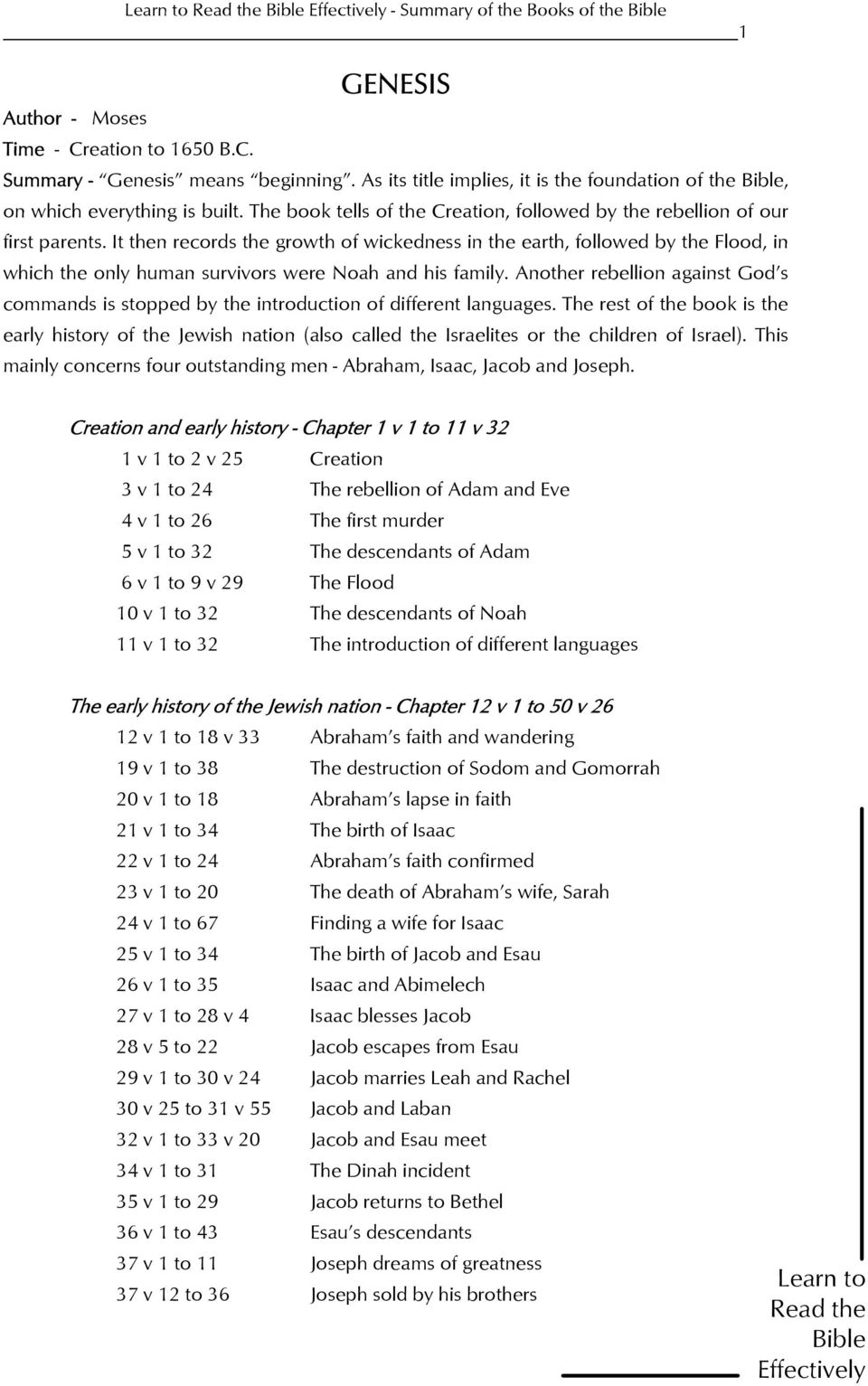
5 - Summary of the Books of the 1 GENESIS Author - Moses Time - Creation to 1650 B.C. Summary - Genesis means beginning. As its title implies, it is the foundation of the, on which everything is built. The book tells of the Creation, followed by the rebellion of our first parents. It then records the growth of wickedness in the earth, followed by the Flood, in which the only human survivors were Noah and his family. Another rebellion against God s commands is stopped by the introduction of different languages. The rest of the book is the early history of the Jewish nation (also called the Israelites or the children of Israel). This mainly concerns four outstanding men - Abraham, Isaac, Jacob and Joseph. Creation and early history - Chapter 1 v 1 to 11 v 32 1 v 1 to 2 v 25 Creation 3 v 1 to 24 The rebellion of Adam and Eve 4 v 1 to 26 The first murder 5 v 1 to 32 The descendants of Adam 6 v 1 to 9 v 29 The Flood 10 v 1 to 32 The descendants of Noah 11 v 1 to 32 The introduction of different languages The early history of the Jewish nation - Chapter 12 v 1 to 50 v v 1 to 18 v 33 Abraham s faith and wandering 19 v 1 to 38 The destruction of Sodom and Gomorrah 20 v 1 to 18 Abraham s lapse in faith 21 v 1 to 34 The birth of Isaac 22 v 1 to 24 Abraham s faith confirmed 23 v 1 to 20 The death of Abraham s wife, Sarah 24 v 1 to 67 Finding a wife for Isaac 25 v 1 to 34 The birth of Jacob and Esau 26 v 1 to 35 Isaac and Abimelech 27 v 1 to 28 v 4 Isaac blesses Jacob 28 v 5 to 22 Jacob escapes from Esau 29 v 1 to 30 v 24 Jacob marries Leah and Rachel 30 v 25 to 31 v 55 Jacob and Laban 32 v 1 to 33 v 20 Jacob and Esau meet 34 v 1 to 31 The Dinah incident 35 v 1 to 29 Jacob returns to Bethel 36 v 1 to 43 Esau s descendants 37 v 1 to 11 Joseph dreams of greatness 37 v 12 to 36 Joseph sold by his brothers
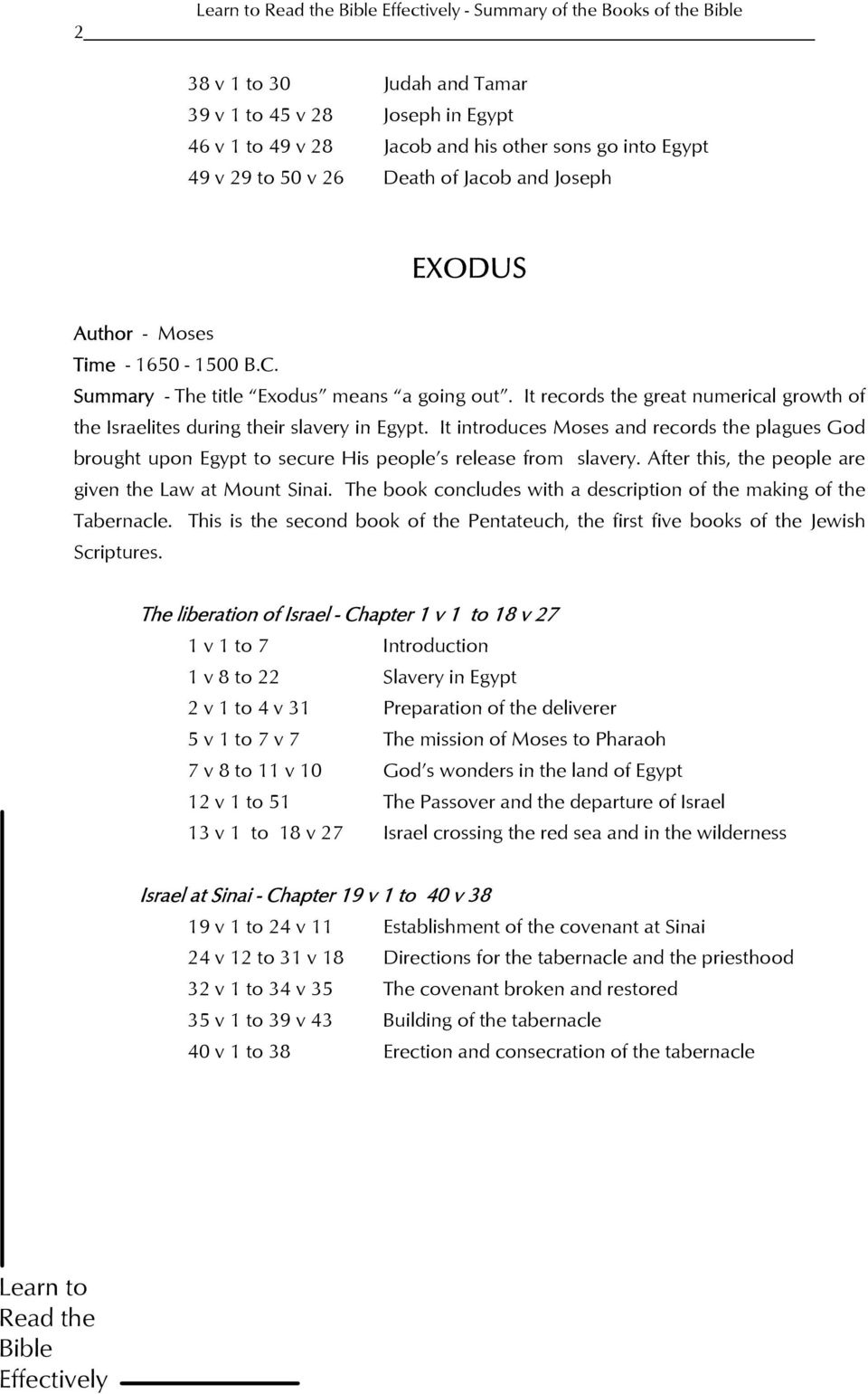
6 - Summary of the Books of the 2 38 v 1 to 30 Judah and Tamar 39 v 1 to 45 v 28 Joseph in Egypt 46 v 1 to 49 v 28 Jacob and his other sons go into Egypt 49 v 29 to 50 v 26 Death of Jacob and Joseph EXODUS Author - Moses Time B.C. Summary - The title Exodus means a going out. It records the great numerical growth of the Israelites during their slavery in Egypt. It introduces Moses and records the plagues God brought upon Egypt to secure His people s release from slavery. After this, the people are given the Law at Mount Sinai. The book concludes with a description of the making of the Tabernacle. This is the second book of the Pentateuch, the first five books of the Jewish Scriptures. The liberation of Israel - Chapter 1 v 1 to 18 v 27 1 v 1 to 7 Introduction 1 v 8 to 22 Slavery in Egypt 2 v 1 to 4 v 31 Preparation of the deliverer 5 v 1 to 7 v 7 The mission of Moses to Pharaoh 7 v 8 to 11 v 10 God s wonders in the land of Egypt 12 v 1 to 51 The Passover and the departure of Israel 13 v 1 to 18 v 27 Israel crossing the red sea and in the wilderness Israel at Sinai - Chapter 19 v 1 to 40 v v 1 to 24 v 11 Establishment of the covenant at Sinai 24 v 12 to 31 v 18 Directions for the tabernacle and the priesthood 32 v 1 to 34 v 35 The covenant broken and restored 35 v 1 to 39 v 43 Building of the tabernacle 40 v 1 to 38 Erection and consecration of the tabernacle
7 - Summary of the Books of the 3 LEVITICUS Author - Moses Time B.C. Summary - The third book of the Pentateuch takes its name from one of the twelve sons of Jacob, Levi, whose family was chosen by God to act as priests and assistants in the Tabernacle. The book covers the national and personal laws given by God to the Jewish people regarding worship and religious activities. It contains laws regarding cleanliness, morality, ethics and hygiene which guided the Jews on a day-to-day basis, and still does today. Animal sacrifice was introduced as a covering for the individual and national sins of the people. Sacrifice as the basis of acceptable worship - Chapter - 1 v 1 to 17 v 16 1 v 1 to 6 v 7 The offerings 6 v 8 to 10 v 20 The priesthood 11 v 1 to 16 v 34 The people 17 v 1 to 16 The altar Obedience as the basis of acceptable living - Chapter 18 v 1 to 27 v v 1 to 20 v 27 Regulations for the people 21 v 1 to 22 v 33 Regulations for the priests 23 v 1 to 24 v 23 Regulations for the nation 25 v 1 to 27 v 34 Regulations for the land NUMBERS Author - Moses Time B.C. Summary - Numbers is the fourth book of the Pentateuch. It is a historical book, whose name refers to the two censuses which were taken to number the people. However, it was known to the Jewish people as In the Wilderness, because it primarily tells of the rebellion of the Israelites in the desert where they wandered after the Exodus from their slavery in Egypt. Because of this rebellion, only two men of the men of fighting age leaving Egypt were to enter into the land of Canaan promised to Abraham in Genesis. The rest died in the desert. The book covers a thirty-eight-year period. Preparation in the wilderness - Chapter 1 v 1 to 10 v 10 1 v 1 to 54 Census of warriors 2 v 1 to 34 Arrangements of the camp 3 v 1 to 4 v 49 Arrangements of the Levites 5 v 1 to 31 The camp cleansed from defilement

8 - Summary of the Books of the 4 6 v 1 to 27 Separated to God 7 v 1 to 88 Dedication of the tabernacle 7 v 89 to 10 to 10 God with his people Provocation in the wilderness - Chapter 10 v 11 to 19 v v 11 to 36 Journeying at God s command 11 v 1 to 12 v 16 Murmuring and discontent 13 v 1 to 14 v 45 Lack of faith and rejection 15 v 1 to 41 Instructions for the next generation 16 v 1 to 19 v 22 Revolt against God s appointments Vindication in the wilderness - Chapter 20 v 1 to 36 v v 1 to 21 v 3 The fortieth year: From Kadesh to Hor 21 v 4 to 22 v 1 To Moab via Ezion-Geber 22 v 2 to 25 v 18 Balaam s curse turned into a blessing 26 v 1 to 36 v 13 Preparations to enter the Land DEUTERONOMY Author - Moses Time B.C. Summary - This book is the last of the Pentateuch. Its Greek name means second law, which was the repetition of the law recorded in Exodus, Leviticus and Numbers. It was given to the nation of Israel on the plains of Moab just prior to their entrance into the Promised Land of Canaan under the command of Joshua. This was Moses last address to the nation as a whole prior to his death at the end of their wanderings in the desert. At this time only two men were left of the generation which escaped from Egypt. Therefore, the repetition of the law was extremely important to the welfare of the new generation. First discourse : Israel s faithlessness and God s care - Chapter 1 v 1 to 4 v 43 1 v 1 to 46 Failure to go into the promised land 2 v 1 to 3 v 29 Thirty-eight years of wandering 4 v 1 to 40 Lessons of the past impressed upon the new generation 4 v 41 to 43 Appointment of cities of refuge

9 - Summary of the Books of the 5 Second Discourse : What the present generation should heed - Chapter 4 v 44 to 26 v 19 4 v 44 to 5 v 33 Review of the Divine covenant 6 v 1 to 26 v 19 What the covenant demands Third Discourse: The nation s solemn responsibility - Chapter 27 v 1 to 28 v v 1 to 26 A ceremony of remembrance in the Land 28 v 1 to 14 The blessings of the Law 28 v 15 to 68 The curses of the Law Fourth Discourse: Terms that would ensure Israel s continued occupancy of the Land - Chapter 29 v 1 to 30 v v 1 to 15 With whom the covenant was made 29 v 16 to 29 Punishment resulting from breaking the covenant 30 v 1 to 20 Divine mercy in spite of failure Fifth Discourse: Moses final words of advice - Chapter 31 v 1 to 23 Sixth Discourse: The written law preserved as a witness - Chapter 31 v 24 to 29 Seventh Discourse: A Psalm of witness against Israel - Chapter 31 v 30 to 32 v v 30 to 32 v 43 Repetition of Divine goodness and human folly 32 v 44 to 52 Sequel to the Song - compare Exodus 15 Eighth Discourse: Future glory of the tribes - Chapter 33 v 1 to v 1 to 5 Introduction 33v 6 to 25 The blessings 33 to 26 to 29 The source and summary of the bessings Ninth Section: The Death of Moses - Chapter 34 v 1 to 12

10 - Summary of the Books of the 6 JOSHUA Author - Joshua Time B.C. Summary - Joshua was selected by God to succeed Moses and lead the nation of Israel into the Promised Land of Canaan. The book outlines the conquest and occupation by Israel under his military leadership. God explicitly states that all the inhabitants of the land were to be utterly driven out or destroyed in order to ensure spiritual purity and complete devotion to God by the Israelites. Entrance into the Promised Land - Chapter 1 v 1 to 5 v 12 1 v 1 to 9 God s commission to Joshua 1 v 10 to 18 Joshua s mobilisation for crossing the Jordan 2 v 1 to 24 Mission of the spies 3 v 1 to 5 v 1 Crossing of the Jordan 5 v 2 to 12 Renewal of circumcision and Passover observance Conquest of the Promised Land - Chapter 5 v 13 to 12 v 24 5 v 13 to 6 v 5 Appearance of the captain of the Lord s host 6 v 6 to 8 v 29 The central campaign 8 v 30 to 35 Establishment of Israel s covenant as the law of the land 9 v 1 to 10 v 43 The southern campaign 11 v 1 to 15 The northern campaign 11 v 16 to 23 Summary of the conquest 12 v 1 to 24 Appendix: Catalogue of the defeated kings Division of the Promised Land - Chapter 13 v 1 to 22 v v 1 to 6 God s command to divide the land 13 v 7 to 33 Territory of the tribes east of the Jordan River 14 v 1 to 15 Beginning of the division of Canaan 15 v 1 to 63 Territory of the tribe of Judah 16 v 1 to 17 v 18 Territory of the Joseph tribes 18 v 1 to 19 v 51 Territories of the seven remaining tribes 20 v 1 to 21 v 42 Cities of refuge and inheritance of Levi 21 v 43 to 45 Summary of the conquest and apportionment 22 v 1 to 34 Appendix: Departure of the tribes east of the Jordan River Joshua s final speeches - Chapter 23 v 1 to 24 v v 1 to 16 Joshua s farewell address to the leaders of Israel 24 v 1 to 28 Renewal of the covenant commitment at Shechem 24 v 29 to 33 Appendix: Death of Joshua and subsequent conduct of Israel

11 - Summary of the Books of the 7 JUDGES Author - Unknown Time B.C. Summary - The book of Judges, which means Champions or Rescuers, covers the period from the death of Joshua to the birth of Samuel. This was a time of great immorality as the result of the failure of the Israelites to drive out the inhabitants of the land. There were judges set up by God who were to direct and judge the affairs and people of Israel. The book of Judges closes by setting the stage for the people s desire for a human king. Introduction - Chapter 1 v 1 to 2 v 5 1 v 1 to 36 Political background of the period of the Judges 2 v 1 to 5 Religious background of the period of the Judges History of the Judges - Chapter 2 v 6 to 16 v 31 2 v 6 to 3 v 6 Israel s failure to subdue the enemy nations 3 v 7 to 16 v 31 The oppressors and the deliverers of Israel Lawless condition during the period of the Judges - Chapter 17 v 1 to 21 v v 1 to 18 v 31 Appendix 1: Corruption of doctrine 19 v 1 to 21 v 25 Appendix 2: Corruption of practice RUTH Author - Unknown Time B.C. Summary - The book of Ruth is dated to the period of the Judges. It shows that in a time of national decline and immorality, God preserved a remnant who could serve as the core for a future revival. This would be accomplished in Ruth s descendant, David, from whom the Messiah would come. It is thought that the book was written after the period of the Judges and describes customs of that time period. 1 v 1 to 22 Ruth s noble choice 2 v 1 to 23 Ruth s faithful service 3 v 1 to 18 Ruth s virtuous appeal 4 v 1 to 22 Ruth s blessed reward

12 - Summary of the Books of the 8 1st & 2nd Books of SAMUEL Author - Samuel, Nathan and Gad Time - 1,150-1,000 B.C. Summary - 1 Samuel is the first of two historical books which describe Israel s transition from a loose confederation of tribes to a strong and united nation. It portrays the anointing of the first king of Israel, Saul, by a great prophet, Samuel. It recounts the degenerating reign of Saul and the succession to his throne of David, a man after God s own heart. In the original Hebrew text, the books of Samuel were considered one book by the Hebrew scribes. The second book begins with the ascension of David to the throne. The rest of the book records the eventful reign of David. It concludes with the blessing of Solomon by David. 1 SAMUEL The life of Samuel - Chapter 1 to1 to 7 v 17 1 v 1 to 4 v 1a The birth and childhood of Samuel 4 v 1b to 7 v 1 The capture and return of the tabernacle ark 7 v 2 to 17 The victory over the Philistines The life of Saul - Chapter 8 v 1 to 14 v 52 8 v 1 to 22 Israel s request for a king 9 v 1 to 12 v 25 Political life of Saul 13 v 1 to 14 v 52 War and independence The early life of David - Chapter 15 v 1 to 31 v v 1 to 35 Saul rejected by Samuel 16 v 1 to 13 David anointed to be king 16 v 14 to 19 v 17 David in the court of Saul 19 v 18 to 31 v 13 David in exile 2 SAMUEL The life of King David - Chapter 1 v 1 to Chapter 20 v 26 1 v 1 to 4 v 12 David, king at Hebron 5 v 1 to 8 v 18 David, king at Jerusalem 9 v 1 to 20 v 26 David s life as king

13 - Summary of the Books of the 9 The last days of David - Chapter 21 v 1 to 24 v v 1 to 14 The famine 21 v 15 to 22 Heroic exploits 22 v 1 to 51 David s psalm 23 v 1 to 7 David s testament 23 v 8 to 39 Heroic exploits 24 v 1 to 25 Census and plague 1st & 2nd Books of KINGS Author - Uncertain Time B.C. Summary - In the original Jewish texts, these books were regarded as one book. The two books contain the history of the Jewish monarchy from the death of David (around 970 B.C.) to the Babylonian exile (586 B.C.). They trace the division of the Jewish nation into the Kingdom of Judah in the south and the Kingdom of Israel in the north. 1 & 2 Kings record Israel s history from a religious, rather than a civil, viewpoint. As such, they record the religious progress of the nation and show the various steps in the moral growth and decay of the kingdom. 1 Kings opens with Israel in its glory, and 2 Kings closes with Israel in ruins. The purpose of the Book of Kings is to record the lives and characters of the nation s leaders as a warning and exhortation to all subsequent generations of believers. 1 KINGS The united kingdom from Solomon to Rehoboam - Chapter 1 v 1 to 11 v 43 1 v 1 to 2 v 46 Solomon s ascension to the throne 3 v 1 to 4 v 34 The wisdom and wealth of Solomon 5 v 1 to 9 v 28 Solomon s building activity 10 v 1 to 29 The golden age of Solomon 11 v 1 to 43 Solomon s false religion, decline and death The divided kingdom (Part 1) - Chapter 12 v 1 to 22 v v 1 to 16 v 28 Early antagonism between Israel and Judah, from Jeroboam to Omri. 16 v 29 to 22 v 53 From Ahab to the accession of Ahaziah

14 - Summary of the Books of the 10 2 KINGS The divided kingdom (Part 2) - Chapter 1 v 1 to 17 v 41 1 v 1 to 9 v 10 From Ahaziah to the accession of Jehu 9 v 11 to 17 v 41 From Jehu to the destruction of Israel The Kingdom of Judah to the final destruction of the southern kingdom - Chapter 18 v 1 to 25 v v 1 to 20 v 21 The kingdom under Hezekiah 21 v 1 to 26 The reigns of Manasseh and Amon 22 v 1 to 23 v 30 Reform in Judah and Israel under Josiah 23 v 31 to 25 v 26 The last days of Judah 25 v 27 to 30 Epilogue : The release of Jehoiachin 1st & 2nd Books of CHRONICLES Author - Ezra Time - 1, B.C. Summary - Like the Books of Kings, 1 & 2 Chronicles were originally one book, according to Jewish tradition. However, the Chronicles are not simply a repeat of the history already recorded in the books of Samuel and Kings. The book of Chronicles was written to remind the nation of their entire history, and of their position among other nations, emphasising the history of priestly worship from the death of Saul to the end of the Babylonian captivity. The Chronicles contain more detail on the organisation of public worship, of religious ceremonies, of Levites and singers, and of the relationship of kings to the worship of God, than does the book of Kings. The history of the northern kingdom is omitted from the Chronicles because the northern kingdom had no bearing on the development of the true worship of God in Jerusalem. 1 CHRONICLES Genealogies - Chapter 1 v 1 to 9 v 44 1 v 1 to 54 Patriarchs 2 v 1 to 4 v 23 Judah 4 v 24 to 43 Simeon 5 v 1 to 26 Tribes east of the Jordan River 6 v 1 to 81 Levi 7 v 1 to 40 8 v 1 to 40 Six other tribes Descendants of Benjamin 9 v 1 to 34 9 v 35 to 44 Jerusalem s Inhabitants after the exile Descendants of the father of Gibeon.

15 - Summary of the Books of the 11 The reign of David - Chapter 10 v 1 to 29 v v 1 to 14 Background: the death of Saul 11 v 1 to 20 v 8 David s rise 21 v 1 to 29 v 30 David s latter days 2 CHRONICLES The reign of Solomon - Chapter 1 v 1 to 9 v 31 1 v 1 to 17 Solomon s inauguration 2 v 1 to 7 v 22 Solomon s temple 8 v 1 to 9 v 31 Solomon s kingdom The Kingdom of Judah - Chapter 10 v 1 to 36 v v 1 to 11 v 23 The division of the kingdom 12 v 1 to 36 v 16 The rulers of Judah 12 v 1 to 16 Rehoboam 13 v 1 to 22 Abijah 14 v 1 to 16 v 14 Asa 17 v 1 to 20 v 37 Jehoshaphat 21 v 1 to 20 Jehoram 22 v 1 to 9 Ahaziah 22 v 10 to 23 v 21 Athaliah 24 v 1 to 27 Joash 25 v 1 to 28 Amaziah 26 v 1 to 23 Uzziah 27 v 1 to 9 Jotham 28 v 1 to 27 Ahaz 29 v 1 to 32 v 33 Hezekiah 33 v 1 to 20 Manasseh 33 v 21 to 25 Amon 34 v 1 to 35 v 27 Josiah 36 v 1 to 16 Jehoahaz, Jehoiakim, Jehoiachin, and Zedekiah 36 v 17 to 23 The exile

16 - Summary of the Books of the 12 EZRA Author - Ezra Time B.C. Summary - In general, Ezra covers the events of the Jews returning from the Babylonian captivity. The decline of Babylon and its eventual overthrow by the Persians enable the Jews to return to Jerusalem. The Jews are numbered and are allowed to return to Judah to rebuild the Temple. Samaritan assistance is rejected and their opposition is a contributing factor to the slow progress of the Temple construction. Despite the delays, the Temple is completed and dedicated to God during this period. The exiles return from Babylon - Chapter 1 v 1 to 2 v 70 1 v 1 to 4 The Decree of Cyrus 1 v 5 to 11 Preparations for the journey 2 v 1 to 70 Those who returned Temple building begins - Chapter 3 v 1 to 4 v 24 3 v 1 to 13 The altar and the foundation 4 v 1 to 24 Opposition to the work The building completed - Chapter 5 v 1 to 6 to 22 5 v 1 to 5 Work resumed 5 v 6 to 17 Tattenai s letter to Darius 6 v 1 to 12 Decrees of Cyrus and Darius 6 v 13 to 22 The Temple finished Ezra s journey to Jerusalem - Chapter 7 v 1 to 8 v 36 7 v 1 to 10 Ezra introduced 7 v 11 to 28 Letter of Artaxerxes to Ezra 8 v 1 to 36 The journey to Jerusalem The great reformation - Chapter 9 v 1 to 10 v 44 9 v 1 to 15 The tragic report and Ezra s prayer 10 v 1 to 17 The abandonment of mixed marriages 10 v 18 to 44 List of those with foreign wives

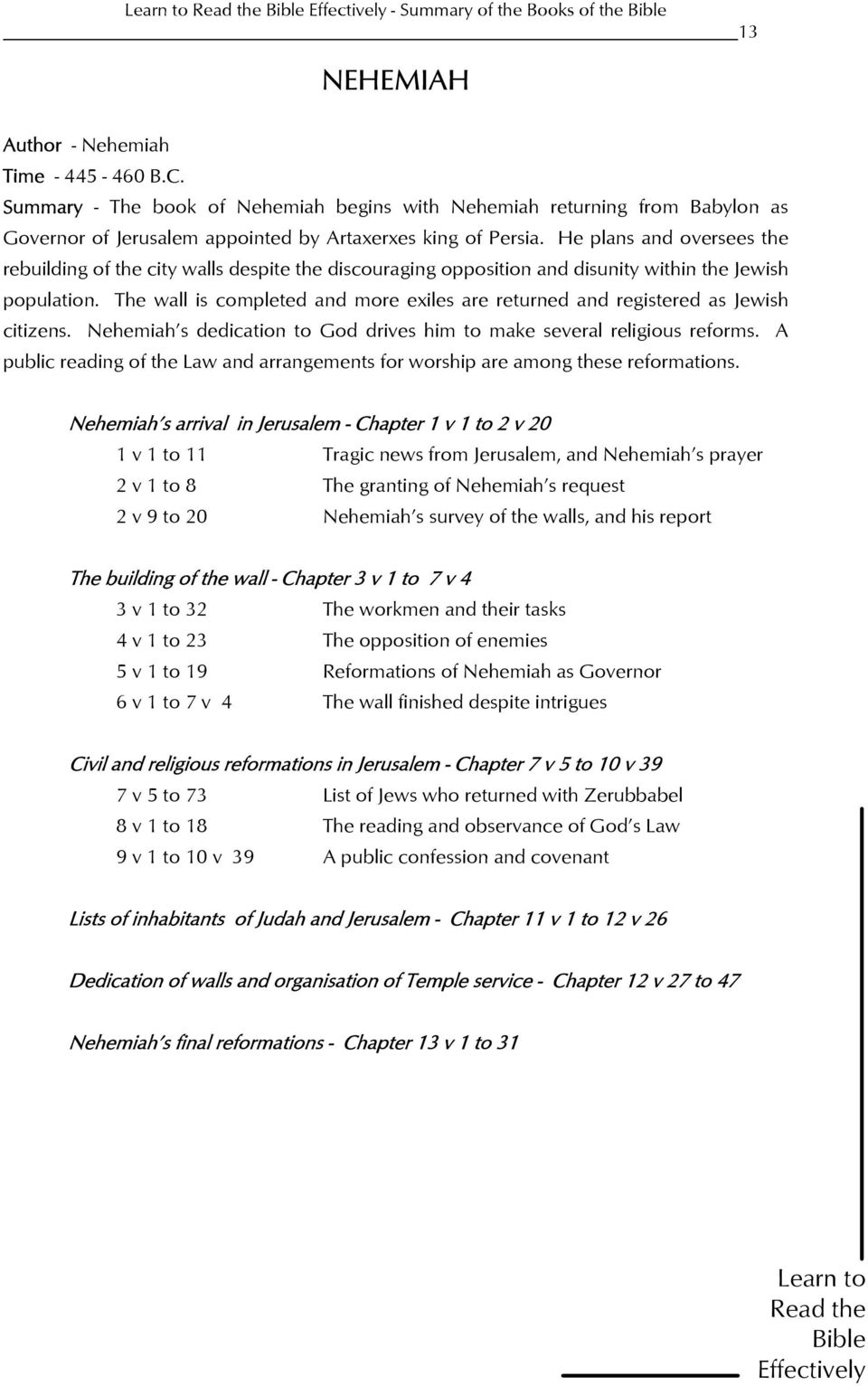
17 - Summary of the Books of the 13 NEHEMIAH Author - Nehemiah Time B.C. Summary - The book of Nehemiah begins with Nehemiah returning from Babylon as Governor of Jerusalem appointed by Artaxerxes king of Persia. He plans and oversees the rebuilding of the city walls despite the discouraging opposition and disunity within the Jewish population. The wall is completed and more exiles are returned and registered as Jewish citizens. Nehemiah s dedication to God drives him to make several religious reforms. A public reading of the Law and arrangements for worship are among these reformations. Nehemiah s arrival in Jerusalem - Chapter 1 v 1 to 2 v 20 1 v 1 to 11 Tragic news from Jerusalem, and Nehemiah s prayer 2 v 1 to 8 The granting of Nehemiah s request 2 v 9 to 20 Nehemiah s survey of the walls, and his report The building of the wall - Chapter 3 v 1 to 7 v 4 3 v 1 to 32 The workmen and their tasks 4 v 1 to 23 The opposition of enemies 5 v 1 to 19 Reformations of Nehemiah as Governor 6 v 1 to 7 v 4 The wall finished despite intrigues Civil and religious reformations in Jerusalem - Chapter 7 v 5 to 10 v 39 7 v 5 to 73 List of Jews who returned with Zerubbabel 8 v 1 to 18 The reading and observance of God s Law 9 v 1 to 10 v 39 A public confession and covenant Lists of inhabitants of Judah and Jerusalem - Chapter 11 v 1 to 12 v 26 Dedication of walls and organisation of Temple service - Chapter 12 v 27 to 47 Nehemiah s final reformations - Chapter 13 v 1 to 31
18 - Summary of the Books of the 14 ESTHER Author - Not known for certain Time B.C. Summary - Esther is an historical book, written during the period of the captivity. It records the plot of Haman, the prime minister to the Persian king, to exterminate the Jewish race. This plot is foiled by Esther, the queen of Persia, who was a Jewess. This book gives us the origin of the Feast of Purim, which celebrates God s goodness in delivering the Jews from Haman. Vashti divorced - Chapter 1 v 1 to 22 Esther made queen - Chapter 2 v 1 to 23 Haman s plot against the Jews - Chapter 3 v 1 to 15 Esther s decision - Chapter 4 v 1 to 17 Esther s first banquet - Chapter 5 v 1 to 14 Haman humiliated before Mordecai - Chapter 6 v 1 to 14 Esther s second banquet - Chapter 7 v 1 to 10 Mordecai s counter-decree - Chapter 8 v 1 to 17 The Jews victorious, and Purim instituted - Chapter 9 v 1 to 10 v 3 JOB Author - Unknown Time - apparently around 1600 B.C. Summary - Job is the first poetic book of the Old Testament. The book reads like a play. It relates the anguish of the righteous man Job as he and his friends struggle to explain the affliction which has befallen him and has stripped him of his wealth, his family, and his health. The dialogue continues between Job and his friends as each presents his opinion on the reasons behind such troubles. God eventually intervenes and Job is restored to health and prosperity after he submits to God s supremecy. Affliction of Job - C hapter 1 v 1 to 2 v 13 1 v 1 to 5 Description of Job 1 v 6 to 2 v 10 Affliction of Job 2 v 11 to 13 Arrival of Job s three friends Debates between Job and his three friends - Chapter 3 v 1 to 31 v 40 3 v 1 to 14 v 22 First Cycle of Debate 15 v 1 to 21 v 34 Second Cycle of Debate 22 v 1 to 31 v 40 Third Cycle of Debate

19 - Summary of the Books of the 15 The Speeches of Elihu - Chapter 32 v 1 to 37 v 24 Restoration of Job - Chapter 38 v 1 to 42 v v 1 to 40 v 5 God s first challenge to Job 40 v 6 to 41 v 34 God s second challenge to Job 42 v 1 to 17 Job s submission and restoration PSALMS Author - David and others Time B.C. Summary - The Psalms are divided into five sections, each according to a specific classification. The Psalms are a form of Hebrew poetry, many of which were accompanied by music. The content of the Psalms includes prophecy of Christ, praise to God, and visions of the future Kingdom of God and its glory. David is named as author of approximately half of the Psalms. A handful of other men are responsible for about fifteen, while the remainder are unnamed. Section 1 Concerns man - Gives the advice of God to man Psalms 1-41 Section 2 Concerns Israel - The advice of God to Israel Psalms Section 3 Concerns the sanctuary and the Law Psalms Section 4 Concerns Israel and the nations of the earth Psalms Section 5 Concerns God and His Word Psalms

20 - Summary of the Books of the 16 PROVERBS Author - Solomon and others Time - 1, B.C. Summary - In the book of Proverbs, wisdom is the attitude which puts God first as man s rightful guide and master. The book does not hesitate to link good and bad with reward and penalty. Much can be learned by testing personal conduct against the positive and negative standards and warnings as recorded in the Proverbs. Throughout the book, the view is presented that all men fall into two basic classes. Both are known by their habits, their deeds, their fruits, their chosen ways in life, and their fitting ends. They are either with God or without Him, good or evil, or wise or foolish. There is even a mutual tension between the two classes, the two ways of life, which shows up in every aspect of life. Superiority of the way of wisdom - Chapter 1 v 1 to 9 v 18 1 v 1 to 7 Introduction 1 v 8 to 9 v 18 The righteous woman, Wisdom, versus the evil woman Main collection of Solomon s Proverbs - Chapter 10 v 1 to 22 v v 1 to 15 v 33 Contrasting Proverbs 16 v 1 to 22 v 16 Proverbs largely parallel The Words of the Wise, Thirty Sayings - Chapter 22 v 17 to 24 v 22 The Words of the Wise, Appendix - Chapter 24 v 23 to 34 Proverbs of Solomon compiled by Hezekiah s Men - Chapter 25 v 1 to 29 v 27 Appendices - Chapter 30 v 1 to 31 v v 1 to 33 The words of Agur 31 v 1 to 9 The words of Lemuel 31 v 10 to 31 Alphabetical poem about the Virtuous Woman

21 - Summary of the Books of the 17 ECCLESIASTES Author - Solomon Time B.C. Summary - The name Ecclesiastes comes from the root meaning to assemble together. As such, the book forms a collection of many wise sayings and proverbs of Solomon. The book is mainly composed of observations of life. Solomon, having lived a full life with all its pleasures, concludes that life is vanity. Vanity in Ecclesiastes, and elsewhere in Scripture, does not mean foolish pride, but the emptiness of life apart from God. It means that which soon vanishes away. What better man to speak about life than a man who was given all it had to offer. Without God, life would be meaningless, and all his worldly possessions would amount to nothing. Therefore, the conclusion of his studies states that man should love and fear God and obey His commandments. 1 v 1 to 11 The futility of all human endeavours 1 v 12 to 2 v 26 The test of practical experience 3 v 1 to 22 Men s opportunity limited by time 4 v 1 to 16 Human folly greatly increased by oppression 5 v 1 to 8 Folly of insincere worship 5 v 9 to 6 v 2 Vanity of riches 6 v 3 to 11 v 6 Vanity of human desires 11 v 7 to 12 v 8 Advice and warning to youth 12 v 9 to 14 Conclusion SONG OF SOLOMON Author - Solomon Time - About 960 B.C. Summary - Its consists of speeches in Hebrew poetry. It depicts the beauty and pure love between a man and a woman which develops into a mature undying relationship. Some believe that it shows the relationship between Christ and his bride, the body of believers, which will be consummated at his return. The basic message is the purity and sacredness of love. There are various interpretations, we will give just one.
22 - Summary of the Books of the 18 1 v 1 to 8 Song 1: The ardent love and becoming humility of the bride 1 v 9 to 2 v 7 Song 2: Love s communion and self-sacrificing devotion 2 v 8 to 17 Song 3: Signs of the bridegroom s coming 3 v 1 to 5 Song 4: His sudden appearance 3 v 6 to 4 v 7 Song 5: The splendour of marriage 4 v 8 to 5 v 1 Song 6: Entering the inheritance 5 v 2 to 6 v 10 Song 7: The first advent call and espousal of the bride 6 v 11 to 13 Song 8: Anticipating his coming 7 v 1 to 9 Song 9: The flowing beauty of the bride 7 v 10 to 8 v 4 Song 10: The bride s deep longing and ardent desire for the groom s return 8 v 5 to 7 Song 11: The joy and communion of true marriage 8 v 8 to 14 Song 12: Love s labour in the future ISAIAH Author - Isaiah Time B.C. Summary - Isaiah ministered during the rule of Uzziah, Jotham, Ahaz and Hezekiah. His primary focus was the coming judgement on the southern kingdom of Judah due to its great wickedness. Isaiah identified the root of Judah s trouble as its idolatry and apostasy. Although he spoke of judgements on other nations as well, he urged the kings and the people to put their trust in God rather than in alliances with earthly powers. He comforted his people with the realisation that God loves those who are faithful to Him and keep His commandments. He spoke of the future Messiah who would come to redeem the nation and restore the Kingdom. Rebuke and promise - Chapter 1 v 1 to 6 v 13 1 v 1 to 31 Rebellion confronted with judgement and grace 2 v 1 to 4 v 6 Punishment for sin as preparation for glory 5 v 1 to 30 Judgement and exile in store for Israel 6 v 1 to 13 The Prophet cleansed and commissioned by God Impending invasion and future hope - Chapter 7 v 1 to 12 v 6 7 v 1 to 16 Deliverer promised 7 v 17 to 8 v 22 Assyrian invasion foretold
23 - Summary of the Books of the 19 9 v 1 to 7 Messiah, Israel s only hope 9 v 8 to 10 v 4 Chastisement rejected - God s outstretched hand 10 v 5 to 34 God s judgement on Assyria 11 v 1 to 12 v 6 David s kingdom restored Judgement upon the nations - Chapter 13 v 1 to 23 v v 1 to 14 v 27 Fall of Babylon 14 v 28 to 32 Downfall of Philistia 15 v 1 to 16 v 14 Downfall of Moab 17 v 1 to 14 Downfall of Damascus and Samaria 18 v 1 to 7 The regathering of Israel 19 v 1 to 20 v 6 Afflictions of Egypt 21 v 1 to 10 Babylon to be conquered and her Idols destroyed 21 v 11 to 12 Defeat of Edom; victory for Israel 21 v 13 to 17 Dedan and Kedar to be routed 22 v 1 to 25 Fall of Jerusalem foreseen; Eliakim to replace Shebna 23 v 1 to 18 Downfall and enslavement of Tyre General rebuke and promise, 1 - Chapter 24 v 1 to 27 v 3 24 v 1 to 23 Universal judgement upon universal sin 25 v 1 to 12 God praised as deliverer and comforter of Zion 26 v 1 to 21 Song of joy over Judah s conversion 27 v 1 to 13 Oppressors to be punished but God s people preserved Woes on the unbelievers of Israel - Chapter 28 v 1 to 33 v v 1 to 29 Judgement of Ephraimite drunkards and Jewish scoffers 29 v 1 to 24 Disaster ahead for hypocrites 30 v 1 to 33 Confidence in Egypt versus confidence in God 31 v 1 to 9 God, not Egypt, to be Jerusalem s defence 32 v 1 to 20 Israel s final deliverance, and her spiritual renewal 33 v 1 to 24 Punishment of the treacherous, and triumph of Christ General rebuke and promise, 2 - Chapter 34 v 1 to 35 v v 1 to 17 Utter destruction of Gentile world powers 35 v 1 to 10 Promise of Salvation
24 - Summary of the Books of the 20 The volume of Hezekiah - Chapter 36 v 1 to 39 v 8 36 v 1 to 37 v 38 Destruction of Judah averted 38 v 1 to 39 v 8 Destruction of Judah s king averted The volume of comfort - Chapter 40 v 1 to 66 v v 1 to 48 v 22 The purpose of peace 49 v 1 to 57 v 21 The Prince of Peace 58 v 1 to 66 v 24 The programme of peace JEREMIAH Author - Jeremiah and Baruch Time B.C. Summary - Jeremiah warns of the impending military force of Babylon that would destroy Jerusalem and enslave the Jews. He urges Jerusalem to turn from its wicked ways, but there is no response. He further warns of the false prophets who are leading the people astray with deceptive doctrines and falsehoods. He urges the Israelites to submit to the Babylonian authority as the instrument of God s judgement. They do not heed his warnings and the people are carried away to Babylon. He predicts that the captives will return after seventy years to rebuild Jerusalem and the Temple. Introduction and the prophet s call - Chapter 1 v 1 to 19 Prophecies against Jerusalem and Judah - Chapter 2 v 1 to 45 v 5 2 v 1 to 20 v 18 In the reign of Josiah and Jehoiakim 21 v 1 to 39 v 18 Various periods until Jerusalem s destruction 40 v 1 to 45 v 5 After the fall of Jerusalem Prophecies against the nations - Chapter 46 v 1 to 51 v v 1 to 28 Against Egypt 47 v 1 to 7 Against Philistia 48 v 1 to 47 Against Moab 49 v 1 to 6 Against Ammon 49 v 7 to 22 Against Edom 49 v 23 to 27 Against Damascus 49 v 28 to 33 Against Arabia 49 v 34 to 39 Against Elam 50 v 1 to 51 v 64 Against Babylon
25 - Summary of the Books of the 21 Historical appendix - Chapter 52 v 1 to v 1 to 30 Judah s fall and captivity 52 v 31 to 34 Jehoiachin s liberation LAMENTATIONS Author - Jeremiah Time B.C. Summary - Lamentation means to express suffering. In this book, Jeremiah, who had witnessed the fall of Jerusalem and had himself been taken captive, but later released, expresses his sorrow regarding the fall of Jerusalem and the captivity of the nation at the hands of Nebuchadnezzar s army. The book describes and explains the afflictions brought against the city of Jerusalem as well as surrounding nations who scoff at Jerusalem s troubles. It emphasises that this is the result of divine judgement for the sins of the people. It also underlines the lessons that Jerusalem should learn from its troubles. The book also reflects the love and sorrow of God for the very people He is chastening. The suffering, ruined city of Zion - Chapter 1 v 1 to 22 1 v 1 to 11 Wretched condition of devastated Jerusalem 1 v 12 to 22 Lament of the Daughter of Jerusalem The suffering, ruined holy place of Zion - Chapter 2 v 1 to 22 2 v 1 to 10 God s judgements on the ramparts and on His sanctuary 2 v 11 to 19 Lament of the eyewitness of this judgement 2 v 20 to 22 Terrors of this day of God s anger The suffering representative of smitten Zion - Chapter 3 v 1 to 66 3 v 1 to 18 The sorrows God sent His servant 3 v 19 to 42 The servant s prayer of reassurance 3 v 43 to 66 The servant s prayer for vindication The suffering people of Zion - Chapter 4 v 1 to 22 4 v 1 to 11 Horrors of the siege, and the fate of Zion s nobility 4 v 12 to 20 Causes and climax of Zion s catastrophe 4 v 21 to 22 A prophecy against haughty and gloating Edom Supplications of penitent Zion - Chapter 5 v 1 to 22 5 v 1 to 18 Zion s plea to God to regard her affliction and disgrace 5 v 19 to 22 A final address to God
26 - Summary of the Books of the 22 EZEKIEL Author - Ezekiel Time B.C. Summary - Ezekiel was taken captive by Nebuchadnezzar and taken to Babylon. This book records his activities during his exile in Babylon. His message was directed to his fellow countrymen who were still in Palestine, and later to his fellow captives in Babylon. He gave the good news to his fellow exiles that the nation, after being chastened, would be restored to their own land and God s Kingdom would rise. This yet future Kingdom will last forever, and God s people will never again be cast out. Prophecies against Judah and Jerusalem - Chapter 1 v 1 to 24 v 27 1 v 1 to 3 v 27 Introduction : The call of Ezekiel 4 v 1 to 7 v 27 Overthrow of city and state predicted 8 v 1 to 11 v 25 The sin and fate of Jerusalem 12 v 1 to 19 v 14 Moral necessity of the captivity 20 v 1 to 24 v 27 Israel s coming downfall inevitable and necessary Prophecies against foreign nations: - Chapter 25 v 1 to 32 v v 1 to 7 Ammon 25 v 8 to 11 Moab 25 v 12 to 14 Edom 25 v 15 to 17 Philistines 26 v 1 to 28 v 19 Tyre 28 v 20 to 26 Sidon 29 v 1 to 32 v 32 Egypt Prophecies of the restitution of Israel - Chapter 33 v 1 to 39 v v 1 to 33 The prophet: His function in preparation for the new age 34 v 1 to 31 The corrupt priesthood 35 v 1 to 36 v 38 The land: Israel to be restored and made fruitful 37 v 1 to 28 The People: resurrection of the dry bones of Israel; Reunion of Judah and Israel 38 v 1 to 39 to29 Peace: The Lord to defend Israel against Gog s invasion
27 - Summary of the Books of the 23 Vision of the new Temple and the new Law - Chapter 40 v 1 to 48 v v 1 to 43 v 27 Description of the new Temple 44 v 1 to 46 v 24 A new service of worship with an ideal ministry and sacrificial system 47 v 1 to 48 v 35 Israel reorganised according to tribal divisions DANIEL Author - Daniel Time B.C. Summary - Daniel was of the royal line of Jewish kings, and, like Ezekiel, had been taken as a young man captive to Babylon by Nebuchadnezzar. This is why he is found in the king s palace. The book of Daniel predicts the destiny of two opposing powers: The Kingdom of Men and The Kingdom of God, stressing that The Most High rules in the kingdom of men. Daniel s prophecies generally do not deal with Israel as much as with the nations that control Israel. The book of Daniel contains prophecies that span the time from Daniel s day until the coming Kingdom Age. The universal sovereignty of God - As revealed through personal experience - Chapter 1 v 1 to 6 v 28 1 v 1 to 21 Introduction - experiences of Daniel 2 v 1 to 49 Nebuchadnezzar s dream and interpretation 3 v 1 to 30 Nebuchadnezzar s pride - experience of Daniel s three friends 4 v 1 to 37 Nebuchadnezzar s second dream and interpretation - his pride shaken 5 v 1 to 31 Pride of Belshazzar and his downfall 6 v 1 to 28 Daniel s experience in the den of lions The universal sovereignty of God - Prophetic revelation - Chapter 7 v 1 to 12 v 13 7 v 1 to 28 Vision of the four beasts 8 v 1 to 27 Vision of the ram and he goat 9 v 1 to 19 Daniel s prayer and confession 9 v 20 to 27 Prophecy of the coming Messiah 10 v 1 to 21 Daniel s vision of the glory of God 11 v 1 to 45 Daniel shown in vision events leading up to the return of Christ 12 v 1 to 13 The vision continues with the resurrection and the Kingdom of God
28 - Summary of the Books of the 24 HOSEA Author - Hosea Time B.C. Summary - The book of Hosea describes the patient long-suffering of God towards the rebellious and unfaithful northern kingdom of Israel. However, it is made clear to the Israelites that punishment will engulf anyone who remains wilfully rebellious. A key theme is Hosea s marriage to the unfaithful Gomer, which is symbolic of the relationship between God and Israel. The prophet s married life - Chapter 1 v 1 to 3 v 5 1 v 2 to 9 His marriage to Gomer 1 v 10 to 11 A message of hope 2 v 1 to 13 Judgement on faithless Israel 2 v 14 to 23 The restoration of faithless Israel 3 v 1 to 5 Hosea s redemption of his faithless wife Israel s unfaithfulness and consequent judgement - Chapter 4 v 1 to 13 v 16 4 v 1 to 3 The guilt of the people 4 v 4 to 8 The guilt of the priests 4 v 9 to 10 Punishment for all 4 v 11 to 19 Immoral cult practices 5 v 1 to 7 Judgement on kings and priests for leading the people astray 5 v 8 to 15 Disastrous foreign policies of Ephraim and Judah 6 v 1 to 6 Israel s plea and God s rejoinder 6 v 7 to 7 v 7 The crimes of Israel 7 v 8 to 8 v 3 Israel s disastrous foreign policy 8 v 4 to 14 Israel s idolatry and wicked alliances 9 v 1 to 9 The exile of Israel foretold 9 v 10 to 14 Israel s ancient apostasy at Baal - peor 9 v 15 to 17 Israel s apostasy at Gilgal 10 v 1 to 8 Destruction of the Baal cult prophesied 10 v 9 to 10 The sin at Gibeah 10 v 11 to 15 The ruin of Israel 11 v 1 to 7 God s love; Israel s ingratitude 11 v 8 to 11 God s pity for his people 11 v 12 to 12 v 14 The sins of Jacob 13 v 1 to 3 The wicked bull-worship 13 v 4 to 11 The gracious God to bring destruction 13 v 12 to 16 Inescapable ruin
29 - Summary of the Books of the 25 Israel s conversion and renewal - Chapter 14 v 1 to 9 14 v 1 to 3 The call to repentance 14 v 4 to 8 The promise of pardon 14 v 9 A parting admonition JOEL Author - Joel Time B.C. Summary - The book of Joel begins by describing a devastating swarm of locusts which cause national disaster to the agriculture of Israel. Joel calls the nation of Judah to a day of repentance due to the Divine judgement. The last portion of the book is concerned with events associated with the Day of the Lord. The message is that if Judah repents, God will richly bless them and forgive them. The locust plague is the harbinger of the Day of the Lord - Chapter 1 v 2 to 2 v 17 1 v 2 to 20 A threefold calamity - locusts, drought, and fires 2 v 1 to 17 The scourge as the forerunner of the Judgement day The averting of judgement and bestowal of blessings - Chapter 2 v 18 to 3 v 21 2 v 18 to 27 The blessings in the immediate future 2 v 28 to 32 The outpouring of the divine spirit 3 v 1 to 16 Judgement upon the nations 3 v 17 to 21 The blessings on God s people AMOS Author - Amos Time to 750 B.C. Summary - The book of Amos was written during a period of national optimism in the northern kingdom of Israel. King Jeroboam II was ruler, and politically and materially the northern kingdom rivalled the age of Solomon and David. Amos, a shepherd by trade, was called by God to pronounce judgement by denouncing Israel s luxurious living, idolatry, and moral depravity. Amos urges the people to repent before the judgements of God come upon them. Seek God and live, was Amos plea to the nation. He also foretells the dispersion of the Israelites, but points to a day when God would regather them in the land of their forefathers.
30 - Summary of the Books of the 26 Judgements against the nations - Chapter 1 v 1 to 2 v 16 1 v 1 to 2 Superscription and proclamation 1 v 3 to 2 v 3 Indictment of neighbouring nations 2 v 4 to 5 Indictment of Judah 2 v 6 to 16 Indictment of Israel Three discourses against Israel - Chapter 3 v 1 to 6 v 14 3 v 1 to15 A declaration of judgement 4 v 1 to 13 The depravity of Israel 5 v 1 to 6 v 14 A lamentation for Israel s sin and doom Five visions of Israel s condition - Chapter 7 v 1 to 9 v 10 7 v 1 to 3 The devouring locusts 7 v 4 to 6 The flaming fire 7 v 7 to 17 The plumb line 8 v 1 to 14 The basket of ripe fruit 9 v 1 to 10 The Judgement of the Lord The promise of Israel s restoration - Chapter 9 v 11 to 15 OBADIAH Author - Obadiah Time to 565 B.C. Summary - Obadiah s name means servant of Yahweh ( Yahweh is the Hebrew name of God). Obadiah was a prophet who pronounced judgement upon the nation of Edom for its antagonism against Israel. Edom is the nation that descended from Esau, the twin brother of Jacob, who had his name changed to Israel. Edom was to be punished for the violence against Israel they committed when invading the land. Title and introductions - Verse 1 Judgement on Edom - Verse 2 to 14 The Day of the Lord - Verse 15 to 21
31 - Summary of the Books of the 27 JONAH Author - Jonah Time to 760 B.C. Summary - The book is concerned with the commission of Jonah to warn the city of Nineveh (capital of Assyria) to repent and obey God s commandments so that they might avoid destruction. Jonah is reluctant to preach this message and is therefore swallowed by a great fish. He remains in the belly of the fish for three days. Upon his release, he preaches the message to the people of Nineveh, who believe his message, repent of their sins and are spared by God. Jonah s flight - Chapter 1 v 1 to 17 Jonah s prayer - Chapter 2 v 1 to 10 Jonah s preaching - Chapter 3 v 1 to 10 Jonah s displeasure - Chapter 4 v 1 to 11 MICAH Author - Micah Time to 700 B.C. Summary - Micah, who was contemporary with Isaiah, was to the southern kingdom of Judah what Amos was previously to the northern kingdom of Israel. Both were fierce critics of the rich and powerful who exploited the poor. Though Micah s prophecies refer especially to Judah, they concern all of Israel. Micah s leading ideas are the regeneration of Israel s remnant through judgement, the establishment of the Kingdom of God in the line of David, and the conversion of the nations through that Kingdom. The conclusion of his prophecy is a triumphant expression of faith, which is seen in its true quality against the background of the materialism and the corruption of the reign of Ahaz. Superscription to the prophecy - Chapter 1 v 1 to 16 Approaching judgement of Israel and Judah because of persistent sin - Chapter 1 v 2 1 v 2 The call to attention 1 v 3 to 4 Terrible coming of God announced and described 1 v 5 Sins of the capital city representative of those of the nation 1 v 6 to 7 Fearful consequences of this judgement
32 - Summary of the Books of the 28 1 v 8 to 16 The prophet s reaction and his vision of this judgement Doom of corrupt oppressors and false prophets - Chapter 2 v 1 to 3 v 12 2 v 1 to 5 Woe upon the land monopolisers 2 v 6 to 13 False preaching of lying prophets 3 v 1 to 7 Denunciation of the leaders of the people 3 v 8 Micah s consciousness of power from the spirit of God 3 v 9 to 12 Gross sin and crime to bring destruction upon Jerusalem Vision of hope from the coming one - Chapter 4 v 1 to 5 v 15 4 v 1 to 5 v 1 Final triumph of Jerusalem 5 v 2 to 15 Coming mighty leader to be born in Bethlehem and to restore Israel. The Lord s case against Israel - Chapter 6 v 1 to 7 v 20 6 v 1 to 5 First complaint of God 6 v 6 to 8 Israel s first reply 6 v 9 to 16 Second complaint of God 7 v 1 to 10 Israel s second reply - a confession of sin 7 v 11 to 13 Israel s promised blessing - follow judgement 7 v 14 to 17 Final plea for Israel to be gathered from many nations 7 v 18 to 20 Doxology: The triumph of grace NAHUM Author - Nahum Time B.C. Summary - The book of Nahum was written approximately 140 years after the recorded events in the book of Jonah. During that period of time, Nineveh had turned from its repentant attitude and had taken the northern kingdom of Israel into captivity. Whereas Jonah gives a message of mercy and repentance, Nahum gives an indictment of doom upon Nineveh, the capital of Assyria. They who were once used as God s tool against the people of Israel and Jerusalem, will now be destroyed because of their great wickedness.
33 - Summary of the Books of the 29 Nineveh s doom declared - Chapter 1 v 1 to 15 1 v 1 to 8 Character of Nineveh s judge 1 v 9 to 11 Declaration of Nineveh s doom 1 v 12 to 15 Comfort to Nineveh s oppressed Nineveh s doom described - Chapter 2 v 1 to 13 2 v 1 to 5 City besieged 2 v 6 to 10 City overwhelmed 2 v 11 to 13 City made desolate Nineveh s doom deserved - Chapter 3 v 1 to 19 3 v 1 to 5 Cause of the overthrow 3 v 6 to 13 Lesson of the overthrow 3 v 14 to 19 Certainty of the overthrow HABAKKUK Author - Habakkuk Time to 605 B.C. Summary - The book begins with Habakkuk complaining of injustice in Judah and with his inability to understand God s failure to judge the wicked and morally deprived nation of Babylon. Habakkuk is shown that God s people must continue to trust in His mercy regardless of the circumstances about them. The wicked appear to prosper while the righteous are chastened. However, this prosperity of the wicked is only temporary. God will not abandon those who obey and follow His commandments - the just shall live by faith (Cp. Psalm 73). Introduction - Chapter 1 v 1 The prophet s complaint of unchecked violence in Judah - Chapter 1 v 2 to 4 The Lord s answer - The Chaldean is His Instrument of punishment - Chapter 1 v 5 to 11 A second problem - The Chaldeans are more wicked than the Judeans - Chapter 1 v 12 to 2 v 1 The Lord s second answer - The promise is certain, and faith will be rewarded - Chapter 2 v 2 to 4
34 - Summary of the Books of the 30 Five curses for disobedience - Chapter 2 v 5 to 20 A vision of divine judgement - Chapter 3 v 1 to 16 The triumph of faith - Chapter 3 v 17 to 19 ZEPHANIAH Author - Zephaniah Time to 615 B.C. Summary - Zephaniah was contemporary with Jeremiah. He prophesied during King Josiah s reign, who was responsible for a great religious reformation. This followed the wicked reigns of Kings Manasseh and Amon, who led the nation into various forms of idolatry. Zephaniah pronounces inescapable judgements against Jerusalem for their sins, and exhorts national repentance. He further speaks of the day of the LORD, when God will intervene to judge sin. Introduction - Chapter 1 v 1 A warning of impending judgement - Chapter 1 v 2 to 18 1 v 2 to 6 The judgement announced 1 v 7 to 13 The judgement defined 1 v 14 to 18 The judgement described An exhortation to immediate repentance - Chapter 2 v 1 to 3 v 8 2 v 1 to 3 An invitation to repentance 2 v 4 to 3 v 8 A detailed warning of judgement A promise of future blessing - Chapter 3 v 9 to 20 3 v 9 to 13 The promise of conversion 3 v 14 to 20 The promise of restoration
35 - Summary of the Books of the 31 HAGGAI Author - Haggai Time B.C. Summary - Haggai speaks to the few Jews who have returned to Judah from the captivity in Babylon. He exhorts them to consider their ways and to complete the Temple as its foundation had been laid eighteen years before. The people responded, and the Temple was completed in 516 B.C. Haggai further pronounces that pagan empires will be overthrown by God, and Judah will be elevated during the time of the Messiah. A message to arouse - Chapter 1 v 1 to 11 A message to commend - Chapter 1 v 12 to 15 A message to encourage - Chapter 2 v 1 to 9 A message to confirm - Chapter 2 v 10 to 19 A message to assure - Chapter 2 v 20 to 23 ZECHARIAH Author - Zechariah Time to 490 B.C. Summary - Zechariah was a younger contemporary of Haggai. He also encouraged the people to rebuild the Temple. Like Daniel and Revelation, this book contains visions symbolising future events. It contains detailed references to the coming Messiah. The book concludes with descriptions of the enemies of Jerusalem being judged and of the future glory of God s Kingdom. Introduction - The call to repent - Chapter 1 v 1 to 6 The night visions of Zechariah - Chapter 1 v 7 to 6 v 8 1 v 7 to 17 Vision of the horses and riders 1 v 18 to 21 Vision of the horns and artisans 2 v 1 to 13 Vision of the surveyor 3 v 1 to 10 Vision of Joshua the high priest 4 v 1 to 14 Vision of the golden lampstand 5 v 1 to 4 Vision of the flying roll 5 v 5 to 11 Vision of the woman in the ephah 6 v 1 to 8 Vision of the chariots
36 - Summary of the Books of the 32 The crowning of Joshua - Chapter 6 v 9 to 15 Questions concerning fasting - Chapter 7 v 1 to 8 v 23 7 v 1 to 3 The question 7 v 4 to 14 The lesson from history 8 v 1 to 23 God s purpose of blessing for Israel The future of the nations, Israel, and Messiah s Kingdom - Chapter 9 v 1 to 14 v 21 9 v 1 to 11 v 17 The first burden 12 v 1 to 14 v 21 The second burden MALACHI Author - Malachi Time to 475 B.C. Summary - Malachi s message comes to the people in a time of great spiritual decline. It is approximately eighty years after the rebuilding of the Temple, and the promises of the coming Messiah have not yet happened. As a result, the people had become lax and had an increasingly casual attitude toward God and worship. Malachi states that their sacrifices were unacceptable to God, husbands were unfaithful, and the priests had neglected God s covenants. An unholy nation - Chapter 1 v 1 to 14 A faithless priesthood - Chapter 2 v 1 to 10 A treacherous people - Chapter 2 v 11 to 16 A nation of robbers - Chapter 2 v 17 to 3 v 15 A faithful remnant to be vindicated - Chapter 3 v 16 to 4 v 6
37 - Summary of the Books of the 33 MATTHEW Author - Matthew Time - 4 B.C. to 30 A.D. Summary - Matthew s Gospel is aimed at a Jewish audience. Its purpose is to witness that Jesus was the promised Messiah of the Old Testament. Matthew emphasises the words of the Lord regarding the Kingdom of Heaven. This was done to counterbalance the popular Jewish belief of the day that the Messiah would be a militant leader who would overthrow the current Roman occupation and re-establish the throne of David. Key Verse - Jesus Christ, the son of David, the son of Abraham Matthew 1 v 1 Unique Features - Matthew makes no less than sixty references to the Old Testament writings as fulfilled in Christ, so that the word fulfilled becomes characteristic of the book. The word Kingdom occurs fifty-five times; Kingdom of Heaven thirty-two times; Son of David seven times. The Jews laid great store on Scripture, and this Gospel, written particularly for them, abounds in such references. Preparation - Chapter 1 v 1 to 4 v 11 1 v 2 to 2 v 23 Jesus birth 3 v 1 to 17 His baptism 4 v 1 to 11 His temptations Preaching - Chapter 4 v 12 to 7 v 29 4 v 12 to 25 Proclaiming the Kingdom 5 v 1 to 7 v 29 What Jesus taught Eleven works showing Christ s ability to rule - Chapter 8 v 1 to 10 v 42 8 v 1 to 4 The cleansing of the leper 8 v 5 to 13 Centurion s servant healed of palsy 8 v 14 to 15 Peter s wife s mother s fever 8 v 16 to 27 The stilling of the storm 8 v 28 to 34 Gergesene demoniacs healed 9 v 1 to 17 The man cured of the palsy 9 v 18 to 22 The woman with haemorrhage 9 v 23 to 26 The ruler s daughter raised 9 v 27 to 31 Two blind men given sight 9 v 32 to 38 The dumb demoniac healed 10 v 1 to 42 The Apostles empowered to preach
38 - Summary of the Books of the 34 There are a couple of digressions - see Chapter 8 v 18 to 22, 9 v 9 to 17 - but they are related to the miracles performed; the miracles revealed physically what the Gospel can do spiritually. What people thought : Reactions to his call - Chapter 11 v 1 to 18 v v 1 to 15 John the Baptist - in doubt 11 v 16 to 19 This generation - unresponsive 11 v 20 to 30 Galilean cities - unrepentant 12 v 1 to 45 The Pharisees - unreasonable 12 v 46 to 50 His family - misunderstanding 13 v 1 to 58 The multitudes - undiscerning 14 v 1 to 13 Herod the king - unintelligent 14 v 14 to 36 The disciples - of little faith 15 v 1 to 20 Jerusalem scribe - unimpressionable 15 v 21 to 39 Gentile multitudes - seeking 16 v 1 to 12 Pharisees, Sadduces - unrelenting 16 v 13 to 18 v 35 The Apostles - needing education Passover - Chapter 19 v 1 to 28 v v 1 to 25 v 46 Parables and entry into Jerusalem 26 v 1 to 27 v 66 Arrest, trial and crucifixion 28 v 1 to 20 Resurrection MARK Author - Mark Time - 4 B.C. to 30 A.D. Summary - The book of Mark describes in detail Jewish customs and is therefore thought to be aimed at a non-jewish audience (in particular, Romans). Mark describes in very life-like terms the miracles of Jesus, and great detail is given of the crucifixion and death of Jesus. It is thought that Mark was the first of the four Gospels, probably written between 65 and 70 A.D. It is thought that the book was taken by dictation from the Apostle Peter, because some events contained in the book are unique to Peter. Key Verse - For even the Son of Man did not come to be served, but to serve, and to give his life a ransom for many. Mark 10 v 45
39 - Summary of the Books of the 35 Unique Features - Being originally written (as is thought) for Romans, there are very few references to the Old Testament Scriptures contained in this Gospel. Jewish words are explained (Chapter 3 v 17; 5 v 41; 7 v 11, 34; 14 v 36); and also Jewish customs (Chapter 7 v 3 to 4; 14 v 12; 15 v 42). Latin expressions are frequently used such as Legion, Centurion, etc. The Romans admired action, and this Gospel depicts the Lord as a worker. Sanctification - Chapter 1 v 1 to 13 1 v 1 to 8 The witness of John 1 v 9 to 13 The anointing of Jesus Service - Chapter 1 v 14 to 8 v 30 1 v 14 to 3 v 12 First disciples and first work 3 v 13 to 6 v 6 Appointment of Apostles and extension of labour 6 v 7 to 8 v 30 Co-operating in service Sacrifice - Chapter 9 v 1 to 15 v 30 8 v 31 to 10 v 57 Anticipated 11 v 1 to 14 v 42 Approached 14 v 43 to 15 v 47 Accomplished Service Renewed - Chapter 16 v 1 to 20 LUKE Author - Luke Time - 4 B.C. to 30 A.D. Summary - The book of Luke gives us the most complete look at the life of Jesus. Luke uses eyewitnesses as sources for his writings. He stresses Jesus humanity (since Luke was a doctor himself) and compassion as well as the power of the Holy Spirit and of prayer. Key Verses - Now when the centurion saw what had happened, he glorified God, saying, Certainly this was a righteous man! Luke 23 v 47 for the Son of Man has come to seek and to save that which was lost Luke 19 v 10 Unique Features - It was written particularly for Greeks, who delighted in wisdom, beauty and system. Luke, therefore, tells the story of Jesus, unfolding his development in a systematic manner, setting the facts in chronological order in a manner not attempted by the other writers. Luke was an artist with the pen, drawing the portrait of Jesus as the perfect man. He followed up by writing the book of Acts (the Acts of the Apostles).
40 - Summary of the Books of the 36 The Son of Man in his human relationships - Chapter 1 v 1 to 4 v 13 1 v 1 to 4 Prologue 1 v 5 to 2 v 52 In the days of Herod 3 v 1 to 4 v 13 Thirty years later The Son of Man as prophet to King in Galilee - Chapter 4 v 14 to 9 v 50 The Son of Man in his Judean / Perean ministry - Chapter 9 v 51 to 19 v 27 9 v 51 to 13 v 21 In Judea 13 v 22 to 19 v 27 In Perea The Son of Man rejected as Israel s King - Chapter 19 v 28 to 23 v v 28 to 22 v 46 Before the arrest 22 v 47 to 23 v 56 After the arrest The Son of Man Glorified - Chapter 24 v 1 to v 1 to 8 The initial appearance after resurrection 24 v 9 to 53 The next forty days JOHN Author - John Time - 4 B.C. to 30 A.D. Summary - The book of John was written in order that men may believe that Jesus is the Son of God and consequently the Redeemer of all who believe in him and the things concerning the Kingdom of God. John cites eight signs to establish and prove this point, culminating in the resurrection of the Lord Jesus. John is the only one of the four Gospels that does not cite any parables; instead John emphasises Jesus as the manifestation of God. Key Verse - but these are written that you may believe that Jesus is the Christ, the Son of God, and that believing you may have life in His name. John 20 v 31 Unique Features - There are many key words in John s Gospel, and dominant throughout is the word believe, which occurs over eighty times. The word, however, implies a belief that has developed into faith or conviction. As such, this Gospel was written for believers. They are enabled thereby to perceive the inner strength of Jesus, and to see that it stemmed from a greater than he, even God. Another peculiarity is the frequent use of the word Jew. It is only found once in Matthew, twice in Mark and in Luke, but over sixty times in John.
41 - Summary of the Books of the 37 John concerns himself more with the Judean ministry, which Matthew and Mark hardly touch upon, and he records eight miracles (which he terms signs ) that set in sequential order the whole purpose of God in Christ. From everlasting - Chapter 1 v 1 to 18 1 v 1 to 8 God before Christ 1 v 9 to 18 God in Christ God Manifest in the Flesh - Chapter 1 v 19 to 19 v 42 1 v 19 to 12 v 50 In the world 13 v 1 to 17 v 26 To his own 18 v 1 to 19 v 42 Arrest, trial and crucifixion To Everlasting - Chapter 20 v 1 to 21 v v 1 to 18 The empty tomb 20 v 19 to 21 v 25 Resurrection appearances ACTS OF THE APOSTLES Author - Luke Time - 30 to 60 A.D. Summary - Acts records the foundation and activities of the first-century church. It illustrates the struggles and problems that they faced as well as the solutions to overcome the problems. It describes the power that was given to a select number of men by the Holy Spirit at Pentecost to promote the Gospel. The book also traces the missionary journeys of Paul as he helped form churches throughout Asia Minor, southeastern Europe and Rome. The Witness to Christ Key Verse - But you shall receive power, when the Holy Spirit has come upon you; and you shall be witnesses to me in Jerusalem, and in all Judea, and Samaria, and to the end of the earth Acts 1 v 8 Preparation for preaching - Chapter 1 v 1 to 2 v 4 In Jerusalem - Chapter 2 v 5 to 7 v 60 In Judea and Samaria - Chapter 8 v 1 to 25
42 - Summary of the Books of the 38 To the end of the earth - Chapter 8 v 26 to 28 v 31 8 v 26 to 40 Towards Africa 9 v 1 to 15 v 35 Towards Asia 15 v 36 to 18 v 17 Towards Europe 18 v 18 to 26 v 32 In Asia 27 v 1 to 28 v 31 In Rome ROMANS Author - Paul Time - 58 to 60 A.D. Summary - Paul was instructed by the Lord Jesus Christ to be a minister to the Gentile people. He begins the letter by showing how all men are sinners in the eyes of God and therefore worthy of death. However, Paul explains that Jesus Christ was the last Adam in whom no sin was found, and is able to provide an acceptable covering for men s sin if they agree that God is always right, accepting all that Jesus said and follow after him in their own lives. With this in mind, Paul explains the distinction between the Jews and the Gentiles and the final outcome of all things when the Lord Jesus returns to the earth to establish the Kingdom of God. Christ - The power of God to us Key Verse - For I am not ashamed of the gospel of Christ; for it is the power of God to salvation for everyone who believes, for the Jew first, and also for the Greek.. For in it the righteousness of God is revealed from faith to faith; as it is written, The just shall live by faith. Romans 1 v 16 to 17 Introduction - Chapter 1 v 1 to 15 Doctrinal - How the Gospel relates to salvation - Chapter 1 v 16 to 8 v 39 1 v 16 to 3 v 20 Condemnation 3 v 21 to 5 v 21 Justification 6 v 1 to 8 v 17 Sanctification 8 v 18 to 39 Glorification National - How the Gospel relates to Israel - Chapter 9 v 1 to 11 v 36 9 v 1 to 33 Selection 10 v 1 to 21 Rejection 11 v 1 to 36 Restoration
43 - Summary of the Books of the 39 Practical - How the Gospel relates to conduct - Chapter 12 v 1 to 15 v v 1 to 21 Social responsibilities 13 v 1 to 14 Civil responsibilities 14 v 1 to 15 v 13 Congregational responsibilities Epilogue - Personal matters - Chapter 15 v 14 to 16 v 27 1st and 2nd Letters to the CORINTHIANS 1 CORINTHIANS Author - Paul Time A.D. Summary - Written to the church at Corinth by the Apostle Paul. He deals with a series of problems and false teachings that were present in the newly formed church. Most members were from an immoral pagan background and were encouraged to change their way of life. There were also problems with those who tried to blend the teachings of Christ with the Law of Moses. Christ: The wisdom of God to us Key Verses - For Christ did not send me to baptize, but to preach the gospel, not with wisdom of words, lest the cross of Christ should be made of no effect 1 Corinthians 1 v 17 But to those who are called, both Jews and Greeks, Christ the power of God and the wisdom of God 1 Corinthians 1 v 24 But we speak the wisdom of God in a mystery, the hidden wisdom which God ordained before the ages for our glory, which none of the rulers of this age knew; for had they known, they would not have crucified the Lord of glory. 1 Corinthians 2 v 7 & 8 Introduction - Chapter 1 v 1 to 9 Reproof: Concerning divisions - Chapter 1 v 10 to 4 v 21 Correction: Concerning inconsistencies - Chapter 5 v 1 to 6 v 20
44 - Summary of the Books of the 40 Instruction: Answers to problems - Chapter 7 v 1 to 15 v 58 7 v 1 to 17 Concerning the marriage state 7 v 18 to 24 Regarding circumcision and slavery 7 v 25 to 40 Regarding virgins and marriage 8 v 1 to 11 v 1 Regarding meat offered to idols 11 v 2 to 16 Regarding sisters in the ecclesia 11 v 17 to 34 Regarding the Lord s Supper 12 v 1 to 14 v 40 Regarding Spirit gifts 15 v 1 to 58 Regarding the resurrection General Matters - Chapter 16 v 1 to 24 2 CORINTHIANS Author - Paul Time A.D. Summary - This second letter to the church at Corinth was also penned by Paul. It was written after he made a painful and unsuccessful visit to the young church in an attempt to give instruction and guidance on several divisive issues. Upon learning that a majority of members had repented, he wrote the letter of 2nd Corinthians. It gives encouragement, yet teaches of the suffering that each member must face for the Lord Jesus sake. He concludes by surmising that when he is weakest, then God is able to work through him most powerfully. This letter was, in all likelihood, written about six months after the first letter to the Corinthians. Christ: The comfort of God to us Key Verses - Blessed be the God and Father of our Lord Jesus Christ, the Father of mercies, and God of all comfort; who comforts us in all our tribulation, that we may be able to comfort those who are in any trouble, with the comfort with which we ourselves are comforted by God. 2 Corinthians 1 v 3 and 4 Introduction: The voice of experience - Chapter 1 v 1 to 11 Explanation: Paul the minister - Chapter 1 v 12 to 5 v 21 1 v 12 to 2 v 11 Concerning his motives 2 v 12 to 5 v 21 Concerning the ministry Exhortation: Paul the father - Chapter 6 v 1 to 9 v 15 6 v 1 to 7 v 16 Concerning spiritual matters 8 v 1 to 9 v 15 Concerning material matters
45 - Summary of the Books of the 41 Vindication: Paul the Apostle - Chapter 10 v 1 to 12 v v 1 to 11 v 15 The critics and their pretensions 11 v 16 to 12 v 18 The apostle and his credentials Conclusion: Future Intentions - Chapter 12 v 19 to 13 v 14 GALATIANS Author - Paul Time A.D. Summary - The letter to the churches in Galatia focuses on the divisions that Jewish Christians were causing among new Gentile converts. These Judaisers were trying to convince the Gentiles that first, Paul s authority was given by men and not by God, and secondly, that they needed to be circumcised and to keep the ritual law in order to be saved. Paul argues that both Jew and Gentile alike enjoy in Christ complete salvation. Through Christ they can be justified, that is, reckoned right with God, by association with the Promises made to Abraham. Reliance on the Law would only lead to death, and could not produce life-giving freedom, as only Christ could grant that freedom. Paul was showing that all legalistic variations of the Gospel are perversions of it and should be shown as such. Key Verses - If righteousness comes through the law, then Christ died in vain Galatians 2 v 21 Abraham believed God, and it was accounted to him for righteousness Galatians 3 v 6 We... wait for the hope of righteousness by faith Galatians 5 v 5 Introduction and salutation - Chapter 1 v 1 to 5 The purpose of the letter - Chapter 1 v 6 to 9 Personal details - Illustrating the authenticity of Paul s Gospel - Chapter 1 v 10-2 v Doctrinal - A declaration of the Gospel - 3 v 1 to 14 Justification by faith 3 v 15 to 29 Faith s relation to the law 4 v 1 to 31 Relationship of faith to the law illustrated Chapter 3 v 1 to 4 v
46 - Summary of the Books of the 42 Practical - the demands of the Gospel - Chapter 5 v 1 to 6 v 10 5 v 1 to 12 The call to liberty 5 v 13 to 26 Liberty in reality 6 v 1 to 10 Freedom in Christ must be mutually enjoyed Concluding review - Chapter 6 v 11 to 18 EPHESIANS Author - Paul Time A.D. Summary - The letter is divided into two sections. The first outlines the blessings and spiritual riches in Christ; the second the walk in imitation of Christ. The letter illustrates the abundance of spiritual riches that Christ himself received, namely grace, glory, mercy, immortality, and was written to foster the development of Christ-like behaviour. By doing so, the believer would learn to walk worthy of his vocation; not as Gentiles which know not God, but as children of light who show forth love and walk correctly in all aspects of life and action until the return of the Lord Jesus. It is thought that this letter was one of several letters which were circulated to the different churches in Asia and that it was written during Paul s first imprisonment in Rome (Acts 28 v 30). Key Verses - The eyes of your understanding being enlightened; that you may know what is the hope of His calling, what are the riches of the glory of His inheritance in the saints, and what is the exceeding greatness of His power towards us who believe, according to the working of His mighty power which He worked in Christ when He raised him from the dead and seated Him at His right hand in the heavenly places. Ephesians 1 v 18 to 20 Our wealth in Christ - Chapter 1 v 1 to 3 v 21 1 v 1 to 2 Salutation 1 v 3 to 23 The origin of the church 2 v 1 to 22 The construction of the church 3 v 1 to 21 The function of the church Our walk in Christ - Chapter 4 v 1 to 6 v 24 4 v 1 to 16 Responsibilities in the church 4 v 17 to 6 v 9 Individual conduct 6 v 10 to 24 Faith s warfare
47 - Summary of the Books of the 43 PHILIPPIANS Author - Paul Time - 62 A.D. Summary - The tone of this letter is more personal in nature than any other letter. Paul outlines his own beliefs and states that all believers must not be self-centred in their lives, but must look to Christ for an example of self-sacrifice and unity in purpose. He further contrasts enemies of the cross with those who are friends of the Lord Jesus and the cross. It is thought that Paul wrote this epistle while he was in prison. Christ: The sufficiency of God to us Key Verses - But what things were gain to me, these I have counted loss for Christ. But indeed I also count all things loss for the excellence of the knowledge of Christ Jesus my Lord, for whom I have suffered the loss of all things, and count them as rubbish, that I may gain Christ Philippians 3 v 7 to 8 Brethren, I do not count myself to have apprehended; but one thing I do, forgetting those things which are behind and reaching forward to those things which are ahead, I press toward the goal for the prize of the upward call of God in Christ Jesus. Therefore let us, as many as are mature, have this mind Philippians 3 v 13 to 15 Christ our life - Chapter 1 v 1 to 30 Christ our mind - Chapter 2 v 1 to 30 Christ our goal - Chapter 3 v 1 to 4 v 1 Christ our strength - Chapter 4 v 2 to 23
48 - Summary of the Books of the 44 COLOSSIANS Author - Paul Time A.D. Summary - The letter to Colossae was written in response to the heresies that were brought to Paul s attention. The major errors that had crept into the church were: the exaltation of angels or other elemental spirits, the belief that self-denial and religious rituals produce spirituality, and the claiming of a special knowledge beyond that found in the Gospel of Christ. Paul states that these are ideas based on human tradition and are therefore worthless. He teaches love, humility, submission to authority, and finally prayer to establish a believer in the wisdom of God. Christ : The fullness of God to us Key Verses - Beware lest anyone cheat you through philosophy and empty deceit, according to the tradition of men, according to the basic principles of the world, and not according to Christ. For in Him dwells all the fullness of the Godhead bodily; and you are complete in him, who is the head of all principality and power. In him you were also circumcised with the circumcision made without hands, by putting off the body of the sins of the flesh, by the circumcision of Christ, buried with Him in baptism, in which you also were raised with Him through faith in the working of God, who raised him from the dead Colossians 2 v 8-12 Introduction - Chapter 1 v 1 to 15 Doctrinal - That you may be filled - Chapter 1 v 16 to 2 v 23 Practical - Seek those things which are above - Chapter 3 v 1 to 4 v 6 Personal - That he may know your circumstances - Chapter 4 v 7 to 18
49 - Summary of the Books of the 45 1st & 2nd Letters to the THESSALONIANS Author - Paul Time - 50 A.D. Summary - The main focus in these letters is the state of the dead in Christ. It deals with their resurrection and the future Kingdom of God. Paul appears to have written these letters because of the large number of newly baptised believers in Thessalonica. He was forced out of the city by jealous Jews. The occurrence of you know in the letters indicates that Paul had begun to teach them but was interrupted and therefore wishes to solidify the subject matter. Further encouragement is given in the second letter regarding the punishment of those wicked men who were persecuting them. 1 THESSALONIANS - Christ as our hope Key Verses - You turned to God from idols to serve the living and true God, and to wait for His Son from heaven, whom He raised from the dead, even Jesus, who delivers us from the wrath to come. 1 Thessalonians 1 v 9 and 10 Looking back: how they were called - Chapter 1 v 1 to 3 v 13 1 v 1 to 10 Through example 2 v 1 to 20 Through preaching 3 v 1 to 13 Through after-care Looking on: How they should live - Chapter 4 v 1 to 18 Looking forward: Watching and waiting - Chapter 5 v 1 to 28 2 THESSALONIANS - Christ As Our Victory Key Verses - And to you who are troubled rest with us when the Lord Jesus is revealed from heaven with his mighty angels, in flaming fire taking vengeance on those who do not know God, and on those who do not obey the gospel of our Lord Jesus Christ... when he comes, in that day, to be glorified in his saints and to be admired among all those who believe 2 Thessalonians 1 v 7 to 10 Consolation: - From the fact of Christ s coming - Chapter 1 v 1 to 12 Caution: Instruction on the time of Christ s coming - Chapter 2 v 1 to 17 Command: Injunctions in view of Christ s coming - Chapter 3 v 1 to 18
50 - Summary of the Books of the 46 1st & 2nd letters to TIMOTHY Author - Paul Time - Between 62 and 66 A.D. Summary - Paul gives Timothy encouragement and reminds him of the work at hand. He reveals his fears to Timothy of the dangers within the church and gives advice for the godly conduct of all individuals. The two letters to Timothy, along with that to Titus are often called the Pastoral letters, because they were addressed to pastors, or leaders, of churches and not to the churches themselves. 1 TIMOTHY The charge - Guard that which has been committed to you Key Verses - This charge I commit to you, son Timothy... that you may wage a good warfare 1 Timothy 1 v 18 O Timothy! guard what was committed to your trust 1 Timothy 6 v 20 Introduction - Chapter 1 v 1 to 20 Ecclesial conduct - Chapter 2 v 1 to 3 v 16 Ecclesial problems - Chapter 4 v 1 to 6 v 10 Personal admonition - Chapter 6 v 11 to 21 2 TIMOTHY The challenge - Stir up the gift of God Key Verses - Therefore I remind you to stir up the gift of God which is in you 2 Timothy 1 v 6 The things that you have heard from me among many witnesses, commit these to faithful men who will be able to teach others also 2 Timothy 2 v 2 Perilous times will come 2 Timothy 3 v 1 The time of my departure is at hand 2 Timothy 4 v 6
51 - Summary of the Books of the 47 Hold on to the charge - Chapter 1 v 1 to 18 Encourage others to take up the charge - Chapter 2 v 1 to 26 Guard the charge in the face of apathy - Chapter 3 v 1 to 17 Preach the charge at all seasons - Chapter 4 v 1 to 8 Paul s final words - Chapter 4 v 9 to 22 TITUS Author - Paul Time - 62 to 66 A.D. Summary - This letter was written by Paul from Nicopolis to Titus who was teaching the churches on the island of Crete. The letter provides Titus with instruction and advice for his conduct as well as guidance for dealing with the believers in Crete. The caution - What a church must aim for Key Verse - That you should set in order the things that are lacking Titus 1 v 5 An orderly church - Chapter 1 v 1 to 16 A sound church - Chapter 2 v 1 to 15 A practical church - Chapter 3 v 1 to 15 PHILEMON Author - Paul Time A.D. Summary - Paul writes to Philemon whose slave, Onesimus, had run away to Rome, where he met Paul and became a Christian. Paul sends him back to his rightful owner with his personal letter of recommendation to accept him back with love and charity. Responsibilities in Christ Salutation - v 1 to 3
52 - Summary of the Books of the 48 Paul s praise of Philemon - v 4 to 7 Paul s plea for Onesimus - v 8 to 17 Paul s pledge of repayment - v 18 to 22 Final greetings - v 23 to 25 HEBREWS Author - Probably Paul Time - 63 A.D. Summary - This letter persuasively presents the distinctiveness of Jesus Christ as the Son of God. The letter is primarily written to Jewish Christians who were wavering between Judaism and Christianity. Its primary message was to prove that Jesus Christ was the fulfilment of all Old Testament prophecy and symbol. With Christ as the fulfilment, there was no longer a need to offer the animal sacrifices, etc., required under the Mosaic Law. Christ is the High Priest and mediator of all believers in all ages who look for the salvation of God. Christ - The New and Living Way Key Verses - Therefore, brethren, having boldness to enter the Holiest by the blood of Jesus, by a new and living way, which he consecrated for us, though the veil, that is, His flesh; and having a High Priest over the house of God, let us draw near with a true heart in full assurance of faith, having our hearts sprinkled from an evil conscience, and our bodies washed with pure water. Let us hold fast the confession of our hope without wavering, for He who promised is faithful. And let us consider one another in order to stir up love and good works, not forsaking the assembling of ourselves together, as is the manner of some, but exhorting one another, and so much the more as you see the Day approaching. Hebrews 10 v 19 to 25 Christ the Son: Better than his Predecessors - Chapter 1 v 1 to 7 v 28 1 v 1 to 3 A better voice than the prophets 1 v 4 to 2 v 18 A better name than the angels 3 v 1 to 19 A better apostle than Moses 4 v 1 to 13 A better leader than Joshua 4 v 14 to 6 v 20 A better priest than Aaron 7 v 1 to 28 A better priestly order than the Levitical
53 - Summary of the Books of the 49 Christ the Sacrifice: Confirming the better covenant - Chapter 8 v 1 to 10 v 18 8 v 1 to 5 Christ the antitype of the Mosaic order 8 v 6 to 13 Christ the mediator of a better covenant 9 v 1 to 5 The Mosaic Tabernacle 9 v 6 to 10 The lessons it taught 9 v 11 to 14 Christ provided a better sanctuary 9 v 15 to 28 Christ provided a better sacrifice 10 v 1 to 4 The limitations of animal sacrifices 10 v 5 to 10 The effectiveness of Christ s offering 10 v 11 to 18 The completeness of his offering Christ and faith: the true and better way - Chapter 10 v 19 to 13 v v 19 to 39 Faith - The true response 11 v 1 to 40 Faith - The moving power of the ages 12 v 1 to 13 Faith leads to Christ 12 v 14 to 13 v 21 Faith expresses itself in practical morality Final words - Chapter 13 v 22 to 25 JAMES Author - James Time A.D. Summary - The letter of James contains practical information pertaining to everyday life as a Christian. It is not directed at any church in particular, but rather to Jewish believers, revealing their responsibilities to the principles of the Law as manifested in Christ. It focuses on real faith, and shows that there is a need to develop faith as an energising power that would find its outworking in a changed life; therefore, the epistle dwells on practice and not doctrine. Faith in action Key Verse - For as the body without the spirit is dead, so faith without works is dead also James 2 v 26 How faith can triumph over trials - Chapter 1 v 1 to 27 How faith can govern action towards others - Chapter 2 v 1 to 26 How faith can discipline the tongue - Chapter 3 v 1 to 18
54 - Summary of the Books of the 50 How faith can purify character - Chapter 4 v 1 to 17 How faith can create confidence in God - Chapter 5 v 1 to 20 1 PETER 1st and 2 nd Letters of PETER Author - Peter Time - 60 A.D. Summary - This letter was written to Christians in Asia Minor to help establish a joyful hope in the face of coming persecution. Peter sternly warns that persecution would come and that each individual must stand fast against it. Triumph in tribulation Introduction - Chapter 1 v 1 to 2 The call and what it involves - Chapter 1 v 3 to 2 v 10 The pilgrim life and how to live it - Chapter 2 v 11 to 4 v 11 The fiery trial and how to bear it - Chapter 4 v 12 to 5 v 11 Final words - Chapter 5 v 12 to 14 2 PETER Author - Peter Time - 66 A.D. Summary - The theme of this letter is true knowledge. The newly formed church was threatened by false teachers, and therefore Peter exhorts the Christians to be aware of this danger. Peter explains that false teachers had crept in and were secretly subverting the true doctrine of the Gospel. The true knowledge and the sure hope The well - founded Gospel message should produce an enthusiastic response - Chapter 1 v 1 to 21
55 - Summary of the Books of the 51 Warnings against evil doers and false teachers - Chapter 2 v 1 to 22 The certainty of the Lord s return - Chapter 3 v 1 to 18 1 JOHN 1st, 2nd & 3rd Letters of JOHN Author - John the apostle Time - 85 to 100 A.D. Summary - This letter was written to a community who faced heresy. John teaches how to walk in the light and also to keep in remembrance the sacrifice which the Lord Jesus Christ made for them. The Truth and the ecclesia Introduction: Why the letter was written - Chapter 1 v 1 to 4 God is Light - Chapter 1 v 5 to 2 v 29 God is love - Chapter 3 v 1 to 4 v 21 God is life - Chapter 5 v 1 to 21 2 JOHN Author - John the apostle Time - 85 to 100 A.D. Summary - The letter is addressed to an elect lady, who is advised to have minimal fellowship with unbelievers. The ideas of love, truth, and obedience are emphasised. The Truth and the home Introduction - v 1 to 4 Exposition: love defined - v 5 to 6 Exhortation - v 7 to 9
56 - Summary of the Books of the 52 Application: False charity to be avoided - v 10 to 11 Information - v 12 to 13 3 JOHN Author - John the apostle Time - 85 to 100 A.D. Summary - The letter commends Gaius for allowing Christian teachers the use of his home and financial means. He is urged to receive only good men, which were known by their works and to shun evil men. The Truth and the individual Gaius: The sincere, dedicated and loveable - v 1 to 8 Diotrephes: The domineering, self-assertive, arrogant - v 9 to 11 Demetrius: of good repute to all - v 12 Last words from John - v 13 to 14 JUDE Author - Jude Time - Around 60 A.D. Summary - Jude warns of the danger of the false teachers who have slipped in unknown to the newly converted Christians. He further outlines the past judgements upon evil men who forsook the Word of God and perverted it into the traditions of men. Contending earnestly for the faith Introduction - v 1 and2 The need to contend: Apostate teachers - v 3 to 16 The way to contend: Available resources - v 17 to 25
57 - Summary of the Books of the 53 REVELATION Author - The apostle John Time - 95 A.D. Summary - This is the final book of the New Testament and the as a whole. John is shown events down the ages affecting the true believers and the events leading up to the return of Christ and the establishment of the Kingdom of God. The vision is highly symbolic, and shows the corruption of the church as well as the judgements on those who are held accountable. The events down the ages that lead eventually to the Kingdom of God. Key Verse - The Revelation of Jesus Christ, which God gave him to show his servants - things which must shortly take place. And he sent and signified it by his angel to his servant John Revelation 1 v 1 Jesus Christ and the redeemed - Chapter 1 v 1 to 20 Jesus Christ and the ecclesia - Chapter 2 v 1 to 3 v 22 Jesus Christ and the Kingdom - Chapter 4 v 1 to 22 v 21 4 v 1 to 5 v 14 Introduction 6 v 1 to 7 v 17 The seven seals 8 v 1 to 11 v 19 The seven angelic trumpeters 12 v 1 to 14 v 20 The development and destruction of the beast, his image and organisation 15 v 1 to 16 v 21 The seven vials of Divine wrath 17 v 1 to 20 v 15 The judgement of the great whore and triumph of the Lamb 21 v 1 to 22 v 21 New heavens and new earth
58 - Summary of the Books of the 54 Notes
59 - Summary of the Books of the 55 Notes
60 - Summary of the Books of the 56 Notes
The Old Testament was composed over roughly a thousand year period and is divided by the grouping of the various books: (a Group of Five)
 Lecture 13 A Short Review about the structure of the Old Testament The Old Testament was composed over roughly a thousand year period and is divided by the grouping of the various books: (a Group of Five)
The Books of the Old Testament
 Lesson 4 The Books of the Old Testament Reading the Old Testament is like reading any other ancient history book, commented a young man who had just joined our Bible study group. After he had read and
The Books of the Old Testament
 Yo u r B i b l e Lesson 4 The Books of the Old Testament Reading the Old Testament is like reading any other ancient history book, commented a young man who had just joined our Bible study group. After
Learn to Read the Bible Effectively Summary of the Books of the Bible 1 GENESIS. Creation and early history Chapter 1 v 1 to 11 v 32
 Summary of the Books of the 1 GENESIS Author Moses Time Creation to 1650 BC Summary Genesis means beginning. As its title implies, it is the foundation of the, on which everything is built. The book tells
Wednesday, September 18, 13
 Lesson 10 THE MAJOR PROPHETS We are here! The Great Story Prophecy s Place In Israel s History AAer the Patriarchs, Moses, Joshua, Judges, and Kings; how would God lead Israel? Would Israel and Judah return
BIBLE HISTORY 1. Bible History
 BIBLE HISTORY 1 Bible History Romans 15:4 - For whatever things were written before were written for our learning, that we through the patience and comfort of the Scriptures might have hope. 1 Corinthians
The judges and kings of Israel
 Session 4 The periods of the Judges and Kings lasted from about 1400 B.C. until 600 B.C. Much of the Old Testament is concerned with this period. Judges such as Samson and Gideon and kings such as David
SUMMARY Abraham is chosen by God to father a people to
 Chapter 5 The Patriarch Era ERA: FIGURE: LOCATION: STORY: Creation Adam Eden Adam is created by God, but he sins and destroys God s original plan for man. Patriarch Abraham Canaan. ERA Patriarch Page 48
The Story of God Year 2
 The Story of God Year 2 OLD TESTAMENT Unit 1 The Story Begins Unit Focus: God s story through the ages begins with an expression of His power as He created all that is. Creation turned away and in this
Course Name: [ Old Testament Survey ] Lesson Five: [ 1 Samuel-2 Chronicles ] The Historical Books, Part Two
![Course Name: [ Old Testament Survey ] Lesson Five: [ 1 Samuel-2 Chronicles ] The Historical Books, Part Two](/thumbs/40/21464307.jpg "Course Name: [ Old Testament Survey ] Lesson Five: [ 1 Samuel-2 Chronicles ] The Historical Books, Part Two") Course Name: [ Old Testament Survey ] Lesson Five: [ 1 Samuel-2 Chronicles ] The Historical Books, Part Two The six books from 1 Samuel to 2 Chronicles record the history of God s people from Samuel, the
Course Name: [ Old Testament Survey ] Lesson Five: [ 1 Samuel-2 Chronicles ] The Historical Books, Part Two The six books from 1 Samuel to 2 Chronicles record the history of God s people from Samuel, the
Handout 1: 2 Kings Lesson 1 SUMMARY OUTLINE OF 2 KINGS
 Biblical Period Covenant Focus Handout 1: 2 Kings Lesson 1 SUMMARY OUTLINE OF 2 KINGS #7 THE DIVIDED KINGDOMS The Sinai Covenant [ & the Davidic Covenant] Divided Kingdoms of Israel and The Kingdom of
Bible Correspondence Course Lesson Three
 Bible Correspondence Course Lesson Three HOW TO STUDY THE BIBLE To study any book one must approach it in an orderly manner. A student does not take his G.C.E/ C.X C exams before he begins primary studies.
BIBLE OVERVIEW 1: Promise and Pattern
 BIBLE OVERVIEW 1: Promise and Pattern Introduction: THE BIBLE IS ONE BOOK 2 Timothy 3:15-16 One author One subject eg: John 5:39, Luke 24:45-47 NOT A book of quotations NOT A collection of books BUT One
STUDY GUIDE AND STUDY QUESTIONS FOR EZRA
 STUDY GUIDE AND STUDY QUESTIONS FOR EZRA Historical Time and Background for Ezra This historical book of Ezra covers the beginning of what is called the Post-Exillic period of Israel s history. It is also
Bible Books OT Major Prophets Quiz
 Bible Books OT Major Prophets Quiz A BibleMesh Learning Assessment Tool Use this quiz to test your knowledge of the Old Testament books of the Major Prophets: Isaiah, Jeremiah, Lamentations, Ezekiel, and
Psalm 103:13-14. Psalm 103:13-14. Psalm 103:13-14. Psalm 103:13-14. II Kings 13. II Kings 13. II Kings 13. II Kings 13
 Psalm 103:13-14 Psalm 103:13-14 Psalm 103:13-14 Psalm 103:13-14 As a father has compassion on his children, so the LORD has compassion on those who fear Him; for He knows how we are formed, He remembers
The Promise of a Savior
 FATHER & SON BUT FATHER WHY CREATE MAN IF YOU KNOW THAT HE WILL SIN AND BE ALIENATED FROM YOU? ı HAVE A PLAN, SON. 1999 Getting to Know God Lesson 2 The Promise of a Savior After creating the world and
THE BIBLE AS A WHOLE
 THE BIBLE AS A WHOLE Our Bible consists of sixty-six component parts (or books). These are divided into two distinctive major collections, the Old Covenant Scriptures and the New Covenant Scriptures, or
Table of Contents for the book Tithe and Offering Scriptures By Leon Bible
 Front Matter Bible Translations Copyright Information 5 Table of Contents 9 Introduction - How to use this book 17 Old Testament Scriptures 1. We Are In Charge Of Our Giving Genesis 1:26-29 22 2. Dress
Timeline of the Bible 4115 B.C. Creation (approximate date) The Book of Genesis begins
 Timeline of the Bible 4115 B.C. Creation (approximate date) The Book of Genesis begins 3985 B.C. Seth, son of Adam, is born. 3880 B.C. Enos, son of Seth, is born. 3790 B.C. Cainan, son of Enos, is born.
The New Inductive Study Series OVERCOMING FEAR AND DISCOURAGEMENT
 The New Inductive Study Series OVERCOMING FEAR AND DISCOURAGEMENT By Kay Arthur, David Lawson, and Bob Vereen HARVEST HOUSE PUBLISHERS Copyright 1999 by Precept Ministries International Published by Harvest
THE MINOR PROPHETS VOLUME 1 BY MATTHEW ALLEN
 THE MINOR PROPHETS VOLUME 1 BY MATTHEW ALLEN www.spiritbuilding.com for more tracts and study helps SPIRITBUILDING PUBLISHING 15591 N. State Rd. 9, Summitville, Indiana, 46070 Spiritual equipment for the
4. Everyone lifts their closed Bible with the spine in the palm of their hand, to head level or higher.
 Sword Drill Activity A "Sword Drill" is designed to be done in a family or group setting. It is a fun way to learn the books of the Bible and where they are located by turning quickly to a specific verse
Sacred Scripture Directed Reading Guide Part 1E The Prophets
 Name Date Sacred Scripture Directed Reading Guide Part 1E The Prophets Directions: Read through the chapter and fill in the missing information. All the questions run sequential to the chapter. If a true/false
Biblical Literacy Quiz
 1 Biblical Literacy Quiz 1. Name the four gospels a. Mathew, Mark, Luke and Paul b. Acts, Romans, 1 Corinthians, 2 Corinthians c. Mathew, Mark, Luke and John d. Psalms, Proverbs, Ecclesiastes, Song of
Table of Contents. 1) Purpose of the Doctrine Survey. 2) Gospel Review. 3) Obedience. 4) Scripture. 5) Holy Spirit. 6) Prayer. 7) Christian Community
 Doctrine Survey Table of Contents 1) Purpose of the Doctrine Survey 2) Gospel Review 3) Obedience 4) Scripture 5) Holy Spirit 6) Prayer 7) Christian Community 8) Evangelism 9) Eternal Perspective 10) Accountability
Bible Marathon Runner s Guide
 Business Name Credits: Our Good Lord God, Praise be to Him! Danish Bible Society Frederiksborggade 50 1360 Kobenhaven K Bible Marathon Runner s Guide www.bibelselskabet.dk Translation by Gracia Grindal
Salvation History Summary
 Salvation History Summary The Bible tells the story of God s plan to save human beings from sin and bring them to eternal life. The history of that saving plan as told through the Scriptures is called
CHAPTER 7 THE DISPENSATION OF LAW (FROM MOUNT SINAI TO MOUNT CALVARY)
 Name --- Page 63 CHAPTER 7 THE DISPENSATION OF LAW (FROM MOUNT SINAI TO MOUNT CALVARY) The dispensation of law began when God gave the law to the children oflsrael in the days of Moses (Exodus 19-20 and
Understanding the Bible after Solomon and Before Jesus
 Narrative Summary A Kingdom Divided Understanding the Bible after Solomon and Before Jesus David and Solomon each ruled 40 years. So for 80 years, the Kingdom of Israel prospered and expanded. Yet, despite
BIBLE CHARACTER STUDIES
 BIBLE CHARACTER STUDIES SESSION ONE DEVELOPING CHRISTIAN CHARACTER THROUGH STUDYING GOD S WORD God gave you His Word, the Bible, so that He can have a personal relationship with you. As you get to know
4.4 The Major Prophets
 4.4 The Major Prophets Key Concept Major Prophets refers to messenger whose prophetic pronouncements are memorialized in long books that bears their name. Key Terms Major Prophet Decadence Immanuel Prophecy
Jesus the Priest-King
 CHRIST Jesus the Priest-King 1 Jesus the Priest-King INTRODUCTION Our lesson text is taken from the Zechariah 6:9-15 (9) Then the word of the LORD came to me, saying: (10) Receive the gift from the captives--from
Year C (2015 16) Scriptures and Themes
 Year C (2015 16) Scriptures and Themes Note: Inspired Version (IV) Bible verse numbers are noted where they differ; bold indicates scriptures to which the theme is most closely tied. NOVEMBER 2015 29 Luke
The Prophet Daniel. 3. Whom did he command Ashpenaz to bring with him to Babylon? 5. How long were these captives to undergo their special training?
 Daniel was carried away to Babylon when he was just a teenager. Separated from family, friends and brethren in the midst of a heathen land, he purposed not to defile himself and remain sanctified unto
Bad Kings. When Jeroboam established his altars in. Jeroboam (Israel) Ahab (Israel) Omri (Israel) 1 Kings 11:26-12:20, 12:25-13:10, 13:33-14:19
 Bad Kings Jeroboam (Israel) 1 Kings 11:26-12:20, 12:25-13:10, 13:33-14:19 Built the high places in Dan and Bethel that caused Israel to sin from then on. Appointed priests from any tribe, not just Levi.
BYLAWS OF THE CORNERSTONE INTERNATIONAL HOUSE OF PRAYER, INC
 BYLAWS OF THE CORNERSTONE INTERNATIONAL HOUSE OF PRAYER, INC PREAMBLE Statement of Faith 1. God the King and the Holy Trinity WE BELIEVE that God is the Eternal1 King2. He is an infinite, omnipresent,
The PastoralPlanning.com Bible Study in Plain English
 The PastoralPlanning.com Bible Study in Plain English Session Six: Amos to Habukkuk Amos, Hosea, Isaiah, Micah, Nahum, Zephaniah & Habukkuk Lots of prophets. There were many prophets in the Hebrew Scriptures.
Bible Stories for Adults The Word of God Genesis Revelation
 Genesis Revelation Opening Gathering: Today s Focus: Key Verses: Give an example of how the Bible has helped you in your everyday life. To understand what the Bible is, why God gave it to us and how it
A Short History of the Bible
 A Short History of the Bible The Age of the Bible The Holy Bible is the greatest of all books. The same divine guidance that set its authors to work to write it has made Christians delve into the mists
LESSON TITLE: The Last Supper. Maidens. THEME: Jesus is the Passover lamb. SCRIPTURE: Luke 22:7-10 CHILDREN S DEVOTIONS FOR THE WEEK OF:
 Devotion NT269 CHILDREN S DEVOTIONS FOR THE WEEK OF: Maidens LESSON TITLE: The Last Supper THEME: Jesus is the Passover lamb. SCRIPTURE: Luke 22:7-10 Dear Parents Welcome to Bible Time for Kids. Bible
Basic Bible Survey. Part One Old Testament
 Basic Bible Survey Part One Old Testament HARVESTIME INTERNATIONAL INSTITUTE This course is part of the Harvestime International Institute, a program designed to equip believers for effective spiritual
Jesus, the Promised Messiah
 28 Who Jesus Is LESSON 2 Jesus, the Promised Messiah Promises are part of our lives. Parents promise to do things for children. Politicians, business people, and friends make promises. We have all had
The Revelation of Jesus Christ: A commentary by John F. Walvoord The Victory of the Lamb and His Followers Chapter 14
 The Revelation of Jesus Christ: A commentary by John F. Walvoord The Victory of the Lamb and His Followers Chapter 14 Vs. 1 We are seeing, through John s eyes, the end of the Tribulation period. The 144,000
Bible Reading Questions Jan. 1 Gen. 1-3 What differences and similarities do you see in Gen. 1:1-2:3 and 2:4-25?
 Bible Reading Questions Jan. 1 Gen. 1-3 What differences and similarities do you see in Gen. 1:1-2:3 and 2:4-25? January 2 Gen. 4-7 Why did humanity become so wicked so quickly after creation? January
Bible Survey Hosea February 5, 2012
 Bible Survey Hosea February 5, 2012 Bible Geography: Who are The Twelve? While the seventeen prophetic books of the Old Testament are the dark continent of Scripture, people are even more unfamiliar with
Isaiah, Jeremiah, Lamentations
 Isaiah Author: Isaiah 1:1 identifies the author of the Book of Isaiah as the Prophet. Date of Writing: The Book of Isaiah was likely written between 740 and 680 B.C. Purpose of Writing: The Prophet Isaiah
YEARS OF REIGN. 841-835 BC Bad 6 daughter of Jezebel and Ahab, King of Northern Kingdom of Israel
 NAMES OF THE RULERS OF JUDAH (all descendants of David with the exception of the illegitimate rule of # 7) DATE OF REIGN GOOD OR BAD RULE YEARS OF REIGN RELATION TO PREDECESSOR & QUEEN MOTHER (Gebirah)*
Major Questions Minor Prophets. Habakkuk - God & Evil Hosea - God s Pain Obadiah - God & Pride Haggai - God & Blessing John - God s arrival
 Major Questions Minor Prophets Habakkuk - God & Evil Hosea - God s Pain Obadiah - God & Pride Haggai - God & Blessing John - God s arrival The minor prophets - an intro At the end of the Old Testament
Course Name: [ Old Testament Survey ] Lesson Three: [ The Law ]
![Course Name: [ Old Testament Survey ] Lesson Three: [ The Law ]](/thumbs/40/21079298.jpg "Course Name: [ Old Testament Survey ] Lesson Three: [ The Law ]") Course Name: [ Old Testament Survey ] Lesson Three: [ The Law ] While Genesis is the book of beginnings in the Pentateuch, Exodus, Leviticus, Numbers and Deuteronomy complete this portion of Scripture.
Course Name: [ Old Testament Survey ] Lesson Three: [ The Law ] While Genesis is the book of beginnings in the Pentateuch, Exodus, Leviticus, Numbers and Deuteronomy complete this portion of Scripture.
Course Name: [ Old Testament Survey ] Lesson Ten: [ Introduction to the Prophets, Isaiah ] The Major Prophets, Part One NOTES:
![Course Name: [ Old Testament Survey ] Lesson Ten: [ Introduction to the Prophets, Isaiah ] The Major Prophets, Part One NOTES:](/thumbs/27/11996050.jpg "Course Name: [ Old Testament Survey ] Lesson Ten: [ Introduction to the Prophets, Isaiah ] The Major Prophets, Part One NOTES:") Course Name: [ Old Testament Survey ] Lesson Ten: [ Introduction to the Prophets, Isaiah ] The Major Prophets, Part One So far in our survey we have looked at the Old Testament books in the following categories:
Course Name: [ Old Testament Survey ] Lesson Ten: [ Introduction to the Prophets, Isaiah ] The Major Prophets, Part One So far in our survey we have looked at the Old Testament books in the following categories:
Studies through the book of Isaiah.
 Studies through the book of Isaiah. 1 2 Study Contents Study 1: God's charge chapter 1 Isaiah 1:1-20 Isaiah 1:21-31 Study 2: God's day chapter 2 Isaiah 2:1-5 Isaiah 2:6-22 Study 3: God's vineyard chapter
Getting to know you. Intro. Chapter pg 1a. Presentation of Mary Advent Anticipation. to God, and accepted his call.
 Intro. Chapter pg 1a Seasonal Getting to know you Call To Faith 6th Grade Activities will be in your boxes with supply needed to develop the activities. Title Overview Scripture Chapter Words Activities
1. The Emphasis of the New Testament...especially the Gospels
 by Christianity Today and Standard Publishing LESSON 1 Introduction to the Gospels 1. The Emphasis of the New Testament...especially the Gospels When we approach the New Testament after a systematic study
Interactive Bible Study. Malachi. Fearing the LORD
 Interactive Bible Study Malachi Fearing the LORD 0 What do you know about Malachi? Name and Correctional Facility: Pre-test 1. What is the Main message of Malachi? 2. Who wrote Malachi? 3. Who was Malachi
A. Solomon: a Wise King Acts Foolishly B. Rehoboam: a Privileged Son Repeats a Father s Mistakes
 Title: The Kings after David Divide Israel A. Solomon: a Wise King Acts Foolishly B. Rehoboam: a Privileged Son Repeats a Father s Mistakes Theme: (Producer develops theme(s) from the following resource
855-49-books. Part 1 Genesis - 2 Kings. Overview. of the. By David Dann. www.truthmagazine.com
 Part 1 Genesis - 2 Kings Overview of the Bible By David Dann Guardian of Truth Founda tion 2012. All rights re served. No part of this book may be repro duced in any form without written permission from
The Holy Spirit works in the world, convincing persons of sin and bringing them to repentance and faith, guiding them to fullness of life in Christ.
 The Holy Spirit and the Church The Holy Spirit is a divine person who eternally co-exists with the Father and the Son. The Spirit was present and active in creation, is seen throughout the Old Testament,
Bible Stories for Adults The Word of God Genesis Revelation
 Genesis Revelation Opening Gathering: Today s Focus: Key Verses: Give an example of how the Bible has helped you in your everyday life. To understand what the Bible is, why God gave it to us and how it
Major Bible Themes. 52 Vital Doctrines of the Scriptures Simplified and Explained
 Major Bible Themes 52 Vital Doctrines of the Scriptures Simplified and Explained Adapted from the book Major Bible Themes written by Lewis Sperry Chafer and revised by John f. Walvoord Israel in History
Moses and the Law of Israel
 Session 3 Abraham s grandson, Jacob, had 12 sons who became the fathers of the 12 tribes of Israel. They went to live in Egypt and subsequently became slaves of the Egyptians. Moses led them out of Egypt
The Master s Challenge
 The Master s Challenge CLC - Summer 2013 Why do we do The Master s Challenge? We have a passion for teaching children about Jesus Christ and His Word. The bible knowledge that the kids learn now will stick
The book of the genealogy of Jesus Christ, the son of David, the son of. Abraham. David
 Lesson 1 Chapter 1: A Family Tree and the Birth of Jesus Introduction The Lord God inspired the four Gospel writers to record the events of Jesus life on earth and his teaching. Each of the four Gospel
THE MAJOR PROPHETS. Week 1: Overview
 THE MAJOR PROPHETS Week 1: Overview The Old Testament The Pentateuch: (Torah): Written by Moses Genesis, Exodus, Leviticus, Numbers, Deuteronomy. Historical Books Joshua, Judges, Ruth, Ester, 1&2 Samuel,
THE RETURN THE SECOND COMING OF JESUS CHRIST
 THE RETURN THE SECOND COMING OF JESUS CHRIST Daniel 7: 13,14 PART 1 THE OLD TESTAMENT THE RETURN THE SECOND COMING OF CHRIST CONTENTS PART1 THE OLD TESTAMENT INTRODUCTION KEY WORDS OLD TESTAMENT SCRIPTURES
Widows of the Old Testament - Naomi Student Study Guide A Study of Hope Sylvia De Jong
 Review of Tamar Widows of the Old Testament - Naomi Student Study Guide A Study of Hope Sylvia De Jong In the study of Tamar we learned of Tamar s loss of two husbands, the broken promise of marriage to
THE BASICS: Lesson 1 INTRODUCTION TO THE BIBLE
 THE BASICS: Lesson 1 INTRODUCTION TO THE BIBLE The Bible is the Word of God. It claims to be the truth, the message of God to man. 2 Peter 1:21 says that men moved by the Holy Spirit spoke from God. The
Audio Library. Mini Bible College - averages 90 hours Sermon on the Mount. 721 SOM 1 AB Matthew 4:23-5:1 The Context Of The Sermon On The Mount
 Sermon on the Mount 721 SOM 1 AB Matthew 4:23-5:1 The Context Of The Sermon On The Mount 734 SOM 9 B Matthew 5:9 Ministers Of Reconciliation 722 SOM 2 A Matthew 5; 6; 7 The Context Of The Sermon On The
Dating of the Old Testament
 These notes date the Old Testament by the dates given in scripture starting with year 0 at creation. Where necessary, I have added notes to explain how I arrived at the dates. References are given in brackets
Unity in Christ September 16, 2012 Ephesians 2:11-22
 I. Introduction Unity in Christ September 16, 2012 Ephesians 2:11-22 Since, as a whole, the Jews in Ephesus wanted nothing to do with Paul and his so-called Messiah, the church in Ephesus was made up largely
And the Books Were Opened
 JUDGMENT DAY And the Books Were Opened 1 And the Books Were Opened Hebrews 9:27 INTRODUCTION: A. Have you thought of the reality of the judgment day? 1. Judgment day is a real day! 2. Judgment day is a
Revised Common Lectionary Daily Readings Year B Church Year 2008 2009; 2011 2012; 2014 2015, etc.
 Revised Common Lectionary Daily Readings Year B Church Year 2008 2009; 2011 2012; 2014 2015, etc. The foundational premise of these daily readings is their relationship to the nday and festival lectionary.
Everything Is For God s Glory
 Everything Is For God s Glory God chose his people for his glory: Ephesians 1:4--6 [4] even as he chose us in him before the foundation of the world, that we should be holy and blameless before him. In
International Sunday School Lesson Study Notes January 17, 2016. Lesson Text: Hosea 1:1-11 Lesson Title: An Unfaithful Bride.
 International Sunday School Lesson Study Notes January 17, 2016 Lesson Text: Hosea 1:1-11 Lesson Title: An Unfaithful Bride Introduction The prophet Hosea began his ministry to Israel shortly after the
creation ; old things have passed away; behold, all things have become new.
 [WELCOME TO THE FAMILY] Bible Study #1 INTRODUCTION TO THE WORD OF GOD (Part 1) It is amazing that, when we come to faith in Christ, we truly become a new creation. As it says in 2 Corinthians 5:17: if
THE NEW TESTAMENT PROPHET
 LESSON 7... NT PROPHETS (PROPHECY) THE NEW TESTAMENT PROPHET "Now there were in the church that was at Antioch certain prophets and teachers..." Acts 13:1 It is essential to understand the difference between
Set Five: The Major Prophets Session Twenty-Three: Isaiah Israel s Messiah Promised
 Set Five: The Major Prophets Session Twenty-Three: Isaiah Israel s Messiah Promised The group will be starting a new set called The Major Prophets. These five books, written by four authors, begin a section
Acts: Seeing the Spirit at Work Sunday Morning Bible Study Lesson Three Acts 3:1-4:31
 Acts: Seeing the Spirit at Work Sunday Morning Bible Study Lesson Three Acts 3:1-4:31 Jesus has returned to heaven before the very eyes of the astounded disciples. Matthias has been chosen to replace Judas.
Survey of the Old Testament
 Survey of the Old Testament Part 1 Genesis to Judges Survey of the Old Testament Part 1 - Genesis to Judges Introduction Many Christians shy away from the Old Testament, or look only at a few well known
Bible Studies REFUGEES
 Bible Studies REFUGEES Written by Marike Blok Presented to the organizations working together in the Relief Fund Refugees: 1 Introduction Worldwide there are more than 60 million refugees today. Many of
RA Bible Memory Verses
 RA Bible Memory Verses A lot of Bible verse references are listed below. They are verses Royal Ambassadors can learn. They are listed in groups. There is a group of verses about being an ambassador for
The Prophet Ezekiel. John Singer Sergeant s rendition of Ezekiel (12:6)
 John Singer Sergeant s rendition of Ezekiel (12:6) Ezekiel was carried away captive to Babylon at the age of twenty five one of 10,000 captives. In the fifth year of his captivity God called the young
1 The Structure of the Bible
 1 1 The Structure of the Bible MEMORIZE: 2 Timothy 3:16 All scripture is given by inspiration of God, and is profitable for doctrine, for reproof, for correction, for instruction in righteousness: G od
What Good Things Can We Do With the Tongue?
 TONGUE What Good Things Can We Do With the Tongue? 1 What Good Things Can We Do With the Tongue? 2 Timothy 1:13 INTRODUCTION: A. Lesson Texts: 1. 2 Timothy 1:13 Hold fast the pattern of sound words which
Prayer Worksheet For Planning My Preaching for the Next Year
 Prayer Worksheet For Planning My Preaching for the Next Year Number of Sundays in each Month: January February March April May June July August September October November December Holy Days, Holidays,
Men And Women Of The Old Testament
 Men And Women Of The Old Testament Elijah on Mt. Carmel And all these, having obtained a good testimony through faith, did not receive the promise, God having provided something better for us, that they
Week 1. The Story of the Bible
 Week 1 The Story of the Bible ccchuntersville.com Ed Gravely, Spring 2015 Class Schedule: 2/8 - Week 1: The Story of the Bible 2/15 - Week 2: The Make-up of the New Testament 2/22 - Week 3: How We Got
Devotion NT207 CHILDREN S DEVOTIONS FOR THE WEEK OF: LESSON TITLE: The Birth of Jesus. THEME: God is in control of all things. SCRIPTURE: Luke 2:1-7
 Devotion NT207 CHILDREN S DEVOTIONS FOR THE WEEK OF: LESSON TITLE: The Birth of Jesus THEME: God is in control of all things. SCRIPTURE: Luke 2:1-7 Dear Parents Welcome to Bible Time for Kids! Bible Time
Know Your Bible Part 6 A Survey of God s Word
 Major Prophets: Isaiah Daniel Know Your Bible Part 6 A Survey of God s Word Let s review the four major divisions of the Old Testament books: 1) Law (5 books) 3) Wisdom (5 books) 2) History (12 books)
International Bible Lessons Commentary Hebrews 1:1-14
 International Bible Lessons Commentary Hebrews 1:1-14 New American Standard Bible International Bible Lessons Sunday, December 7, 2014 L.G. Parkhurst, Jr. The International Bible Lesson (Uniform Sunday
The heavens declare the glory of God without words (see Psalm 19). Most importantly beyond that fact God has spoken with words in the Bible in a
 International Bible Lessons Commentary Hebrews 1:1-14 English Standard Version International Bible Lessons Sunday, December 7, 2014 L.G. Parkhurst, Jr. The International Bible Lesson (Uniform Sunday School
The History of Israel
 Series The History of Israel from Moses to Jesus In this presentation we will examine the 1600 years from the time of Moses to the time of Jesus. It is the period in which God prepares the nation of Israel,
THE BAPTIST FAITH & MESSAGE
 I. The Scriptures THE BAPTIST FAITH & MESSAGE The Holy Bible was written by men who were divinely influenced. The Holy Bible is God's explaining Himself to man. It is a perfect treasure of divine teaching.
September 15th TEACHER BIBLE STUDY. The Northern Kingdom Was Destroyed
 Big Picture Question: Why did God scatter His people? God s people sinned against Him. Bible Passage: 2 Kings 17:1-23 Christ Connection: The prophets called God s people to repentance as Christ calls people
The Prophet Isaiah. He shall gather the lambs in His arm (Isaiah 40:11)
 He shall gather the lambs in His arm (Isaiah 40:11) A study of the prophecy of Isaiah, the son of Amoz who prophesied during the days of Uzziah, Jotham, Ahaz and Hezekiah, kings of Judah. This great prophet
The Virgin Mary -- The Ark of the New Covenant
 The Virgin Mary -- The Ark of the New Covenant Mary, in whom the Lord himself has just made his dwelling, is the daughter of Zion in person, the Ark of the Covenant, the place where the glory of God dwells.
Survey of Deuteronomy
 Survey of Deuteronomy by Duane L. Anderson Survey of Deuteronomy A study of the book of Deuteronomy for Small Group or Personal Bible Study Copyright 1972, 2004, Duane L. Anderson Last Updated: January