
Avaya IP Agent Release 7.0 Installation and User Guide
|
|
|
- Candace Kennedy
- 9 years ago
- Views:
Transcription
1 Avaya IP Agent Release 7.0 Installation and User Guide Release 7.0 August 2007 Issue 1.1
2 Avaya Inc. All Rights Reserved. Notice While reasonable efforts were made to ensure that the information in this document was complete and accurate at the time of printing, Avaya Inc. can assume no liability for any errors. Changes and corrections to the information in this document might be incorporated in future releases. Documentation disclaimer Avaya Inc. is not responsible for any modifications, additions, or deletions to the original published version of this documentation unless such modifications, additions, or deletions were performed by Avaya. Customer and/or End User agree to indemnify and hold harmless Avaya, Avaya's agents, servants and employees against all claims, lawsuits, demands and judgments arising out of, or in connection with, subsequent modifications, additions or deletions to this documentation to the extent made by the Customer or End User. Link disclaimer Avaya Inc. is not responsible for the contents or reliability of any linked Web sites referenced elsewhere within this documentation, and Avaya does not necessarily endorse the products, services, or information described or offered within them. We cannot guarantee that these links will work all the time and we have no control over the availability of the linked pages. Warranty Avaya Inc. provides a limited warranty on this product. Refer to your sales agreement to establish the terms of the limited warranty. In addition, Avaya s standard warranty language, as well as information regarding support for this product, while under warranty, is available through the Avaya Support Web site: License USE OR INSTALLATION OF THE PRODUCT INDICATES THE END USER'S ACCEPTANCE OF THE TERMS SET FORTH HEREIN AND THE GENERAL LICENSE TERMS AVAILABLE ON THE AVAYA WEB SITE ("GENERAL LICENSE TERMS"). IF YOU DO NOT WISH TO BE BOUND BY THESE TERMS, YOU MUST RETURN THE PRODUCT(S) TO THE POINT OF PURCHASE WITHIN TEN (10) DAYS OF DELIVERY FOR A REFUND OR CREDIT. Avaya grants End User a license within the scope of the license types described below. The applicable number of licenses and units of capacity for which the license is granted will be one (1), unless a different number of licenses or units of capacity is specified in the Documentation or other materials available to End User. "Designated Processor" means a single stand-alone computing device. "Server" means a Designated Processor that hosts a software application to be accessed by multiple users. "Software" means the computer programs in object code, originally licensed by Avaya and ultimately utilized by End User, whether as stand-alone Products or pre-installed on Hardware. "Hardware" means the standard hardware Products, originally sold by Avaya and ultimately utilized by End User. License type(s) Concurrent User License (CU). End User may install and use the Software on multiple Designated Processors or one or more Servers, so long as only the licensed number of Units are accessing and using the Software at any given time. A "Unit" means the unit on which Avaya, at its sole discretion, bases the pricing of its licenses and can be, without limitation, an agent, port or user, an or voice mail account in the name of a person or corporate function (e.g., webmaster or helpdesk), or a directory entry in the administrative database utilized by the Product that permits one user to interface with the Software. Units may be linked to a specific, identified Server. Copyright Except where expressly stated otherwise, the Product is protected by copyright and other laws respecting proprietary rights. Unauthorized reproduction, transfer, and or use can be a criminal, as well as a civil, offense under the applicable law. Third-party components Certain software programs or portions thereof included in the Product may contain software distributed under third party agreements ("Third Party Components"), which may contain terms that expand or limit rights to use certain portions of the Product ("Third Party Terms"). Information identifying Third Party Components and the Third Party Terms that apply to them is available on the Avaya Support Web site: Preventing toll fraud "Toll fraud" is the unauthorized use of your telecommunications system by an unauthorized party (for example, a person who is not a corporate employee, agent, subcontractor, or is not working on your company's behalf). Be aware that there can be a risk of toll fraud associated with your system and that, if toll fraud occurs, it can result in substantial additional charges for your telecommunications services. Avaya fraud intervention If you suspect that you are being victimized by toll fraud and you need technical assistance or support, call Technical Service Center Toll Fraud Intervention Hotline at for the United States and Canada. For additional support telephone numbers, see the Avaya Support Web site: Trademarks Avaya and the Avaya logo are either registered trademarks or trademarks of Avaya Inc. in the United States of America and/or other jurisdictions. All other trademarks are the property of their respective owners. Downloading documents For the most current versions of documentation, see the Avaya Support Web site: COMPAS This document is also available from the COMPAS database. The COMPAS ID for this document is Avaya support Avaya provides a telephone number for you to use to report problems or to ask questions about your product. The support telephone number is in the United States. For additional support telephone numbers, see the Avaya Support Web site:

3 Contents Preface Purpose Audience Reasons for reissue Related documents Chapter 1: Introduction What is Avaya IP Agent? New features for Avaya IP Agent Release Avaya IP Agent features Avaya IP Agent configurations Road Warrior configuration (Voice-over-IP) Telecommuter configuration IP Telephone configuration Callmaster VI configuration (DCP connection) Avaya Telephone control by the server Instant Messaging Compatible telephone types for Avaya IP Agent Supported telephone types Recommended telephone types Network compatibility Voice-over-IP considerations Voice-over-IP performance considerations System descriptions for Voice-over-IP Chapter 2: Configuring the Avaya communication server Required Avaya communication server circuit packs C-LAN circuit pack IP Media Processor Documentation Validating Feature Access Codes Before you begin Steps for validating Feature Access Codes Road Warrior and Telecommuter configurations Ensuring compatibility Configuring station settings Callmaster VI configurations Ensuring compatibility Configuring station settings IP Agent R7 Installation and User Guide August
4 Contents IP Telephone and Avaya Telephone-IP configurations Ensuring compatibility Configuring station settings Avaya Telephone-DCP configurations Ensuring compatibility Configuring station settings Chapter 3: Installing Avaya IP Agent for PC-based configurations Prerequisites Software download package contents Avaya communication server SIP Enablement Services Personal computer hardware Personal computer software Interactive installation Distributed installation information Network-based installation information Before you begin Installing Avaya IP Agent Manually adding an Avaya Service Provider Silent installation Before you begin Extracting the MSI installer image Command-line parameters Running a silent installation Upgrades and reinstallation Upgrading Avaya IP Agent V3, R4, R5 or R6 to R Reinstalling Avaya IP Agent R Applying product updates Changing or removing Avaya IP Agent Introduction Steps for interactively uninstalling Avaya IP Agent Silently uninstalling Avaya IP Agent Chapter 4: Avaya IP Agent enhanced configuration options Configuring the Launch toolbar Enabling the Launch toolbar Configuring the Launch toolbar dialog Example: Using IP Agent Dialer Configuring an IP Agent *.reg file with Configuration Administration IP Agent R7 Installation and User Guide August 2007
5 Contents Enabling Configuration Administration Before you begin Steps to create a *.reg file Steps to modify a *.reg file Configuring Instant Messaging Enabling Instant Messaging Configuring messaging settings Configuring and using the Click-to-Dial feature Enabling the Click-to-Dial feature Using the Click-to-Dial feature Disabling Click-to-Dial Configuring and using the Quick-Dial feature for Microsoft Outlook Enabling the Quick-Dial feature Using the Quick-Dial feature Configuring the Emergency Call Handling Service Administering the Avaya communication server for Emergency Call Handling Administering Avaya IP Agent for Emergency Call Handling Configuring Avaya IP Agent for VPN configurations Steps Installing the Quality of Service Packet Scheduler Before you begin Configuring Alternate Gatekeeper on Avaya communication servers Alternate Gatekeeper configuration Configuring server load balancing across gatekeepers Load Balancing configuration Load Balancing documentation Chapter 5: Starting and Stopping Avaya IP Agent Starting Avaya IP Agent Steps for starting Avaya IP Agent Initializing IP Endpoint configurations Steps for using the Configuration Wizard Initializing Callmaster VI configurations Registering with the Avaya communication server Before you begin Setting default registration information Steps for registering with a server Registering while using a VPN Logging in as an agent (EAS) IP Agent R7 Installation and User Guide August

6 Contents Steps for logging in (EAS) Logging in as an agent (non-eas) Before you begin Steps for logging in (non-eas) Logging out of Avaya IP Agent Steps Exiting Avaya IP Agent Steps Using alternate user interfaces AutoAnswer interface Mini interface Titlebar interface Selecting an alternate interface Accessing features Returning to the main interface Returning to a previously-used alternate user interface Removing alternate user interfaces Renaming alternate user interfaces Chapter 6: Avaya IP Agent basic operations Selecting an agent work mode Definitions of agent work modes Changing work modes Handling incoming calls Answering a call Telecommuter (Auto-Answer) Road Warrior and Callmaster VI Road Warrior and Callmaster VI (Auto-Answer) IP Telephone and Avaya Telephone Holding a call Using Manual Hold Using Auto Hold Reconnecting to a call on hold Releasing a call Steps for releasing a call Dropping a call Transferring a call Before you begin Basic call transfer Unsupervised call transfer IP Agent R7 Installation and User Guide August 2007
7 Contents Enhanced call transfer Conferencing calls Basic Conference Enhanced Conference Handling outgoing calls Recent Calls list Using the Contact Directory Using the Contacts window Speed Dial Abbreviated Dial button Using instant messaging Starting an instant message session Sending and receiving instant messages Changing your presence state Blocking users Tracking user presence states Viewing message history Other instant messaging features Using the Web Dialer in Internet Explorer Displaying the Web Dialer toolbar Calling a telephone number through the Web Dialer toolbar Calling a previously-dialed telephone number Using the Avaya IP Agent button Using the Web Dialer context menu item Chapter 7: Agent Greetings Creating agent greetings Steps for creating an agent greeting Setting the active agent greeting Steps for setting an active agent greeting Setting activation criteria for agent greetings Steps for setting agent greeting activation criteria Deleting agent greetings Steps for deleting an agent greeting Copying agent greeting files Chapter 8: Using VuStats Configuring an extension for VuStats through the Avaya communication server Configuration Viewing a single set of VuStats information in Avaya IP Agent IP Agent R7 Installation and User Guide August

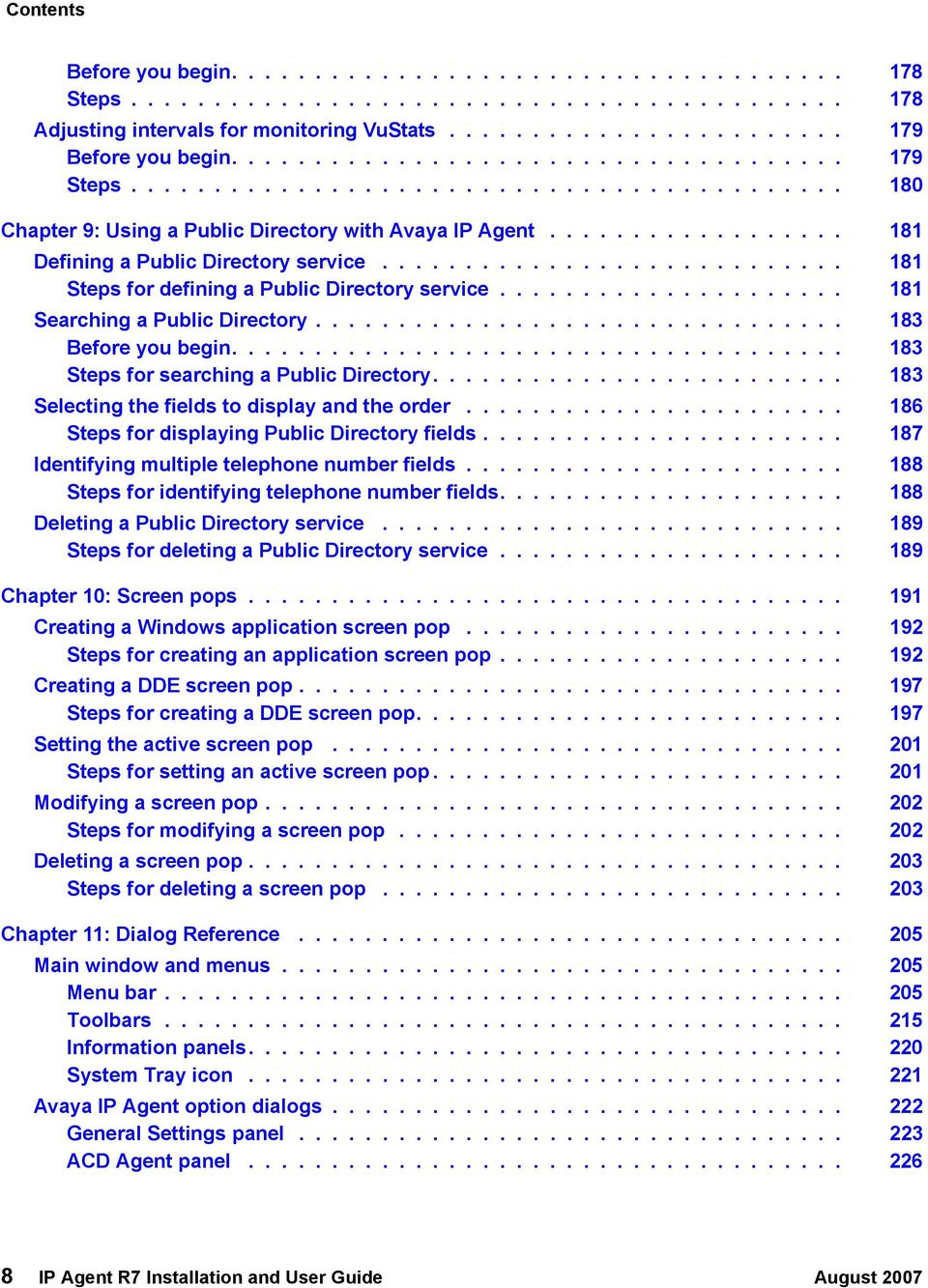
8 Contents Before you begin Steps Adjusting intervals for monitoring VuStats Before you begin Steps Chapter 9: Using a Public Directory with Avaya IP Agent Defining a Public Directory service Steps for defining a Public Directory service Searching a Public Directory Before you begin Steps for searching a Public Directory Selecting the fields to display and the order Steps for displaying Public Directory fields Identifying multiple telephone number fields Steps for identifying telephone number fields Deleting a Public Directory service Steps for deleting a Public Directory service Chapter 10: Screen pops Creating a Windows application screen pop Steps for creating an application screen pop Creating a DDE screen pop Steps for creating a DDE screen pop Setting the active screen pop Steps for setting an active screen pop Modifying a screen pop Steps for modifying a screen pop Deleting a screen pop Steps for deleting a screen pop Chapter 11: Dialog Reference Main window and menus Menu bar Toolbars Information panels System Tray icon Avaya IP Agent option dialogs General Settings panel ACD Agent panel IP Agent R7 Installation and User Guide August 2007
9 Contents Call Handling panel Contact History panel Call Information Display panel Desktop Integration panel Database Options panel User Interface Options panel External Number Format panel Internal Dial Plan panel Event Logging panel Greetings Options panel Voice Message Number panel Phone Settings panel Feature Access panel Login Settings dialog box Login tab Call Server tab IM tab Audio tab Emergency tab Advanced tab Instant Messaging settings Alerts tab Privacy tab Status tab History tab Responses tab Agent Greetings settings Greeting Description settings ANI settings VDN settings Prompted Digits settings Audio settings Audio Options dialog box Audio Monitor dialog box Volume and Ringer Settings dialog box Audio Tuning Wizard Appendix A: Shortcut keys Shortcut key functions Call features IP Agent R7 Installation and User Guide August
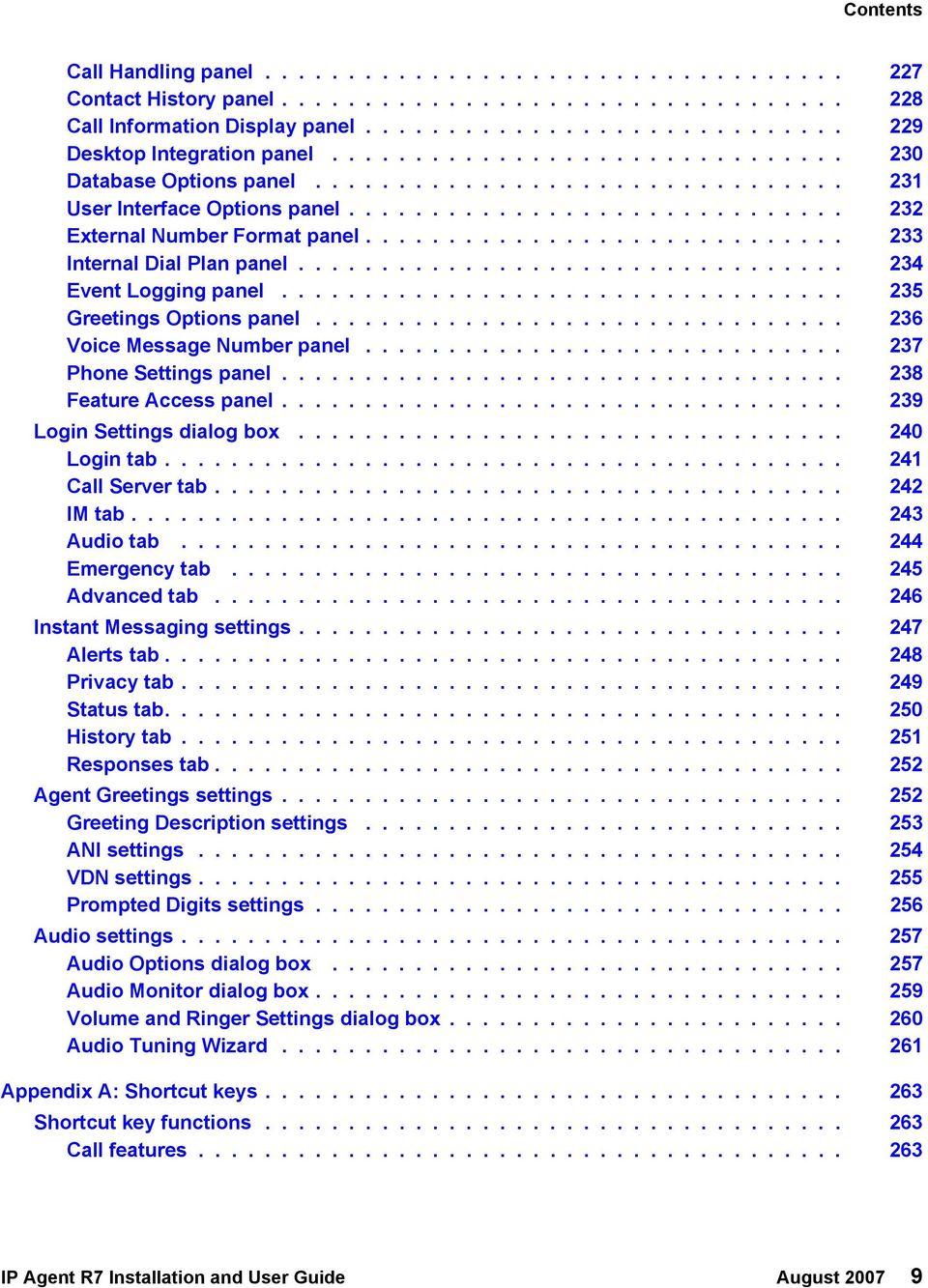
10 Contents Agent features Avaya IP Agent features Windows features Appendix B: Language support Untranslated components Supported languages for Avaya IP Agent Appendix C: Troubleshooting Diagnostic log files Login Voice-over-IP Making and receiving calls Other Alternative solution possibilities Appendix D: IP Agent Bluetooth Integrator Before you begin Installing the Bluetooth Utility Configuring the Bluetooth Integrator Pairing the Bluetooth headset Connecting to the Avaya Bluetooth Integrator Configuring IP Agent Logging in to IP Agent Glossary Index IP Agent R7 Installation and User Guide August 2007
11 Preface This section contains the following topics: Purpose on page 11 Audience on page 11 Reasons for reissue on page 11 Related documents on page 12 Purpose This document, Avaya IP Agent Installation and User Guide, includes information that you need to know in order to install and use Avaya IP Agent Release 7 (IP Agent R7). It also provides information on IP Agent R7 features, basic operation, and administrative tasks. Audience This guide is intended primarily for anyone who is installing or using IP Agent R7 and performing station administration on an Avaya MultiVantage system or Avaya Media Server using Avaya Communication Manager. It assumes that you are familiar with the following items: The personal computer on which Avaya IP Agent R7 will be installed and run Microsoft Windows XP Professional or Windows Vista Business, Enterprise, or Home Premium Standard Windows conventions and terminology Contact center configurations and operations Reasons for reissue This release of Avaya IP Agent Installation and User Guide includes the following new topics: Microsoft Installer (MSI) technology IP Agent R7 Installation and User Guide August

12 Preface Enhanced configuration administration Third party application launch from within IP Agent R7 Wireless headset support Feature enhancements Notes and information related to IP Agent R7 operation on Windows Vista See New features for Avaya IP Agent Release 7 on page 14 for a complete listing of the enhancements for IP Agent R7. Related documents The following documents can help you configure your Avaya communication server for use with Avaya IP Agent R7: Administrator s Guide for Avaya MultiVantage Software Administrator Guide for Avaya Communication Manager 12 IP Agent R7 Installation and User Guide August 2007
13 What is Avaya IP Agent? Chapter 1: Introduction This chapter provides introductory and basic information about Avaya IP Agent. This chapter includes the following sections: What is Avaya IP Agent? on page 13 New features for Avaya IP Agent Release 7 on page 14 Avaya IP Agent configurations on page 19 Compatible telephone types for Avaya IP Agent on page 24 Network compatibility on page 28 Voice-over-IP considerations on page 28 What is Avaya IP Agent? Avaya IP Agent is a software application with advanced telephony features for agents in a contact center. Agents can use it to work in the following methods On-site at the contact center On-site or off-site using Voice over Internet Protocol (VoIP) Off-site using analog connections over a Public Switched Telephone Network (PSTN) The advanced telephony features are controlled by Avaya IP Agent through its direct communication with an Avaya communication server. Agents who are not located at the contact center can connect to the Avaya communication server in the contact center and receive calls as if they were present at their contact center workstation. For example, if an agent cannot travel to the contact center because of transportation problems or weather conditions, the agent can still take calls by using Avaya IP Agent to connect to the Avaya communication server. This section contains the following topics: New features for Avaya IP Agent Release 7 on page 14 Avaya IP Agent features on page 15 IP Agent R7 Installation and User Guide August
14 Chapter 1: Introduction New features for Avaya IP Agent Release 7 The following is a list of the new features for Avaya IP Agent Release 7 (IP Agent R7): Enhanced security - IP Agent enables enhanced desktop security. See Avaya IP Agent features on page 15 New installation program - IP Agent R7 includes an entirely new installation program based on Microsoft Installer (MSI) installation technology. This program provides fully interactive and silent installation options. See Installing Avaya IP Agent for PC-based configurations on page 63. Launch toolbar - In IP Agent R7 the Launch toolbar provides the ability to centralize and organize third party application tools on the Avaya IP Agent main application window. You can also use the new ipadialer program to configure speed dial buttons on the Launch toolbar. The Launch toolbar supports up to 23 customizable launch items. See Configuring the Launch toolbar on page 87. Web Dialer - IP Agent R7 adds new "Click-to-dial" functionality to the Web Dialer context menu that allows you to quickly dial highlighted telephone numbers in a Windows Explorer window. See Using the Web Dialer context menu item on page 169. Configuration Administration - In IP Agent R7 new functionality allows you to define and export configuration information for use on other PCs, or import previously defined configuration information to set local parameters. See Configuring an IP Agent *.reg file with Configuration Administration on page 92. Agent greetings - IP Agent R7 increases the default number of agent greetings to 60. See Agent Greetings on page 171. Audio feature access restrictions - In Release 7, selection access to the Audio Tuning Wizard, Audio Options and Audio Monitor can be restricted. These audio features are normally accessible from the Audio menu on the main application window. See Audio menu on page 213. Expanded dial plan - A new Program Options Feature is introduced in IP Agent R7 to allow multiple or combination dial plans to be defined to handle internal calls. See Internal Dial Plan panel on page 234. Important:! Important: For a phone number to be correctly reformatted and stored in the application database, the enabled dial plan option must be set prior to accepting or generating calls or creating contact phone numbers. Avaya Bluetooth Integrator - With IP Agent R7 (on Windows XP only) you can use Bluetooth-enabled headsets to answer, mute and release calls. The Bluetooth Integrator is available in the Road Warrior configuration only. See IP Agent Bluetooth Integrator on page IP Agent R7 Installation and User Guide August 2007
15 New features for Avaya IP Agent Release 7 Crash analysis support - In the event an unhandled exception occurs in IP Agent, a pair of new files are generated in the application data \Log Files folder. See Diagnostic log files on page 269. Support of high definition audio chipsets - All IP Agent R7 features that depend on support of the underlying PC sound system are now compatible with the IntelR High Definition Audio14 chipset standard and the drivers that support it. Encrypted signal link - IP Agent R7 supports encryption of the signal link between IP Agent R7 and the serving Communication Manager (CM). This security option must be configured in compliance with the CM administered settings for the network region definition to which the extension being registered belongs. See your CM documentation for details. Avaya IP Agent features The following lists provide the main features that are available in Avaya IP Agent: Available configurations and supported communication servers Support of Avaya MultiVantage, and Communication Manager systems. Road Warrior configuration (Voice-over-IP) - Agents can connect to the Avaya communication server by using their personal computer and an IP network connection. In this configuration, a telephone set is not necessary because all communication is performed through a sound device of the personal computer. Telecommuter configuration - Agents using an analog or Digital Communication Protocol (DCP) telephone can use the advanced call features provided by the Avaya communication server. For example, an agent working from home can use Avaya IP Agent and their home telephone to transfer calls, place calls on hold, change agent work mode, and do other call center activities. Avaya Callmaster VI configuration - Avaya IP Agent running on Windows XP supports usage of Avaya Callmaster VI telephones. Sections of this document address configuration and usage of Avaya Callmaster VI telephones. Instant Messaging Only configuration - Avaya IP Agent does not register with an Avaya communication server for telephony capabilities, but does register with SIP Enablement Services for the purpose of instant messaging. IP Telephone configuration - Agents using an IP telephone can use Avaya IP Agent in the same manner as with the Telecommuter configuration. Features that are assigned to the extension can be used through the Avaya IP Agent user interface. In this configuration, Avaya IP Agent logs in to the telephone itself. IP Agent R7 Installation and User Guide August

16 Chapter 1: Introduction Avaya Telephone-DCP configuration - Agents using a Digital Communication Protocol (DCP) telephone in the contact center can use Avaya IP Agent to share control of the telephone and its features. While the Avaya Telephone-DCP configuration is similar to the Telecommuter configuration, it cannot use a telephone number that is different from the extension. For agents that are in the same location as the communication server, this configuration, unlike the Telecommuter configuration, does not require the creation of a second station on the Avaya communication server. This configuration is supported with Avaya Communication Manager 2.1 or later. Avaya Telephone-IP configuration - Agents using an IP telephone in the contact center can use Avaya IP Agent to share control of the IP telephone and its features with the Avaya communication server. While the Avaya Telephone-IP configuration is similar to the Telecommuter configuration, it cannot use a telephone number that is different from the extension. In this configuration, Avaya IP Agent logs in to the communication server, not the telephone as in the IP Telephone configuration. Windows Terminal Services compatibility - Those contact centers that use Windows Terminal Services can use a special version of Avaya IP Agent to facilitate usage of the Telecommuter configuration in that environment. Call and contact center features VuStats support - Avaya IP Agent can display multiple lines of VuStats information in the VuStats Monitor dialog box. You can use VuStats information to assist in complete monitoring of the contact center. Agent greetings - Agents can record and configure multiple agent greetings based on such variables as login status, agent work mode, agent ID, prompted digits, Automatic Number Identification (ANI), or Vector Directory Number (VDN). Agent greetings are available in the Road Warrior and Callmaster VI configurations. Using an Avaya Switcher II headset, (on Windows XP only) agent greetings can also be used in the Telecommuter configuration. For those call centers that want to have standard greetings for all agents, agent greetings can also be stored on network drives. Support for dynamic Quality of Service (QoS) - If the QoS parameters have not been configured on the personal computer for an IP Endpoint configuration, Avaya IP Agent downloads the QoS parameters configured on the Avaya communication server and configures the IP Endpoint. QoS is by default automatically installed by Avaya IP Agent. You can choose to not install QoS by deselecting it on the Custom Setup page of the installation program. Emergency Call Handling Service (E911) - With this feature, agents using IP Endpoints can use numbers that connect to emergency services, such as 911 in the United States. Only those emergency services in the Public Safety Answering Point area where the Avaya communication server is located can be reached. Agents or extensions in remote locations should not use this feature for emergencies. External Number Formatting - For international users, Avaya IP Agent allows you to define how many digits are present in telephone numbers outside the contact center. 16 IP Agent R7 Installation and User Guide August 2007
17 New features for Avaya IP Agent Release 7 User-to-user information (UUI) screen pop enhancement - Using external applications, unique identifiers can be added to incoming calls. If your Avaya communication server has the correct features and configuration, these identifiers can be passed to Avaya IP Agent and used in screen pops for agents. Contact management features Contact history - Avaya IP Agent records a complete contact history of incoming and outgoing calls, even for those calls where the caller does not leave a voice message. This feature also records the time and date of all instant message sessions. Contact Directory- Avaya IP Agent provides a customizable contact directory that lists telephone numbers, addresses, and instant messaging user names for each contact. Search Public Directory - With this feature, agents have the ability to search through public or company information using the Lightweight Directory Access Protocol (LDAP). Screen Pops - Screen Pops can be initiated when a call is received or placed. Avaya IP Agent provides agents with the ability to display Web pages, start applications, or retrieve and display caller information from a database. Screen pops are created using the Screen Pops Wizard, which guides you through their creation. A screen pop can consist of any process or application that can be initiated through one of the commands in the following list: - Windows executable or registered file type activation - Dynamic Data Exchange (DDE) "Execute" or "Poke" commands Usability features Clipboard dialing - Avaya IP Agent can be used to dial any number copied to the clipboard or, in most personal computer applications, used to dial a number that an agent highlights by right-clicking on the Avaya IP Agent icon in the System Tray. Enhanced Phone features - The Phone Features window displays all of the features that have been assigned to the station. Through this window, users can arrange these features into custom folders to fit their needs and maximize usability. Enhanced System Tray icon - The Avaya IP Agent icon in the System Tray contains release, drop, hold, transfer, conference, and agent work mode functions. Automatic login - An agent can automatically log in to the Avaya communication server when Avaya IP Agent is started. Avaya IP Agent uses the login information from the previous login. Speed dialer - Agents can assign telephone numbers to function keys (F2 through F8) so that the agent can dial the telephone number simply by pressing the associated key. Voice message icon - When voice messages are present for the extension currently in use, an icon is displayed in the System Tray. When it has been configured, you can click on this icon to connect to your voice mail system. IP Agent R7 Installation and User Guide August
18 Chapter 1: Introduction Alternate user interfaces - These interfaces can be used in place of the standard interface. These alternate interfaces use much less space on your desktop, and then can eliminate the problem of the previous Avaya IP Agent interface being hidden behind other applications or requiring too much space on the desktop. Security and management features Silent installation - In Avaya IP Agent R7, installations without user interaction are accomplished through the use of MSI command-line parameters. Media encryption - The Avaya iclarity IP Audio component of Avaya IP Agent encrypts communication between itself and the Avaya communication server. This provides a reassuring level of security in communications conducted over your contact center network. Feature deactivation - Administrators can deactivate Avaya IP Agent features that should not be configured or used by agents. The features that can be deactivated include Screen Pops, Contact Directory, Public Search Directory, Contact History, Phone Features configuration, Program Options, Speed Dials, VuStats, Agent Greeting selection, Launch toolbar, Audio Monitor, Audio Options, Audio Tuning Wizard, Configuration Admin, Desktop Integration, Import settings, and Export settings. Configurable database location - You can change the location where the Avaya IP Agent database is stored. This database contains the contact directory and the contact history information. Support for Virtual Private Networks (VPNs) - The Avaya iclarity IP Audio component supports substitution of SHIM-based IPSec client addresses for the local IP address within H.323 signalling messages. Alternate Gatekeeper - When an agent registers an IP Endpoint with an Avaya communication server, a C-LAN circuit pack IP address is sent by the server to the IP Endpoint. If registration is successful, the Avaya communication server sends back the IP addresses of all the C-LAN circuit packs in the network region. These addresses can be used if call signaling on the original C-LAN circuit pack fails. Support for server load balancing across gatekeepers - Registration and usage of Avaya communication servers can be distributed across multiple C-LAN circuit packs within a network region. This increases performance and reliability for all IP Endpoints. Application updates - This feature can be used to search for updates to Avaya IP Agent. During each start of Avaya IP Agent, the Uniform Resource Locator (URL) address specified is searched. If an update is found, it is installed. This feature saves time and effort for administrators because they do not need to visit each installation or create remote administration scripts through third-party applications. 18 IP Agent R7 Installation and User Guide August 2007

19 Avaya IP Agent configurations Secure operation - Best practice has developed such that Microsoft Windows Desktop applications are designed to run with the most restrictive user privileges possible. In particular, they should not be required to run unrestricted with Administrator privileges. IP Agent R7 can write only to the current user Documents folder \Documents and Settings\ <user>\application Data\Avaya\Avaya IP Agent\, and can only modify the Current User registry hive. Avaya IP Agent configurations Avaya IP Agent supports the following configurations: Road Warrior configuration (Voice-over-IP) on page 19 Telecommuter configuration on page 20 IP Telephone configuration on page 21 Callmaster VI configuration (DCP connection) on page 22 Avaya Telephone control by the server on page 22 Instant Messaging on page 24 Road Warrior configuration (Voice-over-IP) Use the Road Warrior configuration in situations where an agent at a personal computer can make a dial-up or network connection to an Avaya communication server. This configuration does not use a telephone, which, obviously, is valuable when a telephone is not available. The single network connection between the personal computer running Avaya IP Agent and the Avaya communication server has two channels, one for signaling (data) and one for voice. Avaya IP Agent controls the data flow while the iclarity IP Audio (an H.323 V2-compliant audio application) handles voice communications. This type of configuration provides the best IP audio quality that is possible with your connection speeds, personal computer performance, and network setup. Agents make and receive calls through the Avaya IP Agent interface using a headset connected to the personal computer or optionally through a Bluetooth hardware configuration (on Windows XP only). What you need to know about Road Warrior configuration The following list provides the Road Warrior configuration requirements and capabilities: Connection - One dial-up or network connection from the personal computer running Avaya IP Agent to the Avaya communication server Personal computer hardware IP Agent R7 Installation and User Guide August
20 Chapter 1: Introduction - Sound card (full-duplex recommended) or Universal Serial Bus (USB) headset - Modem or network interface card for connectivity to the Avaya communication server For detailed information on supported hardware, see the listings for IP Softphone at Telephone - Not supported in this configuration Bluetooth - Optional third party hardware required (for use on Windows XP only) Voice quality - Dependent on the performance of the personal computer hardware, the amount of bandwidth available in the network connection, and network stability Agent greetings - Stored on the personal computer or a network drive Avaya communication server connections - One user connection Voice-over-IP does not necessarily provide toll-quality audio. Telecommuter configuration Use the Telecommuter configuration in situations where a personal computer can make a dial-up or network connection to an Avaya communication server for the signaling (data) path and a voice path to a telephone sent through a Public Switched Telephone Network (PSTN) connection. The telephone can be an analog telephone, a cellular telephone, or an extension on a local or remote switch. This configuration provides toll-quality audio and full telephony functionality through Avaya IP Agent. Agents make and receive calls through the Avaya IP Agent interface, and the voice path is sent to the specified telephone. What you need to know about the Telecommuter configuration The following list provides the Telecommuter configuration requirements and capabilities: Connection - One dial-up or network connection from the personal computer running Avaya IP Agent to the Avaya communication server and a telephone capable of receiving calls from the Avaya communication server Personal computer hardware - Modem or network interface card for connectivity to the Avaya communication server Telephone set - Any telephone capable of receiving calls from the Avaya communication server Agent Greetings - Supported only through the use of the Avaya Switcher II headset (not available on Windows Vista) For information about using an Avaya Switcher II, see: 20 IP Agent R7 Installation and User Guide August 2007

21 Avaya IP Agent configurations Avaya communication server connections - One user connection for signaling connection and one of the following situations: - For off-site use, one trunk connection - For on-site use, an additional user connection IP Telephone configuration The IP Telephone configuration is similar to that of the Telecommuter configuration. Through IP Agent, agents can control an IP telephone, use the features of the telephone through the IP Agent interface, and take advantage of the regular IP Agent features. What you need to know about the IP Telephone configuration The following list provides the IP Telephone configuration requirements and capabilities: Connection - IP network connection for the IP telephone and a TCP/IP network connection for the personal computer Personal computer hardware - Network Interface Card (NIC) for connection to the Avaya communication server Telephone set - An Avaya IP telephone that supports the Computer Telephony Integration (CTI) feature and is supported by your Avaya communication server. See Compatible telephone types for Avaya IP Agent on page 24 for more information on supported Avaya IP telephones. Voice Quality - Dependent on the IP telephone, available network bandwidth, and network stability Agent Greetings - Supported only through the use of the Avaya Switcher II headset (not available on Windows Vista) For information about using an Avaya Switcher II, see: Avaya communication server connections - One user connection IP Agent R7 Installation and User Guide August
22 Chapter 1: Introduction Callmaster VI configuration (DCP connection) The Avaya Callmaster VI is a small telephone with eight buttons, two headset jacks, and DCP (Digital Communications Protocol) connectivity. This telephone is connected to a personal computer through a serial (RS-232) connection. This configuration is for use only inside the contact center in conjunction with Callmaster VI telephones. Connectivity for this configuration is provided through a DCP connection to the Avaya communication server and does not require a TCP/IP network connection. Callmaster VI telephones can only be used with IP Agent R7 running on Windows XP. What you need to know about the Callmaster VI configuration The following list provides Avaya Callmaster VI configuration requirements and capabilities: Connection - DCP connection for the Avaya Callmaster VI telephone set and a serial (RS-232) connection between the Avaya Callmaster VI and the personal computer Personal computer hardware - Serial (RS-232) port Telephone - Avaya Callmaster VI Agent greetings - Stored on the Avaya Callmaster VI telephone set Avaya communication server connections - One user connection Avaya Telephone control by the server This section includes information about Avaya Telephone control by the Avaya Communication Manager server, also called shared control. The Avaya Telephone configuration: Allows a telephone and IP Agent to share control of the same administered station using the same button layout and features. Supports Avaya DCP and IP telephones, but not analog sets. Eliminates the need to define a second extension on Avaya Communication Manager. Functions normally without Avaya IP Agent if the personal computer is not operational. Useful because the administration is simple and because IP Agent is a powerful complement to a regular telephone that enables screen pops, Instant Messenger (with SIP Enablement Services), Agent Greetings (with an Avaya Switcher II, Windows XP only), VuStats monitor, and so on. 22 IP Agent R7 Installation and User Guide August 2007
23 Avaya IP Agent configurations What you need to know about the Avaya Telephone configuration The following list provides the Avaya Telephone configuration requirements and capabilities: Connection : For shared control, you need one network connection from the personal computer running Avaya IP Agent to the Avaya Communication Manager system and an IP or DCP telephone that is connected to the Avaya Communication Manager system. For specifics, see the following table. IP telephones 4600-series telephones IP Agent Release 5 or later Communication Manager 2.1 or later DCP telephones 2400-series telephones and 6400-series telephones IP Agent Release 5 or later Communication Manager 2.0 or later Callmaster IV and V telephones IP Agent Release 6 or later on Windows XP Communication Manager 3.0 or later Personal computer hardware: Use a Network Interface Card (NIC) for connection to the Avaya communication server. Telephone set: Use any of the following types of telephones: Avaya 2400-series (DCP) 4600-series (IP) 6400-series (DCP) Callmaster IV (DCP) Callmaster V (DCP) Agent Greetings: Agent Greetings are supported only through the use of the Avaya Switcher II headset. (Not available in Windows Vista.) For information about using an Avaya Switcher II, see: Avaya communication server connections: Use one connection for the telephone and one for IP Agent. IP Agent R7 Installation and User Guide August
24 Chapter 1: Introduction Instant Messaging The Instant Messaging feature allows you to exchange text messages with other Avaya IP Agent users and track their online presence. Additionally, you can use an Instant Messaging Only configuration where Avaya IP Agent does not register with an Avaya communication server for telephony capabilities, but does register with SIP Enablement Services for the purpose of instant messaging. What you need to know about the Instant Messaging feature The following list provides the Instant Messaging configuration requirements and capabilities: Connection - One network connection from the personal computer running Avaya IP Agent to the SIP Enablement Services 3.1 or later Personal computer hardware - Network Interface Card (NIC) for connection to the SIP Enablement Services Configuration compatibility - The Instant Messaging feature is compatible with the following Avaya IP Agent configurations: - Road Warrior - Telecommuter - Avaya Telephone (DCP and IP) - IP Telephone Compatible telephone types for Avaya IP Agent This section contains the following topics: Supported telephone types on page 24 Recommended telephone types on page 28 Supported telephone types When you change telephone types for a station, you must restart Avaya IP Agent for the change to take effect. 24 IP Agent R7 Installation and User Guide August 2007
25 Compatible telephone types for Avaya IP Agent The following table provides the telephone types that are available on the Avaya communication server and officially supported for use with Avaya IP Agent: Telephone model Communication platform Additional features Callmaster IV (603F1) DCP 80-character (2x40) display Compatible with Avaya Telephone-DCP configuration Callmaster V (607A1) DCP 48-character display Compatible with Avaya Telephone-DCP configuration Callmaster VI (606A1) DCP 80-character (2x40) display Expansion module available 2410 DCP Multiline display Compatible with the Avaya Telephone-DCP configuration 2420 DCP 203-character display Expansion module available Compatible with the Avaya Telephone-DCP configuration 4602 IP 40-character display This telephone cannot be used in the IP Telephone configuration IP 32-character display Use of this telephone with the Avaya Telephone-IP configuration requires Avaya Communication Manager 2.1 or later IP 168x80 pixel display Supported only on Avaya Communication Manager 2.1 or later This telephone is not supported for Road Warrior or Telecommuter configurations. IP Agent R7 Installation and User Guide August
26 Chapter 1: Introduction Telephone model Communication platform Additional features 4612 IP 48-character display Use of this telephone with the Avaya Telephone-IP configuration requires Avaya Communication Manager 2.1 or later IP 168x132 pixel display Expansion module available Use of this telephone with the Avaya Telephone-IP configuration requires Avaya Communication Manager 2.1 or later IP 8 line display Expansion module available Use of this telephone with the Avaya Telephone-IP configuration requires Avaya Communication Manager 2.1 or later IP 48-character display Use of this telephone with the Avaya Telephone-IP configuration requires Avaya Communication Manager 2.1 or later IP 320x240 pixel display Use of this telephone with the Avaya Telephone-IP configuration requires Avaya Communication Manager 2.1 or later. 6402D DCP 32-character (2x16) display Compatible with Avaya Telephone-DCP configuration 6408D / 6408D+ DCP 48-character display Compatible with Avaya Telephone-DCP configuration 26 IP Agent R7 Installation and User Guide August 2007
27 Compatible telephone types for Avaya IP Agent Telephone model Communication platform Additional features 6416D+ DCP 48-character display Expansion module available Compatible with Avaya Telephone-DCP configuration 6424D+ DCP 48-character display Expansion module available Compatible with Avaya Telephone-DCP configuration 8403B DCP 48-character display 8405D / 8405D+ DCP 48-character display This telephone cannot be used with the Avaya Telephone-DCP configuration. 8410D DCP 48-character display This telephone cannot be used with the Avaya Telephone-DCP configuration. 8411D DCP 48-character display For this telephone set, you must disable the data port, which is true for all softphones 8434D DCP 80-character (2x40) display Expansion module available 9620 IP Part of Avaya one-x Deskphone family 9630 IP Part of Avaya one-x Deskphone family Supports up to one expansion module in IP Agent R IP Part of Avaya one-x Deskphone family Supports up to one expansion module in IP Agent R7 IP Agent R7 Installation and User Guide August
28 Chapter 1: Introduction Recommended telephone types While Avaya IP Agent supports all of the telephone types listed in the previous table for the Road Warrior and Telecommuter configurations, the following types provide the most buttons and features, and an 80-character display: 606A1 8434D Because of the greater number of characters used for display, these telephone types are better suited to handle VuStats or Prompted Digits information. For the IP Telephone and Avaya Telephone configurations, these telephone types are only valid for use if these exact telephones are in use at the location of the agent. Network compatibility Avaya IP Agent provides support for several H.323-compatible firewalls and Virtual Private Networks (VPNs). For shim-based VPNs, you must use the Advanced tab in the Avaya iclarity IP Audio dialog boxes used for login to set an IPSec IP address, that is assigned by the VPN gateway and that is visible to the application on the personal computer. If you need assistance, contact Avaya technical support. Avaya iclarity IP Audio only supports VPNs using Network Address Translations (NATs) that provide one-to-one IP address substitution. VPNs using NATs that provide many-to-one IP address substitution cannot be used with Avaya IP Agent. Voice-over-IP considerations Voice communication through Internet Protocol requires consistent, non-restrictive network bandwidth as well as the personal computer hardware sufficient to support not only the communications of the agent, but also other tasks being performed on the personal computer. If you experience problems with Avaya IP Agent Voice-over-IP telephony, you should ensure that network and personal computer resources are adequate for the tasks being performed. Consider the topics in this section when you are determining the efficiency of Voice-over-IP in your contact center. 28 IP Agent R7 Installation and User Guide August 2007
29 Voice-over-IP considerations Real-time processing Voice-over-IP uses real-time processing on your personal computer to transmit voice communication. Nearly all other processes on a personal computer use sequential processing which means that requests for system resources are processed as they become available. If resources are not available to process Voice-over-IP actions, the quality of the communication degrades. Network bandwidth Network bandwidth availability can also have an impact on Voice-over-IP communications. The codecs used for Voice-over-IP encoding can vary from using small packets for dial-up connections with reduced voice quality to using larger packets providing higher voice quality over broadband and high-speed connections. Tip: Tip: Avaya provides the Avaya IP Voice Quality Network Requirements as an in-depth and informative document that defines and describes all aspects of networking and how those aspects can affect Voice-over-IP communications. Contact your Avaya representative for more information. Personal computer hardware and software The personal computer software and hardware requirements in this document are the absolute minimum needed for operation. These minimum requirements do not take any tasks, applications, or other actions that may be occurring on the personal computer into account. If you experience problems with Voice-over-IP beyond those of configuration errors, most can be solved by upgrading the personal computer or using one with higher specifications. Tip: Tip: Voice-over-IP does not guarantee toll-quality audio. This is affected by numerous variables including the codec being used, network bandwidth availability, personal computer processing capabilities, sound device, network lag and packet loss, and many others. The following information describes personal computer considerations that are related to Voice-over-IP communications. Avaya recommends that you validate your network configuration against the Avaya IP Voice Quality Network Requirements. Additionally, Avaya provides network assessment services to determine if your network can support Voice-over-IP communications. IP Agent R7 Installation and User Guide August
30 Chapter 1: Introduction Voice-over-IP performance considerations The speed and architecture of a processor are considerations in potential Voice-over-IP performance difficulties. However, architecture must also be considered. Both Intel and AMD have produced economical processors for small businesses and home users that, while rated at comparable speeds to the higher-priced models, have reduced on-chip memory (L1/L2 cache). This affects real-time processing which, in turn, affects Voice-over-IP communications. Additionally, some chip sets have been created that include specialized instruction sets that optimize specific types of applications and processes. These include speech processing. To avoid experiencing problems with Voice-over-IP communications with Avaya IP Agent, Avaya recommends using a system with higher specifications for the following items. Processor speed On-chip memory (L1 or L2 cache) System Bus speed Avaya IP Agent does not officially support Cyrix processors. System descriptions for Voice-over-IP The following system descriptions provide guidelines for determining whether higher system requirements are necessary for Voice-over-IP communications.! Important: Important: If your system more closely resembles the moderate- or high-demand systems, an upgrade from the minimum requirements for the Voice-over-IP configuration is recommended. Specific requirements for each type of system cannot be given because RAM, processor speed, system bus speed, on-chip memory, sound devices, network bandwidth, and applications in usage are all variables that can range widely in impact. High demand: A high-demand system is a personal computer that uses processor-intensive applications. The following list presents some examples of activities and applications that are used in a high-demand system: Multiple, CPU-intensive applications running simultaneously Database queries or hosting Multimedia applications Computer-Assisted Drafting (CAD) applications 30 IP Agent R7 Installation and User Guide August 2007
31 Voice-over-IP considerations Compilers Streaming media Moderate demand: A moderate-demand system is a personal computer that sometimes uses applications normally found in an office environment. The following list presents some examples of activities and applications that are used in a moderate-demand system: Word processors Spreadsheets Web browsing Data entry General Low demand: A low-demand system is a personal computer that rarely uses any applications apart from Avaya IP Agent. The following list presents some examples of activities and applications that are used in a low-demand system: Text Simple web browsing (no streaming media) Minimal data entry IP Agent R7 Installation and User Guide August
32 Chapter 1: Introduction 32 IP Agent R7 Installation and User Guide August 2007
33 Chapter 2: Configuring the Avaya communication server This section provides procedures and information on how to configure the following Avaya communication servers for use with Avaya IP Agent: Avaya communication servers with Communication Manager software Avaya communication servers with MultiVantage Software Before agents can receive calls with Avaya IP Agent, the Avaya communication server must be configured to support extension assignments, IP connectivity, telephone types, and other settings.! Important: Important: You should be familiar with administering your Avaya communication server before attempting any of the procedures in this section. If you are unfamiliar with the fields or settings described in this section, consult your Avaya communication server documentation for assistance. This section includes the following topics: Required Avaya communication server circuit packs on page 34 Validating Feature Access Codes on page 35 Road Warrior and Telecommuter configurations on page 37 Callmaster VI configurations on page 44 IP Telephone and Avaya Telephone-IP configurations on page 48 Avaya Telephone-DCP configurations on page 55 The screens shown in this section are from an Avaya communication server with the Expert Agent Selection (EAS) feature. If you do not have the EAS or some other features on your Avaya communication server, these interfaces may differ slightly from the screens shown. Because of this, each step in the procedure identifies when there is a distinction between an EAS and non-eas system. IP Agent R7 Installation and User Guide August
34 Chapter 2: Configuring the Avaya communication server Required Avaya communication server circuit packs This section provides information and documentation resources for the circuit packs required by your Avaya communication server to support the Telecommuter, IP Telephone, Avaya Telephone, and Road Warrior configurations with Avaya IP Agent. The following two circuit packs are used for remote agent connections over TCP/IP with Avaya IP Agent: Control LAN Circuit Pack (C-LAN) (TN799B, TN799DP, or later) IP Media Processor (TN2302AP, TN2602AP, or later) This section contains the following topics: C-LAN circuit pack on page 34 IP Media Processor on page 35 Documentation on page 35 C-LAN circuit pack C-LAN is a packet port circuit pack for Avaya communication servers that provides TCP/IP connectivity to adjuncts for applications. It has one 10BaseT or 100BaseT Ethernet connection and up to 16 DS0 physical interfaces for PPP connections. Two integrated modems provide remote PPP connectivity over analog facilities. Multiple C-LAN circuit packs can be added to a system to increase TCP/IP capacity. This circuit pack provides data signaling over TCP/IP for Avaya IP Agent. It is used for the Telecommuter, IP Telephone, Avaya Telephone, and Road Warrior configurations where a data connection is made to the Avaya communication server. The voice path does not use this circuit pack. Avaya recommends that the TN799C V4, TN799DP, or later C-LAN circuit pack is used for its increased ability to handle maximum capacities. Previous versions could encounter difficulties when the maximum number of active endpoints is reached. 34 IP Agent R7 Installation and User Guide August 2007
35 Validating Feature Access Codes IP Media Processor The IP Media Processor provides the transmission of voice data over an IP network. This enables support of applications that comply with H.323-v2 protocols. It also reduces per-port costs and improves quality through its dynamic jitter buffers. Additionally, it performs echo cancellation, silence suppression, Dual Tone Multi-Frequency (DTMF) detection, and conferencing. This circuit pack provides Voice-over-Internet Protocol (VoIP) for Avaya IP Agent. It is used for the Road Warrior configuration where a VoIP connection is made to the Avaya communication server. Documentation For installation procedures and configuration information for the C-LAN and IP Media Processor circuit packs, see Administration for Network Connectivity for your Communication Manager or MultiVantage. Validating Feature Access Codes This section provides the procedure for administering the Feature Access Codes (FACs) on an Avaya communication server. Feature Access Codes are used by Avaya IP Agent to give agents the ability to perform the following actions: Change the current work mode Log in Log out Adjust the method with which an agent receives the next call (Auto-In, Manual-In) Request supervisor assistance Before you begin Feature Access Codes cannot be entered unless the fac capability is assigned in the dial plan. To change settings on the Avaya communication server, you must have a user ID with the proper administrative permissions. IP Agent R7 Installation and User Guide August
36 Chapter 2: Configuring the Avaya communication server Important:! Important: Screens presented in this section might differ in appearance from those of your Avaya communication server. All options on the specified forms mentioned in this procedure are available, but might not be on the page noted. Steps for validating Feature Access Codes To validate Feature Access Codes: 1. Log in to the Graphically Enhanced DEFINITY Interface (GEDI) on the Avaya communication server. You can choose to log in to the Station Administration Terminal (SAT) on the Avaya communication server. The configuration steps are the same for either interface. 2. Enter display dialplan analysis to access the dial plan form and then ensure that the fac option is assigned in the dial plan. If the fac option is not assigned in the dial plan, your dial plan does not currently support Feature Access Codes. For more information on configuring your dial plan for Feature Access Codes, see the documentation for your Avaya communication server. 3. Enter display feature-access-codes to view the feature-access-codes form. 4. Navigate to the call center portion of the feature-access-codes form. Non-EAS Avaya communication servers will display only a subset of the access code fields shown in the following figure. 36 IP Agent R7 Installation and User Guide August 2007
37 Road Warrior and Telecommuter configurations The Feature Access Codes shown in the graphic are only an example and do not need to be configured as such on your Avaya communication server. You are free to determine your own Feature Access Codes. 5. Administer the Feature Access Codes for Login and Logout as well as any other FACs that you want available for your agents. For Avaya Callmaster VI configurations, you must also administer the PASTE Feature Access Code which is located on a different page of this form. If Feature Access Codes are not assigned, see the documentation for your Avaya communication server to find instructions on adding Feature Access Codes. Road Warrior and Telecommuter configurations If you will be using Avaya IP Agent for Voice-over-IP through the personal computer (Road Warrior configuration) or using any telephone as your extension (Telecommuter configuration), this section provides the procedures and information for proper administration of your Avaya communication server. This section contains the following topics: Ensuring compatibility on page 37 Configuring station settings on page 40 Ensuring compatibility In this procedure, you set features on your Avaya communication server so that Avaya IP Agent can be used in your contact center. Before you begin The settings for IP connections can be enabled only if your Avaya communication server supports use of Internet Protocol (IP) for calls. Important:! Important: If any settings of your Avaya communication server do not conform with the steps in this procedure, you must contact Avaya to purchase the appropriate options or configuration for your Avaya communication server before you can use Avaya IP Agent. IP Agent R7 Installation and User Guide August
38 Chapter 2: Configuring the Avaya communication server If you need to configure a specific range of ports to use with IP communications because of firewalls or for some other reason, you must assign the range through both the Avaya communication server and Avaya iclarity IP Audio. See Advanced tab on page 246 for information on configuring port ranges on both systems. Steps for ensuring Road Warrior and Telecommuter station settings To ensure that your Avaya communication server supports the Telecommuter and Road Warrior configurations: 1. Log in to the Graphically Enhanced DEFINITY Interface (GEDI) on the Avaya communication server. You can choose to log in to the Station Administration Terminal (SAT) on the Avaya communication server. The configuration steps are the same for either interface. 2. Enter display system-parameters customer-options. The SAT displays Page 1 of the system-parameters customer-options form. 38 IP Agent R7 Installation and User Guide August 2007
39 Road Warrior and Telecommuter configurations 3. Navigate to Page 2 of the customer-options form. 4. Ensure that the Maximum Concurrently Registered IP Stations field is set to a number greater than zero. This number represents the total number of IP stations that can be connected to the Avaya communication server at one time. IP stations can consist of Avaya IP Agent, Avaya IP Softphone, and IP telephone sets. 5. Navigate to Page 4 of the customer-options form. 6. Ensure that the IP Stations field is set to y. IP Agent R7 Installation and User Guide August
40 Chapter 2: Configuring the Avaya communication server 7. Navigate to Page 10 of the customer-options form. 8. Ensure that the Limit field for the IP_Agent Rel. 7 Product ID is set to the number of licenses you purchased for Avaya IP Agent R7. Configuring station settings This section provides the procedure for configuring station settings to support the Telecommuter and Road Warrior configurations. Before you begin Before configuring station settings on the Avaya communication server, you should have completed the procedures in Ensuring compatibility on page 37 to verify that your Avaya communication server supports Avaya IP Agent and Feature Access Codes. To change settings on the Avaya communication server, you must have a user ID with the proper administrative permissions. If the station has not yet been created, you must create it using the add station command on the Avaya communication server. Steps for configuring Road Warrior and Telecommuter station settings To change station settings to support the Road Warrior and Telecommuter configurations: 1. Log in to the Graphically Enhanced DEFINITY Interface (GEDI) on the Avaya communication server. 40 IP Agent R7 Installation and User Guide August 2007
41 Road Warrior and Telecommuter configurations You can choose to log in to the Station Administration Terminal (SAT) on the Avaya communication server. The configuration steps are the same for either interface. 2. Enter change station XXXXX where XXXXX is the number of the station to be used with Avaya IP Agent. The Avaya communication server displays the change station form for the specified station. 3. In the Type field, enter the type of telephone that Avaya IP Agent will emulate. Avaya recommends using one of the following telephone types because of the number of features available and the ability to display 80 characters for contact center or call information: 8434D 606A1 In Telecommuter mode, Avaya IP Agent can take over the administration and functionality of a physical Digital Communication Protocol (DCP) telephone. The physical telephone must be one of those listed in Compatible telephone types for Avaya IP Agent on page 24. For DCP, the physical telephone is unusable while Avaya IP Agent is registered with its extension. The telephone will become usable again when the Avaya IP Agent session is disconnected from the Avaya communication server. If you selected the 8434D type, and more feature buttons are needed for the station, enter y in the Expansion Module field. 4. Enter one of the following options in the Port field: IP - This option specifies that station administration is done without hardware. IP Agent R7 Installation and User Guide August
42 Chapter 2: Configuring the Avaya communication server port - This option is used when a remote agent takes direct control of a real extension that has a DCP connection to the Avaya communication server. Enter the port number of the actual telephone assigned to this extension. When a remote agent logs in to this extension using Avaya IP Agent, the actual telephone that is locally connected to the Avaya communication server port is disabled and cannot be used. 5. Enter a number in the Security Code field that will be used as a password during the extension login to the Avaya communication server. If a security code is not entered, this station cannot log in to the Avaya communication server. 6. Set the IP Softphone field to y. 7. Navigate to Page 2 of the change station form. 8. Set the Multimedia Mode field to enhanced. 9. Set the Service Link Mode field to one of the following options: as-needed - Use this setting if the station has low call traffic or a toll is charged for calls. permanent - Use this setting if the station has high call traffic or if it is set as an auto-answer station. 10. Ensure that the Emergency Location Ext: field is set to the appropriate setting for your contact center. 11. If the Auto Answer field is set to All or ACD on the station or agent form, you must enable the Enable support for auto-answer feature in the Avaya IP Agent Program Options and then reboot. You can find this option under Tools > Program Options in the Avaya IP Agent main window. 42 IP Agent R7 Installation and User Guide August 2007
43 Road Warrior and Telecommuter configurations 12. Navigate to Page 4 of the change station form. 13. On pages 3, 4, and 5 of the station administration forms, assign functions to each button that you want to appear in your Avaya IP Agent Phone Features window. You must assign the necessary agent work mode buttons that are used in your contact center: auto-in - This function makes agents available for new calls immediately after they finish with the current call. manual-in - This function makes the agent available to take a call and then places the agent in the After Call Work (ACW) mode when the call has been completed. after-call - This function places agents in the After Call Work (ACW) mode. aux-work - This function places agents in the Auxiliary Work (AUX) mode. Multiple Auxiliary Work buttons with different reason codes can be assigned to this extension. You can configure your Avaya communication server to prompt for reason codes when an agent enters the aux-work state. release - Assignment of this feature is mandatory. This feature terminates the current call and line appearance. callr-info - This function is required only with the Call Prompting feature so that agents are allowed to display information collected from the originator of the call. The Call Prompting feature obtains information from a caller through a collect-digits vector step on the Avaya communication server. IP Agent R7 Installation and User Guide August
44 Chapter 2: Configuring the Avaya communication server Important:! Important: The 4600, 6400, and 607A1 telephone types do not have a physical Drop button; therefore, you must assign a drop function for each station to ensure proper operation of the Avaya IP Agent Drop feature. When this station is connected to the Avaya communication server, the assigned button functions are displayed in the Avaya IP Agent Phone Features window. You can find information on all available button functions in the documentation for your Avaya communication server. Rebuilding Feature button and Phone feature toolbars During station administration, if you delete a Phone Feature button from the Feature buttons toolbar, the entire Feature button toolbar will be deleted. Choose Tools > Phone Features and select File > Rebuild All to refresh phone features and rebuild the Feature button toolbar, Phone feature toolbar, and Personal Phone Features. Callmaster VI configurations If you use Avaya Callmaster VI telephones for your contact center agents, this section provides the procedures for configuring your Avaya communication server for compatibility with Avaya IP Agent. Callmaster VI telephones can only be used with IP Agent R7 running on Windows XP. This section contains the following topics: Ensuring compatibility on page 44 Configuring station settings on page 46 Ensuring compatibility This section provides the procedure for ensuring that your Avaya communication server is configured to support Avaya IP Agent in the Avaya Callmaster VI configuration. 44 IP Agent R7 Installation and User Guide August 2007
45 Callmaster VI configurations Before you begin Read and understand the following items before administering your Avaya communication server: A BCS/Guestworks system does not support Avaya Callmaster VI configurations. Important:! Important: If any Avaya communication server settings do not conform with the steps in this procedure, you must contact Avaya to purchase the appropriate options or configuration before you can use Avaya IP Agent. Steps for ensuring Callmaster VI compatibility To ensure that your Avaya communication server supports Avaya IP Agent in the Callmaster VI configuration: 1. Log in to the Graphically Enhanced DEFINITY Interface (GEDI) on the Avaya communication server. You can choose to log in to the Station Administration Terminal (SAT) on the Avaya communication server. The configuration steps are the same for either interface. 2. Enter display system-parameters customer-options. The SAT displays Page 1 of the system-parameters customer-options form. 3. Navigate to Page 6 of the customer-options form. IP Agent R7 Installation and User Guide August
46 Chapter 2: Configuring the Avaya communication server 4. If you are using Avaya Callmaster VI telephone sets with the 606A1 telephone type, you must ensure that the PC Application Software Translation Exchange (PASTE) feature is enabled. Locate the PASTE (Display PBX Data on Phone) field and ensure that it is set to y. Configuring station settings This section provides the procedure for configuring station settings to support the Avaya Callmaster VI configurations for Avaya IP Agent. Before you begin Before configuring station settings on the Avaya communication server, you should have completed the procedure in Ensuring compatibility on page 44 to verify that your Avaya communication server supports Avaya IP Agent and Feature Access Codes. To use Avaya Callmaster VI telephones, you must have the PASTE feature enabled on your Avaya communication server. To change settings on the Avaya communication server, you must have a user ID with the proper administrative permissions. If the station has not yet been created, you must create it using the add station command on the Avaya communication server. 46 IP Agent R7 Installation and User Guide August 2007
47 Callmaster VI configurations Steps for configuring Callmaster VI station settings To change station settings to support Avaya Callmaster VI configurations: 1. Log in to the Graphically Enhanced DEFINITY Interface (GEDI) on the Avaya communication server. You can choose to log in to the Station Administration Terminal (SAT) on the Avaya communication server. The configuration steps are the same for either interface. 2. Enter change station XXXXX where XXXXX is the number of the station to be used with Avaya IP Agent. The Avaya communication server displays the change station form for the specified extension. 3. In the Type: field, enter 606A1. 4. In the Port: field, enter the number of the port providing the connection for the Avaya Callmaster VI telephone. 5. Navigate to Page 3 of the change station form. 6. Ensure that the DUAL LED field is set to call-appr. 7. On pages 3, 4, 5, and 6 of the station administration forms, assign functions to each button that you want to appear in your Avaya IP Agent Phone Features window. You must assign the necessary agent work mode buttons that are used in your contact center: auto-in - This function makes agents available for new calls immediately after the current call is finished. manual-in - This function makes the agent available to take a call and then places the agent in the After Call Work (ACW) mode when the call has been completed. after-call - This function places agents in the After Call Work (ACW) mode. aux-work - This function places agents in the Auxiliary Work (AUX) mode. Multiple Auxiliary Work buttons with different reason codes can be assigned to this extension. You can configure your Avaya communication server to prompt for reason codes when an agent enters the aux-work state. release - Assignment of this feature is mandatory. This feature terminates the current call and line appearance. IP Agent R7 Installation and User Guide August
48 Chapter 2: Configuring the Avaya communication server callr-info - This function is only required with the Call Prompting feature so that agents are allowed to display information collected from the originator. The Call Prompting feature obtains information from a caller through a collect-digits vector step. When this station is connected to the Avaya communication server, the assigned button functions are displayed in the Avaya IP Agent Phone Features window. You can find information on all available button functions in the documentation for your Avaya communication server. 8. After you create a station and assign or modify buttons, you must perform a download for the Avaya Callmaster VI. Go to the personal computer connected to the Avaya Callmaster VI station and select Settings > Phone Configuration from the Avaya IP Agent menu bar. Avaya IP Agent displays a confirmation dialog box. 9. Select the OK button. IP Telephone and Avaya Telephone-IP configurations This section provides the procedures for configuring your Avaya communication server to function properly with Avaya IP Agent if you use Avaya IP telephones in your contact center. This section contains the following topics: Ensuring compatibility on page 48 Configuring station settings on page 51 Ensuring compatibility This section provides the procedure for ensuring that your Avaya communication server is configured to support the IP Telephone and Avaya Telephone-IP configurations. Before you begin The settings for IP connections can be enabled only if your Avaya communication server supports use of Internet Protocol (IP) for calls. Important:! Important: If any settings of your Avaya communication server do not conform with the steps in this procedure, you must contact Avaya to purchase the appropriate options or configuration for your Avaya communication server before you can use Avaya IP Agent. 48 IP Agent R7 Installation and User Guide August 2007
49 IP Telephone and Avaya Telephone-IP configurations If you need to configure a specific range of ports to use with IP communications because of firewalls or for some other reason, you must assign the range through both the Avaya communication server and Avaya iclarity IP Audio. See Advanced tab on page 246 for information on configuring port ranges on both systems. Steps for ensuring IP telephone compatibility To ensure that your Avaya communication server supports the IP Telephone and Avaya Telephone-IP configurations: 1. Log in to the Graphically Enhanced DEFINITY Interface (GEDI) on the Avaya communication server. You can choose to log in to the Station Administration Terminal (SAT) on the Avaya communication server. The configuration steps are the same for either interface. 2. Enter display system-parameters customer-options. The SAT displays Page 1 of the system-parameters customer-options form. IP Agent R7 Installation and User Guide August
50 Chapter 2: Configuring the Avaya communication server 3. Navigate to Page 2 of the customer-options form. 4. Ensure that the Maximum Concurrently Registered IP Stations field is set to a number greater than zero. This number represents the total number of IP stations that can be connected to the Avaya communication server at one time. IP stations can consist of Avaya IP Agent, Avaya IP Softphone, and IP telephone sets. 5. Navigate to Page 4 of the customer-options form. 6. Ensure that the IP Stations field is set to y. 50 IP Agent R7 Installation and User Guide August 2007
51 IP Telephone and Avaya Telephone-IP configurations 7. Navigate to Page 10 of the customer-options form. 8. For the Avaya Telephone-IP configuration, ensure that the Limit field for the IP_AGENTSC Rel. 7 Product ID is set to the number of licenses you purchased for Avaya IP Agent R7. For the IP Telephone configuration, verify the number of licenses for the IP_AGENT Rel. 7 Product ID. This configuration can use either the AGENTSC or IP_Agent licenses. Configuring station settings This section provides the procedure for configuring station settings to support the IP Telephone and Avaya Telephone-IP configurations. Before you begin Before configuring station settings on the Avaya communication server, you should have completed the procedure in Ensuring compatibility on page 48 to verify that your Avaya communication server supports Avaya IP Agent and Feature Access Codes. To change settings on the Avaya communication server, you must have a user ID with the proper administrative permissions. If the station has not yet been created, you must create it using the add station command on the Avaya communication server. Important:! Important: To use an Avaya IP telephone with Avaya IP Agent, the firmware version of the telephone must be 1.7 or later. IP Agent R7 Installation and User Guide August
52 Chapter 2: Configuring the Avaya communication server For the IP Telephone configuration, the Computer Telephony Integration (CTI) control feature must be enabled on the IP telephone before it can be used in conjunction with Avaya IP Agent. This feature does not need to be enabled if you are administering the Avaya Telephone-IP configuration. To enable the CTI control feature: 1. Press the Mute button on your IP telephone. 2. Press # on the IP telephone dial pad. The telephone display will display the state of the CTI control feature. CTI=manual indicates that the feature is enabled. 3. Depending on the feature state, perform the appropriate action: - If CTI=manual is displayed, save your changes by following the prompts on the telephone display. - If CTI=off is displayed, press 1 # to enable CTI control, and then save your changes by following the prompts on the telephone display. Steps for configuring IP Telephone and Avaya Telephone-IP station settings To change station settings to support the IP Telephone and Avaya Telephone-IP configurations: 1. Log in to the Graphically Enhanced DEFINITY Interface (GEDI) on the Avaya communication server. You can choose to log in to the Station Administration Terminal (SAT) on the Avaya communication server. The configuration steps are the same for either interface. 2. Enter change station XXXXX where XXXXX is the number of the station to be used with Avaya IP Agent. The Avaya communication server displays the change station form for the specified station. 3. In the Type field, enter the type of telephone that Avaya IP Agent will control. The station type must match that of the IP telephone. 4. Ensure that the Port field is set to IP. 5. Enter a number in the Security Code field that will be used as a password during the extension login to the Avaya communication server. If a security code is not entered, this station cannot log in to the Avaya communication server. 6. Set the IP Softphone field to y. 52 IP Agent R7 Installation and User Guide August 2007
53 IP Telephone and Avaya Telephone-IP configurations 7. Navigate to Page 2 of the change station form. 8. Ensure that the Multimedia Mode field has been set to enhanced. 9. Set the Service Link Mode field to one of the following options: as-needed - Use this setting if the station has low call traffic or a toll is charged for calls. permanent - Use this setting if the station has high call traffic or if it is set as an auto-answer station. 10. If the Auto Answer field is set to All or ACD on the station or agent form, you must enable the Enable support for auto-answer feature in the Avaya IP Agent Program Options and then reboot. You can find this option under Tools > Program Options in the Avaya IP Agent main window. IP Agent R7 Installation and User Guide August
54 Chapter 2: Configuring the Avaya communication server 11. Navigate to Page 4 of the change station form. 12. On pages 3, 4, and 5 of the station administration forms, assign functions to each button that you want to appear in your Avaya IP Agent Phone Features window. You must assign the necessary agent work mode buttons that are used in your contact center: auto-in - This function makes agents available for new calls immediately after they finish with the current call. manual-in - This function makes the agent available to take a call and then places the agent in the After Call Work (ACW) mode when the call has been completed. after-call - This function places agents in the After Call Work (ACW) mode. aux-work - This function places agents in the Auxiliary Work (AUX) mode. Multiple Auxiliary Work buttons with different reason codes can be assigned to this extension. You can configure your Avaya communication server to prompt for reason codes when an agent enters the aux-work state. release - Assignment of this feature is mandatory. This feature terminates the current call and line appearance. callr-info - This function is required only with the Call Prompting feature so that agents are allowed to display information collected from the originator of the call. The Call Prompting feature obtains information from a caller through a collect-digits vector step on the Avaya communication server. When this station is connected to the Avaya communication server, the assigned button functions are displayed in the Avaya IP Agent Phone Features window. You can find information on all available button functions in the documentation for your Avaya communication server. 54 IP Agent R7 Installation and User Guide August 2007
55 Avaya Telephone-DCP configurations Avaya Telephone-DCP configurations The Avaya Telephone-DCP configuration allows agents to use Avaya IP Agent as a direct interface with a Digital Communication Protocol (DCP) telephone. This configuration is used when there is no need for agents to use any of the following capabilities: Voice-over-IP A telephone outside the contact center An extension with a different telephone type that allows more features than the DCP telephone. This section contains the following topics: Ensuring compatibility on page 55 Configuring station settings on page 58 Ensuring compatibility This section describes the setting of features on your Avaya communication server so that Avaya IP Agent can be used in your contact center. Before you begin The settings for IP connections can be enabled only if your Avaya communication server supports use of Internet Protocol (IP) for calls.! Important: Important: If any settings of your Avaya communication server do not conform with the steps in this procedure, you must contact Avaya to purchase the appropriate options or configuration for your Avaya communication server before you can use Avaya IP Agent. If you need to configure a specific range of ports to use with IP communications because of firewalls or for some other reason, you must assign the range through both the Avaya communication server and Avaya iclarity IP Audio. See Advanced tab on page 246 for information on configuring port ranges on both systems. The DCP telephone must be connected for Avaya IP Agent to register with the Avaya communication server. If the telephone is disconnected, registration through Avaya IP Agent will be denied. Conversely, if the DCP telephone is disconnected after registration has been made, Avaya IP Agent will be disconnected by the Avaya communication server. IP Agent R7 Installation and User Guide August
56 Chapter 2: Configuring the Avaya communication server Steps for ensuring Avaya Telephone-DCP compatibility To ensure that your Avaya communication server supports the Avaya Telephone-DCP configuration: 1. Log in to the Graphically Enhanced DEFINITY Interface (GEDI) on the Avaya communication server. You can choose to log in to the Station Administration Terminal (SAT) on the Avaya communication server. The configuration steps are the same for either interface. 2. Enter display system-parameters customer-options. The SAT displays Page 1 of the system-parameters customer-options form. 3. Navigate to Page 2 of the customer-options form. 56 IP Agent R7 Installation and User Guide August 2007
57 Avaya Telephone-DCP configurations 4. Ensure that the Maximum Concurrently Registered IP Stations field is set to a number greater than zero. This number represents the total number of IP stations that can be connected to the Avaya communication server at one time. IP stations can consist of Avaya IP Agent, Avaya IP Softphone, and IP telephone sets. 5. Navigate to Page 4 of the customer-options form. 6. Ensure that the IP Stations field is set to y. 7. Navigate to Page 10 of the customer-options form. 8. Ensure that the Limit field for the IP_AGENTSC Rel. 7 Product ID is set to the number of licenses you purchased for Avaya IP Agent R7. This configuration can use either the AGENTSC or IP_Agent licenses. IP Agent R7 Installation and User Guide August
58 Chapter 2: Configuring the Avaya communication server Configuring station settings Before you begin Before configuring station settings on the Avaya communication server, you should have completed the procedures in Ensuring compatibility on page 55 to verify that your Avaya communication server supports Avaya IP Agent and Feature Access Codes. To change settings on the Avaya communication server, you must have a user ID with the proper administrative permissions. If the station has not yet been created, you must create it using the add station command on the Avaya communication server. Steps for configuring Avaya Telephone-DCP station settings To change station settings to support the Avaya Telephone-DCP configuration: 1. Log in to the Graphically Enhanced DEFINITY Interface (GEDI) on the Avaya communication server. You can choose to log in to the Station Administration Terminal (SAT) on the Avaya communication server. The configuration steps are the same for either interface. 2. Enter change station XXXXX where XXXXX is the number of the station to be used with Avaya IP Agent. The Avaya communication server displays the change station form for the specified station. 58 IP Agent R7 Installation and User Guide August 2007
59 Avaya Telephone-DCP configurations 3. In the Type field, enter the type of telephone that will be used with Avaya IP Agent. If this station possesses an expansion module, set the Expansion Module field to y. Important:! Important: This field must reflect the exact model of telephone that will be used by the agent. 4. In the Port field, specify the port that this DCP telephone will use. This option is used when a remote agent takes direct control of a telephone that has a DCP connection to the Avaya communication server. Enter the port number of the actual telephone assigned to this extension. 5. Enter a number in the Security Code field that will be used as a password during the extension login to the Avaya communication server. If a security code is not entered, this station cannot log in to the Avaya communication server. 6. Set the IP Softphone field to y. 7. Navigate to Page 2 of the change station form. 8. Set the Multimedia Mode field to enhanced. 9. Set the Service Link Mode field to one of the following options: as-needed - Use this setting if the station has low call traffic or a toll is charged for calls. permanent - Use this setting if the station has high call traffic or if it is set as an auto-answer station. 10. If the Auto Answer field is set to All or ACD on the station or agent form, you must enable the Enable support for auto-answer feature in the Avaya IP Agent Program Options and then reboot. You can find this option under Tools > Program Options in the Avaya IP Agent main window. IP Agent R7 Installation and User Guide August
60 Chapter 2: Configuring the Avaya communication server 11. Navigate to Page 4 of the change station form. 12. On pages 3, 4, and 5 of the station administration forms, assign functions to each button that you want to appear in your Avaya IP Agent Phone Features window. You must assign the necessary agent work mode buttons that are used in your contact center: auto-in - This function makes agents available for new calls immediately after they finish with the current call. manual-in - This function makes the agent available to take a call and then places the agent in the After Call Work (ACW) mode when the call has been completed. after-call - This function places agents in the After Call Work (ACW) mode. aux-work - This function places agents in the Auxiliary Work (AUX) mode. Multiple Auxiliary Work buttons with different reason codes can be assigned to this extension. You can configure your Avaya communication server to prompt for reason codes when an agent enters the aux-work state. release - Assignment of this feature is mandatory. This feature terminates the current call and line appearance. callr-info - This function is only required with the Call Prompting feature so that agents are allowed to display information collected from the originator of the call. The Call Prompting feature obtains information from a caller through a collect-digits vector step on the Avaya communication server. 60 IP Agent R7 Installation and User Guide August 2007
61 Avaya Telephone-DCP configurations Important:! Important: The 6400-series telephones do not have a physical Drop button; therefore, you must assign a drop function for each station to ensure proper operation of the Avaya IP Agent Drop feature. When this station is connected to the Avaya communication server, the assigned button functions are displayed in the Avaya IP Agent Phone Features window. You can find information on all available button functions in the documentation for your Avaya communication server. IP Agent R7 Installation and User Guide August
62 Chapter 2: Configuring the Avaya communication server 62 IP Agent R7 Installation and User Guide August 2007
63 Chapter 3: Installing Avaya IP Agent for PC-based configurations This section contains procedures and important information for installing and uninstalling Avaya IP Agent on a personal computer. This section includes the following topics: Prerequisites on page 63 Interactive installation on page 67 Silent installation on page 79 Upgrades and reinstallation on page 83 Changing or removing Avaya IP Agent on page 84 Prerequisites This section provides information on the necessary hardware and software for successful installation and usage of Avaya IP Agent. This section contains the minimum or recommended requirements for the following areas: Software download package contents on page 63 Avaya communication server on page 64 SIP Enablement Services on page 64 Personal computer hardware on page 65 Personal computer software on page 67 Software download package contents The Avaya IP Agent software download package available from the Avaya Support Web site contains the following items: Avaya IP Agent installation program Avaya IP Agent program files A readme.txt file containing last minute information IP Agent R7 Installation and User Guide August
64 Chapter 3: Installing Avaya IP Agent for PC-based configurations Documentation in PDF format is available from - Adobe Acrobat Reader 5.0 or later is required to view PDF documents. Avaya communication server The following table shows the Avaya communication servers that can be used with Avaya IP Agent: IP Endpoint (Windows XP and Vista) Avaya communication servers with Avaya Communication Manager software Avaya communication servers with Avaya MultiVantage software Callmaster VI (Windows XP only) Avaya communication servers with Avaya Communication Manager software Avaya communication servers with Avaya MultiVantage software The Avaya Telephone configuration can be used only with Avaya Communication Manager 2.1 or later. Depending on the endpoint configuration being used, Avaya IP Agent requires the following additional components on the Avaya communication server: Telecommuter and Avaya Telephone-DCP - A Control LAN Circuit Pack (C-LAN) (TN799B or later) Road Warrior (VoIP), IP Telephone, and Avaya Telephone-IP - A Control LAN Circuit Pack (C-LAN) (TN799B or later) and an IP Media Processor (TN2302AP) circuit pack Avaya Callmaster VI - No extra components required SIP Enablement Services For the Instant Messaging feature of Avaya IP Agent, you must have Avaya SIP Enablement Services 3.1 or later. Consult the documentation for your SIP Enablement Services for the proper administration procedures regarding the Instant Messaging feature. 64 IP Agent R7 Installation and User Guide August 2007
65 Prerequisites Personal computer hardware The following topics present the minimum personal computer hardware requirements for Avaya IP Agent: Important:! Important: The hardware components in your personal computer must be properly configured and functioning as intended. Any improperly configured devices in your personal computer can potentially cause problems with the normal functionality of Avaya IP Agent. These hardware components include such things as sound card, CD-ROM drive, hard disk drive, mouse and video card. Processor An x86-based processor rated at 300 MHz or faster is required. For Road Warrior (VoIP) configurations, a minimum of a 400 MHz processor is required. See Voice-over-IP considerations on page 28 for more information regarding hardware resources. Hard disk space RAM Avaya IP Agent requires a minimum of 30 MB. Avaya IP Agent can require more hard disk space, depending on the amount of data stored for the contact directory, contact history, agent greetings, and screen pops. The following table shows the memory requirements for the Avaya IP Agent configurations and the supported operating systems: Configuration Windows XP Windows Vista Road Warrior (VoIP) Telecommuter IP Telephone Avaya Telephone-IP Avaya Telephone-DCP Instant Messaging 256 MB 512 MB Callmaster VI 64 MB Not applicable IP Agent R7 Installation and User Guide August
66 Chapter 3: Installing Avaya IP Agent for PC-based configurations Audio Road Warrior (VoIP) configurations require a sound device and one of the following hardware configurations: Headset with integrated microphone Personal computer speakers and microphone For maximum voice quality, Avaya recommends that you use a sound card that supports full-duplex operation. Use of a headset or Universal Serial Bus (USB) headset provides higher voice quality than that of simply using speakers and a microphone connected to your personal computer. For a list of the sound cards and headsets recommended for use with Avaya IP Agent, use the Search feature on the Avaya support Web site at Important: Important: Only the Road Warrior (VoIP) configuration supports the use of a microphone through the personal computer. Telecommuter configurations require a sound card for the proper playing of ringing sounds through the personal computer and usage of an Avaya Switcher II headset for agent greetings. Networking The following list provides the network requirements for each configuration type: Road Warrior (VoIP) configurations - A single network connection between the personal computer and the Avaya communication server Telecommuter configurations - One network connection and one telephone connection (DCP or analog) IP Telephone and Avaya Telephone-IP configurations - One network connection for the personal computer and one network connection for the IP telephone Avaya Telephone-DCP configurations - One network connection and one DCP telephone connection Avaya Callmaster VI configurations - A Digital Communications Protocol (DCP) connection to the Avaya communication server and a serial (RS-232) connection between the personal computer and the Avaya Callmaster VI telephone Tip: Tip: Avaya provides in-depth and informative documents that define and describe all aspects of networking and how those aspects can affect Voice-over-IP communications. You can retrieve these documents from the following address: 66 IP Agent R7 Installation and User Guide August 2007
67 Interactive installation Peripherals The following peripheral is required for installation and use of Avaya IP Agent: Mouse or compatible pointing device Personal computer software Avaya IP Agent requires the following software: Microsoft Windows XP Professional with Service Pack 2 or Windows Vista Business, Enterprise, or Home Premium Microsoft Internet Explorer 6.0 or later For the Quick Dial feature, one of the following versions of Microsoft Outlook: - Microsoft Outlook 2000 SP3 or later - Microsoft Outlook 2003 SP1 or later - Microsoft Outlook 2007 Important: Important:! Important: Microsoft Windows 2000 Server, Windows 2000 Advanced Server, Windows 2000 Datacenter Server, and Windows 2003 Server are not supported for Avaya IP Agent personal computer-based configurations.! Important: IP Agent R7 will not function properly if it is installed on a system that has been upgraded to Windows Vista from Windows XP. Interactive installation This section provides the procedure for installing Avaya IP Agent on a personal computer. This section contains the following topics: Distributed installation information on page 68 Network-based installation information on page 68 Before you begin on page 68 Installing Avaya IP Agent on page 69 Manually adding an Avaya Service Provider on page 79 IP Agent R7 Installation and User Guide August
68 Chapter 3: Installing Avaya IP Agent for PC-based configurations Distributed installation information If you are using network management software, you can deploy Avaya IP Agent using a combination of the MSI installation technology and the remote execution capability of your management software. See Running a silent installation on page 83 for more information. Network-based installation information The Avaya IP Agent software download package includes a single-file executable, setup.exe, that installs Avaya IP Agent. If you place this file on an internal network server, desktop users can download the file to the local computer and then run the installation program under a user's profile that has administrative rights on the local PC. Important:! Important: The executable setup.exe must be run from a directory where you have write access. Before you begin Before you attempt to install Avaya IP Agent, ensure that you do the following tasks: Login to a Windows profile containing administrative privileges. Download the correct software from the Avaya Support site. Copy the files to a directory of your choosing. Choose from the following packages: Package Avaya IP Agent Standard (Microsoft Windows XP) Avaya IP Agent Service Pack (Microsoft Windows XP) Avaya IP Agent Standard (Citrix) (Microsoft Windows Server 2003/ Windows Server 2000) Avaya IP Agent Service Pack (Citrix) (Microsoft Windows Server 2003/Windows Server 2000) Contains software for Standard TAPI R7.0 installation for Windows XP TAPI R7.0 product updates for Windows XP Standard Citrix R7.0 installation for Windows Server 2000 and 2003 Citrix R7.0 product updates for Windows Server 2000 and IP Agent R7 Installation and User Guide August 2007
69 Interactive installation Package Avaya IP Agent Standard (Microsoft Windows Vista) Avaya IP Agent Service Pack (Microsoft Windows Vista) Contains software for Standard TAPI R7.0 installation for Windows Vista TAPI R7.0 product updates for Windows Vista Check that you have sufficient available local diskspace before beginning installation. Close all Windows applications. If you are upgrading Avaya IP Agent, you should ensure that you have obtained new licenses for this version of Avaya IP Agent on your MultiVantage or Communication Manager system. If you have not done so or are unsure, contact your Avaya representative for assistance. Begin the installation process described in Installing Avaya IP Agent on page 69. Installing Avaya IP Agent To install Avaya IP Agent using the standard interactive installation process: 1. Using a Windows command window or Windows Explorer, navigate to the directory containing the Avaya IP Agent R7.0 software. 2. Run the Setup.exe file. The installation program checks to verify that Internet Explorer is not running. If Internet Explorer is running, the installation program displays the Installer Information dialog. IP Agent R7 Installation and User Guide August
70 Chapter 3: Installing Avaya IP Agent for PC-based configurations 3. Shut down Internet Explorer and select the Retry button. The installation program checks to verify that IP Agent, Avaya Bluetooth Integrator, the Diagnostic Support - Log File Collection utility or the iclarity Administration application are not running. If any of these programs is running, the installation program displays the Installer Information dialog. 4. Shut down the specified application and select the Retry button. The installation program displays the window welcoming you to the installation process. 70 IP Agent R7 Installation and User Guide August 2007
71 Interactive installation 5. Select the Next button. The installation program displays the License Agreement window. 6. Read the entire Software License Agreement carefully and select the I accept the terms in the license agreement option if you understand and agree to the terms. Selecting the I do not accept the terms in the license agreement option causes the installation program to exit. The license can be retrieved after installation. It is contained in the license.rtf file located in the application installation folder. IP Agent R7 Installation and User Guide August
72 Chapter 3: Installing Avaya IP Agent for PC-based configurations 7. Select the Next button. The installation program displays the Release Information window. 8. Carefully review the release information provided. The release information can be retrieved after installation. It is contained in the readme.rtf file located in the application installation folder. 9. Select the Next button. The installation program displays the Setup Type window. 72 IP Agent R7 Installation and User Guide August 2007
73 Interactive installation 10. Select the Complete option to install all IP Agent features and languages. Select the Custom option to specify which IP Agent features and languages you want to install. 11. Select the Next button. If you selected Complete, continue at Step 10. If you selected Custom, the installation program displays the Custom Setup window. From this window you can perform a variety of optional tasks. When you are done with these tasks, continue at Step 10. Optional tasks: a. To change how a feature is installed, click an icon in the Custom Setup window. To view the description of the icons used to indicate feature installation states, select the Help button. The system displays the Custom Setup Tips window. Select the OK button to return to the Custom Setup window. IP Agent R7 Installation and User Guide August
74 Chapter 3: Installing Avaya IP Agent for PC-based configurations b. To change the Avaya IP Agent destination installation location, select the Change... button. The system displays the Change Current Destination Folder window. Enter the new location in the Folder name: field and select the OK button to return to the Custom Setup window. 74 IP Agent R7 Installation and User Guide August 2007
75 Interactive installation c. To review the amount of disk space available for application installation, select the Space button. The system displays the Disk Space Requirements window. Select the OK button to return to the Custom Setup window. Bluetooth items does not appear on Vista. 12. Select the Next button. The installation program displays the Desktop Shortcuts window. IP Agent R7 Installation and User Guide August
76 Chapter 3: Installing Avaya IP Agent for PC-based configurations 13. Choose the desktop shortcuts you want to have the installation program create (if any) by moving the appropriate language or languages to the right list box. You can highlight multiple fields in the left list box by holding down the Ctrl key and clicking the cursor on each field name. After the necessary fields have been highlighted, select the Add >> button to move the selected fields to the right list box The << Remove will remove highlighted field from the right list box. 14. You can instruct the system to automatically start IP Agent with a selected language when Windows starts by selecting the checkbox and choosing a language from the dropdown list. 15. Select the Next button. The installation program displays the Start Menu Shortcuts window. 16. Choose the startup menu shortcuts you want to have the installation program create (if any) by moving the appropriate language or languages to the Add box. 17. Select the Next button. The installation program displays the Endpoint Type window. On Windows Vista, this window does not appear. Skip to Step 18. Select one of the following options: IP Endpoint - Use this option for LAN, WAN, and Internet connections. This includes Road Warrior, Telecommuter, and IP Telephone configurations. IP Endpoint is the only option available on Vista. 76 IP Agent R7 Installation and User Guide August 2007
77 Interactive installation Callmaster VI Endpoint - Use this option for personal computers connected to an Avaya Callmaster VI terminal through a serial connection. (Not available on Vista.) Important:! Important: If you are reinstalling Avaya IP Agent, the Endpoint previously configured on the personal computer is selected by default. This Callmaster VI Endpoint option is valid only for those contact centers using Avaya Callmaster VI terminals with the 606A1 telephone type on the Avaya communication server. This also requires that the PC Application Software Translation Exchange (PASTE) customer option on the Avaya communication server is enabled. 18. Select the Next button. The installation program displays the Ready to Install the Program window. IP Agent R7 Installation and User Guide August
78 Chapter 3: Installing Avaya IP Agent for PC-based configurations 19. Select the Install button. The installation program displays the Installing Avaya IP Agent window. The Installing Avaya IP Agent window shows the installation progress, then the installation program displays the Installation Completed window. 20. Select the Finish button. The installation program closes. 78 IP Agent R7 Installation and User Guide August 2007
79 Silent installation Manually adding an Avaya Service Provider After installing IP Agent, you should reboot the PC. Important:! Important: If you do not reboot after installing IP Agent, it may be necessary to add the appropriate Avaya Service Provider manually using the Phone and Modem Options from the Microsoft Windows Control Panel. 1. Reboot then log into the PC as administrator. 2. Choose Start > Control Panel and then select Phone and Modem Options. 3. On the Advanced tab, select Avaya IP Service Provider (if using IP Endpoint) or Avaya PassageWay Service Provider (for CallMaster VI on Windows XP only) should be listed. If one of those is not listed, select Add and follow the instructions on the screen to add the appropriate Avaya Service Provider. 4. Select OK to close the dialog box. 5. Restart Avaya IP Agent. Silent installation The silent installation feature allows you to programmatically install Avaya IP Agent without need of user intervention. This section contains the following topics: Before you begin on page 79 Extracting the MSI installer image on page 80 Command-line parameters on page 81 Running a silent installation on page 83 Before you begin Read and understand the following items before you attempt to use the silent installation feature: The Avaya IP Agent installer packages, Standard and Service-Pack, contain the MSI Installer. IP Agent R7 Installation and User Guide August
80 Chapter 3: Installing Avaya IP Agent for PC-based configurations To pass custom (user-defined) properties to the MSI installer you must extract the MSI installer image from the Avaya base package installers. Where applying a transform is required in order to modify the MSI image, you must extract the MSI installer image from the Avaya base package installers. The exact same MSI installer image can be obtained from either the Standard or Service-Pack installer package of the same versioned build release. Avaya IP Agent, Avaya Bluetooth Integrator, the Diagnostic Support - Log File Collection utility, the iclarity Administration application and Microsoft Internet Explorer must not be running during a silent installation. Extracting the MSI installer image You can extract a compressed MSI installer image or create an uncompressed MSI installer image. Most application administrators prefer working with a compressed MSI image. To extract the compressed MSI from either the standard or service-pack setup.exe, at the command line, execute: "c:\install\setup.exe" /b"c:\extract" To create an uncompressed MSI from either the standard or service-pack setup.exe: 1. Execute the command: "c:\install\setup.exe" /a 2. Select the Next button. 3. Select the Change button. 4. Browse to the target folder where the uncompressed MSI image will be extracted. 5. Select the Install button. The uncompressed MSI image is extracted into the target location. 80 IP Agent R7 Installation and User Guide August 2007
81 Silent installation Command-line parameters The following table displays the parameters you can pass to the MSI installer. INSTALL_TYPE=1 INSTALL_TYPE=2 Parameter Description Standard Install - Command-line property parameter used to indicate a Standard packaged base installer image. Service-Pack Install - Command-line property parameter used to indicate a Service-Pack packaged base installer image. Do not use INSTALL_TYPE property to conditionally determine if the installation is a silent install. CONNECTIONTYPE=#0 CONNECTIONTYPE=#1 SHOW_CM_COMPORT_CONFIG=1 SHOW_CM_COMPORT_CONFIG=0 Indicates that the installation endpoint should be assigned to Callmaster VI Endpoint. (Windows XP only) Indicates that the installation endpoint should be assigned to IP Endpoint. Shows the COM Port dialog at the conclusion of the Callmaster VI installation. [DEFAULT] (Windows XP only) Suppresses the COM Port dialog at the conclusion of the Callmaster VI installation. (Windows XP only) IP Agent R7 Installation and User Guide August
82 Chapter 3: Installing Avaya IP Agent for PC-based configurations ADD_PROVIDER=0 Parameter Description Suppress the execution of AddProv.exe -add at install time. The execution of AddProv.exe -add is deferred to application startup where HKEY_LOCAL_MACHINE\ Avaya\Avaya IP Agent\Config AddPhoneDriver is initialized to 1 (enabled). CALLMASTER VI Installation Only - Setting ADD_PROVIDER = 0 will supersede setting the SHOW_CM_COMPORT_CONFIG property. The COM Port dialog will not be shown where ADD_PROVIDER=0 regardless of the property value assigned to SHOW_CM_COMPORT_CONFIG. (Windows XP only) ADD_PROVIDER=1 RETAINSETTINGS=#0 RETAINSETTINGS=#1 MIGRATE_SHARED_LOGIN=0 MIGRATE_SHARED_LOGIN=1 Executes AddProv.exe -add at install time. The execution of AddProv.exe -add is NOT deferred to application startup where HKEY_LOCAL_MACHINE\Avaya\Avaya IP Agent\Config AddPhoneDriver is initialized to 0 (disabled). [DEFAULT] (Windows XP only) Indicates that uninstall should completely remove the active user's application settings and user data. Removal of user's preferences and data only applies to the current installer's windows account under HKEY_CURRENT_USER which is used to perform uninstall. Indicates that uninstall will retain the user s own application settings and user data. [DEFAULT] Indicates that uninstall should completely remove the active user's application settings and user data. Removal of the user's preferences and data only applies to the current installer's windows account under HKEY_CURRENT_USER which is used to perform uninstall. (Windows XP only) Indicates that uninstall will retain the user s own application settings and user data. [DEFAULT] (Windows XP only) 82 IP Agent R7 Installation and User Guide August 2007
83 Upgrades and reinstallation Running a silent installation For instructions about passing specific MSI command line parameters to the MSI installer image see: Upgrades and reinstallation This section provides information for installing Avaya IP Agent over a previous version of Avaya IP Agent, such as V1, V1.1, V2, V3, R4, R5 or R6. (This does not apply for Windows Vista installations.) This section contains the following topics: Upgrading Avaya IP Agent V3, R4, R5 or R6 to R7 on page 83 Reinstalling Avaya IP Agent R7 on page 84 Applying product updates on page 84 Upgrading Avaya IP Agent V3, R4, R5 or R6 to R7 This section provides information on upgrading Avaya IP Agent V3, R4, R5 or R6 to R7. Data migration The installation procedure for upgrading to Avaya IP Agent is the same as listed in Interactive installation on page 67 except for the following: All shared login data used in Avaya IP Agent V3, R4, R5 or R6 are migrated to Avaya IP Agent R7. Passwords prior to R6 will not be migrated due to encryption changes implemented in R7. Be certain you know or have obtained your station/extension password prior to upgrading to R7. If you select to not store information for multiple users during installation and multiple users were used previously, Avaya IP Agent will only migrate the application data for the user performing the upgrade. If Instant Messaging was enabled in R6, you must re-enable Instant Messaging in R7. If you are upgrading from a previous version of Avaya IP Agent, copy the Greeting.tbl and Greeting*.wav files from the old location to the new location, or you will get a default greeting table. IP Agent R7 Installation and User Guide August
84 Chapter 3: Installing Avaya IP Agent for PC-based configurations Reinstalling Avaya IP Agent R7 Reinstallation of IP Agent can only be achieved using the Repair feature of the MSI installation package. This is described in Changing or removing Avaya IP Agent on page 84. Applying product updates The Product Update feature of Avaya IP Agent is used to search a specific location for version updates each time Avaya IP Agent is started. See General Settings panel on page 223 for information on this feature and how to use it. Changing or removing Avaya IP Agent Upon successful installation Avaya IP Agent is listed in the Add or Remove Programs listing which is accessed via Start > Settings > Control Panel > Add or Remove Programs. This section contains the following topics: Introduction on page 84 Steps for interactively uninstalling Avaya IP Agent on page 85 Silently uninstalling Avaya IP Agent on page 85 Introduction Uninstall Avaya IP Agent using the Windows XP Add/Remove Programs feature or the Windows Vista Programs and Features option. Read-only folders that are shared with other applications are not removed. If you have added any files or directories to the Avaya IP Agent installation directory, those files will not be removed. The uninstall program removes the following items: All installed Avaya IP Agent files, including all language versions Folders created by the Avaya IP Agent installation Log files created by Avaya IP Agent 84 IP Agent R7 Installation and User Guide August 2007
85 Changing or removing Avaya IP Agent Steps for interactively uninstalling Avaya IP Agent To interactively uninstall the Avaya IP Agent application, do the following tasks: 1. Close Avaya IP Agent if it is currently running. 2. In the Windows Control Panel, select Add/Remove Programs or Programs and Features. 3. Select Avaya IP Agent and choose Change, Remove or Uninstall (Windows Vista). Silently uninstalling Avaya IP Agent To silently uninstall Avaya IP Agent execute the following command: msiexec /x {9A73CB15-2F2B-4EBC-B534-BE1A1EDB4A73} /qn IP Agent R7 Installation and User Guide August
86 Chapter 3: Installing Avaya IP Agent for PC-based configurations 86 IP Agent R7 Installation and User Guide August 2007
87 Chapter 4: Avaya IP Agent enhanced configuration options This section provides information and procedures for configuring advanced features in a contact center that uses Avaya IP Agent. This section contains the following topics: Configuring the Launch toolbar on page 87 Configuring an IP Agent *.reg file with Configuration Administration on page 92 Configuring Instant Messaging on page 97 Configuring and using the Click-to-Dial feature on page 98 Configuring and using the Quick-Dial feature for Microsoft Outlook on page 100 Configuring the Emergency Call Handling Service on page 102 Configuring Avaya IP Agent for VPN configurations on page 104 Installing the Quality of Service Packet Scheduler on page 105 Configuring Alternate Gatekeeper on Avaya communication servers on page 106 Configuring server load balancing across gatekeepers on page 107 Configuring the Launch toolbar The Launch toolbar provides the ability to centralize and organize application tools onto the Avaya IP Agent main application window. The Launch toolbar supports up to 23 customizable launch items. Each launch item on the Launch toolbar inherits the associated icon of the launch application or a customized icon can be specified. This icon is presented on the launch toolbar on the main application window. This section contians the following topics: Enabling the Launch toolbar on page 88 Configuring the Launch toolbar dialog on page 89 Example: Using IP Agent Dialer on page 92 IP Agent R7 Installation and User Guide August
88 Chapter 4: Avaya IP Agent enhanced configuration options The following example illustrates the Avaya IP Agent main window with the Launch toolbar enabled. Enabling the Launch toolbar Access to the Launch toolbar and the Configure Launch Toolbar dialog is administered through the Launch Toolbar option on the Tools > Program Options > Feature Access panel. Selecting the Disable Access - Restrict the user from accessing this feature checkbox removes the Launch menu item from View > Toolbars on the main application and from the pop-up menu that appears when a user right-clicks over any main application toolbar. Selecting Disable Modification - Restrict the user from adding, removing or modifying properties removes the Configure Launch Toolbar menu item from View > Toolbars on the main application and from the pop-up menu that appears when a user right-clicks over any main application toolbar. 88 IP Agent R7 Installation and User Guide August 2007
89 Configuring the Launch toolbar Configuring the Launch toolbar dialog The Configure Launch Toolbar dialog is where administration of launch item properties is assigned. This dialog is used create, modify, delete, test or change the order of appearance of launch items on the Launch toolbar. The following sections describe the use of the Configure Launch Toolbar dialog. Launch Item Names To create a new launch item, select the New button or press the Insert key. A new default launch item (Launch Item n) appears in the launch item list. You can rename the launch item as desired. The specified launch item name appears as a tooltip, provided application tooltips are enabled. To delete a launch item, select that item in the launch item list and then select the Delete button or press the Delete key. To move a launch item, select that item in the launch item list then select either the Up Arrow button or the Down Arrow button. To cause the launch item to appear to the left of its current toolbar button position, select the Up Arrow button. To cause the launch item to appear to the right of its current toolbar button position, select the Down Arrow button. IP Agent R7 Installation and User Guide August
90 Chapter 4: Avaya IP Agent enhanced configuration options Filename or Folder: Once a new launch item is created, the Filename or Folder: field is enabled. You can directly type in a filename or folder name or use the browse folder button to navigate to either a filename or folder using the Browse for Folder dialog. If you select or enter a folder name instead of a filename, the remaining fields on the Configure Launch Toolbar dialog will remain disabled and empty because these properties cannot be applied to browse folder launch items. If you directly type the filename or folder in the field, the entry is dynamically validated to verify the following executables are not included: ipsoftphone.exe ipagent.exe httpupdate.exe xmlutility.exe sipsoftphone.exe iclarity_exe.exe iclarityadmin.exe addprov.exe pwreset.exe Filename or Folder:, Parameters:, Default Directory:, and Icon Filename: support the use of environment variables. You can use environment variables to reduce the amount of administration effort by setting a variable to represent some consistent value. For example, you can set %PROGRAMFILES% to equal the path to the location where IP Agent is installed. Description: To optionally provide a short description of the launch item, enter the description in the Description field. The description text provides the end-user a hint about the purpose of the assigned launch item button. The description text appears on the main application window status bar as the user pauses the mouse over the associated launch item button. Enable Launch Item To make the launch item button visible and enabled on the Launch toolbar, select the Enable Launch Item checkbox. 90 IP Agent R7 Installation and User Guide August 2007
91 Configuring the Launch toolbar Parameters: To optionally pass additional values at the command line to a given third party application, enter those values in the Parameters: field. In addition to hard parameter values for a given launch item, you can specify two special "runtime" determined parameter values. These values are {EXTENSION} and {AGENT_ID}. Both {EXTENSION} and {AGENT_ID} are runtime replacement parameter strings. These values are described as follows. {EXTENSION} = Station Login Extension where the Launch Enabled checkbox is enabled and the agent has successfully logged into the extension. The launch item button becomes visible and the parameter value passed to the third party application is replaced with the end-user s login extension. {AGENT_ID} = Agent Login ID where the Launch Enabled checkbox is enabled and the agent has successfully logged into the ACD using IP Agent. The launch item button becomes visible and the parameter value passed to the third party application is replaced with the agent's ID. Usage of this field requires that the agent has at least once logged-into the ACD with the assigned Agent ID using the IP Agent application Agent login user interface. The button appearing to the right of the Parameters: field, provides the option to insert the runtime parameter values {EXTENSION} or {AGENT_ID} directly into the field to avoid errors in the runtime parameter text. Parameters test When special runtime parameters are included in the Parameters: field, the Enter the following parameters data dialog is displayed. If only {EXTENSION} was included, a value must be entered into the Extension field before the test can continue. If only {AGENT_ID} was included, a value must be entered into the Agent ID field before the test can continue. If both {EXTENSION} and {AGENT_ID} were included, both values must be entered before the continue button is enabled and the test can be continued. Below the Extension and Agent ID fields, a preview window appears. As you type a value into the field, the associated runtime parameter value is replaced dynamically in the window. Whatever literal value is typed in is the value that replaces the string token and is then passed to the third party application. Default Directory: To assign a default directory to use when executing a launch item, input or select the directory in the Default Directory field. This launch item property is important for any third party application that internally requires relative paths to its own execution location to reference dependent components. IP Agent R7 Installation and User Guide August
92 Chapter 4: Avaya IP Agent enhanced configuration options Icon Filename: Test To substitute an icon filename and button for a launch item, specify the filename in the Icon Filename: field. This is useful where multiple launch items use the same launched application, but where the passed parameters are different. Be certain you specify an icon (*.ico) file. To verify that the launch item is properly configured, select the Test button. Selecting the Test button passes filename / browse folder, parameters, and default directory information to the ShellExecute Windows API, which allows you to determine whether the application launches as expected. Example: Using IP Agent Dialer IP Agent R7 includes a new Win32 console application program called the IP Agent Dialer. The executable for this program resides in Avaya\Avaya IP Agent\ipagent.exe. The functionality provided by IP Agent Dialer is basically the same as that provided by the Web Dialer toolbar except that the dial string value is passed via a command line. IP Agent Dialer can be used with the launch toolbar to create speed dial buttons. You can set the buttons to dial a specific phone number or to look up a database contact string value. The illustration in Configuring the Launch toolbar dialog on page 89 shows such an example. You specify the value to pass to IP Agent in the Parameters: field of the Advanced Properties section of the Launch Toolbar dialog. When specifying a database contact string, that value must be bracketed with quotes. For example, to look up John Smith in the directory, you must enter "John Smith" in the Parameters: field. Configuring an IP Agent *.reg file with Configuration Administration A contact center system administrator can use Configuration Administration to define a set of IP Agent Program Options features, save them into a *.reg registry file, and then push the settings to the target PCs. This allows customization of the IP Agent application on multiple PCs without the need to configure each PC manually. Each administered setting represents a configuration that is a collection of registry key/value pairs in the HKEY_CURRENT_USER registry hive corresponding to the IP Agent features. Users with regedit.exe execution privilege may use the generated registry file with IP Agent File Import or Registry Editor directly to configure their IP Agent features. 92 IP Agent R7 Installation and User Guide August 2007
93 Configuring an IP Agent *.reg file with Configuration Administration This section contains the following topics: Enabling Configuration Administration on page 93 Before you begin on page 93 Steps to create a *.reg file on page 94 Steps to modify a *.reg file on page 97 Enabling Configuration Administration Configuration Administration utilizes the familiar Program Options functionality to define the IP agent configurations. Configuration Administration is available to users with Feature Access privileges for Configuration Administration, Program Options, Import Settings, and Export Settings. Be certain that these privileges are correctly set in the Feature Access panel available from the IP Agent Tools > Program Options menu. See Feature Access panel on page 239. Before you begin The Configuration Administration window is very similar to the standard Program Options window available through the IP Agent Tools > Program Options... menu. The main difference is the addition of the Export button in the lower left corner of the window. This button saves your selected feature configurations for export to a *.reg file. The Feature Access Set Password button provides the same functionality as the iclarity Administrator Set Password button. When both IP Agent Configuration Administration and iclarity Administrator update this password field on the same target PC, the most recent change takes effect. The initial Configuration Admin dialog prompts for an import registry file. This file must be generated by the Configuration Administration program. If you specify an import file, the settings in the import file together with the default settings are used to populate each feature panel. If you do not specify an import file, only the default settings are used. Most items on the feature panels are configurable. However, you should consider the current settings of the target PC when exporting configurations. For example: If the Call Information Display dialog is exported, the Display call information using Japanese font setting will have impact on the target PC if that PC is running on the Japanese OS. If the General Settings panel is exported, the Enable support for auto-answer will be ignored by the target PC if the IP Agent is configured as Callmaster VI. IP Agent Configuration Administration cannot configure location-related items such as database file location. IP Agent R7 Installation and User Guide August
94 Chapter 4: Avaya IP Agent enhanced configuration options If the Program Options dialog is open when you attempt to use Configuration Administration, the program displays the Configuration Admin message dialog to prompt you to close Program Options and try again. Steps to create a *.reg file To use Configuration Administration to create a *.reg configuration file: 1. Select Configuration Admin... from the IP Agent File menu. The program displays the Open window. 2. Select the Cancel button. The program displays the Configuration Admin message dialog. 94 IP Agent R7 Installation and User Guide August 2007
95 Configuring an IP Agent *.reg file with Configuration Administration 3. Select the OK button. The program displays the Configuration Admin window. 4. Navigate through the feature list, setting configuration options as desired. 5. When you change or review a feature configuration, select the Export button to save that configuration as a candidate for export to the *.reg file. The program displays the Configuration Admin message window. 6. Select the OK button to continue. IP Agent R7 Installation and User Guide August
96 Chapter 4: Avaya IP Agent enhanced configuration options 7. When you have completed the configuration process, select the OK button. The program displays the Configuration Admin - Feature Selection window. 8. Verify the configurations you exported appear in the Selected Feature Areas list box. You can make necessary changes as follows: You can highlight multiple fields in the Available Feature Areas and Selected Feature Areas list boxes by holding down the Ctrl key and clicking the cursor on each field name. After the necessary fields have been highlighted, select the right arrow button (>) to move the selected fields to the Selected Feature Areas list box The left arrow button (<) will remove the highlighted field from the Selected Feature Areas list box. The double arrow buttons (<< and >>) will move all fields from one list box to the other. 9. Select the OK button. The program displays the Save As window. 10. Supply an appropriate file name and directory location and select the Save button. 96 IP Agent R7 Installation and User Guide August 2007
97 Configuring Instant Messaging Steps to modify a *.reg file To use Configuration Administration to modify a *.reg file: 1. Select Configuration Admin... from the IP Agent File menu. The program displays the Open window. 2. Select the *.reg file of interest. 3. Select the Open button. The program displays the Configuration Admin message box. 4. Select the OK button to open the Configuration Admin window. 5. Modify and save the *.reg file as described in Steps to create a *.reg file on page 94. Configuring Instant Messaging The Instant Messaging feature allows Avaya IP Agent users to send and receive text messages with other Avaya IP Agent users. Users can also view the presence state of other users, so that it is apparent if a user is online, busy, away, or offline. IP Agent R7 Installation and User Guide August
98 Chapter 4: Avaya IP Agent enhanced configuration options To use this feature, you must have SIP Enablement Services 3.1 or later. For more information about configuring your SIP Enablement Services for instant messaging, consult your SIP Enablement Services documentation. This section contains the following topics: Enabling Instant Messaging on page 98 Configuring messaging settings on page 98 Enabling Instant Messaging To enable the Instant Messaging feature in Avaya IP Agent, do the following steps: 1. From the Avaya IP Agent main window, select Tools > Program Options. Avaya IP Agent displays the Program Options window. 2. In the General Settings panel, place a check mark in the Enable Instant Messaging Feature check box. 3. Select the OK button. The Instant Messaging feature is enabled. You cannot log in to the SIP Enablement Services until you first log off from the Avaya communication server and restart the login process. For more information about logging in for the Instant Messaging feature, see Registering with the Avaya communication server on page 120. Configuring messaging settings To configure the Instant Messaging feature, select Instant Messaging > IM Preferences from the Avaya IP Agent main window. See Instant Messaging settings on page 247 for more information about the options in the Instant Messaging Preferences dialog box. Configuring and using the Click-to-Dial feature The Click-to-Dial feature allows you to use your mouse to automatically dial properly-formatted telephone numbers that appear in Web pages. This feature only functions with Web pages displayed in Microsoft Internet Explorer. 98 IP Agent R7 Installation and User Guide August 2007
99 Configuring and using the Click-to-Dial feature This section contains the following topics: Enabling the Click-to-Dial feature on page 99 Using the Click-to-Dial feature on page 99 Disabling Click-to-Dial on page 100 Enabling the Click-to-Dial feature The Click-to-Dial feature is automatically installed with Avaya IP Agent. By default, this feature is disabled. If you want to enable this feature, see Desktop Integration panel on page 230 for more information. If you change the setting for the Click-to-Dial feature, you must close and restart Internet Explorer for the change to take effect. Using the Click-to-Dial feature To use this procedure, the Click-to-Dial feature must already be enabled. To use the Click-to-Dial feature to automatically dial telephone numbers from Internet Explorer, do the following steps: 1. Use Internet Explorer to open a Web page that contains a telephone number that you want to call. Internet Explorer opens the specified Web page and any properly-formatted telephone numbers are yellow-highlighted. 2. Move your mouse cursor over one of the highlighted telephone numbers. If the Web page is an unsecured site, the cursor will change to a telephone with a red A. For secured sites, the cursor will change to a hand with an extended index finger. 3. Left-click the highlighted telephone number. Avaya IP Agent automatically dials the selected telephone number. IP Agent R7 Installation and User Guide August
100 Chapter 4: Avaya IP Agent enhanced configuration options See Using the Web Dialer in Internet Explorer on page 167 for more options. Disabling Click-to-Dial If you have Microsoft Internet Explorer add-ins or third party thin client applications which conflict with the Avaya Web Dialer you can disable it by using the Change option provided under Avaya IP Agent in Control Panel > Add or Remove Programs. You must have administrator privileges to perform this action. You can also disable the Avaya Web Dialer add-in from within Internet Explorer by choosing Tools > Manage Add Ins and removing Avaya Web Dialer. Configuring and using the Quick-Dial feature for Microsoft Outlook The Quick-Dial feature allows you to call contacts in Microsoft Outlook directly through Avaya IP Agent. This section contains the following topics: Enabling the Quick-Dial feature on page 100 Using the Quick-Dial feature on page 101 Enabling the Quick-Dial feature The Quick Dial feature is automatically installed with Avaya IP Agent. Before you can use Avaya IP Agent to call Outlook contacts, you must set the Dialing Options in Outlook to use the Avaya component. To enable Avaya IP Agent to call Outlook contacts, do the following steps: 1. Open Microsoft Outlook. 2. Open the Contacts area of Microsoft Outlook. 3. On the menu bar, select Actions > Call Contact > New Call. Microsoft Outlook displays the New Call dialog box. 100 IP Agent R7 Installation and User Guide August 2007
101 Configuring and using the Quick-Dial feature for Microsoft Outlook If Dialing Properties (Location) has not yet been assigned, you are prompted to provide this information before proceeding to the next step. See Handling outgoing calls on page 147 for Dialing Properties information. 4. Select the Dialing Options button. Microsoft Outlook displays the Dialing Options dialog box. 5. In the Connect using line drop-down list box, select one of the following options: For a Callmaster VI configuration, select DEFINITY/Line. For all other configurations except Instant Messaging Only, select Avaya IP/Line. For Instant Messaging Only, an informational dialog appears with this message: "One of the components of the telephone device driver is missing. Use Windows Control Panel to set up the device driver properly." 6. Select the OK button. The Dialing Options dialog box is closed. 7. In the New Call dialog box, select the Close button. Microsoft Outlook will now route all future contact calls through Avaya IP Agent. Using the Quick-Dial feature After you have enabled the Quick-Dial feature to use Avaya IP Agent, you can now call contacts directly from Microsoft Outlook. To call a contact in Microsoft Outlook, do the following steps: 1. Open Microsoft Outlook. 2. Open the Contacts area of Microsoft Outlook. 3. Create or find a contact that you want to call. The contact must have a defined telephone number. 4. Right-click the contact entry and select Call from the resulting popup menu. Microsoft Outlook displays a New Call dialog box with the contact name and telephone number. 5. Select the Start Call button. Avaya IP Agent begins the telephone call to the selected contact and a Call Information Panel is displayed in the Avaya IP Agent main window. You can select the End Call button when you are finished. IP Agent R7 Installation and User Guide August
102 Chapter 4: Avaya IP Agent enhanced configuration options Configuring the Emergency Call Handling Service The Emergency Call Handling Service (E911) allows IP Endpoints to use numbers that connect to emergency services, such as 911 in the United States. When used, this feature reaches only the emergency service in the Public Safety Answering Point area where the Avaya communication server is located.! WARNING: WARNING: Because IP Endpoints do not dial to and connect with local emergency services when dialing from remote locations, agents or extensions in remote locations should not use this feature for emergencies. Avaya Inc. is not responsible or liable for any damages resulting from misplaced emergency calls made from an Avaya endpoint. Your use of this product indicates that you have read this advisory and agree to use an alternative telephone to dial all emergency calls from remote locations. This section contains the following topics: Administering the Avaya communication server for Emergency Call Handling on page 102 Administering Avaya IP Agent for Emergency Call Handling on page 102 For Avaya Telephone-DCP and Callmaster VI configurations, this feature is not configured through Avaya IP Agent. If an emergency call is dialed on a telephone while this configuration is in use, the emergency call is treated normally by the Avaya communication server. This feature is not available for IP Telephone configurations. Administering the Avaya communication server for Emergency Call Handling See the documentation for your Avaya communication server for information on configuring the Emergency Call Handling feature. Administering Avaya IP Agent for Emergency Call Handling This section provides the procedure for configuring Avaya IP Agent to use the Emergency Call Handling Service. 102 IP Agent R7 Installation and User Guide August 2007
103 Configuring the Emergency Call Handling Service Before you begin Steps The Avaya communication server to which you are connecting must have each extension properly configured for the Emergency Call Handling Service before this feature can be used through Avaya IP Agent. To configure the Emergency Call Handling Service in Avaya IP Agent: 1. Start Avaya IP Agent. Windows displays Avaya IP Agent and the Login window. 2. In the Login window, select the Settings button. Avaya IP Agent displays the Settings dialog box. 3. Select the Emergency tab. 4. Place a check mark in the Enable emergency call handling feature check box. 5. Select the location that will be sent through the Avaya communication server for calls placed to emergency services: Your extension number XXXXXXX - Select this option button if you want your extension number to be sent to emergency personnel. This selection is best used for those stations within the contact center. Telephone number - Select this option button if you want a telephone number other than your extension sent to emergency services. Specify the telephone number to IP Agent R7 Installation and User Guide August
104 Chapter 4: Avaya IP Agent enhanced configuration options send in the provided field. For example, enter a number corresponding to a Digital Communications Protocol (DCP) telephone in your vicinity that has a fixed, known location so that emergency personnel know where to respond. If you are unsure of a number to enter, see your system administrator. 6. Select the OK button. 7. In the Login dialog box, select the Login button. Any calls to emergency services will show the selected telephone number. Configuring Avaya IP Agent for VPN configurations If you are using a VPN, you may need to specify a local IP address for proper network communication. Set this address through the Login Settings dialog box. Steps To set the local IP address for a VPN configuration: 1. Start Avaya IP Agent. Windows displays Avaya IP Agent and the Login window. 2. In the Login window, select the Settings button. Avaya IP Agent displays the Settings dialog box. 104 IP Agent R7 Installation and User Guide August 2007
105 Installing the Quality of Service Packet Scheduler 3. Select the Advanced tab. Avaya IP Agent displays the Advanced tab panel: 4. Place a check mark in the Use the following IP address (as displayed by the VPN client) check box. Avaya IP Agent enables the associated IP address field. 5. In the IP address field, enter the local IP address to be used by the VPN client. 6. Select the OK button. All subsequent login attempts to the Avaya communication server will cause this dialog box to be displayed. Installing the Quality of Service Packet Scheduler Quality of Service (QoS) can help improve voice transmission on your network and personal computer when using Voice-over-IP. However, before you can use Quality of Service, you must install the QoS Packet Scheduler. The QoS Packet Scheduler for Windows is automatically installed when Avaya IP Agent is installed, but can be excluded from the installation via the Custom Setup option in the installation program. IP Agent R7 Installation and User Guide August
106 Chapter 4: Avaya IP Agent enhanced configuration options Before you begin You should read and understand the following items before installing the Quality of Service Packet Scheduler: Some VPN client applications have conflicts with the Packet Scheduler. If your VPN exhibits problems, remove the QoS Packet Scheduler from your personal computer. If you are using QoS in conjunction with a firewall, the range of ports for QoS set up on the Avaya communication server must overlap the range of firewall ports specified in Avaya IP Agent by 100 ports. If these ranges do not overlap by 100 ports, QoS is not used by Avaya iclarity IP Audio and transmissions are done within the range of firewall ports. Many Avaya IP telephones are equipped with internal QoS. For information about QoS in IP telephones, see the documentation for your specific telephone. Configuring Alternate Gatekeeper on Avaya communication servers Use the Alternate Gatekeeper feature when an IP Endpoint registers with an Avaya communication server. When Avaya IP Agent registers with an Avaya communication server, a C-LAN circuit pack IP address is sent to the IP Endpoint. If registration is successful, the Avaya communication server sends back the IP addresses of all C-LAN circuit packs defined in the same network region. Avaya IP Agent can use these addresses as alternatives if call signaling on the original C-LAN circuit pack fails. Tip: Tip: You can better control the usage and workload of C-LAN circuit packs by creating network regions. Alternate Gatekeeper configuration For information on defining Alternate Gatekeeper addresses, refer to your Avaya communication server documentation. 106 IP Agent R7 Installation and User Guide August 2007
107 Configuring server load balancing across gatekeepers Configuring server load balancing across gatekeepers Load balancing for an Avaya communication server refers to the ability of distributing IP Endpoint traffic across all C-LAN circuit packs that are defined within the same network region. Load Balancing configuration Load balancing is achieved by defining all of the IP addresses of the C-LAN circuit packs to be part of a network region on an Avaya communication server. After this has been completed, IP Endpoints registering with the Avaya communication server will be automatically assigned to the different C-LAN circuit packs in sequential order. This helps distribute IP Endpoints evenly amongst the C-LAN circuit packs.! Important: Important: It is important that you use the network region feature to control which C-LAN circuit packs are available when one pack loses connectivity. Without proper region assignments for your C-LAN circuit packs, Avaya IP Agent could attempt to connect to a C-LAN circuit pack that has not been properly configured or is not intended for use with Avaya IP Agent. For more information on defining C-LAN circuit packs within a network region, refer to the documentation for your Avaya communication server. Load Balancing documentation For installation procedures and configuration information for the C-LAN and IP Media Processor circuit packs, see Administration for Network Connectivity for your Communication Manager, MultiVantage, or DEFINITY system. IP Agent R7 Installation and User Guide August
108 Chapter 4: Avaya IP Agent enhanced configuration options 108 IP Agent R7 Installation and User Guide August 2007
109 Chapter 5: Starting and Stopping Avaya IP Agent This chapter explains how to begin using Avaya IP Agent. It contains the following sections: Starting Avaya IP Agent on page 109 Initializing IP Endpoint configurations on page 110 Initializing Callmaster VI configurations on page 119 Registering with the Avaya communication server on page 120 Logging in as an agent (EAS) on page 123 Logging in as an agent (non-eas) on page 125 Logging out of Avaya IP Agent on page 126 Exiting Avaya IP Agent on page 127 Using alternate user interfaces on page 127 Starting Avaya IP Agent This section provides the procedure for starting the Avaya IP Agent application. Steps for starting Avaya IP Agent To start Avaya IP Agent: 1. Select the Start button from the Windows task bar. 2. Do the following step that is appropriate for your situation: If you upgraded a previous version of Avaya IP Agent, select Programs > Avaya IP Agent. If you are using a new installation of Avaya IP Agent, select Programs > Avaya. 3. Select Avaya IP Agent - <language>. The Avaya IP Agent window is displayed. Although Avaya IP Agent is now running, your extension is not yet registered with the Avaya communication server. IP Agent R7 Installation and User Guide August
110 Chapter 5: Starting and Stopping Avaya IP Agent 4. If this is the first time that Avaya IP Agent is run, you must follow the procedure for your type of configuration: - For IP Endpoint configurations, go to Initializing IP Endpoint configurations on page For Callmaster VI configurations, go to Initializing Callmaster VI configurations on page 119. Initializing IP Endpoint configurations If you have performed a new installation of Avaya IP Agent for an IP Endpoint configuration, the Configuration Wizard is displayed when you first start Avaya IP Agent. The Configuration Wizard prompts you to enter the necessary configuration information for registering with an Avaya communication server and for Voice-over-IP audio performance. Steps for using the Configuration Wizard To configure your installation of Avaya IP Agent to register with an Avaya communication server: 1. Start Avaya IP Agent. Avaya IP Agent starts the Configuration Wizard automatically. 2. Select the Next button. Avaya IP Agent displays the next window of the Configuration Wizard. 3. Select the appropriate option: Log into Avaya call server - Select this option for Road Warrior, Telecommuter, and Avaya Telephone configurations. If you are using an Avaya Telephone configuration, place a check mark in the Control an Avaya telephone check box. Log into Avaya IP Telephone - Select this option for IP Telephone configurations. Do not select this option if you will be using the Avaya Telephone-IP configuration. 110 IP Agent R7 Installation and User Guide August 2007
111 Initializing IP Endpoint configurations 4. Select the Next button. Avaya IP Agent displays the next window of the Configuration Wizard. Road Warrior / Telecommuter / Avaya Telephone configurations IP Telephone configuration 5. Enter the necessary information in the following fields: Extension - The extension number of the station that will be used with Avaya IP Agent. Password - The numeric password associated with the specified extension. Remember password for next login session - Place a check mark in this check box if you do not want to enter your password each time you register with the Avaya communication server. If you are concerned with the possibility of unauthorized persons assuming this identity, leave this check box blank. IP Address - Enter the IP address of the IP telephone that will be used with Avaya IP Agent. If you have entered an extension number, select the Discover button to automatically populate the IP address of the IP telephone. 6. Select the Next button. Avaya IP Agent displays the next window of the Configuration Wizard. 7. In the Primary Server Address field, enter the domain name or IP address of the Avaya communication server C-LAN circuit pack that will be used for connections. 8. In the Alternative Server Addresses field, you have the option of defining other C-LAN circuit pack addresses that will be used should the primary address fail. This field is optional. Tip: Tip: The alternative server addresses should reside in the same network region as the primary server address. For more information on defining network regions, see the documentation for your Avaya communication server. IP Agent R7 Installation and User Guide August
112 Chapter 5: Starting and Stopping Avaya IP Agent 9. Select the Next button. Avaya IP Agent displays the next window of the Configuration Wizard. 10. Select the pre-defined Dialing Location from the drop-down list. This selection will control certain telephony properties such as area code, outside line access, and so forth. Selecting the Properties button will display the configuration for the selected dialing location. 11. Select the Next button. Avaya IP Agent displays a warning message regarding the Emergency Call Handling feature. For the IP Telephone configuration, the Emergency Call Handling window is not displayed. If you are using the IP Telephone configuration, proceed to Step Read the text of this warning completely and select the I Agree button if you understand and agree to the conditions stated in this message. If you select the I Disagree button, the Configuration Wizard will exit. After you select I Agree, Avaya IP Agent displays the next window of the Configuration Wizard. 112 IP Agent R7 Installation and User Guide August 2007
113 Initializing IP Endpoint configurations 13. If you want to enable this feature, place a check mark in the Enable Emergency Call Handling feature check box. 14. If you enabled the Emergency Call Handling feature, select the location that will be sent through the Avaya communication server for calls placed to emergency services: WARNING:! WARNING: Because IP Endpoints do not dial to and connect with local emergency services when dialing from remote locations, agents or extensions in remote locations should not use this feature for emergencies. Avaya Inc. is not responsible or liable for any damages resulting from misplaced emergency calls made from an Avaya endpoint. Your use of this product indicates that you have read this advisory and agree to use an alternative telephone to dial all emergency calls from remote locations. Your extension number XXXXXXX - Select this option button if you want your extension number to be sent to emergency personnel. This selection is best used for those stations within the contact center. Telephone number - Select this option button if you want a telephone number other than your extension sent to emergency services. Specify the telephone number to send in the provided field. This selection must be compatible with the station definition on the Avaya communication server in the IP Emergency Calls field. Failure to use the same setting as the Avaya communication server will result in login failure for this extension. 15. Select the Next button. For Road Warrior and Telecommuter configurations, Avaya IP Agent displays the next window of the Configuration Wizard. This window is not displayed for Avaya Telephone-DCP configurations. If you are using the Avaya Telephone-DCP configuration, proceed to step 17. IP Agent R7 Installation and User Guide August
114 Chapter 5: Starting and Stopping Avaya IP Agent 16. Select the type of IP Endpoint configuration that will be used for this installation of Avaya IP Agent. If you select the Road Warrior (Voice over IP) option, you will also need to specify the network throughput available in the Bandwidth Setting field. Select the Help button for specific information about the different bandwidth settings. Important:! Important: The quality of the audio in a Road Warrior configuration is dependent on many factors. See Voice-over-IP considerations on page 28 for specific information. If you select the Telecommuter option, you must specify the telephone or extension number that will be used to make and receive calls with Avaya IP Agent. For Road Warrior configurations, two lights are displayed in the status bar of the main window. These lights indicate the status of the network connection. If these lights turn red, your network is having connectivity problems or you have chosen a bandwidth that cannot be supported by your network connection. 17. Select the Next button. Avaya IP Agent displays the next window of the Configuration Wizard. You have completed the process for specifying the settings that will be used to connect and function with the Avaya communication server. If you selected to install the Instant Messaging feature of Avaya IP Agent, you will configure the settings to connect to the SIP Enablement Services. If you did not install the Instant Messaging feature, go to step To configure instant messaging settings, select the Next button. Avaya IP Agent displays the next window of the Configuration Wizard. 19. Select the appropriate option for configuring the Instant Messaging feature: 114 IP Agent R7 Installation and User Guide August 2007
115 Initializing IP Endpoint configurations Important: Yes, continue with configuration - Select this option if you want to configure the instant messaging settings at this time. No, I will configure the instant messaging feature later - Select this option if you want to configure the instant messaging settings later through Program Options. I do not want to use Avaya IP Agent instant messaging feature - Select this option if you do not want to use instant messaging. You will be able to enable the Instant Messaging feature later through Program Options. 20. After you have made your selection for instant messaging configuration, select the Next button. If you selected to configure the Instant Messaging feature, you are presented with a window allowing entry of the SIP Enablement Services user name and password. If you selected to postpone or bypass configuration of the Instant Messaging feature, go to step In the User Name field, enter the SIP Enablement Services user ID to use for instant messaging.! Important: The user name is case-sensitive. If a user has been defined as [email protected], you must enter the name in Avaya IP Agent exactly as it was on the SIP Enablement Services. For example, if you entered [email protected], this would not be a match. 22. In the Password field, enter the password that corresponds to the user name that you entered in step If you want Avaya IP Agent to retain your instant messaging password each time it is started, place a check mark in the Remember password for next login session check box. 24. Select the Next button. 25. In the Server Address field, enter the IP address or domain name of the SIP Enablement Services. For example, the address could be an IP address such as or a domain name such as ses.mycompany.com. 26. Select the Next button. The Configuration Wizard displays a window indicating that you will now configure the audio properties of Avaya IP Agent. You must complete this section before you will be allowed to register with the Avaya communication server. IP Agent R7 Installation and User Guide August
116 Chapter 5: Starting and Stopping Avaya IP Agent 27. Select the Next button. Avaya IP Agent displays the next window of the Configuration Wizard. This window varies based on the configuration type. Road Warrior (VoIP) Telecommuter Telecommuter / Road Warrior with multiple sound devices Important: 28. In the Select a playback device field, select the appropriate device that Avaya IP Agent should use for audio output. 29. If you are setting a Road Warrior configuration, select the appropriate device on your personal computer in the Select a recording device list. For other configurations, this drop-down list box is not displayed and you can continue to the next step. 30. If your personal computer contains multiple sound devices and you have specified the Telecommuter configuration, you can choose to have Avaya IP Agent play ringing sounds through another sound device. To do so, place a check mark in the Enable a secondary ring device check box. Then, select the appropriate sound device from the Select a secondary playback device drop-down list box. 31. If you want to use agent greetings in the Telecommuter or Avaya Telephone configurations, place a check mark in the Play greetings via Avaya Switcher II check box.! Important: The Avaya Switcher II connects directly to both your telephone and personal computer. If you are not using an Avaya Switcher II, you will not be able to properly record and use agent greetings in Telecommuter and Avaya Telephone configurations. For information about using an Avaya Switcher II, see: Select the Next button. Avaya IP Agent displays the next window of the Configuration Wizard. If you are setting a Telecommuter or Avaya Telephone configuration, go to step If you are setting a Road Warrior configuration, select the device to use for transmitting and receiving audio: 116 IP Agent R7 Installation and User Guide August 2007
117 Initializing IP Endpoint configurations Headset or Handset - Select this option if you will be using a headset (Universal Serial Bus or attached to the personal computer sound card) or a special handset that connects to your personal computer. PC Microphone and PC Speakers - Select this option if you will be using a microphone and speaker system attached to your personal computer. Half-Duplex Sound Device - Select this option if it is available because Avaya iclarity IP Audio will adjust its performance for this type of sound device. Avaya recommends that full-duplex sound devices be used for Voice-over-IP communications. 34. Select the Next button. Avaya IP Agent displays the next window of the Configuration Wizard. 35. Follow the instructions listed in this window to set the optimal volume level for the audio output of your personal computer sound device. 36. After you have set the volume level, select the Next button. IP Agent R7 Installation and User Guide August
118 Chapter 5: Starting and Stopping Avaya IP Agent 37. If you selected the Avaya Switcher II feature, Avaya IP Agent displays a window for setting the microphone playback volume of this unit. If you did not enable this feature, proceed to step After you have set the microphone playback volume, select the Next button. Avaya IP Agent displays the next window of the Configuration Wizard. 39. If you are administering a Road Warrior configuration, set the microphone recording level. If you want Avaya iclarity IP Audio to automatically adjust the recording levels, select the top option. If you want to use a steady and consistent level of volume for recording, select the bottom option. You must set the initial level by moving the slider bar so that when you speak into your microphone, you can see green boxes in the Audio meter. These boxes should not exceed the boundaries marked by the caret characters. 118 IP Agent R7 Installation and User Guide August 2007
119 Initializing Callmaster VI configurations 40. Select the Next button. Avaya IP Agent displays a test window. 41. Select the Test button to set the level of background noise in your environment. 42. Select the Next button. Avaya IP agent displays the last window of the Configuration Wizard. 43. If you do not need to go back and readjust your audio settings, select the Finish button to complete the Configuration Wizard. Initializing Callmaster VI configurations If you have completed a new installation of Avaya IP Agent for a Callmaster VI configuration (only available on Windows XP), the Select Communication Port window is displayed when you first start Avaya IP Agent. In the drop-down list box, select the communications (COM) port that is used to connect the personal computer to the Avaya Callmaster VI telephone. When you have specified the COM port, select the OK button to continue. IP Agent R7 Installation and User Guide August
120 Chapter 5: Starting and Stopping Avaya IP Agent Registering with the Avaya communication server Before you can use Avaya IP Agent, you must register Avaya IP Agent with the Avaya communication server and register your extension through the Login window. Once you are registered with the Avaya communication server, you can make yourself available for ACD calls by performing an agent login.! Important: Important: Avaya Callmaster VI configurations do not register with the Avaya communication server as described in this section. Registration is automatic through the Avaya Callmaster VI telephone. If you are using an Avaya Callmaster VI configuration, proceed to Logging in as an agent (EAS) on page 123. This section provides the procedure for registering with an Avaya communication server and registering with a SIP Enablement Services for the Instant Messaging feature. This must be done so that you can use Avaya IP Agent for placing and answering calls in an IP Endpoint configuration and for using the Instant Messaging feature. If you use IP Agent in the Instant Messaging Only configuration, you register with SIP Enablement Services only. Before you begin If you attempt to log in to an Avaya communication server that is not a supported DEFINITY, MultiVantage, or Communication Manager system, Avaya IP Agent displays an Invalid Station Type error message. For a list of supported systems, see Avaya communication server on page 64. Setting default registration information The Settings button on the Login window can be used to configure more advanced features that are used with Avaya IP Agent and the Avaya communication server. For more information on these settings, see Login Settings dialog box on page IP Agent R7 Installation and User Guide August 2007
121 Registering with the Avaya communication server Steps for registering with a server To register with the Avaya communication server: 1. When you start Avaya IP Agent, the Login window is displayed. If this window is not displayed, select File > Station Login from the Avaya IP Agent main window. Avaya IP Agent displays the Login window for your IP Endpoint configuration. 2. In the Extension field, enter your extension, which has been administered for Avaya IP Agent on the Avaya communication server. 3. In the Password field, enter the numeric password for the specified extension. 4. In the Configuration field, select the appropriate IP Endpoint configuration. 5. Do one of the following steps based on your IP Endpoint configuration: Telecommuter / Road Warrior / Avaya Telephone In the Call Server Address field, enter the IP Address or name of the Avaya communication server. IP Telephone In the Telephone IP Address field, enter the IP address of your IP telephone. Alternatively, select the Discover button to query the Avaya communication server for the IP address of the specified extension. Instant Messaging Only In the IM Server Address field, ensure that the IP address or domain name of the SIP Enablement Services is entered correctly. 6. Depending on the type of IP Endpoint configuration you are using, ensure that the correct information is specified in the appropriate field: Telephone At (Telecommuter) - This is the telephone or extension number that will receive incoming calls. This number cannot be the same as the number entered in the Extension field. The Avaya communication server administrator will have created a new extension to support voice communication. Bandwidth Setting (Road Warrior) - Select a bandwidth that is available through the network connection for this personal computer. Dialing Location - Select the entry that contains the appropriate telephony properties for your current location. 7. If you do not want to enter your password each time you register with the Avaya communication server, place a check mark in the Remember password for next login session check box. If you are concerned with the possibility of unauthorized persons registering as this extension, leave this check box blank. IP Agent R7 Installation and User Guide August
122 Chapter 5: Starting and Stopping Avaya IP Agent 8. If you want to automatically register with the Avaya communication server and the SIP Enablement Services when Avaya IP Agent is started at a later time, enable the Automatically log in if possible when application restarts check box. You must have successfully registered with the Avaya communication server at least once in the past to use this option. 9. To log in to the SIP Enablement Services for instant messaging, place a check mark in the Log into Avaya instant messaging server check box. You cannot log in to instant messaging after registering with the Avaya communication server. Instant messaging login is always done at the same time as when you register with the Avaya communication server. 10. Select the Login button. When you successfully register with the Avaya communication server, the controls in the Avaya IP Agent main window are enabled. 11. If you are using the Telecommuter or IP Telephone configuration, do the appropriate action shown in the following table: Telecommuter Avaya IP Agent displays the Verify Telephone Number dialog box upon successful registration with the Avaya communication server. When you first start using Avaya IP Agent, it is important that you make some test calls to verify that you have set up your connection properly. IP Telephone Press # on the IP telephone key pad to allow Avaya IP Agent to log in to the IP telephone. 122 IP Agent R7 Installation and User Guide August 2007
123 Logging in as an agent (EAS) Registering while using a VPN If the VPN compatibility feature of Avaya IP Agent has been enabled through the Login Settings dialog box, the VPN Configuration In Effect dialog box is displayed during all subsequent login attempts to the Avaya communication server: This dialog box contains the following options: Disable the user of local IP address assigned by the VPN client - Select this option to deactivate the VPN feature for this and all subsequent login attempts. To re-enable this option, you must follow the steps under Configuring Avaya IP Agent for VPN configurations on page 104. Change the local IP address used by this application - With this option, the VPN feature remains active. However, you can change the IP address that will be used by the VPN client. Continue with the current settings - Select this option to retain the current IP address settings for the VPN client and continue the login process. When you have selected the appropriate option, press the OK button to continue the login process. Logging in as an agent (EAS) After registering with the Avaya communication server, you can, as an extension, receive calls through Avaya IP Agent. However, to receive calls from a skill, you need to log in as an agent of that skill. This section provides the procedure for logging in to Avaya IP Agent as an agent. This procedure is for logging in to Avaya communication servers that use the Expert Agent Selection (EAS) feature. IP Agent R7 Installation and User Guide August
124 Chapter 5: Starting and Stopping Avaya IP Agent Steps for logging in (EAS) To log in to Avaya IP Agent as a member of an ACD skill: 1. In the Avaya IP Agent window, select the Login button. Avaya IP Agent displays the Agent Login dialog box. 2. In the Agent Login dialog box, enter your agent number and password in the appropriate fields. 3. Select the Login button. If you are using the Telecommuter, Avaya Telephone, or IP Telephone configuration, the extension specified in the Login window will ring. For Road Warrior (VoIP) and Avaya Callmaster VI configurations, a line appearance will be created. If you do not answer your telephone immediately or if you entered the wrong number for the voice connection, Avaya IP Agent displays an error message. Acknowledge the error message by selecting the OK button and then repeat the login procedure. 4. Answer the telephone. You will hear a confirmation tone, the buttons on the agent toolbar are enabled, and you will be automatically put in the AUX-work mode. 5. To leave the AUX-work mode, select either the Auto-In or Manual-In button. For more information about Auto-In and Manual-In work modes, see Selecting an agent work mode on page 131. You are now ready to begin receiving and making calls. 124 IP Agent R7 Installation and User Guide August 2007
125 Logging in as an agent (non-eas) Logging in as an agent (non-eas) After registering with the Avaya communication server, you can, as an extension, receive calls through Avaya IP Agent. However, to receive calls from a split, you need to log in as an agent of that split. This section provides the procedure for logging in to splits through Avaya IP Agent. This procedure is for logging in to Avaya communication servers that do not have the Expert Agent Selection (EAS) feature. Before you begin In order for an agent to be able to log in to a split, Avaya IP Agent must be configured to support a non-eas Avaya communication server. To change the Avaya IP Agent configuration: 1. Select Tools > Program Options. 2. From the Program Options window, select the ACD Agent item from the list box. 3. Remove the check mark from the Configure program for EAS agent support check box. 4. Ensure that a check mark is present in the Prompt for agent ID and password during agent login check box. If this feature is not enabled, you must enter your agent ID and password through the telephone key pad. 5. Select the OK button. 6. Close Avaya IP Agent by selecting File > Exit from the main window. 7. Restart Avaya IP Agent. Steps for logging in (non-eas) To log in to Avaya IP Agent as a member of an ACD split: 1. In the Avaya IP Agent window, locate the Agent toolbar. This toolbar lists the splits assigned to this station. If this toolbar is not visible, select View > Toolbars > Agent. 2. On the Agent toolbar, select the split you want to log into. Avaya IP Agent displays a menu with a Login option. IP Agent R7 Installation and User Guide August
126 Chapter 5: Starting and Stopping Avaya IP Agent 3. Select the Login option. Avaya IP Agent displays the Agent Login dialog box. 4. If your extension requires a password, enter the password for this split. If you are logging in to a split that consists of only one or two digits, you may be required to place one or more zeros in front of the split number. This is dependent on the configuration of your Avaya communication server. See the documentation for your Avaya communication server. 5. Select the Login button. 6. Select the split from the Agent toolbar again. 7. Select the appropriate work mode from the resulting menu. 8. For each split you want to log in to, repeat this procedure. An agent can log in to a total of four splits. Logging out of Avaya IP Agent This section provides the procedure for logging out of Avaya IP Agent as an agent. Steps To log out of Avaya IP Agent: 1. Select the Logout button on the agent toolbar, or select Agent > Agent Logout from the menu bar. If the Avaya communication server has been configured to require logout reason codes, Avaya IP Agent displays a prompt in the status bar for entry of the reason code. 2. Enter your logout reason code through the keyboard or the Dial Pad. 126 IP Agent R7 Installation and User Guide August 2007
127 Exiting Avaya IP Agent Exiting Avaya IP Agent This section provides the procedure for exiting the Avaya IP Agent application. Steps To exit Avaya IP Agent and log out of the Avaya communication server: 1. After you have logged out as an agent, select File > Exit from the main window. The Avaya IP Agent main window closes and your extension is logged out of the Avaya communication server. Using alternate user interfaces This section provides information and procedures for the alternate user interfaces that are available in Avaya IP Agent. In many contact center environments, agents use many different applications simultaneously. This can lead to overlapped application windows on the Windows desktop. This can cause difficulties in accessing or using the necessary application windows quickly and efficiently. To help overcome this problem, Avaya IP Agent provides three alternate user interfaces that use much less space on the Windows desktop than the default main window. The following figure compares interface size: Default main window Alternate user interface example IP Agent R7 Installation and User Guide August
128 Chapter 5: Starting and Stopping Avaya IP Agent The procedures in this document are written for the default main window. You will not be able to exactly follow these procedures when you are using an alternate user interface. However, the Program Menu button on the right side of the interface allows you to access the most commonly used features in Avaya IP Agent. Also, the shortcut key combinations for Avaya ip Agent do not function while you use an alternate user interface. AutoAnswer interface This interface uses the least amount of space, and is intended for agents using the Auto-In and Auto-answer features. Call-handling buttons, such as Transfer, Hold, and Release are present. Buttons for agent work modes and Avaya IP Agent features are not available in this interface. Mini interface This interface is slightly wider than the AutoAnswer interface and is intended for the contact center agent who determines the necessary work mode, such as AUX (Auxiliary Work) and ACW (After-Call Work). In addition to the call-handling buttons, this interface also contains buttons for any agent work modes assigned to this extension. Titlebar interface When an agent is on a call, this interface is the largest of the alternate interfaces. It includes call-handling buttons, agent work modes buttons, and buttons used to access other Avaya IP Agent features, such as the Contact Directory and Contact History window. Selecting an alternate interface This section provides the steps for selecting one of the three alternate user interfaces available with Avaya IP Agent. 128 IP Agent R7 Installation and User Guide August 2007
129 Using alternate user interfaces Steps To select an alternate user interface. 1. From the Avaya IP Agent main window, select View > Alternate Interfaces. 2. From the branching menu, select the interface that you want to use: AutoAnswer Mini Interface Titlebar Avaya IP Agent displays the selected interface. Accessing features To access Avaya IP Agent features that are not represented by a button, click the Program Menu button on the far right side of the interface. A menu containing login and logout options, work modes, online help items, and features is displayed. Returning to the main interface To return to the Avaya IP Agent main window from an alternate user interface, click the Maximize button next to Program Menu button on the right side of the interface. Returning to a previously-used alternate user interface If you have previously selected an alternate user interface and you have returned to the Avaya IP Agent main window, you can quickly change back to the previously-used alternate user interface by using the Ctrl+u key combination. This key combination is helpful when you restart your personal computer and then start Avaya IP Agent, which always opens with the main window as the default view. IP Agent R7 Installation and User Guide August
130 Chapter 5: Starting and Stopping Avaya IP Agent Removing alternate user interfaces If you do not want these interfaces available for use, remove all files located in the following directory: <install-directory>\avaya\avaya IP Agent\Skins If you want only one interface available to agents, leave that file in the \Skins directory and delete the other files. Avaya IP Agent cannot recreate these files once they have been deleted. Renaming alternate user interfaces If you want to change the name of an alternate user interface, rename the necessary file in the following directory: <install-directory>\avaya\avaya IP Agent\Skins Because the names of these menu items are derived from actual filenames, these items will appear in English for international versions of Avaya IP Agent. To cause these menu items to appear in a specific language other than English, you must use a language-specific version of Windows and then rename the files as needed. 130 IP Agent R7 Installation and User Guide August 2007
131 Chapter 6: Avaya IP Agent basic operations This chapter contains information on the basic operations of Avaya IP Agent. This chapter includes the following topics: Selecting an agent work mode on page 131 Handling incoming calls on page 133 Transferring a call on page 139 Conferencing calls on page 142 Handling outgoing calls on page 147 Using instant messaging on page 160 Using the Web Dialer in Internet Explorer on page 167 Selecting an agent work mode During the course of placing calls, receiving calls, and performing work associated with those calls, work modes are used to indicate the availability of the agent or the work being performed. Definitions of agent work modes Auto-In and Manual-In The Auto-In and Manual-In buttons are used to place an agent in the AVAIL (Available) work mode so that the agent can receive calls. If an agent is in Auto-In mode and completes a call, the agent is automatically available to receive another call, or can be placed in After-Call Work (ACW) mode for an administered length of time. When the timed ACW interval expires, the agent is automatically returned to available status. If the agent tries to change agent modes while active on a call, the change is not made until the agent disconnects from the call. IP Agent R7 Installation and User Guide August
132 Chapter 6: Avaya IP Agent basic operations If the agent is in Manual-In mode and completes a call, the agent is automatically placed in After-Call Work (ACW) mode. To become available to receive another ACD call, the agent must manually select the Auto-In or Manual-In mode. If the agent tries to change agent modes while not on an active call, the change takes place immediately. ACW (After-Call Work) Agents use this work mode to indicate that tasks related to the previous call are being performed. This button is not usually used in conjunction with the Auto-In feature because agents with the Auto-In feature are made available for a new call when the current call is completed. This work mode can be selected while the agent is on an active call. The change will not occur until the current call is finished and released. This work mode may not function correctly if the agent uses it while in Auto-In mode. AUX (Auxiliary Work) Agents use this work mode to indicate that they cannot receive calls. Usually, this indicates that the agent is not in the proximity of the telephone because of meals, approved periods of inactivity, meetings, training, and so forth. It is possible for multiple Auxiliary Work modes to be assigned to an extension as each can possess a different reason code to indicate the various situations that an agent cannot receive calls. This work mode can be selected while the agent is on an active call. The change will not occur until the current call is finished and released. Changing work modes The agent work modes can be changed through the following methods: Using shortcut keys - See Shortcut keys on page 263. Selecting the associated work mode button on the agent toolbar - See Agent toolbar on page 217. Selecting the work mode from the Avaya IP Agent System Tray icon - See System Tray icon on page 221. Selecting the work mode from the Agent menu in the main window - See Agent menu on page 211. When a work mode is active, the timer, which is displayed in the Call Information Panel, displays the total time that the agent has been in the selected work mode. To disable this timer, see How to remove the call timer on page IP Agent R7 Installation and User Guide August 2007
133 Handling incoming calls Handling incoming calls This section describes those functions that you will be using every day when you receive an incoming call at your station, including answering a call and holding a call. This section includes the following topics: Answering a call on page 133 Holding a call on page 136 Releasing a call on page 137 Dropping a call on page 138 Answering a call Answering a call depends on how the Avaya communication server and the network are administered. Each contact center environment is different, which can affect the way agents answer calls. Avaya suggests that each contact center evaluate its configuration and instruct agents on the best way to answer calls with Avaya IP Agent. There are too many possible Avaya IP Agent configurations to list them in this document. The following are some suggested procedures on answering calls for different configurations. Telecommuter Configuration settings for Telecommuter The following list provides the options to set for this configuration: Agent Administration for auto-answer is set to station or none. Station Administration for auto-answer is set to none. Station Administration has service link set to as-needed. Each time a call is received, the analog or DCP telephone that provides the voice path will ring. The personal computer will also emit a ringing sound if you have configured Avaya IP Agent to do so. Your Central Office (CO) must have the Answer Supervision feature. Contact your telecommunication provider for more information. Steps for answering Telecommuter calls To answer a call for this configuration: 1. The agent should wait for the telephone to ring and then answer it. Answering of the telephone will automatically be detected through Avaya IP Agent. IP Agent R7 Installation and User Guide August
134 Chapter 6: Avaya IP Agent basic operations 2. After the call is completed and the calling party disconnects from the call, or after the agent selects Release for that call, the agent should hang up the telephone if no more calls are ringing on the Avaya IP Agent screen. 3. If there is another incoming call indicated on the screen, the agent should not hang up the telephone, but select the Answer button for the new call appearance on the Avaya IP Agent screen. The agent is then connected to the new call. The previous call is placed on hold. If an incoming call is displayed in the Avaya IP Agent main window before the telephone rings, the agent must wait for the telephone set to ring before answering. Telecommuter (Auto-Answer) Configuration settings for Telecommuter (Auto-Answer) The following list provides the options to set for this configuration: Agent Administration for auto-answer is set to station, ACD, or all. Station Administration for auto-answer is set to ACD or all. Station Administration has the service link set to permanent. During the event of agent login, the telephone will ring to deliver the login confirmation tone. Steps for answering Telecommuter (Auto-Answer) calls To answer a call for this configuration: 1. The agent should answer the telephone and do not return it to the on-hook state for the remainder of the shift for that agent. If the telephone is accidentally cut off or placed on-hook, the Avaya communication server rings the telephone when it has a call to deliver. The agent must answer by picking up the handset. 2. As with any auto-answer telephone, the Avaya communication server will provide a zip tone (a beep) to signal that a new call has arrived. 134 IP Agent R7 Installation and User Guide August 2007
135 Handling incoming calls Road Warrior and Callmaster VI Configuration settings for Road Warrior and Callmaster VI In this configuration, the Auto-Answer feature is not active. Steps for answering Road Warrior and Callmaster VI calls To answer a call for this configuration: 1. A caller places a call to the contact center and is routed to a specific extension. Avaya IP Agent displays a call appearance in a Call Information Panel (CIP) in the main window. 2. The agent should select the Answer button on the new CIP. The call is connected and the agent can begin conversing with the calling party. Road Warrior and Callmaster VI (Auto-Answer) Configuration settings for Road Warrior and Callmaster VI (Auto-Answer) In this configuration, the Auto-Answer feature is enabled. Steps for answering Road Warrior and Callmaster VI (Auto-Answer) calls To answer a call for this configuration: 1. A caller places a call to the contact center and is routed to a specific extension. Avaya IP Agent displays a call appearance in a Call Information Panel (CIP) in the main window. 2. Avaya IP Agent automatically answers the call without any action from the agent, who can then begin conversing with the calling party. IP Agent R7 Installation and User Guide August
136 Chapter 6: Avaya IP Agent basic operations IP Telephone and Avaya Telephone Configuration settings for IP Telephone and Avaya Telephone The following list provides the options to set for this configuration: Agent Administration for auto-answer is set to station or none. Station Administration for auto-answer is set to none. Station Administration has service link set to as-needed. Each time a call is received, the telephone that provides the voice path rings. The personal computer also emits a ringing sound if you have configured Avaya IP Agent to do so. Your Central Office (CO) must have the Answer Supervision feature. Contact your telecommunication provider for more information. Steps for answering IP Telephone and Avaya Telephone calls To answer a call for this configuration: 1. The agent should wait for the telephone to ring and then answer it. Answering of the telephone will automatically be detected through Avaya IP Agent. 2. After the call is completed and the calling party disconnects from the call, or after the agent selects Release for that call, the agent should hang up the telephone if no more calls are ringing on the Avaya IP Agent screen. 3. If there is another incoming call indicated on the screen, the agent should not hang up the telephone, but select the Answer button for the new call appearance on the Avaya IP Agent screen. The agent is then connected to the new call. The previous call is placed on hold. Holding a call You can put a call on hold by using either the Auto Hold or Manual Hold feature. 136 IP Agent R7 Installation and User Guide August 2007
137 Releasing a call When a call is on hold, the text on the button for the associated Call Information Panel (CIP) changes to Reconnect. Hold button Reconnect button Using Manual Hold To perform a Manual Hold, select the Hold button on the Phone Button toolbar. For those using the Telecommuter configuration or the IP Telephone configuration, you may also place a call on hold by pressing the Hold button on the telephone, if it is so equipped. Using Auto Hold The Auto Hold feature does not require pressing a Hold button. If you change to a second call appearance, the first call is automatically placed on hold. Reconnecting to a call on hold To reconnect to a call that is currently on hold, select the Reconnect button on the appropriate CIP. Alternatively, you may re-select the Hold button in the main window. Releasing a call There are different methods for releasing a call. These methods will work only if the Release feature has been administered for your station. IP Agent R7 Installation and User Guide August
138 Chapter 6: Avaya IP Agent basic operations Steps for releasing a call To release a call: 1. Do one of the following actions: While on an active call, select the Release button that is located on the Call Information Panel (CIP). You will not hear a dial tone after you select the Release button. Select the Release button that is located on the Phone Button toolbar. If you are using an Avaya Callmaster VI, press the Release button on the telephone. If you are using Telecommuter or IP Telephone configuration, you may hang up the handset. Select the Release item in the Phone Features window. 2. If you have a call on hold, you must first reconnect to it before you can release the call. In the example below, you would have to reconnect to extension 1048 before you could release it. Dropping a call Use the Drop feature when you want to disconnect from a normal call or drop the last party added to a conference call. To drop a call, select the Drop button located on the Phone Button toolbar. You are then disconnected from the call and hear a dial tone. 138 IP Agent R7 Installation and User Guide August 2007
139 Transferring a call Transferring a call This section describes the following methods of transferring calls: Basic call transfer on page 139 Unsupervised call transfer on page 140 Enhanced call transfer on page 141 Before you begin Read and understood the following items before using the procedures described in this topic: The Transfer button on the Phone Buttons toolbar can be configured for Basic, Unsupervised, or Enhanced transfer. Use the Call Handling screen in the Program Options dialog box to set this option. You can also choose a type of transfer that is different from the default, by selecting Call > Transfer from the menu bar. If all of your call appearances are currently in use, you can transfer a call only to an existing call appearance, not to a new telephone number. If you enable the Abort Transfer or Abort Conference feature on your Avaya communication server, Avaya IP Agent cannot transfer or conference between active call appearances. Basic call transfer Use the Basic Transfer feature to send an active call to another extension or telephone number. With this type of transfer, you enter the number to receive the transfer through the keyboard and then announce the call to the receiving party. IP Agent R7 Installation and User Guide August
140 Chapter 6: Avaya IP Agent basic operations Steps for a Basic Transfer To transfer a call using Basic Transfer: 1. While you are on an active call, select Call > Transfer > Basic Transfer from the menu bar. The current call is automatically put on hold, a new Call Information Panel (CIP) is displayed, and a dial tone is heard. 2. Using the keyboard or Dial Pad, enter the number of the party to receive the transferred call. 3. When the receiving party answers, you can privately talk to the party and then select Basic Transfer again to complete the transfer. Both CIPs are no longer displayed in the main window, indicating that the transfer was successful. You can complete the transfer at any time after the number is entered, either during the ringing state or after the second party answers. You can change this call transfer into a conference by selecting Basic Conference instead of Basic Transfer. 4. If there is no answer, the line is busy, or you decide the transfer is not needed, do the following steps to cancel the transfer: Select the Release button associated with the receiving party. This action terminates the call to the receiving party. Return to the call on hold by selecting the Reconnect button on the associated CIP. Unsupervised call transfer Use the Unsupervised Transfer feature to transfer an active call to another extension or telephone number by entering the number of the receiving party into a dialog box. Announcement of the call to the receiving party is not available in this mode. 140 IP Agent R7 Installation and User Guide August 2007
141 Transferring a call Steps for an Unsupervised Transfer To transfer a call using Unsupervised Transfer: 1. While you are on an active call, select Call > Transfer > Unsupervised Transfer. Avaya IP Agent displays the Unsupervised Transfer dialog box. 2. In the available field, enter the number to receive the current call. 3. Select OK to transfer the call. Unlike the basic transfer, you do not have to select Transfer a second time to complete the transfer. The Call Information Panel (CIP) will disappear from the main window which indicates that the transfer was successful. Enhanced call transfer Use the Enhanced Transfer feature to transfer the active call to another extension or telephone number by entering the number of receiving party into a dialog box. With this mode, you have the ability to transfer the call directly without announcing it to the receiving party or you can wait to announce the call and then decide whether to transfer the call. Steps for an Enhanced Transfer To transfer a call using enhanced transfer: 1. While you are active on a call, select Call > Transfer > Enhanced Transfer. Avaya IP Agent displays the Enhanced Transfer dialog box. 2. In the available field, enter the number of the receiving party. IP Agent R7 Installation and User Guide August
142 Chapter 6: Avaya IP Agent basic operations 3. Select the OK button. The caller is automatically put on hold, a new Call Information Panel (CIP) is displayed, a dial tone is heard, and Avaya IP Agent displays a confirmation dialog box. If you need to enter digits, such as answering prompts, use the number pad on the right side of this dialog box. If you are on hold or are delayed for some reason, you can return to the original call without losing this call by selecting the Switch to call on hold button and select this button again to return to the transfer. 4. Remain on the line and wait for an answer. 5. Perform one of the following actions: If... The number dialed is answered The number dialed is not answered or is busy Then... Announce the call and select the OK button in the confirmation dialog. Both CIPs are no longer displayed in the main window, indicating that the transfer was successful. Select the Cancel button in the confirmation dialog and select the Reconnect button on the appropriate CIP to return to the held call. Conferencing calls This section provides information and procedures for conferencing multiple calls together so that all parties can communicate simultaneously. This section contains the following topics: Basic Conference on page 143 Enhanced Conference on page 145 If all of your call appearances are currently in use, you can conference only with existing call appearances, not new telephone numbers. 142 IP Agent R7 Installation and User Guide August 2007
143 Conferencing calls Basic Conference Use the Basic Conference feature to connect multiple calls together so that all parties can communicate simultaneously. With this method, you use the numbers on the keyboard or the Dial Pad to enter the telephone numbers to conference together. Steps for using Basic Conference To conference a call using Basic Conference: 1. While you are active on a call, select Call > Conference > Basic Conference. The current call is automatically placed on hold, a new Call Information Panel (CIP) is displayed, and a dial tone is heard. 2. Use the keyboard or Dial Pad to enter the number of the party you want to add to the conference call. IP Agent R7 Installation and User Guide August
144 Chapter 6: Avaya IP Agent basic operations 3. When the second party answers, you can privately talk to the second party and then select Basic Conference again to initiate the conference call. You may initiate the conference when the number is entered, during the ringing state, or after the second party answers. One CIP is displayed in the main window, which displays CONFERENCE 2. indicating that a conference is active. You may change the conference call into a transfer by selecting Basic Transfer instead of Basic Conference in Step Repeat the previous steps until you have conferenced all parties. The single CIP displays CONFERENCE X, where X equals the number of parties participating in the call. Example: If you added three parties to the call, the CIP displays CONFERENCE If there is no answer, the line is busy, or you decide the conference is not needed: Select the Release button associated with the party that was going to be added to the conference. Return to the held call by selecting the Reconnect button on the associated CIP. 144 IP Agent R7 Installation and User Guide August 2007
145 Conferencing calls Enhanced Conference Use the Enhanced Conference feature to connect multiple calls together by entering the extensions or telephone numbers through a dialog box and then adding them to an active call. Steps for using Enhanced Conference To add a party to a current call, perform the following steps: 1. While you are on an active call, select Call > Conference > Enhanced Conference. Avaya IP Agent displays the Enhanced Conference dialog box. One call appearance More than one call appearance The dialog box you see may be different because it depends on the number of call appearances that are present. If all available call appearances are active, the dialog box does not have a New Number field. If only one call appearance is active, the dialog box does not display the Existing Call field. 2. In the New Number field, enter the extension or telephone number of the party you want to add to the active call. If you have only one call appearance, the field in which you provide a telephone number is not labeled. IP Agent R7 Installation and User Guide August
146 Chapter 6: Avaya IP Agent basic operations 3. Select the OK button. The current call is automatically placed on hold, a new CIP is displayed, a dial tone is heard, and Avaya IP Agent displays a confirmation dialog box. If you need to enter digits, such as answering prompts, use the number pad on the right side of this dialog box. If you are on hold or are delayed for some reason, you can return to the original call without losing this call by selecting the Switch to call on hold button and select this button again to return to the conference. 4. When you decide to add the call to the conference, select the OK button. If there is no answer, the line is busy, or you decide to cancel the conference, select the Cancel button. If you selected the Cancel button, select the Reconnect button on the CIP associated with the original call. 5. If you selected the OK button, wait for an answer. If... The number dialed is answered The number dialed is not answered or is busy Then... You can privately talk to the new party and then select the OK button in the confirmation dialog to add the party to the call. One CIP is displayed in your main window, which displays CONFERENCE 2, indicating that a conference is active. Select the Cancel button in the confirmation dialog and then select the Reconnect button to return to the original call. 146 IP Agent R7 Installation and User Guide August 2007
147 Handling outgoing calls 6. Repeat the previous steps until you have conferenced all parties. The single CIP displays CONFERENCE X, where X equals the number of parties participating in the call. Example: If you added three parties to the call, the CIP displays CONFERENCE 3. Any person on the conference call can hang up at any time. 7. To disconnect the last person added to the conference call, select the Drop button. 8. When the conference call is over, select the Release button. The CIP is removed from the main window. Handling outgoing calls There are several ways you can make the handling of outgoing calls more efficient. You can use a Recent Calls list, a Speed Dial number, or an Abbreviated Dial button. IP Agent R7 Installation and User Guide August
148 Chapter 6: Avaya IP Agent basic operations In the Contact Directory, you may notice that all telephone numbers are prefixed with a "+1" (in the United States). All external telephone numbers are displayed in the Contact Directory in canonical format, as seen in the following example: +1 (800) This format is universally constant and allows this number to be dialed from anywhere in the world. This number is dialed only if deemed necessary through the Dialing Properties of your personal computer. For example, a user with a laptop may have two or more sets of Dialing Properties configured. In the office, one set of Dialing Properties cause a number, sometimes a "9", to be dialed to access an external line. Alternatively, the same laptop could have a Dialing Properties set that does not use an external line number for when the user is at home or traveling. The format of telephone numbers in the Contact Directory ensures that all of these configurations will work without having to change the format. This section includes the following topics: Recent Calls list on page 148 Using the Contact Directory on page 149 Using the Contacts window on page 153 Speed Dial on page 157 Abbreviated Dial button on page 160 Recent Calls list You can quickly dial or re-dial recent incoming or outgoing calls by using the Recent Calls list. Telephone numbers are not duplicated in the list, so if the last ten calls are to the same number, the number is displayed only once in the list. Only those calls with valid telephone numbers are added to the list. Before you begin Before using the Recent Calls list, read and understand the following items: You or your system administrator can control the number of recent call numbers displayed by setting that number in the Program Options dialog box. The list can show a maximum of the last 25 unique numbers recorded in the Contact History log. Abbreviated Dial buttons or numbers dialed on active calls (pin numbers) are not included in the list. Letters that are dialed, for example, 1866GOAVAYA, are displayed in the recent calls list as letters, not as the associated numbers. 148 IP Agent R7 Installation and User Guide August 2007
149 Handling outgoing calls Steps for using the Recent Calls list To make a call using the Recent Calls list: 1. Select the down arrow next to the Contact History button. Avaya IP Agent displays a list of previously dialed and received numbers. 2. Select the number you want Avaya IP Agent to dial. A call appearance is created and the selected telephone number is dialed. Using the Contact Directory The Contact Directory feature stores contact information that you provide. Through this interface, you can dial telephone numbers, send messages, or send instant messages to those contacts that you have defined. The Contact Directory, by default, stores the types of information shown in the following list: Name Telephone numbers Instant messaging user name Instant messaging presence state Category Pronunciation (Japanese version only) IP Agent R7 Installation and User Guide August
150 Chapter 6: Avaya IP Agent basic operations You can also select which fields are displayed in the Contact Directory window. Select Edit > Field Organizer to display the Field Organizer window. Menu bar The following list provides the menus and menu items available for the Contact Directory window: File New - This item displays the Properties dialog and allows entry of a new contact. Import - Text File (Comma Separated Values) - This item allows you to import a.csv file containing contacts and their associated information. The Import feature will not update information for existing contacts. Export - This item exports the Contact Directory to a comma-separated value file (.CSV) The entries for the comma-separated values are listed below in the order that they are displayed: - Name - Address - - Business - Business Fax - Home - Home Fax 150 IP Agent R7 Installation and User Guide August 2007
151 Handling outgoing calls Edit View - Mobile - Assistant - Car - Company - Pager - Instant Message - Track availability - Category - Pronunciation (Japanese version only) Each item must be enclosed within quotation marks. Search Public Directory - This item opens the Search Public Directory window, which can be used to search for contact information through an Lightweight Directory Access Protocol (LDAP) service. Entries can be added to the Contact Directory from the Search Contact Directory window. For more information on this feature, see Using a Public Directory with Avaya IP Agent on page 181. Close - Selecting this item closes the Contact Directory window. Delete - Delete the selected contact. Properties - View all information for the selected contact. Field Organizer - Organize the fields displayed in the Contact Directory. Categories - Add, delete, or modify the categories defined in the Contact Directory. Use this menu to determine how the entries appear in the Contact Directory window. These items are similar to those used in Windows Explorer: Large Icons, Small Icons, List, and Details (default). Selecting the Contacts item closes this window and displays the Contacts window. See Using the Contacts window on page 153 for more information. Action Call: (name) - Select this menu item to initiate a telephone call to the highlighted contact. Send - Select this menu item to initiate an message to the highlighted contact. IP Agent R7 Installation and User Guide August
152 Chapter 6: Avaya IP Agent basic operations Toolbar The toolbar of the Contact Directory window contains the following controls: Name - This field allows the dynamic filtering of the entries in the Contact Directory on any field. Select the name button to display the list of fields available for the Contact Directory. After you select the field on which to filter, enter letters or digits in the corresponding field. Each character entered in this field causes only those entries matching the filter to remain visible. For example, entering the letter S causes all entries that do not begin with that letter to be hidden. For numeric fields, any numbers entered in this field are used to filter the entries. The filtering for numeric fields is not sequential. Any entries that contain the string of numbers entered will remain visible. Additionally, any punctuation existing in the entry is ignored. For example, entering the numbers 123 would match against the following entries: - (555) (800) (230) Dial Number - Select this button to dial the number entered in Number field. Send Touch Tones - Select this button send DTMF tones after you are connected, as with the DialPad. Send - Select this button to open an message to the highlighted entry. Properties - Select this button to display a dialog box containing the details of the highlighted entry. This dialog box also allows modification of this information. Delete - Select this button to delete the highlighted entry. New entry - Select this button to display the Properties dialog and enter the information for a new contact. Categories - Select this button to display a list of all categories defined in the Contact Directory and to filter the existing contacts. Selecting one of the categories in this list results in only those contacts assigned to that category remaining visible. Contact Directory window usage Within the Contact Directory window, you can perform the following actions on a selected contact: With the mouse, right-click on an entry to display a pop-up menu containing the following items: - Call (contact) - Initiates a call to the selected contact. - Send - Initiates an to the selected contact. - Delete - Removes the selected contact from the Contact Directory. 152 IP Agent R7 Installation and User Guide August 2007
153 Handling outgoing calls - Properties - Displays a dialog box listing all information for the selected contact. This dialog box also allows editing of that information. Press the Enter key or double-click the mouse to initiate a call to a contact. Press Alt + Enter to display all information for the selected contact. Press the Delete key to remove the selected contact from the Contact Directory. You can also sort the entries in the Contact Directory by clicking the title of any column. The sorting is done based on the column selected and alternates between ascending to descending order with subsequent clicks. More information The following topics provide additional information on the use of the Contact Directory window: Administering Speed Dial from the Contact Directory on page 157 Searching a Public Directory on page 183 Using the Contacts window The Contacts window displays your contacts in a vertical format, separated into groups that you define. These contacts can be associated with , telephone numbers, instant messaging, or a combination of these types. To open this window, select Tools > Contacts from the Avaya IP Agent main window. IP Agent R7 Installation and User Guide August
154 Chapter 6: Avaya IP Agent basic operations Menu bar The following list provides the menus and menu items available for the Contacts window: File Edit View Close - Select this item to close the Contacts window. Delete - Select this item to remove the highlighted contact from the Contacts window and the Avaya IP Agent database. Properties - Select this item to display a dialog box containing the details of the highlighted entry. This dialog box also allows modification of this information. Rename - Select this item to rename the highlighted contact. This action only changes the name of the contact. All other information is retained. Add Contact - Select this item to add a new contact. A blank properties page is displayed so that you can enter the necessary information. After you have entered the necessary information, you must close the properties page to have this contact appear in the Contacts window. Add Group - Select this item to add a new group to this window. This new group will appear as a Category in the Contact Directory window. IM Preferences - Select this item to open the Instant Messaging Preferences window, which allows you to change your instant messaging configuration, such as alerts, logging, and automated responses. IM Wizard - Select this item to open the Instant Messaging Wizard, which allows you to set your instant messaging configuration. You can only select this item if you are not logged in to a SIP Enablement Services for instant messaging. Contact Directory - Select this item to close the Contacts window and display the Contact Directory window. Search Public Directory - Select this item to display the Search Public Directory window, which allows you to search an LDAP public directory service. Always on Top - Select this item to set the Contacts window to always be displayed in front of other windows. This feature is enabled if a check mark appears next to this item in the menu. 154 IP Agent R7 Installation and User Guide August 2007
155 Handling outgoing calls Toolbar Actions Send Instant Message - Select this item to display a dialog box that allows you to enter an instant messaging user name of an Avaya IP Agent user so that you can send an instant message. After you have entered a valid user name, and Instant Message Session window is displayed. My Presence Status - Select this item to display a list of available presence states. Select one of these presence states to notify other instant messaging users of your availability. Track - Select this item to track the presence status of the highlighted instant messaging user. This feature is enabled for the highlighted contact if a check mark appears next to this item in the menu. Block - Select this item to block instant messages from the highlighted instant messaging user. This feature is enabled for the highlighted contact if a check mark appears next to this item in the menu. Dial Number - Select this item to have Avaya IP Agent dial the telephone number of the highlighted contact. If no telephone number has been defined for the highlighted contact, this item is disabled. Send Touch Tones - Select this item to send DTMF tones after you are connected, as with the DialPad. Send - Select this item to open a blank that is addressed to the highlighted contact. If no address has been defined for the highlighted contact, this item is disabled. Sort - Select this item to display a list of sort options for your contacts. These sort options are variations on ascending and descending alphabetical order and can include a secondary sort on the presence state of other instant messaging users. If you select an online only sort option, only those contacts with an instant messaging address are displayed; all other contacts are hidden. The toolbar of the Contacts window contains the following controls: Start IM Session - Select this button to display a dialog box that allows you to enter an instant messaging user name of an Avaya IP Agent user so that you can send an instant message. After you have entered a valid user name, and Instant Message Session window is displayed. Presence state- Select this button to display a list of presence states. Select the presence state that you want to other instant messaging users to see for your user name. Dial Number - Select this button to have Avaya IP Agent dial the telephone number of the highlighted contact. If no telephone number has been defined for the highlighted contact, this button is disabled. IP Agent R7 Installation and User Guide August
156 Chapter 6: Avaya IP Agent basic operations Send Touch Tones - send DTMF tones after you are connected, as with the DialPad. Properties - Select this button to display a dialog box containing the details of the highlighted entry. This dialog box also allows modification of this information. Sort - Select this button to display a list of sort options for your contacts. These sort options are variations on ascending and descending alphabetical order and can include a secondary sort on the presence state of other instant messaging users. If you select an online only sort option, only those contacts with an instant messaging address are displays; all other contacts are hidden. Send - Select this button to open a blank that is addressed to the highlighted contact. If no address has been defined for the highlighted contact, this button is disabled. Delete - Select this button to remove the highlighted contact or group from the Contacts window and the Avaya IP Agent database. CAUTION:! CAUTION: If you select a group with contacts, those contacts are also deleted. Add Contact - Select this button to add a new contact. A blank properties page is displayed so that you can enter the necessary information. After you have entered the necessary information, you must close the properties page to have this contact appear in the Contacts window. Contacts window usage Within the Contacts window, you can perform the following actions on a selected contact: With the mouse, right-click on an entry to display a pop-up menu containing the following items: - Send Instant Message - Initiates an instant messaging session to the selected contact. - Dial Number - Initiates a telephone call to the selected contact. - Track - Updates the presence status of the selected contact when it changes. - Block - Prohibits the selected contact from sending an instant message to you. - Send - Initiates an to the selected contact. - Rename - Changes the name of the selected contact. This change only appears on the local personal computer. - Delete - Removes the selected contact from the Contacts window. - Properties - Displays a dialog box listing information for the selected contact. This dialog box also allows editing of that information. Press the Enter key or double-click the mouse to initiate an instant message session to the selected contact. 156 IP Agent R7 Installation and User Guide August 2007
157 Handling outgoing calls Press the Delete key to remove the selected contact from the Contacts window. Speed Dial Use the Speed Dial feature to dial frequently-used telephone numbers by selecting entries from the Speed Dial list or by pressing function keys (F2-F8) on the keyboard. A maximum of 25 telephone numbers can be assigned to the Speed Dial list. Speed Dial telephone numbers can be administered through two methods. This section contains the following topics: Administering Speed Dial from the Contact Directory on page 157 Administering Speed Dial from the Speed Dial Numbers window on page 158 Using a Speed Dial telephone number on page 159 Administering Speed Dial from the Contact Directory This section provides the procedure for assigning an entry in the Contact Directory as a Speed Dial telephone number. To assign a telephone number in the Contact Directory to the Speed Dial list: 1. In the Avaya IP Agent main window, select Tools > Contacts. Avaya IP Agent displays the Contacts window. 2. In the Contacts window, select View > Contact Directory. Avaya IP Agent displays the Contact Directory window. 3. Do the appropriate step in the following table: If... Then... You are creating a new entry Select File > New... from the menu bar. You are editing an entry Highlight the entry and select Edit > Properties from the menu bar. Avaya IP Agent displays the Properties dialog box. 4. Enter or edit the appropriate information in the Properties dialog box. IP Agent R7 Installation and User Guide August
158 Chapter 6: Avaya IP Agent basic operations 5. Place a check mark in the Speed Dial check box next to the telephone number that you want to use as a Speed Dial number. Avaya IP Agent displays the Speed Dial Function Keys dialog box. 6. If you want to have the telephone number for this Contact Directory entry available when a function key, such as F2, F3,..., F8, is pressed, select the Assign this number to a function key option. The Contact Directory entry appears in the F2 row. If you want to assign this new entry to another function key, highlight it and use the up and down arrow icons in the dialog box to move the entry to a new location in the list. 7. When you are satisfied with the function key that this number has been assigned to, press the OK button. 8. In the Properties window, select the OK button to close it. Administering Speed Dial from the Speed Dial Numbers window This section provides the procedure for creating a Speed Dial telephone number that does not exist in the Contact Directory. Once you create a Speed Dial telephone number with this method, this new entry is added to the Contact Directory and can be edited the same as other entries. To create a new Speed Dial telephone number: 1. From the Avaya IP Agent main window, select Tools > Speed Dial Numbers. Avaya IP Agent displays the Speed Dial Numbers window. 2. In the Speed Dial Numbers windows, select File > New. Avaya IP Agent displays the New Speed Dial window. 158 IP Agent R7 Installation and User Guide August 2007
159 Handling outgoing calls 3. In the Name field, enter a unique name for this Speed Dial entry. 4. If necessary, select the button to the right of the Business field to change the category of the telephone number that will be entered. 5. Once you have set the category, enter the telephone number into the labeled field. 6. If you want to assign this Speed Dial telephone number to a function key (F2, F3...), place a check mark in the Assign this number to a function key check box. 7. If you assigned this Speed Dial telephone number to a function key, you can change the key to which it is assigned by highlighting the entry in the Function Keys list and using the up and down buttons at the top of this list. You cannot edit an existing entry from the Speed Dial Numbers window. To edit an existing entry, you must use the Contact Directory. Using a Speed Dial telephone number To select a Speed Dial number: 1. Select the down arrow next to the Contact Directory button in the Avaya IP Agent main window. Avaya IP Agent displays the Speed Dial Numbers list. 2. Select the party that you want to call. A call appearance is created and the telephone number is dialed. If you have assigned a Speed Dial telephone number to a function key, you can simply press that function key to dial the associated telephone number. You can also display the Speed Dial Numbers window by selecting the Speed Dials button on the same toolbar. IP Agent R7 Installation and User Guide August
160 Chapter 6: Avaya IP Agent basic operations Abbreviated Dial button If the Abbreviated Dial feature has been administered on the Avaya communication server for your extension, you can store telephone numbers in the Phone Features window for quick and easy dialing. Each number can be a complete or partial telephone number, an extension number, a trunk, or feature code. Steps for using Abbreviated Dial To make a call using an Abbreviated Dial button: 1. Select Tools > Phone Features. Avaya IP Agent displays the Phone Features window. 2. In the Phone Features dialog box, select the Abbreviated Dial button associated with the number you want to dial. A call appearance is created and the selected telephone number is dialed. The button label for an Abbreviated Dial is a number, whereas the button label for an autodial button is the word autodial plus the number. This difference is shown in the following table: Abbreviated Dial Autodial autodial Using instant messaging The instant messaging feature allows you to send and receive text messages with other Avaya IP Agent users. This feature also allows you to track the presence state of other instant messaging users so that you can tell if the agent is available, away, or busy with some other task. This feature behaves similarly to other instant messaging products. When an instant message session is initiated, both users will see an Instant Message Session window. Through this window, the users will enter text messages and see the messages of the other user. This section contains the following topics: Starting an instant message session on page 161 Sending and receiving instant messages on page 162 Changing your presence state on page IP Agent R7 Installation and User Guide August 2007
161 Using instant messaging Blocking users on page 163 Tracking user presence states on page 164 Viewing message history on page 164 Other instant messaging features on page 165 Starting an instant message session You can send an instant message through one of the following methods: Starting an instant message session without a contact list on page 161 Starting an instant message session through the Contacts window on page 161 Starting an instant message session through the Contact Directory window on page 162 Starting an instant message session from a Call Information Panel on page 162 Starting an instant message session without a contact list To send an instant message to another Avaya IP Agent without the use of a contact list, do the following steps: 1. From the Avaya IP Agent main window, select Instant Messaging > Send a message or select the Start Instant Messaging Session button on the Instant Messaging toolbar. Avaya IP Agent displays the Contact address dialog box. 2. In the Contact address dialog box, enter the instant messaging address of the user to whom you want to send an instant message. 3. Select the OK button. Avaya IP Agent displays an Instant Message Session window for the user you specified. 4. Go to Sending and receiving instant messages on page 162 to learn more about sending and receiving instant messages. Starting an instant message session through the Contacts window To send an instant message to another Avaya IP Agent user from the Contacts window, do one of the following actions: Double-click the online contact to whom you want to send an instant message. Highlight the instant messaging contact to whom you want to send an instant message and select Actions > Send Instant Message from the menu bar. Right-click the instant messaging contact to whom you want to send an instant message and select Send Instant Message from the resulting popup menu. Once the Instant Message Session window is displayed, go to Sending and receiving instant messages on page 162 to learn more about sending and receiving instant messages. IP Agent R7 Installation and User Guide August
162 Chapter 6: Avaya IP Agent basic operations Starting an instant message session through the Contact Directory window To send an instant message to another Avaya IP Agent use from the Contact Directory window, do one of the following actions: Highlight the instant messaging contact to whom you want to send an instant message and select Actions > Send Instant Message from the menu bar. Right-click the instant messaging contact to whom you want to send an instant message and select Send Instant Message from the resulting popup menu. Once the Instant Message Session window is displayed, go to Sending and receiving instant messages on page 162 to learn more about sending and receiving instant messages. Starting an instant message session from a Call Information Panel If Avaya IP Agent displays a Call Information Panel (CIP) from an instant messaging user in your Contacts window, that CIP displays an instant message button. You have the option of selecting this button to start an instant message session with that contact. Sending and receiving instant messages Once an Instant Message Session window is displayed, you can have a text-based conversation with the selected instant messaging user. To send text to another user, do the following steps: 1. In the text field at the lower section of the Instant Message Session window, enter a text message. 2. Select the Send button to the right of the field. The text message is sent to the other user and is displayed in the larger text field in the upper section of this window. 3. When the other user responds, that text message is displayed below your previous message. Changing your presence state Your instant messaging presence state is a way of broadcasting your current availability to other instant messaging users. The following list provides the presence states that are available in Avaya IP Agent: Online - This state indicates that you are available for instant messaging. Busy - This state indicates that you are busy with some task and cannot participate in an instant messaging session. 162 IP Agent R7 Installation and User Guide August 2007
163 Using instant messaging Away - This state indicates that you are not at your personal computer and cannot participate in an instant messaging session. On the Phone - This state indicates that you are currently participating in a telephone conversation and may not be readily available to reply to an instant message. Appear Offline - This state provides the appearance that you are not logged in to the SIP Enablement Services. This state does not prevent you from receiving instant messages when an address is manually entered in the Contact address dialog box. You can change your presence state in several areas: From the Avaya IP Agent main window, select Instant Messaging > My Presence Status and select the appropriate state. From the Instant Messaging toolbar on the Avaya IP Agent main window, select the Change instant messaging status button and then select the appropriate state from the resulting popup menu. In the Contacts window, select Actions > My Presence Status and select the appropriate state. Blocking users In some situations, you may want to block other users from sending you an instant message. Any attempts by that user to send you an instant message will fail. You will not be notified when a block has intercepted an instant message. To block an Avaya IP Agent user from sending you an instant message, do the following steps: 1. In the Contacts or Contact Directory window, highlight the instant messaging user that you want to block. 2. Do one of the following actions: From the menu bar, select Actions > Block. Right-click the contact entry and select Block from the resulting popup menu. If a check mark is displayed next to the Block item, the selected instant messaging user is already blocked. Selecting this option again will unblock the selected instant messaging user. When you block another user, the Contact Directory window will reflect that condition in the IM Status field. IP Agent R7 Installation and User Guide August
164 Chapter 6: Avaya IP Agent basic operations Tracking user presence states Presence states allow you to view the availability of other instant messaging users. Using this capability, you can determine the possibility of receiving a response from an instant messaging user. By default, all instant messaging contacts have the Track feature enabled. Tip: Tip: For performance reasons, Avaya recommends that you track only 50 or fewer instant messaging contacts. Exceeding this limit could result in delays of presence state changes. To change the tracking of the presence state for a contact, do the following steps: 1. In the Contacts or Contact Directory window, highlight the instant messaging user for whom you want to change presence state tracking. 2. Do one of the following actions: From the menu bar, select Actions > Track. Right-click the contact entry and select Track from the resulting popup menu. If a check mark is displayed next to the Track item, the selected instant messaging user is already being tracked. Selecting this option again will stop the automatic updating of the presence state for that user. When you stop tracking the presence state of an instant messaging user, the Contact Directory window displays Unknown in the IM Status field. Viewing message history If you enabled the storing of all instant message sessions, all of your conversations are saved locally on your personal computer. See History tab on page 251 for more information about saving your instant message sessions. To view an instant message session that occurred in the past, do the following steps: 1. From the Avaya IP Agent main window, select Tools > Contact History. Avaya IP Agent displays the Contact History window. 2. Locate the instant messaging session that you want to review and highlight it. In the Contact History window, instant messaging sessions have an icon with a chat bubble and an arrow that indicates the initiator of that session. 3. Do one of the following actions: 164 IP Agent R7 Installation and User Guide August 2007
165 Using instant messaging Right-click the instant messaging session entry and select the View IM Session item from the resulting popup menu. Select Instant Messaging > View IM Session from the menu bar of the Contact History window. The instant messaging session is displayed in a Web browser window. Other instant messaging features Font This section contains information for other instant messaging features that you can use to customize and simplify your instant messaging sessions: Font on page 165 Emoticons on page 165 Responses on page 166 Timestamps on page 167 The Font feature allows you to change the font, size, color, and font style of your message text. During an instant message session, you can access the Font dialog box by selecting the Font button in the Instant Message Session window or by selecting Edit > Change Font from the menu bar. Emoticons Emoticons are graphical icons that reflect your mood to the other person in your instant messaging session. These icons can be inserted anywhere in your text messages. These icons can be inserted into your text message by selecting the Emoticons button in the Instant Message Session window. IP Agent R7 Installation and User Guide August
166 Chapter 6: Avaya IP Agent basic operations Emoticons can also be created manually by combining specific characters. These combinations are interpreted and replaced with the corresponding emoticon when the instant message is sent. The following table provides the character combinations for each emoticon: Emoticon Character combination :) :D :P ;) :S : :s :( Responses When you receive an instant message from other Avaya IP Agent user, you can use the Responses feature to select a pre-defined message to send. These responses are used when you are busy and do not want to take the time to manually enter a reply. To send a pre-defined reply to an instant message, select the Responses button in the Instant Message Session window and select a response from the resulting popup menu. You can customize your responses through the Responses tab of the Instant Messaging Preferences dialog box. See Responses tab on page 252 for more information. 166 IP Agent R7 Installation and User Guide August 2007
167 Using the Web Dialer in Internet Explorer Timestamps The Timestamps feature displays the time when an instant message is sent or received. The timestamp is displayed next to the user name for each message. To change the visibility of timestamps, select View > Show Timestamps in the menu bar of the Instant Message Session window. A check mark is displayed next to this menu item when the feature is enabled. Selecting this option again will remove the check mark and hide all timestamps in the Instant Message Session window. Using the Web Dialer in Internet Explorer The Web Dialer is associated with the Click-to-Dial feature of Avaya IP Agent. This feature has a toolbar that you can display in Internet Explorer. The Web Dialer allows you to do the following tasks: Enter a telephone number and call that number through Avaya IP Agent. Select a previously-entered telephone number and call that number through Avaya IP Agent. Click a button to start Avaya IP Agent or make the Avaya IP Agent main window display itself in front of other open windows. Select text (for example, Smith) and then drag and drop the selected text to the Web Dialer for an Avaya IP Agent contact directory lookup. Use the Avaya Web Dialer entry in the context menu to dial a number, clear the dialing history, open the Avaya technical support Web page, or display information about the Web Dialer component. This section contains the following topics: Displaying the Web Dialer toolbar on page 168 Calling a telephone number through the Web Dialer toolbar on page 168 Calling a previously-dialed telephone number on page 168 Using the Avaya IP Agent button on page 168 Using the Web Dialer context menu item on page 169 IP Agent R7 Installation and User Guide August
168 Chapter 6: Avaya IP Agent basic operations Displaying the Web Dialer toolbar You can display and move the Web Dialer toolbar in the same manner as other Internet Explorer toolbars. To display the Web Dialer toolbar, do the following steps: 1. Open Internet Explorer. 2. From the menu bar, select View > Toolbars > Avaya Web Dialer. Internet Explorer displays the Avaya Web Dialer toolbar. Calling a telephone number through the Web Dialer toolbar You can make a telephone call from your Web browser through Avaya IP Agent by entering a telephone number in the combination text box on the Avaya Web Dialer toolbar and pressing the Enter key or selecting the telephone button to the right of the field. Alternatively, you can highlight a telephone number in the Web page and then drag-and-drop it into the Web Dialer toolbar text box. Calling a previously-dialed telephone number You can call a telephone number that was previously entered in the Web Dialer toolbar by selecting it from the drop-down list on the Toolbar. Using the Avaya IP Agent button The Avaya IP Agent button on the Web Dialer toolbar can be used to do the following things: Start Avaya IP Agent Display the Avaya IP Agent main window in front of any other open windows on the desktop 168 IP Agent R7 Installation and User Guide August 2007
169 Using the Web Dialer in Internet Explorer Using the Web Dialer context menu item The Avaya Web Dialer component also includes a menu item that appears on the context menu that is displayed when you right-click within the Internet Explorer window. On this menu, you can select the following items: Dial - Selecting this item when a phone number has been selected on a web page, as would be required to copy the selected number to the Windows clipboard, will dial the selected phone number in Avaya IP Agent. Clear Dialing History - Selecting this item causes the list of previously-dialed telephone numbers in the list box on the Web Dialer toolbar to be deleted. This action does not remove these telephone numbers from the Contact History window. Avaya Technical Support - Selecting this item opens the Avaya technical support Web site in a new Internet Explorer window. About - Selecting this item displays a message box that provides the version of Avaya Web Dialer. IP Agent R7 Installation and User Guide August
170 Chapter 6: Avaya IP Agent basic operations 170 IP Agent R7 Installation and User Guide August 2007
171 Chapter 7: Agent Greetings This section provides information and procedures for the creation and use of agent greetings through Avaya IP Agent. The Agent Greetings feature frees you from having to repeatedly say the same greeting at the beginning of each call. When a call is answered, your microphone is muted and the selected greeting is played. After the greeting is played, your microphone is un-muted and you are able to talk to the calling party. Additionally, it is possible to configure agent greetings to play only for specific telephone numbers or VDNs from which calls originate. This chapter includes the following topics: Creating agent greetings on page 172 Setting the active agent greeting on page 173 Setting activation criteria for agent greetings on page 173 Deleting agent greetings on page 174 Copying agent greeting files on page 175 Before you begin Read and understand the following items before you work with the Agent Greetings feature: Avaya IP Agent supports agent greetings for Avaya Callmaster VI endpoints and IP endpoints using the Road Warrior configuration. The Telecommuter and Avaya Telephone configurations can support agent greetings if you use an Avaya Switcher II headset. For information about using an Avaya Switcher II, see: Agent greetings are stored in different locations, depending on your current Avaya IP Agent configuration. - Road Warrior / Telecommuter / Avaya Telephone - You can store the agent greetings on your personal computer or in a network location. These configurations will support up to 60 greetings of 30 seconds each. - Callmaster VI - Agent greetings are stored on the Callmaster VI unit and not on the personal computer. To view or configure the optional settings for agent greetings, such as configuring the agent greeting to play for a specific VDN or ANI, see Agent Greetings settings on page 252. IP Agent R7 Installation and User Guide August
172 Chapter 7: Agent Greetings If you are using the Avaya Switcher II headset, you must run the Audio Tuning Wizard and enable the Play greetings via Avaya Switcher II check box. You must then close and restart Avaya IP Agent for Agent Greetings to appear in the Tools menu. Creating agent greetings This section provides the procedure for recording an agent greeting. Before users of the Callmaster VI configuration can record agent greetings, the user must first deactivate the headset by clicking the headset button in the headset toolbar. Steps for creating an agent greeting To record an agent greeting: 1. Change to an inactive agent mode, such as Auxiliary Work or After Call Work, to prevent interruptions from incoming calls when you are recording your greeting. 2. From the Avaya IP Agent main window menu bar, select Tools > Agent Greetings. Avaya IP Agent displays the Agent Greetings window. 3. Highlight an agent greeting in the list by clicking on the name. 4. Select the Record button. 5. By using the microphone that is either on your headset or attached to the personal computer, speak your greeting. 6. When you have finished recording your greeting, select the Stop button. Avaya IP Agent enables and updates the selected greeting. 172 IP Agent R7 Installation and User Guide August 2007
173 Setting the active agent greeting Setting the active agent greeting This section provides the procedure for setting an agent greeting as the one to play for incoming calls. Steps for setting an active agent greeting To set an agent greeting to activate: 1. From the Avaya IP Agent main window menu bar, select Tools > Agent Greetings. Avaya IP Agent displays the Agent Greetings window. 2. Place a check mark next to the agent greeting that will be used for all incoming calls. There are some circumstances when it is possible to have more than one agent greeting active at the same time. For example, you can set multiple agent greetings to be active if each greeting has a unique VDN as the activation criteria. This is also true for agent greetings that play for specific Automatic Number Identification (ANI) telephone numbers or Prompted Digits.If two agent greetings meet the same criteria so that both would play for a single call, Avaya IP Agent restricts the activation of both agent greetings. 3. Close the Agent Greetings window. Avaya IP Agent updates the agent greeting toolbar to display the currently active greeting and uses this greeting for all incoming calls. Alternate method If you have the Agent Greetings toolbar displayed in the Avaya IP Agent main window, you can use the mouse to click the agent greetings button and, from the resulting menu, select a different agent greeting. This action sets the selected agent greeting as active. Setting activation criteria for agent greetings This section provides the procedure for configuring the properties of an agent greeting. These settings include the name, description, and auto-play criteria for the ANI, VDN, or Prompted Digits that will activate the agent greeting. IP Agent R7 Installation and User Guide August
174 Chapter 7: Agent Greetings Steps for setting agent greeting activation criteria To set the activation criteria for an Agent Greeting: 1. From the Avaya IP Agent main window menu bar, select Tools > Agent Greetings. Avaya IP Agent displays the Agent Greetings window. 2. Highlight the agent greeting to modify by clicking on the name. 3. Select the Properties button in the button bar. Avaya IP Agent displays the Agent Greetings dialog box for the selected greeting. 4. Use this dialog box to change the settings for this agent greeting. See Agent Greetings settings on page 252 for complete information on the different panels for this dialog box and the associated controls. Deleting agent greetings This section provides the procedure for deleting an existing agent greeting. 174 IP Agent R7 Installation and User Guide August 2007
175 Copying agent greeting files Steps for deleting an agent greeting To delete an existing agent greeting: 1. From the Avaya IP Agent main window menu bar, select Tools > Agent Greetings. Avaya IP Agent displays the Agent Greetings window. 2. Highlight an agent greeting in the list by clicking on the name. 3. Select the Delete button which is displayed as an X on the toolbar. Avaya IP Agent deletes the selected agent greeting. Copying agent greeting files Use Tools > Program Options > Greetings Options to enter the location of the directory to store audio files containing recorded agent greetings and audio information. If you are upgrading from a previous version of Avaya IP Agent, copy the Greeting.tbl and Greeting*.wav files from the old location to the new location, or you will get a default greeting table. IP Agent R7 Installation and User Guide August
176 Chapter 7: Agent Greetings 176 IP Agent R7 Installation and User Guide August 2007
177 Chapter 8: Using VuStats The VuStats feature is used to pass contact center information from the Avaya communication server to a display on a station or extension. Supervisors and agents use this feature to monitor contact center activity and statistics. The VuStats window of Avaya IP Agent displays any VuStats buttons that have been assigned to the extension by the communication server administrator. Using Avaya IP Agent, you will be able to specify how long the program monitors each transmission of VuStats information before it moves to the next one. This section includes the following topics: Configuring an extension for VuStats through the Avaya communication server on page 177 Viewing a single set of VuStats information in Avaya IP Agent on page 178 Adjusting intervals for monitoring VuStats on page 179 Configuring an extension for VuStats through the Avaya communication server For an Avaya IP Agent extension to display VuStats information, the following configurations on the Avaya communication server must be done: The extension must be assigned as a telephone type that has a display. Avaya recommends the 8434D or 606A1 telephone types for Road Warrior and Telecommuter configurations. The extension must have one or more buttons assigned with the vu-display feature. Different streams of VuStats information are available by specifying the format and ID parameters of the vu-display feature. For different views and formats, multiple VuStats configurations can be assigned to the buttons for this extension. Configuration For information on configuring extensions for the VuStats feature through your Avaya communication server, see the "VuStats" section of Guide to ACD Call Centers. IP Agent R7 Installation and User Guide August
178 Chapter 8: Using VuStats Definitions and reference material for the VuStats fields on the forms of the Avaya communication server can be found in the Administrator Guide for your Avaya communication server. Viewing a single set of VuStats information in Avaya IP Agent This section provides the procedure for displaying a single set of VuStats information in the Phone Display panel of the Avaya IP Agent main window. Before you begin To view VuStats information in the main window of Avaya IP Agent, you must ensure that the Phone Display panel is visible. Select the View menu from the main menu and verify that a check mark next to the Phone Display menu item is present. If a check mark is not present, select the item to enable it. Before performing this procedure, the VuStats feature must have been assigned to one or more buttons for this extension. See Configuring an extension for VuStats through the Avaya communication server on page 177 for more information. Steps To display VuStats in the Avaya IP Agent main window: 1. From the Avaya IP Agent main window menu bar, select Tools > Phone Features. Avaya IP Agent displays the Phone Features window. 178 IP Agent R7 Installation and User Guide August 2007
179 Adjusting intervals for monitoring VuStats 2. Select the VuStats information to view by double-clicking the associated entry in the Phone Features window. Avaya IP Agent displays the selected VuStats information in the Phone Display toolbar of the main window. Adjusting intervals for monitoring VuStats When VuStats are being displayed through the VuStats Monitor, you can configure the following time-related items: Refresh Rate - The period of time that passes before focus is changed from the last line of display in the list to the first line. Display Interval - The period of time that passes before the VuStats Monitor changes focus from one VuStats line of display to the next one in the list. Before you begin You should ensure that you set the VuStats Monitor time intervals so that each line of display can be updated before the Refresh Rate changes focus to the top of the list. For example, if you have six VuStats lines of display in the VuStats Monitor and the Display Interval is set for 10 seconds, your Refresh Rate should be 60 seconds or greater. Tip: Tip: If a VuStats line of display has not been updated before the next VuStats item begins to update, increase the Display Interval delay. IP Agent R7 Installation and User Guide August
180 Chapter 8: Using VuStats Steps To change the periods of time used in the VuStats Monitor window: 1. Start the VuStats Monitor. 2. Click the Refresh Rate button on the toolbar of the VuStats Monitor window. Avaya IP Agent displays a menu with the following time intervals: 10 seconds 20 seconds 30 seconds 60 seconds 120 seconds 3. Select the interval that should pass before focus is changed from the last line of display to the first line. 4. Click the Display Interval button on the toolbar of the VuStats Monitor window. Avaya IP Agent displays a menu with the following time intervals: 5 seconds 10 seconds 5. Select the interval that should pass before focus is changed from one line of display to the next line. When focus moves to a line of display in the VuStats Monitor, the VuStats data for that line is updated. 6. After setting one or both time intervals, click the Start button on the toolbar. The VuStats Monitor window begins displaying VuStats information according to the time intervals specified. 180 IP Agent R7 Installation and User Guide August 2007
181 Chapter 9: Using a Public Directory with Avaya IP Agent The Search Public Directory feature of Avaya IP Agent provides access to corporate or public directory services which enable you to query those services by any defined field. This feature can function as an LDAPv2 or LDAPv3 client. Another name for this feature is Search LDAP (Lightweight Directory Access Protocol). This section includes the following topics: Defining a Public Directory service on page 181 Searching a Public Directory on page 183 Selecting the fields to display and the order on page 186 Identifying multiple telephone number fields on page 188 Deleting a Public Directory service on page 189 Defining a Public Directory service So that you can search for information on a Public Directory (LDAP) server by using Avaya IP Agent, a definition of the service must first be created and configured. Steps for defining a Public Directory service To define and configure a Public Directory service for Avaya IP Agent: 1. From the Avaya IP Agent menu bar, select Tools > Search Public Directory. Avaya IP Agent displays the Search Public Directory window. IP Agent R7 Installation and User Guide August
182 Chapter 9: Using a Public Directory with Avaya IP Agent 2. From the menu bar of the Search Public Directory window, select File > Add Public Directory. Avaya IP Agent displays the Directory Properties window. 3. In the following fields, enter the necessary information: Description - Enter a name by which you will identify this Public Directory server. This field is required. Server Address - Enter the network domain or IP address of the Public Directory server. This field is required. Login - If authorization is required by the Public Directory server, enter a valid user name in this field. Password - Enter the password for the user name specified in the previous field. Search Root - Enter an LDAP format string representing the type of information being sought. For example, ou=people, o=mycompany.com specifies that information under the organization unit of people within the organization of mycompany.com is used for the search. Refer to the documentation for your LDAP system and company database configuration for more information on Base DN or Search Root strings. If you are unsure of the settings for your Public Directory server, contact the administrator of that system. 4. Select the Advanced tab if changes to the following defaults are required: Port: 389 Search Timeout: 200 (secs) Max Entries Returned: 200 Bind Option: - Simple Bind - Select this option if this service is to interface with an LDAPv2 server. - Active Directory GSS Bind - Select this option if this service is to interface with an LDAPv3 server. 182 IP Agent R7 Installation and User Guide August 2007
183 Searching a Public Directory 5. After entering all necessary information, select the OK button. Avaya IP Agent adds this Public Directory to the list of available services and closes the Directory Properties dialog box. Searching a Public Directory After a Public Directory service has been defined, a search against that database can now be performed. If a Public Directory service has not been defined, see Defining a Public Directory service on page 181. Before you begin You can optionally use the asterisk as a wildcard in a name search as described in Step 6 in Steps for searching a Public Directory on page 183. However, to search on other fields, a wildcard is requried. For example, to search a directory field called job function for the string "service," you must enter "service*" in the search field. Steps for searching a Public Directory To search a Public Directory service: 1. In the Avaya IP Agent menu bar, select Tools > Search Public Directory. Avaya IP Agent displays the Search Public Directory dialog box. IP Agent R7 Installation and User Guide August
184 Chapter 9: Using a Public Directory with Avaya IP Agent 2. To select the Public Directory service to use, start by clicking the Directory Menu button. Directory Menu button Avaya IP Agent displays a menu listing all defined Public Directory services. 3. From the resulting list, select the Public Directory service that you will use. The selected item from the menu is set as the active Public Directory service and the Directory Menu button displays its name. 4. Click the Name field to view a list of available fields defined in this Public Directory service. If you have not connected previously to the Public Directory service, you must first run a query with the default settings. After this first query, all defined fields of the service will be available. 5. Select the field through which you want to conduct your search. The data field that you select appears as the label. 184 IP Agent R7 Installation and User Guide August 2007
185 Searching a Public Directory 6. In the field to the right of the label, enter a string to search for within the selected data field and press the Enter key. Avaya IP Agent sends the query to the Public Directory service, receives the data, and displays it in the Search Public Directory window. For example, after setting the data type to Name, enter Smith in the field and press the Enter key. Tip: Tip: You can use an asterisk as a wildcard for a string. For example, entering the string, j*n, returns all names beginning with a J and ending with an N with one or more characters in between. This could include entries such as John, but also entries such as Joseph Brown. 7. Right-click on an entry in the set of resulting data. Avaya IP Agent displays a pop-up menu for the entry. IP Agent R7 Installation and User Guide August
186 Chapter 9: Using a Public Directory with Avaya IP Agent 8. Select an action from the following table: If... You want Avaya IP Agent to dial the number listed for the selected entry You want to compose an to the address associated with the selected entry You want to view all available data for the selected entry Then... Select Call: Name. If you have configured Avaya IP Agent to have multiple telephone numbers for each entry, another pop-up menu is displayed with this list of numbers. From this second list, select the number you want to call. Select Send . Select Properties. Avaya IP Agent displays the Properties dialog box. You want to add this entry to your Avaya IP Agent Contact Directory Select Add to Directory. Avaya IP Agent adds the name, telephone number, and address for this selection in the Contact Directory. Selecting the fields to display and the order Avaya IP Agent allows you to select which fields from the Public Directory service will be displayed in the Search Public Directory window. 186 IP Agent R7 Installation and User Guide August 2007
187 Selecting the fields to display and the order Steps for displaying Public Directory fields To configure which Public Directory fields will be displayed in the Search Public Directory window after a query and in which order they will be displayed: 1. From the main window menu bar, select Tools > Search Public Directory. Avaya IP Agent displays the Search Public Directory window. 2. From the menu bar of the Search Public Directory window, select Edit > Field Organizer... Avaya IP Agent displays the Field Organizer window. If the Field Organizer window does not contain any fields, you might need to first run a query of the Public Directory service with the default settings so that the list of available fields can be retrieved. 3. In the Available Fields list box, highlight the field you want to add to the Search Public Directory window. You can highlight multiple fields in this list box by holding down the Ctrl key and clicking the cursor on each field name. 4. After the necessary fields have been highlighted, select the right arrow button (>) to move the selected fields to the Show fields in this order list box. The left arrow button (<) will remove the highlighted field from the Show fields in this order list box. The double arrow buttons (<< and >>) will move all fields from one list box to the other. 5. To change the order of the fields in the Show fields in this order list box, highlight the field to move by clicking on it. 6. Use the up and down buttons at the bottom of the list box to move the position of the highlighted field. IP Agent R7 Installation and User Guide August
188 Chapter 9: Using a Public Directory with Avaya IP Agent 7. Repeat Steps 5 and 6 for the pertinent fields to set the desired order. 8. Select the OK button. The selected fields and the associated order will not be displayed until you run a new query. Identifying multiple telephone number fields Avaya IP Agent allows you to select multiple fields to be considered as telephone numbers. For example, the Public Directory service could have several numbers assigned to an individual, such as pager, fax, voice mail, mobile telephone, home telephone, and so forth. When multiple telephone numbers are identified in Avaya IP Agent, the Call feature of the Search Public Directory window will ask you to select which of these numbers you want to call. Steps for identifying telephone number fields To select multiple telephone numbers to be available for the Call feature, perform the following steps: 1. From the main window menu bar, select Tools > Search Public Directory. Avaya IP Agent displays the Search Public Directory window. 2. From the Search Public Directory window menu bar, select Edit > Select Phone Numbers... Avaya IP Agent displays the Select Phone Numbers window. 188 IP Agent R7 Installation and User Guide August 2007
189 Deleting a Public Directory service 3. In the Available Fields list box, highlight the field you want to add as another telephone number for the contact. You can highlight multiple fields in this list box by holding down the Ctrl key and clicking the cursor on each field name. 4. After the necessary fields have been highlighted, select the right arrow button (>) to move the selected fields to the Phone Number Fields list box. 5. Select the OK button. Deleting a Public Directory service This section provides the procedure for deleting a Public Directory service from Avaya IP Agent. Steps for deleting a Public Directory service To delete a Public Directory service, perform the following steps: 1. From the main window menu bar, select Tools > Search Public Directory. Avaya IP Agent displays the Search Public Directory window. 2. To select the Public Directory service to delete, click the Directory Menu button. Avaya IP Agent displays a menu listing all defined Public Directory services. 3. Select the Public Directory service from the Directory Menu. The selected item from the menu is set as the active Public Directory service and the Directory Menu button displays its name. 4. Once again, click the Directory Menu button. Avaya IP Agent displays Directory Menu. 5. From the Directory Menu, select Remove. Avaya IP Agent deletes the active Public Directory service from Avaya IP Agent and sets the first remaining service as active. IP Agent R7 Installation and User Guide August
190 Chapter 9: Using a Public Directory with Avaya IP Agent 190 IP Agent R7 Installation and User Guide August 2007
191 Chapter 10: Screen pops Screen pops are used to start an application or interface when an incoming call is received by Avaya IP Agent or when an outgoing call is placed. Screen pops are most useful for the following actions: Starting an application so that the agent can enter customer or critical information regarding the call. Viewing data based on information transmitted with the call, such as customer information, the area from which they are calling, or the selections a customer made while being processed through a vector. There are two types of screen pops: Windows application - This type of screen pop starts a Windows application, such as an HTML browser, a database interface, a trouble ticket program, or a custom application. This type of screen pop is also capable of passing parameters as part of an HTML string when it is initialized. Dynamic Data Exchange (DDE) - This type of screen pop retrieves information you specify from a call and passes it to a DDE server or application. The DDE server or application can then send information from its database or a file to an interface displayed on the personal computer. This section includes the following topics: Creating a Windows application screen pop on page 192 Creating a DDE screen pop on page 197 Setting the active screen pop on page 201 Modifying a screen pop on page 202 Deleting a screen pop on page 203 Before you begin Read and understand the following items before administering screen pops through Avaya IP Agent: Many DDE services have distinct features. For this reason, the complete syntax for a DDE query cannot be specified in this document. For information regarding your DDE service and how to query information from it, refer to the documentation supplied with that product. IP Agent R7 Installation and User Guide August
192 Chapter 10: Screen pops User-to-User Information (UUI) is a unique identifier that is added to an incoming call through an external application, such as Avaya ASAI. To pass UUI, the Avaya communication server must have the Display UUI Information feature enabled. Additionally, the UUI feature does not support user-defined languages. This feature is only available for incoming calls, and it requires that a uui-info button is administered for the extension receiving the call. Creating a Windows application screen pop This section provides the procedure for starting a Windows application when Avaya IP Agent receives an incoming call or an outgoing call is made. Steps for creating an application screen pop To create a Windows screen pop: 1. From the menu bar of the Avaya IP Agent window, select Tools > Screen Pops. Avaya IP Agent displays the Screen Pops window. 2. Select File > New. Avaya IP Agent displays the Screen Pops wizard. 3. Enter a name for this screen pop in the text box. 4. Ensure that the Window Explorer option button is selected. 192 IP Agent R7 Installation and User Guide August 2007
193 Creating a Windows application screen pop 5. Select the Next button. Avaya IP Agent displays the Screen Pops - Trigger window. IP Agent R7 Installation and User Guide August
194 Chapter 10: Screen pops 6. Select the appropriate call condition from the following table: If... This screen pop should be run for incoming calls This screen pop should be run for outgoing calls Then... Select one of the following options to indicate when it should start: Ringing - The screen pop starts when Avaya IP Agent receives an incoming call. Answered - The screen pop starts when an incoming call has been answered through the Avaya IP Agent interface or by picking up the handset in the Telecommuter or IP Telephone configuration. Missed - The screen pop starts when the call appearance from an incoming call disappears after not being answered. This can be caused by the caller hanging up or if the call was routed to a voice mail system after a specific number of rings. Released - The screen pop starts when the Release button is pressed on a Call Information Panel (CIP) or when the agent hangs up the telephone in the Telecommuter or IP Telephone configuration. Select one of the following options to indicate when it should start: Connected - The screen pop starts when the party being called answers the telephone. Released - The Screen Pop starts when the Release button is pressed on a CIP or when the agents hangs up the telephone in the Telecommuter or IP Telephone configuration. 7. If you want the screen pop to start when an incoming call appears on a specific VDN: a. Place a check mark in the Pop the screen only when the VDN is check box. b. In the associated field, enter the VDN name (up to 15 characters) that will cause this screen pop to run. 194 IP Agent R7 Installation and User Guide August 2007
195 Creating a Windows application screen pop Important: If,! Important: through Communication Manager, you assign VDN names with more than 15 characters, you may encounter a situation where your screen pop may match multiple VDN names. To avoid this situation, you should not create VDN names longer than 15 characters. 8. Select the Next button. Avaya IP Agent displays the Screen Pop - Action window. 9. In the field provided, enter one of the following items: A Uniform Resource Locator (URL) address - This refers to a Web page. This could also include CGI scripts, java scripts, or many other Web-enabled tools. A filename - This can be any filename with an extension specified in the Windows Registry as having an associated application that is used to open it, for example,.htm,.doc, and.txt. If a filename is specified that does not have a valid application association in the Registry, Windows will display an error message. If you enter a program name in the action field, be certain to enclose the program name in quotation marks. Failure to include the quotes may cause the screen pop to fail. For example: "C:\Program Files\Avaya\Avaya IP Agent\Notepad.exe" 10. Calls contain information that can also be included in this field as parameters of a URL address string. To include call information parameters with a URL string, select the arrow to the right of the field to display the Insert Call Data menu. The information that may be available for retrieval from a call are: Called/Caller Name (%n) - Passes the name of the other party on the call, if available Called/Caller Number (%m) - Passes the telephone number of the other party on the call, if available IP Agent R7 Installation and User Guide August
196 Chapter 10: Screen pops Prompted Digits (%p) - Passes the digits the caller selected while being processed through a vector, if available VDN (%v) - Passes the VDN name through which the call was connected UUI (%u) - Passes User-to-User-Information that was collected by the Avaya communication server from a centralized application Start Time (%s) - Passes the time when the telephone call was received by Avaya IP Agent End Time (%e) - Passes the time when the telephone call was terminated. Date (%d) - Passes the current date when the telephone call is received by Avaya IP Agent You may also specify these parameters manually within the URL address string. 11. After entering the URL address or filename, select the Next button. 12. If you specified any parameters to be used in the Action window, you are presented with the Format Call Information window for each parameter. In this window, you can specify the number of characters or digits used for that parameter in the screen pop. If you want to limit the number of characters presented for each parameter, do the following steps: a. Enable the check box on the specific parameter screen. b. Use the Number of characters to include and Location fields to adjust the boundaries of the string. c. After you have specified the boundaries of the parameter string, select the Next button. If more than one parameter was specified in the Action dialog box earlier, the Format Call Information for the next parameter is presented. Select the Next button when you have finished configuring each parameter. If there are no more parameters to configure, Avaya IP Agent displays the Testing dialog box. 13. Select the Test button to verify that the configuration of this screen pop works as intended. If you are using parameters in your screen pop, you will be presented with another dialog box that allows you to enter Caller Name, Caller Number, Prompted Digits, VDN, and UUI as test information. Select the Continue button when all necessary test information has been entered in these fields. Avaya IP Agent starts the screen pop. 14. After you have confirmed that the test of the screen pop was successful, close the screen pop and select the Next button on the Testing window. Avaya IP Agent displays the Setup Completed window. 196 IP Agent R7 Installation and User Guide August 2007
197 Creating a DDE screen pop 15. Select the Finish button. Avaya IP Agent saves this screen pop and displays it in the Screen Pops window. Creating a DDE screen pop This section provides the procedure for starting a DDE screen pop when Avaya IP Agent receives an incoming call or when an outgoing call is made. Steps for creating a DDE screen pop To create a DDE screen pop: 1. From the menu bar of the Avaya IP Agent window, select Tools > Screen Pops. Avaya IP Agent displays the Screen Pops window. 2. Select File > New. Avaya IP Agent displays the Screen Pops wizard. 3. Select the Dynamic Data Exchange (DDE) option button. 4. Select the Next button. Avaya IP Agent displays the Screen Pops - Trigger window. IP Agent R7 Installation and User Guide August
198 Chapter 10: Screen pops 5. Select the appropriate call condition from the following table: If... This screen pop should be run for incoming calls This screen pop should be run for outgoing calls Then... Select one of the following options to indicate when it should start: Ringing - The screen pop starts when Avaya IP Agent receives an incoming call. Answered - The screen pop starts when an incoming call has been answered through the Avaya IP Agent interface or by picking up the handset in the Telecommuter or IP Telephone configuration. Missed - The screen pop starts when the call appearance from an incoming call disappears after not being answered. This can be caused by the caller hanging up or if the call was routed to a voice mail system after a specific number of rings. Released - The screen pop start when the Release button is pressed on a Call Information Panel (CIP) or when the agent hangs up the telephone in the Telecommuter or IP Telephone configuration. Select one of the\ following options to indicate when it should start: Connected - The screen pop starts when the party being called answers the telephone. Released - The screen pop starts when the Release button is pressed on a CIP or when the agent hangs up the telephone in the Telecommuter or IP Telephone configuration. 6. If you want the screen pop to start when an incoming calls appears on a specific VDN: a. Place a check mark in the Pop the screen only when the VDN is check box. b. In the associated field, enter the VDN name (up to 15 characters) that will cause this screen pop to run. 198 IP Agent R7 Installation and User Guide August 2007
199 Creating a DDE screen pop Important: If,! Important: through Communication Manager, you assign VDN names with more than 15 characters, you may encounter a situation where your screen pop may match multiple VDN names. To avoid this situation, you should not create VDN names longer than 15 characters. 7. Select the Next button. Avaya IP Agent displays the Action window. 8. In the Action window, enter the necessary DDE information for the following fields: Service - A string expression that identifies an application or DDE server that can participate in a DDE conversation. Usually, the application argument is the file name of a program for a Windows-based application. Do not specify the.exe extension of the program. Topic - A string expression that is the name of a topic recognized by the application argument. This will be the second parameter of the DDEInitiate() function. Important:! Important: Many DDE services have distinct features. For this reason, complete syntax for a DDE query cannot be specified in this document. For information regarding your DDE service, refer to the documentation supplied with that product. 9. Select which option will be used for the DDE conversation from the following list: Execute command - A string expression that specifies a command recognized by the server application. The string will only be changed to input caller information. The syntax must match the syntax required by the DDE program. For example, if embedded quotes are necessary, such as "name=""smith""", you must enter the text string with all required quotation marks. IP Agent R7 Installation and User Guide August
200 Chapter 10: Screen pops Poke Item - A string expression that is the name of a data item recognized by the topic specified by the DDE Initiate() function. Data - A string containing the data to be supplied to the other application. 10. Enter the appropriate information in the fields for the selected option. Use the arrow button to the right of the Execute command or Data fields to specify information for Avaya IP Agent to retrieve from the telephone call and pass to the DDE conversation. The information that may be available for retrieval from a call are: Called/Caller Name (%n) - Passes the name of the other party on the call, if available Called/Caller Number (%m) - Passes the telephone number of the other party on the call, if available Prompted Digits (%p) - Passes the digits the caller selected while being processed through a vector, if available. VDN (%v) - Passes the VDN name through which the call was connected UUI (%u) - Passes User-to-User-Information that was collected by the Avaya communication server from a centralized application. Start Time (%s) - Passes the time when the telephone call was received by Avaya IP Agent End Time (%e) - Passes the time when the telephone call was terminated. Date (%d) - Passes the current date when the telephone call is received by Avaya IP Agent You may also specify these parameters manually within the string. 11. If you specified any parameters to be used in the Action window, you are presented with the Format Call Information window for each parameter. In this dialog box, you can specify the number of characters or digits used for that parameter in the screen pop. If you want to limit the number of characters presented for each parameter, do the following steps: a. Enable the check box on the specific parameter screen b. Use the Number of characters to include and Location fields to adjust the boundaries of the string. c. After you have specified the boundaries of the parameter string, select the Next button. If more than one parameter was specified in the Action window earlier, the Format Call Information window for the next parameter is presented. Select the Next button when you have finished configuring each parameter. If there are no more parameters, Avaya IP Agent displays the Testing window. 200 IP Agent R7 Installation and User Guide August 2007
201 Setting the active screen pop 12. Select the Test button to verify that the configuration of this screen pop works as intended. If you are using parameters in your screen pop, you will be presented with another dialog box that allows you to enter Caller Name, Caller Number, Prompted Digits, VDN, and UUI as test information. Select the Continue button when all necessary test information has been entered in these fields. Avaya IP Agent starts the screen pop. 13. After you have confirmed that the test of the screen pop was successful, close the screen pop and select the Next button on the Testing window. Avaya IP Agent displays the Setup Completed window. 14. Select the Finish button. Avaya IP Agent saves this screen pop and displays it in the Screen Pops window. Setting the active screen pop This section provides the procedure for specifying which screen pop will be set as the one used for incoming or outgoing calls. Steps for setting an active screen pop To set the active screen pop: 1. From the Avaya IP Agent main window menu bar, select Tools > Screen Pops. Avaya IP Agent displays the Screen Pops window. IP Agent R7 Installation and User Guide August
202 Chapter 10: Screen pops 2. In the Name column, place a check mark next to the screen pops to use for all subsequent telephone calls. It is possible to set multiple screen pops as being active if those screen pops do not conflict in their selection criteria. For example, if two or more screen pops are set to activate during a Ringing call, but are set for different VDNs, all of these can be active at the same time. 3. Close the Screen Pops window. Avaya IP Agent saves this selection and uses the selected screen pops for any subsequent call, if applicable. Modifying a screen pop This section provides the procedure for modifying a screen pop that has already been created. Steps for modifying a screen pop To modify a screen pop: 1. From the Avaya IP Agent main window menu bar, select Tools > Screen Pops. Avaya IP Agent displays the Screen Pops window. 2. Choose the screen pop that you want to modify and double-click it. Avaya IP Agent opens the Screen Pops wizard and populates it with the data configured for this screen pop. 202 IP Agent R7 Installation and User Guide August 2007
203 Deleting a screen pop 3. For each dialog, change the necessary configuration as needed and select the Next button to continue for each one. See Creating a Windows application screen pop on page 192 or Creating a DDE screen pop on page 197 for specific information on each window of the Screen Pops wizard. 4. When you reach the Setup Completed window, select the Finish button. Avaya IP Agent saves the changes made to the screen pop and closes the Screen Pops wizard. 5. Close the Screen Pops window. Deleting a screen pop This section provides the procedure for deleting a screen pop from Avaya IP Agent. Deletion of a screen pop cannot be undone. Steps for deleting a screen pop To delete a screen pop: 1. From the Avaya IP Agent main window menu bar, select Tools > Screen Pops. Avaya IP Agent displays the Screen Pops window. 2. Highlight the screen pop to be deleted by clicking on it. 3. From the menu bar, select Edit > Delete. The selected screen pop is deleted. IP Agent R7 Installation and User Guide August
204 Chapter 10: Screen pops 4. Close the Screen Pops window. 204 IP Agent R7 Installation and User Guide August 2007
205 Chapter 11: Dialog Reference This section provides descriptions of the graphical interfaces used in Avaya IP Agent and their basic functionality. Only those interfaces not described through other sections of this document are described here. This section contains the following topics: Main window and menus on page 205 Avaya IP Agent option dialogs on page 222 Login Settings dialog box on page 240 Instant Messaging settings on page 247 Agent Greetings settings on page 252 Audio settings on page 257 Main window and menus This section describes the menus and panels in the Avaya IP Agent main window. This section includes the following topics: Menu bar on page 205 Toolbars on page 215 Information panels on page 220 System Tray icon on page 221 Menu bar The Avaya IP Agent main window provides full-function, multi-line telephony support on your personal computer. This window is also used to access all the features found in Avaya IP Agent. This section defines all of the items available in the Avaya IP Agent menus. Some menus and menu items are available only when they are valid for your current configuration. For example, the Call menu is not available in an IP Endpoint configuration when a call is not currently active. Other menus, menu items, and buttons on the interface will be disabled when the associated functionality cannot be used because of configuration, call instance, or agent work mode. IP Agent R7 Installation and User Guide August
206 Chapter 11: Dialog Reference This section contains the following topics: File menu on page 206 Edit menu on page 208 Call menu on page 208 View menu on page 209 Agent menu on page 211 Tools menu on page 212 Audio menu on page 213 Settings menu on page 214 Instant Messaging menu on page 214 Help menu on page 215 File menu The following items are available on the File menu: Station Login, Station Logout - These items appear as the first item in this menu. They are used for logging the station or agent in and out of the Avaya communication server. This menu item varies between these two possibilities depending on your current login state. These items do not appear for Avaya Callmaster VI configurations. Import Settings - Selecting this menu item gives you the ability to open a file containing settings from another Avaya IP Agent installation and apply those settings to this installation. Export Settings - Selecting this menu item saves the settings from this installation of Avaya IP Agent to a file. This file can then be re-imported to this personal computer or to another personal computer with Avaya IP Agent. 206 IP Agent R7 Installation and User Guide August 2007
207 Main window and menus When exporting and importing settings, most name changes to features in the Phone Features or Personal Phone Features windows are made on a per extension basis. To ensure that name changes are made for all extensions, right-click on the feature and select the Rename (All Extensions) item from the resulting menu. Exported settings are platform-dependent. If you export Avaya IP Agent settings from a Windows XP personal computer, do not import the settings to a personal computer that uses a different operating system. Imported and exported files include the following settings: - All settings available in the Program Options window - Screen pops - Lightweight Directory Access Protocol (LDAP) settings - Personal Phone features - Phone features - Abbreviated Dialing settings - Call Center features - Telephone button labels - Audio settings - Speed-dial settings Configuration Admin... - Selecting this item begins the Configuration Administration process. The contact center system administrator can use this process to define IP Agent Program Options features and restrictions in a *.reg registry file. The *.reg file can then be used to push IP Agent configurations to other PCs. The Configuration Admin dialog is described in Configuring an IP Agent *.reg file with Configuration Administration on page 92. This menu item is available only to users with Feature Access privileges for Configuration Admin. The default is "disable access." Exit - Selecting this menu item closes Avaya IP Agent after making the necessary logouts for the agent and the extension. IP Agent R7 Installation and User Guide August
208 Chapter 11: Dialog Reference Edit menu The following items are available on the Edit menu: Call menu Cut - Removes any highlighted text in the Number field and places it on the Windows clipboard. Copy - Copies any highlighted text in the Number field and places it on the Windows clipboard. Paste - Retrieves the last item placed on the Windows clipboard and places it in the Number field. The Call menu is available only when a call is made or received. The following items are available on the Call menu: Release - Terminates an active call. Drop - Disconnects from a call without requiring you to hang up the handset, turn off the speakerphone, or press the switch hook. Important:! Important: 6400-series telephones must have a Drop button administered on the Avaya communication server in order for the Drop feature in the Avaya IP Agent window or menus to function properly. 208 IP Agent R7 Installation and User Guide August 2007
209 Main window and menus View menu Hold - Places a call on hold until you can return to it. While the call is on hold, you can place another call, activate a feature, or answer another call. Transfer - Sends a call from your extension to another extension or outside number. Use this feature when the other party on the call needs to speak with someone else. There are three different types of transfers available. The following types of call transfers are available with Avaya IP Agent: - Basic Transfer - Select Transfer, dial the number on the keyboard or the Dial Pad, announce the call, and select Transfer again. - Unsupervised Transfer - Select Transfer, enter the number to be called in the displayed dialog box, and select the OK button to transfer the call. You are not able to talk to the party receiving the transferred call with this type of transfer. - Enhanced Transfer - Select Transfer, enter the number to be called in the displayed dialog, and select OK. You can announce the call and then, in the displayed message box, select OK to complete the transfer or Cancel to abort the transfer. Conference - Adds other parties to a call. There are two different types of conferences available. The following types of call conferencing are available with Avaya IP Agent: - Basic Conference - Select Conference which displays another call appearance. Dial the number of the party to add to the conference through the keyboard or the Dial Pad, announce the conference to the new party, and select Conference again to add the new party. - Enhanced Conference - Select Conference which displays a dialog box. Enter the number to call in the appropriate field, and select the OK button. After you announce the conference to the new party, select the Yes button in the resulting message box to add the new party. The following items are available on the View menu: Phone Display - Enabling this item displays a panel above the status bar. This panel can display information from sources such as VuStats or call-prompting digits. IP Agent R7 Installation and User Guide August
210 Chapter 11: Dialog Reference Dial Pad - Enabling this item displays a Dial Pad window, which contains a series of numbers and symbols resembling a telephone keypad. Use your mouse to dial numbers on the Dial Pad. Toolbars > Show Labels - Enabling this item displays labels for the buttons on the Phone buttons toolbar, the Agent toolbar, and the Phone features toolbar. Toolbars > Phone Buttons - Enabling this item displays the Phone buttons toolbar, which contains buttons for the Drop, Transfer, Conference, and Hold functions. Toolbars > Dial Number - Enabling this item displays the Dial Number toolbar, which provides a field for entering digits. It also contains the buttons used to access the Contact History feature, the Contact Directory feature, the Dial Pad, and the Search Public Directory feature. Toolbars > Audio Control - Enabling this item displays the Audio Control toolbar. Using this toolbar, the user can enable or disable audio transmission, audio receiving, and the headset. This toolbar is only available for Road Warrior (VoIP) configurations. Toolbars > Agent - Enabling this item displays the Agent toolbar, which an agent can use to change their work modes. It also contains a Login/Logout button for agents. Toolbars > Phone Features - Enabling this item displays the Phone features toolbar, which is populated with previously selected folders from the Phone Features window. When you select a folder on this toolbar, a list is displayed with all of the available features that are currently assigned to that folder. Toolbars > Feature Buttons - Enabling this item displays the Feature button toolbar, which is populated with previously selected buttons from the Phone Features window. Buttons on this toolbar have an associated lamp that identifies the status of the feature the button represents. Toolbars > Agent Greetings - Enabling this item displays the Agent greetings toolbar, which is used to select, play, and stop agent greetings that have been previously recorded. This toolbar is available only for the Road Warrior (VoIP) and Avaya Callmaster VI configurations. Toolbars > Headset - Enabling this item displays the Headset toolbar, which contains a button for answering a call or creating a new call appearance when a call is not currently active. Toolbars > Instant Messaging - Enabling this item displays the Instant Messaging toolbar, which contains buttons for changing your presence state and initiating an instant messaging to another Avaya IP Agent user. 210 IP Agent R7 Installation and User Guide August 2007
211 Main window and menus Agent menu Toolbars > Launch - Enabling this item displays up to 23 applications that can be launched from IP Agent. Toolbars > Configure Launch Toolbar... - Selecting this item opens the Configure Launch Toolbar dialog. This dialog is described in Configuring the Launch toolbar on page 87. Status Bar - Enabling this item displays the Status Bar at the bottom of the Avaya IP Agent main window. The Status Bar displays different types of information, such as current activity, notification of voice messages, the state of Avaya IP Agent, and tool tips. Alternate Interfaces - This menu item lists all alternate user interfaces that have been installed with Avaya IP Agent. The alternate user interfaces use much less desktop space than the default interface. See Using alternate user interfaces on page 127 for more information. The following items are available on the Agent menu: Agent Login - This item displays the Agent Login dialog box for entering your EAS Agent login ID number and password. Agent Logout - This item enables you to log out so that calls are not routed to this extension. Auto-In Mode - This is an Automatic Call Distribution (ACD) work mode. Agents in the Auto-In mode are available to receive new calls upon completion of the current call. Manual-In Mode - This is an ACD work mode. Agents must use the Manual-In feature to re-enter the AVAIL (Available) work mode from the AUX (Auxiliary Work) work or the ACW (After Call Work) work mode. After Call Work (ACW) - This is an ACD work mode that indicates that an agent is performing tasks related to the last call. Auxiliary Work Mode (AUX) - This is an ACD work mode that indicates that an agent is not available to receive an ACD call. Depending on how the ACD is administered, the AUX work mode can require that agents provide a reason code before the work mode can be assigned. Multiple Auxiliary Work buttons with different reason codes can be assigned to an extension. IP Agent R7 Installation and User Guide August
212 Chapter 11: Dialog Reference Tools menu Assist - This item initiates a request for assistance from a skill supervisor. The following items are available on the Tools menu: Phone Features - Selecting this item displays the Phone Features window which, lists the feature buttons that have been assigned to this extension. Personal Phone Features - Selecting this item displays the Personal Phone Features window, which is used to create a smaller list of phone features that are used often or for ease of access. Contact History - Selecting this item displays the Contact History window, which displays a log of all calls received by this extension and instant message conversations for this SIP Enablement Services user ID. This log includes name, number, date, time, duration, notes, and can be used to access a transcript of an instant message conversation. Contacts - Selecting this item displays the Contacts or Contacts Directory window. The Contacts window is a simple display where contacts are listed and displayed by user-defined groups. The Contacts Directory window is a more detailed view of your contacts, which displays information such as addresses, phone numbers, addresses, and other information. You can switch between these views by selecting the appropriate option under the View menu of the respective windows. See Using the Contact Directory on page 149 for more information. Speed Dial Numbers - Selecting this item displays the Speed Dial Numbers window. The Speed Dial Numbers window allows you to create a Speed Dial telephone number that does not exist in the Contact Directory. Once you create a Speed Dial telephone number with this method, this new entry is added to the Contact Directory and can be edited the same as other entries. See Administering Speed Dial from the Speed Dial Numbers window on page 158 for more information. Search Public Directory - Selecting this item displays the Search Public Directory window, which allows you to search Lightweight Directory Access Protocol (LDAP) servers by any field defined in the public directory. See Using a Public Directory with Avaya IP Agent on page 181 for more information. 212 IP Agent R7 Installation and User Guide August 2007
213 Main window and menus Audio menu Screen Pops - Selecting this item displays the Screen Pops window, which lists all the screen pops that are defined on this personal computer. See Screen pops on page 191 for more information. Agent Greetings - Selecting this item displays the Agent Greetings window, which lists all of the agent greetings that are defined on this personal computer. Agents, with the proper access permissions, can manage the greetings from this window. See Agent Greetings on page 171 for more information. VuStats Monitor - Selecting this item displays the VuStats Monitor window, which is used to view the VuStats information being sent to this extension. See Using VuStats on page 177 for more information. Program Options - Selecting this item displays the Program Options dialog box for Avaya IP Agent. See Avaya IP Agent option dialogs on page 222 for more information. The Audio menu is not available for Callmaster VI configurations. The following items are available on the Audio menu: Volume and Ringer Settings - Selecting this item displays the Volume and Ringer Settings dialog box. Through this dialog box, you can adjust the volume for your speakers, microphone, and ringer. You can also mute all sound devices and control other options. Audio Options - Selecting this item displays the Audio Options dialog box through which you can adjust the settings for IP audio, such as bandwidth and gain levels. This item is only available for Road Warrior configurations. Audio Monitor - Selecting this item displays the Audio Monitor dialog box, which displays the audio levels currently used for your microphone and speakers. This window also displays information for your VoIP connection. This item is only available for Road Warrior configurations. Tuning Wizard - Selecting this item runs the Tuning Wizard, which queries the personal computer for the optimal settings for Voice-over-IP and playing agent greetings. This item is only available for Road Warrior and Telecommuter configurations. IP Agent R7 Installation and User Guide August
214 Chapter 11: Dialog Reference Access to Audio Options, Audio Options, and Tuning Wizard menu items can be restricted using the Tools > Program Options > Feature Access option, and selecting the Disable Access - Restrict the user from accessing this feature checkbox for each feature. Restricting access to the Audio Tuning Wizard does not affect the situation where iclarity determines that a tuning session must be performed. Settings menu The Settings menu is displayed only for Callmaster VI configurations The following items are available on the Settings menu: Phone Configuration - Selecting this item downloads the PASTE data from the Avaya communication server to the Avaya Callmaster VI unit. Instant Messaging menu The following items are available on the Instant Messaging menu: IM Preferences - Selecting this item displays a dialog box that allows you to adjust many instant messaging aspects, such as notification alerts, privacy, and history. Send a message - Selecting this item displays a dialog box that allows you to enter the instant messaging address. After you have entered an address, you can send an instant message to that user. 214 IP Agent R7 Installation and User Guide August 2007
215 Main window and menus Help menu My Presence Status- Selecting this item allows you to change your instant messaging presence state to one of those appearing in the subsequent menu. IM Wizard - Selecting this option displays the Instant Messaging Setup Wizard, which allows you to configure the Instant Messaging feature. You can only select this item if you are not currently logged in to SIP Enablement Services. The following items are available on the Help menu: Contents - Selecting this item displays the table of contents for Avaya IP Agent online help. About Avaya IP Agent - Selecting this item displays the About dialog box which provides product information for Avaya IP Agent. Toolbars This section provides descriptions and additional information on the toolbars of the Avaya IP Agent window. Toolbars contain buttons that provide quick access to specific commands and tools. Toolbars can be added or removed from the main window by selecting each one in the View menu on page 209. This section contains the following topics: Toolbar locations on page 216 Phone buttons toolbar on page 216 Dial Number toolbar on page 216 Agent toolbar on page 217 Agent greetings toolbar on page 217 Phone features toolbar on page 218 Feature button toolbar on page 218 IP Agent R7 Installation and User Guide August
216 Chapter 11: Dialog Reference Audio Control toolbar on page 218 Headset toolbar on page 219 Instant Messaging toolbar on page 219 Callmaster toolbar on page 219 Toolbar locations Each toolbar can be moved to any location in the main window. To move a toolbar: 1. Move the mouse pointer on the far-left side of the toolbar until the mouse pointer changes its appearance to the resizing icon. 2. Click and hold the left mouse button. 3. Drag the toolbar to the necessary location. The toolbar will change positions as you move it over different areas of the main window. 4. When the toolbar is correctly positioned in its new location, release the left mouse button. Phone buttons toolbar The Phone buttons toolbar provides quick access to the basic phone buttons: Hold, Drop, Transfer, and Conference. The Transfer and Conference buttons provide drop-down lists that allow the agent to select the type of transfer or conference to make. Dial Number toolbar The Dial Number toolbar contains the Number field for entering telephone numbers to dial. Additionally, this field can be used to enter the first characters of a name from the Contact Directory. If the first character of the string entered in this field is a letter, the title of the field will be changed from Number to Name. When you enter a partial name in this field and press the Enter key or click the telephone button on the right side of the field, a list is displayed with all entries in the Contact Directory that match the string of characters. 216 IP Agent R7 Installation and User Guide August 2007
217 Main window and menus For example, entering Sm in the field and pressing the Enter key could display a pop-up menu with the following entries in the Contact Directory: This field will search for entries only in the Contact Directory. It cannot be used to search a public directory (LDAP). This toolbar also contains the following features that you can access with a single click: Agent toolbar Dial Pad window Contacts/Contact Directory window Speed Dial drop-down list Speed Dial Numbers window Contact History window Recent call drop-down list Search Public Directory window The Agent toolbar provides buttons for agent login and logout, as well as agent work modes for Avaya communication servers with Expert Agent Selection (EAS). If multiple Auxiliary Work buttons with differing reason codes are assigned to this extension, an arrow is displayed to the right of the Aux Work button. When you select this arrow, a menu that lists all of the Auxiliary Work reason codes is displayed. Select the appropriate reason code from this menu. Agent greetings toolbar The Agent greetings toolbar lets you select, play, and stop greetings. This toolbar is only available for Road Warrior (VoIP), Telecommuter (with Avaya Switcher II), and Avaya Callmaster VI configurations. For this toolbar to be available, you must be logged in as an agent and have the appropriate feature buttons assigned to this station. See Configuring the Avaya communication server on page 33 for more information on which buttons are necessary. IP Agent R7 Installation and User Guide August
218 Chapter 11: Dialog Reference Phone features toolbar The Phone features toolbar can display one or more folders from the Phone Features window. When you click a button in this toolbar, Avaya IP Agent displays a list of the items contained within the associated folder. To display items on this toolbar, open the Phone Features window, right-click on the folder that you want to display, and select Display on Toolbar. This toolbar can support a maximum of seven buttons. Feature button toolbar The Feature button toolbar can display one or more items from the Phone Features window. To display items on this toolbar, open the Phone Features window, right-click on a feature that you want to display, and select Display on Toolbar. Important: This toolbar can support a maximum of seven buttons.! Important: During station administration, if you delete a Phone Feature button from the Feature button toolbar, the entire Feature button toolbar will be deleted. To rebuild the toolbar, choose Tools > Phone Features and select File > Rebuild All to refresh phone features and rebuild the Feature button toolbar, Phone feature toolbar, and Personal Phone Features. Audio Control toolbar The Audio Control toolbar allows control of the following items: Microphone status and volume Speaker status and volume Ringer status and volume control This toolbar is only available for Road Warrior (VoIP) and Avaya Callmaster VI configurations. 218 IP Agent R7 Installation and User Guide August 2007
219 Main window and menus Headset toolbar The Headset toolbar contains a button used to toggle the headset or handset on and off hook. If this station has been set as a 606A1 phone type on the Avaya communication server, this button may not function properly in the Telecommuter configuration. Instant Messaging toolbar The Instant Messaging toolbar contains the following controls: Start IM Session - Selecting this button to display a dialog box, in which you can enter the user name of another Instant Messaging user. After you had entered the user name, an Instant Message Session window is displayed. Presence - Select this button to display a popup menu, which allows you to change your instant messaging presence state. Callmaster toolbar This toolbar is only available for Callmaster VI configurations. The Callmaster toolbar contains the following controls: Microphone - Select this button to mute the microphone on the Callmaster VI headset. Volume control - Select this button to display a slider control that allows you to adjust the volume of audio heard through the headset. Headset - Select this button to enable or disable the Callmaster VI headset. Launch toolbar The Launch toolbar contains the icons of up to 23 applications that can be launched from IP Agent. This toolbar is customizable by following the instructions in Configuring the Launch toolbar on page 87. IP Agent R7 Installation and User Guide August
220 Chapter 11: Dialog Reference Information panels This section contains descriptions and information on the areas of the main window that display information to the user. There are three different types of panels in Avaya IP Agent, which are described in the following topics: Call Information Panel on page 220 Agent Information Panel on page 220 Phone Display Panel on page 220 Call Information Panel Avaya IP Agent displays the Call Information Panel (CIP) only during incoming and outgoing calls. It provides information about the call, such as call status, call display, call duration. It also displays an Answer/ Release/ Reconnect button. If a call is currently active and the other party is listed in the Contact Directory, that name is displayed in the CIP instead of the information passed from the ACD. The call status, incoming, outgoing, or on-hold, is displayed in the first section. Right-click the CIP to display a pop-up menu containing available options for this call, such as hold, transfer, and conference. The timer in this panel displays the amount of time that has elapsed for a call and the work done in a subsequent non-active work mode, such as ACW. When an agent enters Auto-In or Manual-In mode, the timer is reset to 0. To disable the call timer, see How to remove the call timer on page 283. Agent Information Panel Avaya IP Agent displays the Agent Information Panel when agent status information is available and no calls are currently active. If you are logged in as an agent, the status information also includes the current agent work mode. Phone Display Panel The Phone Display Panel is a 40-character display that is located above the Status Bar. This display area is updated automatically with call-related and non-call-related information from the Avaya communication server, such as call-prompting digits, VuStats data, and the local date and time display from the ACD. Only those telephone types that are capable of displaying 80 characters are compatible with this feature. See Compatible telephone types for Avaya IP Agent on page 24 for compatible telephone types. 220 IP Agent R7 Installation and User Guide August 2007
221 Main window and menus System Tray icon The Avaya IP Agent System Tray icon is an easy way to access commonly used features and to change your agent work mode. To display the System Tray icon menu, right-click the icon. If you are not logged in as an agent, the work mode entries in this menu will not be displayed. Placing calls through the System Tray icon You can use two methods to place a call using the Avaya IP Agent System Tray icon: Highlight dialing - Highlight a telephone number in any application. Then, when you right-click the System Tray icon, selecting the item at the top of the menu will automatically dial the highlighted number. Highlighted telephone number Avaya IP Agent System Tray icon dialing item Clipboard dialing - If you highlight a telephone number, right-click the selection, and select Copy, that number is saved to the Windows clipboard. Then, if you right-click the Avaya IP Agent System Tray icon, the top item of the resulting pop-up menu will display the telephone number that you copied to the clipboard. IP Agent R7 Installation and User Guide August
222 Chapter 11: Dialog Reference Both of these methods allow for calling telephone numbers with letters, such as GO-AVAYA. Call handling with the System Tray icon The Avaya IP Agent System Tray icon can also be used to access common telephone functionality, such as placing a call on Hold. To use the capability, you must be on a call when you right-click the System Tray icon. Avaya IP Agent option dialogs Use the Program Options dialog box to configure the many feature areas of Avaya IP Agent. Select Tools > Program Options... to display this dialog box. This section contains descriptions for the following panels of the Program Options dialog box: General Settings panel on page 223 ACD Agent panel on page 226 Call Handling panel on page 227 Contact History panel on page 228 Call Information Display panel on page 229 Desktop Integration panel on page 230 Database Options panel on page 231 User Interface Options panel on page 232 External Number Format panel on page 233 Event Logging panel on page 235 Greetings Options panel on page 236 Voice Message Number panel on page IP Agent R7 Installation and User Guide August 2007
223 Avaya IP Agent option dialogs Phone Settings panel on page 238 Feature Access panel on page 239 General Settings panel The General Settings panel contains the following items: PASTE Feature Access Code - This feature is used for Avaya Callmaster VI configurations. Use this field to enter the PC Application Software Translation Exchange (PASTE) code for an Avaya Callmaster VI unit. This code, which is found on the Avaya communication server, allows the Avaya Callmaster VI unit to translate information sent from the Avaya communication server and relay that information to Avaya IP Agent. Enable automatic login - This feature is only available for Road Warrior, Telecommuter, IP Telephone, and Avaya Telephone configurations. When this check box is enabled, Avaya IP Agent attempts to register with the Avaya communication server when started. It will use the information that was last used for a successful registration with the Avaya communication server. Enable support for auto-answer - When this check box is enabled, Avaya IP Agent automatically connects an incoming call without requiring the agent to pick up the handset or select the Answer or headset buttons on the main window. For this functionality, the auto-answer feature on the Avaya communication server must be assigned to this extension. After activating support for auto-answer, you must restart Avaya IP Agent. Handle voice call request from other programs - When this check box is enabled, Avaya IP Agent intercepts requests from other applications on the personal computer to begin a call and functions as though the call was started through Avaya IP Agent. IP Agent R7 Installation and User Guide August
224 Chapter 11: Dialog Reference Enable Instant Messaging Feature - When this check box is enabled, Avaya IP Agent allows you to register with SIP Enablement Services as an instant messaging user during the station login process. Important: If you upgraded IP Agent to R7 from IP Agent R6, and this check box was enabled in R6, you must re-enable the field in R7. Enable software update using HTTP - When this check box is enabled, Avaya IP Agent reads the configuration file in the location specified in the Address field for program updates. The configuration file is a file that redirects Avaya IP Agent to the location of the current update. This file can be created in any ASCII text editor or you can use the configuration file provided on the Avaya IP Agent software download package. If an update for Avaya IP Agent is found, it is installed.! Important: The Enable Software Update feature requires the active user s Microsoft Windows profile to have administration privileges. The default filename is IPAgentUpdateInfo.txt. However, you may rename this file and enter the name of the new file in the Address field. This feature uses only Uniform Resource Locator (URL) or IP addresses that can communicate information by using the Hypertext Transfer Protocol (HTTP). The following example displays the format of the configuration file, including optional entries [Update] and [Report]: [Update] Version= PathToUpdate= [Update] NewCfgAddress= [Report] Address= This feature does not support Universal Naming Convention (UNC) or local directory paths. For example, \\servername\resource\filename or file:///c:\temp\filename are not supported. - The Version entry is mandatory. This entry specifies the version of the available update. Avaya IP Agent compares the current version of the application against the version listed in the configuration file. If the version in the configuration file is later than the version of Avaya IP Agent being used on the personal computer, Avaya IP Agent reads the location specified in the PathToUpdate entry. - The PathToUpdate entry is optional. This entry specifies the URL or IP address where the Avaya IP Agent update is available. If a location is not specified in this entry, Avaya IP Agent searches the directory containing the configuration file for AvayaIPAgent.exe. 224 IP Agent R7 Installation and User Guide August 2007
225 Avaya IP Agent option dialogs - The NewCfgAddress entry is optional. This entry specifies the URL or IP address where another configuration file is located. If the other configuration file is found, Avaya IP Agent uses the information in this file rather than the information in the previous configuration file. Using this feature eliminates the need for the administrator to visit each installation and make the change manually. When Avaya IP Agent is redirected to another configuration file, the location and filename are overwritten in the Program Options. When Avaya IP Agent is restarted, it will attempt to open the new configuration file instead of the old one. - The Address entry is optional. This entry is used by Avaya IP Agent to send information to a Web page following an upgrade. This information can then be viewed by an administrator to determine which personal computers have applied the latest Avaya IP Agent update. For example, following an update, Avaya IP Agent could send the following string to a Web page for entry into a database, such as an.asp Web page: report.asp?pcname=mypc&station= &agentid=1000&version= &lastup date=failed&date=01/01/2003&time=12:00:00 PM The Address entry is used to prefix the string of fields and data. If you require assistance in creating a Web page for this feature, you can contact the Avaya Professional Services Organization for information and pricing regarding available services. Important:! Important: If Internet Explorer, iclarityadmin, Bluetooth Integrator or the Log Collection tool are running when the update is attempted, the update will fail. IP Agent R7 Installation and User Guide August
226 Chapter 11: Dialog Reference ACD Agent panel The ACD Agent panel contains the following items: Configure program for EAS agent support - When this check box is enabled, Avaya IP Agent supports the Expert Agent Selection (EAS) feature for Avaya communication servers. Otherwise, Avaya IP Agent supports a non-eas environment. EAS environments use skills and non-eas environments use splits. Prompt for agent ID and password during agent login - When this check box is enabled, Avaya IP Agent displays a dialog box when an agent requests a login to the Avaya communication server. The dialog box prompts the agent for agent ID and password. Save agent password during agent login - When this check box is enabled, Avaya IP Agent saves the password of an agent after a successful login. Automatically log into the ACD - When this check box is enabled, Avaya IP Agent attempts to automatically log the agent in to the Avaya communication server after successful extension registration. 226 IP Agent R7 Installation and User Guide August 2007
227 Avaya IP Agent option dialogs Call Handling panel The Call Handling panel contains the following items: Call Transfer - Use Basic Transfer - Selecting this option sets the default transfer mode to the basic method. Call Transfer - Use Unsupervised Transfer - Selecting this option sets the default transfer mode to the unsupervised method. Call Transfer - Use Enhanced Transfer - Selecting this option sets the default transfer mode to the enhanced method. Call Conferencing - Use Enhanced Conference - Enabling this check box sets the default conferencing mode to the enhanced method. Otherwise, Avaya IP Agent uses the basic conferencing mode. The default transfer mode in this panel is changed if you select a different transfer mode from the main window. For example, if you set Use Basic Transfer in this panel, but select to use an Enhanced Transfer from the main window, Use Enhanced Transfer is now set as the default in this panel. IP Agent R7 Installation and User Guide August
228 Chapter 11: Dialog Reference Contact History panel The Contact History panel contains the following items: Log incoming calls - When this check box is enabled, Avaya IP Agent makes a record of all calls received at this station in the Contact History log. Log outgoing calls - When this check box is enabled, Avaya IP Agent makes a record of all calls made from this station in the Contact History log. Months to keep calls in log - Use this field to specify the number of months for which records are stored in the Contact History log. Number of recent calls displayed - Use this field to specify the number of records that are displayed when you click the Contact History quick list on the Dial Number toolbar. Clear history - Selecting this button clears all records from the Contact History log. 228 IP Agent R7 Installation and User Guide August 2007
229 Avaya IP Agent option dialogs Call Information Display panel The Call Information Display panel contains the following items: Display call information on the title bar during a call - When this check box is enabled, Avaya IP Agent displays information about the active call in the title bar of the main window. Replace call information with contact directory entry - When this check box is enabled, Avaya IP Agent uses the information from the Contact Directory if the telephone number for the active call is found. If the telephone number for the active call is not found, the call information from the Avaya communication server is displayed. Display call information using Japanese font - When this check box is enabled, Avaya IP Agent displays all information in Japanese. This feature is available only if the Japanese version of Avaya IP Agent was installed. Enter the size of the font to be used to display call information on Call Information Panel - Use this field to select the point size of the font that Avaya IP Agent uses to display call information in the Call Information Panel on the main window. IP Agent R7 Installation and User Guide August
230 Chapter 11: Dialog Reference Desktop Integration panel The Desktop Integration panel contains the following items: Highlight dialable numbers in Microsoft Internet Explorer windows - When this check box is enabled, telephone numbers that appear in a valid format in Internet Explorer will be highlighted in yellow. You can then place the mouse cursor over the highlighted telephone number and click it for Avaya IP Agent to automatically dial that number. You must restart Internet Explorer to activate Desktop Integration. 230 IP Agent R7 Installation and User Guide August 2007
231 Avaya IP Agent option dialogs Database Options panel The Database Options panel contains the following items: Directory: - This field displays the current location of the database (Agent.mdb) that Avaya IP Agent uses to store the entries for the Contact History log and the Contact Directory. If you want to change the location of the program database, you must copy the database to the new location before changing this setting. Default - If you have previously changed the location of the database, you can select this button to change the location back to the default location that was set at application runtime. Change... - Select this button to specify a different location for the Avaya IP Agent database (Agent.mdb). Enable program database backup - If you want to Avaya IP Agent to automatically save a copy of the program database, place a check mark in this check box. Days between backups - Use this spin control to specify the number of days between backups of the program database. IP Agent R7 Installation and User Guide August
232 Chapter 11: Dialog Reference User Interface Options panel The User Interface Options panel contains the following items: Always display the main window on top - When this check box is enabled, Avaya IP Agent always appears in the foreground of your Windows desktop, in front of all other application windows. This option is disabled in Windows Vista. It appears disabled on the panel. Display tooltips for toolbars - When this check box is enabled, tooltips appear when the mouse cursor is placed over buttons on the toolbars of the main window. Display letters on the dialpad - When this check box is enabled, the Dial Pad displays the letters that correspond to the numbers on the number pad of a telephone. Display the Shortcut icon in the system tray - When this check box is enabled, the Avaya IP Agent icon is displayed in the System Tray on the Windows task bar. Incoming Calls - Display the main window for incoming calls - When this check box is enabled and a call is received, the main window is displayed in front of any other application windows that are currently open. Incoming Calls - Flash window for incoming calls - When this check box is enabled, the title of the main window in the task bar flashes when a call is incoming. This behavior resembles selection and de-selection of the window. 232 IP Agent R7 Installation and User Guide August 2007
233 Avaya IP Agent option dialogs External Number Format panel The three controls in this panel are automatically disabled if you have set your dialing properties for the United States. The controls are only available for those countries outside of the United States. For countries outside the United States, information must be provided in this panel regarding the format of telephone numbers within the country. Using this panel, you can set the maximum and minimum length of telephone numbers used within the country, including city codes. This information determines when the code for another country should be added to a telephone number so that the number can be stored in the correct format. The External Number Format panel contains the following items: Maximum number of digits in city code - Specify the number of digits that are dialed for telephone numbers that use a code to identify a city. Minimum number of digits in phone number, including city code - Specify the fewest number of digits that can be used to dial an external call. This number should also include the code used to identify a city. Maximum number of digits in phone number, including city code - Specify the largest number of digits that can be used to dial an external call. This number should also include the code used to identify a city. IP Agent R7 Installation and User Guide August
234 Chapter 11: Dialog Reference Internal Dial Plan panel The Internal Dial Plan panel allows support for multiple internal dial plans. Dial plans of more than five digits are available only through MultiVantage or Communication Manager systems. When any of these check boxes are enabled, Avaya IP Agent treats a dialed number consisting of the selected number of digits as an internal extension. Important:! Important: For a phone number to be correctly reformatted and stored in the application database, the enabled dial plan option must be set prior to accepting or generating calls or creating contact phone numbers. 234 IP Agent R7 Installation and User Guide August 2007
235 Avaya IP Agent option dialogs Event Logging panel The Event Logging panel contains the following items: WARNING: Enable logging for IP Agent - When this check box is enabled, all associated program activity is recorded. Avaya support personnel use this information to determine the cause of any problems with Avaya IP Agent.! WARNING: Restrict Event Logging may limit the ability for Avaya Services to diagnose an issue with your system. If you do not enable Event Logging, make sure that Event Logging can be enabled at the time of calling in a trouble ticket. View Log - Select this button to display the Avaya IP Agent log file. Monitor - Select this button to display the Events Monitor window. This window displays all Avaya IP Agent events that are recorded with the logging feature. This window displays information only if the Enable logging for IP Agent check box is enabled. You should enable recording of event logs only if they are requested by Avaya technical support personnel. IP Agent R7 Installation and User Guide August
236 Chapter 11: Dialog Reference WARNING:! WARNING: If you do restrict the logging for technical support, it may limit the ability for Avaya Services to diagnose your issue. If you do decide to "lockdown / restrict" this utility, make sure that the feature can be unlocked at time of calling in a trouble ticket. Greetings Options panel The Greetings Options panel contains the following items: Location field - This field displays the path where Avaya IP Agent stores agent greetings for the Road Warrior, Telecommuter (with Avaya Switcher II), and Callmaster VI configurations. Default - Select this button to change to the location that was set during installation. Change - Select this button to open a browse window where you can select the directory where Avaya IP Agent uses and stores agent greetings. You can store agent greetings on the local personal computer or in a network location. If you have recorded agent greetings in another location, those greetings will not be moved if you change the location. 236 IP Agent R7 Installation and User Guide August 2007
237 Avaya IP Agent option dialogs Voice Message Number panel The options on this dialog determine what action is taken when you click the voice message icon in the System Tray or on the main application status bar. This icon is displayed only when voice messages exist for an extension. The Voice Message Number panel contains the following items: Do nothing - Avaya IP Agent does not initiate any action when you click the icon. Dial this number - Select this option and provide a telephone number or extension to dial in the associated field. When you click the icon, Avaya IP Agent dials the number in this field. Use Application - Select this option and provide the path and filename of an executable program file for Avaya IP Agent to run when you click the icon. Goto URL - Select this option and provide a Uniform Resource Locator (URL) address that will be opened when you click the icon. IP Agent R7 Installation and User Guide August
238 Chapter 11: Dialog Reference Phone Settings panel The Phone Settings panel is only visible for Callmaster VI configurations. The Phone Settings panel contains the following items: Headset Ring Off - Select this button to deactivate the Callmaster headset. When the headset is deactivated, you cannot use it for calls. Deactivation of the headset is primarily used in the process of recording agent greetings. On - Select this button to activate the Callmaster headset. Volume - Use this slider control to adjust the volume of the audio output heard through the headset. Pattern - Use this field to select one of the eight distinctive audio signals that notify you when a call is waiting to be answered. Volume - Use this slider control to adjust the volume of the Callmaster ringing pattern. Test - Select this button to cause the Callmaster to ring according to the current settings in the Pattern and Volume fields. 238 IP Agent R7 Installation and User Guide August 2007
239 Avaya IP Agent option dialogs Feature Access panel! Important: Important: In order for the Disable Modification feature to function properly, an administrative password must be set through the Set Password button. If a password is not set, the Disable Modification check box can have a check mark placed in it, but it cannot restrict users from modifying any options because a password must be used for validation. Use the Feature Access panel to restrict users from administering or making changes to the various features of Avaya IP Agent. When any changes are made to these feature areas, you must restart Avaya IP Agent for these restrictions to take effect. The Feature Access panel contains the following items: Feature List - Each of the Avaya IP Agent areas listed in this box can be protected from modifications. To select a feature area, click on the feature in this list. Disable Access - When this check box is enabled, users are restricted from accessing the specified feature panel. This option is reinforced for the Program Options feature by setting the administrative password. When access to a feature is disabled, the feature does not appear in the menus on the menu bar of the main window. If Program Options access is disabled, then Configuration Admin access must also be disabled. Disable Modification - When this check box is enabled, users cannot alter the feature. Disable Selection - When this check box is enabled, users cannot activate a screen pop by double-clicking it in the Screen Pops window. IP Agent R7 Installation and User Guide August
240 Chapter 11: Dialog Reference Set Password/Enter Password - Select this button to display the Change Password... dialog box. When you enter a password, the options for the Feature Access dialog box cannot be changed until the proper password is entered. Important:! Important: Once Disable Access to Program Options is enabled and an administrative password is set, re-enabling access to Program Options can only be done via regedit or the use of an external script update. The Event Logging panel is always available, even if you have restricted access to all features. In this manner, agents can activate logging without administrator intervention. You should need to record event logs only if they are requested by Avaya technical support personnel. Login Settings dialog box Use the Login Settings dialog box to specify the necessary data for Road Warrior, Telecommuter, IP Telephone, Avaya Telephone, and Instant Messaging configurations. This dialog box is accessed by pressing the Settings button on the Login window that is used to register with an Avaya communication server. This section contains the following topics: Login tab on page 241 Call Server tab on page 242 IM tab on page 243 Audio tab on page 244 Emergency tab on page 245 Advanced tab on page 246 If you are using the IP Telephone configuration, only the Login tab will be displayed. 240 IP Agent R7 Installation and User Guide August 2007
241 Login Settings dialog box Login tab The Login tab of the Login Settings dialog box contains the following controls: Extension - The extension number used in conjunction with Avaya IP Agent. Password - The numeric password associated with the specified extension number. Remember password for next login session - When this check box is enabled, the Login window retains the password used to register this extension number with the Avaya communication server. If you are concerned about the possibility of unauthorized persons assuming this identity, leave this check box blank. Automatically login if possible when application restarts - When this check box is enabled, logging in to the Avaya communication server is attempted automatically when Avaya IP Agent is started. Dialing Location - Specify the dialing configuration that Windows should use when making telephone calls. For example, an agent using a notebook computer may have one configuration that dials 9 for an outside line when in the office, and a separate configuration that does not dial 9 when the notebook computer is used in other locations. Properties - Select this button to display or modify the configuration specified in Dialing Location list. IP Agent R7 Installation and User Guide August
242 Chapter 11: Dialog Reference Call Server tab The Server tab of the Login Settings dialog box contains the following controls: Primary Server Address - This field contains the domain name or IP address of the Avaya communication server that this extension will connect to. Alternate Server Addresses - This list box is automatically populated after registration of the Avaya communication server, specified in the Primary Server Address field, completes successfully. If communication with the primary Avaya communication server fails after Avaya IP Agent successfully registers with it, Avaya IP Agent attempts to use the other Avaya communication servers in this field. Number of alternate servers - This area displays the number of communication servers that are available in the Alternate Server Addresses field. Add - This button allows manual addition of an Avaya communication server to the list of alternate Avaya communication servers. Remove - Select this button to remove the currently highlighted communication server in the Alternate Server Addresses list. Removing an Avaya communication server from the list in this manner affects only the current Avaya IP Agent session. If you log off from the Avaya communication server or shut down Avaya IP Agent and then reconnect, this list of alternate server addresses is again refreshed from the list kept on the Avaya communication server. 242 IP Agent R7 Installation and User Guide August 2007
243 Login Settings dialog box IM tab The IM tab of the Login Settings dialog box contains the following controls: User Name - Enter the SIP Enablement Services user name that will be used for instant messaging at the personal computer. The user name is case-sensitive. It must match the user name that was defined on SIP Enablement Services. Password - Enter the password associated with the user name. Remember password for next login session - Enable this check box if you want Avaya IP Agent to retain the password for this user name. Server Address - Enter the IP Address or domain name of the SIP Enablement Services. IP Agent R7 Installation and User Guide August
244 Chapter 11: Dialog Reference Audio tab The Audio tab of the Login Settings dialog box contains the following controls: Road Warrior (Voice over IP) - Select this option to specify that both the data channel and the voice channel are routed through the personal computer using Internet Protocol. Bandwidth Setting - Select the rate at which data is transmitted and received in the Road Warrior configuration. Telecommuter - Select this option to specify that the data channel is routed through the personal computer using Internet Protocol and that voice communications are conducted through a telephone. Telephone at - Enter or select the telephone number through which voice communications are to be conducted. 244 IP Agent R7 Installation and User Guide August 2007
245 Login Settings dialog box Emergency tab The Emergency tab of the Login Settings dialog box contains the following controls: Enable Emergency Call Handling feature - When this check box is enabled, Avaya IP Agent notifies the Avaya communication server that this endpoint supports this feature and that emergency calls placed from this endpoint should transmit the specified telephone or extension number to emergency services. Your extension number - Select this option if you want your extension number to be transmitted to emergency services personnel when an emergency call is made. Telephone number - Select this option if you want a specific telephone number to be transmitted to emergency services personnel when an emergency call is made. Enter the telephone number in the associated field. See Configuring the Emergency Call Handling Service on page 102 for more information regarding this feature. IP Agent R7 Installation and User Guide August
246 Chapter 11: Dialog Reference Advanced tab The Advanced tab of the Login Settings dialog box contains the following controls: Use the following IP address (as displayed by the VPN client) - Select this option if you need to replace the IP address of this personal computer with a different IP address so that transmissions from this personal computer are recognized by the VPN. The VPN information must be provided before registering with the Avaya communication server. The IP address cannot be Choose from the following port range to communicate with the server - When this check box is enabled, Avaya iclarity IP Audio will use the port range that you specify in the associated fields. This feature is used to restrict the Avaya iclarity IP Audio to a limited range of ports with which to communicate through a network firewall. Avaya iclarity IP Audio uses the UDP and TCP/IP protocols in association with this range. The range specified must cover a range of at least 100 ports. Lowest port number - Enter the lowest port that Avaya iclarity IP Audio will use. The minimum for this field is Highest port number - Enter the highest port that Avaya iclarity IP Audio will use. The maximum for this field is IP Agent R7 Installation and User Guide August 2007
247 Instant Messaging settings Audio Port Range Administration On the Avaya communication server, use the UDP Port Range fields on the IP Network Region administration screen to configure the port selections for an IP endpoint. Prior to administering the audio port range values, you must set the IP network region with which the endpoint will be associated. See the documentation for your Avaya communication server for information on network regions. It is important that the intersection of the audio port ranges set for Avaya iclarity IP Audio and for the Avaya communication server overlap by at least 100 ports. In the event that the overlap is less than 100, the range reported by the Avaya communication server is ignored. For example, if the port range is set to and the Avaya communication server reports an audio port range of , then the overlap is 5 and Avaya iclarity IP Audio ignores the range reported by the Avaya communication server. The Avaya communication server may require that you enable ports 1719 and 1720 on your firewall for proper communication. Instant Messaging settings The Instant Messaging Preferences dialog box allows you to configure this feature in many ways. This section contains the following topics: Alerts tab on page 248 Privacy tab on page 249 Status tab on page 250 History tab on page 251 IP Agent R7 Installation and User Guide August
248 Chapter 11: Dialog Reference Responses tab on page 252 Alerts tab The Alerts tab contains the following controls: Alert when - Highlighting one of the entries in this list box displays the available alert methods in the Alert by box. You can be notified of the following instant messaging events: - When an instant message is received - The selected notification actions in the Alert by box are performed when another Avaya IP Agent user sends you an instant message. - When a contact comes online - The selected notification actions in the Alert by box are performed when an Avaya IP Agent user in your Contact Directory changes his or her state to Online. - When a contact goes offline - The selected notification actions in the Alert by box are performed when an Avaya IP Agent user in your Contact Directory changes his or her state to Appear Offline or logs off from the SIP Enablement Services. Alert by - Placing a check mark next to an alert method will cause Avaya IP Agent to perform that notification when the highlighted event in the Alert when box occurs. Not all alert methods are available for all instant messaging events. The following list describes the available notification actions: 248 IP Agent R7 Installation and User Guide August 2007
249 Instant Messaging settings - Showing a message by the system task bar - When the selected instant messaging event in the Alert when box occurs, Avaya IP Agent displays a small information message box above the Windows System Tray. This message box displays the user name of the instant messaging user from your Contact Directory and the event that occurred. - Playing a sound file - When the selected instant messaging event in the Alert when box occurs, Avaya IP Agent plays a sound file on your personal computer. - Displaying the IM session window with the first incoming message - If this alert method is enabled, an Instant Message Session window is displayed when another Avaya IP Agent user sends you a text message. This text message is displayed in the window. Privacy tab The Privacy tab contains the following controls: Allow all users to send me instant messages and view my online status - Selecting this option allows all other Avaya IP Agent users to send instant messages to you and see your current presence state. Block the following users from sending me instant messages and viewing my online status - Selecting this option allows you to block other Avaya IP Agent users from sending instant messages to you or seeing your current presence state. Add - Select this button to add an Avaya IP Agent user to your list of blocked instant messaging user names. Remove - Select this button to remove the highlighted user name from the list of blocked instant messaging users. IP Agent R7 Installation and User Guide August
250 Chapter 11: Dialog Reference Status tab. The Status tab contains the following controls: Allow Avaya IP Agent to automatically change your status to "On the phone" when you are on the phone - Enable this check box to have your presence state changed to On the phone when you receive a call through Avaya IP Agent. If you use the Telecommuter mode and place a call through your telephone instead of Avaya IP Agent, your presence state will not change. Allow Avaya IP Agent to automatically change your status to "Away" when you are idle more than - Enable this check box to have your presence state changed to away when you have not used the keyboard or mouse for the amount of time specified in the minutes field. Minutes field - Use this field to set the amount of time that you must not provide keyboard or mouse input for Avaya IP Agent to set your presence state to Away. 250 IP Agent R7 Installation and User Guide August 2007
251 Instant Messaging settings History tab The History tab contains the following controls: Enable Instant Messaging History - Place a check mark in this check box to have Avaya IP Agent record all messages that are exchanged between you and all other users through instant messaging. Path - In this field, provide a path where the message database will be located. In the IP Agent R7 Controlled Desktop environment, you cannot chnage this field. Important: If you change the location of this database, your previous message history will not be migrated to the new location.! Important: You should not have multiple users storing instant messaging databases in the same location. Browse - Select this button to display a window that allows you to select an existing folder on your personal computer as the location in the Path field. You can also create a new folder in this window and set it as the location in the Path field. IP Agent R7 Installation and User Guide August
252 Chapter 11: Dialog Reference Responses tab The Responses tab contains the following controls: Enable IM responses on incoming calls - Place a check mark in this check box to have Avaya IP Agent place a response icon on the Call Information Panel for calls to or from other instant messaging users. For example, if you are on a telephone call and another instant messaging user tries to call you, an instant messaging icon is displayed on the new call appearance. If you click this icon, you can select a predefined response from a popup list. This response is sent to the instant messaging user trying to call you, notifying that user why you are not answering their call. Present Responses - Place a check mark in one or more responses to make them available when you click the instant messaging icon on a Call Information Panel. User defined responses - If you want to have additional responses to select from, enter the necessary text in these fields. Once you have entered text into these fields, you can then place a check mark in the associated check box to make them available. Agent Greetings settings The Agent Greetings dialog boxes are used to configure a single agent greeting. Through these settings, you configure the criteria that will cause this agent greeting to be played. 252 IP Agent R7 Installation and User Guide August 2007
253 Agent Greetings settings This section contains the following topics: Greeting Description settings on page 253 ANI settings on page 254 VDN settings on page 255 Prompted Digits settings on page 256 Greeting Description settings The Greeting Description dialog box contains the following controls: Greeting - Enter the title of this Agent Greeting. Description - Enter text in this field to provide more information for this agent greeting, such as purpose or usage. Auto-play only for Agent ID - If this option is selected, this agent greeting is played for incoming calls only if the currently logged in agent ID matches the ID entered in the associated field to the right of this option button. Auto-play only when an agent is logged in - If this option is selected, this agent greeting is played for incoming calls only if the agent is logged in to the ACD. Auto-play greeting for all incoming calls - If this option is selected, this agent greeting is played for all incoming calls, even if the agent is not currently logged in to the ACD. Auto-play only in active agent mode - If this check box is enabled, this agent greeting is played only if the agent is in the Auto-In or Manual-In work mode. IP Agent R7 Installation and User Guide August
254 Chapter 11: Dialog Reference ANI settings The ANI (Automatic Number Identification) dialog box contains the following controls: Auto-play only for this ANI - When this check box is enabled, this agent greeting is played only if the ANI string contains the digits that you specify in the accompanying field to the right of this check box. Partial Matching - When this check box is enabled, this agent greeting is played if the digits in the Auto-play only for this ANI field appear anywhere within the ANI string. Look for the digits from the - If you enable the Partial Matching check box, you must also select the location in the ANI string where the digits are to be found. For example, if you select the Left option, the digits specified in the Auto-play only for this ANI field must be the first digits in the ANI string. Starting at - This field is displayed only if the Look for the digits from the field is set to Middle. Use this field to specify how many digits from the left side of the string should be ignored before attempting to match the digits specified in the Auto-play only for this ANI field. The field at the bottom of this dialog box displays the current settings and how those settings are applied in the comparison of an ANI string. 254 IP Agent R7 Installation and User Guide August 2007
255 Agent Greetings settings VDN settings The VDN dialog box contains the following controls: Auto-play only for this VDN - When this check box is enabled, this agent greeting is played if the VDN on which the call is received matches the string in the associated field to the right of this check box. Partial Matching - When this check box is enabled, this agent greeting is played if the digits in the Auto-play only for this VDN field appear anywhere in the VDN string. Look for the digits from the - If you enable the Partial Matching option, you must also select the location in the VDN string where the digits are to appear. For example, if you select the Right option, the digits specified in the Auto-play only for this VDN field must match the final digits in the VDN number for this agent greeting to be played. Starting at - This field is displayed only if you set the Look for the digits from the field to Middle. Use this field to specify how many digits from the left side of the string should be ignored before the system attempts to match the digits specified in the Auto-play only for this VDN field. The field at the bottom of this dialog box displays the current settings and how those settings are applied in the comparison of a VDN string. IP Agent R7 Installation and User Guide August
256 Chapter 11: Dialog Reference Prompted Digits settings The Prompted Digits dialog box contains the following controls: Auto-play only for these prompted digits - When this check box is enabled, this agent greeting is played if the digits entered by the caller during vector processing match the digits in the associated field. Partial Matching - When this check box is enabled, this agent greeting is played if the digits in the Auto-play only for these prompted digits field appear anywhere within the string of prompted digits. Look for the digits from the - If you enable the Partial Matching option, you must also select the location in the prompted digits string where the digits can be found. For example, if you select the Middle option, the digits specified in the Auto-play only for these prompted digits field must be present in the string, at the position specified in the Starting at field, for this agent greeting to play. Starting at - This field is displayed only if the Look for the digits from the field is set to Middle. Use this field to specify how many digits from the left side of the string should be ignored before the system attempts to match the digits specified in the Auto-play only for these prompted digits field. The field at the bottom of this dialog displays the current settings and how those settings are applied in the comparison of the string of prompted digits. 256 IP Agent R7 Installation and User Guide August 2007
257 Audio settings Audio settings This section provides descriptions of the Audio Options and Audio Tuning Wizard dialog boxes. Both of these dialog boxes are available for Road Warrior (VoIP) configurations. The Telecommuter configuration uses only the Audio Tuning Wizard dialog box. This section contains the following topics: Audio Options dialog box on page 257 Audio Monitor dialog box on page 259 Volume and Ringer Settings dialog box on page 260 Audio Tuning Wizard on page 261 Audio Options dialog box The Audio Options dialog box contains the following items: Headset or Handset - Select this option button if you are using a headphone or a handset to speak to and hear the other party on a call. This option button is disabled if the Audio Tuning Wizard identifies a half-duplex sound card in your personal computer. PC Microphone and PC Speakers - Select this option button if you are using a microphone and personal computer speakers to speak to and hear the other party on a call. - Automatic Acoustic Echo Cancellation - This feature is not available in this release of iclarity. IP Agent R7 Installation and User Guide August
258 Chapter 11: Dialog Reference Half-Duplex Sound Card - Select this option if you have a half-duplex sound card in your personal computer. This option button is disabled if the Audio Tuning Wizard identified a full-duplex sound device in your personal computer. If you are using Avaya IP Agent in the Road Warrior (VoIP) configuration, it is highly recommended that you use a full-duplex sound device for maximum audio quality. A list of supported sound devices is available on the Internet at Bandwidth Setting - Select how your personal computer connects to the Avaya communication server. Avaya IP Agent uses the bandwidth setting to determine which codec to use with the Avaya communication server. This field contains the following options: bps or faster modem - For a bps or better mode connection, the G.723 codec may be used. This codec is used for low-speed connections. - Cable, xdsl or ISDN G.729a - Use this codec for mid-speed connections. G Use this codec for low-speed connections. - Local Area Network G.711 u-law (CCITT u-law) - Use this codec for high-speed connections. G.711 A-law (CCITT A-law) - Use this codec for high-speed connections. G.729a - Use this codec for mid-speed connections. G Use this codec for low-speed connections. Jitter Buffer - Displays the size of the jitter buffer, which stores packets to ensure a consistent delivery of voice to your speakers or headset so that the voice stream you hear does not contain gaps. The larger the jitter buffer, the longer the delay receiving audio from the other party. Generally, a maximum of 200 milliseconds is considered acceptable. Avaya recommends that you use the Automatic setting so that Avaya iclarity IP Audio changes the setting as necessary. If this setting does not provide adequate audio quality, contact Avaya technical support for assistance. Important:! Important: Do not disable the jitter buffer or set the jitter buffer to none. This will cause problems for any Voice-over-IP communications. Receive Gain - Use the slider control to set the gain for incoming sound during a call. The default value is Transmit Gain - Use the slider control to set the gain for outgoing sound during a call. The default value is Audio Receive Clarity - Enter a value to adjust the quality of incoming sound during a call. The default value is 1. If you experience popping and clicking noises with the audio received through Voice-over-IP, you should increase this value. This value can range between 1 and 100. You should use the lowest possible value that eliminates the quality problems. Increase the value by 1 until the problem no longer occurs. 258 IP Agent R7 Installation and User Guide August 2007
259 Audio settings Always use this value - Enable this check box if you do not want Avaya iclarity IP Audio to automatically adjust this value through the Audio Tuning Wizard. Comfort Noise - Sets whether you want Avaya iclarity IP Audio to generate noise when the other party is not speaking. This noise indicates to you that the call is still active. Restore button - Select this button to use the values for the settings that were present when this dialog box was opened. Reset button - Select this button to set all values to the default product values. You cannot restore or reset settings while you are logged in to the server. Audio Monitor dialog box The Audio Monitor dialog box displays the current statistics for your Voice-over-IP (VoIP) communications. These statistics are available only during an active call. If the quality of your VoIP communications degrades, use this dialog box to determine which areas are problematic and which settings in the Audio Options dialog box should be changed. The Silence Suppression Enabled check box allows you to reduce the total number of packets that are sent through your VoIP connection. When this feature is enabled, Avaya IP Agent will not transmit audio when you are not speaking. IP Agent R7 Installation and User Guide August
260 Chapter 11: Dialog Reference Volume and Ringer Settings dialog box The Volume and Ringer Settings dialog box contains the following items: Playback - Volume - Use this slider to adjust the volume for all sound output through your personal computer speakers or headphones. - Mute - Enable this check box to eliminate all sound output through your speakers or headset. Sidetone - Volume - Use this slider to adjust the volume of your voice as heard through your headset or personal computer speakers. - Mute - Enable this check box to eliminate hearing your own voice through your headset or personal computer speakers. Record - Volume - Use this slider to adjust the volume of all sound transmitted through a microphone to your personal computer. - Mute - Enable this check box to eliminate sound being sent to your personal computer through the microphone. Ringer - Volume - Use this slider to adjust the volume of the sound that is played through your speakers or headset that occurs when you receive an incoming call. - Mute - Enable this check box to eliminate any sound that indicates an incoming call. Play ringing through the internal PC speaker - Enable this check box to play the sound associated with an incoming call through the speakers of your personal computer and your headset simultaneously. If your personal computer does not have an internal speaker, this option will have no effect. 260 IP Agent R7 Installation and User Guide August 2007
261 Audio settings Audio Tuning Wizard The Audio Tuning Wizard is a feature that detects the hardware and software settings for your personal computer. It will also have you test the levels for your microphone and speakers for optimum performance. See Initializing IP Endpoint configurations on page 110 for information and descriptions for the Audio Tuning Wizard interface. IP Agent R7 Installation and User Guide August
262 Chapter 11: Dialog Reference 262 IP Agent R7 Installation and User Guide August 2007
263 Appendix A: Shortcut keys This section contains quick reference information for shortcut keys. Shortcut keys refer to key combinations that you can use to invoke a particular command. For example, to place a call on hold, you can press Ctrl + H. Some of the most commonly used shortcut keys are shown in this section. In order for shortcut keys to work as documented, the Avaya IP Agent window must have focus as the current application. Shortcut key functions This section contains the shortcut keys that can be used when the Avaya IP Agent is the currently selected window on your desktop. These shortcut keys are divided into the following categories: Call features on page 263 Agent features on page 264 Avaya IP Agent features on page 264 Windows features on page 265 Call features To... Place a call on hold Transfer a call Conference another party Press... Ctrl + H Ctrl + T to dial the number and then again to transfer the call Ctrl + F to dial the number and then again to conference the call IP Agent R7 Installation and User Guide August
264 Appendix A: Shortcut keys Agent features To... Log in Log out Change to After Call Work (ACW) mode Change to Auxiliary Work (AUX) mode Change Available mode assignment to automatic (Auto-In) Change Available mode assignment to manual (Manual-In) Request supervisor assistance (Assist) Mark an event log entry Press... Ctrl + Ins Ctrl + Del Ctrl + W Ctrl + A Ctrl + I Ctrl + M Ctrl + S Ctrl + E Use this key combination to place an identifier on a line in the event log. This can be used to indicate when you notice a problem. This feature is only available when the event logging feature is enabled. Avaya IP Agent features To... Display the Call menu for an incoming call Display the Contact History window Display the Contact Directory window Display the Search Public Directory window Display online help Exit Avaya IP Agent or close the current active window Press... Alt + C Alt + H Alt + D Alt + S F1 Alt + F4 264 IP Agent R7 Installation and User Guide August 2007
265 Shortcut key functions To... View the Properties of the selected item in the Search Public Directory, Screen Pops, or Contact Directory windows. Change the view from the Avaya IP Agent main window to the last-used alternate user interface Press... Alt + Enter Ctrl+U Windows features To... Alternate between running applications Cut selected text to the clipboard Copy the selected text to the clipboard Paste clipboard contents to the selected area Press... Alt + Tab Ctrl + X Ctrl + C Ctrl + V IP Agent R7 Installation and User Guide August
266 Appendix A: Shortcut keys 266 IP Agent R7 Installation and User Guide August 2007
267 Appendix B: Language support This section contains quick reference information for supported languages. Untranslated components The following Avaya IP Agent components are provided only in English: Installation Event log Avaya IP Agent internal files Shortcut keys readme.txt file Uninstall program iclarity Administration tool (iclarityadmin.exe) Supported languages for Avaya IP Agent The following languages are supported with Avaya IP Agent: English (US) Italian French German Portuguese (Brazilian) Spanish Japanese Korean Chinese (Simplified) Dutch IP Agent R7 Installation and User Guide August
268 Appendix B: Language support Russian The English version of Avaya IP Agent can be installed on supported operating systems using the languages specified above. Other language versions of Avaya IP Agent can be installed only on supported operating systems using that language. For example, the German version of Avaya IP Agent can be installed only on supported operating systems using German. 268 IP Agent R7 Installation and User Guide August 2007
269 Appendix C: Troubleshooting This section contains information used for troubleshooting problems with Avaya IP Agent. It is divided into the following topic areas so that it is easy for you to locate the information that you need: Diagnostic log files on page 269 Login on page 270 Voice-over-IP on page 274 Making and receiving calls on page 278 Other on page 280 Alternative solution possibilities on page 283 Diagnostic log files In the event an unhandled exception occurs in IP Agent, two log files will be generated in the <application data>\log Files folder. If IP Agent is installed into the default directory, the log files will be found in: C:\Documents and Settings\<user>\Application Data\Avaya\Avaya IP Agent\Log Files The following table describes the generated log files: Filename Contents Diagnostic_(mm-dd-yyyyhh.mm.ss).dmp 1 The captured binary mini-dump file generated when an unhandled exception occurs in the Avaya IP Agent application. Module_List_(mm-dd-yyyy hh.mm.ss).txt Ascii text file which includes summary information regarding the unhandled exception and a version listing of the modules loaded at application runtime. 1. The mm-dd-yy hh.mm.ss value indicates the local system time when the exception occurred. Use the timestamp to pair the Diagnostic and Module List files together. IP Agent R7 Installation and User Guide August
270 Appendix C: Troubleshooting Login This section lists those problems associated with registering with the Avaya communication server and logging in as an agent. 270 IP Agent R7 Installation and User Guide August 2007
271 Login Problem Cannot register with the Avaya communication server. Agents cannot log in to EAS. You changed your login extension but the Avaya communication server does not recognize your login. What to do Check for a valid configuration: Avaya IP Agent has limited support for firewalls and Virtual Private Networks (VPN). See Advanced tab on page 246 for more information on configuring Avaya IP Agent for use with VPNs. An Avaya communication server earlier than DEFINITY R10 cannot be used for Avaya IP Agent. MultiVantage and Communication Manager servers are fully supported. Ensure that the network connection from the personal computer is operating normally. Ensure that the integrated firewall feature of Windows XP is disabled. If this feature is enabled, iclarity IP Audio cannot function properly. Ensure that the following administration items have been addressed: Feature Access Codes are administered. If you are using a Road Warrior (VoIP) configuration, ensure that an IP Media Processor has been properly configured so that Road Warrior (VoIP) configurations can operate properly. If the Avaya communication server has the station set for Auto-answer, ensure that Avaya IP Agent has the Enable support for auto-answer option enabled in the Program Options window. Ensure that the station is configured for an AUX button. Without this button, agents cannot log in correctly if the Avaya communication server is configured so that agents must enter AUX work mode when logging in to EAS. Restart your personal computer and attempt the login procedure again. IP Agent R7 Installation and User Guide August
272 Appendix C: Troubleshooting Problem The phone download for the Avaya Callmaster VI failed. The agent does not seem to be logged in because all of the icons are still disabled. The agent logs in but is immediately logged out. What to do Enter the PASTE code again for the Avaya Callmaster VI so that the Avaya communication server sends the updates to the station. Select Tools > Program Options and enter the number in the PASTE Feature Access Code: field. Avaya communication servers can transmit only eight PASTE downloads simultaneously. To ensure that you do not encounter this download failure in the future, agents in the contact center should leave Avaya IP Agent running after logging off when shifts are completed. Verify the following configuration items: On the Avaya communication server, verify that the station has the following work mode features assigned to buttons. If these buttons are not assigned to the station, Avaya IP Agent cannot enable the work modes on Agent toolbar: - Auto-in or Manual-in - After Call Work (ACW) (optional) - Auxiliary Work (AUX). On the Avaya communication server, verify that the first AUX work mode button assigned to the station has a blank reason code or a reason code of 0. If the station or agent is administered as auto-answer on the Avaya communication server, you must activate Enable support for auto-answer in the Program Options for Avaya IP Agent. After changing this setting in Avaya IP Agent, you must restart Avaya IP Agent for the change to take effect. 272 IP Agent R7 Installation and User Guide August 2007
273 Login Problem Agents are logged off repeatedly from EAS or the Avaya communication server. Agent is unable to log into the ACD in shared control mode. What to do Ensure that the network is not having stability problems or failures in service. On the Avaya communication server, ensure that the Auto-In field for the agent is set to station and not aux. Also, ensure that the Enable automatic login option in the Program Options dialog for Avaya IP Agent is activated. If you are using Avaya Callmaster VI stations or emulation, a PASTE code is required on the Avaya communication server. On voice terminals which support a headset button, ensure that the headset button is selected prior to attempting an ACD login. IP Agent R7 Installation and User Guide August
274 Appendix C: Troubleshooting Voice-over-IP This section lists those problems that are associated with Road Warrior (VoIP) configurations. Problem What to do Agent cannot be heard by other party. Ensure that a defective sound device or microphone is not being used. Ensure that the sound device is configured properly through Windows. Ensure that excessive background or personal computer noises are not preventing voice transmission. Adjust the transmit gain level when using full-duplex mode in a noisy environment. Ensure that the microphone or headset is not muted. Transmit and Receive lights on the status bar are red. There is excessive bandwidth usage when an agent is not actively on calls. The selected bandwidth setting cannot be supported. To change bandwidth settings, log out of the ACD and the Avaya communication server, select Settings from the Login window, and select a lower bandwidth setting on the Audio tab. On the Avaya communication server, change the Service Link Mode: for this extension from permanent to as-needed. Agents cannot establish calls. Ensure that an improper codec is not in use. Ensure that the network can support the bandwidth required for Voice-over-IP. 274 IP Agent R7 Installation and User Guide August 2007
275 Voice-over-IP Problem The voice quality of the agent is poor when using Voice-over-IP (Road Warrior). The voice quality of the other party is poor when using Voice-over-IP (Road Warrior). What to do Check to see if the iclarity Status screen displays a high number of dropped packets and a low number of discarded packets. This indicates an inadequate sound device in the personal computer. Check to see if the iclarity Status screen displays an equal number of dropped and discarded packets. This indicates problems with network bandwidth. If the iclarity Status screen displays the correct information, run the Tuning Wizard again. The Tuning Wizard cannot be run while the transmit and receive channels are active. To deactivate the transmit and receive channels, you can either log the extension out of the Avaya communication server or change the extension settings from the Avaya communication server to use the as-needed option for the Service Link Mode field instead of permanent. Ensure that your personal computer has enough system resources to handle VoIP communications in addition to the applications being used. See Voice-over-IP considerations on page 28. If you are experiencing problems while using Internet Explorer, disable the Play Sounds feature of Internet Explorer. Lower the gain setting on the microphone. Set the Jitter Buffer in the Audio Options dialog box to Automatic. Ensure that your personal computer has enough system resources to handle VoIP communications in addition to the applications being used. See Voice-over-IP considerations on page 28. If you are experiencing problems while using Internet Explorer, disable the Play Sounds feature of Internet Explorer. IP Agent R7 Installation and User Guide August
276 Appendix C: Troubleshooting Problem Agent hears his or her own voice (Road Warrior). Caller hears his or her own voice (Road Warrior). Receiving and transmitting audio is delayed using the Road Warrior configuration. What to do Lower the Transmit Gain in the Audio Options dialog box. Lower the Receive Gain in the Audio Options dialog box. Ensure that your Avaya communication server is optimized to handle shuffling and hairpinning for Voice-over-IP. Consult your Avaya communication server documentation for more information. Lower the Jitter Buffer in the Audio Options dialog box. If you are using the Windows Quality of Service (QoS) feature in conjunction with a firewall, the range of ports for QoS set up on the Avaya communication server must overlap the range of firewall ports specified in Avaya IP Agent by 100 ports. If these ranges do not overlap by 100 ports, QoS is not used by iclarity IP Audio, and transmissions are done within the range of firewall ports. Ensure that your personal computer has enough system resources to handle VoIP communications in addition to the applications being used. See Voice-over-IP considerations on page 28 If you are experiencing problems while using Internet Explorer, disable the Play Sounds feature of Internet Explorer. 276 IP Agent R7 Installation and User Guide August 2007
277 Voice-over-IP Problem There is echo and poor voice quality while using Voice-over-IP (Road Warrior). You do not know how to stop the transmit and receive audio traffic. The Audio Tuning Wizard does not run when you attempt to start it. What to do If you are using speakers and a microphone instead of a headset, change to half-duplex in the Audio Options dialog box. Using separate speakers and a microphone can cause feedback. Ensure that your personal computer has enough system resources to handle VoIP communications in addition to the applications being used. See Voice-over-IP considerations on page 28 If you are experiencing problems while using Internet Explorer, disable the Play Sounds feature of Internet Explorer. If the Service Link Mode for this station is set to permanent on the Avaya communication server, the transmission and receiving of audio over the network is inactive only when the agent first logs in. The first call that occurs for this extension will cause the audio traffic to begin and remain active until the extension is logged off of the Avaya communication server. If the Service Link Mode for this station is set to as-needed, the audio link will become inactive 10 seconds after the release of a call. The Audio Tuning Wizard cannot be run while the audio transmit and receive channels are active. If you are on an active call, wait until the call has been completed, log out of Avaya IP Agent, and log out of the Avaya communication server. You must then re-register your extension with the Avaya communication server, run the Audio Tuning Wizard, and then log in as an agent through Avaya IP Agent. IP Agent R7 Installation and User Guide August
278 Appendix C: Troubleshooting Making and receiving calls This section lists problems that are associated with placing outgoing calls and receiving incoming ACD calls through Avaya IP Agent. Problem What to do Agents cannot place calls. Ensure that the agent is logged in. Check the Windows Dialing Properties to rule out improper number formatting. Dialing rules must conform to the dialing rules of the country in which the Avaya communication server resides. Ensure that calling cards are not being used. In Telecommuter mode, picking up the handset does not automatically answer the incoming call displayed in the Avaya IP Agent window. Attempts to conference two existing call appearances results in a Call could not be conferenced error. Ensure that the Service Link Mode: for the station is set to as-needed. Ensure that the Enable support for auto-answer option is disabled. This option is found in the Program Options in Avaya IP Agent. If this option is enabled, disable it and then reboot your personal computer. The auto-answer feature must be configured in Avaya IP Agent and for the station definition on the Avaya communication server. This problem can occur if the event logging feature is enabled, a virus scan program is set to analyze all accessed files, and the personal computer has a processor that is slower than 1GHz. To remedy this situation, turn off the event logging feature. 278 IP Agent R7 Installation and User Guide August 2007
279 Making and receiving calls Problem In the Telecommuter or IP Telephone configurations, the Avaya IP Agent main window does not display that a call is incoming until the second or third ring. The main window is very slow in displaying the Call Information Panel for an incoming call. The call appearance remains active after an agent takes a call and the calling party hangs up. The No-Hold-Conference feature button is not fully functional with IP Agent Road Warrior, Telecommuter, and Shared Control (via server or IP phone) configurations whether the system parameters SLA and NDT are enabled or not. The No-Hold-Conference feature button works properly when dialing the next party with DialPad or Send TouchTone, but not with Dial Number. When use Dial Number to add the next party What to do The processor of the personal computer is being used too heavily. To resolve this problem, close one or more applications to decrease the load on the processor. A virus scanning program is monitoring and validating the activity of the executable files for Avaya IP Agent and any log files. To resolve this problem, configure the virus scanning application to not scan the directory where Avaya IP Agent was installed. By default, this location is as follows: C:\Program Files\Avaya\ Avaya IP Agent Alternatively, you can configure your virus scan program to scan instances only where program files are written to instead of all file types. This will decrease the necessity of your virus program to scan the log files that are modified in Avaya IP Agent when a call is received. Ensure that there is enough network bandwidth for Avaya IP Agent to receive the data channel information in a timely manner. Set Service Link Mode to "AS-NEEDED" rather than "PERMANENT." When you use Dial Number to add the next party, you will get two call appearances instead of 3-way conference. You must then make an extra click of the Conference button to complete the 3-way conference. IP Agent R7 Installation and User Guide August
280 Appendix C: Troubleshooting Other This section lists general problems that one might encounter with Avaya IP Agent. Problem What to do Collected digit information is not displayed. You must have a callr-info button assigned for non-callmaster telephones so that collected digit information is displayed. Buttons are configured for extensions through the change station command on the Avaya communication server. Ensure that VuStats is deactivated. This can be done by double-clicking on the Normal Mode button in the Phone Features window. User-to-User-Information (UUI) is not being displayed. User-to-User-Information (UUI) is not being transmitted between agents for transfers or conferences The Call Information Panel (CIP) is not displaying any data. In Telecommuter mode, touch-tones are not sent when the agent presses the buttons of the number pad on the telephone. On the Avaya communication server, ensure that the UUI IE Treatment field in the Trunk-Group definition form is set to service-provider. Ensure that Communication Manager has the appropriate features enabled. This problem can occur if you are emulating a phone type that is normally configured to display 40 characters of information and it is currently in use because of VuStats, Q-call, or if it is already busy with information from another incoming call. You can either change the phone type emulation to one that displays 80 characters of information or disable VuStats so that the call information panel is not committed to displaying this information. See Compatible telephone types for Avaya IP Agent on page 24 for telephones that support 80 character displays. This situation occurs because the data portion of the Telecommuter configuration is sent through Avaya IP Agent on the personal computer and not the telephone. Use the Dial Pad or the personal computer keyboard to enter numbers where Dual Tone Multi-Frequency (DTMF) signals are needed. 280 IP Agent R7 Installation and User Guide August 2007
281 Other Problem Avaya IP Agent is reacting slowly. The settings for one Avaya IP Agent installation were exported, but the import did not seem to work on another workstation. The button feature assignments were changed for this extension, but the assignments either are not displayed in Avaya IP Agent or they fail to work. What to do The Event Logging feature of Avaya IP Agent can inhibit product performance. If you are not working with Avaya support personnel to solve a problem with Avaya IP Agent, this feature should be disabled. However, if you must run event logging, you should ensure that any anti-virus program is not scanning every file when changes are made. Your anti-virus software should be scanning default file extensions, such as.exe and.com. Ensure that you are not trying to use exported settings from an Avaya IP Agent installation on another operating system. Setting exports from an operating system, such as Microsoft Windows 2000, cannot be imported on a different operating system, such as Microsoft Windows XP. Also, if one Avaya IP Agent installation is configured for Avaya Callmaster VI, those settings cannot be imported to an Avaya IP Agent installation with an IP Endpoint configuration. If you are renaming items from the Phone Features or Personal Phone Features windows, you must use the Rename (All Extensions) option. Otherwise, the name change only occurs for the specific extension number. Do the first item in the following list. If the first item does not correct the problem, use the subsequent items that are appropriate for your configuration. Select Tools > Phone Features from the main window and then select Rebuild All from the menu bar on the Phone Features window. Refresh the phone features for your Avaya Callmaster VI by selecting Settings > Phone Configuration from the menu bar. For IP Endpoint configurations, exit and restart Avaya IP Agent. IP Agent R7 Installation and User Guide August
282 Appendix C: Troubleshooting Problem What to do Phone Feature buttons do not work or are performing a different function. The agent was in Auto-In mode, received a call, and selected the After Call Work mode. When the call was finished, the work mode changed back to Auto-In. If you are logging in as a different extension than the one that was just used with Avaya IP Agent, you must reboot the personal computer and log in again to regain these functions. or During station administration, if you delete a Phone Feature button from the Feature Buttons toolbar, the entire Feature Button toolbar will be deleted. Choose Tools > Phone Features and select File > Rebuild All to refresh phone features and rebuild the Feature button toolbar, Phone feature toolbar, and Personal Phone Features. If the agent needs to use the After Call Work mode consistently, use the Manual-In work mode instead of the Auto-In work mode. The agent is unable to record greetings. For Avaya Callmaster VI configurations, check to see if the headset button in the Agent Greetings window is activated. If so, click on the button to deactivate it and try to record the greeting again. The headset can also be deactivated through the headset button on the Avaya Callmaster VI unit. For Road Warrior (VoIP) configurations, the recording of agent greetings can be done only when the transmit and receive audio connections are inactive. You can log off and restart Avaya IP Agent to record agent greetings, but the first call instance that occurs will once again disable the ability to record agent greetings. For Telecommuter (without Avaya Switcher II), IP Telephone, and Avaya Telephone configurations, agent greetings are not supported. 282 IP Agent R7 Installation and User Guide August 2007
283 Alternative solution possibilities Problem The folders in the Phone Features window are not in the appropriate language. How to remove the call timer Fatal errors are occurring when the Call History window is opened. When Play greetings using Avaya Switcher II is enabled in the Audio Tuning Wizard, the Agent Greetings item does not appear in the Tools menu. Avaya IP Agent stops responding when the USB headset is removed. What to do This problem occurs when multiple languages are installed for Avaya IP Agent. When first opened, the Phone Features window displays the names of the folders in the language version of Avaya IP Agent that is currently running. However, if you change to a different language version, the folders in this window retain the language used when the window was first opened. To reset the folders to the current language, select File > Rebuild All from the menu bar on the Phone Features window. This action will reset all folders and features. Any customization you may have made to feature names will be lost. The call timer can be removed from Call Information Panels by editing the following entry in the Registry: [HKEY_CURRENT_USER\SOFTWARE\Avaya\ Avaya IP Agent\Config\Settings] "HideCallTimer"=dword: This could be a sign that the Avaya IP Agent database is corrupt. To resolve this problem, uninstall and reinstall Avaya IP Agent. Any data stored in the database previous to this action is lost. After you have enabled this feature, you must restart Avaya IP Agent for the Agent Greetings menu item to be displayed. Avaya IP Agent cannot dynamically adjust to hardware changes in the sound system of your personal computer. You must not remove any sound devices from your personal computer while Avaya IP Agent is running. To close this instance of Avaya IP Agent, use the Windows Task Manager. Alternative solution possibilities If the information in this section did not solve your problem, it is possible that areas other than Avaya IP Agent are at fault. You can investigate the following areas for solutions: IP Agent R7 Installation and User Guide August
284 Appendix C: Troubleshooting Firewall configurations Network configurations and available bandwidth Speed and available resources of the personal computer being used with Avaya IP Agent Problems with the Central Office (your telephone service provider) Network failures (WAN/LAN) Problems occurring in the other party s telephone system VPN software problems (timeouts, configuration) Avaya communication server configuration problems 284 IP Agent R7 Installation and User Guide August 2007
285 Appendix D: IP Agent Bluetooth Integrator The Avaya IP Agent Road Warrior configuration offers the optional use of a Bluetooth adapter and headset to allow you to answer, mute and release calls. The Bluetooth headset is capable of operation up to 30 feet away from the PC where the Bluetooth adapter is installed. The Bluetooth hardware and software are not included with IP Agent R7. You must acquire them separately. IP Agent R7 will only work with Bluetooth headsets on Windows XP Professional systems. This appendix contains the following sections: Before you begin on page 285 Installing the Bluetooth Utility on page 286 Configuring the Bluetooth Integrator on page 287 Pairing the Bluetooth headset on page 287 Connecting to the Avaya Bluetooth Integrator on page 288 Configuring IP Agent on page 288 Logging in to IP Agent on page 289 Before you begin Avaya has tested and verified the operation of the following Bluetooth hardware and software with IP Agent R7: Plantronics 510 Voyager headset. D-Link DBT-120 Bluetooth adapter Revision C. You should use the documentation that accompanies the hardware and software to familiarize yourself with their operation. See revision.asp?productid=dbt-120 for more information. The use of any other Bluetooth hardware or software is unsupported by Avaya and is done at your own risk. IP Agent R7 Installation and User Guide August
286 Appendix D: IP Agent Bluetooth Integrator This appendix includes general instructions for installing and configuring the Bluetooth devices to work with IP Agent R7. Your specific installation may require some configuration steps not defined here. Installing the Bluetooth Utility To install the Bluetooth Utility: 1. Insert the D-Link Bluetooth 2.0 USB Adapter CD-ROM into your CD drive. The USB Bluetooth Adapter installation screen appears. 2. Click Install Driver. The Bluetooth Setup Settings Setup Program screen appears. 3. Click Install the Bluetooth Utility. The Bluetooth Stack for Windows Installation Wizard screen appears. 4. Click Next. The License Agreement screen appears. 5. Select I accept the terms in the license agreement and click Next. The Ready to Install the Program screen appears. 6. Click Install. The Bluetooth Stack for Windows Setup screen appears. 7. Select I accept and Click OK. A dialog appears asking for the plug the Bluetooth adapter into an available USB port. 8. Click OK. The Install complete screen appears. 9. Click Finish. A dialog appears instructing you to reboot your system. 10. Reboot the system. 286 IP Agent R7 Installation and User Guide August 2007
287 Configuring the Bluetooth Integrator Configuring the Bluetooth Integrator The IP Agent R7 Bluetooth Integrator is installed by default during the IP Agent R7 installation process. If this item was deselected during the initial installation process for some reason, you can add the Bluetooth Integrator by following the process described in Changing or removing Avaya IP Agent on page 84. To configure the Bluetooth Integrator: 1. Start the Bluetooth Integrator: Start > Programs > Avaya > Avaya IP Agent > Avaya Bluetooth Integrator 2. Select Start automatically at Avaya IP Agent station login. 3. Click Close. Pairing the Bluetooth headset To pair the Bluetooth headset with the Bluetooth Adapter: 1. Open the Bluetooth Utility by either: - Double click the Bluetooth icon in the Icon Tray - Start > Programs > Bluetooth > Bluetooth Settings The Add New Connection Wizard appears. 2. Select Express Mode. 3. Put the headset into broadcast mode by holding both the "Answer" and "+" buttons until the red and blue lights flash alternately. 4. Click Next. 5. Select PLT Click Refresh. The Bluetooth Utility will discover your headset. 7. Click Next. The Bluetooth Security screen appears. 8. Enter the security code: Click Next. A tone will sound in the headset. 10. Press the headset "Answer" button. IP Agent R7 Installation and User Guide August
288 Appendix D: IP Agent Bluetooth Integrator 11. Double click the PLT 150 icon in the Bluetooth Settings screen. A tone sounds in the headset. 12. Press the headset "Answer" button. The PLT 150 icon shows the "connected" symbol. 13. Exit the Bluetooth Settings window. Connecting to the Avaya Bluetooth Integrator To connect the headset to the Avaya Bluetooth Integrator: 1. Restart the Avaya Bluetooth Integrator. 2. Click Connect. A tone sounds in the headset. 3. Push the headset "Answer" button. Configuring IP Agent The first time you use IP Agent after connecting your Bluetooth adapter and headset, you must configure IP Agent to recognize the new hardware. To configure IP Agent: 1. Start IP Agent. 2. Cancel the Login dialog. 3. From the Audio menu item select Tuning Wizard. The Audio Tuning Wizard screen appears. 4. Verify that the Bluetooth device is selected for both fields. 5. Click Next. The playback device test screen appears. 6. Test the playback device as described on this screen. 7. Click Next. The microphone test screen appears. 8. Test the microphone as described on this screen. 288 IP Agent R7 Installation and User Guide August 2007
289 Logging in to IP Agent 9. Click Next. The background sound test screen appears. Test the background sound as described on this screen. 10. Click Next. 11. Click Finish. Logging in to IP Agent To login in to IP Agent: 1. From the File menu item select Station Login Select the Road Warrior configuration. 3. Click Log in. IP Agent R7 Installation and User Guide August
290 Appendix D: IP Agent Bluetooth Integrator 290 IP Agent R7 Installation and User Guide August 2007
291 Glossary Abbreviated Dial Feature ACD Active Call ACW Add/Remove Programs After Call Work (ACW) Agent Agent greetings Agent Mode Agent Skill Agent work mode Agent toolbar Allows the agent to store telephone numbers, that the agent selects, for quicker and easier dialing by selecting a single button. Each number can be a complete or partial telephone number, an extension number, or a trunk or feature code. See Automatic Call Distribution (ACD). A call appearance state where the voice (talk) path between two parties has been connected. See After Call Work (ACW). A Microsoft Windows feature that allows you to remove programs that have been installed on your computer. The Add/Remove Programs component is found in the Control Panel. An ACD agent work mode in which agents are performing tasks related to a previously completed call. In this mode, the agents are unavailable to receive ACD calls. A person who receives calls that are delivered from a split or skill. Recorded messages played by Avaya IP Agent when a call is received by an agent. This feature is used to eliminate the need for an agent to repeat the same statement for every call. An agent logs into an Avaya communication server with a specific agent ID, which is associated with certain assigned skills and configuration settings. Do not confuse this with registering as an extension with the Avaya communication server as an agent must first register as an extension before logging in with an agent ID. Logging in as an agent enables the Agent toolbar in the main window. A centrally-defined attribute that is associated with an EAS ACD agent ID, which represents a certain ability or assignment for that agent. An agent can be assigned up to 20 skills. The meaning of each Agent Skill is customizable. Examples of what could be considered skills are: the ability to speak a particular language or the expertise to handle a certain product. A feature of agent call handling. Agent work modes are the different call work modes and call states an agent can be in (logins, logouts, After Call Work, AUX, and so forth). Data about these states is displayed in the history log. A toolbar that provides buttons for agent login and logout and agent modes, such as Auto-In, Manual-In, and After Call Work. IP Agent R7 Installation and User Guide August
292 Alternate Gatekeeper Alternate Gatekeeper Alternate User Interface Assist Auto-answer Autodial Auto-In Automatic Call Distribution (ACD) Automatic Number Identification (ANI) AutoPlay AUX AUX RC Auxiliary Reason Code (AUX RC) Auxiliary Work (AUX) mode Available Avaya communication server Avaya IP Softphone A feature of Avaya communication servers that notifies IP endpoints of all IP addresses for a network region. If communication fails with an IP address on the Avaya communication server, Avaya IP Agent attempts to reconnect with another IP address within the same network region. Avaya IP Agent interfaces that use much less space on the Desktop than the main window. Allows an agent to request assistance (whether on an active ACD call or not) from the split or skill supervisor by pressing the Assist button or by putting the call on hold and dialing the Assist feature access code, followed by the split group number. The agent must be logged into the split or skill. An Avaya communication server feature where calls directed to an agent are connected without any action required on the part of the agent. An agent can begin conversing with the other party without having to accept the call by activating a call appearance or releasing the switch hook. A telephone feature where a single button is used to dial a complete telephone number. An ACD work mode. In the Auto-In mode, when an agent disconnects from a call, that agent is automatically available to receive another ACD call. A method of call distribution where EAS agents are placed in groups called skills. An EAS agent can be logged into up to 20 skills simultaneously. EAS distributes calls to the extension of an agent that possesses the necessary skill. A service that provides the telephone number of an incoming call. A Microsoft Windows feature that causes an application on a CD-ROM to run without any user interaction as soon as the CD-ROM is inserted into the drive. See Auxiliary Work (AUX) mode. See Auxiliary Reason Code (AUX RC). A numeric code that describes the reason for entering the AUX work mode, such as lunch or meetings. This Expert Agent Selection (EAS) feature enables a contact center to track the time of an agent more precisely. An ACD agent work mode indicating that the agent is unavailable (for example, observing a pre-defined period of inactivity or in training) to receive an ACD call. An agent state in which the agent is able to accept an ACD call. This is a sub-state of the Auto-In and Manual-In modes. A DEFINITY, MultiVantage, or Communication Manager system. These systems receive and distribute communications throughout a contact center. Avaya IP Softphone is an Avaya product that enables you to log in to an Avaya communication server as an extension. Avaya IP Softphone does not support agent login and cannot co-reside with Avaya IP Agent. 292 IP Agent R7 Installation and User Guide August 2007
293 CIP Avaya Switcher II Avaya Telephone (DCP/IP) Bandwidth Basic Conference Basic Transfer Bluetooth Call appearance Call Information Panel (CIP) Call Prompting Callmaster VI Call Work Code CIP A type of headset unit that provides connections to a telephone and to the soundcard of a personal computer. This headset allows you to record and play agent greetings in the Telecommuter mode for personal computer-based installations of Avaya IP Agent. (Not available in Windows Vista.) For information about using an Avaya Switcher II, see: An Avaya IP Agent configuration where calls are conducted through a Digital Communication Protocol (DCP) or Internet Protocol (IP) telephone. Avaya IP Agent does not take over, but shares control with the telephone. Any action can be done through either the physical telephone or through Avaya IP Agent. This configuration does not require the creation of a second extension for use with Avaya IP Agent. The maximum number of digital bits that can pass through a communications channel every second. For example, Ethernet 10BaseT has a maximum bandwidth of 10 megabits per second. A mode of joining multiple parties to the same call. Up to five parties can be added, for a total of six on a call. The agent selects Conference, dials the number through the keyboard, talks to the party, and selects Conference again. See also Enhanced Conference. A transfer mode that sends the current call to another telephone number or extension. The agent remains on the line until the call is answered and can announce the call. See also Enhanced Transfer and Unsupervised Transfer. Bluetooth technology provides provides the ability to answer, mute and release calls via a wireless headset when operating in Road Warrior (VoIP) mode. A call connected to an extension. Most telephone types can support multiple call appearances simultaneously. Each call appearance is represented with a Call Information Panel in the main window. A single panel (40-character display) that displays information about a single call, such as caller name, call duration, status icon, and control buttons, such as Answer/Release and Reconnect. An Avaya communication server feature that routes incoming calls based on information entered by the calling party, such as an account number. The caller is prompted to select options from those listed in an announcement. See Prompted digits for related information. A special telephone produced by Avaya. This telephone connects to a personal computer through a serial cable. This telephone and telephone type (606A1) are fully supported by Avaya IP Agent. A numeric sequence, up to 16 digits, entered by an agent that identifies the type of call received by the agent. These codes are user-defined and administered on the Avaya communication server. See Call Information Panel (CIP). IP Agent R7 Installation and User Guide August
294 Circuit pack Circuit pack Comma-separated values Communication Manager Communication server Conference Connected Contact center DDE DEFINITY ECS Delimited text file Dial Pad Dial Number button Dial Number toolbar Dial Plan Expansion modules that can be used to expand a DEFINITY, MultiVantage, or Communication Manager server. For Avaya IP Agent, the required circuit packs are related to IP communications. Fields and records in a text file that are delimited by commas. This is a simple form of a database. The software used in Avaya communication servers. Communication Manager systems succeed and surpass DEFINITY and MultiVantage systems. A general term for Avaya DEFINITY, MultiVantage, and Communication Manager systems. See Basic Conference or Enhanced Conference. A trunk state in which a caller and an agent are able to converse on an ACD call. A location where communications are received and placed. These communications can be telephone calls, , Web-based instant messaging, and others. See Dynamic Data Exchange (DDE). DEFINITY Enterprise Communications Server (ECS). The DEFINITY ECS is a telecommunications system that routes voice and data information between various endpoints, such as telephones, terminals, and computers. It provides highly robust networking capabilities and includes an extensive set of standard features, such as Attendant Consoles, Voice Processing Interface, Call Coverage, DS1/E1 Connectivity, Hospitality Support, Recorded Announcement, and Trunk-to-Trunk Transfer. It also allows for the addition of optional features and upgrades to the system as business needs change. A file containing fields, records, and values that are separated by commas, tabs, semicolons, or other characters. An Avaya IP Agent dialog box that displays the 12 characters available on a telephone. A button on the Dial Number toolbar that an agent uses to go off-hook and initiate a dial tone or to dial the digits previously entered in the Number text box. A toolbar that provides a number text box, access to the Contact Directory, Contact History, Speed Dial, and Recent Calls list. When an agent enters a string (for example, lan) followed by Enter, a popup menu displays with a list of the directory entries that start with that string. If the first character of the number is a letter, the title of the field will be changed from Number to Name. The configuration of an Avaya communication server that determines how extensions, external telephone numbers, and server features are contacted or activated. For example, a dial plan might determine that all internal extensions can be reached by dialing a five-digit number. Dial plans are configured through an Avaya communication server. 294 IP Agent R7 Installation and User Guide August 2007
295 Firewall Digital Communications Protocol (DCP) DNS Domain Domain Naming System (DNS) Drop Dynamic Data Exchange (DDE) EAS Emergency Call Handling (ECH) Enhanced Conference Enhanced Transfer Expert Agent Selection (EAS) FAC Feature Access Code (FAC) Feature button Firewall A communication protocol used to transmit voice and data between Avaya telephone sets and an Avaya communication server. See Domain Naming System (DNS). For Windows networking, a domain is a subnetwork comprised of a group of clients and servers under common control. For the Internet, a domain is the highest subdivision of a domain name. For example,.com,.org, and.net are domains. An Internet mechanism where Uniform Resource Locator (URL) addresses are translated to Internet Protocol (IP) addresses. For example, translates to a series of numbers that use the format DNS servers can exist inside private networks that are separated from the Internet. An agent uses this feature to disconnect from a call and place another call or to disconnect the last person added to a conference call. A form of communication between Windows applications that allows the exchange of data, information, and commands. See Expert Agent Selection (EAS). An Avaya communication server feature that determines the location of IP endpoints that place a call to emergency services, such as 911 in the United States. A feature that allows you to add up to six telephone numbers to a call. See also Basic Conference. A transfer option that sends the present call to another phone number or extension. See also Basic Transfer and Unsupervised Transfer. An optional Avaya communication server feature that builds on the power of the Call Vectoring and ACD features to send a particular call to an agent who has at least one of the skills that the caller requires. See Feature Access Code (FAC). A 1-to-4 digit number with an optional leading * or # that is assigned during Avaya communication server administration to invoke features. For example, *81 may invoke Service Observing Listen Only. FACs require an available call appearance with dial tone before the FAC can be sent to the Avaya communication server. Assigned FACs may not be available to all users on an Avaya communication server based on class of restrictions and whether the feature has been enabled in the Avaya communication server. A button that can be assigned to any one of a number of Avaya communication server features. Feature buttons are assigned to an extension during station administration on the Avaya communication system. Hardware, software, or a combination of the two that provide a boundary between two or more networks. Firewalls can be implemented on different devices with differing levels of security and access. IP Agent R7 Installation and User Guide August
296 Graphical User Interface (GUI) Graphical User Interface (GUI) An environment where icons, dialog boxes, windows, buttons, fields, and other controls are presented through the use of program functions supplied by the operating system. You can interact with the interface with a pointing device, such as a mouse, and, usually, the keyboard. GUI See Graphical User Interface (GUI). H.323 A specification that defines packet standards for multimedia communications over IP networks that interact with telephony networks. Hold A feature that allows an agent to leave a telephone call without disconnecting it. You can return to the call at any time. HTML See HyperText Markup Language (HTML). Hypertext A word or series of words in a software application that can be used to access information through user interaction. HyperText Markup Language (HTML) iclarity IP Audio Installation folder Instant Messaging Internet Protocol address (IP address) IP Address IP Endpoint IP Telephone Jitter Buffer LAN LDAP Lightweight Directory Access Protocol (LDAP) A structured language used in the authoring and presentation of information. See also Hypertext. An Avaya component that provides station registration and voice/data signalling with an Avaya communication server. The directory on the personal computer that contains the Avaya IP Agent files. An application that allows users to exchange brief messages to one another in real time. A unique, 32-bit (4-byte) number that identifies a computer on a TCP/IP network and is used in the transmission and delivery of data packets. An IP address is represented in four, 8-bit (1 byte) values, separated by periods. For example, From left to right, each byte represents greater detail about the logical location within the network. See Internet Protocol address (IP address). A telephone extension that uses IP for data signaling, voice communication, or both. Extensions that use the Road Warrior, Telecommuter, IP Telephone, or Avaya Telephone configuration are considered IP Endpoints. A telephone set that uses an Ethernet connection to relay voice communication. This is also the name for the configuration by which control of the telephone is shared by Avaya IP Agent. A data area where Voice-over-IP packets are collected and assembled for the purpose of playing through an audio device. Because IP packets vary in receipt time, the jitter buffer assists in making audio quality consistent to the listener. See Local Area Network (LAN). See Lightweight Directory Access Protocol (LDAP). A network protocol used over TCP/IP networks for querying and retrieving information from a hierarchical directory. 296 IP Agent R7 Installation and User Guide August 2007
297 Prompted digits Local Area Network (LAN) Log Login Login ID Logout Manual-In Media Encryption Microsoft Installer technology MSI MultiVantage Network Off-Hook On-Hook PC Application Software Translation Exchange (PASTE) Phone display Prompted digits A private, interactive communication network through which computers can communicate over short distances at high data transfer rates. A record of activity. The process of identifying a user with a computer, device, or server so that the user can use resources or features. In regards to Avaya IP Agent, an agent must log in to the Avaya communication server to receive ACD calls. A number and that allows an EAS agent to log in to the Avaya communication server. Skills and other information are assigned to the login ID of the agent. The act of a user that notifies a computer, device, or server that no further tasks will be performed by this user at this time and that no resources should be allocated for this specific user. An ACD work mode. In the Manual-In mode, the agent automatically enters the ACW mode when the agent disconnects from an ACD call. To become available to receive another ACD call, the agent must manually select the Auto-In or Manual-In mode. Communications between Avaya iclarity IP Audio and the Avaya communication server are encoded so that the information cannot be deciphered by unauthorized recipients. Microsoft Installer technology (MSI) is designed to reduce the total cost of ownership (TCO) of deploying the Avaya IP Agent application by increasing the customers ability to manage and maintain application components during setup and runtime. The MSI installation database tracks which feature require one or more components, which files comprise each component, where each file is installed on the system, and where component sources are located. See Microsoft Installer technology. A line of next-generation communication servers offered by Avaya. MultiVantage systems succeed and surpass DEFINITY systems. A group of devices that are connected in such a way that data or communications can be transmitted and received between the devices. The voice path to your telephone is active. The voice path to your telephone is inactive. A feature of an Avaya communication server where data for a call is passed to a Callmaster VI telephone set, which can then send the data through a serial connection to a program, on the personal computer, that can interpret the data. A 40-character display that is located in the status bar of the Avaya IP Agent main window. This display area receives information from the Avaya communication server so that you can see call and non-call related information, such as call prompted digits and VuStats. One or more numbers entered by a caller that indicate responses to automated questions posed when the call first enters the contact center. IP Agent R7 Installation and User Guide August
298 PSTN PSTN Public Directory Public Switched Telephone Network (PSTN) Quality of Service (QoS) RC Read-only Reason Code (RC) Registry Release Response file Right-To-Use (RTU) Road Warrior Screen Pop Silent install Skill Softphone Split See Public Switched Telephone Network (PSTN). A database that can be accessed through the Lightweight Directory Access Protocol (LDAP) protocol. A Public Directory usually contains information on people or personnel within some unit of organization, such as a business, educational facility, and so forth. The worldwide voice telephone network. A technology used to prioritize real-time communications over data transmissions. Real-time communications can include of multimedia, Voice-over-IP, video, and others. Some operating systems, network devices, and network software support QoS. See Reason Code (RC). A folder or file that can be read, but not modified, updated, or deleted. A numeric code that describes the reason that an agent enters the AUX work mode or logs out of the system. The system-wide repository of information supported and used by Windows. Disconnects the current call. See Silent install. A licensing mechanism used in Avaya communication servers. In some situations, multiple RTUs can be used by a single extension so that data and voice signaling are supported. An Avaya IP Agent configuration where calls are conducted through a personal computer with a sound device and a network connection by using Voice-over-IP (VoIP). No telephone set is required for this configuration. The automatic display of information on the screen of the personal computer from other sources, such as databases or Web pages. Screen Pops are activated by triggering criteria. A method of installing software where no graphical user interfaces are presented and no user interaction is required. An attribute that is assigned to an ACD Agent. Agent Skills can be thought of as the ability for an Agent with a particular set of skills to handle a call that requires one of those skills. A software application that enables you to control telephone calls, both incoming and outgoing, directly from your computer, where communication is done through Voice-over-IP. A group of extensions that receives special-purpose calls in an efficient, cost-effective manner. Normally, calls to a split arrive primarily over one or a few trunk groups. 298 IP Agent R7 Installation and User Guide August 2007
299 Vector Station Login Switch System Tray TAPI Assisted Dialing Telecommuter Telephone type Toll quality Toolbar Tooltips Transfer Unsupervised Transfer User-to-User Information (UUI) VDN of Origin Announcement (VOA) Vector The process of registering as an extension of an Avaya communication server. With Avaya IP Agent, a station login must be completed before an agent login can occur. A private call-handling system providing voice-only or voice and data communications services, including access to public and private networks, for a group of terminals within a premises. See also Communication server. The area of the Windows task bar where applications can display an icon for simplified access to special features. Avaya IP Agent displays an icon in the System Tray. Avaya IP Agent supports telephony-enabled applications, such as Microsoft Scheduler. This support provides the ability for telephony-enabled Windows applications to originate a call and have the call reflected in the Avaya IP Agent application. An Avaya IP Agent configuration where voice communications are performed through a telephone and data communications are sent through the network to a personal computer. In this configuration, calls to an extension can be routed to any telephone number. Avaya produces many different models of telephone sets with differing capabilities. Each model supported by Avaya IP Agent is considered a telephone type. Telephone types are identified by the unique number associated with each model. A term used to compare audio quality and reliability of voice communications to that of telephone calls placed over the PSTN. A row of buttons used to activate various functions of Avaya IP Agent through the main window. Brief descriptions that are displayed when the mouse pointer is over a toolbar button or control in the application interface. See Basic Transfer, Enhanced Transfer, or Unsupervised Transfer. A call transfer option that lets an agent send the present call to another phone number or extension. The agent does not talk to the party receiving the transferred call. See also Basic Transfer and Enhanced Transfer. A unique identifier that is added to an incoming call through an external application, such as Avaya ASAI. A short announcement that is assigned to a Vector Directory Number (VDN) through Avaya communication server administration. The VOA identifies the origin or purpose of a call for the call center agent who answers the call. On a communication server, a list of steps that processes calls according to a configuration set by the administrator. The steps in a vector can send calls to splits or skills, play announcements and music, disconnect calls, give calls a busy signal, prompt callers for information, or route calls to other destinations. IP Agent R7 Installation and User Guide August
300 Virtual Private Network (VPN) Virtual Private Network (VPN) VOA Voice-over-Internet Protocol (VoIP) VuStats Web Dialer Windows Terminal Server / Windows Terminal Services Zip Tone A group of computers or network devices that can communicate privately and securely over a public IP network through the use of encryption and special protocols. See VDN of Origin Announcement (VOA). A technology where speech is converted to a digital signal and transmitted through Internet Protocol packets over the Internet or an intranet. An Avaya communication server feature that displays contact center activity and information on the display of a telephone set. For Avaya IP Agent, this information can be viewed in the status bar of the main window and the VuStats Monitor window. An Internet Explorer plug-in that highlights telephone numbers and allows a user to click on these numbers to automatically dial them through Avaya IP Agent. This plug-in also contains a toolbar that allows a user to enter and dial telephone numbers through Internet Explorer. A Windows-based server that allows client terminals, personal computers, and other devices to use an environment and applications supplied by the server. Depending on the type of client, processing and storage can take place on the server or the client. A short dial tone that indicates that an ACD call is being connected to the agent. 300 IP Agent R7 Installation and User Guide August 2007
301 Index Index A abbreviated dialing ACD Agent settings ACW work mode agent login non-eas login (EAS) logout toolbar work mode, selecting Agent Greetings activating activation criteria ANI settings creating deleting description options overview Prompted Digits settings recording selective play by ANI selective play by prompted digits selective play by VDN settings title, changing toolbar VDN settings Agent Information Panel Agent menu item alternate gatekeepers alternate playback device alternate user interfaces answering a call audio Audio Control toolbar Audio menu item Audio Monitor dialog box Audio Options dialog box Audio Tuning Wizard requirements server ports settings, iclarity audio settings, general auto-answer feature Auto-In AUX work mode Avaya communication server alternate gatekeepers circuit packs, required configuring for Avaya Telephone-DCP configuring for Avaya Telephone-IP configuring for Callmaster VI configuring for IP Telephone configuring for Telecommuter and Road Warrior.. 37 configuring, overview load balancing Primary Server Address registering with validating Feature Access Codes VuStats, configuration Avaya IP Agent Emergency Call Handling, configuring exiting features installing login to non-eas logout of reinstalling removing running, overview starting uninstalling Avaya Telephone configuration definition Avaya Telephone-DCP configuring stations station settings, configuring Avaya Telephone-IP configuration stations B bandwidth setting for VoIP Basic Transfer buttons Abbreviated Dial Agent state Conference , 216 Contact Directory Contact History Dial Pad Drop , 216 Hold , 216 IP Agent R7 Installation and User Guide August
302 Index C Login Logout Release Search Public Directory Speed Dial Transfer call abbreviated dialing answering conferencing Basic Conference Enhanced Conference dropping holding recent call list releasing Speed Dial list transfer Basic Transfer Enhanced Transfer overview Unsupervised Transfer Call Handling options Call Information Display options Call Information Panel Call menu item Callmaster VI definition ensuring Avaya communication server compatibility 44 initializing station settings, configuring toolbar volume settings circuit packs descriptions load balancing required Click-to-Dial compatibility Callmaster VI Telecommuter and Road Warrior conference Basic mode Enhanced mode configuration enhanced options Configuration Wizard configure Avaya communication server, overview Avaya Telephone-DCP Callmaster VI Feature Access Codes IP Telephone Road Warrior and Telecommuter Contact Directory Contact History options CPU requirements D Database Options Desktop Integration options Dial Number toolbar Dialog Reference Drop button Dynamic Data Exchange (DDE) Screen Pops , 197 E Edit menu item Emergency Call Handling Avaya IP Agent, configuring Emergency Call Handling (E911) settings Enhanced Conference Enhanced Transfer Event Logging options exiting Avaya IP Agent F Feature Access (security) options Feature Access Codes validating on Avaya communication servers feature buttons toolbar features, Avaya IP Agent File menu item Firewall port settings Full-duplex audio G gain (VoIP) transmit and receive gatekeeper Avaya communication server load balancing General Settings options Glossary H Half-duplex audio hard disk requirements Headset toolbar IP Agent R7 Installation and User Guide August 2007
303 Index Help menu item holding a call I iclarity audio settings Emergency Call Handling (E911) settings instant messaging settings login tab server address VPN and Firewall iclarity settings installation PC-based prerequisites (PC) reinstalling silent upgrading V3, R4, R5 to R VoIP considerations Instant Messaging administration Blocking users Changing presence state Emoticons Font overview Responses sending and receiving starting a session Timestamps toolbar Tracking presence states instant messaging settings, iclarity Instant Messaging menu item IP Endpoints Audio Tuning Wizard initializing load balancing IP Telephone configuring stations , 51 definition J jitter buffer L Lightweight Directory Access Protocol (LDAP) see Public Directory load balancing on Avaya communication server login configuration EAS non-eas settings troubleshooting Login button Login Settings logout of agent mode M main window Agent Information Panel alternate interface Call Information Panel closing descriptions information panels Phone Display Panel Manual-In work mode memory requirements menu bar, main menus, main window microphone status volume N network requirements O options audio Avaya IP Agent outgoing calls abbreviated dialing Contact Directory Public Directory recent calls list Speed Dial list P Phone Buttons toolbar Phone Display Panel VuStats Phone features toolbar Phone Settings dialog box port administration problems, troubleshooting IP Agent R7 Installation and User Guide August
304 Index processor requirements Program Options ACD Agent Call Handling Call Information Display Contact History Database Options Desktop Integration Event Logging External Number Format Feature Access General Settings Internal Dial Plan Phone Settings User Interface Options Voice Message Number Prompted Digits, settings for Agent Greetings Public Directory adding a service adding contacts to Contact Directory identifying multiple telephone number fields searching selecting fields service, defining service, deleting using with Avaya IP Agent Q Quality of Service (QoS) Quick-Dial R RAM requirements recent calls list registering with an Avaya communication server Reinstalling Release button call removing Avaya IP Agent requirements audio hard disk space hardware networking PC-based, software peripherals processor RAM, memory Voice-over-IP considerations ringer status volume Road Warrior (VoIP) Audio Tuning Wizard configuring stations definition performance required server circuit packs S Screen Pops activating configuring creating DDE Windows application deleting modifying search Public Directory settings audio bandwidth gain, transmit and receive VoIP jitter buffer station, configuring Avaya Telephone-DCP.. 55, 58 station, configuring Avaya Telephone-IP station, configuring for Callmaster VI station, configuring IP Telephone , 51 station, configuring Road Warrior and Telecommuter40 Settings menu item shortcut keys agent features Avaya IP Agent features call features Windows features silent installation software requirements PC-based installation speakers status volume Speed Dial Contact Directory using starting Avaya IP Agent station configuring Avaya Telephone-DCP , 58 configuring Avaya Telephone-IP configuring IP Telephone , 51 configuring Road Warrior and Telecommuter configuring settings for Callmaster VI supported telephone types System Tray icon IP Agent R7 Installation and User Guide August 2007
305 Index T Telecommuter configuring stations definition required server circuit packs telephone types, supported Toolbars Agent Agent Greetings Audio Control Callmaster Dial Number Feature buttons Headset Instant Messaging moving Phone Buttons Phone features Tools menu item transfer Basic Transfer Enhanced Transfer Unsupervised Transfer troubleshooting alternate causes calls login other registering with server Voice-over-IP (VoIP) Volume and Ringer Settings VPN configuring for registering through settings VuStats extension configuration overview refresh time intervals viewing data in main window W Web Dialer toolbar work mode ACW Auto-In and Manual-In AUX selecting U uninstalling Avaya IP Agent Unsupervised Transfer update, automatic upgrading V3,R4, R5 to R User Interface Options user interfaces, alternate V VDN settings Agent Greetings View menu item Voice Message Number Voice-over-IP (VoIP) Audio Monitor Audio Tuning Wizard considerations troubleshooting Volume and Ringer Settings IP Agent R7 Installation and User Guide August
306 Index 306 IP Agent R7 Installation and User Guide August 2007
Administering Communication Manager for Avaya one-x Agent
 Administering Communication Manager for Avaya one-x Agent Release 2.0 November 2009 2009 Avaya Inc. All Rights Reserved. Notice While reasonable efforts were made to ensure that the information in this
Using Avaya one-x Agent
 Using Avaya one-x Agent Release 2.0 November 2009 2009 Avaya Inc. All Rights Reserved. Notice While reasonable efforts were made to ensure that the information in this document was complete and accurate
Administering Avaya one-x Agent with Central Management
 Administering Avaya one-x Agent with Central Management Release 2.0 November 2009 2009 Avaya Inc. All Rights Reserved. Notice While reasonable efforts were made to ensure that the information in this document
Avaya Aura Contact Center Integration with salesforce.com for Access to Knowledge Management
 Avaya Aura Contact Center Integration with salesforce.com for Access to Knowledge Management August 2010 2010 Avaya Inc. All Rights Reserved. Notice While reasonable efforts were made to ensure that the
Using Avaya Aura Messaging
 Using Avaya Aura Messaging 6.0 November 2011 2010 Avaya Inc. All Rights Reserved. Notice While reasonable efforts have been made to ensure that the information in this document is complete and accurate
Avaya Proactive Contact 4.1 Internet Monitor Release Notes
 Avaya Proactive Contact 4.1 Internet Monitor Release Notes March 2009 Notice While reasonable efforts were made to ensure that the information in this document was complete and accurate at the time of
Avaya 1608/1608-I IP Deskphone User Guide
 Avaya 1608/1608-I IP Deskphone User Guide 16-601446 Issue 2 February 2010 2009 Avaya Inc. All Rights Reserved. Notice While reasonable efforts were made to ensure that the information in this document
Avaya 1616/1616-I IP Deskphone User Guide
 Avaya 1616/1616-I IP Deskphone User Guide 16-601448 Issue 2 February 2010 2009 Avaya Inc. All Rights Reserved. Notice While reasonable efforts were made to ensure that the information in this document
IP Office 3.2 Phone Manager User Guide
 IP Office 3.2 Phone Manager User Guide 15-600988 Issue 14b (14 th June 2006) 2006 Avaya Inc. All Rights Reserved. Introduction Notice While reasonable efforts were made to ensure that the information in
User Guide. Web Chat Gateway. Release 5.0
 User Guide Web Chat Gateway Release 5.0 2010 Avaya Inc. All Rights Reserved. Notice While reasonable efforts were made to ensure that the information in this document was complete and accurate at the time
Avaya Microsoft Lync Integration User Guide for IP Office
 Avaya Microsoft Lync Integration User Guide for IP Office Release 8.1 02-604138, 01.01 December 2012 2012 Avaya Inc. All Rights Reserved. Notice While reasonable efforts have been made to ensure that the
User Guide. Web Chat Gateway. Release 4.0
 User Guide Web Chat Gateway Release 4.0 Printed on 4 March, 2009 2009 Avaya Inc. All Rights Reserved. Notice While reasonable efforts were made to ensure that the information in this document was complete
Avaya Contact Center Express Release 5.0 Database Deployment and Management User Guide
 Avaya Contact Center Express Release 5.0 Database Deployment and Management User Guide Release 5.0 August 2010 Contents Contents Preface........................................... 3 Purpose............................................
IP Office IP Office Softphone Installation
 Softphone Installation - Issue 1a - (15 March 2010) 2010 AVAYA All Rights Reserved. Notices While reasonable efforts have been made to ensure that the information in this document is complete and accurate
IP Office TAPILink Installation
 TAPILink Installation 15-601034 Issue 11d - (03 December 2009) 2009 AVAYA All Rights Reserved. Notice While reasonable efforts were made to ensure that the information in this document was complete and
Using Avaya Aura Messaging
 Using Avaya Aura Messaging Release 6.2 Issue 2.1 February 2013 2013 Avaya Inc. All Rights Reserved. Notice While reasonable efforts have been made to ensure that the information in this document is complete
IP Office. 1403 Phone User Guide. 15-601013 Issue 04a - (16 January 2015)
 1403 Phone User Guide 15-601013 Issue 04a - (16 January 2015) 2015 AVAYA All Rights Reserved. Notice While reasonable efforts have been made to ensure that the information in this document is complete
Avaya Web Conferencing User Guide
 Avaya Web Conferencing User Guide Version 4.1.20 October 2008 Document number 04-603078 2008 Avaya Inc. All Rights Reserved. Notice While reasonable efforts were made to ensure that the information in
Avaya CTI Adapter Salesforce.com Integration Installation and Configuration Guide
 Avaya CTI Adapter Salesforce.com Integration Installation and Configuration Guide Document Change Control Document Title Comments File Name Installation and Configuration Guide AvayaCTIAdapter-InstConfGuide.doc
IP Office SIP Extension Support
 SIP Extension Support - Issue 1b - (05 August 2009) 2009 AVAYA All Rights Reserved. Notice While reasonable efforts were made to ensure that the information in this document was complete and accurate at
IP Office 4.2 Embedded Voicemail Mailbox
 Embedded Voicemail Mailbox 15-601067 Issue 06a - (29 June 2008) 2008 AVAYA All Rights Reserved. Notice While reasonable efforts were made to ensure that the information in this document was complete and
IP Office Embedded Voicemail Mailbox User Guide
 Embedded Voicemail Mailbox User Guide 15-604067 Issue 07b - (15 May 2010) 2010 AVAYA All Rights Reserved. Notices While reasonable efforts have been made to ensure that the information in this document
IP Office one-x Portal for IP Office User Guide
 one-x Portal for User Guide 15-601131 Issue 02d - (29 April 2010) 2010 AVAYA All Rights Reserved. Notice While reasonable efforts were made to ensure that the information in this document was complete
IP Office Embedded Voicemail Mailbox User Guide
 Embedded Voicemail Mailbox User Guide 15-604067 Issue 07a - (06 July 2009) 2009 AVAYA All Rights Reserved. Notice While reasonable efforts were made to ensure that the information in this document was
IP Office Avaya Radvision Interoperation Notes
 Avaya Radvision Interoperation Notes Issue 1d (02 October 2012) 2012 AVAYA All Rights Reserved. Notices While reasonable efforts have been made to ensure that the information in this document is complete
IP Office Analog Phone User Guide
 Analog Phone User Guide 15-601073 Issue 05a - (06 September 2008) 2008 AVAYA All Rights Reserved. Notice While reasonable efforts were made to ensure that the information in this document was complete
IP Office Platform. Avaya IP Office Platform Embedded Voicemail User Guide (IP Office Mode) 15-604067 Issue 15b - (22 January 2015)
 Avaya Embedded Voicemail User Guide (IP Office Mode) 15-604067 Issue 15b - (22 January 2015) 2015 AVAYA All Rights Reserved. Notice While reasonable efforts have been made to ensure that the information
Using Avaya Communicator for Microsoft Lync 2010 on IP Office Platform
 Using Avaya Communicator for Microsoft Lync 2010 on IP Office Platform Release 9.1 02-604138 Issue 3 May 2015 2015 Avaya Inc. All Rights Reserved. Notice While reasonable efforts have been made to ensure
User Guide. Web Chat for IIS. Release 5.0
 User Guide Web Chat for IIS Release 5.0 2010 Avaya Inc. All Rights Reserved. Notice While reasonable efforts were made to ensure that the information in this document was complete and accurate at the time
IP Office Contact Center Contact Recorder Configuration Task Based Guide
 IP Office Contact Center Contact Recorder Configuration Task Based Guide Release 9.0.3 Issue 1.01 10 2014 Legal 2014 Avaya Inc. All Rights Reserved. Notice While reasonable efforts have been made to ensure
IP Office Phone Manager User Guide
 Phone Manager User Guide 15-600988 Issue 19b - (01 December 2010) 2010 AVAYA All Rights Reserved. Notices While reasonable efforts have been made to ensure that the information in this document is complete
Avaya Engagement Assistant Web Portal Administration
 Avaya Engagement Assistant Web Portal Administration Release 3.0 April 2015 2014-2015, Avaya, Inc. All Rights Reserved. Notice While reasonable efforts have been made to ensure that the information in
IP Office Essential Edition IP Office Essential Edition - Quick Version Phone Based Administration
 - Quick Version Phone Based Administration - Issue 3d - (31 May 2011) 2011 AVAYA All Rights Reserved. Notices While reasonable efforts have been made to ensure that the information in this document is
IP Office 8.1 Using Voicemail Pro in Intuity Mode
 Using Voicemail Pro in Intuity Mode 15-601066 Issue 13a - (12 June 2012) 2012 AVAYA All Rights Reserved. Notices While reasonable efforts have been made to ensure that the information in this document
IP Office Avaya Microsoft CRM 3.0 Integration Solution Installation & User Guide
 IP Office Avaya Microsoft CRM 3.0 Integration Solution Installation & User Guide 15-601033 Issue 4a (13 February 2006) 2006 Avaya Inc. All Rights Reserved. Notice While reasonable efforts were made to
How To Use Avaya For Free
 1403 Phone User Guide 15-601013 Issue 02c - (01 April 2011) 2011 AVAYA All Rights Reserved. Notice While reasonable efforts were made to ensure that the information in this document was complete and accurate
IP Office IP Office Mode Mailbox User Guide
 IP Office 15-601131 Issue 9 (23 May 2006) 2006 Avaya Inc. All Rights Reserved. Notice While reasonable efforts were made to ensure that the information in this document was complete and accurate at the
Modular Messaging. Release 4.0 Service Pack 4. Whitepaper: Support for Active Directory and Exchange 2007 running on Windows Server 2008 platforms.
 Modular Messaging Release 4.0 Service Pack 4 Whitepaper: Support for Active Directory and Exchange 2007 running on Windows Server 2008 platforms. April 2009 2006-2009 Avaya Inc. All Rights Reserved. Notice
Avaya Call Center Release 4.0 Automatic Call Distribution (ACD) Guide
 Avaya Call Center Release 4.0 Automatic Call Distribution (ACD) Guide 07-600779 Release 4.0 February 2007 2000-2007 Avaya Inc. All Rights Reserved. Notice While reasonable efforts were made to ensure that
IP Office Embedded Voicemail User Guide (IP Office Mode)
 Embedded Voicemail User Guide (IP Office Mode) 15-604067 Issue 10b Standard (12 December 2011) 2011 AVAYA All Rights Reserved. Notice While reasonable efforts were made to ensure that the information in
Avaya Microsoft Lync Integration User Guide for Avaya CS 1000 and Cisco Unified Communication Manager
 Avaya Microsoft Lync Integration User Guide for Avaya CS 1000 and Cisco Unified Communication Manager Release 6.2.1 NN10850-042 Issue 01.02 March 2013 2013 Avaya Inc. All Rights Reserved. Notice While
Avaya Extension to Cellular User Guide Avaya Aura TM Communication Manager Release 6.0
 Avaya Extension to Cellular User Guide Avaya Aura TM Communication Manager Release 6.0 210-100-700 Issue 14 June 2010 2010 Avaya Inc. All Rights Reserved. Notice While reasonable efforts have been made
Implementing Avaya one-x Communicator
 Implementing Avaya one-x Communicator December 2012 2012 Avaya Inc. All Rights Reserved. Notice While reasonable efforts have been made to ensure that the information in this document is complete and accurate
IP Office Release 7.0 IP Office Embedded Voicemail User Guide
 IP Office Embedded Voicemail User Guide 15-604067 Issue 09a - (21 February 2011) 2011 AVAYA All Rights Reserved. Notices While reasonable efforts have been made to ensure that the information in this document
Avaya one-x Deskphone Edition for SBM24 Button Module User Guide
 Avaya one-x Deskphone Edition for SBM24 Button Module User Guide 16-300701 Issue 2 January 2007 2007 Avaya Inc. All Rights Reserved. Notice While reasonable efforts were made to ensure that the information
Table Of Contents. iii
 Avaya IP Softphone Release 6.0 User Reference Issue May 007 Table Of Contents Introduction... About Avaya IP Softphone... What's New in this Release...5 Handling Calls with Avaya IP Softphone...6 Dialing
IP Office. T7000 Telephone User Guide. - Issue 02d - (25 June 2014)
 T7000 Telephone User Guide - Issue 02d - (25 June 2014) 2014 AVAYA All Rights Reserved. Notice While reasonable efforts have been made to ensure that the information in this document is complete and accurate
User Manual. Onsight Management Suite Version 5.1. Another Innovation by Librestream
 User Manual Onsight Management Suite Version 5.1 Another Innovation by Librestream Doc #: 400075-06 May 2012 Information in this document is subject to change without notice. Reproduction in any manner
IP Office 9.1. IP Office Video Collaboration Solution - Installation Notes. Issue 07a - (02 July 2015)
 IP Office Video Collaboration Solution - Installation Notes Issue 07a - (02 July 2015) 2015 AVAYA All Rights Reserved. Notice While reasonable efforts have been made to ensure that the information in this
Meeting Exchange Express Release 2.0 Service Pack 1 User Guide
 Meeting Exchange Express Release 2.0 Service Pack 1 User Guide 04-602574 Issue 1 May 2009 2009 Avaya Inc. All Rights Reserved. Notice While reasonable efforts were made to ensure that the information in
Avaya one-x Mobile User Guide for iphone
 Avaya one-x Mobile User Guide for iphone Release 5.2 January 2010 0.3 2009 Avaya Inc. All Rights Reserved. Notice While reasonable efforts were made to ensure that the information in this document was
IP Office 2402/5402 Phone User Guide
 2402/5402 Phone User Guide 15-601075 Issue 05a - (16 July 2009) 2009 AVAYA All Rights Reserved. Notice While reasonable efforts were made to ensure that the information in this document was complete and
IP Office 4602/5602 Phone User Guide
 4602/5602 Phone User Guide 15-601076 Issue 04d - (12 December 2008) 2008 AVAYA All Rights Reserved. Notice While reasonable efforts were made to ensure that the information in this document was complete
Using Avaya B189 Conference IP Phone
 Using Avaya B189 Conference IP Phone Release 1.0 16-604295 Issue 1 January 2014 2013 Avaya Inc. All Rights Reserved. Notice While reasonable efforts have been made to ensure that the information in this
Avaya one-x Communicator User Reference
 Avaya one-x Communicator User Reference Table Of Contents Introduction...1 Logging in to the server...3 Logging out of the server...5 Using your feature buttons...7 Using Avaya one-x Communicator with
Wave IP 2.0 SP1. Wave ViewPoint User Guide
 Wave IP 2.0 SP1 Wave ViewPoint User Guide 2011 by Vertical Communications, Inc. All rights reserved. Vertical Communications and the Vertical Communications logo and combinations thereof and Vertical ViewPoint
Installation, Configuration, and Troubleshooting Guide for Avaya Distributed Office application enablement
 Installation, Configuration, and Troubleshooting Guide for Avaya Distributed Office application enablement 03-602030 Issue 1.0 May 2007 2007 Avaya Inc. All Rights Reserved Notice While reasonable efforts
Avaya IP Softphone Release 3 Version 2.1. Online Reference
 Avaya IP Softphone Release 3 Version 2.1 Online Reference May 2002 About This Guide This guide presents the information contained in the Avaya IP Softphone R3 Version 2.1 online help. 1 About Avaya IP
Administering Avaya Video Conferencing Solution Advanced Topics
 Administering Avaya Video Conferencing Solution Advanced Topics 04-603308 Issue 1 Release 6.1 April 2012 Contents Chapter 1: Overview of Avaya Video Conferencing Solution....... 9 Components......................................
IP Office 3.2 2402 and 5402 User Guide
 IP Office 3.2 2402 and 5402 User Guide [15-601075] Issue [11] (5 June 2006) 2006 Avaya Inc. All Rights Reserved. Notice While reasonable efforts were made to ensure that the information in this document
Deploying Avaya Contact Center Select Software Appliance
 Deploying Avaya Contact Center Select Software Appliance Release 6.4 Issue 01.02 December 2014 2014 Avaya Inc. All Rights Reserved. Notice While reasonable efforts have been made to ensure that the information
Using Avaya Communicator for Windows on IP Office
 Using Avaya Communicator for Windows on IP Office Release 9.1.2 April 2015 2014-2015 All Rights Reserved. Notice While reasonable efforts have been made to ensure that the information in this document
Avaya 1400 Series Digital Deskphones for Avaya Aura Communication Manager Installation and Maintenance Guide Release 1.0
 Avaya 1400 Series Digital Deskphones for Avaya Aura Communication Manager Installation and Maintenance Guide Release 1.0 16-603143 Issue 1 May 2010 2010 Avaya Inc. All Rights Reserved. Notice While reasonable
PARTNER ACS R4.0 Remote Administration R4.0. Getting Started
 PARTNER ACS R.0 Remote Administration R.0 Getting Started 8-6-66 700080 Issue May 00 Copyright 00, Avaya Inc. Document 8-6-66 All Rights Reserved 700080 Printed in USA Issue May 00 Notice Every effort
IP Office Basic Edition IP Office Basic Edition - Quick Mode Phone Based Administration
 - Quick Mode Phone Based Administration - Issue 4c - (28 November 2011) 2011 AVAYA All Rights Reserved. Notices While reasonable efforts have been made to ensure that the information in this document is
Polycom RealPresence Desktop for Windows
 3.1 January 2014 3725-69930-002A Polycom RealPresence Desktop for Windows Trademark Information POLYCOM and the names and marks associated with Polycom's products are trademarks and/or service marks of
Avaya one-x Mobile User Guide for iphone
 Avaya one-x Mobile User Guide for iphone 18-602788 Issue 1 February 2008 2008 Avaya Inc. All Rights Reserved. Notice While reasonable efforts were made to ensure that the information in this document was
Bluetooth for Windows
 Bluetooth for Windows Getting Started Copyright 2006 Hewlett-Packard Development Company, L.P. Microsoft and Windows are U.S. registered trademarks of Microsoft Corporation. Bluetooth is a trademark owned
Using Avaya Flare Experience for Windows
 Using Avaya Flare Experience for Windows Release 9.0 Issue 02.01 September 2013 Contents Chapter 1: About Flare Experience... 5 About Flare Experience... 5 Main window... 6 Button descriptions... 10 Chapter
IP Softphone for Windows Mobile 5. Release 3.0 Getting Started
 IP Softphone for Windows Mobile 5 Release 3.0 Getting Started 16-300135 Issue 1 November 2006 2 Avaya IP Softphone for Windows Mobile 5 The Avaya IP Softphone for Windows Mobile 5 brings full-featured,
Overview of Avaya Aura System Platform
 Overview of Avaya Aura System Platform Release 6.3 Issue 5 June 2015 2015 Avaya Inc. All Rights Reserved. Notices While reasonable efforts have been made to ensure that the information in this document
IP Office 7.0 one-x Portal for IP Office User Guide
 one-x Portal for IP Office User Guide 15-601131 Issue 04b - (21 February 2011) 2011 AVAYA All Rights Reserved. Notices While reasonable efforts have been made to ensure that the information in this document
Virtual CD v10. Network Management Server Manual. H+H Software GmbH
 Virtual CD v10 Network Management Server Manual H+H Software GmbH Table of Contents Table of Contents Introduction 1 Legal Notices... 2 What Virtual CD NMS can do for you... 3 New Features in Virtual
Accessing and Managing Utility Server
 Accessing and Managing Utility Server Release 6.0 03-603628 Issue 1.0 June 2010 2010 Avaya Inc. All Rights Reserved. Notice While reasonable efforts have been made to ensure that the information in this
Implicit Sync. Professional Edition Users Guide
 1159 Sonora Court, Suite #305 Sunnyvale, CA 94086 Tel: (408) 737-9609 Implicit Sync User Guide Implicit Sync Professional Edition Users Guide Implicit Inc. May 2013 Version 2.6 Rev. 3 Copyright 2004-2013
BCM Rls 6.0. Remote Access. Task Based Guide
 BCM Rls 6.0 Remote Access Task Based Guide Copyright 2010 Avaya Inc. All Rights Reserved. Notices While reasonable efforts have been made to ensure that the information in this document is complete and
Avaya 9400 Series Digital Deskphone User Guide for Avaya Aura Communication Manager
 Avaya 9400 Series Digital Deskphone User Guide for Avaya Aura Communication Manager 16-603535 Issue 1 August 2011 2011 Avaya Inc. All Rights Reserved. Notice While reasonable efforts have been made to
IP Office 9.0. SIP Extension Installation. - Issue 3c - (21 August 2013)
 - Issue 3c - (21 August 2013) 2013 AVAYA All Rights Reserved. Notice While reasonable efforts have been made to ensure that the information in this document is complete and accurate at the time of printing,
Administering Avaya Collaboration Services
 Administering Avaya Collaboration Services Release 6.4 NN10850-031 Issue 9 June 2014 2014 Avaya Inc. All Rights Reserved. Notice While reasonable efforts have been made to ensure that the information in
Avaya Call Center Automatic Call Distribution (ACD) Guide
 Avaya Call Center Automatic Call Distribution (ACD) Guide 07-300478 Release 3.1 February 2006 2006 Avaya Inc. All Rights Reserved. Notice While reasonable efforts were made to ensure that the information
Avaya one-x Communicator User Reference
 Avaya one-x Communicator User Reference November 2009 Table Of Contents Introduction...1 Log into the server...3 Log out of the server...5 Use your feature buttons...7 Use Avaya one-x Communicator with
All Rights Reserved. Copyright 2006
 All Rights Reserved Copyright 2006 The use, disclosure, modification, transfer, or transmittal of this work for any purpose, in any form, or by any means, without the written permission of the copyright
IP Office 9.1. Avaya Radvision Installation Notes. Issue 07a - (02 July 2015)
 Avaya Radvision Installation Notes Issue 07a - (02 July 2015) 2015 AVAYA All Rights Reserved. Notice While reasonable efforts have been made to ensure that the information in this document is complete
IP Office. T7100 Telephone User Guide. - Issue 02d - (25 June 2014)
 T7100 Telephone User Guide - Issue 02d - (25 June 2014) 2014 AVAYA All Rights Reserved. Notice While reasonable efforts have been made to ensure that the information in this document is complete and accurate
4690 IP Conference Telephone. Release 2.0 User s Guide
 4690 IP Conference Telephone Release 2.0 User s Guide 555-233-787 Issue 2.0 February 2006 2006 Avaya Inc. All Rights Reserved. Notice While reasonable efforts were made to ensure that the information in
Avaya one-x Deskphone Edition for 9620 IP Telephone User Guide
 Avaya one-x Deskphone Edition for 9620 IP Telephone User Guide 16-300699 Issue 3 January 2007 Contents Contents Notices... 5 Introduction to the 9620 IP Telephone... 7 Overview... 7 About Scrolling and
Avaya Extension to Cellular User Guide Avaya Communication Manager Release 3.1
 Avaya Extension to Cellular User Guide Avaya Communication Manager Release 3.1 210-100-700 Issue 9 February 2006 2006 Avaya Inc. All Rights Reserved. Notice While reasonable efforts were made to ensure
Iridium Extreme TM Satellite Phone. Data Services Manual
 Iridium Extreme TM Satellite Phone Data Services Manual Table of Contents 1 OVERVIEW... 1 2 HOW IT WORKS... 1 3 BEFORE INSTALLING... 2 4 USB DRIVER INSTALLATION... 3 5 MODEM INSTALLATION AND CONFIGURATION...
Configuring a Softphone for Windows for Virtual Contact Center
 Configuring Bria 3 for Virtual Contact Center Configuring a Softphone for Windows for Virtual Contact Center 8x8 issues softphone licenses to Virtual Contact Center customers allowing them to manage all
IP Office 9.0.3. Using one-x Portal for IP Office. 15-601131 Issue 09c - (24 April 2014)
 15-601131 Issue 09c - (24 April 2014) 2014 AVAYA All Rights Reserved. Notice While reasonable efforts have been made to ensure that the information in this document is complete and accurate at the time
Avaya one-x Deskphone Edition for 9640 IP Telephone User Guide
 Avaya one-x Deskphone Edition for 9640 IP Telephone User Guide 16-600910 Issue 1 January 2007 Contents Contents Notices... 5 Introduction to the 9640 IP Telephone... 7 Overview... 7 About Scrolling and
Administering Avaya Communicator for Microsoft Lync on IP Office Platform
 Administering Avaya Communicator for Microsoft Lync on IP Office Platform Release 9.1 02-604119 Issue 3 May 2015 2015 Avaya Inc. All Rights Reserved. Notice While reasonable efforts have been made to ensure
Setup and Configuration Guide for Pathways Mobile Estimating
 Setup and Configuration Guide for Pathways Mobile Estimating Setup and Configuration Guide for Pathways Mobile Estimating Copyright 2008 by CCC Information Services Inc. All rights reserved. No part of
Avaya one-x Quick Edition Release 3.0.0 Telephone User Guide
 Avaya one-x Quick Edition Release 3.0.0 Telephone User Guide 16-601411 Release 3.0.0 November 2006 Issue 1 2006 Avaya Inc. All Rights Reserved. Notice While reasonable efforts were made to ensure that
IP Office Basic Edition IP Office Basic Edition - Quick Mode 1400 Series Phone User Guide
 - Quick Mode 1400 Series Phone User Guide - Issue 6b - (23 November 2011) 2011 AVAYA All Rights Reserved. Notices While reasonable efforts have been made to ensure that the information in this document
IP Office Platform 9.1
 Installing Avaya IP Office Platform SoftConsole EN-S Issue 08e - (27 October 2015) 2015 AVAYA All Rights Reserved. Notice While reasonable efforts have been made to ensure that the information in this
Avaya 2050 IP Softphone for Windows Release 4.03.081: Read me Document
 Avaya 2050 IP Softphone for Windows Release 4.03.081: Read me Document Avaya is pleased to announce the availability of the 2050 IP Softphone Release 4.3, which provides feature enhancements and several
Personal Call Manager User Guide. BCM Business Communications Manager
 Personal Call Manager User Guide BCM Business Communications Manager Document Status: Standard Document Version: 04.01 Document Number: NN40010-104 Date: August 2008 Copyright Nortel Networks 2005 2008