
HP LaserJet 1022nw Wireless Printer User Guide
|
|
|
- Carol Leonard
- 9 years ago
- Views:
Transcription
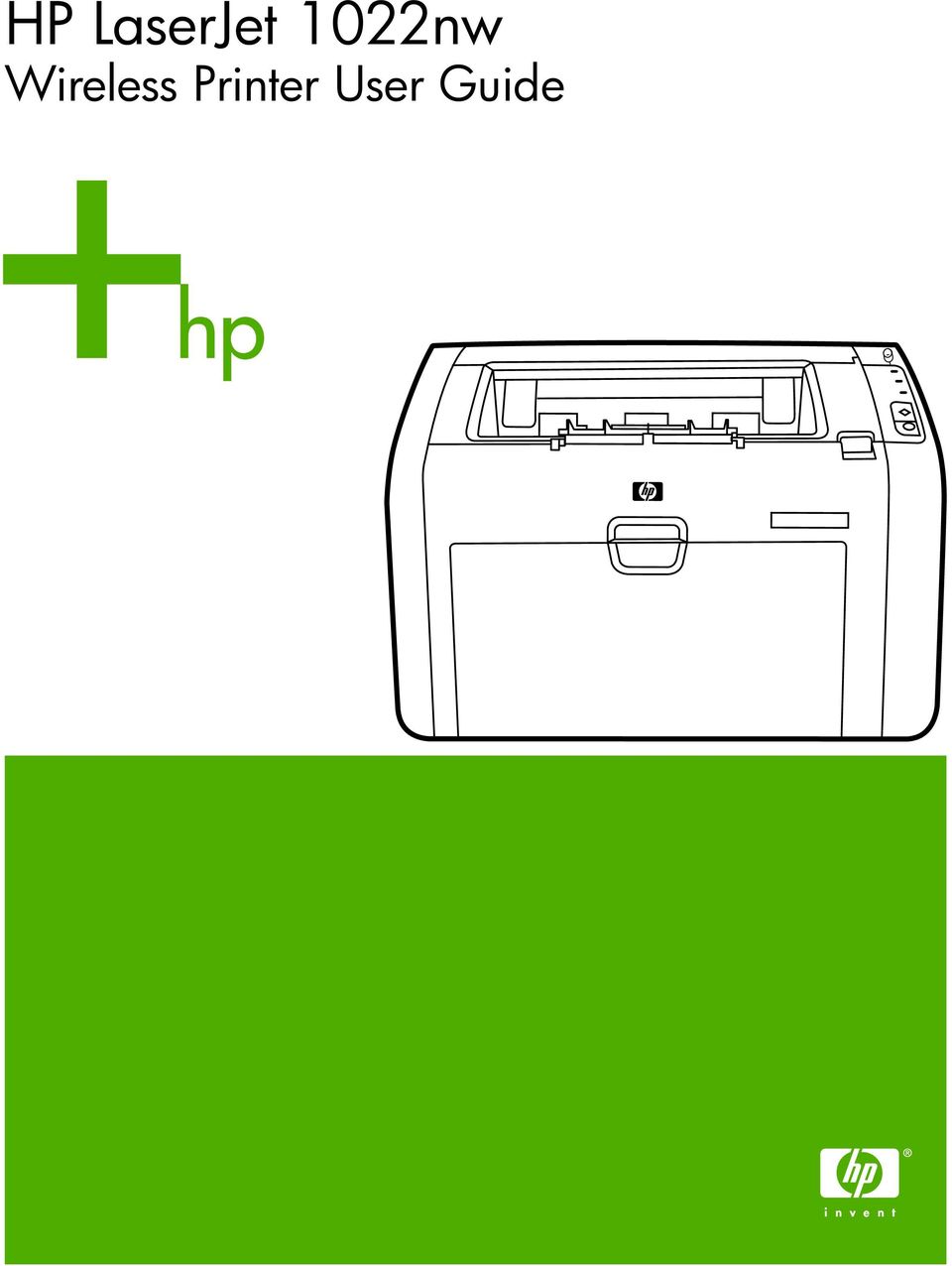
1 HP LaserJet 1022nw Wireless Printer User Guide
2

3 HP LaserJet 1022nw Wireless Printer User Guide
4 Copyright information 2005 Copyright Hewlett-Packard Development Company, L.P. Reproduction, adaptation or translation without prior written permission is prohibited, except as allowed under the copyright laws. The information contained in this document is subject to change without notice. The only warranties for HP products and services are set forth in the express warranty statements accompanying such products and services. Nothing herein should be construed as constituting an additional warranty. HP shall not be liable for technical or editorial errors or omissions contained herein. Part number: Q Edition 1, 02/2005 Trademark credits Microsoft and Windows are U.S. registered trademarks of Microsoft Corporation. Energy Star and the Energy Star logo are U.S. registered marks of the United States Environmental Protection Agency.
5 Table of contents 1 Networking basics Manual contents and sources for support and information...2 WWW links for drivers, software, and support...2 Where to look for more information...2 Wireless networking basics...3 Channels and communication modes...3 Security...4 Wireless profiles Support information for installing to a wireless network Chapter overview... 8 Printer Wireless light... 9 Configuration page...10 Printing a configuration page...10 General and wireless network settings...10 Embedded Web server...13 To open the embedded Web server...13 Information tab...14 Settings tab...14 Networking tab...14 Other links...14 Switching from wired to wireless...15 Resetting the printer to the factory default settings...16 Resetting the factory defaults Problem solving Solving problems that occur during installation...18 Computer is unable to discover a device...18 Personal software firewall is blocking communication...18 Device is unable to connect to the network after removing cable (infrastructure only)...18 System Requirements Error: No TCP/IP error displays...18 Printer not found screen appears during installation...19 Unable to determine or verify network name during installation...19 Verification fails at end of installation...20 Setup failed...21 Installation software does not install correctly...23 Solving infrastructure mode problems...24 The printer cannot find the WLAN...24 Printer cannot find your computer...24 Computer is unable to discover device...24 ENWW Table of contents iii

6 Solving ad-hoc mode problems...25 Printer cannot find your computer...25 Solving general wireless networking problems...26 Check the Wireless light...26 Printer has the wrong wireless network settings...27 To change the printer s network settings:...27 Computer's wireless card is set to the wrong wireless profile...28 Radio signal is weak...28 Wireless access point (WAP) filters MAC addresses...28 Appendix A Regulatory information USA Federal Communications Commission (FCC) compliance...29 Declaration of Conformity...30 Regulatory statements Laser safety statement...31 Canadian regulations...31 European Union regulatory notice...31 Laser statement for Finland...32 Environmental product stewardship program...34 Protecting the environment...34 Ozone production...34 Power consumption...34 Toner consumption...34 Paper use...34 Plastics...34 HP LaserJet printing supplies...35 HP printing supplies returns and recycling program information...35 Paper...36 Material restrictions...36 For more information...36 Material safety data sheet...37 OpenSSL License Original SSLeay License...39 Glossary Index iv ENWW

7 Networking basics This chapter provides information on the following topics: Manual contents and sources for support and information Wireless networking basics ENWW 1
8 Manual contents and sources for support and information NOTE Only the HP LaserJet 1022nw printer contains wireless capability. This manual is a supplementary document to the HP LaserJet 1022 Series Printer User Guide and to the HP LaserJet 1022nw Wireless Getting Started Guide. Both of these documents are included with the printer. This manual provides the following information about installing and connecting the printer to a wireless network: The Networking basics chapter contains overview information about wireless networking and the wireless features of the HP LaserJet 1022nw printer. The Support information for installing to a wireless network chapter contains support information that will be useful if you are installing the printer to a wireless network, or if you wish to change printer or network settings after you have installed the printer. You can find procedures for installing to a wireless network in the HP LaserJet 1022nw Printer Wireless Start Guide packaged with the printer. The Problem solving chapter contains troubleshooting information. In addition, this manual contains an appendix of regulatory information, a glossary of wireless terms, and an index. WWW links for drivers, software, and support If you need to contact HP for service or support, use the following link: support/lj1022/. Where to look for more information CD user guide: Detailed information on using and troubleshooting the printer. Available on the CD-ROM that came with the printer. Online Help: Information on printer options that are available from within printer drivers. To view a Help file, access the online Help through the printer driver. HTML (online) user guide: Detailed information on using and troubleshooting the printer. Available at Once connected, select Manuals. 2 Chapter 1 Networking basics ENWW
9 Wireless networking basics The HP LaserJet 1022nw printer has an internal HP wireless print server that supports both wired and wireless connectivity. However, the printer does not support simultaneous wired and wireless connections. To connect to a wireless network, the printer uses wireless protocol IEEE b/g that communicates data through radio transmission. After installing the printer to a wireless network, cables are not required to communicate with the computers or devices that are part of the network. NOTE The printer is compatible with b/g-compliant devices. A wireless local area network (WLAN) is a collection of two or more computers, printers, and other devices linked by radio waves. A WLAN uses high-frequency airwaves (radio) to communicate information from one point to another. To connect a computer or device to a wireless network, the computer or device must have a wireless network adapter. The HP LaserJet 1022nw printer uses an internal networking component that contains a wireless network adapter and radio. No cabling is necessary between networked devices that use wireless technology, although it is possible to use a cable to configure your printer for a wireless network. This is the recommended installation method. Common wireless network adapters include the following: USB adapter: An external device that connects to a USB port on the computer (typically has a PCMCIA card attached to one end). Notebook adapter: A PCMCIA card that plugs directly into one of the PCMCIA slots on your laptop or other portable computer. Desktop computer adapter: A dedicated ISA or PCI card, or a PCMCIA card with a special adapter, that plugs into your desktop computer. AirPort adapter: A wireless card that plugs directly into the AirPort slot on your Macintosh laptop or desktop computer. AirPort adapters eliminate the need for cable connections to the computer. The following sections contain overview information about wireless channels and communication modes, networking profiles, and network security. Channels and communication modes The band of radio signals used for IEEE b/g wireless networking is segmented into specific frequencies, or channels. For IEEE b/g wireless networks, 14 channels are available. But each country/region specifies the channels that are authorized for use. For example, in North America, only channels 1 through 11 are allowed. In Japan, channels 1 through 14 can be used. In Europe, except for France, channels 1 through 13 are allowed. Because existing standards change frequently, you should check with your local regulatory agencies for authorized channel use. In most countries/regions channels 10 and 11 may be used without restriction. Channel selection depends on the communication mode of the network. The communication mode defines how devices, such as computers and printers, communicate on a wireless network. There are two primary types of wireless communication modes: infrastructure and ad-hoc. ENWW Wireless networking basics 3

10 Infrastructure mode (preferred) In infrastructure mode, the printer communicates with network computers through a wireless access point (WAP) or a base station. The access point acts as a central hub or gateway connecting wireless and, optionally, wired devices. (Most access points have an integrated Ethernet controller to connect to an existing wired-ethernet network.) If your printer connects through a wireless residential gateway that provides access point functions, choose infrastructure mode. Ad-hoc mode In ad-hoc mode, which is sometimes called peer-to-peer mode, the printer communicates with your computer directly, rather than through an access point or base station. Each device on an ad-hoc network must have a wireless network adapter. The adapter enables each device to communicate with the other devices on the network. Ad-hoc mode is usually limited to simple, small wireless networks because performance degrades significantly after connecting too many network devices. This option is most often used if you are connecting only two network devices that are not sharing an Internet connection. NOTE For maximum performance, HP recommends connecting the printer to a network that communicates using the infrastructure mode. Security As with other networks, security for wireless networks focuses on access control and privacy. Traditional wireless network security includes the use of Service Set Identifiers (SSIDs), open or shared-key authentication, static Wired Equivalent Privacy (WEP) keys, and optional Media Access Control (MAC) authentication. This combination offers a basic level of access control and privacy. 4 Chapter 1 Networking basics ENWW

11 More advanced levels of security (such as Wi-Fi protected access [WPA] and Pre-shared key) are available through the printer s embedded Web server. For introductory information about the embedded Web server, see Embedded Web server. For detailed information about using the features, see the embedded Web server online help. NOTE It is highly recommended that you implement a wireless security scheme (either WEP or WPA) prior to setup. In addition, use an antivirus program to protect against computer viruses, and follow basic security rules such as setting strong passwords and not opening unknown attachments. Other network components, including firewalls, intrusion-detection systems, and segmented networks, should also be considered as part of your network design. Authentication and encryption are two different approaches to network security. Authentication verifies the identity of a user or device before granting access to the network, making it more difficult for unauthorized users to access network resources. Encryption encodes the data being sent across the network, making the data unintelligible to unauthorized users. Both of these security methods are common on wireless networks. Authentication The HP installation software supports Open System authentication. More advanced forms of authentication are available through the embedded Web server. A network with Open System authentication does not screen network users based on their identities and usually involves supplying the correct SSID. Such a network might use Wired Equivalent Privacy (WEP) encryption to provide a first level of security, or Wi-Fi protected access (WPA) to provide security by encrypting data sent over radio waves from one wireless device to another wireless device. The HP LaserJet 1022nw wireless printer allows for either WEP or WPA. NOTE Shared key and server-based authentication protocols are implemented through the embedded Web server. For introductory information about the embedded Web server, see Embedded Web server. For detailed information about using the features, see the embedded Web server online help. Network name (SSID) Wireless devices are configured with the name of the network to which they will connect. The network name is also called the SSID and identifies the ESS (Extended Service Set) that is normally associated with larger infrastructure networks. The SSID should not be considered a security feature because it can be easily identified. However, as a network administration or management feature, it does provide basic network access control. Encryption To reduce your network exposure to eavesdropping, establish a wireless security key for your network. The printer installation software supports the WEP security scheme, which hinders unauthorized users from accessing data transmitted over the radio waves. It is based on the use of a single WEP key, in which case each computer or device is configured with the same key to communicate on that network. ENWW Wireless networking basics 5

12 NOTE Up to four WEP keys might be used on a wireless network for transmission of data. For example, if you have three computers and an access point, each might be assigned a distinct key for transmitting data. However, the remaining keys must also be entered on each device so they can communicate with each other. The installation software for the HP LaserJet 1022nw printer provides the option to type one WEP key. If you want to use more than one WEP key, those keys must be entered into the printer s embedded Web server prior to installing the software. For introductory information about the embedded Web server, see Embedded Web server. For detailed information about using the features, see the embedded Web server online help. Media access control address authentication Some WLAN vendors support authentication based on the physical address, or MAC address, of the client Network Interface Card (NIC). In this scenario, an access point allows association by a client only if that client s MAC address matches an address in an authentication table used by the access point. This is not configurable through the printer. Wireless profiles A wireless profile is a set of network settings unique to a given wireless network. Many wireless devices have configuration utilities that allow the device to have wireless profiles for several wireless networks. In order to use the printer, the printer's wireless settings must match the computer's network settings for that wireless network. For example, a person uses the same wireless-enabled laptop at work and at home. Each network has a unique set of wireless settings. The person creates the following wireless profiles on the laptop: at_work: Contains the network settings for the office wireless network at_home: Contains the network settings for the home wireless network When the laptop is being used at work, the person must set the wireless profile to at_work in order to connect to the office network. Conversely, the laptop must be set to the at_home wireless profile when the person is at home and wants to connect the laptop to the home network. NOTE The HP LaserJet 1022nw printer cannot be connected to a wired and wireless network at the same time. 6 Chapter 1 Networking basics ENWW

13 Support information for installing to a wireless network This chapter provides information on the following topics: Chapter overview Printer Wireless light Configuration page Embedded Web server Switching from wired to wireless Resetting the printer to the factory default settings ENWW 7
14 Chapter overview This chapter contains information that will be useful if you are installing the printer to a wireless network, or if you are changing printer or network settings after you have installed the printer. Specifically, this chapter contains a description of the printer Wireless light and the configuration page, and an overview of the embedded Web server (EWS). In addition, this chapter contains procedures for resetting the printer network setting and for switching between wireless and wired communications. The procedure you follow for installing the printer to a wireless network depends on whether the network communicates through an infrastructure mode or through an ad-hoc mode. You can find procedures for installing the printer to a wireless network in the HP LaserJet 1022nw printer Wireless Getting Started Guide that was packaged with the printer. For more information about infrastructure and ad-hoc networks, see Wireless networking basics. NOTE NOTE For maximum efficiency, HP recommends the printer be connected to a network that uses the infrastructure communication mode. The printer cannot be connected to a wired and wireless network at the same time. 8 Chapter 2 Support information for installing to a wireless network ENWW

15 Printer Wireless light The HP LaserJet 1022nw printer has an internal networking component that provides wireless connectivity. To view the status of the wireless communications, the printer contains a Wireless light. If the light is on, the printer is connected to a wireless network. If the light flashes, the printer is scanning for a wireless network. If the light is off, wireless networking is disabled. ENWW Printer Wireless light 9

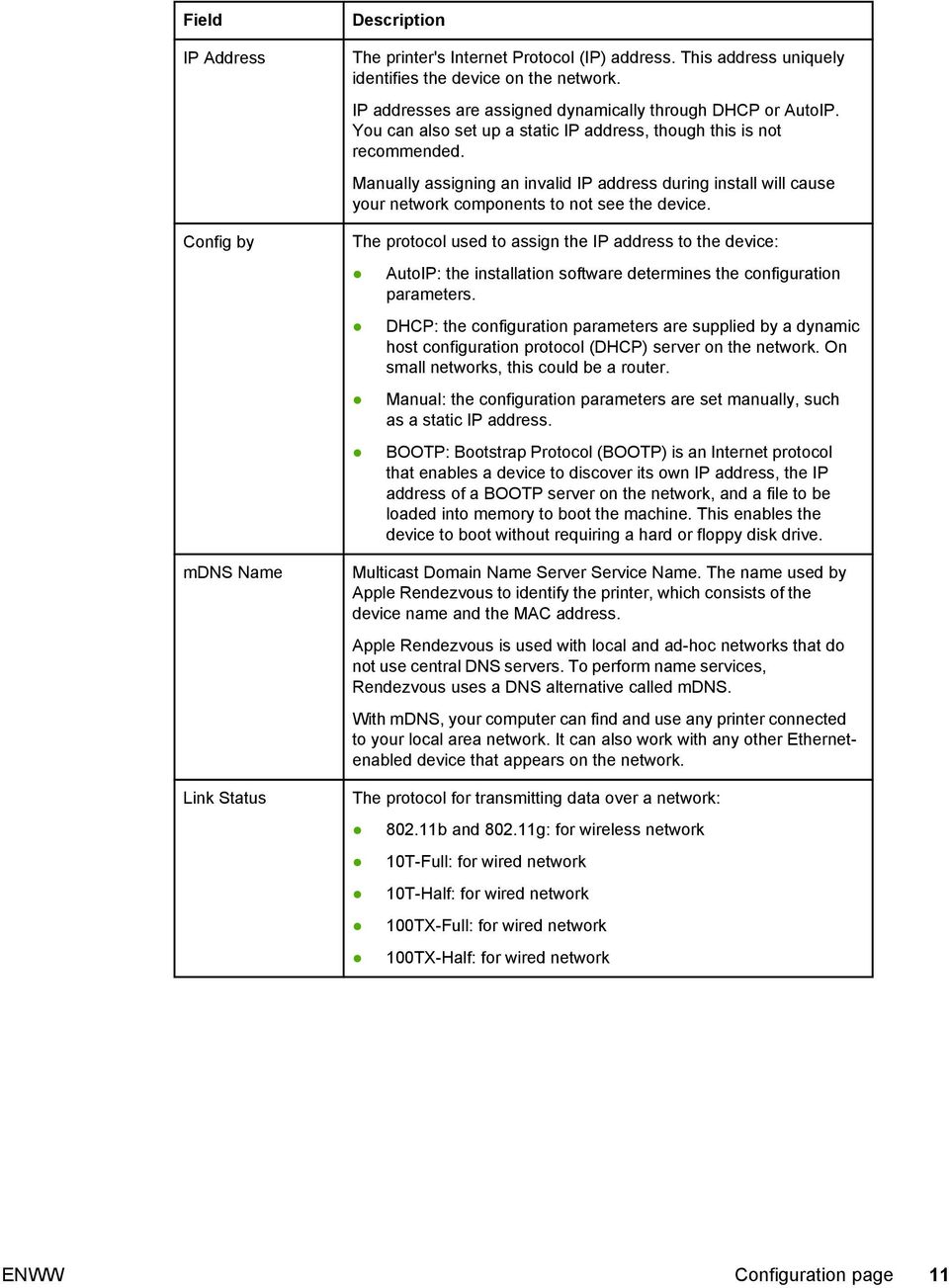
16 Configuration page The printer includes an internal component that provides networking capability for both wired and wireless connectivity. This section contains a procedure for printing a configuration page, as well as a description of the general network and wireless network fields that display on the page. Printing a configuration page When the printer is in the Ready state, press and hold the GO button until the Ready light starts blinking. General and wireless network settings NOTE All of the settings on the configuration page should match the settings of the network with which you are trying to connect. If any values are different, you might not be able to connect to the network. The following sections describe the various fields on the configuration page. General network settings Field Hardware Address Description The Media Access Control (MAC) address that uniquely identifies the printer. This is a unique 12-digit identification number assigned to networking hardware for identification, like a digital fingerprint. No two pieces of hardware have the same MAC address. NOTE Some ISPs require that you register the MAC address of the Network Card or LAN Adapter that was connected to your cable or DSL modem during installation. Firmware Version The internal networking component and device firmware revision code separated by a hyphen. NOTE You might be asked to provide the firmware revision code if you call for support. Host Name The TCP/IP name assigned by the install software to the device. By default, these are the letters NPI followed by the last six digits of the MAC address. You can also configure the device name through the embedded Web server. 10 Chapter 2 Support information for installing to a wireless network ENWW
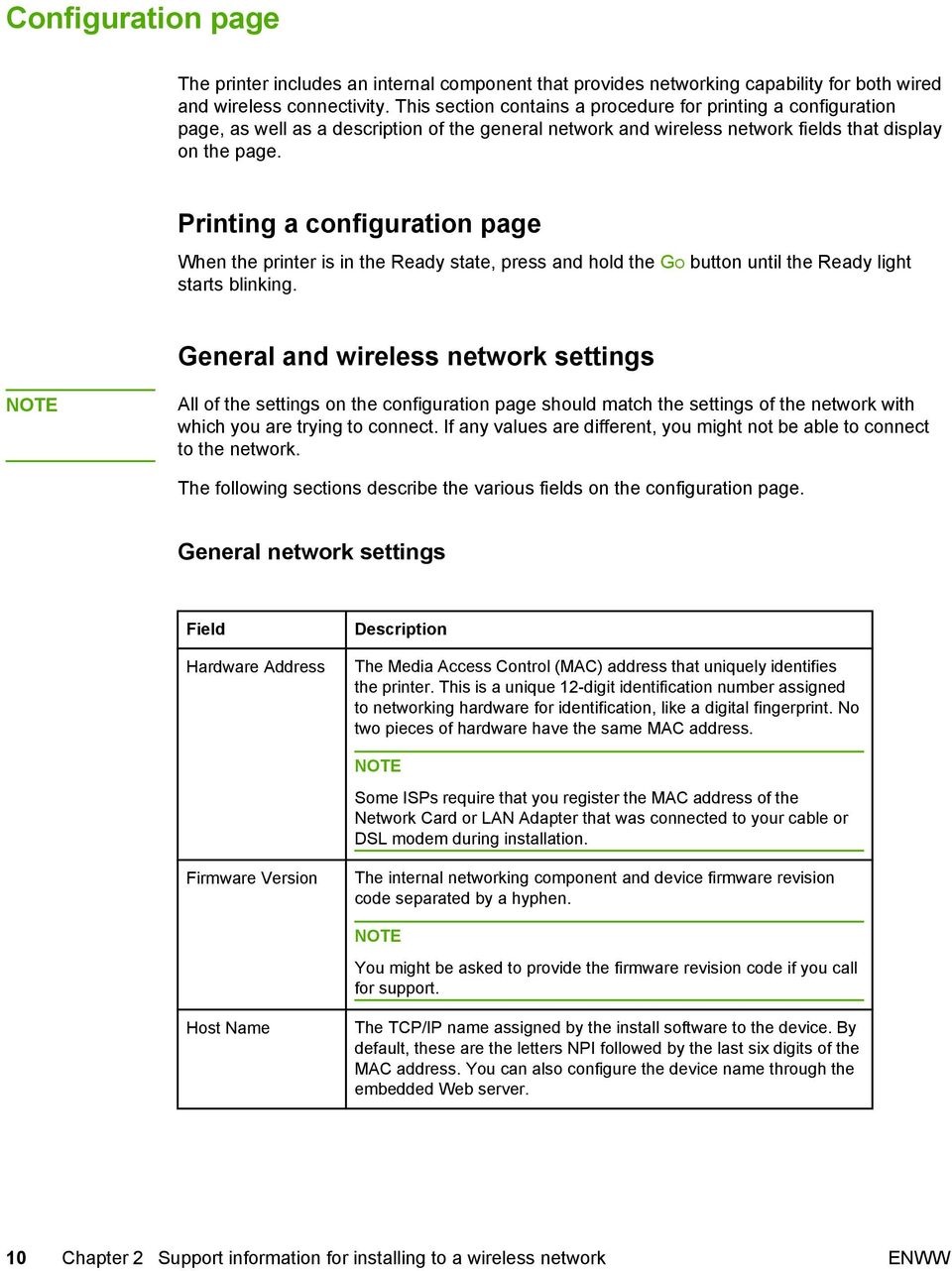
17 Field IP Address Config by mdns Name Link Status Description The printer's Internet Protocol (IP) address. This address uniquely identifies the device on the network. IP addresses are assigned dynamically through DHCP or AutoIP. You can also set up a static IP address, though this is not recommended. Manually assigning an invalid IP address during install will cause your network components to not see the device. The protocol used to assign the IP address to the device: AutoIP: the installation software determines the configuration parameters. DHCP: the configuration parameters are supplied by a dynamic host configuration protocol (DHCP) server on the network. On small networks, this could be a router. Manual: the configuration parameters are set manually, such as a static IP address. BOOTP: Bootstrap Protocol (BOOTP) is an Internet protocol that enables a device to discover its own IP address, the IP address of a BOOTP server on the network, and a file to be loaded into memory to boot the machine. This enables the device to boot without requiring a hard or floppy disk drive. Multicast Domain Name Server Service Name. The name used by Apple Rendezvous to identify the printer, which consists of the device name and the MAC address. Apple Rendezvous is used with local and ad-hoc networks that do not use central DNS servers. To perform name services, Rendezvous uses a DNS alternative called mdns. With mdns, your computer can find and use any printer connected to your local area network. It can also work with any other Ethernetenabled device that appears on the network. The protocol for transmitting data over a network: b and g: for wireless network 10T-Full: for wired network 10T-Half: for wired network 100TX-Full: for wired network 100TX-Half: for wired network ENWW Configuration page 11
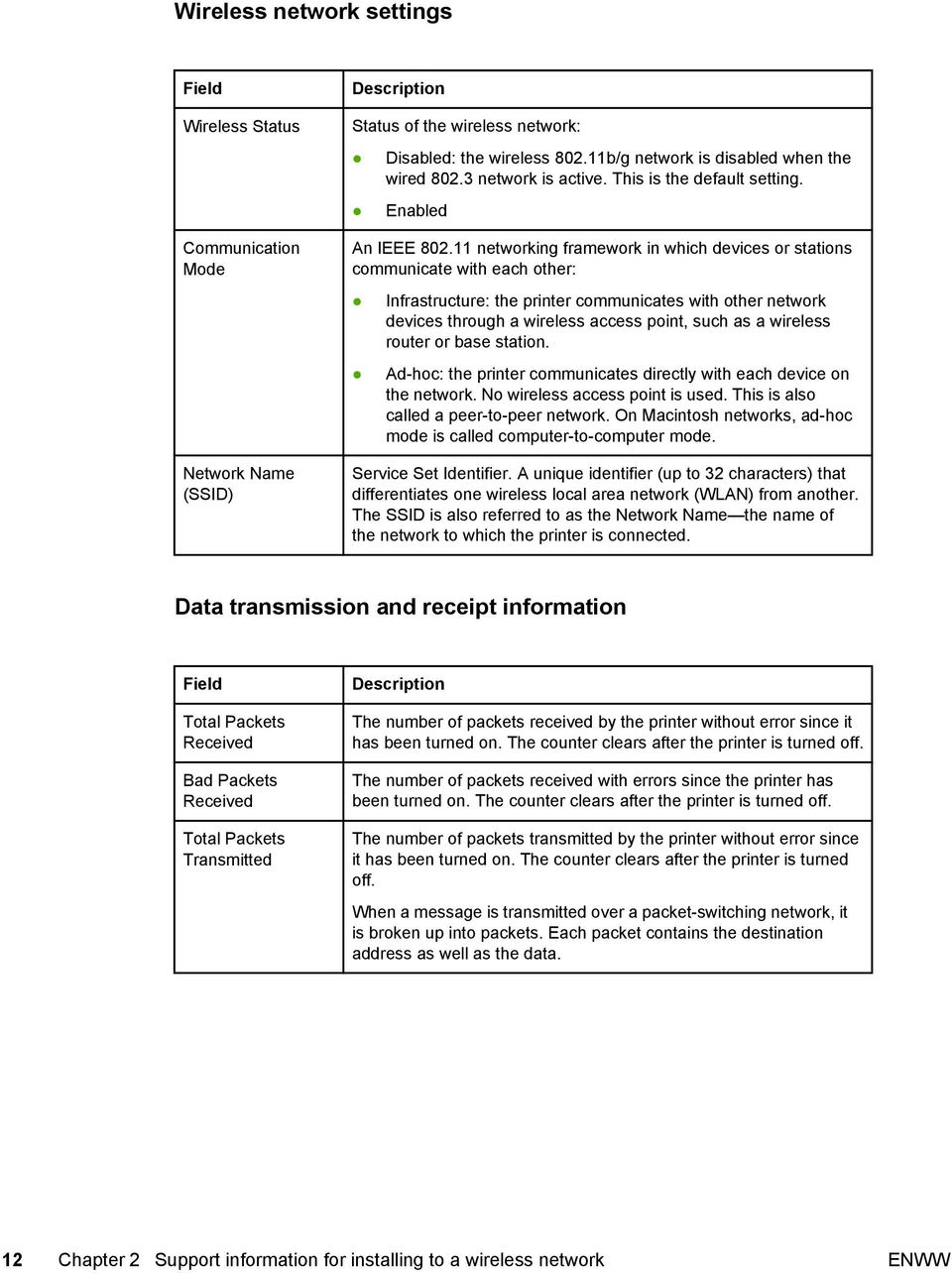
18 Wireless network settings Field Wireless Status Communication Mode Network Name (SSID) Description Status of the wireless network: Disabled: the wireless b/g network is disabled when the wired network is active. This is the default setting. Enabled An IEEE networking framework in which devices or stations communicate with each other: Infrastructure: the printer communicates with other network devices through a wireless access point, such as a wireless router or base station. Ad-hoc: the printer communicates directly with each device on the network. No wireless access point is used. This is also called a peer-to-peer network. On Macintosh networks, ad-hoc mode is called computer-to-computer mode. Service Set Identifier. A unique identifier (up to 32 characters) that differentiates one wireless local area network (WLAN) from another. The SSID is also referred to as the Network Name the name of the network to which the printer is connected. Data transmission and receipt information Field Total Packets Received Bad Packets Received Total Packets Transmitted Description The number of packets received by the printer without error since it has been turned on. The counter clears after the printer is turned off. The number of packets received with errors since the printer has been turned on. The counter clears after the printer is turned off. The number of packets transmitted by the printer without error since it has been turned on. The counter clears after the printer is turned off. When a message is transmitted over a packet-switching network, it is broken up into packets. Each packet contains the destination address as well as the data. 12 Chapter 2 Support information for installing to a wireless network ENWW
19 Embedded Web server The embedded Web server provides a convenient way to manage your printer on a network. The embedded Web server is available for the HP LaserJet 1022nw printer over the Internal HP network connection. The following information applies to the embedded Web server: You do not need to install any software on the computer. You only need to have a supported Web browser. To use the embedded Web server, you must have Microsoft Internet Explorer 5.5 or later or Netscape Navigator 6.0 or later. The embedded Web server is available in English only. The embedded Web server does not provide or status alerts. The embedded Web server allows you to view printer and network status and to manage printing functions from your computer instead of from the printer control panel. The following are examples of what you can do using the embedded Web server: View printer status information Order new supplies View and change the printer default configuration settings View and change the printer s wired -or wireless network settings The embedded Web server works when the printer is connected to an IP-based network. The embedded Web server does not support IPX-based printer connections or AppleTalk. NOTE CAUTION Internet access is not required to open and use the embedded Web server. However, if you click a link in the Other Links area, you must have Internet access in order to go to the site associated with the link. It is recommended that the printer and associated computers reside on the same subnet. Printer installation across subnets can be problematic depending on the type of router used. However, if the printer is on a different subnet than your computer, enter the printer's IP address (for example, in the browser's Address fields to open the embedded Web server. Also, if your computer uses a proxy server to access the Internet, you might need to configure your browser to by-pass the proxy server in order to access the embedded Web server. To open the embedded Web server 1. In a supported Web browser, type the IP address or hostname for the printer. To find the IP address, print a configuration page at the printer by pressing and holding the GO button until the Ready light starts blinking. NOTE Once you open the URL, you can bookmark it so that you can return to it quickly in the future. 2. The embedded Web server has three tabs that contain settings and information about the printer: the Information tab, the Settings tab, and the Networking tab. Click the tab that you want to view. ENWW Embedded Web server 13

20 Information tab The Information tab contains the following pages: Device Status. This page displays the printer and supplies status. This page also displays product information such as the network name, network address, and model information. Configuration. This page shows information found on the printer Configuration page. Settings tab This tab allows you to configure the printer from your computer. If this printer is networked, always consult with the printer administrator before changing settings on this tab. The Settings tab contains the Print Settings page. On the Print Settings page you can view and change basic information about the printer. Networking tab This tab allows the network administrator to control network-related settings for the printer when it is connected to an IP-based network. Other links This section contains links that connect you to the Internet. You must have Internet access in order to use any of these links. If you use a dial-up connection and did not connect when you first opened the embedded Web server, you must connect before you can visit these Web sites. Connecting might require that you close the embedded Web server and reopen it. Product Registration. Connects you to the product registration page on the HP Web site. Order Supplies. Click this link to connect to the Sure Supply Web site and order genuine HP supplies from HP or a reseller of your choice. Product Support. Connects to the support site for the HP LaserJet 1022nw printer. You can search for help regarding general topics. HP Instant Support. Connects you to the HP Web site to help you find solutions. This service analyzes your printer error log and configuration information to provide diagnostic and support information specific to your printer. CAUTION Use caution when changing the print server's wireless network settings. It is possible that the printer could lose the connection, which might require resetting the printer to the factory defaults and reinstalling the software. 14 Chapter 2 Support information for installing to a wireless network ENWW

21 Switching from wired to wireless If the printer is communicating with a wireless network and you plug a LAN cable into the printer, it automatically switches to wired communications. For more information, see Embedded Web server. ENWW Switching from wired to wireless 15
22 Resetting the printer to the factory default settings Once the printer is configured for a network, its configuration settings are saved in its memory. Resetting the printer to its factory default settings will clear all the settings from the printer's memory for your network. This should only be done as a last resort when troubleshooting the printer. Resetting the printer to its factory default settings may require you to reinstall the printer software. Additionally, you will also have to reconfigure the printer's security settings. The printer's default settings are: Option Communication mode Network Name (SSID) Encryption Wireless Radio Default settings ad-hoc hpsetup None On, if no LAN cable is attached Resetting the factory defaults When the printer is turned off, press and hold the GO and CANCEL buttons. Turn on the printer, and continue to hold the GO and CANCEL buttons until all lights are blinking in unison. 16 Chapter 2 Support information for installing to a wireless network ENWW
23 Problem solving This chapter provides information on the following topics: Solving problems that occur during installation Solving infrastructure mode problems Solving ad-hoc mode problems Solving general wireless networking problems ENWW 17
24 Solving problems that occur during installation This section contains solutions to problems that might occur while initially installing the printer to a wireless network. Computer is unable to discover a device 1. Verify that the following cables are connected properly: Power cables Cables between the printer and the hub or router Cables between the hub or router and your computer (If applicable) cables to and from your modem or Internet connection 2. Verify that you have an active network connection. Look at the light on the network connector. If the light is on, the printer is connected to a wired network. If the light is off, check the cable connections from the printer to the gateway, router, or hub to ensure connections are secure. If the connections are secure, recycle the power on the printer to initiate another search for a wireless network. Personal software firewall is blocking communication The personal software firewall is a security program that protects a computer from intrusion. However, the personal firewall might block communication between the computer and the printer. If you cannot communicate with the printer, try disabling the personal firewall. If you are still unable to communicate with the printer, then re-enable the firewall. If disabling the firewall allows you to communicate with the printer, you might want to assign the printer a static IP address and then re-enable the firewall. For information about firewalls that are used in an HP environment, see Device is unable to connect to the network after removing cable (infrastructure only) If the access point/gateway has MAC filtering enabled, enter the MAC address of the printer into the access point. The printer should then be able to connect to the wireless network. For more information, see Wireless access point (WAP) filters MAC addresses. System Requirements Error: No TCP/IP error displays Make sure your LAN card is installed properly and set up for TCP/IP (Windows only). For more information, see Computer is unable to discover a device. 18 Chapter 3 Problem solving ENWW
25 Printer not found screen appears during installation 1. Verify that the printer is turned on. 2. Verify that you have an active network connection. Look at the light on the network connector on the back of the unit. If the light is on, the printer is connected to a wired network. If the light is off, check the cable connections from the printer to the gateway, router, or hub to ensure connections are secure. Verify that the printer is connected to the network with the cable that is packaged with the printer. If the connections are secure, recycle the power on your printer. 3. Print a configuration page. To print a configuration page, when the printer is in the Ready state, press and hold the GO button until the Ready light starts blinking. For more information, see Configuration page. 4. Verify that the printer s internal networking component is set to its factory default settings. If the print server was previously configured, it might need to be reset to the factory default settings. Communication mode: ad-hoc (peer-to-peer) Network name (SSID): hpsetup Encryption: disabled You can check the print server's configuration by printing a configuration page. To reset the printer to the factory settings, when the printer is turned off, press and hold the GO and CANCEL buttons. Turn on the printer, and continue to hold the GO and CANCEL buttons until all lights are blinking in unison. 5. Move the printer and the computer closer together. If the distance between your computer and the printer is significant, try reducing the distance. If possible, provide a clear path between the computer and print server, and minimize sources of radio interference. For more information, see Radio signal is weak. Unable to determine or verify network name during installation Setup has either detected multiple networks or has been unable to read or verify the network name from the access point. In the Select Network Name screen, do one of the following: If the wireless access point or router was turned on after the printer was turned on, you should turn the printer off and then on again to allow the printer to find the SSID. Enter a new SSID entry. If you choose to enter the wireless Network Name (SSID), also select the Communication Mode (Ad-Hoc or Infrastructure). Select an existing network name from the list. Up to 12 SSIDs, detected at the time the internal networking component booted up, might be listed. NOTE The SSID entry is case-sensitive and can be up to 32 alphanumeric characters long, including spaces. You cannot leave the network name field blank. ENWW Solving problems that occur during installation 19
26 Verification fails at end of installation Possible problem: You are using advanced forms of encryption, such as dynamic encryption, WPA, or WPA-PSK, the encryption methods must be entered through the embedded Web server. For more information, see Embedded Web server. In dynamic encryption, each device has a different key and all keys change frequently. Dynamic encryption is much harder for an intruder to circumvent, since the keys are likely to change before the intruder can reverse engineer them. Possible problem: Your SSID or WEP key might be incorrectly set. Complete the following procedure to set the SSID or WEP key: 1. Print a configuration page. To print a configuration page, when the printer is in the Ready state, press and hold the GO button until the Ready light starts blinking. For more information, see Configuration page. 2. Make sure the network SSID and WEP key on the device and the wireless network match. 3. If one or both are incorrect, enter either the URL or device IP address from the configuration page into the Address field on your Web browser. The printer EWS Home page appears. 4. Select the Networking tab. 5. Click the Wireless option. 6. Enter the correct values in the appropriate sections (Network Name (SSID) and Encryption). 7. Click Apply. Possible problem: Your network uses multiple WEP keys, and you have chosen the wrong key for transmitting. 1. Print a configuration page. To print a configuration page, when the printer is in the Ready state, press and hold the GO button until the Ready light starts blinking. For more information, see Configuration page. 2. Enter either the URL or device IP address from the configuration page into the Address field on your Web browser. The EWS Home page appears, showing the printer device information. 3. Click the Networking tab. 4. Click the Wireless option. 5. In the Encryption section, select the Static (WEP) option. 6. Under Static (WEP), enter the WEP keys used by your network. In static encryption, the same key is used for all devices on the network and the key remains the same for long periods of time. 7. Choose the key to be used to encrypt transmitted data. (The installer defaults to WEP Key 1.) 8. Click Apply. 9. If the installation has terminated, restart the printer software CD-ROM. Possible problem: You are using advanced authentication protocols that are not supported by the installation software, such as LEAP, PEAP, EAP-MD5, EAP-TLS, or EAP-TTLS. 20 Chapter 3 Problem solving ENWW
27 1. Print a configuration page. To print a configuration page, when the printer is in the Ready state, press and hold the GO button until the Ready light starts blinking. For more information, see Configuration page. 2. Enter either the URL or device IP address from the configuration page into the Address field on your Web browser. The EWS Home page appears, showing the printer device information. 3. Click the Networking tab. 4. Click the Wireless option. 5. In the Communication Mode section, select Infrastructure. 6. Select a network name (SSID) from the list of detected networks, or enter the name of a new wireless network. 7. Select WPA/PSK, enter a pass phrase (from 8 to 63 characters in length, including spaces) that will be used by the software to generate a pre-shared key. NOTE All devices on the network must use the same pass phrase. 8. Click Apply. Setup failed Possible problem: No signal is being received by the device because it is not in range of the access point (infrastructure) or computer (ad-hoc). Move the printer and the computer closer together. If the distance between your computer and the printer is significant, try reducing the distance. If possible, provide a clear path between the computer and print server, and minimize sources of radio interference. Possible problem: The setup program tried to change the computer s wireless configuration so that it can communicate to the printer, but was unable to reprogram the settings on the computer s wireless access card. 1. Quit all applications. 2. If your computer is connected to the Internet, disable the connection to your computer by removing the Ethernet cable that connects the modem (cable, DSL, or dial-up) to your computer. 3. Click Setup. The Setup menu appears. 4. Select 6. The Network menu appears. 5. Select 2. The wireless radio setting options appear. NOTE The default setting for the wireless radio is Off. 6. Use the up and down buttons to select On. 7. Select OK. 8. Open the configuration utility for your wireless network adapter. 9. Write down the existing wireless profile settings. ENWW Solving problems that occur during installation 21
28 10. Create a new wireless profile with the following values: Communication mode: Ad Hoc Network name (SSID): hpsetup Encryption: disabled NOTE This is the default configuration for your printer s internal networking component. 11. Activate the profile. When the configuration change is complete, the computer is ready to communicate on the printer s network. (The computer is no longer part of its original network.) NOTE Unless you change your computer settings, the computer will continue to communicate with your existing wireless network. However, the wireless device that you need to configure is on its own network (called hpsetup). To configure that device, you need to temporarily change your computer to the printer s network. 12. Print a configuration page and obtain the IP address of the printer. To print a configuration page, when the printer is in the Ready state, press and hold the GO button until the Ready light starts blinking. For more information, see Configuration page. 13. Open your Web browser on your computer. 14. Type either the URL or device IP address from the configuration page into the Address field in your browser. The EWS Home page appears. 15. Select the Networking tab. 16. Click the Wireless option. 17. In the appropriate section, enter the profile values you recorded in step Click Apply. 19. Exit the EWS by closing your browser. 20. Open the configuration utility for your wireless network adapter. 21. Restore the previous wireless profile settings. 22. Unplug the network cable from the printer. 23. Wait 60 seconds and then print a configuration page. The Wireless light should be on. 24. Open your Web browser on your computer. 25. Enter either the URL or device IP address from the configuration page into the Address field in your browser. If the EWS Home page appears, your printer is properly configured. 26. Exit the EWS by closing your browser. 27. Insert the printer software installation CD into your computer's CD-ROM drive. 28. Run the installation software again. 22 Chapter 3 Problem solving ENWW
29 Installation software does not install correctly During a normal installation of the printer software, the following actions occur: The printer CD-ROM runs automatically The software installs Files are copied to your hard drive You are requested to plug in the printer You are requested to restart your computer The registration process runs If any of these actions did not occur, there might be a problem with the installation. To check the installation on a PC, verify the following: Open the Printers dialog box and check to see that the printer is listed. Look at the Task Tray for a printer icon. This indicates that the printer is ready. If nothing happens when you insert the CD-ROM into the computer s CD-ROM drive, do the following: 1. From the Windows Start menu, choose Run. 2. In the Run box, type d:\setup.exe (if your CD-ROM drive is not assigned to drive letter d, use the appropriate drive letter), and then click OK. If the minimum system checks screen appears, your system does not meet the minimum requirements to install the software. Click Details to view the specific problem. Correct the problem before attempting to install the software. ENWW Solving problems that occur during installation 23
30 Solving infrastructure mode problems This section contains solutions to problems that might occur if the printer is connecting to a wireless network that communicates using the infrastructure mode. For more information, see Channels and communication modes. The printer cannot find the WLAN 1. Verify your access point is broadcasting its network name (SSID). a. See your access point User Guide and check the access point settings. b. Turn on options, such as broadcast network name, and turn off silent broadcast. 2. Turn off the access point unit, and then turn it on. Then run the printer software setup program again. 3. Move the access point and the printer closer together. Then run the printer software setup program again. For more information, see Radio signal is weak. 4. Check for firmware updates for your access point on the manufacturer s Web site. a. Update the firmware on the access point. b. Run the printer software setup program again. Printer cannot find your computer 1. Verify you have a functioning wireless network by using another wireless device. 2. Verify the printer is operational. 3. Verify the IP address and subnet mask of your printer and computer are similar (on the same network). 4. Verify the encryption settings on your access point. The same encryption key and settings must be used on both the access point and the printer. For more information, see Solving problems that occur during installation. Computer is unable to discover device 1. Print a configuration page and verify you are connecting to the correct wireless network. To print a configuration page, when the printer is in the Ready state, press and hold the GO button until the Ready light starts blinking. For more information, see Configuration page. 2. If you have a firewall, grant access permission to the printer. 3. Try temporarily disabling the firewall to determine whether the firewall is preventing the printer from accessing your computer. 24 Chapter 3 Problem solving ENWW
31 Solving ad-hoc mode problems This section contains solutions to problems that might occur if the printer is connecting to a wireless network that communicates using the ad-hoc mode. For more information, see Channels and communication modes. Printer cannot find your computer 1. Verify you have a functioning wireless ad-hoc network by using another wireless device. 2. Verify the printer is operational. For more information, see Solving problems that occur during installation. 3. Verify the IP address and subnet mask of your printer and computer are similar (on the same network). 4. Verify your computer s wireless adapter is broadcasting its network name (SSID), which can be found on the configuration page. To print a configuration page, when the printer is in the Ready state, press and hold the GO button until the Ready light starts blinking. For more information, see Configuration page. 5. Verify the encryption settings on your access point. The same encryption key and settings must be used on both the access point and the printer. For more information, see Solving problems that occur during installation. 6. Check for firmware updates for your wireless adapter on the manufacturer s Web site. a. Update the firmware. b. Run the printer software setup program again. ENWW Solving ad-hoc mode problems 25
32 Solving general wireless networking problems For most wireless printing problems, the first step is to try printing a configuration page. To print a configuration page, when the printer is in the Ready state, press and hold the GO button until the Ready light starts blinking. For more information, see Configuration page. If the configuration page does not print, verify the following: Printer is set up and powered on Print cartridges are installed correctly Printer is on and the paper tray is loaded Printer is free of paper jams Network connections are secure Cable connections are secure Printer covers are closed If any of the above are problems, see the HP LaserJet 1022 Series Printer User Guide. If the configuration page does print, you can begin to solve the problem by checking the Wireless light, as described below. Check the Wireless light Look at the printer's Wireless light. If the Wireless light is off, wireless networking has been disabled. Verify the printer s network settings match the network settings (see Printer has the wrong wireless network settings.) Then, verify the following: An Ethernet cable is not connected to the printer. Connecting an Ethernet cable to the printer automatically turns off the wireless radio. Unplug the cable. If the Wireless light is on, try reprinting the document, then look at the printer's Ready light. If the Ready light is flashing, the printer s wireless communications feature is working correctly. If the Wireless light is on steadily, the wireless radio is functioning, but the printer and the computer cannot communicate. The printer's network settings do not match the settings for your network. See Printer has the wrong wireless network settings. The computer might be set to the wrong wireless profile. See Computer's wireless card is set to the wrong wireless profile. A personal software firewall might block communication between the printer and the computer. See Radio signal is weak. 26 Chapter 3 Problem solving ENWW
33 Printer has the wrong wireless network settings The printer's wireless network settings must match those of your network, which includes the following: Communication mode Network Name (SSID) Channel (ad-hoc networks only) Authentication type 1. Reconnect the cable. 2. Compare the network settings to those that appear on the printer's configuration page. To print a configuration page, when the printer is in the Ready state, press and hold the GO button until the Ready light starts blinking. For more information, see Configuration page. 3. Do one of the following to find the settings for your network: If the printer is communicating with the network using the infrastructure mode, open the Wireless Access Point's (WAP) configuration utility. If the printer is communicating with the network using the ad-hoc mode, open the configuration utility for the network card installed in your computer. 4. Compare the settings and note any settings that are different. Possible problems include: The WAP filters hardware addresses (MAC addresses). See Wireless access point (WAP) filters MAC addresses. One of these settings in the printer might be incorrect: communication mode, network name (SSID), channel (ad-hoc networks only), or security settings. See Printer has the wrong wireless network settings. 5. Reprint the configuration page. To change the printer s network settings: 1. Open the printer's embedded Web server. 2. Click the Networking tab. For wireless settings, click Wireless. For IP settings, click IP Configuration. 3. Change the printer's settings to match the settings of the network, then click Finish. 4. Close the printer's EWS, then disconnect the Ethernet cable from the printer. 5. The control panel lights will cycle. If the printer is still not working, verify the computer s wireless profile. Then, as a last option, reset the network settings to the factory defaults and use the printer software CD to reinstall the printer software. To reset the network settings to the factory defaults, when the printer is turned off, press and hold the GO and CANCEL buttons. Turn on the printer, and continue to hold the GO and CANCEL buttons until all lights are blinking in unison. NOTE If you reset the network settings, you will have to reconfigure all the network settings. ENWW Solving general wireless networking problems 27
34 Computer's wireless card is set to the wrong wireless profile A wireless profile is a set of network settings unique to a given network. A single wireless card might have several wireless profiles (for example, one for home and one for the office). Open the configuration utility for the network card installed on your computer and verify that the profile selected is the profile for the printer's network. If not, select the correct profile. Radio signal is weak If the printer is printing slowly, then the radio signal might be weak. Follow these guidelines for reducing interference in a wireless network: Keep the wireless devices away from large metal objects, such as filing cabinets, and other electromagnetic devices, such as microwaves and cordless telephones, as these objects can disrupt radio signals. Keep the wireless devices away from large masonry structures and other building structures as these objects can absorb radio waves and lower signal strength. For an infrastructure network, position the WAP in a central location in line of sight with the wireless devices on the network. Keep all wireless devices on the network within range of one another. Wireless access point (WAP) filters MAC addresses MAC filtering is a security feature in which a Wireless Access Point (WAP) is configured with a list of MAC addresses (also called hardware addresses) of devices that are allowed to gain access to the network through the WAP. If the WAP does not have the hardware address of a device attempting to access the network, the WAP denies the device access to the network. If the WAP filters MAC addresses, then the printer's MAC address must be added to the WAP's list of accepted MAC addresses. 1. Print a configuration page. To print a configuration page, when the printer is in the Ready state, press and hold the GO button until the Ready light starts blinking. For more information, see Configuration page. 2. Find the printer's hardware address on the configuration page. Open the WAP's configuration utility, then add the printer's hardware address to the list of accepted MAC addresses. 28 Chapter 3 Problem solving ENWW
35 Regulatory information USA Federal Communications Commission (FCC) compliance CAUTION Based on Section of the FCC rules, changes or modifications to the operation of this product without the expressed approval by Hewlett-Packard Company may invalidate its authorized use. This equipment has been tested and found to comply with the limits for a Class B digital device, pursuant to Part 15 of the FCC rules. These limits are designed to provide reasonable protection against interference when the equipment is operated in a residential installation. This equipment generates, uses, and can radiate radio frequency energy and, if it is not installed and used in accordance with the instructions, may cause harmful interference to radio communications. However, there is no guarantee that interference will not occur in a particular installation. If this equipment does cause harmful interference to radio or television reception, which can be determined by turning the equipment off and on, the user is encouraged to try to correct the interference by one or more of the following measures: Reorient or relocate the receiving antenna. Increase separation between the equipment and receiver. Connect equipment into an outlet on a circuit different from that to which the receiver is connected. Consult your dealer or an experienced radio/tv technician for help. This device complies with Part 15 of FCC Rules. Operation is subject to the following two conditions: (1) this device may not cause harmful interference, and (2) this device must accept any interference received, including interference that may cause undesired operation. Exposure to radio frequency radiation CAUTION The radiated output power of this device is far below the FCC radio frequency exposure limits. Nevertheless, the device shall be used in such a manner that the potential for human contact during normal operation is minimized. In order to avoid the possibility of exceeding the FCC radio frequency exposure limits, human proximity to the antenna shall not be less than 20 cm (8 inches) during normal operation. ENWW USA Federal Communications Commission (FCC) compliance 29
36 Declaration of Conformity Declaration of Conformity according to ISO/IEC Guide 22 and EN Manufacturer's Name: Manufacturer's Address: Hewlett-Packard Company Chinden Boulevard, Boise, Idaho , USA declares that the product Product Name: Regulatory Model 3) : Product Options: HP LaserJet 1022nw BOISB ALL Toner Cartridge: Q2612A conforms to the following Product Specifications: Safety: IEC :2001 / EN :2001 +A11 IEC :1993 +A1:1997 +A2:2001 / EN :1994 +A1:2002 +A2:2001 (Class 1 Laser/LED Product) EMC: CISPR 22:1997 / EN 55022:1998 Class B 1) EN :2000 EN :1995 /A1:2001 EN 55024:1998/A1:2001 FCC Title 47 CFR, Part 15 Class B 2) / ICES-003, Issue 4 Radio 4) : EN :2002 / EN :2002 EN V1.4.1: ( ) Supplementary Information: FCC Title 47 CFR, Part 15 Subpart C (Section ) / IC: RSS-210 The product herewith complies with the requirements of the R&TTE Directive 1999/5/EC Annex IV, EMC Directive 89/336/EEC and the Low Voltage Directive 73/23/EEC, and carries the CE-Marking accordingly 1) The product was tested in a typical configuration with Hewlett-Packard Personal Computer Systems. Compliance testing of product to standard with exception of clause 9.5, which is not yet in effect. 2) This Device complies with Part 15 of the FCC Rules. Operation is subject to the following two Conditions: (1) this device may not cause harmful interference, and (2) this device must accept any interference received, including interference that may cause undesired operation. 3) For regulatory purposes, this product is assigned a Regulatory model number. This number should not be confused with the product name or the product number(s). 4) This product uses a Radio Module Device which Regulatory Model Number is: BOISB For Regulatory Topics ONLY, contact: Boise, Idaho 83714, USA 10 February 2005 Australia Contact: European Contact: USA Contact: Product Regulations Manager, Hewlett-Packard Australia Ltd Joseph Street, Blackburn, Victoria 3130, Australia Your Local Hewlett-Packard Sales and Service Office or Hewlett-Packard GmbH, Department HQ-TRE / Standards Europe Herrenberger Straße 140, D Böblingen, Germany (FAX: ) Product Regulations Manager, Hewlett-Packard Company PO Box 15, Mail Stop 160, Boise, Idaho , USA (Phone: ) 30 Appendix A Regulatory information ENWW
37 Regulatory statements Laser safety statement The Center for Devices and Radiological Health (CDRH) of the U.S. Food and Drug Administration has implemented regulations for laser products manufactured since August 1, Compliance is mandatory for products marketed in the United States. The printer is certified as a Class 1 laser product under the U.S. Department of Health and Human Services (DHHS) Radiation Performance Standard according to the Radiation Control for Health and Safety Act of Since radiation emitted inside the printer is completely confined within protective housings and external covers, the laser beam cannot escape during any phase of normal user operation. WARNING! Using controls, making adjustments, or performing procedures other than those specified in this user guide could result in exposure to hazardous radiation. Canadian regulations For Indoor Use. This digital apparatus does not exceed the Class B limits for radio noise emissions from digital apparatus as set out in the radio interference regulations of the Canadian Department of Communications. The internal wireless radio complies with RSS 210 of Industry Canada. Pour L'Usage D'intérieur. Le présent appareil numérique n'émet pas de bruits radioélectriques dépassant les limites applicables aux appareils numériques de Classe B prescribes dans le règlement sur le brouillage radioélectrique édicté par le Ministère des Communications du Canada. Le composant RF interne est conforme à la norme CNR-210 d'industrie Canada. European Union regulatory notice Radio Product for Indoor use in Home and Office environment operating in the 2.4 GHz band. Radio product with the marking complies with the R&TTE Directive (1999/5/EC) issues by the Commission of the European Community. Declaration of conformity The Declaration of Conformity complies with ISO/IEC Guide 22 and EN It identifies the product, manufacturer s name and address, and applicable specifications recognized in the European community. Selected EU, EU candidate and EFTA countries/regions The radio functionality of this equipment (IEEE b/g wireless LAN) may be used in the following EU, EU candidate and EFTA countries/regions: ENWW Regulatory statements 31
38 Austria, Belgium, Cyprus, Czech Republic, Denmark, Estonia, Finland, France, Germany, Greece, Hungary, Iceland, Ireland, Italy, Latvia (1 May 2004), Liechtenstein, Lithuania, Luxembourg, Malta, Netherlands, Norway, Poland (1 May 2004), Portugal, Slovak Republic, Slovenia, Spain, Sweden, Switzerland and United Kingdom. Notice for use in France and Italy Italy: License required for use. Verify with your dealer or directly with General Direction for Frequency Planning and Management (Direzione Generale Pianificazione e Gestione Frequenze). E necessaria una concessione ministeriale anche per l uso del prodotto. Verifici per favore con il proprio distributore o direttamente presso la Direzione Generale Pianificazione e Gestione Frequenze. France: For 2.4 GHz Wireless LAN operation of this product certain restrictions apply: This equipment may be used indoor for the entire MHz frequency band (channels 1-13). For outdoor use, only MHz frequency band (channels 10-13) may be used. For the latest requirements, see Laser statement for Finland LASERTURVALLISUUS LUOKAN 1 LASERLAITE KLASS 1 LASER APPARAT HP LaserJet HP LaserJet 1022nw -laserkirjoitin on käyttäjän kannalta turvallinen luokan 1 laserlaite. Normaalissa käytössä kirjoittimen suojakotelointi estää lasersäteen pääsyn laitteen ulkopuolelle. Laitteen turvallisuusluokka on määritetty standardin EN (1994) mukaisesti. VAROITUS! Laitteen käyttäminen muulla kuin käyttöohjeessa mainitulla tavalla saattaa altistaa käyttäjän turvallisuusluokan 1 ylittävälle näkymättömälle lasersäteilylle. VARNING! Om apparaten används på annat sätt än i bruksanvisning specificerats, kan användaren utsättas för osynlig laserstrålning, som överskrider gränsen för laserklass 1. HUOLTO HP LaserJet 1022nw -kirjoittimen sisällä ei ole käyttäjän huollettavissa olevia kohteita. Laitteen saa avata ja huoltaa ainoastaan sen huoltamiseen koulutettu henkilö. Tällaiseksi huoltotoimenpiteeksi ei katsota väriainekasetin vaihtamista, paperiradan puhdistusta tai muita käyttäjän käsikirjassa lueteltuja, käyttäjän tehtäväksi tarkoitettuja ylläpitotoimia, jotka voidaan suorittaa ilman erikoistyökaluja. VARO! Mikäli kirjoittimen suojakotelo avataan, olet alttiina näkymättömälle lasersäteilylle laitteen ollessa toiminnassa. Älä katso säteeseen. 32 Appendix A Regulatory information ENWW
39 VARNING! Om laserprinterns skyddshölje öppnas då apparaten är i funktion, utsättas användaren för osynlig laserstrålning. Betrakta ej strålen. Tiedot laitteessa käytettävän laserdiodin säteilyominaisuuksista: Aallonpituus nm Teho 5 mw Luokan 3B laser ENWW Regulatory statements 33
40 Environmental product stewardship program Protecting the environment Hewlett-Packard Company is committed to providing quality products in an environmentally sound manner. This product has been designed with several attributes to minimize the impact on our environment. Ozone production This product generates no appreciable ozone gas (O 3 ). Power consumption Power usage drops significantly while in PowerSave/Sleep mode, which saves natural resources and saves money without affecting the high performance of this product. This product qualifies for ENERGY STAR (Version 3.0), which is a voluntary program to encourage the development of energy-efficient office products. ENERGY STAR and the ENERGY STAR mark are U.S. registered marks. As an ENERGY STAR partner, Hewlett-Packard Company has determined that this product meets ENERGY STAR guidelines for energy efficiency. For more information, see Toner consumption Economode uses significantly less toner, which might extend the life of the print cartridge. Paper use This product s manual duplex (two-sided printing) and N-up printing (multiple pages printed on one page) features can reduce paper usage and the resulting demands on natural resources. Plastics Plastic parts over 25 grams (0.9 ounces) are marked according to international standards that enhance the ability to identify plastics for recycling purposes at the end of the product's life. 34 Appendix A Regulatory information ENWW
41 HP LaserJet printing supplies It is easy to return and recycle your empty HP LaserJet print cartridges free of charge with HP Planet Partners. HP is committed to providing inventive, high-quality products and services that are environmentally sound, from product design and manufacturing to distribution, operation and recycling processes. We ensure your returned HP LaserJet print cartridges are recycled properly, processing them to recover valuable plastics and metals for new products and diverting millions of tons of waste from landfills. Since this cartridge is being recycled and used in new materials, it will not be returned to you. Your empty HP LaserJet print cartridges are recycled responsibly when you participate in the HP Planet Partners program. Thank you for being environmentally responsible! In many countries/regions, this product's printing supplies (for example, print cartridge, drum) can be returned to HP through the HP Printing Supplies Returns and Recycling Program. An easy-to-use and free take back program is available in more than 35 countries/regions. Multi-lingual program information and instructions are included in every new HP LaserJet print cartridge and supplies package. HP printing supplies returns and recycling program information Since 1992, HP has offered HP LaserJet supplies return and recycling free of charge. In 2004, HP Planet Partners for LaserJet Supplies was available in 85% of the world market where HP LaserJet supplies are sold. Postage-paid and pre-addressed labels are included within the instruction guide in most HP LaserJet print cartridge boxes. Labels and bulk boxes are also available through the Web site: Use the label to return empty, original HP LaserJet print cartridges only. Please do not use this label for, non-hp cartridges, refilled or remanufactured cartridges or warranty returns. Printing supplies or other objects inadvertently sent to the HP Planet Partners program cannot be returned. More than 10 million HP LaserJet print cartridges were recycled globally in 2004 through the HP Planet Partners supplies recycling program. This record number represents 26 million pounds of print cartridge materials diverted from landfills. Worldwide, in 2004, HP recycled an average of 59% of the print cartridge by weight consisting primarily of plastic and metals. Plastics and metals are used to make new products such as HP products, plastic trays and spools. The remaining materials are disposed of in an environmentally responsible manner. U.S. returns For a more environmentally responsible return of used cartridges and supplies, HP encourages the use of bulk returns. Simply bundle two or more cartridges together and use the single, pre-paid, pre-addressed UPS label that is supplied in the package. For more information in the U.S., call or visit the HP Web site at recycle. Non-U.S. returns Non-US customers should visit the Web site for further information regarding availability of the HP Supplies Returns and Recycling program. ENWW Environmental product stewardship program 35
42 Paper This product is capable of using recycled papers when the paper meets the guidelines outlined in the Print Media Guide. See the HP LaserJet 1022 Series Printer User Guide for ordering information. This product is suitable for the use of recycled paper according to EN12281:2002. Material restrictions This product does not contain added mercury. This HP product does not contain batteries. For more information For more information on the following HP environmental programs: Product environmental profile sheet for this and many related HP products HP's commitment to the environment HP's environmental management system HP's end-of-life product return and recycling program Material safety data sheets Visit: or environment/productinfo/safety. 36 Appendix A Regulatory information ENWW
43 Material safety data sheet Material Safety Data Sheets (MSDS) for supplies containing chemical substances (for example, toner) can be obtained by contacting the HP Web site at: msds or ENWW Material safety data sheet 37
44 OpenSSL License Copyright The OpenSSL Project. All rights reserved. Redistribution and use in source and binary forms, with or without modification, are permitted provided that the following conditions are met: 1. Redistributions of source code must retain the above copyright notice, this list of conditions and the following disclaimer. 2. Redistributions in binary form must reproduce the above copyright notice, this list of conditions and the following disclaimer in the documentation and/or other materials provided with the distribution. 3. All advertising materials mentioning features or use of this software must display the following acknowledgment: This product includes software developed by the OpenSSL Project for use in the OpenSSL Toolkit. ( 4. The names OpenSSL Toolkit and OpenSSL Project must not be used to endorse or promote products derived from this software without prior written permission. For written permission, please contact 5. Products derived from this software may not be called OpenSSL nor may OpenSSL appear in their names without prior written permission of the OpenSSL Project. 6. Redistributions of any form whatsoever must retain the following acknowledgment: This product includes software developed by the OpenSSL Project for use in the OpenSSL Toolkit ( THIS SOFTWARE IS PROVIDED BY THE OpenSSL PROJECT AS IS AND ANY EXPRESSED OR IMPLIED WARRANTIES, INCLUDING, BUT NOT LIMITED TO, THE IMPLIED WARRANTIES OF MERCHANTABILITY AND FITNESS FOR A PARTICULAR PURPOSE ARE DISCLAIMED. IN NO EVENT SHALL THE OpenSSL PROJECT OR ITS CONTRIBUTORS BE LIABLE FOR ANY DIRECT, INDIRECT, INCIDENTAL, SPECIAL, EXEMPLARY, OR CONSEQUENTIAL DAMAGES (INCLUDING, BUT NOT LIMITED TO, PROCUREMENT OF SUBSTITUTE GOODS OR SERVICES; LOSS OF USE, DATA, OR PROFITS; OR BUSINESS INTERRUPTION) HOWEVER CAUSED AND ON ANY THEORY OF LIABILITY, WHETHER IN CONTRACT, STRICT LIABILITY, OR TORT (INCLUDING NEGLIGENCE OR OTHERWISE) ARISING IN ANY WAY OUT OF THE USE OF THIS SOFTWARE, EVEN IF ADVISED OF THE POSSIBILITY OF SUCH DAMAGE. This product includes cryptographic software written by Eric Young ([email protected]). This product includes software written by Tim Hudson ([email protected]). 38 Appendix A Regulatory information ENWW
45 Original SSLeay License Copyright Eric Young All rights reserved. This package is an SSL implementation written by Eric Young The implementation was written so as to conform with Netscape s SSL. This library is free for commercial and non-commercial use as long as the following conditions are adhered to. The following conditions apply to all code found in this distribution, be it the RC4, RSA, lhash, DES, etc., code; not just the SSL code. The SSL documentation included with this distribution is covered by the same copyright terms except that the holder is Tim Hudson ([email protected]). Copyright remains Eric Young's, and as such any Copyright notices in the code are not to be removed. If this package is used in a product, Eric Young should be given attribution as the author of the parts of the library used. This can be in the form of a textual message at program startup or in documentation (online or textual) provided with the package. Redistribution and use in source and binary forms, with or without modification, are permitted provided that the following conditions are met: 1. Redistributions of source code must retain the copyright notice, this list of conditions and the following disclaimer. 2. Redistributions in binary form must reproduce the above copyright notice, this list of conditions and the following disclaimer in the documentation and/or other materials provided with the distribution. 3. All advertising materials mentioning features or use of this software must display the following acknowledgement: This product includes cryptographic software written by Eric Young ([email protected]) The word cryptographic can be left out if the routines from the library being used are not cryptographic related. 4. If you include any Windows specific code (or a derivative thereof) from the apps directory (application code) you must include an acknowledgement: This product includes software written by Tim Hudson ([email protected]) THIS SOFTWARE IS PROVIDED BY ERIC YOUNG AS IS AND ANY EXPRESS OR IMPLIED WARRANTIES, INCLUDING, BUT NOT LIMITED TO, THE IMPLIED WARRANTIES OF MERCHANTABILITY AND FITNESS FOR A PARTICULAR PURPOSE ARE DISCLAIMED. IN NO EVENT SHALL THE AUTHOR OR CONTRIBUTORS BE LIABLE FOR ANY DIRECT, INDIRECT, INCIDENTAL, SPECIAL, EXEMPLARY, OR CONSEQUENTIAL DAMAGES (INCLUDING, BUT NOT LIMITED TO, PROCUREMENT OF SUBSTITUTE GOODS OR SERVICES; LOSS OF USE, DATA, OR PROFITS; OR BUSINESS INTERRUPTION) HOWEVER CAUSED AND ON ANY THEORY OF LIABILITY, WHETHER IN CONTRACT, STRICT LIABILITY, OR TORT (INCLUDING NEGLIGENCE OR OTHERWISE) ARISING IN ANY WAY OUT OF THE USE OF THIS SOFTWARE, EVEN IF ADVISED OF THE POSSIBILITY OF SUCH DAMAGE. ENWW Original SSLeay License 39
46 The license and distribution terms for any publicly available version or derivative of this code cannot be changed, i.e., this code cannot simply be copied and put under another distribution license [including the GNU Public License.] 40 Appendix A Regulatory information ENWW
47 Glossary 10/100 Base-T a b g Ad-hoc network Authentication AutoIP BOOTP Broadcast packet Channel A technical term for Ethernet. 10/100 refers to the speed at which the Ethernet network functions. 10 indicates 10 megabits per second (Mb/s) for normal Ethernet, and 100 indicates 100 Mb/s for Fast Ethernet. A type of wireless networking that provides up to 54 Mb/s transmission in the 5 GHz band. A type of wireless networking that provides up to 11 Mb/s transmission (with a fallback to 5.5, 2 and 1 Mb/s) in the 2.4 GHz band. A type of wireless networking that provides up to 54 Mb/s transmission in the 2.4 GHz band. A type of wireless network in which devices directly communicate with each other rather than through a Wireless Access Point (WAP). Also referred to as peer-to-peer. Ad-hoc networks are typically small and simple, for example, a wireless PC and a wireless printer. Ad-hoc networks are independent basic service stations (IBSS), or direct-connect wireless networks. Authentication is a wireless network security strategy. On a network with authentication, devices use a shared key as a password and communicate only with devices that know the key. Unlike WEP, authentication does not encrypt the data sent between wireless devices. However, authentication can be used in conjunction with WEP. Authentication keys and WEP keys can be identical. A process by which a device on a network automatically assigns an IP address to itself. Bootstrap Protocol (BOOTP) is an Internet protocol that enables a device to discover its own IP address, the IP address of a BOOTP server on the network, and a file to be loaded into memory to boot the machine. This enables the device to boot without requiring a hard or floppy disk drive. A packet sent from one device on a network to all devices on the network. One of several pre-set frequencies at which b/g-enabled devices communicate in order to reduce interference. The number of channels available varies by country/region. ENWW Glossary 41
48 DHCP (Dynamic Host Configuration Protocol) DHCP server Digital Certificate EAP Encryption keys Encryption Ethernet cable Ethernet EWS (embedded Web server) Firewall A protocol used to automatically assign an IP address to each device on a network. This server dynamically manages a pool of IP addresses for use on a network or the Internet. When a user logs in, the server loans the user an IP address for the duration of the network connection. When a user logs off, the IP address is returned to the pool for use by another device. An electronic means of proving the identity of a network user or device. Certificates contain detailed information about the user's device in a standard format. Digital certificates are typically issued by a trusted thirdparty Certificate Authority (CA). Locally administered, or self-signed, certificates are valid in some instances. Extensible Authentication Protocol (EAP) is a general protocol for authentication that also supports multiple authentication methods, such as token cards, one-time passwords, certificates, and public key authentication. A sequence of characters or digits that a wireless device uses to encode data. Encryption keys can be static (as they are in WEP) or dynamic (as they are in WPA). A network security that encodes the data sent across a wireless network making the data unintelligible to unauthorized users. The printer supports WEP and WPA. There are two types of Ethernet cables. A straight-through cable is the most common and is used to connect devices on a network to a hub or router. A crossover cable is used to connect two devices that have Ethernet ports but that are not hubs or routers. Use a CAT-5 straight-through cable with an RJ-45 plug to connect the printer to an Ethernet network. A popular form of wired computer networking for Local Area Networks. A server that is completely contained within a device. An EWS provides management information about the device. This is helpful for managing single devices on a small network. By using a Web browser to access an EWS, network users can perform such operations as obtaining network printer status updates, simple troubleshooting, and changing device configuration setting. A combination of hardware and software tools that protects a network from unwanted entry. 42 Glossary ENWW
49 Gateway Host Name Hub ICS (Internet Connection Sharing) Infrastructure network Internet Sharing IP address (Internet Protocol address) LAN (Local Area Network) MAC address (Media Access Control address) Mb/s (megabits per second) A dedicated device (router or computer) that connects two different networks. For example, a computer on an Ethernet network may act as a gateway between the network and the Internet. The name by which the printer identifies itself on the network. The printer's host name appears on the configuration page. Use the host name to open the printer's embedded Web server (EWS). A simple device that acts as the center of an Ethernet network. Other devices on the network are connected to the hub. A Windows program that allows a computer to act as a gateway between the Internet and a network. ICS uses DHCP to assign IP addresses. See Windows documentation for more information about ICS. A type of wireless network in which devices communicate with each other through a Wireless Access Point (WAP), such as a wireless network hub, router, or gateway. A Macintosh OS X program that allows a computer to act as a gateway between the Internet and a network. See Macintosh documentation for more information about Internet Sharing. Each computer that connects to a network or the Internet, must have a unique address. A connection to the Internet provided by an Internet Service Provider (ISP) uses a standard protocol called Internet Protocol (IP). This protocol is also used on internal networks. IP address numbers are in the form x.x.x.x for example, Most networks use DHCP or AutoIP to dynamically assign IP addresses. However, a device can be manually assigned a static IP address. A high-speed type of computer network that connects devices that are a relatively short distance from one another. An Ethernet network is one type of LAN. The hardware address for a device on a network. The printer's MAC address appears on the configuration page. The measure for the rate at which a network functions. For example, 1 Mb/s equals 1,000,000 bits per second (or 125,000 bytes per second). ENWW Glossary 43
50 mdns Network name Node Packet Peer-to-peer Protocol Proxy server Rendezvous RJ-45 Router Server As an alternative to a Domain Name Server, a device issues a Multicast Domain Name Server (mdns) notification to provide information regarding its service. The notification includes the type of service (such as printing), the name of the service (such as "your printer"), IP and port addresses, and other necessary information. Each device on the network receives the notification and stores the information in a personal DNS server. A network name is an alphanumeric, case-sensitive character string that provides basic access control to a wireless network. A network name is also known as a Service Set Identifier (SSID). A network connection point, typically a computer. A message sent from one device on a network to other devices on the network. See Ad-hoc network. A language that devices on a network use to communicate with each other. A popular network protocol is TCP/IP. A proxy server acts as a security gate (such as a Web proxy) that restricts traffic going through a network. The proxy intercepts requests to the network to see if it can fulfill the requests itself. If not, it forwards the request to another server. Proxy servers have two main purposes: improve performance and filter requests. Apple s configuration technology that automatically discovers and connects devices over Ethernet and wireless networks. Rendezvous is integrated into the Mac OS X version 10.2 operating system. The type of plug at the end of an Ethernet cable. A complex networking device that directs packets from one network to another network. A router can act as a gateway between a LAN and the Internet. A computer on a network that manages network resources. A network might have a number of different server types. For example, a print server manages one or more printers, a file server stores and manages files, and a network server manages network traffic. 44 Glossary ENWW
51 SSID (Service Set Identifier) Static IP address Subnet mask Subnet Switch TCP/IP TKIP Unicast packet WEP key WEP A unique identifier (up to 32 characters) attached to the header of packets sent over a wireless LAN. An SSID provides basic access control to a wireless network. It can also be used to logically segment a wireless subgroup of users and devices. An SSID prevents access by any client device that does not have the SSID. By default, an access point broadcasts its SSID in its beacon. An SSID is also referred to as a Network Name because it is a name that identifies a wireless network. An IP address that is manually assigned to a device on a network. A static IP address remains fixed until changed manually. Alternative methods for assigning IP addresses are DHCP and AutoIP. A number that identifies the IP addresses that belong to a subnet. A small network that acts as part of a large network. It is recommended that the printer and the computers that use the printer all be on the same subnet. A network device that manages network traffic in order to minimize collisions and maximize speed. Transmission Control Protocol/Internet Protocol (TCP/IP) is the network communication protocol used on the Internet. The printer's built-in networking feature supports LANs that use TCP/IP. See WPA. Temporal Key Integrity Protocol (TKIP). A packet sent from one device on a network to another device on the network. A WEP key, or encryption key, is a sequence of alphanumeric characters or hexadecimal digits. After creating a WEP key, you must remember it or store it in a secure location. You may not be able to retrieve the WEP key if you lose it. A WEP key is either 64 or 128 bits long. The first 24 bits of the key are provided automatically. When creating the WEP key, the person creating the key provides the remaining bits (40 bits in the case of a 64-bit key, or 104 bits in the case of a 128-bit key). Wired Equivalent Privacy (WEP) provides security by encrypting data sent over radio waves from one wireless device to another wireless device. WEP encodes the data sent across the network making the data unintelligible to unauthorized users. Only devices that share the same WEP settings as the printer will be able to communicate with the printer. WEP depends on encryption keys that are static and provides less security than WPA (TKIP). ENWW Glossary 45
52 WiFi (Wireless Fidelity) Wireless Access Point (WAP) Wireless network adapter Wireless profile WPA A term used generically when referring to any type of network, whether b/g, a, dual-band, or other. Any products tested and approved as "Wi-Fi Certified" are certified as interoperable with each other, even if they are from different manufacturers. Typically, however, any Wi-Fi product using the same radio frequency (2.4 GHz for b or 11g; 5 GHz for a) will work with any other Wi-Fi product, even if not Wi-Fi Certified. A Wireless Access Point (WAP) is a device through which devices (for example, computers and printers) on an infrastructure wireless network communicate with one another. A WAP is also called a base station. Each node (computer or device) on the WLAN uses a wireless network adapter into which a wireless transceiver, with a small, integrated antenna, is built. Wireless network adapters might be internal (inserted in a computer or device), external (housed in a separate case), or built-in. A wireless profile is a collection of wireless network settings that applies to a particular wireless network. For example, a wireless LAN card can have one profile for a home network and another profile for an office network. When installing a device on a network, be sure to select the appropriate profile. WPA (Wi-Fi protected access) provides security by encrypting data sent over radio waves from one wireless device to another wireless device and by controlling access to network resources through authentication protocols. Only devices that share the same WPA settings as the printer will be able to communicate with the printer. WPA uses encryption keys that change frequently. WPA provides better security than WEP. WPA is also called TKIP. 46 Glossary ENWW
53 Index Symbols/Numerics 10/100 Base-T a b g 41 A ad-hoc mode cannot find computer 25 ad-hoc network 41 advanced authentication protocols 20 authentication 41 autoip 41 B BOOTP 41 broadcast packet 41 C changing networks 15 channel 41 checking wireless light 26 communication modes ad-hoc 4 infrastructure 4 peer to peer 4 configuration page bad packets received 12 communication mode 12 configuration source 11 device IP address 11 firmware revision code 10 firmware version 10 hardware address 10 host name 10 link speed 11 mdns service name 11 printing 10 Service Set Identifier (SSID) 12 TCP/IP name 10 total packets received 12 total packets transmitted 12 verification 26 wireless network status 12 copyright and trademark information 2 D data information 12 DHCP 42 DHCP server 42 digital certificate 42 domain name server (DNS) multicast service name 11 dynamic encryption 20 E EAP 42 encryption 42 encryption keys 42 ENERGY STAR 34 Environmental Product Stewardship Program 34 ethernet 42 ethernet cable 42 EWS 42 F FCC compliance 29 firewall 42 G gateway 43 H host name 43 hub 43 I ICS 43 information printer options 2 troubleshooting 2 infrastructure mode cannot find computer 24 cannot find WLAN 24 computer unable to find device 24 infrastructure network 43 installation problems authentication protocols not supported 20 cannot discover device 18 cannot find network name 19 device cannot connect 18 incorrectly set SSID or WEP key 20 no TCP/IP 18 ENWW Index 47
54 printer not found 19 setup failed 21 signal not received by device 21 verification failure 20 wireless access card configuration 21 wrong WEP key 20 internet sharing 43 IP address adding 11 L LAN 43 link speed 11 M MAC address 43 Material Safety Data Sheet (MSDS) 37 Mb/s 43 mdns 44 media access control address 10 address authentication 6 filtering 28 Media Access Control (MAC) 10 multiple WEP keys 20 N network name 44 network settings general 10 troubleshooting 27 wireless 12 node 44 P packet 44 peer-to-peer 44 personal software firewall 18 power consumption 34 print cartridge where to return for recycling 35 printer IP address 11 unmatched network settings 27 printer drivers sites for download 2 protocol 44 proxy server 44 R recycling HP printing supplies returns and environmental program 35 where to return cartridges 35 regulatory statements Canadian regulations 31 Declaration of Conformity statement 30 laser safety statement 31 laser statement for Finland 32 Rendezvous 44 RJ router 44 S security wireless network 4 server 44 software sites for download 2 speed network transfer 11 SSID 45 static IP address 45 subnet 45 subnet mask 45 support, Web sites 2 switch 45 T TCP/IP 45 TKIP 45 troubleshooting ad-hoc mode 25 communication block 18 general wireless printing problems 26 installation 18 MAC filtering 28 network settings 27 weak radio signal 28 wireless infrastructure mode 24 wrong wireless profile 28 U unicast packet 45 W WAP 46 Web-based support 2 WEP 45 WEP key 45 WiFi 46 wired equivalent privacy (WEP) 5 wireless local area network (WLAN) 3 wireless network authentication 5 communication modes 3 encryption 5 MAC address authentication 6 security 4 status 12 wireless network adapter Index ENWW
55 wireless profile 6, 46 WPA 46 ENWW Index 49
56 50 Index ENWW
57
58 2005 Hewlett-Packard Development Company, L.P. *Q * *Q * Q
HP LaserJet 1320nw Wireless. Use
 HP LaserJet 1320nw Wireless Use HP LaserJet 1320nw Wireless Printer User Guide Copyright information 2004 Copyright Hewlett-Packard Development Company, L.P. Reproduction, adaptation or translation without
Preparing the Computers for TCP/IP Networking
 Configuration Preparing the Computers for TCP/IP Networking Configuring Windows 98, and ME for TCP/IP Networking Verifying TCP/IP Properties Configuring Windows 2000 or XP for IP Networking Install or
Go Wireless. Open up new possibilities for work and play
 Go Wireless Open up new possibilities for work and play Start with 3 pieces A typical home or small-office wireless LAN requires only 3 pieces of hardware. With these 3 pieces, you re ready to get started!
Wireless and Wired Network Guide
 Wireless and Wired Network Guide HP all-in-one Network Guide Copyright 2004 Hewlett-Packard Development Company, L.P. The information contained herein is subject to change without notice. Reproduction,
The Wireless LAN (Local Area Network) USB adapter can be operated in one of the two following networking configurations :
 SAGEM Wi-Fi 11g USB ADAPTER Quick Start Guide About this guide This Quick Start Guide describes how to install and operate your SAGEM Wi-Fi 11g USB ADAPTER. Please read this manual before you install the
Network Installation Guide. WorkForce 610 Series Artisan 710 Series
 Network Installation Guide WorkForce 610 Series Artisan 710 Series Contents Before You Begin.......................................... 3 Choose Your Connection Type................................ 4 Wireless.............................................
Network Installation Guide. Artisan 810 Series
 Network Installation Guide Artisan 810 Series Before You Begin Make sure you installed ink cartridges and loaded paper as described on the Start Here sheet. Then follow the instructions in this guide to
HP Photosmart C7100 All-in-One series. Basics Guide
 HP Photosmart C7100 All-in-One series Basics Guide HP Photosmart C7100 All-in-One series Basics Guide 2006 Hewlett-Packard Development Company, L.P. Adobe and the Acrobat logo are trademarks of Adobe Systems
Wireless LAN 802.11g USB Adapter
 Wireless LAN 802.11g USB Adapter User s Guide Version 1.0 User s Guide 0 Copyright statement No part of this publication may be reproduced, stored in a retrieval system, or transmitted in any form or by
Networking. General networking. Networking overview. Common home network configurations. Wired network example. Wireless network examples
 Networking General networking Networking overview A network is a collection of devices such as computers, printers, Ethernet hubs, wireless access points, and routers connected together for communication
ZLUHOHVVVHUYHU ERRN 3DJH L )ULGD\ 0D\ 30 User s Guide
 User s Guide Copyright Notice All rights reserved. No part of this publication may be reproduced, stored in a retrieval system, or transmitted in any form or by any means, electronic, mechanical, photocopying,
Wireless-N. User Guide. PCI Adapter WMP300N (EU) WIRELESS. Model No.
 2,4 GHz WIRELESS Wireless-N PCI Adapter User Guide Model No. WMP300N (EU) Copyright and Trademarks Specifications are subject to change without notice. Linksys is a registered trademark or trademark of
2 Setting Up the Hardware for a Wired Ethernet Network... 13. 3 Setting Up the Software for an Ethernet Network... 21
 Contents 1 Networking Basics............................................... 1 Selecting a network connection........................................ 2 Wired Ethernet network...........................................
Wireless Setup Guide
 Wireless Setup Guide Edition notice October 2008 The following paragraph does not apply to any country where such provisions are inconsistent with local law: THIS PUBLICATION IS PROVIDED AS IS WITHOUT
A Division of Cisco Systems, Inc. GHz 2.4 802.11g. Wireless-G. PCI Adapter. User Guide WIRELESS WMP54G. Model No.
 A Division of Cisco Systems, Inc. GHz 2.4 802.11g WIRELESS Wireless-G PCI Adapter User Guide Model No. WMP54G Copyright and Trademarks Specifications are subject to change without notice. Linksys is a
WUA-0605 300Mbps Wireless USB Network Adapter
 WUA-0605 300Mbps Wireless USB Network Adapter User Manual V1.0 Certification FCC CE FCC Statement This equipment has been tested and found to comply with the limits for a Class B digital device, pursuant
Wireless (Select Models Only) User Guide
 Wireless (Select Models Only) User Guide Copyright 2007, 2008 Hewlett-Packard Development Company, L.P. Windows is a U.S. registered trademark of Microsoft Corporation. Bluetooth is a trademark owned by
NetLINE Wireless Broadband Gateway
 NetLINE Setup Guide Farallon s NetLINE connects to your cable/dsl modem, allowing computers on your local wired and wireless networks to share a single broadband connection to the Internet. This Setup
A Division of Cisco Systems, Inc. GHz 2.4 802.11g. Wireless-G. PCI Adapter with RangeBooster. User Guide WIRELESS WMP54GR. Model No.
 A Division of Cisco Systems, Inc. GHz 2.4 802.11g WIRELESS Wireless-G PCI Adapter with RangeBooster User Guide Model No. WMP54GR Copyright and Trademarks Specifications are subject to change without notice.
ProCurve Networking. Troubleshooting WLAN Connectivity. Technical White paper
 ProCurve Networking Troubleshooting WLAN Connectivity Technical White paper Introduction... 3 Identifying the Problem... 3 Troubleshooting Wireless Station Connection to AP... 4 Can Any Wireless Stations
Router Setup Manual. NETGEAR, Inc. 4500 Great America Parkway Santa Clara, CA 95054 USA 208-10060-01 2006-03-17
 NETGEAR, Inc. 4500 Great America Parkway Santa Clara, CA 95054 USA 208-10060-01 2006-03-17 2006 by NETGEAR, Inc. All rights reserved. Trademarks NETGEAR is a trademark of Netgear, Inc. Microsoft, Windows,
Network Installation Guide. WorkForce 600 Series Artisan 700 Series Artisan 800 Series
 Network Installation Guide WorkForce 600 Series Artisan 700 Series Artisan 800 Series Before You Begin Make sure you installed ink cartridges and loaded paper as described on the Start Here poster. Then
A Division of Cisco Systems, Inc. GHz 2.4 802.11g. Wireless-G. USB Network Adapter with RangeBooster. User Guide WIRELESS WUSB54GR. Model No.
 A Division of Cisco Systems, Inc. GHz 2.4 802.11g WIRELESS Wireless-G USB Network Adapter with RangeBooster User Guide Model No. WUSB54GR Copyright and Trademarks Specifications are subject to change without
A6210 WiFi USB Adapter 802.11ac USB 3.0 Dual Band User Manual
 802.11ac USB 3.0 Dual Band User Manual August 2014 202-11373-01 350 East Plumeria Drive San Jose, CA 95134 USA Support Thank you for selecting NETGEAR products. After installing your device, locate the
Using the Control Panel for Wireless Network Installation. WorkForce 600 Series Artisan 700 Series
 Using the Control Panel for Wireless Network Installation WorkForce 600 Series Artisan 700 Series Before You Begin Make sure you installed ink cartridges and loaded paper in the printer as described on
HG658c Home Gateway. User Guide HUAWEI TECHNOLOGIES CO., LTD.
 HG658c Home Gateway User Guide HUAWEI TECHNOLOGIES CO., LTD. HG658c Home Gateway V100R001 User Guide Issue 01 Date 2012-10-19 Part Number 202537 Huawei Technologies Co., Ltd. provides customers with comprehensive
Contents. Section A Networking Basics... 1. 1 Learning the Basics... 3. Section B Wired Ethernet Networking... 17
 Contents Section A Networking Basics...................................... 1 1 Learning the Basics............................................. 3 Selecting a network connection........................................
N300 WiFi Range Extender WN2000RPT User Manual
 N300 WiFi Range Extender WN2000RPT User Manual December 2013 202-11333-01 350 East Plumeria Drive San Jose, CA 95134 USA Support Thank you for selecting NETGEAR products. After installing your device,
Wireless-G Business PCI Adapter with RangeBooster
 Wireless-G Business PCI Adapter with RangeBooster USER GUIDE BUSINESS SERIES Model No. WMP200 Wireless Model Model No. No. Copyright and Trademarks Specifications are subject to change without notice.
Network Installation Guide
 Network Installation Guide Before You Begin Make sure you installed ink cartridges and loaded paper as described on the Start Here sheet. Then follow the instructions in this guide to set up the printer
The following sections describe the Gateway configuration pages in the SBG1000 Setup Program.
 Configuration Gateway > WAN Page Gateway: LAN nat config Page Gateway: LAN dhcp server config Page Gateway LOG Page Preparing the Network Preparing the Computers for TCP/IP Networking Configuring TCP/IP
NBG2105. User s Guide. Quick Start Guide. Wireless Mini Travel Router. Default Login Details. Version 1.00 Edition 1, 11/2012
 NBG2105 Wireless Mini Travel Router Version 1.00 Edition 1, 11/2012 Quick Start Guide User s Guide LAN IP Address Default Login Details 192.168.1.1 (Router Mode) 192.168.1.2 (Other Modes) Passwordwww.zyxel.com
MN-700 Base Station Configuration Guide
 MN-700 Base Station Configuration Guide Contents pen the Base Station Management Tool...3 Log ff the Base Station Management Tool...3 Navigate the Base Station Management Tool...4 Current Base Station
Nokia E90 Communicator Using WLAN
 Using WLAN Nokia E90 Communicator Using WLAN Nokia E90 Communicator Using WLAN Legal Notice Nokia, Nokia Connecting People, Eseries and E90 Communicator are trademarks or registered trademarks of Nokia
ethernet connection For more information about the printer's ethernet feature, click the topic below: ethernet lights network configuration page
 ethernet table of contents ethernet connection The printer's built-in ethernet feature allows you to connect the printer directly to an ethernet network without the need for an external print server. For
P-660HWP-Dx. Quick Start Guide. 802.11g HomePlug AV ADSL2+ Gateway. Version 3.40 7/2007 Edition 1. Copyright 2007. All rights reserved.
 P-660HWP-Dx 802.11g HomePlug AV ADSL2+ Gateway Quick Start Guide Version 3.40 7/2007 Edition 1 Copyright 2007. All rights reserved. Overview The P-660HWP-Dx is a gateway which combines high-speed ADSL
Quick Start Guide. WRV210 Wireless-G VPN Router with RangeBooster. Cisco Small Business
 Quick Start Guide Cisco Small Business WRV210 Wireless-G VPN Router with RangeBooster Package Contents WRV210 Router Ethernet Cable Power Adapter Product CD-ROM Quick Start Guide Welcome Thank you for
C54RU Conceptronic Wireless 54Mbps USB Adapter Manual
 C54RU Conceptronic Wireless 54Mbps USB Adapter Manual Rev. 04072901 Contents PACKAGE CONTENTS... 1 INTRODUCTION... 2 PRODUCT FEATURES... 2 FIRST TIME SETUP WINDOWS 2000, 98, NT, AND ME... 4 INSTALLING
MFC7840W Windows Network Connection Repair Instructions
 Difficulty printing from your PC can occur for various reasons. The most common reason a networked Brother machine may stop printing, is because the connection between the computer and the Brother machine
Start Here USB. (802.11) (Ethernet)
 Start Here 1 USB 802.11 Ethernet USB cable users: Do not connect the USB cable until Section A. USB A USB Wireless (802.11) or wired (Ethernet) network users : you must follow the instructions in this
WRE6505. User s Guide. Quick Start Guide. Wireless AC750 Range Extender. Default Login Details. Version 1.00 Edition 1, 4 2014
 WRE6505 Wireless AC750 Range Extender Version 1.00 Edition 1, 4 2014 2.4G 5G Quick Start Guide User s Guide Default Login Details LAN IP Address 192.168.1.2 User Name admin www.zyxel.com Password 1234
Designing AirPort Extreme Networks
 Designing AirPort Extreme Networks Contents 1 Getting Started 5 About AirPort 5 How AirPort Works 6 How Wireless Internet Access Is Provided 6 Configuring AirPort Extreme Base Station Internet Access
Quick Setup Guide High Power Wireless Ethernet Converter WLI-TX4-G54HP
 Quick Setup Guide High Power Wireless Ethernet Converter WLI-TX4-G54HP This guide is intended to help you quickly and easily install your High Power Wireless Ethernet Converter. For more setup and configuration
Wireless (Select Models Only) User Guide
 Wireless (Select Models Only) User Guide Copyright 2008 Hewlett-Packard Development Company, L.P. Windows is a U.S. registered trademark of Microsoft Corporation. Bluetooth is a trademark owned by its
A Division of Cisco Systems, Inc. GHz 2.4 802.11g. Wireless-G. Access Point with SRX. User Guide WIRELESS WAP54GX. Model No.
 A Division of Cisco Systems, Inc. GHz 2.4 802.11g WIRELESS Wireless-G Access Point with SRX User Guide Model No. WAP54GX Copyright and Trademarks Specifications are subject to change without notice. Linksys
TECHNICAL BULLETIN. Configuring Wireless Settings in an i-stat 1 Wireless Analyzer
 i-stat TECHNICAL BULLETIN Configuring Wireless Settings in an i-stat 1 Wireless Analyzer Before configuring wireless settings, please enable the wireless functionality by referring to the Technical Bulletin
SOHO 6 Wireless Installation Procedure Windows 95/98/ME with Internet Explorer 5.x & 6.0
 SOHO 6 Wireless Installation Procedure Windows 95/98/ME with Internet Explorer 5.x & 6.0 Before You Begin Before you install the SOHO 6 Wireless, you must have: A computer with a 10/100BaseT Ethernet card
Linksys WAP300N. User Guide
 User Guide Contents Contents Overview Package contents 1 Back view 1 Bottom view 2 How to expand your home network 3 What is a network? 3 How to expand your home network 3 Where to find more help 3 Operating
Chapter 1 Configuring Internet Connectivity
 Chapter 1 Configuring Internet Connectivity This chapter describes the settings for your Internet connection and your wireless local area network (LAN) connection. When you perform the initial configuration
Connecting to the Internet
 Connecting to the Internet Connecting the Gateway to the Internet Configuration of TCP/IP Protocol Installing the USB Drivers Connecting Ethernet Network Devices Connecting USB Network Devices Connecting
Chapter 1 Connecting the Router to the Internet
 Chapter 1 Connecting the Router to the Internet This chapter describes how to set up the router on your Local Area Network (LAN) and connect to the Internet. It describes how to set up your wireless ADSL
NETWORK USER S GUIDE. Multi-Protocol On-board Ethernet Print Server and Wireless Ethernet Print Server
 Multi-Protocol On-board Ethernet Print Server and Wireless Ethernet Print Server NETWORK USER S GUIDE This Network User's Guide provides useful information of wired and wireless network settings and security
User Guide. E-Series Routers
 User Guide E-Series Routers Table of Contents Table of Contents Product overview E900/E1200/E1500/E2500/E3200 1 Back view 1 Bottom view 1 E4200 2 Top view 2 Back view 2 Setting Up Your E-Series Router
USER GUIDE AC2400. DUAL BAND GIGABIT Wi Fi ROUTER. Model# E8350
 USER GUIDE AC2400 DUAL BAND GIGABIT Wi Fi ROUTER Model# E8350 Table of Contents Product overview E8350..................................... 1 Setting Up Your E-Series Router Where to find more help.........................
DI-634M. Check Your Package Contents. This product can be set up using any current web browser, i.e., Internet Explorer 6 or Netscape Navigator 7.
 This product can be set up using any current web browser, i.e., Internet Explorer 6 or Netscape Navigator 7. DI-634M 108G MIMO Wireless Router Before You Begin 1. If you purchased this router to share
P-2302HWUDL-P1. Quick Start Guide. 802.11g Wireless VoIP Station Gateway. with Built-in DECT Base Station
 P-2302HWUDL-P1 802.11g Wireless VoIP Station Gateway with Built-in DECT Base Station Quick Start Guide Version 3.60 Edition 1 3/2007 Overview The P-2302HWUDL-P1 model is a router with IEEE 802.11g wireless
N600 WiFi USB Adapter
 Model WNDA3100v3 User Manual December 2014 202-11470-01 350 East Plumeria Drive San Jose, CA 95134 USA Support Thank you for selecting NETGEAR products. After installing your device, locate the serial
Linksys Gateway SPA2100-SU Manual
 Linksys Gateway SPA2100-SU Manual Manuel de l'utilisateur Table of Contents Looking for Basic Setup Instructions?... 3 Most Recent Version of this Manual... 3 Advanced Setup Instructions... 4 Wiring Your
Chapter 3 Safeguarding Your Network
 Chapter 3 Safeguarding Your Network The RangeMax NEXT Wireless Router WNR834B provides highly effective security features which are covered in detail in this chapter. This chapter includes: Choosing Appropriate
Wireless Router Setup Manual
 Wireless Router Setup Manual NETGEAR, Inc. 4500 Great America Parkway Santa Clara, CA 95054 USA 208-10082-02 2006-04 2006 by NETGEAR, Inc. All rights reserved. Trademarks NETGEAR is a trademark of Netgear,
A Division of Cisco Systems, Inc. Wireless-G. User Guide. Broadband Router WIRELESS WRT54GL (EU/LA) Model No.
 A Division of Cisco Systems, Inc. WIRELESS Wireless-G Broadband Router User Guide Model No. WRT54GL (EU/LA) Copyright and Trademarks Specifications are subject to change without notice. Linksys is a registered
Network Setup Guide. Introduction. Setting up for use over LAN
 Network Setup Guide This manual contains the setup information required to use the machine over wired LAN. If you use the machine with USB connection, refer to your setup sheet. Introduction To use the
NETWORK USER S GUIDE. Multi-Protocol On-board Ethernet Multi-function Print Server and Wireless Ethernet Multi-function Print Server
 Multi-Protocol On-board Ethernet Multi-function Print Server and Wireless Ethernet Multi-function Print Server NETWORK USER S GUIDE This Network User's Guide provides useful information of wired and wireless
DSL Installation Guide
 DSL Installation Guide Thank you for choosing Integra Telecom s DSL service! Introduction This guide will walk you through the DSL installation process and will help you configure a computer to access
1-Port Wireless USB 2.0 Print Server Model # APSUSB201W. Quick Installation Guide. Ver. 2A
 1-Port Wireless USB 2.0 Print Server Model # APSUSB201W Quick Installation Guide Ver. 2A Section 1 Step 1Connect one end of the Ethernet cable to the RJ-45 port of the Print Server and attach the other
A Division of Cisco Systems, Inc. GHz 2.4 802.11g. Wireless-G. User Guide. Broadband Router WIRELESS WRT54GL. Model No.
 A Division of Cisco Systems, Inc. GHz 2.4 802.11g WIRELESS Wireless-G Broadband Router User Guide Model No. WRT54GL Copyright and Trademarks Specifications are subject to change without notice. Linksys
HP Photosmart Wireless series - B109
 HP Photosmart Wireless series - B109 Apply sticker to printer Important! Do NOT connect the USB cable until prompted by the software (Windows users only) 1 Verify box contents 2 Insert the CD for guided
IEEE 802.11b WLAN PC Card
 IEEE 802.11b WLAN PC Card User s Guide Version: 1.3 August 2001 Please install the Utility/Driver first before inserting the PCMCIA Card. FCC Class B Radio Frequency Interference Statement The manufacturer
HP Photosmart C4700 series
 HP Photosmart C4700 series 1 Unpack Important! Do NOT connect the USB cable until prompted by the software! 2 Set up Insert the software CD to start the software installation. For computers without a CD/DVD
N300 WiFi Range Extender
 Model EX2700 User Manual July 2014 202-11395-01 350 East Plumeria Drive San Jose, CA 95134 USA Support Thank you for selecting NETGEAR products. After installing your device, locate the serial number on
Installation Guide Wireless 4-Port USB Sharing Station. GUWIP204 Part No. M1172-a
 Installation Guide Wireless 4-Port USB Sharing Station 1 GUWIP204 Part No. M1172-a 2011 IOGEAR. All Rights Reserved. PKG-M1172-a IOGEAR, the IOGEAR logo, MiniView, VSE are trademarks or registered trademarks
NOTICE. All brand and product names are the trademarks of their respective owners. Copyright 2011 All rights reserved.
 X7N USER MANUAL NOTICE This document contains proprietary information protected by copyright, and this Manual and all the accompanying hardware, software, and documentation are copyrighted. No part of
1. Hardware Installation
 4 Port 10/100M Internet Broadband Router with USB Printer server Quick Installation Guide #4824904AXZZ0 1. Hardware Installation A. System Requirement Before you getting started, make sure that you meet
Network User s Guide
 Network User s Guide Multi-Protocol On-board Ethernet Multi-function Print Server and Wireless Multi-function Print Server This Network User s Guide provides useful information of wired and wireless network
STEP III: Enable the Wireless Network Card
 How do I configure the wireless printer without a network cable and install the printer driver in Macintosh OS X? NOTE: For successful wireless setup, you MUST know your network security settings. STEP
HP-1000E v2. User s Manual. Powerline Ethernet Adapter. HP1000E v2 User s Manual
 HP-1000E v2 Powerline Ethernet Adapter User s Manual HP1000E v2 User s Manual Table of Contents Chapter 1: Introduction...1 Chapter 2: Planning your Powerline Network...1 Network Topology...1 Chapter 3:
PCMCIA Wireless LAN Card User s Manual
 PCMCIA Wireless LAN Card User s Manual Rev 1.0 Regulatory compliance FCC Warning This equipment has been tested and found to comply with the limits for a Class B digital device, pursuant to part 15 of
NETWORK USER S GUIDE. Multi-Protocol On-board Ethernet Multi-function Print Server and Wireless Ethernet Multi-function Print Server
 Multi-Protocol On-board Ethernet Multi-function Print Server and Wireless Ethernet Multi-function Print Server NETWORK USER S GUIDE This Network User's Guide provides useful information of wired and wireless
SMART INSTALL CONTENTS. Questions and answers
 SMART INSTALL Questions and answers CONTENTS Frequently asked questions...2 Compatibility...3 USB connection...3 Wired or wireless network connection...4 Software CD...5 After installation...6 Software
Network User s Guide
 Network User s Guide Multi-Protocol On-board Ethernet Print Server and Wireless Print Server This Network User's Guide provides useful information on wired and wireless network settings and security settings
Ethernet Radio Configuration Guide
 Ethernet Radio Configuration Guide for Gateway, Endpoint, and Repeater Radio Units April 20, 2015 Customer Service 1-866-294-5847 Baseline Inc. www.baselinesystems.com Phone 208-323-1634 FAX 208-323-1834
Chapter 2 Wireless Settings and Security
 Chapter 2 Wireless Settings and Security This chapter describes how to set up the wireless features of your WGT624 v4 wireless router. In planning your wireless network, select a location for the wireless
N300 WiFi Range Extender
 Model WN3000RP User Manual September 2014 202-11409-01 350 East Plumeria Drive San Jose, CA 95134 USA Support Thank you for selecting NETGEAR products. After installing your device, locate the serial number
WebSTAR Model DPW700 PCMCIA Wireless LAN Card and WebSTAR Model DPW730 USB Wireless Adapter User s Guide
 WebSTAR Model DPW700 PCMCIA Wireless LAN Card and WebSTAR Model DPW730 USB Wireless Adapter User s Guide Introduction Are you tired of tripping over or fumbling with countless computer wires? The solution
Chapter 3: File and Printer Sharing Overview 27 Share Files (photos, MP3s, household files) 30 Use Shared Files and Printers 30
 Table of Contents Chapter 1: Comcast Home Networking Overview 1 Chapter 2: Feature Setup 5 Built-in Firewall Overview 6 Parental Control Setup 9 Password Setup 13 Gateway Settings and Information 15 Security
Nokia Siemens Networks. CPEi-lte 7212. User Manual
 Nokia Siemens Networks CPEi-lte 7212 User Manual Contents Chapter 1: CPEi-lte 7212 User Guide Overview... 1-1 Powerful Features in a Single Unit... 1-2 Front of the CPEi-lte 7212... 1-2 Back of the CPEi-lte
Broadband Router ALL1294B
 Broadband Router ALL1294B Broadband Internet Access 4-Port Switching Hub User's Guide Table of Contents CHAPTER 1 INTRODUCTION... 1 Broadband Router Features... 1 Package Contents... 3 Physical Details...
Link Link sys E3000 sys RE1000
 User Guide High Performance Extender Wireless-N Router Linksys Linksys RE1000 E3000Wireless-N Table of Contents Contents Chapter 1: Product Overview 1 Front 1 Top 1 Bottom 1 Back 2 Chapter 2: Advanced
Network User s Guide
 Network User s Guide Multi-Protocol On-board Ethernet Print Server and Wireless Ethernet Print Server This Network User's Guide provides useful information on wired and wireless network settings and security
Wi-Fi Settings Guide. Model No. SP 212/SP 213 Series
 Wi-Fi Settings Guide Model No. SP 212/SP 213 Series Introduction There are two wireless LAN modes: infrastructure mode for connection through an access point and ad-hoc mode for establishing direct connection
TW100-BRV204 VPN Firewall Router
 TW100-BRV204 VPN Firewall Router Cable/DSL Internet Access 4-Port Switching Hub User's Guide Table of Contents CHAPTER 1 INTRODUCTION... 1 TW100-BRV204 Features... 1 Package Contents... 3 Physical Details...
Configuring the WT-4 for Upload to a Computer (Ad-hoc Mode)
 En Configuring the WT-4 for Upload to a Computer (Ad-hoc Mode) Windows XP This document provides basic instructions on configuring the WT-4 wireless transmitter and a Windows XP Professional SP2 computer
NETWORK USER S GUIDE. Multi-Protocol On-board Ethernet Multi-function Print Server and Wireless Ethernet Multi-function Print Server
 Multi-Protocol On-board Ethernet Multi-function Print Server and Wireless Ethernet Multi-function Print Server NETWORK USER S GUIDE This Network User's Guide provides useful information of wired and wireless
Quick Installation Guide DAP-1360. Wireless N 300 Access Point & Router
 DAP-1360 Wireless N 300 Access Point & Router BEFORE YOU BEGIN Delivery Package Access point DAP-1360 Power adapter DC 12V Ethernet cable (CAT 5E) (brochure). If any of the items are missing, please contact
c. Securely insert the Ethernet cable from your cable or DSL modem into the Internet port (B) on the WGT634U. Broadband modem
 Start Here Follow these instructions to set up your router. Verify That Basic Requirements Are Met Assure that the following requirements are met: You have your broadband Internet service settings handy.
LevelOne. User Manual. FBR-1430 VPN Broadband Router, 1W 4L V1.0
 LevelOne FBR-1430 VPN Broadband Router, 1W 4L User Manual V1.0 Table of Contents CHAPTER 1 INTRODUCTION... 1 VPN BROADBAND ROUTER FEATURES... 1 Internet Access Features... 1 Advanced Internet Functions...