
2014 Financial Report. You matter
|
|
|
- Eric Boyd
- 10 years ago
- Views:
Transcription
1 2014 Report You matter

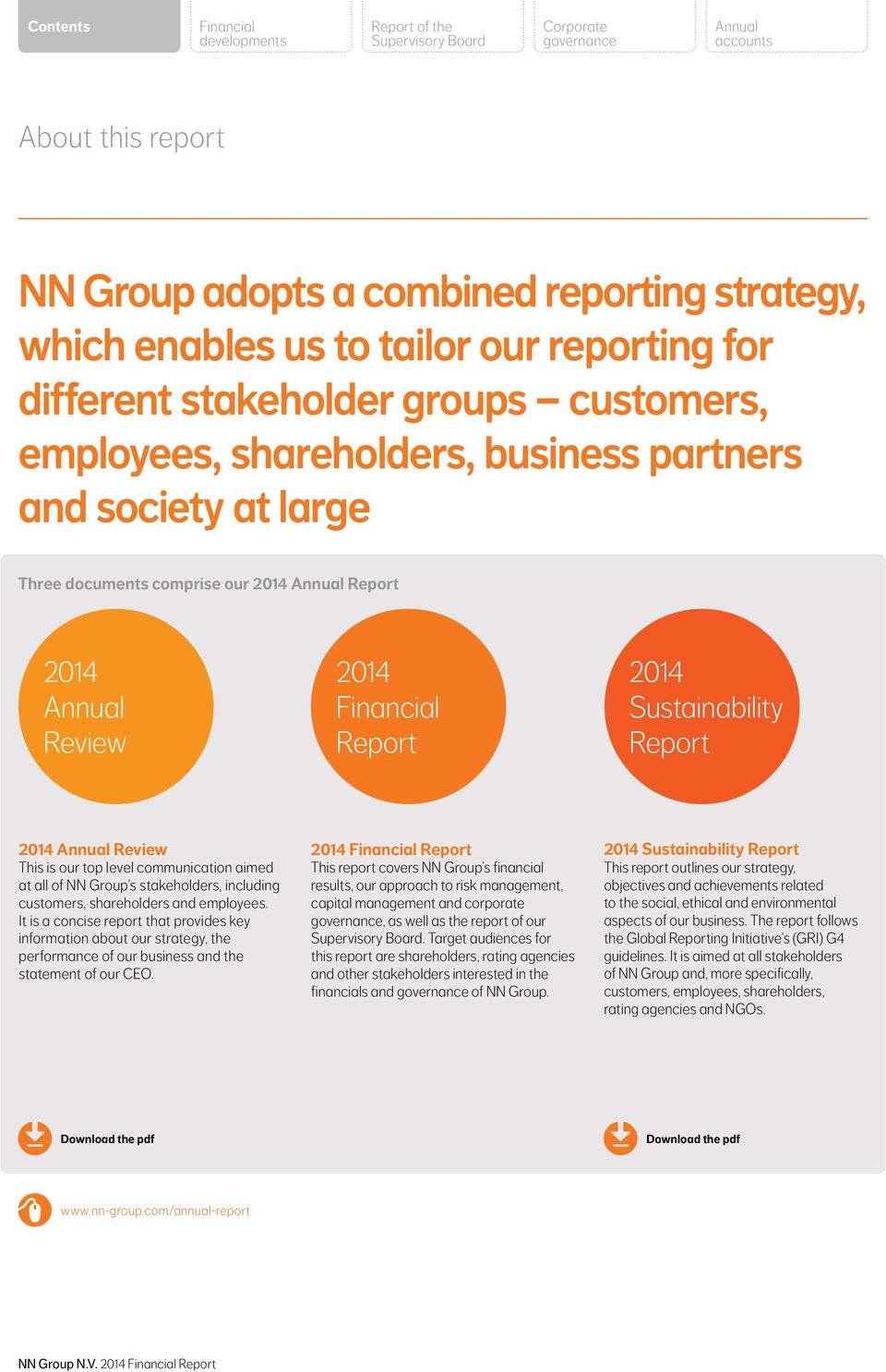
2 About this report NN Group adopts a combined reporting strategy, which enables us to tailor our reporting for different stakeholder groups customers, employees, shareholders, business partners and society at large Three documents comprise our 2014 Report 2014 Review 2014 Report 2014 Sustainability Report 2014 Review This is our top level communication aimed at all of NN Group s stakeholders, including customers, shareholders and employees. It is a concise report that provides key information about our strategy, the performance of our business and the statement of our CEO Report This report covers NN Group s financial results, our approach to risk management, capital management and corporate, as well as the report of our. Target audiences for this report are shareholders, rating agencies and other stakeholders interested in the financials and of NN Group Sustainability Report This report outlines our strategy, objectives and achievements related to the social, ethical and environmental aspects of our business. The report follows the Global Reporting Initiative s (GRI) G4 guidelines. It is aimed at all stakeholders of NN Group and, more specifically, customers, employees, shareholders, rating agencies and NGOs. Download the pdf Download the pdf NN Group N.V Report
3 Report contents Review Report Sustainability Report At a glance highlights 2014 Operational highlights 2014 Non-financial and sustainability highlights 2014 Our business segmentation Our operations Our products and services Our employees Our customers Our purpose and values Our company in numbers (at 31 December 2014) CEO statement Our history Our brand Our strategy Capitalising on global trends Market trends, risks and our response Strategic focus areas Our role in society Objectives Delivering on our strategy Our Management Board Business review Netherlands Life Netherlands Non-life Insurance Europe Japan Life Investment Management Other NN Bank, ING Re and Holding Japan Closed Block VA 02 NN Group Netherlands Life Netherlands Non-life Insurance Europe Japan Life Investment Management Other Japan Closed Block VA Remuneration report 26 Executive Board 32 on internal control over financial reporting Conformity statement 33 Consolidated annual 34 Consolidated balance sheet Consolidated profit and loss account Consolidated statement of comprehensive income Consolidated statement of cash flows Consolidated statement of changes in equity Notes to the Consolidated annual Risk management (Note 56) Capital and liquidity management (Note 57) Authorisation of Consolidated annual Parent company annual 156 Parent company balance sheet Parent company profit and loss account Parent company statement of changes in equity Notes to the Parent company annual Authorisation of Parent company annual Other information 165 Independent auditor s report Proposed appropriation of result Subsequent events Sustainability at NN Group Purpose and values Pillars of our approach Focus areas Governance What matters to us Stakeholder engagement Our objectives Optimising customer experience Customer centricity Customer empowerment Products with social added value Customer feedback and loyalty Investing responsibly NN Group Responsible Investment Policy Framework ESG integration Active ownership Specialised SRI funds and responsible investment solutions Empowering our people Focus on values Learning and development Equal opportunity and diversity Vitality and well-being Employee rights and representation Employee engagement Restructuring Remuneration Creating positive change in communities Our programme: NN Future Matters Local themes Managing our environmental footprint Environmental footprint Sustainable procurement Performance data About this Sustainability Report Assurance report Principles for Sustainable Insurance UN Global Compact NN Group N.V Report 01

4 NN Group Analysis of results amounts in millions of euros Netherlands Life Netherlands Non-life Insurance Europe Japan Life Investment Management Other Operating result ongoing business 1, Non-operating items ongoing business of which gains/losses and impairments of which revaluations of which market & other impacts Japan Closed Block VA Insurance Other 0-18 Special items before tax Result on divestments Result before tax from continuing operations Taxation Net result from continuing operations Net result from discontinued operations Net result from continuing and discontinued operations before attribution to minority interest Minority interest 23 8 Net result Key figures amounts in millions of euros New sales life insurance (APE) 1,315 1,227 Value of new business (VNB) Total administrative expenses ongoing business 1,758 1,807 Net operating ROE 1 8.6% 8.9% IGD Solvency I ratio 2 303% 250% 1 Net operating ROE is calculated as the (annualised) net operating result of the ongoing business, adjusted for the accrued coupon on undated notes classified in equity, divided by the average allocated equity of the ongoing business adjusted for revaluation reserves and excluding undated notes classified in equity. 2 The 31 December 2014 solvency ratios are not final until filed with the regulators. Note: NN Group evaluates the results of its segments using a financial performance measure called Operating result. Operating result is defined as result under IFRS-EU excluding the impact of non-operating items, divestments, discontinued operations and special items. Disclosures on comparative years also reflect the impact of current year s divestments. Non-operating items include realised capital gains/losses and impairments on debt and equity securities, revaluations on assets marked-to-market through the profit and loss account and other non-operating market impacts. Special items include items of income or expense that are significant and arise from events or transactions that are clearly distinct from the ordinary operating activities. The net result of NN Group in 2014 increased to EUR 588 million compared with EUR 322 million in 2013, mainly reflecting an increased operating result ongoing business, higher non-operating items and higher result of Japan Closed Block VA, partly offset by higher special items before tax and higher taxation. Operating result of the ongoing business in 2014 increased to EUR 1,086 million, up 20.0% from 2013, reflecting lower administrative expenses in the Netherlands as a result of the transformation programme and lower funding costs. In 2014, NN Group successfully issued two subordinated notes in a favourable fixed income market and thereby secured attractive funding costs. In combination with reduced debt levels, this translated into lower funding costs for the company. Improved results at Netherlands Non-life, NN Bank and Investment Management also contributed to the increased operating result, offset by lower operating income in Netherlands Life, Insurance Europe as well as by currency impacts at Japan Life. The improved operating result of Netherlands Non-life was supported by expense reductions and an improved underwriting performance in Disability & Accident (D&A). Investment Management s operating result improved driven by higher fee income as Assets under Management (AuM) grew, while increased mortgage production and higher customer savings led to a higher net interest margin at NN Bank. Netherlands Life s 2014 operating result declined to EUR 615 million from EUR 709 million in 2013, due to a lower technical margin, largely on movements in the unit-linked guarantee provision, and lower fees and premium-based revenues, partly compensated by a higher investment margin and lower administrative expenses. Insurance Europe s operating result decreased mainly due to a lower investment margin and the impact of the pension reforms in Poland. The operating result of Japan Life was EUR 140 million, down 4.2% year-on-year excluding currency effects, reflecting a decrease in the investment margin and technical margin. The result from non-operating items related to ongoing business improved to a gain of EUR 198 million in 2014 from a loss of EUR 229 million in Gains/losses and impairments amounted to a loss of EUR 28 million, compared with a gain of EUR 97 million in 2013, mainly as a result of lower gains on the sale of debt and equity securities in Netherlands Life, Insurance Europe and Japan Life, partly compensated by lower impairments on equities and real estate in Netherlands Life. Revaluations amounted to EUR 143 million in 2014 compared with EUR 3 million in 2013, mainly reflecting higher revaluations of private equity and real estate investments in Netherlands Life. Market and other impacts increased to EUR 83 million, from a loss of EUR 329 million in 2013, mainly driven by a higher result of the separate account pension business in the Netherlands which included a EUR 177 million negative impact in 2013 from the refinement of the market interest rate assumption. In addition, 2014 included a EUR 44 million positive impact in Insurance Europe related to the guarantee fund in Poland which was discontinued as of 1 July 2014 due to the pension reforms. The result before tax of Japan Closed Block VA increased to EUR 109 million from EUR -252 million in 2013, which reflected a EUR 575 million charge in order to bring the reserve adequacy of the business line to the 50% confidence level. The 2014 result includes an operating result of EUR 84 million and a market related result net of hedging of EUR 21 million. NN Group N.V Report 02

5 continued Special items before tax decreased to a loss of EUR 687 million in 2014 from a loss of EUR 126 million in 2013, as 2014 included a EUR 541 million negative impact of the agreement to make ING s closed defined benefit pension plan in the Netherlands financially independent. Other special items before tax in 2014 include expenses for the transformation programme in the Netherlands and expenses related to the operational and legal entity rebranding of NN Group s subsidiaries to NN. Result on divestments was EUR 57 million in 2014, compared with EUR 84 million in The result in 2014 reflected the disposal of the Brazilian insurance holding SulAmérica. The result in 2013 reflected NN Group s share in SulAmérica s net result from operations and the net result from the disposal of part of NN Group s share in the entity, partly offset by a loss on the sale of the Mexican mortgage business. The result before tax from continuing operations increased to EUR 762 million compared with EUR 364 million in 2013 which included the aforementioned EUR 575 million charge in Japan Closed Block VA and the EUR 177 million negative impact in Netherlands Life from the refinement of the market interest rate assumption for the separate account pension business. The increase was driven by the improved operating result of the ongoing business, offset by the aforementioned EUR -541 million impact related to the pension plan in the Netherlands. The net result from continuing operations in 2014 increased to EUR 627 million, compared with EUR 310 million in The effective tax rate for 2014 was 18%. The net result from discontinued operations was EUR -16 million in 2014 versus EUR 20 million in The 2014 loss mainly reflects the loss on the sale of the investment management business in Taiwan and a provision related to the sale of the investment management business in South Korea, partly compensated by the gain on sale of NN Group s 50% stake in ING-BOB Life Insurance Company as well as a release of a provision related to past divestments. Total new sales for 2014 amounted to EUR 1,315 million, up 12.9% from 2013 on a constant currency basis, driven by higher sales in Netherlands Life (10.3%), Insurance Europe (7.7%) and Japan Life (20.1%). Value of New Business (VNB) for 2014 amounted to EUR 196 million, up 51.9% from EUR 129 million in The increase largely reflects the renewal of a few large group life contracts on more favourable terms at Netherlands Life and higher sales in Japan Life. The internal rate of return (IRR) on new sales increased to 10.8% in 2014 from 9.7% in 2013, in line with the improved VNB. Total administrative expenses of the ongoing business were EUR 1,758 million, down 2.0% from 2013, excluding currency effects. Administrative expenses in the Netherlands decreased consistent with the target to reduce administrative expenses in Netherlands Life, Netherlands Non-life and corporate/holding entities by EUR 200 million by 2016, compared with For the full-year 2014, cost reductions of EUR 142 million were realised, of which EUR 15 million by Netherlands Life, EUR 38 million by Netherlands Non-life and EUR 89 million by corporate/holding entities. For the full-year 2014, the net operating ROE for the ongoing business of NN Group decreased to 8.6% from 8.9% in 2013, as the increase of the adjusted average allocated equity base was proportionally higher than the growth of the net operating result. NN Group N.V Report NN Group is well capitalised and its IGD Solvency I ratio increased from 250% to 303% over 2014 largely due to a EUR 850 million capital injection by ING Group into NN Group in May 2014, the full-year 2014 net result of EUR 588 million and positive revaluations resulting from market movements. This was partly offset by a proposed dividend of EUR 195 million related to Excluding the proposed dividend, the year-end 2014 IGD Solvency I ratio was 307%. NN Group s Solvency II capital ratio, calculated as the ratio of Own Funds (OF) to the Solvency Capital Requirement (SCR) based on our current interpretation of the Standard Formula, is estimated to be in a range around 200% as at 31 December NN Group is considering to apply for the usage of a Partial Internal Model. The Solvency II capital ratio remains subject to significant uncertainties, including the final specifications of the Solvency II regulations and the regulatory approval process. Netherlands Life Analysis of results amounts in millions of euros Investment margin Fees and premium-based revenues Technical margin Operating income 1,136 1,255 Administrative expenses DAC amortisation and trail commissions Expenses Operating result Non-operating items of which gains/losses and impairments of which revaluations of which market & other impacts Special items before tax Result on divestments 0 6 Result before tax Taxation Minority interests 9 6 Net result Key figures amounts in millions of euros New sales life insurance (APE) Value of new business (VNB) Internal rate of return (IRR) 10.5% 4.5% Total administrative expenses Net operating ROE 7.7% 8.3% NN Life Solvency I ratio 1, 2 260% 223% 1 The 31 December 2014 capital ratios are not final until filed with the regulators. 2 The 31 December 2013 Solvency I ratio of NN Life has been updated to 223% from 222% in the NN Group 2013 Report. The operating result of Netherlands Life decreased to EUR 615 million in 2014 from EUR 709 million in 2013, mainly due to a lower technical margin and lower fees and premiumbased revenues, partly compensated by a higher investment margin and lower administrative expenses. 03
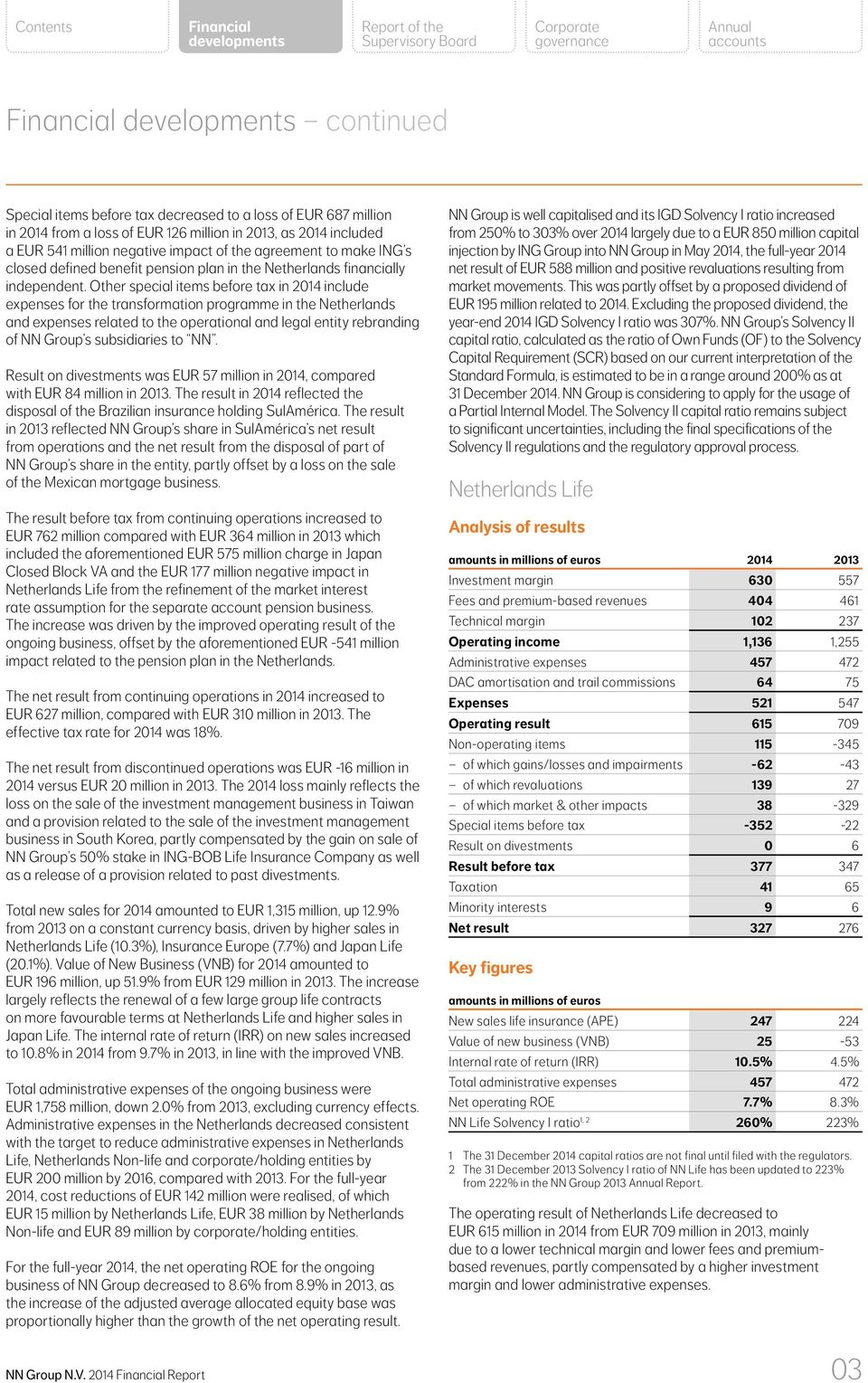
6 continued The investment margin increased to EUR 630 million in 2014 from EUR 557 million in 2013 driven by increased allocation to higheryielding assets, higher invested volumes and EUR 43 million private equity dividends. Compared with 2013, fees and premium-based revenues in 2014 decreased by EUR 57 million to EUR 404 million, reflecting the individual life closed book run-off and structural lower fee income on the unit-linked portfolio. The technical margin decreased to EUR 102 million in 2014 from EUR 237 million in The technical margin was impacted by the movement in the unit-linked guarantee provisions; these provisions increased by EUR 43 million in 2014 following a decrease in interest rates, whereas 2013 benefited from a decrease of EUR 24 million. In addition, the technical margin in 2014 includes a EUR 20 million one-off negative impact on a legacy book of paid-up pension contracts, whereas 2013 included EUR 41 million non-recurring benefits primarily related to a provision release. Administrative expenses decreased to EUR 457 million in 2014 compared with EUR 472 million in 2013, mainly reflecting the effects of the transformation programme in the Netherlands. DAC amortisation and trail commissions declined 14.6% to EUR 64 million in 2014, reflecting the gradual run-off of the individual life closed book and regulatory changes. The result before tax was a gain of EUR 377 million in 2014, compared with EUR 347 million in 2013, driven by an improvement in non-operating items offset by a higher adverse impact from special items before tax as well as the decrease in operating result. The non-operating items improved to EUR 115 million compared with EUR -345 million in 2013, which included a EUR -177 million impact from the refinement of the market interest rate assumption for the separate account pension business. Higher revaluations on real estate investments also contributed to the improved non-operating items. Gains/losses and impairments decreased to a loss of EUR 62 million in 2014 from a loss of EUR 43 million in The losses in both years were driven by impairments on real estate. Revaluations improved to EUR 139 million in 2014 compared with EUR 27 million in 2013 mainly reflecting higher real estate revaluations. The market and other impacts improved to EUR 38 million compared with a loss of EUR 329 million in 2013 reflecting the change in the provision for guarantees on separate account pension contracts (net of hedging) included a EUR -177 million impact from the refinement of the market interest rate assumption for the separate account pension business. Special items before tax were a loss of EUR 352 million in 2014 driven by a EUR -322 million impact related to the agreement to make ING s closed defined benefit pension plan in the Netherlands financially independent. The 2013 special items primarily reflect initial public offering (IPO) preparation costs. New sales (APE) in 2014 increased to EUR 247 million from EUR 224 million in 2013 mainly driven by higher group pension renewals, partly offset by lower individual life sales. NN Group N.V Report The Value of New Business (VNB) improved from EUR -53 million in 2013 to EUR 25 million in 2014, largely reflecting the renewal of a few large group life contracts on more favourable terms. Consequently, the internal rate of return (IRR) increased from 4.5% in 2013 to 10.5% in Over 2014, the Solvency I ratio of NN Life improved from 223% to 260% at 31 December 2014, supported mainly by the EUR 1,050 million of subordinated debt provided by NN Group and the tightening of credit spreads. This was partly offset by the impact of the pension agreement (EUR -231 million after tax) and the dividend paid to NN Group in February 2015 (EUR 350 million). Netherlands Non-life Analysis of results amounts in millions of euros Earned premiums, net of reinsurance 1,525 1,546 Investment income, net of investment expenses Other income 0-17 Operating income 1,640 1,644 Claims incurred, net of reinsurance 1,049 1,077 Acquisition costs Administrative expenses Acquisition costs and administrative expenses Expenditure 1,516 1,569 Operating result insurance businesses Operating result broker businesses 4 4 Total operating result Non-operating items 10 4 of which gains/losses and impairments -3-1 of which revaluations 14 5 Special items before tax Result before tax Taxation 4 14 Net result Key figures amounts in millions of euros Total administrative expenses Combined ratio % 101.5% of which Claims ratio % 69.7% of which Expense ratio % 31.8% Net operating ROE 23.3% 13.3% 1 Excluding Mandema and Zicht broker businesses. The operating result for Netherlands Non-life increased by 62.0% to EUR 128 million in 2014 from EUR 79 million in 2013, driven by lower administrative expenses, reflecting the effect of the transformation programme in the Netherlands and an improved claims experience in D&A. The combined ratio improved to 99.4% from 101.5% in Other income in 2013 included an addition to bad debt provisions. 04
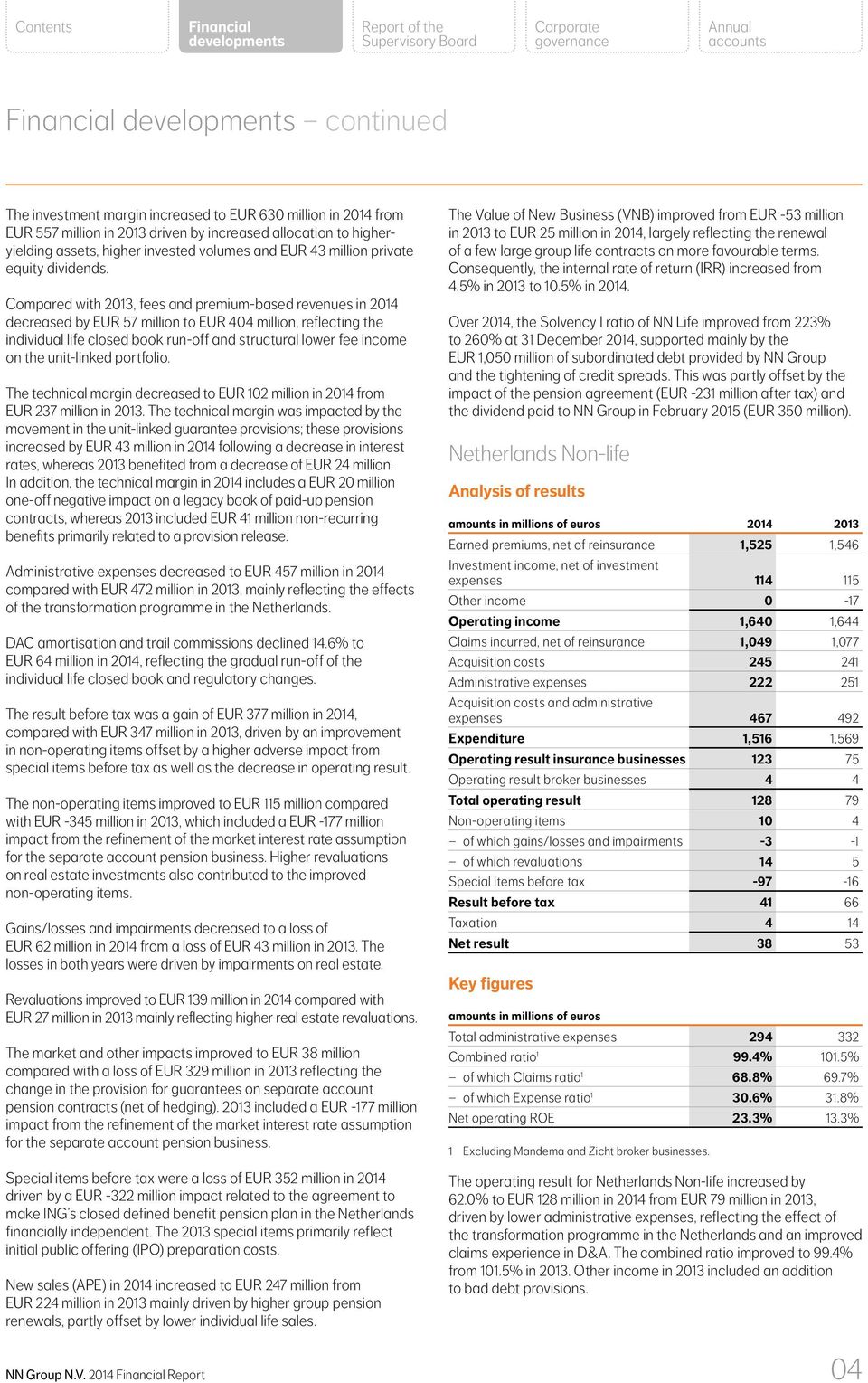
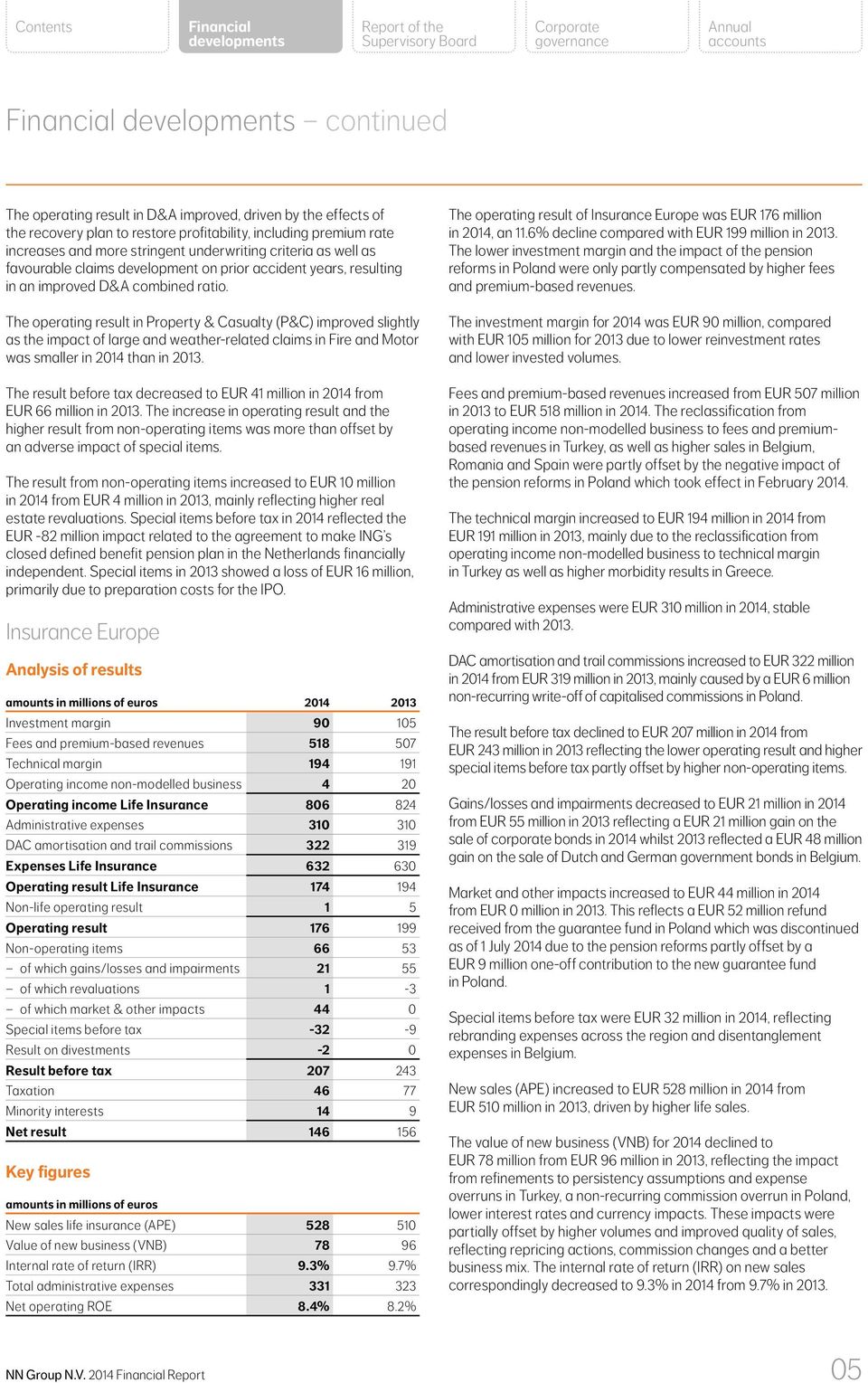
7 continued The operating result in D&A improved, driven by the effects of the recovery plan to restore profitability, including premium rate increases and more stringent underwriting criteria as well as favourable claims development on prior accident years, resulting in an improved D&A combined ratio. The operating result in Property & Casualty (P&C) improved slightly as the impact of large and weather-related claims in Fire and Motor was smaller in 2014 than in The result before tax decreased to EUR 41 million in 2014 from EUR 66 million in The increase in operating result and the higher result from non-operating items was more than offset by an adverse impact of special items. The result from non-operating items increased to EUR 10 million in 2014 from EUR 4 million in 2013, mainly reflecting higher real estate revaluations. Special items before tax in 2014 reflected the EUR -82 million impact related to the agreement to make ING s closed defined benefit pension plan in the Netherlands financially independent. Special items in 2013 showed a loss of EUR 16 million, primarily due to preparation costs for the IPO. Insurance Europe Analysis of results amounts in millions of euros Investment margin Fees and premium-based revenues Technical margin Operating income non-modelled business 4 20 Operating income Life Insurance Administrative expenses DAC amortisation and trail commissions Expenses Life Insurance Operating result Life Insurance Non-life operating result 1 5 Operating result Non-operating items of which gains/losses and impairments of which revaluations 1-3 of which market & other impacts 44 0 Special items before tax Result on divestments -2 0 Result before tax Taxation Minority interests 14 9 Net result Key figures amounts in millions of euros New sales life insurance (APE) Value of new business (VNB) Internal rate of return (IRR) 9.3% 9.7% Total administrative expenses Net operating ROE 8.4% 8.2% The operating result of Insurance Europe was EUR 176 million in 2014, an 11.6% decline compared with EUR 199 million in The lower investment margin and the impact of the pension reforms in Poland were only partly compensated by higher fees and premium-based revenues. The investment margin for 2014 was EUR 90 million, compared with EUR 105 million for 2013 due to lower reinvestment rates and lower invested volumes. Fees and premium-based revenues increased from EUR 507 million in 2013 to EUR 518 million in The reclassification from operating income non-modelled business to fees and premiumbased revenues in Turkey, as well as higher sales in Belgium, Romania and Spain were partly offset by the negative impact of the pension reforms in Poland which took effect in February The technical margin increased to EUR 194 million in 2014 from EUR 191 million in 2013, mainly due to the reclassification from operating income non-modelled business to technical margin in Turkey as well as higher morbidity results in Greece. Administrative expenses were EUR 310 million in 2014, stable compared with DAC amortisation and trail commissions increased to EUR 322 million in 2014 from EUR 319 million in 2013, mainly caused by a EUR 6 million non-recurring write-off of capitalised commissions in Poland. The result before tax declined to EUR 207 million in 2014 from EUR 243 million in 2013 reflecting the lower operating result and higher special items before tax partly offset by higher non-operating items. Gains/losses and impairments decreased to EUR 21 million in 2014 from EUR 55 million in 2013 reflecting a EUR 21 million gain on the sale of corporate bonds in 2014 whilst 2013 reflected a EUR 48 million gain on the sale of Dutch and German government bonds in Belgium. Market and other impacts increased to EUR 44 million in 2014 from EUR 0 million in This reflects a EUR 52 million refund received from the guarantee fund in Poland which was discontinued as of 1 July 2014 due to the pension reforms partly offset by a EUR 9 million one-off contribution to the new guarantee fund in Poland. Special items before tax were EUR 32 million in 2014, reflecting rebranding expenses across the region and disentanglement expenses in Belgium. New sales (APE) increased to EUR 528 million in 2014 from EUR 510 million in 2013, driven by higher life sales. The value of new business (VNB) for 2014 declined to EUR 78 million from EUR 96 million in 2013, reflecting the impact from refinements to persistency assumptions and expense overruns in Turkey, a non-recurring commission overrun in Poland, lower interest rates and currency impacts. These impacts were partially offset by higher volumes and improved quality of sales, reflecting repricing actions, commission changes and a better business mix. The internal rate of return (IRR) on new sales correspondingly decreased to 9.3% in 2014 from 9.7% in NN Group N.V Report 05
8 continued Japan Life Analysis of results amounts in millions of euros Investment margin -2 7 Fees and premium-based revenues Technical margin Operating income Administrative expenses DAC amortisation and trail commissions Expenses Operating result Non-operating items 1 30 of which gains/losses and impairments 3 42 of which revaluations Special items before tax -2 0 Result before tax Taxation Net result Key figures amounts in millions of euros New sales life insurance (APE) Value of new business (VNB) Internal rate of return (IRR) 14.3% 17.3% Total administrative expenses Net operating ROE 7.9% 8.4% The operating result for Japan Life was EUR 140 million in 2014, a 13.0% decline compared with EUR 161 million in Excluding currency effects, the operating result declined by 4.2% due to a lower investment margin, a lower technical margin and higher DAC amortisation and trail commission, partly offset by higher fees and premium-based revenues. The investment margin declined EUR 9 million due to lower interest rates on reinvested assets, as well as capital gains realised due to asset rebalancing in 2013, which lowered subsequent investment income. Fees and premium-based revenues were flat, EUR 437 million in 2014 compared with EUR 436 million in Excluding currency effects, fees and premium-based revenues increased by 10.3% driven by the higher sales and larger in-force volumes. The technical margin decreased to a loss of EUR 13 million in 2014 compared with a positive EUR 2 million in 2013, mainly due to a lower result on surrenders. Administrative expenses were EUR 97 million in 2014, an 8.5% decrease compared with EUR 106 million in Excluding currency effects, administrative expenses remained stable compared with DAC amortisation and trail commissions were EUR 185 million in 2014, up 14.5% excluding currency effects, due to higher premium income and higher surrenders. The full-year result before tax for 2014 was EUR 139 million compared with EUR 192 million for 2013 which included the aforementioned realised capital gains due to asset rebalancing. For the full-year 2014, new sales (APE) increased to EUR 541 million from EUR 493 million in 2013, due to improved business sentiment, higher agency productivity and channel diversification. The value of new business (VNB) for 2014 increased to EUR 93 million, from EUR 86 million in 2013, reflecting higher sales partially offset by lower interest rates. The internal rate of return (IRR) on new sales in 2014 decreased to 14.3% from 17.3% in 2013, due to lower interest rates and a change in reinsurance arrangements. Investment Management Analysis of results amounts in millions of euros Investment income 0 1 Fees Operating income Administrative expenses Operating result Special items before tax Result on divestments -2 0 Result before tax Taxation 5 34 Net result Key figures amounts in millions of euros Total administrative expenses Net inflow Assets under Management (in EUR billion) Assets under Management Net operating ROE 32.4% 26.7% 1 Excluding the Net result from discontinuing operations. 2 End of period, in EUR billion. Total AuM at the end of 2014 were up 6.9% to EUR 186 billion from EUR 174 billion at the end of 2013 driven by positive market performance which was partly offset by the partial outflow of assets managed for the ING Pension Fund in the first quarter of The operating result of Investment Management for full-year 2014 was EUR 158 million, up 21.5% from Positive market performance led to higher AuM and as a consequence to higher fee income, which was partly offset by higher expenses. Fees were EUR 486 million, up 9.5% from 2013 as a result of higher AuM and a more favourable asset mix. The increase in fees also reflects the introduction of a fixed service fee in the Netherlands as of January 2014, as well as higher non-recurring fee income. NN Group N.V Report 06

9 continued Administrative expenses were EUR 328 million, up 4.5% from The current year benefited from EUR 10 million of personnel provision releases, partly offset by the introduction of the fixed service fee (with an offsetting impact in fee revenues). Excluding these items, administrative expenses increased year-on-year due to higher staff and IT expenses. The result before tax was EUR 31 million, down 76.3% from 2013 mainly attributable to a EUR -122 million special item, reflecting the impact of the agreement to make ING s closed defined benefit pension plan in the Netherlands financially independent. Other Analysis of results amounts in millions of euros Interest on hybrids and debt Investment income & fees 50 8 Holding expenses Amortisation of intangible assets -7-7 Holding result Operating result reinsurance business Operating result NN Bank Other results 13 1 Operating result Non-operating items 6 29 of which gains/losses and impairments of which revaluations Special items before tax Result on divestments Result before tax Taxation Net result Key figures amounts in millions of euros Total administrative expenses of which reinsurance business of which NN Bank NN Bank common equity Tier 1 ratio phased in 14.1% 16.4% Total assets NN Bank Includes the result on the sale of SulAmérica. Results of SulAmérica were included in the segment Insurance Other until The segment Insurance Other ceased to exist as of End of period, in EUR billion. The operating result of the segment Other improved substantially to EUR -130 million in 2014, from EUR -373 million in The improvement reflects better holding result and higher operating results at reinsurance business and NN Bank. The holding result improved to EUR -201 million in 2014, an improvement of 42.2% compared with EUR -348 million in The improvement is attributable to lower funding costs, higher investment income and lower holding expenses. Interest costs on hybrids and debt were EUR 122 million in 2014 compared with EUR 167 million in 2013, mainly due to the pre-ipo restructuring of the debt portfolio of NN Group. Also, the interest on the EUR 1 billion undated notes issued in July 2014, is recognised through equity while the interest of the hybrid debt redeemed with these notes is recognised in the profit and loss account. Investment income increased to EUR 50 million in 2014 and includes interest income on the EUR 600 million and EUR 450 million subordinated loans provided by NN Group to NN Life in the first half of Holding expenses decreased to EUR 123 million in 2014, a decrease of 32.5% compared with EUR 183 million in The operating result of reinsurance business was EUR 31 million in 2014, from EUR -15 million in The improvement was attributable to better underwriting results as well as a EUR 31 million one-off loss on a specific reinsurance contract in The operating result of NN Bank improved to EUR 27 million in 2014 from EUR -11 million in NN Bank was successful in 2014 in increasing its production of mortgages and attracting customer savings which has led to a higher net interest margin, partly offset by higher expenses. The result before tax was EUR -142 million in 2014, up from EUR -473 million in The improvement reflects the higher operating result and higher result on divestments. Result on divestments was EUR 62 million, compared with EUR -50 million in The result on divestment in 2014 primarily reflects a EUR 56 million net gain on the sale of part of SulAmérica. The 2013 result primarily reflects a EUR 62 million loss on the sale of the Mexican mortgage business. Special items before tax were EUR -80 million in 2014, flat compared with EUR -79 million in The special items before tax in 2014 reflect EUR 29 million expenses related to the restructuring and integration of WestlandUtrecht Bank operations at NN Bank, EUR 32 million reorganisation expenses and EUR 15 million expenses reflecting the impact of the agreement to make ING Group s closed defined benefit pension plan in the Netherlands financially independent. The special items in 2013 reflect the expenses related to the restructuring and integration of WestlandUtrecht Bank operations at NN Bank. NN Group N.V Report 07

10 continued Japan Closed Block VA Analysis of results amounts in millions of euros Fees and premium-based revenues Operating income Administrative expenses DAC amortisation and trail commissions Expenses Operating result Non-operating items of which gains/losses and impairments 0 1 of which market & other impacts Result before tax Taxation Net result Key figures amounts in millions of euros Account value 13,248 14,687 Net Amount at Risk IFRS Reserves 556 1,086 Number of policies 294, ,306 The full-year 2014 result before tax increased to a gain of EUR 109 million from a loss of EUR 252 million for 2013, which reflected a charge of EUR 575 million resulting from a full write-off of the DAC as well as reserve strengthening in order to bring the reserve adequacy of the segment to the 50% confidence level. The full-year 2014 result includes an operating result of EUR 84 million and a market related result net of hedging of EUR 21 million. The operating result of Japan Closed Block VA was EUR 84 million in 2014, a 5.0% increase compared with EUR 80 million in Excluding currency effects, the operating result increased by 12.2%, mainly driven by lower DAC amortisation and trail commissions, partly offset by lower fees and premium-based revenues in line with the run-off of the portfolio. Fees and premium-based revenues were down 14.0% to EUR 117 million in 2014, from EUR 136 million in Excluding currency effects, fees and premium-based revenues decreased by 6.5% in line with a lower account value mainly caused by a decreasing number of policies. Administrative expenses increased to EUR 21 million from EUR 18 million in 2013, mainly caused by higher processing costs due to an increase in surrenders and maturities as well as higher project costs to prepare for the large volumes of future maturities expected in the portfolio. DAC amortisation and trail commissions fell to EUR 12 million in 2014 from EUR 38 million in 2013, as DAC related to the annuity portfolio was written-down entirely on 1 October 2013, as part of the charge to restore the reserve adequacy of the business line to the 50% confidence level, due to the change in segmentation. The Net Amount at Risk in the Japan Closed Block VA decreased to EUR 133 million from EUR 663 million in 2013, primarily driven by financial markets appreciation. NN Group N.V Report 08

11 The of NN Group consists of the following members: Jan Holsboer (1946) Dutch Chairman Yvonne van Rooy (1951) Dutch Member Ralph Hamers (1966) Dutch Member Patrick Flynn (1960) Irish Member Jan Holsboer was appointed to the of NN Group on 1 March 2014 and was appointed chairman as per 7 July He is chairman of the Nomination and Governance Committee and member of the Remuneration Committee. Yvonne van Rooy was appointed to the of NN Group on 1 March She chairs the Remuneration Committee and she is a member of the Nomination and Governance Committee. Ralph Hamers was appointed to the of NN Group on 7 July He is a member of the Nomination and Governance Committee. Patrick Flynn was appointed to the of NN Group on 7 July He is chairman of the Audit Committee and a member of the Remuneration Committee. Wilfred Nagel (1956) Dutch Member Heijo Hauser (1955) German Member Hans Schoen (1954) Dutch Member Wilfred Nagel was appointed to the of NN Group on 7 July He is chairman of the Risk Committee. Heijo Hauser was appointed to the of NN Group on 7 July He is a member of the Risk Committee and the Audit Committee. Hans Schoen was appointed to the of NN Group on 7 July He is a member of the Risk Committee and the Audit Committee. NN Group N.V Report 09

12 continued The Initial Public Offering (IPO) of NN Group N.V. on 7 July 2014 (Settlement Date) marked an important moment for the Supervisory Board of NN Group (). As of that date, the started in its current composition. This Report of the should be read in conjunction with the section on (pages 13 25) and the Remuneration report (pages 26 31), which are deemed to be incorporated by reference in this report. The of NN Group was installed as per 1 March With the exception of Mr Holsboer and Mrs Van Rooy, all members stepped down at the Settlement Date and were succeeded by Messrs Hamers, Flynn, Nagel, Hauser and Schoen. Further information can be found in the section on (pages 13 25). In the period January to July 2014, a key discussion topic on the agenda of the was the preparation of NN Group s IPO. The ING Insurance Committee, a temporary committee set up to advise and assist the of ING Verzekeringen N.V. (and from 1 March 2014 the Supervisory Board of NN Group) on the preparation of the IPO, met five times in the aforementioned period. After the IPO, the ING Insurance Committee was dissolved. Other discussion topics included the quarterly results, the fourth quarter and annual figures for 2013, including related press releases and reports from the external auditors. The Supervisory Board approved the annual risk appetite statement and assured itself that the risk appetite framework is suitable for its purpose. Furthermore, in the first half year of 2014, the financial risk and non-financial risk report was discussed. With regard to, the discussed the current structure of NN Group and related documents such as the application of the Dutch Insurers Code and charters of the Executive Board and. Key discussion topics and meetings in the period from July 2014 The held three formal meetings in the period from July 2014; two in the Netherlands and one in Poland as part of a visit to the Polish business units of NN Group. The attendance rate of members at those meetings was 100%. During the year, the was updated on topical issues in its formal meetings. Next to that, several presentations were given on NN Group s business activities and key initiatives. In the meetings, the was briefed on the outcome of committee meetings and approved several items such as amendments to policies. Also, the discussed a range of subjects, including: Customer centricity and product development The was frequently informed about regarding unit-linked products. Also, the was informed about NN Group s introduction of the NN statement of Living our Values (Statement). The Statement addresses customer care elements such as seeing customers as the starting point, using understandable language and carefully explaining conditions, risks, returns and costs of products and services. Achievement company objectives and strategy The was regularly updated on NN Group s company objectives and strategy and the achievement thereof, also in relation to the medium-term plan (MTP) The MTP addresses the plans and the financial targets for NN Group. Discussion points included the equity story, in markets and risks inherent in business activities, regulatory and customer preferences and potential. Risk management and control systems The discussed with the Executive Board risk management and control systems thereby giving specific attention to the requirements of Solvency II and the impact thereof on NN Group s risk model. The also discussed the Executive Board s assessment of the adequacy and effectiveness of NN Group s risk management and control systems. NN Group N.V Report reporting The discussed the quarterly results as well as the annual figures for 2014, including the related reports from the internal and external auditors. The supports the proposal to pay a dividend over 2014 as contained in the dividend proposal (page 12). Shareholder base The was updated regularly on the activities of NN Group s investor relations team with respect to NN Group s shareholder base. Information relating to the composition of NN Group s shareholder base and therein are used as input to maintain good relations with investors. Legislative The devoted substantial time to the Act on the Remuneration Policy of Undertakings (Wet Beloningsbeleid financiële ondernemingen) and the possible implications thereof on NN Group s Remuneration Framework and policies. Next to the formal meetings, the chairman of the Supervisory Board maintained intensive personal contact with the chairman of the Executive Board. In these meetings, topical issues as well as the general affairs of NN Group and its affiliated enterprises were discussed. During the year there was contact with the Works Council. Introduction programme In 2014, the followed an introduction programme. Topics covered included NN Group s company objectives and strategy and branding initiatives. Also, as part of the introduction programme, the paid visits to the Dutch business units of NN Group. During these visits, the was informed about the respective business unit s activities and the inherent risks of these activities. During these visits, the Supervisory Board met with employees and held individual meetings with several officers and managers. 10

13 continued Key discussion topics and meetings in the period from July 2014 continued Given the fact that the started in its current composition from 7 July 2014, some topics from the introduction programme were covered by the education and training programme as described in the next section. These topics include corporate social responsibility with a specific focus on customer centricity, and integrity. In addition, NN Group s financial reporting was a frequent topic in the whole-year programme, both in the introduction and education programme, as well as in the meetings. Education and training programme The education and training programme of the covered several topics. These included innovation, technology trends, cyber security and hacking, the duty of care towards the customer, NN Group s business principles and Statement of Living its Values and Solvency II. In January 2015, NN Group held its annual Knowledge Day. On that day, presentations on integrity and corporate were given as well as an educational session on Solvency II. Audit Committee The Audit Committee met twice in the period from July In accordance with the Charter of the Audit Committee, both these meetings were attended by the members of the Audit Committee, the chairman of the Risk Committee, the Chief Executive Officer, the Chief Officer and the Chief Risk Officer of NN Group, the internal and external auditors, the general manager responsible for financial accounting and the General Counsel and Head of Compliance. Additionally, the chairman of the was also present at these meetings. After each Audit Committee meeting, the Audit Committee met with the internal and external auditors. During the year, the chairman of the Audit Committee discussed topical issues with the Chief Officer of NN Group and met with the Head of Internal Audit. Discussion points of the Audit Committee included periodic financial reports and related press releases, actuarial analyses, including reserve adequacy, Solvency II and periodic reports from the internal and external auditors. With regard to the internal and external auditors, the Audit Committee also discussed and approved NN Group s policy on external auditor independence and the changes to the charter of the internal auditor. Another discussion topic was internal controls with respect to financial reporting, including Nationale-Nederlanden Life actuarial and risk reporting. Given the new Dutch legislation which requires NN Group to change its external auditor as of January 2016, the Audit Committee made recommendations to the regarding the nomination of an external auditor firm. Risk Committee The Risk Committee met twice in the period from July In accordance with the Charter of the Risk Committee, both these meetings were attended by the members of the Risk Committee, the chairman of the Audit Committee, the Chief Executive Officer, the Chief Officer and the Chief Risk Officer of NN Group, the internal and external auditors and the General Counsel and Head of Compliance. Additionally, the chairman of the Supervisory Board was also present at these meetings. During the year, the chairman of the Risk Committee maintained contact with the Chief Risk Officer of NN Group. In its meetings, the Risk Committee discussed the periodic financial risk and non-financial risk reports. Specific attention was thereby given to the in relation to unit-linked products and other legal and compliance risks, as well as well as IT and control risks. The Risk Committee discussed progress against plans to further improve the risk management function. Also, the Risk Committee was informed about NN Group s key risks in NN Group s own risk and solvency assessment (ORSA) Report. Remuneration Committee The Remuneration Committee met four times in the period from July Next to the meetings, the chairperson and the members of the Remuneration Committee were in regular contact with the Management Board member responsible for human resource management and NN Group s Head of Reward and Performance. In its meetings, the Remuneration Committee reviewed and supported the Identified Staff selection criteria and the list of Identified Staff for NN Group. Also, Identified Staff related remuneration matters were reviewed and supported, in line with NN Group s remuneration framework, including potential cases for holdback of deferred compensation by way of malus. Furthermore, a key discussion topic was the Act on the Remuneration Policy of Undertakings (Wet Beloningsbeleid financiële ondernemingen). The Remuneration Committee devoted significant attention to the possible implications thereof on NN Group s Remuneration Framework and policies. The Remuneration Committee discussed the variable remuneration pool and the thresholds above which the pool for variable remuneration becomes available. The Remuneration Committee discussed the performance assessment of the Executive Board and Management Board, as well as the variable remuneration proposals. Nomination and Governance Committee The Nomination and Governance Committee met twice in the period from July Key activities of the Nomination and Governance Committee included the evaluation process of the and the drafting of selection criteria and individual profiles for new members of NN Group, in anticipation of ING Groep N.V. s (ING Groep) shareholding (direct or indirect) falling below certain thresholds as defined in the relationship agreement between ING Groep and NN Group. Also, the Nomination and Governance Committee assessed the functioning of Executive and Management Board members. Individual meetings with these members were part of the aforementioned assessment. NN Group N.V Report 11
14 continued evaluation The evaluated its functioning, the functioning of the committees and the functioning of the individual Supervisory Board members in early Given the fact that the Supervisory Board only started in its current composition from 7 July 2014, the evaluation was limited. The evaluation was conducted through a questionnaire drawn up by an external consultant. The results as reflected in a report were subsequently discussed by the Supervisory Board in a closed session (without the members of the Executive Board being present). and dividend The Executive Board has prepared the annual and discussed these with the. The annual will be submitted for adoption at the 2015 General Meeting as part of the Report. NN Group N.V. will propose to pay a dividend EUR 0.57 per ordinary share, or EUR 195 million in total based on the number of outstanding shares at the date of this report, excluding the shares held by NN Group N.V. Appreciation 2014 was an exceptional year with NN Group N.V. s IPO as a major milestone towards NN Group N.V. s standalone future. The Supervisory Board wishes to express gratitude to the members of the Executive Board and the Management Board and all employees of NN Group N.V. for their dedication to achieving this momentum, and for their continued commitment in serving the interests of customers, shareholders and other stakeholders of NN Group N.V. Amsterdam, 16 March 2015 The NN Group N.V Report 12
15 General NN Group N.V. (Company) is a public limited liability company (naamloze vennootschap) incorporated under the laws of the Netherlands, having a two-tier board structure consisting of an executive board (Executive Board) and a supervisory board (). The Company also has a management board (Management Board). The Company was incorporated on 29 March 2011 under the name ING Insurance Topholding N.V. On 28 February 2014, the Company entered into a legal merger with its wholly owned subsidiary ING Verzekeringen N.V. (ING Verzekeringen), at that time a public limited liability company incorporated under the laws of the Netherlands. On 1 March 2014, the legal merger became effective. As a result of this merger, ING Verzekeringen ceased to exist, the Company acquired all assets and liabilities of ING Verzekeringen under universal title of succession and was renamed NN Group N.V. At that time the Company had one shareholder: ING Groep N.V. (ING Groep), a public limited liability company incorporated under the laws of the Netherlands. At 2 July 2014, ING Groep offered part of its shares in the share capital of the Company to the public and these shares were listed on Euronext Amsterdam (IPO). After settlement of the offering on 7 July 2014 (Settlement Date), ING Groep still held a majority of the shares in the share capital of the Company. Under the Restructuring Plan developed by ING Groep as a condition of receiving approval from the European Commission for the Dutch state aid it received in 2008/2009 and approved by the European Commission, ING Groep is required to divest more than 50% of its shareholding in the Company before 31 December 2015 and the remaining interest before 31 December Information on the current shareholding of ING Groep in the Company can be found in Note 55 to the Consolidated annual on page 124. On 10 June 2014, the Company and ING Groep entered into an agreement containing certain arrangements regarding the continuing relationship between the Company and ING Groep (Relationship Agreement). The full text of the Relationship Agreement is available on the website of the Company. The Company voluntarily applies the Dutch mitigated large company regime (gemitigeerd structuurregime). According to the Relationship Agreement, the Company will apply the full large company regime (volledig structuurregime) as of the earlier of (a) the end of the three consecutive years transition period as referred to in Section 2:154 of the Dutch Civil Code and (b) the date on which ING Groep s (direct or indirect) holding of ordinary shares in the share capital of the Company falls below 30% of the issued ordinary shares. Executive Board Duties The Executive Board is entrusted with the management, the strategy and the operations of the Company under supervision of the. In performing its duties, the Executive Board must carefully consider and act in accordance with the interests of the Company and the business connected with it, taking into consideration the interests of all the stakeholders of the Company. The organisation, duties and working methods of the Executive Board are detailed in the charter of the Executive Board. This charter is available on the website of the Company. Certain resolutions of the Executive Board require the approval of the and/or General Meeting of Shareholders (General Meeting). These resolutions are outlined in the articles of association of the Company (Articles of Association, which are available on the website of the Company), the Relationship Agreement and in the charter of the Executive Board. The approval of the for some of these resolutions must include the affirmative vote of the ING Groep Nominated Supervisory Board Members (see Composition) for as long as ING Groep s (direct or indirect) holding of ordinary shares in the share capital of the Company represents 30% or more of the issued ordinary shares (Affirmative Vote). A number of the resolutions requiring the Affirmative Vote are further described below. A complete list of these resolutions can be found in the Relationship Agreement and in the charter of the Executive Board. Appointment, removal and suspension As long as the Company applies the mitigated large company regime, the members of the Executive Board are appointed by the General Meeting upon nomination of the. The General Meeting may reject the nomination by a two-thirds majority of the votes cast by shareholders representing more than 50% of the Company s issued share capital. As of the moment the Company applies the full large company regime, the members of the Executive Board will be appointed by the. Prior to appointing a member of the Executive Board, the must notify the General Meeting of such intended appointment. As long as the Company applies the mitigated large company regime, the General Meeting may suspend or remove a member of the Executive Board at any time. A resolution to suspend or remove a member of the Executive Board other than pursuant to a proposal of the requires a two-third majority of votes cast representing more than 50% of the Company s issued share capital. If such two-third majority of votes cast represents less than 50% of the issued share capital, no new meeting can be convened. As of the moment the Company applies the full large company regime, only the may suspend or remove a member of the Executive Board. However, the is only entitled to remove a member of the Executive Board after the General Meeting has been consulted on the intended removal. NN Group N.V Report 13

16 continued Executive Board continued Composition The Executive Board must consist of two or more members, with the total number of members of the Executive Board determined by the after consultation with the Executive Board. As at 31 December 2014 the Executive Board consisted of the following persons: Name Position Date of birth Gender Nationality Appointment Lard Friese Chairman, Chief Executive Officer (CEO) 26 November 1962 male Dutch 1 March Delfin Rueda Vice-chairman, Chief Officer (CFO) 8 April 1964 male Spanish 1 March Termination/ reappointment Lard Friese was appointed as member and vice-chairman of the Executive Board on 1 March 2014 and chairman and chief executive officer as from 7 July From 1 October 2013 until the legal merger between the Company and ING Verzekeringen which became effective on 1 March 2014, he was a member and vice-chairman of the management board of ING Verzekeringen. Mr Friese is responsible for the business strategy, performance and day-to-day operations of NN Group. Mr Friese has been employed by ING since 2008 in various positions. He was appointed chief executive officer of Nationale-Nederlanden and chairman of the Dutch Intermediary Division (Nationale-Nederlanden, Movir, WestlandUtrecht) on 1 September In 2009, he became chief executive officer of ING Insurance Benelux responsible for the whole of ING Insurance s operations in the Netherlands, Belgium and Luxembourg. He was appointed to the management board of ING Verzekeringen with responsibility for the Insurance operations in the Netherlands, Belgium and Luxembourg, Central and Rest of Europe and Asia/Pacific on 1 January 2011 until 3 November From 30 March 2011 until 7 July 2014 he was appointed to the management board of ING Insurance Eurasia N.V., a direct subsidiary of the Company (ING Insurance Eurasia) with the same responsibilities. As of 1 July 2013 he also assumed responsibility for Investment Management in the management board of ING Insurance Eurasia and, as from the end of 2013, also for the insurance business in Japan. From 2006 to 2008 Mr Friese was employed by Ceska Pojistovna a.s. (Prague, the Czech Republic) as chief executive officer and vice-chairman of the board of directors and was a member of the executive committee of Generali PPF Holding (Prague, the Czech Republic). From 2003 to 2006 Mr Friese was employed by VNU/ACNielsen (Brussels, Belgium) as senior vice president and chief retail services officer Europe and he was a member of the European board. Before that, from 1993 to 2003, he worked at Aegon N.V. as a member of the board of directors of Aegon Levensverzekering N.V. (life insurance) in The Hague, the Netherlands and as senior vice-president of Aegon The Netherlands in Tokyo, Japan. Between 1988 and 1993 Mr Friese held various positions at insurance company NOG Verzekeringen (Amsterdam, the Netherlands). Mr Friese began his career in 1986 as a (junior) tax consultant at Kammer Luhrmann Van Dien & Co (now PwC) in Utrecht and Arnhem, the Netherlands. Mr Friese holds a Master of Law degree from Utrecht University (the Netherlands). Besides being a member of the Executive Board Mr Friese is a member of the board of representatives of Foundation VUmc CCA. Delfin Rueda was appointed to the Executive Board as chief financial officer on 1 March From 1 October 2013 until the legal merger between the Company and ING Verzekeringen which became effective on 1 March 2014, he was a member of the management board and chief financial officer of ING Verzekeringen. Mr Rueda has served as chief financial officer and as a member of the management board of ING Insurance Eurasia from 1 November 2012 until 7 July Mr Rueda is responsible for NN Group s finance departments and investor relations. Prior to joining ING in November 2012, Mr Rueda served as chief financial and risk officer and as a member of the management board at Atradius ( ). From 2000 to 2005, Mr Rueda served as senior vice-president of the Institutions Group Finance at J.P. Morgan. Prior to that, from 1993 to 2000, he was executive director of the Institutions Group Finance at UBS. Mr Rueda began his career with Andersen Consulting, which later became Accenture, where he undertook different advisory assignments in information systems and strategic management services from 1987 to Mr Rueda has a degree in Economic Analysis and Quantitative Economics from the Complutense University of Madrid (Spain) and an MBA with a Finance major from the Wharton School, University of Pennsylvania (U.S.). Doug Caldwell and Dorothee van Vredenburch were appointed to the Executive Board on 1 March They both stepped down from the Executive Board on 7 July 2014 and were appointed as members of the Management Board as per that same date. Ralph Hamers (former chairman of the Company), Patrick Flynn and Wilfred Nagel, who were appointed to the Executive Board on 13 May 2013, 29 March 2011 and 5 October 2011 respectively, also stepped down from the Executive Board on 7 July 2014 and were appointed as members of the as per that same date. The profile of the Executive Board is available on the website of the Company. The Company aims to have an adequate and balanced composition of the Executive Board. Since the Executive Board consists of two members and several relevant selection criteria need to be balanced when composing the Executive Board, the composition of the Executive Board did not meet the gender balance of having at least 30% men and at least 30% women amongst its members in The Company will continue to strive for an adequate and balanced composition of the Executive Board in future appointments, by taking into account all relevant selection criteria including but not limited to gender balance, executive experience, experience in corporate of large listed companies and experience in the political and social environment. Remuneration Information on the remuneration policy for members of the Executive Board and on their individual remuneration can be found in the Remuneration report (pages 26 31). NN Group N.V Report 14

17 continued Management Board Duties The Management Board is entrusted with the day-to-day management of the Company and the overall strategic direction of the Company. In performing its duties, the Management Board must carefully consider and act in accordance with the interests of the Company and the business connected with it, taking into consideration the interests of all the stakeholders of the Company. The authority to manage the Company is vested in the Executive Board as a whole, notwithstanding that each of the members of the Management Board is responsible and accountable towards the Executive Board and within the Management Board for the specific tasks as assigned. The organisation, duties and working methods of the Management Board are detailed in the charter of the Management Board. This charter is available on the website of the Company. Composition, appointment and removal The Management Board consists of the members of the Executive Board and such other members as appointed by the Executive Board after consultation with the. The number of members of the Management Board is determined by the Executive Board. The members of the Management Board may be suspended and removed by the Executive Board, after consultation with the. As at 31 December 2014 the Management Board consisted of the following persons: Name Position Date of birth Gender Nationality Appointment Lard Friese Chairman, Chief Executive Officer (CEO) 26 November 1962 male Dutch 7 July 2014 Delfin Rueda Vice-chairman, Chief Officer (CFO) 8 April 1964 male Spanish 7 July 2014 Stan Beckers Chief Executive Officer ING Investment Management (soon to become NN Investment Partners) 22 March 1952 male Belgian 7 July 2014 Doug Caldwell Chief Risk Officer (CRO) 17 September 1969 male American 7 July 2014 David Knibbe Chief Executive Officer Netherlands Insurance 15 March 1971 male Dutch 7 July 2014 Robin Spencer Chief Executive Officer International Insurance 30 January 1970 male British 1 August 2014 Dorothee van Vredenburch Chief Change and Organisation (CCO) 10 September 1964 female Dutch 7 July 2014 Information in respect of the members of the Management Board who are also members of the Executive Board, Lard Friese and Delfin Rueda, can be found under Executive Board Composition (page 14). Stan Beckers has been appointed to the Management Board as chief executive officer ING Investment Management (soon to become NN Investment Partners) as from 7 July From 1 July 2013 until 7 July 2014 he was a member of the management board and chief executive officer of ING Investment Management International. Mr Beckers is responsible for NN Group s investment management business. Prior to joining ING in 2013, Mr Beckers held various positions at Barclays Global Investors which was later acquired by Blackrock. Mr Beckers served as co-head of Blackrock Solutions EMEA ( ), he was chief investment officer of Barclays Global Investors Europe Active Equity Group ( ) and he served as chief executive officer and chief investment officer of Alpha Management Group of Barclays Global Investors ( ). From 2003 to 2004, Mr Beckers served as chief investment officer of Kedge Capital. From 2000 to 2003, Mr Beckers served as chief investment officer of WestLB Asset Management. Prior to that, from 1982 to 2000, he held various functions, the last one being chief executive officer of Barra Institutional Analytics. Mr Beckers started his career in 1979 as a professor of Finance at KU Leuven, Belgium. Over the past 25 years, Mr Beckers also has been a member of the Investment Committees at several pension funds and of the supervisory board at KAS Bank, Robeco, Econowealth and St Lawrence Trading Inc. He has a PhD in Business Administration from the University of California, Berkeley (U.S.) and has an engineering degree in Quantitative Methods and Computer Sciences from KU Leuven (Belgium). Besides being a member of the Management Board Mr Beckers is a visiting professor at KU Leuven. NN Group N.V Report Doug Caldwell has been appointed to the Management Board as chief risk officer as from 7 July From 1 October 2013 until 7 July 2014, he first was a member of the management board and chief risk officer of ING Verzekeringen and, after the legal merger between the Company and ING Verzekeringen, which became effective on 1 March 2014, of the Company. Since 1 December 2012, he has been chief risk officer and a member of the management board of ING Insurance Eurasia. Mr Caldwell is responsible for NN Group s overall risk framework with direct responsibility for the risk management departments. Mr Caldwell has been employed by ING since 1999 in various positions. From 2010 to 2012, he was chief risk officer of ING Insurance Asia Pacific, Hong Kong. Prior to joining ING, Mr Caldwell served as a consultant at Ernst & Young Accountants LLP in Atlanta (from 1990 to 1996) and as valuation actuary at ARM Group in Louisville (from 1996 to 1999). Mr Caldwell has a degree in Mathematics from Auburn University (U.S.); he is a Fellow of the Society of Actuaries and is a Chartered Enterprise Risk Analyst. Besides being a member of the Management Board Mr Caldwell is a member of the board of directors of Global Refuge International (U.S. based non-profit organisation). 15

18 continued Management Board continued David Knibbe has been appointed to the Management Board as from 7 July From 1 January 2011 until 1 September 2014, he served as chief executive officer of ING Insurance Europe. From 1 September 2014, Mr Knibbe was appointed chief executive officer of Netherlands Insurance. In his role as chief executive officer Netherlands Insurance, Mr Knibbe is responsible for NN Group s insurance and banking business in the Netherlands. He is also responsible for IT globally. From 2010 to 2011, Mr Knibbe was general manager of Insurance Clients in the Netherlands. From 2007 to 2008, Mr Knibbe was general manager of Nationale- Nederlanden Individual Life (retail life and individual pensions), which then became Intermediary Pensions and Retail Life with the addition of the SME pensions business in In 2009, Mr Knibbe became general manager Pensions with the addition of corporate pensions and removal of retail life from his area of responsibility. Prior to that, from 2004 to 2007, Mr Knibbe was director Income Insurances of Nationale-Nederlanden. From 2002 to 2004, he was managing director of ING s life insurance and employee benefits joint venture with Piraeus Bank in Greece. Mr Knibbe was head of Investments of Central Holland of ING Bank from 2000 to Mr Knibbe started his professional career in 1997 when he joined ING, serving in various positions in investment management and banking. Mr Knibbe has a degree in Monetary Economics from the Erasmus University in Rotterdam (the Netherlands). Besides being a member of the Management Board Mr Knibbe is vice-chairman of the board of the Dutch Association of Insurers (Verbond van Verzekeraars). Robin Spencer has been appointed to the Management Board as from 1 August 2014 and as chief executive officer International Insurance on 1 September He is responsible for all NN Group s international insurance businesses as well as reinsurance globally. Mr Spencer was previously chief executive officer of Aviva UK & Ireland General Insurance and member of the Aviva s executive committee. From 2010 to 2012, Mr Spencer was chief risk officer of Aviva and was chairman of the European CRO Forum in Mr Spencer was chief executive officer of Aviva Canada from 2007 to 2010 having previously been the chief financial officer of Aviva Canada from 2005 to While in Canada, Mr Spencer was on the Board and, in 2009, chairman of the Canadian Property and Casualty Insurance Compensation Corporation. He has over 20 years experience in the insurance industry across life, non-life and asset management in the UK and internationally. Mr Spencer started his career as a financial analyst with Procter & Gamble and is a qualified accountant (ACMA). He holds an MA in Economics from Aberdeen University. Dorothee van Vredenburch has been appointed to the Management Board as chief change and organisation as from 7 July From 1 October 2013 until 7 July 2014, she was first a member of the management board of ING Verzekeringen and, after the legal merger between the Company and ING Verzekeringen, which became effective on 1 March 2014, of the Company. Mrs van Vredenburch has also been a member of the management board of ING Insurance Eurasia since 1 November Mrs van Vredenburch is responsible for NN Group s corporate development, HR and communications. Mrs van Vredenburch joined ING in 2009 as managing director of Communications and Affairs of ING Groep and, from 2010, also of ING Insurance Eurasia. Prior to joining ING in 2009, Mrs van Vredenburch served as managing director and chairman of the board for Citigate Europe (from 2001 to 2005) and in 2007 she founded RedZebra Group, a Netherlands-based consulting firm. Mrs van Vredenburch started her career in 1987 as investment analyst at Amro International Services (London) and had similar roles at Swiss Bank Corporation and at Carnegie International Securities Ltd in London until In 1993 she founded First Communications B.V., a financial communications firm that later became part of the global marketing and communications Incepta Group (Citigate), which merged with Huntsworth Plc. Mrs van Vredenburch holds a BTEC HND degree in Business and Finance from CCAT in Cambridge (UK). Remuneration Information on the remuneration of the members of the Management Board can be found in the Remuneration report (pages 26 31). NN Group N.V Report 16
19 continued Duties The is responsible for supervising the management of the Executive Board and the general course of affairs of the Company and the business connected with it and providing advice to the Executive Board. The may, on its own initiative, provide the Executive Board with advice and may request any information from the Executive Board that it deems appropriate. In performing its duties, the must carefully consider and act in accordance with the interests of the Company and the business connected with it, taking into consideration the relevant interests of all the stakeholders of the Company. The organisation, duties and working methods of the are detailed in the charter of the Supervisory Board. This charter is available on the website of the Company. Appointment, removal and suspension The members of the are appointed by the General Meeting upon nomination of the. The General Meeting and the works council of the Company (Works Council) may recommend candidates for nomination to the. The must simultaneously inform the General Meeting and the Works Council of the nomination. The nomination must state the reasons on which it is based. The is required to nominate one-third of the members on the enhanced recommendation (versterkt aanbevelingsrecht) of the Works Council, unless the objects to the recommendation on the grounds that the recommended candidate is not suitable to fulfil the duties of a member of the or that the Supervisory Board will not be properly composed if the nominated candidate would be appointed. The General Meeting may reject the nomination of a Supervisory Board member by an absolute majority of the votes cast by shareholders representing at least one-third of the Company s issued share capital. If the General Meeting resolves to reject the nomination by an absolute majority of the votes cast, but this majority does not represent at least one-third of the Company s issued share capital, a new meeting can be convened in where the nomination can be rejected by an absolute majority of the votes cast, irrespective of the part of the Company s issued share capital represented. If the General Meeting resolves to reject the recommendation, the will then prepare a new nomination. If the General Meeting does not appoint the person nominated by the and does not resolve to reject the nomination, the will appoint the person nominated. A member of the is appointed for a maximum period of four years and, unless the member of the Supervisory Board resigns earlier, his appointment shall end at the close of the first General Meeting after expiry of the term of his appointment. The members of the retire periodically in accordance with a rotation plan drawn up by the. This rotation plan is available on the website of the Company. The may suspend one of its members. The suspension will lapse by law if the Company has not submitted a petition to the Commercial Division of the Amsterdam Court of Appeal (Ondernemingskamer van het Gerechtshof te Amsterdam) within one month after commencement of the suspension. The General Meeting can, by an absolute majority of votes cast, representing at least one-third of the issued share capital, resolve to abandon its trust (het vertrouwen opzeggen) in the entire. A resolution to remove the for lack of confidence cannot be adopted until the Executive Board has notified the Works Council of the proposal for the resolution and the reasons therefore. If the General Meeting removes the members for lack of confidence, the Executive Board must request the Commercial Division of the Amsterdam Court of Appeal to temporarily appoint one or more Supervisory Board members. Composition The must consist of three or more members, with the total number of members of the determined by the. As at 31 December 2014 the consists of seven members. In accordance with the Relationship Agreement, three members are appointed upon nomination of ING Groep (each an ING Groep Nominated Member). The furthermore consists of four independent members. The Supervisory Board has appointed one of the independent members of the as chairman. Currently, the Works Council only exercised its enhanced recommendation right in respect of one independent member of the. The Works Council agreed that it will only further exercise its enhanced recommendation right upon the date on which ING Groep s (direct or indirect) holding of ordinary shares in the share capital of the Company falls below 35% of the issued ordinary shares and an ING Groep Nominated Member resigns in accordance with the arrangement as further described below, in respect of the replacement of such ING Groep Nominated Member. ING Groep s right to nominate the ING Groep Nominated Members and to nominate and propose replacements for ING Groep Nominated Members lapses if and when ING Groep s (direct or indirect) holding of ordinary shares in the share capital of the Company falls below 15% of the issued ordinary shares. If ING Groep s (direct or indirect) holding of ordinary shares falls between 15% and 35% of the issued ordinary shares, ING Groep s rights will be limited to two ING Groep Nominated Members. The nomination rights of ING Groep will not be reinstated should ING Groep s shareholding subsequently re-exceed the relevant thresholds. The has been installed as per 1 March As at 31 December 2014 the consisted of the following persons: NN Group N.V Report 17

20 continued continued Name Position Date of birth Gender Nationality Appointment Jan Holsboer Chairman (independent) 8 May 1946 male Dutch 1 March Patrick Flynn Member (nominated by ING Groep) 27 December 1960 male Irish 7 July Ralph Hamers Member (nominated by ING Groep) 25 May 1966 male Dutch 7 July Heijo Hauser Member (independent) 23 June 1955 male German 7 July Wilfred Nagel Member (nominated by ING Groep) 27 May 1956 male Dutch 7 July Yvonne van Rooy Member (independent, recommended by Works Council) 4 June 1951 female Dutch 1 March Hans Schoen Member (independent) 2 August 1954 male Dutch 7 July Termination/ reappointment Jan Holsboer was appointed to the on 1 March From 14 May 2012 until the legal merger between the Company and ING Verzekeringen, which became effective on 1 March 2014, he was a member of the supervisory board of ING Verzekeringen. From 14 May 2012 until the Settlement Date, Mr Holsboer was also a member of the supervisory boards of ING Groep, ING Bank N.V. (ING Bank) and ING Insurance Eurasia. Previously, Mr Holsboer was a member of the executive board of Univar N.V. and from he was a member of the executive boards of Nationale-Nederlanden and ING Groep. Besides being a member of the, Mr Holsboer is non-executive (senior independent) director of PartnerRe Ltd (Bermuda), chairman of the supervisory board of TD Bank N.V., non-executive director of YAFA S.p.A. (Turin, Italy), a member of the supervisory board of YAM Invest N.V., chairman of the supervisory board of Vither Hyperthermia B.V. and chairman of the board of Foundation Imtech. Patrick Flynn has been appointed as a member of the Supervisory Board as from the Settlement Date. From 29 March 2011 until the Settlement Date, he was a member of the Executive Board and until 1 October 2013 he was also chief financial officer of the Company. From 27 April 2009 until the legal merger between the Company and ING Verzekeringen, which became effective on 1 March 2014, he was a member of the management board of ING Verzekeringen. Mr Flynn also serves as a member and chief financial officer on the executive boards of ING Groep and ING Bank. From 30 March 2011 until the Settlement Date, he also was a member of the management board of ING Insurance Eurasia. Prior to joining ING, Mr Flynn was employed by HSBC from 1989 to 2009 serving as chief financial officer for HSBC s banking and insurance operations in South America from 2002 to 2007, and ultimately advanced to chief financial officer of HSBC s London-based global insurance business from 2007 to From 1984 to 1989 he was employed by KPMG in Dublin, Ireland. Mr Flynn holds a Bachelor s degree in Business Studies from Trinity College Dublin (Ireland). Furthermore, he is a fellow of the Institute of Chartered Accountants, Ireland and a member of the Association of Treasurers (UK). Mr Flynn is also a member of the supervisory board of the Amsterdam Institute of Finance. Ralph Hamers has been appointed as a member of the Supervisory Board as from the Settlement Date. He has served as chairman of the Executive Board since 1 October Mr Hamers is also a member of the executive boards of ING Groep and ING Bank. Until the Settlement Date he was a member of the management board of ING Insurance Eurasia and until the legal merger between the Company and ING Verzekeringen, which became effective on 1 March 2014, he was a member of the management board of ING Verzekeringen, all since 13 May On 1 October 2013, he succeeded Mr Hommen as chairman and chief executive officer of these companies. Mr Hamers has been employed by ING since 1991 in various positions, most recently as chief executive officer of ING Belgium and Luxembourg from 2011 to 2013 and as head of Network Management for Retail Banking Direct and International from 2010 to Mr Hamers holds a Master of Science degree in Business Econometrics/Operations Research from Tilburg University (the Netherlands). Mr Hamers is also a member of the board of the Dutch Banking Association. Heijo Hauser has been appointed as a member of the Supervisory Board as from the Settlement Date. From January 1991 until June 2011, Mr Hauser was managing director of Towers Watson in Germany. From September 1987 until December 1990, Mr Hauser was managing director of the travel and financial services subsidiaries of Metro in Germany. Other previous positions include sales director of Deutsche Krankenversicherung and marketing actuary of Victoria Lebensversicherung. Mr Hauser holds a Master s degree in Mathematics from the Ruhr University of Bochum (Germany). Wilfred Nagel has been appointed as a member of the Supervisory Board as from the Settlement Date. From 5 October 2011 until the Settlement Date, he was a member of the Executive Board and until 1 October 2013 he was also chief risk officer of the Company. From 5 October 2011 until the legal merger between the Company and ING Verzekeringen, which became effective on 1 March 2014, he was a member of the management board of ING Verzekeringen. Mr Nagel also serves as a member and chief risk officer on the executive boards of ING Groep and ING Bank. From 5 October 2011 until the Settlement Date he was also a member of the management board of ING Insurance Eurasia. Mr Nagel has been employed by ING since 1991 in various positions. From January 2010 to October 2011 he was chief executive officer of ING Bank Turkey and from 2005 to 2010 he was chief executive officer of ING Wholesale Bank Asia. From 2008 to 2011, Mr Nagel was a member of the supervisory board of TMB Bank. From 1981 to 1991, he was employed by ABN AMRO Bank N.V. (and its predecessor Amro Bank), most recently as head of Aerospace and Structured Finance. Mr Nagel holds a Master s degree in Economics from VU University Amsterdam (the Netherlands). NN Group N.V Report 18

21 continued continued Yvonne van Rooy was appointed to the on 1 March From 14 May 2012 until the legal merger between the Company and ING Verzekeringen, which became effective on 1 March 2014, she was a member of the supervisory board of ING Verzekeringen. From 14 May 2012 until the Settlement Date, Mrs Van Rooy was also a member of the supervisory boards of ING Groep, ING Bank and ING Insurance Eurasia. Besides being a member of the, Mrs Van Rooy is chairperson of Nederlandse Vereniging van Ziekenhuizen (Dutch association of hospitals), chairman of the supervisory board of Philips Electronics Nederland B.V., a member of the board of Stichting Administratiekantoor Koninklijke Brill N.V., a member of the board of Royal Concertgebouw Orchestra, a member of the board of Stichting Instituut GAK and a member of the Public Interest Committee of PwC. Mrs Van Rooy s previous positions include, among others, Minister of Foreign Trade, member of the Dutch Parliament and member of the European Parliament. She was also President of Utrecht University. Hans Schoen has been appointed as member of the Supervisory Board as from the Settlement Date. From September 1977 until October 2008, Mr Schoen worked at KPMG Accountants and was a partner from January 1989 onwards. He specialised in providing audit and advisory services to domestic and foreign insurance companies. Other former significant positions of Mr Schoen include member and chairman of several insurance industry committees of the NIVRA and the Dutch Accounting Standard Boards, member of the overnmental advice committee Traas in respect of the financial and prudential reporting obligations of Dutch insurance companies, and member of several advisory committees of the IASC/IASB on insurance company financial reporting requirements. After having been a member of the Technical Expert Group of EFRAG in Brussels (Belgium) for six years, he was the part-time acting director of research of this group until 31 July He still chairs the EFRAG Insurance Accounting Working Group. Mr Schoen holds a degree in Economics and a Postdoctoral degree in Accountancy from the University of Amsterdam (the Netherlands). Tineke Bahlmann, Peter Elverding and Luc Vandewalle stepped down from the on 12 May Jeroen van der Veer, Henk Breukink, Isabel Martín Castellá, Carin Gorter, Hermann-Josef Lamberti, Joost Kuiper and Robert Reibestein stepped down from the on the Settlement Date. These former members of the were all appointed to the on 1 March 2014 and served as members of the of ING Verzekeringen until the legal merger between the Company and ING Verzekeringen which became effective on 1 March The profile of the is available on the website of the Company. The Company aims to have an adequate and balanced composition of the, including a gender balance by having at least 30% men and at least 30% women amongst its members. However, because of the fact that several relevant selection criteria need to be balanced when composing the, the composition did not meet the abovementioned gender balance in The Company will continue to strive for an adequate and balanced composition of the in future appointments, by taking into account all relevant selection criteria including, but not limited to, gender balance, executive experience, experience in corporate of large listed companies and experience in the political and social environment. Independence The members of the, except for the ING Groep Nominated Members, are independent within the meaning of best practice provision III.2.2. of the Dutch Governance Code. The ING Groep Nominated members are not independent because they have been a member of the Executive Board in the five years prior to their appointment. Remuneration Information on the remuneration of the members of the Supervisory Board can be found in the Remuneration report, on pages Committees of the General The has established from among its members four committees: the Audit Committee, the Risk Committee, the Nomination and Governance Committee and the Remuneration Committee. The function of these committees is to prepare the discussion and decision-making of the Supervisory Board. The organisation, duties and working methods of the committees of the are detailed in a separate charter for each committee. These charters are available on the website of the Company. Audit Committee The Audit Committee assists the in supervising the activities of the Executive Board with respect to, among other things, the structure and operation of the internal risk management and control systems, the financial-reporting process, the preparation and disclosure of periodic financial reports and any ad hoc financial information, compliance with legislation and regulations, and the independence and performance of NN Group s internal and external auditors. The Audit Committee consists of three members. Pursuant to the Relationship Agreement, the Audit Committee comprises one ING Groep Nominated Member until the date on which ING Groep s (direct or indirect) holding of ordinary shares in the share capital of the Company falls below 20% of the issued ordinary shares. The relevant ING Groep Nominated Supervisory Board Member will be the chairman of the Audit Committee until the date on which ING Groep is no longer required under IFRS to consolidate the Company s financial statements with its financial statements. As at 31 December 2014 the members of the Audit Committee were: Patrick Flynn (chairman), Heijo Hauser and Hans Schoen. The determined that Patrick Flynn is a financial expert as referred to in the Dutch Governance Code, due to his relevant knowledge and expertise. NN Group N.V Report 19
22 continued Committees of the continued Risk Committee The Risk Committee assists the in supervising the activities of the Executive Board with respect to the Company s strategy, its financial policies and risk policies, including the risks inherent in its business activities and the financing of the Company. The Risk Committee consists of three members. Pursuant to the Relationship Agreement, the Risk Committee comprises one ING Groep Nominated Member until the date on which ING Groep s (direct or indirect) holding of ordinary shares in the share capital of the Company falls below 20% of the issued ordinary shares. The relevant ING Groep Nominated Supervisory Board Member will be the chairman of the Risk Committee until the date on which ING Groep is no longer required under IFRS to consolidate the Company s financial statements with its financial statements. As at 31 December 2014 the members of the Risk Committee were: Wilfred Nagel (chairman), Heijo Hauser and Hans Schoen. Remuneration Committee The Remuneration Committee advises the on among other things, the terms and conditions of employment, including their remuneration, of members of the Executive Board and the policies and general principles on which the terms and conditions of employment of members of the Executive Board, members of the Management Board, senior managers and other employees of the Company and its subsidiaries are based. The Remuneration Committee consists of three members. Pursuant to the Relationship Agreement, the Remuneration Committee will comprise one ING Groep Nominated Supervisory Board Member until the date on which ING Groep s (direct or indirect) holding of ordinary shares in the share capital of the Company falls below 20% of the issued ordinary shares. As at 31 December 2014 the members of the Remuneration Committee were: Yvonne van Rooy (chairperson), Patrick Flynn and Jan Holsboer. Nomination and Governance Committee The Nomination and Governance Committee advises the on, among other things, the composition of the and Executive Board and assists the in monitoring and evaluating the corporate of the Company as a whole and the reporting thereon in the Report and to the General Meeting. The Nomination and Governance Committee consists of three members. Pursuant to the Relationship Agreement, the Nomination and Governance Committee comprises one ING Groep Nominated Member until the date on which ING Groep s (direct or indirect) holding of ordinary shares in the share capital of the Company falls below 20% of the issued ordinary shares. As at 31 December 2014 the members of the Nomination and Governance Committee were: Jan Holsboer (chairman), Ralph Hamers and Yvonne van Rooy. NN Group N.V Report 20
23 continued General Meetings Frequency, notice and agenda Each year, not later than in the month of June, an General Meeting is held. Its general purpose is to discuss the Report, adopt the financial statements, release the members of the Executive Board and the members of the from liability for their respective duties, appoint and reappoint members of the Executive Board and and decide on dividend to be declared, if applicable, and to decide on other items that require shareholder approval under Dutch law. Extraordinary general meetings are held whenever the or the Executive Board deems such to be necessary. In addition, one or more shareholders who jointly represent at least 10% of the issued share capital of the Company may, on application, be authorised by the court in interlocutory proceedings of the district court to convene a general meeting. General meetings are convened by a public notice via the website of the Company no later than on the forty-second day before the day of the general meeting. The notice includes in any event the place and time of the meeting and the agenda items. Shareholders who, alone or jointly, represent at least 3% of the issued share capital of the Company may request to place items on the agenda, provided that the reasons for the request are stated therein and the request must be received by the chairman of the Executive Board or the chairman of the in writing at least sixty days before the date of the general meeting. Admission to the General Meetings Each holder of shares in the share capital of the Company is entitled to vote, and each other person entitled to attend and address the general meeting, is authorised to attend the general meeting, to address the general meeting and to exercise voting rights. For each general meeting a statutory record date will, in accordance with Dutch law, be set on the twenty-eighth day prior to the date of the general meeting, in order to determine in which persons, voting rights and rights to attend and address the general meeting are vested. Those entitled to attend and address a general meeting may be represented at a general meeting by a proxy holder authorised in writing. Voting and resolutions Each share in the share capital of the Company confers the right on the holder to cast one vote at a general meeting. At a general meeting all resolutions must be adopted by an absolute majority of the votes cast, except in those cases in which the law or the Articles of Association require a greater majority. If there is a tie in voting, the proposal concerned will be rejected. Powers of the General Meeting The most important powers of the General Meeting are to: appoint members of the Executive Board upon nomination of the, as long as the Company applies the mitigated large company regime; suspend and remove members of the Executive Board, as long as the Company applies the mitigated large company regime; appoint members of the upon nomination of the ; recommend persons to the for nomination as a member of that board; abandon its trust in the ; release the members of the Executive Board and the members of the from liability for their respective duties; adopt the financial statements; approve resolutions of the Executive Board regarding important changes in the identity or character of the Company or its business; authorise the Executive Board to issue shares, to restrict or exclude pre-emptive rights of shareholders and to repurchase shares; adopt the remuneration policy for the members of the Executive Board; dispose of the profit remaining after the payment of dividend on any outstanding preference shares and after a decision has been taken on the addition of all or part of the profits to the reserves; amend the Articles of Association, upon a proposal of the Executive Board that has been approved by the Supervisory Board, including the Affirmative Vote. NN Group N.V Report 21
24 continued Shares and share capital Classes of shares and NN Group Continuity Foundation As per the Settlement Date the authorised share capital of the Company consists of ordinary shares and preference shares. Before that date the authorised share capital of the Company consisted only of ordinary shares. Depositary receipts for shares are not issued with the cooperation of the Company. Currently, only ordinary shares are issued, while a call option to acquire preference shares is granted to the foundation (stichting): Stichting Continuiteit NN Group (NN Group Continuity Foundation). The objects of NN Group Continuity Foundation are to protect the interests of the Company, the business maintained by the Company and the entities with which the Company forms a group and all persons involved therein, in such way that the interest of the Company and those businesses and all persons involved therein are protected to the best of its abilities, and by making every effort to prevent anything which may affect the independence and/or the continuity and/or the identity of the Company and of those businesses in violation of the interests referred to above. NN Group Continuity Foundation shall pursue its objects, inter alia, by acquiring and holding preference shares in the share capital of the Company and by enforcing the rights, in particular the voting rights, attached to those preference shares. To this end, the Foundation has been granted a call option by the Company. According to the call option agreement concluded between the Company and NN Group Continuity Foundation, NN Group Continuity Foundation has the right to subscribe for preference shares in the share capital of the Company, consisting of the right to subscribe for such preference shares repeatedly, each time up to a maximum corresponding with 100% of the issued share capital of the Company in the form of ordinary shares, as outstanding immediately prior to the exercise of the subscribed rights, less one share, from which maximum shall be deducted any preference shares already placed with NN Group Continuity Foundation at the time of the exercise of the subscribed rights. Pursuant to the Relationship Agreement NN Group Continuity Foundation may not exercise the call option without the prior consent of ING Groep for so long as ING Groep s (direct or indirect) holding of ordinary shares in the share capital of the Company represents 30% or more of the issued shares (excluding preference shares). As per 31 December 2014, the board of NN Group Continuity Foundation consisted of three members, who are independent from the Company: Marc van Gelder (chairman), Hessel Lindenbergh (treasurer) and Steven Perrick (secretary). Issuance of shares The General Meeting may resolve to issue shares in the share capital of the Company, or grant rights to subscribe for such shares, upon a proposal of the Executive Board which has been approved by the, including the Affirmative Vote. The Articles of Association provide that the General Meeting may delegate the authority to issue shares, or grant rights to subscribe for shares, to the Executive Board, upon a proposal of the Executive Board which has been approved by the Supervisory Board (including the Affirmative Vote). If the Executive Board has been designated as the body authorised to resolve upon an issue of shares in the share capital of the Company, the number of shares of each class concerned must be specified in such designation and, upon such designation, the duration of the designation shall be set, which shall not exceed five years. A resolution of the Executive Board to issue shares requires the approval of the Supervisory Board, including the Affirmative Vote. On 6 May 2014, the General Meeting resolved to designate the Executive Board as the competent body to issue ordinary shares in the share capital of the Company and to grant rights to subscribe for such shares for a period of 18 months with effect as of the Settlement Date. The power of the Executive Board is limited to a maximum of 10% of the total issued ordinary shares in the share capital of the Company at the time the authority is used for the first time, plus a further 10% of the total issued ordinary shares in connection with or at the occasion an issue occurs as part of a merger or acquisition or, if necessary, in the opinion of the Executive Board and, to safeguard or conserve the capital position of the Company. Pre-emptive rights Each holder of ordinary shares in the share capital of the Company has a pre-emptive right in proportion to the aggregate nominal value of its shareholding of ordinary shares upon the issue of new ordinary shares (or the granting of rights to subscribe for ordinary shares). Holders of ordinary shares have no pre-emptive right upon (a) the issue of new ordinary shares (or the granting of rights to subscribe for ordinary shares): (i) against a payment in kind (ii) to employees of the Company or of a group company or (iii) to persons exercising a previously-granted right to subscribe for ordinary shares, and (b) the issue of preference shares. NN Group N.V Report 22
25 continued Shares and share capital continued Upon a proposal of the Executive Board which has been approved by the, the General Meeting may resolve to limit or exclude the pre-emptive rights. According to the Articles of Association, the General Meeting may designate the Executive Board as the competent body to do so upon a proposal of the Executive Board which has been approved by the (including the Affirmative Vote). Both resolutions require a majority of at least two-thirds of the votes cast, if less than one-half of the issued share capital is represented at the general meeting. The designation to the Executive Board to resolve to limit or exclude the pre-emptive rights may be granted for a specified period of time of not more than five years and only if the Executive Board has also been designated or is simultaneously designated the authority to resolve to issue shares. A resolution of the Executive Board to limit or exclude the pre-emptive rights requires the approval of the. On 6 May 2014, the General Meeting resolved to designate the Executive Board as the competent body to limit or exclude the pre-emptive rights upon the issuance of ordinary shares for a period of 18 months with effect as of the Settlement Date. Acquisition of own shares The Company may acquire fully paid-up shares in its own share capital for no consideration (om niet) or if: (a) the Company s shareholder s equity, less the payment required to make the acquisition, does not fall below the sum of called-up and paid-in share capital and any statutory reserves, and (b) the nominal value of the shares which the Company acquires, holds or holds as pledge or which are held by a subsidiary does not exceed half of the issued share capital. The acquisition of its own shares by the Company for consideration requires authorisation by the General Meeting. The authorisation is not required for the acquisition of shares for employees of the Company or of a group company under a scheme applicable to such employees. The Executive Board may resolve, subject to the approval of the, including the Affirmative Vote, to alienate the shares acquired by the Company in its own share capital. The resolution of the Executive Board to acquire shares in its own share capital for consideration requires the prior approval of the, including the Affirmative Vote. No voting rights may be exercised in the general meeting with respect to any share or depositary receipt for such share held by the Company or by a subsidiary and no payments will be made on shares which the Company holds in its own share capital. On 6 May 2014, the General Meeting authorised the Executive Board to repurchase ordinary shares in the share capital of the Company for a period of 18 months with effect as of the Settlement Date, representing no more than 10% of the issued ordinary shares in the share capital of the Company immediately following the Settlement Date plus an additional 10% in case of a major capital restructuring against a repurchase price between the nominal value of the ordinary shares concerned and the highest market price on Euronext Amsterdam on the date of the transaction or on the preceding day of stock market trading. Transfer of shares and transfer restrictions The transfer of ordinary shares in the share capital of the Company included in the Statutory Giro System must take place in accordance with the provisions of the Dutch Securities Giro Act (Wet giraal effectenverkeer). The transfer of shares in the share capital of the Company not included in the Statutory Giro System requires an instrument intended for that purpose. To become effective, the Company has to acknowledge the transfer, unless the Company itself is a party to the transfer. The Articles of Association do not restrict the transfer of ordinary shares in the share capital of the Company, while the transfer of preference shares in the share capital of the Company requires the prior approval of the Executive Board. The Company is not aware of the existence of any agreement pursuant to which the transfer of ordinary shares in the share capital of the Company is restricted, other than a lock-up provision in favour of ING Groep agreed on by each of RRJ Capital Master Fund, II L.P. (together with four of its wholly owned subsidiaries to which RRJ Capital Master Fund, II L.P. has subsequently assigned certain rights), Ossa Investments Pte Ltd (a wholly owned subsidiary of Temasek Holdings (Private) Limited), and SeaTown Master Fund. Detailed information on these lock-up arrangements can be found in the equity prospectus, which is available on the website of the Company. Significant shareholdings Pursuant to the Dutch Supervision Act (Wet op het financieel toezicht), any person who, directly or indirectly, acquires or disposes of a capital interest and/or voting rights in the Company must immediately give written notice to the Dutch Authority for Markets (Autoriteit Financiële Markten) of such acquisition or disposal if, as a result of such acquisition or disposal, the percentage of capital interest and/or voting rights held by such person reaches, exceeds or falls below the following thresholds: 3%, 5%, 10%, 15%, 20%, 25%, 30%, 40%, 50%, 60%, 75% and 95%. NN Group N.V Report 23
26 continued Shares and share capital continued The Company is not aware of shareholders, potential shareholders or investors with an interest of 3% or more other than ING Groep, Temasek Holdings (Private) Limited (indirectly held via Ossa Investments Pte Ltd and Aranda Investments Pte Ltd and a deemed interest indirectly held by SeaTown Holdings International Pte Ltd, an independently managed operating portfolio company), RRJ Capital II Ltd (indirectly held via RRJ Capital Master Fund II L.P., Foxdale Asset Holding Ltd, Newton Asset Holding Ltd, Berkeley Asset Holding Ltd and Glasgow Asset Holding Ltd) and NN Group Continuity Foundation. This information is based on the register of the Dutch Authority for Markets as per 10 March Pursuant to EU regulation No 236/2012, each person holding a net short position representing 0.2% of the issued share capital of the Company must report this position, and any subsequent increase by 0.1% to the Dutch Authority for Markets. Each net short position equal to 0.5% of the issued share capital of the Company and any subsequent increase of that position by 0.1% will be made public via the short selling register of the Dutch Authority for Markets. Each person holding a gross short position in relation to the issued share capital of the Company that reaches, exceeds or falls below any one of the following thresholds: 3%, 5%, 10%, 15%, 20%, 25%, 30%, 40%, 50%, 60%, 75% and 95%, must immediately give written notice to the Dutch Authority for Markets. Transactions between the Company and any legal or natural person who hold at least 10% of the shares in the Company will be agreed on terms that are customary in the sector concerned. An overview of related party transactions can be found on page 115 and is deemed to be incorporated by reference herein. Warrant agreement On 10 June 2014, the Company and ING Groep entered into a warrant agreement in which the Company has agreed to issue warrants to ING Groep that will be exercisable for a number of ordinary shares in the share capital of the Company up to 9.99% in the aggregate of the issued ordinary shares immediately following the Settlement Date or 34,965,000 ordinary shares. These warrants include certain customary anti-dilution provisions which provide for adjustments of both the initial exercise price and the number of ordinary shares in the share capital of the Company to which the holder of the warrants is entitled to in case of corporate events which lead to an immediate impact on the share price such as a share buyback, stock split, rights issue, extraordinary dividend, etc. The warrants will be exercisable starting on the first anniversary of the Settlement Date and expire on the tenth anniversary of the Settlement Date. ING Groep has committed to not exercise its warrant before the third anniversary of the Settlement Date. Upon exercise of a warrant, the holder thereof will receive the number of ordinary shares in the share capital of the Company into which such warrant is exercisable against payment of the aggregate exercise price. The holders of warrants will not be entitled, by virtue of holding warrants, to vote, to consent, to receive dividends, if any, to receive notices with respect to any general meeting or to exercise any rights whatsoever as the holders of shares in the share capital of the Company until they become holders of the ordinary shares in the share capital of the Company issued upon exercise of the warrants. Codes Dutch Governance Code The Company is subject to the Dutch Governance Code. The application of the Dutch Governance Code by the Company is described in the publication NN Group implementation of the Dutch Governance Code, dated March 2015, which is available on the website of the Company. This publication is to be read in conjunction with this chapter and is deemed to be incorporated by reference herein. The Dutch Governance Code is available on the website of the Dutch Governance Code Monitoring Committee ( Governance Principles The Dutch Association of Insurers Governance Principles are applicable to the Dutch subsidiaries of the Company pursuing insurance business. However, insurance companies that are part of a group can decide to apply all or parts of the Governance Principles at the group level. The application of the Governance Principles is described in the publication Application of the Insurers Code by NN Group FY 2014, dated March 2015, which is available on the website of the Company. This publication is to be read in conjunction with this chapter and is deemed to be incorporated by reference herein. The Governance Principles are available on the website of the Dutch Association of Insurers ( NN Group N.V Report 24
27 continued Articles of Association The General Meeting may pass a resolution to amend the Articles of Association with an absolute majority of the votes cast, but only on a proposal of the Executive Board, which has been approved by the, including the Affirmative Vote. Change of Control The Company is not a party to any material agreement that takes effect, alters or terminates upon a change of control of the Company following a take-over bid as referred to in art. 5:70 of the Dutch Supervision Act, other than the Relationship Agreement and a revolving credit facility agreement entered into with a syndicate of lenders. The Relationship Agreement will terminate if and when ING Groep s (direct or indirect) holding of ordinary shares in the share capital of the Company represents less than 15% of the issued ordinary shares. The revolving credit facility agreement includes a change of control provision which entitles the lenders to cancel the commitment under the facility and declare all outstanding amounts under the facility immediately due and payable whereupon such amounts will become immediately due and payable. The commission contracts with the members of the Executive Board provide for severance payments, which are to become due in case of termination of the contract in connection with a public bid as defined in section 5:70 of the Dutch Supervision Act. Severance payments to the members of the Executive Board are limited to a maximum of one year s fixed salary, in line with the Governance Code. External auditor The external auditor is appointed by the General Meeting upon nomination of the. On 13 May 2013 the general meeting of ING Groep extended the appointment of Ernst & Young Accountants LLP ( EY ) as external auditor of ING Groep and its subsidiaries, including the Company, for the financial years 2014 and 2015, to report on the outcome of these audits to the Executive Board and the and to provide an audit opinion on the financial statements. On 6 May 2014, the General Meeting confirmed this appointment. The Company and ING Groep started a project with the objective of changing its external audit firm as of the financial year Pursuant to the Relationship Agreement ING Groep may require that the external auditor of ING Groep and the Company are the same (but with different lead partners) at least for as long as ING Groep applies equity accounting in respect of its interest in the Company. In 2015 it will be proposed to the General Meeting to appoint KPMG Accountants N.V. as the external auditor of the Company as from 1 January The external auditor may be questioned at the General Meeting in relation to its audit opinion on the financial statements. The external auditor will therefore attend and be entitled to address this meeting. The external auditor attended the meetings of the Audit Committee and the Risk Committee in More information on the Company s policy on external auditor independence is available on the website of the Company. reporting A description of the main characteristics of the risk management and control systems with regard to the process of financial reporting of the Company and its group companies can be found on page 32, which is deemed to be incorporated by reference herein. statement This chapter, including parts of this Report incorporated by reference, together with the separate publications NN Group implementation of the Dutch Governance Code, dated March 2015, and Application of the Insurers Code by NN Group FY 2014, dated March 2015, which are available on the website of the Company, also serves as the corporate statement referred to in section 2a of the Decree with respect to the contents of the Report (Besluit tot vaststelling van nadere voorschriften omtrent de inhoud van het jaarverslag). NN Group N.V Report 25
28 Remuneration report Introduction This Remuneration report describes NN Group s remuneration philosophy and system. Furthermore details are provided on the remuneration of the and the Executive Board (including how remuneration related to 2014 performance). This report is divided into the following subsections: i. Remuneration in general; ii. Remuneration of the Executive Board; and iii. Remuneration of the. i. Remuneration in general NN Group has an overall remuneration policy, the NN Group Remuneration Framework (previously named the ING Insurance Eurasia Remuneration Framework), which provides for reward guidelines and principles for all country/business Unit remuneration policies within NN Group. NN Group aims to apply a clear and transparent remuneration policy that is adequate to attract and retain expert leaders, senior staff and other highly qualified employees. The remuneration policy is also designed to support NN Group s employees to act with integrity and keep the future of our clients, our company and other stakeholders in mind. NN Group s remuneration policy for executives and senior staff is based on a total compensation approach and is benchmarked on a regular basis (where data is available) with relevant national and international peers, both within the financial sector and outside the financial sector. Clear performance objectives are set and assessed which are aligned with the overall strategy of NN Group, both in the short term and the long term, to ensure that remuneration is properly linked to individual and NN Group performance. The remuneration policy supports a focus on the company s long-term interests and the interests of its clients by ensuring that there is careful management of risk and that staff are not encouraged, via remuneration, to take excessive risk. In addition, the remuneration policy ensures that NN Group complies with all the relevant (inter)national regulations on remuneration, such as the Dutch Regeling Beheerst Beloningsbeleid, as relevant to our business. The remuneration disclosure based on art. 25 Regeling Beheerst Beloningsbeleid 2014 is published on the website of NN Group. ii. Remuneration of the Executive Board The Executive Board members were appointed to the Executive Board on 1 March Prior to this date, as from 1 October 2013, each member of the Executive Board was a member of the Management Board of NN Group s former subsidiary ING Verzekeringen N.V., which entity ceased to exist as a result of a legal merger between ING Verzekeringen N.V. and NN Group N.V. This legal merger became effective as per 1 March The Executive Board members have a commission contract (overeenkomst van opdracht) with NN Group N.V. and have been appointed to the Executive Board for a period of three years (CEO) and four years (CFO). Their contracts allow for reappointment to the Executive Board for consecutive periods of up to four years. In the event the commission contract is terminated upon initiative of the Company, the Executive Board members are entitled to a gross severance payment of one year base salary, except when the commission contract was terminated for cause. The remuneration policy of the members of the Executive Board was approved by the General Meeting on 6 May The data presented in this report relates to remuneration awarded to the members of the Executive Board in respect of the whole of Remuneration of the Executive Board members consisted of a combination of fixed remuneration (base salary and base salary related allowances), variable remuneration, pension arrangements and other emoluments as described below. The total compensation of the Executive Board is benchmarked annually against market data that includes peers both inside and outside the financial sector in the Netherlands and abroad. The peers are selected with reference to topics such as asset base, market capitalisation, revenue and number of employees Executive Board base salary The base salary of the members of the Executive Board was set by the of ING Verzekeringen N.V. upon their appointment to the Management Board of ING Verzekeringen N.V. in October Executive Board variable remuneration The remuneration policy for the Executive Board combines the short and long-term variable components into one structure. This structure supports both long-term value creation and short-term company objectives. Variable remuneration is based on both financial and non-financial performance of the individual and the Company. Performance was assessed based on a number of targets regarding economic, environmental, customer satisfaction and social criteria. Estimated risks and capital adequacy were also taken into account when determining the award of variable remuneration. The Risk and Compliance function provided input in this respect. The emphasis on long-term performance indicators within the variable component of the compensation package is realised by means of deferral of 60% of the total variable remuneration. Furthermore, a yearly re-evaluation by the will take place with the possibility to hold back (i.e. prevent from ever vesting) and/or claw back vested and paid variable remuneration. The has the authority to reclaim any variable remuneration allocated to an Executive Board member based on inaccurate data and/or behaviour that led to significant harm to the company. In addition, it has the authority to adjust variable remuneration in the event that the application of the predetermined performance criteria would result in an undesired outcome. NN Group N.V Report 26
29 Remuneration report continued ii. Remuneration of the Executive Board continued For 2014, the Variable Remuneration awards for the Executive Board meet the requirement set out in NN Group s internal policies for Board Members, variable remuneration may not exceed 100% of fixed remuneration at the time of grant. Additionally the short-term component of variable remuneration (the Upfront Portion) is 40% of the total variable remuneration and is equally divided between an award in cash and an award in stock. The other 60% of the variable remuneration (the Deferred Portion) is also equally divided between an award in deferred cash and an award in deferred stock. Both the deferred cash and the deferred stock awards are subject to a tiered vesting on the first, second and third anniversary of the grant date (one third per annum). A retention period of five years starting from the date of award is applicable to all stock awards (both upfront and deferred), with the exception that part of the stock will be sold at the relevant date of vesting to cover any income tax liability arising from the vested share award (sell-to-cover). In addition to the general principles described above, more specific details on the 2014 variable remuneration of the Executive Board are provided below. The performance targets of the Executive Board were set by the of ING Verzekeringen N.V. at the start of the 2014 performance year. In 2014 the financial and non-financial performance objectives were the following: 2014 Performance objectives Executive Board 2014 performance objectives Executive Board 2014 Non-financial performance objectives Executive Board Key financial performance measures agreed with the SB (including cost reduction initiatives, operating result, net operating ROE, capital base) Successful Initial Public Offering (IPO) in 2014 Customer and society measures, including customer suitability and net promoter score and sustainability initiatives Organisation and people, including focus on employee engagement and the organisation to be ready to become a standalone company In 2014 there was no hold back applied to unvested deferred variable remuneration, nor was claw back applied to paid or vested variable remuneration for any of the Executive Board members Executive Board pension arrangements The Executive Board members participated in a defined contribution pension plan. The members of the Executive Board contributed to the premium costs by paying the same percentage of employee contribution as employees in the scope of the NN Group collective labour agreement. The pension arrangement applicable to the Executive Board in 2014 was approved by the General Meeting of NN Group on 6 May The tables below provide details on the amount of contribution that was paid by NN Group to the pension arrangement of the Executive Board Executive Board other emoluments Members of the Executive Board were eligible for a range of other emoluments, such as health care insurance, lifecycle saving schemes and expat allowances (CFO only). Executive Board members were also able to obtain banking and insurance services from NN Group in the ordinary course of business and on terms that apply to all employees of NN Group. As per 31 December 2014, the members of the Executive Board have no loans outstanding with NN Group and no guarantees or advanced payments were granted to members of the Executive Board. The tables below provide details on the amount of benefits that was paid by NN Group to the benefit of the Executive Board Remuneration of the Executive Board (in EUR 1,000 and gross) In EUR 1,000 and gross Base salary Variable remuneration granted Pension costs Other emoluments Lard Friese ,911 Delfin Rueda ,682 Total 2014 Variable remuneration of the Executive Board (in EUR 1,000 and gross) Upfront cash paid Deferred cash granted Upfront shares granted Deferred shares granted Lard Friese Delfin Rueda Total NN Group N.V Report 27
30 Remuneration report continued ii. Remuneration of the Executive Board continued Long-term incentives awarded in previous years and in 2014 to the Executive Board Until 2010 the long-term incentive plan (LTIP) was in place at ING which included share options and performance shares. The ING share options have a total term of 10 years and a vesting period of three years, after which they can be exercised during the remaining seven years. In 2014 no long-term incentives were awarded to the Executive Board members. Information on the ING Groep share option awards outstanding and the movements during the financial year of share awards held by the members of the Executive Board as per 31 December , 2 Lard Friese Award Outstanding as at 1 January 2014 Exercised in 2014 Expired in 2014 Outstanding as at 31 December 2014 Exercise price in euros Expiry , , , , Mr Friese has options over ING Groep shares pursuant to the ING Groep Options LEO Plan. The option rights of Mr Friese have all fully vested and remain exercisable until 2019 and 2020 respectively. 2 Mr Rueda does not have any outstanding options over ING Groep shares. Performance shares ING granted performance share awards in respect of ING Group shares to Mr Friese on 30 March As per 1 January 2014 the outstanding performance share entitlement of Mr Friese was 28,060 shares. All of these shares vested during 2014 with a performance multiplier of 1 and Mr Friese has no outstanding performance share entitlements as per 31 December As of 1 January 2012, no new performance share entitlements were granted to members of the Executive Board. Upfront and deferred shares The table below provides an overview of the holdings of the Executive Board members under the NN Group Long-term Sustainable Performance Plan (NN LSPP). These awards were originally granted under the ING Groep LSPP. The balance of outstanding awards in ING shares as per 2 July 2014 was converted into similar awards in NN Group shares under the NN LSPP as per 2 July In addition, the table provides an overview of shares awarded and vested in the course of 2014, both under the ING Groep LSPP and NN LSPP. Overview of number of shares awarded and vested for the Executive Board during 2014 Lard Friese Plan Award Date Outstanding 1 January 2014 ING Shares Awarded up until 2 July 2014 Vested prior to 2 July 2014 Balance per 2 July 2014 ING awards NN Group Shares Balance per 2 July 2014 NN awards Awarded Vested Balance per 31 December 2014 Vesting Price Deferred Shares Plan ,793 8, Deferred Shares Plan ,442 8,721 8,721 4,594 4, Deferred Shares Plan ,284 3,761 7,523 3,963 3, Deferred Shares Plan ,926 17,926 9,442 9,442 Upfront Share Plan ,951 11, Total 37,519 34,170 17,999 17,999 Delfin Rueda Deferred Shares Plan ,620 14,620 7,701 3,850 3, Deferred Shares Plan ,054 14,054 7,403 7,403 Upfront Share Plan ,370 9, Total 14,620 28,674 15,104 11,254 1 The formula of the conversion of outstanding awards in ING shares into outstanding awards in NN Group shares was as follows: the number of shares outstanding under the ING awards on the date of the IPO were multiplied by a fraction: [Unvested Award over X ING shares]*{[eur ]/[EUR 20.00]} = [Unvested Award over Y NN Group shares]. The numerator of the fraction was the average of the closing price on Euronext Amsterdam of one bearer depository receipt representing one ordinary share of ING for each of the five trading days immediately preceding the Settlement Date of the IPO (i.e. 30 June 4 July 2014) and the denominator of the fraction was the price per ordinary share of NN Group offered in the IPO. This price was specified in the pricing statement deposited with the AFM and published in a press release on NN Group s website and on the website of Euronext. 2 The vesting price for the awards vested in November 2014 was based on the price of one NN Group share on the day of vesting. NN Group N.V Report 28
31 Remuneration report continued ii. Remuneration of the Executive Board continued Proposed changes to the Remuneration policy for the Executive Board from 1 January 2015 The remuneration of the Executive Board from 1 January 2015 will continue to comprise (a) fixed remuneration; (b) variable remuneration; (c) pension and (d) other emoluments. Subject to shareholder approval, adjustments are proposed to certain elements of the Remuneration Policy (as outlined in table below) to reflect a number of considerations as follows: The implementation of the new Dutch Wet beloningsbeleid financiële ondernemingen (Wbfo) (published 7 February 2015); Meeting the requirements of the new Dutch pension legislation which came into force as of 1 January Remuneration policy changes for Executive Board as from 1 January 2015 Remuneration element Change from 1 January 2015 (a) Fixed remuneration Base salary to be delivered in both cash and fixed shares Until 31 December 2014 base salary was paid fully in cash in 12 monthly instalments. As from 1 January 2015 base salary is to be paid 80% in cash and 20% in fixed shares. The initial awarded value of the fixed shares is a fixed Euro amount annually. The actual number of fixed shares awarded will be calculated using the share price in the relevant month of award. Fixed shares are subject to a five year holding requirement from the date of award and are to be pensionable in the same way as cash base salary. (b) Variable remuneration Variable remuneration to be capped at 20% of fixed remuneration For the performance year 2014 variable remuneration was capped at 100% of fixed remuneration, and on target at max 80% of fixed remuneration. For the performance year 2015 onwards, variable remuneration to be capped at 20% of fixed remuneration with on target set at 16% of fixed remuneration. (c) Pension Pension arrangements aligned with all staff in the Netherlands A defined contribution pension scheme was provided to the Executive Board until 31 December New Dutch pension legislation was introduced as per 1 January 2015 which limits pension contributions to standard tax deferred pension schemes. In order to meet the requirements of this legislation, the Executive Board members will join the same new pension arrangements as applicable to all staff in the Netherlands. The new arrangements for all Netherlands staff comprise a collective defined contribution (CDC) plan up to the new fiscal limit and a (taxable) cash pension savings allowance on pensionable fixed remuneration exceeding the fiscal limit Remuneration outlook for the Executive Board As of 7 July 2014 (Settlement Date), the Executive Board members assumed greater responsibilities after NN Group separated from ING Groep. At that time there were no changes to the remuneration of the Executive Board members. The remuneration policy for the Executive Board determines that remuneration should reflect an appropriate balance between fixed and variable remuneration and is set at a level to ensure that total compensation is slightly below market median levels based on the relevant peer group. The current remuneration package is set below the policy. To reflect the Executive Board Member s greater responsibilities post IPO, and in light of the current market position of the remuneration of the CEO and CFO, the determined that the base salary for each Executive Board member should increase. In addition to this, taking into account the implementation of the Wbfo legislation, and in line with the proposed new remuneration policy outlined above, part of what was target variable remuneration in 2014 is proposed to be incorporated into base salary, partly in cash and partly in fixed shares. This rebalancing of the remuneration package is proposed so as to maintain as closely as possible the overall value of remuneration that is delivered in shares (at target). A discount will be applied to any remuneration moved from variable to fixed. NN Group N.V Report 29
32 Remuneration report continued ii. Remuneration of the Executive Board continued The changes result in the following at target remuneration package: 2015 at target Remuneration for the Executive Board (in EUR 1,000 and gross) Lard Friese (CEO) Delfin Rueda (CFO) 2014 Target 2015 Target 2014 Target 2015 Target Base salary (cash) Base salary (fixed shares) Total base salary 850 1, ,025 Target Variable Remuneration (cash) Target Variable Remuneration (shares) Total target direct 1 compensation 1,530 1,369 1,120 1,189 Change in total target direct compensation -11% +6% Total max direct compensation 1,700 1,416 1,400 1,230 Change in total max direct compensation -17% -12% 1 Direct compensation means base salary plus variable remuneration only (i.e. excluding pension and other emoluments). iii. Remuneration of the The members of the were appointed to the of the Company as per the Settlement Date, with the exception of Mr Holsboer and Mrs van Rooy who were appointed as per 1 March The remuneration of the members of the as from the Settlement Date was set by the General Meeting of NN Group on 6 May The remuneration of the consists of fixed annual fees for the and the Committees based upon the number of meetings as stated in the protocol. Only if the actual number of meetings exceeds the number of meetings stated in the protocol by at least two meetings, is an additional pro-rata fee paid. NN Group does not grant variable remuneration, shares or options to the. members may obtain banking and insurance services from NN Group in the ordinary course of business and on terms that are customary in the sector. As per 31 December 2014, the members of the have no loans outstanding with NN and no guarantees or advanced payments were granted to members of the. In line with market practice, a distinction is made between chairman, vice-chairman and other members. A fixed gross expense allowance of EUR 500 per meeting is payable to cover all out-of-pocket expenses, and thus expenses will not be reimbursed separately. Company related travel and lodging expenses in relation to meetings are paid by NN Group. An additional fee is payable for the additional time commitments when intercontinental or international travel is required for attending meetings. The remuneration levels for members will be reviewed in 2015 as a consequence of increased level of responsibility and the increased frequency and intensity of meetings. In addition, it will be proposed at the General Meeting to increase the international attendance fee from EUR 1,000 to EUR 2,500. fees NN Group (for eight meetings, in EUR) Function in Fixed annual fee Expense allowance (per meeting) Additional allowance for Intercontinental/international meeting attendance (per meeting) Chairman 75, ,500/1,000 Vice-chairman 65, ,500/1,000 Member 45, ,500/1,000 NN Group N.V Report 30
33 Remuneration report continued iii. Remuneration of the continued fees per function in committees of the NN Group (in EUR) Function in committees of Nomination Governance Committee Chairperson 11,000 Member 7,000 Remuneration Committee Chairperson 11,000 Member 7,000 Risk Committee Chairperson 11,000 Member 7,000 Audit Committee Chairperson 15,000 Member 10,000 Fixed annual fee Q3 and Q Fees of members (in EUR) 1 Fees VAT Total fixed gross expense allowance Total international attendance fees J.H. (Jan) Holsboer (Chairman) 2 46,500 10,395 2,000 1,000 Y.C.M.T. (Yvonne) van Rooy 2 31,500 7,245 2,000 1,000 J.W. (Hans) Schoen 31,000 7,140 2,000 1,000 H.J. (Heijo) Hauser 31,000 7,770 2,000 4,000 P.G. (Patrick) Flynn 3 37,000 n.a. 1,500 1,000 R.A.J.G. (Ralph) Hamers 3 26,000 n.a. 1,500 1,000 W.F. (Wilfred) Nagel 3 33,000 n.a. 1,500 n.a. 1 This table shows the fixed fees, expense allowances and international attendance fees for the members of the for the second half of The fees, expense allowances and international attendance fees for the members for the period from 1 January 2014 (respectively 1 March 2014) up to and including June 2014 was paid by ING Groep N.V. These amounts are not included in the table above. 2 Jan Holsboer and Yvonne van Rooy were members of the of ING Verzekeringen N.V. at 1 January 2014, which company ceased to exist as a result of a legal merger between NN Group N.V. and ING Verzekeringen N.V., effective as per 1 March As per this date, the of NN Group N.V. was installed and Jan Holsboer and Yvonne van Rooy were appointed to the of NN Group. The other current members were appointed to the of NN Group N.V. as per 7 July As a result of NN Group being included in the ING Groep N.V. VAT fiscal unity, VAT is not applicable to the fees, expense allowances and international attendance fees paid to ING Groep N.V. with respect to the ING Groep N.V. Members. The fees and allowances of these three members are paid to ING Groep N.V. NN Group N.V Report 31
34 Executive Board on internal control over financial reporting The Executive Board is responsible for establishing and maintaining adequate internal control over financial reporting. Our internal control over financial reporting is a process designed under the supervision of our principal executive and principal financial officers to provide reasonable assurance regarding the reliability of financial reporting and the preparation of financial statements for external purposes in accordance with generally accepted accounting principles. Our internal control over financial reporting includes those policies and procedures that: pertain to the maintenance of records that, in reasonable detail, accurately and fairly reflect the transactions and dispositions of our assets; provide reasonable assurance that transactions are recorded as necessary to permit preparation of financial statements in accordance with generally accepted accounting principles, and that our receipts and expenditures are being made only in accordance with authorisations of our management and directors; and provide reasonable assurance regarding prevention or timely detection of unauthorised acquisition, use or disposition of our assets that could have a material effect on our financial statements. Because of its inherent limitations, internal control over financial reporting may not prevent or detect misstatements. Also, projections of any evaluation of effectiveness to future periods are subject to the risk that controls may become inadequate because of changes in conditions, or that the degree of compliance with the policies or procedures may deteriorate. The Executive Board of NN Group N.V. assessed the effectiveness of our internal control over financial reporting as of 31 December In making this assessment, the Executive Board performed tests based on the criteria of the Committee of Sponsoring Organizations of the Treadway Commission ( COSO ) in Internal Control Integrated Framework (2013 framework). Based on the Executive Board s assessment, those criteria and with reference to the Best Practice provision II.5 of the Dutch Governance Code, the Executive Board concluded that risk management and control systems worked properly in the year under review and that it provides a reasonable assurance that the financial reporting does not contain any errors of material importance. The Executive Board declares that, to the best of its knowledge, the Company s internal control over financial reporting is effective as of 31 December NN Group N.V Report 32
35 Conformity statement The Executive Board is required to prepare the Statements and the Report of NN Group N.V. for each financial year in accordance with applicable Dutch law and those International Reporting Standards (IFRS) that were endorsed by the European Union. Conformity statement pursuant to section 5:25c paragraph 2(c) of the Dutch Supervision Act (Wet op het financieel toezicht). The Executive Board is responsible for maintaining proper accounting records, for safeguarding assets and for taking reasonable steps to prevent and detect fraud and other irregularities. It is responsible for selecting suitable accounting policies and applying them on a consistent basis, making judgements and estimates that are prudent and reasonable. It is also responsible for establishing and maintaining internal procedures which ensure that all major financial information is known to the Executive Board, so that the timeliness, completeness and correctness of the external financial reporting are assured. As required by section 5:25c paragraph 2(c) of the Dutch Supervision Act, each of the signatories hereby confirms that to the best of his knowledge: the NN Group N.V annual, as referred to in section 2:361 of the Dutch Civil Code including the relevant additional information as referred to in section 2:392 paragraph 1 of the Dutch Civil Code, give a true and fair view of the assets, liabilities, financial position and profit or loss of NN Group N.V. and the enterprises included in the consolidation taken as a whole; the NN Group N.V Report, as referred to in section 2:391 of the Dutch Civil Code, gives a fair review of the position at the balance sheet date, the development and performance of the business during the financial year 2014 of NN Group N.V. and the enterprises included in the consolidation taken as a whole, together with a description of the principal risks NN Group N.V. is being confronted with. Amsterdam, 16 March 2015 Lard Friese CEO, chairman of the Executive Board Delfin Rueda CFO, member of the Executive Board NN Group N.V Report 33
36 contents Consolidated annual Consolidated balance sheet 35 Consolidated profit and loss account 36 Consolidated statement of comprehensive income 38 Consolidated statement of cash flows 39 Consolidated statement of changes in equity 41 Notes to the Consolidated annual 43 1 Accounting policies 43 2 Cash and cash equivalents 57 3 assets at fair value through profit or loss 57 4 Available-for-sale investments 58 5 Loans 60 6 Associates and joint ventures 61 7 Real estate investments 62 8 Property and equipment 63 9 Intangible assets Deferred acquisition costs Other assets Equity Subordinated debt Other borrowed funds Insurance and investment contracts, reinsurance contracts Customer deposits and other funds on deposit liabilities at fair value through profit or loss Other liabilities Gross premium income Investment income Result on disposals of group companies Net fee and commission income Valuation results on non-trading derivatives Foreign currency results and net trading income Underwriting expenditure Intangible amortisation and other impairments Staff expenses Interest expenses Other operating expenses Discontinued operations Earnings per ordinary share Interest and dividend included in net cash flow Segments Geographical areas Pension and other post-employment benefits Taxation Fair value of financial assets and liabilities Fair value of non-financial assets Derivatives and hedge accounting Assets by contractual maturity Liabilities by maturity Assets not freely disposable Transfer of financial assets Offsetting of financial assets and liabilities Contingent liabilities and commitments Legal proceedings Companies and businesses acquired and divested Principal subsidiaries Structured entities Related parties Key management personnel compensation Transactions with the Dutch state Other events Change in accounting in Japan Closed Block VA Subsequent events Risk management Capital and liquidity management 149 Authorisation of Consolidated annual 155 Parent company annual Parent company balance sheet 156 Parent company profit and loss account 157 Parent company statement of changes in equity 158 Notes to the Parent company annual 160 Authorisation of Parent company annual 164 Other information Independent auditor s report 165 Proposed appropriation of result 170 Subsequent events 171 NN Group N.V Report 34
37 Consolidated balance sheet of NN Group Amounts in millions of euros, unless stated otherwise Consolidated balance sheet As at 31 December notes Assets Cash and cash equivalents 2 7,530 7,155 5,389 assets at fair value through profit or loss: 3 trading assets investments for risk of policyholders 41,222 39,589 98,765 non-trading derivatives 7,207 3,126 5,107 designated as at fair value through profit or loss ,000 Available-for-sale investments 4 72,277 61, ,305 Loans 5 27,802 25,319 25,823 Reinsurance contracts ,290 Associates and joint ventures 6 1,617 1,071 1,396 Real estate investments 7 1, Property and equipment Intangible assets ,018 Deferred acquisition costs 10 1,403 1,353 4,549 Assets held for sale ,815 Other assets 11 3,462 3,754 6,735 Total assets 165, , ,877 Equity Shareholders equity (parent) 20,355 14,062 25,949 Minority interests Undated subordinated notes 986 Total equity 12 21,417 14,130 26,166 Liabilities Subordinated debt 13 2,297 2,892 2,947 Debt securities in issue 1,910 Other borrowed funds 14 5,867 4,817 7,442 Insurance and investment contracts , , ,950 Customer deposits and other funds on deposit 16 6,981 5,769 liabilities at fair value through profit or loss: 17 non-trading derivatives 3,142 1,843 3,258 Liabilities held for sale 24 53,253 Other liabilities 18 6,540 4,071 10,951 Total liabilities 144, , ,711 Total equity and liabilities 165, , ,877 The amounts for 2013 and 2012 have been restated to reflect the changes in accounting policies as disclosed in the section Changes in accounting policies in 2014 on page 43. As a result of the retrospective changes in accounting policies an additional balance sheet as at 31 December 2012 is included. The comparison of the Consolidated balance sheets is impacted by the transfer of ING U.S. to ING Groep N.V. in 2013 and the classification to continuing operations of NN Group s business in Japan (as of 2013) as disclosed in the section Other significant changes in 2013 on page 45. References relate to the notes starting on page 43. These form an integral part of the Consolidated annual. NN Group N.V Report 35
38 Consolidated profit and loss account of NN Group Consolidated profit and loss account For the year ended 31 December notes Continuing operations Gross premium income 19 9,340 9,530 Investment income 20 3,510 3,619 Result on disposals of group companies gross fee and commission income 1, fee and commission expenses Net fee and commission income: Valuation results on non-trading derivatives ,891 Foreign currency results and net trading income Share of result from associates and joint ventures Other income Total income 13,545 11,264 gross underwriting expenditure 15,861 13,272 investment result for risk of policyholders -5,949-4,930 reinsurance recoveries Underwriting expenditure: 25 9,822 8,272 Intangible amortisation and other impairments Staff expenses 27 1,736 1,178 Interest expenses Other operating expenses Total expenses 12,783 10,900 Result before tax from continuing operations Taxation Net result from continuing operations Discontinued operations 30 Net result from discontinued operations Net result from classification as discontinued operations -42 Net result from disposal of discontinued operations Total net result from discontinued operations Net result from continuing and discontinued operations (before attribution to minority interests) NN Group N.V Report 36
39 Consolidated profit and loss account of NN Group continued Net result Net result from continuing and discontinued operations attributable to: Shareholders of the parent Minority interests 23 8 Net result from continuing and discontinued operations Net result from continuing operations attributable to: Shareholders of the parent Minority interests Net result from continuing operations Total net result from discontinued operations attributable to: Shareholders of the parent Minority interests -8 Total net result from discontinued operations Earnings per ordinary share amounts in euros notes Earnings per ordinary share 31 Basic earnings per ordinary share Diluted earnings per ordinary share Earnings per ordinary share from continuing operations 31 Basic earnings per ordinary share from continuing operations Diluted earnings per ordinary share from continuing operations Earnings per ordinary share from discontinued operations 31 Basic earnings per ordinary share from discontinued operations Diluted earnings per ordinary share from discontinued operations The amounts for 2013 have been restated to reflect the changes in accounting policies as disclosed in the section Changes in accounting policies in 2014 on page 43. References relate to the notes starting on page 43. These form an integral part of the Consolidated annual. NN Group N.V Report 37
40 Consolidated statement of comprehensive income of NN Group Consolidated statement of comprehensive income For the year ended 31 December notes Net result from continuing and discontinued operations Remeasurement of the net defined benefit asset/liability Unrealised revaluations property in own use 1-1 Items that will not be reclassified to the profit and loss account: Unrealised revaluations available-for-sale investments and other 6,258-4,720 Realised gains/losses transferred to the profit and loss account 1 90 Changes in cash flow hedge reserve 1, Transfer to insurance liabilities/dac -2,950 2,154 Share of other comprehensive income of associates and joint ventures Exchange rate differences Items that may be reclassified subsequently to the profit and loss account: 5,207-4,013 Total other comprehensive income 5,087-4,056 Total comprehensive income 5,698-3,726 Comprehensive income attributable to: Shareholders of the parent 5,675-3,631 Minority interests Total comprehensive income 5,698-3,726 The amounts for 2013 have been restated to reflect the changes in accounting policies as disclosed in the section Changes in accounting policies in 2014 on page 43. Reference is made to Note 36 Taxation for the disclosure on the income tax effects on each component of other Comprehensive income. References relate to the notes starting on page 43. These form an integral part of the Consolidated annual. NN Group N.V Report 38
41 Consolidated statement of cash flows of NN Group Consolidated statement of cash flows For the year ended 31 December notes Result before tax Adjusted for: depreciation deferred acquisition costs and value of business acquired -60 1,289 underwriting expenditure (change in insurance provisions) -2,708-6,604 other 89 1,030 Taxation paid Changes in: trading assets non-trading derivatives other financial assets at fair value through profit or loss 39 1,977 loans -2, other assets 349 1,248 customer deposits and other funds on deposit 1,212 2,066 other financial liabilities at fair value through profit or loss ,623 other liabilities ,885 Net cash flow from operating activities -4,433-8,076 Investments and advances: group companies -23 associates and joint ventures available-for-sale investments -8,384-46,964 real estate investments property and equipment investments for risk of policyholders -6,568-47,102 other investments -6,090-4,563 Disposals and redemptions: group companies ,548 associates and joint ventures available-for-sale investments 5,506 48,966 real estate investments property and equipment 3 investments for risk of policyholders 12,785 54,979 other investments 5,734 8 Net cash flow from investing activities 2,583 8,126 Proceeds from issuance of undated subordinated notes 986 Proceeds from issuance of subordinated debt 985 Repayments of subordinated debt -1,571 Proceeds from other borrowed funds 9,539 12,791 Repayments of other borrowed funds -8,437-13,854 Capital contribution 850 1,330 Proceeds of IPO ING U.S. 1,062 Dividend paid Net cash flow from financing activities 2, Net cash flow Includes result before tax from continuing operations of EUR 762 million (2013: EUR 364 million) and result before tax from discontinued operations of EUR -17 million (2013: EUR 155 million). Result after tax from discontinued operations is EUR -16 million (2013: EUR 20 million). NN Group N.V Report 39
42 Consolidated statement of cash flows of NN Group continued Cash and cash equivalents For the year ended 31 December notes Cash and cash equivalents at beginning of the period 7,225 6,546 Net cash flow Effect of exchange rate changes on cash and cash equivalents Cash and cash equivalents at end of the period 7,530 7,225 Cash and cash equivalents comprises the following items: Cash and cash equivalents 2 7,530 7,155 Cash and cash equivalents classified as Assets held for sale 70 Cash and cash equivalents at end of the period 7,530 7,225 The amounts for 2013 have been restated to reflect the changes in accounting policies as disclosed in the section Changes in accounting policies in 2014 on page 43. References relate to the notes starting on page 43. These form an integral part of the Consolidated annual. NN Group N.V Report 40
43 Consolidated statement of changes in equity of NN Group Consolidated statement of changes in equity Share capital Share premium Reserves Total Shareholders equity (parent) Minority interest Total equity Balance as at 1 January 2013 (before changes in accounting policies) 0 17,750 8,673 26, ,640 Effect of changes in accounting policies Balance as at 1 January 2013 (after changes in accounting policies) 0 17,750 8,199 25, ,166 Remeasurement of the net defined benefit asset/liability Unrealised revaluations property in own use Unrealised revaluations available-for-sale investments and other -4,714-4, ,720 Realised gains/losses transferred to the profit and loss account Changes in cash flow hedge reserve Transfer to insurance liabilities/dac 2,154 2,154 2,154 Share of other comprehensive income of associates and joint ventures Exchange rate differences Total amount recognised directly in equity (Other comprehensive income) 0 0-3,953-3, ,056 Net result from continuing and discontinued operations Total comprehensive income 0 0-3,631-3, ,726 Capital contribution 1,330 1,330 1,330 Employee stock option and share plans Changes in composition of the group and other changes 2-6, ,783-3,010-9,793 Impact of IPO ING U.S. -1,958-1,958 2, Dividends Balance as at 31 December ,605 2,457 14, ,130 1 The changes in accounting policies as disclosed in the section Changes in accounting policies in 2014 on page In 2013, ING U.S. was transferred to ING Group through a dividend in kind of EUR 6,826 million. NN Group N.V Report 41
44 Consolidated statement of changes in equity of NN Group continued Consolidated statement of changes in equity notes Share capital Share premium Reserves Total Shareholders equity (parent) Minority interest Undated subordinated notes Total equity Balance as at 1 January ,605 2,457 14, ,130 Remeasurement of the net defined benefit asset/liability Unrealised revaluations property in own use Unrealised revaluations available-for-sale investments and other 6,258 6,258 6,258 Realised gains/losses transferred to the profit and loss account Changes in cash flow hedge reserve 1,738 1,738 1,738 Transfer to insurance liabilities/dac -2,950-2,950-2,950 Share of other comprehensive income of associates and joint ventures Exchange rate differences Total amount recognised directly in equity (Other comprehensive income) 0 0 5,087 5, ,087 Net result from continuing and discontinued operations Total comprehensive income 0 0 5,675 5, ,698 Issuance of undated subordinated notes Change in share capital Capital contribution Employee stock option and share plans Changes in composition of the group and other changes Dividends Balance as at 31 December ,098 8,215 20, ,417 The amounts for 2013 have been restated to reflect the changes in accounting policies as disclosed in the section Changes in accounting policies in 2014 on page 43. References relate to the notes starting on page 43. These form an integral part of the Consolidated annual. NN Group N.V Report 42
45 Notes to the Consolidated annual of NN Group NN Group N.V. ( NN Group ) is incorporated and domiciled in Amsterdam, the Netherlands. The principal activities of NN Group are described in the section At a glance. 1 Accounting policies NN Group prepares its Consolidated annual in accordance with International Reporting Standards as adopted by the European Union ( IFRS-EU ) and Part 9 of Book 2 of the Dutch Civil Code. In the annual the term IFRS-EU is used to refer to these standards, including the decisions NN Group made with regard to the options available under IFRS-EU. IFRS-EU provides a number of options in accounting policies. The key areas in which IFRS-EU allows accounting policy choices, and the related NN Group accounting policy, are summarised as follows: Under IFRS 4, an insurer may continue to apply its existing pre-ifrs accounting policies for insurance contracts, provided that certain minimum requirements are met. Upon adoption of IFRS in 2005, NN Group decided to continue the then existing accounting principles for insurance contracts. NN Group operates in different countries and the accounting principles for insurance contracts follow local practice in these countries. For NN Group s businesses in the Netherlands, NN Group for example applies accounting standards generally accepted in the Netherlands (Dutch GAAP) for its provisions for liabilities under insurance contracts. Changes in those local accounting standards (including Dutch GAAP) subsequent to the adoption of IFRS-EU are considered for adoption on a case-by-case basis. If adopted, the impact thereof is accounted for as a change in accounting policy under IFRS-EU; NN Group s accounting policy for Real estate investments is fair value, with changes in the fair value reflected immediately in the Consolidated profit and loss account; and NN Group s accounting policy for Property in own use is fair value, with changes in the fair value reflected, after tax, in the revaluation reserve in equity ( Other comprehensive income ). A net negative revaluation on individual properties is reflected immediately in the Consolidated profit and loss account. NN Group s accounting policies under IFRS-EU and its decision on the options available are included below. Except for the options included above, the principles are IFRS-EU and do not include other significant accounting policies choices made by NN Group. The accounting policies that are most significant to NN Group are included in section Critical accounting policies. The preparation of the Consolidated annual necessitates the use of estimates and assumptions. These estimates and assumptions affect the reported amounts of the assets and liabilities and the amounts of the contingent liabilities at the balance sheet date, as well as reported income and expenses for the year. The actual outcome may differ from these estimates. The presentation of, and certain terms used in, the Consolidated balance sheet, the Consolidated profit and loss account, the Consolidated statement of cash flows, the Consolidated statement of changes in equity and certain notes has been changed to provide additional and more relevant information or (for changes in comparative information) to better align with the current period presentation. The impact of these changes is explained in the respective notes when significant. Changes in accounting policies in 2014 Changes in IFRS-EU The following new standards were implemented by NN Group on 1 January 2014: IFRS 10 Consolidated Statements ; IFRS 11 Joint Arrangements and amendments to IAS 28 Investments in Associates and Joint Ventures ; IFRS 12 Disclosure of Interests in Other Entities ; Investment Entities (Amendments to IFRS 10, IFRS 12 and IAS 27); Amendments to IAS 32 Presentation Offsetting Assets and Liabilities ; Amendments to IAS 39 Novation of Derivatives and Continuation of Hedge Accounting ; and Amendments to IAS 36 Recoverable Amount Disclosures for Non- Assets. IFRS 10 and IFRS 11 impacted NN Group s accounting policies as follows: IFRS 10 Consolidated Statements IFRS 10 Consolidated Statements introduced amendments to the criteria for consolidation. Similar to the requirements that were applicable until the end of 2013, all entities controlled by NN Group are included in the Consolidated annual. However, IFRS 10 redefines control as being exposed to variable returns and having the ability to affect those returns through power over the investee. The requirements of IFRS 10 are generally similar to the policies and interpretations that NN Group applied prior to the introduction of IFRS 10. Therefore the implementation of the standard on 1 January 2014 had no impact on Shareholders equity, Net result and/or Other comprehensive income. IFRS 11 Joint Arrangements and amendments to IAS 28 Investments in Associates and Joint Ventures IFRS 11 Joint Arrangements and the related amendments to IAS 28 Investments in Associates and Joint Ventures eliminated the proportionate consolidation method for joint ventures that was applied by NN Group. Under the new requirements, all joint ventures are reported using the equity method of accounting (similar to the accounting that is already applied for investments in associates). The implementation of IFRS 11 on 1 January 2014 did not have a significant impact on Shareholders equity, Net result and/or Other NN Group N.V Report 43
46 Notes to the Consolidated annual of NN Group continued comprehensive income. The impact of the application of IFRS 11 Joint Arrangements is included in the table below. The other changes in IFRS listed above did not change NN Group s accounting policies. Other changes in NN Group accounting policies Change in accounting for GMDB in Japan Closed Block VA NN Group has moved towards fair value accounting on the reserves for Guaranteed Minimum Death Benefits (GMDB) of the Japan Closed Block VA from 1 January This improves the alignment of the book value of the GMDB reserves with their market value, better reflects the economic value of these guarantees and improves the alignment of the accounting for the guarantees with the accounting for the related hedges. Furthermore, such a move makes the accounting for the GMDB consistent with the accounting on the reserves for Guaranteed Minimum Accumulation and Withdrawal Benefits. As at 1 January 2014, the difference between the book value and the estimated fair value of the GMDB reserves was EUR 219 million (before tax). Implementation of this accounting change for GMDB represents a change in accounting policies under IFRS-EU with a transitional impact of EUR -165 million after tax being reflected in Shareholders equity as of 1 January This impact is included in the table below. Summary of impact of changes The above mentioned impact of changes in accounting that were implemented as of 1 January 2014 is summarised as follows: Impact on Consolidated balance sheet As at 31 December Total Shareholders equity (before changes in accounting policies) 14,227 26,423 Japan Closed Block VA Change in Insurance and investment contracts Impact before tax Tax effect Impact on Shareholders equity IFRS 11 Investment in Associates and joint ventures Real estate investments Assets held for sale ,876 Liabilities held for sale ,876 Impact on Shareholders equity 0 0 Total Shareholders equity (after changes in accounting policies) 14,062 25,949 Impact on Consolidated profit and loss account For the year ended 31 December 2013 Net result from continuing operations (before changes in accounting policies) -2 Japan Closed Block VA Impact on Investment and other income 103 Impact on Underwriting expenditure 313 Impact on result before tax 416 Tax effect 104 Impact on Net result from continuing operations 312 Net result from continuing operations (after changes in accounting policies) 310 Discontinued operations after tax 20 Net result from continuing and discontinued operations (after changes in accounting policies) 330 NN Group N.V Report 44
47 Notes to the Consolidated annual of NN Group continued Impact on Basic earnings per ordinary share (2013) Amount (in millions of euros) Weighted average number of ordinary shares (in millions) Per ordinary share (in euros) Basic earnings (before changes in accounting policies) Impact of Japan Closed Block VA changes in accounting policy 312 Basic earnings (after changes in accounting policies) Under the accounting policies for Japan Closed Block VA applied until 2013, the result before tax 2014 would have been EUR 97 million lower. For the above changes in accounting the results for the comparative periods were restated accordingly. As a result of the retrospective changes in accounting policies set out above, the Consolidated balance sheet of NN Group includes an additional balance sheet as at 31 December Other significant changes in 2013 ING U.S. ( Voya ) Due to the transfer of the remaining interest in ING U.S. to ING Groep N.V. at 30 September 2013, ING U.S. ceased to be consolidated from that date onwards and the results for the period until 30 September 2013 were presented as discontinued operations. NN Group s business in Japan At the end of 2013, ING Life Japan and the Japanese Closed Block VA guarantees reinsured to ING Re ( NN Group s business in Japan ) were no longer classified as held for sale and discontinued operations but transferred to continuing operations. Upcoming changes after 2014 IFRS 9 Instruments Upcoming changes in IFRS-EU after 2014 for NN Group mainly relate to IFRS 9 Instruments. IFRS 9 Instruments was issued by the IASB in July The new requirements become effective as of 2018, subject to endorsement by the EU. IFRS 9 replaces most of the current IAS 39 Instruments: Recognition and Measurement, and includes requirements for classification and measurement of financial assets and liabilities, impairment of financial assets and hedge accounting. Classification and measurement The classification and measurement of financial assets under IFRS 9 will depend on both the entity s business model and the instrument s contractual cash flow characteristics. These may result in financial assets being recognised at amortised cost, at fair value through other comprehensive income (equity) or at fair value through profit or loss. In many instances, the classification and measurement under IFRS 9 will be similar to IAS 39, although certain differences will arise. The classification of financial liabilities remains unchanged. Impairment The recognition and measurement of impairment under IFRS 9 is intended to be more forward-looking than under IAS 39. The new impairment requirements will apply to all financial assets measured at amortised cost and at fair value through other comprehensive income (equity). Initially, a provision is required for expected credit losses resulting from default events that are expected within the next 12 months. In the event of a significant increase in credit risk, a provision is required for expected credit losses resulting from all possible default events over the expected life of the financial instrument. Hedge accounting The hedge accounting requirements of IFRS 9 aim to simplify general hedge accounting. NN Group is currently assessing the impact of the new requirements that may become effective as of The implementation of IFRS 9, if and when endorsed by the EU, may have a significant impact on Shareholders equity, Net result and/or Other comprehensive income. Other In addition, IFRS 15 Revenue from Contracts with Customers becomes effective as of 2017, subject to endorsement by the EU. IFRS 15 provides more specific guidance on recognising revenue other than insurance contracts and financial instruments. NN Group is currently assessing whether there is an impact. NN Group N.V Report 45
48 Notes to the Consolidated annual of NN Group continued Critical accounting policies NN Group has identified the accounting policies that are most critical to its business operations and to the understanding of its results. These critical accounting policies are those which involve the most complex or subjective decisions or assessments, and relate to insurance provisions, deferred acquisition costs, the determination of the fair value of real estate and financial assets and liabilities and impairments. In each case, the determination of these items is fundamental to the financial condition and results of operations, and requires management to make complex judgements based on information and financial data that may change in future periods. As a result, determinations regarding these items necessarily involve the use of assumptions and subjective judgements as to future events and are subject to change, as the use of different assumptions or data could produce significantly different results. For a further discussion of the application of these accounting policies, reference is made to the applicable notes to the Consolidated annual and the information below. Following the settlement of the Dutch defined benefit pension scheme, Employee benefits is no longer considered a critical accounting policy. Insurance provisions and Deferred acquisition costs (DAC) The determination of insurance provisions and DAC is an inherently uncertain process, involving assumptions about factors such as court decisions, changes in laws, social, economic and demographic trends, inflation, investment returns, policyholder behaviour and other factors, and, in the life insurance business, assumptions concerning mortality and morbidity trends. Specifically, assumptions related to these items that could have a significant impact on financial results include interest rates, mortality, morbidity, property and casualty claims, investment yields on equity and real estate and foreign currency exchange rates. Insurance provisions also include the impact of minimum guarantees which are contained within certain products. This impact is dependent upon the difference between the potential minimum benefits payable and the total account balance, expected mortality and surrender rates. The determination of the potential minimum benefits payable also involves the use of assumptions about factors such as inflation, investment returns, policyholder behaviour, mortality and morbidity trends and other factors. The use of different assumptions about these factors could have a significant effect on insurance provisions and underwriting expenditure. The adequacy of insurance provisions, net of DAC, is evaluated regularly. The test involves comparing the established insurance provision with current best estimate assumptions about factors such as court decisions, changes in laws, social, economic and demographic trends, inflation, investment returns, policyholder behaviour, mortality and morbidity trends and other factors. The use of different assumptions in this test could lead to a different outcome. The use of different assumptions could have a significant effect on insurance provisions, DAC and underwriting expenditure. Changes in assumptions may lead to changes in the insurance provisions over time. Furthermore, some of these assumptions can be volatile. Reference is made to Note 56 Risk management for a sensitivity analysis of Net result to certain assumptions. Fair value of real estate Real estate investments are reported at fair value. The fair value of real estate investments is based on regular appraisals by independent, qualified valuers. The fair value is established using valuation methods such as comparable market transactions, capitalisation of income methods or discounted cash flow calculations. The underlying assumption used in the valuation is that the properties are let or sold to third parties based on the actual letting status. The discounted cash flow analysis and capitalisation of income method are based on calculations of the future rental income in accordance with the terms in existing leases and estimations of the rental values for new leases when leases expire and incentives like rent-free periods. The cash flows are discounted using market based interest rates that reflect appropriately the risk characteristics of real estate. Market conditions in recent years have led to a reduced level of real estate transactions. Consequently, the fair value presented may not be indicative of the net realisable value. In addition, the calculation of the estimated fair value is based on market conditions at a specific point in time and may not be indicative of the future fair value. As volumes of actual transactions have been lower in recent years, more emphasis has been placed on discounted cash flow analysis and capitalisation of income method. Reference is made to Note 38 Fair value of non-financial assets for more disclosure on fair value at the balance sheet date of real estate investments. The use of different assumptions and techniques could produce significantly different valuations. To illustrate the uncertainty of the real estate investments valuation, a sensitivity analysis on the changes in fair value of real estate is provided in Note 56 Risk management. Fair value of financial assets and liabilities The fair value of financial assets and liabilities is based on unadjusted quoted market prices at the balance sheet date where available. Such quoted market prices are primarily obtained from exchange prices for listed instruments. Where an exchange price is not available, market prices may be obtained from independent market vendors, brokers or market makers. In general, positions are valued taking the bid price for a long position and the offer price for a short position. In some cases positions are marked at mid-market prices. When markets are less liquid there may be a range of prices for the same security from different price sources; selecting the most appropriate price requires judgement and could result in different estimates of the fair value. NN Group N.V Report 46
49 Notes to the Consolidated annual of NN Group continued For certain financial assets and liabilities quoted market prices are not available. For these financial assets and liabilities, fair value is determined using valuation techniques. These valuation techniques range from discounting of cash flows to valuation models, where relevant pricing factors including the market price of underlying reference instruments, market parameters (volatilities, correlations and credit ratings) and customer behaviour are taken into account. All valuation techniques used are subject to internal review and approval. Valuation techniques are subjective in nature and significant judgement is involved in establishing the fair value for certain financial assets and liabilities. Valuation techniques involve various assumptions regarding pricing factors. The use of different valuation techniques and assumptions could produce significantly different estimates of the fair value. Reference is made to Note 37 Fair value of financial assets and liabilities for more disclosure on fair value of financial assets and liabilities at the balance sheet date. Impairments Impairments are especially relevant in two areas: Available-for-sale debt and equity securities and Goodwill/Intangible assets. All debt and equity securities (other than those carried at fair value through profit or loss) are subject to impairment testing every reporting period. The carrying value is reviewed in order to determine whether an impairment loss has been incurred. Evaluation for impairment includes both quantitative and qualitative considerations. For debt securities, such considerations include actual and estimated incurred credit losses indicated by payment default, market data on (estimated) incurred losses and other current evidence that the issuer may be unlikely to pay amounts when due. Equity securities are impaired when management believes that, based on a significant or prolonged decline of the fair value below the acquisition price, there is sufficient reason to believe that the acquisition cost may not be recovered. Significant and prolonged are interpreted on a case-by-case basis for specific equity securities. Generally 25% and six months are used as triggers. Upon impairment of Available-for-sale debt and equity securities the full difference between the (acquisition) cost and fair value is removed from equity and recognised in Net result. Impairments on debt securities may be reversed if there is a decrease in the amount of the impairment which can be objectively related to an observable event, after the impairment. Impairments on equity securities cannot be reversed. Impairment reviews with respect to goodwill and intangible assets are performed at least annually, and more frequently if events indicate that impairments may have occurred. Goodwill is tested for impairment by comparing the carrying value of the reporting unit to which the goodwill was allocated to the best estimate of the recoverable amount of that reporting unit. The carrying value is determined as the IFRS-EU net asset value including goodwill. The recoverable amount is estimated as the higher of fair value less cost to sell and value in use. Several methodologies are applied to arrive at the best estimate of the recoverable amount. A reporting unit is the lowest level at which goodwill is monitored. Other intangible assets are tested for impairment by comparing the carrying value with the best estimate of the recoverable amount of the individual intangible asset. The identification of impairment is an inherently uncertain process involving various assumptions and factors, including financial condition of the counterparty, expected future cash flows, statistical loss data, discount rates, observable market prices, etc. Estimates and assumptions are based on management s judgement and other information available prior to the issuance of the financial statements. Significantly different results can occur as circumstances change and additional information becomes known. General accounting policies Consolidation NN Group comprises NN Group N.V. and all its subsidiaries. The Consolidated annual of NN Group comprise the of NN Group N.V. and all entities in which it either owns, directly or indirectly, more than half of the voting power or over which it has control of their operating and financial policies through situations including, but not limited to: Ability to appoint or remove the majority of the board of directors; Power to govern policies under statute or agreement; and Power over more than half of the voting rights through an agreement with other investors. Control exists if NN Group is exposed to variable returns and having the ability to affect those returns through power over the investee. A list of principal subsidiaries is included in Note 48 Principal subsidiaries. The existence and effect of potential voting rights that are currently exercisable or convertible are considered in assessing whether NN Group controls another entity. For interests in investment vehicles, the existence of control is determined taking into account both NN Group s financial interests for own risk and its role as investment manager. interests for risk of policyholders are not taken into account when the policyholders decide on the investment allocations of their insurance policies (i.e. the policyholder has the power ) and assume all risks and benefits on these investments (i.e. the policyholder assumes the variable returns). The results of the operations and the net assets of subsidiaries are included in the profit and loss account and the balance sheet from the date control is obtained until the date control is lost. On disposal, the difference between the sales proceeds, net of directly attributable transaction costs, and the net assets is included in Net result. A subsidiary which NN Group has agreed to sell but is still legally owned by NN Group may still be controlled by NN Group at the balance sheet date and, therefore, still be included in the consolidation. Such a subsidiary may be presented as held for sale if certain conditions are met. NN Group N.V Report 47
50 Notes to the Consolidated annual of NN Group continued All intercompany transactions, balances and unrealised surpluses and deficits on transactions between group companies are eliminated. Where necessary, the accounting policies used by subsidiaries are changed to ensure consistency with NN Group policies. In general, the reporting dates of subsidiaries are the same as the reporting date of NN Group N.V. Foreign currency translation Functional and presentation currency Items included in the annual of each of NN Group s entities are measured using the currency of the primary economic environment in which the entity operates ( the functional currency ). The Consolidated annual are presented in euros, which is NN Group s functional and presentation currency. Transactions and balances Foreign currency transactions are translated into the functional currency using the exchange rate prevailing at the date of the transactions. Exchange rate differences resulting from the settlement of such transactions and from the translation at year-end exchange rates of monetary assets and liabilities denominated in foreign currencies are recognised in the profit and loss account, except when deferred in equity as part of qualifying cash flow hedges or qualifying net investment hedges. Exchange rate differences on non-monetary items, measured at fair value through profit or loss, are reported as part of the fair value gain or loss. Exchange rate differences on non-monetary items measured at fair value through Other Comprehensive Income (equity) are included in the revaluation reserve in equity. Exchange rate differences in the profit and loss account are generally included in Foreign currency results and Net trading income. Exchange rate differences relating to the disposal of Available-for-sale debt and equity securities are considered to be an inherent part of the capital gains and losses recognised in Investment income. As mentioned below in Group companies relating to the disposals of group companies, any exchange rate difference deferred in equity is recognised in the profit and loss account in Result on disposals of group companies. Group companies The results and financial positions of all group companies that have a functional currency different from the presentation currency are translated into the presentation currency as follows: Assets and liabilities included in each balance sheet are translated at the closing rate at the date of that balance sheet; Income and expenses included in each profit and loss account are translated at average exchange rates (unless this average is not a reasonable approximation of the cumulative effect of the rates prevailing on the transaction dates, in which case income and expenses are translated at the dates of the transactions); and All resulting exchange rate differences are recognised in a separate component of equity. On consolidation, exchange rate differences arising from the translation of a monetary item that forms part of the net investment in a foreign operation, and of borrowings and other instruments designated as hedges of such investments, are taken to Shareholders equity. When a foreign operation is sold the corresponding exchange rate differences are recognised in the profit and loss account as part of the gain or loss on sale. Goodwill and fair value adjustments arising from the acquisition of a foreign operation are treated as assets and liabilities of the foreign operation and translated at the exchange rate prevailing at the balance sheet date. Recognition and derecognition of financial instruments assets are generally (de)recognised at trade date, which is the date on which NN Group commits to purchase or sell the asset. Loans and receivables are recognised at settlement date, which is the date on which NN Group receives or delivers the asset. assets are derecognised when the rights to receive cash flows from the financial assets have expired or where NN Group has transferred substantially all risks and rewards of ownership. If NN Group neither transfers nor retains substantially all the risks and rewards of ownership of a financial asset, it derecognises the financial asset if it no longer has control over the asset. Realised gains and losses on investments are determined as the difference between the sales proceeds and (amortised) cost. For equity securities the cost is determined using a weighted average per portfolio. For debt securities, the cost is determined by specific identification. Fair value of financial assets and liabilities The fair values of financial instruments are based on unadjusted quoted market prices at the balance sheet date where available. The quoted market price used for financial assets held by NN Group is the current bid price; the quoted market price used for financial liabilities is the current ask price. The fair values of financial instruments that are not traded in an active market are determined using valuation techniques, based on market conditions existing at each balance sheet date. Reference is made to Note 37 Fair value of financial assets and liabilities for the basis of determination of the fair value of financial instruments. NN Group N.V Report 48
51 Notes to the Consolidated annual of NN Group continued Offsetting of financial assets and financial liabilities assets and financial liabilities are offset, and the net amount reported in the balance sheet when NN Group has a current legally enforceable right to set off the recognised amounts and intends to either settle on a net basis or to realise the asset and settle the liability simultaneously. Impairments of financial assets NN Group assesses periodically and at each balance sheet date whether there is objective evidence that a financial asset or group of financial assets is impaired. A financial asset or a group of financial assets is impaired and impairment losses are incurred if, and only if, there is objective evidence of impairment as a result of one or more events that occurred after the initial recognition of the asset, but before the balance sheet date, (a loss event ) and that loss event (or events) has an impact on the estimated future cash flows of the financial asset or group of financial assets that can be reliably estimated. In the specific case of equity investments classified as Available-for-sale, a significant or prolonged decline in the fair value of the security below its cost is considered in determining whether the assets are impaired. Significant and prolonged are interpreted on a case-by-case basis for specific equity securities; generally 25% and six months are used as triggers. In certain circumstances NN Group may grant borrowers postponement and/or reduction of loan principal and/or interest payments for a temporary period of time to maximise collection opportunities and, if possible, avoid default, foreclosure or repossession. When such postponement and/or reduction of loan principal and/or interest payments is executed based on credit concerns it is also referred to as forbearance. In general, forbearance represents an impairment trigger under IFRS-EU. In such cases, the net present value of the postponement and/or reduction of loan principal and/or interest payments is taken into account in the determination of the appropriate level of Loan loss provisioning as described below. If the forbearance results in a substantial modification of the terms of the loan, the original loan is derecognised and a new loan is recognised at its fair value at the modification date. In determining the impairment loss, expected future cash flows are estimated on the basis of the contractual cash flows of the assets in the portfolio. NN Group first assesses whether objective evidence of impairment exists individually for financial assets that are individually significant, and then individually or collectively for financial assets that are not individually significant. If there is objective evidence that an impairment loss on an asset carried at amortised cost has occurred, the amount of the loss is measured as the difference between the asset s carrying amount and the present value of estimated future cash flows (excluding future credit losses that have not been incurred) discounted at the financial asset s original effective interest rate. The carrying amount of the asset is reduced through the use of an allowance account ( Loan loss provision ) and the amount of the loss is recognised in the profit and loss account under Investment income. If the asset has a variable interest rate, the discount rate for measuring any impairment loss is the current effective interest rate determined under the contract. When a loan is uncollectable, it is written off against the related loan loss provision. Such loans are written off after all the necessary procedures have been completed and the amount of the loss has been determined. Subsequent recoveries of amounts previously written off are recognised in the profit and loss account. If there is objective evidence that an impairment loss on Available-for-sale debt and equity investments has occurred, the cumulative loss measured as the difference between the acquisition cost and the current fair value, less any impairment loss on that asset previously recognised in Net result is removed from equity and recognised in the profit and loss account. Impairment losses recognised on equity instruments can never be reversed. If, in a subsequent period, the impairment loss on a loan or a debt instrument classified as Available-for-sale reverses, which can be objectively related to an event occurring after the impairment loss was recognised in the profit and loss account, the impairment loss is reversed through the profit and loss account. Maximum credit risk exposure The maximum credit risk exposure for items on the balance sheet is generally the carrying value for the relevant financial assets. For the off-balance sheet items the maximum credit exposure is the maximum amount that could be required to be paid. Reference is made to Note 45 Contingent liabilities and commitments for these off-balance sheet items. Collateral received is not taken into account when determining the maximum credit risk exposure. The manner in which NN Group manages credit risk and determines credit risk exposures for that purpose is explained in Note 56 Risk management. Leases The leases entered into by NN Group as a lessee are primarily operating leases. The total payments made under operating leases are recognised in the profit and loss account on a straight-line basis over the period of the lease. When an operating lease is terminated before the lease period has expired, any penalty payment to be made to the lessor is recognised as an expense in the period in which termination takes place. Taxation Income tax on the result for the year comprises current and deferred tax. Income tax is generally recognised in the profit and loss account, but is recognised directly in equity if the tax relates to items that are recognised directly in equity. Deferred tax is provided in full, using the liability method, on all temporary differences arising between the tax bases of assets and liabilities and their carrying amounts in the balance sheet. Deferred tax is determined using tax rates (and laws) applicable in the jurisdictions in which NN Group is liable to taxation, that have been enacted or substantially enacted by the balance sheet date and are expected to apply when the related deferred tax asset is realised or the deferred tax liability is settled. Deferred tax assets and liabilities are not discounted. NN Group N.V Report 49
52 Notes to the Consolidated annual of NN Group continued Deferred tax assets are recognised where it is probable that future taxable profits will be available against which the temporary differences can be utilised. Deferred tax is provided on temporary differences arising from investments in subsidiaries and associates, except where the timing of the reversal of the temporary difference is controlled by NN Group and it is probable that the difference will not reverse in the foreseeable future. The tax effects of income tax losses available for carry forward are recognised as an asset where it is probable that future taxable profits will be available against which these losses can be utilised. Employee benefits Defined benefit pension plans The net defined benefit asset or liability recognised in the balance sheet in respect of defined benefit pension plans is the fair value of the plan assets less the present value of the defined benefit obligation at the balance sheet date. Plan assets are measured at fair value at the balance sheet date. For determining the pension expense, the expected return on plan assets is determined using a high quality corporate bond rate identical to the discount rate used in determining the defined benefit obligation. Changes in plan assets that effect Shareholders equity and/or Net result, include mainly: expected return on plan assets using a high quality corporate bond rate at the start of the reporting period which are recognised in the line staff expenses in the profit and loss account; and remeasurements which are recognised in Other comprehensive income (equity). The defined benefit obligation is calculated by internal and external actuaries through actuarial models and calculations using the projected unit credit method. This method considers expected future payments required to settle the obligation resulting from employee service in the current and prior periods, discounted using a high quality corporate bond rate. Inherent in these actuarial models are assumptions including discount rates, rates of increase in future salary and benefit levels, mortality rates, trend rates in health care costs, consumer price index and the expected level of indexation. The assumptions are based on available market data as well as management expectations and are updated regularly. The actuarial assumptions may differ significantly from the actual results due to changes in market conditions, economic and mortality trends, and other assumptions. Any changes in these assumptions could have a significant impact on the defined benefit plan obligation and future pension costs. Changes in the defined benefit obligation that affects Shareholders equity and/or Net result, include mainly: service costs which is recognised as staff expenses in the profit and loss account; interest expenses using a high quality corporate bond rate at the start of the period which are recognised in the line staff expenses in the profit and loss account; and remeasurements which are recognised in Other comprehensive income (equity). Remeasurements recognised in Other comprehensive income (equity) are not recycled to the profit and loss account. Any past service cost relating to a plan amendment is recognised in the profit and loss account in the period of the plan amendment. Gains and losses on curtailments and settlements are recognised in the profit and loss account when the curtailment or settlement occurs. The recognition of a net defined benefit asset in the Consolidated balance sheet is limited to the present value of any economic benefits available in the form of refunds from the plans or reductions in future contributions to the plans. Defined contribution pension plans For defined contribution plans, NN Group pays contributions to publicly or privately administered pension insurance plans on a mandatory, contractual or voluntary basis. NN Group has no further payment obligations once the contributions have been paid. The contributions are recognised as staff expenses in the profit and loss account when they are due. Prepaid contributions are recognised as an asset to the extent that a cash refund or a reduction in the future payments is available. Other post-employment obligations Some NN Group companies provide post-employment healthcare and other benefits to certain employees and former employees. The entitlement to these benefits is usually conditional on the employee remaining in service up to retirement age and the completion of a minimum service period. The expected costs of these benefits are accrued over the period of employment using an accounting methodology similar to that for defined benefit pension plans. Reorganisation provisions Reorganisation provisions include employee termination benefits when NN Group is demonstrably committed to either terminating the employment of current employees according to a detailed formal plan without possibility of withdrawal, or providing termination benefits as a result of an offer made to encourage voluntary redundancy. Provisions are discounted when the effect of the time value of money is significant, using a before tax discount rate. The determination of provisions is an inherently uncertain process involving estimates regarding amounts and timing of cash flows. Share-based payments Share-based payment expenses are recognised as staff expenses over the vesting period. A corresponding increase in equity is recognised for equity-settled share-based payment transactions. The fair value of equity-settled share-based payment transactions is measured at the grant date. For cash-settled share-based payment transactions, a liability is recognised at fair value; this fair value is remeasured every reporting date. NN Group N.V Report 50
53 Notes to the Consolidated annual of NN Group continued Interest income and expenses Interest income and expenses are recognised in the profit and loss account using the effective interest method. The effective interest method is a method of calculating the amortised cost of a financial asset or a financial liability and of allocating the interest income or interest expenses over the relevant period. The effective interest rate is the rate that exactly discounts the estimated future cash payments or receipts throughout the expected life of the financial instrument or, when appropriate, a shorter period to the net carrying amount of the financial asset or financial liability. When calculating the effective interest rate, NN Group estimates cash flows considering all contractual terms of the financial instrument (for example, prepayment options) but does not consider future credit losses. The calculation includes all fees and points paid or received between parties to the contract that are an integral part of the effective interest rate, transaction costs and all other premiums or discounts. Once a financial asset or a group of similar financial assets has been written down as a result of an impairment loss, interest income is recognised using the rate of interest used to discount the future cash flows for the purpose of measuring the impairment loss. All interest income and expenses from non-trading derivatives are classified as interest income and interest expenses in the profit and loss account. Changes in the clean fair value are included in Valuation results on non-trading derivatives. Fiduciary activities NN Group commonly acts as trustee and in other fiduciary capacities that result in the holding or placing of assets on behalf of individuals, trusts, retirement benefit plans and other institutions. These assets and income arising thereon are excluded from these annual, as they are not assets of NN Group. Statement of cash flows The statement of cash flows is prepared in accordance with the indirect method, classifying cash flows as cash flows from operating, investing and financing activities. In the net cash flow from operating activities, the result before tax is adjusted for those items in the profit and loss account, and changes in balance sheet items, which do not result in actual cash flows during the year. For the purposes of the statement of cash flows, Cash and cash equivalents comprise balances with less than three months maturity from the date of acquisition. Investments qualify as a cash equivalent if they are readily convertible into a known amount of cash and are not subject to significant risk of changes in value. Cash flows arising from foreign currency transactions are translated into the functional currency using the exchange rates at the date of the cash flows. The difference between the net cash flow in accordance with the statement of cash flows and the change in Cash and cash equivalents in the balance sheet is due to exchange rate differences and is accounted for separately as part of the reconciliation of the net cash flow and the balance sheet change in Cash and cash equivalents. Parent company profit and loss account The Parent company profit and loss account is drawn up in accordance with sector 402, Book 2 of the Dutch Civil Code. Accounting policies for specific items assets and liabilities at fair value through profit or loss (Note 3 and 17) A financial asset is classified as at fair value through profit or loss if it is acquired principally for the purpose of selling in the short term or if designated by management as such. Management will make this designation only if this eliminates a measurement inconsistency or if the related assets and liabilities are managed on a fair value basis. Transaction costs on initial recognition are expensed as incurred. Interest income from debt securities and loans and receivables classified as at fair value through profit or loss is recognised in Investment income in the profit and loss account using the effective interest method. Dividend income from equity instruments classified as at fair value through profit or loss is recognised in the profit and loss account when the dividend has been declared. Investments for risk of policyholders Investments for risk of policyholders are investments against insurance liabilities for which all changes in the fair value of invested assets are offset by similar changes in insurance liabilities. Investments for risk of policyholders are recognised at fair value; changes in fair value are recognised in the profit and loss account. Derivatives and hedge accounting Derivatives are recognised at fair value. Derivatives are presented as assets when the fair value is positive and as liabilities when the fair value is negative. Certain derivatives embedded in other contracts are measured as separate derivatives when their economic characteristics and risks are not closely related to those of the host contract, the host contract is not carried at fair value through profit or loss, and if a separate instrument with the same terms as the embedded derivative would meet the definition of a derivative unless the embedded derivative meets the definition of an insurance contract. These embedded derivatives are measured at fair value with changes in fair value recognised in the profit and loss account. An assessment is carried out when NN Group first becomes party to the contract. A reassessment is carried out only when there is a change in the terms of the contract that significantly modifies the expected cash flows. NN Group N.V Report 51
54 Notes to the Consolidated annual of NN Group continued The method of recognising the resulting fair value gain or loss depends on whether the derivative is designated as a hedging instrument and, if so, the nature of the item being hedged. NN Group designates certain derivatives as hedges of the fair value of recognised assets or liabilities or firm commitments (fair value hedge), hedges of highly probable future cash flows attributable to a recognised asset or liability or a forecast transaction (cash flow hedge), or hedges of a net investment in a foreign operation. Hedge accounting is used for derivatives designated in this way provided certain criteria are met. At the inception of the hedge transaction NN Group documents the relationship between hedging instruments and hedged items, its risk management objectives, together with the methods selected to assess hedge effectiveness. In addition NN Group documents its assessment, both at hedge inception and on an ongoing basis, of whether the derivatives that are used in hedging transactions are highly effective in offsetting changes in fair value or cash flows of the hedged items. NN Group applies fair value hedge accounting to portfolio hedges of interest rate risk (macro hedging) under the EU carve out of IFRS-EU. The EU carve-out macro hedging enables a group of derivatives (or proportions) to be viewed in combination and jointly designated as the hedging instrument and removes some of the limitations in fair value hedge accounting relating to hedging core deposits and under-hedging strategies. Under the IFRS-EU carve-out, hedge accounting may be applied to core deposits and ineffectiveness only arises when the revised estimate of the amount of cash flows in scheduled time buckets falls below the designated amount of that bucket. Cash flow hedges The effective portion of changes in the fair value of derivatives that are designated and qualify as cash flow hedges are recognised in Other comprehensive income (equity) in the Cash flow hedge reserve. The gain or loss relating to the ineffective portion is recognised immediately in the profit and loss account. Amounts accumulated in equity are recycled to the profit and loss account in the periods in which the hedged item affects Net result. When a hedging instrument expires or is sold, or when a hedge no longer meets the criteria for hedge accounting, any cumulative gain or loss in equity at that time remains in equity and is recognised when the forecast transaction is ultimately recognised in the profit and loss account. When a forecast transaction is no longer expected to occur, the cumulative gain or loss in equity is transferred immediately to the profit and loss account. Fair value hedges Changes in the fair value of derivatives that are designated and qualify as fair value hedges are recognised in the profit and loss account, together with fair value adjustments to the hedged item attributable to the hedged risk. If the hedge relationship no longer meets the criteria for hedge accounting, the cumulative adjustment of the hedged item is, in the case of interest bearing instruments, amortised through the profit and loss account over the remaining term of the original hedge or recognised directly when the hedged item is derecognised. For non-interest bearing instruments, the cumulative adjustment of the hedged item is recognised in the profit and loss account only when the hedged item is derecognised. Net investment hedges Hedges of net investments in foreign operations are accounted for in a similar way to cash flow hedges. Any gain or loss on the hedging instrument relating to the effective portion of the hedge is recognised in Other comprehensive income (equity) and the gain or loss relating to the ineffective portion is recognised immediately in the profit and loss account. Gains and losses in equity are included in the profit and loss account when the foreign operation is disposed. Non-trading derivatives that do not qualify for hedge accounting Derivatives that are used by NN Group as part of its risk management strategies, that do not qualify for hedge accounting under NN Group s accounting policies, are presented as non-trading derivatives. Non-trading derivatives are measured at fair value with changes in the fair value taken to Valuation results on non-trading derivatives in the profit and loss account. Available-for-sale investments (Note 4) Available-for-sale financial assets include Available-for-sale debt securities and Available-for-sale equity securities. Available-for-sale financial assets are initially recognised at fair value plus transaction costs. For Available-for-sale debt securities, the difference between cost and redemption value is amortised. Interest income is recognised using the effective interest method. Available-for-sale financial assets are subsequently measured at fair value. Interest income from debt securities classified as Available-for-sale is recognised in Investment income in the profit and loss account. Dividend income from equity instruments classified as Available-for-sale is recognised in Investment income in the profit and loss account when the dividend has been declared. Unrealised gains and losses arising from changes in the fair value are recognised in Other comprehensive income (equity). On disposal, the related accumulated fair value adjustments are included in the profit and loss account as Investment income. For impairments of Availablefor-sale financial assets reference is made to the section Impairments of financial assets. Loans (Note 5) Loans are non-derivative financial assets with fixed or determinable payments that are not quoted in an active market. They are initially recognised at fair value plus transaction costs. Subsequently, they are carried at amortised cost using the effective interest method less any impairment losses. Interest income from loans is recognised in Investment income in the profit and loss account using the effective interest method. NN Group N.V Report 52
55 Notes to the Consolidated annual of NN Group continued Associates and joint ventures (Note 6) Associates are all entities over which NN Group has significant influence but not control. Significant influence generally results from a shareholding above 20% of the voting rights, but also the ability to participate in the financial and operating policies through situations including, but not limited to, one or more of the following: Representation on the board of directors; Participation in the policy making process; and Interchange of managerial personnel. Joint ventures are all entities in which NN Group has joint control. Associates and joint ventures are initially recognised at cost (including goodwill) and subsequently accounted for using the equity method of accounting. Subsequently, NN Group s share of profits or losses is recognised in the profit and loss account and its share of changes in reserves is recognised in Other comprehensive income (equity). The cumulative changes are adjusted against the carrying amount of the investment. When NN Group s share of losses in an associate or joint venture equals or exceeds the book value of the associate or joint venture, NN Group does not recognise further losses, unless it has incurred obligations or made payments on behalf of the associate or joint venture. Unrealised gains and losses on transactions between NN Group and its associates and joint ventures are eliminated to the extent of NN Group s interest. Accounting policies of associates and joint ventures have been changed where necessary to ensure consistency with the policies of NN Group. The reporting dates of all significant associates and joint ventures are consistent with the reporting date of NN Group. For interests in investment vehicles the existence of significant influence is determined taking into account both NN Group s financial interests for own risk and its role as investment manager. Real estate investments (Note 7) Real estate investments are recognised at fair value at the balance sheet date. Changes in the carrying amount resulting from revaluations are recognised in the profit and loss account. On disposal the difference between the sales proceeds and carrying value is recognised in the profit and loss account. The fair value of real estate investments is based on regular appraisals by independent qualified valuers. For each reporting period every property is valued either by an independent valuer or internally. Market transactions and disposals made by NN Group are monitored as part of the validation procedures to test the valuations. Valuations performed earlier in the year are updated if necessary to reflect the situation at the year end. All properties are valued independently at least every five years and more frequently if necessary. The fair value represents the estimated amount for which the property could be exchanged on the date of valuation between a willing buyer and willing seller in an at-arm s-length transaction after proper marketing wherein the parties each acted knowledgeably, prudently and without compulsion. The fair value is based on appraisals using valuation methods such as comparable market transactions, capitalisation of income methods or discounted cash flow calculations. The underlying assumption used in the valuation is that the properties are let or sold to third parties based on the actual letting status. The discounted cash flow analysis and capitalisation of income method are based on calculations of the future rental income in accordance with the terms in existing leases and estimations of the rental values for new leases when leases expire and incentives like rent-free periods. The cash flows are discounted using market based interest rates that reflect appropriately the risk characteristics of real estate. The valuation of real estate investments takes (expected) vacancies into account. Occupancy rates differ significantly from investment to investment. For real estate investments held through (minority shares in) real estate investment funds, the valuations are performed under the responsibility of the funds asset manager. Subsequent expenditures are recognised as part of the asset s carrying amount only when it is probable that future economic benefits associated with the item will flow to NN Group and the cost of an item can be measured reliably. All other repairs and maintenance costs are recognised immediately in the profit and loss account. Property and equipment (Note 8) Land and buildings held for own use are stated at fair value at the balance sheet date. Increases in the carrying amount are recognised in Other comprehensive income (equity). Decreases in the carrying amount that offset previous increases of the same asset are charged against Other comprehensive income (equity); all other decreases are charged to the profit and loss account. Increases that reverse a revaluation decrease on the same asset previously recognised in net result are recognised in the profit and loss account. Depreciation is recognised based on the fair value and the estimated useful life (in general years). Depreciation is calculated on a straight-line basis. On disposal the related revaluation reserve in equity is transferred within equity to Retained earnings. The fair value of land and buildings is based on regular appraisals by independent qualified valuers or internally, similar to appraisals of real estate investments. Subsequent expenditure is included in the asset s carrying amount when it is probable that future economic benefits associated with the item will flow to NN Group and the cost of the item can be measured reliably. Equipment is stated at cost less accumulated depreciation and any impairment losses. The cost of the assets is depreciated on a straight-line basis over its estimated useful life, which is generally as follows: for data processing equipment two to five years, and four to ten years for fixtures and fittings. Expenditure incurred on maintenance and repairs is recognised in the profit and loss account as incurred. Expenditure incurred on major improvements is capitalised and depreciated. The difference between the proceeds on disposal and net carrying value is recognised in the profit and loss account in Other income. NN Group N.V Report 53
56 Notes to the Consolidated annual of NN Group continued Intangible assets (Note 9) Goodwill NN Group s acquisitions are accounted for using the acquisition method of accounting. The consideration for each acquisition is measured at the aggregate of the fair value (at the date of exchange) of assets given, liabilities incurred or assumed, and equity instruments issued in exchange for control of the acquiree. Where applicable, the consideration for the acquisition includes any asset or liability resulting from a contingent consideration arrangement, measured at its acquisition-date fair value. Goodwill, being the difference between the cost of the acquisition (including assumed debt) and NN Group s interest in the fair value of the acquired assets, liabilities and contingent liabilities as at the date of acquisition, is capitalised as an intangible asset. The results of the operations of the acquired companies are included in the profit and loss account from the date control is obtained. Where a business combination is achieved in stages, NN Group s previously held interests in the assets and liabilities of the acquired entity are remeasured to fair value at the acquisition date (i.e. the date NN Group obtains control) and the resulting gain or loss, if any, is recognised in the profit and loss account. Amounts arising from interests in the acquiree prior to the acquisition date that have previously been recognised in Other comprehensive income (equity) are reclassified to the profit and loss account, where such treatment would be appropriate if that interest were disposed of. Acquisition-related costs are recognised in the profit and loss account as incurred and presented in the profit and loss account as Other operating expense. Until 2009, before IFRS 3 Business Combinations was revised, the accounting of previously held interests in the assets and liabilities of the acquired entity were not remeasured at the acquisition date and the acquisition-related costs were considered to be part of the total consideration. The initial accounting for the fair value of the net assets of the companies acquired during the year may be determined only provisionally as the determination of the fair value can be complex and the time between the acquisition and the preparation of the annual can be limited. The initial accounting shall be completed within a year after acquisition. Goodwill is only capitalised on acquisitions after the implementation date of IFRS-EU (1 January 2004). Accounting for acquisitions before that date has not been restated; goodwill and internally generated intangibles on these acquisitions were recognised directly in Shareholders equity. Goodwill is allocated to reporting units for the purpose of impairment testing. These reporting units represent the lowest level at which goodwill is monitored for internal management purposes. This test is performed annually or more frequently if there are indicators of impairment. Under the impairment tests, the carrying value of the reporting units (including goodwill) is compared to its recoverable amount which is the higher of its fair value less costs to sell and its value in use. Computer software Computer software that has been purchased or generated internally for own use is stated at cost less amortisation and any impairment losses. Amortisation is calculated on a straight-line basis over its useful life. This period will generally not exceed three years. Amortisation is included in Other operating expense. Value of business acquired (VOBA) VOBA is an asset that represents the present value of estimated net cash flows embedded in the insurance contracts of an acquired company, which existed at the time the company was acquired. It represents the difference between the fair value of insurance liabilities and their carrying value. VOBA is amortised in a similar manner to the amortisation of deferred acquisition costs as described in the section Deferred acquisition costs. Other intangible assets Other intangible assets are capitalised and amortised over their expected economic life, which is generally between three and ten years. Deferred acquisition costs (Note 10) Deferred acquisition costs (DAC) represent costs of acquiring insurance and investment contracts that are deferred and amortised. The deferred costs, all of which vary with (and are primarily related to) the production of new and renewal business, consist principally of commissions, certain underwriting and contract issuance expenses, and certain agency expenses. For traditional life insurance contracts, certain types of flexible life insurance contracts and non-life contracts, DAC is amortised over the premium payment period in proportion to the premium revenue recognised. For other types of flexible life insurance contracts DAC is amortised over the lives of the policies in relation to the emergence of estimated gross profits. Amortisation is adjusted when estimates of current or future gross profits, to be realised from a group of products, are revised. DAC is evaluated for recoverability at issue. Subsequently it is tested on a regular basis together with the provision for life insurance liabilities and VOBA. The test for recoverability is described in the section Insurance and investment contracts, Reinsurance contracts. For certain products DAC is adjusted for the impact of unrealised results on allocated investments through equity. NN Group N.V Report 54
57 Notes to the Consolidated annual of NN Group continued Subordinated debt, Other borrowed funds (Note 13, 14) Subordinated debt and Other borrowed funds are recognised initially at their issue proceeds (fair value of consideration received) net of transaction costs incurred. Borrowings are subsequently measured at amortised cost; any difference the between proceeds, net of transaction costs, and the redemption value is recognised in the profit and loss account over the period of the borrowings using the effective interest method. If NN Group purchases its own debt, it is removed from the balance sheet, and the difference between the carrying amount of the liability and the consideration paid is included in the profit and loss account. liabilities include only instruments of which the terms and conditions represent a contractual obligation to pay interest and/or principal. Instruments that are similar in substance, but of which the terms and conditions do not include a contractual obligation to pay interest and principal are classified as equity. Insurance and investment contracts, reinsurance contracts (Note 15) Provisions for liabilities under insurance contracts are established in accordance with IFRS 4 Insurance Contracts. Under IFRS 4, an insurer may continue its existing pre-ifrs accounting policies for insurance contracts, provided that certain minimum requirements are met. Upon adoption of IFRS-EU in 2005, NN Group decided to continue the then existing accounting principles for insurance contracts under IFRS-EU. NN Group operates in many different countries and the accounting principles for insurance contracts follow local practice in these countries. For NN Group s businesses in the Netherlands, NN Group for example applies accounting standards generally accepted in the Netherlands (Dutch GAAP) for its provisions for liabilities under insurance contracts. Changes in those local accounting standards (including Dutch GAAP) subsequent to the adoption of IFRS-EU are considered for adoption on a case-by-case basis. If adopted, the impact thereof is accounted for as a change in accounting policies under IFRS-EU. In addition, for certain specific products or components thereof, NN Group applies the option in IFRS 4 to measure (components of) the provisions for liabilities under insurance contracts using market consistent interest rates and other current estimates and assumptions. This relates mainly to certain guarantees embedded in insurance contracts in Japan. Insurance contracts Insurance policies which bear significant insurance risk and/or contain discretionary participation features are presented as insurance contracts. Provisions for liabilities under insurance contracts represent estimates of future payouts that will be required for life and non-life insurance claims, including expenses relating to such claims. For some insurance contracts the measurement reflects current market assumptions. Unless indicated otherwise below changes in the insurance provisions are recognised in the profit and loss account. Provision for life insurance The Provision for life insurance is generally calculated on the basis of a prudent prospective actuarial method. Specific methodologies may differ between business units as they may reflect local regulatory requirements and local practices for specific product features in the local markets. Insurance provisions on traditional life policies are calculated using various assumptions, including assumptions on mortality, morbidity, expenses, investment returns and surrenders. Assumptions for insurance provisions on traditional life insurance contracts, including traditional whole-life and term-life insurance contracts, are based on best estimate assumptions including margins for adverse deviations. Generally the assumptions are set initially at the policy issue date and remain constant throughout the life of the policy. Insurance provisions for universal life, variable life and annuity contracts, unit-linked contracts, etc. are generally set equal to the balance that accrues to the benefit of the policyholders. Certain contracts contain minimum guarantees on the amounts payable upon death and/ or maturity. The insurance provisions include the impact of these minimum guarantees, taking into account the difference between the potential minimum benefit payable and the total account balance, expected mortality and surrender rates. The as yet unamortised interest rate rebates on periodic and single premium contracts are deducted from the Provision for life insurance. Interest rate rebates granted during the year are amortised in conformity with the anticipated recovery pattern and are recognised in the profit and loss account. Provision for unearned premiums and unexpired insurance risks The provision is calculated in proportion to the unexpired periods of risk. For insurance policies covering a risk increasing during the term of the policy at premium rates independent of age, this risk is taken into account when determining the provision. Further provisions are made to cover claims under unexpired insurance contracts, which may exceed the unearned premiums and the premiums due in respect of these contracts. Claims provision The Claims provision is calculated either on a case-by-case basis or by approximation on the basis of experience. Provisions have also been made for claims incurred but not reported (IBNR) and for future claims handling expenses. The adequacy of the Claims provision is evaluated each year using standard actuarial techniques. In addition, IBNR reserves are set to recognise the estimated cost of losses that have occurred but which have not yet been notified to NN Group. NN Group N.V Report 55
58 Notes to the Consolidated annual of NN Group continued Deferred profit sharing For insurance contracts with discretionary participation features a deferred profit sharing amount is recognised for the full amount of the unrealised revaluation on allocated investments. Upon realisation, the profit sharing on unrealised revaluations is reversed and a deferred profit sharing amount is recognised for the share of realised results on allocated investments that is expected to be shared with policyholders. The deferred profit sharing amount is reduced by the actual allocation of profit sharing to individual policyholders. The change in the deferred profit sharing amount on unrealised revaluation (net of deferred tax) is recognised in Other comprehensive income (equity) in the revaluation reserve. Provision for life insurance for risk of policyholders For investment contracts for risk of policyholders the provisions are generally shown at the balance sheet value of the related investments. Reinsurance contracts Reinsurance premiums, commissions and claim settlements, as well as the reinsurance element of insurance contracts are accounted for in the same way as the original contracts for which the reinsurance was concluded. If the reinsurers are unable to meet their obligations, NN Group remains liable to its policyholders for the portion reinsured. Consequently, provisions are made for receivables on reinsurance contracts which are deemed uncollectable. Both reinsurance premiums and reinsurance recoveries are included in Underwriting expenditure. Adequacy test The adequacy of the provisions for insurance, net of unamortised interest rate rebates, DAC and VOBA (the net insurance liabilities), is evaluated regularly by each business unit for the business originated in that business unit. The test involves comparing the established insurance provisions with current best estimate actuarial assumptions and a risk margin. The assumed investment returns are a combination of the run-off of current portfolio yields on existing assets and reinvestment rates in relation to maturing assets and anticipated new premiums. If, for any business unit, it is determined using a best estimate (50%) confidence level, that a shortfall exists, and there are no offsetting amounts within other business units in the same segment (Business Line), the shortfall is recognised immediately in the profit and loss account. If, for any business unit, the net insurance liabilities are not adequate using a prudent (90%) confidence level, but there are offsetting amounts within other business units, then the business unit is allowed to take measures to strengthen the net insurance liabilities over a period no longer than the expected life of the policies. To the extent that there are no offsetting amounts within other business units, any shortfall at the 90% confidence level is recognised immediately in the profit and loss account. If the net insurance liabilities are determined to be adequate at above the 90% confidence level, no reduction in the net insurance liabilities is recognised. Investment contracts Insurance policies without discretionary participation features which do not bear significant insurance risk are presented as Investment contracts. Provisions for liabilities under investment contracts are determined either at amortised cost, using the effective interest method (including certain initial acquisition expenses), or at fair value. Gross premium income (Note 19) Premiums from life insurance policies are recognised as income when due from the policyholder. For non-life insurance policies, gross premium income is recognised on a pro-rata basis over the term of the related policy coverage. Receipts under investment contracts are not recognised as gross premium income; instead deposit accounting is applied. Net fee and commission income (Note 22) Fees and commissions are generally recognised as the service is provided. Portfolio and other management advisory and service fees are recognised based on the applicable service contracts as the service is provided. Asset management fees related to investment funds and investment contract fees are recognised on a pro-rata basis over the period the service is provided. The same principle is applied for wealth management, financial planning and custody services that are continuously provided over an extended period of time. Discontinued operations (Note 30) Assets and liabilities of a business are classified as held for sale if their carrying amount will be recovered principally through a sale transaction rather than through continuing use. This is only the case when the sale is highly probable, the business is available for immediate sale in its present condition and management is committed to the sale, which is expected to occur within one year from the date of classification as held for sale. Classification into or out of held for sale does not result in restating comparative amounts in the balance sheet. When a group of assets that is classified as held for sale or is sold also represents a major line of business or geographical area the disposal group qualifies as a discontinued operation. In the profit and loss account, the income and expenses from discontinued operations are reported separately from income and expenses from continuing operations for both the current year and for comparative years. NN Group N.V Report 56
59 Notes to the Consolidated annual of NN Group continued Earnings per ordinary share (Note 31) Earnings per ordinary share is calculated on the basis of the weighted average number of ordinary shares outstanding. In calculating the weighted average number of ordinary shares outstanding, own shares held by group companies are deducted from the total number of ordinary shares in issue. Changes in the number of ordinary shares outstanding without a corresponding change in resources are taken into account, including if these changes occurred after the reporting date but before the annual are authorised for issue. Diluted earnings per share data are computed as if all convertible instruments outstanding at the year end were exercised at the beginning of the period. It is also assumed that NN Group uses the assumed proceeds received to buy its own shares against the average market price in the financial year. The net increase in the number of shares resulting from the exercise is added to the average number of shares used to calculate diluted earnings per share. Segments and Geographical areas (Notes 33 and 34) A segment is a distinguishable component of NN Group, engaged in providing products or services, subject to risks and returns that are different from those of other segments. A geographical area is a distinguishable component of NN Group engaged in providing products or services within a particular economic environment that is subject to risks and returns that are different from those of segments operating in other economic environments. The geographical analysis is based on the location of the office from which the transactions are originated. 2 Cash and cash equivalents Cash and cash equivalents Cash and bank balances 1,830 1,997 Short-term deposits 5,700 5,158 Cash and cash equivalents 7,530 7,155 NN Group held EUR 321 million (2013: EUR 354 million) at central banks. 3 assets at fair value through profit or loss assets at fair value through profit or loss Trading assets Investments for risk of policyholders 41,222 39,589 Non-trading derivatives 7,207 3,126 Designated as at fair value through profit or loss assets at fair value through profit or loss 49,549 43,933 Trading assets include private equity investments at fair value through profit or loss. Investments for risk of policyholders Equity securities 38,853 36,919 Debt securities 1,537 1,821 Loans and receivables Investments for risk of policyholders 41,222 39,589 Investments in investment funds (with underlying investments in debt and equity securities, real estate and derivatives) are included under equity securities. Non-trading derivatives Derivatives used in: fair value hedges 48 1 cash flow hedges 3,620 1,433 Other non-trading derivatives 3,539 1,692 Non-trading derivatives 7,207 3,126 NN Group N.V Report 57
60 Notes to the Consolidated annual of NN Group continued Other non-trading derivatives includes derivatives for which no hedge accounting is applied. Designated as at fair value through profit or loss Equity securities Debt securities 6 43 Other Designated as at fair value through profit or loss Available-for-sale investments Available-for-sale investments Equity securities: shares in NN Group managed investment funds 1,920 1,832 shares in third-party managed investment funds 1,439 1,565 other 2,927 2,223 Total equity securities 6,286 5,620 Debt securities 65,991 55,394 Available-for-sale investments 72,277 61,014 Changes in Available-for-sale investments Equity securities Debt securities Total Available-for-sale investments Opening balance 5,620 5,073 55, ,232 61, ,305 Additions 1, ,773 45,005 8,199 45,913 Amortisation Transfers and reclassifications Changes in the composition of the group and other changes , ,998 Changes in unrealised revaluations ,496-6,205 8,628-5,947 Impairments Reversal of impairments Disposals and redemptions ,764-47,278-5,379-48,096 Exchange rate differences , ,400 Available-for-sale investments Closing balance 6,286 5,620 65,991 55,394 72,277 61,014 Transfers and reclassifications includes transfers of investments in real estate funds from Available-for-sale investments to Associates and joint ventures and the transfer of the investment in Sul América S.A. from Associates and joint ventures to Available-for-sale investments, both following changes in ownership interests. In 2013, Changes in the composition of the group and other changes includes EUR -56,467 million as a result of the transfer of ING U.S. and EUR 9,674 million as a result of the classification to continuing operations of NN Group s business in Japan. Reference is made to Note 53 Other events. Reference is made to Note 20 Investment income for details on impairments. NN Group N.V Report 58
61 Notes to the Consolidated annual of NN Group continued NN Group s exposure to debt securities is included in the following balance sheet lines: Total exposure to debt securities Available-for-sale investments 65,991 55,394 Loans 4,714 6,479 Available-for-sale investments and Loans 70,705 61,873 Investments for risk of policyholders 1,537 1,821 Designated as at fair value through profit or loss and Trading assets at fair value through profit or loss 1,553 1,876 Debt securities 72,258 63,749 NN Group s total exposure to debt securities included in Available-for-sale investments and Loans of EUR 70,705 million (2013: EUR 61,873 million) is specified as follows by type of exposure: Debt securities by type Available-for-sale investments Loans Total Government bonds 52,344 43,307 52,344 43,307 Covered bonds bonds 7,824 6,436 7,824 6,436 institution bonds 4,367 4,303 4,367 4,303 Bond portfolio (excluding ABS) 65,144 54, ,144 54,767 US agency RMBS US prime RMBS US Alt-A RMBS Non-US RMBS ,874 3,410 3,234 3,620 CDO/CLO Other ABS ,498 2,531 1,673 2,749 CMBS ABS portfolio ,714 6,479 5,561 7,106 Debt securities Available-for-sale investments and Loans 65,991 55,394 4,714 6,479 70,705 61,873 Available-for-sale equity securities Listed 3,650 2,688 Unlisted 2,636 2,932 Available-for-sale equity securities 6,286 5,620 Reclassifications to Loans (2009) As per reclassification date Q Fair value 6,135 Range of effective interest rates (weighted average) 1.4% 24.8% Expected recoverable cash flows 7,118 Unrealised fair value losses in Shareholders equity (before tax) -896 Recognised fair value gains (losses) in Shareholders equity (before tax) between the beginning of the year in which the reclassification to place and the reclassification date 173 Recognised fair value gains (losses) in Shareholders equity (before tax) in the year prior to reclassification -971 Impairment (before tax) between the beginning of the year in which the reclassification took place and the reclassification date Impairment (before tax) in the year prior to reclassification nil nil NN Group N.V Report 59
62 Notes to the Consolidated annual of NN Group continued Reclassifications to Loans Years after reclassification Carrying value 809 1,098 1,694 3,057 4,465 5,550 Fair value 984 1,108 1,667 2,883 4,594 5,871 Unrealised fair value gains/losses in Shareholders equity (before tax) Effect on Shareholders equity (before tax) if reclassification had not been made Effect on result (before tax) if reclassification had not been made nil nil nil nil nil nil Effect on result (before tax) after the reclassification (mainly interest income) n.a. n.a. n.a. n.a. n.a. 121 Effect on result (before tax) for the year (interest income and sales results) n.a. Impairments (before tax) nil nil nil nil nil nil Provision for credit losses (before tax) nil nil nil nil nil nil Reclassifications out of Available-for-sale investments to Loans are allowed under IFRS-EU as of the third quarter of In the second quarter of 2009 NN Group reclassified certain financial assets from Available-for-sale investments to Loans. NN Group identified assets, eligible for reclassification, for which at the reclassification date it had the intention to hold for the foreseeable future. The table above provides information on this reclassification made in the second quarter of Information is provided for this reclassification as at the date of reclassification and as at the end of the subsequent reporting periods. This information is disclosed under IFRS-EU for as long as the reclassified assets continue to be recognised in the balance sheet. 5 Loans Loans Loans secured by mortgages 18,175 15,374 Unsecured loans 3,706 2,527 Asset-backed securities 4,714 6,479 Deposits Policy loans Other Loans before Loan loss provisions 27,877 25,408 Loan loss provisions Loans 27,802 25,319 Loan loss provisions Loan loss provisions Opening balance Changes in the composition of the group and other changes -33 Write-offs Recoveries 1 Increase in loan loss provisions Exchange rate differences -1-1 Loan loss provisions Closing balance In 2013, Changes in the composition of the group and other changes includes EUR 5 million as a result of the transfer of ING U.S. Reference is made to Note 53 Other events. Furthermore Changes in the composition of the group and other changes in 2013 relates to the sale of ING s mortgage business in Mexico. Reference is made to Note 47 Companies and businesses acquired and divested. NN Group N.V Report 60
63 Notes to the Consolidated annual of NN Group continued 6 Associates and joint ventures Associates and joint ventures (2014) Interest held (%) Balance sheet value Total assets Total liabilities Total income Total expenses CBRE Dutch Office Master Fund I C.V , CBRE UK Property Fund LP CBRE Retail Property Fund Iberica LP , CBRE Property Fund Central Europe LP Allee Center Kft Fiumaranuova s.r.l CBRE Retail Property Fund France Belgium C.V , CBRE European Industrial Fund LP Dolphin Capital B FPCI CBRE French Residential Fund C.V CBRE Property Fund Central and Eastern Europe FGR Other 385 Associates and joint ventures 1,617 The above associates are mainly real estate investment funds. Significant influence exists for associates in which the interest held is below 20%, based on the combination of NN Group s financial interest for own risk and other arrangements, such as participation in the advisory board. Other represents a large number of associates and joint ventures with an individual balance sheet value of less than EUR 50 million. The values presented in the table above could differ from the values presented in the individual annual of the associates, due to the fact that the individual values have been brought in line with NN Group s accounting principles. The reporting dates of all significant associates and joint ventures are consistent with the reporting date of NN Group. The associates and joint ventures of NN Group are subject to legal and regulatory restrictions regarding the amount of dividends that can be paid to NN Group. These restrictions are, for example, dependent on the laws in the country of incorporation for declaring dividends or as a result of minimum capital requirements imposed by industry regulators in the countries in which the associates and joint ventures operate. In addition, the associates and joint ventures also consider other factors in determining the appropriate levels of equity needed. These factors and limitations include, but are not limited to, rating agency and regulatory views, which can change over time. Associates and joint ventures (2013) Interest held (%) Fair value of listed investments Balance sheet value Total assets Total liabilities Total income Total expenses Sul América S.A ,656 3,787 2,752 2,692 CBRE UK Property Fund LP CBRE Retail Property Fund Iberica LP , CBRE Property Fund Central Europe LP CBRE Retail Property Fund France Belgium C.V , CBRE French Residential Fund C.V CBRE Property Fund Central and Eastern Europe FGR Other 317 Associates and joint ventures 1,071 NN Group N.V Report 61
64 Notes to the Consolidated annual of NN Group continued Changes in associates and joint ventures Associates and joint ventures Opening balance 1,071 1,395 Additions Changes in the composition of the group and other changes Transfers to and from Available-for-sale investments 170 Revaluations Share of result Dividends received Disposals Exchange rate differences Associates and joint ventures Closing balance 1,617 1,071 In 2013, Changes in the composition of the group and other changes includes EUR -64 million as a result of the transfer of ING U.S. and EUR -17 million as a result of the classification to continuing operations of NN Group s business in Japan. Reference is made to Note 53 Other events. In 2013, the 36.5% interest in Sul América S.A. was reduced to 21.3% through two separate transactions, included in Disposals. In the International Finance Corporation transaction, an interest of approximately 7.9% in Sul América S.A. was sold for a total consideration of approximately EUR 140 million. Under the terms of the Larragoiti transaction, an interest in Sul América S.A. of approximately 7% was sold to the Larragoiti family, the remaining indirect stake for tradable units was swapped, and the existing Shareholders agreement unwound. A net gain of EUR 64 million was recognised in the Result on disposals of group companies in the profit and loss account on these transactions. In 2014, the sale to Swiss Re Group of 37.7 million units in Sul América S.A. was completed. The transaction further reduced the interest in the Brazilian insurance holding to approximately 10%. A total cash consideration of EUR 176 million was received. The transaction resulted in a net gain of EUR 56 million which represents the difference between the carrying value and the fair value for both the 11.3% interest in scope of the transaction with Swiss Re and the retained 10% interest. The net gain was recognised in Share of result from Associates and joint ventures. The remaining interest was transferred to ING Group by way of a dividend in kind. Together with a dividend paid to ING Group for the proceeds of the 11.3% divestment, this resulted in a dividend of EUR 315 million in In 2014, Exchange rate differences includes EUR 31 million (2013: EUR -42 million) relating to Sul América S.A. and the remainder to individually not significant associates. 7 Real estate investments Real estate investments Real estate investments Opening balance Additions Changes in the composition of the group and other changes -6 Transfers to and from Property in own use 3 Fair value gains/(losses) -7-6 Disposals Real estate investments Closing balance 1, In 2013, Changes in the composition of the group and other changes comprises EUR -6 million as a result of the transfer of ING U.S. Reference is made to Note 53 Other events. The total amount of rental income recognised in the profit and loss account for the year ended 31 December 2014 is EUR 71 million (2013: EUR 63 million). The total amount of direct operating expenses (including repairs and maintenance) in relation to Real estate investments for the year ended 31 December 2014 is EUR 20 million (2013: EUR 13 million). Real estate investments by year of most recent appraisal In percentages Most recent appraisal in current year NN Group N.V Report 62
65 Notes to the Consolidated annual of NN Group continued NN Group s exposure to real estate is included in the following balance sheet lines: Total Real estate exposure Real estate investments 1, Investments Available-for-sale 1,040 1,358 Associates and joint ventures 1, Property and equipment Property in own use Other assets Property obtained from foreclosures 4 3 Total Real estate exposure 3,711 2,989 Furthermore, the exposure is impacted by third-party interests, leverage in funds and off-balance commitments, resulting in an overall exposure of EUR 4.9 billion (2013: EUR 4.8 billion). Reference is made to Note 56 Risk management. 8 Property and equipment Property and equipment Property in own use Equipment Property and equipment Property in own use Property in own use Opening balance Additions 2 5 Changes in the composition of the group and other changes -105 Transfers to and from Real estate investments -3 Depreciation -2-2 Revaluations Impairments -1 Disposals -1 Exchange rate differences -1 Property in own use Closing balance Gross carrying amount Accumulated depreciation, revaluations and impairments Net carrying value Revaluation surplus Opening balance 9 27 Revaluation in year 1-2 Released in year -16 Revaluation surplus Closing balance 10 9 In 2013, Changes in the composition of the group and other changes includes EUR -104 million as a result of the transfer of ING U.S. Reference is made to Note 53 Other events. The cost amounted to EUR 163 million (2013: EUR 165 million). Cost less accumulated depreciation and impairments would have been EUR 78 million (2013: EUR 91 million) had property in own use been valued at cost instead of fair value. Property in own use by year of most recent appraisal In percentages Most recent appraisal in current year Most recent appraisal one year ago Most recent appraisal two years ago 25 1 Most recent appraisal three years ago Most recent appraisal four years ago 2 2 Percentage in Property in own use NN Group N.V Report 63
66 Notes to the Consolidated annual of NN Group continued Equipment Data processing equipment Fixtures and fittings and other equipment Total Equipment Opening balance Additions Changes in the composition of the group and other changes Disposals Depreciation Exchange rate differences Equipment Closing balance Gross carrying amount Accumulated depreciation Net carrying value Intangible assets Intangible assets (2014) Value of business acquired Goodwill Software Other Total Intangible assets Opening balance Additions Capitalised expenses Amortisation and unlocking Impairments -8-8 Changes in the composition of the group and other changes Exchange rate differences 1 1 Disposals -2-2 Intangible assets Closing balance Gross carrying amount ,231 Accumulated amortisation Accumulated impairments Net carrying value Intangible assets (2013) Value of business acquired Goodwill Software Other Total Intangible assets Opening balance ,018 Additions Capitalised expenses Amortisation and unlocking Impairments -2-2 Effect of unrealised revaluations in equity Changes in the composition of the group and other changes Exchange rate differences Disposals -8-8 Intangible assets Closing balance Gross carrying amount ,193 Accumulated amortisation Accumulated impairments Net carrying value NN Group N.V Report 64
67 Notes to the Consolidated annual of NN Group continued In 2013, Changes in the composition of the group and other changes includes EUR -909 million as a result of the transfer of ING U.S. and EUR 4 million as a result of the classification to continuing operations of NN Group s business in Japan. Reference is made to Note 53 Other events. Amortisation of software and other intangible assets is included in the profit and loss account in Other operating expenses and Intangible amortisation and other impairments respectively. Amortisation of VOBA is included in Underwriting expenditure. Goodwill by reporting unit Insurance Europe Investment Management (IM) Goodwill Goodwill impairment testing Goodwill is tested for impairment at the lowest level at which it is monitored for internal management purposes. This level is defined as the so-called reporting units as set out above. Goodwill is tested for impairment by comparing the carrying value of the reporting unit to the best estimate of the recoverable amount of that reporting unit. The carrying value is determined as the IFRS-EU book value including goodwill. The recoverable amount is estimated as the higher of fair value less cost to sell and value in use. Several methodologies are applied to arrive at the best estimate of the recoverable amount. As a first step of the impairment test, the best estimate of the recoverable amount of reporting units to which goodwill is allocated is determined separately for each relevant reporting unit based on Price to Earnings, Price to Book, and Price to Assets under management ratios. The main assumptions in this valuation are the multiples for Price to Earnings, Price to Book and Price to Assets under management; these are derived from or corroborated against market information that is related to observable transactions in the market for comparable businesses. In addition, for life insurance business, the market value surplus is used. Earnings and carrying values are equal to or derived from the relevant measure under IFRS-EU. If the outcome of this first step indicates that the difference between recoverable amount and carrying value may not be sufficient to support the amount of goodwill allocated to the reporting unit, an additional analysis is performed in order to determine a recoverable amount in a manner that better addresses the specific characteristics of the relevant reporting unit. In both 2014 and 2013, the first step as described above indicates that there is a significant excess of recoverable amount over book value for both reporting units to which goodwill is allocated. As a result, a second step was not necessary and there is no significant exposure of goodwill impairment for sensitivities in the underlying assumptions. 10 Deferred acquisition costs Deferred acquisition costs Life insurance Non-life insurance Total Deferred acquisition costs Opening balance 1,316 4, ,353 4,549 Capitalised Amortisation and unlocking , ,892 Effect of unrealised revaluations in equity Changes in the composition of the group and other changes -1-2, ,094 Exchange rate differences Deferred acquisition costs Closing balance 1,361 1, ,403 1,353 For flexible life insurance contracts the average growth rate assumption used to calculate the amortisation of the DAC for 2014 is 6.4% gross and is 4.8% net of investment management fees (2013: 6.0% gross and 4.3% net of investment management fees). Percentages are based on the portfolios from continuing operations for the respective years. In 2013, Changes in the composition of the group and other changes includes EUR -4,493 million as a result of the transfer of ING U.S. and EUR 2,409 million as a result of the classification to continuing operations of NN Group s business in Japan. Reference is made to Note 53 Other events. The separate reporting of the Japan Closed Block VA business line in 2013, triggered a write-off of all DAC related to the Japan Closed Block VA business of EUR 1,405 million partly compensated by a release of the Life insurance provision related to unearned revenues of EUR 867 million. The write-off is included in Amortisation and unlocking for the year Reference is made to Note 53 Other events. NN Group N.V Report 65
68 Notes to the Consolidated annual of NN Group continued 11 Other assets Other assets Insurance and reinsurance receivables Deferred tax assets Property obtained from foreclosures 4 3 Income tax receivable Accrued interest and rents 1,894 1,741 Other accrued assets Net defined benefit assets 383 Other Other assets 3,462 3,754 Disclosures in respect of Deferred tax assets are provided in Note 36 Taxation and disclosures in respect of Net defined benefit assets are provided in Note 35 Pension and other post-employment benefits. Insurance and reinsurance receivables Receivables on account of direct insurance from: policyholders intermediaries Reinsurance receivables Insurance and reinsurance receivables The allowance for uncollectable insurance and reinsurance receivables amounts to EUR 43 million as at 31 December 2014 (2013: EUR 53 million). The allowance is deducted from this receivable. 12 Equity Total equity Share capital Share premium 12,098 11,605 Revaluation reserve 9,103 3,949 Currency translation reserve Net defined benefit asset/liability remeasurement reserve ,042 Other reserves Shareholders equity (parent) 20,355 14,062 Minority interests Undated subordinated notes 986 Total equity 21,417 14,130 Shareholders equity (parent) NN Group s ordinary shares started trading on 2 July 2014 on Euronext Amsterdam under the symbol NN after its Initial Public Offering (IPO). The offering consisted solely of existing shares of NN Group owned by ING Groep N.V. After the IPO, ING Group s shareholding was reduced to 68.1%. At 31 December 2014 ING Group s shareholding remained at 68.1%. The IPO had no impact on the Net result, Other comprehensive income and Shareholders equity of NN Group. The change of EUR 924 million in the Net defined benefit asset/liability remeasurement reserve relates mainly to the transfer of all future funding and indexation obligations under ING s current closed defined benefit pension plan in the Netherlands to the Dutch ING DB Pension Fund. The related amount was transferred to Other reserves. Reference is made to Note 35 Pension and other post-employment benefits. In 2013, included in Shareholders equity is cumulative Other comprehensive income of EUR 5 million related to Assets and liabilities held for sale. NN Group N.V Report 66
69 Notes to the Consolidated annual of NN Group continued Share capital Shares (in number) Ordinary shares Amount (in EUR million) Authorised share capital 700,000, , Unissued share capital 349,982, , Issued share capital 350,017,154 45, Ordinary shares As a result of an amendment made on 7 July 2014 to the Articles of Association, the authorised ordinary share capital changed from 225,000 ordinary shares with a par value of EUR 1.00 per share to 700,000,000 ordinary shares with a par value of EUR 0.12 per share. Effective as per 7 July 2014, NN Group changed its issued ordinary share capital from 45,000 ordinary shares with a par value of EUR 1 per share to 350,000,000 ordinary shares with a par value of EUR 0.12 per share. Share capital therefore increased to EUR 42 million at that date. The increase in Share capital resulted in a decrease of the same amount in Share premium. Total equity was not impacted by this change. In 2014, NN Group issued an additional 17,154 ordinary shares to employees following vesting of share awards under equity-settled sharebased payment plans. NN Group N.V. and its Dutch group companies are subject to legal restrictions regarding the amount of dividends they can pay to their shareholders. The Dutch Civil Code contains the restriction that dividends can only be paid up to an amount equal to the excess of the company s Own Funds over the sum of the paid-up capital, and reserves required by law. Additionally, certain group companies are subject to restrictions on the amount of funds they may transfer in the form of dividends or otherwise to the parent company. Furthermore, in addition to the restrictions in respect of minimum capital requirements that are imposed by industry regulators in the countries in which the subsidiaries operate, other limitations exist in certain countries. The Revaluation reserve, Share of associates reserve (included in Other reserves) and Currency translation reserve cannot be freely distributed. For information on the Share of associates reserve reference is made to the Parent company annual. Preference shares In 2014, the authorised preference share capital changed from nil preference shares to 700,000,000. None of the preference shares have been issued. Warrants On 7 July 2014, NN Group issued warrants to ING Group that will be exercisable for 34,965,000 ordinary shares of NN Group. The initial exercise price of the warrants is equal to 200% of the EUR offer price at the time of the IPO. The warrants will be exercisable from 7 July 2015 and expire on 7 July ING Group has committed to not exercise its warrants before 7 July Furthermore, the warrants are not subject to transfer restrictions, however, the warrant holders have no voting rights or rights to receive dividends. These warrants are potentially dilutive instruments for purpose of the earnings per share calculations from 7 July 2014 until they are converted into ordinary shares. The issue of these warrants had no impact on Shareholders equity. Share premium Share premium Opening balance 11,605 17,750 Change in share capital -42 Capital contribution 850 1,330 Transfer of ING U.S. -6,826 Dividends Share premium Closing balance 12,098 11,605 In 2014, the capital contribution of EUR 850 million was contributed by ING Groep N.V. NN Group N.V Report 67
70 Notes to the Consolidated annual of NN Group continued Revaluation reserve (2014) Property revaluation reserve Available -for-sale reserve Cash flow hedge reserve Revaluation reserve Opening balance 6 1,217 2,726 3,949 Unrealised revaluations 1 6,364 6,365 Realised gains/losses transferred to the profit and loss account 1 1 Change in cash flow hedge reserve 1,738 1,738 Transfer to/from insurance liabilities/dac -2,950-2,950 Revaluation reserve Closing balance 7 4,632 4,464 9,103 Total Transfer to/from insurance liabilities/dac includes the change in the deferred profit sharing liability (net of deferred tax). Reference is made to Note 15 Insurance and investment contracts, reinsurance contracts. Revaluation reserve (2013) Property revaluation reserve Available -for-sale reserve Cash flow hedge reserve Revaluation reserve Opening balance 18 4,768 3,548 8,334 Changes in the composition of the group and other changes Impact of IPO ING U.S Unrealised revaluations -1-4,804-4,805 Realised gains/losses transferred to the profit and loss account Change in cash flow hedge reserve Transfer to/from insurance liabilities/dac 2,154 2,154 Revaluation reserve Closing balance 6 1,217 2,726 3,949 Total Changes in the composition of the group and other changes related to the transfer of ING U.S. Currency translation reserve Currency translation reserve Opening balance Changes in the composition of the group and other changes 381 Unrealised revaluations Realised gains/losses transferred to the profit and loss account 213 Exchange rate differences Currency translation reserve Closing balance Changes in the composition of the group and other changes in 2013 related to the transfer of ING U.S. Unrealised revaluations relate to changes in the value of hedging instruments that are designated as net investment hedges. Other reserves (2014) Retained earnings Share of associates reserve Other reserves Opening balance Net result Transfer to/from Share of associates reserve Changes in the composition of the group and other changes Transfer to/from net defined benefit asset/liability remeasurement reserve -1,045-1,045 Employee stock options and share plans Other reserves Closing balance Total NN Group N.V Report 68
71 Notes to the Consolidated annual of NN Group continued Other reserves (2013) Retained earnings Share of associates reserve Other reserves Opening balance ,197 Net result Transfer to/from Share of associates reserve Changes in the composition of the group and other changes Impact of IPO of ING U.S. -1,594-1,594 Dividends Employee stock options and share plans Other reserves Closing balance Total Changes in the composition of the group and other changes related to the transfer of ING U.S. Dividends Dividend paid in cash Dividend in kind (transfer of Sul América S.A.) 139 Dividend in kind (transfer of ING U.S.) 6, ,708 Each of the dividends presented above were paid before 1 March 2014, the date on which NN Group N.V. was established. Therefore no dividend per share is disclosed. Reference is made to Establishment of NN Group in the Notes to the Parent company annual. The cash dividend in 2014 of EUR 176 million relates to the sale of Sul América S.A. Reference is made to Note 6 Associates and joint ventures. In addition, EUR 10 million was paid by group companies to minority interest holders. Undated subordinated notes Undated subordinated notes Interest rate Year of issue Due date Notional amount Balance sheet value 4.500% 2014 Perpetual EUR 1, In July 2014, NN Group N.V. issued Fixed to Floating Rate Undated subordinated notes with a par value of EUR 1 billion. The notes are undated, but are callable after 11.5 years and every quarter thereafter (subject to regulatory approval). The coupon is fixed at 4.50% per annum for the first 11.5 years and will be floating thereafter. As these notes are undated and include optional deferral of interest at the discretion of NN Group, these are classified under IFRS-EU as equity. Coupon payments are distributed out of equity if and when paid or contractually due. The discount to the par value and certain issue costs were deducted from equity at issue, resulting in a balance sheet value equal to the net proceeds of EUR 986 million. 13 Subordinated debt Subordinated debt Interest rate Year of issue Due date First call date Notional amount Balance sheet value % April April , % 2011 Perpetual Variable 2008 Perpetual Variable 2007 Perpetual 15 January % 2005 Perpetual 8 June Variable 2005 Perpetual 15 January Variable 2005 Perpetual % May May Subordinated debt 2,297 2,892 The above subordinated debt instruments have been issued to raise hybrid capital. Under IFRS-EU these debt instruments are classified as liabilities. They are considered capital for regulatory purposes. EUR 825 million (2013: EUR 2,401 million) has been issued to ING Group. NN Group N.V Report 69
72 Notes to the Consolidated annual of NN Group continued All Subordinated debt is Euro denominated. In April 2014, NN Group issued Fixed to Floating subordinated notes due in 2044 with a notional amount of EUR 1 billion. These notes have a maturity of 30 years and are callable after 10 years and every quarter thereafter (subject to regulatory approval). The coupon is fixed at 4.625% per annum for the first 10 years and will be floating thereafter. In 2014, NN Group repaid Subordinated debt to ING Group with a notional amount of EUR 1,571 million. At 31 December 2014, Subordinated debt instruments with a total notional amount of EUR 823 million remain outstanding with ING Group. 14 Other borrowed funds Other borrowed funds by remaining term (2014) Years after 2019 Total Credit institutions 4, ,752 Other ,115 Other borrowed funds 4, ,239 5,867 Other borrowed funds by remaining term (2013) Years after 2018 Total Credit institutions 2, ,271 Other 1, ,546 Other borrowed funds 3, ,817 Other borrowed funds relates mainly to collateral received on derivatives and the funding of the consolidated securitisation programmes as disclosed in Note 49 Structured entities. 15 Insurance and investment contracts, reinsurance contracts Insurance and investment contracts, reinsurance contracts Provisions net of reinsurance Reinsurance contracts Insurance and investment contracts Provisions for non-participating life policy liabilities 18,152 17, ,179 17,605 Provisions for participating life policy liabilities 47,661 46, ,748 46,296 Provisions for (deferred) profit sharing and rebates 7,712 3,799 7,712 3,799 Life insurance provisions excluding provisions for risk of policyholders 73,525 67, ,639 67,700 Provisions for life insurance for risk of policyholders 39,671 38, ,717 38,087 Life insurance provisions 113, , , ,787 Provisions for unearned premiums and unexpired risks Reported claims provisions 2,583 2, ,660 2,720 Claims incurred but not reported (IBNR) Claims provisions 3,195 3, ,273 3,316 Total provisions for insurance contracts 116, , , ,372 Investment contracts for risk of company Investment contracts for risk of policyholders 1,569 1,587 1,569 1,587 Total provisions for investment contracts 2,341 2, ,341 2,397 Insurance and investment contracts, reinsurance contracts 118, , , ,769 The Provisions for insurance and investment contracts is presented gross in the balance sheet as Insurance and investment contracts. The related reinsurance is presented as Reinsurance contracts under Assets in the balance sheet. NN Group N.V Report 70
73 Notes to the Consolidated annual of NN Group continued The deferred profit sharing amount on unrealised revaluation is included in Provisions for (deferred) profit sharing and rebates and amounts to EUR 7,431 million as at 31 December 2014 (2013: EUR 3,488 million). Life insurance provisions (2014) Net life insurance provisions 1 Net provisions for risk of policyholders 2 Reinsurance contracts Life insurance provisions Life insurance provisions Opening balance 67,578 38, ,787 Changes in the composition of the group and other changes 2,049-1, Current year provisions 3,897 1, ,186 Change in deferred profit sharing liability 3,946 3,946 Prior year provisions: benefit payments to policyholders -6,435-4, ,744 interest accrual and changes in fair value of liabilities 2, ,501 valuation changes for risk to policyholders 5,864 5,864 effect of changes in other assumptions Exchange rate differences Life insurance provisions Closing balance 73,525 39, ,356 1 Net of reinsurance and provision for risk of policyholders. 2 Net of reinsurance. Changes in the composition of the group and other changes includes insurance contracts for risk of policyholders with guarantees that were extended as general account contracts, and the transfer of certain insurance contracts. Furthermore, Changes in the composition of the group and other changes includes EUR 1.3 billion related to a change in presentation of certain insurance liabilities for risk of policyholders that were previously presented net under Investments for risk of policyholders. Life insurance provisions (2013) Net life insurance provisions 1 Net provisions for risk of policyholders 2 Reinsurance contracts Life insurance provisions Life insurance provisions Opening balance 117,835 90,754 5, ,794 Changes in the composition of the group and other changes -41,239-54,915-4, ,925 Current year provisions 9,973 8, ,922 Change in deferred profit sharing liability -2,309-2,309 Prior year provisions: benefit payments to policyholders -17,361-15, ,583 interest accrual and changes in fair value of liabilities 3, ,967 valuation changes for risk to policyholders 13,519 13,519 effect of changes in other assumptions Exchange rate differences -3,113-4, ,456 Life insurance provisions Closing balance 67,578 38, ,787 1 Net of reinsurance and provision for risk of policyholders. 2 Net of reinsurance. Where discounting is used in the calculation of life insurance provisions, the weighted average rate is within the range of 2.0% to 3.7% (2013: 2.3% to 4.0%). In 2013, Changes in the composition of the group and other changes includes EUR -129,516 million as a result of the transfer of ING U.S. and EUR 29,445 million as a result of the classification to continuing operations of NN Group s business in Japan. Reference is made to Note 53 Other events. In 2013, effect of changes in other assumptions relates mainly to the assumption refinement for the Insurance U.S. Closed Block VA business. This effect has been included as part of net result from discontinued operations in the Consolidated profit and loss account. To the extent that the assuming reinsurers are unable to meet their obligations, NN Group is liable to its policyholders for the portion reinsured. Consequently, provisions are made for receivables on reinsurance contracts which are deemed uncollectable. As at 31 December 2014, the total Reinsurance exposure including Reinsurance contracts and Receivables from reinsurers (presented in Other assets) amounts to EUR 333 million (2013: EUR 343 million). NN Group N.V Report 71
74 Notes to the Consolidated annual of NN Group continued Provisions for unearned premiums and unexpired risks Provisions net of reinsurance Reinsurance contracts Provisions for unearned premiums and unexpired risk Provisions for unearned premiums and unexpired risks Opening balance Changes in the composition of the group and other changes Premiums written 1,632 1, ,669 1,682 Premiums earned during the year -1,630-1, ,667-1,683 Provisions for unearned premiums and unexpired risks Closing balance Claims provisions Provisions net of reinsurance Reinsurance contracts Claims provisions Claims provisions Opening balance 3,238 3, ,316 3,263 Changes in the composition of the group and other changes Additions: for the current year 1,111 1, ,115 1,185 for prior years interest accrual of provisions ,089 1, ,097 1,139 Claim settlements and claim settlement costs: for the current year for prior years ,128-1, ,137-1,084 Exchange rate differences Claims provisions Closing balance 3,195 3, ,273 3,316 Where discounting is used in the calculation of the claims provisions the weighted average rate is within the range of 2.3% to 4.0% (2013: 3.0% to 4.0%). Investment contracts Investment contracts Opening balance 2,398 12,628 Changes in the composition of the group and other changes -31-9,504 Current year liabilities 201 3,773 Prior year provisions: payments to contract holders ,522 interest accrual 1 13 valuation changes investments Exchange rate differences Investment contracts Closing balance 2,341 2,397 In 2013, Changes in the composition of the group and other changes includes EUR -9,402 million as a result of the transfer of ING U.S. Reference is made to Note 53 Other events. NN Group N.V Report 72
75 Notes to the Consolidated annual of NN Group continued Gross claims development table Accident year Total Estimate of cumulative claims: At the end of accident year 1,096 1,116 1,105 1,023 1,075 1,199 1,165 1,201 1,232 1,217 1,168 1 year later 979 1,046 1, ,059 1,214 1,195 1,244 1,182 1,230 2 years later ,031 1,153 1,159 1,191 1,164 3 years later ,031 1,146 1,157 1,187 4 years later ,024 1,129 1,145 5 years later ,041 1,117 6 years later ,033 7 years later years later years later years later 782 Estimate of cumulative claims ,033 1,117 1,145 1,187 1,164 1,230 1,168 11,501 Cumulative payments , ,958 Effect of discounting Liability recognised ,658 Liability relating to accident years prior to Gross claims 3, Customer deposits and other funds on deposit Customer deposits and other funds on deposit Savings and deposit 6,981 5, liabilities at fair value through profit or loss liabilities at fair value through profit or loss includes only non-trading derivatives. Non-trading derivatives Derivatives used in: fair value hedges cash flow hedges hedges of net investments in foreign operations 23 8 Other non-trading derivatives 2,894 1,620 Non-trading derivatives 3,142 1,843 Other non-trading derivatives includes derivatives for which no hedge accounting is applied. NN Group N.V Report 73
76 Notes to the Consolidated annual of NN Group continued 18 Other liabilities Other liabilities Deferred tax liabilities 2, Income tax payable 9 86 Net defined benefit liabilities Other post-employment benefits Other staff-related liabilities Other taxation and social security contributions Deposits from reinsurers Accrued interest Costs payable Amounts payable to brokers 4 4 Amounts payable to policyholders Reorganisation provisions Other provisions Amounts to be settled Other Other liabilities 6,540 4,071 Disclosures in respect of Net defined benefit liabilities are provided in Note 35 Pension and other post-employment benefits and in respect of Deferred tax liabilities are provided in Note 36 Taxation. Other staff-related liabilities include vacation leave provisions, variable compensation provisions, jubilee provisions and disability/illness provisions. Other mainly relates to year-end accruals in the normal course of business. Reorganisation provisions Reorganisation provisions Opening balance Changes in the composition of the group and other changes Additions Releases Charges Reorganisation provisions Closing balance In 2012 and 2013 reorganisation provisions were recognised for the insurance operations in the Netherlands following the initiative to accelerate the transformation programme in preparation for the standalone future of NN Group. In response to changing customer preferences and market dynamics, NN Group undertook actions to regain customer trust, diversify distribution channels, implement a new product range and increase efficiency. In 2014 EUR 27 million was added to the reorganisation provision, due to additional initiatives announced during In 2014 EUR 85 million was charged to the provision for the cost of workforce reductions during The remaining provision at the balance sheet date represents the best estimate of the expected future redundancy costs and is expected to be sufficient to cover the remaining costs of the restructuring programme. In 2013, Changes in the composition of the group and other changes includes EUR -10 million as a result of the transfer of ING U.S. Reference is made to Note 53 Other events. NN Group N.V Report 74
77 Notes to the Consolidated annual of NN Group continued Other provisions Litigation Other Total Other provisions Opening balance Changes in the composition of the group and other changes Additions Releases Charges Exchange rate differences Other provisions Closing balance Gross premium income Gross premium income Gross premium income from life insurance policies 7,671 7,848 Gross premium income from non-life insurance policies 1,669 1,682 Gross premium income 9,340 9,530 Gross premium income is presented before deduction of reinsurance and retrocession premiums. Gross premium income excludes premium received for investment contracts, for which deposit accounting is applied. Premiums written net of reinsurance Non-life Life Total Direct gross premiums written 1,645 1,656 7,658 7,842 9,303 9,498 Reinsurance assumed gross premiums written Total gross premiums written 1,669 1,682 7,671 7,848 9,340 9,530 Reinsurance ceded Premiums written net of reinsurance 1,632 1,642 7,565 7,745 9,197 9,387 Non-life premiums earned net of reinsurance Direct gross premiums earned 1,643 1,657 Reinsurance assumed gross premiums earned Total gross premiums earned 1,667 1,683 Reinsurance ceded Non-life premiums earned net of reinsurance 1,630 1,643 NN Group N.V Report 75
78 Notes to the Consolidated annual of NN Group continued 20 Investment income Investment income Interest income from investments in debt securities 1,776 1,922 Interest income from loans: unsecured loans mortgage loans policy loans 7 8 other 3 8 Interest income from investments in debt securities and loans 2,745 2,641 Realised gains/losses on disposal of Available-for-sale debt securities Reversal of impairments of Available-for-sale debt securities 3 Realised gains/losses and impairments of Available-for-sale debt securities Realised gains/losses on disposal of Available-for-sale equity securities Impairments of Available-for-sale equity securities Realised gains/losses and impairments of Available-for-sale equity securities Interest income on non-trading derivatives Income from real estate investments Dividend income Change in fair value of real estate investments -7-6 Investment income 3,510 3,619 Impairments and Reversals of impairments on investments Impairments Reversals of impairments Netherlands Life Netherlands Non-life Insurance Europe Other -1-3 Impairments and Reversals of impairments on investments Result on disposals of group companies Result on disposals of group companies ING Hipotecaria -64 Other 1 19 Result on disposals of group companies Net fee and commission income Gross fee and commission income Asset management fees Insurance brokerage and advisory fees Other Gross fee and commission income 1, NN Group N.V Report 76
79 Notes to the Consolidated annual of NN Group continued Fee and commission expenses Trailer fees Asset management fees Commission expenses and other Fee and commission expenses Valuation results on non-trading derivatives Valuation results on non-trading derivatives Change in fair value of derivatives relating to: fair value hedges cash flow hedges (ineffective portion) other non-trading derivatives ,662 Net result on non-trading derivatives ,618 Change in fair value of assets and liabilities (hedged items) Valuation results on assets and liabilities designated as at fair value through profit or loss (excluding trading) Valuation results on non-trading derivatives ,891 Included in Valuation results on non-trading derivatives are the fair value movements on derivatives used to economically hedge exposures, but for which no hedge accounting is applied. These derivatives hedge exposures in insurance contract liabilities. The fair value movements on the derivatives are influenced by changes in the market conditions, such as stock prices, interest rates and currency exchange rates. The change in fair value of the derivatives is largely offset by changes in insurance contract liabilities, which are included in Underwriting expenditure. Reference is made to Note 25 Underwriting expenditure. Valuation results on non-trading derivatives are reflected in the Consolidated statement of cash flows in the section Result before tax, in the line item Adjusted for: other. 24 Foreign currency results and net trading income Foreign currency results and net trading income Foreign currency results Net trading income Foreign currency results and net trading income Net trading income mainly relates to private equity investments at fair value through profit or loss. 25 Underwriting expenditure Underwriting expenditure Gross underwriting expenditure: before effect of investment result for risk of policyholder 9,912 8,342 effect of investment result for risk of policyholder 5,949 4,930 Gross underwriting expenditure 15,861 13,272 Investment result for risk of policyholders -5,949-4,930 Reinsurance recoveries Underwriting expenditure 9,822 8,272 The investment income and valuation results regarding investments for risk of policyholders is EUR 5,949 million (2013: EUR 4,930 million). This amount is recognised in Underwriting expenditure. As a result it is shown together with the equal amount of related change in insurance provisions for risk of policyholders. NN Group N.V Report 77
80 Notes to the Consolidated annual of NN Group continued Underwriting expenditure by class Expenditure from life underwriting: reinsurance and retrocession premiums gross benefits 10,843 11,576 reinsurance recoveries change in life insurance provisions -2,965-6,742 costs of acquiring insurance business 469 1,863 other underwriting expenditure profit sharing and rebates Expenditure from life underwriting 8,521 6,885 Expenditure from non-life underwriting: reinsurance and retrocession premiums gross claims 1,139 1,077 reinsurance recoveries changes in the provision for unearned premiums 2-1 changes in the claims provision costs of acquiring insurance business other underwriting expenditure 1 1 Expenditure from non-life underwriting 1,382 1,433 Expenditure from investment contracts: costs of acquiring investment contracts 1 1 other changes in investment contract liabilities Expenditure from investment contracts Underwriting expenditure 9,822 8,272 Profit sharing and rebates Distributions on account of interest or underwriting results Bonuses added to policies Profit sharing and rebates The total Costs of acquiring insurance business (life and non-life) and investment contracts amounted to EUR 732 million (2013: EUR 2,122 million). This includes amortisation and unlocking of DAC of EUR 324 million (2013: EUR 1,892 million) and the net amount of commissions paid of EUR 791 million (2013: EUR 854 million) and commissions capitalised in DAC of EUR 383 million (2013: EUR 624 million). In 2013, Costs of acquiring insurance business includes the reduction of DAC of EUR 1,405 million for Japan Closed Block VA as explained below. The total amount of commission paid and commission payable amounted to EUR 866 million (2013: EUR 841 million). This includes the commissions recognised in Costs of acquiring insurance business of EUR 791 million (2013: EUR 854 million) referred to above and commissions recognised in Other underwriting expenditure of EUR 75 million (2013: EUR -13 million). Other underwriting expenditure also includes reinsurance commissions received of EUR 14 million (2013: EUR 16 million). As set out in the section Accounting policies for specific items Insurance and investment contracts, reinsurance contracts, NN Group applies, for certain specific products or components thereof, the option in IFRS 4 to measure (components of) the provisions for liabilities under insurance contracts using market-consistent interest rates and other current estimates and assumptions. This relates mainly to certain guarantees embedded in insurance contracts in Japan. The impact of these market-consistent assumptions is reflected in Underwriting expenditure Change in life insurance provisions. This impact is largely offset by the impact of related hedging derivatives. As disclosed in Note 23 Valuation results on non-trading derivatives, the valuation results on non-trading derivatives include the fair value movements on derivatives used to economically hedge exposures, but for which no hedge accounting is applied. For insurance operations, these derivatives hedge exposures in Insurance contract liabilities. The fair value movements on the derivatives are influenced by changes in the market conditions, such as stock prices, interest rates and currency exchange rates. The change in fair value of the derivatives is largely offset by changes in Insurance contract liabilities, which are included in Underwriting expenditure. In 2014 the market related impact is EUR 502 million (2013: EUR 2,662 million). NN Group N.V Report 78
81 Notes to the Consolidated annual of NN Group continued In 2013, the separate reporting of the Japan Closed Block VA business line triggered a charge of EUR 575 million before tax to restore the reserve inadequacy of that business line to the 50% confidence level. This charge includes a reduction of DAC of EUR 1,405 million, included in Underwriting expenditure Costs of acquiring insurance business, which is partly offset by a release of the life insurance provision related to unearned revenues of EUR 867 million (included in Underwriting expenditure Change in life insurance provisions ). Reference is made to Note 53 Other events. In 2013, Change in life insurance provisions includes an amount of EUR 177 million as a result of the refined market interest rate assumption that is used in determining certain components of the insurance liabilities for the separate account pension business in the Netherlands. The Change in life insurance provisions in 2014 was EUR -2,965 million (2013: EUR -6,742 million). This change mainly reflects the release of the life insurance provision related to unearned revenues for Japan Closed Block VA in 2013 and the lower impact in 2014 of market consistent assumptions (largely offset by hedging derivatives) as set out above. 26 Intangible amortisation and other impairments Intangible amortisation and other impairments Property and equipment 1 Software and other intangible assets 8 2 (Reversals of) other impairments 8 3 Amortisation of other intangible assets 7 8 Intangible amortisation and other impairments Impairment on debt securities, equity securities and loans are presented under Investment income. 27 Staff expenses Staff expenses Salaries Pension costs Other staff-related benefit costs 3-8 Social security costs Share-based compensation arrangements External staff costs Education Other staff costs Staff expenses 1,736 1,178 In 2013, the Dutch Government imposed an additional tax charge of 16% on income in excess of EUR 150,000 on each employee, subject to Dutch income tax. The tax was charged to NN Group and did not affect the remuneration of relevant employees. The tax imposed on NN Group for relevant employees amounted to EUR 6.0 million which is included in the 2013 amounts in the table above. For Pension costs reference is made to Note 35 Pension and other post-employment benefits. Number of employees The Netherlands International Total Continuing operations average number of employees on full-time equivalent basis 6,851 7,202 5,059 5,024 11,910 12,226 Discontinued operations average number of employees on full-time equivalent basis 576 7, ,285 Number of employees 6,851 7,202 5,635 12,309 12,486 19,511 Remuneration of Executive Board, Management Board and Reference is made to Note 51 Key management personnel compensation. NN Group N.V Report 79
82 Notes to the Consolidated annual of NN Group continued Stock option and share plans NN Group s ultimate parent, ING Groep N.V., has granted option rights on ING Groep N.V. shares and conditional rights on depositary receipts (share awards) for ING Group shares to a number of senior executives (members of the Management Board, general managers and other officers nominated by the Management Board) and to a considerable number of employees. The purpose of the option and share schemes, is to attract, retain and motivate senior executives and staff. ING Group granted three types of share awards, deferred shares, performance shares and upfront shares. The entitlement to the share awards was granted conditionally. If the participant remains in employment for an uninterrupted period between the grant date and the vesting date, the entitlement becomes unconditional. In addition to the employment condition, the performance shares contain a performance condition. The number of ING Group depositary receipts that would ultimately be granted at the end of a performance period is dependent on ING Group s performance over that period. Upfront and deferred shares, with retention periods as soon as it becomes unconditional, were awarded to the Management Board, as well as identified staff. ING Group has the authority to hold back awarded but unvested shares and a clawback to vested shares. In 2014, all outstanding share awards on ING Groep N.V. shares were converted into awards on NN Group N.V. shares. The conversion was performed at an exchange factor such that the fair value of the outstanding awards was unchanged. The outstanding option awards on ING Groep N.V. shares which are all fully vested, remained unchanged. As of 2014, new awards are all based on NN Group N.V. shares. Every year, the Management Board decides whether the option and share schemes are to be continued and, if so, to what extent. In 2010 the ING Groep N.V. Management Board decided not to continue the option scheme as from The existing option schemes up and until 2011 will be run off in the coming years. The option rights are valid for a period of five or ten years. Option rights that are not exercised within this period lapse. Option rights granted will remain valid until the expiry date, even if the option scheme is discontinued. The option rights are subject to certain conditions, including a predetermined continuous period of service. The exercise prices of the options are the same as the quoted prices of ING Groep N.V. shares at the date on which the options are granted. Stock option plans Option rights on ING Group shares for NN Group employees Options outstanding (in number) Weighted average exercise price (in euros) Option rights outstanding Opening balance 10,187,942 33,821, Granted 0.00 Exercised or transferred -912,008-19,602, Forfeited -141, , Expired -2,255,328-3,477, Option rights outstanding Closing balance 6,879,522 10,187, As at 31 December 2014 total options outstanding consists of 4,235,258 options (2013: 6,885,372) relating to equity-settled share-based payment arrangements and 2,644,264 options (2013: 3,302,570) relating to cash-settled share-based payment arrangements. In 2013, Exercised or transferred includes 16,750,023 option rights related to ING U.S., which was transferred to ING Group. Reference is made to Note 53 Other events. The weighted average share price at the date of exercise for options exercised in 2014 is EUR (2013: EUR 8.24). Exercise price of options rights Range of exercise price in euros Outstanding as at 31 December Weighted average remaining life Weighted average exercise price Outstanding as at 31 December Weighted average remaining life Weighted average exercise price , , ,056, ,892, , ,002, ,883, ,537, ,124, ,389, ,204, ,461, Stock options outstanding and exercisable 6,879,522 10,187,942 NN Group N.V Report 80
83 Notes to the Consolidated annual of NN Group continued As at 31 December 2014, the aggregate intrinsic value of options outstanding and exercisable are EUR 8 million and EUR 8 million, respectively (2013: EUR 12 million and EUR 12 million). The fair value of options granted is recognised as an expense in staff expenses and is allocated over the vesting period of the options. The fair value of the option awards have been determined using a Monte Carlo simulation model. This model takes the risk-free interest rate into account (2.0% 4.6%), as well as the expected life of the options granted (from five to nine years), the exercise price, the current share price (EUR 2.90 EUR 26.05), the expected volatility of the certificates of ING Groep N.V. shares (25% 84%) and the expected dividend yield (0.94% 8.99%). The source for implied volatilities used for the valuation of the stock options is ING Group s trading system. The implied volatilities in this system are determined by ING Group s traders and are based on market data implied volatilities, not on historical volatilities. Share plans Share awards on ING Group shares Share awards (in number) Weighted average grant date fair value (in euros) Share awards outstanding Opening balance 4,502,110 6,162, Granted 1,553,306 2,643, Performance effect 1,091, , Vested -3,738,619-3,256, Forfeited -581, , Converted into share awards on NN Group shares -2,826, Share awards outstanding Closing balance 0 4,502, In 2014, 81,267 share awards on ING Group shares (2013: 58,954) were granted to the members of the Management Board. To senior management and other employees 1,472,039 share awards on ING Group shares (2013: 2,584,479) were granted. As at 31 December 2013 the 4,502,110 share awards on ING Group shares consists of 3,957,844 share awards relating to equity-settled share-based payment arrangements and 544,266 share awards relating to cash-settled share-based payment arrangements. In July 2014 all outstanding share awards on ING Group shares were converted into share awards on NN Group shares. The conversion was performed at an exchange factor such that the fair value of the outstanding share awards remained unchanged. As a result, 2,826,907 share awards on ING Group shares (with a weighted average grant date fair value of EUR 7.53) were converted into 1,489,780 share awards on NN Group shares (with a weighted average grant date fair value of EUR 14.29). Share awards on NN Group shares Share awards (in number) Weighted average grant date fair value (in euros) Share awards outstanding Opening balance 0 0 Converted from share awards on ING Group shares 1,489, Granted 18, Performance effect 138, Vested -18, Forfeited -16, Share awards outstanding Closing balance 1,611, In 2014, 12,993 share awards on NN Group shares were granted to the members of the Management Board. To senior management and other employees 5,809 share awards on NN Group shares were granted. As at 31 December 2014 the share awards on NN Group shares consists of 1,595,832 share awards relating to equity-settled share-based payment arrangements and 15,823 share awards relating to cash-settled share-based payment arrangements. The fair value of share awards granted is recognised as an expense under staff expenses and is allocated over the vesting period of the share awards. As at 31 December 2014 total unrecognised compensation costs related to share awards amount to EUR 10 million (2013: EUR 12 million). These costs are expected to be recognised over a weighted average period of 1.7 years (2013: 1.7 years). NN Group N.V Report 81
84 Notes to the Consolidated annual of NN Group continued Sharesave Plan In August 2014, NN Group introduced a Sharesave plan which is open to all employees. Under the plan, from August 2014 eligible employees can save a fixed monthly amount of between EUR 25 and EUR 250 for a period of three years. At the end of the three-year period, employees will receive their saving together with a gross gain, if at the end of the three-year period the NN Group share price exceeds the initial trading price of NN Group shares on the Amsterdam Stock Exchange on 7 July The gross gain is limited to a 100% increase in the share price and is paid in cash. If an employee leaves the plan or if the share price is equal to or less than the initial trading price, the amount contributed by the employee is repaid. The plan is accounted for as a cash-settled share-based payment plan. The liability in the balance sheet as at 31 December 2014 is EUR 3.6 million, of which EUR 2.3 million was contributed by the participating employees. The liability is included in Other staff-related liabilities in Other liabilities. Reference is made to Note 18 Other liabilities. 28 Interest expenses Interest expenses Interest expenses on non-trading derivatives Other interest expenses Interest expenses In 2014, total interest income and total interest expenses for items not valued at fair value through profit or loss were EUR 2,745 million and EUR 146 million respectively (2013: EUR 2,641 million and EUR 255 million respectively). Interest income and expense are included in the following profit and loss account lines. Total net interest income notes Investment income 20 3,302 3,255 Interest expenses on non-trading derivatives Other interest expenses Total net interest income 2,866 2, Other operating expenses Other operating expenses Depreciation of property and equipment Amortisation of software Computer costs Office expenses Travel and accommodation expenses Advertising and public relations External advisory fees Addition/(releases) of provision for reorganisations and relocations 26 6 Other Other operating expenses Other include lease and sublease payments for the amount of EUR 11 million (2013: EUR 13 million) in respect of operating leases in which NN Group is the lessee. For Addition/(releases) of provision for reorganisation and relocations reference is made to the disclosure on the reorganisation provisions in Note 18 Other liabilities. Fees of auditors Audit fees Audit related fees 2 1 Tax fees 1 Total NN Group N.V Report 82
85 Notes to the Consolidated annual of NN Group continued Fees as disclosed above relate to the network of the NN Group s auditors and are the amounts related to the respective years, i.e. on an accrual basis. 30 Discontinued operations Total net result from discontinued operations Net result from discontinued operations Net result from classification as discontinued operations -42 Net result from disposal of discontinued operations Total net result from discontinued operations The tax effect on the result on disposal of discontinued operations is nil. In 2013, Net result from classification as discontinued operations included a goodwill write-off of EUR 42 million in Investment Management Taiwan. In 2013, Net result from disposal of discontinued operations includes mainly the divestment gain on the sale of the insurance businesses in Hong Kong, Macau and Thailand of EUR 944 million and the divestment loss of EUR 989 million on the sale of ING Life Korea. Reference is made to Note 47 Companies and businesses acquired and divested. Net result from discontinued operations Total income ,354 Total expenses ,174 Result before tax from discontinued operations Taxation Net result from discontinued operations Net result from discontinued operations consists of the after tax result of the businesses classified as discontinued operations and is presented separately in the profit and loss account. Discontinued operations in 2014 includes the remaining insurance and investment management businesses in Asia (2013: ING U.S. and the remaining insurance and investment management businesses in Asia). The net cash flow from discontinued operations was as follows: Net cash flow from discontinued operations Operating cash flow 53-5,751 Investing cash flow ,961 Financing cash flow Net cash flow from discontinued operations -58-2,432 Sales proceeds in cash are presented in the Consolidated statement of cash flows under Net cash flow from investing activities Disposals and redemptions: group companies. 31 Earnings per ordinary share Earnings per ordinary share shows earnings per share amounts for profit or loss attributable to shareholders of the parent. Earnings per ordinary share is calculated on the basis of the weighted average number of ordinary shares outstanding. In calculating the weighted average number of ordinary shares outstanding, own shares held by group companies are deducted from the total number of ordinary shares in issue. Changes in the number of ordinary shares outstanding without a corresponding change in resources are taken into account, including if these changes occurred after the reporting date but before the annual are authorised for issue. Therefore, the weighted average number of shares in 2013 has been adjusted retrospectively for the conversion of share premium into share capital which increased the ordinary shares outstanding as at 7 July 2014, as disclosed in Note 12 Equity. NN Group N.V Report 83
86 Notes to the Consolidated annual of NN Group continued Earnings per ordinary share Amount (in millions of euros) Net result from continuing and discontinued operations Weighted average number of ordinary shares (in millions) Per ordinary share (in euros) Basic earnings from continuing and discontinued operations Dilutive instruments: Warrants 0.0 Stock option and share plans Diluted earnings Diluted earnings per share is calculated as if the stock options, share plans and warrants outstanding at the end of the period had been exercised at the beginning of the period and assuming that the cash received from exercised stock options, share plans and warrants was used to buy own shares against the average market price during the period. The net increase in the number of shares resulting from exercising stock options, share plans and warrants is added to the average number of shares used for the calculation of diluted earnings per share. Earnings per ordinary share from continuing operations Amount (in millions of euros) Net result from continuing and discontinued operations Less: Net result from discontinued operations Weighted average number of ordinary shares (in millions) Per ordinary share (in euros) Basic earnings from continuing operations Dilutive instruments: Warrants 0.0 Stock option and share plans Diluted earnings from continuing operations Earnings per ordinary share from discontinued operations Amount (in millions of euros) Net result from discontinued operations Net result from classification as discontinued operations -42 Net result from disposal of discontinued operations Weighted average number of ordinary shares (in millions) Per ordinary share (in euros) Total net result from discontinued operations Basic earnings from discontinued operations Dilutive instruments: Warrants 0.0 Stock option and share plans Diluted earnings from discontinued operations NN Group N.V Report 84
87 Notes to the Consolidated annual of NN Group continued 32 Interest and dividend included in net cash flow Interest and dividend received or paid in cash Interest received 3,513 3,806 Interest paid Dividend received Dividend paid Interest received, interest paid and dividend received are included in operating activities in the Consolidated statement of cash flows. Dividend paid is included in financing activities in the Consolidated statement of cash flows. 33 Segments The reporting segments for NN Group, based on the internal reporting structure, are as follows: Netherlands Life (Group life and individual life insurance products in the Netherlands) Netherlands Non-life (Non-life insurance in the Netherlands including disability and accident, fire, motor and transport insurance) Insurance Europe (Life insurance, pension products and to a small extent non-life insurance and retirement services in Central and Rest of Europe) Japan Life (Life insurance primarily Owned Life Insurance (COLI) business) Investment Management (IM) (Investment management activities) Other (operating segments that have been aggregated due to their respective size; including banking activities in the Netherlands, corporate reinsurance and items related to capital management and the corporate head office) Japan Closed Block VA (Closed block single premium variable annuity individual life insurance portfolio in Japan, including the internally reinsured minimum guarantee risk, which has been closed to new business and which is now being managed in run-off) The Executive Board and the Management Board set the performance targets and approve and monitor the budgets prepared by the business lines. Business lines formulate strategic, commercial and financial policy in conformity with the strategy and performance targets set by the Executive Board and the Management Board. The accounting policies of the segments are the same as those described in Note 1 Accounting policies. Transfer prices for inter-segment transactions are set at arm s length. expenses are allocated to business lines based on time spent by head office personnel, the relative number of staff, or on the basis of income and/or assets of the segment. Intercompany loans that qualify as equity instruments under IFRS-EU are presented in the segment reporting as debt; related coupon payments are presented as income and expense in the respective segments. Operating result (before tax) is used by NN Group to evaluate the financial performance of its segments. Each segment s operating result is calculated by adjusting the reported result before tax for the following items: Non-operating items: related to (general account) investments that are held for own risk (net of policyholder profit sharing): Capital gains/losses and impairments: realised gains and losses as well as impairments on financial assets that are classified as Available-for-sale and debt securities that are classified as loans. These investments include debt and equity securities (including fixed income and equity funds), private equity (< 20% ownership), real estate funds and loans quoted in active markets. Revaluations: revaluations on assets marked-to-market through the Consolidated profit and loss account. These investments include private equity (associates), real estate (property and associates), derivatives unrelated to product hedging programmes (i.e. interest rate swaps, foreign exchange hedges) and direct equity hedges. Market & other impacts: these impacts mainly comprise the change in the provision for guarantees on separate account pension contracts (net of hedging) in the Netherlands, the equity related and other deferred acquisition costs unlocking for Japan Closed Block VA as well as the accounting volatility related to the reinsurance of minimum guaranteed benefits of Japan Closed Block VA. Result on divestments: result before tax related to divested operations. Special items before tax: items of income or expense that are significant and arise from events or transactions that are clearly distinct from the ordinary business activities and therefore are not expected to recur frequently or regularly. This includes for instance restructuring expenses, goodwill impairments, results related to early redemption of debt, and gains/losses from employee pension plan amendments or curtailments. The operating result for the life insurance business is analysed through a margin analysis, which includes the investment margin, fees and premium-based revenues and the technical margin. Disclosures on comparative years also reflect the impact of current year s divestments. Operating result as presented below is a non-gaap financial measure and is not a measure of financial performance under IFRS-EU. Because it is not determined in accordance with IFRS-EU, operating result as presented by NN Group may not be comparable to other similarly titled measures of performance of other companies. NN Group N.V Report 85
88 Notes to the Consolidated annual of NN Group continued Segments (2014) Netherlands Life Netherlands Non-life Insurance Europe Japan Life IM Other Japan Closed Block VA Investment margin Fees and premium-based revenues ,962 Technical margin Operating income nonmodelled life business 4 4 Operating income 1, ,967 Total Administrative expenses ,213 DAC amortisation and trail commissions Expenses ,796 Non-life operating result Operating result Other Operating result ,170 Non-operating items: gains/losses and impairments revaluations market & other impacts Special items before tax Result on divestments Result before tax from continuing operations Taxation Minority interests Net result from continuing operations Total net result from discontinued operations Net result Special items in 2014 are related to the agreement to make ING Group s closed defined benefit pension plan in the Netherlands financially independent and to the previously announced restructuring programme. Result on divestments mainly reflects the divestment result of EUR 56 million on Sul América S.A. as disclosed in Note 6 Associates and joint ventures. NN Group s interest in Sul América S.A. was reduced and the remaining interest was transferred to ING Groep N.V. Results relating to Sul América S.A. were included in the segment Insurance Other until The segment Insurance Other ceased to exist as of The divestment result of Sul América S.A. in 2014 is included in Other in the table above. Reference is made to Note 30 Discontinued operations for information on discontinued operations. The provisions for insurance contracts are adequate at both the 90% and 50% confidence levels, both in aggregate for NN Group and for each of the segments. The provisions for insurance contracts in the segment Netherlands Life are approximately at the 90% confidence level. Reference is made to Note 1 Accounting policies, section Accounting policies for specific items Adequacy test. NN Group N.V Report 86
89 Notes to the Consolidated annual of NN Group continued Segments (2013) Netherlands Life Netherlands Non-life Insurance Europe Japan Japan Closed Life IM Other Block VA Insurance Other Investment margin Fees and premium-based revenues ,984 Technical margin Operating income nonmodelled life business Operating income 1, ,104 Total Administrative expenses ,238 DAC amortisation and trail commissions Expenses ,847 Non-life operating result Operating result Other Operating result Non-operating items: gains/losses and impairments revaluations market & other impacts Special items before tax Result on divestments Result before tax from continuing operations Taxation Minority interests Net result from continuing operations Total net result from discontinued operations Net result Market and other impacts for Japan Closed Block VA in 2013 include the charge of EUR 575 million to restore the reserve adequacy of the segment to the 50% confidence level through the full write-off of DAC and an additional insurance provision. Result on divestments in 2013 reflects the sale of NN Group s direct interest in Sul América S.A. and the sale of ING Hipotecaria. Special items in 2013 is primarily related to the previously announced restructuring programme and additional IT expenses which is partly offset by pension curtailments in the Netherlands. Reference is made to Note 30 Discontinued operations for information on discontinued operations. In addition to these segments, in 2013 NN Group reconciled the total segment results to the total result using Insurance Other. Insurance Other reflected the share in the result of the Brazilian insurer Sul América S.A. and overhead expenses of ING Group allocated to NN Group. As of 2014, Insurance Other ceased to exist. NN Group N.V Report 87
90 Notes to the Consolidated annual of NN Group continued Interest income and interest expenses by segment (2014) Netherlands Life Netherlands Non-life Insurance Europe Japan Life IM Other and eliminations Japan Closed Block VA Interest income 2, ,302 Interest expenses Interest income and interest expenses 1, ,866 Total Interest income and interest expenses by segment (2013) Netherlands Life Netherlands Non-life Insurance Europe Japan Life IM Other and eliminations Japan Closed Block VA Interest income 1, ,255 Interest expenses Interest income and interest expenses 1, ,664 Total assets and Total liabilities by segment Total Total assets Total liabilities Total assets Total liabilities Netherlands Life 94,563 79,867 79,087 69,154 Netherlands Non-life 4,454 3,694 4,426 3,692 Insurance Europe 22,217 20,181 22,004 20,175 Japan Life 10,910 9,284 9,450 8,147 Investment Management (IM) Other 47,242 25,767 32,678 18,482 Japan Closed Block VA 17,030 16,019 18,651 17,580 Assets and liabilities classified as held for sale Total segments 196, , , ,446 Eliminations -31,506-10,933-21,720-6,261 Total assets and Total liabilities 165, , , , Geographical areas NN Group s business lines operate in the following geographical areas: the Netherlands, Belgium, Rest of Europe and Japan. The Netherlands is NN Group s country of domicile. Geographical areas (2014) The Netherlands Belgium Rest of Europe Japan Other Eliminations Total Total income 8, ,428 2, ,545 Total assets 121,867 7,598 15,339 28, , ,481 Geographical areas (2013) The Netherlands Belgium Rest of Europe Japan Other Eliminations Total Total income 7, , ,264 Total assets 101,635 7,836 14,884 28, , ,315 The change in Total income in Japan reflects the change in the fair value of derivatives recognised in Total income. NN Group N.V Report 88
91 Notes to the Consolidated annual of NN Group continued 35 Pension and other post-employment benefits Net defined benefit asset/liability Fair value of plan assets 9 6,457 Defined benefit obligation 133 6,125 Net defined benefit asset/(liability) recognised in the balance sheet (Funded status) Presented as: Other assets 383 Other liabilities Net defined benefit asset/liability NN Group maintains defined benefit retirement plans in some countries of operation. These plans provide benefits that are related to the remuneration and service of employees upon retirement. The benefits in some of these plans are subject to various forms of indexation. The indexation is either at the discretion of management or dependent upon the sufficiency of plan assets. NN Group provides other post-employment employee benefits to certain employees and former employees. Several Dutch subsidiaries of NN Group participate in the Stichting Pensioenfonds ING Group (the Dutch ING DB Pension Fund ), in which also (subsidiaries of) ING Bank N.V. participate. The pension liability, assets and related expenses were allocated to NN Group N.V. and ING Bank N.V. In February 2014, ING Group reached an agreement with the various stakeholders to transfer all future funding and indexation obligations under the current closed defined benefit plan in the Netherlands to the Dutch ING DB Pension Fund. The agreement made the Dutch ING DB Pension Fund financially independent. This agreement resulted in the removal of the net pension asset related to the Dutch defined benefit pension plan from the balance sheet. The comparisons between 2014 and 2013 in the tables below are impacted by this agreement. The most recent actuarial valuations of the remaining plan assets and the defined benefit obligation were carried out at 31 December The defined benefit obligation, and the related current service cost and past service cost, were determined using the projected unit credit method. Fair value of plan assets Fair value of plan assets Opening balance 6,457 7,542 Interest income Remeasurements: Return on plan assets excluding amounts included in interest income Employer s contribution Participants contributions 9 Benefits paid Effect of curtailment or settlement -6, Changes in the composition of the group and other changes -2-1,017 Exchange rate differences -6 Fair value of plan assets Closing balance 9 6,457 In 2014, Effect of curtailment or settlement mainly includes the Dutch defined benefit pension plan settlement. In 2013, Changes in the composition of the group and other changes includes EUR -1,123 million as a result of the transfer of ING U.S. Reference is made to Note 53 Other events. The remainder mainly relates to the transfer of approximately 400 WestlandUtrecht Bank s employees to NN Bank. Reference is made to Note 47 Companies and businesses acquired and divested. The actual return on the plan assets is EUR 310 million (2013: EUR -6 million). NN Group N.V Report 89
92 Notes to the Consolidated annual of NN Group continued Defined benefit obligation and other post-employment benefits Defined benefit obligation Other post-employment benefits Defined benefit obligation and other post-employment benefits Opening balance 6,125 7, Current service cost Interest cost Remeasurements: Actuarial gains and losses arising from changes in demographic assumptions -3 2 Remeasurements: Actuarial gains and losses arising from changes in financial assumptions Benefits paid Past service cost -9 Changes in the composition of the group and other changes -1, Effect of curtailment or settlement -6, Exchange rate differences Defined benefit obligation and other post-employment benefits Closing balance 133 6, In 2014, Effect of curtailment or settlement mainly includes the Dutch defined benefit pension plan settlement. In 2013, Changes in the composition of the group and other changes includes EUR -1,494 million as a result of the transfer of ING U.S. and EUR 45 million as a result of the classification to continuing operations of NN Group s business in Japan. Reference is made to Note 53 Other events. The remainder mainly relates to the transfer of approximately 400 WestlandUtrecht Bank s employees to NN Bank. Reference is made to Note 47 Companies and businesses acquired and divested. In 2013, Effect of curtailment or settlement includes the curtailments of a pension plan in the Netherlands. This plan is closed for new pension rights and is replaced by a defined contribution plan as of 1 January Amounts recognised directly in Other comprehensive income (equity) were as follows: Remeasurement reserve (Other comprehensive income (equity)) Remeasurement reserve Opening balance -1,042-1,000 Other comprehensive income movement for the period: Remeasurement of plan assets Actuarial gains and losses arising from changes in demographic assumptions 3-2 Actuarial gains and losses arising from changes in financial assumptions Taxation Transfer to Other reserves (pension settlement) 1,045-5 Changes in the composition of the group and other changes 155 Remeasurement reserve Closing balance ,042 In 2014, EUR 1,045 million is recognised in Transfer to Other reserves (pension settlement) related to the Dutch defined benefit pension plan settlement. The defined benefit obligation per country and the plan assets per country can be specified as follows: Plan assets and defined benefit obligation per country Plan assets Defined benefit obligation The Netherlands 6, ,053 Belgium Other countries Plan assets and defined benefit obligation 9 6, ,125 The table below provides the key assumptions used in the determination of the Net defined benefit asset/liability and the Other postemployment benefits. NN Group N.V Report 90
93 Notes to the Consolidated annual of NN Group continued Weighted averages of basic actuarial assumptions in annual % as at 31 December Net defined benefit asset/liability Other post-employment benefits Discount rates Mortality rates Expected rates of salary increases (excluding promotion increases) Indexation The assumptions above are weighted by defined benefit obligations. The rates used for salary, interest discount factors and other adjustments reflect country-specific conditions. The discount rate is the weighted average of the discount rates that are applied in different regions where NN Group has defined benefit pension plans. The discount rate is based on a methodology that uses market yields on high quality corporate bonds of the specific regions with durations matching the pension liabilities as key input. Market yields of high quality corporate bonds reflect the yield on AA-rated corporate bonds for durations where such yields are available. An extrapolation is applied in order to determine the yield to the longer durations for which no AA-rated corporate bonds are available. As a result of the limited availability of long-duration AA-rated corporate bonds, extrapolation is an important element of the determination of the discount rate. Sensitivity analysis (2014) impact on DBO of increase impact on DBO of decrease Discount rates increase/decrease of 1% Mortality increase/decrease of 1 year Indexation increase/decrease 0.25% The sensitivity analysis of the most significant assumptions has been determined based on changes of the assumptions occurring at the end of the reporting period that are deemed reasonably possible. The table above discloses the financial impact on the defined benefit obligation (DBO) if the weighted averages of each significant actuarial assumption would increase or decrease if all other assumptions were held constant. In practice, this is unlikely to occur, and some changes of the assumptions may be correlated. For 2015 the expected contributions to pension plans are EUR 2 million. Expected benefit payments Defined benefit obligation Other postemployment benefits Years The average duration of the benefit obligation at the end of the reporting period is 16 years (2013: 20 years). This number can be subdivided into the duration related to: active members: 15 years (2013: 26 years); inactive members: 24 years (2013: 23 years); and retired members: 11 years (2013: 11 years). NN Group N.V Report 91
94 Notes to the Consolidated annual of NN Group continued Pension and other staff-related benefit costs Net defined benefit asset/liability Other post-employment benefits Other Total Current service cost Past service cost Net interest cost Effect of curtailment or settlement Other Defined benefit plans Defined contribution plans 96 7 Pension and other staff-related benefit costs In 2014, a charge of EUR 541 million is recognised in Effect of curtailment or settlement related to the Dutch defined benefit pension plan settlement. Defined contribution plans Certain group companies sponsor defined contribution pension plans. The assets of all NN Group s defined contribution plans are held in independently administered funds. Contributions are generally determined as a percentage of pay. These plans do not give rise to balance sheet provisions, other than relating to short-term timing differences included in other assets/liabilities. 36 Taxation Deferred tax (2014) Net liability Change through equity Changes in the Change composition of through the group and Exchange rate net result other changes differences Net liability Investments 937 2, ,214 Real estate investments assets and liabilities at fair value through profit or loss Deferred acquisition costs and VOBA Depreciation -5-5 Insurance provisions -1, ,321 Cash flow hedges ,494 Pension and post-employment benefits Other provisions Receivables Loans Unused tax losses carried forward Other Deferred tax 597 1, ,244 Presented in the balance sheet as: deferred tax liabilities 648 2,274 deferred tax assets Deferred tax 597 2, = liabilities, - = assets. NN Group N.V Report 92
95 Notes to the Consolidated annual of NN Group continued Deferred tax (2013) Net liability Change through equity Changes in the Change composition of through the group and Exchange rate net result 2 other changes differences Net liability Investments 3,105-1, Real estate investments assets and liabilities at fair value through profit or loss Deferred acquisition costs and VOBA 1, Depreciation Insurance provisions -3, , ,369 Cash flow hedges 1, Pension and post-employment benefits Other provisions Receivables Loans Unused tax losses carried forward Other Deferred tax 1,144-1, Presented in the balance sheet as: deferred tax liabilities 1, deferred tax assets Deferred tax 1, = liabilities, - = assets. 2 Change through net result includes items recognised in the profit and loss account in Discontinued operations. In 2013, Changes in the composition of the group and other changes includes EUR 158 million as a result of the transfer of ING U.S. and EUR 551 million as a result of the classification to continuing operations of NN Group s business in Japan. Reference is made to Note 53 Other events. Deferred tax on unused tax losses carried forward Total unused tax losses carried forward 2,341 2,313 Unused tax losses carried forward not recognised as a deferred tax asset Unused tax losses carried forward recognised as a deferred tax asset 2,014 2,148 Average tax rate 25.5% 24.9% Deferred tax asset The following tax losses carried forward and tax credits will expire as follows as at 31 December: Total unused tax losses carried forward analysed by expiry terms No deferred tax asset recognised Deferred tax asset recognised Within 1 year More than 1 year but less than 5 years More than 5 years but less than 10 years ,342 1,313 More than 10 years but less than 20 years Unlimited Total unused tax losses carried forward ,014 2,148 Deferred tax assets are recognised for temporary deductible differences, for tax losses carried forward and unused tax credits only to the extent that realisation of the related tax benefit is probable. NN Group N.V Report 93
96 Notes to the Consolidated annual of NN Group continued The deferred tax asset includes balances for which the utilisation is dependent on future taxable profits whilst the related entities have incurred losses in either the current year or the preceding year. The aggregate amount for the most significant entities to which this applies is EUR 6 million (2013: EUR 8 million). This can be specified by jurisdiction as follows: Deferred tax asset dependent on future profits Greece 6 8 Deferred tax asset dependent on future profits 6 8 Recognition is based on the fact that it is probable that the entity will have taxable profits and/or can utilise tax planning opportunities before expiration of the deferred tax assets. Changes in circumstances in future periods may adversely impact the assessment of the recoverability. The uncertainty of the recoverability is taken into account in establishing the deferred tax assets. As at 31 December 2014 and 31 December 2013, NN Group had no significant temporary differences associated with the parent company s investments in subsidiaries, branches and associates and interest in joint ventures as any economic benefit from those investments will not be taxable at parent company level. Taxation on result from continuing operations Current tax Deferred tax Taxation on result from continuing operations The 2014 taxation changed by EUR 81 million to EUR 135 million from EUR 54 million in the previous year. This increase was mainly caused by higher result before tax compared with Reconciliation of the weighted average statutory tax rate to NN Group s effective tax rate Result before tax from continuing operations Weighted average statutory tax rate 24.4% 22.1% Weighted average statutory tax amount Associates exemption Other income not subject to tax Expenses not deductible for tax purposes 9 41 Impact on deferred tax from change in tax rates 5 22 Deferred tax benefit from previously unrecognised amounts -6-2 Current tax benefit from previously unrecognised amounts -3 Write-off/reversal of deferred tax assets 4 6 Adjustments to prior periods Effective tax amount Effective tax rate 17.7% 14.8% The weighted average statutory tax rate in 2014 was 24.4%, compared to 22.1% in This results mainly from the composition of the result before tax from continuing operations, as relatively more profits in 2014 were taxable in countries with higher tax rates. The effective tax rate in 2014 was 17.7%, which is lower than the weighted average statutory tax rate. This is mainly caused by tax exempt income which is only partly offset by non-deductible expenses. Adjustment to prior periods in 2014 and 2013 relates to a true up of the tax position in the Netherlands. NN Group N.V Report 94
97 Notes to the Consolidated annual of NN Group continued Taxation on components of other comprehensive income Remeasurement of the net defined benefit asset/liability Unrealised revaluations Available-for-sale investments and other -2,076 1,648 Realised gains/losses transferred to the profit and loss account Changes in cash flow hedge reserve Transfer to insurance liabilities/dac Exchange rate differences and other changes -11 Income tax -1,639 1, Fair value of financial assets and liabilities The following table presents the estimated fair value of NN Group s financial assets and liabilities. Certain balance sheet items are not included in the table, as they do not meet the definition of a financial asset or liability. The aggregation of the fair value presented below does not represent, and should not be construed as representing, the underlying value of NN Group. Fair value of financial assets and liabilities assets Estimated fair value Balance sheet value Cash and cash equivalents 7,530 7,155 7,530 7,155 assets at fair value through profit or loss: trading assets investments for risk of policyholders 41,222 39,589 41,222 39,589 non-trading derivatives 7,207 3,126 7,207 3,126 designated as at fair value through profit or loss Available-for-sale investments 72,277 61,014 72,277 61,014 Loans 29,694 26,114 27,802 25,319 Other assets 1 3,372 3,180 3,372 3,180 assets 162, , , ,601 liabilities Subordinated debt 2,419 2,928 2,297 2,892 Other borrowed funds 5,904 4,817 5,867 4,817 Investment contracts for risk of company Investment contracts for risk of policyholders 1,569 1,588 1,569 1,588 Customer deposits and other funds on deposit 7,164 5,773 6,981 5,769 liabilities at fair value through profit or loss: non-trading derivatives 3,142 1,843 3,142 1,843 Other liabilities 2 3,574 2,701 3,574 2,701 liabilities 24,614 20,499 24,202 20,420 1 Other assets does not include (deferred) tax assets, net defined benefit assets and property obtained from foreclosures. 2 Other liabilities does not include (deferred) tax liabilities, net defined benefit liabilities, insurance provisions, other provisions and other taxation and social security contributions. The estimated fair value represents the price at which an orderly transaction to sell the financial asset or to transfer the financial liability would take place between market participants at the balance sheet date ( exit price ). The fair value of financial assets and liabilities is based on unadjusted quoted market prices, where available. Such quoted market prices are primarily obtained from exchange prices for listed instruments. Where an exchange price is not available market prices are obtained from independent market vendors, brokers or market makers. Because substantial trading markets do not exist for all financial instruments various techniques have been developed to estimate the approximate fair value of financial assets and liabilities that are not actively traded. The fair value presented may not be indicative of the net realisable value. In addition, the calculation of the estimated fair value is based on market conditions at a specific point in time and may not be indicative of the future fair value. The following methods and assumptions were used by NN Group to estimate the fair value of the financial instruments: Cash and cash equivalents Cash and cash equivalents are recorded at their nominal value which approximates its fair value. NN Group N.V Report 95
98 Notes to the Consolidated annual of NN Group continued assets and liabilities at fair value through profit or loss and Available-for-sale investments Derivatives Derivative contracts can either be exchange-traded or over the counter (OTC). The fair value of exchange-traded derivatives is determined using quoted market prices in an active market and those derivatives are classified in Level 1 of the fair value hierarchy. For those instruments not actively traded, the fair value is estimated based on valuation techniques. OTC derivatives and derivatives trading in an inactive market are valued using valuation techniques because quoted market prices in an active market are not available for such instruments. The valuation techniques and inputs depend on the type of derivative and the nature of the underlying instruments. The principal techniques used to value these instruments are based on discounted cash flows, Black-Scholes option models and Monte Carlo simulation. These valuation models calculate the present value of expected future cash flows, based on no arbitrage principles. These models are commonly used in the financial industry. Inputs to valuation models are determined from observable market data where possible. Certain inputs may not be observable in the market directly, but can be determined from observable prices via valuation model calibration procedures. The inputs used include prices available from exchanges, dealers, brokers or providers of pricing, yield curves, credit spreads, default rates, recovery rates, dividend rates, volatility of underlying interest rates, equity prices and foreign currency exchange rates. These inputs are determined with reference to quoted prices, recently executed trades, independent market quotes and consensus data, where available. Equity securities The fair value of publicly traded equity securities is determined using quoted market prices when available. Where no quoted market prices are available, fair value is determined based on quoted prices for similar securities or other valuation techniques. The fair value of private equity is based on quoted market prices, if available. In the absence of quoted prices in an active market, fair value is estimated on the basis of an analysis of the investee s financial position and results, risk profile, prospects, price, earnings comparisons and revenue multiples and by reference to market valuations for similar entities quoted in an active market. Debt securities The fair value for debt securities is based on quoted market prices, where available. Quoted market prices may be obtained from an exchange, dealer, broker, industry group, pricing service or regulatory service. If quoted prices in an active market are not available, fair value is based on an analysis of available market inputs, which may include values obtained from one or more pricing services or by a valuation technique that discounts expected future cash flows using market interest rate curves, referenced credit spreads, maturity of the investment and estimated prepayment rates where applicable. Loans For loans and advances that are repriced frequently and have had no significant changes in credit risk, carrying amounts represent a reasonable estimate of the fair value. The fair value of other loans is estimated by discounting expected future cash flows using a discount rate that reflects credit risk, liquidity and other current market conditions. The fair value of mortgage loans is estimated by taking into account prepayment behaviour. Loans with similar characteristics are aggregated for calculation purposes. Other assets The Other assets are stated at their carrying value which is not significantly different from their fair value. Subordinated debt The fair value of the Subordinated debt is estimated using discounted cash flows based on interest rates and credit spreads that apply to similar instruments. Other borrowed funds The fair value of other borrowed funds is generally based on quoted market prices or, if not available, on estimated prices by discounting expected future cash flows using a current market interest rate and credit spreads applicable to the yield, credit quality and maturity. Investment contracts For investment contracts for risk of the company the fair value have been estimated using a discounted cash flow approach based on interest rates currently being offered for similar contracts with maturities consistent with those remaining for the contracts being valued. For investment contracts for risk of policyholders the fair value generally equals the fair value of the underlying assets. For other investmenttype contracts, the fair value is estimated based on the cash surrender values. Customer deposits and other funds on deposit The carrying values of customer deposits and other funds on deposit with no stated maturity approximate their fair value. The fair values of deposits with stated maturities have been estimated based on discounting future cash flows using a discount rate that reflects credit risk, liquidity and other current market conditions. Other liabilities The Other liabilities are stated at their carrying value which is not significantly different from their fair value. assets and liabilities at fair value The fair value of the financial instruments carried at fair value was determined as follows: NN Group N.V Report 96
99 Notes to the Consolidated annual of NN Group continued Methods applied in determining the fair value of financial assets and liabilities (2014) Level 1 Level 2 Level 3 Total assets Trading assets Investments for risk of policyholders 36,997 3, ,222 Non-trading derivatives 152 7,055 7,207 assets designated as at fair value through profit or loss Available-for-sale investments 51,445 18,981 1,851 72,277 assets 89,058 30,073 2, ,826 liabilities Investment contracts (for contracts at fair value) 1, ,569 Non-trading derivatives 30 3,112 3,142 liabilities 1,545 3, ,711 Methods applied in determining the fair value of financial assets and liabilities (2013) Level 1 Level 2 Level 3 Total assets Trading assets Investments for risk of policyholders 38,228 1, ,589 Non-trading derivatives 3 3,123 3,126 assets designated as at fair value through profit or loss Available-for-sale investments 47,916 10,989 2,109 61,014 assets 86,610 15,260 3, ,947 liabilities Investment contracts (for contracts at fair value) 1,588 1,588 Non-trading derivatives 114 1,729 1,843 liabilities 1,702 1, ,431 NN Group has categorised its financial instruments that are either measured in the balance sheet at fair value or for which the fair value is disclosed, into a three level hierarchy based on the priority of the inputs to the valuation. The fair value hierarchy gives the highest priority to (unadjusted) quoted prices in active markets for identical assets or liabilities and the lowest priority to valuation techniques supported by unobservable inputs. An active market for the asset or liability is a market in which transactions for the asset or liability occur with sufficient frequency and volume to provide reliable pricing information on an ongoing basis. The fair value hierarchy consists of three levels, depending on whether the fair value is determined based on (unadjusted) quoted prices in an active market (Level 1), valuation techniques with observable inputs (Level 2) or valuation techniques that incorporate inputs which are unobservable and which have a more than insignificant impact on the fair value of the instrument (Level 3). assets in Level 3 include, for example, illiquid debt securities, complex OTC and credit derivatives, certain complex loans (for which current market information about similar assets to use as observable, corroborated data for all significant inputs into a valuation model is not available), private equity instruments and investments in real estate funds. Observable inputs reflect market data obtained from independent sources. Unobservable inputs are inputs which are based on NN Group s own assumptions about the factors that market participants would use in pricing an asset or liability, developed based on the best information available in the circumstances. Unobservable inputs may include volatility, correlation, spreads to discount rates, default rates and recovery rates, prepayment rates and certain credit spreads. Transfers into and transfers out of levels in the fair value hierarchy are recognised on the date of the event or change of circumstances that caused the transfer. Level 1 (Unadjusted) Quoted prices in active markets This category includes financial instruments whose fair value is determined directly by reference to published quotes in an active market that NN Group can access. A financial instrument is regarded as quoted in an active market if quoted prices are readily and regularly available from an exchange, dealer, broker, industry group, pricing service or regulatory agency, and those prices represent actual and regularly occurring market transactions with sufficient frequency and volume to provide reliable pricing information on an ongoing basis. NN Group N.V Report 97
100 Notes to the Consolidated annual of NN Group continued Level 2 Valuation technique supported by observable inputs This category includes financial instruments whose fair value is determined using a valuation technique (e.g. a model), where inputs in the model are taken from an active market or are observable. If certain inputs in the model are unobservable the instrument is still classified in this category, provided that the impact of those unobservable inputs elements on the overall valuation is insignificant. Included in this category are items whose value is derived from quoted prices of similar instruments, but for which the prices are modified based on other market observable external data and items whose value is derived from quoted prices but for which there was insufficient evidence of an active market. Level 3 Valuation technique supported by unobservable inputs This category includes financial instruments whose fair value is determined using a valuation technique (e.g. a model) for which more than an insignificant part of the inputs in terms of the overall valuation are not market observable. This category also includes financial assets and liabilities whose fair value is determined by reference to price quotes but for which the market is considered inactive. An instrument is classified in its entirety as Level 3 if a significant portion of the instrument s fair value is driven by unobservable inputs. Unobservable in this context means that there is little or no current market data available from which the price at which an orderly transaction would likely occur can be derived. Level 3 assets (2014) Trading assets Investment for risk of policyholders Non-trading derivatives assets designated as at fair value through profit or loss Availablefor-sale investments Level 3 assets Opening balance ,109 3,077 Amounts recognised in the profit and loss account during the year Revaluation recognised in Other comprehensive income (equity) during the year Purchase of assets Sale of assets Maturity/settlement Reclassification Transfers into Level Transfers out of Level Changes in the composition of the group and other changes 1 1 Exchange rate differences Level 3 assets Closing balance ,851 2,695 Total Level 3 assets (2013) Trading assets Investment for risk of policyholders Non-trading derivatives assets designated as at fair value through profit or loss Availablefor-sale investments Level 3 assets Opening balance ,897 4,516 Amounts recognised in the profit and loss account during the year Revaluation recognised in Other comprehensive income (equity) during the year Purchase of assets Sale of assets Maturity/settlement Transfers into Level Transfers out of Level Changes in the composition of the group and other changes ,507 Exchange rate differences Level 3 assets Closing balance ,109 3,077 Total In 2013, Changes in the composition of the group and other changes includes EUR -1,654 million as a result of the transfer of ING U.S. Reference is made to Note 53 Other events. NN Group N.V Report 98
101 Notes to the Consolidated annual of NN Group continued Level 3 liabilities (2014) There are no Level 3 liabilities in Level 3 liabilities (2013) Investment contracts (for contracts at fair value) Non-trading derivatives Level 3 liabilities Opening balance 12 1,186 1,198 Amounts recognised in the profit and loss account during the year Issue of liabilities 7 7 Early repayment of liabilities -8-8 Transfers into Level Transfers out of Level Changes in the composition of the group and other changes -5-1,244-1,249 Exchange rate differences -7-7 Level 3 liabilities Closing balance Total In 2013, Changes in the composition of the group and other changes includes EUR -1,250 million as a result of the transfer of ING U.S. Reference is made to Note 53 Other events. Level 3 Amounts recognised in the profit and loss account during the year (2014) assets Held at balance sheet date Derecognised during the year Trading assets Investments for risk of policyholders -1-1 Available-for-sale investments Level 3 Amounts recognised in the profit and loss account during the year Total Level 3 Amounts recognised in the profit and loss account during the year (2013) 2013 assets Held at balance sheet date Derecognised during the year Trading assets Investments for risk of policyholders Non-trading derivatives assets designated as at fair value through profit or loss Available-for-sale investments Level 3 Amounts recognised in the profit and loss account during the year Total liabilities Non-trading derivatives Level 3 Amounts recognised in the profit and loss account during the year Level 3 assets at fair value assets measured at fair value in the balance sheet as at 31 December 2014 of EUR billion include an amount of EUR 2.7 billion (2.2%) that is classified as Level 3 (31 December 2013: EUR 3.1 billion (3.0%)). Changes in Level 3 are disclosed above in the table Level 3 assets. assets in Level 3 include both assets for which the fair value was determined using valuation techniques that incorporate unobservable inputs and assets for which the fair value was determined using quoted prices, but for which the market was not actively trading at or around the balance sheet date. Unobservable inputs are inputs which are based on NN Group s own assumptions about the factors that market participants would use in pricing an asset, developed based on the best information available in the circumstances. Unobservable inputs may include volatility, correlation, spreads to discount rates, default rates and recovery rates, prepayment rates and certain credit spreads. Fair values that are determined using valuation techniques using unobservable inputs are sensitive to the inputs used. Fair values that are determined using quoted prices are not sensitive to unobservable inputs, as the valuation is based on unadjusted external price quotes. These are classified in Level 3 as a result of the illiquidity in the relevant market, but are not significantly sensitive to NN Group s own unobservable inputs. NN Group N.V Report 99
102 Notes to the Consolidated annual of NN Group continued Unrealised gains and losses that relate to Level 3 financial assets are included in the profit and loss account as follows: those relating to trading assets are included in Net trading income; those relating to investments for risk of policyholders are included in Underwriting expenditure; those relating to non-trading derivatives are included in Valuation results on non-trading derivatives; and those relating to financial assets designated as at fair value through profit or loss are included in Valuation results on non-trading derivatives Valuation results on assets and liabilities designated as at fair value through profit or loss (excluding trading). Unrealised gains and losses that relate to Available-for-sale investments are recognised in Other comprehensive income (equity) and included in Reserves in the line Unrealised revaluations Available-for-sale investments. Trading assets Of the total amount of financial assets classified as Level 3 as at 31 December 2014 of EUR 2.7 billion, an amount of EUR 0.6 billion relates to trading assets (private equity investments) that are recognised at fair value through profit and loss. Valuation methodology The fair value of private equity investments is generally based on a forward-looking market approach. This approach uses a combination of company financials and quoted market multiples. In the absence of quoted prices in an active market, fair value is estimated on the basis of an analysis of the investee s financial position and results, risk profile, prospects, price, earnings comparisons and by reference to market valuations for similar entities quoted in an active market. Valuations of private equity investments are mainly based on an adjusted multiple of earnings methodology on the following basis: Earnings: Reported earnings are adjusted for non-recurring items, such as restructuring expenses, for significant corporate actions and, in exceptional cases, for run-rate adjustments to arrive at maintainable earnings. The most common measure is earnings before interest, tax, depreciation and amortisation ( EBITDA ). Earnings used are usually management forecasts for the current year, unless data from management for the 12 months preceding the reporting period or the latest audited annual provide a more reliable estimate of maintainable earnings. Earnings multiples: Earnings multiples are derived from comparable listed companies or relevant market transaction multiples for companies in the same industry and, where possible, with a similar business model and profile in terms of size, products, services and customers, growth rates and geographic focus. Adjustments are made for differences in the relative performance in the group of comparable companies. Adjustments: A marketability or liquidity discount is applied based on factors such as alignment with management and other investors and NN Group s investment rights in the deal structure. Key assumptions Key assumptions in the valuation of private equity investments are the Earnings multiples and the Marketability/liquidity adjustments. The Marketability/liquidity adjustment is typically in the range of 10% to 20%. Earnings multiples used range from 2.8x to 8.8x (2013: 2.6x to 10.1x) after Marketability/liquidity adjustment (net). Sensitivities If the net multiples (Earnings multiple adjusted for Marketability/liquidity) would have been increased or decreased by 10%, this would have had an impact on the directly held unquoted private equity investment portfolio of +12% and -12% respectively (2013: +13% and -13%). Investments for risk of policyholders Of the EUR 2.7 billion Level 3 investments EUR 0.2 billion relates to investments for risk of policyholders. Therefore Net result is unaffected by reasonable changes in the fair value of these investments. Available-for-sale The remaining EUR 1.9 billion relates to Available-for-sale investments whose fair value is generally based on unadjusted quoted prices in inactive markets. This includes for example debt securities and shares in real estate investment funds and private equity investment funds for which the fair value is determined using quoted prices for the securities or quoted prices obtained from the asset managers of the funds. It is estimated that a 10% change in valuation of these investments would have no impact on Net result but would increase or reduce Shareholders equity by EUR 190 million being approximately 0.9% (before tax) of Total equity. assets and liabilities at amortised cost The fair value of the financial instruments carried at amortised cost in the balance sheet (where fair value are disclosed) were determined as follows: NN Group N.V Report 100
103 Notes to the Consolidated annual of NN Group continued Methods applied in determining the fair value of financial assets and liabilities (2014) Level 1 Level 2 Level 3 Total assets Cash and cash equivalents 7,530 7,530 Loans 186 3,203 26,305 29,694 assets 7,716 3,203 26,305 37,224 liabilities Subordinated debt 1,233 1,186 2,419 Other borrowed funds 4,750 1,154 5,904 Investment contracts for risk of company Customer deposits and other funds on deposit 4,471 2,693 7,164 liabilities 5,732 8,629 1,968 16,329 Methods applied in determining the fair value of financial assets and liabilities (2013) Level 1 Level 2 Level 3 Total assets Cash and cash equivalents 7,155 7,155 Loans 9 1,893 24,212 26,114 assets 7,164 1,893 24,212 33,269 liabilities Subordinated debt 2,928 2,928 Other borrowed funds 456 2,632 1,729 4,817 Investment contracts for risk of company Customer deposits and other funds on deposit 4,029 1,744 5,773 liabilities 4,505 4,376 5,486 14, Fair value of non-financial assets The following table presents the estimated fair value of NN Group s non-financial assets and liabilities that are measured at fair value in the balance sheet. Reference is made to Note 1 Accounting policies in the sections Real estate investments and Property and equipment for the methods and assumptions used by NN Group to estimate the fair value of the non-financial assets. Fair value of non-financial assets Estimated fair value Balance sheet value Real estate investments 1, , Property in own use Fair value of non-financial assets 1, , The fair value of the non-financial assets were determined as follows: Methods applied in determining the fair value of non-financial assets (2014) Level 1 Level 2 Level 3 Total Real estate investments 1,104 1,104 Property in own use Fair value of non-financial assets 0 0 1,192 1,192 NN Group N.V Report 101
104 Notes to the Consolidated annual of NN Group continued Methods applied in determining the fair value of non-financial assets (2013) Level 1 Level 2 Level 3 Total Real estate investments Property in own use Fair value of non-financial assets Level 3 Non-financial assets (2014) Real estate investments Property in own use Level 3 Non-financial assets Opening balance Amounts recognised in the profit and loss account during the year Purchase of assets Sale of assets -10 Transfers 3-3 Level 3 Non-financial assets Closing balance 1, Level 3 Non-financial assets (2013) Real estate investments Property in own use Level 3 Non-financial assets Opening balance Amounts recognised in the profit and loss account during the year Purchase of assets Sale of assets Changes in the composition of the group and other changes -110 Transfers -6 Level 3 Non-financial assets Closing balance Level 3 Amounts recognised in the profit and loss account during the year on non-financial assets (2014) Held at balance sheet date Derecognised during the year Real estate investments Property in own use Level 3 Amounts recognised in the profit and loss account during the year on non-financial assets Total Level 3 Amounts recognised in the profit and loss account during the year on non-financial assets (2013) Held at balance sheet date Derecognised during the year Real estate investments Property in own use Level 3 Amounts recognised in the profit and loss account during the year on non-financial assets Total Real estate investments and Property in own use Of the total amount of non-financial assets classified as Level 3 as at 31 December 2014 of EUR 1.2 billion, an amount of EUR 1.1 billion relates to real estate investments that are recognised at fair value through profit and loss and EUR 0.1 billion relates to Property in own use. Valuation methodology The fair value of real estate is based on regular appraisals by independent, qualified valuers. The fair value is established using valuation methods that take into account recent comparable market transactions, capitalisation of income methods and/or discounted cash flow calculations. As volumes of actual transactions have been lower in recent years, more emphasis has been placed on discounted cash flow analysis and capitalisation of income method. The underlying assumption used in the valuation is that the properties are let or sold to third parties based on the actual letting status. Future rental income is taken into account in accordance with the terms in existing leases, (expected) vacancies, estimations of the rental values for new leases when leases expire and incentives like rent-free periods. These estimated cash flows are discounted using market based discount rates that reflect appropriately the risk characteristics of the real estate investment. NN Group N.V Report 102
105 Notes to the Consolidated annual of NN Group continued Market conditions in recent years have led to a reduced level of real estate transactions. Consequently, the fair value presented may not be indicative of the net realisable value. In addition, the calculation of the estimated fair value is based on market conditions at a specific point in time and may not be indicative of the future fair value. Key assumptions Key assumptions in the valuation of real estate include the estimated current rental value per square metre, the estimated future rental value per square metre (ERV), the net initial yield and the vacancy rate. These assumptions were in the following ranges: Significant assumptions The Netherlands Fair value Office 54 Valuation technique Current Net rent/m 2 ERV/m 2 initial yield Vacancy Average lease term In euros In euros % % Years Income Capitalisation Industrial 15 DCF Germany Retail 151 DCF Office 50 DCF Industrial 193 DCF France Office 124 Industrial 118 Spain Income Capitalisation Income Capitalisation Retail 161 DCF Italy Office 61 DCF Retail 145 DCF Belgium Retail 18 DCF Industrial 22 DCF Real estate under construction and other 80 Total Real estate 1, Sensitivities Significant increases (decreases) in the estimated rental value and rent growth in isolation would result in a significantly higher (lower) fair value of the real estate investments. Significant increases (decreases) in the long-term vacancy rate and discount rate in isolation would result in a significantly lower (higher) fair value of the real estate investments. 39 Derivatives and hedge accounting Use of derivatives and hedge accounting NN Group uses derivatives (principally interest rate swaps and cross currency interest rate swaps) for economic hedging purposes in the management of its asset and liability portfolios. The objective of economic hedging is to enter into positions with an opposite risk profile to an identified exposure to reduce that exposure. The accounting treatment of hedge transactions varies according to the nature of the instrument hedged and whether the hedge qualifies under the IFRS-EU hedge accounting rules. Derivatives that qualify for hedge accounting under IFRS-EU are classified and reported in accordance with the nature of the instrument hedged and the type of IFRS-EU hedge model that is applicable. The three models applicable under IFRS-EU are: cash flow hedge accounting, fair value hedge accounting and net investment hedge accounting. The company s detailed accounting policies for these three hedge models are set out in Note 1 Accounting policies in the section on Accounting policies for specific items. NN Group N.V Report 103
106 Notes to the Consolidated annual of NN Group continued To qualify for hedge accounting under IFRS-EU, strict criteria must be met. Certain hedges that are economically effective from a risk management perspective do not qualify for hedge accounting under IFRS-EU. The fair value changes of derivatives relating to such non-qualifying hedges are taken to the profit and loss account. However, in certain cases, NN Group mitigates the profit and loss account volatility by designating hedged assets and liabilities at fair value through profit or loss. If hedge accounting is applied under IFRS-EU, it is possible that during the hedge a hedge relationship no longer qualifies for hedge accounting and hedge accounting cannot be continued, even if the hedge remains economically effective. As a result, the volatility arising from undertaking economic hedging in the profit and loss account may be higher than would be expected from an economic point of view. With respect to exchange rate and interest rate derivative contracts, the notional or contractual amount of these instruments is indicative of the nominal value of transactions outstanding at the balance sheet date; however they do not represent amounts at risk. Cash flow hedge accounting NN Group s hedge accounting consists mainly of cash flow hedge accounting. NN Group s cash flow hedges principally consist of (forward) interest rate swaps and cross-currency interest rate swaps that are used to protect against its exposure to variability in future interest cash flows on assets and liabilities that bear interest at variable rates or are expected to be refunded or reinvested in the future. The amounts and timing of future cash flows, representing both principal and interest flows, are projected for each portfolio of financial assets and liabilities, based on contractual terms and other relevant factors including estimates of prepayments and defaults. Gains and losses on the effective portions of derivatives designated under cash flow hedge accounting are recognised in Shareholders equity. Interest income and expenses on these derivatives are recognised in the profit and loss account consistent with the manner in which the forecast cash flows affect Net result. The gains and losses on ineffective portions of such derivatives are recognised immediately in the profit and loss account. For the year ended 31 December 2014, NN Group recognised EUR 1,738 million (2013: EUR -832 million) in equity as effective fair value changes on derivatives under cash flow hedge accounting. The balance of the cash flow hedge reserve in equity as at 31 December 2014 is EUR 5,958 million (2013: EUR 3,644 million) gross and EUR 4,464 million (2013: EUR 2,726 million) after deferred tax. This cash flow hedge reserve will fluctuate with the fair value of the underlying derivatives and will be reflected in the profit and loss account under Interest income/expenses over the remaining term of the underlying hedged items. The cash flow hedge reserve relates to a large number of derivatives and hedged items with varying maturities up to 43 years with the largest concentrations in the range of one year to eight years. Accounting ineffectiveness on derivatives designated under cash flow hedge accounting resulted in EUR -36 million expense (2013: EUR 50 million income) which was recognised in the profit and loss account. As at 31 December 2014, the fair value of outstanding derivatives designated under cash flow hedge accounting was EUR 3,511 million (2013: EUR 1,218 million), presented in the balance sheet as EUR 3,620 million (2013: EUR 1,433 million) positive fair value under assets and EUR 109 million (2013: EUR 215 million) negative fair value under liabilities. As at 31 December 2014 and 2013, there were no non-derivatives designated as hedging instruments for cash flow hedge accounting purposes. Included in Interest income and Interest expenses on non-trading derivatives is EUR 276 million (2013: EUR 280 million) and EUR 37 million (2013: EUR 35 million), respectively, relating to derivatives used in cash flow hedges. Fair value hedge accounting NN Group s fair value hedges principally consist of interest rate swaps and cross-currency interest rate swaps that are used to protect against changes in the fair value of fixed-rate instruments due to movements in market interest rates. Gains and losses on derivatives designated under fair value hedge accounting are recognised in the profit and loss account. The effective portion of the fair value change on the hedged item is also recognised in the profit and loss account. As a result, only the net accounting ineffectiveness has an impact on the net result. For the year ended 31 December 2014, NN Group recognised EUR -112 million (2013: EUR -6 million) of fair value changes on derivatives designated under fair value hedge accounting in the profit and loss account. This amount was offset by EUR 115 million (2013: EUR 3 million) fair value changes recognised on hedged items. This resulted in EUR 3 million (2013: EUR -3 million) net accounting ineffectiveness recognised in the profit and loss account. As at 31 December 2014, the fair value of outstanding derivatives designated under fair value hedge accounting was EUR -68 million (2013: EUR 1 million), presented in the balance sheet as EUR 48 million (2013: EUR 1 million) positive fair value under assets and EUR 116 million (2013: nil) negative fair value under liabilities. NN Group N.V Report 104
107 Notes to the Consolidated annual of NN Group continued 40 Assets by contractual maturity Amounts presented in these tables by contractual maturity are the amounts as presented in the balance sheet. Assets by contractual maturity (2014) Assets Less than 1 month months 3 12 months 1 5 years Over 5 years Maturity not applicable Cash and cash equivalents 5,412 2,118 7,530 assets at fair value through profit or loss: trading assets investments for risk of policyholders 2 41,222 41,222 non-trading derivatives ,210 5, ,207 designated as at fair value through profit or loss Available-for-sale investments ,013 10,531 52,255 6,286 72,277 Loans ,607 4,283 20, ,802 Reinsurance contracts Intangible assets Deferred acquisition costs ,136 1,403 Other assets ,462 Remaining assets (for which maturities are not applicable) 3 2,860 2,860 Total assets 7,846 4,303 4,540 17,243 80,009 51, ,481 1 Includes assets on demand. 2 Investments for risk of policyholders are managed on behalf of policyholders on a fair value basis. Although individual instruments may (or may not) have a maturity depending on their nature, this does not impact the liquidity position of NN Group. 3 Included in remaining assets for which maturities are not applicable are Property and equipment, Real estate investments and Associates and joint ventures. Due to their nature remaining assets consist mainly of assets expected to be recovered after more than 12 months. Assets by contractual maturity (2013) Assets Less than 1 month months 3 12 months 1 5 years Over 5 years Maturity not applicable Cash and cash equivalents 6, ,155 assets at fair value through profit or loss: trading assets investments for risk of policyholders 2 39,589 39,589 non-trading derivatives ,019 2, ,126 designated as at fair value through profit or loss Available-for-sale investments ,834 10,383 42,402 5,620 61,014 Loans ,774 4,651 17, ,319 Reinsurance contracts Intangible assets Deferred acquisition costs ,027 1,353 Assets held for sale Other assets 1, ,754 Remaining assets (for which maturities are not applicable) 4 1,956 1,956 Total assets 8,745 2,510 4,926 16,740 63,863 48, ,315 Total Total 1 Includes assets on demand. 2 Investments for risk of policyholders are managed on behalf of policyholders on a fair value basis. Although individual instruments may (or may not) have a maturity depending on their nature, this does not impact the liquidity position of NN Group. 3 Assets held for sale consist of the assets of the disposal groups classified as held for sale. For these assets and liabilities, the underlying contractual maturities are no longer relevant to NN Group. For businesses for which a binding sale agreement exists, all related assets and liabilities held for sale are classified in accordance with the agreed or expected closing date. 4 Included in remaining assets for which maturities are not applicable are Property and equipment, Real estate investments and Associates and joint ventures. Due to their nature remaining assets consist mainly of assets expected to be recovered after more than 12 months. NN Group N.V Report 105
108 Notes to the Consolidated annual of NN Group continued 41 Liabilities by maturity The tables below include all financial liabilities by maturity based on contractual, undiscounted cash flows. Furthermore, the undiscounted future coupon interest on financial liabilities payable is included in a separate line and in the relevant maturity bucket. Derivative liabilities are included on a net basis if cash flows are settled net. For other derivative liabilities the contractual gross cash flow payable is included. Non-financial liabilities are included based on a breakdown of the discounted balance sheet amounts by expected maturity. Reference is made to the Liquidity Risk paragraph in Note 56 Risk management for a description on how liquidity risk is managed. Liabilities by maturity (2014) Liabilities Less than 1 month 1 3 months 3 12 months 1 5 years Over 5 years Maturity not applicable Adjustment 1 Total Subordinated debt , ,297 Other borrowed funds 4, ,239 5,867 Customer deposits and other funds on deposit ,603 6,981 liabilities at fair value through profit or loss: non-trading derivatives ,430-1,687 3,142 liabilities 5, ,993 6,304 5,603-1,689 18,287 Insurance and investment contracts 876 1,173 5,731 17,244 52,968 41, ,237 Other liabilities 1, , ,540 Non-financial liabilities 2,751 1,705 6,277 17,483 55,987 41, ,777 Total liabilities 8,015 1,953 6,841 19,476 62,291 47,177-1, ,064 Coupon interest due on financial liabilities ,183 2,745 1 This column reconciles the contractual undiscounted cash flow on financial liabilities to the balance sheet values. The adjustments mainly relate to the impact of discounting and, for derivatives, to the fact that the contractual cash flows are presented gross basis (unless the cash flows are actually settled net). 2 Subordinated debt maturities are presented based on first call date. For legal date of maturity reference is made to Note 13 Subordinated debt. 3 Savings repayable on demand are included in Maturity not applicable. Liabilities by maturity (2013) Liabilities Less than 1 month 1 3 months 3 12 months 1 5 years Over 5 years Maturity not applicable Adjustment 1 Total Subordinated debt ,892 Other borrowed funds 2,731 1, ,817 Customer deposits and other funds on deposit ,110 3,857 5,769 liabilities at fair value through profit or loss: non-trading derivatives ,290 3,838 1,843 liabilities 3,986 1, , ,857 3,838 15,321 Insurance and investment contracts 806 1,115 5,486 17,586 47,256 39, ,769 Liabilities held for sale Other liabilities 1, , ,071 Non-financial liabilities 2,239 1,114 6,414 17,904 48,363 39, ,864 Total liabilities 6,225 2,997 6,874 19,462 48,102 43,687 3, ,185 Coupon interest due on financial liabilities ,398 1,789 1 This column reconciles the contractual undiscounted cash flow on financial liabilities to the balance sheet values. The adjustments mainly relate to the impact of discounting and, for derivatives, to the fact that the contractual cash flows are presented gross basis (unless the cash flows are actually settled net). 2 Savings repayable on demand are included in Maturity not applicable. 3 Liabilities held for sale consist of the liabilities of the disposal groups classified as held for sale. For these assets and liabilities, the underlying contractual maturities are no longer relevant to NN Group. For businesses for which a binding sale agreement exists, all related assets and liabilities held for sale are classified in accordance with the agreed or expected closing date. NN Group N.V Report 106
109 Notes to the Consolidated annual of NN Group continued 42 Assets not freely disposable The assets not freely disposable relate primarily to investments of EUR 146 million (2013: EUR 119 million) provided as guarantees for certain contingent liabilities. There are no significant terms and conditions relating to the collateral represented by such guarantees. Assets relating to securities lending are disclosed in Note 43 Transfer of financial assets. Assets in securitisation programmes originated by NN Bank are disclosed in Note 49 Structured entities. 43 Transfer of financial assets The majority of NN Group s financial assets, that have been transferred, but do not qualify for derecognition are debt instruments used in securities lending. Transfer of financial assets not qualifying for derecognition Transferred assets at carrying amount: Available-for-sale investments 2,705 2,651 Associated liabilities at carrying amount: Other borrowed funds The table above does not include assets transferred to consolidated securitisation entities, as these related assets are not transferred from a consolidated perspective. Reference is made to Note 49 Structured entities. 44 Offsetting of financial assets and liabilities The following tables include information about rights to offset and the related arrangements. The amounts included consist of all recognised financial instruments that are presented net in the balance sheet under the IFRS-EU offsetting requirements (legal right to offset and intention to settle on a net basis) and amounts presented gross in the balance sheet but subject to enforceable master netting arrangements or similar arrangement. assets subject to offsetting, enforceable master netting arrangements and similar agreements (2014) Balance sheet line item assets at fair value through profit or loss instrument Gross financial assets Gross financial liabilities offset in the balance sheet Net financial assets in the balance sheet Related amounts not offset in the balance sheet instruments Cash and financial instruments collateral Net amount Non-trading derivatives Derivatives 5,470 5,470-1,534-3, , ,470-1,534-3, Investments Available-for-sale Other Total financial assets 5, ,564-1,534-3, NN Group N.V Report 107
110 Notes to the Consolidated annual of NN Group continued assets subject to offsetting, enforceable master netting arrangements and similar agreements (2013) Balance sheet line item assets at fair value through profit or loss instrument Gross financial assets Gross financial liabilities offset in the balance sheet Net financial assets in the balance sheet Related amounts not offset in the balance sheet instruments Cash and financial instruments collateral Net amount Non-trading derivatives Derivatives 1,971 1, , , , , Investments Available-for-sale Other Total financial assets 2, , , liabilities subject to offsetting, enforceable master netting arrangements and similar agreements (2014) Balance sheet line item liabilities at fair value through profit or loss instrument Gross financial liabilities Gross financial assets offset in the balance sheet Net financial liabilities in the balance sheet Related amounts not offset in the balance sheet instruments Cash and financial instruments collateral Net amount Non-trading derivatives Derivatives 1,729 1,729-1, Total financial liabilities 1, ,729-1, liabilities subject to offsetting, enforceable master netting arrangements and similar agreements (2013) Balance sheet line item liabilities at fair value through profit or loss instrument Gross financial liabilities Gross financial assets offset in the balance sheet Net financial liabilities in the balance sheet Related amounts not offset in the balance sheet instruments Cash and financial instruments collateral Net amount Non-trading derivatives Derivatives Other items where offsetting is applied in the balance sheet 1,030 1,030-1,030 0 Total financial liabilities 1, , , Contingent liabilities and commitments In the normal course of business NN Group is party to activities whose risks are not reflected in whole or in part in the Consolidated annual. In response to the needs of its customers, NN Group offers financial products related to loans. These products include traditional off-balance sheet credit-related financial instruments. NN Group N.V Report 108
111 Notes to the Consolidated annual of NN Group continued Contingent liabilities and commitments (2014) Less than 1 month 1 3 months 3 12 months 1 5 years Over 5 years Maturity not applicable Commitments ,509 Guarantees Contingent liabilities and commitments ,517 Total Contingent liabilities and commitments (2013) Less than 1 month 1 3 months 3 12 months 1 5 years Over 5 years Maturity not applicable Commitments ,097 Guarantees 3 3 Contingent liabilities and commitments ,100 Total NN Group has issued certain guarantees, other than those included in Insurance contracts, which are expected to expire without being drawn on and therefore do not necessarily represent future cash outflows. In addition to the items included in contingent liabilities, NN Group has issued guarantees as a participant in collective arrangements of national industry bodies and as a participant in government required collective guarantee schemes which apply in different countries. NN Group has divested a substantial part of its insurance and investment management businesses over the past several years through private sales and public offerings (including as required by and within the timeframe agreed with the EC as laid down in the EC Restructuring Plan), in respect of which NN Group has given representations, warranties, guarantees, indemnities and other contractual protections to the purchasers of these businesses. Furthermore, NN Group leases assets from third parties under operating leases as lessee. The future rental commitments to be paid under non-cancellable operating leases are as follows: Future rental commitments for operating lease contracts years after Legal proceedings General NN Group is involved in litigation and arbitration proceedings in the Netherlands and in a number of foreign jurisdictions, involving claims by and against NN Group which arise in the ordinary course of its business, including in connection with its activities as insurer, lender, seller, broker-dealer, underwriter, issuer of securities and investor and its position as employer and taxpayer. In certain of such proceedings, very large or indeterminate amounts are sought, including punitive and other damages. While it is not feasible to predict or determine the ultimate outcome of all pending or threatened legal and regulatory proceedings, NN Group believes that some of the proceedings set out below may have, or have in the recent past had, a significant effect on the financial condition, profitability or reputation of NN Group. Because of the geographic spread of its business, NN Group may be subject to tax audits in numerous jurisdictions at any point in time. Although NN Group believes that it has adequately provided for its tax positions, the ultimate outcome of these audits may result in liabilities that are different from the amounts recognised. NN Group N.V Report 109
112 Notes to the Consolidated annual of NN Group continued Dutch unit-linked products Since the end of 2006, unit-linked products (commonly referred to in Dutch as beleggingsverzekeringen ) have received negative attention in the Dutch media, from the Dutch Parliament, the AFM and consumer protection organisations. Costs of unit-linked products sold in the past are perceived as too high and Dutch insurers are in general being accused of being less transparent in their offering of such unit-linked products. The criticism on unit-linked products led to the introduction of compensation schemes by Dutch insurance companies that have offered unit-linked products. In 2008, NN Group s Dutch insurance subsidiaries reached an outline agreement with two main consumer protection organisations to offer compensation to their unit-linked policyholders where individual unit-linked policies had a cost charge in excess of an agreed maximum and to offer similar compensation for certain hybrid insurance products. At 31 December 2008, costs of the settlements were valued at EUR 365 million for which adequate provisions have been established and of which a substantial portion has been paid out. The remaining unpaid part of the provision as per 31 December 2014 is solely available to cover costs relating to the settlements agreed in A full agreement on implementation was reached in 2010 with one of the two main consumer protection organisations, with the second main consumer protection organisation signing its agreement in June In addition, NN Group s Dutch insurance subsidiaries announced additional measures (flankerend beleid) that comply with the Best in Class criteria as formulated on 24 November 2011 by the Dutch Minister of Finance. In December 2011 this resulted in an additional agreement on these measures with the two main consumer protection organisations. In 2012 almost all unit-linked policyholders were informed about the compensation. The agreements with the two consumer protection organisations are not binding on policyholders. Consequently, neither the implementation of the compensation schemes nor the additional measures offered by NN Group prevent individual policyholders from initiating legal proceedings against NN Group s Dutch insurance subsidiaries and making claims for damages. In November 2013, the so-called Vereniging Woekerpolis.nl, an association representing the interests of policyholders, initiated a so-called collective action, requesting the District Court in Rotterdam to declare that NN Group s Dutch insurance subsidiaries sold products in the market, which are defective in various respects (e.g. on transparency regarding cost charges and other product characteristics, and included risks for which the insurer failed to warn, such as considerable stock depreciations, the inability to realise the projected final policy value, unrealistic capital projections due to difference in geometric versus arithmetic returns). NN Group s Dutch insurance subsidiaries have rejected these claims and will defend themselves in these proceedings. Apart from the aforementioned collective action, several other claim organisations and initiatives were established on behalf of policyholders, such as the organisation Wakkerpolis. This organisation primarily concentrates on the recovery of initial costs for policyholders, based on an interim ruling of the KiFiD issued on 13 May 2013 in an individual case. In this case, the KiFiD concluded that there is no contractual basis for charging initial costs (which are costs charged to the policy during a limited period of time). Apart from the initial costs, it can be derived from the interim ruling in accordance with past rulings of the KiFiD that an insurer is obliged to warn against the leverage and capital consumption effect (which is the effect caused by the dependency of life insurance premium on the value of the policy; the lower the value of the policy, the higher the life insurance premium). NN Group believes that this interim ruling is incorrect on several legal grounds. In proceedings pending before the District Court in Rotterdam, the Court has upon request of the parties, including NN Group, submitted preliminary questions to the European Court of Justice to obtain clarity on principal legal questions with respect to cost transparency related to unit-linked policies. The main preliminary question being considered by the European Court of Justice is whether European law permits the application of information requirements based on general principles of Dutch law that extend beyond information requirements as explicitly prescribed by laws and regulations in force at the time the policy was written. Although the European Court does not decide on the applicable standards in specific cases and solely provides clarification on the interpretation of the applicable European directive, NN Group believes the ruling of the European Court of Justice can give clarification on this question of legal principle which is also the subject of other legal proceedings in the Netherlands. It is up to the Dutch courts to take the interpretation of the European Court of Justice into account in relevant proceedings, insofar as this interpretation can be reconciled with Dutch legislation applicable at the time the unit-linked products were sold. On 12 June 2014, the Attorney General to the European Court of Justice gave its non-binding advisory opinion to the European Court of Justice. It is expected that the European Court of Justice will render its judgment in the second quarter of NN Group s Dutch insurance subsidiaries have issued, sold or advised on approximately one million individual unit-linked policies. There has been for some time and there continues to be political, regulatory and public attention focused on the unit-linked issue in general. Elements of unit-linked policies are being challenged or may be challenged on multiple legal grounds in current and future legal proceedings. There is a risk that one or more of those legal challenges will succeed. The financial consequences of any of the aforementioned factors or a combination thereof can be substantial for the Dutch insurance business of NN Group and may affect NN Group, both financially and reputationally. However, these consequences cannot be reliably estimated or quantified at this point. Belangenvereniging ING-Directiepensioenen In July 2011, a number of individual retired Dutch General Managers of (subsidiaries of) NN Group and ING Bank together with the Interest Group ING General Managers Pensions (Belangenvereniging ING-Directiepensioenen), instituted legal proceedings against the decision not to provide funding for indexing Dutch General Managers pensions directly insured with Nationale-Nederlanden in 2010 and This claim was rejected by the District Court of Amsterdam on 22 October An appeal was lodged against this District Court decision. It is not feasible to predict the ultimate outcome of these legal proceedings. The ultimate outcome of these proceedings may result in liabilities and provisions for such liabilities which are different from the amounts recognised. At this moment it is not practicable to provide an estimate of the (potential) financial effect for NN Group of such proceedings. Regulatory industry review Following a broad industry review by the Dutch regulator DNB in 2013, Netherlands Non-life was instructed to strengthen its policies and procedures in respect of sanctions-related customer screening and related compliance matters. Netherlands Non-life implemented DNB s recommendations. NN Group N.V Report 110
113 Notes to the Consolidated annual of NN Group continued Investment management business in South Korea In July 2013, the investment management business in South Korea was agreed to be sold to Macquarie Group. The transaction closed on 2 December In the fourth quarter of 2014, a provision was recognised following a claim letter that NN Group received from Macquarie Group under the share purchase agreement. NN Group is in continuous dialogue with Macquarie Group and is considering its position. Insurance business in South Korea Arbitration proceedings have been initiated by the purchaser of NN Group s former insurance subsidiary in South Korea alleging that the financial condition of this subsidiary was not accurately depicted. At this stage it is not possible to predict the financial impact of these proceedings, if any. 47 Companies and businesses acquired and divested Acquisitions (2013) WestlandUtrecht Bank The partial transfer of WestlandUtrecht Bank s assets and liabilities, in which the commercial operations of WestlandUtrecht Bank have been combined with the retail banking activities of Nationale-Nederlanden, was announced in November On 1 July 2013 EUR 3.8 billion of WestlandUtrecht Bank s Dutch mortgage portfolio, EUR 0.1 billion of consumer lending and EUR 3.7 billion of Dutch savings portfolio were transferred to NN Bank. In addition approximately 400 of WestlandUtrecht Bank s employees were transferred to NN Bank. All assets and liabilities were transferred at the existing carrying value as included in ING Bank s balance sheet. This transaction was completed on 1 July Divestments (2014) The investment management business in Taiwan In January 2014, an agreement was reached to sell ING Investment Management (IM) Taiwan, the Taiwanese asset management business, to Japan-based Nomura Asset Management Co. Ltd in partnership with a group of investors. The transaction did not have a significant impact on Net result. The transaction closed in April Joint venture ING-BOB Life In July 2013, the 50% interest in the Chinese insurance joint venture ING-BOB Life Insurance Company was agreed to be sold to BNP Paribas Cardif, the insurance arm of BNP Paribas. The transaction did not have a significant impact on Net result. This transaction closed in December NN Group N.V Report 111
114 Notes to the Consolidated annual of NN Group continued Divestments (2013) Most significant companies divested in 2013 Sales proceeds ING U.S. 2 The insurance businesses in Hong Kong, Macau and Thailand ING Life Korea Cash proceeds 1 1,630 1,235 2,865 Sales proceeds 0 1,630 1,235 2,865 Total Assets Cash and cash equivalents 1, ,641 assets at fair value through profit or loss 78, ,292 83,156 Available-for-sale investments 55,501 3,503 9,874 68,878 Loans 8, ,523 9,956 Reinsurance contracts 4, ,569 Real estate investments 6 6 Intangible assets Deferred acquisition costs 4, ,848 6,865 Other assets 2, ,245 Liabilities Debt securities in issue 2,600 2,600 Other borrowed funds Insurance and investment contracts 136,541 4,329 15, ,904 liabilities at fair value through profit or loss 2, ,298 Other liabilities 4, ,410 Net assets 9, ,383 13,018 % divested Net assets divested 6, ,383 10,080 Gains/losses on divestment 3 nil Cash outflow/inflow on group companies in the cash flow statement includes cash outflow/inflow on individually insignificant disposals in addition to the cash flow presented. 2 The remaining interest in ING U.S. was transferred to ING Groep N.V. by way of a dividend in kind. 3 The gains/losses on divestment comprises the sales proceeds, the net assets divested, the expenses directly related to the disposal and the realisation of unrealised reserves. ING U.S. In 2013, the remaining interest in its subsidiary ING U.S., Inc. ( ING U.S. ) was transferred to ING Groep N.V. by way of a dividend in kind. Reference is made to Note 53 Other events for more details on the transaction. The insurance and investment management businesses in Asia In 2012, the insurance and investment management businesses in Asia and the (internally) reinsured Japan SPVA business in corporate reinsurance were classified as held for sale and discontinued operations. After carefully exploring and evaluating the options available for the divestment of ING Life Japan, it was concluded that a standalone divestment of ING Life Japan, including its Owned Life Insurance (COLI) and Closed Block VA businesses, is not feasible in a manner that would appropriately meet the demands of regulators and other stakeholders in ING Group and ING Life Japan. Therefore, ING Life Japan was included with NN Group s European insurance and investment management businesses in the IPO of NN Group in Various individual divestment transactions have been agreed. The specifics of these transactions are included below. The Asian insurance and investment management businesses and the (internally) reinsured Japan SPVA businesses in Reinsurance were previously included respectively in the segments Insurance Asia/Pacific, Investment Management and Other before they were classified as discontinued operations. Reference is made to Note 30 Discontinued operations. Joint venture China Merchants Fund In October 2012, an agreement to sell the 33.3% interest in China Merchants Fund, an investment management joint venture, to the joint venture partners China Merchants Bank Co. Ltd, and China Merchants Securities Co. Ltd, was reached. A total cash consideration of EUR 98 million was received. The transaction realised a net gain of EUR 59 million. The transaction closed on 3 December NN Group N.V Report 112
115 Notes to the Consolidated annual of NN Group continued The insurance businesses in Hong Kong, Macau, Thailand In October 2012, an agreement to sell the life insurance, general insurance, pension and financial planning units in Hong Kong and Macau, and the life insurance operation in Thailand to Pacific Century Group for a combined consideration of EUR 1.6 billion (USD 2.1 billion) in cash, was reached. A net gain of EUR 945 million is recognised in The transaction closed on 28 February The investment management business in Thailand In November 2012, an agreement to sell the investment management business in Thailand to UOB Asset Management Ltd, was reached. A total cash consideration of EUR 10 million for the investment management business in Thailand was received. The transaction closed on 3 May The investment management business in Malaysia In December 2012, an agreement to sell the 70% interest in ING Funds Berhad (IFB), the investment management business in Malaysia, to Kenanga Investors Berhad (Kenanga Investors), a wholly owned subsidiary of K & N Kenanga Holdings Berhad (Kenanga), was reached. The transaction closed on 19 April Joint venture ING Vysya Life In January 2013, it was agreed to sell the full interest in ING Vysya Life Insurance Company Ltd to the joint venture partner Exide Industries Ltd. The transaction resulted in a net loss of EUR 15 million for which goodwill was reduced in The transaction closed on 22 March Joint venture KB Life In April 2013, the 49% interest in Korean insurance venture KB Life Insurance Company Ltd (KB Life) was agreed to be sold to joint venture partner KB Group Inc. A total cash consideration of EUR 115 million (KRW billion) was received for its 49% interest in KB Life. The transaction closed 20 June The investment management business in South Korea In July 2013, the investment management business in South Korea was agreed to be sold to Macquarie Group. The transaction closed on 2 December In the fourth quarter of 2014, a provision was recognised following a claim letter that NN Group received from Macquarie Group under the share purchase agreement. The insurance business in South Korea In August 2013, ING Life Korea, the wholly owned life insurance business in South Korea, was agreed to be sold to MBK Partners for a total consideration of EUR 1.24 billion (KRW 1.84 trillion). Under the terms of the agreement, NN Group will continue to hold an indirect interest of approximately 10% in ING Life Korea for an amount of EUR 80 million (KRW 120 billion). ING has also reached a licensing agreement that will allow ING Life Korea to continue to operate under the ING Group brand for a maximum period of five years. In addition, over the course of one year, NN Group will continue to provide technical support and advice to ING Life Korea. The transaction resulted in an after tax loss of approximately EUR 1.0 billion. This transaction closed on 24 December Arbitration proceedings have been initiated by the purchaser of NN Group s former insurance subsidiary in South Korea alleging that the financial condition of this subsidiary was not accurately depicted. At this stage it is not possible to predict the financial impact of these proceedings, if any. In addition to the above mentioned transactions, the interest in the joint venture ING Services Private Limited was sold to Hathaway investments. ING Hipotecaria In June 2013, ING Hipotecaria, S.A. de C.V. the mortgage business in Mexico, was agreed to be sold to Banco Santander (México) S.A. This transaction resulted in a net loss of EUR 64 million which is recognised in The transaction closed on 29 November NN Group N.V Report 113
116 Notes to the Consolidated annual of NN Group continued 48 Principal subsidiaries The principal subsidiaries and their statutory place of incorporation or primary place of business are as follows: Principal subsidiaries Proportion of ownership interest held by NN Group Nationale-Nederlanden Levensverzekering Maatschappij N.V. The Netherlands 100% 100% Nationale-Nederlanden Schadeverzekering Maatschappij N.V. The Netherlands 100% 100% Parcom Capital B.V. The Netherlands 100% 100% Nationale-Nederlanden Services N.V. The Netherlands 100% 100% Movir N.V. The Netherlands 100% 100% ING Re (Netherlands) N.V. The Netherlands 100% 100% Nationale-Nederlanden Bank N.V. The Netherlands 100% 100% ING Investment Management Holdings N.V. The Netherlands 100% 100% ING Pojistovna a.s. The Czech Republic 100% 100% ING Životná poist ovna a.s. The Slovak Republic 100% 100% ING Uslugi Finansowe S.A. Poland 100% 100% ING Powszechne Towarzystwo Emerytalne S.A. Poland 80% 80% ING Asigurari de Viata S.A. Romania 100% 100% ING Greek Life Insurance Company S.A. Greece 100% 100% ING Biztosító Zártkörûen Mûködõ Részvénytársaság Hungary 100% 100% ING Pensionno-Osigoritelno Druzestvo EAD Bulgaria 100% 100% ING Life Belgium N.V. Belgium 100% 100% ING Non-Life Belgium N.V. Belgium 100% 100% ING Life Luxembourg S.A. Luxembourg 100% 100% Nationale-Nederlanden Vida, Compañia de Seguros y Reaseguros S.A. Spain 100% 100% Nationale-Nederlanden Generales, Compañia de Seguros y Reaseguros S.A. Spain 100% 100% ING Emeklilik A.S. Turkey 100% 100% ING Life Insurance Company Limited Japan 100% 100% For each of the subsidiaries listed above, the voting rights held equal the proportion of ownership interest. 49 Structured entities NN Group s activities involve transactions with structured entities in the normal course of business. A structured entity is an entity that has been designed so that voting or similar rights are not the dominant factor in deciding who controls the entity, such as when any voting rights relate to administrative tasks only and the relevant activities are directed by means of contractual arrangements. NN Group s involvement in these entities varies and includes both debt financing and equity financing of these entities as well as other relationships. Based on its accounting policies, as disclosed in Note 1 Accounting policies of these annual, NN Group establishes whether these involvements result in no significant influence, significant influence, joint control or control over the structured entity. The structured entities over which NN Group can exercise control are consolidated. NN Group may provide support to these consolidated structured entities as and when appropriate, however this is fully reflected in the annual of NN Group as all assets and liabilities of these entities are included and off-balance sheet commitments are disclosed. NN Group s activities involving structured entities are explained below in the following categories: Consolidated NN Group originated Liquidity management securitisation programmes (Hypenn); Investments NN Group managed Investment funds; and Investments Third-party managed structured entities. Consolidated NN Group originated Liquidity management securitisation programmes In 2013 NN Bank originated a securitisation programme of approximately EUR 2.1 billion mortgage loans. In 2014 NN Bank originated a second securitisation programme of approximately EUR 0.5 billion mortgage loans. The related structured entities (Hypenn RMBS I B.V. and Hypenn RMBS II B.V.) are consolidated by NN Bank. The related mortgage loans continue to be recognised in the balance sheet. As at 31 December 2014 these structured entities hold EUR 2.2 billion mortgage loans. These are partly funded through the issue of Residential Mortgage Backed Securities to ING Bank of EUR 393 million (2013: EUR 400 million) and to other third parties of EUR 316 million (2013: nil). NN Group N.V Report 114
117 Notes to the Consolidated annual of NN Group continued NN Group managed Investment funds NN Group originates investment funds. NN Group may hold investments in these funds for its own account through the general account investment portfolio of the insurance operations. Other investments in these funds may be held for the account of policyholders or by third parties. For the majority of these funds, NN Group also acts as the fund manager. NN Group considers both NN Group s financial interests for own risk and its role as investment manager to establish whether control exists and whether the fund is consolidated. In general, NN Group maintains a minority interest in these funds and NN Group receives a fixed fee over assets under management, at arm s length basis, for its asset management activities. These funds are generally not consolidated by NN Group. interests for risk of policyholders are not taken into account when the policyholders decide on the investment allocations of their insurance policies (i.e. the policyholder has the power ) and assume all risks and benefits on these investments (i.e. the policyholder assumes the variable returns). Reference is made to Note 4 Available-for-sale investments in which investments in equity securities are specified by NN Group managed investment funds and Third-party managed investment funds. The maximum exposure to loss for NN Group is equal to the reported carrying value of the investment recognised in the balance sheet of NN Group. Third-party managed structured entities As part of its investment activities, NN Group invests both in debt and equity instruments of structured entities originated by third parties. Most of the debt investments relate to asset-backed securities (ABS). Reference is made to Note 4 Available-for-sale investments where the ABS portfolio is disclosed. The majority of the equity investments relate to interests in investment funds that are not originated or managed by NN Group. Reference is made to Note 4 Available-for-sale investments in which investments in equity securities are specified by NN Group managed investment funds and Third-party managed investment funds. NN Group has significant influence for some of its real estate investment funds as disclosed in Note 6 Associates and joint ventures. The maximum exposure to loss for NN Group is equal to the reported carrying value of the investment recognised in the balance sheet of NN Group. 50 Related parties In the normal course of business, NN Group enters into various transactions with related parties. Parties are considered to be related if one party has the ability to control or exercise significant influence over the other party in making financial or operating decisions. Related parties of NN Group include, amongst others, its associates, joint ventures, key management personnel and the defined benefit and contribution plans. Transactions between related parties have taken place on an arm s length basis, and include distribution agreements, sourcing and procurement agreements, human resources-related arrangements, and rendering and receiving of services. There are no significant provisions for doubtful debts or individually significant bad debt expenses recognised on outstanding balances with related parties. For the post-employment benefit plans see Note 27 Staff expenses. Following a number of transactions, as disclosed in this note, the Dutch state was a related party of ING Group and, as a consequence, of NN Group. During 2014, the Dutch state was fully repaid. As per 8 November 2014, the Dutch state is no longer a related party of NN Group. All other transactions between NN Group and the Dutch state are of a normal business nature and at arm s length. Reference is made to Note 52 Transactions with the Dutch state. All other transactions between NN Group and the Dutch state are of a normal business nature and at arm s length. Transactions with associates and joint ventures Assets 15 Transactions with ING Groep N.V. and ING Bank N.V. ING Groep N.V ING Bank N.V Assets ,679 6,388 Liabilities 1,223 3, Income received Expenses paid Liabilities to ING Groep N.V. mainly include long-term funding. NN Group N.V Report 115
118 Notes to the Consolidated annual of NN Group continued During 2013, due to the partial transfer of WestlandUtrecht Bank, certain assets and liabilities were transferred from ING Bank to NN Group. Reference is made to Note 47 Companies and businesses acquired and divested. In addition, Dutch mortgages for a total amount of EUR 1.2 billion and EUR 4.2 billion were transferred from WestlandUtrecht Bank to NN Group during 2013 and 2014 respectively. The transfers have been made at an arm s length price. Master claim agreement In 2012, ING Groep N.V., Voya Inc. (formerly ING U.S., Inc.) and ING Insurance Eurasia N.V. entered into a master claim agreement to (a) allocate existing claims between these three parties, and (b) agree on criteria for how to allocate future claims between the three parties. The master claim agreement contains further details on claim handling, conduct of litigation and dispute resolution. Indemnification and allocation agreement ING Groep N.V. and NN Group N.V. have entered into an indemnification and allocation agreement, in which ING Group has agreed to indemnify NN Group for certain liabilities that relate to the business of or control over certain (former) U.S. and Latin American subsidiaries of NN Group in the period until 30 September 2013 or, if the relevant subsidiary was divested by NN Group after 30 September 2013, such later date of divestment. These liabilities mainly include contingent liabilities that may arise as a result of the initial public offering of ING U.S. (such as prospectus liability) and the sales of the Latin American businesses (such as claims under warranties and other buyer protection clauses), and the liabilities for the claims concerning the performance of certain interest-sensitive products that were sold by a former subsidiary of NN Group in Mexico and the claims (which were settled in March 2014) filed by the purchaser of certain Mexican subsidiaries of NN Group claiming that the financial condition of the subsidiaries was not accurately depicted. Relationship agreement and other agreements In connection with the initial public offering of NN Group N.V., ING Groep N.V. and NN Group N.V. entered into a Relationship Agreement. The Relationship Agreement contains certain arrangements regarding the continuing relationship between ING Groep N.V. and NN Group N.V. The full text of the Relationship Agreement is available on the website of the Company. In addition, in connection with the initial public offering, of NN Group N.V., ING Groep N.V. entered into several other agreements with NN Group N.V. such as a transitional intellectual property license agreement, a joinder agreement, an equity administration agreement and a warrant agreement. 51 Key management personnel compensation Transactions with key management personnel (Executive Board, Management Board and ) are transactions with related parties. These transactions are disclosed in more detail as required by Part 9 Book 2 of the Dutch Civil Code in the remuneration report in the annual report. The relevant sections of the remuneration report therefore are part of the annual. As of July 2014, NN Group has its own Executive Board, Management Board and separate from ING Group Executive Board and Management Board (2014) Amounts in thousands of euros Fixed compensation: Executive Board Management Board 1 Base salary 1,550 1,980 3,530 Pension costs Variable compensation: Upfront cash Upfront shares Deferred cash Deferred shares Other Fixed and variable compensation 3,421 3,628 7,049 Total Other benefits 438 Charges by ING Group for members employed by ING Group 836 8,323 1 Besides the compensation in the capacity as a Board member, one new Management Board member received a sign-on/buy-out award which is awarded fully in shares with a total value of EUR 275,000 with a three-year tiered vesting schedule and a retention period of five years from the date of award. 2 For the NN Investment Partners business, 50% of deferred awards are made in a deferred investment in funds managed by the business instead of awarding deferred cash. In this way, alignment of interests is achieved between staff working in the NN Investment Partners business and the clients who invest in funds managed by that business. NN Group N.V Report 116
119 Notes to the Consolidated annual of NN Group continued In the table above, Executive Board refers to the two members of the Executive Board as at 31 December The two members of the Executive Board are also members of the Management Board. Management Board refers to five members of the Management Board as at 31 December 2014, i.e. those members that are not also member of the Executive Board. Two members were appointed as per 1 July 2014 and one member was appointed as per 1 August 2014; their remuneration is included for the relevant period only. Together, these include all members of the Boards during 2014, except for members that were also member of the Board of ING Group; for these members, compensation was paid by ING Group and the related charge from ING Group to NN Group is included in Charges by ING Group for members employed by ING Group. Remuneration of the members of the Executive Board and the Management Board is recognised in the profit and loss account in Staff expenses as part of Total expenses. The total remuneration as disclosed in the table above (for 2014: EUR 8.3 million) includes all variable remuneration related to the performance year Under IFRS-EU, certain components of variable remuneration are not recognised in the profit and loss account directly, but are allocated over the vesting period of the award. The comparable amount recognised in Staff expenses in 2014, and therefore included in Total expenses in 2014, relating to the fixed expenses of 2014 and the vesting of variable remuneration of 2014 and earlier performance years, is EUR 6.3 million. As at 31 December 2014, members of the Executive and Management Board held 21,571 NN Group N.V. shares and 226,303 ING Groep N.V. shares. The total number of stock options on ING Groep N.V. shares held by Executive and Management Board amounted to 351,944 as at 31 December No options on NN Group N.V. shares were held. In 2014, 81,267 share awards on ING Groep N.V. were granted to the Executive and Management Board. In 2014, 12,993 share awards on NN Group N.V. were granted to the Executive and Management Board. (2014) Amounts in thousands of euros Fixed fees 236 Expense allowances 13 International attendance fees 9 Charges by ING Group 285 Compensation 543 The table above shows the fixed fees, expense allowances and international attendance fees for the for the second half of The remuneration for the period from 1 January 2014 up to and including June 2014 was paid by ING Groep N.V. and the related charge from ING Group to NN Group is included in Charges by ING Group. From 1 January 2013, new VAT legislation became effective based on which Dutch members of the are considered as self-employed persons whose compensation is subject to VAT in the Netherlands. The table presented above is including VAT of EUR 32,550 for the second half of NN Group does not provide for any pension arrangement, termination arrangements (including termination or retirement benefits) or variable remuneration, for the. As at 31 December 2014, members of the did not own any NN Group N.V. shares and held 285,189 ING Groep N.V. shares. As at 31 December 2014, members of the held 165,506 stock options on ING Groep N.V. shares. No options on NN Group N.V. shares were held. Loans and advances to members of the Executive Board, Management Board and (2014) Amounts in thousands of euros Amount outstanding 31 December Average interest rate Executive and Management Board members % Repayments Loans and advances In 2013, the total remuneration costs of the Executive Board of ING Groep N.V. amounted to EUR 3.9 million for members and former members of the Executive Board; of these remuneration costs EUR 1.9 million was allocated to NN Group. In 2013, the total remuneration costs of the of ING Groep N.V. amounted to EUR 1.1 million for members and former members of the ; of these remuneration costs EUR 0.5 million was allocated to NN Group. NN Group N.V Report 117
120 Notes to the Consolidated annual of NN Group continued Executive Board and Management Board (2013) Amounts in thousands of euros Fixed compensation: Executive Board of ING Groep N.V. 1,2 Management Board 3 Base salary 3,309 3,351 6,660 Pension costs ,294 Termination benefits Variable compensation: 4 Upfront cash Upfront shares Deferred cash Deferred shares Compensation Executive Board and Management Board 3,858 6,837 10,695 Total 1 Includes their compensation earned in the capacity as Executive Board members Mr Hamers was appointed to the Executive Board on 13 May 2013 and Mr Hommen stepped down from the Executive Board as per 1 October The members of the Executive Board of ING Groep N.V. were also members of the Management Board of ING Topholding N.V. for the year Excluding members that are also members of the Executive Board of ING Groep N.V. 4 Amount is determined based on the fair market value of the shares and the related vesting conditions if any. Key management personnel compensation is generally included in Staff expenses in the profit and loss account, except for Key management personnel employed by entities that are presented as held for sale and discontinued operations in which case their compensation is included in the Total net result from discontinued operations. The total remuneration of the Executive Board and Management Board as disclosed in the table above (for 2013: EUR 10.7 million) includes all variable remuneration related the performance year Under IFRS, certain components of variable remuneration are not recognised in the P&L directly, but are allocated over the vesting period of the award. The amount recognised in Staff expenses in 2013, and therefore included in Total expenses in 2013, relating to the fixed expenses of 2013 and the vesting of variable remuneration of earlier performance years, was EUR 9.2 million. (2013) Amounts in thousands of euros Fixed remuneration 1,065 Compensation 1,065 The disclosures relating to remuneration of the reflect the amounts relating to ING Group as a whole. The table above shows the fixed remuneration, expense allowances and attendance fees for the for From 1 January 2013, new VAT legislation became effective based on which Dutch members of the are considered as self-employed persons whose compensation is subject to VAT in the Netherlands. The table presented above is including VAT of EUR 0.1 million for Loans and advances to members of the Executive Board, Management Board and (2013) Amounts in thousands of euros Amount outstanding 31 December Average interest rate Repayments Executive and Management Board members 3, % 500 Loans and advances 3, The Dutch Government imposed an additional tax charge of 16% on income in excess of EUR 150,000 of each employee subject to Dutch income tax. The tax is charged to NN Group and does not affect the remuneration of relevant employees. The tax imposed on NN Group for relevant members of the Management Board amounts to EUR 1.6 million, which is not included in the amounts in the table above. 52 Transactions with the Dutch state Following a number of transactions, as disclosed in this note, the Dutch state was a related party of ING Group and, as a consequence, of NN Group. During 2014, the Dutch state was fully repaid. As per 8 November 2014, the Dutch state is no longer a related party of NN Group. All other transactions between NN Group and the Dutch state are of a normal business nature and at arm s length. In the framework of the transactions with the Dutch state disclosed in this note, certain arrangements with respect to corporate and executive remuneration were agreed with the Dutch state which were in place until the Illiquid Assets Back-up Facility was unwound. The last State Nominee remained in office until 12 May NN Group N.V Report 118
121 Notes to the Consolidated annual of NN Group continued Illiquid Assets Back-up Facility ING Group and the Dutch state reached an agreement on an Illiquid Assets Back-up Facility ( IABF ) on 26 January The transaction closed on 31 March The IABF covers the Alt-A portfolios of Voya (formerly ING Insurance U.S.), with a par value of approximately EUR 4 billion. Under the IABF, ING Group transferred 80% of the economic ownership of its Alt-A portfolio to the Dutch state. As a result, an undivided 80% interest in the risk and rewards on the portfolio was transferred to the Dutch state. ING Group retained 100% of the legal ownership of its Alt-A portfolio. The transaction price was 90% of the par value with respect to the 80% proportion of the portfolio of which the Dutch state had become the economic owner. The transaction price remained payable by the Dutch state to ING Group and was redeemed over the remaining life. Furthermore, under the IABF ING Group paid a guarantee fee to the Dutch state and received a funding fee and a management fee. As a result of the transaction ING Group derecognised 80% of the Alt-A portfolio from its balance sheet and recognised a receivable from the Dutch state. The transferred Alt-A portfolio was previously included in Available-for-sale debt securities. The Dutch state also acquired certain consent rights with respect to the sale or transfer of the 20% proportion of the Alt-A portfolio that is retained by ING Group. Under the terms of the transaction as agreed on 26 January 2009, the overall sales proceeds amounted to EUR 2.6 billion at the transaction date. The amortised cost (after prior impairments) at the transaction date was also approximately EUR 2.7 billion. The transaction resulted in a loss in 2009 of EUR 154 million after tax (the difference between the sales proceeds and the amortised cost). The fair value under IFRS-EU at the date of the transaction was EUR 1.7 billion. In order to obtain approval from the European Commission on ING Group s Restructuring Plan (see below), ING Group agreed to make additional Illiquid Assets Back-up Facility payments as part of the overall agreement with the European Commission to the Dutch state corresponding to an adjustment of the fees for the Illiquid Assets Back-up Facility. In total, these additional Illiquid Assets Back-up Facility payments as part of the overall agreement with the European Commission amounted to a net present value of EUR 1.3 billion before tax, which was recognised as a one-off charge for ING Group in The difference between the total sales proceeds and the fair value under IFRS-EU represented a Government grant under IAS 20. This government grant was considered to be an integral part of the transaction and was therefore accounted for as part of the result on the transaction. The transaction resulted in a reduction of the negative revaluation and therefore an increase in equity of EUR 0.7 billion (after tax). In connection with the sale of ING Direct USA, ING Group reached an agreement with the Dutch state to adjust the structure of the Illiquid Assets Back-up Facility (IABF). This adjustment served to de-link the IABF from ING Direct USA by putting ING Bank in its place as counterparty for the Dutch state and became effective at the closing of the sale in February Under the terms of the original transaction ING Direct USA held on its balance sheet the remaining 20% of the Alt-A portfolio, ensuring an alignment of interests between ING Group and the Dutch state regarding the performance of the portfolio. Upon closing of the sale ING Group provided a counter guarantee to the Dutch state covering 25% of the 80% part of the Dutch state. This guarantee covered realised cash losses if they would exceed the 35% that is implied by the market value of the portfolio in June This adjustment therefore lowered the risk exposure for the Dutch state. In November 2012, NN Group (formerly ING Insurance) restructured the IABF to effectively de-link Voya (formerly ING Insurance U.S.) from the IABF. Voya transferred its Dutch state receivable of approximately EUR 1.1 billion (USD 1.4 billion) to ING Bank, and at the same time transferred legal title to 80% of the Alt-A portfolio to ING Bank. The securities were held in an ING Bank custody account for the benefit of the Dutch state (the portion for which the investment risk has been transferred to the Dutch state). Following the restructuring, Voya continued to own 20% of the Alt-A portfolio (the portion for which the economic ownership and investment risk remained for the risk of ING), but had the right to sell these securities, subject to a right of first refusal granted to ING Bank. ING Group committed to the Dutch state that it would not to sell these securities to non-ing parties without the prior written consent of the Dutch state. In 2013, ING Group reached a final agreement with the Dutch state on the unwinding of the IABF. The terms of the agreement were approved by the European Commission. Under the agreement, the IABF in its current form was terminated, the regular guarantee fee payments were settled for an amount of EUR 0.4 billion and the other restrictions as part of the IABF agreement were no longer applicable. Furthermore, under the agreement, the Dutch state committed to sell the Alt-A securities in the market. Unwinding the IABF also resulted in eliminating a counter-guarantee that ING Group extended to the Dutch state in connection with the divestment of ING Direct USA in The first tranche of the divestment of securities was executed in December All the remaining securities held by the Dutch state as at 31 December 2013 were sold in January and early February The Dutch state used all repayments and net fees received to pay off the loan from ING Group. The loan was fully repaid in January NN Group N.V Report 119
122 Notes to the Consolidated annual of NN Group continued European Commission Restructuring Plan In 2009, ING Groep N.V. submitted a Restructuring Plan to the European Commission as part of the process to receive approval for the government support measures. By decision of 18 November 2009, the European Commission, formally approved the Restructuring Plan. The main elements of the Restructuring Plan as announced on 26 October 2009 were as follows: elimination of double leverage and significant reduction of ING s balance sheet; divestment of all Insurance and Investment Management activities; divestment of ING Direct USA; creation of a new company in the Dutch retail market composed of Interadvies (including Westland Utrecht and the mortgage activities of Nationale-Nederlanden) and the existing consumer lending portfolio of ING Retail in the Netherlands. This business, once separated, needs to be divested; and restriction to be a price leader in any EU country for certain retail and SME banking products and restriction to acquire financial institutions or other businesses that would delay the repayment of the non-voting equity securities. These restrictions would apply for the shorter period of three years or until the non-voting equity securities have been repaid in full to the Dutch state: an agreement with the Dutch state to alter the repayment terms of 50% of the non-voting equity securities; repayment of EUR 5 billion of the non-voting equity securities issued in November 2008 to the Dutch state; additional Illiquid Assets Back-up Facility payments as part of the overall agreement with the European Commission will have to be made to the Dutch state in the form of fee adjustments relating to the Illiquid Assets Back-up Facility which resulted in a one-off before tax charge to ING Group of EUR 1.3 billion in the fourth quarter of 2009; launch of a EUR 7.5 billion rights issue, in order to finance the repayment of 50% of the non-voting equity securities and a mitigation of the capital impact of the additional Illiquid Assets Back-up Facility payment as part of the overall agreement with the European Commission to the Dutch state of EUR 1.3 billion; execution of the Restructuring Plan before the end of 2013; if the overall return on the (remaining) non-voting equity securities (core Tier 1 securities) issued to the Dutch state is expected to be lower than 10% p.a., the European Commission may consider the imposition of additional behavioural constraints; and the calling of Tier 2 capital and Tier 1 hybrids will in the future be proposed case by case to the Commission for authorisation, for the shorter period of three years starting from the date of the Commission decision or up to the date on which ING Group has fully repaid the non-voting equity securities (core Tier 1 securities) to the Dutch state (including the relevant accrued interest of core Tier 1 coupons and exit premium fees). ING announced in November 2012 that, together with the Dutch state, it had submitted significant amendments to the 2009 Restructuring Plan to the European Commission. The European Commission approved these amendments by decision of 16 November Amendments to the Restructuring Plan in 2012 The amendments to the 2009 Restructuring Plan as announced in November 2012 extended the time horizon and increased the flexibility for the completion of divestments and adjusted other commitments in light of the market circumstances, economic climate and more stringent regulatory requirements. Under the amendments announced in 2012, the ultimate dates for divesting the insurance and investment management businesses changed as follows: the divestment of more than 50% of ING s interest in its Asian insurance and investment management operations had to be completed by year-end 2013, with the remaining interest divested by year-end 2016; the divestment of at least 25% of ING s interest in Voya had to be completed by year-end 2013, more than 50% had to be divested by year-end 2014, with the remaining interest to be divested by year-end 2016; the divestment of more than 50% of ING s interest in its European insurance and investment management activities has to be completed by year-end 2015, with the remaining interest divested by year-end 2018; and as ING Group has committed to eliminate double leverage, proceeds from the divestments will be used to that end while ensuring adequate leverage ratios of the insurance holding companies. NN Group N.V Report 120
123 Notes to the Consolidated annual of NN Group continued A divestment of more than 50% of ING s interest as mentioned in this paragraph and furthermore below also means that ING Group no longer has a majority of representatives on the Boards of these operations and has deconsolidated these operations from ING Group s financial statements in line with IFRS-EU accounting rules. Under the terms of the 2009 Restructuring Plan, ING Group was required to divest WestlandUtrecht Bank. However, due to market circumstances and changing regulatory requirements, a divestment of WestlandUtrecht did not occur. Instead, under the amended Restructuring Plan, the commercial operations of WestlandUtrecht Bank were combined with the retail banking activities of NN Bank, which is to be divested as part of ING s insurance and investment management operations in Europe. The result has to be that NN Bank is a viable and competitive business, which stands alone and is separate from the businesses retained by ING. To this end ING Group already needs to ring-fence NN Bank up to the divestment of more than 50% of the European insurance and investment management activities. On 1 July 2013 EUR 3.8 billion of WestlandUtrecht Bank s Dutch mortgage portfolio, EUR 0.1 billion of consumer lending and EUR 3.7 billion of Dutch savings portfolio were transferred to NN Bank. In addition approximately 400 of WestlandUtrecht Bank s employees were transferred to NN Bank. All assets and liabilities were transferred at the existing carrying value as included in ING Bank s balance sheet. This transaction was completed on 1 July In addition, during the second half of 2013 a further EUR 4.2 billion Dutch mortgages were transferred from WestlandUtrecht Bank to NN Group. In 2014, a further EUR 1.2 billion Dutch mortgages were transferred from WestlandUtrecht Bank to NN Group. These transfers were made at arm s length prices. ING Group has committed amongst others, that NN Bank will reach certain targets for mortgage production and consumer credit until the date on which more than 50% of NN Group has been divested or until 31 December 2015 if the European Commission requires so. Furthermore, ING Group has agreed to a maximum ratio for mortgage production at ING Retail Banking Netherlands in relation to mortgage production of NN Bank until year-end The 2009 Restructuring Plan included restrictions on acquisitions and price leadership for certain products in EU markets. These restrictions will continue to apply until 18 November 2015 or until the date on which more than 50% of each of the insurance and investment management operations has been divested, whichever date comes first. The price leadership restrictions in Europe have been amended to reflect specific conditions in various local markets. Under the amendments, the constraint no longer applies in the Netherlands, but ING Direct in the EU will refrain from offering more favourable prices than its best priced direct competitor among the ten financial institutions having the largest market share in the respective countries. The calling or buy-back of Tier 2 capital and Tier 1 Hybrid Securities will continue to be proposed for authorisation to the European Commission on a case by case basis until the full repayment of the core Tier 1 securities to the Dutch state, but ultimately until 18 November 2014, whichever date comes first. Notwithstanding this restriction, ING Group was allowed to call the EUR 1.25 billion hybrid securities, originally issued by ING Verzekeringen N.V. on 21 December With the full repayment of the core Tier 1 securities to the Dutch state on 7 November 2014, this restriction has ended as of this date. The 2012 amended Restructuring Plan included a repayment schedule for the remaining core Tier 1 securities to the Dutch state. The implementation of the commitments and obligations set out in the (amended) Restructuring Plan will be monitored by a monitoring trustee who is independent of ING Group until 31 December The 2012 amended Restructuring Plan was formally approved by the European Commission, by decision of 16 November As a result, the Commission closed its formal investigations as announced on 11 May 2012 and ING Group also withdrew its appeal at the General Court of the European Union, filed in July For principal legal reasons, the European Commission has continued with its appeal against the General Court ruling of March However, as part of the agreement on 19 December 2012, ING Group, the Dutch state and the European Commission agreed that any outcome of this procedure will not affect the approval of the amended Restructuring Plan. Amendments to the Restructuring Plan in 2013 In November 2013, ING Group announced further amendments to the Restructuring Plan. ING Group announced that it will expand the scope of the base-case Initial Public Offering (IPO) of NN Group to include ING Life Japan. In that context, ING Group and the Dutch state have reached an agreement with the European Commission on revised timelines for the divestment process of ING Life Japan and ING s European insurance and investment management activities. As part of the previously announced amended restructuring agreement with the European Commission in 2012, ING Group planned to divest more than 50% of ING s Asian insurance and investment management businesses by the end of ING Group successfully divested most of these businesses over the course of Under the revised timelines announced, ING Group will divest ING Life Japan in line with the divestment timeline for ING Group s European insurance and investment management activities. This means that the timeline to divest more than 50% of ING Life Japan has effectively been extended to year-end 2015, which is also the unchanged timeline to divest more than 50% of ING Group s European insurance and investment management businesses. As part of the revised 2013 agreement, ING Group will accelerate the timeline to complete the divestment of 100% of ING Group s European insurance and investment management activities by year-end The amendments to the Restructuring Plan of 2013 were formally approved by the European Commission by decision of 5 November NN Group N.V Report 121
124 Notes to the Consolidated annual of NN Group continued Status of the European Commission Restructuring Plan ING has completed most commitments of the restructuring plan. As at 31 December 2014, the following were still in progress: Divestment US Insurance and investment management activities ( Voya ): The November sale of Voya shares reduced ING Group s stake in Voya to 18.9%. In March 2015, ING Group sold its remaining 18.9% stake in Voya. As agreed, ING Group divested its remaining stake before year-end 2016; and Divestment European and Japanese insurance and investment management activities (NN Group N.V.): ING Group needs to bring its current stake of 54.6% below 50% and deconsolidate NN Group before year-end 2015 and divest 100% of NN Group by year-end These divestments will also ensure that ING Group completes two other commitments: the required reduction of its balance sheet and the elimination of its double leverage. Creation and Divestment of Nationale-Nederlanden Bank (NN Bank): ING Group has committed to create NN Bank as part of NN Group as a viable, standalone and competitive business with a broad product portfolio and a growth path to become a mid-sized player in the Dutch market. Several detailed commitments need to be met, including targets for mortgage production and consumer credit production as well as the commitment that NN Bank should be sufficiently capitalised to execute its long-term growth plan and in any case to ensure growth to about 2016, which includes a commitment to make available to NN Bank additional capital up to an amount of EUR 120 million if and when needed but ultimately just before the date on which ING Group has deconsolidated NN Group (if the Basel III leverage ratio becomes mandatory or when NN Bank needs capital to execute its business plan). Acquisition and Price Leadership bans: With the repayment of the Core Tier 1 Securities now complete, part of the acquisition ban has ended: ING Group is no longer restricted from acquiring non-financial institutions. However, the ban on acquiring (parts of) financial institutions still applies. This ban continues to apply until ING Group has deconsolidated NN Group, or until 18 November 2015, whichever comes first. These deadlines also apply to the price leadership ban. Credit Guarantee Scheme As part of the measures adopted to protect the financial sector, the Dutch state introduced a EUR 200 billion credit guarantee scheme for the issuance of medium-term debt instruments by banks (the Credit Guarantee Scheme). ING Bank N.V. issued government guaranteed debt instruments under this Credit Guarantee Scheme ( Government Guaranteed Bonds ) as part of its regular medium-term funding operations. The relevant Rules of the Credit Guarantee Scheme set forth the rules applicable to any issues under the Credit Guarantee Scheme and include information such as scope, denomination, tenor and fees payable by the banks. ING Group pays a fee of 84 basis points over the issued bonds to the Dutch state to participate in the Credit Guarantee Scheme. In 2014, all these bonds were fully repaid. 53 Other events Poland pension Fund (2015) In 2015, NN Group reached an agreement with ING Bank Slaski to acquire the remaining 20% stake in the Polish Pension fund, Powszechne Towarzystwo Emerytalne S.A. (ING PTE) in which NN Group currently holds 80% of the shares for a consideration of PLN 210 million (approximately EUR 48 million at current exchange rates). The parties entered into a non-binding agreement in May 2014, in line with the EC Restructuring Plan which requires ING Group to divest its insurance and investment management businesses. The purchase price is supported by a fairness opinion and is subject to adjustments for dividend paid before closing the transaction. The transaction is subject to regulatory approval and is expected to close by the third quarter of ING U.S. (2013) In May 2013, approximately 65.2 million ordinary shares were sold in the Initial Public Offering ( IPO ) of ING U.S., Inc., the U.S.-based retirement, investment and insurance business ( ING U.S. ). Furthermore, in May 2013, the underwriters of the IPO exercised in full their option to purchase approximately 9.8 million additional shares of ING U.S. The total proceeds of these transactions were EUR 1,061 million (USD 1,385 million). The IPO reduced the ownership in ING U.S. from 100% to 71.25%. These transactions did not impact the profit and loss account, as ING U.S. continued to be fully consolidated at that date. The transactions had a negative impact of approximately EUR 1,958 million on Shareholders equity (parent), including EUR 19 million transaction costs after tax. This amount reflected the difference between the net proceeds of this offering and the IFRS-EU carrying value of the 28.75% interest divested in this IPO. This amount was recognised in Other reserves. Minority interests at that date increased by EUR 2,954 million due to the IPO of ING U.S. This amount represented 28.75% of the net asset value under IFRS-EU of ING U.S. As a result, the impact on Total equity was EUR 996 million. At 30 September 2013, the remaining interest in ING U.S. was transferred to ING Groep N.V. by way of a dividend in kind of EUR 6,826 million. As of the date of transfer, ING U.S. ceased to be consolidated; the results for the period until transfer are presented as discontinued operations. Reference is made to Note 30 Discontinued operations. NN Group N.V Report 122
125 Notes to the Consolidated annual of NN Group continued As the transfer was performed at book value, the transaction did not impact Net result from continuing and discontinued operations. The transfer reduced Shareholders equity by EUR 6,826 million as the reserves relating to ING U.S. were released. Furthermore Minority interest of EUR 3,010 million relating to ING U.S. was also transferred. The impact on Total equity is therefore EUR -9,836 million. Reference is made to Note 12 Equity. Due to the transfer, the segments Insurance United States (US), Insurance US Closed Block VA, Investment Management US and the Line US ceased to exist. NN Group s business in Japan (2013) After carefully exploring and evaluating the options available for the divestment of ING Life Japan, it was concluded in 2013 that a standalone divestment of ING Life Japan, including its Owned Life Insurance (COLI) and Closed Block VA businesses, was not feasible in a manner that would appropriately meet the demands of regulators, other stakeholders and ING Life Japan. Therefore, ING Life Japan was included with NN Group s European insurance and investment management businesses in the IPO of NN Group in As a result, ING Life Japan and the Japanese Closed Block VA guarantees reinsured to ING Re ( NN Group s business in Japan ) were no longer classified as held for sale and discontinued operations as of The individual assets and liabilities of NN Group s business in Japan were therefore classified out of Assets and liabilities held for sale and presented in the usual balance sheet line items. The individual income and expenses of NN Group s business in Japan are classified out of Net result from discontinued operations and presented in the usual profit and loss account line items. The comparative periods for the balance sheet have not been restated and therefore the assets and liabilities of NN Group s business in Japan are still included in Assets and liabilities held for sale for the year NN Group has adjusted its reporting structure to better align its segmentation according to the businesses that it comprises, their and internal management, and to reflect the decision to divest ING Life Japan with the IPO of NN Group. The new reporting segments for NN Group are described in Note 33 Segments. Japan Life, representing COLI business, and the Japan Closed Block VA, are reported separately to reflect the distinct nature of these two Japanese businesses. Under NN Group s existing accounting policies, the net insurance liability of any business line must be adequate at the 50% confidence level. The Japan Closed Block VA business had a reserve inadequacy at the 50% confidence level in This inadequacy used to be offset by surplus adequacies in other businesses in the same business line that the Japan Closed Block VA business used to be part off. The separate reporting of the Japan Closed Block VA business line 2013 therefore triggered a charge of approximately EUR 575 million before tax to restore the reserve inadequacy. This charge resulted in a write-off of all deferred acquisition costs (DAC) related to the Japan Closed Block VA business of EUR 1,405 million partly compensated by a release of the Life insurance provision related to unearned revenues of EUR 867 million, and an increase in the life insurance provisions for the remaining amount. This charge is reflected in the profit and loss account in Australia (2013) In 2013, ING Australia Holdings Limited was transferred to ING Bank at carrying value. ING Australia Holdings Limited does not have operating activities. 54 Change in accounting in Japan Closed Block VA NN Group has moved towards fair value accounting on the reserves for Guaranteed Minimum Death Benefits (GMDB) of the Japan Closed Block VA from 1 January Implementation of this accounting change for GMDB represents a change in accounting policies under IFRS-EU with a transitional impact of EUR -165 million after tax being reflected only in Shareholders equity as of 1 January This impact is included in the table below. In order to provide comparable information on Net result and Shareholders equity for the impact of the change in accounting for GMDB of the Japan Closed Block VA, tables are presented below for the comparative periods in addition to the IFRS-EU disclosures included in these annual. The table below shows the impact of the move towards fair value accounting on the reserves for GMDB of Japan Closed Block VA on NN Group s Net result from continuing and discontinued operations for the comparative periods. NN Group N.V Report 123
126 Notes to the Consolidated annual of NN Group continued Impact on Consolidated profit and loss account For the year ended 31 December Net result from continuing operations (before changes in accounting policies) Impact on Investment and other income 103 Impact on Underwriting expenditure 313 Impact on Result before tax 416 Tax effect 104 Impact on Net result from continuing operations 312 Net result from continuing operations (after changes in accounting policies) 310 Discontinued operations after tax 20 Net result from continuing and discontinued operations (after changes in accounting policies) 330 The table below discloses the cumulative impact of the move towards fair value accounting on the reserves for GMDB of Japan Closed Block VA for the comparative periods. The cumulative impact after tax as at 31 December of EUR -165 million is deducted from Shareholders equity as at 1 January Impact on Consolidated balance sheet As at 31 December Total Shareholders equity (before changes in accounting policies) 14, Change in Insurance and investment contracts -219 Tax effect 54 Impact on Shareholders equity -165 Total Shareholders equity (after changes in accounting policies) 14, Subsequent events In February 2015, ING Group sold 52 million shares of NN Group at a price of EUR 24 per share. The transaction reduced ING Group s stake in NN Group to 54.6% immediately following the closing of the transaction. NN Group did not receive any proceeds from the transaction. As part of this transaction, NN Group repurchased 8.3 million of its ordinary shares from ING Group at the price of EUR 24 per share for an aggregate amount of EUR 200 million. In March 2015, NN Group issued EUR 600 million senior unsecured notes with a coupon that is fixed at 1% per annum and a maturity of seven years. The notes are issued under the Debt Issuance Programme, for which the base prospectus was issued on 2 March NN Group intends to use the proceeds of the notes for general corporate purposes including the repayment of existing indebtedness. NN Group N.V Report 124
127 Notes to the Consolidated annual of NN Group continued 56 Risk management Introduction Risk taking is integral to the business model for insurance, investment management, and banking organisations such as NN Group. NN Group has developed and implemented a risk management structure that is designed to identify, assess, control and monitor the risks associated with its business. Through its risk management practices, NN Group seeks to meet its obligations to policyholders and other customers and creditors, manage its capital efficiently, and comply with applicable laws and regulations. NN Group s approach to risk management is based on the following components: Risk management structure and systems. NN Group s risk management structure and systems follow the three lines of defence model, which outlines the decision-making, execution and oversight responsibilities for the implementation of NN Group s risk management. These structure and systems are embedded in each of NN Group s organisational layers, from the holding level to the individual business units. Risk management framework. NN Group s risk management framework takes into account the relevant elements of risk management, including its integration into NN Group s strategic planning cycle, the management information generated, and a granular risk assessment. Risk management policies, standards and processes. NN Group has a comprehensive set of risk management policies, standards and processes, which are updated regularly to align with market leading practices, applicable laws and regulations, and to changes in NN Group s business and risk profile. These risk management policies, standards and processes apply throughout NN Group and are used by NN Group to establish, define, and evaluate NN Group s risk tolerance levels and risk control processes and to ensure that the tolerance levels and policies are communicated throughout the organisational structure. Organisational risk management structure Executive Board and its (sub)committees The Executive Board is responsible for defining, installing, and monitoring the risk management organisation in order to ensure its control systems are effective. The Executive Board or its (sub)committees approve all risk-management policies as well as the quantitative and qualitative elements of NN Group s risk appetite. The Executive Board reports and discusses these topics with the Risk Committee, a committee of the Supervisory Board, on a quarterly basis. While the Executive Board retains responsibility for NN Group s risk management, it has entrusted the day-to-day management and the overall strategic direction of the Company, including the structure and operation of NN Group s risk-management and control systems, to the Management Board, and has entrusted certain other responsibilities to a committee of the Executive Board, the Risk and Finance Committee. The subcommittees of the Risk and Finance Committee are the Assets and Liabilities Committee, the Non- Risk Committee, the Product Risk Committee, the Model Committee, the Finance Committee, and the Group Investment Committee. Pursuant to the Relationship Agreement, for so long as ING Group s (direct or indirect) holding of Ordinary Shares represents 30% or more of the issued Shares (excluding Preference Shares), ING Group is entitled to appoint one observer to each of the Risk and Finance Committee, the Group Investment Committee and the Assets and Liabilities Committee (or two observers, if it is unable to find a single person with appropriate experience and knowledge in both finance and risk disciplines). These observers are entitled to attend each meeting of the relevant committee and to receive all materials, reports and other communications to committee members. The presence or participation of these observers is not required for the committees to act and the observers do not have a vote. Chief executive officer and chief risk officer The chief executive officer (the CEO), the chairman of the Executive Board, bears responsibility for NN Group s risk management, including the following tasks: setting risk policies; formulating NN Group s risk management strategy and ensuring that it is implemented throughout NN Group; monitoring compliance with NN Group s overall risk policies; supervising the operation of NN Group s risk management and business control systems; reporting of NN Group s risks and the processes and internal business controls; and making risk management decisions with regard to matters which may have an impact on the financial results of NN Group or its reputation, without limiting the responsibility of each individual member of the Management Board in relation to risk management. The CEO is also primarily responsible for the communication of risk-related topics to the and the Risk Committee. The Executive Board designates a chief risk officer (the CRO) from among the members of the Management Board, who is entrusted with the day-to-day execution of these tasks. Each business unit also has its own chief risk officer, who reports (directly or indirectly) functionally to the CRO. NN Group N.V Report 125
128 Notes to the Consolidated annual of NN Group continued and its committees The is responsible for supervising the Executive Board and the general affairs of the Company and its business and providing advice to the Executive Board. For risk management purposes the is assisted by two committees: Risk Committee. The Risk Committee assists the in supervising and advising the Executive Board with respect to NN Group s risk management strategy and policies. Audit Committee. The Audit Committee reviews and assesses the applicable accounting standards and the Company s compliance therewith, the going concern assumption, significant financial risk exposures, significant adjustments resulting from audit, compliance with statutory and legal requirements and regulations, tax and tax planning matters with a material impact on the financial statements, and detection of fraud and other illegal acts. Three lines of defence model The three lines of defence model, on which NN Group s risk management structure and is based, defines three risk management levels, each with distinct roles, decision authorities, execution responsibilities, and oversight responsibilities. This framework ensures that risk is managed in line with the risk appetite as defined by the Executive Board, ratified by the, and cascaded throughout NN Group. First line of defence: the CEOs of the business units of NN Group and the other Management Board members of the business units that have primary accountability for the performance of the business, operations, compliance and effective control of risks affecting their businesses. They underwrite the insurance products that reflect local needs and thus know their customers and are well-positioned to act in both the customers and NN Group s best interest. Second line of defence: oversight functions at the Head Office and at the business units with a major role for the risk management organisation, corporate legal and the compliance function. The CEO and CRO steer a functional, independent risk organisation, which supports the commercial departments in their decision-making, but which also has sufficient countervailing power to prevent risk concentrations and other forms of unwanted or excessive risks. These oversight functions include: developing the policies and guidance for their specific risk and control area; encouraging and objectively challenging/monitoring sound risk management throughout the organisation and coordinating the reporting of risks; supporting the first line of defence in making proper risk-return trade-offs; escalating power in relation to business activities that are judged to present unacceptable risks to NN Group. Third line of defence: corporate audit services (CAS) provides an independent assessment of the standard of internal control with respect to NN Group s business and support processes, including, risk management and internal controls. Risk management framework NN Group s risk management framework comprises a series of sequential steps, through which NN Group seeks to identify, measure and manage the risks to which it is exposed. The diagram below sets out these steps. Monitoring Objective Setting Information & Communication Event Identification Risk Response & Control Risk Assessment NN Group N.V Report 126
129 Notes to the Consolidated annual of NN Group continued Objective setting. Business planning and priority setting is undertaken through an annual medium-term planning (MTP) process, which is integrated with NN Group s own risk and solvency assessment (ORSA) process. At the start of the MTP process, NN Group establishes strategic objectives at a holding level. Those strategic objectives are used to establish and define NN Group s risk appetite, which consists of quantitative and qualitative statements defining those risks NN Group wishes to acquire, to avoid, to retain and/or to remove. The strategic objectives are cascaded through the enterprise and business unit plans and evaluated against the risk appetite. Targets and risk limits for the business units are derived from NN Group s overall strategy and risk appetite framework. Event identification. NN Group identifies events that may potentially impact its risk position, recognising that uncertainties exist, and that NN Group cannot know with certainty which events will occur and when, or what the outcome or impact would be if it did occur. As part of event identification, NN Group considers both external and internal factors that affect event occurrence. External factors include economic, business, natural environment, political, demographic, social and technological factors. Internal factors reflect NN Group s choices and concern such matters as infrastructure, personnel, process and technology. Risk assessment. NN Group, centrally at the executive level and at the business unit level, considers how events identified in the previous step might affect the achievement of NN Group s strategic objectives. Key risks are assessed on a regular basis and, where appropriate, this analysis is supported by models (such as for NN Group s economic capital calculation; see also NN Group s Risk Profile Economic capital). NN Group conducts regular top-down assessments of its key risks, both at the holding level and at the level of the individual business units. Risk response and control. Once a risk is assessed, NN Group identifies potential responses to those risks and analyses the mitigating impact of those responses. Taking into account the risk tolerances set out in the risk appetite framework NN Group designs its response for each assessed risk. Risk and control activities are performed throughout NN Group, at all organisational levels. Information and communication. Communication of information is a key part of NN Group s risk management framework. Risk management officers, departments, and committees within NN Group are informed regularly of NN Group s position compared to its strategic objectives and its risk appetite to enable them to monitor and to timely take appropriate decisions. Comprehensive reports on NN Group s financial and insurance risks, and on its non-financial risks, are prepared and discussed every quarter. These reports analyse, amongst others, in financial markets and their impact on NN Group s capital position, the effectiveness of NN Group s hedge positions, and any incidents that may have occurred. Monitoring. The effectiveness of NN Group s risk management itself is also monitored. Regular monitoring ensures that risk management is maintained at all organisational levels of NN Group and is carried out by all three lines of defence. Risk management policies, standards and processes NN Group has a comprehensive set of risk management policies, standards and processes in place. These policies, standards and processes are regularly updated to align with industry practices and changes in NN Group s business profile, and to comply with applicable laws and regulations. Key areas of risk management for which NN Group has established policies, standards and processes are set out below. Risk appetite framework NN Group s risk appetite framework determines which risks NN Group wishes to take, to avoid, to retain and/or to remove. The risk appetite framework consists of qualitative and quantitative statements as to risk preferences, risk tolerances, risk limits and risk controls. The risk appetite framework is based on three key quantitative measures that aim to: ensure cash capital is sufficient following a 1-in-20 annual risk sensitivity; NN Group quantifies this using regulatory capital sensitivities and potential capital management actions. ensure economic solvency is sufficient following a 1-in-20 annual risk sensitivity; NN Group quantifies this risk using a measure of available financial resources/economic capital and related sensitivities. NN Group will further evaluate this risk appetite statement for use under Solvency II during ensure the IFRS net result is sufficient following a 1-in-20 annual risk sensitivity; NN Group quantifies this risk using sensitivities on the IFRS results after tax. In addition to the key quantitative measures, qualitative statements form part of the risk appetite framework that serve to guide risk taking for conduct in the areas of underwriting, Asset and Liability Management (ALM), investing and operations. These statements support NN Group s strategy, contribute to avoiding unwanted or excessive risk taking, and aim to further optimise the use of capital. The qualitative risk appetite statements are organised under the following categories: Managing underwriting. Underwriting and product development is paramount to the insurance business. NN Group strives for appealing, easy to understand and transparent value-for-money products that can be effectively risk-managed over the expected life of the contract. ALM. NN Group aims to match its asset portfolio to its liabilities with optimal strategic asset allocation and by limiting any mismatches to an acceptable degree. The ALM process is integral in ensuring adequate liquidity for policyholder obligations. Managing investments. NN Group has an appetite for investments that will provide an appropriate risk and return for NN Group s policyholders and shareholders. NN Group N.V Report 127
130 Notes to the Consolidated annual of NN Group continued Managing operations. Under this category, NN Group stipulates requirements for managing reputation, business continuity, processes and controls, as well as providing a safe and engaging work environment for a competent workforce. Risk limits The quantitative risk appetite statement is translated into quantitative risk limits for the business units. The business units report regularly on their risk profile compared to applicable risk appetite and risk limits. Risk policy framework NN Group s risk policy framework ensures that all risks are managed consistently and that NN Group as a whole operates within its risk tolerances. The policies/minimum standards focus on risk measurement, risk management and risk. To ensure that policies are efficient and effective they are governed by the risk committee structure. Potential waivers to the policies have to be approved through the respective risk committees. Product approval and review process The product approval and review process (PARP) has been developed to enable effective design, underwriting, and pricing of all products as well as to ensure that they can be managed throughout their lifetime. This process establishes requirements as to the product risk profile features to ensure that products are aligned with NN Group s strategy. The PARP takes into account customer benefits and product suitability, expected sales volumes, value-oriented pricing metrics and relevant policies. It includes requirements and standards to assess risks as per the risk categories, as well as the assessment of the administration and accounting aspects of the product. New investment class and investment mandate process NN Group maintains a new investment class approval and review process (NICARP) for approving new investment classes of assets. At the holding level, NN Group establishes a global list of asset classes in which the business units may invest. Each business unit also maintains a local asset list that is a subset of the global asset list. The local asset list includes asset allocation parameters, which prescribe the relative proportions in which the relevant business unit may invest in different asset classes, as well as asset, industry, regional, and credit concentration limits. Non-financial risks Operational, compliance, legal and related second order reputation risks are monitored in their mutual relationship as Non- Risk (NFR). As non-financial risks are diverse in nature, NN Group has a framework in place governing the process of identifying, assessing, mitigating, monitoring and reporting non-financial risks. Important elements in this framework are NFR risk assessments, action tracking, key risk indicators, key control registers, incident reporting, NFR Committee and NFR Dashboard. Own risk and solvency assessment and internal capital adequacy assessment process NN Group (and each of its regulated insurance subsidiaries) prepares an own risk and solvency assessment (ORSA) at least once a year. In the ORSA, NN Group articulates its strategy and risk appetite, describes its key risks and how they are managed, analyses whether or not its risks and capital are appropriately modelled and how susceptible the capital position is to shocks through stress and scenario testing. Stress testing examines the effect of exceptional but plausible scenarios on the capital position of NN Group. Stress testing can also be initiated outside ORSA, either internally or by external parties such as De Nederlandsche Bank (DNB) and European Insurance and Occupational Pensions Authority (EIOPA). The ORSA includes a forward looking overall assessment of NN Group s solvency position in light of the risks it holds. NN Group s banking and investment management operations, at least once a year, run an internal capital adequacy assessment process (ICAAP) in conformity with Basel II requirements. ICAAP tests whether current capital positions are adequate for the financial risks that the relevant NN Group entities bear. Model and validation NN Group s model and validation function seeks to ensure that NN Group s models are fit for their intended purpose. Models and their disclosed metrics are approved by the Model Committee. The findings of the model validation function are also reported regularly to the Model Committee. This committee is responsible for modelling policies, processes, methodologies, and parameters which are applied within NN Group. Furthermore, the model validation function carries out validations of risk and valuation models particular those related to Solvency II. Any changes to models that affect Group risk figures above a certain materiality threshold are presented to the Risk and Finance Committee. To ensure independence from the business and other risk departments, the model validation department head reports directly to the CRO. Recovery planning NN Group has determined a set of measures for early detection of and potential response to a financial or non-financial crisis should it occur. These include monitoring indicators which are expected to provide early-warning of emerging crises, advance preparation of options to raise or release capital, and allocation of roles and responsibilities in case of a crisis, and other practical arrangements that may be required depending on the type of crisis. NN Group N.V Report 128
131 Notes to the Consolidated annual of NN Group continued Risk profile Main types of risks The following principal types of risk are associated with NN Group s business: Insurance risk. Insurance risks are the risks related to the events insured by NN Group and comprise actuarial and underwriting risks such as mortality, longevity, morbidity, and non-life insurance risks, which result from the pricing and acceptance of insurance contracts. Business risk. Business risks are the risks related to the management and development of the insurance portfolio but excludes risks directly connected to insured events. Business risk includes policyholder behaviour risks and expense risks. Business risks can occur because of internal, industry, regulatory/political, or wider market factors. Market and credit risk. Market risk is the risk of potential losses due to adverse movements in financial market variables. Counterparty default risk is the risk of potential losses due to default by NN Group s debtors (including bond issuers), trading counterparties or mortgage holders. In relation to market and credit risk, NN Group distinguishes between own account business and separate account business. Own account business. In the case of own account business, NN Group directly bears the market and credit risk of its invested assets and liabilities. Own account business includes NN Group s life insurance and non-life insurance business, as well as other invested assets and direct liabilities. Market and credit risks include (i) equity risk, (ii) real estate risk, (iii) interest rate risk, (iv) credit spread risk, (v) counterparty default risk and (vi) foreign exchange risk. Separate account business. In the case of separate account business, the policyholder bears the market and credit risk. NN Group s earnings from the separate account businesses are primarily driven by fee income. However, in the case of variable annuities and the guaranteed separate account pension business in the Netherlands, NN Group retains risk associated with the guarantees provided to its policyholders. Businesses in this category are (i) the variable annuities (VA) portfolio, (ii) the group pension business in the Netherlands for which guarantees are provided, and (iii) other separate account business, primarily the unit-linked business. Liquidity risk. Liquidity risk is the risk that one of NN Group s entities does not have sufficient liquid assets to meet its financial obligations when they become due and payable, at reasonable cost and in a timely manner. Operational risk. Operational risk is a non-financial risk that includes direct or indirect losses resulting from inadequate or failed internal processes (including as a result of fraud and other misconduct), systems failure (including information technology and communications systems), human error, and certain external events. Compliance risk. Compliance risk is the risk of impairment of NN Group s integrity. It is a failure (or perceived failure) to comply with NN Group Statement of Living our Values and the Compliance Risk-related laws, regulations and standards that are relevant to the specific financial services offered by a business or its ensuing activities, which could damage NN Group s reputation and lead to legal or regulatory sanctions and financial loss. Economic capital Economic capital is NN Group s internal measurement of the amount of capital required for the risks that NN Group is exposed to through its balance sheet, its business and daily operations. NN Group determines economic capital as the amount of additional assets it must hold above the market value of its liabilities in order to withstand adverse movements in one year, based on a 99.5% level of confidence and before any adjustment for tax impact. A 99.5% level of confidence means that NN Group would be able to fulfil its obligations to its policyholders without requiring additional capital in 199 out of 200 annual scenarios. NN Group s economic capital is calculated in three steps: In the first step, NN Group models the market and credit risks to which NN Group s balance sheet is exposed using 50,000 stochastic real-world scenarios over a one-year time horizon, which are calibrated to historically observed market data. The model then quantifies the extent to which NN Group s assets must exceed its liabilities to ensure it is able to fulfil its policyholder obligations at a 99.5% level of confidence. This constitutes the economic capital for market and credit risk. In the second step, NN Group models insurance and business risk by defining stress scenarios at a 99.5% confidence interval using empirical data, when available, and expert judgement on the characteristics of NN Group s portfolio. With regards to longevity and expense risk, these stress scenarios are measured over a multi-year horizon. Mortality, morbidity, and property and casualty (P&C) risks are measured over a one-year horizon. These measurements are made at the individual business unit level and are modelled to capture the offsetting of certain risks, which occurs where certain risk events preclude the possibility of others. For example, if risk capital is based on the risk event that people will live longer (longevity risk), then the risk event that the same people will die earlier (mortality risk) is precluded. These risks are also aggregated with each other, as well as with the market and credit risk calculated in step one, using correlations. As a result of this aggregation, the economic capital for the aggregate risk is less than the sum of the economic capital for the individual risks because the probability of all of the various risks materialising concurrently is less than 0.5%. This difference is the diversification benefit, reflecting the benefits of NN Group s risk pooling. NN Group N.V Report 129
132 Notes to the Consolidated annual of NN Group continued In the third step, NN Group adds economic capital for operational risks and for non-insurance business units, without recognising any further diversification benefit. The economic capital for operational risk is based on our current interpretation of the standard formula set out in Solvency II. Depending on the type of business, the economic capital for non-insurance business units is approximated using commercial capital requirements, the Insurance Group Directive, local regulatory capital requirements or IFRS equity net of intangibles. See Economic capital for non-insurance entities. NN Group s economic capital uses, among others, statistics, observed historical market data, insurance policy terms and conditions, and NN Group s own judgement, expertise and experience, and includes assumptions as to the levels and timing of payment of premiums, benefits, claims, expenses, interest rates, credit spreads, investment portfolio performance (including equity market and debt market returns), longevity, mortality, morbidity and product persistency, and customer behaviour (including with respect to surrenders or extensions). NN Group follows strict, periodically revisiting these assumptions and regularly challenging them. NN Group also models risk to regulatory capital and IFRS results using models. As such, NN Group s economic capital calculations and risk sensitivities should be considered as estimates. The table below sets out NN Group s economic capital by risk category as at 31 December 2014 and 2013, on a comparable basis. Economic capital by risk category Insurance risk 2,586 1,966 Business risk 1,627 1,499 Market and credit risk: Own account 2,194 1,566 Separate account 766 1,207 Diversification benefit between risk categories -2,807-2,518 Total modelled risk insurance operations 4,366 3,720 Operational risk Economic capital of non-insurance entities; NN Bank, IIM units on local required capital levels and other non-modelled Total 5,296 4,643 1 The operational risk economic capital also considers compliance related risks. The overall economic capital for NN Group increased by EUR 0.7 billion from 2013 to 2014 primarily because of the decrease in interest rates. Lower interest rates impact insurance, business, and credit spread risk by decreasing the discount curve of their present valuation. The market risk of the separate account business decreased due to the effect of positive market movements and run-off of the Variable Annuity book in Japan as well as the move from the separate account to the own account of large blocks of the guaranteed Group Pension business in the Netherlands. Updates to the economic capital model In 2014, NN Group updated its Economic Capital Model to further increase the alignment with its current interpretation of the Solvency II definitions of Own Funds. These include the replacement of the illiquidity premium by a Volatility Adjustment and the inclusion of a 20 year Last Liquid Point (LLP) to determine the liability discount curve. Furthermore, the model was further improved as described under Other Model Updates below. The Volatility Adjustment. The Volatility Adjustment, applicable to all insurance companies under Solvency II, is the mechanism applied to the interest rate curve used to discount own account liabilities. It is applied to the liabilities to help reduce this volatility of short-term spread widening of the asset portfolio. The adjustment level is determined based on spreads in European corporate and sovereign assets, as prescribed by EIOPA reference portfolio and estimated by NN Group. NN Group previously used an Illiquidity Premium which performed a similar function for the dampening of volatility caused by short-term spread movements. However, the Illiquidity Premium was approximated by a spread of a corporate bond index and was applied only to illiquid cash flows less than 15 years in duration. The Volatility Adjustment decreases NN Group s credit spread risk more than the Illiquidity Premium for two reasons. Most significantly, the Volatility Adjustment is applied to the entire liability discount curve, while the Illiquidity Premium applied only to the first 15 years of the curve. Including an illiquidity spread to the later part of the liability discount curve is notable for companies such as NN Group, which have long-term life insurance liabilities. Also, the composition of the EIOPA reference portfolio is more volatile than the Illiquidity Premium, providing a higher offset for the volatility in spread movements than should occur in NN Group s assets. NN Group N.V Report 130
133 Notes to the Consolidated annual of NN Group continued The 20 Year Last Liquid Point. The interest rate curve used to discount euro-denominated liabilities for Own Funds has been prescribed by EIOPA as the swap curve up until the 20 year point, and an extrapolated curve thereafter based on an ultimate forward rate of 4.2%. In the current market interest rate environment, an extrapolation of the curve to 4.2% results in a yield curve that is higher than the market risk free swap curve for longer tenors. Previously, NN Group modelled a 30 year LLP with an extrapolation to 4.2%, resulting in a model that discounted assets and liabilities at the same swap rate until 30 years. As NN Group has a considerable amount of long-term liability cash flows, a move to a 20 year LLP increases the mismatch between the asset and liability discounting curves. Other Model Updates. Other model updates in 2014 include updates to the market and non-market correlation matrices and other updates to the modelling of credit spread risk, equity risk, interest rate risk, the non-market risks and the aggregation of operational risk. The model updates in 2014 include: Equity Models. The EC model for equity risk was updated to reflect a distribution of shocks which are lower in less extreme scenarios and higher in more extreme scenario. Moreover, equity shocks are now calculated to more accurately reflect the securities portfolio that NN Group holds. Both these factors decreased the Economic Capital held for equity risk. Credit Spread Models. NN Group updated its government bond risk methodology to shock all government bonds, excluding those with an AAA rating. Previously, AAA and AA-rated government bonds, as well as home government bonds in local currency, were excluded from shocks (with an exception to shock all Greek bonds). Because NN Group holds large amounts of AA rated debt from France, Belgium, and Japan (downgraded to A+ during 2014), the update to the scope of government bond shocks increased the Economic Capital held for credit spread risk. In addition to the change in government bond modelling, NN Group also updated its calculations for the correlations between different types of market risk, which partially offset the increase in credit spread risk. Non-Market risk correlation. An update to the calculated correlations between non-market risks affects the amount of diversification assumed between risk categories. In particular, expense risk correlations with mortality and calamity were adjusted downwards, increasing the diversification, and therefore decreasing the total EC NN Group holds. The Economic Capital numbers reported in the 2013 Report have been updated to reflect the changes listed above. Economic capital 2013 comparable to 2014 As reported for NN Group 7,014 Changes related to liability discount curve: the Volatility Adjustment and the 20Y LLP -1,115 Other modelling adjustments -732 Update to risk of non-insurance entities -524 Economic capital for 2013 for NN Group 4, The combined impact of replacing the Illiquidity Premium by the Volatility Adjustment and moving to the 20Y LLP reduced the EC by EUR 1.1 billion. The largest impact in Other modelling adjustments is due to a new non-market risk correlation matrix, which assumes a lower correlation between expense risk versus mortality and calamity risks (-0.4 billion). The remainder of Other modelling adjustments includes updates to market risk models and market risk correlation matrices, asset updates, and other non-market risk refinements (-0.3 billion). The EUR -0.5 billion reduction to risk of non-insurance entities takes into account treatment of these entities within the Own Funds calculations under Solvency II. The following sections will explain the risk profile, risk mitigation and risk measurement of all the categories above except for the diversification benefits between the different risk categories. Diversification benefits are recognised both on the risk category level (reflecting, for instance, diversification benefits between different countries, and diversification benefits between different risks within a particular risk category), as well as diversification benefits between risk categories. Insurance risk Insurance risks are the risks related to the events insured by NN Group and comprise actuarial and underwriting risks such as mortality, longevity, morbidity, and non-life insurance risks, which result from the pricing and acceptance of insurance contracts. Risk profile Mortality risk occurs when claims are higher due to higher mortality experience (for instance in relation to term insurance). Longevity risk is the risk that insured persons live longer than expected due to mortality improvements. While NN Group is exposed to both longevity and mortality risks, these risks do not fully offset one another as the impact of the longevity risks in the pension business in the Netherlands is significantly larger than the mortality risk in the other businesses, not only due to the size of the business but also due to the current low interest rate environment. Changes in mortality tables impact the future expected benefits to be paid and the present value of these future impacts is reflected directly in measures such as Own Funds and available regulatory capital in the Netherlands. Longevity risk exposes NN Group primarily to mortality improvements and the present value impact is larger when interest rates are low. NN Group N.V Report 131
134 Notes to the Consolidated annual of NN Group continued NN Group s morbidity risk lies in health insurance which pays out a fixed amount, reimburses losses (e.g. loss of income), or pays for expenses of medical treatment related to certain illness or disability events. The main exposures to morbidity risks within NN Group are the disability insurance policies underwritten in Netherlands Non-life, the health and accidental death covers within the Owned Life Insurance (COLI) business in Japan Life, and the healthcare insurance business in Greece. The Netherlands Non-life portfolio also includes Property & Casualty products covering risks such as fire damage, car accidents, personal and professional liability, windstorms, hail, and third-party liabilities. Risk mitigation Proper pricing, underwriting, claims management, and diversification are the main risk mitigating actions for insurance risks. By expanding insurance liabilities to cover multiple geographies, product benefits, lengths of contract, and both life and non-life risk, NN Group reduces the likelihood that a single risk event will have a material impact on NN Group s financial condition. Management of the insurance risks is done by ensuring that the terms and conditions of the insurance policies that NN Group underwrites are correctly aligned with the intended policyholder benefits to mitigate the risk that unintended benefits are covered. This is achieved through NN Group s underwriting standards, product design requirements, and product approval and review processes. Insurance risks are diversified between business units. Risk not sufficiently mitigated by diversification is managed through concentration and exposure limits and through reinsurance: tolerance limits for non-life insurance risks are set by line of business for catastrophic events and individual risk; for instance, every year Netherlands Non-life and ING Re reinsure windstorm catastrophe risks. As windstorm risk diversifies well with other risks taken by NN Group, from 2014 NN Group has increased its tolerance level for this risk and decreased the reinsurance cover for windstorm catastrophe risk; tolerance limits for life insurance risks are set per insured life and significant mortality events affecting multiple lives such as pandemics; reinsurance is used to manage risk levels (such as morbidity reinsurance in the COLI business in Japan Life). Reinsurance creates credit risk which is managed in line with the reinsurance credit risk policy of NN Group. Risk measurement The table below sets out NN Group s economic capital for insurance risk as at 31 December 2014 and 2013, respectively. Economic capital for insurance risk Mortality (including longevity) 2,513 1,864 Morbidity P&C Diversification benefit Total 2,586 1,966 The economic capital for insurance risks is dominated by mortality risk, in particular by longevity risk in the Netherlands pension business. The economic capital amount related to longevity risk will be higher at lower interest rates. Therefore the decrease in interest rates over 2014 resulted in higher mortality (longevity) risk capital. The morbidity risk is primarily due to Netherlands Non-life disability contracts, as well as in Greece and Japan Life. The P&C risk is primarily underwritten by Netherlands Non-life and catastrophic losses are partially reinsured to external reinsurers through ING Re. Business risk Business risks are the risks related to the management and development of the insurance portfolio but excludes risks directly connected to insured events. Business risk includes policyholder behaviour risks and expense risks. Business risks can occur because of internal, industry, or wider market factors. NN Group N.V Report 132
135 Notes to the Consolidated annual of NN Group continued Risk profile Policyholder behaviour risk Policyholder behaviour risk is the risk that policyholders use options available in the insurance contracts in a way that is different from that expected by NN Group. Depending on the terms and conditions of the insurance policy and the laws and regulations applicable to the policy, policyholders could have the option to surrender, change premiums, change investment fund selections, extend their contracts, take out policy loans, make choices about how to continue their annuity and pension savings contracts after the accumulation phase, or even change contract details. As a result, over the life of an insurance policy, a policyholder may seek to change the terms of that policy, and NN Group may consult with the relevant customer with a view to verifying that the relevant policy remains suitable for the policyholder, sometimes resulting in changes to the relevant insurance policy. Policyholder behaviour therefore affects the profitability of the insurance contracts. The risk that policyholders maintain their contracts longer than NN Group has assumed is specific to the variable annuity business when guarantees are higher than the value of the underlying policyholder funds, the pension business in the Netherlands, and the older higher interest rate guaranteed savings business in Europe. The risk that policyholders hold their contracts for a shorter period than NN Group has assumed relates to the life business in Japan and the unit-linked businesses in Central and Eastern Europe. Changes in tax laws and regulations can affect policyholder behaviour, particularly when the tax treatment of their products affects the attractiveness of these products for customers. For instance, changes in tax treatment may affect the tax efficiency of the products of the Japan Life COLI business. The available regulatory capital in the Netherlands and the economic capital calculations for policyholder behaviour risk take into account the present value impact of changes in assumptions. A change in policyholder behaviour assumptions would result in an immediate change in the present value of the liabilities used to determine Own Funds, IFRS result before tax for variable annuities, and available regulatory capital in the Netherlands. Expense risk Total administrative expenses for NN Group in 2014 amounted to EUR 1,779 million. Part of these expenses is variable, depending on the size of the business and sales volumes, and part are fixed and cannot immediately be adjusted to reflect changes in the size of the business. Expense risk relates primarily to the fixed part of NN Group s expenses, and is the risk that actual per policy expenses in the future exceed the assumed per policy expenses. A significant portion of the fixed expenses is incurred in the closed block operations of Netherlands Life, where NN Group is exposed to the risk that the overheads relating to IT administration systems will remain constant, or even increase, while the number of policies in the in-force book gradually decreases, leading to a per policy expense increase. Furthermore, the valuation of the Group pension business in the Netherlands includes long-term best estimate expense assumptions, discounted over a long period of time. Changes in these assumptions will affect NN Group s expense risk. A change in expense risk assumptions, though it would be reflected over time through IFRS result before tax, would result in an immediate change in the present value of the liabilities used to determine Own Funds and available regulatory capital in the Netherlands. Risk mitigation Policyholder behaviour risk Policyholder behaviour risks are managed through the product development, product approval and review processes and by ensuring that appropriate advice is given to the customer, not only at the point of sale but also during the lifetime of the product. The policyholder behaviour experience of in-force policies is assessed at least annually. As part of its strategy, NN Group has put several programmes in place to own and improve the customer experience. These programmes seek to improve the match between customer needs and the benefits and options provided by NN Group s products and, over time, to improve NN Group s understanding and anticipation of the choices policyholders are likely to make, thereby decreasing the risk of a mismatch between actual and assumed policyholder behaviour. Expense risk Several initiatives have been put in place to manage expenses, such as the restructuring of Netherlands Life and NN Group s head office in the Netherlands. These initiatives also seek to convert fixed expenses into variable expenses so that expenses vary in accordance with the size of the in-force portfolio. This is particularly relevant for the closed blocks of business: the Dutch individual life and the Japan Closed Block VA businesses. NN Group N.V Report 133
136 Notes to the Consolidated annual of NN Group continued Risk measurement The table below sets out NN Group s economic capital for business risk as at 31 December 2014 and 2013, respectively. Economic capital for business risk Policyholder behaviour Expense 1,392 1,130 Diversification benefit Total 1,627 1,499 The main contributors to policyholder behaviour risk in 2014 are the corporate owned life insurance business in Japan Life, Netherlands Life, the unit-linked business in Central and Eastern Europe, and the Japan Closed Block VA. Economic capital for policyholder behaviour risk decreased in Japan Life and Netherlands Life as lower interest rates reduced the impact of mass lapses. In the Japan Closed Block VA, policyholder behaviour risk decreased due to positive market movements and the overall reduction of in-force policies. Over 80% of the expense risk capital is driven by Netherlands Life. The economic capital amount related to expense risk, in particular for Netherlands Life, will be higher at lower interest rates. The decrease in interest rates over 2014 resulted in higher expense risk capital. The diversification in business risk is driven by the fact that policyholder behaviour and expense risk are largely uncorrelated and therefore receive a benefit given the low likelihood that they will both occur concurrently. Market and credit risk: Own account Market and credit risks are the risks related to the impact of financial markets on NN Group s balance sheet. NN Group distinguishes between market and credit risks on NN Group s own investment asset portfolio (own account) and portfolios (or businesses) where the majority of such risks are primarily borne by policyholders (separate account). This section refers to own account assets only. The table below sets out NN Group s asset class market values as at 31 December 2014 and 2013 (in this table derivatives are excluded and specific risk management asset classifications and valuations are applied). Investment assets Market value % of total Market value % of total Fixed income 91, % 78, % Government bonds 52, % 43, % Government loans % % bonds 3, % 4, % loans % % bonds 7, % 6, % loans 2, % 1, % Asset-Backed Securities 5, % 7, % Mortgages 16, % 13, % Other Retail Loans % % Non-Fixed income 11, % 10, % Common & Preferred Stock 3, % 2, % Private Equity % % Real Estate 4, % 4, % Mutual Funds 2, % 1, % Cash 1 8, % 7, % Total Investments 110, % 95, % 1 Money market mutual funds are included in Cash. The economic capital for the fixed income bonds is calculated within spread risk and the economic capital for the fixed income loans (to the extent applicable) within counterparty default risk. For the non-fixed income assets, equity and real estate, NN Group uses asset-specific risks to calculate economic capital. Economic Capital for NN Bank is added separately under non-insurance entities. NN Group N.V Report 134
137 Notes to the Consolidated annual of NN Group continued The table below sets out NN Group s economic capital for the own account as at 31 December 2014 and 2013, respectively. Economic capital own account Equity risk 1,493 1,122 Real estate risk Interest rate risk 1,154 1,057 Credit spread risk including the Volatility Adjustment 1,886 1,235 Foreign exchange risk Inflation risk Counterparty default risk Diversification benefit -3,856-3,304 Total 2,194 1,566 Market and credit risk is dominated by credit spread risk, equity risk, and interest rate risk. The increase in equity risk was due to equity market appreciation and net purchases. The economic capital for credit spread risk increased largely due to the downgrade of Japanese debt by Moody s from AA- to A+, and higher bond values throughout the portfolio, mostly due to lower interest rates. Counterparty Default Risk increased due to a larger exposure to mortgages and the inclusion of the exposure to ING Bank, which was assumed to be intercompany in The diversification benefit is significantly driven by the Volatility Adjustment, as the effects of the Volatility Adjustment negatively correlate not only within spread risk, but also with equity and real estate risks. The following sections provide more detail per risk type. Equity risk Equity risk is due to the impact of changes in prices of directly held equities and equity derivatives such as futures and options. Risk profile The table below sets out NN Group s equity assets as at 31 December 2014 and 2013, respectively. Equity assets Common & Preferred Stock 3,000 2,488 Private Equity Mutual Funds 2,411 1,923 Total 6,330 5,344 1 Includes mutual funds that invest in high yield credit. Overall equity exposure increased due to favourable markets and net purchases of equities in line with the strategic asset allocation. The equity investments held in the Netherlands include the so-called 5% holdings, in which investors who hold 5% or more of the outstanding shares of a stock receive favourable tax treatment in the Netherlands. About EUR 2.3 billion is invested in these 5% holdings. For these equity investments, NN Group may not be able to liquidate its position quickly because of the size of these holdings. NN Group invests in private equity through its holding of Parcom Capital Management. Parcom Capital Management is a captive mid-market private equity firm active in the Netherlands, France and Germany. Price changes in equity holdings and equity-related derivatives are directly reflected in Own Funds, the IFRS balance sheet and in the regulatory available capital in the jurisdictions in which NN Group has equity holdings. Only value movements of derivatives, impairments of equity holdings and realised gains and losses are reflected in the IFRS result before tax. NN Group invests in Mutual Funds that in turn invest in among others high yield corporate bonds, emerging market bonds, bank loans and Hedge Funds. The increase in Mutual Funds in 2014 was due to an increase in funds which invest in high yield corporate bonds. Risk mitigation Equity exposures belong to a well-diversified asset portfolio of an insurance company with long-term illiquid liabilities. The concentration risk on individual issuers is mitigated under relevant investment mandates. From time to time, NN Group protects the downside risk of the equity portfolio by buying put options and other hedge instruments. The most recent occasion on which NN Group did so was during the euro crisis in NN Group N.V Report 135
138 Notes to the Consolidated annual of NN Group continued Risk measurement Economic capital for equity risk increased from EUR 1,122 million in 2013 to EUR 1,493 million in 2014 due to equity market appreciation and net purchases. Real estate risk Real estate risk is the risk of loss of market value of real estate assets due to a change in rental prices, required investor yield, or other factors. Risk profile NN Group s real estate exposure increased from EUR 4,750 million at 31 December 2013 to EUR 4,908 million as at 31 December The real estate exposure is mainly present in Netherlands Life and Netherlands Non-life. NN Group has two different categories of real estate: (i) investments in real estate funds or real estate directly owned, and (ii) investments in buildings occupied by NN Group. Several of the real estate funds owned by NN Group include leverage and therefore the actual real estate exposure is larger than NN Group s positions in these funds. The real estate portfolio is held for the long term and is illiquid. Furthermore there are no hedge instruments available in the market to effectively reduce the impact of market volatility. The table below sets out NN Group s real estate exposure by sector type excluding leverage as at 31 December 2014 and 2013, respectively. Real estate is valued at fair value in the economic capital model and the available regulatory capital calculations in the Netherlands. Fair value revaluations for 68% of the real estate portfolio directly affect the IFRS result before tax. During 2014 NN Group redeemed its share in several real estate funds and re-invested the proceeds in direct real estate exposure, resulting in a shift from real estate exposure valued through equity to valued through P&L. Real estate assets by sector Revalued through P&L Not revalued through P&L Revalued through P&L Not revalued through P&L Residential 2% 14% 3% 17% Office 16% 2% 10% 9% Retail 35% 10% 30% 9% Industrial 14% 0% 9% 0% Other 1% 6% 2% 12% Total 68% 32% 54% 47% Risk mitigation Real estate exposures belong to a well-diversified asset portfolio of an insurance company holding long-term illiquid liabilities. The concentration risk on individual issuers is mitigated under relevant investment mandates. Risk measurement Despite the growth in the overall real estate exposure, economic capital for real estate risk decreased from EUR 625 million and year-end 2013 to EUR 605 million at year-end 2014, due to portfolio changes and reclassification of certain real estate exposures into different risk categories. Interest rate risk Interest rate risk is the impact of interest rate changes on available capital as a result of the associated change in the value of the assets and liabilities. NN Group generally uses swap curves as benchmark interest rate curves when assessing interest rate risk. Risk profile The table below provides an overview of NN Group s undiscounted best estimate policyholder liability cash flows (net of expenses and commissions) by maturity. NN Group N.V Report 136
139 Notes to the Consolidated annual of NN Group continued Liabilities annual undiscounted cash flows (net of expenses and commissions) 1 Liabilities originated in Eurozone EUR Japan JPY 2 Other Currencies 2 Maturities ,364-4, ,391-4, ,040-5, ,663-7,616-1, ,332-15,085-2,892-2, ,632-23,128-2,596-2,354-1,024-1, ,887-14, ,724-14, Total -89,033-89,408-8,101-7,075-3,337-3,407 1 The minus sign in the table means cash outflow from NN Group to the policyholders, agents, intermediaries, and other expense related outflow. 2 Japan and Other Currencies are presented at constant FX of 31 December Other includes CZK, HUF, PLN, RON and USD. To effectively match its assets to liabilities, NN Group looks at the undiscounted liability cash flows and then determines which assets to purchase to reduce interest rate risk. As can be seen in the table, the EUR denominated liabilities have a significant amount of long-term liability cash flows, which relate primarily to the pension business in the Netherlands. Liability valuations depend on the discount rate applied and are sensitive to movements in that discount rate, particularly given that approximately one third of the liability cash outflows occur from year 20. Different policyholder liability discount rates apply depending on the accounting or regulatory framework; thus, the interest rate risk differs by accounting regime. IFRS result before tax. Under IFRS-EU, NN Group values its policyholder liabilities using a discount rate that is set when the policies are sold, and subjects them to a reserve adequacy test using current interest rates. As a result, changes in interest rates do not affect IFRS earnings through liability valuations, unless the adequacy of the insurance liabilities of a segment falls below the 50th percentile level. As of 31 December 2014, NN Group s insurance liabilities for all segments are adequate at the 90th percentile. Apart from a few exceptions, interest rate movements do not impact IFRS result before tax as investment income for fixed income assets is recorded at amortised cost. A few derivative instruments not subject to hedge accounting could cause volatility in IFRS result before tax due to interest rates. See Sensitivities of IFRS results after tax. Available regulatory capital (outside the Netherlands). For the purposes of available regulatory capital in all jurisdictions outside the Netherlands in which NN Group operates, policyholder liabilities are valued at a single discount rate set when the policies are sold. Fixed income assets are typically held at the same value as is reported on the IFRS balance sheet, although in several jurisdictions such as Japan, Belgium, Spain and Greece, certain assets can be held at amortised cost on the regulatory balance sheet. Changes in interest rates affect available regulatory capital in these jurisdictions when fixed income assets are valued at market value, and the liability valuations are insensitive to interest rate movements. Available regulatory capital (the Netherlands). For the purposes of available regulatory capital in the Netherlands, policyholder liabilities are measured at fair market value based on the DNB swap curve. Since mid-2012, the DNB curve has been adjusted to include an ultimate forward rate (UFR), extrapolating the curves beginning in year 20 to an ultimate forward rate of 4.2% at year 60. Fixed income assets are held at market value, thereby creating interest rate sensitivities in the available regulatory capital, which are the same as the liability sensitivities for matching cash flows up to 20 years. However, mismatches occur for longer-term cash flows due to the application of the UFR. Economic capital. For purposes of discounting the liabilities under Solvency II, NN Group uses a swap curve plus Volatility Adjustment less credit risk adjustment. The Volatility Adjustment is treated as part of the credit spread risk. NN Group extrapolates the EUR swap curve from the 20 year point onwards to the UFR. To determine economic capital, all assets are valued at market value and therefore subject to interest rate risk. The economic capital for interest rate risk therefore primarily depends on the level of cash flow matching between assets and liabilities up to the 20 year point, and the difference between the swap curve and the curve extrapolated to the UFR for longer cash flows. Risk mitigation NN hedges its economic interest rate exposure by investing in long-term bonds matching liability maturities and further reduces the remaining interest rate gap through purchases of receiver swaps and swaptions. Interest rate risk is also mitigated through a disciplined pricing and renewal strategy in the Dutch corporate pensions business. Risk measurement The economic capital for interest rate risk, which reflects a UFR starting at year 20, increased from EUR 1,057 million at year-end 2013 to EUR 1,154 million at year-end 2014 primarily due to decreasing interest rates during Whilst NN Group remains relatively well cash flow matched on assets and liabilities, due to the UFR NN Group is exposed for Solvency purposes to increasing interest rates at the long end of the curve. The impact on the long end of the curve was more significant during 2014 due to lower interest rates. NN Group N.V Report 137
140 Notes to the Consolidated annual of NN Group continued Credit spread risk Credit spread risk reflects the impact of credit spreads widening due to increased default expectation, illiquidity and any other risk premiums priced into the market value of bonds. Credit spread risk takes into account both the impact on the asset side as well as the corresponding interaction with the volatility adjustment on the liabilities. Risk profile The nature of long-term illiquid insurance liabilities gives insurers the potential to hold fixed income assets even in adverse market conditions, thereby continuing to receive the coupons and the principal amount at maturity. Credit spread risk materialises in different ways depending on the different valuation curves used to discount assets and liabilities in order to determine these metrics. IFRS result before tax. Market value movements of fixed income assets do not normally impact the IFRS result before tax, as the assets are classified as available-for-sale. Therefore, there is no sensitivity to credit spread risk in IFRS result before tax. However fixed income securities might be subject to impairments under IFRS, which would affect the IFRS result before tax. Available regulatory capital (outside the Netherlands). For the purposes of available regulatory capital in all jurisdictions outside the Netherlands in which NN Group operates, fixed income assets are typically held at the same value as is reported on the IFRS balance sheet, although in several jurisdictions such as Japan, Belgium, Spain and Greece, certain assets can be held at amortised cost on the regulatory balance sheet. In those cases where assets are held at fair value credit spreads affect available regulatory capital through fixed income asset valuations, whereas the liability valuations are insensitive to credit spread movements. Available regulatory capital (the Netherlands). On the regulatory capital balance sheet, fixed income assets are held at market value, thereby creating credit spread sensitivities in the available regulatory capital. The long duration of NN Group s fixed income assets amplifies the impact of credit spread sensitivities. By contrast, the liabilities are not sensitive to credit spread movements under Solvency I. Economic capital. For purposes of Solvency II, fixed income assets are held at market value, thereby creating credit spread sensitivities. Just as in the available regulatory capital (the Netherlands), the long duration of NN Group s fixed income assets amplifies the impact of credit spread sensitivities for economic capital. In order to reflect the illiquidity of the liabilities, the discount rate to value the insurance liabilities consists of the swap rate plus a Volatility Adjustment as prescribed by EIOPA for Solvency II. There can be mismatches between spreads experienced on NN Group s own assets and the spreads depicted by the Volatility Adjustment. The EIOPA reference portfolio to determine the Volatility Adjustment is a diversified portfolio of corporate and government bonds, with an average duration of five years and applies equally across the liability discount curve. The long-term investments held by NN Group are primarily government bonds, causing mismatches between spread movements in NN Group s portfolio and the Volatility Adjustment portfolio. The long-term nature of NN Group s business amplifies the impact of the spread mismatches. The table below sets out the market value of NN Group s fixed-income bonds which are subject to credit spread risk EC by type of issuer at 31 December 2014 and 2013, respectively. Fixed-income bonds by type of issuer Market value Percentage Government Bonds 52,919 43,362 76% 71% Asset-Backed Securities 5,950 7,188 8% 12% Institutions 3,825 4,373 5% 7% Utilities 1,713 1,465 2% 2% Telecom 1, % 2% Transportation & Logistics 1, % 1% Food, Beverages & Personal Care % 1% Natural Resources % 1% Other 1 2,259 2,120 3% 3% Total 70,425 61, % 100% 1 Other is comprised of General Industries, Automotive, Retail, Builders and Contractors. NN Group primarily uses long-term bonds issued by central governments and other public agencies of governments to match its long-term liabilities as such bonds are amongst the few tradable fixed income securities generating cash flows for 20 years and longer. The table below sets out the market value of NN Group s assets invested in government bonds by country and maturity. NN Group N.V Report 138
141 Notes to the Consolidated annual of NN Group continued 2014 Market value government bond exposures Rating 1 Market value of government bond 2014 by number of years to maturity Domestic exposure Germany AAA 0% ,302 3,956 4, ,117 Netherlands AAA 98% ,231 1,728 4, ,019 France AA 0% ,182 3,187 7,358 Japan A+ 97% ,995 2, ,300 Belgium AA 35% ,240 1,158 1, ,208 Austria AAA 0% ,673 1, ,858 Italy BBB 0% , ,633 European Union 1 AAA 100% ,423 Spain BBB 64% ,381 Finland AAA 0% ,303 Poland A 64% Others 46% ,504 Total 1,706 1,225 1,562 2,843 8,696 14,220 18,308 4,359 52,919 1 Includes EIB, ECB, EFSF, EU and ESM Market value government bond exposures Rating 1 Total 2014 Market value of government bond 2013 by number of years to maturity Domestic exposure Germany AAA 0% ,164 4, ,375 Netherlands AAA 98% ,184 1,415 3,304 6,233 France AA+ 0% ,424 2,152 5,420 Belgium AA 41% , , ,192 Japan AA- 99% ,422 1, ,083 Austria AAA 0% , ,001 Italy BBB 0% ,385 Multilateral AAA 2% ,341 Finland AAA 0% ,092 Spain BBB- 65% ,011 United States AAA 0% Others 46% ,339 Total 1,224 1,513 1,218 2,757 7,246 11,563 14,427 3,413 43,361 1 NN Group uses the second best rating of Fitch, Moody s and S&P to determine the credit rating label of its bonds. 2 Percentage of the bonds held in the local unit, e.g. percentage of Dutch bonds held by entities registered in the Netherlands. Exposures to Dutch, German and French government bonds are primarily held by Netherlands Life. Of the EUR 18 billion German and Dutch government bonds held by NN Group, almost half will mature after year 20, and more than 85% of the EUR 7 billion of French government bonds held by NN Group will mature after year 20. These long-term government bonds are sensitive to sovereign credit spread movements versus EUR swap rates. With regards to Central and Eastern Europe, government bond exposures in Poland, The Czech Republic, Hungary, The Slovak Republic, Romania, and Turkey are mainly domestically held. In 2011 and 2012, NN Group reduced its Greek, Italian, Spanish and French government bond exposures in response to the deteriorating credit ratings of these countries and to alleviate concentration risk. The remaining Greek government bonds are all held by NN Group s Greek business unit, and 64% of the Spanish government bonds are held by NN Group s Spanish business unit. In 2014, Moody s downgraded Japanese government debt, changing the second best rating from AA- to A+, resulting in significantly higher economic capital held for credit spread risk. In the Economic capital model, all government bonds receive credit spread charges, except those rated AAA. This reflects the idea that NN Group does not have to hold Economic Capital for the AAA government bonds, even though spreads of these bonds temporarily vary over time as such bonds are safe havens in times of distress and are used to cash flow match the liabilities. The table below sets out the market value of non-government fixed-income securities (excluding mortgages and derivatives) by rating and maturity. The AAA securities are primarily asset-backed securities. Total 2013 NN Group N.V Report 139
142 Notes to the Consolidated annual of NN Group continued 2014 Market value non-government fixed income securities Market value of non-government bond securities 2014 by number of years to maturity Total AAA , ,395 2,087 6,809 AA , ,012 A ,113 1, ,343 BBB , ,769 BB B CCC Total 1,547 1,669 1,403 2,877 5,465 2,581 2,452 2,981 20, Market value non-government fixed income securities Market value of non-government bond securities 2013 by number of years to maturity Total AAA ,623 1,313 1,482 1,992 7,896 AA ,660 A , ,954 BBB ,563 BB B CCC Other Total 1,826 1,038 1,712 2,667 4,780 2,728 2,442 2,908 20,101 The table below sets out NN Group s holdings of asset-backed securities by market value of asset type and the percentage of NN Group s total asset-backed securities portfolio as at 31 December 2014 and 2013, respectively. Asset-backed securities Market value % of total Market value % of total RMBS 3,825 64% 3,816 54% Car loans % 1,848 26% Credit cards 368 6% 463 6% CMBS 333 6% 357 5% Student loans 242 4% 249 3% Equipment loans 90 2% 95 1% Consumer loans 78 1% 117 2% SME loans 40 1% 233 3% Other 11 0% 10 0% Total 5, % 7, % Risk mitigation NN aims to maintain a low-risk, well diversified fixed income portfolio. NN Group has a policy of maintaining a high quality investment grade portfolio while avoiding large risk concentrations. In order to reduce the credit spread risk, NN Group has increased its investments in non-listed and own-originated assets. Going forward, the volatility in NN Group s credit spread risk will continue to have possible short-term negative effects on the balance sheet. However, in the long run, these investments will back the long-dated and illiquid liabilities well. The concentration risk on individual issuers is managed using rating-based issuer limits on one (group of related) single name(s), effectively managing the default risk of the issuers. Risk measurement The economic capital for credit spread risk reflects, with 99.5% level of confidence, the maximum amount of capital needed to absorb the impact of spreads widening. Credit spreads are stressed depending on the assets with regard to the credit rating, duration, and region, to determine the economic capital for spread risk. Furthermore, the Volatility Adjustment on the liabilities is stressed to dampen the impact of credit spread stresses since the liabilities are often illiquid. NN Group N.V Report 140
143 Notes to the Consolidated annual of NN Group continued The table below sets out NN Group s economic capital for credit spread risk. Economic capital for credit spread risk Credit spread risk assets 6,807 4,671 Impact of Volatility Adjustment Offset on Liabilities -4,921-3,436 Total Credit Spread risk net of Volatility Adjustment 1,886 1,235 The economic capital for credit spread risk increased largely due to the downgrade of Japanese debt by Moody s, from AA- to A+, and higher bond values throughout the portfolio mostly due to lower interest rates. Counterparty Default risk Counterparty default risk is the risk of loss of investments due to unexpected default, or deterioration in the credit standing, of the counterparties and debtors (including reinsurers) of NN Group. The economic capital for counterparty default risk is primarily based on the associated issuer s probability of default (PD) and the estimated loss-given-default (LGD) on each individual asset combined with diversification across assets. Note that fixed income bonds are also subject to counterparty default risk, but this risk is included in credit spread risk. Risk profile Counterparty default risk arising from residential mortgages represent the majority of the portfolio of economic capital for counterparty default risk. Loans form a relatively small source of credit risk for NN Group (as compared to bonds). Other sources of credit risk include the claims on counterparties from over-the-counter derivatives, money market exposures and reinsurance. Mortgages, reinsurance and loans and advances Mortgages 1 16,684 13,967 All Other Loans 2 4,415 2,877 Reinsurance Cash 8,234 7,161 Total 29,657 24,336 1 This amount refers only to mortgages for the risk of NN Group. 2 All Other Loans consists of government, financial, corporate, policy, and consumer loans. NN Group has notably increased its exposure to Dutch residential mortgages during the course of 2014, both at NN Bank as well as Netherlands Life. As of 31 December 2014, the total risk exposure to mortgages is EUR 8.7 billion for Netherlands Life and EUR 8.0 billion for NN Bank. The increase in All Other Loans is primarily due to an increase in corporate loan exposure. Risk mitigation NN Group uses different credit risk mitigation techniques. For retail lending portfolios, mortgages on the house, pledges of insurance policies, or retaining the investment of clients are all important elements of credit risk mitigation. For OTC derivatives, the use of ISDA master agreements accompanied with credit support annexes is an important example of risk mitigation. Other forms of credit risk mitigation include reinsurance collateral. The Loan-to-Value (LTV) for residential mortgages, which is based on the net average indexed loan to value, at Netherlands Life and NN Bank stands at 89% and 84% respectively due to the high proportion of interest-only mortgages. With the change in the Dutch tax regime in 2013 with regards to mortgage interest deductibility, a shift from essentially interest-only mortgages to annuity and linear payment type mortgages is being observed. The inherent credit risk is compensated primarily by means of the underlying property, but also through the inclusion of mortgages guaranteed by the Nationale Hypotheek Garantie (NHG) and other secondary covers such as savings, investments and life insurance policies. Mortgages with NHG accounted for 20% and 24% at Netherlands Life and NN Bank respectively at 31 December The credit portfolio is under regular review to ensure troubled assets are identified early and managed properly. With regards to (mortgage) loans, all loans with past due financial obligations of 90 days or more are categorised as non-performing loans (NPLs). All loans not classified at initial recognition as being either (1) assets at market value through profit-and-loss, (2) assets held for trading, or (3) assets available-for-sale are measured against amortised cost and are subject to impairment review. For bonds and other fixed income securities, criteria for impairment include (but are not limited to) expected and actual credit losses resulting from e.g. failure to pay, market information regarding expected and actual credit losses, as well as other evidence that the issuer/borrower will be unable to meet its financial obligations. Material breaches in financial covenants can also trigger the recategorisation of a loan as being impaired. NN Group N.V Report 141
144 Notes to the Consolidated annual of NN Group continued If a payment of interest or principal is more than one day late, the loan is considered past-due. If the arrear still exists after 90 days, the loan is categorised as non-performing loan. A loan is re-categorised as a performing loan again when the amount past due has been paid. Of the mortgage loans that are past due, 49% (2013: 57%) have been past-due for 130 days. The increase in non-performing loans is due to a combination of factors, mostly the overall growth of the mortgage portfolio and a delayed effect of the economic recession on mortgage paying ability of households. Credit quality: NN Group mortgage loan portfolio, outstanding 1 Netherlands Life NN Bank Performing mortgage loans 8,551 7,889 7,837 6,184 Non-performing mortgage loans Total 8,717 7,990 7,962 6,229 1 The risk figures do not include collateralised mortgages although they appear on the balance sheet of NN Group (EUR 1.2 billion). For NN Bank, the 2013 risk figure includes EUR 253 million of collateralised savings mortgages (not included in 2014). The total does not include EUR 4 million of mortgages held in Spain and Greece. Ageing analysis (past due but not impaired): NN Group mortgage portfolio, outstanding Netherlands Life NN Bank Past due for 1 30 days Past due for days Past due for days Past due for > 90 days Total Risk measurement The economic capital backing NN Bank s portion of the mortgage exposure is accounted for in non-modelled business because NN Bank applies Basel II for capital purposes (see Economic capital for entities outside NN Group s economic capital). The economic capital backing the Netherlands Life s portion of the mortgages is calculated in the counterparty default risk. The total mortgage exposure is managed at company level and included in the tables above. Economic capital for counterparty default risk increased from EUR 502 million at year-end 2013 to EUR 704 million at year-end This increase is mainly due to the increased residential mortgage portfolio at Netherlands Life, as well as the inclusion of counterparty default risk for ING Bank exposure that was previously considered intracompany. As noted, related economic capital for fixed income bonds is included fully in credit spread risk. Foreign exchange risk Foreign exchange (FX) risk measures the impact of losses related to changes in currency exchange rates. Risk profile FX transaction risk can occur on a local entity level, while FX translation risk can occur when items included in the financial statements of each of NN Group s entities are measured using the country s functional currency instead of NN Group s reporting currency, the Euro. Risk mitigation The FX risk at the local entity level is mitigated by limiting investment to the local currency assets. The exceptions are Japan Life, where USD and EUR assets are held to diversify the portfolio and the FX risk is managed through rolling FX forward contracts, and in the large own account portfolio of Netherlands Life. The FX translation risk at the holding level is managed using FX forward contracts. Risk measurement The decrease in economic capital for foreign exchange risk from EUR 254 million at year-end 2013 to EUR 141 million at year-end 2014 has many smaller causes, the single largest contributor being the reclassification of certain real estate entities into EUR investments instead of applying look-through principle on the underlying investments. Market and credit risk: separate account The separate account businesses are those in which the policyholder bears the majority of the market and credit risk. NN Group s earnings from the separate account businesses are primarily driven by fee income. However, in the case of variable annuities and the guaranteed separate account pension business in the Netherlands, NN Group retains risk associated with the guarantees provided to its policyholders. Businesses in this separate account category are (i) the variable annuities (VA) portfolio, (ii) the group pension business in the Netherlands for which guarantees are provided, and (iii) other separate account business, primarily the unit-linked business. This section refers to separate account business only. NN Group N.V Report 142
145 Notes to the Consolidated annual of NN Group continued Variable annuity portfolio Risk profile From a risk management perspective, NN Group distinguishes three blocks of variable annuities: Guaranteed minimum accumulation benefit (GMAB) products of Japan Closed Block VA: Under this type of variable annuity, a minimum guaranteed benefit is paid upon death or at maturity of the policy at the end of the initial investment period. The survival guarantee is only available up until the original policy term, mainly 10 years, and cannot be changed. The minimum guaranteed benefit is either a single premium or an amount which may lock-in at a higher guarantee level depending on the product. The GMAB product was sold from 2005 until 2009 in Japan through banks and security brokers. The guarantees of this product have been highly in the money but with the improving stock markets in Japan and the weakening of the JPY, have moved closer to at-the-money. The volatility risks of the options and guarantees increase when the option is at the money and closer to maturity. Guaranteed minimum death benefit (GMDB) products of Japan Closed Block VA: Under this type of variable annuity, a minimum guaranteed benefit is paid upon the death of the policyholder. The GMDB product has a generally predefined term of 10 years and provides the option to extend the guarantee of the policy during the investment phase up to age 90, and in the case of some policies, also allow further extension to whole of life. At death, the product pays a maximum of the guaranteed value or the account value. During the insured period, the client can receive the maximum of the minimum guaranteed benefit or the account value. Payment occurs either at death or after the specified term of the product. There are different funds underlying the policyholder account value, including Japanese equity, Japanese bond, global equity and global bond funds. The value of the minimum guarantee depends on the level and volatility of equity, bond and foreign exchange markets. VA products of Insurance Europe: NN Group has been selling VA products in Europe since 2008, including in Belgium, Italy, Luxembourg, Poland, Spain and Hungary. The products mostly have minimum guaranteed living benefits such as survival benefit or withdrawal benefits. Variable annuity business overview 2014 Number of policies Account value 1 Net Amount at Risk 2 IFRS Provison for Guarantees 3 Average Remaining Years Variable Annuity Japan GMAB 259,969 10, Variable Annuity Japan GMDB 3 34,294 2, Variable Annuity Europe 42,461 1, The Account value is the value of the underlying funds which belong to the policyholder. 2 The net amount at risk is the difference between the guaranteed minimum value and the account value, for those policies where the guaranteed value exceeds the account value. 3 Excludes other provision adjustments Variable annuity business overview 2013 Number of policies Account value 1 Net Amount at Risk 2 IFRS Provision for Guarantees Average Remaining Years Variable Annuity Japan GMAB 299,563 11, Variable Annuity Japan GMDB 3 46,743 3, Variable Annuity Europe 40,931 1, The Account value is the value of the underlying funds which belong to the policyholder. 2 The net amount at risk is the difference between the guaranteed minimum value and the account value, for those policies where the guaranteed value exceeds the account value. 3 The GMDB reserve reflects the move towards fair value accounting, as of 1 January In 2014, NN Group updated its policyholder behaviour assumptions on the Japan Closed Block VA, due to higher surrenders of policies where account value exceeded guaranteed value. The new lapse assumptions indicate that the run-off of this portfolio will occur slightly earlier than previously assumed. Approximately 90% of the portfolio is projected to run off by 2019 due to the short-term maturity profile of the SPVA products. Risk mitigation NN has hedging programmes in place for the Japan Closed Block VA business and the European variable annuity business. These hedging programmes target equity, interest rate, and FX risks. The market risks that remain for the Japan Closed Block VA business are increases to market volatility, both implied and realised, and basis risk. Basis risk is the difference in market movements between the benchmarks used for hedging and the actively managed funds. The table below sets out the estimated changes in the value of these options and guarantees, and the corresponding estimated changes in the value of the assets hedging this portfolio for the years ended 31 December 2010 through 2014 with regard to the Japan Closed Block VA. NN Group N.V Report 143
146 Notes to the Consolidated annual of NN Group continued Japan Closed Block VA Asset and Liability Movements Change in Value of Policyholder Guarantee 745 2,411 1, Change in Value of Hedge Assets ,367-1, Economic Hedge Result Separate account guaranteed group pension business in the Netherlands Risk profile Separate account guaranteed group pension business in the Netherlands Account value 10,695 10,858 Additional IFRS provision for guarantee In the Dutch separate account pension portfolio, investments are held in separate on behalf of the sponsor employer who concluded the contract with NN Group. Regardless of actual returns on these investments, NN Group guarantees pension benefits for the beneficiaries under the contract. Contracts are typically re-negotiated every five years, but the guarantee obligations to the beneficiaries survive termination of the contract with the sponsor employer unless otherwise agreed. In principle, the sponsor employer selects the investments based on a basket of equity, fixed income and real estate instruments and real estate and pays a fee for the guarantee. The value of the guarantee that NN Group provides is sensitive to interest rates, movements in the underlying funds and the volatility of those funds. Over the course of 2014, approximately EUR 2 billion in account value of the Group Pension business has been transferred from the separate account to the own account. However, decreasing interest rates increased the value of the long duration asset portfolio significantly, as well as increased the value of the guarantee for the policyholder. Therefore, account values were similar at 31 December 2014 to 31 December Risk mitigation NN Group currently hedges the value of the guarantees it provided under group pension contracts in the Netherlands. For this purpose, the exposure under such guarantees is discounted at the swap curve without the extrapolation to the UFR. The hedge programme includes equity basket options, swaps and equity futures. Upon contract renewal, NN Group offers policyholders defined contribution products with investments in portfolios that NN Group can more easily hedge, thus reducing the risk to NN Group. As of August 2013, NN Group aims to hedge the full economic risk of the guarantee provided. Before August 2013, the hedge was aimed at mitigating a combination of IFRS earnings volatility and regulatory capital volatility. Other separate account business Risk profile The other separate account business primarily consists of unit-linked insurance policies, which provide policyholders with fund selection combined with an insurance cover. In a unit-linked policy, the investment risk is borne by the policyholder, although there are some unitlinked products where NN Group has provided guarantees on the performance of specific underlying funds. Unit-linked products without guarantees do not expose NN Group to market risk, except to the extent that the present value of future fees is affected by market movements of the underlying policyholder funds. Risk mitigation The market risks of the unit-linked and other separate account business are managed at the design of the product. Currently NN Group does not hedge the market risks related to the present value of future fee income derived from this business. Risk measurement NN Group determines economic capital for the market and credit risks of the separate account business through modelling the risks of the fee income and the guarantees including the impact of the hedge programmes. The table below sets out the economic capital for the market and credit risk of the separate account businesses as at 31 December 2014 and 2013, respectively. NN Group N.V Report 144
147 Notes to the Consolidated annual of NN Group continued Economic capital for the separate account businesses Variable annuity Separate account guaranteed group pension business in the Netherlands Other separate account business (unit-linked) Diversification benefit Total 766 1,207 The decrease in the variable annuity economic capital was due favourable market movements, lapses, and run-off of the portfolio, which decreased the size of the liability. The decrease in economic capital in the group pension business in the Netherlands was mainly due to contracts moving from the separate account to the own account. Lower interest rates resulted in lower impact of shocks on the present value of the fee income from the other separate account business (unit-linked). Liquidity risk Liquidity risk is the risk that one of NN Group s entities does not have sufficient liquid assets to meet its financial obligations when they become due and payable, at reasonable cost and in a timely manner. Liquidity in this context is the availability of funds, or certainty that funds will be available without significant losses, to honour all commitments when due. Risk profile NN Group identifies two related liquidity risks: funding liquidity risks and market liquidity risks. Funding liquidity risk is risk that a company will not have the funds to meet its financial obligations when due. This risk is in particular relevant for NN Bank. Market liquidity risk is the risk that an asset cannot be sold without significant losses. The connection between market and funding liquidity stems from the fact that when payments are due, and not enough cash is available, investment positions need to be converted into cash. When market liquidity is low, this would lead to a loss. Risk mitigation NN Liquidity Management Principles include the following: Interbank funding markets should be used to provide liquidity for day-to-day cash management purposes; A portion of assets must be invested in unencumbered marketable securities that can be used for collateralised borrowing or asset sales; Strategic asset allocation should reflect the expected and contingent liquidity needs of liabilities; and Adequate and up-to-date contingency liquidity plans should be in place to enable management to act effectively and efficiently in times of crisis. NN Group defines three levels of Liquidity Management. Short-term liquidity, or cash management covers the day-to-day cash requirements under normal business conditions and targets funding liquidity risk. Long-term liquidity management considers business conditions, in which market liquidity risk materialises. Stress liquidity management looks at the company s ability to respond to a potential crisis situation. Two types of liquidity crisis events can be distinguished: a market event and an NN Group specific event. These events can be short-term or long-term and can both occur on a local, regional or global scale. The Treasury function at NN Group is responsible for Liquidity Management. Risk measurement Liquidity risk is measured through several metrics including ratios and cash flow scenario analysis, in the base case and under several stressed scenarios. The liquidity risk metrics indicate that liquidity resources would be sufficient to meet expected liquidity uses under the scenarios tested. NN Group does not hold a specific economic capital for liquidity risk in its insurance economic capital model as liquidity is sufficiently available in the insurance business units. Operational risk Risk profile Operational risk is a non-financial risk that includes direct or indirect losses resulting from inadequate or failed internal processes (including as a result of fraud and other misconduct), systems failure (including information technology and communications systems), human error, and certain external events. The operational risk management areas can be defined as given below: Control and processing risk: the risk due to non-adherence with business policies or guidelines as well as the risk of loss due to unintentional human error during (transaction) processing. Fraud risk: the risk of loss due to abuse of procedures, systems, assets, products or services of NN Group by those who intend to unlawfully benefit themselves or others. Information (technology) risk: the risk of financial or reputational loss due to inadequate information security, resulting in a loss of data confidentiality, integrity and availability. Continuity and security risk: the risk of threats that might endanger the continuity of business operations and the security of our employees. Unauthorised activity risk: the risk of misuse of procedures, systems, assets, products and services. Employment practice risk: the risk of loss due to acts inconsistent with employment, health or safety laws, agreements and from payment of personal injury claims or diversity/discrimination events. NN Group N.V Report 145
148 Notes to the Consolidated annual of NN Group continued Risk mitigation For operational risk NN Group has developed a framework governing the process of identifying, assessing, mitigating, monitoring and reporting operational risks. Operational risk assessments are done not only based on historic data but also on a forward looking basis in order to capture future risks. Once mitigating measures have been implemented and proven to be effective through monitoring and testing, the residual risk becomes the managed risk. Mitigation of operational risks can be preventive in nature (e.g. training and education of employees, preventive controls, etc.) or can be implemented upon discovery of a risk (e.g. enforcement of controls, disciplinary measures against employees). Risk mitigating actions or controls are based on a balance between the expected cost of implementation and the expected benefits. NN Group conducts regular operational risk and control monitoring to measure and evaluate the effectiveness of key controls. It determines whether the risks are within the norms for risk appetite and in line with the ambition levels and policies and standards. Operational risks are monitored through the NFR Dashboard (NFRD) process at all levels in the organisation. The NFRD is one tool which provides management at all organisational levels with information about key operational, compliance and legal risks and incidents. The exposure of NN Group to non-financial risks is regularly assessed through risk assessments and monitoring. After identification of the risks, each risk is assessed as to its likelihood of occurrence as well its potential impact should it occur. Actions required to mitigate the risks are identified and tracked until the risk is either reduced, if such a reduction is possible, or accepted as a residual risk if the risk cannot be mitigated. The business process owners are responsible for the actual execution of the controls and for assessing the adequacy of their internal controls. Operational risk management, as part of the second line of defence, is responsible for providing management with an objective assessment of the effectiveness and efficiency of NN Group risks and controls. Risk measurement NN Group s economic capital for operational risk was EUR 459 million and EUR 440 million as at 31 December 2014 and 2013, respectively. The economic capital is calculated based on the standard formula for Solvency II. As it is additive to the total economic capital, then it should be considered as net of diversification with other NN Group risks. Compliance risk Risk profile Through NN Group s retirement services, insurance, investments and banking products, NN Group is committed to helping our customers secure their financial future. To fulfil this purpose, we base our work on three core values: care, clear, commit. Our Values set the standard for conduct and provide a compass for decision making. Further, NN Group is committed to the preservation of its reputation and integrity through compliance with applicable laws, regulations and ethical standards in each of the markets in which it operates ( Compliance Risk ). All employees are expected to adhere to these laws, regulations and ethical standards and management is responsible for ensuring to these compliance related rules. Compliance is therefore an essential ingredient of good corporate. NN Group continuously enhances its compliance risk management programme to ensure that NN Group complies with international standards and laws. Risk mitigation NN Group separates compliance risk into four risk areas: client conduct, personal conduct, organisational conduct, and financial services conduct. In addition to effective reporting systems, NN Group has also a whistle blower procedure which protects and encourages staff to speak up if they know of or suspect a breach of external regulations, internal policies or business principles. NN Group also has policies and procedures regarding anti-money laundering, sanctions and anti-terrorist financing, gifts and entertainment, anti-bribery, customer suitability, Chinese walls and confidential and inside information, as well as a code of conduct for its personnel. Furthermore, NN Group designates specific countries as ultra high risk and prohibits client engagements and transactions (including payments or facilitation) involving those countries. NN Group performs a product review process when developing products and invests considerably in the maintenance of risk management, legal and compliance procedures to monitor current sales practices. Customer protection regulations as well as changes in interpretation and perception by both the public at large and governmental authorities of acceptable market practices might influence customer expectations. The risk of potential reputational and financial impact from products and sales practices exists because of the market situation, customer expectations, and regulatory activity. The compliance function and the business work closely together to optimise both products and services to meet the customers needs. Economic capital for non-insurance entities NN Group has several non-insurance entities which are not explicitly modelled in the NN Group economic capital model. NN Group determines the economic capital for these businesses using an approach consistent with the way these businesses are included in the Own Funds calculations. NN Group N.V Report 146
149 Notes to the Consolidated annual of NN Group continued Economic capital for non-insurance entities Pension fund business in Central Europe NN Bank ING Investment Management Other non-insurance entities Other adjustments Total The Pension Fund businesses in Central Europe have been included on the basis of their local required capital using sectoral rules. The economic capital for NN Bank follows EU banking rules and is based on risk weighted assets. The ING Investment Management entities and the other non-regulated business units have been included at their amount of IFRS equity adjusted for intangibles. Additional sensitivities The following two sections will provide the sensitivities of regulatory capital and IFRS net result, which are also important risks monitored by management and can be different from economic sensitivities as shown in Economic Capital. These risk sensitivities are designed to estimate a 1-in-20 year risk for the various risk factors as opposed to a 1-in-200 year risk in the Economic Capital. The following table sets out the shocks to parameters used to assess the sensitivities. The 1-in-20 sensitivities differ from those shown in the 2013 Accounts which were on a 1-in-10 basis. The 2013 figures in the tables below have been restated to a comparable 1-in-20 basis. One-Year Sensitivity Descriptions Interest rate risk Equity risk FX risk Credit spread risk Counterparty default risk Real estate price risk Variable Annuity risk Mortality (Including Longevity) Morbidity P&C Regulatory Capital Measured by asymmetric upward and downward 1-in-20 shocks in interest rates that vary across the term structure Measured by the impact of a 31% upward and downward movement in equity prices Measured by the impact of the worse of a 20% upward or downward movement in all currencies compared to the euro Determined using 1-in-20 Value at Risk shocks for marked-to-market individual assets AAA government bonds are shocked for this sensitivity calculation Determined using 1-in-20 shocks for (i) fixed income assets at book value (that do not fall under spread risk) and (ii) for derivatives, reinsurance, money market [type I], and Loans, including residential mortgages [Type 2]. This is measured by the impact of an 8% drop in real estate prices This is measured by a 1-in-20 impact of the aggregate market risk shocks of the economic capital on the variable annuity business Not shown. In general, similar to the IFRS sensitivity other than longevity risk in the Netherlands, for which changes to assumptions can impact available capital on a present value basis Not shown. In general, similar to IFRS sensitivities Not shown. In general, similar to IFRS sensitivities IFRS net result Same shock applied as under Regulatory Capital sensitivities Same shock applied as under Regulatory Capital sensitivities Same shock applied as under Regulatory Capital sensitivities Not calculated as spread risk is minimal for IFRS results Determined using 1-in-20 shocks for (i) fixed income assets at book value (that do not fall under spread risk) and (ii) for derivatives, reinsurance, money market [type I], and Loans, including residential mortgages [Type 2]. This is measured by the impact of an 8% drop in real estate prices only for the minority holdings and for all real estate re-valued through P&L. Other holdings will be included in case of possible impairments caused by a drop in prices Same shock as applied for the regulatory capital sensitivities Mortality sensitivity is determined using a 1-in-20 mortality sensitivity of economic capital diversified within insurance risks Morbidity sensitivity is determined using a 1-in-20 morbidity sensitivity of economic capital diversified within insurance risks P&C sensitivity is determined using a 1-in-20 P&C sensitivity of economic capital diversified within insurance risks NN Group N.V Report 147
150 Notes to the Consolidated annual of NN Group continued Sensitivities of regulatory capital at risk One of the three quantitative risk appetite statements of NN Group is to ensure that there is sufficient cash capital. The cash capital is determined by the ability of subsidiaries to pay dividends and their potential need for capital injections to continue operations within the local market. Whether or not a capital injection is necessary is assessed based on available regulatory capital and commercial target levels of regulatory required capital. Market stresses primarily impact the available regulatory capital, but in the case of regulated entities within Netherlands Life and ING Life Japan, required regulatory capital also moves with market movements. Estimated regulatory capital sensitivities Interest Rate Upward Shock Interest Rate Downward Shock Equity 31% -1,196-1,104 Equity +31% 1,221 1,090 Market risk and credit risk 1 Real estate 8% FX 20% Credit spread -2,297-1,713 Counterparty default Variable Annuity (Europe and Japan) A high level estimate has been used to calculate the impact of interest rate stresses on the risk margin which is used to determine the regulatory available and required capital in Netherlands Life. The credit spread sensitivity is the largest risk to cash capital and is primarily caused by Netherlands Life given the long-term assets in the Netherlands Life portfolio and the spread risk to the liability discounted at the swap rate (see Market and Credit Spread Risk: Own Account Business Credit spread risk). Also, Netherlands Non-life, Spain Life, Greece Life and Japan Life are exposed to credit spread risk on their regulatory balance sheet as assets are valued at market value. The available regulatory capital balance sheet of Netherlands Life (which includes a significant amount of long-term liabilities) is modestly exposed to higher interest rates mostly due to current low interest rate levels and the impact of the 20 year Last Liquid Point, which causes assets to be more sensitive to interest rate movements than liabilities. The other regulated entities are also mostly exposed to higher interest rates as assets are at market value, but liabilities are not. This results in an overall position which is relatively insensitive to interest rates. The equity sensitivity is primarily related to the own account equity holdings and increased during the year as the total value of equity securities increased. FX primarily reflects open positions in investments held by Japan Life and Netherlands Life. This does not include any translation risk. The variable annuity risk is dominated by Japan Closed Block VA and decreased significantly over 2014 due to the run-off of the portfolio and positive market movements. Apart from the estimated sensitivities set out above, NN Group is exposed to volatility and basis risk with regards to the separate account guaranteed group pension business in Netherlands Life. Netherlands Life is also exposed to changes in assumptions with regards to longevity, expenses and policyholder behaviour as the present value impact on the policyholder liabilities of such assumption changes will be immediately reflected in the available regulatory capital. Sensitivities of IFRS net result The table below sets out various market and insurance risk shocks for IFRS net result sensitivities. NN Group N.V Report 148
151 Notes to the Consolidated annual of NN Group continued Estimated IFRS net result sensitivities Interest Rate Upward Shock -4 2 Interest Rate Downward Shock 0-4 Equity 31% Equity +31% Market risk and credit risk Real estate 8% FX 20% Counterparty default Variable annuity (Europe and Japan) Mortality (including longevity) Insurance risk Morbidity P&C As at 31 December 2014, the equity risk primarily relates to the own account equity holdings in the Netherlands and Belgium, the hedging of the separate account pension business in the Netherlands and fee income from NN Group s investment management business. Real estate IFRS net result sensitivities reflect investments in real estate funds and direct real estate assets. Market movements in real estate are reflected in the IFRS net result. The sensitivity to interest rate shocks is low, as investment income for fixed income assets is recorded at amortised cost. The effects of an interest rate shock decreased in 2014 due to increased hedging at NN Life. The variable annuity risk for 2013 and 2014 primarily relates to Japan Closed Block VA and decreased due to FX movements. Both the 2013 and 2014 figures are adjusted to reflect the implementation of the move towards fair value accounting on the provisions for the guaranteed minimum death benefits of the Japan Closed Block VA, as of 1 January Capital and liquidity management Highlights In July 2014 NN Group became a publicly-listed company on Euronext Amsterdam NN Group s IGD Solvency I ratio of 303%, NN Life Solvency I ratio of 260%, both up from year-end 2013 Cash capital position at the holding company of EUR 1.4 billion NN Group successfully issued EUR 1 billion dated subordinated debt in April 2014 followed by EUR 1 billion undated subordinated debt in July 2014 Fixed-cost coverage ratio improved to 9.9x from 4.9x in 2013 Proposed dividend of EUR 0.57 per share, EUR 195 million in total Objective It is our goal to adequately capitalise NN Group and its operating entities at all times to meet the interests of our stakeholders, including our customers and shareholders. The balance sheet is managed in line with a single A financial strength rating in accordance with regulatory, economic and rating agency requirements. NN Group closely monitors and manages the following metrics: regulatory capital of operating entities, IGD, Own Funds/SCR, cash capital at the holding, financial leverage, fixed cost coverage, capital generation and liquidity. Governance The NN Group Finance department consists of Capital Management and Treasury. Activities of both departments are executed on the basis of established policies, guidelines and procedures. Capital Management is responsible for the sufficient capitalisation of NN Group entities, which involves the management, planning and allocation of capital within NN Group. Treasury is responsible for management and execution of debt capital market transactions, term (capital) funding, cash management and risk management transactions. NN Group N.V Report 149
152 Notes to the Consolidated annual of NN Group continued Capital management and framework The capital framework takes into account regulatory, economic and rating agency requirements. 1. As a first principle, NN Group aims to capitalise its operating units adequately at all times. Operating entities have to comply with the local statutory capital frameworks that are under supervision of local regulators. To ensure adequate capitalisation, they are managed to their commercial capital levels in accordance with the risk associated with the business activities. Capital adequacy is ensured through the capital planning process which starts with the annual budgeting process in which a capital plan is prepared for NN Group and its operating entities. NN Group s risk appetite statements drive the target setting and are cascaded down to the operating entities in line with NN s risk management strategy. Other important factors which are considered in the capital plan are efficient capital allocation, the cost of capital and capital generation. Capital positions of operating units are closely monitored and if necessary measures are taken to ensure capital adequacy. At the end of 2014, all business units were capitalised well above their local minimum requirements, with the exception of ING Emeklilik (Turkey). Its capital ratio fell below the regulatory target at the end of 2014 due to the inclusion of additional provisions at the end of 2014 following a balance sheet study. The regulator was immediately informed and capital was injected in the first weeks of January to restore adequate capitalisation. As NN Group transitions to a Solvency II regulatory environment and is in the process of finalising its Solvency II capital models, AFR/EC was discontinued as a capital management metric over the course of During the year, capital has been managed with a focus largely on the local statutory and Solvency I IGD capital frameworks together with an assessment of the impacts of Solvency II on the capital position of NN Group and its subsidiaries. 2. In addition, cash capital is held at the holding company, which includes NN Group N.V., ING Insurance Eurasia N.V., ING Insurance International B.V. and some other Dutch holding companies. The cash capital position is available to cover capital needs of the subsidiaries after a stress event and to cover financial leverage costs and holding company expenses. Stress tests are based on 1-in-20 scenarios and specific stress tests that might change from time to time. The free cash flow at the holding is an important metric, which is closely monitored and forecasted on a regular basis. 3. NN Group assesses its funding mix via the financial leverage and fixed-cost coverage ratio. leverage measures the amount of debt that NN Group issued to capitalise its operations. Debt used for funding or liquidity needs for the holding company or the operating companies is not considered financial leverage. At year-end 2014, the holding company has not issued debt for operational leverage purposes for the benefit of its operating units. The fixed-cost coverage ratio measures the ability of NN Group to pay its fixed financing expenses and is defined as the earnings before interest and tax of ongoing business (EBIT) adjusted for special items divided by interest before tax on financial leverage. Liquidity management NN Group monitors and manages its liquidity risk based on certain severe stress scenarios, thereby following a bottom-up approach. Liquidity ratios of subsidiaries must be sufficient on a standalone entity basis. The liquidity position of the holding company is monitored on a continuous basis. Liquidity ratios are periodically reported and monitored both on an individual entity and on a consolidated basis. As each entity is monitored individually, there is no diversification benefit assumed. Liquidity ratios indicate whether an entity can withstand a 12-month period of severe liquidity stress without external or NN Group support. Ratios are calculated as: (i) the liquid assets in some cases subject to a haircut of an entity divided by (ii) the outflows that it can expect in a severe stress scenario, which includes lapses and market volatility. At year-end 2014, all entities report liquidity ratios higher than 100%, in many cases substantially higher. Main events 2014 In July 2014, NN Group became a standalone company with a separate listing on the Amsterdam Stock Exchange. On 7 July, ING Group completed the sale of 77 million of its 350 million ordinary shares in the IPO of NN Group at an offer price of EUR 20 per share. At the end of 2014, ING Group s shareholding in NN Group was 68.1%. Other significant events of 2014 are listed below in chronological order. In January 2014, NN Group s share in SulAmérica was partially divested and the proceeds and the remaining shares were distributed to ING Group. In February 2014, the capital position of NN Life was strengthened by way of an issue of subordinated debt of EUR 600 million to NN Group. During 2014, NN Group independently accessed the debt capital markets twice. In April 2014 NN Group issued EUR 1.0 billion of dated subordinated debt. The coupon is fixed at 4.625% for the first 10 years and will be floating thereafter. The net proceeds were used to repay EUR 0.6 billion of subordinated debt and EUR 0.4 billion of senior debt to ING Group. NN Group N.V Report 150
153 Notes to the Consolidated annual of NN Group continued In May 2014, NN Group received a EUR 850 million capital injection from ING Group of which EUR 200 million was used to repay senior debt to ING Group and EUR 200 million was used to strengthen the cash capital position at the holding company. Furthermore, EUR 450 million was used to strengthen the capital position of NN Life by way of subordinated debt. In July 2014, NN Group issued EUR 1.0 billion of undated subordinated debt. The coupon is fixed at 4.5% per annum until January 2026 and will be floating thereafter. The proceeds were used to repay subordinated debt to ING Group. With the two issuances of subordinated debt NN Group made good progress towards a fully independent capital structure. In December 2014, EUR 112 million of cash proceeds were received from the completion of the sale of NN Group s 50% stake in the ING-BOB Life Insurance Company. Regulatory On 1 January 2014, in anticipation of the more risk-based approach under Solvency II, the Dutch legislator has, inter alia, subjected Dutch life insurance companies to the TSC (also known as Solvency 1.5 ), which reflects a minimum solvency margin required in certain stress scenarios. If the solvency position of the relevant NN Group life insurance entity would be below the TSC, a declaration of no objection from DNB would be required before making any distributions of capital (including dividends) and reserves to the Issuer. DNB would also be entitled to require that the relevant entity submits a recovery plan. In determining whether to give the approval to permit distributions, DNB should be satisfied that the life insurance company will have sufficient available regulatory capital for at least the following 12 months. However, following the publication by the Dutch Minister of Finance in March 2014 of a legislative proposal, the TSC was consequently removed as of 1 January 2015, in anticipation of Solvency II. The reason for the removal of the TSC is that for the distribution of dividends an insurance company must look forward 12 months. As such, from 1 January 2015, an insurance company will have to assess whether or not it will comply with the Solvency II requirements, which apply from 1 January Solvency I IGD On NN Group level capital adequacy is reflected by the Insurance Group Directive (IGD). This is a regulatory concept which is defined as the IFRS shareholders equity plus qualifying subordinated debt, adjusted for prudential filters. The Dutch Act on Supervision (Wft), where the IGD Solvency I ratio is implemented under the Dutch law, uses the term adjusted solvency. In this method the solvency margin is calculated on the basis of the Consolidated and is the difference of (i) the assets eligible for the inclusion in the calculation of the solvency margin based on the consolidated data; and (ii) the minimum amount of the solvency margin calculated on the basis of the consolidated data. In applying this method a solvency deficit of an insurance subsidiary, if any, is taken into account, as well as regulatory adjustments of the Dutch insurance subsidiaries as based on the Dutch Act on Supervision. in EUR million Shareholders equity 20,355 14,062 Qualifying undated subordinated debt 2 1,823 2,394 Qualifying dated subordinated debt 2 1,000 0 Required regulatory adjustments 3-9,000 5,501 Total capital base (a) 14,178 10,955 EU required capital (b) 4,683 4,385 NN Group IGD Solvency I ratio (a/b) 303% 250% NN Life Solvency I ratio 4 260% 223% 1 The 31 December 2014 solvency ratios are not final until filed with the regulators. 2 Subordinated debt included at notional value in the IGD calculation. 3 The 31 December 2013 IGD ratio has been restated from 257% to 250% to reflect the move towards fair value accounting for the Guaranteed Minimum Death Benefits reserves of the Japan Closed Block VA segment and that the eligible and dated hybrids are capped at 50% and 25% respectively of the EU required capital. 4 The 31 December 2013 Solvency I ratio of NN Life has been updated to 223% from 222% shown in the NN Group Report NN Group is well capitalised and its IGD Solvency I ratio increased from 250% to 303% over 2014 largely due to a EUR 850 million capital injection by ING Group into NN Group in May 2014, the full-year 2014 net result of EUR 588 million and positive revaluations resulting from market movements. This was partly offset by a proposed dividend of EUR 195 million related to Excluding the proposed dividend, the year-end 2014 IGD Solvency I ratio was 307%. The IFRS Shareholders equity and required regulatory adjustments are significantly impacted by market movements. Over 2014, the Solvency I ratio of NN Life improved from 223% to 260% at 31 December 2014, supported mainly by the issuance of EUR 1,050 million subordinated debt to NN Group and the tightening of credit spreads. This was partly offset by the impact of the pension agreement (EUR -231 million) and the dividend paid to NN Group in February 2015 (EUR 350 million). Solvency II Solvency II is the regulatory framework for (re)insurance undertakings and groups domiciled in the EU which will replace the current regulatory regime which is based on the EU Solvency I directive as of 1 January NN Group N.V Report 151
154 Notes to the Consolidated annual of NN Group continued Under the future Solvency II regime, required capital (Solvency Capital Requirement) will be risk-based and calculated as the post-tax value-at-risk at the confidence interval of 99.5% on a one-year horizon. Available capital (Own Funds) will be determined as the excess of assets over liabilities, both being based on economic valuations, plus qualifying subordinated debt. The EU Solvency II directive requires that (re)insurance undertakings and groups hold Eligible Own Funds covering the Solvency Capital Requirement. Regulated entities which from local regulatory perspective will not be subject to the Solvency II regime (e.g. pension funds, NN Bank, Investment Management and Japan Life) are included in Own Funds based on their local available capital and in SCR based on local required capital. Cash capital position at the holding company NN Group holds a cash capital position in the holding company, which includes NN Group N.V., ING Insurance Eurasia N.V., ING Insurance International B.V. and some other Dutch holding companies, to cover stress events and to fund holding company expenses and interest expenses. Another important related metric is the free cash flow at the holding which is defined as the change in the cash capital position at the holding company over the period, excluding capital transactions with shareholders and debtholders. in EUR million 2014 Beginning of period 1,363 Cash divestment proceeds 296 Dividends from subsidiaries Capital injections into subsidiaries 2 1,313 Other Free cash flow at the holding 424 Capital flow to/from shareholders 674 Increase/decrease in debt and loans 200 End of period 1,413 Free cash flow at the holding 424 IPO related capital transactions Adjusted free cash flow at the holding 450 Note: cash capital is defined as net current assets available at the holding company. 1 Includes interest on subordinated loans issued by subsidiaries to the holding company. 2 Includes the change of subordinated loans issued by subsidiaries to the holding company. 3 Includes interest on subordinated loans and debt, holding company expenses and other cash flows. 4 Consists of the IPO related capital strengthening of NN Life by EUR 1,050 million through subordinated debt and the cash proceeds received from the divestment of SulAmérica of EUR 176 million which were upstreamed to ING Group. The cash capital position at the holding company was EUR 1,363 million at the end of 2013 and was temporarily high, pending a capital injection of EUR 600 million into NN Life which was executed in February 2014 by way of subordinated debt. In 2014, the holding company received EUR 710 million of dividends from subsidiaries. In 2014, the free cash flow at the holding company was EUR -424 million. This included the IPO related capital strengthening of NN Life by EUR 1,050 million through subordinated debt and EUR 176 million of the cash proceeds received from the divestment of SulAmérica, which were upstreamed to ING Group. Excluding these items, the free cash flow at the holding company was EUR 450 million in Capital generation Capital generation is defined as the change of available capital over minimum required capital during the period, excluding capital flows. The available capital and minimum required capital are according to applicable local regulatory capital frameworks. In EUR million Available Capital Available over Minimum Required Capital Change 2014 Available Capital Available over Minimum Required Capital Change 2014 Of which capital flows 1 Capital Generation Total of subsidiaries (excluding discontinued operations) 2 13,556 8,747 11,379 6,847 1, ,295 of which NN Life 2 8,104 5,127 5,876 3,247 1,881 1, Note: capital generation for subsidiaries (excluding discontinued operations) is defined as the change of available capital over minimum required capital, excluding capital flows, according to local regulatory capital framework figures are not final until filed with the regulators. 1 Capital flows reflect capital injections (including subordinated loans) net of dividends (including interest on subordinated loans) for all subsidiaries (excluding discontinued operations). 2 The EUR 350 million dividend paid by NN Life to NN Group in February 2015 is included in available capital and excluded from capital flows. NN Group N.V Report 152
155 Notes to the Consolidated annual of NN Group continued Over the full-year 2014 the capital generated by subsidiaries was EUR 1,295 million and EUR 1,794 million excluding the impact of the agreement to make ING s closed defined benefit pension plan in the Netherlands financially independent (EUR -406 million) and the impact for ING Re Netherlands resulting from the move towards fair value accounting on the reserves for the Guaranteed Minimum Death Benefit (GMDB) of the Japan Closed Block VA business (EUR -94 million). This was mainly driven by the tightening of credit spreads and a decrease in interest rates in combination with a positive operating performance and a net positive impact of model and assumption changes. The capital generated by NN Life over the full-year 2014 was EUR 862 million and EUR 1,093 million excluding the impact of the pension agreement (EUR -231 million). leverage The financial leverage and fixed-cost coverage ratio are managed in accordance with a single A financial strength rating. in EUR million Shareholders equity 20,355 14,062 Revaluation reserve debt securities -9,044 2,804 Revaluation reserve crediting to life policyholders 5,529 2,579 Revaluation reserve cash flow hedge -4,464 2,726 Goodwill Minority interests Capital base for financial leverage 12,187 10,915 Undated subordinated notes Subordinated debt 2,297 2,892 Total subordinated debt 3,282 2,892 debt 400 1,000 leverage 3,682 3,892 leverage ratio 23.2% 26.3% Fixed-cost coverage ratio 1, 2 9.9x 4.9x 1 The undated subordinated notes classified as equity are considered financial leverage in the calculation of the financial leverage ratio. The related interest is included on an accrual basis in the calculation of the fixed-cost coverage ratio. 2 Measures the ability of earnings before interest and tax (EBIT) of ongoing business and Insurance Other to cover funding costs. The financial leverage ratio of NN Group improved to 23.2% at year-end The capital base for financial leverage increased by EUR 1,272 million, largely driven by the full-year 2014 net result of EUR 588 million and the pre-ipo capital injection of EUR 850 million from ING Group. The fixed-cost coverage ratio improved to 9.9x at the end of 2014 versus 4.9x at the end of 2013, mainly due to increased profitability of the company and lower debt costs. External dividends At the AGM on 28 May 2015, a dividend will be proposed of EUR 0.57 per ordinary share, or EUR 195 million in total based on the number of outstanding shares, at the date of this report, excluding the shares held by NN Group. This is equivalent to a dividend pay-out ratio of around 50% of NN Group s net operating result of the ongoing business related to the second half of The final dividend will be paid either in cash or ordinary shares distributed from the share premium reserve at the election of the shareholder. NN Group will neutralise the dilutive effect of the stock dividend on earnings per ordinary share through repurchase of ordinary shares, which may include a repurchase of part of ING Group s shareholding in NN Group. The value of the stock dividend will be approximately equal to the cash dividend. If the proposed dividend is approved by shareholders, NN Group ordinary shares will be quoted ex-dividend on 2 June The record date for the dividend will be 3 June The election period will run from 2 June up to and including 23 June If no choice is made during the election period the dividend will be paid in cash. The stock fraction for the stock dividend will be based on the volume weighted average price of NN Group ordinary shares on Euronext Amsterdam for the five trading days from 17 June through 23 June The dividend will be payable on 30 June Going forward, and barring unforeseen circumstances, NN Group intends to pay ordinary dividends on a semi-annual basis. In line with NN Group s stated dividend policy, capital generated in excess of NN Group s capital ambition is expected to be returned to shareholders unless it can be used for any other appropriate corporate purposes, including investments in value creating corporate opportunities. NN Group is committed to distributing excess capital in a form which is most appropriate and efficient for shareholders at that specific point in time, such as special dividends or share buy backs which may include a repurchase of part of ING Group s shareholding in NN Group. Share buy-back In February 2015, ING Group sold 52 million shares of NN Group at a price of EUR 24 per share. As part of this transaction, NN Group repurchased 8.3 million of its ordinary shares from ING Group at the price of EUR 24 per share for an aggregate amount of EUR 200 million. NN Group funded the share repurchase from the cash capital position at the holding company. The impact on the solvency ratios of NN Group is immaterial. NN Group intends to cancel the repurchased shares in due course, subject to shareholder authorisation. NN Group N.V Report 153
156 Notes to the Consolidated annual of NN Group continued Credit ratings Standard & Poor s raised its rating on NN Group by one notch to A- with a stable outlook (18 February 2015). Moody s affirmed its Baa2 rating on NN Group and changed the outlook from negative to stable (18 February 2015). For commercial reasons, Fitch decided to withdraw the ratings on NN Group on 23 September Fitch s last rating action on NN Group was on 30 April 2014, when the rating on NN Group was affirmed at A- and the outlook revised to Stable. Credit ratings of NN Group N.V. at 18 February 2015 Rating Outlook Standard & Poor s A- Stable Moody s Baa2 Stable NN Group N.V Report 154
157 Authorisation of Consolidated annual The Consolidated annual of NN Group N.V. for the year ended 31 December 2014 were authorised for issue in accordance with a resolution of the Executive Board on 16 March The Executive Board may decide to amend the Consolidated annual as long as these are not adopted by the General Meeting of Shareholders. The General Meeting of Shareholders may decide not to adopt the Consolidated annual, but may not amend these. Amsterdam, 16 March 2015 The J.H. (Jan) Holsboer, chairman Y.C.M.T. (Yvonne) van Rooy R.A.J.G. (Ralph) Hamers P.G. (Patrick) Flynn W.F. (Wilfred) Nagel H.J. (Heijo) Hauser J.W. (Hans) Schoen The Executive Board E. (Lard) Friese, chairman D. (Delfin) Rueda, CFO NN Group N.V Report 155
158 Parent company balance sheet of NN Group Amounts in millions of euros, unless stated otherwise Parent company balance sheet As at 31 December before appropriation of result notes Assets Investments in group companies 1 21,170 18,393 Other assets 2 4,345 1,893 Total assets 25,515 20,286 Equity 3 Share capital 42 Share premium 12,098 11,605 Share of associates reserve 9,008 3,068 Retained earnings -1, Unappropriated result Shareholders equity 20,355 14,062 Undated subordinated notes Total equity 21,341 14,062 Liabilities Subordinated debt 4 2,297 2,892 Other liabilities 5 1,877 3,332 Total liabilities 4,174 6,224 Total equity and liabilities 25,515 20,286 References relate to the notes starting on page 160. These form an integral part of the Parent company annual. The amounts for 2013 have been restated to reflect the changes in accounting policies as disclosed in the section Change in accounting policies in the Note 1 Accounting policies of the Consolidated annual. NN Group N.V Report 156
159 Parent company profit and loss account of NN Group Parent company profit and loss account For the year ended 31 December Result of group companies Other results after tax Net result The amounts for 2013 have been restated to reflect the changes in accounting policies as disclosed in the section Change in accounting policies in the Note 1 Accounting policies of the Consolidated annual. NN Group N.V Report 157
160 Parent company statement of changes in equity of NN Group Parent company statement of changes in equity Share capital Share premium Share of associate reserve Other reserves 1 Total equity Balance as at 1 January 2013 (before changes in accounting policies) 17,750 7,252 1,421 26,423 Effect of changes in accounting policy Balance as at 1 January 2013 (after changes in accounting policies) 0 17,750 7, ,949 Remeasurement of the net defined benefit asset/liability Unrealised revaluations property in own use -1-1 Unrealised revaluations Available-for-sale investments and other -4, ,714 Realised gains/losses transferred to the profit and loss account Changes in cash flow hedge reserve Transfer to insurance liabilities/dac 2,154 2,154 Share of other comprehensive income of Associates and joint ventures Exchange rate differences Total amount recognised directly in equity (Other comprehensive income) 0 0-3, ,953 Net result from continuing and discontinued operations Total comprehensive income 0 0-3, ,631 Transfer to/from associates Capital contribution 1,330 1,330 Employee stock option and share plans Changes in composition of the group and other changes -6, ,783 Impact of IPO ING U.S. -1,958-1,958 Dividends Balance as at 31 December ,605 3, ,062 1 Other reserves includes Retained earnings and Unappropriated result. NN Group N.V Report 158
161 Parent company statement of changes in equity of NN Group continued Parent company statement of changes in equity Share capital Share premium Share of associate reserve Other reserves 1 Shareholders equity Undated subordinated notes Total equity Balance as at 1 January ,605 3, , ,062 Remeasurement of the net defined benefit asset/liability Unrealised revaluations property in own use Unrealised revaluations Available-for-sale investments and other 6, ,258 6,258 Realised gains/losses transferred to the profit and loss account Changes in cash flow hedge reserve 1,738 1,738 1,738 Transfer to insurance liabilities/dac -2,950-2,950-2,950 Share of other comprehensive income of Associates and joint ventures Exchange rate differences Total amount recognised directly in equity (Other comprehensive income) 0 0 5, , ,087 Net result from continuing and discontinued operations Total comprehensive income 0 0 5, , ,675 Issuance of undated subordinated notes Change in share capital Transfer to/from associates Capital contribution Employee stock option and share plans Changes in composition of the group and other changes Dividends Balance as at 31 December ,098 9, , ,341 1 Other reserves includes Retained earnings and Unappropriated result. The amounts for 2013 have been restated to reflect the changes in accounting policies as disclosed in the section Change in accounting policies in the Note 1 Accounting policies of the Consolidated annual. NN Group N.V Report 159
162 Notes to the Parent company annual of NN Group Establishment of NN Group ING Verzekeringen N.V. ( ING Insurance ) was the holding company of the insurance and investment management activities of ING. As such, ING Insurance prepared Consolidated annual under IFRS-EU that included ING Insurance and all its subsidiaries. ING Insurance was a wholly owned subsidiary of ING Insurance Topholding N.V. ( ING Topholding ), a wholly owned subsidiary of the ultimate parent ING Groep N.V. ING Topholding was a holding company with no other assets, liabilities and activities than its 100% holding in ING Insurance. On 28 February 2014, ING Insurance and ING Topholding legally merged. Through this merger, the legal entity ING Insurance ceased to exist. The legal merger became effective on 1 March 2014 and on that date the merged entity was renamed NN Group N.V. ( NN Group ). The merged entity NN Group N.V. is in substance a continuation of ING Insurance. As of 2013, NN Group prepares Consolidated annual under IFRS-EU in which all assets and liabilities of ING Insurance and its subsidiaries are included at their existing carrying values. The parent company annual are those of NN Group N.V. As ING Topholding was a holding company with no other assets, liabilities and activities than its 100% holding in ING Insurance, the financial position and results of NN Group are not significantly different from what these would have been for ING Insurance. Accounting policies for the Parent company annual The Parent company of NN Group N.V. are prepared in accordance with the financial reporting requirements included in Part 9 of Book 2 of the Dutch Civil Code. The accounting policies applicable to presentation and disclosures are in accordance with the financial reporting requirements included in Part 9 of Book 2 of the Dutch Civil Code. The principles of valuation and determination of results stated in connection with the Consolidated balance sheet and profit and loss account are also applicable to the Parent company balance sheet and profit and loss account with the exception of investments in group companies and Associates and joint ventures which are recognised at net asset value with goodwill, if any, recorded under intangible assets. The profit and loss account is drawn up in accordance with Section 402, Book 2 of the Dutch Civil Code. A list containing the information referred to in Section 379 (1), Book 2 of the Dutch Civil Code has been filed with the office of the Commercial Register of Amsterdam, in accordance with Section 379 (5), Book 2 of the Dutch Civil Code. Changes in balance sheet values due to changes in the Revaluation reserves of associates are reflected in the Share of associates reserve, which forms part of Shareholders equity. Changes in balance sheet values due to the results of these associates, accounted for in accordance with NN Group accounting policies, are included in the profit and loss account. Other changes in the balance sheet value of these associates, other than those due to changes in share capital, are included in the Share of associates reserve. A legal reserve is carried at an amount equal to the share in the results of associates since their first inclusion at net asset value less the amount of profit distributions to which rights have accrued in the interim. Profit distributions which can be repatriated to the Netherlands without restriction are likewise deducted from the Share of associates reserve, which forms part of Shareholders equity. The amounts for 2013 have been restated to reflect the changes in accounting policies as disclosed in the section Change in accounting policies in the Note 1 Accounting policies of the Consolidated annual. NN Group N.V Report 160
163 Notes to the Parent company annual of NN Group continued 1 Investments in group companies Investments in group companies Interest held Balance sheet value Interest held Balance sheet value ING Insurance Eurasia N.V. 100% 21, % 16,206 ING Insurance International B.V. 100% % 2,171 Other 100% % 16 Investments in group companies 21,170 18,393 Changes in investments in group companies Opening balance 18,393 30,725 Disposals of group companies -7,201 Revaluations 5,185-6,129 Result of group companies Capital contribution 29 3,150 Dividends -3,191-2,508 Investments in group companies 21,170 18,393 In 2013, Disposal of group companies included the transfer of ING U.S. 2 Other assets Other assets Receivables from group companies 2,029 1,375 Cash and other receivables 2, Other assets 4,345 1,893 As at 31 December 2014, an amount of EUR 1,489 million (2013: EUR 488 million) is expected to be settled after more than one year from the balance sheet date. 3 Equity Equity Share capital 42 Share premium 12,098 11,605 Share of associates reserve 9,008 3,068 Retained earnings and unappropriated result Shareholders equity 20,355 14,062 Undated subordinated notes 986 Total equity 21,341 14,062 As at 31 December 2014, share premium includes an amount of EUR 6,085 million exempt from Dutch withholding tax. The Share of associates reserve includes the following components: Reserve for non-distributable retained earnings of associates of EUR 222 million (2013: EUR 458 million) and Revaluation reserve of associates of EUR 8,786 million (2013: EUR 2,610 million). NN Group N.V Report 161
164 Notes to the Parent company annual of NN Group continued Share capital Ordinary shares Shares (in number) Amount (in EUR million) Authorised share capital 700,000, , Unissued share capital 349,982, , Issued share capital 350,017,154 45, NN Group has an issued share capital of EUR 42,002,059 (2013: EUR 45,000). For details on the changes in share capital, share premium and warrants, reference is made to Note 12: Equity in the Consolidated annual. Changes in Retained earnings and unappropriated result (2014) Retained Unappropriated earnings result Retained earnings and unappropriated result Opening balance Net result Unrealised revaluations Transfer to Share of associates reserve Transfer to Retained earnings Employee stock option and share plans Changes in the composition of the group and other changes Retained earnings and unappropriated result Closing balance -1, Changes in Retained earnings and unappropriated result (2013) Retained Unappropriated earnings result Retained earnings and unappropriated result Opening balance , Net result Unrealised revaluations Transfer to Share of associates reserve Transfer to retained earnings 1,006-1,006 0 Employee stock option and share plans Changes in the composition of the group and other changes Impact of IPO ING U.S. -1,958-1,958 Dividends Retained earnings and unappropriated result Closing balance Total Total Positive components of the Share of associates reserve cannot be freely distributed. The reserve for cash flow hedges is included in the Share of associates reserve on a net basis. Retained earnings can be freely distributed, except for an amount equal to the negative balance in each of the components in the Share of associates reserve. Unrealised gains and losses on derivatives, other than those used in cash flow hedges, are presented in the profit and loss account and are therefore part of Retained earnings. The total amount of Equity in the Parent company annual equals Shareholders equity (parent) in the Consolidated annual. Certain components within equity are different, as a result of the following presentation differences between the Parent company and Consolidated : Unrealised revaluations within consolidated group companies, presented in the Revaluation reserve in the consolidated, are presented in the Share of associates reserve in the Parent company ; Foreign currency translation on consolidated group companies, presented in the Currency translation reserve in the Consolidated annual, is presented in the Share of associates reserve in the Parent company ; and Revaluations on investment property and certain participations recognised in income and consequently presented in Retained earnings in the Consolidated annual, are presented in the Share of associates reserve in the Parent company. The total amount of non-distributable reserves is EUR 9,008 million (2013: EUR 3,068 million). NN Group N.V Report 162
165 Notes to the Parent company annual of NN Group continued Undated subordinated notes In July 2014, NN Group N.V. issued Fixed to Floating Rate Undated subordinated notes with a par value of EUR 1 billion. The notes are undated, but are callable after 11.5 years and every quarter thereafter (subject to regulatory approval). The coupon is fixed at 4.50% per annum for the first 11.5 years and will be floating thereafter. As these notes are undated and include optional deferral of interest at the discretion of NN Group, these are classified under IFRS as equity. Coupon payments are deducted from equity if and when paid or contractually due. The discount to the par value and certain issue costs were deducted from equity at issue, resulting in a balance sheet value equal to the net proceeds of EUR 986 million. 4 Subordinated debt Subordinated debt Interest rate Year of issue Due date First call date Notional amount Balance sheet value % April April , % 2011 Perpetual Variable 2008 Perpetual Variable 2007 Perpetual 15 January % 2005 Perpetual 8 June Variable 2005 Perpetual 15 January Variable 2005 Perpetual % May May Subordinated debt 2,297 2,892 All Subordinated debt is Euro denominated. 5 Other liabilities Other liabilities Amounts owed to group and parent companies 1,800 3,250 Other amounts owed and accrued liabilities Other liabilities 1,877 3,332 Amounts owed to group and parent companies by remaining term Within 1 year 1,800 2,873 More than 1 year but less than 5 years 377 Amounts owed to group and parent companies 1,800 3,250 6 Other NN Group N.V. has issued statements of liability in connection with Section 403, Book 2 of the Dutch Civil Code and other guarantees (mainly funding and redemption guarantees) for group companies. Reference is made to the Consolidated annual for the number of employees, audit fees and remuneration of the Executive Board, the Management Board and the. NN Group N.V Report 163
166 Authorisation of Parent company annual Amsterdam, 16 March 2015 The J.H. (Jan) Holsboer, chairman Y.C.M.T. (Yvonne) van Rooy R.A.J.G. (Ralph) Hamers P.G. (Patrick) Flynn W.F. (Wilfred) Nagel H.J. (Heijo) Hauser J.W. (Hans) Schoen The Executive Board E. (Lard) Friese, chairman D. (Delfin) Rueda, CFO NN Group N.V Report 164
167 Independent auditor s report To: the Shareholders and of NN Group N.V. Report on the audit of the annual 2014 Our opinion We have audited the accompanying annual 2014 of NN Group N.V., Amsterdam ( NN Group ) as set out on pages 34 to 164. In our opinion: the consolidated annual give a true and fair view of the financial position of NN Group as at 31 December 2014, and of its result and its cash flows for 2014, in accordance with International Reporting Standards as adopted by the European Union and with Part 9 of Book 2 of the Dutch Civil Code. the parent company annual give a true and fair view of the financial position of NN Group as at 31 December 2014, and of its result for 2014 in accordance with Part 9 of Book 2 of the Dutch Civil Code. The annual include NN Group s consolidated annual and the parent company annual. The consolidated annual comprise the consolidated balance sheet as at 31 December 2014, the consolidated profit and loss account, the consolidated statement of comprehensive income, the consolidated statement of cash flows, the consolidated statement of changes in equity for 2014 and the notes comprising a summary of the significant accounting policies and other explanatory information. The parent company annual comprise the parent company balance sheet as at 31 December 2014, the parent company profit and loss account, the parent company statement of changes in equity for 2014 and the notes comprising a summary of the significant accounting policies and other explanatory information. Basis for our opinion We conducted our audit in accordance with Dutch law, including the Dutch Standards on Auditing. Our responsibilities under those standards are further described in the section Our responsibilities for the audit of the annual of our report. We are independent of NN Group within the meaning of the relevant Dutch ethical requirements as included in the Verordening op de gedrags- en beroepsregels accountants (VGBA) and the Verordening inzake de onafhankelijkheid van accountants (ViO) and have fulfilled our other responsibilities under those ethical requirements. We believe that the audit evidence we have obtained is sufficient and appropriate to provide a basis for our opinion. Materiality Misstatements can arise from fraud or error and are considered material if, individually or in the aggregate, they could reasonably be expected to influence the economic decisions of users taken on the basis of these annual. Materiality affects the nature, timing and extent of our audit procedures and the evaluation of the effect of identified misstatements on our opinion. We planned and performed our audit based on a materiality of EUR 140 million for the annual as a whole. We based materiality on NN Group s Shareholders equity. We have also taken into account misstatements and/or possible misstatements that in our opinion are material for the users of the annual for qualitative reasons. We agreed with the that unadjusted misstatements in excess of EUR 7 million, which are identified during the audit, are reported to them, as well as smaller misstatements that in our view must be reported on qualitative grounds. Scope of the group audit NN Group is head of a group of entities. The financial information of this group is included in the consolidated annual of NN Group. NN Group is structured along the segments: Netherlands Life, Netherlands Non-life, Insurance Europe, Japan Life, Investment Management, Other and Japan Closed Block VA, each comprising of multiple entities. We are responsible for directing, supervising and performing the group audit. In this respect we have determined the nature and extent of the audit procedures to be carried out for the reporting units based on their size and/or the risk profile. Following our assessment of the risk of material misstatement to NN Group s annual, we have selected eighteen reporting units which represent the principal business units within NN Group s reportable segments and account for approximately 90% of NN Group s total assets and approximately 80% of NN Group s profit before tax. In total, seven reporting units required an audit of the complete financial information, either due to their overall size or risk profile. Specific audit procedures on certain balances and transactions were performed for eleven reporting units. We have used the work of other EY auditors when auditing these reporting units in and outside the Netherlands. The NN Group audit team executed a programme of planned visits and regular communication that has been designed to ensure that the audit progress and findings for each of the in-scope locations were discussed between the NN Group audit team and the EY component team. By performing the procedures mentioned above at group entities, together with additional procedures at NN Group level, we have been able to obtain sufficient and appropriate audit evidence regarding NN Group s financial information as a whole to provide a basis for our opinion on the annual. NN Group N.V Report 165
168 Independent auditor s report continued Our key audit matters Key audit matters are those matters that, in our professional judgement, were of most significance in our audit of the annual. We have communicated the key audit matters to the Executive and. The key audit matters are not a comprehensive reflection of all matters discussed. These matters were addressed in the context of our audit of the consolidated annual as a whole and in forming our opinion thereon. We do not provide a separate opinion on these matters. Estimates used in calculation of insurance contract liabilities and Reserve Adequacy Test (RAT) NN Group has insurance and investment contract liabilities of EUR 119 billion representing 83% of its total liabilities, of which EUR 117 billion relates to insurance contracts. The measurement of insurance contract liabilities involves judgement over uncertain future outcomes, mainly the ultimate total settlement value of long-term liabilities, including any guarantees provided to policyholders. Various economic and non-economic assumptions are being used to estimate these long-term liabilities, both in the insurance contract liabilities as reported in the balance sheet and in the reserve adequacy test. The insurance liabilities of NN Group s reporting units are calculated based on a prudent prospective actuarial method. The specific methodologies applied may differ between reporting units. For traditional business, including in the Netherlands, assumptions are initially set at the policy issue date. For other investment type products, assumptions are based on management s best estimate at the reporting date. The Group s IFRS reserve adequacy test is a key test performed in order to ensure that insurance contract liabilities, net of deferred acquisition cost, are adequate in the context of expected future cash outflows. The reserve adequacy test of the Netherlands individual life and group pension business requires the application of significant judgement in the setting of the longevity, expense and reinvestment rate assumptions. Further, the valuation of guarantees in the Japan Closed Block Variable Annuity business involves exercising judgement on policyholder behaviour assumptions in response to in financial markets. We involved internal actuarial specialists to assist us in performing the audit procedures in this area, which included among others: Consideration of the appropriateness of assumptions used in the valuation of the Netherlands individual life and pension contracts by reference to company and industry data and expectations of investment returns, future longevity and expense. Consideration of the appropriateness of the non-economic assumptions used in the valuation of Japan Closed Block variable annuity guarantees in relation to lapse or extension assumptions by reference to company specific and industry data. Further key audit procedures included assessing the Group s methodology for calculating the insurance liabilities, reserve adequacy tests and an assessment of internal controls in this respect, including the analyses of the movements in insurance contracts liabilities and reserve adequacy surplus per segment during the year. We assessed whether the movements are in line with the changes in assumptions adopted by NN Group, our understanding of in the business and our expectations derived from market experience. We considered whether NN Group s disclosures in the annual in relation to insurance contract liabilities in note 15 and liability adequacy test results in note 33 comply with the relevant accounting requirements. Fair value measurement of investments and related disclosures NN Group invests in various asset classes, of which 83% is carried at fair value in the balance sheet. Fair value measurement can be a subjective area and more so for areas of the market reliant on model based valuation or with weak liquidity and price discovery. Valuation techniques for real estate, private equity investments and for non-listed bonds, equities or derivatives can be subjective in nature and involve various assumptions regarding pricing factors. The use of different valuation techniques and assumptions could produce significantly different estimates of fair value. Associated risk management disclosure is complex and dependent on high quality data. Specific areas of focus include the valuation of fair value Level 2 assets, and Level 3 assets where valuation techniques are applied in which unobservable inputs are used. We assessed and tested the design and operating effectiveness of the controls over valuation, independent price verification and model approval. We performed additional procedures for areas of higher risk and estimation with the assistance of our valuation specialists. This included, where relevant, comparison of judgements made to current and emerging market practice and re-performance of valuations on a sample basis. We also assessed the impact of other sources of fair value information including gains or losses on disposal. Finally, we assessed and tested the design and operating effectiveness of the controls over related disclosures including the disclosure of valuation sensitivity and fair value hierarchy in note 37. Solvency In the Capital and liquidity management section of the annual included in note 57, NN Group provides disclosures on its capital position under the current solvency regime, Solvency I. These disclosures provide information on the capital position of NN Group and its main subsidiary on a regulatory basis of accounting compared to an IFRS basis as included in the annual. NN Group N.V Report 166
169 Independent auditor s report continued Further, NN Group discloses its economic capital requirement (EC) in the notes to its annual. The metrics have been prepared on an economic basis of accounting and the policies applied differ significantly from those used in the IFRS financial statements. The key methodologies, policies and judgements used in the EC calculations have been disclosed in note 56. The EC calculations are highly sensitive to the methodology, policies and assumptions used. We involved internal actuarial specialists to assist us in performing our audit procedures in this area, which included among others consideration of the methodology applied, the assessment of the models used, the scenarios and economic and non-economic assumptions applied, risk margins and the diversification benefits calculated. As part of our audit procedures, we have assessed the design and operating effectiveness of the internal controls over the EC calculations, including NN Group s methodology, model and assumption approval processes and management review controls. Also, this included, where relevant, comparison of judgements made to current and emerging market practice and re-performance of calculations on a sample basis. Employee benefits NN Group operated various defined benefit retirement plans with the largest scheme, at the start of the financial year, operating in the Netherlands. In February 2014, final agreement was reached to transfer all future funding and indexation obligations of the defined benefit plan in the Netherlands to the Dutch ING Pension Fund. The agreement makes the Dutch ING Pension Fund financially independent and released NN Group from all financial obligations arising out of the Dutch defined benefit plan. As such the Dutch defined benefit plan was derecognised from NN Group s balance sheet. A significant charge was recognised for the settlement with the Dutch ING Pension Fund. Whilst this transaction reduces future accounting complexity its impact on the annual in the year is significant. We have assessed and tested the design and operating effectiveness of the controls over the, execution and accounting of the transaction. This included work by our pension specialists on the mechanics of the transaction and the assessment of any residual risks. We also assessed the appropriateness of the accounting for the transaction including the derecognition of the net pension asset and the timing of the recognition of the resulting loss. Reliability and continuity of electronic data processing NN Group is strongly dependent on its IT infrastructure for the continuity of the operations. NN Group continues to invest in its IT infrastructure and processes to meet clients needs and business requirements. The Group is continuously improving the efficiency and effectiveness of its IT infrastructure and the reliability and continuity of the electronic data processing, for example by addressing control deficiencies identified. An important area of attention is the ongoing development of IT systems and processes to further improve risk management and meet regulatory reporting requirements under Solvency II. As part of our audit procedures we have assessed the changes in the IT infrastructure and have tested the reliability and continuity of electronic data processing within the scope of the audit of the. For that purpose we have included IT auditors in our team. Our procedures included testing of controls with regards to IT systems and processes relevant for financial reporting. Unit-linked exposure Holders of the Group s unit-linked products sold in the Netherlands where the customer bears all or part of the investment risk, or consumer protection organisations on their behalf, have filed claims or initiated proceedings against the Group and may continue to do so. A negative outcome of such claims and proceedings in respect of unit-linked products, settlements or any other actions for the benefit of customers by other insurers and sector-wide measures could result in substantial losses for the Group relating to compensation. The financial consequences of these legal proceedings cannot be reliably estimated or quantified at this point. Refer to note 46 of the annual. We involved our own specialists to assist us in performing our audit procedures in this area, which included: An assessment of the Group s, processes and internal controls with respect to unit-linked exposures within its operating companies, in particular for NN Life in the Netherlands. A review of the documentation and a discussion thereon of the unit-linked exposures with management and its internal and external legal advisors; A detailed consideration of the recognition and measurement requirements to establish provisions under the Group s accounting framework. We also considered whether the Group s disclosures in respect of this legal exposure is compliant with the relevant accounting requirements. We focused on the adequacy of disclosure of the related risks and assumptions in note 46 to the annual. Responsibilities of the Executive Board and for the annual The Executive Board is responsible for the preparation and fair presentation of these annual in accordance with IFRS-EU and with Part 9 of Book 2 of the Dutch Civil Code, and for the preparation of the Executive Board s report in accordance with Part 9 of Book 2 of the Dutch Civil Code. Furthermore, the Executive Board is responsible for such internal control as it determines is necessary to enable the preparation of the annual that are free from material misstatement, whether due to fraud or error. NN Group N.V Report 167
170 Independent auditor s report continued As part of the preparation of the annual, the Executive Board is responsible for assessing NN Group s ability to continue its activities. Based on the financial reporting frameworks mentioned, the Executive Board should prepare the annual using the going concern basis of accounting unless the Executive Board either intends to liquidate NN Group or to cease operations, or has no realistic alternative but to do so. The Executive Board should disclose events and circumstances that may cast significant doubt on NN Group s ability to continue as a going concern in the annual. The is responsible for overseeing the company s financial reporting process. Our responsibility for the audit of the annual Our responsibility is to plan and perform the audit assignment to obtain sufficient and appropriate audit evidence for our opinion. Our audit has been performed with a high, but not absolute, level of assurance, which means we may not have detected all errors and fraud. We have exercised professional judgement and have maintained professional scepticism throughout the audit, in accordance with Dutch Standards on Auditing, ethical requirements and independence requirements. Our audit included e.g.: Identifying and assessing the risks of material misstatement of the consolidated annual, whether due to fraud or error, designing and performing audit procedures responsive to those risks, and obtaining audit evidence that is sufficient and appropriate to provide a basis for our opinion. The risk of not detecting a material misstatement resulting from fraud is higher than for one resulting from error, as fraud may involve collusion, forgery, intentional omissions, misrepresentations, or the override of internal control. Obtaining an understanding of internal control relevant to the audit in order to design audit procedures that are appropriate in the circumstances, but not for the purpose of expressing an opinion on the effectiveness of NN Group s internal control. Evaluating the appropriateness of accounting policies used and the reasonableness of accounting estimates and related disclosures made by the Executive Board. Concluding on the appropriateness of the Executive Board s use of the going concern basis of accounting and based on the audit evidence obtained, whether a material uncertainty exists related to events or conditions that may cast significant doubt on NN Group s ability to continue as a going concern. If we conclude that a material uncertainty exists, we are required to draw attention in our auditor s report to the related disclosures in the annual or, if such disclosures are inadequate, to modify our opinion. Our conclusions are based on the audit evidence obtained up to the date of our auditor s report. However, future events or conditions may cause NN Group ceasing to continue as a going concern. Evaluating the overall presentation, structure and content of the annual, including the disclosures; and Evaluating whether the annual represent the underlying transactions and events in a manner that achieves fair presentation. We communicate with the regarding, among other matters, the planned scope and timing of the audit and significant audit findings, including any significant findings in internal control that we identify during our audit. We provide the with a statement that we have complied with relevant ethical requirements regarding independence, and to communicate with them all relationships and other matters that may reasonably be thought to bear on our independence, and where applicable, related safeguards. From the matters communicated with the, we determine those matters that were of most significance in the audit of the annual of the current period and are therefore the key audit matters. We describe these matters in our auditor s report unless law or regulation precludes public disclosure about the matter or when, in extremely rare circumstances, not communicating the matter is in the public interest. NN Group N.V Report 168
171 Independent auditor s report continued Report on other legal and regulatory requirements Report on the Executive Board and other information Pursuant to legal requirements of Part 9 of Book 2 of the Dutch Civil Code (concerning our obligation to report about the Executive Board and other information): We have no deficiencies to report as a result of our examination whether the Executive Board, to the extent we can assess, has been prepared in accordance with Part 9 of Book 2 of the Dutch Civil Code, and whether the Other information as required by Part 9 of Book 2 of the Dutch Civil Code has been annexed. We report that the Executive Board, to the extent we can assess, is consistent with the annual. Engagement We have been reappointed as auditors for the audit of the 2014 annual at the NN Group N.V. General Meeting held on 6 May 2014 and have been the external auditor for a long time. The most recent rotation of the signing external auditor on the audit of the NN Group annual was in Rotation of the signing external auditor is one of our safeguards to maintain our auditor independence. Amsterdam, 16 March 2015 Ernst & Young Accountants LLP Signed by A.F.J van Overmeire NN Group N.V Report 169
172 Proposed appropriation of result The result is appropriated pursuant to Article 34 of the Articles of Association of NN Group N.V., the relevant stipulations of which state that the appropriation of result shall be determined by the General Meeting of Shareholders, having heard the advice of the Executive Board. Proposed appropriation of result Net result 588 Interim cash dividend paid -176 Interim dividend in kind -139 Proposed final dividend -195 Proposed to be added to the Other Reserves pursuant to Articles 34 (2) of the Articles of Association In 2014, NN Group declared and paid a cash dividend of EUR 176 million to ING Groep N.V. Reference is made to Note 12 Equity of the Consolidated annual. In 2014, NN Group paid EUR 139 million dividend in kind to ING Groep N.V. Reference is made to Note 6 Associates and joint ventures of the Consolidated annual. At the General Meeting on 28 May 2015, a dividend will be proposed of EUR 0.57 per ordinary share, or EUR 195 million in total based on the number of outstanding shares, at the date of this report, excluding the shares held by NN Group. NN Group N.V Report 170
173 Subsequent events In February 2015, ING Group sold 52 million shares of NN Group at a price of EUR 24 per share. The transaction reduced ING Group s stake in NN Group to 54.6% immediately following the closing of the transaction. NN Group did not receive any proceeds from the transaction. As part of this transaction, NN Group repurchased 8.3 million of its ordinary shares from ING Group at the price of EUR 24 per share for an aggregate amount of EUR 200 million. In March 2015, NN Group issued EUR 600 million senior unsecured notes with a coupon that is fixed at 1% per annum and a maturity of seven years. The notes are issued under the Debt Issuance Programme, for which the base prospectus was issued on 2 March NN Group intends to use the proceeds of the notes for general corporate purposes including the repayment of existing indebtedness. NN Group N.V Report 171
174 Contact and legal information This report is available as a pdf file on Prepared by NN Group Communications and Affairs Design and production Addison Group Contact us NN Group N.V. Amstelveenseweg KL Amsterdam P.O. Box 7207, 1007 JE Amsterdam The Netherlands Commercial register of Amsterdam, no Disclaimer NN Group s 2014 Report consists of three documents: the 2014 Review, the 2014 Report and the 2014 Sustainability Report. Certain of the statements in this 2014 Report are not historical facts, including, without limitation, certain statements made of future expectations and other forward-looking statements that are based on management s current views and assumptions and involve known and unknown risks and uncertainties that could cause actual results, performance or events to differ materially from those expressed or implied in such statements. Actual results, performance or events may differ materially from those in such statements due to, without limitation: (1) changes in general economic conditions, in particular economic conditions in NN Group s core markets, (2) changes in performance of financial markets, including developing markets, (3) consequences of a potential (partial) break-up of the euro, (4) the implementation of the EC Restructuring Plan, (5) changes in the availability of, and costs associated with, sources of liquidity as well as conditions in the credit markets generally, (6) the frequency and severity of insured loss events, (7) changes affecting mortality and morbidity levels and trends, (8) changes affecting persistency levels, (9) changes affecting interest rate levels, (10) changes affecting currency exchange rates, (11) changes in investor, customer and policyholder behaviour, (12) changes in general competitive factors, (13) changes in laws and regulations, (14) changes in the policies of governments and/or regulatory authorities, (15) conclusions with regard to accounting assumptions and methodologies, (16) changes in ownership that could affect the future availability to us of net operating loss, net capital and built-in loss carry forwards, (17) changes in credit and financial strength ratings, (18) NN Group s ability to achieve projected operational synergies and (19) the other risks and uncertainties detailed in the Risk Factors section contained in recent public disclosures made by NN Group and/or related to NN Group. NN Group s 2014 Sustainability Report is made for the purpose of informing our stakeholders and to give details of NN Group s commitment and performance regarding sustainability. Nothing in this document is intended to extend or amend NN Group s existing obligations to our clients, shareholders or other stakeholders. All NN Group policies, procedures, guidelines, statements or anything similar that have been mentioned in the Sustainability Report are intended for internal guidance purposes only and is not intended to be relied upon by any third party. Any forward-looking statements made by or on behalf of NN Group speak only as of the date they are made, and, NN Group assumes no obligation to publicly update or revise any forward-looking statements, whether as a result of new information or for any other reason. This document does not constitute an offer to sell, or a solicitation of an offer to buy, any securities NN Group N.V.
NN Group N.V. 30 June 2015 Condensed consolidated interim financial information
 Interim financial information 5 August NN Group N.V. Condensed consolidated interim financial information Condensed consolidated interim financial information contents Condensed consolidated interim
NN GROUP FINANCIAL SUPPLEMENT 1Q2016
 NN GROUP FINANCIAL SUPPLEMENT 1Q2016 NN GROUP FINANCIAL SUPPLEMENT 1Q2016 INTRODUCTION The Financial Supplement includes quarterly financial trend data and is published on a quarterly basis. Figures are
NN GROUP FINANCIAL SUPPLEMENT 4Q2014
 NN GROUP FINANCIAL SUPPLEMENT 4Q2014 NN GROUP FINANCIAL SUPPLEMENT 4Q2014 INTRODUCTION The Financial Supplement includes quarterly financial trend data and is published on a quarterly basis. Rounding could
ING GROUP. Condensed consolidated interim financial information for the period ended 30 June 2011
 ING GROUP Condensed consolidated interim financial information for the period ended 30 June 2011 Contents Interim Report Interim Report 3 Conformity statement 14 Condensed consolidated interim accounts
NOT FOR PUBLICATION, DISTRIBUTION OR RELEASE, DIRECTLY OR INDIRECTLY, IN OR INTO CANADA, JAPAN OR AUSTRALIA
 NOT FOR PUBLICATION, DISTRIBUTION OR RELEASE, DIRECTLY OR INDIRECTLY, IN OR INTO CANADA, JAPAN OR AUSTRALIA CORPORATE COMMUNICATIONS PRESS RELEASE 7 May 204 ING records Q4 underlying net profit of EUR
First Quarter 2011 Results Underlying net profit increased 61.6% to EUR 1,492 mln
 First Quarter 2011 Results Underlying net profit increased 61.6% to EUR 1,492 mln Jan Hommen CEO Amsterdam 5 May 2011 www.ing.com ING Group posted strong first-quarter results ING Group underlying net
Measuring performance Update to Insurance Key Performance Indicators
 Measuring performance Update to Insurance Key Performance Indicators John Hele Member of Executive Board and CFO of ING Group Madrid 19 September 2008 www.ing.com Agenda Performance Indicators: Background
NN Group Insurance International
 NN Group Insurance International Robin Spencer, CEO International Insurance Capital Markets Day 19 November 2015 Portfolio of mature and developing international markets Top 3 positions in CEE 1 life insurance
Interim Financial Report 2015
 Interim Financial Report 2015 ABN AMRO Bank N.V. Notes to the reader Introduction This is the Interim Financial Report for the year 2015 of ABN AMRO Bank N.V. (ABN AMRO Bank). ABN AMRO Bank N.V. is a wholly
ING GROUP EMBEDDED VALUE REPORT 2007
 ING GROUP EMBEDDED VALUE REPORT 2007 20 February 2008 Contents Introduction... 1 1. Executive Summary Embedded Value results ING Group life insurance... 3 1.1 Embedded Value results for ING life insurance
mr. M.G.F.M.V. Janssen Secretary to the Managing Board T: +31 20 557 52 30 I: www.kasbank.com
 Date: 27 August 2015 For information: mr. M.G.F.M.V. Janssen Secretary to the Managing Board T: +31 20 557 52 30 I: www.kasbank.com Growth of 20% in net result, excluding non-recurring items, to EUR 8.3
Roche Finance Europe B.V. - Financial Statements 2013
 Roche Finance Europe B.V. - Financial Statements 2013 0 Financial Statements 2011 Roche Finance Europe B.V. Management Report 1. Review of the year ended 31 December 2013 General Roche Finance Europe B.V.,
NN Group N.V. Annual Report
 NN Group N.V. Annual Report 2013 NN Group N.V. 2013 Annual Report NN Group N.V., formerly called ING Insurance Topholding N.V., merged with ING Verzekeringen N.V. effective as of 1 March 2014. As a result
Second Quarter 2013 Results ING posts underlying net profit of EUR 942 mln
 Second Quarter 2013 Results ING posts underlying net profit of EUR 942 mln Jan Hommen CEO Amsterdam 7 August 2013 www.ing.com Key points Good progress on restructuring U.S. IPO launched Double leverage
Condensed Consolidated Interim Financial Statements Q4 2014. aegon.com
 Condensed Consolidated Interim Financial Statements Q4 2014 aegon.com The Hague, February 19, 2015 Table of contents Condensed consolidated income statement 2 Condensed consolidated statement of comprehensive
SAGICOR FINANCIAL CORPORATION
 Interim Financial Statements Nine-months ended September 30, 2015 FINANCIAL RESULTS FOR THE CHAIRMAN S REVIEW The Sagicor Group recorded net income from continuing operations of US $60.4 million for the
& Embedded value 2009
 First quarter 2010 results & Embedded value 2009 Jan Nooitgedagt, CFO Analyst & Investor presentation May 12, 2010 Key messages o Further improvement of underlying earnings o Continued execution of strategy
Embedded Value Report
 Embedded Value Report 2012 ACHMEA EMBEDDED VALUE REPORT 2012 Contents Management summary 3 Introduction 4 Embedded Value Results 5 Value Added by New Business 6 Analysis of Change 7 Sensitivities 9 Impact
Report of the Executive Board. In millions of EUR 2014 2013
 Review Results from operating activities Revenue 19,257 19,203 income 93 226 Raw materials, consumables and services (12,053) (12,186) Personnel expenses (3,080) (3,108) Amortisation, depreciation and
ING Insurance Annual Report
 ING Insurance Annual Report 2012 ING Verzekeringen N.V. 2012 Annual Report Contents 1 Who we are Management 3 ING at a glance 5 2 Report of the Management Board Overview 7 Financial developments business
Roche Capital Market Ltd Financial Statements 2014
 Roche Capital Market Ltd Financial Statements 2014 1 Roche Capital Market Ltd - Financial Statements 2014 Roche Capital Market Ltd, Financial Statements Roche Capital Market Ltd, statement of comprehensive
Aegon reports. Q1 2015 Results. The Hague May 13, 2015
 Aegon reports Q1 2015 Results The Hague May 13, 2015 Alex Wynaendts CEO Darryl Button CFO Earnings impacted by adverse claims experience Underlying earnings impacted by adverse claims experience and low
*See note 4 to our Summary Financial Information table below concerning our current operational and reporting structure
 INTERIM REPORT 1(39) Nokia Corporation Interim Report for Q1 2014 FINANCIAL AND OPERATING HIGHLIGHTS First quarter 2014 highlights for continuing operations*: Nokia s non-ifrs diluted EPS in Q1 2014 of
Morgan Stanley 10th Annual European Financials Conference. Mark Wilson Chief Executive Officer. March 2014
 Morgan Stanley 10th Annual European Financials Conference Mark Wilson Chief Executive Officer March 2014 1 Disclaimer Cautionary statements: This should be read in conjunction with the documents filed
9-MONTHS REPORT. Stable development of business in Q3 Lila Logistik confirms full-year forecast
 /08 9-MONTHS REPORT Stable development of business in Q3 Lila Logistik confirms full-year forecast Key figures for the first three quarters of 2008 in accordance with IFRS 01.01. 01.01. Change in Change
Notes to the consolidated financial statements continued
 195 plc 4 Segmental information The Group s results can be segmented, either by activity or by geography. Our primary reporting format is on regional reporting lines, with supplementary information given
Roche Capital Market Ltd Financial Statements 2009
 R Roche Capital Market Ltd Financial Statements 2009 1 Roche Capital Market Ltd, Financial Statements Reference numbers indicate corresponding Notes to the Financial Statements. Roche Capital Market Ltd,
Table of Contents. 1. Company description 1-1 1.1 Organization structure 1-1
 Clal Insurance Enterprises Holdings Ltd Financial Statements As At September 30,, 2014 Board of Directors' Report..11 Condensed consolidated interim financial statements....21 Financial data from the consolidated
N Brown Group plc Interim Report 2013
 N Brown Group plc Interim Report 2013 2013 4CUSTOMER CENTRIC SEGMENTS FINANCIAL SUMMARY Financial Highlights 2013 2012 Revenue 409.6m 379.3m Operating profit 48.4m 45.7m Adjusted profit before taxation*
The consolidated financial statements of
 Our 2014 financial statements The consolidated financial statements of plc and its subsidiaries (the Group) for the year ended 31 December 2014 have been prepared in accordance with International Financial
QUARTERLY FINANCIAL STATEMENTS AS AT 30 SEPTEMBER 2011
 QUARTERLY FINANCIAL STATEMENTS AS AT 30 SEPTEMBER Media telephone conference 8 November Agenda Overview Financial highlights Jörg Schneider 2 Munich Re (Group) Jörg Schneider 4 Torsten Oletzky 13 Torsten
GENERALI GROUP 1Q 2016 Results
 GENERALI GROUP 1Q 2016 Results The like for like change of written premiums, life net inflows, APE and NBV is on equivalent terms (on equivalent exchange rates and consolidation area). Agenda 2 I. Profit
Dumfries Mutual Insurance Company Financial Statements For the year ended December 31, 2010
 Dumfries Mutual Insurance Company Financial Statements For the year ended December 31, 2010 Contents Independent Auditors' Report 2 Financial Statements Balance Sheet 3 Statement of Operations and Unappropriated
Embedded Value 2014 Report
 Embedded Value 2014 Report Manulife Financial Corporation Page 1 of 13 Background: Consistent with our objective of providing useful information to investors about our Company, and as noted in our 2014
D.E MASTER BLENDERS 1753 N.V.
 UNAUDITED CONDENSED CONSOLIDATED INTERIM FINANCIAL STATEMENTS For the six months periods ended 31 December 2012 and 31 December 2011 TABLE OF CONTENTS UNAUDITED CONDENSED CONSOLIDATED INTERIM FINANCIAL
Key Performance Indicators
 Vodafone Performance Key Performance Indicators The Board and the Executive Committee monitor Group and regional performance against budgets and forecasts using financial and non-financial metrics. In
INDUSTRIAL-ALLIANCE LIFE INSURANCE COMPANY. FIRST QUARTER 2000 Consolidated Financial Statements (Non audited)
 INDUSTRIAL-ALLIANCE LIFE INSURANCE COMPANY FIRST QUARTER 2000 Consolidated Financial Statements (Non audited) March 31,2000 TABLE OF CONTENTS CONSOLIDATED INCOME 2 CONSOLIDATED CONTINUITY OF EQUITY 3 CONSOLIDATED
ANNUAL REPORT SYNGENTA FINANCE N.V. AMSTERDAM. on the financial statements 31 December 2013
 ANNUAL REPORT SYNGENTA FINANCE N.V. AMSTERDAM on the financial statements 31 December 2013 TABLE OF CONTENTS Directors report 3 Financial statements Balance sheet 6 Profit and loss account 8 Cash flow
Guide to Financial Reporting In Irish Life & Permanent plc European Embedded Value and IFRS
 Guide to Financial Reporting In Irish Life & Permanent plc European Embedded Value and IFRS This guide to financial reporting is designed to help investors and other users of our financial statements to
2015 Results and Prospects
 PRESS RELEASE Paris, 23 March 2016 2015 Results and Prospects Revenues: 2,579.3 million, up 3.2% EBITDA: 342.0 million, an operating margin of 13.3% 2016 Objectives: revenues close to 3 billion and an
American International Group, Inc.
 Financial Supplement Fourth Quarter 2013 All financial information in this document is unaudited. This report should be read in conjunction with AIG s Annual Report on Form 10-K for the year ended December
Report and Non-Statutory Accounts
 Report and Non-Statutory Accounts 31 December Registered No CR - 117363 Cayman Islands Registered office: PO Box 309 GT, Ugland House, South Church Street, George Town, Grand Cayman, Cayman Islands Report
BA-CA Finance (Cayman) Limited Financial Statements
 Financial Statements and Independent Auditors Report Deloitte & Touche One Capital Place P.O. Box 1787 Grand Cayman KY1-1109 CAYMAN ISLANDS INDEPENDENT AUDITORS REPORT Tel: +1 345 949 7500 Fax:+1 345 949
GOLDMAN SACHS REPORTS FIRST QUARTER EARNINGS PER COMMON SHARE OF $4.02
 The Goldman Sachs Group, Inc. 200 West Street New York, New York 10282 GOLDMAN SACHS REPORTS FIRST QUARTER EARNINGS PER COMMON SHARE OF $4.02 NEW YORK, April 17, 2014 - The Goldman Sachs Group, Inc. (NYSE:
IAG delivers sound underlying improvement in first half
 MEDIA RELEASE 26 FEBRUARY 2009 IAG delivers sound underlying improvement in first half Insurance Australia Group Limited (IAG) today announced an insurance profit of $227 million for the six months ended
Poste Italiane: growth in revenue and operating profit. Board of Directors approves Half Year results
 Poste Italiane: growth in revenue and operating profit Board of Directors approves Half Year results Approves filing of regulatory files for a listing and the adoption of a new governance code Total revenues:
Final split-up of SNS REAAL in the course of 2015
 Press Release 2014 Utrecht, the Netherlands, 2 April 2015 Final split-up of SNS REAAL in the course of 2015 RESTRUCTURING PROCESS SNS REAAL ENTERS FINAL STAGE Completion of sale VIVAT to Anbang Insurance
Financial report 2014. Deutsche Bahn Finance B.V. Amsterdam
 Financial report 2014 Deutsche Bahn Finance B.V. Table of contents Annual report of the directors 3 Balance sheet as at 31 December 2014 4 Profit and loss account for the year ended 31 December 2014 6
Roche Capital Market Ltd Financial Statements 2012
 R Roche Capital Market Ltd Financial Statements 2012 1 Roche Capital Market Ltd - Financial Statements 2012 Roche Capital Market Ltd, Financial Statements Reference numbers indicate corresponding Notes
Consolidated financial statements
 Summary of significant accounting policies Basis of preparation DSM s consolidated financial statements have been prepared in accordance with International Financial Reporting Standards (IFRS) as adopted
Key performance indicators
 The information included in the following sheets of this Excel file forms an integral part of the Aegon press release on the Q2 results 2013 as published on August 8, 2013. Cautionary note regarding non-ifrs
Unaudited financial report for the. sixt-month period ended 30 June 2015. Deutsche Bahn Finance B.V. Amsterdam
 Unaudited financial report for the sixt-month period ended 30 June 2015 Deutsche Bahn Finance B.V. Table of contents Annual report of the directors 3 Balance sheet as at 30 June 2015 4 Profit and loss
Liquidity and Funding Resources
 112 Allianz Group Annual Report Liquidity and Funding Resources Organization The liquidity management of the Allianz Group is based on policies and guidelines approved by the Board of Management of Allianz
Talanx generates solid growth in 2014
 Talanx generates solid growth in 2014 Gross written premiums up 3.0 percent at EUR 29.0 billion EBIT rises to EUR 1.9 billion (+7.1 percent) Group net income improves by 5.0 percent to EUR 769 million
FOURTH SUPPLEMENT TO THE BASE PROSPECTUS IN RESPECT OF THE STRUCTURED PRODUCTS PROGRAMME FOR THE ISSUANCE OF NOTES ABN AMRO BANK N.V.
 27 June FOURTH SUPPLEMENT TO THE BASE PROSPECTUS IN RESPECT OF THE STRUCTURED PRODUCTS PROGRAMME FOR THE ISSUANCE OF NOTES ABN AMRO BANK N.V. (Registered at Amsterdam, The Netherlands) ABN AMRO Structured
Significant reduction in net loss
 press release 12 May 2015 Royal Imtech publishes first quarter 2015 results Significant reduction in net loss Order intake in Q1 at a satisfactorily level of 912 million Revenue 3% down excluding Germany
SUB: STANDARD CHARTERED PLC (THE "COMPANY") STOCK EXCHANGE ANNOUNCEMENT
 April 26, 2016 To, Ms. D'souza AVP, Listing Department National Stock Exchange of India Exchange Plaza Bandra Complex Bandra (East) 400 001 Limited SUB: STANDARD CHARTERED PLC (THE "COMPANY") STOCK EXCHANGE
News Release. new.chubb.com @Chubb. Chubb Limited Bärengasse 32 CH-8001 Zurich Switzerland
 Chubb Limited Bärengasse 32 CH-8001 Zurich Switzerland new.chubb.com @Chubb News Release Chubb Limited Reports Legacy ACE Operating Income of $780 Million for the Fourth Quarter and $3.2 Billion for the
Fortis Financial Statements 2006
 Fortis Financial Statements 2006 Fortis Financial Statements 2006 Fortis Consolidated Financial Statements Report of the Board of Directors of Fortis SA/NV and Fortis N.V. Fortis SA/NV Financial Statements
Remarks by George Quinn (slides 2 to 12), Chief Financial Officer of Zurich Insurance Group.
 Q1 Results 2015 Remarks by George Quinn (slides 2 to 12), Chief Financial Officer of Zurich Insurance Group. May 7, 2015 Slide 2: Key highlights Good morning or good afternoon. My name is George Quinn
Kansas City 4Life Insurance Company
 Kansas City 4Life Insurance Company 2010 Fourth Quarter Report Includes our subsidiaries: Sunset Life Insurance Company of America Old American Insurance Company Sunset Financial Services, Inc. Post Office
GE Financial Assurance Holdings, Inc. (Exact name of registrant as specified in its charter)
 SECURITIES AND EXCHANGE COMMISSION WASHINGTON, D.C. 20549 FORM 8-K/A1 CURRENT REPORT Pursuant to Section 13 or 15(d) of the Securities Exchange Act of 1934 Date of report (Date of earliest event reported)
Significant Accounting Policies
 Apart from the accounting policies presented within the corresponding notes to the financial statements, other significant accounting policies are set out below. These policies have been consistently applied
GOLDMAN SACHS REPORTS EARNINGS PER COMMON SHARE OF $17.07 FOR 2014
 The Goldman Sachs Group, Inc. 200 West Street New York, New York 10282 GOLDMAN SACHS REPORTS EARNINGS PER COMMON SHARE OF $17.07 FOR 2014 FOURTH QUARTER EARNINGS PER COMMON SHARE WERE $4.38 NEW YORK, January
THE EMPIRE LIFE INSURANCE COMPANY
 THE EMPIRE LIFE INSURANCE COMPANY Condensed Interim Consolidated Financial Statements For the nine months ended September 30, 2013 Unaudited Issue Date: November 6, 2013 These condensed interim consolidated
Results PostNL Q3 2014
 Results PostNL Q3 2014 The Hague, 3 November 2014 PostNL reports solid Q3 2014 results Financial highlights Q3 2014 Revenue increased to 988 million (Q3 2013: 969 million) Underlying cash operating income
FINANCIAL REVIEW. 18 Selected Financial Data 20 Management s Discussion and Analysis of Financial Condition and Results of Operations
 2012 FINANCIAL REVIEW 18 Selected Financial Data 20 Management s Discussion and Analysis of Financial Condition and Results of Operations 82 Quantitative and Qualitative Disclosures About Market Risk 88
PHOENIX IS THE UK S LARGEST SPECIALIST CLOSED LIFE AND PENSION FUND CONSOLIDATOR, LOOKING AFTER 5 MILLION POLICYHOLDERS. WE MANAGE CLOSED LIFE FUNDS
 PHOENIX GROUP HOLDINGS INTERIM REPORT FOR THE HALF YEAR ENDED 30 JUNE 2015 PHOENIX IS THE UK S LARGEST SPECIALIST CLOSED LIFE AND PENSION FUND CONSOLIDATOR, LOOKING AFTER 5 MILLION POLICYHOLDERS. WE MANAGE
The Hague November 13, 2014 Aegon s earnings impacted by assumption changes and model updates
 The Hague November 13, 2014 Aegon s earnings impacted by assumption changes and model updates o Outcome of annual assumptions review impacts underlying earnings Underlying earnings amount to EUR 291 million,
GE Financial Assurance Holdings, Inc. (Exact name of registrant as specified in its charter)
 UNITED STATES SECURITIES AND EXCHANGE COMMISSION WASHINGTON, D.C. 20549 FORM 10-Q QUARTERLY REPORT PURSUANT TO SECTION 13 OR 15(d) OF THE SECURITIES EXCHANGE ACT OF 1934 For the quarterly period ended
ING Bank N.V. Certificates Programme
 FOURTH SUPPLEMENT DATED 9 MAY 2014 UNDER THE CERTIFICATES PROGRAMME ING Bank N.V. (Incorporated in The Netherlands with its statutory seat in Amsterdam) Certificates Programme This Supplement (the Supplement
The accompanying notes constitute an integral part of the Financial Statements.
 Consolidated Statement of Financial Position Assets Note As at December 31 1022 1020 Intangible assets 4 797,997 785,585 Deferred tax assets 78 9,357 5,565 Deferred acquisition costs 5 8,535,538 949,585
Paris Orléans. Full year 2013/2014 results presentation
 Paris Orléans Full year 2013/2014 results presentation 25 June 2014 Contents Sections 1 Highlights of 2013/2014 2 2 Business review 4 3 Financial review 9 Appendices 23 1 1. Highlights of 2013/2014 1.
The Empire Life Insurance Company
 The Empire Life Insurance Company Condensed Interim Consolidated Financial Statements For the six months ended June 30, 2015 Unaudited Issue Date: August 7, 2015 DRAFT NOTICE OF NO AUDITOR REVIEW OF CONDENSED
Table of Contents 1. INTRODUCTION... 3. 1.1. Basis of Preparation... 3. 1.2. Covered Business... 3. 1.3. Definitions... 4
 Table of Contents 1. INTRODUCTION... 3 1.1. Basis of Preparation... 3 1.2. Covered Business... 3 1.3. Definitions... 4 2. MCEV AND MCVNB RESULTS... 5 2.1. Baloise MCEV... 5 2.2. Volume and Value of New
ING 1Q15 underlying net result EUR 1,187 million
 Press release Corporate Communications Amsterdam, 7 May 215 ING 1Q15 underlying net result EUR 1,187 million ING Bank 1Q15 underlying net result EUR 1,187 million, up 43.% from 1Q14 and more than double
Proposed Insurance Act Amendments Life Insurance
 Risk Based Capital for Risk Based Capital for Minimum paid-up share capital increased Class of Business Long-term business Long-term and general insurance business Industrial life business Current Requirement
Interim report for the 3rd quarter of 2008. Glitnir Bank ASA
 Interim report for the 3rd quarter of 2008 Glitnir Bank ASA contents Report of the Directors...3 Consolidated Income Statement...5 Consolidated Balance Sheet...6 Consolidated Statement of Changes in Equity...7
CONSOLIDATED RESULTS AS AT 30 JUNE 2012
 CONSOLIDATED RESULTS AS AT 30 JUNE 2012 THE IMPLEMENTATION OF THE PROJECT TO SIMPLIFY THE GROUP CORPORATE STRUCTURE CONTINUES, WITH POSITIVE EFFECTS ON CAPITAL AND SYNERGIES FURTHER IMPROVEMENT IN THE
Notes to the 2008 Full financial statements continued
 30 CHANGES IN EQUITY, SHARE PREMIUM AND RESERVES Year ended 31 December 2008 Year ended 31 December 2007 Attributable Outside Total Attributable Outside Total to interests to interests shareholders shareholders