
Making Good Choices. A Support Guide for edtpa Candidates
|
|
|
- June Heath
- 10 years ago
- Views:
Transcription


1 Making Good Choices A Support Guide for edtpa Candidates September 2014

2 edtpa stems from a twenty-five-year history of developing performance-based assessments of teaching quality and effectiveness. The Teacher Performance Assessment Consortium (Stanford and AACTE) acknowledges the National Board for Professional Teaching Standards, the Interstate Teacher Assessment and Support Consortium, and the Performance Assessment for California Teachers for their pioneering work using discipline-specific portfolio assessments to evaluate teaching quality. The edtpa handbooks have been developed with thoughtful input from hundreds of teachers and teacher educators representing various national design teams, national subject matter organizations (AAHPERD, ACEI, ACTFL, AMLE, CEC, IRA, NAEYC, NAGC, NCSS, NCTE, NCTM, NSTA), and content validation reviewers. The edtpa is built for the profession by the profession. All contributions are recognized and appreciated.. edtpa is a trademark of Stanford or its affiliates. Use, reproduction, copying, or redistribution of trademarks without the written permission of Stanford or its affiliates is prohibited.

3 Table of Contents Table of Contents... 3 Introduction... 4 Getting Started... 5 Task 1: Planning for Instruction and Assessment... 8 Task 2: Instructing and Engaging Students in Learning Task 3: Assessing Student Learning Appendix A

4 Introduction 1 This support guide will help you make good choices as you develop artifacts and commentaries for your edtpa assessment. This document is not a substitute for reading the handbook. Read the entire edtpa handbook before you start working on the edtpa. A thorough read of the edtpa handbook will help you navigate the requirements once you begin completing the assessment. When reading the handbook, do not skip any sections, text boxes, or footnotes. Everything in the handbook provides important information that will help guide you in your decision-making. As indicated in the subject-specific edtpa handbooks, you can and should discuss with your teacher preparation instructors how the various aspects of edtpa connect with each other and to your preparation coursework and field experiences. However, the specific choices that go into the planning, instruction, and assessment tasks that are part of edtpa should solely reflect your thinking, based upon your knowledge of pedagogy and your students needs. This document will help you think about how to plan, instruct, assess, and reflect on student learning, not only for completing edtpa, but also for effective teaching into the future. Making Good Choices examines the edtpa tasks within an interactive cycle of planning, instruction, and assessment. On the pages that follow, each section of this document addresses key decision points that you will encounter as you complete your edtpa. Use the live links from the questions in the Key Decisions chart to locate the corresponding answers. Bold text provides specific directions to help guide your decision making. You may find some questions repetitive across tasks. This repetition is intentional. The questions that appear across tasks represent threads that tie all the tasks together, e.g., your knowledge of students or the central focus of the learning segment. Questions that appear to be similar are couched in terms of the task on which you are working. For example, you will respond to questions about how your knowledge of your students was used to plan, instruct and assess. When considering your understanding of your students in Task 1, you should include references to how student assets are reflected in your instructional strategies and materials. When you respond to a similar prompt in Task 2, you should include references to what you and the students actually said and did in the video clips submitted. Therefore, when you encounter a prompt that seems similar to one you already answered, think about how the context in which the prompt appears might guide your response. 1 The September 2014 version of Making Good Choices has been developed for all edtpa fields and replaces earlier versions posted on the edtpa.com and edtpa.aacte.org websites. However, candidates completing edtpa in Special Education and Elementary Education Task 4 are provided with another version of Making Good Choices, which addresses requirements in Special Education and Elementary Education Task 4 separately. Contact your faculty advisor for a copy of the Making Good Choices in Special Education or Elementary Education or go to edtpa.com. SCALE recognizes Nancy Casey for her contributions to Making Good Choices. 4

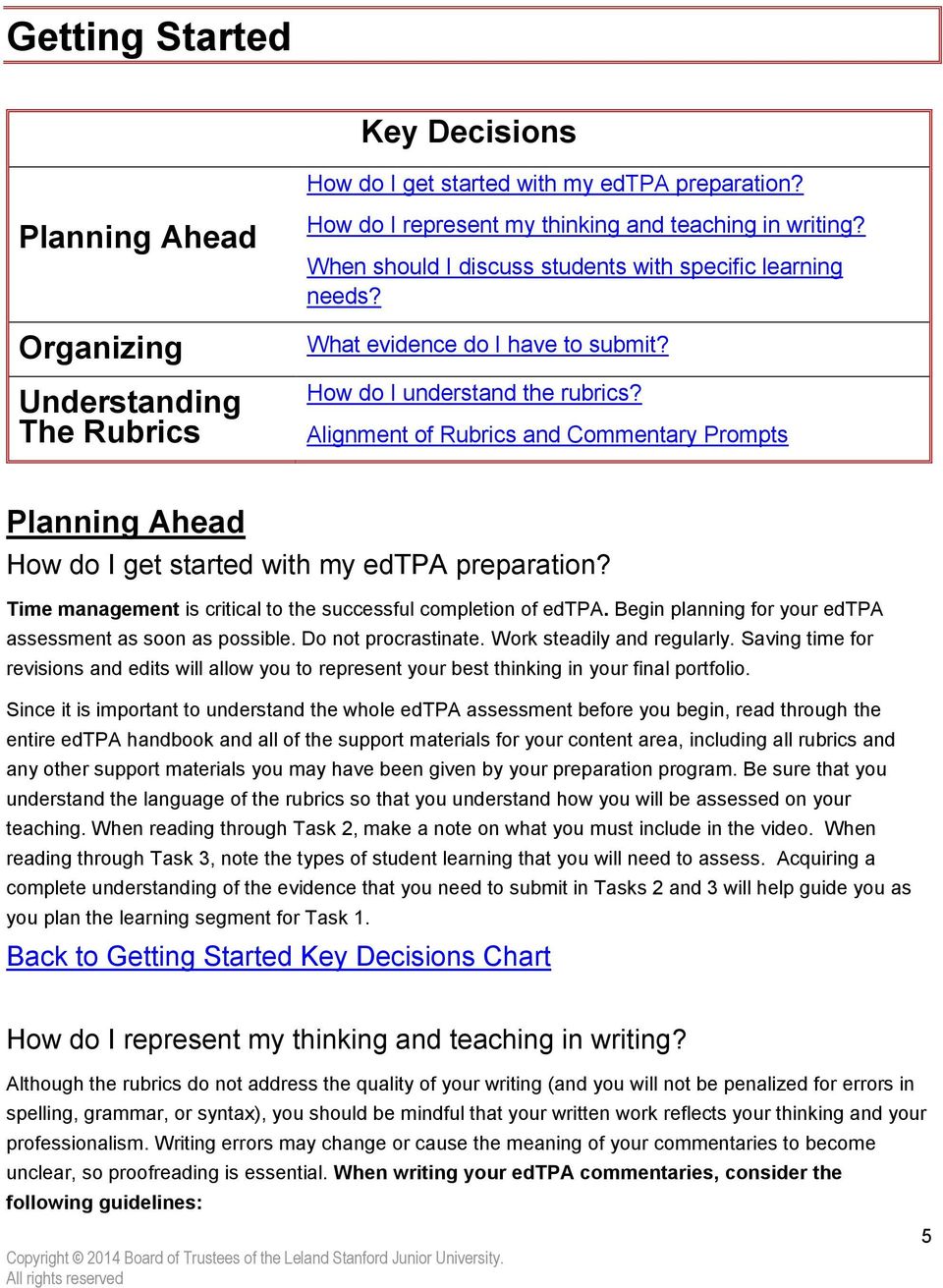
5 Getting Started Key Decisions How do I get started with my edtpa preparation? Planning Ahead Organizing Understanding The Rubrics How do I represent my thinking and teaching in writing? When should I discuss students with specific learning needs? What evidence do I have to submit? How do I understand the rubrics? Alignment of Rubrics and Commentary Prompts Planning Ahead How do I get started with my edtpa preparation? Time management is critical to the successful completion of edtpa. Begin planning for your edtpa assessment as soon as possible. Do not procrastinate. Work steadily and regularly. Saving time for revisions and edits will allow you to represent your best thinking in your final portfolio. Since it is important to understand the whole edtpa assessment before you begin, read through the entire edtpa handbook and all of the support materials for your content area, including all rubrics and any other support materials you may have been given by your preparation program. Be sure that you understand the language of the rubrics so that you understand how you will be assessed on your teaching. When reading through Task 2, make a note on what you must include in the video. When reading through Task 3, note the types of student learning that you will need to assess. Acquiring a complete understanding of the evidence that you need to submit in Tasks 2 and 3 will help guide you as you plan the learning segment for Task 1. Back to Getting Started Key Decisions Chart How do I represent my thinking and teaching in writing? Although the rubrics do not address the quality of your writing (and you will not be penalized for errors in spelling, grammar, or syntax), you should be mindful that your written work reflects your thinking and your professionalism. Writing errors may change or cause the meaning of your commentaries to become unclear, so proofreading is essential. When writing your edtpa commentaries, consider the following guidelines: 5
6 Read each prompt carefully and be sure to respond using simple straightforward prose. Incomplete, superficial, and unelaborated responses are not sufficient. Although there may be a few exceptions, one or two sentences for an answer to a prompt will not contain enough information for a reviewer to understand your intentions, what or how you have taught, or what your students have learned. Pay attention to the verbs in the prompts. They will guide the depth of your writing. When asked to describe, do that: tell about what you planned or did. When prompted to explain, include more detail, and give reasons for your decisions. Justify requires analysis; you must explain why you did what you did and include evidence to back up your response supporting details. Make sure to respond to every part of every prompt. Pay attention to conjunctions ( and, or ). When the prompts are bulleted, make sure to address each bullet point. Move beyond summarizing your classroom practice. Write your commentaries in a way that shows you are able to understand how your students learn and are able to identify and analyze what you do to help them learn and the evidence of their learning. Provide specific, concrete examples to support your assertions. Do not merely repeat prompt or rubric language as your responses to commentary prompts you must always include examples and evidence of YOUR teaching. For example, if you state in a response to a prompt that most of the students were able to understand a concept, you should provide specific, concrete examples from your students written or oral work that demonstrate and support your assertions. You might point to a specific aspect of a student s response on an essay, project, or other assessment that supports your statement that students understand a particular concept. It is important that you always back up your assertions about what students understand with specific evidence. Back to Getting Started Key Decisions Chart When should I discuss students with specific learning needs? Several times in your handbook, you will be asked to consider the variety of learners in your class see chart below. This chart is included to help call your attention to learners who might need different strategies/support to meet their needs relative to the central focus of the learning segment. The list included in the chart is not exhaustive; you should consider all students with specific learning needs. You will come back to the student needs identified in the Context for Learning Information multiple times during this assessment. Consider the variety of learners in your class who may require different strategies/support (e.g., students with IEPs or 504 plans, English language learners, students with higher/lower proficiency levels, underperforming students or those with gaps in content knowledge, or students needing greater support or challenge). Back to Getting Started Key Decisions Chart 6

7 Organizing What evidence do I have to submit? All of the requirements (and information about the optional elements) are listed in the Evidence Chart at the end of each handbook. Read the Evidence Chart and be sure that you understand the requirements before you start working. For edtpa you will submit artifacts (e.g., lesson plans, video clips, copies of assessments and materials for your lessons) and commentaries. Response templates are provided as a structure for organizing your response. Templates are provided for the Context for Learning Information and the three task commentaries (four templates are provided for the Elementary Education Handbook). You may find it helpful to use the Summary Chart found at the beginning of your handbook or the Evidence Charts as a checklist. Back to Getting Started Key Decisions Chart Understanding The Rubrics How do I understand the rubrics? Each edtpa task has 5 rubrics and each rubric has 5 levels of scoring. As you work on responding to the commentary prompts, refer to the associated rubrics and read them again before and during your writing process. Carefully read the qualitative performance differences across levels found in bolded text in each of the rubric descriptions. Pay attention to the conjunctions ( and, or ) in the descriptions so that you are sure to provide all of the information required. Be sure to review the level 1 rubric descriptors carefully as these point out particular issues to avoid. Back to Getting Started Key Decisions Chart Alignment of Rubrics and Commentary Prompts In general, the rubrics and commentary prompts align as depicted in the charts below. Planning Commentary & Rubrics Rubric # Commentary Prompt 1 LSP: 1a-b, 2 Instruction Commentary & Rubrics 2 ETS: 2, 3b LSP: 2a, 3b-c Rubric # Commentary Prompt 2 AGR: 2, 3 3 AGR: 4 4a EAL, PE: 4a-b AGR: 5a 4b EAL: 4c PE: 5 AGR: 5b 5 PE, AGR: 6 7

8 Assessment Commentary & Rubrics Rubric # Commentary Prompt 1 2b PE: 2c 2c PE: 2d 3 4 The World Languages and Classical Languages Handbooks have 13 rubrics because they address Academic Language differently than other handbooks. Planning Instruction Assessment Rubric # Commentary Prompt ab 4c 5 1 2b 2c 3 All of the required artifacts and commentary responses are taken into account during the scoring process. The Context for Learning Information, for example, informs scorers about the class you are teaching and the teaching environment. Your lesson plans, assessments, instructional materials, and video are key artifacts in the scoring process. So while you will not find a rubric that scores these items in isolation, they inform and are all part of what will be used in evaluating your responses. Task 1: Planning for Instruction and Assessment Key Decisions What is my subject area emphasis? Planning For Alignment and Learning Knowledge of Students How do I select the central focus, student content standards, and student learning objectives? How do I select a learning segment? What should I include in my lesson plans? What if I have particular lessons that I am required to teach in a prescribed way or if my school or grade level has a standard curriculum? What information should I convey about my students when describing my class? How do I support the assertions I make about my students and decisions I make regarding their learning needs? 8

9 How specific do my references to research and theory have to be? Language Demands Planning Assessments How do I identify the language demands of a learning task? What kinds of assessments should I choose for my edtpa learning segment? How do I allow students with specific needs to demonstrate their learning? Planning Task Key Points 9

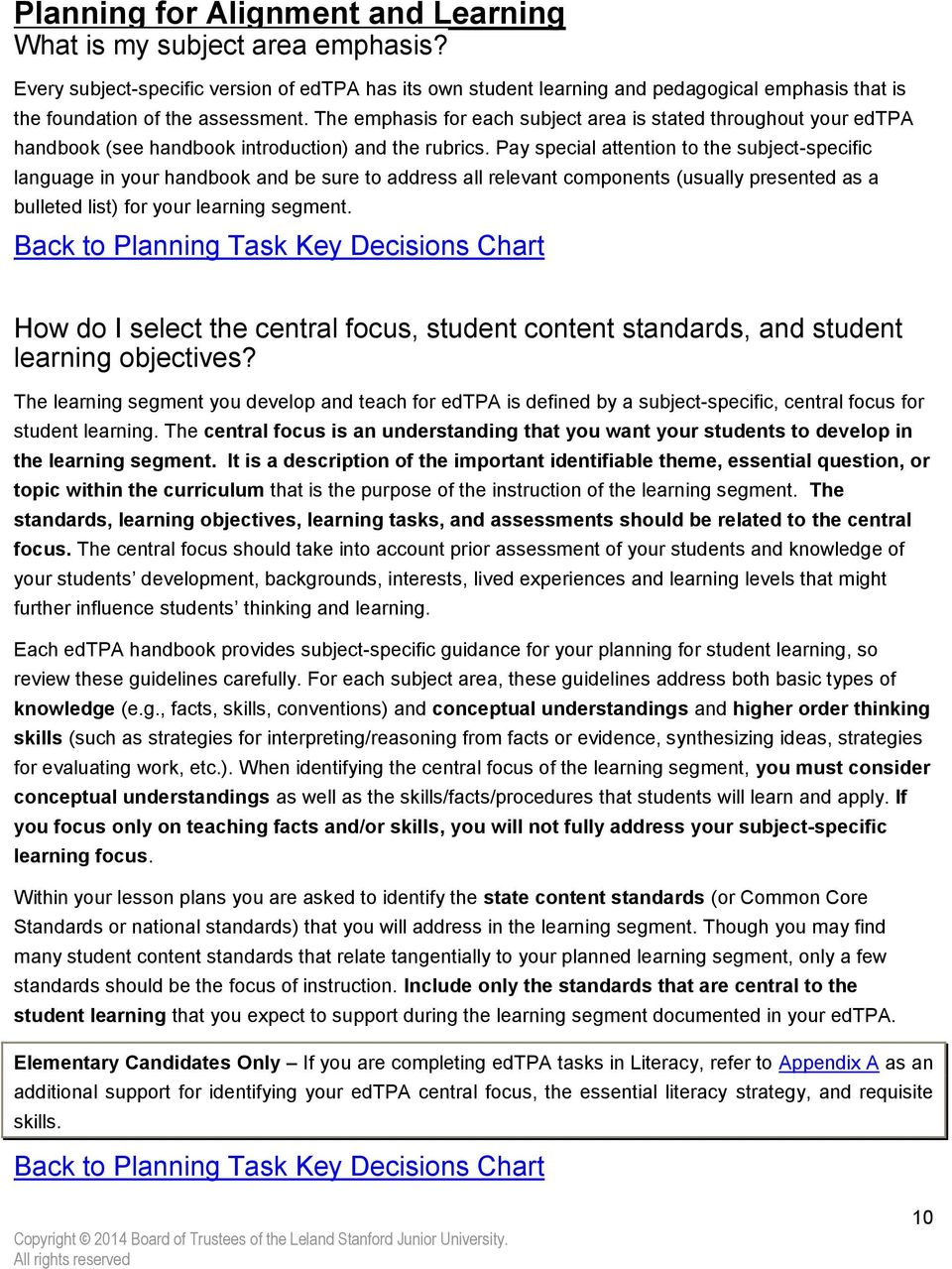
10 Planning for Alignment and Learning What is my subject area emphasis? Every subject-specific version of edtpa has its own student learning and pedagogical emphasis that is the foundation of the assessment. The emphasis for each subject area is stated throughout your edtpa handbook (see handbook introduction) and the rubrics. Pay special attention to the subject-specific language in your handbook and be sure to address all relevant components (usually presented as a bulleted list) for your learning segment. Back to Planning Task Key Decisions Chart How do I select the central focus, student content standards, and student learning objectives? The learning segment you develop and teach for edtpa is defined by a subject-specific, central focus for student learning. The central focus is an understanding that you want your students to develop in the learning segment. It is a description of the important identifiable theme, essential question, or topic within the curriculum that is the purpose of the instruction of the learning segment. The standards, learning objectives, learning tasks, and assessments should be related to the central focus. The central focus should take into account prior assessment of your students and knowledge of your students development, backgrounds, interests, lived experiences and learning levels that might further influence students thinking and learning. Each edtpa handbook provides subject-specific guidance for your planning for student learning, so review these guidelines carefully. For each subject area, these guidelines address both basic types of knowledge (e.g., facts, skills, conventions) and conceptual understandings and higher order thinking skills (such as strategies for interpreting/reasoning from facts or evidence, synthesizing ideas, strategies for evaluating work, etc.). When identifying the central focus of the learning segment, you must consider conceptual understandings as well as the skills/facts/procedures that students will learn and apply. If you focus only on teaching facts and/or skills, you will not fully address your subject-specific learning focus. Within your lesson plans you are asked to identify the state content standards (or Common Core Standards or national standards) that you will address in the learning segment. Though you may find many student content standards that relate tangentially to your planned learning segment, only a few standards should be the focus of instruction. Include only the standards that are central to the student learning that you expect to support during the learning segment documented in your edtpa. Elementary Candidates Only If you are completing edtpa tasks in Literacy, refer to Appendix A as an additional support for identifying your edtpa central focus, the essential literacy strategy, and requisite skills. Back to Planning Task Key Decisions Chart 10
11 How do I select a learning segment? When selecting a learning segment for your edtpa, identify a central focus for teaching and learning, as well as the corresponding standard(s). As with any learning segment, decisions about what to teach should be driven by what students are expected to learn at their particular grade level. You will want to think carefully about how much content to address in your edtpa learning segment. The amount of content you will address in your learning segment is a significant decision about manageability, not only for the scope of your edtpa assessment, but also for the capacity of your students to learn within the allotted time. District curriculum guidelines, school goals, grade-level expectations, and student interests must be considered as well. Although your cooperating teacher must not choose a learning segment for you, his/her input is useful in guiding you to consider all of the relevant factors in your selection. Back to Planning Task Key Decisions Chart What should I include in my lesson plans? You will submit a lesson plan for every lesson taught and documented in your edtpa learning segment. Your lesson plans should provide enough detail so that educators reading your edtpa can determine the sequence of the learning objectives, the plan for assessment, and what you and the students will be doing during each lesson. Make sure that each submitted lesson plan is no more than 4 pages in length. If you are using a lesson plan model that extends beyond that page limit, you will need to condense your lesson plans to meet the page limit. However, be sure to include the following necessary lesson plan components (also listed in your edtpa handbook): State-adopted, Common Core, or national standards Learning objectives associated with the standards Formal and informal assessments Instructional and learning tasks Instructional resources and materials Note: Do not put explanations and rationale in your lessons plans. Scorers will not search your lesson plans for explanations and rationale. Use the commentary prompts to explain your thinking and justification for your plans. Back to Planning Task Key Decisions Chart What if I have particular lessons that I am required to teach in a prescribed way or if my school or grade level has a standard curriculum? 11

12 Many teachers teach lessons that are from published or prescriptive curriculum guides that are required in a particular district, school, or department. In some cases, pedagogy is prescribed by the curriculum you are required to teach. If this is the case for you, explain this in the Context for Learning commentary. Your lesson plans and commentary should address how you modified these lesson plans with your students backgrounds and/or needs in mind. You might describe how you selected or modified curriculum materials to meet your students needs, how you adapted a lesson to meet your students needs, and/or how you made accommodations for particular students needs (e.g., providing alternative examples, asking additional questions, using supplementary activities). When following highly prescriptive curricula or district/school/department mandates, these changes may be modest. Back to Planning Task Key Decisions Chart Knowledge of Students What information should I convey about my students when describing my class? The Planning Task (Task 1) requires you to demonstrate your depth of knowledge of your students in relation to the learning segment you plan to teach. Making casual references or surface level connections to students backgrounds, interests, development, and learning needs is not enough. In Task 1, your responses to the Context for Learning Information prompts and the relevant Task 1 commentary prompts should provide detail on the class demographics, significant subgroups of students 12

13 Do not merely repeat prompt or rubric language as your responses to commentary prompts you must always include examples and evidence of YOUR teaching. For example, if you suggest that most of the students have not yet learned a concept or skill, you need to provide specific and concrete example(s) from your students written or oral work or prior academic learning that demonstrate and support your claim. Back to Planning Task Key Decisions Chart How specific do my references to research and theory have to be? When including research/theory in your edtpa, you should justify why you are doing what you are doing. Justify your instructional choices in your plans, your choice of teaching strategies, materials and the learning tasks you plan for students. You may include the principles of research and theory you have learned in courses in your preparation program or elsewhere. Draw upon educational philosophy and specific theories of development, learning, group work, and motivation, as well as conceptions and research-based practices of the discipline you are teaching. Formal citations are not required. The theoretical concepts and lines of research included in your edtpa should support/inform your instructional decisions. Do not merely cite a textbook author, name-drop (e.g., Vygotsky or Bloom said), or describe a concept without making an explicit and well-developed connection between the theory/research and your plans for instruction and knowledge of your students. Be sure your justification centers on instructional and support choices that move the learner toward meeting the lesson objectives. Back to Planning Task Key Decisions Chart Language Demands How do I identify the language demands of a learning task? Academic language is the means by which students develop and express content understandings. Academic language represents the language of the discipline that students need to learn and use to participate and engage in meaningful ways in the content area. Your discussion of academic language development in edtpa should address your whole class, including English Learners, speakers of varieties of English, and native English speakers. 13

14 Language demands of a learning task include the receptive language skills (i.e., listening, reading), productive language skills (i.e., speaking, writing), and/or representational language skills (e.g., symbols, notation) needed by the student in order to engage in and complete the learning task successfully. Academic language demands are so embedded in instructional activities that you may take many for granted, especially when you are a subject matter expert. edtpa requires you to identify certain academic language demands within your learning segment. These include a language function and essential academic vocabulary and/or symbols, as well as syntax and/or discourse. The language function is basically the PURPOSE or reason for using language in a learning task. In other words, what communication function (skill) do the students need to use to communicate their understanding of content? Often, the standards and/or objectives for the learning segment will include language functions embedded in the content to be learned in the form of verbs (e.g., explain, infer, compare, argue, justify). You will identify ONE major language function that all students will need to develop in order to deepen learning of the content in your learning segment. You are also asked to identify additional language demands involving vocabulary and/or symbols, and syntax and/or discourse. You will need to identify vocabulary central to the outcomes of the learning segment that may pose a challenge for students. Examine all your instructional materials (texts, assessments, and other resources) to document which content-specific vocabulary you will need to teach to ensure that your students are engaged and develop understanding during your learning segment. Syntax and discourse within your lessons pose additional language demands for your students. Syntax is the set of conventions for organizing words, phrases, and symbols together into structures (e.g., sentences, formulas, staffs in music). For example, syntax refers to the structure of a sentence its length, word order, grammar, arrangement of phrases, active or passive voice, etc. If the syntax of a sentence is challenging its reader, then it is clouding the sentence's meaning. After carefully examining the texts of your lessons, the ways you explain key ideas, and your expectations for what you want the students to write, determine which sentence patterns, grammatical structures, or symbolic conventions might be unfamiliar or difficult for your students. Discourse refers to how people who are members of a discipline talk and write. It is how they create and share knowledge. Each discipline or subject area has particular ways of communicating what they know and how they know it. Discipline-specific discourse has distinctive features or ways of structuring oral or written language (text structures) that provide useful ways for the content to be communicated. For example, scientists and historians both write texts to justify a position based on evidence or data. In both disciplines, they use the same language function i.e., justify but the way they organize that text and present supporting evidence follows a different structure or discourse pattern. Are there discourse structures that you expect your students to understand or produce in your learning segment? If so, these discourse structures should be described. 14

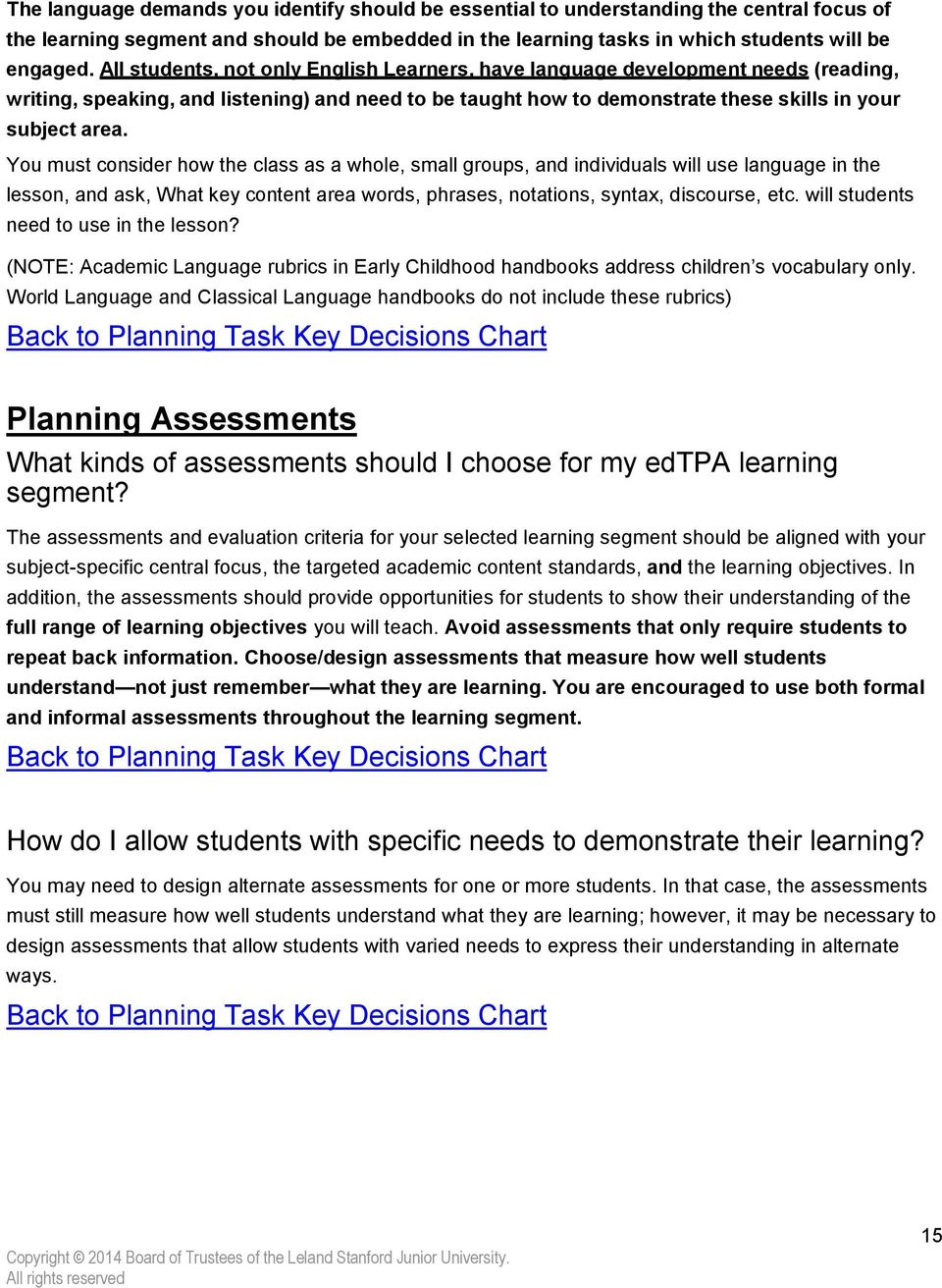
15 The language demands you identify should be essential to understanding the central focus of the learning segment and should be embedded in the learning tasks in which students will be engaged. All students, not only English Learners, have language development needs (reading, writing, speaking, and listening) and need to be taught how to demonstrate these skills in your subject area. You must consider how the class as a whole, small groups, and individuals will use language in the lesson, and ask, What key content area words, phrases, notations, syntax, discourse, etc. will students need to use in the lesson? (NOTE: Academic Language rubrics in Early Childhood handbooks address children s vocabulary only. World Language and Classical Language handbooks do not include these rubrics) Back to Planning Task Key Decisions Chart Planning Assessments What kinds of assessments should I choose for my edtpa learning segment? The assessments and evaluation criteria for your selected learning segment should be aligned with your subject-specific central focus, the targeted academic content standards, and the learning objectives. In addition, the assessments should provide opportunities for students to show their understanding of the full range of learning objectives you will teach. Avoid assessments that only require students to repeat back information. Choose/design assessments that measure how well students understand not just remember what they are learning. You are encouraged to use both formal and informal assessments throughout the learning segment. Back to Planning Task Key Decisions Chart How do I allow students with specific needs to demonstrate their learning? You may need to design alternate assessments for one or more students. In that case, the assessments must still measure how well students understand what they are learning; however, it may be necessary to design assessments that allow students with varied needs to express their understanding in alternate ways. Back to Planning Task Key Decisions Chart 15
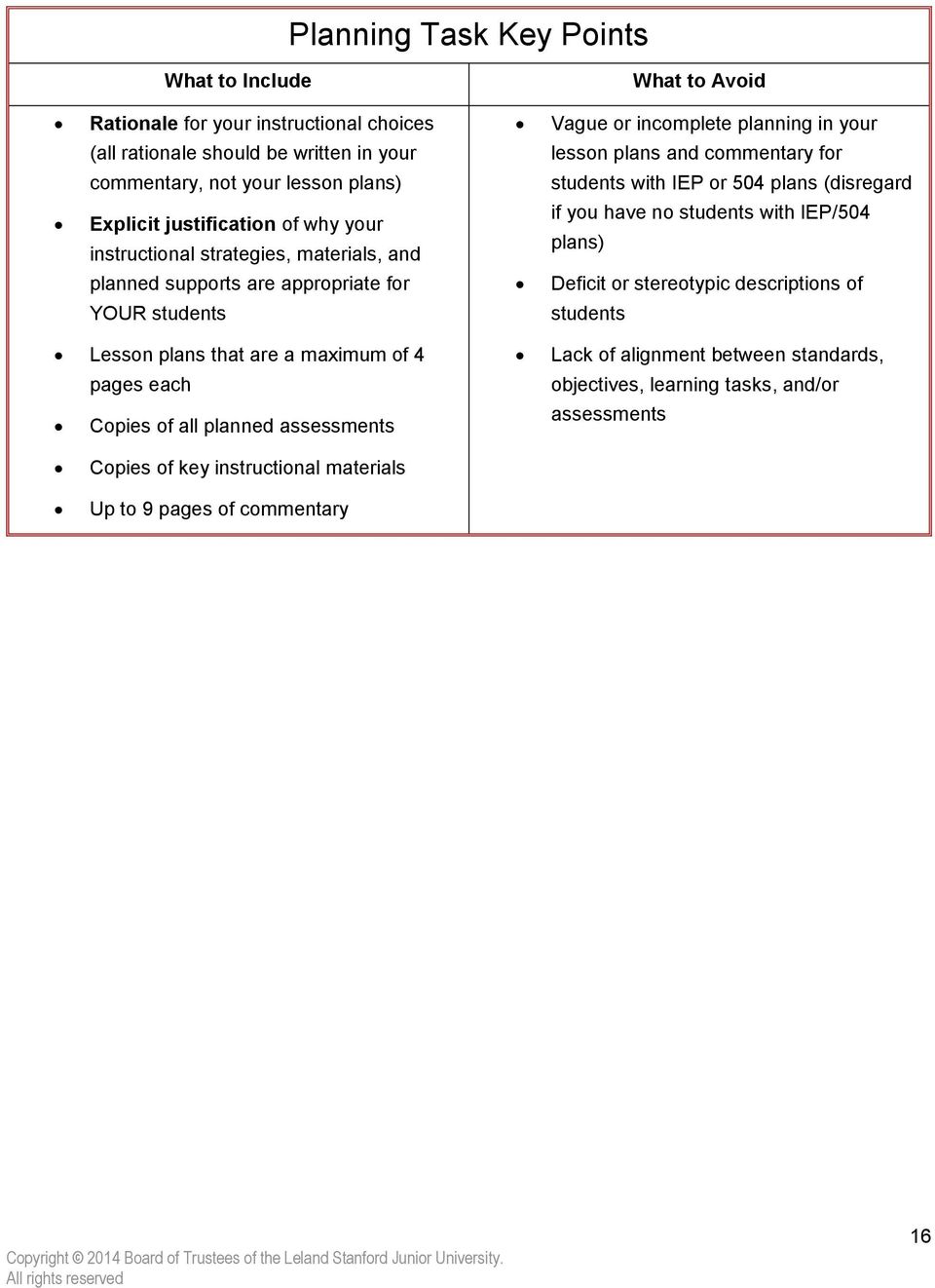
16 Planning Task Key Points What to Include What to Avoid Rationale for your instructional choices Vague or incomplete planning in your (all rationale should be written in your lesson plans and commentary for commentary, not your lesson plans) students with IEP or 504 plans (disregard Explicit justification of why your instructional strategies, materials, and if you have no students with IEP/504 plans) planned supports are appropriate for Deficit or stereotypic descriptions of YOUR students students Lesson plans that are a maximum of 4 pages each Copies of all planned assessments Lack of alignment between standards, objectives, learning tasks, and/or assessments Copies of key instructional materials Up to 9 pages of commentary 16
17 Task 2: Instructing and Engaging Students in Learning Key Decisions What are my professional responsibilities for maintaining confidentiality? Video recording What are the features of a quality edtpa video? How do I prepare my edtpa video recordings for my learning segment? What resources do I need to consider (equipment, software, and tutorials)? Learning Environment Engaging Students Deepening Student Learning Subject- Specific Pedagogy Analyzing Teaching Effectiveness What do I look for when selecting clips that demonstrate respect and rapport? How do I demonstrate a positive learning environment that supports and challenges students? How do I select my video clip(s) to show active engagement of students? How do I show that I am deepening student understanding? What is meant by subject-specific pedagogy? What is important to consider as I propose changes to the learning segment? Instruction Task Key Points 17

18 Video Recording What are my professional responsibilities for maintaining confidentiality? You are required to obtain consent from students and other adults who appear in the video clip(s) for your edtpa. Obtaining consent is a professional responsibility that should not be ignored. Respecting students privacy and protecting yourself and your cooperating teacher are important concerns. Your program will provide you with a consent form to use.. It is vitally important that you only use the video for the purpose of completing your edtpa and that you do not share it with others publicly. Video of your teaching should NEVER be posted in public venues like YouTube, Facebook, etc., or shared with people not involved with the edtpa assessment without additional permission, as this violates the confidentiality of the children you teach and their families. Back to Instruction Task Key Decisions Chart What are the features of a quality edtpa video? There is no requirement or expectation for you to create a professional-quality production. The use of titles, opening and closing credits, a musical soundtrack, or special effects must be left to Hollywood, as reviewers will be examining only what the video shows you and your students doing within the learning segment. However, while it is not necessary to be technically perfect, it is important that the quality of the video (i.e., clarity of picture and sound) be sufficient for scorers to understand what happened in your classroom. Read your edtpa handbook carefully to be sure your clips are the appropriate length and that they feature the teaching and learning emphasis for your subject area. How do I prepare my edtpa video recordings for my learning segment? Advise your cooperating/master teacher and the principal at your school of your need to video record lessons for your learning segment. Although a camera operator is often unnecessary, discuss any arrangements that you plan to make for someone to operate the camera. If you use a camera operator, look to people who already have approval to be in classrooms (e.g., your cooperating teacher or your university supervisor). Collect the necessary consent forms from a parent/guardian for your students (or, if eligible, from the students themselves) and from adults who might appear in the video. Respecting students privacy as well as protecting yourself and your cooperating teacher are professional responsibilities that should not be ignored. Make arrangements for the necessary video/audio equipment well in advance. If you do not have ready access to video equipment, reach out to peers, family members, your cooperating/master teacher, university supervisor, or technology staff. 18
19 Consider the location. Think about where you and your students will be located in the classroom during the activities to be shown in the video. What evidence do the rubrics call for that the camera will need to capture? Where will the camera/microphones need to be placed in order to optimize sound quality? Try to plan ahead and minimize the need for a camera operator by scouting locations in advance. In particular, think about where to place any learner who does not have permission to be filmed, so that s/he can participate in the lesson off-camera. If you do need a camera operator, meet in advance to share the lesson plan and video needs. Practice video recording BEFORE teaching the learning segment. Practice will provide a chance to test the equipment for sound and video quality, as well as give your students an opportunity to become accustomed to the camera in the room. Try to record the ENTIRE set of lessons in your learning segment. Recording more than what you plan to submit for edtpa will provide you with plenty of footage from which to choose the clip(s) that best meet the requirements for edtpa. Be natural. While being recorded, try to forget the camera is there (this is good to explain to your students as well), and teach like you normally do. If possible, record other lessons prior to the learning segment so that the camera is not a novel item in the classroom to you and your students. If using a camera operator, advise him or her not to interject into the lesson in any way. Be sure that the video clip(s) you select and submit have quality audio. Good audio allows individuals viewing the clip(s) to hear individual voices of students as they are working on a task or with each other. It is often helpful to view your recording after each day, so you can check for audio quality and note, with time stamps, possible examples of evidence for later consideration in choosing the clip(s) you submit. Be sure to review the instructions for downloading the video unless you use the camera often. As soon as the video recording is downloaded, make a backup copy of the video on a hard drive, a USB drive, or a CD/DVD. For a video tutorial that highlights what to consider for successful recording in the classroom, go to this link: Back to Instruction Task Key Decisions Chart What resources do I need to consider (equipment, software, and tutorials)? edtpa does not specify the use of any particular equipment, software, tutorials, etc.; although there are formatting requirements outlined in the Evidence Chart in the edtpa handbooks. An expensive camera is not necessary for the demands of this assessment. Many low-end cameras are capable of producing a picture and sound quality that is suitable for your video needs. However, certain situations (e.g., groupings where the students are not facing the camera microphone, table groups where many students 19

20 are talking at once, lots of ambient noise) may necessitate the use of some kind of external microphone. The only way to know for certain what is working - is to test the equipment. Video equipment and cropping your clips for edtpa: Since the clip(s) you submit for your edtpa must consist of a continuous teaching without any edits, you will need to use cropping tools to extract a clip from the longer video you record. If you are new to video recording or to the camera you are using, be sure to read the instruction manual that comes with the camera. Even if the manual has been lost, most manuals are available online at the manufacturer s website. Manufacturers may also have online tutorials to help you learn how to use the camera. YouTube has a plethora of videos that demonstrate how to set up and operate a camera. The free video editing software that comes with most computers is perfectly adequate for preparing and saving the clip(s) in the format required in your edtpa handbook. PCs have the program Windows Movie Maker (found in the START menu under PROGRAMS), while Macs provide you with imovie. There are many online tutorials that will support you in learning how to use these programs. Tutorials for using Windows Movie Maker to edit your video (click here) Tutorials for using imovie to edit your video (click here) Back to Instruction Task Key Decisions Chart Learning Environment What do I look for when selecting clips that demonstrate respect and rapport? Establishing respect and rapport among and with students is critical for developing a mutually supportive and safe learning environment. Respect is the positive feeling of esteem or deference toward a person and the specific actions and conduct representative of that esteem. Rapport is a close and harmonious relationship in which members of a group understand each other s ideas, respectively collaborate and communicate, and consider one another s feelings. Both respect and rapport are demonstrated by how you treat students and how they treat each other, and both should be evident in your video. As you go through your footage, you will want to find clips that not only feature respectful interactions between you and your students, but also among your students. In your commentary responses, cite specific scenes from the video clip(s) you select for submission (time stamps are very helpful) that illustrate the respect and rapport you have established with your students. Back to Instruction Task Key Decisions Chart How do I demonstrate a positive learning environment that supports and challenges students? 20

21 One of the important characteristics that must be included in your video is evidence that you have created a learning environment that challenges students and supports them as they work to meet the challenge. You will want to choose clips that provide evidence that the learning environment you created not only supports students in learning but also challenges them to learn at a deeper level. Challenge can be demonstrated by including questions or opportunities for students to learn content or demonstrate learning beyond their current performance level. It should be apparent from your students and your actions in the video that the learning environment is primarily designed to promote and support student learning as opposed to managing student behavior. While it is important that students stay focused, the atmosphere should be challenging in a way that keeps students engaged and learning. Back to Instruction Task Key Decisions Chart Engaging Students How do I select my video clip(s) to show active engagement of students? Your video clips are the primary sources of evidence used in scoring Task 2. The evidence you need to collect for edtpa Task 2 should demonstrate how you engage students while teaching. Read the handbook instructions carefully. Read each prompt AND read each rubric to fully understand all of the evidence that your video should demonstrate. When choosing your clips, consider what the students are doing. It is helpful to watch your clips to be sure that they provide evidence for all of the required elements. Consult the Evidence Chart in your handbook for specific requirements for your clips. Your video clip(s) should reveal the subject-specific student thinking, analysis, and judgment required in your learning segment. The video clip(s) should feature instruction where there is student-teacher interaction and/or student-student interaction and where students have opportunities to engage in learning tasks that help them learn what you have planned. Both goals can be achieved through lessons in which you probe students thinking and/or facilitate students in probing each other's thinking so that they can display their depth of understanding of the content you are teaching. Lessons that require students to only focus on recall of facts or to practice a set of narrow skills are not appropriate choices for an edtpa learning segment or video. In addition, your video clip(s) should provide evidence of how you engaged students in a learning task - -- an activity -- (an assignment, a discussion, etc.) that requires the students to do more than just participate. In other words, the students should be shown actively using some higher level thinking skills so that they are developing their conceptual understanding of the content. In order to provide context for the new learning, you will need to make specific connections in the clip(s) to their prior academic learning and assets. Back to Instruction Task Key Decisions Chart 21
22 Deepening Student Learning How do I show that I am deepening student understanding? The video clip(s) should show how you elicit and build upon student responses during instruction related to your central focus for student learning. You should ask questions at a variety of levels of thinking and show how you probe for responses that demonstrate deep thinking and conceptual understanding. You can draw upon any of the interactions in the video to highlight how you prompt, listen to, and respond to students in such a way that you are supporting them to build on their new learning. Choose video clips with teaching strategies and/or student learning tasks that support learning. The teaching strategies that you choose will determine how well you can show that you are deepening student understanding. Strategies that do not allow you to engage in discussion or conversation with students may limit your ability to demonstrate that you are deepening student understanding. For example, if you deliver a mini-lecture followed by a discussion during which you check for student understanding, you should focus the video clip on the discussion rather than on the mini-lecture (which can be described in the commentary as context). How you conduct that discussion is also important. A video clip filled with students answering yes/no questions, reciting information, reading aloud without conversation, writing silently, etc. will not reveal how you deepened their understanding of the content to be learned. Rather, the video recorded discussion should represent an opportunity for students to display or further their depth of understanding. Back to Instruction Task Key Decisions Chart What is meant by Subject-Specific Pedagogy? Each handbook is designed for a specific discipline/subject area and educational level. Each discipline requires teachers to understand content-specific pedagogy effective methods of teaching for the specific discipline and developmental level of the students. Subject-specific pedagogy includes not just effective approaches to teaching your content, but effective approaches to teaching your students how to think in your subject area. Carefully review this section of your handbook and the accompanying rubric to determine what subject specific pedagogy you are expected to demonstrate within your clips. Back to Instruction Task Key Decisions Chart Analyzing Teaching Effectiveness What is important to consider as I propose changes to the learning segment? You should describe what you have learned about teaching the central focus of the learning segment based on your observations of how your students responded to the instructional strategies, learning tasks, and materials in the video clip(s) submitted. Be specific about any changes you would make if 22
23 you were able to teach the lesson(s) again. The changes may address some logistical issues (time management, giving directions, etc.), but should mainly focus on how you would improve the instruction, learning tasks and/or materials to address and support students individual and collective learning needs in relation to the central focus. You will also need to cite evidence that explains why you think these changes will work. Cite specific examples using timestamps from the video clips of student confusion, misunderstanding, and/or need for greater challenge that informed your proposed changes. Lastly, explain how principles of research and theory informed your decision-making about the changes. (Click here to return to the Planning Task explanation of citing research.) Back to Instruction Task Key Decisions Chart Instruction Task Key Points What to Include What to Avoid Video evidence that explicitly depicts you Sharing your video PUBLICLY on addressing the subject-specific YouTube, Facebook or any other website requirements in your handbook (please respect the privacy of students) References in your commentary Choosing a video clip that shows you responses to specific examples found in making significant content errors your video clip(s) Showing disrespect to students or Time stamps identifying evidence from allowing students to be disrespectful to the video clip(s) in every response each other Choosing a video clip during which the focus is largely classroom management Choosing a video clip that reveals a mismatch between instruction choices and students readiness to learn Choosing a video clip that does not reflect your subject-specific focus 23
24 Task 3: Assessing Student Learning Key Decisions What kind of student work should I analyze for my edtpa? Analyzing Student Learning How specific should the evaluation criteria be? How do I choose the student work samples (focus students)? How detailed should the whole class analysis be? Feedback What types of feedback to students should I include in my edtpa? How do I explain how my students will use the feedback I give? Analyzing Students Academic Language Understanding and Use Use of Assessment to Inform Instruction How do I identify evidence that my students understand and use academic language? What do I need to think about when determining next steps for my teaching? Assessment Task Key Points Analyzing Student Learning What kind of student work should I analyze for my edtpa? For Task 3 you will select ONE assessment that was given to the whole class during your learning segment. The assessment must reflect each student s individual work; it cannot be the work of pairs or 24
25 groups of students. You will analyze the work of all of the students in the class and you will select three student work samples for more detailed analysis and discussion. NOTE: Early childhood candidates in addition to the large group assessment, you must submit additional evidence of children s learning. Refer to the Early Childhood handbook to verify the multiple sources of evidence required for your edtpa Task 3. The assessment you choose to analyze should align with the central focus, content standards, and stated learning objectives of your learning segment, and should provide students with an opportunity to demonstrate an understanding of those standards/objectives. The assessment you choose may be formal or informal, formative or summative, but it needs to result in evidence of student learning according to the evaluation criteria you describe. You are expected to analyze your students thinking and learning not just whether they know a set of important facts or essential vocabulary terms. The assessment you design and analyze should allow the students to demonstrate their thinking in some way. Keep in mind that you learn less about what your students are thinking and learning from multiple-choice questions or single-word response questions than from open-ended questions, writing samples, performance tasks, projects, problem sets, lab reports, or other more complex assessments. Note: Some fields such as Early Childhood and elementary fields, Performing Arts, Visual Arts, and Physical Education allow for documentation of student learning through video clips, audio files, photographs, or other media. Check your handbook for details about requirements and options in your subject area. Back to Assessment Task Key Decisions Chart How specific should the evaluation criteria be? The evaluation criteria you use should make clear to you (and ideally to your students) what features or qualities of the students work will be assessed: for example, the accuracy of students' responses; the quality of their communication; the depth, originality, or creativity of their ideas; where the students are in their conceptual development for a particular idea; or the mechanics of doing a task. Your evaluative criteria should align with the objectives of the learning segment and the standards. It should measure the outcomes of your learning segment as related to the central focus. Importantly, the evaluation criteria should address the elements of the subject-specific emphasis as defined in your edtpa handbook. Back to Assessment Task Key Decisions Chart How do I choose the student work samples (focus students)? After analyzing the whole class data, review the patterns of learning you found. Choose three work samples that illustrate identified patterns from your analysis. You want to choose work samples that 25
26 show the range of performance on the assessment so that you can point to specific examples of the understandings, misunderstandings and patterns of errors that you discuss in the whole class analysis. At least one of the student work samples must be from a student with a significant learning need. California candidates must include a work sample from at least one English learner. NOTE: While most handbooks ask you to select the focus students after analyzing the whole class data, if you are providing a video work sample, required in some fields such as Physical Education, you must select your focus students earlier in the process. Consult your handbook carefully to see what formats are required or accepted. If you must select a focus student in advance, consider prior performance to select a range of students. Back to Assessment Task Key Decisions Chart How detailed should the whole-class analysis be? Your analysis will examine data/performance from the whole class. Once you have assessed each student s work sample, you need to present both a quantitative and qualitative analysis of how well all your students performed. These analyses can help you move to a discussion of patterns of learning. Consider asking yourself the following questions when reviewing student data: What did many or most students understand and how can you use the work sample(s) to demonstrate that understanding? What were common errors? How can you use the student work samples and your knowledge of their instruction to hypothesize why students might have made those errors? What, if anything, did students who succeeded or made errors have in common (e.g., strong or struggling readers, English learners)? Your response should indicate that you understand how well your students have understood the content and what they need to continue to work on. You do not need not provide multiple examples in your analysis to illustrate a point; one clear example will suffice. In your analysis be sure to address all your evaluation criteria and all the bulleted items of the subject-specific elements in your handbook. Back to Assessment Task Key Decisions Chart Feedback What types of student feedback should I include in my edtpa? The feedback to students should offer students clear and specific information on their performance related to the lesson objectives/standards and should align with the evaluation criteria for your analyzed assessment. At the very least, your feedback should make students aware of their strengths and their errors. Effective feedback will denote areas where they did well and where they need to improve related to the specific learning objectives. Marking the percent correct and providing non-specific comments such as 26
27 Good job are not sufficient, as students will have little idea of what exactly they did well. In contrast, specific comments such as Effective word choice or Well-supported conclusion direct attention to the details of their performance related to the central focus, thereby deepening their understanding of the qualities of their work. The same goes for feedback that focuses on areas that need improvement. Citing only the number of problems a student got wrong is not sufficient. In order to identify an area for improvement, students need to know specifically what it is that needs attention. For example, comments such as Your topic sentence needs more focus or Let s review the relationship between slope and the y-intercept, because I see you are making the same error in several problems (items 2, 7, and 12) give students information necessary for targeting their improvement. Back to Assessment Task Key Decisions Chart How do I explain how my students will use the feedback I give? The purpose of giving feedback is to help your students understand what they know and can do and what they still need to work on. Research shows that the opportunity to apply feedback promotes learning. Think about the upcoming lessons and the feedback given to the students. What opportunities are there in the next lessons to apply the feedback? Would revision of the work sample be a more powerful learning experience? Is there additional support that might scaffold the application of the feedback and accelerate learning? Do the focus students have different needs that imply different choices? Your explanation should demonstrate that you have considered how and when students might best apply the feedback to accelerate or extend their learning. Back to Assessment Task Key Decisions Chart Analyzing Students' Academic Language Understanding and Use How do I identify evidence of students understanding/use of academic language? In your Assessment commentary, you will respond to a prompt asking for evidence that your students were able to use academic language (identified language function, vocabulary, and additional identified demands) to develop content understandings. In your analysis, you need to explain how your students used academic language, and you must support your explanation by citing specific evidence from video clip(s) and/or student work samples. When referencing specific evidence from the video clip(s) or the work samples, describe how students met your identified academic language demands in ways that furthered their understanding of the content to be learned. Your examples need to go beyond students parroting back definitions of unfamiliar words. Rather, the examples should reveal students understanding of vocabulary and their ability to use the key language function identified in your 27
28 Planning Task commentary. The evidence cited must clearly demonstrate how students used language to develop content understandings. It is possible that the targeted academic language use may be better illustrated by a written work sample. Therefore, you have a choice to provide evidence from student work samples in addition to or instead of video clips. When choosing your evidence of academic language use, select those in which students are demonstrating their ability to use the language function purposefully (e.g., explain, infer, analyze), produce the discourse, and/or display their understanding of key vocabulary. If your students are still learning to use the targeted academic language but have not yet mastered it, choose evidence that shows what they can do and what they still need to learn to do. Explain the evidence of language use that you have selected by citing specific examples from the evidence. (NOTE: Academic Language rubrics in Early Childhood handbooks address children s vocabulary only. World Language and Classical Language handbooks do not include these rubrics) Back to Assessment Task Key Decisions Chart Use of Assessment to Inform Instruction What do I need to think about when determining next steps for my teaching? Informed by your analysis of the students' performance in the learning segment, "next steps" should detail the instructional moves you plan to make going forward for the whole class, with particular emphasis on the focus students. Be sure to reference both student learning needs and strengths in your commentary. The next steps that you propose should follow very specifically from the data analyzed Task 3. What did some or all of the students do well? What didn t they understand or do well? In future lessons, how can you challenge students who did well? What will you do in order to help students meet the learning objectives they were unable to meet? Think about your focus students and their performance. What does their performance suggest that you need to do in next lessons? Are there other students in the class who could benefit from the same changes, follow-up, review or challenge? How can you support the further development of students with differing needs? What does the research and theory you learned suggest would be effective strategies to meet these varied needs? Be sure to explain how you chose your next steps based on your analysis of student strengths and needs as well as research and theory. Back to Assessment Task Key Decisions Chart Assessment Task Key Points What to Include What to Avoid 28
29 Analysis of an assessment that allows A lengthy list of standards and/or students to display a range of objectives, many of which are not closely understanding of the specified subject- related to the assessment analyzed specific elements of your central focus An assessment that only allows students A focus on important trends in student to display a narrow range of knowledge performance, supported by examples and skills from the work samples An assessment that was completed by a Focus students whose work samples group of students, not individually represent a range of performance on the assessment Superficial analysis of student learning (e.g., there is no citation of evidence from Concrete evidence of feedback for each student work samples or the analysis focus student focuses on trivial aspects of the Concrete evidence of academic language performance) use (video clip and/or student work Misalignment between evaluation criteria, samples) learning objectives, and/or analysis Feedback that is developmentally inappropriate or disrespectful to students, or contains significant content inaccuracies Identifying next steps for learning that are not related to your analysis of student learning 29
30 Appendix A ELEMENTARY LITERACY edtpa LEARNING SEGMENT CENTRAL FOCUS CONSIDERATIONS It is vital to remember your edtpa should focus on literacy elements. While literacy instruction is sometimes integrated with content area instruction in the elementary classroom, only the teaching and learning related to students literacy development will be documented for your edtpa materials. Choose either comprehension or composition as the central focus. Comprehension Composition Identify ONE strategy for student learning across the 3-5 lessons. Keep it simple! The lists on the right provide examples and are not all inclusive. See Common Core Standards for additional ideas. For Example: Analyze characters or arguments Analyze text structures Summarize plot or main ideas Compare characters or versions of stories Compare points of view Argue/persuade using evidence Infer meaning from evidence Describe a process or topic Sequence events or processes Support predictions based on evidence Interpret a character s actions or feelings Draw conclusions Retell a story Identify story elements, character traits, or themes Identify characteristics of informational texts For Example: Brainstorming or other ways to gather and organize information for writing Note taking from informational text to support writing topic Using graphic organizers for prewriting Revising a draft Using a rubric to revise Choose one or more requisite skills that directly support your students to develop or refine the learning strategy. The skills should be appropriate to gradelevel student For Example: Print concepts Decoding/Phonics Phonological awareness Word recognition Fluency Miscue self-correction Language conventions Word analysis For Example: Language conventions (spelling, grammar, punctuation) Applying text structure features Editing/Revising Sentence fluency Organization (topic sentences, transitions, paragraph structure, etc.) Attributes of genre Using descriptive language 30
31 readiness and scope of lessons in the learning segment. Syllabic, structural, or morphological analysis (affixes and roots) Vocabulary meaning in context Text structure features Word choice Using active voice Make Reading/Writing Connections Literacy naturally explores the relationship of reading and writing. Supporting students in making reading and writing connections is critical for developing strong literacy skills. For example, many of the skills that are taught in reading instruction also are beneficial to young writers. Students should understand through explicit connections that the processes of reading and writing are interdependent and mutually beneficial. In working under this umbrella of a reading-writing interdependence, students are better able to construct meaning from what they read or in what they write. Through writing about their reading, students have opportunities to develop and demonstrate academic language. They practice the vocabulary associated with literacy skills and strategies and express their understandings about reading through writing. Students demonstrate understandings of syntax and grammar, text structure, and genre, as well as other features of author s craft." Examples of activities that promote Reading-Writing Connections Reading and researching informational text to inform an essay Writing interpretations or analysis of informational text Writing dialogue between characters of a story Writing letters to characters or authors Writing letters to the newspaper editor in response to a story in the news Journal writing: making predictions, making personal or text-text connections Note taking Writing book reviews Writing from the perspective of a character Writing alternative endings for a story Writing in a style that emulates a text, a genre or an author Writing responses to persuasive essays 31
Making Good Choices. A Support Guide for edtpa Candidates
 Making Good Choices A Support Guide for edtpa Candidates September 2015 edtpa stems from a twenty-five-year history of developing performance-based assessments of teaching quality and effectiveness. The
Making Good Choices. A Support Guide for edtpa Candidates
 Making Good Choices A Support Guide for edtpa Candidates August 2013 edtpa stems from a twenty-five-year history of developing performance-based assessments of teaching quality and effectiveness. The Teacher
Visual Arts. Assessment Handbook. September 2013. edtpa_visarts_02
 Visual Arts Assessment Handbook September 2013 edtpa_visarts_02 edtpa stems from a twenty-five-year history of developing performance-based assessments of teaching quality and effectiveness. The Teacher
MAKING GOOD CHOICES. A Support Guide for edtpa Candidates. Planning. Instruction. Assessment. Analysis of Teaching Academic Language.
 MAKING GOOD CHOICES A Support Guide for edtpa Candidates Planning Instruction Assessment Analysis of Teaching Academic Language July 2016. The edtpa trademarks are owned by The Board of Trustees of the
WA TPA. Secondary English- Language Arts. Assessment. Handbook. Teacher Performance. Consortium (TPAC) Field Test Pre-Release Handbook September 2011
 WA Teacher Performance Assessment Consortium (TPAC) WA TPA Secondary English- Language Arts Assessment Handbook September 2011 September 2011 WA The Teacher Performance Assessment stems from a 25-year
Secondary English Language Arts
 Teacher Performance Assessment (TPA) Secondary English Language Arts Assessment Handbook October 2011 This handbook is intended for use only by participants in the TPA Field Test. This Field Test TPA Handbook
St. Joseph s College Education Department Handbook for Student Teachers Cooperating Teachers College Supervisors
 St. Joseph s College Education Department Handbook for Student Teachers Cooperating Teachers College Supervisors Brooklyn Campus Long Island Campus 245 Clinton Avenue 155 West Roe Boulevard Brooklyn, NY
Purposes for the Culminating Experience: General Guidelines
 Literacy Culminating Experience 11/10 p. 1 CIG 697 Culminating Experience Masters Degree in Curriculum & Instruction (M. Ed.) Reading Specialist / Literacy Education / Children s & Young Adult Literature
New Mexico 3-Tiered Licensure System
 New Mexico 3-Tiered Licensure System Requirements & Guidelines for the Preparation of the New Mexico Professional Development Dossier (PDD) for Teachers Prepared by the New Mexico Public Education Department
Requirements & Guidelines for the Preparation of the New Mexico Online Portfolio for Alternative Licensure
 Requirements & Guidelines for the Preparation of the New Mexico Online Portfolio for Alternative Licensure Prepared for the New Mexico Public Education Department Educator Quality Division http://www.ped.state.nm.us/
Program Report for the Preparation of Elementary School Teachers Association for Childhood Education International (ACEI) 2007 Standards - Option A
 Program Report for the Preparation of Elementary School Teachers Association for Childhood Education International (ACEI) 2007 Standards - Option A NATIONAL COUNCIL FOR ACCREDITATION OF TEACHER EDUCATION
CALIFORNIA S TEACHING PERFORMANCE EXPECTATIONS (TPE)
 CALIFORNIA S TEACHING PERFORMANCE EXPECTATIONS (TPE) The Teaching Performance Expectations describe the set of knowledge, skills, and abilities that California expects of each candidate for a Multiple
Mississippi Statewide Teacher Appraisal Rubric M-STAR
 Mississippi Statewide Teacher Appraisal Rubric M-STAR Introduction and Process Guide May 2012 2192_05/12 Contents Introduction... 1 Purpose of Teacher Performance Evaluation... 1 Teacher Evaluation Process...
Special Education edtpa: Issues Affecting Candidate Success
 Special Education edtpa: Issues Affecting Candidate Success March 13, 2015 John Snakenborg, PhD Dominican University Agenda edtpa Handbook Overview Guidelines for Acceptable Support Planning Task Issues
MASTER OF INSTRUCTIONAL TECHNOLOGY (ITEC)
 MASTER OF INSTRUCTIONAL TECHNOLOGY (ITEC) Culminating Activity Revised August 2012 By ITEC Faculty Culminating Activity Candidates in the Master s of Instructional Technology program must complete a Culminating
Standards of Quality and Effectiveness for Professional Teacher Preparation Programs APPENDIX A
 APPENDIX A Teaching Performance Expectations A. MAKING SUBJECT MATTER COMPREHENSIBLE TO STUDENTS TPE 1: Specific Pedagogical Skills for Subject Matter Instruction Background Information: TPE 1. TPE 1 is
Masters in Teaching: Widening the Circle Student Teaching Spring 2014
 Masters in Teaching: Widening the Circle Student Teaching Spring 2014 In this final experiential quarter you will demonstrate how you have made use of, and continue to use, resources to refine your practice.
LITERACY: READING LANGUAGE ARTS
 IMPORTANT NOTICE TO CANDIDATES: The assessment information in this document is aligned with NBPTS Literacy: Reading Language Arts Standards, Second Edition (for teachers of students ages 3 12). If you
Teaching Math to English Language Learners
 Teaching Math to English Language Learners 1 If you are a classroom teacher, it is likely that you have students in your class for whom English is a second language. It is also likely that, while language
LEARNING, DESIGN AND TECHNOLOGY CAPSTONE PROJECT GUIDELINES
 LEARNING, DESIGN AND TECHNOLOGY CAPSTONE PROJECT GUIDELINES For CUIN LDT Master s Students PURPOSE OF THE LDT CAPSTONE PROJECT As part of the program requirements for the Learning, Design & Technology
Biography-Driven Culturally Responsive Teaching
 Selected Instructional Aids from Biography-Driven Culturally Responsive Teaching SOCORRO HERRERA Teachers College, Columbia University New York and London This material appears in Biography-Driven Culturally
Scenario 2: Assessment Practices. Subject Matter: Interactive Communication. Acquiring and Presenting Cultural Information.
 Task 1: Principles of Content-Specific and Developmentally Appropriate Pedagogy for Single Subject In Task 1: Principles of Content-Specific and Developmentally Appropriate Pedagogy includes four scenarios.
edtpa Frequently Asked Questions
 edtpa Frequently Asked Questions The FAQ s below are a compilation of general guidelines and tips, as well as replies by NY State to specific student queries. 1. edtpa Registration 2. edtpa Submission
Planning Commentary Respond to the prompts below (no more than 9 single-spaced pages, including prompts).
 Planning Commentary Respond to the prompts below (no more than 9 single-spaced pages, including prompts). 1. Central Focus a. Describe the central focus and purpose for the content you will teach in this
ESL I English as a Second Language I Curriculum
 ESL I English as a Second Language I Curriculum ESL Curriculum alignment with NJ English Language Proficiency Standards (Incorporating NJCCCS and WIDA Standards) Revised November, 2011 The ESL program
NC TEACHER EVALUATION PROCESS SAMPLE EVIDENCES AND ARTIFACTS
 STANDARD I: ELEMENT A: Teachers demonstrate leadership Teachers lead in their classroom Developing Has assessment data available and refers to it to understand the skills and abilities of students Accesses
Early Childhood Education
 Early Childhood Education Portfolio Guidelines College of Education University of Nevada, Reno Program Coordinator & Advisor: Melissa M. Burnham, Ph.D. (775) 784-7012; [email protected]; WRB 3031 P a g
Best Practices for Online Courses. 100 Quality Indicators for Online Course Design
 Best Practices for Online Courses 100 Quality Indicators for Online Course Design The following criteria are meant to act as guidelines for the course development process. Some of these guidelines would
TOOL KIT for RESIDENT EDUCATOR and MENT OR MOVES
 Get to Know My RE Observe Collect Evidence Mentor Moments Reflect Review Respond Tailor Support Provide Provide specific feedback specific Feedback What does my RE need? Practice Habits Of Mind Share Data
The Early Childhood Portfolio Requirement For the Early Childhood Education Major at Granite State College
 The Early Childhood Portfolio Requirement For the Early Childhood Education Major at Granite State College This Portfolio requirement applies to the B.S. in ECE without Teacher Certification. This program
How To Pass A Queens College Course
 Education Unit Assessment Analysis Guide...committed to promoting equity, excellence, and ethics in urban schools and communities 1 Unit Assessment Analysis Guide Introduction Form 1: Education Unit Core
Helping English Language Learners Understand Content Area Texts
 Helping English Language Learners Understand Content Area Texts English language learners (ELLs) experience intense problems in content area learning because they have not yet acquired the language proficiency
Section Two: Ohio Standards for the Teaching Profession
 12 Section Two: Ohio Standards for the Teaching Profession 1 Teachers understand student learning and development and respect the diversity of the students they teach. Teachers display knowledge of how
Lesson Plan for Media Literacy
 Constructions Beliefs & Values Audience Intent Form Lesson Plan for Media Literacy Text Production Audience Lesson Focus: What is the focus of the lesson? How will I teach it? The focus of this shared
Curriculum Development, Revision, and Evaluation Processes
 Curriculum Development, Revision, and Evaluation Processes Connections Education has substantial resources for curriculum development and instructional support. The company s team of talented, experienced
ESOL Endorsement Program
 NORTHWEST GEORGIA REGIONAL EDUCATIONAL SERVICE AGENCY ESOL Endorsement Program Methods and Materials NWGA RESA 6/1/2007 Instructor: Lynn Lewis Office: Griffin RESA Conceptual Framework Endorsement and
FREQUENTLY ASKED QUESTIONS ABOUT ALABAMA COLLEGE AND CAREER STANDARDS
 FREQUENTLY ASKED QUESTIONS ABOUT ALABAMA COLLEGE AND CAREER STANDARDS ALABAMA DEPARTMENT OF EDUCATION Thomas R. Bice, State Superintendent of Education Frequently Asked Questions The Standards What are
EDTC Program Assessment Framework
 EDTC Program Assessment Framework The University of Delaware s Master of Education in Educational Technology (EDTC) program aligns with both of the international standards bodies that inform the design
M.S. in Education Assessment in the Major Report 2010. By Dr. Renee Chandler, Program Director Submitted: October 2011
 M.S. in Education Assessment in the Major Report 2010 By Dr. Renee Chandler, Program Director Submitted: October 2011 Table of Contents 1. Outcomes of Previous Assessments... 2 2. Questions To Be Answered
Early Childhood. Education
 Early Childhood Page 1 Education Program Assessment System effective August 26, 2013 Revised January 7, 2014 I. Greetings to Students Welcome to the Early Childhood Education teacher preparation program
Gardner-Webb University Gardner-Webb University School of Education Master of Arts in Executive Leadership Studies Handbook
 Gardner-Webb University Gardner-Webb University School of Education Master of Arts in Executive Leadership Studies Handbook Page 2 of 145 Table of Contents Program Description... 5 Program Format Descriptions...
A Guide to Completing the Application for the University of Hawai i at Hilo Master of Arts in Teaching
 A Guide to Completing the Application for the University of Hawai i at Hilo Master of Arts in Teaching MAT Application Checklist UH Hilo application form $50 Application fee Personal statement: Interest
School of Education. The Missouri Standards for the Preparation of Educators (MoSPE)
 School of Education The Missouri Standards for the Preparation of Educators (MoSPE) Missouri Teacher Standards Portfolio Standards and Artifacts Course Matrix Revised: August 2015 Acknowledgments A special
Arkansas Teaching Standards
 Arkansas Teaching Standards The Arkansas Department of Education has adopted the 2011 Model Core Teaching Standards developed by Interstate Teacher Assessment and Support Consortium (InTASC) to replace
LDC Template Task Collection 2.0
 Literacy Design Collaborative LDC Template Task Collection 2.0 December 2013 The Literacy Design Collaborative is committed to equipping middle and high school students with the literacy skills they need
UNLV Department of Curriculum and Instruction Masters in Education Degree with an emphasis in Science Education Culminating Experience
 UNLV Department of Curriculum and Instruction Masters in Education Degree with an emphasis in Science Education Culminating Experience The culminating experience for the Masters of Education degree with
SPECIAL EDUCATION TEACHER EVALUATION RUBRIC
 Name: School Year: DOMAIN 1: PLANNING AND PREPARATION Component 1a Demonstrates knowledge of content and pedagogy In planning, Teacher makes content errors or does not correct errors made by student; Teacher
Learning Goals & Success Criteria
 Learning Goals & Success Criteria Assessment for Learning Video Series VIEWING GUIDE A resource to support the implementation of GROWING SUCCESS: Assessment, Evaluation, and Reporting in Ontario Schools.
TLE Observation and Evaluation Rubric Teachers 2012-2013
 TLE Observation and Evaluation Rubric Teachers 0-0 Domain/Relative Weight Dimension Page Classroom Management 0%. Preparation. Discipline. Building-Wide Climate Responsibility. Lesson Plans. Assessment
ASU College of Education Course Syllabus ED 4972, ED 4973, ED 4974, ED 4975 or EDG 5660 Clinical Teaching
 ASU College of Education Course Syllabus ED 4972, ED 4973, ED 4974, ED 4975 or EDG 5660 Clinical Teaching Course: ED 4972, ED 4973, ED 4974, ED 4975 or EDG 5660 Credit: 9 Semester Credit Hours (Undergraduate),
What are some effective standards-based classroom assessment practices?
 How does classroom assessment help teachers and students? Classroom assessments can help teachers plan and implement effective instruction and can help students learn at deeper and higher levels. Assessments
ASSESSMENT 5: Masters Degree ECE Summative Assessment Project, Thesis or Paper
 ASSESSMENT 5: Masters Degree ECE Summative Assessment Project, Thesis or Paper This Assignment Addresses These Specific Program Standards Affecting the Development of Both the Early Childhood Teacher Leader
MASTER OF ARTS IN TEACHING ELEMENTARY EDUCATION. Primary 5
 MASTER OF ARTS IN TEACHING ELEMENTARY EDUCATION Primary 5 16 KAR 1:010 Standards for certified school personnel 16 KAR 1:020 Professional code of ethics for Kentucky school certified personnel 16 KAR 2:010
MASTER OF EDUCATION 1. MASTER OF EDUCATION DEGREE (M.ED.) (845) 575-3028 [email protected]
 MASTER OF EDUCATION 1 MASTER OF EDUCATION DEGREE (M.ED.) (845) 575-3028 [email protected] MISSION AND OBJECTIVES The Teacher Education programs offered by Marist College are integrally linked
EDST 648: Using Cloud-Based Technologies for Teaching and Learning One Unit: Online Course
 EDST 648: Using Cloud-Based Technologies for Teaching and Learning One Unit: Online Course Mission Statement of the School of Education, CSUSM The mission of the School of Education Community is to collaboratively
The Internship for the. Masters in Educational Administration. Maryville University School of Education
 The Internship for the Masters in Educational Administration Maryville University School of Education www.maryville.edu/edgrad Revised 1/13 Page 1 MARYVILLE UNIVERSITY ADMINISTRATIVE INTERNSHIP HANDBOOK
GEORGIA STANDARDS FOR THE APPROVAL OF PROFESSIONAL EDUCATION UNITS AND EDUCATOR PREPARATION PROGRAMS
 GEORGIA STANDARDS FOR THE APPROVAL OF PROFESSIONAL EDUCATION UNITS AND EDUCATOR PREPARATION PROGRAMS (Effective 9/01/08) Kelly Henson Executive Secretary Table of Contents Standard 1: Candidate Knowledge,
parent ROADMAP SUPPORTING YOUR CHILD IN GRADE FIVE ENGLISH LANGUAGE ARTS
 TM parent ROADMAP SUPPORTING YOUR CHILD IN GRADE FIVE ENGLISH LANGUAGE ARTS 5 America s schools are working to provide higher quality instruction than ever before. The way we taught students in the past
Online Course Checklist for Instructional Designers and Faculty Developers
 Online Course Checklist for Instructional Designers and Faculty Developers The intent of this document is to serve as a tool for instructional designers and faculty developers to use during the course
Teacher Evaluation. Missouri s Educator Evaluation System
 Teacher Evaluation Missouri s Educator Evaluation System Teacher Evaluation Protocol Introduction Missouri s Educator Evaluation System was created and refined by hundreds of educators across the state.
GUIDELINES FOR THE IEP TEAM DATA COLLECTION &
 GUIDELINES FOR THE IEP TEAM DATA COLLECTION & Progress Monitoring Decisions about the effectiveness of an intervention must be based on data, not guesswork. Frequent, repeated measures of progress toward
INSTRUCTIONAL DESIGN
 INSTRUCTIONAL DESIGN 1 EPSE 401, SECTION 951 (3 CREDITS) July 6 July 24, 2015 Monday to Friday 8:00-10:20am Scarfe Rm 210 Instructor: Erin McGinley, M.Ed Office Hours: By appointment. e-mail: [email protected]
Integrating the Common Core Standards into the Music Curriculum
 Place Photo Here, Otherwise Delete Box Integrating the Common Core Standards into the Music Curriculum Tom L. Foust January 24 th, 2013 Illinois Music Educators Conference Peoria, Illinois What is the
UNIVERSITY OF MICHIGAN-DEARBORN COLLEGE OF BUSINESS CREATION, MAINTENANCE, AND QUALITY MANAGEMENT OF ONLINE COURSES
 UNIVERSITY OF MICHIGAN-DEARBORN COLLEGE OF BUSINESS CREATION, MAINTENANCE, AND QUALITY MANAGEMENT OF ONLINE COURSES OCTOBER 28, 2014 The details that follow concern the pedagogy of online teaching and
Domain 1 for Special Education: Planning and Preparation Component Unsatisfactory Needs Improvement Proficient Excellent
 Form1: FfT Rubrics Special Education Teacher Name: Domain 1 for Special Education: Planning and Preparation Component Unsatisfactory Needs Improvement Proficient Excellent 1a Demonstrating Knowledge of
How To Write The English Language Learner Can Do Booklet
 WORLD-CLASS INSTRUCTIONAL DESIGN AND ASSESSMENT The English Language Learner CAN DO Booklet Grades 9-12 Includes: Performance Definitions CAN DO Descriptors For use in conjunction with the WIDA English
Key Principles for ELL Instruction (v6)
 Key Principles for ELL Instruction (v6) The Common Core State Standards (CCSS) in English Language Arts and Mathematics as well as the soon-to-be released Next Generation Science Standards (NGSS) require
Executive Summary Principles and Standards for School Mathematics
 Executive Summary Principles and Standards for School Mathematics Overview We live in a time of extraordinary and accelerating change. New knowledge, tools, and ways of doing and communicating mathematics
Commission on Teacher Credentialing. Education Specialist Clear Program Standards
 Commission on Teacher Credentialing Education Specialist Clear Program Standards Clear (Induction) Program Standards Adopted by the Commission, March 2009 1 Program Standards for the Clear (Induction)
Providence College Graduate Special Education Student Teaching Program
 Providence College Graduate Special Education Student Teaching Program Introduction The Providence College Graduate Special Education program is designed to prepare teachers to teach children with special
GRADE 8 MATH: TALK AND TEXT PLANS
 GRADE 8 MATH: TALK AND TEXT PLANS UNIT OVERVIEW This packet contains a curriculum-embedded Common Core standards aligned task and instructional supports. The task is embedded in a three week unit on systems
Department of Communication Studies M.A. Program Annual Report 2010-2011
 Department of Communication Studies M.A. Program Annual Report 2010-2011 This report documents the Department of Communication Studies efforts in assessing student learning outcomes in its graduate Masters
Criteria for Evaluating Instructional Materials in Science, Kindergarten Through Grade Eight
 Criteria for Evaluating Instructional Materials in Science, Kindergarten Through Grade Eight Instructional materials are adopted by the state for the purpose of helping teachers present the content set
Technical Assistance Paper
 Pam Stewart Commissioner of Education DPS: 2014-94 Date: August 1, 2014 Technical Assistance Paper What s Special about Special Education? Specially Designed Instruction for Students with Disabilities
THE SCHOOL DISTRICT OF PALM BEACH COUNTY. Add on Certification Program English for Speakers of Other Languages (ESOL) Endorsement
 THE SCHOOL DISTRICT OF PALM BEACH COUNTY Add on Certification Program English for Speakers of Other Languages (ESOL) Endorsement 2011 2016 William F. Malone, Acting Superintendent Constance Tuman Rugg,
Task Requirements. Task 4 Implementing and Analyzing Instruction to Promote Student Learning
 PPAT Assessment Task Requirements Task 4 Implementing and Analyzing Instruction to Promote Student Learning In this task, you will demonstrate your ability to plan and implement a lesson using standards-based
21st Century Community Learning Center
 21st Century Community Learning Center Grant Overview The purpose of the program is to establish 21st CCLC programs that provide students with academic enrichment opportunities along with activities designed
Masters of Science in Curriculum & Instruction Core Alignment of Summative Assessments to Standards
 Masters of Science in Curriculum & Instruction Core Alignment of Summative Assessments to Standards Standards ED 601 Summative Assignment 1 NBPTS Proposition 1: Teachers are Committed to Students and Learning
Key Assessments School Library Media Specialist
 GACE Media Specialist Test I and Test II (Georgia Content Test) Web Folio (Content Knowledge, Planning, Clinical Practice, Effects on Student Learning, Dispositions) Graduate and Employer/Supervisor Surveys
How To Teach Literacy
 Reading Specialist Program Report SECTION I--CONTEXT 1. Description of any state or institutional policies that may influence the application of SPA standards Texas certifies reading specialists at the
COMMUNICATION COMMUNITIES CULTURES COMPARISONS CONNECTIONS. STANDARDS FOR FOREIGN LANGUAGE LEARNING Preparing for the 21st Century
 COMMUNICATION COMMUNITIES CULTURES COMPARISONS CONNECTIONS STANDARDS FOR FOREIGN LANGUAGE LEARNING Preparing for the 21st Century Language and communication are at the heart of the human experience. The
Modifying Curriculum and Instruction
 Modifying Curriculum and Instruction Purpose of Modification: The purpose of modification is to enable an individual to compensate for intellectual, behavioral, or physical disabi1ities. Modifications
LANG 557 Capstone Paper . Purpose: Format: Content: introduction view of language
 Masters of Science in Curriculum & Instruction Special Education Emphasis Alignment of Summative Assessments to InTASC Standards The Courses in the TESL Emphasis are aligned to MN Board of Teaching Standards
Setting Professional Goals*
 Setting Professional Goals* Beginning teachers are often overwhelmed by the scope of their work and the day-to-day demands of classroom instruction. Stepping back from and reflecting upon their teaching
Rationale for the Change
 Revisioning Graduate Teacher Education in North Carolina Master of Arts in Middle Grades Education, with Licensure in Language Arts, Mathematics, Science, and Social Studies Appalachian State University
EDUC 1235 - SPECIAL EDUCATION: PART I (Six-Credit Course) Additional Qualification Course Distance Study Revised: May, 2011
 EDUC 1235 - SPECIAL EDUCATION: PART I (Six-Credit Course) Additional Qualification Course Distance Study Revised: May, 2011 COURSE DESCRIPTION The underlying purpose of Special Education, Part I is to
Program Report for the Preparation of Reading Education Professionals International Reading Association (IRA)
 Program Report for the Preparation of Reading Education Professionals International Reading Association (IRA) NATIONAL COUNCIL FOR ACCREDITATION OF TEACHER EDUCATION 1: COVER SHEET 1. Institution Name
HCC ONLINE COURSE REVIEW RUBRIC
 HCC ONLINE COURSE REVIEW RUBRIC Adapted from Maryland Online FIPSE Project and Lake Superior College I. COURSE OVERVIEW AND INTRODUCTION General Review Standard: The overall design of the course, navigational
University of North Alabama College of Education and Human Sciences Course Syllabus
 Course Title: IL 709 Applied Research II Credit Hours: 3 Instructor: Office: Phone: Email: Office Hours: University of North Alabama College of Education and Human Sciences Course Syllabus (Note: Occasionally