
Infant Formula Feeding
|
|
|
- Felix Hopkins
- 9 years ago
- Views:
Transcription
1 Infant Formula Feeding

2

3 Formula Feeding Breast milk has many important advantages for a baby. Commercial formulas provide the next best alternative. If you decide to use infant formula, this handout has information to help you to keep your baby healthy. Plan to use infant formula until your baby is about 9 to 12 months old. Choosing a Formula Infant formulas are sold in three forms: liquid ready-to-use liquid concentrate powdered If your baby is drinking infant formula, you may want to choose liquid formula instead of powdered. Liquid formulas are sterile but powdered formulas are not. Powdered formulas cannot be heated to the temperature needed to kill all bacteria to make them sterile. Always check the expiry date on the formula package. Expired formula may not provide your baby with the nutrients needed to stay healthy. 1
4 Infant Formula with Iron Iron helps keep your baby s blood healthy. For a healthy, full-term infant, a cow-milk based formula is a suitable choice. Always buy an infant formula with sufficient iron at least 4 mg iron per litre. The nutritional information on the packaging should include this information. If your baby was born premature (before 37 weeks), check with your health care provider to discuss your baby s formula needs. Vitamin/Mineral Supplements If prescribed by your doctor, your baby should receive vitamin and mineral supplements in drop form, placed directly in the mouth. Common Supplement Types Vitamin D Commercial infant formulas contain vitamin D so formula-fed babies do not need an additional supplement. Fluoride For more information about fluoride supplementation, contact your public health office or your dentist. Formulas for Babies who are Sensitive to Cow s Milk For babies who are intolerant of or allergic to cow s milk, your doctor will recommend a specialized formula. Soy-based formulas are for infants who cannot take cow s milk-based formula for medical, cultural or religious reasons. Do not be too quick to switch formulas. Not all upsets are caused by the choice of formula, and in many cases, switching will add to the problem. 2

5 Home-Prepared, Evaporated Whole Milk Formula Evaporated whole milk (cow s or goat s) is not an infant formula. Evaporated whole milk formula is not as nutritionally complete as breast milk or commerciallyprepared formula; it is missing iron, vitamins and fats that your baby needs. Contact your public health office for more information. Using Whole/Homogenized Milk Whole/homogenized milk can be offered to your baby at 9 to 12 months of age. Note that whole milk has only a trace of iron and iron is needed for babies to be healthy. Before adding whole milk to your baby s diet, be sure he is eating sources of iron from foods such as iron-fortified infant cereal, meat, egg yolks, tofu or legumes. If whole goat s milk is used as an alternative to cow s milk, be sure it is fortified with vitamins A and D. Unpasteurized milk is not safe for babies. Using 2%, 1%, Skim Milk Partly skimmed milks (2%, 1% and skim, either cow s or goat s) are not recommended before 2 years of age. These milks have too little fat for your baby s growth and development. 3
6 Alternative Beverages Beverages such as soy, rice or other vegetarian choices, whether or not they are fortified, are not suitable alternatives to infant formula or pasteurized whole milk in the first 2 years. If your child requires a soy, rice or other vegetarian beverage after 2 years, contact your public health nurse or doctor for more information. Preparing Formula For the first 4 months, it is important to sterilize your baby s feeding equipment. Sterilizing kills germs that may make your baby ill. How to Sterilize Feeding Equipment You will need a pot big enough to hold all feeding equipment (bottles, nipples, lids, measuring cups, and mixing jugs), and a pair of tongs. Fill the pot with enough water that it will cover all the feeding equipment. The tongs should be placed in the pot to sterilize them with the handles outside the pot. Cover the pot and bring water to a boil. Continue boiling for 2 minutes. Let cool and remove with the sterilized tongs. 4

7 Mixing the Formula Always make sure to carefully follow mixing instructions on the label of the formula package. If using powdered formula, be sure to use the scoop provided in the package. It is preferable to make one bottle for your baby at a time, and no more than a 24-hour supply should be prepared at once. Liquid concentrate and powdered formulas must be mixed with water that has been boiled to kill bacteria and then cooled. For infants under 4 months of age, water should be brought to a steady boil for at least 2 minutes. The water must be cooled before mixing to prevent vitamin C from being destroyed. Cold tap water, safe well water, commercial bottled water (except carbonated, mineral or distilled water) can be boiled for preparing formula. Water from the hot tap may have high amounts of lead from being in the pipes. If well water is used, it should be tested to ensure it meets current Guidelines for Canadian Drinking Water Quality. Contact your public health office for more information. For infants under 4 months of age, water should be brought to a steady boil for at least 2 minutes. Ready-to-use formula does not need added water. Storing Formula Always read the formula label for instructions. Cans of powdered formula should be kept in a cool dry cupboard and used within one month of opening. Do not freeze formula; manufacturers do not guarantee the quality of their formula if frozen. Do not leave prepared infant formula at room temperature for more than 1 hour. If you re preparing a batch of liquid formula, cover the unused portion and keep it in the refrigerator. Use it within 24 hours. Once your baby has been fed, discard any formula that remains in the bottle. Do not reuse it. 5

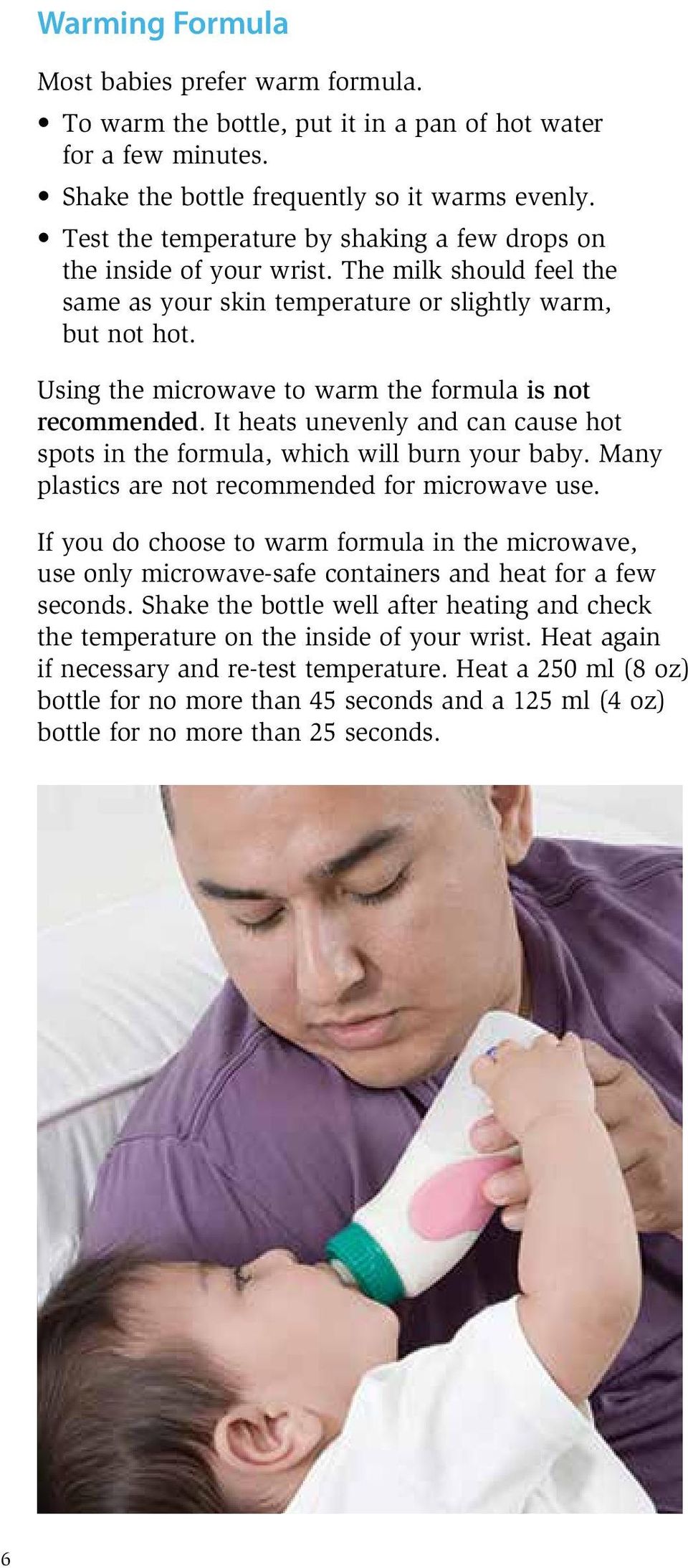
8 Warming Formula Most babies prefer warm formula. To warm the bottle, put it in a pan of hot water for a few minutes. Shake the bottle frequently so it warms evenly. Test the temperature by shaking a few drops on the inside of your wrist. The milk should feel the same as your skin temperature or slightly warm, but not hot. Using the microwave to warm the formula is not recommended. It heats unevenly and can cause hot spots in the formula, which will burn your baby. Many plastics are not recommended for microwave use. If you do choose to warm formula in the microwave, use only microwave-safe containers and heat for a few seconds. Shake the bottle well after heating and check the temperature on the inside of your wrist. Heat again if necessary and re-test temperature. Heat a 250 ml (8 oz) bottle for no more than 45 seconds and a 125 ml (4 oz) bottle for no more than 25 seconds. 6
9 Feeding your Baby Feed babies when they are wide awake and calm. Your baby will tell you he is ready to eat with clues such as stretching, stirring, putting his fist in his mouth, sucking, smacking lips, searching with an open mouth (rooting), rapid eye movement and waking. Crying is a sign of distress. Make sure you choose a comfortable chair for feeding. Use pillows for extra support. Hold baby so you can look at each other. Hold your baby close, supporting his head, back and bottom. To help prevent choking, hold your baby s head higher than his body. Let your baby feel your warmth, security and love while feeding. Smile and talk to your baby. Cuddle. Offer the bottle by gently touching the nipple on the inside of your baby s lips and against the gums. Be patient. Do not rush or force a feeding. It will cause anxiety for both you and your baby. Hold the bottle so most of the rubber nipple is in the baby s mouth and tilted so the nipple is full of milk. This will prevent the baby from swallowing too much air. Burp the baby about half way through the feeding and again at the end, if needed. Often, changing positions will cause your baby to burp. Alternate the arm you use to hold your baby. This will encourage him to use both eyes and to develop eye contact with you. Signs of fullness include falling asleep, covering their mouth with their hands, turning their head away or crying. Do not encourage finishing a bottle if your baby does not want it. This may encourage overfeeding. Discard the unused portion. Do not add infant cereal to the bottle as this may promote overfeeding. It is unsafe to leave your baby with a propped bottle. This may lead to choking, ear infections, and dental decay. 7

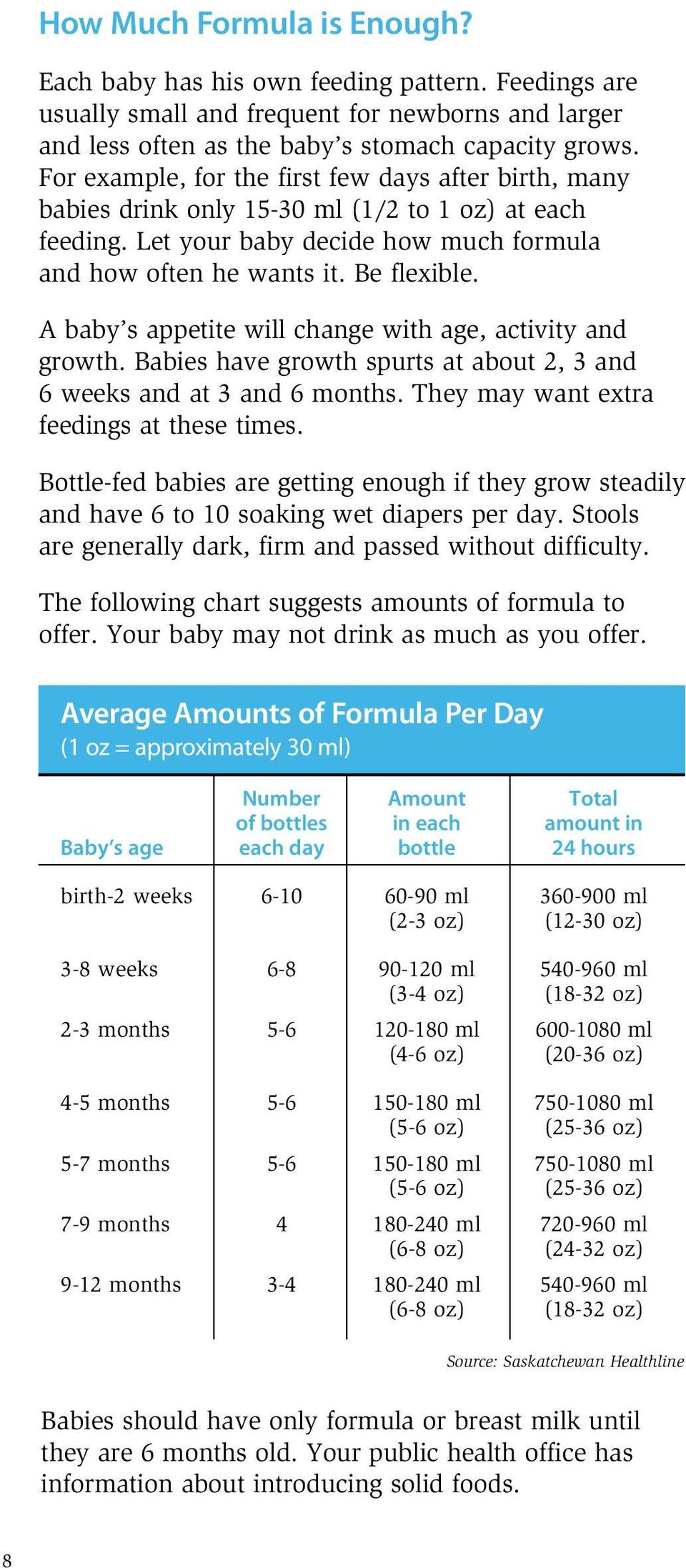
10 How Much Formula is Enough? Each baby has his own feeding pattern. Feedings are usually small and frequent for newborns and larger and less often as the baby s stomach capacity grows. For example, for the first few days after birth, many babies drink only ml (1/2 to 1 oz) at each feeding. Let your baby decide how much formula and how often he wants it. Be flexible. A baby s appetite will change with age, activity and growth. Babies have growth spurts at about 2, 3 and 6 weeks and at 3 and 6 months. They may want extra feedings at these times. Bottle-fed babies are getting enough if they grow steadily and have 6 to 10 soaking wet diapers per day. Stools are generally dark, firm and passed without difficulty. The following chart suggests amounts of formula to offer. Your baby may not drink as much as you offer. Average Amounts of Formula Per Day (1 oz = approximately 30 ml) Number Amount Total of bottles in each amount in Baby s age each day bottle 24 hours birth-2 weeks ml ml (2-3 oz) (12-30 oz) 3-8 weeks ml ml (3-4 oz) (18-32 oz) 2-3 months ml ml (4-6 oz) (20-36 oz) 4-5 months ml ml (5-6 oz) (25-36 oz) 5-7 months ml ml (5-6 oz) (25-36 oz) 7-9 months ml ml (6-8 oz) (24-32 oz) 9-12 months ml ml (6-8 oz) (18-32 oz) Source: Saskatchewan Healthline Babies should have only formula or breast milk until they are 6 months old. Your public health office has information about introducing solid foods. 8
11

12 Feb 2014 Developed in collaboration with Public Health Nutritionists of Saskatchewan.

Feeding. Baby. Your. Infant. Formula
 Feeding Your Infant Baby Formula 1 Feeding Your Baby Infant Formula There are many reasons why some mothers don t breastfeed. If you feel sad and/or disappointed that you are not fully breastfeeding your
A guide to infant formula for parents who are bottle feeding
 A guide to infant formula for parents who are bottle feeding Introduction This document is designed to help parents who are not breastfeeding decide which infant formula to use to feed their baby. There
Suggested Open Ended Questions Suggested Affirming Statements Suggested Nutrition Education Statements
 Suggested Open Ended Questions Suggested Affirming Statements Suggested Nutrition Education Statements Caregiver: How did your baby s last check-up go? Primary Feeding: Tell me about the kind of formula
How to prepare your baby s bottle
 How to prepare your baby s bottle Cleaning and Sterilising Using or storing sterilised bottles Preparing a bottle feed Storing and warming feeds Feeding your baby Crèches, childminders and other childcare
formula feeding How to feed your baby safely
 formula feeding How to feed your baby safely We are happy to consider requests for other languages or formats. Please contact 0131 314 5300 or email [email protected] This resource
A breastfed baby s bowel motions are soft, a bright yellow colour and often very frequent, but each baby is different. Breastfed babies don t usually
 2 A breastfed baby s bowel motions are soft, a bright yellow colour and often very frequent, but each baby is different. Breastfed babies don t usually get constipated, even though some babies only have
How to Prepare Powdered Infant Formula in Care Settings
 How to Prepare Powdered Infant Formula in Care Settings This booklet contains new information to help you prepare powdered infant formula for bottle-feeding and cup-feeding as safely as possible. Powdered
Bottle Feeding Puppies and Kittens
 Bottle Feeding Puppies and Kittens Formula Goats milk works as a temporary substitute, but it can get expensive. Goats milk is sold at Wal-Mart and most grocery stores. Cow s milk is not an alternative;
Breastfed Babies in Child Care. Breastfeeding Works! How to Meet the Needs of
 Breastfeeding Works! How to Meet the Needs of Breastfed Babies in Child Care Massachusetts Department of Public Health Bureau of Family and Community Health Nutrition and Physical Activity Unit WIC Nutrition
Guide to bottle feeding
 Guide to bottle feeding how to prepare infant formula and sterilise feeding equipment to minimise the risks to your baby The Baby Friendly Initiative in this booklet About this booklet 1 What is infant
How to Prepare Formula for Bottle-Feeding at Home
 How to Prepare Formula for Bottle-Feeding at Home Printed in Ireland This document is published by the Department of Food Safety, Zoonoses and Foodborne Diseases, WHO, in collaboration with the Food and
Infant formula. Produced by. A guide to safe preparation and feeding of infant formula
 This publication was produced by the Centre for Health Promotion, in partnership with the Department of Nutrition, Women s and Children s Health Network. Infant formula Produced by Women s and Children
Off to the best start. Important information about feeding your baby
 Off to the best start Important information about feeding your baby mum s milk the best start for your baby What happens in your baby s first years has a big effect on how healthy he or she will be in
Feeding Infants A Guide for Use in the Child Nutrition Programs
 Feeding Infants A Guide for Use in the Child Nutrition Programs United States Department of Agriculture Food and Nutrition Service FNS-258 NOTE TO THE READER ON USING THIS GUIDE This guide is intended
Off to the best start
 Off to the best start Important information about feeding your baby existing In this leaflet What is Start4Life? 3 The best start for your baby 4 What does breastfeeding help protect against? 5 After your
Common Concerns About Breastfeeding
 Patient Education Page 51 Caring for Yourself and Your New Baby Common Concerns About Breastfeeding Breastfeeding is healthy and natural. So are the questions and concerns that come with it. Whether you
WIC #560 (revised June 2015) WIC #560 (revised June 2015)
 WIC #560 (revised June 2015) WIC #560 (revised June 2015) Table of Contents INFANT NUTRITION MODULE OBJECTIVES... 1 INTRODUCTION... 2 SECTION I: FEEDING THE INFANT FROM BIRTH TO TWELVE MONTHS OF AGE...
(8 years or younger)
 What is iron? Iron deficiency in children (8 years or younger) Iron is a mineral found in food that your body needs. It is bound to hemoglobin, which is an important part of red blood cells. Iron helps
How to prepare your baby s bottle feed
 How to prepare your baby s bottle feed New Safety Advice Powdered infant formula is not sterile. It may contain bacteria that can make your baby sick. You can reduce the risk to your baby if you prepare
Your Own Teeth and Gums
 Your Own Teeth and Gums CHAPTER1 Next time you look in a mirror, look at your teeth and the skin (gums) around them. Look in your children s mouths, too. Look at both gums and teeth, because the health
AGES AND STAGES: BREASTFEEDING DURING YOUR BABY S FIRST YEAR
 AGES AND STAGES: BREASTFEEDING DURING YOUR BABY S FIRST YEAR Adapted from Ages and Stages: What to Expect During Breastfeeding by Vicki Schmidt, RN, IBCLC BREASTFEEDING YOUR 1-2 MONTH OLD 2» Turn his head
Breastfeeding. The Early Days. Only a Phonecall Away! See your local telephone directory. www.lalecheleagueireland.com
 La Leche Early Days 10/09/2010 15:14 Page 2 Breastfeeding The Early Days BREASTFEEDING HELP AND INFORMATION www.lalecheleagueireland.com Only a Phonecall Away! See your local telephone directory Understanding
Caring for your baby in the NICU: feeding
 C1 At birth, all newborns need a great deal of energy and nutrients from food to help their bodies grow, and to adjust to life outside the womb. Babies who are born early (premature) and/or with a very
Feeding Your Super Baby at 7 Months
 Super Baby Food Book Sample Chapter: Feeding Your Super Baby at 7 Months Introduce These New Foods to Your 7 Month Old: tofu cottage cheese homemade mixed cereals hard-cooked egg yolk (not egg white) asparagus
BREAST FEEDING AND BOTTLE FEEDING
 BREAST FEEDING AND BOTTLE FEEDING Choosing whether to breastfeed or formula feed your baby is one of the first decisions expectant parents will make. Although there's no right or wrong choice, the American
Weaning learning to like new tastes and textures
 Complementary feeding or weaning is introducing solid foods in addition to your baby s milk feeds. Babies develop at different rates so begin when your baby is ready by six months, but not before four
Ear Infections Gastroenteritis gastroenteritis
 Ear Gastroenteritis Infections gastroenteritis Gastroenteritis can be caused by many different germs, and the effects of gastro on babies and children depend on several things including: the age of the
Parents Guide To Primary Congenital Hypothyroidism
 Parents Guide To Primary Congenital Hypothyroidism California Department of Health Services Genetic Disease Branch www.dhs.ca.gov/gdb To Parents: California State Law requires that all babies have the
BREASTFEEDING; HOW? January 14 HELEN BORG, INFANT FEEDING MIDWIFE MATER DEI HOSPITAL
 BREASTFEEDING; HOW? January 14 HELEN BORG, INFANT FEEDING MIDWIFE MATER DEI HOSPITAL 1 THE IMMIGRANT MOTHER- BABY DYAD Challenges to Breastfeeding and Bonding Lack of Information How to enhance milk supply
Calcium and Vitamin D: Important at Every Age
 Calcium and Vitamin D: Important at Every Age National Institutes of Health Osteoporosis and Related Bone Diseases ~ National Resource Center 2 AMS Circle Bethesda, MD 20892-3676 Tel: (800) 624-BONE or
Breastfeeding Your Baby
 Getting the Help You Need If you have questions or problems, don t wait. Another nursing mother or mothers support group can often help. Your hospital, WIC office, baby s doctor, midwife, or obstetrician/gynecologist
Lesson 2: Save your Smile from Tooth Decay
 Lesson 2: Save your Smile from Tooth Decay OVERVIEW Objectives: By the end of the lesson, the Lay Health Worker will be able to: 1. Describe what tooth decay is and how it happens. 2. State the causes
Sanitary Food Preparation & Safe Food Handling
 70 Feeding Infants 10 Sanitary Food Preparation & Safe Food Handling Babies are more susceptible to bacteria than older children, and unsanitary food conditions can cause serious infections. General cleanliness,
Super Baby Food Book Sample Chapter: Starting Solids: What Age? Which Food First? How Much? What Consistency?
 Super Baby Food Book Sample Chapter: Starting Solids: What Age? Which Food First? How Much? What Consistency? When Should I Start Feeding My Baby Solid Foods? The answer is: when your pediatrician tells
Managing Mouth Sores
 Managing Mouth Sores The following information is based on the general experiences of many prostate cancer patients. Your experience may be different. If you have any questions about what prostate cancer
Breast-feeding. You have one of the volumes of The Growth Guide series in your hands. The Growth Guide consists of seven practical booklets:
 Breast-feeding Dear (prospective) parents, You have one of the volumes of The Growth Guide series in your hands. The Growth Guide consists of seven practical booklets: Planning for Parenthood Pregnancy
Introduction to WIC. Objectives
 Objectives Introduction to WIC After completing this lesson, you will be able to: Describe the participants served by WIC. Describe how WIC improves the health of participants. Identify the history and
Breastfeeding vs. Formula Feeding
 KidsHealth.org The most-visited site devoted to children's health and development Breastfeeding vs. Formula Feeding A Personal Decision Choosing whether to breastfeed or formula feed your baby is one of
Calcium. 1995-2013, The Patient Education Institute, Inc. www.x-plain.com nuf40101 Last reviewed: 02/19/2013 1
 Calcium Introduction Calcium is a mineral found in many foods. The body needs calcium to maintain strong bones and to carry out many important functions. Not having enough calcium can cause many health
Nutrition: a guide for feeding infants with cystic fibrosis
 Nutrition: a guide for feeding infants with cystic fibrosis Factsheet April 2013 Nutrition: a guide for feeding infants with cystic fibrosis Introduction Feeding a baby with cystic fibrosis (CF) is similar
Food Safety Guide for Family Day Care Educators
 Food Safety Guide for Family Day Care Educators Department of Health and Human Services About this Guide This Guide is designed to help Family Day Care (FDC) Educators make safe and healthy meals for the
How to take care of your baby s teeth and gums
 Children s Dental Health In This Issue: } How to take care of your baby s teeth and gums } How to keep your child s teeth healthy } Preparing Kids for Their First Dental Checkup How to take care of your
Premature Infant Care
 Premature Infant Care Introduction A premature baby is born before the 37th week of pregnancy. Premature babies are also called preemies. Premature babies may have health problems because their organs
Bone Appétit: New Information on Calcium & Vitamin D QUESTION & ANSWER
 Bone Appétit: New Information on Calcium & Vitamin D QUESTION & ANSWER Wednesday, November 17, 2010 1:30 p.m. to 3:00 p.m. ET 1. I like to drink warm milk, but I have heard that heating some vitamins can
Early Care & Education Family Toddler Lab Infant/Toddler Needs and Service Plan. Semester/Year: Summer/ Fall/ Spring/
 Early Care & Education Family Toddler Lab Infant/Toddler Needs and Service Plan Semester/Year: Summer/ Fall/ Spring/ CHILD S INFORMATION Child s Name: of Birth: Parent s Name: Reviewed: Feeding Plan: Liquids
A guide for parents of babies at risk of Neonatal Abstinence Syndrome Planning care for you and your baby
 A guide for parents of babies at risk of Neonatal Abstinence Syndrome Planning care for you and your baby Reading this booklet can help you: learn how certain drugs can affect your baby during pregnancy
Making Milk for Your Baby
 Making Milk for Your Baby Mother s milk, time-tested for millions of years, is the best nutrient for babies because it is nature s perfect food. Robert Mendelsohn Making milk for your baby is one of the
Name of Child: Date: Fever
 The Emily Center Fever First Aid and Home Care Si usted desea esta información en español, por favor pídasela a su enfermero o doctor. Name of Child: Date: #666 What is it? Fever When body temperature
FOOD POISONING. Information Leaflet. Your Health. Our Priority. Infection Prevention Stepping Hill Hospital
 FOOD POISONING Information Leaflet Your Health. Our Priority. Page 2 of 5 What is Food Poisoning? Food poisoning is an illness that occurs after eating or drinking anything that is contaminated. Usually
Lesson Title: Beef Cattle-Animal Care is Everywhere Grade Level: K-4 Time: 1 hour Content Area: Science, Language Arts Objectives:
 Lesson Title: Beef Cattle-Animal Care is Everywhere Grade Level: K-4 Time: 1 hour Content Area: Science, Language Arts Objectives: Identify the needs of beef animals Compare the needs of beef animals to
Breastfeeding Matters. An important guide to breastfeeding for women and their families
 Breastfeeding Matters An important guide to breastfeeding for women and their families ACKNOWLEDGEMENTS The Best Start Resource Centre would like to thank the Public Health Units of Ontario who supported
Taking Calcium and Vitamin D Supplements After Your Parathyroid Operation
 Taking Calcium and Vitamin D Supplements After Your Parathyroid Operation This handout explains how to meet your daily calcium and vitamin D needs after your parathyroid operation, once your calcium level
Managing Constipation
 Managing Constipation The following information is based on the general experiences of many prostate cancer patients. Your experience may be different. If you have any questions about what prostate cancer
Presentation Prepared By: Jessica Rivers, BASc., PTS
 Presentation Prepared By: Jessica Rivers, BASc., PTS Presentation Outline Why should we care about our eating habits? Why is nutrition so important as we age? How do we know if we are eating healthy? What
Home Food Safety Myths and Facts for Consumers. The Partnership for Food Safety Education
 10 Home Food Safety Myths and Facts for Consumers The Partnership for Food Safety Education 2014 For more Home Food Safety Mythbusters go to www.fightbac.org Myth #1 Freezing foods kills harmful bacteria
Having a companion you can lean on and who can support you during your labour can be helpful. It has been shown to reduce the need for pain relief.
 The pregnancy care planner Your NHS guide to having a baby www.nhs.uk/pregnancy My birth plan Name: Due date: Where to give birth You will have a choice about where to have your baby. Your midwife or doctor
The symptoms of HIV infection
 2 The symptoms of HIV infection Saleema s story HIV infection and HIV disease The first weeks of HIV infection The quiet stage of HIV infection The beginning of HIV disease Answering Saleema s questions
Medication Guide Rebif (Re-bif) Interferon beta-1a (in-ter-feer-on beta-one-â)
 Medication Guide Rebif (Re-bif) Interferon beta-1a (in-ter-feer-on beta-one-â) Please read this leaflet carefully before you start to use Rebif and each time your prescription is refilled since there may
How To Care For A Sick Person
 39 How to Take Care of a Sick Person Sickness weakens the body. To gain strength and get well quickly, special care is needed. Medicines are often not necessary. But good care is always important. The
INSTRUCTIONS FOR USE HUMIRA 40 MG/0.8 ML, 20 MG/0.4 ML AND 10 MG/0.2 ML SINGLE-USE PREFILLED SYRINGE
 INSTRUCTIONS FOR USE HUMIRA (Hu-MARE-ah) (adalimumab) 40 MG/0.8 ML, 20 MG/0.4 ML AND 10 MG/0.2 ML SINGLE-USE PREFILLED SYRINGE Do not try to inject HUMIRA yourself until you have been shown the right way
FAILURE TO THRIVE What Is Failure to Thrive?
 FAILURE TO THRIVE The first few years of life are a time when most children gain weight and grow much more rapidly than they will later on. Sometimes, however, babies and children don't meet expected standards
PATIENT INFORMATION LEAFLET. Calcium Sandoz Syrup calcium glubionate and calcium lactobionate
 PATIENT INFORMATION LEAFLET Calcium Sandoz Syrup calcium glubionate and calcium lactobionate Read all of this leaflet carefully before you start taking this medicine Keep this leaflet. You may need to
Healthy Foods for my School
 yum, yum, yum, yum, yum, yum, yum, yum, yum, yum, yum, yum, yum, yum, yum, yum, yum, yum, yum, yum, yum, Healthy Foods for my School Nutrition Standards for Saskatchewan Schools Schools are an ideal place
If a child or adult needs to avoid cows milk, remember that it may be present in many foods, such as:
 Milk Allergy Cows milk allergy affects around 3 6% of (3 6 in every 100) infants and young children who usually start to have symptoms in their first few months. This causes many health problems and is
How to Care for Your Premature Baby s Skin
 The Emily Center How to Care for Your Premature Baby s Skin Child Care/Health Promotion Si usted desea esta información en español, por favor pídasela a su enfermero o doctor. Name of Child: Date: How
Taking Care of Your Skin During Radiation Therapy
 Taking Care of Your Skin During Radiation Therapy Princess Margaret Information for patients who are having radiation therapy Read this pamphlet to learn about: What a radiation skin reaction is How to
Liquid Diet. You can add enough liquid to any food to achieve a pourable consistency. Here are a few tips to keep in mind:
 Liquid Diet Your doctor and/or Registered Dietitian may recommend that you follow a liquid diet if you have trouble chewing or swallowing, if your stomach does not empty normally, if you have recently
Instructions for Use PROCRIT (PRO KRIT) (epoetin alfa)
 Instructions for Use PROCRIT (PROKRIT) (epoetin alfa) Use these Instructions for Use if you or your caregiver has been trained to give PROCRIT injections at home. Do not give yourself the injection unless
Product Information: Similac Human Milk Fortifier Hydrolyzed Protein Concentrated Liquid
 Infant Formula with Extensively Hydrolyzed Protein Product Information: Similac Human Milk Fortifier Hydrolyzed Protein Concentrated 1 of 5 Infant Formula with Extensively Hydrolyzed Protein Extensively
FOLFOX Chemotherapy. This handout provides information about FOLFOX chemotherapy. It is sometimes called as FLOX chemotherapy.
 FOLFOX Chemotherapy This handout provides information about FOLFOX chemotherapy. It is sometimes called as FLOX chemotherapy. What is chemotherapy? Chemotherapy is a method of treating cancer by using
MILK It does a body good
 MILK It does a body good September 2007 In the early 90 s an ad campaign began that reminded Americans of the benefits of drinking milk. Besides the obvious benefits of strong teeth and bones milk provides
CHILD CARE DIPLOMA. Course Sample
 CHILD CARE DIPLOMA Course Sample Unit CHP2 Providing for children s physical needs inclusive of health and safety The Statutory framework for the EYFS is a requirement for all registered early years providers.
PROTEIN. What is protein?
 PROTEIN What is protein? Protein is the basic building block for the human body. It is made up of amino acids and helps build muscles, blood, hair, skin, nails and internal organs. Next to water, protein
Healthy Eating During Pregnancy
 Healthy Eating During Pregnancy Pregnancy is a time of great change. Your body is changing to allow your baby to grow and develop. Good nutrition will help you meet the extra demands of pregnancy while
HUMULIN 70/30 KwikPen
 1 Instructions for Use HUMULIN 70/30 KwikPen (70% human insulin isophane suspension 30% human insulin injection [rdna origin]) Read the Instructions for Use before you start taking HUMULIN 70/30 and each
Fluoride Strengthens Teeth
 Fluoride Strengthens Teeth Two hard-boiled eggs Fluoride gel or solution, 4 to 6 oz. (from dental office) Three clean plastic containers Several cans of dark soda Water 1. Place a hard-boiled egg in one
RAISING LAMBS ON MILK REPLACER
 RAISING LAMBS ON MILK REPLACER Yves M. Berger and Richard A. Schlapper Spooner Agricultural Research Station University of Wisconsin-Madison Introduction It is well known that the number of lambs born
Dairy. Extra Cheese, Please! by: Cris Peterson. Talking Points: Activity: Butter Grade Level: Any Subject Area: Science & Social Studies
 Dairy Extra Cheese, Please! by: Cris Peterson Activity: Butter Grade Level: Any Subject Area: Science & Social Studies Materials Whipping cream (room temperature works best) Small jar, with lid (like a
Breastfeeding. Clinical Case Studies. Residency Curriculum
 Teaching Tool Clinical Case Studies These clinical cases highlight common breastfeeding issues and concerns that your residents will encounter. You can use them during grand rounds, noon lecture, journal
Acids and Bases. AND a widemouth container of the following solids:
 Acids and Bases GOAL To introduce students to acids and bases. MATERIALS: 3 10oz clear plastic cups 1 4 oz. bottle white vinegar - labeled Acid 1 4 oz. bottle of water - labeled Water 1 4 oz. bottle of
INSTRUCTIONS FOR USE HUMIRA 40 MG/0.8 ML SINGLE-USE PEN
 INSTRUCTIONS FOR USE HUMIRA (Hu-MARE-ah) (adalimumab) 40 MG/0.8 ML SINGLE-USE PEN Do not try to inject HUMIRA yourself until you have been shown the right way to give the injections and have read and understand
Cholera Prevention and Control: Introduction and Community Engagement. Module 1
 Cholera Prevention and Control: Introduction and Community Engagement Module 1 Introduction This guide instructs how to prevent cholera illnesses and deaths in your communities. These slides and modules
BENEFITS OF BREASTFEEDING
 BENEFITS OF BREASTFEEDING There are many benefits to breastfeeding. Even if you are able to do it for only a short time, your baby's immune system can benefit from breast milk. Here are many other benefits
Protecting and improving the nation s health. Vitamin D. Information for healthcare professionals
 Protecting and improving the nation s health Vitamin D Information for healthcare professionals 1 Vitamin D: Information for healthcare professionals Why is vitamin D important? Some of the UK population
GOT MILK? Background. Food Processing and Preservation. Milk Processing and Preservation
 GOT MILK? Background Food Processing and Preservation Food processing is the set of methods and techniques used to transform raw ingredients into food for consumption. Food processing occurs from the farm
Caring for your baby at night A guide for parents
 Caring for your baby at night A guide for parents Caring for your baby at night Becoming a parent is a very special time and can be one of the most rewarding experiences of your life as you get to know
A diet fit for a pig: seven basic rules
 A diet fit for a pig: seven basic rules June 2013 Primefact 1292 1 st edition Jayce Morgan, Livestock Officer Pigs, Tamworth NSW Introduction When a pig is fed a proper diet there are benefits to the pig