
Chapter 1 Overview of tank cleaning work
|
|
|
- Samson Wells
- 9 years ago
- Views:
Transcription
1 Chapter 1 Overview of tank cleaning work The overall image of the tank cleaning work should be grasped before implementing it. An overview of individual tasks to be grasped before starting the work is described in this chapter. 1. Tank cleaning work (P.1-2) Tank cleaning refers to the tasks mentioned below. 1) Washing of tanks, lines and pumps 2) Gas-freeing work 2. Objectives of tank cleaning work (P.1-2) The objectives of tank cleaning work are as given below. 1) To wash cargo tanks/ piping after leaving the discharging terminal if workers need to enter the tank/ piping for inspection or repairs, and to create an environment in the tank/piping such that the workers can enter these spaces safely. 2) To create conditions within the tank/ piping such that these conditions match the required standards for permitting work such as hot work to be performed in the said spaces. 3. Tank cleaning work processes (P.1-2 to P.1-15) Implement the processes below in the time sequence of tank cleaning work. 1) Crude oil washing at the previous discharging terminal (P.1-2) 2) Filling of washing water (P.1-3 to P.1-5) 3) Heating of washing water (P.1-5 to P.1-6) 4) Rough washing of cargo line pump (P.1-6 to P.1-7) 5) Line washing (removal of oil traces in the ODM line) and valve flushing (P.1-7) 6) Tank washing (P.1-7 to P.1-8) 7) HC gas purging (P.1-8 to P.1-11) 8) Airing (P.1-11 to P.1-12) 9) Settling and discharging water (P.1-13) 10) Final line washing (P.1-13 to P.1-14) 11) Sludge removal (P.1-14) 12) Slop removal (P.1-14) 13) Primary slop tank washing (P.1-14) 14) Primary slop tank gas freeing, airing and sludge removal (P.1-14) 15) Final line stripping (P.1-14) 16) Acquisition of gas-free certificate (P.1-15) 1. Tank cleaning work (Gas free) 1-1
2 Tank cleaning is generally not performed during the normal operation of SBT tankers and double-hull tankers. It is performed only when it is necessary to enter the tank for inspection and repairs in the event of a breakdown in the cargo handling appliances in the tank, or when the ship is dry-docked. Tank cleaning involves the removal of traces of oil and petroleum gases in the tank and piping, and specifically includes the tasks mentioned below. 1) Washing of the tank and lines with sea water 2) Gas-freeing the environment in the tank so that workers can enter the tank safely. 2. Objectives of tank cleaning work The objectives of tank cleaning work are as given below. a) To create an environment in the tank such that workers can enter the tank and piping safely for inspection and repair work b) To ensure that the environmental conditions in the tank match the conditions required for performing hot work safely. 3. Explanations on tank cleaning work 3.1 Overall flow of work The overall flow of tank cleaning work by time sequence is as given below. (Refer to the Flow Chart.) 1) Crude oil washing at the previous discharging terminal 2) Filling of washing water 3) Heating of washing water 4) Rough washing of cargo line and cargo pump 5) Line washing (removal of oil traces in the ODM line) and valve flushing 6) Tank washing 7) HC gas purging 8) Airing 9) Settling and discharging water 10) Final line washing 11) Sludge removal 12) Slop removal 13) Primary slop tank washing 14) Primary slop tank gas freeing, airing and sludge removal 15) Final line stripping 16) Acquisition of gas-free certificate 3.2 Crude oil washing at the previous discharging terminal Tank cleaning work is considered to begin with the cargo handling work at the previous discharging terminal. In other words, it is preferable to formulate a plan such that crude oil washing of tanks to be cleaned is performed at the previous discharging terminal whenever possible, and the sludge accumulated in the tank is discharged to shore at the same time as the discharging of the cargo. Adequate discussions should be held with the terminal for tank cleaning before dry-docking the ship, in regard to implementing crude oil washing such that no sludge remains in the tank as far as possible. If any sludge does remain in the tank, then the charges for removal of the said sludge will have to be borne by the shipowner Effective crude oil washing It is important to be have thorough knowledge of crude oil washing equipment, tank construction and (Gas free) 1-2
3 piping, and be adequately familiar with the contents of the Crude Oil Washing Operations and Equipment Manual Number of tanks for which crude oil washing (referred to as COW hereafter) is to be implemented MARPOL stipulates the number of tanks for which COW is to be implemented as given below. Note however, that some terminals may have their own rules and regulations related to COW, and the number of tanks that can be washed may be restricted depending on the rules and regulations of the specific terminal. a) COW of about one-fourth of the total number of tanks is to be performed considering effective sludge control. b) However, COW of the same tank two times within four months for the same purpose is not necessary. 3.3 Filling of washing water This includes the work of filling the sea water (washing water), which is to be used for washing the tanks and lines, in the slop tank Selection of filling tank Sometimes only the primary slop tank may be used, and sometimes the tanks on both sides may be used as filling tanks. If all cargo tanks need to be washed before dry-docking the ship, the usual practice is to fill slop tanks on both sides of the ship so as to avoid the washing effect from degrading due to pollution of the washing water. If the number of washing tanks is small or if there are restrictions on filling water in slop tanks or on the discharging time, then only one primary slop tank should be filled. Primary slop tanks/ secondary slop tanks The slop tanks of crude oil tankers are connected by free-flow lines. This is to collect the dirty water after washing on one side, to shift the water only that has been separated from oil at the bottom of the tank to the other tank by gravity and to re-use this water as washing water. The tank in which dirty water after washing is collected is the primary slop tank, while the tank on the washing water driving side is called the secondary slop tank. A heating coil is generally installed in the primary slop tank. For tank washing likewise, the intake ports for washing water are used only on the secondary slop tank side, and the eductor driving water is returned to the primary slop tank side. Only the sea water layer at the bottom of the oil-water separator tank in the primary slop tank is shifted by gravity to the secondary slop tank through the free flow line. This method enables tank washing to be performed efficiently, using washing water in the secondary slop tank, which has smaller oil content Filling method Three methods of filling washing water are available. 1) Method of filling water from the sea by gravity In this method, the sea chest valve is opened, sea water of the required volume is directly filled first from the sea in the No. 5 center cargo tank by gravity, and then shifted to the slop tank using the tank cleaning pump. 2) Method of filling water from the sea by pump In this method, the sea chest valve is opened and the sea water from the sea is directly filled in the slop tank using a pump. 3) Method of filling water by gravity from the ballast tank In this method, the cargo line and ballast line are connected to the spool piece and water is filled by gravity from the ballast tank. (Gas free) 1-3
4 If slop tanks on both sides of the ship are to be filled, water can be filled directly into the primary slop tank and simultaneously shifted to the secondary slop tank by gravity using the free flow line Deciding the filling method Consider the following points to decide the filling method: 1) When adopting the method of filling water from the sea * The method of taking in warm sea water from the sea directly through the chest is effective since the heating time is curtailed. Considerable time is required for shifting the water from the No. 5 center cargo tank to the slop tank. * Since the cargo line is directly connected to the sea chest, errors in valve operation may result in marine pollution. 2) When the method of filling water from the sea using a pump is adopted The volume of the slop tank is generally small. If the planned volume is filled, the difference in levels of tank and waterline becomes small. Oil remaining in the cargo line flows overboard (in the opposite direction) due to ship motion, bringing about the risk of marine pollution. Accordingly, when filling water from the sea by gravity, the slop tank should not be filled directly from the sea. Instead, the No. 5 center cargo tank should be filled with water from the sea. If the cargo pump trips when filling sea water from the sea using the cargo pump, the oil included in the cargo line flows back to the sea as a reaction. Thus, it should be borne in mind that there is adequate likelihood of marine pollution to occur. To prevent pump cavitation, tripping, seizing due to heat generation and erosion of impeller, the line lower than the water level should always be used. The cargo pump should be started after confirming that the petroleum gas on the pump suction side has been removed, and the ballast should be filled. * The method of taking in warm sea water from the sea directly through the chest is effective since the heating time is curtailed. * Since the cargo line is directly connected to the sea chest, pump trippings or errors in valve operation may result in marine pollution. 3) When adopting the method of filling water from the ballast tank * Safety against marine pollution is high since the cargo line and sea chest are not connected. * The ballast tank and cargo line are connected by the spool piece. Therefore, there is a risk of polluting the ballast line and ballast tank with oil if there is an error in valve operation Deciding the quantity of water to be filled Consider the following points to decide the filling quantity: 1) The filling quantity cannot be defined unconditionally because of the differences in the capacity of slop tanks and in the number of washing tanks on each ship. The quantity can be considered however, based on the quantity of oil recovered after tank washing and the quantity that can be recovered in the slop tank on one side of the ship. 2) If the filling quantity is too small, the defects mentioned below may occur. * Reduction in the cleaning effect due to progressive contamination of washing water * Air may be drawn into the TKC pump * Reduction in efficiency of gravity shift through free flow line to secondary slop tank. 3) If the filling quantity is too large, the defects mentioned below may occur. * Increase in the time required for settling and discharge * Water may need to be discharged during the cleaning work. Past records indicate that the appropriate total filling quantity (both sides) is about 3,000 MT Time required for filling The time required for filling water by gravity from the sea chest is about 2 hours. However, the time (Gas free) 1-4
5 The heat withstanding temperature of the valve seat ring is generally about 65ºC. required subsequently for shifting the water to the slop tank (from the No. 5 center cargo tank to the slop tank) depends on the stripping work in the final stage of shift from the No. 5 COT (C) Filling start period The filling of washing water starts when the preparations before tank cleaning and gas freeing work are completed after departure of the ship from the discharging port. However, decide the start period after considering the points below, if the water is to be filled from the sea chest (refer to Filling method ). 1) Consider the sea area where water is taken into the ship ensuring that sea water at the highest possible temperature can be filled. 2) Adjust the work schedule such that the filling work is performed during day time so that the condition of the sea water surface can be properly observed Filling line diagram Marine pollution may occur in the event of errors in the valve operating procedure and if oil has remained unexpectedly in the line at a position higher than the water level. Study thoroughly beforehand the valve operating procedure in the lines to be used, and clearly indicate this procedure in the line diagram. 3.4 Heating of washing water Washing water is heated so as to enhance its washing effect. Generally, the washing effect (oil removal effect) of heated washing water (hot sea water) is more pronounced than that of cold sea water, although some washing effect can be obtained from cold sea water. Washing with hot sea water has a slightly better washing effect because of the steam generated from hot sea water even at locations that do not come in contact directly with the washing water (locations with high concentration of stiffeners in tank or in the large shadow zones of the washing machine) Judgment on the need for heating water Make an overall judgment on whether heating is required or not, after considering the points mentioned below. 1) Ship type and ship s age 2) Time for gas-freeing work 3) Number of tanks to be cleaned 4) Description of work within tanks 5) Specific fuel consumption Heating method Two heating methods are available. 1) Heating using heating coils Heating coils installed in the slop tank are used to heat the water. Generally, this method of heating is combined with the heating of water using heating coils 2) Heating using tank cleaning heater Washing water is passed through the tank cleaning heater and heated during the washing operation Washing water temperature The temperature of washing water during the washing with hot water is about 50 to 60ºC. Examine the withstanding temperature beforehand and set the upper limit because the valve seat ring and the tank coating may be damaged if the temperature is excessively high. (Gas free) 1-5

6 3.4.4 Time required The time required for heating the water using the heating coil depends on the season (air temperature), temperature and quantity of sea water filled in the tank. Therefore refer to past records, if available, and estimate the time. Past records show that about 20 hours are required for heating sea water at 23ºC to 60ºC using heater and slop tank heating coil Heating start period The heating start period is as given below. 1) Heating using heating coils Start filling water in the primary slop tank. After the coils are fully submerged, start the heating. 2) Heating using tank cleaning heater The tank cleaning heater is installed in the COW line. Pass washing water through the tank cleaning heater simultaneously with the start of tank washing. 3.5 Rough washing of cargo line and cargo pump The rough washing of cargo line and cargo pump refers to the flushing out of oil that has collected in the cargo pump, lines and valves by passing the washing water through these items before washing the cargo tank. Rough washing ensures that a tank that has been washed will not become contaminated by careless valve operation Rough washing line diagram Consider the following points when preparing the rough washing line diagram: a) Formulate the plan to include passing the water through all cargo and stripping pumps. b) Ensure that line washing is performed not only in the same direction as the flow in each line but also in the reverse direction. c) Ensure the lines with dead ends are not included as far as possible. d) From the valves in contact with lines through which washing water passes, clearly mark and identify the valves that should be closed during the said work on the line diagram. e) Write the direction of flow of liquid, description of work and precautions on each line diagram. 3.6 Line washing (removal of oil traces in the ODM line) and valve flushing Line washing refers to the removal of oil traces sticking to the cargo pump, lines and valves using washing water. Valve flushing refers to the washing of lines and valves on the tank side using flushing valves. Valve flushing is to be implemented for each valve during the line washing work. This work constitutes the main washing of the lines and valves, and should therefore, completely remove all traces of oil sticking to the lines and valves Line diagram for line washing and valve flushing Consider the points below when preparing the line diagram for line washing and valve flushing. a) Ensure that line washing is performed not only in the same direction as the flow in each line but also in the reverse direction. b) Ensure the lines with dead ends are not included as far as possible. c) From the valves in contact with lines through which washing water passes, clearly mark and identify the valves that should be closed during the said work on the line diagram. d) Write the direction of flow of liquid, description of work and precautions on each line diagram. e) Plan for a washing time longer than the rough washing time. Take care to ensure that traces of oil sticking to the cargo pump, lines and valves are completely removed. f) Write down the timing for valve flushing on the line diagram. g) Configure the valve flushing lines such that the profile of the washing line does not permit any blockage to the flow of washing water when valve flushing is implemented. (Gas free) 1-6

7 h) Formulate the plan for valve flushing such that all tank valves and stripping valves are flushed. 3.7 Tank washing Tank washing refers to the work of washing the cargo tanks with sea water using a fixed washing machine (if necessary, portable washing machines may be used in combination with fixed washing machines), and simultaneously, recovering the oil in the slop tank by continuously stripping the washing water Items to be studied Study the items related to tank washing mentioned below for efficient washing of each tank. 1) The ship s attitude during the washing work 2) Tank washing sequence 3) Washing pattern Ship s attitude during the washing work Adjust the ship s trim and heel appropriately after considering the position of bell mouth of the tank during the washing work Tank washing sequence Decide the tank washing sequence decided after considering the points mentioned below. 1) Perform as early as possible the internal inspection of tanks, where necessary. 2) Always wash tanks connected to drip lines around the manifold after the drip lines have been washed. 3) Wash one of the forepeak tanks last because oil is pushed into the forward end of the COW line. 4) The tank washing sequence is closely linked to the HC gas purging and airing work sequence implemented after washing. Therefore, decide the washing sequence after considering that the distance of equipment to be moved, such as the portable fans for airing, is minimized during such work. 5) Slop tanks cannot be cleaned simultaneously with the cleaning of other tanks since they are filled with washing water. Therefore, clean the secondary slop tank after shifting the washing water to the primary slop tank after the first discharge. Wash the primary slop tank after discharging the slop to shore at the anchorage before dry-docking Deciding the washing pattern and the number of washes Decide the washing pattern and the number of washes after considering the points mentioned below. 1) Past records 2) Structural features of each tank 3) Type of oil loaded Washing time The washing time is decided by the factors below. 1) Washing pattern 2) Number of washes 3) Rpm of the washing machine. (Gas free) 1-7

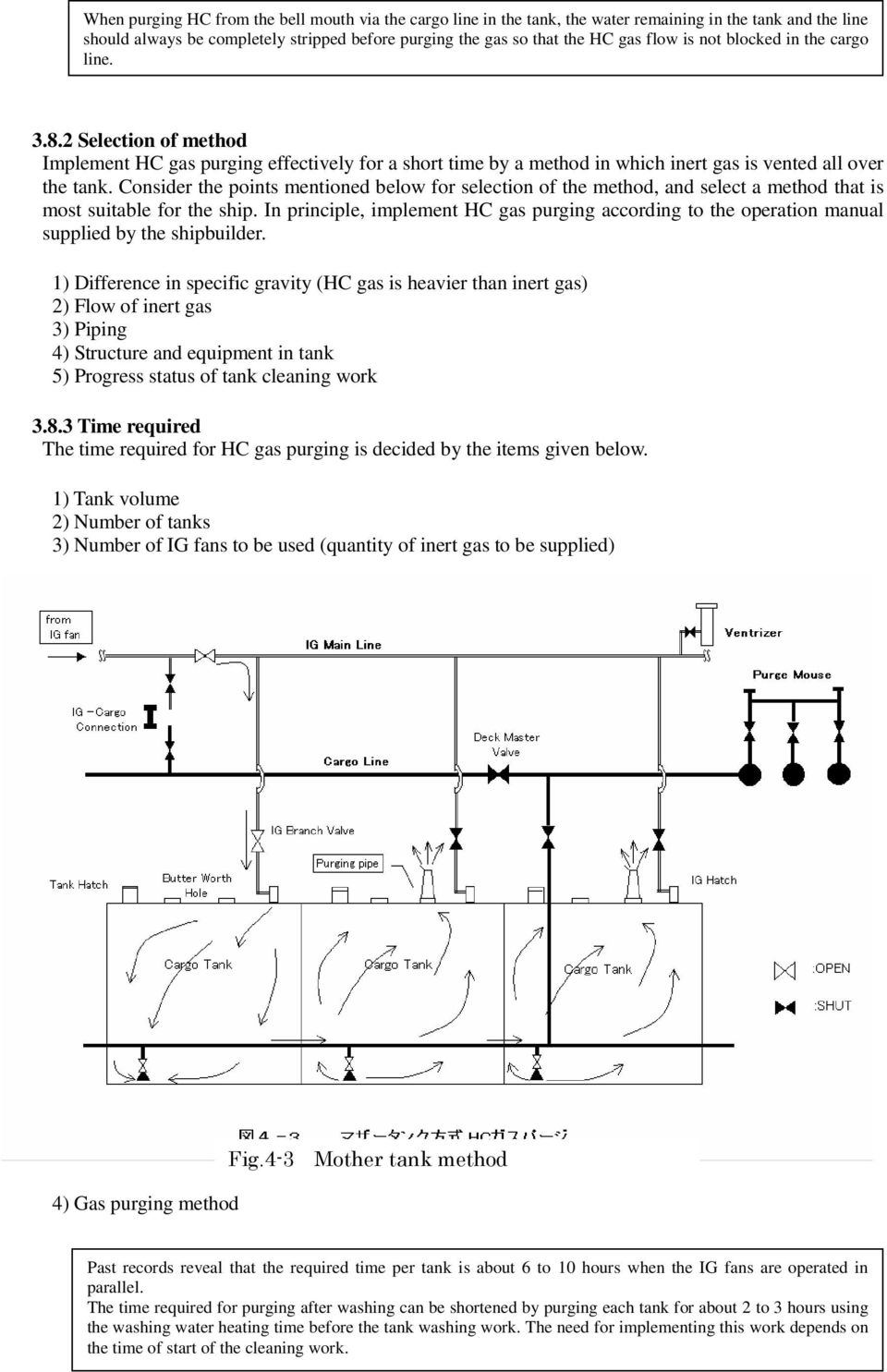
8 The general guidelines for washing times are as given below. 1) Single-hull tankers Top wash 1-2 times, bottom wash 3-5 times: About 4 to 7 hours per tank 2) Double-hull tankers Top wash once, bottom wash 2-3 times: About 2 to 3 hours per tank Washing line diagram The line configuration for tank washing is almost the same as that of COW but the washing line diagram should be planned considering the points given below. a) The washing water should always be taken from the secondary slop tank. The sea water after washing should be stripped by the eductor and returned to the primary slop tank. b) During normal COW, only the tank cleaning pump is used. In case of tank washing work, however, the use of cargo pump simultaneously with washing should also be considered. 3.8 HC gas purging Before airing the washed tank, perform HC (hydrocarbon) gas purging using inert gas to prevent the atmosphere in the tank from reaching the flammable range of petroleum gases. Reduce the HC concentration to below 2% by volume (HC gas does not explode if its volume ratio is less than 2%) while maintaining the atmosphere within the tank in a non-flammable condition. During the HC gas purging operation, the environment above deck becomes extremely dangerous since flammable and toxic HC gas is discharged to the atmosphere from the vent riser. SOLAS Chapter II-2 stipulates that the discharge port for discharging HC gas so that the HC gas concentration becomes less than 2% by volume, should be led more than 2 m above the upper deck and that it should be provided with an appropriate cutout device. HC gas with a concentration of less than 2% by volume can be discharged from the deck level HC gas purging Fig.4-1 method (A) Purging thorough vent riser Four HC gas purging methods are available. 1) Purging through vent riser (see Fig. 4-1(A)) In this method, the IG line and the cargo line on deck are connected, the inert gas is fed from the tank main valve through the direct filling line, and the HC gas in the tank is released to the atmosphere from the vent riser. 2) Purging through the purging pipe on deck (see Fig. 4-1(B)) In this method, the IG line and the cargo line on deck are connected, the inert gas is fed from the tank main valve through the direct filling line, and the HC gas in the tank is released to the atmosphere from the purging pipe installed on the deck. 3) IHI purge mouth method (see Fig. 4-2) In this method, the inert gas is supplied from the IG branch valve, and the HC gas in the tank is released to the atmosphere through the direct filling line from the tank valve using the purge mouth installed in the crossover line 4) Mother tank method (see Fig. 4-3) In this method, the inert gas is fed from the IG branch line taking one tank as the mother tank. The HC gas in the tank is led to other tanks through the cargo line (bottom line) from the tank valves, and released to the atmosphere from the purging pipe installed on the deck. The mother tank method is effective when several tanks are to be replaced simultaneously. (Gas free) 1-8
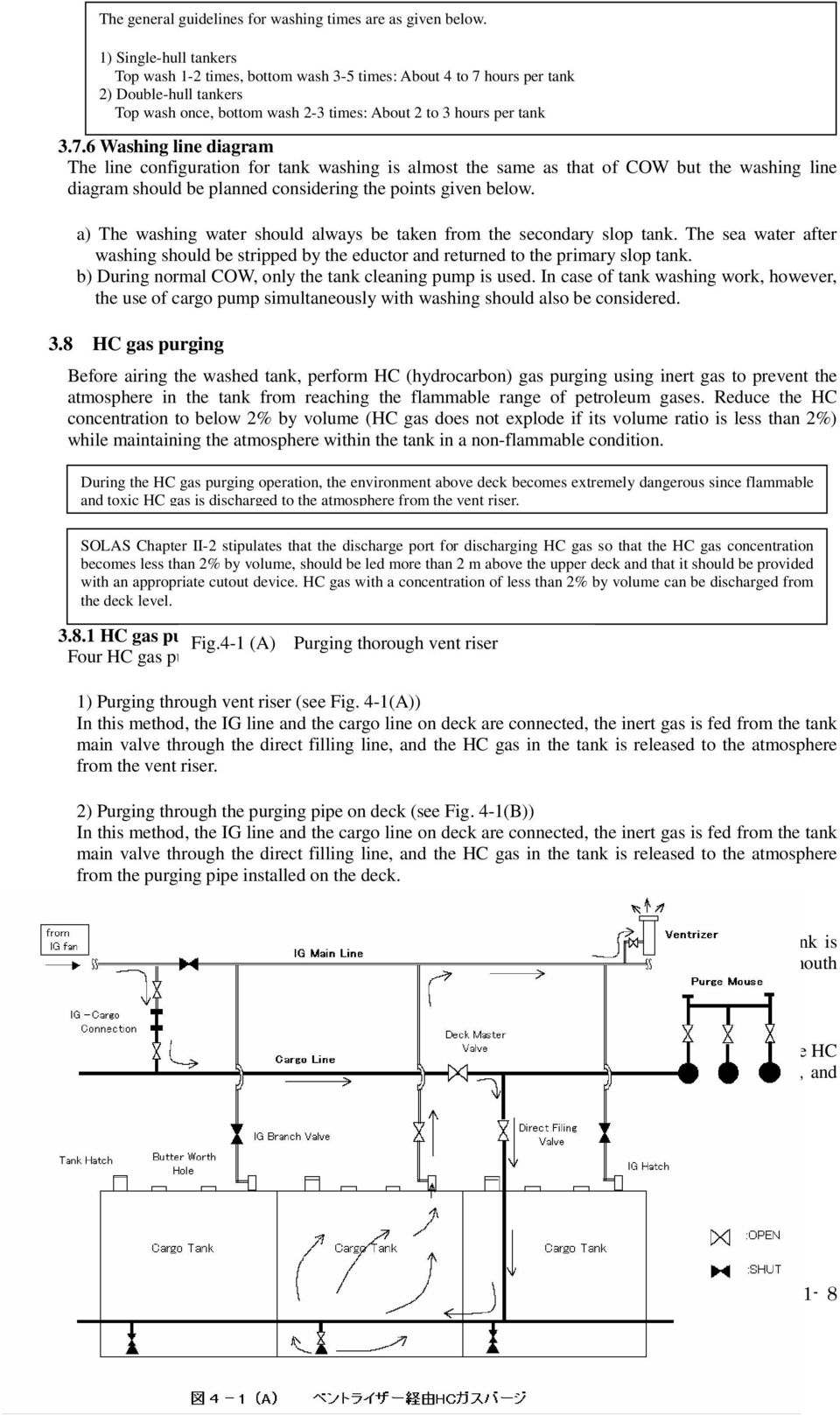
9 Fig.4-2 IHI purge mouth method Fig.4-1(B) Purging through the purging pipe on deck (Gas free) 1-9

10 When purging HC from the bell mouth via the cargo line in the tank, the water remaining in the tank and the line should always be completely stripped before purging the gas so that the HC gas flow is not blocked in the cargo line Selection of method Implement HC gas purging effectively for a short time by a method in which inert gas is vented all over the tank. Consider the points mentioned below for selection of the method, and select a method that is most suitable for the ship. In principle, implement HC gas purging according to the operation manual supplied by the shipbuilder. 1) Difference in specific gravity (HC gas is heavier than inert gas) 2) Flow of inert gas 3) Piping 4) Structure and equipment in tank 5) Progress status of tank cleaning work Time required The time required for HC gas purging is decided by the items given below. 1) Tank volume 2) Number of tanks 3) Number of IG fans to be used (quantity of inert gas to be supplied) 4) Gas purging method Fig.4-3 Mother tank method Past records reveal that the required time per tank is about 6 to 10 hours when the IG fans are operated in parallel. The time required for purging after washing can be shortened by purging each tank for about 2 to 3 hours using the washing water heating time before the tank washing work. The need for implementing this (Gas work depends free) 1- on 10 the time of start of the cleaning work.
11 3.8.4 Number of IG fans to be used If the IG fans are run in parallel, the HG gas purging time can be significantly shortened and the inert gas supply can be increased. On the other hand, the oxygen concentration of the supplied inert gas increases and the fuel consumption increases. It is preferable to run the IG fans in parallel and shorten the working time because the main purpose of this work is to purge HG gas Start period Start HC gas purging in parallel with the tank washing work. By parallel operation, the HC gas concentration can be brought down below 2% by volume more quickly, and airing can be started earlier. 3.9 Airing Airing refers to supplying fresh air into the tank in which HC gas purging has been completed, and replacing the gas in the tank so that the environment in the tank is made conducive to work to be performed by workers Airing methods Two airing methods are available. 1) Method of using portable fans and air ducts In this method, portable fans are installed in the tank cleaning holes on the upper deck, air is supplied to the tank and the inert gas is discharged. Air ducts are fitted to the portable exhaust fans and gas is exhausted from the bottom of the tank 2) Method of using IG fans In this method, fresh air is supplied using IG fans. When the method is implemented, a blind flange is inserted in the IG branch line of the tank that has already been gas-freed. For this reason, a spool piece connecting the IG line and cargo line is used and air is supplied to the tank from the tank main valve through the direct filling line Selection of method In the actual operation, the IG fan is used preferentially for HC gas purging of the tank. Airing cannot be performed until the washing and HC gas purging of all tanks except the slop tank are completed. Accordingly, airing should be performed using the portable fan and air ducts Arrangement of portable fan and air ducts The positions where these items are to be arranged depends on the arrangement of structural members in the tank. An example of the position is given below. Forward side: Supply fan Aft side: Exhaust fan (with duct) Fresh air is supplied from the tank cleaning hold on the forward side. The gas at the bottom of the tank on the aft side is released to the atmosphere by portable exhaust fan through the air duct. This arrangement is used considering that the mixture of gases in the tank (mainly inert gases) has a specific gravity greater than the supply air Time required Airing requires the maximum time among the tank cleaning tasks. The time required for airing depends on the volume of the tank, but in general, this time is about 12 to 24 hours. (Gas free) 1-11
12 The use of a simple ventilator such as a half-cut drum contributes to shortening the time considerably and is worthy of consideration. Air may not reach all parts of the tank, depending on the arrangement of structural members in the tank. In some sections (particularly the bottom corners), gas may accumulate and the HC gas concentration may not reduce at all. In such cases, the air supply position or the height of the air duct should be suitably changed so that the air flow changes. Dispersing the gas is also effective in shortening the gas-freeing time Airing start period 1) When portable fans and air ducts are used Airing can be started when the HC gas concentration in the tank drops below 2% by volume due to HC gas purging. 2) When IG fans are used Airing using IG fans can be started when the tank washing (except the primary slop tank) and HC gas purging have been completed Continuing the airing work Even if the target values (O 2 21%, HC below 1% LEL, H 2 S below 10 ppm) of the atmosphere in the tank have been reached, HC gas is always generated from the sludge accumulated in the tank. Therefore, airing work should be continued on the ship until it reaches the dry-dock. (However, it is necessary to switch over to inerting when water is being discharged from slop or when the primary slop tank is being washed at anchorage before dry-docking the ship.) Particular care is necessary during daytime when the temperature rises because a large quantity of the gas is likely to be generated at this time of the day. Airing should be systematically carried out in areas other than cargo tanks where HC gas is expected to accumulate (cargo line, cargo pump, vent riser system, coffer dams), gas detection performed and safety should be confirmed Settling and discharging water Settling is the process by which the washing water containing a mix of crude oil and sea water, which has been collected after cleaning each tank, is allowed to remain still in the slop tank so that oil and water can be separated. According to MARPOL, discharging water from slop refers to the work of discharging only the water that has been separated from oil-water mix by settling using ODM equipment. Settling and discharging of water are carried out several times intermittently, but the washing water that remains finally will be discharged to the barge. Therefore, the water from the slop should be discharged as far as possible so that the total quantity of the slop water decreases Settling time The time required for settling varies depending on the type of oil loaded on the ship and the ship motions, but generally, 24 hours minimum are required Implementation period and sea area When all tanks except slop tank have been cleaned, settling can be started. After the separation of oil and water is confirmed, discharge the water from slop. However, discharging of water from slop can be performed only in sea areas that are more than 50 miles away from the nearest land and in Generally, more than 85% of the oil-water mix separates into oil and water about one hour after settling. However, at least 24 hours are required for the emulsion layer to become an oily mixture of less than 100 ppm. It is important that adequate time be given for settling so that the slop water (dirty ballast) can be separated into oil and water. For efficient separation into oil and water, the washing water should be heated using the heating coils provided in the slop tank. However, precautions are necessary because if the slop water is heated excessively, convection may occur causing the oil and water to mix again. Generally, the temperature at which ideal separation of oil and water occurs is considered to be between 45 to 55 degrees Celsius. (Gas free) 1-12

13 specially-designated areas, otherwise the implementation period has to be adjusted. Moreover, this discharging work has to be performed always during the day time so that the sea water surface can be monitored when the water from slop is discharged into the sea Final line washing Final line washing refers to the flushing out (rinsing) of all traces of oil remaining in each cargo pump and cargo line after the washing of all tanks except the slop tank has been completed. The final line washing process consists of drawing the sea water directly into each cargo pump from the outboard sea chest valve, washing all lines, and sending it to the primary slop tank Implementation period Final line washing is generally implemented after the first discharge of water from slop Line diagram for final line washing Consider the points below when preparing the line diagram for final line washing. 1) The objective of final line washing is the rinsing of the lines, so all the lines are to be washed. However, the procedure may be completed simply and within a short time by performing rough line washing and hot water line washing. (Washing may be performed by passing water in one direction only) 2) Start all cargo pumps and tank cleaning pumps sequentially to pass water through them. Wash all the pumps in this way. 3) Do not flush the tank valves. However, thoroughly wash the valves or lines that are to be removed during dry-docking Sludge removal Sludge removal refers to the work of discharging to shore the sludge remaining in the tank after gas-freeing the tank at the designated anchorage and before dry-docking the ship Time required The time required for sludge removal is decided according to the quantity of accumulated sludge and the number of sludge gangs available. Generally, about 100 to 200 MT of sludge are generated. Past records show that such quantities can be removed in about 2 days Slop removal Slop removal is the process of discharging to shore the slop water remaining in the primary slop tank Slop water measurements Measure the slop quantity and retrieve slop samples (oil samples) before slop removal. These actions should always be witnessed by the ship supervisor. Decide the slop quantity finally after discussion with the sub-contractor. (Refer to Document 6) If the API of the slop oil and the oil-water interface are accurately measured, and the SLOP CERTIFICATE is prepared beforehand by the ship, some of the sub-contractors may use the measured values Primary slop tank washing Primary slop tank washing refers to the washing of primary slop tank that has not been washed after the slop water has been discharged to shore Washing method (Gas free) 1-13

14 Perform primary slop tank washing by drawing the sea water from the sea chest into the tank cleaning pump. Strip the washing water used for washing the tank using the stripping pump and discharge it to barges using the direct MARPOL line. Hot water washing may also be implemented using the tank cleaning heater but in this case, a hose connected to the COW line and leading overboard should be used for adjusting the flow rate of the COW machine. This however, has the risk of discharging oil in the COW line into the sea. Moreover, the boiler load adjustment is difficult. Thus, cold water washing is generally implemented Gas-freeing, airing and sludge removal of primary slop tank Perform gas-freeing, airing and sludge removal of the primary slop tank after washing is completed, similar to the procedure implemented for other tanks Final line stripping Final line stripping refers to the washing and stripping of the line (MARPOL line) used for discharging slop water in the primary slop tank and the stripping pump Acquisition of gas-free certificate After gas-freeing all the tanks, receive gas inspection by the Gas Chemist on site before the dry-docking of the ship, obtain a gas-free certificate and complete the tank cleaning work. (Gas free) 1-14
WASHING PROCESS OF CARGO TANKS ON TANKERS FOR TRANSPORTATION OF CRUDE OIL
 WASHING PROCESS OF CARGO TANKS ON TANKERS FOR TRANSPORTATION OF CRUDE OIL Siniša Stojan, Ph.D. student Damir Dražić, Ph.D. student Brodotrogir, HR - 21220 Trogir, Croatia [email protected],
Survey Guidelines for MARPOL Annex I under the Harmonized System of Survey and Certification (HSSC), 2011
 ANNEX Survey Guidelines for MARPOL Annex I under the Harmonized System of Survey and Certification (HSSC), 2011 Table of Contents 1 DESCRIPTION OF THE VARIOUS TYPES OF SURVEY 1.1 Initial surveys 1.2 Annual
ST. VINCENT AND THE GRENADINES
 ST. VINCENT AND THE GRENADINES MARITIME ADMINISTRATION CIRCULAR N POL 008 - Rev 1 MARPOL ANNEX I OIL RESIDUE (SLUDGE) AMENDMENTS - MEPC 59 TO: SHIPOWNERS, SHIPS OPERATORS AND MANAGERS, MASTERS APPLICABLE
5 OIL TANKER DESIGN AND EQUIPMENT
 5 OIL TANKER DESIGN AND EQUIPMENT Learning objectives: that oil tankers can be divided into fore part, tank area and after part that means must be provided to keep spills away from the accommodation how
12 November 2008 *** I:\CIRC\MEPC\01\642.DOC INTERNATIONAL MARITIME ORGANIZATION 4 ALBERT EMBANKMENT LONDON SE1 7SR
 INTERNATIONAL MARITIME ORGANIZATION 4 ALBERT EMBANKMENT LONDON SE1 7SR Telephone: 020 7735 7611 Fax: 020 7587 3210 IMO E Ref. T5/1.01 MEPC.1/Circ.642 12 November 2008 2008 REVISED GUIDELINES FOR SYSTEMS
ANNEX 17 DRAFT AMENDMENTS TO SOLAS REGULATIONS II-2/4 AND II-2/16. Part B Prevention of fire and explosion
 Annex 17, page 1 ANNEX 17 DRAFT AMENDMENTS TO SOLAS REGULATIONS II-2/4 AND II-2/16 Part B Prevention of fire and explosion Regulation 4 Probability of ignition 1 The existing paragraph 5.5 is replaced
How to prevent tanker cargo shortage claims
 How to prevent tanker cargo shortage claims The cause of claims and how to avoid them during pre-loading, loading and unloading UK P&I CLUB IS MANAGED BY THOMAS MILLER PRE-LOADING Ship suitability for
Tanker Officer Training Standards (TOTS) 4B Chemical Tanker Simulator Verification Course
 Tanker Officer Training Standards (TOTS) 4B Chemical Tanker Simulator Verification Course Tanker Officer Training Standards (TOTS) 4B Chemical Tanker Simulator Verification Course CONTENTS Prerequisites...1
PRECAUTIONS ON TANKER AND TERMINAL DURING CARGO HANDLING
 Chapter 24 PRECAUTIONS ON TANKER AND TERMINAL DURING CARGO HANDLING This Chapter provides guidance on precautions to be observed by both tanker and shore when cargo handling, ballasting, bunkering, tank
DRY CLEANING PLANTS REQUIREMENTS FOR INSTALLATION AND OPERATION
 DEPARTMENT OF TRADE MERCHANT SHIPPING NOTICE NO.M.847 DRY CLEANING PLANTS REQUIREMENTS FOR INSTALLATION AND OPERATION Notice to Shipowners, Masters, Shipbuilders and Repairers 1. It has come to the notice
TANKER - SHORE SAFETY CHECK-LIST
 TANKE - SHOE SAFETY CHECK-LIST Part A - Bulk Liquid General - Physical Checks Bulk Liquid - General Tanker Terminal Code emarks 1 There is safe access between the tanker and shore. L1 The fendering arrangements
Quik Lining Systems Heater Owners Guide
 Quik Lining Systems Heater Owners Guide Quik Lining Systems, Inc is pleased to present the Quik Heater, an innovative heater used to cure cured in place pipe for sewer laterals. The unit is the most cost
Fully Pumped Systems
 Fully Pumped Systems (also see the picture gallery and System Basics) The term for any boiler that uses a pump to move all the heat from the boiler to every part of the system is fully pumped. As a rule
ALVERNIA UNIVERSITY OSHA REGULATION: 29 CFR 1910.252 WELDING, CUTTING, AND BRAZING ( HOT WORK ) SECTION: 3600
 OSHA REGULATION: 9 CFR 90.5 WELDING, CUTTING, AND BRAZING ( HOT WORK ) A. POLICY. This procedure follows requirements set forth in 9 CFR 90.5.. This policy applies to all Hot Work operations being done
Subpart 1. Installation. All plumbing systems must be. installed and tested according to this chapter and chapter 4715,
 4658.4500 PLUMBING SYSTEMS; NEW CONSTRUCTION. Subpart 1. Installation. All plumbing systems must be installed and tested according to this chapter and chapter 4715, the Minnesota Plumbing Code. Subp. 2.
ежглеяис тгс йубеямгсеыс
 7671 ежглеяис тгс йубеямгсеыс тгс еккгмийгс дглойяатиас теувос деутеяо ая. жщккоу 613 9 апяикъоу 2008 апожасеис аяихл. 4113.237/02/28022008 йахояислэр ТЩПОУ ТОУ пистопоигтийощ пяэкгьгр ТГР ящпамсгр АПЭ
Tank Heating Solutions. For Oil Spill Response Vessels
 Heating Solutions For Oil Spill Response Vessels A chain is only as strong as its weakest link Oil spill incidents are unplanned and unwanted events that can have dire consequences for the environment
Boiler Preparation, Start-Up and Shutdown
 Boiler Preparation, Start-Up and Shutdown Learning Outcome When you complete this module you will be able to: Describe the basic preparation of a boiler for start-up, and the start-up and shutdown procedures.
26.3.3 The Ship/Shore Safety Check-List
 International Safety Guide for Oil Tankers and Terminal Fifth Edition 2006-12-05 26.3.3 The Ship/Shore Safety Check-List Ship's Name Berth Date of Arrival Port Time of Arrival Part `A' - Bulk Liquid General
IMO WORK PROGRAMME OF THE COMMITTEE AND SUBSIDIARY BODIES
 INTERNATIONAL MARITIME ORGANIZATION E IMO MARINE ENVIRONMENT PROTECTION COMMITTEE 51st session Agenda item 20 MEPC 51/INF.6 23 January 2004 ENGLISH ONLY WORK PROGRAMME OF THE COMMITTEE AND SUBSIDIARY BODIES
Oily Water Separator SKIT/S-DEB
 Oily Water Separator SKIT/S-DEB A. IMO Resolution MEPC.107(49) The IMO Resolution MEPC.107 (49) has been adopted on 18 th July 2004 and applies to all oily water separators and 15-ppm alarm devices to
Peasouper Operator s Manual
 Peasouper Operator s Manual Contact Information Le Maitre Special Effects, Inc. Canada 1960 Blue Heron Drive, London, ON. N6H 5L9 Phone Direct: (519) 659.7972 Phone Toll Free Direct: (800) 388.0617 Fax:
Nitrogen Blanketing for Methanol Storage and Transportation
 Nitrogen Blanketing for Methanol Storage and Transportation Overview Air is the enemy of many materials. Not only can oxygen cause safety concerns and product degradation, but moisture, dirt, hydrocarbons
Hydrocarbon management
 Hydrocarbon management HM 50 Guidelines for the cleaning of tanks and lines for marine tank vessels carrying petroleum and refined products HYDROCARBON MANAGEMENT HM 50 GUIDELINES FOR THE CLEANING OF TANKS
Technical Bulletin. Oil Record Book entries: Machinery space operations (Part 1) Including January 2011 amendments to Technical Bulletin 24
 UK P&I CLUB Technical Bulletin NUMBER 35 2011 (revised from Bulletin 24) Oil Record Book entries: Machinery space operations (Part 1) Including January 2011 amendments to Technical Bulletin 24 The Club
Cooling system components, removing and installing
 Page 1 of 34 19-1 Cooling system components, removing and installing WARNING! The cooling system is pressurized when the engine is warm. When opening the expansion tank, wear gloves and other appropriate
Ontario Fire Code SECTION 5.13 DIP TANKS. Illustrated Commentary. Office of the Ontario Fire Marshal
 Ontario Fire Code SECTION 5.13 DIP TANKS Illustrated Commentary Office of the Ontario Fire Marshal Dip Tanks Illustrated Commentary 1 5.13.1. Location 5.13.1.1. Dip tank operations involving flammable
Factory owners must ensure the boiler is:
 Factory owners must ensure the boiler is: * Registered with the Boilers and Pressure Vessels Division, Labour Department * Examined by an appointed examiner and has a valid certificate of fitness * Supervised
Ethanol-Water Phase Separation White Paper
 Ethanol-Water Phase Separation White Paper Samir Jain Background The use of ethanol as a fuel in the United States has significantly increased over the past decade. Today, greater than 80% of all retail
Cooling system components, removing and installing
 Engine BHW Cooling system components, removing and installing Page 1 / 24 19-1 Cooling system components, removing and installing Warning! When doing any repair work, especially in the engine compartment,
EXPLOSIVE ATMOSPHERES - CLASSIFICATION OF HAZARDOUS AREAS (ZONING) AND SELECTION OF EQUIPMENT
 EXPLOSIVE ATMOSPHERES - CLASSIFICATION OF HAZARDOUS AREAS (ZONING) AND SELECTION OF EQUIPMENT OVERVIEW ASSESSING THE RISK RELATIONSHIP BETWEEN FIRES AND EXPLOSIONS CLASSIFYING HAZARDOUS AREAS INTO ZONES
Marine pollution prevention pocket checklist Revision 3
 Marine pollution prevention pocket checklist Revision 3 Reducing the risk of port state control detentions In conjunction with: Introduction MARPOL infringements, such as deliberate violation of requirements
Fire & Explosion Risks in Service Stations
 Fire & Explosion Risks in Service Stations Petrol Vapour Petrol gives off highly flammable vapour even at very low temperatures. Because of the flammability of petrol vapours, service stations carry a
WHAT YOU DON T KNOW ABOUT ACCUMULATORS CAN KILL YOU!
 WHAT YOU DON T KNOW ABOUT ACCUMULATORS CAN KILL YOU! Atlanta (Monroe) GA 770-267-3787 [email protected] www.gpmhydraulic.com What You Don t Know About Hydraulic Accumulators Can Kill You TABLE OF CONTENTS
Carefully to Carry. Bulk oil cargoes shortage and contamination claims
 Carefully to Carry Bulk oil cargoes shortage and contamination claims Over recent years there has been a marked increase in the incidence of claims arising from the carriage of oil cargoes. The claims
How To Prevent Over Water Activities
 Objectives Cover Contain Educate Reduce/Minimize Product Substitution Description Over-water activities occur at boat and ship repair yards, marinas, and yacht clubs. The discharge of pollutants to receiving
Bunkers Regulatory and Practical Considerations. Piraeus, 8 November 2012 Capt. Simon Rapley
 Bunkers Regulatory and Practical Considerations Piraeus, 8 November 2012 Capt. Simon Rapley Introduction Simon Rapley Loss Prevention Associate at the West of England P&I Club Master Mariner, former Captain
Fuel. What you will learn. Things you need before you start. Materials. Tools. When you have finished this module, you should be able to:
 Fuel Student What you will learn When you have finished this module, you should be able to: Choose the right fuel for the engine Mix the right petrol and oil for a 2-stroke engine Know the main parts of
Laddomat 21-60 Charging unit
 Laddomat 21-60 Charging unit User and installation instructions NOTE! Diagrams in this brochure only describe connection principles. Each installation must be measured and carried out according to the
Draining and filling cooling system
 Page 1 of 9 Draining and filling cooling system Special tools and workshop equipment required Adapter -V.A.G 1274/8- Pipe -V.A.G 1274/10- Drip tray -V.A.G 1306- or drip tray for workshop hoist -VAS 6208-
GUIDANCE ON DETENTION AND ACTION TAKEN
 1. INTRODUCTION 1.1. General GUIDANCE ON DETENTION AND ACTION TAKEN If deficiencies are found the PSCO must: decide on the appropriate action to be taken. be satisfied that they will be rectified. decide
Fuel Treatment and Conditioning Systems
 RULES FOR CLASSIFICATION OF Ships PART 6 CHAPTER 14 NEWBUILDINGS SPECIAL EQUIPMENT AND SYSTEMS ADDITIONAL CLASS Fuel Treatment and Conditioning Systems JULY 2006 This chapter has been amended since the
M-20.2 SOLAS II-2. The latest IMO Briefing (IMO 29,2000) offered the following description of the 73rd Meeting of the Maritime Safety Committee:
 M-20.2 SOLAS II-2 THE PREFERRED EEBD SOLUTION The latest IMO Briefing (IMO 29,2000) offered the following description of the 73rd Meeting of the Maritime Safety Committee: The 73rd meeting of the IMO s
Explosion of a gasoline vapour cloud formed in a hydrocarbon loaded effluents storage tank 10 December 1999 Arquata Scrivia Italy
 Explosion of a gasoline vapour cloud formed in a hydrocarbon loaded effluents storage tank 10 December 1999 Arquata Scrivia Italy UVCE Storage tank Hydrocarbons Steam coil Corrosion Steam Instrumentation
Frequently Asked Questions Generators
 Frequently Asked Questions Generators Fuel Related How much fuel do the generators use during normal operation? At exercise? The generator fuel consumption is given in each of the product knowledge books
Indirect-Fired Storage Water Heater Models WH-30 through WH-80 INSTALLATION AND OPERATING INSTRUCTIONS
 Indirect-Fired Storage Water Heater Models WH-30 through WH-80 INSTALLATION AND OPERATING INSTRUCTIONS Contents Page Ratings and Specifications..................... 2 Installation Requirements......................
CLASSIFICATION NOTES
 CLASSIFICATION NOTES Type Approval, Installation and Testing of Water Level Detectors on Bulk Carriers and Single Hold Cargo Ships other than Bulk Carriers General Information This edition of the classification
Oil and Coolant Circulating Heating System. Model - OCSM
 Oil and Coolant Circulating Heating System Model - OCSM Installation & Operation Manual 216280-000 REV 2 Identifying Your System The HOTSTART heating system is designed to heat fluids for use in marine
Description of functions
 Description of functions Laddomat 21 is designed to......allow the boiler to reach a high working temperature soon after firing....to preheat the cold tank water in the bottom of the boiler so that the
EXPRESS STILL WARNING It is legal in New Zealand to own and operate a still for the purpose of producing alcohol for your own consumption.
 THE EXPRESS STILL This still represents the next generation in home distillation equipment. It eliminates the problem of having to spend all day processing a 25 litre wash. Taking 1 hour to heat up, then
SunMaxx Solar Filling Station Operating Instructions
 SunMaxx Solar Filling Operating Instructions Content 1. Declaration of conformity... 2 2. Introduction... 2 3. Transportation and unpacking... 4 4. Mounting and commissioning... 5 5. End of operation...
11.6 Formulas to be used when changing atmosphere in an tank
 11.6 Formulas to be used when changing atmosphere in an tank There are some formulas that we can use to calculate the consumption of nitrogen or inert for changing atmosphere in tanks and the time to be
STEAM HEATING SYSTEM TROUBLESHOOTING GUIDE
 Page 1 of 9 PURPOSE Steam is the most commonly used heating medium for maintaining process temperatures. Compared to other heating media, steam contains a significant amount of heat energy, and this heat
Session 2: Hot Water Supply
 MEBS6000 Utility Services http://www.hku.hk/mech/msc-courses/mebs6000/index.html Session 2: Hot Water Supply Dr. Benjamin P.L. Ho Department of Mechanical Engineering The University of Hong Kong E-mail:
Cooking at the Speed of light!
 Cooking at the Infrared Cooking & Colouring Infrabaker is a modular infrared continuous cooking system developed by Infrabaker International. The machine is designed to cook and/or put colour on a wide
ADMINISTRATIVE SERVICES MANUAL
 Purpose Responsibilities Proper Storage and use of flammable liquids can significantly reduce the possibility of accidental fires and injuries. To minimize risk to life and properly, the requirements of
Why and How we Use Capacity Control
 Why and How we Use Capacity Control On refrigeration and air conditioning applications where the load may vary over a wide range, due to lighting, occupancy, product loading, ambient weather variations,
Final Sentence in a nocturnal Oil Spill Case
 Final Sentence in a nocturnal Oil Spill Case Spanish Maritime Safety and Rescue Agency Aerial Survey Department Maritime Aerial Survey Technician Berta Blanco Meruelo SUMMARY 1. Responsibility areas: Aircraft
Managing Floor Drains and Flammable Traps
 Managing Floor Drains and Flammable Traps Contents: Problem... 1 Solution... 2 Maintenance... 2 Waste Management Options... 2 For More Information... 4 BMP Chart... 5 This fact sheet discusses recommended
HEAT RECOVERY OPTIONS FOR DRYERS AND OXIDIZERS
 HEAT RECOVERY OPTIONS FOR DRYERS AND OXIDIZERS William K. Scullion, Application Engineering Leader, MEGTEC Systems, De Pere, WI Introduction Competitive pressures continuously motivate us to examine our
FLASH TANK ECONOMIZER PRODUCT GUIDE
 FLASH TANK ECONOMIZER PRODUCT GUIDE Overview A flash tank is used to recover blowdown energy in the form of flash steam and blowdown. This can only be used with a deaerator or some other pressurized device.
Laundry Hot Water Systems
 TECHNICAL BULLETIN HE-2020 Laundry Hot Water Systems Commercial/Institutional Applications using Helitherm Heat Exchangers AERCO INTERNATIONAL, INC. 159 PARIS AVE., NORTHVALE, NJ 07647 (201) 768-2400 FAX
Diesel fuel in winter The effect of cold weather on fuel systems
 Diesel fuel in winter The effect of cold weather on fuel systems INTRODUCTION All diesel fuel contains wax molecules. These are natural components of the crude oil that diesel is produced from. Wax is
Energy Efficient Operations and Maintenance Strategies for Boilers
 Energy Efficient Operations and Maintenance Strategies for Boilers Large, complex and widely used, industrial boilers are major consumers of fuel. Proper operations and maintenance (O&M) procedures must
Building an LNG driven vessel. LNG developments at Meyer Werft Viking Grace 18_09_2013
 1 Building an LNG driven vessel LNG developments at Meyer Werft Viking Grace 18_09_2013 Berufsbildung 13.09.2013 2 Meyer Werft Papenburg MEYER WERFT is a company with tradition, which started operations
Discharge of Water & Waste from Marine Vessels Standards & Regulations (MARPOL Convention)
 Discharge of Water & Waste from Marine Vessels Standards & Regulations (MARPOL Convention) August 2010 Disclaimer: The standards & regulations provided here are attributable to the named source and are
PSAC/SAIT Well Testing Training Program Learning Outcomes/Objectives Level B
 s/objectives Level B CHEM 6014: Properties and Characteristics of Natural Gases Discuss the pertinent properties and uses of natural gases as they occur in gas processing. 1. Describe the physical properties
Get Ready For The One Tonne Action Challenge!
 Get Ready For The One Tonne Action Challenge! Read through the four elements of the one-tonne challenge - making a difference is easier than you think!! Watt's It All About? As our demand for electricity
MODEL T200-F18 MODEL T125-F18 Finish Nailers
 P MODEL T200-F18 MODEL T125-F18 Finish Nailers IMPORTANT! DO NOT DESTROY It is the customer s responsibility to have all operators and service personnel read and understand this manual. OPERATING MANUAL
GUIDELINES FOR THE DRAINAGE OF FIRE-FIGHTING WATER FROM CLOSED VEHICLE AND RO-RO SPACES AND SPECIAL CATEGORY SPACES OF PASSENGER AND CARGO SHIPS
 INTERNATIONAL MARITIME ORGANIZATION 4 ALBERT EMBANKMENT LONDON SE1 7SR Telephone: 020 7735 7611 Fax: 020 7587 3210 IMO E Ref. T4/4.01 MSC.1/Circ.1320 11 June 2009 GUIDELINES FOR THE DRAINAGE OF FIRE-FIGHTING
BODY OF KNOWLEDGE API TES TANK ENTRY SUPERVISOR
 BODY OF KNOWLEDGE API TES TANK ENTRY SUPERVISOR CERTIFICATION EXAMINATION November 2015, March 2016, July 2016 and November 2016 (Replaces October 2013) This API Individual Certification Examination is
IMO Approved Tank Cleaning Chemicals
 IMO Approved Tank Cleaning Chemicals IMO Approved Tank Cleaning Chemicals TC1 Aquamarine Aquawash T1080A Suitable for the removal of fatty acids, fish oils and other drying or semi-drying oil deposits.
BPW32 DN15, DN20 and DN25 Balanced Pressure Wafer Steam Trap
 1263050/6 IM-P126-07 ST Issue 6 BPW32 DN15, DN20 and DN25 Balanced Pressure Wafer Steam Trap Installation and Maintenance Instructions 1. Safety information 2. General product information 3. Installation
Unit 24: Applications of Pneumatics and Hydraulics
 Unit 24: Applications of Pneumatics and Hydraulics Unit code: J/601/1496 QCF level: 4 Credit value: 15 OUTCOME 2 TUTORIAL 4 DIRECTIONAL CONTROL VALVES The material needed for outcome 2 is very extensive
Notes. Material 1. Appropriate Flammable Liquids
 29 CFR 1910.106 Flammable Materials Flammable Liquids Preparation 1. Read Applicable Background information and related Company Policy Chapter. 2. Make Copies of this Lesson Plan for Personnel 3. Make
warm air for the healthiest, most comfortable home environment possible. This occurs with a system efficiency of up to 90%.
 Lifebreath delivers a complete indoor climate control package Indoor comfort in a small package The patented Lifebreath Clean Air Furnace combines the fresh air benefits of the Heat Recovery Ventilator
OVERSEAS MARINE CERTIFICATION SERVICES (OMCS)
 SURVEYOR S MANUAL - STATUTORY TD-SP-DGC Page. 1 de 8 CARRIAGE OF DANGEROUS GOODS SECTION 1 General 1.1 Surveyors carrying out surveys for the carriage of dangerous goods should be familiar with the applicable
BOWIE PUMPS OPERATION - MAINTENANCE
 BOWIE PUMPS OPERATION - MAINTENANCE PUMPING PRINCIPLE: The meshing owieeof the gears cause a slight depression, with the resulting enmeshing of the gears causing a vacuum drawing the fluid being pumped
INTEC Engineering GmbH Heating Solutions for the Marine Industry
 INTEC Engineering GmbH Heating Solutions for the Marine Industry Thermal Oil Heaters Heating Solutions for the Marine Industry Compared to conventional plants using hot water or steam, thermal oil as a
AUTOMATIC TANK CLEANING (ATC) LITE On-the-fly automatic tank cleaning and recycling technology
 AUTOMATIC TANK CLEANING (ATC) LITE On-the-fly automatic tank cleaning and recycling technology ATC Lite: Permanent or mobile option for safe and continuous onshore, offshore tank cleaning applications
Volkswagen Golf 5 2004-> VW Rabbit GTI 2006->
 Стр. 1 из 24 Volkswagen Golf 5 2004-> VW Rabbit GTI 2006-> 19-1 Cooling system components Warning! Hot steam may escape when opening expansion tank. Wear protective goggles and protective clothing to prevent
Petroleum Inspector Certification Programme. Test Questions
 Petroleum Inspector Certification Programme Test Questions Americas (US) Version English Language Seventh Edition July 2013 Blank Page (back of cover) Petroleum Inspector Certification Programme Test Questions
Safety of Life at Sea, 1974 (SOLAS)
 Safety of Life at Sea, 1974 (SOLAS) Prof. Manuel Ventura Ship Design I MSc in Marine Engineering and Naval Architecture Chap. III. Lifesaving Appliances and Arrangements 1 Cargo Ships Cargo Ships - Case
TRIAL CHEMICAL CLEANING OF FOULED APH BASKETS
 TRIAL CHEMICAL CLEANING OF FOULED APH BASKETS Dr. Abhay Kumar Sahay, AGM(CC OS) Bijay Manjul, AGM( Operation) Kahalgaon Boiler has three inputs Steam generator 1. WATER 2. COAL 3. AIR Burner Air preheater
PBX Series Quick Fit Connector Bimetallic Steam Traps
 6262100/6 IM-P626-01 ST Issue 6 PBX Series Quick Fit Connector Bimetallic Steam Traps Installation and Maintenance Instructions 1. Safety information 2. General product information 3. Installation 4. Commissioning
Ambient Temperature Operation and Matching MAN B&W Two-stroke Engines
 Ambient Temperature Operation and Matching MAN B&W Two-stroke Engines Content Introduction...5 Standard ambient matched engine...5 Operating at high seawater with standard matched engine...6 Non-standard
ANNEX 5 RESOLUTION MEPC.127(53) Adopted on 22 July 2005 GUIDELINES FOR BALLAST WATER MANAGEMENT AND DEVELOPMENT OF BALLAST WATER MANAGEMENT PLANS (G4)
 RESOLUTION MEPC.127(53) Adopted on 22 July 2005 GUIDELINES FOR BALLAST WATER MANAGEMENT AND DEVELOPMENT OF BALLAST WATER MANAGEMENT PLANS (G4) THE MARINE ENVIRONMENT PROTECTION COMMITTEE, RECALLING Article
LECTURE 28 to 29 ACCUMULATORS FREQUENTLY ASKED QUESTIONS
 LECTURE 28 to 29 ACCUMULATORS FREQUENTLY ASKED QUESTIONS 1. Define an accumulator and explain its function A hydraulic accumulator is a device that stores the potential energy of an incompressible fluid
A Job Safety Execution Plan is required. mixtures of the above called, natural gas liquids (NGL's) refined products and their components
 TITLE Pipelines and Terminals Manual/Volume 3 - SECTION 02: SUBJECT 20: PURPOSE AND SCOPE During the normal lifetime of a pipeline it becomes necessary to add or remove piping, modify existing piping or
Modern Sand Reclamation Technologies for Economy, Environment Friendliness and Energy Efficiency
 Modern Sand Reclamation Technologies for Economy, Environment Friendliness and Energy Efficiency Aniruddha Ghosh GM, The Wesman Engineering Co. Ltd, Kolkata ABSTRACT Unlike green sand, chemically-bonded
USER INSTRUCTIONS FOR GET PORTABLE 12k BTU AIR CONDITIONER MODEL No. GPACU12HR
 USER INSTRUCTIONS FOR GET PORTABLE 12k BTU AIR CONDITIONER MODEL No. GPACU12HR CONTENTS Introduction Safety Notes Identification of parts Installation instructions Operation instructions Maintenance Troubleshooting
FLOW SHEET- PULP AND PAPER MANUFACTURING
 FLOW SHEET- PULP AND PAPER MANUFACTURING 1 DIGESTER- BLOW TANK In this process the pulp is obtained by digesting wood chips with an acid liquor at high pressure and temperature. This is a batch process
ENGINE COOLING SYSTEM
 ENGINE COOLING SYSTEM 1988 Toyota Celica 1987-88 TOYOTA Engine Cooling Systems Celica DESCRIPTION The basic liquid cooling system consists of a radiator, water pump, thermostat, cooling fan, pressure cap,
Grade 8 Science Chapter 9 Notes
 Grade 8 Science Chapter 9 Notes Force Force - Anything that causes a change in the motion of an object. - usually a push or a pull. - the unit for force is the Newton (N). Balanced Forces - forces that
MAP COFFEE MIA CAPSULE COFFEE MACHINE INSTRUCTION MANUAL MODEL: CM4725. Read this manual thoroughly before using and save it for future reference
 MAP COFFEE MIA CAPSULE COFFEE MACHINE INSTRUCTION MANUAL MODEL: CM4725 Read this manual thoroughly before using and save it for future reference Purchase MAP capsules at Harvey Norman stores nationwide
Description of Thermal Oxidizers
 Description of Thermal Oxidizers NESTEC, Inc. is a full service equipment supplier specializing in solutions for plant emission problems. The benefit in working with NESTEC, Inc. is we bring 25+ years
IMPORTANT SAFETY RULES TO FOLLOW
 WARNING FLOOR & CARPET CLEANER Any piece of equipment can be dangerous if not operated properly. YOU are responsible for the safe operation of this equipment. The operator must carefully read and follow
Recharge Procedure for Telemark TVP-2000 and TVP-3500
 Recharge Procedure for Telemark TVP-2000 and TVP-3500 Required items: 1.) Refrigeration service manifold. 2.) Charge recovery system. 3.) Dry nitrogen gas. If a high pressure cylinder is used, a pressure
Petroleum Inspector Certification Programme. Test Questions
 Petroleum Inspector Certification Programme Test Questions English Language BLANK PAGE (BACK OF COVER) Petroleum Inspector Certification Programme Test Questions English Language Copyright 2016 The International
Installation of Underground LP-Gas Systems
 NPGA #412-94 Installation of Underground LP-Gas Systems SCOPE This bulletin provides guidelines for the installation and inspection of underground LP-Gas systems and outlines song of the unique problems