
Princeton University Lab Specific Safety Training
|
|
|
- Darren Fisher
- 9 years ago
- Views:
Transcription
1 Princeton University Lab Specific Safety Training Per University policy, all individuals conducting work in Princeton University laboratories, paid or unpaid, including faculty, staff, students and visitors, must attend Laboratory Safety Training provided by Environmental Health and Safety (EHS). Attendance at similar laboratory safety training provided by other institutions does not satisfy this requirement. Additional training provided by EHS is required depending on the activities of the laboratory worker. Such training may include laser safety, radiation safety, biosafety or other topics. The training sessions provided by EHS give an overview of universal safety procedures for working with hazards that may be encountered in the lab. It is generalized and does not cover safety items specific to each lab. As part of normal interactions with laboratory workers, lab supervisors must ensure they are trained in the safe and proper practices for the procedures and materials they use and any lab- specific safety measures they may take to protect themselves from exposure to hazardous materials, including the location and use of emergency equipment. Laboratory supervisors should conduct a risk assessment of the equipment, materials and processes in the lab to identify the lab-specific training needed for each individual. There are many resources available to help with this assessment, including, but not limited to: Principal Investigators and lab supervisors Departmental Safety Managers Departmental Chemical Hygiene Officers EHS personnel Online resources (i.e., Procedural safety literature All new lab workers are required to receive lab-specific safety training from their Principal Investigator, lab manager or other designated experienced researcher 1. Emergency procedures and general lab safety procedures must be covered immediately when the new person joins the lab. Other items can be covered as the new researcher begins that procedure. Please note that such procedures do not necessarily need to be in writing. However, documentation that the individuals have been instructed and/or evaluated on the topics or procedures is needed. Additional training may be necessary as new equipment, materials and/or processes are introduced. 1 An experienced researcher is a laboratory employee, graduate student or post- doc who has received Laboratory Safety Training provided by Environmental Health and Safety and any other training deemed necessary by the Principal Investigator for the work being conducted, per Environmental Health and Safety protocols.
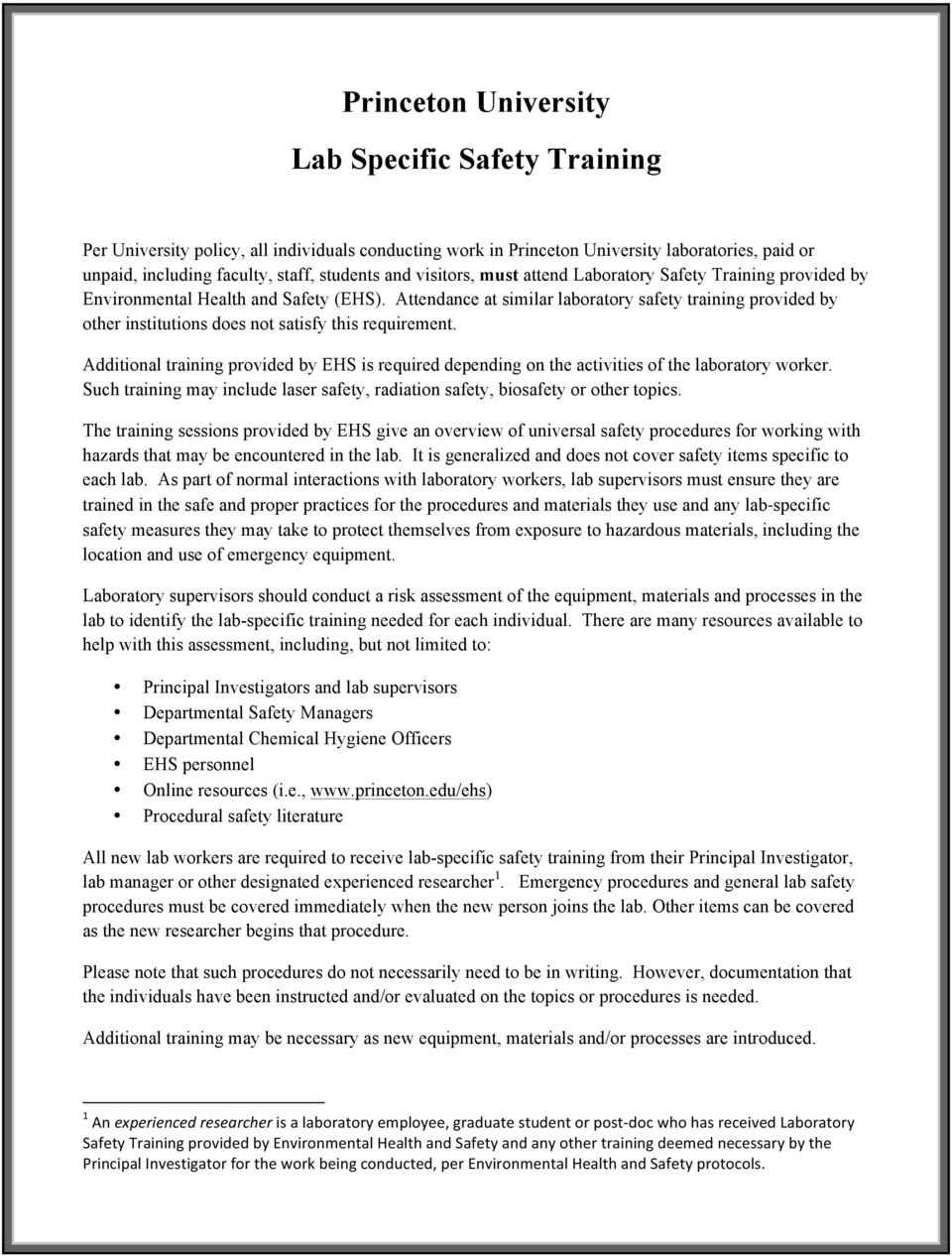
2 Lab Specific Training Record Researcher Name: PU NetID Principal Investigator Lab Location Position/Title Status: Faculty Staff Post-Doc Princeton Undergraduate Princeton Graduate Student Visiting Student Visiting Researcher High School Student Supervisor Name: Date: The person providing instruction should initial and date each item when the topic is covered. Items that do not apply to the lab or the researcher should be marked NA. After all of the relevant training has been completed, have the new lab worker sign and date this form and save it in your laboratory training records. Initials&Date Emergencies Reporting procedures for medical, fire or safety emergencies Basic building alarms, response to alarms Emergency Action Plan including: exits, evacuation routes and designated meeting locations Location of emergency equipment such as eyewash stations, fire extinguishers, fire pull stations, safety showers, etc; Reporting requirements for laboratory incidents and accidents, especially relating to personal injury Location and use of spill kit, first aid kit Location of emergency contact information, including Public Safety (911 or ) General Lab Safety Proof of attendance to Laboratory Safety Training provided by Princeton University EHS Process for raising and addressing health and safety concerns in the lab Food and beverages are not to be consumed in laboratories. Locations to store food and drink, and the appropriate designated areas to eat. Protocols for transporting chemicals and other hazardous materials in hallways, e.g., use of secondary containers, no transporting in personal vehicles, etc. Lab security requirements (e.g., locked doors, access policies, etc.) Protocol for removing PPE when outside of the laboratory, except when transporting hazardous materials (e.g., do not wear gloves in hallways, elevators, etc.) Location of stored personal protective equipment (PPE: gloves, glasses, lab coat) When to use PPE, including proper eye protection, for specific tasks PPE work practices (i.e. closed toed shoes, lab coats buttoned, disposable gloves, wash hands after removal of gloves, removal of lab coats before leaving the lab, etc.) Hazards and proper use of compressed gases and cryogenic material, including moving cylinders, how to secure cylinders, procedures for attaching and removing regulators, etc. Proper handling and disposal of broken glass, razor blades, needles, syringes or other sharps
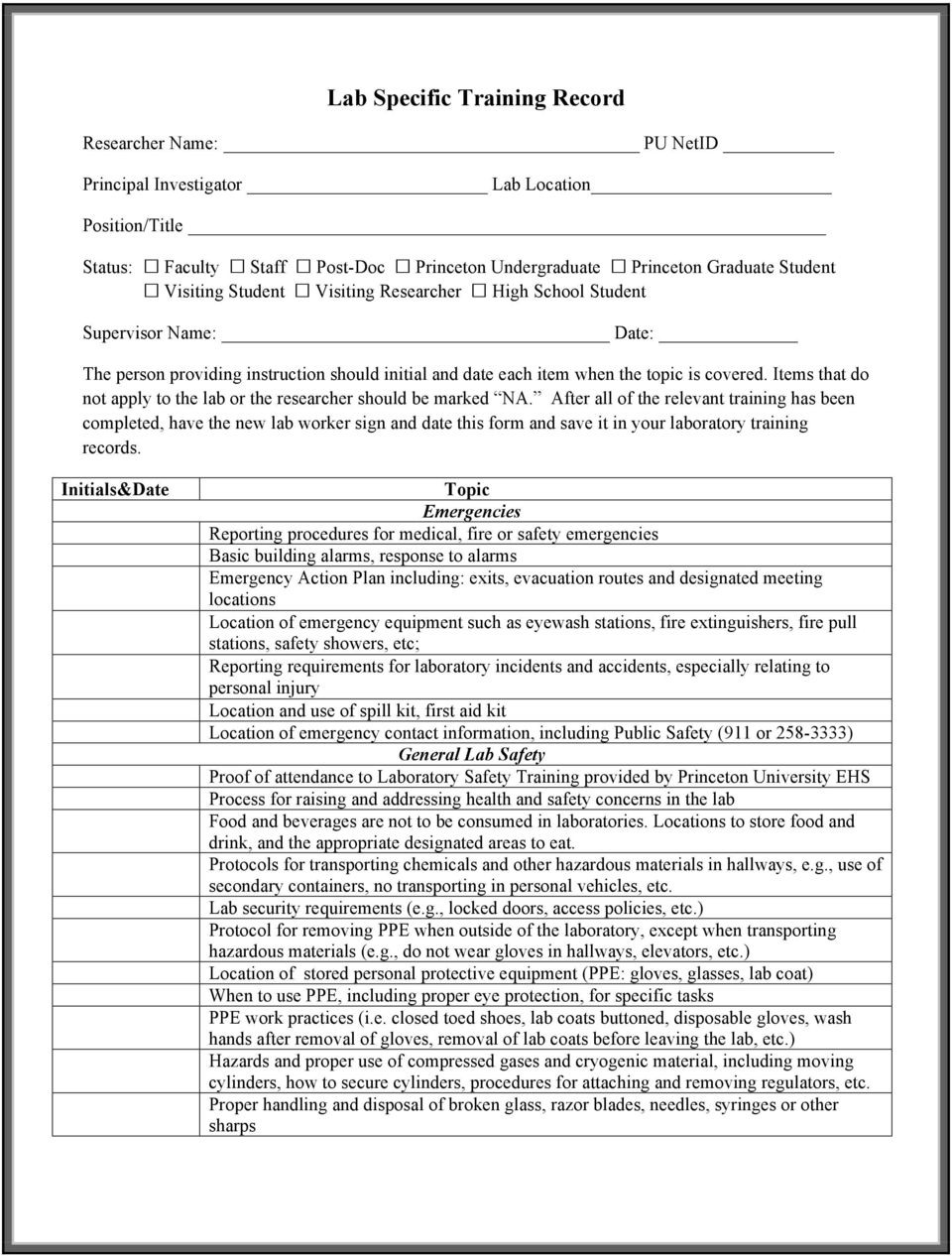
3 Initials&Date Chemical Safety Location and access instructions for a copy of the laboratory chemical inventory, Chemical Hygiene Plan, and other safety information Material Safety Data Sheets (MSDS) access and use Methods and observations that may be used to detect the presence or release of a hazardous chemical in the lab (e.g. odor, monitoring equipment, or visual appearance) and what action to take if detected. Hazardous chemical labeling system used in the lab Specific use of laboratory hoods and other engineering controls Chemical storage procedures Location of chemical waste containers, use, labeling and compatibility (Hazardous waste management and disposal procedures) Chemical spill procedures, including spill kit location, cleanup and reporting Applicable? Yes No Biological Safety (BSL2 Materials and Recombinant DNA not Exempt from the NIH Guidelines) Proof of attendance at Biological Safety Training Proof of attendance at Bloodborne Pathogens Training Proof of attendance at Live Virus Worker Training Identification of all biological hazards in laboratory Institutional Biological Safety Committee review of recombinant DNA and infectious agents prior to use in the lab PI-approved use of sharps when working with infectious agents Review of protective equipment specific to the biological hazard(s) Personal Hygiene Procedures (hand hygiene, no eating and drinking in the lab) Review tasks that should be conducted in a biological safety cabinet Signs/ symptoms associated with infections that could be caused by exposure to agents handled in the lab and procedures for reporting suspected laboratory acquired infections Operation and use of lab equipment and decontamination methods Medical waste handling, including sharps disposal and disinfection of waste materials containing viruses, bacteria or other agents that could cause infection in humans Proper use of autoclave Biological material spill procedures, including cleanup and reporting Applicable? Yes No Radiation Safety Proof of attendance to Princeton University Radiation Safety Training for Open-Source Users, as required. Proof of attendance to Princeton University Radiation Safety Training for Contained- Source Users, as required. Proof of attendance to Princeton University X-Ray Safety Training, as required. General awareness of radiological hazards, signs and symbols used in lab Radiation Safety Officer name and phone number Radioactive materials spill or release procedures, including cleanup and reporting Protocol-specific training needed to perform the laboratory s radioisotope procedures. Specific training needed to utilize analytical X- Ray equipment Applicable? Yes No Laser Safety Proof of attendance to Laser Safety Training provided by Princeton EHS General awareness of laser hazards, signs and symbols used in lab Type of hazards for specific lasers, e.g., eye, skin, ignition of flammable materials, etc. Laser Safety Officer name and phone number

4 Initials&Date Training needed in order to be authorized to use lasers Review of protective eyewear specific to the laser hazard(s) Procedure to properly align lasers Use of barriers or beam-arresting devices Classification of lab-produced lasers High voltage safety Equipment List equipment found in your lab that requires orientation and proof of proficiency, such as chemical fume hoods, centrifuges, pressure vessels (including autoclaves), ovens, UV equipment, x-ray equipment, RF producing equipment, biosafety cabinets, cryostats, high voltage equipment, etc. Note whether use of this equipment requires supervision, PI approval and/or working alone is not permitted. Equipment Initials/Date Orientation Initial/Date Proven Proficiency Comments on working alone, supervision and/or PI approval

5 Operating Procedures and Higher Hazard Materials List the processes or specific chemical or materials that may present an elevated risk of serious injury or property damage. Review the precautions, safeguards and procedures associated with these materials or processes. Examples include, but are not limited to: Highly toxic metals, such as arsenic, lead, barium, etc. Hydrofluoric acid Procedure/Material Initials/Date Orientation OSHA-defined particularly hazardous substances 2 Nanomaterials Initial/Date Proven Proficiency Pyrophoric, explosive and water-reactive materials DEA controlled substances Comments on working alone, supervision and/or PI approval Your signature confirms that all items noted in this document have been communicated during a training session administered by the Principal Investigator or Laboratory Trainer and that you had the opportunity to ask questions. Researcher Signature Date Training reviewed by: Date: 2 OSHA defines particularly hazardous substances as carcinogens, reproductive toxins and substances with a high degree of acute toxicity. For more information, see section 7J of the Laboratory Safety Manual at

New York University Laboratory Move-In Checklist
 New York University Laboratory Move-In Checklist Instructions: This checklist is to be used as a Who to Contact resource for all new Research Faculty at NYU, and as a reminder for those who are moving
K-State Entomology Department GOOD LABORATORY SAFETY PRACTICES
 K-State Entomology Department GOOD LABORATORY SAFETY PRACTICES (Approved by the Entomology Faculty on December 13, 2000) The Department of Entomology at Kansas State University (KSU) is committed to providing
UNH SAFETY AUDIT Office of Environmental Health and Safety
 UNH SAFETY AUDIT Office of Environmental Health and Safety Administrative Information Customized for each location. Ensure contact information on door caution signs is up to date. Doors YES NO N/A 1. The
Minimizing Occupational Exposure to Hazardous Chemicals in Animal Protocols
 Environmental Health and Safety Minimizing Occupational Exposure to Hazardous Chemicals in Animal Protocols Chemicals that are highly toxic or corrosive, known or suspected carcinogens, reproductive hazards,
IX. EMERGENCY PLANNING
 IX. EMERGENCY PLANNING EMERGENCY PLANNING, SPILL RESPONSE & REPORTING Any unexpected event or accident situation that occurs during the transport, storage or use of hazardous materials constitutes a potential
Laboratory Safety Inspection Checklist (Biology and Biochemistry)
 EOSMS 201-1A Date: 11/15/14 Page 1 of 9 Building Room Inspection Date Department Principal Investigator(s) Inspector(s) Instructions: This form is to be completed for laboratory self-inspection. Complete
LABORATORY & CHEMICAL SAFETY GUIDELINES. Dr. Mobin Shaikh Convener SAFETY COMMITTEE DISCIP INE OF CHEMISTRY SCHOOL OF BASIC SCIENCE
 LABORATORY & CHEMICAL SAFETY GUIDELINES Presented by Dr. Mobin Shaikh Convener SAFETY COMMITTEE DISCIP INE OF CHEMISTRY DISCIPLINE SCHOOL OF BASIC SCIENCE INDIAN INSTITUTE OF TECHNOLOGY (IIT) INDORE SAFETY
The following standard practices, safety equipment, and facility requirements apply to BSL-1:
 Section IV Laboratory Biosafety Level Criteria The essential elements of the four biosafety levels for activities involving infectious microorganisms and laboratory animals are summarized in Table 1 of
OESO Ergonomics Division...919-668-ERGO(3746) Duke Police...919-684-2444 Corporate Risk Management... 919-684-6226
 Musculoskeletal Disorders (MSDs) Develop over time and can take a long time to heal Can be quite painful and reduce overall effectiveness and efficiency Occur in any part of the body A variety of risk
Procedure for Visitors in UIC Laboratories
 Procedure for Visitors in UIC Laboratories 1129 S. Hermitage, Chicago, IL 60612-7217 Office: (312) 996-7411 OBJECTIVE In order to protect the Principal Investigator (PI) and the University of Illinois
Biosafety Level 2 (BSL-2) Safety Guidelines
 BLS-4 Biosafety Level 2 (BSL-2) Safety Guidelines BSL-3 BSL-2 BSL-1 BSL-2 builds upon BSL-1. If you work in a lab that is designated a BSL-2, the microbes used pose moderate hazards to laboratory staff
Mock OSHA Inspection:
 Mock OSHA Inspection: PASS or FAIL? Infection Control OSHA Dental Practice Act HIPAA Presented by Leslie Canham, CDA, RDA, CSP (Certified Speaking Professional) In the dental field since 1972, Leslie helps
Laboratory Audit Sheet Auditor s Name: Date of Inspection: / / Building Name: Room# Principal Investigator:
 Laboratory Audit Sheet Auditor s Name: Date of Inspection: / / Building Name: Room# Principal Investigator: 1. 0 GENERAL HOUSKEEPING PRACTICES Y/N N/A C REGULATORY GUIDANCE COMMENTS 1.1 Walkways in and
Biosafety Level 2 Criteria
 Biosafety Level 2 Criteria Biosafety in Microbiological and Biomedical Laboratories (BMBL) 5th Edition Biosafety Level 2 (BSL-2): Biosafety Level 2 builds upon BSL-1. BSL-2 is suitable for work involving
Level I Inspection Guidance Document 2014
 Level I Inspection Guidance Document 2014 LEVEL I Required Weekly Checklist Note: Items listed in the Level I Required Weekly Checklist are to be inspected weekly. For Satellite Accumulation Areas, it
Occupational Health and Safety in the Laboratory (Undergraduate Students)
 Occupational Health and Safety in the Laboratory (Undergraduate Students) Introduction and scope of the Guidelines These guidelines have been written for all laboratory practical classes at the University
PROJECT HAZARD ASSESSMENT FORM CHEMICAL HAZARDS
 PROJECT HAZARD ASSESSMENT FORM PI/SPONSOR: Completion of the following form will serve as a risk assessment, personal protective equipment (PPE) assessment and guide to required training for the activities
Biosafety Spill Response Guide
 Yale University Office of Environmental Health & Safety Biosafety Spill Response Guide Office of Environmental Health & Safety 135 College Street, 1 st Floor, New Haven, CT 06510 Telephone: 203-785-3550
THE UNIVERSITY OF NEWCASTLE- SCHOOL of BIOMEDICAL SCIENCES
 Page: 1 of 7 1. Purpose: 1.1. To describe the procedures to be used when dealing with chemical or microbiological spills. 2. Equipment: 2.1. Spill Kit 2.2. Miscellaneous items as listed 3. Materials: 3.1.
Biosafety Guidelines. 5. Pipetting Mechanical pipetting devices must be available and used. Mouth pipetting is prohibited.
 Biosafety Guidelines Biosafety Level 1 Laboratory Biosafety Level 1 is suitable for work involving well-characterized agents not known to consistently cause disease in immunocompetent adult humans, and
How to Meet OSHA s Employee Training Requirements
 How to Meet OSHA s Employee Training Requirements A Quick Guide for Medical, Dental, and Other Ambulatory Care Settings A supplement to Medical Environment Update Dear reader, Survey responses and calls
Laboratory Safety and Environmental Health Assessment Program
 Laboratory Safety and Environmental Health Assessment Program Principal Investigators and Faculty are vital to the success of safety and environmental compliance programs in Colorado School of Mines research
Waste Management Log Book
 Waste Management Log Book Web address: www.ehs.psu.edu Designated Accumulation Area: Building & Room Number Location in Room Supervisor: E-mail Individual designated to ensure procedures are followed:
GEORGIA INSTITUTE OF TECHNOLOGY ENVIRONMENTAL HEALTH AND SAFETY PERSONAL PROTECTIVE EQUIPMENT
 PURPOSE To protect the health and welfare of GEORGIA TECH employees in areas where there may be a risk of injury or exposure to hazardous substances or conditions employees who work in areas where physical
Biological Safety Program
 Risk Management & Safety Main Office, Wyoming Hall Phone: (307) 766-3277 Fax: (307)766-6116 Regulated Materials Management Center Phone: (307)766-3696 Fax: (307)766-3699 Web: www.uwyo.edu/ehs Email: [email protected]
Biosafety Program University of Colorado. BSL-1 Audit Checklist
 PI first name: PI last name: username: IBC application #: Inspection Date: Lab Location: Department: email: best lab contact lab contact email Inspected by: Time BSL-1 Yes BSL-2 Yes A. Contamination Control
SPILL RESPONSE PROCEDURE
 SPILL RESPONSE PROCEDURE Queen's University Spill Response Procedure May 2000 1 SOP-HAZMAT-01 1.0 Preamble This document outlines emergency spill response procedures as part of the overall Queen's University
Bloodborne Pathogens Program Revised July, 5 2012
 Bloodborne Pathogens Program Revised July, 5 2012 Page 1 of 16 Table of Contents 1.0 INTRODUCTION...3 1.1 Purpose...3 1.2 Policy.3 2.0 EXPOSURE CONTROL METHODS 4 2.1 Universal Precautions.4 2.2 Engineering
Required Biosafety Level Three (BSL-3) Practices, Procedures, Facilities, and Safety Equipment For BSL-3 and BSL3/2 Laboratories
 Required Biosafety Level Three (BSL-3) Practices, Procedures, Facilities, and Safety Equipment For BSL-3 and BSL3/2 Laboratories 1) LABORATORY OPERATIONS a) Responsibilities: A clear organization is set
Scott & White Institutional Biosafety Committee Compliance Program Biohazardous Material Spill Clean-Up Procedure Policy #IBC.002
 I. Purpose Biohazardous material usage on the Scott & White campus is regulated by the Scott & White Institutional Biosafety Committee (IBC). Those investigators choosing to perform research with biohazardous
Safety introduction. In the event of fire and accidents, you have a responsibility to know the location of:
 Safety introduction 2011-12-01 1 (7) Safety introduction General safety at the department A laboratory is a place with a lot of potential risks such as dangerous substances, sharp objects and electrical
SSEBE RA/TA Orientation (Laboratory Information)
 SSEBE RA/TA Orientation (Laboratory Information) Contact Information ISAAC Access and Keys / Security Purchasing Chemicals SSEBE Department Truck What Safety Training Do You Need? General Safety Guidelines
Autoclave Safety. Autoclaves are sterilizers using high pressure and high temperature steam. The potential safety risks for the operators are:
 Autoclave Safety Purpose: Sterilization refers to the complete killing of all living organisms, including spores. Common sterilization techniques include the application of wet heat, dry heat, chemicals,
BSL 1 Laboratory Biosafety Manual
 BSL 1 Laboratory Biosafety Manual Version 1.0 Idaho State University, Office for Research Institutional Biosafety Committee (IBC) 1651 Alvin Ricken Drive, Pocatello, ID 83201-8046 Phone: 208-282-2179 Fax:
Facility Safety Plan State University of New York Upstate Medical University
 Facility Safety Plan State University of New York Upstate Medical University A. Research Operations / Standard Operating Procedure The State University of New York Upstate Medical University maintains
COMPREHESIVE LAB SAFETY CHECKLIST
 COMPREHESIVE LAB SAFETY CHECKLIST The SAFETY & ENVIRONMENTAL COMPLIANCE DEPARTMENT has developed this form to assist and inform USA faculty and staff in identifying and correcting potential laboratory
LABORATORY SAFETY INSPECTION CHECKLIST
 LABORATORY SAFETY INSPECTION CHECKLIST As part of EH&S's laboratory safety survey program, we have compiled a list of the most common safety problems. This is not a list of every possible hazard, but can
KUMC. Medical Surveillance Program
 KUMC Medical Surveillance Program INTRODUCTION Employees at KUMC could potentially be exposed to safety hazards such as chemical, biological, and physical hazards. These hazards are most likely to occur
Carnegie Mellon University s Policy and Procedures for Recombinant and Synthetic Nucleic Acid Materials Spills
 Carnegie Mellon University s Policy and Procedures for Recombinant and Synthetic Nucleic Acid Materials Spills Background In accordance with Section IV-B-2-b-(6) of the NIH Guidelines for Research Involving
APPENDIX A. Contamination (feet, leg, clothing, eyes, hands)
 APPENDIX A Laboratory PPE Hazard Assessment Tool (This tool is available online at https://ehsis.yale.edu/ehsintegrator/survey/labppe) Check all Activities/Jobs/tasks that apply to your laboratory, and
EMERGENCIES. Emergencies
 Emergencies A good safety program, training, and use of precautions reduce the number and seriousness of accidents. Laboratory accidents can range from fires to chemical spills to spills and falls. Your
North Carolina State University Emergency Facilities Closure Checklist- Part I
 North Carolina State University Emergency Facilities Closure Checklist- Part I Unplanned or spontaneous events often disrupt daily operations on campus. In the event that an incident may interrupt your
Particularly Hazardous Substances (PHS) Standard Operating Procedure (SOP)
 Particularly Hazardous Substances (PHS) Standard Operating Procedure (SOP) Formaldehyde, formalin, paraformaldehyde solutions, and paraformaldehyde solids Principal Investigator: Room & Building #: Department:
STANDARD OPERATING PROCEDURES DIVISION OF COMPARATIVE MEDICINE UNIVERSITY OF SOUTH FLORIDA
 STANDARD OPERATING PROCEDURES DIVISION OF COMPARATIVE MEDICINE UNIVERSITY OF SOUTH FLORIDA SOP#: 013.4 Date Issued: 11/00 Date Revised: 9/14 Page 1 of 7 TITLE: SCOPE: RESPONSIBILITY: PURPOSE: All New Animal
Loss Control TIPS Technical Information Paper Series
 Loss Control TIPS Technical Information Paper Series Innovative Safety and Health Solutions SM An Overview of OSHA s Laboratory Standard: 29 CFR 1910.1450 Introduction The Occupational Safety and Health
EOSMS 204C Effective Date: 12/8/2014 Page 1 of 8
 EOSMS 204C Effective Date: 12/8/2014 Page 1 of 8 1. Purpose This Standard Operating Procedure (SOP) establishes procedures for the safe handling, transportation and storage of (MC), which is also known
Safety Inspection Checklist
 Inspector(s): Building: Room Number (s): Department/Unit: Date Inspected: Supervisor: To customize your local inspection checklist, delete or add as required. Inspection Headings: 1. Administrative 8.
Standard Operating Procedure for a Chemical Spill
 Standard Operating Procedure for a Chemical Spill Facility: Lab Director: Scope: ERC Clean Room C17 Engineering Research Complex Electrical and Computer Engineering Brian Wright 3234 Engineering 355-5233
Standard Operating Procedure for Dacarbazine in Animals
 Standard Operating Procedure for Dacarbazine in Animals 1. Health hazards Dacarbazine, also known as DTIC, DIC, and Imidazole Carboxamide, is an antineoplastic chemotherapy drug used in the treatment of
Appendix J IBC Biohazard Spill Management Plan
 OVERVIEW Prevention is the most important part of any spill management plan. Be sure to read and understand standard operating procedures (SOP s) and protocols for safe manipulation of biohazards before
Laboratory Specific Standard Operating Procedures Mandated by the Settlement Agreement
 Laboratory Specific Standard Operating Procedures Mandated by the Settlement Agreement General guidance regarding laboratory work with hazardous chemicals 1 is contained within the Chemical Hygiene Plan
PI s Name Date Bldg./Rm# CDC Biosafety Level 3 (BSL-3)
 PI s Name Date Bldg./Rm# CDC Biosafety Level 3 (BSL-3) Yes No 1. Is access to the laboratory limited or restricted at the discretion of the laboratory director when experiments are in progress? Yes No
TEMPLE UNIVERSITY ENVIRONMENTAL HEALTH AND RADIATION SAFETY
 Page 1 of 7 ISSUED: 5/00 REVISED: 08/06 1. Potential Releases of Radioactive Materials to Unrestricted Areas The Environmental Health and Safety Department (EHRS) must be notified immediately if an emergency
Laboratory Biosafety Level 3 Criteria
 Laboratory Biosafety Level 3 Criteria Biosafety in Microbiological and Biomedical Laboratories (BMBL) 5th Edition Section IV Biosafety Level 3 (BSL-3): Biosafety Level 3 is applicable to clinical, diagnostic,
Washington University Environmental Health and Safety Clinical Inspection Comment Sheet
 Washington University Environmental Health and Safety Clinical Inspection Comment Sheet Signs and Labels: Appropriate hazard warnings including any words, pictures, symbols or combination that convey health
College of Biological Science - Standard Operating Procedure Chemical Spills Date: 8-Feb-2008 Prepared by: A Doane Revision: New Supersedes: n/a
 College of Biological Science - Standard Operating Procedure Chemical Spills Date: 8-Feb-2008 Prepared by: A Doane Revision: New Supersedes: n/a Purpose: To provide direction on the proper response to
Basic Laboratory Safety
 Basic Laboratory Safety Objectives: Upon completion of the lecture, accompanying video, required readings and clinical rotations, the student will be able to: 1) List and describe the appropriate safety
OSHA Training Guidelines (An Unofficial Summary)
 OSHA Training Guidelines (An Unofficial Summary) Many standards promulgated by the Occupational Safety and Health Administration (OSHA) explicitly require the employer to train employees in the safety
TEXAS TECH UNIVERSITY HAZARDOUS WASTE PROGRAM DEPARTMENT OF ENVIRONMENTAL HEALTH AND SAFETY
 TEXAS TECH UNIVERSITY HAZARDOUS WASTE PROGRAM DEPARTMENT OF ENVIRONMENTAL HEALTH AND SAFETY 1 TABLE OF CONTENTS I II III IV V VI VII INTRODUCTION CHEMICAL HAZARDOUS WASTE 1. Definition 2. Characteristics
HAZARD COMMUNICATION: NEW LABEL ELEMENTS AND SAFETY DATA SHEET (SDS) FORMAT
 HAZARD COMMUNICATION: NEW LABEL ELEMENTS AND SAFETY DATA SHEET (SDS) FORMAT AGENDA Hazard Communication Recent Changes Pictograms New Label Format Signal Word Safety Data Sheets 2 HAZARD COMMUNICATION:
Shop Safety. Action Tattoo 3525 Del Mar Heights Rd., Suite 7 San Diego, CA 92130
 Shop Safety Action Tattoo 3525 Del Mar Heights Rd., Suite 7 San Diego, CA 92130 Action Tattoo Exposure Control and Infection Prevention Plan (ECIPP) Established on: / / Section 1: Policy, Scope, and Responsibility...
CHEMICAL SPILL MANAGEMENT GUIDELINES
 WHS Unit CHEMICAL SPILL MANAGEMENT GUIDELINES Contents 1 Purpose... 2 2 Scope... 2 3 Definitions... 2 4 Roles and Responsibilities... 2 5 General... 2 6 Defining Major or Minor Spill... 3 7 Major Spill
Department: Manager: Safety Coordinator: Date:
 SAFETY and staff, regardless of hiring status or job position 1 1. Can staff name their department safety coordinator? 2. Is the Department Safety Binder current? 3. Do slip/trip hazards exist? 4. How
BOSTON COLLEGE ENVIRONMENTAL HEALTH AND SAFETY LABORATORY GUIDE FOR RENOVATIONS, REMODELS, MOVES AND TERMINATIONS
 BOSTON COLLEGE ENVIRONMENTAL HEALTH AND SAFETY LABORATORY GUIDE FOR RENOVATIONS, REMODELS, MOVES AND TERMINATIONS I. Policy for Termination of Laboratory Use of Hazardous Materials The Principal Investigator
A GUIDE FOR THE PRINCIPAL INVESTIGATOR Regulatory Obligations and Compliance Tools
 Part I Laboratory Health & Safety Responsibilities A GUIDE FOR THE PRINCIPAL INVESTIGATOR Regulatory Obligations and Compliance Tools University of California Santa Cruz Environmental Health and Safety
Hazardous Waste Generator Training
 presented by Facilities Management and the office of Hazardous Waste Generator Training Environmental Health & Safety RCRA..."It's The Law!" Hazardous Waste is: Spent material that is: READY TO BE THROWN
BLOODBORNE PATHOGENS EXPOSURE CONTROL PLAN
 BLOODBORNE PATHOGENS EXPOSURE CONTROL PLAN Facility Name: University of Arkansas at Little Rock Date of Preparation: 01-17-06 In accordance with the OSHA Bloodborne Pathogens Standard, 1910.1030, the following
Chemical Spill Response Guideline
 ChemicalSpillResponseGuideline Despite the best efforts of researchers to practice safe science in the laboratory, accidents resulting in the release of chemicals will occur. For this reason, it is essential
Hazard/Risk Identification and Control Procedure
 Hazard/Risk Identification and Control Procedure Introduction Hazard identification and the steps taken to minimize the risks associated with identified hazards are a critical component of working safely.
Each has the following responsibilities under this SOP:
 Page.: 1 1. Purpose The Standard Operating Procedure (SOP) for sharps disposal was developed by the Department of Environmental Health & Safety in accordance with the University s Policy Statement on Health
Standard Operating Procedure for the Use of Particularly Hazardous Drugs/Chemicals in Animals
 1. Purpose Standard Operating Procedure for the Use of Particularly Hazardous Drugs/Chemicals in Animals PO Box 245101 Tucson, AZ 85724-5101 Voice: (520) 626-6850 FAX: (520) 626-2583 rlss.arizona.edu Exposure
Response to Biological Spills in the Laboratory (Intentional or Accidental)
 Response to Biological Spills in the Laboratory (Intentional or Accidental) Exposure Management For splash to eyes, mucous membranes, or broken area of the skin Irrigate eyes with clean water, saline or
School Science Lab Safety Guidelines
 School Science Lab Safety Guidelines Occupational Safety & Health Bureau Montana Department of Labor & Industry Prepared for Montana Employers by the Occupational Safety & Health Bureau Department of Labor
Employee Safety and Health Training Plan
 Employee Safety and Health Training Plan Environmental Health, Safety, and Risk Management Department Box 6113, SFA Station Nacogdoches, Texas 75962-6113 Revised: January 2011 Purpose and Scope This plan
Safety and Health Office WORKPLACE SAFETY CHECKLIST
 Location: Date: Inspected by: Safety and Health Office WORKPLACE SAFETY CHECKLIST WORK ENVIRONMENT Ventilation Removal of fumes and dust Temperature and humidity control Noise levels Vibration Lighting
Safety at Kaiser Permanente Los Angeles Medical Center Environmental Health & Safety Department
 Safety at Kaiser Permanente Los Angeles Medical Center Environmental Health & Safety Department Environmental Health and Safety (EHS) The Los Angeles Medical Center (LAMC) is committed to providing a safe
Safe Operating Procedure
 Safe Operating Procedure (Revised 12/11) SPILL AND EXPOSURE RESPONSE FOR BIOHAZARDOUS MATERIALS (INCLUDING RECOMBINANT NUCLEIC ACIDS) (For assistance, please contact EHS at (402) 472-4925, or visit our
EMPLOYEE SAFETY TRAINING PROCEDURE
 UNIVERSITY OF ALASKA FAIRBANKS SAFETY SYSTEM POLICY AND PROCEDURE DOCUMENT NUMBER: 301 ISSUE DATE: SEPTEMBER 1996 REVISION DATE: APRIL 2003 SUBJECT: Employee Safety Training Procedure EMPLOYEE SAFETY TRAINING
Safety Training Needs Assessment
 Safety Needs Assessment Form Instructions: Please review each question and either check YES or NO. If a question is checked YES you will be required to complete the training topic before initial assignment
Policies. Prep Room Policies
 Introduction INTRODUCTION The Microbiology Prep Room is located in 531A Life Sciences Building. The telephone number is 372-8609. It is open from 7:30 a.m. to 4:30 p.m. during the fall and spring semesters.
Laboratory Biosafty In Molecular Biology and its levels
 Laboratory Biosafty In Molecular Biology and its levels Workshop 16-17 Oct..2012 Guidelines Does not mean optional Laboratory Biosafety The Laboratory Biosafety Manual is an important WHO publication
COLUMBUS STATE COMMUNITY COLLEGE EMPLOYEE SAFETY MANUAL
 COLUMBUS STATE COMMUNITY COLLEGE EMPLOYEE SAFETY MANUAL HAZARDOUS MATERIAL MANAGEMENT Effective October 15, 1995 Page 1 of 4 Updated August, 2008 Revised August, 2009 A. Columbus State Community College
Sample New Employee Safety Checklist
 Sample New Employee Safety Checklist Supervisors must review the appropriate items from this list with each new employee. The Washington State Industrial Health and Safety Act (WAC 296-24-040) requires
STANDARD OPERATING PROCEDURES Safe Autoclave Operations
 Department of Environmental Health & Safety Biosafety & Biosecurity STANDARD OPERATING PROCEDURES Safe Autoclave Operations The purpose of this document is to provide standard operating procedures for
Hazardous Waste Procedures. Faculty of Science University of Ottawa
 Hazardous Waste Procedures University of Ottawa Contents Hazardous Materials Waste Overview:... 3 Regulations:... 3 General requirements related to packaging waste:... 4 Table 1: List of Appropriate Waste
CHAPTER V: DISPOSAL OF WASTES CONTAMINATED WITH INFECTIOUS AGENTS
 CHAPTER V: DISPOSAL OF WASTES CONTAMINATED WITH INFECTIOUS AGENTS These biohazard waste disposal guidelines are designed to not only protect the public and the environment, but also laboratory and custodial
Laboratory Biosafety Manual Contents
 Laboratory Biosafety Manual Contents INTRODUCTION... 4 PURPOSE... 4 POLICY... 4 RESPONSIBILITIES... 4 OFFICE OF RESEARCH INTEGRITY AND COMPLIANCE... 4 INSTITUTIONAL BIOSAFETY COMMITTEE (IBC)... 5 BIOLOGICAL
Lab PPE Guide Examples of Personal Protective Equipment
 Lab PPE Guide Examples of Personal Protective Equipment 1140 South Paulina St. 245 (PSB) Chicago IL 60612 Phone: 312-413-3387 Fax: 312-413-3700 www.uic.edu/depts/envh This document is to be used as a supplement
CHEMICAL SPILL RESPONSE GUIDE
 HEMIAL SPILL RESPONSE GUIDE Revised 2000 TABLE OF ONTENTS Emergency Phone Numbers Introduction - hemical Spill Response Spill Response Procedures - Major Spill Spill Response Procedures - Minor Spill Spills
WEEKLY SAFETY MEETING All Euramax Subsidiaries MATERIAL SAFETY DATA SHEETS (MSDS) Safety Meeting Contents. Meeting Notice.
 Safety Meeting Contents Meeting Notice Leaders Guide Employee Handout Employee Quiz Meeting Sign-In Sheet Employee Puzzle PRIOR TO THE WEEKLY MEETING: - Post the meeting notice by the timeclock - Read
POTENTIAL HAZARD INFORMATION & SIGNATURE SHEET
 POTENTIAL HAZARD INFORMATION & SIGNATURE SHEET Scientific research involves exposure to various hazards. When deciding to allow your child to participate in research projects conducted in University of
KEY CAL/OSHA STANDARDS THAT APPLY TO MOST EMPLOYERS
 KEY CAL/OSHA STANDARDS THAT APPLY TO MOST EMPLOYERS FACTSHEET 1 Below are some key Cal/OSHA standards that apply to most employers: A. INJURY AND ILLNESS PREVENTION PROGRAM STANDARD (Title 8 California
Microbiology Lab Practices and Safety Rules
 There is a certain element of risk in anything you do, but the potential risks in a microbiology course are greater. Persons who work in a microbiology lab may handle infectious agents in additional to
HAZARD COMMUNICATION & THE GLOBAL HARMONIZING SYSTEM EMPLOYEE TRAINING
 HAZARD COMMUNICATION & THE GLOBAL HARMONIZING SYSTEM EMPLOYEE TRAINING This easy-to-use Leader s Guide is provided to assist in conducting a successful presentation. Featured are: INTRODUCTION: A brief
Risk Assessment: Biosafety Cabinet
 Risk Assessment: Biosafety Cabinet Biosafety cabinets (BSCs) serve as primary containment devices for operations involving potential splashes, spills or aerosolization of hazardous biological materials.
1. Organization and Management of UNR Safety Programs
 WRITTEN WORKPLACE SAFETY PLAN University of Nevada, Reno 1. Organization and Management of UNR Safety Programs Administrative Responsibilities Final responsibility for maintenance of campus safety and
SAFETY TRAINING VIDEO LIST
 SAFETY TRAINING VIDEO LIST EH&S maintains a lending library of safety videos for use on campus. * Videos are loaned to Stanford University groups for one week. Call the Training and Communications Office
TITLE: Storage and Management of Hazardous Medications & Chemicals APPLIES TO: Pharmacy Staff
 Administrative Policies and Procedures for MOH hospitals /PHC Centers NO. OF PAGES: ORIGINAL DATE: REVISION DATE : 1.0 PURPOSE 1.1 To develop a set of safety rules and regulations that address the identification,
Northern Illinois University Laser Safety Program
 Northern Illinois University Laser Safety Program Introduction The purpose of this program is to insure the safe use of lasers in Northern Illinois University (NIU) research by identifying hazards, providing