
Guidance Manual. Waste Collection Permit Regulations
|
|
|
- Monica George
- 9 years ago
- Views:
Transcription
1 Guidance Manual Waste Collection Permit Regulations

2

3 1 Introduction Objective of Guidance Structure and Use of manual Acknowledgements 1 2 Waste Collection Activities and exempted Collection Activities Waste Authorisation Requirements Is the material a waste? Is the waste collection activity exempted? Article Exempted collection requiring prior annual notification to EPA Article 30(1)(c) Exemptions for the Movement of Hazardous waste Article The Regulations - Revocations, Transitional Arrangements and Purpose Revocations - Article Transitional Arrangements - Article Purpose of Regulations - Article 3 and The Nominated Authorities Article The Application Process Pre-application consultation Principal Waste Collection Activity Article 7(1)(h) Overview of application process Notice Requirements - Article Application Contents and Supporting Information False Information -Article Period for determination of an application for a waste collection permit Article Procedure on Receipt of an Application Article Further Information Article Consultation with other local authorities and the Agency Article Availability and inspection of documents Article Submissions to a nominated authority in respect of an application for a waste collection permit Article Withdrawal or abandonment of an application for a waste collection permit or the review of a waste collection permit Article Notice of Decision to grant or refuse a permit Article Permit Conditions Review of a waste collection permit Article Revocation of a waste collection permit 37 5 Monitoring, inspection, auditing and enforcement Key considerations for enforcement of waste collection permits 40 6 Registers and Waste Permit Website Register Requirements Objective of Waste Permit Website 43 7 Charging and Waivers Charging Fees Payable Defrayal of, or contribution towards, costs of investigations Article Permit Subsistence Charges Guidance on cost accounting Guidance on risk-based charging scheme 47 8 Appeals and Competent Court of Jurisdiction 49

4 9 Fit and Proper Person Overview of Fit and Proper Person Convictions or Offences Technical Competence Financial liabilities and security 53 APPENDICES 1. CONSOLIDATED WASTE MANAGEMENT (COLLECTION PERMIT) REGULATIONS S.I NO. 820 OF 2007 AND WASTE MANAGEMENT (COLLECTION PERMIT) AMENDMENT REGULATIONS S.I NO. 87 OF INTERPRETATIVE COMMUNICATION FROM EC ON WASTE AND BY- PRODUCTS 3. EU ECJ CASE LAW ON WASTE AS PRESENTED IN ECJ JUDGEMENT ON CASE C FLOWCHART 1 WASTE COLLECTION PERMIT APPLICATION PROCESS 5. WASTE COLLECTION PERMIT APPLICATION FORM 6. EXAMPLE OF A WASTE COLLECTION PERMIT NEWSPAPER NOTICE 7. QUESTION C.3 EXCEL SHEET FROM APPLICATION FORM RELATING TO WASTE TYPES 8. FLOWCHART 2 WASTE COLLECTION PERMIT REVIEW APPLICATION PROCESS (FOR NOMINATED AUTHORITY AND PERMIT HOLDER INSTIGATED REVIEWS)

5 1 Introduction The Minister for the Environment, Heritage and Local Government has introduced new Waste collection permit regulations, namely the Waste Management (Collection Permit) Regulations, S.I No. 820 of 2007and amending Regulations, the Waste Management (Collection Permit) (Amendment) Regulations, S.I No. 87 of The Regulations come into effect on the 1st June They are available for download from A consolidated set of the Regulations is provided in Appendix 1. This consolidated version is for guidance only, the actual regulations should be consulted for confirmation. The Regulations set out procedures for the making of permit applications for single region or multi region waste collection, public consultation, consideration by local authorities of public submissions in relation to permit applications, and the grant, refusal and review of permits by authorities. Applications for multi-region waste collection can now be made to one nominated authority on one application form. 1.1 Objective of Guidance This guidance manual is principally for the assistance of local authorities in carrying out their functions under the Regulations; however, the manual should also be of benefit to other stakeholders including private sector waste operators and the general public. This manual is guidance only and does not constitute definitive legal opinion. The relevant legislation should always be consulted and, in case of doubt, legal opinion should be sought. The application forms and flowcharts referenced in this manual can be downloaded from Structure and Use of manual These Guidelines are structured to follow the order of the Articles as they are presented in the Regulations and must be used in conjunction with the Regulations. Any reference to the Regulations hereafter means the Waste Management (Collection Permit) Regulations S.I No.820 of 2007 as amended by the Waste Management (Collection Permit) (Amendment) Regulations S.I No.87 of 2008 unless otherwise stated. Any reference to the Act refers to the Waste Management Acts 1996 to Acknowledgements This document was prepared by the Office of Environmental Enforcement (OEE) of the EPA. A steering committee was established to oversee the work with Enviros Consulting Ltd. acting as consultants to the project. Members of the Steering Committee: Jim Moriarty, Office of Environmental Enforcement, EPA (Chair) Stephen McCarthy, Office of Environmental Enforcement, EPA Jonathan Derham, Office of Climate Change, Licensing and Resource Use, EPA Maria Douglas, Dublin City Council Jean Sayers, Cork County Council Barry Lavin, Department of Environment, Heritage and Local Government Michael Young, Department of Environment, Heritage and Local Government 1 of 55
6 Project Consultants: Kara Flannery, Enviros Consulting Clodagh McGrath, Enviros Consulting Andrew Crosby, Enviros Consulting Elisabeth Nagel, Enviros Consulting The OEE would like to thank the Steering Committee and the project consultants for their work in developing this guidance material. The Steering Committee would like to acknowledge the time and assistance provided by individuals in local authorities and in industry. The assistance of other EPA colleagues who helped in any way with the preparation of this guidance is also gratefully acknowledged. 2 of 55

7 2 Waste Collection Activities and exempted Collection Activities This chapter describes the definition of waste and exempted waste collection activities The Articles covered in this Chapter are: Article 30 Non-application of section 34(1)(a) of the Act Article 35 Non application of movement of hazardous waste 2.1 Waste Authorisation Requirements The first step in dealing with a potential authorisation under the Regulations is to determine whether the collection activity actually requires authorisation. The requirement for waste collection activities to hold an authorisation is provided for in Part IV, section 34 of the Waste Management Acts Sub-section 34(b) of the Act states that all collection activities require a collection permit, except those classes of activities for which waste collection regulations have been provided. These exemptions are listed in Article 30 of the Waste Collection Regulations It should be noted that exempted waste activities are still subject to other requirements of waste management law including the general requirement under Section 32(1) of the Waste Management Acts, 1996 to 2007 that a person shall not hold, transport, recover or dispose of waste in a manner that causes or is likely to cause environmental pollution. 2.2 Is the material a waste? The definition of waste is important in order to determine whether an authorisation is required, and if so what type of authorisation is required by an activity. Waste and hazardous waste are defined in Section 4 of the Waste Management Acts The definitions provided in the Act refer to the European Waste Catalogue and the European Hazardous Waste list. It states that any substance or object belonging to a category of waste specified in the First Schedule of the Act, or included in the European Waste Catalogue, which the holder discards or intends or is required to discard, and anything which is discarded or otherwise dealt with as if it were waste shall be presumed to be waste until the contrary is proved. As waste authorisation is only required for specified waste activities, the question as to what material is defined as waste becomes fundamental, in particular in determining whether the required authorisation is a waste licence, a waste facility permit or a certificate of registration. However, the definition is also important in determining if a waste collection authorisation is required. While it is clear in many cases whether materials are waste or not, this is sometimes difficult to determine, as is reflected in the amount of case law in this area particularly at EU level. In 2007, the EU published an Interpretative communication on waste and by-products (Appendix 2) to guide competent authorities in this regard. This document clarifies the concepts of a product, production residue and by-product. It also sets out guidelines to help determine what is to be classified as waste and what is not. This document distils the findings of EU case law into a series of deciding factors and gives a number of examples. Annex I of the document list some illustrative examples of wastes and non wastes. Annex II provides a useful decision tree for waste versus by-product decision. It is recommended that local authorities use this document to determine if a material is waste or not and also keep abreast of any further developments in case law in the area. 3 of 55
8 For further reference, Appendix 3 contains the EU ECJ case law on waste as presented in ECJ judgement on Case C delivered 18 December 2007 which sets out in paragraphs 31 to 44 a useful summary of EU case law. 2.3 Is the waste collection activity exempted? Article 30 Even if the material is waste, its collection may not require a waste collection permit. Section 34 (1)(a) of the Act states that a person other than a local authority shall not, for the purposes of reward, with a view to profit or otherwise in the course of business, collect waste save under a permit unless, as set out under Section 34(1)(b) of the Act regulations providing that paragraph (a) shall not apply in respect of the collection of classes of waste as are specified Article 30 of the Regulations lists the relevant exemptions from the requirement to hold a waste collection permit and the requirements that apply to these exempted activities. In general terms, the transportation of non-hazardous waste by persons who are not directly involved with the waste business, at weights less than 2 tonnes, and in vehicles not designed for the carriage of waste, are exempt. Other categories of waste exempt from requiring a waste collection permit are covered by other statutes and controls. Local authorities have adequate powers to control waste activities if they are of the opinion that a person is not carrying out an exempted activity, such as if they are collecting waste for the purposes of reward, with a view to profit, or otherwise in the course of business. It is a matter for individual local authorities to decide if an individual or a business is involved in the collection, transport or storage of waste. In making their decision, local authorities are guided by the definition of waste that is set down in section 4(1) of the Waste Management Act For instance second-hand clothing voluntarily donated and intended for re-use could be deemed not to be waste as long as there is no intent to discard, and where they are collected by a recognized Charity. If second hand clothes are collected knowingly contaminated or otherwise unfit for purpose, then they could be considered to be a waste. The activities exempted under Article 30 of the Regulations are detailed in Table 1 below and examples are provided. Exemptions provided under Article 30 (1)(j) and (1)(k) will not apply in the following circumstances [Article 30(2)]: Contaminated WEEE that poses health and safety risks WEEE transported to unauthorised facilities If the WEEE is not going to be reused or eventually treated at an appropriate facility Any person or persons not fulfilling the producer responsibility obligations Transportation of other wastes to unauthorised waste facilities. 4 of 55
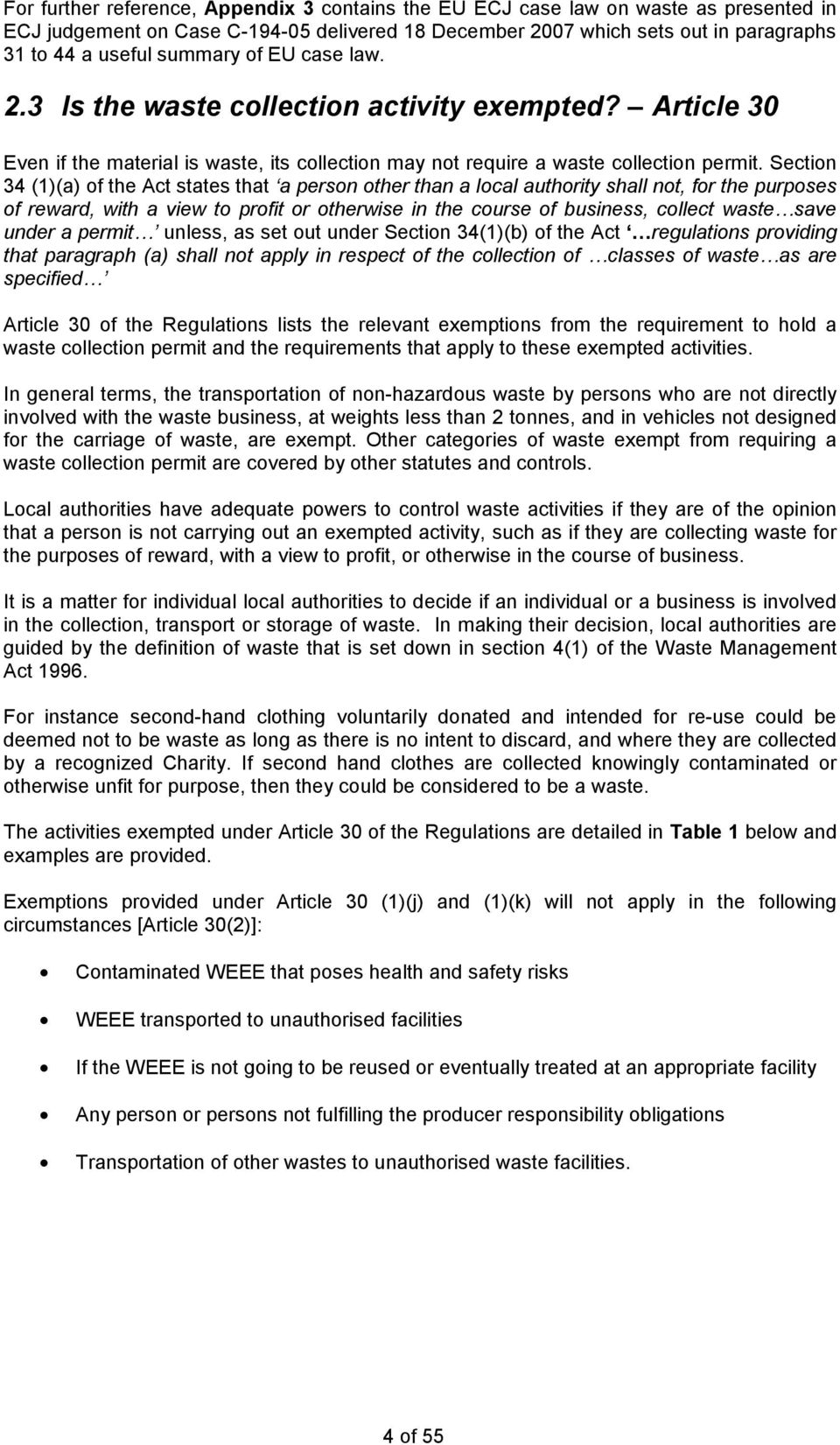
9 Table 1 Exempted Waste Collection Activities - Article 30 [Article 30(1)(a)] The gathering, sorting or mixing of waste on the premises at which the waste arose Example This could apply to a householder who segregates their waste at home prior to bringing the waste to a civic amenity site or bring centre [Article 30(1)(a)] The gathering, sorting or mixing of waste which is carried on in accordance with a waste licence, a waste facility permit, a certificate of registration or an IPPC licence Example [Article 30(1)(b)] This could apply to a company that holds an IPPC licence under the 1st Schedule of the Acts, Class (solvent coating) for the manufacture of horticultural plastic bags, involving extrusion of plastic and printing on the bags. Plastic off-cuts may be collected and removed from the facility to a permitted recovery/recycling operation under the terms of the licence The collection and transport of non-hazardous waste (other than the collection of WEEE by a producer) by a person where transport of the waste does not form the main business activity of the person concerned( ie the collection and transport is not their business focus or objective) and the quantity of waste is =/< 2 tonnes other than waste which is transported in, or on, a vehicle designed for the carriage of a skip or other demountable container Example This could apply to vets, doctors, nurses transporting non-hazardous wastes from home calls [Article 30(1)(f)] The collection and transport of specified risk material, or protein or tallow obtained from the rendering of specified risk material. This waste is collected under licence granted under Regulation 10 of the European Communities (Specified Risk Material) Regulations, 2000 (S.I. No. 332 of 2000) Example This could apply to the collection of SRM, tallow or protein from abattoirs or rendering plants under licence from the Department of Agriculture, Food and Rural Affairs [Article 30(1)(g)] The collection and transport of animal by-products, other than catering waste, within the meaning of the European Communities (Transmissible Spongiform Encephalopathy and Animal By- Products) Regulations 2006 (S.I. No. 612 of 2006) Example This could apply to the collection of animal by-products rendering plants under licence from the Department of Agriculture, Food and Rural Affairs [Article 30(1)(h)] The collection and transport of packaging waste by a major producer, within the meaning of the Waste Management (Packaging) Regulations 2007 (S.I. No. 798 of 2007) Example This could apply to major packaging producers who offer take back schemes of their packaging waste from organisations to whom they supply [Article 30(1)(i)] Collection and transport of farm plastic waste by a producer within the meaning of the Waste Management (Farm Plastics) Regulations, 2001 (S.I. No. 341 of 2001) Example This could apply to producers and suppliers of silage plastics that comply with the Farm Plastic Regulations by offering a deposit and refund scheme which includes the collection or arranging for the collection of waste plastics [Article 30(1)(j)] The collection of waste from a local authority bring facility Example This could apply to non-hazardous waste from a local authority bring centre, such as glass, plastic and textile waste to an authorised recovery/recycling facility. This removal may be undertaken by agents of the local authority without a separate waste collection permit. The bring facility itself should be permitted under the Waste Management (Facility Permit and Registration) Regulations Collection of hazardous waste, such as solvents, paints and batteries 5 of 55
![accordance with a waste licence, a waste facility permit, a certificate of registration or an IPPC licence Example [Article 30(1)(b)] This could apply to a company that holds an IPPC licence under](/docs-images/41/22637299/images/page_9.jpg "the 1st Schedule of the 1992-2003 Acts, Class 12.2.1(solvent coating) for the manufacture of horticultural plastic bags, involving extrusion of plastic and printing on the bags.")
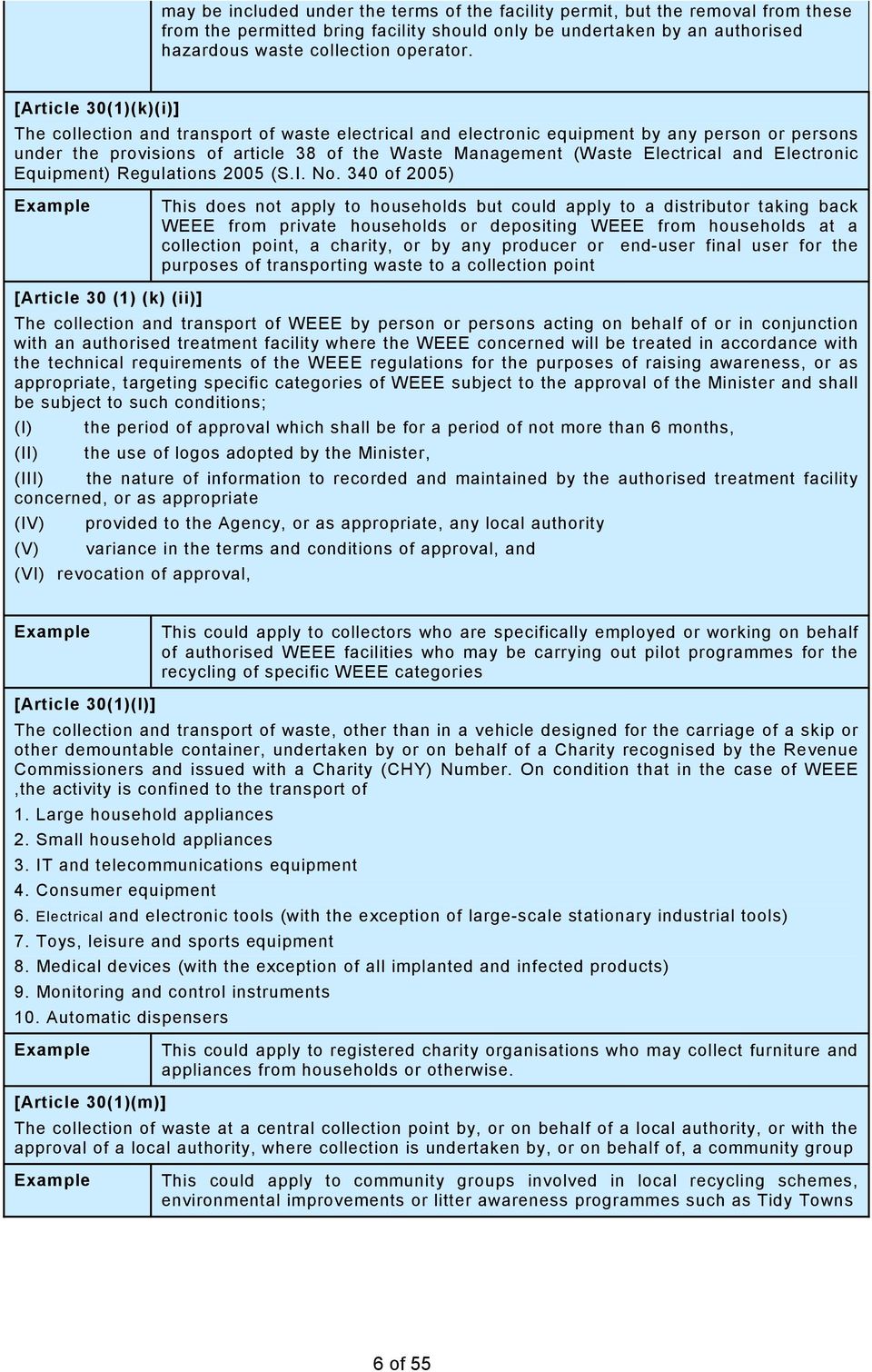
10 may be included under the terms of the facility permit, but the removal from these from the permitted bring facility should only be undertaken by an authorised hazardous waste collection operator. [Article 30(1)(k)(i)] The collection and transport of waste electrical and electronic equipment by any person or persons under the provisions of article 38 of the Waste Management (Waste Electrical and Electronic Equipment) Regulations 2005 (S.I. No. 340 of 2005) Example [Article 30 (1) (k) (ii)] This does not apply to households but could apply to a distributor taking back WEEE from private households or depositing WEEE from households at a collection point, a charity, or by any producer or end-user final user for the purposes of transporting waste to a collection point The collection and transport of WEEE by person or persons acting on behalf of or in conjunction with an authorised treatment facility where the WEEE concerned will be treated in accordance with the technical requirements of the WEEE regulations for the purposes of raising awareness, or as appropriate, targeting specific categories of WEEE subject to the approval of the Minister and shall be subject to such conditions; (I) (II) the period of approval which shall be for a period of not more than 6 months, the use of logos adopted by the Minister, (III) the nature of information to recorded and maintained by the authorised treatment facility concerned, or as appropriate (IV) (V) provided to the Agency, or as appropriate, any local authority variance in the terms and conditions of approval, and (VI) revocation of approval, Example [Article 30(1)(l)] This could apply to collectors who are specifically employed or working on behalf of authorised WEEE facilities who may be carrying out pilot programmes for the recycling of specific WEEE categories The collection and transport of waste, other than in a vehicle designed for the carriage of a skip or other demountable container, undertaken by or on behalf of a Charity recognised by the Revenue Commissioners and issued with a Charity (CHY) Number. On condition that in the case of WEEE,the activity is confined to the transport of 1. Large household appliances 2. Small household appliances 3. IT and telecommunications equipment 4. Consumer equipment 6. Electrical and electronic tools (with the exception of large-scale stationary industrial tools) 7. Toys, leisure and sports equipment 8. Medical devices (with the exception of all implanted and infected products) 9. Monitoring and control instruments 10. Automatic dispensers Example [Article 30(1)(m)] This could apply to registered charity organisations who may collect furniture and appliances from households or otherwise. The collection of waste at a central collection point by, or on behalf of a local authority, or with the approval of a local authority, where collection is undertaken by, or on behalf of, a community group Example This could apply to community groups involved in local recycling schemes, environmental improvements or litter awareness programmes such as Tidy Towns 6 of 55
11 2.4 Exempted collection requiring prior annual notification to EPA Article 30(1)(c) Article 30 of the Regulations allow for the collection and transport of waste returned or recovered refrigerant gases, halons and fluorinated greenhouse gases without a waste collection permit or C1 notification, providing that a Prior Annual Notification has been made to the Agency. This provision is made in Articles 30(1) and 35(2) of the Regulations Table 2 Exempted Activities Requiring Prior Annual Notification [Article 30(1)(c)] Collection and transport of waste, returned or recovered refrigerant gases in refrigerant containers, where recovery has the meaning as per Regulations (EC) No. 2037/2000 and (EC) No. 842/2006 Example This could apply to a refrigeration/air conditioning company or refrigerant gas distributor collecting recovery cylinders containing such gases for recycling or destruction [Article 30(1) (d)] Collection of halons where recovery has the meaning as per Regulations (EC) No. 2037/2000 Example This could apply to a fire safety company collecting old fire protection equipment and fire extinguishers for recycling or destruction [Article 30 (1)(e)] Collection of fluorinated greenhouse gases where recovery has the meaning as per Regulations (EC) No. 842/2006 Example This could apply to a refrigeration/air conditioning company, refrigerant gas distributor or fire safety company collecting cylinders containing fluorinated greenhouse gases for recycling or destruction The following criteria must be met to avail of these exemption provisions [Art. 30(1)]: The activity is incidental to the main business The activity is small-scale, leading to environmentally beneficial operations The quantity transported does not exceed 2 tonnes Prior annual notification is given to the EPA, providing information specified in the Fifth Schedule of the Regulations No mixing of different gases occurs The material is brought to an authorised facility where it will be stored in accordance with the general binding rules as set out in the fourth schedule of the Waste Management (Facility Permit and Registration) Regulations 2007 Handling and transport should prevent venting or leakage The waste will eventually be recycled, reclaimed or destroyed at an authorised facility in accordance with the relevant legislative requirements for the specific refrigerant gas type. 7 of 55
![This provision is made in Articles 30(1) and 35(2) of the Regulations Table 2 Exempted Activities Requiring Prior Annual Notification [Article 30(1)(c)] Collection and transport of waste, returned or](/docs-images/41/22637299/images/page_11.jpg "recovered refrigerant gases in refrigerant containers, where recovery has the meaning as per Regulations (EC) No. 2037/2000 and (EC) No.")
12 What is Prior Annual Notification? Prior Annual Notifications must be made to the Environmental Protection Agency by any person intending to collect and transport waste, returned or recovered substances that are controlled by the following legislation: Regulation (EC) No. 2037/2000 on substances that deplete the ozone layer, which is given further effect in Ireland by the Control of Substances that Deplete the Ozone Layer Regulations 2006 (S.I. No. 281 of 2006) Regulation (EC) No. 842/2006 on certain fluorinated greenhouse gases Notifications must be made on the standard form, which is available to download from the EPA website as follows: The Fifth Schedule of the Regulations specifies the information that must be provided on an annual basis in a written notification to the EPA The information required is similar to the requirements of Article 7 of the Regulations and includes: Name of person making notification and trade names used Address of business and contact details Name of any partners in a partnership Type, estimated quantity and nature of material (likely) to be transported Local authority area(s) where collections are to be made Name and address of authorised facility to where the material will be brought Name, address and collection permit number of any collectors used to bring the material to the authorised facility Information on any offence (prescribed in Article 21 of the Regulations) committed in previous ten years Information in relation to the terms of any requirement imposed under Section 57 or 58 of the Act. Prior Annual Notifications must be submitted to the Agency in writing to the following address: Prior Annual Notifications Resource Use Unit Office of Climate, Licensing and Resource Use Environmental Protection Agency PO Box 3000 Johnstown Castle Estate Wexford Or via to [email protected] The EPA is the competent authority for implementation and enforcement of Regulation (EC) No. 2037/2000 on substances that deplete the ozone layer, according to the Control of Substances that Deplete the Ozone Layer Regulations 2006 (S.I. No. 281 of 2006). The EPA must report annually to the European Commission under Article 4(4)(iv) and Article 16 of the 8 of 55

13 Regulation in relation to the use of controlled substances and their recovery for reclamation, recycling or destruction. 2.5 Exemptions for the Movement of Hazardous waste Article 35 Article 35 allows for exemptions for the movement of hazardous waste from requiring a collection permit and a Consignment Note or C1 form under Article 6 of the Waste Management (Movement of Hazardous Waste) Regulations, 1998 (S.I. No. 147 of 1998) does not apply to the movement within the State of the following waste: Waste oils End-of life vehicles being moved from one authorised treatment facility to another authorised treatment facility or other facility which holds a waste facility permit, a waste licence or an IPPC licence, provided that the vehicle concerned has been treated in accordance with the provisions of Article 15 of the Waste Management (End-of-Life Vehicles) Regulations 2006 (S.I. No. 282 of 2006) Hazardous household, commercial or agricultural wastes collected at a bring facility or by means of a segregated collection service provided to members of the public Movement of waste returned, recovered refrigerant gases in refrigerant containers or waste, returned or recovered halons in halon containers, or waste returned, recovered fluorinated greenhouse gases in fluorinated greenhouse gas containers within the State, where such activity has been the subject of a prior annual notification to the Agency in accordance with the requirements of the fifth schedule and has received the appropriate acknowledgement of notification from the Agency Movement of waste electrical and electronic equipment in the State where the activity meets the requirements of the WEEE regulations Waste collected from a designated collection point (eg civic amenity) by or on behalf of an approved body established in accordance with the provisions of Part IV of the Waste Management (Waste Electrical and Electronic Equipment) Regulations 2005 (S.I. No. 340 of 2005). 9 of 55
14

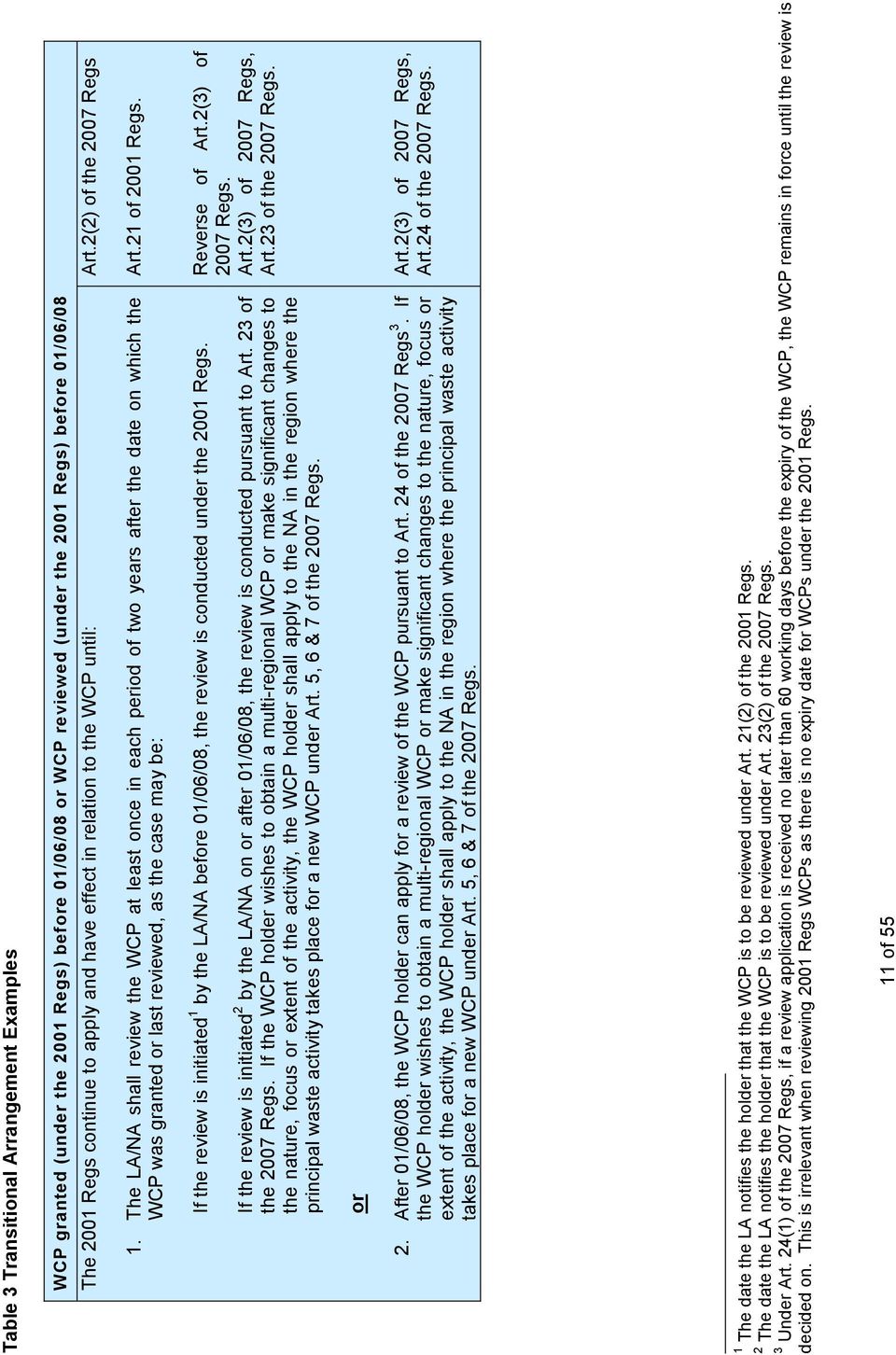
15 3 The Regulations - Revocations, Transitional Arrangements and Purpose This chapter describes the commencement of the Regulations, Revocations, Transitional Arrangements, Purpose of the Regulations and nominated authorities The Articles covered in this Chapter are: Article 1 Citation and commencement Article 2 Revocations and transitional arrangements Article 3 Purpose of Regulations Article 18 Conditions necessary to give effect to certain provisions of Community Acts Article 31. Notice regarding nominated authorities 3.1 Revocations - Article 2 The new Regulations revoke the whole of Waste Management (Collection Permit) Regulations 2001 (S.I. No.402) and Waste Management (Collection Permit) (Amendment) Regulations 2001 (S.I.No.540) subject to transitional arrangements in Article 2(2). 3.2 Transitional Arrangements - Article 2 Transitional arrangements are provided for in Article 2 of the Regulations. While the Waste Management (Collection Permit) (Amendment) Regulations 2001 (S.I.No.540) are revoked, they are subject to Article 2(2) of the new Regulations. This requires the nominated authorities to have regards to the 2001 Regulations which will still apply and have effect to any waste collection permit application (new or review) which has been granted before 1 st June This means that a permit granted before 1 st June 2008 will be subject to the 2001 Regulations, after two years the permit will likely be reviewed by the nominated authority under the new Regulations unless the permit holder in the interim requests to have their permit reviewed or decides to make a new application under the new Regulations. Any application for a review of a permit or permits made after 1 st June 2008 will be carried out under the new Regulations. Table 3 below provides guidance on how local authorities should address: Waste collection permits granted (under the 2001 Regulations) before 01/06/08. Waste collection permits applied for before 01/06/08 and due to be determined (under the 2001 Regulations) on or after 01/06/08. The following abbreviations are used in the table: 2001 Regs Waste Management (Collection Permit) Regulations 2001 (S.I. No. 402 of 2001) 2007 Regs Waste Management (Collection Permit) Regulations 2007 (S.I. 820 of 2007) as amended by the Waste Management (Collection Permit) (Amendment) Regulations 2008 (S.I. No. 87 of 2008) WCP Waste collection permit LA Local Authority NA Nominated authority 10 of 55
16 Table 3 Transitional Arrangement Examples WCP granted (under the 2001 Regs) before 01/06/08 or WCP reviewed (under the 2001 Regs) before 01/06/08 The 2001 Regs continue to apply and have effect in relation to the WCP until: Art.2(2) of the 2007 Regs 1. The LA/NA shall review the WCP at least once in each period of two years after the date on which the WCP was granted or last reviewed, as the case may be: Art.21 of 2001 Regs. If the review is initiated 1 by the LA/NA before 01/06/08, the review is conducted under the 2001 Regs. If the review is initiated 2 by the LA/NA on or after 01/06/08, the review is conducted pursuant to Art. 23 of the 2007 Regs. If the WCP holder wishes to obtain a multi-regional WCP or make significant changes to the nature, focus or extent of the activity, the WCP holder shall apply to the NA in the region where the principal waste activity takes place for a new WCP under Art. 5, 6 & 7 of the 2007 Regs. Reverse of Art.2(3) of 2007 Regs. Art.2(3) of 2007 Regs, Art.23 of the 2007 Regs. or 2. After 01/06/08, the WCP holder can apply for a review of the WCP pursuant to Art. 24 of the 2007 Regs 3. If the WCP holder wishes to obtain a multi-regional WCP or make significant changes to the nature, focus or extent of the activity, the WCP holder shall apply to the NA in the region where the principal waste activity takes place for a new WCP under Art. 5, 6 & 7 of the 2007 Regs. Art.2(3) of 2007 Regs, Art.24 of the 2007 Regs. 1 The date the LA notifies the holder that the WCP is to be reviewed under Art. 21(2) of the 2001 Regs. 2 The date the LA notifies the holder that the WCP is to be reviewed under Art. 23(2) of the 2007 Regs. 3 Under Art. 24(1) of the 2007 Regs, if a review application is received no later than 60 working days before the expiry of the WCP, the WCP remains in force until the review is decided on. This is irrelevant when reviewing 2001 Regs WCPs as there is no expiry date for WCPs under the 2001 Regs. 11 of 55
17 WCP applied for before 01/06/08 and due to be determined (under the 2001 Regs) on or after 01/06/08 If the WCP is granted, the 2001 Regs continue to apply and have effect in relation to the WCP until: Art.2(2) of the 2007 Regs 1. The LA/NA shall review the WCP at least once in each period of two years after the date on which the permit was granted or last reviewed, as the case may be: Art.21 of 2001 Regs. As the review will be initiated 4 by the LA/NA after 01/06/08, the review is conducted pursuant to Art. 23 of the 2007 Regs. If the WCP holder wishes to obtain a multi-regional WCP or make significant changes to the nature, focus or extent of the activity, the WCP holder shall apply to the NA in the region where the principal waste activity takes place for a new WCP under Art. 5, 6 & 7 of the 2007 Regs. Art.2(3) of 2007 Regs, Art.23 of the 2007 Regs. or Fees 2. The WCP holder can apply for a review pursuant to Art. 24 of the 2007 Regs 5. If the WCP holder wishes to obtain a multi-regional WCP or make significant changes to the nature, focus or extent of the activity, the WCP holder shall apply to the NA in the region where the principal waste activity takes place for a new WCP under Art. 5, 6 & 7 of the 2007 Regs. There is no fee for a review under the 2001 Regs. Art.2(3) of 2007 Regs, Art.24 of the 2007 Regs. In the case of a review of a 2001 Regs WCP under Art. 23 or 24 of the 2007 Regs, fees shall be applied as follows 6 : - As per Art. 8(1)(b) for a review; - As per Art. 8(2)(a) if the review triggers a new application, i.e. if the WCP holder wishes to obtain a multi-regional WCP (either to consolidate a number of existing WCPs or to extend waste activities to additional regions) or make significant changes to the nature, focus or extent of the activity refer Art. 23(3)(a)(iii) and Art. 24(2). 7 Enforcement WCPs granted under the 2001 Regs shall be enforced under the 2001 Regs. WCPs granted under the 2007 Regs shall be enforced under the 2007 Regs. 4 As per footnote #2 above. 5 As per footnote #3 above. 6 Subject to NA discretion to refund or waive a fee under Art. 8(3). 7 The fees under Art. 8(2)(b) apply to reviews of multi-regional WCPs and so do not apply in this scenario as a 2001 Regs WCP can not be a multi-regional WCP. 12 of 55

18 3.3 Purpose of Regulations - Article 3 and 18 The primary purpose of the permitting system is to facilitate appropriate controls on commercial collection activities so as to ensure good and consistent waste management practice and the implementation of high standards of environmental protection. The system also facilitates the implementation of relevant objectives in waste management plans. A small number of waste collection activities are exempt from the permitting requirement, mainly because they are already subject to regulatory control and approval under other legislation. However, in general, almost all commercial waste collection activities are subject to the provisions of the Regulations. The implementation of these Regulations gives effect to various requirements of nineteen EU Directives and regulations relating to waste, water, gases, and air under Articles 3 and 18. The Regulations are complementary to the Waste Management (Licensing) Regulations, S.I No. 395 of 2004 and Waste Management (Facility Permit and Registration) Regulations S.I No.821 of 2007 and the Waste Management (Facility Permit and Registration) (Amendment) Regulations S.I No.88 of For a complete list of environmental legislation go to the enfo website at The Nominated Authorities Article 31 The function of the nominated authority is to grant, review and enforce multi-regional waste collection permits for applicants whose principal activities take place within a local authority area of their region. Article 31(1) requires the local authorities in each region in column 1 in Table 4 below to nominate one local authority from within their region to act as nominated authority on their behalf. It is envisaged that the existing nominated authorities will be selected again. The authorities that are nominated to act on behalf of each region must publish a notice to that effect in a newspaper, or newspapers circulating in the functional areas of the local authorities concerned [Article 31(2)]. Table 4 Local Authority Regions and Nominated Authorities Region Existing Nominated authority Local Authorities North East Dublin South-East Meath County Council Dublin City Council Kilkenny County Council Cavan County Council Louth County Council Meath County Council Monaghan County Council Dublin City Council Dun Laoghaire-Rathdown County Council Fingal County Council South Dublin County Council Carlow County Council Kilkenny County Council South Tipperary County Council Waterford County Council Waterford City Council 13 of 55
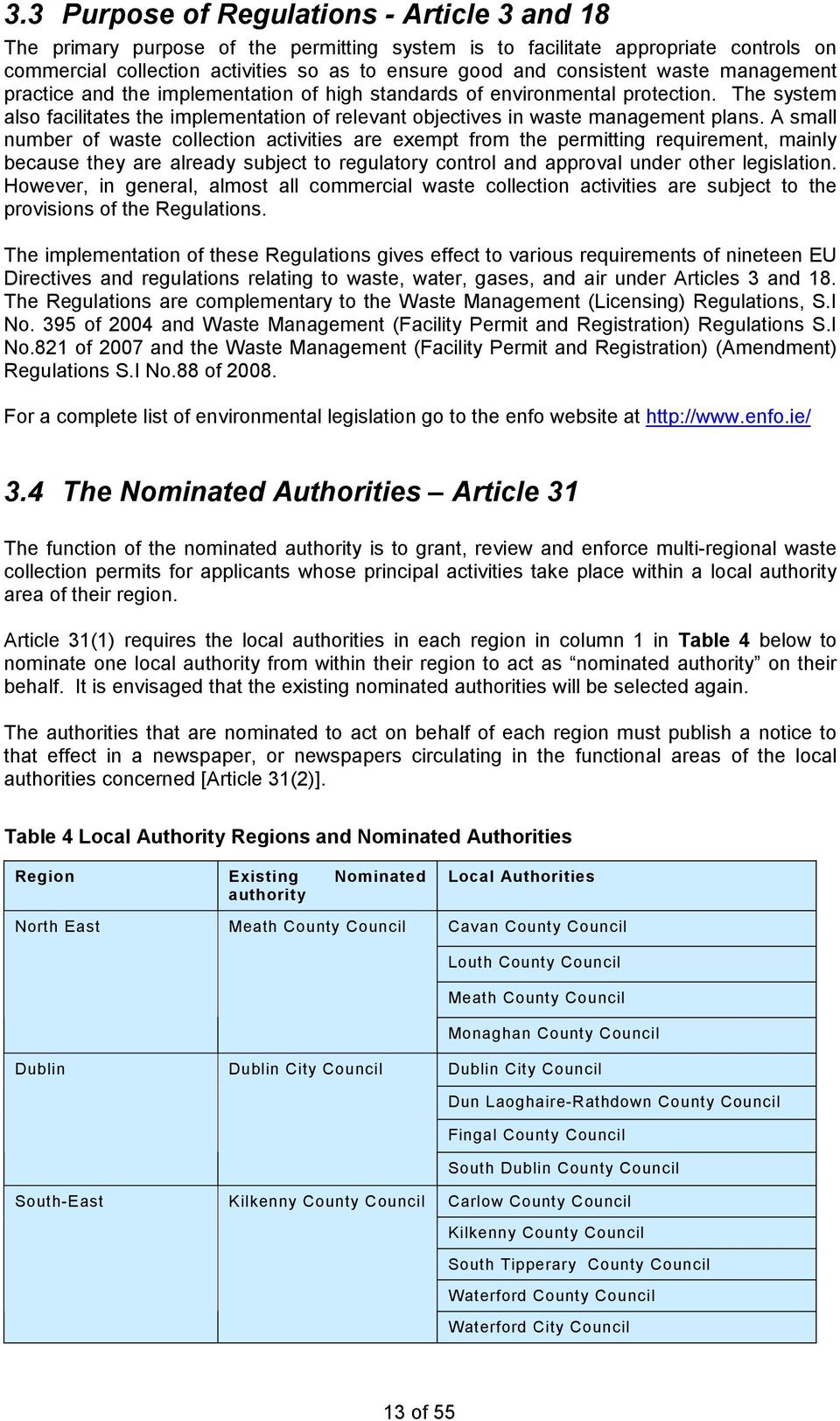
19 Region Existing Nominated authority Local Authorities Cork Cork County Council Wexford County Council Cork County Council Mid-West Limerick County Council Cork City Council Limerick County Council Limerick City Council Kerry County Council Connaught Mayo County Council Clare County Council. Galway County Council Galway City Council Leitrim County Council Mayo County Council Roscommon County Council Midlands Offaly County Council Sligo County Council Laois County Council Longford County Council Offaly County Council North Tipperary County Council Westmeath County Council Wicklow Wicklow County Council Wicklow County Council Kildare Kildare County Council Kildare County Council Donegal Donegal County Council Donegal County Council 14 of 55

20

21 4 The Application Process This chapter describes the process before and during the making of an application for a single region or multi region waste collection permit, including the determination of an application and the granting of a permit with conditions. The Articles covered in this Chapter are: Article 5 Making of an application for a waste collection permit Article 6 Notice of Intention to Apply for a waste collection permit Article 7 Contents of an application for a waste collection permit Article 9 Procedure on receipt of an application for a waste collection permit Article 10 Further Information Article 11 Consultation with other local authorities and the Agency Article 12 Availability and inspection of documents Article 13 Submission to a nominated authority in respect of an application for a waste collection permit Article 15 Period for determination of an application for a waste collection permit Article 16 Withdrawal or abandonment of an application for a waste collection permit or the review of a waste collection permit Article 17 Determination and notice of decision of grant or refusal in relation to a waste collection permit. Article 22 Criteria for determining a relevant person Article 36 Provision of false or misleading information, or failure to provide information. 4.1 Pre-application consultation It is recommended that pre-application consultations or discussions with the relevant nominated authority or nominated authorities, as the case may be, are undertaken before a submission of an application, particularly with regards to the determination of a principal waste collection activity for multi region applications. If necessary, consultation may have to take place with more than one nominated authority. Where a nominated authority gives notice to a permit holder requiring a review of a permit/s under Article 23(3) they shall advise the permit holder that they are available for preapplication consultations and that such course of action is recommended in order to assess the application for the review of a waste collection permit in terms of the procedures which are likely to apply to the review process under article 25. Applicants are advised to familiarise themselves with the application form, the Regulations and any Bye-laws (Eg Household and commercial waste and Skip Bye-Laws) in operation in the local authority areas where waste is or will be collected before beginning to complete the application. In addition applicants need to be aware of the relevant Waste Management Plan for the region or regions where waste is or will be collected and Hazardous Waste Management Plan requirements. Waste management plans are available to download from all local authority websites. The National Hazardous Waste Management Plan produced by the EPA is available at Conditions may be attached to a waste collection permit to give effect to the requirements of the relevant waste plans. 4.2 Principal Waste Collection Activity Article 7(1)(h) A principal waste collection activity only applies to an application for a permit where waste is or will be collected in more than one region. It is defined in the Regulations [Article 4 (2)] as follows; when used in the context of an application for a multi-regional waste collection permit or multi-regional waste collection permit review being made to a nominated authority in respect 15 of 55
22 of a number of regions, means the Region where, in the reasonable opinion of the nominated authority, the greatest extent of waste collection activities, by virtue of the number of premises served or the quantity of waste collected, are being or, the case may be, are proposed to be carried out by an applicant. There are a number of points to note within this definition; Reasonable opinion of the nominated authority on receipt of an application the nominated authority will determine if they are the correct authority to which the application applies. To reduce administrative burden for both the applicant and nominated authority it is advised that the applicant determine the principal waste collection activity prior to the submission of an application by reviewing the requirements of the application form in particular with regards to the quantities of waste, the local authority areas and the number of premises served. the greatest extent of waste collection activities, by virtue of the number of premises served or the quantity of waste collected applicants may find it difficult to determine number of premises served, especially in circumstances where they are collecting from Apartments and have a contract with a management company. The management company should be able to provide a waste collector with the details of the number of units in an apartment complex. If an applicant or permit holder applying for a multi-regional application finds that they are collecting waste from for example, 20,000 premises in the local authority area of Limerick County Council, but the volume of waste collected in another area Wicklow County Council is 20,000 tonnes per annum, it is advisable that the applicant consult with Limerick and Wicklow County Councils. The applicant should get the name and contact details of the nominated authority representative who confirmed they are the correct nominated authority to which an application will be made. The principal waste collection activity is determined only on the basis of the information provided at the time of the application. Any minor or significant changes to information submitted with the application must be notified to the nominated authority. The nominated authority can only satisfy themselves that the principal waste collection activities will be carried out within the local authority functional areas based on the information provided in the application form. Many permit holders may find that the principal waste collection activity changes between the period when the application was submitted and during the period of having a permit, circumstance that would cause these changes would include; Multi region Permit Holder wins contract to collect 200,000 tonnes of contaminated soil from a location that is not within the region where nominated authority is administering the permit Multi region Permit Holder wins various contracts which continuously change the principal waste collection activity by virtue of changes in waste tonnages collected or number of premises served The nominated authority will decide whether the principal waste collection activity identified in the application is correct under Article 9. This Article states that within a period of 10 working days following receipt of an application, the nominated authority shall decide whether the requirements of articles 6 and 7 have been complied with. This therefore includes Article 7(1)(h) which requires an explanation of the basis on which the region has been chosen by the applicant as being the location in which the principal waste collection activity is proposed to take place. The nominated authority may need further information or evidence under Article 10 in order to determine an application. Only when the nominated authority is satisfied that the information received complies with Articles 6 and 7 can the application be validated. The determination of an application is discussed in more detail in Chapter 4, Sections 4.7 to of 55
23 If an applicant has submitted an application to the wrong nominated authority, ie the application has not been submitted to the nominated authority in the principal waste collection activity region, the nominated authority will return the application to the applicant. A new newspaper notice will be required in circumstances where the application has been submitted to the wrong nominated authority. 4.3 Overview of application process The application processes and the timelines associated with each stage of a waste collection permit application or review of a waste collection permit or permits are presented in two flowcharts, Flowchart 1 and Flowchart 2, these are referenced in Chapters 4 and are provided in Appendix 4 and Appendix 8. The waste collection permit application form is available electronically from each local authority website or available to download from The form has been developed for use for a new waste collection permit application or for a review of a waste collection permit or permits. Applicants should contact the relevant nominated authority for an electronic or paper copy of the form. The form is provided in Appendix 5 for reference. Applicants should request a paper copy of the application form from any local authority. Applicants are encouraged to complete the form electronically, although this is not a prerequisite. An applicant can only submit an application to one nominated authority, however they may wish to consult with a number of nominated authorities prior to making a submission. 4.4 Notice Requirements - Article 6 Article 6 of the Regulations requires the applicant to put a notice of intention to apply for a waste collection permit in either a national newspaper or in newspapers circulating in each of the local authority areas where waste is or will be collected. The period between the day when the notice appears in the paper and the submission of the application is up to 10 working days. There are a least six newspapers that are circulated nationally and many that are circulated on a regional basis. It is advisable for an applicant to check with the newspaper s advertisement team where a newspaper is circulated and what date the notice will be published. The applicant should purchase a number of newspapers in which the notice appears. Article 6(2) provides the details that are to be included in the newspaper notice. The content of the notice does not differ to that required in the previous collection permit regulations, other than there is no longer a requirement to state that any member of the public may, within a period of six weeks of the application being published, make a written submission to the relevant local authority in relation to the said application. Article 7(3)(a) requires a copy of the page of the newspaper, or newspapers, in which the notice has been published to be included with the application. An applicant for a multi region collection permit for all regions for example would be required to provide one original of the page of the newspaper and thirty three copies. An example of a newspaper notice is included in Appendix Application Contents and Supporting Information This section provides an overview of the contents of the application form and the supporting information required. 17 of 55
24 The waste collection application form has been developed as a template to be used by the nominated authorities. Nominated authorities may wish to use the template and add local authority logos and amend some questions which may be specific to the relevant regional waste management plans and/or the National Hazardous Waste Management Plan. Section A: Type of Application Section A of the form contains five questions. The questions deal with the type of waste collection permit application, ie whether it is a review or an application for a multi-region permit. Some of the questions are only applicable to permit holders applying for a review of their permits and requires details on existing permit number/s and expiry date for example. Supporting information that must be provided by the applicant for a review includes: A copy of the Notice received by the permit holder from the nominated authority where the nominated authority has instigated the review. This will be included as document reference A.3 Notice from nominated authority. Supporting information that may be provided by the permit holder or new applicant includes: Any form of correspondence that may have been received from nominated authority confirming the principal waste collection activity or contact name of local authority personnel. Section B: About the Applicant Section B of the form contains nine questions. The questions deal with the applicant(s) who will be collecting waste and require details including name of applicant, trade names, address of applicant, details of whether the applicant is a body corporate or partnership for example. This section also requires details on relevant convictions, technical competence and financial commitment discharge (discussed in more detail in Chapter 9). Supporting information that must be provided by the applicant for a review includes: A copy of the appropriate certificate issued by the Companies Registration Office ( should be included in the application. In the case of a foreign-based legal entity, a certified copy of the company s registration can also be obtained from CRO A copy of the insurance policy, the whole policy document is not required Where relevant, a supplementary sheet detailing offences, court hearing, case, nature of the offence and any penalty or requirements imposed by the court should be provided. A separate sheet should be used for each offence if there has been more than one Section C: About the Waste Collection Activity Section C of the form contains seven questions. The questions deal with the waste collection areas and regions, the principal waste collection region, waste types and quantities, facilities, vehicle and skips. Further guidance on some of the questions is provided below. C.2 Principal Waste Collection Region Question C2 requires applicant or permit holder to demonstrate the basis upon which the principal region of waste collection activity has been chosen at the time of application. It is advised that nominated authorities encourage applicant to complete the excel spreadsheet attached to Question C.3 before completing C of 55
25 C.3 Waste types and Description Question C3 requires the applicant to provide details on waste types and description in Table C.3. The excel sheet is provided in Appendix 7 for reference. The sheet is available with the application form for download from The requirements of the following from Article 7 are provided in the excel sheet to support question C3. Article 7(1)(f) - the type, estimated quantity and nature of the waste or wastes to be collected, and the nature of the collection activity, including European Waste Catalogue Code(s) and description(s) pursuant to Commission Decision 2001/118 of 16 January 2001 or subsequent amendments as may be made to the list from time to time Article 7(1)(g)the local authority area or areas in which the waste collection activity will be carried on Article 7(1)( (I) - details of any facility that is intended to be used by the applicant in connection with the activity to which the application relates (Further details on facilities are required in Question C.4) Article 7(1)( (j) - in the case of household waste collection, the frequency of collections and the method of charging for collection of waste which is intended to encourage the prevention, reuse, recycling and recovery of waste, including details on the provision of segregated collection for dry recyclables and for biowaste. C.3 Use of Excel Sheet There are two versions of the excel sheet available for applicants, a print version and an electronic version. The sheet is best completed electronically, although not a prerequisite. The print version is designed for applicants who wish to complete the form by hand. Table C.3 provides two worksheets, one for household waste collections and the second for other waste collections. The household waste collection sheet is presented in two Parts. Part 1 deals with door to door waste collections and Part 2 deals with collection of household wastes from bring centres for example. The electronic sheet contains drop down lists for applicants to select region, local authority areas and waste types corresponding to the European Waste Catalogue (EWC). The EWC can be downloaded from Sample rows have been completed on the electronic sheet to demonstrate how the sheet must be completed, applicants must delete the sample rows before completing the sheet. C.6 Vehicles New entrants to the market are not expected to provide this information at the application stage but they will be required to provide vehicle details to the nominated authority prior to waste collection activities commencing. C.7 Skips Question C.7 requires details of skip types, volume, number and total volumes to be completed in a table. Applicants need to state if they are licenced under the control of Skip bye-laws by a local authority, if so the Skip Operating Licence number must be provided. Skip licences are provided by the Roads Division of each local authority. Generally skip licences are granted for a year and are required for skips that will be placed on public roads, footways or footpaths. Supporting information that must be provided by the applicant includes: Letter/s of acceptance from each facility that is intended to be used in connection with the waste collection activity. These letters must be provided on the facility/s headed paper, detailing their agreement to accept the specified waste types and volumes A copy of the contract between the applicant or permit holder or waste broker and the facility from each facility outside of ROI In the case of owned/leased vehicles, the nominated authority will require: 19 of 55
26 A copy of vehicle ownership document / Lease Agreement in the name of the applicant A copy of the contract between the sub-contractor and the permit holder stating that the waste they collect will only be delivered to the waste collection permit holders specified facilities A copy of the vehicle registration certificate for each vehicle. Section D: Additional Information Any additional information that has not specifically been requested by the nominated authority and which the applicant considers may be valid for the consideration of their application. Section E: Statutory Declaration The statutory declaration is presented in the Second Schedule of the Regulations. This declaration must be signed by the legal entity that is or will be carrying out the waste collection activity. The declaration must also be completed by either a Solicitor/Commissioner of Oaths/Notary Public/Peace Commissioner/Garda Síochána. 4.6 False Information -Article 36 The intentional submission of false information in connection with a waste collection permit application or compliance document constitutes an offence under Article 36(1) of the Regulations. Such falsified documents may consist of supplementary information provided with a permit application, or falsified data knowingly provided in a monitoring report. or in a document submitted in response to an enforcement notice. Furthermore if a waste collector states in a waste collection permit application that they are using X and Y facilities, but in fact they are using Z as well as the time the application was drafted, the applicant may be prosecuted. Failure to provide any information required by notice under the Regulations is also a statutory office. 4.7 Period for determination of an application for a waste collection permit Article 15 Please refer to the Flowchart 1 for the waste facility permit application process in Appendix 4. The nominated authority must make a decision to grant a permit with or without conditions, or refuse to grant a permit within a period of: 40 working days from the date of the receipt of a valid application (the application complies the notice requirements (Article 6) and the contents of the application (Article 7),[Art. 15(1)(a)] or 40 working days from the date of receipt of further information or particulars in accordance with either article 9(4) or article 10, [Art.15 (1)(b)]or 25 working days from the date of receipt of any submission received by the nominated authority under and in accordance with article 13(3) and 13(4) which ever period is the longest [Art.15(1)]. 20 of 55
27 Circumstances where nominated authority may extend period [Art.15(2) and (3)] Where the nominated authority determines that it would not be possible or appropriate to decide on an application within the periods specified above, they will give notice in writing to the applicants concerned before the expiration of that period outlining the reasons why the application may not be determined within the specified period. The nominated authority will specify a date by which they intend to determine the application [Art.15(2)]. The nominated authority will ensure that the application is decided upon before the date in the notice specified to the applicant [Art 15.(3)]. Reasons for an extension to the determination period may include: Because of the particular circumstances of an application or Because of the number of applications for waste collection permits and the review of waste collection permits which have been submitted to the authority. 4.8 Procedure on Receipt of an Application Article 9 Article 9 deals with the statutory procedure on receipt of an application by the nominated authority. This article applies to new permit applications, the application process for review of permits is carried out under Article 23 and 24 and is dealt with in further detail in Chapter 4. When a nominated authority receives an application for a waste collection permit they will immediately stamp the application with the date of receipt and assign a reference number to the application [Art.9(1)(a)]. Reference numbers can now be automatically generated through the website at The nominated authority will then notify the applicant in writing that the application has been received [Art.9(1)(b)]. Within 10 days of receiving an application the nominated authority will determine if the notice requirements (Article 6) and the contents of the application (Article 7) have been complied with [Art.9(2)(a)]. Details of the application must be input to A notice must not be served to an applicant any later than 10 working days if their application does not comply with Article 7 [Art.9(3) &(4)]. If the requirements of Articles 6 and 7 have been complied with in respect of an application, the nominated authority shall, within 5 working days of making its decision, send the applicant an acknowledgement of receipt of a valid application [Art.9(8)]. Where a period of more than 10 days has elapsed between the notice in the newspaper [Art.9(3)(a)] and the submission of the application or if the notice does not comply with Article 6, the nominated authority will write to the applicant requiring them to publish a new notice. The nominated authority may specify a time period by which the notice is to be published or the nominated authority may request evidence as it may specify in relation to compliance with any such requirement [Art.9(3)(b)]. A nominated authority may issue one letter under Articles 9(1)(b), 9(3), 9(4) and 9(8), which would include the acknowledgement of receipt, providing that the date of receipt of the application is clearly stated and that there is no delay in issuing Art 9(3), 9(4), 9(8) letter. If the newspaper notice is not correct and the application is missing other information Article 9(3) and 9(4) notices may be issued in the same correspondence once both articles are mentioned. 21 of 55
28 Where the nominated authority reasonably considers and determines that the requirements of Article 7 have not been complied with they will notify the applicant in writing of the following within 5 days of making this decision [Art.9(4)]: Inform the applicant that they have not complied with the requirements of Article 7 and advise that the application is invalid and cannot be considered by the authority, or Require the applicant, within a period of 25 working days from the date of the notice, to provide any necessary information necessary for determining a valid application. The nominated authority needs to make this decision based on the extent and type of information that may not have been provided by the applicant. Where the application is determined as invalid, the nominated authority shall return all application documentation to the applicant [Art.9(7)]. If an applicant does not comply with a notice from the nominated authority in response to an incorrect newspaper notice or missing information, the nominated authority may by notice in writing, within 10 days of making its decision inform the applicant of such failure of compliance and that the application is invalid and cannot be considered further by the authority [Art.9(6)]. 4.9 Further Information Article 10 Further Information Request [[Art.10(2)].] Further information from an applicant may be requested by the nominated authority after they have acknowledged a valid application. A request for Article 10 further information will not be issued by the nominated authority more than 25 working days after the date they acknowledged receipt of a valid application [Art.10(2)]. The nominated authority may request specified further information in writing, it is also feasible for the nominated authority to telephone the applicant or their agents for such information. The further information required may include any information or particulars or evidence to verify information contained in an application to enable the authority to come to a decision [Art.10(1)(a) and (b)]. If an applicant fails to respond or refuses to comply with a request for further information within 25 working days of receiving the notice, the nominated authority, if it thinks fits proceed will consider the application without the further information [Art.10(3)] Consultation with other local authorities and the Agency Article 11 Submission to other local authorities and the Agency - [Art.11(1)] When a nominated authority receives a waste permit application for waste collection in a number of other local authority areas, it will notify the other authorities as soon as and provide a copy of the waste collection application and any other information received thereafter [Art.11(1)]. Applications involving Collection of Hazardous Waste - [Art. 11(2)] On receipt of waste collection permit applications involving the collection of hazardous wastes the nominated authorities must notify the Agency of the application and any further information received [Art. 11(2)]. Nominated authorities should send the documentation to: Resource Use Unit Environmental Protection Agency PO Box of 55
29 Johnstown Castle Estate, Co. Wexford Alternatively, nominated authorities may the information to the Agency at the following address Note: The size of s should be kept below 500kb (0.5MB) and the application documentation should be contained in no more than one electronic file. Where the application documentation is large or broken into multiple electronic files, it should be sent by post. Nominated authorities should not assume that the has been received unless and until an acknowledgement has been issued by the Agency. Submissions from other local authorities and the Agency - [Art.11(3) Prior to the nominated authority s decision to grant or refuse a waste collection permit, they will take account of any submission received from other local authorities or the Agency within 25 working days of their receipt [Art.11(3)]. Where the submissions relate to specific requirements for the implementation of waste management plans or the National Hazardous Waste Management Plan, the nominated authority must incorporate these requirements into the conditions of a waste collection permit [Art.11(4)] Availability and inspection of documents Article 12 A waste collection permit application will be made available by the nominated authority and all other relevant local authorities to which the waste collection activity relates for public inspection as soon as may be [Art 12.(1) and (4)]. When an application is determined valid, the nominated authority will provide all information relating to the application such as further information requests, information received from the applicant and any submissions, on the public file for inspection [Art. 12(2)(a) and (b) and (c)]. The waste collection permit application and any further information will be made available for public inspection during office hours at the principal office of the nominated authority and relevant other local authority offices [Art.12(3) (a) and (b) and (4)]. This information will be made available for purchase at a reasonable cost Submissions to a nominated authority in respect of an application for a waste collection permit Article 13 Submissions from any persons - [Art 13.(1) & (2)] Within 25 working days of making an application available for public inspection, any person may make a submission to the nominated authority in relation to the application. The nominated authority will take account of submissions received from any persons [Art 13.(1)]. When a submission is received by a nominated authority they will: Notify the person in writing that the submission has been received and has been made available for public inspection at the principal office of the nominated authority from a specified date [Art.13 (2)(a) and (b)] Forward a copy of the submission to the other relevant local authorities concerned, and to the Agency where the application relates to hazardous waste [Art13.2(c)] 23 of 55
30 Submission review by Applicant - [Art.13(3)] An applicant then has the opportunity to view the public file and make any submission on the submissions received by the nominated authority within a period of 25 working days of the date of the nominated authority s notification to the applicant [Art.13(3)]. A relevant local authority or the Agency may make a submission to the Nominated authority in relation to any of the third party submissions on public file within a period of 25 working days of the date of its issue to the relevant local authority or, as the case may be, the Agency [Art 13.(4)]. Where the submissions relate to specific requirements for the implementation of waste management plans or the National Hazardous Waste Management Plan, the nominated authority must incorporate these requirements into the conditions of a waste collection permit [Art.13(5)] Withdrawal or abandonment of an application for a waste collection permit or the review of a waste collection permit Article 16 Withdrawal of an application - [Art 16(1)] An applicant can withdraw their application for a waste collection permit or review before the nominated authority has made its decision on the application [Art 16(1)]. The nominated authority with return all documentation to the applicant, including any further information requested or received by the nominated authority. Abandonment of an application - [Art. 16(2)] If the nominated authority believes that an application has been abandoned they shall notify the applicant of this opinion and ask them as to why the application should not be regarded as abandoned. The applicant has from 10 to 25 working days from the notice to inform the nominated authority [Art. 16(2)]. The nominated authority may declare the application abandoned after the notice period and even if a submission has been made. All documentation will be returned by the nominated authority to the applicant, including any further information requested or received by the nominated authority. The nominated authority may or may not refund all or part of the application fee in the case of a withdrawal or abandonment of an application. When an application is withdrawn or abandoned, the nominated authority will not consider the application or take account of any submissions made [Art. 16(5)] Notice of Decision to grant or refuse a permit Article 17 A nominated authority will only grant a waste collection permit once they are satisfied that the applicant is a fit and proper person and that the activity and any emissions will not cause environmental harm. Permits can now be granted for a five year period, although an applicant can request a permit for a shorter period [Art 17(2)]. Once the nominated authority has made a decision to grant or refuse a waste collection permit they will give notice in writing of the decision to the applicant, other local authorities, where relevant and other persons or organisations who made submissions [Art 17.4). The Nominated authority shall only give notice to the person who forwarded the application. The notification will include a copy of the waste collection permit [Art.17(5)]. A notification to any person who made a submission shall state that a copy of the collection permit will be available for inspection or purchase during office hours at the principal office of the nominated authority and at the principal office of each relevant local authority [Art. 17(6)]. A notification under this article to an applicant shall include a reference to the right of appeal provided for under section 34(9) of the Act. [Art.17(7)]. 24 of 55
31 4.15 Permit Conditions If the nominated authority decides to grant a permit, it can include any conditions it sees fit, but has a duty to impose conditions that are a requirement of the Regulations and certain Directives. Conditions should be realistic, enforceable and necessary. Conditions must also be achievable for a permit holder. The nominated authority should be able to justify conditions should there be an appeal. For conditions to be enforceable they should state objective, standard or outcome in order for the permit holder to understand what is required. A waste collection permit template has been developed for use by the nominated authorities, the objective of developing this template was to standardise permits. The template will be available for download from and may be amended by nominated authorities in order to add conditions which may be required to give effect to requirements of the various waste management plans or the National Hazardous Waste Management Plan. Conditions will vary from one permit to the next depending on the types of wastes to be collected. There are three Articles in the Regulations that provide for conditions. Conditions for Community Acts Requirements - Article 18 Article 18 provides for Conditions to be included in permits which take account of the requirements of the Community Acts. The community acts are listed in the Fourth Schedule of the Regulations. Conditions for Skips Article 19 Article 19 deals with conditions which are to be applied for the use of skips and similar receptacles in public places. Nominated authorities need to have regard for any bye-laws made under the Roads Act The article provides for skip conditions which may be included in a permit [Art.19(2)], these are as follows: Skips to carry reflectors so that they are visible when necessary Siting of skips is temporary and no longer than three days Dimensions and other characteristics of skips Care and disposal of the contents of skips Removal of skip when full and at the earliest practicable time Article 20 deals with the conditions that will be attached to a permit. Conditions can be prescribed for the period before an activity commences as well as during the activity itself. Conditions which will be attached to a permit Article 20 Article 20(1)(a) and (b) provides for conditions to be attached to a permit to give effect to the requirements of the relevant waste management plan/s or the National Hazardous Waste Management Plan. Some of these conditions may come about through the consultation period and submissions from other local authorities or the Agency. Article 20(2) lists the conditions that will be attached to a waste collection permit. These are discussed in turn in Table 5 below. Table 5 Waste collection permit conditions [Art.20(2)(a)] Ensure that where waste collected under the waste collection permit is transferred to a facility for the purpose of a recovery or disposal activity, that there is a waste licence, waste facility permit, certificate of registration, or IPPC licence in relation to the carrying on of the activity concerned at that facility and that planning permission, or a certificate of exemption from such permission, is in place for such a facility 25 of 55
32 Discussion: This condition will relate to information that is requested at the application stage where an applicant must specify the facilities where waste will be transported to & to have the required authorisations. If the applicant wishes to change or add facilities to their permit they must ensure that the facilities are authorised. Permit holders must note any revocations of the relevant authorisations of facilities to which they transport waste. [Art.20(2)(b)] Ensure that where biowaste collected under the waste collection permit is transferred to a composting or biogas facility for the purpose of treatment and where animal by-products form all or part of that biowaste, that the facility has been approved in writing by the nominated authority for use by the permit holder and there is in force an appropriate veterinary authorisation issued by the Minister for Agriculture and Food in accordance with article 6 (6) of the European Communities (Animal By-products) Regulations, as amended Discussion: This condition will require the permit holder to provide evidence that biowaste they collect is transferred to a facility that has had veterinary authorisation. The permit holder will need to provide a copy of this authorisation to the nominated authority. [Art.20(2)(c)] Notify the authority in relation to any conviction for an offence prescribed under article 21 or any requirement of an order under the Act, within 5 working days of such conviction or the imposition of such a requirement Discussion: If the permit holder is convicted of an offence by a local authority or the Agency other than the nominated authority that has granted the permit, they must notify the nominated authority within 5 working days of receiving the conviction. [Art.20(2)(d)] Carry, or cause to be carried, a copy of the waste collection permit at all times on each vehicle, and require all trailers, containers and skips used for waste collection to be visibly, legibly and indelibly identified with the waste collection permit number Discussion: This condition is self explanatory, it is expected that under the new system, permit holders will only have to have hold 1 permit in the vehicle, it would be sufficient for a vehicle added after the permit was granted to only carry the permit and correspondence/letter permitting the addition of that vehicle. Vehicles do not need to carry all forms of correspondence for all vehicles that are added. [Art.20(2)(e)] Compile and maintain the records listed below, for a period of not less than 7 years; Types and quantities of waste dealt with in the course of business, including the EWC codes and descriptions of the waste Origin and destination of such waste, Treatment, recovery or disposal activities to which the waste is subject (including the compilation of commercial documentation for all consignments of collected waste deposited at a facility), and, where appropriate, Person by whom such waste is collected including name, address and waste authorisation reference number, Discussion: This condition requirement forms the information requirements which a permit holder must include in the annual environmental report. [Art.20(2)(f)] Furnish to the nominated authority, not later than 28 February in each year, in such form as may be specified by the authority, summary information in relation to the nature and quantities of wastes collected by the permit holder in the preceding calendar year or part thereof, as the case may be, and delivered to individual facilities or otherwise transferred to other persons for the purpose of recovery or disposal Discussion: This condition relates specifically to the AER return required by the nominated authority by 28 th February each year. [Art.20(2)(g)] Take steps to ensure that - 1 S. I. No. 248 of of 55
33 All, or a specified proportion, of waste collected by the permit holder, or class or classes of such waste, is source-segregated, treated or recovered, in such manner as may be specified, in particular that waste is where practicable and having regard to the waste hierarchy, delivered to facilities which reuse, recycle or recover waste. (II) presented, collected, handled and transported in a form which enables the facilities to which the waste is delivered to comply with specific conditions contained in, as the case may be, the waste licence, IPPC licence, waste facility permit or certificate of registration in relation to performance targets established for the levels of recycling or recovery of waste. waste which has been source segregated by the waste producer is not sent for disposal or collected, transported, mixed or handled so as to make it unsuitable for recycling or recovery. Discussion: In compiling with this condition for a permit, the nominated authority must have regard for the types of wastes that the applicant is proposing to collect and the facilities to which the waste will be delivered as provided in the application. It would be unreasonable to impose a condition specifying that waste of a certain type must be source segregated when this may not be possible or that a certain waste must be recycled where no facilities exist. A permit holder or applicant will need to provide details at the application stage on waste segregation and have regard for the waste hierarchy. [Art.20(2)(h) Apply charges for household waste collection which respect the polluter pays principle Discussion: Nominated authorities cannot specify what those charges may be. applicant will provide this information at the application stage. [Art.20(2)(i)] Provide segregated collection arrangements for household waste, at a frequency as may be specified by the nominated authority, for different types of recyclable, compostable or recoverable materials where the nominated authority considers it practicable to do so. Discussion: The nominated authority will have regard for the information provided by the applicant regarding collection arrangements for household wastes. [Art.20(2)(j) Provide waste recycling receptacles, which are designed for reuse, for segregated collections for different types of recyclable, compostable or recoverable materials of such form, colour and capacity as may be specified by the nominated authority Discussion: Applicants will specify the containers or bags they will provide for the collection of waste, whilst it would be reasonable for a nominated authority to suggest alternative collection units to a permit holder, it would be unreasonable to restrict the use of certain recycling receptacles if the local authorities use them themselves. [Art.20(2)(k)] Include their permit number and name of issuing authority in all of their promotional material Discussion: This condition will require permit holders to include their permit number and nominated authority details on promotion flyers, brochures or leaflets for example. [Art.20(2)(l)] Notify the nominated authority in advance of the type and identifying mark of any collection vehicle owned or hired and used for the collection of waste under the terms of the permit, including particulars of the relevant vehicle registration document Discussion: A permit can be granted without vehicle details, It is considered onerous that new entrants to the market who are applying for a permit to have a fleet in place at the time of application and thus to require fleet details as a condition would be reasonable. Collection of waste cannot commence until vehicle details are provided. If a permit holder needs to add vehicles to their permit, they should be able to notify the nominated authority in writing. The 27 of 55
34 [Art.20(2)(m)] Notify the nominated authority of the type and identifying mark of any collection vehicle which is being hired in on a temporary basis from a third party by the permit holder and used for the collection of waste under the terms of the permit, within one working day of the addition of such a vehicle, including particulars of the relevant vehicle registration document. Discussion: This condition is self explanatory Conditions which will be attached to a permit from the WMA Section 34 7(h) specifically addresses a condition which will be attached to a waste collection permit specific to the requirement to hold relevant insurances, as follows; 7(h) the effecting and maintenance of a policy of insurance by the holder of the permit insuring him or her as respects any liability on his or her part to pay damages or costs on account of injury to person or property arising from the activities concerned. The conditioning of requiring insurance in a waste collection permit is not included in Article 20, however it is clear that it is condition which shall be attached to a permit. Conditions which may be attached to a permit Article 20 Article 20(3) provides for conditions which may be attached to a permit. The conditions which may be attached are dependent on the type of waste collection activity, the scale of waste collection and the types of wastes collected. These are presented in Table 6 below. Table 6 Conditions which may be attached to a permit [Art.20(3)(a)] such reasonable conditions as are, in the opinion of that authority, necessary to ensure the proper enforcement of the permit, and [Art.20(3)(b)] conditions relating to existing or proposed measures, including emergency procedures, to prevent unauthorised or unexpected emissions and to minimise the impact on the environment of any such emissions, [Art.20(3)(c) conditions to encourage the sound environmental management of waste and in particular to encourage waste prevention, reuse, recycling and recovery as set out in, but not limited to, those conditions in section 34(7) of the Act, [Art.20(3)(d)] conditions requiring the making of payments by the permit holder to the authority to defray such costs as may reasonably be incurred by the authority, other than required under article 8 in accordance with the third schedule and which costs shall not exceed the actual expenditure reasonably incurred by the authority in inspecting, monitoring, auditing, enforcing or otherwise performing any functions in relation to the activity, [Art.20(3)(e)] conditions requiring each vehicle to be fitted with electronic tracking technology which facilitates the surveillance operations of enforcement authorities in monitoring compliance with the waste collection permit conditions. 28 of 55
35 4.16 Review of a waste collection permit Article This section describes the situation where a permit review is required and the process for review. The Articles covered in this Chapter are: Article 23 nominated authority initiated review of a waste collection permit Article 24 Permit holder initiated review of a waste collection permit Article 25 Procedures for review of a waste collection permit Article 26 Decision of review application not entailing significant change Article 27 Decision on a review application on basis of particulars received Article 28 Determination and notice of review application Nominated authority initiated Review of a waste collection permit- Article 23 If the nominated authority is of the opinion that a significant change in the nature, focus, or extent of the permitted waste collection activity has taken place, or at the request of a relevant local authority in whose functional area the permitted activity takes place, the nominated authority may initiate a review of the permit (refer to Flowchart 2 in Appendix 8). Another reason for a nominated authority to review a waste collection permit is due to amendments to the waste management plan for the region concerned. A review of a waste collection permit may be initiated by the nominated authority any time after the initial permit was granted under the Regulations. Nominated authority Notice of Intention to Review [Article 23(2)] The nominated authority must send a notice to the permit holder of its intent to review a waste collection permit. The nominated authority may determine that a new waste collection application may be required if the permit holder wishes to avail of multi-region waste collection permit system, or wishes to make significant changes Article 23(3)(a). The nominated authority must inform the permit holder that a multi-regional waste collection permit system has been established, whereby the permit holder under the Regulations may decide whether he or she wishes to have some or all of his/her existing waste collection permits in the various regions reviewed or to make an application for a permit which would also within the same submission allow the collection of waste in additional regions. The notice must explain that if the permit holder wishes to have a number of his or her existing waste collection permits reviewed at the same time as the review proposed by the nominated authority, or to extend his or her waste collection activities into additional regions, or to make significant changes to the nature, focus or extent of existing waste collection activities, an application for a full new waste collection permit will have to be made in accordance with articles 5, 6 and 7 to the nominated authority in the region where the principal waste collection activities are proposed to take place. The notice must also advise the permit holder that the nominated authority is available for pre-application consultations. It is recommended that pre-application consultations take place between the nominated authority and the permit holder in order to discuss the particulars of the reasons for review, and to clarify the procedures which are likely to apply to the review process (see article 25). The consultation process should also be used by all parties to explore the necessity and appropriateness of reviewing the permits. The notice shall state that if a new application for a new waste collection permit is required, due to the permit holders wish to increase the number of waste collection activities into additional areas, or due to proposed significant changes, the application [Article 23(3)(v)]must 29 of 55
36 be made within 60 days working days of the notice. If an application for review is received within 60 days then the existing waste collection permit(s) shall remain in force until a waste collection permit is issued or refused under article 17, or the existing permit or permits are revoked under article 29. Requirement to submit review application if no significant change or new regions added Article 23(3)(b) The notice must set out that if the permit holder does not wish to avail of multi-region waste collection permit system, or make significant changes he/she must make an application for a review of the existing waste collection permit. Fees payable with the application Article 23(3)(c) The nominated authority shall advise the permit holder in the notice of the appropriate fee that the permit holder must pay for the review of the waste collection permit, or, as the case may be, for an application for a waste collection permit, as set out in article 8. Furnish submissions and information Article 23(3)(d) The notice may specify any submissions, plans, documents, or other information that needs to be provided with the application. The nominated authority can detail any information it considers necessary for the purposes of the proposed review. Defray or contribute to costs Article 23(3)(e) If, furthermore, the nominated authority had to carry out additional investigations, audits, sampling or enforcement actions in the course of determining the review, the nominated authority may advise the permit holder in the notice that he/ she must contribute towards these costs reasonably incurred. The costs levied against the permit holder shall not exceed the actual costs incurred by the nominated authority. (see Article 14(2)). Timescales Article 23(3)(f) The notice shall indicate that the application for a review of a waste collection permit, including any required submission relating to the proposed review shall be made by the permit holder in writing to the nominated authority within 25 working days of the date of the giving of the notice. The nominated authority may not decide to amend or review conditions of the waste collection permit before the 25 days have lapsed. The notice shall further explain that if the permit holder does not make a review application and furnish the required information within 25 days, the nominated authority will revoke the existing waste collection permit, and will notify the waste permit holder of the reasons for its decision. Permit holder initiated review of waste collection permit - Article 24 Permit holder reasons to request Review Article 24(1) A permit holder may submit an application to a nominated authority to review a waste collection permit at any time (refer to Flowchart 2 in Appendix 8). However, it is necessary that the permit holder makes an application for review no later than 60 working days before the date of expiry of an existing waste collection permit. If the permit holder makes the application within 60 days of the expiry date, the existing waste collection permit will remain in force. If the permit holder does not make a review application within this time frame of an existing permit expiring, the existing waste collection will cease to have effect after the expiry date. New waste collection application for a review [Article 24(2)] Where a waste collection permit holder proposes to have an existing permit reviewed by the nominated authority and he or she holds a number of individual waste collection permits in various regions or wishes to make significant changes to the nature, focus or extent of existing waste collection activities, an application for a full new waste collection permit will have to be made in accordance with articles 5, 6 and 7 for all regions in which the collection 30 of 55
37 activities are being undertaken and for any other regions which the permit holder wishes to add to his/her collection activities. He/she must submit an application for review to the nominated authority in the region where the principal waste collection activity are envisaged to take place. Requirement to submit review application if no significant change or new regions added Article 24(3) Where a permit holder wishes to have an existing waste collection permit reviewed and the review applies only to the existing region or regions for which a single existing waste collection permit relates, and there are not in the reasonable opinion of the permit holder, significant changes to the nature, focus or extent of existing waste collection activities, the permit holder shall make an application to the nominated authority for a review of the permit, and provide such submissions, plans, or other information to the nominated authority as are required to support the application for the proposed review. In addition the payment of the appropriate fee as set out in the third schedule must accompany the application Procedures by the nominated authority in the determination of a review of a waste collection permit Article 25 Depending on the particulars of the review application, the nominated authority may decide on one of three courses of action Article 25(1-2) (1) If adequate information has been provided by the applicant the nominated authority may proceed to review the waste collection permit on the basis of the information received by it. In accordance with article 26 the nominated authority shall proceed to make a decision within 25 working days of the application being received. (2) If adequate information has been provided by the applicant, but the nominated authority decides that significant changes are proposed in the nature, focus or extent of the waste-related activities or in the nature or extent of any emission from the collection. In this event the nominated authority may determine that there is a need for a public consultation process., and may require the applicant to publish a notice in either a national newspaper, or in newspapers circulating in the area in which the waste collection activities take place. The nominated authority shall consult with the other relevant local authorities and the Agency. The nominated authority may additionally invite members of the public to make submissions within 25 days, in accordance with the procedures set out in article 27. No decision on the review of the waste collection permit shall be made by the nominated authority before the period for submissions has lapsed. (3) If the nominated authority decides that the changes in the nature, focus or extent of the waste-related activities are so significant, or the proposed review relates to existing waste collection permits in more than one region, it may decide that an entirely new application for a waste collection permit is required. In this event a new permit application in accordance with articles 5, 6 and 7 is warranted. The nominated authority shall notify the applicant in writing within 5 working days of making its decision [Article 25(3)]. The nominated authority shall make a decision on which procedure to apply to the review of the waste collection permit within 15 working days from the date of submission of an application for the review of a waste collection permit, regardless of whether the application is initiated by the permit holder (article 24) or by a notice from the nominated authority. Nominated authority decides that new full waste permit application is required Article 25(3-4) Where a nominated authority decides that the particulars of the review application are such significant changes that a full new waste collection permit application is required, the nominated authority shall notify the applicant in writing to this effect within 5 working days of making its decision. 31 of 55
38 If an applicant for the review of a waste collection permit receives a notification that he/she now has to apply for a full new waste collection permit, under sub-article (3), he or she may appeal to a court of competent jurisdiction against such a decision and, on hearing the appeal, the court may confirm or annul the decision. (refer to Chapter 8 re competent jurisdiction) Decision on an application for the review of a waste collection permit on the basis of particulars received from the applicant not entailing significant change - Article 26 Where the nominated authority has carried out an assessment of any submissions, observations, documents, particulars, records and information received by it in relation to the application for the review of a waste collection permit, and considers that the proposed review of the waste facility permit does not represent a significant change in the nature, focus or extent of the existing waste collection activities the nominated authority shall proceed to make a decision on the review of the waste collection permit review within 25 days working days on that basis. Decision on an application for the review of a waste collection permit on the basis of particulars received from the applicant, relevant local authorities and other persons. - Article 27 Determination of Significant or Substantial Change It is recommended that an applicant for a permit review avails of pre-application meetings with the local authority prior to submitting their review application. During these meetings the extent of the proposed changes to the waste activity can be discussed in detail. Such discussions will assist the nominated authority in determining whether the proposed changes to the activity are likely to be significant. It is the scale of change proposed that will determine whether the change should be considered significant or not. For general guidance the following are likely to be considered significant changes: An increase in the regions where waste will be collected Addition of hazardous waste to collection permit Increase in volumes and types of wastes to be collected, there is no definitive waste type or volume increases that would instigate an increase, however the nominated authority must form a reasonable opinion on this matter, an increase by volume of waste by 50% may significant for one waste collector, but not for another where the increase may only represent a few tonnes of waste Change in ownership may be considered a significant change, where the new owner has had previous convictions under Article 21 Insignificant changes may generally be considered as the following: Addition of vehicles Addition of waste types but needs to be considered on a case by case basis Change of address of principal office Reduction in volume of wastes collected 32 of 55
39 Nominated authority decision on a review application requiring public consultation Article 27(1) Where the nominated authority considers that the changes proposed by the review application are significant changes they will requires public consultation, it shall require the applicant to publish notice in either a national newspaper, or in newspapers circulating in the nominated authority area in whose functional area the activity is carried out. The newspaper notice shall state that an application has been made to the nominated authority for a review of the existing waste collection permit. Notice Particulars Article 27(1)(a) The newspaper notice to be published shall - (I) (II) (III) (IV) (V) contain as a heading, and in uppercase, the words APPLICATION TO [NAME OF THE NOMINATED AUTHORITY] FOR THE REVIEW OF A WASTE COLLECTION PERMIT RELATING TO A WASTE COLLECTION ACTIVITY OR WASTE COLLECTION ACTIVITIES IN [NAME OF RELEVANT REGION or REGIONS], give the full name and the address of the principal place of business of the applicant, state that an application for the review of a waste collection permit has been made to the above mentioned nominated authority, specify the nature of the waste collection activity to which the application relates and the local authority area or areas in which the collection activity, or activities, will be carried on, and state that a copy of the application for a review of the waste collection permit will be available for inspection or purchase at the principal office of the nominated authority as soon as may be and that any member of the public may, within a period of 25 working days of the application being made available for inspection by the nominated authority, make a written submission to the nominated authority in relation to the said application for a permit review. Notify other relevant local authorities/ Agency Article 27(1)(b) The nominated authority shall notify any other relevant local authority or other local authorities and, in the case of an activity involving the collection of hazardous waste, the Agency, that an application has been received for the review of a waste collection permit, and shall provide a copy of the application for a review of the waste collection permit and any submissions it has received in relation to the application. Before it gives notice of a decision under article 28, the nominated authority shall, within a period of 25 working days from the date of a relevant notification, have regard to any written submission received from any other relevant local authority or the Agency. Where a local authority or the Agency specifically state that particular matters raised in their submission to the nominated authority are required for the implementation of the Waste Management Plan for their region, or, as the case may be, the National Hazardous Waste Management Plan, the nominated authority must incorporate conditions in the reviewed permit to give effect to such provisions. Public Inspection Article 27(1) (c) The nominated authority shall as soon as possible make available for public inspection, a copy of the application for the review of the waste collection permit, including the documents and information received therein, as well as a copy of any correspondence or notifications received from other local authorities or the Agency, and any submissions received from the public in relation to the application for review of the waste collection permit. Where an application for the review of a waste collection permit which has been received by a nominated authority relates to a waste collection activity which is proposed to be carried out within the functional areas of any other local authority, each relevant local authority shall 33 of 55
40 make available for public inspection a copy of the completed application form during office hours at its principal office. The nominated authority shall also ensure that a copy of the application for the review of a waste collection permit, or any extract there from, is made available for purchase at a reasonable charge not exceeding the cost of making such copies, during office hours at the principal office of the nominated authority, as well as in the principal office of each of the other relevant local authorities. Dealing with submissions from the public Article 27(2)(a) Any person may, within a period of 25 days after the review application and particulars have been made available to the public, make a written submission to the authority in relation to the review application. The nominated authority shall have regard to the submission when making its decision on the application. The nominated authority shall, as soon as may be after receipt of a submission Notify the person in writing that the submission has been received by the nominated authority Make the submission available for public inspection in accordance with sub article 27(1) (c) Notify the applicant in writing that the submission has been received by the nominated authority and has been made available for inspection in the principal office of the nominated authority from a specified date Forward a copy of the submission to the other relevant local authorities concerned, and in the case of a submission in relation to the collection of hazardous waste, to the Agency The waste collection review applicant may in turn make a submission in writing to the nominated authority in relation to any public submission received. The applicant s submission must be received within a period of 25 working days of the date of its notification to the applicant. Determination and notice of grant or refusal of a reviewed Waste collection permit - Article 28 Making a decision Article 28(1) A nominated authority may, on determining an application for the review of a waste collection permit, grant a reviewed waste collection permit, or refuse to grant such a permit. However, where a applicant for a review application has been advised that they have to reapply for a full new waste collection permit in accordance with articles 5, 6 and 7 the procedure under these articles apply. Timescale for making a decision Article 28(2) A nominated authority shall make a decision in relation to an application for a review of a waste collection permit as expeditiously as possible and, in any event, grant, with or without conditions, or refuse to grant a review of a Waste collection permit within a period of a) 40 working days from the date of the receipt of an application for the review of a Waste collection permit, or b) 25 working days from the date of receipt of any submission received from members of the public under and in accordance with sub-article 27(1)(b), or 34 of 55
41 c) 25 working days from the date of receipt of any submission received under and in accordance with sub-article 27(2)(a), whichever period is the longest. Extension of Timescale for making a decision Article 28 (3-4) Refer to section 4.7 of the manual. The same circumstances apply to any permit application. Validity period for reviewed waste collection permit Article 28(5) A reviewed waste collection permit shall be granted for a period of 5 years, unless the applicant can demonstrate to the satisfaction the nominated authority that a shorter period is appropriate. Reasons for granting a review waste collection permit Article 28(6) A nominated authority shall not grant a reviewed waste collection permit unless it is satisfied that: The activity concerned, carried on in accordance with such conditions as are attached to the reviewed waste collection permit, will not cause environmental pollution Any emissions from the activity concerned will not result in the contravention of any relevant standard, including any standard for an environmental medium, or any relevant emission limit value, prescribed under any enactment, and The applicant is a fit and proper person. A nominated authority may, if it considers it proper to do so in any particular case, regard a person as a fit and proper person for the purposes of this Part notwithstanding that that person or any other relevant person is not a person to whom paragraph (6) (d) applies (refer to Chapter 9) Review application 60 days before expiry of existing permit Article 28(7) Where an application is made under these Regulations for the review of an existing waste collection permit at least 60 working days before the expiry date of the permit, the waste collection permit shall remain in force until - A reviewed waste collection permit is granted or refused under sub-article (1), or The application has been informed that a full new waste collection permit application has to be submitted under articles 5, 6 and 7, and is granted or refused under article 17, or The existing permit is revoked under article 29 Circumstance where application is not received within 60 days before expiry of existing permit Article 28(8) Where an application is not made for the review of an existing waste collection permit as follows: (a) at least 60 working days before the expiry date of the permit, or (b) in the case of notification by the nominated authority (under article25(3)) that a full new waste collection permit application has to be submitted in accordance with articles 6, 7 and 8 at least 60 working days from the date of issue of this notification, the existing waste collection permit shall cease to have effect after the expiry date of the existing waste collection permit. The person shall then not engage in waste-related activities at the collection until such time as a new waste permit has been applied for and granted in accordance with article 17 or, as the case may be, a reviewed waste collection permit is granted in accordance with article of 55
42 Notification by nominated authority of Decision to grant Review Permit Article 28(9-11) The nominated authority shall, as soon as possible after making a decision to grant a review waste collection permit or to refuse to grant a reviewed waste collection permit, give notice in writing of its decision and the reasons for its decision to the permit holder, to any other local authority concerned and to the Agency if the activity relates to the collection of hazardous waste and where appropriate, to any person who made a submission in relation to the application for the review of a waste collection permit. Where the nominated authority has granted a review waste collection permit with amended conditions, it shall provide a copy of the amended waste collection permit to the permit holder and the Agency. Any person who made a submission in relation to the application for the review of a waste collection permit shall be notified of a decision to grant a reviewed waste collection permit. The nominated authority shall state that a copy of the permit will be available for inspection or purchase during office hours at the principal office of the nominated authority, and the said authority shall arrange this accordingly. Right to Appeal by Applicant following nominated authority Decision Article 28(12) The notification under sub-article 28(90 shall include a reference to the right to appeal provided in section 34(9) of the Act. Notification by nominated authority of Decision to grant Review Permit Article 28(13) In the case of an application for the review of a waste collection permit signed by more than one person, the nominated authority shall only give notice of its decision to grant or refuse to the person who forwarded, or appears to the nominated authority to have forwarded, that application to the said authority. 36 of 55
43 4.17 Revocation of a waste collection permit This chapter describes The Articles relevant to revocation referred to in this Chapter are: Article 14 Defrayal of or contribution towards, the costs of investigations Article 23 Notice from the nominated authority requiring a review of a waste collection permit Article 24 Application made on initiative of permit holder for the review of a waste collection permit Article 29 Revocation of a waste collection permit Article 32 Notice and information to the Agency and other nominated authorities Article 34 Entries in registers established under section 19 of the Act Revocation of a waste collection permit Article 29 If a nominated authority or a local authority has serious concerns about the management and operation of a waste collection operation, whereby serious and frequent contraventions of the permit conditions have been experienced, the nominated authority may revoke a waste collection permit. A waste collection permit can be revoked if the holder has been convicted of prescribed offences under Article 21 of the Regulations. Every instance of an offence needs to be looked at on its own merits, this will depend on the seriousness of the offence or whether there are continuing and persistent minor breaches and/or no corrective actions by the operator have been carried out. Offences do apply to relevant persons which include the operator (i.e. the legal person holding or applying for the permit or a person, persons in a partnership, or a corporate body) being a director, manager, secretary or other similar officer of an operator However, Section 32 of the Act does provide for specific requirements for holders of waste and this can apply to any persons. Section 34 (10) of the Act states that "A contravention of any provision of section 32 or 39, or of any condition of a waste collection permit, by any person employed by or on behalf of, or otherwise carrying out any waste collection activity for, or on behalf of, the holder of the permit, shall be deemed to also be a contravention of the provision or condition, as the case may be, by that holder." If an offence has been carried out in one nominated authority area whether the permit holder has a permit for one region or is this is deemed to be a contravention of the permit and therefore Reasons why nominated authority may revoke a waste collection permit [Article 29(1) Article 29 (1) specifies the circumstances where a permit may be revoked by a nominated authority these are: (a) the permit holder, or other relevant person, is not, in its reasonable opinion, a fit and proper person (b) the activity being carried out is, or may be, in contravention of the conditions of the waste collection permit granted by the nominated authority (c) the activity is, or may be, in contravention of the Waste Management (Facility Permit and Registration) Regulations 2007; Waste Management (Movement of Hazardous Waste) Regulations, 1998 or Waste Management (Transfrontier Shipment of Waste) Regulations 2007 (d) the permit holder, or other relevant person, is likely, by a continuation of his or her activities, to cause environmental pollution, or (e) the permit holder, or other relevant person, is participating in, or facilitating, the onward movement of waste to unauthorised facilities or unauthorised collectors The offences are varied, but the most significant specific offences may include: Obstruction of authorised persons 37 of 55
44 Causing environmental pollution The transfer of waste to an unauthorised waste collector or waste facility Failing to notify a nominated authority of waste spillages Collecting waste not included in the permit Breaching the Waste Management (Transfrontier Shipment of Waste) Regulations 2007 (S.I. No. 419 of 2007) Breaching permit conditions - In the event or events of non-compliance with permit conditions, the nominated authority may consider reassessing the competence of the operator. Nominated authorities can reassess competence at any time and if not satisfied can revoke the permit Transferring waste to a facility not on the WCP Notice of Revocation Article 29(2) The nominated authority shall, as soon as may be after making a decision to revoke a waste collection permit give notice in writing of the decision and the reasons for the decision to the waste collection permit holder and any other relevant local authority concerned and, as appropriate in the case where the collection activity involves the collection of hazardous waste, to the Agency. Right to Appeal Article 29(3) The former holder of a waste collection permit which has been revoked may, within a period of 30 working days, appeal to a court of competent jurisdiction against the revocation of the Waste collection permit and, on hearing the appeal, the court may confirm or annul the revocation. Notice and information to the nominated authority regarding a waste collection permit - Article 33 If changes have occurred in relation to a waste collection activity, with regard to any information provided by the permit holder during the application process (article 7 or article 10 information) of the permit, the permit holder must give notice in writing to the local authority which granted the permit in advance of any such change coming into effect. There is no time period specified in the Regulations for the notification of these changes [Art.30(1)]. This section does not apply to changes in the vehicles used for the collection, as these have to be notified in any event under sections 20(2(l) and 20(2(m). In these cases the permit holder must notify the nominated authority within one working day of the addition of a vehicle as follows, of the type and identifying mark of any collection vehicle which is being hired in on a temporary basis from a third party by the permit holder and used for the collection of waste under the terms of the permit, including particulars of the relevant vehicle registration document. Changes in Permit related Information- Article 33(2) Where the above notification refers to a material or significant change in the nature, extent or focus of the waste collection activities the permit holder shall obtain the written agreement of the nominated authority before implementing such operational changes to the activity. If such a change is considered to be significant by the nominated authority concerned, it is likely that a permit review will be required, under article 23 of the Regulations. The term minor change is not used in the Regulations although significant is. Examples of circumstances where changes may be considered minor include: 38 of 55
45 5 Monitoring, inspection, auditing and enforcement This chapter describes the checking and enforcement of collection permits. The Articles covered in this Chapter are: Article 37 Monitoring, inspection, auditing and enforcement Once a waste collection permit is granted, it is imperative that compliance with the relevant legal requirements is checked and enforced. Checks can take place through monitoring, inspection and auditing and by taking relevant enforcement action where necessary. Recommendation 2001/331/EC providing for minimum criteria for environmental inspections (RMCEI) was adopted by the European Parliament and the Council in The purpose of the RMCEI is to strengthen compliance with, and to contribute to a more consistent implementation and enforcement of Community environmental law in all Member States. In order to provide useful and practical guidance to assist local authorities in the carrying out of their statutory environmental functions, the Environmental Enforcement Network (EEN) Guidance Manual was launched in 2005 and is available for download by members of the Enforcement Network on the Extranet at This manual provides comprehensive guidance on environmental enforcement and in particular it provides specialist guidance on waste enforcement. Sections of the manual are referred to where relevant in the discussion below. Article 37(1) of the Regulations requires that a nominated authority, or as the case may be, a local authority within its own functional area, is responsible for the monitoring, inspection and auditing of waste collection activities and the enforcement of these Regulations within their functional area and shall take such steps as are necessary for this purpose. Article 37(2) requires that for the purposes of ensuring that waste collection permit holders are complying with their obligations under the Regulations, a nominated authority or, as the case may be, a local authority may take all reasonable measures as are decided to be appropriate in each case, including measures prescribed under sections 14, 15, 16 and 18 of the Waste Management Act. 5.1 Key considerations for enforcement of waste collection permits Inspections of waste collection permit activities should be incorporated into the scope of the annual RMCEI inspection plan. Section 2.1 Managing environmental inspections under RMCEI of the EEN Guidance Manual sets out the requirements of Recommendation 2001/331/EC. In summary, the key requirements of the Recommendation are that the Authority: Produce a plan for environmental inspection Undertake inspections of regulated installations in implementation of the plan Produce written reports of those site inspections It is very important that inspections are used to check records of the sources and destinations of waste. In particular cooperation between different local authorities is required to ensure that waste is being sent to an authorised facility at all times. The Enforcement Network extranet, and the associated contacts within it, should be used to foster cooperation amongst local authorities when undertaking enforcement work. 40 of 55
46 Section 3 Specialist Guidance on Waste Enforcement of the EEN Guidance Manual contains detailed discussions on the following areas: Concepts and definitions relating to waste Powers of authorised persons in relation to waste enforcement (including the provisions of section 14 of the Waste Management Act, 1996 to 2007) Inspection and other investigative techniques Local authority waste enforcement tools. These enforcement tools include the use of statutory notices such as section 15, 18 and 55 notices and are usually used as intermediate mechanisms prior to the ultimate sanction of taking legal proceedings. The local authority can also seek injunctions under sections 57 and 58 as a way of dealing with waste carriers who are involved in environmental crime. Specialist guidance on how to prepare a file for the Director of Public Prosecutions (DPP) has also been developed by the Office of Environmental Enforcement and this guidance is available for download under the Waste Topics section of the Environmental Enforcement Network website ( For serious offences, it is recommended that enforcement authorities consider taking cases forward on indictment. 41 of 55
47 6 Registers and Waste Permit Website This chapter describes the requirements for waste collection permit entries into the Article 19 Register and guidance on how to use the website The Articles covered in this Chapter are: Article 7(1) Contents of an application for a waste collection permit Article 34 (1) Entries in registers established under section 19 of the Act 6.1 Register Requirements Section 19 of the Act requires the Agency and the local authorities to establish and maintain a register for the inclusion of waste permit information. Many local authorities now maintain a register of waste permit information for public access on their websites. A hard copy register is maintained at each local authority. Any copy of information in the register must be provided to a member of the public if it is requested. The copy must be certified as a true copy by an officer of the local authority or the Agency. Such a copy may be used in any legal proceedings. A local authority must notify the Agency of an entry to the register. Article 34 (1) of the Regulations require the register to be maintained by the nominated authority and all the other relevant authorities within the region where waste collection activities are being carried out. The details required for entry into the register include those specified in Article 34 (1) and relevant information required under Article 7(1) for waste collection activities, the details required include; Permit Number and technical/clerical amendments number, date granted, amended Nominated authority Indication that facility permit is granted, reviewed, revoked, transferred, surrendered or abandoned (number may be allocated but applicant may pull out of application) Dates for any of the above, ie grant date, reviewed date etc. Expiry date Full name of the person responsible for managing the facility Trade Name/s if applicable (public will not know name of person managing facility, but may be more familiar with operator name/s) Address of principal place of business Telephone number of the person responsible for managing the facility Type of permit Single region or multi region Local authority area or areas in which waste is collected Type, estimated quantity and nature of the waste collected, including EWC Code, split between household and non-household waste Collection Activities by Local Authorities Details of all waste collection activities carried out directly by local authorities within the functional area or areas covered by the nominated authority and other relevant local authorities, in relation to household, commercial and industrial waste. 42 of 55
48 6.2 Objective of Waste Permit Website The objective of the website will be to record details of all permits granted, reviewed, revoked and abandoned under the new regulations. The website will be able to automatically generate permit reference numbers at the receipt of application stage. The site is to be used as the form of notification by a local authority of an entry into a register. Full information and guidance for the use of the site for the public and local authorities will be provided on the website 43 of 55
49 7 Charging and Waivers This chapter describes the various charges that an applicant or permit holder have to make for a waste collection permit application or for a review as well as charges for investigations and other charges that may be incurred by the nominated authority or the agency. The Articles and Schedules covered in this Chapter are: Article 8 Fees Payable Article 14 Defrayal of, or contribution towards, the costs of investigations Article 20 (3) (d) Other conditions to be attached to Waste collection permits Third Schedule - FEES PAYABLE IN RELATION TO A SINGLE APPLICATION FOR A WASTE COLLECTION PERMIT 7.1 Charging There are a number of charging arrangements that apply to waste collection permits, they are: Fees Payable - Article 8 Defrayal of, or contribution towards, the costs of investigations - Article 14 General maintenance, management, enforcement checks of permit granted Article Fees Payable The applicant or permit holder must pay an application fee to the nominated authority in respect of an application for the following [Art.8(1)]: Waste collection permit Review of a waste collection permit The fees payable are presented in the Third Schedule of the Regulations. Under the new Regulations each region charges the same fee for an application or a review. In general one new application will cost 1,000 and a review for one region will be 500. The fees per Region are presented in Column 2 of the Third Schedule. In the case of multi regional applications, there is a cap of 5,000 for an application. Similarity the fee for a review of a multi regional permit will be capped at 2,500. The Regulations specify that for reviews, the fees will be half the fees specified for each region [Art.8(1)(b), Art.8(2)(b)]. Table 7 below presents a number of examples for calculating the correct fees for an application or a review. Table 7 Fees for waste collection permit applications Example An applicant is applying for a permit in one region only An applicant is applying for a permit in four regions Fees 1,000 4,000 An applicant is applying for a permit in five 5, of 55
50 regions An applicant is applying for a permit in seven regions 5,000 (Art.8(2)(a) in the case of an application for a waste collection permit, the fee payable shall be the amount indicated in column (2) of the third schedule for each relevant region subject to a maximum fee of \5,000) For permit reviews the same examples apply but the fees will be half the amounts. Refund or waive of fees at application stage Article 8(3) does allow the nominated authority to have absolute discretion to refund or waive all or part of the fee payable at the application stage. The Regulations provide for this where activities may be operating on a small scale or where they are involved in environmentally beneficial operations such as waste recovery or recycling. The reason for inclusion of this subarticle is so that individual/companies are not disincentivised financially from entering into a potentially beneficial activity. Fees will not be refunded or waived until the application has been determined. The nominated authority needs to make an informed decision on the basis for he information received in the application including any further information in order to apply this subarticle, such details which would be or particular relevance would be volume and types of wastes and details of waste recovery or recycling facilities where the waste is transported to. An applicant can withdraw an application at any time before it is determined but the nominated authority is not obliged to return any of the application fee [Art.16(5)]. 7.3 Defrayal of, or contribution towards, costs of investigations Article 14 During the process of determining an application or checking compliance with a permit, the nominated authority or another local authority may consider it necessary to carry out inspections, investigations or analyses in order to decide on an application. Such inspections or investigations may take the form of a site visit to a waste collectors principal place of business, waste sampling or inspection of facilities where waste collected is recovered or disposed [Art.14(1)]. A nominated authority may notify in writing an applicant or permit holder to pay all or contribute to the cost of any investigations carried out by or on behalf of the authority [Art.14(2)]. The costs are subject to the proviso that any such payment, taken together with the application fee, does not exceed the costs actually incurred by the local authority [Art.14(3)]. Payment shall be made by a permit holder or applicant within a period specified by the nominated authority in the notice, the period will not be less than 15 working days [Art.14(4)]. In specifying a period for payment the nominated authority shall have regard for the type and extent of the investigations or inspections carried out. If a permit holder or applicant defaults in payment the nominated authority may refuse to grant a WCP or may revoke an existing WCP and retrieve the amount payable as a simple contract debt in any court of competent jurisdiction. [Art.14(2)(a) & (b). 45 of 55
51 7.4 Permit Subsistence Charges Operators must pay subsistence charges to support the nominated authorities ongoing costs for works such as checking monitoring data or compliance assessment, permit administration, and maintenance of public files for example. Article 13 also provides for the recovery of all or part of the costs incurred by any local authority in ongoing monitoring of compliance with a collection permit, including the costs of inspections, investigations and analyses of waste samples. These costs may be recovered on a case by case basis, on foot of a notice to the permit holder there is no provision for the imposition of a permit condition requiring the payment of fixed amounts in respect of permit enforcement. Article 20(3)(d) deals with conditions that will be attached to a waste collection permit requiring the making of payments by the permit holder to the authority to defray such costs as may reasonably be incurred by the authority. The costs shall not exceed the actual expenditure reasonably incurred by the authority in inspecting, monitoring, auditing, enforcing or otherwise performing any functions in relation to the activity. 7.5 Guidance on cost accounting In summary, a cost accounting methodology expects nominated authorities and local authorities to count the number of hours devoted to waste collection permits by: Members of the environment/waste section including administrators and Other council officers including legal advisers Nominated authorities need to ensure that it is clear how many hours relate to which staff pay bands. A generic list of works associated with waste collection permits includes the following: Review of monitoring data Dealing with complaints Monitoring upgrading Periodic reviews of permits Enforcements activities, appeal and prosecution work (not including the costs of prosecutions which are recoverable through the courts) Assessing applications Producing permits Visits in connection with (including travel time): o A new application o Existing application (including periodic review) o Complaint o Training Identifying processes operating without an authorisation Serving information notices 46 of 55
52 Checking and maintaining the public register Liaising with other regulators Administration and management directly related to waste collection permit (including cost accounting, inspection planning and producing internal regulatory procedures Purchase of equipment or monitoring services Clearing decisions with Councillors where required Calculate the hourly rate for each of the pay bands involved in the waste permitting and certificate of registration functions The hourly rate should include the calculation the local authority or Agency normally uses to add on pension, accommodation, IT etc costs. So if an officer s wages are, say, 35,000 a year, it might be that the cost of funding the officer s pension, his/her office space, stationary, human resources etc may add another perhaps 15,000 a year. The total of 50,000 can then be broken down as an hourly cost. Add the standard figure the local authority or Agency normally uses to reflect the overhead costs of Central policy making and elected councillors Miscellaneous financial costs, such as the write-off of unused IT equipment, and The interest charged on capital assets, such as mortgage costs Each local authority or the Agency will usually have a figure to cover these extra on-costs. If not, it may be reasonable to assume, as an approximation for the purposes of this exercise, that the total of these is unlikely to add more than 5% to officer wages before the addition of pension, office space etc. 7.6 Guidance on risk-based charging scheme The risk based method applies a low, medium or high risk rating to activities associated with waste collection. The resulting fees are proportionate to the risk rating. This risk-assessment method uses a point-scoring approach which combines the indicative environmental impact assessment (EIA) of the activity itself and the Operator Performance Assessment (OPA) covering the operational aspects of the facility. This is outlined in the DEFRA risk-based inspection methodology which is available at the following website The Office of Environmental Enforcement (OEE) of the EPA has developed a methodology for assigning an enforcement category to waste and IPPC licensed facilities. The methodology could be adapted for use in waste collection permit applications. The methodology is based on international best practice and it comprises five key elements: An assessment of the complexity of activities The emissions The location of the activity It's current environmental performance, and The sensitivity of the receiving environment. 47 of 55
53 The OEE has put together a guidance document which details each of the steps involved and outlines the information required to fill in each of the key attributes of the methodology. The methodology, its guidance document and a short summary instructions document can be downloaded from this address, 48 of 55
54
55 8 Appeals and Competent Court of Jurisdiction This chapter describes the appeals process and competent court in the context of appeals against a decision made by a nominated authority The Articles covered in this Chapter are: Article 17(7) Appeal against decision to refuse an application for a waste collection permit Article 25(4) Appeal against requirement to reapply for full WCP Article 28(12) Appeal against refusal or amended permit conditions following review Article 29(3) Appeal against revocation The right to appeal under the Waste Management (Collection Permit) Regulations is provided for under Section 34 (9) of the Act which states that: An applicant for, or the holder of, a waste collection permit may, within one month of the date of a notice appeal against the decision of the local authority concerned to the judge of the District Court for the District Court district in which the principal office of the local authority is situate On the hearing of an appeal under this subsection, the judge of the District Court may make an order giving such directions to the local authority concerned as he or she thinks proper in relation to the grant or revocation of a waste collection permit or the amendment of conditions attached to such a permit Under the Regulations there are four articles which set out when an applicant or waste collection permit holder can appeal. These are: Article 17(7) Appeal against a decision to refuse an application for a waste collection permit Article 25(4)(5) Appeal against the requirement to reapply for a full waste collection permit. This may arise where the local authority has determined that an application for a review of a waste collection permit proposes such significant changes that a entirely new waste collection permit needs to be applied for Article 28(12) Appeal against refusal or amended permit conditions following review Article 29(3) Appeal against revocation of an existing waste collection permit. The Act sets out that appeal in accordance with Section 39(4) of the Act should be made to the District court. In the regulations this refers to articles 17(7) and article 28(12). In articles 25(4)(5) and article 29(3) the Regulations refer to appealing to a Court of Competent Jurisdiction. In most instances that Court of Competent Jurisdiction will be the District Court. In particular cases it will be a matter for the legal advisors of the parties to decide that a higher court of appeal should be approached, where the parties were not satisfied with the appeal proceedings at the lower court. Decisions of the District Court can be appealed to the Circuit Court with some exceptions. Appeals proceed by way of a full rehearing and the decision of the Circuit Court is final (unless the severity of a sentence is the sole matter in issue). 49 of 55
56
57 9 Fit and Proper Person This chapter outlines the articles that deal with a fit and proper person and how to determine an applicant is fit and proper. The Articles covered in this Chapter are: Article 4 Interpretation Generally Article 7 (k) and (l) Contents of an application for a waste collection permit Article 17(3)(c) Determination and notice of decision of grant or refusal in relation to a waste collection permit Article 20(2) (c) Other conditions to be attached to waste collection permits Article 21 Offences for the purpose of section 34(5) of the Act Article 22 Criteria for the determination of a relevant person. Article 29)1)(a) Revocation of a waste collection permit Article 32 Notice and information to the Agency and other local authorities 9.1 Overview of Fit and Proper Person In the context of Article 4 of the Regulations, the term fit and proper person applies to a person with no convictions of offences, has the appropriate technical competence and is likely to be in a position to meet any financial commitments or liabilities. Nominated authorities will be required to determine fit and proper at various stages in an application process or where a permit has been granted, this determination will be required at the following stages: Application for a waste collection permit (Article 7 (k) and (L) the applicant must provide information on any offence where they were convicted within the past 10 years the offences and Regulations are listed in Table 8 below, they must detail the hearing, the nature of the offence, penalties and any terms of any requirements imposed by order of a court Nominated authorities must determine information provided under Article 7 (k) and (l) and decide to grant or refuse a waste collection permit or a waste collection permit review under Article 17 Under Article 22 the nominated authority shall consider the extent to which the person is, or is likely to be, in a position to direct or control the carrying on of the activity to which the relevant application or waste collection permit relates Article 29(1)(a) provides for a waste collection permit to be revoked if the nominated Authorities deem the permit holder to not be fit and proper. For more details on Revoking a permit refer to Chapter 4, Section Determining relevant person Article 22 A person who is in a position to direct or control the carrying on of the waste activity to which the waste collection permit relates may be regarded as a relevant person. This may be the manager or owner i.e. the legal person holding or applying for the permit, or a person, persons in a partnership, or a corporate body) being a director, manager, secretary or other similar officer of an operator. Section 32 of the Act does provide for specific requirements for holders of waste and this can apply to any persons. Section 34 (10) of the Act further states that "A contravention of any provision of section 32 or 39, or of any condition of a waste collection permit, by any person employed by or on behalf of, or otherwise carrying out any waste collection activity for, or on behalf of, the holder of the permit, shall be deemed to also be a contravention of the provision or condition, as the case may be, by that holder." 50 of 55
58 9.2 Convictions or Offences Section 34(5) of the Act states that an application for a waste collection permit may be refused, or a waste collection permit may be revoked, if the applicant or permit holder has been convicted of a prescribed offence under the Act, or of an offence under any other enactment, or instrument under an enactment. Article 21 of the Regulations specify the regulations to which offences apply for the purpose of section 34(5) of the Act. These are listed in Table 8 below for reference. A relevant person in relation to a conviction for a relevant offence would include: The waste collection permit holder (i.e. the legal person holding or applying for the permit a person, persons in a partnership, or a corporate body), and A director, manager, secretary or other similar officer of a waste collection permit holder (when it is a corporate body) or a partner or partners in the case of a partnership. It is important in the determination of an application that the details of any convictions are taken into account and that a fair and reasonable decision is made on the basis of information provided at the application stage. In making this determination it will be necessary to take into account: Circumstances of the offence, for example, was the offence carried out by one of the partners holding the permit at the time of an offence, however they no longer work with the organisation? Frequency of offence, either under one regulation or a number of regulations, has the permit holder or applicant demonstrated a deliberate disregard for the environment or environmental standards and regulation where there are repeat convictions of false and misleading information provided? Severity of offence, what were the impacts or result of the offence? Penalties imposed by order of a court Terms of any requirements imposed by order of a court Any corrective action taken by applicant or permit holder A permit holder must notify the nominated authority of any conviction for an offence under Article 21 or any order under the Act, this must be carried out within 5 days from the date of the conviction or an imposition of such a requirement. Article 32(b) requires a nominated authority or a local authority to notify any relevant local authority and the Agency where a person is convicted of an offence under section 34 of the Act and to provide detail on the proceedings brought by that authority. Table 8 Offences for the purpose of section 34(5) of the Act (Article 21) (a) an offence under article 3(2) or 5(4) of the European Communities (Waste) Regulations 1979 (S.I. No. 390 of 1979) (b) a contravention of article 5 or 6 of the European Communities (Toxic and Dangerous Waste) Regulations 1982 (S.I. No. 33 of 1982) (c) a contravention of article 4, 5 or 8 of the European Communities (Waste Oils) Regulations 1992 (S.I. No. 399 of 1992) 51 of 55
59 (d) an offence under article 9 of the Waste Management (Transfrontier Shipment of Waste) Regulations 2007 (S.I. No. 419 of 2007) (e) a contravention of the Waste Management (Movement of Hazardous Waste) Regulations 1998 (S.I. No. 147 of 1998) (f) a contravention of articles 6 or 8 of the Waste Management (Miscellaneous Provisions) Regulations 1998 (S.I. No. 164 of 1998), (g) an offence under sections 14(6), 18(2), 18(8), 28(6), 29(6), 32(6), 34(1), 36(3), 39(9), 53C(4), 53F, 53H(4), 53I(6), 53J(6), 53K(5), 53L(5) or 53M(5) of the Act, or as appropriate, any appropriate section or part, concerning producer responsibility obligations, that may be inserted into the Act from time to time (h) an offence under sections 3, 4, 6, 10, 12, 14, 16, 19, 23, 26A, 27 or 28 of the Local Government (Water Pollution) Act 1977 (S.I. No. 1 of 1977) (i) an offence under sections 21, 21A or 23 of the Local Government (Water Pollution) (Amendment) Act 1990 (S.I. No. 21 of 1990) (j) an offence under sections 171 or 172 of the Fisheries (Consolidation) Act 1959 (S.I. No. 14 of 1959) (k) an offence under section 24 of the Air Pollution Act 1987 (S.I. No. 6 of 1987) (l) an offence under the Litter Pollution Acts (S.I. No. 12 of 1997 and S.I. No. 27 of 2003) (m) an offence under articles 18 and 26 of the Waste Management (End of Life Vehicles) Regulations 2006 (S.I. No. 282 of 2006) (n) an offence under article 9 of the European Communities (Batteries and Accumulators) Regulations,1994 (S.I. No. 262 of 1994) those Regulations 9.3 Technical Competence Applicants or permit holders should be technically competent to operate their waste collection service. Technical competence is not just specific to one individual but to the organisation s employees that have a role in direction and control of a waste collection activity. Article 4 requires a person or persons to have either the requisite technical knowledge or qualifications to carry on that activity. Technical knowledge or qualifications can include: Experience in managing or operating a waste facility or waste collection operations Membership of technical institutions, such as the Chartered Institution of Waste Management (CIWM) Relevant business management, science or engineering degrees, certificates or diplomas Attendance of relevant training events on waste management activities If the operator or staff have attended the Fás Waste Management Training Course this would be considered one of the appropriate means of demonstrating technical competence. It would be helpful in the application if the applicant or permit holder identifies any specific training that drivers may have attended specific to the movement and transportation of waste some of these qualifications could include: Movement of Dangerous Goods by Sea IMDG Code Awareness Course; or Transport of Dangerous Goods by Road Training If the operator has an Environmental Management System or a Quality Management System, the system will require the allocation and description of roles and responsibilities within that organisation, such as organisational structure, description of roles for different staff members 52 of 55
60 and training and awareness for staff specific to their responsibilities related to the permit and management system. Some of this information may be included in an application. 9.4 Financial liabilities and security A number of Articles in the Regulations address financial liabilities and security. Under Article 4, one of the requirements for an applicant to be a fit and proper person is that they must be likely to be in a position to meet any financial commitments or liabilities that will be entered into or incurred in carrying on the activity or in ceasing to carry on the activity. The applicant or waste collection permit holder must be financially capable of complying with conditions of the waste collection permit. Article 7 does not specifically require information on the ability of the applicant to meet financial commitments or liabilities, however Article 17(3)(c) does state that A nominated authority shall not grant a waste collection permit unless it is satisfied that (c) the applicant is a fit and proper person. It is therefore necessary to request details of financial commitments or liabilities at the permit application stage, otherwise a determination cannot be made on receipt of an application without this information. Article 29(1)(a) provides that a nominated authority may revoke a waste collection permit where the holder, or other relevant person, is not a fit and proper person. There are various financial commitments and liabilities associated with waste collection that need to be considered as part of the above: Financial commitments - associated with the proper running of the waste collection operation in a manner that will not cause environmental pollution or breach environmental standards Known environmental liabilities planned/anticipated environmental liabilities such as the costs of closure/rehabilitation Unknown environmental liabilities environmental liabilities that occur due to unexpected events such as escape of pollutants to the environment due to a leak or spill or release of waste Information necessary as part of the Application Determination of Application details Article 17(3)(c) The following information is necessary as part of an application for a waste collection permit to satisfy Article 17(3)(c). The level of detail should be proportionate to the environmental risk posed by the activity (determined by its nature and scale) and to the sensitivity of the environment in which the waste activity is occurring. Financial commitments The applicant should make a signed declaration regarding the financial ability of the applicant to properly carry out waste handling and waste collection in a manner that will not cause environmental pollution or breach environmental standards. Any non-confidential financial information, which can be submitted in support, should be included. Known environmental liabilities The applicant should provide costs to address the following areas: Vehicle recovery or disposal Waste collection for onward transport to appropriately authorised sites; 53 of 55
61 Unknown environmental liabilities The applicant should provide a risk assessment identifying potential unknown liabilities and the cost of redressing the environmental impact of same were they to occur. The risk assessment should cover as a minimum: Leaks from liquid or sludge waste collection tankers Release of waste from waste collection vehicles Fire Transport of waste to an unauthorised waste facility It may be preferable for the applicant to reduce/eliminate the risk of unknown liabilities by mitigation measures thus reducing the financial security required. Mitigation measures can include regular tanker and vehicle maintenance, this issuing of specific contract documents to owner drivers specifying authorised waste facilities where collected waste is to be delivered. Financial security The applicant should provide details of any financial instruments proposed or in place to cover unknown liabilities (e.g. insurance) and, if necessary, clean up- return of waste (e.g. bond). Assessment of Application and conditions On receipt of the application, the local authority must assess the above to determine whether the information provided is sufficient to allow the applicant to meet the relevant financial criteria of fit and proper. Financial commitments If a nominated authority has concerns about the ability of the applicant to cover financial commitments (e.g. where significant investment in environmental infrastructure such as vehicles is required), the local authority should seek further information from the applicant, however, the associated information may need to be handled confidentially. The principal methods of assessing a person s financial ability are as follows: Credit rating report A credit rating report is a report regarding repayments on credit agreements (e.g. mortgages, loans, hire purchase agreements, credit cards) between financial institutions and borrowers. Credit rating reports are available from the Irish Credit Bureau Limited ( but can only be obtained by people in relation to themselves or by a financial institution when a person applies for credit. Therefore, the local authority would have to request the applicant to provide this information Applicant accounts For some companies, accounts can be obtained by the Local Authority itself from the Companies Registration Office ( Otherwise, the Local Authority would have to request the applicant to provide this information. Known environmental liabilities In the case of known liabilities, the nominated authority should satisfy itself that the closure plan is complete and adequately costed. If financial security is considered necessary to cover the costs, the nominated authority should insert a condition in the waste collection permit requiring that financial security is put in place to the satisfaction of the nominated authority before the activity commences and is maintained thereafter on an ongoing basis. Unknown environmental liabilities In the case of unknown liabilities, the nominated authority should satisfy itself that all risks have been identified and adequately costed and that the applicant is in a financial position to cover the costs. Any financial security (e.g. insurance) proposed or in place must cover environmental matters adequately and, in particular, cover clean-up costs or spills Where financial security to the satisfaction of the nominated authority is provided in an application for 54 of 55
62 a waste collection permit, a condition should be inserted in the waste collection permit requiring same to be maintained on an ongoing basis. Where financial security is proposed but not provided in an application for a waste collection permit, it is recommended that a condition be inserted in the waste collection permit requiring that financial security is put in place to the satisfaction of the nominated authority before the activity commences and is maintained thereafter on an ongoing basis. The document Guidance on Environmental Liability Risk Assessment, Residuals Management Plans and Financial Provision (EPA, 2006) provides useful guidance in relation to the above. In the event of unsatisfactory change in circumstances after authorisation, a nominated authority may revoke a waste collection permit where the holder, or other relevant person, is not a fit and proper person. Financial guarantees should be assessed as soon as possible to ensure that it is valid and redeemable. Reference Regulations Carriage of Dangerous Goods by Road Regulations 2007 and Miscellaneous Provisions Regulations (S.I. No. 288 and 289 of 2007). 55 of 55
63 1. CONSOLIDATED WASTE MANAGEMENT (COLLECTION PERMIT) REGULATIONS S.I NO. 820 OF 2007 AND WASTE MANAGEMENT (COLLECTION PERMIT) AMENDMENT REGULATIONS S.I NO. 87 OF 2008
64
65 CONSOLIDATED VERSION WASTE MANAGEMENT (COLLECTION PERMIT) REGULATIONS 2007 and WASTE MANAGEMENT (COLLECTION PERMIT) (AMENDMENT) REGULATIONS 2008 Disclaimer: This consolidation has been prepared on the basis of the text of the Waste Management (Collection Permit) Regulations 2007 and the Waste Management (Collection Permit) (Amendment) Regulations This consolidated version should be used as a preliminary source of information only and the original legislation should be consulted before taking any action which might have legal consequences..
66 WASTE MANAGEMENT (COLLECTION PERMIT) REGULATIONS, 2007 INDEX 1. Citation and commencement. 2. Revocations and transitional arrangements. 3. Purpose of Regulations. 4. Interpretation generally. 5. Making of an application for a waste collection permit. 6. Notice of intention to apply for a waste collection permit. 7. Contents of an application for a waste collection permit. 8. Fees payable. 9. Procedure on receipt of an application for a waste collection permit. 10. Further information. 11. Consultation with other local authorities and the Agency. 12. Availability and inspection of documents. 13. Submissions to a nominated authority in respect of an application for a waste collection permit. 14. Defrayal of, or contribution towards, the costs of investigations. 15. Period for determination of an application for a waste collection permit. 16. Withdrawal or abandonment of an application for a waste collection permit or the review of a waste collection permit. 17. Determination and notice of decision of grant or refusal in relation to a waste collection permit. 18. Conditions necessary to give effect to certain provisions of Community Acts. 19. Conditions regarding the use of skips. 20. Other conditions to be attached to waste collection permits. 21. Offences for the purpose of section 34(5) of the Act. 22. Criteria for the determination of a relevant person. 23. Notice from the nominated authority requiring a review of a waste collection permit. 24. Application made on initiative of permit holder for the review of a waste collection permit. 25. Procedures to be applied by the nominated authority in the determination of an application for the review of a waste collection permit. 26. Decision on an application for the review of a waste collection permit on the basis of particulars received from the applicant. 27. Decision on an application for the review of a waste collection permit on the basis of particulars received from the applicant, relevant local authorities and other persons. 28. Determination and notice of grant or refusal of a reviewed waste collection permit. 29. Revocation of a waste collection permit.
67 30 Non-application of section 34(1)(a) the Act. 31. Notice regarding nominated authority. 32. Notice and information to the Agency and other local authorities. 33. Notices and information to the nominated authority. 34. Entries in registers established under section 19 of the Act. 35. Non-application of Waste Management (Movement of Hazardous Waste) Regulations, Provision of false or misleading information, or failure to provide information. 37. Monitoring, inspection, auditing and enforcement. FIRST SCHEDULE SECOND SCHEDULE THIRD SCHEDULE FOURTH SCHEDULE FIFTH SCHEDULE STATUTORY INSTRUMENTS REVOKED STATUTORY DECLARATION APPLICATION FEES PAYABLE PROVISIONS OF COMMUNITY ACTS THAT ARE TO BE GIVEN EFFECT TO IN RELEVANT WASTE COLLECTION PERMITS GRANTED BY A LOCAL AUTHORITY. REQUIREMENTS FOR PRIOR ANNUAL NOTIFICATION TO THE AGENCY IN RESPECT OF THE COLLECTION AND TRANSPORT OF WASTE, RETURNED OR RECOVERED REFRIGERANT GASES IN REFRIGERANT CONTAINERS AND WASTE, RETURNED OR RECOVERED HALONS IN HALON CONTAINERS
68 S.I. No. XXX of 2007 WASTE MANAGEMENT (COLLECTION PERMIT) REGULATIONS 2007 The Minister for the Environment, Heritage and Local Government, in exercise of the powers conferred on him by sections 7, 15, 18, 19, 34, 36 and 50 of the Waste Management Acts 1996 to 2007, hereby makes the following Regulations: - Citation and commencement. 1. (1) These Regulations may be cited as the Waste Management (Collection Permit) Regulations (2) These Regulations shall come into operation on 01 June Revocations and transitional arrangements. 2. (1) Subject to sub-article (2), the Regulations specified in the first schedule to these Regulations (referred to hereafter as the regulations revoked ) are hereby revoked. (2) The provisions of the Regulations revoked shall, notwithstanding sub-article (1), continue to apply and have effect in relation to any application that is made, or any waste collection permit which has been granted, before the coming into operation of these Regulations. (3) Where an application for a review of an existing waste collection permit is made after the coming into effect of these Regulations, the application shall be reviewed pursuant to the procedures set out in articles 23 or 24, as appropriate. On completion of the review of the waste collection permit the full provisions of these Regulations will apply in relation to the activity. Purpose of Regulations. 3. The purpose for which these Regulations are made include giving effect to the provisions of - (a) Council Directive 75/439/EEC of 16 June on the disposal of waste oils, as amended by Council Directive 87/101/EEC of 22 December , 1 O.J. No. L 194/23, 25 July O.J. No. L 42/43, 12 February 1987
69 (b) Council Directive 75/442/EEC of 15 July on waste, as amended by Council Directive 91/156/EEC of 18 March and codified under Directive 2006/12/EC of 5 April of the European Parliament and of the Council on waste, (c) Directive 2006/11/EC of 15 February of the European Parliament and of the Council on pollution caused by certain dangerous substances discharged into the aquatic environment of the community, (d) Council Directive 80/68/EEC of 17 December on the protection of groundwater against pollution caused by certain dangerous substances, (e) Council Directive 87/217/EEC of 19 March reduction of environmental pollution by asbestos, on the prevention and (f) Council Directive 91/676/EEC of 12 December concerning the protection of waters against pollution caused by nitrates from agricultural sources, (g) Council Directive 91/689/EEC of 12 December on hazardous waste, (h) Directive 2000/60/EC of 23 October, of the European Parliament and of the Council establishing a framework for Community action in the field of water policy, (i) Directive 2000/53/EC of 18 September of the European Parliament and of the Council on End-of-Life Vehicles as amended by Council Decision 2005/673/EC of 20 September , (j) Directive 2002/96/EC of 27 January of the European Parliament and of the Council on waste electrical and electronic equipment (WEEE), as amended by Directive 2003/108/EC of 8 December of the European Parliament and of the Council, (k) Directive 94/62/EC of 20 December of the European Parliament and of the Council on packaging and packaging waste, as amended by Directive 2004/12/EC 11 February of the European Parliament and of the Council, 3 O.J. No. L 194/39, 25 July O.J. No. L 78/32, 26 March O.J. No. L 114/9, 27 April O.J. No. L 7/29, 12 January O.J. No. L 20/43, 26 January O.J. No. L 85/40, 28 March O.J. No. L 375/1, 31 December O.J. No. L 377/20, 31 December O.J. No. L 327/1, 22 December O.J. No. L 269/34 21 October O.J. No. L 254/69, 30 September O.J. No. L 37/24, 13 February O.J. No. L345/106, 31 December O.J. No. L365, 31 December O.J. No. L47, 18 February 2004
70 (l) Regulation (EC) No. 2037/2000 of 29 June of the European Parliament and of the Council on substances that deplete the ozone layer, as amended by Regulation (EC) No. 2038/2000 of 29 September of the European Parliament and of the Council, Regulation (EC) No. 2039/2000 of 29 September of the European Parliament and of the Council, Regulation (EC) No. 1804/2003 of 16 October of the European Parliament and of the Council, Commission Regulation (EC) No. 2077/2004 of 4 December , Commission Regulation (EC) No. 29/2006 of 11 January and Commission Regulation (EC) No. 1784/2006 of 4 December , (m) Regulation (EC) N /2002 of the European Parliament and of the Council of 25 November on waste statistics, (n) Regulation (EC) No. 1774/2002 of the European Parliament and of the Council of 3 October laying down health rules concerning animal by-products not intended for human consumption, as amended by Commission Regulation (EC) No. 808/2003 of 12 May , (o) Regulation (EC) No 850/2004 of the European Parliament and the Council of 29 April on persistent organic pollutants and amending Directive 79/117/EEC 29, as amended by Council Regulation (EC) No. 1195/ and Council Regulation (EC) No. 172/ , (p) Regulation (EC) No. 842/2006 of 17 May of the European Parliament and of the Council on certain fluorinated greenhouse gases, (q) Directive 2000/76/EC of 4 December of the European Parliament and of the Council on the incineration of waste, (r) Council Directive 91/157/EEC of 18 March on batteries and accumulators containing certain dangerous substances as amended by Commission Directive 93/86/EEC of 4 October and by Commission Directive 98/101/EC of 22 December , 18 O.J. No. L244/1, 29 June O.J. No. L244/25, 29 September O.J. No. L244/26, 29 September O.J. No. L265/1, 16 October O.J. No. L359/28, 4 December O.J. No. L6/27, 11 January O.J. No. L337/3, 5 December O.J. No. L332/1, 9 December O.J. No. L273/1, 10 October O.J. No. L117/1, 13 May O.J. No. L229/5, 29 June O.J. No. L33/36, 8 February O.J. No. L217/1, 8 August O.J No. L55/1, 23 January O.J. No. L161/1, 14 June O.J. No. L332/91, 28 December O.J. No. L078/38, 26 March O.J. No. L264/51, 23 October O.J. No. L1/1, 5 January 1999
71 (s) Directive 2006/66/EC of 6 September of the European Parliament and the Council on batteries and accumulators and waste batteries and accumulators and repealing Directive 91/157/EEC 38, and (t) Directive 2006/118/EC of 12 December of the European Parliament and of the Council on the protection of groundwater against pollution and deterioration. Interpretation generally. 4. (1) In these Regulations (a) any reference to a schedule or article that is not otherwise identified is a reference to a schedule or article of these Regulations, and (b) any reference to a sub-article or paragraph that is not otherwise identified is a reference to the sub-article or paragraph of the provision in which the reference occurs. (2) In these Regulations, save where the context otherwise requires - the Act means the Waste Management Acts ; activity means, in relation to the collection of waste, an activity to which Section 34(1) of the Act applies; the Agency means the Environmental Protection Agency established under section 19 of the Environmental Protection Agency Acts 1992 and 2003; anaerobic digestion means the biological decomposition of biowaste in the absence of oxygen and under controlled conditions by the action of microorganisms in order to produce biogas and digestate; animal by-products has the meaning assigned to it by article 2 of Regulation (EC) No. 1774/2002; applicant means, as the case may be, an applicant for (a) a waste collection permit, or (b) a review of a waste collection permit; application means, as the case may be, an application for (a) a waste collection permit, or (b) a review of a waste collection permit; 37 O.J. No. L266/49, 26 September O.J. No. L78/38, 26 March O.J. No. L272/19, 27 December 2006
72 application for a review of a waste collection permit means an application for a review of a waste collection permit under section 34 of the Act; application for a waste collection permit means an application for a waste collection permit under section 34 of the Act; authorised facility means a facility that has been granted a waste/site authorisation in the form of a waste licence, a waste facility permit or a certificate of registration; authorised person has the meaning assigned to it under section 5 of the Act; biogas means the mixture of carbon dioxide, methane and trace gases resulting from the controlled anaerobic digestion of biowaste; "biodegradable" means waste that is capable of undergoing anaerobic or aerobic decomposition, such as food and garden waste, and paper and cardboard; biological treatment means composting, anaerobic digestion, mechanicalbiological treatment or any other biological treatment process for stabilising and sanitising biodegradable waste, including pre-treatment processes; biowaste means source segregated household or commercial waste of an organic or putrescible character, such as food or garden waste; bring facility means a facility at which segregated wastes may be deposited by the public in appropriate purpose-built receptacles for the purposes of recovery; broker has the meaning assigned to it under section 5 of the Act; catering waste means all waste food, including used cooking oil which originates in restaurants, catering facilities and kitchens (including central kitchens and household kitchens); central collection point means (a) a Civic Amenity Facility, or (b) other facilities for the reception, storage (including temporary storage), segregation, sorting or repackaging of waste pending transfer for subsequent submission to a recovery activity at an authorised facility, subject to such a facility being appropriately licensed, permitted or registered under Regulations made pursuant to section 39 of the Act, or other such facilities as may be prescribed; certificate of registration means a certificate granted by the Agency or, as appropriate, a local authority under the Waste Management (Facility Permit and Registration) Regulations 2007 or, as the case may be, the Waste
73 Management (Permit) Regulations as a waste authorisation and which regulates the reception, storage (including temporary storage), segregation, sorting or repackaging of waste at a facility and, for the purposes of these Regulations, shall include a registration certificate which has been granted as a waste authorisation by the Agency or, as the case may be, a local authority in accordance with the provisions of article 39 of the Waste Management (Waste Electrical and Electronic Equipment) Regulations and which regulates the reception, storage, segregation, sorting or repackaging of Waste Electrical and Electronic Equipment at a facility; civic amenity facility means a facility operated by or on behalf of a local authority or a private sector operator which is provided for the efficient reception and temporary storage of recyclable and non-recyclable waste materials, including segregated waste and which is appropriately licensed, permitted or registered under Regulations made pursuant to Section 39 of the Act; commercial documentation means a record of the particulars of each consignment of waste which is delivered to a facility, including details of - the date of collection, the sources, types and quantities of the wastes collected, the name, address and waste authorisation reference number of the carrier, and (d) name, address and waste authorisation reference number of the facility to which the waste is delivered; Community Act has the meaning assigned to it by section 5 of the Act; composting means the autothermic and thermophilic biological decomposition of separately collected biowaste, including organic sludges of biological origin, in the presence of oxygen and under controlled conditions in order to produce compost, and compost and compostable shall be construed accordingly; dealer has the meaning assigned to it under section 5 of the Act; Directive 2006/12/EC means Directive 2006/12/EC of the European Parliament and of the Council of 5 April 2006 on waste which codifies Council Directive 75/442/EEC of 15 July 1975 on waste, as amended by Council Directive 91/156/EEC of 18 March 1991; electrical and electronic equipment or EEE means equipment which is dependent on electric currents or electromagnetic fields in order to work properly and equipment for the generation, transfer and measurement of such currents and fields falling under the categories set out in Annex IA of Directive 2002/96/EC of the European Parliament and the Council of 27 January 2003 on waste electrical and electronic equipment (WEEE) and 40 S.I. No. 165 of S.I. No. 340 of 2005
74 designed for use with a voltage rating not exceeding 1,000 Volt for alternating current and 1,500 Volt for direct current; electronic means means using electronic equipment for the processing (including digital compression) and storage of data which is transmitted, conveyed and received by wire, by radio or by other electromagnetic means; end-of-life vehicle means a specified vehicle which is discarded or is to be discarded by its registered owner as waste and shall be read in accordance with the meaning of section 4(1)(a) of the Act and article 1(a) of Council Directive 75/442/EEC of 15 July 1975 on waste; environmental pollution has the meaning assigned to it in section 5 of the Act; European Waste Catalogue or EWC or means the list of wastes set out in Commission Decision 2001/118/EC of 16 January (made pursuant to article 1(a) of Council Directive 75/442/EEC on waste) and includes such amendments as may be made to the list from time to time; facility has the meaning assigned to it by section 5 of the Act; fit and proper person applies to a person if - (a) neither that person nor any other relevant person has been convicted of an offence under the Act, the Environmental Protection Agency Acts 1992 and 2003, the Local Government (Water Pollution) Acts 1977 and 1990 or the Air Pollution Act 1987, (b) in the reasonable opinion of the nominated authority, that person or, as appropriate, any person or persons employed by him or her to direct or control the carrying on of the activity to which the waste collection permit relates or, as the case may be, will relate has or have the requisite technical knowledge or qualifications to carry on that activity in accordance with the waste collection permit and the other requirements of the Act, (c) in the reasonable opinion of the nominated authority, that person is likely to be in a position to meet any financial commitments or liabilities that will be entered into or incurred by him or her in carrying on the activity to which the waste collection permit relates in accordance with the terms thereof or in consequence of ceasing to carry on that activity; Fluorinated Greenhouse Gas has the meaning as defined in Regulation (EC) No. 842/2006; Fluorinated Greenhouse Gas container means a product which is designed primarily for transporting or storing fluorinated greenhouse gases; 42 O.J. No. L47/1, 16 February 2001
75 halon container means a product which is designed primarily for transporting or storing halons; halons means those controlled substances contained in fire protection systems and fire extinguishers covered by the scope of Regulation (EC) No. 2037/2000 as detailed in Annex 1 of that Regulation; hazardous waste has the meaning assigned to it in section 4 of the Act; household waste has the meaning assigned to it by section 5 of the Act; IPPC Licence means a licence for the purposes of section 83 of the Environmental Protection Agency Act 1992 and 2003; local authority has the meaning assigned to it in section 5 of the Act; mechanical-biological treatment means the treatment of residual municipal waste through a combination of mechanical processing and biological stabilisation, in order to stabilise and reduce the volume of waste which requires disposal; multi-regional waste collection permit means a waste collection permit for the purposes of section 34 of the Act which regulates the waste collection activities of a person in more than one region; nominated authority means a local authority nominated under paragraph (aa) of Section 34(1) of the Act for the purpose specified therein and, for the purposes of these Regulations, shall be construed as including any local authority which grants a multi-regional waste collection permit or which acts on its own behalf to grant waste collection permits within its own functional area; "organic waste" means any waste that is capable of undergoing anaerobic or aerobic decomposition through a biological treatment process, such as food and garden waste; party to an application means the applicant, the nominated authority to which the application is being made and, where appropriate, any relevant local authority or the Agency, and party shall be construed accordingly; premises has the meaning assigned to it in section 5 of the Act; principal office means the central office of the authority concerned, or such other office of the authority which may be designated by the authority for the purposes of dealing with matters covered by these Regulations; principal waste collection activity when used in the context of an application for a multi-regional waste collection permit or multi-regional waste collection permit review being made to a nominated authority in respect of a number of regions, means the Region where, in the reasonable opinion of the nominated authority, the greatest extent of waste collection activities, by virtue of the
76 number of premises served or the quantity of waste collected, are being or, the case may be, are proposed to be carried out by an applicant; producer responsibility scheme means a scheme devised by industry with the approval of the Minister to take steps for the purpose of the prevention, minimisation, limitation or recovery of waste as respects the class or classes of product to which the scheme relates and may include a requirement to achieve specified objectives and targets in relation to those matters; refrigerant container means a product which is designed primarily for transporting or storing refrigerant gases; refrigerant gases means those gases contained in refrigeration, airconditioning and heat pump equipment whether alone or in a mixture, including those gases as detailed in Annex I of Regulation (EC) No. 2037/2000 and Annex I of Regulation (EC) No. 842/2006 and where chlorofluorocarbons (CFCs), hydrochloroflurocarbons (HCFCs) covered by Regulation (EC) No. 2037/2000 and hydrofluorocarbons (HFCs) under Regulation (EC) No. 842/2006 are different refrigerant gas types; region means the local authority area or areas specified in Column (1) of the third schedule which have made or jointly made a waste management plan as respects their functional area or areas in accordance with section 22(3) of the Act; registration certificate means a waste authorisation granted by the Agency or, as the case may be, the relevant local authority under the provisions of article 39 of the Waste Management (Waste Electrical and Electronic Equipment) Regulations 2005 and which regulates the reception, storage (including temporary storage), segregation, sorting or repackaging of waste electrical and electronic equipment at a facility; registration holder means a holder of a certificate of registration issued in accordance with the provisions of the Waste Management (Facility Permit and Registration) Regulations 2007; Regulation (EC) No. 842/2006 means Regulation (EC) No. 842/2006 of the European Parliament and of the Council of 17 May 2006 on certain fluorinated greenhouse gases; Regulation (EC) No. 1774/2002 means Regulation (EC) No. 1774/2002 of the European Parliament and of the Council of 3 October 2002 laying down health rules concerning animal by-products not intended for human consumption, as amended by Commission Regulation (EC) No 808/2003 of 12 May 2003; Regulation (EC) No. 2037/2000 means Regulation (EC) No. 2037/2000 of the European Parliament and of the Council of 29 June 2000 on substances that deplete the ozone layer, as amended by Regulation (EC) No. 2038/2000 of the European Parliament and of the Council of 29 September 2000, Regulation (EC) No. 2039/2000 of the European Parliament and of the Council of 29 September 2000, Regulation (EC) No. 1804/2003 of the European Parliament
77 and of the Council of 16 October 2003, Commission Regulation (EC) No. 2077/2004 of 4 December 2004 and Commission Regulation (EC) No. 29/2006 of 11 January 2006; relevant local authority means any local authority, other than a nominated authority to which an application has been made, in whose functional area waste collection activities are being carried on in accordance with a waste collection permit or are proposed to be carried on under the terms of an application, as the case may be; temporary, when used in relation to the storage of waste, shall be construed as a reference to the storage of waste for a period not exceeding 6 months; transport has the meaning assigned to it by section 5 of the Act; valid application means an application for a waste collection permit which, in the reasonable opinion of the nominated authority, complies with the provisions of articles 6 and 7 of these Regulations; vehicle registration document in relation to a vehicle shall be construed in accordance with the meaning of relevant certificate under article 2 of the Road Vehicles (Registration and Licensing) (Amendment) Regulations 2004; waste battery and accumulator means any battery or accumulator which is waste within the meaning of article 1(a) of Directive 2006/12/EC; waste collection permit means a waste collection permit for the purposes of section 34 of the Act and, for the purposes of these Regulations, any reference to a permit that is not otherwise identified is a reference to a waste collection permit or, as the case may be, a multi-regional waste collection permit; waste electrical and electronic equipment or WEEE means electrical or electronic equipment, which is waste within the meaning of article 1(a) of Directive 2006/12/EC of the European Parliament and the Council of 5 April 2006, including all components, subassemblies and consumables which are part of the product at the time of discarding; waste facility permit means a permit for the purposes of section 39(4) of the Act and for the purposes of these Regulations shall include a waste permit granted under the Waste Management (Permit) Regulations 1998; waste licence means a licence for the purposes of section 39(1) of the Act; Waste Management Acts 1996 to 2007 mean the Waste Management Act as amended by the Waste Management (Amendment) Act , Part 3 of the Protection of the Environment Act , Waste Management 43 S.I. No. 10 of S.I. No. 36 of S.I. No. 27 of 2003
78 (Electrical and Electronic Equipment) Regulations Management (Environment Levy) (Plastic Bag) Order ; and the Waste waste oils means any mineral or synthetic lubrication or industrial oils which have become unfit for the use for which they were originally intended, such as used combustion engine oils and gearbox oils, lubricating oils, oils for turbines and hydraulic oils; WEEE Directive or Waste Electrical and Electronic Equipment Directive means Directive 2002/96/EC of the European Parliament and of the Council of 27January 2003 on waste electrical and electronic equipment, as amended by Directive 2003/108/EC of the European Parliament and of the Council of 8 December ; working day means a day on which the principal office of the nominated authority is open for business; written or in writing means any expression consisting of words or figures which can be read, reproduced and subsequently communicated and which may include information which is transmitted and stored by electronic means. Making of an application for a waste collection permit. 5. (1) An application for a waste collection permit in respect of a single region shall be made in writing, or other form of notification including electronic means, as may be agreed by the nominated authority, to the principal office of the nominated authority in the region, as specified in Column (1) of the third schedule. (2) Where an applicant proposes to collect waste in more than one region, an application for a multi-regional waste collection permit shall be made in respect of all of the regions proposed, in writing, or other form of notification including electronic means, as may be agreed with the nominated authority, to the principal office of the nominated authority in the region where the principal waste collection activities are proposed to take place. (3) It shall be a matter for the nominated authority to which an application for a multi-regional waste collection permit is submitted to satisfy itself that the principal waste collection activities will be carried out within the local authority functional area or areas which constitute the region concerned. (4) Where the nominated authority to which an application has been made decides under sub-article (3), in its reasonable opinion, that the principal waste collection activity as proposed is considered to take place in another region, the nominated authority shall advise the applicant to make an application to the nominated authority in the region concerned. 46 S.I. No. 290 of S.I. No. 62 of O.J. No. L345/106, 31 December 2003
79 (5) Insofar as possible, local authorities shall co-operate to ensure an efficient administration of the waste collection permit system to reduce the administrative burden for applicants. Notice of intention to apply for a waste collection permit. 6. (1) An applicant shall, within the period of 10 working days before the making of an application, publish notice of the intention to make the application in either a national newspaper, or in newspapers circulating in each of the local authority areas from which waste will be collected. (2) A notice published pursuant to this article shall (a) contain as a heading, and in uppercase, the words APPLICATION TO [NAME OF THE NOMINATED AUTHORITY] FOR A WASTE COLLECTION PERMIT RELATING TO A WASTE COLLECTION ACTIVITY OR WASTE COLLECTION ACTIVITIES IN [NAME OF RELEVANT REGION or REGIONS], (b) give the full name and the address of the principal place of business of the applicant, (c) state that an application for a waste collection permit will be made to the above mentioned nominated authority within 10 working days of the newspaper notice, (d) specify the nature of the waste collection activity to which the application relates and the local authority area or areas in which the collection activity, or activities, will be carried on, and (e) state that a copy of the application will be available for inspection or purchase at the principal office of the nominated authority from as soon as may be. Contents of an application for a waste collection permit. 7. (1) An application shall contain the following information - (a) the full name of the applicant, (b) all trade names used or proposed to be used by the applicant, (c) the address of the principal place of business of the applicant and, where applicable, the telephone number, telefax number and address of the applicant, (d) if the applicant is a partnership, the name and address of each partner,
80 (e) if the applicant is a body corporate, the address of its registered office and the name and address of any person who is a director, manager, company secretary or other similar officer of the body corporate, (f) the type, estimated quantity and nature of the waste or wastes to be collected, and the nature of the collection activity, including European Waste Catalogue Code(s) and description(s) pursuant to Commission Decision 2001/118 of 16 January 2001 or subsequent amendments as may be made to the list from time to time, (g) the local authority area or areas in which the waste collection activity will be carried on, (h) in the case of an application for a multi-regional waste collection permit, an explanation of the basis on which the region has been chosen by the applicant as being the location in which the principal waste collection activity is proposed to take place, (i) details of any facility that is intended to be used by the applicant in connection with the activity to which the application relates, (j) in the case of household waste collection, the frequency of collections and the method of charging for collection of waste which is intended to encourage the prevention, reuse, recycling and recovery of waste, including details on the provision of segregated collection for dry recyclables and for biowaste, (k) information in relation to any offence, prescribed under article 21, of which the applicant has been convicted within the period of 10 years prior to the making of the application, including information in relation to the court hearing the case, the nature of the offence and any penalty or requirement imposed by the court, and (l) information in relation to the terms of any requirement imposed on the applicant by order of a court under the Act. (2) The information to be provided under paragraphs (k) and (l) of sub-article (1) shall (a) in a case where the applicant is a body corporate, include such information in relation to the applicant and to - (i) each director, manager, company secretary or other similar officer of that body corporate, and (ii) each body corporate in relation to which a director, manager, company secretary or other similar officer of the applicant body corporate is, or was at any time during the period of 10 years prior to the making of the application, a director, manager, company secretary or other similar officer.
81 (b) in a case where the applicant is a natural person or a partnership, include such information in relation to the applicant and each body corporate in which the person or any partner, as the case may be, is, or was, at any time during the period of ten years prior to the making of the application, a director, manager, company secretary or other similar officer. (3) An application shall be accompanied by - (a) a copy of the page of the newspaper, or newspapers, in which the notice in accordance with article 6 has been published, (b) a statutory declaration, as set out in the second schedule, signed by (i) (ii) the applicant, where the applicant is a partnership, each partner, or (iii) where the applicant is a body corporate, a director, manager, company secretary or other similar officer of that body corporate authorised to do so by the body, (c) a copy of a current Tax Clearance/C2 Certificate issued to the applicant by the Revenue Commissioners or, where the applicant is resident outside the State, an appropriate Certificate from the relevant tax authorities, (d) a copy of the appropriate Certificate issued by the Companies Registration Office, (e) a copy of proof of registration of trade name, where applicable, (f) the fee payable in accordance with article 8 and as set out in the third schedule of these Regulations, (g) in the case of a multi-regional application a copy of the complete application for each relevant local authority, and (h) in the case of an application relating to the collection of hazardous waste a copy of the complete application for the Agency. Fees payable. 8. (1) The applicant shall pay a fee to the nominated authority in respect of an application for a waste collection permit or the review of a waste collection permit - (a) in the case of an application for a waste collection permit, the fee payable shall be the amount indicated in column (2) of the third schedule, or
82 (b) in the case of an application for a review of a waste collection permit, the fee payable shall be the amount indicated in column (2) of the third schedule. (2) In the case of a multi-regional application, the fee payable under sub-article (1) shall be - (a) in the case of an application for a waste collection permit, the fee payable shall be the amount indicated in column (2) of the third schedule for each relevant region subject to a maximum fee of 5,000, or (b) in the case of an application for the review of a waste collection permit, the fee payable shall be half the amount indicated in column (2) of the third schedule for each relevant region subject to a maximum fee of 2,500. (3) Notwithstanding the provisions of sub-articles (1) and (2), the nominated authority shall have an absolute discretion to refund or waive all or part of the fee payable in respect of a particular application where the authority is satisfied that the payment in full of the fee would not be just and reasonable having regard to the limited scale or nature of the activity concerned, or where the charging of a full fee may act as a financial disincentive to individuals / companies who are operating on a small scale and are engaged in environmentally beneficial operations such as waste recovery or recycling. Procedure on receipt of an application for a waste collection permit. 9. (1) On receipt of an application for a waste collection permit, the nominated authority shall (a) immediately stamp the application with the date of receipt and assign a reference number to the application, and (b) notify the applicant in writing that the application has been received by the authority. (2) Within a period of 10 working days following receipt of an application for a waste collection permit, the nominated authority shall - (a) decide whether the requirements of articles 6 and 7 have been complied with, and (b) comply with the relevant requirements of article 12 of the Waste Management (Register) Regulations (3) Where - 49 S.I. No. 183 of 1997
83 (a) a period of more than 10 working days has elapsed between the publication of a notice pursuant to article 6 and the making of the relevant application, or (b) it appears to the nominated authority reasonably considers that the published notice does not comply with the requirements of article 6 or is, because of its content or for any other reason, misleading or inadequate for the information of the public, the nominated authority may, by notice in writing, require the applicant to publish such further notice in such manner, by such time and for such period and in such terms as it may specify and to submit to it such evidence as it may specify in relation to compliance with any such requirement. (4) Where a nominated authority reasonably considers that any of the requirements of article 7 have not been complied with in respect of an application, it shall, as it considers appropriate having regard to the extent of the failure to comply with the said requirements, by notice in writing within 5 working days of making its decision (a) inform the applicant of such failure of compliance and advise that the application is invalid and cannot be considered by the authority, or (b) require the applicant, within a period of 25 working days from the date of the notice, to take such steps or furnish such submissions, plans, documents or other information and particulars as the nominated authority considers are necessary for compliance with the said requirements. (5) The nominated authority shall not serve a notice under sub-article (3) or (4) any later than 10 working days after the making of its decision in accordance with sub-article (2). (6) Where a nominated authority serves a notice in accordance with sub-articles (3) or (4)(b), and the applicant fails to comply with the requirements specified therein, the authority may, by notice in writing, within 10 working days of making its decision, inform the applicant of such failure of compliance and that the application is invalid and cannot be considered further by the authority. (7) Where, in accordance with sub-articles 4(a) and (6), a nominated authority informs an applicant that an application is invalid, it shall return to the applicant all documentation which was submitted to the nominated authority in relation to the application. (8) Where a nominated authority considers, in its opinion and in accordance with sub-article (2), that the requirements of articles 6 and 7 have been complied with in respect of an application, it shall, within 5 working days of making its decision, send to the applicant an acknowledgement of receipt of a valid application.
84 Further information. 10. (1) Not withstanding the provisions of article 9(8), a nominated authority may, by notice in writing, require the applicant to (a) furnish such further information or particulars relating to the application as it considers necessary to enable it to make a decision in respect of the application, or (b) produce such evidence as it may reasonably require in order to verify any information or particulars furnished by the applicant in, or in relation to, the application. (2) Any notice under sub-article (1) shall not be served by a nominated authority more than 25 working days after the date of issue by the authority, in accordance with Article 9(8), of an acknowledgment of the receipt of a valid application. (3) Notwithstanding article 14, where there is a failure or refusal to comply with a requirement of a nominated authority under sub-article (1) within 25 working days of the date of notice of such requirement, the nominated authority may, if it thinks fit, proceed with its consideration of the application in the absence of the information, particulars or evidence specified in the requirements and make a decision in relation to the application and notify the applicant under section 34(8) of the Act of that decision. Consultation with other local authorities and the Agency. 11. (1) Where a nominated authority receives an application in respect of a waste collection activity which will be carried on within the functional area or areas of any other local authority, it shall notify such other relevant local authority or other relevant local authorities as soon as may be, and that notice shall be accompanied by a copy of the said application, including any information and particulars received pursuant to a notice under article 9. Any additional information submitted by the applicant under article 10, and any submissions received under article 13, shall also be circulated, as soon as they become available, to the relevant local authorities in whose functional areas in which the waste collection activity is proposed to be carried out. (2) Where the nominated authority receives an application in respect of an activity comprising or involving the collection of hazardous waste, it shall notify the Agency as soon as may be, and such notice shall be accompanied by a copy of the said application, including any information and particulars received pursuant to a notice under article 9. Any additional information submitted by the applicant under article 10, and any submissions received under article 13, shall also be provided, as soon as they become available, to the Agency. (3) Before it gives notice of a decision under article 17, the nominated authority shall have regard, within a period of 25 working days from the date of a
85 relevant notification under sub-articles (1) or (2), to any written submission received from any other relevant local authority or the Agency. (4) Where a relevant local authority or the Agency specifically states that particular matters raised in their submission to the nominated authority are required for the implementation of the waste management plan for their region or, as the case may be, the National Hazardous Waste Management Plan, the nominated authority must incorporate conditions in the waste collection permit to give effect to such provisions. Availability and inspection of documents. 12. (1) Where a nominated authority receives an application it shall make it available for public inspection as soon as may be. (2) Where a nominated authority considers in its reasonable opinion, that the application is valid in accordance with the requirements of article 9 it shall make available for public inspection as soon as may be in accordance with this article - (a) information and particulars received in relation to the application pursuant to a notice under article 9, (b) further information provided by the applicant pursuant to a notice under article 10, (c) a copy of any correspondence or notifications under article 11, and (d) submissions received in relation to the application pursuant to article 13. (3) (a) The documents and information specified in sub-article (2) shall be made available for public inspection during office hours at the principal office of the nominated authority, from as soon as may be after making a decision under article 9 that the application is valid. (b) A copy of the application, or any extract therefrom, shall be made available for purchase, on request during office hours at the principal office of the nominated authority at such charge (if any), not exceeding the reasonable cost of making such copies, as the authority may determine. (4) (a) Where an application received by a nominated authority is in respect of a waste collection activity which is proposed to be carried out within the functional area or areas of any other local authority, each relevant local authority shall make available for public inspection a copy of the completed application form during office hours at its principal office, from as soon as may be after a decision has been made under article 9 that the application is valid. (b) A copy of the completed application form, or any extract therefrom, shall be made available for purchase, on request, during office hours at the principal office of each relevant local authority, at such charge (if any), not
86 exceeding the reasonable cost of making such copies, as the authority may determine. Submissions to a nominated authority in respect of an application for a waste collection permit 13. (1) Any person may, on their own initiative, or on the invitation of the nominated authority, within a period of 25 working days following the making available for inspection by a nominated authority of an application, make a written submission to the nominated authority in relation to the said application and the nominated authority shall have regard to the submission in making its decision on the application. (2) The nominated authority shall, as soon as may be after receipt of a submission under sub-article (1) (a) notify the person in writing that the submission has been received by the nominated authority, (b) notify the applicant in writing that the submission has been received by the nominated authority and has been made available for inspection at the principal office of the nominated authority from a specified date, (c) forward a copy of the submission to the other relevant local authorities concerned, and in the case of a submission in relation to the collection of hazardous waste, to the Agency, and (d) make the submission available for public inspection in accordance with article 12. (3) An applicant may make a submission in writing to the nominated authority in relation to any submission received by the nominated authority under subarticle (1) within a period of 25 working days of the date of its notification to the applicant. (4) A relevant local authority or the Agency, as appropriate, may make a submission in writing to the nominated authority in relation to any third party submission forwarded under sub-article (2)(c) within a period of 25 working days of the date of its issue to the relevant local authority or, as the case may be, the Agency. (5) Where a relevant local authority or the Agency specifically state that particular matters raised in any submission to the nominated authority under sub-article (4) are required for the implementation of the Waste Management Plan for their region or, as the case may be, the National Hazardous Waste Management Plan, the nominated authority must incorporate conditions in the permit to give effect to such provisions.
87 Defrayal of or contribution towards, the costs of investigations. 14. (1) Having considered the information submitted by the applicant under article 7 and any further information provided by the applicant at the request of the nominated authority under article 10(1)(b) to verify particulars or information furnished by the applicant in relation to the application, the nominated authority may decide, where it appears to it to be reasonable, to carry out or cause to be carried out such inspections, investigations and analyses as are necessary to decide on an application for a waste collection permit, an application for a review of a waste collection permit. (2) The nominated authority may, by notice in writing, require an applicant or the holder of a waste collection permit, as the case may be, to defray or contribute towards any costs reasonably incurred by the nominated authority or a relevant local authority, including - (a) the cost of any reasonable investigations carried out or caused to be carried out by the nominated authority or other relevant local authorities so as to enable the nominated authority to decide on an application for, or the review of, a waste collection permit, (b) any costs incurred by the nominated authority or other relevant local authority in whose area the waste is being collected for the purpose of ensuring compliance by the holder of a collection permit with the requirements of the said collection permit, including the cost of any reasonable inspection or investigations carried out or caused to be carried out by the nominated authority or relevant local authority concerned, and the taking and analysis of any sample of waste. (3) The amount of any payment required under sub-article (2) in respect of an application for a waste collection permit or an application for the review of a waste collection permit, or in ensuring compliance by a permit holder, taken together with the application fee set out in the third schedule, shall not exceed the costs incurred by a nominated authority or other relevant local authority in deciding on the application for a waste collection permit or the review of a waste collection permit. (4) A person on whom a notice is served under sub-article (2) shall comply with the requirements of the notice within such period, being a period of not less than 15 working days, as may be specified in the notice, and in default of such payment, (a) the nominated authority concerned may refuse to grant a waste collection permit or revoke an existing waste collection permit, and (b) the amount concerned may be recovered by the nominated authority or relevant local authority concerned as a simple contract debt in any court of competent jurisdiction.
88 Period for determination of an application for a waste collection permit. 15. (1) Subject to sub-article (2), the nominated authority shall make a decision in relation to an application for a waste collection permit as expeditiously as possible and, in any event, grant, with or without conditions, or refuse to grant a waste collection permit, within a period of (a) 40 working days of the date of the receipt of a valid application in accordance with the requirements of article 9 (2), or (b) 40 working days of the date of receipt of further information or particulars in accordance with either article 9(4) or article 10, or (c) 25 working days of the date of receipt of any submission received by the nominated authority under and in accordance with article 13(3) and 13(4), which ever period is the longest. (2) Where it appears to a nominated authority that it would not be possible or appropriate, because of the particular circumstances of an application or because of the number of applications for waste collection permits and the review of waste collection permits which have been submitted to the authority, to decide on an application within the period referred to in sub-article (1), the nominated authority shall, by notice in writing served on each party to the application before the expiration of that period, inform such party of the reasons why it would not be possible or appropriate to determine the application within that period and shall specify the date before which the authority intends that the application shall be determined. (3) Where a notice has been served under sub-article (2), the nominated authority concerned shall take all reasonable steps to ensure that the application is decided upon before the date specified in the notice. Withdrawal or abandonment of an application for a waste collection permit or the review of a waste collection permit. 16. (1) Without prejudice to an applicant s liability under article 14(2), an application for a waste collection permit or for the review of a waste collection permit may be withdrawn by the applicant at any time before the making of a decision by the nominated authority on the application. (2) Where the nominated authority is of the opinion that an application has been abandoned, it shall give to the applicant a notice in writing stating that fact and requiring that person, within a period specified in the notice (being a period of not less than 10 or not more than 25 working days beginning on the date of the giving of the notice) to make to the authority a submission in writing as to why the application should not be regarded as having been abandoned. (3) Where a notice has been given under sub-article (2), the nominated authority may, at any time after the expiration of the period specified in the notice, and
89 after considering the submission (if any) made to the authority pursuant to the notice, declare the application to which the notice relates to have been abandoned. (4) Where an application is withdrawn under sub-article (1) or where the nominated authority declares that an application shall be regarded as having being abandoned under sub-article (3), the nominated authority shall in the case of an application for - (a) a waste collection permit, return all documentation received pursuant to articles 7, 9, 10 and 13 to the applicant, and (b) the review of a waste collection permit initiated by the nominated authority, return all documentation received pursuant to article 23 to the applicant, (c) the review of a waste collection permit initiated by the waste collection permit holder, return all documentation received pursuant to article 24 to the applicant, and have absolute discretion to refund all or part of the fee payable in accordance with article 8. (5) Where pursuant to this article an application is withdrawn or the nominated authority declares that an application is to be regarded as having been abandoned, the application and submissions (if any) in relation to the application shall not be considered further by the nominated authority. Determination and notice of decision of grant or refusal in relation to a waste collection permit. 17. (1) A nominated authority may, on an application being made to it for a waste collection permit, grant a waste collection permit in accordance with these Regulations, or refuse to grant such a permit, in relation to the carrying on by the applicant of a waste collection activity. (2) A waste collection permit shall be granted for a period of five years, unless the applicant can demonstrate to the satisfaction of the nominated authority that a shorter period is appropriate. (3) A nominated authority shall not grant a waste collection permit unless it is satisfied that - (a) the activity concerned, carried on in accordance with such conditions as are attached to the waste collection permit, will not cause environmental pollution, (b) any emissions from the activity concerned will not result in the contravention of any relevant standard, including any standard for an
90 environmental medium, or any relevant emission limit value, prescribed under any enactment, and (c) the applicant is a fit and proper person, A local authority may, if it considers it proper to do so in any particular case, regard a person as a fit and proper person for the purposes of this Part notwithstanding that that person or any other relevant person has been convicted of an offence under the Act, the Environmental Protection Agency Acts 1992 and 2003, the Local Government (Water Pollution) Acts 1977 and 1990 or the Air Pollution Act (4) A nominated authority shall, as soon as may be after making a decision under section 34(3) of the Act in relation to an application, give notice in writing of the decision to the applicant, to any other relevant local authority concerned, to any person who made a submission in relation to the application in accordance with article 13 and in the case of an activity relating to the collection of hazardous waste, to the Agency in accordance with the requirements of article 11(2). (5) A notification to an applicant, waste collection permit holder, another local authority or the Agency under sub-article (4) of a decision to grant a waste collection permit shall be accompanied by a copy of the waste collection permit granted. (6) A notification to any person who made a submission in relation to the application under sub-article (4) of a decision to grant a waste collection permit shall state that a copy of the collection permit will be available for inspection or purchase during office hours at the principal office of the nominated authority and at the principal office of each relevant local authority, and the said authority or authorities shall arrange accordingly. (7) A notification under this article to an applicant shall include a reference to the right of appeal provided for under section 34(9) of the Act. (8) For the purposes of sub-article (5), in the case of an application signed by more than one person, the nominated authority shall give notice only to the person who forwarded, or appears to the nominated authority to have forwarded the application. Conditions necessary to give effect to certain provisions of Community Acts. 18. A nominated authority shall attach to each waste collection permit that may be granted by it such conditions as are, in the reasonable opinion of that authority, necessary to give effect to the provisions of the Community Acts specified in the fourth schedule, insofar as such provisions are relevant to the waste collection activity concerned. Conditions regarding the use of skips.
91 19. (1) A nominated authority shall attach to any waste collection permit that may be granted by it such conditions as it considers necessary relating to the use in a public place of skips and other such receptacles. (2) For the purposes of sub-article (1), notwithstanding the provisions of any byelaw made under section 72 of the Roads Act 1993, conditions may include a requirement in relation to the- (a) carrying of reflectors or lighting of such receptacles so that they are clearly visible during a period when vehicles are required to be lighted, (b) siting and deposit of such receptacles on public roads, where the temporary set down of skips shall be for no more than three days, (c) dimensions and other characteristics of such receptacles, (d) care and disposal of the contents of such receptacles, and (e) earliest practicable removal of such receptacles when full. Other conditions to be attached to waste collection permits. 20. (1) The nominated authority shall attach to each waste collection permit that may be granted by it such conditions as are - (a) in the reasonable opinion of the nominated authority, necessary to give effect to the objectives of the relevant Waste Management Plans or the National Hazardous Waste Management Plan as the case may be, and (b) stated to be necessary by a relevant local authority or the Agency in accordance with articles 11(4), 13 (5) or 27(1). (2) Notwithstanding the provisions of sub-article (1), the nominated authority shall attach to each waste collection permit granted by it conditions requiring the permit holder to - (a) ensure that where waste collected under the waste collection permit is transferred to a facility for the purpose of a recovery or disposal activity in respect of which section 39(1) of the Act applies, that there is in force a waste licence, waste facility permit, certificate of registration, or IPPC licence in relation to the carrying on of the activity concerned at that facility and that planning permission, or a certificate of exemption from such permission, is in place for such a facility, (b) ensure that where biowaste collected under the waste collection permit is transferred to a composting or biogas facility for the purpose of treatment and where animal by-products form all or part of that biowaste, that the facility has been approved in writing by the nominated authority for use by the permit holder and there is in force an appropriate veterinary
92 authorisation issued by the Minister for Agriculture and Food in accordance with article 10 (6) of the European Communities (Transmissible Spongiform Encephalopathies and Animal By-Products) Regulations 2006 (S.I. No. 612 of 2006), (c) notify the authority in relation to any conviction for an offence prescribed under article 21 or any requirement of an order under the Act, within 5 working days of such conviction or the imposition of such a requirement, (d) carry, or cause to be carried, a copy of the waste collection permit at all times on each vehicle, and require all trailers, containers and skips used for waste collection to be visibly, legibly and indelibly identified with the waste collection permit number, (e) compile and maintain specified records, for a period of not less than 7 years, relating to the - (i) (ii) types and quantities of waste dealt with in the course of business (including European Waste Catalogue Code(s) and description(s) pursuant to Commission Decision 2001/118/EC of 16 January 2001 or subsequent amendments), origin and destination of such waste, (iii) treatment, recovery or disposal activities to which the waste is subject (including the compilation of commercial documentation for all consignments of collected waste deposited at a facility), and, where appropriate, (iv) person by whom such waste is collected including name, address and waste authorisation reference number, (f) furnish to the nominated authority, not later than 28 February in each year, in such form as may be specified by the authority, summary information in relation to the nature and quantities of wastes collected by the permit holder in the preceding calendar year or part thereof, as the case may be, and delivered to individual facilities or otherwise transferred to other persons for the purpose of recovery or disposal, (g) take steps to ensure that - (i) all, or a specified proportion, of waste collected by the permit holder, or class or classes of such waste, is source-segregated, treated or recovered, in such manner as may be specified, (ii) in particular that waste is (I) where practicable and having regard to the waste hierarchy, delivered to facilities which reuse, recycle or recover waste.
93 (II) presented, collected, handled and transported in a form which enables the facilities to which the waste is delivered to comply with specific conditions contained in, as the case may be, the waste licence, IPPC licence, waste facility permit or certificate of registration in relation to performance targets established for the levels of recycling or recovery of waste. (iii) waste which has been source segregated by the waste producer is not sent for disposal or collected, transported, mixed or handled so as to make it unsuitable for recycling or recovery. (h) apply charges for household waste collection which respect the polluter pays principle, (i) provide segregated collection arrangements for household waste, at a frequency as may be specified by the nominated authority, for different types of recyclable, compostable or recoverable materials where the nominated authority considers it practicable to do so, (j) provide waste recycling receptacles, which are designed for reuse, for segregated collections for different types of recyclable, compostable or recoverable materials of such form, colour and capacity as may be specified by the nominated authority, (k) include their permit number and name of issuing authority in all of their promotional material, (l) notify the nominated authority in advance of the type and identifying mark of any collection vehicle owned or hired and used for the collection of waste under the terms of the permit, including particulars of the relevant vehicle registration document, (m) notify the nominated authority of the type and identifying mark of any collection vehicle which is being hired in on a temporary basis from a third party by the permit holder and used for the collection of waste under the terms of the permit, within one working day of the addition of such a vehicle, including particulars of the relevant vehicle registration document. (3) The nominated authority may attach to each collection permit that may be granted by it - a. such reasonable conditions as are, in the opinion of that authority, necessary to ensure the proper enforcement of the permit, and b. conditions relating to existing or proposed measures, including emergency procedures, to prevent unauthorised or unexpected emissions and to minimise the impact on the environment of any such emissions, (i) conditions to encourage the sound environmental management of waste and in particular to encourage waste prevention, reuse, recycling and
94 recovery as set out in, but not limited to, those conditions in section 34(7) of the Act, (d) conditions requiring the making of payments by the permit holder to the authority to defray such costs as may reasonably be incurred by the authority, other than required under article 8 in accordance with the third schedule and which costs shall not exceed the actual expenditure reasonably incurred by the authority in inspecting, monitoring, auditing, enforcing or otherwise performing any functions in relation to the activity, (e) conditions requiring each vehicle to be fitted with electronic tracking technology which facilitates the surveillance operations of enforcement authorities in monitoring compliance with the waste collection permit conditions. Offences for the purpose of section 34(5) of the Act. 21. It is hereby prescribed that, notwithstanding the revocation of any Regulations specified hereunder and subject to any amendment that may be made to these Regulations from time to time - (a) an offence under article 3(2) or 5(4) of the European Communities (Waste) Regulations 1979 (S.I. No. 390 of 1979), (b) a contravention of article 5 or 6 of the European Communities (Toxic and Dangerous Waste) Regulations 1982 (S.I. No. 33 of 1982), (c) a contravention of article 4, 5 or 8 of the European Communities (Waste Oils) Regulations 1992 (S.I. No. 399 of 1992), (d) an offence under article 9 of the Waste Management (Transfrontier Shipment of Waste) Regulations 2007 (S.I. No. 419 of 2007), (e) a contravention of the Waste Management (Movement of Hazardous Waste) Regulations 1998 (S.I. No. 147 of 1998), (f) a contravention of articles 6 or 8 of the Waste Management (Miscellaneous Provisions) Regulations 1998 (S.I. No. 164 of 1998), (g) an offence under sections 14(6), 18(2), 18(8), 28(6), 29(6), 32(6), 34(1), 36(3), 39(9), 53C(4), 53F, 53H(4), 53I(6), 53J(6), 53K(5), 53L(5) or 53M(5) of the Act, or as appropriate, any appropriate section or part, concerning producer responsibility obligations, that may be inserted into the Act from time to time, (h) an offence under sections 3, 4, 6, 10, 12, 14, 16, 19, 23, 26A, 27 or 28 of the Local Government (Water Pollution) Act 1977 (S.I. No. 1 of 1977), (i) an offence under sections 21, 21A or 23 of the Local Government (Water Pollution) (Amendment) Act 1990 (S.I. No. 21 of 1990),
95 (j) an offence under sections 171 or 172 of the Fisheries (Consolidation) Act 1959 (S.I. No. 14 of 1959); (k) an offence under section 24 of the Air Pollution Act 1987 (S.I. No. 6 of 1987), (l) an offence under the Litter Pollution Acts (S.I. No. 12 of 1997 and S.I. No. 27 of 2003), (m) an offence under articles 18 and 26 of the Waste Management (End of Life Vehicles) Regulations 2006 (S.I. No. 282 of 2006), (n) an offence under article 9 of the European Communities (Batteries and Accumulators) Regulations,1994 (S.I. No. 262 of 1994) those Regulations, shall be an offence for the purposes of section 34(5)(a) of the Act. Criteria for the determination of a relevant person. 22. In determining whether a person shall be a relevant person for the purposes of section 34(5) of the Act, a nominated authority shall consider the extent to which the person is, or is likely to be, in a position to direct or control the carrying on of the activity to which the relevant application or waste collection permit relates. Notice from the nominated authority requiring a review of a waste collection permit. 23. (1) Where the nominated authority has reason to believe that a significant change in the nature, focus or extent of the waste collection activity has taken place, or at the request of a relevant local authority in whose area the permitted activity takes place, or where an amendment to the waste management plan for the region concerned requires a review of the permit, the nominated authority shall initiate a review of a permit granted by it at any time after the date on which the permit was granted, (2) Where a nominated authority proposes to review a waste collection permit under section 34(6) of the Act, it shall give notice in writing of such intention to the permit holder to any other relevant local authority concerned and in the case of an activity relating to the collection of hazardous waste the Agency and the waste collection permit shall remain in force until such time as a reviewed waste collection permit is granted or refused under articles 17 or pursuant to this article or to article 24, as the case may be, or the existing permit is revoked under article 29. (3) A notice given under sub-article (2) (a) shall - (i) inform the permit holder of the intent of the nominated authority to review the existing waste collection permit in the particular region, and
96 (ii) advise the permit holder that a multi-regional waste collection permit system has been established, whereby the permit holder under these Regulations may decide whether he or she wishes to have some or all of his or her existing waste collection permits in the various regions reviewed or to make an application for a permit which would also within the same submission allow the collection of waste in additional regions, and (iii) state that if the permit holder decides that she or he wishes to - (I) (II) (III) have a number of his or her existing waste collection permits reviewed at the same time as the review proposed by the nominated authority, to extend his or her waste collection activities into additional regions, or to make significant changes to the nature, focus or extent of existing waste collection activities, an application for a waste collection permit will have to be made in accordance with articles 5, 6 and 7 in respect of the regions and, where appropriate, additional regions, to the nominated authority in the region where the principal waste collection activities are proposed to take place, (iv) advise the permit holder that the nominated authority is available for pre-application consultations and that such course of action is recommended in order to assess the application for the review of a waste collection permit in terms of the procedures which are likely to apply to the review process under article 25, (v) inform the permit holder that where an application for a waste collection permit is required under paragraph (a)(iii) and the application is made within 60 working days of the notice, any existing waste collection permit(s) shall remain in force until a waste collection permit is issued or refused under article 17, or the existing permit or permits are revoked under article 29, (b) shall require the permit holder to make an application to the nominated authority for a review of the waste collection permit, other than where an application for a waste collection permit is to be made under paragraph (a )(iii) in accordance with articles 5, 6 and 7, (c) shall require the permit holder to pay the appropriate fee for an application for the review of the waste collection permit, or, as the case may be, for an application for a waste collection permit, as set out in article 8, (d) may require the waste collection permit holder to furnish such submissions, plans, documents, other information and particulars within the application for a review of the waste collection permit as the
97 nominated authority considers necessary for the purposes of the proposed review, (e) may, in accordance with article 14(2), require the permit holder, as the case may be, to defray or contribute towards actual costs reasonably incurred by the nominated authority or other relevant local authority in respect of the assessment of an application for the review of a waste collection permit, (f) shall indicate that - (i) an application for the review of a waste collection permit, including any required submission relating to the proposed review shall be made by the permit holder in writing to the nominated authority within 25 working days of the date of the giving of the notice, and that the nominated authority shall not decide to amend conditions attached to a waste collection permit which it has granted, before the expiry of the said period, and (ii) where the permit holder does not make an application in accordance with paragraph (i), the nominated authority shall revoke the existing waste collection permit and notify the applicant under section 34(8) of the Act of that decision. Application made on initiative of permit holder for the review of a waste collection permit. 24. (1) A permit holder may, at any time, submit an application to the nominated authority to review the waste collection permit but in any event, in accordance with the provisions of article 17(3) of these Regulations, no later than 60 working days before the expiry of an existing waste collection permit if it is to remain in force until such time as a reviewed waste collection permit is granted or refused, or the existing waste collection permit is revoked. (2) Where a permit holder proposes to have a waste collection permit reviewed by a nominated authority within a particular region, and where he or she - (a) wishes to make significant changes to the nature, focus or extent of existing waste collection activities, or (b) holds a number of individual permits for different regions, the permit holder shall (i) make an application for a waste collection permit in accordance with articles 5, 6 and 7 for all the regions in which waste collection activities are being undertaken and for any other regions to which the permit holder may propose to extend his or her waste collection activities, and
98 (ii) make the application to the nominated authority in the region where the principal waste collection activity or activities are proposed to take place. (3) where a permit holder proposes to have an existing waste collection permit reviewed under section 34(6) of the Act and - (a) such review applies only to a region or regions for which a single existing waste collection permit relates, and (b) there are not in the reasonable opinion of the permit holder, significant changes to the nature, focus or extent of existing waste collection activities, the permit holder shall (i) make an application to the nominated authority for a review of the permit, (ii) furnish such submissions, plans, documents or other information to the nominated authority within the application as are necessary to support the application for the proposed review of the waste collection permit, and (iii) include payment of the appropriate fee for an application for the review of a waste collection permit in accordance with the third schedule as set out in article 8. Procedures to be applied by the nominated authority in the determination of an application for the review of a waste collection permit. 25. (1) Where an application for the review of an existing waste collection permit has been received by a nominated authority under articles 23 or 24, the nominated authority shall process the application in one of three ways (a) the nominated authority may decide, in its reasonable opinion, that adequate information has been provided by the applicant for the purpose of determining the application and that it is appropriate to proceed to review the waste collection permit on the basis of the information received by it in accordance with the procedure set out in article 26. (b) the nominated authority may decide, in its reasonable opinion, that adequate information has been provided by the applicant but that there is a need for a public consultation process on the basis of the changes proposed in the nature, focus or extent of the waste collection activities, and shall - (i) require the applicant to insert a public notice in either a national newspaper, or in newspapers circulating in the area in which the waste collection activities will take place, that an application for a
99 review of the existing waste collection permit has been sent to the nominated authority, (ii) consult with other relevant local authorities and the Agency, and (iii)seek submissions on the application for the review of a waste collection permit from members of the public in accordance with the procedures set out in article 27 and, before making a decision on the review of the permit, or (c) the nominated authority may decide, in its reasonable opinion, that an application for a waste collection permit in accordance with articles 5, 6 and 7 is warranted due to - (i) the nature, focus or extent of the waste collection activities proposed in the application for a review of a waste collection permit being so significantly changed from the existing waste collection permit, or (ii) the proposed review relating to existing waste collection permits which regulate waste collection activities in more than one region, the nominated authority shall require that an application for a waste collection permit be submitted by the applicant in accordance with articles 5, 6 and 7, and such application shall be made to the nominated authority in the region where the principal waste collection activities are proposed to take place. (2) The nominated authority shall make a decision under this article on the procedures to apply to the review of the waste collection permit within 15 working days from the date of submission of an application for the review of a waste collection permit under article 24 or in response to a notice issued under article 23. (3) Where a nominated authority decides under sub-article (1)(c) that an applicant for the review of a waste collection permit should make an application for a waste collection permit in accordance with articles 5, 6 and 7, the nominated authority shall notify the applicant in writing to this effect within five working days of making its decision. (4) Where an applicant for the review of a waste collection permit receives a notification under sub-article (3), he or she may appeal to a court of competent jurisdiction against such a decision and, on hearing the appeal, the court may confirm or annul the decision. Decision on an application for the review of a waste collection permit on the basis of particulars received from the applicant. 26. Where, following an assessment of any submissions, documents or other information received from the applicant for the review of a waste collection
100 permit, together with records and information already in the possession of the nominated authority and other relevant local authorities in relation to the waste collection activity concerned, the nominated authority considers, in its opinion, that the proposed review does not represent a significant change in the nature, focus or extent of existing waste collection activities, the nominated authority shall proceed to make a decision on the application for the review of the waste collection permit within 25 working days on that basis. Decision on an application for the review of a waste collection permit on the basis of particulars received from the applicant, relevant local authorities and other persons 27. (1) Not withstanding article 25(1)(c) where the nominated authority considers, in its reasonable opinion, following an assessment of any submissions, observations, documents, records or other information received by it in relation to an application for the review of the waste collection permit, that the proposed activities contain a significant change in the nature, focus and extent of the existing waste collection activities, the nominated authority shall - (a) require the applicant to publish notice that an application has been made to the nominated authority for the review of the existing waste collection permit in either a national newspaper, or in newspapers circulating in each of the local authority areas from which waste will be collected, (i) A notice published pursuant to this sub-paragraph shall - (I) contain as a heading, and in uppercase, the words APPLICATION TO [NAME OF THE NOMINATED AUTHORITY] FOR THE REVIEW OF A WASTE COLLECTION PERMIT RELATING TO A WASTE COLLECTION ACTIVITY OR WASTE COLLECTION ACTIVITIES IN [NAME OF RELEVANT REGION or REGIONS], (II) give the full name and the address of the principal place of business of the applicant, (III) state that an application for the review of a waste collection permit has been made to the above mentioned nominated authority, (IV) specify the nature of the waste collection activity to which the application relates and the local authority area or areas in which the collection activity, or activities, will be carried on, and (V) state that a copy of the application for a review of the waste collection permit will be available for inspection or purchase at the principal office of the nominated authority as soon as may be and that any member of the public may, within a period of 25 working days of the application being made available for
101 inspection by the nominated authority, make a written submission to the nominated authority in relation to the said application for a permit review, (b) (i) notify, as soon as may be, such an other relevant local authority or other local authorities and, in the case of an activity involving the collection of hazardous waste, the Agency, that an application has been received for the review of a waste collection permit and that notice shall be accompanied by a copy of the said application for a review of a waste collection permit and any submissions included therein, (ii) before it gives notice of a decision under article 28, the nominated authority shall have regard, within a period of 25 working days from the date of a relevant notification under sub-article, to any written submission received from any other relevant local authority or the Agency, (iii)where a local authority or the Agency specifically state that particular matters raised in their submission to the nominated authority are required for the implementation of the Waste Management Plan for their region, or, as the case may be, the National Hazardous Waste Management Plan, the nominated authority must incorporate conditions in the reviewed permit to give effect to such provisions, (c) make available for public inspection in accordance with this article (i) a copy of the application for the review of the waste collection permit, including the documents and information received therein, (ii) a copy of any correspondence or notifications sent to other relevant local authorities or the Agency in relation to the application for the review of the waste collection permit, (iii)submissions received from the public in relation to the application for the review of the waste collection permit, (iv) where an application for the review of a waste collection permit which has been received by a nominated authority is in respect of a waste collection activity which is proposed to be carried out within the functional area or areas of any other local authority, each relevant local authority shall make available for public inspection a copy of the completed application form during office hours at its principal office, (d) arrange that - (i) a copy of the application for the review of the waste collection permit, or any extract therefrom, shall be made available for purchase, on request, during office hours at the principal office of
102 the nominated authority, at such charge (if any), not exceeding the reasonable cost of making such copies, as the authority may determine, and (ii) arrange that a copy of the completed application form for the review of a waste collection permit, or any extract therefrom, shall be made available for purchase, on request, during office hours at the principal office of each relevant local authority, at such charge (if any), not exceeding the reasonable cost of making such copies, as the authority may determine. (2) (a) Any person may, on their own initiative, or on the invitation of the nominated authority, within a period of 25 working days following the making available for inspection by a nominated authority of an application for a review of a waste collection permit, make a written submission to the nominated authority in relation to the said application. (b) The nominated authority shall, as soon as may be after receipt of a submission under paragraph (a) (i) (ii) notify the person in writing that the submission has been received by the nominated authority, make the submission available for public inspection in accordance with sub-article (1)(c), (iii) notify the applicant in writing that the submission has been received by the nominated authority and has been made available for inspection in the principal office of the nominated authority from a specified date, and (iv) forward a copy of the submission to the other relevant local authorities concerned, and in the case of a submission in relation to the collection of hazardous waste, to the Agency. (c) An applicant may make a submission in writing to the nominated authority in relation to any submission within a period of 25 working days of the date of its notification to the applicant. Determination and notice of grant or refusal of a reviewed waste collection permit 28. (1) Notwithstanding a decision under sub-article 25(1)(c) to require an applicant for the review of a waste collection permit to make an application for a waste collection permit in accordance with articles 5, 6 and 7, a nominated authority may, on application being made to it for the review of a waste collection permit, grant a reviewed waste collection permit in accordance with these Regulations, or refuse to grant such a permit, in relation to the carrying on by the applicant of a waste collection activity relating to a region or regions.
103 (2) A nominated authority shall make a decision in relation to an application for a review of a waste collection permit as expeditiously as possible and, in any event, grant, with or without conditions, or refuse to grant a review of a waste collection permit within a period of (a) 40 working days from the date of the receipt of an application for the review of a waste collection permit, (b) 25 working days from the receipt of any submission received under and in accordance with sub-article 27(1)(b), or (c) 25 working days from the date of receipt of any submission received under and in accordance with sub-article 27(2)(a), whichever period is the longest. (3) Where it appears to the nominated authority that it would not be possible or appropriate, because of the particular circumstances of an application for the review of a waste collection permit or because of the number of applications which have been submitted to the authority, to decide on an application within the period referred to in sub-article (2), the nominated authority shall, by notice in writing served on each party to the application before the expiration of that period, inform such party of the reasons why it would not be possible or appropriate to determine the application within that period and shall specify the date before which the authority intends that the application shall be determined. (4) Where a notice has been served under sub-article (3), the nominated authority concerned shall take all reasonable steps as are open to it to ensure that the application is decided upon before the date specified in the notice. (5) A reviewed waste collection permit shall be granted for a period of 5 years, unless the applicant can demonstrate to the satisfaction of the nominated authority that a shorter period is appropriate. (6) A nominated authority shall not grant a reviewed waste collection permit unless it is satisfied that - (a) the activity concerned, carried on in accordance with such conditions as are attached to the reviewed waste collection permit, will not cause environmental pollution, (b) any emissions from the activity concerned will not result in the contravention of any relevant standard, including any standard for an environmental medium, or any relevant emission limit value, prescribed under any enactment, and (c) the applicant is a fit and proper person,
104 A local authority may, if it considers it proper to do so in any particular case, regard a person as a fit and proper person for the purposes of this Part notwithstanding that that person or any other relevant person has been convicted of an offence under the Act, the Environmental Protection Agency Acts 1992 and 2003, the Local Government (Water Pollution) Acts 1977 and 1990 or the Air Pollution Act ; (7) Where an application is made under these Regulations for the review of an existing waste collection permit at least 60 working days before the expiry date of the permit, the waste collection permit shall remain in force until (a) a reviewed waste collection permit is granted or refused under subarticle (1), or (b) an application for a waste collection permit is required under articles 5, 6 and 7 and is granted or refused under article 17, or (c) the existing permit is revoked under article 29. (8) Where - a. an application is not made for the review of an existing waste collection permit at least 60 working days before the expiry date of the permit, or b. in the case of notification from the nominated authority under article 25(3) that an application for a waste collection permit is required in accordance with articles 6, 7 and 8, an application for a waste collection permit is not made at least 60 working days from the date of issue of this notification - an existing waste collection permit shall cease to have effect after the expiry date and the person shall not engage in waste collection activities until such time as a reviewed waste collection permit is granted in accordance with article 28, or a waste collection permit is granted in accordance with article 17. (9) The nominated authority shall, as soon as may be after making a decision on the review of a waste collection permit under section 34(6) of the Act to amend conditions attached to a waste collection permit which has been granted or to refuse to grant a reviewed waste collection permit, give notice in writing of its decision and the reasons for its decision to the permit holder and any other relevant local authority concerned, and to the Agency if the activity relates to the collection of hazardous waste and, where appropriate, to any person who made a submission in relation to the application for the review of a waste collection permit. (10) A notification under sub-article (9) to the waste collection permit holder, other relevant local authority or the Agency (where relevant) in relation to amending conditions attached to a waste collection permit shall be accompanied by a copy of the amended waste collection permit.
105 (11) A notification to any person who made a submission in relation to the application for the review of a waste collection permit under sub-article (9) of a decision to grant a reviewed waste collection permit shall state that a copy of the permit will be available for inspection or purchase during office hours at the principal office of the nominated authority and at the principal office of each relevant local authority, and the nominated authority and each relevant local authority shall arrange accordingly. (12) A notification under this sub-article (9) in relation to - (a) the refusal to grant a reviewed waste facility permit, or (b) amending conditions attached to a waste facility permit which has been reviewed, shall include a reference to the right of appeal provided for under section 34(9) of the Act. (13) For the purposes of sub-article (9), in the case of an application for the review of a waste collection permit signed by more than one person, the nominated authority shall give notice only to the person who forwarded, or appears to the nominated authority to have forwarded, the application to the said authority. Revocation of a waste collection permit. 29. (1) A nominated authority may revoke a waste collection permit if it appears to it that (a) (b) (c) (d) the permit holder, or other relevant person, is not, in its reasonable opinion, a fit and proper person, the activity being carried out is, or may be, in contravention of the conditions of the waste collection permit granted by the nominated authority, the activity is, or may be, in contravention of the Waste Management (Facility Permit and Registration) Regulations 2007; Waste Management (Movement of Hazardous Waste) Regulations, 1998 or Waste Management (Transfrontier Shipment of Waste) Regulations 2007, the permit holder, or other relevant person, is likely, by a continuation of his or her activities, to cause environmental pollution, or
106 (e) the permit holder, or other relevant person, is participating in, or facilitating, the onward movement of waste to unauthorised facilities or unauthorised collectors. (2) A nominated authority shall, as soon as may be after making a decision under section 34(6) of the Act to revoke a waste collection permit it has granted, give notice in writing of the decision and the reasons for the decision to the permit holder and any other relevant local authority concerned and, as appropriate in the case where the collection activity involves the collection of hazardous waste, to the Agency. (3) The former holder of a waste collection permit which has been revoked may, within a period of 30 working days, appeal to a court of competent jurisdiction against the revocation of the waste collection permit and, on hearing the appeal, the court may confirm or annul the revocation. Non-application of section 34(1)(a) of the Act. 30. (1) Notwithstanding the additional requirements applicable to the relevant exemptions as imposed under sub-article 30(2), section 34(1)(a) of the Act shall not apply in respect of - (a) the gathering, sorting or mixing of waste - (i) (ii) on the premises at which the waste arose, or which is carried on in accordance with a waste licence, a waste facility permit, a certificate of registration or an IPPC licence that is for the time being in force, (b) the collection and transport of non-hazardous waste, other than under the conditions described in paragraph (k)(i) by a person where - (i) (ii) such transport is incidental to the main business activity of the person concerned, and the quantity of waste transported by the person concerned is equal to or less than 2 tonnes other than waste which is transported in, or on, a vehicle designed for the carriage of a skip or other demountable container, (c) the collection and transport of waste, returned or recovered refrigerant gases in refrigerant containers, where recovery has the meaning assigned to it under Regulation (EC) No. 2037/2000 and Regulation (EC) No. 842/2006, by a person where (i) such transport is incidental to the main business activity of the person concerned,
107 (ii) the person concerned is operating on a small scale and is engaged in environmentally beneficial operations facilitating the recycling, reclamation or destruction of recovered refrigerant gases in accordance with the relevant legislative requirements for the specific refrigerant gas type, (iii) the quantity of waste, returned or recovered refrigerant gas transported in refrigerant containers by the person concerned is equal to or less than 2 tonnes, (iv) the person has given prior annual notification to the Agency in accordance with the requirements prescribed in the fifth schedule and has received an acknowledgement of this notification from the Agency, (v) the handling and transport of the refrigerant gases is carried out in a manner that shall prevent the venting or leakage of these gases to the atmosphere, (vi) no mixing of different refrigerant gas types occurs, (vii) the transport of the waste, returned or recovered refrigerant gases in refrigerant containers is to an authorised facility where it will be stored in accordance with the rules as set out in the fourth schedule of the Waste Management (Facility Permit and Registration) Regulations 2007, (viii) the waste, returned or recovered refrigerant gases will eventually be recycled, reclaimed or destroyed at an authorised facility in accordance with the relevant legislative requirements for the specific refrigerant gas type, (d) the collection and transport of waste, returned or recovered halons in halon containers, where recovery has the meaning assigned to it under Regulation (EC) No. 2037/2000, by a person where (i) (ii) such transport is incidental to the main business activity of the person concerned, the person concerned is operating on a small scale and is engaged in environmentally beneficial operations facilitating the recycling, reclamation or destruction of recovered halons in accordance with Regulation (EC) No. 2037/2000, (iii) the quantity of waste, returned or recovered halons transported in halon containers by the person concerned is equal to or less than 2 tonnes, (iv) the person has given prior annual notification to the Agency in accordance with the requirements prescribed in the fifth schedule
108 and has received an acknowledgement of this notification from the Agency, (v) the handling and transport of the halons in halon containers is carried out in a manner that shall prevent the venting or leakage of these gases to the atmosphere, (vi) the transport of the waste, returned or recovered halons in halon containers is to an authorised facility where it will be stored in accordance with the rules as set out in the fourth schedule of the Waste Management (Facility Permit and Registration) Regulations 2007, (vii) the waste, returned or recovered halon gases will eventually be recycled, reclaimed or destroyed at an authorised facility in accordance with Regulation (EC) No. 2037/2000, (e) the collection and transport of waste returned or recovered fluorinated greenhouse gases from fire protection systems and fire extinguishers in fluorinated greenhouse gas containers where recovery has the meaning assigned to it under Regulation (EC) No. 842/2006, by a person where (i) such transport is incidental to the main business activity of the person concerned, (ii) the person concerned is operating on a small scale and is engaged in environmentally beneficial operations facilitating the recycling, reclamation or destruction of recovered fluorinated greenhouse gases in accordance with Regulation (EC) No. 842/2006, (iii) the quantity of waste, returned or recovered fluorinated greenhouse gas transported in fluorinated greenhouse gas containers by the person concerned is equal to or less than 2 tonnes, (iv) the person has given prior annual notification to the Agency in accordance with the requirements prescribed in the fifth schedule and has received an acknowledgement of this notification from the Agency, (v) the handling and transport of the fluorinated greenhouse gas in fluorinated greenhouse gas containers is carried out in a manner that shall prevent the venting or leakage of these gases to the atmosphere, (vi) the transport of the waste, returned or recovered fluorinated greenhouse gas in fluorinated greenhouse gas containers is to
109 an authorised facility where it will be stored in accordance with the rules as set out in the fourth schedule of the Waste Management (Facility Permit and Registration) Regulations 2007, (vii) the waste, returned or recovered fluorinated greenhouse gases will eventually be recycled, reclaimed or destroyed at an authorised facility in accordance with Regulation (EC) No. 842/2006, (f) (g) the collection and transport of specified risk material, or protein or tallow obtained from the rendering of specified risk material, under and in accordance with a licence granted under Regulation 10 of the European Communities (Specified Risk Material) Regulations, 2000 (S.I. No. 332 of 2000), the collection and transport of animal by-products, other than catering waste, within the meaning of the European Communities (Transmissible Spongiform Encephalopathies and Animal By- Products) Regulations 2006 (S.I. No. 612 of 2006), subject to any amendment that may be made to those regulations from time to time, (h) the collection and transport of packaging waste by a major producer, within the meaning of the Waste Management (Packaging) Regulations 2003 (S.I. No. 61 of 2003) as amended by the Waste Management (Packaging) (Amendment) Regulations 2004 (S.I. No. 871 of 2004) and the Waste Management (Packaging) (Amendment) Regulations 2006 (S.I. No. 308 of 2006), under and in accordance with, articles 5(1)(a) and 9(1)(e) of those Regulations, subject to any amendment that may be made to those Regulations from time to time, (i) (j) (k) collection and transport of farm plastic waste by a producer within the meaning of the Waste Management (Farm Plastics) Regulations, 2001 (S.I. No. 341 of 2001), under and in accordance with article 4 of those Regulations, subject to any amendment that may be made to those Regulations from time to time, the collection of waste at a bring facility, the collection and transport of waste electrical and electronic equipment by (i) any (I) (II) person or persons in accordance with the provisions of article 38 of the Waste Management (Waste Electrical and Electronic Equipment) Regulations 2005 (S.I. No. 340 of 2005); producer as defined in section 53G of the Act, from a final user other than a private household, for the purposes of
110 fulfilling his or her obligations in accordance with the provisions of article 17(1) of the Waste Management (Waste Electrical and Electronic Equipment) Regulations 2005 (S.I. No. 340 of 2005) and provided the quantity of waste concerned is equal to or less than 0.5 tonnes, (III) final user other than other than a private household for the purposes of (A) fulfilling his or her obligations in accordance with the provisions of article 17(2) of the Waste Management (Waste Electrical and Electronic Equipment) Regulations 2005 (S.I. No. 340 of 2005), or as appropriate, (B) transporting waste electrical and electronic equipment to a collection point designated by a producer as defined in section 53G of the Act where alternative financial arrangements have been made in accordance with the provisions of article 18(1) of the Waste Management (Waste Electrical and Electronic Equipment) Regulations 2005 (S.I. No. 340 of 2005), subject to any amendment that may be made to the those Regulations from time to time and provided the quantity of waste concerned is equal to or less than 0.5 tonnes, or as appropriate, (ii) person or persons acting on behalf of or in conjunction with an authorised treatment facility where the waste electrical and electronic equipment concerned will be treated in accordance with the technical requirements as set out in the seventh schedule of the Waste Management (Waste Electrical and Electronic Equipment) Regulations 2005 (S.I. No. 340 of 2005) for the purposes of raising awareness, or as appropriate, targeting specific categories of waste electrical and electronic equipment subject to the approval of the Minister and shall be subject to such conditions as the Minister may specify, including but not exclusively (I) the period of approval which shall be for a period of not more than 6 months, (II) the use of logos adopted by the Minister, (III) the nature of information to recorded and maintained by the authorised treatment facility concerned, or as appropriate (IV) provided to the Agency, or as appropriate, any local authority
111 (V) variance in the terms and conditions of approval, and (VI) revocation of approval, subject to any amendment that may be made to those Regulations from time to time. (l) the collection and transport of waste, other than in a vehicle designed for the carriage of a skip or other demountable container, undertaken by or on behalf of a body, which has been granted charitable recognition by the Revenue Commissioners and issued with a Charity (CHY) Number, provided that, in the case of waste electrical and electronic equipment, the activity is confined to the transport of waste electrical and electronic equipment listed within the first schedule of the Waste Management (Waste Electrical and Electronic Equipment) Regulations 2005 (S.I. No. 340 of 2005), other than waste electrical and electronic equipment listed within Category 5 of that schedule. (m) the collection of waste at a central collection point by, or on behalf of a local authority, or with the approval of a local authority, where such collection is undertaken by, or on behalf of, a community group, (2) The exemptions provided for in sub-articles (a) 1(j) and 1(k) shall not apply (i) to contaminated waste electrical and electronic equipment that presents a health and safety risk, (ii) unless transport of the waste electrical and electronic equipment is to an authorised facility where it will be stored in accordance with the requirements of Annex III of Directive 2002/96/EC of the European Parliament and of the Council of 27 January 2003, as amended by Directive 2003/108/EC of the European Parliament and of the Council of 8 December 2003, and (iii) unless the waste electrical and electronic equipment will be reused or eventually be treated at an appropriate facility in accordance with the technical requirements of Annex II of Directive 2002/96/EC of the European Parliament and of the Council of 27 January 2003, as amended by Directive 2003/108/EC of the European Parliament and of the Council of 8 December 2003, or as appropriate, (b) 1(b), 1(g), 1(h), 1(i), 1(j), 1(k) and 1(l) shall not apply to any person or persons that is not fulfilling his or her producer responsibility obligations, where applicable, provided for in Regulations made in accordance with Part III, or as appropriate, Part VA, Part VB of the Act or, as appropriate, any appropriate section or Part concerning producer
112 responsibility obligations, that may be inserted into the Act from time to time, (c) 1(b) to 1(l) inclusive shall not apply in respect of the collection and transport of waste in any vehicle that is not (i) (ii) transporting the waste in compliance with the general requirements of article 4 of Directive 2006/12/EC, and facilitating the transfer of the waste to an authorised facility, and (iii) registered in accordance with the provisions of section 131 of the Finance Act 1992 (No. 9 of 1992), and as appropriate, (iv) licensed under section 1 of the Finance (Excise Duties) (Vehicles) Act 1952 or section 21 of the Finance (No. 2) Act Notice regarding nominated authority. 31. (1) Notwithstanding article 5(5), local authorities in each region specified in column (1) of the third schedule shall nominate one local authority from within their number to act on their behalf for the purpose specified in section 34(1) of the Act. (2) Where a local authority is nominated to act on behalf of a region specified in column (1) of third schedule under section 34(1) of the Act for the purposes specified therein, that authority shall publish a notice to that effect in a newspaper, or newspapers circulating in the functional areas of the local authorities concerned. Notice and information to the Agency and other local authorities. 32. (1) Notwithstanding the provisions of article 17, a nominated authority or a local authority shall by notice in writing, or other form of notification, including electronic means, as may be agreed by the Agency - (a) furnish such information in relation to the collection and movement of waste within its functional area and, as appropriate, the functional areas of the other relevant local authorities concerned to the Agency, in such form and at such frequency as may be specified by the Agency for the purposes of this article, and (b) notify any relevant local authority and the Agency where a person is convicted of an offence under section 34 of the Act in proceedings brought by that authority. (2) A waste collection permit holder shall furnish such information to the Agency in relation to waste collected or brokered within a specified period, including information on the waste type, classification and quantity, its origin and
113 destination, and the treatment, recovery or disposal activities to which it was subject in such form and at such frequency as may be specified by the Agency. Notices and information to the nominated authority. 33. (1) A holder of a waste collection permit shall give notice in writing to the nominated authority which granted the said waste collection permit of any changes in the information furnished to that local authority under article 7(1) or 10, other than those changes referred to in articles 20(2)(l) and 20(2)(m), in advance of any such change coming into effect. (2) Where the notification under sub-article (1) identifies a material or significant change in the nature, extent or focus of the waste collection activities, the waste collection permit holder shall obtain the written agreement of the nominated authority before implementing such operational changes to the waste collection activity. (3) Any notice, information or records provided to a nominated authority under this article shall be made available to any relevant local authority and the Agency and the records shall be retained for a period of not less than seven years. Entries in registers established under section 19 of the Act. 34. It is hereby prescribed that - (1) the register established and maintained, by a nominated authority and by all other relevant local authorities in whose functional areas waste collection activities are being carried on, in accordance with section 19 of the Act shall contain entries specifying - (a) details of waste collection permits granted by nominated authorities and shall indicate, in respect of each waste collection permit, the expiry date of the waste collection permit (where appropriate) and the date or dates, if any, on which the waste collection permit was amended or revoked, (b) such relevant information as provided for under the requirements of Article 7(1) in relation to waste collection activities for which a waste collection permit is granted, reviewed or revoked, (c) details of all waste collection activities carried out directly by local authorities within the functional area or areas covered by the nominated authority and other relevant local authorities, in relation to household, commercial and industrial waste.
114 Non-application of Waste Management (Movement of Hazardous Waste) Regulations, (1) Article 6 of the Waste Management (Movement of Hazardous Waste) Regulations, 1998 (S.I. No. 147 of 1998) shall not apply in respect of the movement within the State of - (a) waste oils, (b) end-of life vehicles from one authorised treatment facility to another authorised treatment facility or other facility which holds a waste facility permit, a waste licence or as appropriate an IPPC licence, provided that the vehicle concerned has been treated in accordance with the provisions of article 15 of the Waste Management (End-of- Life Vehicles) Regulations 2006 (S.I. No. 282 of 2006) subject to any amendment that may be made to those Regulations from time to time, (c) hazardous household, commercial or agricultural wastes collected at a bring facility or by means of a segregated collection service provided to members of the public, where such activity is subject to a waste collection permit under these Regulations. (2) Article 6 of the Waste Management (Movement of Hazardous Waste) Regulations 1998 (S.I. No. 147 of 1998) shall not apply in respect of the movement of waste returned, recovered refrigerant gases in refrigerant containers or waste, returned or recovered halons in halon containers, or waste returned, recovered fluorinated greenhouse gases in fluorinated greenhouse gas containers within the State, where such activity has been the subject of a prior annual notification to the Agency in accordance with the requirements of the fifth schedule and has received the appropriate acknowledgement of notification from the Agency. (3) Article 6 of the Waste Management (Movement of Hazardous Waste) Regulations, 1998 (S.I. No. 147 of 1998) shall not apply in respect of the movement of waste electrical and electronic equipment in the State where such (a) activity meets the conditions specified under articles 30(1)(k), or as appropriate, 30(1)(e) of these Regulations, or as appropriate, (b) waste is collected from a designated collection point by or on behalf of an approved body established in accordance with the provisions of Part IV of the Waste Management (Waste Electrical and Electronic Equipment) Regulations 2005 (S.I. No. 340 of 2005), subject to any amendment that may be made to those regulations from time to time. Provision of false or misleading information, or failure to provide information.
115 36. (1) A person shall not compile information which he or she knows to be false or misleading in a material respect or furnish any such information in, or in support of, an application, notice or other document used for the purposes of these regulations and any person who does so will be guilty of an offence. (2) A person who fails to comply with a notice or to provide information that a nominated authority or the agency requires under these regulations shall be guilty of an offence. Monitoring, inspection, auditing and enforcement. 37. (1) A nominated authority, or as the case may be, a local authority within its own functional area, shall be responsible for the monitoring, inspection and auditing of waste collection activities and the enforcement of these regulations within their functional areas and shall take such steps as are necessary for this purpose. (2) For the purposes of ensuring that waste collection permit holders are complying with their obligations under these regulations, a nominated authority or, as the case may be, a local authority may take all reasonable measures as are decided to be appropriate in each case, including measures prescribed under sections 14, 15, 16 and 18 of the Act.
116 FIRST SCHEDULE STATUTORY INSTRUMENTS REVOKED Article 2 Number Title Extent of Revocation S.I. No. 402 of 2001 Waste Management (Collection Permit) Regulations, 2001 The whole regulations, subject to transitional arrangements in Article S.I. No. 540 of 2001 Waste Management (Collection Permit) (Amendment) Regulations, (2) The whole regulations, subject to transitional arrangements in Article 2(2)
117 SECOND SCHEDULE Article 7 Statutory Declaration I declare that the information given in the application by for the purpose of obtaining a waste collection permit is correct, and that no information which is required to be included in the said application has been omitted. I make this solemn declaration conscientiously believing the same to be true and by virtue of the Statutory Declarations Act I authorise [name of nominated authority to which application is being made] to make any enquiries from official sources as it may consider necessary for the purpose of determining this application and, pursuant to section 8 of the Data Protection Act 1988, I consent to the disclosure of details of convictions for relevant offences specified under article 21 of the Waste Management (Collection Permit) Regulations Signature: Name (block capitals) Declared before me at this day of,, 20. # # To be completed by a Solicitor/Commissioner of Oaths/Notary Public/Peace Commissioner/Garda Síochána. Signature of Witness Occupation Date WARNING Any person who gives false or misleading information for the purpose of obtaining a waste collection permit renders themselves liable to severe penalties.
118 THIRD SCHEDULE FEES PAYABLE IN RELATION TO A SINGLE APPLICATION FOR A WASTE COLLECTION PERMIT Article 8 Region Fee Payable (1) (2) North East 50 1,000 Dublin 51 1,000 South-East 52 1,000 Cork 53 1,000 Mid-West 54 1,000 Connaught 55 1,000 Midlands 56 1,000 Wicklow 1,000 Kildare 1,000 Donegal 1,000 All Regions 5, Region consists of the functional areas of Cavan County Council, Louth County Council, Meath County Council and Monaghan County Council 51 Region consists of the functional areas of Dublin City Council, Dun Laoghaire-Rathdown County Council, Fingal County Council and South Dublin County Council 52 Region consists of the functional areas of Carlow County Council, Kilkenny County Council, South Tipperary County Council, Waterford County Council, Waterford City Council and Wexford County Council 53 Region consists of the functional areas of Cork County Council and Cork City Council. 54 Region consists of the functional areas of Limerick County Council, Limerick City Council, Kerry County Council and Clare County Council. 55 Region consists of the functional areas of Galway County Council, Galway City Council, Leitrim County Council, Mayo County Council, Roscommon County Council and Sligo County Council 56 Region consists of the functional areas of Laois County Council, Longford County Council, Offaly County Council, North Tipperary County Council and Westmeath County Council
119 FOURTH SCHEDULE PROVISIONS OF COMMUNITY ACTS, WHICH ARE TO BE GIVEN EFFECT TO IN RELEVANT WASTE COLLECTION PERMITS GRANTED BY A LOCAL AUTHORITY. Article 18 Council Directive 75/439/EEC of 16 June, 1975 on the disposal of waste oils, as amended by Council Directive 87/101/EEC of 22 December 1986 Council Directive 87/217/EEC of 19 March, 1987 on the prevention and reduction of environmental pollution by asbestos Council Directive 91/689/EEC of 12 December, 1991 on hazardous waste Directive 2000/76/EC of the European Parliament and of the Council of 4 December 2000 on the incineration of waste Council Directive 75/442/EEC of 15 July, 1975 on waste, as amended by Council Directive 91/156/EEC of 18 March, 1991 and codified under Directive 2006/12/EC of the European Parliament and the Council of 5 April 2006 on waste Directive 2002/96/EC of the European Parliament and of the Council of 27 January 2003 on waste electrical and electronic equipment, (WEEE) as amended by Directive 2003/108/EC of the European Parliament and of the Council of 8 December 2003 Directive 2000/53/EC of the European Parliament and of the Council of 18 September 2000 on end-of-life vehicles as amended by Council Decision 2005/673/EC of 20 September 2005 Directive 94/62/EC of the European Parliament and of the Council of 20 December 1994 on packaging and packaging waste as amended by Directive 2004/12/EC of the European Parliament and of the Council of 11 February 2004 Regulation (EC) No. 2037/2000 of the European Parliament and of the Council of 29 June 2000 on substances that deplete the ozone layer, as amended by Council Regulations (EC) Nos. 2038/2000, 2039/2000, 1804/2003, Commission Regulation (EC) No. 2077/2004, Commission Regulation (EC) No. 29/2006 and Commission Regulation (EC) No. 1784/2006 Regulation (EC) No. 842/2006 of the European Parliament and of the Council of 17 May 2006 on certain fluorinated greenhouse gases Council Directive 91/157/EEC of 18 March 1991 on batteries and accumulators containing certain dangerous substances as amended by Commission Directive 93/86/EEC of 4 October 1993 and by Commission Directive 98/101/EC of 22 December 1998 Directive 2006/66/EC of the European Parliament and the Council of 6 September 2006 on batteries and accumulators and waste batteries and accumulators and repealing Directive 91/157/EEC Council Directive 80/68/EEC of 17 December 1979 on the protection of groundwater against pollution caused by certain dangerous substances Council Directive 91/676/EEC of 12 December 1991 concerning the protection of waters against pollution caused by nitrates from agricultural sources Directive 2000/60/EC of the European Parliament and of the Council of 23 October, 2000 establishing a framework for Community action in the field of water policy
120 Directive 2006/118/EC of 12 December 2006 of the European Parliament and of the Council on the protection of groundwater against pollution and deterioration Council Directive 87/217/EEC of 19 March 1987 on the prevention and reduction of environmental pollution by asbestos Regulation (EC) N /2002 of the European Parliament and of the Council of 25 November 2002 on waste statistics Regulation (EC) No. 1774/2002 of the European Parliament and of the Council of 3 October 2002 laying down health rules concerning animal by-products not intended for human consumption, as amended by Commission Regulation (EC) No. 808/2003 of 12 May 2003 Regulation (EC) No 850/2004 of the European Parliament and the Council of 29 April 2004 on persistent organic pollutants and amending Directive 79/117/EEC, as amended by Council Regulation (EC) No. 1195/2006 and Council Regulation (EC) No. 172/2007
121 FIFTH SCHEDULE REQUIREMENTS FOR PRIOR ANNUAL NOTIFICATION TO THE AGENCY IN RESPECT OF THE COLLECTION AND TRANSPORT OF WASTE, RETURNED OR RECOVERED REFRIGERANT GASES IN REFRIGERANT CONTAINERS, WASTE, RETURNED OR RECOVERED HALONS IN HALON CONTAINERS AND WASTE, RETURNED OR RECOVERED FLUORINATED GREENHOUSE GASES IN FLUORINATED GREENHOUSE GAS CONTAINERS Article 25 (1) A notification by a person to the Agency in respect of the collection and transport of waste, returned or recovered refrigerant gases in refrigerant containers, waste, returned or recovered halons in halon containers and waste, returned or recovered fluorinated greenhouse gases in fluorinated greenhouse gas containers shall be made in writing and, as appropriate, contain the following information (a) (b) (c) (d) (e) (f) (g) (h) the full name of the person, all trade names used or proposed to be used by the person the address of the principal place of business of the person and, where applicable, the telephone number, telefax number and address of the person if the person is a partnership, the name and address of each partner, if the person is a body corporate, the address of its registered office and the name and address of any person who is a director, manager, secretary or other similar officer of the body corporate, the type, estimated quantity and nature of the recovered refrigerant gases to be transported or likely to be transported in refrigerant containers or waste, returned or recovered halons to be transported or likely to be transported in halon containers or waste, returned or recovered fluorinated greenhouse gases to be transported or likely to be transported in fluorinated greenhouse gas containers in the 12-month period following notification the local authority area or areas in which the collection of waste, returned or recovered refrigerant gases in refrigerant containers or waste, returned or recovered halons in halon containers or waste, returned or recovered fluorinated greenhouse gases in fluorinated greenhouse gas containers will be carried on, the name, address and waste licence/waste facility permit/certificate of registration number of any facility to which the person will deliver waste, returned or recovered refrigerant gases in refrigerant containers and waste, returned or recovered halons in halon containers or waste, returned or recovered fluorinated greenhouse gases in fluorinated greenhouse gas containers to which the prior annual notification relates, together with the
122 name, address and collection permit number (if relevant) of any company who collects from his or her premises (i) (j) the frequency of collection of recovered refrigerant gases in refrigerant containers, waste, returned or recovered halons in halon containers and waste, returned or recovered fluorinated greenhouse gases in fluorinated greenhouse gas containers, information in relation to any offence, prescribed under article 21, of which the person has been convicted within the period of ten years prior to the making of the Notification, including information in relation to the court hearing the case, the nature of the offence and any penalty or requirement imposed by the court, and (k) information in relation to the terms of any requirement imposed on the person by order of a court under sections 57 or 58 of the Act. (2) (a) The information to be provided under paragraphs (j) and (k) of sub-article (1) shall, in a case where the person is a body corporate, include such information in relation to the person and to - (i) each director, manager, secretary or other similar officer of that body corporate, and (ii) each body corporate in relation to which a director, manager, secretary or other similar officer of the body corporate is, or was at any time during the period of ten years prior to the making of the application, a director, manager, secretary or other similar officer. (b) The information to be provided under paragraphs (j) and (k) of sub-article (1) shall, in a case where the person is a natural person or a partnership, include such information in relation to the applicant and each body corporate in which the person or any partner, as the case may be, is or was at any time during the period of ten years prior to the making of the application, a director, manager, secretary or other officer.
123 Given the Official Seal of the Minister for the Environment, Heritage and Local Government, this day of March John Gormley Minister for the Environment, Heritage and Local Government.
124 EXPLANATORY NOTE (This note is not part of the Instrument and does not purport to be a legal interpretation). These Regulations amend and replace the Waste Management (Collection Permit) Regulations 2001 and set out procedures for the making of permit applications, public consultation, consideration by local authorities of submissions in relation to permit applications, and the grant, refusal and review of collection permits by local authorities.
125 2. INTERPRETATIVE COMMUNICATION FROM EC ON WASTE AND BY-PRODUCTS
126
127 COMMISSION OF THE EUROPEAN COMMUNITIES Brussels, COM(2007) 59 final COMMUNICATION FROM THE COMMISSION TO THE COUNCIL AND THE EUROPEAN PARLIAMENT on the Interpretative Communication on waste and by-products EN EN
128 TABLE OF CONTENTS 1. Introduction background to the Communication Scope of the Communication Context of the Communication The application of the European Court of Justice case law General notions around the definition of waste Is the material concerned a production residue or a product? Conditions where a production residue would not be waste Other factors used by the court to distinguish between waste and by-product... 9 Annex 1 examples of wastes and non-wastes Slags and dusts from iron and steel production By-products from the food and drink industry - animal feed By-products from combustion flue gas desulphurisation gypsum Off cuts and other similar material Annex II a decision tree for waste versus by-product decisions EN 2 EN
129 COMMUNICATION FROM THE COMMISSION TO THE COUNCIL AND THE EUROPEAN PARLIAMENT on the Interpretative Communication on waste and by-products (Text with EEA relevance) 1. INTRODUCTION The definition of waste has been a key part of protecting the European environment from the impacts of waste generation and management over the past thirty years. Objects or substances that are defined as 'waste' are controlled by Community waste legislation in order to protect human health and the environment. The definition of waste is applied by the competent authorities specified by Directive 2006/12/EC 1 (the Waste Framework Directive), on a case by case basis, when making waste shipment or permit decisions. In general it is clear what is or is not waste. However, a number of issues have arisen in relation to the interpretation of this definition. One of these is related to the distinction between materials that are not the main objective of a production process but can be considered as non-waste by-products, and those that should be treated as wastes. In reality, there is not a black and white distinction, but rather a wide variety of technical situations with widely differing environmental risks and impacts and a number of grey zones. However, for the purposes of applying environmental legislation, it is necessary to draw a clear line between the two legal situations on a case by case basis waste or not waste. It is this distinction that has on occasions proved difficult to apply. In order to improve the legal certainty of waste legislation, and to make the definition of waste easier to understand and apply, this Communication seeks to guide competent authorities in making case by case judgements on whether a given material is a waste or not, and to give economic operators information on how these decisions should be taken. The Communication will also help to smooth out differences in the interpretation of these provisions throughout the EU. The Communication aims to explain the definition of waste set down in Article 1 of the Waste Framework Directive, as interpreted by the European Court of Justice, in order to ensure that the Directive is properly implemented. In EU waste law, notions such as by-product or secondary raw material have no legal meaning materials are simply waste or not. For the purposes of this Communication only 2, the following illustrative terms, in addition to waste as defined in the Directive, will be used: Product all material that is deliberately created in a production process. In many cases it is possible to identify one (or more) "primary" products, which is the principal material produced. 1 2 OJ L 114, , p The definitions do not represent a legal interpretation of the European Commission and are not destined to be used outside of the context of this Communication. EN 3 EN
130 Production residue a material that is not deliberately produced in a production process but may or may not be a waste. By-product a production residue that is not a waste. As announced in the Thematic Strategy on the prevention and recycling of waste, the effectiveness of the guidelines proposed in the Communication will be reviewed in 2010, in the context of the review of the strategy. At the same occasion, there will be a review whether further jurisprudence from the ECJ has made a revision of the guidelines necessary. 2. BACKGROUND TO THE COMMUNICATION 2.1. Scope of the Communication The scope of this Communication is the distinction between waste and non-waste in a production process context. It is not relevant to other waste such as municipal waste or other similar waste streams, or to consumption residues. It does not deal with the issue of when a product may become a waste, or when a waste ceases to be a waste. It does not deal with waste that is excluded from the scope of the Waste Framework Directive Context of the Communication Article 8(2)(iv) of Decision 1600/2002/EC of the European Parliament and of the Council of 22 July , laying down the Sixth Community Environment Action Programme, called for a clarification of the distinction between waste and non-waste. In the Communication towards the Thematic Strategy on the prevention and recycling of waste of 27 May , the Commission outlined the situation on the definition of waste, called for a wide, evidence backed debate on the issue and asked stakeholders with better alternatives to the existing definition of waste to come forward with them. The majority of the comments asked rather for the basic definition of waste to be kept and for certain specific aspects to be made clearer. In the light of this consensus, the Commission committed itself in the Thematic Strategy on the prevention and recycling of waste, adopted on 21 December , to come forward with a Communication containing guidelines, based on the jurisprudence of the European Court of Justice and addressing the issues of by-products in relevant industry sectors, on when byproducts should or should not be considered as waste in order to clarify the legal situation for economic operators and competent authorities. This document now carries out that commitment Why are guidelines needed? The evolving jurisprudence and relative absence of legal clarity has made in some cases the application of the definition of waste on this issue difficult for competent authorities and economic operators alike. There is some evidence of differing case by case solutions on similar facts by competent authorities in different Member States this leads to inequalities in the treatment of economic operators and obstacles in the internal market. An excessively wide OJ L 242, , p. 1. COM(2003)301 Final. COM(2005)666 Final. EN 4 EN
131 interpretation of the definition of waste imposes unnecessary costs on the businesses concerned, and can reduce the attractiveness of materials that would otherwise be returned into the economy. An excessively narrow interpretation could lead to environmental damage, and undermine Community waste law and common standards for waste in the EU. The Commission considers that guidelines are better suited to delivering legal clarity than a definition of by-products in the Waste Framework Directive. Notably, a distinction between waste and by-product that is based on whether the material is destined for recovery or disposal, or based on whether or not the material has a positive economic value, would not seem to offer the necessary guarantees for the protection of the environment. Alternatively, the direct translation in the text of the Directive of some of the language used by the ECJ, outside of its context, may simply result in creating new uncertainties. Other options, including any list type approach, appear to be impractical in operational terms and in terms of legal enforcement. Within the legally binding criteria set out by the ECJ, guidelines represent a flexible tool, adaptable to new evidence and technologies Industrial context There are a wide variety of different types of materials that are produced in industrial processes and could be concerned by this Communication. In business vocabulary, these may be identified as by-products, co-products, intermediate products, non-core products or subproducts. None of these terms have any meaning in Community environmental law, i.e. products and by-products have the same status: materials are simply waste or not. Industrial production processes are often complex and can generate several different materials with different economic values, environmental impacts and waste/non-waste statuses. In addition to this the consequences of waste/non-waste status can vary from sector to sector. In some sectors, materials that are sold whilst being classified as wastes are traded freely amongst businesses throughout the internal market. In other sectors, such as the food and drink sector, a clear distinction between waste and product is crucial to the economic exploitation of the material concerned. The technical situation is evolving continuously, with rapid changes in technology, both in production processes and the waste treatments available Environmental situation It is clear that both products and wastes can contain toxic materials and be a risk to human health and the environment if badly handled or controlled. Additionally, industrial and extraction wastes often have characteristics that mean that they may pose particular risks for the environment, when compared with products. These are linked to the fact that whereas the content of products is generally specifically designed and controlled, the composition of wastes may be less clear. This means that from an environmental point of view, it is extremely important that materials are correctly classified as wastes or not. Waste law protects the environment from the consequences of industrial waste in a number of ways, and notably through permitting and shipment procedures, and specific standards for the incineration of waste. If a material is not a waste, this does not mean that it falls completely out of the system of environmental protection set down in Community law. Product based regulation, and other legislation such as the proposed REACH Regulation aim at protecting human health and the environment from the potential environmental impacts of products and other materials that are not wastes. EN 5 EN
132 3. THE APPLICATION OF THE EUROPEAN COURT OF JUSTICE CASE LAW 3.1. General notions around the definition of waste The ECJ has consistently stated that the definition of waste must be interpreted widely, in order to be consistent with the aim of Directive 2006/12/EC, and with Article 174(2) of the EC Treaty which provides that Community policy on the environment is to aim at a high level of protection. The definition of waste in Directive 2006/12/EC makes reference to its Annex 1, and to the European Waste List in Commission Decision 2000/532/EC 6. However, as both of these sources are indicative, the definition of waste essentially turns on the notion of discard. The court has stressed on several occasions that whether a material is a waste or not depends on the specific factual circumstances, and that therefore the decision must be taken by the competent authority on a case by case basis. Finally, it is important to note that even where a particular material satisfies the tests set out by the ECJ (and described in sections 3.3) in order to be considered as a non-waste, if it is in practice discarded, it must clearly be considered and treated as a waste Is the material concerned a production residue or a product? In Palin Granit 7, the ECJ stated that a production residue is something that is not the end product that the manufacturing process directly seeks to produce. In Saetti, 8 the ECJ noted that where the production of the material concerned was the result of a technical choice (to deliberately produce such a material) it could not be a production residue. Therefore, the first question to be asked when determining whether a material is waste or not is did the manufacturer deliberately choose to produce the material in question. If the manufacturer could have produced the primary product without producing the material concerned but chose to do so, then this is evidence that the material concerned is not a production residue. Other evidence that the production of the material concerned was a technical choice could include a modification of the production process in order to give the material concerned specific technical characteristics. The case of petroleum coke In the case of Saetti and Frediani, the ECJ was asked to give an opinion on whether petroleum coke, a carbon based material produced in the refining of crude oil, was a waste or not. The court held that petroleum coke could not be classified as a production residue as the production of coke is the result of a technical choice, specifically intended for use as a fuel. They also held that even if petroleum coke was an automatic result of the refining process, if it was certain that the coke production in its entirety would be used, mainly for the same purposes as other substances (produced in the refining process), then petroleum coke was also a petroleum product, manufactured as such, and not a production residue As last amended by Council Decision 2001/573/EC, OJ L p. 18. Case C-9/00 Palin Granit Oy (2002) ECR I C-235/02, Saetti Order, 15 th January EN 6 EN
133 3.3. Conditions where a production residue would not be waste Even where a material is considered to be a production residue, the Court has indicated that it is not necessarily a waste. The characteristics of the material in terms of its readiness for further use in the economy can mean that it should not be considered to be a waste. In recent jurisprudence, (Palin Granit and following cases) the ECJ has set out a three part test that a production residue must meet in order to be considered as a by-product. The court stated that where the further use of the material was not a mere possibility but a certainty, without any further processing prior to reuse and as part of a continuing process of production, then the material would not be a waste. This test is cumulative all three parts must be met. In addition to this test, the ECJ has noted that the use for which the by-product is destined must also be lawful - in other words that the by-product is not something that the manufacturer is obliged to discard or for which the intended use is forbidden under EU or national law (see Decision tree in Annex II) Is the further use of the material a certainty not a mere possibility? If there is a possibility that the material is in fact not useable, does not meet the technical specifications that would be required for it to be useable, or there is no market for that material, then it should continue to be considered as a waste. The waste status protects the environment from the potential consequences of this uncertainty. If it subsequently turns out that the waste can in fact serve a useful purpose, then the material will lose its waste status when it is ready for use as a recovered product (see Mayer Parry 9 ). In some cases, there may be the potential for a certain proportion of the material to be used, with the rest needing to be disposed of. If, in the case by case judgment of the competent authority, certain use cannot be guaranteed for all the material concerned then the material should start as a waste. However, the existence of long term contracts between the material holder and its subsequent users can be an indication that the material covered by the contract will be used and therefore that certainty of use is present. Similarily, if the material is going to be stored for an indefinite amount of time, prior to a potential but not certain re-use, then it should be considered as a waste while it is being stored (Palin Granit) Further use will bring a financial advantage to the waste holder Where a manufacturer can sell the material concerned for a profit, this can indicate that it is more likely that such a material will certainly be used. (Palin Granit) However, this alone is not definitive see previous case law confirming that waste can have an economic value. (Vessoso and Zanetti 10, Tombesi 11 ). The Commission considers that it is also important to weigh up the costs of treatment of waste when considering this test, as there is a risk that a token price could be offered to have the material classified as non-waste, and therefore allow it to be treated outside of proper waste treatment facilities. However, a high price, in line with or above current market prices for the material, may indicate that the material is not waste C-444/00 Mayer Parry (2003) ECR I Cases C-206/88 and 207/88, Vessoso and Zanetti (1990) ECR Joined cases C-304/94, C-330/94, C-342/94 & C-224/95 Tombesi (1997) ECR I EN 7 EN
134 The Spanish Manure cases In the joined cases of Commission v Spain (C-416/02 and C-121/03), the court held that manure will not be waste where it is used as soil fertiliser as part of a lawful practice of spreading on clearly identified parcels (regardless of whether the parcels are within or outside the agricultural holding that generated the effluent) and if its storage is limited to the needs of those spreading operations Can the material be used again without any further processing? In some cases, this can be a difficult test to apply. Often, in the value chain of a by-product there is a chain of tasks that must be undertaken as part of the further use of the material: The material is produced, it may then be washed, dried, refined or homogenised, characteristics or other materials that are necessary for its further use may be added, its quality will be controlled and so on. Some tasks will be carried out on the production site of the manufacturer, some on the site of the next user, and some by intermediaries. To the extent that these tasks are an integral part of the production process (see next section), they do not prevent the material from being considered as a by-product. The Court has found that if an additional recovery process is required before further use, even if such subsequent use is certain, this is evidence that the material is a waste until the process has been completed (Avesta Polarit 12 ) As part of the continuing process of production? If, however, the material is made ready for a further use as an integral part of the continuing process of production, and is then effectively sent for such a further use, then it is a byproduct, according to the test set down by the ECJ. In this situation, the competent authority will need to decide whether the tasks described in the section above are an integral part of the continuing process of production. In doing so the Commission considers that they will need to make a distinction based on all the facts: the degree of readiness of the material for further use, the nature and extent of the tasks needed to prepare the material before further use, the integration of these tasks into the main production process and whether the tasks are being carried out by someone other than the manufacturer, could all be relevant. BREF documents could also be taken into consideration by the competent authority as guidance when deciding whether the tasks are an integral part of the continuing process of production. It should be noted that the approach set out by the Court in the Palin Granit, Niselli 13 and Spanish manure cases indicates a narrow rather than a broad approach to the notion of production process. If the material leaves the site or factory where it has been produced in order to undergo further processing then this may be evidence that such tasks are no longer a part of the same production process. However, with the increasing specialisation of industrial processes, this cannot be taken as definitive evidence. Next users and intermediated companies may be involved in preparing the material for further use, through carrying out the type of tasks described above in Case C-114/01 AvestaPolarit Chrome Oy judgment 11 September C-457/02, Niselli, order of 11 th November EN 8 EN
135 If the material is needed as part of the primary activity of the manufacturer then this is evidence that the material concerned is not a waste. The case of the leftover rocks In the cases of Avesta Polarit and Palin Granit, the Court was asked to settle in what circumstances leftover rock from mining and quarrying should be considered as a waste. The Court stated that where the rocks were being stored prior to a possible future use or a future waste treatment obligation, they would be waste. Where certain residues that could be physically identified were being stored prior to a potential but not certain re-use, without being processed, in order to fill in underground galleries for stability purposes as required for the principal activity of the mine (extraction of ore), they would not be waste Other factors used by the court to distinguish between waste and by-product In Arco Chemie 14, and in other similar jurisprudence, the ECJ lists a whole range of factors that may indicate that a material is a waste. None of these elements are necessarily conclusive, but some may be helpful in some circumstances No other use than disposal can be envisaged, or the use has a high environmental impact or requires special protection measures As the ECJ noted, if a given material has no possible use, and therefore will have to be disposed of, it would seem normal that such a material would be considered waste from the moment of production. In some cases further use of the material is prohibited, or the material must be disposed of or recovered as a waste in an obligatory procedure. This could occur for environmental, safety or public health reasons. One example of EU legislation that could lead to it being obligatory to dispose of a given material or to treat it as waste is Directive 96/59 on PCBs/PCTs 15. Equally, if the material does not meet product legislation standards for its potential use, then it should be treated as a waste until it is ready to meet such standards. The issue of the potential for environmental damage from a given material, and the need for special environmental protection measures to be taken in order for the material to be used is more complex. A number of primary products also have a high potential for environmental damage, and require careful use in order not to damage the environment. However, following the ECJ position on interpreting the waste definition, if a by-product has a higher environmental impact than an alternative material or product that it replaces, this may affect the boundaries of the waste/non-waste decision in situations where a comparison is possible and relevant. The contrary situation, the absence of a clear risk to the environment from a material, does not prove that it is not a waste. In Palin Granit, the ECJ considered that even if it was proven that the material in question does not pose any real risk to human health and environment; this was not a relevant criterion in order to consider that a material was not waste. This is logical inert industrial waste dumped in an inappropriate area may pose no risk to human health or to the environment. However, it undoubtedly constitutes a nuisance and should be covered by the scope of the waste definition. Following on from this, the fact that a substance can be Joined Cases C-418/97 & C-419/97 ARCO Chemie (2000) ECR I O J L 243, P EN 9 EN
136 recovered as a fuel in an environmentally responsible manner and without substantial treatment does not mean that the substance is not a waste (Arco Chemie). The waste definition exists to ensure that this environmentally responsible treatment is indeed carried out on wastes. In the same case, the ECJ stated that neither the place of storage of a material or the composition of a material was relevant to whether the material was waste or not. In some cases marble quarrying, for example waste production residues such as off cuts can indeed be composed of exactly the same material as the primary product. However, if they are destined to be discarded, then they will still be waste The treatment method for the material in question is a standard waste treatment method In some circumstances, the destination of the material can give a strong hint as to the status of that material. The ECJ has, however, also held that whether the operation that will be applied to the material is or is not a waste treatment operation listed in Annex IIA or IIB cannot provide the definitive answer on whether the material is waste or not (Niselli). This is inevitable, as several methods of treatment or disposal listed in the Annex could also be perfectly validly applied to a product, and vice versa. Notably, there is no way of distinguishing between the combustion of a fuel as a product and the combustion of a waste based on the treatment method The undertaking perceives the material as waste In Arco Chemie the Court has noted that the perception of the material as waste could be a factor that could indicate that the material concerned was waste. However, the Commission considers that this test could encourage a negligent approach to waste law, by giving an advantage to businesses that are not aware of their legal obligations or who seek to avoid compliance with these obligations. In addition, as the notion is extremely subjective, it could lead to the concept of waste varying from one Member State to another The undertaking seeks to limit the quantity of material produced Again in Palin Granit, the ECJ noted that if the undertaking seeks to limit the quantity of material produced this could be an indicator that the material is a waste. This is not definitive, as it is possible to seek to vary the quantities produced of a given material for factors related to cost, price and markets, rather than as a desire to minimise the quantities of a material that is to be discarded. Further, applying this criterion in a rigorous manner could dissuade companies from adopting waste prevention policies in some circumstances. EN 10 EN
137 Annex 1 examples of wastes and non-wastes These examples are designed to illustrate some cases in which materials may be classified as wastes or not. They are taken from a number of different sectors, but are neither definitive nor comprehensive. There are many other examples that could have been used, and even the examples here may vary across the EU in some circumstances, notably if there is no certainty of use for a given by-product, or on the contrary, if use is certain for a material in a region or Member State, where this is not the case across the whole EU. 1. SLAGS AND DUSTS FROM IRON AND STEEL PRODUCTION Blast furnace slag is produced in parallel with hot iron in a blast furnace. The production process of the iron is adapted to ensure that the slag has the requisite technical qualities. A technical choice is made at the start of the production process that determines the type of slag that is produced. Moreover, use of the slag is certain in a number of clearly defined end uses, and demand is high. Blast furnace slag can be used directly at the end of the production process, without further processing that is not an integral part of this production process (such as crushing to get the appropriate particle size). This material can therefore be considered to fall outside of the definition of waste. In contrast, de-sulphurisation slag is produced due to the need to remove sulphur prior to the processing of iron into steel. The resulting slag is rich in sulphur, cannot be used or recycled in the metallurgical circuit and is therefore usually disposed of in a landfill. Another type of example is dust extracted from the steel production process when cleaning the air inside the plant. This is captured in filters via an extraction process. These filters can be cleaned and the metallic content returned to the economic cycle via a recycling operation. Both of these production residues are therefore wastes from the point of production with the iron content extracted from the filters ceasing to be waste once it has been recycled. 2. BY-PRODUCTS FROM THE FOOD AND DRINK INDUSTRY - ANIMAL FEED A major use for by-products from the food and drink sector is animal feed. The production processes in numerous sectors (e.g. sugar production, oilseed crushing, starch production and malt production) generate materials that are used as feed material either directly by farmers or by the animal compound feed industry. Although not all production residues destined for animal feed are automatically non-wastes 16, the above feed materials are produced deliberately in adapted production processes, or may not be produced deliberately but meet the cumulative by-product criteria of the court as their further use in animal feed is certain, without further processing outside of the production process of that material. In addition, the feed material is governed by legislation such as Regulation 178/2002 on food law 17 and Directive 96/25/EC on the circulation and use of feed material 18. In both cases, this material can therefore be considered to fall outside of the definition of waste (as per the position of the Commission before the court in pending case Commission v Italy, C-195/05 - the existence of specified technical characteristics and certain re-use is not enough on its own the three cumulative elements of the ECJ jurisprudence must be applied). OJ L 100, , p. 3. OJ L 123, , p EN 11 EN
138 3. BY-PRODUCTS FROM COMBUSTION FLUE GAS DESULPHURISATION GYPSUM Flue gas desulphurisation facilities remove sulphur from the flue gases that are produced when sulphurous fossil fuels are combusted in power plants, in order to prevent these emissions contributing to air pollution and acid rain. The resulting material, flue gas desulphurisation (FGD) gypsum is used for the range of uses that natural gypsum can be put to and notably the production of plasterboard. The process is modified and controlled to produce FGD gypsum of the required characteristics. In addition, use of the material is certain, without further processing prior to re-use and as part of an integrated production process. A number of other coal combustion products can have further uses with little or no further processing. Some, however, are in practice regularly landfilled lignite fly ash, for example. As there is therefore no certainty of use at an EU wide level, they do not fulfil the ECJ criteria across the EU and will therefore often be wastes, although in some local situations an application and therefore certainty of use may exist. 4. OFF CUTS AND OTHER SIMILAR MATERIAL Sawdust, wood chips and off cuts from untreated wood is generated at saw mills or at secondary operations such as the manufacturing of furniture or pallets and packaging, along with the primary product, cut wood. These elements are then used as the raw material for the production of wood based panels such as chip board or in paper production. Use is certain, as part of an integral production process and without further processing other than being adapted to the appropriate size for being integrated into the final product. In more general terms, excess material from a primary production process, or material that is deficient only in a cosmetic way but that is materially similar to the primary product, such as rubber compound and vulcanisation mix, cork shavings and pieces, plastic scrap and similar material may be seen as by-products. For this to be the case they must be able to be reused directly either back in the primary production process or in other integrated productions where reuse is also certain. Materials of this type can also be considered to fall outside of the definition of waste. Where material of this kind requires a full recycling or recovery operation, or contains contaminants that need to be removed before it can be further used or processed, this would indicate that the material is a waste until the recycling or recovery operation is completed. EN 12 EN
139 Annex II a decision tree for waste versus by-product decisions Is the intended use of the material lawful? NO Material is a waste YES Then material is a product, not a production residue YES Was the material deliberately produced? (Was the production process modified in order to produce the material?) NO Material is a production residue tests below apply Is use of the material certain? YES NO Material is a waste Is the material ready for use without further processing (other than normal processing as an integral part of the production process)? NO Material is a waste YES Then the material is a non-waste byproduct YES Is the material produced as an integral part of the production process? NO Material is a waste EN 13 EN
140
141 3. EU ECJ CASE LAW ON WASTE AS PRESENTED IN ECJ JUDGEMENT ON CASE C IMPORTANT LEGAL NOTICE - The information on this site is subject to a disclaimer and a copyright notice. JUDGMENT OF THE COURT (Third Chamber) 18 December 2007 (*) (Failure of a Member State to fulfil obligations Environment Directives 75/442/EEC and 91/156/EEC Concept of waste Excavated earth and rocks intended for re-use) In Case C-194/05, ACTION under Article 226 EC for failure to fulfil obligations, brought on 2 May 2005, Commission of the European Communities, represented by M. Konstantinidis, acting as Agent, assisted by G. Bambara, avvocato, with an address for service in Luxembourg, applicant, v Italian Republic, represented by I.M. Braguglia, acting as Agent, assisted by G. Fiengo, avvocato dello Stato, with an address for service in Luxembourg, defendant, THE COURT (Third Chamber), composed of A. Rosas, President of the Chamber, U. Lõhmus, J.N. Cunha Rodrigues, A. Ó Caoimh (Rapporteur) and P. Lindh, Judges, Advocate General: J. Mazák, Registrar: J. Swedenborg, Administrator, having regard to the written procedure and further to the hearing on 17 January 2007, after hearing the Opinion of the Advocate General at the sitting on 22 March 2007, gives the following Judgment 1 By its application, the Commission of the European Communities claims that the Court should declare that, in so far as Article 10 of Law No 93 of 23 March 2001 concerning provisions on the environment (GURI No 79 of 4 April 2001; hereinafter Law No 93/2001 ) and Article 1(17) and (19) of Law No 443 of 21 December 2001 delegating to the Government matters of infrastructure and strategic installations of
142 production and of other action to boost production (Ordinary Supplement to GURI No 299 of 27 December 2001; hereinafter Law No 443/2001 ) excluded from the scope of the national legislation on waste excavated earth and rocks intended for actual re-use for filling, backfilling, embanking or as aggregates, with the exception of materials from contaminated and decontaminated sites with a concentration of pollutants above the acceptable limits laid down by the regulations in force, the Italian Republic has failed to fulfil its obligations under Council Directive 75/442/EEC of 15 July 1975 on waste (OJ 1975 L 194, p. 39), as amended by Council Directive 91/156/EEC of 18 March 1991 (OJ 1991 L 78, p. 32) ( the directive ). Legal background Community legislation 2 Points (a) and (c) of Article 1 of the directive provide that, for the purposes of that directive: (a) waste shall mean any substance or object in the categories set out in Annex I which the holder discards or intends or is required to discard. The Commission, acting in accordance with the procedure laid down in Article 18, will draw up, not later than 1 April 1993, a list of wastes belonging to the categories listed in Annex I. This list will be periodically reviewed and, if necessary, revised by the same procedure; (c) holder shall mean the producer of the waste or the natural or legal person who is in possession of it. 3 Article 1(e) and (f) of the directive define the meanings of disposal and recovery as any of the operations provided for in Annexes IIA and IIB thereof, respectively. 4 Article 2 of the directive provides: 1. The following shall be excluded from the scope of this Directive:... (b) where they are already covered by other legislation: (ii) waste resulting from prospecting, extraction, treatment and storage of mineral resources and the working of quarries; 2. Specific rules for particular instances or supplementing those of this Directive on the management of particular categories of waste may be laid down by means of individual Directives. 5 The Commission adopted Decision 94/3/EC of 20 December 1993 establishing a list of wastes pursuant to Article 1(a) of Directive 75/442 (OJ 1994 L 5, p. 15). That list was updated by Commission Decision 2000/532/EC of 3 May 2000 replacing Decision 94/3 and Council Decision 94/904/EC establishing a list of hazardous waste pursuant to Article 1(4) of Council Directive 91/689/EEC on hazardous waste (OJ 2000 L 226, p. 3). The European Waste Catalogue thus established by Decision 2000/532 has been amended a number of times, most recently by Council Decision 2001/573/EC of 23 July 2001 (OJ 2001 L 203, p. 18). That list contains Chapter 17, entitled Construction and demolition wastes (including excavated material from
143 contaminated sites), which contains, among others, Section 17 05, itself entitled soil (including excavated material from contaminated sites) stones and dredging spoil and includes heading , soil and stones containing dangerous substances, and , soil and stones other than those mentioned in National legislation 6 Article 6(1)(a) of Legislative Decree No 22 of 5 February 1997 on the implementation of Directives 91/156/EEC on waste, 91/689/EEC on hazardous waste and 94/62/EC on packaging and packaging waste (Ordinary Supplement to GURI No 38 of 15 February 1997, Legislative Decree No 22/97 ) is worded as follows: For the purposes of this Decree: (a) waste shall mean any substance or object in the categories set out in Annex A which the holder discards, or intends or is required to discard. 7 Article 8(1) of Legislative Decree No 22/97 excludes from its scope certain substances and materials, including, under point (b), waste resulting from prospecting, extraction, treatment and storage of mineral resources and the working of quarries, in so far as they are covered by specific legislation. 8 Article 10 of Law No 93/2001 added a new point (f-a) in Article 8(1) of Legislative Decree No 22/97 which reads as follows: excavated earth and rocks intended for actual use for filling, backfilling, embanking or as aggregates, with the exception of materials from contaminated and decontaminated sites with a concentration of pollutants above the acceptable limits laid down by the provisions in force. 9 Article 1(17) of Law No 443/2001 provides that Article 8(1)(f-a) of Legislative Decree No 22/97 is to be interpreted: as meaning that excavated earth and rocks, including from tunnels, are not waste and, consequently, are excluded from the scope of that legislative decree, even if they are contaminated during the production cycle by pollutant substances from excavation, drilling or construction, in so far as the average composition of the total mass does not have a concentration of pollutants above the maximum limits laid down by the provisions in force. 10 Moreover, Article 1(19) of Law No 443/2001 provides that: [f]or materials referred to in paragraph 17, actual use for filling backfilling, embanking or as aggregates shall also mean use for different cycles of industrial production, including the filling of worked quarries and the tipping on another site, authorised for any reason whatsoever by the competent administrative authority, provided that the limits referred to in paragraph 18 are complied with and that the dumping is effected in accordance with the detailed rules for environmental redevelopment of the site concerned. 11 By Article 23 of Law No 306 of 31 October 2003 fulfilling obligations arising from Italy s membership of the European Community (GURI No 266 of 15 November 2003; hereinafter Law No 306/2003 ), the Italian legislature amended Article 1(17) and (19) of Law No 443/2001. Pre-litigation procedure 12 The Commission, taking the view that the combination of Article 10 of Law No 93/2001 and Article 1(17) and (19) of Law No 443/2001 (collectively the
144 provisions at issue ) does not comply with the directive, initiated the infringement procedure laid down by Article 226 EC. 13 Since the Italian authorities did not reply to the letter of formal notice of 27 June 2002, the Commission, on 19 December 2002, delivered a reasoned opinion requesting the Italian Republic to adopt the measures necessary to comply with the directive within two months from the receipt of that opinion, which occurred on the same day. 14 In their reply of 5 March 2003 to that opinion, the Italian authorities sent the Commission a draft amendment to the national legislation concerning excavated earth. 15 At a joint meeting held on 25 June 2003, the Commission maintained that the draft law continued to require a narrow construction of the concept of waste and was therefore contrary to the directive. 16 By letter of 3 February 2004, the Italian authorities sent the Commission a copy of the text of Law No 306/2003, which effected the amendments referred to in their letter of 5 March Since it considered that the situation remained unsatisfactory, the Commission decided to bring the present action. The action Admissibility 18 In its defence, the Italian Republic contends, first of all, that the present action is inadmissible since the Commission did not take into account the amendments effected by Law No 306/2003, which was adopted on 31 October 2003 and entered into force on 30 November 2003, that is to say before this action for failure to fulfil obligations was brought. 19 In that regard, it is sufficient to observe, first, that the Court has repeatedly held that the question whether a Member State has failed to fulfil its obligations must be determined by reference to the situation prevailing in the Member State at the end of the period laid down in the reasoned opinion and the Court cannot take account of any subsequent changes (see, in particular, Case C-168/03 Commission v Spain [2004] ECR I-8227, paragraph 24, and Case C-23/05 Commission v Luxembourg [2005] ECR I-9535, paragraph 9). 20 Secondly, the subject-matter of an action under Article 226 EC for failure to fulfil obligations is delimited by the pre-litigation procedure provided for by that article, so that the application cannot be founded on any objections other than those stated in that procedure (see, to that effect, Case C-152/98 Commission v Netherlands [2001] ECR I-3463, paragraph 23, and Case C-221/03 Commission v Belgium [2005] ECR I-8307, paragraph 38). 21 In this case the amendments effected by Law No 306/2003 were not introduced until after the expiry of the period prescribed in the reasoned opinion. 22 Whilst the Commission considers that those amendments have not brought the Italian legislation into compliance with the directive, it has none the less been at pains to point out, both in its reply and at the hearing of oral argument, that it does not seek to challenge that law in the context of the present action. 23 In those circumstances, since the subject-matter of the action brought under Article 226 EC is not founded on complaints other than those made during the pre-litigation procedure, the Italian Government s plea of inadmissibility must be rejected.
145 Substance Arguments of the parties 24 The Commission claims that the provisions at issue exclude, generally and by default, excavated earth and rocks intended for certain re-uses from the scope of the national legislation on waste, with the result that the directive s provisions relating to waste management do not apply to those materials. 25 The Commission submits that excavated earth and rocks, which are mentioned in the European Waste Catalogue, are materials which the holder intends to discard and are covered by the definition of the concept of waste in Article 1(a) of the directive. The provisions at issue do not limit the exclusion of the application of the provisions of national law arising from the directive to the cases expressly described in the Court s case-law, but lay down a more general exclusion. 26 In the Italian Republic s submission, the Community concept of waste is subject to reasonable exceptions in the case of by-products which an undertaking does not intend to discard as waste. A careful reading of the Court s case-law relating to that concept shows that the essential requirement for the classification of residue as a by-product rather than as waste is not the re-use of the materials concerned in the same process of production as that from which they derive but rather the certainty that they will be re-used without any prior processing. In that regard, the Commission is relying on an erroneous construction of the judgment in Case C-457/02 Niselli [2004] ECR I-10853, paragraph 52, which is confined to declaring illegal general exclusions from the category of waste in the absence of proof of the actual re-use of the materials concerned. 27 That Member State submits that residues which are certain to be used without any prior processing in a process of production other than that from which they derive must be regarded as by-products, if the process of re-use either occurs at the same time as the process from which they originate, or serves to ensure their re-use in good time, that is to say., before the storage of residues can cause damage. 28 The Italian Republic emphasises the connection between the provisions at issue and the realisation of a vast public works programme relating to the country s road and rail links, for which the use of excavated earth and rocks is indispensable, since it probably constitutes the most important part of that programme. The re-use of those materials is thus guaranteed. Such a guarantee arises also from the obligation undertaken by those responsible for the various aspects of that programme to complete them. 29 In that context, the provisions at issue, far from laying down a general exclusion, determine, through that programme and the supervision of the carrying out of the works concerned, the situations in which excavated earth and rocks are to fall outside the rules on waste, in so far as they are materials which may be re-used in accordance with a coherent plan which assesses in advance specific effects on the environment and on health. Findings of the Court 30 By its argument, the Commission claims, in essence, that the provisions at issue are contrary to the directive, and particularly to Article 1(a) thereof, on the ground that they misconstrue the concept of waste applicable by virtue of the directive, thereby excluding excavated earth and rocks intended for certain re-uses from the scope of the national legislation transposing the directive s provisions relating to waste management. 31 Under Article 1(a) of the directive, waste shall mean any substance or object in the categories set out in Annex I [to the directive] which the holder discards or intends or is required to discard.
146 32 The annex referred to clarifies and illustrates that definition by providing a list of categories of substances and objects which may be classified as waste. That list is intended only as guidance, however, and the classification of a substance or object as waste is to be inferred primarily from the holder s actions and the meaning of the term discard (see, to that effect, Case C-129/96 Inter-Environnement Wallonie [1997] ECR I-7411, paragraph 26, Case C-1/03 Van de Walle and Others [2004] ECR I-7613, paragraph 42, and Case C-252/05 Thames Water Utilities [2007] ECR I-3883, paragraph 24). 33 The term discard must be interpreted in the light not only of the fundamental aim of the directive, which, according to the third recital in the preamble thereto, is the protection of human health and the environment against harmful effects caused by the collection, transport, treatment, storage and tipping of waste, but also of Article 174(2) EC. The latter provision states that Community policy on the environment shall aim at a high level of protection taking into account the diversity of situations in the various regions of the Community. It shall be based on the precautionary principle and on the principles that preventive action should be taken. It follows that the term discard and, accordingly, the concept of waste, within the meaning of Article 1(a) of the directive cannot be interpreted restrictively (see, to that effect, inter alia, Joined Cases C-418/97 and C-419/97 ARCO Chemie Nederland and Others [2000] ECR I-4475, paragraphs 36 to 40, and Thames Water Utilities, paragraph 27). 34 Certain circumstances may constitute evidence that the holder has discarded a substance or object, or intends or is required to discard it, within the meaning of Article 1(a) of the directive (ARCO Chemie Nederland and Others, paragraph 83). That is the case in particular where a substance is a production or consumption residue, that is to say, a product which it was not, as such, sought to produce (see, to this effect, ARCO Chemie Nederland and Others, paragraph 84, and Niselli, paragraph 43). 35 Thus, the Court has stated that leftover stone from a granite quarry, which is not the product primarily sought by its operator, is, in principle, waste (see, to that effect, Case C-9/00 Palin Granit and Vehmassalon kansanterveystyön kuntayhtymän hallitus [2002] ECR I-3533, Palin Granit, paragraphs 32 and 33). 36 Moreover, neither the method of treatment reserved for a substance nor the use to which that substance is put determines conclusively whether or not it is to be classified as waste (see ARCO Chemie Nederland and Others, paragraph 64, and Case C-176/05 KVZ retec [2007] ECR I-1721, paragraph 52). 37 The Court has thus stated, first, that the fact that a substance or object undergoes one of the disposal or recovery operations listed, respectively, in Annexes II A and II B to the directive does not, by itself, mean that a substance or object involved in such an operation is to be classified as waste (see, to that effect, inter alia, Niselli, paragraphs 36 and 37); and, secondly, that the concept of waste does not exclude substances and objects which are capable of economic re-use (see, to that effect, inter alia, Joined Cases C-304/94, C-330/94, C-342/94 and C-224/95 Tombesi and Others [1997] ECR I-3561, paragraphs 47 and 48). The system of supervision and control established by the directive is intended to cover all objects and substances discarded by their owners, even if they have a commercial value and are collected on a commercial basis for recycling, recovery or re-use (see, inter alia, Palin Granit, paragraph 29). 38 However, it is also clear from the case-law of the Court that, in certain situations, goods, materials or raw materials resulting from an extraction or manufacturing process, the primary aim of which is not their production, may be regarded not as residue, but as by products which their holder does
147 not seek to discard, within the meaning of Article 1(a) of the directive, but which he intends to exploit or market on terms advantageous to himself in a subsequent process including, as the case may be, in order to meet the needs of economic operators other than the producer of those substances provided that such re-use is a certainty, does not require any further processing prior to re-use and forms an integral part of the process of production or use (see, to that effect, Palin Granit, paragraphs 34 to 36; Case C-114/01 AvestaPolarit Chrome [2003] ECR I-8725, paragraphs 33 to 38; Niselli, paragraph 47; and also Case C-416/02 Commission v Spain [2005] ECR I-7487, paragraphs 87 and 90, and Case C-121/03 Commission v Spain [2005] ECR I-7569, paragraphs 58 and 61). 39 Accordingly, in addition to the criterion of whether a substance constitutes a production residue, a relevant criterion for determining whether or not that substance is waste within the meaning of the directive is the degree of likelihood that that substance will be re-used without any prior processing. If, beyond the mere possibility of re-using the substance, there is also a financial advantage for the holder in so doing, the likelihood of such re-use is high. In such circumstances, the substance in question must no longer be regarded as a burden which its holder seeks to discard, but as a genuine product (see Palin Granit, paragraph 37, and Niselli, paragraph 46). 40 However, if such re-use requires long-term storage operations which constitute a burden to the holder and are also potentially the cause of precisely the environmental pollution which the directive seeks to reduce, that re-use cannot be described as a certainty and is foreseeable only in the longer term, and accordingly the substance in question must, as a general rule, be regarded as waste (see, to that effect, Palin Granit, paragraph 38, and AvestaPolarit Chrome, paragraph 39). 41 Whether a substance is in fact waste within the meaning of the directive must be determined in the light of all the circumstances, account being taken of the aim of the directive and the need to ensure that its effectiveness is not undermined (see ARCO Chemie Nederland and Others, paragraph 88; KVZ retec, paragraph 63; and the order in Case C-235/02 Saetti and Frediani [2004] ECR I-1005, paragraph 40). 42 In the present case, it is common ground that the provisions at issue exclude excavated earth and rocks from the scope of the national legislation transposing the directive provided that those materials, first, are not contaminated within the meaning of those provisions and, second, are intended for actual re-use for filling, backfilling, embanking or as aggregates, which includes the filling of worked quarries and the tipping on another site, authorised for any reason whatsoever. 43 In that regard, as is clear from paragraphs 5 and 31 of this judgment, soil and stones in the European Waste Catalogue must be regarded as being waste within the meaning of the directive if their holder discards them or intends or is required to discard them. 44 Since the directive does not provide any single decisive criterion for discerning whether the holder intends to discard a given substance or object, Member States are free, in the absence of Community provisions, to choose the modes of proof of the various matters defined in the directives which they are transposing, provided that the effectiveness of Community law is not thereby undermined (see ARCO Chemie Nederland and Others, paragraph 41, and Niselli, paragraph 34). Thus Member States may, for example, define different categories of waste, in particular to facilitate the organisation and control of waste management, provided that the obligations arising under the directive or other provisions of Community law relating to such waste are complied with and that the exclusion of any categories from the scope of legislation enacted in order to transpose obligations under the directive is in compliance with Article 2(1) of the
148 directive (see, to that effect, Case C-62/03 Commission v United Kingdom, not published in the ECR, paragraph 12). 45 In essence, the Italian Republic contends that the materials covered by the provisions at issue may be regarded, in accordance with the case-law of the Court, not as excavation residue, but as a by-product which the holder, because of his clear intention that it be re-used, is not seeking to discard within the meaning of Article 1(a) of the directive; and that, accordingly, those provisions do not limit the obligations laid down in the directive in respect of the management of waste. 46 However, in view of the obligation, recalled in paragraph 33 of this judgment, to give the concept of waste a broad meaning and in the light of the requirements of the case-law set out in paragraphs 34 to 40 of this judgment, reasoning along the lines of the arguments put forward by the Italian Government, relating to byproducts which the holder does not wish to discard, must be confined to situations where re-use of goods, materials or raw materials (including, as the case may be, in order to meet the needs of economic traders other than the producer) is not merely a possibility, but a certainty, and where such re-use does not require any prior processing and forms an integral part of the process of production or use. 47 In this case, the provisions at issue, particularly Article 1(19) of Law No 443/2001, evidently envisage a wide range of situations, including cases where excavated earth or rocks are tipped on another site. 48 In addition, it is possible, contrary to what is suggested, in essence, by the Italian Republic, that the actual re-use referred to in the provisions at issue will take place only after a significant, or even open-ended, delay, thereby requiring long-term storage of the materials in question. As is clear from paragraph 40 of the present judgment, such operations are likely to constitute a burden to the holder and are also potentially the cause of precisely the environmental pollution which the directive seeks to reduce. 49 Moreover, as is clear in particular from paragraphs 36 and 37 of this judgment, the use to which a substance is put does not determine conclusively whether or not that substance is to be classified as waste. Consequently, the mere fact that the materials in question will be re-used does not support the inference that they do not constitute waste within the meaning of the directive. 50 What subsequently happens to an object or a substance is not in itself determinative of its nature as waste, which, in accordance with Article 1(a) of the directive, is defined in terms of the holder of that object or substance discarding it or intending or being required to discard it (see, to that effect, ARCO Chemie Nederland and Others, paragraph 64, and KVZ retec, paragraph 52). 51 It is accordingly clear that the provisions at issue raise a presumption, in the situations to which they apply, that the excavated earth and rocks in question are by-products which represent for their holder by dint of his intention that they be re-used a benefit or an economic value, rather than a burden which he would seek to be rid of. 52 However, although in some cases that may actually reflect the true position, there cannot be a general presumption that a holder of excavated earth and rocks should derive from the fact that they are intended for re-use an advantage over and above that of simply being able to discard them. 53 Consequently, even assuming that it could be ensured that materials covered by the provisions at issue really are re-used for filling, backfilling, embanking or as aggregates the Italian Republic not having pointed to any specific rule to that effect it must be held that those provisions result in the exclusion of residue which nevertheless meets the definition in Article 1(a) of the directive from being treated as waste in Italian law.
149 54 Article 1(a) of the directive not only sets out the definition of the concept of waste for the purposes of the directive, but also in conjunction with Article 2(1) defines the scope of the directive. Article 2(1) lists the forms of waste that are excluded from the scope of the directive, as well as those that may be excluded, and the circumstances in which that is possible, whereas in principle the directive covers all waste which corresponds to the definition set out in Article 1(a) thereof. Any provision of national law which limits in general terms the scope of the obligations arising under the directive, to a greater degree than is permitted under Article 2(1), is necessarily disregarding the scope of the directive (see, to that effect, Commission v United Kingdom, cited above, paragraph 11), thus undermining the effectiveness of Article 174 EC (see, to that effect, ARCO Chemie Nederland and Others, paragraph 42). 55 In the present case, even assuming, as the Italian Republic argued at the hearing, that the operations referred to in the provisions at issue are also governed by the national legislation on the carrying out of public works, such as the construction of embankments and tunnels, it is sufficient to observe in that regard that that type of works and the materials used in them do not, as a rule, come within the exception from the directive s scope under Article 2 (1) thereof. 56 Finally, as regards the argument put forward by that Member State that application of the waste regime would mean that waste-disposal undertakings or undertakings licensed to transport or collect waste would have to be involved in the works in question and that that might increase their costs considerably, the Commission rightly pointed out that this situation stems from the Italian legislation rather than from the directive. Subject to the requirements as to registration, or, as the case may be, of a permit, the holder of the waste may simply recover it or dispose of it himself in accordance with the provisions of the directive. In that regard, it should be added that the directive applies not only to disposal and recovery of waste by specialist undertakings, but also to disposal and recovery of waste by the undertaking which produced it, at the place of production (Inter-Environnement Wallonie, cited above, paragraph 29). 57 In those circumstances, the Commission s action must be upheld. 58 It must therefore be held that, in so far as the provisions at issue excluded from the scope of the national legislation relating to waste excavated earth and rocks intended for actual re-use for filling, backfilling, embanking or as aggregates, with the exception of those from contaminated and decontaminated sites with a concentration of pollutants above the acceptable limits laid down by the regulations in force, the Italian Republic has failed to fulfil its obligations under the directive. Costs 59 Under Article 69(2) of the Rules of Procedure, the unsuccessful party is to be ordered to pay the costs if they have been claimed in the successful party s pleadings. Since the Commission has applied for costs and the Italian Republic has been unsuccessful, the latter must be ordered to pay the costs. On those grounds, the Court (Third Chamber) hereby: 1. Declares that, in so far as Article 10 of Law No 93 of 23 March 2001 concerning provisions on the environment and Article 1(17) and (19) of Law No 443 of 21 December 2001 delegating to the Government matters of infrastructure and strategic installations of production and of other action to boost production excluded from the scope of the national legislation relating to waste excavated earth and rocks intended for actual re-use for filling, backfilling, embanking or as aggregates, with the exception of those from contaminated and decontaminated sites with a concentration of pollutants above the
150 acceptable limits laid down by the regulations in force, the Italian Republic has failed to fulfil its obligations under Council Directive 75/442/EEC of 15 July 1975 on waste, as amended by Council Directive 91/156/EEC of 18 March 1991; 2. Orders the Italian Republic to pay the costs. [Signatures]
151 4. FLOWCHART 1 WASTE COLLECTION PERMIT APPLICATION PROCESS
152
153 A3 fold out
154 A3 fold out
155 5. WASTE COLLECTION PERMIT APPLICATION FORM
156
157 For Office Use Only: Application Reference Number: Return Number (If Applicable): WASTE COLLECTION PERMIT APPLICATION FORM [COMPANY / INDIVIDUAL NAME] [TO LOCAL AUTHORITY NAME]
158 CONTENTS PAGE 1. GENERAL Introduction Pre-application consultation Guidance on the Application Form Additional Documents to be Included About these Guidance Notes 3 2. WASTE COLLECTION PERMIT APPLICATION FORM 4 Section A: Type of Application 4 Section B: About the Applicant 8 Section C: About the Waste Collection Activity 12 Section D: Additional Information. 16 Section E: Statutory Declaration 17 APPENDICES 1. CHECKLIST OF INFORMATION TO BE SUPPLIED WITH APPLICATION 2. C.3 WASTE TYPES AND QUANTITIES
159 WASTE COLLECTION PERMIT APPLICATION FORM 1. GENERAL 1.1 Introduction This form is for the following purposes under the Waste Management (Collection Permit) Regulations S.I No. 820 of 2007 and the Waste Management (Collection Permit) Amendment Regulations S.I No 87 of 2008 (hereafter referred to as the Regulations); (a) The making of an application for a single region waste collection permit; or (b) The making of an application for a multi region waste collection permit; or (c) The making of an application for a Review of a waste collection permit instigated by the Nominated Authority; or (d) The making of an application for a Review of a waste collection permit instigated by the permit holder. The Guidance Manual and application form are available to download from the (Insert Local Authority Name and weblink) or from In order to make the application process as efficient as possible it may be necessary for the relevant nominated authority to contact the applicant or a representative for the applicant while processing the application. The application contact person must have a good knowledge of the application form and the detail within. For this reason it is recommended that the application contact person should be the person who has completed the application form and any relevant supporting information. Who do I apply to? An application for a waste collection permit for a single region shall be made to the Nominated Authority in the region where the waste is being collected. An application for a waste collection permit in more than one region must be made to the nominated authority in the region where the principal waste collection activities are proposed to take place. What is a principal waste collection activity? A principal waste collection activity is defined in the Regulations as the greatest extent of waste collection activities, by either the number of premises served or the quantity of waste to be collected. 1.2 Pre-application consultation It is recommended that pre-application consultations or discussions with the relevant nominated authority are undertaken before a formal submission of any of the above types of applications, particularly with regards to the determination of a principal waste collection activity for multi region applications. It is also recommended that the applicant familiarise themselves with the application form and Regulations and Bye-laws (Eg Skip Bye-Laws, Household Waste Bye-Laws for example) before beginning to complete the application. In addition applicants need to be aware of the requirements of the relevant Waste Management Plan/s for the region or regions and the National Hazardous Waste Management Plan of 20
160 WASTE COLLECTION PERMIT APPLICATION FORM Waste Management Plans are available to download from all local authority websites. The National Hazardous Waste Management Plan produced by the EPA is available at: If you need to contact << nominated authority to insert authority and division name dealing with collection permits here>> concerning your waste collection permit Application, please use the numbers provided in the table below. <<Insert nominated authority Contact Name/s and Numbers Here>> 1.3 Guidance on the Application Form An application for a new waste collection permit is made under Article 5 of the Regulations. The contents of an application and the information to accompany an application are specified in Article 7. A nominated authority may request a waste collection permit holder under Article 23 of the Regulations to review a collection permit. A waste collection permit holder may submit an application to the nominated authority to review a permit under Article 24 of the Regulations. Both an application for a new permit or a review of a permit will be made in accordance with the requirements of Articles 5,6 and 7. The application form is designed in such a way as to set out questions in a structured manner and not necessarily in the order presented in the Regulations All sections in this application form may not be relevant to every application, or applicant. However, the applicant should look carefully through the complete form and provide all relevant information. If any question is considered 'not applicable this should be stated in full. The use of the abbreviations (e.g., N.A. or dash) should be avoided. Additional attachments may be included to supply any further information supporting the application. Attachments should be clearly numbered, titled and paginated and must contain the required information as set out in the application form. Consistent measurement units must be used throughout the application form. 1.4 Additional Documents to be Included Documents and information which must be supplied with the application are presented as a checklist in Appendix 1 of this application form. The applicant is advised to complete the checklist and submit with the application. Any applicant who does not submit all of the relevant documents will be contacted by the nominated authority to supply the missing documents within a set timescale. 2 of 20
161 WASTE COLLECTION PERMIT APPLICATION FORM In the case of a multi region application a copy of the complete application must be submitted to each relevant local authority. NOTE: nominated authority to insert required numbers of copies of all documentation. 5 is the legal requirement, but some local authorities request more. 1.5 About these Guidance Notes These guidance notes have been developed to assist applicants in the preparation of an application for a single region or multi region waste collection permit or a review of collection permits under the Regulations. This document does not purport to be and should not be considered a legal interpretation of the provisions and requirements of the Waste Management (Collection Permit) Regulations S.I No. 820 of 2007 and the Waste Management (Collection Permit) Amendment Regulations S.I No.87of While every effort has been made to ensure the accuracy of the material contained in this document, the nominated authority assumes no responsibility and gives no guarantees, undertakings and warranties concerning the accuracy, completeness or up-to-date nature of the information provided herein and does not accept any liability whatsoever arising from any errors or omissions. For more detailed guidance please refer to the website at 3 of 20
162 WASTE COLLECTION PERMIT APPLICATION FORM 2. WASTE COLLECTION PERMIT APPLICATION FORM Section A: Type of Application A.1 Please tick the relevant box to which this application applies. (Only one box may be ticked). Application for a single region waste collection permit [Article 5(1)] Go to Section B Application for a multi-region waste collection permit [Article 5 (2)] Go to Section B Application for a review of a single region waste collection permit or permits which has been initiated by the nominated authority [Article 23 (1) & (2)] Application for a review of a multi region waste collection permit or permits which has been initiated by the nominated authority [Article 23 (1) & (2)] Application for a review of a single region waste collection permit or permits which has been initiated by the permit holder [Article 24 (1) & (2)] Application for a review of a multi region waste collection permit or permits which has been initiated by the permit holder [Article 24 (1) & (2)] Note: An application for a review of a waste collection permit granted cannot be made any later than 60 working days before the expiry of an existing waste collection permit if it is to remain in force until such time as a reviewed waste collection permit is granted or refused, or the existing waste collection permit is revoked.[article 24 (1)]. A.2 If you are applying for a review of a waste collection permit or permits, please provide the following. Existing permit number(s) and expiry date(s) Insert more rows or continue on separate sheet if necessary Nominated Authority Local Authority Areas where waste is collected Permit Number Expiry Date (If applicable) Document(s) Reference: 4 of 20
163 WASTE COLLECTION PERMIT APPLICATION FORM A.3 Please tick the relevant reasons why a review has either been initiated by the nominated authority or permit holder and provide brief explanation. (Complete one table only). Where a nominated authority has initiated review [Article 23 (1) & (2)] Reasons for Review Significant change in nature, focus or extent of waste collection activity Amendment to the Waste Management Plan for the region Other, please specify below Explain Reason for Review (insert more rows or continue on separate sheet if necessary) and provide copy of Notice from nominated authority [(article 23 (3)] Document(s) Reference: Where a permit holder has initiated review [Article 24 (1) & (2)] Reasons for Review Significant change in nature, focus or extent of waste collection activity Holds a number of individual permits and wishes to make one application and to extend waste collection activities Other, please specify below Explain Reason for Review (insert more rows or continue on separate sheet if necessary) Document(s) Reference: Note: A significant change in nature, focus or extent of waste collection activity may include the following circumstances: Applicant wishes to collect hazardous waste, but currently only has a permit for non-hazardous waste collection 5 of 20
164 WASTE COLLECTION PERMIT APPLICATION FORM The principal waste collection activity has changed either due to an increase or decrease in premises served or the volume of waste for collection has either significantly increased or decreased in a particular region. Permit holder wishes to add more regions to their permit Change in legal entity of permit holder e.g. change from sole trader to limited company A.4 If you are applying for a multi regional waste collection permit, have you had any form of consultation with a nominated authority to confirm your principal waste collection activity? Please include any form of correspondence that may have been received from Nominated authority or contact name and number of the Nominated Authority representative. Yes No Document(s) Reference: Contact Name & Number: A.5 If you are applying for a review of a single region or multi regional waste collection permit, have you had any form of consultation with a nominated authority? Please include any form of correspondence that may have been received from nominated authority or details of the consultation or contact name and number of the Nominated Authority representative. Yes Document(s) Reference: No Contact Name & Number: A.6 Is the application being completed by a Consultant/Agent? Yes No 6 of 20
165 WASTE COLLECTION PERMIT APPLICATION FORM If yes give the Consultant s/agent s name, address and contact details below. Address: Tel: Fax: Contact Name: 7 of 20
166 WASTE COLLECTION PERMIT APPLICATION FORM Section B: About the Applicant This section relates to the applicant(s) who will be collecting waste. B.1 Full name of applicant(s): [Article 7 (1) (a)] Applicant(s) must be a legal entity (individual, sole trader, partnership or body corporate). In the case of joint applicants, identify the principal applicant. Name(s): Name(s): Principal Applicant: B.2 All trade name(s) used or proposed to be used by the applicant(s): [Article 7 (1) (b)]. Trade Name: Trade Name: If the applicant is a sole trader, section B3 and B6 do not need to be completed. B.3 Is the applicant a body corporate? [Article 7 (1) (e)] Yes No (i) If yes please give the company number and supply a copy of the appropriate certificate issued by the Companies Registration Office: (ii) If yes please give the specified Company Registration or Trade Name if trading under a name. Company Number: Document(s) Reference: B.4 Is the applicant(s) a partnership? [Article 7 (1) (d)] Yes No If the applicant is a partnership, give the names and addresses of all partners: 8 of 20
167 WASTE COLLECTION PERMIT APPLICATION FORM Name: Address: Name: Address: Name: Address: B.5 Full address of applicant(s) [Article 7 (1) (c)] The address of the principal place of business, or in the case of a body corporate the registered or principal office, of the applicant(s) and, where applicable, the telephone number, telefax number and address of the applicant(s), and, if different, any address to which correspondence relating to the application should be sent: Address: Tel: Fax: Contact Name: If the applicant(s) is a body corporate please give the name and address of any person who is a director, manager, company secretary or other similar officer of each body corporate: [Article 7 (1) (e)]. Name, address and position: Name, address and position: Name, address and position: Name, address and 9 of 20
168 WASTE COLLECTION PERMIT APPLICATION FORM position Name, address and position: B.6 Relevant Convictions/Court Order [Article 7(1)(k)] Has the applicant, including in the case of a body corporate any officer of that body corporate, been convicted of any offence, prescribed under the Waste Management Acts , the Environmental Protection Agency Acts 1992 and 2003, the Local Government (Water Pollution) Acts 1977 and 1990 or the Air Pollution Act 1987 and article 21 of the Waste Management (Collection Permit) Regulations S.I No. 820 of 2007 and the Waste Management (Collection Permit) Amendment Regulations S.I No 87 of 2008, within the previous 10 years? [Article 7(1)(k) & (l)] Yes No If yes please include a supplementary sheet detailing the court hearing, the case, nature of the offence and any penalty or requirements imposed by the court. Where there is more than one offence to be considered, please use a separate sheet for each offence. [Article 7(1) (k) & (l)]. Document(s) Reference: Where the applicant is a person or partnership, include details of any such conviction where the person or partner was at any time within the last 10 years prior to this application, a director, manager, company secretary or similar officer for a body corporate. Document(s) Reference: B.7 Technical Competence (Fit and Proper Person) Please detail the applicant(s) technical knowledge and qualifications relevant to the collection of waste. [Article 4 & Article 7(1)(k) & (l)] & {Article 17 (3) (c)], Please use a separate sheet if required. 10 of 20
169 WASTE COLLECTION PERMIT APPLICATION FORM Document(s) Reference: B.8 Financial Commitment Discharge (Article 4) Please provide particulars in respect of such matters affecting the ability of the applicant(s) to meet the financial commitments or liabilities which will be entered into or incurred by the person(s) in carrying on the activity or in ceasing to carry on waste collection activity/s. Document(s) Reference: B.9 Insurance Details. Please provide the following insurance details and a copy of the insurance policy. Public Liability Amount of Cover Expiry Date Document(s) Reference: 11 of 20
170 WASTE COLLECTION PERMIT APPLICATION FORM Section C: About the Waste Collection Activity C.1 Waste Collection Areas and Regions Tick the relevant box or boxes to identify the local authority area or areas in the regions where waste is or will be collected. Region Nominated Authority Local Authorities Tick which applies North East Dublin South-East Cork Mid-West Connaught Midlands Meath County Council Dublin City Council Kilkenny County Council Cork County Council Limerick County Council Mayo County Council Offaly County Council Cavan County Council Louth County Council Meath County Council Monaghan County Council Dublin City Council Dun Laoghaire-Rathdown County Council Fingal County Council South Dublin County Council Carlow County Council Kilkenny County Council South Tipperary County Council Waterford County Council Waterford City Council Wexford County Council Cork County Council Cork City Council Limerick County Council Limerick City Council Kerry County Council Clare County Council. Galway County Council Galway City Council Leitrim County Council Mayo County Council Roscommon County Council Sligo County Council Laois County Council Longford County Council 12 of 20
171 WASTE COLLECTION PERMIT APPLICATION FORM Region Nominated Authority Local Authorities Tick which applies Offaly County Council North Tipperary County Council Westmeath County Council Wicklow Wicklow County Council Wicklow County Council Kildare Kildare County Council Kildare County Council Donegal Donegal County Council Donegal County Council C.2 Principal Waste Collection Region In the case of an application or a review for a multi-regional waste collection permit, state the basis upon which the principal region of waste collection activity has been chosen at the time of application. Principal Waste Collection Region Reason Number of premises served Total estimated quantity of waste to be collected Note: A principal waste collection activity is defined in the Regulations as the greatest extent of waste collection activities, by either the number of premises served or estimated quantity of waste to be collected. C.3 Waste Type and Description Please complete Table C.3 attached in Appendix 2, this table can be completed by hand or electronically. The table is available for download at Guidance on the use of the table is provided within the excel sheet itself. The table can be used to determine the principal waste collection activity. The electronic sheet provides two worksheets, one for household waste collections and the second for other waste collections. Both worksheets have drop down lists for applicants to select region, local authority areas and waste types corresponding to the European Waste Catalogue (EWC). The EWC can be downloaded from 13 of 20
172 WASTE COLLECTION PERMIT APPLICATION FORM The household waste collection sheet is presented in two Parts. Part 1 deals with door to door waste collections and Part 2 deals with collection of household wastes from bring centres for example. Note: Sample rows have been completed as examples of the information to be included in Table C.3, please delete these rows before completion. C.4 Consultation regarding relevant regional waste plan requirements or requirements of National Hazardous Waste Management Plan. Have you had any form of consultation with a nominated authority to discuss any requirements of relevant waste plans?. Please include any form of correspondence that may have been received from the Nominated authority or details of the consultation. Yes No Document(s) Reference: C.5 Facilities in Ireland In addition to the details of any facility or facilities that is intended to be used in connection with the waste collection as requested in form C.3, please provide the letter/s of acceptance from each facility that is intended to be used in connection with the waste collection activity. These letters must be provided on the facility/s headed paper, detailing their agreement to accept the specified waste types and volumes and should include the EWC codes. Document(s) Reference: C.5 Facilities outside of Ireland Please include a copy of the contract between the notifier and the facility from each facility outside of ROI. Document(s) Reference: C.6 Vehicles Do you currently have vehicles (owned, leased and or owner driver used by applicant) for waste collection? (Note: New entrants to the market do not have to provide vehicle details at the application stage, however, if granted a waste collection permit they must provide 14 of 20
173 WASTE COLLECTION PERMIT APPLICATION FORM vehicle details to the nominated authority prior to waste collection activities commencing). Yes No If yes, please provide the following details. Registration No. Vehicle Type Volume (Cubic Metres) Owned/Leased or owner driver Note: In the case of owned/leased vehicles, the following is required: A copy of vehicle ownership document / Lease Agreement in the name of the applicant A copy of the contract between the sub-contractor and the permit holder stating that the waste they collect will only be delivered to the waste collection permit holders specified facilities A copy of the vehicle registration certificate for each vehicle. C.7 Skips Please state Skip Type and volume for all Skip Containers (If applicable): (Continue on a separate sheet if necessary) Skip Type Volume (Cubic Metres) Number of these Skip Types Total Volume (Cubic Metres) Document(s) Reference: Is the applicant licenced under the control of Skip bye-laws? (Tick as appropriate): (Please refer to the Roads Division of the nominated authority for these details) Yes No If yes, please give details as they appear on the Skip Operating Licence: Skip operator Name and Licence Number: Skip Operator Address: 15 of 20
174 WASTE COLLECTION PERMIT APPLICATION FORM Section D: Additional Information. F.1 Additional Information If there is additional information which the applicant feels may be required or beneficial to the nominated authority in making its decision or any information identified during pre-application consultation, this should be included here. Supporting documents may be provided. Document(s) Reference: 16 of 20
175 WASTE COLLECTION PERMIT APPLICATION FORM Section E: Statutory Declaration I declare that the information given in the application by (Legal Entity) for the purpose of obtaining a waste collection permit is correct, and that no information which is required to be included in the said application has been omitted. I make this solemn declaration conscientiously believing the same to be true and by virtue of the Statutory Declarations Act I authorise [Insert name of nominated authority to which application is being made] to make any enquiries from official sources as it may consider necessary for the purpose of determining this application and, pursuant to section 8 of the Data Protection Act 1988, I consent to the disclosure of details of convictions for relevant offences specified under article 21 of the Waste Management (Collection Permit) Regulations Signature: Name (block capitals) Declared before me at this day of,, 20. # # To be completed by a Solicitor/Commissioner of Oaths/Notary Public/Peace Commissioner/Garda Síochána. Signature of Witness Occupation Date WARNING Any person who gives false or misleading information for the purpose of obtaining a waste collection permit renders themselves liable to severe penalties. 17 of 20
176 WASTE COLLECTION PERMIT APPLICATION FORM 1. CHECKLIST OF INFORMATION TO BE SUPPLIED WITH APPLICATION Information required Article Included A copy of the relevant page from the newspaper(s) in which notice(s) in accordance with article 6 have been published. Details of any court hearing, case, nature of the offence and any penalty or requirements imposed by the court. Where the applicant is a person or partnership, include details of any such conviction where the person or partner was at any time within the last 10 years prior to this application, a director, manager, company secretary or similar officer for a body corporate A copy of Notice from nominated authority instigating a review (If applicable). Any form of correspondence that may have been received from nominated authority regarding consultation, or contact name and number, if available. A statutory declaration signed by the applicant, each partner if in the case of a partnership, or a director, manager, company secretary or similar officer in the case of a body corporate. A copy of tax clearance/c2 certificate, or where the applicant is resident outside the State, an appropriate certificate from the relevant tax authority/ies. A copy of the applicant s Certificate issued by the Companies Registration Office. A copy of proof of trade name, where applicable. The appropriate fee In the case of a multi-regional application, a copy of the complete application for each relevant local authority. In the case of an application relating to the collection of hazardous wastes, a copy of the complete application for the Environment Protection Agency. For a multi regional application, copy of correspondence from Local Authority confirming they are the authority where principal waste activity is taking place place or contact name and number Completed worksheet for Question C.3 Relevant sections of the destination facility s Permit/Licence Letters of acceptance from each facility that is intended to be used in connection with the waste collection activity, including EWC codes accepted and the waste permit/licence number of the facility Copy of the contract between the notifier and the facility from each facility outside of ROI A copy of vehicle ownership document / Lease Agreement in the name of the applicant 6 & 7(3)(a) 7(1)(k)&(i) & 21 7(1)(l), 21 23(3) 23(3)(a)(iv) 7(3(b) 7(3(c) 7(3)(d) 7(3)(e) 7(3)(f) 7(3)(g) 7(3)(h) 7(1)(h) 18 of 20
177 WASTE COLLECTION PERMIT APPLICATION FORM A copy of the contract between the sub-contractor and the permit holder stating that the waste they collect will only be delivered to the waste collection permit holders specified facilities A copy of the vehicle registration certificate for each vehicle. A copy of Insurance Policy Certificate 19 of 20
178 WASTE COLLECTION PERMIT APPLICATION FORM 2. TABLE C.3 WASTE TYPES AND QUANTITIES 20 of 20
179 6. EXAMPLE OF A WASTE COLLECTION PERMIT NEWSPAPER NOTICE APPLICATION TO (name of local authority) FOR A WASTE COLLECTION PERMIT RELATING TO A WASTE COLLECTION ACTIVITY OR WASTE COLLECTION ACTIVITIES IN (name of relevant local authority area or areas) [Applicant s Name & Address - Principal Place of Business] will be making an application to (nominated authority), within 10 working days from the date of this notice, for a Waste collection permit to [state nature of waste collection activities] in [State name of Local Authority Area or Areas]. A copy of the application will, as soon as is practicable after receipt by Local Authority, be available for inspection or purchase at the offices of the XXX.
180
181 7. QUESTION C.3 EXCEL SHEET FROM APPLICATION FORM RELATING TO WASTE TYPES
182
183 A3 fold out
184 A3 fold out
185 Applicant Details & Guidance Supporting Information for Waste Collection Permit Application Applicant Details Applicant Name: Trade Name(s): Contact Telephone Number: Contact Address: Existing Waste Collection Permit Number/s, if any: General Guidance Notes Table 1 Proposed Household Waste Collection Part 1 relates to door to door collection of household waste directly from households and apartments / flats. For permit holders servicing flats/apartments please use the relevant CSO Classifications where applicable: (a) Flats/apartments in a purpose built block, (b) Flats/apartments in a converted house, (c) Flats/apartments in a commercial building. Part 2 relates to other collections of household waste, e.g. from bring banks, bring centres, recycling centres, skips, bulky waste, mobile collection schemes etc. Table 2 Other Waste Collection This tables relates to waste other than household waste.
186
187 8. FLOWCHART 2 WASTE COLLECTION PERMIT REVIEW APPLICATION PROCESS (FOR NOMINATED AUTHORITY AND PERMIT HOLDER INSTIGATED REVIEWS)
188
189 A3 fold out
190 A3 fold out
NATIONAL WASTE COLLECTION PERMIT OFFICE
 OFFALY COUNTY COUNCIL AS THE NATIONAL WASTE COLLECTION PERMIT OFFICE NEW Waste Collection Permit Application Form & Waste Collection Permit REVIEW Application Form Applicant Name: Telephone Number: Postal
WASTE COLLECTION PERMIT APPLICATION FORM
 Version 3.1 WASTE COLLECTION PERMIT APPLICATION FORM Guidance Notes & Application Form For Both New & Review Waste Collection Permit Applications Applicant Name: Telephone Number: Postal Address: FORM
Taxation of Illness and Occupational Injury Benefits
 IT 22 Taxation of Illness and Occupational Injury Benefits ver 13.03 RPC003028_EN_WB_L_1 Introduction Illness Benefit (formerly known as Disability Benefit) and Occupational Injury Benefit paid by the
Employed Person Taking Care of an Incapacitated Individual
 IT 47 Employed Person Taking Care of an Incapacitated Individual ver 11.09 RPC001537_EN_WB_L_2 Who can claim? You, your spouse or civil partner may claim tax relief in respect of the cost of employing
APPLICATION PACK FOR CONTRACTORS APPLYING FOR A FIRST LICENCE
 APPLICATION PACK FOR CONTRACTORS APPLYING FOR A FIRST LICENCE (Contains Guidelines for Contractors applying for a First Licence and includes Application Form and Garda Vetting Form) April 2015 PSA 45-N-2015
Waste Electrical and Electronic Equipment. Information Document
 Waste Electrical and Electronic Equipment. Information Document 10 th November 2009 Table of Contents 1. Electrical Waste Management Ltd. Introduction... 3 2. Services... 3 3. Compliance... 4 4. What is
RE: ALTERING THE STRUCTURE OF HOUSEHOLD WASTE COLLECTION MARKETS A DISCUSSION DOCUMENT JUNE 2011
 2 nd September 2011 Mr. Eoin Corrigan Department of Environment, Community and Local Government Custom House Dublin 1 Dear Mr. Corrigan RE: ALTERING THE STRUCTURE OF HOUSEHOLD WASTE COLLECTION MARKETS
IT 27. Tax Relief for Service Charges. ver 15.09 RPC006035_EN_WB_L_2
 IT 27 Tax Relief for Service Charges ver 15.09 RPC006035_EN_WB_L_2 myaccount is a single access point for all Revenue s secure services (except ROS) and is the quickest and easiest way to manage your tax
Guide to taxation of Married Couples and Civil Partners
 RPC007325_EN_WB_L_2 IT 2 Guide to taxation of Married Couples and Civil Partners ver 16.04 myaccount is a single access point for all Revenue s secure services (except ROS) and is the quickest and easiest
Waste Management Policy
 University of Sussex Waste Management Policy May 2007 1 University of Sussex Waste Management Policy Contents 1. Introduction 2. Policy Statement 3. Policy Objectives 4. Application 5. Organisation and
Childminding Ireland. Employing a Nanny. A Tax Guide for Parents
 Childminding Ireland Employing a Nanny A Tax Guide for Parents 2012 Domestic Employments: An individual who makes payments to an employee in a domestic employment need not register as an employer where:
Pre-Budget 2016 Submission
 ACTIVE RETIREMENT NETWORK IRELAND MISSION STATEMENT ARNI will reach out to all older people to end loneliness through friendship and support Pre-Budget 2016 Submission June 2015 1. Introduction 1.1 About
IT72 Tax treatment of shares acquired by employees and directors under Unapproved Share Option Schemes
 IT72 Tax treatment of shares acquired by employees and directors under Unapproved Share Option Schemes RPC004963_EN_WB_L_1 1. Introduction 1.1 Overview This Explanatory Leaflet is aimed at the individual
Energy Products (Safety and Efficiency) Regulations 2012
 Version: 10.5.2012 South Australia Energy Products (Safety and Efficiency) Regulations 2012 under the Energy Products (Safety and Efficiency) Act 2000 Contents 1 Short title 2 Commencement 3 Interpretation
Home Renovation Incentive scheme (HRI) Guide for Homeowners. Relevant to qualifying works carried out and paid for before April 2014
 Home Renovation Incentive scheme (HRI) Guide for Homeowners Relevant to qualifying works carried out and paid for before April 2014 December 2013 Contents 1. What is the Home Renovation Incentive (HRI)
Cycle to Work Scheme
 Cycle to Work Scheme Frequently Asked Questions What is the purpose of the scheme?... 2 When did the scheme come into effect?... 2 What are the benefits of the scheme for employees/directors?... 2 What
DETERMINE YOUR OWN CLAIMS EXPERIENCE MICHAEL A WHELEHAN HEAD OF CLAIMS IPB INSURANCE
 DETERMINE YOUR OWN CLAIMS EXPERIENCE MICHAEL A WHELEHAN HEAD OF CLAIMS IPB INSURANCE Agenda 1. Footpath/slips and trips 2. Road Liability claims 3. Claims cost escalation 4. A changing propensity to claim?
2009 No. 890 ENVIRONMENTAL PROTECTION. The Waste Batteries and Accumulators Regulations 2009
 STATUTORY INSTRUMENTS 2009 No. 890 ENVIRONMENTAL PROTECTION The Waste Batteries and Accumulators Regulations 2009 Made - - - - *** 2009 Laid before Parliament *** 2009 Coming into force in accordance with
OPW HANDBOOK FOR THE CONSULTANTS DIRECT INVITATION LISTS (CDIL)
 OPW HANDBOOK FOR THE CONSULTANTS DIRECT INVITATION LISTS (CDIL) FOR CONSULTANCY CONTRACTS WITH AN ESTIMATED VALUE OF LESS THAN 50,000 (EXCLUSIVE OF VAT) Table of Contents 1.0 Introduction...3 1.1 CDIL
Landfill Gas In Ireland - The Facts
 Landfill Gas In Ireland - The Facts Almost two million tonnes of municipal solid waste (MSW) were generated in Ireland in 1998, over 90% of which was consigned to landfill. At landfill, bacteria cause
Tax Credits and Reliefs for Over 65 s
 Tax Credits and Reliefs for Over 65 s INTRODUCTION This is a guide to the tax credits and reliefs available to people aged 65 or over. After you have read this guide, you may require some of the more detailed
Unofficial Consolidation
 CENTRAL BANK (SUPERVISION AND ENFORCEMENT) ACT 2013 (SECTION 48) (LENDING TO SMALL AND MEDIUM-SIZED ENTERPRISES) REGULATIONS 2015 (S.I. No. 585 of 2015) Unofficial Consolidation This document is an unofficial
Guide to your payments
 Guide to your payments Contents 03 Understanding your payments 04 I have an approved retirement fund 10 I have an annuity 14 A guide to your Tax Credits and Universal Social Charge Certificate 18 Revenue
Service to practitioners and business taxpayers
 Revenue s Service to Practitioners and Business Taxpayers Table of Contents 1. Introduction... 2 2. Information seeking... 4 3. Non-technical or simpler technical queries... 5 4. Revenue Technical Service...
Guidance for Mobile Air Conditioning (MAC) Sectors. Guidance: F Gas and Ozone Regulations Information Sheet MAC 3: Key Obligations
 Department for Environment, Food and Rural Affairs Guidance for Mobile Air Conditioning (MAC) Sectors Guidance: F Gas and Ozone Regulations Information Sheet MAC 3: Key Obligations April 2012 Contents
Penalty Fares Rules. 55 VICTORIA STREET, LONDON SW1H 0EU TEL 020 7654 6000 www.sra.gov.uk. May 2002
 Penalty Fares Rules 55 VICTORIA STREET, LONDON SW1H 0EU TEL 020 7654 6000 www.sra.gov.uk May 2002 1 Contents Page 1 The rules 2 2 Definitions 2 3 Setting up a penalty fares scheme 4 4 Displaying warning
Waste Legislation Guide. Understanding Irish Waste Regulation. www.indaver.ie
 Waste Legislation Guide Understanding Irish Waste Regulation www.indaver.ie 2 Waste Legislation Guide www.indaver.ie About this Guide This Guide has been written to provide our customers with an insight
Supplement No. 5 published with Gazette No. 15 of 20th July, 2009. MUTUAL FUNDS LAW. (2009 Revision)
 Supplement No. 5 published with Gazette No. 15 of 20th July, 2009. Mutual Funds Law (2009 Revision) MUTUAL FUNDS LAW (2009 Revision) Law 13 of 1993 consolidated with Laws 18 of 1993, 16 of 1996 (part),
CHAPTER 292 THE GAMING AND POOL BETTING (CONTROL AND TAXATION) ACT. Arrangement of Sections.
 CHAPTER 292 THE GAMING AND POOL BETTING (CONTROL AND TAXATION) ACT. Arrangement of Sections. Section 1. Interpretation. 2. Prohibition on promoting gaming and pools without licence. 3. Licences. 4. Tax
1.1 The Scheme shall be cited and referred to as the Waste Management Fees and Charges (Scotland) Scheme 2015 ( the Scheme ).
 The Scottish Environment Protection Agency, in exercise of its powers under Section 41 of the Environment Act 1995 and in accordance with Section 42 thereof HEREBY with the approval of the Scottish Ministers,
THE PRIVATE SECURITY SERVICE BILL (No. VI of 2004) Explanatory Memorandum
 THE PRIVATE SECURITY SERVICE BILL (No. VI of 2004) Explanatory Memorandum The object of this Bill is to provide for the licensing of private security services, the registration of security guards, the
CAYMAN ISLANDS. Supplement No. 1 published with Gazette No. 22 of 22nd October, 2012. MUTUAL FUNDS LAW (2012 REVISION)
 CAYMAN ISLANDS Supplement No. 1 published with Gazette No. 22 of 22nd October, 2012. MUTUAL FUNDS LAW (2012 REVISION) Law 13 of 1993 consolidated with Laws 18 of 1993, 16 of 1996 (part), 9 of 1998, 4 of
Slide 1. Enviros Consulting Ltd
 Slide 1 Regulation of Waste Management Activities Past, Present and Future! Steve Bell Technical Manager Waste Management Thursday, 26 July 2007 Presentation Aims An insight of where we have come from
Treated problem substance use in the Traveller Community. Anne Marie Carew, Jean Long, Suzi Lyons, Delphine Bellerose
 Treated problem substance use in the Traveller Community Anne Marie Carew, Jean Long, Suzi Lyons, Delphine Bellerose Introduction Overview of NDTRS Profile cases from the Traveller Community seeking treatment
ANTIGUA AND BARBUDA THE SMALL BUSINESS DEVELOPMENT ACT, 2007. No. of 2007
 ANTIGUA AND BARBUDA THE SMALL BUSINESS DEVELOPMENT ACT, 2007 No. of 2007 The Small Business Development Act, 2007 No. of 2007 THE SMALL BUSINESS DEVELOPMENT ACT, 2007 ARRANGEMENT Sections 1. Short title.
Lump Sum Payments (Redundancy or Retirement)
 IT 21 Lump Sum Payments (Redundancy or Retirement) Ver. 14.07 RPC005008_EN_WB_L_1 Introduction In general, all payments made by employers to employees and directors are regarded as Pay for tax purposes
Microfinance Ireland Microenterprise Loan Fund Scheme for the period to 30 th June 2013
 Microfinance Ireland Microenterprise Loan Fund Scheme for the period to 30 th June 2013 This financing benefits from a guarantee issued under the European Progress Microfinance Facility established by
Capita Asset Services (Ireland) Limited acting as Operator of the SME Credit Guarantee Scheme
 1 st Quarter Report of 2015 to the Minister for Jobs, Enterprise and Innovation detailing the analysis and performance of the SME Credit Guarantee Scheme at 31 st March 2015 Capita Asset Services (Ireland)
TO BOARDS OF MANAGEMENT, PRINCIPAL TEACHERS AND TEACHING STAFF IN PRIMARY SCHOOLS
 Circular 0057/2013 TO BOARDS OF MANAGEMENT, PRINCIPAL TEACHERS AND TEACHING STAFF IN PRIMARY SCHOOLS Panel access for fixed-term/temporary (this includes substitute) and part-time teachers to the Supplementary
2011 No. 1824 TOWN AND COUNTRY PLANNING. The Town and Country Planning (Environmental Impact Assessment) Regulations 2011
 STATUTORY INSTRUMENTS 2011 No. 1824 TOWN AND COUNTRY PLANNING The Town and Country Planning (Environmental Impact Assessment) Regulations 2011 Made - - - - 19th July 2011 Laid before Parliament 26th July
Guidance for Stationary Refrigeration & Air- Conditioning
 Department for Environment, Food and Rural Affairs Guidance for Stationary Refrigeration & Air- Conditioning Guidance: F Gas and Ozone Regulations Information Sheet RAC 5: Qualifications & Certificates
EUROPEAN AGRICULTURAL FUND FOR RURAL DEVELOPMENT (EAFRD) RURAL DEVELOPMENT PROGRAMME (RDP) 2014-2020 IRELAND LEADER
 EUROPEAN AGRICULTURAL FUND FOR RURAL DEVELOPMENT (EAFRD) RURAL DEVELOPMENT PROGRAMME (RDP) 2014-2020 IRELAND LEADER Acknowledgement with gratitude to Fáilte Ireland and Waterford Leader Partnership for
CHAPTER 318C SMALL BUSINESS DEVELOPMENT
 1 L.R.O. 2002 Small Business Development CAP. 318C CHAPTER 318C SMALL BUSINESS DEVELOPMENT ARRANGEMENT OF SECTIONS SECTION 1. Short title. 2. Definitions. 3. Small business. 4. Approved small business
Guidance for Stationary Refrigeration & Air-Conditioning
 Information Sheet RAC 3 Key Obligations Guidance for Stationary Refrigeration & Air-Conditioning This Information Sheet provides a description of the key obligations under the EC F gas and Ozone Regulations
Number 35 of 2013. Protection of Life During Pregnancy Act 2013
 Number 35 of 2013 Protection of Life During Pregnancy Act 2013 Number 35 of 2013 PROTECTION OF LIFE DURING PREGNANCY ACT 2013 CONTENTS PART 1 PRELIMINARY AND GENERAL SECTION 1. Short title and commencement
Number 45 of 2013. Credit Reporting Act 2013
 Number 45 of 2013 Credit Reporting Act 2013 Number 45 of 2013 CREDIT REPORTING ACT 2013 CONTENTS PART 1 PRELIMINARY AND GENERAL Section 1. Short title and commencement 2. Interpretation 3. Regulations
Waste can you handle it?
 www.defra.gov.uk Hazardous waste regulations List of wastes regulations 2005 Waste can you handle it? www.defra.gov.uk Source: www.rethinkrubbishpartners.com Department for Environment, Food and Rural
ANTIGUA AND BARBUDA THE SMALL BUSINESS DEVELOPMENT ACT, 2007. No. 24 of 2007
 ANTIGUA AND BARBUDA THE SMALL BUSINESS DEVELOPMENT ACT, 2007 No. 24 of 2007 [Published in the Official Gazette Vol. XXVIII No. 5 dated 17th January, 2008. ] Printed at the Government Printing Office, Antigua
Authorisation Requirements and Standards for Debt Management Firms
 2013 Authorisation Requirements and Standards for Debt Management Firms 2 Contents Authorisation Requirements and Standards for Debt Management Firms Contents Chapter Part A: Authorisation Requirements
PLEASE NOTE. For more information concerning the history of this Act, please see the Table of Public Acts.
 PLEASE NOTE This document, prepared by the Legislative Counsel Office, is an office consolidation of this Act, current to April 1, 2015. It is intended for information and reference purposes only. This
Listing and Admission to Trading Rules for. Short Term Paper. Release 2
 Listing and Admission to Trading Rules for Short Term Paper Release 2 14 April 2014 Scope These Listing and Admission to Trading Rules ( Rules ) relate to the Listing and admission to trading on the Main
Home Renovation Incentive Guide for Homeowners or Landlords
 Home Renovation Incentive Guide for Homeowners or Landlords This Guide updates the September 2015 version December 2015 myaccount is a single access point for all Revenue s secure services (except ROS)
Standard conditions of the Electricity Distribution Licence
 Gas and Electricity Markets Authority ELECTRICITY ACT 1989 Standard conditions of the Electricity Distribution Licence Statutory Consultation: 29 April 2008 SECTION A: STANDARD CONDITIONS FOR ALL ELECTRICITY
GUIDE TO IMPLEMENTING A REGULATORY FOOD SAFETY AUDITOR SYSTEM
 GUIDE TO IMPLEMENTING A REGULATORY FOOD SAFETY AUDITOR SYSTEM FEBRUARY 2016 2 Contents Introduction... 4 Scope and objectives... 5 Scope... 5 Objectives... 5 Responsibilities... 5 The role of the licensee
Planning Act 2008: Guidance on Changes to Development Consent Orders. December 2015 Department for Communities and Local Government
 Planning Act 2008: Guidance on Changes to Development Consent Orders December 2015 Department for Communities and Local Government Crown copyright, 2015 Copyright in the typographical arrangement rests
Part 3. Company Formation and Related Matters, and Re-registration of Company
 Part 3 Division 1 Subdivision 1 Section 66 A3491 Part 3 Company Formation and Related Matters, and Re-registration of Company Division 1 Company Formation Subdivision 1 General Requirements for Formation
The Electricity and Gas (Internal Markets) Regulations 2011
 STATUTORY INSTRUMENTS 2011 No. 2704 ELECTRICITY GAS The Electricity and Gas (Internal Markets) Regulations 2011 Made - - - - 9th November 2011 Coming into force in accordance with regulation 1(1) 26.75
EU F-Gas Regulation Guidance Information Sheet 15: Fire Protection System Contractors
 Information Sheet 15: Fire Protection System Contractors Target audience for this Information Sheet This Information Sheet is aimed at contractors that carry out installation, maintenance and decommissioning
PART 12 STRIKE OFF AND RESTORATION. Chapter 1. Strike off of company
 PART 12 STRIKE OFF AND RESTORATION Chapter 1 Strike off of company 726. When Registrar may strike company off register. 727. Grounds for involuntary strike off 728. Registrar s notice to company of intention
Code of Practice for Determining Employment or Self-Employment Status of Individuals.
 Code of Practice for Determining Employment or Self-Employment Status of Individuals. Code of Practice in determining Employment status This leaflet was prepared by the Employment Status Group set up under
Tax Relief for Donations to Certain Sports Bodies
 Tax Relief for Donations to Certain Sports Bodies Introduction Section 41 of the Finance Act 2002 inserts a new section 847A into the Taxes Consolidation Act 1997 to provide for a scheme of tax relief
CONTENTS. Basic provisions. 1 Apprenticeship levy 2 Charge to apprenticeship levy 3 A person s pay bill for a tax year
 CONTENTS 1 Apprenticeship levy 2 Charge to apprenticeship levy 3 A person s pay bill for a tax year 4 Connected companies 5 Connected charities Basic provisions Connected companies and charities Anti-avoidance
PUBLIC FINANCE MANAGEMENT ACT
 LAWS OF KENYA PUBLIC FINANCE MANAGEMENT ACT CHAPTER 412C Revised Edition 2014 [2013] Published by the National Council for Law Reporting with the Authority of the Attorney-General www.kenyalaw.org [Rev.
Packaging Management Law 5771 2011
 1 This is an unofficial translation. The binding version is the official Hebrew text. Readers are consequently advised to consult qualified professional counsel before making any decision in connection
Casino, Liquor and Gaming Control Authority Act 2007 No 91
 New South Wales Casino, Liquor and Gaming Control Authority Act 2007 No 91 Contents Part 1 Part 2 Preliminary Page 1 Name of Act 2 2 Commencement 2 3 Definitions 2 4 Meaning of gaming and liquor legislation
Guide to Chemicals (Asbestos Articles) Regulations 2011. S.I. No. 248 of 2011
 Guide to Chemicals (Asbestos Articles) Regulations 2011 S.I. No. 248 of 2011 Version 1 Guide to Chemicals (Asbestos Articles) Regulations 2011 Page 1 of 18 Table of Contents Introduction... 3 Background...
PLEASE NOTE. For more information concerning the history of this Act, please see the Table of Public Acts.
 PLEASE NOTE This document, prepared by the Legislative Counsel Office, is an office consolidation of this Act, current to December 2, 2015. It is intended for information and reference purposes only. This
Firm Registration Form
 Firm Registration Form Firm Registration Form This registration form should be completed by firms who are authorised and regulated by the Financial Conduct Authority. All sections of this form are mandatory.
AN BILLE UM CHOMHAIRLEOIRÍ BAINISTITHE FIACHAIS A RIALÁIL, 2011 REGULATION OF DEBT MANAGEMENT ADVISORS BILL 2011. Mar a tionscnaíodh As initiated
 AN BILLE UM CHOMHAIRLEOIRÍ BAINISTITHE FIACHAIS A RIALÁIL, 2011 REGULATION OF DEBT MANAGEMENT ADVISORS BILL 2011 Mar a tionscnaíodh As initiated ARRANGEMENT OF SECTIONS PART 1 Preliminary and General Section
STATEMENT OF INSOLVENCY PRACTICE 9 (SCOTLAND) REMUNERATION OF INSOLVENCY OFFICE HOLDERS
 STATEMENT OF INSOLVENCY PRACTICE 9 (SCOTLAND) REMUNERATION OF INSOLVENCY OFFICE HOLDERS 1 INTRODUCTION 1.1 This Statement of Insolvency Practice (SIP) is one of a series issued to licensed insolvency practitioners
Moneylenders Bill MONEYLENDERS ACT 2008. (No. of 2008) ARRANGEMENT OF SECTIONS PART I PRELIMINARY
 Moneylenders Bill Bill No. 33/08. Read the first time on th October 08. MONEYLENDERS ACT 08 (No. of 08) Section 1. Short title and commencement 2. Interpretation 3. Persons presumed to be moneylenders
Special Report. September 2015
 Special Report September 2015 Serious Reportable Events Thursday 26 th November 2015 Contents Section Page 1. Summary 2 2: Introduction 3 3: Establishing the SRE Framework 4 4: Analysis of SREs reported
Electronic Commerce ELECTRONIC COMMERCE ACT 2001. Act. No. 2001-07 Commencement LN. 2001/013 22.3.2001 Assent 14.3.2001
 ELECTRONIC COMMERCE ACT 2001 Principal Act Act. No. Commencement LN. 2001/013 22.3.2001 Assent 14.3.2001 Amending enactments Relevant current provisions Commencement date 2001/018 Corrigendum 22.3.2001
Charities and Trustee Investment (Scotland) Act 2005
 Charities and Trustee Investment (Scotland) Act 2005 (asp 10) Section Charities and Trustee Investment (Scotland) Act 2005 2005 asp 10 1 Office of the Scottish Charity Regulator 2 Annual reports CONTENTS
The Control of Major Accident Hazards Regulations (Northern Ireland) 2015
 STATUTORY RULES OF NORTHERN IRELAND 2015 No. 325 HEALTH AND SAFETY The Control of Major Accident Hazards Regulations (Northern Ireland) 2015 Made - - - - 26th August 2015 Coming into operation - 28th September
BELIZE LIMITED LIABILITY PARTNERSHIP ACT CHAPTER 258 REVISED EDITION 2003 SHOWING THE SUBSTANTIVE LAWS AS AT 31ST MAY, 2003
 BELIZE LIMITED LIABILITY PARTNERSHIP ACT CHAPTER 258 REVISED EDITION 2003 SHOWING THE SUBSTANTIVE LAWS AS AT 31ST MAY, 2003 This is a revised edition of the Substantive Laws, prepared by the Law Revision
Statutory Instruments EUROPEAN COMMUNITIES (TAXATION OF SAVINGS INCOME IN THE FORM OF INTEREST PAYMENTS) REGULATIONS 2003
 Statutory Instruments S.I. No. 717 of 2003 EUROPEAN COMMUNITIES (TAXATION OF SAVINGS INCOME IN THE FORM OF INTEREST PAYMENTS) REGULATIONS 2003 PUBLISHED BY THE STATIONERY OFFICE DUBLIN To be purchased
UMBRELLA CLIMATE CHANGE AGREEMENT FOR THE STANDALONE DATA CENTRES Agreement dated 11 th July 2014
 THIS AGREEMENT is made the 11 th day of July 2014 BETWEEN: (1) the Environment Agency ( the Administrator ); and (2) the Sector Association set out in Schedule 2 ( the Sector Association ). RECITALS (A)
T he Participation Support Team for Comhairle na nóg
 The Networking Events 2014 T he Participation Support Team for Comhairle na nóg organised and ran four Young People s Networking Events around the country in April 2014. One was held in Limerick, one in
How To Get A Job In A Police Station
 Queensland Working with Children (Risk Management and Screening) Act 2000 Current as at 2 January 2015 Information about this reprint This reprint shows the legislation current as at the date on the cover
Public Audit (Wales) Act 2004
 Public Audit (Wales) Act 2004 CHAPTER 23 CONTENTS PART 1 AUDITOR GENERAL FOR WALES New functions of the Auditor General for Wales 1 Transfer of functions of Assembly 2 Additional functions of Auditor General
PLEASE NOTE. For more information concerning the history of this Act, please see the Table of Public Acts.
 PLEASE NOTE This document, prepared by the Legislative Counsel Office, is an office consolidation of this Act, current to September 1, 2013. It is intended for information and reference purposes only.
National Daily Newspapers. National Weekly Newspapers. Regional Newspapers. Page 1 of 4
 National Daily Newspapers Irish Times Independent Star Examiner Publications The Evening Echo Fortune Green Irish Times Irish Independent Irish Daily Star Irish Examiner Evening Herald Evening Echo Metro
Number 52 of 2012 FINANCE (LOCAL PROPERTY TAX) ACT 2012 ARRANGEMENT OF SECTIONS PART 1. Preliminary and General PART 2. Residential Property
 Number 52 of 2012 FINANCE (LOCAL PROPERTY TAX) ACT 2012 ARRANGEMENT OF SECTIONS PART 1 Preliminary and General Section 1. Short title and commencement. 2. Interpretation. PART 2 Residential Property 3.
Access to Information by Succeeding Auditors
 AA Access to Information by Succeeding Auditors September 2011 The Institute of Certified Public Accountants in Ireland Disclaimer This document has been developed by the Consultative Committee of Accountancy
Food Law and Due Diligence Defence
 The Society of Food Hygiene and Technology INTRODUCTION This document explains the general requirements of food law and covers the main EC and UK legislation on food imports and exports, safety, traceability,
Payment and Settlement Systems (Finality and Netting) Bill
 Bill No. 41/02 Payment and Settlement Systems (Finality and Netting) Bill Read the first time on 31st October 02. PAYMENT AND SETTLEMENT SYSTEMS (FINALITY AND NETTING) ACT 02 (No. of 02) ARRANGEMENT OF
CONSULTATION PAPER NO 2. 2004
 CONSULTATION PAPER NO 2. 2004 REGULATION OF GENERAL INSURANCE MEDIATION BUSINESS This consultation paper explains the need for the Island to regulate general insurance mediation business and examines the
BELIZE LIMITED LIABILITY PARTNERSHIP ACT CHAPTER 258 REVISED EDITION 2000 SHOWING THE LAW AS AT 31ST DECEMBER, 2000
 BELIZE LIMITED LIABILITY PARTNERSHIP ACT CHAPTER 258 REVISED EDITION 2000 SHOWING THE LAW AS AT 31ST DECEMBER, 2000 This is a revised edition of the law, prepared by the Law Revision Commissioner under