
User Manual ACS-1208A ACS-1216A
|
|
|
- Cori Parks
- 10 years ago
- Views:
Transcription
1 User Manual ACS-1208A ACS-1216A

2 Note: This equipment has been tested and found to comply with the limits for a Class B digital device, pursuant to Part 15 of the FCC Rules. These limits are designed to provide reasonable protection against harmful interference in a residential installation. This equipment generates, uses and can radiate radio frequency energy, and if not installed and used in accordance with the instruction manual, may cause interference to radio communications. However, there is no guarantee that interference will not occur in a particular installation. If this equipment does cause harmful interference to radio or television reception, which can be determined by turning the equipment off and on, the user is encouraged to try to correct the interference by one or more of the following measures: w Reorient or relocate the receiving antenna; w Increase the separation between the equipment and receiver; w Connect the equipment into an outlet on a circuit different from that which the receiver is connected; w Consult the dealer or an experienced radio/television technician for help.

3 Packing List The complete ACS-1208A / ACS-1216A package consists of: w 1 w 2 w 1 w 1 w 1 w 1 ACS-1208A or ACS-1216A KVM Switch Custom KVM Cable Sets (2L-5202P) Firmware Upgrade Cable Power Adapter Rack Mounting Kit User Manual Check to make sure that all the components are present and that nothing got damaged in shipping. If you encounter a problem, contact your dealer. Read this manual thoroughly and follow the installation and operation procedures carefully to prevent any damage to the unit, and/or any of the devices connected to it. Copyright 2003 ATEN International Co., Ltd. Manual Part No. PAPE AT Printed in Taiwan 06/2003 All brand names and trademarks are the registered property of their respective owners. iii
4 Table of Contents 1. Introduction Overview Features Hardware Requirements Console Computers Cables ACS-1208A Front View ACS-1216A Front View ACS-1208A / ACS-1216A Rear View Installation Before you Begin Single Stage Installation Daisy Chaining Hot Plugging Port ID Numbering Powering Off and Restarting Hotkey Operation Hotkey Port Access Invoking Hotkey Mode Selecting the Active Port Auto Scanning Skip Mode Hotkey Beeper Control Hotkey Summary Table iv

5 4. OSD Operation OSD Operation OSD Overview OSD Navigation OSD Main Screen Headings OSD Functions The Firmware Upgrade Utility Introduction Purpose Before You Begin Performing the Upgrade Starting the Upgrade Upgrade Succeeded Upgrade Failed Firmware Upgrade Recovery Appendix ACS-1208A /ACS-1216A - Connection Tables A-1 ACS-1208A A-1 ACS-1216A A-2 OSD Factory Default Settings A-2 Clear Login Information A-3 Specifications A-4 Rack Mounting A-5 Troubleshooting A-6 Limited Warranty A-6 v

6 About This Manual This User Manual is provided to help you get the most from your ACS-1208A / ACS-1216A system. It covers all aspects of installation, configuration and operation. An overview of the information found in the manual is provided below. Overview Chapter 1, Introduction, introduces you to the ACS-1208A / ACS- 1216A System. Its purpose, features and benefits are presented, and its front and back panel components are described. Chapter 2, Installation, explains how to set up your installation from a basic single stage hookup to a complete 32 switch daisy chained operation. Chapter 3, Hotkey Operation, details all of the concepts and procedures involved in the Hotkey operation of your ACS-1208A / ACS-1216A installation. Chapter 4, OSD Operation, provides a complete description of the ACS-1208A / ACS-1216A s OSD (On Screen Display), and how to work with it. Chapter 5, The Firmware Upgrade Utility, explains how to use this utility to upgrade the ACS-1208A / ACS-1216A s firmware with the latest available versions. An Appendix at the end of the manual provides specifications and other technical information regarding the ACS-1208A / ACS-1216A. An Index follows the Appendix for convenient reference to the manual s information. vi

7 Conventions The following typographical conventions are used throughout this manual: w Bullet lists provide information, but not procedural steps. w Numbered lists represent procedures with sequential steps. w An indented typeface like the one below: Key information in indicates words and characters you key in. Unless otherwise mentioned, you can use either upper or lower case. w The names of the keys you should press are placed inside of square brackets, and appear just as they do on the keyboard (for example, [Alt], [Enter], [Esc]). Don t type the brackets or anything that appears inside of them, just press the key. For example, if a procedure tells you to type: Install [Enter] You should type the word Install, then press the Enter key. w If you need to hold down one key and, while you are holding it down, press another key, the keys appear in square brackets with a dash between them. For example, [Ctrl-Alt-Del] means to hold down the Ctrl and Alt keys and, while they are being held down, press the Del key and then release all the keys together. w If you are asked to Choose or Select an item listed on a menu, Click it with the mouse. An alternate shortcut method is to press the appropriate accelerator key combination indicated on the menu. vii

8 Notes: viii

9 Chapter 1. Introduction his chapter introduces you to the ACS-1208A / ACS-1216A KVM Switch. Its Tpurpose, features and benefits are presented, and its front and back panel components are described. Overview The Master View ACS-1208A and ACS-1216A KVM Switches are control units that allow access to multiple computers from a single console (keyboard, mouse, and monitor). Before the development of the Master View, the only way to control multiple computer configurations from a single console was through a complex and costly network system. Now, with the ACS-1208A / ACS-1216A, you can easily access multiple computers in a cost effective manner. A single Master View can control up to eight (ACS-1208A) or 16 (ACS-1216A) computers. As many as 31 additional switches can be added in a daisy chain configuration, allowing up to 512 computers to be controlled from a single keyboard-monitor-mouse console. An auto-sensing function recognizes the position of each station (switch) on the chain, eliminating the need to manually set the position with DIP switches. A seven segment front panel LED displays each Station s position for easy identification. The ACS-1208A / ACS-1216A improves on previous models and similar switches commonly found on the market with a custom ASIC (patent pending) for increased reliability and enhanced performance, and high density 15 pin CPU port connectors instead of the usual 25 pin connectors. This space-saving innovation allows a full, 16 port switch, to be installed in a 1U system rack. 1-1

10 Your ACS-1208A / ACS-1216A investment is protected by an included Firmware Upgrade Utility. You can stay current with the latest improvements in functionality by downloading the latest firmware files from our website and using the utility to quickly and conveniently perform the upgrade. Setup is fast and easy; plugging cables into their respective ports is all that is entailed. The ACS-1208A / ACS-1216A intercepts keyboard input directly, which means that there is no software to configure, no complex installation routines, and no need to be concerned with incompatibility problems. Access to any computer on the installation is easily accomplished either by entering Hotkey combinations from the keyboard, or by means of a powerful menu driven OSD (On Screen Display) system. A convenient Auto Scan feature also permits automatic scanning and monitoring of the activities of all computers running on the installation one by one. There is no better way to save time and money than with a Master View ACS-1208A / ACS-1216A installation. By allowing a single console to manage all of the attached computers, an ACS-1208A / ACS-1216A installation: (1) eliminates the expense of having to purchase a separate keyboard, monitor, and mouse for each computer; (2) saves all the space those extra components would take up; (3) saves on energy costs; and (4) eliminates the inconvenience and wasted effort involved in constantly moving from one computer to another. 1-2
11 Introduction Features w A single console controls up to 8 (ACS-1208A) or 16 (ACS-1216A) computers w Daisy chain up to 31 additional units - control up to 512 computers from a single console w No software required - convenient computer selection via Hotkeys and intuitive OSD menus w Auto Scan feature for monitoring user-selected computers w Hot Pluggable - add or remove computers without having to power down the switch w Custom ASIC (patent pending) for increased reliability and enhanced performance w Auto-sensing of station s position on daisy chained installations - no need for manual DIP Switch setting - front panel LED indicates station s position w Port names automatically reconfigured when station sequence is changed w Two level password security - only authorized users view and control the computers - up to four Users plus an Administrator - separate profiles for each w Two level logout - manual and timed w PS/2 keyboard and mouse emulation - computers boot even when the console focus is elsewhere w Supports* PS/2 compatible mice, Microsoft Intellimouse Explorer, Logitech FirstMouse+ w Superior video quality - supports resolutions of up to 1920 x 1440 w Upgradable firmware w Rack mountable in 19" system rack (1U) * PS/2 compatible mouse support is for 3 button wheel mice. The Logitech Mouse Ware program s Change Device procedure does not work on Microsoft NT computers. 1-3
12 Hardware Requirements Console w A VGA, SVGA, or Multisync monitor capable of the highest resolution that you will be using on any computer in the installation. w A PS/2 style mouse w A PS/2 style keyboard Computers The following equipment must be installed on each computer: w A VGA, SVGA or Multisync card. w A 6-pin mini-din (PS/2 style) mouse port.* w Either a 6-pin mini-din (PS/2 Style) keyboard port with +5V DC on pin 4 and Ground on pin 3, or a 5-pin DIN (AT Style) keyboard port with +5V DC on pin 5 and ground on pin 4.* * See the note under Cables in the next section. 1-4

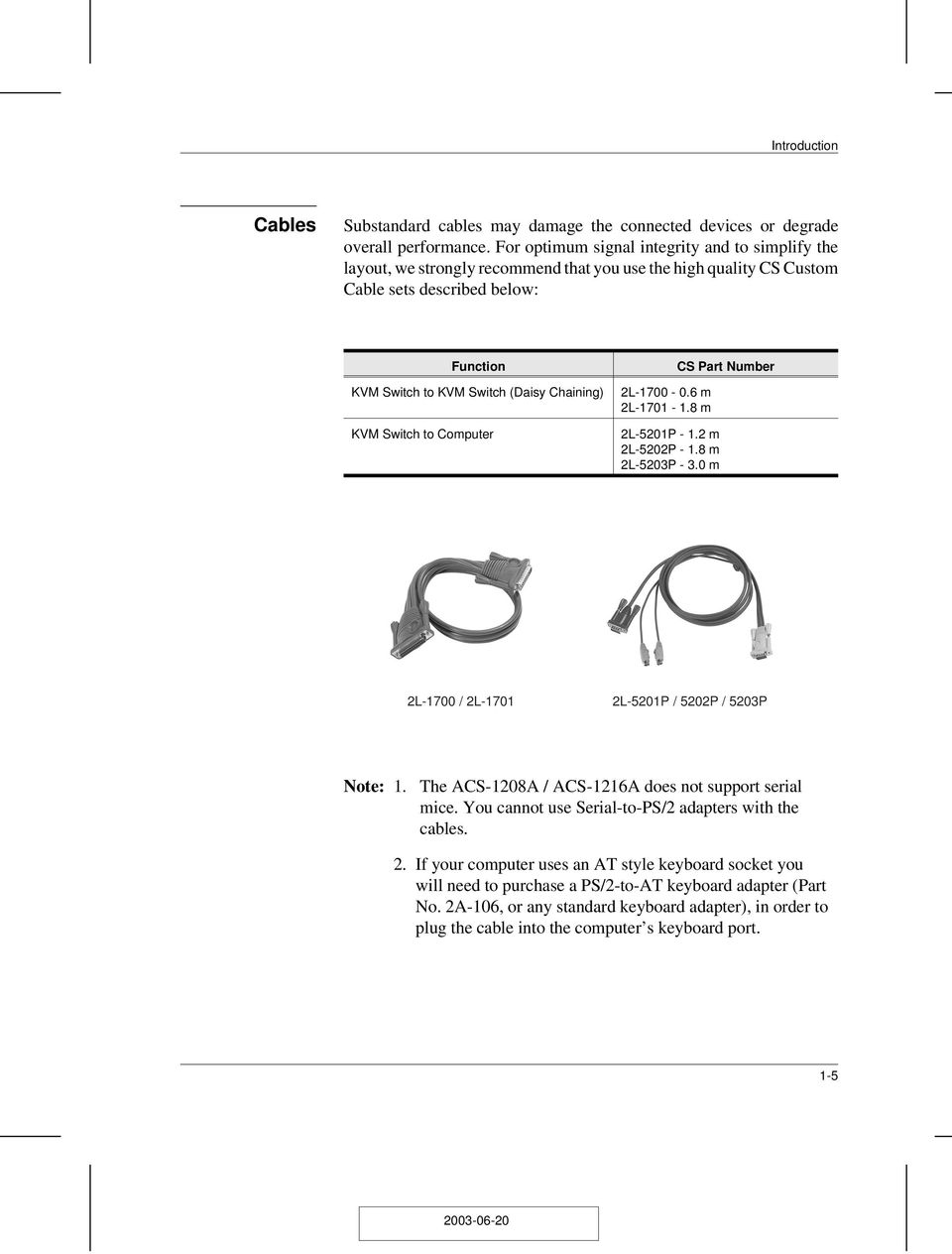
13 Introduction Cables Substandard cables may damage the connected devices or degrade overall performance. For optimum signal integrity and to simplify the layout, we strongly recommend that you use the high quality CS Custom Cable sets described below: Function KVM Switch to KVM Switch (Daisy Chaining) KVM Switch to Computer 2L m 2L m 2L-5201P m 2L-5202P m 2L-5203P m CS Part Number 2L-1700 / 2L L-5201P / 5202P / 5203P Note: 1. The ACS-1208A / ACS-1216A does not support serial mice. You cannot use Serial-to-PS/2 adapters with the cables. 2. If your computer uses an AT style keyboard socket you will need to purchase a PS/2-to-AT keyboard adapter (Part No. 2A-106, or any standard keyboard adapter), in order to plug the cable into the computer s keyboard port. 1-5
14 ACS-1208A Front View 1 POWER Port LEDs The Port LEDs provide status information about their corresponding CPU Ports. There is one pair of LEDs for each Port. The one on the left is the On Line LED; the one on the right is the Selected Port LED: w An On Line LED lights ORANGE to indicate that the computer attached to its corresponding port is up and running. w A Selected LED lights GREEN to indicate that the computer attached to its corresponding port is the one that has the KVM focus. The LED is steady under normal conditions, but flashes when its port is accessed under Auto Scan Mode (see p. 4-14). w When the ACS-1208A is first powered on, the On Line and Selected LEDs blink in sequence as the Switch performs a self-test. 2. Reset Switch Pressing this switch in performs a system reset. The switch is recessed and must be pushed with a thin object - such as the end of a paper clip, or a ballpoint pen. 1-6

15 Introduction 3. Power LED The Power LED lights to indicate that the ACS-1208A is powered up and ready to operate. 4. Station ID LED The ACS-1208A s Station ID is displayed here. If this is a Single Station installation (see p. 2-1), or the First Station on a Daisy Chained installation (see p. 2-2), the ACS-1208A has a Station ID of 01. On a Daisy Chained installation, the ACS-1208A auto-senses its position and displays the Station ID that corresponds to its place in the chain. (see Port ID Numbering, p. 2-6 for details). 1-7

16 ACS-1216A Front View 1 POWER Port LEDs The Port LEDs provide status information about their corresponding CPU Ports. There is one pair of LEDs for each Port. The one on the left is the On Line LED; the one on the right is the Selected Port LED: w An On Line LED lights ORANGE to indicate that the computer attached to its corresponding port is up and running. w A Selected LED lights GREEN to indicate that the computer attached to its corresponding port is the one that has the KVM focus. The LED is steady under normal conditions, but flashes when its port is accessed under Auto Scan Mode (see p. 4-14). w When the ACS-1216A is first powered on, the On Line and Selected LEDs blink in sequence as the Switch performs a self-test. 2. Reset Switch Pressing this switch in performs a system reset. The switch is recessed and must be pushed with a thin object - such as the end of a paper clip, or a ballpoint pen. 1-8

17 Introduction 3. Power LED Lights to indicate that the ACS-1216A is powered up and ready to operate. 4. Station ID LED The ACS-1216A s Station ID is displayed here. If this is a Single Station installation (see p. 2-1), or the First Station on a Daisy Chained installation (see p. 2-2), the ACS-1216A has a Station ID of 01. On a Daisy Chained installation, the ACS-1216A auto-senses its position and displays the Station ID that corresponds to its place in the chain. (see Port ID Numbering, p. 2-6 for details). 1-9
18 ACS-1208A / ACS-1216A Rear View Daisy Chain Ports When Daisy Chaining Units, the cables plug in here. The port on the left is the Chain In port; the one on the right is the Chain Out port. 2. CPU Port Section The cables that link to the computers plug in here. The shape of these connectors has been specifically modified so that only cables designed to work with this switch can plug in (see the Cables section on p. 1-5 for details). 3. Cable Tie Slot If you want to use a cable tie to gather the cables together, you can run it through this slot to attach it to the unit. 4. Power Jack The power adapter cable plugs in here. 1-10

19 Introduction 5. Firmware Upgrade Port The Firmware Upgrade Cable that transfers the firmware upgrade data from the administrator s computer to the ACS-1208A / ACS-1216A (see p. 5-2), plugs into this RJ-11 socket. 6. Firmware Upgrade Recovery Switch During normal operation and while performing a fimware upgrade, this switch should be in the NORMAL position. See p. 5-8 for details about the use of this switch. 7. Console Port Section If this is a Single Station installation, or if this is the First Station unit of a daisy chained installation, the keyboard, monitor, and mouse plug in here. 1-11

20 Notes: 1-12
21 Chapter 2. Installation his chapter explains how to connect up your installation from a basic single Tstage arrangement to a complete daisy chained configuration. Before you Begin 1. Make sure that power to all the devices you will be connecting up have been turned off. You must unplug the power cords of any computers that have the Keyboard Power On function. Otherwise, the switch will still receive power from the computers. 2. To prevent damage to your equipment, make sure that all devices on the installation are properly grounded. Single Stage Installation In a Single Stage installation, there are no additional switches daisy chained down from the first unit. To set up a single stage installation do the following: 1. Plug your keyboard, mouse, and monitor into the unit s Console Ports. 2. Use KVM cable sets (as described in the Cables section on p. 1-5), to connect any available CPU Port to the Keyboard, Video and Mouse ports of the computer you are installing. Note: Ignore the Daisy Chain Ports at this time. They are only used when daisy chaining additional Master View units. Daisy chaining is described in the next section. 2-1
22 3. Plug the power adapter cable into the Master View s Power Jack, then plug the power adapter into an AC power source. 4. Turn on the power to the computers. Daisy Chaining To control even more computers, up to 31 additional switches can be daisy chained down from the first unit. As many as 512 computers can be controlled from a single console in a complete installation. Tables showing the relation between the number of computers and the number of Master View ACS-1208A / ACS-1216A units needed to control them are provided on p. A-1 in the Appendix. To set up a daisy chained installation, do the following: 1. Make sure that power to all the devices you will be connecting up has been turned off. 2-2
23 Installation 2. Use a daisy chain cable set (described in the Cables section, p. 1-5), to connect the Chain Out port of the parent switch to the Chain In port of the child switch (First Station Out to Second Station In, Second Station Out to Third Station In, etc.). Note: You cannot use the Chain In port of the First Station Master View, since it is the highest level parent. 3. Use KVM cable sets (described in the Cables section, p. 1-5), to connect any available CPU Port on the ACS-1208A / ACS-1216A installation to the Keyboard, Video and Mouse ports of the computers you are installing. 4. Repeat the above steps for any additional ACS-1208A / ACS-1216A units you wish to add to the chain. 5. Power up the installation according to the following procedure: a) Plug in the power adapter for the First Station. Wait for the unit to ascertain its Station ID and display it on the Station ID LED. (The Station ID for the First Stage unit is 01, the ID for the Second Stage unit is 02, the ID for the Third Stage unit is 03, etc.). b) Plug in the power adapters for each Station on the installation in turn (Second Station, then Third Station, etc.). In each case, wait for the Station ID to be ascertained and displayed on the current Station before plugging in the next one. c) After all the Stations are up, power on the computers. 2-3
24 2-4
25 Installation Hot Plugging The ACS-1208A / ACS-1216A supports hot plugging - components can be removed and added back into the installation by unplugging their cables from the ports without the need to shut the unit down. In order for hot plugging to work properly, however, the procedures described below must be followed: Switching Station Positions: You can switch station positions by simply unplugging from the old parent and plugging into a new one. After you do, in order for the OSD menus to correspond to the change, you must reset the Station IDs in the OSD. See RESET STATION IDS, p. 4-11, for details. Hot Plugging CPU Ports: In order for the OSD menus to correspond to a CPU port change, you must manually reconfigure the OSD to reflect the new port information. See SCAN/SKIP MODE under the F3 SET function (p. 4-6), and the two Set Port selections under the F4 ADM function (p. 4-8), for details. Note: If the computer s Operating System does not support hot plugging, this function may not work properly. Hot Plugging Console Ports: The keyboard, monitor, and mouse can all be hot plugged. When hot plugging the mouse: a) You may unplug and replug the mouse (to reset the mouse, for example), as long as you use the same mouse. b) If you plug in a different mouse, all the stations and all the computers on the installation must be shut down for 10 seconds, then restarted following the Power Up Sequence described under Step 5 on p. 2-3.) Note: If, after hot plugging there is no response to keyboard and/or mouse input, perform a Keyboard and Mouse Reset by pressing in the Reset button (see p. 1-8). 2-5
26 Port ID Numbering Each CPU port on a Master View installation is assigned a unique Port ID. The Port ID is made up of two parts: a two-digit Station Number, and a two-digit Port Number: w The Station Number - reflects the switch s position in the daisy chain sequence. This corresponds to the number displayed on the front panel Station ID LED. w The Port Number - reflects the port on the Station that the computer is connected to. w The Station Number precedes the Port Number. w Station and Port numbers from 1-9 are padded with a preceding zero, so they become For example, a computer attached to Port 6 of Station 12 would have a Port ID of: Powering Off and Restarting If it becomes necessary to Power Off one of the switches, unplug its power adapter cable from the power jack. Before starting it back up you must do the following: 1. Shut down all the computers that are attached to it. Note: Unplug the power cords of any computers that have the Keyboard Power On function. Otherwise, the switch will still receive power from the computers. 2. Wait 10 seconds, then plug the Master View back in. 3. After the ACS-1208A / ACS-1216A is up, Power On the computers. Note: If you have shut down more than one Station, power up the highest Station first and work your way down to the lowest one. 2-6
27 Chapter 3. Hotkey Operation his chapter details the concepts and procedures involved in the Hotkey operation Tof your ACS-1208A / ACS-1216A installation. Hotkey Port Access Hotkey port access allows you to provide KVM focus to a particular computer directly from the keyboard. The Master View ACS-1208A / ACS-1216A provides the following Hotkey port access features: w Selecting the Active Port w Auto Scanning w Skip Mode Switching Invoking Hotkey Mode All Hotkey operations begin by invoking Hotkey Mode. Invoking Hotkey Mode takes three steps: 1. Hold down the Num Lock key; 2. While the Num Lock key is down, press and release the asterisk or the minus key; 3. Release the Num Lock key: or: [Num Lock] + [*]; [Num Lock] + [-]; Note: The asterisk or minus key must be released within one half second, otherwise Hotkey invokation is cancelled. 3-1
28 When Hotkey Mode is active: w The Caps Lock and Scroll Lock LEDs flash in succession. They stop flashing and revert to normal status when you exit Hotkey Mode. w A Command Line appears on the monitor s screen. The command line prompt is the word Hotkey: and appears in yellow text on a blue background. Subsequent Hotkey information that you key in displays on this line, as well. w Ordinary keyboard and mouse functions are suspended - only Hotkey compliant keystrokes and mouse clicks (described in the sections that follow), can be input. Pressing [Esc] exits Hotkey Mode. Selecting the Active Port Each CPU port is assigned a Port ID (see Port ID Numbering, p. 2-6). You can directly access any computer on the installation with a Hotkey that specifies the Port ID of the CPU Port that it is connected to. The steps involved are: 1. Invoke Hotkey Mode (see p. 3-1). 2. Key in the Port ID The Port ID numbers display on the Command Line as you key them in. If you make a mistake, use [Backspace] to erase the wrong number. 3. Press [Enter] The KVM focus switches to the designated computer and you automatically exit Hotkey Mode. 3-2
29 Hotkey Operation Auto Scanning Auto Scan automatically switches among all accessible CPU Ports at regular intervals, so that the operator can monitor their activity without having to switch among them manually. (See Scan/Skip Mode of the OSD F3 SET function, p. 4-7 for information regarding accessible ports.) Setting the Scan Interval: The amount of time Auto Scan dwells on each port is set with the Scan Duration setting of the OSD F3 SET function (see p. 4-7). This setting can be changed before activating Hotkey Auto Scanning with the following combination: 1. Invoke Hotkey Mode (see p. 3-1). 2. Key in [T] [n] Where [T] is the letter T, and [n] is a number from that represents the number of seconds for the dwell time. The letter T, and the numbers display on the Command Line as you key them in. If you make a mistake, use [Backspace] to erase the wrong number. 3. Press [Enter] You automatically exit Hotkey Mode, and are ready to invoke Auto Scanning. 3-3
30 Invoking Auto Scan: To start Auto Scanning, key in the following Hotkey combination: 1. Invoke Hotkey Mode (see p. 3-1). 2. Press [A]. You automatically exit Hotkey Mode, and enter Auto Scan Mode. The KVM focus switches among the accessible computers at regular intervals. While you are in Auto Scan Mode, note the following: w You can pause the scanning in order to keep the focus on a particular computer either by pressing P or with a Left Click of the mouse. During the time that Auto Scanning is paused, the Command Line displays the message: Auto Scan: Paused. Pausing when you want to keep the focus on a particular computer is more convenient than Exiting Auto Scan Mode because when you resume scanning, you start from where you left off, instead of starting over from the very first computer on the installation. To resume Auto Scanning, press any key or Left Click. w While Auto Scan Mode is in effect, ordinary keyboard and mouse functions are suspended - only Auto Scan Mode compliant keystrokes and mouse clicks can be input. You must exit Auto Scan Mode in order to regain normal control of the console. 3. To exit Auto Scan Mode press [Esc] or [Spacebar]. Auto Scanning stops when you exit Auto Scan Mode. 3-4
31 Hotkey Operation Skip Mode Skip Mode allows you to switch between computers in order to monitor them manually. Unlike Auto Scanning, which automatically switches after a fixed interval, you can dwell on a particular port for as long or as little as you like. To invoke Skip Mode, key in the following Hotkey combination: 1. Invoke Hotkey Mode (see p. 3-1). 2. Key in [Arrow] Where [Arrow] refers to one of the Arrow keys. After you press [Arrow], you automatically exit Hotkey Mode, and enter Skip Mode where you can switch ports as follows: Skips from the current port to the first accessible port previous to it. (See Scan/Skip Mode, p. 4-7, for information regarding accessible ports.) Skips from the current port to the next accessible port. Skips from the current port to the last accessible port of the previous Station. Skips from the current port to the first accessible port of the next Station. While you are in Skip Mode, note the following: w You can keep on skipping by pressing the Arrow keys. You don t have to invoke Hotkey mode each time you want to skip. w While Skip Mode is in effect, ordinary keyboard and mouse functions are suspended - only Skip Mode compliant keystrokes can be input. You must exit Skip Mode in order to regain normal control of the console. 1. To exit Skip Mode, press [Esc] or [Spacebar]. 3-5
32 Hotkey Beeper Control The Beeper (see Activate Beeper, p. 4-9) can be Hotkey toggled On and Off. To toggle the Beeper, key in the following Hotkey combination: 1. Invoke Hotkey Mode (see p. 3-1). 2. Press [B] After you press B, the Beeper toggles On or Off. The Command Line displays Beeper On or Beeper Off for one second; then the message disappears and you automatically exit Hotkey Mode. Hotkey Summary Table [Num Lock] + [*] or [Num Lock] + [-] [Port ID] [Enter] Switches access to the computer that corresponds to that Port ID. [T] [n] [Enter] Sets the Auto Scan interval to n seconds - where n is a number from [A] Invokes Auto Scan Mode. When Auto Scan Mode is in effect, [P] or Left Click pauses Auto Scanning. Pressing Any Key or another Left Click resumes Auto Scanning. [ ] [ ] [ ] [ ] [B] Invokes Skip Mode and Skips from the current port to the first accessible port previous to it. Invokes Skip Mode and Skips from the current port to the next accessible port. Invokes Skip Mode and Skips from the current port to the last accessible port of the previous Station. Invokes Skip Mode and Skips from the current port to the first accessible port of the next Station. Toggles the Beeper On or Off. 3-6
33 Chapter 4. OSD Operation his chapter provides a complete description of the procedures involved in the OSD T(On Screen Display) operation of your ACS-1208A / ACS-1216A installation. OSD Operation OSD Overview The On Screen Display (OSD) is a menu driven method to handle computer control and switching operations. All procedures start from the OSD Main Screen. To pop up the Main Screen, tap the [Scroll Lock] key twice. Note: You can optionally change the Hotkey to the Ctrl key, in which case you would tap [Ctrl] twice (see OSD HOTKEY, p. 4-6). With this method, the [Ctrl] keys must be on the same side (both left, or both right). The OSD incorporates a two level (Administrator / User) password system. Before the OSD Main Screen comes up, a dialog box appears that asks you to provide your password. If the password function has been set, you must provide the password in order to access the OSD Main Screen. If this is the first time that the OSD is being run, or if the password function has not been set, simply press [Enter]. The OSD Main Screen comes up in Administrator Mode. In this mode, you have Administrator privileges, with access to all Administrator and User functions, and can set up operations (including password authorization for the future), as you would like. 4-1
34 When you invoke the OSD, a screen similar to the one below appears: F1:GOTO F3:SET F5:SKP F7:SCAN X F2:LIST F4:ADM F6:BRC F8:LOUT zz z ADMINISTRATOR LIST:ALL SN PN QV NAME ATEN INTL.CO ATEN INTL.CO ATEN INTL.CO FAX SERVER FAX SERVER WEB SERVER WEB SERVER MAIL SERVER 1 Note: 1. The diagram depicts the Administrator s Main Screen. The User Main Screen does not show the F4 and F6 functions, since these are reserved for the Administrator and can t be accessed by ordinary Users. 2. OSD always starts in List view, with the highlight bar at the same position it was in the last time it was closed. 3. Only the ports that have been set accessible by the Administrator for the currently logged in User are visible (see SET ACCESSIBLE PORTS, p. 4-10, for details). 4-2
35 OSD Operation OSD Navigation w To dismiss the menu, and deactivate OSD, Click the X at the upper right corner of the OSD Window; or press [Esc]. w To Logout, Click F8 at the top of the Main Screen, or press [F8]. w To move up or down through the list one line at a time, Click the Up and Down Triangle symbols ( ) or use the Up and Down Arrow Keys. If there are more list entries than what can appear on the Main Screen, the screen will scroll. w To move up or down through the list one screen at a time, Click the Up and Down Arrow symbols (éê), or use the [Pg Up] and [Pg Dn] keys. If there are more list entries than what can appear on the Main Screen, the screen will scroll. w To activate a port, Double Click it, or move the Highlight Bar to it then press [Enter]. w After executing any action, you automatically go back to the menu one level above. OSD Main Screen Headings Heading SN-PN QV NAME Explanation This column lists the Port ID numbers (Station Number - Port Number) for all the CPU ports on the installation. The simplest method to access a particular computer is move the Highlight Bar to it, then press Enter. If a port has been selected for Quick View scanning (see SET QUICK VIEW PORTS, p. 4-10), an arrowhead displays in this column to indicate so. The computers that are powered on and are On Line have a Sun symbol in this column to indicate so. If a port has been given a name (seeedit PORT NAMES, p. 4-9), its name appears in this column. 4-3
36 OSD Functions OSD functions are used to configure and control the OSD. For example, you can: rapidly switch to any port; scan selected ports only; limit the list you wish to view; designate a port as a Quick View Port; create or edit a port name; or make OSD setting adjustments. To access an OSD function: 1. Either Click a Function Key field at the top of the Main Screen, or press a Function Key on the keyboard. 2. In the Submenus that appear make your choice either by Double Clicking it, or moving the Highlight Bar to it, then pressing [Enter]. 3. Press [Esc] to return to the previous menu level. F1 GOTO: GOTO allows you to switch directly to a port either by keying in the port s Name, or its Port ID. w To use the Name method, key in 1; key in the port s Name; then press [Enter]. w To use the Port ID method, key in 2; key in the Port ID; then press [Enter]. Note: You can key in a partial Name or Port ID. In that case, the screen will show all the computers that the User has View rights to (see SET ACCESSIBLE PORTS, p. 4-10), that match the Name or Port ID pattern, regardless of the current List settings (see F2 LIST, p. 4-5, for details). To return to the OSD Main Screen without making a choice, press [Esc]. 4-4
37 OSD Operation F2 LIST: The LIST function lets you broaden or narrow the scope of which ports the OSD displays (lists) on the Main Screen. Many of the OSD functions only operate on the computers that have been selected for listing on the Main Screen with this function. The choices and their meanings are given in the table below: Choice Meaning ALL QVIEW POWERED ON QVIEW + POWERED ON Lists all of the ports on the installation. Lists only the ports that have been selected as Quick View Ports (see SET ACCESSIBLE PORTS, p. 4-10). Lists only the ports whose computers are Powered On. Lists only the ports that have been selected as Quick View Ports (see SET QUICK VIEW PORTS, p. 4-10), and whose computers are Powered On. Move the Highlight Bar to the choice you want, then press [Enter]. An icon appears before the choice to indicate that it is the currently selected one. 4-5
38 F3 SET: This function allows the Administrator and each User to set up his own working environment. A separate profile for each is stored by the OSD and is activated according to the Username that is provided during Login. To change a setting: 1. Double Click it; or move the highlight bar to it, then press [Enter]. 2. After you select an item, a submenu with further choices appears. To make a selection, either Double Click it; or move the Highlight Bar to it, then press [Enter]. An icon appears before the selected choice to indicate which one it is. The settings are explained in the following table: Setting OSD HOTKEY Function Selects which Hotkey activates the OSD function: [Scroll Lock] [Scroll Lock] or [Ctrl] [Ctrl]. Since the Ctrl key combination may conflict with programs running on the computers, the default is the Scroll Lock combination. PORT ID DISPLAY POSITION Allows you to position where the Port ID appears on the screen. The default is the upper right corner, but you can choose to have it appear anywhere on the screen. Use the Mouse or the Arrow Keys plus Pg Up, Pg Dn, Home, End, and 5 (on the numeric keypad with Num Lock off), to position the Port ID display, then Double Click or press [Enter] to lock the position and return to the Set submenu. PORT ID DISPLAY DURATION Determines how long a Port ID displays on the monitor after a port change has taken place. The choices are: User Defined - which lets you select the amount of time (from sec.); and Always On - which displays the Port ID at all times. If you select User Defined, key in the number of seconds, then press [Enter]. The default is 3 Seconds. A setting of 0 (zero) disables this function. (Table continues on next page) 4-6
39 OSD Operation (F3 SET: continued) Setting PORT ID DISPLAY MODE SCAN DURATION SCAN/SKIP MODE Function Selects how the Port ID is displayed: the Port Number alone (PORT NUMBER); the Port Name alone (PORT NAME); or the Port Number plus the Port Name (PORT NUMBER + PORT NAME). The default is PORT NUMBER + PORT NAME). Determines how long the focus dwells on each port as it cycles through the selected ports in Auto Scan Mode (see F7 SCAN, p. 4-14). Key in a value from seconds, then press [Enter]. Default is 5 seconds; a setting of 0 disables the Scan function. Selects which computers will be accessed under Skip Mode (see F5 SKP, p. 4-12), and Auto Scan Mode (see F7 SCAN, p. 4-14). Choices are: ALL - All the Ports which have been set Accessible (see SET ACCESSIBLE PORTS, p. 4-10); QUICK VIEW - Only those Ports which have been set Accessible and have been selected as Quick View Ports (see SET QUICK VIEW PORTS, p. 4-10); POWERED ON - Only those Ports which have been set Accessible and are Powered On; QUICK VIEW + POWERED ON - Only those Ports which have been set Accessible and have been selected as Quick View Ports and are Powered On. The default is ALL. SCREEN BLANKER HOTKEY COMMAND MODE If there is no input from the console for the amount of time set with this function, the screen is blanked. Key in a value from 1-30 minutes, then press [Enter]. A setting of 0 disables this function. The default is 0 (disabled). Enables / Disables the Hotkey Command function in case a conflict with programs running on the computers occurs. 4-7
40 F4 ADM: F4 is an Administrator only function. It allows the Administrator to configure and control the overall operation of the OSD. To change a setting Double Click it; or use the Up and Down Arrow Keys to move the highlight bar to it then press [Enter]. After you select an item, a submenu with further choices for you to select from appears. Double Click the choice you want, or move the Highlight Bar to it then press [Enter]. An icon appears before the selected choice so that you know which one it is. The settings are explained in the following table: Setting SET USERNAME AND PASSWORD Function This function is used to set Usernames and Passwords for the Administrator and Users: 1. One Administrator and four User passwords can be set. 2. After you select the Administrator field or one of the User fields, a screen that allows you to key in the password appears. The password may be up to 15 characters long, and can consist of any combination of letters and numbers (A - Z, 0-9). 3. For each individual, key in the Username and Password, then press [Enter]. 4. To modify or delete a previous Username and/or Password, use the backspace key to erase individual letters or numbers. 5. As a security precaution, you shoud fill in a Username and Password for all four Users. SET LOGOUT TIMEOUT If there is no input from a console for the amount of time set with this function, the Operator is automatically logged out. A login is necessary before the console can be used again. This enables other Operators to gain access to the computers when the original Operator is no longer accessing them, but has forgotten to log out. To set the timeout value, key in a number from minutes, then press [Enter]. If the number is 0 [zero], this function is disabled. Default is 0 (disbabled). (Table continues on next page) 4-8
41 OSD Operation (F4 ADM: continued) Setting EDIT PORT NAMES Function To help remember which computer is attached to a particular port, every port can be given a name. This function allows the Administrator to create, modify, or delete port names. To Edit a port name: 1. Click the port you want, or use the Navigation Keys to move the highlight bar to it, then press [Enter]. 2. Key in the new Port Name, or modify/delete the old one. The maximum number of characters allowed for the Port Name is 12. Legal characters include: w All alpha characters: a - z; A - Z w All numeric characters: 0-9 w + - / :. and Space Case does not matter; OSD displays the Port Name in all capitals no matter how they were keyed in. 3. When you have finished editing, press [Enter] to have the change take effect. To abort the change, press [Esc]. RESTORE DEFAULT VALUES CLEAR THE NAME LIST ACTIVATE BEEPER This function is used to undo all changes except for the Names settings, and return the setup to the original factory default settings (see FACTORY DEFAULT SETTINGS, p. A-2). The Names settings that were assigned to the Ports, are saved. This function is similar to Restore Default Values. The difference is that it also clears the Names settings along with undoing all changes and returning the setup to the original factory default settings. Choices are Y (for Yes), or N (for No). When activated, the beeper sounds whenever a Port is changed; when activating the Auto Scan function (see F7 SCAN, p. 4-14); or an invalid entry is made on an OSD menu. The default is Y (activated). (Table continues on next page) 4-9
42 (F4 ADM: continued) Setting SET QUICK VIEW PORTS Function This function lets the Administrator select which Ports to include as Quick View ports. w w w w To select/deselect a port as a Quick View Port, Double Click the port you want, or use the Navigation Keys to move the highlight bar to it, then press [Enter]. When a port has been selected as a Quick View Port, an arrowhead displays in the QV column of the LIST on the Main Screen to indicate so. When a port is deselected, the arrowhead disappears. If one of the Quick View options is chosen for the LIST view (see F2 LIST, p. 4-5), only a Port that has been selected here will display on the List. If one of the Quick View options is chosen for Auto Scanning (see SCAN/SKIP MODE, p. 4-7), only a Port that has been selected here will be Auto Scanned. The default is for no ports to be selected. SET ACCESSIBLE PORTS This function allows the Administrator to define access to the computers on the installation on a Port-by-Port basis for each User. For each User, select the target Port; then press the [Spacebar] to cycle through the choices: F (Full access), V (View Only), or blank. Repeat until all access rights have been set, then press [Enter]. The default is F for all users on all Ports. Note: A blank setting means that no access rights are granted. The Port will not show up on the User s LIST on the Main Screen. (Table continues on next page) 4-10
43 OSD Operation (F4 ADM: continued) Setting RESET STATION IDS Function If you change the position of one of the Stations in the daisy chain, the OSD settings will no longer correspond to the new situation. This function directs the OSD to rescan the Station positions of the entire installation and updates the OSD so that the OSD Station information corresponds to the new physical layout. Note: Only the Station Numbers get updated. Except for the Port Names, all Administrator settings (such as Set Accessible Ports, Set Quick View Ports, etc.), for all of the computers affected by the change, have to be manually redone. FIRMWARE UPGRADE In order to upgrade the ACS-1208A / ACS-1216A s firmware (see Chapter 5), you must first invoke Firmware Upgrade Mode with this setting. 4-11
44 F5 SKP: This function enables you to easily skip backward or forward - switching the console focus from the currently active computer port to the previous or next available one. w The selection of computers to be available for Skip Mode switching is made with the Scan/Skip Mode setting under the F3 SET function (see p. 4-7). w When you are in Skip Mode, press [ ] to switch to the previous computer in the List; press [ ] to switch to the next computer in the List; press [ ] to switch to the last computer on the previous station in the List; press [ ] to switch to the first computer on the next station in the List. Note: When you Skip, you only Skip to the the previous or next available computer that is in the Scan/Skip Mode selection (see p. 4-7). w If a Port has been selected for Scan/Skip Mode, when the focus switches to that port a Left/Right Triangle symbol appears before its Port ID Display to indicate so. w While Skip Mode is in effect, the console will not function normally. You must exit Skip Mode in order to regain control of the console. w To exit Skip Mode, press [Spacebar] or [Esc]. 4-12
45 OSD Operation F6 BRC: F6 is an Administrator only function. When this function is in effect, commands sent from the console are broadcast to to all available computers on the installation. This function is particularly useful for operations that need to be performed on multiple computers, such as performing a system wide shutdown, installing or upgrading software, etc. BRC works in conjunction with the F2 LIST function. The LIST function (see p. 4-5), is used to broaden or narrow the focus of which Ports appear on the OSD Main Screen. When you Broadcast a command, it only goes to the Ports currently selected to be listed on the OSD Main Screen. w While BRC Mode is in effect, a Speaker symbol appears before the Port ID Display of the port that currently has the KVM focus. w While BRC Mode is in effect, the mouse will not function normally. You must exit BRC Mode in order to regain control of the mouse. w To exit BRC Mode, invoke the OSD (with the OSD Hotkey), then Click the F6 field, or press [F6], to turn BRC Mode off. 4-13
46 F7 SCAN: The SCAN function allows you to automatically switch among the available computers at regular intervals so that you can monitor their activity without having to take the trouble of switching manually. w The selection of computers to be included for Auto Scanning is made with the Scan/Skip Mode setting under the F3 SET function (see p. 4-7). w The amount of time that each Port displays for is set with the Scan Duration setting under the F3 SET function (see p. 4-7). w If the scanning stops on an empty port, or one where the computer is attached but is powered Off, the monitor screen will be blank, and the mouse and keyboard will have no effect. Simply wait - after the Scan Duration time is up, the Scan function will move on to the next port. w As each computer is accessed, an S appears in front of the Port ID display to indicate that it is being accessed under Auto Scan Mode. w If you want to temporarily keep the focus on a particular computer, you can pause the scanning either by pressing P, or with a Left Click of the mouse. See Invoking Auto Scan, p. 3-4, for details. w When you want to permanently stop scanning at a particular location, press the [Spacebar] to stop scanning and exit Auto Scan Mode. w To exit Auto Scan Mode, press the [Spacebar] or [Esc]. 4-14
47 OSD Operation F8 LOUT: This function logs you out of OSD control of the computers, and blanks the Console screen. After using this function you must log in all over again to regain access to the OSD. This is different from simply pressing [Esc] when you are at the Main Screen to deactivate the OSD, where all you have to do to reenter the OSD is tap the OSD Hotkey. Note: 1. When you reenter the OSD after logging out, the screen stays blank except for the OSD Main Screen. You must input your password before you can continue. 2. If you reenter the OSD after logging out, and immediately use [Esc] to deactivate the OSD without having selected a port from the OSD menu, a Null Port message displays on the screen. The OSD Hotkey will bring up the Main OSD Screen. 4-15
48 Notes: 4-16
49 Chapter 5. The Firmware Upgrade Utility his chapter explains the use and function of the Firmware Upgrade Utility: how to get Tthe firmware upgrade files; and how to complete the process successfully. Introduction Purpose The purpose of the Windows-based Firmware Upgrade Utility (FWUpgrade.exe) is to provide an automated process for make upgrading the KVM switch s firmware as smooth and painless as possible. The Utility comes as part of a Firmware Upgrade Package that is specific for each device. As new firmware revisions become available, new firmware upgrade packages are posted on our web site: Check the web site regularly to find the latest packages and information relating to them. 5-1
50 Before You Begin To prepare for the firmware upgrade, do the following: 1. From a computer that is not part of your KVM installation go to our Internet support site and choose the model name that relates to your device to get a list of available Firmware Upgrade Packages. 2. Choose the Firmware Upgrade Package you want to install (usually the most recent), and download it to your computer. 3. Use the Firmware Upgrade Cable (provided with this unit), to connect a COM port on your computer to the Firmware Upgrade Port of your device. Note: On a daisy chained installation, connect the cable to the First Station (Master) unit. The chained stations (Slaves) will receive the upgrade via the daisy chain cables. 4. Shut down all of the computers - but not the Stations - on your KVM installation. 5. From your KVM switch console, bring up the OSD (see p. 4-1) and select the F4ADM function. 6. Scroll down to FIRMWARE UPGRADE. Press [Enter], then press [Y] to invoke Firmware Upgrade Mode (see p ) For your reference, the current firmware upgrade version displays on the screen. 5-2
51 The Firmware Upgrade Utility Performing the Upgrade Starting the Upgrade To upgrade your firmware: 1. Run the downloaded Firmware Upgrade Package file - either by double clicking the file icon, or by opening a command line and entering the full path to it. The Firmware Upgrade Utility Welcome screen appears: 2. Read and Agree to the License Agreement (enable the I Agree radio button). 5-3
52 3. Click Next to continue. The Firmware Upgrade Utility main screen appears: The Utility inspects your installation. All the devices capable of being upgraded by the package are listed in the Device List panel. 4. As you select a device in the list, its description appears in the Device Description panel. 5-4
53 The Firmware Upgrade Utility 5. After you have made your device selection(s), Click Next to perform the upgrade. If you enabled Check Firmware Version, the Utility compares the device s firmware level with that of the upgrade files. If it finds that the device s version is higher than the upgrade version, it brings up a dialog box informing you of the situation and gives you the option to Continue or Cancel. If you didn t enable Check Firmware Version, the Utility installs the upgrade files without checking whether they are a higher level, or not. As the Upgrade proceeds status messages appear in the Status Messages panel, and the progress toward completion is shown on the Progress bar. 5-5
54 Upgrade Succeeded After the upgrade has completed, a screen appears to inform you that the procedure was successful: Click Finish to close the Firmware Upgrade Utility. 5-6
55 The Firmware Upgrade Utility Upgrade Failed If the upgrade failed to complete successfully a dialog box appears asking if you want to retry. Click Yes to retry. If you Click No, the Upgrade Failed screen appears: Click Cancel to close the Firmware Upgrade Utility. See the next section, Firmware Upgrade Recovery, for how to proceed. 5-7
56 Firmware Upgrade Recovery There are basically three conditions that call for firmware upgrade recovery: w When you invoke Firmware Upgrade Mode (see p. 5-2), but decide not to proceed with the upgrade. w When the Mainboard firmware upgrade fails. w When the I/O firmware upgrade fails. To perform a firmware upgrade recovery, do the following: 1. Slide the Firmware Upgrade Recovery Switch (see p. 1-11) to the Recover position. 2. Power off and restart the switch according to the instructions given in the Powering Off and Restarting section (p. 2-6). 3. Slide the Firmware Upgrade Recovery Switch back to the Normal position. 4. Repeat Step 2. Note: If one of the slave units fails to upgrade successfully, unchain it from the installation and perform the recovery and upgrade operation independently. After it has been succussfully upgraded, plug it back into the chain. 5-8
57 Appendix his appendix provides specifications and other technical information regarding the TACS-1208A / ACS-1216A. ACS-1208A /ACS-1216A - Connection Tables The following tables indicate the relationship between the number of Master View units and the number of computers that they control: ACS-1208A MVs Computers MVs Computers MVs Computers MVs Computers A-1
58 ACS-1216A MVs Computers MVs Computers MVs Computers MVs Computers OSD Factory Default Settings The factory default settings are as follows: Setting OSD Hotkey Port ID Display Position Port ID Display Duration Port ID Display Mode Scan Duration Scan/Skip Mode Screen Blanker Logout Timeout Beeper Accessible Ports Default [Scroll Lock] [Scroll Lock] Upper Right Corner 3 Seconds The Port Number plus the Port Name 5 Seconds All 0 (Disabled) 0 (Disabled) Y (Activated) F (Full) For all Users on all Ports A-2
59 Appendix Clear Login Information If you are unable to perform an Administrator login (because the Username and Password information has become corrupted, or you have forgotten it, for example), you can clear the login information with the following procedure: 1. Power off the switch and remove its housing. 2. Short the jumper labeled Default Password at the right front of the switch s main board. 3. Power on the switch. When you power the switch on, the following message appears on the LCD display: USERNAME AND PASSWORD INFORMATION HAS BEEN CLEARED. PLEASE POWER OFF THE SWITCH, REMOVE THE JUMPER, CLOSE THE CASE, THEN RESTART. 4. After you start back up, the OSD login function acts exactly the way it did the first time the switch was run (see p. 4-2) and you can reset passwords for the Administrators and Users. A-3
60 Specifications Function ACS-1208A ACS-1216A Computer Connections Port Selection Direct 8 16 Max 256 (via Daisy Chain) 512 (via Daisy Chain) OSD (On Screen Display); Hotkeys LEDs On Line 8 (Orange) 16 (Orange) Selected 8 (Green) 16 (Green) Power 1 (Blue) Console Connectors Keyboard Mouse Video 2 x 7 Segments 1 x 6 pin mini DIN F 1 x 6 pin mini DIN F 1 x HDB-15 F Computer Port Connectors 8 x SPDB-15 F 16 x SPDB-15 F Daisy Chain Ports 1 x DB-25 M; 1 x DB-25 F Scan Interval (OSD Select) User Specified: secs. Emulation Keyboard PS/2 Mouse PS/2 Video 1920 x 1440; DDC2B Power Consumption DC 9V; 7.5W (max.) DC 9V; 8W (max.) Operating Temperature Storage Temperature Humidity Housing 0-50 o C o C 0-80% RH Metal Weight 2.73 kg 2.83 kg Dimensions (L x W x H) 48.3 x 15.5 x 4.5 cm (19" 1U) A-4
61 Appendix Rack Mounting The ACS-1208A / ACS-1216A can be mounted in a 1U system rack. For convenience and flexibility, the mounting brackets can screw into either the front or the back of the unit so that it can attach to the front or the back of the rack.to rack mount the unit do the following: 1. Screw the mounting brackets into the sides of the unit at the front or the rear, as shown in the diagrams below. 2. Slide the unit into the rack and secure it to the rack. A-5
62 Troubleshooting Symptom Possible Cause Action Erratic behavior. Mouse and/or Keyboard not responding. All Station IDs display as 01. Unit not receiving enough power. Improper mouse and/or keyboard reset. Station 1 has suddenly lost power. Check that the Power Adapter that was supplied with the unit is plugged in and functioning properly. Unplug the cable(s) from the console port(s), then plug it/them back in. Wait a few seconds for the system to reinitialize the station sequence and display the proper IDs. Limited Warranty IN NO EVENT SHALL THE DIRECT VENDOR S LIABILITY EXCEED THE PRICE PAID FOR THE PRODUCT FROM THE DIRECT, INDIRECT, SPECIAL, INCIDENTAL OR CON- SEQUENTIAL DAMAGES RESULTING FROM THE USE OF THE PRODUCT, DISK OR ITS DOCUMENTATION. The direct vendor makes no warranty or representation, expressed, implied, or statutory with respect to the contents or use of this documentation, and specially disclaims its quality, performance, merchantability, or fitness for any particular purpose. The direct vendor also reserves the right to revise or update the device or documentation without obligation to notify any individual or entity of such revisions, or update. For further inquires please contact your direct vendor. A-6
63 Index A ACS-1208A Computer Connection Table A-1 Front View Rear View ACS-1216A Computer Connection Table A-2 Front View Rear View Activate Beeper ADM Administrator functions Auto Scanning Invoking Auto Scan Pausing Auto Scan Scan Duration Setting the Scan Interval Stopping B Beeper Activate Control BRC Broadcast Mode C Clear Login Information A-3 Clear the Name List Computer Connection Tables A-1 E - F Edit Port Names F F1 GOTO F2 LIST F3 SET F4 ADM F5 SKP F6 BRC F7 SCAN F8 LOUT Factory Default Settings A-2 Firmware upgrade cable port , 5-2 recovery recovery switch Firmware upgrade mode invoking G - H GOTO Hardware Requirements Computer Console Hardware Requirments Cables Hot Plugging Console Ports CPU Ports Hotkey Beeper Control Command Mode Invoking Hotkey Mode OSD Selecting the Active Port Summary Table I Installation Daisy Chaining Single Stage Invoke firmware upgrade Invoking Hotkey Mode I - i
64 ACS-1208A / ACS-1216A User Guide L LIST Logout Logout Timeout LOUT O OSD Factory Default Settings A-2 Functions Hotkey , 4-6 Logout Main Screen Main Screen Headings Navigation Overview Password P Password , 4-8 Pause Port ID Display Duration Display Mode Display Position Numbering Port Names Powering Off and Restarting Q - R Quick View Ports Rack Mounting A-5 Recovery switch Reset Station IDs Restore Default Values S SCAN Scan Duration SCAN/SKIPMODE Screen Blanker Selecting the Active Port SET Accessible Ports Logout Timeout Password Quick View Ports Username Setting the Auto Scan Interval Skip Mode , 4-7, 4-12 SKP Specifications A-4 Station IDs , 2-3 Reset Station Positions Switching Switching Station Positions T Timeout Troubleshooting A-6 U Upgrading the firmware Username I - ii
8 Port KVM Switch. User Manual CS-128A
 8 Port KVM Switch User Manual CS-128A Packing List The complete Master View Pro package consists of: One CS-128A KVM Switch One Power Adapter One User Manual Check to make sure that the unit was not damaged
If anything is damaged or missing, contact your dealer.
 User Manual CS-62 Read this guide thoroughly and follow the installation and operation procedures carefully in order to prevent any damage to the units and/or any devices that connect to them. This package
If anything is damaged or missing, contact your dealer.
 User Manual CS-62U Read this guide thoroughly and follow the installation and operation procedures carefully in order to prevent any damage to the units and/or any devices that connect to them. This package
2 Port KVM Switch. If anything is damaged or missing, contact your dealer.
 2 Port KVM Switch User Manual CS-82A Read this guide thoroughly and follow the installation and operation procedures carefully in order to prevent any damage to the units and/or any devices that connect
KVM Switch CS1308 / CS1316 User Manual
 KVM Switch CS1308 / CS1316 User Manual www.aten.com FCC Information This is an FCC Class A product. In a domestic environment this product may cause radio interference in which case the user may be required
CONSOLE REMOTE I /O AC 9V
 CONSOLE CONSOLE REMOTE I /O AC 9V AC 9V REMOTE I /O User Manual CE-220 Read this guide thoroughly and follow the installation and operation procedures carefully in order to prevent any damage to the units
USB KVM Switch USER MANUAL CS62US / CS64US
 USB KVM Switch USER MANUAL CS62US / CS64US EMC Information FEDERAL COMMUNICATIONS COMMISSION INTERFERENCE STATEMENT: This equipment has been tested and found to comply with the limits for a Class B digital
If anything is damaged or missing, contact your dealer.
 User Manual CS-114A Read this guide thoroughly and follo the installation and operation procedures carefully in order to prevent any damage to the units and/or any devices that connect to them. This package
USB 2.0 DVI KVM Switch USER MANUAL CS682
 USB 2.0 DVI KVM Switch USER MANUAL CS682 FCC Information This equipment has been tested and found to comply with the limits for a Class B digital device, pursuant to Part 15 of the FCC Rules. These limits
USER MANUAL VS92A / VS94A / VS98A
 Video Splitter USER MANUAL VS92A / VS94A / VS98A FCC Information This equipment has been tested and found to comply with the limits for a Class B digital device, pursuant to Part 15 of the FCC Rules. These
User Manual 2-Port USB KVM Switch with Audio GCS632U PART NO. M0104
 User Manual 2-Port USB KVM Switch with Audio 1 GCS632U PART NO. M0104 Welcome Thank you for purchasing one of the most feature-rich keyboard, video, and mouse switches on the market. IOGEAR s MiniView
DVI 2/4 PORT USB KVMP Switch
 MiniView DVI 2/4 PORT USB KVMP Switch User Manual (GCS1762 / GCS1764) Welcome Thank you for purchasing one of the most feature-rich DVI KVM with USB peripheral sharing and audio technology on the market.
User Manual CS-1742 CS-1744
 User Manual CS-1742 CS-1744 FCC Information This is an FCC Class A product. In a domestic environment this product may cause radio interference in which case the user may be required to take adequate measures.
USB 2.0 Peripheral Switch USER MANUAL US221A / US421A
 USB 2.0 Peripheral Switch USER MANUAL US221A / US421A FCC Information This equipment has been tested and found to comply with the limits for a Class B digital device, pursuant to Part 15 of the FCC Rules.
MiniView Dual View USB KVMP Switch. User Manual (GCS1742 / GCS1744)
 MiniView Dual View USB KVMP Switch User Manual (GCS1742 / GCS1744) 1 Welcome Thank you for purchasing one of the industry s most feature-rich dual display KVMs, with USB peripheral sharing and audio technology.
MiniView Micro USB Plus
 MiniView Micro USB Plus 2-Port KVM Switch with Built-in KVM Cables and Audio Support Installation Manual (GCS632U) 2003 IOGEAR. All Rights Reserved. PKG-M0089 IOGEAR, the IOGEAR logo, MiniView, VSE are
VS-0202 VS-0204. User Manual
 User Manual VS-0202 VS-0204 Read this guide thoroughly and follow the installation and operation procedures carefully in order to prevent any damage to the units and/or any devices that connect to them.
TruLink VGA and PS/2 KVM USER MANUAL
 TruLink VGA and PS/2 KVM USER MANUAL Part #52041 Part #52042 Contents Introduction...2 Overview...2 Package Contents...3 Requirements...4 Console...4 Computers...4 Cables...4 Safety Instructions...5 Hardware
3NNet KVM CP-104S /OSD / 19 KVM CP-108S / OSD / 19 KVM CP-116S / OSD / 19
 3NNet USERS MANUAL KVM CP-104S /OSD / 19 KVM CP-108S / OSD / 19 KVM CP-116S / OSD / 19 RACK MOUNTABLE 4 / 8 / 16 PORT PS2 KVM SWITCH Rev 1.1 TABLE OF CONTENTS INTRODUCTION.. 3 FEATURES... 3 PACKAGE CONTENTS........
MiniView Micro USB Plus 2-Port KVM Switch with Built-in KVM Cables and Audio Support. Installation Manual (GCS632U)
 MiniView Micro USB Plus 2-Port KVM Switch with Built-in KVM Cables and Audio Support Installation Manual (GCS632U) 2005 IOGEAR. All Rights Reserved. PKG-M0089b IOGEAR, the IOGEAR logo, MiniView, VSE are
Laptop USB KVM Switch USER MANUAL CS661
 Laptop USB KVM Switch USER MANUAL CS661 FCC Information This equipment has been tested and found to comply with the limits for a Class B digital device, pursuant to Part 15 of the FCC Rules. These limits
DVI Video Splitter USER MANUAL VS-162 / VS-164
 DVI Video Splitter USER MANUAL VS-162 / VS-164 FCC Information This equipment has been tested and found to comply with the limits for a Class B digital device, pursuant to Part 15 of the FCC Rules. These
8-port USB DVI KVM Switch CS1768 User Manual
 8-port USB DVI KVM Switch CS1768 User Manual www.aten.com FCC Information This is an FCC Class A product. In a domestic environment this product may cause radio interference in which case the user may
8-port USB DVI KVM Switch CS1768 / CS1788 User Manual
 8-port USB DVI KVM Switch CS1768 / CS1788 User Manual www.aten.com FCC Information This is an FCC Class A product. In a domestic environment this product may cause radio interference in which case the
8-Port HDMI Switch USER MANUAL VS0801H
 8-Port HDMI Switch USER MANUAL VS0801H FCC Information This equipment has been tested and found to comply with the limits for a Class B digital device, pursuant to Part 15 of the FCC Rules. These limits
User Manual 8-Port DVI KVMP Switch with VGA support
 User Manual 8-Port DVI KVMP Switch with VGA support 1 GCS1108 PART NO. M1207 2012 IOGEAR. All Rights Reserved. Part No. M1207 IOGEAR, the IOGEAR logo, MiniView, VSE are trademarks or registered trademarks
PS/2-USB KVM Switch CS82U / CS84U User Manual
 PS/2-USB KVM Switch CS82U / CS84U User Manual www.aten.com FCC Information This equipment has been tested and found to comply with the limits for a Class B digital device, pursuant to Part 15 of the FCC
USB 2.0 KVMP Switch with OSD CS1732B / CS1734B User Manual
 USB 2.0 KVMP Switch with OSD CS1732B / CS1734B User Manual www.aten.com FCC Information This equipment has been tested and found to comply with the limits for a Class B digital device, pursuant to Part
How To Use A Ves-0116 Video Splitter With Audio And Video From A Computer Or Tv Aten (Ves-116)
 User Manual VS-0116 Read this guide thoroughly and follow the installation and operation procedures carefully in order to prevent any damage to the units and/or any devices that connect to them. This package
USB 2.0 KVMP Switch with OSD CS1732B / CS1734B. User Manual. www.aten.com
 USB 2.0 KVMP Switch with OSD CS1732B / CS1734B User Manual www.aten.com FCC Information This equipment has been tested and found to comply with the limits for a Class B digital device, pursuant to Part
USB KVM Switch. with Audio & Ethernet Hub
 USB KVM Switch with Audio & Ethernet Hub FCC Compliance Statement This equipment has been tested and found to comply with the limits for a Class B digital device, pursuant to part 15 of the FCC Rules.
KVM-1501/ KVM-1508/ KVM-1516 KVM-1701/ KVM-1708/ KVM-1716 USER MANUAL
 LCD KVM SWITCH KVM-1501/ KVM-1508/ KVM-1516 KVM-1701/ KVM-1708/ KVM-1716 USER MANUAL Table of content 1. BRIEF INTRODUCTION...1 2. PACKAGE INSIDE...1 3. FEATURES...2 3.1 Computer System...2 3.2 Cable...2
Rack Mount LCD KVM Assembly Installer/User Guide
 Rack Mount LCD KVM Assembly Installer/User Guide Japanese Notification Chinese Notification Taiwanese Notification Rack Mount LCD KVM Assembly Installer/User Guide Avocent, the Avocent logo and The Power
USB / USB 2.0 DVI KVMP
 USB / USB 2.0 DVI KVMP Switch CS1762 / CS1764A User Manual www.aten.com FCC Information This equipment has been tested and found to comply with the limits for a Class B digital device, pursuant to Part
User Manual CN-6000 2003-11-14
 User Manual CN-6000 Warning! This is a class A product. In a domestic environment this product may cause radio interference in which case the user may be required to take adequate measures. This equipment
Video Keyboard Mouse Audio automatic Switch CAS-241, CAS-441, CAS-441-PM
 CAS-241, CAS-441, CAS-441-PM USER MANUAL Please read this manual and follow the installation procedure carefully to prevent any damage to the VKMA switch and/or to the connected devices. 2 Disclaimer We
SwitchView 1000 Switch. Installer/User Guide
 SwitchView 1000 Switch Installer/User Guide SwitchView 1000 Switch Installer/User Guide Avocent, the Avocent logo, The Power of Being There and SwitchView are registered trademarks of Avocent Corporation.
MiniView II 4 Port USB KVM Swtich (GCS124U Installation Manual)
 MiniView II 4 Port USB KVM Swtich (GCS124U Installation Manual) 2001 IOGEAR. All Rights Reserved. IOGEAR, the IOGEAR logo, MiniView, VSE are trademarks or registered trademarks of IOGEAR, Inc. Microsoft
2 Port USB/ VGA KVM Switch with Ethernet Switch and Audio & USB Hub
 2 Port USB/ VGA KVM Switch with Ethernet Switch and Audio & USB Hub SV231USBAN SV431USBAN *SV231USBAN shown DE: Bedienungsanleitung - de.startech.com FR: Guide de l'utilisateur - fr.startech.com ES: Guía
HDMI Matrix Switch USER MANUAL VM0404H
 HDMI Matrix Switch USER MANUAL VM0404H FCC Information This equipment has been tested and found to comply with the limits for a Class B digital device, pursuant to Part 15 of the FCC Rules. These limits
CAT5 KVM Extender User Manual
 User Manual V2.1 2007.7.3 C o n t e n t s 1. Introduction... 3 1.1 Product Line... 4 1.2 Main Features... 5 1.3 Package contents... 6 1.4 Cables Diagrams... 6 1.4.1 3-in-1 DB15 Cable...6 1.4.2 3-in-1 CAT5
USB/VGA Cat 5 UTP Console Extender
 USB/VGA Cat 5 UTP Console Extender SV565UTPU SV565UTPUGB SV565UTPUEU Instruction Manual FCC Compliance Statement This equipment has been tested and found to comply with the limits for a Class B digital
HDMI Switch USER MANUAL VS481A
 HDMI Switch USER MANUAL VS481A FCC Information This equipment has been tested and found to comply with the limits for a Class B digital device, pursuant to Part 15 of the FCC Rules. These limits are designed
LCD Drawer User Manual
 LCD Drawer User Manual - 1 - This manual, covering various aspects of the equipment such as installation, setup and installation, will help you make full use of this LCD KVM Drawer. Please read this manual
2 Port USB VGA Cable KVM Switch with Audio
 2 Port USB VGA Cable KVM Switch with Audio SV215MICUSBA *actual product may vary from photos DE: Bedienungsanleitung - de.startech.com FR: Guide de l'utilisateur - fr.startech.com ES: Guía del usuario
USB 2.0 DVI Dual View KVMP Switch CS1642 / CS1644 User Manual
 USB 2.0 DVI Dual View KVMP Switch CS1642 / CS1644 User Manual www.aten.com FCC Information This equipment has been tested and found to comply with the limits for a Class B digital device, pursuant to Part
Dual Rail LCD PS/2 - USB Console KL1100 User Manual
 Dual Rail LCD PS/2 - USB Console KL1100 User Manual www.aten.com FCC Information This is an FCC Class A product. In a domestic environment this product may cause radio interference in which case the user
USB 2.0 HDMI KVMP Switch CS1792 / CS1794 User Manual
 USB 2.0 HDMI KVMP Switch CS1792 / CS1794 User Manual www.aten.com FCC Information This equipment has been tested and found to comply with the limits for a Class B digital device, pursuant to Part 15 of
PS/2 KVM Console Extender User Manual (GCE250)
 PS/2 KVM Console Extender User Manual (GCE250) Welcome Thank you for purchasing IOGEAR PS/2 KVM Console Extender that allows you to access you computer or KVM switch from up to 500 ft away, via a CAT5e
User Manual. Installation 4-Port USB Guide KVM Switch. 4-Port USB KVM Switch. www.iogear.com GCS634U. PART NO. Q1013-a GCS634UW6. Part No.
 User Manual Installation 4-Port USB Guide KVM Switch 4-Port USB KVM Switch GCS634U PART NO. Q1013-a 1 GCS634UW6 www.iogear.com Part No. M1013-a 2012 IOGEAR. All Rights Reserved. PKG-M0320-a IOGEAR, the
KVM-8901. 19 Widescreen LCD KVM Rack Console. User Manual
 KVM-8901 19 Widescreen LCD KVM Rack Console User Manual V1.0 TABLE OF CONTENTS 1. Information...- 2-1.1 Overview...- 2-1.2 Features...- 3-1.3 Product Specifications...- 4-2. Panel Control and OSD Function...-
USB-to-Serial RS-232 Hub USB-to-Serial RS-422/485 Hub USER MANUAL UC2322 / UC2324 / UC4852 / UC4854
 USB-to-Serial RS-232 Hub USB-to-Serial RS-422/485 Hub USER MANUAL UC2322 / UC2324 / UC4852 / UC4854 FCC Information This equipment has been tested and found to comply with the limits for a Class B digital
If anything is damaged or missing, contact your dealer.
 User Manual UN-201 Read this guide thoroughly and follow the installation and operation procedures carefully in order to prevent any damage to the units and/or any devices that connect to them. This package
Video Splitter VS-104 / VS-108 User's Manual
 Video Splitter VS-104 / VS-108 User's Manual VS-1048 07-11-02 Page 1 of 6 Packing Checklist 1 VS-104/VS-108 Video Splitter 1 DC 9V 300mA (min.) Power Adapter 1 User's Manual Please read this manual thoroughly
2 Port Professional USB KVM Switch Kit with Cables 4 Port Professional USB KVM Switch
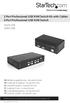 2 Port Professional USB KVM Switch Kit with Cables 4 Port Professional USB KVM Switch SV231USB SV431USB DE: Bedienungsanleitung - de.startech.com FR: Guide de l'utilisateur - fr.startech.com ES: Guía del
USB 2.0 DVI KVMP Switch CS1784 User Manual
 USB 2.0 DVI KVMP Switch CS1784 User Manual www.aten.com FCC Information This equipment has been tested and found to comply with the limits for a Class B digital device, pursuant to Part 15 of the FCC Rules.
2 To 1 Serial (RS-232) AUTO SWITCH. AS-251S User Manual
 2 To 1 Serial (RS-232) AUTO SWITCH AS-251S User Manual Read this manual thoroughly and follow the installation procedures carefully to prevent any damage to the AS-251S and/or the devices it connects to.
2 Port USB Keyboard Mouse Switch Cable with File Transfer for PC and Mac
 2 Port USB Keyboard Mouse Switch Cable with File Transfer for PC and Mac SVKMS2 *actual product may vary from photos DE: Bedienungsanleitung - de.startech.com FR: Guide de l'utilisateur - fr.startech.com
GV-Keyboard. User's Manual V2.0
 GV-Keyboard User's Manual V2.0 Before attempting to connect or operate this product, please read these instructions carefully and save this manual for future use. 2007 GeoVision, Inc. All rights reserved.
Cat 5 High-Density KVM Over the NET
 KH1508Ai/KH1516Ai Cat 5 High-Density KVM Over the NET The KH1508Ai/KH1516Ai Cat 5 High-Density KVM Over the NET switches offer 8 and 16 computer port configurations in a 1U-high housing for convenient
Bluetooth Version FUZZYSCAN FAMILY. Quick Start Guide WIRELESS SCANNER
 Bluetooth Version FUZZYSCAN FAMILY Quick Start Guide WIRELESS SCANNER Getting Familiar with Your FuzzyScan Thank you for choosing Cino FuzzyScan Bluetooth Cordless Image Scanner. Powered by the combination
Taurus Super-S3 LCM. Dual-Bay RAID Storage Enclosure for two 3.5-inch Serial ATA Hard Drives. User Manual March 31, 2014 v1.2 www.akitio.
 Dual-Bay RAID Storage Enclosure for two 3.5-inch Serial ATA Hard Drives User Manual March 31, 2014 v1.2 www.akitio.com EN Table of Contents Table of Contents 1 Introduction... 1 1.1 Technical Specifications...
WLAN600 Wireless IP Phone Administrator s Guide
 WLAN600 Wireless IP Phone Administrator s Guide Trademark Acknowledgement All brand names are trademarks or registered trademarks of their respective companies. Disclaimer This document is supplied by
Installation Guide Wireless 4-Port USB Sharing Station. GUWIP204 Part No. M1172-a
 Installation Guide Wireless 4-Port USB Sharing Station 1 GUWIP204 Part No. M1172-a 2011 IOGEAR. All Rights Reserved. PKG-M1172-a IOGEAR, the IOGEAR logo, MiniView, VSE are trademarks or registered trademarks
Dual DVI USB KVM Switch
 SV231DD2DUA SV431DD2DUA Instruction Manual Dual DVI USB KVM Switch 2/4-Port Dual DVI, USB KVM Switch with Audio and USB 2.0 Hub Manual Revision:08/19/2010 For the most up-to-date information, please visit
4-Port Pocket. USB KVM Switch with USB 2.0 Hub
 4-Port Pocket USB KVM Switch with USB 2.0 Hub Manual - 1 - Index 1. INTRODUCTION... 3 1.1 FEATURES... 3 1.2 PHYSICAL DIAGRAM... 4 1.3 PACKAGE CONTENTS... 4 2. SPECIFICATIONS... 5 2.1 ERAL... 5 2.2 LED
mysensors mysensors Wireless Sensors and Ethernet Gateway Quick Start Guide Information to Users Inside the Box mysensors Ethernet Gateway Quick Start
 mysensors Information to Users mysensors Wireless Sensors and Ethernet Gateway Quick Start Guide This equipment has been tested and found to comply with the limits for a Class B digital devices, pursuant
USB KVM Console Extender User Manual (GCE700)
 USB KVM Console Extender User Manual (GCE700) Welcome Thank you for purchasing the IOGEAR USB KVM Console Extender that allows you to access you computer or KVM switch from up to 500 ft away, via a CAT5e
TL-PS310U Single USB 2.0 Port MFP and Storage Server
 TL-PS310U Single USB 2.0 Port MFP and Storage Server Rev: 2.0.0 1910010313 Contents Chapter 1 Introduction... 1 1.1 Product Overview...1 1.2 Network Management...1 1.3 Components and Features...1 1.4 Hardware
dedicated KVM switch and rackmount screen technology User Manual IP-S101 Combo KVM Extender Designed and manufactured by Austin Hughes
 dedicated KVM switch and rackmount screen technology User Manual IP-S101 Combo KVM Extender Designed and manufactured by Austin Hughes 751 Legal Information First English printing, October 2002 Information
HDMI USB Extender VE803 User Manual
 HDMI USB Extender VE803 User Manual www.aten.com VE803 User Manual FCC Information This is an FCC Class A product. In a domestic environment this product may cause radio interference in which case the
USB DVI Dual View KVMP Switch CS1642A / CS1644A. User Manual. www.aten.com
 USB DVI Dual View KVMP Switch CS1642A / CS1644A User Manual www.aten.com CS1642A / CS1644A User Manual FCC Information This is an FCC Class A product. In a domestic environment this product may cause radio
9,'(2 #6(3$5$725 8VHU V#0DQXDO 96043;
 9,'(2 #6(3$5$725 8VHU V#0DQXDO 96043; Introduction 3 Features 3 Specifications 4 Installation 4 Stand-Alone Installation 4 Daisy-Chain Installation 5 Preventing Radio & TV Interference 6 Limited Warranty
ValuPrompt Computer Prompter Instruction Manual
 ValuPrompt Computer Prompter Instruction Manual For Technical Information Please Call Voice: (604) 985-2250 Toll Free: 877-TEKSKIL (835-7545) Toll Free Fax: 877-576-8361 Or Visit Our Website tekskil.com
Installation Guide USB Laptop KVM Switch GCS661U
 Installation Guide USB Laptop KVM Switch 1 GCS661U 2 Table of Contents Table of Contents 3 Package Contents 4 System Requirements 5 Overview 6 Before You Start 7 Software Installation 8 Hardware Installation
RocketStor SMART RAID
 RocketStor SMART RAID User Guide v1.0 1 Copyright HighPoint Technologies Inc., 1995-2012. All rights reserved. OS X and Macintosh are registered trademarks of Apple Corporation. All other trademarks and
Ethernet Radio Configuration Guide
 Ethernet Radio Configuration Guide for Gateway, Endpoint, and Repeater Radio Units April 20, 2015 Customer Service 1-866-294-5847 Baseline Inc. www.baselinesystems.com Phone 208-323-1634 FAX 208-323-1834
KM0532/KM0932/KM0032. Multi-Console 32-Port Matrix KVM Switch. Enterprise Solutions
 Enterprise Solutions KM0532/KM0932/KM0032 Multi-Console 32-Port Matrix KVM Switch ATEN Matrix KVM Switches are designed for modern data centers that require reliable, high security access and control of
Backup Assistant. User Guide. NEC NEC Unified Solutions, Inc. March 2008 NDA-30282, Revision 6
 Backup Assistant User Guide NEC NEC Unified Solutions, Inc. March 2008 NDA-30282, Revision 6 Liability Disclaimer NEC Unified Solutions, Inc. reserves the right to change the specifications, functions,
TX3 Series TELEPHONE ACCESS SYSTEMS. Configurator Quick Start. Version 2.2 Mircom Copyright 2014 LT-973
 TX3 Series TELEPHONE ACCESS SYSTEMS Configurator Quick Start Version 2.2 Mircom Copyright 2014 LT-973 Copyright 2014 Mircom Inc. All rights reserved. Mircom Configurator Software Guide v.2.2 for Windows
LabelWriter. Print Server. User Guide
 LabelWriter Print Server User Guide Copyright 2010 Sanford, L.P. All rights reserved. 08/10 No part of this document or the software may be reproduced or transmitted in any form or by any means or translated
VGA USB KVM Console Extender over CAT5 UTP (500 ft)
 VGA USB KVM Console Extender over CAT5 UTP (500 ft) SV565UTPU SV565UTPUGB SV565UTPUEU DE: Bedienungsanleitung - de.startech.com FR: Guide de l'utilisateur - fr.startech.com ES: Guía del usuario - es.startech.com
USB Keyboard/Video/Mouse Sharing Switch. User's Manual SV431USB SV231USB
 USB Keyboard/Video/Mouse Sharing Switch User's Manual SV431USB SV231USB Table of Contents Introduction Overview 1 Features 2 System Requirements Console Side 3 Computer Side 3 Installation PC BIOS Notice
Getting Started. rp5800, rp5700 and rp3000 Models
 Getting Started rp5800, rp5700 and rp3000 Models Copyright 2011 Hewlett-Packard Development Company, L.P. The information contained herein is subject to change without notice. Microsoft, Windows, and Windows
AXIS 291 1U Video Server Rack Installation Guide
 AXIS 291 1U Video Server Rack Installation Guide About This Document This document describes how to install Axis blade video servers in the AXIS 291 1U Video Server Rack. Updated versions of this document
Operating Instructions - Recovery, Backup and Troubleshooting Guide
 Personal Computer Operating Instructions - Recovery, Backup and Troubleshooting Guide Please create your recovery discs immediately after setup. Please read this manual carefully before using your product.
COMSPHERE 6700 SERIES NETWORK MANAGEMENT SYSTEM
 COMSPHERE 6700 SERIES NETWORK MANAGEMENT SYSTEM SECURITY MANAGER FEATURE SUPPLEMENT Document No. 6700-A2-GB41-30 February 1998 Copyright 1998 Paradyne Corporation. All rights reserved. Printed in U.S.A.
Reboot the ExtraHop System and Test Hardware with the Rescue USB Flash Drive
 Reboot the ExtraHop System and Test Hardware with the Rescue USB Flash Drive This guide explains how to create and use a Rescue USB flash drive to reinstall and recover the ExtraHop system. When booting
Promise FastTrak 100-Lite RAID Controller
 Promise FastTrak 100-Lite RAID Controller User s Manual Version 1.3, November 9, 2001 Copyright Copyright by Promise Technology, Inc. ( Promise ), XP. No part of this manual may be reproduced or transmitted
Using GIGABYTE Notebook for the First Time
 Congratulations on your purchase of the GIGABYTE Notebook P7! This Manual will help you to get started with setting up your notebook. For more detailed information, please visit our website at http://www.gigabyte.com.
SoftRAID 5 QUICK START GUIDE. for OWC ThunderBay
 SoftRAID 5 QUICK START GUIDE for OWC ThunderBay TABLE OF CONTENTS INTRODUCTION...1 1.1 MINIMUM SYSTEM REQUIREMENTS 1.2 FEATURES 1.3 ABOUT THIS MANUAL SYSTEM SETUP...2 2.1 GETTING STARTED 2.2 INITIALIZING,
Using GIGABYTE Notebook for the First Time
 Congratulations on your purchase of the GIGABYTE Notebook! This Manual will help you to get started with setting up your notebook. For more detailed information, please visit our website at http://www.gigabyte.com.
User Guide USB 2.0 LAPTOP DOCKING STATION WITH VIDEO N2953
 USB 2.0 LAPTOP DOCKING STATION WITH VIDEO 410-1864-001B / ACP51US 1 YEAR LIMITED WARRANTY: We pride ourselves on the quality of our products. For complete warranty details and a list of our worldwide offices,
DMX USB PRO. User Manual. www.enttec.com
 DMX USB PRO User Manual www.enttec.com Firmware V1.43 February 2007 Package Contents Your DMX USB PRO package should contain these items: DMX USB PRO (Part No. 70304) Driver for Windows software on the
GWA502 package contains: 1 Wireless-G Broadband Router 1 Power Adapter 1 Ethernet Cable 1 Manual CD 1 Quick Start Guide 1 Warranty/Registration Card
 Wireless-G Broadband Router GWA502 Quick Start Guide Read this guide thoroughly and follow the installation and operation procedures carefully to prevent any damage to the unit and/or any of the devices
Introduction to Computers
 Introduction to Computers Parts of a computer Monitor CPU 3 Keyboard 3 4 4 Mouse 3 4 Monitor The monitor displays the content and operations of the computer. It is the visual display of what the computer
9,'(2 #6(3$5$725 8VHU V#0DQXDO
 9,'(2 #6(3$5$725 8VHU V#0DQXDO 960435 960437 Introduction 3 Features 3 Specifications 4 Installation 4 Stand-Alone Installation 4 Daisy-Chain Installation 5 Preventing Radio & TV Interference 6 Limited