
for Hazardous Division 1 Locations
|
|
|
- Kellie Lloyd
- 9 years ago
- Views:
Transcription
1 Self-Regulating Heat-Tracing Systems for Hazardous Division 1 Locations Design and Installation Guide Power-Limiting Mineral Insulated Longline RTB Tubing Bundles Tank Snow and Ice Control and Monitoring Heat-Trace Panels Engineered Products Steam-Tracing Systems Technical Data Sheets 1 / 60 Appendixes

2 Heat-Tracing Systems for Hazardous Division 1 Locations 2 / 60 EN-RaychemHTSystemsForHazDiv1Loc-DG-H /14 INDUSTRIAL HEAT TRACING SOLUTIONS

3 Contents Introduction Scope Typical System with Components Division 1 Heat-Tracing Electrical Connections and Components Electrical Protection Thermal Design Introduction Special Requirements Cable Selection Introduction Special Considerations Circuit Breaker Selection Components and Electrical Connections Power Connections, Splices, Tees, and End Seals Core Sealing Attachment Tapes ETL Electric Traced Labels Thermostats Installation Approvals and Warranty Cable Installation Requirements Cable Installation Component Installation Requirements HAK-C-100 Connection Kit Description HAK-C-100 Connection Kit Installation Thermal Insulation Requirements Thermostat Controls Power Supply and Electrical Protection Requirements Cable Testing Operation, Maintenance, and Repair Operation and Inspection Troubleshooting Answers to frequently asked questions Appendix A: System Approvals Appendix B: Alternate Voltage Adjustment Factors Appendix C: Heat-Shrink Core Sealer Installation Appendix D: Field Information Required for FM Approval Appendix E: Inspection Record Appendix F: BTV Cable Selection for Insulated Plastic Pipes Appendix G: Effect of Aluminum Tape on Raychem Cable Appendix H: Hazardous Gases and Vapors Self-Regulating Power-Limiting Mineral Insulated Longline RTB Tubing Bundles Tank Snow and Ice Control and Monitoring Heat-Trace Panels Engineered Products Steam-Tracing Systems Technical Data Sheets 3 / 60 Appendixes

4 Heat-Tracing Systems for Hazardous Division 1 Locations Important Safeguards and Warnings WARNING: FIRE AND SHOCK HAZARD. Raychem heat-tracing systems must be installed correctly to ensure proper operation and to prevent shock and fire. Read these important warnings and carefully follow all the installation instructions. To minimize the danger of fire from sustained electrical arcing if the heating cable is damaged or improperly installed, and to comply with Pentair Thermal Management requirements, agency certifications, and national electrical codes, ground-fault equipment protection must be used on each heating cable branch circuit. Arcing may not be stopped by conventional circuit breakers. Approvals and performance of the heat-tracing systems are based on the use of Pentair Thermal Management specified parts only. Do not substitute parts or use vinyl electrical tape. Bus wires will short if they contact each other. Keep bus wires separated. Components and cable ends must be kept dry before and during installation. The black heating cable core and fibers are conductive and can short. They must be properly insulated and kept dry. Damaged bus wires can overheat or short. Do not break bus wire strands when preparing the cable for connection. Damaged heating cable can cause electrical arcing or fire. Do not use metal attachments such as pipe straps or tie wire. Use only Raychem approved tapes and cable ties to secure the cable to the pipe. Do not attempt to repair or energize damaged cable. Remove damaged cable at once and replace with a new length using the appropriate Raychem splice kit. Replace damaged components. Re-use of the grommets, or use of the wrong grommet, can cause leaks, cracked components, shock, or fire. Be sure the type of grommet is correct for the heating cable being installed. Use a new grommet whenever the cable has been pulled out of the component. Use only fire-resistant insulation which is compatible with the application and the maximum exposure temperature of the system to be traced. To prevent fire or explosion in hazardous locations, verify that the maximum sheath temperature of the heating cable is below the auto-ignition temperature of the gases in the area. For further information, see the design documentation. Material Safety Data Sheets (MSDSs) are available on-line at 4 / 60 EN-RaychemHTSystemsForHazDiv1Loc-DG-H /14 INDUSTRIAL HEAT TRACING SOLUTIONS

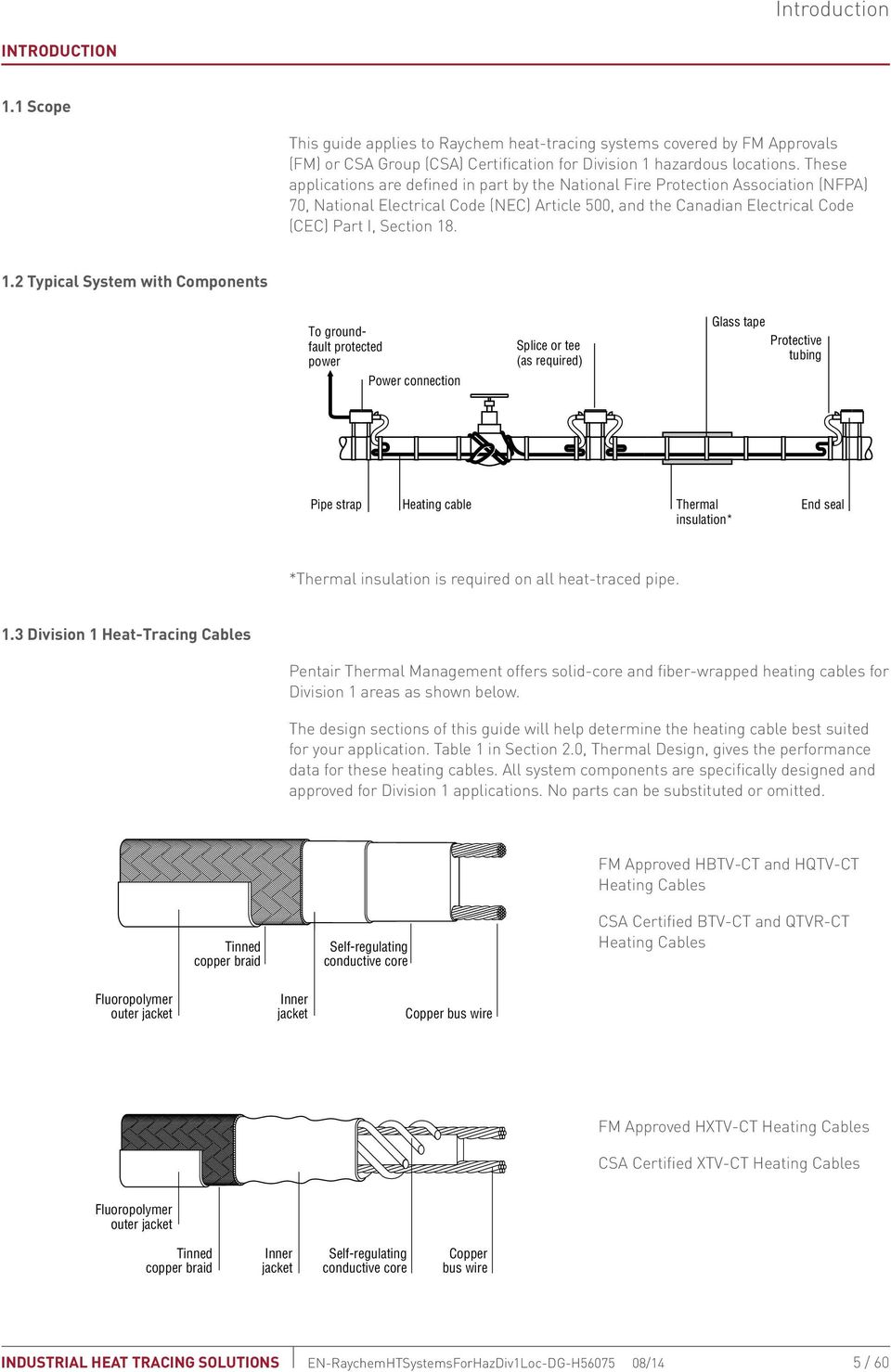
5 Introduction 1.1 Scope Introduction This guide applies to Raychem heat-tracing systems covered by FM Approvals (FM) or CSA Group (CSA) Certification for Division 1 hazardous locations. These applications are defined in part by the National Fire Protection Association (NFPA) 70, National Electrical Code (NEC) Article 500, and the Canadian Electrical Code (CEC) Part I, Section 18. Self-Regulating Power-Limiting Mineral Insulated 1.2 Typical System with Components To groundfault protected power Power connection Splice or tee (as required) Glass tape Protective tubing Longline RTB Tubing Bundles 1.3 Division 1 Heat-Tracing Pipe strap cable *Thermal insulation is required on all heat-traced pipe. Thermal insulation* End seal Pentair Thermal Management offers solid-core and fiber-wrapped heating cables for Division 1 areas as shown below. The design sections of this guide will help determine the heating cable best suited for your application. Table 1 in Section 2.0, Thermal Design, gives the performance data for these heating cables. All system components are specifically designed and approved for Division 1 applications. No parts can be substituted or omitted. Tank Snow and Ice Control and Monitoring Tinned copper braid Self-regulating conductive core FM Approved HBTV-CT and HQTV-CT CSA Certified BTV-CT and QTVR-CT Heat-Trace Panels Fluoropolymer outer jacket Inner jacket Copper bus wire Engineered Products FM Approved HXTV-CT CSA Certified XTV-CT Steam-Tracing Systems Fluoropolymer outer jacket Tinned copper braid Inner jacket Self-regulating conductive core Copper bus wire Technical Data Sheets 5 / 60 Appendixes
6 Heat-Tracing Systems for Hazardous Division 1 Locations 1.4 Electrical Connections and Components The HAK-C-100 connection kit is FM Approved and CSA Certified. The kit must be used for all power connections, splices, tees, and end seals in Division 1 locations. Junction box, mounting bracket, and pipe strap not included The HAK-C-100 connection kit If components are installed in a Division 2 or ordinary area, other Raychem industrial connection systems can be used with the approved Division 1 heating cable. Note: In addition to the HAK-C-100 connection kit, junction boxes, pipe straps, and mounting brackets must be ordered. Additional HAK-C-100 kits are needed for splices and tees. (Splices require one junction box and two HAK-C-100 kits; tees require one junction box and three HAK-C-100 kits.) See Section 4.0 for a complete component assembly matrix and catalog numbers. 1.5 Electrical Protection WARNING: To minimize the danger of fire from sustained electrical arcing if the heating cable is damaged or improperly installed, and to comply with Pentair Thermal Management requirements, agency certifications, and national electrical codes, ground-fault equipment protection must be used on each heating cable branch circuit. Arcing may not be stopped by conventional circuit breakers. Pentair Thermal Management, the NEC, the CEC, FM, and CSA require ground-fault protection of equipment for all Division 1 locations to reduce the risk of fire caused by damage or improper installation. These devices are commonly available with 30-mA trip levels and are rated up to 30 A for 120, 208, and single-phase 240 Vac grounded systems. WARNING: Disconnect all power before making connections to the heating cable. 6 / 60 EN-RaychemHTSystemsForHazDiv1Loc-DG-H /14 INDUSTRIAL HEAT TRACING SOLUTIONS

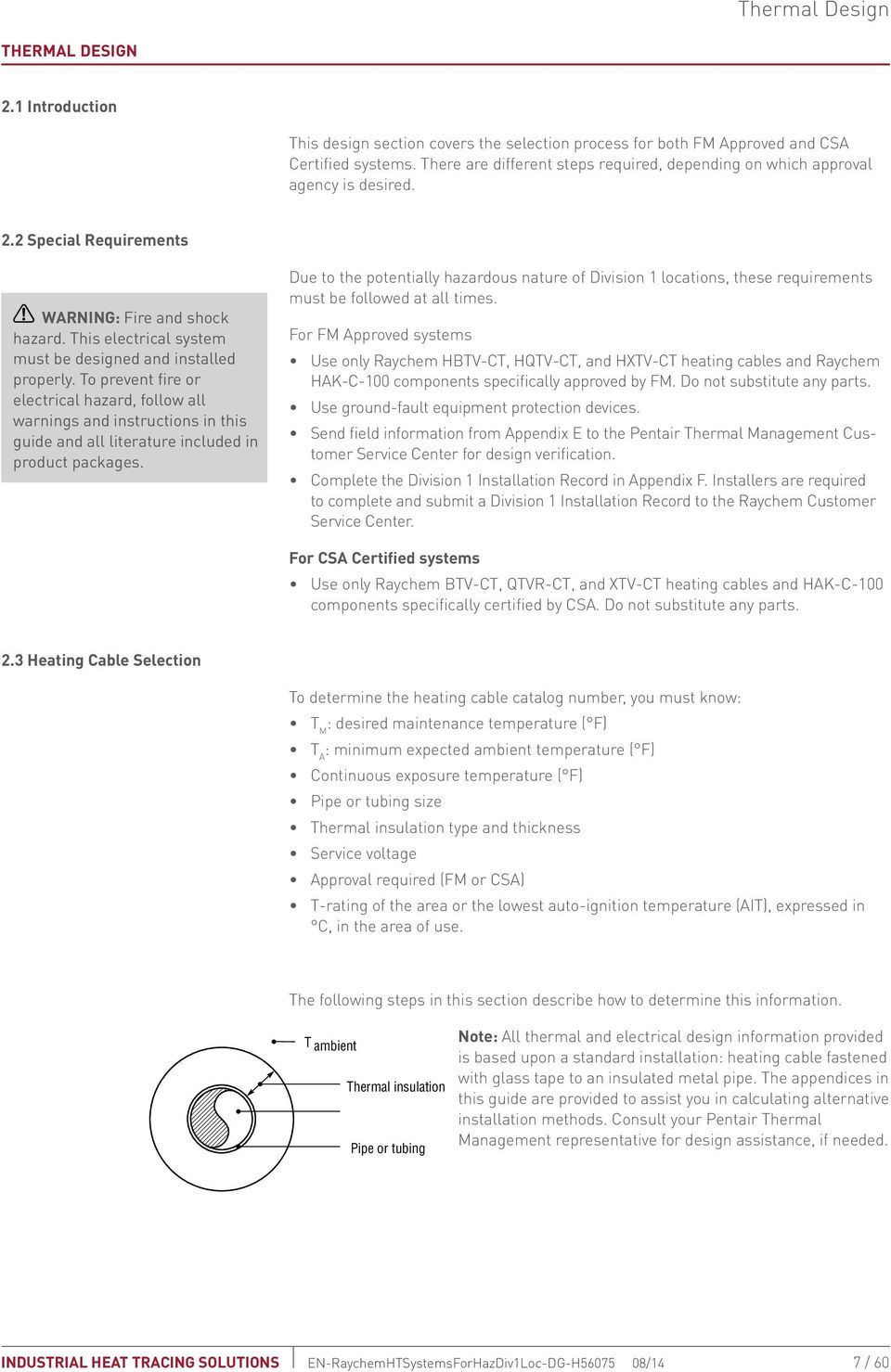
7 Thermal Design 2.1 Introduction 2.2 Special Requirements WARNING: Fire and shock hazard. This electrical system must be designed and installed properly. To prevent fire or electrical hazard, follow all warnings and instructions in this guide and all literature included in product packages. 2.3 Cable Selection Thermal Design This design section covers the selection process for both FM Approved and CSA Certified systems. There are different steps required, depending on which approval agency is desired. Due to the potentially hazardous nature of Division 1 locations, these requirements must be followed at all times. For FM Approved systems Use only Raychem HBTV-CT, HQTV-CT, and HXTV-CT heating cables and Raychem HAK-C-100 components specifically approved by FM. Do not substitute any parts. Use ground-fault equipment protection devices. Send field information from Appendix E to the Pentair Thermal Management Customer Service Center for design verification. Complete the Division 1 Installation Record in Appendix F. Installers are required to complete and submit a Division 1 Installation Record to the Raychem Customer Service Center. For CSA Certified systems Use only Raychem BTV-CT, QTVR-CT, and XTV-CT heating cables and HAK-C-100 components specifically certified by CSA. Do not substitute any parts. To determine the heating cable catalog number, you must know: T M : desired maintenance temperature ( F) T A : minimum expected ambient temperature ( F) Continuous exposure temperature ( F) Pipe or tubing size Thermal insulation type and thickness Service voltage Approval required (FM or CSA) T-rating of the area or the lowest auto-ignition temperature (AIT), expressed in C, in the area of use. Self-Regulating Power-Limiting Mineral Insulated Longline RTB Tubing Bundles Tank Snow and Ice Control and Monitoring Heat-Trace Panels The following steps in this section describe how to determine this information. T ambient Thermal insulation Pipe or tubing Note: All thermal and electrical design information provided is based upon a standard installation: heating cable fastened with glass tape to an insulated metal pipe. The appendices in this guide are provided to assist you in calculating alternative installation methods. Consult your Pentair Thermal Management representative for design assistance, if needed. Engineered Products Steam-Tracing Systems Technical Data Sheets 7 / 60 Appendixes
8 Heat-Tracing Systems for Hazardous Division 1 Locations Step 1: Collect the thermal design application information: Note: Publication NFPA 325 gives ignition temperatures for many hazardous materials. Note: Keep all records of T-rating determination. The Pentair Thermal Management Customer Service Center will ask for this information to fill orders. This information must be recorded in Appendix E and sent to Pentair Thermal Management. The purpose of the T-rating is to ensure that electrical equipment does not exceed the auto-ignition temperatures of flammables handled in a hazardous (Classified) area. Example: T M : 40 F (4.4 C) [water freeze protection] T A : 20 F (-28.9 C) Maximum continuous exposure temperature: 100 F (37.8 C) Pipe or tubing size: 6" steel Thermal insulation type and thickness: 2" calcium silicate Service voltage: 240 V Approval required (FM or CSA): FM Material with the lowest AIT, expressed in C, in the hazardous area: Benzene, AIT = 498 C Step 2. Determine the T-rating requirement: If the T-rating of the area has been defined, then select a heating cable from Table 1 (page 10) having a T-rating equivalent to or less than the T-rating of this area (for example, T6 is a lower T-rating than T3). If the T-rating for the area has not been defined, Select material with the lowest AIT in C. This temperature is the maximum allowable heating cable sheath temperature. T-rating = 498 C The heating cable selected cannot have a maximum sheath temperature greater than the lowest AIT for the area. Step 3. Calculate the temperature differential ( T): T = T M T A Example: Calculate T = T M T A Calculate T = 40 F ( 20 F) [4.4 C ( 28.9 C)] Calculate T = 60 F (33.3 C) Step 4. Determine the pipe heat loss: From Table 3 match the pipe size and insulation thickness with the temperature differential ( T) to find the base heat loss of the pipe (Q B ). Example: From Table 3, 6" pipe, 2" insulation, and T = 60 F (33.3 C), Q B must be calculated through interpolation: Q B = 4.2 W/ft + 10/50 x ( ) = Q B = 5.1 T M = 40 F (4.4 C) Step 5. Compensate for insulation type: Note: Heat-loss calculations are based on IEEE Standard , Equation 1. Multiply the base heat loss of the pipe (Q B ) from Step 4 by the appropriate insulation compensation factor (f) from Table 4 to get the actual heat loss (Q T ). Q T = Q B x f 8 / 60 EN-RaychemHTSystemsForHazDiv1Loc-DG-H /14 INDUSTRIAL HEAT TRACING SOLUTIONS

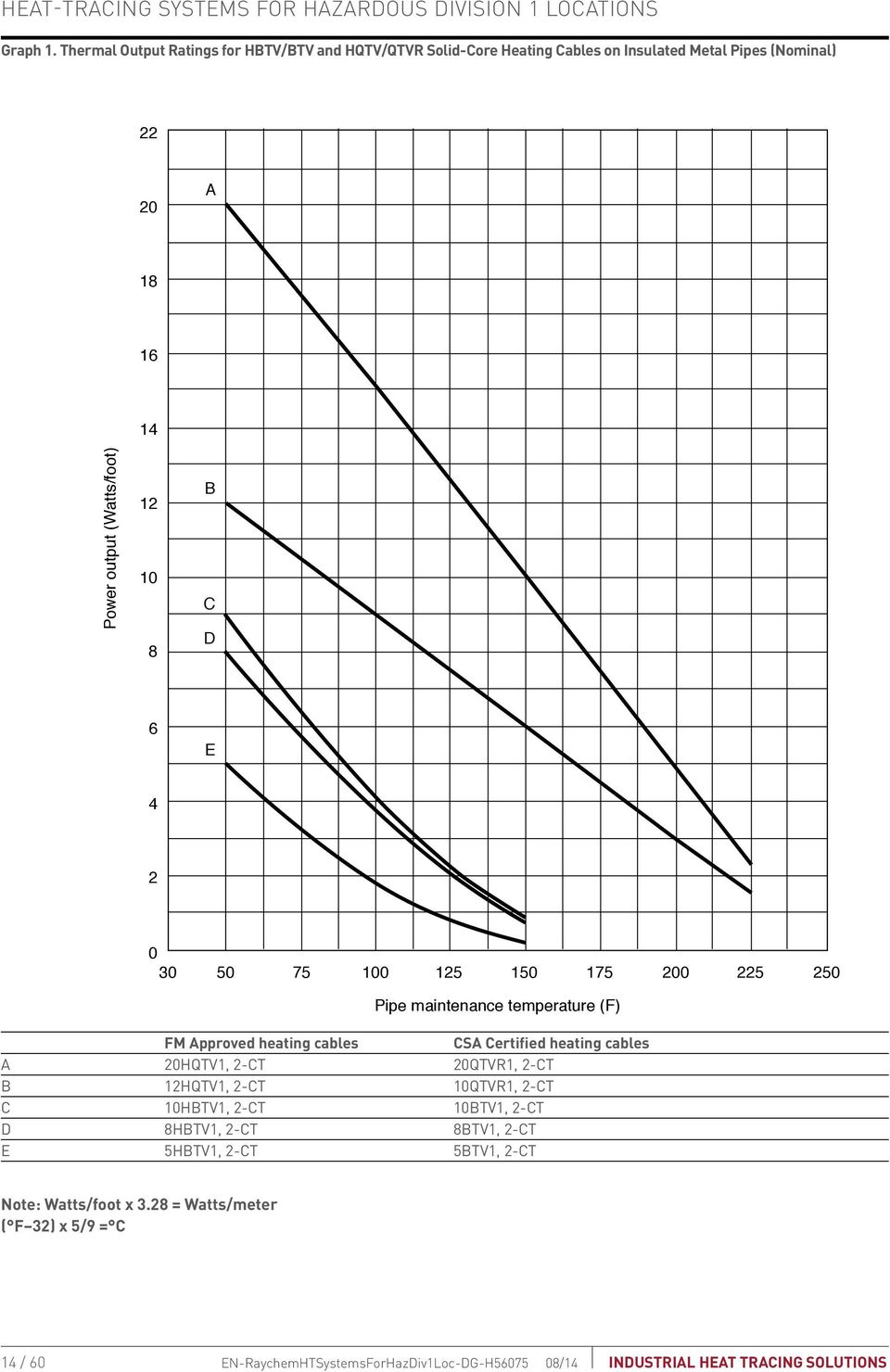
9 Example: From Table 4, insulation factor (f) = 1.48 for calcium silicate: Q T = Q B x f Q B = 5.1 W/ft x 1.48 Thermal Design Self-Regulating Power-Limiting Q T = 7.5 W/ft at 40 F (4.4 C) Step 6. Select the thermal output rating: From Graphs 1 and 2, match the actual heat loss per foot of pipe (Q T ) with the desired maintenance temperature (T M ), and select from the power output ratings so that the power output rating at T M equals or exceeds Q T. Example: Mineral Insulated Longline Q T = 7.5 W/ft T M = 40 F (4.4 C) From Graphs 1 and 2, 8HBTV-CT exceeds 7.5 W/ft at 40 F (4.4 C). RTB Tubing Bundles Q T = 7.5 T M = 40F Should the heat loss Q T be between the two heating-cable power output curves, select the higher-rated heating cable. If the heat loss Q T is greater than the power output of the highest-rated heating cable, you can compensate with one of the following methods: Use thicker insulation. Use insulation material with a lower K factor. Use two or more heating cables run in parallel. Spiral the heating cable. Spiraling: If this method is selected, determine the spiral factor according to the following formula: Spiral factor (length of heating cable/foot of pipe) = Q T Heater thermal output at T M When the spiral factor exceeds 1.4 or the pipe size is less than 3" IPS, Pentair Thermal Management recommends using two or more heating cables run in parallel. Only HBTV-CT and BTV-CT can be used on plastic pipes. See Appendix H for thermal output adjustment factors on plastic pipes. Step 7. Determine the heating cable family: Select the heating cable catalog number based on the following information and Table 1 below: Maintenance temperature Heat loss calculated (Q T ) Tank Snow and Ice Control and Monitoring Heat-Trace Panels Engineered Products Steam-Tracing Systems Technical Data Sheets 9 / 60 Appendixes

10 Heat-Tracing Systems for Hazardous Division 1 Locations Service voltage Approval requirement T-rating as calculated by your required approval agency Continuous exposure temperature Note: Make sure that the maximum sheath temperature of the heating cable is not higher than the T-rating (refer to Step 2). Contact the Pentair Thermal Management Customer Service Center if the maximum sheath temperature of the heating cable selected exceeds the temperature calculated in Step 2. Table 1 Cable Product Performance Data FM Approved CSA Certified Maximum continuous Maximum intermittent T-rating/Maximum heating cable heating cable exposure temperature* exposure temperature** sheath temperature HBTV-CT BTV-CT 150 F (65 C) 185 F (85 C) T6 (185 F, 85 C) HQTV-CT QTVR-CT 225 F (110 C) 225 F (110 C) T4 (275 F, 135 C) 5HXTV1, 2-CT 5XTV1, 2-CT-T3 250 F (121 C) 482 F (250 C) 1 T3 (392 F, 200 C) 10HXTV1, 2-CT 10XTV1, 2-CT-T3 250 F (121 C) 482 F (250 C) 1 T3 (392 F, 200 C) 15HXTV2-CT 15XTV2-CT-T3 250 F (121 C) 482 F (250 C) 1 T3 (392 F, 200 C) 15HXTV1-CT 15XTV1-CT-T2 250 F (121 C) 482 F (250 C) 1 T2D (419 F, 215 C) 20HXTV1-CT 20XTV1-CT-T2 250 F (121 C) 482 F (250 C) 1 T2C (446 F, 230 C) 20HXTV2-CT 20XTV2-CT-T2 250 F (121 C) 482 F (250 C) 1 T2C (446 F, 230 C) * With the heating cable power on. ** 1000 hours (power on/power off). 1 The 250 C rating applies to all products printed MAX INTERMITTENT EXPOSURE 250C Example: T M = 40 F (4.4 C) Actual heat loss calculated (Q T ) = 7.5 W/ft. Based on T M = 40 F (4.4 C) and Q T = 7.5 W/ ft, an 8-W/ft product is sufficient for the application (refer to Step 6). Service voltage = 240 V T-rating = 498 C Continuous exposure temperature = 100 F (37.8 C) Therefore, choose 8HBTV2-CT. Step 8. Calculate the total length of heating cable required by combining lengths from each component of the piping system: Example: 80-ft pipe length 2 gate valves in steel-welded shoe supports 1 power connection 1 end seal (A) For the piping: Determine the amount of heating cable required for the pipeline length. cable required for pipe length = 80 ft (B) For each valve: Use Table 2 on the next page to calculate the amount of heating cable required. 10 / 60 EN-RaychemHTSystemsForHazDiv1Loc-DG-H /14 INDUSTRIAL HEAT TRACING SOLUTIONS

11 Thermal Design Self-Regulating Table 2 Amount of Cable to Use per Valve Pipe diameter (IPS) (inches) 1/ / / / / Minimum amount of heating cable (feet) For pipe diameters less than 2 inches, the numbers represent the maximum amount of heating cable that will fit on the valve. For pipe diameters between 2 and 6 inches, the numbers represent the maximum heating cable required to compensate for heat loss and a service loop. For pipe diameters greater than 6 inches, the numbers represent the minimum amount required for a service loop and do not necessarily compensate for total heat loss. Note: Use TraceCalc 5 software to calculate the exact quantity required for the valve, based on Finite Element Analysis. cable required for valves = Two 6" valves x 4.3 ft = 8.6 ft (C) For each pipe support shoe: Calculate the additional heat required as follows: Q = 0.7L x (T T support ), where L = Support length (ft) M A Total heat loss from supports: 5 pipe supports x [0.7 x 1] x 60 = 210 W x 10% safety factor = 231 W Calculate the additional heating cable required by dividing the total support heat loss, Q by the heating cable power output per foot at T support, from the thermal output M curves in Table W cable required for supports = = 26.3 ft 8.8 W/ft (D) For components: Allow an additional 3 feet for each component. For this example, assume one power connection kit and one end seal, so total cable required for components is 6 feet. Total Cable Required = (A) + (B) + (C) + (D) = 121 feet Power-Limiting Mineral Insulated Longline RTB Tubing Bundles Tank Snow and Ice Control and Monitoring Heat-Trace Panels Engineered Products Steam-Tracing Systems Technical Data Sheets 11 / 60 Appendixes

12 Heat-Tracing Systems for Hazardous Division 1 Locations Table 4 Pipe Heat Loss (W/ft) Insulation thickness (ΔT) Pipe diameter (IPS) in inches 1/4 1/2 3/ /4 1-1/ /2 Tubing size (inches) F C 3/ /4 1-1/ " " " " " " " Note: Pipe heat loss (Q b ) is shown in watts per foot. Heat loss calculations are based on IEEE Standards with the following provisions: Pipes insulated with glass fiber in accordance with ASTM C547 Pipes located outdoors in a 20-mph wind No insulating air space assumed between pipe and insulation No insulating air space assumed between the insulation and outer cladding Includes a 10% safety factor 12 / 60 EN-RaychemHTSystemsForHazDiv1Loc-DG-H /14 INDUSTRIAL HEAT TRACING SOLUTIONS

13 Thermal Design Self-Regulating Table 4 Pipe Heat Loss (W/ft) Table 5 Insulation Factors Preformed pipe insulation Pipe diameter (IPS) in inches 3 3-1/ Insulation factor (f) K factor at 50 F (BTU/hr F ft2/in)* Glass fiber (ASTM C547) Calcium silicate (ASTM C533) Cellular glass (ASTM C552) Rigid cellular urethane (ASTM C591) Foamed elastomer (ASTM C534) Mineral fiber blanket (ASTM C553) Expanded perlite (ASTM C610) Power-Limiting Mineral Insulated Longline RTB Tubing Bundles Tank Snow and Ice Control and Monitoring Heat-Trace Panels Engineered Products Steam-Tracing Systems Technical Data Sheets 13 / 60 Appendixes

14 Heat-Tracing Systems for Hazardous Division 1 Locations Graph 1. Thermal Output Ratings for HBTV/BTV and HQTV/QTVR Solid-Core on Insulated Metal Pipes (Nominal) A Power output (Watts/foot) B C D 6 E Pipe maintenance temperature (F) FM Approved heating cables CSA Certified heating cables A 20HQTV1, 2-CT 20QTVR1, 2-CT B 12HQTV1, 2-CT 10QTVR1, 2-CT C 10HBTV1, 2-CT 10BTV1, 2-CT D 8HBTV1, 2-CT 8BTV1, 2-CT E 5HBTV1, 2-CT 5BTV1, 2-CT Note: Watts/foot x 3.28 = Watts/meter ( F 32) x 5/9 = C 14 / 60 EN-RaychemHTSystemsForHazDiv1Loc-DG-H /14 INDUSTRIAL HEAT TRACING SOLUTIONS
15 Graph 2. Thermal Output Ratings for HXTV/XTV Fiber-Wrapped on Insulated Metal Pipes (Nominal) 22 Thermal Design Self-Regulating Power-Limiting 20 A Mineral Insulated 18 Longline 16 B Power output (Watts/foot) C D RTB Tubing Bundles Tank Snow and Ice Control and Monitoring Heat-Trace Panels Pipe maintenance temperature (F) FM Approved heating cables CSA Certified heating cables A 20HXTV1, 2-CT 20XTV1, 2-CT-T2 B 15HXTV1-CT 15XTV1-CT-T2 15HXTV2-CT 15XTV2-CT-T3 C 10HXTV1, 2-CT 10XTV1, 2-CT-T3 D 5HXTV1, 2-CT 5XTV1, 2-CT-T3 Engineered Products Steam-Tracing Systems Technical Data Sheets 15 / 60 Appendixes

16 Heat-Tracing Systems for Hazardous Division 1 Locations 3.1 Introduction In order to comply with requirements of Pentair Thermal Management, the NEC, FM, and CSA, ground-fault equipment protection devices (GFEPDs) providing a minimum leakage current to ground trip level of 30 ma must be used. GFEPDs are commonly available with current over-trip ratings up to 30 A for 120, 208, and single-phase 240- Vac grounded systems. 3.2 Special Considerations In temperature-sensitive applications, thermostatic control may be necessary. If maximum temperature is a concern, consult the Pentair Thermal Management Customer Service Center for design assistance. 3.3 Circuit Breaker Selection Note: Ground-fault circuit interrupters (GFCIs) provide leakage current to ground trip level of 4 to 6 ma for personnel protection. Use of these devices in the place of GFEPDs may cause nuisance tripping in some circumstances. WARNING: To minimize the danger of fire from sustained electrical arcing if the heating cable is damaged or improperly installed, and to comply with Pentair Thermal Management requirements, agency certifications, and national electrical codes, ground-fault equipment protection must be used on each heating cable branch circuit. Arcing may not be stopped by conventional circuit breakers. To determine the circuit breaker sizing, you must know the following: Heater type Total heater length Using Table 5 on the next page, match your heating cable catalog number at the minimum startup temperature with your total heating cable length to select a circuit breaker trip rating. Example: In the example in Section 2.0, Step 8, the total heating cable circuit length is 121 feet. As shown in Table 5, the maximum heating cable length allowed for 8HBTV-CT powered at 240 volts with a 0 F startup temperature on a 15-A circuit breaker is 200 feet. Select the 15-A circuit breaker. Circuit breaker trip rating: 15 A WARNING: Disconnect all power before making connections to the heating cable. 16 / 60 EN-RaychemHTSystemsForHazDiv1Loc-DG-H /14 INDUSTRIAL HEAT TRACING SOLUTIONS

17 Table 5. Circuit Breaker Selection Use the following table to match the heating cable catalog number at the expected minimum start-up temperature with the total heating cable length and select a circuit breaker trip rating. The circuit breaker trip rating should not exceed the maximum trip rating shown for heating cables in that family. For example, the trip rating of a circuit breaker protecting several 10HXTV-CT circuits should not exceed 50 amps. To maximize fault current protection, use the lowest allowable circuit breaker. Maximum circuit length per breaker depends on four factors: 1. cable family and catalog number 2. Minimum start-up temperature Thermal Design Self-Regulating Power-Limiting Mineral Insulated Longline 3. Service voltage 4. Circuit breaker trip rating Maximum Cable Length (feet) vs. Circuit Breaker Trip Rating (amps) Startup 120 volt 240 volt temperature 15A 20A 30A 40A 50A 15A 20A 30A 40A 50A 5HBTV-CT, 5BTV-CT 50 F (10 C) * * 0 F ( C) * * 20 F ( C) * * 40 F ( 40 C) * * 8HBTV-CT, 8BTV-CT 50 F (10 C) * * 0 F ( C) * * 20 F ( C) * * 40 F ( 40 C) * * 10HBTV-CT, 10BTV-CT 50 F (10 C) * * 0 F ( C) * * 20 F ( C) * * 40 F ( 40 C) * * 12HQTV-CT, 10QTVR-CT 50 F (10 C) * * 0 F ( C) * * 20 F ( C) * * 40 F ( 40 C) * * 20HQTV-CT, 20QTVR-CT 50 F (10 C) F ( C) F ( C) F ( 40 C) * These products cannot be used with a 50 A circuit breaker, due to possible bus wire overheating, which can damage the product. RTB Tubing Bundles Tank Snow and Ice Control and Monitoring Heat-Trace Panels Engineered Products Steam-Tracing Systems Technical Data Sheets 17 / 60 Appendixes

18 Heat-Tracing Systems for Hazardous Division 1 Locations Table 5. Circuit Breaker Selection (continued) Maximum Cable Length (feet) vs. Circuit Breaker Trip Rating (amps) Startup 120 volt 240 volt temperature 15A 20A 30A 40A 50A 15A 20A 30A 40A 50A 5HXTV-CT, 5XTV-CT 50 F (10 C) F ( C) F ( C) F ( 40 C) HXTV-CT, 10XTV-CT 50 F (10 C) F ( C) F ( C) F ( 40 C) HXTV-CT, 15XTV-CT 50 F (10 C) F ( C) F ( C) F ( 40 C) HXTV-CT, 20XTV-CT 50 F (10 C) F ( C) F ( C) F ( 40 C) Power Line 1 Line 2 Line 3 Line 1 + Line 2 + Line 3 Maximum circuit length 18 / 60 EN-RaychemHTSystemsForHazDiv1Loc-DG-H /14 INDUSTRIAL HEAT TRACING SOLUTIONS

19 Components and Electrical Connections 4.1 Power Connections, Splices, Tees, and End Seals Component matrix Connection type Number of HAK-C-100 kits required Components and Electrical Connections All power connections, splices, tees, and end seals in a Division 1 location must use the HAK-C-100 connection kit, along with a Division 1 Nationally Recognized Testing Lab (NRTL) approved junction box, which must be ordered separately. Number of holes required on the junction box Junction box catalog number Additional materials required Mounting brackets Power 1 2 HAK-JB2 1 1 Splice 2 2 HAK-JB2 1 1 Tee 3 3 HAK-JB3 1 1 End seal 1 1 HAK-JB2 1 1 HAK-JB2 (shown) and HAK-JB3 Junction Boxes Pipe straps Self-Regulating Power-Limiting Mineral Insulated Longline RTB Tubing Bundles Two.25" dia. mounting holes 4.81" 4.25" inside dia. M100#2 66/6g (150 metric) box/cover threads Sealing gasket (standard) 2.81" 5.23" O.A. (ref.) 3.5" dia. opening.31" typ. 1.75" 4.75" 5.50" mounting C L 6.13" O.A. 3.19" 1.94" 1.06" (2) 3/4-14 NPT conduit hubs 3.88" Tank Snow and Ice Control and Monitoring Heat-Trace Panels Engineered Products Note: HAK-JB2 and HAK-JB3 junction boxes include an approved hole plug. Kit connections are 3/4" NPT. Any NRTL listed junction box suitable for a hazardous area may be used. However, some junction boxes may not be compatible with the Raychem universal mounting bracket. Steam-Tracing Systems Technical Data Sheets 19 / 60 Appendixes

20 Heat-Tracing Systems for Hazardous Division 1 Locations 4.2 Core Sealing There are two approved methods for core sealing: cold core sealing and heat-shrink core sealing. The HAK-C-100 kit includes components for each core sealing method. Pentair Thermal Management recommends the cold core sealing method for easiest installation. Sections 5.5 and 5.6 describe the kit contents and installation for this method. For those customers that want to use the heat-shrink method, the kit contents and installation method are described in Appendix D. 4.3 Attachment Tapes GT-66 Glass Installation Tape For general use on pipes other than stainless steel 1/2" x 66' roll Temperature class: 266 F (130 C) Strap at 1-foot intervals Minimum application temperature: 40 F (4 C) GS-54 Glass Installation Tape For use on stainless steel pipes 1/2" x 54' roll Temperature class: 356 F (180 C) Strap at 1-foot intervals Minimum application temperature: 40 F ( 40 C) AT-180 Aluminum Tape For use on pipes other than stainless steel 2 1/2" x 180' roll Temperature class: 300 F (150 C) Minimum application temperature: 32 F (0 C) Glass tape across heating cable Aluminum tape over heating cable 1 Foot Tape Requirements Rolls needed per 100 feet of cable Pipe diameter (IPS) Tape type 1/2" 1" 2" 3" 4" 6" 8" GT GS AT-180 Use 1 foot of tape per foot of pipe. 4.4 ETL Electric Traced Labels For use on the outside of thermal insulation weather barrier to indicate presence of electric heat-tracing circuit. ELECTRIC TRACED 20 / 60 EN-RaychemHTSystemsForHazDiv1Loc-DG-H /14 INDUSTRIAL HEAT TRACING SOLUTIONS

21 R LISTED 355S F M APPROVED (SEE NOTE 1) F M APPROVED (SEE NOTE 1) R LISTED 355S LR LR Thermostats AMC-1H Ambient sensing thermostat for hazardous locations Approvals Hazardous locations Class I, Divisions 1 and 2, Groups B, C, D Class II, Divisions 1 and 2, Groups E, F, G Class III Enclosure NEMA 4, 7, 9 Lacquer-coated cast aluminum housing Stainless steel hardware Sensor type Fluid-filled (silicone) bulb and capillary Sensor material 300 series stainless steel Connection Screw terminals accept #10 #14 AWG wire through 3/4" NPT conduit hub. Range 15 F to 140 F ( 9 C to 60 C) Sensor exposure limits 40 F to 160 F ( 40 C to 71 C) Housing exposure limits 40 F to 160 F ( 40 C to 71 C) Switch SPDT Electrical rating 22 A at 125/250/480 Vac Accuracy ±6 F (±3.3 C) Deadband 3 F to 9 F (1.7 C to 5 C) above actuation temp. Set point repeatability ±3 F (±1.7 C) Components and Electrical Connections R Listed CAUTION: MFG BY BARKSDALE CONTROLS FOR Chemelex AMC-1H LINE-SENSING THERMOSTAT Raychem Corporation Menlo Park, CA F M APPROVED TEMP. RANGE: 15F TO 140F (-9C TO 60C) NEMA 4, 7, 9 - STAINLESS STEEL CAPILLARY EXPLOSION PROOF EXPLOSION PRROF ENCLOSURE ENCLOSURE THERMOSTAT FOR THERMOSTAT FOR HAZARDOUS LOCATIONS HAZARDOUS LOCATIONS CLASS I, GOURPS B,C,D CLASS I, GROUPS B,C,D CLASS II, GROUPS E,F,G CLASS II, GROUPS E,F,G CLASS III W50-7S-LS is for use with RMI and Auto-Trace, BTV, QTVR, XTV & KTV heating cables, for details see Chemelex Drawings No A KEEP COVER TIGHT WHILE CIRCUITS ARE LIVE. DISCONNECT DUPPLY CIRCUITS BEFORE OPENING. ALL CONDUITS ENTERING OR LEAVING ENCLOSURE MUST BE SEALED WITHIN 18 INCHES OF ENCLOSURE WITH LISTED SEAL OFF FITTINGS. ATTENTION: GARDER LE COUVERCLE BIEN FERM E LORSQUE LES CIRCUITS SONG SOUS TENSION, COUPER LE CIRCUIT AVANT D'ENLEVER LE COUVERCLE. Self-Regulating Power-Limiting Mineral Insulated Longline RTB Tubing Bundles E507S-LS Line-sensing thermostat for hazardous locations Approvals Hazardous locations Class I, Divisions 1 and 2, Groups B, C, D Class II, Divisions 1 and 2, Groups E, F, G Class III Enclosure NEMA 4, 7, 9 Lacquer-coated cast aluminum housing Stainless steel hardware Sensor type Fluid-filled (silicone) bulb and 9-foot capillary Sensor material 300 series stainless steel Connection Screw terminals accept #10 #14 AWG wire through 3/4" NPT conduit hub. Range 25 F to 325 F ( 4 C to 163 C) Sensor exposure limits 40 F to 420 F ( 40 C to 215 C) Housing exposure limits 40 F to 160 F ( 40 C to 71 C) Switch SPDT Electrical rating 22 A at 125/250/480 Vac Accuracy ±6 F (±3.3 C) Deadband 3 F to 9 F (1.7 C to 5 C) above actuation temp. Set point repeatability ±3 F (±1.7 C) R Listed MFG BY BARKSDALE CONTROLS FOR Chemelex E507S-LS LINE-SENSING THERMOSTAT Raychem Corporation Menlo Park, CA F M APPROVED EXPLOSION PROOF EXPLOSION PRROF ENCLOSURE ENCLOSURE THERMOSTAT FOR THERMOSTAT FOR HAZARDOUS LOCATIONS HAZARDOUS LOCATIONS CLASS I, GOURPS B,C,D CLASS I, GROUPS B,C,D CLASS II, GROUPS E,F,G CLASS II, GROUPS E,F,G CLASS III W50-7S-LS is for use with RMI and Auto-Trace, BTV, QTVR, XTV & KTV heating cables, for details see Chemelex Drawings No A KEEP COVER TIGHT WHILE CIRCUITS ARE LIVE. DISCONNECT DUPPLY CIRCUITS BEFORE OPENING. ALL CONDUITS ENTERING OR LEAVING ENCLOSURE MUST BE SEALED WITHIN 18 INCHES OF ENCLOSURE WITH LISTED SEAL OFF FITTINGS. ATTENTION: GARDER LE COUVERCLE BIEN FERM E LORSQUE LES CIRCUITS SONG SOUS TENSION, COUPER LE CIRCUIT AVANT D'ENLEVER LE COUVERCLE. CAUTION: TEMP. RANGE: 15F TO 140F (-9C TO 60C) NEMA 4, 7, 9 - STAINLESS STEEL CAPILLARY Tank Snow and Ice Control and Monitoring Heat-Trace Panels Engineered Products Steam-Tracing Systems Technical Data Sheets 21 / 60 Appendixes
22 F M APPROVED (SEE NOTE 1) R LISTED 355S LR Heat-Tracing Systems for Hazardous Division 1 Locations E507S-2LS Line-sensing thermostat for hazardous locations Approvals Hazardous locations Class I, Divisions 1 and 2, Groups B, C, D Class II, Divisions 1 and 2, Groups E, F, G Class III Enclosure NEMA 4, 7, 9 Lacquer-coated cast aluminum housing Stainless steel hardware Sensor type Fluid-filled (silicone) bulb and 9-foot capillary Sensor material 300 series stainless steel Connection Screw terminals accept #10 #14 AWG wire through 3/4" NPT conduit hub. Range 25 F to 325 F ( 4 C to 163 C) Sensor exposure limits 40 F to 420 F ( 40 C to 215 C) Housing exposure limits 40 F to 160 F ( 40 C to 71 C) Switch DPST Electrical rating 22 A at 120/240/277 Vac Relay coil 120 Vac, 4 VA Accuracy ±6 F (±3.3 C) Deadband 3 F to 9 F (1.7 C to 5 C) above actuation temp. Set point repeatability ±3 F (±1.7 C) R Listed MFG BY BARKSDALE CONTROLS FOR F M APPROVED Chemelex E507S-2LS LINE-SENSING THERMOSTAT Raychem Corporation Menlo Park, CA STEEL CAPILLARY EXPLOSION PROOF EXPLOSION PRROF ENCLOSURE ENCLOSURE THERMOSTAT FOR THERMOSTAT FOR HAZARDOUS LOCATIONS HAZARDOUS LOCATIONS CLASS I, GOURPS B,C,D CLASS I, GROUPS B,C,D CLASS II, GROUPS E,F,G CLASS II, GROUPS E,F,G CLASS III W50-7S-LS is for use with RMI and Auto-Trace, BTV, QTVR, XTV & KTV heating cables, for details see Chemelex Drawings No A KEEP COVER TIGHT WHILE CIRCUITS ARE LIVE. DISCONNECT DUPPLY CIRCUITS BEFORE OPENING. ALL CONDUITS ENTERING OR LEAVING ENCLOSURE MUST BE SEALED WITHIN 18 INCHES OF ENCLOSURE WITH LISTED SEAL OFF FITTINGS. ATTENTION: GARDER LE COUVERCLE BIEN FERM E LORSQUE LES CIRCUITS SONG SOUS TENSION, COUPER LE CIRCUIT AVANT D'ENLEVER LE COUVERCLE. CAUTION: TEMP. RANGE: 25F TO 325F (-4C TO 163C) NEMA 4, 7, 9 - STAINLESS 22 / 60 EN-RaychemHTSystemsForHazDiv1Loc-DG-H /14 INDUSTRIAL HEAT TRACING SOLUTIONS
23 Installation 5.1 Approvals and Warranty 5.2 Cable Installation Requirements Installation For the FM Approval or CSA Certification and the Pentair Thermal Management warranty to apply, installers must follow the instructions included in this guide. Installers must comply with all governing code requirements. Self-Regulating Power-Limiting Mineral Insulated WARNING: Fire and shock hazard. Do not install damaged cable. The black heating cable core and fibers are conductive and can short. They must be properly insulated and kept dry. Components and cable ends must be kept dry before and during installation. 5.3 Cable Installation Cable Storage Store the heating cable in a clean, dry place. Temperature range: 40 (40 C) to 140 F (60 C). Protect the heating cable from mechanical damage Preinstallation Checks Check materials received: Review the heating cable design and compare the list of materials with the catalog numbers of heating cables and electrical components received to confirm that proper materials are on-site. The heating cable type is printed on its jacket. Inspect heating cable and components for in-transit damage. Continuity and insulation resistance (megohmmeter) testing of each reel is recommended. See Section 5.10 for a test method. Check piping to be traced: Make sure all mechanical pipe testing (for example, pipe pressure test) is complete. Walk the system and plan the routing of the cable on the pipe Cable Handling cable handling tips: Paint and pipe coating must be dry to the touch before heating cable installation. When pulling the heating cable, avoid: - sharp edges - excessive pulling force - kinking and crushing - walking on the cable or running over it with equipment cable pulling tips: Use a reel holder that pays out smoothly with little tension. Keep heating cable strung loosely but close to the pipe being traced, to avoid interference with supports and equipment. Leave a three-foot heating cable service loop at all power connection, splice, tee, and end seal locations. Add additional heating cable to trace the fittings and supports, or for spiraling as required by the design specifications. Consult Section 2.0, Thermal Design, for recommended allowances. Protect heating cable from moisture, contamination, and mechanical damage. Longline RTB Tubing Bundles Tank Snow and Ice Control and Monitoring Heat-Trace Panels Engineered Products Steam-Tracing Systems Technical Data Sheets 23 / 60 Appendixes
24 Heat-Tracing Systems for Hazardous Division 1 Locations cable minimum bend radius: To prevent conductor damage and possible shorting, heating cable should not be bent to a radius of less than 1 inch in the in-plane direction or less than 1/2 inch in the outof-plane direction. In-plane minimum bend radius 1/2" Out-of-plane minimum bend radius 1" Cable Positioning The heating cable may be installed straight, spiraled, or in multiple runs as required by the design specification or Pentair Thermal Management product literature. Install the heating cable on the lower section of the pipe (as shown) to protect it from damage, unless using the spiraling method described in Section Install heating cable here Cable Attachment Recommendations Glass tape across heating cable Aluminum tape over heating cable 1 Foot 24 / 60 EN-RaychemHTSystemsForHazDiv1Loc-DG-H /14 INDUSTRIAL HEAT TRACING SOLUTIONS
25 Installation Self-Regulating Cutting the Cable Cut the heating cable after it is attached to the pipe. Before cutting it, confirm the tracing allowance per Section 2.3, Step 8. cables can be cut to length without affecting the heat output per foot Typical Installation Details Wrap pipe fittings and pipe supports as shown in the following installation details to properly compensate for higher heat-loss rates at heat sinks and to allow easy mechanical maintenance. Consult the design specification or Raychem product literature for the tracing requirements for fittings and supports Spiraling Method Pipe length Power-Limiting Mineral Insulated Longline RTB Tubing Bundles Glass tape (typical) cable cable loop length. Step 1 Wrap loops in opposite direction. Step 2 Tape after spiraling heating cable on pipe. Step 3 Tank Snow and Ice Control and Monitoring Heat-Trace Panels Apply glass tape before spiraling heating cable on pipe. Engineered Products cable loop length = Pipe length x Spiral factor (see Section 2, Thermal Design) Step 1. Make the starting heating cable loop as shown. Step 2. Grasp heating cable loop and wind around pipe. Step 3. Space evenly and attach to pipe. Steam-Tracing Systems Technical Data Sheets 25 / 60 Appendixes
26 Heat-Tracing Systems for Hazardous Division 1 Locations Valve (typical) Glass tape (typical) cable The drawing shows the general installation method. The heating cable configuration will vary for different valve shapes and pipe sizes. Refer to Section 5.3.1, Cable Handling, for heating cable minimum bend radius. Refer to Table 2 in Section 2, Thermal Design, for amount of heating cable to use per valve. 26 / 60 EN-RaychemHTSystemsForHazDiv1Loc-DG-H /14 INDUSTRIAL HEAT TRACING SOLUTIONS
27 Installation Self-Regulating Elbow Power-Limiting Mineral Insulated cable Glass tape (typical) Longline RTB Tubing Bundles Flange Glass tape (typical) For pipe diameters 2" and larger, the heating cable should be installed on the outside (long) radius of the elbow. Tank Snow and Ice Control and Monitoring Heat-Trace Panels Engineered Products cable Loop length is twice the diameter of the pipe. Note: Refer to page 24 for heating-cable minimum bend radius. Steam-Tracing Systems Technical Data Sheets 27 / 60 Appendixes
28 Heat-Tracing Systems for Hazardous Division 1 Locations Pipe Bar Hanger Bar hanger cable cable Bar hanger Glass tape (typical) Do not clamp heating cable with support Pipe Support Shoe Support shoe cable Glass tape (typical) Glass tape (typical) cable Note: Refer to page 24 for heating-cable minimum bend radius. 28 / 60 EN-RaychemHTSystemsForHazDiv1Loc-DG-H /14 INDUSTRIAL HEAT TRACING SOLUTIONS
29 5.4 Component Installation Requirements WARNING: Approvals and performance are based on the use of Pentair Thermal Managementspecified parts only. Do not substitute parts or use vinyl electrical tape. Installation The HAK-C-100 connection kit must be used in order to meet code, approval agency, and warranty requirements for Division 1 locations. Carefully follow all instructions and observe the following: Use only Raychem Division 1 heating cables and the correct Raychem components, as specified in this manual. Use a ground-fault equipment protection device for the circuit (see Section 5.9.4, GFEPD Wiring Schematics). Use the Installation Record, Appendix F, to ensure that the installation and checkout have been completed correctly. To ensure explosionproof connections, all fittings must be tight. Use recommended tools. Ketones and amines can dissolve the corrugated protective tubing. Protect the tubing from exposure to these chemicals wherever they may be present. Verify that the ambient temperature is above 32 F (0 C) before pouring seals. Self-Regulating Power-Limiting Mineral Insulated Longline RTB Tubing Bundles Tank Snow and Ice Control and Monitoring Heat-Trace Panels Engineered Products Steam-Tracing Systems Technical Data Sheets 29 / 60 Appendixes
30 Heat-Tracing Systems for Hazardous Division 1 Locations 5.5 HAK-C-100 Connection Kit Description This kit includes approved components required for cold core sealing, to seal the entry of the Raychem heating cables into an approved junction box for power connections, splices, tees, and end seals. Junction box, mounting bracket, and pipe strap are ordered separately. An optional heat-shrink core sealer kit is provided for those customers wanting this option (see Appendix D). HAK-C-100 Kit contents: A 1 Sealing fitting and nipple B 1 Union C 1 Packing fiber D 1 Sealing compound E 1 Tubing clamp F 1 Compression gland with threaded inserts G 1 Compression gland H 4 grommets (one each B, C, E, R) I 1 Ring terminal J 2 Butt connectors K 1 Corrugated tubing L 2 Cold leads M 1 Terminal block N 1 Core sealer O 1 Yellow/green heat-shrink tubing 1 Heat-shrink core sealing kit Additional materials that may be required and are available from Pentair Thermal Management: Pipe strap, per pipe size Junction box Universal mounting bracket (UMB) Tape: GT-66, GS-54 Tools required: Flatblade screwdriver Utility knife Needle nose pliers Wire cutters/strippers Pipe wrench Ruler Small volume of water Crimp tool - Burndy MR8-9Q Crimp tool - Panduit CT-100 Junction box, Universal Mounting Bracket, and pipe strap (order separately) O N A M B L K C J I H D G E F 30 / 60 EN-RaychemHTSystemsForHazDiv1Loc-DG-H /14 INDUSTRIAL HEAT TRACING SOLUTIONS
31 Installation Self-Regulating 5.6 HAK-C-100 Connection Kit Installation Power-Limiting Mineral Insulated Longline 1. Fasten universal mounting bracket (UMB) on pipe, using appropriate size stainless steel pipe strap, or fabricate and locate suitable mounting plate for junction box within 24 inches of desired connection on pipe. Threaded inserts 2. Thread compression gland half with threaded inserts into end of sealing fitting nearest vertical plug. Disassemble union. Thread female half of union onto nipple. Thread nipple into other end of sealing fitting nearest angled plug. RTB Tubing Bundles Tank Snow and Ice Control and Monitoring Heat-Trace Panels Engineered Products Steam-Tracing Systems 3. Thread male half of union into box entry. Assemble union halves together. Mount box on bracket. Technical Data Sheets 31 / 60 Appendixes
32 Heat-Tracing Systems for Hazardous Division 1 Locations WARNING: Correct grommet must be used for heating cable being installed or electrical hazard could result. Cut 18" WARNING: Fire hazard. Do not cut braid or bus wires. Damaged heating cable must be replaced. 4. Corrugated tubing is provided. Measure length required to transition from compression gland to pipe surface, and cut to length. 12" Do Not Cut Braid 5. Being careful not to damage braid, score around outer heating cable jacket 12 inches from the end that extends out of the junction box. Score from this point to end of heating cable. Remove outer jacket. 32 / 60 EN-RaychemHTSystemsForHazDiv1Loc-DG-H /14 INDUSTRIAL HEAT TRACING SOLUTIONS
33 Installation Self-Regulating Power-Limiting Mineral Insulated 6. Using a small screwdriver as an aid, spread braid at base to expose inner jacket of heating cable. Bend heating cable at base of braid while pushing it through and working insulated heating cable out. Pull heating cable completely out of braid. Twist braid to form a tight pigtail. Slip yellow/green heat-shrink tube over braid to prevent stray braid wires from touching bus wires. Make sure yellow/green heat-shrink tube is located next to ring terminal to prevent interference with the sealing compound. Crimp ring terminal to braid pigtail using a Panduit CT-100 crimp tool. Trim braid if needed. Longline RTB Tubing Bundles 4" 7. Score around inner jacket 4 inches from end. Score from this point to end of heating cable. Flex along score lines and remove inner jacket to expose polymer core material or fibers. Tank Snow and Ice Control and Monitoring Heat-Trace Panels Engineered Products 3/4" Steam-Tracing Systems 8. For fiber heating cables, cut and remove all fiber strands. Score and remove center spacer. Cut heating cable conductors to 3/4 inch. Clean bus wires. Technical Data Sheets 33 / 60 Appendixes
34 Heat-Tracing Systems for Hazardous Division 1 Locations 1/4" 9. For solid-core heating cables, notch core with diagonal cutters. Twist back and peel bus wire from core. Score core between bus wires at base jacket. Bend and snap core. Peel core free from bus wire. Cut heating cable conductors to 3/4 inch. Clean bus wires. 10. Slide corrugated protective tubing, tubing clamp, and other half of compression gland (without inserts) onto heating cable. Select correct grommet (see tables on the next page) and slide onto heating cable. Slide heating cable through all components and out top of junction box (see illustration). Allow 18 inches of heating cable to extend beyond box. 34 / 60 EN-RaychemHTSystemsForHazDiv1Loc-DG-H /14 INDUSTRIAL HEAT TRACING SOLUTIONS
35 Installation Self-Regulating Cable for FM Only 5HBTV1, 2-CT 8HBTV1, 2-CT 10HBTV1, 2-CT 12HQTV1, 2-CT 20HQTV1, 2-CT 5HXTV1, 2-CT, 10HXTV1, 2-CT, 15HXTV1, 2-CT, 20HXTV1, 2-CT* Cable for CSA Only LBTV-CT 5BTV1, 2-CT 8BTV1, 2-CT 10BTV1, 2-CT 10QTVR1, 2-CT 20QTVR1, 2-CT All XTV-CT Grommet B C E C E R K B C E C E R Power-Limiting Mineral Insulated Longline *8HXTV-CT and 18HXTV-CT are obsolete products. Call Pentair Thermal Management to determine N grommet availability for these products. 11. Following the test method outlined in Section (and illustrated in Figure 1 of that section), perform an insulation resistance test on the heating cable. Record these readings in the Insulation Resistance Testing section of the FM Required Division 1 Installation Record, which is Appendix F of this manual. 1/2" 12. Slide a cold lead into each leg of the core sealer and out the other end. Strip cold lead ends to dimension shown. 1/4" RTB Tubing Bundles Tank Snow and Ice Control and Monitoring Heat-Trace Panels Engineered Products 13. Crimp cold leads to heating cable bus wires, using a Burndy MR8-9Q crimp tool. Use large crimp opening for the cold lead and smaller opening for the bus wire. Slide the core sealer over crimped connectors until it bottoms out on heating cable. Steam-Tracing Systems Technical Data Sheets 35 / 60 Appendixes
36 Heat-Tracing Systems for Hazardous Division 1 Locations 14. Fasten terminal to ground lug in junction box. Ground wire for heating cable braid must be connected to junction box ground lug. Power Connection Leads to power distribution panel Ground wire cable leads Braid End Seal Splice cable leads Braid cable leads Braid cable leads Braid cable leads Braid Tee cable Braid cable Braid 15. Make connections to terminal block. Do not connect ground wire or braid to terminal block. (Terminal block is installed floating in the junction box.) 36 / 60 EN-RaychemHTSystemsForHazDiv1Loc-DG-H /14 INDUSTRIAL HEAT TRACING SOLUTIONS
37 Installation Self-Regulating Power-Limiting Mineral Insulated Center Longline 16. Remove large plug from sealing fitting. Pull heating cable back through component hardware, centering end of outer jacket in sealing fitting opening. Be sure no yellow/green tubing extends into seal fitting. RTB Tubing Bundles Tank Snow and Ice Control and Monitoring Heat-Trace Panels 17. Position grommet in cavity. Install screws in compression gland and tighten firmly. Be careful not to change position of heating cable in sealing fitting. Screw corrugated tubing onto end of compression gland. Install tubing clamp. Engineered Products Steam-Tracing Systems Technical Data Sheets 37 / 60 Appendixes
38 Heat-Tracing Systems for Hazardous Division 1 Locations Packing fiber 18. Using packing fiber, pack around heating cable, forming a dam to prevent sealing compound from leaking. Note: Make sure the insulation resistance testing is completed prior to pouring seals. Refer to Step 11 and Section , Figure Mix sealing compound according to manufacturer s recommendation on container. Sealing mixture should be a pourable paste. Pour into sealing fitting. Install fitting plug. Stow wires and terminal block in junction box and install cover. 38 / 60 EN-RaychemHTSystemsForHazDiv1Loc-DG-H /14 INDUSTRIAL HEAT TRACING SOLUTIONS
39 5.7 Thermal Insulation Requirements 5.8 Thermostat Controls Preinsulation Checks Installation Visually inspect the heating cable and components for correct installation and damage. Refer to Section 6.2, Troubleshooting, for a summary of symptoms, possible causes, and recommended corrections Insulation Installation Hints Correct temperature maintenance requires dry thermal insulation, properly installed. Check insulation type and thickness against the design specification, or consult Pentair Thermal Management product literature for insulation data. Check that all pipework including fittings, wall penetrations, and other areas has been completely insulated. Insulate as soon as possible after tracing to prevent heating cable damage Marking Mark the location of heating cable components on outside of insulation. Install Electric Traced labels along piping at 10-foot (3-meter) intervals on alternate sides. Follow the installation instructions supplied with the thermostat. Use the proper wiring diagram for the heating cable layout and control method desired. Wire the thermostat using the normally closed (NC) terminals so that the contacts close with falling temperature. Self-Regulating Power-Limiting Mineral Insulated Longline RTB Tubing Bundles Tank Snow and Ice Control and Monitoring Heat-Trace Panels Engineered Products Steam-Tracing Systems Technical Data Sheets 39 / 60 Appendixes
40 Heat-Tracing Systems for Hazardous Division 1 Locations 5.9 Power Supply and Electrical Protection Requirements Voltage Rating Make sure that the heating cable voltage rating is suitable for the available service voltage Electrical Loading Size overcurrent protective devices according to the design specification or applicable Pentair Thermal Management product literature. If devices other than those specifically identified are used, consult the factory for the appropriate sizing information Ground-Fault Protection Use ground-fault equipment protection devices with a 30-mA trip level. WARNING: To minimize the danger of fire from sustained electrical arcing if the heating cable is damaged or improperly installed, and to comply with Pentair Thermal Management requirements, agency certifications, and national electrical codes, ground-fault equipment protection must be used on each heating cable branch circuit. Arcing may not be stopped by conventional circuit breakers GFEPD Wiring Schematics 120 Vac Schematic Ø N GFEPD (1 Pole, 120 V) Square D #QOBEPD Cutler Hammer #QBGFEP Braid Raychem heating cable WARNING: Disconnect all power before making connections to the heating cable. 208/240 Vac Schematic Ø Ø N GFEPD (2 Pole, 208 V) Square D #QOBEPD Cutler Hammer #QBGFEP Braid Raychem heating cable GFEPD (1 Pole, 277 V) Raychem/Square D GFPD EHBEPD 277 Vac Schematic Ø N Braid Raychem heating cable 40 / 60 EN-RaychemHTSystemsForHazDiv1Loc-DG-H /14 INDUSTRIAL HEAT TRACING SOLUTIONS
41 5.10 Cable Testing Insulation Resistance Testing Installation Insulation resistance testing with a megohmmeter should be conducted before installation, before thermal insulation, after insulation, before powering the circuits, and as part of the periodic system inspection routine. A 2500 Vdc tester should be used. First measure the resistance between the heating cable bus wires and the braid (Test A), then measure the resistance between the braid and the metal pipe (Test B). Insulation resistance testing is a reliable indicator of the electrical integrity of the system when all the installation instructions are properly followed Test Method Self-Regulating Power-Limiting Mineral Insulated Longline Connect the test as shown below: WARNING: Fire hazard. Megohmmeter test can produce sparks. Be sure there are no flammable vapors in the area before performing this test. + RTB Tubing Bundles Test A Test B 12" Tank Snow and Ice Control and Monitoring Heat-Trace Panels Figure 1. Insulation Resistance Test Engineered Products Important: Be sure to isolate the braid from ground before performing Test B. To perform Test B after sealing compound is poured into sealing fitting (as braid may contact sealing fitting or junction box), see Figure 2, Postinsulation Resistance Test, on the next page. Tests A and B should each be performed at three voltages 500, 1000, and 2500 Vdc. If there is variation between these readings, refer to Section 6.2, Troubleshooting. Record the A and B insulation resistance values at 2500 Vdc in Appendix F. Steam-Tracing Systems Technical Data Sheets 41 / 60 Appendixes
42 Heat-Tracing Systems for Hazardous Division 1 Locations Test A Test B + Figure 2. Postinsulation Resistance Test Disconnect braid and bus wires from terminals, disconnect union and pull cable out of the junction box, isolate the assembly from ground and conduit, and test as shown. When reinstalling assembly in the junction box, be sure core sealer is fully installed over the heating cable Insulation Resistance Criteria A clean, dry, properly installed circuit should measure thousands of megohms, regardless of heating cable length or measuring voltage ( Vdc). The following criteria are provided to assist in determining acceptability of an installation where optimum conditions may not apply. All insulation resistance values should be greater than or equal to 1000 megohms. Insulation resistance values from Test A, for any particular circuit, should not vary more than 25% as a function of measuring voltage. Insulation resistance values from Test B, for any particular circuit, should not vary more than 25% as a function of measuring voltage. If any of the above conditions is not met, consult Section 6.2, Troubleshooting, for further details. 42 / 60 EN-RaychemHTSystemsForHazDiv1Loc-DG-H /14 INDUSTRIAL HEAT TRACING SOLUTIONS
43 Operation, Maintenance, and Repair 6.1 Operation and Inspection Cable Operation Operation, Maintenance, and Repair Self-Regulating Power-Limiting Temperature exposure must not exceed that specified in Raychem product literature. Exceeding those limitations will shorten product service life. Pipe insulation must be complete and dry to maintain the correct temperature. Mineral Insulated Periodic Inspection WARNING: Damaged heating cable or components can cause electrical shock, arcing, and fire. Do not attempt to repair or energize damaged cable. Remove damaged sections at once and replace them with a new length using the appropriate Raychem splice kit. Visual inspection: cable and pipe insulation should be checked periodically to make sure that no physical damage has occurred. Insulation resistance testing: The system should be tested once a year in accordance with the instructions for the Postinsulation Resistance Test in Section , Figure 2. Functional testing of electrical protection and temperature control systems should be done as necessary. The Inspection Record (Appendix G) should be filled out during maintenance of each circuit in the system Piping System Repair and Maintenance During pipe repair work, disconnect heating cable circuits and protect heating cables from mechanical or thermal damage. Check heating cable installation after pipe repairs and restore thermal insulation following the recommendations in Section 5.7. Ensure that electrical protection devices are working properly Cable Damage Do not repair damaged heating cable. Remove entire damaged section and splice in a new length, using Raychem HAK-C-100 kits. Refer to Section 6.2, Troubleshooting, for a summary of symptoms, possible causes, and recommended corrections. Longline RTB Tubing Bundles Tank Snow and Ice Control and Monitoring Heat-Trace Panels Engineered Products Steam-Tracing Systems Technical Data Sheets 43 / 60 Appendixes
44 Heat-Tracing Systems for Hazardous Division 1 Locations 6.2 Troubleshooting Symptom Probable Causes Corrective Action Low or inconsistent Nicks or cuts in the heating cable. insulation resistance Short between the braid and heating cable core or the braid and pipe. Arcing due to damaged heating cable insulation. Moisture present in the components. Check power, splice, tee, and end connections for cuts, improper stripping distances, and signs of moisture. If heating cable is not yet insulated, visually inspect the entire length for damage, especially at elbows and flanges and around valves. If the system is insulated, disconnect heating cable section between power kits, splices, etc., and test again to isolate damaged section. Replace damaged heating cable sections and restrip any improper or damaged connections. If moisture is present, dry out the connections and retest. Be sure all conduit entries are sealed, and that condensate in conduit cannot enter power connection boxes. If heating cable core or bus wires are exposed to large quantities of water, replace the heating cable. (Drying the heating cable is not sufficient, as the power output of the heating cable can be significantly reduced.) Clear the test leads from junction box and restart. Retest at ambient, if necessary. Test leads touching the junction box. High pipe temperature may cause low IR reading. Reference tests: Insulation Resistance Test, Visual Inspection Symptom Probable Causes Corrective Action Circuit breaker trips Circuit breaker is undersized. Start-up at too low a temperature. Connections and/or splices are shorting out. Physical damage to heating cable is causing a direct short. Bus wires are connected at the end. Nick or cut exists in heating cable or power feed wire with moisture present or moisture in connections. GFPD is undersized (5 ma used instead of 30 ma) or miswired. Reference tests: Recheck the design for startup temperature and current loads. Do not exceed the maximum circuit length for heating cable used. Check to see if existing power wire sizing is compatible with circuit breaker. Replace the circuit breaker if defective or improperly sized. Visually inspect the power connections, splices, and end seals for proper installation; correct as necessary. Check for visual indications of damage around the valves, pump, and any area where there may have been maintenance work. Look for crushed or damaged insulation lagging along the pipe. Replace damaged sections of heating cable. Check the end seal to ensure that bus wires are properly terminated per installation instructions. If a dead short is found, the heating cable may have been permanently damaged by excessive current and may need to be replaced. Replace the heating cable, as necessary. Dry out and reseal the connections and splices. Using a megohmmeter, retest insulation resistance. Replace undersized GFPD with 30 ma GFPD. Check the GFPD wiring instructions. Insulation Resistance Test, Fault Location Test, Visual Inspection 44 / 60 EN-RaychemHTSystemsForHazDiv1Loc-DG-H /14 INDUSTRIAL HEAT TRACING SOLUTIONS
45 Operation, Maintenance, and Repair Self-Regulating Symptom Probable Causes Corrective Action Low pipe temperature Insulation is wet, or missing. Remove wet insulation and replace with dry insulation, and secure it with proper weatherproofing. Insufficient heating cable was used on valves, supports, and other heat sinks. Thermostat was set incorrectly. Improper thermal design used. Improper voltage applied. Thermocouple is not in contact with pipe. Reference tests: Splice in additional heating cable but do not exceed maximum circuit length. Reset the thermostat. Contact your Pentair Thermal Management representative to confirm the design and modify as recommended. Reinstall the thermocouple on the pipe. Power Check, Visual Inspection Symptom Probable Causes Corrective Action Low or no power output Low or no input voltage applied. The circuit is shorter than the design shows, due to splices or tees not being connected, or the heating cable having been severed. Improper component connection causing a high-resistance connection. Control thermostat is wired in normally open position. Pipe is at an elevated temperature. The heating cable has been exposed to excessive temperature, moisture or chemicals. Reference tests: Repair the electrical supply lines and equipment. Check the routing and length of heating cable (use as built drawings to reference actual pipe layout). Connect all splices or tees. Locate and replace any damaged heating cables. Then recheck the power output. Check for loose wiring connections and rewire if necessary. Rewire the thermostat in the normally closed position. Check the pipe temperature. Verify heater selection. Check the power output of the heating cable per the design vs. actual. Reduce pipe temperature if possible or contact your Pentair Thermal Management representative to confirm design. Replace damaged heating cable. Check the pipe temperature. Check the power output of heating cable. Power Check, Fault Location Test, Visual Inspection Power-Limiting Mineral Insulated Longline RTB Tubing Bundles Tank Snow and Ice Control and Monitoring Note: The power output is temperature-sensitive and requires the following special procedure to determine its value: 1. Check the pipe temperature under the thermal insulation at several locations. Heat-Trace Panels 2. Power the heating cable and allow it to stabilize for 10 minutes, then measure current and voltage at the junction box. 3. Calculate the power (watts/ft) of the heating cable by multiplying the current by the input voltage and dividing by the actual circuit length. Current (amps) x Volts (Vac) = Power (W/ft) Length (feet) 4. See the Thermal Output Ratings Graphs on pages 10 and 11 for expected power output at measured temperature. Engineered Products Steam-Tracing Systems Technical Data Sheets 45 / 60 Appendixes
46 Heat-Tracing Systems for Hazardous Division 1 Locations Answers to frequently asked questions What is required to get FM approval? Field information required for FM must be filled out (see Appendix E) and the information approved by Pentair Thermal Management technical support. The approved FM CID1 heating cable must not exceed the T-rating for the area, or the heating cable s maximum sheath temperature must not exceed auto-ignition temperature (AIT) for the hazardous materials in the area. Postinstallation, the FM-required CID1 Installation Record (Appendix F) must be completed and sent to Pentair Thermal Management s Customer Service Center, where it will be kept on file. Why is the Field Information form required? This form is required by FM as part of their approval. It has two purposes: 1. It identifies the company and the contact person responsible for the hazardous area heat-tracing design. 2. It identifies either the T-rating for the area or the lowest AIT of the hazardous substances in the area. This information is used by Pentair Thermal Management to verify that the Raychem heating cable meets the area requirements. Note: The customer must identify the T-rating for the area. If this information is not available, then the lowest AIT for the area must be identified. This section must be filled out by the person designing the system and/or the person most familiar with the hazardous location. Pentair Thermal Management cannot fill this section in because we cannot make any assumptions about the area being designed. What if I don t know the AIT? If the T-rating is not known, then identifying the lowest AIT in the area should be done by contacting the safety manager or project expert. Identifying the correct AIT is critical to ensure the safest design, and this information is required before Pentair Thermal Management can process the order. Pentair Thermal Management cannot make any assumptions about the area; therefore, this information must be obtained from the area expert. What is the difference between the flash point and the AIT? The flash point of a liquid is the minimum temperature at which the liquid gives off sufficient vapor to form an ignitable mixture with air near the surface of the liquid or within the test vessel used. Ignitable mixture means a mixture that is within the flammable range (between the upper and lower limits), and thus is capable of propagation of flame away from the source of ignition. The AIT of a substance is the minimum temperature required to cause self-sustained combustion, independently of a flame or heated element. As an example of the difference between the flash point temperature and the AIT, gasoline is listed in NFPA 497, Recommended Practice for the Classification of Flammable Liquids, Gases, and Vapors and of Hazardous (Classified) Locations for Electrical Installations in Chemical Process Areas, as having a flash point of 46 C and an AIT of 280 C. This means that gasoline will form vapors at temperatures above 46 C. These vapors could burn if exposed to a flame. However, only if the temperature exceeds 280 C will those vapors self-ignite (without being exposed to a flame). If the heat tracing goes through a CID1 area but is terminated in an ordinary area, do you need to use hazardous area components? If both ends of the heating cable are terminated in an ordinary area, then Raychem ordinary area industrial components can be used with the approved CID1 heating cable, subject to acceptance by the authority having approval jurisdiction. This 46 / 60 EN-RaychemHTSystemsForHazDiv1Loc-DG-H /14 INDUSTRIAL HEAT TRACING SOLUTIONS
47 Answers to frequently asked questions statement is documented in the new CID1 design and installation guide in Section 1.4, page 6. What happens if the end user does not fill out the FM-required CID1 Installation Record (Appendix F) after installing the product? The customer will not have an approved FM system. This form must be filled out and returned to the Pentair Thermal Management Customer Service Center to complete the approval process. In North America, we are starting to hear about Zone approvals. How do these approvals relate to CID1 applications? The NEC declares that cables certified for use in CID1 areas may be used in Zone 1 areas, and cables certified for use in CID2 areas may be used in Zone 2 areas. However, cables with Zone 1 or Zone 2 approvals are not approved for CID1 or CID2 areas, respectively. The reason for this difference is that CID1 approvals cover hazardous areas not included in Zone 1 areas, so Zone 1-approved products may not necessarily be tested for all CID1 areas. What indicator light solution is available for CID1 areas? The E-100-L is not approved for CID1 areas, and currently Pentair Thermal Management does not offer an end-of-line indicator light for these areas. C. Installation In the CID1 design guide, there is a new section describing the minimum bend radius. Why is the minimum bend radius important? It is important not to bend the heating cables less than one inch in the in-plane direction or less than half an inch in the out-of-plane direction, to prevent bus wire damage. Which products can be used on plastic pipes? HBTV is the product that should be used on all types of standard plastic pipes. Typically, the maximum exposure temperature for PVC pipe (schedule 40) is 150 F. In some cases, plastic pipes can withstand higher temperatures, which would sometimes allow HQTV to be used. TraceCalc Pro can be used to see if a heating cable is appropriate to be used on a particular pipe. D. Operation and Maintenance What is the warranty? The standard Pentair Thermal Management Industrial Heat Tracing warranty. An extended warranty is offered on these products as well. A warranty package can be ordered, free of charge, through the Pentair Thermal Management Customer Service Center. How can I get more information? For answers to questions not listed here, please contact the Pentair Thermal Management Customer Service Center at (800) in the U.S. and (800) in Canada. E. Logistics Our policy on stocking these products has changed. These products can be stocked by our channel partners; however, they then must accept responsibility for getting the Field Information and the Inspection Records completed and returned to the Pentair Thermal Management Customer Service Center. The rep stocking the product must verify the design requirements. Self-Regulating Power-Limiting Mineral Insulated Longline RTB Tubing Bundles Tank Snow and Ice Control and Monitoring Heat-Trace Panels Engineered Products Steam-Tracing Systems Technical Data Sheets 47 / 60 Appendixes
48 Heat-Tracing Systems for Hazardous Division 1 Locations Appendix A: System Approvals FM Approval Raychem HBTV-CT, HQTV-CT and HXTV-CT heating cables have the following approvals when used with an HAK-C-100 connection kit, and an approved junction box. Factory Mutual Class I, Division 1, Groups B, C, and D Class II, Division 1, Groups E, F, and G Class III, Division 1 F M APPROVED Note: HXTV-CT heating cables are FM-approved for use in Class II and Class III areas only if the individual system is specially engineered by Pentair Thermal Management. CSA Certification Raychem BTV-CT, QTVR-CT and XTV-CT heating cables are CSA Certified when used with an HAK-C-100 connection kit and an approved junction box. Class I, Division 1, Groups B, C, and D Class II, Division 1, Groups E, F, and G Class III, Division 1 48 / 60 EN-RaychemHTSystemsForHazDiv1Loc-DG-H /14 INDUSTRIAL HEAT TRACING SOLUTIONS
49 Appendix B: Alternate Voltage Adjustment Factors Appendix B: Alternate Voltage Adjustment Factors Raychem heating cables can be used with nominal variations (± 5%) in service voltages without causing significant changes in power output. The table below shows the effect of alternate voltages on 240 V Raychem heating cables as compared to the nominal power output rating at 240 V. Note: When using circuit length adjustment factors that are greater than 1.00, do not exceed the maximum circuit lengths shown below. Thermal output Circuit length Maximum heating cable adjust factor adjustment factor cable circuit length Operating voltage: 208 Volts 5HBTV2-CT, 5BTV2-CT feet 8HBTV2-CT, 8BTV2-CT feet 10HBTV2-CT, 10BTV2-CT feet 12HQTV2-CT, 10QTVR2-CT feet 20HQTV2-CT, 20QTVR2-CT feet 5HXTV2-CT, 5XTV2-CT-T feet 10HXTV2-CT, 10XTV2-CT-T feet 15HXTV2-CT, 15XTV2-CT-T feet 20HXTV2-CT, 20XTV2-CT-T feet Operating voltage: 277 Volts 5HBTV2-CT, 5BTV2-CT feet 8HBTV2-CT, 8BTV2-CT feet 10HBTV2-CT, 10BTV2-CT feet 12HQTV2-CT, 10QTVR2-CT feet 20HQTV2-CT, 20QTVR2-CT feet 5HXTV2-CT, 5XTV2-CT-T feet 10HXTV2-CT, 10XTV2-CT-T feet 15HXTV2-CT, 15XTV2-CT-T feet 20HXTV2-CT, 20XTV2-CT-T feet Example: Adjust the power output of 8HBTV2-CT for a service voltage of 208 volts: The power output of 8HBTV2-CT at 40 F is 8.8 watts/ft. From the table above, the power output of 8HBTV2-CT, if powered at 208 volts, is 89% of its 240-volt rating. Adjusted power output: 8.8 W/ft x 89% = 7.8 w/ft at 208 volts To find the maximum heating cable circuit length for 8HBTV2-CT if started at 50 F and powered at 208 volts: From the circuit breaker selection table, (Table 3), 8HBTV2-CT, if started at 50 F on a 15-amp circuit breaker with a service voltage of 240 volts, has a maximum circuit length of 200 feet. From the table above, the circuit length adjustment factor for 8HBTV2-CT powered at 208 volts is Adjusted maximum circuit length: 200 x 0.93 = 186 ft at 208 volts A 15-amp breaker is acceptable. Self-Regulating Power-Limiting Mineral Insulated Longline RTB Tubing Bundles Tank Snow and Ice Control and Monitoring Heat-Trace Panels Engineered Products Steam-Tracing Systems Technical Data Sheets 49 / 60 Appendixes
50 Heat-Tracing Systems for Hazardous Division 1 Locations Appendix C: Heat-Shrink Core Sealer Installation A. Heat-Shrink Kit Description As part of the HAK-C-100 kit, an optional heat-shrink core sealer kit is provided for those customers wanting this option. The heat-shrink core sealer kit contains: Two 6-inch black heat-shrinkable tubes One 1-inch yellow heat-shrinkable tube B. Installation Instructions Follow the Section 5.6 instructions, but replace steps 5 through 9 with the following heat-shrink core sealer instructions. 12" Do Not Cut Braid 5. Score around outer heating cable jacket 12 inches from end. Score from this point to end of heating cable. Remove outer jacket, being careful not to damage braid. Using a small screwdriver as an aid, spread braid at base to expose inner jacket of heating cable. Bend heating cable at base of braid while pushing it through and working insulated heating cable out. Pull heating cable completely out of braid. Twist braid to form a tight pigtail. 6 1/2" 6. Score around inner heating cable jacket 6 1/2 inches from end. Score from this point to end of heating cable. Flex along score lines and remove the inner jacket to expose polymer core or fibers. Slip yellow/green heat-shrink tube over braid to prevent stray braid wires from touching bus wires. 50 / 60 EN-RaychemHTSystemsForHazDiv1Loc-DG-H /14 INDUSTRIAL HEAT TRACING SOLUTIONS
51 Appendix C: Heat-Shrink Core Sealer Installation Self-Regulating Power-Limiting Mineral Insulated Longline RTB Tubing Bundles 7a. For the fiber heating cables, cut and remove all fiber strands. Score and remove center spacer. Clean bus wires. 1/4" Tank Snow and Ice Control and Monitoring Heat-Trace Panels 3/4" Engineered Products 7b. For the solid core heating cables, notch core. Twist back and peel bus wire from core. Score core between bus wires at inner jacket. Bend and snap core. Peel core free from bus wire. Clean bus wires. Steam-Tracing Systems Technical Data Sheets 51 / 60 Appendixes
52 Heat-Tracing Systems for Hazardous Division 1 Locations 8. Slide on black heat-shrinkable tubes. Use heat gun or mini-torch with soft yellow flame to gently heat tubes until they shrink. Because heat guns or minitorches can cause fire or explosion in hazardous areas, be sure there are no flammable materials or vapors in the area. Twist braid to form a tight pigtail. Slip yellow/green heat-shrink tube over braid to prevent stray braid wires from touching bus wires. Crimp ring terminal to braid pigtail using a Panduit CT-100 crimp tool. Trim braid if needed. Center 1/2" 9. Center clear yellow tube over end of inner jacket. Heat tube until it shrinks and adhesive flows out ends. While still hot, pinch between bus wires and hold for 5 seconds. Trim wire ends to 1/2 inch. 52 / 60 EN-RaychemHTSystemsForHazDiv1Loc-DG-H /14 INDUSTRIAL HEAT TRACING SOLUTIONS
53 Appendix D: Field Information Required for FM Approval FM Required Installation Record for Class I, Division 1, Hazardous Locations Appendix D: Field Information Required for FM Approval To complete the FM approval process, this complete form must be returned to the Pentair Thermal Management Customer Service Center (fax number (800) ) Company name Purchase order no. Circuit ID no. Ref. drawing(s) Area Autoignition temp. (AIT): Group classification: Heater circuit Heater type: Supply voltage: Circuit length: Maximum pipe temp: Temp ID (T-rating) Components Power connection Splice: Tee End seal: Ground-fault equipment Make and model: Device trip level: Installation instructions Correct components per manufacturer s specification: Seal fittings opened and inspected (properly poured): Ground-leakage device tested: Insulation resistance testing Use 2500 Vcd for Self-Regulating and Power-Limiting cables Instrument used: Calibration date: As measured on the pipe before insulation installed* Test value Date Initials Insulation resistance between conductor and braid (Test A) Insulation resistance between braid and pipe (Test B) As measured after insulation installed* Test value Date Initials Insulation resistance between conductor and braid (Test A) Insulation resistance between braid and pipe (Test B) * Minimum insulation resistance must be 1000 MΩ Circuit ready to commission Self-Regulating Power-Limiting Mineral Insulated Longline RTB Tubing Bundles Tank Snow and Ice Control and Monitoring Heat-Trace Panels Prepared by Company Date Approved by Company Date Engineered Products Steam-Tracing Systems Technical Data Sheets 53 / 60 Appendixes
54 Heat-Tracing Systems for Hazardous Division 1 Locations Appendix E: Inspection Record For freeze protection circuits, perform these checks before winter arrives. For temperature maintenance circuits, perform these checks at least twice a year. Panel ID number Circuit ID number cable type Circuit length Date Visual inspection for damaged, Initial missing, or wet insulation and cladding. Visual inspection for overheating, Initial corrosion, moisture, etc. in connections. Proper electrical ground and Initial connection to heating cable. Connections and heating cable are insulated from connection box. Entire system energized and Initial functionality of GFEPDs checked. Thermostat checked for Initial moisture, corrosion, set point, switch operation. Capillary is protected. Megohmmeter tests performed Instrument used: at power connection. Both bus Last calibrated wires disconnected. 500 Vdc reading 1000 Vdc reading 2500 Vdc reading Initial Circuit voltage at power Reading connection. Circuit amperage. Reading Pipe temperature at time amps Reading were measured. Watts/feet Initial Volts x amps/feet All connections, boxes, Initial thermostats have been resealed. End seals, covered splices, and Initial tees are marked on insulation cladding. 54 / 60 EN-RaychemHTSystemsForHazDiv1Loc-DG-H /14 INDUSTRIAL HEAT TRACING SOLUTIONS
55 Appendix F: BTV Cable Selection for Insulated Plastic Pipes Appendix F: BTV Cable Selection for Insulated Plastic Pipes HBTV-CT and BTV-CT heating cables are ideal for heat-tracing plastic pipes. However, increased resistance to heat transfer from the heating cable to the plastic pipe necessitates compensation of its thermal output. Aluminum tape may be used to increase the thermal output of HBTV and BTV heating cables on plastic pipes. The thermal output adjustment factors for typical applications are shown below. Thermal Output Adjustment Factors (pipe wall thickness 0.250" or less*) cable Glass tape across heating cable 5HBTV1-CT, 5BTV1-CT HXTV2-CT, 5BTV2-CT HBTV1-CT, 8BTV1-CT HBTV2-CT, 8BTV2-CT HBTV1-CT, 10BTV1-CT HBTV2-CT, 10BTV2-CT Aluminum tape over heating cable * Equivalent to 3 1/2" schedule 40 PVC pipe. For greater pipe wall thickness, consult the factory or your Pentair Thermal Management representative. Self-Regulating Power-Limiting Mineral Insulated Longline RTB Tubing Bundles Glass tape across heating cable Appendix G: Effect of Aluminum Tape on Raychem Cable 1 Foot Aluminum tape over heating cable Tank Snow and Ice Control and Monitoring Aluminum tape (AT-180) can be used with Raychem heating cable with nominal variations in power output. The chart below shows the multiplier for power output and circuit length for both 120-volt and 240-volt Raychem heating cable as compared to the nominal ratings, when installed on carbon steel pipe. Note: When using circuit length adjustment factors, do not exceed the maximum circuit lengths shown below. Heat-Trace Panels Auto-Trace heating cables powered at 120 Volts 240 Volts Maximum heating cable circuit length Maximum heating cable circuit length cable Power output factor Circuit length multiplier Power output factor Circuit length multiplier 5HBTV-CT, 5BTV-CT feet feet 8HBTV-CT, 8BTV-CT feet feet 10HBTV-CT, 10BTV-CT feet feet 12HQTV-CT, 10QTV-CT feet feet 20HQTV-CT, 20QTV-CT feet feet Engineered Products Steam-Tracing Systems 5HXTV-CT, 5XTV-CT feet feet 10HXTV-CT, 10XTV-CT feet feet 15HXTV-CT, 15XTV-CT feet feet 20HXTV-CT, 20XTV-CT feet feet Technical Data Sheets 55 / 60 Appendixes
56 Heat-Tracing Systems for Hazardous Division 1 Locations Appendix H: Hazardous Gases and Vapors The following pages contain excerpts from the National Fire Protection Association publication NFPA 497M Classification of Gases, Vapors, and Dusts for Electrical Equipment in Hazardous (Classified) Locations 1994 Edition. The list includes the ignition temperatures and group classifications for Class I gases. Class II dusts and Class III fibers and filings are not listed. Note that considerable skill and judgment must be applied when deciding to what degree an area contains hazardous concentrations of vapors, combustible dust, or easily ignitable fibers and filings. Many factors such as temperature, barometric pressure, quantity of release, humidity, ventilation, and distance from the vapor source must be considered. When information on every factor concerned is properly evaluated, a consistent classification of the selection and location of electrical equipment can be developed. For a complete list of properties of flammable liquids, gases, and solids, see NFPA 497M, Classification of Gases, Vapors, and Dusts for Electrical Equipment in Hazardous (Classified) Locations 1994 Edition. Group Classification and Auto-ignition Temperature (AIT) of Selected Flammable Gases and Vapors Material Group F C Acetaldehyde C* Acetic Acid D* Acetic Anhydride D Acetone D* Acetone Cyanohydrin D Acetonitrile D Acetylene A* Acrolein (inhibited) B* Acrylic Acid D Acrylonitrile D* Allyl Alcohol C* Allyi Chloride D Ammonia D* n-amyl Acetate D Aniline D Benzene D* Benzyl Chloride D ,3-Butadiene B* Butane D* Butanol D* Butanol D* n-butyl Acetate D* iso-butyl Acetate D* n-butyl Acrylate (inhibited) D Butylamine D Butylene D n-butyraldehyde C* n-butyric Acid D Carbon Monoxide C* Chlorobenzene D Cresol D Crotonaldehyde C* Cumene D Cyclohexane D / 60 EN-RaychemHTSystemsForHazDiv1Loc-DG-H /14 INDUSTRIAL HEAT TRACING SOLUTIONS
57 Appendix H: Hazardous Gases and Vapors Material Group F C Cyclohexene D Cyclohexanol D Cyclohexanone D Cyclopropane D* p-cymene D n-decanol D Decene D Diacetone Alcohol D o-dichlorobenzene D Dichloroethane D Dichloroethylene D Dicyclopentadiene C Diethyl Benzene D Diethylene Glycol Monobutyl Ether C Diethylene Glycol Monomethyl Ether C Diethylamine C* Diethyl Ether C* N-N-Dimethyl Aniline C Di-isobutylene D* Di-isobutyl Ketone D Di-isopropylamine C Dimethylamine C Dimethyl Formamide D Dimethyl Sulfate D Dioxane C Dipentene D Di-N-propylamine C Dodecene D Epichlorohydrin C* Ethane D* Ethanol D* Ethyl Acetate D* Ethyl Acrylate (inhibited) D* Ethylamine D* Ethyl Benzene D Ethyl Chloride D Ethylene C* Ethylene Chlorohydrin D Ethylene Glycol Monobutyl Ether C Ethylene Glycol Monobutyl Ether C Acetate Ethylenediamine D* Ethylene Dichloride D* Ethylene Glycol Monoethyl Ether C Ethylene Glycol Monoethyl Ether C Acetate Ethylene Glycol Monomethyl Ether D Ethylenimine C* Ethylene Oxide B* Ethyl Formate D Ethylhexaldehyde C Ethyl Hexanol D Ethyl Hexyl Acrylate D Ethyl Mercaptan C* Formaldehyde (Gas) B Formic Acid (90%) D Fuel Oils D Self-Regulating Power-Limiting Mineral Insulated Longline RTB Tubing Bundles Tank Snow and Ice Control and Monitoring Heat-Trace Panels Engineered Products Steam-Tracing Systems Technical Data Sheets 57 / 60 Appendixes
58 Heat-Tracing Systems for Hazardous Division 1 Locations Material Group F C Furfural C Furfuryl Alcohol C Gasoline D* Heptane D* Heptene D Hexane D* Hexanone D Hexene D Hydrazine C Hydrogen B* Hydrogen Cyanide C* Hydrogen Sulfide C* Isoamyl Acetate D Isobutyl Acrylate D Isobutyraldehyde C Isophorone D Isoprene D* Isopropyl Acetate D Isoamyi Alcohol D Isopropylamine D Isopropyl Ether D* Iso-octyl Aldehyde C Kerosene D Liquefied Petroleum Gas D Mesityl Oxide D* Methane D* Methanol D* Methyl Acetate D Methyl Acrylate D Methylamine D Methyl n-amyl Ketone D Methylcyclohexane D Methylcyclohexanoi D Methyl Ether C* Methyl Ethyl Ketone D* Methyl Formal C* Methyl Formate D Methyl Isobutyl Ketone D* Methyl Isocyanate D Methyl Methacrylate D Methyl-1-Propanol D* Methyl-2-Propanol D* alpha-methyl Styrene D Monoethanolamine D Monoisopropanolamine D Monomethyl Aniline C Monomethyl Hydrazine C Morpholine C* Naphtha (CoalTar) D Nitrobenzene D Nitroethane C Nitromethane C Nitropropane C Nitropropane C* Nonane D Octane D* / 60 EN-RaychemHTSystemsForHazDiv1Loc-DG-H /14 INDUSTRIAL HEAT TRACING SOLUTIONS
59 Appendix H: Hazardous Gases and Vapors Material Group F C Octene D Pentane D* Pentanol D* Pentanone D Pentene D Propane D* Propanol D* Propanol D* Propionaldehyde C Propionic Acid D Propionic Anhydride D n-propyl Acetate D Propylene D* Propylene Dichloride D Propylene Oxide B* n-propyl Ether C Propyl Nitrate B* Pyridine D* Styrene D* Tetrahydrofuran C* Tetrahydronaphthalene D Toluene D* Turpentine D Unsymmetrical Dimethyl Hydrazine C* (UDMH) Valeraldehyde C Vinyl Acetate D* Vinyl Chloride D* Vinylidene Chloride D Vinyl Toluene t' Xylenes D* * Material has been classified by test. Self-Regulating Power-Limiting Mineral Insulated Longline RTB Tubing Bundles Tank Snow and Ice Control and Monitoring Heat-Trace Panels Engineered Products Steam-Tracing Systems Technical Data Sheets 59 / 60 Appendixes
60 NORTH AMERICA Tel: Fax: Tel: Fax: Europe, Middle East, Africa Tel: Fax: Asia Pacific Tel: Fax: Latin America Tel: Fax: Pentair are owned by Pentair or its global affiliates. All other trademarks are the property of their respective owners. Pentair reserves the right to change specifications without prior notice Pentair. 60 / 60
Industrial Heat-Tracing Installation and Maintenance Manual
 Industrial Heat-Tracing Installation and Maintenance Manual Self-Regulating and Power-Limiting Heating Cable Systems WARNING: Fire and shock hazard. Raychem heat-tracing systems must be installed correctly
RayClic Connection System Installation Instructions
 F M -W RayClic Connection System Installation Instructions RayClic WARNING: Shock Hazard 718K Pipe Heating Cable with HWAT, IceStop, also Listed De-icing and and XL-Trace heating Snow Melting Equipment
Electric Heat Tracing INSTALLATION PROCEDURES
 INSTALLATION PROCEDURES The following installation procedures are suggested guidelines for the installation of a Thermon electric heat tracing system 1. Individuals installing these products are responsible
Heating Cable. Construction
 Mineral Insulated High Temperature A C Constant Wattage Series Resistance Heating Cable Sets Process Temperature Maintenance to F (593 C) Maximum Exposure Temperature 4 F (76 C) (Power Off) Corrosion Resistant
Mineral Insulated Heating
 Self-Regulating Mineral Insulated cables This section provides an overview and general design guidelines for mineral insulated heat-tracing systems. For complete design assistance, contact your Pentair
Self-Regulating Low Temperature Heating Cable
 PDS SRL Self-Regulating Low Temperature Heating Cable Self-Regulating, Energy Efficient 16 AWG Buss Wire Circuit Lengths to 660 Feet Process Temperature Maintenance to 150 F (65 C) Maximum Continuous Exposure
RayClic Connection System Installation Instructions
 RayClic Connection System Installation Instructions Description RayClic-S Splice Kit RayClic-T Tee and End Seal Kit RayClic-X Cross and End Seal Kit These kits are for use with Raychem IceStop, XL-Trace
SELF-REGULATING PIPE TRACING HEATER CABLE
 SELF-REGULATING PIPE TRACING HEATER CABLE Installation & Operation Manual TABLE OF CONTENTS GENERAL INFORMATION... 1 How Heating Systems Work...1 PRODUCT SELECTION... 1 RECEIPT & STORAGE... 1 Receipt...1
Frost Heave Protection System Installation and Operation Manual for Self-Regulating Heating Cable Systems
 Frost Heave Protection System Installation and Operation Manual for Self-Regulating Heating Cable Systems FHP Self-regulating Heating Cable Systems 1 / 17 WARNING: Fire and Shock Hazard Raychem frost heave
Thermwire. Selection Guide. Freeze Protection Heating Cable. Thermwire -Wrap. Pre-Assembled. Thermwire-Comp. Thermwire-Melt.
 Thermwire Freeze Protection Heating Cable Selection Guide Pipe Freeze Protection Heating Cable Pre-Assembled Pipe Freeze Protection Heating Cable with Attached Cord & Plug Thermwire-Comp Refrigeration
Chromalox PRECISION HEAT AND CONTROL. Electrical Heat Tracing Systems Design Guide
 Chromalox PRECISION HEAT AND CONTROL Electrical Heat Tracing Systems Design Guide INTRODUCTION TABLE OF CONTENTS TABLE OF CONTENTS Thermal Design - Pipes:.. 1 Thermal Design - Tanks:.. 6 Heating Cable
RTB Tubing Bundles Installation Guide Heating solutions for instrument and small-diameter process lines
 RTB Tubing Bundles Installation Guide Heating solutions for instrument and small-diameter process lines 1 / 20 WARNING: Fire and shock hazard. Raychem heat-tracing systems must be installed correctly to
Pipe Freeze Protection Design/Install Guide
 Pipe Freeze Protection Design/Install Guide Page 1 of 16 Pipe Freeze Protection Design / Install Guide CONTENTS Introduction Page 3 STEP 1 Information Required Page 4 STEP 2 Design Considerations Page
Industrial Heat Tracing INSTALLATION AND MAINTENANCE MANUAL FOR MINERAL INSULATED CABLE SYSTEMS APPLIED TO PIPES AND VESSELS
 Industrial Heat Tracing INSTALLATION AND MAINTENANCE MANUAL FOR MINERAL INSULATED CABLE SYSTEMS APPLIED TO PIPES AND VESSELS INDUSTRIAL HEAT TRACING SOLUTIONS WWW.PENTAIRTHERMAL.COM Important Safeguards
Type FLX Freezer Floor Frost Heave Protection DESIGN GUIDE
 Type FLX Freezer Floor Frost Heave Protection DESIGN GUIDE Commercial Products Type FLX TM Freezer Floor Frost Heave Protection DESIGN GUIDE Contents Introduction...2 Application Information... 2-3 Product
Heat Tracing Sales Mt. Airy, Maryland www.heattracingsales.com 410-795-2223. Installation Instructions
 Chromalox Installation Instructions DIVISION 4 SALES REFERENCE DATE SERVICE REFERENCE SECTION DTS (Supersedes PJ944-5) PJ944-6 161-562581-049 MARCH, 2012 DTS-HAZ For Use With Self-Regulating & Constant
Pictorial Index... A-14 Introduction to Heat Trace Cable Systems... 6-2 Installation Examples... 6-3 Engineering Guide... 6-4 Heat Loss Tables...
 Pictorial Index....................... A-14 Introduction to Heat Trace Cable Systems............... 6-2 Installation Examples................... 6-3 Engineering Guide..................... 6-4 Heat Loss
MIQ TM Mineral Insulated Heating Cable INSTALLATION PROCEDURES. (North America)
 MIQ TM Mineral Insulated INSTALLATION PROCEDURES (North America) MIQ TM Mineral Insulated The following installation procedures are suggested guidelines for the installation of a Thermon MIQ mineral insulated
Installation Instructions. Industrial Heating Cable Products
 Installation Instructions Industrial Heating Cable Products PJ438-21 161-057884-001 September, 2014 Important General Instructions These instructions are to be followed when installing Chromalox Heating
SnoTrace KSR Surface Snow and Ice Melting INSTALLATION PROCEDURES
 SnoTrace Surface Snow and Ice Melting INSTALLATION PROCEDURES SnoTrace INSTALLATION PROCEDURES Refer to the SnoTrace Cable Testing Report for required recording of test data and circuit information. Upon
Installation Instructions DTS-HAZ DTS-HAZ-DC. for Use with Self-Regulating & Constant Wattage Heating Cables
 Installation Instructions DTS-HAZ DTS-HAZ-DC for Use with Self-Regulating & Constant Wattage Heating Cables PJ944-9 5625-81049 May 2013 1 2 DTS-HAZ Self-Regulating & Constant Wattage Heating Cables Junction
Appendix J: Engineering Specification for Electrical Heat-Tracing Systems
 Appendix J: Engineering Specification for Electrical Heat-Tracing Systems Contents 1 Scope........................................................... 11 2 Codes, Approvals, and Standards......................................
NELSON HEAT TRACING SYSTEMS
 DESCRIPTION The HASK-P Hazardous Area Seal Kit provides the cable termination and explosion proof seal parts needed to make the power end electrical connections associated with Nelson Heat Tracing Systems
Self-Regulating Pipe Tracing Heating Cable Specification/Application Guide. Polyolefin. Performance and Rating Data
 TSR Self-Regulating Pipe Tracing Heating Cable Specification/Application Guide READ CAREFULLY PRINCIPLE OF OPERATION Easy Heat TSR is a self-regulating heating cable that automatically varies its heat
Installation, Operation and MAINTENANCE INSTRUCTIONS. Industrial Heating Cable Products IMPORTANT GENERAL INSTRUCTIONS
 Chromalox Installation, Operation and MAINTENANCE INSTRUCTIONS DIVISION 4 SALES REFERENCE DATE SERVICE REFERENCE (Supersedes PJ438-16) JULY, 2010 SECTION RT PJ438-18 161-057884-001 Industrial Products
TubeTrace, ThermoTube
 TubeTrace, ThermoTube and Custom CEMS Tubing Bundles INSTALLATION PROCEDURES English Units TubeTrace & ThermoTube Tubing Bundles Receiving, Storing and Handling... 1. Inspect materials for damage incurred
BUILT-IN DISHWASHER INSTALLATION INSTRUCTIONS
 BUILT-IN DISHWASHER INSTALLATION INSTRUCTIONS PLEASE READ COMPLETE INSTRUCTIONS BEFORE YOU BEGIN LEAVE INSTALLATION INSTRUCTIONS AND USER'S GUIDE WITH OWNER ALL ELECTRIC WIRING AND PLUMBING MUST BE DONE
920 Series. Dual-point heat-tracing control system. Product overview. 920*E4FWL*SIS302*SS3102 shown
 Self-Regulating 920 Series Dual-point heat-tracing control system Power-Limiting Mineral Insulated 920*E4FWL*SIS302*SS3102 shown Product overview The DigiTrace 920 is a compact, full-featured, microprocessor-based,
Contact Information: 4031-0001 Electrical Connection Kit for CL Series Constant Wattage Temptrace for Low Temperature Maintenance.
 Technical Data Sheet & Installation Instructions for 4031-0001 Electrical Connection Kit for CL Series Constant Wattage Temptrace for Low Temperature Maintenance Bulletin CL-II Contact Information: Parker
COLD LEAD OPTIONS FOR XMI MINERAL INSULATED (MI) HEATING CABLES
 COLD LEAD OPTIONS FOR XMI MINERAL INSULATED (MI) HEATING CABLES PRODUCT OVERVIEW XMI with standard MI cold lead and Type X connector MI cable heated section PRODUCT OVERVIEW XMI with PyroFLX cold lead
Installation & Maintenance
 Installation & Maintenance SELF-REGULATING HEATER CABLE CONTENTS GENERAL INFORMATION... 4 How Heating Systems Work...4 PRODUCT SELECTION... 4 RECEIPT & STORAGE... 4 Receipt...4 Storage...4 Withdrawal from
SYSTEM 1850-SE SERVICE ENTRANCE CABLE SYSTEM
 Pyrotenax SYSTEM 1850-SE SERVICE ENTRANCE CABLE SYSTEM Contents Introduction This section provides an overview of general circuit design considerations and installation guidelines for a Pyrotenax System
RMM2 Heat-Tracing Remote Monitoring Module for the Raychem NGC Control System Installation Instructions
 Heat-Tracing Remote Monitoring Module for the NGC Control System Installation Instructions Tools Required 3 mm slotted screwdriver 3/8 hex key (for -4X only) Approvals Nonhazardous locations Type NM LISTED
AMERBRITE UNDERWATER WHITE LED POOL LAMP
 AMERBRITE UNDERWATER WHITE LED POOL LAMP FOR USE ONLY WITH PENTAIR AMERLITE LUMINAIRE INSTALLATION AND USER S GUIDE IMPORTANT SAFETY INSTRUCTIONS READ AND FOLLOW ALL INSTRUCTIONS SAVE THESE INSTRUCTIONS
XL-Trace System Installation and Operation Manual
 XL-Trace System Installation and Operation Manual Pipe freeze protection and flow maintenance WARNING: Fire and shock hazard. This heat-tracing system must be installed correctly to ensure proper operation
Complex Piping Design Guide for Self-Regulating Heating Cables
 Complex Piping Design Guide for Self-Regulating Heating Cables Introduction... 4 Computer Aided Design Program... 4 Heat Tracing Design Outline... 5 Basis for a Good Design... 5-14 Step 1: Establish Design
DTS-HAZ DTS-HAZ-DC. Installation Instructions. for use with Self-Regulating, Constant Wattage & Mineral Insulated Electric Heating Cables
 Installation Instructions DTS-HAZ DTS-HAZ-DC for use with Self-Regulating, Constant Wattage & Mineral Insulated Electric Heating Cables 1 PJ944-10 5625-81049 May 2015 2 DTS-HAZ & DTS-HAZ-DC 1 2 3 8 12
TABLE 1. Rugged cast aluminum alloy casing,celcon waterways with nichrome parts White (unless stainless steel housing)
 CHRONOMITE INSTANT-FLOW MICRO WATER HEATER INSTALLATION AND OPERATION INSTRUCTIONS - (LOW FLOW MODELS) (Before installation, compare electrical needed for the model of heater selected) TABLE 1 Model No.
Installation Instructions
 Installation Instructions Built-In Dishwasher If you have questions, call 1-800-4-MY-HOME (1-800-469-4663) or visit our website at: www.sears.com BEFORE YOU BEGIN Read these instructions completely and
Nelson MI Cable is a high performance, industrial grade heat tracing cable used for applications requiring:
 Alloy 825 Sheath Custom Fabricated Heating Elements Magnesium Oxide Insulation Description: Mineral insulated cable is a metal sheathed cable that uses a metallic conductor as the heating element. The
OWNER S MANUAL FORCE 10 MARINE COMPANY 23080 HAMILTON ROAD RICHMOND, BC CANADA V6V 1C9 TEL: (604) 522-0233 FAX: (604) 522-9608
 Electric Water Heater OWNER S MANUAL FORCE 10 MARINE COMPANY 23080 HAMILTON ROAD RICHMOND, BC CANADA V6V 1C9 TEL: (604) 522-0233 FAX: (604) 522-9608 If your water Heater is Damaged or you have questions
WIRE, TERMINAL AND CONNECTOR REPAIR CONDUCTORS
 CONDUCTORS Conductors are needed to complete the path for electrical current to flow from the power source to the working devices and back to the power source. Special wiring is needed for battery cables
Electric Heat Tracing INSTALLATION PROCEDURES
 INSTALLATION PROCEDURES Complete Electric Heat Tracing System... Types of Heating Cables 1... Self-Regulating Heating Cables: BSX (refer to Form TEP0067U) 1725 II 2 G & D Ex e II T5 or T6 DEMKO 02ATEX0132424,
KSR-SK-DB In-Line Splice Kit KSR Snow Melting Cable INSTALLATION PROCEDURES
 KSR-SK-DB In-Line Splice Kit KSR Snow Melting Cable INSTALLATION PROCEDURES KSR-SK-DB The following installation procedures are suggested guidelines for the installation of in-line cable splices. They
INSTALLATION AND OPERATION INSTRUCTIONS - (LOW FLOW MODELS) (Before installation, compare electrical needed for the model of heater selected)
 CHRONOMITE INSTANT-FLOW WATER HEATER INSTALLATION AND OPERATION INSTRUCTIONS - (LOW FLOW MODELS) (Before installation, compare electrical needed for the model of heater selected) TABLE 1 Model No. Wattage
3. SEISCO PARTS & SERVICE REMOVAL AND REPAIR GUIDE
 4 3. SEISCO PARTS & SERVICE REMOVAL AND REPAIR GUIDE A. Changing the Control Board B. Replacing a Heating Element C. Thermistor Replacement D. High Limit Switch Replacement E. Level Detector Replacement
Wintergard wet roof & gutter De-icing
 Wintergard wet roof & gutter De-icing Design, installation and maintenance guide THERMAL building MANAGEMENT SOLUTIONS SOLUTIONS EN-RaychemWinterGard-DG-H56804 10/13 WWW.PENTAIRTHERMAL.COM ii / ii WinterGard
with MERCURY FREE 1 HP Relays ! WARNING Before using this product read and understand instructions.
 B Installation & Maintenance Instructions MM-414 Series 150E and 157E Low Water Cut-Off/Pump Controllers For Steam Boilers and Other Level Control Applications A Typical Applications: Primary or secondary
Use & Care Manual. Electric Tankless Water Heaters. With Installation Instructions for the Installer AP15447 (10/10)
 Use & Care Manual With Installation Instructions for the Installer Electric Tankless Water Heaters The purpose of this manual is twofold: one, to provide the installer with the basic directions and recommendations
I nstallation. M100Q Series Proportional Actuator with R81Q Controller Board for Thermistor Sensor Applications. Tools Needed.
 FANs 268.1, 1628.3 Installation Bulletin M100Q Issue Date 1099 M100Q Series Proportional Actuator with R81Q Controller Board for Thermistor Sensor Applications I nstallation Parts Included M110QGA-1 and
Control and Monitoring
 Self-Regulating Control and Part 1: Control and Options This section provides complete information for the design and selection of heattracing control and monitoring systems. Part 1 identifies control
Installation Instructions
 GE Consumer & Industrial Appliances Installation Instructions Junction Box Cover Within this user bag, you will find a junction box cover and a #10 hex head screw used to attach the junction box cover
DiwiTherm, Resistance Thermometers Model TR75, with digital Display Battery or Solar Powered
 Electrical Temperature Measurement DiwiTherm, Resistance Thermometers Model TR75, with digital Display Battery or Solar Powered WIKA Data Sheet TE 60.75 Applications Machinery, plant and tank construction
INSTALLATION INSTRUCTION SPEC. SHEET 7/00. City of New York Calendar #40747 ETL LISTED UNDER U.L. STD. 2108 LOW VOLTAGE TRACK LIGHTING SYSTEM
 7/00 INSTALLATION INSTRUCTION SPEC. SHEET 99052 99063 City of New York Calendar #40747 Copyright c 2000 ALFA Lighting, Inc. All rights reserved. Call:1-415-975-8080 QUICK JACK QJS R LISTED 9901483 ETL
BURSTCHECK LINE OF RUPTURE DISC BURST INDICATORS
 BURSTCHECK LINE OF RUPTURE DISC BURST INDICATORS INTRODUCTION Rupture discs are often used as primary pressure relief devices and to isolate pressure relief valves. When used as a primary pressure relief
AMPSEAL* Automotive Plug Connector and Header Assembly
 AMPSEAL* Automotive Plug Connector and Header Assembly Application Specification 24 SEP 97 Rev E All dimensions are given in millimeters unless otherwise specified. All dimensional tolerances are +0.2
SECTION 18370 SIGNAL WIRE AND CABLE
 SECTION 18370 PART 1 - GENERAL 1.01 DESCRIPTION A. Section includes requirements for all cable and wire required for signal and signal power system wiring to wayside shelters, junction boxes, and factory
98371000 REV. REL 1302 WEST BEARDSLEY AVENUE P.O. BOX 1127 ELKHART IN 46515 (574) 295-8330 FAX (574) 293-9914 2011 ELKHART BRASS MFG. CO., INC.
 81471067 Electric Monitor Motor Control Panel For use with Model 8394059 SPIT-FIRE Monitor Installation, Operation, and Maintenance Instructions FOR ATEX APPLICATIONS 1302 WEST BEARDSLEY AVENUE P.O. BOX
Oil and Coolant Circulating Heating System. Model - OCSM
 Oil and Coolant Circulating Heating System Model - OCSM Installation & Operation Manual 216280-000 REV 2 Identifying Your System The HOTSTART heating system is designed to heat fluids for use in marine
QT Residential Blower Metal Residential Blower
 TROUBLESHOOTING HANDBOOK QT Residential Blower Metal Residential Blower Blower Basics Polaris aboveground, residential blowers are specially designed for installation in noise-sensitive environments. All
The National Armored Cable Manufacturers Association Presents. Installation Standard for Types AC and MC Cables
 The National Armored Cable Manufacturers Association Presents Installation Standard for Types AC and MC Cables An ANSI Standard Original document jointly produced by NECA and NACMA as Standard for Installing
INSTALLATION & OPERATING INSTRUCTIONS
 INSTALLATION & OPERATING INSTRUCTIONS WARNING RISK OF ELECTRIC SHOCK. CONNECT ONLY TO A CIRCUIT PROTECTED BY A GROUND-FAULT CIRCUIT-INTERRUPTER. THE UNIT SHOULD BE INSTALLED BY A QUALIFIED SERVICE REPRESENTATIVE.
BSX TM. Self-Regulating Heating Cable. Product Specifications
 BSX TM Freeze Protection or Process Temperature Maintenance BSX self-regulating heating cables are designed to provide freeze protection or process temperature maintenance to metallic and nonmetallic piping,
The Contractor shall furnish and install all shielded power cable suitable for use on this project.
 Section 16122 PRIMARY POWER CABLES PART 1 GENERAL: WORK INCLUDED The Contractor shall furnish and install all shielded power cable suitable for use on this project. RELATED WORK Section 16020: Tests SUBMITTALS
INSTALLATION GUIDE HEAT TRACE WIRE SELF REGULATING HEAT CABLES
 INSTALLATION GUIDE HEAT TRACE WIRE SELF REGULATING HEAT CABLES 1 IMPORTANT LEGAL NOTICE: Area laws differ concerning the handling and installation of heat cables, building materials, electrical connections,
! WARNING. Before using product, read and understand instructions.
 McDonnell & Miller Installation & Maintenance Instructions MM-600G) Series FS8-W General Purpose Liquid Flow Switch OPERATION This control is an independently mounted water flow sensing device that makes
Industrial Heat Tracing Products and Services
 Industrial Heat Tracing Products and Services Before You Buy, Weigh the Facts Tyco Thermal Controls is The Leading Full-Service Integrator Complete Construction, Project Management and Maintenance Provider
ELECTRICAL GUIDELINES FOR SINGLE-FAMILY HOME OWNERS:
 ELECTRICAL GUIDELINES FOR SINGLE-FAMILY HOME OWNERS: Chapter 12 of the Burlington Code of ordinances allows owner occupants of single family homes to do their own wiring if they choose. If you choose to
Replacement parts. WM97+ gas-fired water boiler Boiler Manual. OBTAIN PARTS ONLY THROUGH WEIL-McLAIN THE BOILER CONTAINS CERAMIC FIBER MATERIALS
 Replacement parts DO NOT SERVICE THE BOILER WITHOUT A WM97+ MAINTENANCE KIT AVAILABLE Failure to adhere to these guidelines can result in severe personal injury, death or substantial property damage. The
4 Installation Requirements
 4 Installation Requirements 9 4.1 Code Reference The authority having jurisdiction should be referenced to determine what law, ordinance or code shall apply in the use of flexible duct. Ducts conforming
Quartzone Infrared Quartz Tube & Metal Sheathed Electric Heaters
 Quartzone Owner s Manual File E97759 COMFORT S for INDOOR* and OUTDOOR** USE *Excluding Residences ** With Quartz Elements and when mounted Underneath an Overhang by means of brackets out of the reach
ARCO Electric Products Installation and Maintenance Manual Low Voltage Automatic Power Factor Correction Capacitor Systems 2013
 ARCO Electric Products Installation and Maintenance Manual Low Voltage Automatic Power Factor Correction Capacitor Systems 2013 READ CAREFULLY These instructions are intended to cover good practices in
Sanitary Type Electronic Flow Switches
 Industries Pharmaceutical Sanitary Type Electronic Flow Switches Food and Beverage Biotechnology Semiconductor Water Treatment S Series Ameritrol, Inc. Instruments and Controls Features No Moving Parts
MTI10 Insertion and MTL10 In-line Thermal Mass Flowmeter and Temperature Transmitter
 Thermal Mass meter and Temperature Transmitter Description The MTI10 insertion thermal mass flowmeter and the MTL10 in-line thermal mass flowmeter provide accurate mass flow measurement of clean, dry gases
Single Phase Soft Starter
 Single Phase Soft Starter Installation & Operating Manual 6/02 Table of Contents Section 1 General Information................................................... 1 1 General Description................................................
Introduction. Safety Guidelines. Part Numbers. Operation and Maintenance Manual. Operation and Maintenance Manual
 Operation and Maintenance Manual Introduction Read all instructions thoroughly. Installation of the OilTector must comply with all Federal, State and Local Codes, Regulations and Practices. The OilTector
Your safety and the safety of others are very important.
 NATURAL GAS TO PROPANE CONVERSION KIT 090 INSTALLATION INSTRUCTIONS FOR ALTITUDES 0 -,00 FT. ONLY PROPANE CONVERSION KIT SAFETY... INSTALLATION REQUIREMENTS... Tools and Parts... LP Gas Requirements...
INSTALLATION INSTRUCTIONS
 INSTALLATION INSTRUCTIONS Application Outboards Faria 5 Gauge Set* Publication No. Description Part Number Honda Code PII53606A White faced, flat lens 06300-ZW5-010ZB 6315410 Issue Date Black faced, flat
PHOTOVOLTAIC SYSTEM CONTROLLERS SUNSAVER MODELS INCLUDED IN THIS MANUAL SS-6 / SS-6L SS-10 / SS-10L SS-10-24V / SS-10L-24V SS-20L SS-20L-24V
 PHOTOVOLTAIC SYSTEM CONTROLLERS OPERATOR S MANUAL SUNSAVER MODELS INCLUDED IN THIS MANUAL SS-6 / SS-6L SS-10 / SS-10L SS-10-24V / SS-10L-24V SS-20L SS-20L-24V 6A / 12V 10A / 12V 10A / 24V 20A / 12V 20A
Conduit Fittings & Accessories Directional Drilling Conduit Utility Duct Telephone Duct Residential Boxes
 CANTEX INC. 301 Commerce Ste 2700 Fort Worth, Texas 76102 817-215-7000 Fax: 817-215-7001 Conduit Fittings & Accessories Directional Drilling Conduit Utility Duct Telephone Duct Residential Boxes YOUR FULL
DC400 Dispensing Cutoff System
 DC400 Dispensing Cutoff System DC404 and DC406 Installation Instructions Franklin Fueling Systems 3760 Marsh Rd. Madison, WI 53718 USA Tel: +1 608 838 8786 800 225 9787 Fax: +1 608 838 6433 www.franklinfueling.com
Engineering Specifications
 PUREFLOW PEX PRODUCTS PART 1 GENERAL 1.1 SUMMARY 1.1.1 This specification covers Branch & Main, Parallel Water Distribution Systems (MANABLOC), Cross-linked Polyethylene tubing and fittings using PEX Press
Screw Plug Immersion Heaters
 Immersion Heaters Overview Immersion Heaters consist of hairpin bent tubular elements brazed or welded into a screw plug and provided with terminal enclosures for electrical connections. Immersion Heaters
Explosion-Proof Electric Unit Heaters
 Type FX4 FX4 Explosion-Proof Electric Air Heaters FX4 heaters are UL listed and/or CSA certified for use in hazardous locations. They are designed for dry indoor industrial applications such as oil refineries,
Pump Specifications 250 Series Submersible Sump / Effluent Pump 2 Solids handling
 Pump Specifications 250 Series Submersible Sump / Effluent Pump 2 Solids handling 250_P1 R10/7/2015 Copyright 2015 Liberty Pumps Inc. All rights reserved. Specifications subject to change without notice.
Electronic Flow Switches
 Industries Electronic Flow Switches Petrochemical Refining Oil Production Water Treatment Pharmaceutical Food and Beverage Pulp and Paper Power Production Gas Processing Mining Biotechnology Semiconductor
PARTS CATALOG RPPCR01111_Front_Backcx.indd 1 RPPCR01111_Front_Backcx.indd 1 11/21/11 1:41 PM 11/21/11 1:41 PM
 PARTS CATALOG RPPCR01111_Front_Backcx.indd 1 11/21/11 1:41 PM RELIANCE Has Everything Your Customers Need to Do the Job Right! Reliance Water Heater Company was founded in 1981 to provide a water heater
Protection Systems. A UTC Fire & Security Company F-73-01. Linear Heat Detector FEATURES DESCRIPTION APPLICATIONS BENEFITS
 Effective: May 2007 AlarmLine TM R Protection Systems Linear Heat Detector A UTC Fire & Security Company F-73-01 FEATURES Integrating Type Linear Heat Detector Analog Sensing Field Adjustable Alarm Set
CONTROL PANEL INSTALLATION INSTRUCTIONS. Single Phase Simplex Page 2-7. 3-Phase Simplex Page 8-13
 CONTROL PANEL INSTALLATION INSTRUCTIONS Single Phase Simplex Page 2-7 3-Phase Simplex Page 8-13 Single Phase Simplex SXL21=3, SXL24=3, SXH21=3, and SXH24=3 Manufactured by SJE-Rhombus Installation Instructions
5800 Temperature Sensor Cable Assembly
 5800 Temperature Sensor Cable Assembly Removal and Replacement Instruction Sheet #60-4702-070 Revision D, January 14, 2013 Overview The 5800 has two refrigeration temperature sensors, one attached to the
ELECTRICAL SAFETY Information Bulletin
 ELECTRICAL SAFETY Information Bulletin January 2016 CEC-10 [rev-9] Page 1 of 8 CANADIAN ELECTRICAL CODE SUBJECT: Section 10 Grounding and Bonding Rule 10-204 Grounding Connections for Alternating-Current
36G22, 36G23, 36G24 & 36G52 36J22, 36J23, 36J24 & 36J52 DSI and HSI Single Stage Combination Gas Valve
 Operator: Save these instructions for future use! FAILURE TO READ AND FOLLOW ALL INSTRUCTIONS CAREFULLY BEFORE INSTALLING OR OPERATING THIS CONTROL COULD CAUSE PERSONAL INJURY AND/OR PROPERTY DAMAGE. DESCRIPTION
Electric Water Heater
 Electric Water Heater Operation and Installation Manual (LIMITED WARRANTY AND TANK REPLACEMENT POLICY) The following information should be noted at time of installation and retained for future reference.
with installation dynafact boost GAUGE this manual is for use with systems 64050-64054
 owners manual with installation instructions dynafact boost GAUGE this manual is for use with systems 64050-64054 GENERAL INSTALLATION PRACTICES This manual is an installation guide for all 1. Banks DynaFact
Solar Power Systems Models: PVS220W-24 and PVS220W-48 Installation Manual
 Solar Power Systems Models: PVS220W-24 and PVS220W-48 Installation Manual 255379 Rev. D0 1015 Printed in U.S.A. Copyright 2015 Federal Signal Corporation Limited Warranty The Alerting and Notification
Ducoterra Radiant Heating Panel Installation Manual
 Ducoterra Radiant Heating Panel Installation Manual 1. Introduction Your new radiant heating panels are designed to heat living and working spaces rapidly and efficiently by radiant heating. Like the sun,
Extension Cord Safety Policy
 NATIONAL HIGH MAGNETIC FIELD LABORATORY Operated by Florida State University, University of Florida, Los Alamos National Laboratory Florida State University, 1800 East Paul Dirac Drive, Tallahassee, Florida
Mineral Insulated Heater Cable. Installation & Operation Manual
 Mineral Insulated Heater Cable Installation & Operation Manual CONTENTS general information...1 How Heating Systems Work...1 PrOduct selection...1 RECEIPT & STORAGE...1 PIPE LENGTH VERFICATION...1 DRAWINGS...2