
MARINE CORPS READINESS REPORTING STANDARD OPERATING PROCEDURES (SOP)
|
|
|
- Ethan Evans
- 9 years ago
- Views:
Transcription
1 DEPARTMENT OF THE NAVY HEADQUARTERS UNITED STATES MARINE CORPS 3000 MARINE CORPS PENTAGON WASHINGTON, DC MCO par MARINE CORPS ORDER From: To: Subj: Ref: Encl: Commandant of the Marine Corps Distribution List MARINE CORPS READINESS REPORTING STANDARD OPERATING PROCEDURES (SOP) (a) CJCSI A, "Global Status of Resources and Training System (GSORTS)," June 12, 2008 (b) CJCSM A, "Global Status of Resources and Training System (GSORTS )," April 29, 2004 (NOTAL ) (c) DOD Directive , "Department of Defense Readiness Reporting System (DRRS)," April 23, 2007 (d) MCO D (e) MCO F (f) MCO D (g) MCO A (h) MCO A (i) MCO B (j) MCO (k) NAVMC B (1) NAVMC A (m) NAVMC (n) SECNAV M (1) Marine Corps Readiness Reporting SOP Guidance Reports Required: I. Defense Readiness Reporting System Marine Corps (Report Control Symbol EXEMPT), par. 4.a. (2) 1. Situation. To promulgate policies and procedures for reporting readiness on Marine Corps organizations. This Order amplifies the policies, procedures and reporting requirements delineated in references (a) through (d). 2. Cancellation. MCO P D and Interim Defense Readiness Reporting System (DRRS) Policy & Procedures for Marine Corps Units and Installations. DISTRIBUTION STATEMENT A : distribution is unlimited. Approved for public release;

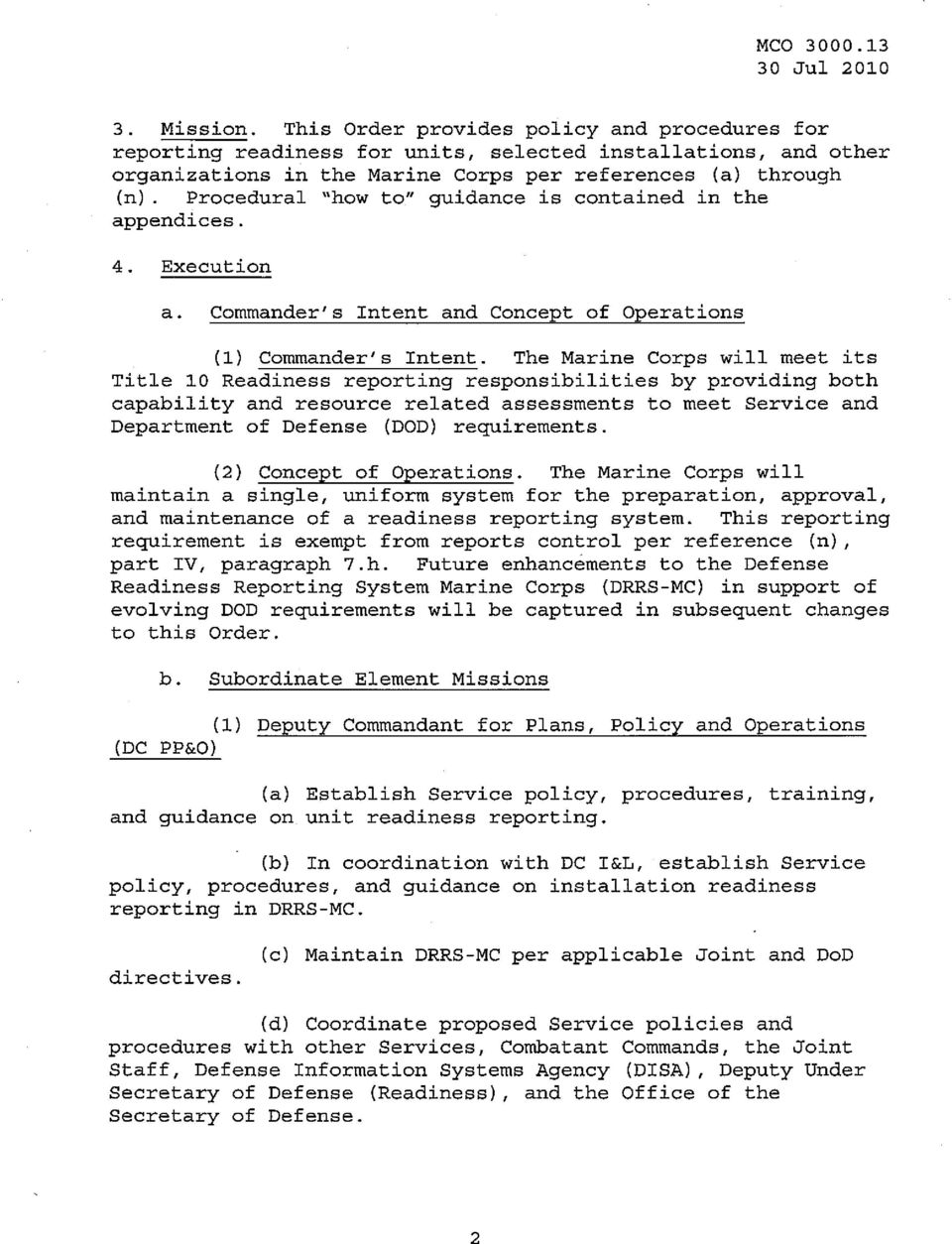
2 3. Mission. This Order provides policy and procedures for reporting readiness for units, selected installations, and other organizations in the Marine Corps per references (a) through (n). Procedural "how to" guidance is contained in the appendices. 4. Execution a. Commander's Intent and Concept of Operations (1) Commander's Intent. The Marine Corps will meet its Title 10 Readiness reporting responsibilities by providing both capability and resource related assessments to meet Service and Department of Defense (DOD) requirements. (2) Concept of Operations. The Marine Corps will maintain a single, uniform system for the preparation, approval, and maintenance of a readiness reporting system. This reporting requirement is exempt from reports control per reference (n), part IV, paragraph 7.h. Future enhancements to the Defense Readiness Reporting System Marine Corps (DRRS-MC) in support of evolving DOD requirements will be captured in subsequent changes to this Order. b. Subordinate Element Missions (1) Deputy Commandant for Plans, Policy and Operations (DC PP&O) (a) Establish Service policy, procedures, training, and guidance on unit readiness reporting. (b) In coordination with DC I&L, establish Service policy, procedures, and guidance on installation readiness reporting in DRRS-MC. directives. (c) Maintain DRRS-MC per applicable Joint and DoD (d) Coordinate proposed Service policies and procedures with other Services, Combatant Commands, the Joint Staff, Defense Information Systems Agency (DISA), Deputy Under Secretary of Defense (Readiness), and the Office of the Secretary of Defense. 2
3 (e) Develop and review every four years mission statements and core mission essential task lists (METLs) for ground combat element organizations that DC PP&O is assigned Marine Air Ground Task Force (MAGTF) advocacy. Develop and review standards used for MET assessment. Provide METs and standards to DC, CD&I and COMMMARFORCOM. (f) Register units, organizations, and installations in DRRS-MC. Coordinate with DC I&L on which installations will be designated to report in DRRS-MC. (g) Integrate USMC readiness initiatives and serve as the functional advocate for DRRS-MC. (h) Coordinate the activation, deactivation, and reassignment of Marine Corps units with the Deputy Commandant, Combat Development & Integration (CD&I), Total Force Structure Division (TFSD) (i) Post and maintain an updated DRRS-MC User's Guide on PP&O's portal for force and supporting establishment commanders. I&L) (2) Deputy Commandant, Installations and Logistics (DC, (a) In coordination with DC PP&O, establish Service policy, procedures, and guidance on installation readiness reporting in DRRS-MC. (b) Coordinate proposed Service installation reporting policies and procedures with other Services, Combatant Commands, the Joint Staff, Defense Information Systems Agency (DISA), and the Office of the Secretary of Defense. (c) Coordinate the designation and registration of selected installations to report in DRRS-MC with DC PP&O and DC CD&I. (d) Integrate USMC readiness initiatives relative to installations. (e) Develop and review every four years mission statements and core mission essential task lists (METLs) for logistic combat element organizations and installations that DC I&L is assigned MAGTF advocacy. Develop and review standards 3

4 used for MET assessment. and COMMMARFORCOM. Provide METs and standards to DC, CD&I (f) Identify the readiness reportable ground principal end items (PEI) and mission essential equipment (MEE) selected for readiness reporting. (3) Deputy Commandant, Aviation (a) Coordinate with PP&O on policy, procedures, and guidance for aviation unit readiness reporting. (b) Develop and review every four years mission statements and core mission essential task lists (METLs) for aviation combat element organizations that DC Aviation is assigned MAGTF advocacy. Develop and review standards used for MET assessment. Provide METs and standards to DC, CD&I and COMMMARFORCOM. (CD&I) (4) Deputy Commandant, Combat Development & Integration (a) Manage, coordinate, maintain, and serve as the primary review authority of the Marine Corps Task List (MCTL) and update it as required. Provide periodic examination of the MCTL to reflect installation METLs, Unit Core METLs, Named Operation METLs, and Concept Plan/Operation Plan (CONPLAN/OPLAN) METLs. Define doctrinal tasks and support operational reporting requirements. (b) Coordinate the activation, deactivation, and reassignment of Marine Corps units and installations with PP&O and I&L. (c) Develop and review every four years mission statements and core mission essential task lists (METLs) for command element organizations that DC CD&I is assigned MAGTF advocacy. Develop and review standards used for MET assessment. (d) Assist Deputy Commandants, Advocates and the Marine Corps Component Commanders (MARFORs) in the development of Common Core METLs with conditions and standards for all liketype units and installations. (e) Establish and maintain a Service organizational database for unit.mets and associated standards. 4
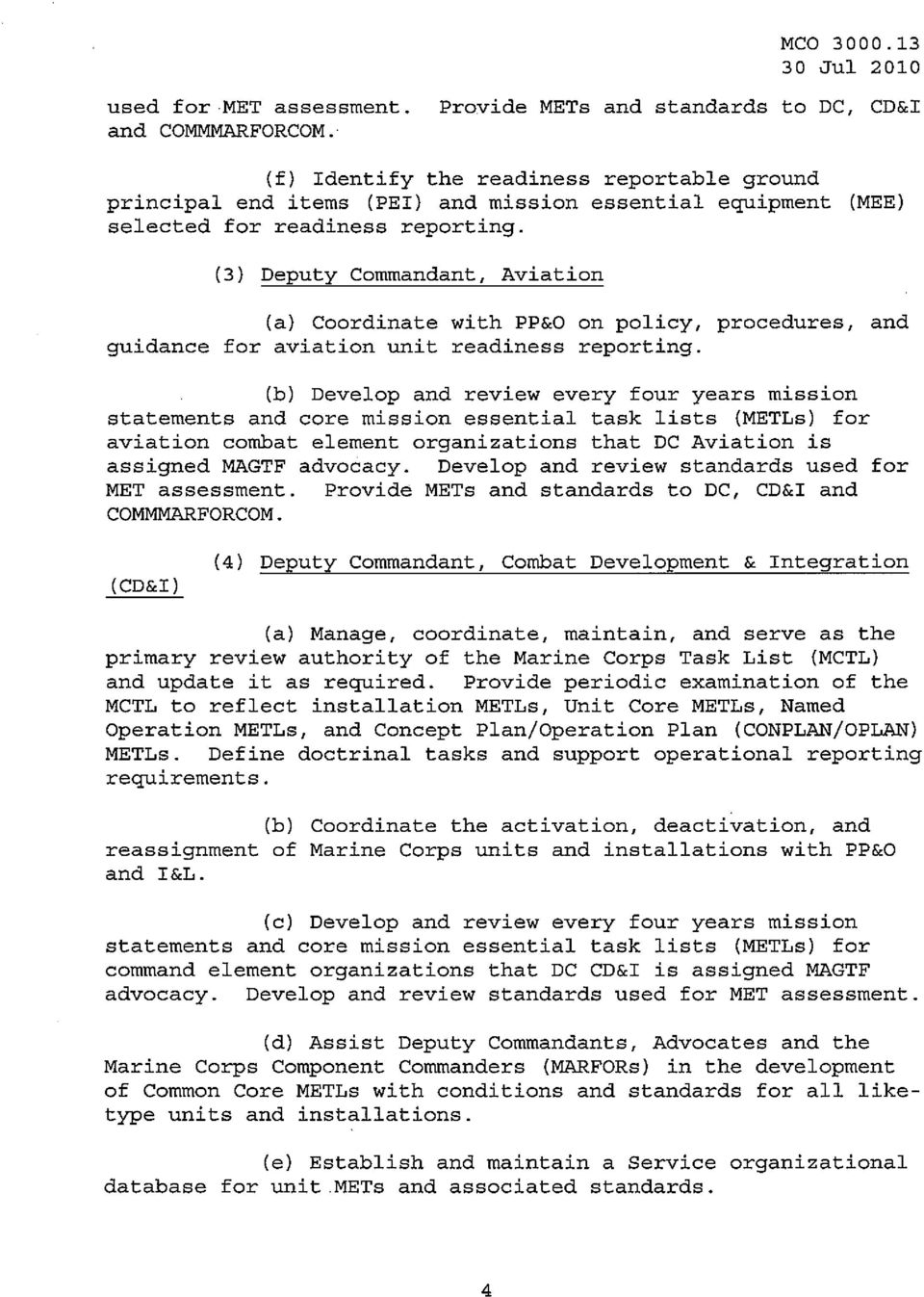
5 (f) Incorporate standardized Unit Core METLs and associated training standards in Ground and Aviation T&R Manuals. (g) Identify, develop, fund and administer an online distance learning (DL) DRRS-MC training course. Obtain input from PP&O (POR), Advocates, the MARFORs, and Commanders of designated Marine Corps installations regarding DL course requirements. (5) Commanding General, Marine Corps Forces Command (MARFORCOM) (a) Support the development and periodic review of common Core METs and associated standards for all like-type conventional units. (b) Coordinate with DC CD&I to load Core METs and associated standards for like-type conventional units into the Service organizational MET database. (c) Develop templates for unit Named Operations and OPLAN/CONPLAN METLs. (d) Integrate Named Operation and OPLAN/CONPLAN METL development into force sourcing actions. (6) Marine Corps Component Commanders (MARFORCOM, MARFORPAC, MARFORSOC, MARFORCENT, MARFOREUR, MARFORSOUTH, MARFORSTRAT, MARFORNORTH, MARFORAF, MARFORCYBERCOM, MARFORKOREA, MARFORRES) (a) Inform the supporting MARFOR (MARFORCOM, MARFORPAC, MARFORRES, MARFORSOC) when OPLAN/CONPLAN assessment requires assigned units to develop and report against OPLAN/CONPLAN METLs. MARFORSOC is the exception, when they provide forces to Theater Special Operations Commands (TSOCs). reporting validity. (b) Establish procedures to monitor the readiness of subordinate units for accuracy, timeliness, and Direct corrective action as required. (c) Support subordinate units' development of Named Operation and OPLAN/CONPLAN METLs. Inform HQMC (PP&O), MCCDC, and MARFORCOM if such METLs need to become the focus of resourcing and training efforts instead of Core Unit METLs. 5

6 6. Command and Signal MCO a. Command. This Order is applicable to the Marine Corps Total Force. b. Signal. This Order.i} )~:;;;: :,gned DISTRIBUTION: PCN T. D. WALDHAUSER Deputy Commandant for Plans, Policies and Operations Copy to: USCINCSTRATACOM/J3 (10) Joint Staff USCINCCENT/ccj3 (10) J-1 USCINCEUCOM/ECJ3-FD (10) J-38 USCINCTRANSCOM/DOCR (10) J-6I USCINCPACCOM/J34 (10) J-7/EAD/JDED USCINCSOUTHCOM/SCJ3-0POS-JOC (10) DISA/JSSC (1) USCINCSPACECOM/J-3CO (10) CSA/DAMO-ODR (5)USCINCSOCOM/J3 (10) CSAF/XOOOC (5) USJTFORCESCMD/J331 (10) CNO/OP642E (5) 7

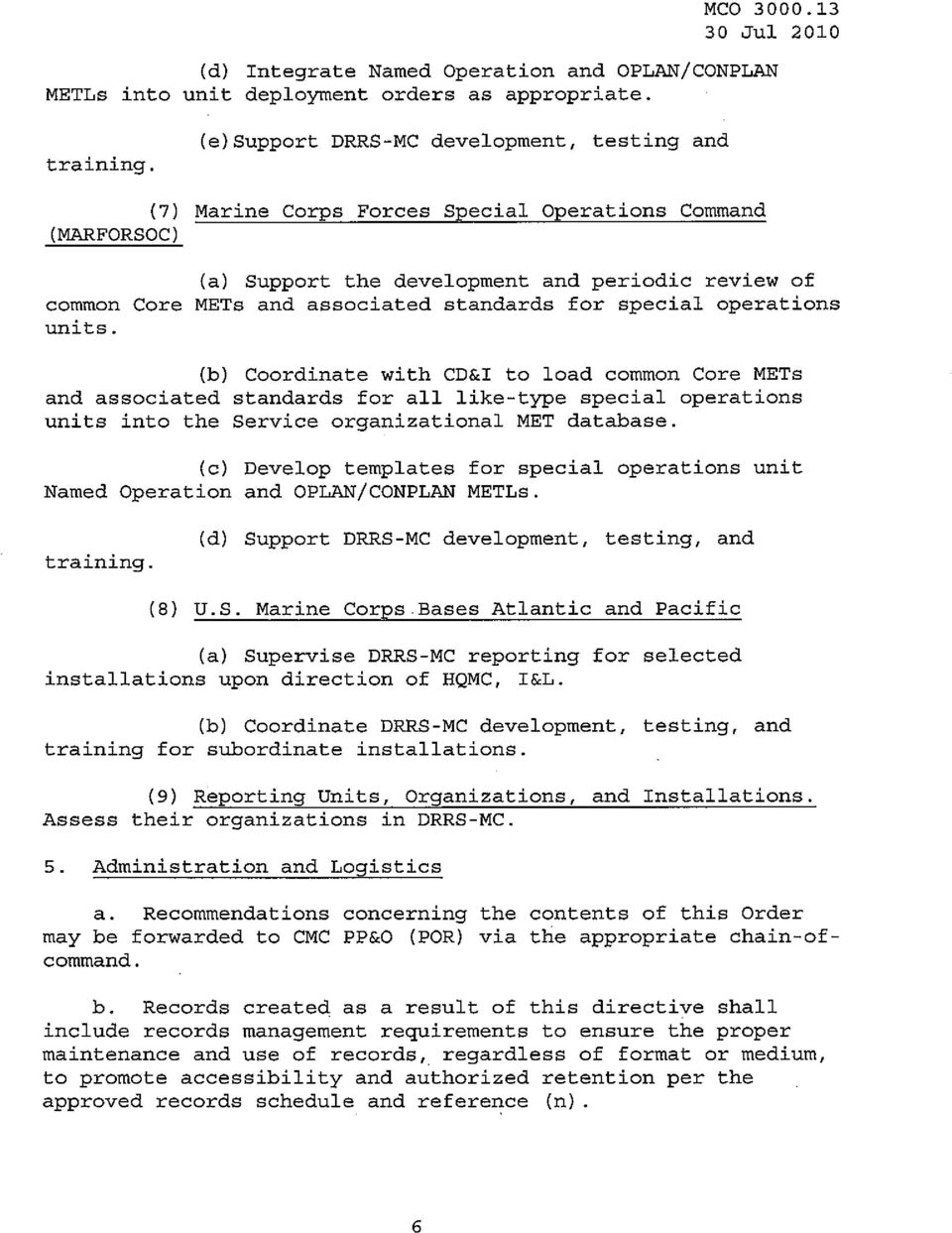
7 (d) Integrate Named Operation and OPLAN/CONPLAN METLs into unit deployment orders as appropriate. training. (e) Support DRRS-MC development, testing and (7) Marine Corps Forces Special Operations Command (MARFORSOC) (a) Support the development and periodic review of common Core METs and associated standards for special operations units. (b) Coordinate with CD&I to load common Core METs and associated standards for all like-type special operations units into the Service organizational MET database. (c) Develop templates for special operations unit Named Operation and OPLAN/CONPLAN METLs. training. (d) Support DRRS-MC development, testing, and (8) U.S. Marine Corps Bases Atlantic and Pacific (a) Supervise DRRS-MC reporting for selected installations upon direction of HQMC, I&L. (b) Coordinate DRRS-MC development, testing, and training for subordinate installations. (9) Reporting Units, Organizations, and Installations. Assess their organizations in DRRS-MC. 5. Administration and Logistics a. Recommendations concerning the contents of this Order may be forwarded to CMC PP&O (POR) via the appropriate chain-ofcommand. b. Records created as a result of this directive shall include records management requirements to ensure the proper maintenance and use of records, regardless of format or medium, to promote accessibility and authorized retention per the approved records schedule and reference (n). 6
8 LOCATOR SHEET SUbj: MARINE CORPS READINESS REPORTING STANDING OPERATING PROCEDURES (SHORT TITLE: MARINE CORPS READINESS SOP) LOCATION: (Indicates the location(s) of copy(ies) of this Order.) 8

9 RECORD OF CHANGES Log completed change action as indicated. Change Date of Date Number Change Entered Signature of Person Incorporated Change 9

10 IDENTIFICATION Chapter 1 TABLE OF CONTENTS TITLE READINESS OVERVIEW PAGE Table 1-1 Purpose Policy Background Scope Reporting Organizations Core and Assigned Readiness Assessments Reporting Occasions Reporting Channels Security Classification Release and Access to Reports Codes for Report Submissions Reporting Occasions Chapter Figure 2-1 Table 2-1 PERSONNEL Purpose Policy Scope Reporting Requirements Task Organization Personnel Remaining Behind From Deployment Employ/Deploy Codes Personnel Percentages P-Ratings Chapter EQUIPMENT Purpose Policy Scope Reporting Requirements Reportable Equipment S-Rating: Equipment And Supplies

11 IDENTIFICATION TITLE MCO PAGE Table 3-1 Table 3-2 R-Rating: Equipment Condition Task Organization Equipment Remaining Behind From Deployment Employ/Deploy Codes Equipment and Supplies (S-Rating) Equipment Condition (R-Rating) Chapter 4 l MET ASSESSMENTS Purpose Policy Scope MET Assessment Assessment Definitions Required Remarks Chapter 5 l Table 5-1 TRAINING Purpose Policy Scope Training (T-Rating) Mandatory Training Remarks Training Reason Codes T-Rating Calculation Chapter 6 l Table 6-1 Table 6-2 CHEMICAL, BIOLOGICAL, AND NUCLEAR (CBRN) DEFENSE Purpose Policy Scope Reporting Requirements CBRN Defense Equipment S-Ratings CBRN Defense Training T-Rating

12 IDENTIFICATION Chapter 7 TITLE COMMANDER'S ASSESSMENTS MCO PAGE Purpose Policy Scope Reporting Requirements Guided Remarks Appendix A Figure A-1 PERSONNEL PROCEDURES Purpose... A-1 Assembly of Personnel Information... A-1 Personnel Location... A-1 Type Personnel Codes (TPERS)... A-1 Personnel Adjustments for Task Organization... A-1 Mandatory Personnel Remarks... A-2 Personnel Reason Codes... A-3 Employ/Deploy Codes... A-3 Personnel Task Organization Adjustments... A-2 Appendix B Figure B-1 EQUIPMENT PROCEDURES Purpose... B-1 Assembly of Equipment Information... B-1 MEE Location... B-1 Equipment Adjustments for Task Organization: S-Ratings... B-1 Mandatory Equipment Remarks... B-1 Equipment Reason Codes... B-2 Employ/Deploy Codes... B-2 Equipment Task Organization Adjustments... B-2 Appendix C 1. MET ASSESSMENT Purpose... C-1 12

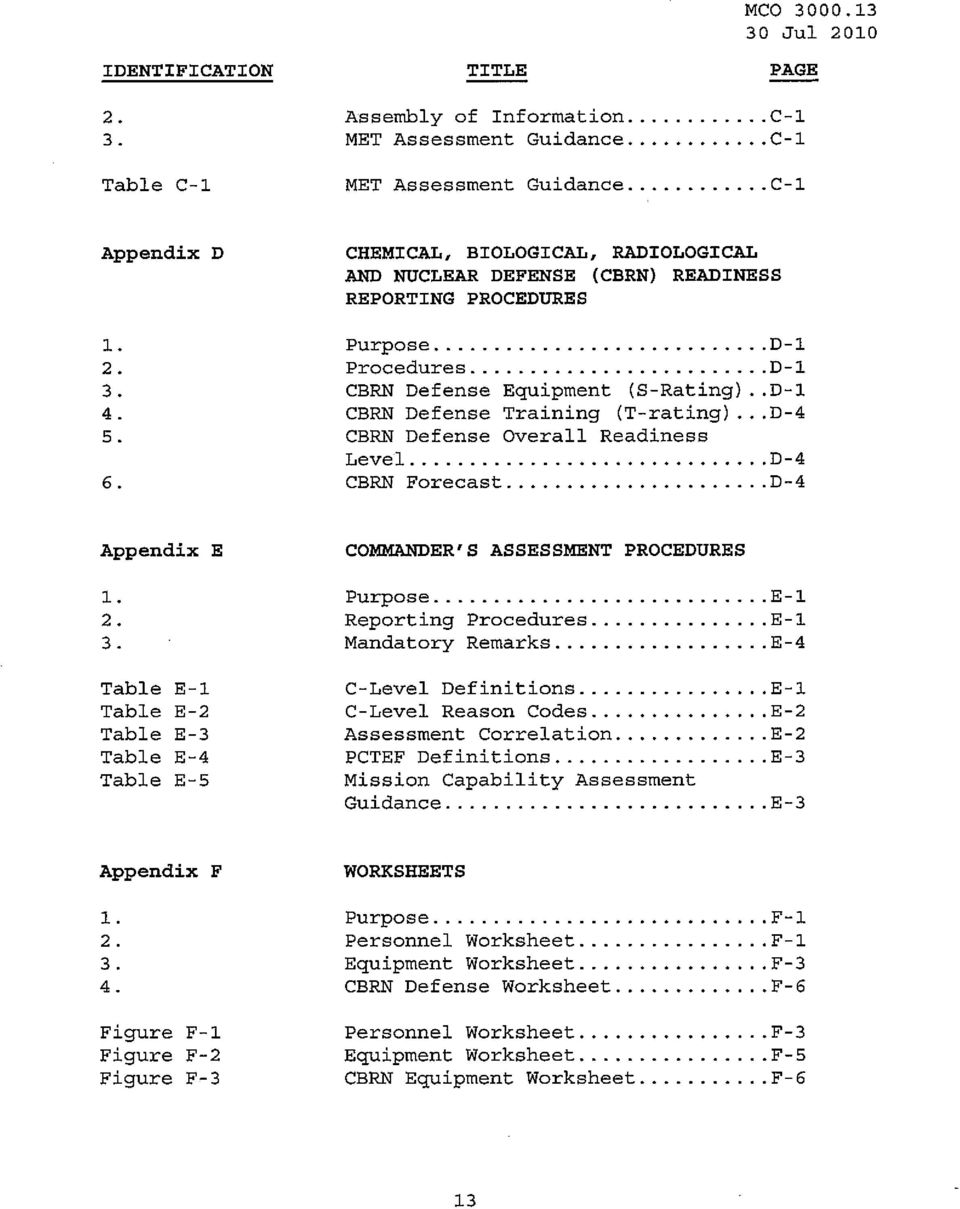
13 IDENTIFICATION TITLE MCO PAGE Table C-1 Assembly of Information... C-1 MET Assessment Guidance... C-1 MET Assessment Guidance... C-1 Appendix D CHEMICAL, BIOLOGICAL, RADIOLOGICAL AND NUCLEAR DEFENSE (CBRN) READINESS REPORTING PROCEDURES Purpose... D-1 Procedures... D-1 CBRN Defense Equipment (S-Rating).. D-1 CBRN Defense Training (T-rating)... D-4 CBRN Defense Overall Readiness Level... D-4 CBRN Forecast... D-4 Appendix E COMMANDER'S ASSESSMENT PROCEDURES Purpose... E-1 Reporting Procedures... E-1 Mandatory Remarks... E-4 Table E-1 Table E-2 Table E-3 Table E-4 Table E-5 C-Level Definitions... E-1 C-Level Reason Codes... E-2 Assessment Correlation... E-2 PCTEF Definitions... E-3 Mission Capability Assessment Guidance... E-3 Appendix F Figure F-1 Figure F-2 Figure F-3 WORKSHEETS Purpose... F-1 Personnel Worksheet... F-1 Equipment Worksheet... F-3 CBRN Defense Worksheet... F-6 Personnel Worksheet... F-3 Equipment Worksheet... F-5 CBRN Equipment Worksheet... F-6 13
14 IDENTIFICATION Appendix G TITLE READINESS TABLES MCO PAGE Table G-1 Table G-2 Table G-3 Table G-4 Table G-S Table G-6 Table G-7 Reason Codes... G-1 Current Status and Activity Codes... G- 6 Type Personnel Code Descriptions... G-7 Deployable Personnel... G-8 Non-deployable Personnel... G-9 Percentage Employed/Deployed... G-10 Major Commands/Reporting Organizations... G-11 Appendix H ABBREVIATIONS Appendix I GLOSSARY l4

15 Chapter 1 Readiness Overview 1. Purpose. This Chapter outlines general policy for operational readiness reporting. It includes information on which organizations report, reporting occasions, reporting channels, security, and the release of readiness data outside of the Marine Corps. 2. Policy. Reference (a) contains the general provisions, detailed instructions, and formats to submit readiness data in support of joint requirements. Supplemental instructions are provided by this Order. This Order is the governing authority for all Marine Corps readiness reporting requirements. Development or use of any additional software, reporting formats, local standards or definitions within any part of readiness reporting requires prior authorization from DC PP&O (POR). 3. Background a. Readiness. Readiness is defined as the ability of U.S. military forces to fight and meet the demands of the national military strategy. Readiness is the synthesis of two distinct but interrelated levels. (1) Unit Readiness. The ability to provide capabilities 'required by the combatant commanders to execute their assigned missions. This is derived from the ability of each unit to deliver the outputs for which it was designed. Unit readiness is reported by the military services. (2) Joint Readiness. This is the combatant commander's (CCDR's) or Joint Task Force (JTF) Commander's ability to integrate and synchronize ready combat and support forces to execute assigned missions. Accurate and timely unit readiness reports are essential for Joint Readiness reporting. b. Legal Requirement To Report Readiness. Title 10, section 153a.3.C., United States Code (USC) directs the Chairman of the Joint Chiefs of Staff to advise the Secretary of Defense on critical deficiencies and strengths in force capabilities identified during the preparation and review of contingency plans. Title 10, section'l17, USC directed the Secretary of Defense to establish a comprehensive readiness reporting system that would measure in an objective, accurate, and timely manner 1-1 Enclosure (1)

16 the capability of the u.s. military to carry out the National Security Strategy, Defense Planning Guidance, and the National Military Strategy. Title 10, section 5042b.2, U.S.C. directs Headquarters, Marine Corps, to investigate and report upon their efficiency and preparation to support military operations by combatant commanders. c. Uses. Readiness information supports in priority order: crisis response planning, deliberate or peacetime planning, and management responsibilities to organize, train, and equip combat-ready forces for the unified commands. Readiness reporting information is also used in: Service testimony, reports to Congress, the Chairman of the Joint Chief of Staff's Readiness System and other venues. 4. Scope. This Order applies to all Marine Corps readiness reporting organizations. 5. Reporting Organizations a. Organizations Required to Report. Combat, combat support, and combat service support units of the Marine Air Ground Task Forces (MAGTFs), MARFORs, and designated organizations and installations will report their readiness. Each type of organization is deployable, designed for warfighting, or provides support to the warfighting Marine. These will include designated task organized units. b. Organizations Not Under MARFOR Operational Control. Marine Corps organizations passed OPCON to a non-marine Corps command will submit their reports through DRRS-MC. This applies to units in contingency operations and aviation squadrons participating in Navy carrier integration. c. Non-Marine Corps Organizations OPCON to Marine Organizations. Those organizations will report their readiness per their channels, not in DRRS-MC. Exceptions may be requested of PP&O, POR, through the chain of command. d. Readiness Reporting Organizations. Only organizations designated by PP&O, POR will submit readiness reports. Requests for organizations to report in DRRS-MC will be forwarded to PP&O, POR through the chain of command. 6. Core and Assigned Readiness Assessments. The readiness reporting system allows commanders of reporting organizations to uniformly determine and accurately report their organizations' 1-2 Enclosure (1)

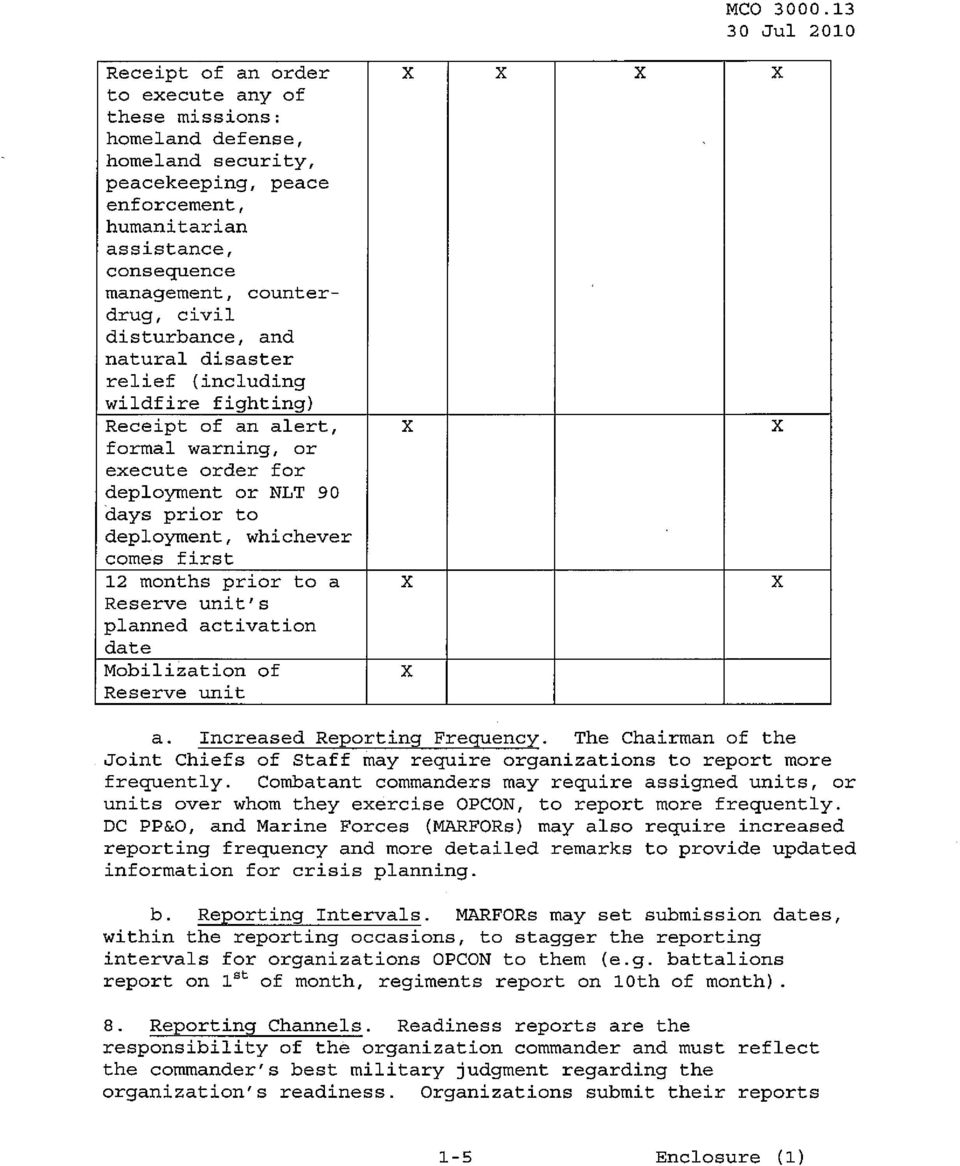
17 ability to accomplish the core (wartime) mission for which the organization was designed via a C-level and core mission capability assessment. When applicable, commanders will also capture their organizations' ability to accomplish assigned missions via the Percent Effective (PCTEF) level and an assigned mission capability assessment. All these assessments can be captured in a single report. a. C-Level and PCTEF Assessments. Both assessments indicate the degree to which a unit has achieved prescribed levels of fill for personnel and equipment, the materiel condition of available equipment, and the training proficiency status of the unit. C-level and PCTEF are discussed in Chapter 7. b. Core and Assigned Mission Capability Assessments. The most significant aspect of readiness reporting is the requirement for Commanders to assess their organizations' capabilities to accomplish their mission essential tasks (METs) to specified conditions and standards. Those assessments are then used by Commanders to assess their organizations' capabilities to accomplish their missions. These assessments are discussed in Chapter Reporting Occasions. Reports will be submitted within 24 hours of the occasions listed in Table 1-1 for the organizations specified. Units will continue to report when deployed for training, deployed in response to a crisis, deployed in execution of an OPLAN, and in combat. occasions that require the report to include PCTEF/assigned mission capability assessments are shown in the right most column of Table 1-1. Table Reporting Occasions occasion Units MARFOR Installations PCTEF/ Assign Msn 30 days since last X X report 90 days since last X report Activation or X X X deactivation Change in C-Level X Change in Percent X X Effective (PCTEF) 1-3 Enclosure (1)

18 Change in core Mission Assessment (Yes, Qualified Yes, No) Change in assigned Mission Assessment (Yes, Qualified Yes, No) Change in Administrative Control (ADCON) or Operational Control (OPCON) Change of location of command element Change of geographic location of unit's personnel or equipment (e.g. mobilized reserve unit's arrival at Site of Initial Activation, a unit's arrival at CAX, or arrival overseas) Employed in support of an in-lieu mission (one that does not match the core mission) Assignment to Named Operations (e.g. Operation Iraqi Freedom) or Operational Plan/Concept Plan (OPLAN/CONPLAN) by D- 90 Assignment to Security, Transition, and Reconstruction (SSTR) mission X X X X X X X X X X X X X X X X X X X X X X 1-4 Enclosure (1)

19 Receipt of an order to execute any of these missions: homeland defense, homeland security, peacekeeping, peace enforcement, humanitarian assistance, consequence management, counterdrug, civil disturbance, and natural disaster relief (including wildfire fighting) Receipt of an alert, formal warning, or execute order for deployment or NLT 90 days prior to deployment, whichever comes first 12 months prior to a Reserve unit's planned activation date Mobilization of Reserve unit X X X X X X X X X a. Increased Reporting Frequency. The Chairman of the Joint Chiefs of Staff may require organizations to report more frequently. Combatant commanders may require assigned units, or units over whom they exercise OPCON, to report more frequently. DC PP&O, and Marine Forces (MARFORs) may also require increased reporting frequency and more detailed remarks to provide updated information for crisis planning. b. Reporting Intervals. MARFORs may set submission dates, within the reporting occasions, to stagger the reporting intervals for organizations OPCON to them (e.g. battalions report on 1 st of month, regiments report on 10th of month). 8. Reporting Channels. Readiness reports are the responsibility of the organization commander and must reflect the commander's best military judgment regarding the organization's readiness. Organizations submit their reports 1-5 Enclosure (1)
20 directly into DRRS-MC, and the use of DRRS-MC software is mandatory. Coordination of readiness issues with higher, supported, and supporting commands ensures a shared understanding of unit capabilities and any support that may be required. Commanders and staffs must avoid actions which may impair the submission of timely, accurate, and complete readiness assessments by subordinate organizations. Higher headquarters will not require higher level review of reports prior to submission or direct minimum levels of reported readiness. a. Edit of Reports. Report originators will be notified of reports processed and errors detected. Erroneous reports will be corrected and resubmitted within 24 hours of notification. b. Review of DRRS-MC Data. DRRS-MC resource data is maintained in the GSORTS database by the Defense Information Systems Agency. Resource data and mission and MET assessments can be accessed through DRRS-MC with the Marine Readiness Management Output Tool (MRMOT). Reporting organizations at all levels must develop an audit program to periodically check readiness reports for accuracy. Higher headquarters are not authorized to change subordinate organization readiness reports, except to correct computation errors or administrative errors. 9. Security Classification a. The classification of readiness data will be based on the highest classified item in the report. Top Secret information will not be reported. Protection of classified information shall be per: DOD Instruction (DOD Information Security Program and Protection of Sensitive Compartmented Information; SECNAVINST A), Department Of The Navy (DON) Information Security Program (ISP) Instruction; and the Chairman of Joint Chiefs of Staff Manual on GSORTS (CJCSM A). b. The policy guidance contained in this paragraph is specifically applicable to reports that are submitted in compliance with the provisions of this Order and to information contained in or extracted from those reports following their submission. The provisions of this paragraph are not applicable to information regarding personnel status, equipment status, or training status of organizations, people or equipment that resides in or is derived from other databases or systems. 1-6 Enclosure (1)

21 c. Confidential. C-level, PCTEF, and core/assigned capability mission assessments for a battalion, squadron, installation or smaller unit are confidential. MCO d. Secret. C-level, PCTEF, and core/assigned capability mission assessments for organizations larger than a battalion, squadron, or installation are secret. e. Top Secret. Top secret information will not be included in readiness reports. 10. Release and Access to Reports. Marine Corps readiness information will not be released outside the Department of Defense without the written approval of PP&O, POR. Outside agencies with a valid need-to-know and the appropriate clearance should submit requests to PP&O, POR. 11. Codes for Report Submissions. Appendix G contains codes for readiness report submissions that are not contained in the other chapters and appendices. 1-7 Enclosure (1)
22 Chapter 2 Personnel 1. Purpose. This chapter outlines policy for personnel reporting. 2. Policy. Reporting of personnel to determine a Personnelrating (P-rating) is based on the unit's ability to provide deployable, military occupational specialty (MOS) qualified personnel to accomplish its missions. It is one of the four measured areas that are factors in determining a unit's C level. P-ratings may also be used as part of the standards for a unit's METs. Reportable personnel will be accounted for by only one organization at a time. 3. Scope. This section applies to Marine Corps readiness reporting units, not installations or MARFORs. Intermediate level commands will provide a subjective assessment of their personnel resource rating based upon the resource ratings of subordinate units. 4. Reporting Requirements. Personnel readiness policy is explained in this chapter. Personnel guidance on reporting procedures, mandatory remarks, and reason codes are contained in Appendix A. a. P-Rating. Units will determine the P-rating based on the lower percentage of the PERSONNEL STRENGTH and MOS FILL calculations. Figure 2-1 depicts the formulas for calculating these percentages; Task organized units and units detaching personnel to task organized units will comply with paragraph 5 of this chapter when calculating personnel percentages. Table 2-1 depicts how the percentages determine the P-rating. The P-rating will be calculated as of the time of the report and will not be a future projection. P-ratings of less than 1 require reason codes and remarks per Appendix A.. Figure Personnel Percentages Personnel Strength Percentage (Assigned Strength - Nondeployables/Structure Strength) X 100 MOS Fill Percentage (MOS Fill - Nondeployables/Structure Strength) X Enclosure (1)
23 Rule P1 Table P Ratings P2 P3 P4 Personnel Strength.90% 80-89% 70-79% <70% MOS Fill 2:,85% 75-84% 65-74% <65% b. Structure Strength. The Total Force Structure Management System (TFSMS) is the authoritative source for obtaining a unit's table of organization (T/O) Structure Strength data; minus any individual mobilization augmentation (IMA) billets or unfilled Navy billets identified with a "M" code (medical billets to be augmented by the hospital staff). Site support personnel will not be counted in Reserve units. Task organized units will obtain their personnel Structure Strength from the unit's manning documents. Task organized units and the units providing personnel to task organized units will adjust their Structure Strength per paragraph 5 of this chapter. Occasionally, the majority of a unit will deploy, but still retain personnel at their home station. Those units will compute their structure strength per paragraph 6 of this chapter. c. Assigned Strength. The Marine Corps Total Force Structure System (MCTFS) is the authoritative source for unit personnel status, which should be used to help determine the Assigned Strength. Reporting units will list their entire assigned strength, minus any contingency billets (read as a "C" type billet on a unit's T/O) or unfilled Navy billets identified with an "M" code (medical billets to be augmented by the hospital staff). Task organized units and the units providing personnel to task organized units will adjust their Assigned Strength per paragraph 5 of this chapter. Units that are deployed, but still retain personnel at home station will compute their assigned strength per paragraph 6 of this chapter. d. MOS Fill. The MOS FILL is determined by taking the number of personnel matched against T/O line number billets by MOS. A unit will report Marines filling T/O billets using either a primary or additional MOS, but not both. One Marine cannot fill two billet lines, even if that Marine has two MOSs. Each person will be aligned with a specific T/O line number by MOS, and the rank may vary one above or one below that listed in the T/O, if it's the same MOS. Marines assigned to billets such as Scout Sniper, will use their 2-2 Enclosure (1)
24 primary MOS with a necessary skill designator to match against the unit's T/O (i.e., 0369 with a billet MOS of 8541 Scout Sniper). In cases where line numbers require more than one MOS, each MOS must match to count as an MOS match. e. Non-Deployable Personnel. The criteria for determining a non-deployable status and the codes for listing them are depicted in Tables G-4 and G-5. f. Critical MOSs. Units will identify the three most critical PMOSs that have the largest detrimental impact on the unit's readiness per Appendix A. 5. Task-Organization. Task organized units gaining personnel and the units providing them personnel will adjust their personnel quantities. Coordination must occur between the task organized and providing units to avoid double counting of personnel. Remarks explaining the personnel adjustments will remain in the task organized and providing units' reports until the detachments are returned to the providing units or transferred elsewhere. a. Task Organized Units Gaining Personnel. Task organized units that receive detachments of personnel will increase their Assigned Strength, Structure Strength, and MOS Fill quantities. b. Units Providing Personnel to Task Organized Units. The Assigned Strength and MOS Fill quantities will be subtracted from the providing unit(s). Do not subtract the Structure Strength from the providing unit. 6. Personnel Remaining Behind From Deployment. When an active duty unit deploys and has personnel that still belong to the unit remaining behind, the commander will still consider them in the P-rating calculation and C-level assessment. They will not be considered in PCTEF, assigned MET and mission assessments. If some of these personnel are subsequently transferred to another unit, their quantity is removed from the assigned strength, not the structure strength. This policy is not applicable to Reserve units, because remain behind personnel are transferred to another unit upon deployment. 7. Employ/Deploy Codes. When five percent (5%) or more of a unit's personnel are detached to deploy with another unit, the 2-3 Enclosure (1)
25 providing unit will use the employ/deployed codes from Appendix G, Table G-6 to report the percentage deployed. Mea Enclosure (1)
26 Chapter 3 Equipment 1. Purpose. This chapter outlines policy for equipment reporting for both equipment and supplies on hand (S-rating), and equipment condition (R-rating). The S-rating is a materiel measurement of an organization's possessed equipment quantity against its designed requirement. The R-rating indicates the materiel condition of the organization's possessed equipment. 2. Policy. Reporting on equipment to determine a S-rating and a R-rating is based on the unit's ability to provide the quantities and quality of equipment to accomplish its missions. The Sand R ratings are two of the four measured areas that are factors in determining a unit's C-level. Sand R-ratings may also be used as part of the conditions for an organization's METs. Equipment will be accounted for by only one organization at a time, and the present materiel status, not future projections, will be used. Active and Reserve units will compute their Sand R-ratings in the same way. 3. Scope. This section applies to Marine Corps readiness reporting units. It does not apply to installations or MARFORs. Intermediate level commands will provide a subjective assessment of their equipment ratings based upon their subordinate units' S and R ratings. 4. Reporting Requirements. Materiel readiness policy is explained in this chapter. Materiel guidance on reporting procedures, mandatory remarks, and reason codes are contained in Appendix B. 5. Reportable Equipment. Selected pieces of equipment are designated to accurately capture the equipment readiness of Marine Corps units. The selected equipment is reported as either mission essential equipment (MEE) or principal end items (PEl). a. Ground Equipment. Reference (f) defines MEE and PEl for ground equipment and sets forth the procedures for updating them. Updated MEE and PEl are published in Marine Corps Bulletin b. Aircraft and Aviation Support Equipment. Flying squadrons, to include MEU(ACE) designated squadrons, will consider their aircraft as MEE when calculating their Sand R- 3-1 Enclosure (1)
27 Meo ratings. Flying squadrons will not calculate aviation support equipment as PEl. MALS will calculate Sand R-ratings using aviation support equipment as PEl. 6. S-Rating: Equipment and Supplies. Units will calculate a S rating as of the time of the report and report the lowest S rating between the MEE and PEl calculations. Task organized units and units detaching equipment to task organized units will comply with paragraph 8 of this chapter when calculating S ratings. Table 3-1 depicts the criteria for these calculations. Table Equipment and Supplies (S-Rating) Rule Sl S2 S3 S4 1. Mission Essential Equipment (MEE) Total Service-selected mission-essential >90% 80-89% 65-79% <65% - equipment possessed divided by prescribed wartime requirements [UTR] T.otal In Reporting Status aircraft - >90% 80-89% 60-79% <60% possessed divided by prescribed wartime requirement (PMAA) 2. Support Equipment (PEl) Total Service-selected principal end-items >90% 80-89% 65-79% <65% - possessed divided by prescribed wartime requirement [UTR] a. Prescribed Wartime Requirement. The Total Force Structure Management System (TFSMS) is the authoritative source for obtaining a unit's table of equipment (TIE) data for ground equipment. The TIE prescribed wartime requirement appears in the AAO column, which will be changed in the future to read Unit TIE Requirement (UTR). The Primary Mission Authorized Aircraft (PMAA) quantity is the prescribed wartime requirement for tactical aircraft. The PMAA is published in the Marine Aviation Plan. Task organized units will use their sourcing document or equipment density list (EDL) for their prescribed wartime 3-2 Enclosure (1)
28 requirement. The prescribed wartime requirement for aviation support equipment comes from the Support Equipment Resources Management Information System (SERMIS). b. Possessed Equipment. Ground and aviation supply regulations determine the possession status of equipment. Excess possessed equipment (quantities above the prescribed PEl and MEE wartime requirement) will not be used to calculate the S or R-ratings for non-intermediate units, but will be mentioned in the report's remarks. c. Intermediate Level Commands. Intermediate commands should consider the impact of any excess equipment in their subordinate units when making a subjective S-rating assessment. 7. R-Rating: Equipment Condition. Units will calculate a R rating as of the time of the report and report the lowest R rating between the MEE and PEl calculations. Applicable maintenance directives determine a mission capable status. Excess possessed equipment (quantities above the prescribed wartime requirement) will not be used in the R-rating. Further guidance on aircraft status is defined in OPNAVINST and OPNAVINST Table 3-2 depicts the criteria for the R rating calculations. Table Equipment Condition (R-Rating) Rule Rl R2 R3 R4 1. Mission Essential Equipment (MEE) Total Service-selected mission-essential equipment available and >90% 70-89% 60-69% <60% - "mission capable" divided by total possessed Total In Reporting Status aircraft mission >75% 60-74% 50-59% <50% - capable divided by total aircraft In Reporting Status 3-3 Enclosure (1)
29 2. Principal End Item (PEl) Total Service-selected principal end-items available and mission capable divided by the total possessed... >90% 70-89% 60-69% <60% 8. Task Organization. Task organized units and the units providing them equipment will adjust their equipment quantities as described below. Coordination must occur between the task organized and providing units to avoid double counting of equipment. The adjustments will remain in the task organized and providing units' reports until the detachments are returned to the providing units or transferred elsewhere. a. Task Organized Units Gaining Equipment. Task organized units that receive detachments of equipment will increase their possessed and prescribed wartime requirement quantities. b. Units Providing Equipment to Task Organized Units. The possessed quantities will be subtracted from the providing unit(s). Do not subtract the prescribed wartime requirement quantities. 9. Equipment Remaining Behind From Deployment. When an active duty unit deploys and has equipment that still belongs to the unit remaining behind, the commander will still include that equipment in the Sand R-rating calculations and the C-Ievel assessment. They will not be considered in PCTEF or assigned MET and mission assessments. This policy is not applicable to Reserve units, because remain behind equipment is transferred to another unit when they deploy. 10. Employ/Deploy Codes. When five percent (5%) or more of a unit's equipment is detached to deploy with another unit, the providing unit will use the employ/deployed codes from Appendix G, Table G-6 to report the percentage deployed. 3-4 Enclosure (1)
30 Chapter 4 MET Assessments 1. Purpose. This chapter outlines policy for assessing mission essential tasks (METs). 2. Policy. METs will be developed per references (g) and (h) Core METs are published within Training and Readiness manuals and form the foundation for a community's T&R standards. A mission essential task list (METL) contains the list of a command's essential tasks with appropriate conditions and performance standards to assure successful mission accomplishment. The assessment of METs will be based on the organization's present state, not a future projection. Guidance on MET assessment procedures is contained in Appendix C. 3. Scope. All readiness reporting units (including intermediate commands), installations, and MARFORs will assess their METs. 4. MET Assessment a. General. A MET is an event in which a unit or organization must be proficient to be capable of accomplishing an appropriate portion of its wartime mission. All readiness reporting Marine Corps organizations will have a mission essential task list (METL). Assessments at all levels will include evaluations of the resources available and training readiness to perform METs to prescribed standards. The assessments will assist the commander in determining the organization's ability to execute core and assigned missions. Reference (h) provides a common language that commanders can use to document their warfighting requirements as METs. The METs in reference (h) are architecturally linked to the Universal Joint Task List (UJTL), which includes strategic-national, strategictheater, and operational level of war tasks used by joint task forces and Combatant Commanders. b. Types of MET Assessments. Commanders will assess METs for three types of missions: Core, assigned Major Operational Plans/Concept Plans (OPLANs/CONPLANs), and assigned Named Operations. (1) Core METs. Core METs define the design capabilities of a unit and are developed using tasks documented in the Marine Corps Task List (MCTL), reference (h). Core METs are reflected 4-1 Enclosure (1)
31 in the T&R manuals and provide the foundation for a community's T&R standards. The conditions and standards for training to Core METs are reflected by events which serve as the measures to gauge readiness against the performance of the task. Personnel and equipment standards for Core METs are developed by DC CD&I Total Force Structure and can be found within the Service organizational MET database. Core METs are standardized for all units of the same type and are used to develop the community's T&R Manual. Core METs form the basis for the METL and additional METs are added or refined as required. Units without approved Core METs will establish their own (with conditions and standards), based on established doctrine, METLs of similar units, higher headquarters' METLs, and Marine Corps publications. The MCTL contains Marine Corps tasks approved by Marine Corps Combat Development Command, Combat Development and Integration (MCCDC, CD&I). (2) Major OPLAN/CONPLAN METs. Major OPLANs/CONPLANs are plans that require level four detail (established Time-Phased Force & Deployment Data (TPFDD», per the Contingency Planning Guidance. When tasked by higher headquarters, units that have been assigned in support of major OPLANs/CONPLANs will use OPLAN/CONPLAN specific METs and will report their readiness to support these missions. The commander checks the baseline METL derived from core tasks and adjusts to add, delete, and/or modify METs as appropriate during mission assessment of the warplan. The supported Marine Corps Component Commanders are the approving authorities for OPLAN/CONPLAN specific METs for their major subordinate units, and will ensure unit METLs support Combatant Commander capability requirements. U.S. Marine Corps Forces Command will develop and maintain METL templates for various missions (e.g., provisional security operations) to support this process. (3) Named Operation METs. Named operations are those operations designated as such by the Joint Chiefs of Staff (e.g. Operation IRAQI FREEDOM). They will be assessed when 25 percent or more of a unit deploys or prepares to deploy in support of a named operation. Core METs, OPLAN/CONPLAN METs, METL templates, and deployment guidance provide the basis for the development and refinement of named operation METs. When such an operation or deployment requires specific or additional skills, the commander revises the unit's METL accordingly and submits to the next higher level of command for approval. 5. Assessment Definitions. The Commander will assess his METs as Yes, Qualified Yes, or No. The definitions for those 4-2 Enclosure (1)
32 assessments are below. Table C-1 in Appendix C provides more in-depth information to assist with MET assessment. a. Yes "Y" Assessment. The organization can accomplish the task to standard under the specified conditions. A "Y" assessment should reflect demonstrated performance in training or operations whenever possible. A "Y" assessment indicates an organization possesses the necessary resources or those resources explicitly identified in its MET to allow it to execute when ordered. b. Qualified Yes "Q" Assessment. The organization is expected to accomplish the task to standard under most conditions, but this performance has not been observed or demonstrated in training or operations. Organizations assessing their task as "Q" may be employed for those tasks. The unit possesses the necessary resources or those resources have been explicitly identified to the organization to allow it to execute when ordered. c. No "N" Assessment. The organization is unable to accomplish the task to standard at this time. 6. Required Remarks. If any METs are assessed as "No", explain the capability shortfall, as well as the resources, training, or forces required to resolve the shortfall. Address any standards assessed as not meeting required criteria. EXAMPLE: "80% TRAINED TO STANDARD, NOT ABLE TO TRAIN TO AMPHIB OPS UNTIL DEC WHEN AMPHIB SHIPS AVAIL. ABLE PERFORM AMPHIP PORTION OF MSN AFTER THIS TRNG." 4-3 Enclosure (1)
33 Chapter 5 Training 1. Purpose. This chapter outlines policy for reporting training (T-rating). 2. Policy. The T-rating is one of the four measured areas that are factors in determining a unit's C-level. The determination of a T-level will be based on the unit's present state, not a future projection. 3. Scope. (including MARFORs. T-ratings will be calculated only by units intermediate level commands), not by installations or 4. Training (T-Rating). The T-rating is an assessment of the unit's training to accomplish its designed mission. a. Units, to include intermediate level units, will base their T-rating on the percentage of their core METs trained to standard using Table 5-1 as a reference. For example, if a battalion was trained to standard in four of its five METs, it would have a T-rating of T-2 (80%). Table T-Rating Calculation Rule T1 T2 T3 T4 Percentage of Core METs Trained to ~85% 70-84% 55-69% <55% Standard b. Aviation Units. For aviation units guided by references (i) through (k), the T-rating reported will be the lower of the Combat Leadership assessment or the Training Percentage. 5. Mandatory Training Remarks. Report the exact percentage of METs trained to standard, list the METs not trained to standard and their impact on readiness, and provide amplifying remarks outlining the support needed to improve training. EXAMPLE: "80% TRAINED TO STANDARD, NOT ABLE TO TRAIN TO AMPHIB OPS UNTIL DEC WHEN AMPHIB SHIPS AVAIL. ABLE PERFORM AMPHIP PORTION OF MSN AFTER THIS TRNG." 6. Training Reason Codes. Enter the Training Reason Codes from Appendix G, Table G-1 to explain the unit's T-rating when it is less than Enclosure (1)
34 Chapter 6 Chemical, Biological, Radiological, and Nuclear (CBRN) Defense 1. Purpose. This Chapter outlines policy for reporting CBRN Defense readiness. 2. Policy. Reference (a) requires unit commanders to provide a subjective assessment of their unit's readiness to accomplish its mission under CBRN conditions. The CBRN Defense assessment is a separate assessment based on the reported levels of CBRN equipment and training. As a separate reporting requirement, the CBRN Defense assessment does not directly influence or contribute to a unit's overall C-level calculations; however, a commander may subjectively change the unit's overall reported C level and core mission assessment when a CBRN deficiency or asset directly impacts the unit's ability to carry out its wartime mission. CBRN will be assessed in each readiness report. 3. Scope. This Chapter pertains to units. Installations and MARFORs will not report CBRN defense readiness. 4. Reporting Requirements. CBRN Defense readiness policy is explained in this chapter. Guidance on reporting procedures, mandatory remarks, and reason codes are contained in Appendix D. a. Overall CBRN Level. Units will determine the Overall CBRN Level based on reported ratings of CBRN defense equipment and CBRN training. The Overall CBRN Level will not be higher than the lowest of the ratings for CBRN defense equipment and CBRN training. b. CBRN Defense Equipment (S-rating). Marine Corps CBRN defense equipment is managed by MARCORSYSCOM as a Centrally Managed Program under the Program Manager for Combat Support Equipment (PM CSE). PM CSE is responsible for ensuring the Marine Corps CBRN equipment inventory is sufficient to support readiness. PM CSE assesses the Marine Corps CBRN equipment for deficiencies and coordinates all readiness issues with DC PP&O (POR) and DC CD&I. DC CD&I is the Marine Corps' Advocate for CBRN Defense. MARCORLOGCOM stores, maintains and issues the Marine Corps' CBRN equipment within the Consolidated Storage Program (CSP) at distributed Unit Issue Facilities (UIF) and Individual Issue Facilities (IIF). The Marine Corps' Centralized Management of CBRN defense equipment eliminated the unit commanders' responsibility to fund for and sustain CBRN 6-1 Enclosure (1)
35 defense equipment. When shortages exist, the consolidation of CBRN equipment within the CSP allows the Marine Corps to rapidly shift CBRN assets to support deploying units. This ability to support units from a centralized pool of equipment ensures deploying units are fully equipped with the best CBRN equipment in the inventory. Garrison units should request equipment data for their CBRN equipment rating from the CBRN officer or staff noncommissioned officer within the chain of command. Determine the CBRN equipment rating using the procedures in Appendix D and Table 6-1. Table CBRN Defense Equipment S-Rating Rule Sl S2 S3 S4 Aggregate average of total serviceable selected CBRN % 80-89% 65-79% 0-65% Equipment possessed divided by total required quantity c. CBRN Defense Training (T-rating). CBRN training requirements are per references (e), (1), and (m). The CBRN T rating is an assessment of the unit's training to accomplish its designed mission under CBRN conditions. It considers the accomplishment of required individual and unit training. All units will base their CBRN T-rating on the percentage of their core METs trained to standard under CBRN conditions within the past 12 months. Determine the CBRN T-rating using the procedures in Appendix D and Table 6-2. Table CBRN Defense Training T-Rating Rule Tl T2 T3 T4 Percentage of METs Trained to Standard under CBRN % 70-84% 55-69% 0-55% conditions in the past 12 months 6-2 Enclosure (1)
36 Chapter 7 Commander's Assessments 1. Purpose. This chapter outlines policy for the Commander's readiness assessment of his/her organization. 2. Policy. The commander's assessments encompass the C-Ievel and capability assessments for the organization's core mission, as well as the PCTEF and capability assessments for assigned mission(s). The commander's assessments will be based on the organization's present state, not a future projection. Remarks will provide additional information, such as projected changes in readiness. 3. Scope. C-Ievel and PCTEF will be calculated only by units (including intermediate level commands), not installations or MARFORs All Marine Corps readiness reporting organization commanders will make capability assessments of their core and assigned missions. 4. Reporting Requirements. Policy regarding the commander's assessments is explained in this chapter. Reporting procedures, guidance, mandatory remarks, and reason codes for the Commander's assessments are contained in Appendix E. The operational readiness of Marine Corps organizations is directly impacted by their capabilities, resourcing, and training. Accurate assessments by commanders are essential for helping the Marine Corps, combatant commands, and the Department of Defense understand their capability to accomplish tactical, operational, and strategic goals. a. C-Level Assessment (1) The C-Ievel reflects the status of the selected unit resources measured against the resources required to undertake the core mission for which the unit is task organized or designed. The C-Ievel also reflects the condition of available equipment, personnel, and unit training status. C-Ievels, by themselves, do not project a unit's combat performance once committed to combat. The five C-Ievels and their definitions are listed in Table E-1. Units will not report C-5, unless directed to do so by DC PP&O. (2) The overall C-Ievel will equate to the lowest rating of any of the unit's individually measured resource and training ratings (P, R, S or T). 7-1 Enclosure (1)
37 (3) C-5 Level Ratings (a) The exception to the above policy is for units reporting C-5. C-5 is used for units undergoing CMC directed resource actions and the changes in their resource and training ratings (P, S, R, and T) should be tracked with the appropriate numeric ratings of 1 through 4. (b) Units reporting C-5 will remain C-5 until all ratings (P, S, R, and T) are 3 or higher, unless directed otherwise by PP&O, POR. A rating of C-5 does not prevent the deployment of ready detachments from the unit. (4) Subjective C-Level Changes (a) The commander may subjectively raise or lower the C-Ievel. In determining the need for a subjective upgrade or downgrade of the C-Ievel, the commander will determine whether the subjectively changed C-Ievel would be in consonance with the C-Ievel definitions listed in Appendix E, Table E-l. For instance, units missing important personnel or equipment should be guarded against a subjective upgrade to C-l. permit a and T). (b) A subjective change of the C-Ievel does not change to the resource and training ratings (P, R, S They will be reported without adjustment. (c) A subjective change of the C-Ievel results in the requirement to submit a Reason Code (Appendix E, Table E-2) and a mandatory remark. (5) Forecast C-Ievel and Date. The commander will report any forecasted increase or decrease in the unit's C-Ievel with the date of the forecasted change. Remarks explaining the projected increase or decrease in readiness are required. Explain why, if a forecasted change or date is not possible. (6) C-Level and Core Mission Capability Assessments. These assessments should correlate. Appendix E, Table E-3 provides guidance. (7) C-Level Reason Codes and mandatory remarks are contained in Appendix E. Remarks are required for all C-Ievel assessments. 7-2 Enclosure (1)
38 b. PCTEF Assessment. PCTEF ratings are calculated like C level ratings. PCTEF levels and their definitions are contained in Table E-4. (1) A commander's evaluation of the unit's ability to perform the assigned mission cannot be based solely on P, S, R, and T-ratings. The cumulative effect of these measured areas, with other important factors, could have a positive or negative implication on the unit's ability to execute its assigned mission. For the commander to assess the unit's current military capability to respond to the full spectrum of designated mission requirements, the commander must consider additional factors. Although not all inclusive, other factors for the commander to consider are: personnel turnover, availability of ranges and training areas, installation support, operational tempo, exercises, and leadership. (2) If the unit has more than one assigned mission, then the assigned mission the unit is focusing on for training and execution will be the basis for the PCTEF assessment. (3) The PCTEF assessment will not necessarily correlate with the unit's overall C-Ievel. For instance, if an infantry battalion is assigned a humanitarian assistance mission, PCTEF will capture an assessment against the humanitarian assistance mission while the overall C-Ievel will assess the unit's ability to execute its core mission. If the assigned mission is the same as the core mission, the C-Ievel and PCTEF assessments should be the same. (4) PCTEF reporting occasions are shown in Table 1-1. (5) The PCTEF level should correlate with capability assessments for assigned missions as depicted in Appendix E, Table E-3. c. Core and Assigned Mission Capability Assessments (1) Commanders will assess the capability of their organizations to execute their core and assigned (OPLAN/CONPLAN and Named Operation) missions using a Yes (Y), Qualified Yes (Q), and No (N) criteria based on their assessed METs for those missions. The mission assessments will consider the missions as a whole and should reflect the Commander's military experience and judgment on all the tasks and factors that affect the organization's ability to meet mission objectives. Table E Enclosure (1)
39 Mca contains the definitions and guidelines for the Y, Q, and N mission assessment criteria. (2) Core and assigned mission capability assessments should align respectively with C-Level and PCTEF assessments as depicted in Appendix E, Table E Guided Remarks. If not stated in other remarks, Commanders should provide amplifying remarks for the following instances to assist with resourcing, training, and force management decisions: a. Explain Change in C-Level and/or PCTEF Since Last Report. what caused the change since the last report. b. Identify key readiness degraders within each section of the report (Personnel, Equipment, Training, CBRN, etc). c. State what actions are being taken to mitigate readiness degraders. d. State what assistance is needed from higher headquarters. 7-4 Enclosure (1)
40 Appendix A Personnel Procedures 1. Purpose. This appendix provides the procedures to calculate personnel readiness. Policy information on personnel readiness is contained in Chapter Assembly of Personnel Information. Personnel information should be consolidated by the personnel officer (G-l/S-l) and provided to the Marine assembling the readiness report. The completion of a personnel worksheet is recommended prior to starting the report. Samples of personnel worksheets are contained in Appendix F. 3. Personnel Location. Personnel locations will be reported using standard geographical location (GEOLOC) codes or ship UICs for personnel embarked aboard ships. Units with assigned personnel at more than one location will report the personnel data for each geographic location. 4. Type Personnel Codes (TPERS). Personnel are reported by type codes as defined in Table G-3. Use the same code (MC) for commissioned and warrant officers. Refer to the glossary in Appendix I for definitions of personnel reporting terms. 5. Personnel Adjustments for Task Organization. The policy for personnel adjustments of assigned and structured quantities is provided in paragraph 6, chapter 2, in this Order. Task organized units gaining personnel will add assigned strength, structured strength, and MOS Fill quantities. The Assigned Strength and MOS Fill quantities will be subtracted from the providing unit(s). Figure A-I provides an example of these adjustments with an artillery battalion providing a battery of 134 personnel to form a battalion landing team. A-I Enclosure (1)
41 Figure A-1.--Personnel Task Organization Adjustments Prior to Task Organization MCO Artillery Battalion Assigned Strength Structured Strength Infantry Battalion After Task Organization A battery of 134 Marines and Sailors detached to the battalion landing team Artillery Battalion Assigned Strength Structured Strength Battalion Landing Team Mandatory Personnel Remarks. Mandatory remarks and examples are: a. Assigned Strength (ASGD) Remark. Identify changes due to assigned strength. EXAMPLE REMARK OF UNIT PROVIDING PERSONNEL: "ASGD Bn decreased by detaching B Battery to BLT 1/2; 7/125/0/2 MC/ME/NC/NE". b. Structure Strength (STRUC) Remark. Identify changes due to structure strength. EXAMPLE REMARK OF TASK ORGANIZED UNIT GAINING PERSONNEL: "BLT STRUC increased by attaching a battery from 1/10; to 1/2; 7/125/0/2 MC/ME/NC/NE". c. Critical MOSs. Identify the three critical PMOSs that have the largest detrimental impact on the unit's readiness and explain why they were selected and the impact they have. Up to ten primary MOSs can be entered as critical MOSs in DRRS-MC. d. P-Level is Not 1. Explain why and the impact. EXAMPLE REMARK: "Detached a battery to 1/2 and cannot fully support an infantry regiment with fire support." e. Employed/Deployed Personnel. State the percentage of personnel employed or deployed when five percent (5%) or more of a unit's personnel are detached to another unit. A-2 Enclosure (1)
42 7. Personnel Reason Codes. Enter the Personnel Reason Codes from Table G-1 to explain the unit's status when the P-level is less than Employ/Deploy Codes. If these codes were used, state the percentage of personnel employed/deployed to other units. A-3 Enclosure (1)
43 Appendix B Equipment Procedures 1. Purpose. This appendix provides procedures, guidance, mandatory remarks, and reason codes for reporting equipment. Policy information on equipment readiness is contained in Chapter Assembly of Equipment Information. Equipment information should be consolidated by the Logistics Officer (G-4/S-4) with the support of the supply and maintenance officers. The completion of an equipment worksheet is recommended prior to starting the report. 3. MEE Location. MEE located away from the unit will have its quantities and location reported. Report the location using standard geographical location (GEOLOC) codes or ship UICs for equipment embarked aboard ships. 4. Equipment Adjustments for Task Organization: S-Ratings. The policy for materiel adjustments of possessed and prescribed wartime requirement quantities is provided in Chapter 3, paragraph 8 in this Order. The task organized units receiving equipment will add the possessed and prescribed wartime requirement quantities. The units providing the equipment to the task organized unit will subtract only the possessed quantities, not the prescribed wartime requirement quantities. Figure B-1 provides an example of these adjustments with an artillery battalion providing a battery of 6 howitzers to form a battalion landing team. The same procedure would be followed to illustrate an aviation unit chopping aircraft to support a MEU deployment. 5. Mandatory Equipment Remarks. Mandatory remarks and examples are: a. Sand/or R-Rating Not 1. Explain why, what the impact is on the unit's mission(s), what is being done to correct the problem and what assistance is required. EXAMPLE: MALS-XX HAS ONLY 70% OF ITS IMRL; REMAINDER SHIPPED TO OEF. CRITICAL IMRL GEAR COMING FROM MALS-YY BY 1 DEC, WHICH WILL ENABLE UNIT TO PROVIDE MINIMAL SUPPORT TO MAG." b. Aircraft Out of Reporting Status. State the quantities and status. EXAMPLE: "2 ACFT AT SDLM, 1 ACFT AT MALS FOR DEPOT REPAIR. " B-1 Enclosure (1)
44 c. Reserve Units' Training Allowances (T/A). Selected Marine Corps Reserve units will report the percentage of their T/A that is on-hand. This calculation is not the same as the S rating. Figure B-l.--Equipment Task Organization Adjustments Prior to Task Organization Artillery Battalion 18 howitzers = 18 howitzers Possessed Prescribed wartime requirement Infantry Battalion o o After Task Organization A battery of howitzers detached to the battalion landing team Artillery Battalion Possessed Prescribed wartime Requirement Battalion Landing Team Equipment Reason Codes. Enter the Equipment Reason Codes from Appendix G, Table G-l to explain the unit's status when the Sand/or R-rating are not Employ/Deploy Codes. If these codes were used, state the percentage of equipment employed/deployed to other units. B-2 Enclosure (1)
45 Appendix C MET Assessment 1. Purpose. METs. Policy Chapter 4. This appendix provides the procedures to assess information on MET assessments is provided in 2. Assembly of Information. MET assessment information should be consolidated by the Operations Officer (G-3/S-3), with the support of the Personnel (G-1/S-1), Squadron Maintenance Department, and Logistics (G-4/S-4) Officers to provide resource information regarding MET conditions. 3. MET Assessment Guidance. Guidance on the MET assessment definitions is listed below and depicted in Figure C-1. Based on the commander's assessment of MET performance standards, the commander will conduct his MET Assessment by checking Resourced, Trained, and Observed as appropriate. The relationship between these three selections will drive the MET Assessment of Y/Q/N. a. Resourced. The organization meets standards for personnel, equipment, and subordinate forces for the task. The resources are in possession or have been explicitly identified to the organization to allow it to execute when ordered. b. Trained. The organization meets established training standards for the task. c. Observed. The organization has demonstrated, in training or operations, the ability to produce the task's output measures to standard. An organization observed successfully meeting MET performance standards will be considered, and marked, "Trained" during the MET assessment. Table C-1.--MET Assessment Guidance Resourced Trained Observed MET Assessment (Y~Yes, Q~Qualified Yes, N~No) -V -V -V Y -V -V Q -V N -V -V Q -V N N C-1 Enclosure (1)
46 Appendix D Chemical, Biological, Radiological, and Nuclear Defense (CBRN) Readiness Reporting Procedures 1. Purpose. This appendix provides procedures, mandatory remarks, and reason codes used to calculate and report CBRN defense readiness. Policy on CBRN defense is provided in Chapter Procedures. Commanders will assess the availability and condition of equipment and unit training conducted as it pertains to CBRN Defense. The unit CBRN Defense Officer/Chief is responsible for advising the Commander on the unit's CBRN readiness level and for calculating the CBRN S-rating, T-rating and Overall C-level. Remarks are required for all CBRN C-levels to clarify the Commander's assessment. As applicable, a forecast improvement/ downturn date, reason codes, and remarks will accompany the assessment when the assessment is made and the S-rating or T-rating are not CBRN Defense Equipment (S-Rating) The CBRN Equipment Worksheet found in Appendix F is used to determine the CBRN equipment S-rating. These steps will help with completing the worksheet. a. Data. Two data elements are required to complete the worksheet; (1) Unit's Approved Acquisition Objective (AAO) For Applicable Items. The Unit AAO can be found in the unit's Table of Organization and Equipment (TO&E) for the current fiscal year as maintained in the Total Force Structure Management System (TFSMS). The AAO column in TFSMS will be changed to read the Unit T/E Requirement (UTR). (2) Quantity of Serviceable CBRN Equipment On-hand. b. CBRN Readiness Calculator. A CBRN Readiness Calculator that greatly reduces the time required to determine the CBRN Equipment rating, eliminates the need to perform manual calculations, and provides the same results as the Worksheet is maintained by Marine Corps Systems Command and is available for use at https: //ips.usmc.mil / sites/ mcsccbrn/ default. aspx. It is recommended for use due to its efficiency and because its equipment data is kept current. D-1 Enclosure (1)
47 c. Worksheet Procedures. Manual procedures for the CBRN Equipment Rating Worksheet follow. (1) Authorized Column. Record the Unit AAO Quantities from the TFSMS generated unit TO&E report for the current FY. (2) Serviceable-On Hand Column. Record the actual quantity of serviceable equipment the unit has on hand to include equipment issued to individuals in the unit. (3) Percent On Hand Column. Calculate the Percent On Hand for each item as follows; "Authorized" divided by "Serviceable On Hand" equals the "Percent On Hand". Round to nearest whole number. For example; 90 divided by 100 equals 0.9 or 90%. (4) Rating Column. Apply the appropriate rating from Table 6-1. (5) Overall CBRN Sense Rating. The overall CBRN Sense rating is the average of four Sense capability area ratings: Chemical Detection Rating, Biological Detection Rating, Radiological/Nuclear Detection Rating, and CBRN Detection Equipment Rating. Spaces are provided on the worksheet to record the four Sense capability area ratings and the Overall CBRN Sense Rating. (a) Chemical Detection Rating. Determine the number by averaging the chemical detection equipment ratings from the Rating Column. (b) Biological Detection Rating. The Marine Corps has not fielded a biological detection capability, so there are no AAOs for such equipment loaded in TFSMS. Units will enter "4" in the space provided, until the Marine C6rps requirement for a biological detection system has been met. (c) Radiological/Nuclear Detection Rating. Determine the number by averaging the radiological/nuclear detection equipment ratings from the Rating Column. (d) CBRN Detection Rating. Determine the number by averaging the CBRN detection equipment ratings from the Rating Column. D-2 Enclosure (1)
48 (6) CBRN Shield Overall Rating. The rating is based on separate assessments of Ground and Aviation CBRN defense equipment. It is the lower of the Ground Equipment Rating or the Aviation Equipment Rating, which are described below. (a) Ground Equipment Rating. Average all the ratings in the Rating Column under Ground Equipment. Compare the average ground equipment rating to the ground equipment ratings for the equipment identified with an asterisk. The equipment associated with the asterisks directly support individual survival in a CBRN environment. A shortage of any one of the items with an asterisk will reduce the overall S rating to no higher than the lowest asterisk rating. Enter the lowest rating from the average rating for the ground equipment or the asterisk ratings in the space provided for the overall Ground Equipment Rating. (b) Aviation Equipment Rating. This equipment is managed by the Navy and there are no AAOs. So the CBRN equipment required to support aircrews must be a subjective assessment. If the Aviation Equipment Rating is lower than the ground equipment rating, the lower rating will be entered in the space provided for the Subjective S-rating. (7) CBRN Sustain Rating. Calculate the rating column for each piece 'of equipment and determine their average. Compare this average to the sustain equipment ratings for the asterisk items. If any of the asterisk ratings are lower than the average, the lowest asterisk rating is used for the overall CBRN Sustain Rating. If none of the asterisk ratings are lower than the sustain equipment average, the average is used for the overall CBRN sustain Rating. The asterisk equipment directly support individual survival in a CBRN environment. A shortage of anyone of these items will reduce the overall S-rating to no higher than the lowest asterisk rating. (8) CBRN Medical. The Medical Logistics (MedLog) Companies are the only units that report CBRN medical readiness while in garrison. (a) Calculate the Percent On Hand for each item. The CBRN Medical Rating will be the average of the three items, unless one of the asterisk items is lower. If the latter occurs, use the lowest highlighted rating. (b) Deploying units report CBRN medical readiness when they draw their Authorized Medical Allowance List (AMAL) D-3 Enclosure (1)
49 from MedLog. Such units will subjectively assess their CBRN medical items when deployed to a CBRN threat area and enter that subjective assessment in the space provided for the CBRN Medical Subjective Rating. (9) CBRN Equipment Rating. Average the four CBRN Capability Area Ratings: CBRN Sense, CBRN Shape, CBRN Shield, CBRN Sustain, and CBRN Medical. Compare the average rating to the overall CBRN Shield Rating. The lower of the two ratings is the CBRN Equipment Rating. Enter the CBRN Equipment Rating in the space provided at the top of the worksheet under Calculated. (10) Subjective Ratings. When the individual preparing the worksheet believes the calculated ratings do not accurately reflect the unit's CBRN equipment readiness, the Subjective Ratings should be filled in for CBRN Sense, CBRN Shape, CBRN Shield, CBRN Sustain, CBRN Medical, and the CBRN Equipment S Rating. The unit commander will decide whether to report the calculated or subjective ratings. 4. CBRN Defense Training (T-Rating). The CBRN T-rating is determined in the same manner as the T-rating described in Chapter 5, paragraph 4 for all core METs trained for CBRN conditions within the past 12 months. Accomplishment of required individual and unit CBRN training will be considered when applying the subjective rating. 5. CBRN Defense Overall Readiness Level. The lower of the CBRN Defense Equipment and CBRN Defense Training ratings is used for the Overall CBRN Defense Readiness level. Provide a reason code from Appendix G when the overall CBRN level is not CBRN-l. 6. CBRN Forecast. The commander will state in the remarks a forecasted improvement/downturn date when the overall CBRN rating is less than CBRN-l and briefly explain what is required to return the unit to CBRN-l. When determining an improvement/downturn date is not possible, state so and provide the reason why. D-4 Enclosure (1)
50 Appendix E Commander's Assessment Procedures 1. Purpose. This appendix provides reporting procedures, guidance, reason codes, and mandatory remarks for reporting the Commander's assessments. Policy information on Commanders' assessments is contained in Chapter Reporting Procedures a. C-Level Assessment. The five C-Ievels and their definitions are listed in Table E-1. Units will not report C-5, unless directed to do so by DC PP&O or a Marine Corps Bulletin Table E-1.--C-Level Definitions C-Level Definition C-1 The unit possesses the required resources and is trained to undertake the full wartime mission(s) for which it is organized or designed. The resource and training area status will neither limit flexibility in methods for mission accomplishment nor increase vulnerability of unit personnel and equipment. The unit does not require any compensation for deficiencies. C-2 The unit possesses the required resources and is trained to undertake most of the wartime mission(s) for which it is organized or designed. The resource and training area status may cause isolated decreases in flexibility in methods for mission accomplishment, but will not increase vulnerability of the unit under most envisioned operational scenarios. The unit would require little, if any, compensation for deficiencies. C-3 The unit possesses the required resources and is trained to undertake many, but not all, portions of the wartime mission(s) for which it is organized or designed. The resource or training area status will result in significant decreases in flexibility for mission accomplishment and will increase vulnerability of the unit under many, but not all, envisioned operational scenarios. The unit would require significant compensation for deficiencies. C-4 The unit requires additional resources or training to undertake its wartime mission(s), but it may be directed to undertake portions of its wartime mission(s) with resources on hand. E-1 Enclosure (1)
51 C-5 The unit is undertaking a CMC-directed resource action and is not prepared, at this time, to undertake the wartime mission(s) for which it is organized or designed. (1) C-Level Reason Codes. A C-level reason code is mandatory when the.c-level is not lor when the Commander subjectively changes the unit C-level per his/her judgment. The "X" code for a Subjective C-level change has precedence over the other codes and should be used first, if applicable. These codes are contained in Table E-2. CODE P S R T X N Table E-2.--C-Level Reason Codes DEFINITION Personnel Equipment and Supplies On-hand Equipment Condition Training Commander's Subjective Judgment (Explanatory remarks are required. ) Not Available (CMC directed) (2) Assessment Correlation. Use Table E-3 to ensure that C-level and PCTEF assessments correlate respectively with core and assigned mission capability assessments. b. PCTEF Assessment Table E-3 --Assessment Correlation C-Level/ Mission PCTEF Capability Assessment C-1 y or Q. C-2 Y or Q C-3 N C-4 N C-5 N (1) Calculating Resource and Training Ratings. These ratings will be calculated in the same manner as the ratings for a C-level. Chapter 2 addresses personnel ratings, Chapter 3 addresses equipment ratings, and Chapter 5 addresses training ratings. E-2 Enclosure (1)
52 (2) PCTEF Levels. Table E-4 contains definitions for the different PCTEF levels. PCTEF does not have a level S. Table E-4.--PCTEF Definitions PCTEF PCTEF Definitions Level 1 unit has full flexibility and will not need extraordinary assistance to carry out mission. 2 Unit may encounter isolated decreases in Flexibili ty, but vulnerability will usually be acceptable relative to mission criticality. 3 Unit will encounter significant decreases in flexibility and increased vulnerability may be unacceptable relative to mission criticality. 4 Mission success is possible for certain isolated scenarios, but flexibility will be severely restricted. c. Core and Assigned Mission Capability Assessments. These assessments will be made using a Yes (Y), Qualified Yes (Q), and No (N) criteria. The definition of that criteria and the guidance for assignment are contained in Table E-S. Table E-S.--Mission Capability Assessment Guidance Assessment Definition Guidance Yes (Y) The organization can The majority of the METs accomplish the mission to are assessed as Yes and conditions and prescribed the remaining METs are standards assessed as Qualified Yes Qualified The organization can The majority of the METs Yes ( Q) accomplish the mission to are assessed as standard under most Qualified Yes and the conditions, but this remaining METs are performance has not been assessed as Yes observed or demonstrated in training or operations. A "Qualified yes" equates to a "Yes" in that it sends the message the organization is prepared to conduct the mission under the prescribed conditions and standards. No (N) The organization cannot A No MET assessment will accomplish the mission to normally preclude a E-3 Enclosure (1)
53 the standards and conditions prescribed mission assessment of Yes. The Commander must make a judgment if the mission can still be accomplished if a MET is assessed as No 3. Mandatory Remarks. General remarks required of all C-Ievel, PCTEF, core, and assigned mission capability assessments to help higher headquarters understand the organization's mission, readiness, and capabilities. Remarks specific to certain assessments are listed below. a. General (1) The Commander's remarks should explain, in succinct and easily understood terms, the "bottom line" assessment of organization's capability to carry out its missions. This is especially important for intermediate commands, which must not simply repeat data and remarks from subordinate units. (2) Identify changes to the unit's tasking, organization, or renaming of the unit due to operational requirements. EXAMPLE: "3RD MAR REGT REDESIGNATED AS SP A. II \ MAGTF (3) Describe readiness issues in sufficient detail to support corrective action and prioritization of resources. Key information needed from each Commander are resources and capabilities needed for the unit to be a 1 or Y and length of time required to train to the unit's METs once the resources are on hand. (4) Intermediate level units will highlight subordinate unit issues and shortfalls and state actions taken to assist them. b. C-Level and PCTEF Remarks (1) When the C-Level/PCTEF Is Other Than 1. Clarify impact the resource and training ratings have on the ability of the unit to carry out its core and assigned missions. (2) Forecast C-Level/PCTEF Changes. State the dates when the C-Ievel and/or PCTEF are anticipated to change, state why, and state the predicted level (1-5). E-4 Enclosure (1)
54 (3) C-5 Units. State why the unit is C-5. (4) Subjective Change in C-Level. Identify the reason and provide supporting comments. (5) units with remain behind personnel and/or equipment will explain the impact on the core mission. (6) State the P, S, R, and T ratings for the PCTEF assessment. E-5 Enclosure (1)
55 Appendix F Worksheets 1. Purpose. This appendix provides worksheets to assist with assembling a readiness report. Their use is optional. 2. Personnel Worksheet. It should be the responsibility of the unit's Personnel Section (S-l) to provide an accurate worksheet. Guidance for completing this work sheet, Figure F-1 is: a. Use Current Fiscal Year T/O to Determine Structure Strength. Use the current fiscal year T/O from the TFSMS to analyze the T/O and document correct quantities for each type personnel (TPERS) (see Table G-3). Enter the T/O unit identification code and fiscal year on the worksheet. b. Determine Assigned Strength by Person. Each person assigned to the unit will fill a T/O billet per TPERS; for example 30/165/1/5 means 30 MC, 165 ME, 1 NC, and 5 NE. This is the Assigned Strength. Align each person to a specific T/O line number by MOS, one up or one down in rank, if in the same MOS. c. Determine the Unit's Task Organization. Subtract or add to STRUC and ASGD by TPERS. Enter unit STRUC numbers on worksheet with the geolocation code and the correct STRUC and ASGD mandatory remarks. d. las, and JMDs. subtract these personnel from the ASGD strength only, because they are considered not available for deployment with the parent unit. e. Make the STRUC numbers the second entry requirement on the worksheet. Then account for these with correct STRUC and ASGD remarks for task organization. These remarks must be accurate and formatted properly to capture task organization impacts. f. Determine the non-deployables by TPERS (Table G-3) and the reasons codes (Table G-5). Total by TPERS and place in the Non-Deployable column at the present location code (PRGEO) TPERS locations. Place Non-Deployable numbers by category in the column; Legal, Admin, etc. F-1 Enclosure (1)
56 g. Determine how many locations are active for training or other missions for unit personnel. Make the appropriate geolocation Code entries for affected TPERS under the first entered geolocation in the location column. h. Determine how many of each TPERS are at each PEGEO location. Make the appropriate number entries by TPERS for each location listed under MC/ME/NC/NE. Subtract these from the ASGD totals by TPERS arrived at in step "b". Assume all personnel at away locations are deployable and MOS qualified, subtracting the away assigned number equally from the deployed and MOS-Fill totals respectively. After all locations are subtracted, what remains should be the correct number of personnel assigned for each PRGEO TPERS "ASGD" and MOS-Fill entry. i. Subtract each TPERS non-deployable total from the remaining PRGEO ASGD numbers. The remaining number represents the number for each TPERS category that is entered into the Deployable column. j. Using the TPERS totals for MOS-Fill, subtract away location numbers from each PRGEO TPERS. The remaining number is entered into the appropriate PRGEO TPERS in the MOS-Fill column. k. Add each column and determine unit totals for STRUC, ASGD, Deployable, Non-Deployable and MOS-Fill. These should match the original totals. If not, find the error in math. 1. Discuss with the S-l section what MOS' have the largest operational impact of those shortages to determine which MOS' should be categorized as "Critical." Enter these in the worksheet space. m. Using the totals, determine the P-Rating (per Figure 2-1 and Table 2-1). If not P-l, determine the correct Personnel reason code and recommended mandatory remarks from the S-l. The worksheet should now be complete, accurate, and telling the personnel "rest of the story. " F-2 Enclosure (1)
57 Meo Figure F-l. --Personnel USMC,,,'.,t' \;,,',.'... Worksheet \:'.... :". '..," t." ' 'i. '-... STRENGTH., FILL TOTALS BY TPERS ITOTALS CROSS CHECR "GURES, INOTE: MOS'S: ASGD.. DEPLOYABLE + MON DEPLOYABLE, STRlJ'C = Tic C>I OR C-I ADJUSTMENTS MJS fill will only include personnel which possess MOS of TIc assigned. NON DEPLOYABLES I I I I IMC ~ IME NC NE.. ~I SORTS MANDATORY REMARKS I FOR EACH RRPORT WHILE THESE REMAIN Attached or Detached. Ex: "INCREASED OR DECREASED PROM OR TO UNIT BY Me/ME/Ne/NE" I.E. INCREASED 2/15/0/1 FM 20 LAR OR "DECREASED BY 2/20/0/1 TO MSSG-22." STRUC; IASGO' IpEGEO' Temp location by TPERS MC/KB/NC/NE P-RATING: (SORTS Generated- Fill and Sheet is CLASSIPIED) INOTE, K~ON COOE'F. T'T" NOT C-1., REKABK, P<RE' -,.onoe OETAHS ON REASON lsi.or (DO NOT USE THE REASON CODE DESCRIPTIONS) ADMINISTRATIVE OFFICER DATE 3. Equ~pment Worksheet. It should be the respons~b~l~ty of the unit's Logistics Section (S-4) to provide an accurate worksheet. Guidance for completing this work sheet, Figure F-2 is: F-3 Enclosure (1)
58 a. S-Rating (1) Rollup on TAMCN (ROT). ROT occurs when "S" ratings are calculated for individual TAMCNs at any organizational level. For individual TAMCNs, net excess (possessed quantities above the wartime requirement) is subtracted from the possessed quantity when determining the numerator for calculating the "S" rating. Note: Quantities above the wartime requirement will be annotated in DRRS-MC under the column "EXCESS." The EXCESS data is informational only and not used to calculate the s-rating. (2) Rollup Across TAMCNs (RAT). RAT occurs when "S" ratings are calculated for multiple TAMCNs. When calculating "S" ratings across TAMCNs, excesses for one TAMCN must not compensate for deficiencies in other TAMCNs, since including excesses would artificially inflate the "8" rating. Before calculating "S" ratings across TAMCNs, individual TAMCN excesses must be computed using the ROT rule. The individual TAMCN net excess' are added, and the sum of all net-excess for all TAMCNs is subtracted from the total on-hand of all TAMCNs being computed to determine the numerator for computing the "s" rating across TAMCNs. The formula is: On-hand minus net excess divided by requirement. (3) The second step is to compare the MEE and PEl percentages derived in the first step. Units will select the S-rating for the designated MEE or selected PEl with the lowest percentage (see Table 3-1). b. Equipment Condition (R-rating) Computations. Chapter 3 and Appendix B outline equipment condition calculations and associated status rating. The R-rating is computed separately for MEE and PEl items. Computation steps are: (1) Subtract the total number of dead-lined items from the total number of possessed (in reporting status) items. (2) Divide the above quantity by the total possessed (in reporting status) quantity of items (see Table 3-2). F-4 Enclosure (1)
59 (3) Compare the percentages for MEE and PEl derived in steps (1) and (2) and use the lowest one to determine the R-rating per Table 3-2. Figure F 2. -Equi"m",.,t- Worksheet USMC EQUIPMENT WORKSHEET ESSENTIAL EQUIPMENT (MEE) TIE AUTHORIZED (MEPSA) ONLY REPORT AT THE Hqtrs (PRGEO),. TYPE ImpSA MEPSD ImORC IMBPrIO..~ '(. )TALS ALL TYPES 0' ' BY UN<T MO'T BE RECOROEO AB' >VE "<T AS A MEQPT 10 CODE fi:~ LIKE ITEMS TOGETHER AND ADD UP UNIT TOTALS IN MEPSA AND MEORC COLUMNS ONCE TO AID IN ENTRY. ADD UNIT TOTALS PER MEQPT ITEM ON ONLY ONE LINE ENTRY END ITEMS (PEI) : TIE AUTHORIZED: POSSESSED: --- (LM2-MEE= PEl) DEADLlNED: --- PEI SHORTAGES PEI DEADLINED _,'f.. -:' TAMcH<±?/~1:: 'l'/xiiatlthi' OK-;'HANIi'~~' D~~:m.x6 INoTE. "" TEA,." AND/OR DEADLINES WHICH CAUSE GREATEST DEGRADATION TO UNIT READINESS C-RATINGS:,- R- (SORTS Generated) IF C-LEVEL ENTERED, SHEET IS CLASSIFIlttl! I ~~~:",,E'RAT). NQTE. EQOIP MEE, PE1_ CONDITION (ERRAl'), MEE, PEl ---' C:l MANDATORY REASON CODE I~ ~~,~NOT ESRAT. ::!:: I'... I MAKE A REMARK ~ ~DED DR GIVEN MEa"",U ~OTMER SDRTS UN" EXlIMPLE:: MEQPT 1IDJ. INCREASED 2 AAVC7 FROM 1/23 ESRES - PROVIDE DETAILS ON REASON (S) FOR DEGRADATION. """""'. PEl EQUIPMENT. SHORTAGES READ TAM/TE/OH: " (DO NOT USE THE REASON CODE DESCRIPTIONS) ARE NOTED IN REMARKS BY lype AND NUMBER REMARK; 2RRES PROVIDE DETAILS ON REASON (S) FOR DEGRADATION. PEl EQUIPMENT DEADLINES READ TAM/OH/DL: " (DO NOT USE THE REASON CODE DESCRIPTIONS) G 4/MMO SIGNATURE DATE F-S Enclosure (1)
60 Mca CBRN Defense Worksheet. Using the CBRN Readiness Calculator will greatly reduce the time required to determine the overall S-rating, eliminates the need to perform manual calculations, and provides the same results as the CBRN Equipment Worksheet. It is available for use at https: //ips.usmc.mil/sites/ mcsccbrn/default.aspx. If the Calculator will not be used, unit CBRN personnel will use the worksheet in Figure F-3 to calculate the CBRN Defense equipment rating. Apply criteria from tables 6-1 to assign the rating, and use codes from Appendix G to provide justification and amplifying remarks as required. Ratin CBRN Sense Worksheet I I Authorized Serviceable Percent ; I CBRN Shield Authorized F-6 Enclosure (1)
61 CBRN Sustain CBRN Medical Serviceable Percent Note 1. All Joint Service Lightweight Integrated suit Technology coats and trousers are being replaced by the Universal Camouflage pattern. Therefore, only the TAMCNs for the Universal Camouflage pattern are included in the calculator. Units will enter the totals for the two old pattern AAOs in the appropriate Universal Camouflage pattern Authorized cell. The Serviceable On Hand is the total coats/trousers regardless of the camouflage pattern. Note 2. Refer to the appropriate resource area below to determine the AAO/Authorized quantity for this item. F-7 Enclosure (1)
62 30 Ju Appendix G Readiness Tables CODE POI P03 P04 P06 P07 POS P09 Pll P13 P14 P15 P16 PIS P19 P20 P21 P22 P23 P24 P26 P27 P2S P29 P31 P32 P33 P34 P35 P36 P37 P40 P41 PUP Table G-1 --Reason Codes PERSONNEL DEFINITION Casualties MOS Imbalances Not MOS Qualified Organization Decommissioning/Deactivating Organization In Rotational Deployment Organization Recently Activated/Reorganized Personnel Deployed Personnel Shortage Personnel Shortage-Arrnor MOS Personnel Shortage-Artillery MOS Personnel Shortage-Combat Crews Personnel Shortage-Crew Chief Personnel Shortage-Engineer MOS Personnel Shortage Enlisted Personnel Shortage-Enlisted Combat Crews Personnel Shortage-Ground Officer Personnel Shortage Infantry MOS Personnel Shortage-Instructor Personnel Shortage-Instructor, Air Crew Personnel Shortage-Maintenance Personnel Shortage-Navigator/Observer Personnel Shortage-NCO, (E-4 To E-5) Personnel Shortage-NCO/Petty Officer E-5 To E-9 Personnel Shortage-NCO, Staff NCO (E-6 To E 9) Personnel Shortage-Officer Personnel Shortage-Officer, Naval Flight Personnel Shortage--O-l To 0-3 Personnel Shortage 0-4 To 0-6 Personnel Shortage-Pilot Personnel Shortage-Qualified To Perform MOS/NEC/AFSC Duties To Which Assigned Subordinate Organization Detached Personnel Shortage-Fuel Shortage Reserved For Use In SECRN Field Only And Only When Commander's Judgement Changes C-Level CODE S03 S04 EQUIPMENT AND SUPPLIES ON HAND DEFINITION Aircraft In Storage Aircraft Not Fully Equipped G-1 Enclosure (1)
63 S06 S10 Sl1 S13 S14 S15 S16 S17 S18 S19 S21 S22 S24 S25 S28 S29 S31 S32 S33 S34 S35 S36 S37 S38 S39 S40 S41 S42 S43 S45 S54 S55 S56 SUP CODE ROO R01 R03 R07 R09 R11 R12 R13 R18 R21 Aircraft Operational Loss Ammunition Unserviceable/Suspended Awaiting Critical Modification Equipment In Administrative Storage Equipment Removed Missiles Inoperative Obsolete Equipment Organization Decommissioning/Deactivating Organization Recently Activated/Reorganized Radar Equipment Unavailable Subordinate Organization Detached Shortage-Ammunition Shortage-Attached Element Shortage Communications Equipment Shortage-Engineering Equipment Shortage-General Supply Equipment Shortage Repair Parts/Sales (Allowance List Item) Shortage-Repair Parts (Not Allowance List Item) Shortage-Repair Parts (Mount Out) Shortage-Repair Parts (OPSTK) Shortage-Secondary Repairable. Shortage Special Supply Equipment Shortage-Stock Supply Shortage-Supply (Marine Corps) Shortage Supply (Navy) Shortage-Supporting Equipment Shortage-Test Equipment Shortage-Table Of Equipment Shortage-Vehicle(s) Shortage/Offload-Aircraft Aircraft Combat Loss Missiles Unserviceable Insufficient Fuel Reserved For Use In SECRN Field Only And Only When Judgement Raised Overall C-Level EQUIPMENT CONDITION DEFINITION Equipment Condition Degradations-Fuel Shortage Aircraft Grounded Safety Flight Aircraft, Scheduled Depot Level Maintenance (SDLM) Converison Damage-Battle/Combat Damaged/Inoperative-Aircraft Damaged/Inoperative-Aircraft Arresting Gear Damaged/Inoperative-Aircraft Catapults Damaged/Inoperative ECM Damaged/Inoperative-Equipment Meo Ju Commander's G-2 Enclosure (1)
64 Meo Ju R22 R23 R24 R25 R28 R31 R32 R33 R35 R39 R40 R45 R46 R51 R54 R59 R61 R62 R63 R64 R65 R66 R67 R68 R69 R70 R71 R72 R73 R74 R75 R76 R77 R78 R79 R80 R81 R82 R84 R87 R89 R90 R91 R92 R93 R94 Damaged/Inoperative-Equipment, Communications Damaged/Inoperative-Equipment, Electric Power Generating Damaged/Inoperative-Equipment, Engineering Damaged/lnoperative-Equipment,Fire Control Damaged/Inoperative-Launcher, Missile Damaged/Inoperative-Radar Damaged/Inoperative-Radar, Fire Control Damaged/Inoperative-Radar, Search Damaged/Inoperative-System, Data Damaged/Inoperative-System, Missile Fire Control Damaged/Inoperative-System, Navigation Darnaged/lnoperative-Vehicle(s) Damaged/lnoperative-Weapons(s) Equipment, Obsolete Equipment Shortage Installing Field Changes/Alterations/Modifications Maintenance-In Progress, Extensive Field Maintenance-Scheduled Maintenance-Unscheduled Modification-Aircraft Not Mission Capable Maintenance (NMCM)--Aircraft Communications Not Mission Capable Maintenance (NMCM)--Aircraft Navigational Not Mission Capable Maintenance (NMCM)--Aircraft Instruments Not Mission Capable Maintenance (NMCM)--Aircraft Navigational System Not Mission Capable Maintenance (NMCS) Aircraft Utilities Not Mission Capable Supply (NMCS) -- Aircraft Weapons Control Not Mission Capable Supply (NMCS) -- Above Organizational Maintenance Not Mission Capable Supply (NMCS) -- Aircraft Airframe Not Mission Capable Supply (NMCS) -- Aircraft Not Mission Capable Supply (NMCS)-- Aircraft Communications Not Mission Capable Supply (NMCS)-- Aircraft Instruments Not Mission Capable Supply (NMCS) Aircraft Navigational System Not Mission Capable Supply (NMCS) -- Aircraft Utilites Not Mission Capable Suppply (NMCS)-- Aircraft Weapons Control Not Mission Capable Supply (NMCS)-- Organizational Maintenance Organization Decommissioning/Deactivating Organization In Rotational Deployment Overhaul-Aircraft Overhaul-Weapons Repair Attached Organizations's Equipment Repair-Electric Repair Equipment Repair-Field Maintenance Repair Lack Proper Tools To Perform Repair-Organizational Maintenance Repair-Weapons G-3 Enclosure (1)
65 Meo R9S R97 R98 R99 RUP CBRN Equipment Incomplete Or Obsolete Modification-Missile Not Mission Capable Supply (NMCS) -- Missile Overhaul-Missile Reserved For Use In SECRN Field Only And Only When Commanders's Judgement Raised Overhall C-Level CODE T01 T02 T03 T04 TOS T07 T08 T09 T10 Tll T12 T13 T14 TIS T16 T17 T21 T22 T23 T24 T2S T26 T28 T29 T30 T31 T32 T33 T3S T36 T37 T38 T39 T40 T41 T42 T43 TRAINING DEFINITION Administrative Deadline Equipment Deadline Rate Of Major Communications/Electronic Items Restricts Training Inadequate-Onboard Training Devices Inadequate-Range Services Inadequate School Quotas Inadequate-Training Ammunition Inadequate-Training Areas Incomplete Exercise/Inspections Incomplete-Firing/Proficiency Tests Insufficient-Crews Not Category 1 Insufficient-Crews Not Category 1, Enlisted Insufficient-Flight Operations Marine Air Control Squadrons (MACS) Insufficient-Flight Operations Marine Air Traffic Control Unit (MATCU) Insufficient-Funding Insufficient-Naval Flights Officers Not Category 1 Insufficient-Pilots Not Category 1 MOS Imbalances Naval Aviation Training Operations (NATOPS) Qualifications Operational Commitments Organization Activating Organization Decommissioning/Deactivating Organization In Rotational Deployment Personnel Turnover Excessive Shortage-Amphibious Shipping Shortage-Crew Chief Shortage-Equipment Shortage-Instructor Shortage-Instructor, Pilot/Aircrew Shortage-NCO, Senior Shortage-Officer, Qualified Shortage-Personnel Shortage-Technical Skill Personnel Squad/Crew Qualification Low Tests-Unsatisfactory C-Level Training Incomplete Training In.complete-Air Warfare (ARW) G-4 Enclosure (1)
66 Meo T44 T52 T55 T56 T57 T58 T59 T64 T68 TUP CODE TNA TNB TNC TND TNE TNF TNG TNH TNI TNJ TNK TNL TNN TNO TNP TNQ Training Incornplete-Antiair Warfare (AAW) Training Incomplete Special Warfare (SPW) Training Incomplete Subordinate Organization(s) Standyby Status Training Incomplete-Teams Training Incomplete-Fuel Shortage Personnel Shortage-Combat Crews Personnel Shortage-Crew Chief Casualties Insufficient-Flights Hours Reserved For Use In SECRN Field Only And Only When Commander's Judgement Raised Overall C-Level CBBH - ~BAIHING CODES DEEINI:I:IQH Insufficient Individual Protective/Survival Measures Training Insufficient Unit Mission Oriented Task Training Insufficient CBRN Team Training Insufficient CBRN Officer/Specialist Training Insufficient MOPP Conditioning Training Insufficient Personnel Completing The Mask Confidence Exercise SHORTAGE OF TRAINED DEVICES/ASSETS SHORTAGE OF TRAINED NBC TEAM MEMBERS PERSONNEL SHORTAGE NBC DEFENSE OFFICER PERSONNEL SHORTAGE - NBC DEFENSE SPECIALIST NON-MISSION CAPABLE DURING RECENT NBC MCCRES/ORE/EVALUATION ENVIRONMENTAL RESTRICTIONS ON TRAINING HIGH TEMPERATURE TRAINING RESTRICTIONS INADEQUATE TRAINING AMMUNITION - CS CAPSULES/GRENADES INADEQUATE SCHOOL QUOTAS NEW EQUIPMENT TRAINING NOT RECEIVED All acronyms are identified in CJCSM G-5 Enclosure (1)
67 Table G-2 --Current Status And Activity Codes CQIlE. ADMIHIS~BA~IYE DEEIHI~IQH CA~EGORV AC DE ER NP RD UM XX In Process Of Activating/Rebuilding From CADRE In Process Of Deactivating/Reducing to CADRE En Route Active ORG In CADRE Status In Process Or Reactivating Organization Not Manned Or Equipped, But Required In The Wartime Structure Organization Noneffective/NO Assets (Resulting From Hostile Action) CQIlE. QFERATloNAL DEE:IHI~IQN CA CD CJ CM CS DA DR OP RF CQIlE. CV Actual Combat Civil Disturbance Contingency/Joint Operation (Short Of Actual Combat/Combat Support) Organization Performing Classified Mission Combat Support Deployment Alert/Redeployment Alert Disaster Relief Organization Performing Normal Operational Mission (Short Of Actual Combat) * (note: Use Only When A More Specific Code Is Not Available) Ready/Alert Force (Alert Contingency MAGTF, Ready MEU, Alert CBIRF, etc. ) Organization Major Equipment MAINTENANCE CE:e::IHI~IQN CQIlE. ~BAIHING DE:e::IHI~IQH NA TB TR TU TW RESERVE COMPONENT ORGANIZATION TRAINING OTHER THAN ANNUAL ACTIVE DUTY FOR TRAINING ANNUAL ACTIVE DUTY FOR TRAINING FOR RESERVE COMPONENT ORGANIZATION UNDERGOING TRAINING ORGANIZATION WITH THE ASSIGNED MISSION OF TRAINING OTHER ORGANIZATIONS/INDIVIDUALS ORGANIZATIONS WITH PRIMARY TASKING AS TRAINING UNIT THAT COULD BE TASKED TO PERFORM A WARTIME MISSION G-6 Enclosure (1)
68 CQIlE NA TB ~BAIHIHG DEFINI~IQH Reserve Componet Organization Training Other Active Duty For Training Annual Active Duty For Training For Reserve Than Annual Component Organization Table G-3 --Type Personnel Code Descriptions CODE DEFINITION AC USA Commissioned Office AE USA Enlisted CP CIV Personnel CQ CIV EMP (Non-US Citizen) CS CIV EMP (US Citizen) EC USCG Commissioned Officer EE USCG Enlisted FC USAF Commissioned Officer FE UASF Enlisted MC USMC Commissioned Officer/Warrant Officer ME USMC Enlisted NC USN corrunissioned Officer NE USN Enlisted NM USN Midshipmen ZA Foreign Officers ZC Foreign CIV Personnel ZE Foreign Enlisted G-7 Enclosure (1)
69 Table G-4 --Deployable Personnel Deployable Personnel On duty in a billet that serves the overall the command; to include personnel attending command schools Temporary Additional Duty (TAD) Fleet Assistance Program (FAP) Terminal leave voluntary request to transfer at Service limit) MCO mission of local FMCR (not Annual leave Deferred hostile fire Restricted as result of nonjudicial punishment Assigned, but not departed for next duty station (PCS) Insufficient security clearance Exceptional family member Request retirement Retirement approved (voluntary request, not at Service limits) Request transfer to FMCR Transfer to FMCR approved (voluntary request, not at Service limits) Request resignation Resignation Approved G-8 Enclosure (1)
70 Table G-5 --Nondep1oyab1e Personnel Nondeployable Personnel Medical HIV positive Undergoing level III alcohol treatment Sick in hospital Not physically qualified (medical, dental, panorex) Pregnancy (after determination by proper authority) Postpartum (up to six months after delivery) Dental Class 3 or 4 Physical Evaluation Board determination Administrative End of active service (EAS) within 7 days Home awaiting orders (PEB) Mandatory retirement Terminal leave--mandatory retirement Home awaiting administrative discharge other than for expiration of enlistment or fulfillment of service obligation Unauthorized absence Absentee or deserter Captured or prisoner of war Missing in action Sole surviving son or daughter Hazardous area restrictions Legal Confined awaiting trial by general court martial Confined serving sentence of trial by general court martial Confined awaiting action by higher authority Involuntary hold beyond EAS as a special or summary court martial prisoner On leave awaiting results of apellate review In the hands of civilian authorities Mea Ju G-9 Enclosure (1)
71 30 Ju Commander's Call Confined awaiting trail by summary courtmartial Confined serving sentence by summary court martial Confined awaiting trail by special court martial Confined serving sentence by special court martial In the hands of military authorities Sick in quarters Sick in dispensary Under investigation by military or civilian authorities Administrative/legal hold Light duty (1-30 days) Physical remedial program Temporary limited duty Probation Other Undergoing primary MOS training/school Humanitarian transfer Humanitarian temporary additional duty Hardship discharge approved la, JMD Assigned as Individual Augmentee external to MAGTF Assigned as Joint Military Duty external to MAGTF Table G-6.--Percentage Employed/Deployed CODE PERCENT DEFINITION Percentage of Personnel Unmavailab1e Due to E Detachments Assigned to Other Unit(s) (e.g. F MEU) G G-10 Enclosure (1)
72 Table G-7 --Major Commands/Reporting Organizations SEBYICE lu.c DE[IHI~IQN CODES MCO JOINT DJJ010 Joint Staff USN NOOOll Chief Of Naval Operation NOOO60 Commander, U.S. Fleet Forces Command NOOO61 Commander, U.S. Naval Forces, Europe NOOO70 Commander, U.S. Pacific Fleet USMC MS4000 Headquarters, U.S. Marine Corps (HQMC) M19000 I Marine Expeditionary Force (1 MEF) M20000 Marine Forces Command (MARFORCOM) M20002 Marine Forces Southern Command (MARFORSOUTHCOM) M2001S Marine Forces Reserve (MARFORRES) M20020 Marine Forces Pacific (MARFORPAC) M200S0 Marine Forces Northern Command (MARFORNORTHCOM) M20400 Marine Forces Africa Command (MARFORAFRICOM) M20S00 Marine Forces Central Command (MARFORCENTCOM) M20600 Marine Forces European Command (MARFOREUCOM) M20700 Marine Forces Strategic Command (MARFORSTRATCOM) M20BOO Marine Forces Korea (MARFORKOREA) M20900 Marine Forces Special Operations Command (MARFORSOC) M20120 III Marine Expeditionary Force (III MEF) M20130 II Marine Expeditionary Force (II MEF) M30600 Marine Forces Cyberspace Command (MARFORCYBERCOM) G-ll Enclosure (1)
73 Appendix H Abbreviations AAO ACE ACGEO ACITY ACTIV ADATE ADCON ADS AMAL ANAME ANMCC ARRDT AUTODIN BIDE C-level CADAT CARAT CARF CATLIMIT CAX CBD CBDRT CBRN CBIRF CBTCDR CD&I CE CG CINC CMC CO COAFF COCOM COMMARFOR CONPLAN CREAL CREWA CREWF CRMRC CRMRD approved acquisition objective aviation combat element extended active duty location extended active duty activity current status and activity code extended active duty date administrative control authoritative data source authorized medical allowance list abbreviated organization name field alternate national military command center destination arrival date automatic digital network basic identity data element category level forecasted date of change forecasted category level change ~ombat active replacement factor category level limitation combined arms exercise chemical and biological defense chemical biological defense readiness training chemical biological radiological, and nuclear chemical biological incident response force combatant commander combat development & integration command element commanding general commander in chief commandant of the marine corps commanding officer country or international affiliation field combatant commander commander marine forces concept plan primary duty crew allocated primary duty crews authorized primary duty crews -- formed primary duty crews mission-ready primary duty crews mission-ready conventional dual H-l
74 CRMRN CRMRO CRO CS CSE CSERV CSP CSS CSSE C2 C4I DECL DEPS DETA DEFCON DEPDT DEPLOY DFCON DIO DISA DL DMDC DRRS DTG DOD EAD EDL EMBRK EQCONDN EQSUPPLY EDL ERRAT ERRES ESORTS ESRAT ESRES EXER FAP FLAG FORDV FORECAST primary duty crews mission-ready --nuclear primary duty crews mission-ready -- other command reporting organization combat support combat support equipment combatant command or Service command combat support equipment combat service support combat service support element command and control command, control, communications, computers and intelligence downgrade and declassification deployable strength estimated time of arrival at destination defense readiness condition origin departure date deployment status defense condition drrs integration office defense information systems agency distance learning defense manpower data center defense readiness reporting system date-time group department of defense extended active duty equipment density list organization embarked equipment condition rating equipment and supplies-on-hand rating (set) equipment density list measured resource area rating for equipment condition primary reason r-rating not r-1 enhanced status of resources and training system equipment and supplies-on-hand primary reason S-rating not S-l exercise identifier fleet assistance program organic unit established equipment foreign origin forecasted category level H-2
75 30 Ju FTP GAINING GCE GELOC GCCS-J GCCS-M GCC RWG GCMD GEOFILE GEOLOC GENTEXT GMT GSORTS BQMC IA law IIF IFF lma IMRL INTR JCS JMD JOPES JTF LABEL LIM LNAME LOSING MAGTF MAJOR MALS MARDIV MARES MARFOR MARFORCOM MARFORRES MAW MCTFS MET file transfer protocol gaining command ground combat element geo-iocation code global command and control system - joint global command and control system -- maritime global command and control readiness working group gaining command geo-iocation code file geographic location code general text greenwich mean. time global status of resources and training system headquarters, u.s. marine corps individual augmentee in accordance with individual issue facility identification, friend or foe individual mobilization augmentee individual material readiness list interested command joint chiefs of staff joint manning document joint operation planning and execution system joint task force data element label category level limitation organization long name losing organization set marine air-ground task force major unit indicator field marine aviation logistics squadron marine division marine corps automated readiness evaluation system marine forces marine forces command marine forces reserve marine aircraft wing marine corps total force structure system mission essential task B-3
76 METL MOB COM MC MCTL MCGERR MCO MCREM-R MCTIMS MDATE ME MEB MEE MEF MEL MENAM MEORC MEORD MEORO MEPSA MEPSD MEQLOCN MEQPT MEREC MEREP METs METL METAL MEU MEU(SOC) MJCOM MMO MODFG MODLOC MOS MSC MSGID MTT MWSG MEPSD N/A NC mission essential task list mobilization command marine commissioned marine corps task list marine corps ground equipment resource reporting system marine corps order marine corps readiness equipment modulereserves marine corps training information management system scheduled mobilization day marine enlisted marine expeditionary brigade mission essential equipment marine expeditionary force mission equipment list major equipment name major equipment operationally ready - conventional major equipment operationally ready dual major equipment operationally ready other major equipment authorized major equipment possessed major equipment and crew status major equipment identification major equipment - - reconnaissance capability major equipment identification report mission essential task(s) mission essential task list major equipment allocated marine expeditionary unit marine expeditionary unit (special operations capable) major command code maintenance management officer modified location flag modified location military occupational specialty major subordinate command message identifier mobile training team marine wing support group mee possessed not applicable navy commissioned H-4
77 NCA NCO NE NEWLOC NEWTREAD NMCC NMCM NORAD OPCON OPER OPLAN OPTAR ORGLOCN OSD OVERALL OVRRD P-rating PCS PCTEF PEl PEGEO PERSONEL PERSTREN PICDA PLA PLETD PM PMA PMAA POINT POSTR PRRAT PRRES PRGEO PUIC R-rating RAS-IT RAS-OT RAT RDATE READY REASN RECON national command authority noncommissioned officer navy enlisted new location new type report national military command center not mission capable maintenance north american aerospace defense command operational control operation identifier operation plan operating target organization and location office of the secretary of defense overall c-ievel override sequence number personnel rating permanent change of station percent effective principal end items personnel geographic location code personnel level (set) personnel strength date of change of personnel information plain language address estimated time of departure from present location program manager primary mission area primary mission aircraft authorization geographic coordinates possessed strength measured area level for personnel primary reason p-ievel not p-1 present location code parent organization's unit identifier equipment condition rating readiness assessment system input tool readiness assessment system output tool rollup across tamcns release date from extended active duty current overall category level primary reason unit is not c-1 reconnaissance H-5
78 RBE REVAL RICDA RLIM ROH ROT RPTDUIC RPTNORG RPTOR S-rating SAR SBRPT SCLAS SDLM SECRN SEQNO SHIPLOCN SIA SIPRNET SNM SOCEX SOP SORTS T-rating TAD TA TIE TARGT TDA TDATE TDEPS TDY TEGEO TERRN TFSD TPERS TRAINING TRANSFER TREAD TRGEO TRRAT TRRES T&R remain behind element registration validity field date of change of category information reason for category level limitation regular overhaul rollup on tamcn reported unit identification reporting organization reporting organization field in rptnorg set equipment and supplies-on-hand rating search and rescue subordinate reporting organization security classification of the entire report scheduled depot level maintenance secondary reason organization not c-1 sequence number of report ship location site of initial activation secret internet protocol routing network system notification message special operations capable exercise standing operating procedures status of resources and training system training rating temporary additional duty training allowance table of equipment targeted command unit identification code table of distributions and allowances effective date of transfer tasked deployable strength temporary duty temporary location code tertiary reason organization not c-1 total force structure division type of personnel training rating unit transfer set type of report destination location measured resource area rating for training field primary reason measured resource area rating for training not at c-1 training and readiness H-6
79 TSOC TTs UDC UDP UIC UIF ULC UNTL US USMC USMTF UTC UTM UTR theater special operations command training teams unit descriptor code unit deployment program unit identification code unit issue facility unit level code universal naval task list united states united states marine corps united states message text format unit type code Unit Training Management Unit Table of Equipment Requirement H-7
80 Appendix 1 Glossary approved acquisition objective (AAO). The quantity of an item authorized for peacetime and wartime requirements to equip and sustain the Marine Corps per current DOD policies and plans. assigned. 1. To place units or personnel in an organization where such placement is relatively permanent, and/or where such organization controls and administers the units or personnel for the primary function, or greater portion of the functions, of the unit or personnel. 2. To detail individuals to specific duties or functions where such duties or functions are primary and/or relatively permanent. assigned mission. The mission which an organization/unit is tasked to carry out. Note: an assigned mission may also match the unit's wartime mission, i.e., purpose for which the unit was designed. Note: PCTEF is the assigned mission assessment. assigned mission essential tasks. The METL tasks developed by the unit commander based on the mission that the unit has been directed to plan for or undertake. assigned mission capability/readiness assessment. A commander's evaluation on their organization's ability to accomplish the mission(s) for which it was tasked. assigned strength. The number of personnel assigned to the organization, whether they are present or not. ad hoc unit. A unit formed to perform a particular mission in support of specific operation without consideration of wider Service application. attachment. 1. The placement of units or personnel in an organization where such placement is relatively temporary. 2. The detailing of individuals to specific functions where such functions are secondary or relatively temporary, e.g., attached for quarters and rations; attached for flying duty. authoritative organization (AO). An organization with oversight authority at the appropriate level for the organizing, training, and equipping of a unit. Generally, for Service units this is the Service Headquarters; for Agencies, the Office of the 1-1 Enclosure (1)
81 Director of the Agency; for Joint units of a Combatant Command (such as Standing Joint Force Headquarters-Core Element), CCDR. authoritative data source (ADS). A recognized or official data production with a designated mission statement or source/product to publish reliable and accurate data for subsequent use by customers. Note: an ADS may be the functional combination of multiple, separate data sources. authorized strength. The number of billets or spaces authorized for the organization by manpower documents, a joint manning document, or by an approved DOD budget. aviation support equipment. All equipment required to make an aeronautical system, command and control system, support system, subsystem or end item of equipment operational in its intended environment. c-level. The C-level reflects the status of the selected unit resources measured against the resources required to undertake the wartime missions for which the unit is organized or designed. The C-level also reflects the condition of available equipment, personnel, and unit training status. C-levels, by themselves, do not project a unit's combat performance once committed to combat. combatant command. A command with a broad continuing mission under a single commander and composed of significant assigned components of two or more Military Departments. The organization is established and so designated by the President, through the Secretary of Defense with the advice and assistance of the Chairman of the Joint Chiefs of Staff. Also called unified combatant command. combat-essential equipment. The primary weapon system(s) or Service-designated items of gear assigned to a unit to accomplish its wartime mission. combat leadership. Tactical leaders who provide the commander the leadership skills and qualities required to execute the unit METL and project combat power. Note: Combat Leadership assessment is applicable to the entire unit T-rating assessment and is not tied specifically to individual METs. combat support unit. combat support to the Those elements that primarily provide combat forces and that are a part, or 1-2 Enclosure (1)
82 Mca Ju prepared to become a part, of a theater, command, or task force formed for combat operations. combat service support unit. Those elements whose primary missions are to provide service support to combat forces and which are part, or prepared to become a part, of a theater, command, or task force formed for combat operations. See also operating forces; service troops; troops. commander's assessment. A subjective evaluation by commanding officer's on the unit's ability to execute the currently assigned mission. This assessment is also known as Percent Effective (PCTEF). composite report. A report submitted by a major unit providing an overall assessment based on condition of subordinate measured units and their ability to operate together. core mission. or organized. thing. Fundamental mission for which a unit was designed Core, designed, and wartime missions are the same core mission essential tasks (METs). The basic capabilities which an organization was organized or designed to perform. They draw from tasks published in MCO , Marine Corps Task List (MCTL), which serves as the authoritative Marine Corps publication on Marine Corps tasks. core mission essential task list (METL) A standardized approved list of specified tasks a unit is designed or organized to perform. Selected tasks are drawn from the Marine Corps Task List (MCTL) and are standardized by type unit. critical MOSs. Those specialties that directly affect the unit's ability to undertake its mission. deploy. The horne station relocation of forces, personnel, or to meet operational requirements. equipment from designed mission. Fundamental mission for which a unit was designed or organized. Core, wartime, and designed missions are the same thing. detachment. 1. A part of a unit separated from its main organization for duty elsewhere. 2. A temporary military or naval unit formed from other units or parts of units. 1-3 Enclosure (1)
83 end-item. A final combination of end products, component parts, and/or materials that is ready for its intended use; e.g., ship, tank, mobile machine shop, aircraft. enhanced status of resources and training system (ESORTS). Automated near real-time readiness reporting system that provides resource standards and current readiness status for operational forces and defense support organizations in terms of their ability to perform their mission essential tasks. Establishes a relationship between resource and training inputs and readiness to perform a specific MET based on standards established by the parent DOD Component. (DODD ) equipment condition rating (R-rating). A rating which indicates the materiel condition of the organization's on-hand equipment. equipment density list (EDL). A unit's list of combat, combat support, and combat service support equipment authorized/required for operations. equipment and supplies on hand rating (S-rating). A rating based on a materiel measurement of an organization's on-hand posture against its designed requirement. individual material readiness list (1MRL). A consolidated list showing items and quantities of certain aviation support equipment required for material readiness of the activity to which the list applies. individual mobilization augmentee. An individual member of the Selected Marine Corps Reserve who receives training and is preassigned to fill individual military billets which augment active component structure and missions of the Marine Corps, Department of Defense and other departments or agencies of the U.S. Government to meet requirements of the organization to support mobilization requirements, contingency operations, or other specialized or technical requirements. in-lieu of mission. A mission that is different from the designed (core/wartime) mission. An example is a tank battalion executing as a MAGTF headquarters. in reporting status. Aircraft is in the inventory system and it requires subsystem capability impact reporting (SC1R) documentation. 1-4 Enclosure (1)
84 installations. A grouping of facilities, located in the same vicinity, which support particular functions. Installations may be elements of a base. intermediate level commands. They include Marine Expedition.ary Forces, Marine Expeditionary Brigades (when deployed), Marine Expeditionary Units, Marine Divisions, Marine Aircraft Wings, Marine Logistics Groups, Regiments, Marine Aircraft Groups and Marine Expeditionary Force Headquarters Groups. interface control document. A memorandum of agreement/ understanding (MOA/MOU) established between organizations that outlines intersystem-access authorizations to applications and data base information. joint readiness. The combatant commander's or Joint Task Force Commander's ability to integrate and synchronize ready combat, and support forces to conduct assigned missions Marine automated readiness evaluation system (MARES) It is a command information system with an overall objective to provide information concerning ground equipment status of MARFOR units and selected commands. MARES retrieves, integrates, and processes unit-provided supply and maintenance management data. It reflects the actual operational status of reportable mission-essential equipment (MEE) and principal end items (PEl), end item ground equipment possessed (on-hand) by reporting units. Marine Corps total force structure system (MCTFS). The authoritative source for unit personnel status, and used to determine Assigned Strength. It also records, processes, and maintains personnel and pay data for all active, reserve, and retired personnel. measured unit. Combat, combat support, and combat service support units of the operating forces, including Active, National Guard, Reserve and provisional units, apportioned to or deployed in support of an OPLAN, a CONPLAN, a SlOP, a Service war-planning document, or assigned in the 'Forces For Unified Commands' document are designated as measured units. Provisional, task-organized and "ad hoc" combat, combat support, and combat service support units of each Service, combatant command are also designated as measured units. 1-5 Enclosure (1)
85 military occupational specialty (MOS). The grouping of duty positions requiring similar qualifications and the performanced of closely related duties. mission. 1. The task, together with the purpose, that clearly indicates the action to be taken and the reason therefore. 2. In common usage, especially when applied to lower military units, a duty assigned to an individual or unit; a task. mission capability assessment. The commander's assessment of his organization's ability to accomplish its mission. mission capable aircraft. Aircraft that is/are able to perform at least one and potentially all of its missions. mission essential equipment (MEE). MEE are items of equipment whose availability is essential and indispensable for the execution of the mission of the unit in support of a combatant commander. Items designated as MEE are of such importance that they are subject to continuous monitoring throughout the DoD Note: MEE is reportable in MARES. However, final decision for MEE lies with the Joint Staff. mission essential task. An activity (task) selected by a commander, deemed critical to mission accomplishment. Essential is defined as absolutely necessary; indispensible; critical. mission essential task list (METL). The command's list of METs (tasks, conditions, and standards) considered essential for accomplishment of the unit's missions. MOS fill. The number of personnel matched against the T/O line number billets by MOS (using the primary or secondary MOS but not both). named operations. Named operations are those operations designated as such by the Joint Chiefs of Staff, e.g. Operation IRAQI FREEDOM. The METs for Named Operations are also known as assigned mission METLs. non-deployable personnel. Personnel assigned to a reporting unit that are not physically present, cannot be present within the prescribed response time, or are restricted from deploying or employing with the unit. Note: non-deployable service members degrade a unit's personnel strength. Non-deployable personnel are identified by the types of personnel using nondeployable codes. I-6 Enclosure (1)
86 out of reporting status. Aircraft is in the inventory reporting system, but does not require subsystem capability impact reporting documentation. partial unit deployment. An element that deploys separately from its parent unit. It is applicable when a unit deploys only a part or portion of its mission capability to support an operation. It applies to small unit elements that are not registered in GSORTS separately from their parent unit. percent effective (PCTEF). The current percent of effectiveness of the organization. Commander's subjective assessment of the unit's ability to execute its currently assigned mission. Note: It is referred to as the assigned mission assessment in DRRS-MC. personnel available. Personnel are considered available if they are assigned to a reporting unit, are physically present or can be present within the prescribed response time, and are not restricted from deploying or employing with the unit for any reason. personnel rating (P-Rating). A personnel resource rating determined by the lowest percentage between personnel strength and MOS fill. possessed/on-hand strenqth. Total number of military personnel physically present with an organization (including personnel present for temporary duty). principal end items (PEls). Ground equipment that has been nominated by either DC I&L, MARFORS or supporting commands i.e. LOGCOM, SYSCOM as reportable in the Marine Corps Automated Readiness Evaluation System (MARES). PEls are equipment whose serviceability/operational capability do not undergo frequent inspection or can not be readily replaced by the unit's first source of supply. PEl's have been designated as combat essential in the Total Force Structure Management Information System (TFSMIS), and are of sufficient range to provide an adequate measure of overall equipment status or capability for MARFORs. provisional unit. A Service or combatant commander directed temporary assembly of personnel and equipment organized for a limited period of time for accomplishment of a specific mission. 1-7 Enclosure (1)
87 readiness. The ability of u.s. military forces to fight and meet the demands of the national military strategy. Readiness is the synthesis of two distinct but interrelated levels. registered unit. Active, National Guard, and Reserve forces apportioned to CJCS/combatant command directed OPLANs, CONPLANs, a SlOP, Service war planning documents, or assigned in the 'Forces For Unified Commands' document. These units are created in the system database with a unique unit identification code (UIC) and a basic identity data element (BIDE) set describing the unit. remain behind personnel (RBP)/equipment (RBE). Note: Personnel that remain behind; mayor may not be in a non-deployable status. RBE mayor may not impact a unit's ability to carry out its designed mission. resource ratings. Three criteria on personnel and materiel resources (P, S, and R ratings) used by reporting units to help determine an overall readiness level. s-rating. reporting The equipment and supplies resource rating used by units to help determine an overall readiness level. standard depot level maintenance (SDLM). Aircraft or equipment that are enroute to, awaiting, or undergoing repair at a depot. structured strength. The wartime manpower requirements for an organization shown on Service documents (TFSMS). subordinate unit standards. Those criterion that reflect capabilities required by subordinate organizations in order for the higher level unit to perform specific tasks. support equipment. One of the two major categories of equipment in GSORTS that includes, but is not limited to, equipment in unit's allowance lists, war readiness spares kits, repair parts, test equipment, and other Service-directed items of equipment for the organization to perform the mission for which organized or designed. table of organization and equipment. A document that prescribes the wartime mission, capabilities, organizational structure, and equipment and personnel requirements for military organizations. table of equipment requirement. provide designed capabilities. Equipment required by T/E to 1-8 Enclosure (1)
88 tasked. Assignment to perform a specific mission or task allotted by higher component. task organized unit. A temporary grouping of forces designed to accomplish a particular mission. Task organization involves the distribution of available assets to subordinate control headquarters by attachment or by placing assets in direct support or under the operational control of the subordinate. task-organizing. The act of designing an operating force, support staff, or logistic package of specific size and composition to meet a unique task or mission. Characteristics to examine when task-organizing the force include, but are not limited to: training, experience, equipage, sustainability, operating environment, enemy threat, and mobility. total force structure management system (TFSMS). Total Force Structure Management System (TFSMS) is an enterprise system that combines manpower and equipment data for the purpose of managing the Total Force. The primary mission of TFSMS is to serve as the primary data source and business process engine for the activities defined in Marine Corps Order D. training allowance. A reduced portion of a Reserve unit's AAO [UTRj needed to conduct home station training. training rating (T-rating). METs trained to standard. A rating based on the percentage of unit descriptor code. A code indicating the component general status and primary mission for which the organization was established. unit identification code (UIC). A code that uniquely identifies each Active, Reserve, and National Guard unit of the Armed Forces. unit readiness. The ability to provide capabilities required by the combatant commanders to execute their assigned missions. It is derived from the ability of each unit to deliver the outputs for which it was designed. unit TIE requirement (UTR). Wartime requirement at the Unit Identification Code (UIC) level for a specific TAMCN. Formerly called the unit approved acquisition objective in the Total Force Structure Management System. 1-9 Enclosure (1)
89 30 Ju u.s. Armed Forces. Coast Guard. The Army, Navy, Air Force, Marine Corps, and wartime mission. The fundamental mission for which a unit was designed or organized. Wartime, core, and designed missions are the same. wartime resources. assets required to Personnel, equipment and organic supply accomplish a unit's wartime mission. wartime requirements. Doctrinally established requirements needed by type units to full perform as designed and as part of the total force Enclosure (1)
DEPARTMENT OF THE NAVY HEADQUARTERS UNITED STATES MARINE CORPS 3000 MARINE CORPS PENTAGON WASHINGTON, DC 20350 3000
 DEPARTMENT OF THE NAVY HEADQUARTERS UNITED STATES MARINE CORPS 3000 MARINE CORPS PENTAGON WASHINGTON, DC 20350 3000 MCO 3030.1 POC MARINE CORPS ORDER 3030.1 From : To: Commandant of the Marine Corps Distribution
MCO 5220.12 LR 15 May 2009
 LR MARINE CORPS ORDER 5220.12 From: Commandant of the Marine Corps To: Distribution List Subj: MARINE CORPS CONTINUOUS PROCESS IMPROVEMENT Ref: (a) DOD Directive 5010.42, DOD-Wide Continuous Process Improvement
Department of Defense DIRECTIVE
 Department of Defense DIRECTIVE NUMBER 5105.64 January 10, 2013 DA&M SUBJECT: Defense Contract Management Agency (DCMA) References: See Enclosure 1 1. PURPOSE. Pursuant to the authority vested in the Secretary
HQMC 20 Aug 04 E R R A T U M. to MCO 3500.27B OPERATIONAL RISK MANAGEMENT (ORM)
 HQMC 20 Aug 04 E R R A T U M to MCO 3500.27B OPERATIONAL RISK MANAGEMENT (ORM) 1. For administrative purposes, the Publications Control Number (PCN) has been reidentified. Change the PCN "10203352700"
DEPARTMENT OF THE NAVY HEADQUARTERS UNITED STATES MARINE CORPS 3000 MARINE CORPS PENTAGON WASHINGTON, DC 20350-3000
 DEPARTMENT OF THE NAVY HEADQUARTERS UNITED STATES MARINE CORPS 3000 MARINE CORPS PENTAGON WASHINGTON, DC 20350-3000 MCO 1560.21E MMEA-85 MARINE CORPS ORDER 1560.21E From: To: Subj: Commandant of the Marine
Department of Defense INSTRUCTION
 Department of Defense INSTRUCTION NUMBER 1322.24 October 6, 2011 ASD(HA) SUBJECT: Reference: Medical Readiness Training (a) DoD Directive 5124.02, Under Secretary of Defense for Personnel and Readiness
OPNAVINST 3000.15A USFF/CNO N3/N5 10 Nov 2014
 DEPARTMENT OF THE NAVY OFFICE OF THE CHIEF OF NAVAL OPERATIONS 2000 NAVY PENTAGON WASHINGTON, DC 20350-2000 OPNAVINST 3000.15A USFF/CNO N3/N5 OPNAV INSTRUCTION 3000.15A From: Chief of Naval Operations
DEPARTMENT OF THE NAVY HEADQUARTERS UNITED STATES MARINE CORPS 3000 MARINE CORPS PENTAGON WASHINGTON DC 20350-3000 MCO 3311.
 DEPARTMENT OF THE NAVY HEADQUARTERS UNITED STATES MARINE CORPS 3000 MARINE CORPS PENTAGON WASHINGTON DC 20350-3000 MCO 3311.2 PP&O MARINE CORPS ORDER 3311.2 From: Commandant of the Marine Corps To: Distribution
MCO 5100.8 SD May 15, 2006. Subj: MARINE CORPS OCCUPATIONAL SAFETY AND HEALTH (OSH) POLICY ORDER
 SD MARINE CORPS ORDER 5100.8 From: Commandant of the Marine Corps To: Distribution List Subj: MARINE CORPS OCCUPATIONAL SAFETY AND HEALTH (OSH) POLICY ORDER Ref: (a) MCO 5100.29A (b) DoDINST 6055.1, DoD
DEPARTMENT OF THE NAVY HEADQUARTERS UNITED STATES MARINE CORPS WASHINGTON, DC 20380-0001. Subj: Civilian Workforce Management: Managing to Payroll
 DEPARTMENT OF THE NAVY HEADQUARTERS UNITED STATES MARINE CORPS WASHINGTON, DC 20380-0001 MARINE CORPS ORDER 12510.2C w/ch 1 MCO 12510.2C MPC-30 10 Dec 1986 From: Commandant of the Marine Corps To: Distribution
R 241525Z DEC 15 MARADMIN 648/15 MSGID/GENADMIN/CMC WASHINGTON DC PR// SUBJ/MCBUL 7000. DEPARTMENT OF DEFENSE (DOD) FINANCIAL MANAGEMENT (FM)
 R 241525Z DEC 15 MARADMIN 648/15 MSGID/GENADMIN/CMC WASHINGTON DC PR// SUBJ/MCBUL 7000. DEPARTMENT OF DEFENSE (DOD) FINANCIAL MANAGEMENT (FM) CERTIFICATION PROGRAM IMPLEMENTATION GUIDANCE// REF/A/MSGID:DOC/DODINST
Duty Descriptions AS OF: 5/27/2006
 Duty Descriptions AS OF: 5/27/2006 Introduction Duty Description Pamphlet by ArmyToolbag.com The purpose of this pamphlet is to compile various duty descriptions for NCOERs and OERs. This is a work in
D E PAR TME NT OF THE NAVY OFFICE OF THE SECR ET A R Y 1000 N A VY PENT A G ON W A SHI N G T ON D C 20350-1000
 D E PAR TME NT OF THE NAVY OFFICE OF THE SECR ET A R Y 1000 N A VY PENT A G ON W A SHI N G T ON D C 20350-1000 SECNAVINST 5430.27D OJAG (Code 13) SECNAV INSTRUCTION 5430.27D From: Secretary of the Navy
Designation, Classification, and Change in Status of Units
 Army Regulation 220 5 Field Organizations Designation, Classification, and Change in Status of Units Headquarters Department of the Army Washington, DC 15 April 2003 UNCLASSIFIED SUMMARY of CHANGE AR 220
D E P A R T M E N T O F THE NAVY
 D E P A R T M E N T O F THE NAVY OF FICE OF THE SECRETARY 1000 N AVY PENTAG ON WASHINGTON D C 20350-1000 SECNAVINST 1420.2A ASN (M&RA) SECNAV INSTRUCTION 1420.2A From: Secretary of the Navy Subj: FROCKING
DEPARTMENT OF THE NAVY HEADQUARTERS UNITED STATES MARINE CORPS 3000 MARINE CORPS PENTAGON WASHINGTON, DC 20350 3000
 DEPARTMENT OF THE NAVY HEADQUARTERS UNITED STATES MARINE CORPS 3000 MARINE CORPS PENTAGON WASHINGTON, DC 20350 3000 MCO 5311.1D CD&I MARINE CORPS ORDER 5311.1D From: To: Subj: Commandant of the Marine
Management of Marine Corps Enlisted Personnel Assignments in Support of Operation Iraqi Freedom (D-2004-086)
 June 16, 2004 Human Capital Management of Marine Corps Enlisted Personnel Assignments in Support of Operation Iraqi Freedom (D-2004-086) Department of Defense Office of the Inspector General Quality Integrity
DEPARTMENT OF THE NAVY HEADQUARTERS UNITED STATES MARINE CORPS 2 NAVY ANNEX WASHINGTON, DC 20380-1775. MCO 1560.7J MMOA-3 31 Mar 97
 DEPARTMENT OF THE NAVY HEADQUARTERS UNITED STATES MARINE CORPS 2 NAVY ANNEX WASHINGTON, DC 20380-1775 MCO 1560.7J MMOA-3 31 Mar 97 MARINE CORPS ORDER 1560.7J W/CH 1 From: Commandant of the Marine Corps
MCO 7020.8D RFR-50 15 Mar 01
 RFR-50 MARINE CORPS ORDER 7020.8D From: Commandant of the Marine Corps To: Distribution List Subj: Nonappropriated Fund International Balance of Payments Transaction Reports Ref: (a) DoD Financial Management
Department of Defense INSTRUCTION. SUBJECT: Government Accountability Office (GAO) Reviews and Reports
 Department of Defense INSTRUCTION NUMBER 7650.02 November 20, 2006 IG DoD SUBJECT: Government Accountability Office (GAO) Reviews and Reports References: (a) DoD Directive 7650.2, "General Accounting Office
Subj: CIVILIAN EMPLOYEE TRAINING AND CAREER DEVELOPMENT
 SECNAV INSTRUCTION 12410.25 From: Secretary of the Navy DEPARTMENT OF THE NAVY OFFICE OF THE SECRETARY 1000 NAVY PENTAGON WASHINGTON DC 20350-1000 SECNAVINST 12410.25 ASN(M&RA) Subj: CIVILIAN EMPLOYEE
Department of Defense INSTRUCTION
 Department of Defense INSTRUCTION NUMBER 5015.02 February 24, 2015 DoD CIO SUBJECT: DoD Records Management Program References: See Enclosure 1 1. PURPOSE. This instruction reissues DoD Directive (DoDD)
SECRETARY OF THE NAVY SAFETY EXCELLENCE AWARDS
 1. Background SECNAVINST 5100.10K SECRETARY OF THE NAVY SAFETY EXCELLENCE AWARDS a. The SECNAV Safety Excellence Awards were established to recognize and congratulate those Navy and Marine Corps commands
UTILIZATION OF NAVAL FLIGHT SURGEONS, AEROS PACE MEDIC I NE TECHNICIANS, AND NAVAL AVIATION MEDICAL EXAM I NERS
 SECNAV I NSTRUCTION 6410. 1 DEPARTMENT OF THE NAVY OFFICE OF THE SECRETARY 1000 NAVY PENTAGON SECNAVINST 6410. 1 WASHINGTON DC 20350-1000 ASN (M&RA) 19 JUN 2014 From : Subj : Ref : Encl : Secretary of
Department of Defense MANUAL
 Department of Defense MANUAL NUMBER 3305.09 May 27, 2014 USD(I) SUBJECT: Cryptologic Accreditation and Certification References: See Enclosure 1 1. PURPOSE. This manual: a. Provides accreditation guidance
Welcome to the Introduction to Special Operations Forces lesson on Joint command and control and Special Operations Command relationships.
 Welcome to the Introduction to Special Operations Forces lesson on Joint command and control and Special Operations Command relationships. In this lesson we will define the different levels of joint command
Department of Defense DIRECTIVE
 Department of Defense DIRECTIVE NUMBER 5105.77 October 30, 2015 DCMO SUBJECT: National Guard Bureau (NGB) References: See Enclosure 1 1. PURPOSE. Pursuant to the authority vested in the Secretary of Defense
Department of Defense DIRECTIVE
 Department of Defense DIRECTIVE NUMBER 2311.01E May 9, 2006 Incorporating Change 1, November 15, 2010 Certified Current as of February 22, 2011 GC, DoD SUBJECT: DoD Law of War Program References: (a) DoD
Department of Defense INSTRUCTION. Measurement and Signature Intelligence (MASINT)
 Department of Defense INSTRUCTION NUMBER 5105.58 April 22, 2009 USD(I) SUBJECT: Measurement and Signature Intelligence (MASINT) References: See Enclosure 1 1. PURPOSE. This Instruction reissues DoD Instruction
Department of Defense INSTRUCTION
 Department of Defense INSTRUCTION NUMBER 6440.02 May 29, 2014 USD(P&R) SUBJECT: Clinical Laboratory Improvement Program (CLIP) References: See Enclosure 1 1. PURPOSE. This instruction: a. Reissues DoD
Department of Defense
 Department of Defense DIRECTIVE SUBJECT: Federal Voting Assistance Program (FVAP) NUMBER 1000.04 April 14, 2004 Certified Current as of April 23, 2007 USD(P&R) References: (a) DoD Directive 1000.4, "Federal
1. Situation. To provide instructions for the award and administration of SDAP, per references (a) and (b).
 MPO MARINE CORPS ORDER 7220.12P W/CH 1 From: Commandant of the Marine Corps (CMC) To: Distribution List Subj: SPECIAL DUTY ASSIGNMENT PAY (SDAP) PROGRAM Ref: (a) DOD Instruction 1304.27, Award and Administration
DEPARTMENT OF THE NAVY RECORDS MANAGEMENT PROGRAM
 ...-=". DEPARTMENT OF THE NAVY OFFICE OF THE CHIEF OF NAVAL OPERATIONS 2000 NAVY PENTAGON WASH INGTON, D.C. 20350 2000 IN REPLY RE FER T O SECNAVINST 5210.8D DONCIO SECNAV INSTRUCTION 5210.8D From: Subj:
MCO 1553.10 C 466 23 OCT 2014
 DEPARTMENT OF THE NAVY HEADQUARTERS UNITED STATES MARINE CORPS 3000 MARINE CORPS PENTAGON WASHINGTON, DC 20350-3000 MCO 1553.10 C 466 MARINE CORPS ORDER 1553.10 From: Commandant of the Marine Corps To:
Department of Defense DIRECTIVE
 Department of Defense DIRECTIVE NUMBER 5400.11 October 29, 2014 DCMO SUBJECT: DoD Privacy Program References: See Enclosure 1 1. PURPOSE. This directive: a. Reissues DoD Directive (DoDD) 5400.11 (Reference
DEPARTMENT OF THE NAVY OFFICE OF THE SECRETARY 1000 NAVY PENTAGON WASHINGTON, DC 20350-1000
 DEPARTMENT OF THE NAVY OFFICE OF THE SECRETARY 1000 NAVY PENTAGON WASHINGTON, DC 20350-1000 SECNAV INSTRUCTION 1920.7B SECNAVINST 1920.7B N132F/PERS-49 From: Secretary of the Navy Subj: CONTINUATION ON
Department of Defense MANUAL. DoD Integrated Materiel Management (IMM) for Consumable Items: Operating Procedures for Item Management Coding (IMC)
 Department of Defense MANUAL NUMBER 4140.26-M, Volume 1 September 24, 2010 USD(AT&L) SUBJECT: DoD Integrated Materiel Management (IMM) for Consumable Items: Operating Procedures for Item Management Coding
OPNAVINST 1412.14 N00 4 Jun 2012
 DEPARTMENT OF THE NAVY OFFICE OF THE CHIEF OF NAVAL OPERATIONS 2000 NAVY PENTAGON WASHINGTON, DC 20350-2000 OPNAVINST 1412.14 N00 OPNAV INSTRUCTION 1412.14 From: Chief of Naval Operations Subj: COMMAND
Subj: CYBERSPACE/INFORMATION TECHNOLOGY WORKFORCE CONTINUOUS LEARNING
 SECNAV INSTRUCTION 1543.2 From: Secretary of the Navy SECNAVINST 1543.2 DON CIO Subj: CYBERSPACE/INFORMATION TECHNOLOGY WORKFORCE CONTINUOUS LEARNING Ref: See Enclosure (1) Encl: (1) References (2) Responsibilities
Encl: (1) Surface Warfare Tactical Requirement Group Membership
 DEPARTMENT OF THE NAVY OFFICE OF THE CHIEF OF NAVAL OPERATIONS 2000 NAVY PENTAGON WASHINGTON, DC 20350-2000 OPNAVINST 5420.113 N9 OPNAV INSTRUCTION 5420.113 From: Chief of Naval Operations Subj: SURFACE
Subj: DEPARTMENT OF THE NAVY CYBERSECURITY/INFORMATION ASSURANCE WORKFORCE MANAGEMENT, OVERSIGHT, AND COMPLIANCE
 D E PAR TME NT OF THE N A VY OFFICE OF T HE SECRET ARY 1000 NAVY PENT AGON WASHINGT ON D C 20350-1000 SECNAVINST 5239.20 DON CIO SECNAV INSTRUCTION 5239.20 From: Secretary of the Navy Subj: DEPARTMENT
Subj: NAVAL SPECIAL WARFARE OFFICER CONTINUATION PAY PROGRAM
 DEPARTMENT OF THE NAVY OFFICE OF THE CHIEF OF NAVAL OPERATIONS 2000 NAVY PENTAGON WASHINGTON, DC 20350-2000 OPNAVINST 7220.16A N131 OPNAV INSTRUCTION 7220.16A From: Chief of Naval Operations Subj: NAVAL
Subj: NAVY PERSONNEL TEMPO AND OPERATING TEMPO PROGRAM
 DEPARTMENT OF THE NAVY OFFICE OF THE CHIEF OF NAVAL OPERATIONS 2000 NAVY PENTAGON WASHINGTON, DC 20350-2000 OPNAVINST 3000.13D N00 OPNAV INSTRUCTION 3000.13D From: Chief of Naval Operations Subj: NAVY
Department of Defense INSTRUCTION
 Department of Defense INSTRUCTION NUMBER 1400.25, Volume 2012 April 28, 2012 USD(P&R) SUBJECT: DoD Civilian Personnel Management System: Defense Civilian Intelligence Personnel System (DCIPS) Performance-Based
Subj: MANAGEMENT OF SENIOR EXECUTIVE SERVICE (SES) AND OTHER SENIOR EXECUTIVE POSITIONS IN THE MARINE CORPS
 MPC-10 MARINE CORPS ORDER 12920.1B From: Commandant of the Marine Corps To: Distribution List Subj: MANAGEMENT OF SENIOR EXECUTIVE SERVICE (SES) AND OTHER SENIOR EXECUTIVE POSITIONS IN THE MARINE CORPS
Department of Defense INSTRUCTION
 Department of Defense INSTRUCTION NUMBER 8440.01 December 24, 2015 DoD CIO SUBJECT: DoD Information Technology (IT) Service Management (ITSM) References: See Enclosure 1 1. PURPOSE. Pursuant to the authority
CALENDAR YEAR (CY) 2015 MARINE CORPS LOGISTICS TRAINING AND EDUCATION OPPORTUNITIES
 CALENDAR YEAR (CY) 2015 MARINE CORPS LOGISTICS TRAINING AND EDUCATION OPPORTUNITIES Date Signed: 11/4/2014 MARADMINS Active Number: 567/14 R 041743Z NOV 14 UNCLAS 041743Z NOV 14 MARADMIN 567/14 MSGID/GENADMIN/CO
Department of Defense INSTRUCTION. SUBJECT: Information Assurance (IA) in the Defense Acquisition System
 Department of Defense INSTRUCTION NUMBER 8580.1 July 9, 2004 SUBJECT: Information Assurance (IA) in the Defense Acquisition System ASD(NII) References: (a) Chapter 25 of title 40, United States Code (b)
OPNAVINST 3541.1F N96 8 FEB 2013. Subj: SURFACE SHIP SURVIVABILITY TRAINING REQUIREMENTS
 DEPARTMENT OF THE NAVY OFFICE OF THE CHIEF OF NAVAL OPERATIONS 2000 NAVY PENTAGON WASHINGTON, DC 20350-2000 OPNAVINST 3541.1F N96 OPNAV INSTRUCTION 3541.1F From: Chief of Naval Operations Subj: SURFACE
Subj: CIVILIAN COMMAND-LEVEL STRATEGIC WORKFORCE PLANNING PROCEDURES
 DEPARTMENT OF THE NAVY HEADQUARTERS UNITED STATES MARINE CORPS 3000 MARINE CORPS PENTAGON WASHINGTON, DC 20350-3000 MCO 12250.2 MPC MARINE CORPS ORDER 12250.2 From: Commandant of the Marine Corps To: Distribution
Department of Defense INSTRUCTION. Policy on Graduate Education for Military Officers
 Department of Defense INSTRUCTION NUMBER 1322.10 April 29, 2008 USD(P&R) SUBJECT: Policy on Graduate Education for Military Officers References: (a) DoD Directive 1322.10, Policy on Graduate Education
Department of Defense INSTRUCTION
 Department of Defense INSTRUCTION NUMBER 8910.01 May 19, 2014 DoD CIO SUBJECT: Information Collection and Reporting References: See Enclosure 1 1. PURPOSE. This instruction: a. Reissues DoD Instruction
DEPARTMENT OF THE NAVY HEADQUARTERS UNITED STATES MARINE CORPS 2 NAVY ANNEX WASHINGTON, DC 20380-1775. MCO 4400.195 LPP 12 May 97
 DEPARTMENT OF THE NAVY HEADQUARTERS UNITED STATES MARINE CORPS 2 NAVY ANNEX WASHINGTON, DC 20380-1775 MCO 4400.195 LPP MARINE CORPS ORDER 4400.195 From: Commandant of the Marine Corps To: Distribution
Department of Defense INSTRUCTION
 Department of Defense INSTRUCTION NUMBER 1215.17 January 29, 2014 USD(P&R) SUBJECT: Educational Requirements for Appointment to a Grade Above First Lieutenant or Lieutenant (Junior Grade) in a Reserve
COMPLIANCE WITH THIS PUBLICATION IS MANDATORY
 BY ORDER OF THE SECRETARY OF THE AIR FORCE AIR FORCE INSTRUCTION 33-217 27 MAY 2014 Communications and Information VOICE CALL SIGN PROGRAM COMPLIANCE WITH THIS PUBLICATION IS MANDATORY ACCESSIBILITY: Publications
OPERATIONS IN SOMALIA CAMPAIGN PARTICIPATION CREDIT
 GENERAL ORDERS } NO. 2014 73 HEADQUARTERS DEPARTMENT OF THE ARMY WASHINGTON, DC, 21 November 2014 OPERATIONS IN SOMALIA CAMPAIGN PARTICIPATION CREDIT OPERATIONS IN SOMALIA CAMPAIGN PARTICIPATION CREDIT.
DEPARTMENT OF THE NAVY. OFFICE OF THE SECRETARY JAN 3a2006 1000 NAVY PENTAGON WASHINGTON, D.C. 20350-1000
 DEPARTMENT OF THE NAVY OFFICE OF THE SECRETARY JAN 3a2006 1000 NAVY PENTAGON WASHINGTON, D.C. 20350-1000 SECNAVINST 5090.8A ASN (I&E) SECNAV INSTRUCTION 5090.8A From: Subj: Secretary of the Navy POLICY
NAVAL AVIATION ENTERPRISE
 NAVAL AVIATION ENTERPRISE Naval aviation has advanced from a limited activity covering anti-submarine defense to one of widespread application as an integral part of a homogeneous fleet. This development
Department of Defense DIRECTIVE
 Department of Defense DIRECTIVE NUMBER 5118.05 April 20, 2012 DA&M SUBJECT: Defense Finance and Accounting Service (DFAS) References: See Enclosure 1 1. PURPOSE. Pursuant to the authority vested in the
Emergency Support Function #1 Transportation Annex
 Emergency Support Function #1 Transportation Annex Primary Agency: Support Agencies: Department of Transportation Department of Agriculture, Forest Service Department of Defense Department of Homeland
DEPARTMENT OF THE NAVY HEADQUARTERS UNITED STATES MARINE CORPS 3280 RUSSELL ROAD QUANTICO, VIRGINIA 22134-5103 MCO 12430.2 MPO-30 29 DEC 1998
 DEPARTMENT OF THE NAVY HEADQUARTERS UNITED STATES MARINE CORPS 3280 RUSSELL ROAD QUANTICO, VIRGINIA 22134-5103 MCO 12430.2 MPO-30 MARINE CORPS ORDER 12430.2 From: Commandant of the Marine Corps To: Distribution
OPNAVINST 4440.26A N4 5 Jun 2012. Subj: OPERATING MATERIALS AND SUPPLIES AND GOVERNMENT FURNISHED MATERIAL MANAGEMENT
 DEPARTMENT OF THE NAVY OFFICE OF THE CHIEF OF NAVAL OPERATIONS 2000 NAVY PENTAGON WASHINGTON, DC 20350-2000 OPNAVINST 4440.26A N4 OPNAV INSTRUCTION 4440.26A From: Chief of Naval Operations Subj: OPERATING
DEPARTMENT OF THE NAVY HEADQUARTERS UNITED STATES MARINE CORPS 3000 MARINE CORPS PENTAGON WASHINGTON, DC 20350-3000
 DEPARTMENT OF THE NAVY HEADQUARTERS UNITED STATES MARINE CORPS 3000 MARINE CORPS PENTAGON WASHINGTON, DC 20350-3000 MCO 5760.4C MRJ MARINE CORPS ORDER 5760.4C From: To: Subj: Commandant of the Marine Corps
DOD DIRECTIVE 4715.21 CLIMATE CHANGE ADAPTATION AND RESILIENCE
 DOD DIRECTIVE 4715.21 CLIMATE CHANGE ADAPTATION AND RESILIENCE Originating Component: Office of the Under Secretary of Defense for Acquisition, Technology, and Logistics Effective: January 14, 2016 Releasability:
MCO P3500.72A C 469 18 Apr 05. Subj: MARINE CORPS GROUND TRAINING AND READINESS (T&R) PROGRAM
 DEPARTMENT OF THE NAVY HEADQUARTERS UNITED STATES MARINE CORPS WASHINGTON, DC 20380-0001 MCO P3500.72A C 469 MCO P3500.72A From: Commandant of the Marine Corps To: Distribution List Subj: MARINE CORPS
Department of Defense INSTRUCTION
 Department of Defense INSTRUCTION NUMBER 1400.25, Volume 336 January 22, 2015 USD(P&R) SUBJECT: DoD Civilian Personnel Management System: Civilian Firefighters and Law Enforcement Officers References:
Subj: DEFENSE MEDICAL HUMAN RESOURCE SYSTEM INTERNET
 ^ ^T (ir DEPARTMENT OF THE NAVY BUREAU OF MEDICINE AND SURGERY 2300 E STREET NW WASHINGTON DC 20372.5300 I N REPLY REr To BUMED-M 1 BUMED INSTRUCTION 5312.3 From: Chief, Bureau of Medicine and Surge ry
CHAIRMAN OF THE JOINT CHIEFS OF STAFF INSTRUCTION
 CHAIRMAN OF THE JOINT CHIEFS OF STAFF INSTRUCTION J-3 CJCSI 3155.01A DISTRIBUTION: A, B, C GLOBAL COMMAND AND CONTROL SYSTEM-JOINT (GCCS-J) OPERATIONAL FRAMEWORK POLICY References: a. DoD Directive (DoDD)
Religious Ministry in the United States Marine Corps
 MCWP 6-12 Religious Ministry in the United States Marine Corps SEMPER FIDELIS US Marine Corps DISTRIBUTION STATEMENT A: Approved for public release; distribution is unlimited. PCN: 143 000082 00 To Our
DEPARTMENT OF THE NAVY OFFICE OF THE CHIEF OF NAVAL OPERATIONS 2000 NAVY PENTAGON WASHINGTON, DC 20350-2000
 DEPARTMENT OF THE NAVY OFFICE OF THE CHIEF OF NAVAL OPERATIONS 2000 NAVY PENTAGON WASHINGTON, DC 20350-2000 OPNAVINST 1700.10M N00D OPNAV INSTRUCTION 1700.10M From: Chief of Naval Operations Subj: SAILOR
Financial Management Regulation Volume 11A, Chapter 15 *November 2012
 VOLUME 11A, CHAPTER 15: TRAINING OF SPECIAL OPERATIONS FORCES WITH FRIENDLY FOREIGN FORCES SUMMARY OF MAJOR CHANGES All changes are denoted by blue font. Substantive revisions are denoted by an * symbol
Department of Defense INSTRUCTION
 Department of Defense INSTRUCTION NUMBER 3115.12 August 24, 2010 USD(I) SUBJECT: Open Source Intelligence (OSINT) References: See Enclosure 1 1. PURPOSE. This Instruction: a. Establishes policy, assigns
FACT SHEET. General Information about the Defense Contract Management Agency
 FACT SHEET General Information about the Defense Contract Management Agency Mission: We are the independent eyes and ears of DoD and its partners, delivering actionable acquisition insight from the factory
Department of Defense DIRECTIVE
 Department of Defense DIRECTIVE NUMBER 4205.01 March 10, 2009 USD(AT&L) SUBJECT: DoD Small Business Programs References: See Enclosure 1 1. PURPOSE. This Directive: a. Reissues DoD Directive 4205.01 (Reference
NAVMC DIR 5100.8 SD May 15, 2006. Subj: MARINE CORPS OCCUPATIONAL SAFETY AND HEALTH (OSH) PROGRAM MANUAL (SHORT TITLE: MARCOR OSH PROGRAM MANUAL)
 NAVMC DIR 5100.8 SD May 15, 2006 NAVMC DIRECTIVE 5100.8 Subj: MARINE CORPS OCCUPATIONAL SAFETY AND HEALTH (OSH) PROGRAM MANUAL (SHORT TITLE: MARCOR OSH PROGRAM MANUAL) Ref: (a) MCO 5100.8 Report Required:
Department of Defense INSTRUCTION
 Department of Defense INSTRUCTION NUMBER 5100.64 March 30, 2006 Certified Current as of December 3, 2010 GC, DoD SUBJECT: DoD Foreign Tax Relief Program References: (a) DoD Directive 5100.64, "DoD Foreign
Department of Defense DIRECTIVE. SUBJECT: Assistant Secretary of Defense for Public Affairs (ASD(PA))
 Department of Defense DIRECTIVE NUMBER 5122.05 September 5, 2008 DA&M SUBJECT: Assistant Secretary of Defense for Public Affairs (ASD(PA)) References: See Enclosure 1 1. PURPOSE. This Directive: a. Reissues
GAO DEFENSE DEPARTMENT CYBER EFFORTS. More Detailed Guidance Needed to Ensure Military Services Develop Appropriate Cyberspace Capabilities
 GAO United States Government Accountability Office Report to Congressional Requesters May 2011 DEFENSE DEPARTMENT CYBER EFFORTS More Detailed Guidance Needed to Ensure Military Services Develop Appropriate
Department of Defense INSTRUCTION
 Department of Defense INSTRUCTION SUBJECT: National Defense Intelligence College University (NDIC NIU) NUMBER 3305.01 December 22, 2006 Incorporating Change 1, February 9, 2011 USD(I) References: (a) DoD
Department of Defense INSTRUCTION
 Department of Defense INSTRUCTION NUMBER 6000.11 May 4, 2012 USD(P&R) SUBJECT: Patient Movement (PM) References: See Enclosure 1 1. PURPOSE. This Instruction: a. Reissues DoD Instruction (DoDI) 6000.11
DEPARTMENTOFTHE NAVY OFFICE OF THE SECRETARY 1000 NAVY PENTAGON. Subj: DEPARTMENT OF THE NAVY (DON) POLICY ON HAZING
 DEPARTMENTOFTHE NAVY OFFICE OF THE SECRETARY 1000 NAVY PENTAGON WASHINGTON, D.C. 20350-1000 SECNAVINST 1610 ASN (M&RA) SECNAV INSTRUCTION 1610.2A From: Secretary of the Navy JUL 15 2005 Subj: DEPARTMENT
MARINE CORPS INTEGRATED MAINTENANCE MANAGEMENT SYSTEM (MIMMS) INTRODUCTION MANUAL
 DEPARTMENT OF THE NAVY HEADQUARTERS UNITED STATES MARINE CORPS 3000 MARINE CORPS PENTAGON WASHINGTON, DC 20350 3000 MCO P4790. 1B Ch 3 LPC-1 17 Dec 12 MARINE CORPS ORDER P4790.1B Ch 3 From: To: Subj :
Department of Defense DIRECTIVE
 Department of Defense DIRECTIVE NUMBER 5015.2 March 6, 2000 ASD(C3I) SUBJECT: DoD Records Management Program References: (a) DoD Directive 5015.2, "Records Management Program," April 11, 1997 (hereby canceled)
Department of Defense DIRECTIVE
 Department of Defense DIRECTIVE NUMBER 8140.01 August 11, 2015 DoD CIO SUBJECT: Cyberspace Workforce Management References: See Enclosure 1 1. PURPOSE. This directive: a. Reissues and renumbers DoD Directive
Department of Defense INSTRUCTION
 Department of Defense INSTRUCTION NUMBER 7750.07 October 10, 2014 DoD CIO SUBJECT: DoD Forms Management Program References: See Enclosure 1 1. PURPOSE. This instruction: a. Reissues DoD Instruction (DoDI)
How To Evaluate A Dod Cyber Red Team
 CHAIRMAN OF THE JOINT CHIEFS OF STAFF MANUAL J-6 CJCSM 6510.03 DISTRIBUTION: A, B, C DEPARTMENT OF DEFENSE CYBER RED TEAM CERTIFICATION AND ACCREDITATION Reference(s): Enclosure F. 1. Purpose a. This manual,
Position Classification Flysheet for Logistics Management Series, GS-0346
 Position Classification Flysheet for Logistics Management Series, GS-0346 Table of Contents SERIES DEFINITION... 2 SERIES COVERAGE... 2 EXCLUSIONS... 4 DISTINGUISHING BETWEEN LOGISTICS MANAGEMENT AND OTHER
Operational-Level Logistics
 USMC MCWP 4-12 Operational-Level Logistics US Marine Corps DISTRIBUTION STATEMENT A: Approved for public release; distribution is unlimited. PCN 143 000099 00 USMC DEPARTMENT OF THE NAVY Headquarters United
Department of Defense INSTRUCTION. Reserve Components Common Personnel Data System (RCCPDS)
 Department of Defense INSTRUCTION NUMBER 7730.54 May 20, 2011 USD(P&R) SUBJECT: Reserve Components Common Personnel Data System (RCCPDS) References: See Enclosure 1 1. PURPOSE. In accordance with the authority
DEPARTMENT OF THE NAVY OFFICE OF THE SECRETARY 1000 NAVY PENTAGON WASHINGTON, DC 20350-1000
 DEPARTMENT OF THE NAVY OFFICE OF THE SECRETARY 1000 NAVY PENTAGON WASHINGTON, DC 20350-1000 SECNAV INSTRUCTION 1754.5B SECNAVINST 1754.5B PERS-67 From: Secretary of the Navy Subj: EXCEPTIONAL FAMILY MEMBER
OPNAVINST 1750.3 N130 20 Dec 2005. Subj: TRANSITIONAL COMPENSATION FOR ABUSED DEPENDENTS POLICY
 DEPARTMENT OF THE NAVY OFFICE OF THE CHIEF OF NAVAL OPERATIONS 2000 NAVY PENTAGON WASHINGTON, DC 20350-2000 OPNAVINST 1750.3 N130 OPNAV INSTRUCTION 1750.3 From: Chief of Naval Operations Subj: TRANSITIONAL
DEPARTMENT OF THE NAVY HEADQUARTERS UNITED STATES MARINE CORPS 3000 MARINE CORPS PENTAGON WASHINGTON, DC 20350-3000. NAVMC 3500.39C C 466 30 Mar 2015
 DEPARTMENT OF THE NAVY HEADQUARTERS UNITED STATES MARINE CORPS 3000 MARINE CORPS PENTAGON WASHINGTON, DC 20350-3000 NAVMC 3500.39C C 466 NAVMC 3500.39C From: Commandant of the Marine Corps To: Distribution
Subj: NAVY MEDICINE DATA QUALITY MANAGEMENT CONTROL PROGRAM
 DEPARTMENT OF THE NAVY BUREAU OF MEDICINE AND SURGERY 7700 ARLINGTON BOULEVARD FALLS CHURCH, VA 22042 IN REPLY REFER TO BUMEDINST 7000.9A BUMED-M843 BUMED INSTRUCTION 7000.9A From: Chief, Bureau of Medicine
Department of Defense INSTRUCTION. 1. PURPOSE. In accordance with DoD Directive (DoDD) 5124.02 (Reference (a)), this Instruction:
 Department of Defense INSTRUCTION NUMBER 6430.02 August 17, 2011 USD(P&R) SUBJECT: Defense Medical Materiel Program References: See Enclosure 1 1. PURPOSE. In accordance with DoD Directive (DoDD) 5124.02
FACT SHEET. General Information About the Defense Contract Management Agency
 FACT SHEET General Information About the Defense Contract Management Agency Mission: We provide Contract Administration Services to the Department of Defense Acquisition Enterprise and its partners to
Senior Enlisted Professional Military Education Opportunities
 Senior Enlisted Professional Military Education Opportunities United States Marine Corps Marine Corps University Enlisted Professional Military Education 20 April 2012 This page intentionally left blank.
Movement of Cargo by Scheduled Military Air Transportation
 Army Regulation 59 3 Air Transportation Movement of Cargo by Scheduled Military Air Transportation Headquarters Department of the Army Washington, DC 28 June 2013 UNCLASSIFIED SUMMARY of CHANGE AR 59 3
Department of Defense INSTRUCTION
 Department of Defense INSTRUCTION NUMBER 2205.02 June 23, 2014 USD(P) SUBJECT: Humanitarian and Civic Assistance (HCA) Activities References: See Enclosure 1 1. PURPOSE. This instruction: a. Reissues DoD
Army Unit Status Reporting and Force Registration Consolidated Policies
 Army Regulation 220 1 Field Organizations Army Unit Status Reporting and Force Registration Consolidated Policies Headquarters Department of the Army Washington, DC 15 April 2010 UNCLASSIFIED SUMMARY of