
SPECIFICATION OF APPRENTICESHIP STANDARDS FOR ENGLAND
|
|
|
- Ashley Naomi Day
- 9 years ago
- Views:
Transcription

1 SPECIFICATION OF APPRENTICESHIP STANDARDS FOR ENGLAND

2 Contents Introduction Paragraph Number 1 Intermediate Level Apprenticeship Frameworks Qualifications Related to the Sector 2-5 Functional Skills / GCSE (with enhanced functional content) 6-8 and Key Skills Employee Rights and Responsibilities (ERR) 9-10 Personal Learning and Thinking Skills (PLTS) On- the- Job Training and Off-the-Job Training Guided Learning Hours (GLH) Advanced Level Apprenticeship Frameworks Qualifications Related to the Sector Functional Skills / GCSE (with enhanced functional content) and Key Skills Employee Rights and Responsibilities (ERR) 23 Personal Learning and Thinking Skills (PLTS) 24 On- the- Job Training and Off-the-Job Training 25 Guided Learning Hours (GLH) Higher Apprenticeship Frameworks Qualifications Related to the Sector Functional Skills / GCSE (with enhanced functional content) 31 and Key Skills Employee Rights and Responsibilities (ERR) 32 Personal Learning and Thinking Skills (PLTS) 33 On- the- Job Training and Off-the-Job Training 34 Guided Learning Hours (GLH) 2

3 Introduction 1. The Specification of Apprenticeship Standards for England (SASE) sets out the minimum requirements to be included in a recognised English framework. Compliance with the SASE is a statutory requirement of the Apprenticeships, Skills, Children and Learning (ASCL) Act. This is the first statutory SASE. It will be brought into effect by order issued by the Secretary of State. Intermediate Level Apprenticeship Frameworks Qualifications Related to the Sector 2. An Intermediate Level Apprenticeship framework must specify the total number of credits which an apprentice must attain on the Qualifications and Credits Framework (QCF). This must be at a minimum of 37 credits. 3. An Intermediate Level Apprenticeship framework must identify the competencies qualification which must be achieved by the apprentice to qualify for an Apprenticeship certificate, and which is the qualification required to demonstrate competence in performing the skill, trade or occupation to which the framework relates. The competencies qualification must be at Level 2 of the QCF; underpinned by National Occupational Standards (NOS); and be approved by the relevant Sector Skills Council (SSC) or Sector Body. To avoid duplication of frameworks in the same skill, trade or occupation, each framework must have a different competencies qualification. 4. An Intermediate Level Apprenticeship framework must identify a technical knowledge qualification which must be achieved by the apprentice to qualify for an Apprenticeship certificate. A technical knowledge qualification is the qualification required to demonstrate achievement of the technical skills, knowledge and understanding of theoretical concepts and knowledge and understanding of the industry and its market relevant to the skill, trade or occupation to which the framework relates. The technical knowledge qualification must be underpinned by National Occupational Standards (NOS); and be approved by the relevant Sector Skills Council (SSC) or Sector Body. 5. An Intermediate Level Apprenticeship framework must identify either: a. a competencies qualification at Level 2 and a separate technical knowledge qualification, each of which must carry at least ten credits on the QCF; or b. an integrated qualification at Level 2 which combines competence and technical knowledge elements in which each element is separately assessed and in which each element carries at least ten credits on the QCF. Section 27 (2) (c) ( iii) Section 27 (2) (c) (ii) Section 27 (2) (c) (ii) 3

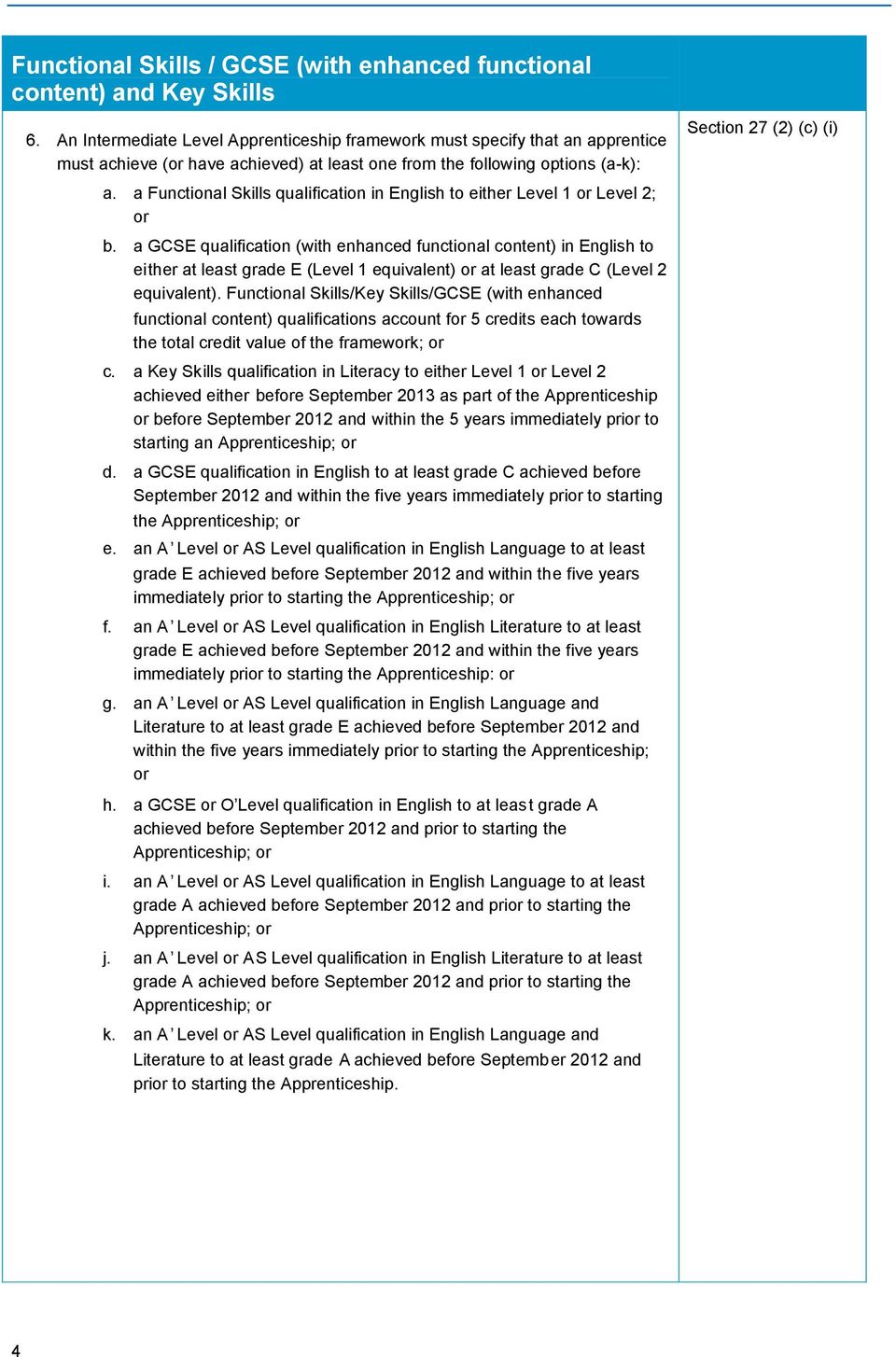
4 Functional Skills / GCSE (with enhanced functional content) and Key Skills 6. An Intermediate Level Apprenticeship framework must specify that an apprentice must achieve (or have achieved) at least one from the following options (a-k): Section 27 (2) (c) (i) a. a Functional Skills qualification in English to either Level 1 or Level 2; or b. a GCSE qualification (with enhanced functional content) in English to either at least grade E (Level 1 equivalent) or at least grade C (Level 2 equivalent). Functional Skills/Key Skills/GCSE (with enhanced functional content) qualifications account for 5 credits each towards the total credit value of the framework; or c. a Key Skills qualification in Literacy to either Level 1 or Level 2 achieved either before September 2013 as part of the Apprenticeship or before September 2012 and within the 5 years immediately prior to starting an d. a GCSE qualification in English to at least grade C achieved before September 2012 and within the five years immediately prior to starting the e. an A Level or AS Level qualification in English Language to at least grade E achieved before September 2012 and within the five years immediately prior to starting the f. an A Level or AS Level qualification in English Literature to at least grade E achieved before September 2012 and within the five years immediately prior to starting the Apprenticeship: or g. an A Level or AS Level qualification in English Language and Literature to at least grade E achieved before September 2012 and within the five years immediately prior to starting the Apprenticeship; or h. a GCSE or O Level qualification in English to at least grade A achieved before September 2012 and prior to starting the i. an A Level or AS Level qualification in English Language to at least grade A achieved before September 2012 and prior to starting the j. an A Level or AS Level qualification in English Literature to at least grade A achieved before September 2012 and prior to starting the k. an A Level or AS Level qualification in English Language and Literature to at least grade A achieved before September 2012 and prior to starting the Apprenticeship. 4
5 7. An Intermediate Level Apprenticeship framework must specify that an apprentice must achieve (or have achieved) at least one from the following options (a-k): Section 27 (2) (c) (i) a. a Functional Skills qualification in Mathematics to either Level 1 or Level 2; or b. a GCSE qualification (with enhanced functional content) in Mathematics to either at least grade E (Level 1 equivalent) or at least grade C (Level 2 equivalent); or c. a Key Skills qualification in Application of Number to either Level 1 or Level 2 achieved either before September 2013 as part of the Apprenticeship or before September 2012 and within the 5 years immediately prior to starting an d. a GCSE qualification in Mathematics to at least grade C achieved before September 2012 and within the five years immediately prior to starting the e. an A Level or AS Level qualification in Mathematics to at least grade E achieved before September 2012 and within the five years immediately prior to starting the f. an A Level or AS Level qualification in Pure Mathematics to at least grade E achieved before September 2012 and within the five years immediately prior to starting the Apprenticeship: or g. an A Level or AS Level qualification in Further Mathematics to at least grade E achieved before September 2012 and within the five years immediately prior to starting the h. a GCSE or O Level qualification in Mathematics to at least grade A achieved before September 2012 and prior to starting the i. an A Level or AS Level qualification in Mathematics to at least grade A achieved before September 2012 and prior to starting the j. an A Level or AS Level qualification in Pure Mathematics to at least grade A achieved before September 2012 and prior to starting the k. an A Level or AS Level qualification in Further Mathematics to at least grade A achieved before September 2012 and prior to starting the Apprenticeship. 5

6 8. An Intermediate Level Apprenticeship framework must specify that an apprentice must achieve or have achieved (unless Information and Communications Technology (ICT) is not relevant to effective performance in the occupation or sector to which the framework relates) at least one from the following options (ag): a. a Functional Skills qualification in Information and Communications Technology (ICT) to either Level 1 or Level 2; or b. a GCSE qualification in ICT (with enhanced functional content) to either at least grade E (Level 1 equivalent) or at least grade C (Level 2 equivalent); or c. a Key Skills qualification in ICT to either Level 1 or Level 2 achieved either before September 2013 as part of the Apprenticeship or before September 2012 and within the 5 years immediately prior to starting an d. a GCSE qualification in ICT to at least grade C achieved before September 2012 and within the five years immediately prior to starting the e. an A Level or AS Level qualification in ICT achieved before September 2012 and within the five years immediately prior to starting the f. a GCSE or O Level qualification in ICT to at least grade A achieved before September 2012 and prior to starting the g. an A Level or AS Level qualification in ICT to at least grade A achieved before September 2012 and prior to starting the Apprenticeship. Section 27 (2) (c) (i) 6

7 Employee Rights and Responsibilities (ERR) 9. An Intermediate Level Apprenticeship framework must specify that an apprentice must achieve the standards of attainment set out in the Employee Rights and Responsibilities (ERR) national outcomes. To achieve the ERR national outcomes the apprentice must demonstrate that he/she: a. knows and understands the range of employer and employee statutory rights and responsibilities under Employment Law. This should cover the apprentice s rights and responsibilities under the Employment Rights Act 1996, Equality Act 2010 and Health & Safety legislation, together with the responsibilities and duties of employers; b. knows and understands the procedures and documentation in their organisation which recognise and protect their relationship with their employer. Health & Safety and Equality & Diversity training must be an integral part of the apprentice s learning programme; c. knows and understands the range of sources of information and advice available to them on their employment rights and responsibilities. Details of Access to Work and Additional Learning Support must be included in the programme; d. understands the role played by their occupation within their organisation and industry; e. has an informed view of the types of career pathways that are open to them; f. knows the types of representative bodies and understands their relevance to their skill, trade or occupation, and their main roles and responsibilities; g. knows where and how to get information and advice on their industry, occupation, training and career; h. can describe and work within their organisation s principles of conduct and codes of practice; i. recognises and can form a view on issues of public concern that affect their organisation and industry. 10. An Intermediate Level Apprenticeship framework must specify where achievement of the ERR national outcomes is located within the Apprenticeship framework, either within a qualification or elsewhere, and how achievement is to be evidenced. 7

8 Personal Learning and Thinking Skills (PLTS) 11. An Intermediate Level Apprenticeship framework must specify that an apprentice must achieve the standards of attainment set out in the Personal Learning and Thinking Skills (PLTS) national outcomes. To achieve the six PLTS outcomes the apprentice must demonstrate the following skills: a. Independent enquiry - apprentices can process and evaluate information in their investigations, planning what to do and how to go about it. They take informed and well-reasoned decisions, recognising that others have different beliefs and attitudes; b. Creative thinking apprentices think creatively by generating and exploring ideas, making original connections. They try different ways to tackle a problem, working with others to find imaginative solutions and outcomes that are of value; c. Reflective learning apprentices evaluate their strengths and limitations, setting themselves realistic goals with criteria for success. They monitor their own performance and progress, inviting feedback from others and making changes to further their learning; d. Team working apprentices work confidently with others, adapting to different contexts and taking responsibility for their own part. They listen to and take account of different views. They form collaborative relationships, resolving issues to reach agreed outcomes; e. Self management apprentices organise themselves, showing personal responsibility, initiative, creativity and enterprise with a commitment to learning and self-improvement. They actively embrace change, responding positively to new priorities, coping with challenges and looking for opportunities; f. Effective participation apprentices actively engage with issues that affect them and those around them. They play a full part in the life of their school, college, workplace or wider community by taking responsible action to bring improvements for others as well as themselves. 12. An Intermediate Level Apprenticeship framework must specify where achievement of the PLTS is located within the Apprenticeship framework, either within a qualification or elsewhere, and how achievement is to be evidenced. 8

9 On- the- Job Training and Off-the-Job Training Guided Learning Hours (GLH) 13. An Intermediate Level Apprenticeship framework must specify the number of Guided Learning Hours (GLH) that an apprentice must receive to complete the framework. This must be a minimum of 280 GLH of which at least 100 GLH or 30% (whichever is the greater) must be delivered off-the-job and clearly evidenced. The remaining GLH must be delivered on-the-job and clearly evidenced. Guided learning relates to training which is designed to achieve clear and specific outcomes which contribute directly to the successful achievement of the Apprenticeship framework. This SASE requirement for onthe-job and off the job guided learning is intended to meet the requirement in Section 27 (2) (b) of the ASCL Act for on-the-job training and off-the-job training. 14. An Intermediate Level Apprenticeship framework must specify the number of GLH that an apprentice must receive within 12 months of starting a framework. This must be a minimum of 280 GLH. 15. An Intermediate Level Apprenticeship framework must specify that, after 12 months of starting a framework an apprentice must receive a minimum of 280 GLH in each subsequent 12 month period. Where an apprentice completes an Apprenticeship part way through the final 12 month period (which is after the first 12 months), an apprentice must receive a proportion of the minimum of 280 GLH which is at least equal to the proportion of the final 12 month period spent on the Apprenticeship. Section 27 (2) (b) Section 27 (2) (b) Section 27 (2) (b) 9

10 Advanced Level Apprenticeship Framework Qualifications Related to the Sector 16. An Advanced Level Apprenticeship framework must specify the total number of credits which an apprentice must attain on the QCF. This must be at a minimum of 37 credits. 17. An Advanced Level Apprenticeship framework must identify the competencies qualification which must be achieved by the apprentice to qualify for an Apprenticeship certificate, and which is the qualification required to demonstrate competence in performing the skill, trade or occupation to which the framework relates. The competencies qualification must be at Level 3 of the QCF; underpinned by National Occupational Standards (NOS); and be approved by the relevant SSC or Sector Body. To avoid duplication of frameworks in the same skill, trade or occupation, each framework must have a different competencies qualification. 18. An Advanced Level Apprenticeship framework must identify a technical knowledge qualification which must be achieved by the apprentice to qualify for an Apprenticeship certificate. A technical knowledge qualification is the qualification required to demonstrate achievement of the technical skills, knowledge and understanding of theoretical concepts and knowledge and understanding of the industry and its market relevant to the skill, trade or occupation to which the framework relates. The technical knowledge qualification must be underpinned by National Occupational Standards (NOS); and be approved by the relevant Sector Skills Council (SSC) or Sector Body. 19. An Advanced Level Apprenticeship framework must identify either: a. a competencies qualification at Level 3 and a separate technical knowledge qualification, each of which must carry at least ten credits on the QCF; or b. an integrated qualification at Level 3 which combines competence and technical knowledge elements in which each element is separately assessed and in which each element carries at least ten credits on the QCF. Section 27 (2) (c) (iii) Section 27 (2) (c) (ii) Section 27 (2) (c) (ii) 10

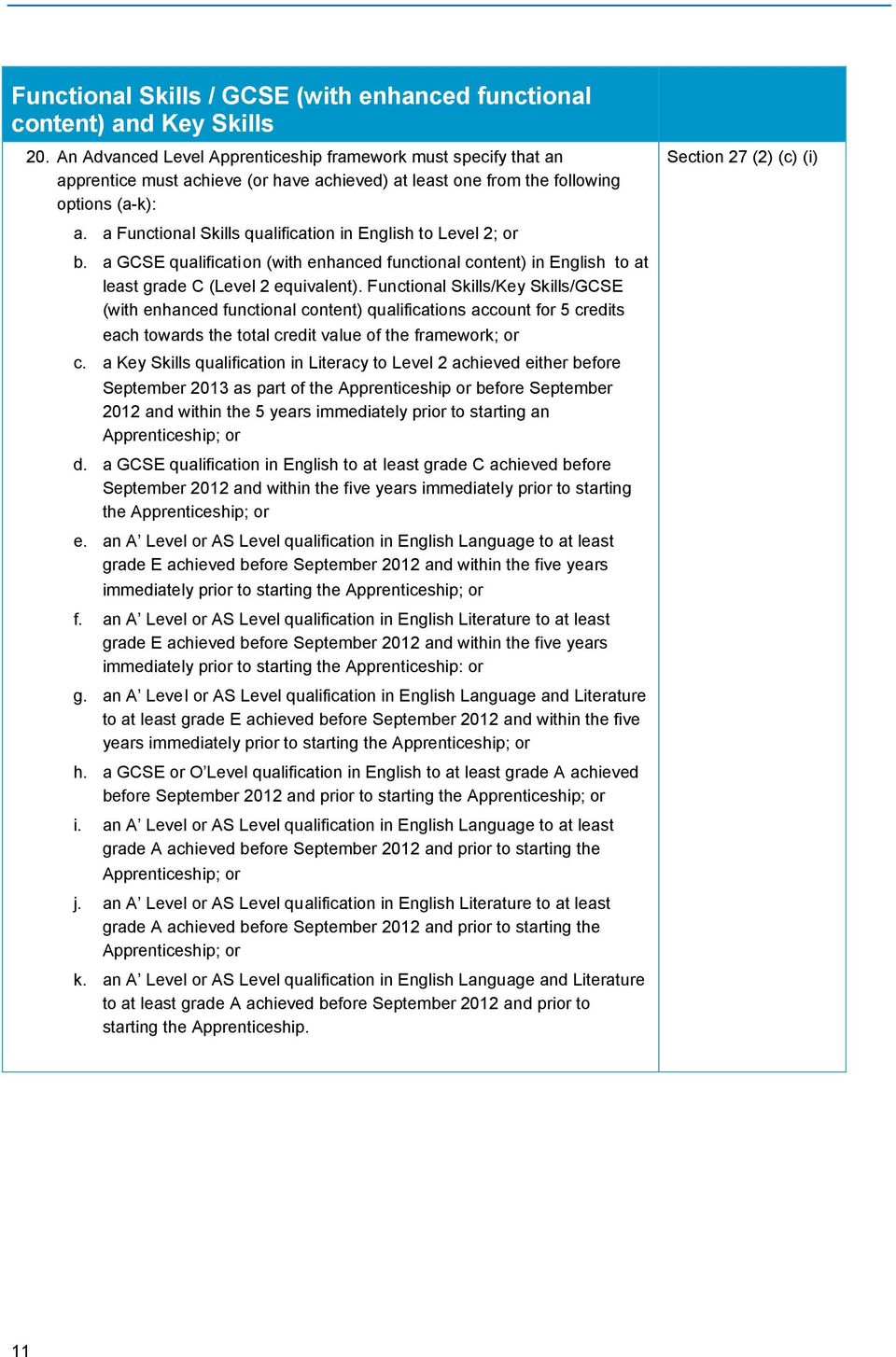
11 Functional Skills / GCSE (with enhanced functional content) and Key Skills 20. An Advanced Level Apprenticeship framework must specify that an apprentice must achieve (or have achieved) at least one from the following options (a-k): Section 27 (2) (c) (i) a. a Functional Skills qualification in English to Level 2; or b. a GCSE qualification (with enhanced functional content) in English to at least grade C (Level 2 equivalent). Functional Skills/Key Skills/GCSE (with enhanced functional content) qualifications account for 5 credits each towards the total credit value of the framework; or c. a Key Skills qualification in Literacy to Level 2 achieved either before September 2013 as part of the Apprenticeship or before September 2012 and within the 5 years immediately prior to starting an d. a GCSE qualification in English to at least grade C achieved before September 2012 and within the five years immediately prior to starting the e. an A Level or AS Level qualification in English Language to at least grade E achieved before September 2012 and within the five years immediately prior to starting the f. an A Level or AS Level qualification in English Literature to at least grade E achieved before September 2012 and within the five years immediately prior to starting the Apprenticeship: or g. an A Level or AS Level qualification in English Language and Literature to at least grade E achieved before September 2012 and within the five years immediately prior to starting the h. a GCSE or O Level qualification in English to at least grade A achieved before September 2012 and prior to starting the i. an A Level or AS Level qualification in English Language to at least grade A achieved before September 2012 and prior to starting the j. an A Level or AS Level qualification in English Literature to at least grade A achieved before September 2012 and prior to starting the k. an A Level or AS Level qualification in English Language and Literature to at least grade A achieved before September 2012 and prior to starting the Apprenticeship. 11
12 21. An Advanced Level Apprenticeship framework must specify that an apprentice must achieve (or have achieved) at least one from the following options (a-k): Section 27 (2) (c) (i) a. a Functional Skills qualification in Mathematics to Level 2; or b. a GCSE qualification (with enhanced functional content) in Mathematics to at least grade C (Level 2 equivalent); or c. a Key Skills qualification in Application of Number to Level 2 achieved either before September 2013 as part of the Apprenticeship or before September 2012 and within the 5 years immediately prior to starting an d. a GCSE qualification in Mathematics to at least grade C achieved before September 2012 within the five years immediately prior to starting the e. an A Level or AS Level qualification in Mathematics to at least grade E achieved before September 2012 and within the five years immediately prior to starting the f. an A Level or AS Level qualification in Pure Mathematics to at least grade E achieved before September 2012 and within the five years immediately prior to starting the Apprenticeship: or g. an A Level or AS Level qualification in Further Mathematics to at least grade E achieved before September 2012 and within the five years immediately prior to starting the h. a GCSE or O Level qualification in Mathematics to at least grade A achieved before September 2012 and prior to starting the i. an A Level or AS Level qualification in Mathematics to at least grade A achieved before September 2012 and prior to starting the j. an A Level or AS Level qualification in Pure Mathematics to at least grade A achieved before September 2012 and prior to starting the k. an A Level or AS Level qualification in Further Mathematics to at least grade A achieved before September 2012 and prior to starting the Apprenticeship. 12

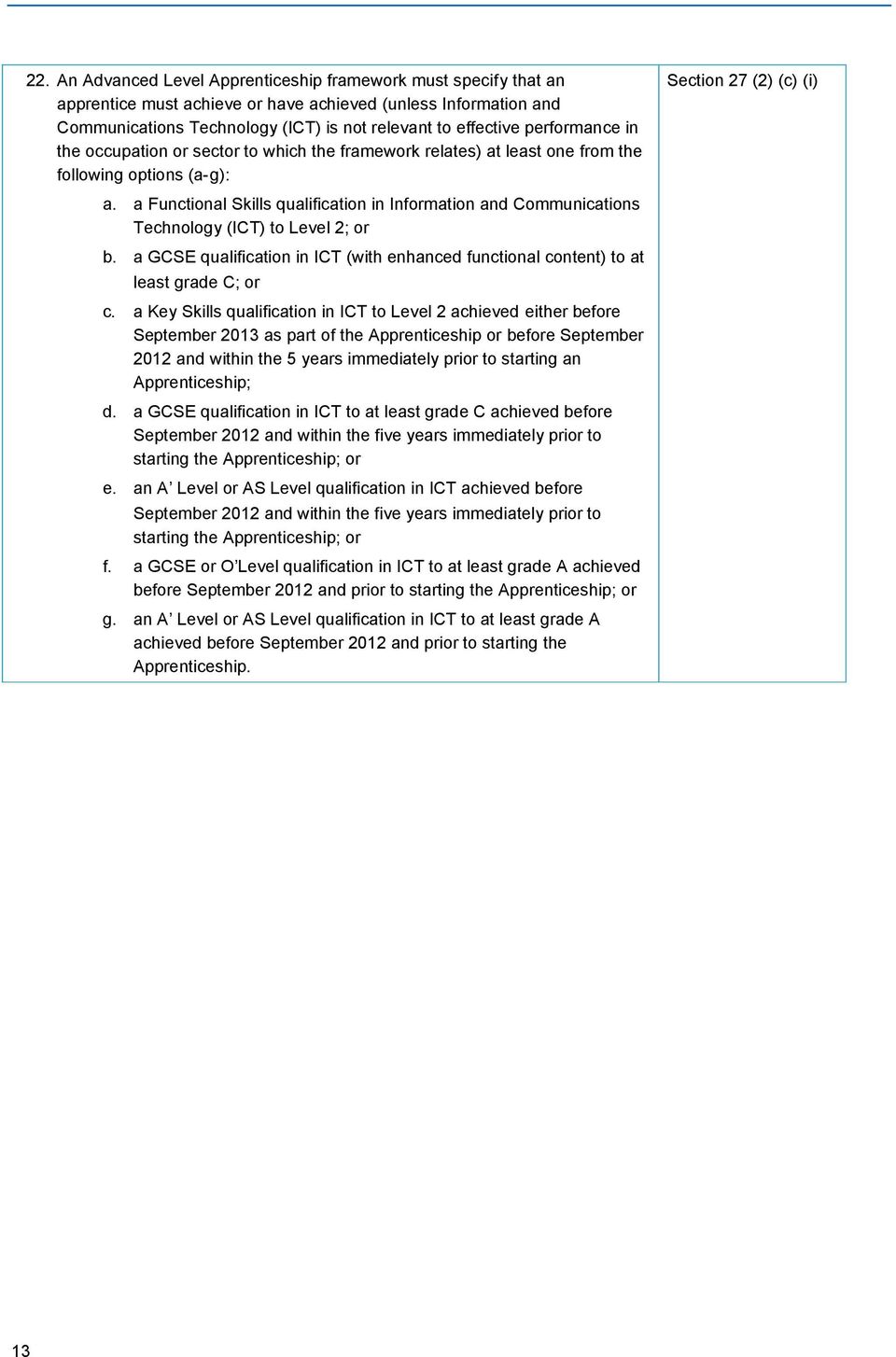
13 22. An Advanced Level Apprenticeship framework must specify that an apprentice must achieve or have achieved (unless Information and Communications Technology (ICT) is not relevant to effective performance in the occupation or sector to which the framework relates) at least one from the following options (a-g): Section 27 (2) (c) (i) a. a Functional Skills qualification in Information and Communications Technology (ICT) to Level 2; or b. a GCSE qualification in ICT (with enhanced functional content) to at least grade C; or c. a Key Skills qualification in ICT to Level 2 achieved either before September 2013 as part of the Apprenticeship or before September 2012 and within the 5 years immediately prior to starting an Apprenticeship; d. a GCSE qualification in ICT to at least grade C achieved before September 2012 and within the five years immediately prior to starting the e. an A Level or AS Level qualification in ICT achieved before September 2012 and within the five years immediately prior to starting the f. a GCSE or O Level qualification in ICT to at least grade A achieved before September 2012 and prior to starting the g. an A Level or AS Level qualification in ICT to at least grade A achieved before September 2012 and prior to starting the Apprenticeship. 13
14 Employee Rights and Responsibilities (ERR) 23. Requirements are the same as for an Intermediate Level Apprenticeship framework. Personal Learning and Thinking Skills (PLTS) 24. Requirements are the same as for an Intermediate Level Apprenticeship framework. On-the-Job Training and Off-the-Job Training Guided Learning Hours (GLH) 25. Requirements are the same as for an Intermediate Level Apprenticeship framework. Section 27 (2) (b) 14

15 Higher Apprenticeship Frameworks Qualifications Related to the Sector 26. Higher Apprenticeship frameworks must specify the total number of credits which an apprentice must attain on the Qualifications and Credits Framework (QCF). This must be at a minimum of 37 credits except where the framework specifies a Higher National Certificate (HNC) or Higher National Diploma (HND) qualification or Foundation Degree without a QCF credit value. 27. Higher Apprenticeship frameworks must identify the competencies qualification which must be achieved by the apprentice to qualify for an Apprenticeship certificate, and which is the qualification required to demonstrate competence in performing the skill, trade or occupation to which the framework relates. The competencies qualification must be at the specified level of the framework; underpinned by National Occupational Standards (NOS); and be approved by the relevant SSC or Sector Body. To avoid duplication of frameworks in the same skill, trade or occupation, each framework must have a different competencies qualification. 28. Higher Apprenticeship frameworks must identify a technical knowledge qualification which must be achieved by the apprentice to qualify for an Apprenticeship certificate. A technical knowledge qualification is the qualification required to demonstrate achievement of the technical skills, knowledge and understanding of theoretical concepts and knowledge and understanding of the industry and its market relevant to the skill, trade or occupation to which the framework relates. The technical knowledge qualification must be underpinned by National Occupational Standards (NOS); and be approved by the relevant Sector Skills Council (SSC) or Sector Body. 29. A Higher Apprenticeship framework at Level 4 must identify either : a. a competencies qualification at Level 4 and a separate technical knowledge qualification, each of which must carry at least ten credits on the QCF; or b. an integrated qualification at Level 4 which combines competence and technical knowledge elements which are separately assessed, each of which must carry at least ten credits on the QCF; or c. a competencies qualification at Level 4 which must carry at least ten credits on the QCF and a separate Foundation Degree or HND or HNC to meet the requirement for a separate technical knowledge qualification. Section 27 (2) (c) (iii) Section 27 (2) (c) (ii) Section 27 (2) (c) (ii) 15

16 30. A Higher Apprenticeship framework at Level 5 must identify either: a. a competencies qualification at Level 5 and a separate technical knowledge qualification, each of which must carry at least ten credits on the QCF: or Section 27 (2) (c) (ii) b. an integrated qualification at Level 5 which combines competence and technical knowledge elements which are separately assessed, each of which must carry at least ten credits on the QCF; or c. a competencies qualification at Level 5 which must carry at least ten credits on the QCF and a separate Foundation Degree or HND or HNC to meet the requirement for a separate technical knowledge qualification; or d. a Foundation Degree at Level 5 which combines competence and technical knowledge elements where the competence element is at least 50% of the Foundation Degree and where at least 50% is delivered through on-the-job training. Where the competencies qualification is a Foundation Degree, it must be endorsed by the Awarding Higher Education Institution as at least 50% competencebased. 16

17 Functional Skills / GCSE (with enhanced functional content) and Key Skills 31. Requirements are the same as for an Advanced Level Apprenticeship framework. Employee Rights and Responsibilities (ERR) 32. Requirements are the same as for an Intermediate Level Apprenticeship framework. Personal Learning and Thinking Skills (PLTS) 33. Requirements are the same as for an Intermediate Level Apprenticeship framework. Guided Learning Hours (GLH) 34. Requirements are the same as for an Intermediate Level Apprenticeship framework. Section 27 (2) (b) 17

18 Crown copyright 2011 You may re-use this information (not including logos) free of charge in any format or medium, under the terms of the Open Government Licence. To view this licence, visit or write to the Information Policy Team, The National Archives, Kew, London TW9 4DU, or This publication is also available on our website at Any enquiries regarding this publication should be sent to: Department for Business, Innovation and Skills 1 Victoria Street London SW1H 0ET Tel: If you require this publication in an alternative format, [email protected], or call URN 11/521 ISBN:

SPECIFICATION OF APPRENTICESHIP STANDARDS FOR ENGLAND (SASE) SEPTEMBER 2015
 SPECIFICATION OF APPRENTICESHIP STANDARDS FOR ENGLAND (SASE) SEPTEMBER 2015 Contents Introduction... 3 Intermediate Level Apprenticeship Frameworks... 3 Qualifications Related to the Sector... 3 Functional
Social Media and Digital Marketing (England)
 Social Media and Digital Marketing (England) Latest framework version? Please use this link to see if this is the latest issued version of this framework: afo.sscalliance.org/frameworkslibrary/index.cfm?id=fr01743
Libraries, Archives, Records and Information Management Services (England)
 Libraries, Archives, Records and Information Management Services (England) Issued by Learning and Skills Improvement Service Libraries, Archives, Records and Information Management Services (England) Information
Personal, Learning & Thinking Skills
 Personal, Learning & Thinking Skills Guidance for Young Apprenticeship in Business & Administration Value of Personal, Learning and Thinking Skills (PLTS) The Council for Administration (CfA) has identified
Higher Apprenticeship in Business & Professional Administration - Level 4 (England)
 Higher Apprenticeship in Business & Professional Administration - Level 4 (England) IMPORTANT NOTIFICATION FOR ALL APPRENTICESHIP STARTS FROM 6 APRIL 2015 Modifications to SASE came into effect on 6th
Contact Centre Operations (England)
 Contact Centre Operations (England) Contact information Proposer of this framework This has been proposed and developed by Skills CFA, with employers, training providers, colleges and awarding organisations
Multi-skilled Vehicle Collision Repair (England)
 Multi-skilled Vehicle Collision Repair (England) Latest framework version? Please use this link to see if this is the latest issued version of this framework: afo.sscalliance.org/frameworkslibrary/index.cfm?id=fr02283
Libraries, Archives, Records and Information Management Services (England)
 Libraries, Archives, Records and Information Management Services (England) IMPORTANT NOTIFICATION FOR ALL APPRENTICESHIP STARTS FROM 6 APRIL 2015 Modifications to SASE came into effect on 6th April 2015.
Higher Apprenticeship in Broadcast Production Level 4 (England)
 Higher Apprenticeship in Broadcast Production Level 4 (England) IMPORTANT NOTIFICATION FOR ALL APPRENTICESHIP STARTS FROM 6 APRIL 2015 Modifications to SASE came into effect on 6th April 2015. These changes
Building Services Engineering Technology and Project Management (England)
 Building Services Engineering Technology and Project Management (England) Latest framework version? Please use this link to see if this is the latest issued version of this framework: afo.sscalliance.org/frameworkslibrary/index.cfm?id=fr01261
IT, Software, Web & Telecoms Professionals (England)
 IT, Software, Web & Telecoms Professionals (England) IMPORTANT NOTIFICATION FOR ALL APPRENTICESHIP STARTS FROM 6 APRIL 2015 Modifications to SASE came into effect on 6th April 2015. These changes ONLY
BIS RESEARCH PAPER NUMBER 222a. Traineeships: First Year Process Evaluation. Executive Summary MARCH 2015
 BIS RESEARCH PAPER NUMBER 222a Traineeships: First Year Process Evaluation Executive Summary MARCH 2015 Executive Summary Background and methodology This executive summary presents the topline findings
Qualification Specification. Higher Apprenticeship in Business & Professional Administration Level 4 (England)
 Qualification Specification Higher Apprenticeship in Business & Professional Administration Level 4 (England) Version 2.0 (July 2016) Qualification Specification: Business Administration: Higher Apprenticeship
Ealing, Hammersmith and West London College
 Ealing, Hammersmith and West London College Re-inspection monitoring visit report Unique reference number: 130408 Name of lead inspector: Jo Parkman, HMI Last day of inspection: 14 January 2016 Type of
Higher Level Apprenticeship in Social Media and Digital Marketing - Level 4 (England)
 Higher Level Apprenticeship in Social Media and Digital Marketing - Level 4 (England) IMPORTANT NOTIFICATION FOR ALL APPRENTICESHIP STARTS FROM 6 APRIL 2015 Modifications to SASE came into effect on 6th
Criteria for Foundation, Higher and Advanced Diploma Qualifications
 Criteria for Foundation, Higher and Advanced Diploma Qualifications July 2011 Ofqual/11/4898 Contents Criteria for Foundation, Higher and Advanced Diploma Qualifications The criteria... 2 Introduction...
Business & Administration (England)
 Business & Administration (England) Latest framework version? Please use this link to see if this is the latest issued version of this framework: afo.sscalliance.org/frameworkslibrary/index.cfm?id=fr02705
Initial teacher training criteria. Statutory guidance for accredited initial teacher training providers in England
 Initial teacher training criteria Statutory guidance for accredited initial teacher training providers in England June 2015 Contents Summary 3 About this guidance 3 Expiry or review date 3 What legislation
Supply Chain Management (England)
 Supply Chain Management (England) IMPORTANT NOTIFICATION FOR ALL APPRENTICESHIP STARTS FROM 6 APRIL 2015 Modifications to SASE came into effect on 6th April 2015. These changes ONLY relate to the Transferable
Pearson BTEC Level 1/ Level 2 First Diploma in Business Specification
 Pearson BTEC Level 1/ Level 2 First Diploma in Business Specification First teaching September 2013 Pearson Education Limited is one of the UK s largest awarding organisations, offering academic and vocational
Business Administration (England)
 Business Administration (England) Latest framework version? Please use this link to see if this is the latest issued version of this framework: afo.sscalliance.org/frameworkslibrary/index.cfm?id=fr03097
Smart Meter Installations (Dual Fuel) (England)
 Smart Meter Installations (Dual Fuel) (England) Latest framework version? Please use this link to see if this is the latest issued version of this framework: afo.sscalliance.org/frameworkslibrary/index.cfm?id=fr01336
Higher Apprenticeship in Hospitality Management - Level 4 (England)
 Higher Apprenticeship in Hospitality Management - Level 4 (England) IMPORTANT NOTIFICATION FOR ALL APPRENTICESHIP STARTS FROM 6 APRIL 2015 Modifications to SASE came into effect on 6th April 2015. These
Qualification Specification. Higher Apprenticeship in Retail Management Level 4 (England)
 Qualification Specification Higher Apprenticeship in Retail Management Level 4 (England) Version 2.0 (July 2016) Page 1 of 21 This qualification specification covers the following qualifications: Qualification
Refrigeration and Air Conditioning (England)
 Refrigeration and Air Conditioning (England) Latest framework version? Please use this link to see if this is the latest issued version of this framework: afo.sscalliance.org/frameworkslibrary/index.cfm?id=fr01514
Firefighter fitness standards and assessment
 Firefighter fitness standards and assessment Consultation response December 2014 Department for Communities and Local Government Crown copyright, 2014 Copyright in the typographical arrangement rests with
The Draft Consumer Credit (Total Charge For Credit) (Amendment) Regulations 2012
 NOTES ON : The Draft Consumer Credit (Total Charge For Credit) (Amendment) Regulations 2012 MAY 2012 Department for Business, Innovation and Skills Notes on: THE DRAFT CONSUMER CREDIT (TOTAL CHARGE FOR
Fact Sheet - Level 2 Diploma in Business Administration (QCF)
 Fact Sheet - Level 2 Diploma in Business Administration (QCF) Combined (Competence and Knowledge) qualification This Apprenticeship framework consists of the following elements- Level 2 Diploma in Business
Level 2 Diploma in Business and Administration (combined qualification)
 UNIT DATA SHEET Level 2 Diploma in Business and Administration (combined qualification) Pathway for Apprenticeship requires 60 credits = 45 from the combined NVQ and 15 from transferable skills for English,
LEVEL 3 LEGAL SERVICES APPRENTICE QUALIFICATIONS FACTSHEET
 LEVEL 3 LEGAL SERVICES APPRENTICE QUALIFICATIONS FACTSHEET WHAT ARE THE CILEx LEVEL 3 LEGAL SERVICES APPRENTICE QUALIFICATIONS? What is an Apprenticeship? Apprenticeships are a combination of on-the-job
Specification. Edexcel NVQ qualification. Edexcel Level 3 NVQ Certificate in Management (QCF)
 Specification Edexcel NVQ qualification Edexcel Level 3 NVQ Certificate in Management (QCF) For first registration August 2010 Edexcel, a Pearson company, is the UK s largest awarding organisation offering
Assessment Criteria The learner can: 1.1 Describe the purpose of a team
 Unit Title: Set objectives and provide support for team members OCR Unit No: 50 Sector Unit No: MSC B5 Level: 3 Credit value: 5 Guided learning hours: 35 Unit purpose and aim This purpose of this unit
Arrangements for: SQA Level 2 Certificate in Plant Operations General Construction (Construction) (QCF) SQA Code: GD3R 54 Ofqual Code: 600/2724/1
 Arrangements for: SQA Level 2 Certificate in Plant Operations General Construction (Construction) (QCF) SQA Code: GD3R 54 Ofqual Code: 600/2724/1 Operational start date: 1 September 2011 Date of original
Higher Apprenticeship in Supply Chain Management - Level 5 (England)
 Higher Apprenticeship in Supply Chain Management - Level 5 (England) IMPORTANT NOTIFICATION FOR ALL APPRENTICESHIP STARTS FROM 6 APRIL 2015 Modifications to SASE came into effect on 6th April 2015. These
Higher Apprenticeship in Supply Chain Management - Level 5 (England)
 Higher Apprenticeship in Supply Chain Management - Level 5 (England) Latest framework version? Please use this link to see if this is the latest issued version of this framework: afo.sscalliance.org/frameworkslibrary/index.cfm?id=fr03023
National standards of excellence for headteachers. Departmental advice for headteachers, governing boards and aspiring headteachers
 National standards of excellence for headteachers Departmental advice for headteachers, governing boards and aspiring headteachers January 2015 Contents Summary 3 About this departmental advice 3 Review
Draft Guidance: Non-economic Regulators: Duty to Have Regard to Growth
 Draft Guidance: Non-economic Regulators: Duty to Have Regard to Growth January 2014 Purpose of this document The duty to have regard to the desirability of promoting economic growth (the growth duty )
Higher Apprenticeship in Construction Management Levels 4, 5, and 6 (England)
 Higher Apprenticeship in Construction Management Levels 4, 5, and 6 (England) Latest framework version? Please use this link to see if this is the latest issued version of this framework: afo.sscalliance.org/frameworkslibrary/index.cfm?id=fr02453
Early years self-evaluation form
 Early years self-evaluation form For provisions on the Early Years Register Age group: Birth to 31 August following a child s fifth birthday Published: September 2015 Reference no: 120332 Please leave
Enterprise and Entrepreneurship
 Pearson BTEC Level 3 in Enterprise and Entrepreneurship Pearson BTEC Level 3 Subsidiary Diploma Pearson BTEC Level 3 90-credit Diploma Pearson BTEC Level 3 Diploma Pearson BTEC Level 3 Extended Diploma
BTEC Level 3 Certificate, BTEC Level 3 Subsidiary Diploma, BTEC Level 3 90-credit Diploma, BTEC Level 3 Diploma and BTEC Level 3 Extended Diploma in
 BTEC Level 3 Certificate, BTEC Level 3 Subsidiary Diploma, BTEC Level 3 90-credit Diploma, BTEC Level 3 Diploma and BTEC Level 3 Extended Diploma in Issue 2 Pearson Education Ltd is one of the UK s largest
Advice on the admission of summer born children. For local authorities, school admission authorities and parents
 Advice on the admission of summer born children For local authorities, school admission authorities and parents December 2014 Contents Summary 3 About this departmental advice 3 Expiry or review date 3
Right to challenge parking policies
 Right to challenge parking policies Traffic Management Act 2004: Network Management Duty Guidance March 2015 Department for Communities and Local Government Crown copyright, 2015 Copyright in the typographical
A GUIDE TO LEGAL FORMS FOR SOCIAL ENTERPRISE NOVEMBER 2011
 A GUIDE TO LEGAL FORMS FOR SOCIAL ENTERPRISE NOVEMBER 2011 A Guide to Legal Forms for Social Enterprise Definition of a Social Enterprise The term Social Enterprise describes the purpose of a business,
LEVEL QCF. Accredited
 LEVEL QCF Accredited Issue 5 March 2015 Edexcel, BTEC and LCCI qualifications Edexcel, BTEC and LCCI qualifications are awarded by Pearson, the UK s largest awarding body offering academic and vocational
Planning Act 2008: Guidance on Changes to Development Consent Orders. December 2015 Department for Communities and Local Government
 Planning Act 2008: Guidance on Changes to Development Consent Orders December 2015 Department for Communities and Local Government Crown copyright, 2015 Copyright in the typographical arrangement rests
BUILDING THE BRITISH BUSINESS BANK: INVESTMENT PROGRAMME. Question & Answers FEBRUARY 2014
 BUILDING THE BRITISH BUSINESS BANK: INVESTMENT PROGRAMME Question & Answers FEBRUARY 2014 Contents Contents... 2 Submission... 3 Target Market... 4 Match Funding... 4 Pari Passu Terms... 5 Legal, Structure
Higher Apprenticeship in Information Security - Level 4 (England)
 Higher Apprenticeship in Information Security - Level 4 (England) IMPORTANT NOTIFICATION FOR ALL APPRENTICESHIP STARTS FROM 6 APRIL 2015 Modifications to SASE came into effect on 6th April 2015. These
Funding Rules 2016 to 2017
 Document reference: E Funding Rules 2016 to 2017 Summary of Changes Version 3 July 2016 Of interest to providers and employers Introduction 1. We have published the Funding Rules for 2016 to 2017 on GOV.UK.
Good Practice Guide: the internal audit role in information assurance
 Good Practice Guide: the internal audit role in information assurance Janaury 2010 Good Practice Guide: the internal audit role in information assurance January 2010 Official versions of this document
Improving schools. A guide to recent Ofsted reports to support school improvement
 A guide to recent Ofsted reports to support school improvement Foreword by Her Majesty s Chief Inspector Contents Foreword 3 Introduction 5 Getting to good 6 Moving English forward 8 Mathematics: made
IQ Level 3 NVQ Diploma in Management (QCF) Specification
 IQ Level 3 NVQ Diploma in Management (QCF) Specification Regulation No: 600/6699/4 Page 1 of 94 IQB/0.2/115 Version 1.0 10/10/2012 Author CZ Contents Page Introduction... 4 About this Qualification (Description,
Higher Apprenticeship for IT, Software, Web & Telecoms Professionals - Level 4 (England)
 Higher Apprenticeship for IT, Software, Web & Telecoms Professionals - Level 4 (England) IMPORTANT NOTIFICATION FOR ALL APPRENTICESHIP STARTS FROM 6 APRIL 2015 Modifications to SASE came into effect on
History. GCSE subject content
 History GCSE subject content April 2014 Contents The content for history GCSEs 3 Introduction 3 Subject aims and learning outcomes 3 Subject content 4 Scope of study 4 Historical knowledge, understanding
GOLD-PLATING REVIEW The Operation of the Transposition Principles in the Government s Guiding Principles for EU Legislation
 GOLD-PLATING REVIEW The Operation of the Transposition Principles in the Government s Guiding Principles for EU Legislation MARCH 2013 Contents Summary... 3 Review of the Operation of the Transposition
Integrating the operation of income tax and National Insurance contributions. A call for evidence
 Integrating the operation of income tax and National Insurance contributions A call for evidence July 2011 Integrating the operation of income tax and National Insurance contributions A call for evidence
Level 2 Marketing mandatory knowledge units mapped to Personal Learning and Thinking Skills. Independent Enquiry
 Level 2 Marketing matory knowledge units mapped to Personal Learning Thinking Skills This map accompanies the PLTS Guide for practitioners which can be downloaded from www.cfa.uk.com The guide includes:
Pearson Edexcel Level 3 Certificate in Hospitality Retail Outlet Management (QCF) Specification
 Pearson Edexcel Level 3 Certificate in Hospitality Retail Outlet Management (QCF) Specification NVQ/Competence-based qualification First registration January 2014 Pearson Education Limited is one of the
FOLLOW UP TO FINAL STATEMENT BY THE UK NATIONAL CONTACT POINT FOR THE OECD GUIDELINES FOR MULTINATIONAL ENTERPRISES
 FOLLOW UP TO FINAL STATEMENT BY THE UK NATIONAL CONTACT POINT FOR THE OECD GUIDELINES FOR MULTINATIONAL ENTERPRISES Complaint from the International Union of Food, Agricultural, Hotel, Restaurant, Catering,
Teachers Standards (Early Years) From September 2013
 Teachers Standards (Early Years) From September 2013 July 2013 Preamble Early Years Teachers make the education and care of babies and children their first concern. They are accountable for achieving the
Promoting the sharing economy in London
 Promoting the sharing economy in London Policy on short-term use of residential property in London February 2015 Department for Communities and Local Government Crown copyright, 2015 Copyright in the typographical
601/8498/X IAO Level 3 Certificate in Web Design and Development (RQF)
 601/8498/X IAO Level 3 Certificate in Web Design and Development (RQF) A summary of the qualification s content This is a regulated qualification designed to equip you with the knowledge and skills that
Beauty Therapy. Issued by. SkillsActive
 Beauty Therapy Issued by SkillsActive Beauty Therapy Information on the Issuing Authority for this framework: SkillsActive The Apprenticeship sector for occupations in sports coaching, active leisure,
Recruitment Sector. Consultation on prohibiting employment agencies and employment businesses from advertising jobs exclusively in other EEA countries
 Recruitment Sector Consultation on prohibiting employment agencies and employment businesses from advertising jobs exclusively in other EEA countries JULY 2014 Contents Contents... 2 Prohibiting employment
Company Investigations What we do.
 Company Investigations What we do. What we do Company Investigations has the power to investigate limited companies where information we receive suggests corporate abuse; this may include serious misconduct,
Update on Progress 8 measure and reforms to secondary school accountability framework
 Update on Progress 8 measure and reforms to secondary school accountability framework January 2014 Update on secondary school accountability reforms In the government response to the secondary school accountability
3 Specification LEVEL. From September 2010. Accredited on the QCF
 Sport LEVEL 3 Specification From September 2010 Accredited on the QCF Edexcel BTEC Level 3 Certificate in Sport Edexcel BTEC Level 3 Subsidiary Diploma in Sport Edexcel BTEC Level 3 Diploma in Sport Edexcel
Key skills for developing employability
 Key skills for developing employability First published 2001 6.00 Qualifications and Curriculum Authority 2001 ISBN 1 85838 481 8 Reproduction, storage, adaption or translation, in any form or by any means,
BTEC Level 3 Certificate, BTEC Level 3 Subsidiary Diploma, BTEC Level 3 90-credit Diploma, BTEC Level 3 Diploma and BTEC Level 3 Extended Diploma in
 BTEC Level 3 Certificate, BTEC Level 3 Subsidiary Diploma, BTEC Level 3 90-credit Diploma, BTEC Level 3 Diploma and BTEC Level 3 Extended Diploma in For first teaching September 2010 90-credit Diploma
Citizenship education in Northern Ireland, Wales, Scotland and England
 Citizenship education in Northern Ireland, Wales, Scotland and England Northern Ireland The Northern Ireland curriculum is described as six Areas of Learning at key stages 1 and 2: Language and Literacy
Understanding the UK education system
 Understanding the UK education system The education system in the UK is currently undergoing perhaps more change than at any time since the 1944 Butler Education Act. There are now a huge range of schools
MEMORANDUM TO THE BUSINESS, INNOVATION AND SKILLS SELECT COMMITTEE. Post-Legislative Assessment of the Further Education and Training Act 2007
 MEMORANDUM TO THE BUSINESS, INNOVATION AND SKILLS SELECT COMMITTEE Post-Legislative Assessment of the Further Education and Training Act 2007 Presented to Parliament by the Secretary of State for Business,
Pearson BTEC Level 3 Diploma for Residential Childcare (England) (QCF) Specification
 Pearson BTEC Level 3 Diploma for Residential Childcare (England) (QCF) Specification Combined (Competence and Knowledge) qualification First registration January 2015 Edexcel, BTEC and LCCI qualifications
Glossary. Statistical Publications. November 2010. Ofqual
 Statistical Publications November 2010 Ofqual Contents Glossary...2 Awarding organisation...2 Sector subject area...2 Qualification type...4 Level of qualification...7 Ofqual 2010 1 Glossary Awarding organisation
QUALIFICATION HANDBOOK
 QUALIFICATION HANDBOOK Level 2 Extended Certificate in Health Informatics (7450-12) February 2012 Version 1.0 Qualification at a glance Subject area City & Guilds number 7450 Health Informatics Age group
Our Shared Vision for Independent Living in Scotland
 Jim Elder-Woodward, OBE Independent Chair, Scottish Independent Li Cllr Peter Johnston COSLA Spokesperson for Health and Well- Our Shared Vision for Independent Living in Scotland Alex Neil Cabinet Secretary