
Returning to Work After Brain Injury
|
|
|
- Sibyl Price
- 10 years ago
- Views:
Transcription
1 Returning to Work After Brain Injury A Strategy Guide for Job Coaches Brain Injury Association of New Jersey

2

3 Returning to Work After Brain Injury A Strategy Guide for Job Coaches Written by: Judi Weinberger, M.Ed., LRC, CRC Marilyn Dolan, MA, RN, CRC, CRRN Lindsay Dolan-Templeton, BA Brain Injury Association of New Jersey, Inc. 825 Georges Road, 2 nd Floor North Brunswick, New Jersey Phone: (732) Fax: (732) This guide is made possible through a grant from The Kessler Foundation, West Orange, New Jersey 2009

4

5 Table of Contents Introduction... 1 Cognitive Issues... 4 Learning and Memory... 4 Attention and Distractibility Generalization Attention to Detail Executive Functions Planning and Organization, Initiation, Decision Making, Time Awareness, Self-correction Perseveration Inflexible Thinking Behavior and Emotional Issues Insight and Self-awareness Interpersonal Skills Communication Skills, Maintaining Personal Boundaries, Egocentricity, Apathy, Impulsivity Anger Depression, Anxiety and Irritability Emotional Lability Physical Issues Fatigue Sleep Problems Pain Other Issues Inconsistency in Work Performance Sensory Overload Substance Abuse Family and Friends Conclusion Additional Information for Job Coaches Resources... 49
6 Introduction It s ok to do everything except lose hope, give up, throw in the towel. Recovery, you will find, is a life-long process. -Kara L. Swanson I ll Carry the Fork; Recovering a Life after Brain Injury We have developed this handbook for job coaches and vocational counselors to use when assisting individuals with brain injury in their return to work. Since no two individuals with brain injury are alike, the return to work process can be challenging. This guide will serve as a reference tool for developing and utilizing effective compensatory strategies to assist people with brain injuries as they return to work. What is Brain Injury? Brain injury, also known as Acquired Brain Injury (ABI), refers to an injury sustained by the brain after birth, resulting in some degree of damage to the brain. By this definition, it excludes diagnoses that are congenital (present at birth) such as Down s syndrome or cerebral palsy, or injuries caused at birth such as trauma or lack of oxygen during the delivery process. There are many causes of Acquired Brain Injury, which include: Medical conditions, such as a stroke or an aneurysm, brain tumors, blood clots in the brain (subdural hematoma), or infections in the brain (meningitis and encephalitis). Anoxia, where too little oxygen or decreased blood flow to the brain occurs which can result from a heart attack, complications after cardiac surgery, poisoning, suffocation, or drug overdose. Toxic exposure (such as substance abuse, ingestion of lead, or sniffing glue). Traumatic Brain Injury Traumatic Brain Injury (TBI) is a classification of ABI that refers to damage sustained by the brain as a result of external physical forces. Again, there are many causes of TBI, but the most common causes are: Falls and blows to the head Motor vehicle and bicycle crashes Physical violence such as assaults, shaken baby syndrome (abusive head trauma) and domestic violence 1

7 Penetrating injuries resulting from gunshots, stabbings, and contact with other sharp objects Blast injuries (especially common in military personnel) Work injuries in which there is an injury to the brain Sports-related injuries (often resulting in concussion) Brain injury has been referred to as the Silent Epidemic because it often goes unrecognized. In fact, you may already be working with clients who have a brain injury. A number of individuals with psychiatric disabilities, substance abuse problems, or other disabilities may have had a brain injury that was overlooked or not reported. What happens after brain injury? A wide range of cognitive, behavioral, emotional, and physical changes may occur following a brain injury. Recovery, measured in weeks, months and years, is often incomplete. The long-lasting effects of brain injury can be complex and impact all aspects of a person s life. It is important to remember that the capabilities and limitations following a brain injury will vary greatly from person to person. Some individuals are able to return to their former careers, some need to identify new jobs based on their current set of skills, and others need ongoing supports to be successful with any type of work. This guide will provide information about common issues that occur as an individual with brain injury returns to work and offer strategies for the job coach to share with clients in order to help them compensate for these difficulties. While there are many such issues, the ones we will be discussing here include: Cognitive Issues o Learning and Memory o Attention and Distractibility o Generalization o Attention to Detail o Executive Functioning Initiation Planning and Organization Decision Making Time Awareness Self-correction 2
8 o Perseveration o Inflexible Thinking Behavior and Emotional Issues o Insight and Self-awareness o Interpersonal Skills Communication Maintaining Personal Boundaries Egocentricity Apathy Impulsivity o Anger o Depression, Anxiety and Irritability o Emotional Lability Physical Issues o Fatigue o Sleep o Pain Other Issues o Inconsistency in Work Performance o Sensory Overload o Substance Abuse o Family and Friends At the end of the manual, there is a listing of resources that can be downloaded from the Brain Injury Association of New Jersey s website ( These include recommendations for gathering important information about the client before you begin the job search or job coaching services; assisting the client during the job search; and a helpful job analysis format to utilize when evaluating if a particular job meets the needs of a specific client. Finally, additional resources are provided about brain injury and return to work. 3

9 How to Use this Guide Rather than read this guide from cover-to-cover (while that is certainly encouraged), it may be best to pull it out every time you begin working with a client with brain injury and refer to it often as you are providing services. As you learn more about your client, you will begin to formulate a picture about the types of challenges your client faces along with supports that would be helpful. Read the sections of the manual that correspond to these challenges. Try some of the strategies. If they do not work, try others. If you need additional information about brain injury or advice about the best way to help your client, be proactive and contact the DVRS counselor to discuss how the client is doing and what appears to be interfering with success in finding or keeping a job. Cognitive Issues Individuals who have experienced brain injury will likely have some cognitive (thinking) impairment. Most employment specialists mention memory challenges as the hallmark of brain injury, but other problems may include learning, judgment, multitasking, problem solving and ability to pay attention, to name a few. Cognitive functions that are taken for granted in the uninjured individual no longer work the same way. For example, we are able to get up, get dressed, eat breakfast, get to work, and begin our job. We perform our assigned job tasks, interact with co-workers and supervisors, take a break, eat lunch, return to our job station, and finally leave work after an 8-hour shift. We do not have to think about these activities. After brain injury, some or all of these tasks may present significant obstacles that preclude an individual from successfully returning to work without help from a job coach. Some deficits are readily noticeable such as poor memory or difficulty with concentration. Other issues are less obvious, but still present a major challenge to returning to work and maintaining the job. This section will explore many of these issues. LEARNING AND MEMORY Job coaches frequently mention problems with memory as the biggest obstacle a client faces when returning to work. Memory is not just remembering what happened in the past. Memory is also used for learning new information and knowing what will happen in the future. An important concept is that problems with memory rarely exist alone. Memory problems may be one part of a combination of cognitive deficits. For example, difficulty with attention and concentration can impair the way a person takes in and learns information. If the person is not able to remember the information later on, it may be because he never learned it initially. 4
10 It is important for the job coach to figure out whether the individual has a problem learning new tasks, problems remembering, or both. The job coach can learn more about the client s particular needs by reading the information provided upon referral. The report from the neuropsychological evaluation, as well as records and recommendations from cognitive rehabilitation programs, will typically provide information about the specific types of memory problems the client is experiencing as well as offering strategies to help compensate for memory problems on the job. It is also helpful to discuss with the client and/or a family member how issues with memory affect daily functioning and what compensatory strategies are already in place. The following questions may be used as a guide: How well do you remember Always Sometimes Never Names Faces Appointments Where you put things (e.g. keys) How to perform household chores Directions to places Phone numbers you ve just checked Phone numbers you use frequently To check To read mail, file or toss it Personal dates (e.g. birthdays) What you want to buy at a store once you are there To pay bills What you are doing in the middle of a task 5 continued...

11 Whether you ve already told someone something What you have just read What you read yesterday How well do you remember things that occurred in the past if the event was: Ten minutes ago? An hour ago? Yesterday? Last week? Last month? How often do you use the following techniques to remind yourself about things? Keep an appointment book Keep a calendar Write yourself reminder notes Make lists of things to do Plan your schedule in advance Keep things in a prominent place where you will notice them Ask others to remind you Use an alarm clock or timer Other strategies: Always Sometimes Never Always Sometimes Never *This Memory Checklist can be found at: 6

12 Learning Job Tasks When a client starts a new job, he must learn company procedures (for example, using the time clock) and specific job tasks. The job coach s first step is to help the client focus on learning this new information. There are five basic steps for learning procedures or tasks: Talk to the employee about what he is going to learn. For example, Today we are going to practice checking phone messages. Demonstrate how the task is performed by identifying each step of the task using verbal, visual, and gestural cues. Repeat as necessary. Have the employee perform the task with you, providing immediate corrective cueing as needed. Repeat as necessary. Have the employee perform the task without assistance while you provide correction and positive feedback only as needed. Repeat this step as necessary. Continue practicing with the employee until learning of the task is achieved. Utilize the strategies below to enhance the learning process. Strategies for Learning: Consider the person s individual learning style and preferences when giving instruction. Take into account the information provided upon referral as well as client s self-report. Most individuals learn best when presented with information verbally combined with written instructions and demonstration. As needed, break down the task into simpler steps and practice each step until learning has been achieved before continuing. Link tasks together by adding a task to something that the client already does, it will form a daily habit. For example, the client should learn that walking in the door of their workplace is an activity directly connected to swiping a time card or signing in. Present information in simple, concise sentences. Slow your rate of speech. Present information/instructions in a quiet environment, away from distractions, whenever possible. Make sure the individual is focusing on the task and not gazing around the room. Keep in mind that when a client is anxious, not feeling well, or experiencing personal issues, the ability to concentrate and learn may be affected. 7

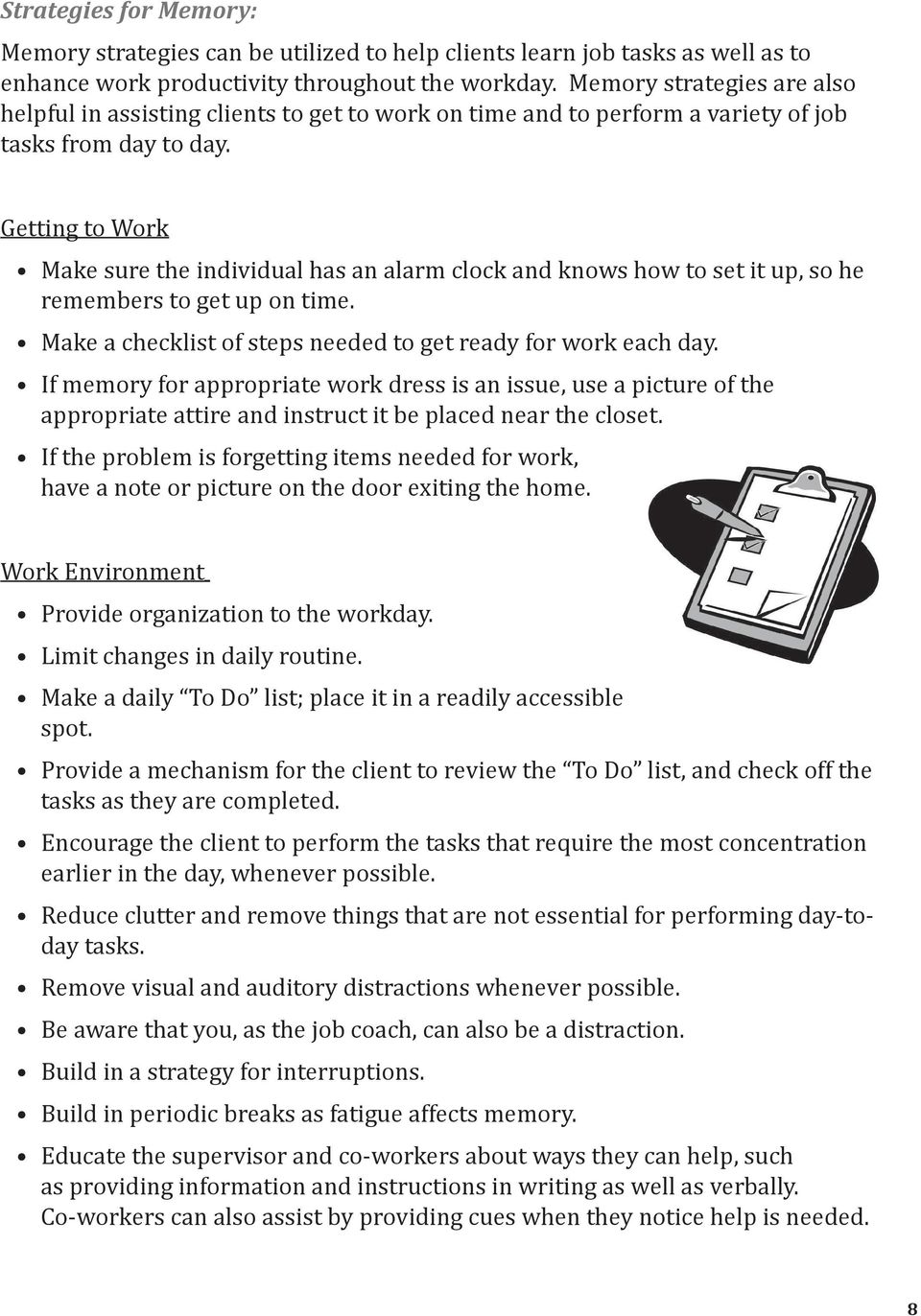
13 Strategies for Memory: Memory strategies can be utilized to help clients learn job tasks as well as to enhance work productivity throughout the workday. Memory strategies are also helpful in assisting clients to get to work on time and to perform a variety of job tasks from day to day. Getting to Work Make sure the individual has an alarm clock and knows how to set it up, so he remembers to get up on time. Make a checklist of steps needed to get ready for work each day. If memory for appropriate work dress is an issue, use a picture of the appropriate attire and instruct it be placed near the closet. If the problem is forgetting items needed for work, have a note or picture on the door exiting the home. Work Environment Provide organization to the workday. Limit changes in daily routine. Make a daily To Do list; place it in a readily accessible spot. Provide a mechanism for the client to review the To Do list, and check off the tasks as they are completed. Encourage the client to perform the tasks that require the most concentration earlier in the day, whenever possible. Reduce clutter and remove things that are not essential for performing day-today tasks. Remove visual and auditory distractions whenever possible. Be aware that you, as the job coach, can also be a distraction. Build in a strategy for interruptions. Build in periodic breaks as fatigue affects memory. Educate the supervisor and co-workers about ways they can help, such as providing information and instructions in writing as well as verbally. Co-workers can also assist by providing cues when they notice help is needed. 8
14 Memory Aids Use a memory aid regularly, such as an organizer, calendar, day planner, cell phone, PDA, or a watch timer (a great example is the Timex Ironman Data Link watch, which can receive information from calendar programs like Outlook it is easy to use and can be purchased online for under $60). Pick the type of device that will work best for the individual and the job. If the person is not a techie, use paper and pencil aids instead of electronic devices. Important! Teach the client how to use the memory aid and how to record information. o For some, it might be sufficient to write 3 pm appt. with Mr. Henry. o Others might need more information to remember activities, such as: 3 pm appointment with Mr. Henry in room 305 to review the new copying procedures. Develop procedures for routinely checking the memory aid, and for remembering to bring it to work each day. For example, set a timer on a watch to buzz every 15 minutes indicating it is time to check the task list. If possible, teach the client to set a timer on a cell phone to buzz 30 minutes before the next activity is scheduled in an appointment book. Some clients may find it useful to remember short-term items by using Post-It notes, leaving themselves a voic at work, or recording a message on their cell phones or digital tape recorder. Training Tips Focus on one task at a time. Provide written, as well as verbal instructions for tasks. Develop a visual display (poster board, picture book, flash cards) with written descriptions or pictures of the job tasks laid out in sequence. o Remember that some individuals may not want to use a picture book if they are fluent readers. Use post-it notes and post reminders in readily accessible areas in the work site. Encourage the use of highlighters and colored folders. Reinforce consistency. For example, always place completed paperwork in the same place, e.g. a desk tray. 9

15 Put a colored folder, scarf or safety cone where a task has ended. This will ensure that the worker can identify where he stopped the last task. Use mnemonic strategies, for example, Silly Cathy Sings Songs: o S(illy)-Sign in o C(athy)-Check Mail o S(ings)-Sort Mail o S(ongs)-Scan Mail Use visual imagery (the process of using mental pictures/images for information to be recalled). For example, a picture of papers sitting on a desk tray cues client to place completed work in the desk tray. Use verbal rehearsal (repeating aloud key information to help recall the information). For example, have client verbally repeat information ( the way to the mailroom is out the door, left, and down one flight of stairs ). Use number grouping (recalling numbers by reorganizing them into fewer elements). For example, it is easier to remember four numbers such as 9, 5, 3, 2, by remembering them as 95, 32. Reinforce the importance of a task by teaching how to develop an internal dialogue to predict the consequences of not doing something on time. For example, if I don t check my and my supervisor has sent me something to finish today, I might delay the whole office in completing a project. Job Restructuring It may be necessary to work with the employer to assign job tasks that are consistent with the client s ability to learn and remember. It might not be possible for an individual to remember a task if it is only done once a week or sporadically. This task may need to be assigned to another employee, while the client performs other activities that are more routine. The order of job tasks may need to be changed so that all similar activities are performed at one time before moving on to the next set of tasks. 10

16 Provide Emotional Support People with brain injury typically remember how they functioned at work prior to the injury and may have difficulty coming to terms with the memory issues they are now experiencing. They may become frustrated, sad or angry. Some may be reluctant to utilize memory strategies and will need lots of encouragement. Encourage positive self-messages, there are ways I CAN learn to remember. Explain that saying or feeling, I will never remember all of this, is a self defeating prophecy. Positively reinforce when memory strategies are used: I m so glad you brought your appointment book today. You used that checklist and remembered all the steps to finish the project great job. Include the Family The best way for a person to learn to use effective memory strategies is to incorporate them into daily life activities. Encourage family members to allow their loved one to use the same strategies at home that you are teaching on the job. While it may be easiest for family members to either do for their loved one or remind her of activities as they occur, this is not the best approach for long-term success. Some examples of daily life activities requiring memory skills: Prepare a meal following written directions. Complete housekeeping chores following a checklist. Assist with grocery shopping and follow a list of designated items. Help with laundry. Answer the phone and take messages. While these strategies may seem simple or tedious, they work with practice and lots of repetition! The key is to figure out what strategies work best for your client. If one technique does not work, try something else. 11
17 ATTENTION/DISTRACTIBILITY Following brain injury, an individual s work performance may suffer as a direct result of difficulty paying attention to tasks and/or from being easily distracted by the work environment. A person may also be distracted by their own internal thoughts. Strategies: Work in an area with limited distractions. Be aware of surrounding noises that may interfere with concentration, such as radios, other people talking, etc. Try to limit these noises as much as possible. Be sure to have the client s attention before beginning a discussion. Ask the client to repeat information that was just heard to make sure the conversation or instructions were understood. Refocus the client s attention if he becomes distracted. For example, John, let me repeat that point again. It s important. Ask the client if there is some way you can help. For example, Anne, you appear distracted today. Is there something I can do to help? Focus on one task at a time and refocus the client to the details of the task as needed. Set up an agreed-upon cueing system to signal the client to focus on the task. For example, clearing your throat or saying focus. Keep abrupt changes to a minimum. Schedule routine breaks. GENERALIZATION Generalization refers to the ability to take information or skills learned in one situation and carry over that knowledge to a new situation. Problems with generalization can easily be misidentified as lack of motivation or problems with memory. Following brain injury, a worker may have difficulty taking what is learned though a training or college program, onsite employee orientation, or job trial, and applying that information to the new job. Furthermore, tasks that seem familiar in one setting may confuse the person in a different situation. For example, a client may succeed at bagging groceries in one supermarket but have difficulty with the same task at a different supermarket without retraining. 12

18 Strategies: Be aware of environmental changes that may lead to difficulty in performing already learned activities. Educate the employer and/or co-workers that additional supports may be needed as the worker re-learns tasks or experiences changes to the worksite. Be aware of changes in supervisors. A change in the way information and/or instructions are delivered can affect the way the worker is able to perform the task. Observe the client s work performance carefully to ensure that quality is maintained when performing any task in a new situation. Assist the client in re-learning tasks (refer to Learning and Memory section.) Develop an organized method for maintaining all of the information about tasks. Teach the client to refer to instruction sheets that were used when the client first learned the task. Provide support and encouragement. The client may become frustrated when recognizing the difficulty in performing already learned activities. ATTENTION TO DETAIL A person may have the ability to perform job tasks but have problems in his quality of work due to difficulty with paying attention to detail. Certain jobs that require a high degree of precision (such as a bank teller or lab technician) will not be suitable for individuals who have difficulty paying attention to detail. Strategies: Initially, re-check the client s work and identify any errors or oversights. Review errors with client. Continue checking work until accuracy is achieved. Develop a project checklist, covering all of the details of the task. Develop a system to check and recheck work for mistakes. For example, display a sign as a reminder, such as Double Check All Work. Educate the individual to: o Perform only one task at a time. o Review all of the instructions twice before beginning a task. o Repeat directions aloud. 13

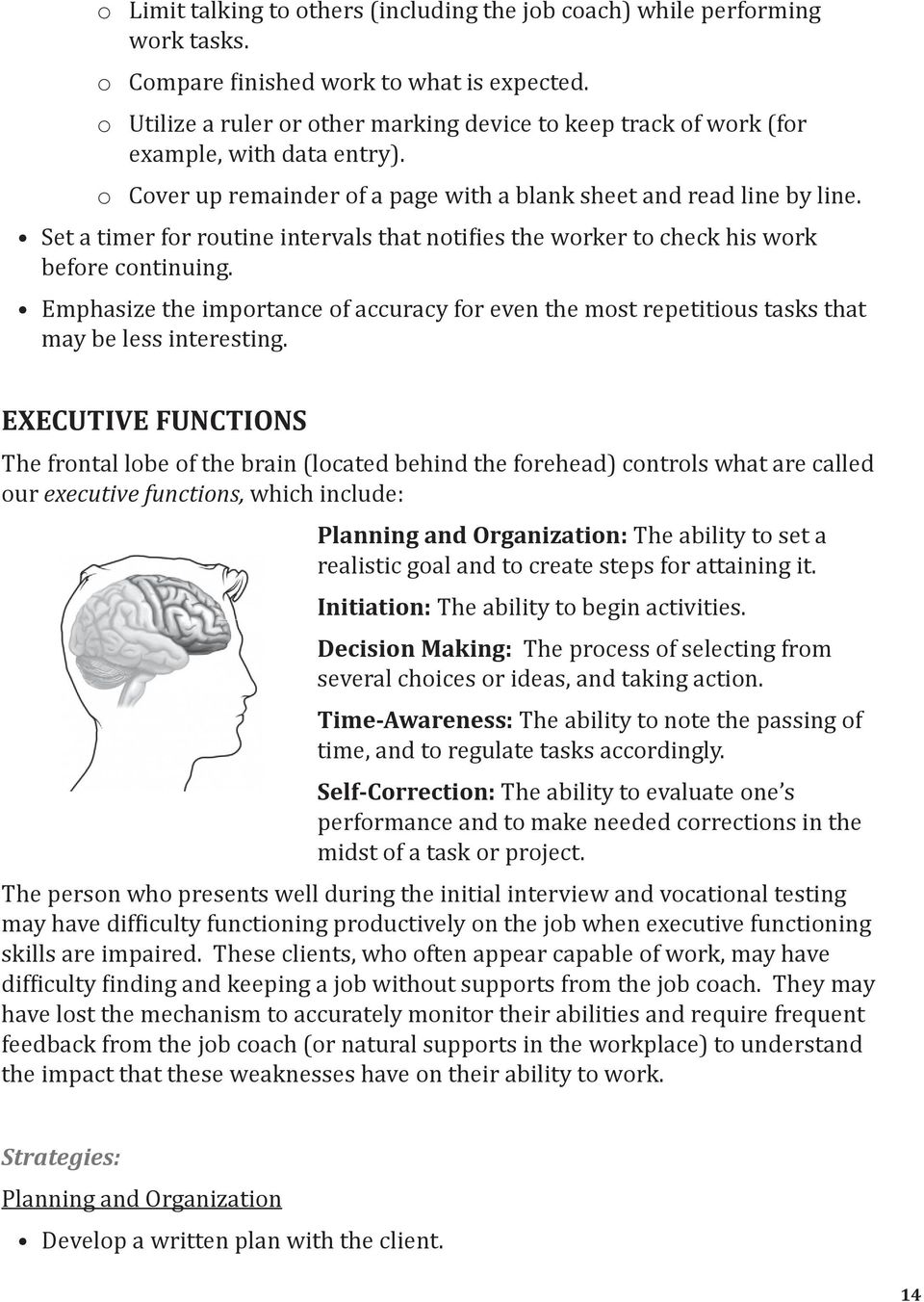
19 o Limit talking to others (including the job coach) while performing work tasks. o Compare finished work to what is expected. o Utilize a ruler or other marking device to keep track of work (for example, with data entry). o Cover up remainder of a page with a blank sheet and read line by line. Set a timer for routine intervals that notifies the worker to check his work before continuing. Emphasize the importance of accuracy for even the most repetitious tasks that may be less interesting. EXECUTIVE FUNCTIONS The frontal lobe of the brain (located behind the forehead) controls what are called our executive functions, which include: Planning and Organization: The ability to set a realistic goal and to create steps for attaining it. Initiation: The ability to begin activities. Decision Making: The process of selecting from several choices or ideas, and taking action. Time-Awareness: The ability to note the passing of time, and to regulate tasks accordingly. Self-Correction: The ability to evaluate one s performance and to make needed corrections in the midst of a task or project. The person who presents well during the initial interview and vocational testing may have difficulty functioning productively on the job when executive functioning skills are impaired. These clients, who often appear capable of work, may have difficulty finding and keeping a job without supports from the job coach. They may have lost the mechanism to accurately monitor their abilities and require frequent feedback from the job coach (or natural supports in the workplace) to understand the impact that these weaknesses have on their ability to work. Strategies: Planning and Organization Develop a written plan with the client. 14
20 Break the plan down into simpler steps, with clear and detailed instructions on how to complete each step and how much time it will take to complete a step. Develop a checklist to ensure that each step of the plan gets accomplished. Have client check off each item as it is completed. Review the plan often to make sure that it is understood and that it is working. Encourage the client to use a daily planner and help client to organize it into an effective tool for all activities. Organize the workspace and eliminate clutter. Make sure that all necessary work materials are organized and readily available. Clearly label filing cabinets, baskets, bins, etc. to reflect what is contained within. Make a master list of all work materials and where they are kept so that the client can refer to the list. Review what work materials are needed to perform each task. Have the worker gather all of the materials that are needed before beginning. Initiation (Ability to Begin Activities) Establish a structured routine for daily activities. The more structure from day to day, the better. Break down activities into simpler steps. Encourage the client to complete one task at a time before beginning the next. Make a checklist of activities that need to be completed each day. Check off each task that is completed. Establish time frames in which each task should be completed. Don t put the most dreaded or time-consuming task at the end of the list. Use a clock or watch that can be programmed to ring or vibrate to indicate the start of a task. Hang up visible reminders like Begin Working or Check the Schedule. Teach the client that the completion of one task is the cue to begin another. With client s consent, discuss with supervisors and co-workers that the client is not lazy or unmotivated. Instead, the client needs reminders to begin working or return to work after breaks. Enlist the assistance of co-workers to remind the client to begin work activities. 15

21 Decision Making Help the client identify what the options are to a particular problem. Discuss with the client the advantages and disadvantages of each option. Have the client write down (or assist him in writing) the possible options, along with the pros and cons to each. Write down in the client s daily planner what the problem is and the decision made so it can be referred to later (this is helpful when deciding upon a job goal). Encourage the client to stop and think before making a decision. Time Awareness The first step is to identify what types of problems the client is having staying on schedule, keeping appointments, and meeting deadlines. If the client is late for work, review the daily routine for getting ready for work. o Frequently individuals that have a brain injury require more time to develop a mind set for going to work. Build in that extra time in the morning to allow for this transition. o With the client, develop a written plan that encompasses all activities needed to get ready in the morning, starting with getting up on time. o Set a timeline for all morning activities. o Make sure the client knows how to set the alarm clock. Some clients do well with a morning alarm signaling they have 15 minutes to get up, followed by a second alarm indicating that it is time to get up. o If the client gets distracted or is unable to stick to the written plan, set a timer to ring every 10 minutes. This is an indicator that the client should check the schedule and stay on task. o Have the client plan the night before what to wear, what to eat for breakfast, and what to bring to work the next day. Prepare as many of these tasks as possible the night before. o Place a note on the door of all items needed to leave for work (keys, purse, work ID tag, lunch, day timer, watch, and work schedule). 16
22 o Enlist the assistance of family members or housemates to keep the client on schedule. Maintain a schedule of activities and time frames for each workday. Whenever possible, teach the client to maintain this schedule independently. Reinforce the use of a calendar system and teach the client to check it regularly. Use watches, timers on cell phones, or buzzers to ring/vibrate five minutes and one minute before a new activity begins, and five minutes/one minute before a task is suppose to end. Also, use this method for the beginning and ending of lunch and breaks. Teach the client to utilize natural supports at the worksite. Follow the lead of co-workers to stay on time. Discuss with the supervisor any problems the client may have with keeping on schedule and how they can assist. Self-Correction After a task, ask the client how he believes his performance was, what could be improved and how to improve it. Follow up by providing the client with positive and negative feedback about work performance. Provide oral and written feedback. Develop a feedback chart that regularly measures gains or lack of improvement and review it with the client regularly. Discuss with the client how performance can be improved. Establish an agreed upon signal to give feedback if behavior, speech or work efforts are inappropriate or incorrect. Enlist the support of supervisors to provide consistent feedback about work performance and how performance can be improved. Refer to Attention to Detail for additional supports. 17 PERSEVERATION Perseveration is defined as the uncontrollable repetition or continuation of a response (e.g. behavior, word, thought, activity, strategy, or emotion) beyond what is typically expected. Perseverative behavior generally interferes with learning, work performance, and social interactions. For example, the worker may begin discussing a topic with co-workers and have difficulty moving onto a new topic. The worker may have a disagreement with the supervisor and be
23 unable to let it go. The worker may begin a job task and be unable to switch to the next task. The worker may perform a task incorrectly and despite correction from the supervisor, continue to perform the task incorrectly. Finally, the worker may experience an emotion (anger, sadness, happiness) and may be unable to get past this feeling to the point that it interferes with work performance. Strategies: It is important for the job coach to recognize when a client has an issue with perseveration. In the absence of this understanding, it is easy to become frustrated and impatient as the client does not know when to let go of topics, emotions or behaviors. Educating the employer and co-workers will also elicit greater understanding and support. Since the client may be unaware of when they are perseverating on issues, it is helpful to set up a cueing system (such as a tap on the shoulder, a certain look, or the phrase enough, let s move on ), to let the client know the behavior is occurring. Set clear guidelines for appropriate work behaviors. Use such statements as I understand how you feel, but we need to get back to work, or We already talked about that. We need to focus now on work and stop this discussion, or I m not going to speak with you about this again today. These types of statements can be used by both the job coach and supervisors. Provide immediate feedback about work performance. Demonstrate the correct method for performing job tasks and have the client practice until proficiency is achieved. Reinforce that it is not wise to argue with supervisors. INFLEXIBLE THINKING Some individuals with brain injury have difficulty at work because of problems with inflexible thinking. The job coach may notice this during job placement and job coaching. The client may have his heart set on a specific job or employer and have significant difficulty accepting other job options. The job coach may provide feedback about interviewing skills that is discounted because the client isn t flexible in thinking that a different approach may be better. The worker may have difficulty making transitions during the workday or tolerating changes in work routines. Changes in supervisors or co-workers may be problematic. 18
24 Strategies: The first step for managing inflexibile thinking it to recognize when it is occurring. It is easy for the job coach to become impatient or angry when working with a person who is inflexible. Whenever possible, provide the client with advanced warning or information about upcoming changes. Educate the employer to provide as much information as possible about an upcoming activity or change in the workday. Develop a plan for dealing with changes. This could include making changes to the work schedule and task lists, discussing the changes, and practicing the new tasks. Advise the client not to argue with the supervisor. It is okay to discuss issues, but the supervisor has the final word. Change will invariably make the client feel anxious or angry. Advise the client to use stress management strategies discussed in the emotional/behavioral section of this manual. Encourage the client to try something out (whether it is a different type of job or a change in work tasks) before dismissing it as wrong. Provide praise and positive feedback when the client is able to alter his mind set. Behavior and Emotional Issues It has been well documented that the emotional and behavioral problems following a brain injury are the most difficult for rehabilitation professionals to understand, predict, and treat. In fact, emotional and behavioral issues are the most common reasons individuals end up losing or quitting jobs. This section will help job coaches understand these issues and provide strategies for managing emotional or behavioral issues on the job. INSIGHT AND SELF-AWARENESS Following brain injury, every individual will have a different perception of his or her abilities and limitations. Changes in physical functioning and appearance are typically the easiest to understand. For example, I now walk with a cane. I am hoping that with physical therapy I won t need to use the cane at work. Changes in cognitive skills and behaviors are often more difficult to recognize. A person may recognize problems with memory, but not be aware of his problems with initiation, planning or organization. A person may be aware of feeling anxious, but unaware of the impact his behavior has on others or on his work product. As a result, a 19
25 person may have limited awareness of strengths and limitations as they relate to returning to work. Limited insight will be seen as the client s: Lack of understanding or lack of concern about strengths and weaknesses as related to returning to work. Insisting upon the ability to perform tasks as well as before the brain injury. Complaining that you, the DVRS counselor or the rehabilitation team are wrong in picking a certain type of job or recommending strategies to enhance productivity. Wishing to pursue a job beyond his ability, or one not included in the plan set up by the DVRS counselor. Failing to understand how his behaviors and emotions affect other workers or misunderstanding co-workers behaviors and emotions. Unwillingness to use compensatory strategies and/or resistant to others telling him what to do. Strategies: Provide immediate feedback (both positive and negative) about work performance in an effort to help client gain insight into capabilities. Review the components of the job; ask the client how he thinks he will do on a specific task. Have him perform the task and provide immediate feedback. Compare how he thought he would do with how he actually did. Provide a written record of how a client did throughout the day that can be reviewed often. Develop a rating sheet that includes all of the tasks that the client completes each day. At the end of the day have the client rate her performance. Emphasize mistakes as life lessons and that life is full of opportunities to learn new skills or to try new jobs. Encourage the client to learn from mistakes and say, I will do better if I try this approach the next time. Provide immediate feedback about behavioral issues that occur on the job. Discuss the problem and what will happen if the behavior does not change. A contract may be needed to develop a written format to avoid social improprieties. For example, I will not tell dirty jokes in the office. Be patient. Provide encouragement and ongoing support. 20
26 As needed, include the family in discussions regarding work performance. Notify the DVRS counselor to seek direction on how to proceed if the client s limited insight interferes with finding a job or work performance. INTERPERSONAL SKILLS After brain injury, an individual may have difficulty with interpersonal skills. This is particularly problematic in the workplace and can result in social isolation due to avoidance by others, embarrassment, and/or conflict with supervisors or co-workers. Some of the issues that you will see include problems with communication skills, maintaining personal boundaries, egocentricity, apathy, and impulsivity. Communication Skills The ability to communicate with supervisors and co-workers is often as important as the ability to perform job tasks. A person with brain injury may have difficulty with communication skills due to slowness in processing information, problems remembering past events, impaired self-awareness, compromised judgment and difficulty with problem solving. As a result, the way a person obtains information and expresses ideas may be altered. Some of the challenges exhibited by a person with brain injury you may observe include: The inability to start a conversation. Long pauses after hearing someone speak. Not appearing to pay attention while another is speaking. Failure to respond, comment or ask pertinent questions. Responding before having all of the information. Not able to express thoughts clearly. Misinterpreting what the other person said. Interrupting, changing the topic, monopolizing the conversation, speaking nonstop, and/or not giving the other person a chance to speak. Inability to follow the conversation when the topic has changed. Speech that is difficult to understand. 21
27 Strategies: Develop a list of safe topics that can be used to start a conversation, e.g. recent ball game, movie, TV show or weekend activities. Practice these topics. When asking a question to a supervisor or co-worker, develop a canned phrase, Do you have a minute now? Can you help me with? Before speaking with a supervisor, organize thoughts, write them down in order of importance, review and practice the items on the list. Write a note on the list: Stay on Topic. Let the client know that it is okay to ask for clarification if he is unable to follow what a person has said. Develop canned statements such as Would you repeat what you just said, or Excuse me but I am getting lost, would you say that again? Ask questions to make sure the information was understood such as, Do you mean? Encourage the client to take a moment and think of a response before speaking. For example, she can say, I need a minute to think about this. If a client makes an inappropriate remark, provide feedback as soon as possible. Provide positive feedback for appropriate communication. Develop an external cue to let the client know he needs to stop talking. If person is a conversation hog, respond by saying, we need to keep this conversation brief. It s time to get back to work. As appropriate, share this strategy with supervisors and co-workers. Work with the family to integrate this approach in all aspects of the client s life. Suggest that the individual ask others what they think in order to promote two-way conversations. If client changes topic or does not address the issue being discussed, redirect her back to the original conversation by saying, We were talking about, we should finish that discussion before we move on. Provide education to supervisors and co-workers to promote better communication. Advise the supervisor and co-workers that it may take a moment for a worker to think about a question and respond. It is important not to provide the answer if the worker does not respond immediately. 22
28 Recommend that supervisors: o Speak to the employee in an area that is as distraction-free as possible. o Make sure that they have the employee s attention. o Speak in a clear and precise manner. o Stay on topic and emphasize important aspects of the conversation. o Ask the worker to repeat what was said to ensure understanding. o If the supervisor has difficulty understanding the worker, it is appropriate to say, I am not sure what you said, can you repeat that, or Do you mean? o If the employee simply answers yes or no to a question, follow up with another question to make sure the original statement was understood. o Write down important points of the conversation and give the list to the employee at the end of the discussion. For co-workers: o Include the individual in a conversation by asking him a direct question. o It is acceptable to politely interrupt the individual who speaks nonstop and ask him to let you speak. o Ask the worker to speak louder, lower the tone or speak slower. Maintaining Personal Boundaries An individual with a brain injury may not recognize and respect another s personal space. Examples of this behavior include walking into an office without an invitation, sitting down at another s workspace, interrupting a co-worker while she is on the phone, standing too close or too far away from a co-worker, staring at a co-worker or visitor at the job site, touching a co-worker, or joining a group at lunch or break without asking. 23 Strategies: Explain the concept of personal boundaries and why they are needed at work. Model this behavior. Plan and rehearse social situations.
29 Work with the individual to develop a list of acceptable behaviors: o Do not touch a co-worker or engage in any physical contact. o Do not get closer than two feet from another person. o Do not handle co-workers belongings. o Ask if a co-worker is busy before engaging in a conversation. o Make sure conversations are related to work. o Ask is it okay if I join you when approaching a group or an individual in the cafeteria. o Do not ask personal questions such as age, salary, medical history. o Remember the old adage Don t discuss religion, politics, or sex. Egocentricity Egocentricity is the tendency to be self-centered, to consider only oneself and one s own interests. Frequent responses to such behavior are the popular quips, it s not all about you or get over it. Yet these comments will not solve the problem. Notice whether a client s self-centered behaviors are interfering with the process of getting or keeping a job. As a job coach, it is important to be aware of these behaviors and bring them to the client s attention. Here are some examples that you may observe during job placement and job coaching: Constant interruption when someone else is speaking, or a client monopolizing a conversation. Repeatedly talking about his own situation and providing too much information about the brain injury. Providing literal responses to simple social statements. For example, when a co-worker asks how are you? the client may give a lengthy explanation as opposed to a common and simple OK. Failing to show compassion or concern for another. This is because an individual with a brain injury may experience dulled or limited emotion, or may lack the capacity to feel guilt after an inappropriate remark. Inability to maintain boundaries in social conversations, thus disclosing too much information. Inability to monitor social cues because the client cannot process a situation quickly and/or accurately, thus potentially engaging in offensive or irrelevant conversation. 24
30 Inability to stay focused upon conversations due to an attention deficit. Strategies: Explain that when a co-worker or boss inquires, how are you? this is a form of social greeting, rather than an actual inquiry. Coach the client to smile and say I m fine thanks, how about you? Explain that if the co-worker or boss wants more specifics, the person will follow-up with another question, which becomes a cue to provide additional information. Remind the client that he should not interrupt when another person is speaking. If he interrupts you, provide immediate feedback (for example, One moment please, I am still speaking, and when you have completed your thought, Now, what was it that you wanted to say? ). Model considerate, other-centered behavior. Afterwards, ask the client for his response (for example, Did you notice how I asked Mary how her weekend was and she said ). Provide feedback on how others view the client s interactions and responses. It is important to point out to the client when a co-worker has been offended or turned off by the client s egocentricity, and to do so as soon as possible following the incident. Encourage the client to apologize to the co-worker. Ask the client how he would feel if someone made a similar comment to him. Ask the client what she would do differently the next time, allowing an opportunity to encourage a different outcome in the future. Use the sandwich approach. Open and close with a positive statement and insert criticism in the middle in order to bring attention to the issue without damaging the client s self-image (for example, You re a great worker/ You might consider / You re doing great and I know you can do this ). If necessary, develop a list of work-appropriate topics with the client. Discuss how this is different than social- and family- appropriate topics for outside the workplace. Use external cues such as displaying signs that read IT S NOT ALL ABOUT ME or OTHERS COUNT. We all know that by watching for co-workers facial expressions and gestures, we are able to identify how someone is feeling, and if the person wants to talk or be left alone. However, some people with brain injury have difficulty interpreting these types of expressions. Model for the client how to interpret others nonverbal cues. For example, Mary looks really happy today, or Sam looks like he wants to be left alone. 25
31 Positive feedback works wonders! Acknowledge the times that the client shows good awareness and responds to another person s needs or feelings. Reinforce socially appropriate behavior with praise. Including the family in this process will provide additional repetition and consistent feedback for the client. Apathy Apathy refers to the absence of interest, emotion, or concern. It may appear as if a client is not motivated in returning to work or performing well at the job. There will be no emotional reaction to good or bad situations. Frequently the individual is unaware of this deficit. His behavior is puzzling and may be insulting to co-workers and supervisors, as they may think the reaction is indifference to them or the work. Apathy is often the reason that individuals with brain injury fail to progress in vocational efforts. Their responses may be misinterpreted as laziness or depression. However, apathy is not psychological in origin but rather a physical reaction in the damaged area of the brain that fails to interpret and respond to emotional information in a conventional manner. The following are examples of apathy: An individual who does not smile or show any emotional response to things going on in the environment. He may listen to a sad tale such as the illness or misfortune of a co-worker or their family and not show the expected empathic response. His tone of voice may be flat and facial expressions may not change, regardless of what he is saying or hearing. She may show no expression or reaction when hearing negative feedback about work performance. Strategies: Assess the situation to determine if a client appears apathetic when seeking a job, going for an interview, or at work. Develop a script of appropriate responses and practice these responses with the client. 26
32 The most important service you can provide is education to the supervisor and co-workers about brain injury. Explain that apathy is not a sign of disrespect, or if the client fails to smile and laugh at something humorous, it is not indicative of depression. The lack of emotion is a physical response to the brain injury. Recommend that individuals at the work site provide support and encouragement to the client. Develop a plan in which the client will greet co-workers at the beginning of the workday. The expressions how s it going? or good morning are good starts. Model for the client how to respond when receiving feedback from a supervisor. Such responses include, thanks for the feedback, or I will work on that. Look at the client s facial expressions and help the client to practice smiling or conveying a more subdued expression when appropriate. If you determine that a client continues to display apathetic responses and it is interfering with the ability to find or keep a job, discuss the issue with the DVRS counselor. Further evaluation or treatment may be helpful to improve vocational functioning. Impulsivity A person with a brain injury may show signs of impulsivity (the tendency to perform an action before thinking about the consequences of that action). The inability to control one s actions can lead to problems in work performance, unsafe work practices, and socially inappropriate behavior on the job. You may see the client: Jump from one task to another without successfully completing the first task. Begin an activity without waiting for the entire set of instructions. Engage in unsafe work behavior despite orientation to workplace rules. Say the wrong thing ( putting his foot in his mouth ). Interrupt others or repeatedly finishes the sentences of others. Use obscene or sexually inappropriate language. Touch others property. Strategies: The first step in reducing impulsivity is to work with the client to identify how, when and why he becomes impulsive. o What does the impulsive behavior look like? Is it interfering with the ability to perform work tasks and/or interact with co-workers? 27
33 o Is it when the client is fatigued? o Is the client s caffeine (or other stimulant) intake too high? o Is it when the client is over-stimulated or overwhelmed? o Does the job expose the client to too much stimulation, distractions, or social interactions? o Is it proximity to others? Does the client need a more secluded work environment? Different shift? After identifying the impulsive actions, provide clear expectations for appropriate behavior. Remind the client that the most important thing he can do is complete one task before jumping to another. A job checklist will help him stay on task. Encourage the client to slow down and think through tasks or responses before acting, and consider the possible negative consequences before taking action. Use external cues such as a Slow Down sign or a relevant reminder at a desk, on a notebook, or wherever readily visible to reinforce this strategy. Develop an external gesture from you as a signal for your client to stop and think before acting. Encourage the client to stay focused; if he changes the topic, redirect him back to the task or topic of conversation. Address inappropriate behavior in private and in a calm, reassuring manner. Provide constructive feedback on more appropriate behavior. Address the issue as soon as possible. Assure the supervisor that it is acceptable and helpful to correct the worker if impulsive behaviors are interfering with work performance or interactions with others. Encourage the family to implement, practice and follow these strategies at home. Notify the DVRS counselor if impulsive behaviors continue to be problematic. ANGER Anger is a common human emotion that signals a need for change. We all know that our emotions are neither good nor bad, and they cannot be ignored or prevented; it is the way in which we handle our emotions that is key. Individuals with brain injury may react quickly, expressing their feelings of anger before they are able to think about the consequences of their actions. 28
34 People may express anger in active or passive ways. Active verbal expressions of anger include a rising tone of voice, yelling, swearing, making mean or terse remarks, and a rapid rate of speech. On the other hand, passive responses to anger include withdrawing, sulking, and mumbling under one s breath. Physical responses of anger include walking away, pacing, tightening of the jaw, frowning, constriction of pupils, clenched fists, arms folded across the chest, foot tapping, or menacing gestures. More extreme forms of physical anger include throwing or breaking objects, yelling, pushing or hitting someone. People with brain injury typically experience anger in two different ways. The first type of anger tends to have a quick on and a quick off response. For example, an individual may be in a good mood until something irritates or annoys him. He may suddenly get very angry. But this anger does not last very long if someone changes the topic of conversation or provides some other form of distraction. The second type of anger response tends to last for a long time and can be particularly difficult in the work environment. The individual experiences anger as ruining the entire day. She is unable to stop thinking about the slight or the offending incident and exhibits this anger throughout the day. Strategies: It is best to develop strategies that will prevent anger from occurring in the first place. The first step is to evaluate the environment for triggers that may provoke a person to become angry. When appropriate, change the environment as it may reduce the chances of the person feeling angry. When assessing the environment, be aware of over-stimulation, including: Bright lighting or flickering fluorescent lights Noise Very fast-paced work environment Frequent changes to work expectations Clutter Proximity to others Distractions Behavior of others in the workplace (such as a co-worker who complains or doesn t stop talking) Negative attitudes reflected by co-workers Triggers not related to the work environment may also exist including lack of sleep, fatigue, events occurring outside of work, and feeling over-whelmed. 29
35 The next step is to help the client recognize physical signs of feeling angry. Help the client to become familiar with these signs (heavier breathing, clenched fists or jaw, tightened neck muscles, pacing, increased rate of speech or raised tone of voice). Develop cues or strategies that the client will use to control his emotional responses to anger: Develop a subtle signal that allows you to convey a calm down message that can be shared with supervisors or co-workers (for example, a wink, tug on the ear, hand signal, etc). Use an external cue, such as a red band or ribbon around the client s wrist, to remind her to STOP and not to react. Post a sign on the desk, with a message Don t react. Advise the client to get out of the situation. Use phrases such as, I need to leave for 15 minutes to go for a walk. Tell the client to take a break. Teach the client it s ok to disagree, but to remember that at work, what the supervisor says goes. Use humor in a positive supportive way, but be concrete. Stress the importance of maintaining a healthy lifestyle in order to better control emotional responses. This includes getting a good night s sleep, exercising, eating a healthy diet, and managing outside activities. Since it is not always possible to prevent anger, the following strategies can be used when a person becomes angry: As the job coach, model cool, calm behavior to help the client modify his response, and perhaps prevent escalation of the anger. Redirect the client s attention to another topic or activity. Take the client to a quiet and more private area. Allow at least 15 minutes for the client to regain control. Returning to the situation without allowing time for the client to regain control will only evoke the same response as soon as he returns to the stressor. Provide constructive feedback on the behavior and the incident. Don t take the behavior personally. Understand that the brain injury may prevent the individual from feeling empathy or guilt. 30
36 DEPRESSION, ANXIETY AND IRRITABILITY Returning to work after brain injury is one step in the process of adjusting to life after brain injury. Individuals are coming to terms with their new strengths and weakness and performing jobs that may be different than their original aspirations. Depression, anxiety, and irritability are emotions that may occur as individuals go through this adjustment process. Depression Feeling sad is a normal reaction following brain injury. It becomes problematic when sadness develops into depression and interferes with an individual s ability to function at home, in the community and at work. Depression can wax and wane. For example, a person may have adjusted to his disability within the home and family circle, but as she tries to re-enter the world of work, her deficits become more apparent and she must once again face them. It is at this time that the individual may say What s the use; nothing will ever be the same again or Why bother to try? Depression may resurface around the anniversary date of the injury or if a milestone is achieved by someone close to the individual, such as a co-worker getting a promotion, or a friend completing college. Depression may be a signal that an injured person is becoming more aware of his deficits. This greater awareness can be seen as a sign of hope since without awareness, a person can neither see her challenges nor take steps to help herself. A person experiencing depression will show some or all of these symptoms over time: Appear sad and/or cry. Avoid or withdraw from co-workers. Feel and/or comment that I am worthless. Say, I would have been better off if I had died. Appear fatigued or have little or no energy. Sigh frequently. Have trouble getting through the day. Have difficulty with concentration. 31
37 Have difficulty performing work tasks. Have difficulty sleeping. Exhibit poor appetite or excessive appetite. Treatment for depression is essential. If the job coach suspects that a client may be depressed, speak to the DVRS counselor. With proper medication and counseling, the client may be able to overcome the depression and be more productive at work. Strategies: Offer support. Encourage the client to discuss his feelings with family members and his treating physician. Encourage the client to be physically active. Suggest a walk during break time or at lunch. Make sure there is structure to the workday and that there is not a lot of down time. Encourage the client to eat regularly and get a good night s sleep. Encourage the client to join a support group, get involved in community activities, or perform activities of interest outside of work. As appropriate, call the treating therapist or physician to discuss the impact depression may have on the client s ability to function on the job. Anxiety Anxiety is twice as likely to occur in individuals with brain injury as in noninjured populations. There are many reasons for this. Following brain injury, the individual has lost a sense of identity. There is uncertainty about the future, concern about finances, and changes in family dynamics. Anxiety may be demonstrated by: Rapid speech, sweating, palpitations, stomach pain. A sense of doom or impending disaster. A fear of trying new things. Repeatedly talking about these fears. The client may have these symptoms and not understand that anxiety is the cause, thus creating more anxiety. 32
38 Strategies: Understand that anxiety is a common emotion after brain injury. Provide reassurance that this feeling is common. Educate supervisors and co-workers about the need for consistency of day to day job tasks. Determine if the job duties or work environment are increasing anxiety. For example, too many people around, too many tasks, or working too long on a particular task. Avoid sudden changes and prepare the client for new tasks or changes to the job. Stress that the effort to perform a task is the first step towards success. Provide feedback on progress made in work performance. Yesterday you were able to sort 75 papers and today you did 90. You are making great progress. Encourage self-scripts such as this is no big deal or I will try it out, or nothing ventured nothing gained. Encourage breaks. Speak to the client in a slow, calm tone. Encourage deep breathing exercises. Use mental imagery. Have the client imagine a pleasant place and think of it for ten seconds. Encourage daily exercise. Encourage the use of non-caffeinated beverages since caffeine increases feelings of anxiety. Encourage that the client maintain a regular eating schedule, avoiding skipping meals, and limit junk food. If the anxiety continues to interfere with job performance, notify the DVRS counselor. Irritability Irritability is a common feeling experienced after brain injury. It may not be a significant issue until the individual tries to return to work. This is a time when the combination of greater demands, more stimuli at the workplace, and the person s awareness that he cannot function the way he used to prior to brain injury, may lead to feelings of irritability. Issues that are only a slight inconvenience for most people, may become very annoying for people with brain injury due to inadequate functioning of the part 33
39 of the brain that keeps these feelings under control. An individual may scowl or grumble, or become downright ornery if he is not succeeding at his assigned task. Fortunately, these behaviors usually improve as the individual becomes more familiar with his job and more comfortable at the worksite. Strategies: Develop an initial work schedule that starts part-time and gradually increase work hours as the client s tolerance for work activity increases. Provide sensitivity training for co-workers. Explain that terse statements and gruff demeanor should not be taken personally. Help the client develop adaptive ways of expressing feelings of frustration. He may say to a co-worker, I am having a bad day, please excuse my grumpiness. Encourage positive self-talk, such as I can do this job, or I will be polite and respectful at work even if I m feeling irritable. Encourage the client to put up a good front by smiling, even if this is not how he feels. Teach the client to recognize feeling frustrated or irritable. Use helpful statements like You seem more upset today. What s going on? Give periodic praise, positive reinforcement, and constructive feedback. Speak with the employer to allow a five minute break when the employee begins to feel frustrated. Encourage the worker to leave the work area (go outside if possible) and take a few deep breaths. Encourage other stress management techniques. Remind the client not to give in to the tendency to blame the injury for all difficulties. As the job coach, be aware of your own emotional reactions to the person who is irritable. If irritability continues to interfere with job performance, contact the DVRS counselor as assessment or counseling may be indicated. EMOTIONAL LABILITY Following brain injury, an individual may have difficulty controlling emotional responses such as crying or laughing. This is called emotional lability. These responses are sudden, unexpected, and often inappropriate to the situation. A person may begin crying uncontrollably over a comment from a supervisor, laugh when hearing bad news, or be unable to stop giggling for no apparent reason. 34
40 These types of behaviors can be frightening and/or confusing for supervisors and co-workers, since they may not understand the behavior and may feel that they did something to cause the strange response. Co-workers may distance themselves from an individual with emotional lability, leaving the worker with brain injury feeling isolated and rejected. To quote an individual who experiences this problem, it s not funny when I laugh at news of a co-worker s illness or troubles or when I begin to cry for no reason. It makes me feel embarrassed. I am constantly on guard trying to prevent this from happening especially at work. As a job coach, the first step is to learn more about how emotional lability affects the client. How often does it occur and what are the triggers? Has the client spoken to a physician or therapist about this? Are medications prescribed and does the client take them? (Medications are frequently used to reduce the symptoms of emotional lability.) If the current physician is not aware of the emotional lability, encourage the client to inform her doctor. Strategies: Educate the client that this is a result of the brain injury. With client s consent, educate the employer, supervisor, and/or co-workers about the cause of emotional lability. Assure them that they did not cause or provoke the reaction. Develop a circle of support at the work site. Prepare a canned response that the client can use to explain the behavior to co-workers. For example, Oh, just ignore me. I ll be fine in a moment. Make provisions that allow the client to leave the area until she can regain composure. Encourage the use of deep breathing strategies to prevent unwanted laughing or crying. Provide positive feedback to the client. Physical Issues The physical consequences following brain injury are the most obvious. They are the result of damage to the parts of the brain that control motor function rather 35
41 than direct injuries to the affected body part. Physical problems may include difficulty with mobility, balance, gait, motor control or coordination; hemiplegia (paralysis of one side of the body) or hemiparesis (weakness of one side of the body); spasticity; and problems with eye-hand coordination. These conditions further complicate return to work when they affect the use of the preinjury dominant hand. Problems with communication may also occur, including difficulty speaking clearly due to dysarthria (weakness of the muscles in the mouth). Even though it may be difficult to understand what a person with dysarthria is saying, it is important to remember that this is a physical impairment and does not imply an inability to think or reason. Some other physical problems include changes in vision and hearing, dizziness, headaches, and possible seizures. Medication, and physical, occupational or speech therapies can help to remediate some of the problems. Since physical deficits are visible, they can become the central focus of the individual and the job coach when returning to work. While important, the job coach must also continue to identify and address cognitive and/ or behavioral issues. Many of the physical problems that occur because of a brain injury can be compensated for with the use of assistive devices. Walkers, ramps, bracing, wheelchairs, or solutions for visual disorders (e.g. enlarged computer screens, prisms in eyeglasses) are some examples. The individual may be evaluated at an assistive technology center and receive recommendations for equipment that will help to improve functioning at home, in the community, and at work. If the client is utilizing assistive devices or technology, the following should be considered when transitioning back to work: Does the client know how to use assistive devices or technology properly? Is it compatible with the work site and job requirements? Are you familiar with the use of the device(s)? Are you observing work tasks that could be accomplished more efficiently? Do you think another strategy or type of equipment would help the client to perform the job that has not been recommended? Speak to the DVRS counselor with any questions or concerns regarding assistive devices or technology. Fatigue, sleep problems and pain are three additional physical issues that may occur when an individual with brain injury begins to work. The following sections address these issues. 36
42 FATIGUE Fatigue is the most common physical complaint reported after brain injury. It is frequently misunderstood or not recognized. Fatigue is caused by a combination of the brain s inability to process glucose and oxygen properly along with changes in how the brain processes information. Even the most routine and familiar tasks may require extra effort and concentration. As a result, fatigue sets in and affects the ability to work, learn, and engage in social interactions. Many people say that their brain shuts down when they are tired. The job coach may observe that a person is able to perform their job tasks at the beginning of the work shift, but note that performance declines significantly towards the end of the workday. The important thing to remember is that encouraging the client to do more or try harder does not help reduce fatigue for someone with a brain injury. Strategies: Initially, start working on a part time schedule. If the client is successful, try increasing hours gradually. If work performance declines, this is an indication that full time work may not be a feasible goal. Reduce the work hours. Ask the individual when he feels the most alert and energized. Schedule work hours within that window. Consider splitting shifts. This allows the individual time to go home, rest, and then return to work. Educate the employer and co-workers about the fatigue factor. The worker may appear lazy, but in reality needs to incorporate rest periods into the day in order to be an effective worker. Schedule frequent breaks during the work period, at least five minutes every hour. Help your client to understand the importance of mini cognitive breaks. Advise the client to shut off his cell phone, go to a quiet place, and relax during the break. Provide positive feedback, education and support to let the client know that following a brain injury, many individuals report that their brains just shut down or stop working when they get tired. Explain that trying harder or working longer will not solve this problem, REST WILL. Avoid a hectic work site and minimize distractions whenever possible. Encourage the use of assistive devices such as a day timer or checklist, as straining to remember or worrying that something was forgotten increases mental fatigue. 37
43 Encourage a healthy breakfast and lunch. Instruct the worker to bring juice and healthy snacks to work. Encourage eight hours of sleep each night. If issues with fatigue appear to be an ongoing problem, bring it to the attention of the DVRS counselor. SLEEP PROBLEMS A brain injury can disrupt a person s ability to have a good night s sleep. In fact, more than 50% of individuals with a brain injury will experience insomnia or some other form of sleep disturbance. As a result, the individual may be tired and not as productive during the workday. In addition, if an individual has not worked or has not had a structured routine since the brain injury, he may need to adjust to the day/night cycle of the world of work. If the client appears sleepy, dozes off during work, yawns frequently, or appears glassy-eyed, question him about his sleep: When do you go to sleep and how many hours do you sleep each night? Do you wake up during the night? Do you take medication for sleep? Does your doctor know that sleep is a problem? When do you feel most awake? Do you nap during the day? How many caffeinated beverages do you drink during the day? Strategies: Arrange work hours around when a person is most alert. Avoid work schedules that require changing shifts, as this negatively affects the sleep cycles. Discuss the need to get eight hours of sleep a night. Discuss limiting caffeine throughout the day, particularly after noon. Discuss good sleep hygiene, including sleeping in a quiet place with the television and radio turned off and preparing for sleep by relaxing prior to going to bed. Many individuals with a sleep disorder may actually be unaware of their problems with sleep. If you continue to observe that lack of sleep is interfering with work performance, contact the DVRS counselor. 38
44 PAIN Many times when a traumatic event was the cause of the brain injury, other body parts are also impacted. For example, there may be chronic pain due to an ankle, neck, shoulder or back injury. Headaches may be present due to whiplash. Another consideration is the individual may be physically inactive for an extended period after injury and may be deconditioned. His body may respond to the demand of the increased activity required by the job with aches and muscle stiffness. This is similar to how a person feels when he begins an exercise regime or joins a gym. There are solutions to this problem. Pain should be identified and addressed during the supported employment process. If ignored, the pain will affect work performance, mood and behavior. The first step is to be aware of pain indicators, including: Rubbing a body part Squirming, fidgeting or limping Grimacing, sighing or verbal comments of pain Frequent work absences The next step is to find out more information: Direct the client s attention to the behavior and ask questions: o I see you are changing your position a lot, what is causing you to do that? o You keep rubbing your neck. Does it hurt you? o You did not come to work yesterday because you said you had a bad headache. Does this happen a lot? Inquire if the client has mentioned the pain to a doctor. If not, suggest they make an appointment in the near future to discuss it. Inquire if the doctor has provided specific suggestions about how to manage the pain and whether they are applicable to the workday. Strategies: Below are a few workplace strategies that can help manage pain: Avoid staying in one position. Alternate between sitting and standing whenever possible. Avoid repetitive movements. For example, have a grocery bagger pick up items with both hands rather than using only one hand. 39
45 Allow time for 30-second stretch breaks throughout the workday. Stretch in the opposite direction of the work activity. For example, if a worker frequently bends, ask him to bend backwards. A typist should stretch her fingers and wrists backwards. Observe for good body mechanics, particularly with lifting. Example of good lifting technique Whenever possible, decrease the weight someone needs to lift and carry. Can a load be split into two trips? Can a pushcart be used? Look for good body mechanics while sitting at a desk and using a computer. The height of the table, position of the keyboard, screen, and mouse, and type of chair should be observed and corrected whenever possible. More information about ergonomic design can be found at: Notify the DVRS counselor if pain complaints or behaviors continue to interfere with work performance. 40
46 Other Issues INCONSISTENCY IN WORK PERFORMANCE Everybody experiences good days and bad days. A person with brain injury may say I got up on the wrong side of the bed. At work, the client may appear more irritable, process information more slowly, and generally not perform as well as on other days. In some instances, the inconsistencies may only minimally affect work performance. Other individuals experience such significant fluctuations in work performance that it puts their jobs in jeopardy. Inconsistency in work performance is associated with brain injury for a variety of reasons. Damage to the frontal lobes in the brain (which controls executive functions) may cause a worker to have sharply exaggerated good days and bad days. The individual has less control over the cognitive, emotional, and physical challenges that result from brain injury. Pain and fatigue also play key roles in inconsistent work performance. A bad night s sleep or a headache may drastically alter the employee s ability to function at work. Finally, reactions to stressors, either at home or at work, may impact work performance. Choosing the right job is critical when working with an individual with brain injury. Consider this: Is it better to find a job that fits a person on his best day or choose a job that fits a person on his worst day? The answer is probably somewhere in the middle. The best plan is to find a job that matches a client s abilities on the majority of the days that he is working. It places the client at a significant disadvantage if the job fit is beyond his or her capabilities given the combination of cognitive, emotional, and physical issues that may be occurring. When a client is having a bad day, it is important to be supportive and assist him to utilize the strategies presented throughout this manual. For example, you could say, I understand that you re having a bad day. Let s try using the strategies that we ve put in place. I think they will help you get through the day. Educate the supervisor that on days when the worker is not performing up to par, additional supports may be needed. The supervisor should be alerted to contact the job coach as soon as this becomes an ongoing issue that may affect keeping the job. SENSORY OVERLOAD Following brain injury, a person may experience an unpleasant state of overstimulation, or sensory overload, when too much information comes in through the senses for the brain to process. This can cause physical, cognitive, and/or behavioral changes. Some sensory overload comes from a stimulus that is too intense for the person 41
47 experiencing it. For instance, a jackhammer, a bright strobe light, clothing of an intolerable texture, the sound of people s voices, humming refrigerators, or fluorescent lighting may be overwhelming. Sensory overload may occur gradually and accumulate over time, with a minor irritant building up to the point of overload. Some sensory overload comes from having to deal with too many stimuli at the same time, such as being in a shopping mall or at a sporting event. It is important to remember that what overloads one person might not faze another. A person can recognize when he is beginning to feel overloaded by changes in the way he responds to information. An individual might feel a physical sensation, such as pain, headache or nausea. He might become more irritable or anxious than usual. Activities that are normally easy to perform may become more difficult. This person might start looking around and find that he can understand less of the surroundings than usual, and have to strain harder to make sense of things. On the other hand, the client might not notice feeling overloaded until someone points out the changes in behavior or mood. As a job coach, it is important to recognize when sensory overload is a problem. Do a thorough job analysis and be aware of how the client is responding in the work environment. Take into account: Excessive lights and/or noise Flickering lights Distracting patterns/colors in carpet or wallpaper Odors that may be distracting, such as perfume or after-shave lotion Temperature Very fast-paced environment Frequent changes to work site or staff Clutter Proximity to others Co-workers behavior in the environment (i.e., frequent joking, extraneous conversation) Strategies: Find a job in a quiet, low-stimulus environment. Change the lighting. Turn off fluorescent lights and add desktop lighting. 42
48 Advise the client to dress in lighter or heavier clothing to regulate for temperature. Ask the supervisor to request co-workers to limit perfume or aftershave lotions. Suggest changing wall color or carpet to neutral tones. Suggest moving the office desk or workstation to a less distracting spot in the office. Close the office door or partition off the workstation. Use quiet music from MP3 players to block out outside noise. Organize the workspace to reduce clutter. Change work hours to work when fewer people and distractions are around. Take breaks, perform relaxation exercises to regulate stress, and incorporate physical activity. SUBSTANCE ABUSE Any use of alcohol or recreational drugs is strongly discouraged after a brain injury because they impair cognition, intensify disinhibition, increase impulsivity and inappropriate behavior, can cause seizures, and make the individual more susceptible to additional brain injuries. If a problem with substance abuse is suspected, it is helpful to understand concepts related to chemical dependency and 12-step programs (such as Alcoholics Anonymous). Many of the principles can also be used to address problem work behaviors as well as maintain sobriety. Because early screening, identification and intervention provide the best opportunity for a successful return to work, here are simple questions to ask if substance abuse is suspected: If you smell alcohol on the breath or suspect illegal substance use, ask the client about it immediately. Remember that denial is a component of substance abuse. Rather than ask about the amount of alcohol consumed or the use of recreational drugs: o Ask questions about how the client spends his time at home and in the community. o Ask specifics about the client s past use of alcohol and drugs. o Inquire about friends and family s use of drugs or alcohol. 43
49 o Ask how the brain injury occurred, and if alcohol or drugs were involved. o Ask if the client has ever received treatment for substance abuse in the past. The next step is to reach out to others: Determine whether the DVRS counselor is aware of the client s substance abuse problem. If not, advise the counselor. Ask the client if she is in treatment for the substance abuse problem. If appropriate, ask for permission to contact the therapist so that you can work together in assisting the client. Ask the client if he is attending a 12-step program. Attendance at 12-step meetings can be an important aspect of recovery and encourages socialization in a non-using population. If appropriate, ask to contact the client s sponsor. Get support from family and friends who support sobriety and return to work. Finally, implement strategies to assist the client in maintaining sobriety: As needed, develop a contract with the client that addresses the issues of substance abuse and working. The following statements could be included: I will maintain sobriety at all times and will not go to work under the influence of alcohol or drugs. I agree to attend all scheduled appointments as requested by the job coach. I will attend 12-step meetings and have regular contact with my sponsor. I will search for jobs that do not compromise my sobriety. Use cue cards and slogans to help clients get through the workday. Here are slogans that individuals in recovery often find useful: One Day At A Time When I feel frustrated or worried, I will let go and let God If I was wrong, I will make amends Go with the winners 44
50 Encourage the individual to keep a copy of the Serenity Prayer (commonly used in 12-step programs) nearby and refer to it when needed. Remind clients of statements that help them maintain sobriety when they are in a high-risk situation either during the workday, lunchtime, or after work: o I will avoid the people, places and things that can set up use (for example, happy hour at a bar). o I will go to a meeting and/or call my sponsor. o I will say, I need to get out of here when I find myself in a using situation. o I will ask do I really need this drink? wait 15 minutes and think of something unrelated to drinking. o I will remind myself of my success (e.g. it has been 3 months since I have had a drink ). Support and motivation usually work better than a tough love approach: o Reinforce that time spent working reduces or eliminates substance use when the job site is a substance free setting. o The satisfaction of working can replace the other feelings that drive the use of substances. Encourage the client to: o Make a list of reasons to stop drinking. o Check out activities that do not include the use of alcohol. o Learn other ways to deal with stress. Offer praise for a job well done. FAMILY AND FRIENDS The family or significant other may have a positive or negative impact on the return to work process. The family can provide invaluable information about their loved one; especially when the client s self-report may not always be accurate due to lack of awareness, memory impairments or because the client is a poor historian. On the other hand, the family may have limited their loved one s independence by not allowing the individual to assume responsibility for day to day activities, or by giving the client negative feedback about her ability to return to work. At 45
51 the other end of the spectrum, the family may not fully understand the client s limitations and hold on to the notion that the client can perform jobs that exceed her abilities. In order to get an accurate picture of the relationship between the client and the family, it is important to meet the family and see where the strengths lie both within the client and in the family. Remember, the family may not always be a blood relative, but rather the people who exist in the client s sphere of influence and support. Review with the family the return to work goals and the role the job coach plays in finding and keeping a job. It is important for the family to understand that return to work is based upon many factors: general health, cognitive abilities, willingness to use compensatory strategies, ability to sustain acceptable work behaviors, attendance, and the client s desire to work. Gain an understanding of the family s attitude about work. Research shows that individuals who come from families that espouse a strong work ethic will be more successful in vocational endeavors than families that do not endorse work and the need to provide an income. Finally, speak to the family about how their loved one s return to work will affect the family s daily activities. Changes in childcare arrangements, transportation needs, and schedules may negatively impact the family s cooperation. Family members can assist with the return to work process by: Agreeing to meet with you, provide information, and attend scheduled meetings. Understanding their personal impact on the employment process. Promoting in-home generalization of effective behavioral and cognitive strategies. Helping the client become work-ready by: o Establishing a daily routine including a schedule of activities and chores. o Encouraging the client to go to bed and get up at a consistent time. o Insisting that the client get dressed and eat breakfast. Encouraging physical exercise and providing healthy meals. Allowing rest periods only as needed. Moderating feedback and offers of assistance. Encouraging independence by allowing loved ones to be as independent as possible, even if mistakes happen. Acknowledging the client s efforts and successes since strong positive support is an essential component of the process. 46
52 Reinforcing appropriate behaviors. Keeping the focus on the job goal that has been identified. Encouraging abstinence from alcohol, and abstaining from alcohol use when in the presence of the family member Family members often need help, too. If the family is resistant to the return to work process, notify the DVRS counselor. The counselor can help the family understand its role in the vocational rehabilitation process and encourage positive supports. 47
53 Conclusion Every individual with a brain injury brings a set of individual strengths, skills, interests and capabilities. A unique set of physical, cognitive, emotional and/ or behavioral challenges may also exist. The role of the job coach is to help individuals with brain injury find and keep jobs that maximize their capabilities and provide strategies to minimize areas of weakness. While working with individuals with brain injury can be challenging, it can also be an extremely rewarding experience. As the job coach develops an increased understanding of brain injury, the ability to identify and teach appropriate strategies to compensate for limitations also increases. Using this manual with every client with brain injury, will provide an invaluable tool to allow more individuals with brain injury to successfully return to work. Additional Information for Job Coaches Getting To Know Your Client. The first step towards helping the individual with brain injury find and keep a job is gathering as much information as possible about the capabilities and needs of your client. The Information Gathering Guide was developed as an adjunct to the Initial Intake Form used by each agency. It can be found at: Getting To Know The Job. A key to success in job placement is matching the right job to the right client. The Job Analysis Worksheet, developed by Paul Wehman, Ph.D. and Pamela Sherron, M.Ed., is a systematic approach for analyzing the demands of a job. We appreciate that the Attainment Company has given permission to duplicate this form. It can be found at: Getting the Job. Individuals with brain injury require assistance in agreeing upon a job goal, developing job leads, and going on the interview. The Job Search Process provides specific information that will assist the job coach in offering effective job placement services for clients with brain injury. It can be found at: 48
54 Resources about Brain Injury and Return to Work Issues Brain Injury Association of New Jersey 825 Georges Road, 2 nd floor North Brunswick, NJ Telephone: (732) Fax: (732) Family Helpline: (800) The Association provides a number of services to assist the individual with a brain injury and his or her family. We encourage them to call the Family Helpline for: Information about brain injury Resources and services available close to home Brain injury support groups Family support programs Mount Sinai Traumatic Brain Injury Central (Download articles about brain injury and return to work issues) National Resource Center for TBI (Download articles about brain injury and compensatory strategies) University of Washington Traumatic Brain Injury Model System (Videos about brain injury and return to work issues) Job Accommodation Network (JAN) (Download article about accommodation ideas for brain injury) Mayo Clinic Traumatic Brain Injury Model System (Download manual for employers about employees with brain injury) Brain Injury Association of Florida s Vocational Rehabilitation Community Capacity Building Project (Download manual and other resources about returning to work after brain injury) Ohio Valley Center for Brain Injury Prevention and Rehabilitation (Information about substance abuse and brain injury) 49
55
56 Brain Injury Association of New Jersey 825 Georges Road, 2 nd Floor North Brunswick, NJ Phone: (732) Fax: (732) Helpline: (800) [email protected] A Chartered State Affiliate of the Brain Injury Association of America
Compensation Strategies for Common Challenges after Traumatic Brain Injury
 Compensation Strategies for Common Challenges after Traumatic Brain Injury Annette Pearson MS, LADC, CBIS Vinland National Center [email protected] 1 This is any one of us, with some area(s) of
Memory, Behaviour, Emotional and Personality Changes after a Brain Injury
 Memory, Behaviour, Emotional and Personality Changes after a Brain Injury The consequences of a brain injury on any individual, family or relationship are far reaching. A brain injury not only impacts
Read about the steps that may gradually help you to return to work. Learn about looking for and keeping a job.
 CHAPTER 10 Work In this chapter, you will: Read about the steps that may gradually help you to return to work. Learn about looking for and keeping a job. Returning to Work Survivor Matters Work is important
Brain Injury: Stages of Recovery
 Brain Injury: Stages of Recovery Recovery after brain injury is a process that occurs in stages. Some people move quickly through the stages, while others make slow, but steady gains. The Rancho Los Amigos'
Lesson One: Introduction to Customer Service
 Student s Name: Date: / / Lesson One: Introduction to Customer Service 1. Customer service is a relatively complex puzzle. While engaging customers, we are attempting to offer services in a manner that
Functional Assessment Measures
 Functional Assessment Measures FUNCTIONAL RATING SCALES This section highlights the assessment of functional limitations. Assessment of functional limitations is essential to help determine eligibility
Question Specifications for the Cognitive Test Protocol
 Question Specifications for the Cognitive Test Protocol Core Questions These are the 6 disability questions to be tested in the interview. All of the other questions in the cognitive test protocol are
How to identify, approach and assist employees with young onset dementia: A guide for employers
 How to identify, approach and assist employees with young onset dementia: A guide for employers What is dementia? Dementia involves the decline of cognitive functions. Young Onset Dementia, also known
Advantages of the Phone Interview. Types of Telephone Interviews. What to Expect
 The Telephone Interview Telephone interviews are used by companies to screen candidates and narrow the pool of applicants who will be invited for in-person interviews. They minimize expenses associated
Role Plays for Teacher Classroom Management
 Role Plays for Teacher Classroom Management Collaboration, Workshop 1 After Vignette #4 Making connection with quiet child Practice making a connection with a child who is quiet, shy, or sad. Think about
1. Emotional consequences of stroke can be significant barriers to RTW
 Important Issues for Stroke Survivors to Consider When Returning to Work Rehabilitation Institute of Chicago National Institute on Disability and Rehabilitation Research 1 Stroke is a leading cause of
Today s Professional Teller
 As the face of the credit union, you must keep in mind the needs of the members at all times. The United States is facing a crisis of confidence in all financial institutions. As a credit union employee
Executive Function Remediation/Compensation Strategies
 Executive Function Remediation/Compensation Strategies In general: Osmosis won t work; teach the skills Keep in mind the concept of plasticity, the brains ability, through effort, positive reinforcement,
Cancer-Related Brain Fog
 Cancer-Related Brain Fog Information for Cancer Patients and Caregivers about Cancer-Related Brain Fog Princess Margaret Also called Chemo-Fog, Chemo-Brain, or Cancer-Related Cognitive Dysfunction Please
MEDICAL ASSISTANT : COMMUNICATION WITH PATIENTS.
 MEDICAL ASSISTANT : COMMUNICATION WITH PATIENTS. The most important abilities of a CMA are: the ability to Communicate effectively, with professionalism and diplomacy to all types of patients. Recognize
Helping your child with Non-verbal Learning Disability
 Helping your child with Non-verbal Learning Disability What is non-verbal learning disability? Non-verbal learning disability (NVLD) is a term used to describe a pattern of strengths and weaknesses in
New Beginnings: Managing the Emotional Impact of Diabetes Module 1
 New Beginnings: Managing the Emotional Impact of Diabetes Module 1 ALEXIS (AW): Welcome to New Beginnings: Managing the Emotional Impact of Diabetes. MICHELLE (MOG): And I m Dr. Michelle Owens-Gary. AW:
Psychological First Aid Red Cross Preparedness Academy 2014
 Caring for Survivors of Trauma and Disaster: An Introduction to Psychological First Aid Biographical Information Rev. William F. Engfehr III LutheranChurch MissouriSynod DisasterResponseChaplain Senior
Loving Someone with BPD: A Model of Emotion Regulation Part I
 Click to Edit Master Title Style Loving Someone with BPD: A Model of Emotion Regulation Part I Healing Hearts of Families of BPD Conference November 10, 2012 Shari Manning, Ph.D. Treatment Implementation
Presented by: Heather J. Donnelly HDI Certified Instructor. Telephone Skills
 Presented by: Heather J. Donnelly HDI Certified Instructor Telephone Skills Objectives Recall the key principles for dealing with an irate caller Apply specific techniques effective in providing excellent
NEUROPSYCHOLOGY QUESTIONNAIRE. (Please fill this out prior to your appointment and bring it with you.) Name: Date of appointment: Home address:
 NEUROPSYCHOLOGY QUESTIONNAIRE (Please fill this out prior to your appointment and bring it with you.) Name: Date of appointment: Date of birth: Age: _ Home address: _ Home phone: Cell phone: Work phone:
Traumatic Brain Injury and Incarceration. Objectives. Traumatic Brain Injury. Which came first, the injury or the behavior?
 Traumatic Brain Injury and Incarceration Which came first, the injury or the behavior? Barbara Burchell Curtis RN, MSN Objectives Upon completion of discussion, participants should be able to Describe
ADD/ADHD in the Classroom
 ADD/ADHD in the Classroom TIPS FOR TEACHERS AND PARENTS At any given time, a teacher can expect to have at least one student with ADHD. The impulsive and hyperactive behavior of such students can be distracting
LaGuardia Community College Department of Human Resources CUSTOMER SERVICE COMMUNICATION SKILLS INTERPERSONAL SKILLS E-MAIL & TELEPHONE TECHNIQUES
 LaGuardia Community College Department of Human Resources CUSTOMER SERVICE COMMUNICATION SKILLS INTERPERSONAL SKILLS E-MAIL & TELEPHONE TECHNIQUES 1 This Workshop Provides Strategies to: Deliver quality
Children / Adolescents and Young Adults
 INFORMATION SHEET Age Group: Sheet Title: Children / Adolescents and Young Adults Teachers Aids DIFFICULTY WITH LANGUAGE Tendency to make irrelevant comments Tendency to interrupt Tendency to talk on one
Office Etiquette and Professionalism. Working to support our military veterans in cooperation with Accenture
 Office Etiquette and Professionalism Working to support our military veterans in cooperation with Accenture Published May 19, 2014 Workplace code of conduct A code of conduct outlines the mission and values
Returning to Work Following Traumatic Brain Injury. Patient Information Booklet. Talis Consulting Limited
 Returning to Work Following Traumatic Brain Injury Patient Information Booklet Talis Consulting Limited Returning to Work: Returning to work following a head injury is often seen as a very important goal
Chapter 4 COMMUNICATION SKILLS. The difference between verbal and nonverbal communication. The difference between hearing and listening
 Chapter 4 COMMUNICATION SKILLS What You Will Learn The difference between verbal and nonverbal communication The difference between hearing and listening Factors that promote effective communication Barriers
PARTNERING WITH YOUR DOCTOR:
 PARTNERING WITH YOUR DOCTOR: A Guide for Persons with Memory Problems and Their Care Partners Alzheimer s Association Table of Contents PARTNERING WITH YOUR DOCTOR: When is Memory Loss a Problem? 2 What
Supporting Employee Success. A Tool to Plan Accommodations that Support Success at Work
 Supporting Employee A Tool to Plan Accommodations that Support at Work Supporting Employee A Tool to Plan Accommodations that Support at Work Table of Contents Background... Page 1 How the process works...
BINSA Information on Brain Injury
 Acquired Brain Injury (ABI) There are a number of ways an individual can suffer an acquired brain injury (ABI) Figure one - ABI causes Significant causes of ABI Traumatic Brain Injury (TBI) Traumatic Brain
What do you need to know in the workplace?
 What do you need to know in the workplace? Your internship may be the first time you ve worked in a professional setting. People will expect you to act as a professional. The rules are different among
DEVELOPING A LOW COST BRAIN INJURY REHABILITATION PROGRAM: GUIDELINES FOR FAMILY MEMBERS
 DEVELOPING A LOW COST BRAIN INJURY REHABILITATION PROGRAM: GUIDELINES FOR FAMILY MEMBERS The day you waited for with such mixed feelings finally arrived: your family member was discharged from rehabilitation
Table of Contents Page Introduction... 3 Key Feedback Principles... 4 Types of Feedback... 5
 P r o v i d i n g q u a l i t y f e e d b a c k a g o o d p r a c t i c e g u i d e Table of Contents Page Introduction... 3 Key Feedback Principles... 4 Types of Feedback... 5 Positive Feedback... 5 Developmental
Dealing with problems and complaints
 47 6 Dealing with problems and complaints STARTER Look at this list of things that customers complain about. Which three things annoy you the most as a customer? Compare your answers with a partner. a
Providing Quality Customer Service
 Providing Quality Customer Service What is Customer Service? For all school district employees to provide the best customer service possible, we must first understand customer service. There are many acceptable
Responding to a Disappointing Performance Review
 Responding to a Disappointing Performance Review Overview When your manager reviews your work and finds it wanting. Receiving a disappointing review First steps: Take notes and ask for clarification Gather
Hello, my name is Jessica and I work in Human Resources for Target Corporation.
 University of St. Thomas Career Development Center Streaming Audio 4 Sections Interviewing Script Preparing for Interviews Hello, my name is Jessica and I work in Human Resources for Target Corporation.
Practice Test for Special Education EC-12
 Practice Test for Special Education EC-12 1. The Individualized Educational Program (IEP) includes: A. Written evaluation B. Assessment tests C. Interviews 2. Learning disabilities include: A. Cerebral
Behaviour Management: Partnering To Bridge The Continuum. Presented by: Nancy Boaro, MN, CNN(C), CRN(C) Karey-Anne Fannon, BA, BST, RRP.
 Behaviour Management: Partnering To Bridge The Continuum Presented by: Nancy Boaro, MN, CNN(C), CRN(C) Karey-Anne Fannon, BA, BST, RRP Objectives Review some of the behaviours exhibited by patients with
Their stories are tragic. A new chapter starts now. now.
 ! Their stories are tragic. A new chapter starts now. now.! Bully is a movie that tells powerful stories about children and their families dealing with extreme pain and tragic consequences related to bullying.
Returning to Work is a Lot of Work
 Returning to Work is a Lot of Work Back in Motion Rehab Inc. January 2014 Returning to Work is a Lot of Work! There are a lot of reasons people have to take time off work. Sometimes people experience injuries
Verbal Communication II
 Verbal Communication II Course Health Science Unit II Communication Essential Question How does the communication process affect health care delivery? TEKS 130.204 (c) 2A, 2B, 3B, 3C Prior Student Learning
Effective Services for People Living with Brain Injury
 Effective Services for People Living with Brain Injury Jean Capler, MSW, LCSW Local Support Network Leader The Rehabilitation Hospital of Indiana Resource Facilitation Plan for Today Brain Injury 101 Challenges
Supporting your child after a burn injury
 Royal Manchester Children s Hospital Supporting your child after a burn injury Information for Parents and Carers of Young Children 2 Contents Page Introduction 4 Trauma and children 4 Normal reactions
Background on Brain Injury
 CHAPTER 1 Background on Brain Injury In this chapter, you will: Read about Alberta s definition of Acquired Brain Injury and how that affects which supports you will be able to access. Learn about the
When students do not meet your behavioral expectations but are not exactly breaking the rules and may not deserve an official consequence.
 E-4 Diversify responses to various degrees of misbehavior When you re in the middle of instruction, you may encounter an assortment of misbehavior that varies in degrees of severity and warrants different
Student Control Journal Parents keep away
 Student Control Journal Parents keep away C 2006 FlyLady & Co. Inc Copyright 2006 All rights reserved; FlyLady and Company Inc. For Students only; Parents Stay Away! This little Control Journal is our
Conducting Emotionally Difficult Conversations. John Banja, PhD Center For Ethics Emory University [email protected]
 Conducting Emotionally Difficult Conversations John Banja, PhD Center For Ethics Emory University [email protected] How To Break Bad News Robert Buckman (with contributions by Yvonne Kason). Baltimore:
OBJECTIVES. The BIG Idea. How do I register for the ACT? What do I need to know for the test day? ACT Registration
 ACT Registration 3 Taking Tests The BIG Idea How do I register for the ACT? What do I need to know for the test day? AGENDA Approx. 45 minutes I. Warm Up: ACTing Ahead (5 minutes) II. ACT Registration
Mental Health Role Plays
 Mental Health Role Plays Goals: To discuss various mental health issues and mental illnesses. To discuss stigma, support and treatment options surrounding mental health issues and mental illnesses. Requirements:
Understanding. Depression. The Road to Feeling Better Helping Yourself. Your Treatment Options A Note for Family Members
 TM Understanding Depression The Road to Feeling Better Helping Yourself Your Treatment Options A Note for Family Members Understanding Depression Depression is a biological illness. It affects more than
Recovering from a Mild Traumatic Brain Injury (MTBI)
 Recovering from a Mild Traumatic Brain Injury (MTBI) What happened? You have a Mild Traumatic Brain Injury (MTBI), which is a very common injury. Some common ways people acquire this type of injury are
Caring for Persons with Dementia during an Influenza Pandemic
 Caring for Persons with Dementia during an Influenza Pandemic PREPARED BY: Alzheimer s Association American Association of Homes and Services for the Aging American Health Care Association American Medical
Customer Service and Communication. Bringing service to the next level
 Customer Service and Communication Bringing service to the next level 1 Park Authority Philosophy & Goals Before focusing on customer service, it is first important to understand and reinforce the Park
Living Our Values. VALUES: Teamwork, Integrity, Diversity, Excellence, Safety. The sick never inconvenience the well. ~ Eugene Stead, MD
 Living Our Values Caring for Our Patients, Their Loved Ones and Each Other VALUES: Teamwork, Integrity, Diversity, Excellence, Safety Duke University Health System Patient Experience Oversight Team 2012
Office of Disability Support Service 0106 Shoemaker 301.314.7682 Fax: 301.405.0813 www.counseling.umd.edu/dss. A Guide to Services for Students with a
 Office of Disability Support Service 0106 Shoemaker 301.314.7682 Fax: 301.405.0813 www.counseling.umd.edu/dss A Guide to Services for Students with a Learning Disability (Revised 4.28.14) Do I Have A Learning
AIDET Overview: Why, What & How
 AIDET Overview: Why, What & How TRAINING OBJECTIVES By the end of this training session you will be able to: 1 Explain what AIDET means and understand the use of Key Words as a tactic to: Improve Operational
Sample Process Recording - First Year MSW Student
 Sample Process Recording - First Year MSW Student Agency: Surgical Floor, City Hospital Client System: Harold Harper, age 68, retired widower Date: November 18, 20xx Presenting Issues: Cardiologist observed
How To Be A Successful Customer Service Member At Walter'S Health Care Insurance
 TASK I: Communication and Cultural Competence Module A: Customer Service California WIC Training Manual 6/1/2010 Task I/Module A Page i TABLE OF CONTENTS OVERVIEW..... 1 What Is Customer Service?......
Brain Injury Association National Help Line: 1-800-444-6443 Brain Injury Association Web site: www.biausa.org Centers for Disease Control and
 Brain Injury Association National Help Line: 1-800-444-6443 Brain Injury Association Web site: www.biausa.org Centers for Disease Control and Prevention Web site: www.cdc.gov/ncipc/tbi Contents About Brain
COGNITIVE REHABILITATION
 COGNITIVE REHABILITATION TREATMENT MODALITIES FUNCTIONAL APPLICATION ASSESSMENTS FOR MEDICAL REHABILITATION NEUROPSYCHOLOGICAL ASSESSMENT COGNITIVE SCREENING ASSESSMENT COGNITIVE PROBLEMS ASSOCIATED WITH
USVH Disease of the Week #1: Posttraumatic Stress Disorder (PTSD)
 USVH Disease of the Week #1: Posttraumatic Stress Disorder (PTSD) Effects of Traumatic Experiences A National Center for PTSD Fact Sheet By: Eve B. Carlson, Ph.D. and Josef Ruzek, Ph.D. When people find
Kids Have Stress Too! Especially at Back to School Time As a Parent, You Can Help!
 1 Kids Have Stress Too! Especially at Back to School Time As a Parent, You Can Help! Stress can infect and affect the physical, emotional, intellectual and academic well being of children. It can interfere
How to Study Mathematics Written by Paul Dawkins
 How to Study Mathematics Written by Paul Dawkins Before I get into the tips for how to study math let me first say that everyone studies differently and there is no one right way to study for a math class.
Cognitive Rehabilitation Evidence- Based Practices. Cynthia Griggins, PhD Neuropsychologist, Neurological Institute UHCMC
 1 Cognitive Rehabilitation Evidence- Based Practices Cynthia Griggins, PhD Neuropsychologist, Neurological Institute UHCMC 2 What is Cognitive Rehab? Goal: ameliorate injury-related cognitive deficits
BUSINESS ETIQUETTE QUIZ
 BUSINESS ETIQUETTE QUIZ 1. What is one of the problems in business today that result from poor listening skills? a. Broken relationships b. Short term memory c. All of the above 2. You re attending a conference
Personal Action / Crisis Prevention Plan
 Personal Action / Crisis Prevention Plan This Plan is meant to help clients/consumers, their support persons and providers prepare for times when life seems too hard to manage. This Plan is designed to
Memory Rehabilitation in Early Dementia. Diana Golvers Clinical Psychologist Central Dementia Service
 Memory Rehabilitation in Early Dementia Diana Golvers Clinical Psychologist Central Dementia Service Loss of Memory in AD Memory impairment earliest manifestation of AD and other dementias Major impact
PREPARING FOR A CIVIL SERVICE EXAM HOW TO PREPARE FOR A CIVIL SERVICE EXAM (IN GENERAL)... DOING YOUR BEST
 PREPARING FOR A CIVIL SERVICE EXAM HOW TO PREPARE FOR A CIVIL SERVICE EXAM (IN GENERAL)... DOING YOUR BEST BEFORE YOU START TO STUDY: - Read the announcement. Somewhere on it will be the topics or items
HOW PARENTS CAN HELP THEIR CHILD COPE WITH A CHRONIC ILLNESS
 CENTER FOR EFFECTIVE PARENTING HOW PARENTS CAN HELP THEIR CHILD COPE WITH A CHRONIC ILLNESS Parenting a chronically ill child is a challenge. Having a child with a chronic illness is stressful for any
Listen, Protect, and Connect
 Page 1 Listen, Protect, and Connect PSYCHOLOGICAL FIRST AID FOR CHILDREN, PARENTS, AND OTHER CAREGIVERS AFTER NATURAL DISASTERS Helping you and your child in times of disaster. Page 2 As a parent or adult
Coping with Memory Problems after Brain Injury Practical Strategies
 Coping with Memory Problems after Brain Injury Practical Strategies Introduction Memory problems are one of the most common effects of acquired brain injury. Sadly there are no cures available, but there
CURRICULUM OVERVIEW EMPLOYABILITY SKILLS FOR ADULTS WITH LEARNING DIFFICULTIES/LEARNING DISABILITIES
 CURRICULUM OVERVIEW EMPLOYABILITY SKILLS FOR ADULTS WITH LEARNING DIFFICULTIES/LEARNING DISABILITIES The Employability Skills for Adults with Learning Difficulties/Learning Disabilities curriculum combines
The FacTs: * All concussions are serious. A Fact Sheet for School Nurses
 A Fact Sheet for School Nurses Assess the situation Be alert for signs and symptoms Contact a health care professional The FacTs: * All concussions are serious. * Most concussions occur without loss of
Memory booklet. RDaSH. Occupational therapy. Doncaster Community Integrated Services
 Memory booklet Occupational therapy RDaSH Doncaster Community Integrated Services Contents Introduction 3 What is memory? 3 The memory process 4 Different types of memory 4 Everyday difficulties 5 Memory
DESCRIBING OUR COMPETENCIES. new thinking at work
 DESCRIBING OUR COMPETENCIES new thinking at work OUR COMPETENCIES - AT A GLANCE 2 PERSONAL EFFECTIVENESS Influencing Communicating Self-development Decision-making PROVIDING EXCELLENT CUSTOMER SERVICE
INTRODUCTION TO COMMUNICATION SKILLS *
 Core Competencies: Communication Skills INTRODUCTION TO COMMUNICATION SKILLS * ABOUT THIS ACTIVITY Time: 70 minutes Objectives: By the end of this session, participants will be able to: Define verbal,
A Guide for Enabling Scouts with Cognitive Impairments
 A Guide for Enabling Scouts with Cognitive Impairments What cognitive impairments are discussed in this manual? Autism Spectrum Disorder Attention Deficit Hyper Activity Disorder Depression Down Syndrome
Are you feeling... Tired, Sad, Angry, Irritable, Hopeless?
 Are you feeling... Tired, Sad, Angry, Irritable, Hopeless? I feel tired and achy all the time. I can t concentrate and my body just doesn t feel right. Ray B. I don t want to get out of bed in the morning
County of Yuba Customer Service Examination Study Guide
 County of Yuba Customer Service Examination Study Guide The following study guide will familiarize and assist you with preparing for a written examination containing multiple-choice customer service items.
MODERN DRIVING HAZARDS: ROAD RAGE, CELL PHONES & OTHER DANGERS
 MODERN DRIVING HAZARDS: ROAD RAGE, CELL PHONES & OTHER DANGERS This easy-to-use Leaders Guide is provided to assist in conducting a successful presentation. Featured are: INTRODUCTION: A brief description
How does mental illness interfere with school performance?
 How does mental illness interfere with school performance? Mental illnesses may interfere with functioning in different ways. Often, the person themselves or the professionals working with them can describe
EMPLOYEE JOB IMPROVEMENT PLANS. This Employee Job Improvement Plan designed by Kielley Management Consultants achieves results because:
 EMPLOYEE JOB IMPROVEMENT PLANS This Employee Job Improvement Plan designed by Kielley Management Consultants achieves results because: it is simple and understandable it keeps supervisors and employees
Expanding Sources of Support in the Workplace: Introducing EAPs to Community Mental Health Care Providers of Vocational Services
 Expanding Sources of Support in the Workplace: Introducing EAPs to Community Mental Health Care Providers of Vocational Services GOAL: The goal of this training is to help community mental health care
if you have alzheimer s disease What you should know, what you should do
 if you have alzheimer s disease What you should know, what you should do what is happening to me? Alzheimer's disease causes gradual, irreversible changes in the brain. These changes usually cause problems
How To Use Powerful Phrases In Customer Service
 Powerful Phrases for Effective Customer Service Over 700 Ready-to-Use Phrases and Scripts That Really Get Results Renée Evenson Excerpted from Powerful Phrases for Effective Customer Service: Over 700
TRAUMATIC BRAIN INJURY AND DOMESTIC VIOLENCE
 TRAUMATIC BRAIN INJURY AND DOMESTIC VIOLENCE Women who are abused often suffer injury to their head, neck, and face. The high potential for women who are abused to have mild to severe Traumatic Brain Injury
The Annual Evaluation
 Email: [email protected] The Annual Evaluation The annual evaluation sums up a year s activity of setting expectations, goals, and measurements; providing regular performance feedback;
How To Be A Team Member
 The following rating descriptions are examples of the behaviors employees would be demonstrating at each of the four levels of performance. These examples should assist the supervisor and employee during
Active Learning Strategies
 Active Learning Strategies Right Brain Reports Let learners work in small groups to create informational reports to present to the large group. Instead of a verbal report on the information, have learners
Memory Problems Following Traumatic Brain Injury. Patient Information Booklet. Talis Consulting Limited
 Memory Problems Following Traumatic Brain Injury Patient Information Booklet Talis Consulting Limited What is Memory? Memory consists of several processes that work in different ways. In order to use your
EDUCATING THE STUDENT WITH ASPERGER SYNDROME
 EDUCATING THE STUDENT WITH ASPERGER SYNDROME Persons with Asperger syndrome (AS) share some of the same characteristics as individuals with autism, and there is debate on whether AS is an independent diagnostic
TBI TRAUMATIC BRAIN INJURY WITHIN THE MILITARY/VETERAN POPULATION
 TBI TRAUMATIC BRAIN INJURY WITHIN THE MILITARY/VETERAN POPULATION What is TBI? An external force that disrupts the normal function of the brain. Not all blows or jolts to the head result in a TBI. The
Best Practices Manual For Counseling Services. A Guide for Faculty & Staff
 Best Practices Manual For Counseling Services A Guide for Faculty & Staff 7/2014 Table of Contents Purpose of the Best Practices Manual for Counseling Services.3 General Guidelines on Responding to Concerns
Customer Service Training
 W A S H I N G T O N S T A T E D E P A R T M E N T O F H E A L T H W I C P R O G R A M Customer Service Training - 1 - This institution is an equal opportunity provider. Washington WIC Nutrition Program