
Basic Principles of Strength Training and Conditioning
|
|
|
- Elisabeth Robinson
- 9 years ago
- Views:
Transcription
1 Basic Principles of Strength Training and Conditioning John M. Cissik, MS, CSCS Whether you are a recreational weight trainer, a weekend athlete, or a strength coach working with elite athletes, it is important to be principled when designing strength and conditioning programs. By adhering to certain fundamental principles you will ensure that your workout programs produce the desired gains. The principles that this article will cover are: 1. specificity; 2. overload; and 3. progressive overload. The first principle deals with designing a training program so you get the kind of gains you want, because nothing happens by accident. The second principle deals with making sure that you continue to make the gains you want from one workout to the next. The final principle makes sure that you continue to make gains over a lifetime of training without becoming injured or burned out. The Principle of Specificity of Training The principle of specificity is deceptively simple and it drives all the gains that one makes from a strength training program. Specificity states that the body makes gains from exercise according to how the body exercises. This principle is important because applying it correctly will allow one to have a focused, efficient, effective program that will lead to the desired gains. 7

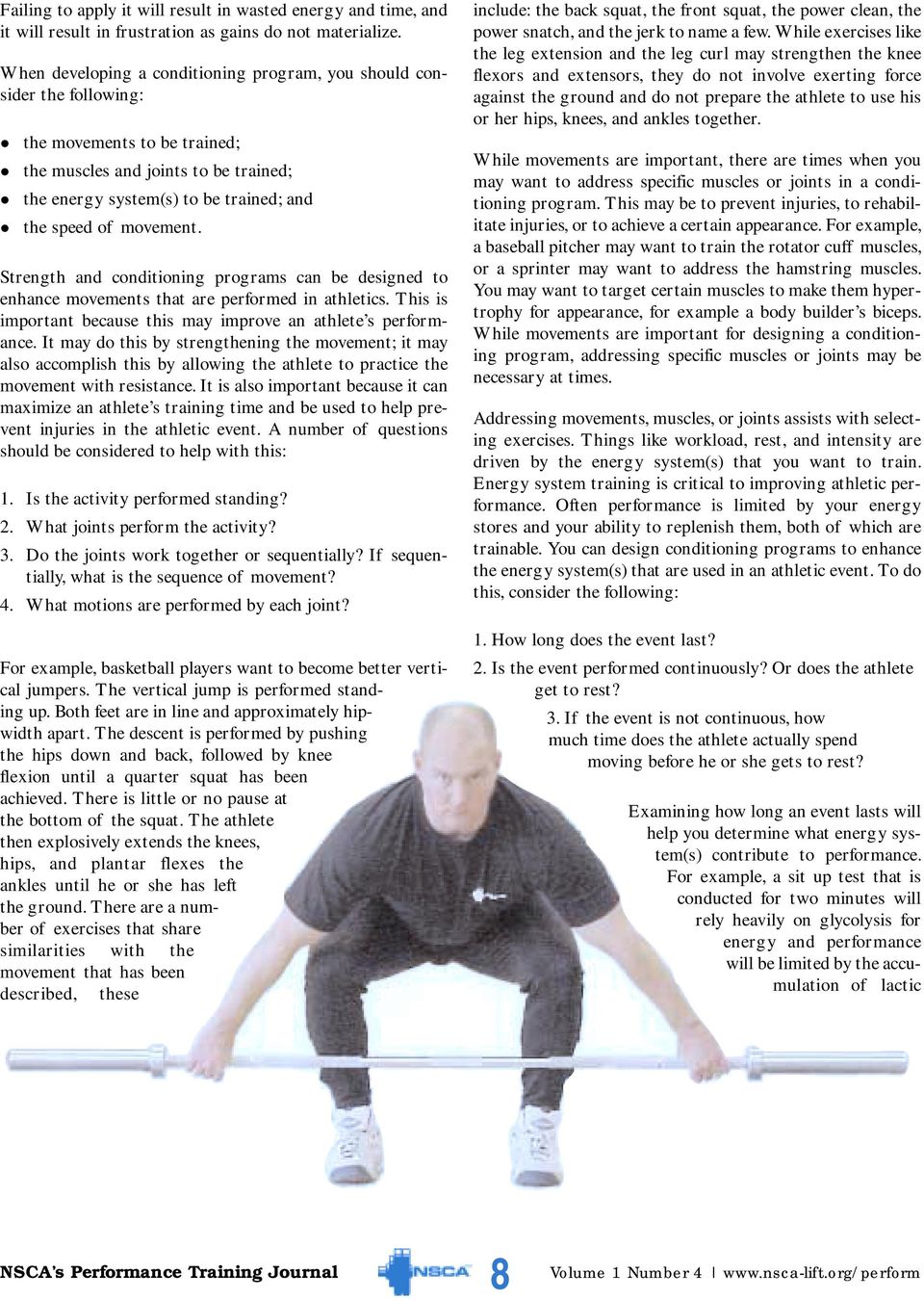
2 Failing to apply it will result in wasted energy and time, and it will result in frustration as gains do not materialize. When developing a conditioning program, you should consider the following:! the movements to be trained;! the muscles and joints to be trained;! the energy system(s) to be trained; and! the speed of movement. Strength and conditioning programs can be designed to enhance movements that are performed in athletics. This is important because this may improve an athlete s performance. It may do this by strengthening the movement; it may also accomplish this by allowing the athlete to practice the movement with resistance. It is also important because it can maximize an athlete s training time and be used to help prevent injuries in the athletic event. A number of questions should be considered to help with this: 1. Is the activity performed standing? 2. What joints perform the activity? 3. Do the joints work together or sequentially? If sequentially, what is the sequence of movement? 4. What motions are performed by each joint? For example, basketball players want to become better vertical jumpers. The vertical jump is performed standing up. Both feet are in line and approximately hipwidth apart. The descent is performed by pushing the hips down and back, followed by knee flexion until a quarter squat has been achieved. There is little or no pause at the bottom of the squat. The athlete then explosively extends the knees, hips, and plantar flexes the ankles until he or she has left the ground. There are a number of exercises that share similarities with the movement that has been described, these include: the back squat, the front squat, the power clean, the power snatch, and the jerk to name a few. While exercises like the leg extension and the leg curl may strengthen the knee flexors and extensors, they do not involve exerting force against the ground and do not prepare the athlete to use his or her hips, knees, and ankles together. While movements are important, there are times when you may want to address specific muscles or joints in a conditioning program. This may be to prevent injuries, to rehabilitate injuries, or to achieve a certain appearance. For example, a baseball pitcher may want to train the rotator cuff muscles, or a sprinter may want to address the hamstring muscles. You may want to target certain muscles to make them hypertrophy for appearance, for example a body builder s biceps. While movements are important for designing a conditioning program, addressing specific muscles or joints may be necessary at times. Addressing movements, muscles, or joints assists with selecting exercises. Things like workload, rest, and intensity are driven by the energy system(s) that you want to train. Energy system training is critical to improving athletic performance. Often performance is limited by your energy stores and your ability to replenish them, both of which are trainable. You can design conditioning programs to enhance the energy system(s) that are used in an athletic event. To do this, consider the following: 1. How long does the event last? 2. Is the event performed continuously? Or does the athlete get to rest? 3. If the event is not continuous, how much time does the athlete actually spend moving before he or she gets to rest? Examining how long an event lasts will help you determine what energy system(s) contribute to performance. For example, a sit up test that is conducted for two minutes will rely heavily on glycolysis for energy and performance will be limited by the accumulation of lactic 8
3 acid. A hundred meter sprint that lasts ten seconds will rely heavily on the available stores of ATP and will be limited by the amount on hand. The length of the event can be deceptive, however. For example, a football game might last two hours. Just looking at the length of time might seem to indicate that the aerobic energy system needs to be trained for football players. In this case one needs to consider if the athletes are moving continuously. In the case of football the answer is no, the athletes rest between plays and have a chance to recover their energy stores. In this case one should consider how much time the athlete actually spends moving before they get to rest. The average play may only last five or six seconds, which would indicate that the sport is primarily dependant upon the levels of ATP in the muscles. Energy system training is an important consideration because it helps to dictate how much weight to use, how many repetitions to perform, and the amount of recovery time. If you are interested in increasing the stores of ATP, then training will involve heavy weight, low repetitions, and lots of rest. Glycolytic training will involve moderate reps, moderate weight, and little rest. Aerobic training means lighter weights, many repetitions, and no rest. A final consideration with specificity concerns the velocity of movement. The gains from exercise are specific to the velocities that the exercises are performed at. If exercises are performed at slow speeds, then we become stronger at slow speeds; however, there is little transfer to faster speeds. If exercises are performed at faster speeds, then we become stronger at faster speeds. This is important for athletics because few sports are performed at slow speeds. If one is designing a conditioning program for a sport that is performed at high speeds, then one will need to include exercises that make athletes stronger at high speeds. These include things like the variations of the Olympic-style lifts (the clean, the snatch, and the jerk), plyometric exercises, and sprints. The principle of specificity is important because it dictates what gains are made. The next principle is important because it ensures that you continue to make gains from your training. The Principle of Overload The overload principle states that in order to keep making gains from an exercise program, you must find some way to make it more difficult. This is because bodies adapt to exercise. The problem is that once your body adapts to a given workload, it will not continue to adapt unless the workload is increased somehow. If you do not continue to adapt, then eventually you will plateau and regress. Having stated that it is necessary to make conditioning programs more difficult, one caution should be kept in mind: you must observe specificity when applying the overload principle. Performing a set of twenty might be a way of making the workout more difficult, but if you need to enhance the phosphagen energy system then you are violating specificity. 9

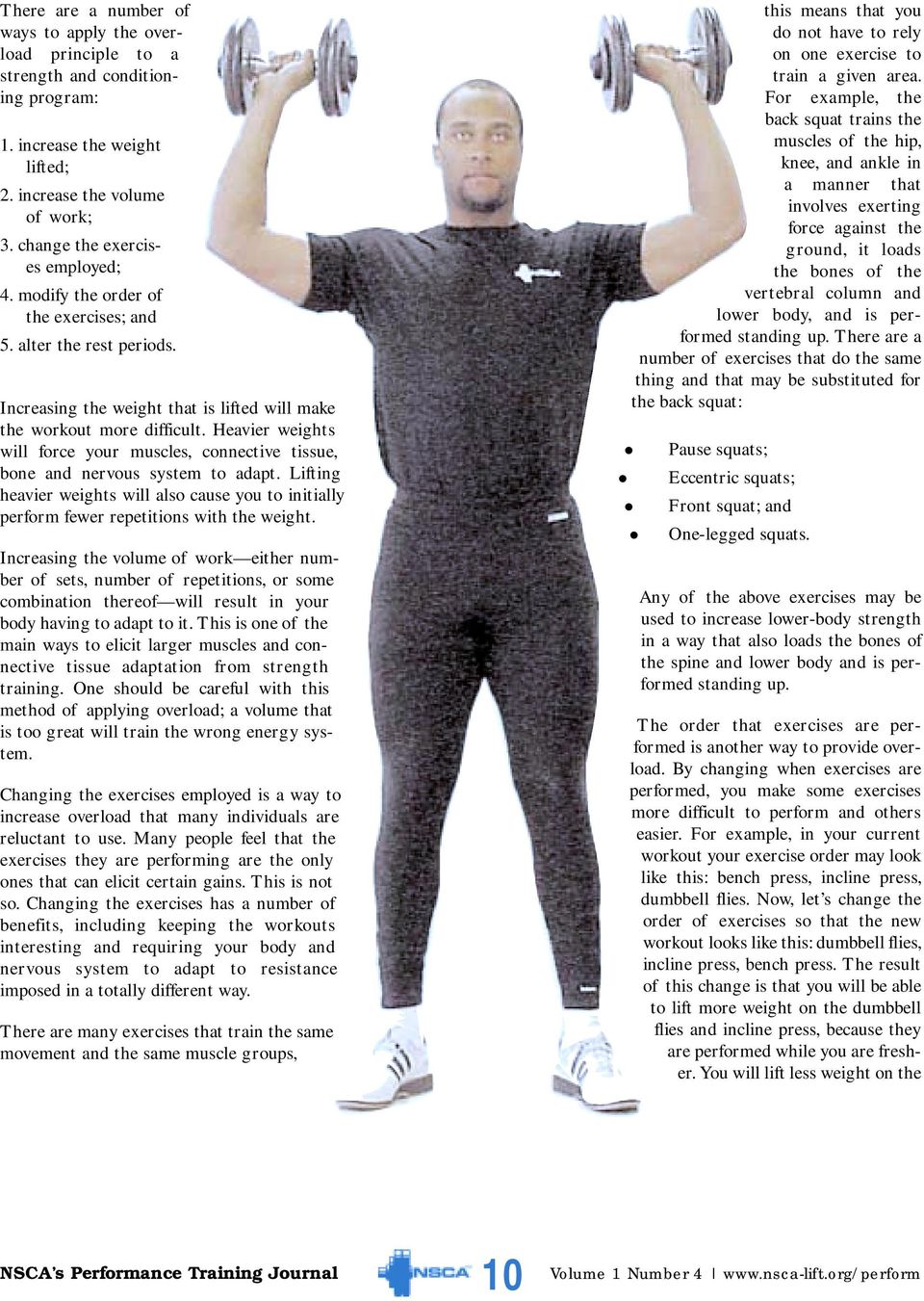
4 There are a number of ways to apply the overload principle to a strength and conditioning program: 1. increase the weight lifted; 2. increase the volume of work; 3. change the exercises employed; 4. modify the order of the exercises; and 5. alter the rest periods. Increasing the weight that is lifted will make the workout more difficult. Heavier weights will force your muscles, connective tissue, bone and nervous system to adapt. Lifting heavier weights will also cause you to initially perform fewer repetitions with the weight. Increasing the volume of work either number of sets, number of repetitions, or some combination thereof will result in your body having to adapt to it. This is one of the main ways to elicit larger muscles and connective tissue adaptation from strength training. One should be careful with this method of applying overload; a volume that is too great will train the wrong energy system. Changing the exercises employed is a way to increase overload that many individuals are reluctant to use. Many people feel that the exercises they are performing are the only ones that can elicit certain gains. This is not so. Changing the exercises has a number of benefits, including keeping the workouts interesting and requiring your body and nervous system to adapt to resistance imposed in a totally different way. There are many exercises that train the same movement and the same muscle groups, this means that you do not have to rely on one exercise to train a given area. For example, the back squat trains the muscles of the hip, knee, and ankle in a manner that involves exerting force against the ground, it loads the bones of the vertebral column and lower body, and is performed standing up. There are a number of exercises that do the same thing and that may be substituted for the back squat:! Pause squats;! Eccentric squats;! Front squat; and! One-legged squats. Any of the above exercises may be used to increase lower-body strength in a way that also loads the bones of the spine and lower body and is performed standing up. The order that exercises are performed is another way to provide overload. By changing when exercises are performed, you make some exercises more difficult to perform and others easier. For example, in your current workout your exercise order may look like this: bench press, incline press, dumbbell flies. Now, let s change the order of exercises so that the new workout looks like this: dumbbell flies, incline press, bench press. The result of this change is that you will be able to lift more weight on the dumbbell flies and incline press, because they are performed while you are fresher. You will lift less weight on the 10
5 bench press, because it will be performed while you are fatigued. Not only will you become stronger on the first two exercises, but you will also keep your workouts interesting and this will also help your body to adapt in a different manner because you are focusing on the first two exercises instead of the bench press. A final way to provide overload is to modify the amount of rest. This must be used carefully to ensure that you are observing specificity. By increasing the amount of rest in between sets, you allow your body to recover more completely. This means you will be able to lift heavier weights with a greater number of repetitions. The benefit oft this approach to training is that it allows you to increase your strength on exercises. Conversely, if you shorten the amount of rest in between sets, you do not allow yourself as much recovery. It becomes more difficult to lift a given amount of weight. While this does not do as good a job of increasing strength, it does force the muscles to grow to adapt to the rest period. Overload is not something that only needs to be applied on a daily basis, it must be applied over a lifetime of training. The final principle deals with the importance of applying overload logically over time. The Principle of Progressive Overload Progressive overload involves two areas:! The exercises that are employed in a training program; and! The total amount of work that is done in a training program. The exercises that are performed by an individual beginning his or her training career should be less complicated than one who has been training for a longer period of time. A beginner should be expected to master certain fundamental skills in the training program. Once those skills are mastered, they may be applied to more complicated exercises. Failure to master these skills may result in injury, wasted time in the weight room, and incomplete development. Two examples of learning fundamental skills before progressing to more complicated ones concern the back squat and the Olympic-style lifts:! The back squat is typically learned before the front squat, overhead squat, or other variations. This is because the back squat teaches correct posture when squatting, foot placement, keeping the heels on the ground, squatting by pushing the hips back and then flexing the knees, ascending with the hips and shoulders moving up at the same speed, etc. If one does not posses those skills then the front squat, overhead squat, pause squat, eccentric squat, etc., will be much more difficult to learn.! Generally the Olympic-style lifts are learned from the top down. This breaks down a complicated exercise and makes it easier to master. For example, by learning the power clean initially with the bar above the knees, we learn to explosively extend the hips while shrugging the shoulders up and plantar flexing the ankles. We learn to receive the bar in a quarter squat and how to recover from that position. This is difficult to learn. Adding correct starting posture with the bar on the ground, lifting the bar from the ground to the knees, getting the bar around the knees, and then explosively extending the hips while shrugging the shoulders up and plantar flexing the ankles will prove too much for many to master initially. In order to make gains from training over time, you must find a way to perform more work. This may be more weight lifted, more repetitions performed, more sets, or some combination of the three. As we discussed in the overload section, this is necessary to keep your body making adaptations. This also needs to be conducted with caution, as progressing too quickly can result in injury and burnout. The best way to do this is to apply some type of systematic approach to training. The one most commonly used is periodization of training, which essentially consists of breaking the training process down into smaller, more manageable units. Periodization is a way to organize your training over your career; this includes the weight lifted, the volume of work, the exercises employed, rest, recovery methods, etc. All of this is done in a way that ensures that you are in the best possible shape when it counts during the competition. The principles of exercise that this article have covered are very important for making sure that you get the most out of your strength and conditioning programs. Applying specificity means designing conditioning programs to elicit the development of desired qualities. Applying overload means that strength and conditioning programs will be difficult enough to be effective. Applying progressive overload allows for strength and conditioning programs to be effective over your training career. About the Author John M. Cissik, MS, CSCS is the Director of Wellness Services at Texas Woman s University. He also owns and operates Fitness and Conditioning Enterprises, which provides speed and agility instruction primarily to children and teens. He is the National Strength and Conditioning Association s State Director for Texas. 11

THE BIG SIX. Six Best Volleyball Strength Training Exercises. By Dennis Jackson, CSCS www.strength-and
 THE BIG SIX Six Best Volleyball Strength Training Exercises By Dennis Jackson, CSCS www.strength-and and-power power-for for-volleyball.com THE SQUAT What it is The two most common squatting exercises
Fitness Fundamentals
 Fitness Fundamentals Participate 2-3/week Duration 30-60 minutes Intensity moderate to vigorous Exercises should be developmentally appropriate, enjoyable and varied. Benefits can include increased Careful
ABOUT US. Why train using the ACTIV8 Program? - Restoration of movement. Performance Enhancement & Injury Prevention
 ABOUT US Mission Statement - ACTIV8 Strength and Conditioning Program is committed to providing training experience for each participant. Our focus is on building a strong and functionally fit human being
Chronos - Circuit Training Bodyweight
 Outline Chronos - Circuit Training Bodyweight 1. Mountain climbers doubles x 10 2. Mountain climbers singles x 10 each leg 3. Mountain climbers singles out x 10 each leg 4. Mountain Climbers Doubles out
IMGPT: Exercise After a Heart Attack 610 944 8140 805 N. RICHMOND ST (Located next to Fleetwood HS) Why is exercise important following a heart
 Why is exercise important following a heart attack? Slow progression back into daily activity is important to strengthen the heart muscle and return blood flow to normal. By adding aerobic exercises, your
Strength, Size, or Power?
 Strength, Size, or Power? Helen M. Binkley, Ph.D., CSCS*D, NSCA-CPT Which one are you training for strength, size, or power? First, let s identify what each of these are. Strength is the ability to produce
Strength Training HEALTHY BONES, HEALTHY HEART
 Strength Training HEALTHY BONES, HEALTHY HEART No matter what your age, strength training can improve your bone health and your balance. As we age, our bones lose both tissue and strength. This condition
Strength Training for the Runner
 Strength Training for the Runner Strength Training for the Runner What? The goal of resistance training for runners is not necessarily adding muscle mass but 1. improving muscular strength, 2. improving
Strength Training for the Knee
 Strength Training for the Knee This handout is to help you rebuild the strength of the muscles surrounding the knee after injury. It is intended as a guideline to help you organize a structured approach
THE SPEED PROGRAM THE following is A list Of POinTS THAT PRODucE RESulTS in SPEED improvement: CHANGE THE GAME
 THE SPEED PROGRAM Remember, perfect technique is the #1 emphasis with the BFS Speed Program. Faster times will follow perfect technique. The Speed Program is as follows: 1. Start with a Sprint Learning
LEVEL I SKATING TECHNICAL. September 2007 Page 1
 SKATING September 2007 Page 1 SKATING SKILLS The game of Ice Hockey is a fast-paced, complex, team sport, which demands quick thinking, fast reactions and special athletic skills. Skating is the most important
Strength and Stability Training for Distance Runners By Ben Wisbey
 Strength and Stability Training for Distance Runners By Ben Wisbey Strength training is one of the most commonly discussed topics amongst distance runners, generating great debates with many strong opinions.
INDOOR AGILITY LADDER
 INDOOR AGILITY LADDER IMPORTANT INFORMATION PLEASE READ AND KEEP DISCLAIMER The following guidelines should be observed when using the Indoor Agility Ladder. Always consult your physician before participating
SHOULDER EXERCISE ROUTINE
 8 SHOULDERS The shoulders are the key to many full-bodied movements. Skill in such sports as swimming, baseball, golf, and tennis and other racquet sports is improved with the help of strong shoulders.
Men s Basketball STRENGTH & CONDITIONING PROGRAM. Developed by: Chad Kish, PhD
 Men s Basketball STRENGTH & CONDITIONING PROGRAM Developed by: Chad Kish, PhD PURPOSE The purpose of the Cardinals strength and conditioning manual is to provide the athlete with a general overview of
Ed McNeely. Junior National Team Strength Training Program
 Ed McNeely Junior National Team Strength Training Program The majority of rowers use some form of resistance training in their preparation for the rowing season. While strength is obviously very important
Strength Training For Track and Field Athletes. Lee Taft
 Strength Training For Track and Field Athletes Lee Taft www.leetaft.com Most Importantly! You are responsible for your athletes and their well-being not what other people think or what they are doing!
The 11+ A complete warm-up program
 The 11+ A complete warm-up program Part 1 & 3 A A }6m Part 2 B A: Running B: Jog back B! FIELD SET-UP A: Running exercise B: Jog back The course is made up of 6 pairs of parallel cones, approx. 5-6m apart.
Shoulders (free weights)
 Dumbbell Shoulder Raise Dumbbell Shoulder Raise 1) Lie back onto an incline bench (45 or less) with a DB in each hand. (You may rest each DB on the corresponding thigh.) 2) Start position: Bring the DB
The Core of the Workout Should Be on the Ball
 The Core of the Workout Should Be on the Ball Paul J. Goodman, MS, CSCS New technology and high priced machines and equipment that claim to aid in enhancing performance have inundated the market in recent
Fitness Training A Sensible Guide to Preparing for Selection in the Gurkhas
 Fitness Training A Sensible Guide to Preparing for Selection in the Gurkhas Background Physical fitness has a number of components: aerobic endurance (stamina), strength, speed, flexibility, muscle endurance,
JUNIPERO SERRA VOLLEYBALL OFF SEASON TRAINING SCHEDULE
 JUNIPERO SERRA VOLLEYBALL OFF SEASON TRAINING SCHEDULE 2007 OFF SEASON WORKOUT Our off season workout is centered around Speed, Agility & Quickness which are athletic attributes that are very trainable
Core Training for Improved Performance
 Core Training for Improved Performance Tracy Morgan Handzel, CSCS Core training has penetrated a variety of fitness and performance related fields. Health clubs offer core training group exercise classes.
How To Prepare For Speed Drills
 FOOTBALL Speed and Agility Program The speed drills are done on and Thursday. Each sprint workout is broken down into the following sequence. 1. Warm-up 2. ing 3. Starts 4. Sprints 5. Plyometrics 6. Resistive
CONDITIONING PLAN FOR CHEERLEADING 2007-2008
 CONDITIONING PLAN FOR CHEERLEADING 2007-2008 GENERAL OVERVIEW This plan is a sport specific conditioning plan designed for the female competitive cheerleader. The purpose is to allow for proper training
GCE PHYSICAL EDUCATION PE2 UNIT GUIDE. Content Title: Methods of training. Practical Application/Explanation. Fartlek training. Continuous training
 Content Title: Methods of training Key points GCE PHYSICAL EDUCATION Different methods of training How to design specific training sessions How to design a training programme PE2 UNIT GUIDE Practical Application/Explanation
Speed is one of the most sought
 Off-Ice Speed and Quickness for Ice Hockey Shane Domer, MEd, CSCS, NSCA-CPT Speed is one of the most sought after characteristics in athletics. The athlete that possesses both speed and quickness will
Strength and Conditioning Program
 Strength and Conditioning Program Guidelines All speed work must be performed when the body is fully rested. Proper sprinting techniques must be taught and mastered by the player. Adequate rest must follow
Prevention & Management of ACL Injury. Ian Horsley PhD, MCSP Lee Herrington PhD, MCSP
 Prevention & Management of ACL Injury Ian Horsley PhD, MCSP Lee Herrington PhD, MCSP ACL injury ACL injury 30/100,000, 40% sports injuries (NHS) Limited statistics in UK related to sport Rugby Union 2002-2004
Stair Workouts Get in Shape: Step up
 Stair Workouts Get in Shape: Step up Warning: If you feel any knee pain, refrain from continuing that particular exercise. Avoid the no pain, no gain motto and modify with regular walking or any activity
AGILITY LADDER IMPORTANT INFORMATION PLEASE READ AND KEEP DISCLAIMER
 AGILITY LADDER IMPORTANT INFORMATION PLEASE READ AND KEEP DISCLAIMER The following guidelines should be observed when using the Agility Ladder. Always consult your physician before participating in any
BEACH VOLLEYBALL TRAINING PROGRAM
 2008 ELITE PERFORMANCE ATHLETE CONDITIONING BEACH VOLLEYBALL TRAINING PROGRAM Team BC 2008 Steve Van Schubert, CAT(C), CSCS Training Schedule General Outline Phase 1 2 Weeks Phase 2 3 Weeks Phase 3 3 Weeks
Stair Workouts Get in Shape: Step up!
 Stair Workouts Get in Shape: Step up! Warning: If you feel any knee pains, refrain from continuing that particular exercise. Avoid the no pain, no gain motto and modify with regular walking or any activity
A proper warm-up is important before any athletic performance with the goal of preparing the athlete both mentally and physically for exercise and
 A proper warm-up is important before any athletic performance with the goal of preparing the athlete both mentally and physically for exercise and competition. A warm-up is designed to prepare an athlete
The Santa Monica Orthopaedic and Sports Medicine Research Foundation. The PEP Program: Prevent injury and Enhance Performance
 The Santa Monica Orthopaedic and Sports Medicine Research Foundation The PEP Program: Prevent injury and Enhance Performance This prevention program consists of a warm-up, stretching, strengthening, plyometrics,
Fact sheet Exercises for older adults undergoing rehabilitation
 Fact sheet Exercises for older adults undergoing rehabilitation Flexibility refers to the amount of movement possible around a joint and is necessary for normal activities of daily living such as stretching,
Strength Training for the Shoulder
 Strength Training for the Shoulder This handout is a guide to help you safely build strength and establish an effective weighttraining program for the shoulder. Starting Your Weight Training Program Start
Sky-Rocket Your Vertical Jump with Power Plyometrics!
 Sky-Rocket Your Vertical Jump with Power Plyometrics! By the Editorial Team: http://www.basketball-drills-and-plays.com Copyright 2006. All Rights Reserved. Basketball-Drills-and-Plays.com Important Note:
Coaching the Injury Prone Athlete. www.englandathletics.org www.englandathletics.org/east
 Coaching the Injury Prone Athlete Injury! The Causes? Frequently the consequence of poor physical preparation ( accidents excluded) Exceeding training loads the athlete can handle at that time Volume,
Speed, Agility, Quickness Training
 Speed, Agility, Quickness Training Goal: To develop Speed, Agility, and Quickness (SAQ) and functional football strength for young football players through a consistent and safe format. Place the stations
LEVEL II DEVELOPING FITNESS PHYSIOLOGY. January 2008 Page 1
 DEVELOPING FITNESS January 2008 Page 1 DEVELOPING FITNESS There are many reasons why young hockey players should develop high levels of fitness; they will be less prone to injury; they will recover faster
Plyometric Training for Track and Field Indiana High School Clinic 2008 Larry Judge, Ph.D. Ball State University
 Plyometric Training for Track and Field Indiana High School Clinic 2008 Larry Judge, Ph.D. Ball State University What is Plyometric Training? Exercises like hopping, skipping, jumping, bounding, depth
Dr. O Meara s. Anterior Knee Pain (PatelloFemoral Syndrome) Rehabilitation Protocol www.palomarortho.com
 Dr. O Meara s Anterior Knee Pain (PatelloFemoral Syndrome) Rehabilitation Protocol www.palomarortho.com Anterior Knee Pain (PatelloFemoral Syndrome) Rehabilitation Protocol Hamstring Stretching & Strengthening
Contact us for more info: 020 7736 8191 /
 Winter Sports Advanced Ski Exercises - Introduction The following exercises are for individuals who already have a significant level of fitness. If you are unsure as to whether they are appropriate for
What is Physical Fitness?
 What is Physical Fitness? Physical fitness is made up of two components: Skill-related fitness and Health related fitness. Skill related fitness items are factors, which relate to the possibility of you
Mike Durand CSCS, SCCC, USAW
 Mike Durand CSCS, SCCC, USAW What Facilities do you have available Weight Room Field Space Optimal Training vs. Real World Training? Equipment needs/available Before you design your Training Program know
Villanova Football Off-Season Workout
 Villanova Football Off-Season Workout How you prepare yourself in the off-season is a reflection of your commitment as a football player. You cannot turn discipline on and off, just as you cannot turn
Knee Conditioning Program. Purpose of Program
 Prepared for: Prepared by: OrthoInfo Purpose of Program After an injury or surgery, an exercise conditioning program will help you return to daily activities and enjoy a more active, healthy lifestyle.
The 11+ A complete warm-up programme to prevent injuries
 The 11+ A complete warm-up programme to prevent injuries Manual The 11+ Manual A complete warm-up programme to prevent injuries Table of contents Preface 4 Introduction 5 Structure of the 11+ 6 BODY POSITION
History of Plyometrics
 Plyometric Training History of Plyometrics First formalized in the early 1960 s as a scientific training system by Dr. Yuri Verkhoshansky Earliest published use of the term seems to be in a Soviet publication
THE BADMINTON ASSOCIATION OF ENGLAND MISSION STATEMENT
 THE BADMINTON ASSOCIATION OF ENGLAND MISSION STATEMENT Badminton is an Olympic Sport It is played by groups, families and individuals of all ages and it provides a healthy, lifelong sport activity that
Kettlebell Training. The Basics
 Kettlebell Training The Basics by Liam O'Brien Personal Trainer Kettlebell Instructor Pontefract, West Yorkshire www.liamobrien.co.uk 1 About the author Liam O'Brien is a Personal Trainer and Kettlebell
Living Room Bodyweight Workout Week 1 March or jog in place for 1 min to increase heart rate and lubricate joints.
 Warm Up- Living Room Bodyweight Workout Week 1 March or jog in place for 1 min to increase heart rate and lubricate joints. Protocol- All exercises will be done for 2 sets of 10 repetitions. After the
Basic Stretch Programme 3. Exercise Circuit 4
 Basic Stretch Programme 3 Exercise Circuit 4 2 1 Calves Stand approximately 1 metre away from wall with legs straight and heels on floor. Step and lean forward and slowly push hips towards wall. Should
Strength Training For Runners
 Strength Training For Runners Be the strongest, fastest athlete you can be Agenda Why to strength train and the benefits Myths about runners and strength training What to do How often Example program About
Today s session. Common Problems in Rehab. www.physiofitness.com.au/filex.htm LOWER BODY REHAB ESSENTIALS TIM KEELEY FILEX 2012
 Tim Keeley B.Phty, Cred.MDT, APA Principal Physiotherapist physiofitness.com.au facebook.com/physiofitness Today s session Essential list for the lower body Rehab starting point Focussing on activation,
MUSCLES G.C.S.E. PHYSICAL EDUCATION. Unit 1. Factors Affecting Participation and Performance. G.C.S.E. P.E. Teacher:.
 G.C.S.E. PHYSICAL EDUCATION Unit 1 Factors Affecting Participation and Performance MUSCLES Name: G.C.S.E. P.E. Teacher:. By the end of this booklet you should: Be able to describe and explain how muscles
ANKLE STRENGTHENING INTRODUCTION EXERCISES SAFETY
 ANKLE STRENGTHENING INTRODUCTION Welcome to your Ankle Strengthening exercise program. The exercises in the program are designed to improve your ankle strength, fitness, balance and dynamic control. The
Eligibility The NCSF online quizzes are open to any currently certified fitness professional, 18 years or older.
 Eligibility The NCSF online quizzes are open to any currently certified fitness professional, 18 years or older. Deadlines Course completion deadlines correspond with the NCSF Certified Professionals certification
A 16 week training plan for a sprinter
 A 16 week training plan for a sprinter Written by Andrew Maclennan www.getfastandstrong.com/ Please see the outlined programs below. They make up a 16 week block of training. The 16 weeks is divided up
Training for High-Performance Collegiate Ice Hockey
 National Strength & Conditioning Association Volume 24, Number 2, pages 42 52 Training for High-Performance Collegiate Ice Hockey Allen Hedrick, MA, CSCS, *D Head Strength and Conditioning Coach U.S. Air
Otago Exercise Program Activity Booklet
 Head Movements Stand up tall and look ahead. Slowly turn your head as far as you can to the right. Slowly turn your head as far as you can to the left. Repeat five times to each side. 44 Neck Movements
Candito Linear Programming
 Candito Linear Programming By Jonnie Candito The goal with this program is to provide a very simple layout with linear progression. That means the program will not change week to week, simply steadily
Strength and conditioning professionals
 Practical Guidelines for Plyometric Intensity William P. Ebben, PhD, CSCS,*D Strength and conditioning professionals have long relied on plyometrics as one of the primary tools for developing athletic
Bringing Back the Shoulders
 Bringing Back the Shoulders Mike Kamal Peak performance in competition should always be the primary goal of training. The unfortunate and sometimes unavoidable consequences of sport are fatigue, breakdown
START FINISH. 5 yards 5 yards
 Agility, Plyometric & Conditioning Drills Pro Agility Objectives: Improve athletic ability and body coordination during sudden change of direction 1. Measure out a 10 yard area with 5 yard increments 2.
MIAMI POLICE DEPARTMENT
 MIAMI POLICE DEPARTMENT POLICE OFFICER PHYSICAL AGILITY TEST TRAINING MANUAL 400 NW 2 nd Avenue, Miami, FL 3328 REVISED 0/2 TABLE OF CONTENTS OVERVIEW... 2 LIST OF EVENTS... 3 EQUIPMENT REQUIRED... 4 PREPARING
Hurdle Training. Manual. Drills and exercises to help you get the most out of your Hurdle training program!
 Hurdle Training Manual Drills and exercises to help you get the most out of your Hurdle training program! Performance Hurdles USAGE GUIDELINES Words of Caution 1. Are you physically fit? Do not enter into
Lower Body Strength/Balance Exercises
 Compliments of (Medical Group Name & Phone # to be inserted here) Lower Body Strength/Balance Exercises Hip Flexion Strengthens thigh and hip muscles. Use ankle weights, if you are ready to. Stand to the
2015 Cheer Squad Summer Strength & Conditioning
 2015 Cheer Squad Summer Strength & Conditioning Hello Cheer Squad, Welcome to 1 st annual summer conditioning program for Rams Cheer Squad. In order to maximize your potential as a Cheer Squad member you
Sample High School Wrestling Weight Training Program. West Chester, PA. By Dean Donley
 Sample High School Wrestling Weight Training Program West Chester, PA By Dean Donley 1. Introduction This is an example of a strength training program that was developed for a high school wrestling team.
Chapter 9: Strength Training Program Design. ACE Personal Trainer Manual Third Edition
 Chapter 9: Strength Training Program Design ACE Personal Trainer Manual Third Edition Introduction There are six (6) types of resistance training: 1. Isometric force development 2. Concentric force development
Meniscus Tear: Exercises
 Meniscus Tear: Exercises Your Kaiser Permanente Care Instructions Here are some examples of typical rehabilitation exercises for your condition. Start each exercise slowly. Ease off the exercise if you
Workout Routine - Dumbbells - Full Body Printed on Apr 28 2011
 Workout Routine - Dumbbells - Full Body Printed on Apr 28 2011 Workout Routine Snapshot 2 Workout Days 0 Cardio Exercises 14 Strength Training 0 Stretching Exercises 2 Abs 2 Back 2 Chest 2 Shoulders 2
UCCS Women s Soccer. 2012 Summer Workout Packet. Everything You Need to Succeed. Lifting and Training Schedule
 UCCS Women s Soccer 2012 Summer Workout Packet Everything You Need to Succeed Day to Day Calendar Lifting and Training Schedule Day to Day Record Sheets Fitness Tests Daily Record Sheet Sunday Monday Tuesday
EXERCISE DESCRIPTIONS PHASE I Routine #1
 EXERCISE DESCRIPTIONS PHASE I Routine #1 Hip Mobility Exercise: Forward Out-In Movement: Raise leg out to the side, and rotate around to the front. Keep shin/thigh angle at 90 degrees. Exercise: Backward
Patellofemoral/Chondromalacia Protocol
 Patellofemoral/Chondromalacia Protocol Anatomy and Biomechanics The knee is composed of two joints, the tibiofemoral and the patellofemoral. The patellofemoral joint is made up of the patella (knee cap)
dotfit Certification Integrated Training
 The Scientific Rationale Today s Society To understand the rationale behind integrated training, it s imperative for the health and fitness professional to first understand the current state of today s
are you reaching your full potential...
 T h e r e s n o s u c h t h i n g a s b a d e x e r c i s e - j u s t e x e r c i s e d o n e b a d l y FIT for sport are you reaching your full potential... These tests are a series of exercises designed
Overhead Strength Training for the Shoulder: Guidelines for Injury Prevention and Performance Training Success
 Overhead Strength Training for the Shoulder: Guidelines for Injury Prevention and Performance Training Success Robert Panariello MS, PT, ATC, CSCS Strength training is an important component in the overall
Aerobics: Knowledge and Practice
 Aerobics: Knowledge and Practice Brought to you by the Wellness Center and Vanderbilt Recreation Group Fitness Program Overview The goal of this self-study course is to provide aspiring aerobics instructors
Pre - Operative Rehabilitation Program for Anterior Cruciate Ligament Reconstruction
 Pre - Operative Rehabilitation Program for Anterior Cruciate Ligament Reconstruction This protocol is designed to assist you with your preparation for surgery and should be followed under the direction
USCGA Health and Physical Education Fitness Preparation Guidelines
 USCGA Health and Physical Education Fitness Preparation Guidelines MUSCULAR STRENGTH Muscular strength and endurance can be improved by systematically increasing the load (resistance) that you are using.
Exercises for Low Back Injury Prevention
 DIVISION OF AGRICULTURE RESEARCH & EXTENSION University of Arkansas System Family and Consumer Sciences Increasing Physical Activity as We Age Exercises for Low Back Injury Prevention FSFCS38 Lisa Washburn,
Kelly Corso MS, ATC, CES, FMSC, CSST
 ACL Injury Prevention Program Kelly Corso MS, ATC, CES, FMSC, CSST What is the ACL??? The ACL or anterior cruciate ligament, attaches the front top portion of the shin bone (tibia) to the back bottom portion
CONDITIONING PROGRAM
 CONDITIONING PROGRAM Speed and Agility are two major components of sport that need to be trained just like strength, size, and power are developed in the weight room. It is true that no matter what your
How to read Dashboard Reports
 How to read Dashboard Reports The premise behind RPM 2 is to assess bilateral equivalence of the lower limbs. It has long been understood that bi-lateral equivalence is the key to improved athletic performance.
Stretching the Major Muscle Groups of the Lower Limb
 2 Stretching the Major Muscle Groups of the Lower Limb In this chapter, we present appropriate stretching exercises for the major muscle groups of the lower limb. All four methods (3S, yoga, slow/static,
SAMPLE WORKOUT Full Body
 SAMPLE WORKOUT Full Body Perform each exercise: 30 secs each x 2 rounds or 2-3 sets of 8-12 reps Monday & Wednesday or Tuesday & Thursday Standing Squat Muscles: glutes (butt), quadriceps (thigh) Stand
Stretching for Young Athletes. Shawn P. Anderson, SPT Duke University Doctor of Physical Therapy
 Stretching for Young Athletes Shawn P. Anderson, SPT Duke University Doctor of Physical Therapy Sports and exercise are usually integral parts of many adolescents life. Whether they play at school or in
PHASE I ANKLE REHABILITATION EXERCISES
 PHASE I ANKLE REHABILITATION EXERCISES SWELLING CONTROL S REST: Keep your standing and walking activities to a minimum while swelling is a problem. ICE: Use an ice pack in a moist towel for 10-15 minutes
Coaching the High School Discus Throw
 Coaching the High School Discus Throw By: Paul Brueske Talent Identification: To establish a successful high school throws program, the first thing a coach must to do is find the right type of athletes.
Passive Range of Motion Exercises
 Exercise and ALS The physical or occupational therapist will make recommendations for exercise based upon each patient s specific needs and abilities. Strengthening exercises are not generally recommended
How To Stretch Your Body
 Exercise Module A New Leaf Choices for Healthy Living University of North Carolina at Chapel Hill 2007 Center for Health Promotion and Disease Prevention Physical Activity Exercises for Keeping Active
The Examination...2. Pitching Mechanics...4. Core Exercises...5. Scapular Stretches...7. Scapular Exercises...8. Summary...10. Pitch Counts...
 Table of Contents The Examination....2 Pitching Mechanics...4 Core Exercises....5 Scapular Stretches...7 Scapular Exercises...8 Summary...10 Pitch Counts...12 Introduction Here at Vanderbilt Sports Medicine,
Part 1 Designing Resistance Training Programs. Part 3 Considerations for Strength Training in Young Athletes
 Part 1 Designing Resistance Training Programs 1. Strength Training in Endurance Sports 2. Training Recommendations 3. Case Study Part 2 Training for Speed and Agility 1. Introduction to Speed and Agility
Exercises for older people
 Exercise for older people Exercises for older people Sitting Getting started If you ve not done much physical activity for a while, you may want to get the all-clear from a GP before starting. For the
How to increase Bat Speed & Bat Quickness / Acceleration
 How to increase Bat Speed & Bat Quickness / Acceleration What is Bat Speed? Bat Speed: Bat speed is measured in miles per hour (MPH) and considers only the highest speed of the bat head (peak velocity)