
IND131 IND131xx IND331 IND331xx
|
|
|
- Bennett Lester
- 10 years ago
- Views:
Transcription
1 IND131 IND131xx IND331 IND331xx Terminals User s Guide (11/2012).06

2 METTLER TOLEDO 2012 No part of this manual may be reproduced or transmitted in any form or by any means, electronic or mechanical, including photocopying and recording, for any purpose without the express written permission of METTLER TOLEDO. U.S. Government Restricted Rights: This documentation is furnished with Restricted Rights. Copyright 2012 METTLER TOLEDO. This documentation contains proprietary information of METTLER TOLEDO. It may not be copied in whole or in part without the express written consent of METTLER TOLEDO. METTLER TOLEDO reserves the right to make refinements or changes to the product or manual without notice. COPYRIGHT METTLER TOLEDO is a registered trademark of Mettler-Toledo, LLC. All other brand or product names are trademarks or registered trademarks of their respective companies. METTLER TOLEDO RESERVES THE RIGHT TO MAKE REFINEMENTS OR CHANGES WITHOUT NOTICE. FCC Notice This device complies with Part 15 of the FCC Rules and the Radio Interference Requirements of the Canadian Department of Communications. Operation is subject to the following conditions: (1) this device may not cause harmful interference, and (2) this device must accept any interference received, including interference that may cause undesired operation. This equipment has been tested and found to comply with the limits for a Class A digital device, pursuant to Part 15 of FCC Rules. These limits are designed to provide reasonable protection against harmful interference when the equipment is operated in a commercial environment. This equipment generates, uses, and can radiate radio frequency energy and, if not installed and used in accordance with the instruction manual, may cause harmful interference to radio communications. Operation of this equipment in a residential area is likely to cause harmful interference in which case the user will be required to correct the interference at his or her expense. Declaration of Conformity is located on the documentation CD. NOTE ON FIRMWARE VERSION This manual describes features and functions of the IND131, IND131xx, IND331 and IND331xx terminals with version 2.xx firmware. Terminals with a different version of firmware will differ in some areas.

3 RoHS Compliance Statement. The majority of our products fall within categories 8 and 9. Those categories currently do not fall within the scope of the Directive 2002/95/EG (RoHS) of January 27, If our products are intended for use in other products which themselves fall within the scope of the RoHS Directive, compliance requirements have to be separately negotiated contractually. Those products which fall within categories 1-7 and 10 will be in compliance with the EU RoHS Directive from no later than July 1, If it is not possible for technical reasons to replace any non-rohs-compliant substances in any of the above products as required, we plan to inform our customers in a timely manner Statement regarding harmful substances We do not make direct use of harmful materials such as asbestos, radioactive substances or arsenic compounds. However, we purchase components from third party suppliers, which may contain some of these substances in very small quantities.

4 CUSTOMER FEEDBACK Your feedback is important to us! If you have a problem with this product or its documentation, or a suggestion on how we can serve you better, please fill out and send this form to us. Or, send your feedback via to: [email protected]. If you are in the United States, you can mail this postpaid form to the address on the reverse side or fax it to (614) If you are outside the United States, please apply the appropriate amount of postage before mailing. Your Name: Organization Name: Address: Phone Number: ( ) Fax Number: ( ) Contact Name: Address: Phone Number: Date: METTLER TOLEDO Order Number: Part / Product Name: Part / Model Number: Serial Number: Company Name for Installation: Please check the appropriate box to indicate how well this product met your expectations in its intended use? Met and exceeded my needs Met all needs Met most needs Met some needs Did not meet my needs Comments/Questions: DO NOT WRITE IN SPACE BELOW; FOR METTLER TOLEDO USE ONLY Retail Light Industrial Heavy Industrial Custom RESPONSE: Include Root Cause Analysis and Corrective Action Taken.

5 FOLD THIS FLAP FIRST NO POSTAGE NECESSARY IF MAILED IN THE UNITED STATES BUSINESS REPLY MAIL FIRST CLASS PERMIT NO. 414 COLUMBUS, OH POSTAGE WILL BE PAID BY ADDRESSEE Mettler-Toledo, LLC Quality Manager - MTWT P.O. Box 1705 Columbus, OH USA Please seal with tape

6 PRECAUTIONS READ this manual BEFORE operating or servicing this equipment and FOLLOW these instructions carefully. SAVE this manual for future reference. WARNING! FOR CONTINUED PROTECTION AGAINST SHOCK HAZARD CONNECT THE AC VERSION OF THE HARSH AND JUNCTION BOX ENCLOSURES TO PROPERLY GROUNDED OUTLET ONLY. DO NOT REMOVE THE GROUND PRONG. WARNING! ONLY THE DC POWERED VERSIONS OF THE DIN, PANEL-MOUNT AND J- BOX ENCLOSURES OF THE IND131xx AND IND331xx TERMINALS HAVE BEEN APPROVED FOR USE IN DIVISION 2 AND ZONE 2/22 ENVIRONMENTS. THE HARSH ENCLOSURE IND331 DC POWERED TERMINAL AND ALL AC POWERED VERSIONS OF THE IND131 AND IND331 TERMINALS DO NOT HAVE A DIVISION 2 OR ZONE 2/22 APPROVAL AND MUST NOT BE INSTALLED IN DIVISION 2 ENVIRONMENTS OR IN ZONE 2/22 ENVIRONMENTS. WARNING! EARLIER MODELS OF THE IND131 AND IND331 TERMINALS THAT ARE NOT MARKED (FACTORY LABELED) AS FM OR KEMA APPROVED MUST NOT BE INSTALLED IN A DIVISION 2 OR ZONE 2/22 ENVIRONMENT. WARNING! THE IND131, IND131xx, IND331 AND IND331xx TERMINALS ARE NOT INTRINSICALLY SAFE! DO NOT USE WITHIN AREAS CLASSIFIED AS HAZARDOUS DIVISION 1 OR ZONE 0/1/20/21 BECAUSE OF COMBUSTIBLE OR EXPLOSIVE ATMOSPHERES. WARNING! IF THE KEYBOARD, DISPLAY LENS OR ENCLOSURE IS DAMAGED ON AN IND131xx OR IND331xx TERMINAL THAT IS USED IN A DIVISION 2 OR ZONE 2/22 AREA, THE DEFECTIVE COMPONENT MUST BE REPAIRED IMMEDIATELY. REMOVE POWER IMMEDIATELY AND DO NOT REAPPLY POWER UNTIL THE DISPLAY LENS, KEYBOARD OR ENCLOSURE HAS BEEN REPAIRED OR REPLACED BY QUALIFIED SERVICE PERSONNEL. FAILURE TO DO SO COULD RESULT IN BODILY HARM AND/OR PROPERTY DAMAGE.

7 WARNING! WHEN THIS EQUIPMENT IS INCLUDED AS A COMPONENT PART OF A SYSTEM, THE RESULTING DESIGN MUST BE REVIEWED BY QUALIFIED PERSONNEL WHO ARE FAMILIAR WITH THE CONSTRUCTION AND OPERATION OF ALL COMPONENTS IN THE SYSTEM AND THE POTENTIAL HAZARDS INVOLVED. FAILURE TO OBSERVE THIS PRECAUTION COULD RESULT IN BODILY HARM AND/OR PROPERTY DAMAGE. WARNING! ENSURE THAT THE POWER CONNECTION TO THE IND131 OR IND331 TERMINAL MATCHES THE SPECIFIED OPERATING VOLTAGE OF THAT TERMINAL. REFER TO THE DATA LABEL OF THE TERMINAL FOR THE OPERATING VOLTAGE. CONNECTING THE INCORRECT POWER SOURCE TO THE TERMINAL COULD RESULT IN DAMAGE TO OR DESTRUCTION OF THE EQUIPMENT AND/OR BODILY HARM. CAUTION BEFORE CONNECTING/DISCONNECTING ANY INTERNAL ELECTRONIC COMPONENTS OR INTERCONNECTING WIRING BETWEEN ELECTRONIC EQUIPMENT ALWAYS REMOVE POWER AND WAIT AT LEAST THIRTY (30) SECONDS BEFORE ANY CONNECTIONS OR DISCONNECTIONS ARE MADE. FAILURE TO OBSERVE THESE PRECAUTIONS COULD RESULT IN DAMAGE TO OR DESTRUCTION OF THE EQUIPMENT AND/OR BODILY HARM. CAUTION OBSERVE PRECAUTIONS FOR HANDLING ELECTROSTATIC SENSITIVE DEVICES.

8 IND131, IND131xx, IND331 and IND331xx Terminals Essential Services for Dependable Performance of Your IND131/IND331 Terminal Congratulations on choosing the quality and precision of METTLER TOLEDO. Proper use of your new equipment according to this Manual and regular calibration and maintenance by our factory-trained service team ensures dependable and accurate operation, protecting your investment. Contact us about a service agreement tailored to your needs and budget. Further information is available at There are several important ways to ensure you maximize the performance of your investment: 1. Register your product: We invite you to register your product at so we can contact you about enhancements, updates and important notifications concerning your product. 2. Contact METTLER TOLEDO for service: The value of a measurement is proportional to its accuracy an out of specification scale can diminish quality, reduce profits and increase liability. Timely service from METTLER TOLEDO will ensure accuracy and optimize uptime and equipment life. a. Installation, Configuration, Integration and Training: Our service representatives are factory-trained, weighing equipment experts. We make certain that your weighing equipment is ready for production in a cost effective and timely fashion and that personnel are trained for success. b. Initial Calibration Documentation: The installation environment and application requirements are unique for every industrial scale so performance must be tested and certified. Our calibration services and certificates document accuracy to ensure production quality and provide a quality system record of performance. c. Periodic Calibration Maintenance: A Calibration Service Agreement provides on-going confidence in your weighing process and documentation of compliance with requirements. We offer a variety of service plans that are scheduled to meet your needs and designed to fit your budget.

9 Contents Chapter 1 Introduction Overview Standard Features Terminal Versions Specifications Use in Hazardous Areas Safe Disposal Requirement Inspection and Contents Checklist Model Identification Physical Dimensions Main PCB Scale Base Options COM2 Serial Port Discrete I/O PLC Interfaces SD Memory Option Display and Keyboard Display Layout Front Panel Keys Chapter 2 Operation Overview Basic Functionality Zero Tare Clearing Tare Print Information Recall Target Comparators Calibration CalFREE Security Display Operation Keypad Operation Operator Menu Language Selection F Codes Accessing the Operator Menu Navigating the Operator Menu

10 Numerical Data Entry Target Menu Comparator Menu Information Recall Menu Calibration Menu Setup Access Chapter 3 Configuration Setup Menu Tree Use of Keys Within Menus Entering Setup Mode Security Metrology Switch Exiting Setup Overview of Setup Configuration Options Scale F Application F Terminal F Communication F Maintenance F Restoring Factory Default Settings Chapter 4 Service and Maintenance Cleaning and Maintenance Service Troubleshooting Diagnostic LEDs Problems Error Codes and Error Messages Internal Diagnostics System Backup and Restore Backup Restore SD Memory Files and InSite Importing the File Saving as a *.txt File Saving as a *.BCF File Master Reset Upgrading Firmware Using InSite Using the SD Memory Card

11 Appendix A Default Settings... A-1 Setup Defaults... A-1 Appendix B Parameter Values... B-1 Appendix C Communications... C-1 Serial Interface Parameters... C-1 Demand Output Mode... C-2 Output Templates...C-2 Continuous Output Mode... C-3 Standard Continuous Output...C-3 Continuous Extended Output...C-5 CTPZ... C-8 Standard Interface Command Set (SICS) Protocol... C-8 Version Number of the MT-SICS...C-8 Command Formats...C-9 Response Formats...C-9 Tips for the Programmer... C-11 Commands and Responses MT-SICS Level 0... C-11 Commands and Responses MT-SICS Level 1... C-16 Variable Access... C-19 Connection... C-19 Commands... C-19 Variable List... C-21 Appendix D GEO Codes... D-1 Original Site Calibration... D-1 New Site GEO Code Adjustment... D-1

12 Chapter 1 Introduction This chapter covers Overview Terminal Versions Specifications Use in Hazardous Areas Safe Disposal Requirement Inspection and Contents Checklist Model Identification Physical Dimensions Main PCB Scale Bases Options Display and Keyboard Overview DIV 2 AND ZONE 2/22 INSTALLATION IF YOU WISH TO INSTALL THE IND131xx OR IND331xx TERMINAL IN A DIVISION 2 OR ZONE 2/22 AREA, REFER TO THE DIVISION 2 AND ZONE 2/22 INSTALLATION INSTRUCTIONS INCLUDED ON THE RESOURCE CD PROVIDED WITH THE TERMINAL. FAILURE TO COMPLY WITH THE INSTRUCTIONS PROVIDED THERE COULD RESULT IN BODILY HARM AND/OR PROPERTY DAMAGE. The IND131, IND131xx, IND331 and IND331xx industrial scale terminals provide a compact but flexible solution to a variety of weighing needs. Configured in a variety of enclosure types, these terminals are at home in virtually any industrial environment. They are optimized for ease of integration into existing weighing systems, and their modular construction makes for simplicity of maintenance. Innovative use of Secure Data (SD) Memory technology permits quick, simple replacement of a terminal, complete with all its calibration and configuration settings. Both 2mv/V and 3mv/V load cells are supported without the need for any configuration change. Measurement and control applications are enhanced with an ultra-fast A/D conversion rate, patented TraxDSP digital filtering technology, and discrete I/O update rate of 50 Hz. The IND131, IND131xx, IND331 and IND331xx deliver precision measurement data from grams to tons in a single cost effective package. Whether communicating weight data to a process PLC or providing a serial output of data to a printer, the terminals offer solutions for a wide range of applications. Standard Features Modular design, multiple mounting methods Supports one analog load cell platform (The DC version supports up to four 350 ohm load cells in legal for trade applications globally. The AC version supports up to eight 350 ohm load cells in legal for trade applications in the US. The AC version in Europe and the rest of the world supports up to four 1-1

13 for legal for trade applications and maximum eight 350 ohm load cells in non-legal for trade applications.) Ability to position the IND331 panel-mount display remotely from the DIN terminal module Organic LED (OLED) displays for crisp readability in all light conditions One serial port for asynchronous, bidirectional communication and print output Powered by either V AC or 24 V DC (selected by model) Support for the following option boards: COM2 and Discrete I/O interface (includes Modbus RTU protocol) Choice of one PLC interface: o 4-20mA Analog Output o Allen Bradley RIO o ControlNet (for DC version only) o DeviceNet o Ethernet/IP o Modbus TCP o PROFIBUS DP Front panel key access to basic weighing functions zero, tare, clear and print Latching target control to provide one- or two-speed feeding control with the press of a start button Rate calculation used for comparator source or communicated to a PLC Comparators - simple coincidence setpoints for comparison of weight or rate with absolute target values or ranges Selectable unit of measure including grams, kilograms, pounds, tons Backup and restore of configuration and calibration settings, using SD memory device or InSite PC tool TraxEMT performance monitoring and recording CalFREE calibration without test weights Scale calibration via Ethernet/IP, PROFIBUS, ControlNet, DeviceNet, A-B RIO, Modbus RTU and Modbus TCP interfaces. Models IND131xx and IND331xx are certified for use within hazardous (explosive) areas classified as Division 2 or Zone 2 or 22. Terminal Versions The terminals are available in the following versions: IND131 DIN rail mount, AC power 1-2

14 IND131 DIN rail mount, 24 VDC power IND131xx DIN rail mount, 24 VDC power, Division 2 and Zone 2/22 certified IND331 Panel-mount, AC power IND331 Panel-mount, 24 VDC power IND331xx Panel-mount, 24 VDC power, Division 2 and Zone 2/22 certified IND331 Harsh, AC power IND331 Harsh, 24 VDC power IND131 Junction Box, AC power IND131 Junction Box, 24 VDC power IND131xx Junction Box, 24 VDC power, Division 2 and Zone 2/22 certified Specifications The terminals conform to the specifications listed in Table 1-1. Table 1-1: Terminal Specifications IND131 and IND331 Specifications Enclosure Type IND131 DIN rail-mount: plastic housing with operator interface IND331 Panel-mount: Stainless steel front panel with operator interface. Plastic rear chassis that can be mounted to the display or remotely DIN rail mounted. IND331 Harsh: Stainless steel desk top or wall mount enclosure including operator interface. IND131 J-Box: Stainless steel enclosure including internal board for summing four load cells. Dimensions (w h d) IND131 DIN module: 68 mm 138 mm 111 mm (2.7 in. 5.4 in. 4.4 in.) IND331 Panel-mount: Front panel: 168 mm 68 mm 12 mm (6.6 in. 2.7 in. 0.5 in.) Rear chassis: 156 mm x 68 mm x 111 mm (6.1 in. x 2.7 in. x 4.4 in.) IND331 Harsh: 220 mm x 131 mm x 177 mm (8.7 in. x 5.2 in. x 7.0 in.) IND131 J-Box: 251 mm x 261 mm x 123 mm (9.9 in. x 10.3 in. x 4.8 in.) Original design. IND131 J-Box: 251 mm x 261 mm x 169 mm (9.9 in. x 10.3 in. x 6.6 in.) Updated design. 1-3

15 IND131 and IND331 Specifications Shipping Weight IND131 DIN: 1 kg (2.2 lb) IND331 Panel: 1.5 kg (3.3 lb) IND331 Harsh: 3 kg (6.5 lb) IND131 J-Box: 5.5 kg (12.1 lb) Environmental Protection IND131 DIN: IP20, Type 1 IND131 J-Box: IP69K IND331 Panel: IP65, Type 4x and12 IND331 Harsh: IP66 Operating Environment Hazardous Areas Power The terminal (all enclosure types) can be operated at temperatures ranging from 10 to 40 C (14 to 104 F) at 10% to 95% relative humidity, non-condensing. The standard IND131/IND331 terminal cannot be operated in areas classified as Hazardous because of combustible or explosive atmospheres in those areas. Special models IND131xx and IND331xx are designed for use within Division 2 or Zone 2/22 areas. None of the IND131/331 family of terminals is designed for use within Division 1 or Zone 0/1/20/21 areas. Contact an authorized METTLER TOLEDO representative for information about hazardous area applications. AC version: Operates at VAC, Hz DC version: Operates from 18 to 36 VDC All DC versions and AC versions of the DIN and panelmount models provide a terminal strip for power connections. AC versions of the harsh environment and junction box models include a power cord configured for the country of use. Note: When an IND131xx or IND331xx terminal is installed into an area classified as Division 2 or zone 2/22, special AC wiring requirements must be met. Refer to document Division 2 and Zone 2/22 Installation Guide. Provisions must be made to prevent transient disturbances of more than 40% from the DC voltage supplied to the IND131xx and IND331xx terminals. Power Consumption Refer to Table 1-2 and Table 1-3 Display Weight Display Green OLED including weight display, weight units, gross/net indication and graphic symbols for motion and center of zero. Also used for programming. Update rate of 10 updates per second. IND131: 5.6 mm (0.22 in) high weight display IND331: 12 mm (0.47 in) high weight display Maximum displayed resolution of 100,000 divisions. 1-4

16 IND131 and IND331 Specifications Scale Types Number of Cells Number of Scales Analog/Digital Update Rates Load Cell Excitation Voltage Minimum Sensitivity Keypad Communications Approvals Analog load cells DC Version: Up to four 350-ohm load cells (2 or 3 mv/v) AC Version: One Up to eight 350-ohm load cells (2 or 3 mv/v), approved in the US. Up to four for legal for trade applications in Europe and the rest of the world, eight maximum in nonlegal for trade applications. Internal analog: 366 Hz Target Comparison: 50 Hz; PLC Interface: 20 Hz 5 V DC 0.1 microvolts 4 keys; polyester overlay (PET) with polycarbonate display lens Serial Interfaces Standard: One serial port (COM1) RS-232, 300 to 115,200 baud Optional Serial Port: (COM2) RS-232/485, 300 to 115,200 baud Protocol Serial Inputs:, ASCII commands for CTPZ (Clear, Tare, Print, Zero), SICS (most level 0 and level 1 commands) Serial Outputs: Continuous, Extended continuous, Demand (limited formats) or SICS. Optional COM2 provides Modbus RTU. Weights and Measures USA: NTEP Class III/IIIL,10,000d - CoC Canada: Class III - 10,000d; Class IIIHD - 20,000d; AM-5744 Europe: Class III, 6000 e - TC7600 Gravimetric Filling (MID) T10261 Catchweighing (MID) T10262 OIML: Class III, 6000 e - R76/2006-NL Product Safety UL, cul, CE Note: When an IND131xx or IND331xx terminal is installed into an area classified as Division 2 or zone 2/22, special AC wiring requirements must be met. Refer to document Division 2 and Zone 2/22 Installation Guide. Provisions must be made to prevent transient disturbances of more than 40% from the DC voltage supplied to the IND131xx and IND331xx terminals. 1-5

17 Use in Hazardous Areas 1-6 Table 1-2: IND131, IND331 Power Consumption (AC Source) IND131 IND331 Input Voltage I (ma) P (W) I (ma) P (W) 85V/50 Hz V/50 Hz V/50 Hz V/50 Hz V/60 Hz V/60 Hz V/60 Hz V/60 Hz Table 1-3: IND131, IND331 Power Consumption (DC Source) IND131 IND331 Input Voltage I (ma) P (W) I (ma) P (W) 18VDC (min) VDC VDC (max) Values shown are with internal COM2/DIO option and Analog Output option installed and load cell input loaded with 4 x 350Ω load cells. Standard versions of the IND131 and IND331 terminals are not certified for use within hazardous (explosive) areas. Specially marked terminals (models IND131xx and IND331xx) are FM and KEMA certified for use in hazardous areas classified as Division 2 or Zone 2/22. WARNING! DO NOT USE THE STANDARD IND131 OR IND331 TERMINALS IN AREAS CLASSIFIED AS HAZARDOUS BECAUSE OF COMBUSTIBLE OR EXPLOSIVE ATMOSPHERES. SPECIAL MODELS (IND131xx AND IND331xx) ARE AVAILABLE FOR THESE APPLICATIONS. CONTACT AN AUTHORIZED METTLER TOLEDO REPRESENTATIVE FOR INFORMATION ABOUT HAZARDOUS AREA APPLICATIONS. DIV 2 AND ZONE 2/22 INSTALLATION IF YOU WISH TO INSTALL THE IND131xx OR IND331xx TERMINAL IN A DIVISION 2 OR ZONE 2/22 AREA, REFER TO THE DIVISION 2 AND ZONE 2/22 INSTALLATION INSTRUCTIONS INCLUDED ON THE RESOURCE CD PROVIDED WITH THE TERMINAL. FAILURE TO COMPLY WITH THE INSTRUCTIONS PROVIDED THERE COULD RESULT IN BODILY HARM AND/OR PROPERTY DAMAGE.

18 Note: When an IND131xx or IND331xx terminal is installed into an area classified as Division 2 or zone 2/22, special AC wiring requirements must be met. Refer to document Division 2 and Zone 2/22 Installation Guide. Safe Disposal Requirement In conformance with the European Directive 2002/96/EC on Waste Electrical and Electronic Equipment (WEEE) this device may not be disposed of in domestic waste. This also applies to countries outside the EU, per their specific requirements. Please dispose of this product in accordance with local regulations at the collecting point specified for electrical and electronic equipment. If you have any questions, please contact the responsible authority or the distributor from which you purchased this device. Should this device be passed on to other parties (for private or professional use), the content of this regulation must also be related. Thank you for your contribution to environmental protection. Inspection and Contents Checklist Verify the contents and inspect the package immediately upon delivery. If the shipping container is damaged, check for internal damage and file a freight claim with the carrier if necessary. If the container is not damaged, remove the terminal from its protective package, noting how it was packed, and inspect each component for damage. If shipping the terminal is required, it is best to use the original shipping container. The terminal must be packed correctly to ensure its safe transportation. The package should include: IND131, IND131xx, IND331 or IND331xx Terminal Note: Panel-mount model includes DIN housing, panel display, mounting brackets and barrel nuts. Installation manual Resource CD (includes all required documents and manuals) Bag of miscellaneous parts, depending on terminal configuration 1-7

19 Model Identification The IND131/IND331 model number, factory number and serial number are located on the data plate of the terminal. Refer to Figure 1-1 to verify the configuration of the IND131/IND331 terminal. Figure 1-1: IND131/IND331 Model Identification Numbers 1-8

20 Physical Dimensions IND131/IND131xx/IND331/IND331xx Terminals User s Guide The physical dimensions of each of the IND131 and IND331 enclosures are shown in the following five Figures in mm and [inches]. Figure 1-2: IND131 DIN Rail Mount Enclosure Dimensions Figure 1-3: IND331 Panel Mount Enclosure Dimensions 1-9
![the following five Figures in mm and [inches].](/docs-images/40/2123741/images/page_20.jpg "Figure 1-2: IND131 DIN Rail Mount Enclosure Dimensions Figure 1-3: IND331")
21 Figure 1-4: IND331 Harsh Enclosure Dimensions Figure 1-5: Original IND131 Junction Box Enclosure Dimensions 1-10
22 Figure 1-6: Updated IND131 Junction Box Enclosure Dimensions Figure 1-7 shows the measurements for the drilled holes required to mount the Panel Mount enclosure. Main PCB Figure 1-7: IND331 Panel Mount Drill Template The IND131/IND331 terminal s main printed circuit board (PCB) provides the analog load cell scale interface, as well as the COM1 RS-232 serial port. 1-11
23 Scale Base Options The main board also contains the power input connection (for either AC or DC supply, depending on the model), display interfaces (one each for the larger IND331 and smaller IND131 displays), 6 position DIP switch and bus connectors for the PLC and COM2/DIO option boards. Two LEDs are provided to indicate the operational status of the terminal and a memory card socket is mounted to the under-side of the PCB to support the optional SD memory. The IND131/IND331 terminals support analog scale bases and provide 5 volts of excitation to drive analog load cells. A six wire load cell connection is provided with sense lines to help maintain accuracy as the load cell cable resistance changes with temperature variations. The following options are available for the IND131/IND331: COM2/DIO (relay output) One RS-232/485 serial COM port Internal, discrete I/O (2 inputs and 4 outputs) Inputs are optically isolated solid state and switch selectable as either active or passive Output relays provide one normally open contact per relay This option not for use with the IND131xx or IND331xx terminal COM2/DIO (solid state output) One RS-232/485 serial COM port Internal, discrete I/O (2 inputs and 4 outputs) Inputs are optically isolated solid state and switch selectable as either active or passive Outputs are solid state open collector Programmable Logic Control (PLC) interfaces, including: 4-20mA Analog Output A-B RIO ControlNet DeviceNet Ethernet/IP ModbusTCP PROFIBUS DP 1-12 COM2 Serial Port This optional port provides RS-232 and RS-485 communication at rates from 300 to 115.2k baud. The port is bidirectional and can be configured for various functions such as demand output, continuous output, SICS host communications, Modbus RTU and ASCII command input (C, T, P, Z).
24 Modbus RTU IND131/IND131xx/IND331/IND331xx Terminals User s Guide Modbus RTU is a serial communications protocol published by Modicon in 1979 for use with its programmable logic controllers (PLCs). It is a standard serial communications protocol in industry. The RTU format follows the commands/data with a cyclic redundancy check checksum as an error check mechanism to ensure the reliability of data. Modbus RTU is the most common implementation available for Modbus. Most Modbus devices communicate over a serial EIA-485 physical layer but RS-232 is also supported. Discrete I/O The discrete I/O interface option is available with dry-contact or solid state relay outputs. The relay contacts will switch up to 30 volts DC or 250 volts AC at 1A. The solid state outputs will switch up to 30 volts DC at 350mA maximum. The inputs are switch selectable as either active (for simple pushbutton control) or passive (for connection to PLCs or other devices that supply their own power for the inputs). PLC Interfaces WARNING THE INTERNAL DISCRETE I/O RELAY OPTION (# OR # ) MUST NOT BE USED IN A TERMINAL INSTALLED IN AN AREA CLASSIFIED AS DIVISION 2 OR ZONE 2/22. FAILURE TO COMPLY WITH THIS WARNING COULD RESULT IN BODILY HARM AND/OR PROPERTY DAMAGE. IND131 and IND331 interface options include 4-20mA Analog Output, A-B RIO, DeviceNet, PROFIBUS DP, Ethernet/IP, ControlNet and Modbus TCP. Additional details about each of these interfaces can be found in the IND131/IND331 PLC Interface Manual, provided on the documentation CD. Analog Output The Analog Output option provides a 4-20mA analog signal corresponding to the gross or net weight or the rate The analog signal is isolated and requires that the connected device have a maximum internal resistance of 500 ohms. Two solid state error outputs are provided to indicate out of range and error conditions. A-B RIO The A-B RIO option enables data exchange by bi-directional communications using the Discrete Data Transfer mode. The IND131/IND331 terminals provide new information for the PLC approximately 20 times per second. This communication is a high-speed, real-time message interface between the terminal and the PLC for 1-13
25 process control. Division, integer, and floating point values are supported. The A-B RIO interface does not support Block Transfer mode. ControlNet ControlNet is an open industrial network designed for cyclic data exchange. The protocol operates in cycles, known as NUTs, where NUT stands for Network Update Time. Each NUT has two phases, the first phase is dedicated to scheduled traffic, where all nodes with scheduled data are guaranteed a transmission opportunity. The second phase is dedicated to unscheduled traffic. One feature of ControlNet is support for fully redundant network cables. DeviceNet DeviceNet is an RS-485 based network utilizing CAN chip technology. This network was created for bit and byte-level devices. The network can be configured to run up to 500Kbits per second depending on cabling and distances. Messages are limited to 8 unfragmented bytes. The network can include up to 64 nodes including the master, commonly called the scanner. PROFIBUS DP The terminal communicates to a PROFIBUS-DP master according to DIN PROFIBUS is an open, RS-485 digital communication system with a wide range of applications, particularly in the fields of factory and process automation. PROFIBUS is designed for use in fast, time-critical applications. Additional specifications can be found in PROFIBUS International documents. A maximum of 126 devices (masters or slaves) can be connected to a bus. EtherNet/IP and Modbus TCP The IND131/IND331 terminals support communications of the EtherNet/IP or Modbus TCP interface options, using a common interface. EtherNet / IP utilizes commercial, off-the-shelf EtherNet hardware (for example, switches and routers). It uses the proven Control and Information Protocol (CIP) to provide control, configuration and data collection capability. Modbus TCP protocol is a messaging structure that is used to establish masterslave/client-server communication between intelligent devices. The protocol can be used in multiple master-slave applications to monitor and program devices; to communicate between intelligent devices and sensors and instruments; and to monitor field devices using PCs and HMIs. SD Memory Option An optional SD Memory card provides a medium on which to extract and save the configuration and calibration settings of the terminal. These can then be restored to the terminal or loaded to a different terminal. This feature can be used to clone the 1-14
26 setup of one terminal then transfer it to other units, which minimizes the chance of error in setting up a new configuration. Display and Keyboard The IND131 terminal has an Organic LED (OLED) graphic type display. The IND131 DIN model is shown in Figure 1-8. The same module is used internally in the IND131 Junction Box model. Scale function and setup menu navigation buttons OLED display Figure 1-8: IND131 Front Panel Layout The panel-mount and harsh models of the IND331 (Figure 1-9) include a larger graphic OLED display. OLED display Scale function and setup menu navigation buttons Display Layout Figure 1-9: IND331 Front Panel Layout During normal operation, the IND131 and IND331 displays show the Gross or Net weight, together with the weight units and the weight legend. Graphic symbols are used to indicate center of zero and motion. For display operation during setup, refer to Chapter 3, Configuration. 1-15
27 Front Panel Keys Four dedicated scale function keys are located to the right of the display. These provide the interface to zero or tare the scale, to clear a tare, and to initiate a print. The same keys are used to enter the setup menu, to navigate and select setup elements, and to enter values in setup as described in Chapter 3, Configuration. 1-16
28 Chapter 2 Operation This chapter covers Overview Basic Functionality Security Display Operation Keypad Operation Operator Menu Overview This chapter provides information about the basic functionality of the IND131, IND131xx, IND331 and IND331xx terminals including display operation, keypad functions and menu navigation. Operation of the terminal depends on enabled functions and parameters that are configured in setup as described in Chapter 3, Configuration. Navigation and basic functionality are covered in the following sections. Basic Functionality This section provides information about the IND131/IND331 s basic functionality. Functions addressed in this section include: Zero Print Comparators Tare Information Recall Calibration Clearing Tare Target CalFREE Refer to Chapter 3, Configuration, for further information about programming all the functionality described in this section. Zero The Zero function is used to set or reset the initial zero reference point of the terminal. There are two types of zero setting modes: Automatic Zero Maintenance Pushbutton Zero Automatic Zero Maintenance Automatic Zero Maintenance (AZM) enables the IND131/IND331 to compensate for the build up of small amounts of weight and track itself back to the center of zero. Within the AZM operating range (selectable from 0.5, 1, 3 or 10 divisions), when the terminal is in a no motion condition, it makes small adjustments to the current zero reading to drive the weight reading toward the true center-of-zero. When the weight is outside of the programmed AZM range, this feature is not functional. 2-1
29 Pushbutton Zero The pushbutton (semi-automatic) zero function can be accomplished by pressing the ZERO scale function key, by programming a discrete input, by using a PLC command, or by issuing a serial command. The range for all types of semi-automatic zero is selectable (Disabled, 2% or 20%) plus or minus from the calibrated zero point. Remote initiation of the semi-automatic Zero command is possible via a discrete input, an ASCII Z command sent serially (CPTZ and SICS interface modes), or a command initiated by the PLC interface. Tare Tare is the weight of an empty container. A tare value subtracts from the gross weight measurement, providing the computation of the net weight (material without the container). The tare function can also be used to track the net amount of material being added to or removed from a vessel or container. In this second case, the weight of the material in the container is included with the tare weight of the container and the display then reflects the net amount being added to or removed from the vessel. Tare types and associated operations available in the IND131 / IND131xx / IND331 / IND331xx include: Pushbutton Tare Net Sign Correction Auto Clear Tare Pushbutton Tare Pushbutton tare can be configured in setup as enabled or disabled. When disabled, the TARE scale function key cannot be used to obtain a tare. If enabled, pressing the pushbutton TARE scale function key initiates a semiautomatic tare. The IND131/IND331 will attempt to perform a tare process. If the process is successful, the display changes to a zero net weight indication and the previous weight on the scale is stored as the tare value. The net mode will be indicated on the display. Several conditions could inhibit the pushbutton tare function: Motion Pushbutton tare cannot be taken when the scale is in motion. If motion is detected when a pushbutton tare command is received, the IND131/IND331 will wait up to three seconds for a no-motion condition. If a stable (no motion) weight condition occurs before the three seconds expire, the pushbutton tare command is executed. If there is still motion at the end of three seconds, the command is aborted. 2-2 Pushbutton Tare Disabled If pushbutton tare is configured as disabled, the TARE scale function key will not initiate a semi-automatic tare.
30 Negative Gross Weight Any pushbutton tare attempted when the gross weight is at or below zero is ignored. Ensure that the gross weight is above zero. Net Sign Correction Net sign correction enables the terminal to be used for both shipping (inbound empty) and receiving (inbound loaded) operations. Net sign correction can be either disabled or enabled on the IND131/IND331. If net sign correction is disabled in setup, the stored weight value in the tare register is assumed to be a tare regardless of the gross weight present on the scale at the time of the final transaction. Net values can therefore be negative if the weight on the scale is less than the tare value. If net sign correction is enabled, the terminal will switch the gross weight and tare weight fields when necessary, so that the larger weight is the gross weight, the smaller weight is the tare weight, with the difference always a positive net weight. Net sign correction affects the display and printed data. An example of weight values with and without net sign correction is shown in Table 2-1. In this example, the tare register value is 53 kg and the live weight on the scale is 16 kg. Table 2-1: Weight Values With and Without Net Sign Correction Net Sign Correction Printed and Displayed Disabled Enabled Clearing Tare Gross 16 kg 53 kg Tare 53 kg 16 kg Net 37 kg 37 kg Tare values can be cleared manually or automatically. Manual Clear Manually clear tare values by pressing the CLEAR key on the keypad when the IND131/IND331 is in the net mode and has completed the weighing operation. Motion on the scale will not impact a manual clear. The weight display will return to the gross weight value. Auto Clear The IND131/131xx/331/331xx can be configured to clear tare automatically when the weight returns to a value below a programmable threshold, or when a print command is issued. Once the tare is cleared, the display returns to the gross weighing mode. 2-3
31 Auto clear can be disabled or enabled in setup. If it is enabled, the following parameters, also configured in setup, affect the auto clear operation: Clear Threshold Weight Motion Check After the weight value has stabilized at a value above the threshold, tare will be cleared automatically when the weight falls below this threshold. A motion check is provided to control the automatic clearing of tare. If this check is disabled, the tare value is cleared as soon as the weight drops below the threshold weight (auto clear threshold), regardless of the motion status. If the motion check is enabled, once the auto clear threshold weight requirements are met, the terminal waits for a no-motion condition and then clears the tare automatically. Clear After Print If this is enabled, pressing the PRINT key transmits the weight data and then clears the tare automatically. The scale then returns to gross mode. For further information about configuring auto clear, refer to the Scale Auto Clear section in Chapter 3, Configuration. Print The print function (demand print) can be initiated by pressing the PRINT function key on the main keyboard or by automatic print settings. Demand printing of data may also be initiated as part of a particular sequence of operation or special application software. Information Recall A limited number of data fields are made available for easy recall on the terminal display. These fields include data such as model, serial number, identification fields, hardware and software configuration, a service contact phone number and whether the terminal has been set up as approved for legal for trade operation. All this data is accessible under the Information Recall icon menu. Target in the operator Target comparison is used to compare either the gross or net weight on the scale to a predetermined target value. This feature is typically used in automatic processes. As an example, an automatic filling system using target comparison could provide a Start signal to the terminal and the IND131 or IND331 terminal could control the feeder system to fill a container to a desired target then turn the outputs off. The target comparison rate is 50 comparisons per second. 2-4 If the target comparison will be used to control the flow of material, the application can be classified as a Material Transfer application. These types of applications are
32 usually automated but can also be manual. A single or two-speed feeding system is used to either add weight to or remove weight from the scale. The terminal monitors the change in weight and compares it to a previously entered target and other control parameters. Target Control Latching outputs must be enabled for the terminal to provide the automated control. For a latched output, only a Start discrete input signal is needed to begin the target comparison process. No other control is required. The comparison runs to completion then the latch sets the outputs FALSE until a Start signal is received the next time. For simple applications, the target output can be programmed as a coincidence signal and the target control can be handled by external logic or a PLC. Target Terms The following definitions explain some terms used in Material Transfer applications: Abort Coincidence Outputs Concurrent Outputs Fast Feed Output Feed Output Fine Feed While a latched target comparison process is in process, it can be totally stopped by an Abort signal. This signal is not used in a coincidence type of target. A coincidence output is always active and does not require a start or stop signal. If the weight on the scale is below the target minus the spill value, the outputs are on. If the weight is above the target minus the spill value, the outputs are off. This type of output typically requires external logic to provide the required control for feeding systems. This describes the operation of the Feed output in a 2-speed feeding system. If the feeder type is programmed as concurrent, both the Feed output and the Fast Feed output turn on when the Start is triggered. The Fast Feed continues to operate until the weight reaches the Target minus the Fine Feed value and the Feed continues to operate until the weight reaches the Target minus the Spill value. Both the Fast Feed output and the Feed output are active concurrently at the beginning of a feed cycle. It is the opposite of independent outputs. This refers to the physical output connection that is used for the faster feed in a 2-speed feeding system. This output is not used in a single speed feeding system. This refers to the physical output connection that is used for the slower feed in a 2-speed feeding system or the only feed output in a single speed feeding system. The value entered for the amount of material that will be fed in the slower rate of feed in a 2-speed feeding system. This value and the spill value are subtracted from the target to determine the point that the fast feed output turns off. 2-5
33 Independent Outputs Latched Outputs Spill Start Target Tolerance This describes the operation of the feed output in a 2-speed feeding system. If the feeder type is programmed as independent, the Feed output does not turn on until the Fast Feed output turns off. Only one feeder speed is active at a time. It is the opposite of concurrent outputs. When the target is selected as Latched, the outputs turn off at the target weight minus the spill value and remain off (regardless of additional weight changes) until a start signal is received. These types of outputs do not usually require external logic to perform standard weigh-in or weigh-out sequences. The amount of material that will be added (on a weigh-in) or removed (on a weigh-out) from the scale after the final feed is turned off. In a weigh-in process, this is the material in suspension that will still fall onto the scale when the feed is turned off. This value is subtracted from the target value to determine when the feed output turns off. When using latched targets, the default condition is with the latch set or in the off condition. To turn any outputs on, a start signal is required. This is done by a discrete input programmed as Target Start/Resume. The target is the weight value that is the end goal of the material transfer process. If a container should be filled with 10 kg of material, the target value is 10 kg. The weight range above and below the target value that will be acceptable as an in tolerance target comparison. The tolerance can either be entered as a weight deviation from the target or a percentage deviation from the target depending upon setup. Comparators Comparators are simple targets which can be configured in setup. They are controlled either by coincidence or by comparison with a range. Each of the three Comparator s limit/s may be modified by accessing the operator menu if enabled in setup. To use a Comparator, it must be assigned to a discrete output. Comparator values can be positive (the default) or negative. When the Active value is <, <=, =, >= or >, the selected source is compared to a target weight. When the Active value is within (> <) or outside (_< >_) a range, the selected source is compared to a range defined by the Limit and High Limit values. Target Value Comparators In this case, the output will be triggered depending on the Active setting. For example, if the Active operator is <= (less than or equal to) and the Limit is 1000 kg, the output be ON when the weight is below 1000 kg and will turn OFF when the measured value reaches 1000 kg. 2-6
34 Range Comparators IND131/IND131xx/IND331/IND331xx Terminals User s Guide In the case of a Range mode Comparator, the Limit value sets the lower of the two rates that define the range, within or outside (depending on the operator) which the output is active. For example, if the Active operator for a rate sourced comparator is Within (> <), the Limit is 3.0 kg/sec and the High Limit is 8 kg/sec, the output will be active provided the rate remains between 3 and 8 kg/sec. If the rate falls below 3 or exceeds 8 kg/sec, the output will turn OFF. Note that the Rate value configured in setup at Scale > Rate permits weight and time units to be defined, together with the period between measurements and the number of measurements averaged to generate the output value. If the weight information in the terminal becomes invalid, the Rate display will show A Range Comparator can also use displayed or gross weight as its source. As an example, set Gross weight is the source, the Active operator as _< >_ (outside), and the Limit and High Limit values at 200 kg and 1500 kg respectively. The output will turn ON when the gross weight is below 200 kg or above 1500kg. The output will be OFF when the weight is between 200 kg and 1500 kg. A typical application might be to indicate if the weight in a large vessel falls below a minimum value (200 kg) or exceeds a maximum value (1500 kg). Calibration Calibration is the process of adjusting the display of the terminal so that when the scale is empty, the display shows zero gross weight and, with a specific amount of weight on the scale, shows an accurate weight value. The IND131 and IND331 terminals provide the traditional zero calibration and three different types of span calibration. Traditional span calibration - using test weights Step calibration - using a build-up or substitution method of calibration (for large vessels where only a portion of the required test weights can be placed on the scale) CalFREE calibration once certain load cell criteria have been entered manually, the terminal will automatically calculate the span; no test weights are required When calibration access is enabled for the operator menu, zero and span procedures for the weighing system can easily be performed without entering setup. This is useful to provide quick access to the calibration process without having to step through the complete setup mode. To provide additional protection from unintentional modifications to the calibration values, the calibration icon can be removed from the operator menu. In this case, calibration can only be accessed by entering setup mode. 2-7
35 Security CalFREE The IND131 and IND331 terminals provide a method to calibrate a scale without using test weights. This is based on manual entry of capacity and performance data from the load cell or load cell platform. This method of calibration can be used for initial check-out and testing of systems or when a large structure is used as the weighing vessel and it is not possible to apply test weights to the structure. METTLER TOLEDO highly recommends that test weights be used whenever possible as this provides the most accurate method of calibration. Access to the configuration/setup mode of the terminal can be password protected if enabled in setup. A single password of up to 6 digits can be programmed. If enabled, the password will be prompted when the setup mode is accessed. The correct password must be entered in order to access the setup mode. The operator level menu which provides access to target and comparator data entry is not protected by this password so operators can easily change operational parameters but configuration data can be protected. Display Operation When in the weighing mode, the display is used for indicating the weight value and other types of information related to the weight. The other information provided includes: Weight unit (lb, kg, g, ton, t) Motion / no-motion condition Center of zero Gross or net mode An example of the display format for the weighing mode data is shown in Figure 2-1. Center of Zero indication Unit of measure indication Weight display Gross mode indication Figure 2-1: Display in Weighing Mode When accessing the operator menu or setup mode, the display is also used to display icons, parameters and settings. This operation is explained in the following sections and a display of the target value entry is shown in Figure
36 Icon for Target setup Arrows indicate more menu selections above and below Keypad Operation Figure 2-2: Display in Operator Entry Mode, Target Icon Displayed The front panel scale function keys are used to operate the IND131/IND331 and also configure the terminal as described later in this chapter. Figure 2-3 shows the four scale function keys on the front panel of the IND331. The IND131 is equipped with smaller versions of the same keys. Table 2-2 explains the function of each of the four keys during normal operation. Tare Zero Print Clear Figure 2-3: IND131/IND331 Scale Function Keys Table 2-2: Keypad Functions Normal Operation ZERO When the scale platform or weighbridge is empty, the terminal should indicate zero. The gross zero reference is recorded during calibration. Press the ZERO scale function key to capture a new gross zero reference point if pushbutton zero is enabled in configuration and the weight is within the zero range. This key also provides access to the operator menu and setup mode when pressed for 3 seconds or more. TARE Tare is the weight of an empty container. The tare weight is can be subtracted from the gross weight of a package to determine the net weight of the contents of a container. Press the TARE key when an empty container is on the scale. The terminal then displays a zero net weight. As the container is loaded, the terminal then displays the net weight of the contents. Pushbutton tare must be enabled to use the Tare key. CLEAR When in the net weight mode, if the Clear key is pressed, the current tare value will be cleared which will cause the weight display to revert to the gross weight value. The Clear key operates regardless of motion on the scale. Note that once the tare value has been cleared, it cannot be recalled. The complete tare process as described above must be performed. 2-9
37 Operator Menu PRINT Press the PRINT scale function key to initiate a demand output of the programmed print data. A demand output connection must be configured for the selected serial port. The Zero, Tare and Print functions will not operate when there is motion on the scale. If one of these keys is pressed while the scale is in motion, the command will be retained for 3 seconds while the terminal waits for no-motion. If a nomotion condition is not detected within the 3 seconds, the request is cancelled and discarded. There are a few functions that operators typically perform which are available in a top-level menu system in the IND131 and IND331 terminals. These include target value entry, comparator value entry, data recall and calibration. An explanation of how to access these functions follows. Language Selection F Codes Depending on the terminal s language setup (at Terminal Region Menu Language), parameter labels in the operator menu will appear as words ( Target ) or as an F-code ( F2.2.1 ). For clarity, both are shown in all of the flow charts in this chapter. Accessing the Operator Menu To access the operator menu, the PRINT key must be pressed and held for approximately 3 seconds. At the end of the 3 seconds, the display will change from showing the normal weigh display to showing an icon. Depending upon programming in the terminal, the icon shown will be one of the ones shown in Table 2-3 below. The Target, Comparator and Calibration icons can be added or removed from the operator menu by programming in the setup mode. Table 2-3: Operator Menu Icons Target Comparators Information Recall Calibration Setup Access to all target values including the target, tolerances, fine feed and spill values. Access to the limit value (and high limit value if the comparator is programmed as a range) for all comparators. Recall mode for all terminal information fields. Quick access to zero and span adjustment (in non-approved mode only). Access to all setup parameters for the terminal. 2-10
38 Navigating the Operator Menu When navigating through the operator menu, the function of the keys on the keypad change. The keys now work as navigation keys to navigate to the correct entry group. Figure 2-4 shows the function of the keys when viewing the operator menu. Figure 2-4: Key Functions When Viewing the Operator Menu 2-11
39 The operator menu is accessed by pressing and holding the PRINT key for 3 seconds. Then, using the four keys on the keypad, an operator can easily navigate to and view and/or change an item in the Operator Menu. An overview of the operator menu is shown in Figure Numerical Data Entry Figure 2-5: Operator Menu Overview An operator may be required to change a value in the operator menu such as a target value for instance. The four keys on the keypad are also used to make selections and for data entry. After selecting one of the operator menu icons (by pressing PRINT), a list of parameters associated with that function will be shown two items shown on the
40 display at a time. One of the items will be in focus indicated by reverse video. Refer to Figure 2-6 where the Target line is shown in focus. Reverse video showing focus Figure 2-6: Menu Item in Focus The item in focus is the active item. The focus is moved by pressing the TARE (up) key and CLEAR (down) key. When the parameter to be changed is in focus, press the PRINT (enter) key and the value for that parameter will be shown. Refer to Figure 2-7 which shows the data entry for the target value. Parameter First editable digit, flashing Figure 2-7: Target Entry Screen, Value in Focus Target weight unit Once a parameter is accessed, as in Figure 2-7, data entry is possible. To indicate this, the far right digit of the value on the bottom line of the display will be flashing. The flashing digit indicates the position of the currently editable value. This digit can be increased by pressing TARE (up) or decreased by pressing CLEAR (down) until the desired digit is displayed. To move to the next position to the left, press the ZERO key. The ZERO, TARE and CLEAR keys are used until the desired value is displayed then the PRINT key is used to accept and save the new data. Figure 2-8 details the method for entering numerical values in a flow chart form. Note that, whether or not the setting is altered, the PRINT key will confirm the currently displayed value and return the view to the next higher menu. In the flow charts that follow, values that can be modified are indicated by a blue star. Figure 2-8: Setting Numerical Values When the value has been entered and the display shows a list of items again, the ZERO key can be pressed to exit to the next higher level of the menu. Pressing the ZERO multiple times will exit the operator menu. 2-13
41 Target Menu If the Target menu is enabled for the operator, Target values can be modified without entering setup. Once the Target icon appears (as in Figure 2-2), press the PRINT key to access the displays to set parameters associated with the target. Refer to the Numerical Data Entry section on page 2-12 for the method used to modify numerical values. Depending on the parameters configured in Setup at Application Target Setup, the tolerance values will either be in absolute weight values or percentages of the target. Details of the target menu are shown in Figure 2-9. The function of each of these parameters is described in Chapter 3, Configuration. Note that both the text and F- code labels for each field are shown Figure 2-9: Target Setup Screens
42 Comparator Menu IND131/IND131xx/IND331/IND331xx Terminals User s Guide If the Comparator feature is enabled in the operator menu, Comparator parameters can be modified without entering setup. Once the Comparator icon appears, press the PRINT key to access the limit settings screens for the first comparator. If the operator is a single value, only one limit value can be set for the comparator, and pressing the PRINT key again returns to the list of comparators. If the operator is a range, then the Limit screen is followed by the High Limit screen, from which the PRINT key exits back to the list of comparators. To edit parameters other than limits, Comparator configuration must be accessed in setup. Refer to the Numerical Data Entry section on page 2-12 for the method used to modify numerical values. The comparator operator menu is organized as indicated in Figure Figure 2-10: Comparator Setup 2-15
43 Information Recall Menu The information recall function is always available in the operator menu. Once the Information Recall icon appears, press the PRINT key to recall specific information about the terminal. In this menu, items are viewed in sequence by pressing the down (CLEAR) key or the up (TARE) key. Table 2-4 lists the elements of the Information Recall menu in the sequence in which they occur. Some items may not appear, depending on the configuration of the terminal. Item Table 2-4: Information Recall Menu Tree Items Value/Explanation Model F6.1 The model number of the terminal (IND131 or IND331) is shown. S/N F6.2 Serial number of the terminal as entered in the setup mode. Base S/N F6.3 Serial number of the attached scale base as entered using the InSite configuration tool or serially via the variable access. (It is not possible to enter this data from the IND131/IND331 keypad.) ID1 F6.4 Series of up to three identification strings entered using the InSite ID2 F6.5 configuration tool or serially via the variable access. (It is not possible to enter this data from the IND131/IND331 keypad.) The ID3 F6.6 default values for these fields are: METTLER TOLEDO / Industrial / Terminal H/W Info F6.7 Indicates if the AC or DC version of the Main Board is used H/W Info F6.8 Indicates optional PLC interface type H/W Info F6.9 Indicates optional discrete I/O S/W Info F6.10 Information about the standard firmware version Service F6.11 MCN F6.12 Approved F6.13 Calibration Menu A telephone number used to contact METTLER TOLEDO authorized service as entered via InSite or via variable access Metrology Control Number used to indicate revisions to the metrology performance of the terminal Yes (1) or No (0) Indicates whether the terminal has been programmed as Approved for use in legal for trade applications. If the Calibration function is enabled for the operator menu, Calibration can be performed without entering setup. The scale must also be programmed as NOT approved for the Calibration menu to operate. With the Calibration icon in view, press the PRINT key to access the calibration procedures. The following four sections and flow charts describe calibration options and procedures. Refer to the Numerical Data Entry section on page 2-12 for the method used to modify numerical values. 2-16
44 Zero Calibration IND131/IND131xx/IND331/IND331xx Terminals User s Guide Scale zero is set simply by emptying the scale and running the Set Zero calibration routine, as indicated in Figure The scale must be in the gross weight mode when zero is calibrated. If the net mode is displayed when the zero calibration is initiated, the tare value will be cleared automatically. Figure 2-11: Zero Calibration 2-17
45 Span The scale s span calibration can be determined either with or without a linearity adjustment. With linearity disabled, a single reference point is used to calibrate the scale. This is the normal method of span calibration. If linearity is enabled, an additional mid-range weight reference point is added to the adjustment procedure. Linearity can be enabled or disabled in the setup mode. Refer to the Numerical Data Entry section on page 2-12 for the method used to modify numerical values. Figure 2-12: Span Calibration 2-18
46 Step Calibration IND131/IND131xx/IND331/IND331xx Terminals User s Guide Step calibration is an iterative process in which a build-up or material substitution method of calibration is used to calibrate the span. This is typically used with large vessels where only a portion of the required calibration test weights can be placed on the scale at one time. Figure 2-13 shows the logic of the procedure. Figure 2-13: Step Calibration 2-19
47 CalFREE CalFREE allows the scale to be calibrated without the use of test weights. It requires the load cell capacity and output in mv/v to be entered. The system then calculates correct calibration for the scale. Figure 2-14 provides a visual representation of the CalFREE calibration procedure. Setup Access Figure 2-14: CalFREE The last icon displayed in the operator menu accesses Setup, where all the terminal s programming parameters can be viewed and modified. Details of the setup mode are described in Chapter 3, Configuration. It is not intended that operators enter the setup mode. After a weighing system is installed and is operational, it should not be necessary for an operator to access setup. Note that a security password can be enabled in setup. When a password is set, it must be entered in order to access setup. This protects the setup parameters from inadvertent changes. 2-20
48 Chapter 3 Configuration This chapter covers Setup Menu Tree Entering Setup Mode Exiting Setup Mode Overview of Setup Configuring Options This chapter provides information about how to modify the IND1331/331 terminals settings. It describes access to the setup mode, where functions can be enabled, disabled, or defined by entering parameter values or selecting from lists. WARNING WHEN PROGRAMMING AN IND131XX OR IND331XX TERMINAL INSIDE A HAZARDOUS AREA, ELECTROSTATIC DISCHARGES TO THE EXPOSED NON-METALLIC PARTS OF THE ENCLOSURE MUST BE AVOIDED. Setup Menu Tree Parameters in the setup menu tree are accessed in the same manner as items in the Operator menu - either sequentially (at the same level), or by stepping down through the tree structure to a lower level. This section explains the use of the scale function keys to navigate the menus, to enter numerical parameters, and to select options from lists. A key to conventions used in the setup menu flow charts is also provided. In this chapter, references are made to the next higher menu level, which is accessed either using the ZERO key (to exit a menu) or, in some cases, by the PRINT key (where a setting is confirmed and a process concluded). Use of Keys Within Menus Overview of Navigation The scale function keys double as navigation and data entry keys when the setup menu is accessed. 3-1
49 For menus where settings may be made or options selected, the scale function keys work as indicated in Figure 3-1. Figure 3-1: Navigating and Setting Parameters Using Scale Function Keys Entering Numerical Parameters Figure 3-2 shows how to set numerical values. Note that, whether or not the setting is altered, the PRINT key will confirm the currently displayed value and return the view to the next higher menu. Figure 3-2: Setting Numerical Values 3-2
50 Making Selections from a List Figure 3-3 details the method used to make a selection from a list. In this case, the ZERO key returns the view to the next higher level without making a change, while the TARE and CLEAR keys are used to move up and down through the list, with the selection being confirmed by pressing the PRINT key. Entering Setup Mode Figure 3-3: Selecting from a List The setup menu of the IND131 and IND331 terminals is accessed by pressing and holding the PRINT scale function key. The screen will show the first icon in the Operator Menu. The number of icons in the Operator Menu depends on how the terminal is configured. The complete operator menu is described in Table 2-3 and shown in Figure 2-5 in the previous Chapter 2 - Operation. After accessing the Operator Menu, continue to the Setup icon PRINT to open the setup menu tree. then press Security Access to the configuration/setup mode of the terminal can be password protected if enabled in setup. A single password of up to 6 digits can be programmed. If enabled, the password will be prompted when the setup mode is accessed. The correct password must be entered in order to access the setup mode. If an incorrect password is entered, the display returns to the Setup icon. Refer to Figure 3-4 for an example of the password entry display. Figure 3-4: Prompt for Password Entry 3-3
51 Exiting Setup The operator level menu which provides access to target and comparator data entry is not protected by this password so operators can easily change operational parameters but configuration data can be protected. Metrology Switch Access to the metrology switch may be sealed in conformity with local regulations in legal-for-trade applications. Refer to the Installation Manual for details about the metrology switch. To return to the normal (run) mode, navigate back to the operator menu tree by pressing ZERO and then exit the operator menu by pressing the ZERO scale function key again. This is shown in Figure 3-5. If the terminal has been programmed as approved, the metrology switch (SW1-1) must be switched ON before setup can be exited. If an exit of setup is attempted when the scale is approved and SW1-1 is OFF, an error message of [ Err 0015 ] is shown indicating the switch is unsecured and exit is prohibited. Overview of Setup There are five major branches in the setup menu tree: Scale Application Terminal Communication Maintenance 3-4
52 Details for each branch are provided in the following Configuration Options section. Figure 3-5 shows an overview of the setup menu tree, and indicates how to navigate between the branches. Note the use of the gray highlighted blocks to indicate focus. The line with the highlight is the branch that will be accessed when PRINT is pressed. Depending on the terminal s language setup, either the label ( Scale ) or the F code (F1) will appear. For clarity, both are shown in Figure 3-5 and throughout the configuration section of this manual. F-code parameter options are given in square brackets e.g. [0]. Configuration Options Figure 3-5: Overview of IND131/331 Setup Menu This section describes how to configure terminal options in the setup menu that are available under the five major branches of the setup tree. If the terminal has been programmed to use F codes for setup instead of English, the selections for the parameters will also be shown in code. Appendix B of this manual provides a listing of the choices for each parameter. An explanation of what each choice corresponds to is also provided. If the metrology switch is in the approved position (SW1-1 = ON), access to certain parameters in the Scale branch is restricted to view only. If an attempt is made to change one of these parameters, the display will show an error 3-5
53 message of [ Err 0007 ] which indicates that access is denied since the scale is approved. Scale F1 The Scale branch provides access to the configuration of the connected scale and includes the following sub-branches: Type Capacity and increment values Calibration Zero parameters Tare parameters Rate parameters Filter parameters Log or print threshold parameters Stability parameters A Reset option is also provided, to enable a limited reset to the factory default settings for the Scale parameters. 3-6
54 Figure 3-6: Scale Branch of Setup 3-7
55 3-8 Type F1.1 The Scale Type sub-branch displays the name that was assigned to the scale and provides a selection list for the Approval mode. Name F1.1.1 The Name field shows what identification has been assigned to this scale. This field can be added to the print template for demand outputs. Because alphanumeric data entry is not possible in the IND131/331, the scale name must be entered using the InSite configuration tool. Approval F1.1.2 Approval refers to the metrological (weights and measures) approval configuration for the specific scale. The selection list can be set to: None [0] (default - no approval), USA [1], OIML [2], Canada [3] and Argentina [4]. If an approval (USA, OIML, Canada) is configured and the metrology security switch, SW1-1, is set to ON, access to certain parameters in the Scale setup branch in the menu tree will be restricted to view only for metrological parameters. If the approval is configured as Argentina and the metrology switch, SW1-1, is set to ON, access to the entire setup menu is prohibited. If an attempt is made to access the setup menu, an error message Err 0007 will display. If an approval is selected but SW1-1 is not ON, it will not be possible to exit setup, and an error message Err 0015 will appear. Setting SW1-1 to ON without selecting an approval will not secure the scale. Capacity and Increment F1.2 Use the Capacity and Increment setup menus to select the weight units, capacity and increment for the scale. The option to display a finer weight resolution (x10 always) can also be enabled or disabled from this set of menus. Units F1.2.1 Set the primary units by scrolling through the options and selecting from the choices of None [0] (no weight display shown on display), g [1] (grams), kg [2] (default kilograms), lb [3] (pounds), t [4] (ton) or ton [5]. Only one weight unit is possible in the IND131/331 unit switching is not a supported feature. Capacity F1.2.2 Enter the capacity value for the scale. Values from 1 to 9,000,000 are possible. The display will blank in an over capacity condition at 5 display divisions above this value. If the capacity entered (in conjunction with the increment size stored) results in more than 100,000 display divisions, the increment size will automatically be reduced so that the number of display divisions is below 100,000. Always check the increment size after making a change to the capacity. Scale calibration should also be checked after a change of the capacity.
56 Increment F1.2.3 IND131/IND131xx/IND331/IND331xx Terminals User s Guide Select the desired display increment size by scrolling through the available choices. The full range of increments is from to 100. The displayed choices are based on the capacity of the scale (previous parameter) and are limited by the terminal. The minimum number of resulting display divisions is 1000 and the maximum number is 100, = = = = 10 1 = = = 1 13 = 20 2 = = = 2 14 = 50 3 = = = 5 15 = 100 x10 Always F1.2.4 The choices are Enabled [1] and Disabled [0] (default). During diagnostics of a weighing system, it is sometimes useful to expand the weight display resolution by 10 so a finer weight increment can be seen. This is intended for diagnostic purposes only. The terminal should not be used in the x10 expanded mode for normal operation. Some functionality (such as PLC data) may be disabled in this mode. Calibration F1.3 The Calibration menu provides access to linearity adjustment, zero and span calibration, step calibration, CalFREE calibration and entry of a GEO code value. Note that the zero, span, step calibration and CalFREE are also accessible from the Operator menu if enabled in the Terminal block of setup. Linearity F1.3.1 A linearity adjustment feature can be Enabled [1] or Disabled [0] (default) in this parameter. If enabled, a 3-point linearity adjusted span calibration process (zero, mid-weight and high-weight) will be used. If disabled, a standard 2-point span adjustment (zero and single span weight) will be used Set Zero F1.3.2 Scale zero is set simply by emptying the scale and running the calibration routine. At the end of the zero capture routine, the display will indicate if the routine was successful or not. If there is motion on the scale during calibration, the display will indicate a dynamic weight adjustment and ask if the dynamic value should be used or not. Pressing the PRINT key accepts the dynamic calibration and pressing the ZERO key reverts the zero reference back to the previously calibrated value. Set Span F1.3.3 The scale s span can be defined either with or without linearity. If 3-point linearity is enabled, an intermediate test weight is used in addition to the full-capacity test weight. Including zero, this provides 3 points of reference for the span adjustment. As much test weight as possible should be used for calibration in order to help assure accuracy. 3-9
57 Step Calibration F1.3.4 Step calibration initiates a procedure that enables a build-up or substitution method of calibration intended for use on large tanks and hoppers. During the step calibration, the same amount of test weight is added for each step of the calibration procedure. To perform a step calibration: 1. Select the Step Cal menu item and press the PRINT key. 2. In the Test Weight display, enter the target weight for the test load (the same amount of test load weight is used in each step). 3. Press the PRINT key. A message appears Capture temporary zero. This step allows zeroing of any extra equipment required to secure the test weights during the calibration procedure such as chains or shelves. If used, add this equipment to the scale then press PRINT to continue. If no extra equipment will be used, press PRINT with nothing added to the scale. 4. When prompted in the Place Test Load menu, which reflects the test weight value previously entered place the test load on the scale and press the PRINT key. 5. The display will show Calibrating, together with a live indication of progress. Once the process is complete, the display will show either Calibration OK or Calibration Failed. If the calibration was successful, pressing PRINT moves the view to the next step. If the calibration failed, pressing PRINT will return the view to the Place Test Load prompt. 6. The display now prompts to Remove test load from the scale. Remove the test weights and press PRINT when complete. If you have completed multiple calibration steps and wish to exit the Step Calibration procedure, press ZERO to exit the routine at this time. 7. If additional calibration steps are required, press PRINT and the screen now prompts Fill to:, and indicates the target amount of material to be added to the tank or hopper as a substitute weight. On the bottom of this display, the active weight is shown. Fill the tank or hopper as close as possible to the Fill to: weight value then press PRINT to continue. 8. The procedure returns to step 4 ( Place Test Load ) above. Refer back to steps 4 7 as many times as the sequence is run. This procedure can be repeated until the scale capacity is reached. Pressing ZERO at any step in the process will exit the Step Calibration procedure. CalFREE F1.3.5 CalFREE allows the scale to be calibrated without the use of test weights. It requires the total load cell capacity and output rating in mv/v to be manually entered then the system calculates correct calibration for the scale To perform calibration of span using CalFREE: 1. Access the CalFREE menu and press the PRINT key to initiate the procedure. 2. The display prompts Total cell capacity. Enter the total load cell capacity of all the load cells used on the scale then press PRINT.
58 The total load cell capacity should be entered here. For example, for a tank with three 5000 kg cells, cell capacity would be 3 x 5000 kg or kg. The weight unit displayed will be the same unit selected for the scale capacity. It cannot be changed. 3. Next, the terminal will prompt Rated cell output. It is important that the most accurate value possible for the millivolt output rating be used. This is typically a value which includes data to 5 positions right of the decimal point. After entering the millivolt rating of the load cell system, press PRINT. If multiple load cells are used, the average output of all cells should be entered here. To calculate the average, add the millivolt ratings of all load cells together and then divide by the number of cells. Enter the result in the step above. 4. When prompted with Perform CalFREE?, press the PRINT key to perform CalFREE or the ZERO key to exit the calibration procedure without executing CalFREE. 5. If the calibration operation was successful, a verification message that reads Calibration OK displays. If the calibration operation was not successful, an error message that reads Calibration Failed displays. If the calibration fails, repeat the CalFREE procedure. Press PRINT to accept the message and return to the menu tree. GEO code F1.3.6 Enter the GEO value appropriate for the current geographic location. GEO codes are numbered 0 to 31 refer to Appendix D for a complete list. Zero F1.4 This section provides access to parameters for Auto Zero, under zero blanking and power-up and pushbutton zero ranges. Auto Zero F1.4.1 Auto Zero Maintenance is a feature that tracks zero when the scale is empty. It compensates for conditions such as debris falling onto a scale platform. Select from the list whether Auto Zero is Disabled [0], whether is it active only in the Gross weight mode [1] (the default setting), or whether it is active in both Gross and Net [2] weight modes. Auto Zero Range F1.4.2 The Auto Zero Range programs the range from the center of zero in which the automatic zero maintenance will operate. If the weight on the scale exceeds the number of display divisions programmed for the range, AZM will not operate. If the weight is within this range and the scale is at no motion, the AZM will slowly adjust zero back to the center of zero. The choices are 0.5d [0], 1d [1], 3d [2] and 10d [3]. 3-11
59 Under Zero Blanking F1.4.3 The Under Zero Blanking function programs the point at which an under-zero condition blanks the display with just dashes showing. This feature may be Disabled [0] (the display will not blank when the weight is below zero), or set to 5 divisions [1] (the default value). Pushbutton Zero F1.4.4 This step selects the range (plus and minus) from the calibrated zero reference weight in which the front panel ZERO key will operate to rezero the scale. The selections include Disabled [0], +/-2% [1], and +/-20% [2]. Tare F1.5 Tare is used to subtract the weight of an empty container from the gross weight on the scale to determine the net weight of the contents. Tare is inhibited if the scale is in motion. Tare Types Pushbutton Tare F When pushbutton tare is Enabled [1] (the default setting), the TARE scale function key can be pressed when an empty container is on the scale and that weight will be stored as the tare weight. If Pushbutton Tare is Disabled [0], the front panel TARE key will not function. Net Sign Correction F Net sign correction will operate to switch the gross and tare weight values so that the resulting net weight is always positive and affects the printed data output and the displayed weight. Continuous data output will continue to show a negative net weight value. Net Sign Correction can be Enabled [1] or Disabled [0]. By default, it is disabled. Auto Clear Use the Auto Clear screen to enable or disable auto clear tare, clear after print, to set the clear threshold weight, and to enable or disable motion checking for auto clearing of tare. Auto Clear Tare To clear tare automatically when the scale returns to below the threshold weight, enable the auto clear tare setting. Clear Threshold Wt When the gross scale weight exceeds then falls below the clear threshold weight value, the terminal automatically clears tare and returns to gross mode. 3-12
60 Motion Check IND131/IND131xx/IND331/IND331xx Terminals User s Guide The Motion Check field displays only when Auto Clear Tare is enabled. Enable the motion check setting to prevent auto clear from occurring when the scale is in motion. Clear After Print The Clear After Print field displays only when Auto Clear Tare is enabled. To clear tare automatically after printing, enable this setting. Rate F1.6 A rate of weight change, expressed as change in weight units per time unit, may be programmed for use with the comparators and is available via the various PLC interfaces. The following parameters can be configured for the rate: Weight Units F1.6.1 The weight unit can be set to None [0] (default) which disables the rate calculation or can be set to Primary [1] weight units which enables the rate calculation. Time Units F1.6.2 Time Units may be set to Seconds [0], Minutes [1] or Hours [2]. The default value is Seconds. Measurement Period F1.6.3 The Measurement Period value sets the frequency of weight measurements. 1 second [1] is the default value. Other options are 0.5 [0] and 5 [2] seconds. Output Average F1.6.4 Output from the rate function is set by a computed rolling average of measurements. Available values are 1 [0], 5 [1], 10 [2], 30 [3] and 60 [4] seconds, with a default value of 1 second. The Output Average value should be sufficiently larger than the Measurement Period to allow the terminal to take multiple measurements for each average. Filter F1.7 The IND131/331 terminals have a low-pass, multi-pole vibration filter that can be set for several conditions when using analog load cells. The heavier the filtering, the slower the display settling time will be. Low Pass Filter F1.7.1 Low Pass filter selections include Light [0], Medium [1] (default) and Heavy [2]. This parameter sets the amount of filtering that is applied to the weigh The heavier the filter applied, the more stable the weight will be, but the longer the settling time required for the scale. 3-13
61 Stability Filter F1.7.2 The stability filter works in conjunction with the low pass filter to provide a more stable final weight reading. The display will appear to respond sluggishly due to the additional filtering applied to stable weights. The stability filter should only be used in transaction weighing applications, since the nonlinear action of the filter switching may cause inaccurate cutoffs in batching or filling applications. The stability filter can be Enabled [1] or Disabled [0] by default, it is disabled. Stability F1.8 The IND131/331 terminals include a stability detector (weight in motion). The Stability setup menu enables setting a motion range. Motion Range F1.8.1 Sets the amount of motion (in divisions) that the weight is permitted to fluctuate and still have a no-motion condition. This affects the zero, tare and print functions. Available values are Disabled [0], 1 division [1] (the default) and 3 [2] divisions. Setting the motion range to Disabled will disable motion detection in the terminal so that regardless of the weight change, the terminal will not be able to detect motion. Log or Print F1.9 The Log or Print setup menu defines whether or not data is output to a printer automatically. Normal demand mode printing occurs whenever a print request is made, providing there is no motion on the scale and zero has been captured (a negative gross weight will not be printed). Auto Print F1.9.1 Auto Print may be Disabled [0] (the default) or set to After target [1]. If After target is selected, a demand print command is issued when a target is met and a stable condition established. Reset F1.10 The Reset menu enables the scale setup block of values to be reset to factory default settings. To initiate a reset, press the PRINT key. A confirmation message appears, reading WARNING Reset Scale? Either press PRINT again to confirm the action, or ZERO to return to the Scale menu without resetting the values. After a reset attempt, a status message of Reset Successful or Reset Failed will be shown indicating the status of the reset. Press PRINT to clear the message and return to the Reset menu branch. Scale reset does NOT include the reset of metrologically significant parameters approval, weight units, capacity, increment, or calibration data. This data is reset only by performing a Master Reset with DIP switch 1-2 in its ON position and reset calibration switch 1-4 in the ON position. 3-14
62 Application F2 IND131/IND131xx/IND331/IND331xx Terminals User s Guide Use application setup menus to configure the following items: Target Operation Comparators Target Values Discrete I/O Figure 3-7 shows the layout of the complete Application branch. Target Operation F2.1 Figure 3-7: Application Branch of Setup This setup menu is used to configure the way Targets function in the terminal. The parameters that must be set are: Tolerance Type Target Source Output Type Target Latching 3-15
63 3-16 Tolerance Type F2.1.1 The default value is Weight Deviation [0], which uses an absolute difference in weights for the target tolerance. Alternatively, Tolerance Type can be set to % of Target [1], which uses a percentage of the target value to set the tolerance. Output Type F2.1.2 Either Concurrent [0] (the default) or Independent [1] output types can be selected as the operation method of the target outputs. Target Source F2.1.3 The Target Source may be either Displayed Weight [0] (the default) or Gross Weight [1]. Target Latching F2.1.4 Target Latching can be Enabled [1] (the default) or Disabled [0]. If disabled, the target will work like a comparator without any latching logic Target Values F2.2 Target values may also be entered from the operator menu, if Target Access is enabled (refer to the Menu Keys section of Terminal, below). For applications where the target values do not change, they can be entered in setup and the Target Access for the operator can be disabled. Target control is available via the Discrete I/O and the feeding status is reported in the standard PLC interfaces. Target F2.2.1 Enter the target value. The Target is an absolute weight value, expressed in the default weight units. Negative and Positive Tolerance (-Tol and +Tol) F2.2.2, F2.2.3 The Target Tolerance values set the band around the absolute target value within which the target is considered to have been met. This figure is expressed as an absolute value or as a percentage of the target, depending on the setting selected at Application Target Setup Tolerance Type. Spill F2.2.4 The Spill value is a weight value used to compensate for material in the process of transfer when the Target is met and the output enabling the feed is turned off. It is expressed in the default weight units. Fine Feed F2.2.5 The Fine Feed value programs the amount of material that will be fed at the slower feed rate in a 2-speed filling system. If the Fine Feed value is programmed as 0, then the target is reduced to a single speed control system.
64 Comparators F2.3 IND131/IND131xx/IND331/IND331xx Terminals User s Guide The Comparators menus permit the configuration of a maximum of three simple coincidence comparators controlled either by a limit value or by comparison with a range. The comparator values can be assigned positive (default) or negative signs. They are used as an assignment for Discrete I/O outputs and the status is also available via the PLC interface. Each of the three comparators is configured in the same way, one after the other. In the sections immediately below, Comparator n is used to signify that the same settings are available for Comparators 1, 2 and 3. Note that the limit and high limit values for the Comparators can also be set from the operator menu if enabled. The Source and Active parameters of Comparators is configured here in Setup. Comparator n Source F2.3.1, F2.3.5, F2.3.9 The Source setting determines the basis for the comparison made by the Comparator. The default value is Disabled [0]. To use a Comparator, this setting must be changed to Displayed Weight [1], Gross Weight [2], Rate [3], ABS Displayed weight [4] (absolute value of displayed weight), or ABS Rate [5] (absolute value of rate). Active F2.3.2, F2.3.6, F The active operator for the Comparator must be selected as one of the following: Table 3-1: Active Operators Active Symbol F-code parameter < 0 < = 1 = 2 > 3 = > 4 <> 5 _< >_ 6 > < 7 Description Output is active when source value is less than the programmed limit (default value) Output is active when source value is less than or equal to the programmed limit Output is active when source value is equal to the programmed limit Output is active when source value is greater than the programmed limit Output is active when source value is equal to or greater than the programmed limit Output is active when source value is NOT equal to the programmed limit Output is active when source value is outside the range of the programmed limit and high limit Output is active when source value is within the range of the programmed limit and high limit 3-17
65 3-18 Limit F2.3.3, F2.3.7, F The Limit either sets the target weight value to which the actual source value is compared, or the lower target value for the range to which the currently measured source value is compared. High Limit F2.3.4, F2.3.8, F The High Limit is available only when the Active value is set to a range. It defines the upper target value for the range to which the currently measured source value is compared. Its value must be higher than the Limit if a lower value is entered, the terminal will show an Err 0010 message and the PRINT key must be pressed to clear the error message and make a valid entry. Discrete I/O F2.4 Discrete I/O setup menus allow the configuration of 2 inputs and 4 outputs. The Discrete I/O option does not have to be installed to program this functionality. Discrete Inputs F2.4.1 The Discrete Input menus display discrete input polarity and assignments for Input 1 and Input 2. The two Inputs are configured in the same way. Polarity F , F The inputs can be programmed to accept either a + True [0] or True [1] polarity level as ON. The default is + True. Assignment F , F Options for input assignment are: None (default) [0] Target Abort [5] SICS S [9] Clear Tare [1] Target Start [6] SICS SI [10] Keypad Disable [2] Zero [7] SICS SIR [11] Print [3] Display/Keypad Disable [8] Silence Alarm [12] Tare [4] * Keypad Disable and Display/Keypad Disable are designed to be continuously activated by a simple press-and-hold or key and lock mechanism Discrete Outputs F , F , F , F , For each Discrete Output, menus permit an assignment to be selected from the following options: None (default) [0] Fast Feed [5] Over Capacity [10] Center of Zero [1] Feed [6] Under Zero [11] Comparator 1 [2] In Tolerance [7] Alarm [12] Comparator 2 [3] Motion [8] Ready [13] Comparator 3 [4] Net [9]
66 Reset F2.5 IND131/IND131xx/IND331/IND331xx Terminals User s Guide The Reset menu enables the Application setup block of values to be reset to factory default settings. To initiate a reset, press the PRINT key. A confirmation message appears, reading WARNING Reset Application? Either press PRINT again to confirm the action, or ZERO to return to the Application menu without resetting the values. After a reset attempt, a status message of Reset Successful or Reset Failed will be shown indicating the status of the reset. Press PRINT to clear the message and return to the Reset menu branch. Terminal F3 Setup parameters available through the Terminal menu include: Set Serial Number User Access Set Screen Saver Menu Keys Region Language Serial Number F3.1.1 Figure 3-8: Terminal Branch of Setup The Serial Number setup menu enables the entry of an eight-digit terminal serial number. Screen Saver F3.2.1 The Screen Saver menu sets the number of minutes that must elapse with no scale motion and no keypad activity before the display blanks and the screensaver is shown. The screen saver can either be graphical or weight display. The screen saver trigger in a metrologically approved application is restricted to zero gross. The screen saver will be triggered to come on only when the scale is in gross mode and the weight is zero. The screen saver trigger does not have any restrictions in non-metrologically approved applications. 3-19
67 The parameter is selected from a list. Options are Disabled [0], 1 [1], 5 [2], 10 [3] minutes (the default), Weight 1 min [4], Weight 5 mins [5] and Weight 10 min [6]. Region F3.3 The Region menus are used to configure the Menu Language and Setup Language for the terminal. Menu Language F3.3.1 Menu Language sets the language used in the operator menus (such as Target and Comparators). Options are English [0] (the default), F codes [1], French [2], German [3], Italian [4] and Spanish [5]. If F codes is selected, the text in the operator menu will be replaced with numeric codes. Setup Language F3.3.2 The Setup Language menu can be configured to appear either with English labels [0] (the default), or with F codes [1]. Select the value from the list. If F codes is selected, the text in the operator menu will be replaced with numeric codes. User F3.4 This group of menus enables/disables the use of a protective password when entering the setup mode. This helps protect the setup mode from unintentional or inadvertent changes. Password Protection F3.4.1 The User branch allows selection of password protection for the setup mode. If Disabled [0] (default), the setup mode can be entered normally. If Enabled [1], a password code must be entered before access is granted to the setup mode to change parameters. Password F3.4.2 If password protection is enabled in the previous step, this parameter allows entry of the actual password. A numeric value up to six characters in length can be entered to protect setup mode access. Menu Keys F3.5 The Menu Keys parameters determine which of the selectable operator menus are accessible to the operator when the PRINT key is pressed and held while the run (normal) screen is displayed. The Information Recall and Setup icons are always available in the Operator menu. Calibration Access F3.5.1 The default value is Enabled [1]. To prevent operator level access to the Calibration menu via the icon, select Disabled [0]. 3-20
68 Target Access F3.5.2 IND131/IND131xx/IND331/IND331xx Terminals User s Guide The default value is Disabled [0]. To provide operator level access to the Target value menu via the icon, select Enabled [1]. Comparator Access F3.5.3 The default value is Disabled [0]. To provide operator level access to the Comparator value menu via the icon, select Enabled [1]. Reset F3.6 The Reset menu enables the Terminal setup block of values to be reset to factory default settings. To initiate a reset, press the PRINT key. A confirmation message appears, reading WARNING Reset Terminal? Either press PRINT again to confirm the action, or ZERO to return to the Terminal menu without resetting the values. After a reset attempt, a status message of Reset Successful or Reset Failed will be shown indicating the status of the reset. Press PRINT to clear the message and return to the Reset menu branch. Communication F4 Setup parameters available through the Communication menu include: Output Template definition Serial port parameters Connections configuration PLC Interface setup Note that if a COM2 or a PLC option is not installed, those specific setup parameters will not be displayed Output Template F4.1 Figure 3-9: Communication Branch of Setup The format for the demand print output of the terminal can be configured using the following menus. 3-21
69 Format F4.1.1 The format of the output can be selected from Displayed Weight [0] (gross weight or net weight only - depending if tare was taken), GTN (Gross Tare Net) single line [1] and GTN multiple lines [2]. The default is GTN multiple lines. Print Scale Name F4.1.2 Transmitting of the scale name (set using InSite) at Scale Type Name can be Enabled [0] or Disabled [1] (the default), depending on whether the name should appear in the output. Connections F4.2 Connections for COM1 and, if installed, COM2 can be set from these menus. Options are the same for both COM1 and COM2 except for the following exceptions: COM1 has additional assignment selections of Variable Access and Front Panel. COM2 has an additional assignment selection of Modbus RTU. COM2 includes an additional parameter for the interface type. COMn Assignment F4.2.1, F4.2.2 The COM Assignment is selected from a list, which includes the following options: None [0], Continuous Output [1], Continuous-Extended Output [2], Demand Output [3] (the default), SICS [4], Variable Access [5] (COM1 only), Front Panel [6] (COM1 only) and Modbus RTU [7] (COM2 only). If the Assignment is Continuous or Continuous-Extended, the Checksum menu is shown next. Checksum F , F A Checksum character can be Enabled [1] or Disabled [0] (the default) for the continuous output string. Serial F4.3 Serial communication setup menus provide access to the communication parameters for the serial ports COM1 and, if installed, COM2. The COM2 port is only shown if the option board has been installed. COM1 and COM2 F4.3.1, F4.3.2 Use the COM1 and COM2 menus to configure the parameters for serial ports. Configuration options are the same for both ports. 3-22
70 Baud Rate F , F IND131/IND131xx/IND331/IND331xx Terminals User s Guide Use the Baud selection menu to set the baud rate for the serial port. Options are: 300 [0] 1200 [2] 4800 [4] [6] [8] 600 [1] 2400 [3] 9600 [5] [7] [9] The default is 9600 baud. Data Bits F , F Use the Data Bits menu to select the number of data bits to be used on the serial port options are 7 [0] or 8 [1] (the default). Parity F , F Use the Parity menu to set the parity to None [0] (the default), Odd [1], or Even [2] for the serial port. Interface (COM2 only) F The COM2 port must be set to RS-232 [0] (the default) when connecting to an RS- 232 device or set to RS-485 [1] when connecting to an RS-485 device. For unidirectional connection of an RS-422 device, select the RS-232 interface type. Note that bi-directional communication is not possible when connected to an RS-422 device. Modbus RTU Node (COM2 only) F If Modbus RTU is selected as the assignment for COM2, a node address must be entered here. Values from 000 to 255 are accepted with 000 being the default. Modbus Data Format (COM2 only) F If Modbus RTU is selected as the assignment for COM2, the data format must be selected. The choices are Integer [0] (the default) and Division [1]. PLC F4.4 The PLC parameter menu is only available when a PLC option is installed. The menu choices will vary depending upon which type of PLC interface option has been installed. The supported types include: None [0] DeviceNet [4] ControlNet [1] A-B RIO [5] PROFIBUS [2] Analog Output [6] EtherNet/IP - Modbus TCP [3] ControlNet F4.4.1 This block is used to configure the ControlNet interface option and data format. The two branches in this group are ControlNet and Data Format. This option is not for use in the IND131xx and IND331xx. 3-23
71 Figure 3-10: Setup Menu for ControlNet Additional interface information and programming examples can be found in the IND131/IND331 Terminal PLC Interface Manual, which is included on the documentation CD. ControlNet F4.4.1 Provides access to the node address for the terminal. Note that the network baud rate is automatically determined by the terminal. Node Address F Each IND131 or IND331 Terminal connected to the network represents one physical node. This address is determined by the system designer, then configured in the terminal by entering the appropriate number (0 to 99 (default)) in the Node Address menu. Data Format F4.4.2 Provides access to the Format and Byte Order parameters. Format F The Format menu allows a data format to be selected from a list. Options are Division [0], Floating Point [1] and Integer [2] (the default). Byte Order F This parameter selects the order in which the data bytes and words will be presented in the PLC data format. The choices are Byte Swap [0], Standard [1], Word Swap [2] (the default) and Double Word Swap [3]. Byte Swap makes the floating point format compatible with S7 PROFIBUS. Standard makes the floating point format compatible with PLC 5. Word Swap takes the IEE 754 single-precision floating point format and swaps the two words in the 32-bit double word. This format is compatible with RSLogix 5000 processors. Double Word Swap takes the IEE 754 single-precision floating point format and swaps the two words plus byte swaps in the 32-bit double word. This format makes floating point data compatible with Modicon Quantum processors. PROFIBUS F This block is used to configure the PROFIBUS interface option and data format. The two branches in this group are PROFIBUS and Data Format.
72 Figure 3-11: Setup Menu for PROFIBUS Additional interface information and programming examples can be found in the IND131/IND331 Terminal PLC Interface Manual, which is included on the documentation CD. PROFIBUS F4.4.1 Provides access to the node address for the terminal. Note that the network baud rate is automatically determined by the terminal. Node Address F Each IND131 or IND331 Terminal connected to the network represents one physical node. This address is determined by the system designer, then configured in the terminal by entering the appropriate number (1 to 125) in the Node Address menu. Data Format F4.4.2 Provides access to the Format and Byte Order parameters. Format F The Format menu allows a data format to be selected from a list. Options are Division [0], Floating Point [1] and Integer [2] (the default). Byte Order F This parameter selects the order in which the data bytes and words will be presented in the PLC data format. The choices are Byte Swap [0] (the default), Standard [1], Word Swap [2] and Double Word Swap [3]. Byte Swap makes the floating point format compatible with S7 PROFIBUS. Standard makes the floating point format compatible with PLC 5. Word Swap takes the IEE 754 single-precision floating point format and swaps the two words in the 32-bit double word. This format is compatible with RSLogix 5000 processors. Double Word Swap takes the IEE 754 single-precision floating point format and swaps the two words plus byte swaps in the 32-bit double word. This format makes floating point data compatible with Modicon Quantum processors. EtherNet / IP and Modbus TCP F4.4.1 This block is used to configure the Ethernet/IP and Modbus TCP interface option and data format. Both of these interfaces are supported from the same interface board. The format of the data can be configured to be compatible with either 3-25
73 interface type. The two branches in this group are Ethernet/IP - Modbus TCP and Data Format. Figure 3-12: Setup Menu for Ethernet/IP and Modbus TCP Additional interface information and programming examples can be found in the IND131/IND331 Terminal PLC Interface Manual, which is included on the documentation CD. Eth/IP - Modbus TCP F4.4.1 Provides access to the DHCP and network address menus used to set up the Ethernet/IP and Modbus TCP option. Mac ID F Display the Mac ID of the interface PCB. DHCP Client F This setting determines if the address information for the terminal will be automatically assigned by the network when connected or if a static address will be used. The DHCP can either be Enabled [1] or Disabled [0] (the default) for the interface. IP Address F The IP address for the terminal can be viewed (if DHCP is Enabled) or entered (if DHCP is Disabled). The default value is Subnet Mask F The Subnet Mask address for the terminal can be viewed (if DHCP is Enabled) or entered (if DHCP is Disabled). The default value is Gateway Address F The Gateway address for the terminal can be viewed (if DHCP is Enabled) or entered (if DHCP is Disabled). The default value is Data Format F4.4.2 Provides access to the Format and Byte Order parameters Format F From this menu, select a data format for the Ethernet network. Options are Division [0], Floating Point [1] and Integer [2] (the default).
74 Byte Order F IND131/IND131xx/IND331/IND331xx Terminals User s Guide This parameter selects the order in which the data bytes and words will be presented in the PLC data format. The choices are Byte Swap [0], Standard [1], Word Swap [2] (the default) and Double Word Swap [3]. Byte Swap makes the floating point format compatible with S7 PROFIBUS. Standard makes the floating point format compatible with PLC 5. Word Swap takes the IEE 754 single-precision floating point format and swaps the two words in the 32-bit double word. This format is compatible with RSLogix 5000 processors. Double Word Swap takes the IEE 754 single-precision floating point format and swaps the two words plus byte swaps in the 32-bit double word. This format makes floating point data compatible with Modicon Quantum processors. DeviceNet F4.4.1 This block is used to configure the DeviceNet interface option and data format. The two branches in this group are DeviceNet and Data Format. Figure 3-13: Setup Menu for DeviceNet Additional interface information and programming examples can be found in the IND131/IND331 Terminal PLC Interface Manual, which is included on the documentation CD. DeviceNet F4.4.1 Provides access to the node address and data rate menus used to set up the DeviceNet option. Node Address F Each IND131/331 Terminal connected to the network represents one physical node. This address is determined by the system designer, then configured in the terminal by entering the Node Address (0 to 63). The default address is 63. Data Rate F In the Data Rate menu, select the desired data rate from these options: 125 Kb (the default) [0] 250 Kb [1] 500 Kb [1] 3-27
75 Data Format F4.4.2 Provides access to the Format and Byte Order parameters. Format F From this menu, select a data format for the DeviceNet network. Options are Division [0], Floating Point [1] and Integer [2] (the default). Byte Order F This parameter selects the order in which the data bytes and words will be presented in the PLC data format. The choices are Byte Swap [0], Standard [1], Word Swap [2] (the default) and Double Word Swap [3]. Byte Swap makes the floating point format compatible with S7 PROFIBUS. Standard makes the floating point format compatible with PLC 5. Word Swap takes the IEE 754 single-precision floating point format and swaps the two words in the 32-bit double word. This format is compatible with RSLogix 5000 processors. Double Word Swap takes the IEE 754 single-precision floating point format and swaps the two words plus byte swaps in the 32-bit double word. This format makes floating point data compatible with Modicon Quantum processors. A-B RIO F4.4.1 This block is used to configure the A-B RIO interface option and data format. The two branches in this group are A-B RIO and Data Forma Figure 3-14: Setup Menu for A-B RIO Additional interface information and programming examples can be found in the IND131/IND331 Terminal PLC Interface Manual, which is included on the documentation CD. A-B RIO F4.4.1 Provides access to address, rack position and data rate. Node Address F Each IND131 or IND331 Terminal connected to the network represents one physical node; however, the addressing of the node is defined as a logical rack
76 address. This address is determined by the system designer, then configured in the terminal by accessing the Node Address menu and entering the appropriate node address, from 0 to 62. The address entered in the IND131/331 terminal is decimal, while the address entered in the PLC is octal. Start Quarter F The block of data communicated from the terminal occupies a quarter rack (single group) in the RIO address space and the quarter (group) may be defined as the first (group 0) [1], second (group 2) [2], third (group 4) [3], or fourth (group 6) [4] quarter (group) of a rack. Designate the location to be used in a logical rack by selecting the appropriate start quarter address, from 1 to 4 (group 0 6), from the list. Last Rack F From the list, select Disabled [0] (the default) or Enabled [1] for last rack designation. Data Rate F In the Data Rate menu, select the desired data rate from these options: 57,600 [0] (default) 115,200 [1] 230,400 [2] Data Format F4.4.2 Provides access to the Format and Byte Order parameters. Format F The Format menu allows a data format to be selected from a list. Options are Division [0], Floating Point [1] and Integer [2] (the default). Byte Order F This parameter selects the order in which the data bytes and words will be presented in the PLC data format. The choices are Byte Swap [0], Historic [1] (the default) and Word Swap [2]. Byte Swap makes the floating point format compatible with S7 PROFIBUS. Historic makes the floating point format compatible with PLC 5. Word Swap takes the IEE 754 single-precision floating point format and swaps the two words in the 32-bit double word. This format is compatible with RSLogix 5000 processors. Analog Output F4.4.1 This block is used to configure the 4-20mA Analog Output interface option and data format. The branches in this group are Source, Zero Value, Full Scale Value and Calibrate Output. 3-29
77 Figure 3-15: Setup Menu for Analog Output Additional interface information can be found in the IND131/IND331 Terminal PLC Interface Manual, which is included on the documentation CD. Source F The IND131/331 analog output option provides a 4-20 ma output signal which can represent either the weight or the rate. In the Source selection menu, select the output source as None [0] (the default), Displayed Weight [1], Gross Weight [2], Rate [3], ABS Displayed weight [4] (absolute value of displayed weight), or ABS Rate [5] (absolute value of rate). Zero Value F The Zero Value menu allows a numeric entry to be made, setting the displayed value equivalent for the analog output s 4mA (zero) level. For a standard weighing application, this would be reflecting zero weight on the scale. Note: It is not possible to enter a negative value here as the zero reference value. However, a negative value can be entered via the Variable Access index number 465. Full Scale Value F The Full Scale Value menu allows a numeric entry to be made, setting the displayed value equivalent for the analog output s 20mA (full scale) level. For a standard weighing application, this would be the capacity of the scale. Calibrate Output F Pressing the PRINT key at the Calibrate Output menu initiates a calibration routine that allows correlation of the zero and full scale analog output points of the terminal to what the connected device is expecting. The procedure follows these steps: 1. First, a message is shown WARNING! Analog Output will change indicating that the analog output will be controlled by the terminal for calibration purposes and will not represent the weight or rate as normal. 2. After accepting this message by pressing PRINT, a second message appears Signal now 4mA. Adjust then ENTER. Use the TARE key to increase the analog signal or the CLEAR key to decrease the analog output signal to fine tune the output for the 4mA (zero) reference. Press ENTER when done. 3. The message WARNING! Analog Output will change is shown again indicating the analog output will change and is not related to the source value. Press PRINT to accept the message. 3-30
78 4. The next message is Signal now 20mA. Adjust then ENTER. Press the PRINT key to continue. 5. Use the TARE key to increase the analog signal or the CLEAR key to decrease the analog output signal to fine tune the output for the 20mA (full scale) reference. Press PRINT when done. Reset F4.5 The Reset menu enables the Communication setup block of values to be reset to factory default settings. To initiate a reset, press the PRINT key. A confirmation message appears, reading WARNING Reset Communication? Either press PRINT again to confirm the action, or ZERO to return to the Communication menu without resetting the values. After a reset attempt, a status message of Reset Successful or Reset Failed will be shown indicating the status of the reset. Press PRINT to clear the message and return to the Reset menu branch. Maintenance F5 The maintenance menus include: Scale Diagnostics Display Test Serial Test Install Software Update Discrete I/O Test Reset All Scale Diagnostics F5.1 Figure 3-16: Maintenance Branch of Setup Provides access to its three sub-menus, Load Cell Output, Calibration Values and Statistics. Load Cell Output F5.1.1 The Load Cell Output menu is a live display that shows the current output of the load cell circuit, in engineering units. 3-31
79 Calibration Values F5.1.2 This menu item accesses a sequence of three sub-menus (five sub-menus if Linearity is enabled) where parameters associated with calibration can be viewed or entered (if transferring calibration from another IND131 or IND331 terminal). Zero Counts F The Zero Counts menu shows the number of engineering units or counts that equate to gross zero on the display. The zero count value is automatically determined when the scale is calibrated. This value can be edited allowing the calibration values of one terminal to be transferred to another terminal. If this value is changed, the zero reference point will be shifted thus affecting the accuracy of the weighing system. DO NOT CHANGE THIS VALUE UNLESS YOU ARE TRANSFERRING ALL CALIBRATION VALUES FROM ANOTHER TERMINAL. Test Load 1 F This menu displays the value set during span calibration for calibration Test Load 1. With linearity disabled, this will be the full span test load. With linearity enabled, this will be the mid-point test load. If this value is changed, the test load used by the terminal to determine span will be shifted thus affecting the accuracy of the weighing system. DO NOT CHANGE THIS VALUE UNLESS YOU ARE TRANSFERRING ALL CALIBRATION VALUES FROM ANOTHER TERMINAL. Test Load 1 counts F This menu displays the counts that are associated with the Test Load 1 value. The counts are automatically determined when the scale is calibrated. This value can be edited allowing the calibration values of one terminal to be transferred to another terminal. If this value is changed, the span counts will be changed thus affecting the accuracy of the weighing system. DO NOT CHANGE THIS VALUE UNLESS YOU ARE TRANSFERRING ALL CALIBRATION VALUES FROM ANOTHER TERMINAL. If Linearity is enabled, pressing the PRINT key here moves to the Test Load 2 menu; otherwise, the view returns to the Zero Counts menu. Test Load 2 [if Linearity enabled] F This menu displays the value set during span calibration for calibration Test Load 2. This will be the full span test load when linearity has been enabled. Test Load 2 Counts [if Linearity enabled] F This menu displays the counts that are associated with the Test Load 2 value. The counts are automatically determined when the scale is calibrated. This value can be edited allowing the calibration values of one terminal to be transferred to another terminal. 3-32
80 If this value is changed, the span counts will be changed thus affecting the accuracy of the weighing system. DO NOT CHANGE THIS VALUE UNLESS YOU ARE TRANSFERRING ALL CALIBRATION VALUES FROM ANOTHER TERMINAL. Statistics F5.1.3 Accesses a sequence of five menus that display statistics accumulated for the scale since the last Master Reset was performed. The following menus appear in sequence. Press the PRINT key to step through them. Weighments Overloads F F The number of weighments that have been performed using the terminal. A weighment is determined when the PRINT key is pressed. The number of scale over capacities encountered. (An overload is determined when the display blanks in an overcapacity situation.) Peak Weight F The heaviest weight that has been applied to the scale. Zero Commands F The number of pushbutton Zero commands issued. Zero Failures F Serial Test F5.2 The number of times the scale failed to achieve Zero when a zero command was issued. Provides access to COM1 and COM2 serial port test routines. COM1 F5.2.1 Accesses the display screen for testing of COM1. The display will appear similar to the one shown in Figure 3-17: Figure 3-17: Serial Test Display During this test, the serial port will transmit the string shown in the upper line approximately every two seconds. The two digits at the end of the transmit string Testing COM1 xx will increment from 01 to 99 at each transmission then start over again. If a simple loop-back jumper is inserted onto the COM1 port during this test, the data that is transmitted (as shown on the upper line) will also be displayed on the lower line as data received. COM2 F5.2.2 The COM2 serial port test is performed as described previously for COM
81 Discrete I/O Test F5.3 This menu provides access to a test routine where the outputs can be turned ON or OFF by key strokes and the status of the two inputs are indicated as OFF or ON. WARNING! BEFORE PERFORMING THE DISCRETE I/O TEST, ALWAYS REMOVE CONTROL POWER FROM ALL ATTACHED CONTROLS. FAILURE TO DO SO CAN RESULT IN INJURY AND/OR EQUIPMENT DAMAGE. When first accessed, a message will appear WARNING! REMOVE CONTROL POWER. Either remove control power and press the PRINT key to proceed to the next step, or press the ZERO key to return to the Discrete I/O Test menu. A two-line display will appear as shown in Figure To terminate the Discrete I/O test, press the PRINT key. The view will return to the Discrete I/O Test menu. Refer to the details of operating the DIO diagnostic screen in Chapter 4, Service and Maintenance. Figure 3-18: Discrete I/O Test Display, Output Active (bottom) Display Test F5.4 This branch begins a sequence that turns all display dots on and off, in order to perform a display test. Before the test begins, a message will be shown on the display Warning! Display Test Mode. The test is then started by pressing the PRINT key. The test is executed by turning all dots on (illuminated) for approximately 4 seconds then turning them off for approximately 1 second with a display message of Working... In addition to testing all graphic dots on the display, when it is operated for an extended length of time (such as 1 hour) the test sequence can help to reduce the visual impact of display burn-in. To end the display test, press the PRINT key. Install Software Update F5.5 This will permit installation of new firmware from the SD memory card. For a full description of this procedure, refer to Chapter 4, Service and Maintenance. 3-34
82 Reset All F5.6 IND131/IND131xx/IND331/IND331xx Terminals User s Guide The Reset All menu triggers the Reset function in each branch of the menu tree and restores the associated parameters to their factory default settings. To initiate a reset, press the PRINT key. A confirmation message appears, reading WARNING Reset all? Either press PRINT again to confirm the action, or ZERO to return to the Maintenance menu without resetting the values. After a reset attempt, a status message of Reset Successful or Reset Failed will be shown indicating the status of the reset. Press PRINT to clear the message and return to the Reset menu branch. The Reset All step resets all parameters in the terminal, excluding calibration and the other associated metrological parameters. Restoring Factory Default Settings Factory default settings can be restored individually for branches such as Scale, Application, Terminal, and Communication or a reset of all of these branches can be done with the Reset All screen under the Maintenance branch. The Reset screen is the last branch in each major branch of the menu tree. Note that calibration and other metrological parameters related to the calibration are not reset. To reset the calibration parameters, a Master Reset must be performed. To restore factory default settings for Terminal, for example: 1. In setup, navigate to the Terminal branch. 2. Press PRINT to open the Terminal branch and view the sub-menus. 3. Press CLEAR to navigate down to the Reset menu. 4. Press PRINT to open the Terminal Reset screen. 5. A warning message of WARNING! Reset Terminal? is shown. 6. Press PRINT to perform the reset or ZERO to escape without a reset. 7. A status message appears that verifies a successful reset. 8. Press the ZERO key to return to the setup menu tree display. Steps 1 8 can be repeated to reset factory default settings for any major branch in setup. Select Reset All under Maintenance to restore all setup settings to factory defaults. Note that neither this, nor Scale Reset, includes the reset of capacity, increment, or calibration data. This data is reset only with a Master Reset. 3-35
83 Chapter 4 Service and Maintenance This chapter covers Cleaning and Maintenance Service Troubleshooting System Backup and Restore SD Memory Files and InSite Master Reset Flashing Firmware The IND131 and IND331 terminals are designed to provide years of dependable operation. However, METTLER TOLEDO recommends that as with any industrial measurement equipment the terminal and the connected scale system be serviced periodically. Timely, factory-specified maintenance and calibration by a METTLER TOLEDO service technician will ensure and document accurate and dependable performance to specifications. WARNING IF THE KEYBOARD, DISPLAY LENS OR ENCLOSURE IS DAMAGED ON AN IND131xx OR IND331xx TERMINAL THAT IS USED IN A DIVISION 2 OR ZONE 2/22 AREA, THE DEFECTIVE COMPONENT MUST BE REPAIRED IMMEDIATELY. REMOVE POWER IMMEDIATELY AND DO NOT REAPPLY POWER UNTIL THE DISPLAY LENS, KEYBOARD OR ENCLOSURE HAS BEEN REPAIRED OR REPLACED BY QUALIFIED SERVICE PERSONNEL. FAILURE TO DO SO COULD RESULT IN BODILY HARM AND/OR PROPERTY DAMAGE. Cleaning and Maintenance Clean the terminal s keypad and cover with a clean, soft cloth that has been dampened with a mild glass cleaner. Do not use any type of industrial solvent such as toluene or isopropanol (IPA) that could damage the terminal s finish. Do not spray cleaner directly on the terminal. WARNING WHEN CLEANING AN IND131XX OR IND331XX TERMINAL INSIDE A HAZARDOUS AREA, ELECTROSTATIC DISCHARGES TO THE EXPOSED NON-METALLIC PARTS OF THE ENCLOSURE MUST BE AVOIDED. Regular maintenance inspections and calibration by a qualified service technician are recommended. The IND131 and IND331 terminals are rugged instruments; however, the front panel is a relatively thin covering over sensitive electronic switches and a lighted display. Care should be taken to avoid any punctures to this surface or any vibrations or shocks to the instrument. Should the front panel 4-1
84 Service become punctured, ensure that steps are taken to prevent dust and moisture from entering the unit until the terminal can be repaired. WARNING DO NOT INSTALL OR PERFORM ANY SERVICE ON THIS EQUIPMENT BEFORE THE AREA IN WHICH THE TERMINAL IS LOCATED HAS BEEN SECURED AS NON-HAZARDOUS BY PERSONNEL AUTHORIZED TO DO SO BY THE RESPONSIBLE PERSON AT THE CUSTOMER S SITE. Only qualified personnel should perform installation, programming, and service. Please contact a local METTLER TOLEDO representative for assistance. METTLER TOLEDO recommends periodic preventative maintenance to the terminal and scale system to ensure reliability and to maximize service life. All measurement systems should be periodically calibrated and certified as required to meet production, industry and regulatory requirements. We can help you maintain uptime, compliance and quality system documentation with periodic maintenance and calibration services. Contact your local METTLER TOLEDO authorized service organization to discuss your requirements. WARNING ONLY PERMIT QUALIFIED PERSONNEL TO SERVICE THE TERMINAL. EXERCISE CARE WHEN MAKING CHECKS, TESTS AND ADJUSTMENTS THAT MUST BE MADE WITH POWER ON. FAILING TO OBSERVE THESE PRECAUTIONS CAN RESULT IN BODILY HARM AND/OR PROPERTY DAMAGE. Troubleshooting 4-2 Troubleshooting activities described here are limited to simple diagnostics to assist in identifying whether the problem is in the IND131/331 terminal or has an external cause. Diagnostic LEDs Problems Error Codes and Error Messages Internal Diagnostic Testing Diagnostic LEDs Two red LEDs are positioned next to the COM1 serial port connector (Figure 4-1) that indicate the operational status of the load cell excitation circuit and the +5 volt logic voltage of the terminal. If an LED is ON, it indicates normal operation of that
85 circuitry. If either LED is OFF during operation, it indicates a problem with that circuitry in the terminal. In this case, contact an authorized METTLER TOLEDO service representative for assistance. Diagnostic LEDs Problems Figure 4-1: Diagnostic LEDs The following chart lists a few potential symptoms and some suggestions for resolving the issue. Use qualified electricians to test for problems with the AC power source. If a problem occurs but that specific problem is not listed in Table 4-1, or the suggested fix does not resolve the problem, contact an authorized METTLER TOLEDO service representative for assistance. Table 4-1: Symptoms and Suggested Fixes Symptom Suggestion Blank display no LEDs Confirm source of AC or DC power is OK. Possible problem with communication to the display PCB. Blank display LEDs on Contact service representative. Display on but no weight change No serial port communications Discrete inputs or outputs don t operate. Check wiring to load cell. Look for broken wires, open connections or mis-wiring. Use serial diagnostics section of Maintenance block of setup to determine if the problem is internal or external to the terminal. Use the discrete input and output diagnostics section of the Maintenance block of setup to determine if the problem is internal or external to the terminal. Error Codes and Error Messages The IND131 and IND331 terminals use error codes and error messages to indicate error conditions that occur in the terminal. An example of an error code display is given in Figure
86 Figure 4-2: Error Code Display Error messages that occur as a result of an operator action will remain on the display until cleared by pressing PRINT. Error messages that result from a remote operation and not an operator action will clear automatically after approximately 3 seconds. In either case, after the message is cleared, the display reverts to the previous data shown before the error was detected. The possible error codes and messages are listed in Table 4-2 with a brief description of the error. Table 4-2: Error Codes Error Code Description 0003 FLASH checksum error. Press PRINT to clear and reset the FLASH No factory calibration for A/D circuit. Replace Main PCB The function currently being accessed has been disabled Access denied. Scale is approved Data is out of range of valid entries Zero failed weight is beyond capture range Comparator data entry error: High Limit value must be larger than Limit value Command failed Command failed motion Weight exceeds scale capacity. Exit the Step Calibration procedure Invalid Password Switch SW1-1 is unsecured. If the terminal is W&M approved, this switch must be ON before setup can be exited New capacity results in resolution of less than 1,000 divisions or more than 100,000 divisions: Increment size has been changed automatically PLC node address is outside allowed range Existing calibration weight exceeds new capacity; recalibrate scale with valid test weight. Internal Diagnostics The IND131 and IND331 terminals provide several internal diagnostic tools that are accessible in setup mode. These tests are intended to assist in diagnosing whether a problem is internal or external to the terminal. To access these tools, enter SETUP mode and navigate to the Maintenance menu. Open the Maintenance branch. Each of the diagnostic items is shown in the menu. The following diagnostic tests are included: 4-4
87 Scale Diagnostics IND131/IND131xx/IND331/IND331xx Terminals User s Guide Load Cell Output Displays the current load cell output (active weight) in internal counts. When weight is placed on the scale platform, the number of counts should increase. Calibration Values Displays the current calibration values for the scale. If these values are recorded after a scale calibration, and the Main PCB is replaced in the future, the calibration values can be manually entered here to transfer the previous calibration to the new Main PCB. Statistics Displays statistical information for the scale such as the total number of weighments (as determined by a demand print), the number of scale overloads, the peak weight weighed on the scale, total number of zero commands and failed zero commands. This data can be very helpful when diagnosing scale problems. Serial Test This tool tests the transmit and receive functions on the serial (COM) ports. The COM port to be tested must be selected first and then the test can be started. 1. With the desired COM port in focus, press PRINT to begin the test. Figure 4-3: Serial Test Display 2. During the test, a data string is output repeatedly approximately once every three seconds. The data is: [Testing COMx: nn] where x is the COM port and nn is an incrementing value beginning at 1 and continuing through 99 then starting over again. Each transmission increments this number by one. 3. Any data received during the serial test is displayed in the bottom part of the display to the right of the Rx: label. Control characters are not displayed in this mode. 4. If a jumper wire is placed between the transmit and the receive terminals (Figure 4-4) on the port being tested, the same data string that is transmitted displays as the receiving field. This jumper can confirm correction operation of both the transmit and receive circuitry of that COM port. 4-5
88 Figure 4-4: Jumper Wire Between COM Transmit and Receive Terminals 5. To stop the serial port test, press the PRINT key. Discrete I/O Test This test provides a view of the status of the discrete inputs and allows enabling or disabling of the discrete outputs for diagnostic purposes. Expand the Discrete I/O branch by pressing the PRINT key. 1. A warning message is shown first to remind the tester that the outputs can be turned on manually during this test so any control power to the discrete outputs should be removed. WARNING THE DISCRETE OUTPUTS OF THE TERMINAL WILL BE MANUALLY ENABLED DURING THIS TEST. REMOVE OUTPUT CONTROL POWER SO EXTERNAL EQUIPMENT WILL NOT BE ENERGIZED BY MISTAKE. EXERCISE CARE WHEN MAKING CHECKS, TESTS AND ADJUSTMENTS THAT MUST BE MADE WITH POWER ON. FAILURE TO OBSERVE THESE PRECAUTIONS CAN RESULT IN BODILY HARM AND/OR PROPERTY DAMAGE. 2. Press PRINT to continue to the diagnostic screen. When viewing the test screen, the input status will be shown at the top of the display and the output status will be shown at the bottom of the display (Figure 4-5). Focus is shown on Output #4 (far right) first. Figure 4-5: Discrete I/O Test Screen 3. Focus for control of a specific output is indicated by a large circle around the outside of the smaller circle. When an output is in focus, pressing the TARE key turns the output ON. The smaller circle becomes solid to indicate that output is ON. This is shown in Figure
89 Figure 4-6: Discrete I/O Test Screen, One Output Active 4. Pressing the CLEAR key returns the output in focus to the OFF condition and the circle is shown as empty. 5. Focus can be moved to any of the other outputs by using the ZERO key to move one position to the left. Each of the outputs can then be turned ON with the TARE key or OFF with the CLEAR key. 6. To end the test and exit, press the PRINT key. Note that when the Discrete I/O Test screen is exited, all outputs will be turned off again. System Backup and Restore An optional SD memory card is available for the IND131 and IND331 terminal. The card provides a medium to store a setup file containing the terminal s configuration. All setup parameters are saved in a file that can be restored to the terminal in case the data is lost or after the setup is totally cleared with a master reset. The SD memory card supports saving of as many as 99 setup files. The backup and restore process provides the ability to name the backup file with a value from 01 to 99, and permits the selection of a particular file to restore. The terminal will initiate the backup and restore sequence of prompts when the terminal detects at power up that an SD memory card is present when it was not present the previous time the terminal was powered on. The SD memory card is not hot-swappable. The SD memory media provided by METTLER TOLEDO as an option has been fully tested for correct operation. While other SD memory media may work, some may not work correctly. METTLER TOLEDO will only support correct operation of the SD memory card model offered as the IND131 and IND331 terminal accessory. 4-7
90 Backup With the terminal unplugged from power, insert the SD memory into the slot as shown in Figure 4-7 or Figure 4-8. Note that it is inserted upside down from the normal orientation. Do not force the card into the slot. If the card does not slide smoothly into the slot, confirm the correct orientation. Figure 4-7: SD Memory Card Insertion, DIN Terminal Figure 4-8: SD Memory Card Insertion, IND331 in Harsh Enclosure When power is applied to the terminal, the SD memory card will be recognized and a series of prompts will be shown on the display. Follow the prompts to perform the backup function. 4-8
91 The sequence of prompts for backing up or saving the setup is shown in Table 4-3. Table 4-3: Backup Sequence Step Display Notes TARE or CLEAR key to change No to Yes then press PRINT. Increment the number for the file name using the TARE and CLEAR keys then press PRINT. File was successfully written to the SD memory. Acknowledge by pressing PRINT. After the sequence is complete the display returns to the normal weight display. Restore With the terminal unplugged from power, insert the SD memory into the slot as shown in Figure 4-7 or Figure 4-8. Note that it is inserted upside down from the normal orientation. Do not force the card into the slot. If the card does not slide smoothly into the slot, confirm the correct orientation. When power is applied to the terminal, the SD memory card will be recognized and a series of prompts will be shown on the display. Follow the prompts to perform the restore function. The sequence of prompts is shown in Table 4-4. Table 4-4: Restore Sequence Step Display Notes Press PRINT with No as the selection for Save Setup File. TARE or CLEAR key to change No to Yes then press PRINT. Scroll through the list of available stored files using the TARE and CLEAR keys until the desired file is shown then press PRINT. If calibration values from the stored file are not to be used in the new terminal, press PRINT with No displayed. If calibration is to be transferred, press TARE to change No to Yes then press PRINT. The selected file was successfully uploaded from the SD memory to the terminal. Acknowledge by pressing PRINT. 4-9
92 Step Display Notes 6 After the sequence is complete the display returns to the normal weight display. SD Memory Files and InSite Version of InSite adds the ability to import a saved configuration file from the SD memory card into InSite. Once it is imported into InSite, configuration changes may be done and InSite can then export the modified file back onto the SD memory card as a File_nn.txt file (IND131 and IND331 terminal format) or save it as a *.BCF file (native InSite format). A PC with an SD memory card reader is required for this operation. These instructions do not include details on the SD memory card reader. Importing the File To import a saved file from the SD memory card, perform the following steps: 1. Open InSite and confirm the firmware version is or newer. This feature is not present on earlier versions of InSite. 2. Select terminal model IND131/IND331 in InSite. 3. Select OPEN on the left of the top menu bar of InSite. 4. At the bottom of the Open pop-up screen, change the Files of type: selection from BCF files (*.bcf) to Text Files (*.txt). 5. In the Look in: field at the top of the display, navigate to the location of the SD memory card and select the file to be imported. 6. Press the Open button at the lower right of the display. 7. The saved *.txt file will be imported from the SD memory card into InSite and configuration changes can be made. Saving as a *.txt File If the file was imported from the SD memory card, when you perform a standard Save function, the file will be saved in the original *.txt file format back to the original file path. If needed, the file path or file name can be modified by using the Save as: feature of InSite. Make sure the Files of type: selection is selected as *.txt file. If the file was originally opened as a *.bcf file, the normal Save function of InSite will save the file in the *.bcf format. To save the file to an SD memory card, select the Save as: feature of InSite and change the Files of type: selection to *.txt. Enter the file path in the Save in: field and when the Save button is pressed, the file will be saved in the *.txt file format for use by the IND131 and IND331 terminals. 4-10
93 Master Reset IND131/IND131xx/IND331/IND331xx Terminals User s Guide Note: In order for the IND131 or IND331 terminal to load the file from the SD memory card, the file name must be File_nn.txt where nn is a number from 1 to 99. Other file names will be ignored by the terminal. Saving as a *.BCF File If the file was originally opened from a *.bcf file, when you perform a standard Save function, the file will be saved in the original *.bcf file format back to the original file path. If needed, the file path or file name can be modified by using the Save as: feature of InSite. Make sure the Files of type: selection is selected as *.bcf file. If the file was originally imported from the SD memory card, the normal Save function of InSite will save the file in the original *.txt file format. To save the file in the native BCF InSite format, select the Save as: feature of InSite and change the Files of type: selection to *.bcf file. Enter the file path in the Save in: field and when the Save button is pressed, the file will be saved in the *.bcf file format for use by InSite. A hardware master reset restores all terminal setup parameters to the factory default settings (refer to Appendix A, Default Settings). The master reset typically is performed under these circumstances: When a software configuration problem arises that cannot be resolved without starting from the factory default settings. When password security is enabled to protect setup, and the password is lost. After a firmware upgrade is performed. To initiate a master reset, perform the following steps: 1. Remove AC power. 2. Place switch SW1-2 in the ON position, as shown in Figure
94 Figure 4-9: Switches SW1-2 and SW1-4 The position of SW1-4 (also shown in Figure 4-9) determines whether metrologically significant EEPROM data for scale calibration is reset when a master reset is performed. SW1-4 must be set to ON to reset EEPROM data. If SW1-4 is set to OFF, EEPROM data will not be affected by the master reset. 3. Apply AC power. A warning message displays asking if a master reset should be performed. Figure 4-10: Master Reset Warning Message 4. Press PRINT to perform a master reset. When the reset is complete, the screen will return to the normal weight display. OR To exit without a master reset, do not press PRINT. 5. Remove AC power. 6. Return SW1-2 (and, if it was changed, SW1-4) to their original OFF positions. 7. Reapply AC power. Upgrading Firmware There are two different methods of updating the firmware in the terminal, each of which uses a different file type. The first method is via InSite which uses an A00n.hex file to load. The second method is via the SD Memory card which uses a 3311A00n.hex file. The letter n represents a revision number that will appear in each file name. 4-12
95 Using InSite IND131/IND131xx/IND331/IND331xx Terminals User s Guide The InSite configuration tool program is used to flash new terminal firmware files such as A00n.hex through the COM1 serial port of the IND131 and IND331 terminals. The firmware update and the InSite configuration tool program must be saved on a PC that will be connected to the terminal for firmware flashing. Implement the following steps to prepare the terminal for firmware flashing using the InSite configuration tool: Access the InSite tool by double-clicking on its icon. After updating, the new firmware may generate a checksum error on restart, which can be cleared by pressing PRINT on the terminal s keypad. This confirms it is acceptable to perform a Master Reset. Therefore, before performing the upgrade, it is important to back up the current configuration data. 1. Remove power from the terminal. 2. Open the terminal enclosure. 3. Set switch SW1-3 to the ON position and all other switches to OFF. 4. Connect a serial cable configured as shown in Figure 4-11 from the PC to the terminal. IND131/IND331 COM1 Terminal PC 9-Pin Connector TxD 2 RxD 3 Gnd 5 Figure 4-11: Serial Cable Wiring 5. Apply power to the terminal. The IND331 display should begin to slowly alternate between a blank display and all dots lit while the IND131 display will remain blank. The terminal is now ready for firmware flashing. 6. Refer to the instructions/help provided with the InSite configuration tool program for procedures required to complete firmware flashing. 7. When the firmware download process is complete, disconnect the serial cable, return switch SW1-3 to the OFF position and return all other switches to the positions they were in. 8. Close the terminal enclosure. To eliminate potential memory errors, it is recommended that a Master Reset be performed after flashing new firmware. 4-13
96 Using the SD Memory Card If a new 3311A00n.hex file is copied to the SD Memory card from a PC, the firmware can then be updated by the following procedure in the Maintenance section of setup. Remove power from the terminal and insert the SD memory card with the 3311A00n.hex file copied to it into the SD memory card slot on the Mainboard. Refer to Figure 4-7 and Figure 4-8 for location of the SD memory slot. It will be necessary to open the harsh and J-box enclosures to access the SD memory slot. Power up the terminal and access Setup > Maintenance > Install SW Update (F5.5). The Update sequence of prompts is shown in Table 4-5. Table 4-5: Update Sequence Step Display Notes 0 Setup > Maintenance > Install SW Update 1 Press PRINT with No as the selection to exit the update sequence or press TARE to change the No to a Yes then press PRINT to begin the update If the SD memory card is not detected, an error will be displayed. Press PRINT to clear the display and exit the update sequence. If the correct file name is not found on the SD memory card, an error will be displayed. Press PRINT to clear the display and exit the update sequence. If a file is found, its name will be shown on the display. If more than one update file is stored on the card, the TARE and CLEAR keys can be used to scroll through the list to select the desired file. When displayed, press PRINT. The terminal will display Erasing on the display as the process begins. After erasing the old code, the new firmware will be loaded while a Loading message is displayed. During the process, the terminal both reads the update file and writes a file to the SD memory card. If either the read or write fails, an error message is displayed. Pressing PRINT clears the error and exits the update sequence. 4-14
97 Step Display Notes 6 After the update is complete, the terminal will restart. To eliminate potential memory errors, it is recommended that a Master Reset be performed after updating the firmware. 4-15
98 Appendix A Default Settings Setup Defaults The following table lists the factory default settings for the setup parameters of the IND131 and IND331 terminals. Both the Name and the F-Code for each parameter are listed. The default value when viewing the setup programmed for F-Codes is shown in parenthesis immediately after the F-Code number. A column is provided to note how each parameter has been programmed for this specific terminal. Setup Feature F-Code Default Value As Programmed Scale Type Name Scale 1 Approval None (0) Scale Capacity and Increment Units kg (2) Capacity Increment (3) x10 Always Disabled (0) Scale Calibration Linearity Disabled (0) GEO Code Scale Zero Auto Zero Gross (1) Auto Zero Range d (0) Under Zero Blanking d (1) Pushbutton Zero /- 2% (1) Scale Tare Types Pushbutton Tare Enabled (1) Net Sign Correction Disabled (0) Scale Tare Auto Clear Auto Clear Tare Disabled (0) A-1
99 A-2 Setup Feature F-Code Default Value As Programmed Clear Threshold Weight Manual Entry (0 to scale capacity) Motion Check Disabled (0) Clear After Print Disabled (0) Scale Rate Weight Units None (0) Time Units Seconds (0) Measurement Period sec (1) Output Average sec (0) Scale Filter Low Pass Filter Medium (1) Stability Filter Disabled (0) Scale Stability Motion Range d (1) Scale Log or Print Auto Print Disabled (0) Application Target Operation Tolerance Type Weight Deviation (0) Output Type Concurrent (0) Target Source Displayed Weight (0) Target Latching Enabled (1) Application Target Values Target kg - Tol kg + Tol kg Spill kg Fine Feed kg Application Comparator 1 Comparator 1 Source Disabled (0) Comparator 1 Active < (0) Limit kg High Limit kg Application Comparator 2 Comparator 2 Source Disabled (0) Comparator 2 Active < (0)
100 Setup Feature F-Code Default Value As Programmed Limit kg High Limit kg Application Comparator 3 Comparator 3 Source Disabled (0) Comparator 3 Active < (0) Limit kg High Limit kg Application Discrete I/O Discrete Inputs Input 1 Polarity True (0) Input 1 Assignment None (0) Input 2 Polarity True (0) Input 2 Assignment None (0) Application Discrete I/O Discrete Outputs Output 1 Assignment None (0) Output 2 Assignment None (0) Output 3 Assignment None (0) Output 4 Assignment None (0) Terminal Set Serial Number Serial Number Terminal Set Screen Saver Screen Saver min (3) Terminal Region Menu Language English (0) Setup Language English (0) Terminal User Password Protection Disabled (0) Password Terminal Menu Keys Calibration Access Enabled (1) Target Access Disabled (0) Comparators Access Disabled (0) Communication Output Template Format GTN, multiple lines (2) Print Scale Name Disabled (0) A-3
101 Setup Feature F-Code Default Value As Programmed Communication Connections COM1 COM1 Assignment Demand Output (3) Checksum Disabled (0) Communication Connections COM2 COM2 Assignment None (3) Checksum Disabled (0) Communication Serial COM1 Baud Rate (5) Data Bits (1) Parity None (0) Communication Serial COM2 Baud Rate (5) Data Bits (1) Parity None (0) Interface RS-232 (0) Modbus Node Address Modbus Data Format Integer (0) Communication PLC Analog Output [Shown when option is detected] Analog Output Analog Out (6) Source None (0) Zero Value Full Scale Value Communication PLC A-B RIO [Shown when option is detected.] A-B RIO A-B RIO (5) Node Address A-B RIO Start Quarter (1) Last Rack Disabled (0) Data Rate (0) Communication PLC Data Format [Shown when option is detected.] Format Integer (2) Byte Order Historic (1) Communication PLC DeviceNet [Shown when option is detected.] DeviceNet DeviceNet (4) DeviceNet A-4 Node Address Data Rate k (0)
102 Setup Feature F-Code Default Value As Programmed Communication PLC Data Format [Shown when option is detected.] Format Integer (2) Byte Order Word Swap (2) Communication PLC PROFIBUS [Shown when option is detected.] PROFIBUS PROFIBUS (2) PROFIBUS Node Address Communication PLC Data Format [Shown when option is detected.] Format Integer (2) Byte Order Byte Swap (0) Communication PLC EtherNet/IP & Modbus TCP [Shown when option is detected.] EtherNet/IP Modbus TCP EtherNet/IP (3) DHCP Client Disabled (0) EtherNet/IP Modbus TCP IP Address Subnet Mask Gateway Address Communication PLC Data Format [Shown when option is detected.] Format Integer (2) Byte Order Word Swap (2) Communication PLC ControlNet [Shown when option is detected.] ControlNet ControlNet (1) ControlNet Node Address Communication PLC Data Format [Shown when option is detected.] Format Integer (2) Byte Order Word Swap (2) A-5
103 Appendix B Parameter Values The following table lists each of the setup parameters shown when the Setup mode is programmed to display F-Codes instead of English. A descriptive name is included, followed by a list of the selections with corresponding selection values. F1 Scale F-Code Descriptive Name Selections and Values F1.1 Type F1.1.1 Name xxxxxxxx F1.1.2 Approval F1.2 Capacity and Increment F1.2.1 Units 0: None 1: USA 2: OIML 3: Canada 4: Argentina 0: None 1: g 2: kg 3: lb 4: t 5: ton F1.2.2 Capacity xxxxxxxx F1.2.3 F1.2.4 Increment x10 Always 0: : : : : : : 0.1 7: 0.2 8: 0.5 9: 1 10: 2 11: 5 12: 10 13: 20 14: 50 15: 100 0: Disabled 1: Enabled B-1
104 F-Code Descriptive Name Selections and Values F1.3 Calibration F1.3.1 F1.3.2 F1.3.3 F1.3.4 F1.3.5 Linearity Set Zero Set Span Step Calibration CalFREE 0: Disabled 1: Enabled F1.3.6 GEO Code 0 31 F1.4 Zero F1.4.1 F1.4.2 F1.4.3 F1.4.4 F1.5 Tare Auto Zero Auto Zero Range Under Zero Blanking Pushbutton Zero Tare Types 0: Disabled 1: Gross 2: Gross and Net 0: 0.5d 1: 1d 2: 3d 3: 10d 0: Disabled 1: 5d always 0: Disabled 1: ±2% 2: ±20% F Pushbutton Tare 0: Disabled F Net Sign Correction 1: Enabled Auto Clear Auto Clear Tare Clear Threshold Weight 0: Disabled 1: Enabled Motion Check 0: Disabled Clear After Print 1: Enabled F1.6 Rate F1.6.1 F1.6.2 F1.6.3 Weight Units Time Units Measurement Period Manual entry (0 to scale capacity) 0: None 1: Primary 0: Seconds 1: Minutes 2: Hours 0: 0.5s 1: 1s 2: 5s F1.6.4 Output Average 0: 1s B-2
105 F2 Application F-Code Descriptive Name Selections and Values 1: 5s 2: 10s 3: 30s 4: 60s F1.7 Filter F1.7.1 F1.7.2 F1.8 Stability F1.8.1 F1.9 Log or Print F1.9.1 F1.10 Reset Scale Low Pass Filter Stability Filter Motion Range F2.1 Target Operation F2.1.1 F2.1.2 F2.1.3 F2.1.4 F2.2 Target Values Auto Print Tolerance Type Output Type Target Source Target Latching 0: Light 1: Medium 2: Heavy 0: Disabled 1: Enabled 0: Motion Detection Disabled 1: 1d 2: 3d 0: Disabled 1: After Target 0: Weight Deviation 1: % of Target 0: Concurrent 1: Independent 0: Displayed weight 1: Gross weight 0: Disabled 1: Enabled F2.2.1 Target xxxxxxxx F Tolerance xxxxxxxx F Tolerance xxxxxxxx F2.2.4 Spill xxxxxxxx F2.2.5 Fine Feed xxxxxxxx F2.3 Comparators F2.3.1 Comparator 1 Source 0: Disabled 1: Displayed Weight 2: Gross Weight 3: Rate 4: ABS Displayed Weight 5: ABS - Rate B-3
106 F-Code Descriptive Name Selections and Values F2.3.2 Comparator 1 Active F2.3.3 Comparator 1 Limit xxxxxxxx F2.3.4 Comp. 1 High Limit xxxxxxxx F2.3.5 F2.3.6 Comparator 2 Source Comparator 2 Active F2.3.7 Comparator 2 Limit xxxxxxxx F2.3.8 Comp. 2 High Limit xxxxxxxx F2.3.9 F Comparator 3 Source Comparator 3 Active F Comparator 3 Limit xxxxxxxx F Comp. 3 High Limit xxxxxxxx F2.4 Discrete I/O F2.4.1 Discrete Inputs 0: < (less than) 1: <= (less than or equal to) 2: = (equal to) 3: > (greater than) 4: >= (greater than or equal to) 5: <> (not equal to) 6: _< >_ (outside range) 7: > < (inside range) 0: Disabled 1: Displayed Weight 2: Gross Weight 3: Rate 4: ABS Displayed Weight 5: ABS - Rate 0: < (less than) 1: <= (less than or equal to) 2: = (equal to) 3: > (greater than) 4: >= (greater than or equal to) 5: <> (not equal to) 6: _< >_ (outside range) 7: > < (inside range) 0: Disabled 1: Displayed Weight 2: Gross Weight 3: Rate 4: ABS Displayed Weight 5: ABS - Rate 0: < (less than) 1: <= (less than or equal to) 2: = (equal to) 3: > (greater than) 4: >= (greater than or equal to) 5: <> (not equal to) 6: _< >_ (outside range) 7: > < (inside range) B-4
107 F-Code Descriptive Name Selections and Values F F F F F2.4.2 F F F F Input 1 Polarity Input 1 Assignment Input 2 Polarity Input 2 Assignment Discrete Outputs Output 1 Assignment Output 2 Assignment Output 3 Assignment Output 4 Assignment 0: + True 1: - True 0: None 1: Clear Tare 2: Keypad disabled 3: Print 4: Tare 5: Target abort 6: Target start 7: Zero 8: Display/Keypad disable 9: SICS S command 10: SICS SI command 11: SICS SIR command 12: Silence alarm 0: + True 1: - True 0: None 1: Clear Tare 2: Keypad disabled 3: Print 4: Tare 5: Target abort 6: Target start 7: Zero 8: Display/Keypad disable 9: SICS S command 10: SICS SI command 11: SICS SIR command 12: Silence alarm 0: None 1: Center of Zero 2: Comparator 1 3: Comparator 2 4: Comparator 3 5: Fast Feed 6: Feed 7: In Tolerance 8: Motion 9: Net 10: Over capacity 11: Under Zero 12: Alarm 13: Ready B-5
108 F3 Terminal F4 Communication F-Code Descriptive Name Selections and Values F2.5 Reset Application F3.1 Serial Number F3.1.1 Serial Number xxxxxxxx F3.2 Screen Saver 0: Disabled 1: 1 minute 2: 5 minutes F3.2.1 Screen Saver 3: 10 minutes 4: Weight 1 minute 5: Weight 5 minutes 6: Weight 10 minutes F3.3 Region 0: English 1: F code F3.3.1 Menu Language 2: French 3: German 4: Italian 5: Spanish F3.3.2 Setup Language 0: English 1: F codes F3.4 User F3.4.1 Password Protection 0: Disabled 1: Enabled F3.4.2 Password xxxxxx F3.5 Menu Keys F3.5.1 Calibration Access F3.5.2 Target Access F3.5.3 Comparator Access F3.6 Rest Terminal F4.1 Output Template F4.1.1 F4.1.2 F4.2 Connections F4.2.1 F Format Print Scale Name COM1 Assignment COM1 Checksum 0: Disabled 1: Enabled 0: Displayed Weight Only 1: G-T-N single line 2: G-T-N multiple lines 0: Disabled 1: Enabled 0 None 1 Continuous Output 2 Continuous-Extended Output 3 Demand Output 4 SICS 5 Variable Access 6 Front Panel 0: Disabled 1: Enabled B-6
109 F-Code Descriptive Name Selections and Values F4.2.2 F F4.3 Serial F4.3.1 F F F F4.3.2 F F F F COM1 COM2 COM2 Assignment COM2 Checksum COM1 Baud Rate COM1 Data Bits COM1 Parity COM2 Baud Rate COM2 Data Bits COM2 Parity COM2 Interface F Modbus RTU Address xxx F4.4.0 PLC Type 0 None 1 Continuous Output 2 Continuous-Extended Output 3 Demand Output 4 SICS 7 Modbus RTU 0: Disabled 1: Enabled 0: 300 1: 600 2: : : : : : : : : 7 1: 8 0: None 1: Even 2: Odd 0: 300 1: 600 2: : : : : : : : : 7 1: 8 0: None 1: Even 2: Odd 0: RS232 1: RS485 B-7
110 F-Code Descriptive Name Selections and Values PLC Type 0: None 1: ControlNet 2: PROFIBUS 3: EtherNet/IP or Modbus TCP 4: DeviceNet 5: A-B RIO 6: Analog Output F4.4.1 F PLC Analog Output Source F Zero Value xxxxxxxx F Full Span Value xxxxxxxx F F4.4.1 Calibrate Output PLC A-B RIO F Node Address xxx F F F F4.4.2 F F F4.4.1 Start Quarter Last Rack Data Rate Data Format A-B RIO PLC - PROFIBUS Format Byte Order F Node Address xxx F4.4.2 F F Data Format PROFIBUS Format Byte Order 0: None 1: Displayed Weight 2: Gross Weight 3: Rate 4: ABS Displayed Weight 5: ABS - Rate 1: 1 2: 2 3: 3 4: 4 0: Disabled 1: Enabled 0: : : : Division 1: Floating Point 2: Integer 0: Byte swap 1: Historic 2: Word swap 0: Division 1: Floating Point 2: Integer 0: Byte swap 1: Standard 2: Word swap 3: Double Word swap B-8
111 F5 - Maintenance F-Code Descriptive Name Selections and Values F4.4.1 PLC DeviceNet F Node Address xxx F F4.4.2 F F F4.4.1 Data Rate Data Format DeviceNet Format Byte Order 0: 125K 1: 250K 2: 500K PLC EtherNet/IP, Modbus TCP 0: Division 1: Floating Point 2: Integer 0: Byte swap 1: Standard 2: Word swap 3: Double Word swap F Mac ID xx-xx-xx-xx-xx-xx F DHCP Client 0: Disabled 1: Enabled F IP Address xxx.xxx.xxx.xxx F Subnet Mask xxx.xxx.xxx.xxx F Gateway xxx.xxx.xxx.xxx F4.4.2 F F F4.4.1 Data Format EtherNet/IP, Modbus TCP PLC ControlNet Format Byte Order F Node Address xxx F4.4.2 F F Data Format ControlNet Format Byte Order F4.5 Reset Communication F5.1 Scale Diagnostics F5.1.1 Load Cell Output F5.1.2 Calibration Values F Zero Counts xxxxxxxx F Test Load 1 xxxxxxxx 0: Division 1: Floating Point 2: Integer 0: Byte swap 1: Standard 2: Word swap 3: Double Word swap 0: Division 1: Floating Point 2: Integer 0: Byte swap 1: Standard 2: Word swap 3: Double Word swap B-9
112 F-Code Descriptive Name Selections and Values F Test Load 1 Counts xxxxxxxx F Test Load 2 xxxxxxxx F Test Load 2 Counts xxxxxxxx F5.1.3 Statistics F Weighments xxxxxxxx F Overloads xxxxxxxx F Peak Weight xxxxxxxx F Zero Commands xxxxxxxx F Zero Failures xxxxxxxx F5.2 Serial Test F5.2.1 Test COM 1 F5.2.2 Test COM 2 F5.3 Discrete I/O Test F5.4 Display Test F5.5 Install Software Update F5.6 Reset All B-10
113 Appendix C Communications Serial Interface Parameters This Appendix covers Serial Interface Parameters Demand Output Mode Continuous Output Mode Extended Continuous Output Mode CTPZ SICS Protocol Variable Access One standard serial port and one optional serial port are supported with the IND131 and IND331 terminals. They are designated COM1 (standard port on the Main PCB) and COM2 (optional). COM1 provides an RS-232 interface only. The RS-232 interface is a three-wire (TDX, RXD, and GND) with no handshaking. There is also a 5 volt DC supply available on this port. Optional COM2 provides RS-232 and RS-485 interfaces. The RS- 232 interface is a three-wire (TDX, RXD, and GND) with no handshaking. The RS-485 connection is a two-wire interface that supports multi-drop communication with addressing, using Modbus RTU. The port must be selected for use as either RS-232 or RS-485 due to the different operating requirements of the interfaces. Character framing is programmable in the setup mode. Framing can be: 1 start bit 7 or 8 ASCII data bits (selectable) 0 or 1 parity bit (none, even, or odd) 1 stop bit The baud rate can be configured from 300 to 115.2K baud and a checksum character can also be configured when using one of the continuous output strings. The IND131 and IND331 terminals support the following functions on the serial ports: Demand output with CTPZ input Continuous output with CTPZ input Extended continuous output with CTPZ input SICS (level 0 and level 1) Variable access (COM1 only) Front Panel (COM1 only) Modbus RTU (COM2 only) The COM1 port is also used when flashing new firmware to the terminal. C-1
114 Demand Output Mode The demand output mode transmits data only when the terminal receives a print request. Print requests are sent to the IND131 and IND331 terminals when: The operator presses PRINT A discrete input selected as print is triggered An ASCII P is sent through a demand or continuous port Auto print is enabled and all conditions for auto print are met A PLC command to print is received A print command is sent via shared variable access When triggered, data is transmitted in a string programmed in the output template portion of setup. Demand mode is used typically when sending data to a printer or PC on a transactional basis. Output Templates The IND131 and IND331 terminals provide a choice of three different output formats (templates) to define the string of data to be transmitted. The scale ID field can also be added to any of these templates by a setup selection. The same data will be sent to both COM1 and COM2 if both ports are programmed for demand output. It is not possible to send a different data string from the two ports. Each line of data is terminated with a carriage <CR><LF>. Examples of each of the templates follow: GTN multiple line kg Scale kg T kg kg NET kg T kg NET GTN single line kg kg T kg NET Scale kg kg T kg NET Displayed weight (gross only no tare) or (net weight tare taken) kg Scale kg or kg NET Scale kg NET C-2
115 Continuous Output Mode IND131/IND131xx/IND331/IND331xx Terminals User s Guide The continuous output mode of the IND131 and IND331 terminals can be used to continuously send weight data and scale status information to a remote device such as a PC or a remote display. Standard Continuous Output Continuous Output can be assigned to COM1 or COM2. A checksum character can be enabled or disabled with continuous output. A data string will be output approximately 20 times per second for baud rates above 4800 baud. If a baud rate below 4800 is selected, the output rate will be slower. At 300 baud, the output rate is only approximately 2 per second. The data consists of 17 or 18 bytes as shown in Table C-1. Non-significant weight data and tare data digits are transmitted as spaces. The continuous output mode provides compatibility with METTLER TOLEDO products that require real-time weight data. Table C-1 shows the format for the standard continuous output. Table C-1: Standard Continuous Output Format Status 2 Indicated Weight 3 Tare Weight 4 Character Data STX 1 SWA SWB SWC MSD LSD MSD LSD CR 5 CHK 6 Continuous Output Format Notes: 1. ASCII Start of Text character (02 hex), always transmitted. 2. Status words A, B and C. Refer to Table C-2, Table C-3, and Table C-4 for details of the structure. 3. Displayed weight. Either gross or net weight. Six digits, no decimal point or sign. Insignificant leading zeroes are replaced with spaces. 4. Tare weight. Six digits of tare weight data. No decimal point in field. 5. ASCII Carriage Return <CR> character (0D hex). 6. Checksum, transmitted only if enabled in setup. Checksum is used to detect errors in the transmission of data. Checksum is defined as the 2 s complement of the seven low order bits of the binary sum of all characters preceding the checksum character, including the <STX> and <CR> characters. C-3
116 Table C-2, Table C-3, and Table C-4 detail the status bytes for standard continuous output. Table C-2: Status Word A Bit Definitions Bits 2, 1, and Decimal Point Location XXXXX XXXXX XXXXXX XXXXX.X XXXX.XX XXX.XXX XX.XXXX X.XXXXX Bits 4 and Build Code 0 1 X1 1 0 X2 1 1 X5 Bit 5 Always = 1 Bit 6 Always = 0 Table C-3: Status Word B Bit Definitions Status Bits Function Bit 0 Gross = 0, Net = 1 Bit 1 Sign, Positive = 0, Negative = 1 Bit 2 Out of Range = 1 (Over capacity or Under Zero) Bit 3 Motion = 1, Stable = 0 Bit 4 lb = 0, kg = 1 (see also Status Byte 3, bits 0-2) Bit 5 Always = 1 Bit 6 Zero Not Captured after power-up = 1 Table C-4: Status Word C Bit Definitions Bits 2, 1, and Weight Description lb or kg, selected by Status Byte B, bit 4 C-4
117 Bits 2, 1, and Weight Description grams (g) metric tons (t) not used not used not used tons (ton) no units Bit 3 Print Request = 1 Bit 4 Expand Data x 10 = 1, Normal = 0 Bit 5 Always = 1 Bit 6 Always = 0 Continuous Extended Output The extended continuous output is a 24 byte message string that is an extension of the standard 17 bytes continuous output format. The additional bytes serve to provide a node address and, optionally, custom application bits. A checksum character is selectable. The IND131 and IND331 terminals support only the point-to-point application of the extended continuous format. The multi-drop application is not supported. Table C-5 describes the extended continuous output format. The output takes the form shown here: <SOH><ADR><SB-1><SB-2><SB-3><SB-4><WWWWWWWWW><TTTTTTTT><CR><CKS> Table C-5: Format of Continuous Extended Output Extended Continuous Output Format Notes A. ASCII Start of Header character <SOH> (01xh) B. Address character always present. The address is always 1 (31xh). C. Status Bytes 1 to 4. Refer to Table C-6, Table C-7, Table C-8 and Table C-9. D. Displayed weight (gross or net). Nine (9) ASCII digits including negative sign, decimal point. Leading zeros are set to spaces (20H). A minus sign (2DH) is sent immediately before the MSD for negative weights. Digits sent when data is invalid can be weight, zeros, or spaces (they should be ignored by receiving C-5
118 device). This field may also contain asynchronous error codes, when the data invalid bit is set. E. Tare weight. Eight (8) ASCII digits including decimal point. Leading zeros set to spaces (20xh). F. ASCII carriage return <CR> (0Dxh). G. Optional checksum. This character is the 2's complement of the sum of the 7 least significant bits of all preceding characters including the <SOH> and <CR>. The checksum character is transmitted with the same parity as all other characters. Table C-6, Table C-7, Table C-8 and Table C-9 indicate the functions of status bytes 1, 2, 3 and 4. Table C-6: Status Byte 1 Definitions Bit 3 Bit 2 Bit 1 Bit 0 Units None pounds kilograms grams metric tons tons Not used Not used Not used Not used Not used Not used Not used Not used Not used Not used Bit 4 Center of zero = 1 Bit 5 Always = 1 Bit 6 Weight in motion = 1 Table C-7: Status Byte 2 Definitions Bit Description Bit 0 Gross or net mode, Net = 1 Bit 2 Bit 1 Tare type 0 0 No tare 0 1 Semi-automatic tare 1 0 Preset tare 1 1 Not used Bit 3 Always = 0 C-6
119 Bit Bit 4 Always = 0 Bit 5 Always = 1 Bit 6 Expanded by x10 = 1 Table C-8: Status Byte 3 Definitions 0 Data invalid = 1 Description 1 Out of range under zero = 1 2 Out of range over capacity = 1 3 In power up (zero not captured) = 1 4 Print initiated = 1 5 Always = 1 6 Not used Table C-9: Status Byte 4 Definitions Bit 0 Always = 0 1 Always = 0 2 Always = 0 3 Always = 0 4 Always = 0 5 Always = 1 6 Always = 0 Description Additional Extended Continuous Output Notes The Data Invalid bit in Status Byte 3 indicates an overcapacity value, an under zero condition, or other conditions that indicate the weight value may not be valid. Any device reading the continuous output must monitor the Data Invalid bit and handle the data accordingly. The application bits in Status Byte 4 are used for specific functions by other terminals and are not use in the IND131 or IND331 terminals. In addition to setting the Data Invalid bit to 1 in Status Byte 3 when the weight data is not available, the indicated weight data field could be replaced with an asynchronous error code. The 9-character weight field is replaced with the following error code data format: Indicated Weight Field Character Description 1 Always E (45xh) indicating an error message 2 5 Error source 6 7 Error code 8 9 Space (20 Hex) C-7
120 CTPZ When a serial port is programmed as a demand, continuous or continuous extended output, the CTPZ input mode is automatically assigned. The CTPZ input mode provides a method for a remote serial device to trigger several basic functions when a command character is sent to the terminal. A termination character is not required. Remote ASCII command characters include: C Clears the scale to gross T Tares the scale (causes a pushbutton tare) P Initiates a print command Z Zeros the scale All other characters are ignored. Example ASCII command characters must be sent in upper-case letters. To initiate a pushbutton tare, program the terminal for demand or continuous output for a specific port, program the serial port parameters to match the other device and then send the ASCII character T. Standard Interface Command Set (SICS) Protocol The IND131 and IND331 terminals support the METTLER TOLEDO Standard Interface Command Set (MT-SICS), which is divided into four levels (0, 1, 2, 3), depending on the functionality of the device. These terminals support parts of levels 0 and 1: MT-SICS level 0 Command set for the simplest device. MT-SICS level 1 Extension of the command set for standard devices. A feature of this interface is that the commands combined in MT-SICS level 0 and 1 are identical for all devices. Both the simplest weighing device and a fully expanded weighing workstation can recognize the commands of MT-SICS levels 0 and 1. Version Number of the MT-SICS Each level of the MT-SICS has its own version number, which can be requested with the command I1 from level 0. This terminal supports: MT-SICS level 0, version 2.2x (except the ZI command) MT-SICS level 1, version 2.2x (except the D, DW and K commands) C-8
121 Command Formats IND131/IND131xx/IND331/IND331xx Terminals User s Guide Each command received by the terminal via the SICS interface is acknowledged by a response to the transmitting device. Commands and responses are data strings with a fixed format. Commands sent to the terminal comprise one or more characters of the ASCII character set. Commands must be in upper-case. The parameters of the command must be separated from one another and from the command name by a space (20xh), in the examples shown in this section, a space is represented as _ ). Each command must be terminated by <CR>< LF> (0Dxh, 0Axh). The characters <CR> and <LF>, which can be input using the ENTER or RETURN key of most PC terminal keypads, are not shown in this description; however, it is essential they be included for communication with the terminal. Example Command to tare the terminal: TA_20.00_lb (The command terminators <CR>< LF> are not shown.) Response Formats All responses sent by the terminal to the transmitting device acknowledging the received commands have one of the following formats: Response with weight value Response without weight value Error message Format of the Response with Weight Value A general description of the response with weight value as follows: ID Response identification. Space (20xh) Status Status of the terminal. See description of the commands and responses. Weight Value Weighing result, which is shown as a number with 10 digits, including sign directly in front of the first digit. The weight value appears right justified. Preceding zeroes are suppressed with the exception of the zero to the left of the decimal point. Unit Weight unit displayed. C-9
122 CR Carriage Return (0Dxh.) LF Line Feed (0Axh) Comment the <CR> and <LF> characters will not be shown in this description. Example Response with a stable weight value of kg: S _ S _ kg Format of the Response without Weight Value A general description of the response without weight value is as follows: ID Response identification. Space (20xh) Status Status of the terminal. See description of the commands and responses. Parameters Command-dependent response code. CR Carriage Return (0Dxh) LF Line Feed (0Axh) Comment the <CR> and <LF> characters will not be shown in this description. ID C R L F Format of Error Message There are three different error messages. The identification always comprises two characters: ES Syntax error The terminal has not recognized the received command. ET Transmission error The terminal has received a faulty command, such as a parity error. EL Logical error The terminal cannot execute the received command. CR Carriage return (0Dxh) LF Line Feed (0Axh) C-10
123 Comment the <CR> and <LF> characters will not be shown in this description. Tips for the Programmer Tips for creating a robust communication with the terminal using the SICS protocol include: Command and Response Improve the dependability of application software by having the program evaluate the response of the terminal to a command. The response is the acknowledgment that the terminal has received the command. Reset When establishing communication between the terminal and system, send a reset command to the terminal to enable a start from a determined state. When the terminal or system is switched on or off, faulty characters can be received or sent. Quotation Marks ( ) Quotation marks included in the command responses are used to designate fields and will always be sent. Commands and Responses MT-SICS Level 0 The terminal receives a command from the system computer and acknowledges the command with an appropriate response. The following sections contain a detailed description of the command set in alphabetical order with the associated responses. Commands and responses are terminated with <CR> and <LF>. These termination characters are not shown in the following description, but they must always be entered with commands or sent with responses. The following commands of MT-SICS level 0 are supported: I0 I1 I2 I3 I4 S SI SIR Inquiry of all implemented MT-SICS commands Inquiry of MT-SICS level and MT-SICS versions Inquiry of balance data Inquiry of balance SW version and type definition number Inquiry of serial number Send stable weight value Send weight value immediately Send weight value immediately and repeat Zero Reset (clear out serial buffer) C-11
124 The following are detailed descriptions of these Level 0 commands: I0 INQUIRY OF ALL IMPLEMENTED MT-SICS COMMANDS Command: I0 Response: I0_B_0_ I0 Level 0 IO command implemented I0_B_0_ I1 I0_B_0_ I2 I0_B_0_ I3 I0_B_0_ I4 I0_B_0_ S I0_B_0_ SI I0_B_0_ SIR I0_B_0_ Z I0_B_0_ SR I0_B_0_ T I0_B_0_ TA I0_B_0_ TAC Level 0 I1 command implemented Level 0 I2 command implemented Level 0 I3 command implemented Level 0 I4 command implemented Level 0 S command implemented Level 0 SI command implemented Level 0 SIR command implemented Level 0 Z command implemented Level command implemented Level 1 SR command implemented Level 1 T command implemented Level 1 TA command implemented Level 1 TAC command implemented Response: I0_A_1_ TI Level 1 TI command implemented (last command) Response: I0_I Cannot execute command at this time. I1 INQUIRY OF MT-SICS LEVEL AND MT-SICS VERSIONS Command: I1 Response: I1_A_ _ 2.2x _ 2.2x _ _ No Levels fully implemented 2.2x Level 0, version V2.2x 2.2x Level 1, version V2.2x No MT-SICS 2 commands No MT-SICS 3 commands Response: I1_I Command understood, not executable at present. Comments C-12 For the MT-SICS level, only fully implemented levels are listed. In this case, neither level 0 nor level 1 were fully implemented so the level is not specified.
125 In the case of the MT-SICS version, all levels are specified even those only partially implemented. I2 INQUIRY OF DATA Command: I2 Response: I2_A_ IND131,IND331_Standard_50.00_kg IND131,IND331 Model number of terminal Standard Standard functionality kg Capacity and primary unit of the scale Response: I2_I Command understood, not executable at present. Comments The number of characters in the text field depends on the scale capacity. I3 INQUIRY OF SW VERSION Command: I3 Response: I3_A_ Firmware version of the terminal Response: I3_I Command understood, not executable at present. Comment The number of characters of text depends on the revision level. I4 INQUIRY OF SERIAL NUMBER Command: I4 Response: I4_A_ Serial number of terminal Response: I4_I Command understood, not executable at present. Comments The serial number response is the content of the terminal serial number variable (#301) as entered in setup. C-13
126 S SEND STABLE WEIGHT VALUE Command: S Response: S_S _ 436.2_lb stable displayed weight lb weight unit Response: S_I Command understood, not executable at present. Response: S_+ Terminal in overload range. Response: S_- Terminal in underload range. Comments The terminal will wait for up to 3 seconds after receiving an S command for no-motion. If motion does not settle within this time, the command is aborted and the S_I response is sent. SI SEND WEIGHT VALUE IMMEDIATELY Command: SI Response: S_S _ 436.2_lb Stable weight value. Response: S_D _ 436.2_lb Non-stable (dynamic) weight value. Response: S_I Command understood, not executable at present. Response: S_+ Terminal in overload range. Response: S_- Terminal in underload range. Comments The response to the command SI is the last internal weight value (stable or dynamic) before receipt of the SI command. SIR SEND WEIGHT VALUE IMMEDIATELY AND REPEAT Command: SIR Response: S_S _ 436.2_lb Stable weight value. Response: S_D _ 436.2_lb Non-stable (dynamic) weight value. Response: S_I Command understood, not executable at present. Response: S_+ Terminal in overload range. C-14
127 Response: S_- Terminal in underload range Example Command: Response: SIR S_D _ _kg S_D _ _kg S_S _ _kg S_S _ _kg S_D _ _kg... The scale continues to send stable or dynamic weight values Comments The SIR command is overwritten and cancelled by the commands S, SI, SR, The data output rate is approximately 10 per second. Z ZERO Command: Z Response: Z_A Command performed, meaning the scale was in gross mode, scale was stable and weight was within the zero capture range. Response: Z_I Command understood, not executable at present. Response: Z_+ Upper limit of zero setting range exceeded. Response: Z_- Lower limit of zero setting range exceeded. Comments The calibrated zero point determined during calibration is not influenced by this command. The terminal will wait for up to 3 seconds after receiving an Z command for no-motion. If motion does not settle within this time, the command is aborted and the Z_I response is RESET Response: I4_A_ C-15
128 Serial number of the scale Comments Resets the scale to the condition found after switching on, but without a zero setting being performed. All commands awaiting responses are canceled. The tare register is cleared. The SIR and SR commands are cancelled. The Reset command is always executed except that a Reset command received by the terminal during the calibration and test procedure cannot be processed. Commands and Responses MT-SICS Level 1 The following commands of MT-SICS level 1 are available: SR T TA TAC TI Send weight value on weight change (Send and Repeat) Tare Set or inquiry of preset tare value Clear tare value Tare Immediately SR SEND WEIGHT VALUE ON WEIGHT CHANGE (SEND AND REPEAT) Command: SR_Value_Unit Response: SR S_S _ 105.1_lb Current stable weight. S_D _ 106.7_lb Dynamic weight value. S_S _ 124.3_lb Next stable weight value. Response: S_I Command understood, not executable at present. Response: S_L Command understood, invalid parameter. Response: S_+ Terminal in overload range. Response: S_- Terminal in underload range. Example C-16
129 Command: SR_0.50_kg Send the current stable weight value followed by every load change > 0.50 kg. Response: S_S _100.00_kg Scale stable. S_D _115.23_kg S_S _200.00_kg More than 0.50 kg loaded. Scale stable again. Comments Command to send the current stable weight once then continuously after every weight change greater or equal to the value a non-stable (dynamic) value followed by the next stable value. If no preset value is included, the weight change must be at least 12.5% of the last stable weight value an a minimum of 30d. SR is overwritten and cancelled by the commands S, SI, and hardware break. If, following a non-stable (dynamic) weight value, stability has not been reached within the 3 second timeout interval, the response S_I is sent and then a non-stable weight value. Timeout then starts again form the beginning. The range value must be entered in primary units and must be in the range of 1d to capacity. T TARE Command: T Response: T_S _kg Tare performed, meaning the scale was stable and weight was within the weighing range. Response: T_I Command understood, not executable at present. Response: T_+ Upper limit of zero setting range exceeded. Response: T_- Lower limit of zero setting range exceeded. Comments The existing tare will be overwritten and replaced by the new preset tare weight value. The terminal will wait for up to 3 seconds after receiving a T command for no-motion. If motion does not settle within this time, the command is aborted and the T_I response is sent. C-17
130 TA INQUIRE/ENTER TARE VALUE Command: TA Inquiry of tare weight value TA_Tare Preset Value_Unit Entry of a preset tare value. Response: TA_A_TareWeightValue_Unit Current Tare weight value. Response: TA_I Current Tare weight value cannot be transferred (the terminal is currently executing another command, such as zero setting). Response: TA_L Command understood, invalid parameter. Example Command: TA_10.00_kg Load a preset tare of 10 kg. Response: TA_A _10.00_kg The kg tare value was accepted. Comments The existing tare will be overwritten and replaced by the new preset tare weight value. The terminal will automatically round the tare value to the current readability. The preset value must be entered in primary units. TAC CLEAR TARE VALUE Command: TAC Response: TAC_A Tare value cleared. Response: TAC_I Command understood, not executable at present. TI TARE IMMEDIATELY Command: TI Response: TI_S_WeightValue_Unit Taring performed, stable tare value. Response: TI_D_WeightValue_Unit Taring performed, non-stable (dynamic) tare value. Response: TI_I Command understood, not executable at present. Response: TI_L The command is not executable. Response: TI_+ Upper limit of taring range exceeded. Response: TI_- Lower limit of taring range exceeded. C-18
131 Example Command: Response: TI TI_D _kg Tare taken with dynamic weight value. Comments Variable Access Any previous tare value will be overwritten by the new tare weight value. Tare weight values determined during motion may not be accurate. The tare weight value is sent in the current units. All setup parameters and a few triggers and statuses in the terminal are available through a connection called Variable Access. This is a serial interface assignment on COM1that permits remote clients to send and receive commands and data from the terminal. Connection In order to access the variables in the IND131 and IND331 terminals, the COM1 port must be used and it must be assigned as Variable Access in the connection menu of setup. Make sure the serial port of the remote device matches the parameters selected for the COM1 port. This includes the baud rate, data bits, parity bit, and 1 stop bit. Connect an RS-232 cable between the remote client PC and the COM1 port of the IND131 or IND331 terminal. Open a program to communicate with the terminal (such as HyperTerminal). Refer to the Commands section to understand how the commands should be structured. Commands The IND331 supports two commands - Read and Write. Some variables are read only and some can be both read and written. A response is always sent after a Read request or a Write command. If a valid format and variable are requested in a Read, Response 1 from below will be sent. If the format is incorrect or a bad variable name is requested, an error like Response 2 will be sent. A Write command will receive either an acknowledge (ASCII <ACK> - 06xh) for an accepted command or a negative acknowledgement (ASCII <NAK> - 15xh) for an invalid command or data. A Space character is required between the index number and data that is being sent. This characters is shown as <SP> (20xh) in the examples. All commands and responses are terminated with a Carriage Return and a Line Feed character. These characters are shown as <CR>< LF> (0Dxh, 0Axh). C-19
132 Individual Variables The PC program can connect with the IND131 or IND331 terminal to read and write specific variables per the following examples. The list of index numbers is given in the next section. Read request: Read filter value: Response 1 (valid): Read filter value: Response 2 (error): Write request: Write target value : Response 1 (valid): Response 2 (error): R(index#)<CR><LF> R119<CR><LF> R119<SP>1<CR><LF> R179<CR><LF> R179<SP> Error: Invalid Request<CR><LF> W(index#)<SP>xxxxx<CR><LF> W611<SP>42.75<CR><LF> <ACK><CR><LF> (data is accepted) <NAK><CR><LF> (data or variable is invalid) Blocks of Variables An entire block of data can be read or written at one time by using the index of an entire block (such as 100, 200, etc.). Each field in the block is separated with the ^ symbol (5Eh). If no data is to be changed in a specific field, that field can be left empty (no new data). Block read request: R(index#)<CR><LF> Read target block: Response 1 (valid): Read target block: Response 2 (error): R610<CR><LF> R610<SP>62.00^0.03^0.04^1.20^4.8<CR><LF> R650<CR><LF> R650<SP>Error: Invalid Request<CR><LF> C-20
133 The block write example will download a new target (50.00), -tol (0.05), +tol (0.08) and fine feed (5.30) and use previous spill value. Block write request: Write target value: Variable List Response 1: Response 2: W(index#)<SP>xx^xx^xx<CR><LF> W610<SP>50.00^0.05^0.08^^5.30<CR><LF> <ACK><CR><LF> <NAK><CR><LF> (if data or variable is invalid) The following groups of variables are supported in the IND131 and IND331 terminals. Scale Status (read only) Index Name Description Notes Scale Status Block Displayed Weight 002 Scale Status 003 Tare Weight 004 Raw Counts Entire Scale Status Block Format: weight<sp>unit. Weight is always 8 characters (including decimal) with leading spaces and unit is always 3 characters. 0 gross mode b0 1 net mode 0 positive weight b1 1 negative weight 0 in normal weighing range b2 1 out of range (over capacity or under zero) 0 no motion b3 1 motion 0 lb, g, t, ton b4 1 kg b5 Always 1 0 zero not captured since power up b6 1 zero captured after power up b7 Always 1 Format: weight<sp>unit. Weight is always 8 characters (including decimal) with leading spaces and unit is always 3 characters. Format: always 7 digits with leading zeroes. Weight unit is included. This character is the same as status byte B in the continuous output string. Weight unit is included. C-21
134 C-22 Index Name Description Notes 005 Rate Format: rate<sp>unit. Rate is always 10 characters (including decimal) with leading space and unit is always 5 characters. DIO and Target Status (read only) Index Name Description Notes 010 DIO & Target Entire DIO & Target Status Block Status Block 011 DIO Inputs Status 012 DIO Outputs Status 013 Target Status b0 In 1, 0 OFF, 1 ON b1 In 2, 0 OFF, 1 ON b2-b5 Always 0 b6-b7 Always 1 b0 Out 1, 0 OFF, 1 ON b1 Out 2, 0 OFF, 1 ON b2 Out 3, 0 OFF, 1 ON b3 Out 4, 0 OFF, 1 ON b4-b5 Always 0 b6-b7 Always 1 b0 Fast Feed, OFF 0, ON 1 b1 Feed, OFF 0, ON 1 b2 In Tolerance, 0 OUT, 1 IN b3 Comparator 1, OFF 0, ON 1 b4 Comparator 2, OFF 0, ON 1 b5 Comparator 3, OFF 0, ON 1 b6-b7 Always 1 Terminal Commands (write only) Index Name Description Notes Keypad Commands Output 1 Control Output 2 Control Z Zero Scale T Tare Scale C Clear Scale P Print 0 Turn DIO Output 1 OFF 1 Turn DIO Output 1 ON 0 Turn DIO Output 2 OFF 1 Turn DIO Output 2 ON
135 Index Name Description Notes 034 Output 3 Control 0 Turn DIO Output 3 OFF 1 Turn DIO Output 3 ON 035 Output 4 Control 0 Turn DIO Output 4 OFF 1 Turn DIO Output 4 ON 036 Target Control Commands S Target Start (reads target values then starts) A Abort target 037 Restart Terminal 1 Restart Terminal 040 Zero Adjustment 1 Trigger Zero Adjustment 041 SPAN 1 adjustment 1 Trigger SPAN 1 adjustment 042 SPAN 2 adjustment 1 Trigger SPAN 2 adjustment Used when linearity is enabled as the middle span point 050 Comparator Trigger 1 Trigger read of all values, and begin using new values. Setup Scale (read and write) Index Name Description 100 Scale Block Entire Scale Block 101 Scale Name 20 characters max. No entry on terminal. 102 Approval Type 0 None 1 USA 2 OIML 3 Canada 4 -- Argentina 103 Unit 0 None 1 g 2 kg 3 lb 4 t 5 ton 104 Capacity Manual Entry C-23
136 Index Name Description 105 Increment Size 106 X10 Always 107 Linearity 108 Auto Zero 109 Auto Zero Range 110 Under Zero Blanking 112 Pushbutton Zero 113 Pushbutton Tare 114 Net Sign Correction 115 Rate Units 116 Time Units 117 Measurement Period 118 Output Average 119 Low Pass Filter Disabled 1 Enabled 0 Disabled 1 Enabled 0 Disabled 1 Gross 2 Gross & Net 0 0.5d 1 1d 2 3d 3 10d 0 Disabled 1 5d always 0 Disabled 1 ±2% 2 ±20% 0 Disabled 1 Enabled 0 Disabled 1 Enabled 0 None 1 Primary 0 Seconds 1 Minutes 2 Hours 0 0.5s 1 1s 2 5s 0 1s 1 5s 2 10s 3 30s 4 60s 0 Light 1 Medium 2 Heavy C-24
137 Index Name Description 120 Stability Filter 121 Motion Range 122 Auto Print 0 Disabled 1 Enabled 0 Disabled 1 1d 2 3d 0 Disabled 1 After target 126 GEO Code 0 31 (Refer to Appendix D) 127 Auto Clear Tare 0 Disabled 1 After target 128 Clear Threshold Wt. Manual Entry 129 Motion Check 130 Clear After Print 0 Disabled 1 After target 0 Disabled 1 After target Setup Application (read and write) Index Name Description 200 Application Block Entire Application Block 201 Tolerance Type 202 Output Type 203 Target Source 204 Target Latching 205 Comparator 1 Source 206 Comparator 1 Active 0 Weight Deviation 1 % of Target 0 Concurrent 1 Independent 0 Displayed weight 1 Gross weight 0 Disabled 1 Enabled 0 Disabled 1 Displayed weight 2 Gross Weight 3 Rate 4 ABS Displayed Weight 5 ABS Rate 0 < (less than) 1 <= (less than or equal to) 2 = (equal to) 3 > (greater than) 4 >= (greater than or equal to) 5 <> (not equal to) 6 _< >_ (outside range: less than Limit or greater than High Limit) 7 > < (inside range: greater than Limit and less than High Limit) 207 Comparator 2 Source Same as Comparator 1 Source 208 Comparator 2 Active Same as Comparator 1 Active 209 Comparator 3 Source Same as Comparator 1 Source 210 Comparator 3 Active Same as Comparator 1 Active 211 Input 1 Polarity 0 + True 1 - True C-25
138 Index Name Description 212 Input 1 Assignment 213 Input 2 Polarity 0 None 1 Clear Tare 2 Keypad disabled 3 Print 4 Tare 5 Target Abort 6 Target Start 7 Zero 8 Display/Keypad disabled 9 SICS S command 10 SICS SI command 11 SICS SIR command 12 Silence 0 + True 1 - True 214 Input 2 Assignment Same as Input 1 Assignment 215 Output 1 Assignment 0 None 1 Center of Zero 2 Comparator 1 3 Comparator 2 4 Comparator 3 5 Fast Feed 6 Feed 7 In Tolerance 8 Motion 9 Net 10 Over capacity 11 Under Zero 12 Alarm 13 - Ready 216 Output 2 Assignment Same as Output 1 Assignment 217 Output 3 Assignment Same as Output 1 Assignment 218 Output 4 Assignment Same as Output 1 Assignment Setup Terminal (read and write) Index Name Description 300 Terminal Block Entire Terminal Block 301 Serial Number Manual Entry - 15 digits max 302 Screen Saver 0 Disabled 1 1 minute 2 5 minutes 3 10 minutes 4 Weight 1 minute 5 Weight 5 minutes 6 Weight 10 minutes C-26
139 Index Name Description 303 Menu Language 304 Setup Language 305 Calibration Access 306 Target Access 307 Comparators Access 308 Password Protect 0 English 1 F code 2 French 3 German 4 Italian 5 Spanish 0 English 1 F codes 0 Disabled 1 Enabled 0 Disabled 1 Enabled 0 Disabled 1 Enabled 0 Disabled 1 Enabled 309 Password Manual entry 6 digits 310 ID1 PC tool input 20 characters 311 ID2 PC tool input 20 characters 312 ID3 PC tool input 20 characters 313 Service Number PC tool input 20 characters 314 Base Serial Number PC tool input 15 characters Setup Communication (read and write) Index Name Description 400 Communication Serial Block Entire Communication Block 401 Format 402 Print Scale Name 403 COM1 Assignment 404 COM1 Checksum 405 COM2 Assignment 0 Displayed Weight Only 1 G-T-N Single Line 2 G-T-N Multiple Lines 0 Disabled 1 Enabled 0 None 1 Continuous Output 2 Continuous-Extended Output 3 Demand Output 4 SICS 5 Variable Access 6 Front Panel 0 Disabled 1 Enabled 0 None 1 Continuous Output 2 Continuous-Extended Output 3 Demand Output 4 SICS 7 Modbus RTU 406 COM2 Checksum Same as COM1 Checksum C-27
140 Index Name Description 407 COM1 Baud Rate 408 COM1 Data Bits 409 COM1 Parity 411 COM2 Baud rate 412 COM2 Data Bits 413 COM2 Parity 415 COM2 Interface None 1 Even 2 Odd None 1 Even 2 Odd 0 RS232 1 RS Modbus RTU Node Address 0 ~ 255 Setup Communication PLC (read and write) Index Name Description 450 Communication PLC Block Entire Communication PLC Block 451 Analog - Source 0 None 1 Displayed Weight 2 Gross Weight 3 Rate 4 ABS Displayed Weight 5 ABS Rate 452 Analog Zero Value Manual Entry C Analog Full Scale Value Manual Entry 454 Node Address A-B RIO : 0 ~ 62 PROFIBUS : 1 ~ 125 DeviceNet : 0 ~ 63 ControlNet: 0 ~ Operation Mode Do not use
141 Index Name Description 456 Data Format 457 RIO Start Quarter 458 RIO - Last Rack 459 RIO Data Rate 460 DeviceNet - Rate 461 DHCP Client 0 Division 1 Floating point 2 Integer Disabled 1 Enabled K 1 250K 2 500K 0 Disabled 1 Enabled 462 IP Address xxx.xxx.xxx.xxx 463 Subnet Address xxx.xxx.xxx.xxx 464 Gateway Address xxx.xxx.xxx.xxx 465 Analog output 4mA Preset Obtained during Calibration 466 Analog output 20mA Preset Obtained during Calibration 468 Byte Order 0 Byte swap 1 Historic 2 Word swap 3 Double word swap 469 MAC ID for EtherNet/IP & Modbus TCP Read only (18 characters) Setup Maintenance (read only) Index Name Description 500 Maintenance Block Entire Maintenance Block 501 Weighment Counter 502 Scale Overloads Counter 503 Peak Weight 504 Zero Commands Counter 505 Zero Command Failure Counter Calibration Values (read and write) Index Name Description 600 Calibration Block Entire set of Calibration Values 601 Zero Counts Zero counts 602 Test Load 1 Test weight for span with linearity disabled or mid-point with linearity enabled. 603 Test Load 1 Counts Test load 1 counts C-29
142 Index Name Description 604 Test Load Test Load 2 Counts Target Values (read and write) Test weight value for high point when linearity is enabled. Not used when linearity disabled. Test load 2 counts. Used when linearity is enabled Index Name Description 610 Target Block Entire set of Target Values 611 Target Target value 612 -Tol -Tolerance value 613 +Tol +Tolerance value 614 Spill Spill value 615 Fine Feed Fine Feed value Comparator Values (read and write) Index Name Description 620 Comparator Block Entire set of Comparator Values 621 Comparator 1 Limit Comparator 1 Limit 622 Comp. 1 High Limit Comparator 1 High Limit 623 Comparator 2 Limit Comparator 2 Limit 624 Comp. 2 High Limit Comparator 2 High Limit 625 Comparator 3 Limit Comparator 3 Limit 626 Comp. 3 High Limit Comparator 3 High Limit C-30
143 Appendix D GEO Codes The GEO code feature provided in the IND131/IND331/IND131xx/IND331xx terminals permits calibration readjustment due to changes in elevation or latitude without reapplying test weights. This adjustment assumes a previously accurate calibration was done with the GEO code set properly for that original location and that the GEO code for the new location can be accurately determined. The procedure for using this feature is as follows. Original Site Calibration 1. Use the GEO code chart (Table D-1) on the following pages to determine the GEO code for the current altitude and location at which the scale will be calibrated. 2. Enter that GEO value into the GEO code parameter in setup at Scale > Calibration. 3. Immediately after entering the GEO code, perform a zero and span adjustment using accurate test weights. 4. Exit the setup menu tree. The scale can now be used in its new location. New Site GEO Code Adjustment When a terminal is to be reinstalled at a different geographic location, gravitational and altitude changes can be accounted for by following these steps. Note that this procedure is not necessary if an on-site recalibration is performed. 1. Use the GEO code chart (Table D-1) on the following pages to determine the GEO code for the new altitude and location at which the scale will be used. 2. Enter that GEO value into the GEO code parameter in Setup at Scale > Calibration. 3. Immediately after entering the GEO code, exit the setup menu tree. DO NOT perform a normal calibration. The calibration has now been adjusted for the differences in gravity from the original site of calibration to the new site of use. Using the GEO code value for calibration adjustment is not as accurate as reapplying certified test weights and re-calibrating the scale in a new location. D-1
144 Latitude North or South, in Degrees and Minutes Table D-1: GEO Adjustment Values Height Above Sea Level, in Meters Height Above Sea Level, in Feet ' 5 46' ' 9 52' ' 12 44' ' 15 6' ' 17 0' ' 19 2' ' 20 45' ' 22 22' ' 23 54' ' 25 21' ' 26 45' ' 28 6' ' 29 25' ' 30 41' ' 31 56' ' 33 9' ' 34 21' ' 35 31' ' 36 41' D-2
145 Latitude North or South, in Degrees and Minutes Height Above Sea Level, in Meters Height Above Sea Level, in Feet l ' 59 32' \ ' 60 49' ' 62 9' ' 63 30' ' 64 55' ' 66 24' ' 67 57' ' 69 35' ' 71 21' ' 73 16' ' 75 24' ' 77 52' ' 80 56' ' 85 45' ' 90 00' D-3
146 1900 Polaris Parkway Columbus, Ohio METTLER TOLEDO is a registered trademark of Mettler-Toledo, LLC 2012 Mettler-Toledo, LLC
JNIOR. Overview. Get Connected. Get Results. JNIOR Model 310. JNIOR Model 312. JNIOR Model 314. JNIOR Model 410
 The INTEG is an Ethernet I/O (digital, analog) device that monitors and controls a small set of process signals. functions as both basic I/O for integration with another application or system AND as a
WEA-Base. User manual for load cell transmitters. UK WEA-Base User manual for load cell transmitters Version 3.2 UK
 WEA-Base User manual for load cell transmitters 1 Contents 1. Technical data... 3 2. Assembly... 4 2.1 Power supply... 4 2.2 Load cells... 4 2.3 RS-485... 4 2.4 Relays... 5 2.5 Digital input... 5 2.6 Analogue
Model 5511 Filler Controller User s Manual Version 1.1 October 2011
 Thompson Scale Company WEIGHING SYSTEMS & PACKAGING MACHINERY CONTROLS 2758 Bingle Road Houston, Texas 77055 Phone: 713/932-9071 Fax: 713/932-9379 www.thompsonscale.com Model 5511 Filler Controller User
Application/Connection Examples
 This Quick Start Guide is designed to familiarize the user with the connection and configuration of the DTS-305 DIN rail mounted single / 3 phase power & energy meter with RS-485 or TCP communications.
Zlinx Wireless I/O. Peer-to-Peer and Modbus I/O B&B ELECTRONICS PRODUCT INFORMATION
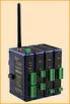 Modular, Customizable Wire Replacement 128 / 256 Bit AES Encryption Software Selectable RF Transmit Power Software Selectable Over-the-air Data Rate Modbus ASCII /RTU Compatible Wide Operating Temperature
L5354 ControlNet Communications Interface
 L5354 ControlNet Communications Interface Technical Manual HA470733 Issue 2 Copyright SSD Drives Inc 2005 All rights strictly reserved. No part of this document may be stored in a retrieval system, or
Industrial RS-232/ RS-422/ RS-485 over Ethernet Media Converter
 ICS-2 S15 Industrial RS-232/ RS-422/ RS-485 over Ethernet Media Converter Cost Effective Solution for RS-232 / RS-422 / RS-485 to Industrial Ethernet Application PLANET ICS-210x series Smart Media Converter
MCR1900 Media Converter 19-Slot Chassis
 MCR1900 Media Converter 19-Slot Chassis Installation Guide Part #5500304-11 Copyright Statement This document must not be reproduced in any way whatsoever, either printed or electronically, without the
GV-Keyboard. User's Manual V2.0
 GV-Keyboard User's Manual V2.0 Before attempting to connect or operate this product, please read these instructions carefully and save this manual for future use. 2007 GeoVision, Inc. All rights reserved.
ENET-710. ENET-710 - Ethernet Module ENET-710 JAN / 06 FOUNDATION
 ENET-710 ENET-710 - Ethernet Module JAN / 06 ENET-710 FOUNDATION E N E T 7 1 0 ME smar www.smar.com Specifications and information are subject to change without notice. Up-to-date address information is
T7560A,B,C Digital Wall Module
 T7560A,B,C Digital Wall Module HONEYWELL EXCEL 5000 OPEN SYSTEM BEFORE INSTALLATION All wiring must comply with local electrical codes and ordinances or as specified on installation wiring diagrams. Digital
IND560 Terminal Installation Manual. English
 IND560 Terminal Installation Manual English METTLER TOLEDO 2005 No part of this manual may be reproduced or transmitted in any form or by any means, electronic or mechanical, including photocopying and
How To Use A Ds340 (Dsp)
 Ideal for monitoring dust levels in the exhaust gas of industrial combustion or air filtration processes. Innovative Dynamic Detection Principle (DDP) measurement technique Immune to gradual reductions
AC-115 Compact Networked Single Door Controller. Installation and User Manual
 AC-115 Compact Networked Single Controller Installation and User Manual December 2007 Table of Contents Table of Contents 1. Introduction...5 1.1 Key Features... 6 1.2 Technical Specifications... 7 2.
EDI Distributor Control Interface Wiring and Setup Instructions
 Universal I/O EDI Distributor Control Interface Wiring and Setup Instructions EDI UNIVERSAL I/O INTERFACE MODULE The only interface needed for EDI-V5 controls Network compatible with all older EDI controls
Quick Installation Guide 24-port PoE switch with 2 copper Gigabit ports and 2 Gigabit SFP ports (af Version 15.4W)
 Quick Installation Guide 24-port PoE switch with 2 copper Gigabit ports and 2 Gigabit SFP ports (af Version 15.4W) Table of Contents Introduction.. Power Over Ethernet (PoE) & Features.... Unpacking and
Energy Communication Unit (ECU)
 Altenergy Power System Energy Communication Unit (ECU) Installation and User Manual (For ECU-3 V3.8) ALTENERGY POWER SYSTEM INC. All rights reserved TABLE OF CONTENTS 1.0 Introduction... 2 2.0 Installation...
MicroTech II McQuay Maverick II Rooftop Unit Controller BACnet Communication Module (MS/TP)
 Installation and Maintenance Manual IM 852 Group: Controls Part Number: IM 852 Date: June 2007 Supercedes: New MicroTech II McQuay Maverick II Rooftop Unit Controller BACnet Communication Module (MS/TP)
Wireless Router Setup Manual
 Wireless Router Setup Manual NETGEAR, Inc. 4500 Great America Parkway Santa Clara, CA 95054 USA 208-10082-02 2006-04 2006 by NETGEAR, Inc. All rights reserved. Trademarks NETGEAR is a trademark of Netgear,
iosafe Solo External Hard Drive
 Users Manual & Limited Warranty iosafe Solo External Hard Drive USB 2.0 Fireproof Waterproof FloSafe Cooling Technology Data Recovery Service 910-10841-00 REV 7.1 2 COPYRIGHTS Copyright iosafe, Inc. 2009.
Disclaimers. Important Notice
 Disclaimers Disclaimers Important Notice Copyright SolarEdge Inc. All rights reserved. No part of this document may be reproduced, stored in a retrieval system, or transmitted, in any form or by any means,
LabelWriter. Print Server. User Guide
 LabelWriter Print Server User Guide Copyright 2010 Sanford, L.P. All rights reserved. 08/10 No part of this document or the software may be reproduced or transmitted in any form or by any means or translated
Process Control and Automation using Modbus Protocol
 Process Control and Automation using Modbus Protocol Modbus is the fundamental network protocol used in most industrial applications today. It is universal, open and an easy to use protocol. Modbus has
Energy Communication Unit (ECU)
 Altenergy Power System Energy Communication Unit (ECU) Installation and User Manual (For ECU-3 V3.7) Version:3.0 ALTENERGY POWER SYSTEM INC. All rights reserved TABLE OF CONTENTS 1.0 Introduction... 2
LevelOne IFE-0500 4-Port PoE + 1-Port TP Industrial Fast Ethernet Switch User Manual
 LevelOne IFE-0500 4-Port PoE + 1-Port TP Industrial Fast Ethernet Switch User Manual Ver. 1.0.0-0711 1 FCC Warning This Equipment has been tested and found to comply with the limits for a Class-A digital
Supplementary Certificate of Approval NMI S669
 Bradfield Road, West Lindfield NSW 2070 Supplementary Certificate of Approval Issued by the Chief Metrologist under Regulation 60 of the National Measurement Regulations 1999 This is to certify that an
HIGH PRECISION BALANCE MWP OWNER S MANUAL. MWP-2004-12 ver.1.0
 HIGH PRECISION BALANCE MWP OWNER S MANUAL MWP-2004-12 ver.1.0 INTRODUCTION------------------------------------------------1 1. INSTALLATION---------------------------------------------------2 Unpacking---------------------------------------------------------------2
Industrial Balances PREMIUM Series 490 IBK/ITK/ISK
 SWISS MADE Industrial Balances PREMIUM Series 490 IBK/ITK/ISK Precision Industrial Scales PREMIUM Series 490 IBK/ITK/ISK The Precisa 490 Series range of industrial scales stands for outmost Swiss precision.
ModBus Server - KNX. Gateway for integration of KNX equipment into Modbus (RTU and TCP) control systems.
 IntesisBox ModBus Server - KNX Gateway for integration of KNX equipment into Modbus (RTU and TCP) control systems. Integrate KNX based lighting control into your SCADA, BMS, PLC "talking" Modbus. Master
BroadBand PowerShield. User Manual
 BroadBand PowerShield User Manual 990-0375G 12/2006 Chapter 1 General Information The PowerShield provides a power source for broadband telephony and other DC applications. Safety This Safety Guide contains
Match. GE Digital Energy. Uninterruptible Power Supply 500-1500 VA. Technology for the Digital World. Match UPS. GE Digital Energy.
 Match Uninterruptible Power Supply 500-1500 VA Manufactured by: General Electric Company Telephone +41 (0)91 / 850 51 51 CH 6595 Riazzino (Locarno) Fax +41 (0)91 / 850 51 44 Switzerland Website www.gedigitalenergy.com
Weighing terminals IP69K GMP EHEDG NSF. Precision in stainless steel Easy to clean perfect hygiene
 Weighing terminals The stainless steel weighing terminals of the 4 Series: IND429, IND439 and IND449 The optimal solution for demanding applications in the food, pharmaceutical and chemical industries.
5-port / 8-port 10/100BaseTX Industrial Ethernet Switch User Manual
 5-port / 8-port 10/100BaseTX Industrial Ethernet Switch User Manual Content Overview... 1 Introduction... 1 Features... 3 Packing List... 4 Safety Precaution... 4 Hardware Description... 5 Front Panel...
OEM Manual MODEL 2350 ELECTRONIC DUAL CYLINDER SCALE
 OEM Manual MODEL 2350 ELECTRONIC DUAL CYLINDER SCALE Scaletron Industries, Ltd. Bedminster Industrial Park 53 Apple Tree Lane P.O. Box 365 Plumsteadville, PA 18949 USA Toll Free: 1-800-257-5911 (USA &
AC 800M. EtherNet/IP DeviceNet Linking Device LD 800DN. Power and productivity for a better world TM SP1134
 AC 800M EtherNet/IP DeviceNet Linking Device LD 800DN SP1134 Power and productivity for a better world TM AC 800M EtherNet/IP DeviceNet Linking Device LD 800DN NOTICE This document contains information
ICMP HDD. Installation manual
 ICMP HDD Installation manual R5905769/02 17/04/2015 Barco nv Noordlaan 5, B-8520 Kuurne Phone: +32 56.36.82.11 Fax: +32 56.36.883.86 Support: www.barco.com/en/support Visit us at the web: www.barco.com
Firmware version: 1.10 Issue: 7 AUTODIALER GD30.2. Instruction Manual
 Firmware version: 1.10 Issue: 7 AUTODIALER GD30.2 Instruction Manual Firmware version: 2.0.1 Issue: 0.6 Version of the GPRS transmitters configurator: 1.3.6.3 Date of issue: 07.03.2012 TABLE OF CONTENTS
PCS300 Universal IP Reporting Module V1.0
 PCS300 Universal IP Reporting Module V1.0 Reference and Installation Manual Patents: One or more of the following US patents may apply: 7046142, 6215399, 6111256, 6104319, 5920259, 5886632, 5721542, 5287111,
IntesisBox KNX Modbus TCP master
 IntesisBox KNX TCP master Gateway for integration of TCP slave devices into KNX control systems. Integrate any TCP slave device into KNX. KNX TCP slave EIB Bus IntesisBox Ethernet slave LinkBoxEIB Configuration
IntesisBox Modbus Server SAMSUNG Air Conditioners
 IntesisBox Modbus Server SAMSUNG Air Conditioners Gateway for monitoring and control of Samsung NASA compatible Air Conditioning Systems from any Modbus master device TCP or RTU (BMS, PLC, SCADA, HMI,
MAKING MODERN LIVING POSSIBLE. AK-SC255 On-Site Installation Guide DANFOSS ELECTRONIC CONTROLS & SENSORS
 MAKING MODERN LIVING POSSIBLE AK-SC255 On-Site Installation Guide DANFOSS ELECTRONIC CONTROLS & SENSORS How to Use This Guide Read this Guide completely as you install and start up your new AK-SC 255 controller.
5-port 10/100Base-TX Industrial Switch (314500) User s Guide
 5-port 10/100Base-TX Industrial Switch (314500) User s Guide COPYRIGHT All rights reserved. No part of this publication may be reproduced, stored in a retrieval system, or transmitted in any form or by
1 Serial RS232 to Ethernet Adapter Installation Guide
 Installation Guide 10/100 Mbps LED (amber color ) Link/Activity LED (green color ) 1. Introduction Thank you for purchasing this 1-port RS232 to Ethernet Adapter (hereinafter referred to as Adapter ).
User Manual. Interface Adapter IA1 / Computer Interface EFOY 600 / EFOY 900 / EFOY 1200 / EFOY 1600
 User Manual Interface Adapter IA1 / Computer Interface EFOY 600 / EFOY 900 / EFOY 1200 / EFOY 1600 2 1. Introduction 1. Introduction 1.1 Introduction Thank you for choosing an EFOY product. Please read
Installation Guide. Wireless N Access Point EAP110/EAP120/EAP220
 Installation Guide Wireless N Access Point EAP110/EAP120/EAP220 CONTENTS Network Topology 01 Hardware Overview 02 Hardware Installation 05 1. Installation Requirements... 05 2. Mounting Bracket... 05
Installation guide H-5500-8554-03-A. HSI hardwired system interface
 Installation guide H-5500-8554-03-A HSI hardwired system interface 2008-2011 Renishaw plc. All rights reserved. This document may not be copied or reproduced in whole or in part, or transferred to any
CompactLogix Power Supplies Specifications
 Technical Data CompactLogix Power Supplies Specifications 1768 CompactLogix Power Supplies Catalog Numbers 1768-PA3, 1768-PB3 1769 Compact I/O Power Supplies Catalog Numbers 1769-PA2, 1769-PB2, 1769-PA4,
Technical Information POWER PLANT CONTROLLER
 Technical Information POWER PLANT CONTROLLER Content The Power Plant Controller offers intelligent and flexible solutions for the control of all PV power plants in the megawatt range. It is suitable for
RISH CON - Hz. Salient Features : Application : Product Features: FREQUENCY TRANSDUCER
 Application : The RISH CON - Hz transducer is used for frequency measurement. The output signal is proportional to measured frequency and is either load independent DC Current or load independent DC Voltage.
How To Use A Ci 2001A/B (I2) With A Power Supply (I3)
 Weighing Indicator CI-2001A/B OWNER S MANUAL CONTENTS PRECAUTIONS 4 INTRODUCTION 6 THE FEATURES OF CI-2001A/B 6 TECHNICAL SPECIFICATION 7 DIMENSIONS 8 FRONT PANEL(CI-2001A) 9 FRONT PANEL(CI-2001B) 11 REAR
User Guide TL-SG1016/ TL-SG1024 16/24-port Gigabit Ethernet Switch
 User Guide TL-SG1016/ TL-SG1024 16/24-port Gigabit Ethernet Switch Rev:2.0.0 7106500823 COPYRIGHT & TRADEMARKS Specifications are subject to change without notice. is a registered trademark of TP-LINK
User Manual. Humidity-Temperature Chart Recorder. Model RH520
 User Manual Humidity-Temperature Chart Recorder Model RH520 Introduction Congratulations on your purchase of the Extech RH520 Temperature + Humidity Chart Recorder. The RH520 measures and displays Temperature,
Virtual Measurements & Control. Flip/Flop Filler
 Virtual Measurements & Control Flip/Flop Filler OVERVIEW... 2 HARDWARE... 2 CONTROL... 3 OPERATIONAL SEQUENCE... 4 EXITING SMARTS... 5 1 Overview These instruments have been programmed for continuos filling
Daker DK 1, 2, 3 kva. Manuel d installation Installation manual. Part. LE05334AC-07/13-01 GF
 Daker DK 1, 2, 3 kva Manuel d installation Installation manual Part. LE05334AC-07/13-01 GF Daker DK 1, 2, 3 kva Index 1 Introduction 24 2 Conditions of use 24 3 LCD Panel 25 4 Installation 28 5 UPS communicator
Digital I/O: OUTPUT: Basic, Count, Count+, Smart+
 Digital I/O: OUTPUT: Basic, Count, Count+, Smart+ The digital I/O option port in the 4-Series provides us with 4 optically isolated inputs and 4 optically isolated outputs. All power is supplied externally.
APNT#1168 Modbus - Establishing Communications Hints
 Application Note #1168: Modbus - Establishing Communications Hints Introduction This document provides supplemental information about configuring Pro-face Device/PLC drivers to communicate with your device.
User Manual IC-485AI 2002-09-27
 User Manual IC-485AI Note: This equipment has been tested and found to comply ith the limits for a Class A digital device pursuant to Part 15 of the FCC Rules. These limits are designed to provide reasonable
Table of Contents. Hardware Installation...7 Push Button Security... 8. Using the Setup Wizard...10. Configuration...11 Main... 12 Security...
 Table of Contents Table of Contents Product Overview...3 Package Contents...3 System Requirements... 3 Introduction...4 Features... 4 Hardware Overview...5 LEDs... 5 Connection... 6 Hardware Installation...7
applicomio Profibus-DP
 BradCommunications Profibus-DP network interface cards allow deterministic I/O data acquisition for PC-based control applications. Features New! Support of Windows 32-bit and 64-bit (WoW64) Support of
dedicated KVM switch and rackmount screen technology User Manual IP-S101 Combo KVM Extender Designed and manufactured by Austin Hughes
 dedicated KVM switch and rackmount screen technology User Manual IP-S101 Combo KVM Extender Designed and manufactured by Austin Hughes 751 Legal Information First English printing, October 2002 Information
TX2123 RS485 TO ETHERNET ADAPTOR
 TX2123 RS485 TO ETHERNET ADAPTOR Converts Datacomms between fibre optic Modbus TCP over Ethernet and hard-wired copper Modbus RTU over RS485 Fibre Optic MODBUS TCP/ IP Ethernet Copper MODBUS RTU RS485
MILLENIUM INSTALLATION MANUAL NTR 735 A. Simple Automation Control Module (MAS)
 MILLENIUM Table of contents 1. INTRODUCTION 1 2. HARDWARE DESCRIPTION 2 3. INSTALLATION 5 4. CONNECTION 6 5. USER SAFETY AND PROTECTION OF EQUIPMENT 8 1. Introduction The MILLENIUM series has been designed
IntesisBox Modbus Server Fidelio IP
 IntesisBox Server Fidelio IP Gateway for integration of Micros Fidelio Ho management system into (RTU and TCP) enabled control systems. Integrate your Micros Fidelio Ho management system into your master
IntesisBox KNX Modbus RTU master
 IntesisBox KNX RTU master Gateway for integration of RTU devices into KNX control systems. Integrate RTU devices (Chillers, Roof Tops, electricity meters, heating floors, heat pumps, PLCs ) into KNX control
Flow Monitoring System
 FMS-3 Product Data Sheet PS-00028 April 1997 Flow Monitoring System FMS-3 Flow Monitoring System The Micro Motion FMS-3 Flow Monitoring System is a microprocessor-based batch controller with rate, total,
SWISS MADE. Series 320 XB MASTER. Analytical. Precision
 SWISS MADE MASTER Series Analytical Precision MASTER Series The Precisa 320 high performance series combines precision and quality, and offers the highest metrological performance and advanced integrated
AXIS 291 1U Video Server Rack Installation Guide
 AXIS 291 1U Video Server Rack Installation Guide About This Document This document describes how to install Axis blade video servers in the AXIS 291 1U Video Server Rack. Updated versions of this document
How to read this guide
 How to read this guide The following shows the symbols used in this Quick start guide with descriptions and examples. Symbol Description Example P oint Reference Caution [ ] This symbol explains information
Temp. & humidity Transmitter Instructions
 Temp. & humidity Transmitter Instructions AQ3485/AQ3485Y www.aosong.com 1 Product Overview AQ3485/ AQ3485Y outdoor network temperature and humidity transmitter is accurate measurement of relative humidity
8-port 10/100Base-TX +2-port 100Base-FX Switch. User s Guide
 8-port 10/100Base-TX +2-port 100Base-FX Switch User s Guide COPYRIGHT All rights reserved. No part of this publication may be reproduced, stored in a retrieval system, or transmitted in any form or by
LS1024B / LS2024B/ LS3024B. Solar Charge Controller USER MANUAL
 EPSOLAR LS1024B / LS2024B/ LS3024B Solar Charge Controller USER MANUAL Thank you very much for selecting our product! This manual offers important information and suggestions with respect to installation,
SECTION 13421 PROGRAMMABLE LOGIC CONTROLLERS AND COMPUTER CONTROL SYSTEM PART 1 GENERAL. 1.01 Summary. A. Section Includes:
 SECTION 13421 PROGRAMMABLE LOGIC CONTROLLERS AND COMPUTER CONTROL SYSTEM PART 1 GENERAL 1.01 Summary A. Section Includes: 1. The ISS shall furnish all labor, materials, equipment, services and incidentals
Preface. Manual Revisions
 Preface D-Link reserves the right to revise this publication and to make changes in the content hereof without obligation to notify any person or organization of such revisions or changes. Manual Revisions
WIRELESS ACCESS POINT
 WIRELESS ACCESS POINT AN-100-AP-I-N AN-300-AP-I-N FCC Warning Changes or modifications not expressly approved by the party responsible for compliance could void the user s authority to operate the equipment.
TD-8610/TD-8610B External ADSL2+ MODEM
 TD-8610/TD-8610B External ADSL2+ MODEM Rev: 1.0.2 1910010011 COPYRIGHT & TRADEMARKS Specifications are subject to change without notice. is a registered trademark of TP-LINK TECHNOLOGIES CO., LTD. Other
ABB i-bus EIB / KNX Analogue Input AE/S 4.2
 Product Manual ABB i-bus EIB / KNX Analogue Input AE/S 4.2 Intelligent Installation Systems This manual describes the functionality of Analogue Input AE/S 4.2. Subject to changes and errors excepted. Exclusion
SMART Board 8070i-SMP and 8070i
 SMART Board 8070i-SMP and 8070i Interactive flat panel Installation guide Product registration If you register your SMART product, we ll notify you of new features and software upgrades. Register online
6AV3617-1JC30-0AX1. Type of voltage. UPS connectable (serial) Backup battery. minimum backup duration Memory. Flash / RAM.
 6AV3617-1JC30-0AX1 Page 1 Product data sheet 6AV3617-1JC30-0AX1 OPERATOR PANEL OP17/DP12 LC DISPLAY, BACKLIT LED 4X20/8X40 LINESXCHARACTERS SIMATIC S5, 505, S7, M7, NATIVE DRIVERS, PROFIBUS-DP 12 MBAUD,
Wiser Panel Meter, Model Number WISERCTPM200 Installer s Guide
 Instruction Bulletin EAV85226 08/2014 Wiser Panel Meter, Model Number WISERCTPM200 Installer s Guide Retain for future use. Product Description Kit Contents The Wiser Panel Meter is for use in energy management
Usage, Installation, Warranty and Service Information
 T13C Table Updater for Seating Management U S E R M A N UA L Usage, Installation, Warranty and Service Information Long Range Systems, LLC 4550 Excel Parkway, Suite 200 Addison, TX 75001 800.437.4996 www.lrsus.com
Broadband Router ESG-103. User s Guide
 Broadband Router ESG-103 User s Guide FCC Warning This equipment has been tested and found to comply with the limits for Class A & Class B digital device, pursuant to Part 15 of the FCC rules. These limits
PPM Users Manual Signature Software 01-12-00
 PPM Users Manual Signature Software 0-2-00 PPM User Manual /8/02 Software Versions: 0.0.27 Contents. Introduction 2 2. Parameters 3 2. Overload Limit...4 2.2 Relative Upper Limit...4 2.3 Relative Lower
Modbus Communications for PanelView Terminals
 User Guide Modbus Communications for PanelView Terminals Introduction This document describes how to connect and configure communications for the Modbus versions of the PanelView terminals. This document
Input signal Maximum Range Accuracy. Thermocouple E -50 to 700 C (-58 to 1832 F) ±1 C
 F4 Process Controller Installation and Operation Guide SAFETY ALERTS The symbols below are used on the equipment and throughout this document to draw the user s attention to important operational and safety
4-CH Video Server SED-2310Q. Ver. 061031. User s Manual
 4-CH Video Server SED-2310Q Ver. 061031 User s Manual 0 0 PRECAUTIONS 1. Read these instructions All the safety and operating instructions should be read before the product is operated. 2. Heed all warnings
How To Control A Power Supply With A Mini Transmitter And Switch (Power Supply)
 transmitter (2 wire) / switch for continuous or On/Off Control Indication, monitoring, transmitting and continuous or On/Off control in one device Output signal 4...20 ma, 2-wire for continuous control
User Guide TL-SG1016D 16-Port Gigabit Switch TL-SG1024D 24-Port Gigabit Switch
 User Guide TL-SG1016D 16-Port Gigabit Switch TL-SG1024D 24-Port Gigabit Switch Rev: 1.1.0 7106503251 COPYRIGHT & TRADEMARKS Specifications are subject to change without notice. is a registered trademark
LiteKeeper 4 & 8 Programming Guide and User Manual
 LiteKeeper 4 & 8 Programming Guide and User Manual Table of Contents Safety Instructions... 3 Chapter 1: Introduction... 4 p1 How It Works... 4 What are relays?... 4 What are inputs?... 4 How do I program
sigpod Press ASSEMBLY PRESS-FIT MONITORING SYSTEM BENEFITS FEATURES
 ASSEMBLY PRESS-FIT MONITORING SYSTEM BENEFITS Enhanced defect detection Built-in diagnostics for press machinery Quicker setup and easier maintenance than competitive systems Lowest monitoring cost per
Vibration analysis and monitoring Compact. Powerful. Modern technology.
 Vibration analysis and monitoring Compact. Powerful. Modern technology. Maximum performance Vibration measurement with state of the art processor technology Expert Vibro is Delphin Technology's new device
Crow Limited Warranty. Print Version 017
 Crow Limited Warranty (Crow) warrants this product to be free from defects in materials and workmanship under normal use and service for a period of one year from the last day of the week and year whose
LDG DTS-4/4R Desktop Coaxial Switch / Remote
 LDG DTS-4/4R Desktop Coaxial Switch / Remote LDG Electronics 1445 Parran Road, PO Box 48 St. Leonard MD 20685-2903 USA Phone: 410-586-2177 Fax: 410-586-8475 [email protected] www.ldgelectronics.com
Ethernet Radio Configuration Guide
 Ethernet Radio Configuration Guide for Gateway, Endpoint, and Repeater Radio Units April 20, 2015 Customer Service 1-866-294-5847 Baseline Inc. www.baselinesystems.com Phone 208-323-1634 FAX 208-323-1834
Quick Start Guide. Cisco Small Business. 300 Series Managed Switches
 Quick Start Guide Cisco Small Business 300 Series Managed Switches Welcome Thank you for choosing the Cisco 300 Series Managed Switch, a Cisco Small Business network communications device. This device
HP-1000E v2. User s Manual. Powerline Ethernet Adapter. HP1000E v2 User s Manual
 HP-1000E v2 Powerline Ethernet Adapter User s Manual HP1000E v2 User s Manual Table of Contents Chapter 1: Introduction...1 Chapter 2: Planning your Powerline Network...1 Network Topology...1 Chapter 3:
Modbus and ION Technology
 70072-0104-14 TECHNICAL 06/2009 Modbus and ION Technology Modicon Modbus is a communications protocol widely used in process control industries such as manufacturing. PowerLogic ION meters are compatible
THYRISTORS T1-1PH from 850A to 2700A Specifications Universal 1 Phase Thyristor Unit 55-77-03-62, March 2012
 Technical Information THYRISTORS T1-1PH from 850A to 2700A Specifications Universal 1 Phase Thyristor Unit 55-77-03-62, March 2012 GENERAL DESCRIPTION THYRISTORS T1-1PH is a full digital and universal
TEXT DISPLAY TD17 LC DISPLAY, BACK-LIT LED, 4X20/8X40 LINES X CHARACTERS F0R SIMATIC S5,505,S7,M7 NATIVE DRIVERS, PROFIBUS-DP12
 6AV3017-1NE30-0AX0 Page 1 Product data sheet 6AV3017-1NE30-0AX0 TEXT DISPLAY TD17 LC DISPLAY, BACK-LIT LED, 4X20/8X40 LINES X CHARACTERS F0R SIMATIC S5,505,S7,M7 NATIVE DRIVERS, PROFIBUS-DP12 Supply voltage
SolarEdge Export Limitation Guide
 SolarEdge Export Limitation Guide Europe and APAC Version 2.0 Disclaimers Disclaimers Important Notice Copyright SolarEdge Inc. All rights reserved. No part of this document may be reproduced, stored in
Electronic Control Devices The European Product Catalogue 2007
 FX14 Field Controller (1/4) FX14 Field Controller The FX14 is an equipment field controller in the Facility Explorer range of products. The controller is designed specifically for commercial Heating, Ventilating,