
Meat Industry Award 2010
|
|
|
- Nickolas Hood
- 9 years ago
- Views:
Transcription
1 Table of Contents Part 1 Application and Operation Title Commencement date Definitions and interpretation Coverage Access to the award and the National Employment Standards The National Employment Standards and this award Award flexibility... 6 Part 2 Consultation and Dispute Resolution Facilitative provisions Consultation regarding major workplace change Dispute resolution Part 3 Types of Employment and Termination of Employment Types of employment Full-time employment Part-time employment Daily hire Casual employment Termination of employment Redundancy Part 4 Classifications, Minimum Wages and Related Matters Classifications Minimum wages Junior rates Apprentices National training wage School-based apprentices Payment by results Supported wage system Allowances Accident pay Higher duties MA This award does not come into force until 1 January

2 29. Payment of wages Superannuation...22 Part 5 Hours of Work and Related Matters Hours of work Breaks Shiftwork Rostering Make-up time Overtime...29 Part 6 Leave and Public Holidays Annual leave Personal/carer s leave and compassionate leave Community service leave Public holidays Long service leave...33 Schedule A Classification Structure...34 Schedule B National Training Wage...41 Schedule C School-based Apprenticeship...42 Schedule D Supported Wage System MA This award does not come into force until 1 January 2010

3 Part 1 Application and Operation 1. Title This award is the Meat Industry Award Commencement date This award commences on 1 January Definitions and interpretation 3.1 In this award, unless the contrary intention appears: Act means the Fair Work Act 2009 (Cth) award-based transitional instrument has the meaning in the Fair Work (Transitional Provisions and Consequential Amendments) Act 2009 (Cth) cashier means an employee engaged to collect and/or process money or other payment tendered for retail sales of meat and/or meat products, and who is not a salesperson continuous service has the meaning in s.22(1), (2) and (3) in the Act employee means a national system employee as defined in sections 13 and 30C of the Act employer means a national system employer as defined in sections 14 and 30D of the Act enterprise award-based instrument has the meaning in the Fair Work (Transitional Provisions and Consequential Amendments) Act 2009 (Cth) fresh meat means meat that has not been cooked, pickled, cured or otherwise processed from the natural state, other than by chilling or freezing meat means cattle, calves, buffalo, horses, mules, donkeys, sheep, lambs, goats, pigs, camels, deer, kangaroos, emus, ostriches or marine reptiles, and any flesh or other organic products derived from any of them (excluding milk) meat manufacturing establishment means an establishment wholly or predominately concerned with the manufacturing or processing of fresh meat into any form of edible manufactured or processed meat, meat products, smallgoods, ham, bacon, or similar products in which meat is a substantial ingredient, including any related activities such as retail and/or wholesale sales, and killing, dressing, boning, slicing, preparation and/or packing of fresh meat, where such activities are conducted at any place as an ancillary part of the manufacturing or processing business MA This award does not come into force until 1 January
4 meat processing establishment means an establishment wholly or predominately concerned with any one or more of the activities of killing, dressing, boning, slicing, preparation, and/or packing of fresh meat and will include any related activities conducted at any place as an ancillary part of such business, such as manufacturing or processing of meat, the treatment and processing of skins or hides, rendering, processing of by-products and/or retail and/or wholesale sales meat retail establishment means an establishment wholly or predominately concerned with the retail and or wholesale sale of fresh meat and/or meat products, including establishments where meat and/or meat products including ham and smallgoods and similar products are processed and/or manufactured as an ancillary part of the retail and/or wholesale business NES means the National Employment Standards as contained in sections 59 to 131 of the Fair Work Act 2009 (Cth) related company means a related company within the meaning of the Corporations Act 2001 (Cth) relevant apprenticeship legislation means any awards and/or regulations made by any state apprenticeship authority rostered day off (RDO) means any continuous 24 hour period between the completion of the last ordinary shift and the commencement of the next ordinary shift on which an employee is rostered for duty salesperson means an employee (not a general butcher) engaged to effect retails sales of meat and/or meat products, and who may also perform cutting of meat for weight, wrapping and preparation of meat or meat products offered for sale. standard rate means the minimum weekly wage for MI 7 in clause 19 Minimum wages. Where an allowance is provided for on an hourly basis, a reference to standard rate means 1/38th of the weekly wage referred in this definition. 3.2 Ordinary hourly rate for overtime and other purposes For all purposes of the award, except where otherwise expressly provided: ordinary hourly rate means the award rate of pay per week prescribed in clause 19.1 for the classification of the employee, divided by 38; time and a quarter means the ordinary hourly rate increased by 25%; time and a half means the ordinary hourly rate increased by 50%; and (d) double time means the ordinary hourly rate increased by 100%. 3.3 Where this award refers to a condition of employment provided for in the NES, the NES definition applies. 4. Coverage 4.1 This award covers employers throughout Australia in the meat industry and their employees in the classifications listed in Schedule A Classification Structure to the exclusion of any other modern award. 4 MA This award does not come into force until 1 January 2010
5 4.2 The meat industry includes: Meat Industry Award 2010 (d) meat manufacturing establishments; meat processing establishments; meat retail establishments; and the following: (i) (ii) handling and further processing of all by-products of the establishments referred to in clause 4.2, or, including skins, hides and rendering; and distribution, transport and storage (including freezing and cold storage) operations for the purpose of transport or storage of the meat or meat products of an establishment referred to in clause 4.2, or, where such activities are carried out by an employer engaged in any of clause 4.2, or as an ancillary part of the business of that establishment, or by an employer that is a related company of such employer. 4.3 The award does not cover: meat inspectors (being employees of an employer covered by this award who are engaged to perform duties equivalent to duties usually performed by AQIS Meat Inspectors); employees covered by: (i) Nurses Award 2010; (ii) General Retail Industry Award 2010; or (iii) Food, Beverage and Tobacco Manufacturing Award 2010, (d) (e) (f) (g) employees engaged to undertake managerial duties and responsibilities (at the level of foreman and above); employers and employees engaged in the slaughter and/or processing of any species of poultry, game or game birds not specifically listed in clause 3 Definitions and interpretation; storage, transport or distribution of meat or meat products or by-products by employers who are not engaged in, or who do not conduct or operate a meat processing establishment, a meat manufacturing establishment or a meat retail establishment, and are not a related company of an employer that is so engaged; employees excluded from award coverage by the Act; employees who are covered by a modern enterprise award or an enterprise instrument (within the meaning of the Fair Work (Transitional Provisions and Consequential Amendments) Act 2009 (Cth)), or employers in relation to these employees; or MA This award does not come into force until 1 January

6 (h) employees engaged in mechanical and electrical maintenance classifications covered by the Manufacturing and Associated Industries and Occupations Award Where an employer is covered by more than one award, an employee of that employer is covered by the award classification which is most appropriate to the work performed by the employee and to the environment in which the employee normally performs the work. NOTE: Where there is no classification for a particular employee in this award it is possible that the employer and that employee are covered by an award with occupational coverage. 5. Access to the award and the National Employment Standards The employer must ensure that copies of this award and the NES are available to all employees to whom they apply either on a noticeboard which is conveniently located at or near the workplace or through electronic means, whichever makes them more accessible. 6. The National Employment Standards and this award The NES and this award contain the minimum conditions of employment for employees covered by this award. 7. Award flexibility 7.1 Notwithstanding any other provision of this award, an employer and an individual employee may agree to vary the application of certain terms of this award to meet the genuine individual needs of the employer and the individual employee. The terms the employer and the individual employee may agree to vary the application of are those concerning: (d) (e) arrangements for when work is performed; overtime rates; penalty rates; allowances; and leave loading. 7.2 The employer and the individual employee must have genuinely made the agreement without coercion or duress. 7.3 The agreement between the employer and the individual employee must: be confined to a variation in the application of one or more of the terms listed in clause 7.1; and result in the employee being better off overall than the employee would have been if no individual flexibility agreement had been agreed to. 6 MA This award does not come into force until 1 January 2010

7 7.4 The agreement between the employer and the individual employee must also: (d) (e) be in writing, name the parties to the agreement and be signed by the employer and the individual employee and, if the employee is under 18 years of age, the employee s parent or guardian; state each term of this award that the employer and the individual employee have agreed to vary; detail how the application of each term has been varied by agreement between the employer and the individual employee; detail how the agreement results in the individual employee being better off overall in relation to the individual employee s terms and conditions of employment; and state the date the agreement commences to operate. 7.5 The employer must give the individual employee a copy of the agreement and keep the agreement as a time and wages record. 7.6 Except as provided in clause 7.4 the agreement must not require the approval or consent of a person other than the employer and the individual employee. 7.7 An employer seeking to enter into an agreement must provide a written proposal to the employee. Where the employee s understanding of written English is limited the employer must take measures, including translation into an appropriate language, to ensure the employee understands the proposal. 7.8 The agreement may be terminated: by the employer or the individual employee giving four weeks notice of termination, in writing, to the other party and the agreement ceasing to operate at the end of the notice period; or at any time, by written agreement between the employer and the individual employee. 7.9 The right to make an agreement pursuant to this clause is in addition to, and is not intended to otherwise affect, any provision for an agreement between an employer and an individual employee contained in any other term of this award. Part 2 Consultation and Dispute Resolution 8. Facilitative provisions 8.1 Agreement to vary award provisions This award also contains facilitative provisions which allow agreement between the employer and employees on how specific award provisions are to apply at the workplace or section or sections of it. The facilitative provisions are identified in clauses 8.2, 8.3 and 8.4. MA This award does not come into force until 1 January
8 The specific award provisions establish both the standard award conditions and the framework within which agreement can be reached as to how the particular provisions should be applied in practice. Facilitative provisions are not to be used as a device to avoid award obligations nor should they result in unfairness to an employee or employees covered by this award. 8.2 Facilitation by individual agreement The following facilitative provisions can be utilised by agreement between an employer and an individual employee: Clause number Provision 11.3 Transfer from one employment category to another 13.3 Variation to hours for part-time employment 29.1 Payment of wages 31.2(i)(iv) 32.1 Saturday and Sunday off during work cycle Meal breaks 33.6 Transfer from day work to shiftwork and vice versa 34.4 Change of roster at short notice 35 Make-up time 36.2 Time off instead of payment for overtime 37.4 Deferment of annual leave loading 40.3 Time off instead of working public holiday Any agreement reached must be kept by the employer as a time and wages record. 8.3 Facilitation by majority or individual agreement The following facilitative provisions can be utilised by agreement between an employer and a majority of employees in the workplace or a section or sections of it, or the employer and an individual employee. Clause number 31.2(f)(ii) 31.2(f)(iv) Provision Ordinary hours for day workers on weekends (meat processing establishments) Alteration to spread of hours for day workers 31.3 Methods of arranging ordinary working hours Rotation of three-shift system 40.1 Substitution of public holidays 8 MA This award does not come into force until 1 January 2010

9 Where agreement is reached between the employer and the majority of employees in the workplace or a section or sections of it, the employer must not implement that agreement unless: (i) (ii) the agreement reached is kept by the employer as a time and wages record; and unions which have members employed at an enterprise covered by this award must be informed by the employer of the intention to use the facilitative provision and be given a reasonable opportunity to participate in negotiations regarding its use. Union involvement in this process does not mean that the consent of the union is required prior to the introduction of agreed facilitative arrangements at the enterprise. Where no agreement has been sought by the employer with the majority of employees in accordance with clause 8.3, the employer may reach agreement with individual employees in the workplace or a section or sections of it and such agreement binds the individual employee provided the agreement reached is kept by the employer as a time and wages record and provided the agreement is only with an individual employee or a number of individual employees less than the majority in the workplace or a section or sections of it. 8.4 Facilitation by majority agreement The following facilitative provisions may only be utilized by agreement between the employer and the majority of employees in the workplace or a section or sections of it: Clause number Provision 24 Payment by results 32.2 Rest breaks meat processing establishments only 33.3 Operation of shift roster system Shiftworker crib time Twelve hour days or shifts Additional safeguard (i) (ii) An additional safeguard applies to payment by results. The additional safeguards are those that the parties must observe being the requirements and procedures set out in clause 24 Payment by results. 8.5 Majority vote at the initiation of the employer A vote of employees in the workplace or a section or sections of it which is taken in accordance with clauses 8.3 and 8.4 to determine if there is majority support for the implementation of a facilitative provision, is of no effect unless taken with the agreement of the employer. MA This award does not come into force until 1 January
10 9. Consultation regarding major workplace change 9.1 Employer to notify Where an employer has made a definite decision to introduce major changes in production, program, organisation, structure or technology that are likely to have significant effects on employees, the employer must notify the employees who may be affected by the proposed changes and their representatives, if any. Significant effects include termination of employment; major changes in the composition, operation or size of the employer s workforce or in the skills required; the elimination or diminution of job opportunities, promotion opportunities or job tenure; the alteration of hours of work; the need for retraining or transfer of employees to other work or locations; and the restructuring of jobs. Provided that where this award makes provision for alteration of any of these matters an alteration is deemed not to have significant effect. 9.2 Employer to discuss change The employer must discuss with the employees affected and their representatives, if any, the introduction of the changes referred to in clause 9.1, the effects the changes are likely to have on employees and measures to avert or mitigate the adverse effects of such changes on employees and must give prompt consideration to matters raised by the employees and/or their representatives in relation to the changes. The discussions must commence as early as practicable after a definite decision has been made by the employer to make the changes referred to in clause 9.1. For the purposes of such discussion, the employer must provide in writing to the employees concerned and their representatives, if any, all relevant information about the changes including the nature of the changes proposed, the expected effects of the changes on employees and any other matters likely to affect employees provided that no employer is required to disclose confidential information the disclosure of which would be contrary to the employer s interests. 10. Dispute resolution 10.1 In the event of a dispute about a matter under this award, or a dispute in relation to the NES, in the first instance the parties must attempt to resolve the matter at the workplace by discussions between the employee or employees concerned and the relevant supervisor. If such discussions do not resolve the dispute, the parties will endeavour to resolve the dispute in a timely manner by discussions between the employee or employees concerned and more senior levels of management as appropriate If a dispute about a matter arising under this award or a dispute in relation to the NES is unable to be resolved at the workplace, and all appropriate steps under clause 10.1 have been taken, a party to the dispute may refer the dispute to Fair Work Australia. 10 MA This award does not come into force until 1 January 2010

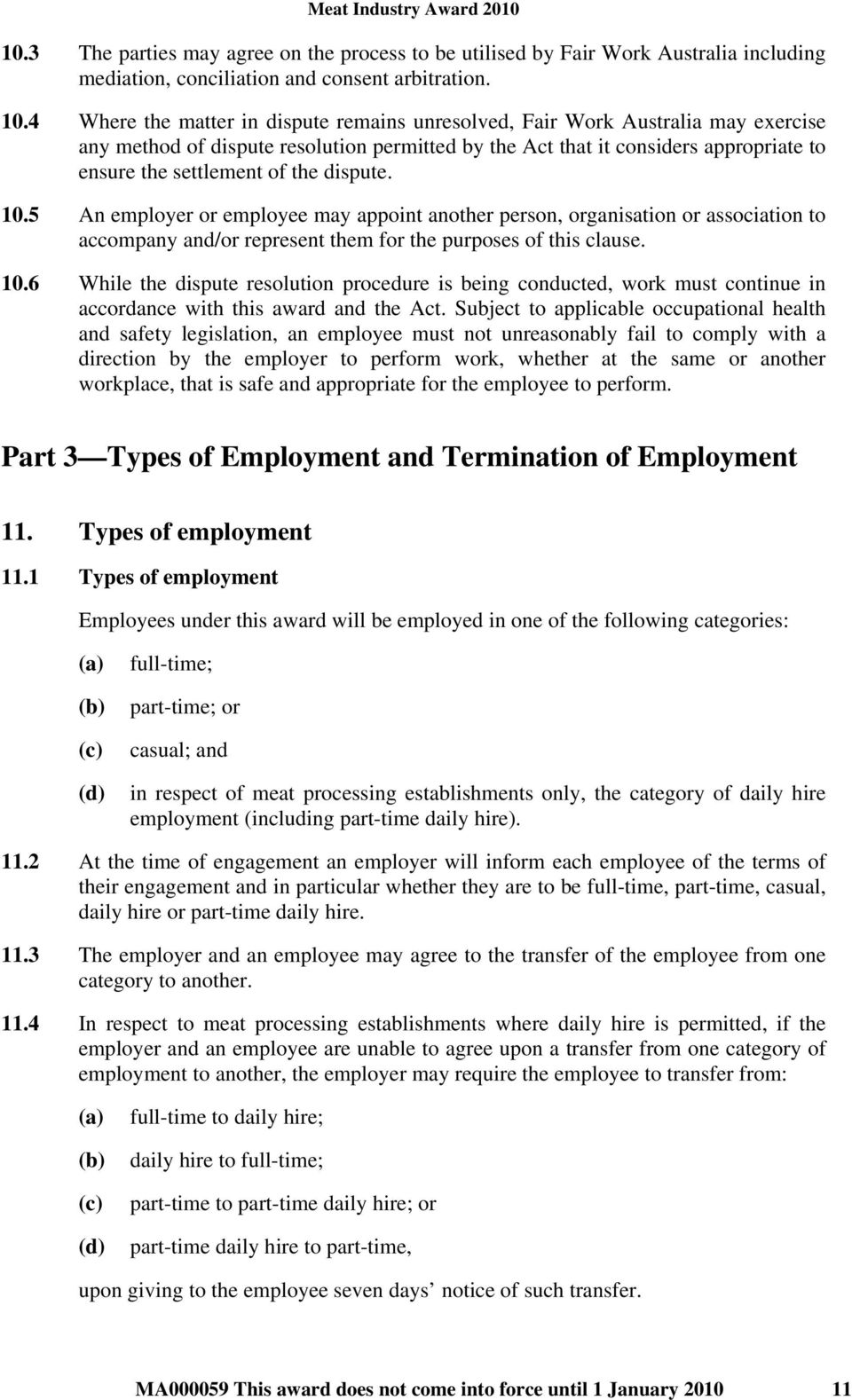
11 10.3 The parties may agree on the process to be utilised by Fair Work Australia including mediation, conciliation and consent arbitration Where the matter in dispute remains unresolved, Fair Work Australia may exercise any method of dispute resolution permitted by the Act that it considers appropriate to ensure the settlement of the dispute An employer or employee may appoint another person, organisation or association to accompany and/or represent them for the purposes of this clause While the dispute resolution procedure is being conducted, work must continue in accordance with this award and the Act. Subject to applicable occupational health and safety legislation, an employee must not unreasonably fail to comply with a direction by the employer to perform work, whether at the same or another workplace, that is safe and appropriate for the employee to perform. Part 3 Types of Employment and Termination of Employment 11. Types of employment 11.1 Types of employment Employees under this award will be employed in one of the following categories: (d) full-time; part-time; or casual; and in respect of meat processing establishments only, the category of daily hire employment (including part-time daily hire) At the time of engagement an employer will inform each employee of the terms of their engagement and in particular whether they are to be full-time, part-time, casual, daily hire or part-time daily hire The employer and an employee may agree to the transfer of the employee from one category to another In respect to meat processing establishments where daily hire is permitted, if the employer and an employee are unable to agree upon a transfer from one category of employment to another, the employer may require the employee to transfer from: (d) full-time to daily hire; daily hire to full-time; part-time to part-time daily hire; or part-time daily hire to part-time, upon giving to the employee seven days notice of such transfer. MA This award does not come into force until 1 January
12 12. Full-time employment Meat Industry Award 2010 A full-time employee is an employee who is engaged to work an average of 38 ordinary hours per week. 13. Part-time employment 13.1 An employer may employ part-time employees in any classification in this award A part-time employee is an employee who: works less than full-time hours of 38 per week; has reasonably predictable hours of work of not less than four consecutive hours on any day; and receives, on a pro rata basis, equivalent pay and conditions to those of a full-time employee who perform the same kind of work At the time of employment the employer and the part-time employee will agree, in writing, on a regular pattern of work specifying at least: (d) the hours worked each day; which days of the week the employee will work; the actual starting and finishing times of each day; and that the minimum daily engagement is four hours Clause 13.3 does not apply to a meat processing establishment, except for employees of the establishment engaged in retail and/or wholesale sales of fresh meat and ordinary products 13.5 The terms of any agreement concerning part-time employment or any agreed variation to the terms will be in writing with a copy retained by the employer and a copy provided to the employee All time worked in excess of the hours as mutually agreed will be overtime A part-time employee employed under the provisions of this clause will be paid for ordinary hours worked at the rate of 1/38th of the appropriate weekly rate prescribed in clause 19 Minimum wages. 14. Daily hire 14.1 An employer in a meat processing establishment may employ daily hire or part-time daily hire employees The daily hire employee will be employed by the day or shift or part thereof as the case may be, without breaking service for the purposes of the award and the NES as to payment for public holidays, personal/carer s leave and annual leave. Employment will terminate at the end of each day or shift on which the employee is employed. 12 MA This award does not come into force until 1 January 2010

13 14.3 A daily hire employee may be required by the employer to work no less than 7.6 ordinary hours for each day they are employed A part-time daily hire employee may be required by the employer to work no less than four consecutive hours for each day they are employed Notwithstanding the termination of employment at the end of each day or shift, the engagement of a daily hire employee or part-time daily hire employee will continue until the engagement is terminated Engagement may be terminated by notice on either side as from the end of the ordinary working hours on the day or shift on which notice is given or at any later time specified by the notice An employee who terminates their engagement as from a time prior to the end of the ordinary working hours on any day or shift without having given the notice in accordance with clause 14.6 will not be entitled to payment in respect of any time actually worked on that day or shift A daily hire employee will be paid at the daily rate of 1/5th of the appropriate weekly rate prescribed by clause 19 Minimum wages for the classification in which they are employed plus a daily hire loading of 10% of that daily rate A part-time daily hire employee will receive for the hours worked, on a pro rata basis, equivalent pay and conditions to those of daily hire employees who perform the same work In consideration of the rights conferred, a daily hire employee or a part-time daily hire employee will attend and offer for employment at the normal or other place specified by the employer at the usual starting time on each ordinary day unless notified on a particular day they are not required to attend. 15. Casual employment 15.1 A casual employee is one who is engaged and paid as such A casual employee will perform such work as the employer requires during the period of engagement Subject to clause 15.6, the minimum period of engagement of a casual will be four hours each day or shift which may be comprised of hours within or outside the span of ordinary hours provided for in this award Employment of a casual will terminate at the end of each day The ordinary hours of a casual employee must not exceed 38 in any week The minimum period of engagement for a casual cleaner employed to clean premises in any establishment may be two hours on any day or shift. The minimum period of engagement for a casual clerk employed as a book keeper may be three hours on any day or shift. The hours for casual cleaners or casual clerks may also be within or outside the span of ordinary hours Casual employees will be paid at the termination of each engagement or in accordance with other agreed pay arrangements set out in clause MA This award does not come into force until 1 January

14 15.8 A casual employee who terminates their employment prior to the end of their ordinary working hours on any day or shift will not be entitled to payment in respect of any time actually worked on that day or shift A casual employee, for each ordinary hour worked or part thereof, will be paid at the rate of: 1/38th of the appropriate weekly rate prescribed in clause 19 Minimum wages; plus a casual loading of 25% based on that hourly rate Notwithstanding clause 15.9, the loading received by a casual who works ordinary hours on a Saturday or Sunday, where ordinary hours are permitted by this award, the appropriate weekend loadings as set out in clause 31 Hours of work will apply A casual employee who works overtime does not receive the loading set out in clause 15.9 but receives, instead, the overtime penalty rates set out in clause 31.2 for the period worked A casual employee employed on shiftwork will, in addition to the casual loading set out in clause 15.9, be paid the appropriate shift penalty based on the ordinary hourly rate excluding the casual loading Casual employees will be notified wherever possible of their starting and finishing times for the period of their engagement at the commencement of their engagement. 16. Termination of employment 16.1 Notice of termination is provided for in the NES Notice of termination by an employee The notice of termination required to be given by an employee is the same as that required of an employer except that there is no requirement on the employee to give additional notice based on the age of the employee concerned. If an employee fails to give the required notice the employer may withhold from any monies due to the employee on termination under this award or the NES, an amount not exceeding the amount the employee would have been paid under this award in respect of the period of notice required by this clause less any period of notice actually given by the employee Job search entitlement Where an employer has given notice of termination to an employee, an employee must be allowed up to one day s time off without loss of pay for the purpose of seeking other employment. The time off is to be taken at times that are convenient to the employee after consultation with the employer. 17. Redundancy 17.1 Redundancy pay is provided for in the NES. 14 MA This award does not come into force until 1 January 2010

15 17.2 Transfer to lower paid duties Meat Industry Award 2010 Where an employee is transferred to lower paid duties by reason of redundancy, the same period of notice must be given as the employee would have been entitled to if the employment had been terminated and the employer may, at the employer s option, make payment instead of an amount equal to the difference between the former ordinary time rate of pay and the ordinary time rate of pay for the number of weeks of notice still owing Employee leaving during notice period An employee given notice of termination in circumstances of redundancy may terminate their employment during the period of notice. The employee is entitled to receive the benefits and payments they would have received under this clause had they remained in employment until the expiry of the notice, but is not entitled to payment instead of notice Job search entitlement An employee given notice of termination in circumstances of redundancy must be allowed up to one day s time off without loss of pay during each week of notice for the purpose of seeking other employment. If the employee has been allowed paid leave for more than one day during the notice period for the purpose of seeking other employment, the employee must, at the request of the employer, produce proof of attendance at an interview or they will not be entitled to payment for the time absent. For this purpose a statutory declaration is sufficient. This entitlement applies instead of clause Transitional provisions Subject to clause 17.5, an employee whose employment is terminated by an employer is entitled to redundancy pay in accordance with the terms of a notional agreement preserving a State award: (i) (ii) that would have applied to the employee immediately prior to 1 January 2010, if the employee had at that time been in their current circumstances of employment and no agreement made under the Workplace Relations Act 1996 (Cth) had applied to the employee; and that would have entitled the employee to redundancy pay in excess of the employee s entitlement to redundancy pay, if any, under the NES. The employee s entitlement to redundancy pay under the notional agreement preserving a State award is limited to the amount of redundancy pay which exceeds the employee s entitlement to redundancy pay, if any, under the NES. This clause does not operate to diminish an employee s entitlement to redundancy pay under any other instrument. (d) Clause 17.5 ceases to operate on 31 December MA This award does not come into force until 1 January

16 Part 4 Classifications, Minimum Wages and Related Matters 18. Classifications 18.1 Employees covered by this award are to be classified according to the structure set out in Schedule A Classification Structure. The minimum weekly rates for those classifications appear in clause 19 Minimum wages. 19. Minimum wages 19.1 Meat industry levels Classifications Minimum weekly wage $ MI MI MI MI MI MI MI MI Junior rates Junior employees will be paid the following percentage rates of the adult rate of pay set out in clause 19 Minimum wages for the appropriate classification in which they are employed. Age of employee % of weekly rate of pay Under 17 years years years years Apprentices The minimum award rates for apprentices completing a four year apprenticeship are the following percentages of the minimum weekly wage MI 7: 16 MA This award does not come into force until 1 January 2010
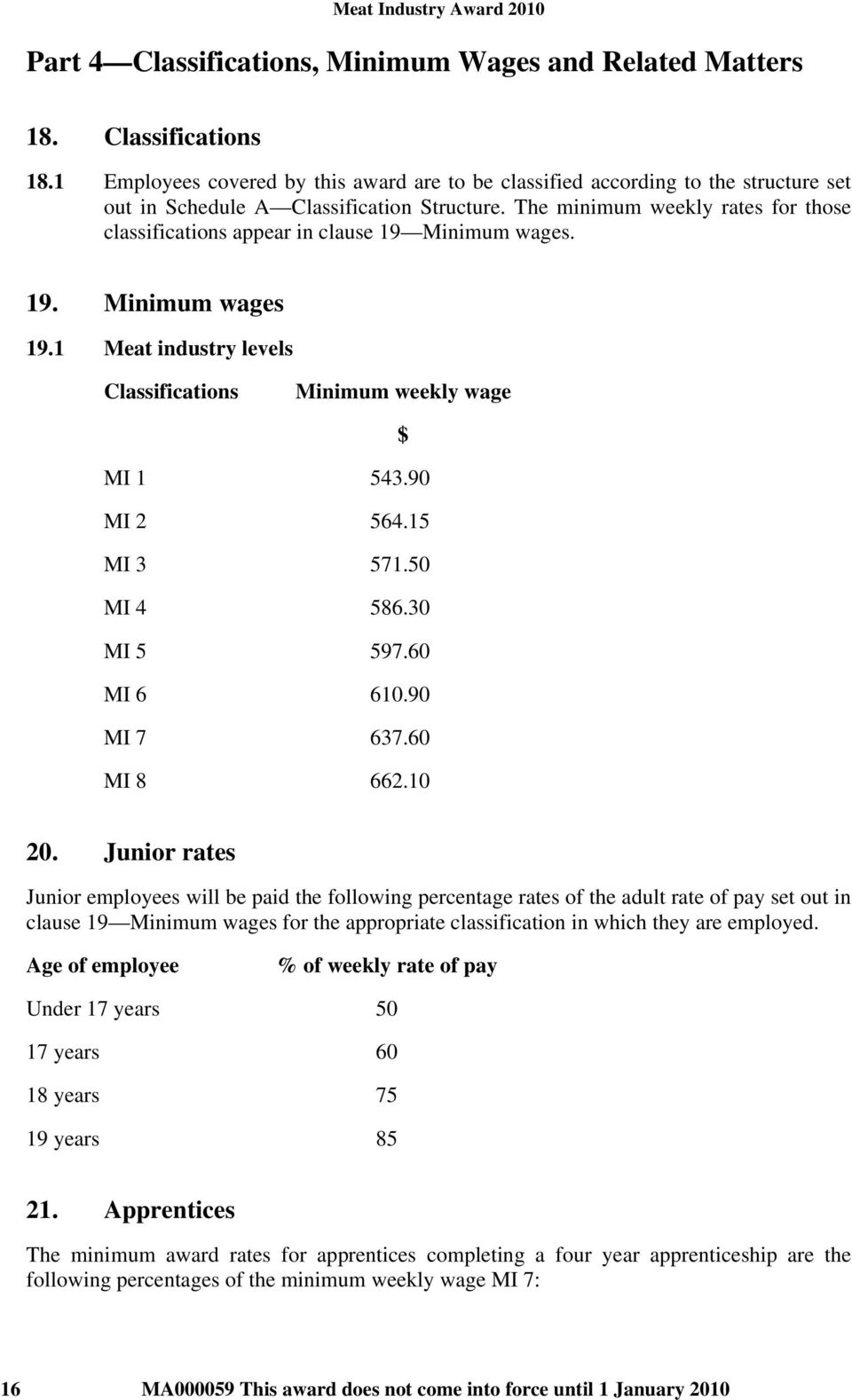
17 Year of apprenticeship % of MI 7 1st year 50 2nd year 60 3rd year 85 4th year National training wage See Schedule B 23. School-based apprentices See Schedule C 24. Payment by results 24.1 This clause applies only to meat processing establishments Subject to the provisions of this clause an employer may elect to pay employees under an incentive payment system (as an alternative to the timework payment system provided in this award) An incentive payment system may apply to the whole of a workplace or enterprise covered by this award or a section or sections of such workplace or the specified categories of employees within the workplace and, to the extent of any inconsistency, will prevail over the timework payment system provided in this award whilst the incentive payment system remains in force The terms and conditions of any incentive payment system and any agreed modification to such system will be: fully explained by the employer to all employees working under such system prior to implementation; committed to writing by the employer in a form that enables the operation of the system to be readily understood, and allows employees to monitor accrual of entitlements under the system; and made available by the employer in written form to all employees covered by the system, upon request, or to an employee The information upon which payments under an incentive system are calculated, and all payments made and other benefits provided to employees under a system must be recorded in writing in the time and wages records of the employer kept in accordance with the requirements of the Act Subject to this clause, all wages and other entitlements payable to an employee in accordance with an incentive payment system under this clause, will be payable to MA This award does not come into force until 1 January
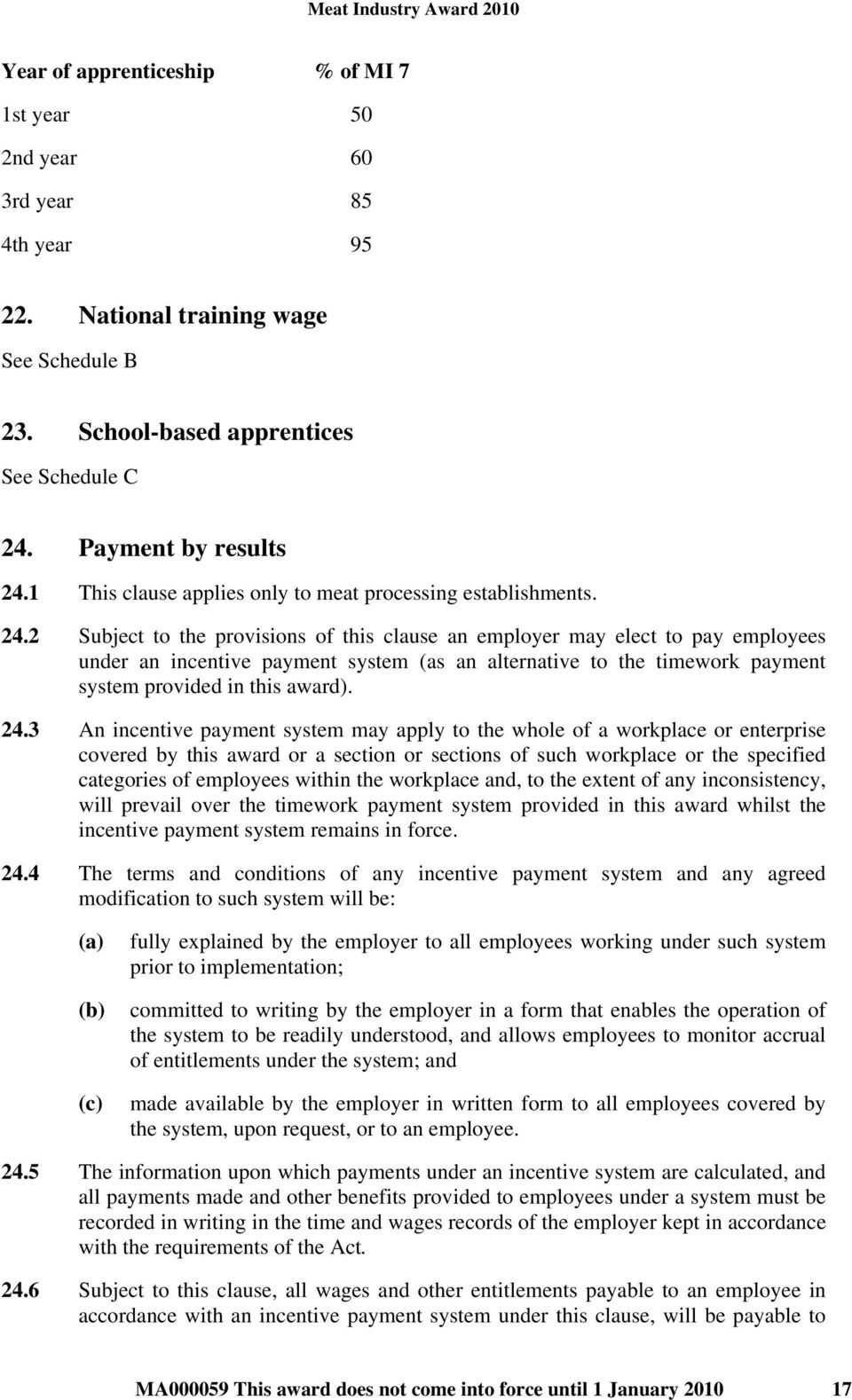
18 the employee as if the terms of the incentive payment system were terms of this award Once implemented, any incentive payment system may only be modified by agreement either between the employer and the majority of employees covered by the system. Unless expressly agreed by the employer and a majority of employees no modification to the system will operate so as to detract from or reduce accrued or accruing rights in respect of work performed by employees prior to the implementation of the modification Nothing in clause will affect the right of an employer or a majority of employees to terminate any incentive payment system under clause in cases where no modification of the system is sought Subject to this award, NES and the Act, the minimum ordinary time earnings for a day or week for employees working in accordance with an incentive payment scheme will be based on the rate of pay prescribed by clause 19 Minimum wages for the classification of the employee plus: for daily hire employees, an incentive loading of 20% of the employees classification rate, and a daily hire loading of 10% of the employees classification rate; for casual employees, an incentive loading of 20% of the employees classification rate, and a further casual loading of 25% of the employees classification rate; or for all other employees, an incentive loading of 20% of the employees classification rate Employees working in accordance with an incentive payment system who perform work in overtime hours defined in clause 36 Overtime or on Saturdays, Sundays or public holidays, will be entitled to minimum payments for all work performed during such times which are no less than the payments to which such employees would be entitled for such time periods worked pursuant to clauses 31 Hours of work, 36 Overtime and 40 Public holidays Subject to clause 24.7, the employer or the majority of the employees covered by any incentive payment system may elect at any time to terminate any such system in force, either in relation to the whole of an establishment or enterprise or any part thereof, upon giving not less than two months notice of their intention to do so All payments made to employees working under an incentive payment system for work performed during ordinary hours must be treated as the ordinary time rate for the purpose of calculating payment for annual leave, sick leave, public holidays and other paid leave under the award. The weekly rate of pay for such purposes will be calculated by dividing all payment for work performed in ordinary hours over the 12 months preceding the taking of leave, by the number of weeks during which any such work was performed. The daily rate of pay will be the appropriate pro rata percentage of the weekly rate If an employee is a member of a union, the employee may be represented by a union in meeting and conferring with the employer about the implementation of this clause, and in such case, the union must be given a reasonable opportunity to participate in 18 MA This award does not come into force until 1 January 2010

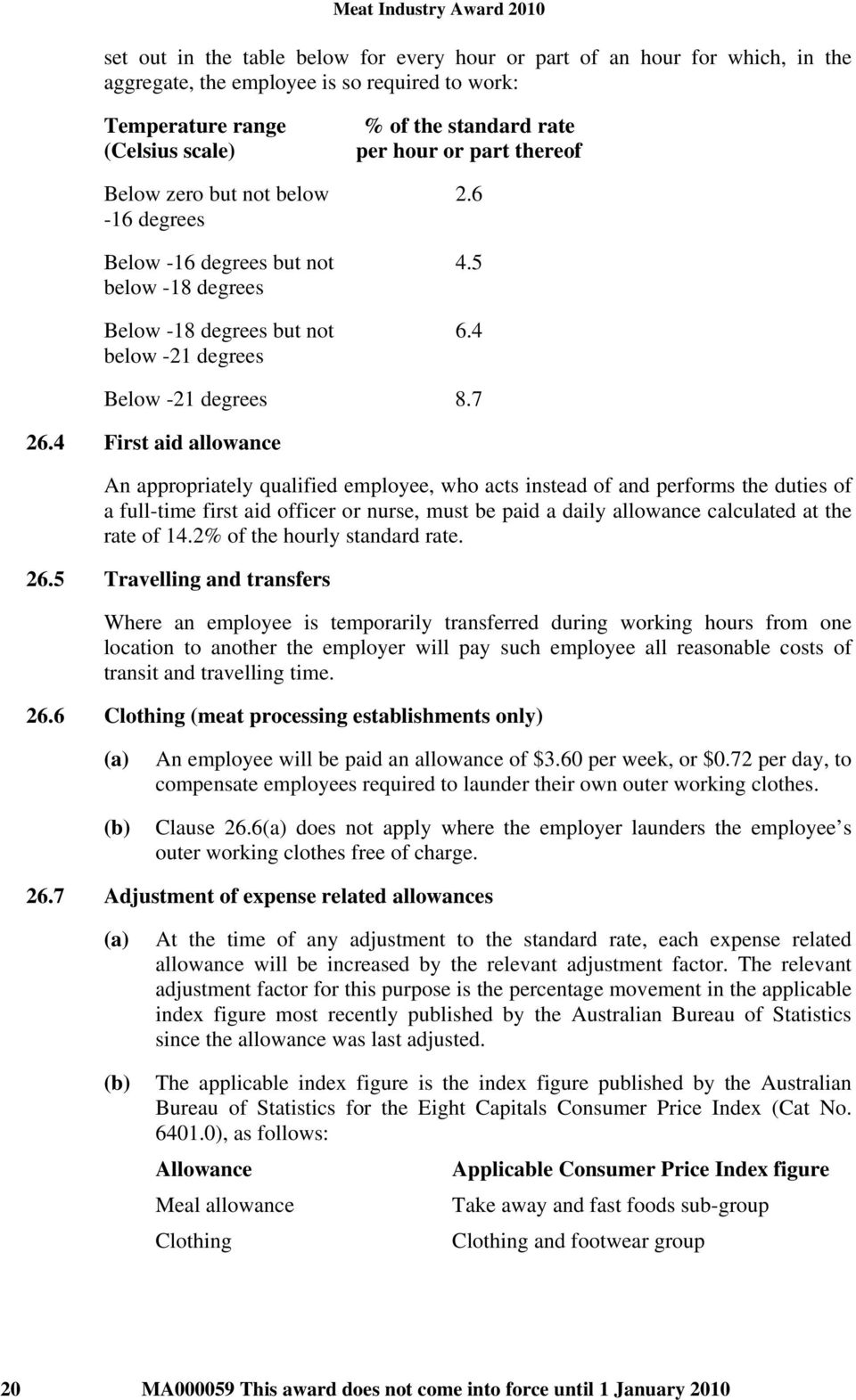
19 negotiations regarding the proposed implementation of this clause. Union involvement does not mean that the consent of the union is required prior to the introduction of agreed arrangements For the purpose of this clause, the following will apply: incentive payment system means a system of payment whereby the rate or quantum of wages is calculated for each day, shift or week by direct reference to the amount of work performed by the employee, either individually or as a member of a team; and timework payment system means a system of payment whereby the rate or quantum of wages is calculated for each day, shift or week (or part thereof) worked by reference to the time worked by employees, irrespective of the amount of work actually performed during that time, whether or not expected or predicted levels of production are agreed or specified during such work time Transitional If, upon the date that this modern award comes into effect, an employer elects to maintain in force an incentive payment system that was in force and effect immediately prior to that date, then the employer will be taken to have elected to implement that system in accordance with clause If an employer elects to maintain an existing scheme under this clause, that scheme will apply from that date in the same manner as if the scheme was implemented for the first time under this clause. 25. Supported wage system See Schedule D 26. Allowances 26.1 Leading hands An employee supervising at least three but fewer than 10 employees (including juniors and apprentices) must be paid an allowance of 1.6% of the standard rate per week. An employee supervising 10 or more employees must be paid an allowance of 2.3% of the standard rate per week Meal allowance An employee required to work overtime for one and a half hours or more after their rostered finishing time will be paid a meal allowance of $ Cold temperature allowance Where a person employed under this award is required to work in a temperature artificially reduced below zero degrees Celsius the employee will be paid at the rate MA This award does not come into force until 1 January
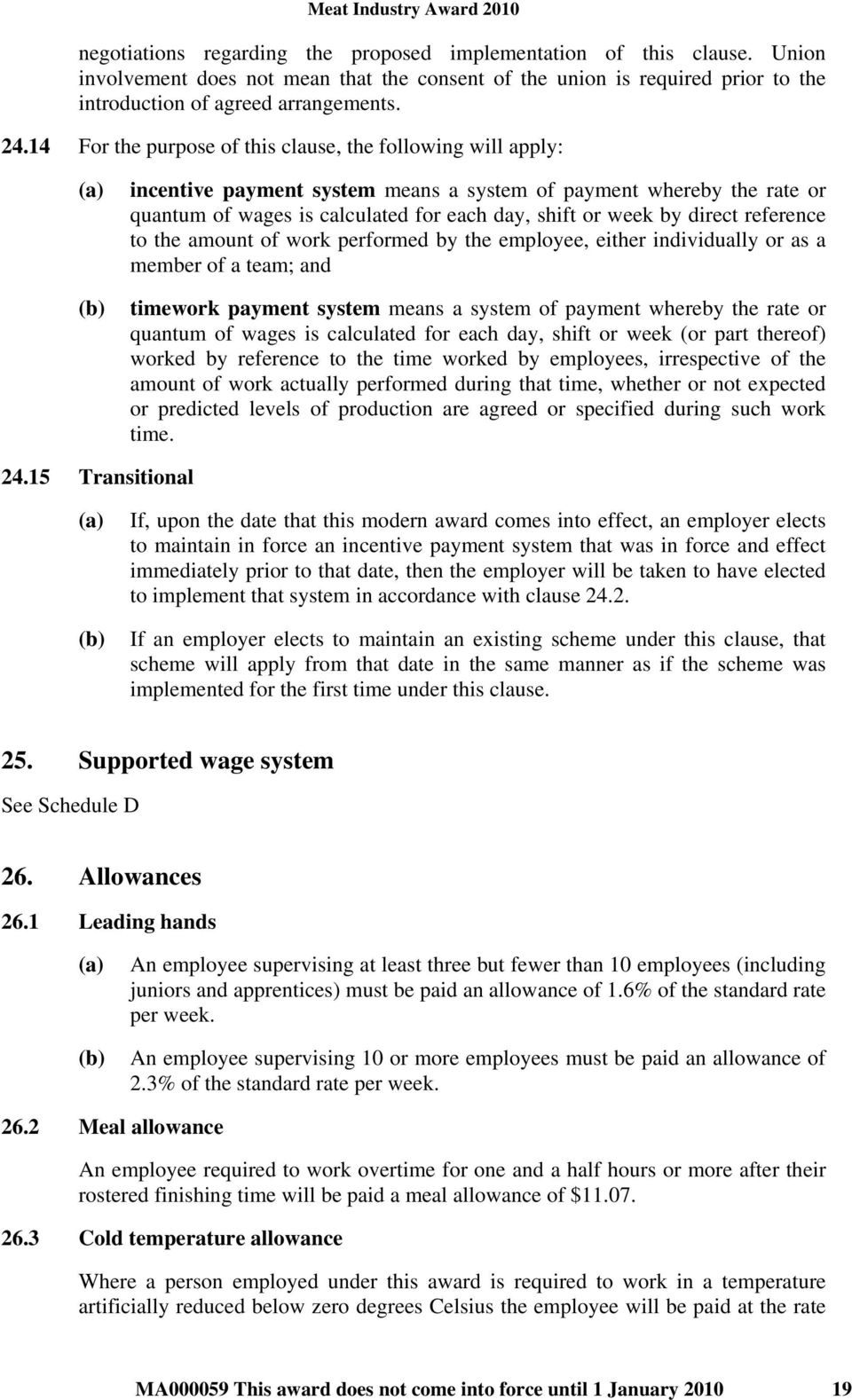
20 set out in the table below for every hour or part of an hour for which, in the aggregate, the employee is so required to work: Temperature range (Celsius scale) Below zero but not below -16 degrees Below -16 degrees but not below -18 degrees Below -18 degrees but not below -21 degrees % of the standard rate per hour or part thereof Below -21 degrees First aid allowance An appropriately qualified employee, who acts instead of and performs the duties of a full-time first aid officer or nurse, must be paid a daily allowance calculated at the rate of 14.2% of the hourly standard rate Travelling and transfers Where an employee is temporarily transferred during working hours from one location to another the employer will pay such employee all reasonable costs of transit and travelling time Clothing (meat processing establishments only) An employee will be paid an allowance of $3.60 per week, or $0.72 per day, to compensate employees required to launder their own outer working clothes. Clause 26.6 does not apply where the employer launders the employee s outer working clothes free of charge Adjustment of expense related allowances At the time of any adjustment to the standard rate, each expense related allowance will be increased by the relevant adjustment factor. The relevant adjustment factor for this purpose is the percentage movement in the applicable index figure most recently published by the Australian Bureau of Statistics since the allowance was last adjusted. The applicable index figure is the index figure published by the Australian Bureau of Statistics for the Eight Capitals Consumer Price Index (Cat No ), as follows: Allowance Applicable Consumer Price Index figure Meal allowance Take away and fast foods sub-group Clothing Clothing and footwear group 20 MA This award does not come into force until 1 January 2010
21 26.8 District allowances Northern Territory An employee in the Northern Territory is entitled to payment of a district allowance in accordance with the terms of an award made under the Workplace Relations Act 1996 (Cth): (i) (ii) that would have applied to the employee immediately prior to 1 January 2010, if the employee had at that time been in their current circumstances of employment and no agreement made under the Workplace Relations Act 1996 (Cth) had applied to the employee; and that would have entitled the employee to payment of a district allowance. Western Australia An employee in Western Australia is entitled to payment of a district allowance in accordance with the terms of a notional agreement preserving a State award or an award made under the Workplace Relations Act 1996 (Cth): (i) (ii) that would have applied to the employee immediately prior to 1 January 2010, if the employee had at that time been in their current circumstances of employment and no agreement made under the Workplace Relations Act 1996 (Cth) had applied to the employee; and that would have entitled the employee to payment of a district allowance Clause 26.8 ceases to operate on 31 December Accident pay 27.1 Subject to clause 27.2, an employee is entitled to accident pay in accordance with the terms of: a notional agreement preserving a State award that would have applied to the employee immediately prior to 1 January 2010 or an award made under the Workplace Relations Act 1996 (Cth) that would have applied to the employee immediately prior to 27 March 2006, if the employee had at that time been in their current circumstances of employment and no agreement made under the Workplace Relations Act 1996 (Cth) had applied to the employee; and that would have entitled the employee to accident pay in excess of the employee s entitlement to accident pay, if any, under any other instrument The employee s entitlement to accident pay under the notional agreement preserving a State award or the award is limited to the amount of accident pay which exceeds the employee s entitlement to accident pay, if any, under any other instrument This clause does not operate to diminish an employee s entitlement to accident pay under any other instrument This clause ceases to operate on 31 December MA This award does not come into force until 1 January
22 28. Higher duties An employee engaged for two hours or more on any day or shift on duties carrying a higher rate than their ordinary classification will be paid the higher rate for such day or shift, and if for less than two hours of the employee s total time worked on such day or shift, the employee will be paid for two hours at the rate of the higher classification and the balance of the employee s working time at the rate pertaining to the employee s ordinary classification. 29. Payment of wages 29.1 Wages will be paid on a regular weekly basis or in a manner agreed between the employer and employee. If there is no agreement, payment must be made on the usual pay day each week Monday to Thursday Upon termination of employment, any wages due to an employee will be paid on the day of such termination or, at the employee s option, forwarded to them on the next working day. 30. Superannuation 30.1 Superannuation legislation Superannuation legislation, including the Superannuation Guarantee (Administration) Act 1992 (Cth), the Superannuation Guarantee Charge Act 1992 (Cth), the Superannuation Industry (Supervision) Act 1993 (Cth) and the Superannuation (Resolution of Complaints) Act 1993 (Cth), deals with the superannuation rights and obligations of employers and employees. Under superannuation legislation individual employees generally have the opportunity to choose their own superannuation fund. If an employee does not choose a superannuation fund, any superannuation fund nominated in the award covering the employee applies. The rights and obligations in these clauses supplement those in superannuation legislation Employer contributions An employer must make such superannuation contributions to a superannuation fund for the benefit of an employee as will avoid the employer being required to pay the superannuation guarantee charge under superannuation legislation with respect to that employee Voluntary employee contributions Subject to the governing rules of the relevant superannuation fund, an employee may, in writing, authorise their employer to pay on behalf of the employee a specified amount from the post-taxation wages of the employee into the same superannuation fund as the employer makes the superannuation contributions provided for in clause An employee may adjust the amount the employee has authorised their employer to pay from the wages of the employee from the first of the month following the giving of three months written notice to their employer. 22 MA This award does not come into force until 1 January 2010
23 The employer must pay the amount authorised under clauses 30.3 or no later than 28 days after the end of the month in which the deduction authorised under clauses 30.3 or was made Superannuation fund Unless, to comply with superannuation legislation, the employer is required to make the superannuation contributions provided for in clause 30.2 to another superannuation fund that is chosen by the employee, the employer must make the superannuation contributions provided for in clause 30.2 and pay the amount authorised under clauses 30.3 or to one of the following superannuation funds: (d) (e) (f) (g) (h) Australian Meat Industry Superannuation Trust (AMIST); Meat Industry Employees Superannuation Fund (MIESF); Statewide Superannuation Trust; Westscheme Pty Ltd; Tasplan Ltd; AustSafe Super; Sunsuper; or any superannuation fund to which the employer was making superannuation contributions for the benefit of its employees before 12 September 2008, provided the superannuation fund is an eligible choice fund. Part 5 Hours of Work and Related Matters 31. Hours of work 31.1 Maximum weekly hours and requests for flexible working arrangements are provided for in the NES Ordinary hours of work (d) (e) The ordinary hours of work are not to exceed 38 per week or an average of 38 per week not exceeding 152 hours in 28 days. The ordinary hours of work are to be worked continuously at the discretion of the employer, except for meal breaks or other breaks prescribed in the award. The maximum number of ordinary hours which may be worked on any day or shift must not exceed 10 hours. Any hours worked outside the spread of hours listed must be paid at overtime rates. Notwithstanding the spread of hours set out in the tables in this clause, cleaners may be employed on ordinary hours between 6.30 am and midnight in any establishment under this award. MA This award does not come into force until 1 January
24 (f) Meat processing establishments (except for employees of the establishment engaged in retail and/or wholesale sales of fresh meat and/or meat products) (i) The following table shows the spread of ordinary hours for these establishments: Days Monday to Friday Spread of hours 6.00 am 8.00 pm (ii) The days on which ordinary hours are worked may include Saturday and Sunday subject to agreement between the employer and a majority of employees concerned. Agreement in this respect may also be reached between the employer and an individual employee. (iii) If agreement is reached in accordance with clause 31.2(f)(ii) above, the following are the minimum rates to be paid: between midnight Friday and midnight Saturday rate of time and a half; and between midnight Saturday and midnight Sunday rate of double time. (iv) The spread of hours listed in clause 31.2(f)(i) may be altered by up to one hour at either side of the spread or by agreement between the employer and the majority of employees concerned or, in appropriate circumstances, between the employer and an individual employee. (v) Any work performed by an employee prior to the commencement of the spread of hours and which is continuous with the normal ordinary hours for the purpose, for example, of getting the plant in a state of readiness for processing work, may be regarded as part of the 38 ordinary hours of work. (g) Meat manufacturing establishments (except for employees of the establishment engaged in retail and/or wholesale sales of fresh meat and/or meat products) (i) The following table shows the spread of ordinary hours for these establishments. Days Monday to Saturday Spread of hours 6.00 am 6.00 pm (ii) Saturday ordinary hourly rate in meat manufacturing establishments: Up to four ordinary hours may be worked by an employee on Saturday between the hours of 6.00 am and 6.00 pm and the employee will be paid at the rate of time and a quarter. Casuals working ordinary hours on Saturday receive the penalty outlined in the dot point above instead of the casual loading penalty referred to in clause MA This award does not come into force until 1 January 2010
25 (h) Cleaners (i) (ii) Where ordinary hours for an employee are commencing after 8.30 am and prior to noon, employees must receive their ordinary hourly rate plus 5%. Where ordinary hours for an employee are commencing at noon or later and finish at or before midnight, employees must receive their ordinary hourly rate plus 12.5%. (i) Meat retail establishments (including employees of meat processing establishments and meat manufacturing establishments engaged in retail and/or wholesale sales of fresh meat and/or meat products) (i) (ii) The following table shows the spread of ordinary hours for these establishments. Days Monday to Friday Saturday Sunday Saturday/Sunday ordinary hourly rate Spread of hours 4.00 am 9.00 pm 4.00 am 6.00 pm 8.00 am 6.00 pm All ordinary hours worked on Saturday between 4.00 am and 6.00 pm must be paid at the rate of time and a quarter. All ordinary hours worked on Sunday between 8.00 am and 6.00 pm must be paid at the rate of time and a half. Casuals working ordinary hours on Saturday or Sunday, as specified in this clause, receive the penalties outlined in the two dot points above, instead of the casual loading referred to in clause 15 Casual employment. (iii) Load out areas Notwithstanding clauses 31.2(i)(i) and (ii) above, in load out areas involving the receipt, storage, inspection, load out and delivery of meat or meat products, the ordinary hours may be worked between am and 4.00 pm (the following day) on the days Sunday to Saturday. Ordinary time worked between pm and 6.00 am must be paid for at time and a quarter for all purposes of the award. (iv) Weekends off Once every four weeks, an employee who works ordinary hours on each Sunday over a 152 hour work cycle must be given three consecutive days off which will include Saturday and Sunday. Any alternative arrangements between the employer and the employee must be by mutual agreement and in writing and signed by each of the parties. MA This award does not come into force until 1 January
26 (j) Spread of hours for particular employees performing meat retail establishment duties Subject to clause 31 Hours of work and notwithstanding other parts of this clause, where an employee of an establishment covered by this award is called upon to perform meat retail establishment duties, the hours of work provisions for the employee will be all the provisions associated with a meat retail establishment as contained in clause 31.2(i) herein Methods of arranging ordinary working hours This clause applies to all establishments. Matters upon which agreement may be reached include: (i) (ii) how the hours are to be averaged within a work cycle established; the duration of the work cycle for day workers provided that such duration does not exceed three months; (iii) rosters which specify the starting and finishing times of working hours; (iv) a period of notice of a rostered day off which is less than four weeks; (v) substitution of rostered day off; (vi) accumulation of rostered days off; (vii) arrangements which allow for flexibility in relation to the taking of rostered days off; and (viii) arrangements of ordinary hours overall. 32. Breaks 32.1 Meal breaks No employee will work for longer than five hours without a minimum 30 minute unpaid meal break. Any alternative arrangements between the employer and the employee must be by mutual agreement between the parties. Any employee called upon to work during a meal break will be paid at overtime rates for that period Rest breaks meat processing establishments only Subject to the other parts of this clause, employees whose duties are integral to the operation of a mechanised chain, conveyor, or other similar constantly moving system of production, or a non-mechanised rail system of conveyance, will be entitled to a rest break of 10 minutes during their ordinary hours of work, to be taken in the first half of the day or shift, at a time to be decided by the employer. Employees whose duties are integral to the operation means employees of the following classifications who are engaged to work on or in close connection with the relevant system of production or conveyance, namely: 26 MA This award does not come into force until 1 January 2010
27 (i) (ii) Slaughtering operations slaughterers, knife-hands, gut-room labourers, tripe room labourers; and Boning operations boners, slicers, packers (including cryovac operators and scalers, where employed as part of a packing team), pre-trimmers and employees engaged to push carcases or sides to or from slaughterers or boners on rail systems. (d) A rest break taken in accordance with clause 32.2 will count as ordinary time worked. This clause will not apply to a meat processing establishment unless it employs a total of more than 15 employees referred to in clause The employer and the majority of employees in any establishment or section of an establishment may, in relation to the rest break provided in clause 32.2 agree to: (i) (ii) extend or reduce the length of the rest break; split the break into different periods, or add further rest breaks; (iii) forego the taking of a rest break; (iv) forego payment for all or part of any rest break provided in this clause; or (v) otherwise agree. (e) An employee is not entitled to a rest break under this clause unless the employee is rostered to work at least a total of four hours on that day or shift Interruption of work If an interruption of work for any cause occurs within 20 minutes of the commencement of a break or within 20 minutes of a normal meal break, the employer may direct that the break or meal break be taken. Provided that where there is a breakdown of machinery within one hour of the time of the normal meal, the employer may require employees to have their meal break at an earlier time. 33. Shiftwork 33.1 Shifts may be worked on any work covered by this award The ordinary hours of work for shiftworkers are to be an average of 38 per week and must not exceed 152 hours in 28 consecutive days By agreement between the employer and the majority of employees concerned, a roster system may operate on the basis that the weekly average of 38 ordinary hours is allowed over a period which exceeds 28 consecutive days but does not exceed 12 months. In the absence of such agreement, by the employer giving not less than seven days notice to each employee of such proposed change of times The ordinary hours of work are to be worked continuously, except for meal and any rest breaks, at the discretion of the employer. MA This award does not come into force until 1 January
28 33.5 Except at changeover of shift an employee will not be required to work more than one shift in each 24 hours Transfer of an employee from day work to shiftwork, or from shiftwork to day work, will be by agreement between the employer and the employee Shifts may be worked on a one-shift, two-shift or three-shift system For the purpose of this clause: (d) Afternoon shift means any shift commencing at or after 2.00 pm and finishing at or before midnight. Night shift means any shift finishing subsequent to midnight and at or before 9.00 am. Fixed night shift means a night shift on which an employee is not allowed to rotate so as to give the employee at least one week in each three consecutive weeks on some other shift or shifts. Day shift in a three-shift system means any shift finishing at or after 2.00 pm and at or before 4.00 pm Shift allowances (d) (e) An employee on afternoon shift will be paid the ordinary hourly rate for the classification in which the employee is employed under this award, plus 15%. An employee on night shift will be paid the ordinary hourly rate for the classification in which the employee is employed under this award, plus 25%. An employee on a fixed night shift will be paid the appropriate rate for the classification in which the employee is employed under this award, plus 30 %. A casual employee employed in shiftwork will receive the appropriate percentage loading (shift allowance) prescribed in this clause and an additional 25% casual loading (as prescribed by clause 15 Casual employment of this award) of the appropriate award rate (i.e. not inclusive of the shift allowance as prescribed by clause 33.9). In establishments other than meat processing establishments a shiftworker who works on an afternoon or night shift which does not continue for a least five successive afternoon or night shifts must be paid for each shift 50% for the first three hours and 100% for the remaining hours in addition to their ordinary rate Meal break A shiftworker except when engaged on a three-shift system, may either be allowed a: meal break of not less than 30 minutes per shift; or crib time of 30 minutes after working five hours, which will be counted as time worked and to be taken at a time agreed between the employer and a majority of employees directly concerned. 28 MA This award does not come into force until 1 January 2010
29 33.11 Altering starting times Unless otherwise agreed, an individual employee who is required to alter their starting time to enable the management to make provision for a replacement will be given at least 24 hours notice of the change Three-shift systems Employees engaged on a three-shift system will rotate between shifts unless otherwise agreed between the employer and employees directly concerned Twelve hour days or shifts By agreement between an employer and the majority of employees in the enterprise or part of the enterprise concerned, 12 hour days or shifts may be introduced subject to: (d) (e) proper health monitoring procedures being introduced; suitable roster arrangements being made; proper supervision being provided; adequate breaks being provided; and an adequate trial or review process being undertaken. 34. Rostering 34.1 This clause is subject to other provisions contained in the award The employer must post a roster in the premises, showing the starting and finishing times for ordinary hours for employees This roster may be amended by the employer provided 36 hours notice is given Starting and finishing times appearing on the roster will be for a period which is not less than one week in length. 35. Make-up time An employee may elect, with the consent of their employer, to work make-up time, under which the employee takes time off ordinary hours, and works those hours at a later time, during the spread of ordinary hours provided in the award. 36. Overtime 36.1 Entitlement to overtime and payment All time worked outside ordinary working hours as prescribed in clause 31 Hours of work (or in the case of a shiftworker, outside the hours rostered as ordinary shiftwork hours in accordance with clause 34 Rostering) will be deemed to be overtime and be paid for at time and a half for the first three hours and double time thereafter. MA This award does not come into force until 1 January
30 All overtime worked on a Sunday in meat processing establishments must be paid at double time with a minimum payment of four hours Time off instead of payment for overtime Where an employee with the consent of the employer has accrued an entitlement to time off instead of payment for overtime, they will be able to use that entitlement for any leave purpose. Time off instead of payment for overtime must equate to the overtime rate. If the employee works one hour overtime and elects to take time off instead of payment the time off would equal one and a half hours or, where the rate of pay for overtime is double time, two hours. Part 6 Leave and Public Holidays 37. Annual leave 37.1 Annual leave is provided for in the NES. Annual leave does not apply to a casual employee Definition of shiftworker For the purpose of the additional week of leave provided for in the NES, shiftworker is a seven day shiftworker who is regularly rostered to work on Sundays and public holidays Payment for annual leave An employee under this award, before going on annual leave, will be paid: (i) their ordinary time earnings that they would have earned had they not been on leave; and (ii) any annual leave loading as provided in clause For the purpose of ascertaining ordinary time earnings in clause 37.3(i), the following are not included: (i) incentive-based payments (other than those coming within clause 24 Payment by results); (ii) bonuses; (iii) loadings (other than the loading for a daily hire and part-time daily hire employee as set out in clause 14 Daily hire); (iv) monetary allowances; (v) overtime; (vi) penalty payments (other than ordinary hour penalty rates for employees provided for in this award and only if the employee is regularly rostered to work on weekends); and 30 MA This award does not come into force until 1 January 2010
31 (vii) any other separately identifiable amounts. In the event of an employee being engaged four weeks prior to the commencement of leave, or termination of employment, in two or more classifications entitling the employee to different rates of pay, the wages to be paid to the employees will be the average of the weekly wage rates for the classifications in which the employee was engaged Annual leave loading (d) An employee will receive a loading of 17.5% calculated on the appropriate rate of pay in clause 19 Minimum wages. Employees who would have worked on shiftwork had they not been on leave will be paid the greater of the shift allowance or the 17.5% loading but not both. An employee and the employer may agree to defer payment of the annual leave loading in respect of single day absences until at least five consecutive annual leave days are taken. No annual leave loading is due for a period of leave paid out which is less than one year Payment of annual leave on termination of employment Where an employee leaves or is terminated by the employer during the course of any qualifying 12 month period the employer must pay that employee pro rata wages calculated at the rate of 2.93 hours for each completed week of work. In the case of seven day shiftworkers, the proportionate payment will be calculated on the basis of 3.66 hours for each completed week of work. Where leave has been taken in advance by an employee and the employment of the employee is then terminated, the employer will use the amount already paid to offset any sums which would otherwise be paid under clause If the monies already paid to the employee are still in excess of whatever monies would be payable under clause 37.5, the excess will be deducted from any remuneration payable to the employee upon termination Annual close-down Where an employer closes down a plant or a sections of a plant for the purpose of allowing annual leave to all or the bulk of the employees in the plant or sections concerned, the employer should, where possible, give the employees concerned not less than three months notice of the employer s intention to stand down for the duration of the close-down all employees in the plant or sections concerned. For those employees who have not qualified for annual leave in accordance with clause 37 Annual leave, paid leave on a proportionate basis at the appropriate rate of wage and loading prescribed by clauses 37.3 and 37.4 will be granted. An employee who has then qualified for annual leave in accordance with clauses 37.1 or 37.2 and has also completed a further month or more of MA This award does not come into force until 1 January
32 continuous service will be allowed leave and will also be paid leave on a proportionate basis for the period worked since the close of the employee s last 12 monthly qualifying period. (d) (e) The next 12 month qualifying period for each employee affected by the closedown will commence from the day on which the plant or section concerned is reopened for work. Provided that all time during which an employee is stood off without pay for the purposes of this clause will be deemed to be time of service in the next 12 monthly qualifying period. If in the first year of service with an employer an employee is allowed proportionate annual leave under clause 37.6, and subsequently within such year leaves employment or employment is terminated by the employer through no fault of the employee, the employee will be entitled to the benefit of clause 37.5 subject to the adjustment for any proportionate leave which may have been allowed. 38. Personal/carer s leave and compassionate leave Personal/carer s leave and compassionate leave are provided for in the NES. 39. Community service leave Community service leave is provided for in the NES. 40. Public holidays Public holidays are provided for in the NES Substitution of public holidays An employer, with the agreement of the employee or employees, may substitute another day for any public holiday Payment for work on public holidays Employees including casuals who work on: Christmas Day and Anzac Day will be paid at double the ordinary hourly rate for all time worked; Good Friday will be paid for all time worked at the rate of time and a half for the first four hours and double time thereafter based on the ordinary hourly rate; and any other public holiday will be paid at time and a half for the first two hours and double time thereafter based on the ordinary hourly rate. For full-time employees, the above payments will be in addition to the ordinary weekly, daily or hourly rate of pay as appropriate. 32 MA This award does not come into force until 1 January 2010
33 40.3 Time off instead of public holiday rates Notwithstanding any other provision of this clause, when an employee agrees to work on a public holiday which is part of their ordinary working week, they will be paid at the rate prescribed by this clause for the particular holiday, or by agreement between the employee and employer they may be paid the appropriate ordinary rate and given equivalent ordinary time off instead within 28 days of the holiday occurring unless other arrangements are agreed to by the employer and employee. 41. Long service leave Long service leave is provided for in the NES. MA This award does not come into force until 1 January
34 Schedule A Classification Structure A.1 The schedule sets out the classification structure that will apply to all employees covered by this award. A.2 Definitions A.2.1 A.2.2 A.2.3 A.2.4 Boner is an employee who is required to use a knife to remove meat from the bones, sides, quarters or other piece of a carcase in accordance with the employer s specifications and, where required by the employer, to dispatch such meat, bones and trimmings to other employees and/or work areas for further processing as required by the employer. Carcase grader is an employee who determines the category or grades into which animal carcasses are allotted in accordance with approved specifications and who is appropriately accredited by the relevant authority. General butcher means an employee who holds an accredited and relevant retail butchering trade qualification. Salesperson means an employee (not being a general butcher) who is employed in a self-service establishment in the replenishing of display or storage cabinets or work associated or employed in a meat retail establishment shop, selling meat products and whose principal responsibility will be dealing directly with customers in respect to sales of meat and other butcher shop products, and who may also perform the following duties: (d) (e) cut uncooked meat for weight; wrap meat or smallgoods; divide sausages, frankfurts or other smallgoods and for this purpose use a knife for cutting; sell goods already prepared; and prepare counter ready products. A.2.5 A.2.6 A.2.7 A.2.8 A.2.9 Sawyer is an employee who breaks down a carcase, side, quarter or other piece using a saw, either for the pre-work-up for boning or in accordance with required specifications. Skin classer is an employee accredited to assess the categories or grades into which sheep skins are sorted in accordance with predetermined specifications. Slaughterer in a meat manufacturing establishment or a meat retail establishment (other than a tradesperson slaughterer) is competent to perform slaughtering tasks in accordance with the employer s specifications. Slaughterer Class 1 is an employee who performs the indicative tasks set out in the classification stream. Slaughterer Class 2 is an employee who performs the indicative tasks set out in the classification stream. 34 MA This award does not come into force until 1 January 2010
35 A.2.10 Slaughterer Class 3 is an employee who performs the indicative tasks set out in the classification stream. A.2.11 Slicer is an employee who is required to use a knife to trim, including the removal of extraneous material, in accordance with the employer s instructions and product specifications and to dispatch such product to other employees for further processing if required by the employer. A.2.12 Smallgoods maker means an employee who has served a relevant apprenticeship or has at least four years general experience in smallgoods-making and who is responsible for the making of smallgoods and who may be required to perform all tasks relating to smallgoods manufacturing including that of mixing-machine operator, butcher, boner, salter and/or pickle pumper, cooker, filler, linker and table hand, but smallgoods maker does not include a person making smallgoods in a meat retail establishment. A.2.13 Trade qualified slaughterer is an employee who is competent to slaughter to completion all species of animal to approved standards and who has an accredited and relevant trade qualification. A.2.14 Trimmer is an employee who uses a knife to remove fat or other extraneous material or foreign matter from a carcase, side, quarter or piece prior to boning or in preparation for chilling prior to boning. A.3 Classifications A.3.1 Meat Industry Level 1 An employee at this level will be a person with no experience in the industry undergoing on-the-job training for an initial period of at least three months. A.3.2 Meat Industry Level 2 An employee at this level will be performing the following indicative tasks: Meat retail establishment stream Order person delivering meat/meat products. Meat manufacturing establishment stream A.3.3 Meat Industry Level 3 Linker, table hand; Slaughterer s assistant; Curing section assistant required to do salting; Washing, drying, smoking section assistant; Retort; Employee in lard section. An employee at this level will be performing the following indicative tasks: Meat manufacturing establishment Filerman; stream Packing-room hand; MA This award does not come into force until 1 January
36 All meat industry streams Slicing and/or operating scales, packing ham or bacon and/or operating closing machine. Employee directly connected to the slaughter floor tasks such as moving cattle/sheep up the race; Employee indirectly connected with the slaughter floor tasks such as cleaning tripe by machine/hand; Separating and/or handling offal at the eviscerating table; Removing head meat; Bagging lambs; Labourers associated with boning and slicing activities; Labourer associated with by-product activities; Strapping or wiring-machine operator or vacuum machine operator; Operating Whizzard Knives; Wrapping, weighing, pricing, packing and packaging uncooked meat; Salter and/or pickle pumper (arterial or stab); Chiller room/freezer room hand; Loading and unloading labourer; Storing and packing labourer in or about storage works; Drover/yardperson/stockperson; Cleaners; Labourers involved in tanning or other treatment or processing of skins or hides; Assistants in buffing, fluffing, curtain coat, splitting, pasting, setting out and sammying; Machine operators/machinists in tanning or other treatment/processing of skins or hides not elsewhere classified; Yard person in tanning and/or treatment/processing of skins or hides; An employee performing clerical and/or office tasks such as maintenance of basic records, basic word processing, typing and 36 MA This award does not come into force until 1 January 2010
37 filing, collating, photocopying, handling and distributing mail, delivering messages, operation of keyboard and other allied and similar equipment. A.3.4 Meat Industry Level 4 An employee at this level will be performing the following indicative tasks: Meat retail establishment stream Smallgoods maker in a meat retail establishment (non trade qualifications); Cooker and/or scalder; Cashier; Loaders and labourers in areas such as wholesale meat markets. Meat manufacturing establishment Silent-cutter operator; stream Mixing machine operator; Smallgoods seller from a vehicle; Cutter up, guillotine operator, derinding machine operator; Packer and/or scaler (smallgoods); Ham & bacon curer. Meat processing establishment stream Slaughterer (calves and beef) Class 3 (feeding cattle from race into box; tying weasands (not in shackling area); washing anus and pit; rodding weasands; removing horns; removal of fore hooves; removing heads by severing spinal cord and placing on table or chain; remove first hind foot; change first leg; remove second hind foot; change second leg; pulling tail; split paddy whack and drop; placing and removing chains on hide stripper and removing tail skin from hide; hide puller; saving sinews from forelegs; push to saw; pull from saw; trimming sides; trimming forces, trimming hinds); Slaughterer (sheep) Class 3 (operate restrainer and stun, shackle to fixed hook, gambrel and slide; insert spreader, rod weasands, remove spreader, opening up, clear rectum gut and bladder, strip rectum gut, tie rectum gut, trimming); Slaughterer (pigs) Class 3 (moving pigs from race to pen, shackling, pushing to scalding, dehairing, tow capping, dropping rectum, shaving, singeing, washing, trimming). MA This award does not come into force until 1 January
38 All meat industry streams Trimmer; Using knives for cleaning or preparing meat immediately prior to packing; Use of non-licensed product handling equipment; Basic operation of data processing equipment in or about storage works. Driver of motor vehicle not exceeding 6 tonne carrying capacity; In tanning and other treatment/processing of hides or skins, the task of fleshing, buffing, fluffing, curtain coat operating, skating, shaving, glazing, spraying, hand tipping, setting out, sammying In addition to the clerical and/or office tasks listed under Meat Industry Level 3 an employee at this level performs tasks such as more advanced word processing, typing and filing, generating simple documents, date entries, calculating functions, maintenance of records, operates more than basic telephone equipment and message taking. A.3.5 Meat Industry Level 5 An employee at this level will be performing the following indicative tasks: Meat retail establishment stream Salesperson; Slaughterer (associated with a retail butchers shop). Meat manufacturing establishment stream Meat processing establishment stream All meat industry streams Slaughterer; Tunnel boner. Slaughterer (calves and beef) Class 2 (knocking; shackling (chaining and hoisting); pithing; tying weasands (in shackling area); cheeking; skinning heads; removing forefeet including skinning foot and saving sinew; cleaning and dropping rectum gut and bungs; mark or strip tail; remove muzzle piece; remove fore shanks; cut aitch bone; mark and saw briskets; Slaughterer (pigs) Class 2 (stunning, gambrelling). Slicer; Sawyer; Bench power saw operator (breaking up); 38 MA This award does not come into force until 1 January 2010
39 Employee directly connected to the slaughter floor tasks such as knocking and making tallow; Employee indirectly connected with the slaughter floor tasks such as making tallow; Lining up, backing down and chopping or sawing down (pigs); Operator of rendering machinery; Operator of other by-product machinery; Driver of motor vehicle exceeding 6 tonne carrying capacity; Use of licensed product handling equipment; Tractor driver; Auto-truck or tow motor drivers; More advanced operation of data processing equipment than in Meat Industry Level 4 in or about storage works; In tanning and other treatment/processing of hides or skins, the task of currier, colour matching/mixing, chemical mixing, splitting and classing/sorting not elsewhere covered; In addition to the clerical and or/office tasks listed in Meat Industry Levels 3 and 4, an employee at this level performs more detailed tasks such as: retrieving data; maintaining appropriate records; transcribing into records; producing more advanced documents; applying knowledge of clerical and/or office operating procedures; sorting and processing and recording from original source documents; identifying and extracting information from internal and external sources; and computer program applications commensurate with tasks. A.3.6 Meat Industry Level 6 An employee at this level will be performing the following indicative tasks: Meat processing establishment stream Slaughterer (calves and beef) Class 1 (sticking including removing sweetbreads; skin first leg; skin second leg; pocketing silverside; resetting; flanking; clearing brisket and venting; siding; necking; MA This award does not come into force until 1 January
40 All meat industry streams rumping; backing off; skinning briskets and fore shanks; operating air or conventional knives on hide strippers; operating downward hide-puller; fronting out; sawing down); Slaughterer (beef) bed and cradle; Slaughtering (sheep) Class 1 (stick, first leg (including papering), second leg (including papering and hanging up second leg, cheek, open neck and spear cut, clear neck and forelegs, clear briskets, free and tie weasand, splitting down and removing trotters, flanking, paunching, and/or additional task where no restrainer is used, catch, stick and shackle; Slaughtering (pigs) Class 1 (sticking, fronting out). Boner; Carcase grader; Skin classer; In addition to the clerical and/or office tasks listed in Meat Industry Levels 3 to 5, an employee at this level requires only some general guidance after training and there is scope for discretion/judgment at this level to provide assistance to clerical persons in clerical levels below. A.3.7 Meat Industry Level 7 An employee at this level possesses and utilises trade qualifications: All meat industry streams Trade qualified slaughterer; General butcher; Smallgoods maker. A.3.8 Meat Industry Level 8 An employee at this level has duties above those of a general butcher tradesperson. Meat retail establishment stream General butcher in charge of a meat retail establishment. 40 MA This award does not come into force until 1 January 2010
41 Schedule B National Training Wage MA This award does not come into force until 1 January
42 Schedule C School-based Apprenticeship C.1 This schedule applies to school-based apprentices. A school-based apprentice is a person who is undertaking an apprenticeship in accordance with this schedule while also undertaking a course of secondary education. C.2 A school-based apprenticeship may be undertaken in the trades covered by this award under a training agreement or contract of training for an apprentice declared or recognised by the relevant State or Territory authority. C.3 The relevant minimum wages for full-time junior and adult apprentices provided for in this award, calculated hourly, will apply to school-based apprentices for total hours worked including time deemed to be spent in off-the-job training. C.4 For the purposes of clause C.3, where an apprentice is a full-time school student, the time spent in off-the-job training for which the apprentice must be paid is 25% of the actual hours worked each week on-the-job. The wages paid for training time may be averaged over the semester or year. C.5 A school-based apprentice must be allowed, over the duration of the apprenticeship, the same amount of time to attend off-the-job training as an equivalent full-time apprentice. C.6 For the purposes of this schedule, off-the-job training is structured training delivered by a Registered Training Organisation separate from normal work duties or general supervised practice undertaken on the job. C.7 The duration of the apprenticeship must be as specified in the training agreement or contract for each apprentice but must not exceed six years. C.8 School-based apprentices progress through the relevant wage scale at the rate of 12 months progression for each two years of employment as an apprentice. C.9 The apprentice wage scales are based on a standard full-time apprenticeship of four years (unless the apprenticeship is of three years duration). The rate of progression reflects the average rate of skill acquisition expected from the typical combination of work and training for a school-based apprentice undertaking the applicable apprenticeship. C.10 If an apprentice converts from school-based to full-time, all time spent as a full-time apprentice will count for the purposes of progression through the relevant wage scale in addition to the progression achieved as a school-based apprentice. C.11 School-based apprentices are entitled pro rata to all of the other conditions in this award. 42 MA This award does not come into force until 1 January 2010
43 Schedule D Supported Wage System D.1 This schedule defines the conditions which will apply to employees who because of the effects of a disability are eligible for a supported wage under the terms of this award. D.2 In this schedule: approved assessor means a person accredited by the management unit established by the Commonwealth under the supported wage system to perform assessments of an individual s productive capacity within the supported wage system assessment instrument means the tool provided for under the supported wage system that records the assessment of the productive capacity of the person to be employed under the supported wage system disability support pension means the Commonwealth pension scheme to provide income security for persons with a disability as provided under the Social Security Act 1991, as amended from time to time, or any successor to that scheme relevant minimum wage means the minimum wage prescribed in this award for the class of work for which an employee is engaged supported wage system means the Commonwealth Government system to promote employment for people who cannot work at full award wages because of a disability, as documented in the Supported Wage System Handbook. The Handbook is available from the following website: SWS wage assessment agreement means the document in the form required by the Department of Education, Employment and Workplace Relations that records the employee s productive capacity and agreed wage rate D.3 Eligibility criteria D.3.1 D.3.2 Employees covered by this schedule will be those who are unable to perform the range of duties to the competence level required within the class of work for which the employee is engaged under this award, because of the effects of a disability on their productive capacity and who meet the impairment criteria for receipt of a disability support pension. This schedule does not apply to any existing employee who has a claim against the employer which is subject to the provisions of workers compensation legislation or any provision of this award relating to the rehabilitation of employees who are injured in the course of their employment. MA This award does not come into force until 1 January
44 D.4 Supported wage rates Meat Industry Award 2010 D.4.1 Employees to whom this schedule applies will be paid the applicable percentage of the relevant minimum wage according to the following schedule: Assessed capacity (clause D.5) % Relevant minimum wage % D.4.2 D.4.3 Provided that the minimum amount payable must be not less than $69 per week. Where an employee s assessed capacity is 10%, they must receive a high degree of assistance and support. D.5 Assessment of capacity D.5.1 D.5.2 For the purpose of establishing the percentage of the relevant minimum wage, the productive capacity of the employee will be assessed in accordance with the Supported Wage System by an approved assessor, having consulted the employer and employee and, if the employee so desires, a union which the employee is eligible to join. All assessments made under this schedule must be documented in an SWS wage assessment agreement, and retained by the employer as a time and wages record in accordance with the Act. D.6 Lodgement of SWS wage assessment agreement D.6.1 D.6.2 All SWS wage assessment agreements under the conditions of this schedule, including the appropriate percentage of the relevant minimum wage to be paid to the employee, must be lodged by the employer with Fair Work Australia. All SWS wage assessment agreements must be agreed and signed by the employee and employer parties to the assessment. Where a union which has an interest in the award is not a party to the assessment, the assessment will be referred by Fair Work Australia to the union by certified mail and the agreement will take effect unless an objection is notified to Fair Work Australia within 10 working days. 44 MA This award does not come into force until 1 January 2010
45 D.7 Review of assessment Meat Industry Award 2010 The assessment of the applicable percentage should be subject to annual or more frequent review on the basis of a reasonable request for such a review. The process of review must be in accordance with the procedures for assessing capacity under the supported wage system. D.8 Other terms and conditions of employment Where an assessment has been made, the applicable percentage will apply to the relevant minimum wage only. Employees covered by the provisions of this schedule will be entitled to the same terms and conditions of employment as other workers covered by this award on a pro rata basis. D.9 Workplace adjustment An employer wishing to employ a person under the provisions of this schedule must take reasonable steps to make changes in the workplace to enhance the employee s capacity to do the job. Changes may involve re-design of job duties, working time arrangements and work organisation in consultation with other workers in the area. D.10 Trial period D.10.1 In order for an adequate assessment of the employee s capacity to be made, an employer may employ a person under the provisions of this schedule for a trial period not exceeding 12 weeks, except that in some cases additional work adjustment time (not exceeding four weeks) may be needed. D.10.2 During that trial period the assessment of capacity will be undertaken and the percentage of the relevant minimum wage for a continuing employment relationship will be determined. D.10.3 The minimum amount payable to the employee during the trial period must be no less than $69 per week. D.10.4 Work trials should include induction or training as appropriate to the job being trialled. D.10.5 Where the employer and employee wish to establish a continuing employment relationship following the completion of the trial period, a further contract of employment will be entered into based on the outcome of assessment under clause D.5. MA This award does not come into force until 1 January
Fitness Industry Award 2010
 Fitness ndustry Award 2010 NOTE: Transitional provisions may apply to certain clauses see clause 2 and Schedule A Table of Contents Part 1 Application and Operation... 3 1. Title... 3 2. Commencement and
Telecommunications Services Award 2010
 The above award was first made on 3 April 2009 [PR986383] This consolidated version of the award includes variations made on 11 September 2009 [PR988405] NOTE: Transitional provisions may apply to certain
General Retail Industry Award 2010
 Table of Contents Part 1 Application and Operation... 3 1. Title... 3 2. Commencement date... 3 3. Definitions and interpretation... 3 4. Coverage... 5 5. Access to the award and the National Employment
MODERN AWARD NUMBER MA 000002 CLERKS PRIVATE SECTOR AWARD 2010 MODERN AWARD THIS AWARD APPLIES TO ALL EMPLOYERS FROM 01 JANUARY 2010
 MAKNG HUMAN RESOURCES AND NDUSTRAL RELATONS WORK FOR YOUR BUSNESS MODERN AWARD NUMBER MA 000002 CLERKS PRVATE SECTOR AWARD 2010 MODERN AWARD THS AWARD APPLES TO ALL EMPLOYERS FROM 01 JANUARY 2010 WAGE
Educational Services (Schools) General Staff Award 2010
 The above award was first made on 4 September 2009 [PR988936] This consolidated version of the award includes variations made on 15 December 2009 [PR990818]; 16 December 2009 [PR991584] NOTE: Transitional
MCDONALD'S AUSTRALIA ENTERPRISE AGREEMENT 2013 COMMISSIONER BULL SYDNEY, 24 JULY 2013
 [2013] FWCA 5001 DECISION Fair Work Act 2009 s.185 - Application for approval of a single-enterprise agreement McDonald's Australia Limited (AG2013/7236) MCDONALD'S AUSTRALIA ENTERPRISE AGREEMENT 2013
Educational Services (Schools) General Staff Award 2010
 The above award was first made on 4 September 2009 [PR988936] This consolidated version of the award includes variations made on 15 December 2009 [PR990818]; 16 December 2009 [PR991584]; 26 March 2010
WORKCOVER QUEENSLAND EMPLOYEES AWARD STATE 2014
 CITATION: WorkCover Queensland Employees Award - State 2014 - Modern Award WORKCOVER QUEENSLAND EMPLOYEES AWARD STATE 2014 Table of Contents PART 1 Title and Operation... 3
COMPARISON TABLE - CURRENT AWARDS/MODERN AWARD
 COMPARISON TABLE - CURRENT AWARDS/MODERN AWARD AWARD MATTER HEALTH AND ALLIED SERVICES - PRIVATE SECTOR - VICTORIA CONSOLIDATED AWARD 1998 HEALTH PROFESSIONALS and SUPPORT SERVICES AWARD 2010 Definitions
Legal Services Award 2010
 Legal Services Award 2010 An introductory guide Version 2.0 28-06-2011 Practice support a. User Warning This Introductory Guide to the Legal Services Award 2010 has been prepared as an indicative guide
Final Award February 2009. Dental Private Practice Award 2010. Table of Contents. Part 1 Application and Operation of Award... 3. 1. Title...
 Final Award February 2009 Dental Private Practice Award 2010 Table of Contents Part 1 Application and Operation of Award... 3 1. Title... 3 2. Commencement date... 3 3. Definitions and interpretation...
TABLE OF CONTENTS PART A.
 TABLE OF CONTENTS PART A. TECHNICAL MATTERS... 4 1. Objectives of the Agreement... 4 2. Title of this Agreement... 4 3. Coverage, parties and persons bound... 4 4. Categories of employment... 4 5. Commencement
MISSION AUSTRALIA COMMUNITY SERVICES ENTERPRISE AGREEMENT 2011-2014 COMMISSIONER MCKENNA SYDNEY, 9 AUGUST 2011
 [2011] FWAA 5229 DECISION Fair Work Act 2009 s.185 Enterprise agreement Mission Australia (AG2011/10881) MISSION AUSTRALIA COMMUNITY SERVICES ENTERPRISE AGREEMENT 2011-2014 Social, community, home care
General practice registrar employment agreement. 2015 and 2016 training year
 General practice registrar employment agreement 2015 and 2016 training year 1 This employment agreement template contains the standard contractual agreements as per the Fair Work Act 2009, and the 2015
Exposure Draft (Version 2.2-25 September 2015) HEALTH PRACTITIONERS AND DENTAL OFFICERS (QUEENSLAND HEALTH) AWARD - STATE 2015
 Exposure Draft (Version 2.2-25 September 2015) HEALTH PRACTITIONERS AND DENTAL OFFICERS (QUEENSLAND HEALTH) AWARD - STATE 2015 Table of Contents Page PART 1 - Title and Operation... 3 1. Title... 3 2.
Retail Agreement 2003
 Retail Agreement 2003 PART 1 -APPLICATION & OPERATION OF AGREEMENT 1.1 Title 1.2 Arrangement This Agreement shall be known as the Target Retail Agreement 2003. PART 1 -APPLICATION & OPERATION OF AGREEMENT
Neami Limited National Employment Agreement 2012
 Neami Limited National Employment Agreement 2012 CONTENTS PART 1 APPLICATION AND OPERATION OF AGREEMENT... 4 1. OBJECTIVES 4 2. APPLICATION 4 3. PERIOD OF OPERATION 4 4. DEFINITIONS AND INTERPRETATION
Victorian Public Health Sector Maintenance Multi-Employer Agreement 2013-2016
 Victorian Public Health Sector Maintenance Multi-Employer Agreement 2013-2016 page 1 PART 1 APPLICATION AND OPERATION OF THE AGREEMENT 1 TITLE This Agreement shall be known as the Victorian Public Health
Rural Wage Guide 2015/2016
 Rural Wage Guide 2015/2016 Pastoral Award Shearing Operations NSW Farmers Industrial Association Rural Wage Guide Rural Wage Guide 2015/2016 Pastoral Award - Shearing Operations Welcome to the Rural Wage
Dental Therapists, Dental Hygienists and Oral Health Therapists. Victorian Public Sector. Multi-Enterprise Agreement
 Dental Therapists, Dental Hygienists and Oral Health Therapists Victorian Public Sector Multi-Enterprise Agreement 2009-2013 DENTAL THERAPISTS, DENTAL HYGIENISTS AND ORAL HEALTH THERAPISTS VICTORIAN PUBLIC
Woolworths Ltd (Trading as Woolworths / Safeway Supermarkets) and AUSTRALASIAN MEAT INDUSTRY EMPLOYEES UNION AGREEMENT 2008
 Woolworths Ltd (Trading as Woolworths / Safeway Supermarkets) and AUSTRALASIAN MEAT INDUSTRY EMPLOYEES UNION AGREEMENT 2008 Clause No. Subject Matter Page No. PART 1 APPLICATION OF THE AGREEMENT 1. GENERAL
Parental Leave Procedure
 Parental Leave Procedure Application Overview Definitions Procedure Responsibilities and/or authorities Further assistance APPLICATION This procedure applies to continuing, fixed-term and eligible casual
TASMANIAN INDUSTRIAL COMMISSION. Industrial Relations Act 1984 s23 application for award or variation of award
 TASMANIAN INDUSTRIAL COMMISSION Industrial Relations Act 1984 s23 application for award or variation of award The Minister administering the State Service Act 2000 (T13841 of 2011) HEALTH AND HUMAN SERVICES
44. FAIR PAY AND CONDITIONS STANDARD
 Australian Master Human Resources Guide 45. NATIONAL EMPLOYMENT STANDARDS (NES) Janet Wood Workplace Relations Writer and Consultant [ 45-010] Introduction Under the Fair Work Act 2009 (FW Act), the National
Title. 1 This agreement will be known as the Victorian Government Schools Agreement 2013. Arrangement 2 This agreement is arranged as follows:
 Title 1 This agreement will be known as the Victorian Government Schools Agreement 2013. Arrangement 2 This agreement is arranged as follows: Subject Clause Allowances 20 Arrangement 2 Attendance 24 Class
Westmead Rehabilitation Hospital Pty Ltd T/A Westmead Rehabilitation Hospital (AG2014/5818)
 [2014] FWCA 3308 DECISION Fair Work Act 2009 s.185 Enterprise agreement Westmead Rehabilitation Hospital Pty Ltd T/A Westmead Rehabilitation Hospital (AG2014/5818) WESTMEAD REHABILITATION HOSPITAL PTY
CITATION: Nurses' Aged Care Award - State 2005 Reprint of Award - 1 March 2012 <http://www.qirc.qld.gov.au> QUEENSLAND INDUSTRIAL RELATIONS COMMISSION
 CITATION: Nurses' Aged Care Award - State 2005 Reprint of Award - 1 March 2012 QUEENSLAND INDUSTRIAL RELATIONS COMMISSION Industrial Relations Act 1999 - s. 698 - reprint of
Part B: Employment 9. Part C: Other conditions of service 17. Schedule 1: Salary Scales 32. Schedule 2: Casual staff 35
 Part A: Agreement formalities 3 1 Title 3 2 Operation of agreement 3 3 Definitions 3 4 Application 4 5 Access to Agreement 4 6 Entire Agreement 4 7 Savings Provision and Relationship with Other Awards
Enterprise bargaining
 Enterprise bargaining Australia s new workplace relations system From 1 July 2009, most Australian workplaces are governed by a new system created by the Fair Work Act 2009. The Fair Work Ombudsman helps
CITATION: TAFE Teachers' Award - State 2012 2012 State Wage Case Reprint <http://www.qirc.qld.gov.au> QUEENSLAND INDUSTRIAL RELATIONS COMMISSION
 CITATION: TAFE Teachers' Award - State 2012 2012 State Wage Case Reprint QUEENSLAND INDUSTRIAL RELATIONS COMMISSION Industrial Relations Act 1999 - s. 698 - reprint of award
Employment EMPLOYMENT (ANNUAL AND PUBLIC HOLIDAYS) ORDER. Order made under s.36.
 Employment Order made under s.36. EMPLOYMENT (ANNUAL AND PUBLIC HOLIDAYS) ORDER 1932-16 Amending enactments () 1.1.1969 Relevant current provisions Commencement date Order of 23.7.1970 para.4(1) LNs. 1972/113
CITATION: Early Childhood Education Award - State 2012 Repeal and New Award (A/2010/109) <http://www.qirc.qld.gov.au>
 CITATION: Early Childhood Education Award - State 2012 Repeal and New Award (A/2010/109) QUEENSLAND INDUSTRIAL RELATIONS COMMISSION Industrial Relations Act 1999 - s. 130 -
QANTAS SUPERANNUATION PLAN Formerly the Qantas Airways Limited Staff Superannuation Plan TRUST DEED AND RULES
 Trust Deed QANTAS SUPERANNUATION PLAN Formerly the Qantas Airways Limited Staff Superannuation Plan TRUST DEED AND RULES Please note that the Trust Deed is a legal document. A detailed knowledge of superannuation
B I L L. No. 183 An Act to amend The Saskatchewan Employment Act and The Saskatchewan Employment Amendment Act, 2014
 B I L L No. 183 An Act to amend The Saskatchewan Employment Act and The Saskatchewan Employment Amendment Act, 2014 (Assented to ) HER MAJESTY, by and with the advice and consent of the Legislative Assembly
1 APPLICATION AND OPERATION... 5 2 CONSULTATION AND DISPUTE RESOLUTION... 6 3 TYPES OF EMPLOYMENT AND TERMINATION OF EMPLOYMENT...
 ATTACHMENT A 1 APPLICATION AND OPERATION... 5 1.1 Title...5 1.2 Commencement date...5 1.3 Definitions and interpretation...5 1.4 Coverage...6 1.5 Access to the award and the National Employment Standards...6
CITATION: Dental Assistants (Private Practice) Award - State 2006 Reprint of Award - 1 March 2011 <http://www.qirc.qld.gov.au>
 CITATION: Dental Assistants (Private Practice) Award - State 2006 Reprint of Award - 1 March 2011 QUEENSLAND INDUSTRIAL RELATIONS COMMISSION Industrial Relations Act 1999 -
St John of God Health Care HSU Health Professionals, Administrative, Clerical and Technical Enterprise Agreement 2015
 St John of God Health Care HSU Health Professionals, Administrative, Clerical and Technical Enterprise Agreement 2015 Introduction St John of God Health Care is committed to the dignity and worth of each
Chelgrave Contracting Australia Pty Ltd Metals Labour Hire Agreement 2013-2016
 Chelgrave Contracting Australia Pty Ltd Metals Labour Hire Agreement 2013-2016 1 TITLE This Agreement shall be known as the Chelgrave Contracting Australia Pty Ltd Metals Labour Hire Agreement 2013-2016
How To Work For A School In Victoria
 VECTAA 2009 PART A EARLY CHILDHOOD TEACHERS & ASSISTANTS VICTORIAN EARLY CHILDHOOD TEACHERS AND ASSISTANTS AGREEMENT 2009 1. TITLE This Agreement shall be referred to as the Victorian Early Childhood Teachers
TEACHERS' (NSW HEALTH EARLY CHILDHOOD SERVICE CENTRES) SALARIES AND MISCELLANEOUS CONDITIONS AWARD
 IRC784 of 2015 Commissioner Tabbaa - New Award effective 1 September 2015 TEACHERS' (NSW HEALTH EARLY CHILDHOOD SERVICE CENTRES) SALARIES AND MISCELLANEOUS CONDITIONS AWARD INDUSTRIAL RELATIONS COMMISSION
NORTHERN TERRITORY PUBLIC SECTOR NURSES AND MIDWIVES 2014 2017 ENTERPRISE AGREEMENT
 NORTHERN TERRITORY PUBLIC SECTOR NURSES AND MIDWIVES 2014 2017 ENTERPRISE AGREEMENT 1. Title PART 1 APPLICATION AND OPERATION OF AGREEMENT This Agreement will be known as the Northern Territory Public
RAMSAY HEALTH CARE WA LHMU Union COLLECTIVE AGREEMENT 2008. Clause CONTENTS Page No
 RAMSAY HEALTH CARE WA LHMU Union COLLECTIVE AGREEMENT 2008 Clause CONTENTS Page No 1. TITLE 2 2. PARTIES, AREA AND SCOPE 2 3. TERM 2 4. OPERATION 2 5. INTENT OF PARTIES 2 6. INTERPRETATION 3 7. DUTIES
Plumbing apprentices
 Master Builders INDUSTRIAL RELATIONS IR14 07/2012 Plumbing apprentices WAGES & ALLOWANCES FOR PLUMBING APPRENTICES EFFECTIVE 1 JULY 2012 As a result of the transition of state awards to modern awards,
IRC No 433 of 2015 Walton P New Award effective 1 July 2015 STAFF SPECIALISTS (STATE) AWARD INDUSTRIAL RELATIONS COMMISSION OF NEW SOUTH WALES AWARD
 IRC No 433 of 2015 Walton P New Award effective 1 July 2015 STAFF SPECIALISTS (STATE) AWARD INDUSTRIAL RELATIONS COMMISSION OF NEW SOUTH WALES AWARD INDEX PART A - AWARD Clause No. Subject Matter 1. Title
Best Practice Guide Use of individual. flexibility arrangements. Working at best practice
 Best Practice Guide Use of individual flexibility arrangements 01 Work & family 02 Consultation & cooperation in the workplace 03 Use of individual flexibility arrangements 04 A guide for young workers
Southern State Superannuation Act 2009
 Version: 27.8.2015 South Australia Southern State Superannuation Act 2009 An Act to continue the Triple S contributory superannuation scheme for persons employed in the public sector; and for other purposes.
Pay Guide - Plumbing and Fire Sprinklers Award 2010 [MA000036]
![Pay Guide - Plumbing and Fire Sprinklers Award 2010 [MA000036]](/thumbs/39/19027243.jpg "Pay Guide - Plumbing and Fire Sprinklers Award 2010 [MA000036]") Pay Guide - Plumbing and Fire Sprinklers Award 2010 [MA000036] Published 12 May 2016 Pay rates change from 1 July each year, the rates in this guide apply from 01 January 2016. Information about rates
Pay Guide - Plumbing and Fire Sprinklers Award 2010 [MA000036] Published 12 May 2016 Pay rates change from 1 July each year, the rates in this guide apply from 01 January 2016. Information about rates
BROADCASTING AND RECORDED ENTERTAINMENT AWARD 2010
 BROADCASTNG AND RECORDED ENTERTANMENT AWARD 2010 Table of Contents Part 1 Application and Operation... 3 1. Title... 3 2. Commencement and transitional... 3 3. Definitions and interpretation... 4 4. Coverage...
PILOTS (GENERAL AVIATION) AWARD 1998 AUSTRALIAN FEDERATION OF AIR PILOTS 1. AWARD TITLE
 PILOTS (GENERAL AVIATION) AWARD 1998 AUSTRALIAN FEDERATION OF AIR PILOTS 1. AWARD TITLE This Award will be known as the Pilots (General Aviation) Award 1998. 2. ARRANGEMENT This award is arranged as follows:
Your Rights at Work in Australia Prepared by Labor Council of NSW For more information call our hotline1800 688 919
 Your Rights at Work in Australia Prepared by Labor Council of NSW www.labor.net.au For more information call our hotline1800 688 919 HOW PAY AND CONDITIONS ARE SET IN AUSTRALIA ACTS OF PARLIAMENT Legislation
LOCAL GOVERNMENT EARLY CHILDHOOD EDUCATION EMPLOYEES AGREEMENT 2009
 LOCAL GOVERNMENT EARLY CHILDHOOD EDUCATION EMPLOYEES AGREEMENT 2009 Kindergarten Agreement 2009 1 1. TABLE OF CONTENTS Clause Page PART 1 APPLICATION AND OPERATION OF THE AGREEMENT 1 Table of Contents`
CONTRACT AND PERM TERMS OF BUSINESS THE SUPPLY OF LIMITED COMPANY CONTRACTORS AND TEMPORARY STAFF SERVICES
 CONTRACT AND PERM TERMS OF BUSINESS THE SUPPLY OF LIMITED COMPANY CONTRACTORS AND TEMPORARY STAFF SERVICES 1. DEFINITIONS 1.1 In these Terms of Business the following definitions apply: Assignment means
Annual leave and bank holidays policy
 Annual leave and bank holidays policy This policy forms part of your contract of employment. The councils are entitled to introduce minor and non-fundamental changes to this policy by notifying you of
SPI POWERNET & SPI ELECTRICITY ETU ENTERPRISE AGREEMENT 2010-2013
 SPI POWERNET & SPI ELECTRICITY ETU ENTERPRISE AGREEMENT 2010-2013 Final Table of Contents PART 1 FORMAL REQUIREMENTS... 4 1. TITLE... 4 2. ARRANGEMENT... 4 3. APPLICATION AND PARTIES COVERED... 4 4. RELATIONSHIP
Specimen copy of the Master Policy. Life Protection for Superannuation Accounts
 Specimen copy of the Master Policy Life Protection for Superannuation Accounts Asgard Capital Management Limited ABN 92 009 279 592 AFSL 240695 is the Trustee and Administrator and is the owner of this
WELCOME ABOARD. Enterprise Agreement 2012-2015
 WELCOME ABOARD Enterprise Agreement 2012-2015 Contents PART 1 - INTRODUCTION TO THE AGREEMENT 1 1. TITLE...1 2. LIFE OF AGREEMENT...1 3. APPLICATION AND PARTIES COVERED...1 4. AGREEMENT OBJECTIVES...2
CROWN EMPLOYEES (ROADS AND TRAFFIC AUTHORITY OF NEW SOUTH WALES - SALARIED STAFF SALARIES AND CONDITIONS OF EMPLOYMENT) AWARD 2008
 CROWN EMPLOYEES (ROADS AND TRAFFIC AUTHORITY OF NEW SOUTH WALES - SALARIED STAFF SALARIES AND CONDITIONS OF EMPLOYMENT) AWARD 2008 INDUSTRIAL RELATIONS COMMISSION OF NEW SOUTH WALES Applications by Public
CITATION: Cerebral Palsy League of Queensland Award 2003 Reprint of Award - 1 November 2010 <http://www.qirc.qld.gov.au>
 CITATION: Cerebral Palsy League of Queensland Award 2003 Reprint of Award - 1 November 2010 QUEENSLAND INDUSTRIAL RELATIONS COMMISSION Industrial Relations Act 1999 - s. 698
PERSONAL ALERT SYSTEMS REBATE SCHEME PROVIDER PANER DEED
 DATED DAY OF 2015 PERSONAL ALERT SYSTEMS REBATE SCHEME PROVIDER PANER DEED between MINISTER FOR COMMUNITIES AND SOCIAL INCLUSION - and - [INSERT PARTY NAME] ACN [INSERT] Page 1 of 1 TABLE OF CONTENTS BACKGROUND...
Posting agreement. for salaried employees Technical areas
 Posting agreement for salaried employees Technical areas Table of Contents Posting agreement for salaried employees Technical areas... 3 Section 1 Scope of application of the Agreement and period of validity...
[NAME OF EMPLOYER] CASUAL INDIVIDUAL EMPLOYMENT AGREEMENT
![[NAME OF EMPLOYER] CASUAL INDIVIDUAL EMPLOYMENT AGREEMENT](/thumbs/26/8539101.jpg "[NAME OF EMPLOYER] CASUAL INDIVIDUAL EMPLOYMENT AGREEMENT") [NAME OF EMPLOYER] CASUAL INDIVIDUAL EMPLOYMENT AGREEMENT AGREEMENT made this day of 20 PARTIES 1. [NAME OF EMPLOYER] ( Employer ) 2. ( Employee ) TERMS OF EMPLOYMENT The terms of employment are as follows:
[NAME OF EMPLOYER] CASUAL INDIVIDUAL EMPLOYMENT AGREEMENT AGREEMENT made this day of 20 PARTIES 1. [NAME OF EMPLOYER] ( Employer ) 2. ( Employee ) TERMS OF EMPLOYMENT The terms of employment are as follows:
Award Maintenance. Agreement Maintenance. 1. Recruitment and retention initiatives
 ANF Medical Centres & Clinics Claim Part A Award Maintenance The new Agreement is to contain all conditions contained in the Nurses Award 2010 and the National Employment Standards (where these are beneficial)
Pay Guide - Horse and Greyhound Training Award 2010 [MA000008]
![Pay Guide - Horse and Greyhound Training Award 2010 [MA000008]](/thumbs/40/21830962.jpg "Pay Guide - Horse and Greyhound Training Award 2010 [MA000008]") Pay Guide - Horse and Greyhound Training Award 2010 [MA000008] Published 28 June 2016 Pay rates change from 1 July each year, the rates in this guide apply from 01 July 2016. Information about the definition
Pay Guide - Horse and Greyhound Training Award 2010 [MA000008] Published 28 June 2016 Pay rates change from 1 July each year, the rates in this guide apply from 01 July 2016. Information about the definition
BMT Tax Depreciation Pty Ltd - Terms of Engagement
 BMT Tax Depreciation Pty Ltd - Terms of Engagement 1.0 Definitions and Interpretation 1.1 In this document, unless the context indicates a contrary intention: Agreement means these Terms of Engagement
Attorney-General s Department Enterprise Agreement 2011
 Attorney-General s Department Enterprise Agreement 2011 Contents Page Contents Part 1 Introduction 8 Division 1.1 About this Agreement 8 1.01 Objective and overriding commitment 8 1.02 Particular commitments
ENTERPRISE AGREEMENT 2011-2014
 ENTERPRISE AGREEMENT 2011-2014 Formal acceptance of the Agreement By signing below, the parties to the Agreement signify their acceptance of its terms and conditions. Terry Moran Secretary Address: Date
*** CHAPTER VI Length and Organization of Working Time. Section I Normal Working Time. ARTICLE 96 (Length of working time)
 NATLEX Database ISN 56677 Unofficial translation prepared by the International Labour Office. This translation is intended for information purposes only and does not substitute consultation of the authoritative
SAMPLE EMPLOYMENT AGREEMENT FOR OPTOMETRIST OR PROFESSIONAL STAFF
 SAMPLE EMPLOYMENT AGREEMENT FOR OPTOMETRIST OR PROFESSIONAL STAFF This information is provided for the general guidance of members. It is not intended as a substitute for specific legal, business or industrial
INDEPENDENT PRIVATE HOSPITALS OF AUSTRALIA AND NURSING STAFF ENTERPRISE AGREEMENT 2009-2010 DEPUTY PRESIDENT SAMS SYDNEY, 10 FEBRUARY 2010
 [2010] FWAA 1009 DECISION Fair Work Act 2009 s.185 Approval of enterprise agreement Independent Private Hospitals of Australia (AG2009/24336) INDEPENDENT PRIVATE HOSPITALS OF AUSTRALIA AND NURSING STAFF
WOOLWORTHS NATIONAL SUPERMARKET AGREEMENT
 WOOLWORTHS NATIONAL SUPERMARKET AGREEMENT 2012 TABLE OF CONTENTS Clause No. Subject Matter Page No. Part 1 Application and Operation of the Agreement 1.1 Title 6 1.2 Application and Parties Bound 6 1.3
Pay Guide - Children's Services Award 2010 [MA000120]
![Pay Guide - Children's Services Award 2010 [MA000120]](/thumbs/39/19179925.jpg "Pay Guide - Children's Services Award 2010 [MA000120]") Pay Guide - Children's Services Award 2010 [MA000120] Published 28 June 2016 Pay s change from 1 July each year, the s in this guide apply from 01 July 2016. Information about the definition and operation
Pay Guide - Children's Services Award 2010 [MA000120] Published 28 June 2016 Pay s change from 1 July each year, the s in this guide apply from 01 July 2016. Information about the definition and operation
Code of Conduct for Marketing Retail Energy in Victoria
 Code of Conduct for Marketing Retail Energy in Victoria January 2009 TABLE OF CONTENTS Page INTRODUCTION...1 1. MARKETING REPRESENTATIVES - TRAINING...3 2. CONTACT WITH CONSUMERS...4 2.1 Personal contact...4
Western Power and CEPU Enterprise Agreement 2013
 Western Power and CEPU Enterprise Agreement 2013 Page Number 1 Contents Page 1. Title... 3 2. Coverage... 3 3. No Extra Claims... 3 4. The Objectives of this Agreement... 3 5. Mutual Obligations... 4 6.
REPUBLIC OF SOUTH AFRICA BASIC CONDITIONS OF EMPLOYMENT ACT
 REPUBLIC OF SOUTH AFRICA BASIC CONDITIONS OF EMPLOYMENT ACT No, 1997 ACT To give effect to the right to fair labour practices referred to in section 23(1) of the Constitution by establishing and making
SOUTH AUSTRALIAN SCHOOL AND PRESCHOOL EDUCATION STAFF ENTERPRISE AGREEMENT 2012
 SOUTH AUSTRALIAN SCHOOL AND PRESCHOOL EDUCATION STAFF ENTERPRISE AGREEMENT 2012 File No. 2788 of 2013 CROSS REFERENCE FILE NO. 5590/2012 VARIATION ORDERS MADE PURSUANT TO SECTION 84 ON 17 JULY 2013 1.
Hotel and Tavern Workers State Award Summary
 Hotel and Tavern Workers State Award Summary Things to check as an employee or employer include: Pay rates Employment of children Allowances Overtime rates Public holidays Meal breaks Leave entitlements
Pay Guide - Hospitality Industry (General) Award 2010 [MA000009]
![Pay Guide - Hospitality Industry (General) Award 2010 [MA000009]](/thumbs/40/20742862.jpg "Pay Guide - Hospitality Industry (General) Award 2010 [MA000009]") Pay Guide - Hospitality Industry (General) Award 2010 [MA000009] Published 28 June 2016 Pay rates change from 1 July each year, the rates in this guide apply from 01 July 2016. Information about the definition
Pay Guide - Hospitality Industry (General) Award 2010 [MA000009] Published 28 June 2016 Pay rates change from 1 July each year, the rates in this guide apply from 01 July 2016. Information about the definition
2006 No. 246 TERMS AND CONDITIONS OF EMPLOYMENT. The Transfer of Undertakings (Protection of Employment) Regulations 2006
 STATUTORY INSTRUMENTS 2006 No. 246 TERMS AND CONDITIONS OF EMPLOYMENT The Transfer of Undertakings (Protection of Employment) Regulations 2006 Made - - - - 6th February 2006 Laid before Parliament 7th
CHANGE MANAGEMENT IN THE NTPS
 Office of the Commissioner for Public Employment www.ocpe.nt.gov.au CHANGE MANAGEMENT IN THE NTPS Industrial Obligations and Considerations under NTPS Enterprise Agreements A GUIDE FOR MANAGERS Edition
QUEENSLAND INDUSTRIAL RELATIONS COMMISSION. Industrial Relations Act 1999 s. 156 Certification of an agreement
 QUEESLAD IDUSTRIAL RELATIOS COMMISSIO Industrial Relations Act 1999 s. 156 Certification of an agreement State Government Security Certified Agreement 2013 (CA/2013/53) DEPUTY PRESIDET BLOOMFIELD 19 July
Terms and conditions of the ACT Bundle Offer - discontinued
 Terms and conditions of the ACT Bundle Offer - discontinued Effective 2 March 2015 this offer is no longer available Your agreement dictionary 1. Interpretation 1.1 A reference to: Account Holder means
AUSTRALIAN FISHERIES MANAGEMENT AUTHORITY ENTERPRISE AGREEMENT
 AUSTRALIAN FISHERIES MANAGEMENT AUTHORITY ENTERPRISE AGREEMENT 2011 2 PART 1 - INTRODUCTION AND BACKGROUND... 7 1. APPLICATION... 7 2. PERIOD OF OPERATION... 7 3. PARTIES TO THE AGREEMENT... 7 4. CLOSED
It is hereby notified that the President has assented to the following Act which is hereby published for general information:-
 PRESIDENT'S OFFICE No. 967. 14 June 1996 NO. 29 OF 1996: MINE HEALTH AND SAFETY ACT, 1996. It is hereby notified that the President has assented to the following Act which is hereby published for general
DEECD Corporate WorkSafe policy guide January 2013
 DEECD Corporate WorkSafe policy guide January 2013 Published by the Communications Division for Human Resources Division Department of Education and Early Childhood Development Melbourne January 2013 State
Redundancy & Redeployment Policy. Transformation & Human Resources
 Redundancy & Redeployment Policy Transformation & Human Resources Issued by HR Policy Team Effective from REDUNDANCY AND REDEPLOYMENT POLICY 1 General Principles Purpose 1.1 The purpose of the policy is