
ENTERPRISE AGREEMENT
|
|
|
- Kory Snow
- 9 years ago
- Views:
Transcription
1 ENTERPRISE AGREEMENT

2 Formal acceptance of the Agreement By signing below, the parties to the Agreement signify their acceptance of its terms and conditions. Terry Moran Secretary Address: Date Community and Public Sector Union (CPSU) Address: Date Media Entertainment and Arts Alliance (MEAA) Address: Date DEPARTMENT OF THE PRIME MINISTER AND CABINET - ENTERPRISE AGREEMENT i

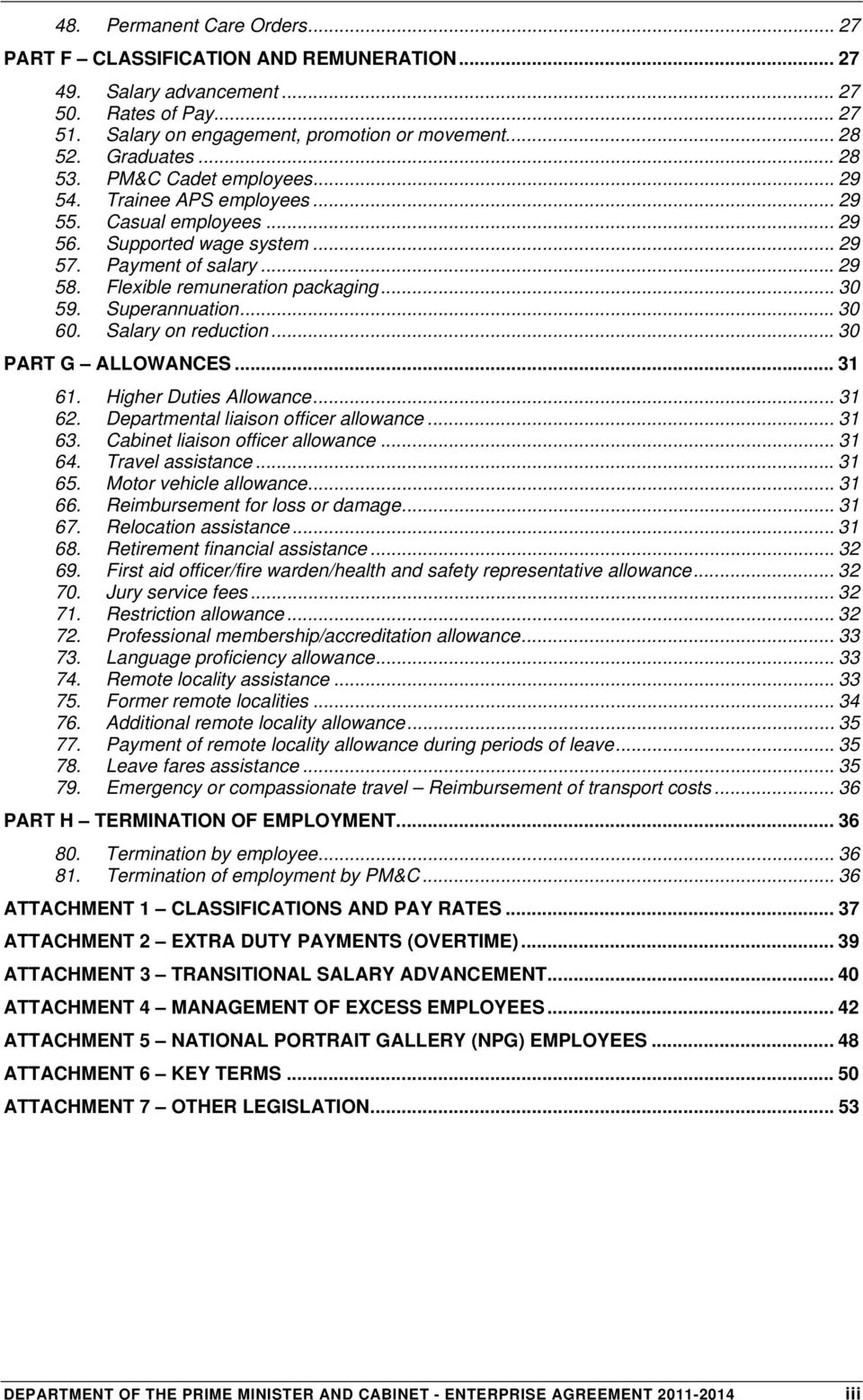
3 TABLE OF CONTENTS FORMAL ACCEPTANCE OF THE AGREEMENT... I PART A TECHNICAL AND GENERAL MATTERS Title Objective Parties and coverage Delegations Operation of the Agreement Consultation relating to major change General staff consultation Employee representatives Rights of elected union representatives Dispute resolution Resolution of individual grievances Flexibility clause Improving efficiency and productivity... 8 PART B OUR WORKPLACE Workplace culture Health and wellbeing Support for carers Capability development Study Assistance Performance management PART C EMPLOYMENT CONDITIONS Flexible working arrangements Hours of work APS level employees: flextime and overtime Executive Level employees: time off in lieu (TOIL), flexible hours and overtime Part-time employment and job sharing National Portrait Gallery rostered employees Home based work Car Parking PART D LEAVE Transfer of accrued leave (portability) Annual leave Purchased leave Cancelled leave Christmas close down Public holidays Long service leave Personal/carer s leave Cultural and ceremonial leave for Aboriginal and Torres Strait Islander employees Miscellaneous leave Community service leave Defence reserve leave Compassionate leave Unauthorised absence PART E PARENTAL LEAVE Parental leave Maternity leave Leave for supporting partners Adoption leave Foster care DEPARTMENT OF THE PRIME MINISTER AND CABINET - ENTERPRISE AGREEMENT ii

4 48. Permanent Care Orders PART F CLASSIFICATION AND REMUNERATION Salary advancement Rates of Pay Salary on engagement, promotion or movement Graduates PM&C Cadet employees Trainee APS employees Casual employees Supported wage system Payment of salary Flexible remuneration packaging Superannuation Salary on reduction PART G ALLOWANCES Higher Duties Allowance Departmental liaison officer allowance Cabinet liaison officer allowance Travel assistance Motor vehicle allowance Reimbursement for loss or damage Relocation assistance Retirement financial assistance First aid officer/fire warden/health and safety representative allowance Jury service fees Restriction allowance Professional membership/accreditation allowance Language proficiency allowance Remote locality assistance Former remote localities Additional remote locality allowance Payment of remote locality allowance during periods of leave Leave fares assistance Emergency or compassionate travel Reimbursement of transport costs PART H TERMINATION OF EMPLOYMENT Termination by employee Termination of employment by PM&C ATTACHMENT 1 CLASSIFICATIONS AND PAY RATES ATTACHMENT 2 EXTRA DUTY PAYMENTS (OVERTIME) ATTACHMENT 3 TRANSITIONAL SALARY ADVANCEMENT ATTACHMENT 4 MANAGEMENT OF EXCESS EMPLOYEES ATTACHMENT 5 NATIONAL PORTRAIT GALLERY (NPG) EMPLOYEES ATTACHMENT 6 KEY TERMS ATTACHMENT 7 OTHER LEGISLATION DEPARTMENT OF THE PRIME MINISTER AND CABINET - ENTERPRISE AGREEMENT iii
5 PART A TECHNICAL AND GENERAL MATTERS 1. Title 1.1. This Agreement is called the Department of the Prime Minister and Cabinet Enterprise Agreement Objective 2.1. This Agreement aims to facilitate achievement of departmental priorities and requirements including by: encouraging employees and supervisors to manage and prioritise workloads within reasonable working hours; maintaining a strong performance-based culture; continuing to improve the department s effectiveness through high-quality management of its human resources to achieve excellence in policy and client service; increasing operational efficiency with streamlined administrative processes and more flexible working arrangements; aiming to ensure flexibility for employees to better balance their professional and personal lives; promoting employee commitment to PM&C by upholding workplace diversity, anti-discrimination and employee-friendly principles and policies; enhancing employee development through a positive working environment that emphasises well-focused training and career development (through the PM&C Capability Development Framework); and the Public Service Act 1999 (PS Act). Ethical conduct by employees contributes significantly to efficiency and effectiveness in the workplace and to the standing of the department and its employees In developing this Agreement, four principles have been embraced: the Agreement has been developed to contribute to a harmonious working environment in the department with the aim of ensuring that PM&C provides employment conditions that appropriately recognise and remunerate employees; the arrangements and provisions contained herein have been developed and will be implemented in the context of the department s overall budget and fiscal environment; the parties to this Agreement recognise the link between gains in productivity and the need to reflect these in improved conditions of employment, where possible; and DEPARTMENT OF THE PRIME MINISTER AND CABINET - ENTERPRISE AGREEMENT

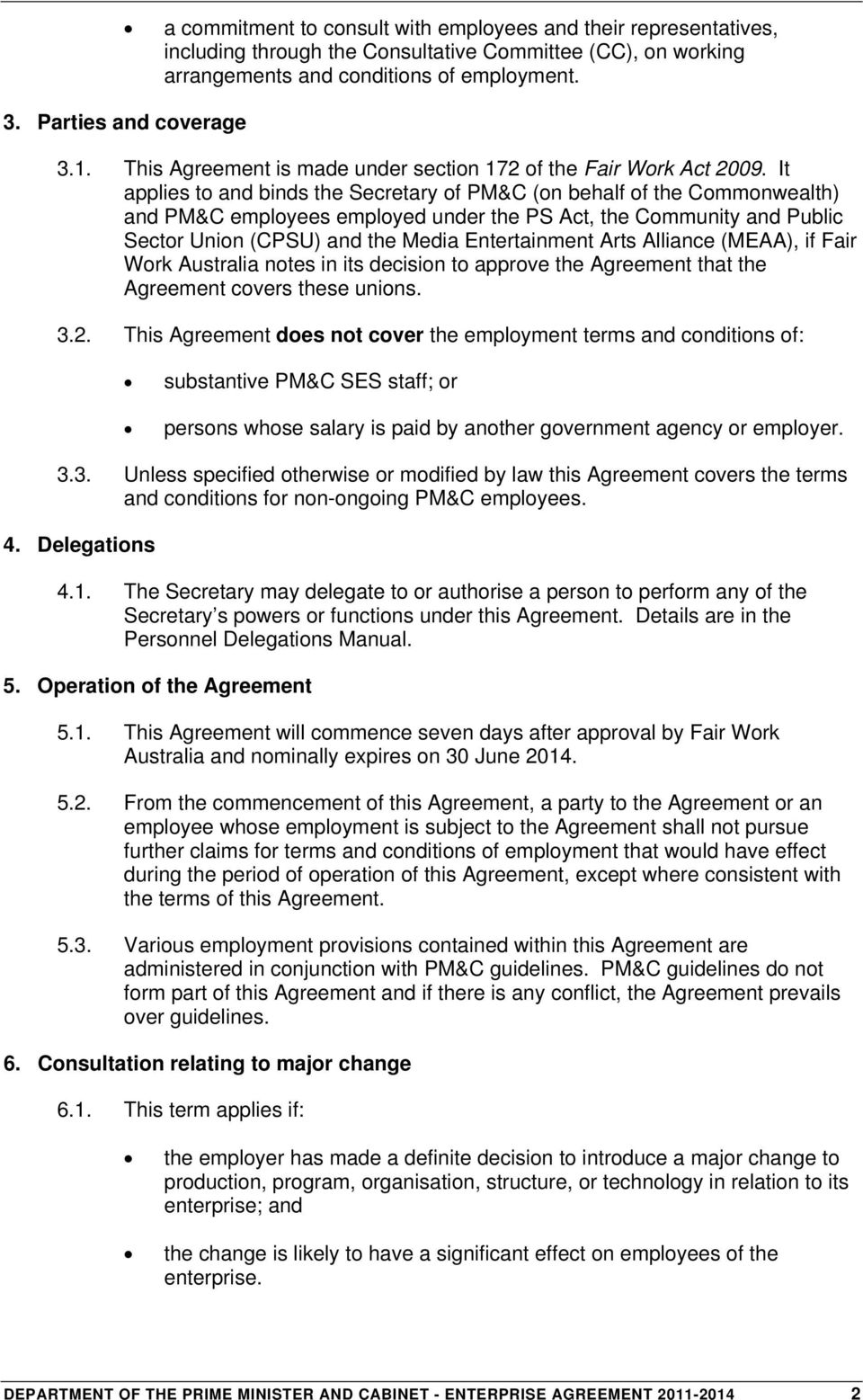
6 a commitment to consult with employees and their representatives, including through the Consultative Committee (CC), on working arrangements and conditions of employment. 3. Parties and coverage 3.1. This Agreement is made under section 172 of the Fair Work Act It applies to and binds the Secretary of PM&C (on behalf of the Commonwealth) and PM&C employees employed under the PS Act, the Community and Public Sector Union (CPSU) and the Media Entertainment Arts Alliance (MEAA), if Fair Work Australia notes in its decision to approve the Agreement that the Agreement covers these unions This Agreement does not cover the employment terms and conditions of: substantive PM&C SES staff; or persons whose salary is paid by another government agency or employer Unless specified otherwise or modified by law this Agreement covers the terms and conditions for non-ongoing PM&C employees. 4. Delegations 4.1. The Secretary may delegate to or authorise a person to perform any of the Secretary s powers or functions under this Agreement. Details are in the Personnel Delegations Manual. 5. Operation of the Agreement 5.1. This Agreement will commence seven days after approval by Fair Work Australia and nominally expires on 30 June From the commencement of this Agreement, a party to the Agreement or an employee whose employment is subject to the Agreement shall not pursue further claims for terms and conditions of employment that would have effect during the period of operation of this Agreement, except where consistent with the terms of this Agreement Various employment provisions contained within this Agreement are administered in conjunction with PM&C guidelines. PM&C guidelines do not form part of this Agreement and if there is any conflict, the Agreement prevails over guidelines. 6. Consultation relating to major change 6.1. This term applies if: the employer has made a definite decision to introduce a major change to production, program, organisation, structure, or technology in relation to its enterprise; and the change is likely to have a significant effect on employees of the enterprise. DEPARTMENT OF THE PRIME MINISTER AND CABINET - ENTERPRISE AGREEMENT
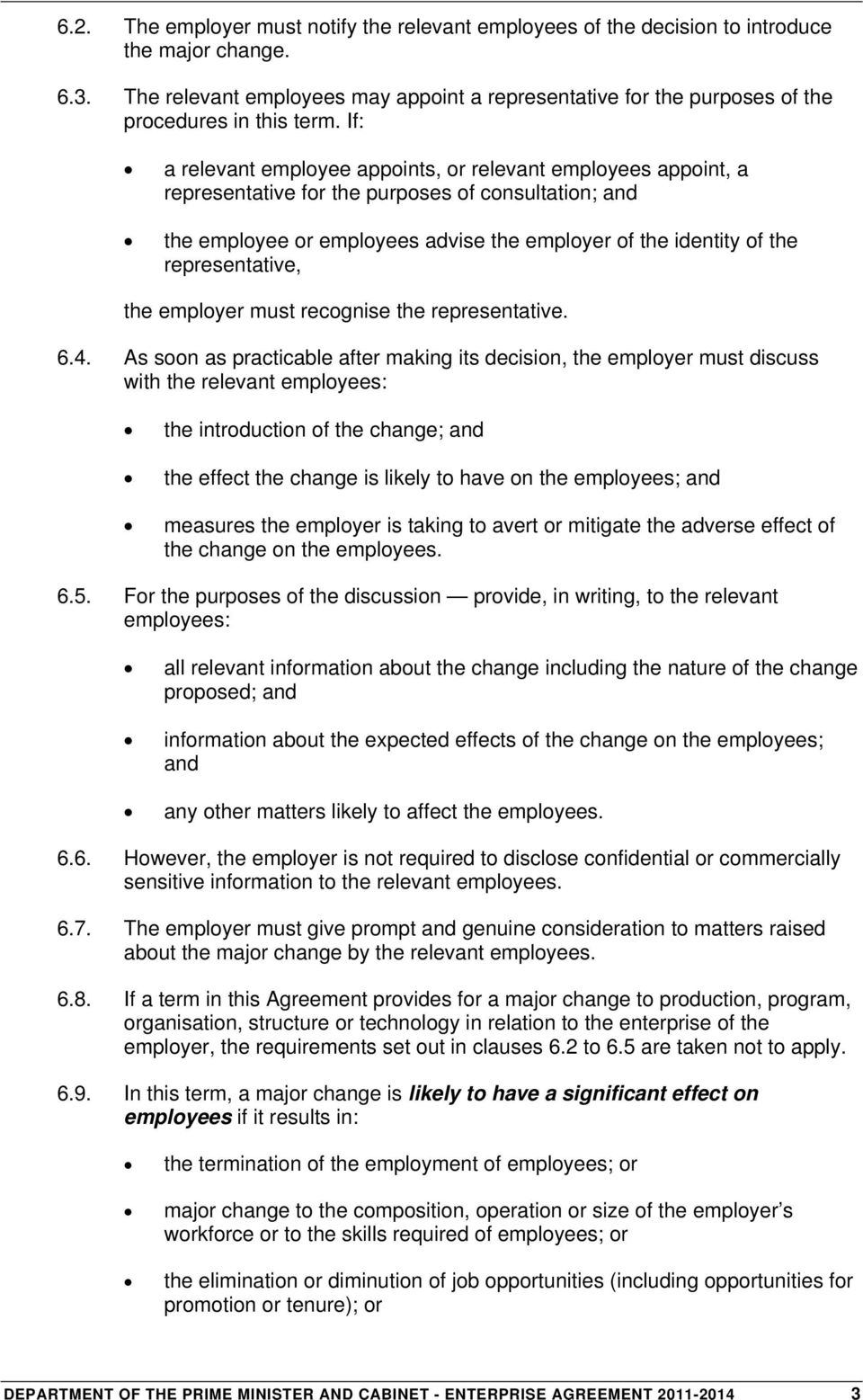
7 6.2. The employer must notify the relevant employees of the decision to introduce the major change The relevant employees may appoint a representative for the purposes of the procedures in this term. If: a relevant employee appoints, or relevant employees appoint, a representative for the purposes of consultation; and the employee or employees advise the employer of the identity of the representative, the employer must recognise the representative As soon as practicable after making its decision, the employer must discuss with the relevant employees: the introduction of the change; and the effect the change is likely to have on the employees; and measures the employer is taking to avert or mitigate the adverse effect of the change on the employees For the purposes of the discussion provide, in writing, to the relevant employees: all relevant information about the change including the nature of the change proposed; and information about the expected effects of the change on the employees; and any other matters likely to affect the employees However, the employer is not required to disclose confidential or commercially sensitive information to the relevant employees The employer must give prompt and genuine consideration to matters raised about the major change by the relevant employees If a term in this Agreement provides for a major change to production, program, organisation, structure or technology in relation to the enterprise of the employer, the requirements set out in clauses 6.2 to 6.5 are taken not to apply In this term, a major change is likely to have a significant effect on employees if it results in: the termination of the employment of employees; or major change to the composition, operation or size of the employer s workforce or to the skills required of employees; or the elimination or diminution of job opportunities (including opportunities for promotion or tenure); or DEPARTMENT OF THE PRIME MINISTER AND CABINET - ENTERPRISE AGREEMENT
8 the alteration of hours of work; or the need to retrain employees; or the need to relocate employees to another workplace; or the restructuring of jobs In this term, relevant employees means the employees who may be affected by the major change. 7. General staff consultation 7.1. These provisions are intended to operate in addition to and are not intended to impact on the operation of the consultation provisions set out in clause 6 of this Agreement The department commits to appropriate consultation with the parties covered by this Agreement as a basis for the Agreement s effective implementation PM&C is committed to consulting with employees. The key mechanisms used within the department for consultation are: a Consultative Committee; regular all staff meetings; and direct discussions with staff The Consultative Committee comprises: a Chair nominated by the Secretary; two management representatives nominated by the Secretary; one representative from each organisational unit (currently referred to as a Division), elected by a majority vote of employees to whom this Agreement applies within each such organisational unit; one representative from a state/regional office of the department elected by a majority vote of state/regional based employees to whom this Agreement applies; one organiser from each of the CPSU and MEAA; and one workplace delegate from each of the CPSU and MEAA Membership of the Consultative Committee will be reviewed after 12 months to determine if representation is appropriate to the structure of the department and the location of its employees The Consultative Committee will be consulted on the development or review of any PM&C guidelines or other corporate documents relating to matters covered by this Agreement. DEPARTMENT OF THE PRIME MINISTER AND CABINET - ENTERPRISE AGREEMENT

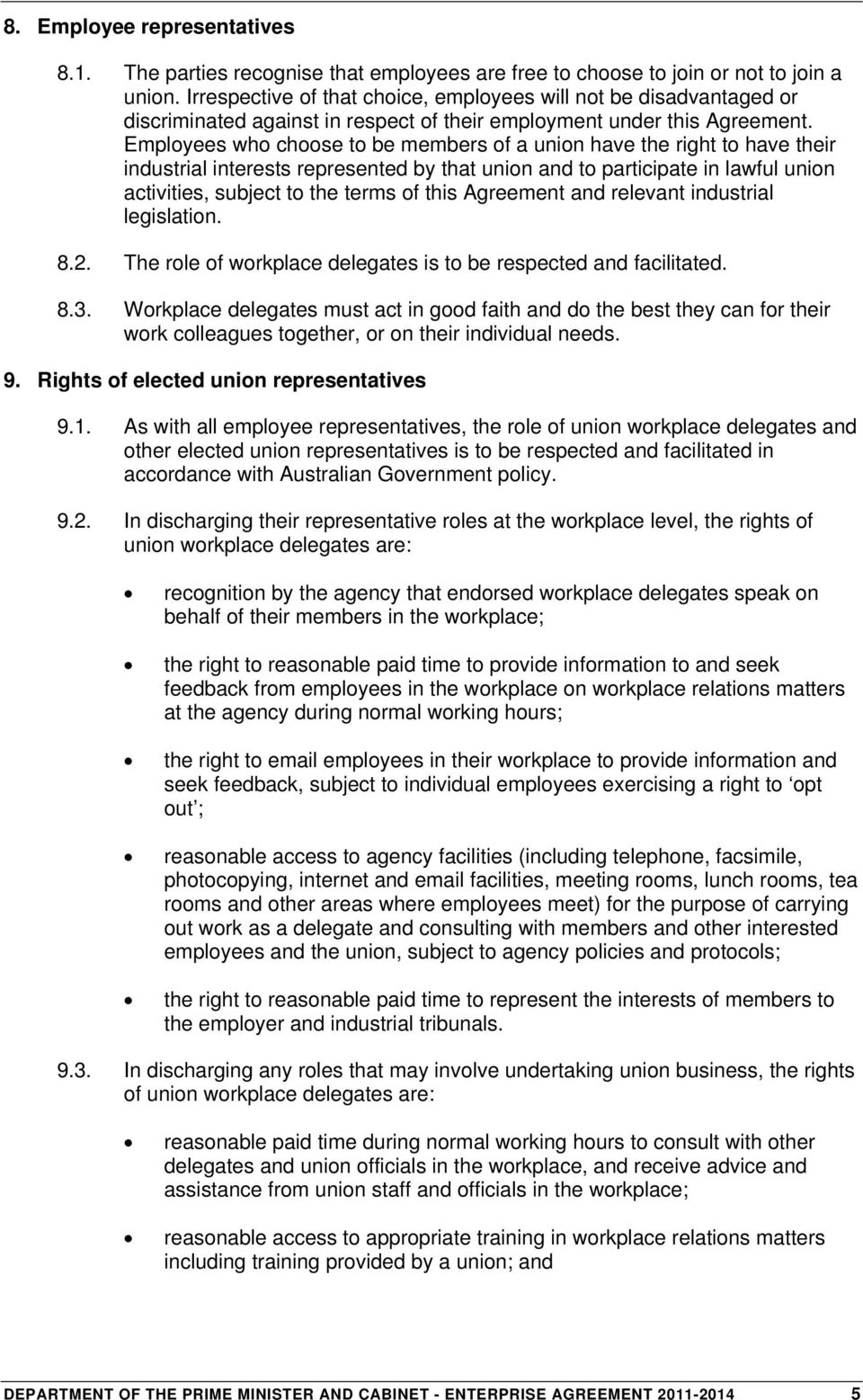
9 8. Employee representatives 8.1. The parties recognise that employees are free to choose to join or not to join a union. Irrespective of that choice, employees will not be disadvantaged or discriminated against in respect of their employment under this Agreement. Employees who choose to be members of a union have the right to have their industrial interests represented by that union and to participate in lawful union activities, subject to the terms of this Agreement and relevant industrial legislation The role of workplace delegates is to be respected and facilitated Workplace delegates must act in good faith and do the best they can for their work colleagues together, or on their individual needs. 9. Rights of elected union representatives 9.1. As with all employee representatives, the role of union workplace delegates and other elected union representatives is to be respected and facilitated in accordance with Australian Government policy In discharging their representative roles at the workplace level, the rights of union workplace delegates are: recognition by the agency that endorsed workplace delegates speak on behalf of their members in the workplace; the right to reasonable paid time to provide information to and seek feedback from employees in the workplace on workplace relations matters at the agency during normal working hours; the right to employees in their workplace to provide information and seek feedback, subject to individual employees exercising a right to opt out ; reasonable access to agency facilities (including telephone, facsimile, photocopying, internet and facilities, meeting rooms, lunch rooms, tea rooms and other areas where employees meet) for the purpose of carrying out work as a delegate and consulting with members and other interested employees and the union, subject to agency policies and protocols; the right to reasonable paid time to represent the interests of members to the employer and industrial tribunals In discharging any roles that may involve undertaking union business, the rights of union workplace delegates are: reasonable paid time during normal working hours to consult with other delegates and union officials in the workplace, and receive advice and assistance from union staff and officials in the workplace; reasonable access to appropriate training in workplace relations matters including training provided by a union; and DEPARTMENT OF THE PRIME MINISTER AND CABINET - ENTERPRISE AGREEMENT
10 reasonable paid time off to represent union members in the agency at relevant union forums In exercising their rights, workplace delegates and unions will consider operational issues, departmental policies and guidelines and the likely affect on the efficient operation of the agency and the provision of services by the Commonwealth For the avoidance of doubt, elected union representatives include APS employees elected to represent union members in representative forums, including, for example, CPSU Section Secretaries, Governing Councillors and Section Councillors. 10. Dispute resolution If a dispute relates to: a matter arising under this Agreement; or the National Employment Standards; this term sets out procedures to settle the dispute The agency or an employee who is a party to the dispute may appoint another person, organisation or association to accompany and/or represent them for the purposes of this term In the first instance, the parties to the dispute must try to resolve the dispute at the workplace level, by discussions between the employee or employees and relevant supervisors and/or management If discussions at the workplace level do not resolve the dispute, a party to the dispute may refer the matter to Fair Work Australia Fair Work Australia may deal with the dispute in two stages: Fair Work Australia will first attempt to resolve the dispute as it considers appropriate, including by mediation, conciliation, expressing an opinion or making a recommendation; and if Fair Work Australia is unable to resolve the dispute at the first stage, Fair Work Australia may then: i. arbitrate the dispute; and ii. make a determination that is binding on the parties. Note: If Fair Work Australia arbitrates the dispute, it may also use the powers that are available to it under the Act A decision that Fair Work Australia makes when arbitrating a dispute is a decision for the purpose of Div 3 of Part 5.1 of the Act. Therefore, an appeal may be made against the decision. DEPARTMENT OF THE PRIME MINISTER AND CABINET - ENTERPRISE AGREEMENT
11 10.7. Resolution of disputes is to occur in good faith by following the same principles as the good faith bargaining requirements at section 228 of the Fair Work Act While the parties are trying to resolve the dispute using the procedures in this term: an employee must continue to perform his or her work as he or she would normally unless he or she has a reasonable concern about an imminent risk to his or her health or safety; and an employee must comply with a direction given by the employer to perform other available work at the same workplace, or at another workplace, unless: i. the work is not safe; or ii. iii. applicable occupational health and safety legislation would not permit the work to be performed; or the work is not appropriate for the employee to perform; or iv. there are other reasonable grounds for the employee to refuse to comply with the direction The parties to the dispute agree to be bound by a decision made by Fair Work Australia in accordance with this term. 11. Resolution of individual grievances Under section 33 of the PS Act an employee may seek a review of decisions or actions that affect his or her individual employment. Details are in the Review of Action guideline. 12. Flexibility clause The Secretary and an employee covered by this Agreement may agree to make an individual flexibility arrangement to vary the effect of terms of the Agreement if: a. the Agreement deals with one (1) or more of the following matters: 1. arrangements about when work is performed; 2. overtime rates; 3. penalty rates; 4. allowances; 5. remuneration; and/or 6. leave; and DEPARTMENT OF THE PRIME MINISTER AND CABINET - ENTERPRISE AGREEMENT
12 b. the arrangement meets the genuine needs of the department and the employee in relation to one (1) or more of the matters mentioned in paragraph (a); and c. the arrangement is genuinely agreed to by the Secretary and the employee The Secretary must ensure that the terms of the individual flexibility arrangement: are about permitted matters under section 172 of the Fair Work Act 2009; and are not unlawful terms under section 194 of the Fair Work Act 2009; and result in the employee being better off overall than the employee would be if no arrangement was made The Secretary must ensure that the individual flexibility arrangement: is in writing; and includes the name of the department and the employee; and is signed by the Secretary and the employee and if the employee is under 18 years of age, signed by a parent or guardian of the employee; and includes details of: i. the terms of this Agreement that will be varied by the arrangement; and ii. iii. how the arrangement will vary the effect of the terms; and how the employee will be better off overall in relation to the terms and conditions of his or her employment as a result of the arrangement; and iv. states the day on which the arrangement commences and, where applicable, when the arrangement ceases The Secretary must give the employee a copy of the individual flexibility arrangement within 14 days after it is agreed to The Secretary or the employee may terminate the individual flexibility arrangement: by giving no more than 28 days written notice to the other party to the arrangement; or if the Secretary and the employee agree in writing at any time. 13. Improving efficiency and productivity The parties to this Agreement will work collaboratively over the life of the Agreement to identify initiatives and implement efficiency measures for the benefit of the department, its employees, its clients and other external DEPARTMENT OF THE PRIME MINISTER AND CABINET - ENTERPRISE AGREEMENT

13 stakeholders. This will include, where applicable, productivities delivered through APS-wide or portfolio initiatives The Consultative Committee established under this Agreement will discuss proposed productivity arrangements impacting on employees, to meet this objective Initiatives and measures may include but are not limited to: improving workforce capability through changes in work organisation, job design, flexible work patterns and arrangements; new training and skills development; new technology and optimum utilisation of capital equipment; streamlining processes within and across the portfolio; occupational health and safety initiatives; and improving our capacity to provide high quality, cost effective advice and services to our key stakeholders. PART B OUR WORKPLACE 14. Workplace culture PM&C is committed to maintaining a diverse workforce and a workplace that is free from discrimination and harassment. There are guidelines that seek to prevent workplace bullying and harassment and a list of Workplace Harassment Contact Officers is on the intranet. 15. Health and wellbeing PM&C will provide a program of health activities for employees. Employees are encouraged to participate in the activities which are promoted on the intranet A confidential, professional counselling service is available to help employees resolve personal or work related problems. Details of how to access the Employee Assistance Program (EAP) are on the intranet. 16. Support for carers Employees will have access to a family assistance information service that can provide information on the nature, availability and cost of dependent care services such as child care centres, vacation care, hostels, home care services and nursing homes PM&C will maintain a nursing mothers and carers room. Use of these facilities is subject to the carers room guideline PM&C may reimburse reasonable, unavoidable, additional costs associated with the care of a family member or dependent where an employee is required to travel away from his or her normal work location for business purposes or is DEPARTMENT OF THE PRIME MINISTER AND CABINET - ENTERPRISE AGREEMENT
14 directed to work outside his or her normal pattern of hours. The employee must advise his or her supervisor in advance that costs may be incurred. 17. Capability development The department is committed to maintaining its reputation as a learning organisation, and actively supports learning and development opportunities for employees. Employee needs will be balanced against organisational requirements and availability of opportunities. It is expected that PM&C s employees and their managers will identify learning and development needs and opportunities as part of the Performance Management and Development Scheme. Learning and development is supported by PM&C s Policy Study Support and support in line with the department s capability development objectives The department will continue to increase its investment in capability development initiatives to foster a learning culture PM&C provides numerous capability development opportunities for employees including: on the job learning opportunities including special projects, taskforces and secondments; core skill training such as writing skills, Microsoft office suite, project management, CABNET; strategic skill sets including policy and legislative processes, developing business cases; and seminar series PM&C will continue to expand its commitment to capability by introducing new initiatives such as: a mentoring program; the development of case studies; and new modules in our online learning suite Details of learning and development opportunities and application forms are on the intranet. 18. Study Assistance As part of the department s commitment to capability development, employees are encouraged to undertake relevant tertiary, professional or technical study relevant to the work of the department Employees may be eligible for reimbursement of up to $7,000 per calendar year towards course fees. Eligible employees may also be granted study leave of up to six (6) hours per week Employees, who have been granted leave without pay (miscellaneous leave) to undertake full-time post-graduate study in a field directly relevant to the DEPARTMENT OF THE PRIME MINISTER AND CABINET - ENTERPRISE AGREEMENT
15 department, may be eligible to receive upfront financial study assistance up to $7,000 per calendar year towards the cost of the study Any employee receiving upfront financial assistance will be required to enter into a return of service agreement, which enables the department to seek reimbursement of the upfront payment on a sliding scale if the employee does not return to service or leaves within 12 months of recommencing within the department In addition to the funding and leave available under clause 18.2, Aboriginal and Torres Strait Islander employees may access up to an additional six (6) hours study leave per week PM&C may also, subject to delegate approval, cover fees for Aboriginal and Torres Strait Islander employees, for study to obtain entry into a tertiary institution and a qualification at a tertiary level Further details on the type of study assistance available are in the study assistance guideline. Study assistance application forms are on the intranet. 19. Performance management The Performance Management and Development Scheme (PM&DS) provides a framework for managers and employees to discuss and establish individual performance expectations that align with the department s goals and objectives Effective performance management is critical to enable employees to understand their role and responsibilities and how they assist the department to achieve its goals and objectives Effective performance management assists the department and employees to: support the achievement of organisational goals and objectives; discuss and set performance goals and assess performance against these goals and objectives; recognise and reward employees for their performance and achievement at work; support the ongoing capability development needs of employees; and effectively identify and manage underperformance All employees are required to participate in the PM&DS. Details are in the performance management guideline Where underperformance is identified, the department will work with affected employees and their managers to attain and sustain the standards required Further information on managing underperformance is contained in the Performance Management guideline If the employee s performance remains unsatisfactory possible actions include reduction in classification, reassignment of duties or termination of employment. DEPARTMENT OF THE PRIME MINISTER AND CABINET - ENTERPRISE AGREEMENT
16 19.8. The underperformance provisions contained within the Performance Management guideline do not apply: to employees on probation; to non-ongoing employees; if underperformance is due to a medical condition; in cases of suspected misconduct; or if an essential qualification has been lost If underperformance is due to a medical condition the fitness for duty guideline applies. 20. Diversity and Inclusion PM&C is a department that values fairness, equity and diversity consistent with the APS Values and Code of Conduct The department is committed to promoting and supporting workplace diversity and to creating an environment that values and utilises the contributions of people with different backgrounds, experiences and perspectives The department and its employees commit to respecting and valuing the diversity of the department s workforce by helping to prevent and eliminate discrimination on the basis of race, colour, sex, sexual preference, age, physical or mental disability, marital status, family responsibilities, pregnancy, religion, political opinion, national extraction or social origin The parties covered by this Agreement recognise their shared desire to assist and involve Indigenous people in the workplace by: providing a sensitive and supportive environment for Indigenous people; and supporting Australian Government programs in relation to the employment of Indigenous people The department is also committed to increasing employment opportunities and accessibility for people with disability, increasing disability awareness, and ensuring consultation with employees with disability occurs when developing policies and programs that may impact on them. 21. Flexible working arrangements PART C EMPLOYMENT CONDITIONS Managers and employees have a responsibility to ensure that the flexible working conditions contained in this Agreement are both administered and accessed in such a way as to ensure that: DEPARTMENT OF THE PRIME MINISTER AND CABINET - ENTERPRISE AGREEMENT

17 working patterns are fair and encourage a balance between work and private lives for all employees; assessment of, and reward for, an employee s performance is based primarily on their output, not hours at work; opportunities for improved productivity are able to be identified and achieved; and these conditions are applied fairly and consistently across the department It is the role of managers to recognise that employees need to balance work and private lives and therefore managers should ensure that their employees are able to access employment terms and conditions (including the utilisation of flextime credits, access to time off in lieu (TOIL) and payment for overtime), where eligible. It is the responsibility of individual employees to consult their managers in accessing these terms and conditions and to be aware that operational requirements may limit access to some conditions at certain times It is important that managers and employees recognise and accept their mutual responsibility to integrate the management of working hours and leave planning, including flexible working arrangements, into the overall approach of business and workforce planning PM&C recognises the role of carers and the need to provide flexibility to enable them to meet their caring obligations. An employee with carer responsibilities is entitled to discuss these circumstances with their manager. If the employee wishes to formally access flexible working arrangements (including working part-time) following these discussions they may apply in writing. Approval will be granted unless the flexible work arrangements do not meet operational requirements of the department An employee returning from parental leave who has care of a child who is: under school age; or under 18 and has a disability 22. Hours of work may apply, in writing, for flexible working arrangements (including working part-time). Approval will be granted unless the flexible work arrangements do not meet operational requirements of the department The department recognises that employees have responsibilities outside the workplace that may limit their ability to adjust their normal working patterns in response to workload pressures. Managers will accommodate those responsibilities wherever possible and will consult with an employee if there is a need for the employee to work beyond their normal hours of work. Employees undertake to meet reasonable demands asked of them by their managers in times of workload pressures Ordinary hours of work for full-time employees are 38 hours per week. This equates to a standard day of 7 hours and 36 minutes. An employee s ordinary hours of work will be averaged over a 12 month averaging period. This means DEPARTMENT OF THE PRIME MINISTER AND CABINET - ENTERPRISE AGREEMENT

18 that an employee s average ordinary hours of work will be calculated at any particular time by calculating the average during the 12 month period immediately preceding that time The default span of hours during which an employee may work his or her ordinary hours is 7.00am to 7.00pm Monday to Friday. The span of hours may be varied to an alternative 12 hour period by agreement, in writing, between an employee and his or her Assistant Secretary An employee s normal hours are those hours and time, within the agreed bandwidth, that the employee works on a regular basis The pattern of hours by which an employee will work his or her ordinary hours should be agreed with his or her supervisor An employee at or below the APS 6 level must record his or her attendance on PM&C s timekeeping system, Aurion Employees will not normally be required to work for more than 10 hours on any one day and should not work more than five (5) consecutive hours without taking a break of at least 30 minutes Standard attendance hours are 7 hours and 36 minutes from 8.30am to 12.30pm and 1.30pm to 5.06pm Monday to Friday. Standard attendance hours will apply: if an employee and his or her supervisor cannot agree on a pattern of hours; or if an employee s supervisor considers that the employee s attendance is unsatisfactory or that the employee is misusing flextime Managers have a responsibility to minimise the extent to which employees are required to work beyond normal working patterns, and to ensure that employees have reasonable access to departmental resources such as remote access to assist them in achieving appropriate work live balance Hours worked will continue to be monitored in conjunction with flextime and TOIL guideline and otherwise as agreed between managers and employees Where an employee is required to work at the department s premises more than 10 hours on any one day with limited notice, the employee will be provided with a meal at PM&C s expense. The details are provided in the working hours, flextime, TOIL and overtime guideline. 23. APS level employees: flextime and overtime Employees at or below the APS 6 level, including part-time employees can use flextime. Details are in the working hours, flextime, TOIL and overtime guideline PM&C s flextime arrangements include the following features: when an employee works more than their standard hours they will accumulate a flextime credit, and when an employee works less than their standard hours they will incur a flextime debit; DEPARTMENT OF THE PRIME MINISTER AND CABINET - ENTERPRISE AGREEMENT

19 flextime will be credited or debited on a one-for-one basis (i.e. one hour worked will result in one hour of flextime credit); an employee may reduce their flextime credit (or incur a flextime debit) by taking a flextime absence, which is an absence from the workplace during standard working hours requested in advance by the employee and approved by the employee s supervisor; a flextime absence may be taken in part or full days up to a maximum of five (5) consecutive days; an employee may ordinarily carry over a maximum of 38 hours as a flextime credit, or up to 7 hours 36 minutes flextime debit, into the next settlement period; by reaching an explicit agreement with their Assistant Secretary, an employee can carry forward a flextime credit greater than 38 hours but must reduce the excess credit to 38 hours within four (4) weeks; where excess flex credits are not reduced below 38 hours within four (4) weeks and no agreement has been reached in accordance with subclause 23.2, the employee will be directed by their Assistant Secretary to access flextime until the balance is below 38 hours; a settlement period is a four (4) week period; where an employee maintains a flextime debit balance in excess of 7 hours 36 minutes for four (4) weeks, the employee will be required to take any additional debits as leave without pay until the debit balance is reduced to 7 hours 36 minutes; and an employee with a flextime credit will be allowed to use all of their accrued flextime credits before ceasing their employment An APS level employee who is required at the request of the Secretary (delegate), to work outside their agreed span of hours (the default span of hours being 7.00am to 7.00pm Monday to Friday) or on a public holiday is eligible to receive extra duty payment (overtime). The rates are set out in Attachment 2 to this Agreement Where an employee is directed to work outside the bandwidth, the employee will be entitled to an eight (8) hour break plus reasonable travelling time before commencing work again, and the employee s manager should direct the employee to take a break of eight (8) hours. If the break occurs during standard working hours, then the employee will receive their normal salary during that period Subclause 23.4 does not apply to an employee who is directed to work outside the bandwidth for a period of two (2) hours or less and the period of work commences no earlier than two (2) hours before the beginning of the bandwidth Where a break as described in subclause 23.4 above is not possible due to operational requirements, the employee will be paid for subsequent periods of DEPARTMENT OF THE PRIME MINISTER AND CABINET - ENTERPRISE AGREEMENT

20 work at the applicable overtime rate until the employee has taken an eight (8) hour break An employee cannot claim flex and also receive an extra duty payment in respect of the same hours. An employee should have a break of at least 8 hours between finishing the extra duty and commencing work again. 24. Executive Level employees: time off in lieu (TOIL), flexible hours and overtime PM&C recognises the focus on the achievement of outcomes for Executive Level employees as senior professionals of the department. The achievement of organisational outcomes may involve considerable work effort, variable work hours and on occasions a requirement to work over and above normal working hours. It is important that these efforts and contributions are recognised by the department, as well as the need to balance the achievement of organisational outcomes and employees personal commitments Executive Level employees are able to work flexible hours. This means that variations in attendance times and short-term absences including full days may be agreed in advance with their Manager and reflected in the department s timekeeping system, Aurion The arrangements in relation to flexible hours will be designed and agreed by the manager and Executive Level employee taking account of the need to balance the achievement of organisational outcomes and individuals personal commitments Executive Level employees are entitled to be absent from the workplace under an agreement with their Manager Executive Level employees and their managers are required to work together to manage workloads and working hours Where an Executive Level employee undertakes significant additional productive effort which involves working in excess of ordinary hours for sustained periods the manager and employee are required to agree arrangements for reasonable time off to recognise the additional effort. Reasonable time off for Executive Level employees is not on an hour for hour basis, but these arrangements are intended to provide Executive Level employees with fair and reasonable access to time off TOIL should be taken as soon as practical after the hours worked, subject to operational requirements As a general rule, time off in lieu should be discussed between a Manager and Executive Level employee where an employee is required to sustain a working pattern of greater than 8.5 hours during the normal working week, or works on a weekend, public holiday or closedown, at the request of the Manager The department does not endorse working arrangements that require Executive Level employees to work excessive hours over significant periods. Where situations in relation to excessive hours do arise, the manager is required, with the employee, to address the circumstances leading to excessive working hours. Where situations cannot be resolved locally, People, Capability and Performance Branch will provide assistance to achieve appropriate working arrangements and facilitate resolution of the issue. DEPARTMENT OF THE PRIME MINISTER AND CABINET - ENTERPRISE AGREEMENT
21 Executive Level employees should not commence work on any day without having at least eight hours plus reasonable travelling time minimum break from the previous day s work, without specific approval from the Secretary or his delegate Regardless of the bandwidth, Executive Level employees are required to break for at least 30 minutes after five (5) hours of continuous work. Managers should not give approval for continuous work for longer periods Executive Level employees are not eligible for overtime payments except in exceptional circumstances as determined by their Assistant Secretary (SES Band 1) such as an emergency where an EL employee is asked to work in excess of 18 hours Further details are in the working hours, flextime, TOIL and overtime guideline. 25. Part-time employment and job sharing A part-time employee is one whose ordinary hours of work are less than 152 hours over a 4 week period. Employees who job share will be classed as part-time. All part-time and job sharing work arrangements will be subject to agreement. Whilst there is no prescribed limit on the duration, in this Agreement, there will be a formal review on an annual basis between the employee and the relevant Assistant Secretary Remuneration and other employment conditions are calculated on a pro-rata basis. For allowances of a reimbursement nature part-time employees receive the same amount as full-time employees The Request for Part-Time Working Arrangements form is on the intranet. The Secretary (delegate) will consider applications in light of operational requirements A part-time employee will normally be required to work at least three (3) consecutive hours on his or her nominated workdays. The pattern of working hours and any variations to the arrangements will be agreed in writing A part-time employee will revert to full-time employment at the end of the agreed period, unless a renewal is approved. A part-time employee may revert to full-time at any time if the Secretary (delegate) agrees. 26. National Portrait Gallery rostered employees A rostered employee is an employee who is generally rostered to perform ordinary duty outside the period of 7.00am to 7.00pm, Monday to Friday, and/or on Saturdays, Sundays or public holidays for an ongoing or fixed period National Portrait Gallery employees who work on a roster of fixed daily hours may be entitled to commuted penalties in accordance with Attachment Home based work The Secretary (delegate) may agree to an employee working from home. PM&C will meet the cost of supplying and maintaining necessary equipment and materials. Details are in the home based work guideline. DEPARTMENT OF THE PRIME MINISTER AND CABINET - ENTERPRISE AGREEMENT
22 28. Car Parking If during the life of this Agreement, the department incurs a Fringe Benefit Taxation (FBT) liability due to the introduction of paid car parking, the department will recover, on a user pays basis, the total FBT costs incurred in respect of employees covered by this Agreement who secure under building car parks. Details on the allocation process for car parks are in the car parking guideline. 29. Transfer of accrued leave (portability) PART D LEAVE Where an employee moves (including on promotion or for an agreed period) from another agency where they were an ongoing APS employee, the employee s unused accrued annual leave and personal/carers leave (however described) will be recognised, provided there is no break in continuity of service Where an employee is engaged as either an ongoing employee and immediately prior to the engagement the person was employed as a non-ongoing employee, or engaged as a non-ongoing APS employee immediately following a period of ongoing employment in the Parliamentary Service or the ACT Government Service, the Secretary (delegate) may, at the employee s request, recognise any accrued annual leave and personal/carers leave (however described), provided there is no break in continuity of service. Any recognised annual leave excludes any accrued leave paid out on separation If an employee joins PM&C from an employer staffed under the PS Act, the Parliamentary Service Act 1999 or from the ACT Government Service, accrued annual leave and personal/carer s leave credits will be transferred, based on hours and minutes, provided there is no break in continuity of service Clause 29.1 also applies to those employees transferred to PM&C as a result of a machinery of government (MoG) move Use of these accrued leave credits and future entitlements is in accordance with this Agreement. 30. Annual leave A full-time employee is entitled to 20 days paid annual leave. Annual leave accrues on a pro-rata basis for part-time employees. Annual leave accrues daily and is credited fortnightly. Annual leave counts as service for all purposes If more than 30 days leave that is not to count as service for any purpose is taken in a calendar year that whole period of leave will not count towards accrual of annual leave. Details are in the annual leave guideline An employee with an accrued annual leave credit of 40 days or less may take some or all of his or her annual leave on half pay. A minimum of five consecutive working days must be taken. Details are in the annual leave guideline. DEPARTMENT OF THE PRIME MINISTER AND CABINET - ENTERPRISE AGREEMENT
23 30.4. Where an employee's amount of accrued annual leave is approaching 40 days, the employee and the employee's supervisor should discuss the situation and seek to agree on a leave management strategy to reduce the amount of accrued annual leave Where an employee has accrued 40 days or more of annual leave, the Secretary may require an employee to absent themselves from the workplace and take annual leave on one month's written notice to the employee, unless the manager has in place a demonstrated strategy to reduce the accrued leave within three months. The Secretary may require an employee to take up to 10 days of annual leave in each instance. The employee may apply to take additional annual leave at this time and the application will be approved unless exceptional circumstances apply. Further details are in the annual leave guideline An employee may not be required to take annual leave under subclause 30.5 where: the employee has made an application for annual leave of a period greater than 75 hours in the previous 6 month period and the application was not approved; or the employee is following a leave management strategy to reduce the employee's amount of accrued leave, which has been agreed with their supervisor consistent with subclause Employees must access a minimum of 5 days annual leave per calendar year. 31. Purchased leave Employees may apply to purchase up to 8 weeks (40 days) additional leave per calendar year. Details are in the purchased leave guideline. 32. Cancelled leave If an employee s leave is cancelled without reasonable notice the employee will be recredited with the amount of leave cancelled and reimbursed for reasonable costs incurred. Details are in the annual leave guideline If an employee is recalled to duty the employee will be recredited with a period equivalent to the ordinary hours worked during the annual leave and reimbursed for any reasonable costs incurred. Details are in the annual leave guideline An employee who is ill or injured for one day or longer while on annual leave and who produces a medical certificate may apply for personal/carer s leave. 33. Christmas close down PM&C ceases normal business from the close of business on the last working day before Christmas, with business resuming on the first working day after New Year s Day Employees will be provided with time off for the working days between Christmas and New Year s Day and will be paid in accordance with their ordinary hours of work. DEPARTMENT OF THE PRIME MINISTER AND CABINET - ENTERPRISE AGREEMENT
24 33.3. An APS level employee who is required to work on either of those 2 days will receive an extra duty payment. An executive level employee will receive an equivalent period of time off in lieu. 34. Public holidays Employees will be entitled to the following public holidays each year on full pay: New Year s Day (1 January); Australia Day (26 January); Good Friday; Easter Monday; Anzac Day (25 April); The Queen s birthday holiday (on the day on which it is celebrated in a State or Territory or a region of a State or Territory); Christmas Day (25 December); Boxing Day (26 December); and Any other day, or part-day, declared or prescribed by or under a law of a State or Territory to be observed generally within the State or Territory, or a region of the State or Territory, as a public holiday, other than a day or part-day, or a kind of day or part-day, that is excluded by the Fair Work regulations from counting as a public holiday If under a state or territory law, a day or part day is substituted for one of the public holidays listed above, then the substituted day or part day is the public holiday An employee and the Secretary (delegate) may agree to substitute any public holiday referred to in subclause 34.1 for a cultural or religious day of significance to the employee An employee may refuse on reasonable grounds a request to work on a public holiday Where an employee is on paid personal or annual leave at full or half pay on both sides of the public holiday, payment for the public holiday will be made at the employee s full rate of pay Where a public holiday falls during a period when an employee is absent on leave (other than annual leave or paid personal/carer s leave) there is no entitlement to receive payment as a public holiday. Payment for that day would be in accordance with the entitlement for that form of leave (e.g. if on long service leave on half pay, payment is on half pay). DEPARTMENT OF THE PRIME MINISTER AND CABINET - ENTERPRISE AGREEMENT
25 35. Long service leave Employees are entitled to long service leave in accordance with the Long Service Leave (Commonwealth Employees) Act The minimum period of absence for which long service leave will be granted is seven (7) calendar days. The Secretary (delegate) will consider applications for long service leave in light of operational requirements. 36. Personal/carer s leave Personal leave and carer s leave may be used when an employee, or a member of their family or household, is ill or injured and is unable to attend for duty Ongoing employees will have a paid personal/carer s leave entitlement of 18 days per year, credited in advance on the employee s date of commencement and each year thereafter on the anniversary of the employee s date of commencement in the APS Non-ongoing employees will progressively accrue personal/carer s leave credits on the basis of one day for every completed month of service. If a non-ongoing employee continues to be employed after 12 months they will be credited with an additional 6 days personal leave Personal/carer s leave accrues on a pro-rata basis for part-time employees If an employee is unexpectedly unable to attend work the employee or his or her representative should make a reasonable effort to notify the relevant supervisor before 9:30am If an employee takes more than 30 days leave that does not count as service within a 12 month period, the date of the next personal/carer s leave credit will be deferred by that amount of days An employee is entitled to take personal/carer s leave where the employee is: ill or injured; or required to provide care or support for members of the employee s family or household because of a personal illness or injury of the member or an unexpected emergency affecting the member An employee will provide a medical certificate or, where it is not practical to provide a medical certificate, a statutory declaration or other supporting evidence acceptable to his/her manager in the following circumstances: where the employee is or will be absent on personal leave for three (3) or more consecutive working days, unless the manager informs the employee that such evidence will not be required; or if the manager has reason to believe that the employee s absence is not consistent with the appropriate use of personal leave An employee who takes large or frequent periods of personal leave may be directed to attend a medical examination under guidelines on fitness for continued duty, to determine whether continued personal leave is justified. DEPARTMENT OF THE PRIME MINISTER AND CABINET - ENTERPRISE AGREEMENT
26 In exceptional situations, and at the Secretary s sole discretion, the Secretary (delegate) may grant an employee who has used all of his or her personal/carer s leave credits additional personal/carer s leave on half pay. The employee must provide supporting evidence An employee who is unfit for duty due to a war-caused or defence-caused condition as determined under the Veterans Entitlements Act 1986, is entitled to war service personal leave. Details are in the personal/carer s leave guideline Employees (including casual employees) are entitled to two (2) days unpaid carer s leave for each occasion when a member of the employee s immediate family, or a member of the employee s household, requires care or support because of: a personal illness, or personal injury, affecting the member; or an unexpected emergency affecting the member An employee cannot take unpaid carer s leave if the employee could instead take paid personal/carer s leave. 37. Cultural and ceremonial leave for Aboriginal and Torres Strait Islander employees PM&C is committed to the employment of Aboriginal and Torres Strait Islander people and recognises the traditional roles and obligations placed on them to participate in cultural and ceremonial activities To enable Aboriginal and Torres Strait Islander employees to meet these obligations they may access the following leave, subject to delegate approval: up to a total of two (2) days leave with pay each financial year to participate in NAIDOC Week activities or other cultural or ceremonial events; up to a total of three (3) months leave without pay each financial year to fulfil cultural obligations. This leave will not count as service for any purpose Aboriginal and Torres Strait Islander employees may also access personal/carers leave, purchased leave, annual leave, flex and TOIL for ceremonial purposes. 38. Miscellaneous leave Miscellaneous leave may be granted with or without pay for a purpose not provided for elsewhere in this Agreement There is no automatic entitlement to miscellaneous leave. Applications are considered subject to the operational requirements of the department on a case by case basis. Appropriate supporting evidence, relevant to the request, is to be provided with the application Miscellaneous leave will not be granted where another form of leave is more appropriate, or to allow an employee to try another career. DEPARTMENT OF THE PRIME MINISTER AND CABINET - ENTERPRISE AGREEMENT
27 38.4. Miscellaneous leave without pay will not be granted until all forms of paid leave are exhausted i.e. long service leave and annual leave. All annual leave and long service leave must be taken at full pay prior to any miscellaneous leave without pay Miscellaneous leave may be approved: with or without pay; and to count as service or not to count as service Examples of miscellaneous leave with pay include: emergency leave for disasters; jury service (please note, an employee who is on paid miscellaneous leave to undertake jury service is not eligible to receive jury fees); participation in State Emergency Service activities; study leave; participation in appropriate union training and forums (such as governing council meetings) when holding a formal office position; and participation in or representation at significant international sporting events (such as Commonwealth Games) Examples of miscellaneous leave without pay include: employment in the interests of the department or the APS; accompanying a spouse on an international posting; release of community service volunteers for emergency services duty; volunteer or community service work, in excess of the one day s paid volunteer leave per calendar year; and long-term learning and development such as full-time study Full details are in the miscellaneous leave guideline. 39. Community service leave An employee who engages in eligible community service activity is entitled to a period of leave in accordance with Division 8, Sections 108 and 109 of the National Employment Standards In addition to the community service leave referred to in clause 39.1, unpaid leave for community service personnel for emergency services duties encompasses leave for regular training, all emergency services responses, reasonable recovery time and ceremonial duties. DEPARTMENT OF THE PRIME MINISTER AND CABINET - ENTERPRISE AGREEMENT
28 40. Defence reserve leave The Secretary may grant an employee leave, with or without pay, to enable the employee to fulfil Australian Defence Force (ADF) Reserve and Continuous Service (CFTS) or Cadet Force obligations An employee is entitled to ADF Reserve leave with pay, for up to four weeks during each financial year for the purpose of fulfilling service in the ADF Reserve. These purposes include training and operational duty as required During the employee's first year of ADF Reserve service, a further two weeks paid leave may be granted to facilitate participation in additional ADF Reserve training, including induction requirements With the exception of the additional two weeks in the first year of service, leave can be accumulated and taken over a period of two years, to enable the employee to undertake training as a member of the ADF Reserves Employees are not required to pay their tax free ADF Reserve salary to the Agency in any circumstances Defence Reserve leave counts as service for all purposes, except for unpaid leave to undertake CFTS. Unpaid leave for the purpose of CFTS counts for all purposes except annual leave Eligible employees may also apply for annual leave, long service leave, leave without pay, top-up pay or they may use flextime or make up time for the purpose of fulfilling ADF Reserve, CFTS or Cadet Force obligations Employees are to notify supervisors at the earliest opportunity once the dates for ADF Reserve, CFTS or Cadet Force activities are known and/or changed. 41. Compassionate leave An employee is entitled to paid compassionate leave of three (3) days on each occasion where a member of the employee s immediate family or household contracts or develops an illness or injury that poses a serious threat to his or her life. Compassionate leave may be taken in accordance with the NES. An employee may apply to take additional days on other forms of leave An employee is entitled to paid bereavement leave of three (3) days on each occasion of the death of a member of the employee s immediate family or household. Compassionate leave may be taken in accordance with the NES. An employee may apply to take additional days on other forms of leave Casual employees are entitled to two (2) days of unpaid compassionate leave for each occasion where a member of the employee s immediate family or household contracts or develops an illness or injury that poses a serious threat to his or her life. 42. Unauthorised absence If an employee is absent from work without permission all pay and other benefits provided under this Agreement will cease to be available until the employee resumes work or is granted leave. A period of unauthorised absence does not count as service for any purpose. DEPARTMENT OF THE PRIME MINISTER AND CABINET - ENTERPRISE AGREEMENT
29 PART E PARENTAL LEAVE 43. Parental leave An employee who has at least 12 months continuous service in the APS and is the primary caregiver is entitled to unpaid parental leave of up to 52 weeks (12 months) in accordance with the National Employment Standards (NES) Upon request from the employee, the department will agree to an extension of unpaid parental leave for a further period of up to 12 months, immediately following the end of the initial 12 month period As per clause 21 an employee returning from parental leave who has care of a child who is: under school age; or under 18 and has a disability, may apply, in writing, for flexible working arrangements (including working part-time). Approval will be granted unless the flexible work arrangements do not meet operational requirements of the department On return from parental leave, an employee is entitled to return to: the employee s pre-parental leave position on the same employment and attendance basis prior to the leave; or if the position no longer exists an available position for which the employee is qualified and suited nearest in employment status and pay to the pre-parental leave position. 44. Maternity leave An employee is entitled up to 52 weeks maternity leave in accordance with the Maternity Leave (Commonwealth Employees) Act 1973 and/or Division 5 of Part 2-2 of the Fair Work Act The period of 52 weeks will be reduced by any period of leave taken under subclause Details are in the parental leave guideline An employee who is entitled to the twelve (12) weeks paid leave under the Maternity Leave (Commonwealth Employees) Act 1973 is entitled to an additional two (2) weeks of paid maternity leave under this Agreement The Secretary will approve spreading the payment for the paid period of maternity leave over a maximum period of 28 continuous weeks at half normal pay. The period of paid leave beyond the paid absence provided in the Maternity Leave (Commonwealth Employees) Act 1973 plus the additional two (2) weeks will not count as service for any purpose. 45. Leave for supporting partners An employee who is not the primary care giver to a dependent child is entitled to two weeks (10 days) of paid supporting partner s leave immediately following DEPARTMENT OF THE PRIME MINISTER AND CABINET - ENTERPRISE AGREEMENT
30 the birth or adoption of the dependent child. The leave must be taken on full pay. Details are in the parental leave guideline An employee may access up to three weeks additional leave on full pay from his or her personal/carer s leave credits immediately following the period of leave taken under subclause An employee with 12 months continuous service in the APS who becomes the primary care giver of a dependent child, following a period of supporting partners leave, is entitled to a maximum of 52 weeks unpaid leave (not to count as service) from the date of the birth of the dependent child. The maximum period of 52 weeks is reduced by any period of leave taken under subclauses 45.1 and Adoption leave An employee who has insufficient annual leave credits may take two days unpaid pre-adoption leave to attend interviews or examinations required to obtain approval to adopt a child An employee with 12 months continuous service in the APS who is the adoptive parent and primary carer of a newly adopted child who: is, or will be, under 16 years at the day of placement, or the expected day of placement; has not, or will not have, lived continuously with the employee for a period of six months or more as at the day of placement; and is not a child of the employee or the employee s spouse or de facto partner is entitled to 14 weeks paid leave from the date of the placement of the child An employee with 12 months continuous service in the APS who is the adoptive parent and primary carer of a newly adopted child (as determined by the Fair Work Act 2009) is entitled to a maximum of 52 weeks unpaid leave (not to count as service) from the date of the placement of the child. The maximum period of 52 weeks is reduced by any period of leave taken under clause Foster care An employee with 12 months continuous service in the APS who is the primary caregiver of a long term foster child is entitled to 14 weeks paid leave from the date of the placement of the child An employee may elect to take the 14 weeks payment for foster care leave over 28 weeks Details are in the parental leave guideline An employee who has 12 months continuous service in the APS and is in a long-term formal fostering arrangement may access up to 52 weeks unpaid leave. The leave is not to count as service The maximum period of 52 weeks is reduced by any period of leave taken under clause DEPARTMENT OF THE PRIME MINISTER AND CABINET - ENTERPRISE AGREEMENT
31 48. Permanent Care Orders An employee who has 12 months continuous service in the APS and is granted custody and guardianship of a child (up to the age of 18) as a result of a permanent care order, and is the primary care giver of the child, will be entitled to 14 weeks paid leave from the date of the placement of the child. Permanent care order leave may be taken at half pay but any period of leave in excess of 14 weeks will not count as service for any purpose An employee who has 12 months continuous service in the APS and is granted custody and guardianship of a child as a result of a permanent care order and is the primary care giver of the child may access up to 52 weeks unpaid leave. The leave is not to count as service The maximum period of 52 weeks is reduced by any period of leave taken under clause Salary advancement PART F CLASSIFICATION AND REMUNERATION On 1 July each year, an ongoing employee (excluding Graduates, Cadets, APS Trainees) who is not already on the maximum pay point applying to his or her current substantive APS classification may advance to the next pay point if the employee: has in place a performance agreement; has been at his or her current pay point for at least 3 months; and received a rating of 3 (fully effective) or more in the appraisal cycle ending 30 June If, immediately before 1 July in a year, an employee's substantive salary does not align to a pay point within the employee's current APS classification as set out in Attachment 1: Attachment 3 will apply to the employee; and clause 49.1 will not apply to the employee Employees may advance two or more pay points subject to agreement by the Secretary and linked to performance outcomes where the employee receives a rating greater than 3 (fully effective). 50. Rates of Pay In recognition of productivity gains, the salary of eligible employees will increase by: 4.0% upon commencement of this Agreement; 2.5% on the first anniversary of this Agreement; and DEPARTMENT OF THE PRIME MINISTER AND CABINET - ENTERPRISE AGREEMENT
32 2.5% on the second anniversary of this Agreement Unless the Secretary (delegate) determines otherwise an employee whose salary prior to commencement of this Agreement exceeds the maximum pay point in PM&C for that classification will be maintained on that salary until it is absorbed by PM&C pay increases at the relevant classification level at which time the employee will move to the next pay point immediately above their current salary level The following allowances will be increased annually in line with clause 50.1: clause 63 (Departmental liaison officer allowance); clause 64 (Cabinet liaison officer allowance); clause 70 (First aid officer/fire warden/health and safety representative allowance); clause 72 (Restriction allowance); clause 73 (Professional membership/accreditation allowance); clause 74 (Language proficiency allowance); clause 75 (Remote locality assistance). 51. Salary on engagement, promotion or movement A person who is new to the APS or an existing APS employee who is promoted to a job in PM&C will be paid at the minimum pay point of the relevant classification unless the Secretary (delegate) approves payment of a higher salary based on experience, qualifications and skills Unless the Secretary (delegate) determines otherwise, an existing APS employee moving to PM&C at the same classification level whose current salary exceeds the maximum pay point in PM&C for that classification will be maintained on that salary until it is absorbed by PM&C pay increases at the relevant classification level at which time the employee will move to the next pay point immediately above their current salary level Unless the Secretary (delegate) determines otherwise, an existing APS employee moving to PM&C at the same classification level whose current salary does not match a PM&C pay point for that classification and is below the maximum pay point in PM&C for that classification will be paid at the next highest pay point. 52. Graduates A PM&C graduate will be engaged as an ongoing employee at the minimum pay point of the PMC graduate band (APS Level 3-5). After six (6) months service, PM&C graduates who have received a rating of 3 (fully effective) or more in performance appraisals up to that date will advance to the maximum pay point of the APS Level 3 in the PM&C graduate band. DEPARTMENT OF THE PRIME MINISTER AND CABINET - ENTERPRISE AGREEMENT
33 52.2. On completion of their training program PM&C graduates will be assessed for advancement within the PM&C graduate band Graduates will not be eligible for higher duties allowance during the course of the training program. 53. PM&C Cadet employees A cadet or Indigenous Australian cadet will be engaged at the APS 1 or 2 classification level. A cadet will receive the normal rate of pay for his or her classification when attending PM&C for practical training and 57% of this rate when in full-time study Cadet APS employees will undertake a course of training as determined by the Secretary On successfully completing their training, cadet APS employees will progress to the minimum salary point applying to APS Level 3 as determined by the Secretary. 54. Trainee APS employees A Trainee APS employee will undertake a course of training determined by the Secretary (delegate) and be paid a percentage of the rate of pay applying to the minimum pay point of the APS 1 classification level, having regard to the average proportion of time spent in approved training Upon successful completion of his or her training requirements a trainee will be paid at the minimum APS 1 pay point. 55. Casual employees Casual employees are engaged to perform duties that are irregular or intermittent Employees engaged on a casual basis will receive a 20 percent loading in lieu of paid leave (excluding long service leave) and public holidays in addition to their hourly rate of salary A casual employee who is rostered to work on a day that falls on a public holiday, as identified in clause 34 of this Agreement, and is not required to perform duties on that day will receive payment for that day at their base rate of pay, including casual loading National Portrait Gallery casual employees have additional arrangements covered under Attachment Supported wage system An employee who is affected by a disability may be eligible for a supported wage. Details are in the supported wage guideline. 57. Payment of salary An employee will be paid fortnightly by electronic funds transfer into a financial institution account of the employee s choice. DEPARTMENT OF THE PRIME MINISTER AND CABINET - ENTERPRISE AGREEMENT
34 57.2. The fortnightly rate of pay is calculated using the following formula: annual rate of pay multiplied by 12 and divided by Flexible remuneration packaging Employees may choose to sacrifice part of their salary for a range of non-cash benefits in accordance with legislation and government policy. Details of PM&C s salary sacrifice/packaging arrangements are available on the intranet. 59. Superannuation The department will make compulsory employer contributions as required by the applicable legislation and fund requirements The Secretary may choose to limit superannuation choice to complying superannuation funds that allow employee and/or employer contributions to be paid through fortnightly electronic funds transfer using a file generated by the agency s payroll system Where employer contributions are paid to an accumulation superannuation fund the employer contribution will be 15.4 percent of the fortnightly superannuation contribution salary This will not be reduced by any other contributions made through salary sacrifice arrangements. This clause does not apply where a superannuation fund cannot accept employer superannuation contributions (e.g. unable to accept contributions for people aged over 75). 60. Salary on reduction An employee s classification may be reduced at the employee s request or if the Secretary (delegate) directs Reduction by the Secretary may occur in the following circumstances: as a sanction in the event of a breach of the APS Code of Conduct; where the employee is excess to requirements at the higher classification; where the employee lacks or has lost an essential qualification for performing duties at the higher classification; on the ground of non-performance or unsatisfactory performance of duties at the higher classification; or where the employee is unable to perform duties at the higher classification because of physical or mental incapacity If an employee requests in writing or is directed to perform work at a lower classification level temporarily or permanently, the Secretary (delegate) will determine the salary rate at the lower classification level. The determination will reflect the employee s experience, qualifications and skills and the circumstances under which the reduction occurred. DEPARTMENT OF THE PRIME MINISTER AND CABINET - ENTERPRISE AGREEMENT
35 PART G ALLOWANCES 61. Higher Duties Allowance An employee who is reassigned duties at a higher non-ses classification level for a period of 15 consecutive working days (inclusive of public holidays) or more will be paid a Higher Duties Allowance (HDA) equal to the difference between the employee s current base salary and pay point of the higher classification as determined by the Secretary (delegate) An employee who is reassigned duties at a higher level in an SES position for a period of 15 consecutive working days or more will be remunerated at a salary level determined by the Secretary (delegate). 62. Departmental liaison officer allowance Departmental liaison officers will receive an annual allowance paid fortnightly. The allowance is $18,000 per annum from commencement of this Agreement. 63. Cabinet liaison officer allowance Cabinet liaison officers will receive an annual allowance paid fortnightly. The allowance is $18,000 per annum from commencement of this Agreement. 64. Travel assistance An employee undertaking official travel may use a travel charge card or other Government credit card to pay for accommodation, meals and incidental expenses. Expenditure limits are adjusted annually and are available on the intranet A Division Head may authorise the payment of airline lounge membership fees for an employee who needs access to an airline lounge for work purposes. Other employees may purchase a membership at PM&C s discounted corporate rate. 65. Motor vehicle allowance The Secretary (delegate) may authorise an employee to use a private vehicle for official purposes if it results in greater efficiency or less expense for PM&C. Details are available on the intranet. 66. Reimbursement for loss or damage The Secretary (delegate) may approve reimbursement to an employee for loss or damage to clothing and/or personal effects, which occurred in the course of the employee s work. 67. Relocation assistance An employee may be entitled to assistance with relocation expenses. Details are in the relocation assistance guideline. DEPARTMENT OF THE PRIME MINISTER AND CABINET - ENTERPRISE AGREEMENT
36 68. Retirement financial assistance An employee who is aged 54 year or over may receive a one-off reimbursement of up to $500 towards the cost of financial retirement advice. 69. First aid officer/fire warden/health and safety representative allowance First aid officers and fire wardens appointed by the Secretary (delegate) will receive an allowance of $28 per fortnight Health and safety representatives appointed by the Secretary (delegate) will receive an allowance of $25 per fortnight Where an employee holds two or more of these roles simultaneously will only receive one allowance First aid officers and fire wardens working at the National Portrait Gallery on a rostered basis will only receive the relevant allowance for rostered periods at work The allowance will not be payable during any periods of unpaid leave or paid leave in excess of 20 days. 70. Jury service fees An employee who is on miscellaneous leave with pay to undertake jury service is not eligible to receive juror s fees. 71. Restriction allowance The Secretary may approve the provision of a restriction payment for out of hours work to an individual or group of employees who has been directed to be contactable and available to be called out to perform extra duties outside their agreed bandwidth (noting the default bandwidth is 7.00am 7.00pm) each week the employee is directed to be on call The weekly on call allowance will be $350 per week For any period of on call of less than one week in total, the employee will be paid 1/7 of the on call allowance for each 24 hour period If an employee is on call and is recalled to duty at a place of work, the employee will be paid overtime at the applicable rate of pay: The minimum payment for recall to duty will be two (2) hours at the applicable overtime rate or the actual hours of overtime worked, whichever is the greater (including travel time). If the employee is not recalled to the place of work the minimum payment will be one (1) hour or the actual hours of overtime worked whichever is the greater Executive level employees may, in certain circumstances, be eligible for payment of an on call allowance as determined by the Secretary. DEPARTMENT OF THE PRIME MINISTER AND CABINET - ENTERPRISE AGREEMENT
37 71.6. If an executive level employee is recalled to work they will receive access to TOIL or in exceptional circumstances may receive overtime payment. 72. Professional membership/accreditation allowance The department recognises the benefits of membership of professional organisations and will reimburse membership fees and accreditation fees of up to $500 per annum where a membership or accreditation from a professional association is an essential requirement for an employee to undertake their responsibilities for the department, or as agreed by the Secretary. 73. Language proficiency allowance Where the Secretary (delegate) determines that an employee is required to hold a proficiency in a language other than English (including or utilising deaf communication skills), as a mandatory requirement of their role, the employee will be entitled to an allowance of $1,600 per annum An eligible employee is one who: is accredited or recognised by National Accreditation Authority for Translators and Interpreters (NAATI) at the Paraprofessional Interpreter level or above; or is assessed to be at the equivalent levels by an individual or body approved by the Secretary (delegate); or is considered by the Secretary (delegate) to have the equivalent skills where there is no other appropriate individual or body approved by PM&C The allowance will only be payable to an employee while they continue to occupy the role for which the language proficiency is required. 74. Remote locality assistance Remote locality allowance (RLA) is an annual allowance paid fortnightly with salary at the rates specified for each locality. The definition of dependants for RLA purposes is included in the definitions at Attachment 5 of this Agreement RLA does not count as salary for superannuation, long service leave in lieu, or severance payment purposes From the commencement of this Agreement an employee with a spouse/partner who is also an employee of a Commonwealth agency and is entitled to RLA will be regarded as an employee without dependants for the calculation of the allowance Only employees who were employed at the remote localities outlined in the table below remain eligible, while they continue to work at those localities, to receive remote locality assistance DEPARTMENT OF THE PRIME MINISTER AND CABINET - ENTERPRISE AGREEMENT
38 Location Remote locality allowance rate Extra recreation leave per annum Leave fares entitlement Mt Isa, QLD With dependants Without dependants $6,261 $4,420 3 days Annual Alice Springs, NT With dependants Without dependants $6,262 $4,421 5 days Annual Broome, WA With dependants Without dependants $10,283 $7,112 5 days Annual 75. Former remote localities The provisions outlined in clause 75 do not apply to employees engaged, promoted or moved to the locations in table below after the date provided for in table. The only exception is that employees, who commenced in Darwin after this date will be provided with five (5) days additional recreation leave per year from the start of this Agreement, provided there has been no break in employment with SEWPaC prior to the machinery of government changes Employees moved to PM&C under section 72 of the PS Act on 3 March 2011 from SEWPaC, who were former employees of the Department of Communications, Information Technology and the Arts (DCITA) and who are in receipt of remote localities allowance for Darwin or Cairns immediately before the commencement of this Agreement, will continue to receive the RLA rates in the below table for Darwin or Cairns while they continue to be employed by PM&C in Darwin or Cairns. Location Remote locality allowance rate Date for eligibility Extra recreation leave per annum Leave fares cash out entitlement Darwin, NT With dependants Without dependants $4,329 $2, August days Annual Cairns, QLD With dependants without dependants $3,658 $2,878 3 July 2007 DEPARTMENT OF THE PRIME MINISTER AND CABINET - ENTERPRISE AGREEMENT
39 75.3. As there is no RLA for PM&C employees in Cairns under this Agreement, a former SEWPaC employee in Cairns will continue to be paid the SEWPaC rate of remote localities allowance that applied immediately before the commencement of this Agreement; however, this rate will not be varied during the life of this Agreement Leave fares for former SEWPaC employees will be in accordance with clause Additional remote locality allowance Where an employee is temporarily stationed in a remote locality for a period greater than 21 days, the Secretary (delegate) may approve payment of the RLA as provided for in clauses 75 of this Agreement In the event of an employee temporarily stationed in a remote locality being approved to receive RLA they will not be entitled to travel assistance/costs for the same period. 77. Payment of remote locality allowance during periods of leave The RLA will be paid during periods of personal leave, recreation leave and other paid leave. However, for long service leave the allowance is paid only if the employee resides in the locality while on long service leave. 78. Leave fares assistance Ongoing employees and non-ongoing employees (excluding irregular and intermittent employees) who are employed at a remote locality listed in clause 75 and 76, and their eligible dependants (as defined at Attachment 6 of this Agreement), will receive an annual leave fares assistance (LFA) entitlement in accordance with the following arrangements: the entitlement will accrue to the employee (and their dependants) 12 months after commencement in the remote locality and on the anniversary of that date and will be provided as a payment via the payroll system; the payment will be based on the cost to PM&C of return airfares through PM&C s travel management provider to the nearest capital city (Adelaide for the Northern Territory, Perth for Western Australia and Brisbane for Queensland). The payment will be based on the cost of the return airfare as of 1 January (or next working day) each year; the entitlement must be taken in conjunction with at least five (5) days leave and the employee must leave the locality. The shut-down period of Christmas will be counted towards the required five (5) days leave; employees employed on a fixed term contract exceeding 12 months will be entitled to pro-rata payments after the first 12 months; employees who cease employment with PM&C after 12 months will also be entitled to a pro-rata amount; and DEPARTMENT OF THE PRIME MINISTER AND CABINET - ENTERPRISE AGREEMENT
40 for eligible part-time employees the payment will be based on their pro-rata hours at the anniversary date The anniversary date for employees stationed at a remote locality will be the date of commencement in the remote locality. 79. Emergency or compassionate travel Reimbursement of transport costs Where: an employee or dependant of an employee is stationed at a remote locality; and it is necessary for the employee or a dependant of the employee to travel from the locality for emergency or compassionate reasons i.e. where a close family member becomes critically or dangerously ill or dies, or other crisis situations approved by the Secretary (delegate); the Secretary (delegate) may authorise reimbursement of reasonable costs incurred for return transport by air through PM&C s travel management provider where possible or surface travel within Australia to the locality: where the close family member lived before his/her death; or where the close family member is ill, provided that a qualified medical practitioner certifies that during a specified period the close relative has been critically or dangerously ill; or in relation to a crisis situation. 80. Termination by employee PART H TERMINATION OF EMPLOYMENT An employee may terminate his or her employment at any time by giving two weeks notice in writing to his or her supervisor. 81. Termination of employment by PM&C Nothing in this Agreement prevents the Secretary (delegate) from terminating the employment of an employee for serious misconduct, without further notice or payment in lieu, in accordance with sub-section 123(1)(b) of the Fair Work Act 2009, subject to compliance with the procedures established by the Secretary for determining whether an employee has breached the APS Code of Conduct under section 15 of the PS Act. DEPARTMENT OF THE PRIME MINISTER AND CABINET - ENTERPRISE AGREEMENT
41 Pay scales: ATTACHMENT 1 CLASSIFICATIONS AND PAY RATES On 1 July July 2013 PMC PMC pay point Current Salary Commencement Salary Salary Classification Salary (2.5%) (2.5%) EL 2 Zone of $136,145 $141,591 $145,131 $148,759 EL 2.4 $128,560 $133,702 $137,045 $140,471 EL 2.3 $121,713 $126,582 $129,746 $132,990 EL 2.2 $114,866 $119,461 $122,447 $125,508 EL 2.1 $108,019 $112,340 $115,148 $118,027 EL1 Zone of $113,122 $117,647 $120,588 $123,603 EL 1.4 $105,772 $110,003 $112,753 $115,572 EL 1.3 $101,450 $105,508 $108,146 $110,849 EL 1.2 $97,128 $101,013 $103,538 $106,127 EL 1.1 $92,806 $96,518 $98,931 $101,404 APS 6 Zone of $88,900 $92,456 $94,767 $97,137 APS 6.4 $81,156 $84,402 $86,512 $88,675 APS 6.3 $78,654 $81,800 $83,845 $85,941 APS 6.2 $75,794 $78,826 $80,796 $82,816 APS 6.1 $72,217 $75,106 $76,983 $78,908 APS 5 APS 5.4 $68,643 $71,389 $73,173 $75,003 APS 5.3 $67,212 $69,900 $71,648 $73,439 APS 5.2 $65,424 $68,041 $69,742 $71,486 APS 5.1 $63,280 $65,811 $67,456 $69,143 APS 4 APS 4.4 $61,849 $64,323 $65,931 $67,579 APS 4.3 $60,061 $62,463 $64,025 $65,626 APS 4.2 $58,633 $60,978 $62,503 $64,065 APS 4.1 $56,845 $59,119 $60,597 $62,112 APS 3 APS 3.4 $55,057 $57,259 $58,691 $60,158 APS 3.3 $53,627 $55,772 $57,166 $58,596 APS 3.2 $52,196 $54,284 $55,641 $57,032 APS 3.1 $51,125 $53,170 $54,499 $55,862 APS 2 APS 2.4 $49,693 $51,681 $52,973 $54,297 APS 2.3 $48,265 $50,196 $51,450 $52,737 APS 2.2 $46,118 $47,963 $49,162 $50,391 APS 2.1 $44,689 $46,477 $47,638 $48,829 APS 1 APS 1.4 $43,616 $45,361 $46,495 $47,657 APS 1.3 $41,829 $43,502 $44,590 $45,704 APS 1.2 $40,756 $42,386 $43,446 $44,532 APS 1.1 $39,685 $41,272 $42,304 $43,362 37
42 PM&C GRADUATE BROADBAND APS Level Pay Point Current Salary On Commencement Salary (4%) APS5 APS 5.4 $68,643 $71,389 APS4 APS 5.3 APS 5.2 APS 5.1 APS4.4 APS 4.3 APS 4.2 APS 4.1 APS3 APS 3.4 APS 3.3 APS 3.3 APS 3.1 $67,212 $65,424 $63,280 $61,849 $60,061 $58,633 $56,845 $55,057 $53,627 $52,196 $51,125 $69,900 $68,041 $65,811 $64,323 $62,463 $60,978 $59,119 $57,259 $55,772 $54,284 $53,170 1 July 2012 Salary (2.5%) $73,173 $71,648 $69,742 $67,456 $65,931 $64,025 $62,503 $60,597 $58,691 $57,166 $55,641 $54,499 1 July 2013 Salary (2.5%) $75,003 $73,439 $71,486 $69,143 $67,579 $65,626 $64,065 $62,112 $60,158 $58,596 $57,032 $55,862 PM&C CADET EMPLOYEE BROADBAND APS Level Pay Point Current Salary On Commencement Salary (4%) APS3 APS 3.4 $55,057 $57,259 APS 3.3 $53,627 $55,772 APS 3.2 $52,196 $54,284 APS 3.1 $51,125 $53,170 1 July 2012 Salary (2.5%) $58,691 $57,166 $55,641 $54,499 1 July 2013 Salary (2.5%) $60,158 $58,596 $57,032 $55,862 APS2 APS 2.4 $49,693 $51,681 $52,973 $54,297 APS 2.3 $48,265 $50,196 $51,450 $52,737 APS 2.2 $46,118 $47,963 $49,162 $50,391 APS 2.1 $44,689 $46,477 $47,638 $48,829 APS1 APS 1.4 $43,616 $45,361 $46,495 $47,657 APS 1.3 $41,829 $43,502 $44,590 $45,704 APS 1.2 $40,756 $42,386 $43,446 $44,532 APS 1.1 $39,685 $41,272 $42,304 $43,362 38
43 ATTACHMENT 2 EXTRA DUTY PAYMENTS (OVERTIME) The rate of extra duty payment (overtime) is per hour, as set out below. If an APS1-6 employee performs approved extra duty for less than one hour, a minimum payment of one hour will be made. After the first hour, if less than a whole hour is worked; payment will be calculated at the nearest hour. The rate is higher for the first hour of extra duty on a weekend or public holiday because it takes into account the cost of travel to work. Current Rate On Commencement Salary (4%) 1 July 2012 Salary (2.5%) 1 July 2013 Salary (2.5%) APS 1 3 Monday Friday APS 1 3 Sat, Sun, Public Holiday 1 st hour APS 1 3 Sat, Sun, Public Holiday 2 nd and subsequent hours APS 4 6 Monday Friday APS 4 6 Sat, Sun, Public Holiday 1 st hour APS 4 6 Sat, Sun, Public Holiday 2 nd and subsequent hours $43.26 $44.99 $46.12 $47.27 $66.95 $69.63 $71.37 $73.15 $43.26 $44.99 $46.12 $47.27 $56.65 $58.92 $60.39 $61.90 $79.31 $82.48 $84.54 $86.66 $56.65 $58.92 $60.39 $
44 ATTACHMENT 3 TRANSITIONAL SALARY ADVANCEMENT General 1. Any increase to an employee's salary under this Attachment 3 will be applied before any percentage increase to the employee's salary under clause Clause 49 only applies to an eligible executive level employee, or an employee who was moved to the department under the machinery of government (MOG) changes which took effect on 17 February 2011 and 3 March 2011: a. whose salary does not align to a pay point within the employee's current substantive APS classification due to the roll in of performance pay or for MOG employees, due to former agencies pay structure; b. who has in place a performance agreement; and c. who has received a rating of 3 or more in the appraisal cycle ending 30 June. Employees with a substantive salary below the minimum pay point for the employee's classification level 3. If, upon commencement of this Agreement, an employee: a. has a salary that is below the minimum pay point applying to his or her current APS classification as specified at Attachment 1; b. has in place a performance agreement; and c. has received a rating of 3 or more in the appraisal cycle ending 30 June, the employee's salary will be increased to the minimum pay point applying to his or her classification with effect from commencement of this Agreement. Note: Following the application of clause 3, the employee's salary will align with a pay point. Accordingly, any future salary advancement will be provided in accordance with clause Other employees not on a pay point Step 1 - Initial salary advancement 4. If, upon commencement of this Agreement or immediately before 1 July 2012, an employee: a. has a salary that does not align to a pay point within the employee's current APS classification; b. has in place a performance agreement; and c. has received a rating of 3 or more in the appraisal cycle ending 30 June, the employee's salary will be increased by the amount determined in accordance with the following table with effect from the commencement of the Agreement or on 1 July 2012 (as applicable): 40
45 Classification level EL 2 $6,847 EL 1 $4,322 Amount APS 6 An amount equal to the employee's base salary multiplied by 4% APS 5 An amount equal to the employee's base salary multiplied by 2.8% APS 4 An amount equal to the employee's base salary multiplied by 2.9% APS 3 An amount equal to the employee's base salary multiplied by 2.5% APS 2 An amount equal to the employee's base salary multiplied by 3.6% 5. Any advancement under clause 4 will not result in an employee's salary exceeding the highest pay point for the employee's APS classification. Where an increase under clause 4 of an employee's salary would take the employee's salary above the highest pay point for their APS classification, the employee's salary will be increased to the highest pay point for their APS classification (and no higher). Step 2 - Further salary advancement (if the employee has not reached the highest pay point for his or her APS classification) 6. If following the increase provided under clause 4, the employee's annual salary does not align to the maximum pay point applying to his or her current APS classification, the employee's revised salary will be increased by the following further amount: a. if the percentage difference between the employee's revised salary and the next pay point applying to his or her current APS classification equals less than 1% of the employee's base salary, the amount of the difference; b. if the percentage difference between the employee's revised salary and the next pay point applying to his or her current APS classification is greater than 1%, but less than 3% of the employee's base salary, 1% of the revised base salary; or c. if the percentage difference between the employee's base salary and the next pay point applying to his or her current APS classification is greater than 3%, one-third of the difference. 7. If, on 1 July 2012 after the application of this clause 7, an employee has a substantive salary that does not align to a pay point within the employee's current APS classification, the employee's salary will be immediately increased to the next pay point applying to his or her current APS classification. 8. Note: Once an employee receives a salary increase under clause 6.a or 7 the employee's salary will align with a pay point. Accordingly, any future salary advancement will be provided in accordance with clause To avoid doubt, an employee who does not satisfy the criteria in clause 4 will not be eligible for salary advancement in accordance with other employees not on a pay point arrangements. 41
46 ATTACHMENT 4 MANAGEMENT OF EXCESS EMPLOYEES Application 1. The following provisions will apply to any PM&C employee who is excess, other than non-ongoing employees or employees on probation. Workplace support 2. An excess employee may request assistance in meeting reasonable travel and incidental expenses incurred in seeking alternative employment where these are not met by the prospective employer and will be entitled to reasonable leave with full pay to attend necessary employment interviews. 3. PM&C will observe the APS Redeployment Policy Consultation process 4. Where the Secretary (delegate) becomes aware that an employee is likely to become excess or has become excess, the Secretary (delegate) will advise the employee, in writing as soon as practicable of the reasons for this decision. 5. Within 30 calendar days of notification, the Secretary (delegate) will hold discussions with the employee, and the employee s nominated representative (if applicable), to consider: any measures that could be taken to remove or reduce the incidence of an employee becoming excess; redeployment opportunities; referral to a redeployment program; and whether voluntary retrenchment, redeployment or re-assignment of duties may be appropriate. 6. Where an employee has been notified that he or she is potentially excess and the employee or their nominated representative has declined to participate in a discussion, the Secretary (delegate) may immediately identify the employee as excess to the requirements of PM&C. 7. Where an employee does not express a preference for redeployment or voluntary retrenchment, the Secretary (delegate) may identify the employee as excess to the requirements of PM&C 30 calendar days after the employee was notified that he or she is potentially excess. Invitation to express interest in voluntary retrenchment 8. The Secretary (delegate) may, prior to the conclusion of these discussions, invite employees who are not potentially excess to express interest in voluntary retrenchment, where this would permit the redeployment of employees who are potentially excess. Redeployment and re-assignment of duties 9. Within a reasonable timeframe, the Secretary (delegate) will take all reasonable steps, consistent with the interests of the efficient administration of the department, including 42
47 merit based selection, to re-assign the duties of an excess employee at the same level, within PM&C, or to assist in the movement of an employee to another APS agency. 10. PM&C will consider an excess employee in isolation from and not in competition with other applicants for an advertised job in PM&C at or below the employee s classification level for which the employee has applied. 11. If necessary, employees seeking redeployment may be referred to a redeployment program, if redeployment is not readily available in PM&C. PM&C will meet any costs associated with this referral. 12. An excess employee who declines an offer of voluntary retrenchment or does not accept the offer within the 30 day period will be immediately referred to a redeployment program, unless the employee was referred prior to receiving the offer, and a retention period will commence in accordance with clause 32 of this Attachment An employee who has been referred to a redeployment program and who has not already been made an offer of voluntary retrenchment will be made an offer of voluntary retrenchment two months after the referral if the employee cannot be placed within PM&C and redeployment is not successful. Period of consideration VOLUNTARY RETRENCHMENT 14. An employee who has been advised that he or she is excess and who is not seeking redeployment will be made only one offer of voluntary retrenchment in respect of any single retrenchment situation, and will be given 30 days in which to consider the offer commencing on the day after the offer is made. Period of notice 15. Where an offer of voluntary retrenchment is accepted by the employee, the Secretary (delegate) can terminate the employee s employment under section 29 of the PS Act and give the required notice of termination of 4 weeks (or 5 weeks for an employee over 45 years of age with at least five years of continuous service). The period of notice will commence the day after the employee is notified of his or her termination of employment. Accelerated separation 16. The Secretary (delegate) may provide employees likely to be subject to the redundancy provisions of this Agreement with an accelerated separation option. In addition to the severance benefit, this option provides employees who have been identified as eligible to be made an offer of voluntary redundancy and whose employment is terminated by the Secretary under section 29 of the PS Act on the grounds that they are excess to requirements within 14 days of receiving it, an amount of 10 weeks salary (or 11 weeks salary for an employee 45 years of age with a least five years continuous service). The payments made under this clause 16 are inclusive of the period of consideration and any statutory entitlement to payment in lieu of notice. 17. This option is available to employees who exit from PM&C prior to the commencement of any formal consultation with employees and their nominated representatives, noting that at any time, the employee may nominate a representative they wish to be involved in this matter, in which case the Secretary (delegate) will hold discussion with the employee and their representative. 43
48 18. Where an employee has elected not to accept an offer under this option, the redundancy provisions of this Agreement will then apply. 19. Where an employee requests or where the Secretary directs an earlier termination date within the notice period, the employee s employment will be terminated under section 29 of the PS Act on that date. Where an employee s employment is terminated at the beginning of, or within, the notice period, the employee will receive payment in lieu of notice for the unexpired portion of the notice period on the basis of: the employee s current ordinary hours of work; the amounts payable to the employee in respect of those hours, e.g. allowances and skills and responsibilities loading; and any other payments under the employee s contract of employment except for accruals that would have occurred had the person remained as an employee during the relevant notice period. Where an offer of Voluntary Retrenchment has been accepted 20. When an employee is invited to accept voluntary retrenchment, or has been notified in writing that he or she is potentially excess, he or she will be given information on the: amount of his or her severance pay, pay in lieu of notice and the balance of any annual leave and long service leave credits; amount of accumulated superannuation contributions; options available to the employee concerning his or her superannuation; taxation rules applying to the various payments; access to career advisory services; and availability of assistance up to a maximum amount of $500 for financial advice. Severance Benefit Recognition of Service 21. An employee who accepts voluntary retrenchment and whose employment is terminated by the Secretary under section 29 of the PS Act on the grounds that he/she is excess to requirements is entitled to 2 weeks salary for each completed year of continuous service, plus a pro-rata payment for completed months of service since the last completed year of service. 22. The minimum amount payable will be four (4) weeks salary and the maximum will be 48 weeks salary subject to any minimum amount the employee is entitled to under the National Employment Standard. 23. Severance payments involving part-time employees will be calculated on a pro-rata basis for any period where they have worked part-time hours during their period of service and where they have less than the equivalent of 24 years full-time service. 24. Service for severance pay purposes means: service in PM&C; 44
49 Government service as defined in section 10 of the Long Service Leave Act 1976; service with the Commonwealth (other than service with a joint Commonwealth-State body corporate in which the Commonwealth does not have a controlling interest) which is recognised for long service leave purposes; service with the Australian Defence Forces; APS service immediately preceding deemed resignation under the repealed Section 49 of the repealed Public Service Act 1922 if the service has not previously been recognised for severance pay purposes; and service in another organisation where the employee was moved from the APS to give effect to an administrative re-arrangement; or an employee of that organisation is engaged as an APS employee as a result of an administrative re-arrangement, and such service is recognised for long service leave purposes. 25. Service that will not count as service for severance pay purposes is any period of service which ceased through termination on the following grounds: the employee lacks, or has lost, an essential qualification for performing his or her duties; non-performance, or unsatisfactory performance, of duties; inability to perform duties because of a physical or mental incapacity; failure to satisfactorily complete an entry level training course; failure to meet a condition of engagement imposed under subsection 22(6) of the PS Act; breach of the Code of Conduct; or any other ground prescribed by the Public Service Regulations; or on a ground equivalent to those above under the repealed Public Service Act 1922; or through voluntary retirement at or above the minimum retiring age applicable to the employee; or with the payment of a retrenchment benefit or similar payment or an employer financed retirement benefit. 26. For earlier periods of service to count as severance pay, there must be no breaks between periods of service, except where: the break in service is less than 1 month and occurs where an offer of employment with the new employer was made and accepted by the employee before ceasing employment with the preceding employer; or the earlier period of service was with the APS and ceased because the employee was deemed to have resigned from the APS on marriage under the repealed section 49 of the Public Service Act
50 27. Absences from work which do not count as service for long service leave purposes will not count as service for severance pay purposes. Severance benefit rate of payment 28. Salary for severance pay purposes will include: the employee s substantive salary adjusted on a pro-rata basis for periods of parttime service; temporary performance allowance for performance of duties at a higher classification level where the employee has been performing duties at the higher classification level for a continuous period of at least twelve months immediately prior to the date on which the employee was given notice of termination of employment; and other allowances in the nature of salary which have been paid to the employee on a regular basis and have continued to be paid during periods of annual leave, excluding allowances which are a reimbursement for expenses incurred. COMMENCEMENT OF RETENTION PERIOD 29. A retention period will commence in relation to an employee who has sought redeployment, has declined an offer of voluntary retrenchment and has been referred to a redeployment program prior to the offer being made. Retention period 30. If an excess employee does not accept voluntary retrenchment, unless the employee agrees, the employee will not be involuntarily terminated by the Secretary under section 29 of the PS Act until the 7 months retention period has lapsed. 31. If an employee is entitled to a redundancy payment in accordance with the National Employment Standards (NES) the relevant period in clause 30 is reduced by the number of weeks redundancy pay that the employee will be entitled to under the NES on termination of employment, as at the expiration of the retention period (as adjusted by this clause). 32. The retention period will commence on the earlier of the following: the day the employee is advised in writing by the Secretary (delegate) that he or she is an excess employee; or 30 days after the day on which the Secretary (delegate) invites the employee to accept voluntary retrenchment. 33. The retention period and the notice period may be extended by any periods of paid personal/carer s leave not exceeding six (6) months, which is supported by medical evidence, taken in these periods. 34. During the retention period, the Secretary (delegate): will continue to take reasonable steps to find alternative suitable employment for the excess employee; and/or 46
51 may after giving four (4) weeks notice to the employee; reduce his or her classification as a means of securing alternative employment for the excess employee. 35. If an employee s classification is reduced during the retention period, the employee will continue to be paid at his or her previous level of salary for the balance of the retention period. 36. Where the Secretary (delegate) believes there is insufficient productive work available for the excess employee during the retention period, the Secretary (delegate) may, with the agreement of the excess employee, terminate the employee s employment under section 29 of the PS Act on the grounds that he/she is excess to requirements and pay the balance of the retention period as a lump sum amount. The lump sum payment will be taken to include payment in lieu of notice of termination. 37. Upon termination the employee will be paid a lump sum comprising: a. The balance of the retention period (as shortened for the NES under clause 31 above) and this payment will be taken to include the payment in lieu of notice of termination of employment; and b. An additional redundancy payment equal to the amount the retention period was shortened by under clause 31 above (i.e. the NES component). INVOLUNTARY RETRENCHMENT 38. At the end of the retention period, the Secretary, subject to redeployment, may involuntarily retrench the excess employee under section 29 of the PS Act. 39. An excess employee will not be retrenched involuntarily where: the employee has not been invited to accept an offer of voluntary retrenchment; or the employee has elected to be retrenched, but the Secretary (delegate) has refused approval; or the employee has not been given four (4) weeks notice of termination of employment (or 5 weeks notice for a employee over 45 years of age with at least five years continuous service), or payment in lieu of notice; or there remain employees who have elected voluntary retrenchment, been refused, and still wish voluntary retrenchment in the situation where a redundancy situation affects a number of employees engaged in the same work at the same level and location and the employees have been invited to retire; or the employee has not consented and a vacancy exists in PM&C that would permit the retention in employment of the employee (in such cases the employee would have preference in employment before an employee who is not engaged by PM&C). 47
52 ATTACHMENT 5 NATIONAL PORTRAIT GALLERY (NPG) EMPLOYEES Rostered employees 1. Where for operational reasons, PM&C considers that employees in the National Portrait Gallery are required to work fixed daily hours on a roster basis, the actual hours of work and rostering arrangements will be determined at the work place (including any arrangements for working additional hours towards an accrued day off), by the local manager after consultation with affected employees. 2. PM&C may change rostered fixed daily hours by mutual consent of the manager and affected employees at any time or by amendment of the roster on ten (10) working days notice given by the manager to the affected employee/s. In the absence of consent or ten (10) working days notice, employees will be paid overtime for work outside the previously rostered hours of duty. Payments on this basis will be continued for each changed shift until employees have received ten (10) working days notice of the roster changing. However this payment does not apply where an agency is unable to give ten (10) working days notice because of the sickness or unanticipated absence of another employee. 3. Removal from a roster will: be made through the giving of 28 calendar days notice by the Secretary (delegate) to affected employees, unless it is not reasonably practicable to do so; and in the case of a fixed daily hour roster, entail the affected employees reverting to ordinary hours, no longer being considered to be a rostered fixed daily hours employee for the purposes of this Agreement. 4. For employees who have been on a fixed daily hour roster for four (4) years or more, salary maintenance for a three (3) month period (including a 28 day notice period) will be provided. 5. Where, an employee is working a regular roster and is rostered not to work on a public holiday they will be granted, if practicable, within one (1) month after the holiday, a day's leave in lieu of that public holiday. Where it is not practicable to grant a day off, the employee will be paid one (1) day's pay at ordinary rates. 6. Employees working fixed daily hours may exchange rostered days off with another employee by mutual agreement, and the consent of the manager. Rostered days off must not be exchanged if the arrangement would entitle either employee to an overtime payment. Commuted penalty payment 7. Employees who work on a fixed daily hour roster basis shall be paid a percentage of their base salary in lieu of claiming penalty payments for such work. This payment shall be calculated as an annual amount and paid on a fortnightly basis and be known as a commuted penalty payment. 8. The quantum of commuted penalty payment will be determined based on the employee s roster taking into account the number of out of bandwidth hours, including weekends and 48
53 public holidays. Full details of the calculation and application of commuted penalties are available in the commuted penalty guideline. 9. The payment may be adjusted to take account of changes to roster arrangements as a result of operational requirements. 10. The number of public holidays to be worked to meet operational needs will be considered by managers in consultation with their employees (and their representatives) and percentage rates changed accordingly. It is expected that only two (2) to three (3) different penalty percentages would apply to employees. 11. The payment will be made during periods of paid personal leave, recreation leave and other paid leave with the exception of long service leave. 12. Where employees employed on a fixed daily hours roster basis are required to work additional hours, they will receive overtime payments for all duty performed outside their rostered or fixed hours. An employee may elect to take time off at overtime rates in lieu of overtime payments subject to operational requirements and approval of the Secretary (delegate). 13. Shift penalty payments will not be taken into account in the calculation of overtime or in the calculation of any allowance based on salary. Additional annual leave for rostered employees 14. Employees who are working regular rostered Sunday duty are entitled to three (3) hours 45 minutes per day for every Sunday worked up to an additional five (5) days annual leave per year. This applies only to shift workers on a standard roster, not to employees working overtime on a Sunday. 15. Rostered employees required to work between Christmas and New Year s Day will also be entitled to these three days off in lieu. Casual employees 16. Employees employed at the National Portrait Gallery on an irregular or intermittent roster basis who do not receive commuted penalty payments will be paid the following penalty rates when required to perform ordinary duties at the relevant times: Rostered time of ordinary duty Penalty rate Ordinary duty performed on a shift (Monday Friday), any part of which falls between 7pm and 7am 15% Ordinary duty performed on Saturday 50% Ordinary duty performed on Sunday 100% Ordinary duty performed on a public holiday 150% 49
54 ATTACHMENT 6 KEY TERMS Agreement APS The Department of the Prime Minister and Cabinet Enterprise Agreement The Australian Public Service. APS Refers to an employee employed under the Public Service Act 1999 employee and has the same meaning as that contained within the Public Service Act Base rate of pay The rate of pay payable to the employee for his or her ordinary hours of work, but not including any of the following: incentive-based payments and bonuses; loadings; monetary allowances; overtime or penalty rates; and any other separately identifiable amounts. Defacto Partner The defacto partner of an employee means: a person who, although not legally married to the employee, lives with the employee in a relationship as a couple on a genuine domestic basis (whether the employee and the person are of the same sex or different sexes); and includes a former defacto partner of the employee. Department Dependant Employee The Department of the Prime Minister and Cabinet or PM&C. In relation to an employee means: an employee s spouse; or an employee s partner who stands in a bona fide domestic relationship with the employee; or a child or parent of the employee, or of the spouse/partner of the employee being a child or parent who ordinarily resides with the employee and who is wholly or substantially dependent upon the employee. For the purposes of Remote Locality Allowance and Leave Fares Assistance an eligible dependent is a dependant (as defined above) who: for the previous 12 months had ordinarily resided with the employee; and has an income if any, less than the Federal Minimum Wage or the national minimum wage (whichever is applicable). A member of staff of the department employed under the PS Act and paid by the department through the payroll system, whose employment is covered by this Agreement, whether he or she is an ongoing or non-ongoing employee, or is employed on a full-time or part-time, or casual basis. 50
55 Excess Employee Family An employee who is excess to the requirements of the department if the Secretary (delegate) determines: the employee is included in a class of employees employed by the department, and there are more employees in the class than is necessary for the efficient and economical working of the department; the services of the employee cannot be effectively used because of technological or other changes in the work methods, or changes in the nature, extent or organisation of the functions of the department; or the duties usually performed by the employee are to be performed by the employee at a different locality, and the employee is not willing to perform duties at that locality. Family or immediate family means: a spouse or defacto partner of the employee; and/or a child (including an adopted child, step child, foster child or an ex-nuptial child); and/or parent, grandparent, grandchild or sibling of the employee; and/or a child (including an adopted child, step child, foster child or an ex-nuptial child) of the employee s spouse or defacto partner; and/or a parent, grandparent, grandchild or sibling of a spouse or defacto partner of the employee; and/or a member of the employee s household; traditional kinship where there is a relationship or obligation, under customs and traditions of the community or group to which the employee belongs. Foster Child A foster child of an employee means a child for whom the employee has assumed primary responsibility for the long term care of the child who is, or will be, under 16 years of age and the child is not (otherwise than because of fostering) a child of the employee or the employee s spouse or defacto partner. Non-ongoing employee An employee engaged for a specific period, the duration of a specified task or duties that are irregular or intermittent, as defined by the PS Act. Ongoing Ongoing employment as defined by the PS Act. employee Parliamentary Parliamentary Services Act 1999 Service Permanent A permanent care order is a court order which grants custody and care order guardianship of a child (up to the age of 18) to the person or persons named in the order (not being the child's parent). 51
56 PS Act Public Service Act 1999 Salary Secretary SES Substantive Work Level Standard (WLS) The employee s annual rate of pay under this Agreement set in accordance with Attachment 1 of this Agreement or an individual s rate of pay in accordance with clause 44.2 of this Agreement. The Secretary of the Department of the Prime Minister and Cabinet. A Senior Executive Service employee under section 34 of the PS Act. An employee s permanent classification level. Describes the work of a particular employment group and the various work levels (classifications) within that group. 52
57 ATTACHMENT 7 OTHER LEGISLATION Other Commonwealth laws concerned with employment include: Fair Work Act Long Service Leave (Commonwealth Employees) Act 1976; Maternity Leave (Commonwealth Employees) Act 1973; Occupational Health and Safety Act 1991; Public Employment (Consequential and Transitional) Amendment Act 1999; Public Service Act 1999; Safety, Rehabilitation and Compensation Act 1988; Superannuation Act 1976; Superannuation Act 1990; Superannuation Act 2005; Superannuation Guarantee (Administration) Act 1992; Superannuation Benefits (Supervisory Mechanisms) Act 1990; and Superannuation Productivity Benefit Act
Attorney-General s Department Enterprise Agreement 2011
 Attorney-General s Department Enterprise Agreement 2011 Contents Page Contents Part 1 Introduction 8 Division 1.1 About this Agreement 8 1.01 Objective and overriding commitment 8 1.02 Particular commitments
TABLE OF CONTENTS PART A.
 TABLE OF CONTENTS PART A. TECHNICAL MATTERS... 4 1. Objectives of the Agreement... 4 2. Title of this Agreement... 4 3. Coverage, parties and persons bound... 4 4. Categories of employment... 4 5. Commencement
DSS Enterprise Agreement. 2015 to 2018
 DSS Enterprise Agreement 2015 to 2018 Contents PART 1 SCOPE OF THE AGREEMENT... 5 AGREEMENT TITLE... 5 PARTIES BOUND... 5 COMMENCEMENT AND DURATION... 5 DSS GUIDELINES AND POLICIES... 5 DELEGATION... 5
AUSTRALIAN FISHERIES MANAGEMENT AUTHORITY ENTERPRISE AGREEMENT
 AUSTRALIAN FISHERIES MANAGEMENT AUTHORITY ENTERPRISE AGREEMENT 2011 2 PART 1 - INTRODUCTION AND BACKGROUND... 7 1. APPLICATION... 7 2. PERIOD OF OPERATION... 7 3. PARTIES TO THE AGREEMENT... 7 4. CLOSED
MCDONALD'S AUSTRALIA ENTERPRISE AGREEMENT 2013 COMMISSIONER BULL SYDNEY, 24 JULY 2013
 [2013] FWCA 5001 DECISION Fair Work Act 2009 s.185 - Application for approval of a single-enterprise agreement McDonald's Australia Limited (AG2013/7236) MCDONALD'S AUSTRALIA ENTERPRISE AGREEMENT 2013
Enterprise Agreement 2011 2014. Australian Securities and Investments Commission
 Enterprise Agreement 2011 2014 Australian Securities and Investments Commission Contents Australian Securities and Investments Commission Enterprise Agreement 2011 2014 PAGE 2 CONTENTS DEFINITIONS... 4
Tourism Australia Enterprise Agreement 2013-2016
 Tourism Australia Enterprise Agreement 2013-2016 SECTION A TITLE AND SCOPE OF AGREEMENT 5 1. TITLE 5 2. COVERED 5 3. COMMENCEMENT AND DURATION 5 4. RELATIONSHIP WITH OTHER AGREEMENTS, AWARDS, LEGISLATION
MISSION AUSTRALIA COMMUNITY SERVICES ENTERPRISE AGREEMENT 2011-2014 COMMISSIONER MCKENNA SYDNEY, 9 AUGUST 2011
 [2011] FWAA 5229 DECISION Fair Work Act 2009 s.185 Enterprise agreement Mission Australia (AG2011/10881) MISSION AUSTRALIA COMMUNITY SERVICES ENTERPRISE AGREEMENT 2011-2014 Social, community, home care
SECTION 6: LEAVE PROVISIONS
 SECTION 6: LEAVE PROVISIONS 35. Annual leave 35.1 Full-time employees will accrue an annual leave credit of 20 days (150 hours) for each full year that they are employed. Annual leave will accrue and be
WORKCOVER QUEENSLAND EMPLOYEES AWARD STATE 2014
 CITATION: WorkCover Queensland Employees Award - State 2014 - Modern Award WORKCOVER QUEENSLAND EMPLOYEES AWARD STATE 2014 Table of Contents PART 1 Title and Operation... 3
Part B: Employment 9. Part C: Other conditions of service 17. Schedule 1: Salary Scales 32. Schedule 2: Casual staff 35
 Part A: Agreement formalities 3 1 Title 3 2 Operation of agreement 3 3 Definitions 3 4 Application 4 5 Access to Agreement 4 6 Entire Agreement 4 7 Savings Provision and Relationship with Other Awards
TABLE OF CONTENTS Part A GENERAL MATTERS... 7 Part B REMUNERATION... 16
 TABLE OF CONTENTS Part A GENERAL MATTERS... 7 Title... 7 Definitions... 7 Purpose and Objectives... 9 Values and Code of Conduct... 9 Productive Innovation... 9 Diversity and Anti-discrimination... 9 Application
Attorney-General's Department Enterprise Agreement 2011
 Attorney-General's Department Enterprise Agreement 2011 Contents Page Contents Part 1 Introduction 8 Division 1.1 1.01 1.02 1.03 1.04 Division 1.2 1.05 1.06 1.07 1.08 Part 2 About this Agreement Objective
Determination 2015/19: Principal Executive Office - Classification Structure and Terms and Conditions
 REMUNERATION TRIBUNAL Determination 2015/19: Principal Executive Office - Classification Structure and Terms and Conditions The Remuneration Tribunal has determined a Principal Executive Office (PEO) classification
DEPARTMENT OF FOREIGN AFFAIRS AND TRADE ENTERPRISE AGREEMENT 2011-2014
 DEPARTMENT OF FOREIGN AFFAIRS AND TRADE ENTERPRISE AGREEMENT 2011-2014 1 SCOPE AND OBJECTIVE... 7 Title... 7 Parties Covered... 7 Objective... 7 Interpretations/Definitions... 9 Representation... 11 Commencement
Management of Excess Teaching Service
 Management of Excess Teaching Service Last updated 6 August 2015 MANAGEMENT OF EXCESS TEACHING SERVICE CONTENTS PAGE OVERVIEW... 2 CONSULTATION... 3 IDENTIFICATION... 5 REDEPLOYMENT/CAREER TRANSITION SUPPORT...
Title. 1 This agreement will be known as the Victorian Government Schools Agreement 2013. Arrangement 2 This agreement is arranged as follows:
 Title 1 This agreement will be known as the Victorian Government Schools Agreement 2013. Arrangement 2 This agreement is arranged as follows: Subject Clause Allowances 20 Arrangement 2 Attendance 24 Class
COMPARISON TABLE - CURRENT AWARDS/MODERN AWARD
 COMPARISON TABLE - CURRENT AWARDS/MODERN AWARD AWARD MATTER HEALTH AND ALLIED SERVICES - PRIVATE SECTOR - VICTORIA CONSOLIDATED AWARD 1998 HEALTH PROFESSIONALS and SUPPORT SERVICES AWARD 2010 Definitions
Determination 2012/14: Principal Executive Office - Classification Structure and Terms and Conditions
 REMUNERATION TRIBUNAL Determination 2012/14: Principal Executive Office - Classification Structure and Terms and Conditions The Remuneration Tribunal has determined a Principal Executive Office (PEO) classification
Neami Limited National Employment Agreement 2012
 Neami Limited National Employment Agreement 2012 CONTENTS PART 1 APPLICATION AND OPERATION OF AGREEMENT... 4 1. OBJECTIVES 4 2. APPLICATION 4 3. PERIOD OF OPERATION 4 4. DEFINITIONS AND INTERPRETATION
Your Rights at Work in Australia Prepared by Labor Council of NSW For more information call our hotline1800 688 919
 Your Rights at Work in Australia Prepared by Labor Council of NSW www.labor.net.au For more information call our hotline1800 688 919 HOW PAY AND CONDITIONS ARE SET IN AUSTRALIA ACTS OF PARLIAMENT Legislation
VICTORIAN WORKCOVER AUTHORITY AGREEMENT 2005 2008 (known as WORKSAFE VICTORIA EBA 2012)
 VICTORIAN WORKCOVER AUTHORITY AGREEMENT 2005 2008 (known as WORKSAFE VICTORIA EBA 2012) 1 Arrangement 1 Arrangement 2 Title 3 Definitions 4 Scope & parties bound 5 Relationship to Award & other Agreements
St John of God Health Care HSU Health Professionals, Administrative, Clerical and Technical Enterprise Agreement 2015
 St John of God Health Care HSU Health Professionals, Administrative, Clerical and Technical Enterprise Agreement 2015 Introduction St John of God Health Care is committed to the dignity and worth of each
Award Maintenance. Agreement Maintenance. 1. Recruitment and retention initiatives
 ANF Medical Centres & Clinics Claim Part A Award Maintenance The new Agreement is to contain all conditions contained in the Nurses Award 2010 and the National Employment Standards (where these are beneficial)
Dental Therapists, Dental Hygienists and Oral Health Therapists. Victorian Public Sector. Multi-Enterprise Agreement
 Dental Therapists, Dental Hygienists and Oral Health Therapists Victorian Public Sector Multi-Enterprise Agreement 2009-2013 DENTAL THERAPISTS, DENTAL HYGIENISTS AND ORAL HEALTH THERAPISTS VICTORIAN PUBLIC
General practice registrar employment agreement. 2015 and 2016 training year
 General practice registrar employment agreement 2015 and 2016 training year 1 This employment agreement template contains the standard contractual agreements as per the Fair Work Act 2009, and the 2015
SAMPLE EMPLOYMENT AGREEMENT FOR OPTOMETRIST OR PROFESSIONAL STAFF
 SAMPLE EMPLOYMENT AGREEMENT FOR OPTOMETRIST OR PROFESSIONAL STAFF This information is provided for the general guidance of members. It is not intended as a substitute for specific legal, business or industrial
Australian Electoral Commission
 Australian Electoral Commission Commonwealth Electoral Act 1918 Collective Determination 2015/1 I, Kevin Kitson, A/g Electoral Commissioner, and delegate of the Australian Electoral Commission, make the
CROWN EMPLOYEES (ROADS AND TRAFFIC AUTHORITY OF NEW SOUTH WALES - SALARIED STAFF SALARIES AND CONDITIONS OF EMPLOYMENT) AWARD 2008
 CROWN EMPLOYEES (ROADS AND TRAFFIC AUTHORITY OF NEW SOUTH WALES - SALARIED STAFF SALARIES AND CONDITIONS OF EMPLOYMENT) AWARD 2008 INDUSTRIAL RELATIONS COMMISSION OF NEW SOUTH WALES Applications by Public
Telecommunications Services Award 2010
 The above award was first made on 3 April 2009 [PR986383] This consolidated version of the award includes variations made on 11 September 2009 [PR988405] NOTE: Transitional provisions may apply to certain
NORTHERN TERRITORY PUBLIC SECTOR NURSES AND MIDWIVES 2014 2017 ENTERPRISE AGREEMENT
 NORTHERN TERRITORY PUBLIC SECTOR NURSES AND MIDWIVES 2014 2017 ENTERPRISE AGREEMENT 1. Title PART 1 APPLICATION AND OPERATION OF AGREEMENT This Agreement will be known as the Northern Territory Public
TEACHERS' (NSW HEALTH EARLY CHILDHOOD SERVICE CENTRES) SALARIES AND MISCELLANEOUS CONDITIONS AWARD
 IRC784 of 2015 Commissioner Tabbaa - New Award effective 1 September 2015 TEACHERS' (NSW HEALTH EARLY CHILDHOOD SERVICE CENTRES) SALARIES AND MISCELLANEOUS CONDITIONS AWARD INDUSTRIAL RELATIONS COMMISSION
Exposure Draft (Version 2.2-25 September 2015) HEALTH PRACTITIONERS AND DENTAL OFFICERS (QUEENSLAND HEALTH) AWARD - STATE 2015
 Exposure Draft (Version 2.2-25 September 2015) HEALTH PRACTITIONERS AND DENTAL OFFICERS (QUEENSLAND HEALTH) AWARD - STATE 2015 Table of Contents Page PART 1 - Title and Operation... 3 1. Title... 3 2.
Victorian Public Health Sector Maintenance Multi-Employer Agreement 2013-2016
 Victorian Public Health Sector Maintenance Multi-Employer Agreement 2013-2016 page 1 PART 1 APPLICATION AND OPERATION OF THE AGREEMENT 1 TITLE This Agreement shall be known as the Victorian Public Health
WELCOME ABOARD. Enterprise Agreement 2012-2015
 WELCOME ABOARD Enterprise Agreement 2012-2015 Contents PART 1 - INTRODUCTION TO THE AGREEMENT 1 1. TITLE...1 2. LIFE OF AGREEMENT...1 3. APPLICATION AND PARTIES COVERED...1 4. AGREEMENT OBJECTIVES...2
Retail Agreement 2003
 Retail Agreement 2003 PART 1 -APPLICATION & OPERATION OF AGREEMENT 1.1 Title 1.2 Arrangement This Agreement shall be known as the Target Retail Agreement 2003. PART 1 -APPLICATION & OPERATION OF AGREEMENT
CITATION: Early Childhood Education Award - State 2012 Repeal and New Award (A/2010/109) <http://www.qirc.qld.gov.au>
 CITATION: Early Childhood Education Award - State 2012 Repeal and New Award (A/2010/109) QUEENSLAND INDUSTRIAL RELATIONS COMMISSION Industrial Relations Act 1999 - s. 130 -
ACCC enterprise agreement
 ea ACCC enterprise agreement 2011 14 The Australian Competition and Consumer Commission fosters competitive, efficient, fair and informed markets Australian Competition and Consumer Commission Enterprise
Westmead Rehabilitation Hospital Pty Ltd T/A Westmead Rehabilitation Hospital (AG2014/5818)
 [2014] FWCA 3308 DECISION Fair Work Act 2009 s.185 Enterprise agreement Westmead Rehabilitation Hospital Pty Ltd T/A Westmead Rehabilitation Hospital (AG2014/5818) WESTMEAD REHABILITATION HOSPITAL PTY
CITATION: TAFE Teachers' Award - State 2012 2012 State Wage Case Reprint <http://www.qirc.qld.gov.au> QUEENSLAND INDUSTRIAL RELATIONS COMMISSION
 CITATION: TAFE Teachers' Award - State 2012 2012 State Wage Case Reprint QUEENSLAND INDUSTRIAL RELATIONS COMMISSION Industrial Relations Act 1999 - s. 698 - reprint of award
ST.GEORGE BANK ENTERPRISE AGREEMENT 2007
 ST.GEORGE BANK ENTERPRISE AGREEMENT 2007 PART 1 - APPLICATION AND OPERATION OF AGREEMENT 1. TITLE OF AGREEMENT This Agreement will be known as the St.George Bank Enterprise Agreement 2007. 2. CONTENTS
Northern Territory of Australia. Government Gazette. No. S60 11 June 2015
 Northern Territory of Australia Government Gazette ISSN-0157-833X No. S60 11 June 2015 Northern Territory of Australia Children's Commissioner Act Appointment of Children's Commissioner I, John Laurence
Introduction... 1. Part one Legislative and industrial framework... 2. 1.1 Public Service Act and subordinate legislation... 2
 i Contents Introduction... 1 Part one Legislative and industrial framework... 2 1.1 Public Service Act and subordinate legislation... 2 1.1.1 Ongoing APS employees... 3 1.1.2 Non-ongoing APS employees...
Accumulated Days Off (ADO) (excluding employees working a 38 hour a week arrangement) 2.1 Annual Leave Maximum Accumulation...2.2
 Appendix 7 Department of Education and Training (DET) (excluding TAFE Institutes) PART 1: DEPARTMENT OF EDUCATION AND TRAINING (DET) Statement of Intent Consultation 1.1 Workplace Health and Safety Subcommittee...
Annual leave and bank holidays policy
 Annual leave and bank holidays policy This policy forms part of your contract of employment. The councils are entitled to introduce minor and non-fundamental changes to this policy by notifying you of
REGISTERED NURSES AND ENROLLED MENTAL HEALTH NURSES AUSTRALIAN NURSING FEDERATION DEPARTMENT OF HEALTH CERTIFIED AGREEMENT
 REGISTERED NURSES AND ENROLLED MENTAL HEALTH NURSES AUSTRALIAN NURSING FEDERATION DEPARTMENT OF HEALTH CERTIFIED AGREEMENT 2005 PART 1 - APPLICATION & OPERATION OF AGREEMENT 1. TITLE This Agreement shall
Employees. Table of Contents
 Table of Contents 1. Introduction 2 2. Recruitment 2 3. Pay and Leave Administration 5 3.1 Pay Administration 5 3.2 Leave Administration 7 4. Benefits 10 5. Employee Assistance Program 12 6. Conflict Resolution
Parental Leave Procedure
 Parental Leave Procedure Application Overview Definitions Procedure Responsibilities and/or authorities Further assistance APPLICATION This procedure applies to continuing, fixed-term and eligible casual
General Retail Industry Award 2010
 Table of Contents Part 1 Application and Operation... 3 1. Title... 3 2. Commencement date... 3 3. Definitions and interpretation... 3 4. Coverage... 5 5. Access to the award and the National Employment
1. NAME OF EMPLOYER: The Board of Management of Aberdeen College (hereinafter referred to as "the College")
 STATEMENT OF MAIN PARTICULARS Date of issue: «sysdate» 1. NAME OF EMPLOYER: The Board of Management of Aberdeen College (hereinafter referred to as "the College") 2. NAME OF EMPLOYEE: «name» 3. TYPE OF
VICTORIAN PUBLIC SERVICE WORKPLACE DETERMINATION 2012 [AG895510
 AG895510 PR526534 DETERMINATION Fair Work Act 2009 s.266 - Industrial action related workplace determination State of Victoria v CPSU, the Community and Public Sector Union (B2012/452) VICTORIAN PUBLIC
Fitness Industry Award 2010
 Fitness ndustry Award 2010 NOTE: Transitional provisions may apply to certain clauses see clause 2 and Schedule A Table of Contents Part 1 Application and Operation... 3 1. Title... 3 2. Commencement and
Absence Management Policy
 Absence Management Policy 1. Policy Statement The University is committed to developing a working environment and working practices which help maintain and improve the health of our employees. As such,
VICTORIA LEGAL AID ENTERPRISE AGREEMENT 2013 2016 DEPUTY PRESIDENT SMITH MELBOURNE, 11 JUNE 2013
 [2013] FWCA 3728 DECISION Fair Work Act 2009 s.185 Application for approval of a single-enterprise agreement Victoria Legal Aid (AG2013/6865) VICTORIA LEGAL AID ENTERPRISE AGREEMENT 2013 2016 State and
Introduction. Thank you for your interest in working with the Queensland Ambulance Service.
 Introduction Thank you for your interest in working with the Queensland Ambulance Service. This information package has been developed to inform potential applicants about the recruitment and selection
Enterprise bargaining
 Enterprise bargaining Australia s new workplace relations system From 1 July 2009, most Australian workplaces are governed by a new system created by the Fair Work Act 2009. The Fair Work Ombudsman helps
Western Power and CEPU Enterprise Agreement 2013
 Western Power and CEPU Enterprise Agreement 2013 Page Number 1 Contents Page 1. Title... 3 2. Coverage... 3 3. No Extra Claims... 3 4. The Objectives of this Agreement... 3 5. Mutual Obligations... 4 6.
From Hiring to Firing
 From Hiring to Firing A Basic Guide to the Australian Employment Law Life Cycle HIRING For many employers, the key to having a productive and high-performing workforce is recruiting the right people. It
INDEX. PART 1 AGREEMENT ADMINISTRATION... 2 1.2 Definitions...
 AIRSERVICES AUSTRALIA ENTERPRISE AGREEMENT 2013-2017 INDEX PART 1 AGREEMENT ADMINISTRATION... 1 1.1 Title... 2 1.2 Definitions... 2 1.3 Commencement and Period of Operation...3 1.4 Scope and Parties Bound...3
Rural Wage Guide 2015/2016
 Rural Wage Guide 2015/2016 Pastoral Award Shearing Operations NSW Farmers Industrial Association Rural Wage Guide Rural Wage Guide 2015/2016 Pastoral Award - Shearing Operations Welcome to the Rural Wage
Insert CCG Logo. Flexi Time Scheme
 1 Insert CCG Logo Flexi Time Scheme Review Circulation Application Ratification Author Minor Amendments Supersedes Title 1 DOCUMENT CONTROL PAGE Flexi Time Scheme All previous CCG Flexi Time Policies
ACT PUBLIC SECTOR SUPPORT SERVICES ENTERPRISE AGREEMENT 2013 2017
 ACT PUBLIC SECTOR SUPPORT SERVICES ENTERPRISE AGREEMENT 2013 2017 THIS PAGE LEFT INTENTIONALLY BLANK TABLE OF CONTENTS Section A -Scope of Agreement 13 A.1 TITLE...13 A.2 MAIN PURPOSE...13 A.3 APPLICATION
SOUTH AUSTRALIAN SCHOOL AND PRESCHOOL EDUCATION STAFF ENTERPRISE AGREEMENT 2012
 SOUTH AUSTRALIAN SCHOOL AND PRESCHOOL EDUCATION STAFF ENTERPRISE AGREEMENT 2012 File No. 2788 of 2013 CROSS REFERENCE FILE NO. 5590/2012 VARIATION ORDERS MADE PURSUANT TO SECTION 84 ON 17 JULY 2013 1.
TAFE NSW Administrative, Support & Related Employees Enterprise Agreement 2015
 TAFE NSW Administrative, Support & Related Employees Enterprise Agreement 2015 Meeting 4: 29 & 30 July 2015 Proposal: Part Year Employment 4.2 TRANSFORMATION WWW.TAFENSW.EDU.AU WITHOUT PREJUDICE 1 Proposed
Treasury Circular Industrial Relations NSWTC 14/13 16 July 2014
 Managing Sick Leave Policy Treasury Circular Industrial Relations NSWTC 14/13 16 July 2014 The Managing Sick Leave Policy was developed to better manage absenteeism and is part of the Government s commitment
PUBLIC SERVICE ACT 2005. An Act to make provision in respect of the public service of Lesotho and for related matters. PART I - PRELIMINARY
 PUBLIC SERVICE ACT 2005 An Act to make provision in respect of the public service of Lesotho and for related matters. Enacted by the Parliament of Lesotho Short title and commencement PART I - PRELIMINARY
PILOTS (GENERAL AVIATION) AWARD 1998 AUSTRALIAN FEDERATION OF AIR PILOTS 1. AWARD TITLE
 PILOTS (GENERAL AVIATION) AWARD 1998 AUSTRALIAN FEDERATION OF AIR PILOTS 1. AWARD TITLE This Award will be known as the Pilots (General Aviation) Award 1998. 2. ARRANGEMENT This award is arranged as follows:
Southern State Superannuation Act 2009
 Version: 27.8.2015 South Australia Southern State Superannuation Act 2009 An Act to continue the Triple S contributory superannuation scheme for persons employed in the public sector; and for other purposes.
S U P E R S E D E D DIRECTIVE. No: 29/99. 1. TITLE: Senior Executives and Senior Officers - Employment Conditions. Supersedes: 1/99 and 2/99
 QUEENSLAND GOVERNMENT DIRECTIVE (refer Section 34 of the Public Service Act 1996) No: 29/99 Supersedes: 1/99 and 2/99 1. TITLE: Senior Executives and Senior Officers - Employment Conditions 2. PURPOSE:
STAFF SICKNESS AND ABSENCE MANAGEMENT POLICY
 STAFF SICKNESS AND ABSENCE MANAGEMENT POLICY AIMS To ensure that staff absence is managed in a way which safeguards the interests of the students and other staff whilst at the same time showing understanding
TASMANIAN INDUSTRIAL COMMISSION. Industrial Relations Act 1984 s23 application for award or variation of award
 TASMANIAN INDUSTRIAL COMMISSION Industrial Relations Act 1984 s23 application for award or variation of award The Minister administering the State Service Act 2000 (T13841 of 2011) HEALTH AND HUMAN SERVICES
Redundancy & Redeployment Policy. Transformation & Human Resources
 Redundancy & Redeployment Policy Transformation & Human Resources Issued by HR Policy Team Effective from REDUNDANCY AND REDEPLOYMENT POLICY 1 General Principles Purpose 1.1 The purpose of the policy is
44. FAIR PAY AND CONDITIONS STANDARD
 Australian Master Human Resources Guide 45. NATIONAL EMPLOYMENT STANDARDS (NES) Janet Wood Workplace Relations Writer and Consultant [ 45-010] Introduction Under the Fair Work Act 2009 (FW Act), the National
Termination of Employment: Including Unfair Dismissal
 Termination of Employment: Including Unfair Dismissal There are many different ways that your employment may end, and each way has different legal requirements and implications. Dismissal If you are a
Best Practice Guide Use of individual. flexibility arrangements. Working at best practice
 Best Practice Guide Use of individual flexibility arrangements 01 Work & family 02 Consultation & cooperation in the workplace 03 Use of individual flexibility arrangements 04 A guide for young workers
Legal Services Award 2010
 Legal Services Award 2010 An introductory guide Version 2.0 28-06-2011 Practice support a. User Warning This Introductory Guide to the Legal Services Award 2010 has been prepared as an indicative guide
IRC No 433 of 2015 Walton P New Award effective 1 July 2015 STAFF SPECIALISTS (STATE) AWARD INDUSTRIAL RELATIONS COMMISSION OF NEW SOUTH WALES AWARD
 IRC No 433 of 2015 Walton P New Award effective 1 July 2015 STAFF SPECIALISTS (STATE) AWARD INDUSTRIAL RELATIONS COMMISSION OF NEW SOUTH WALES AWARD INDEX PART A - AWARD Clause No. Subject Matter 1. Title
1 APPLICATION AND OPERATION... 5 2 CONSULTATION AND DISPUTE RESOLUTION... 6 3 TYPES OF EMPLOYMENT AND TERMINATION OF EMPLOYMENT...
 ATTACHMENT A 1 APPLICATION AND OPERATION... 5 1.1 Title...5 1.2 Commencement date...5 1.3 Definitions and interpretation...5 1.4 Coverage...6 1.5 Access to the award and the National Employment Standards...6
Queensland Government Code of Practice for Contact Centres
 Queensland Government Code of Practice for Contact Centres Industrial Relations December 2011 The Queensland Government Code of Practice for Contact Centres 0 Table of Contents 1. Introduction... 2 1.1
UNIVERSITY OF OTAGO GENERAL PRACTITIONER INDIVIDUAL EMPLOYMENT AGREEMENT
 UNIVERSITY OF OTAGO GENERAL PRACTITIONER INDIVIDUAL EMPLOYMENT AGREEMENT 1 July 2012 Contents UNIVERSITY OF OTAGO... 1 GENERAL PRACTITIONER... 1 INDIVIDUAL EMPLOYMENT... 1 AGREEMENT... 1 EMPLOYMENT AGREEMENT...
NATIONAL PARTNERSHIP AGREEMENT ON TRANSITIONING RESPONSIBILITIES FOR AGED CARE AND DISABILITY SERVICES
 National Partnership Agreement on Transitioning Responsibilities for Aged Care and Disability Services NATIONAL PARTNERSHIP AGREEMENT ON TRANSITIONING RESPONSIBILITIES FOR AGED CARE AND DISABILITY SERVICES
South Australia Police POSITION INFORMATION DOCUMENT
 South Australia Police POSITION INFORMATION DOCUMENT Stream : Administrative Services Career Group : Administration Discipline : AO Classification : ASO-4 Service : Business Service Position Title : Business
CHANGE MANAGEMENT IN THE NTPS
 Office of the Commissioner for Public Employment www.ocpe.nt.gov.au CHANGE MANAGEMENT IN THE NTPS Industrial Obligations and Considerations under NTPS Enterprise Agreements A GUIDE FOR MANAGERS Edition
LOCAL GOVERNMENT EARLY CHILDHOOD EDUCATION EMPLOYEES AGREEMENT 2009
 LOCAL GOVERNMENT EARLY CHILDHOOD EDUCATION EMPLOYEES AGREEMENT 2009 Kindergarten Agreement 2009 1 1. TABLE OF CONTENTS Clause Page PART 1 APPLICATION AND OPERATION OF THE AGREEMENT 1 Table of Contents`
INDEPENDENT PRIVATE HOSPITALS OF AUSTRALIA AND NURSING STAFF ENTERPRISE AGREEMENT 2009-2010 DEPUTY PRESIDENT SAMS SYDNEY, 10 FEBRUARY 2010
 [2010] FWAA 1009 DECISION Fair Work Act 2009 s.185 Approval of enterprise agreement Independent Private Hospitals of Australia (AG2009/24336) INDEPENDENT PRIVATE HOSPITALS OF AUSTRALIA AND NURSING STAFF