
INCOME INEQUALITY SOCIAL MOBILITY AND ECONOMIC GROWTH*
|
|
|
- Kenneth Blankenship
- 9 years ago
- Views:
Transcription
1 NERO Conference Paris, 22 June 2015 INCOME INEQUALITY SOCIAL MOBILITY AND ECONOMIC GROWTH* Federico Cingano, ELS Employment Analysis Division *Source: OECD (2015) In It Together: Why less inequality benefits all OECD Publishing, Paris.

2 OECD work on income distribution Long-standing interest in data collection and analysis Early works mid 1970s; regular data collection mid 1990s Documented the (increasing) patterns of income inequality across MCs in many publications Latest one warns: The gap between rich and poor is at its highest level since 30 years Shares of bottom, middle and top incomes in total income, OECD average 1985 to 2011/12, 1985 = 1 Traditional definition Palma definition 1.20 bottom 10% middle 60% top 10% 1.20 bottom 40% 50% to 90% top 10% Source: OECD Income Distribution Database ( Note: Income refers to cash disposable income adjusted for household size. 2/15

3 ... contributed to a growing public discussion Rising concerns about the potential impact of these trends on our societies Is increasing inequality compatible with social cohesion and political stability? and economies: Does it imply lower social mobility? Does it affect economic growth (recovery)? To a large extent, the answers depend on the impact of inequality on (human and physical capital) investment, on entrepreneurship and innovation etc. Incentives vs Opportunities 3/15

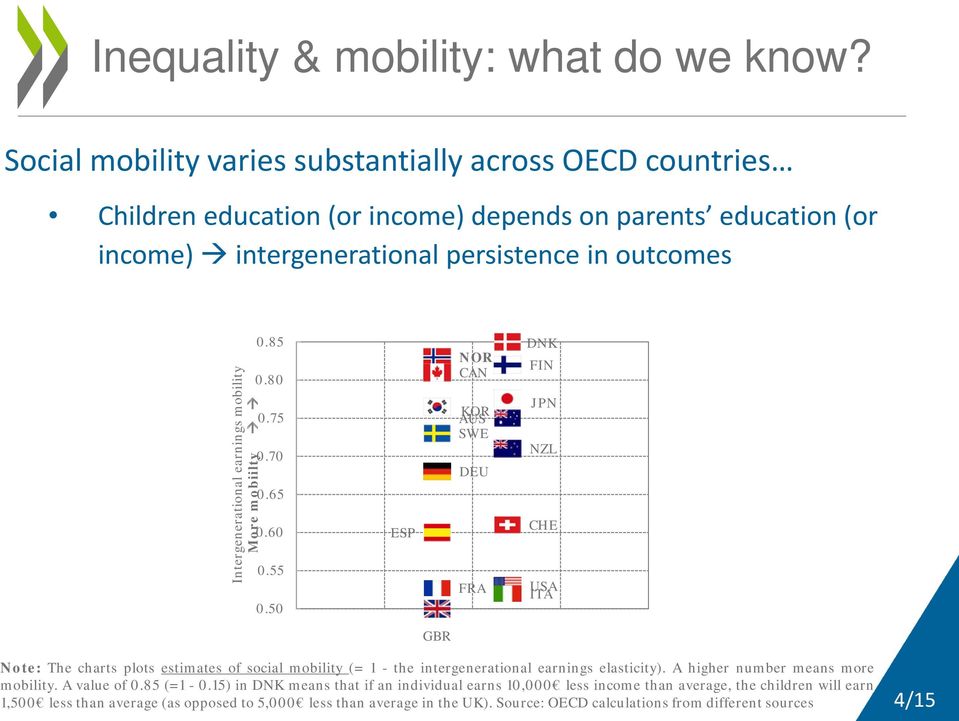
4 Inequality & mobility: what do we know? Social mobility varies substantially across OECD countries Children education (or income) depends on parents education (or income) intergenerational persistence in outcomes Intergenerational earnings mobility More mobiilty ESP NOR CAN KOR AUS SWE DEU FRA DNK FIN JPN NZL CHE USA ITA GBR Note: The charts plots estimates of social mobility (= 1 - the intergenerational earnings elasticity). A higher number means more mobility. A value of 0.85 (=1-0.15) in DNK means that if an individual earns 10,000 less income than average, the children will earn 1,500 less than average (as opposed to 5,000 less than average in the UK). Source: OECD calculations from different sources 4/15
5 Inequality & mobility: what do we know? and it is negatively correlated with inequality (the GCC ) Intergenerational persistence in outcomes increases with outcome (income) disparities Intergenerational earnings mobility More mobility DNK SWE FIN AUS NOR CHE ESP CAN JPN KOR 0.55 FRA USA ITA GBR Gini coefficient, working-age population Note: estimates of social mobility (1 - the intergenerational earnings elasticity) against (Gini) inequality. Both indicators increase with inequality and mobility. Source: OECD calculations from different sources DEU NZL 5/15

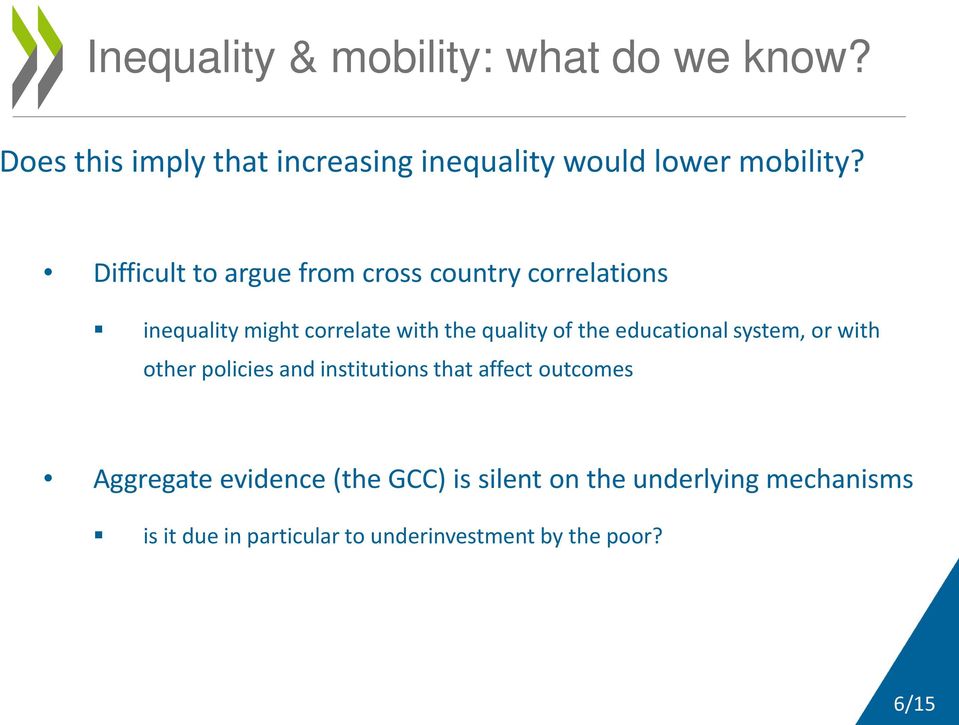
6 Inequality & mobility: what do we know? Does this imply that increasing inequality would lower mobility? Difficult to argue from cross country correlations inequality might correlate with the quality of the educational system, or with other policies and institutions that affect outcomes Aggregate evidence (the GCC) is silent on the underlying mechanisms is it due in particular to underinvestment by the poor? 6/15
7 Recent OECD evidence on inequality & (educational) mobility Look at the consequences of inequality on attainments by individuals with different parent educational background (PEB) HH i,t,c = β 1 PEB i,t,c + β 2 PEB i,t,c IIII t,c + μ c + μ t +ϵ i,t,c HC β1 captures average educational outcomes by PEB (the intercepts). HC PEB=HIGH β2 measures how such averages (mobility) vary with inequality (the slopes) A measure of educational mobility PIAAC Data HC PEB=LOW Inequality Estimates exploit within country variation (µc accounts for fixed country characteristics) HC: human capital (individual i, in country c, age cohort t) PEB: index for parents education being low, medium or high Ineq: inequality in c, measured when i was 14 yrs old 7/15

8 The role of inequality and family background for formal education (i) Inequality lowers the probability of Tertiary education, but only among individuals with low parental education Probability of tertiary education by parental educational background (PEB) and inequality Low PEB Medium PEB High PEB Probability of tertiary education Inequality (Gini coefficient) Interquartile range A 6 Gini pts. increase in inequality (the US-Canada differential in 2010) is associated to 4 ppts. lower probability of tertiary education of Low PEB individuals Note: Low PEB: neither parent has attained upper secondary education; Medium PEB: at least one parent has attained secondary and postsecondary, non-tertiary education; High PEB: at least one parent has attained tertiary education. The bars indicate 95% confidence intervals. Source: OECD (2015) In It Together: Why less inequality benefits all OECD Publishing, Paris. 8/15

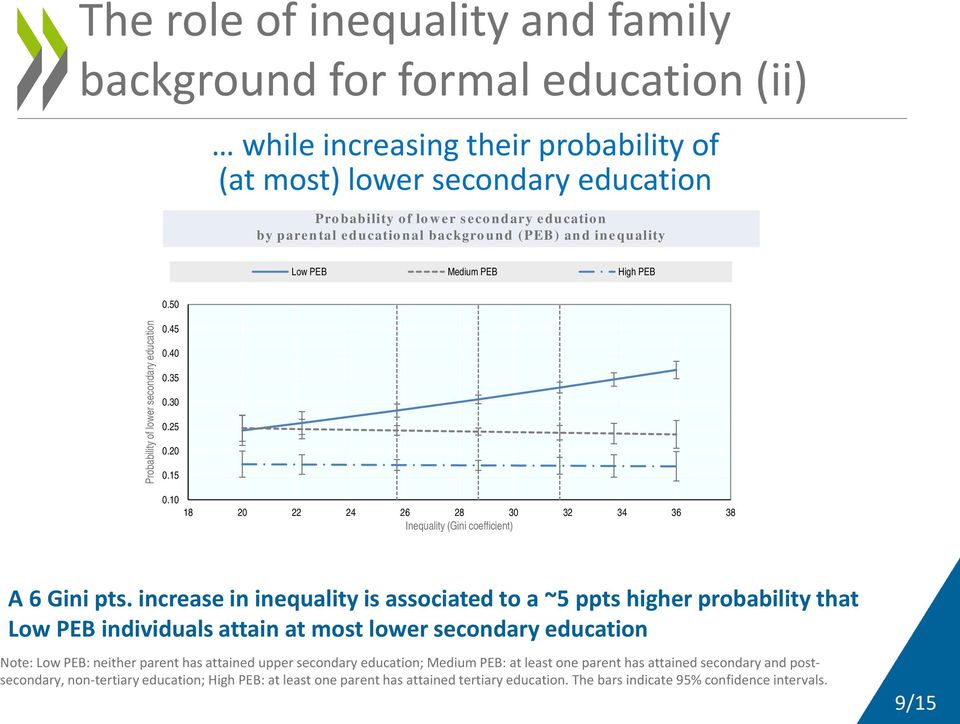
9 The role of inequality and family background for formal education (ii) while increasing their probability of (at most) lower secondary education Probability of lower secondary education by parental educational background (PEB) and inequality Low PEB Medium PEB High PEB 0.50 Probability of lower secondary education Inequality (Gini coefficient) A 6 Gini pts. increase in inequality is associated to a ~5 ppts higher probability that Low PEB individuals attain at most lower secondary education Note: Low PEB: neither parent has attained upper secondary education; Medium PEB: at least one parent has attained secondary and postsecondary, non-tertiary education; High PEB: at least one parent has attained tertiary education. The bars indicate 95% confidence intervals. 9/15
10 The role of inequality and family background for skill proficiency (i) Inequality lowers (literacy and numeracy) skills, but only among individuals with low parental education Average PIAAC numeracy score by parental educational background (PEB) and inequality Low PEB Medium PEB High PEB Numeracy score Inequality (Gini coefficient) A 6 Gini pts. increase in inequality is associated to lower Numeracy score (by ~6 pts) by low PEB individuals (35% of the baseline differential relative to Med PEB) Note: Low PEB: neither parent has attained upper secondary education; Medium PEB: at least one parent has attained secondary and postsecondary, non-tertiary education; High PEB: at least one parent has attained tertiary education. The bars indicate 95% confidence intervals. 10/15

11 The role of inequality and family background for skill proficiency (ii) Inequality lowers skill proficiency of low PEB individuals, even conditioning on the level of formal education Average PIAAC numeracy score conditional on education by parental educational background (PEB) and inequality Low PEB Medium PEB High PEB Numeracy score Inequality (Gini coefficient) A 6 Gini pts. increase in inequality is associated to lower Numeracy score (by ~5 pts) by low PEB individuals Note: Low PEB: neither parent has attained upper secondary education; Medium PEB: at least one parent has attained secondary and postsecondary, non-tertiary education; High PEB: at least one parent has attained tertiary education. The bars indicate 95% confidence intervals. 11/15

12 The role of inequality and family background for labour market outcomes Inequality increases the probability that low PEB individuals are not employed over their working life Fraction of working life spent out of employment by parental educational background (PEB) and inequality Low PEB Medium PEB High PEB 0.2 Probability of not being employed Inequality (Gini coefficient) A 6 Gini pts. increase in inequality is associated to an increase in this probability by 3 ppts Note: Low PEB: neither parent has attained upper secondary education; Medium PEB: at least one parent has attained secondary and postsecondary, non-tertiary education; High PEB: at least one parent has attained tertiary education. The bars indicate 95% confidence intervals. 12/15

13 Inequality & growth: what do we know? Huge literature started in 1990s. Mostly focused on reducedform growth regressions Largely inconclusive: Early (cross-country) works: mostly negative estimates Later (panel) analyses: often positive (or non-significant) estimates Possible explanations: Data quality and their coverage Estimation approaches and inequality indicators Recent research based on OECD data shows that when income inequality rises economic growth falls 13/15

14 Recent OECD evidence on Inequality & growth Looking across OECD countries ( ) the effect is significantly negative Increasing income inequality by 1 Gini pt. lowers the growth rate of GDP per capita by ~0.12 pp per year, with a cumulative loss of ~3% after 25 years. Result is driven by disparities at the bottom of the distribution The negative effect is not just for the poorest income decile but involves the lower middle classes (the bottom 40%). Top inequality is less, if any, relevant for growth 14/15

15 Conclusions In general, policies that help to limit or reverse inequality may not only make societies less unfair, but also wealthier. Which does not imply that any redistributive policy would work. (from this and other works) measures that might help create greater equality of opportunities & growth in the long run include: Promoting access to education, particularly for students from disadvantaged backgrounds. Improving job-related training and education, and access to formal education over the working life Facilitating access to jobs (and career prospects) for under-represented groups (youth, women) 15/15

Transfer issues and directions for reform: Australian transfer policy in comparative perspective
 Transfer issues and directions for reform: Australian transfer policy in comparative perspective Peter Whiteford, Social Policy Research Centre, University of New South Wales [email protected] 1
OECD Health Data 2012 U.S. health care system from an international perspective
 OECD Health Data 2012 U.S. health care system from an international perspective Released on June 28, 2012 http://www.oecd.org/health/healthdata Why is the US health spending so high? 5 388 5 270 5 056
2. THE ECONOMIC BENEFITS OF EDUCATION
 2. THE ECONOMIC BENEFITS OF EDUCATION How much more do tertiary graduates earn? How does education affect employment rates? What are the incentives for people to invest in education? What are the incentives
Who wants to be an entrepreneur?
 Entrepreneurship at a Glance 215 Key findings: Italy Who wants to be an entrepreneur? In all the economies of the world, entrepreneurship is key for economic development and to promoting social integration
COUNTRY NOTE GERMANY
 Education at a Glance 2011 OECD Indicators DOI: http://dx.doi.org/10.1787/eag-2011-en OECD 2011 Under embargo until 13 September, at 11:00 Paris time COUNTRY NOTE GERMANY Questions can be directed to:
Job quality across OECD countries
 HOW GOOD IS YOUR JOB? MEASURING AND ASSESSING JOB QUALITY What makes a good job? Job quality Most people spend a substantial amount of time at work, and work for a significant part of their life. The jobs
PIAAC Outline of First International Report (2013) & Proposed Thematic PIAAC Data Analysis ADVANCED OUTLINE OF THE FIRST INTERNATIONAL PIAAC REPORT 1
 ADVANCED OUTLINE OF THE FIRST INTERNATIONAL PIAAC REPORT 1 The development and implementation of PIAAC A collaborative effort Form and Style of the first international report A key objective of the first
How s Life in Ireland?
 October 2015 How s Life in Ireland? Additional information, including the data used in this country note, can be found at: www.oecd.org/statistics/hows-life-2015-country-notes-data.xlsx HOW S LIFE IN IRELAND
VULNERABILITY OF SOCIAL INSTITUTIONS
 VULNERABILITY OF SOCIAL INSTITUTIONS 2 December 2014 Paris Seminar in Demographic Economics Falilou FALL Senior Economist OECD Economics Department 1 Introduction and outline Social institutions and the
Family policies and the on-going economic crisis
 Family policies and the on-going economic crisis Leave Policies & Research Network meeting, Paris, 17 October 2013 Willem Adema Senior Economist, Social Policy Division, OECD Diverse trends in family outcomes
How s Life in the United States?
 October 2015 How s Life in the United States? Additional information, including the data used in this country note, can be found at: www.oecd.org/statistics/hows-life-2015-country-notes-data.xlsx HOW S
INCOME INEQUALITY AND GROWTH: THE ROLE OF TAXES AND TRANSFERS
 Please cite this paper as: OECD 2012, Income inequality and growth: The role of taxes and transfers, OECD Economics Department Policy Notes, No. 9. January 2012. ECONOMICS DEPARTMENT POLICY NOTE No. 9
Cross-country comparison of health care system efficiency
 Cross-country comparison of health care system efficiency Isabelle Joumard, OECD, Economics Department IMF conference, June 21, 2011 Public Health Care Reforms: Challenges and Lessons for Advanced and
DEBT LEVELS AND FISCAL FRAMEWORKS. Christian Kastrop Director of Policy Studies Branch Economics Department
 DEBT LEVELS AND FISCAL FRAMEWORKS Christian Kastrop Director of Policy Studies Branch Economics Department Introduction OECD average gross government debt increased from 73% of GDP in 2007 to 111% in 2013.
Appendix. Appendix Figure 1: Trends in age-standardized cardiometabolic (CVD and diabetes) mortality by country.
 Appendix Appendix Figure 1: Trends in age-standardized cardiometabolic (CVD and diabetes) mortality by country. Men Age standardized cardiometabolic death rate per 100,000 800 700 600 500 400 300 200 800
1. Key indicators and benchmarks
 1. Key indicators and benchmarks Italy EU average Europe 2020 target / Europe 2020 headline targets 2009 2012 2009 2012 Benchmark 1. Early leavers from education and training (age 18-24) 2. Tertiary educational
Opening Conference of the GINI Project March 2010 Income inequality in historical and comparative perspective
 Opening Conference of the GINI Project March 10 Income inequality in historical and comparative perspective A B Atkinson, Nuffield College, Oxford and LSE 1 1. Underlying themes 2. Income inequality over
How s Life in Finland?
 October 2015 How s Life in Finland? Additional information, including the data used in this country note, can be found at: www.oecd.org/statistics/hows-life-2015-country-notes-data.xlsx HOW S LIFE IN FINLAND
LOS INDICADORES DE CIENCIA, TECNOLOGÍA E INNOVACIÓN EN EL OECD SCOREBOARD: UNA VISIÓN GLOBAL Y SOBRE MÉXICO
 LOS INDICADORES DE CIENCIA, TECNOLOGÍA E INNOVACIÓN EN EL OECD SCOREBOARD: UNA VISIÓN GLOBAL Y SOBRE MÉXICO Segundo Taller de Indicadores de Ciencia, Tecnología e Innovación Ciudad de México, 3-31 de enero
Tertiary education is expanding and producing a large proportion of highly skilled adults
 Education at a Glance: OECD Indicators is the authoritative source for accurate and relevant information on the state of education around the world. It provides data on the structure, finances, and performance
The paradox of redistribution revisited, or why targeting may matter less than we thought
 The paradox of redistribution revisited, or why targeting may matter less than we thought Ive Marx, Lina Salanauskaite and Gerlinde Verbist 8 March 2013 Claim We aim to show that Korpi and Palme s highly
B Financial and Human Resources
 Chapter B Financial and Human Resources Invested In Education Education at a Glance OECD 2011 203 chapter B Classification of al expenditure Educational expenditure in this chapter is classified through
OECD Reviews of Labour Market and Social Policies LATVIA
 OECD Reviews of Labour Market and Social Policies LATVIA Ministry of Welfare, Riga, 31 March 2015 Monika Queisser and Paolo Falco Directorate for Employment, Labour and Social Affairs Context for employment
Statistical Bulletin. The Effects of Taxes and Benefits on Household Income, 2011/12. Key points
 Statistical Bulletin The Effects of Taxes and Benefits on Household Income, 2011/12 Coverage: UK Date: 10 July 2013 Geographical Area: UK and GB Theme: Economy Theme: People and Places Key points There
ANTICIPATING POPULATION AGEING CHALLENGES AND RESPONSES. Peter Whiteford Social Policy Division, OECD www.oecd.org www.oecd.
 ANTICIPATING POPULATION AGEING CHALLENGES AND RESPONSES Peter Whiteford Social Policy Division, OECD www.oecd.org www.oecd.org/els Outline z z z What is the OECD and what does it do? Anticipating the challenges
Mexico. While 15-year-old Mexicans are doing better in school. enrolment rates for 15-19year-olds remain very low.
 Education at a Glance: OECD Indicators is the authoritative source for accurate and relevant information on the state of around the world. It provides data on the structure, finances, and performance of
Research Report May 2016. Which Countries in Europe Have the Best Gender Equality in the Workplace?
 Research Report May 2016 Which Countries in Europe Have the Best Gender Equality in the Workplace? Foreword Despite improvements in gender equality in recent decades, much remains to be done. Around the
El Salvador. Country coverage and the methodology of the Statistical Annex of the 2015 HDR
 Human Development Report 2015 Work for human development Briefing note for countries on the 2015 Human Development Report El Salvador Introduction The 2015 Human Development Report (HDR) Work for Human
Briefing note for countries on the 2015 Human Development Report. Palestine, State of
 Human Development Report 2015 Work for human development Briefing note for countries on the 2015 Human Development Report Palestine, State of Introduction The 2015 Human Development Report (HDR) Work for
Inequality of Opportunity in Educational Achievements
 Inequality of Opportunity in Educational Achievements Cross-Country and Intertemporal Comparisons P. Luongo University of Bari Inequality Measurement, trend, impacts and policies UNU-WIDER Conference September
Young Italians difficulties in finding work threaten to undermine investment in education.
 Education at a Glance: OECD Indicators is the authoritative source for accurate and relevant information on the state of education around the world. It provides data on the structure, finances, and performance
GROWTH AND INCOME INEQUALITY: TRENDS AND POLICY IMPLICATIONS
 Please cite this note as: OECD (2015), Growth and income inequality: trends and policy implications, OECD Economics Department Policy Notes, No. 26 April 2015. GROWTH AND INCOME INEQUALITY: TRENDS AND
Poverty and income growth: Measuring pro-poor growth in the case of Romania
 Poverty and income growth: Measuring pro-poor growth in the case of EVA MILITARU, CRISTINA STROE Social Indicators and Standard of Living Department National Scientific Research Institute for Labour and
RIA in OECD Countries
 RIA in OECD Countries RIA Symposium 9 November, 2007 Tokyo, Japan Josef Konvitz, Head of the Regulatory Policy Division, Organisation for Economic Co-operation and Development (OECD) 1 PART I REGULATORY
United Kingdom. Country coverage and the methodology of the Statistical Annex of the 2015 HDR
 Human Development Report 2015 Work for human development Briefing note for countries on the 2015 Human Development Report United Kingdom Introduction The 2015 Human Development Report (HDR) Work for Human
Economic inequality and educational attainment across a generation
 Economic inequality and educational attainment across a generation Mary Campbell, Robert Haveman, Gary Sandefur, and Barbara Wolfe Mary Campbell is an assistant professor of sociology at the University
Government at a Glance 2015
 Government at a Glance 2015 Size of public procurement Strategic public procurement E-procurement Central purchasing bodies 135 Size of public procurement Public procurement refers to the purchase by governments
Briefing note for countries on the 2015 Human Development Report. Philippines
 Human Development Report 2015 Work for human development Briefing note for countries on the 2015 Human Development Report Philippines Introduction The 2015 Human Development Report (HDR) Work for Human
Private Health insurance in the OECD
 Private Health insurance in the OECD Benefits and costs for individuals and health systems Francesca Colombo, OECD AES, Madrid, 26-28 May 2003 http://www.oecd.org/health 1 Outline Background, method Overview
Tackling income inequality The role of taxes and transfers
 From: OECD Journal: Economic Studies Access the journal at: http://dx.doi.org/1.1787/19952856 Tackling income inequality The role of taxes and transfers Isabelle Joumard, Mauro Pisu, Debbie Bloch Online
CLOSING THE COVERAGE GAP. Robert Palacios, World Bank Pension Core Course March 2014
 CLOSING THE COVERAGE GAP Robert Palacios, World Bank Pension Core Course March 2014 Different types of coverage gaps 2 In a subset of richer countries, the main kind of gap is related to adequacy rather
Most people in Germany attain upper secondary education
 Education at a Glance: OECD Indicators is the authoritative source for accurate and relevant information on the state of education around the world. It provides data on the structure, finances, and performance
Madagascar. Country coverage and the methodology of the Statistical Annex of the 2015 HDR
 Human Development Report 2015 Work for human development Briefing note for countries on the 2015 Human Development Report Madagascar Introduction The 2015 Human Development Report (HDR) Work for Human
Executive summary. Global Wage Report 2014 / 15 Wages and income inequality
 Executive summary Global Wage Report 2014 / 15 Wages and income inequality Global Wage Report 2014/15 Wages and income inequality Executive summary INTERNATIONAL LABOUR OFFICE GENEVA Copyright International
MENTAL HEALTH AND WORK Policy challenges and policy developments in OECD countries
 MENTAL HEALTH AND WORK Policy challenges and policy developments in OECD countries Shruti Singh, Labour Market Economist Directorate for Employment, Labour and Social Affairs Global Healthy Workplace Awards
Earnings related schemes: Design, options and experience. Edward Whitehouse
 Earnings related schemes: Design, options and experience Edward Whitehouse World Bank core course Washington DC, March 2014 Objectives Primary objective: ensuring older people have a decent standard of
Income inequalities in Italy: trend over time
 Income inequalities in Italy: trend over time Loris Vergolini Descriptive evidence In this note we aim to deepen the OECD (2011) results that highlight a critical situation for Italy, providing the image
OECD HEALTH WORKING PAPERS
 IMPROVED HEALTH SYSTEM PERFORMANCE THROUGH BETTER CARE COORDINATION Annex Maria M. Hofmarcher, Howard Oxley, and Elena Rusticelli 30 OECD HEALTH WORKING PAPERS Unclassified DELSA/HEA/WD/HWP(2007)6/ANN
GERMANY KEEPING THE EDGE: COMPETITIVENESS FOR INCLUSIVE GROWTH
 Better Policies Series GERMANY KEEPING THE EDGE: COMPETITIVENESS FOR INCLUSIVE GROWTH FEBRUARY 2014 OECD Better Policies Series The Organisation for Economic Co-operation and Development (OECD) aims to
Thailand. Country coverage and the methodology of the Statistical Annex of the 2015 HDR
 Human Development Report 2015 Work for human development Briefing note for countries on the 2015 Human Development Report Thailand Introduction The 2015 Human Development Report (HDR) Work for Human Development
The Effects of Infrastructure Development on Growth and Income Distribution
 The Effects of Infrastructure Development on Growth and Income Distribution César Calderón Luis Servén (Central Bank of Chile) (The World Bank) ALIDE - The World Bank - Banco BICE Reunión Latinoamericana
Tanzania (United Republic of)
 Human Development Report 2015 Work for human development Briefing note for countries on the 2015 Human Development Report Tanzania (United Introduction The 2015 Human Development Report (HDR) Work for
Interaction of global and national income inequalities. Branko Milanovic and John E. Roemer 1
 May 10, 2016 Interaction of global and national income inequalities by Branko Milanovic and John E. Roemer 1 1. Introduction Global inequality, defined as income inequality among all citizens of the world,
Private Health insurance in the OECD
 Private Health insurance in the OECD Benefits and costs for individuals and health systems Francesca Colombo, OECD AES, Madrid, 26-28 May 2004 http://www.oecd.org/health 1 Outline Q Background, method
1) Write the following as an algebraic expression using x as the variable: Triple a number subtracted from the number
 1) Write the following as an algebraic expression using x as the variable: Triple a number subtracted from the number A. 3(x - x) B. x 3 x C. 3x - x D. x - 3x 2) Write the following as an algebraic expression
The table Key facts for Brazil in Education at a Glance 2015 presents a summary of figures for Brazil and the OECD average.
 Education at a Glance: OECD Indicators is the authoritative source for information on the state of education around the world. It provides data on the structure, finances and performance of education systems
Nepal. Country coverage and the methodology of the Statistical Annex of the 2015 HDR
 Human Development Report 2015 Work for human development Briefing note for countries on the 2015 Human Development Report Nepal Introduction The 2015 Human Development Report (HDR) Work for Human Development
Does Absolute Latitude Explain Underdevelopment?
 AREC 345: Global Poverty and Economic Development Lecture 4 Professor: Pamela Jakiela Department of Agricultural and Resource Economics University of Maryland, College Park Does Absolute Latitude Explain
Paid and Unpaid Labor in Developing Countries: an inequalities in time use approach
 Paid and Unpaid Work inequalities 1 Paid and Unpaid Labor in Developing Countries: an inequalities in time use approach Paid and Unpaid Labor in Developing Countries: an inequalities in time use approach
While a large proportion of adults in the United States have universitylevel
 Education at a Glance: OECD Indicators is the authoritative source for accurate and relevant information on the state of education around the world. It provides data on the structure, finances, and performance
Inequality in G20 countries: Causes, impacts, and policy responses*
 Inequality in G20 countries: Causes, impacts, and policy responses* International Labour Organization Korea Institute for International Economic Policy G20 Employment Working Group 23-25 July 2015 Cappadocia,
MEASURING WELL-BEING AND SOCIETAL PROGRESS
 MEASURING WELL-BEING AND SOCIETAL PROGRESS Enrico Giovannini and Jon Hall (OECD Statistics Directorate) Marco Mira d'ercole (OECD Directorate for Employment, Labour and Social Affairs) Introduction For
The Contribution of Human capital to European Economic Growth: An empirical exploration from a panel data
 The Contribution of Human capital to European Economic Growth: An empirical exploration from a panel data Menbere Workie Tiruneh 1 Marek Radvansky 2 Abstract The paper empirically investigates the extent
Malawi. Country coverage and the methodology of the Statistical Annex of the 2015 HDR
 Human Development Report 2015 Work for human development Briefing note for countries on the 2015 Human Development Report Malawi Introduction The 2015 Human Development Report (HDR) Work for Human Development
Sierra Leone. Country coverage and the methodology of the Statistical Annex of the 2015 HDR
 Human Development Report 2015 Work for human development Briefing note for countries on the 2015 Human Development Report Sierra Leone Introduction The 2015 Human Development Report (HDR) Work for Human
Briefing note for countries on the 2015 Human Development Report. Niger
 Human Development Report 2015 Work for human development Briefing note for countries on the 2015 Human Development Report Niger Introduction The 2015 Human Development Report (HDR) Work for Human Development
Briefing note for countries on the 2015 Human Development Report. Burkina Faso
 Human Development Report 2015 Work for human development Briefing note for countries on the 2015 Human Development Report Burkina Faso Introduction The 2015 Human Development Report (HDR) Work for Human
Congo (Democratic Republic of the)
 Human Development Report 2015 Work for human development Briefing note for countries on the 2015 Human Development Report Congo (Democratic Republic of the) Introduction The 2015 Human Development Report
Russian Federation. Country coverage and the methodology of the Statistical Annex of the 2015 HDR
 Human Development Report 2015 Work for human development Briefing note for countries on the 2015 Human Development Report Russian Federation Introduction The 2015 Human Development Report (HDR) Work for
Under embargo until 11 September, at 11:00 am Paris time
 COUNTRY NOTE Education at a Glance:OECD Indicators 2012 Under embargo until 11 September, at 11:00 am Paris time CANADA Questions can be directed to: Andreas Schleicher, Advisor to the Secretary-General
Country note China. More than 255 million people in OECD and G20 countries have now attained tertiary education (Table A1.3a).
 Education at a Glance 2011 OECD Indicators DOI: http://dx.doi.org/10.1787/eag-2011-en OECD 2011 Under embargo until 13 September, at 11:00 Paris time Education at a Glance 2011 Country note China Questions
Briefing note for countries on the 2015 Human Development Report. Mozambique
 Human Development Report 2015 Work for human development Briefing note for countries on the 2015 Human Development Report Mozambique Introduction The 2015 Human Development Report (HDR) Work for Human
WOMEN AND MEN IN OECD COUNTRIES
 WOMEN AND MEN IN OECD COUNTRIES and in OECD Countries and in OECD Countries and in OECD and in OECD Countries and in OECD Countries and in OECD Countries and in OECD Countries and in OECD Countries and
OECD Average and OECD Total
 11 OECD Average and OECD Total Introduction... 144 Recoding of the database for the estimation of the OECD total and OECD average... 144 Duplication of the data for avoiding three runs of the procedure...
Economic Growth: the role of institutions
 ECON 184 Economic Growth: the role of institutions ECON 184: Institutions and Growth January 26, 2010 1 Contents 1 Institutions and growth: initial analysis 3 2 How can institutions affect economic growth?
Under embargo until 11 September, at 11:00 am Paris time
 COUNTRY NOTE Education at a Glance: OECD Indicators 2012 PORTUGAL Under embargo until 11 September, at 11:00 am Paris time Questions can be directed to: Andreas Schleicher, Advisor to the Secretary-General
Country note - Greece
 Education at a Glance 2011 OECD Indicators DOI: http://dx.doi.org/10.1787/eag-2011-en OECD 2011 Under embargo until 13 September at 11:00 Paris time Country note - Greece Questions can be directed to:
Pricing the right to education: There is a large financing gap for achieving the post-2015 education agenda
 Education for All Global Monitoring Report Policy Paper 18 March 2015 This paper shows there is an annual financing gap of US$22 billion over 2015-2030 for reaching universal pre-primary, primary and lower
OECD SOCIAL COHESION POLICY REVIEWS
 OECD SOCIAL COHESION POLICY REVIEWS CONCEPT NOTE Social Cohesion Policy Reviews are a new OECD tool to: measure the state of social cohesion in a society and monitor progress over time; assess policies
Policies for a revitalisation of Japan
 Policies for a revitalisation of Japan April 212 The statistical data for Israel are supplied by and under the responsibility of the relevant Israeli authorities. The use of such data by the OECD is without
Completion and dropout in upper secondary education in Norway: Causes and consequences
 Completion and dropout in upper secondary education in Norway: Causes and consequences Torberg Falch Lars-Erik Borge Päivi Lujala Ole Henning Nyhus Bjarne Strøm Related to SØF-project no 6200: "Personer
Under embargo until 13 September, at 11:00 Paris time. Country note Brazil
 Education at a Glance 2011 OECD Indicators DOI: http://dx.doi.org/10.1787/eag-2011-en OECD 2011 Under embargo until 13 September, at 11:00 Paris time Country note Brazil Questions can be directed to: Andreas