
IBM Endpoint Manager for Configuration Management User's Guide
|
|
|
- Peregrine May
- 9 years ago
- Views:
Transcription
1 IBM Endpoint Manager for Configuration Management User's Guide

2 ii IBM Endpoint Manager for Configuration Management User's Guide

3 Contents Configuration Management User's Guide 1 Setting up Configuration Management System requirements Using checks and checklists Check Fixlets Modifying check parameters Measured Value Analyses Creating and Managing Custom Checklists :... 6 Using the Synchronize Custom Checks wizard.. 7 Taking a remediation action Configuring Windows checklists Viewing checks Disabling Windows checks Enabling Windows checks Modifying Windows check parameters Remediation of Windows configuration settings 11 Configuring UNIX checklists Configuring checklists Analyses Using the Create Custom Relevance SCM content wizard Creating custom UNIX Security Configuration Management content Importing Windows SCAP content Learning about SCAP SCAP Checklists Using the Import Windows SCAP Wizard Using the Report Creation wizard OVALDI in Configuration Management Configuration Management Reporting Frequently asked questions Glossary Support Notices iii

4 iv IBM Endpoint Manager for Configuration Management User's Guide

5 Configuration Management User's Guide This guide describes a portfolio of security configuration content called Configuration Management. This content is organized through checklists, which assess and manage the configurations of desktops, laptops, and servers. The Configuration Management solution has achieved Security Content Automation Protocol (SCAP) validation certification with the National Institute of Standards and Technology (NIST) for both misconfiguration assessment and remediation. By offering an extensive library of technical checks, Configuration Management detects and enforces security configuration policies using industry best practices. This guide serves as a resource for IT personnel responsible for managing and enforcing corporate system configuration policies on endpoints. The Configuration Management checklists allow security teams to define the security parameters and configurations required by corporate policy. IT managers use the Configuration Management checklists to enforce security policies and document the current state of compliance against corporate policies. Tivoli Endpoint Manager console operators focus on the detailed day-to-day configuration management of all systems to use detailed information for each endpoint. Auditors use Configuration Management checklists to determine the current state of compliance for systems within the entire organization. Setting up Configuration Management Follow these steps to set up your Configuration Management deployment. Follow these steps to set up Configuration Management 1. Plan your Configuration Management deployment. 2. Subscribe to the external SCM sites. 3. Create custom sites or custom checklists. Planning your Configuration Management deployment Keep in mind the following steps as you plan your configuration management deployment. 1. Identify which computers will run the Configuration Management content. 2. Group the computers by operating system. 3. Create subgroups within each operating that must comply with the different standards. Subscribing to sites Each Configuration Management checklist is provided as a single site and represents a single standard and platform. The content is continuously updated and automatically delivered when added to an IBM Endpoint Manager deployment. Computers must be subscribed to the site to collect data from Endpoint Manager clients. This data is used for reporting and analysis. The process of site subscription depends on the version of the Endpoint Manager console that you installed. For more information, see the Administrator's User Guide. 1
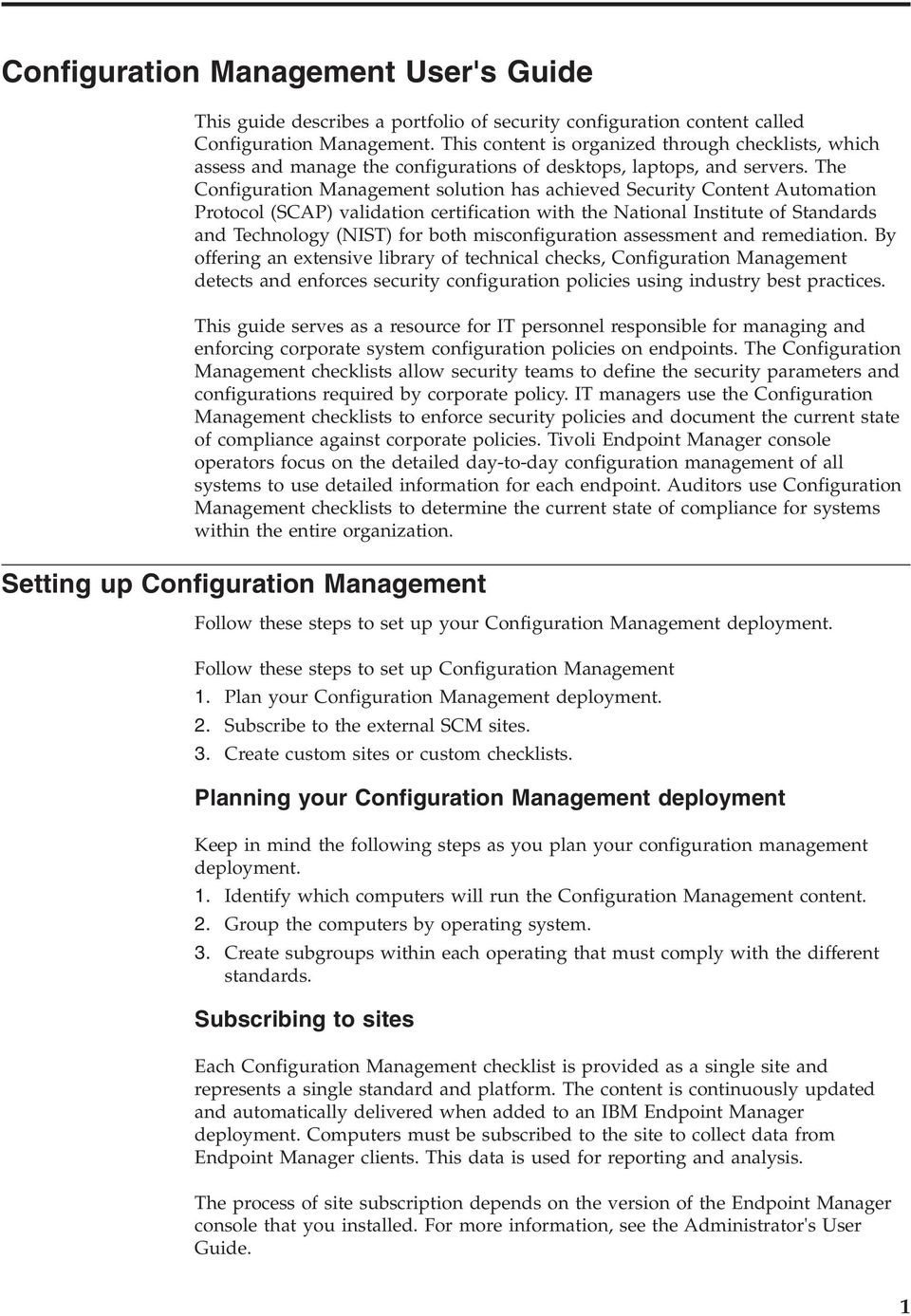
6 Alternatively, an air-gap can be used to physically separate the Endpoint Manager server from the Internet Fixlet server. For more information, see Installing in an Air-Gapped Network. The Fixlets in this site can be used as-is or customized to meet your own security policies. Compliance calculations are evaluated locally on each endpoint, and the Configuration Management solution is scalable and can accommodate large numbers of computers. You can choose to copy Configuration Management content to custom sites so you can customize the content. Creating custom sites As each Configuration Management checklist is provided as a single site, when you create a custom site, you are in effect, creating a custom checklist. Use custom checklists to fine-tune the settings that are monitored in your deployment. You can customize Configuration Management parameters and exclude specific computers from an analysis. Custom checklists target specific sets of computers with tailored content with the use of the subscription mechanism. Creating custom checklists involves the following steps 1. Create a custom checklist from an existing external checklist. 2. Customize Fixlets using built-in parameterization. 3. Subscribe the correct computers to the custom checklist. You can use the Create Custom Checklist wizard to create new custom checklists that are based on your currently subscribed external checklists. For more information, see Creating custom checklists. System requirements Set up your deployment according to the system requirements to successfully deploy Configuration Management. Configure your IBM Endpoint Manager deployment according to the following requirements: Table 1. Supported components and system requirements to deploy Configuration Management Components Supported browser versions Adobe Flash player version IBM Endpoint Manager component versions Requirements Internet Explorer 7.0 or later Flash Player 9.0 or later v Console 8.0 or later v Windows Client 8.0 v UNIX Client: Superseded version: IBM Endpoint Manager UNIX Client 7.2 Non-superseded version: IBM Endpoint Manager UNIX Client version IBM Endpoint Manager for Configuration Management User's Guide

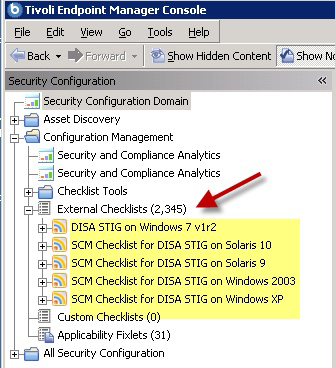
7 Using checks and checklists Check Fixlets in Configuration Management checklists assess an endpoint against a configuration standard. Many check Fixlets have a corresponding analysis, sometimes referred to as measured values, which report the value of the element that the check Fixlet evaluates. Check Fixlets A check Fixlet becomes relevant when a client computer is out of compliance with a configuration standard. By viewing the Configuration Management Fixlets, you can identify non-compliant computers and the corresponding standards. To start using the Configuration Management checklists, obtain a masthead for the appropriate Configuration Management site and open it within the Tivoli Endpoint Manager console. When the site has been gathered in the console, follow the steps below to view the checks: 1. Select a Configuration Management checklist from the navigation tree. 2. Expand a checklist and click Fixlets and Tasks. Configuration Management User's Guide 3

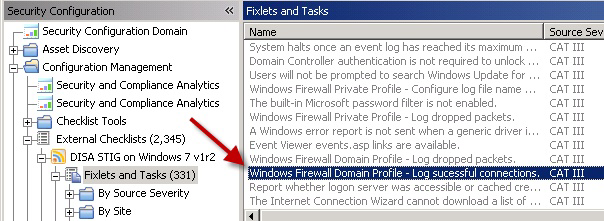
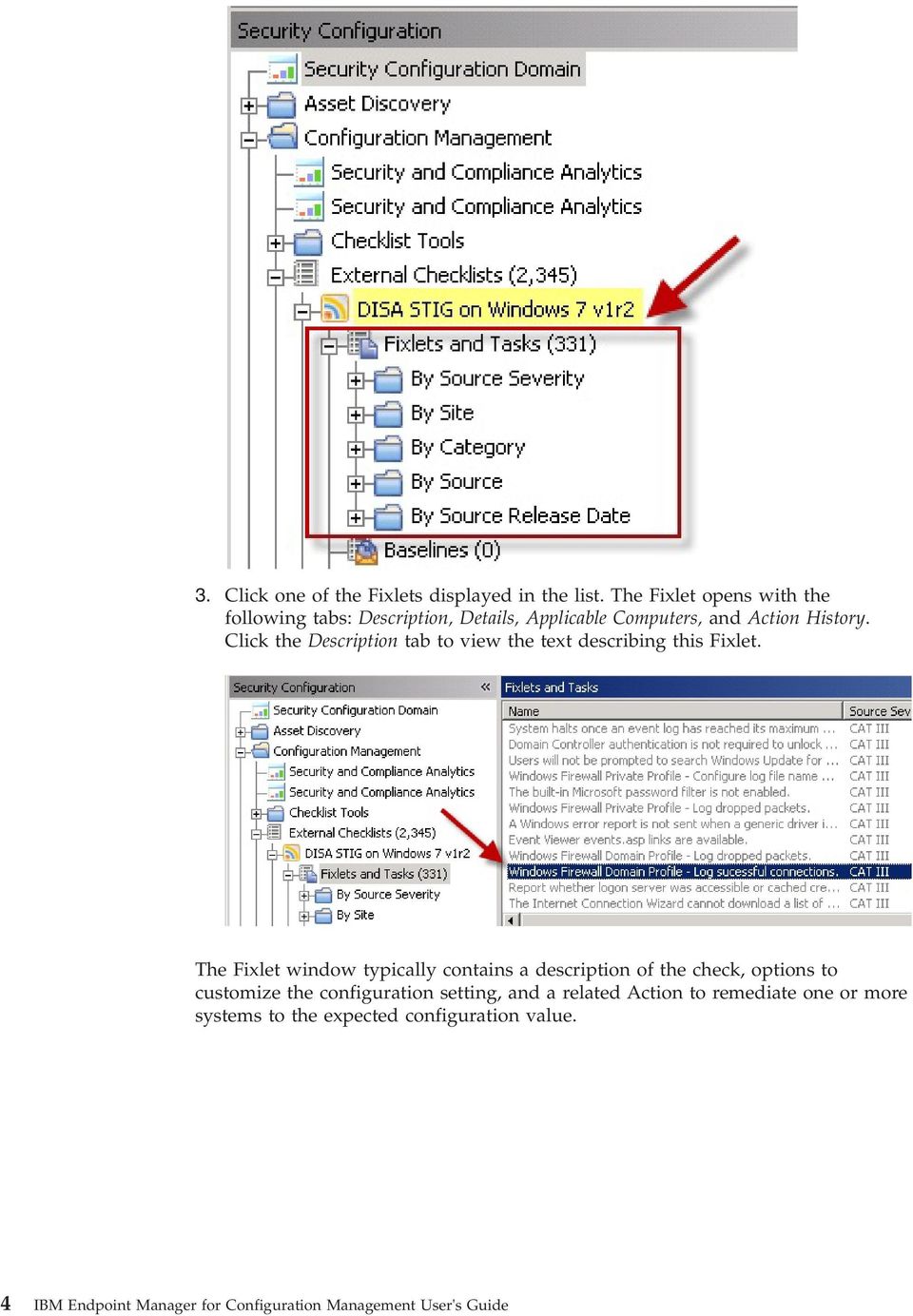
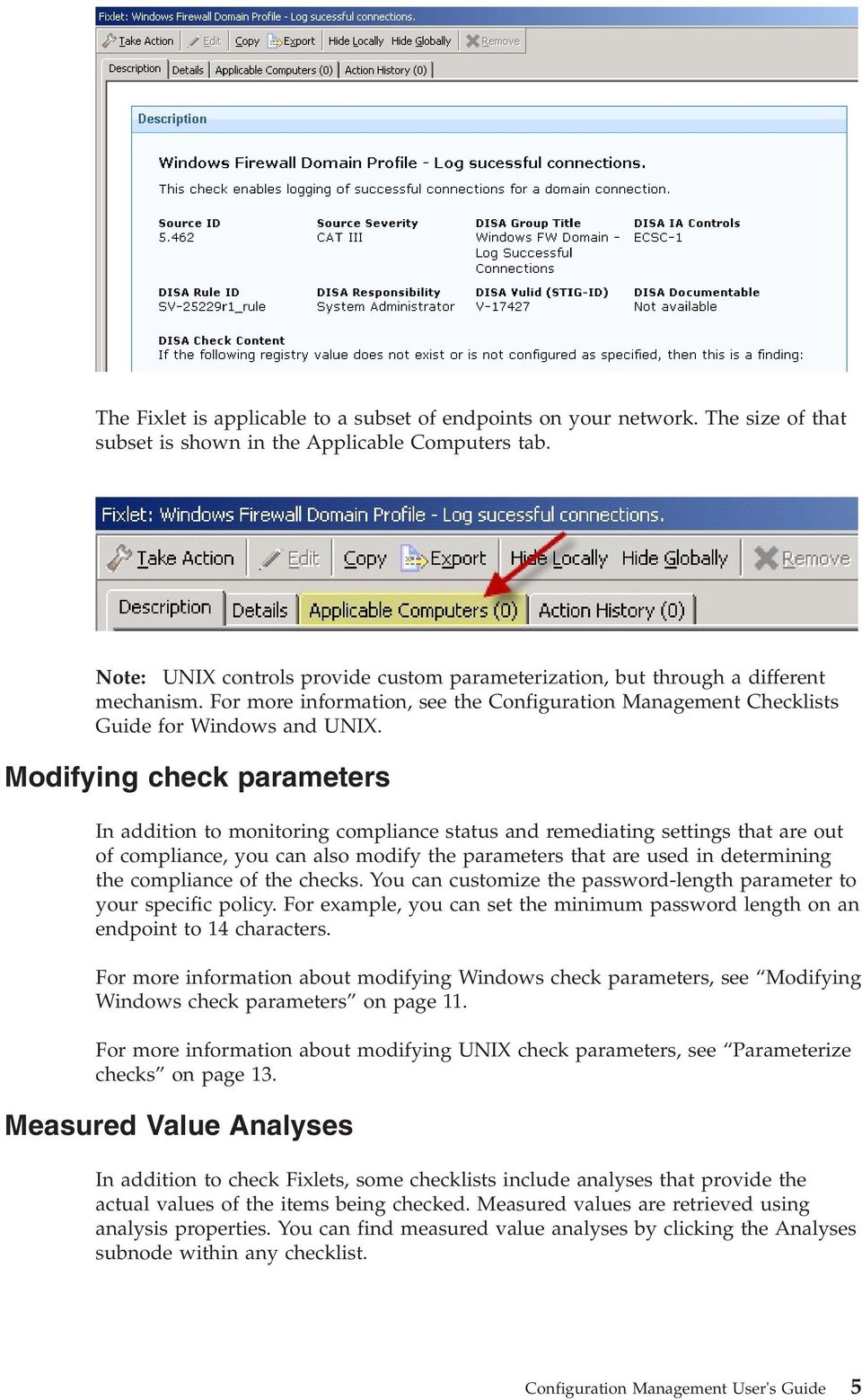
8 3. Click one of the Fixlets displayed in the list. The Fixlet opens with the following tabs: Description, Details, Applicable Computers, and Action History. Click the Description tab to view the text describing this Fixlet. The Fixlet window typically contains a description of the check, options to customize the configuration setting, and a related Action to remediate one or more systems to the expected configuration value. 4 IBM Endpoint Manager for Configuration Management User's Guide

9 The Fixlet is applicable to a subset of endpoints on your network. The size of that subset is shown in the Applicable Computers tab. Note: UNIX controls provide custom parameterization, but through a different mechanism. For more information, see the Configuration Management Checklists Guide for Windows and UNIX. Modifying check parameters In addition to monitoring compliance status and remediating settings that are out of compliance, you can also modify the parameters that are used in determining the compliance of the checks. You can customize the password-length parameter to your specific policy. For example, you can set the minimum password length on an endpoint to 14 characters. For more information about modifying Windows check parameters, see Modifying Windows check parameters on page 11. For more information about modifying UNIX check parameters, see Parameterize checks on page 13. Measured Value Analyses In addition to check Fixlets, some checklists include analyses that provide the actual values of the items being checked. Measured values are retrieved using analysis properties. You can find measured value analyses by clicking the Analyses subnode within any checklist. Configuration Management User's Guide 5

10 Note: For best performance, only activate the analyses that you need for your deployment. Only activated analyses are visible in SCA. Creating and Managing Custom Checklists : The ability to customize Configuration Management parameters and exclude specific computers from an analysis gives you control over your security status. However, you can also use custom checklists to fine-tune the settings monitored in your deployment. Custom checklists target specific sets of computers with tailored content using the subscription mechanism. This allows statistics to be gathered with finer granularity. To create your own checklist with custom sites, perform the following steps. v Step 1: Create a custom checklist from an existing external checklist v Step 2: Customize Fixlets using built-in parameterization v Step 3: Subscribe the proper computers to the custom checklist Creating custom checklists Use this wizard to create custom checklists. You must be subscribed to the SCM Reporting external site. 1. From the Security Configuration Domain, gotoconfiguration Management > Checklist Tools > Create Custom Checklist. 6 IBM Endpoint Manager for Configuration Management User's Guide


11 2. Enter the name of the new checklist. 3. Select the target platform. 4. Click the drop-down menu to select which external checklist you will copy the checks from. As you select the checks, they are shown in the staged list at the lower part of the window. 5. Click Create Checklist. The console begins copying the checks in the selected lists into your new custom checklist. The process might take several minutes, depending on the number and size of the checklists selected. Note: Use care when you subscribe computers to custom checklists. Custom checklists do not support site relevance, which protects you from bad subscriptions. Customizing content Now that you have a custom checklist populated with content copied from external checklists, you can configure your checklist by any of the following means: v Configure check parameters to control remediation v Delete unwanted or unnecessary checks Note: In Console versions 8.0 and later, subscribing computers to a custom checklist site is handled in the same way as with external checklist subscriptions. Using the Synchronize Custom Checks wizard Use the SCM Synchronize Custom Checks wizard to update any custom checks in your deployment whose external sources have since been updated by IBM. You Configuration Management User's Guide 7

12 can use any additional functionality or bug fixes that may have been provided by IBM (in the form of external site updates) since the custom copies were made. To synchronize a custom checklist, you must have the latest version of the Create Custom Checklist wizard (SCM Reporting version 36 or later). The latest version of the wizard adds required metadata to the copied checks that allows the sync wizard to determine whether the current external source has been modified since the copy was made. v First time SCM user If your Endpoint Manager deployment does not have any custom checklists that were created prior to the release of the sync wizard, any custom checklists you create from now on will be compatible with the Synchronize Custom Checks wizard. v Existing SCM user and you used the previous version of the Create Custom Checklist wizard If you already have one or more custom checklists created with an older version of the Create Custom Checklist wizard, you will have to first recreate these and any other custom checklists that you wish to have synchronizing abilities using the latest version of the Create Custom Checklist wizard. Scanning for out-of-date checks You can make basic global scans or detailed targeted scans for out-of-date checks. The custom checklist that you will synchronize must be created with the latest version of the Create Custom Checklist wizard (SCM Reporting version 36 or later). This wizard scans all SCM custom checklists for external updates, and displays the checklists that need an update or synchronization in the table. Please note that this scan will not detect checks that have been added to or removed from an external site. The detailed targeted scan requires the user to select a source checklist (external) and a destination checklist (custom) before performing the scan. This scan does a limited scan that performs a comparison of the source and destination checklists to determine whether or not there are any: out of date custom checks, newly added external checks, or recently removed external checks. This scan is designed for use only in cases where the user intends to maintain an up-to-date copy of an entire external checklist. If the destination was not originally created as a copy of the source, the results of this scan may be confusing and/or misleading; however, there are no hard restrictions to this end, and the user may perform a detailed targeted scan comparison between any external and custom checklist pair. 1. Select the appropriate tab. v Basic Global Scan v Detailed Targeted Scan a. Select the source from the external checklists. b. Select the destination of the custom checklist. c. Option: Click the Only show drop-down menu to select from the filter choices. 2. Click Scan to scan for out-of-sync checks. 8 IBM Endpoint Manager for Configuration Management User's Guide

13 Synchronizing out-of-date checks Custom parameterizations will be automatically preserved. 1. From the Out of Sync Checks window, select the checkboxes in the left-most column. 2. Click Synchronize in upper left corner. A progress indicator box displays the percentage complete and an estimated remaining time to complete the synchronization operation. You can also cancel the operation at any time from this window. Note: The synchronization process can take a number of seconds per check. Keep in mind when synchronizing large sets of checks at a time. Preserving custom remediation actions Follow these steps to preserve manually edited remediation action scripts for checks in your custom checklists. Normally, synchronizing a custom check overwrites the existing remediation action, if there are any, with the latest from the external source. However, if you manually edited the remediation action script for checks in your custom checklists, you can preserve this custom action after synchronizing. Note: Preserving a custom action in this way prohibits this check from receiving updates and bug fixes to the remediation action portion of the check. This option is only suggested for cases in which the user is sure that the action of the source check is either missing or incorrect, or if your security policy calls for remediating the check in a custom manner. 1. From the Synchronize Custom Checks wizard, click the name of the custom check. The corresponding Fixlet opens. 2. Click Edit at the upper part of the Fixlet window. In the window that opens, click the Actions tab. 3. Select the wanted action in the first list. In most cases, there is only one. 4. Add / SCMSyncManager: NO_SYNC to the first line of the Action Script text box. Taking a remediation action Many checks have built-in Actions to remediate an issue. To start the remediation process, click the link in the Actions box. The Take Action dialog opens, where you can target the computers that you want to remediate. For more information about the Take Action dialog, see the IBM Endpoint Manager Console Operator s Guide. A remediation action typically sets a value in a file or in the Windows registry. Most UNIX remediations run the runme.sh file for the appropriate check. This action applies the recommended value shipped with the product or the customized parameter you set according to your own corporate policy. Target a set of endpoints and click OK. While the actions are run on the endpoints and the setting is remediated, you can watch the progress of the actions in the console. When every endpoint in a deployment is brought into compliance, the check Fixlet is no longer relevant and is removed from the list of relevant Fixlets. Although the Configuration Management User's Guide 9

14 Fixlets are no longer listed, they continue checking for computers that deviate from the specified level of compliance. To view them, click the Show Non-Relevant Content tab at the top of the console window. Configuring Windows checklists The Configuration Management checklists for Windows systems are delivered as a set of Fixlets and tasks that can help you find the information you need to manage your deployment. Viewing checks A check Fixlet becomes relevant when a client computer is out of compliance with a configuration standard. By viewing the Configuration Management Fixlets, you can identify noncompliant computers and the corresponding standards. You need a masthead for the appropriate Configuration Management site. For a list of SCM Checklists, see the SCM Checklists wiki. From the Endpoint Manager console, gather the site and do the following steps to view the checks. 1. Select a Configuration Management checklist from the navigation tree. 2. Expand a checklist. 3. Click Fixlets and Tasks. The Fixlets and Tasks section opens on the right. 4. Click one of the Fixlets that is displayed in the list. The Fixlet opens with the following tabs: Description, Details, Applicable Computers, and Action History. 5. Click the Description tab to view the text that describes the Fixlet. The Fixlet window typically the following details: a description of the check, options to customize the configuration setting, and a related Action to remediate one or more systems to the expected configuration value. The Fixlet is applicable to a subset of endpoints on your network. The size of that subset is shown in the Applicable Computers tab. Disabling Windows checks Follow these steps to disable a Fixlet for a set of computers. You might want to stop the Relevance evaluation of a Fixlet for a certain segment of your endpoints. You can stop the Relevance evaluation by creating a custom site or by disabling the Fixlet for specific computers. 1. Open a Fixlet and click the Description tab to see the message that is associated with this particular check. 2. If the selected Fixlet can be disabled, click the Check Parameterization link at the bottom of the description to access the related settings task. 3. The associated task opens in the work window, typically with a title that starts with "Check Parameterization". Select the Description tab. 4. At the bottom of the description, click the link in the Actions box to enable or disable the evaluation of the check. 5. An Action Parameter dialog opens. Enter a 1 to disable the Fixlet check. 6. The Take Action dialog opens. Target the set of machines on which you want to disable the check. 7. To deploy the action, click OK and enter your password. When you disable the check on all applicable computers, this Fixlet is no longer visible in the list of relevant Fixlets. 10 IBM Endpoint Manager for Configuration Management User's Guide

15 Enabling Windows checks Follow these steps to enable Windows checks. You can enable a Fixlet that has been disabled by the previous procedure by entering a 0. However, if the Fixlet has been disabled on all endpoints, it no longer displays in the relevant Fixlet list. Because it is still stored in the Fixlet site, you can re-enable the Fixlet at any time. By using this method for enabling and disabling Windows checks, the Fixlet always displays as Not Relevant (Compliant). This means that the check always shows as compliant in the dashboard and reports. This feature can be applied to any set of computers by using the Take Action dialog. 1. From the Security Configuration Domain, gotoall Security Configuration > Fixlets and Tasks. 2. Expand the sub-folders to search for the Fixlet you want to enable. 3. In the Fixlet window, click the Description tab and scroll down to see the Check Parameterization link. 4. To see the related settings task, click the Control Parameterization link. 5. To enable the Fixlet, click the enable or disable link and enter a 0 (zero) in the Action Parameter dialog. 6. The Take Action dialog opens. Target the computers and click OK.If there are any computers out of compliance with this issue, the check is displayed again in the Fixlet list after several minutes. Modifying Windows check parameters Modify check parameters by changing the desired value in the check description. In some cases, you can modify the parameters used in determining the compliance of checks. For example, you can set the minimum password length on an endpoint to be 14 characters. You can customize the password-length parameter to your specific policy. Not all checks can be parameterized. Only copies of checks located in custom sites can be parameterized. 1. Open the check and click the Description tab. 2. Scroll down to the Desired value for this parameter: field and enter the value. 3. Click Save. Remediation of Windows configuration settings Follow these steps to remediate configuration settings. You can audit, assess, and remediate configuration settings using Tivoli Endpoint Manager Configuration Management. For Fixlet checks that can be automatically remediated, you receive an action displayed in the relevant Fixlet. Not all Fixlets have a remediation action. 1. From the Security Configuration Domain, gotoall Security Configuration > Fixlets and Tasks. 2. Expand the sub-folders to search for the Fixlet you want to enable. 3. In the Fixlet window, click the Description tab and scroll down to the Actions box. 4. Click in the Actions box link to remediate the specified policy issue. Configuration Management User's Guide 11

16 Configuring UNIX checklists 5. Set your parameters in the Take Action dialog and click OK. Configuring checklists Use IBM Endpoint Manager for Configuration Management to configure your checklists by using the -F option in the action scripts or by parametizing checks from the console or at the system level. Select checks via task Follow these steps to run subsets of the checks on your own schedule. The default behavior for UNIX Configuration Management deployment is to run the scripts as a single batch. However, you can also run any subset of the checks on your own defined schedule. Each time you do this, the batch that you deploy overwrites any previous batch commands. The runme.sh master script provides a -F option, which takes a file name as its argument. It has the following form:./runme.sh -F <FILE> This command causes runme.sh to perform only the set of checks specified in <FILE>. This is a 7-bit ASCII file with UNIX newlines containing a list of the specific checks you want to run, of the form: GEN GEN GEN This function allows you to run only the scripts you need when you need them. To enable this function, create a custom action. This action creates the file containing the list of checks and then deploys it to your chosen Endpoint Manager clients. This action is similar to creating a custom parameter file. 1. In the Endpoint Manager console, go to Tools > Take Custom Action. The Take Action dialog opens. 2. Click the Target tab and select the endpoints on which you want to create checks. 3. Click the Applicability tab and click the second button to run this action on computers with a custom relevance clause. 4. In the text box, enter a relevance clause to identify a subset of computers you want to target. For example, to restrict the action to Solaris 10 systems, enter the following expression: name of operating system = SunOS 5.10 (not exists last active time of it or (now - last active time of it) > (15 *minute)) of action 5. Click the Action Script tab to create a script that copies your file onto the target computers. Click the second button and then enter a script. The script creates the target directory with the file containing the checks to run and then moves the file into the appropriate directory. The following sample script, which you can copy and paste, specifies three checks, GEN000020, GEN000480, and GEN // create a script that will create the necessary directory delete appendfile appendfile #!/bin/sh appendfile mkdir p../../scm_preserve/sunos/5.10 delete createdir.sh move appendfile createdir.sh 12 IBM Endpoint Manager for Configuration Management User's Guide
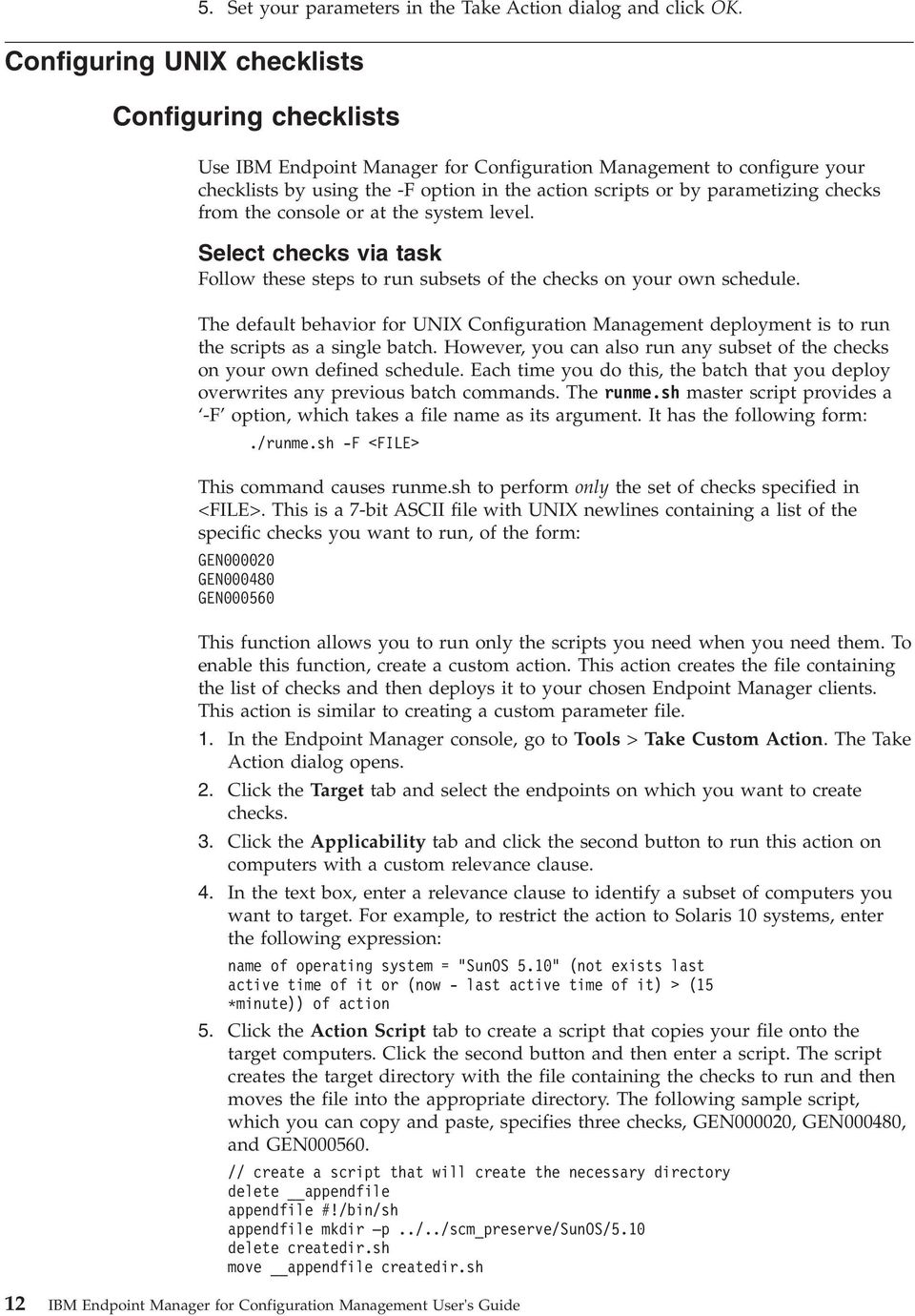
17 wait /bin/sh./createdir.sh // create the file containing the checks that you wish to run delete appendfile appendfile GEN appendfile GEN appendfile GEN delete../../scm_preserve/sunos/5.10/daily.txt move appendfile../../scm_preserve/sunos/5.10/daily.txt Parameterize checks You can customize security policies and change the values for defined configuration settings to meet specific corporate policies. Use Endpoint Manager to customize the content in the default Fixlet site by special targeting, customizing parameters, and disabling checks. Custom sites offer greater flexibility. Fixlet checks can be parameterized to suit each individual situation. Because parameters are stored as site settings, you can parameterize the same check differently for each site containing a copy of the check. You can parameterize UNIX Configuration Management checks in the following ways: v Some checks can be parameters from within the console. v Other checks can be set using a customer parameter file stored on the UNIX system. S Changing parameters from the console: Use the task that is associated with a particular Fixlet to modify parameters for content from the console. 1. To open a task, click the Check Parameterization link under the Description tab. 2. Go to the Actions box and see the two actions that are associated with the task. Use the first action to toggle the evaluation and the second action to modify the parameter that is associated with the check. 3. Click the second link to configure the parameter for the check. The recommended parameter is the default value or the last value that you entered if you previously customized the parameter. Enter a new value or click OK to accept the existing value. 4. Select the parameters of your action in the Take Action dialog and click OK. You have now set a parameter for the specified Fixlet, which propagates to the targeted computers to align them with your corporate policy. Changing parameters at the system level: You can change parameters of content at the system level if there is no parameter task in the console. You must do the following steps before you run the Deploy and Run Security Checklist task that is included in the respective site. In some cases, the UNIX Configuration Management content might not have a parameter task in the console. The content can still be parameterized at the system level, where you modify the customer_params file by using a task. Configuration Management User's Guide 13

18 Endpoint Manager UNIX Configuration Management checklist sites have default values that are pre-configured for various operating system settings according to a designated standard. However, you can modify the parameters that are passed to the UNIX checks to customize your deployment to meet the specific settings that youre organization requires. v To customize check parameters, create and maintain a text file on each machine that contains one line for each check you want to override. The line must contain the name of the check, the parameters to customize, and the new value. CHECK_ID:PARM_NAME=PARM_VALUE v To specify a minimum length of 6 and one alphabetic character in each password, customize two controls. The file must have two lines, one per control. In this example, the name of the parameter is VALUE. GEN000580:VALUE=6 GEN000600a:VALUE=1 1. Create a custom action to deploy the override file to the appropriate endpoints. Click Tools > Take Custom Acion. The Take Action dialog opens. 2. Click the Target tab of the Take Action dialog and select the computers that you want to customize from the list. 3. Click the Applicability tab and select the second button to run the action on computers with a custom relevance clause. 4. Enter the following relevance expression in the text box. This expression restricts the action to Solaris 10 systems and ensures that the task reapplies successfully if reapplication behavior is specified on the Execution tab. name of operating system = SunOS 5.10 AND (not exists last active time of it or (now - last active time of it) > (15 *minute)) of action The following table lists the various operating system strings that can be used. Table 2. Operating system strings that can be used for the relevance expression. Operating System String Windows 7 Win7 Windows 2008 Win2008 Windows XP WinXP Windows Vista WinVista Windows 2003 Win2003 SUN Solaris 10 SunOS 5.10 SUN Solaris 9 SunOS 5.9 SUN Solaris 8 SunOS 5.8 IBM AIX 5.1 AIX 5.1 IBM AIX 5.2 AIX 5.2 IBM AIX 5.3 AIX 5.3 HP-UX 11.0 HP-UX B HP-UX HP-UX B HP-UX HP-UX B Red Hat Enterprise Linux 3 Linux Red Hat Enterprise AS 3 Linux Red Hat Enterprise ES 3 Linux Red Hat Enterprise WS 3 Red Hat Enterprise Linux 4 Linux Red Hat Enterprise AS 4 14 IBM Endpoint Manager for Configuration Management User's Guide
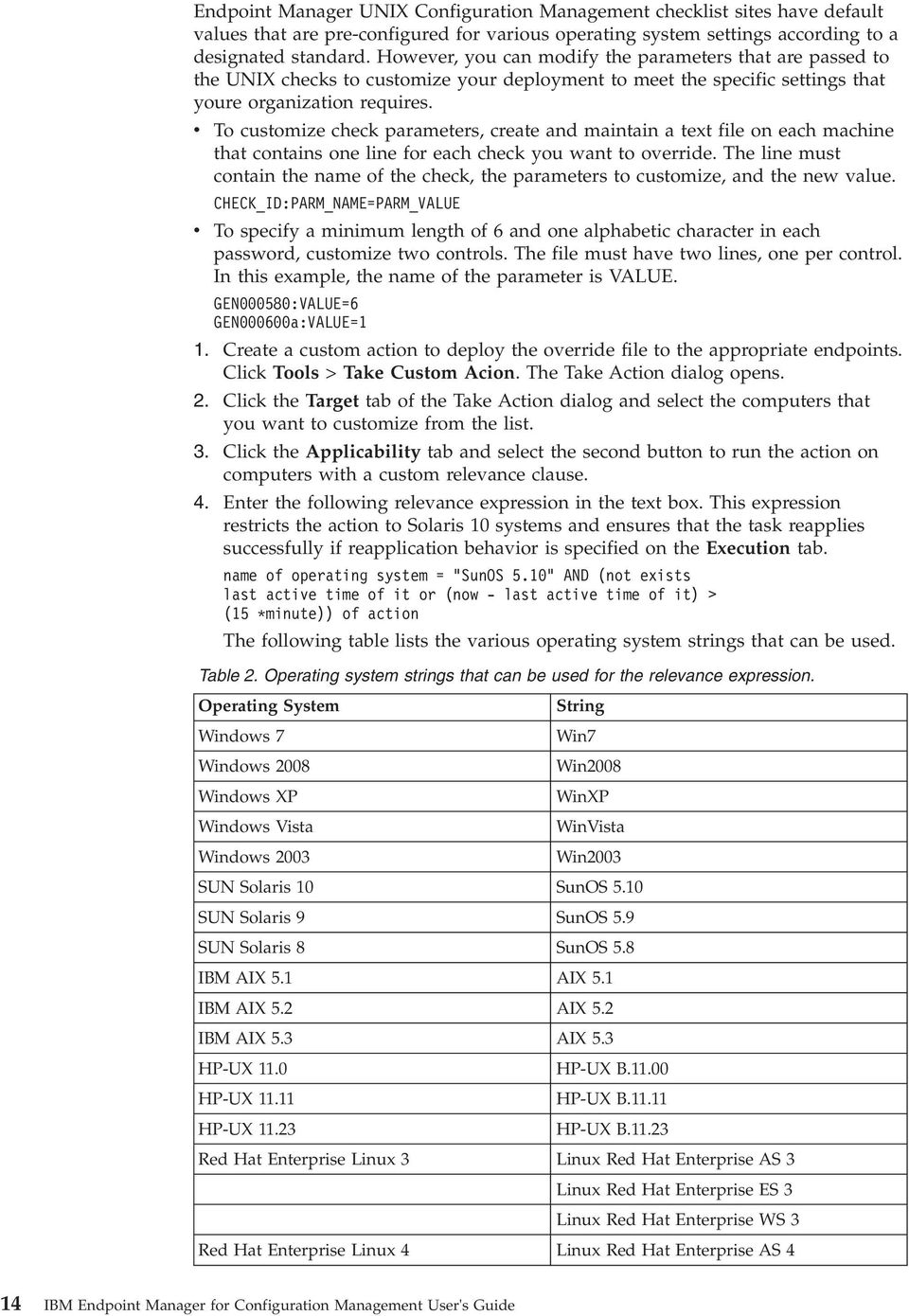
19 Table 2. Operating system strings that can be used for the relevance expression. (continued) Operating System String Linux Red Hat Enterprise ES 4 Linux Red Hat Enterprise WS 4 Red Hat Enterprise Linux 5 Linux Red Hat Enterprise AS 5 Linux Red Hat Enterprise ES 5 Linux Red Hat Enterprise WS 5 5. Click the Action Script tab to create a script that copies the file onto the target computers. 6. Click the second button to enter a script. Enter a script in the text box to create the target directory with the file that contains your custom parameters. The script must then move the file into the appropriate directory. // create a script that will make the necessary directory delete appendfile appendfile #!/bin/sh appendfile mkdir p../../scm_preserve/sunos/5.10 delete createdir.sh move appendfile createdir.sh wait /sbin/sh./createdir.sh // create the customer_params file and move it to the correct place delete appendfile appendfile GEN000580:VALUE=6 appendfile GEN000600a:VALUE=1 delete../../scm_preserve/sunos/5.10/customer_params move appendfile../../scm_preserve/sunos/5.10/customer_params Running checklists When you run the Deploy and Run Security Checklist, the Master Run script runme.sh runs all the Endpoint Manager check scripts. When you run the Deploy and Run Security Checklist task, the Master Run script runs the individual check scripts located on the UNIX system. This behavior can be modified using the F option. You can schedule specific checks and run global checks. The Master Run script also creates a file named /var/opt/besclient/scm/mytmp/results/master.results which contains the overall results of running the various OS-specific scripts. Modifying the run behavior: Follow these steps to modify how the master script runs all Endpoint Manager check scripts with the use of the -F option. The Master Run script (runme.sh) runs the individual check scripts that are located on the UNIX system when the Deploy and Run Security Checklist task is run. By default, the master script runs all the Endpoint Manager check scripts, but this behavior can be modified by using the F option. In addition to the F option, you can use other options on the master run script to change the behavior. Configuration Management User's Guide 15

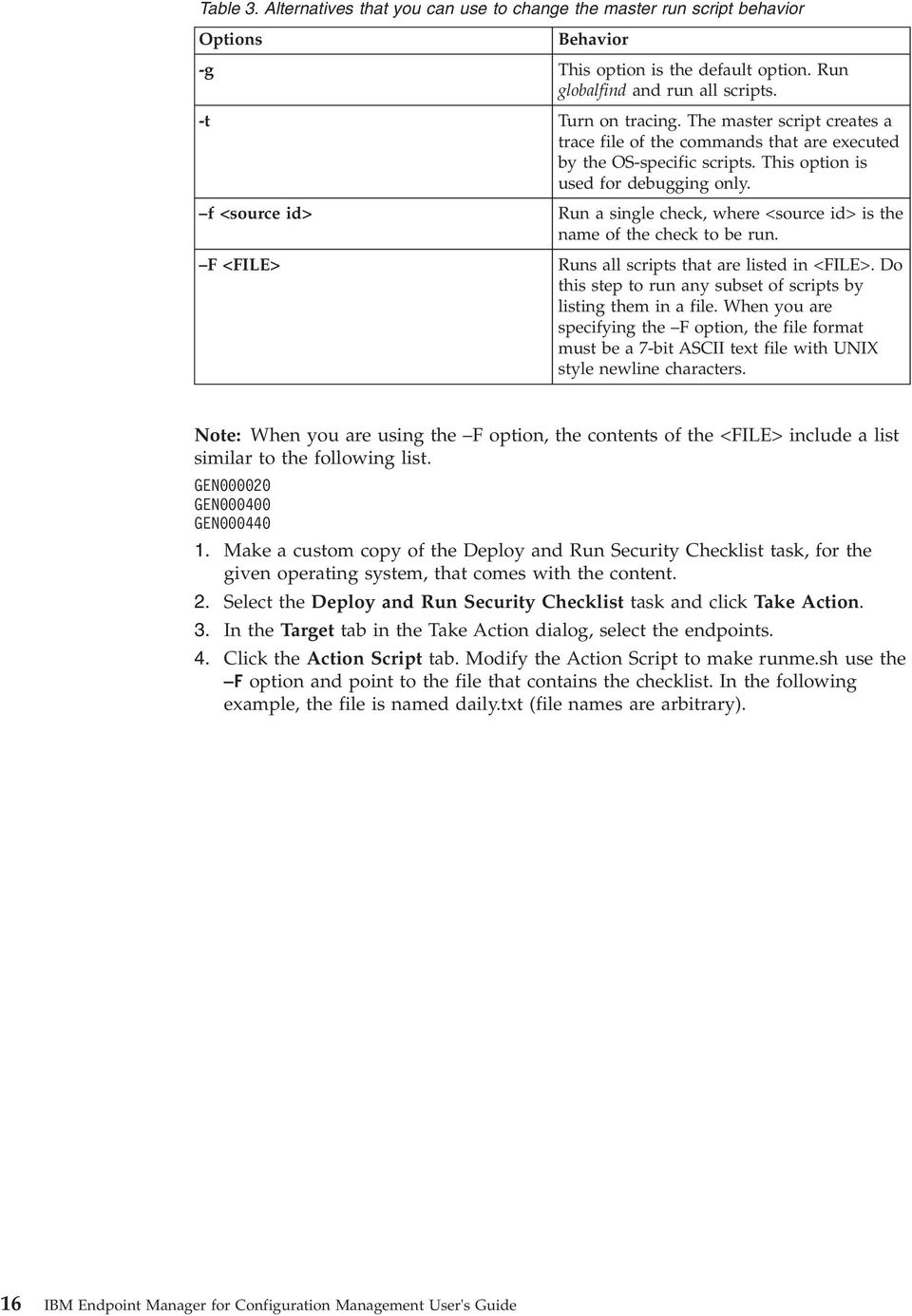
20 Table 3. Alternatives that you can use to change the master run script behavior Options Behavior -g This option is the default option. Run globalfind and run all scripts. -t Turn on tracing. The master script creates a trace file of the commands that are executed by the OS-specific scripts. This option is used for debugging only. f <source id> Run a single check, where <source id> is the name of the check to be run. F <FILE> Runs all scripts that are listed in <FILE>. Do this step to run any subset of scripts by listing them in a file. When you are specifying the F option, the file format must be a 7-bit ASCII text file with UNIX style newline characters. Note: When you are using the F option, the contents of the <FILE> include a list similar to the following list. GEN GEN GEN Make a custom copy of the Deploy and Run Security Checklist task, for the given operating system, that comes with the content. 2. Select the Deploy and Run Security Checklist task and click Take Action. 3. In the Target tab in the Take Action dialog, select the endpoints. 4. Click the Action Script tab. Modify the Action Script to make runme.sh use the F option and point to the file that contains the checklist. In the following example, the file is named daily.txt (file names are arbitrary). 16 IBM Endpoint Manager for Configuration Management User's Guide

21 You can copy, paste, and modify the following sample script. prefetch DISA.zip sha1:99c90759cc496c506222db55bd864eba4063b955 size: delete appendfile delete run_scm.sh appendfile #!/bin/sh if {exists folder ((pathname of parent folder of parent folder of folder (pathname of client folder of current site)) & "/SCM")} appendfile rm -rf {((pathname of parent folder of parent folder of folder (pathname of client folder of current site)) & "/SCM")} endif appendfile mv Download/DISA.zip {((pathname of parent folder of parent folder of folder (pathname of client folder of current site)))} appendfile cd {((pathname of parent folder of parent folder of folder (pathname of client folder of current site)))} appendfile gzip -dvs.zip DISA.zip appendfile FILE=`ls -1 DISA* grep -v zip` appendfile tar xf $FILE appendfile rm -rf $FILE appendfile cd {((pathname of parent folder of parent folder of folder (pathname of client folder of current site)) & "/SCM")} appendfile./runme.sh -F../scm_preserve/SunOS/5.10/daily.txt move appendfile run_scm.sh wait sh./run_scm.sh 5. Click OK. Note: Several checks use the globalfind utility and require a fresh find.out file to work correctly. If you are running one or more of the following checks, you must supply the -g option to runme.sh. The following checks require the global option and can be included with the -F option only if the g option is also supplied. Configuration Management User's Guide 17
22 Table 4. Checks that require the global option Checks that require the global option GEN GEN GEN GEN GEN GEN GEN GEN GEN GEN GEN GEN GEN GEN GEN GEN GEN GEN GEN GEN GEN GEN005360c GEN GEN SOL00360 SOL00380 Understanding the output: With UNIX content, endpoint scans are accomplished by a series of UNIX Bourne shell scripts that provide greater accessibility to UNIX system administrators. With most Endpoint Manager content, Fixlets constantly evaluate conditions on each endpoint. The console shows the results when the relevance clause of the Fixlet evaluates to true. With UNIX content, a task initiates a scan of the endpoints, which can be run on an ad hoc basis each time a scan is required. It can also be run as a recurring policy from the console. The endpoint scan is accomplished by a series of UNIX Bourne shell scripts. While each script runs, it detects a setting or condition. The script writes the information to an output file that is made available to the corresponding Fixlet check for evaluation. When the log files are written to disk, the Fixlets read each log file and show the results in the console. Although the result is similar, this method of detection provides greater accessibility to UNIX system administrators. After you run the Deploy and Run Security Checklist task, the scripts are in a directory under /var/opt/besclient/scm. The following image is a graphical representation of the directory structure. 18 IBM Endpoint Manager for Configuration Management User's Guide
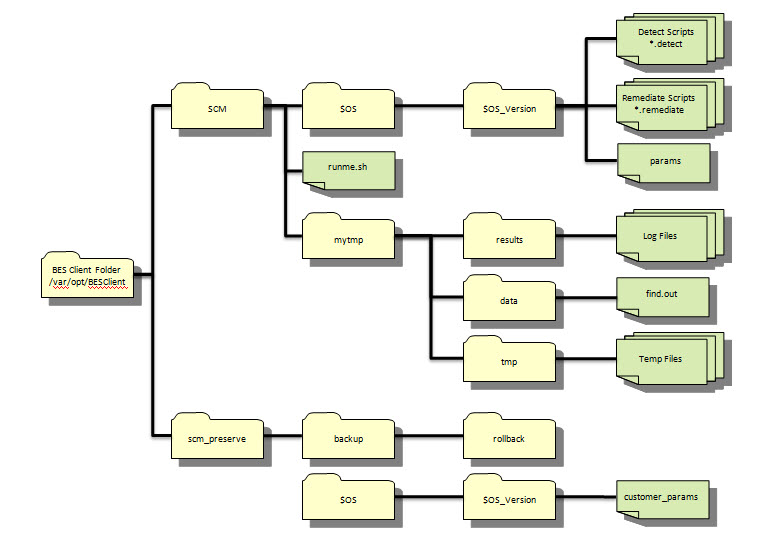
23 Table 5. Description of directories, subdirectories, and files Directory/Script Description <BES Client Folder> / SCM This directory is the base directory for the OS-specific check scripts and the master script (runme.sh). The contents of this directory are overwritten each time the Deploy and Run Security Checklist task is run from the Endpoint Manager console.../scm/util A subdirectory of the BES Client Folder / SCM directory, this subdirectory contains utility scripts that are used by the master script and in the individual detection and remediation scripts. The primary utility that is found in this directory is the globalfind script.../scm/$os/$os_version This directory is specific to the platform on which it runs, as specified by $OS and $OS version. For example, the Red Hat Enterprise Linux 4 shows as (../SCM/Linux/4). This directory path contains the specific detection scripts, remediation scripts, and the base parameter file that is used by the scripts. Each check script is named with the corresponding control ID that is used to describe the check. Each corresponding Fixlet also references the check ID.../SCM/runme.sh This script is the master script that is called by the Deploy and Run Security Checklist task within the Endpoint Manager console. This script runs the globalfind script and the individual check scripts. Configuration Management User's Guide 19
24 Table 5. Description of directories, subdirectories, and files (continued) Directory/Script Description../SCM/mytmp/results This folder is where the OS-specific detection scripts write their log files. These logs are examined by Fixlets and used to determine if a check is compliant or non-compliant. Each log file corresponds to the check ID for the given check.../scm/mytmp/data This folder contains the find.out file. This file is generated by the globalfind script and contains a directory listing of all local file systems and other information. This file is used by many of the OS-specific scripts and is updated only when the globalfind script is run. <BES Client Folder>/scm_preserve This directory is the base directory that is used to retain the rollback scripts, custom checks, parameters, and other information that is not intended to be overwritten each time the Deploy and Run Security Checklist task is run.../scm_preserve/backup/rollback Each time a remediation script is run, a corresponding rollback script is created. This script allows the administrator to roll back to the previous setting associated with the specific check.../scm_preserve/$os/$os_version This directory might contain custom scripts that are produced by the administrator and not provided by Endpoint Manager. Scripts that are in this directory must conform to the input or output specifications are run with out-of- the-box checks when running the Deploy and Run Security Checklist task.../scm_preserve/$os/$os_version This file is used to store any custom parameters that are defined by the /customer_params administrator. Any parameters defined in this file override the default parameters specified in the params file stored in <BES Client Folder>/SCM/$OS/$OS_version/ params). Each operating system-specific script writes two files in /var/opt/besclient/ mytmp/results. The filenames correspond to the name of the OS-specific script. For example GEN detect writes two files GEN detect.log and GEN results. The file with the.log extension contains the STDOUT and STDERR of the operating system-specific script. Under normal conditions, this file is empty. When runme.sh is run with the t option, this file contains the trace output of the operating system-specific script. When created, the files with the.results extension are read by a Fixlet and the result becomes available through the Endpoint Manager console. The Fixlets examine the [STATUS] section to determine relevance. 20 IBM Endpoint Manager for Configuration Management User's Guide
25 The following is an example of a results file: [RUN_DATE] 01 Apr 2008 [RUN_DATE_EOF] [DESCRIPTION] The UNIX host is configured to require a password for access to single-user and maintenance modes [DESCRIPTION_EOF] [FIXLET_DESCRIPTION] This UNIX host is not configured to require a password for access to single-user and maintenance modes [FIXLET_DESCRIPTION_EOF] [CHECK_COVERAGE] DISA-STIG-GEN [CHECK_COVERAGE_EOF] [STATUS] PASS [STATUS_EOF] [PARAMETERS] CONFIG_FILE=/etc/default/sulogin;SETTING=PASSREQ;OP= = ;VALUE=NO [PARAMETERS_EOF] [TIMETAKEN] 0 [TIMETAKEN_EOF] [REASON] The /etc/default/sulogin file does not exist, the system will default to requiring a password for single-user and maintenance modes [REASON_EOF] Each of the sections found within the log file output are described in the following table: Table 6. Descriptions of sections found within the log file output Section Name Description [RUN_DATE] Contains the date that the script was run. [DESCRIPTION] and No longer used deprecated file [FIXLET_DESCRIPTION] Deprecated [CHECK_COVERAGE] Contains the names of the regulations to which this Fixlet applies. (No longer used deprecated files) [STATUS] Used by the associated Fixlet to determine relevance. It contains one of the following strings: PASS, FAIL, or NA. If this section contains the string FAIL, then the associated Fixlet becomes relevant. [PARAMETERS] Contains the parameters associated with the script. Spaces display as a semicolon. On output into this file, spaces are converted to semicolons for display purposes. This is not representative of how the parameters are set. [TIMETAKEN] Contains the number of seconds of wall-clock time that the script took to run. [REASON] Contains a description of why the script passed or failed. This section provides information needed to construct analysis properties and return specific information to the Endpoint Manager Console. Configuration Management User's Guide 21

26 The runme.sh script also creates a file containing the overall results of running the various OS-specific scripts. This file, named /var/opt/besclient/scm/mytmp/results/master.results,displays as follows: TOTAL_SCRIPTLETS_RUN:69 TOTAL_SCRIPTLETS_PASS:33 TOTAL_SCRIPTLETS_FAIL:36 TOTAL_SCRIPTLETS_NA:0 TOTAL_SCRIPTLETS_ERR:0 TOTAL_TIME_TAKEN:1367 Modifying global scan options: You can control the behavior of the global scan through the Configure Filesystems Scan Options task. UNIX content includes a global scan script that is used to do a full system scan. The results of this scan are used in a number of scripts. This script eliminates the need to run a full system scan multiple times when you are evaluating a set of checks on a single system. This feature allows Endpoint Manager to be more efficient and causes less impact on the system during a configuration scan. The global scan script runs by default when you are using the Endpoint Manager Deploy and Run Security Checklist task. It is used by the Master Run script with the use of the g option. The behavior of the global scan script can be controlled through the Configure Filesystems Scan Options task. 22 IBM Endpoint Manager for Configuration Management User's Guide
27 Table 7. Parameters and their descriptions Parameter EXCLUDEFS EXCLUDEMOUNTS Description A list of specific file systems to exclude from scanning. This list must be a space-separated list of all the file system types to exclude from the search. By default, the global find script excludes the following file system types from its search: v cdrfs v procfs v ctfs v fd v hsfs v proc v mntfs v smbfs v iso9660 v nfs v msdos A list of specific mount points to exclude from scanning. This parameter must be defined as a space-separated list of all the file system mounts to exclude from the search. This prevents the shared file system from being scanned from multiple systems. For example, if several systems mount a shared directory on a Storage Area Network named /san, you might want to exclude them with a parameter such as: EXCLUDEMOUNTS= /san EXCLUDEDIRS By default, this parameter is not used and is represented as an empty value. List of directories to exclude from scanning. Any directory names specified in EXCLUDEDIRS are omitted from the directory listing. By default, this parameter excludes the lost+found directory. Note: When you exclude a directory, you also exclude all similarly-named directories. For example, if you specify EXCLUDEDIRS= foo/, you also exclude /foo/usr/foo and /usr/local/foo. Scheduling specific checks: You can create a custom action to run a subset of checks on your own schedule. The default behavior for a UNIX deployment is to run the scripts as a single batch. However, you can also run any subset of the checks on your own defined schedule. Each time that you do, the batch that you deploy overwrites any Configuration Management User's Guide 23

28 previous batch commands. The runme.sh master script provides a -F option, which takes a file name as its argument. It has the following form:./runme.sh -F <FILE> This command causes runme.sh to run only the set of checks that are specified in <FILE>. This file is a 7-bit ASCII file with UNIX newlines that contains a list of the specific checks you want to run, as follows: GEN GEN GEN To select a specific script and run schedule, create a custom action. This action creates the file that contains the list of checks and deploys it to Endpoint Manager clients. This action is similar to the creation of a custom parameter file. 1. In the console, go to Tools > Take Custom Action to access the Take Action dialog. 2. To run the action on computers with a custom relevance clause, click the Applicability tab and select...the following relevance clause evaluates to true.. 3. In the text box, enter a relevance clause to identify the subset of computers you want to target. For example, to restrict the action to Solaris 10 systems, enter the following expression: name of operating system = SunOS 5.10 (not exists last active time of it or (now - last active time of it) > (15 *minute)) of action 4. Click the Action Script tab to create a script that copies your file onto target computers. Click the second button and enter a script like the one in the following screen capture. 24 IBM Endpoint Manager for Configuration Management User's Guide

29 5. This script creates the target directory with the file that contains the checks that you want to run and moves the file into the appropriate directory. You can copy and paste the following sample script that specifies three checks, GEN000020, GEN000480, and GEN // create a script that will create the necessary directory delete appendfile appendfile #!/bin/sh appendfile mkdir p../../scm_preserve/sunos/5.10 delete createdir.sh move appendfile createdir.sh wait /bin/sh./createdir.sh // create the file containing the checks that you wish to run delete appendfile appendfile GEN appendfile GEN appendfile GEN delete../../scm_preserve/sunos/5.10/daily.txt move appendfile../../scm_preserve/sunos/5.10/daily.txt 6. Run the runme.sh script with the F option. Modify the Deploy and Run Security Checklist task to run the script. a. Find and select the Deploy and Run Security Checklist task. b. Click Take Action c. In the Target tab, then select the endpoints. 7. Click the Action Script tab. Modify the Action Script to make runme.sh use the F option and point to the file that contains the check list. The file in the example is named daily.txt. 8. You can copy, paste, and modify the following sample script. prefetch DISA.zip sha1:99c90759cc496c506222db55bd864eba4063b955 size: delete appendfile delete run_scm.sh appendfile #!/bin/sh if {exists folder ((pathname of parent folder of parent folder of folder (pathname of client folder of current site)) & "/SCM")} appendfile rm -rf {((pathname of parent folder of parent folder of folder (pathname of client folder of current site)) & "/SCM")} endif appendfile mv Download/DISA.zip {((pathname of parent folder of parent folder of folder (pathname of client folder of current site)))} appendfile cd {((pathname of parent folder of parent folder of folder (pathname of client folder of current site)))} appendfile gzip -dvs.zip DISA.zip appendfile FILE=`ls -1 DISA* grep -v zip` appendfile tar xf $FILE appendfile rm -rf $FILE appendfile cd {((pathname of parent folder of parent folder of folder (pathname of client folder of current site)) & "/SCM")} appendfile./runme.sh -F../scm_preserve/SunOS/5.10/daily.txt move appendfile run_scm.sh wait sh./run_scm.sh Configuration Management User's Guide 25
30 Analyses Each check Fixlet in the DISA UNIX content has an associated analysis. Check Fixlets display the compliance state, and analyses display the state of each configuration item. These analyses are provided to enable the display of Measured Values in IBM Endpoint Manager Security and Compliance Analytics. If you are using only a subset of the available check Fixlets for your implementation, activate only the analyses that are associated with the check Fixlets you are using. Using the Create Custom Relevance SCM content wizard Follow these steps to incorporate custom checks into an existing SCM custom site. v v You must have a custom site that is created through the Create Custom Checklist wizard in the SCM Reporting site. Check that the custom checks are up to date and that bug fixes are installed with the Synchronize Custom Checks wizard. Use this dashboard to incorporate custom checks into an existing SCM Custom site. 1. In the Security Configuration Domain, gotoall Security Configuration > Wizards > Create Custom Relevance SCM Content. The Create Custom Relevance SCM checks wizard opens 2. Enter the following required information: v Site v Applicability Fixlet v Fixlet title v SourceID v Source v Source Release Date v Category v Severity 3. Enter the Fixlet description. You can use simple HTML format to create your description. 4. Enter the Compliance Relevance. 5. Enter the Analysis Relevance. a. Optional: Select the box if you want to include the desired value. b. Enter the title of the desired value. c. Enter the desired value. 6. Enter the Remediation Action Script. 7. Click Create Fixlet. Creating custom UNIX Security Configuration Management content Follow these steps to create custom check for UNIX Security Configuration Management. v You must have a custom site that is created through the Create Custom Checklist wizard in the SCM Reporting site. 26 IBM Endpoint Manager for Configuration Management User's Guide
31 v Check that the custom checks are up to date and that bug fixes are installed with the Synchronize Custom Checks wizard. Use this dashboard to incorporate custom checks into an existing SCM Custom site based on an arbitrary bourne shell script. 1. Go to Wizards > Create Custom Unix SCM Content. The Create custom Unix SCM checks dashboard opens. 2. Enter the following required information: v Site v Applicability Fixlet v Fixlet title v SourceID v Source v Source Release Date v Category v Severity 3. Enter the Fixlet description. You can use simple HTML format to create your description. 4. Enter the Compliance Relevance. 5. Enter the Analysis Relevance. a. Optional: Select the box if you want to include the desired value. b. Enter the title of the desired value. c. Enter the desired value. 6. Enter the Remediation Action Script. 7. Click Create Fixlet. Once the scan is complete, customers can start an import to the Security Compliance Analysis. Importing Windows SCAP content Learn about SCAP, the standards it covers, and the wizards you can use to import Windows SCAP content and to generate SCAP reports. Configuration Management User's Guide 27
32 Security Content Automation Protocol (SCAP) combines standards that evaluate systems for vulnerabilities, policy compliance, and configurations related to security. The following standards are covered by SCAP: v Common Vulnerabilities and Exposures (CVE ) v Common Configuration Enumeration (CCE ) v Common Platform Enumeration (CPE ) v Common Vulnerability Scoring System (CVSS) v Extensible Configuration Checklist Description Format (XCCDF) v Open Vulnerability and Assessment Language (OVAL ) You can use the SCAP checklists from the Endpoint Manager console or the wizards that are available in the SCM Reporting site. Learning about SCAP Security Content Automation Protocol comprises of standards that identify security vulnerabilities, system configuration, and security compliance issues. SCAP provides a measure by which these standards are used. Information Security Automation Program (ISAP) technical specifications are contained in the related Security Content Automation Protocol (SCAP). SCAP consists of a suite of standards that enable automated vulnerability management, measurement, and policy compliance evaluation, for example, FISMA compliance. Specifically, SCAP standards address the following objectives: v Enumerate software flaws, security-related configuration issues, and product names v Measure systems to determine the presence of vulnerabilities v Provide mechanisms to rank the results of these measurements to evaluate the impact of the discovered security issues SCAP defines how these standards are combined. The U.S. National Institute of Standards and Technology (NIST) maintains the National Checklist Program (NCP) and provides a repository of data feeds that use the SCAP standards. It is also the repository for official SCAP standards data. NIST defines and maintains the protocol and the data feeds of content in the SCAP standards. Thus, NIST defines how to use the open standards within the SCAP context and defines the mappings between the SCAP enumeration standards. Information Security Automation Program (ISAP) The Information Security Automation Program (ISAP) automates and standardizes technical security operations. Primarily focused on government, ISAP offers security checking, remediation, and automation of technical compliance activities to such regulations as FISMA and the FDCC. ISAP objectives include enabling standards-based communication of vulnerability data, customizing and managing configuration baselines for various IT products, assessing information systems and reporting compliance status, using standard metrics to weight and aggregate potential vulnerability impact, and remediating identified vulnerabilities. 28 IBM Endpoint Manager for Configuration Management User's Guide
33 SCAP standards Common Vulnerabilities and Exposures (CVE) The SCAP CVE standard is a dictionary of publicly known information security vulnerabilities that enable data exchanges between security products and provide a baseline index point for evaluating coverage of tools and services. IBM Endpoint Manager has actively supported CVE for several versions of the product and maintains a mature product integration with CVE content. Any security patch or vulnerability that has an associated CVE ID and is available as either a SCAP data stream or available through other Endpoint Manager developed processes will display the relevant CVE ID within the Endpoint Manager console. To learn more about CVE, see Common Configuration Enumeration (CCE ) The SCAP CCE standard provides unique identifiers to system configuration issues to facilitate fast and accurate correlation of configuration data across multiple information sources and tools. For example, CCE Identifiers can associate checks in configuration assessment tools with statements in configuration best practice documents. The IBM Endpoint Manager platform includes the ability to assess workstations, laptops, servers, and mobile computing devices against common configuration settings to identify misconfiguration states in a diverse computing environment. Endpoint Manager displays the CCE ID for each misconfiguration for which there is a CCE ID within the Endpoint Manager console. In the case where a misconfiguration is associated with multiple CCE IDs, all IDs are cross-referenced and displayed. To learn more about CPE, see Common Platform Enumeration (CPE ) The SCAP CPE standard is a structured naming scheme for information technology systems, platforms, and packages. Based on the generic syntax for Uniform Resource Identifiers (URI), CPE includes a formal name format, a language for describing complex platforms, a method for checking names against a system, and a description format for binding text and tests to a name. Endpoint Manager uses CPE to ensure that configuration settings are assessed on the correct system. Regardless of the operating system, the CPE ID can identify a platform and ensure that an assessment is performed. You can assess and remediate system configurations by targeting systems by platform in addition to other targeting mechanisms. By targeting a particular platform, you can ensure that system scans are done properly and are weighed against applicable configuration checks. Checks are assessed in real-time based on the platform and policies can be enforced, giving administrators current visibility and control over platforms in a distributed or non-distributed computing environment. To learn more about CPE, see Common Vulnerability Scoring System (CVSS) The SCAP CVSS standard provides an open framework for communicating the characteristics of IT vulnerabilities. Its quantitative model ensures repeatable, accurate measurement while displaying vulnerability Configuration Management User's Guide 29
34 characteristics used to generate the scores. Thus, CVSS is well suited as a standard measurement system for industries, organizations, and agencies that need accurate and consistent vulnerability impact scores. Endpoint Manager assesses and reports on vulnerabilities and quantifies the impact for multiple computing platforms. Endpoint Manager displays both the CVSS base score for each applicable vulnerability and the CVSS Base Score Vector that is used to produce the score. Endpoint Manager administrators can access the CVSS score and the associated vector string from within the console. For additional details, administrators can navigate to the a vulnerability definition from within the Fixlets. Endpoint Manager provides a link for administrators to connect to the CVSS definition located on the NVD website. Endpoint Manager enhances the value of CVSS by displaying this common metric for detailed reports on individual end-point systems and for large groups of systems reported on in the aggregate. To learn more about CVSS, see Extensible Configuration Checklist Description Format (XCCDF) The SCAP XCCDF standard is a specification language for writing security checklists, benchmarks, and related documents. An XCCDF document represents a structured collection of security configuration rules for some sets of target systems and is the core element of the SCAP data stream. The specification also defines a data model and format for storing results of checklist compliance testing. SCAP data streams use the XCCDF format to translate underlying configuration checks that are defined in Endpoint Manager Fixlets. Administrators can use the created SCAP-based configuration Fixlets to assess their computing assets against the SCAP-defined configuration rules. Administrators can view results of the configuration checks and generate detailed reports on an individual system or on large groups of systems. IBM Endpoint Manager also exports the results of the configuration checks into the defined XCCDF report format so that the organization can store, send, or import those reports into another tool. To learn more about XCCDF, see xccdf/. Open Vulnerability and Assessment Language (OVAL ) The SCAP OVAL standard is an international, information security community standard that promotes security content and standardizes the transfer of this information across an entire spectrum of security tools and services. The OVAL language is a collection of XML schema for representing system information, expressing specific machine states, and reporting the results of an assessment. Through a repository of vulnerability assessment policies, Endpoint Manager assesses managed computers against OVAL vulnerability definitions using real-time data tracking based on the data elements of each definition. These policies are automatically retrieved by the Endpoint Manager product within an organization's network. When validated for authenticity, the policies are made available to the Endpoint Manager client installed on each managed computer and added to their local library of configuration policies. The agent continuously evaluates the state of the machine against each policy so that any instance of non-compliance can be 30 IBM Endpoint Manager for Configuration Management User's Guide
35 SCAP Checklists reported to the Endpoint Manager Server for administrator review. If pre-authorized by an administrator, the appropriate corrective action is applied to the computer immediately upon misconfiguration detection, even to remote or mobile users not connected to the organization's network. To learn more about OVAL, see IBM Endpoint Manager has taken the SCAP checklist XML, generated Endpoint Manager content from it, and made it available through subscription. Customers load the external site mastheads for each of the available SCAP checklists in the Endpoint Manager console, and the Endpoint Manager server downloads the content and makes it available to the Endpoint Manager administrator to begin evaluating on systems. Endpoint Manager currently provides out-of-the-box content for the Federal Desktop Core Configuration (FDCC) SCAP checklists. As new checklists are made available by NIST, IBM Endpoint Manager might include those sites as part of the subscription service. In addition to the Fixlet sites, Endpoint Manager includes a reporting dashboard that provides visibility into the results of the system evaluations and a reporting dashboard for generating Endpoint Manager content from an SCAP checklist. These dashboards are found in the SCM Reporting site. The following out-of-the-box SCAP checklists are currently available as part of this product: v FDCC on Windows XP v FDCC on Windows XP Firewall v FDCC on Windows Vista v FDCC on Windows Vista Firewall v FDCC on Internet Explorer 7 v USGCB on Windows 7 Firewall v USGCB on Windows 7 Energy v USGCB on Internet Explorer 8 v USGCB on Windows 7 Using the Import Windows SCAP Wizard You must create a custom site that will contain the resulting checklist. The Import Windows SCAP Content wizard generates IBM Endpoint Manager content from a set of SCAP XML input files into a custom site. The content that is generated includes a Fixlet for each check found in the SCAP checklist. To find SCAP checklists, see the National Checklist Program Repository. The SCAP Import wizard has been validated for checklists at Tier IV in this repository. Note: The Import Windows SCAP Content wizard is the latest version of the import wizard but it has not received SCAP certification. Click the link in the wizard to access the earlier, certified version. Configuration Management User's Guide 31
36 1. From the Security Configuration Domain, go to All Security Configuration > Wizards > Import Windows SCAP Content. 2. Click Select and choose the XCCDF file that will be imported. 3. Click the dropdown menu to select from the following profiles: v I - Mission Critical Classified v I - Mission Critical Public v I - Mission Critical Sensitive v II - Mission Support Classified v II - Mission Support Public v II - Mission Support Sensitive v III - Administrative Classified v III - Administrative Sensitive 4. Identify how the issues and errors should be handled. Click to select from the following choices: v Strict v Lenient (ignore minor issues) v Lax (make a best effort to import the content) 5. Optional: You can choose to apply the following conditions to the Windows checklist that will be imported. v Include OVAL checklists - Select this box to process XCCDF rules that reference an entire OVAL file. v Skip OVAL validation v Skip XML validation v Allow unescaped HTML in check description - Use with caution. This option may contain script tags. 6. Click Import. 7. Select the custom site from the menu. 8. Click OK. 32 IBM Endpoint Manager for Configuration Management User's Guide
37 Using the Report Creation wizard Allocate adequate time for the creation of these SCAP reports. The amount of time to generate a report depends on the size of your deployment. For example, creating a report for a deployment of 5,000 computers can take 15 minutes on a properly-sized console computer. 1. From the Security Configuration Domain, gotoall Security Configuration > Wizards > Create SCAP Report. 2. Select the report parameters. a. Specify an SCAP checklist from the dropdown menu. b. To specify an output folder, click Select and browse for the folder. 3. Target the computers. a. Select the computers based on the following criteria: v All computers with the values selected, based on what is written in the field v All computers within the selected computer group v The computers specified in the list of names entered in the field. The names must be separated by spaces or new lines. b. Optional: Manually enter a list of computers in the designated field. c. Click View Computers to check your selection. 4. Select additional report properties. Configuration Management User's Guide 33
38 Use the scroll bar to view a list of available report properties. Check any applicable boxes and view each selection in the corresponding Included in report box on the right. 5. Click Create. OVALDI in Configuration Management Security Configuration Management uses Oval Interpreter (OVALDI), an open-source reference implementation that uses OVAL to scan computer vulnerabilities and generate OVAL full results. The Oval Interpreter (OVALDI) is a freely available reference implementation that demonstrates the evaluation of OVAL definitions. Using command line interface, OVALDI collects and evaluates system information to generate an OVAL Results file based on a set of Definitions. OVALDI is under BSD license. For more information about OVALDI, see Fixlet 9 in the SCM Reporting site. Configuration Management Reporting Frequently asked questions In previous releases, the primary reporting tools for the Configuration Management solution included the Configuration Management dashboard, Exception Management dashboard, and Web Reports. These tools, while still accessible for customers with previously-saved reports and exceptions, have now been superseded by Security and Compliance Analytics, which is included in all Configuration Management subscription packages. For more information about Security and Compliance Analytics, see the Security and Compliance Analysis User Guide. Can I parameterize all checks? Not all checks can be parameterized using the Fixlet user interface we provide. In cases where a check can be parameterized, the method depends on the type of content. See the Configuration Management Checklists Guide for more information. Are remediation actions available for all checks? Remediation actions are available for a subset of checks. Where can I find a sample file containing UNIX parameters? See the Configuration Management Checklists Guide. Are there compliance evaluation reports/mechanisms that compare a laptop or server against FISMA/NIST/DISA standards? Configuration Management checks assess servers, laptops, and desktops against a predefined set of configuration guidance such as DISA STIG and FDCC. 34 IBM Endpoint Manager for Configuration Management User's Guide
39 Tivoli Endpoint Manager also supports configuration standards from NIST, NSA, and other standards organizations. Regulatory compliance regulations such as FISMA, PCI, and others can easily be supported by customizing the checklists provided by IBM. What happens if I subscribe sites incorrectly to a system? Each Configuration Management site applies to a specific operating system or product. It is important that each computer subscribed to each site matches the correct operating system configuration. This ensures the accuracy of the compliance results for each Configuration Management site, and prevents potential performance issues. External sites contain site relevance to ensure that only applicable computers are subscribed. However, custom sites do not support site relevance, so you are responsible for maintaining accurate subscriptions. When I run a remediation action on a UNIX endpoint, how do I ensure that a system is not remediated more than once? When a remediation action is run, the remediation action reruns the detection script. When the detection script is run, it provides the validation of whether or not the remediation was successful. If successful, the Fixlet becomes non-relevant. If unsuccessful, the Fixlet remains relevant. What does the letter designation mean on the end of some of the scripts within the UNIX content? We used the DISA STIG unique identifiers as part of the naming convention for each DISA STIG control that was built. In the case where we had to separate a single control into multiple scripts, the scripts include a letter designator on the end that provides a unique ID for each control. What is the security associated with the base parameter file that defines the parameters for the UNIX content? The standard permissions for this file are 700 (RWE for the owner of the file). In this case, the owner must be root or whichever user is the owner of the BES Client. Glossary Action Password See signing password. Action Scripting Language The language used for crafting action scripts. Action can be crafted in different scripting languages, including AppleScript and Unix shells. Ambiguous software A software is considered ambiguous when it a) has an executable that looks like another executable, or b) when it exists in more than one place in the catalog (Microsoft Word as a standalone product or bundled with Microsoft Office). BigFix Enterprise Suite (BES) The previous name for IBM Endpoint Manager. Client Software installed on each networked computer to be managed under the IBM Endpoint Manager. The Client accesses a pool of Fixlet messages, checks the computer it is installed on for vulnerabilities, and sends the Configuration Management User's Guide 35
40 Server a message when such a condition occurs. Previously known as the BES Client, it is now known as the IBM Endpoint Manager Client, or simply Client. Console A management program that provides an overview of the status of all the computers with the Client installed in the network, identifying which might be vulnerable and offering corrective actions. Previously known as the BES Console, it is now known as the IBM Endpoint Manager Console, or simply Console. CO2 Emissions CO2 is one of the primary greenhouse gases and power generation is one of the largest sources of CO2 emissions. The amount of CO2 emitted per kwh generated varies significantly based on how the electricity is generated. For example, hydroelectric and nuclear power plants do not emit CO2, but coal-fired power plants emit significant CO2. Custom Site You can create your own custom content and host it in a custom site. This can only be done by a Master Operator that has been granted the rights to create custom content (use the Admin program to allocate these users). Data stream A string of information that serves as a source of package data. Definitive package A string of data that identifies the presence of software and serves as the primary method for identifying the presence of software on a computer. DSA Distributed Server Architecture. Multiple Servers are linked to provide full redundancy in case of failure. Fixlet message A mechanism for targeting and describing a problematic situation on a computer and providing an automatic fix for it. Fixlet servers Web servers offering Fixlet site subscriptions. They can be either internal to the enterprise network or external to the network (if direct external web access is allowed). Fixlet site A trusted source from which the Client obtains Fixlet messages. Generator Install folder The directory on the installation computer where the Generator places the installation files for the IBM Endpoint Manager system. IBM Endpoint Manager A preventive maintenance tool for enterprise environments that monitors computers across networks to find and correct vulnerabilities with a few simple mouse-clicks. IBM Endpoint Manager database A component of the system that stores data about individual computers and Fixlet messages. The IBM Endpoint Manager Server s interactions primarily affect this database, which runs on SQL Server. Installation Computer A secure computer (separate from the IBM Endpoint Manager Server computer) that hosts and runs the Installation Generator. 36 IBM Endpoint Manager for Configuration Management User's Guide
41 Installation Generator An application that creates installers for the core IBM Endpoint Manager system components. Management Rights Ordinary Console Operators can be limited to a specified group of computers. These limits represent the management rights for that user. Only a Site Administrator or a Master Operator can assign management rights. Master Operator A Console Operator with administrative rights. A Master Operator can do almost everything a Site Administrator can do, with the exception of creating new operators. Masthead Files containing the parameters of the IBM Endpoint Manager process, including URLs that point to where trusted Fixlet content is available. The IBM Endpoint Manager Client brings content into the enterprise based on subscribed mastheads. Mirror server A server required in the IBM Endpoint Manager system if the enterprise does not allow direct web access but instead uses a proxy server that requires password-level authentication. Operator A person who operates the IBM Endpoint Manager Console. Ordinary operators can deploy Fixlet actions and edit certain computer settings. Master Operators have extra privileges, among them the ability to assign management rights to other operators. Package A secondary artifact collected from computers, which is an identification string pulled from the Windows registry. Package data A type of data used in the Software Catalog to help distinguish between two similar executables includes regular and definitive packages. Power States System Power States define the overall power consumption of a system. IBM Endpoint Manager Power Management tracks four main power states Active, Idle, Standby or Hibernation, and Power Off. For detailed information about power states, see the related Knowledge Base Article from the IBM Endpoint Manager support website. Note: On Mac systems, Power State Tracking is limited to Active and Power Off. Price per kwh This is the amount you pay for electricity. One kwh is equal to 1,000 watts used for one hour. As a reference point, a standard desktop and monitor runs for approximately six hours on one kwh of electricity. A typical cost for a kwh is $0.10 in many regions of North America. However, electricity costs vary significantly depending on region and power provider, and different computer models vary power usage. Relay This is a Client that is running special server software. Relays spare your server and the network by minimizing direct server-client downloads and by compressing upstream data. Relays are automatically discovered by Configuration Management User's Guide 37
42 Clients, which dynamically choose the best Relay to connect to. Previously known as the BES Relay, it is now known as the IBM Endpoint Manager Relay, or simply Relay. Relevance Language The language in which relevance clauses are written. Root Server Refers to the HTTP or HTTPS services offered by the main Server as an alternative to IIS. The IBM Endpoint Manager Root Server is specially tuned to Fixlet traffic and is more efficient than IIS for this application. Previously known as the BES Root Server, it is now known as the IBM Endpoint Manager Root Server, or simply Root Server. SCAP Check A specific configuration check within a SCAP checklist. Checks are written in XCCDF and are required to include SCAP enumerations and mappings per the SCAP template. SCAP Checklists SCAP checklists are configuration checklists written in a machine readable language (XCCDF). SCAP checklists, also referred to as checklists or baselines, have been submitted to and accepted by the NIST National Checklist Program. They also conform to a SCAP template to ensure compatibility with SCAP products and services. The SCAP template discusses requirements for including SCAP enumerations and mappings within the checklist. SCAP Content Consists of security checklist data represented in automated XML formats, vulnerability and product name related enumerations, and mappings between the enumerations. SCAP Enumerations Include a list of all known security related software flaws (CVE), a list of known software configuration issues (CCE), and a list of standard vendor and product names (CPE). SCAP Mappings Interrelate the enumerations and provide standards-based impact measurements for software flaws and configuration issues. Thus, for any given software flaw (CVE), one can determine the affected standard product names (CPE). For any given standard product name (CPE), one can determine the configuration issues that affect that product (CCE). For any given software flaw (CVE) or configuration issue (CCE), one can determine the standard impact score (CVSS). SCAP Reports SCAP reports are required to include SCAP enumerations and mappings per the SCAP template. SCAP Test Procedures SCAP checklists reference SCAP test procedures for machine readable information on performing low level checks of machine state (OVAL). SCAP test procedures are used in conjunction with SCAP checklists. Server A collection of interacting applications (web server, CGI-BIN, and database server) that coordinates the relay of information to and from individual computers in the IBM Endpoint Manager system. The server processes may be hosted by a single server computer or segmented to run on separate 38 IBM Endpoint Manager for Configuration Management User's Guide
43 server computers or replicated on redundant servers. Previously known as the BES Server, it is now known as the IBM Endpoint Manager Server, or simply Server. Signing password The password (specified when the IBM Endpoint Manager system was installed) used by a Console operator to sign an action for deployment. It is called the action password in the Console interface. Site Administrator The person in charge of installing IBM Endpoint Manager, authorizing and creating new Console operators. SQL server A full-scale database engine from Microsoft that can be acquired and installed into the IBM Endpoint Manager system to satisfy more than the basic reporting and data storage needs. A step up from SQLite Standard deployment A deployment of the IBM Endpoint Manager that applies to workgroups and to enterprises with a single administrative domain. It is intended for a setting in which all Client computers have direct access to a single internal server. System install folder The directory on the IBM Endpoint Manager Server where the Server software and related files (including Console and Client installers) will be installed. VPN Virtual Private Network. An encrypted channel (or tunnel) that allows companies to extend their local-area networks across the world by using an inexpensive Internet connection. Wake-from-Standby Windows and other operating systems allow applications to wake a computer from standby at pre-defined times. Using Wake-from-Standby, a computer wakes itself without the need for Wake-on-LAN. Wake-on-LAN Wake-on-LAN (WoL) is a standard mechanism for waking computers by sending them a specific network packet (known as the magic packet). Wake-on-LAN is difficult in many network environments because of network restrictions regarding broadcasts from other subnets. IBM Endpoint Manager Power Management handles these complexities by sending WoL packets from nearby agents in the same subnet. WAN Wide-area network. Many offices are connected by WAN. The bandwidth of your WAN determines the placement of Relays in your deployment, with thin WANs requiring more relays to aggregate downloads and reduce overhead. Support For more information about this product, see the following resources: v IBM Endpoint Manager Support site v IBM Endpoint Manager wiki v Knowledge Base v Forums and Communities Configuration Management User's Guide 39
44 Notices This information was developed for products and services offered in the U.S.A. IBM may not offer the products, services, or features discussed in this document in other countries. Consult your local IBM representative for information on the products and services currently available in your area. Any reference to an IBM product, program, or service is not intended to state or imply that only that IBM product, program, or service may be used. Any functionally equivalent product, program, or service that does not infringe any IBM intellectual property right may be used instead. However, it is the user's responsibility to evaluate and verify the operation of any non-ibm product, program, or service. IBM may have patents or pending patent applications covering subject matter described in this document. The furnishing of this document does not grant you any license to these patents. You can send license inquiries, in writing, to: IBM Director of Licensing IBM Corporation North Castle Drive Armonk, NY U.S.A. For license inquiries regarding double-byte character set (DBCS) information, contact the IBM Intellectual Property Department in your country or send inquiries, in writing, to: Intellectual Property Licensing Legal and Intellectual Property Law IBM Japan Ltd , Nihonbashi-Hakozakicho, Chuo-ku Tokyo , Japan The following paragraph does not apply to the United Kingdom or any other country where such provisions are inconsistent with local law: INTERNATIONAL BUSINESS MACHINES CORPORATION PROVIDES THIS PUBLICATION "AS IS" WITHOUT WARRANTY OF ANY KIND, EITHER EXPRESS OR IMPLIED, INCLUDING, BUT NOT LIMITED TO, THE IMPLIED WARRANTIES OF NON-INFRINGEMENT, MERCHANTABILITY OR FITNESS FOR A PARTICULAR PURPOSE. Some states do not allow disclaimer of express or implied warranties in certain transactions, therefore, this statement may not apply to you. This information could include technical inaccuracies or typographical errors. Changes are periodically made to the information herein; these changes will be incorporated in new editions of the publication. IBM may make improvements and/or changes in the product(s) and/or the program(s) described in this publication at any time without notice. Any references in this information to non-ibm Web sites are provided for convenience only and do not in any manner serve as an endorsement of those Web sites. The materials at those Web sites are not part of the materials for this IBM product and use of those Web sites is at your own risk. 40 IBM Endpoint Manager for Configuration Management User's Guide
45 IBM may use or distribute any of the information you supply in any way it believes appropriate without incurring any obligation to you. Licensees of this program who wish to have information about it for the purpose of enabling: (i) the exchange of information between independently created programs and other programs (including this one) and (ii) the mutual use of the information which has been exchanged, should contact: IBM Corporation 2Z4A/ Burnet Road Austin, TX U.S.A. Such information may be available, subject to appropriate terms and conditions, including in some cases, payment of a fee. The licensed program described in this document and all licensed material available for it are provided by IBM under terms of the IBM Customer Agreement, IBM International Program License Agreement or any equivalent agreement between us. Any performance data contained herein was determined in a controlled environment. Therefore, the results obtained in other operating environments may vary significantly. Some measurements may have been made on development-level systems and there is no guarantee that these measurements will be the same on generally available systems. Furthermore, some measurements may have been estimated through extrapolation. Actual results may vary. Users of this document should verify the applicable data for their specific environment. Information concerning non-ibm products was obtained from the suppliers of those products, their published announcements or other publicly available sources. IBM has not tested those products and cannot confirm the accuracy of performance, compatibility or any other claims related to non-ibm products. Questions on the capabilities of non-ibm products should be addressed to the suppliers of those products. All statements regarding IBM's future direction or intent are subject to change or withdrawal without notice, and represent goals and objectives only. All IBM prices shown are IBM's suggested retail prices, are current and are subject to change without notice. Dealer prices may vary. This information is for planning purposes only. The information herein is subject to change before the products described become available. This information contains examples of data and reports used in daily business operations. To illustrate them as completely as possible, the examples include the names of individuals, companies, brands, and products. All of these names are fictitious and any similarity to the names and addresses used by an actual business enterprise is entirely coincidental. COPYRIGHT LICENSE: This information contains sample application programs in source language, which illustrate programming techniques on various operating platforms. You may copy, modify, and distribute these sample programs in any form without payment to Configuration Management User's Guide 41
46 IBM, for the purposes of developing, using, marketing or distributing application programs conforming to the application programming interface for the operating platform for which the sample programs are written. These examples have not been thoroughly tested under all conditions. IBM, therefore, cannot guarantee or imply reliability, serviceability, or function of these programs. The sample programs are provided "AS IS", without warranty of any kind. IBM shall not be liable for any damages arising out of your use of the sample programs. If you are viewing this information softcopy, the photographs and color illustrations may not appear. Trademarks IBM, the IBM logo, and ibm.com are trademarks or registered trademarks of International Business Machines Corp., registered in many jurisdictions worldwide. Other product and service names might be trademarks of IBM or other companies. A current list of IBM trademarks is available on the Web at Copyright and trademark information at Adobe, Acrobat, PostScript and all Adobe-based trademarks are either registered trademarks or trademarks of Adobe Systems Incorporated in the United States, other countries, or both. IT Infrastructure Library is a registered trademark of the Central Computer and Telecommunications Agency which is now part of the Office of Government Commerce. Intel, Intel logo, Intel Inside, Intel Inside logo, Intel Centrino, Intel Centrino logo, Celeron, Intel Xeon, Intel SpeedStep, Itanium, and Pentium are trademarks or registered trademarks of Intel Corporation or its subsidiaries in the United States and other countries. Linux is a trademark of Linus Torvalds in the United States, other countries, or both. Microsoft, Windows, Windows NT, and the Windows logo are trademarks of Microsoft Corporation in the United States, other countries, or both. ITIL is a registered trademark, and a registered community trademark of the Office of Government Commerce, and is registered in the U.S. Patent and Trademark Office. UNIX is a registered trademark of The Open Group in the United States and other countries. Java and all Java-based trademarks and logos are trademarks or registered trademarks of Oracle and/or its affiliates. Cell Broadband Engine is a trademark of Sony Computer Entertainment, Inc. in the United States, other countries, or both and is used under license therefrom. Linear Tape-Open, LTO, the LTO Logo, Ultrium, and the Ultrium logo are trademarks of HP, IBM Corp. and Quantum in the U.S. and other countries. 42 IBM Endpoint Manager for Configuration Management User's Guide
Tivoli Endpoint Manager for Configuration Management. Checklists Guide for Windows and UNIX
 Tivoli Endpoint Manager for Configuration Management Checklists Guide for Windows and UNIX Checklists Guide i Note: Before using this information and the product it supports, read the information in Notices.
Tivoli Endpoint Manager for Configuration Management. User s Guide
 Tivoli Endpoint Manager for Configuration Management User s Guide User s Guide i Note: Before using this information and the product it supports, read the information in Notices. Copyright IBM Corporation
Security Configuration Management. User s Guide
 Security Configuration Management User s Guide July, 2010 All rights reserved. BigFix, Fixlet, Relevance Engine, Powered by BigFix and related BigFix logos are trademarks of BigFix, Inc. All other product
Tivoli Endpoint Manager for Remote Control Version 8 Release 2. User s Guide
 Tivoli Endpoint Manager for Remote Control Version 8 Release 2 User s Guide Tivoli Endpoint Manager for Remote Control Version 8 Release 2 User s Guide Note Before using this information and the product
IBM Endpoint Manager Version 9.1. Patch Management for Red Hat Enterprise Linux User's Guide
 IBM Endpoint Manager Version 9.1 Patch Management for Red Hat Enterprise Linux User's Guide IBM Endpoint Manager Version 9.1 Patch Management for Red Hat Enterprise Linux User's Guide Note Before using
IBM Endpoint Manager Version 9.2. Patch Management for SUSE Linux Enterprise User's Guide
 IBM Endpoint Manager Version 9.2 Patch Management for SUSE Linux Enterprise User's Guide IBM Endpoint Manager Version 9.2 Patch Management for SUSE Linux Enterprise User's Guide Note Before using this
IBM WebSphere Application Server Version 7.0
 IBM WebSphere Application Server Version 7.0 Centralized Installation Manager for IBM WebSphere Application Server Network Deployment Version 7.0 Note: Before using this information, be sure to read the
Remote Control 5.1.2. Tivoli Endpoint Manager - TRC User's Guide
 Tivoli Remote Control 5.1.2 Tivoli Endpoint Manager - TRC User's Guide Tivoli Remote Control 5.1.2 Tivoli Endpoint Manager - TRC User's Guide Note Before using this information and the product it supports,
STATISTICA VERSION 10 STATISTICA ENTERPRISE SERVER INSTALLATION INSTRUCTIONS
 Notes: STATISTICA VERSION 10 STATISTICA ENTERPRISE SERVER INSTALLATION INSTRUCTIONS 1. The installation of the STATISTICA Enterprise Server entails two parts: a) a server installation, and b) workstation
Lumension Endpoint Management and Security Suite
 Lumension Endpoint Management and Security Suite Patch and Remediation Module Evaluation Guide July 2012 Version 1.1 Copyright 2009, Lumension L.E.M.S.S:LPR - Table of Contents Introduction... 3 Module
Client Manager for Endpoint Protection (CMEP) User s Guide
 Client Manager for Endpoint Protection (CMEP) July, 2010 All rights reserved. BigFix, Fixlet, Relevance Engine, Powered by BigFix and related BigFix logos are trademarks of BigFix, Inc. All other product
Inventory Computers Using TechAtlas for Libraries
 Inventory Computers Using TechAtlas for Libraries WebJunction.org 9/11/2008 Table of Contents Introduction... 3 Additional Resources... 3 Your Computer Login... 3 TechAtlas Login... 3 Browser Options...
NAS 253 Introduction to Backup Plan
 NAS 253 Introduction to Backup Plan Create backup jobs using Backup Plan in Windows A S U S T O R C O L L E G E COURSE OBJECTIVES Upon completion of this course you should be able to: 1. Create backup
Sophos Enterprise Console Help. Product version: 5.1 Document date: June 2012
 Sophos Enterprise Console Help Product version: 5.1 Document date: June 2012 Contents 1 About Enterprise Console...3 2 Guide to the Enterprise Console interface...4 3 Getting started with Sophos Enterprise
IBM Security QRadar Vulnerability Manager Version 7.2.1. User Guide
 IBM Security QRadar Vulnerability Manager Version 7.2.1 User Guide Note Before using this information and the product that it supports, read the information in Notices on page 61. Copyright IBM Corporation
Kaseya 2. User Guide. Version 1.1
 Kaseya 2 Directory Services User Guide Version 1.1 September 10, 2011 About Kaseya Kaseya is a global provider of IT automation software for IT Solution Providers and Public and Private Sector IT organizations.
Attix5 Pro Server Edition
 Attix5 Pro Server Edition V7.0.3 User Manual for Linux and Unix operating systems Your guide to protecting data with Attix5 Pro Server Edition. Copyright notice and proprietary information All rights reserved.
DS License Server V6R2013x
 DS License Server V6R2013x DS License Server V6R2013x Installation and Configuration Guide Contains JAVA SE RUNTIME ENVIRONMENT (JRE) VERSION 7 Contains IBM(R) 64-bit SDK for AIX(TM), Java(TM) Technology
WS_FTP Professional 12
 WS_FTP Professional 12 Tools Guide Contents CHAPTER 1 Introduction Ways to Automate Regular File Transfers...5 Check Transfer Status and Logs...6 Building a List of Files for Transfer...6 Transfer Files
Using Logon Agent for Transparent User Identification
 Using Logon Agent for Transparent User Identification Websense Logon Agent (also called Authentication Server) identifies users in real time, as they log on to domains. Logon Agent works with the Websense
HOW TO SILENTLY INSTALL CLOUD LINK REMOTELY WITHOUT SUPERVISION
 HOW TO SILENTLY INSTALL CLOUD LINK REMOTELY WITHOUT SUPERVISION Version 1.1 / Last updated November 2012 INTRODUCTION The Cloud Link for Windows client software is packaged as an MSI (Microsoft Installer)
Actualtests.C2010-508.40 questions
 Actualtests.C2010-508.40 questions Number: C2010-508 Passing Score: 800 Time Limit: 120 min File Version: 5.6 http://www.gratisexam.com/ C2010-508 IBM Endpoint Manager V9.0 Fundamentals Finally, I got
Practice Fusion API Client Installation Guide for Windows
 Practice Fusion API Client Installation Guide for Windows Quickly and easily connect your Results Information System with Practice Fusion s Electronic Health Record (EHR) System Table of Contents Introduction
enicq 5 System Administrator s Guide
 Vermont Oxford Network enicq 5 Documentation enicq 5 System Administrator s Guide Release 2.0 Published November 2014 2014 Vermont Oxford Network. All Rights Reserved. enicq 5 System Administrator s Guide
Patch Management for Red Hat Enterprise Linux. User s Guide
 Patch Management for Red Hat Enterprise Linux User s Guide User s Guide i Note: Before using this information and the product it supports, read the information in Notices. Copyright IBM Corporation 2003,
How To Restore Your Data On A Backup By Mozy (Windows) On A Pc Or Macbook Or Macintosh (Windows 2) On Your Computer Or Mac) On An Pc Or Ipad (Windows 3) On Pc Or Pc Or Micro
 Online Backup by Mozy Restore Common Questions Document Revision Date: June 29, 2012 Online Backup by Mozy Common Questions 1 How do I restore my data? There are five ways of restoring your data: 1) Performing
Instructions for Configuring a SAS Metadata Server for Use with JMP Clinical
 Instructions for Configuring a SAS Metadata Server for Use with JMP Clinical These instructions describe the process for configuring a SAS Metadata server to work with JMP Clinical. Before You Configure
Trend Micro KASEYA INTEGRATION GUIDE
 Trend Micro KASEYA INTEGRATION GUIDE INTRODUCTION Trend Micro Worry-Free Business Security Services is a server-free security solution that provides protection anytime and anywhere for your business data.
K7 Business Lite User Manual
 K7 Business Lite User Manual About the Admin Console The Admin Console is a centralized web-based management console. The web console is accessible through any modern web browser from any computer on the
Installing and configuring Tivoli Endpoint Manager for Software Use Analysis
 Tivoli Endpoint Manager for Software Use Analysis Installing and configuring Tivoli Endpoint Manager for Software Use Analysis Version 2.0 SC22-5473-00 Tivoli Endpoint Manager for Software Use Analysis
Installation Guide. Capacity Planner 3.0 EN-000688-00
 Capacity Planner 3.0 This document supports the version of each product listed and supports all subsequent versions until the document is replaced by a new edition. To check for more recent editions of
Sophos Enterprise Console Help
 Sophos Enterprise Console Help Product version: 5.2.1, 5.2.2 Document date: September 2014 Contents 1 About Enterprise Console...6 2 Guide to the Enterprise Console interface...7 2.1 User interface layout...7
Client Manager for Endpoint Protection. User s Guide
 Client Manager for Endpoint Protection User s Guide User s Guide i Note: Before using this information and the product it supports, read the information in Notices Copyright IBM Corporation 2003, 2011.
Installation Instruction STATISTICA Enterprise Server
 Installation Instruction STATISTICA Enterprise Server Notes: ❶ The installation of STATISTICA Enterprise Server entails two parts: a) a server installation, and b) workstation installations on each of
Universal Management Service 2015
 Universal Management Service 2015 UMS 2015 Help All rights reserved. No parts of this work may be reproduced in any form or by any means - graphic, electronic, or mechanical, including photocopying, recording,
Database migration using Wizard, Studio and Commander. Based on migration from Oracle to PostgreSQL (Greenplum)
 Step by step guide. Database migration using Wizard, Studio and Commander. Based on migration from Oracle to PostgreSQL (Greenplum) Version 1.0 Copyright 1999-2012 Ispirer Systems Ltd. Ispirer and SQLWays
CTERA Agent for Linux
 User Guide CTERA Agent for Linux September 2013 Version 4.0 Copyright 2009-2013 CTERA Networks Ltd. All rights reserved. No part of this document may be reproduced in any form or by any means without written
Vodafone PC SMS 2010. (Software version 4.7.1) User Manual
 Vodafone PC SMS 2010 (Software version 4.7.1) User Manual July 19, 2010 Table of contents 1. Introduction...4 1.1 System Requirements... 4 1.2 Reply-to-Inbox... 4 1.3 What s new?... 4 2. Installation...6
Hyperoo 2 User Guide. Hyperoo 2 User Guide
 1 Hyperoo 2 User Guide 1 2 Contents How Hyperoo Works... 3 Installing Hyperoo... 3 Hyperoo 2 Management Console... 4 The Hyperoo 2 Server... 5 Creating a Backup Array... 5 Array Security... 7 Previous
Device Management for. Windows Mobile. Installation Guide. Version 7.2
 Device Management for Windows Mobile Installation Guide Version 7.2 June 7, 2010 2010 BigFix, Inc. All rights reserved. BigFix, Fixlet, Relevance Engine, Powered by BigFix and related BigFix logos are
State of Michigan Data Exchange Gateway. Web-Interface Users Guide 12-07-2009
 State of Michigan Data Exchange Gateway Web-Interface Users Guide 12-07-2009 Page 1 of 21 Revision History: Revision # Date Author Change: 1 8-14-2009 Mattingly Original Release 1.1 8-31-2009 MM Pgs 4,
OpenIMS 4.2. Document Management Server. User manual
 OpenIMS 4.2 Document Management Server User manual OpenSesame ICT BV Index 1 INTRODUCTION...4 1.1 Client specifications...4 2 INTRODUCTION OPENIMS DMS...5 2.1 Login...5 2.2 Language choice...5 3 OPENIMS
EVENT LOG MANAGEMENT...
 Event Log Management EVENT LOG MANAGEMENT... 1 Overview... 1 Application Event Logs... 3 Security Event Logs... 3 System Event Logs... 3 Other Event Logs... 4 Windows Update Event Logs... 6 Syslog... 6
Help. F-Secure Online Backup
 Help F-Secure Online Backup F-Secure Online Backup Help... 3 Introduction... 3 What is F-Secure Online Backup?... 3 How does the program work?... 3 Using the service for the first time... 3 Activating
Installing and Configuring vcloud Connector
 Installing and Configuring vcloud Connector vcloud Connector 2.0.0 This document supports the version of each product listed and supports all subsequent versions until the document is replaced by a new
Objectives. At the end of this chapter students should be able to:
 NTFS PERMISSIONS AND SECURITY SETTING.1 Introduction to NTFS Permissions.1.1 File Permissions and Folder Permission.2 Assigning NTFS Permissions and Special Permission.2.1 Planning NTFS Permissions.2.2
BackupAssist v6 quickstart guide
 Using the new features in BackupAssist v6... 2 VSS application backup (Exchange, SQL, SharePoint)... 2 Backing up VSS applications... 2 Restoring VSS applications... 3 System State backup and restore...
STATISTICA VERSION 9 STATISTICA ENTERPRISE INSTALLATION INSTRUCTIONS FOR USE WITH TERMINAL SERVER
 Notes: STATISTICA VERSION 9 STATISTICA ENTERPRISE INSTALLATION INSTRUCTIONS FOR USE WITH TERMINAL SERVER 1. These instructions focus on installation on Windows Terminal Server (WTS), but are applicable
BackupAssist v6 quickstart guide
 New features in BackupAssist v6... 2 VSS application backup (Exchange, SQL, SharePoint)... 3 System State backup... 3 Restore files, applications, System State and mailboxes... 4 Fully cloud ready Internet
Web Forms for Marketers 2.3 for Sitecore CMS 6.5 and
 Web Forms for Marketers 2.3 for Sitecore CMS 6.5 and later User Guide Rev: 2013-02-01 Web Forms for Marketers 2.3 for Sitecore CMS 6.5 and later User Guide A practical guide to creating and managing web
Asset Track Getting Started Guide. An Introduction to Asset Track
 Asset Track Getting Started Guide An Introduction to Asset Track Contents Introducing Asset Track... 3 Overview... 3 A Quick Start... 6 Quick Start Option 1... 6 Getting to Configuration... 7 Changing
Using LDAP Authentication in a PowerCenter Domain
 Using LDAP Authentication in a PowerCenter Domain 2008 Informatica Corporation Overview LDAP user accounts can access PowerCenter applications. To provide LDAP user accounts access to the PowerCenter applications,
Patch Management for Windows. User s Guide
 Patch Management for Windows User s Guide User s Guide i Note: Before using this information and the product it supports, read the information in Notices. Copyright IBM Corporation 2003, 2011. US Government
System Center 2012 R2 SP1 Configuration Manager & Microsoft Intune
 2015 System Center 2012 R2 SP1 Configuration Manager & Microsoft Intune DEPLOYING MICROSOFT OFFICE 365 PROFESSIONAL PLUS RONNI PEDERSEN & HANS CHRISTIAN ANDERSEN RONNIPEDERSEN.COM Microsoft MVP: Enterprise
Figure 1: Restore Tab
 Apptix Online Backup by Mozy Restore How do I restore my data? There are five ways of restoring your data: 1) Performing a Restore Using the Restore Tab You can restore files from the Apptix Online Backup
User's Guide - Beta 1 Draft
 IBM Tivoli Composite Application Manager for Microsoft Applications: Microsoft Cluster Server Agent vnext User's Guide - Beta 1 Draft SC27-2316-05 IBM Tivoli Composite Application Manager for Microsoft
1. Product Information
 ORIXCLOUD BACKUP CLIENT USER MANUAL LINUX 1. Product Information Product: Orixcloud Backup Client for Linux Version: 4.1.7 1.1 System Requirements Linux (RedHat, SuSE, Debian and Debian based systems such
Online Backup Client User Manual Linux
 Online Backup Client User Manual Linux 1. Product Information Product: Online Backup Client for Linux Version: 4.1.7 1.1 System Requirements Operating System Linux (RedHat, SuSE, Debian and Debian based
Tivoli Endpoint Manager for Security and Compliance Analytics
 Tivoli Endpoint Manager for Security and Compliance Analytics User s Guide User s Guide i Note: Before using this information and the product it supports, read the information in Notices. Copyright IBM
AccXES Account Management Tool Administrator s Guide Version 10.0
 AccXES Account Management Tool Administrator s Guide Version 10.0 701P41531 May 2004 Trademark Acknowledgments XEROX, AccXES, The Document Company, and the identifying product names and numbers herein
Discovery Guide. Secret Server. Table of Contents
 Secret Server Discovery Guide Table of Contents Introduction... 3 How Discovery Works... 3 Active Directory / Local Windows Accounts... 3 Unix accounts... 3 VMware ESX accounts... 3 Why use Discovery?...
Contents Overview... 5 Configuring Project Management Bridge after Installation... 9 The Project Management Bridge Menu... 14
 Portfolio Management Bridge for Microsoft Office Project Server User's Guide June 2015 Contents Overview... 5 Basic Principles and Concepts... 5 Managing Workflow... 7 Top-Down Management... 7 Project-Based
Install Guide for Time Matters and Billing Matters 11.0
 Install Guide for Time Matters and Billing Matters 11.0 Copyright and Trademark Notice LexisNexis, the Knowledge Burst logo, Lexis, lexis.com, Shepard's, Shepardize, martindale.com and Martindale-Hubbell
Bitrix Site Manager 4.0. Quick Start Guide to Newsletters and Subscriptions
 Bitrix Site Manager 4.0 Quick Start Guide to Newsletters and Subscriptions Contents PREFACE...3 CONFIGURING THE MODULE...4 SETTING UP FOR MANUAL SENDING E-MAIL MESSAGES...6 Creating a newsletter...6 Providing
WA2262 Applied Data Science and Big Data Analytics Boot Camp for Business Analysts. Classroom Setup Guide. Web Age Solutions Inc.
 WA2262 Applied Data Science and Big Data Analytics Boot Camp for Business Analysts Classroom Setup Guide Web Age Solutions Inc. Copyright Web Age Solutions Inc. 1 Table of Contents Part 1 - Minimum Software
Administration Guide - Documentum idataagent (DB2)
 Page 1 of 65 Administration Guide - Documentum idataagent (DB2) TABLE OF CONTENTS OVERVIEW Introduction Key Features Supported Environments Full Range of Backup and Recovery Options Scheduling Efficient
AVG 8.5 Anti-Virus Network Edition
 AVG 8.5 Anti-Virus Network Edition User Manual Document revision 85.2 (23. 4. 2009) Copyright AVG Technologies CZ, s.r.o. All rights reserved. All other trademarks are the property of their respective
PCRecruiter Resume Inhaler
 PCRecruiter Resume Inhaler The PCRecruiter Resume Inhaler is a stand-alone application that can be pointed to a folder and/or to an email inbox containing resumes, and will automatically extract contact
System Administration Training Guide. S100 Installation and Site Management
 System Administration Training Guide S100 Installation and Site Management Table of contents System Requirements for Acumatica ERP 4.2... 5 Learning Objects:... 5 Web Browser... 5 Server Software... 5
Kaspersky Security Center Web-Console
 Kaspersky Security Center Web-Console User Guide CONTENTS ABOUT THIS GUIDE... 5 In this document... 5 Document conventions... 7 KASPERSKY SECURITY CENTER WEB-CONSOLE... 8 SOFTWARE REQUIREMENTS... 10 APPLICATION
SAS 9.4 PC Files Server
 SAS 9.4 PC Files Server Installation and Configuration Guide SAS Documentation The correct bibliographic citation for this manual is as follows: SAS Institute Inc. 2014. SAS 9.4 PC Files Server: Installation
Reflection DBR USER GUIDE. Reflection DBR User Guide. 995 Old Eagle School Road Suite 315 Wayne, PA 19087 USA 610.964.8000 www.evolveip.
 Reflection DBR USER GUIDE 995 Old Eagle School Road Suite 315 Wayne, PA 19087 USA 610.964.8000 www.evolveip.net Page 1 of 1 Table of Contents Overview 3 Reflection DBR Client and Console Installation 4
DS License Server. Installation and Configuration Guide. 3DEXPERIENCE R2014x
 DS License Server Installation and Configuration Guide 3DEXPERIENCE R2014x Contains JAVA SE RUNTIME ENVIRONMENT (JRE) VERSION 7 Contains IBM(R) 64-bit SDK for AIX(TM), Java(TM) Technology Edition, Version
Administration Quick Start
 www.novell.com/documentation Administration Quick Start ZENworks 11 Support Pack 3 February 2014 Legal Notices Novell, Inc., makes no representations or warranties with respect to the contents or use of
Installation Guide for FTMS 1.6.0 and Node Manager 1.6.0
 Installation Guide for FTMS 1.6.0 and Node Manager 1.6.0 Table of Contents Overview... 2 FTMS Server Hardware Requirements... 2 Tested Operating Systems... 2 Node Manager... 2 User Interfaces... 3 License
VERITAS NetBackup 6.0
 VERITAS NetBackup 6.0 Backup, Archive, and Restore Getting Started Guide for UNIX, Windows, and Linux N15278C September 2005 Disclaimer The information contained in this publication is subject to change
CRSP MOVEit Cloud Getting Started Guide
 CRSP MOVEit Cloud Getting Started Guide General Information and Support https://crsp.moveitcloud.com This information is available at the Sign On screen, and on other screens on the left side under Need
SonicOS Enhanced 3.8.0.6 Release Notes TZ 180 Series and TZ 190 Series SonicWALL, Inc. Firmware Release: August 28, 2007
 SonicOS Enhanced 3.8.0.6 TZ 180 Series and TZ 190 Series SonicWALL, Inc. Firmware Release: August 28, 2007 CONTENTS PLATFORM COMPATIBILITY SONICWALL RECOMMENDATIONS KNOWN ISSUES RESOLVED KNOWN ISSUES UPGRADING
Crystal Server Upgrade Guide SAP Crystal Server 2013
 Crystal Server Upgrade Guide SAP Crystal Server 2013 Copyright 2013 SAP AG or an SAP affiliate company. All rights reserved. No part of this publication may be reproduced or transmitted in any form or
Application Servers - BEA WebLogic. Installing the Application Server
 Proven Practice Application Servers - BEA WebLogic. Installing the Application Server Product(s): IBM Cognos 8.4, BEA WebLogic Server Area of Interest: Infrastructure DOC ID: AS01 Version 8.4.0.0 Application
VMware Mirage Web Manager Guide
 Mirage 5.1 This document supports the version of each product listed and supports all subsequent versions until the document is replaced by a new edition. To check for more recent editions of this document,
FreeFlow Accxes Print Server V15.0 August 2010 701P50924. Xerox FreeFlow Accxes Print Server Drivers and Client Tools Software Installation Guide
 FreeFlow Accxes Print Server V15.0 August 2010 701P50924 Xerox FreeFlow Accxes Print Server Drivers and Client Tools Software 2010 Xerox Corporation. All rights reserved. XEROX and Xerox and Design, 6204,
UltraBac Documentation. UBDR Gold. Administrator Guide UBDR Gold v8.0
 UltraBac Documentation UBDR Gold Bare Metal Disaster Recovery Administrator Guide UBDR Gold v8.0 UBDR Administrator Guide UBDR Gold v8.0 The software described in this guide is furnished under a license
Sophos SafeGuard Native Device Encryption for Mac Administrator help. Product version: 7
 Sophos SafeGuard Native Device Encryption for Mac Administrator help Product version: 7 Document date: December 2014 Contents 1 About SafeGuard Native Device Encryption for Mac...3 1.1 About this document...3
REMOTE DEVELOPMENT OPTION
 Leading the Evolution DATA SHEET MICRO FOCUS SERVER EXPRESS TM REMOTE DEVELOPMENT OPTION Executive Overview HIGH PRODUCTIVITY DEVELOPMENT FOR LINUX AND UNIX DEVELOPERS Micro Focus Server Express is the
Cincom Smalltalk. Installation Guide P46-0105-17 SIMPLIFICATION THROUGH INNOVATION
 Cincom Smalltalk Installation Guide P46-0105-17 SIMPLIFICATION THROUGH INNOVATION 1995 2011 by Cincom Systems, Inc. All rights reserved. This product contains copyrighted third-party software. Part Number:
FileNet Business Activity Monitor (BAM) Release Notes
 FileNet Business Activity Monitor (BAM) Release Notes Release 3.6.0 September 2006 FileNet is a registered trademark of FileNet corporation. All other product and brand names are trademarks or registered
AIMS Installation and Licensing Guide
 AIMS Installation and Licensing Guide Version 9 2603 Camino Ramon Suite 110 San Ramon, CA 94583 Toll Free: 800-609-8610 Direct: 925-217-5170 FAX: 925-217-0853 Email: [email protected] Limited Warranty
User Guide For ipodder on Windows systems
 User Guide Page 1 User Guide For ipodder on Windows systems Part of the ipodder Documentation User Guide Page 2 Table Of Contents 1. Introduction (p3) 2. Getting Started (p3) 1. Requirements (p4) 2. Installation
User's Guide - Beta 1 Draft
 IBM Tivoli Composite Application Manager for Microsoft Applications: Microsoft Hyper-V Server Agent vnext User's Guide - Beta 1 Draft SC27-2319-05 IBM Tivoli Composite Application Manager for Microsoft
Comparison of versions 7.5 and 9.2. IBM License Metric Tool & Software Use Analysis Questions and Answers ILMT Central Team
 Comparison of versions 7.5 and 9.2 IBM License Metric Tool & Software Use Analysis Questions and Answers ILMT Central Team Agenda 01 Introduction 05 SwKBT (SUA only) 09 Demo 02 Operating systems 06 Agent
16.4.3 Lab: Data Backup and Recovery in Windows XP
 16.4.3 Lab: Data Backup and Recovery in Windows XP Introduction Print and complete this lab. In this lab, you will back up data. You will also perform a recovery of the data. Recommended Equipment The
DocuShare Installation Guide
 DocuShare Installation Guide Publication date: May 2009 This document supports DocuShare Release 6.5/DocuShare CPX Release 6.5 Prepared by: Xerox Corporation DocuShare Business Unit 3400 Hillview Avenue
IN STA LLIN G A VA LA N C HE REMOTE C O N TROL 4. 1
 IN STA LLIN G A VA LA N C HE REMOTE C O N TROL 4. 1 Remote Control comes as two separate files: the Remote Control Server installation file (.exe) and the Remote Control software package (.ava). The installation
Spector 360 Deployment Guide. Version 7.3 January 3, 2012
 Spector 360 Deployment Guide Version 7.3 January 3, 2012 Table of Contents Deploy to All Computers... 48 Step 1: Deploy the Servers... 5 Recorder Requirements... 52 Requirements... 5 Control Center Server
NETWRIX EVENT LOG MANAGER
 NETWRIX EVENT LOG MANAGER ADMINISTRATOR S GUIDE Product Version: 4.0 July/2012. Legal Notice The information in this publication is furnished for information use only, and does not constitute a commitment
SEER-HD Database Administrator s Guide
 SEER-HD Database Administrator s Guide Rev. April 30, 2010-1 - Contents Introduction... 3 How SEER-HD Works... 4 Interaction of SEER-HD with Other SEER Programs... 5 Database Platforms... 6 Getting Started...
RecoveryVault Express Client User Manual
 For Linux distributions Software version 4.1.7 Version 2.0 Disclaimer This document is compiled with the greatest possible care. However, errors might have been introduced caused by human mistakes or by
Kentico CMS 7.0 User s Guide. User s Guide. Kentico CMS 7.0. 1 www.kentico.com
 User s Guide Kentico CMS 7.0 1 www.kentico.com Table of Contents Introduction... 4 Kentico CMS overview... 4 Signing in... 4 User interface overview... 6 Managing my profile... 8 Changing my e-mail and