
CHAPTER 5 RESPIRATORY PROBLEMS
|
|
|
- Camilla Berry
- 9 years ago
- Views:
Transcription
1 CHAPTER 5 RESPIRATORY PROBLEMS 1. The experienced LPN/LVN, under the supervision of the team leader RN, is providing nursing care for a client with a respiratory problem. Which of the following actions are appropriate to the scope of practice for an experienced LPN/LVN? (Choose all that apply.) a. Auscultate breath sounds b. Administer MDI (multidose) inhaler) medications c. Complete in-depth admission assessment d. Check oxygen saturation using pulse oximetry e. Initiate nursing care plan f. Evaluate client s technique for using MDIs 2. You are evaluating and assessing a client diagnosed with chronic emphysema. The client is on oxygen at a flow rate of 5 L/min by nasal cannula. Which finding concerns you immediately? a. The client has fine bibasilar crackles. b. The client s respiratory rate is 8 breaths/minute. c. The client sits up and leans over the nightstand. d. The client has a large barrel chest. 3. The nursing assistant tells you that the client on oxygen at a flow rate of 6 L/min nasal cannula is complaining of nasal passage discomfort. What intervention should you suggest to improve the client s comfort for this problem? a. Suggest that the client s oxygen be humidified. b. Suggest that the client be placed on a simple face mask. c. Suggest that the client be provided an extra pillow. d. Suggest that the client sit up in a chair at the bedside. 4. You are supervising a student nurse who is performing tracheostomy care for a client. For which action should you intervene? a. The student nurse suctions the tracheostomy tube prior to performing tracheostomy care. b. The student nurse removes old dressings and cleans off excess secretions. c. The student nurse removes the inner cannula and cleans using universal precautions. d. The student nurse replaces the inner cannula and cleans the stoma site. e. The student nurse changes the soiled tracheostomy ties and secures the tube in place. 5. You are supervising an RN who has pulled from the medical-surgical floor to the emergency department (ED). The nurse is providing care for a client admitted with anterior epistaxis (nosebleed). Which of these directions will you clearly provide to the RN? (Choose all that apply.) a. Position the client supine and turned on his side. b. Apply direct lateral pressure to the nose for 5 minutes. c. Maintain universal body substance precautions.
2 d. Apply ice or cool compresses to the nose. e. Instruct the client not to blow the nose for several hours. 6. The client with sleep apnea has a nursing diagnosis of Sleep Deprivation related to disrupted sleep cycle. Which action should you delegate to the nursing assistant? a. Discuss weight loss strategies such as diet and exercise with the client. b. Teach client how to apply the BiPAP machine before sleeping c. Remind client to sleep no the side instead of his back. d. Administer modafinil (Provigil) to promote daytime wakefulness. 7. You are acting as preceptor for a new graduate RN during her second week of orientation. For which client(s) would you assign the nursing care to the new RN under your supervision? (Choose all that apply.) a. A 38-year-old client with moderate persistent asthma awaiting discharge. b. A 63-year-old client with tracheostomy needing trach care every shift c. A 56-year-old client with lung cancer just returned from left lower tracheostomy d. A 49-year-old client new diagnosis of esophageal cancer 8. You are providing care for a client with recently diagnosed asthma. What key points will you be sure to include in your teaching plan for this client? (Choose all that apply.) a. Avoid potential environmental asthma triggers such as smoke. b. Use inhaler 30 minutes before exercising to prevent bronchospasm. c. Wash all bedding in cold water to reduce and destroy dust mites. d. Be sure to get at least 8 hours of rest and sleep every night. e. Avoid foods prepared with monosodium glutamate (MSG) 9. You are the team leader RN working with a student nurse. The student nurse is to teach the client how to use a multidose inhaler without a spacer. Put the steps that the student nurse should teach the client in correct order. a. Remove the inhaler cap and shake the inhaler. b. Open your mouth and place the mouthpiece 1-2 inches away. c. Tilt your head back and breathe out fully. d. Hold your breathe for at least 10 seconds e. Press down firmly on the canister and breathe deeply through your mouth. f. Wait at least 1 minute between puffs. 10. The client has chronic obstructive pulmonary disease (COPD). Which intervention for airway management should you delegate to the nursing assistant? a. Assist client to sit up on side of bed. b. Instruct client to cough effectively. c. Teach client to use incentive spirometry. d. Auscultate breath sounds every 4 hours. 11. The client with COPD has a nursing diagnosis of Ineffective Breathing Pattern. Which action is appropriate to delegate to the experienced LPN/LVN under your supervision?
3 a. Observe how well the client performs pursed-lip breathing. b. Plan a nursing care regimen that gradually increases activity tolerance. c. Assist the client with basic activities of daily living (ADLs). d. Consult with physical therapy about reconditioning exercises. 12. The client with COPD tells the nursing assistant that she did not get her annual flu shot this year and has not had a pneumonia vaccination. You will be sure to instruct the nursing assistant to report which of the following? a. Blood pressure 152/84 b. Respiratory rate 27/minute c. Heart rate 92/minute d. Oral temperature o F 13. You are responsible for the care of a postoperative client with a thoracotomy. The client has the nursing diagnosis Activity Intolerance. Which action should you delegate to the nursing assistant? a. Instruct the client to alternate rest and activity periods. b. Encourage monitor, and record nutritional intake. c. Monitor cardiorespiratory response to activity. d. Plan activities for periods when client has most energy. 14. You are supervising a nursing student who is providing care for a thoracotomy client with a chest tube. What finding will you clearly instruct the nursing student to notify you about immediately? a. Chest tube drainage of ml per hour b. Continuous bubbling in the water seal chamber c. Complaints of pain at the chest tube site d. Chest tub dressing dated yesterday 15. After change of shift, you are assigned to care for the following clients. Which client should you assess first? a. A 68-year-old client on ventilator who needs a sterile sputum specimen sent to the laboratory b. A 57-year-old client with COPD and pulse oximetry reading from previous shift of 90% saturation c. A 72-year-old client who needs to be started on intravenous antibiotics d. A 51-year-old client with asthma complaining of shortness of breath (SOB) after using a bronchodilator inhaler 16. You are initiating a nursing care plan for a client with pneumonia. Which intervention for cough enhancement should you delegate to the inexperienced nursing assistant? a. Teach the client about the importance of adequate fluid intake and hydration. b. Assist client to sitting position with neck flexed, shoulders relaxed and knees, flexed. c. Remind the client to use incentive spirometry every 1-2 hours while awake. d. Encourage client to take a deep breath, hold it for 2 seconds, then cough 2-3 times in succession.
4 17. As the charge nurse, you are making assignments for the next shift. Which client should be assigned to the fairly new nurse (2 months) pulled from the surgical unit to the medical unit? a. A 58-year-old client on airborne precautions for tuberculosis (TB) b. A 65-year-old client just returned from bronchoscopy and biopsy c. A 72-year-old client who needs teaching about use of incentive spirometry d. A 69-year-old client with COPD who is ventilator-dependent 18. You are preparing a client with TB for discharge. Which statement by the client indicates that additional teaching is required? a. All of my family members need to go and see the doctor for tuberculosis testing. b. I will continue to take my isoniazid (INH) until I am feeling completely well. c. I will cover my mouth and nose when I sneeze or cough and put my used tissues in a plastic bag. d. I will change my diet to include more foods rich in iron, protein, and vitamin C. 19. You are admitting a client with a diagnosis of rule out pulmonary embolus (PE). Client history and assessment reveals all of these findings. Which finding supports the diagnosis of PE? a. Client was recently in a motor vehicle accident. b. Client participated in aerobic exercise program for 6 months. c. Client gave birth to youngest child 1 year ago. d. Client was on bedrest 6 hours after diagnostic procedure. 20. Which intervention for the client with PE could be delegated to the LPN/LVN on your client care team? a. Evaluate client s complaints of chest pain. b. Monitor lab values for changes in oxygenation. c. Assess for symptoms of respiratory failure. d. Auscultate lung sounds for crackles. 21. The client with a PE is receiving anticoagulation with IV heparin. What instructions will you give the nursing assistant who will assist the client with ADLs? (Choose all that apply). a. Use a lift sheet when moving and positioning the client in bed. b. Use an electric razor when shaving the client each day. c. Use a soft-bristled toothbrush or tooth sponge for oral care. d. Be sure the client s footwear has firm holes when ambulating. 22. The client with acute respiratory distress syndrome (ARDS) is receiving oxygen by non-rebreather mask, but arterial blood gases still show poor oxygenation. As the nurse responsible for this client s care, you anticipate which physician s orders? a. Endotracheal intubation and mechanical ventilation b. Immediate application of CPAP to client s nose and mouth c. Intravenous furosemide (Lasix) 100 mg IV push stat d. Call a CODE for respiratory arrest.
5 23. You are precepting an RN who is orienting to the intensive care nit (ICU). The RN is providing care for a client with ARDS who has just been intubated in preparation for mechanical ventilation. You observe the nurse perform all of these actions. For which action must you intervene immediately? a. The RN assesses client for bilateral sounds and symmetrical chest movement. b. The RN auscultates over the stomach to rule out esophageal intubation. c. The RN marks the tube 1 cm form where it touches the incisor tooth or nares. d. The RN orders a chest x-ray to verify that tube placement is correct. 24. You are assigned to provide nursing care for a client receiving mechanical ventilation. Which action should you delegate to the experienced nursing assistant? a. Assess the client s respiratory status every 4 hours. b. Take vital signs and pulse oximetry reading every 4 hours. c. Check ventilator setting to make sure they are as prescribed. d. Observe client s need for suctioning every 2 hours. 25. The nursing assistant is taking vital signs for the client who is intubated after being suctioned by the respiratory therapist. Which vital sign should she immediately report to you the RN? a. Heart rate 98 beats per minute b. Respiratory rate 24 per minute c. Blood pressure 168/90 d. Tympanic temperature o F 26. You are making a home visit to a 50-year-old client who was discharged from the hospital 2 days ago after being hospitalized for 4 days with a right leg deep vein thrombosis (DVT) and a pulmonary embolism. The client s only medication is enoxaparin (Lovenox) 80 mg subcutaneously every 12 hours. Which assessment information will you need to communicate to the physician? a. The client says she has not been to the lab to have an aptt done. b. The right calf is warm to touch and is larger than the left calf. c. The client is unable to remember her husband s name. d. There are multiple ecchymotic areas on the client s arms. 27. The high pressure alarm on the ventilator rings and, when you go into the room to assess your client with acute respiratory distress syndrome (ARDS), her oxygen saturation monitor reads 87% and she is struggling to sit up. Which action should you take next? a. Reassure the client that the ventilator will do the work of breathing for her. b. Manually ventilate the client while you assess possible reasons for the high pressure alarm. c. Increase an oral airway to prevent the client from biting on the endotracheal tube. d. Insert an oral airway to prevent the client form biting on the endotracheal tube.
6 28. When assessing a 22-year-old client who was admitted 3 days ago with multiple rib fractures and pulmonary contusions after a motor vehicle accident, you find that the client has shallow respirations at a rate of 38. He says he feels dizzy and scared. His oxygen saturation is 90% with the oxygen at 6 L/minute per nasal cannula. Which action is most appropriate? a. Increases the flow rate on the oxygen to 10 L/minute and reassess the client after about 10 minutes. b. Assist the client to se the incentive spirometer and splint his chest using a pillow while he coughs. c. Administer the ordered morphine sulfate to the client to decrease his anxiety and reduce the hyperventilation. d. Place the client on a non-breather mask at 95%-100% F10 2 and call the physician to discuss the client s status. 29. You have just finished the physician with a thoracentesis for a client with recurrent left pleural effusion caused by lung cancer. The physician was able to remove 1800 ml of fluid during the thoracentesis. Which assessment information will be of most concern? a. The client cries and states that she cannot go on with treatment much longer. b. The client says that she has sharp, stabbing chest pain every time she takes a deep breath. c. The client s blood pressure is 100/48 and her pulse rate is 102 beats per minute. d. The client s dressing at the thoracentesis site has 1 cm of bloody drainage. 30. A 24-year-old client with cystic fibrosis is admitted with increases shortness of breath and possible pneumonia. Which nursing activity is most important to include in the client s care? a. Perform postural drainage and chest physiotherapy every 4 hours. b. Discuss client s feelings about the need for a living will. c. Place in private room to decrease the risk of further infection. d. Plan activities to allow at least 8 hours of uninterrupted sleep.
7 RATIONALE RESPIRATORY PROBLEMS 1. ANSWER A, B, D The experienced LPN/LVN is capable of gathering data and observations including breath sounds and pulse oximetry. Administering medications, such as MDIs, is within the scope of practice for the LPN/LVN. Independently completing the admission assessment, initiating the nursing care plan, and evaluating a client s abilities require additional education and skills. These actions are within the scope of practice for the professional RN. Focus: Delegation/supervision 2. ANSWER B For clients with chronic emphysema, the stimulus to breathe is a low serum oxygen level (normal stimulus is high carbon dioxide level). This client s oxygen flow is too high and is causing a high oxygen level, resulting in a decreased respiratory rate. If you do not intervene, the client is at risk for a respiratory arrest. Crackles, barrel chest, and sitting up leaning over the nighttable are common in clients with chronic emphysema. Focus: Prioritization 3. ANSWER A When an oxygen flow rate is greater than 4 L/min, the mucous membranes can be dried out. The best treatment is to add humidification to the oxygen delivery system. Application of water-soluble jelly to the nares can also help decrease mucosal irritation. None of the other options will treat the problem. Focus: Prioritization 4. ANSWER C When performing tracheostomy care, a sterile field is set up and sterile technique is used. Standard precautions such as washing hands must also be maintained but are not enough when performing tracheostomy care. The presence of a tracheostomy tube provides direct access to the lungs for organisms, so sterile techniques are used to prevent infections. All of the other steps are correct and appropriate. Focus: Delegation/supervision 5. ANSWER B, C, D, E The correct position for a client with an anterior nosebleed is upright and leaning forward to prevent blood from entering the stomach and prevent possible aspiration. All of the other instructions are appropriate according to best practice for emergency care of a client with an anterior nosebleed. Focus: Delegation/supervision, assignment 6. ANSWER C The nursing assistant can remind clients about actions that have already been taught by the nurse and are part of the client s plan of care. Discussing and teaching require additional education and training. These actions fit the scope of practice for the RN. The RN could delegate administration of the medication to the LPN/LVN. Focus: Delegation/supervision 7. ANSWERS A, B The new RN is at an early point in her orientation. The most appropriate clients to assign are stable with usual routine care. The client with the lobectomy will require the care of an experienced nurse with frequent assessments and monitoring for postoperative complications. The client admitted with newly diagnosed esophageal cancer will also benefit from an experienced nurse s care. This client may have questions and needs a comprehensive admission assessment. As the new nurse advances through her orientation, you
8 will want to work with her providing care for these more complex clients. Focus: Assignment, delegation/supervision 8. ANSWER A, B, D, E Bedding should be washed with hot water to destroy dust mites. All of the other points are accurate and appropriate to a teaching plan for a client with a new diagnosis of asthma. Focus: Prioritization 9. ANSWER A, C, B, E, D, F Before each use, the cap is removed and the inhaler is shaken according to the instructions on the package insert. Next the client should tilt the head back and breathe out completely. As the client begins to breathe in deeply through his mouth, the canister should be pressed down to release one puff (dose) of the medication. The client should continue to breathe in slowly over 3-5 seconds and then hold his breath for at least 10 seconds to allow the medication to reach deep into the lungs. Clients should wait at least 1 minute between puffs from the inhaler. Focus: Prioritization 10. ANSWER A Assisting clients with positioning and activities of daily living are within the educational preparation and scope of practice of the nursing assistant. Teaching, instructing, and assessing clients all require additional education and skills and are more appropriate to the scope of practice of licensed nurses. Focus: Delegation/supervision 11. ANSWER A Experienced LPN/LVNs can use observation of clients to gather data regarding how well clients perform interventions that have already been taught. Assisting clients with ADLs is more appropriately delegated to the nursing assistant. Planning and consulting require additional education and skills that are appropriate to the RN s scope of practice. Focus: Delegation/supervision 12. ANSWER D The client who did not have the pneumonia vaccination or the flu shot is at increased risk for developing pneumonia or influenza. An elevated temperature indicates some form of infection, which may be respiratory in origin. All of the other vital signs are fairly normal. Focus: Delegation/supervision 13. ANSWER B The nursing assistant s training includes monitoring and recording intake and output. After the nurse has instructed/taught the client about the importance of adequate nutritional intake for energy, the nursing assistant can remind and encourage the client to take in adequate nutrition. Instructing clients and planning activities require more education and skills that are appropriate to the RN s scope of practice. Monitoring the client s cardiovascular response to activity is a complex process requiring additional education, training, and skill, appropriate to the RN s scope of practice. Focus: Delegation/supervision 14. ANSWER B Continuous bubbling indicates an air leak that must be identified. With the physician s order you can apply a padded clamp on the drainage tubing close tot eh occlusive dressing. If the bubbling stops, the air leak may be at the chest tube insertion, which will require you to notify the physician. If the air bubbling does not stop when you apply the padded clamp, the air leak is between the clamp and the drainage system and you must assess the system carefully to locate the leak. Chest tube drainage of ml per hour is acceptable. The chest tube drainage is not changed daily, but may be reinforced. The client s complaints of pain need to be assessed and treated. This is important but is not as urgent as a chest tube leak. Focus: Delegation/supervision
9 15. ANSWER D The client with asthma did not achieve relief from SOB after using the bronchodilator and is at risk for respiratory complications. This client s needs are urgent. The other clients need to be assessed as soon as possible but none of them is urgent. COPD clients with pulse oximetry oxygen saturations greater than 90% are acceptable. Focus: Prioritization 16. ANSWER C The nursing assistant can remind the client to perform actions that are already part of the plan of care. Assisting the client into the best position to facilitate coughing requires specialized knowledge and understanding that are beyond the scope of the basic nursing assistant. However, an experienced nursing assistant could assist the client with positioning after the nursing assistant and the client had been taught the proper technique. The nursing assistant would still be under the supervision of the RN. Teaching clients about adequate fluid intake and techniques that facilitate coughing requires additional education and skill and is within the scope of the RN. Focus: Delegation/supervision 17. ANSWER C Many surgical clients are taught about coughing, deep breathing, and use of incentive spirometry preoperatively. To care for the client with TB on isolation, the nurse must be fitted for a high-efficiency particulate air (HEPA) respirator mask. The bronchoscopy client needs specialized and careful assessment and monitoring after the procedure, and the ventilator-dependent client needs a nurse who is familiar with ventilator care. Both of these clients need experienced nurses. Focus: Assignment 18. ANSWER B Clients taking INH must continue the drug for 6 months. The other three statements are accurate and indicate understanding TB. Family members should be tested due to repeated exposure to the client. Covering the nose and mouth and placing tissues in plastic bags help prevent transmission of the causative organism. The dietary changes are recommended for clients with TB. Focus: Prioritization 19. ANSWER A Clients who have recently experienced trauma are at risk fro DVT (deep vein thrombosis) and PE. None of the other findings are risk factors for PE. Prolonged immobilization is also a risk factor for DVT and PE, but this period of immobilization is very short. Focus: Prioritization 20. ANSWER D - The LVN/LPN who has been trained to auscultate lung sounds can gather data by routine assessment and observation, under supervision of an RN. Independently evaluating clients and assessing for symptoms of respiratory failure or monitoring and interpreting laboratory values require additional education and skill that are appropriate to the scope of practice for the RN. Focus: Delegation/supervision 21. ANSWER A, B, C, E While a client is receiving anticoagulation therapy, it is important to avoid trauma to the rectal tissue that could cause bleeding (e.g., avoid rectal temperature taking and enemas). All of the other instructions are appropriate to the care of a client receiving anticoagulation. Focus: Delegation/supervision 22. ANSWER A A non-rebreather mask can deliver up to 95% oxygen. When the client s oxygenation status does not respond to oxygenation at this high a concentration, this is refractory hypoxemia. Usually at this stage, the client is
10 working very hard to breathe and may go into respiratory arrest unless intubation and mechanical ventilation are provided to decrease the client s work of breathing. Focus: Prioritization 23. ANSWER C The Endotracheal (ET) tube should be marked at the level where it touches the incisor tooth or nares. This mark is used to verify that the tube has not shifted. The other three actions are appropriate after ET tube placement. The priority at this time is to verify that the tube has been correctly placed. Focus: Delegation/supervision, prioritization 24. ANSWER B The nursing assistant s educational preparation includes taking vital signs, and the experienced nursing assistant would know how to check oxygen saturation by pulse oximetry. Assessing and observing the client, as well as checking ventilator settings, require the additional education and skills of the RN. Focus: Delegation/supervision 25. ANSWER D Infections are always a threat for the client using a ventilator, the ET tube bypasses the body s normal process of filtering air and provides a direct access for bacteria to the lower parts of the respiratory system. Focus: Prioritization 26. ANSWER C Confusion in a client this age would be unusual and may be an indication of intracerebral bleeding associated with the enoxaparin use. aptt testing is not needed for clients receiving fractionated heparin. The right leg symptoms are consistent with a resolving DVT. The presence of ecchymoses may point to a need to do more client teaching about avoiding injury while taking anticoagulants but does not indicate that the physician needs to be called. Focus: Prioritization 27. ANSWER B Manual ventilation of the client will allow you to deliver an F1o 2 of 100%, while you attempt to determine the cause of the high pressure alarm. The client may need reassurance, suctioning, and /or an oral airway, but the first step should be assessments of the reason for the high pressure alarm and resolution of the hypoxemia. Focus: Prioritization 28. ANSWER D The client s history and symptoms suggest that he may be developing ARDS, which will require intubation and mechanical ventilation. The maximum oxygen delivery with a nasal cannula is an FiO2 of 40%. This is achieved with the O2 flow at 6 L/min, so increasing the flow to 10 L/min will not be helpful. Assisting the client to cough and deep breathe will not improve the lung stiffness that is causing his respiratory distress. Morphine will only decrease the respiratory drive and further contribute to his hypoxemia. Focus: Prioritization 29. ANSWER C Removal of large quantities of fluid from the pleural space can cause fluid to shift from the circulation into the pleural space, causing hypotension and tachycardia. The client may need IV fluids to correct this. The other data do indicate that the client needs ongoing monitoring and/or interventions, but none of these findings would be unusual for a client with this diagnosis or after this procedure. Focus: Prioritization 30. ANSWER A Airway clearance techniques are critical for clients with cystic fibrosis (CF) and should take priority over the other activities. The client may
11 need a living will (although life expectancy for clients with CF is approximately 30 years), but discussion about this may be inappropriate at this time. A private room is not usually required. With increased shortness of breath, it will be more important that the client have frequent respiratory treatments than 8 hours of sleep. Focus: Prioritization
Better Breathing with COPD
 Better Breathing with COPD People with Chronic Obstructive Pulmonary Disease (COPD) often benefit from learning different breathing techniques. Pursed Lip Breathing Pursed Lip Breathing (PLB) can be very
Oxygenation. Chapter 21. Anatomy and Physiology of Breathing. Anatomy and Physiology of Breathing*
 Oxygenation Chapter 21 Anatomy and Physiology of Breathing Inspiration ~ breathing in Expiration ~ breathing out Ventilation ~ Movement of air in & out of the lungs Respiration ~ exchange of O2 & carbon
TRACHEOSTOMY TUBE PARTS
 Page1 NR 33 TRACHEOSTOMY CARE AND SUCTIONING Review ATI Basic skills videos: Tracheostomy care and Endotracheal suction using a closed suction set. TRACHEOSTOMY TUBE PARTS Match the numbers on the diagram
These factors increase your chance of developing emphysema. Tell your doctor if you have any of these risk factors:
 Emphysema Pronounced: em-fiss-see-mah by Debra Wood, RN En Español (Spanish Version) Definition Emphysema is a chronic obstructive disease of the lungs. The lungs contain millions of tiny air sacs called
All About Your Peripherally Inserted Central Catheter (PICC)
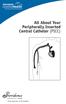 All About Your Peripherally Inserted Central Catheter (PICC) General Information Intravenous (IV) therapy is the delivery of fluid directly into a vein. An intravenous catheter is a hollow tube that is
X-Plain Subclavian Inserted Central Catheter (SICC Line) Reference Summary
 X-Plain Subclavian Inserted Central Catheter (SICC Line) Reference Summary Introduction A Subclavian Inserted Central Catheter, or subclavian line, is a long thin hollow tube inserted in a vein under the
Asthma and COPD Awareness
 Asthma and COPD Awareness Molina Breathe with Ease sm and Chronic Obstructive Pulmonary Disease Molina Healthcare of Michigan Fall 2012 Importance of Controller Medicines Asthma is a disease that causes
CORONARY ARTERY BYPASS GRAFT & HEART VALVE SURGERY
 CORONARY ARTERY BYPASS GRAFT & HEART VALVE SURGERY www.cpmc.org/learning i learning about your health What to Expect During Your Hospital Stay 1 Our Team: Our cardiac surgery specialty team includes nurses,
The patient s response to therapy within the first hour in the Emergency Room is one of the most reliable ways to predict need for hospitalization.
 Emergency Room Asthma Management Algorithm The Emergency Room Asthma Management Algorithm is to be used for any patient seen in the Emergency Room with the diagnosis of asthma. (The initial history should
Call Your Home Health Nurse and/or Physician. Call 911. Self Management for COPD COMMUNITY HEALTH AND COUNSELING SERVICES
 COMMUNITY HEALTH AND COUNSELING SERVICES Self Management for COPD Call Your Home Health Nurse and/or Physician Call 911 Sputum (phlegm) that increases in amount/color or becomes thicker than usual Unrelieved
NCLEX Sample Questions
 NCLEX Sample Questions 1. A nurse is working in an outpatient orthopedic clinic. During the patient s history the patient reports, I tore 3 of my 4 Rotator cuff muscles in the past. Which of the following
HLTEN609B Practise in the respiratory nursing environment
 HLTEN609B Practise in the respiratory nursing environment Release: 1 HLTEN609B Practise in the respiratory nursing environment Modification History Not Applicable Unit Descriptor Descriptor This unit addresses
There is no cure for COPD Chronic Bronchitis Emphysema
 Live Well With COPD Chronic Obstructive Pulmonary Disease, or COPD is a lung disease. People with COPD have a hard time getting air in and out of their lungs. There is no cure for COPD. COPD is also commonly
Oxygen - update April 2009 OXG
 PRESENTATION Oxygen (O 2 ) is a gas provided in compressed form in a cylinder. It is also available in liquid form, in a system adapted for ambulance use. It is fed via a regulator and flow meter to the
Peripherally Inserted Central Catheter (PICC) for Outpatient
 Peripherally Inserted Central Catheter (PICC) for Outpatient Introduction A Peripherally Inserted Central Catheter, or PICC line, is a thin, long, soft plastic tube inserted into a vein of the arm. It
Oxygen Therapy. Oxygen therapy quick guide V3 July 2012.
 PRESENTATION Oxygen (O 2 ) is a gas provided in a compressed form in a cylinder. It is also available in a liquid form. It is fed via a regulator and flow meter to the patient by means of plastic tubing
NURSING 500.105 Effective Date Title: 6/12 SCOPE OF PRACTICE FOR STUDENT NURSES AND NURSING ASSISTANTS
 XXX DAYTONA XXX _OCEANSIDE HEALTH CARE PARTNERS Department: Page 1 of 5 POLICY & PROCEDURE Policy Number NURSING 500.105 Effective Date Title: 6/12 SCOPE OF PRACTICE FOR STUDENT NURSES AND NURSING ASSISTANTS
Keeping your lungs healthy
 Keeping your lungs healthy A guide for you after spinal cord injury and other neurological conditions Regional Rehabilitation Program This booklet has been written by the health care providers who provide
Gallbladder Surgery with an Incision (Cholecystectomy)
 Gallbladder Surgery with an Incision (Cholecystectomy) It is normal to have questions about your surgery. This handout gives you information about what will happen to you before, during and after your
Respiratory Syncytial Virus (RSV)
 Respiratory Syncytial Virus (RSV) What is? is a common virus that infects the linings of the airways - the nose, throat, windpipe, bronchi and bronchioles (the air passages of the lungs). RSV is found
Lesson 7: Respiratory and Skeletal Systems and Tuberculosis
 Glossary 1. asthma: when the airways of the lungs narrow, making breathing difficult 2. bacteria: tiny living creatures that can only be seen with a microscope; some bacteria help the human body, and other
Chapter 26. Assisting With Oxygen Needs. Elsevier items and derived items 2014, 2010 by Mosby, an imprint of Elsevier Inc. All rights reserved.
 Chapter 26 Assisting With Oxygen Needs Oxygen (O 2 ) is a gas. Oxygen It has no taste, odor, or color. It is a basic need required for life. Death occurs within minutes if breathing stops. Brain damage
81 First Responder Respiratory
 81 First Responder Medical Scenarios Asthma Scenario: You are called to a local house for a woman with trouble breathing. You arrive to find a 67-year-old woman sitting upright in a chair. She states she
Understanding Hypoventilation and Its Treatment by Susan Agrawal
 www.complexchild.com Understanding Hypoventilation and Its Treatment by Susan Agrawal Most of us have a general understanding of what the term hyperventilation means, since hyperventilation, also called
Chronic Obstructive Pulmonary Disease Patient Guidebook
 Chronic Obstructive Pulmonary Disease Patient Guidebook The Respiratory System The respiratory system consists of the lungs and air passages. The lungs are the part of the body where gases are exchanged
Nursing college, Second stage Microbiology Dr.Nada Khazal K. Hendi L14: Hospital acquired infection, nosocomial infection
 L14: Hospital acquired infection, nosocomial infection Definition A hospital acquired infection, also called a nosocomial infection, is an infection that first appears between 48 hours and four days after
Your Lungs and COPD. Patient Education Pulmonary Rehabilitation. A guide to how your lungs work and how COPD affects your lungs
 Patient Education Your Lungs and COPD A guide to how your lungs work and how COPD affects your lungs Your lungs are organs that process every breath you take. They provide oxygen (O 2 ) to the blood and
Pneumonia Education and Discharge Instructions
 Pneumonia Education and Discharge Instructions Pneumonia Education and Discharge Instructions Definition: Pneumonia is an infection of the lungs. Many different organisms can cause it, including bacteria,
ORAL ANTICOAGULANTS RIVAROXABAN (XARELTO) FOR PULMONARY EMBOLISM (PE)
 ORAL ANTICOAGULANTS RIVAROXABAN (XARELTO) FOR PULMONARY EMBOLISM (PE) Information Leaflet Your Health. Our Priority. Page 2 of 6 What Are Anticoagulants And What Do They Do? This information leaflet has
CONTENTS. Note to the Reader 00. Acknowledgments 00. About the Author 00. Preface 00. Introduction 00
 Natural Therapies for Emphysema By Robert J. Green Jr., N.D. CONTENTS Note to the Reader 00 Acknowledgments 00 About the Author 00 Preface 00 Introduction 00 1 Essential Respiratory Anatomy and Physiology
Department of Surgery
 What is emphysema? 2004 Regents of the University of Michigan Emphysema is a chronic disease of the lungs characterized by thinning and overexpansion of the lung-like blisters (bullae) in the lung tissue.
Caring for a Tenckhoff Catheter
 Caring for a Tenckhoff Catheter UHN A Patient s Guide What is a Pleural Effusion? There is a small space between the outside of your lung and the chest wall (ribs). This space is called the pleural space.
Medical Surgical Nursing Skills List
 Medical Surgical Nursing Skills List Read each of the required clinical skills for a Registered Nurse working on a typical acute medical-surgical unit. Write the number that corresponds to the level of
ORAL ANTICOAGULANTS - RIVAROXABAN (XARELTO) FOR DEEP VEIN THROMBOSIS (DVT)
 ORAL ANTICOAGULANTS - RIVAROXABAN (XARELTO) FOR DEEP VEIN THROMBOSIS (DVT) Information Leaflet Your Health. Our Priority. Page 2 of 6 What Are Anticoagulants And What Do They Do? This information leaflet
In case of an urgent concern or emergency, call 911 or go to the nearest emergency department right away.
 Asthma Basics Patient and Family Education This teaching sheet contains general information only. Talk with your child s doctor or a member of your child s healthcare team about specific care of your child.
Module 6 NURSING CARE PLANNING. This module on nursing care planning is a follow-up to Module 5, Nursing Process.
 Module 6 NURSING CARE PLANNING INTRODUCTION This module on nursing care planning is a follow-up to Module 5, Nursing Process. OBJECTIVES Upon completion of this module, you should be able to: Relate the
Degree of Intervention
 Inglewood Care Centre Degree of Intervention Handbook for Residents and Families Index Introduction..................................................... 2 Beliefs, Values, and Wishes.........................................
Safety FIRST: Infection Prevention Tips
 Reading Hospital Safety FIRST: Infection Prevention Tips Reading Hospital is committed to providing high quality care to our patients. Your healthcare team does many things to help prevent infections.
Understanding your Peripherally Inserted Central Catheter (PICC) Patient Information
 Understanding your Peripherally Inserted Central Catheter (PICC) Patient Information The Purpose of this Information Sheet This information sheet has been written by patients, members of the public and
Your Recovery After a Cesarean Delivery
 Your Recovery After a Cesarean Delivery It is normal to have many questions about your care after delivery. Cesarean delivery is surgery and your body needs time to heal and recover for the next 6 weeks,
Medication Information. (a pix a ban)
 Medication Information (a pix a ban) Other names for this medication are: Eliquis What does this medication do? This medication is a blood thinner, also called an anticoagulant. It prevents a blood clot
Guidelines for Standards of Care for Patients with Acute Respiratory Failure on Mechanical Ventilatory Support
 Guidelines for Standards of Care for Patients with Acute Respiratory Failure on Mechanical Ventilatory Support Copyright by the SOCIETY OF CRITICAL CARE MEDICINE These guidelines can also be found in the
Patient Information and Daily Programme for Patients Having Whipple s Surgery (Pancreatico duodenectomy)
 Patient Information and Daily Programme for Patients Having Whipple s Surgery (Pancreatico duodenectomy) Date of admission Date of surgery Expected Length of Stay in hospital We will aim to discharge you
American Heart Association
 American Heart Association Basic Life Support for Healthcare Providers Pretest April 2006 This examination to be used only as a PRECOURSE TEST For BLS for Healthcare Providers Courses 2006 American Heart
Clinical Care Program
 Clinical Care Program Therapy for the Cardiac Patient What s CHF? Not a kind of heart disease o Heart disease is called cardiomyopathy o Heart failure occurs when the heart can t pump enough blood to meet
Total Hip Replacement Surgery Home Care Instructions
 Total Hip Replacement Surgery Home Care Instructions Surgery: Date: Doctor: This handout will review the care you need to follow once you are home. If you have any questions or concerns, please ask your
RESPIRATORY THERAPIST CLASSIFICATION SERIES
 STATE OF WISCONSIN CLASSIFICATION SPECIFICATION RESPIRATORY THERAPIST CLASSIFICATION SERIES Effective Date: June 16, 1985 Modified Effective: November 5, 2000 Modified Effective: May 6, 2001 Modified Effective:
Individualized Care Plans Fully Developed
 Appendix Individualized Care Plans Fully Developed A Refer to Chapter 1 The Nursing Process: A Synopsis, p. 32: Two Individualized Care Plans Fully Developed; Care Plan 1 for Mr. John Walters, Care Plan
Medication Information. (a pix a ban)
 Medication Information (a pix a ban) Other names for this medication are: Eliquis What does this medication do? This medication is a blood thinner, also called an anticoagulant. It prevents a blood clot
Respiratory Care. A Life and Breath Career for You!
 Respiratory Care A Life and Breath Career for You! Respiratory Care Makes a Difference At 9:32 am, Lori Moreno brought a newborn baby struggling to breathe back to life What have you accomplished today?
NURSING SERVICES DEPARTMENT
 NURSING SERVICES DEPARTMENT TITLE: Mechanical Ventilation PATIENT CARE PLAN DIAGNOSIS: DISCHARGE CRITERIA: 1 The patient will: Maintain adequate mechanics of PERTINENT INFORMATION:. ventilation as demonstrated
Oxford Centre for Respiratory Medicine Bronchial-Artery Embolisation Information for patients
 Oxford Centre for Respiratory Medicine Bronchial-Artery Embolisation Information for patients This leaflet tells you about the bronchial-artery embolisation procedure. It explains what is involved and
SARASOTA MEMORIAL HOSPITAL DEPARTMENT POLICY
 PS1006 SARASOTA MEMORIAL HOSPITAL DEPARTMENT POLICY TITLE: NON-INVASIVE POSITIVE PRESSURE (NPPV) VENTILATION (CPAP/BIPAP) Job Title of Reviewer: EFFECTIVE DATE: REVISED DATE: POLICY TYPE: Director, Respiratory
7/1/2014 REGISTERED NURSE CONSULTATION PURPOSE & KEY TERMS OBJECTIVES
 REGISTERED NURSE CONSULTATION June 2012 DHS Office of Licensing and Regulatory Oversight 1 PURPOSE & KEY TERMS The purpose of this section is to assist the learner in understanding the role of a Registered
BASIC SKILLS: BLOOD PRESSURE
 Precepted clinical skills checklist Pre Experience (Medical/Surgical, ICU, ED, Telemetry Unit, Or Psychiatry) Student Name Facility THE LIST BELOW INCORPORATES NURSING ASSESSMENTS AND INTERVENTIONS. COMPLETE
Disease/Illness GUIDE TO ASBESTOS LUNG CANCER. What Is Asbestos Lung Cancer? www.simpsonmillar.co.uk Telephone 0844 858 3200
 GUIDE TO ASBESTOS LUNG CANCER What Is Asbestos Lung Cancer? Like tobacco smoking, exposure to asbestos can result in the development of lung cancer. Similarly, the risk of developing asbestos induced lung
Laparoscopic Colectomy. What do I need to know about my laparoscopic colorectal surgery?
 Laparoscopic Colectomy What do I need to know about my laparoscopic colorectal surgery? Traditionally, colon & rectal surgery requires a large, abdominal and/or pelvic incision, which often requires a
PATIENT GUIDE. Understand and care for your peripherally inserted central venous catheter (PICC). MEDICAL
 PATIENT GUIDE Understand and care for your peripherally inserted central venous catheter (PICC). MEDICAL Introduction The following information is presented as a guideline for your reference. The best
Provided by the American Venous Forum: veinforum.org
 CHAPTER 1 NORMAL VENOUS CIRCULATION Original author: Frank Padberg Abstracted by Teresa L.Carman Introduction The circulatory system is responsible for circulating (moving) blood throughout the body. The
Pneumonia. Pneumonia is an infection that makes the tiny air sacs in your lungs inflamed (swollen and sore). They then fill with liquid.
 Pneumonia Pneumonia is an infection that makes the tiny air sacs in your lungs inflamed (swollen and sore). They then fill with liquid. People with mild (not so bad) pneumonia can usually be treated at
Obstetrical Emergencies
 Date: July 18, 2014 Page 1 of 5 Obstetrical Emergencies Purpose: To provide the process for the assessment and management of the patient with an obstetrical related emergency. Pre-Medical Control 1. Follow
Before Surgery You will likely be asked to see your family physician or an internal medicine doctor for a thorough medical evaluation.
 Anterior Hip Replacement - Before and After Surgery Your Hip Evaluation An orthopaedic surgeon specializes in problems affecting bones and joints. The surgeon will ask you many questions about your hip
COPD - Education for Patients and Carers Integrated Care Pathway
 Patient NHS COPD - Education for Patients and Carers Integrated Care Pathway Date ICP completed:. Is the patient following another Integrated Care Pathway[s].. / If yes, record which other Integrated Care
Documenting & Coding. Chronic Obstructive Pulmonary Disease (COPD) Presented by: David S. Brigner, MLA, CPC
 Documenting & Coding Chronic Obstructive Pulmonary Disease (COPD) Presented by: David S. Brigner, MLA, CPC Sr. Provider Training & Development Consultant Professional Profile David Brigner currently performs
Endovascular Abdominal Aortic Aneurysm Repair Surgery
 Endovascular Abdominal Aortic Aneurysm Repair Surgery You are scheduled for an admission to Cooper University Hospital for Endovascular Abdominal Aortic Aneurysm surgery (EVAR). Please read this handout,
Colon Cancer Surgery and Recovery. A Guide for Patients and Families
 Colon Cancer Surgery and Recovery A Guide for Patients and Families This Booklet You are receiving this booklet because you will be having surgery shortly. This booklet tells you what to do before, during,
PROCEDURE FOR USING A NASAL CANNULA
 FOR USING A NASAL CANNULA A nasal cannula is used to deliver a low to moderate concentration of oxygen. It can be used as long as nasal passages are open. A deviated septum, swelling of the nasal passages,
A Trip To The Emergency Room Help Us Help You As the only full-service health care system and trauma center in the region, United Regional understands
 A Trip to the Emergency Room Help Us Help You unitedregional A Trip To The Emergency Room Help Us Help You As the only full-service health care system and trauma center in the region, United Regional understands
Asthma Management Policy
 Asthma Management Policy Policy Number 003 Version Number 1.01 Drafted by Executive Officer Approved Date: Review Date: Responsibility Relevant Policies Relevant Standards and Regulations Bubup Womindjeka
COURSE SYLLABUS RC 223 CLINICAL-3
 COURSE SYLLABUS RC 223 CLINICAL-3 Class Hours: 0 Laboratory Hours: 24 Credit Hours: 4 Course Description: Entry Level Standards: This course will emphasize neonatal-pediatric intensive care, pulmonary
Marilyn Borkgren-Okonek, APN, CCNS, RN, MS Suburban Lung Associates, S.C. Elk Grove Village, IL
 Marilyn Borkgren-Okonek, APN, CCNS, RN, MS Suburban Lung Associates, S.C. Elk Grove Village, IL www.goldcopd.com GLOBAL INITIATIVE FOR CHRONIC OBSTRUCTIVE LUNG DISEASE GLOBAL STRATEGY FOR DIAGNOSIS, MANAGEMENT
Medication Information. (Ri va rox xa - ban)
 Medication Information (Ri va rox xa - ban) Other names for this medication are: Xarelto What does this medication do? This medication is a blood thinner, also called an anticoagulant. It prevents a blood
RGN JOY LAUDE WATFORD GENERAL HOSPITAL, ENGLAND
 RGN JOY LAUDE WATFORD GENERAL HOSPITAL, ENGLAND Monitor patient on the ward to detect trends in vital signs and to manage accordingly To recognise deteriorating trends and request relevant medical/out
CUESTA COLLEGE REGISTERED NURSING PROGRAM CRITICAL ELEMENTS
 CUESTA COLLEGE REGISTERED NURSING PROGRAM CRITICAL ELEMENTS LEVELS I through IV A. OVERRIDING CRITICAL ELEMENTS Violation of an overriding area will result in termination and failure of the particular
Spinal Cord Injury Education. Common Medical Problems Following Spinal Cord Injury
 Spinal Cord Injury Education Common Medical Problems Following Spinal Cord Injury Common Medical Complications After SCI, your body is vulnerable to various complications This presentation gives a brief
PROCEDURE FOR USING A NASAL CANNULA
 PROCEDURE FOR USING A NASAL CANNULA A nasal cannula is used to deliver a low to moderate concentration of oxygen. It can be used as long as nasal passages are open. A deviated septum, swelling of the nasal
GUIDELINES FOR THE MANAGEMENT OF OXYGEN THERAPY
 SOUTH DURHAM HEALTH CARE NHS TRUST GUIDELINES FOR THE MANAGEMENT OF OXYGEN THERAPY AIM To supplement oxygen intake using the appropriate equipment in order to correct hypoxia and relieve breathlessness.
Information for you Treatment of venous thrombosis in pregnancy and after birth. What are the symptoms of a DVT during pregnancy?
 Information for you Treatment of venous thrombosis in pregnancy and after birth Published in September 2011 What is venous thrombosis? Thrombosis is a blood clot in a blood vessel (a vein or an artery).
NEEDLE THORACENTESIS Pneumothorax / Hemothorax
 NEEDLE THORACENTESIS Pneumothorax / Hemothorax By: Steven Jones, NREMT-P Pneumothorax Pneumothorax is a collection of air or gas in the pleural space of the lung, causing the lung to collapse. Pneumothorax
Detach Patient's Instructions for Use from package insert and dispense with the product.
 Attention Health Care Professional: Detach Patient's Instructions for Use from package insert and dispense with the product. PROVENTIL HFA (albuterol sulfate) Inhalation Aerosol FOR ORAL INHALATION ONLY
Department of Surgery
 Thoracic Surgery After Your Lung Surgery Patient Education Discharge Information You have just had lung surgery. The following are definitions of terms you may hear in connection with your surgery: THORACOTOMY
Target groups: Paramedics, nurses, respiratory therapists, physicians, and others who manage respiratory emergencies.
 Overview Estimated scenario time: 10 15 minutes Estimated debriefing time: 10 minutes Target groups: Paramedics, nurses, respiratory therapists, physicians, and others who manage respiratory emergencies.
National Registry of Emergency Medical Technicians Emergency Medical Technician Psychomotor Examination BLEEDING CONTROL/SHOCK MANAGEMENT
 BLEEDING CONTROL/SHOCK MANAGEMENT Candidate: Examiner: Date: Signature: Possible Applies direct pressure to the wound 1 NOTE: The examiner must now inform the candidate that the wound continues to bleed.
Diagnosis and Treatment
 Sleep Apnea: Diagnosis and Treatment Sleep Apnea Sleep Apnea is Common Dangerous Easily recognized Treatable Types of Sleep Disordered Breathing Apnea Cessation of airflow > 10 seconds Hypopnea Decreased
First Responder (FR) and Emergency Medical Responder (EMR) Progress Log
 First Responder (FR) and Emergency Medical Responder (EMR) Progress Log Note: Those competencies that are for EMR only are denoted by boldface type. For further details on the National Occupational Competencies
Whooping Cough. The Lungs Whooping cough is an infection of the lungs and breathing tubes, both of which are parts of the respiratory system.
 Whooping Cough Introduction Whooping cough is a serious bacterial infection of the lungs and breathing tubes. It is also called pertussis. About 16 million cases of whooping cough happen worldwide each
PICC & Midline Catheters Patient Information Guide
 PICC & Midline Catheters Patient Information Guide medcompnet.com 1 table of contents Introduction 4 What is a PICC or Midline Catheter? 4 How is the PICC or Midline Catheter Inserted? 6 Catheter Care
TB CARE EARLY DETECTION AND PREVENTION OF TUBERCULOSIS (TB) IN CHILDREN. Risk factors in children acquiring TB:
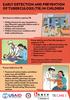 EARLY DETECTION AND PREVENTION OF TUBERCULOSIS (TB) IN CHILDREN Risk factors in children acquiring TB: Children living in the same household as a lung TB patient (especially children under 5) Children
Tuberculosis Exposure Control Plan for Low Risk Dental Offices
 Tuberculosis Exposure Control Plan for Low Risk Dental Offices A. BACKGROUND According to the CDC, approximately one-third of the world s population, almost two billion people, are infected with tuberculosis.
Tests. Pulmonary Functions
 Pulmonary Functions Tests Static lung functions volumes Dynamic lung functions volume and velocity Dynamic Tests Velocity dependent on Airway resistance Resistance of lung tissue to change in shape Dynamic
CHEST TUBES AND CHEST DRAINAGE SYSTEMS
 CHEST TUBES AND CHEST DRAINAGE SYSTEMS Central Nursing Orientation April 2008 Revised September 2011 OBJECTIVES Describe common tubes and indications for use at LHSC Review indications and contraindications,
Cardiac catheterization Information for patients
 Cardiac catheterization Information for patients You have been scheduled for a cardiac catheterization. Your procedure is scheduled for:. Someone will call you the day before your procedure to tell you
Chronic obstructive pulmonary disease (COPD)
 Chronic obstructive pulmonary disease (COPD) Chronic obstructive pulmonary disease (COPD) is the name for a group of lung diseases including chronic bronchitis, emphysema and chronic obstructive airways
Asthma Guidance for Birmingham Schools.
 Asthma Guidance for Birmingham Schools. May 2004 RECOMMENDED ASTHMA GUIDANCE FOR SCHOOL STAFF* This guidance is intended to complement the local Birmingham Administration and Management of Prescribed Medicines
RN CONSULTATION. KEY TERMS: Assessment Basic tasks Consultation Home health services PRN Written parameters OBJECTIVES:
 RN CONSULTATION The purpose of this section is to assist the learner in understanding the role of a registered nurse (RN) consultant and when to seek RN consultation. KEY TERMS: Assessment Basic tasks
Inferior Vena Cava filter and removal
 Inferior Vena Cava filter and removal What is Inferior Vena Cava Filter Placement and Removal? An inferior vena cava filter placement procedure involves an interventional radiologist (a specialist doctor)
An Overview of Asthma - Diagnosis and Treatment
 An Overview of Asthma - Diagnosis and Treatment Asthma is a common chronic disorder of the airways that is complex and characterized by variable and recurring symptoms, airflow obstruction, bronchial hyperresponsiveness,