
Job Hazard/Safety Analysis For the Grounds Keeper
|
|
|
- Randolf Barrett
- 9 years ago
- Views:
Transcription
1 Job Hazard/Safety Analysis For the Grounds Keeper 1

2 INTRODUCTION Job Hazard/Safety Analysis for the Grounds Keeper is a partial list of known task performed by the professional grounds worker. We have placed task in alphabetical order and in a table format, listing each in a step-by-step sequence followed by the potential hazard and a recommended action or procedure. This is by no means an exhaustive list and is subject to modification. Additional comments may be added as more information becomes available. If you are asked to perform an occasional task, not listed with your job title, you can look up an individual task by returning to our Job Safety Analysis page and check the pulldown menu for Job Task. 2

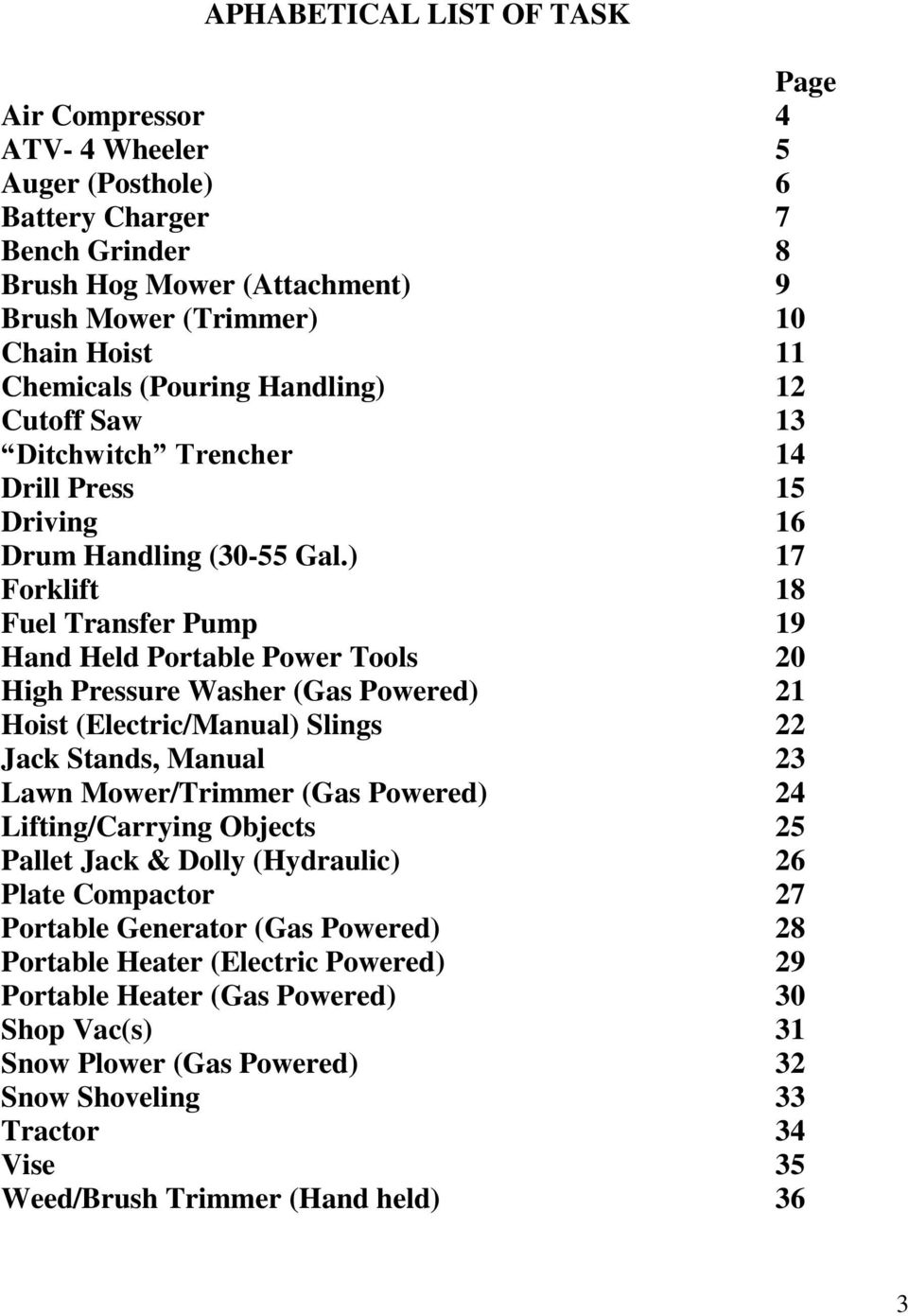
3 APHABETICAL LIST OF TASK Page Air Compressor 4 ATV- 4 Wheeler 5 Auger (Posthole) 6 Battery Charger Bench Grinder Brush Hog Mower (Attachment) Brush Mower (Trimmer) Chain Hoist 11 Chemicals (Pouring Handling) 12 Cutoff Saw 13 Ditchwitch Trencher 14 Drill Press 15 Driving 16 Drum Handling (30-55 Gal.) 17 Forklift 18 Fuel Transfer Pump 19 Hand Held Portable Power Tools 20 High Pressure Washer (Gas Powered) 21 Hoist (Electric/Manual) Slings 22 Jack Stands, Manual Lawn Mower/Trimmer (Gas Powered) Lifting/Carrying Objects 25 Pallet Jack & Dolly (Hydraulic) 26 Plate Compactor 27 Portable Generator (Gas Powered) 28 Portable Heater (Electric Powered) 29 Portable Heater (Gas Powered) 30 Shop Vac(s) Snow Plower (Gas Powered) Snow Shoveling Tractor Vise Weed/Brush Trimmer (Hand held)
4 Hazard Analysis: Air Compressor Shutdown and Isolate Unit Unit Activation during repair Auto start and/or human error Lockout/Tagout Routine Maintenance /Repair Routine Operation Noise Equipment Operation Hearing Protection Hand Injury Confined work areas, sharp edges Gloves Eye Injury Residual air pressure Goggles, safety glasses with side shields Electric Shock Improper operation and maintenance Manufacturer s instructions strictly followed, lock-out/tagout Noise Equipment Operation hearing protection Noise Equipment Operation hearing protection Eye Injury Blowing debris safety glasses w/side shields or goggles Goggles/Safety Glasses with side shield Hearing Protection Gloves Hazard Analysis: Air Compressor, Portable, Electric Routine Maintenance /Repair Routine Operation Electric Shock Improper operation and maintenance Unplug electrical cord and retain control of plug during repair/maintenance Noise Equipment operation hearing protection Trauma Eye Injury Improper use, uncontrolled release of compressed air Projectiles, flying debris appropriate nozzle for specific work activity, situational awareness Goggles or safety glasses with side shields Goggles or Safety glasses with side shield Hearing Protection 4

5 Hazard Analysis: ATV 4-Wheeler Routine Maintenan ce/repair Routine Operation Hand Injury Confined work areas, sharp edges/objects, rotating parts Gloves, situational awareness Foot Injury Equipment rolls over foot, Wear safety shoes object drops on foot Trauma Rotating parts Situational awareness, appropriate clothing Muscle/Ligam ent Strain Awkward working positions Position body to avoid strains, take appropriate breaks Eye Injury Flying Particles Goggles/Safety Glasses w/side shields Noise Equipment Operation hearing protection Noise Equipment Operation hearing protection Head Injury Fall from 4-Wheeler, accident Wear helmet Helmet Safety glasses, goggles or helmet face shield Gloves Hearing Protection Safety Shoes/boots protective clothing (optional) 5

6 Hazard Analysis: Auger (Post Hole), Gasoline Powered Inhalation Dust/particles generated during machine operation, exhaust fumes Appropriate natural ventilation, disposable respirators Eye Injury Projectiles Safety glasses with side shield or appropriate safety goggles Trauma Projectiles, point of operation, flying debris & sparks, improper use and operation, loose clothing becoming entangled Situational awareness, PPE, machine guards, Manufacturer s instructions followed, do not wear loose clothing Noise Engine Ear plugs/ear muffs Foot Injury Hand Injury Drop object on foot, impact of auger Point of operation, ingoing nip points, rotating parts, flying debris and sparks Safety shoes Gloves, machine guards, situational awareness Fire Sparks Appropriate placed fire extinguisher, remove all combustibles and fire hazards Inhalation Dust/particles generated during machine operation, exhaust fumes Gloves (leather) Goggles/Safety Glasses w/side shield disposable respirator (optional) Safety Shoes/boots Hearing Protection Appropriate natural ventilation, disposable respirators 6

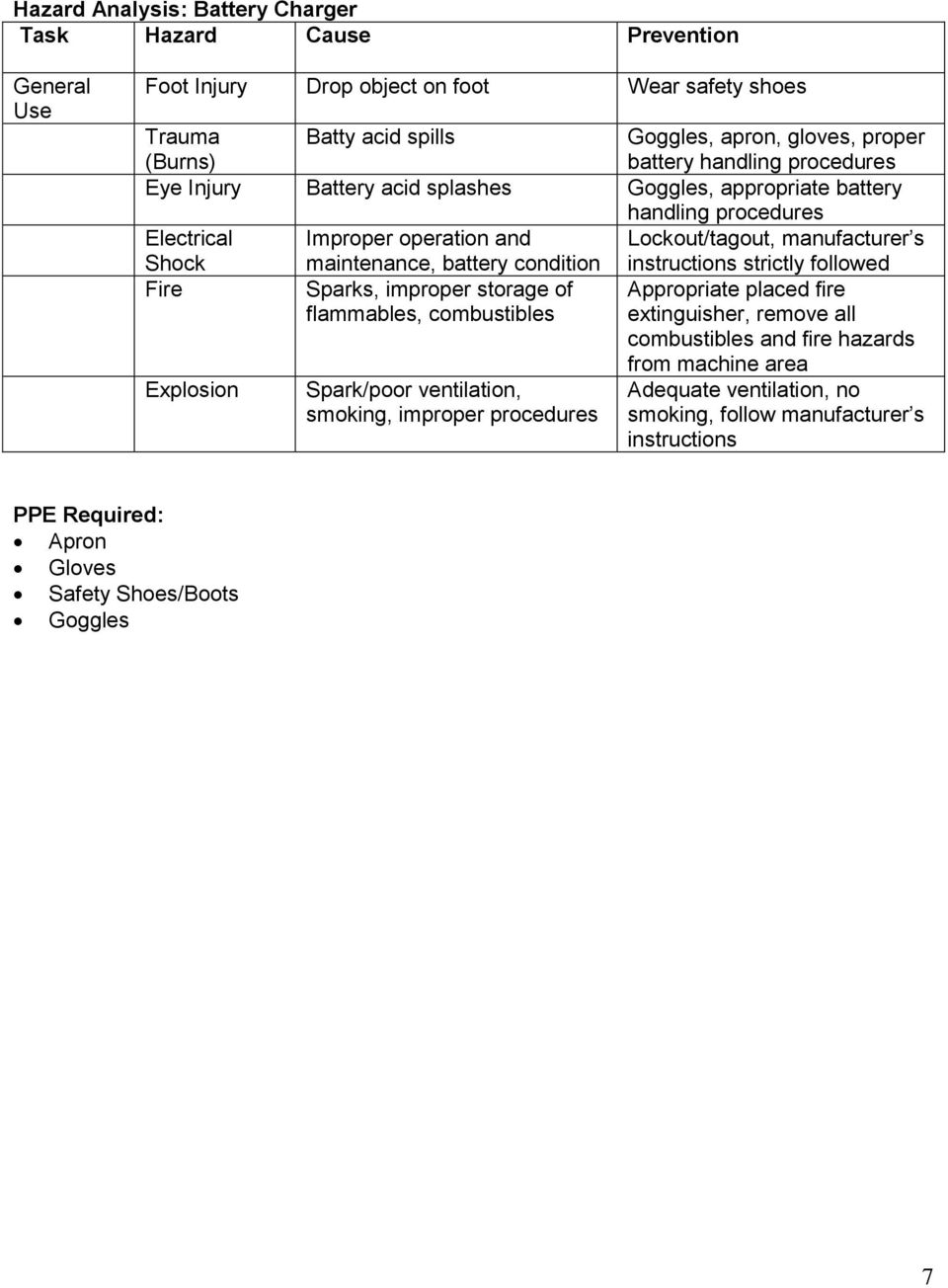
7 Hazard Analysis: Battery Charger Foot Injury Drop object on foot Wear safety shoes Trauma (Burns) Batty acid spills Goggles, apron, gloves, proper battery handling procedures Eye Injury Battery acid splashes Goggles, appropriate battery handling procedures Electrical Shock Improper operation and maintenance, battery condition Lockout/tagout, manufacturer s instructions strictly followed Fire Sparks, improper storage of flammables, combustibles Appropriate placed fire extinguisher, remove all combustibles and fire hazards Explosion Spark/poor ventilation, smoking, improper procedures from machine area Adequate ventilation, no smoking, follow manufacturer s instructions Apron Gloves Safety Shoes/Boots Goggles 7
8 Hazard Analysis: Bench Grinder Inhalation Dust/particles generated during machine operation Appropriate natural ventilation, disposable respirators Eye Injury Projectiles Safety glasses with side shield or appropriate safety goggles Trauma Projectiles Situational awareness, PPE, protective clothing, machine guards Foot Injury Drop object on foot Wear safety shoes Hand Injury Impact, penetration, Gloves, situational awareness compression Head Projectiles Face Shield Protection Fire Heat, sparks Appropriate placed fire extinguisher, remove all combustibles and fire hazards from grinding/buffing area Electrical Shock Improper grounding, Improper operations and maintenance Lockout/tagout, proper grounding of frame, manufacturer s instructions strictly followed protective Clothing (optional) Goggles/Safety Glasses w/side shield Face Shield Safety Shoes/Boots disposable Respirators (optional) Gloves 8

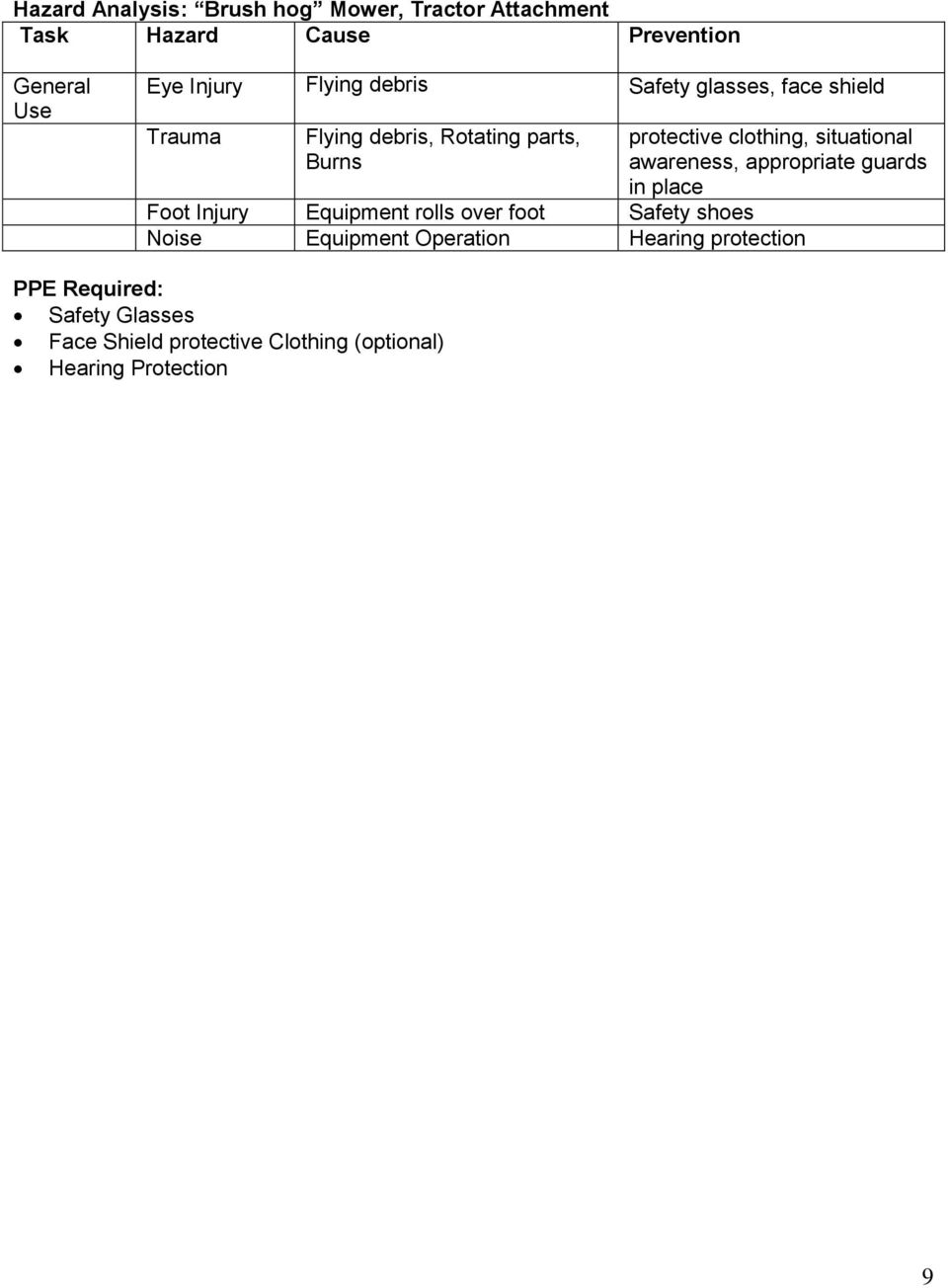
9 Hazard Analysis: Brush hog Mower, Tractor Attachment Eye Injury Flying debris Safety glasses, face shield Trauma Flying debris, Rotating parts, Burns protective clothing, situational awareness, appropriate guards in place Foot Injury Equipment rolls over foot Safety shoes Noise Equipment Operation Hearing protection Safety Glasses Face Shield protective Clothing (optional) Hearing Protection 9
10 Hazard Analysis: Brush Mower/Trimmer, Gasoline Powered Eye Injury Flying debris Safety glasses, face shield Trauma Flying debris, Rotating parts, Burns protective clothing, situational awareness, appropriate guards in place Foot Injury Equipment rolls over foot Safety shoes Noise Equipment Operation Hearing protection Safety Glasses Face Shield protective Clothing (optional) Hearing Protection Safety shoes 10

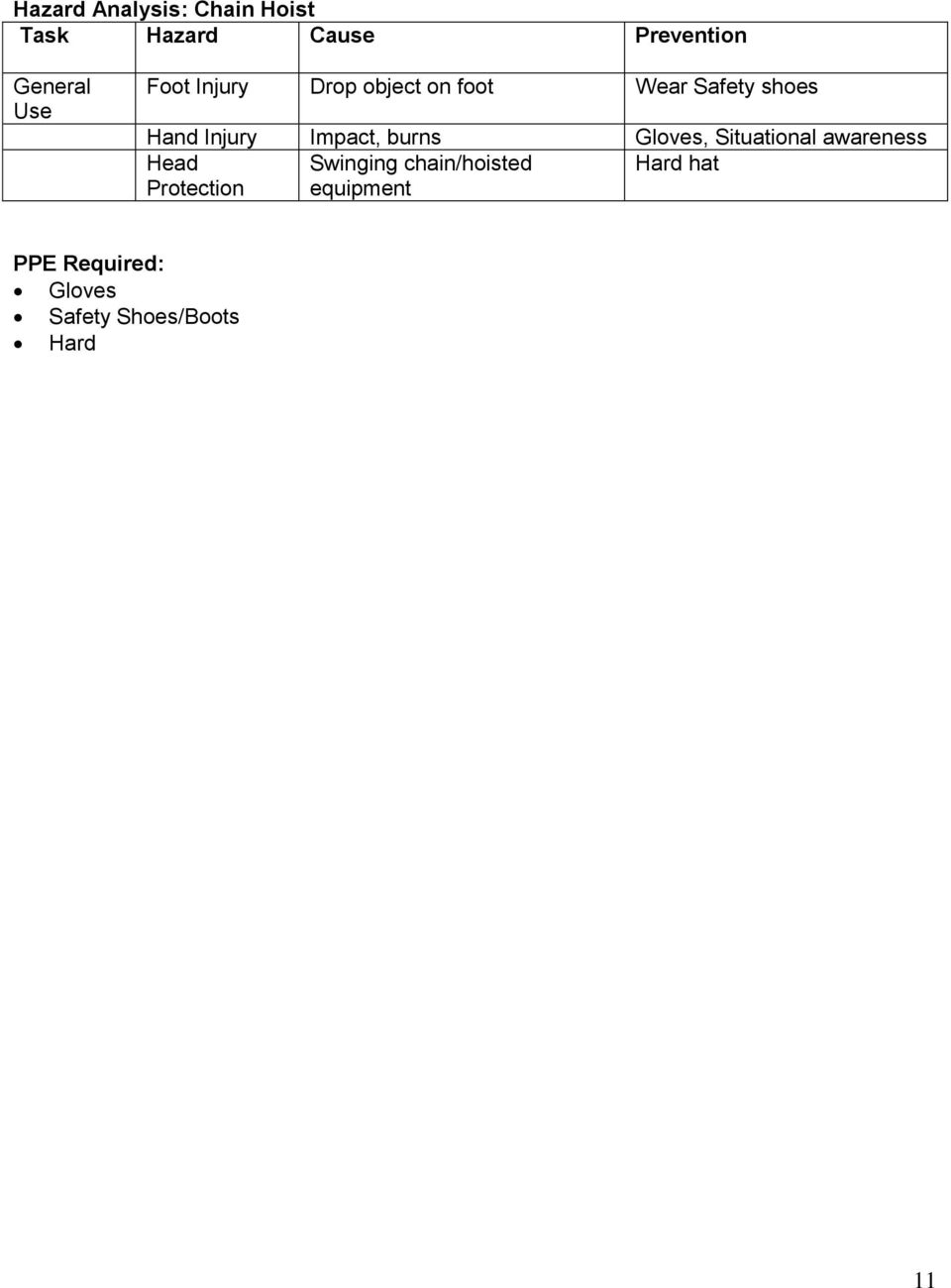
11 Hazard Analysis: Chain Hoist Foot Injury Drop object on foot Wear Safety shoes Hand Injury Impact, burns Gloves, Situational awareness Head Swinging chain/hoisted Hard hat Protection equipment Gloves Safety Shoes/Boots Hard 11
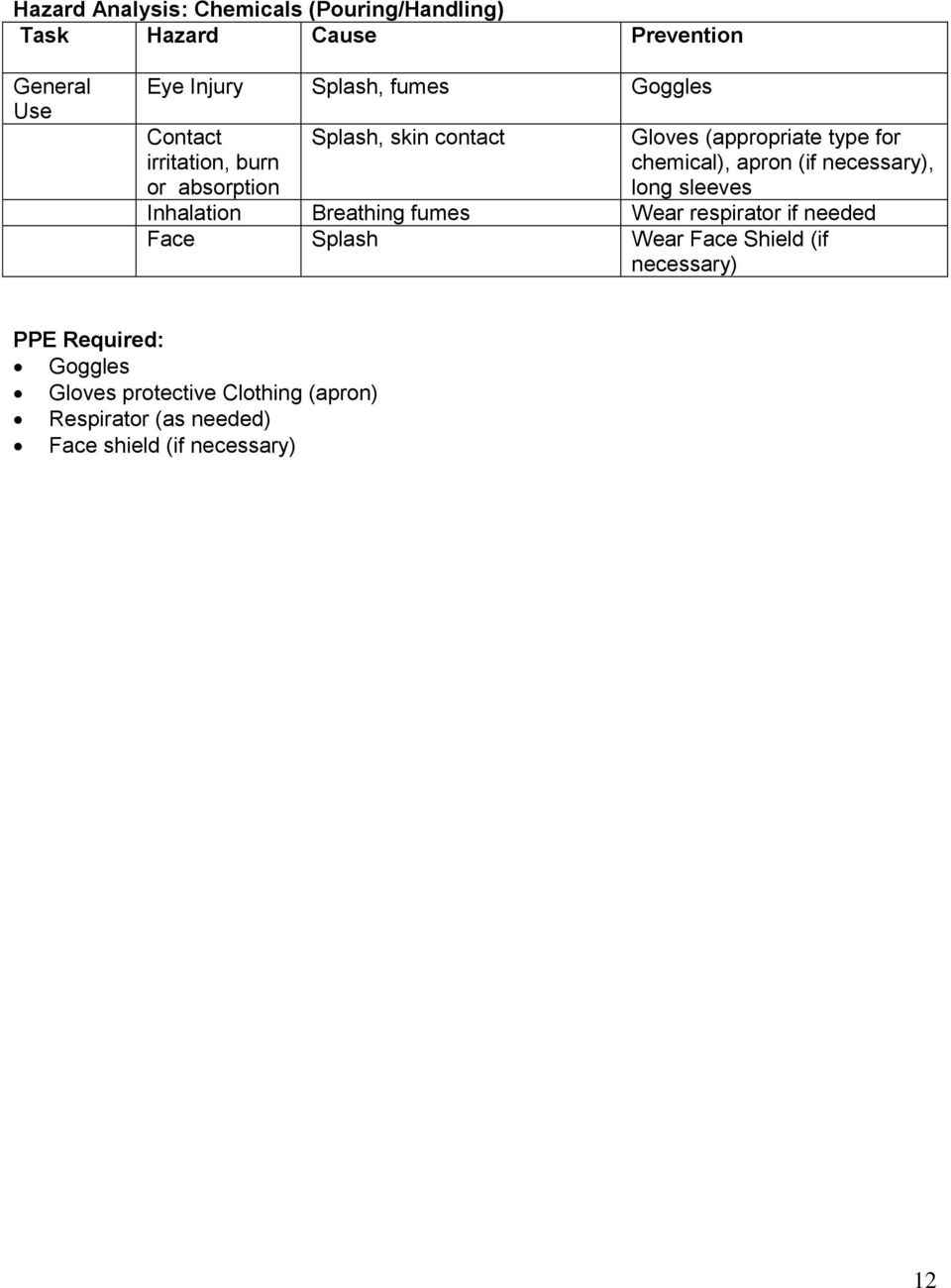
12 Hazard Analysis: Chemicals (Pouring/Handling) Eye Injury Splash, fumes Goggles Contact irritation, burn or absorption Splash, skin contact Gloves (appropriate type for chemical), apron (if necessary), long sleeves Inhalation Breathing fumes Wear respirator if needed Face Splash Wear Face Shield (if necessary) Goggles Gloves protective Clothing (apron) Respirator (as needed) Face shield (if necessary) 12
13 Hazard Analysis: Cutoff Saw Inhalation Dust/particles generated during machine operation Appropriate natural ventilation, disposable respirators, automatic vacuum machine Eye Injury Projectiles Safety glasses with side shield Trauma Projectiles, rotating parts, point of operation, ingoing nip joints, flying chips & sparks Foot Injury Drop object on foot Safety shoes Hand Injury Point of Operation, ingoing nip points, rotating parts, flying chips and sparks or appropriate safety goggles Situational awareness, PPE, protective clothing, machine guards Machine guards, situational awareness Head Projectiles Face Shield Protection Fire Heat, sparks Appropriate placed fire extinguisher, remove all combustibles and fire hazards from area Electrical Shock Improper grounding, improper operations and maintenance Lockout/tagout, proper grounding of frame, manufacturer s instructions strictly followed Safety Shoes/Boots Safety glasses/goggles Face Shield (optional) disposable Respirators (optional) Hearing Protection 13

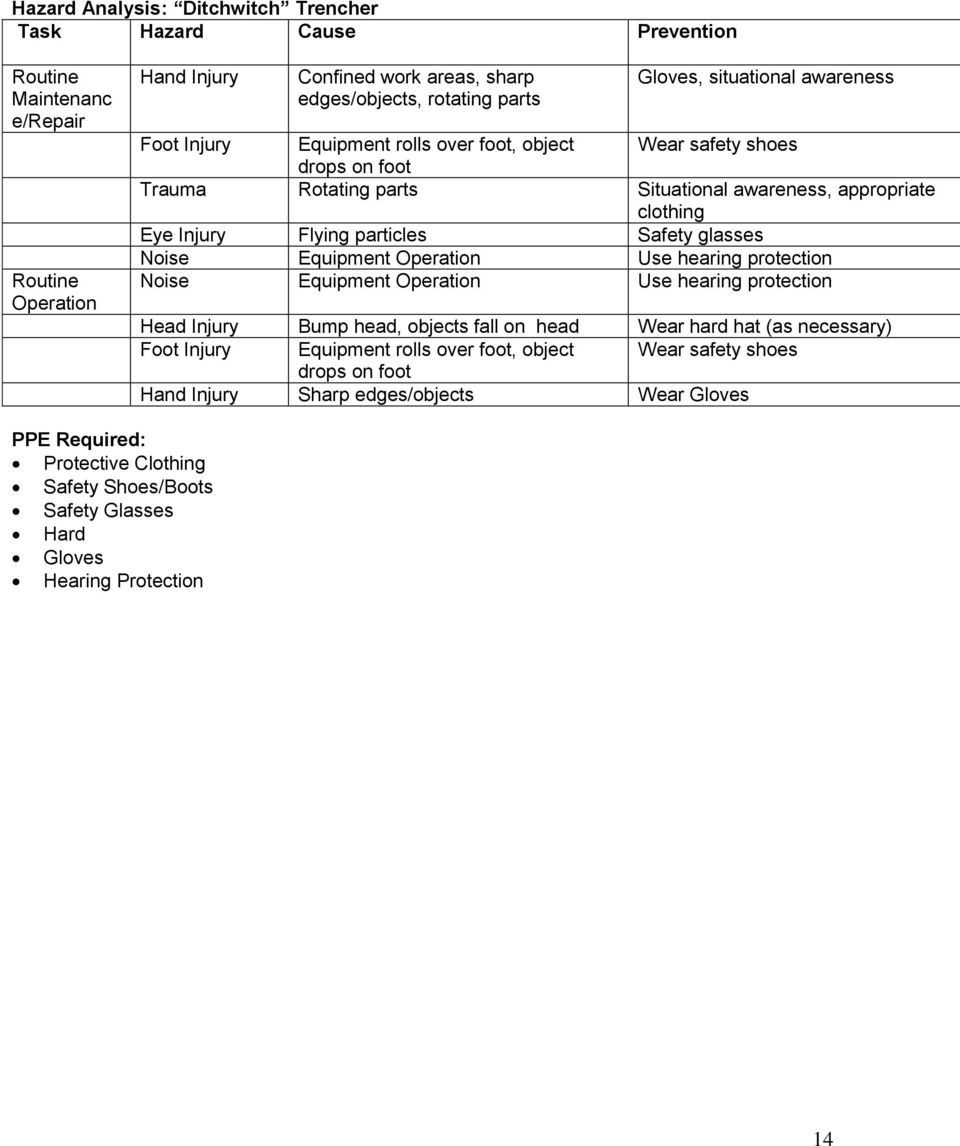
14 Hazard Analysis: Ditchwitch Trencher Routine Maintenanc e/repair Routine Operation Hand Injury Confined work areas, sharp edges/objects, rotating parts Gloves, situational awareness Foot Injury Equipment rolls over foot, object Wear safety shoes drops on foot Trauma Rotating parts Situational awareness, appropriate clothing Eye Injury Flying particles Safety glasses Noise Equipment Operation hearing protection Noise Equipment Operation hearing protection Head Injury Bump head, objects fall on head Wear hard hat (as necessary) Foot Injury Equipment rolls over foot, object Wear safety shoes drops on foot Hand Injury Sharp edges/objects Wear Gloves Protective Clothing Safety Shoes/Boots Safety Glasses Hard Gloves Hearing Protection 14
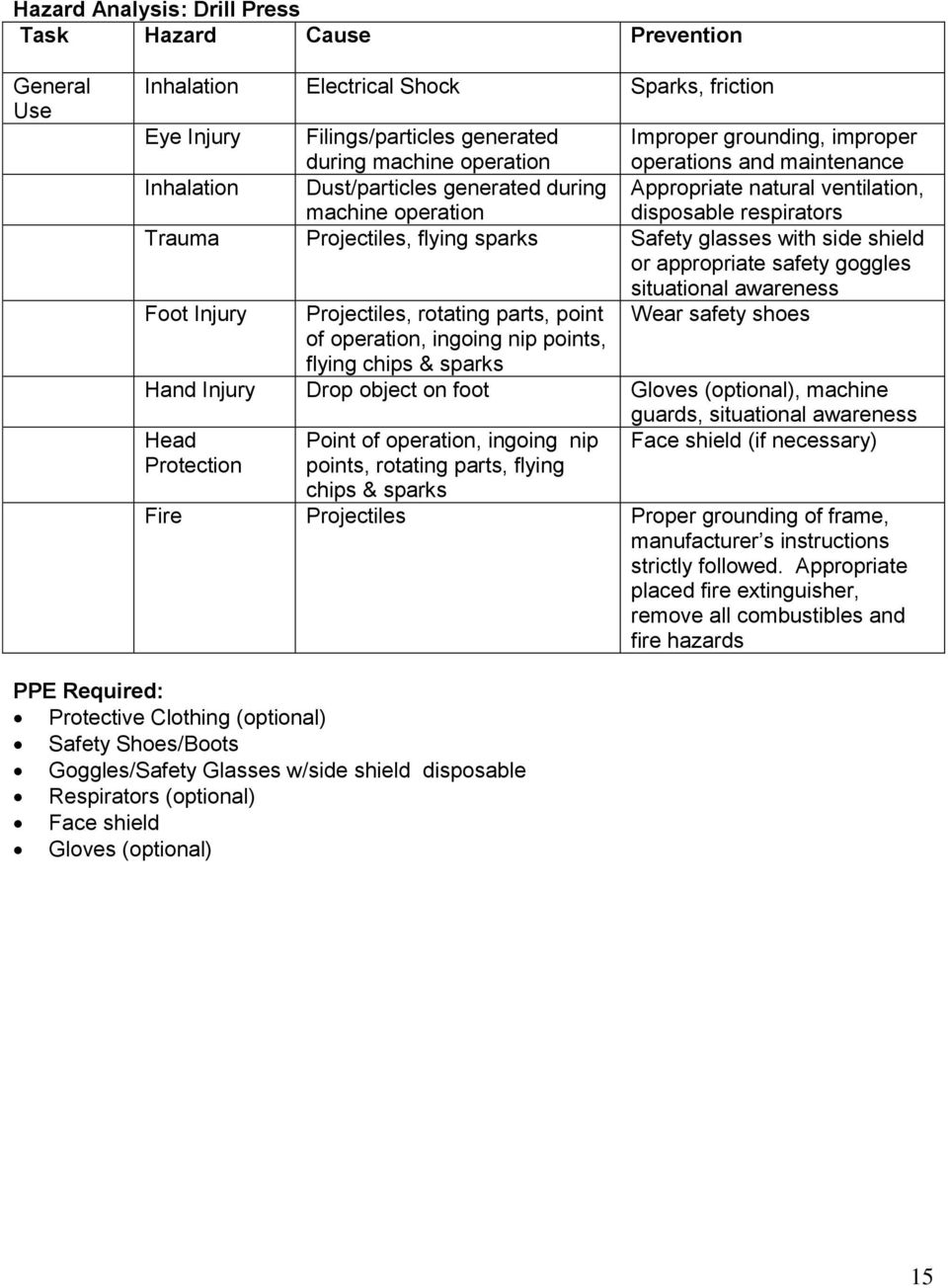
15 Hazard Analysis: Drill Press Inhalation Electrical Shock Sparks, friction Eye Injury Filings/particles generated during machine operation Improper grounding, improper operations and maintenance Inhalation Dust/particles generated during machine operation Appropriate natural ventilation, disposable respirators Trauma Projectiles, flying sparks Safety glasses with side shield or appropriate safety goggles situational awareness Foot Injury Projectiles, rotating parts, point Wear safety shoes of operation, ingoing nip points, flying chips & sparks Hand Injury Drop object on foot Gloves (optional), machine Head Protection Point of operation, ingoing nip points, rotating parts, flying chips & sparks guards, situational awareness Face shield (if necessary) Fire Projectiles Proper grounding of frame, manufacturer s instructions strictly followed. Appropriate placed fire extinguisher, remove all combustibles and fire hazards Protective Clothing (optional) Safety Shoes/Boots Goggles/Safety Glasses w/side shield disposable Respirators (optional) Face shield Gloves (optional) 15
16 Hazard Analysis: Driving Trauma Projectiles, impact, vibration, burns Situational awareness, gloves (optional), seat belts Noise Engine, impact Wear hearing protection for noise level over 85db Hearing Protection Gloves (optional) 16

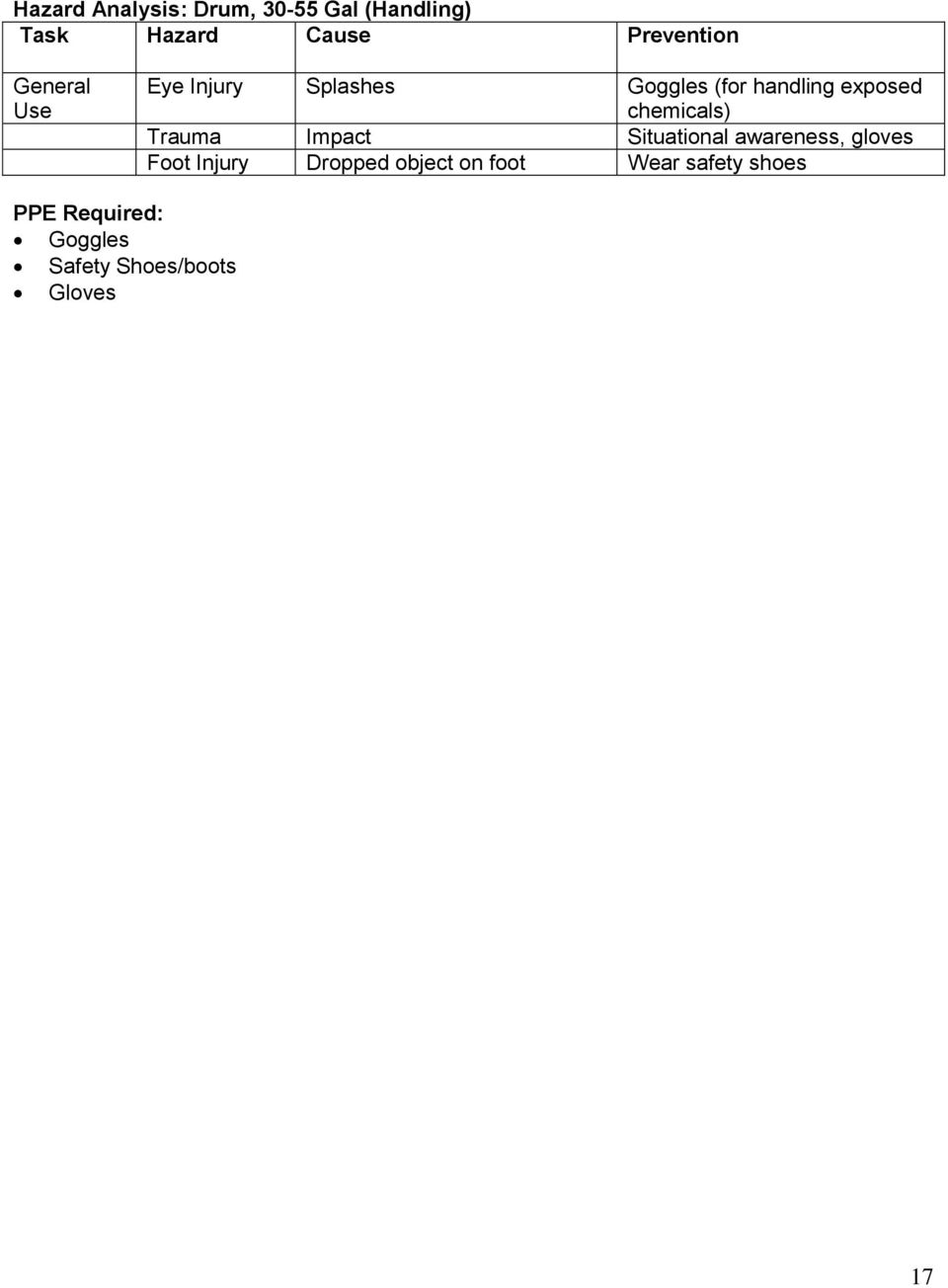
17 Hazard Analysis: Drum, Gal (Handling) Eye Injury Splashes Goggles (for handling exposed chemicals) Trauma Impact Situational awareness, gloves Foot Injury Dropped object on foot Wear safety shoes Goggles Safety Shoes/boots Gloves 17
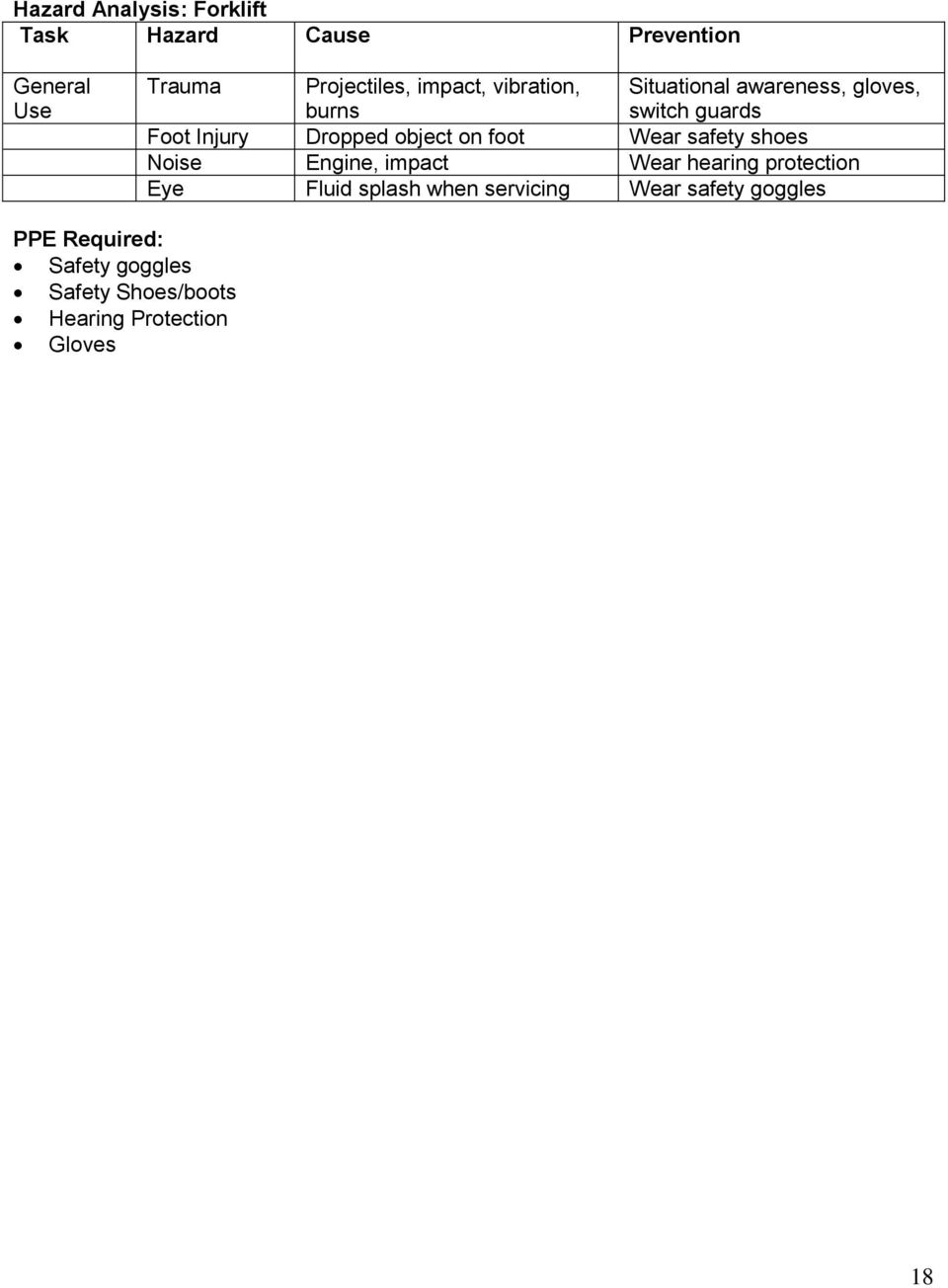
18 Hazard Analysis: Forklift Trauma Projectiles, impact, vibration, burns Situational awareness, gloves, switch guards Foot Injury Dropped object on foot Wear safety shoes Noise Engine, impact Wear hearing protection Eye Fluid splash when servicing Wear safety goggles Safety goggles Safety Shoes/boots Hearing Protection Gloves 18
19 Hazard Analysis: Fuel Transfer Pump Eye Injury Fuel splashes Goggles Hand Injury Fire, Explosion Fuel contact in sub-zero weather Smoking, sparks, improper grounding and bonding Gloves No smoking or exposure to sparks or open flame during fueling. Fill stem shall be bonded to the container during filling operations by means of a bond wide. Appropriate placed fire extinguisher. Goggles Gloves 19

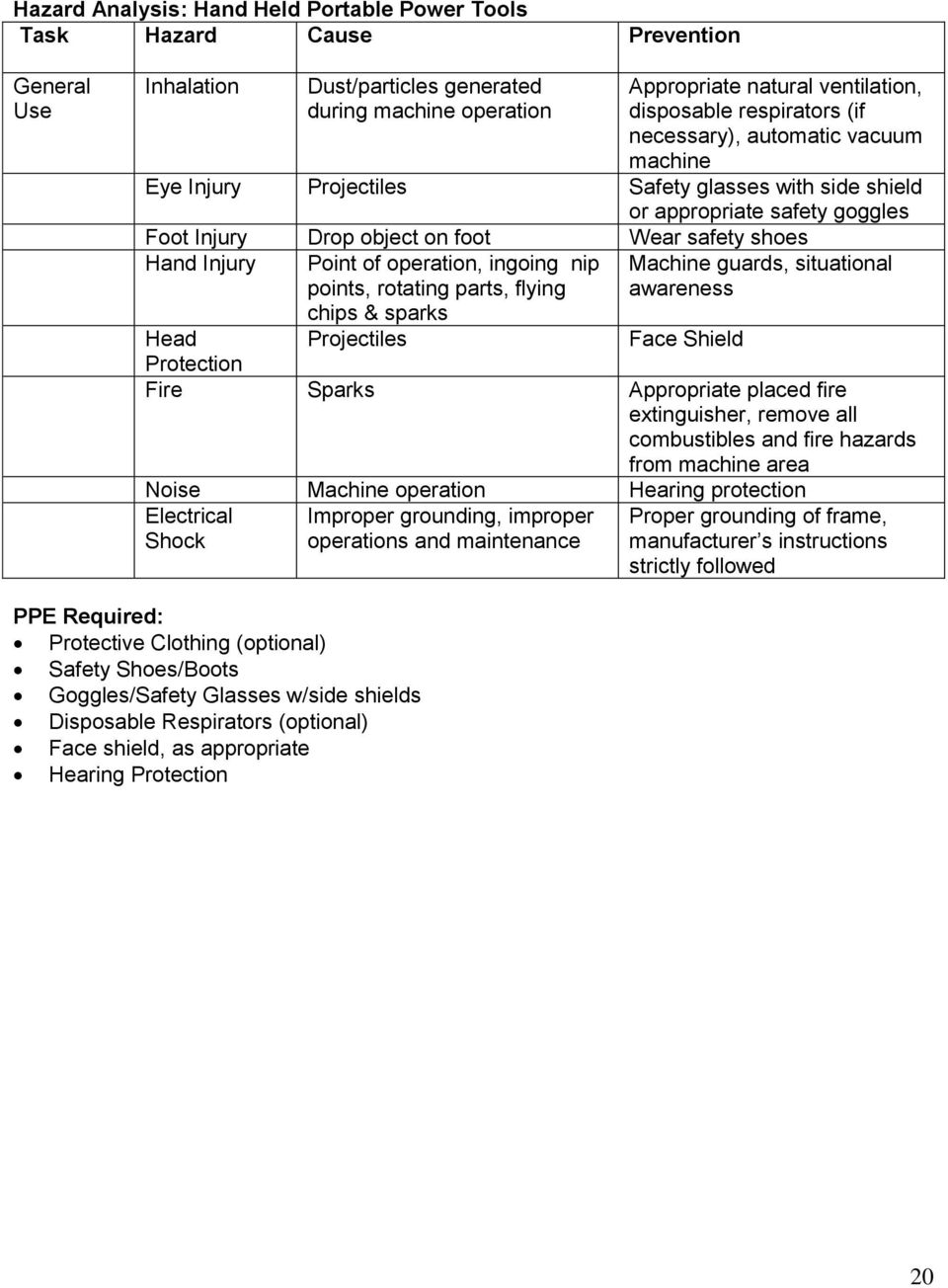
20 Hazard Analysis: Hand Held Portable Power Tools Inhalation Dust/particles generated during machine operation Appropriate natural ventilation, disposable respirators (if necessary), automatic vacuum machine Eye Injury Projectiles Safety glasses with side shield or appropriate safety goggles Foot Injury Drop object on foot Wear safety shoes Hand Injury Point of operation, ingoing nip points, rotating parts, flying chips & sparks Machine guards, situational awareness Head Projectiles Face Shield Protection Fire Sparks Appropriate placed fire extinguisher, remove all combustibles and fire hazards from machine area Noise Machine operation Hearing protection Electrical Shock Improper grounding, improper operations and maintenance Proper grounding of frame, manufacturer s instructions strictly followed Protective Clothing (optional) Safety Shoes/Boots Goggles/Safety Glasses w/side shields Disposable Respirators (optional) Face shield, as appropriate Hearing Protection 20
21 Hazard Analysis: High Pressure Washer, Gasoline Powered Trauma Flying debris, contact with high pressure stream Situational awareness, protective clothing Hand Injury Flying debris, contact with high Situational awareness, gloves pressure stream Head Injury Flying debris Situational awareness, face shield, hard hat (as necessary) Foot Injury Drop object on foot, contact Wear safety shoes with high pressure stream Eye Injury Flying debris Goggles/safety glasses with side shields, face shield Electric Shock Improper operation and maintenance Manufacturer s instructions strictly followed Fire Smoking, sparks No smoking or exposure to sparks or open flame during fueling. Appropriate placed fire extinguisher. Noise Equipment Operation hearing protection Protective Clothing (optional) Safety Shoes/Boots Goggles Hard Hat (as necessary) Face shield Gloves Hearing Protection Apron (optional) 21
22 Hazard Analysis: Hoist (Electric/Manual)/Slings Trauma Impact Situational awareness, gloves, hardhat Foot Injury Dropped object on foot Wear safety shoes Safety Shoes/boots Gloves Hard hat 22
23 Hazard Analysis: Jack Stands, Manual Foot Injury Improper placement of load Situational awareness, wear safety shoes Trauma Overloading vehicle stand beyond rated capacity Follow manufacturer s instructions. Ensure that rated load is legibly and permanently marked in a prominent location on vehicle stand, and rated load capacity is not exceeded. Safety Shoes/Boots 23
24 Hazard Analysis: Lawn Mower/Trimmer, Gasoline Powered Eye Injury Flying debris Safety glasses w/side shields/goggles Trauma Flying debris, rotating parts, burns Protective clothing, Situational awareness, appropriate guards in place Foot Injury Equipment rolls over foot Safety shoes Noise Equipment Operation Hearing protection Safety Glasses w/side shields/goggles protective Clothing (optional) Hearing Protection Safety Shoes 24
25 Hazard Analysis: Lifting/Carrying Objects Trauma Impact Situational awareness, gloves, back brace/belt (optional) Foot Injury Dropped object on foot Wear safety shoes/boots Safety Shoes/boots Gloves Back brace/belt (optional) 25
26 Hazard Analysis: Pallet Jack & Dolly, Hydraulic Foot Injury Roll jack over foot Wear safety shoes Trauma Overloading jack beyond rated capacity, using jack for support rather than just lifting, sharp objects Follow manufacturer s instructions, gloves Safety Shoes/Boots Gloves 26
27 Hazard Analysis: Plate Compactor Eye Injury Projectiles, fumes, dusts Safety glasses w/side shields or goggles Trauma Projectiles, impact, vibration, burns Situational awareness, gloves, protective clothing, back brace/belt (optional), switch guards Foot Injury Dropped object on foot Wear safety shoes Noise Engine, impact Wear hearing protection Inhalation Dust Wear respirator or dust mask if needed Safety Glasses w/side shields or Goggles Safety Shoes/boots Hearing Protection Gloves protective Clothing (long pants) Respirator or dust mask (as needed) Back brace/belt (optional) 27
28 Hazard Analysis: Portable Generator, Gasoline Powered Inhalation Exhaust Appropriate ventilation Trauma Burns Situational awareness, PPE, protective clothing Foot Injury Roll over foot, drop object on Wear safety shoes foot Fire Heat, sparks, slag Appropriate placed fire extinguisher, remove all combustibles and fire hazards from area Electrical Shock Improper operations and maintenance, improper switching device Strictly follow manufacturer s instructions, proper switching for starting up/ shutting down machine Leather Gloves Safety Shoes/ Boots 28
29 Hazard Analysis: Portable Heater, Electric Powered Trauma Burns Situational awareness, PPE, protective clothing Foot Injury Roll over foot, drop object on Wear safety shoes foot Fire Heat, sparks, slag Appropriate placed fire extinguisher, remove all combustibles and fire hazards from area Electrical Shock Improper operations and maintenance, improper switching device Strictly follow manufacturer s instructions, proper switching for starting up/ shutting down machine Leather Gloves Safety Shoes/ Boots 29
30 Hazard Analysis: Portable Heater, Gasoline Powered Inhalation Exhaust Appropriate ventilation Trauma Burns Situational awareness, PPE, protective clothing Foot Injury Roll over foot, drop object on Wear safety shoes foot Fire Heat, sparks, slag Appropriate placed fire extinguisher, remove all combustibles and fire hazards from area Electrical Shock Improper operations and maintenance, improper switching device Strictly follow manufacturer s instructions, proper switching for starting up/ shutting down machine Leather Gloves Safety Shoes/ Boots 30
31 Hazard Analysis: Shop Vac(s) Foot Injury Drop object on foot Wear safety shoes Electrical Shock Improper operations and maintenance, improper grounding Manufacturer s instructions strictly followed, proper grounding Eye Injury Flying debris Wear safety glasses w/side shields Noise Equipment Operation hearing protection PPE Required :( PPE required to be worn during the vacuuming task when it poses a specific hazard to the user) Safety Glasses with side shields Hearing Protection Safety Shoes/Boots 31
32 Hazard Analysis: Snow Blower, Gasoline Powered Eye Injury Flying debris (ice, rocks, snow, Safety glasses w/side shields etc) Trauma Flying debris, Rotating parts, Burns, frostbite Situational awareness, protective clothing, gloves Foot Injury Equipment rolls over/drops on Safety shoes/boots foot Noise Equipment Operation Hearing protection Safety Glasses w/side shields (only when frostbite hazard does not present a greater hazard) protective Clothing Hearing Protection Safety shoes/boots Gloves 32
33 Hazard Analysis: Snow Shoveling Trauma Projectiles, impact, slip/trip/fall, cold Situational awareness, gloves, positive traction sole footwear, protective clothing Foot Injury Dropped object/impact on foot Wear safety shoes/boots Safety Shoes/boots (when chipping snow/ice with shovel or chipper) Gloves protective Clothing (cold weather) 33
34 Hazard Analysis: Tractor Routine Maintenanc e/repair Routine Operation Hand Injury Confined work areas, sharp edges/objects, rotating parts Gloves, situational awareness Head Injury Bump head, objects fall on head Wear hard hat (if necessary) Foot Injury Equipment rolls over foot, object Wear safety shoes drops on foot Trauma Rotating parts Situational awareness, appropriate clothing Eye Injury Flying Particles Safety glasses w/side shields Noise Equipment Operation hearing protection Noise Equipment Operation hearing protection Foot Injury Equipment rolls over foot Wear safety shoes Protective Clothing Safety Shoes/ Boots Safety Glasses Hard Hat (if necessary) Gloves Hearing Protection 34
35 Hazard Analysis: Vise Eye Injury Projectiles Safety glasses with side shield or appropriate safety goggles Foot Injury Drop object on foot Wear safety shoes Hand Injury Impact, penetration, compression Gloves, situational awareness Goggles/ Safety Glasses w/ side shield Gloves Safety Shoes/Boots 35
36 Hazard Analysis: Weed/Brush Trimmer, Hand-held, Gasoline Powered Eye Injury Flying Debris Safety glasses w/side shields/goggles, face shield Trauma Flying debris, Rotating parts, Burns Protective clothing, situational awareness, appropriate guards in place Foot Injury Equipment contacts foot Safety shoes Noise Equipment Operation Hearing protection Safety Glasses w/side shields/goggles Face Shield Hearing Protection protective Clothing (optional) Safety Shoes 36
37 Hazard Analysis: Snow Shoveling Trauma Projectiles, impact, slip/trip/fall, cold Situational awareness, gloves, positive traction sole footwear, protective clothing Foot Injury Dropped object/impact on foot Wear safety shoes/boots Safety Shoes/boots (when chipping snow/ice with shovel or chipper) Gloves protective Clothing (cold weather) 37
Job Hazard/Safety Analysis For the Building Maintenance Worker
 Job Hazard/Safety Analysis For the Building Maintenance Worker 1 INTRODUCTION Job Hazard/Safety Analysis for the Building Maintenance Worker is a partial list of known task performed by the professional
Job Hazard/Safety Analysis For the Paint & Finish Worker
 Job Hazard/Safety Analysis For the Paint & Finish Worker 1 INTRODUCTION Job Hazard/Safety Analysis for the Paint & Finish Worker is a partial list of known task performed by the professional paint and
Job Hazard/Safety Analysis For the Plumber
 Job Hazard/Safety Analysis For the Plumber 1 INTRODUCTION Job Hazard/Safety Analysis for the Plumber is a partial list of known task performed by the professional plumber. We have placed the tasks in alphabetical
Job Hazard/Safety Analysis For the Lab Worker
 Job Hazard/Safety Analysis For the Lab Worker 1 INTRODUCTION Job Hazard/Safety Analysis for the Lab Worker is a partial list of known task performed by the professional laboratory worker. We have placed
Job Hazard/Safety Analysis For the Housekeeper
 Job Hazard/Safety Analysis For the Housekeeper 1 INTRODUCTION Job Hazard/Safety Analysis for the Housekeeper is a partial list of known task performed by the professional housekeeper. We have placed task
Job Hazard Analysis Manual. Updated 10/6/04
 Job Hazard Analysis Manual Updated 10/6/04 Abrasive Cutoff Saw General Use Inhalation Dust/particles generated during machine operation Appropriate natural ventilation, disposable respirators, automatic
Job Hazard/Safety Analysis For the Office Worker
 Job Hazard/Safety Analysis For the Office Worker 1 INTRODUCTION Job Hazard/Safety Analysis for the Office Worker is a partial list of known task performed by the professional office worker. We have placed
GEORGIA INSTITUTE OF TECHNOLOGY ENVIRONMENTAL HEALTH AND SAFETY PERSONAL PROTECTIVE EQUIPMENT
 PURPOSE To protect the health and welfare of GEORGIA TECH employees in areas where there may be a risk of injury or exposure to hazardous substances or conditions employees who work in areas where physical
Curtain Guards Made of PVC and designed to protect the operator from the risk of airborne chips or tool fragments.
 Two General Safety Rule for CNC Machines Never operate a CNC machine without proper training or consulting the specific operator's manual for that particular machine and control type. Never attempt to
Tech Shop Safety Level 2 - FN000425. Tech Shop / Tool Safety Operations. (Fermilab machines not covered in course FN000258)
 Tech Shop Safety Level 2 - FN000425 Tech Shop / Tool Safety Operations (Fermilab machines not covered in course FN000258) Table of Contents Tech Shop / Tool Safety Operations 3 General Rules of Safety
SAFETY in the work area is a broad topic because of the
 A Safe Place to Work SAFETY in the work area is a broad topic because of the many components of agricultural mechanics. Safety is protection from injury or loss. Injury can result from improper use of
Master Workplace Inspection Checklist for General Shop Safety. MASTER WORKPLACE INSPECTION CHECKLIST General Shop Safety
 Integrated Risk Management Master Workplace Inspection Checklist for General Shop Safety Document Type: Form Control Number: UIRM- FM_012_50 File Code: UIRM-001 Last Reviewed: March 2014 Department/Unit:
Personal Protective Equipment Policy & Procedure Date: August, 2001 Approved by:
 OCCUPATIONAL SAFETY AND HEALTH POLICY Topic: Personal Protective Equipment Policy & Procedure Date: August, 2001 Approved by: Author(s): Distribution: Cindy Davis, Risk Management; Ed Polluconi, EH&S;
MODEL T-4 TRENCHER. Operators Manual
 DO NOT THROW AWAY IMPORTANT MANUAL MODEL TRENCHER Operators Manual P.O.BOX 290 San Bernardino, CA. 92402 Phone (909) 478-5700 (800) 922-4680 Fax (909) 478-5710 E-mail: [email protected] www.groundhoginc.com
Additional information: -OSHA Instruction CPL 2.103, Field Inspection Reference Manual, Chapter IV, Section A -29 CFR 1910, Subpart I, Appendix B
 1 Additional information: -OSHA Instruction CPL 2.103, Field Inspection Reference Manual, Chapter IV, Section A -29 CFR 1910, Subpart I, Appendix B -1910.1000(e) 2 1910.132(h) 72 FR 64341, Nov. 15, 2007
Installation Instructions for Alarm Module Kit A043F059
 Instruction Sheet 07-2013 Installation Instructions for Alarm Module Kit A043F059 1 Introduction The information contained within is based on information available at the time of going to print. In line
Welcome to the safe@work Automotive Module.
 Welcome to the safe@work Automotive Module. Have you read the General Module, completed the test and gained your safe@work General certificate? The Automotive Module should be done AFTER the General Module
Safety Training Topic PERSONAL PROTECTIVE EQUIPMENT
 Safety Training Topic PERSONAL PROTECTIVE EQUIPMENT Purpose of Meeting To remind workers that using personal protective equipment (PPE) can protect them from serious injury. To reince PPE safety rules.
Safety Training Needs Assessment
 Safety Needs Assessment Form Instructions: Please review each question and either check YES or NO. If a question is checked YES you will be required to complete the training topic before initial assignment
Example risk assessment for a motor vehicle mechanical repair workshop
 Example risk assessment for a motor vehicle mechanical repair workshop Setting the scene The garage manager did the risk assessment. The business employed 12 mechanics, including two apprentices who carried
Conducting a Job Hazard Assessment. Environmental, Health and Safety 275-3241
 Conducting a Job Hazard Assessment Environmental, Health and Safety 275-3241 EH&S Programs: Fire Safety Blood Borne Pathogens Hazard Communication Personal Protective Equipment Emergency Preparedness General
Respiratory Safety and PPE Module 7. Special Warehouse Worker Hazards in Structural Steel Fabricating and Supply Companies
 Respiratory Safety and PPE Special Warehouse Worker Hazards in Structural Steel Fabricating and Supply Companies Drawing from OSHA 3384-09 2011 1 Respiratory Safety and PPE OSHA Grant Information This
Pressure Vessels (Air Compressors) and LPG Tanks
 Pressure Vessels (Air Compressors) and LPG Tanks 1. Identification of Workplace Hazard Any container, tank or vessel that contains pressurized material is a potential hazard to employees due to the force
Guidelines for the Use of. Personal Protective Equipment
 Guidelines for the Use of Personal Protective Equipment Contents Introduction 1 Key Points on the Proper Use of Personal Protective 2 Equipment Safety Helmets 3 Eye Protectors 4 Ear Protectors 5 Respirators
Safety and Health Policy and Procedure Manual. PERSONAL PROTECTIVE EQUIPMENT Section 0130. Table of Contents
 Safety and Health Policy and Procedure Manual PERSONAL PROTECTIVE EQUIPMENT Section 0130 Table of Contents I. INTRODUCTION II. STANDARDS III. SCOPE IV. PURPOSE V. GENERAL REQUIREMENTS VI. EMPLOYEE OWNED
Abrasive Wheel Grinder Safety
 Abrasive Wheel Grinder Safety One of the most common pieces of machinery in use in the maintenance shops on campus is the abrasive wheel grinder. These useful machines, used to remove metal from flat and
Notes. Material 1. Tools the employee is expected to operate
 OSHA Standard29 CFR 1910.211-.247, Subpart O, Machinery and Machine Guarding, and Subpart P, Hand and Portable-Powered Tools and other Hand- Held Equipment. Hand Tool Safety Preparation 1. Read Applicable
University of Glasgow School of Engineering UGRacing Formula Student Garage
 University of Glasgow School of Engineering UGRacing Formula Student Garage James Watt South Building Level 4 CODE OF PRACTICE Emergency telephone number is 4444 Fire extinguishers located next to emergency
15GAL STEEL OIL DRAIN WITH 110V PUMP
 15GAL STEEL OIL DRAIN WITH 110V PUMP OWNER S MANUAL WARNING: Read carefully and understand all ASSEMBLY AND OPERATION INSTRUCTIONS before operating. Failure to follow the safety rules and other basic safety
Notes. Material 1. Personal Protective Equipment 2.
 29CFR 1926.20(b)-Accident Reduction, 29CFR 1926.21- Safety Training & Education 29CFR 1926.20(a)-Unsafe Working Conditions 29 CFR 1910.132-138, the "Personal Protection Equipment" standard. & 20 CFR 1910.134
PERSONAL PROTECTIVE EQUIPMENT POLICY & GUIDANCE
 Health and Safety Policy PERSONAL PROTECTIVE EQUIPMENT POLICY & GUIDANCE ROYAL FREE HOSPITAL NHS TRUST & SCHOOL OF MEDICINE CONTENTS 1. SUMMARY OF THE REGULATIONS 2. INTRODUCTION 3. DEFINITION OF PERSONAL
Safe Operating Procedure
 Safe Operating Procedure (Revised 11/11) JOB SAFETY ASSESSMENTS (For assistance, please contact EHS at (402) 472-4925, or visit our web site at http://ehs.unl.edu.) This SOP is intended for supervisors
PERSONAL PROTECTIVE EQUIPMENT HAZARD ASSESSMENT, EQUIPMENT SELECTION AND TRAINING DOCUMENTATION
 DRAFT SAMPLE WRITTEN PERSONAL PROTECTIVE EQUIPMENT HAZARD ASSESSMENT, EQUIPMENT SELECTION AND TRAINING DOCUMENTATION For Compliance With 1910.132 Wyoming General Rules and Regulations Wyoming Department
PALM BEACH STATE COLLEGE PERSONAL PROTECTIVE EQUIPMENT (PPE) JOB HAZARD ASSESSMENT
 PALM BEACH STATE COLLEGE PERSONAL PROTECTIVE EQUIPMENT (PPE) JOB HAZARD ASSESSMENT Department: Facilities Campus: All Task: Check/Service/Maintain/Repair/Install HVAC Equipment and Systems Job Title(s)
PERSONAL PROTECTIVE EQUIPMENT FOR CALIFORNIA STATE UNIVERSITY, LOS ANGELES
 PERSONAL PROTECTIVE EQUIPMENT FOR CALIFORNIA STATE UNIVERSITY, LOS ANGELES OCTOBER 2007 PROGRAM APPROVAL AND AUTHORIZATION James M. Rosser, President Date TABLE OF CONTENTS TITLE Section PURPOSE...1.0
TEMPORARY EMPLOYEES SAFETY PROCEDURES
 TEMPORARY EMPLOYEES SAFETY PROCEDURES Temporary Agencies will ensure that any temporary employee sent to work at Modern will have received and understand the General Safety Rules. GENERAL SAFETY RULES
PERSONAL PROTECTIVE EQUIPMENT (PPE)
 Page 1 of 6 (PPE) Personal protective equipment (PPE) is used to protect an individual from hazards associated with their work tasks or environment. Specific types of personal protective equipment include
FALLING OBJECTS EXCESSIVE NOISE CHAINSAW & CHIPPER WORK AT HEIGHTS MANUAL HANDLING
 JOB NO: PROJECT: DATE: SWMS NO: SWMS 001.1 PREPARED BY: Ian Hartley REVISED BY: Nick Bragg & Cameron McNeil ACTIVITY: TREE REMOVAL & PRUNING SIGNED BY: REVISION DATE: December 2015 MINIMUM PERSONAL PROTECTIVE
WEEKLY SAFETY MEETING All Euramax Subsidiaries WELDING SAFETY / HOT WORK SAFETY. Safety Meeting Contents. Meeting Notice.
 Safety Meeting Contents Meeting Notice Leaders Guide Employee Handout Employee Quiz Meeting Sign-In Sheet Employee Puzzle PRIOR TO THE WEEKLY MEETING: - Post the meeting notice by the timeclock - Read
Risk management a practical approach
 Risk management a practical approach Introduction Preventing work related accidents and injuries is the primary concern for all those involved in health and safety. Work related accidents and injuries
Machine/Woodworking Shop The Basic Rules
 Machine/Woodworking Shop The Basic Rules 1. Eye protection or face shields are required when working in the shop. A selection of protective goggles and safety glasses are available in the shop. The eyeglasses
Powered Industrial Truck Safety Program
 Powered Industrial Truck Safety Program TABLE OF CONTENTS Forklift Safety Program 1.0 Overview... 3 2.0 Policy.....3 3.0 Requirements 3 4.0 Purpose. 3 5.0 Scope......4 6.0 Forklift Procedures 4 6.0 Responsibilities.....6
If you have any questions about how to safely undertake a task or project, ask your supervisor before you begin.
 Laboratory Health and Safety Manual Section 1: Introduction and Objectives This manual provides a set of minimum standards and practices for the safe and healthy operation of a laboratory. Following the
Example risk assessment for a warehouse
 Example risk assessment for a warehouse Setting the scene The warehouse manager carried out a risk assessment of the warehouse. The warehouse employed 12 staff, some were part of a union. How was the risk
Risk Management Program March 2015
 AS/NZS 4801 OHSAS 18001 OHS20309 SAI Global Risk Management Program March 2015 Introduction Monash University s Victorian campuses are all governed by the Victorian OHS Act 2004 and its subordinate regulations
Course Title: Safety Issues in Electronics Engineering Technology Number of Credits: 3 B.A. B.S. B.A.S A.A. A.S. Degree Type
 GENERAL INFORMATION Name: Diane King Phone #: 77021 Course Prefix/Number: ETI3704 Course Title: Safety Issues in Electronics Engineering Technology Number of Credits: 3 B.A. B.S. B.A.S A.A. A.S. Degree
Dining Services OSHA Safety Training Program TRAINING RECORD
 Dining Services OSHA Safety Training Program TRAINING RECORD Employee Title: This record documents the safety training received by Dining Services employees, including student employees, as required by
Citations in brackets are from Title 8 of the California Administrative Code.
 SAFETY WALKAROUND CHECKLIST PORTABLE POWER TOOLS 2001 Date Prepared: Project Name/No: By: Location: Check the box if the statement is true. Citations in brackets are from Title 8 of the California Administrative
Metal welding safety. Guidance Note. Practical advice for employers on controlling hazards when welding. June 2011. Background. How to use the table
 Guidance Note Metal welding safety Practical advice for employers on controlling hazards when welding. June 2011 Background Metal welding involves the application of heat to join two metals together. The
University of Tennessee Safety Guidelines
 University of Tennessee Safety Guidelines Guideline Subject: Compressed Gases and Cryogenics Safety Guidelines Approval Date: 10/1/15 (Rev. 1) Next Scheduled Review: 10/1/19 Date Effective: 1/01/09 Contact
Federal Wage System Job Grading Standard for Powered Support Systems Mechanic, 5378. Table of Contents
 Federal Wage System Job Grading Standard for Powered Support Systems Mechanic, 5378 Table of Contents WORK COVERED... 2 WORK NOT COVERED...2 GRADES... 2 TITLES... 3 HELPER AND INTERMEDIATE JOBS... 3 NOTE
National- Spencer Inc.
 9-27-2010 National- Spencer Inc. 19.2V HEAVY DUTY GREASE GUN PRODUCT SPECIFICATION Charger Input Power 110 VAC Battery Output Power 19.2V Battery Capacity 1500 MAH Battery Pack Charge Time 1 Hour Maximum
Portable Grinder. Given a properly adjusted portable grinder, instruction and demonstration of use, each student will be able to:
 Portable Grinder I. Competencies Given a properly adjusted portable grinder, instruction and demonstration of use, each student will be able to: A. Identify the major parts of the portable grinder. B.
Personal Protective Equipment Guidelines
 Personal Protective Equipment Guidelines Purpose To establish guidelines for use and care of personal protective equipment, which is to be used by employees and /or students when a hazard is found to exist
OSHA Personal Protective Equipment Standard. Annual Training
 OSHA Personal Protective Equipment Standard Annual Training This program was developed by: Environmental Health & Safety New York University 285 Mercer Street, 2 nd Floor New York, N.Y. 10003 (212) 998-1450
Presented by: Rich Perry Marsh Risk Consulting
 Flammable and Combustible Liquids Presented by: Rich Perry Marsh Risk Consulting What s the Big Deal? Flammable and combustible liquids are easily ignited Ignite with explosive force Burn readily and give
Automotive and Diesel Lab Safety Guidelines
 Section A: Safety Training All new students shall receive safety training prior to performing lab activities. The training shall include: a. S/P2 Pollution Prevention including relevant EPA regulations,
Trade Name of this Product Isopropyl Rubbing Alcohol 91% USP. Corporate Compliance Team 1666 East Touhy Avenue
 Page 1 of 5 MSDS Document Product 1. Chemical Product and Company Identification Trade Name of this Product Manufacturer Contact Name Lawson Products, Inc. Corporate Compliance Team 1666 East Touhy Avenue
Standard Operating Procedure (SOP) Car/Truck Battery Safety
 INTRODUCTION Lead-acid batteries contain sulfuric acid and only trained and authorized personnel should handle them. When talking about lead-acid batteries, people usually call sulfuric acid "battery acid"
Oxy-Fuel Gas Welding. Given a functional oxy-fuel gas unit, instruction and demonstration of use, each student will be able to:
 I. Competencies Oxy-Fuel Gas Welding Given a functional oxy-fuel gas unit, instruction and demonstration of use, each student will be able to: A. Identify the major parts of the oxy-fuel gas unit. B. Pass
Tools for Orienting Worksite Supervisors About Teen Health and Safety
 Tools for Orienting Worksite Supervisors About Teen Health and Safety A Packet for Youth Employment and Training Programs Youth employment and training programs are often legally responsible for ensuring
PAY TO PLAY: OSHA ISSUES NEW GUIDANCE ON EMPLOYEE PERSONAL PROTECTIVE EQUIPMENT (PPE) AND EMPLOYER DUTY TO PAY
 131 South Dearborn Street Writer s direct phone (312) 460-5877 Writer s e-mail [email protected] Writer s direct fax (312) 460-7877 Suite 2400 Chicago, Illinois 60603 (312) 460-5000 fax (312) 460-7000
Company Name Company Address Company Phone Number Company Fax Number
 Job Hazard Analysis Plumbing Company Name Company Address Company Phone Number Company Fax Number Job/Task Plumbing fixture and piping Date Prepared: 08.04.2010 installation Project Name: Project Name
Hazard/Risk Identification and Control Procedure
 Hazard/Risk Identification and Control Procedure Introduction Hazard identification and the steps taken to minimize the risks associated with identified hazards are a critical component of working safely.
PPE Requirements for Site
 PPE Requirements for Site Purpose and Scope 2 Responsibilities 2 Personal Protective Equipment Program 2 PPE Quick Reference Chart 3 Eye and Face Protection 3 Safety Glasses 3 Goggles 4 Face Shields 5
Topics of the Presentation
 Drill Rig Safety Topics of the Presentation Personnel safety and monitoring PPE Health (Drugs and Alcohol) Drill Rig operation Safe set up procedures Safe operation of machine Safety related accidents
How many work-related eye injuries are there each day?
 EYE SAFETY Common Eye Hazards Dust, concrete, and metal particles Falling or shifting debris, building materials, and glass Smoke and noxious or poisonous gases Chemicals (acids, bases, fuels, solvents,
ALVERNIA UNIVERSITY OSHA REGULATION: 29 CFR 1910.252 WELDING, CUTTING, AND BRAZING ( HOT WORK ) SECTION: 3600
 OSHA REGULATION: 9 CFR 90.5 WELDING, CUTTING, AND BRAZING ( HOT WORK ) A. POLICY. This procedure follows requirements set forth in 9 CFR 90.5.. This policy applies to all Hot Work operations being done
Personal protective equipment (PPE) at work A brief guide
 Personal protective equipment (PPE) at work A brief guide Introduction This leaflet describes what you, as an employer, may need to do to protect your employees from the risk of injury in the workplace.
Compressed Gas Cylinder Storage and Handling Guide
 Overview Compressed gas cylinders are used in many workplaces to store gases that vary from extremely flammable (acetylene) to extremely inert (helium). Many compressed gas cylinders are stored at extremely
120Volt 60-70A ARC WELDER. 80000 Rev 80000-20080214
 80000 Rev 80000-20080214 10006 Santa Fe Springs Road Santa Fe Springs, CA 90670 USA Made in China Owner s Manual and Operating Instructions 120Volt 60-70A ARC WELDER Table of Contents Introduction...
BBQ Master Hong Kong Limited
 BBQ Master Hong Kong Limited Instant Light Charcoal Emergency Phone Number: For Chemical Emergency Spill Leak Fire Exposure or Accident Call CHEMTREC Day or Night DOMESTIC NORTH AMERICA 800-424-9300 SECTION
Sample Written Program. For. Job Safety Analysis
 Sample Written Program For Job Safety Analysis 1 Table of Contents 0 Part Page Introduction... 1 Selecting Jobs for Analysis... 3 Involving the Employee... 4 Conducting the Job Safety Analysis... 5 Breaking
LOS ANGELES UNIFIED SCHOOL DISTRICT DIVISION OF ADULT AND CAREER EDUCATION SAFETY TEST FOR ELECTRICIAN PROGRAM
 LOS ANGELES UNIFIED SCHOOL DISTRICT DIVISION OF ADULT AND CAREER EDUCATION SAFETY TEST FOR ELECTRICIAN PROGRAM Service Area: Industry Sector: Energy, Environment & Utilities Class Teacher (Please Print)
THERMIT WELDING (GB) LTD PROCESS MANUALS
 THERMIT WELDING (GB) LTD PROCESS MANUALS SECTION FOUR GUIDELINES FOR SAFE OPERATION Page 1 SECTION 4 - GUIDELINES FOR SAFE OPERATION The information contained in this section is applicable to the THERMIT
Injury Prevention for the Construction Industry
 Injury Prevention for the Workers in the construction industry encounter a variety of hazards, some of which can lead to serious injuries and fatalities. This fact sheet: Increases awareness of the primary
Completion Test Answer Key. 1. Why are young people more likely to be injured on the job than other groups of workers?
 1. Why are young people more likely to be injured on the job than other groups of workers? They receive little or no safety training or supervision. They are reluctant to ask questions for fear of appearing
SAFETY DATA SHEET. Trade name: Master Clear Seal-5 Revised: 5/29/2015
 MMG Mud Masters Group a division of Horizon Mud Company SAFETY DATA SHEET SECTION 1: Identification of the substance/mixture and of the company/undertaking Trade name: Master Clear Seal-5 Supplied by:
IMPORTANT SAFETY NOTICE
 IMPORTANT SAFETY NOTICE To: Our Valued Customers User safety is a major focus in the design of our products. Following the precautions outlined in this manual will minimize your risk of injury. ITT Goulds
"ACCIDENT PREVENTION AND SAFETY HOUSEKEEPING"
 MAJOR PROGRAM POINTS "ACCIDENT PREVENTION AND SAFETY HOUSEKEEPING" Part of the "GENERAL SAFETY SERIES" Quality Safety and Health Products, for Today...and Tomorrow Outline of Major Points Covered in the
CARING FOR YOUR WATER HEATER
 http://waterheatertimer.org/troubleshoot-rheem-tankless-water-heater.html Water Heater Inspections CARING FOR YOUR WATER HEATER Venting System (Direct Vent Only) The venting system should be inspected
A short guide to the Personal Protective Equipment at Work Regulations 1992
 A short guide to the Personal Protective Equipment at Work Regulations 1992 Health and Safety A short guide to the Personal Protective Equipment at Work Regulations 1992 Employers have basic duties concerning
Lab PPE Guide Examples of Personal Protective Equipment
 Lab PPE Guide Examples of Personal Protective Equipment 1140 South Paulina St. 245 (PSB) Chicago IL 60612 Phone: 312-413-3387 Fax: 312-413-3700 www.uic.edu/depts/envh This document is to be used as a supplement
Industrial Process Pump Safety Manual IMPORTANT SAFETY NOTICE
 Industrial Process Pump Safety Manual IMPORTANT SAFETY NOTICE To: Our Valued Customers User safety is a major focus in the design of our products. Following the precautions outlined in this manual will
Tractor Safety Program
 Southwestern University Safety Office Tractor Safety Program A guide to safe tractor use and maintenance Program Contents Review of Safety Hazards Safety Guide / Orientation / Daily Checklist Safety Quiz
Safety and Health Office WORKPLACE SAFETY CHECKLIST
 Location: Date: Inspected by: Safety and Health Office WORKPLACE SAFETY CHECKLIST WORK ENVIRONMENT Ventilation Removal of fumes and dust Temperature and humidity control Noise levels Vibration Lighting
FRAME DOOR OPENING, DOOR AND SIDE PANEL OUTER
 NUBIRA/LACETTI FRAME DOOR OPENING, DOOR AND SIDE PANEL OUTER 6 1 SECTION 6 FRAME DOOR OPENING, DOOR AND SIDE PANEL OUTER CONTENTS 1. FRAME DOOR OPENING........................................... 6 2 1.1.GENERAL
Employee Safety Handbook
 i Table of Contents I. Introduction Background.................. 1 Health and Safety Policy.................. 1 Health and Safety Responsibilities................. 1 Employees Responsibilities..................
Environment. Personal Protective Equipment Requirements for Photographic Processing Facilities. Kodak s health, safety, and environmental
 Environment I N F O R M A T I O N F R O M K O D A K Personal Protective Equipment Requirements for Photographic Processing Facilities J-312 $10.00 Kodak s health, safety, and environmental Protecting employees
Welcome to the safe@work Hairdressing Module
 Welcome to the safe@work Hairdressing Module Have you read the General Module, completed the test and printed your safe@work General Award of Attainment? The Hairdressing Module should be done AFTER the
SOLVENT CLEANER MSDS Page 1 of 5 SAFETY DATA SHEET. (To comply with OSHA s Hazard Communication Standard 29CFR 1910.1200/ANSI z400.
 SOLVENT CLEANER MSDS Page 1 of 5 SAFETY DATA SHEET (To comply with OSHA s Hazard Communication Standard 29CFR 1910.1200/ANSI z400.1-1993) 1. PRODUCT & COMPANY IDENTIFICATION Prepared on: Month, Year Manufactured
Document the assessment, PPE selection, and training.
 Requirements... 1 Hazard Control... 1 Supervisor Responsibilities... 2 How to Use This Website... 3 Step One - Assessment... 3 Step Two - Selection... 3 Step Three - Training... 4 Step Four - Documentation...
Risk Management Department Safety & Worker s Compensation Training Classes
 Risk Management Department Safety & Worker s Compensation Training Classes The following safety and worker s compensation training is available from Risk Management and is scheduled by contacting the Risk
car + boat Box Contents x2 x2 22350_DC16_CAR_BOAT_OPSMAN.indd 1 29/7/08 15:27:01
 car + boat Box Contents x x 350_DC6_CAR_BOAT_OPSMAN.indd 9/7/08 5:7:0 SAVE THESE INSTRUCTIONS THIS APPLIANCE IS INTENDED FOR HOUSEHOLD USE ONLY IMPORTANT SAFETY INSTRUCTIONS READ ALL INSTRUCTIONS BEFORE
How to Reduce Your Exposure to Chemicals at Home, Work, and Play
 How to Reduce Your Exposure to Chemicals at Home, Work, and Play You come into contact with chemicals every day. This is called chemical exposure. Although some chemical exposures are safe, others are
Safe Operating Procedure
 Safe Operating Procedure (Revised 8/15) GENERAL MACHINE SAFETY This SOP is intended to provide general safety guidance for power-driven (including manually operated) stationary machines and equipment used
OHS Ticketable Provisions September 9, 2013
 Personal Protective Equipment (PPE) Documentation and Administrative Requirements September 9, 2013 Theme OHS Statute Section Summary of Offence (brief description on ticket) Category Fine Amount Part
Voltmaster Trash Pumps Model TSP2, TSP3 and TSP4
 Model TSP2, TSP3 and TSP4 Owner s Manual July 2010 Table of Contents 1 Introduction...................................................... 1 1.1 Read before using..............................................
Section 2 Hazard Assessment and Risk Control Table of Contents
 Section 2 Hazard Assessment and Risk Control Table of Contents 2.1 INTRODUCTION... 2 Class A Hazard... 3 Class B Hazard... 3 Class C Hazard... 3 Class D Hazard... 3 2.2 HAZARD ASSESSMENT... 4 2.2.1 Hazard