
November 2013 EXECUTIVE SUMMARY
|
|
|
- Alberta Rodgers
- 9 years ago
- Views:
Transcription
1 Comments by Loro Parque on the Report on the Physical & Behavioural Status of Morgan, the Wild- Born Orca held in Captivity, at Loro Parque, Tenerife, Spain by Dr. Ingrid Visser. November 2013 EXECUTIVE SUMMARY In 2010, the juvenile female killer whale (Orcinus orca) named Morgan was rescued by marine animal health professionals at Dolfinarium, Harderwijk from shallow waters on the Dutch coast at the request of the Dutch Government. Over the course of a year with constant expert care, Morgan was rehabilitated and her health restored, and after thorough and repeated review and due diligence by the Dutch Courts, The Dutch Government determined that Morgan was non- releasable and issued a CITES permit authorizing her transfer in 2011to Loro Parque, a professionally accredited zoological park on the island of Tenerife, Spain to join five other killer whales. Upon arrival at Loro Parque, and under a comprehensive behavioural and veterinary care program, Morgan integrated rapidly and smoothly into the existing social group. Daily work with her trainers gave rise to a suspicion of possible hearing loss that was subsequently diagnosed as a substantial hearing deficit by extensive observation and testing. This hearing deficit is most likely a contributing factor in her original stranded condition but has not in any way inhibited her interactions and integration with her new social group at Loro Parque. Regrettably, Dr. Ingrid Visser s Report on the Physical & Behavioural Status of Morgan, the Wild-Born Orca held in Captivity, at Loro Parque, Tenerife, Spain does not accurately reflect the reality that Morgan is thriving in her new home. A principal of the Free Morgan Foundation, the Orca Coalition and the World Cetacean Alliance, Dr. Visser has authored a document that is both erroneous and misleading. Dr. Visser has forgone scientific convention, objectivity and accuracy, instead creating an emotionally charged and exaggerated document that uses inflammatory language to describe negative welfare conditions that do not exist. Any proper scientific document includes a presentation of materials and methods, which explains how the researcher has done his or her work, and a detailed summary of the data upon which the researcher bases any conclusions. The Visser report is virtually free of material, method or data but contains a large excess of conclusions. In short, Dr. Visser has produced an animal activist opinion piece which she attempts to veil and market as scientific literature. Below follows a point by point rebuttal of Dr Visser s claims and opinions.

2 Executive Summary Morgan was to be held at Loro Parque as an interim measure whilst the legality of her continued captivity was debated. The main consideration stated as to why she was sent to this facility, despite data to show otherwise, was so she could socialize with other orca. Comment 01: First statement is false, as the transfer of Morgan to Loro Parque was not temporary, but a final decision of the Ministry of Economic affairs, Agriculture and Innovation of the Dutch Government to move Morgan to Loro Parque without any reservation or condition as to the length of her stay there, the only viable alternative was euthanasia 1. The decision was based on the conclusion that Morgan was not likely to survive if returned to the wild. 2 The court confirmed the validity of the CITES permit issued by the Dutch Government for Morgan s transport to Loro Parque. 3 Since her transfer she has been brutally and continually attacked and is subjected to excessive sexual pressure from a male orca who she is often locked into the same tank with. Comment 02: This statement is subjective and untrue. Dr. Visser s claims are unsupported by any data published in the report or other scientific findings concerning what would be considered excessive or non excessive sexual pressure in this species. Despite its existence, Dr. Visser does not mention the scientific literature about sexual coercion in free ranging wild populations of cetacean species for comparison 4. The author observed Morgan for 77 hours and 16 minutes, over eight days (spread over a 24 day period). During that time- frame, an unprecedented 91 aggression events were documented, all involving Morgan. 1 Why Orca Morgan Cannot be Set Free,AC18/Doc.8-02, available at: 2 Letter by State Secretary Bleker to the Dutch Parliament, 25 Mar. 2011, Kamerstukken II, , , nr Rechtbank Amsterdam, joined cases AWB 11/5033 BESLU and AWB 11/5035 BESLU, 21 Nov Scott, E. M., Mann, J., Watson- Capps, J. J., Sargeant, B. L., & Connor, R. C. (2005). Aggression in bottlenose dolphins: evidence for sexual coercion, male- male competition, and female tolerance through analysis of tooth- rake marks and behaviour. Behaviour, 142(1), 21-44
3 A similar study, looking at aggression in captive orca (observing them for 1,872 hours, i.e., 78 days) recorded only eight aggressive episodes. Comment 03: Dr. Visser makes no attempt to even define what she considers to be an attack or to consider how this species interacts in the wild. Without definition or methodology, there is no basis for a scientific comparison of Dr. Visser s observations and interpretations with peer reviewed scientific studies. The addition of a young individual to a group is always going to involve some mild conflict as the newcomer learns its social place in the group. It is the nature of youngsters to frequently test the members of the group, which can result in reprimand by the other animals. Superficial rakes (markings on the skin) that may result due to these interactions and are a normal part of killer whale social life, observed in nearly all killer whales, and are not life threatening. As Morgan has learned her place in the group, the frequency of reprimand has decreased. As she matures, further decrease in these events should be expected. Morgan was attacked, on average, more than once an hour. The other study recorded an aggressive episode only once every 234 hours. Put another way, Morgan is over than 100 times more like likely to be attacked at Loro Parque than the orca in the other study. Comment 04: As stated above, no comparison of likelihood of attacks can be made due to Visser s lack of definition, methodology and correlated data. Dr. Visser is intentionally misleading the reader using words like attack for dramatic appeal. The failure to define aggression in this paper is obviously intentional as use of the word raises concern and gives the appearance of importance in stark contrast to the scientific social, health and welfare reality. Since her arrival at Loro Parque, Morgan has been inflicted with more than 320 puncture and bite marks (all documented by photographs). This does not include the damage she has self- inflicted from abnormal and repetitive behaviours such as banging her head on the concrete tanks. Additionally, Morgan is wearing her teeth down from chewing on the concrete. Teeth wear in captive orca often leads to infections. These abnormal behaviours are a direct result of boredom from being held in a featureless environment in which she is provided little if any stimulation.

4 Comment 05: Morgan does not bang her head on walls; Dr. Visser has made this up to support her campaign to free Morgan.. Marks, bites and other wounds caused by interactions with other killer whales are commonly known as rake marks. In 1999, Dr. Visser herself published a report entitled Prolific body scars and collapsing dorsal fins on killer whales (Orcinus orca) in New Zealand waters. 5 Abundant literature and photo identification catalogues prove that such scars or rake marks are common in wild cetaceans. 6 Dr. Visser fails to mention this well- documented fact. Nothing in her report indicates how many rake marks may have been present when Morgan was rescued or makes any scientific comparison to the prolific body scars found on killer whales in the wild. Neither does she mention that multiple rake marks obviously occur in a single encounter (see Comment 22 below), instead presenting the numbers as if each were the result of an attack. Her report does include information and photographic evidence that such marks fade (i.e., heal), demonstrating that they are, in fact, superficial wounds caused by animal interactions that are part of establishing the group hierarchy. Dr. Visser appears to be prone to making comments that are dramatic and malicious but cannot be substantiated. Morgan could be protected from the bumps and bruises of life by isolating her in a pool away from other killer whales but this would not be fair to a social animal that instinctively wants contact with others. Morgan s caretakers recognize that she will have to be allowed to collect a few rake marks and superficial scrapes and knocks as she learns the rules of killer whale social life. Tooth wear appears to be a natural consequence of killer whale behaviour. The author has chosen not to mention scientific studies demonstrating that tooth wear 5 Visser, I. N. (1998). Prolific body scars and collapsing dorsal fins on killer whales (Orcinus orca) in New Zealand waters. Aquatic Mammals, 24, Marley, S. A., Cheney, B., & Thompson, P. M. (2013). Using Tooth Rakes to Monitor Population and Sex Differences in Aggressive Behaviour in Bottlenose Dolphins (Tursiops truncatus). Aquatic Mammals, 39(2) ; Scott, E. M., Mann, J., Watson- Capps, J. J., Sargeant, B. L., & Connor, R. C. (2005). Aggression in bottlenose dolphins: evidence for sexual coercion, male- male competition, and female tolerance through analysis of tooth- rake marks and behaviour. Behaviour, 142(1), 21-44; Parsons, K. M., Durban, J. W., & Claridge, D. E. (2003). Male- male aggression renders a bottlenose dolphin (Tursiops truncatus) unconscious. Aquatic Mammals, 29(3), ; Robinson, K. P. (2013). Agonistic intraspecific behavior in free- ranging bottlenose dolphins: Calf- directed aggression and infanticidal tendencies by adult males. Marine Mammal Science

5 and tooth fractures are not unusual in wild killer whales 7. Moreover, there is no scientific study that shows a link between teeth abrasion and stimulation, so it is incorrect to draw any such conclusion. The evidence in the report consists of nothing more than pictures showing progressive teeth abrasion in Morgan; no data is given on teeth abrasion relative to different levels of stimulation. Dr. Visser speculates about infections caused by damaged teeth without any supporting evidence. Morgan does not suffer from any such infections. There is a clear lack of empathy for this animal from the trainers, who ignore her calls for attention and her cries for help and disregard aggressive attacks on her by the other animals, even when they are within meters of these events when they occur. Comment 06: In addition to being provocative, personally insulting to the trainers, and absolutely untrue, this blatant assertion of opinion would never be found in any serious scientific publication. Alleged lack of empathy by the trainers is a subjective statement not supported by any comparative observation of trainer behaviour with other animals in the group. As elsewhere, no methodology or data is presented, eliminating any proper scientific basis for such a claim. Dr. Visser appears to base her remarks on anecdotal observations of two instances (recorded in pictures) in which trainers do not react to an agonistic behaviour of an animal. The author fails to mention that ignoring the unwanted behaviour of animals is the basis of any operant conditioning behavioural training program because trainer attention, just like food and other rewards, would reinforce (encourage and increase) unwanted behaviours. Loro Parque trainers are dedicated experts and caretakers who employ best professional practices in operant conditioning. Fully aware that she was a malnourished dying young killer whale given a second chance at life through the enormous efforts of Harderwijk Dolfinarium, Loro Parque trainers have tremendous empathy for Morgan and respect for the way in which she has positively met the challenge of integrating into a new group. The trainers are acting in accordance with the best long- term interests of Morgan and the rest of her group, ensuring that the learning process occurs in a safe and controlled way that does not threaten the health or well being of any individual animal.. Executive Recommendation 7 See e.g., Ford, J. K., Ellis, G. M., Matkin, C. O., Wetklo, M. H., Barrett- Lennard, L. G., & Withler, R. E. (2011). Shark predation and tooth wear in a population of northeastern Pacific killer whales. Aquatic Biology, 11(3), ; Rica, C. (1996). A report of killer whales (Orcinus orca) feeding on a carcharhinid shark in Costa Rica. Marine Mammal Science, 12(4),

6 Morgan should be removed from Loro Parque immediately and placed into a sea-pen. If her physical and mental health are to be preserved there is no other option. Comment 07: As all the claims and assertions are unsupported by scientific data, misinterpreted or simply wrong, thus, this conclusion is not valid. Removal to be placed in isolation in a seapen (predicate to Dr. Visser s ultimate campaign goal of release in the ocean where she would most certainly die) is a cruel recommendation for a young social animal that suffers from significant hearing loss and has adapted to and become dependent on human care. Morgan is best served by continuing to live with the Loro Parque killer whale group which has become her family. Context of this Report. Morgan is a young female orca who was captured from the wild in June 2010 and has since been in two entertainment parks which keep captive cetaceans for public, circus- style, shows. Comment 08: The author again tries to mislead the reader by using the term capture to describe the government- requested rescue of a young and severely malnourished killer whale that was alone and dying in shallow waters. Morgan would be dead without the around the clock efforts of the expert staff and management of Dolfinarium Harderwijk. Dolfinarium Harderwijk and Loro Parque are leading zoological parks inspected and licensed under national law pursuant to the European Zoos Directive which explicitly recognizes the conservation and educational missions and contributions of zoos.. Both parks also are members of the relevant national and international professional zoo associations are accredited by these organizations following additional inspections in accordance with standards and guidelines that often exceed legal requirements. The author s effort to disparage Harderwijk and Loro Parque is further clear evidence that this report has nothing to do with science. Despite lengthy debates in which it was, inter alia, suggested that Morgan be moved to a semi- natural or sea- pen facility during the deliberations and legal battles about her status and repatriation to the wild, the captive industry has refused to consider such options. Comment 09: Each of the successive rehabilitation and release plans proposed for Morgan was reviewed and rejected by the Dutch Government in favour of the transfer to Loro Parque. The Government s decision was validated by the court following
7 consideration of those same plans and the Loro Parque alternative. 8 In the face of extreme controversy, the first park (Dolfinarium Harderwijk) in the Netherlands, transported Morgan (with the help of SeaWorld USA entertainment parks1 ), to the second entertainment park (Loro Parque), in Spain, on the 29th of November Comment 10: Morgan was transported pursuant to a CITES permit issued by the Dutch Government for this purpose, following the confirmation of its validity by the Court. 9. The transfer proceeded smoothly and without incident. Loro Parque has an extremely dysfunctional group of orca who were all captive- born. They regularly exhibit behaviour outside the social and physical norms for both captive and wild- born orca. This includes attacks on trainers; _2007, a male orca (Tekoha, 7 years old at the time) attacked a trainer in the water and attempted to drown her; _2009, a female orca (Skyla, 5 years old at the time) attacked a trainer in the water pinning him to the side of the tank; _2009, a male orca (Keto, at 14 years old at the time) attacked a trainer in the water and killed him. Comment 11: This affirmation about the behaviour of the orcas at Loro Parque is not based in any ethological data. Accidents and fatalities with dangerous animals are not exclusive of Loro Parque, the author does not compare the accident rate in Loro Parque with other facilities, nor with other species, so it is not possible to extract such a conclusion. Human fatalities caused by free range individuals of other cetacean species (there are for example several human deaths caused by Tursiops truncatus attacks) submitted to a more intense interaction programs are not even mentioned for comparison Rechtbank Amsterdam, joined cases AWB 11/5033 BESLU and AWB 11/5035 BESLU, 21 Nov Ibid. 10 Smith, H., Samuels, A., & Bradley, S. (2008). Reducing risky interactions between tourists and free- ranging dolphins (Tursiops sp.) in an artificial feeding program at Monkey Mia, Western Australia. Tourism management, 29(5), ; Wilke, M., Bossley, M., & Doak, W. (2005). Managing human interactions with solitary dolphins. Aquatic Mammals, 31(4), 427; Samuels, A., & Bejder, L. (2004).

8 All of these orca are now considered so dangerous that the trainers do not enter the water with them. Comment 12: Killer whales are no more dangerous today than they were 3 years ago. Park management decided to reduce the risk of employee injury by limiting water access to the whales. One of the females (Kohana), who had been bred when she was an extremely young animal (only 7 years old), has attacked and rejected both of her calves. Consequently, these calves have had to be hand reared, creating further behavioural and social issues. Comment 13: There are several false statements in this paragraph. Kohana gave birth when she was eight, not seven, years old and this is not an extremely young age for a killer whale to breed. There are recordings of several wild killer whales in Washington State Coast giving birth at similar ages (R38 was born in 2000 and gave birth to R52 in 2009; R24 was born in 1987 and gave birth to R32 in 1996; I92 was born in 2000 and gave birth to I125 in 2009). Further, seven years has proven to be a common age of sexual maturity for Icelandic killer whales in zoological parks. The fact is that animals reproduce instinctively, and are not able to control their sexual impulses or their reproduction. As a consequence, only sexually immature animals can be considered too young to breed. Finally, Kohana did not attack her calves; she failed to care for them, as sometimes happens with animals in any setting. Based on best professional practices and experience, husbandry and hand- rearing procedures were implemented to ensure the survival, health and welfare of the calves. Furthermore, of more importance with respect to Morgan, the orca at Loro Parque are known for their attacks and bullying within the group. Of particular note is a sub- adult male orca known as Tekoha. Visser (2011) reported to the Court (7 November 2011) that Tekoha is the most attacked and bitten orca in the world- wide captive industry. Chronic interaction between humans and free- ranging bottlenose dolphins near Panama City Beach, Florida. Journal of Cetacean Research and Management, 6(1), 69-77

9 Comment 14: The statement about Tekoa is not corroborated by any data in this report. The fact that Dr. Visser made such claims in court does nothing to substantiate them. The court confirmed the Dutch Government s decision to transfer Morgan to Loro Parque after hearing all of Dr. Visser s claims and arguments. See also Comment 09 above. Since Morgan s arrival at Loro Parque, she has not integrated with the other orca held there. Although Loro Parque uses the term fully integrated 1 to describe Morgan s interactions with those orca, unfortunately there is no harmonious interactions and no individuals relating as equals, rather, Morgan has been attacked, bitten, rammed and bullied by the other orca, on a daily basis. Comment 15: Morgan displays a broad number of affiliative behaviours with the rest of the group including rubbing, touching, nuzzling, synchronized swimming, etc. Dr. Visser s suggestion that killer whales should relate as equals in Loro Parque demonstrates a fundamental lack of understanding of orcas. Killer whales, as any other social species, establish and rely on the hierarchy of the group s individual members. This hierarchy is maintained with affiliative (play, sexual behaviour, etc) and agonistic (reprimand, aggression, or even social displacement) behaviours. Accordingly, intra- group aggression is as natural in killer whale pods as affiliative behaviour. Whether this agonistic behaviour is different in orcas under human care and free range pods has not been properly compared with ethological data in this report. Morgan s interactions with other members of the Loro Parque group do not support the inflammatory language used by the author. This report is compiled from 77 hours and 16 minutes of observations obtained during public viewing times and public viewing areas. Although constrained by this, the report leaves no doubt as to the severity of the events reported here. Furthermore, other evidence corroborates these findings and reveals that Morgan should be removed from Loro Parque immediately. Comment 16: Regarding to the validity of the ethological observations, Dr. Visser fails to mention that during most of the public viewing time the animals behaviour is influenced by
10 the trainers presence, or even totally conditioned during training sessions and public performances. Besides she did not mention that, during the observation time, the author was only capable of observing the behaviour of the animals at the surface, most of the underwater behaviour and all the vocal behaviour passed unnoticed. Thus the report is based on partial, limited observation of the animal s behaviour. Observation Methods The author observed Morgan for 77 hours & 16 minutes (during 8 days, over a 24 day period). Detailed logs were kept of Morgan s behaviour and her daily time budget during observations. Interactions and altercations between Morgan and the other orca were also noted in these logs. All injuries reported herein were documented by photographs and some behavioural issues (e. g, stereotypic behaviour, attacks) documented on video. Details are given in Appendix One. Comment 17: The author reports the time she spent looking at the animals and her use of a log book, a photographic camera and a video camera. This is an extraordinarily poor methodological description for an ethological study. From the information in this paragraph it is impossible to compare the results of these observations with any other study, as the author does not describe the ethogram used to analyze the behavioural data obtained during her observations. Not even the very concept of aggression, which is essential to support all her claims, has been described or defined. Thus the validity of the observations is doubtful, the comparison with other studies is impossible and the conclusions are wrong. Morgan On 12 July 2012, Morgan s measurements were; Length: 437 cm (i.e., nearly 1 m longer than at her capture 2 years earlier) and; Weight: 1364 kg / 3007 lb (i.e., 943 kg / 2079 lb more than her capture) (pers. com. Javier Almunia2 ). Of note is that Morgan is longer than the tiny Medical Tank is deep (4.2 (deep) x 7.1 x 12.4 m) and the tank is less than 2x her length, at its widest. Comment 18: Medical pools are intended to hold the animals temporarily and are intentionally small to facilitate veterinary procedures. The medical pool at Loro Parque, like those at other leading marine mammal parks, can accommodate all of the animals at the park, including those far larger than Morgan. Morgan was only held regularly in the medical pool within the first weeks after her transport, during the introduction phase.
11 2 Head of Loro Parque Foundation, 12 July 2012 (weight measurement taken 1 July 2012) Results Interactions between Morgan and the other Orca at Loro Parque. Aggressive behaviour was seen between Morgan and all five orca held at Loro Parque. Although only photographs are presented herein, video documentation of attacks were also recorded by the author. Additionally, video taken by members of the public has also been assessed. One such video has been posted on YouTube, and it is apparent from this footage that Morgan was attacked and bitten, with fresh scars from the assault clearly visible. During this particular video (filmed from a behind the scenes underwater viewing area, which Loro Parque has now banned public access too). Comment 19: Again, little or nothing useful can be learned from these statements. Aggression and resolution are normal events among social species. The frequency of mild conflict is likely to temporarily increase after the introduction of a new member. Social aggression is not intended to kill or maim, it is just the natural way to establish the group s hierarchy. As a result of her young age when rescued, Morgan likely had little or no experience in a killer whale pod without maternal support. As a result, her integration into the Loro Parque group was going to be more difficult due to her lack of independent social experience. However, this was a transitory situation, and now she has the necessary social skills and is fully integrated into the Loro Parque killer whale group. Access to the underwater view area is not banned; it is regulated depending on the season, maintenance operations and other circumstances. Morgan could be heard calling out loudly (loud enough to be heard through the thick glass panel). She presses her face against the window where the viewers are watching. This video can be viewed at: Mw Comment 20: The behaviour of the whales in this video (less than 3 minutes long) does not match with the description of aggression for this species in the scientific literature 11. The images displayed in the video do not correspond with an aggression as, the swimming speed was low and there was no chasing or violent behaviour. The video shows mainly tactile contact and limited sexual behaviour. There may have been some minor displacement when Morgan was sitting at the viewing window. This is equivalent to one child pushing another out of the way because they want to see too. Further, the volume of Morgan s vocalizations is significantly louder than the other 11 GRAHMAN, M., & Noonan, M. (2010). Call types and acoustic features associated with aggressive chase in killer whale (Orcinus orca). Aquatic Mammals, 36(1), 9-18

12 whales, a phenomenon most likely attributed to her diagnosed hearing deficits. Rammings in cetaceans (whales, dolphins and porpoises) such as those illustrated below (Figures 4 10) are violent interactions and can result in severe bruising, rib fractures with associated haemorrhaging and bruising, ruptured lungs resulting from penetration by fractured ribs, severed arteries and spinal dislocation (Patterson et al., 1998, Jett and Ventre, 2011). Broken ribs have been implicated in the death of cetaceans (Clark et al., 2006) and bruising has been thought to aggravate death through advancing toxic invasion of bacteria in captive cetaceans (Buck et al., 1987). Comment 21: It is strange to include the description of different injuries in cetaceans in the Results chapter of the report, as there have never been broken ribs or bones, or any other injury of veterinary concern to the group of whales at Loro Parque since their arrival in Since her arrival to Loro Parque Morgan has not presented with any injuries of veterinary concern, just superficial rake marks that are totally normal for the species. Besides, the citation of a blog post (such as Jett and Ventre, 2011) as peer- reviewed literature invalidates the scientific process, and undermines any credibility. Even teeth marks from bites (called rake marks) inflicted by conspecifics (same species) can be life threatening. Although rake marks may appear to some observers to be benign (or just superficial injuries), they have been implicated in the deaths of captive dolphins (Waples and Gales, 2002) and shown to allow bacteria to enter into the blood stream of captive bottlenose dolphins and cause death (Buck et al., 1987, Zappulli et al., 2005). Orca are susceptible to same bacteria as bottlenose dolphins and have died from similar infections (Griffin and Goldsberry, 1968, Klontz, 1970, Greenwood and Taylor, 1978). Morgan has more than 150 rakes on her left side, more than 120 rakes on her right side and more than 50 rake marks on her ventral surface. These are all wounds which have been inflicted since her arrival at Loro Parque. They have been documented in photographs (e.g., Figures 12-18), which were all taken from the public viewing area (i.e., no close inspection of Morgan was permitted). Comment 22: Rake marks can only be considered a health problem when there is poor water quality (for example in heavily polluted coastal areas). Loro Parque has a water quality system that has been accredited by the Animal and Plant Health Inspection Service of the United States to meet the standards in place in the cetacean facilities in the USA. Water quality is controlled daily, and bacteriological tests are run twice a week to ensure that it is free of pathogenic microorganisms. As a result, the

13 potential deleterious effect of the rake marks on the health of these killer whales is negligible. The author tries again to manipulate the reader with the presentation of Morgan s rake marks in Figure 17. Looking for a high dramatic effect, all the rake marks that Morgan had during the first 12 months were drawn in red and accumulated in one figure, hiding that many of them were already healed when others occurred. The number of rakes is also calculated to exaggerate the aggression level, counting each line as a rake. It has to be noted that a single contact with the open mouth could easily result in 3 to 6 rake marks. Taking into account that one aggression event can have several contacts with the open mouth, the result is that Morgan would be involved in no more than 20 or 40 aggression events during one whole year, which does not match with the exaggerated rate of aggression stated by Dr. Visser. In reality, it is unusual that there is even an indication of discomfort associated with rakes. Stress (of which aggression is a contributing factor) within a captive community of cetaceans is known to lead to illness and death (Waples and Gales, 2002). It has also been known for more than 45 years that captive animals, confined to a limited environment and with controlled social grouping (e.g., trainers deciding which animals are locked together), can have escalated social pressures (Hedinger, 1964). As a result social encounters can become more intensive (i.e., aggression increases) because individuals have limited means of escape (Hedinger, 1964). Incompatible or inappropriate group structure has led to aberrant and aggressive behaviours which culminate in injury, illness and mortality in dolphins (McBride and Kritzler, 1951, Caldwell and Caldwell, 1977, Wood, 1977). Comment 23: This paragraph on the effects of stress in cetaceans is totally irrelevant, as the report does not include any measurement on stress, nor comparisons with stress in killer whales in other facilities. It is again very strange to include a description of stress in the Results chapter of a report that does not provide with any data about stress. (Figure 1). Nakai the captive- born orca was attacked by two other orca and brutally injured. Four puncture marks can be seen at the lower right edge of the wound (arrow) by the trainers shoe. Note how the spacing of these puncture marks is similar to that of Nakai s own teeth, confirming that these originated from the attacking orca s teeth (photo taken at SeaWorld San Diego 30 Sept 2012) Comment 24: Nakai s wound was not the result of a bite from another killer whale. This is a bizarre personal theory brought forward by the author, who did not have firsthand knowledge of the event. Nakai s wound has nothing do with Morgan since she has no

14 such wound. It makes no scientific sense to include this information in the results section of this document when Nakai does not have any relation with Morgan or Loro Parque. Figure 2. Fresh bite marks (called rake marks, indicated by arrow) on Adán at Loro Parque. This photograph was taken shortly after an altercation was observed between Morgan and Adán (which was instigated by Morgan). Both orca were locked in the tiny Medical Tank together (Morgan s dorsal fin visible foreground, left). (photo date 20 June 2012) Figure 3. Fresh rake marks, on Adán s right side. Note also that there are less pronounced wounds and scars (arrows) from earlier bite marks. (photo date 20 June 2012). Figure 2. Fresh bite marks (called rake marks, indicated by arrow) on Adán at Loro Parque. This photograph was taken shortly after an altercation was observed between Morgan and Adán (which was instigated by Morgan). Both orca were locked in the tiny Medical Tank together (Morgan s dorsal fin visible foreground, left). (photo date 20 June 2012) Figure 3. Fresh rake marks, on Adán s right side. Note also that there are less pronounced wounds and scars (arrows) from earlier bite marks. (photo date 20 June 2012). Ramming, Body Slams, Rake Marks. Morgan was observed to be forcefully rammed by either Kohana or Skyla (10 and 8 years old, respectively) (Figures 4, 5 and 8), or both operating together (Figures 6 and 7), on multiple occasions. They were photographed ramming her at least six times. Further evidence of bullying was photographed (such as body- slams Figure 9 and pinning against tank walls Figure 10). The pair of female orca (Kohana and Skyla) are the main instigators of attacks on Morgan. It is abundantly clear that they should be kept separated from her at all times. Figure 4. Morgan, as she is rammed and pushed sideways by the female orca, Skyla (right). Note the water being displaced behind Morgan s dorsal fin (arrow), as she is forced backwards. (photo; 27 June 2012). Figure 5. Morgan (partially obscured on right) as she is rammed and pushed sideways by the female orca, Skyla. Note the amount of water being displaced to Morgan s left (at right of frame), as she is forced sideways. Also note the amount of water Skyla is displacing (visible washing up over her body) as she rushes forward and rams Morgan. (photo; 27 June 2012) Figure 6. Morgan (head out of water, on right) as she is rammed and pushed backwards by the two female orca, Skyla and Kohana. Note the amount of water being displaced as

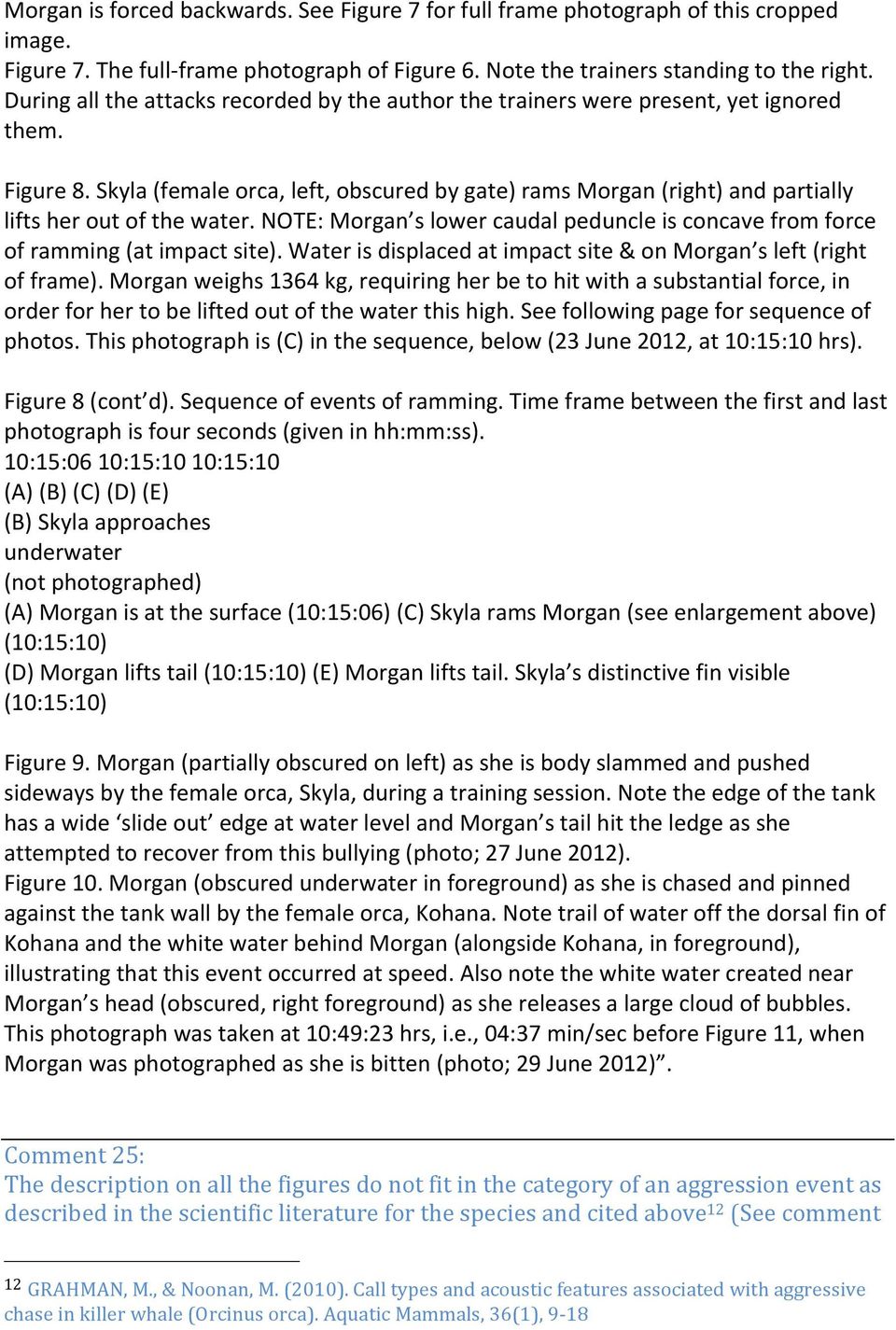
15 Morgan is forced backwards. See Figure 7 for full frame photograph of this cropped image. Figure 7. The full- frame photograph of Figure 6. Note the trainers standing to the right. During all the attacks recorded by the author the trainers were present, yet ignored them. Figure 8. Skyla (female orca, left, obscured by gate) rams Morgan (right) and partially lifts her out of the water. NOTE: Morgan s lower caudal peduncle is concave from force of ramming (at impact site). Water is displaced at impact site & on Morgan s left (right of frame). Morgan weighs 1364 kg, requiring her be to hit with a substantial force, in order for her to be lifted out of the water this high. See following page for sequence of photos. This photograph is (C) in the sequence, below (23 June 2012, at 10:15:10 hrs). Figure 8 (cont d). Sequence of events of ramming. Time frame between the first and last photograph is four seconds (given in hh:mm:ss). 10:15:06 10:15:10 10:15:10 (A) (B) (C) (D) (E) (B) Skyla approaches underwater (not photographed) (A) Morgan is at the surface (10:15:06) (C) Skyla rams Morgan (see enlargement above) (10:15:10) (D) Morgan lifts tail (10:15:10) (E) Morgan lifts tail. Skyla s distinctive fin visible (10:15:10) Figure 9. Morgan (partially obscured on left) as she is body slammed and pushed sideways by the female orca, Skyla, during a training session. Note the edge of the tank has a wide slide out edge at water level and Morgan s tail hit the ledge as she attempted to recover from this bullying (photo; 27 June 2012). Figure 10. Morgan (obscured underwater in foreground) as she is chased and pinned against the tank wall by the female orca, Kohana. Note trail of water off the dorsal fin of Kohana and the white water behind Morgan (alongside Kohana, in foreground), illustrating that this event occurred at speed. Also note the white water created near Morgan s head (obscured, right foreground) as she releases a large cloud of bubbles. This photograph was taken at 10:49:23 hrs, i.e., 04:37 min/sec before Figure 11, when Morgan was photographed as she is bitten (photo; 29 June 2012). Comment 25: The description on all the figures do not fit in the category of an aggression event as described in the scientific literature for the species and cited above 12 (See comment 12 GRAHMAN, M., & Noonan, M. (2010). Call types and acoustic features associated with aggressive chase in killer whale (Orcinus orca). Aquatic Mammals, 36(1), 9-18
16 19 above). Figure 11. During a training session, Morgan (partially obscured behind rail), rises out of the water in an attempt to avoid a bite from one of the two orca in the tank with her (Skyla and Kohana). This photo is one of a sequence of images, showing the open mouth and teeth progressed along Morgan s body as she rose up and then slid down, to try to avoid the conflict. Fresh rake marks were visible and photographed after this event Figures 12 and 13. This photograph was taken at 10:54:08 hrs, i.e., only 04 min, 37 sec after Morgan was photographed, as she was pinned to the tank wall by Kohana (Figure 10). (29 June 2012) Figure 12. Fresh rake marks (arrow) on Morgan s right side, just above her pectoral fin insert. This photograph was taken at 14:00:50 hrs on 29 June 2012 (i.e., 03 hours, 06 mins, 42 secs after she was photographed during the attack in Figure 11). Figure 13. The same fresh rake marks (arrow) as in Figure 12, shown from a different angle. Morgan s is lying with her right side exposed above the water. This photograph was taken at 16:33:45 hrs on 29 June 2012 (i.e., 05 hrs, 39 mins, 37 sec, after she was photographed during the attack in Figure 11). Cetaceans are known to have sensitive skin that is easily damaged. It is also effected by sun, including sunburn (Addink and Smeenk, 2001, Jett and Ventre, 2011, Martinez- Levasseur et al., 2010). Although Almunia Portolés (2012) states that The enclosure has a canopy that gives shade to most of the pools surface, offering the animals the possibility of being in the sun or the shade., he fails to note that animals in the medical tank, especially when raised as in his photo on page 3, are offered no shade. The author observed Morgan locked in this tank for more than 30% of the time, either by herself, or with Adán. Comment 26: As Dr. Visser states in the methodology chapter, the observations were not made during the whole day nor randomly, thus this percentage does not represent the total time that Morgan spent in the medical pool. Thus, these results are either wrong or manipulated. Again the mention of the potential effects of the sun is just a relating of hypothetical assumptions, which is surprisingly included in the Results chapter. The report does not present any data on lesions or skin problems caused by sun exposure on Morgan or any other animal in the group. Further, there is no published evidence of UV related disease in killer whales. Figure 14. Fresh rake marks (arrow) on Morgan s left eye patch. This photograph was taken 24 February 2012, by a concerned tourist who submitted the image (taken from a

17 video) to the Free Morgan Foundation ( Figure 15. The rake marks on Morgan s left eye patch, which were originally photographed on 24 February 2012 Figure 14 have faded considerably (white arrow). This photograph, taken on the 23 June 2012 is 112 days (four months) after these marks were first photographed, illustrating that rake marks, although visible for extended periods, may fade to some degree. A second set of faded rake marks are also visible (green arrow). This also strongly suggests that Morgan has more rake marks than are visible in these photographs obtained by the author, either due to progressive healing (fading) or due to resolution of the images, as these were taken from at least 36 m away from Morgan. Since her arrival at Loro Parque on the 29th of November 2011, Morgan has acquired an excessive number of rake marks. Some are visible in photographs (e.g., see Figures 12-15). More than 50 rakes and puncture marks are visible on her ventral surface. This does not include damage to her rostrum through self- mutilation due to stereotypic behaviours (e.g., see Figure 23 and Appendix Two) Drawing L. Harrison / Orca Research Trust Comment 27: The author says that the number of rakes on Morgan are excessive, but she does not make any comparison, not with other captive killer whales, nor with her own report on prolific rake marks found in two free ranging animals (See comment 05 above). So the term excessive is just a subjective impression, not supported by any data or comparison. Figure 16. Rake marks visible on Morgan s ventral surfaces. See Appendix XX details. Figure 17. Rake marks visible on Morgan s left & right sides. Each mark is new since her arrival in Loro Parque and each was documented by a photograph. See Appendix Two for details. Drawing L. Harrison / Orca Research Trust The accumulation of rake marks on Morgan continues (see Figures XX & XX and Figure X below.) A professional orca trainer, when viewing the photographs of Morgan s rakes, stated: Morgan looks like she's taking a bit of a beating. It's not uncommon for that to happen when you place new animals together but it does look like she being targeted more then she should.... in one of the photos it looks like she came close to losing her left eye pers comm. to Visser 22 June 2012 (trainer has requested anonymity for fear of backlash from the captivity industry).

18 Comment 28: Again a subjective opinion not supported by any data or comparison, just the vague reference to an unidentified professional orca trainer is without scientific value. June July October (10 photographs) (1 photograph) (2photographs) Figure 18. Continued accumulation of rake marks on Morgan. July and October evidence, base on one and two photographs respectively. (photos supplied by, Anon, C Robles & WDC (12 October, 2012) Stress is also indicated by a loss of appetite, inactivity and social isolation (Waples and Gales, 2002). Almunia Portolés (2012) has an untitled graph in his report (page 10), which is presumably Morgan s weight (as Weight in Kg is on the Y axis and dates are along the X axis). It is apparent from the graph that Morgan s weight has not increased since mid September, which is of great concern. Yet Almunia Portolés (2012) does nothing to alert the reader of the sudden halt of weight increase, nor inform the reader of what the cause may be. In a healthy orca of Morgan s age, weight increase should continue for many years, not suddenly halt. Comment 29: The author links stress and loss of appetite with weight stabilization, assuming without any data or measurement that when Morgan s weight was stabilized (for a couple of weeks) it was caused by loss of appetite. This assumption is totally unrealistic, as the animals in zoos are not feed ad libitum, and their weight can vary with the amount of food supplied, but also with the changes in physiological status or physical activity. Thus a weight stabilization, or even a weight drop (never experienced by Morgan since her arrival at Loro Parque) cannot be simplistically assumed to be caused by a loss of appetite, even less to infer that this was caused by stress. In the case of Morgan, loss of appetite was never a concern, on the contrary, she always showed a good appetite and her food base (daily supply of fish measured in kcal.) was continuously raised in her first months at Loro Parque. Waples and Gales (2002) correlate the death of three dolphins with their social relationships (including aggression). They also cite references where consistent exposure to a dominant individual can result in death and that problems are most likely to occur... where social structure is unstable and conflicts occur regularly. The definition of how often is regular then arises. Given that Grahman and Noonan (2010) video taped three captive orca for 1,872 hours (24 hour surveillance, with full access to all tank areas) and classified aggression as including high- speed chases as well as open mouth approaches, their data set was not only extensive, but their criteria classification was broad. Despite such a large data set and a very loose definition of aggression, during all of their observation time (78 days) they only recorded a total of

19 eight aggressive episodes. This contrasts sharply with the authors findings from Loro Parque, where 11 violent aggression events were photographed or video taped in 77 hours and 16 minutes of observations. This was despite the extremely limited access to the tank areas (public viewing only and access only during park hours). Therefore, Grahman and Noonan (2010) observed an aggressive episode only once every 234 hours (compared to the data for Morgan, who was attacked at least once every 11 hours at Loro Parque). However, it should also be noted that these 11 aggression events were not the only to be recorded. A total of 91 aggression events were logged in the behavioural data. This equates to more than one aggressive event per hour. Put another way, Morgan is more than 100 times more likely to be attacked at Loro Parque than the orca in Grahman and Noonan s (2010) study. Comment 30: The author cites a study on killer whale aggression as a comparison of her findings, but is omitting information essential for the comparison: The above cited study by Graham and Noonan (2010) was performed with three individuals, a male, a female and their offspring (1- y- old male). It should be obvious even for people without any scientific background that the aggression rate in a couple with their calf does not have to be the same as the aggression rate in a group of six animals. So it is really strange that Dr. Visser fails to mention this essential aspect in her report. But worse, from the scientific point of view, is failing to include the simple description of the behaviour as described by the cited authors. Graham and Noonan (2010) described the aggression events in its methodology as: Periods of aggression were defined by the occurrence of high- speed chase and rapid open- mouth approaches at the tail flukes and genital region of the killer whale being pursued. Each of the episodes was characterized by two distinct alternating behavioural patterns: brief periods of intense aggressive chase (AC), separated by less intense inter- chase intervals (ICI). AC periods were characterized by apparent bite attempts, very rapid swimming, and unmistakable evasive maneuvers on the part of the male. ICI periods were characterized by less intense swimming and apparent mutual avoidance. There is no definition of aggression in this report by Dr. Visser, so it is not possible to compare her results with any scientific literature. Despite the unprecedented lacking of description by Dr. Visser on the central element of her report, there are several details suggesting that the concept of aggression is totally different in both studies: - - Graham and Noonan (2010) describes an average of 10,5 Aggressive Chase (and subsequently a similar number of avoidance events) per aggression episode. Photo captions suggest that I. Visser considers every single agonistic contact as an Aggressive Event. Aggressive Chase and Avoidance Events are not even mentioned in Dr. Visser s report. Graham and Noonan (2010) measured an average aggression lasted 12

20 minutes, but in the video link included in the report by Dr. Visser there are described 9 aggressions in 2 minutes and 23 seconds. That means that the average aggression accordingly to Dr. Visser would last 15 seconds. That is 48 times shorter that the described in the literature or she is reporting every single interaction as aggressive. In fact, none of these interactions is aggressive and are all otherwise definable as play or neutral interspecific interaction. It should also be noted that Almunia Portolés (2012) writes in his report (page 10) that since March, Morgan has been left during... the night time (12 hours without any direct supervision of the keepers). His untitled pie chart shows how Morgan is with two or more orca during for 25% of the nights of October, despite Almunia Portolés (2012) admitting that when three or more individuals were involved... the social displacements and adjustments appeared.. Social displacements and adjustments is clearly a euphemism for aggressive attacks. Comment 31: Ethograms consider a broad range of agonistic behaviours not classified as aggressions in orcas and other cetaceans 15 16, thus Social displacement does not imply the existence of aggression, as they can include aggressive behaviours, agonistic behaviours or both. Loro Parque is clearly aware that these events have been scrutinized and feel threatened by that, as the author was requested to stop taking photographs and logging data on a number of occasions (Visser, unpublished data). And although some parts of some tanks were visible through the gates, during the data collection process in June (Figure 19), Loro Parque has now erected barricades to prevent any data from being collected (Figure 19) outside of commercial show times. Figure 19. LEFT The gates in June, from which more than 80% of the observations of Morgan were made from. The potted palm tree on the left edge of the frame in this photo marks the position the author typically stood. RIGHT. The same gates, in July, 13 Martinez, D. R., & Klinchammer, E. (1969). A partial ethogram of the killer whale (" Orcinus orca"). Carnivore, 1 14 Martinez, D. R., & Klinghammer, E. (1970). The Behavior of the Whale Orcinus orca: a Review of the Literature1. Zeitschrift für Tierpsychologie, 27(7), Samuels, A., & Gifford, T. (1997). A quantitative assessment of dominance relations among bottlenose dolphins. Marine Mammal Science, 13(1), Scott, E. M., Mann, J., Watson- Capps, J. J., Sargeant, B. L., & Connor, R. C. (2005). Aggression in bottlenose dolphins: evidence for sexual coercion, male- male competition, and female tolerance through analysis of tooth- rake marks and behaviour. Behaviour, 142(1), 21-44

21 barricaded to prevent viewing. For orientation of the slightly different camera angles, note the rubbish bin at the right side of both images. The aggression between the orca at Loro Parque is so elevated that the standard barriers erected to keep the orca separated into different tanks have been reinforced with nuts welded onto their upper edges. These have also had to be installed on the gates between the tanks which do not have a walkway (Figure 20). Additionally, chains have had to be installed over the concrete areas which are slightly lower than the rest of the tank edges, to further prevent the orca from trying to get at each other. Comment 32: The assumption of the physical barriers put in place in the facilities as an argument to support aggressive behavior is pure speculation. Those measures are common safety procedures in many orca facilities to avoid animals access over the gates to pools where staff are performing underwater cleaning operations. Figure 20. The aggression between the orca at Loro Parque is so elevated that the standard barriers erected to keep the orca separated into different tanks have been reinforced with nuts welded onto their upper edges. These have also had to be installed on the gates between the tanks which do not have a walkway such as this gate (Gate D, see Appendix XX for details). Figure 21. Two orca separated by a gate bash against it in an antagonistic attempt to fight. (Tekoha, foreground, in western tank, Tank 2 and Kohana in Medical Tank). This gate has a wide metal plate walk- way across the top, preventing the orca from attempting to get over it. Almunia Portolés (2012) states in his report regarding Morgan at Loro Parque, that as a consequence of aggression from the other orca... Morgan has scars and rack [sic: rake] marks produced by the rest of the group, but none of them has ever need [sic: needs] veterinary attention. Given the above evidence regarding the implications of rake marks, this statement clearly reflects a negligent attitude. Comment 33: As already mentioned, rake marks are considered by experts a minimal health risk and only then in particularly heavily polluted waters (See comment 22 above). Given the high standards of water quality at Loro Parque, the regular microbiological testing and the absence of pathogens of health concern in the 7 years of operation of Orca Ocean, this is clearly not negligent. Furthermore, the aggression Almunia Portolés (2012) describes is not only continuing
22 but it is also clearly escalating. It is apparent that the trainers are either unprepared to deal with it, do not recognise it, or do not realise the implications of such aggression. The trainers were frequently observed to just ignore Morgan and any issues she was having (e.g., Figures 11 and 22). Additionally, inexperience may be playing a part as the trainer pictured wearing a yellow cap (Figure 11) had no experience with orca (work history viewed via trainers social media page), prior to recently starting work with Morgan, yet was one of the main trainers she was observed with (unpublished data, Visser 2012). There are many published guides as to how to deal with, recognize and prevent this type of behaviour, including extensive volumes published by the captivity industry (such as the 578 page book by Rameirez (1999) with specific details on how to recognise the warning signs by the Shedd Aquarium) and papers published by head trainers of SeaWorld, such as Turner and Tompkins (1990) with their seminal paper on dealing with aggression in cetaceans and the common errors incurred by trainers. Comment 34: Precisely, the literature cited by Dr. Visser states that trainers should not react paying attention when the animals display agonistic behaviours, or even low intensity aggression events, as trainer reaction could reinforce the appearance of the unwanted behaviour (See comment 06 above). Ignoring an unwanted behaviour is one of the most common rules of the operant conditioning used in animal training as Dr. Visser should better understand after thorough review of the literature she has cited. Almunia Portolés (2012) himself, does not appear to understand the implications of what he is reporting with regards to aggression observed in Morgan, stating From the begining she [Morgan] showed a very peculiar social behaviour... This particular behaviour (pushing down the other animals, even trying to bite them in the genital area)..., when it has been recognised by cetologists (whale and dolphin biologists) for nearly 10 years that attacks to the genital area are obvious indicators of aggression (Psarakos et al., 2003), as are jaw- clapping, violent head motions (Overstrom, 1983) and fast chases (Grahman and Noonan, 2010), all of which have been observed at Loro Parque. The recent attack at SeaWorld, on Nakai, a captive- born, 11 year old male orca, who was assaulted by two other orca, resulted in a large piece of flesh (approximately the size of a dinner plate and at least 5 cm deep) being bitten off (Figure 1). Such a severe wound will affect the way he can masticate (chew) for the rest of his life, if he survives. If Nakai does live, he will also be permanently disfigured. Deaths as a result of aggression between captive orca have also been recorded (Jett and Ventre, 2011). The Loro Parque group of orca regularly demonstrate abnormal behaviour and they are unstable and neurotic. Their atypical behaviour includes attacks on trainers and on each other. Noticeably Loro Parque must realize this disturbed and unpredictable behaviour, as they no longer allow their trainers to enter the water.
23 Comment 35: Nakai s injury has nothing do with Morgan since she has no such wound (See comment 24 above). It makes no scientific sense to include this information in the results section of this document when Nakai does not have any relationship with Morgan or Loro Parque. But this is a further example of Dr. Visser s irrationality: Nakai s wound was not the result of a bite from another killer whale; this is a bizarre personal theory brought forward by the author, who does not have firsthand knowledge of the event. Dr. Visser is well aware that whales don t chew or masticate their food. Based on direct communication with SeaWorld animal health professionals, Nakai was largely unaffected by the wound which healed nicely. Currently, it is apparent that Nakai does not have limitations in the range of motion of his jaw. These behavioural issues extend to Kohana s two calves, born only 661 days (1 year, 9 months, 22 days) apart, as they have not been integrated into the group. Gestation period is still not well understood for orca and is currently estimated to be between months, based on Reidenberg and Laitman (2008) and Robeck et al (2004). This suggests that Kohana was given little, if any, time to recover between pregnancies. She has attacked and rejected both calves, who have had to be hand reared and who now have their own social issues. Comment 36: Gestation in killer whales is well understood to be 530 days 17. Intervals between viable births are obviously affected by the linkage between mother and calf, this is well known and it has been measured in free ranging killer whales to last from 2 to 12 years. When a female does not have to raise a calf after a pregnancy (if the calf dies before the first year of age), the time between pregnancies is shorter 18. Morgan is regularly kept with Keto, the sire of these two calves. He has been observed 17 O Brien, J. K., & Robeck, T. R. (2010). The value of ex situ Cetacean populations in understanding reproductive physiology and developing assisted reproductive technology for ex situ and in situ species management and conservation efforts. Intl J Comp Psychol, 23, Olesiuk, P. F., Bigg, M. A., & Ellis, G. M. (1990). Life history and population dynamics of resident killer whales (Orcinus orca) in the coastal waters of British Columbia and Washington State. Report of the International Whaling Commission, Special, (12),
24 chasing Morgan at high speed, body slamming her and his erect penis is often observed and has been photographed by observers whilst he pursues Morgan. Given her current age (in 2012) of between 5-7 years, it is inappropriate that she is subjected to such intense sexual pressure and she should be kept separated from sexually mature males. This is of great importance when considering that her rehabilitation and release is under consideration and that if she falls pregnant there will be issues with regards to any offspring (who would be hybrids and could not be released with her). Sexual dominance is a form of aggression and as outlined above, aggression has been implicated at many levels in the death of captive whales and dolphins. Comment 37: This is not supported by any scientific citation, and Dr. Visser fails to cite literature on sexual coercion in free ranging cetaceans for comparison 19 (See comment 02 above). Further, Morgan s release is not under consideration by Loro Parque, the regulatory agencies of the Dutch and Spanish governments, or any other responsible party. It is only under consideration by the fringe, activist community. With all this evidence, including much of which is published by the captive industry, it is remarkable that Loro Parque continues to allow these attacks to occur. Furthermore, they attempt to disguise the severity of the situation by stating that Morgan is integrated with the group of orca held there and that any altercations are normal social interactions. From a welfare point of view this level of mismanagement is clearly unacceptable, but the same applies from a medical point of view. Buck et al (1987), state that Appropriate management of... captive marine mammals with cutaneous lesions [rake marks] should include isolation. Comment 38: Dr. Visser omits from the quoted sentence one word: unimmunized. Precisely this word is essential for a proper interpretation of the recommendation. The complete citation Appropriate management of unimmunized captive marine mammals with cutaneous lesions [rake marks] should include isolation has a different meaning as Morgan cannot be considered unimmunized. Moreover, this reference is based in a single case that happened almost 30 years ago, in a facility where a life risk pathogen for cetaceans was present in the water. 19 Scott, E. M., Mann, J., Watson- Capps, J. J., Sargeant, B. L., & Connor, R. C. (2005). Aggression in bottlenose dolphins: evidence for sexual coercion, male- male competition, and female tolerance through analysis of tooth- rake marks and behaviour. Behaviour, 142(1), 21-44)
25 The dolphin that died presented lacerations that exposed the dorsal musculature, and this was identified as the way in which the pathogen entered the body of the cetacean. It has to be clear that in the last 30 years there were no more deaths associated with skin lacerations, and that the water in the cetacean facilities is regularly tested to find this pathogen. It should be also noticed that none of the rake marks of Morgan, nor in any of the killer whales hosted at Loro Parque since 2006, ever exposed the musculature, so they were not considered a health risk. It was ruled by the Judge in the Netherlands that it was necessary to move Morgan to a facility holding orca, rather than to begin her rehabilitation in a natural sea- pen, which was the preferred alternative. This was whilst deliberations were made as to her suitability for release. Despite warnings by the Free Morgan Foundation that Loro Parque was an inappropriate location due to the issues within the maladjusted orca group held there, Morgan was relocated to this facility. See Comment 09 above. Unfortunately, these warnings have proved to be fruitless and Morgan has suffered extensively. It is much more harmful for Morgan to be brutalised and attacked and harassed sexually as described here, than if she had been exposed to just a few months of solitary rehabilitation and subsequent release back into her native waters with wild orca. As it turned out, at the exact site where Morgan was to be rehabilitated and at the time which had been planned for her release, a member of Morgan s close family group, an adult male known as P118 was photographed (Vester & Ilmoni 2012). Comment 39: None of the females of P- pod have been seen since It remains unclear whether P118 was part of the P- pod in 2005 or was just temporarily associated with the group. So the re- sighting of this individual does not imply the presence of the P- pod in the area. Besides, it remains unclear how close this P- pod is to Morgan s family group, as the acoustic matching of this pod with Morgan s dialect was slightly over 50% 20. In 2013 P118 has not been re- sight, nor any other member of the P- pod, which clearly confirms that the location of the P- pod remains unknown. 20 Vester, H., & Samarra, F. I. (2011). Comparison of Morgan s discrete stereotyped call repertoire with a recent catalogue of Norwegian killer whale calls. Henningsvær, Norway: Ocean Sounds
26 Furthermore, the young Norwegian orca with a spinal deformity, known as Stumpy, has been resighted and is now considered to be a female. Stumpy orca lost her mother when she was only a few years old and has been adopted by a number of different groups. They provide her with fish (that is they catch the fish and carry them to the disabled orca). Also, this season, Springer a young orca with remarkable parallels to Morgan (including being discovered alone, emaciated and requiring medical help) has been resighted after her rehabilitation and release back into the wild. Springer who is from the Pacific Northwest has now been free for 10 years and is regularly sighted with her extended family (Paul Spong, pers com 16 Oct 2012). Comment 40: Both Stumpy and Springer are individuals associated with salmon feeding populations 21, meanwhile Morgan has been related by dialect studies with herring feeding groups. That will make these experiences not readily applicable to Morgan s case. Besides, despite Stumpy (X- 163) was seen associated with different groups engaged in herring feeding as a calf, whether this form of salmon foraging behaviour is specialized and exclusive for these groups of killer whales, or whether it is additional to herring foraging, is not conclusive at this stage 22. It has been shown that feeding ecology is of central importance to the killer whales social network 23. Food availability has a direct influence on group structure, and it is under debate to what extent the sociality of killer whales is flexible enough to adapt to local ecological conditions What is clear is that the scientific information about the variety of the North Atlantic killer whales feeding ecology, especially the degree of prey specializations, is scarce. It is important to note that in the wild, dominance relationships have not been documented in dolphin society, but they are commonly described in captive groups (see Waples and Gales, 2002, and references therein). This is also the case for wild orca, with 21 Vester, H., & Hammerschmidt, K. (2013). First record of killer whales (Orcinus orca) feeding on Atlantic salmon (Salmo salar) in northern Norway suggest a multi- prey feeding type. Marine Biodiversity Records, 6 22 Ibid. 23 Ibid. 24 Beck, S., Kuningas, S., Esteban, R., & Foote, A. D. (2012). The influence of ecology on sociality in the killer whale (Orcinus orca). Behavioral Ecology, 23(2), Foster, E. A., Franks, D. W., Mazzi, S., Darden, S. K., Balcomb, K. C., Ford, J. K., & Croft, D. P. (2012). Adaptive prolonged postreproductive life span in killer whales. Science, 337(6100),
27 no accounts reported in the literature of orca ganging up and brutalising another as is described herein. Comment 41: Dr. Visser is encouraged to review the scientific literature as dominance in dolphin groups has been documented in abundant scientific literature 26. She should also consider reviewing her own paper 27 where she states: Scarring on cetaceans has been recorded for a wide range of species with many of these scars attributed to inter- male aggression and The extensive scarring on the two adult male killer whales reported here cannot be positively attributed to one sex or the other, but it is highly probable that conspecifics caused the parallel tooth rakes. It is clear that Morgan must be immediately removed from this dysfunctional group of orca at Loro Parque, before she is injured any further and/or she succumbs to direct or indirect effects of the injuries and stress. Morgan & Play At no time during the 77 hours & 16 minutes of observation, was Morgan seen exhibiting any play behaviours with any of the orca held at Loro Parque, including Adán, whom Loro Parque claims she has an enormous interest in3. Morgan is clearly suffering from a lack of environmental enrichment. This has already been covered extensively by Visser and Hardie (2011) and it applies no less to Loro Parque than it did to Dolfinarium Harderwijk. Suffice it to say that there are severe issues with the lack of toys, lack of physical stimulation from the trainers and lack of environmental enrichment provided to Morgan (and all the orca at Loro Parque). Morgan & Adán Although Morgan is attacked by the orca at Loro Parque, she is not always passive in these altercations. Occasionally she will attempt to fight back against the aggressors (Visser unpublished data). However, more often she has been observed to attack Adán the two year old calf, which may be a result of her frustration at being attacked herself as well as frustration at the extremely limited environmental enrichment which is so inadequate to the extent that it is negligent. 26 Marley, S. A., Cheney, B., & Thompson, P. M. (2013). Using Tooth Rakes to Monitor Population and Sex Differences in Aggressive Behaviour in Bottlenose Dolphins (Tursiops truncatus). Aquatic Mammals, 39(2), ; Scott, E. M., Mann, J., Watson- Capps, J. J., Sargeant, B. L., & Connor, R. C. (2005). Aggression in bottlenose dolphins: evidence for sexual coercion, male- male competition, and female tolerance through analysis of tooth- rake marks and behaviour. Behaviour, 142(1), 21-44; Parsons, K. M., Durban, J. W., & Claridge, D. E. (2003). Male- male aggression renders a bottlenose dolphin (Tursiops truncatus) unconscious. Aquatic Mammals, 29(3), ; Robinson, K. P. (2013). Agonistic intraspecific behavior in free- ranging bottlenose dolphins: Calf- directed aggression and infanticidal tendencies by adult males. Marine Mammal Science 27 Visser, I. N. (1998). Prolific body scars and collapsing dorsal fins on killer whats (Orcinus orca) in New Zealand waters. Aquatic Mammals, 24, 71-82
28 Comment 42: Again a subjective opinion not supported by any data or comparison. This type of attack is called "redirected aggression". As Morgan cannot take out her aggression against the source, she takes it out on another animal she has dominance over. From the captivity industries own organisation (International Marine Animal Trainer s Association), their glossary of training terms defines it as When an animal is attacked or threatened by another animal of higher status, that animal may attack or threaten another animal of lower status presumably because it is not a good idea to aggress against an animal of higher status. The animal that is ultimately attacked is simply a scapegoat and usually did nothing to provoke aggression. ( accessed 17 October 2012). In each of these attacks, Morgan was observed to initiate forceful body contact (body slams, ramming etc) against Adán, who would attempt to flee, but was then pursued by Morgan. Morgan was observed to bite and rake Adán, who showed fresh rake marks from these altercations (Figure 2 and 3). As a young orca, Adán s bones will not be fully formed (Ogden et al., 1981) and as such he will be even more susceptible to the types of injuries mentioned above. Comment 43: This is pure speculation. Just as Morgan must find her place in the hierarchy, so must Adan. There have never been broken ribs or bones, or any other injuries of veterinary concern in the group of whales at Loro Parque. Morgan was also observed to bully Adán by displacing him from a toy or a location on multiple occasions. Although other instances involved Adán (and these were non- aggressive, such as him accompanying Morgan on perimeter swims around the holding Tank), these were typically for very short durations of approximately 1 minute. Damage from stereotypic behaviours. Figure 22. Morgan continues to exhibit stereotypic behaviours (abnormal repetitive behaviour). Such behaviours are typically the result of extreme boredom. She chews the concrete as illustrated in the three images above. Video documentation shows that this behaviour can continue on for hours. She also bangs her chin on the edge of the tank. Trainers will often be standing by observing this behaviour, yet offer Morgan no distractions or environmental enrichment. Note the trainers legs in the upper right of the bottom photograph. On any one day there are typically at least five trainers working at the orca tanks (although up to nine have been observed and photographed working
29 during one training session). Morgan shows signs of wear on her teeth from constantly gnawing at the concrete. Comment 44: The author does not provide the reader with results on the frequency or percentage of time of the different behaviors, so it is not possible to compare whether this is normal or not. Figure 23. Morgan exhibits a hypertrophic scar on her lower jaws, most likely a result of repeatedly banging her chin on the concrete walls. Such stereotypic behaviour can become self mutilating to the point where the subcutaneous injury can become painful and itchy. Further damage to Morgan s rostrum through stereotypic behaviour inflicted on (2 July 2012). The trainers (on the day she inflicted these wounds and after they were inflicted) commanded her to push a ball repeatedly on the end of rostrum, in order to receive her allocated fish. Also note that the tips of Morgan s teeth are being worn off from chewing on the concrete (also see Figure 24). Teeth & Gums The crowns of several teeth of a captive orca, particularly on the mandible, are worn to the level of the pulp cavities due to biting the concrete structure of the pool (Graham and Dow, 2005). Food plugging partially vacant pulp cavities creates intense vascularization, inflammation, and eventually a systemic focus for infection (Graham and Dow, 2005) which can result in death. The crowns of the front of Morgan s teeth are showing signs of wear (Figure 23 and 24), from chewing in the Dolfinarium Harderwijk and at Loro Parque. (Figure 24). Morgan s teeth (TOP & CENTER) are showing signs of wear from chewing concrete along the tank edges in the Dolfinarium Harderwijk and at Loro Parque. TOP: Note the darkened gums from inefficient dental care for Morgan. BOTTOM. Teeth from a wild orca of similar age to Morgan, showing sharp apex (photo taken underwater). Comment 45: There is no ethological data in this study that supports a relation among tooth abrasion and lack of stimulation. In fact the only data to support this statement is a picture that shows the progression of the teeth abrasion in Morgan. But this report does not present any data on teeth abrasion in animals with different levels stimulation. Moreover, there is no scientific information that shows a link among teeth abrasion and stimulation, so it is scientifically incorrect to make this statement. The author has not even mentioned the diet- related teeth abrasion in free range killer whales for comparison Ford, J. K., Ellis, G. M., Matkin, C. O., Wetklo, M. H., Barrett- Lennard, L. G., & Withler, R. E. (2011). Shark predation and tooth wear in a population of northeastern Pacific killer whales. Aquatic Biology,
30 Tricks, Shows & Commercial Use Figure 25. Morgan is being taught circus style tricks which are used exclusively for commercial shows. This is despite her EU CITES Transport permit being exclusively for Research. TOP LEFT, Morgan is being trained to hold her mouth open, whist shaking her head rapidly from left to right. TOP RIGHT. A target pole is then added to the training session, to encourage Morgan to combine the open mouth and the head shakes with a high rise out of the water. This behaviour is termed the alien in the captivity industry (LOWER). It has no educational purpose, is never seen in the wild and encourages a behaviour (violent head shakes) that is known to be an aggressive behaviour in cetaceans, thereby possibly contributing to the aggression seen in captive orca (Overstrom, 1983). Comment 46: The CITES permit issued by the Dutch Government for Morgan clearly states that Morgan is to be used for the advancement of science/breeding or propagation/research or education or other non- detrimental purposes. Loro Parque holds a valid license as a Zoo under the European and Spanish law: its facilities are regularly inspected by the competent authorities and the compliance of its conservation, research and education plans and activities verified. Specific ongoing research work involving Morgan has been reported to the Dutch Government, the Dutch court, Spanish competent authorities and the public. Figure 26. Morgan (left, with chin on platform) during a commercial show. Despite the EU CITES permit being issued exclusively for Research, Morgan is used in the shows and billboards around the town (right) advertise her as an attraction for paying guests. Comment 47: The CITES permit does not limit Morgan to use in research. See Comment 46 above (3), ; Rica, C. (1996). A report of killer whales (Orcinus orca) feeding on a carcharhinid shark in Costa Rica. Marine Mammal Science, 12(4),
Managing dolphins under human care the zoo point of view
 Niels van Elk / Marine Biologist and Veterinarian at Dolfinarium Harderwijk/ EAZA Bottlenose dolphin EEP coordinator: Managing dolphins under human care the zoo point of view Cetaceans are the perfect
Text Features. Title Page. Timeline. Table of Contents. Illustrations and Photographs. Index. Captions. Glossary. Diagrams. Subtitle. Labels.
 Text Features Title Page Table of Contents Index Glossary Subtitle Heading Subheading Keywords Guide Words Text Box Timeline Illustrations and Photographs Captions Diagrams Labels Map Charts and Graphs
Lesson Overview. Biodiversity. Lesson Overview. 6.3 Biodiversity
 Lesson Overview 6.3 6.3 Objectives Define biodiversity and explain its value. Identify current threats to biodiversity. Describe how biodiversity can be preserved. THINK ABOUT IT From multicolored coral
The Facts About Right Whales
 The Facts About Right Whales Where have all the right whales gone? Hunters killed almost all the North Atlantic right whales by the early 20th century. It has been against the law to hunt them for more
Cardio-Pulmonary Resuscitation (CPR): A Decision Aid For. KGH Patients And Their Families
 Cardio-Pulmonary Resuscitation (CPR): A Decision Aid For KGH Patients And Their Families The goal of this pamphlet is to provide information about cardiopulmonary resuscitation (CPR) so you can be adequately
A Method of Population Estimation: Mark & Recapture
 Biology 103 A Method of Population Estimation: Mark & Recapture Objectives: 1. Learn one method used by wildlife biologists to estimate population size of wild animals. 2. Learn how sampling size effects
Scientific Method Worksheet
 Scientific Method Worksheet Anyone who has ever read a mystery novel or seen a whodunit on TV, has seen the scientific method in action. Anyone who has ever tried to figure out what happens to the refrigerator
Effects of Nicotine on Zebrafish Embryo Development. Melissa Dunlap Greendale High School
 Effects of Nicotine on Zebrafish Embryo Development Melissa Dunlap Greendale High School Abstract It is recommended by doctors that women who are pregnant do not smoke because of the negative effects that,
Injury / Incident Investigation
 Injury / Incident Investigation CAA HSU INFO 5.3 Rev 02: 08/09 Contents Flowcharts Forms Injury/Incident Investigation Injury/Incident Form Investigation Form Serious Harm Notification Form Definitions
The European Marine Energy Centre Ltd. HARASSMENT AND BULLYING POLICY
 The European Marine Energy Centre Ltd. HARASSMENT AND BULLYING POLICY Table of Contents 1 Policy Statement... 3 2 Scope... 3 3 Definitions... 3 4 Detailed Guidelines... 5 4.1 What to do if you are being
Morgan the orca can and should be rehabilitated.
 1 2 3 4 5 6 7 8 9 10 11 12 13 14 15 16 17 18 19 20 21 22 23 24 25 26 27 28 29 30 31 32 33 34 35 36 37 38 39 40 41 Morgan the orca can and should be rehabilitated. With additional notes on why a transfer
Alabama Department of Human Resources Assessment of Seriously Emotionally Disturbed Youth in Residential and Therapeutic Foster Care Placements
 Alabama Department of Human Resources Assessment of Seriously Emotionally Disturbed Youth in Residential and Therapeutic Foster Care Placements Calhoun, Etowah, Madison and Morgan Counties 2004 Executive
Practice Questions 1: Evolution
 Practice Questions 1: Evolution 1. Which concept is best illustrated in the flowchart below? A. natural selection B. genetic manipulation C. dynamic equilibrium D. material cycles 2. The diagram below
Humane Society International. Creating Animal Shelter Guidelines: Selecting Animals for Euthanasia
 Humane Society International Creating Animal Shelter Guidelines: Selecting Animals for Euthanasia The Humane Society of the United States (HSUS) is frequently asked for recommendations to create guidelines
These pages build on Units 2B & C and introduce predator-prey relationships and food chains.
 Unit 4B Habitats Teaching Notes These pages build on Units 2B & C and introduce predator-prey relationships and food chains. Curriculum, resource and other links Sc1 & Sc2 Resources Associated with this
Child & Vulnerable Adults Protection Policy 2009 2012
 Child & Vulnerable Adults Protection Policy 2009 2012 Contents Introduction 3 Recruitment procedures 4 Responsible adults 5 Unaccompanied children 5 School pupils on work placements 5 Lost children 5 Family
SAMOA MARINE WILDLIFE PROTECTION REGULATIONS 2009
 S.R. 2009/18 SAMOA MARINE WILDLIFE PROTECTION REGULATIONS 2009 Arrangement of Provisions PART I PRELIMINARY 1. Short title and commencement 2. Interpretation 3. Application in the Exclusive Economic Zone
GCSE BITESIZE Examinations
 GCSE BITESIZE Examinations General Certificate of Secondary Education AQA SCIENCE A BLY1B Unit Biology B1b (Evolution and Environment) AQA BIOLOGY Unit Biology B1b (Evolution and Environment) FOUNDATION
Talking to our children about Violence and Terrorism: Living in Anxious times
 Talking to our children about Violence and Terrorism: Living in Anxious times Living in Anxious Times: Introductory Remarks Since the September 11 attack America has changed. Children and adults alike
How can herpes simplex spread to an infant?
 CHAPTER 3 HERPES AND PREGNANCY As an expectant parent eagerly awaiting the birth of your new baby, you are probably taking a number of steps to ensure your baby s health. One step many experts recommend
Child protection training for schoolbased teaching and non-teaching staff and volunteers in Devon (Version 1, last revised 2005)
 Child protection training for schoolbased teaching and non-teaching staff and volunteers in Devon (Version 1, last revised 2005) This training should be delivered by the trained and designated person for
DECISION ON APPEAL OF VICIOUS DOG DETERMINATION. This is an appeal from a determination by the City of Rutland Board of Alderman
 Miller v. City of Rutland, No. 513-7-10 Rdcv (Cohen, J., Aug. 19, 2010) [The text of this Vermont trial court opinion is unofficial. It has been reformatted from the original. The accuracy of the text
SAFEGUARDING CHILDREN AND CHILD PROTECTION POLICY
 SAFEGUARDING CHILDREN AND CHILD PROTECTION POLICY Our setting will work with children, parents and the community to ensure the rights and safety of children and to give them the very best start in life.
Satellite Pursuit: Tracking Marine Mammals
 : Tracking Marine Mammals Material adapted from: Monterey Bay Research Institute, EARTH: Satellite Tracking OPB NOVA Teachers: Ocean Animal Emergency Teach Engineering: Marine Animal Tracking Introduction:
Children / Adolescents and Young Adults
 INFORMATION SHEET Age Group: Sheet Title: Children / Adolescents and Young Adults Bullying WHAT IS BULLYING? Bullying is not always easy to define. It can be Physical, Verbal, Emotional, Racist or Sexual.
Heart information. CPR cardiopulmonary resuscitation
 Heart information CPR cardiopulmonary resuscitation Contents 3 What is CPR? 3 What is cardiac arrest? 4 Heart attack and cardiac arrest 4 Cardiopulmonary resuscitation (CPR) 5 Danger 6 Response 7 Send
ENDANGERED AND THREATENED
 ENDANGERED AND THREATENED Understand how species in the Sonoran Desert Region may become endangered or threatened and what is being done to protect them. ARIZONA SCIENCE STANDARDS SC03-S4C3-03&04, SC08-S1C3-07,
Competent. Person Manual. Course Preview TRENCHSAFETY
 Course Preview Competent Person Manual A guide to industry standards, practices, and regulatory requirements for OSHA Construction Industry Regulations 29 CFR 1926, Subpart P - Excavations TRENCHSAFETY
Community Legal Information Association of Prince Edward Island, Inc. Custody and Access
 Community Legal Information Association of Prince Edward Island, Inc. Custody and Access Separating parents must make arrangements for child custody, access and visitation. This pamphlet explains some
Marine Mammal Unusual Mortality Events 2013-2015 Mid-Atlantic Bottlenose Dolphins
 Marine Mammal Unusual Mortality Events 2013-2015 Mid-Atlantic Bottlenose Dolphins Office of Protected Resources Greater Atlantic Fisheries Regional Office Northeast Fisheries Science Center Southeast Fisheries
A Time to Tell Troop Meeting Guide
 A Time to Tell Troop Meeting Guide Using This Guide The video A Time to Tell shows several strategies child molesters use to attempt sexual molestation. In addition, one scenario introduces bullying as
Child labour is better than living in poverty. Discuss.
 Child labour is better than living in poverty. Discuss. This topic examines the issues of child labour and poverty. Is child labour justified in circumstances of extreme poverty? If a child s wage is helping
H o w t o W r i t e a J u d g e m e n t
 H o w t o W r i t e a J u d g e m e n t A) Function of a Judgement: Being the final result of a legal procedure a judgement shall provide a balanced conflict solution. An ideal judgement enables both conflict
Wolf? Wolf? A L A. Whatever Happened. Term. The word alpha applied to wolves. to the
 Whatever Happened to the Term A L A P H Wolf? The word alpha applied to wolves has had a long history. For many years books and articles about wolves have mentioned the alpha male and alpha female or the
Investigating Child Abuse and Neglect Fact Sheet
 Investigating Child Abuse and Neglect Fact Sheet Our Legal Responsibilities When Butler County Children Services receives a report saying a child has been abused or neglected, the law requires us to: Find
World Oceans Day at ZSL Whipsnade Zoo
 World Oceans Day at ZSL Whipsnade Zoo Teachers notes KS 1 & KS 2 This booklet will help you to focus your self guided trail on ocean animals, looking at the adaptations of the species and focusing in on
AVIAN ETHOGRAM AND RESEARCH PROJECT AT THE ZOO
 AVIAN ETHOGRAM AND RESEARCH PROJECT AT THE ZOO Mildred Sears Funk Department of Biology Roosevelt University Chicago, IL 60605 INTRODUCTION This ethogram and behavioral research project will be enjoyable
COMPLAINT FOR DAMAGES AND DEMAND FOR JURY TRIAL. Plaintiff, TARIN SAROKA, individually, and as the Personal Representative of the
 IN THE CIRCUIT COURT FOR THE 15 TH JUDICIAL CIRCUIT IN AND FOR PALM BEACH COUNTY, FLORIDA TARIN SAROKA, individually and as the Personal Representative of the Estate of ALAN BAZINET, CIVIL DIVISION CASE
Government of Western Australia Department for Child Protection and Family Support. How do I recognise when a child is at risk of abuse or neglect?
 Government of Western Australia Department for Child Protection and Family Support How do I recognise when a child is at risk of abuse or neglect? Physical abuse Physical abuse is when someone is deliberately
Delusions are false beliefs that are not part of their real-life. The person keeps on believing his delusions even when other people prove that the be
 Schizophrenia Schizophrenia is a chronic, severe, and disabling brain disorder which affects the whole person s day-to-day actions, for example, thinking, feeling and behavior. It usually starts between
Experimental Analysis
 Experimental Analysis Instructors: If your institution does not have the Fish Farm computer simulation, contact the project directors for information on obtaining it free of charge. The ESA21 project team
Accent on Health Obgyn, PC HERPES Frequently Asked Questions
 1. What is herpes? 2. How common is herpes? 3. Is there a cure for herpes? 4. What is oral herpes (cold sores)? 5. How is oral herpes spread? 6. What is genital herpes? 7. How is genital herpes spread?
ENGLISH. Lightphoria 10,000LUX Energy Light Lamp SP9982 version 2.4
 ENGLISH Lightphoria 10,000LUX Energy Light Lamp SP9982 version 2.4 1 Light and your body Light means life. Many of the processes of life are influenced by light and its intensity. As many of you may experience
Association Between Variables
 Contents 11 Association Between Variables 767 11.1 Introduction............................ 767 11.1.1 Measure of Association................. 768 11.1.2 Chapter Summary.................... 769 11.2 Chi
YOUR LEGAL DUTY OF CARE FOR KEEPING FISH UNDER THE ANIMAL WELFARE ACT FIRST EDITION FBAS 2008 RDE/RCM
 YOUR LEGAL DUTY OF CARE FOR KEEPING FISH UNDER THE ANIMAL WELFARE ACT FIRST EDITION FBAS 2008 RDE/RCM INTRODUCTION A Summary of Your Legal Duty of Care under the Animal Welfare Act You must not cause fish
Wild animals in captivity Animal welfare, law and enforcement. 19th and 20th June 2013, Brussels CONFERENCE OUTCOMES & RECOMMENDATIONS
 Wild animals in captivity Animal welfare, law and enforcement 19th and 20th June 2013, Brussels CONFERENCE OUTCOMES & RECOMMENDATIONS Conference Partners: The following provides an overview of the discussions
CATS and WILDLIFE HOW YOU CAN PROTECT BOTH
 CATS and WILDLIFE HOW YOU CAN PROTECT BOTH Where is your cat right now? Could it be harming native wildlife? Is it roaming in your neighbour s yard? Is it crossing a busy road? Could it be returned to
Prospect Theory Ayelet Gneezy & Nicholas Epley
 Prospect Theory Ayelet Gneezy & Nicholas Epley Word Count: 2,486 Definition Prospect Theory is a psychological account that describes how people make decisions under conditions of uncertainty. These may
Teacher Guide for FAST-R Passage: FAST-R: Formative Assessments of Student Thinking in Reading. Island of the Blue Dolphins Historical fiction
 Teacher Guide for FAST-R Passage: FAST-R: Formative Assessments of Student Thinking in Reading At a Glance Approximate Grade Range: 2 3 4 5 6 7 8 9 10 11 Genre: Historical fiction Topic: A young girl and
Back & Neck Pain Survival Guide
 Back & Neck Pain Survival Guide www.kleinpeterpt.com Zachary - 225-658-7751 Baton Rouge - 225-768-7676 Kleinpeter Physical Therapy - Spine Care Program Finally! A Proven Assessment & Treatment Program
Helping People with Mental Illness
 Helping People with Mental Illness A Mental Health Training Programme for Community Health Workers Module E Helping Families Cope with Mental Health Problems Page 1 About this course Helping People with
Crate Training Your Dog
 Crate training takes some time and effort, but it is a proven way to help train dogs who act inappropriately without knowing any better. If you have a new dog or puppy, you can use the crate to limit his
2013 MHI Hawaiian Monk Seal Population Summary 1
 2013 SURVEY EFFORT 2013 MHI Hawaiian Monk Seal Population Summary 1 Hawaiian Monk Seal Research Program Pacific Islands Fisheries Science Center, NOAA Fisheries Previous monk seal surveys in the main Hawaiian
Women s Rights: Issues for the Coming Decades
 September 24, 2010 Suzanne B. Goldberg Columbia Law School Remarks for the International Conference on the Protection of Women s Rights Women s Rights: Issues for the Coming Decades I am delighted to be
Incident Reporting Policy
 Document Name: Incident Reporting Policy Issue Date: 11/12/2012 Adventist Aged Care Incident Reporting Policy 1. Introduction 2. Purpose 3. Scope 4. Legislative Obligations 5. Procedure 6. Documentation
This report provides the executive summary for Indicators of School Crime and Safety: 2014.
 1 Liability Report Number: LB-10-66 Release Date: August 6, 2015 Section Title: General Information Abstract School violence not only has a direct impact on students, but also on educators, parents, and
How to Write an Argumentative Essay
 How to Write an Argumentative Essay The Writing Lab D204d http://bellevuecollege.edu/asc/writing 425-564-2200 An argumentative essay uses reasoning and evidence not emotion to take a definitive stand on
International Journal of Sociology and Social Policy 98
 International Journal of Sociology and Social Policy 98 Ethiopia: From Bottom to Top in Higher Education - Gender Role Problems by Yelfign Worku Biographical Note Yelfign Worku, Head of Gender and Education
GRANGE TECHNOLOGY COLLEGE ANTI-BULLYING POLICY
 GRANGE TECHNOLOGY COLLEGE ANTI-BULLYING POLICY Approved: 4 September 2014 Review Date: Page 1 of 7 GRANGE TECHNOLOGY COLLEGE ANTI-BULLYING POLICY Introduction Schools have a duty of care for pupils and
A guide to living with Urban Coyotes
 A guide to living with Urban Coyotes Living with coyotes ThinkStock Coyotes are found throughout Florida. This adaptable animal belongs to the dog family and resembles a small German shepherd. In Florida,
Supporting choice and control
 www.in-control.org.uk Supporting choice and control A template policy framework for delivering person-centred outcomes by a positive approach to risk www.in-control.org.uk Supporting Choice and Control
OPENING INSTRUCTIONS
 OPENING INSTRUCTIONS Members of the Jury: Respective Roles of Jurors and Judge You ve been chosen as jurors for this case, and you ve taken an oath to decide the facts fairly. As we begin the trial, I
Chapter 1 Introduction to Correlation
 Chapter 1 Introduction to Correlation Suppose that you woke up one morning and discovered that you had been given the gift of being able to predict the future. Suddenly, you found yourself able to predict,
CHAPTER 2 APPROACH TO THE INCIDENT
 CHAPTER 2 APPROACH TO THE INCIDENT Reassuring the casualty is very important in first aid and the best reassurance for both casualty and bystanders is a confident first aider taking decisive action. In
WORKPLACE VIOLENCE WHAT IS WORKPLACE VIOLENCE?
 WORKPLACE VIOLENCE Violence in the workplace has become an epidemic. Not only is workplace violence increasingly common in workplaces where violence is expected -- for example, corrections, law enforcement
Activity 12 Zoos: Past and Present
 Activity 12 Zoos: Past and Present Objective & Overview: Through surveys and research, students will learn about the evolution of zoos, from menageries to educational and conservation institutions. Teacher
Right Whale. The Kids Times: Volume II, Issue 6. NOAA s National Marine Fisheries Service, Office of Protected Resources
 NOAA s National Marine Fisheries Service, Office of Protected Resources The Kids Times: Volume II, Issue 6 Right Whale Right whales have no dorsal fin on their backs. How did the right whale get its name?
FILMS AND BOOKS ADAPTATIONS
 FILMS AND BOOKS Reading a book is very different to watching a film. The way that we understand both is also different. We firstly need to think of the ways in which films and books tell their stories.
All members of the puma species carry their kittens the same way domestic cats do, and they can purr like housecats too.
 Florida Panther In spite of many, many attempts, I have not been able to discover let alone photograph a majestic Florida panther in the wild. The tawny cat is an endangered species. The panthers I have
Jenny from Minnesota tells her story:
 Jenny from Minnesota tells her story: Jenny from Minnesota tells her story: In the spring of 1998, I was in a car accident where I was going too fast on a gravel road and ended up wrapping my car around
US Casualties: The Trends in Iraq and Afghanistan
 18 K Street, NW Suite 4 Washington, DC 26 Phone: 1.22.775.327 Fax: 1.22.775.3199 Web: www.csis.org/burke/reports US Casualties: The Trends in Iraq and Afghanistan Anthony H. Cordesman Arleigh A. Burke
Your Future by Design
 Retirement Research Series Your Future by Design Health, money, retirement: The different needs of men and women This research report is one of several reports in the Your Future by Design Retirement Research
Guidance Note on Flushing
 Legionella and Building Services Flushing Conventional Showers Lessons Learned Guidance Note on Flushing Disclaimer Please note this article is for general interest and research purposes only and does
Morgan s Extended Family has been Identified Acoustically.
 Morgan s Extended Family has been Identified Acoustically. EXECUTIVE SUMMARY Prepared by the Free Morgan Foundation (30 September 2011) 92% of the calls made by Morgan were matched to a Norwegian orca
Cal/OSHA Recordkeeping Requirements. Presented by: Meg McCormick Loss Prevention Specialist ALPHA Fund
 Cal/OSHA Recordkeeping Requirements Presented by: Meg McCormick Loss Prevention Specialist ALPHA Fund Objectives O Explain what constitutes a recordable injury and/or illness O Discuss how to fill out
PUSD High Frequency Word List
 PUSD High Frequency Word List For Reading and Spelling Grades K-5 High Frequency or instant words are important because: 1. You can t read a sentence or a paragraph without knowing at least the most common.
Hypothesis testing. c 2014, Jeffrey S. Simonoff 1
 Hypothesis testing So far, we ve talked about inference from the point of estimation. We ve tried to answer questions like What is a good estimate for a typical value? or How much variability is there
Healthy puppies come from breeders who:
 If you re looking for a new dog, check your local RSPCA or other animal rescue group first. There are many wonderful puppies and dogs out there looking for new homes. But if you can t find the right dog
BINSA Information on Brain Injury
 Acquired Brain Injury (ABI) There are a number of ways an individual can suffer an acquired brain injury (ABI) Figure one - ABI causes Significant causes of ABI Traumatic Brain Injury (TBI) Traumatic Brain
Redfern Legal Centre and Sydney Women s Domestic Violence Court Advocacy Service
 Redfern Legal Centre and Sydney Women s Domestic Violence Court Advocacy Service Joint Submission to Senate Committee on Legal and Constitutional Affairs In Support Of FAMILY LAW LEGISLATION AMENDMENT
JOHNS HOPKINS UNIVERSITY WHITING SCHOOL OF ENGINEERING ZANVYL KRIEGER SCHOOL OF ARTS AND SCIENCES
 JOHNS HOPKINS UNIVERSITY WHITING SCHOOL OF ENGINEERING ZANVYL KRIEGER SCHOOL OF ARTS AND SCIENCES PROCEDURES FOR DEALING WITH ISSUES OF RESEARCH MISCONDUCT 1. Introduction 2. Reporting 3. Inquiry 4. Investigation
Evolution (18%) 11 Items Sample Test Prep Questions
 Evolution (18%) 11 Items Sample Test Prep Questions Grade 7 (Evolution) 3.a Students know both genetic variation and environmental factors are causes of evolution and diversity of organisms. (pg. 109 Science
www.irishseedsavers.ie Natural surface water on earth includes lakes, ponds, streams, rivers, estuaries, seas and oceans.
 www.irishseedsavers.ie POND LIFE FACT SHEET Natural surface water on earth includes lakes, ponds, streams, rivers, estuaries, seas and oceans. A pond is a small body of fresh water shallow enough for sunlight
contents Introduction page 2 Documentary page 3 Types of documentary page 4 Narrative page 5 Expectations page 6 Observational documentary page 7
 contents page 2 page 3 page 4 page 5 page 6 page 7 page 9 Introduction Documentary Types of documentary Narrative Expectations Observational documentary Box office 1 introduction 'There are still, almost
An Introduction to the Sea Turtles of Virginia. Amber Knowles CBNERR-VA July 22, 2008
 An Introduction to the Sea Turtles of Virginia Amber Knowles CBNERR-VA July 22, 2008 Overview Introduction to species of sea turtles Focus on Loggerhead and Kemp s ridley sea turtles Importance of the
A GUIDE TO UNDERSTANDING THE CHILD PROTECTION REGISTRY
 A GUIDE TO UNDERSTANDING THE CHILD PROTECTION REGISTRY Think of the Child First Over the years many changes have been made to the laws regarding child abuse and neglect within the State of Delaware. Most
Did the Punishment Fit the Crime?
 Teenagers and Criminal Justice Did the Punishment Fit the Crime? Fact Situation Hi, my name is Costas and I m 16. I spent my summer at the courthouse. I was on trial and was found guilty of killing a guy
Sociology- Is it just Common Sense? True or False?
 1. Men and Women. Sociology- Is it just Common Sense? True or False? a. A woman walking alone at night is in greater danger of sexual assault or rape by a stranger than a woman in a familiar place with
How to Have a Pee-Free Home
 How to Have a Pee-Free Home In this article based on Karen Pryor s work, you re going to learn how to quickly potty train your dog. For a lot of dog owners, potty training can be very frustrating but it
ASYLUM AND IMMIGRATION TRIBUNAL
 ST (s92(4)(a): meaning of has made ) Turkey [2007] UKAIT 00085 ASYLUM AND IMMIGRATION TRIBUNAL THE IMMIGRATION ACTS Heard at: Field House Date of Hearing: 15 May 2007 Before: Mr C M G Ockelton, Deputy
Health and Safety Management in Healthcare
 Health and Safety Management in Healthcare Information Sheet Nov 2010 This information sheet gives guidance on the key elements of health and safety management in healthcare. It is intended for small employers
2. (U4C2L3:F2) If your friend received a deep cut on her wrist, what would you do?
 Cadet Name: Date: 1. (U4C2L3:F1) Your friend receives a deep cut on her wrist while washing dishes. She asks for your help. How confident are you that you could provide appropriate aid? A) My friend is
Example Chapter 08-Number 09: This example demonstrates some simple uses of common canned effects found in popular photo editors to stylize photos.
 08 SPSE ch08 2/22/10 11:34 AM Page 156 156 Secrets of ProShow Experts: The Official Guide to Creating Your Best Slide Shows with ProShow Gold and Producer Figure 8.18 Using the same image washed out and