
HYBRID APPROACH OF GARBAGE CLASSIFICATION USING COMPUTER VISION AND DEEP LEARNING
|
|
|
- Roland Gibson
- 5 years ago
- Views:
Transcription

1 HYBRID APPROACH OF GARBAGE CLASSIFICATION USING COMPUTER VISION AND DEEP LEARNING Anish Tatke, Madhura Patil, Anuj Khot, Parul JadhavDr Vishwanath Karad s MIT World Peace University Pune, Maharashatra, India Abstract - As waste segregation becomes an important issue in our lives, with the use of technology like deep neural networks and computer vision, we can make the process efficient and robust by image segmentation and classification. These systems on the rise need accurate and efficient segmentation and recognition mechanisms and this demand coincides with the increase of computational capabilities of modern computer architectures and more effective algorithms for image recognition. This paper does a comparative analysis of various different approaches and methods like Simple CNN, ResNet50, VGG16, etc in brief. The comparative analysis and study explains the performance of every approach, this paper concludes that ResNet50 gives excellent performance. VGG16 network also provides good performance which meets the needs of daily use. Keywords - Garbage Classification, CNN, Waste Segregation, Data Augmentation I. INTRODUCTION The world generates 2.01 billion tonnes of municipal solid waste annually, with at least 33 percent of that extremely conservatively not managed in an environmentally safe manner.[1] At this stage, due to the large population of India, our country adds about 277 million tons of municipal garbage each year[2], and with the improvement of living standards, the rate of garbage generation is still rising. The reason is that India's garbage generation is rapid, and people's awareness of garbage classification is weak. The resource classification and recycling treatment mechanism of urban domestic garbage is an effective solution to solve the environmental damage caused by urban domestic garbage in India. Fig 1. Weighted Sum Average of Ludhiana district Solid Waste Due to the large increase in computer operating speed, the efficiency of computer processing of images has greatly improved. Deep learning models with CNN (Convolutional Neural Network) as the core have begun to play a pivotal role in the field of image recognition and classification. Many new ideas like Simple CNN [3], VGG16 [4], ResNet50 [5], HOG+SVM [6] are proposed to gain accuracy in image classification and object detection. Among various deep models, convolutional neural networks(cnns) have led to a series of breakthroughs for image classification. The rest of the paper is organised as follows sec II explains the garbage image dataset. Sec III describes various image processing techniques. Details of studied models are described in Sec. IV. Sec. V provides comprehensive evaluation followed by related works and discussion in sec. VI. And lastly sec. VII elucidates the conclusion. 208
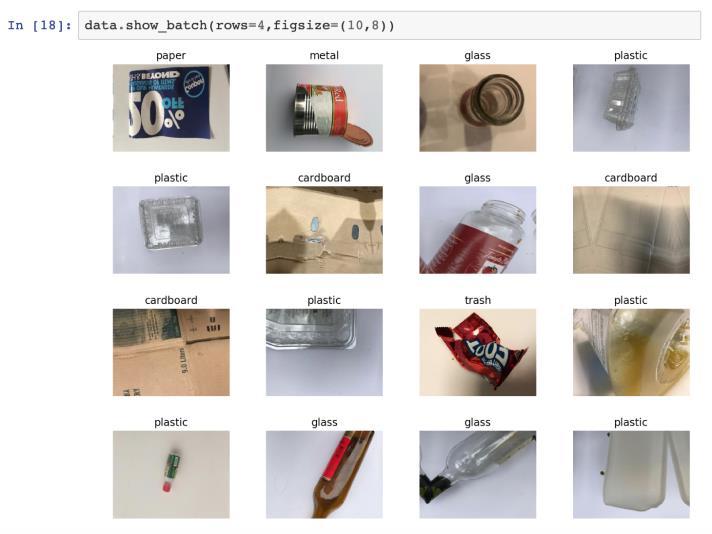
2 II. DATASET A lot of image data involving garbage is available and present on the internet and government based datasets. This data is present in variety with different types according to different class labels/target labels. We have explored 2-3 different datasets given below: Garbage Classification Dataset from Kaggle is a famous dataset pertaining to garbage segregation and collection [7]. It has almost 2467 images of garbage which has target labels given as cardboard, glass, metal, paper, plastic and trash. This amount of data is still not enough to be fed to any state-of-the-art CNN algorithm. The images in the dataset are of the certain object related to its target label which are kept in a clean background. Second Data set is the Garbage In Images (GINI) Dataset [8]. The dataset contains images with and without garbage in it. The maximum of the dataset is annotated and has the label and bounding box parameters in a Comma Separated file. The target labels are given as 1 (Garbage Present) and 2 (Garbage Not Present). Sr No Category Number of Images present 1 cardboard 393 yes 2 glass 491 yes 3 metal 400 yes 4 paper 584 yes 5 plastic 472 yes 6 trash 127 yes Total 2467 Table1. Dataset Overview III. Annotated IMAGE PROCESSING TECHNIQUES The images need to be pre-processed using computer vision techniques so as to make them easy to understand for the computer so it can make a prediction on it. Basically the image needs to be brought in the format necessary for the model it needs to be fed in. This whole process is quite tedious when dealing with multiple images of different types and categories. The main aim for image pre-processing is the improvement of image data that suppresses undesired distortions or enhances some image features relevant for further processing and analysis tasks. Fig 2. Images from the dataset Before doing image pre-processing it is important to understand the images that we are dealing with. What steps should be taken, what image preprocessing techniques should be used depending on "how strong is your image data?" is and "what operations are you going to perform on it?". One important necessary step before feeding the data to a model is to standardize the images. Image standardization refers to resizing of images in a dataset to a unified dimension which is suitable for the particular model it is fed to. Second important step is Data Augmentation[9] which is the process of scaling, rotating and performing other affine transformations (Denoising using Gaussian Blur, Segmentation, Morphological Operations) on the existing images from existing dataset. This is mainly done to enlarge the size of the dataset and expose the model to a wide variety of variations of the images. One particular paper published in 2020 called as A Study of Garbage Classification with Convolutional Neural Networks, Indo - Taiwan Conference on Computing, Analytics and Networks [3] have performed Data Augmentation of the same dataset we have used in this paper and have generated about images from the dataset after data augmentation and split the data into 9095 training set images and 1013 test set images. 209

3 Literature Review IV. METHODOLOGY A. Simple CNN used in the convolutional layers are 3x3 with a step of 1 while that of the pooling filters is 2x2 with step of 2. Basically every Sigmoid and TanH cost function can be replaced with RELU functions except for in the last fully connected layer. This is done to avoid slow model convergence and improve efficiency. Batch Normalization can also be added at the end of fully connected layers to avoid the problem of gradient disappearance. The Batch Normalization layer can also avoid overfitting during the training process, thereby increasing the accuracy of recognition. C. ResNet50: ResNet is a classic neural network well known for its establishment since the kick start of the deep learning era [5]. It has been the backbone for various computer vision tasks. It is different from its predecessors like Alex Net because it solved the notorious problem of vanishing gradients - as the gradient is backpropagated to earlier layers, repeated multiplication may make the gradient very small. Thus as a network gets deeper, the performance starts depleting. Fig 3. Architecture of Simple CNN This is a simple architecture which is provided for base comparison with other state-of-the-art models [3]. It uses the 2D Convolutional layers to capture the features of the images. Just the basic 3x3 filters can be used. Max pooling layers are important to reduce the dimensions of the input and the number of parameters to be learned. These Max pooling layers are added between the 2D convolutional layers. Then a layer is used to flatten the feature matrix to a column matrix. Then two fully connected layers are added. The cost function used in between the convolutional layers is RELU function to avoid the problem of vanishing gradients. The second type of cost function is used in the last fully connected layer which is soft max function which fits the cross-entropy loss function. B. VGG16 with Batch Normalization Wang Hao proposes a model with VGG16 and Batch Normalization[4]. This network is based on Alex Net network. It can more accurately express the characteristics of the dataset when classifying images. This network consists of 13 convolutional layers, 5 pool layers and 3 fully connected layers. The filters Fig 4. Architecture of ResNet50 In ResNet50, researchers use the bottleneck architecture in the residual block [3]. In each block, there are two convolutional layers with a 3x3 convolutional layer surrounded by a 1x1 filter on both sides. Thus the dimensions of the identity part and the residual part are maintained. The convolutional layers and pooling layers get through the rough features of the images. The model uses 16 residual blocks after the convolutional block. Further an average pooling layer is used to down-sample the feature matrix, a flatten layer and a dropout layer followed by a fully 210
4 connected layer. The dropout is considered as regularization which helps in adding extra noise and average the overfitting errors. The cost function used is the RELU function followed by a Sigmoid SoftMax in the last layer. D. HOG + Support Vector Machine The images in the dataset have objects placed on a clean background. Thus using a Histogram of Oriented Gradients (HOG) suits well for the images which then can be fed to a classifier based on the Support Vector Machine (SVM) [6]. HOG is a type of a feature descriptor which does the work of finding essentially the useful information from the image that will help the classifier to predict better. In the HOG, the distributions (histograms) of directions of gradients (oriented gradients) are used as a feature descriptor. Gradients (x and y derivatives) of an image are useful because the magnitude of gradients is large around the edges and corners (regions of abrupt intensity change) thus giving shapes. The HOG is invariant to geometric and photometric transformations. The image is divided into smaller regions and the HOG features are called on each region. The oriented gradients of each cell are counted in 9 histogram channels. Then block normalization using L2 Norm is used to give feature vectors of cell histograms which are concatenated to a feature vector of an image. These extracted features are fed to a Support Vector Machine which finds a set of hyperplanes between the data points in a higher dimensional space with an aim to make the observations linearly separable. V. EVALUATION It is hard to evaluate which model performs better without actually performing and developing the model and running it. That being said, after studying and researching multiple papers on this topic, we evaluate certain models used and can derive a short experimental analysis on them. The models used go from the most basic model like Simple CNN to the most complex models used like ResNet50, etc. Below given table gives the overview of the training and testing results of the models studied in this paper. The two accuracies given for some models are calculated using Adam Optimizer and Adadelta Optimizer. SrN o Model Referen ce Training set Accuracy Test set Accurac y 1 Simple CNN 81.98% 82.19% 89.52% 93.56% 2 VGG % 3 ResNet % % 95.93% 4 HOG+SVM % Table1. Comparative Analysis of Studied Models Comparative Analysis: Garbage classification is a Kaggle Challenge and performed by many researchers and developers using various datasets. The above table gives us the idea of the result we have achieved from the proposed models. We are training almost 9095 images and testing on 1013 test set images for an average of 40 epochs on all the models. We also use two different optimizers (Adam and Adadelta) on every algorithm which gives mixed results depending on the algorithm. Thus the results above are experimental and the accuracies can be improved by using various other datasets, different image preprocessing techniques and different models. Still by looking at the above given data, ResNet50 gives us the highest accuracy on training and test sets. Data Augmentation remains a very important factor in these results and various approaches to it can improve the accuracies. VI. RELATED WORK Many different approaches are taken to this problem by various papers. Every approach is unique and uses its own different methods to achieve good accuracy. For example a particular paper uses HOG along with CNN [3]. The training accuracy reaches 89% and validation accuracy is over 93% with Adadelta. The dataset is from Kaggle and its publisher has constructed an SVM classifier based on Scale- Invariant Feature Transformation (SIFT) which achieves a test accuracy of 63% [10]. Another project, RecycleNet, uses DenseNet with an alteration of skip connections to achieve test accuracy of 81% after 200 epochs [11]. Kaggle's best model on this topic is "MobileNet using Transfer Learning'' [12]. It uses sigmoid activation function and binary-cross entropy loss function along with transfer learning. Oluwasanya Awe et al. [13] in their paper, speak about a faster Region-based Convolutional Neural Network (Faster R-CNN) for object classification, reaching a map of 68.3%. Maher Arebey et al. [14] proposes to use the grey level co-occurrence matrix (GLCM) method in garbage detection which uses advanced communication mechanisms like radio frequency 211
5 identification (RFID), Geographical information system (GIS), etc to strengthen the waste segregation process. The features obtained from GLCM are given as inputs to Multi-Layer Perceptron (MLP) and K- Nearest Neighbours classifier. Other papers include various objection detection frameworks which are useful here for garbage detection using deep learning methods [15]. VII. CONCLUSION The results of this study show that the problem of garbage detection can be efficiently tackled by deep learning algorithms and computer vision techniques. Using the high power TensorFlow as the background for model training gives the models an added advantage as robust and accurate results and minimal error. The paper studies many different approaches to the perfect model like Simple CNN, VGG16, ResNet50 and HOG+SVM which give good test set results for the data. From a comparative analysis of these models we conclude that ResNet50 gives us the best performance and can be easily implemented for an application oriented approach to this topic. For future scope, methods of data augmentation and image processing still need to be refined. The dataset can be explored more and developed to get homogeneous variety and multiple other models can be proposed for this topic. VIII. REFERENCES [1] S. Meng and W. -T. Chu (2020), "A Study of Garbage Classification with Convolutional Neural Networks," 2020 Indo Taiwan 2nd International Conference on Computing, Analytics and Networks (Indo-Taiwan ICAN), Rajpura, Punjab, India, 2020, pp , doi: /Indo- TaiwanICAN [2] H. Wang (2020), "Garbage Recognition and Classification System Based on Convolutional Neural Network VGG16," rd International Conference on Advanced Electronic Materials, Computers and Software Engineering (AEMCSE), Shenzhen, China, 2020, pp , doi: /AEMCSE [3] He, Kaiming & Zhang, Xiangyu & Ren, Shaoqing & Sun, Jian. (2016). Deep Residual Learning for Image Recognition /CVPR , pp [4] M. R. Guedira, A. E. Qadi, M. R. Lrit and M. E. Hassouni (2017), "A novel method for image categorization based on histogram oriented gradient and support vector machine," 2017 International Conference on Electrical and Information Technologies (ICEIT), Rabat, 2017, doi: /EITech , pp [5] C.CHANG (2018), Garbage Classification. Kaggle, 2018, doi: /KAGGLE/DS/ [6] G Mittal, K B Yagnik, M Garg, and N C Krishnan (2016), Spot Garbage: Smartphone App to Detect Garbage Using Deep Learning, ACM International Joint Conference on Pervasive and Ubiquitous Computing, pp [7] A. Mikołajczyk and M. Grochowski (2018), "Data augmentation for improving deep learning in image classification problem," 2018 International Interdisciplinary PhD Workshop (IIPhDW), Swinoujście, 2018, pp , doi: /IIPHDW [8] M. Yang and G. Thung (2016), Classification of Trash for Recyclability Status, Stanford University, CS229, [Online]. [9] C. Bircanoğlu, M. Atay, F. Beşer, Ö. Genç and M. A. Kızrak (2018), "RecycleNet: Intelligent Waste Sorting Using Deep Neural Networks," 2018 Innovations in Intelligent Systems and Applications (INISTA), Thessaloniki, 2018, pp. 1-7, doi: /INISTA [10] S. L. Rabano, M. K. Cabatuan, E. Sybingco, E. P. Dadios and E. J. Calilung (2018), "Common Garbage Classification Using MobileNet," 2018 IEEE 10th International Conference on Humanoid, Nanotechnology, Information Technology,Communication and Control, Environment and Management (HNICEM), Baguio City, Philippines, 2018, pp. 1-4, doi: /HNICEM [11] O. Awe, R. Mengistu, and V. Sreedhar (2017), Smart TrashNet: Waste localization and classification, [12] Maher Arebey, M.A. Hannan, R.A. Begum, Hassan Basri (2012), Solid waste bin level detection using gray level co-occurrence matrix feature extraction approach, Journal of Environmental Management, Volume 104, 2012, Pages 9-18, ISSN
6 [13] S. Begumpure, P.M.Jadhav (2019), Comprehensive Review Of Generic Object Detection Frameworks Using Deep Learning Approach, IEEE International Conference on Contemporary Engineering and Technology, April, 26th-27th, 2019, Chennai. 213
Analecta Vol. 8, No. 2 ISSN 2064-7964
 EXPERIMENTAL APPLICATIONS OF ARTIFICIAL NEURAL NETWORKS IN ENGINEERING PROCESSING SYSTEM S. Dadvandipour Institute of Information Engineering, University of Miskolc, Egyetemváros, 3515, Miskolc, Hungary,
Image and Video Understanding
 Image and Video Understanding 2VO 710.095 WS Christoph Feichtenhofer, Axel Pinz Slide credits: Many thanks to all the great computer vision researchers on which this presentation relies on. Most material
Image Classification for Dogs and Cats
 Image Classification for Dogs and Cats Bang Liu, Yan Liu Department of Electrical and Computer Engineering {bang3,yan10}@ualberta.ca Kai Zhou Department of Computing Science [email protected] Abstract
Convolutional Feature Maps
 Convolutional Feature Maps Elements of efficient (and accurate) CNN-based object detection Kaiming He Microsoft Research Asia (MSRA) ICCV 2015 Tutorial on Tools for Efficient Object Detection Overview
Modelling, Extraction and Description of Intrinsic Cues of High Resolution Satellite Images: Independent Component Analysis based approaches
 Modelling, Extraction and Description of Intrinsic Cues of High Resolution Satellite Images: Independent Component Analysis based approaches PhD Thesis by Payam Birjandi Director: Prof. Mihai Datcu Problematic
Neural Network based Vehicle Classification for Intelligent Traffic Control
 Neural Network based Vehicle Classification for Intelligent Traffic Control Saeid Fazli 1, Shahram Mohammadi 2, Morteza Rahmani 3 1,2,3 Electrical Engineering Department, Zanjan University, Zanjan, IRAN
The Delicate Art of Flower Classification
 The Delicate Art of Flower Classification Paul Vicol Simon Fraser University University Burnaby, BC [email protected] Note: The following is my contribution to a group project for a graduate machine learning
Predict Influencers in the Social Network
 Predict Influencers in the Social Network Ruishan Liu, Yang Zhao and Liuyu Zhou Email: rliu2, yzhao2, [email protected] Department of Electrical Engineering, Stanford University Abstract Given two persons
Recognizing Cats and Dogs with Shape and Appearance based Models. Group Member: Chu Wang, Landu Jiang
 Recognizing Cats and Dogs with Shape and Appearance based Models Group Member: Chu Wang, Landu Jiang Abstract Recognizing cats and dogs from images is a challenging competition raised by Kaggle platform
Automatic 3D Reconstruction via Object Detection and 3D Transformable Model Matching CS 269 Class Project Report
 Automatic 3D Reconstruction via Object Detection and 3D Transformable Model Matching CS 69 Class Project Report Junhua Mao and Lunbo Xu University of California, Los Angeles [email protected] and lunbo
Recognition Method for Handwritten Digits Based on Improved Chain Code Histogram Feature
 3rd International Conference on Multimedia Technology ICMT 2013) Recognition Method for Handwritten Digits Based on Improved Chain Code Histogram Feature Qian You, Xichang Wang, Huaying Zhang, Zhen Sun
Face Recognition For Remote Database Backup System
 Face Recognition For Remote Database Backup System Aniza Mohamed Din, Faudziah Ahmad, Mohamad Farhan Mohamad Mohsin, Ku Ruhana Ku-Mahamud, Mustafa Mufawak Theab 2 Graduate Department of Computer Science,UUM
Lecture 6: Classification & Localization. boris. [email protected]
 Lecture 6: Classification & Localization boris. [email protected] 1 Agenda ILSVRC 2014 Overfeat: integrated classification, localization, and detection Classification with Localization Detection. 2 ILSVRC-2014
CS 1699: Intro to Computer Vision. Deep Learning. Prof. Adriana Kovashka University of Pittsburgh December 1, 2015
 CS 1699: Intro to Computer Vision Deep Learning Prof. Adriana Kovashka University of Pittsburgh December 1, 2015 Today: Deep neural networks Background Architectures and basic operations Applications Visualizing
Novelty Detection in image recognition using IRF Neural Networks properties
 Novelty Detection in image recognition using IRF Neural Networks properties Philippe Smagghe, Jean-Luc Buessler, Jean-Philippe Urban Université de Haute-Alsace MIPS 4, rue des Frères Lumière, 68093 Mulhouse,
Pedestrian Detection with RCNN
 Pedestrian Detection with RCNN Matthew Chen Department of Computer Science Stanford University [email protected] Abstract In this paper we evaluate the effectiveness of using a Region-based Convolutional
How To Filter Spam Image From A Picture By Color Or Color
 Image Content-Based Email Spam Image Filtering Jianyi Wang and Kazuki Katagishi Abstract With the population of Internet around the world, email has become one of the main methods of communication among
Steven C.H. Hoi School of Information Systems Singapore Management University Email: [email protected]
 Steven C.H. Hoi School of Information Systems Singapore Management University Email: [email protected] Introduction http://stevenhoi.org/ Finance Recommender Systems Cyber Security Machine Learning Visual
A Dynamic Approach to Extract Texts and Captions from Videos
 Available Online at www.ijcsmc.com International Journal of Computer Science and Mobile Computing A Monthly Journal of Computer Science and Information Technology IJCSMC, Vol. 3, Issue. 4, April 2014,
Lecture 6: CNNs for Detection, Tracking, and Segmentation Object Detection
 CSED703R: Deep Learning for Visual Recognition (206S) Lecture 6: CNNs for Detection, Tracking, and Segmentation Object Detection Bohyung Han Computer Vision Lab. [email protected] 2 3 Object detection
FRAUD DETECTION IN ELECTRIC POWER DISTRIBUTION NETWORKS USING AN ANN-BASED KNOWLEDGE-DISCOVERY PROCESS
 FRAUD DETECTION IN ELECTRIC POWER DISTRIBUTION NETWORKS USING AN ANN-BASED KNOWLEDGE-DISCOVERY PROCESS Breno C. Costa, Bruno. L. A. Alberto, André M. Portela, W. Maduro, Esdras O. Eler PDITec, Belo Horizonte,
AN IMPROVED DOUBLE CODING LOCAL BINARY PATTERN ALGORITHM FOR FACE RECOGNITION
 AN IMPROVED DOUBLE CODING LOCAL BINARY PATTERN ALGORITHM FOR FACE RECOGNITION Saurabh Asija 1, Rakesh Singh 2 1 Research Scholar (Computer Engineering Department), Punjabi University, Patiala. 2 Asst.
Automatic Detection of PCB Defects
 IJIRST International Journal for Innovative Research in Science & Technology Volume 1 Issue 6 November 2014 ISSN (online): 2349-6010 Automatic Detection of PCB Defects Ashish Singh PG Student Vimal H.
The Role of Size Normalization on the Recognition Rate of Handwritten Numerals
 The Role of Size Normalization on the Recognition Rate of Handwritten Numerals Chun Lei He, Ping Zhang, Jianxiong Dong, Ching Y. Suen, Tien D. Bui Centre for Pattern Recognition and Machine Intelligence,
Artificial Neural Networks and Support Vector Machines. CS 486/686: Introduction to Artificial Intelligence
 Artificial Neural Networks and Support Vector Machines CS 486/686: Introduction to Artificial Intelligence 1 Outline What is a Neural Network? - Perceptron learners - Multi-layer networks What is a Support
Supporting Online Material for
 www.sciencemag.org/cgi/content/full/313/5786/504/dc1 Supporting Online Material for Reducing the Dimensionality of Data with Neural Networks G. E. Hinton* and R. R. Salakhutdinov *To whom correspondence
Bert Huang Department of Computer Science Virginia Tech
 This paper was submitted as a final project report for CS6424/ECE6424 Probabilistic Graphical Models and Structured Prediction in the spring semester of 2016. The work presented here is done by students
Lecture 2: The SVM classifier
 Lecture 2: The SVM classifier C19 Machine Learning Hilary 2015 A. Zisserman Review of linear classifiers Linear separability Perceptron Support Vector Machine (SVM) classifier Wide margin Cost function
Face Recognition in Low-resolution Images by Using Local Zernike Moments
 Proceedings of the International Conference on Machine Vision and Machine Learning Prague, Czech Republic, August14-15, 014 Paper No. 15 Face Recognition in Low-resolution Images by Using Local Zernie
Data quality in Accounting Information Systems
 Data quality in Accounting Information Systems Comparing Several Data Mining Techniques Erjon Zoto Department of Statistics and Applied Informatics Faculty of Economy, University of Tirana Tirana, Albania
Fast R-CNN Object detection with Caffe
 Fast R-CNN Object detection with Caffe Ross Girshick Microsoft Research arxiv code Latest roasts Goals for this section Super quick intro to object detection Show one way to tackle obj. det. with ConvNets
DATA MINING TECHNIQUES AND APPLICATIONS
 DATA MINING TECHNIQUES AND APPLICATIONS Mrs. Bharati M. Ramageri, Lecturer Modern Institute of Information Technology and Research, Department of Computer Application, Yamunanagar, Nigdi Pune, Maharashtra,
FACE RECOGNITION BASED ATTENDANCE MARKING SYSTEM
 Available Online at www.ijcsmc.com International Journal of Computer Science and Mobile Computing A Monthly Journal of Computer Science and Information Technology IJCSMC, Vol. 3, Issue. 2, February 2014,
EFFICIENCY OF DECISION TREES IN PREDICTING STUDENT S ACADEMIC PERFORMANCE
 EFFICIENCY OF DECISION TREES IN PREDICTING STUDENT S ACADEMIC PERFORMANCE S. Anupama Kumar 1 and Dr. Vijayalakshmi M.N 2 1 Research Scholar, PRIST University, 1 Assistant Professor, Dept of M.C.A. 2 Associate
FPGA Implementation of Human Behavior Analysis Using Facial Image
 RESEARCH ARTICLE OPEN ACCESS FPGA Implementation of Human Behavior Analysis Using Facial Image A.J Ezhil, K. Adalarasu Department of Electronics & Communication Engineering PSNA College of Engineering
Knowledge Discovery from patents using KMX Text Analytics
 Knowledge Discovery from patents using KMX Text Analytics Dr. Anton Heijs [email protected] Treparel Abstract In this white paper we discuss how the KMX technology of Treparel can help searchers
Electroencephalography Analysis Using Neural Network and Support Vector Machine during Sleep
 Engineering, 23, 5, 88-92 doi:.4236/eng.23.55b8 Published Online May 23 (http://www.scirp.org/journal/eng) Electroencephalography Analysis Using Neural Network and Support Vector Machine during Sleep JeeEun
COMPARISON OF OBJECT BASED AND PIXEL BASED CLASSIFICATION OF HIGH RESOLUTION SATELLITE IMAGES USING ARTIFICIAL NEURAL NETWORKS
 COMPARISON OF OBJECT BASED AND PIXEL BASED CLASSIFICATION OF HIGH RESOLUTION SATELLITE IMAGES USING ARTIFICIAL NEURAL NETWORKS B.K. Mohan and S. N. Ladha Centre for Studies in Resources Engineering IIT
Galaxy Morphological Classification
 Galaxy Morphological Classification Jordan Duprey and James Kolano Abstract To solve the issue of galaxy morphological classification according to a classification scheme modelled off of the Hubble Sequence,
Credit Card Fraud Detection Using Self Organised Map
 International Journal of Information & Computation Technology. ISSN 0974-2239 Volume 4, Number 13 (2014), pp. 1343-1348 International Research Publications House http://www. irphouse.com Credit Card Fraud
Simple and efficient online algorithms for real world applications
 Simple and efficient online algorithms for real world applications Università degli Studi di Milano Milano, Italy Talk @ Centro de Visión por Computador Something about me PhD in Robotics at LIRA-Lab,
Signature Segmentation from Machine Printed Documents using Conditional Random Field
 2011 International Conference on Document Analysis and Recognition Signature Segmentation from Machine Printed Documents using Conditional Random Field Ranju Mandal Computer Vision and Pattern Recognition
Introduction to Machine Learning CMU-10701
 Introduction to Machine Learning CMU-10701 Deep Learning Barnabás Póczos & Aarti Singh Credits Many of the pictures, results, and other materials are taken from: Ruslan Salakhutdinov Joshua Bengio Geoffrey
Image Processing Based Automatic Visual Inspection System for PCBs
 IOSR Journal of Engineering (IOSRJEN) ISSN: 2250-3021 Volume 2, Issue 6 (June 2012), PP 1451-1455 www.iosrjen.org Image Processing Based Automatic Visual Inspection System for PCBs Sanveer Singh 1, Manu
ECE 533 Project Report Ashish Dhawan Aditi R. Ganesan
 Handwritten Signature Verification ECE 533 Project Report by Ashish Dhawan Aditi R. Ganesan Contents 1. Abstract 3. 2. Introduction 4. 3. Approach 6. 4. Pre-processing 8. 5. Feature Extraction 9. 6. Verification
Classifying Manipulation Primitives from Visual Data
 Classifying Manipulation Primitives from Visual Data Sandy Huang and Dylan Hadfield-Menell Abstract One approach to learning from demonstrations in robotics is to make use of a classifier to predict if
The Visual Internet of Things System Based on Depth Camera
 The Visual Internet of Things System Based on Depth Camera Xucong Zhang 1, Xiaoyun Wang and Yingmin Jia Abstract The Visual Internet of Things is an important part of information technology. It is proposed
ScienceDirect. Brain Image Classification using Learning Machine Approach and Brain Structure Analysis
 Available online at www.sciencedirect.com ScienceDirect Procedia Computer Science 50 (2015 ) 388 394 2nd International Symposium on Big Data and Cloud Computing (ISBCC 15) Brain Image Classification using
Fast R-CNN. Author: Ross Girshick Speaker: Charlie Liu Date: Oct, 13 th. Girshick, R. (2015). Fast R-CNN. arxiv preprint arxiv:1504.08083.
 Fast R-CNN Author: Ross Girshick Speaker: Charlie Liu Date: Oct, 13 th Girshick, R. (2015). Fast R-CNN. arxiv preprint arxiv:1504.08083. ECS 289G 001 Paper Presentation, Prof. Lee Result 1 67% Accuracy
Blood Vessel Classification into Arteries and Veins in Retinal Images
 Blood Vessel Classification into Arteries and Veins in Retinal Images Claudia Kondermann and Daniel Kondermann a and Michelle Yan b a Interdisciplinary Center for Scientific Computing (IWR), University
Local features and matching. Image classification & object localization
 Overview Instance level search Local features and matching Efficient visual recognition Image classification & object localization Category recognition Image classification: assigning a class label to
The use of computer vision technologies to augment human monitoring of secure computing facilities
 The use of computer vision technologies to augment human monitoring of secure computing facilities Marius Potgieter School of Information and Communication Technology Nelson Mandela Metropolitan University
Towards better accuracy for Spam predictions
 Towards better accuracy for Spam predictions Chengyan Zhao Department of Computer Science University of Toronto Toronto, Ontario, Canada M5S 2E4 [email protected] Abstract Spam identification is crucial
A Simple Feature Extraction Technique of a Pattern By Hopfield Network
 A Simple Feature Extraction Technique of a Pattern By Hopfield Network A.Nag!, S. Biswas *, D. Sarkar *, P.P. Sarkar *, B. Gupta **! Academy of Technology, Hoogly - 722 *USIC, University of Kalyani, Kalyani
Decision Trees from large Databases: SLIQ
 Decision Trees from large Databases: SLIQ C4.5 often iterates over the training set How often? If the training set does not fit into main memory, swapping makes C4.5 unpractical! SLIQ: Sort the values
HYBRID PROBABILITY BASED ENSEMBLES FOR BANKRUPTCY PREDICTION
 HYBRID PROBABILITY BASED ENSEMBLES FOR BANKRUPTCY PREDICTION Chihli Hung 1, Jing Hong Chen 2, Stefan Wermter 3, 1,2 Department of Management Information Systems, Chung Yuan Christian University, Taiwan
Assessment. Presenter: Yupu Zhang, Guoliang Jin, Tuo Wang Computer Vision 2008 Fall
 Automatic Photo Quality Assessment Presenter: Yupu Zhang, Guoliang Jin, Tuo Wang Computer Vision 2008 Fall Estimating i the photorealism of images: Distinguishing i i paintings from photographs h Florin
Image Segmentation and Registration
 Image Segmentation and Registration Dr. Christine Tanner ([email protected]) Computer Vision Laboratory, ETH Zürich Dr. Verena Kaynig, Machine Learning Laboratory, ETH Zürich Outline Segmentation
International Journal of Advanced Computer Technology (IJACT) ISSN:2319-7900 PRIVACY PRESERVING DATA MINING IN HEALTH CARE APPLICATIONS
 PRIVACY PRESERVING DATA MINING IN HEALTH CARE APPLICATIONS First A. Dr. D. Aruna Kumari, Ph.d, ; Second B. Ch.Mounika, Student, Department Of ECM, K L University, [email protected]; Third C.
DIAGONAL BASED FEATURE EXTRACTION FOR HANDWRITTEN ALPHABETS RECOGNITION SYSTEM USING NEURAL NETWORK
 DIAGONAL BASED FEATURE EXTRACTION FOR HANDWRITTEN ALPHABETS RECOGNITION SYSTEM USING NEURAL NETWORK J.Pradeep 1, E.Srinivasan 2 and S.Himavathi 3 1,2 Department of ECE, Pondicherry College Engineering,
Making Sense of the Mayhem: Machine Learning and March Madness
 Making Sense of the Mayhem: Machine Learning and March Madness Alex Tran and Adam Ginzberg Stanford University [email protected] [email protected] I. Introduction III. Model The goal of our research
Implementation of Canny Edge Detector of color images on CELL/B.E. Architecture.
 Implementation of Canny Edge Detector of color images on CELL/B.E. Architecture. Chirag Gupta,Sumod Mohan K [email protected], [email protected] Abstract In this project we propose a method to improve
Accurate and robust image superresolution by neural processing of local image representations
 Accurate and robust image superresolution by neural processing of local image representations Carlos Miravet 1,2 and Francisco B. Rodríguez 1 1 Grupo de Neurocomputación Biológica (GNB), Escuela Politécnica
Tattoo Detection for Soft Biometric De-Identification Based on Convolutional NeuralNetworks
 1 Tattoo Detection for Soft Biometric De-Identification Based on Convolutional NeuralNetworks Tomislav Hrkać, Karla Brkić, Zoran Kalafatić Faculty of Electrical Engineering and Computing University of
SIGNAL INTERPRETATION
 SIGNAL INTERPRETATION Lecture 6: ConvNets February 11, 2016 Heikki Huttunen [email protected] Department of Signal Processing Tampere University of Technology CONVNETS Continued from previous slideset
Open Access A Facial Expression Recognition Algorithm Based on Local Binary Pattern and Empirical Mode Decomposition
 Send Orders for Reprints to [email protected] The Open Electrical & Electronic Engineering Journal, 2014, 8, 599-604 599 Open Access A Facial Expression Recognition Algorithm Based on Local Binary
Mobile Phone APP Software Browsing Behavior using Clustering Analysis
 Proceedings of the 2014 International Conference on Industrial Engineering and Operations Management Bali, Indonesia, January 7 9, 2014 Mobile Phone APP Software Browsing Behavior using Clustering Analysis
Module 5. Deep Convnets for Local Recognition Joost van de Weijer 4 April 2016
 Module 5 Deep Convnets for Local Recognition Joost van de Weijer 4 April 2016 Previously, end-to-end.. Dog Slide credit: Jose M 2 Previously, end-to-end.. Dog Learned Representation Slide credit: Jose
Introduction to Pattern Recognition
 Introduction to Pattern Recognition Selim Aksoy Department of Computer Engineering Bilkent University [email protected] CS 551, Spring 2009 CS 551, Spring 2009 c 2009, Selim Aksoy (Bilkent University)
Pedestrian Detection using R-CNN
 Pedestrian Detection using R-CNN CS676A: Computer Vision Project Report Advisor: Prof. Vinay P. Namboodiri Deepak Kumar Mohit Singh Solanki (12228) (12419) Group-17 April 15, 2016 Abstract Pedestrian detection
Evaluation of Feature Selection Methods for Predictive Modeling Using Neural Networks in Credits Scoring
 714 Evaluation of Feature election Methods for Predictive Modeling Using Neural Networks in Credits coring Raghavendra B. K. Dr. M.G.R. Educational and Research Institute, Chennai-95 Email: [email protected]
NEURAL NETWORKS A Comprehensive Foundation
 NEURAL NETWORKS A Comprehensive Foundation Second Edition Simon Haykin McMaster University Hamilton, Ontario, Canada Prentice Hall Prentice Hall Upper Saddle River; New Jersey 07458 Preface xii Acknowledgments
An Energy-Based Vehicle Tracking System using Principal Component Analysis and Unsupervised ART Network
 Proceedings of the 8th WSEAS Int. Conf. on ARTIFICIAL INTELLIGENCE, KNOWLEDGE ENGINEERING & DATA BASES (AIKED '9) ISSN: 179-519 435 ISBN: 978-96-474-51-2 An Energy-Based Vehicle Tracking System using Principal
Customer Relationship Management using Adaptive Resonance Theory
 Customer Relationship Management using Adaptive Resonance Theory Manjari Anand M.Tech.Scholar Zubair Khan Associate Professor Ravi S. Shukla Associate Professor ABSTRACT CRM is a kind of implemented model
Comparison of Non-linear Dimensionality Reduction Techniques for Classification with Gene Expression Microarray Data
 CMPE 59H Comparison of Non-linear Dimensionality Reduction Techniques for Classification with Gene Expression Microarray Data Term Project Report Fatma Güney, Kübra Kalkan 1/15/2013 Keywords: Non-linear
Manjeet Kaur Bhullar, Kiranbir Kaur Department of CSE, GNDU, Amritsar, Punjab, India
 Volume 5, Issue 6, June 2015 ISSN: 2277 128X International Journal of Advanced Research in Computer Science and Software Engineering Research Paper Available online at: www.ijarcsse.com Multiple Pheromone
Performance Evaluation On Human Resource Management Of China S Commercial Banks Based On Improved Bp Neural Networks
 Performance Evaluation On Human Resource Management Of China S *1 Honglei Zhang, 2 Wenshan Yuan, 1 Hua Jiang 1 School of Economics and Management, Hebei University of Engineering, Handan 056038, P. R.
Optical Flow. Shenlong Wang CSC2541 Course Presentation Feb 2, 2016
 Optical Flow Shenlong Wang CSC2541 Course Presentation Feb 2, 2016 Outline Introduction Variation Models Feature Matching Methods End-to-end Learning based Methods Discussion Optical Flow Goal: Pixel motion
Compacting ConvNets for end to end Learning
 Compacting ConvNets for end to end Learning Jose M. Alvarez Joint work with Lars Pertersson, Hao Zhou, Fatih Porikli. Success of CNN Image Classification Alex Krizhevsky, Ilya Sutskever, Geoffrey E. Hinton,
Digital image processing
 746A27 Remote Sensing and GIS Lecture 4 Digital image processing Chandan Roy Guest Lecturer Department of Computer and Information Science Linköping University Digital Image Processing Most of the common
CITY UNIVERSITY OF HONG KONG 香 港 城 市 大 學
 CITY UNIVERSITY OF HONG KONG 香 港 城 市 大 學 Audio Musical Genre Classification using Convolutional Neural Networks and Pitch and Tempo Transformations 使 用 捲 積 神 經 網 絡 及 聲 調 速 度 轉 換 的 音 頻 音 樂 流 派 分 類 研 究 Submitted
A Health Degree Evaluation Algorithm for Equipment Based on Fuzzy Sets and the Improved SVM
 Journal of Computational Information Systems 10: 17 (2014) 7629 7635 Available at http://www.jofcis.com A Health Degree Evaluation Algorithm for Equipment Based on Fuzzy Sets and the Improved SVM Tian
Feature Selection using Integer and Binary coded Genetic Algorithm to improve the performance of SVM Classifier
 Feature Selection using Integer and Binary coded Genetic Algorithm to improve the performance of SVM Classifier D.Nithya a, *, V.Suganya b,1, R.Saranya Irudaya Mary c,1 Abstract - This paper presents,
DESIGN OF DIGITAL SIGNATURE VERIFICATION ALGORITHM USING RELATIVE SLOPE METHOD
 DESIGN OF DIGITAL SIGNATURE VERIFICATION ALGORITHM USING RELATIVE SLOPE METHOD P.N.Ganorkar 1, Kalyani Pendke 2 1 Mtech, 4 th Sem, Rajiv Gandhi College of Engineering and Research, R.T.M.N.U Nagpur (Maharashtra),
Support Vector Machine (SVM)
 Support Vector Machine (SVM) CE-725: Statistical Pattern Recognition Sharif University of Technology Spring 2013 Soleymani Outline Margin concept Hard-Margin SVM Soft-Margin SVM Dual Problems of Hard-Margin
Big Data Analytics CSCI 4030
 High dim. data Graph data Infinite data Machine learning Apps Locality sensitive hashing PageRank, SimRank Filtering data streams SVM Recommen der systems Clustering Community Detection Web advertising
Data Warehouse Snowflake Design and Performance Considerations in Business Analytics
 Journal of Advances in Information Technology Vol. 6, No. 4, November 2015 Data Warehouse Snowflake Design and Performance Considerations in Business Analytics Jiangping Wang and Janet L. Kourik Walker
Saving Mobile Battery Over Cloud Using Image Processing
 Saving Mobile Battery Over Cloud Using Image Processing Khandekar Dipendra J. Student PDEA S College of Engineering,Manjari (BK) Pune Maharasthra Phadatare Dnyanesh J. Student PDEA S College of Engineering,Manjari
EM Clustering Approach for Multi-Dimensional Analysis of Big Data Set
 EM Clustering Approach for Multi-Dimensional Analysis of Big Data Set Amhmed A. Bhih School of Electrical and Electronic Engineering Princy Johnson School of Electrical and Electronic Engineering Martin
SUCCESSFUL PREDICTION OF HORSE RACING RESULTS USING A NEURAL NETWORK
 SUCCESSFUL PREDICTION OF HORSE RACING RESULTS USING A NEURAL NETWORK N M Allinson and D Merritt 1 Introduction This contribution has two main sections. The first discusses some aspects of multilayer perceptrons,
siftservice.com - Turning a Computer Vision algorithm into a World Wide Web Service
 siftservice.com - Turning a Computer Vision algorithm into a World Wide Web Service Ahmad Pahlavan Tafti 1, Hamid Hassannia 2, and Zeyun Yu 1 1 Department of Computer Science, University of Wisconsin -Milwaukee,
SVM Ensemble Model for Investment Prediction
 19 SVM Ensemble Model for Investment Prediction Chandra J, Assistant Professor, Department of Computer Science, Christ University, Bangalore Siji T. Mathew, Research Scholar, Christ University, Dept of
International Journal of Computer Science Trends and Technology (IJCST) Volume 2 Issue 3, May-Jun 2014
 RESEARCH ARTICLE OPEN ACCESS A Survey of Data Mining: Concepts with Applications and its Future Scope Dr. Zubair Khan 1, Ashish Kumar 2, Sunny Kumar 3 M.Tech Research Scholar 2. Department of Computer
Classification of Fingerprints. Sarat C. Dass Department of Statistics & Probability
 Classification of Fingerprints Sarat C. Dass Department of Statistics & Probability Fingerprint Classification Fingerprint classification is a coarse level partitioning of a fingerprint database into smaller
Colour Image Segmentation Technique for Screen Printing
 60 R.U. Hewage and D.U.J. Sonnadara Department of Physics, University of Colombo, Sri Lanka ABSTRACT Screen-printing is an industry with a large number of applications ranging from printing mobile phone
STA 4273H: Statistical Machine Learning
 STA 4273H: Statistical Machine Learning Russ Salakhutdinov Department of Statistics! [email protected]! http://www.cs.toronto.edu/~rsalakhu/ Lecture 6 Three Approaches to Classification Construct
International Journal of Advance Research in Computer Science and Management Studies
 Volume 3, Issue 6, June 2015 ISSN: 2321 7782 (Online) International Journal of Advance Research in Computer Science and Management Studies Research Article / Survey Paper / Case Study Available online
Data Mining Algorithms Part 1. Dejan Sarka
 Data Mining Algorithms Part 1 Dejan Sarka Join the conversation on Twitter: @DevWeek #DW2015 Instructor Bio Dejan Sarka ([email protected]) 30 years of experience SQL Server MVP, MCT, 13 books 7+ courses