
Optimisation of Aeolus Sampling
|
|
|
- Brendan Williams
- 9 years ago
- Views:
Transcription
1 Optimisation of Aeolus Sampling 1 Gert-Jan Marseille 1, Jos de Kloe 1 Harald Schyberg 2 Linda Megner 3 Heiner Körnch 3 1 KNMI, NL 2 Met.no 3 MISU/SMHI, SE

2 Vertical and Horizontal Aeolus Measurement Positioning (VHAMP) Maximum exploitation of wind observations in NWP Establish optimal ADM-Aeolus observation size and quality to maximize mission impact Simulate such ADM-Aeolus observations and investigate impact using Hi-Res radiosondes, CALIPSO, LES & NWP inputs, (KNMI Aeolus data base) Simple theoretical data assimlation tool Ensemble Data Assimilation System Review of Mission Requirements Document in light of ADM- Aeolus operation concept changes Vertical (range gate positioning) Horizontal (heterogeneous aggregation in 2D plane) Calibration, QC, accuracy, precision, biases, error correlation

3 Some Sampling Scenarios... 1-to-1 Mie/Rayleigh overlap Mie in PBL/troposphere Mie on Tropical cirrus

4 Aeolus vertical 24 bins of 250m to 2km depth May be changed 8x per orbit Recommendations for Aeolus integration and bin positioning? Impact assessment in optically heterogenous atmosphere, i.e., with clouds Input for the Mission Requirements Document (MRD) Input for the L2B processing and NWP data assimilation strategy PBL cross calibration Ground calibration


5 Aeolus in the atmosphere 0 Rayleigh HLOS One simulated orbit LIPAS 18 Mie HLOS S E N E S E N E Rayleigh clear, Mie cloudy => Complementarity Rayleigh and Mie Clear area >> Cloudy area => Rayleigh is critical for ADM-Aeolus Many variable/mixed scenes => R and M signal aggregation and QC?

6 Hi-res radiosonde work Radiosondes provide high-resolution vertical variability Houchi et al. (2010) studied wind and shear Extended now with cloud vertical variability (and aerosol) Radiosondes also provide T and p Zhang et al. (2010) applied to De Bilt for 2007

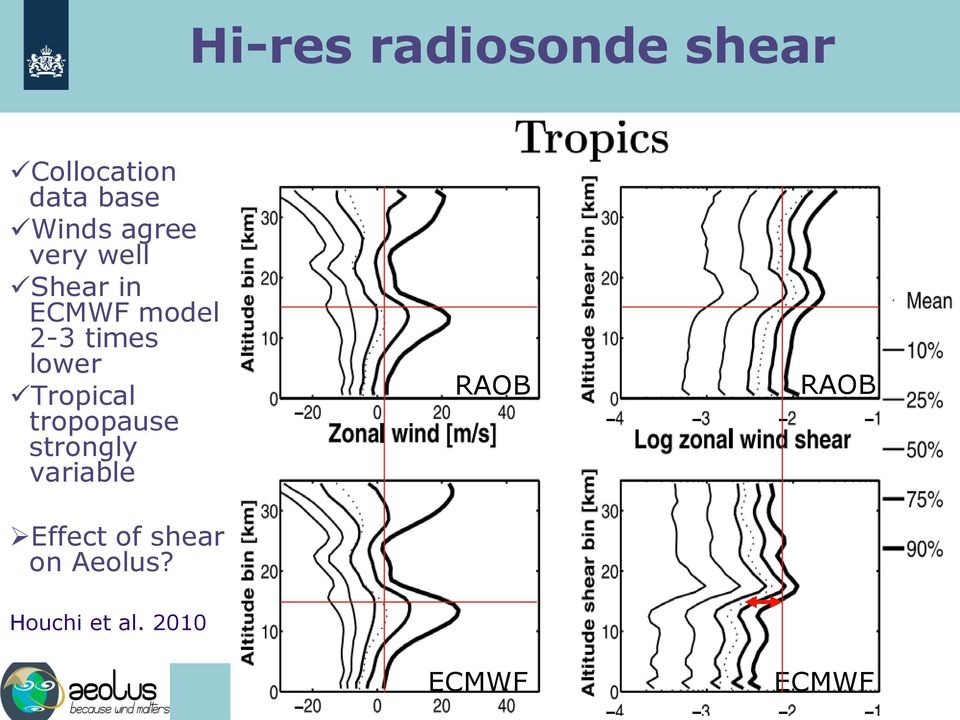
7 Hi-res radiosonde shear Collocation data base Winds agree very well Shear in ECMWF model 2-3 times lower Tropical tropopause strongly variable Effect of shear on Aeolus? RAOB RAOB Houchi et al ECMWF ECMWF
8 Cloud layer statistics 1/3 of the cloud layers are thinner than 400m Such layers cause non-uniform backscatter and extinction Mean height of backscatter particles will be uncertain Wind and wind shear will be biased

9 Centre-of-Gravity (COG) COG w(z) is the signal strength inside the Aeolus bin as a function of altitude z Simulation Analytical calculation (no T,p dependence) Using LIPAS and (T,p) from radiosondes

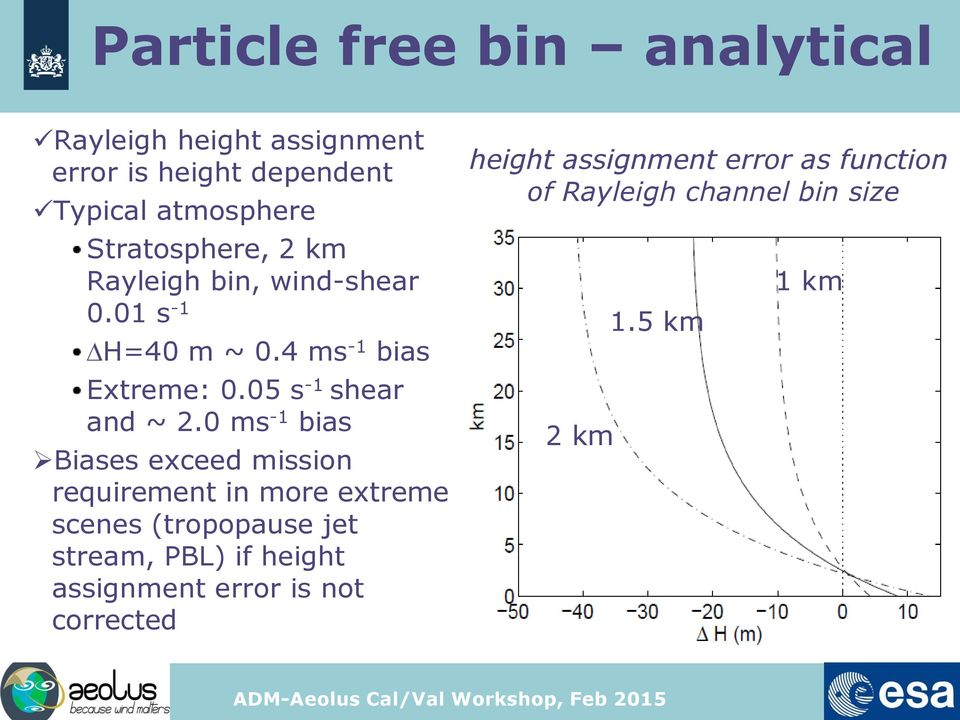
10 Particle free bin analytical Rayleigh height assignment error is height dependent Typical atmosphere Stratosphere, 2 km Rayleigh bin, wind-shear 0.01 s -1 H=40 m ~ 0.4 ms -1 bias Extreme: 0.05 s -1 shear and ~ 2.0 ms -1 bias Biases exceed mission requirement in more extreme scenes (tropopause jet stream, PBL) if height assignment error is not corrected height assignment error as function of Rayleigh channel bin size 2 km 1.5 km 1 km
11 (T,p) from radiosonde database analytical radiosonde (T,P) mean stddev 1 year, station De Bilt => (T,p) => m (z) => w(z) => COG Height assignment errors are slightly larger than from analytical expressions Not very sensitive to T,p errors and predictable Use AUXMET to correct for Rayleigh channel height assignment errors in L2B optical properties code


12 RMSE wind error (systematic) Mie Rayleigh z cloud layer bin Rayleigh HLOS insensitive to z c can be obtained from optics Mie HLOS sensitive to unknown z Mie wind performance is severely degraded in clouds

13 ECMWF B error mid-latitudes Horizontal analysis Single obs. Experiment Over the English channel 500 hpa analysis increment Courtesy: Andras Horanyi (ECMWF) Background error length scale ~ 400 km Aeolus burst-mode observation separated by 200 km (< B length scale) Not fully independent information, some redundancy Aeolus continuous mode observation separated by 86 km

14 Background error length scales B-matrix formulation for operational global and mesoscale models Daley (1991) definition of B length scales: ECMWF model Global (ECMWF; EnDA) and mesoscale (HARMONIE; NCEP method) model Observation-model intercomparison (o-b) statistics: COV(o-b) = HBH T + R; i.e., the sum of (i) Background error and (ii) Instrument and wind representativeness error How to separate B and R? Used Desroziers et al. (2005) Application to ASCAT, aircraft observations, ECMWF and HIRLAM 150 km ASCAT + HIRLAM


15 Effective resolution UTLS 500 km AMDAR/ACARS/AIREP (ODB)/Mode-S Mode-S ECMWF ECMWF model starts to loose variance > 500 km scales Model does not show a k -5/3 spectrum, i.e., turbulence spectrum

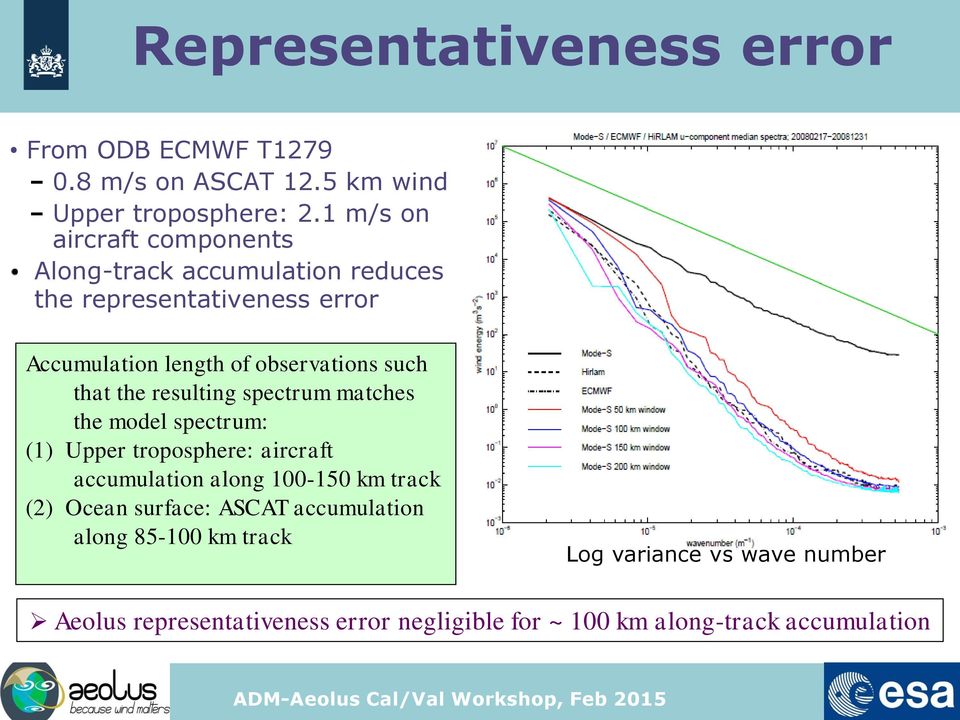
16 Representativeness error From ODB ECMWF T m/s on ASCAT 12.5 km wind Upper troposphere: 2.1 m/s on aircraft components Along-track accumulation reduces the representativeness error Accumulation length of observations such that the resulting spectrum matches the model spectrum: (1) Upper troposphere: aircraft accumulation along km track (2) Ocean surface: ASCAT accumulation along km track Log variance vs wave number Aeolus representativeness error negligible for ~ 100 km along-track accumulation
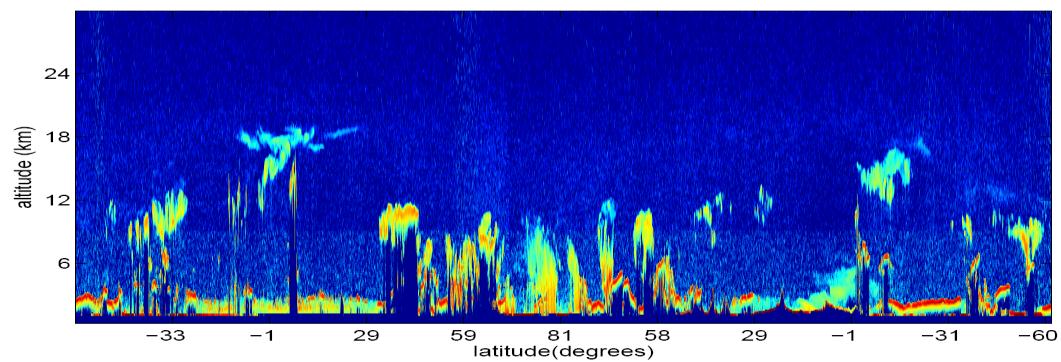
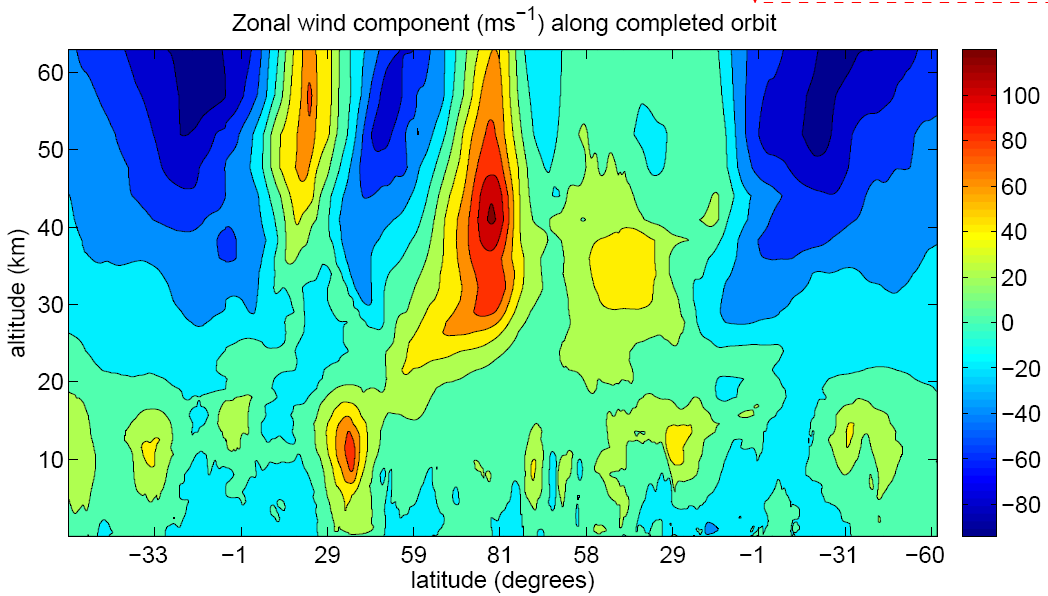
17 Aeolus simulation LIPAS (Lidar Performance Analysis System) Heritage since 1999 and has evolved with mission updates Input: KNMI atmospheric database of CALIPSO backscatter / extinction and ECMWF/UKMO dynamics Marseille et al., 2011 UKMO 30 km CALIPSO

18 LIPAS HLOS wind statistics LIPAS QC: SNR too low BM 110 mj, 50 km CM 110 mj, 85 km CM 80 mj, 85 km CM 80 mj, 250 km mission requirement mj reduced Rayleigh coverage

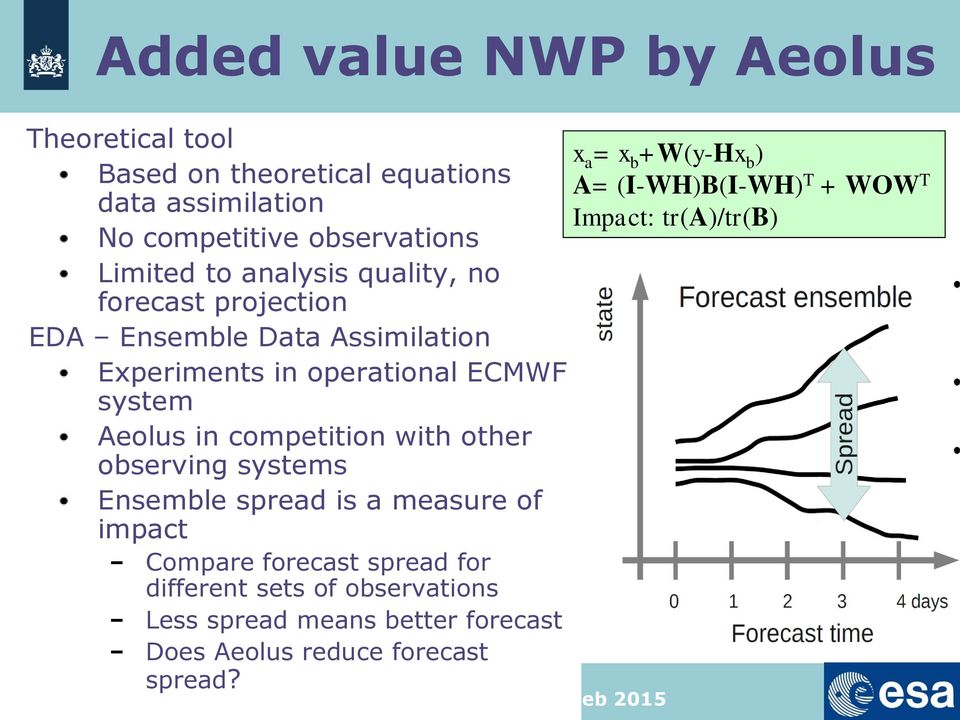
19 Added value NWP by Aeolus Theoretical tool Based on theoretical equations data assimilation No competitive observations Limited to analysis quality, no forecast projection EDA Ensemble Data Assimilation Experiments in operational ECMWF system Aeolus in competition with other observing systems Ensemble spread is a measure of impact Compare forecast spread for different sets of observations Less spread means better forecast Does Aeolus reduce forecast spread? x a = x b +W(y-Hx b ) A= (I-WH)B(I-WH) T + WOW T Impact: tr(a)/tr(b)
20 1D theoretical tool Usual meteorological analysis equations Fully solved 1D = horizontal (in VHAMP) Horizontal characteristics from ECMWF and HARMONIE model and (LIPAS) Aeolus observations Introduction of bias, correlation, averaging, thinning and misspecification Norwegian Meteorological Institute met.no

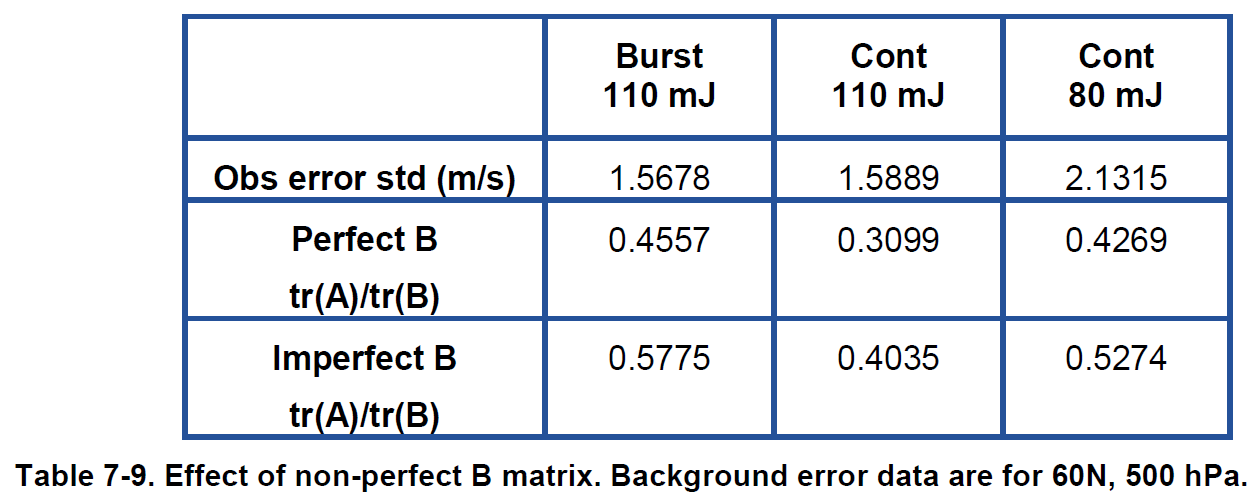
21 Correlated representativeness error 60N background statistics, continous 80 mj, 500hPa (LIPAS Rayleigh channel mean obs error), 2/3 B bandwidth Representativness error variances based on assuming global model effective resolution 7* x (112 km; Skamarock) Triangular O correlation structure with half basis of 112 km Much lower analysis quality Optimal accumulation length is now about the effective model resolution 22 Norwegian Meteorological Institute met.no

22 Conclusions theoretical tool Latitudinal dependence Impact increases substantially from Burst Mode (BM) Cont. Mode (CM) Impact reduces substantially at 80 mj (CM 80 mj ~ BM 110 mj) Aeolus impact appears maximum around 250 hpa Aeolus impact is maximum in the Tropics Impact is maximized for ~85 km accumulation length
23 Conclusions theoretical tool Observation error correlation up to is not detrimental Correlation 0.1 corresponds to an increase of random error of 0.2 m/s Correlation 0.38 corresponds to an increase of random error of 0.7 m/s Biases > 0.5 m/s are detrimental Negative impact for biases exceeding 1 m/s Impact of mis-specified B-matrix is substantial ESA VHAMP, TN8

24 Conclusions EDA experiments EDA experiments conducted : No sondes; to assess radiosonde impact as reference for Aeolus BM, 110 mj, 50 km accumulation CM, 110 mj, 85 km accumulation CM, 80 mj, 85 accumulation CM 80 mj, 250 km accumulation CM 80 mj, 85 km accumulation; 1-year mismatch; to test impact of erroneous observations Aeolus impact comparable to radiosonde - above 24 km Aeolus quality reduces - Below 10 km, Aeolus impact larger Impact all Aeolus scenarios very similar (large-scale impact) 100 hpa 500 hpa
25 Conclusions EDA experiments Maximum Aeolus impact in the tropics and in the UTLS In agreement with theoretical tool
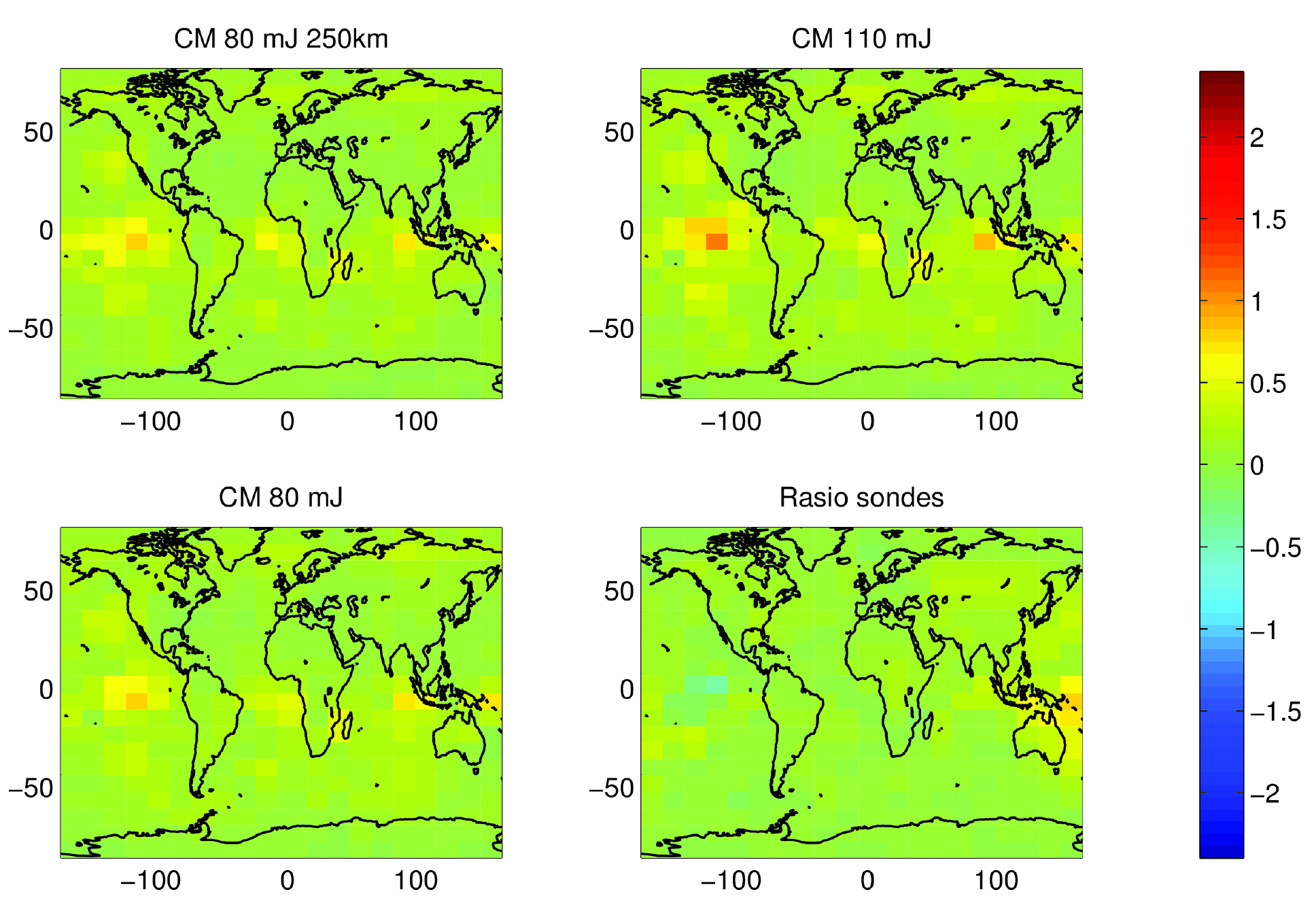
26 Conclusions EDA experiments 85 km Impact at 500 hpa Impact reduces when going from 110 mj 80 mj, but not dramatic 85 km However, assumed Perfect calibration No instrument biases No laser jitter
27 Conclusions Issues of instrument wind calibration, zonal wind variability climate, atmospheric heterogeneity, expected beneficial impact, and data assimilation method are all at interplay The vertical bin sizes should be at least 1 km for the Rayleigh channel in the lower troposphere increasing to 2 km in the stratosphere to obtain accuracy over a ~100km horizontal context It is advantageous to change the Mie vertical sampling along track, i.e., positioning top Mie bins around 11 km over the Poles to up to 18 km in the tropics to better sample tropical cirrus and obtain maximum NWP benefit Along track accumulation in the range km for global NWP, but continuous mode allows context-sensitive aggregation, esp. for Mie Wind biases should be below 0.5 m/s for a successful mission Observation error correlations should stay below 0.15 Zero wind calibration on ground targets is probably favorable with the Mie channel (unfavourable for Rayleigh), but calibration procedures need further evaluation (cause detrimental vertically correlated error) Assimilation of wind shear causes the loss of information on observed deep vertical structures and is not a good alternative for lack of absolute calibration Recommend advanced NWP monitoring to obtain instrument biases and consistency with the Global Observing System
28
29 Conclusion Vertical Sampling Rayleigh bin size is driven by the mission HLOS wind quality requirements (1-2 km) Increasing the Mie channel sampling in heterogeneous atmospheric regions reduces height assignment errors of both Mie and Rayleigh winds near the tropopause and jet stream and provides NWP impact (EnDA, theoretical tool) Zero wind calibration on ground targets is probably favorable with the Mie channel (unfavourable for Rayleigh) Issues of instrument wind calibration, zonal wind variability climate, atmospheric heterogeneity, expected beneficial impact, and data assimilation method are all at interplay An advanced ADM-Aeolus vertical sampling scenario takes account of climate regions and ground calibration opportunities and has been proposed in the VAMP project Assimilation of wind shear causes the loss of information on observed deep vertical structures and is not a good alternative for lack of absolute calibration
30 VHAMP method Establish the ability to exploit wind observations in weather models Establish optimal ADM-Aeolus observation size and quality to maximize mission impact Simulate such ADM-Aeolus observations and investigate impact using Simple theoretical data assimlation tool Ensemble Data Assimilation System Review of MRD in light of ADM-Aeolus operation concept changes
VAMP Vertical Aeolus Measurement Positioning
 VAMP Vertical Aeolus Measurement Positioning [email protected] Gert-Jan Marseille, Karim Houchi, Jos de Kloe (KNMI) Heiner Körnich (MISU), Harald Schyberg (MetNo) Space Shuttle, 84, 3 pm LT Vertical
The impact of window size on AMV
 The impact of window size on AMV E. H. Sohn 1 and R. Borde 2 KMA 1 and EUMETSAT 2 Abstract Target size determination is subjective not only for tracking the vector but also AMV results. Smaller target
Application of Numerical Weather Prediction Models for Drought Monitoring. Gregor Gregorič Jožef Roškar Environmental Agency of Slovenia
 Application of Numerical Weather Prediction Models for Drought Monitoring Gregor Gregorič Jožef Roškar Environmental Agency of Slovenia Contents 1. Introduction 2. Numerical Weather Prediction Models -
ADM-Aeolus pre-launch campaigns with an airborne instrument demonstrator
 ADM-Aeolus pre-launch campaigns with an airborne instrument demonstrator Oliver Reitebuch Institut für Physik der Atmosphäre Background The ADM-Aeolus instrument ALADIN uses several novel techniques, like
Mode-S Enhanced Surveillance derived observations from multiple Air Traffic Control Radars and the impact in hourly HIRLAM
 Mode-S Enhanced Surveillance derived observations from multiple Air Traffic Control Radars and the impact in hourly HIRLAM 1 Introduction Upper air wind is one of the most important parameters to obtain
Synoptic assessment of AMV errors
 NWP SAF Satellite Application Facility for Numerical Weather Prediction Visiting Scientist mission report Document NWPSAF-MO-VS-038 Version 1.0 4 June 2009 Synoptic assessment of AMV errors Renato Galante
Developing Continuous SCM/CRM Forcing Using NWP Products Constrained by ARM Observations
 Developing Continuous SCM/CRM Forcing Using NWP Products Constrained by ARM Observations S. C. Xie, R. T. Cederwall, and J. J. Yio Lawrence Livermore National Laboratory Livermore, California M. H. Zhang
Name of research institute or organization: École Polytechnique Fédérale de Lausanne (EPFL)
 Name of research institute or organization: École Polytechnique Fédérale de Lausanne (EPFL) Title of project: Study of atmospheric ozone by a LIDAR Project leader and team: Dr. Valentin Simeonov, project
Long-term Observations of the Convective Boundary Layer (CBL) and Shallow cumulus Clouds using Cloud Radar at the SGP ARM Climate Research Facility
 Long-term Observations of the Convective Boundary Layer (CBL) and Shallow cumulus Clouds using Cloud Radar at the SGP ARM Climate Research Facility Arunchandra S. Chandra Pavlos Kollias Department of Atmospheric
Cloud verification: a review of methodologies and recent developments
 Cloud verification: a review of methodologies and recent developments Anna Ghelli ECMWF Slide 1 Thanks to: Maike Ahlgrimm Martin Kohler, Richard Forbes Slide 1 Outline Cloud properties Data availability
Chapter 3: Weather Map. Weather Maps. The Station Model. Weather Map on 7/7/2005 4/29/2011
 Chapter 3: Weather Map Weather Maps Many variables are needed to described weather conditions. Local weathers are affected by weather pattern. We need to see all the numbers describing weathers at many
REGIONAL CLIMATE AND DOWNSCALING
 REGIONAL CLIMATE AND DOWNSCALING Regional Climate Modelling at the Hungarian Meteorological Service ANDRÁS HORÁNYI (horanyi( [email protected]@met.hu) Special thanks: : Gabriella Csima,, Péter Szabó, Gabriella
CALIPSO, CloudSat, CERES, and MODIS Merged Data Product
 CALIPSO, CloudSat, CERES, and MODIS Merged Data Product Seiji Kato 1, Sunny Sun-Mack 2, Walter F. Miller 2, Fred G. Rose 2, and Victor E. Sothcott 2 1 NASA Langley Research Center 2 Science and Systems
Remote Sensing of Clouds from Polarization
 Remote Sensing of Clouds from Polarization What polarization can tell us about clouds... and what not? J. Riedi Laboratoire d'optique Atmosphérique University of Science and Technology Lille / CNRS FRANCE
Meteorological Forecasting of DNI, clouds and aerosols
 Meteorological Forecasting of DNI, clouds and aerosols DNICast 1st End-User Workshop, Madrid, 2014-05-07 Heiner Körnich (SMHI), Jan Remund (Meteotest), Marion Schroedter-Homscheidt (DLR) Overview What
Parameterization of Cumulus Convective Cloud Systems in Mesoscale Forecast Models
 DISTRIBUTION STATEMENT A. Approved for public release; distribution is unlimited. Parameterization of Cumulus Convective Cloud Systems in Mesoscale Forecast Models Yefim L. Kogan Cooperative Institute
Chapter 3: Weather Map. Station Model and Weather Maps Pressure as a Vertical Coordinate Constant Pressure Maps Cross Sections
 Chapter 3: Weather Map Station Model and Weather Maps Pressure as a Vertical Coordinate Constant Pressure Maps Cross Sections Weather Maps Many variables are needed to described dweather conditions. Local
Microwave observations in the presence of cloud and precipitation
 Microwave observations in the presence of cloud and precipitation Alan Geer Thanks to: Bill Bell, Peter Bauer, Fabrizio Baordo, Niels Bormann Slide 1 ECMWF/EUMETSAT satellite course 2015: Microwave 2 Slide
Towards assimilating IASI satellite observations over cold surfaces - the cloud detection aspect
 Towards assimilating IASI satellite observations over cold surfaces - the cloud detection aspect Tuuli Perttula, FMI + Thanks to: Nadia Fourrié, Lydie Lavanant, Florence Rabier and Vincent Guidard, Météo
Validation of SEVIRI cloud-top height retrievals from A-Train data
 Validation of SEVIRI cloud-top height retrievals from A-Train data Chu-Yong Chung, Pete N Francis, and Roger Saunders Contents Introduction MO GeoCloud AVAC-S Long-term monitoring Comparison with OCA Summary
Evaluating the Impact of Cloud-Aerosol- Precipitation Interaction (CAPI) Schemes on Rainfall Forecast in the NGGPS
 Introduction Evaluating the Impact of Cloud-Aerosol- Precipitation Interaction (CAPI) Schemes on Rainfall Forecast in the NGGPS Zhanqing Li and Seoung-Soo Lee University of Maryland NOAA/NCEP/EMC Collaborators
Summary Report on National and Regional Projects set-up in Russian Federation to integrate different Ground-based Observing Systems
 WORLD METEOROLOGICAL ORGANIZATION COMMISSION FOR INSTRUMENT AND METHODS OF OBSERVATION OPAG-UPPER AIR EXPERT TEAM ON REMOTE SENSING UPPER-AIR TECHNOLOGY AND TECHNIQUES First Session Geneva, Switzerland,
Diurnal Cycle: Cloud Base Height clear sky
 Diurnal Cycle: Cloud Base Height clear sky Helsinki CNN I Madrid, 16 Dezember 2002 1 Cabauw Geesthacht Cabauw Geesthacht Helsinki Helsinki Petersburg Potsdam Petersburg Potsdam CNN I CNN II Madrid, 16
Project Title: Quantifying Uncertainties of High-Resolution WRF Modeling on Downslope Wind Forecasts in the Las Vegas Valley
 University: Florida Institute of Technology Name of University Researcher Preparing Report: Sen Chiao NWS Office: Las Vegas Name of NWS Researcher Preparing Report: Stanley Czyzyk Type of Project (Partners
Solarstromprognosen für Übertragungsnetzbetreiber
 Solarstromprognosen für Übertragungsnetzbetreiber Elke Lorenz, Jan Kühnert, Annette Hammer, Detlev Heienmann Universität Oldenburg 1 Outline grid integration of photovoltaic power (PV) in Germany overview
VIIRS-CrIS mapping. NWP SAF AAPP VIIRS-CrIS Mapping
 NWP SAF AAPP VIIRS-CrIS Mapping This documentation was developed within the context of the EUMETSAT Satellite Application Facility on Numerical Weather Prediction (NWP SAF), under the Cooperation Agreement
Options for filling the LEO-GEO AMV Coverage Gap Francis Warrick Met Office, UK
 AMV investigation Document NWPSAF-MO-TR- Version. // Options for filling the LEO-GEO AMV Coverage Gap Francis Warrick Met Office, UK Options for filling the LEO-GEO AMV Coverage Gap Doc ID : NWPSAF-MO-TR-
Introduction to the forecasting world Jukka Julkunen FMI, Aviation and military WS
 Boundary layer challenges for aviation forecaster Introduction to the forecasting world Jukka Julkunen FMI, Aviation and military WS 3.12.2012 Forecast for general public We can live with it - BUT Not
Use of numerical weather forecast predictions in soil moisture modelling
 Use of numerical weather forecast predictions in soil moisture modelling Ari Venäläinen Finnish Meteorological Institute Meteorological research [email protected] OBJECTIVE The weather forecast models
Comparison of the Vertical Velocity used to Calculate the Cloud Droplet Number Concentration in a Cloud-Resolving and a Global Climate Model
 Comparison of the Vertical Velocity used to Calculate the Cloud Droplet Number Concentration in a Cloud-Resolving and a Global Climate Model H. Guo, J. E. Penner, M. Herzog, and X. Liu Department of Atmospheric,
Evalua&ng Downdra/ Parameteriza&ons with High Resolu&on CRM Data
 Evalua&ng Downdra/ Parameteriza&ons with High Resolu&on CRM Data Kate Thayer-Calder and Dave Randall Colorado State University October 24, 2012 NOAA's 37th Climate Diagnostics and Prediction Workshop Convective
Comparison of visual observations and automated ceilometer cloud reports at Blindern, Oslo. Anette Lauen Borg Remote sensing MET-Norway
 Comparison of visual observations and automated ceilometer cloud reports at Blindern, Oslo Anette Lauen Borg Remote sensing MET-Norway A test of our ceilometer data To fully exploit our new ceilometer
Towards an NWP-testbed
 Towards an NWP-testbed Ewan O Connor and Robin Hogan University of Reading, UK Overview Cloud schemes in NWP models are basically the same as in climate models, but easier to evaluate using ARM because:
Advances in data assimilation techniques
 Advances in data assimilation techniques and their relevance to satellite data assimilation ECMWF Seminar on Use of Satellite Observations in NWP Andrew Lorenc,, 8-12 September 2014. Crown copyright Met
Benefits accruing from GRUAN
 Benefits accruing from GRUAN Greg Bodeker, Peter Thorne and Ruud Dirksen Presented at the GRUAN/GCOS/WIGOS meeting, Geneva, 17 and 18 November 2015 Providing reference quality data GRUAN is designed to
Using Cloud-Resolving Model Simulations of Deep Convection to Inform Cloud Parameterizations in Large-Scale Models
 Using Cloud-Resolving Model Simulations of Deep Convection to Inform Cloud Parameterizations in Large-Scale Models S. A. Klein National Oceanic and Atmospheric Administration Geophysical Fluid Dynamics
MOGREPS status and activities
 MOGREPS status and activities by Warren Tennant with contributions from Rob Neal, Sarah Beare, Neill Bowler & Richard Swinbank Crown copyright Met Office 32 nd EWGLAM and 17 th SRNWP meetings 1 Contents
Clouds and Convection
 Max-Planck-Institut Clouds and Convection Cathy Hohenegger, Axel Seifert, Bjorn Stevens, Verena Grützun, Thijs Heus, Linda Schlemmer, Malte Rieck Max-Planck-Institut Shallow convection Deep convection
An improved correction method for high quality wind and temperature observations derived from Mode-S EHS
 An improved correction method for high quality wind and temperature observations derived from Mode-S EHS Siebren de Haan De Bilt, 013 Technical report; TR-338 An Improved Correction Method for High Quality
Calibration of the MASS time constant by simulation
 Calibration of the MASS time constant by simulation A. Tokovinin Version 1.1. July 29, 2009 file: prj/atm/mass/theory/doc/timeconstnew.tex 1 Introduction The adaptive optics atmospheric time constant τ
Atmospheric Processes
 Atmospheric Processes Steven Sherwood Climate Change Research Centre, UNSW Yann Arthus-Bertrand / Altitude Where do atmospheric processes come into AR5 WGI? 1. The main feedbacks that control equilibrium
IMPACTS OF IN SITU AND ADDITIONAL SATELLITE DATA ON THE ACCURACY OF A SEA-SURFACE TEMPERATURE ANALYSIS FOR CLIMATE
 INTERNATIONAL JOURNAL OF CLIMATOLOGY Int. J. Climatol. 25: 857 864 (25) Published online in Wiley InterScience (www.interscience.wiley.com). DOI:.2/joc.68 IMPACTS OF IN SITU AND ADDITIONAL SATELLITE DATA
Satellite Derived Dynamic Ocean Currents in the Arctic. Jens Olaf Pepke Pedersen Polar DTU / DTU Space www.polar.dtu.dk www.space.dtu.
 Satellite Derived Dynamic Ocean Currents in the Arctic Jens Olaf Pepke Pedersen Polar DTU / DTU Space www.polar.dtu.dk www.space.dtu.dk Benefits of exploiting ocean currents Benjamin Franklins map of the
Physical properties of mesoscale high-level cloud systems in relation to their atmospheric environment deduced from Sounders
 Physical properties of mesoscale high-level cloud systems in relation to their atmospheric environment deduced from Sounders Claudia Stubenrauch, Sofia Protopapadaki, Artem Feofilov, Theodore Nicolas &
Tools for Viewing and Quality Checking ARM Data
 Tools for Viewing and Quality Checking ARM Data S. Bottone and S. Moore Mission Research Corporation Santa Barbara, California Introduction Mission Research Corporation (MRC) is developing software tools
Marine route optimization. Jens Olaf Pepke Pedersen Polar DTU / DTU Space www.polar.dtu.dk www.space.dtu.dk
 Marine route optimization Jens Olaf Pepke Pedersen Polar DTU / DTU Space www.polar.dtu.dk www.space.dtu.dk Early attempt at route optimization Jens Munk (1579-1628) Tries to find a way to India through
Hybrid-DA in NWP. Experience at the Met Office and elsewhere. GODAE OceanView DA Task Team. Andrew Lorenc, Met Office, Exeter.
 Hybrid-DA in NWP Experience at the Met Office and elsewhere GODAE OceanView DA Task Team Andrew Lorenc, Met Office, Exeter. 21 May 2015 Crown copyright Met Office Recent History of DA for NWP 4DVar was
Satellite Altimetry Missions
 Satellite Altimetry Missions SINGAPORE SPACE SYMPOSIUM 30 TH SEPTEMBER 2015 AUTHORS: LUCA SIMONINI/ ERICK LANSARD/ JOSE M GONZALEZ www.thalesgroup.com Table of Content General Principles and Applications
A climatology of cirrus clouds from ground-based lidar measurements over Lille
 A climatology of cirrus clouds from ground-based lidar measurements over Lille Rita Nohra, Frédéric Parol, Philippe Dubuisson Laboratoire d Optique Atmosphérique université de Lille, CNRS UMR 8518 Objectives
Cloud detection and clearing for the MOPITT instrument
 Cloud detection and clearing for the MOPITT instrument Juying Warner, John Gille, David P. Edwards and Paul Bailey National Center for Atmospheric Research, Boulder, Colorado ABSTRACT The Measurement Of
ECMWF Aerosol and Cloud Detection Software. User Guide. version 1.2 20/01/2015. Reima Eresmaa ECMWF
 ECMWF Aerosol and Cloud User Guide version 1.2 20/01/2015 Reima Eresmaa ECMWF This documentation was developed within the context of the EUMETSAT Satellite Application Facility on Numerical Weather Prediction
Atmospheric kinetic energy spectra from high-resolution GEM models
 Atmospheric kinetic energy spectra from high-resolution GEM models Bertrand Denis NWP Section Canadian Meteorological Centre Environment Canada SRNWP 2009 Bad Orb, Germany Outline Introduction What we
Evaluations of the CALIPSO Cloud Optical Depth Algorithm Through Comparisons with a GOES Derived Cloud Analysis
 Generated using V3.0 of the official AMS LATEX template Evaluations of the CALIPSO Cloud Optical Depth Algorithm Through Comparisons with a GOES Derived Cloud Analysis Katie Carbonari, Heather Kiley, and
A verification score for high resolution NWP: Idealized and preoperational tests
 Technical Report No. 69, December 2012 A verification score for high resolution NWP: Idealized and preoperational tests Bent H. Sass and Xiaohua Yang HIRLAM - B Programme, c/o J. Onvlee, KNMI, P.O. Box
How To Model An Ac Cloud
 Development of an Elevated Mixed Layer Model for Parameterizing Altocumulus Cloud Layers S. Liu and S. K. Krueger Department of Meteorology University of Utah, Salt Lake City, Utah Introduction Altocumulus
4.12 Improving wind profiler data recovery in non-uniform precipitation using a modified consensus algorithm
 4.12 Improving wind profiler data recovery in non-uniform precipitation using a modified consensus algorithm Raisa Lehtinen 1, Daniel Gottas 2, Jim Jordan 3, Allen White 2 1 Vaisala Inc, Boulder, Colorado,
Cloud Model Verification at the Air Force Weather Agency
 2d Weather Group Cloud Model Verification at the Air Force Weather Agency Matthew Sittel UCAR Visiting Scientist Air Force Weather Agency Offutt AFB, NE Template: 28 Feb 06 Overview Cloud Models Ground
How To Use A Karlsruhe Doppler Lidar
 Andreas Wieser Institut für Meteorologie und Klimaforschung Forschungsbereich Troposphäre (IMK-TRO) First measurements with the new Karlsruhe Doppler Lidar June 03, 2004 Forschungszentrum Karlsruhe we
Assimilation of cloudy infrared satellite observations: The Met Office perspective
 Assimilation of cloudy infrared satellite observations: The Met Office perspective Ed Pavelin, Met Office International Symposium on Data Assimilation 2014, Munich Contents This presentation covers the
Climate Models: Uncertainties due to Clouds. Joel Norris Assistant Professor of Climate and Atmospheric Sciences Scripps Institution of Oceanography
 Climate Models: Uncertainties due to Clouds Joel Norris Assistant Professor of Climate and Atmospheric Sciences Scripps Institution of Oceanography Global mean radiative forcing of the climate system for
Improving Low-Cloud Simulation with an Upgraded Multiscale Modeling Framework
 Improving Low-Cloud Simulation with an Upgraded Multiscale Modeling Framework Kuan-Man Xu and Anning Cheng NASA Langley Research Center Hampton, Virginia Motivation and outline of this talk From Teixeira
Titelmasterformat durch Klicken. bearbeiten
 Evaluation of a Fully Coupled Atmospheric Hydrological Modeling System for the Sissili Watershed in the West African Sudanian Savannah Titelmasterformat durch Klicken June, 11, 2014 1 st European Fully
How To Find Out How Much Cloud Fraction Is Underestimated
 Parameterizing the difference in cloud fraction defined by area and by volume as observed with radar and lidar MALCOLM E. BROOKS 1 2, ROBIN J. HOGAN, AND ANTHONY J. ILLINGWORTH Department of Meteorology,
Estimation of satellite observations bias correction for limited area model
 Estimation of satellite observations bias correction for limited area model Roger Randriamampianina Hungarian Meteorological Service, Budapest, Hungary [email protected] Abstract Assimilation of satellite radiances
FRESCO. Product Specification Document FRESCO. Authors : P. Wang, R.J. van der A (KNMI) REF : TEM/PSD2/003 ISSUE : 3.0 DATE : 30.05.
 PAGE : 1/11 TITLE: Product Specification Authors : P. Wang, R.J. van der A (KNMI) PAGE : 2/11 DOCUMENT STATUS SHEET Issue Date Modified Items / Reason for Change 0.9 19.01.06 First Version 1.0 22.01.06
ATMS 310 Jet Streams
 ATMS 310 Jet Streams Jet Streams A jet stream is an intense (30+ m/s in upper troposphere, 15+ m/s lower troposphere), narrow (width at least ½ order magnitude less than the length) horizontal current
A review of cloud top height and optical depth histograms from MISR, ISCCP, and MODIS
 JOURNAL OF GEOPHYSICAL RESEARCH, VOL. 115,, doi:10.1029/2009jd013422, 2010 A review of cloud top height and optical depth histograms from MISR, ISCCP, and MODIS Roger Marchand, 1 Thomas Ackerman, 1 Mike
Hong Kong Observatory Summer Placement Programme 2015
 Annex I Hong Kong Observatory Summer Placement Programme 2015 Training Programme : An Observatory mentor with relevant expertise will supervise the students. Training Period : 8 weeks, starting from 8
ABSTRACT INTRODUCTION
 Observing Fog And Low Cloud With A Combination Of 78GHz Cloud Radar And Laser Met Office: Darren Lyth 1, John Nash. Rutherford Appleton Laboratory: M.Oldfield ABSTRACT Results from two demonstration tests
Development of a. Solar Generation Forecast System
 ALBANY BARCELONA BANGALORE 16 December 2011 Development of a Multiple Look ahead Time Scale Solar Generation Forecast System John Zack Glenn Van Knowe Marie Schnitzer Jeff Freedman AWS Truepower, LLC Albany,
Solar Energy Forecasting Using Numerical Weather Prediction (NWP) Models. Patrick Mathiesen, Sanyo Fellow, UCSD Jan Kleissl, UCSD
 Solar Energy Forecasting Using Numerical Weather Prediction (NWP) Models Patrick Mathiesen, Sanyo Fellow, UCSD Jan Kleissl, UCSD Solar Radiation Reaching the Surface Incoming solar radiation can be reflected,
REDUCING UNCERTAINTY IN SOLAR ENERGY ESTIMATES
 REDUCING UNCERTAINTY IN SOLAR ENERGY ESTIMATES Mitigating Energy Risk through On-Site Monitoring Marie Schnitzer, Vice President of Consulting Services Christopher Thuman, Senior Meteorologist Peter Johnson,
Robot Perception Continued
 Robot Perception Continued 1 Visual Perception Visual Odometry Reconstruction Recognition CS 685 11 Range Sensing strategies Active range sensors Ultrasound Laser range sensor Slides adopted from Siegwart
A SURVEY OF CLOUD COVER OVER MĂGURELE, ROMANIA, USING CEILOMETER AND SATELLITE DATA
 Romanian Reports in Physics, Vol. 66, No. 3, P. 812 822, 2014 ATMOSPHERE PHYSICS A SURVEY OF CLOUD COVER OVER MĂGURELE, ROMANIA, USING CEILOMETER AND SATELLITE DATA S. STEFAN, I. UNGUREANU, C. GRIGORAS
Lecture 4: Pressure and Wind
 Lecture 4: Pressure and Wind Pressure, Measurement, Distribution Forces Affect Wind Geostrophic Balance Winds in Upper Atmosphere Near-Surface Winds Hydrostatic Balance (why the sky isn t falling!) Thermal
Comparative Evaluation of High Resolution Numerical Weather Prediction Models COSMO-WRF
 3 Working Group on Verification and Case Studies 56 Comparative Evaluation of High Resolution Numerical Weather Prediction Models COSMO-WRF Bogdan Alexandru MACO, Mihaela BOGDAN, Amalia IRIZA, Cosmin Dănuţ
A system of direct radiation forecasting based on numerical weather predictions, satellite image and machine learning.
 A system of direct radiation forecasting based on numerical weather predictions, satellite image and machine learning. 31st Annual International Symposium on Forecasting Lourdes Ramírez Santigosa Martín
Estimating Firn Emissivity, from 1994 to1998, at the Ski Hi Automatic Weather Station on the West Antarctic Ice Sheet Using Passive Microwave Data
 Estimating Firn Emissivity, from 1994 to1998, at the Ski Hi Automatic Weather Station on the West Antarctic Ice Sheet Using Passive Microwave Data Mentor: Dr. Malcolm LeCompte Elizabeth City State University
CHAPTER 5 Lectures 10 & 11 Air Temperature and Air Temperature Cycles
 CHAPTER 5 Lectures 10 & 11 Air Temperature and Air Temperature Cycles I. Air Temperature: Five important factors influence air temperature: A. Insolation B. Latitude C. Surface types D. Coastal vs. interior
Tropical Cyclogenesis Monitoring at RSMC Tokyo Mikio, Ueno Forecaster, Tokyo Typhoon Center Japan Meteorological Agency (JMA)
 JMA/WMO Workshop on Effective Tropical Cyclone Warning in Southeast Asia 11 14 March, 2014 Tropical Cyclogenesis Monitoring at RSMC Tokyo Mikio, Ueno Forecaster, Tokyo Typhoon Center Japan Meteorological
Studying cloud properties from space using sounder data: A preparatory study for INSAT-3D
 Studying cloud properties from space using sounder data: A preparatory study for INSAT-3D Munn V. Shukla and P. K. Thapliyal Atmospheric Sciences Division Atmospheric and Oceanic Sciences Group Space Applications