
Florida Department of Education. Professional Development System Evaluation Protocol
|
|
|
- Bennett Richards
- 9 years ago
- Views:
Transcription
1 Florida Department of Education Professional Development System Evaluation Protocol Protocol System Third Cycle Bureau of Educator Recruitment, Development and Retention April 2010 printing

2 Florida Department of Education Professional Development System Evaluation Protocol Protocol System, Third Cycle, Table of Contents Introduction... 1 Overview of the Evaluation Protocol... 1 Components of the System... 2 Protocol Standards Third Cycle... 9 Cross-Level Threads Checklist and Judgment Scale District Site Visits Review Cycle and Logistics Reviewer Qualifications and Selection Process Awareness and Preparation Documentation and Data Analysis Reporting and Action Planning District and School Use Web-based Assistance Action Plans for Improvement District Preparation for a Review Commonly Asked Questions Appendices A. NSDC Standards for Staff Development...30 B. Analysis Depicting the Relationship of the National Staff Development Council Standards and Florida s Professional Development System Evaluation Protocol Standards...35 C. Protocol Checklists...40 D. Team Summary Report Format...78 E. District Report Format...92 F. Example District Report Bureau of Educator Recruitment, Development and Retention
3 Florida Department of Education Professional Development System Evaluation Protocol Protocol System, Third Cycle, Florida Department of Education Professional Development System Evaluation Protocol Protocol System Introduction Through a series of legislative acts in the late 1990s and early part of the 21 st century, the Florida Legislature required the Department of Education to develop a system for evaluating the quality of district professional learning systems. Pursuant to those requirements stipulated in School Community Professional Development Act (F.S.) and legislative proviso language, the Department generated the Professional Development System Evaluation Protocol. By June of 2009, the Department concluded two cycles of reviews of all 67 school districts and four university research schools. The school year was devoted to a complete review and revision of the system in preparation for Third Cycle implementation. This document contains a complete description of the overall system for the Third Cycle. A companion document entitled Professional Development System Evaluation Protocol: Reviewer s Guide contains guidelines for reviewers to use as they conduct site visits to school districts in implementing the system. Overview of the Evaluation Protocol Professional development, the process of continuous development for educators and other education personnel has as its core purpose improving student achievement. A study of the state of professional learning in the U.S. notes that professional learning that is sustained over time, and focused on important content can have a powerful effect on teacher skills and knowledge and consequently on student learning. When well designed, these opportunities help teachers master content, hone teaching skills, evaluate their own and their students performance, and address changes needed in teaching and learning in their schools. Educators and policymakers increasingly recognize the importance of providing high-quality learning opportunities to help transform teaching. As students are expected to learn more complex analytical skills in preparation for further education and work in the 21st century, teachers must learn to teach in ways that develop higher-order thinking and performance (Darling-Hammond, Wei, Andree, Richardson, & Orphanos, 2009, p. 7). Bureau of Educator Recruitment, Development and Retention 1

4 Florida Department of Education Professional Development System Evaluation Protocol Protocol System, Third Cycle, At the earliest stages of the standards movement, Harvard scholar Richard Elmore noted that In practice, professional development covers a vast array of specific activities, everything from highly targeted work with teachers around specific curricula and teaching practices through short, hit-and-run workshops designed to familiarize teachers and administrators with new ideas or new rules and requirements, to off-site courses and workshops designed to provide content and academic credit for teachers and administrators (p. 6). He continues, The point here is that professional development, if it is to be focused on student learning, at some point must be tailored to address the difficulties encountered by real students in real classrooms as well as broader systemic objectives. Similarly, effective professional development is connected to questions of content and pedagogy that educators are asking or should be asking about the consequences of their instructional practices on real students as well as in general questions about effective teaching practice (p.7). All Florida districts and schools should be learning organizations in which all employees engage in continuous improvement to reach their potential and improve student learning. The Florida Professional Development System Evaluation Protocol establishes standards for exemplary practice in professional learning for all employee groups and for all content areas and state, district, and school initiatives. The System emphasizes professional learning for educators and administrators who most directly influence student academic success, yet are applicable to all school and district employees, both certified and non-certified staff. In short, learning for any employee of the state s districts, schools, or other education agencies should meet the intent of these standards. Components of the System State law specifies that The purpose of the professional development system is to increase student achievement, enhance classroom instructional strategies that promote rigor and relevance throughout the curriculum, and prepare students for continuing education and the workforce. The system of professional development must align to the standards adopted by the state and support the framework for standards adopted by the National Staff Development Council (s (1) F.S.). The purposes of the Professional Development System Evaluation Protocol are to: 1. Ensure the highest quality district, school, and faculty Professional Development Systems in Florida to support instructional programs throughout the state. 2. Provide the Commissioner of Education, State Board of Education, and Legislature with information each year on the quality of the district Professional Development Systems. 3. Provide Florida school districts with the methods and protocols needed to conduct ongoing assessments of the quality of professional development in their schools. Bureau of Educator Recruitment, Development and Retention 2
5 Florida Department of Education Professional Development System Evaluation Protocol Protocol System, Third Cycle, Components of the Professional Development System Evaluation Protocol include: A set of 65 standards reflecting legal requirements and research-based professional development practices. Requirements directly linking professional development with achievement levels of the students of participating teachers. Site visits to school districts using teams of trained experts in professional development. Methods for the department to use to identify best practices occurring when the review of the data indicates progress. Methods for the department to use to investigate the causes of lack of progress when the review of the data indicates a lack of progress. Technical assistance for districts to use in improving their professional development systems. Formats and timeframes for the department to report results to school districts from each review and annually to the State Board of Education and the Legislature the progress across all school districts visited. The Professional Development System Evaluation Protocol is based on a set of standards that describe the characteristics and components of a quality professional development system that meets the requirements of Florida s laws. Most legal requirements for professional development in Florida s schools are specified in s School Community Professional Development Act, F.S. This law states in part: (1) The Department of Education, public postsecondary educational institutions, public school districts, public schools, state education foundations, consortia, and professional organizations in this state shall work collaboratively to establish a coordinated system of professional development. The purpose of the professional development system is to increase student achievement, enhance classroom instructional strategies that promote rigor and relevance throughout the curriculum, and prepare students for continuing education and the workforce. The system of professional development must align to the standards adopted by the state and support the framework for standards adopted by the National Staff Development Council. (2) The school community includes students and parents, administrative personnel, managers, instructional personnel, support personnel, members of district school boards, members of school advisory councils, business partners, and personnel that provide health and social services to students. (3) The activities designed to implement this section must: (a) Support and increase the success of educators through collaboratively developed school improvement plans that focus on: 1. Enhanced and differentiated instructional strategies to engage students in a rigorous and relevant curriculum based on state and local educational standards, goals, and initiatives; Bureau of Educator Recruitment, Development and Retention 3

6 Florida Department of Education Professional Development System Evaluation Protocol Protocol System, Third Cycle, Increased opportunities to provide meaningful relationships between teachers and all students; and 3. Increased opportunities for professional collaboration among and between teachers, guidance counselors, instructional leaders, postsecondary educators engaged in preservice training for new teachers, and the workforce community. (b) Assist the school community in providing stimulating, scientific researchbased educational activities that encourage and motivate students to achieve at the highest levels and to participate as active learners and that prepare students for success at subsequent educational levels and the workforce. (c) Provide continuous support for all education professionals as well as temporary intervention for education professionals who need improvement in knowledge, skills, and performance. Additional sections of Florida Statutes (s (4) (b) F.S.) state: Each school district shall develop a professional development system as specified in subsection (3). The system shall be developed in consultation with teachers, teacher-educators of community colleges and state universities, business and community representatives, and local education foundations, consortia, and professional organizations. The professional development system must: 1. Be approved by the department. All substantial revisions to the system shall be submitted to the department for review for continued approval. 2. Be based on analyses of student achievement data and instructional strategies and methods that support rigorous, relevant, and challenging curricula for all students. Schools and districts, in developing and refining the professional development system, shall also review and monitor school discipline data; school environment surveys; assessments of parental satisfaction; performance appraisal data of teachers, managers, and administrative personnel; and other performance indicators to identify school and student needs that can be met by improved professional performance. 3. Provide inservice activities coupled with follow-up support appropriate to accomplish district-level and school-level improvement goals and standards. The inservice activities for instructional personnel shall focus on analysis of student achievement data, ongoing formal and informal assessments of student achievement, identification and use of enhanced and differentiated instructional strategies that emphasize rigor, relevance, and reading in the content areas, enhancement of subject content expertise, integrated use of classroom technology that enhances teaching and learning, classroom management, parent involvement, and school safety. 4. Include a master plan for inservice activities, pursuant to rules of the State Board of Education, for all district employees from all fund sources. The master plan shall be updated annually by September 1, must be based on input from teachers and district and school instructional leaders, and must use the latest available student achievement data and research to enhance rigor and relevance in the classroom. Each district inservice plan must be aligned to and support the Bureau of Educator Recruitment, Development and Retention 4
7 Florida Department of Education Professional Development System Evaluation Protocol Protocol System, Third Cycle, school-based inservice plans and school improvement plans pursuant to s (18). District plans must be approved by the district school board annually in order to ensure compliance with subsection (1) and to allow for dissemination of research-based best practices to other districts. District school boards must submit verification of their approval to the Commissioner of Education no later than October 1, annually. 5. Require each school principal to establish and maintain an individual professional development plan for each instructional employee assigned to the school as a seamless component to the school improvement plans developed pursuant to (18). The individual professional development plan must: a. Be related to specific performance data for the students to whom the teacher is assigned. b. Define the inservice objectives and specific measurable improvements expected in student performance as a result of the inservice activity. c. Include an evaluation component that determines the effectiveness of the professional development plan. The Professional Development System Evaluation Protocol contains an overall philosophy and approach to professional learning that is based on and drawn from the National Staff Development Council s (NSDC) new definition of professional learning and supporting research and documents. Underlying tenets include the following concepts and approaches: Professional development, the process of continuous development for educators and other education personnel, has as its core purpose improving student achievement. The entire Protocol System reflects this emphasis throughout the standards, rationales, and elaborations. Pervasive throughout the document are references to learning communities. Learning communities are groups of faculty who meet regularly to study more effective learning and teaching practices. They share common learning goals that align with school and/or district goals for student achievement. Learning communities can be effective methods for infusing scientific and evidence based research programs into classrooms. According to information from the National Staff Development Council (NSDC), the most powerful forms of professional learning occur in ongoing teams that meet on a regular basis, preferably several times a week, for the purposes of learning, joint lesson planning, and problem solving. These learning communities operate with a commitment to the norms of continuous improvement and experimentation and engage their members in improving their daily work to advance the achievement of school district and school goals for student learning (NSDC Standards Learning Communities). This method for encouraging and developing expertise in our professional educators is encouraged throughout the state. Adults learn more effectively when they are engaged in the learning and relate learning to their job responsibilities. Bureau of Educator Recruitment, Development and Retention 5
8 Florida Department of Education Professional Development System Evaluation Protocol Protocol System, Third Cycle, Language in the Third Cycle reflects an emphasis on the collective responsibility for professional learning among all members of the school community, and this emphasis is in line with language in F.S. Examples are the use of the term professional learning instead of professional development, and the term facilitator instead of terms such as trainer, designer, provider, or program managers; and the term educator instead of teacher. All professional learning in the state should be based on documented scientific research or on a firm evidence base. Many references are made in the document to scientific and/or evidence-based instruction. Professional learning for educators should have documented evidence of the ease of use of the intended skills in the classroom and of the positive impact on increasing student achievement. Documentation preferably is available in published, referred journals or publications or written evidence of the rigorous methods (randomized or comparison group designs) used to determine the effectiveness of the professional learning effort. Districts and schools may rely on national, state, university or consortia organizations to provide the research/evidence. Districts may also use their own systems of piloting promising efforts to document the evidence that the new strategies and techniques increase student achievement within their schools and with their populations. The Professional Development System Evaluation Protocol is designed for use by: The Department through site visits to districts to form state-wide conclusions on the quality of professional development in the state. District staff through site visits to schools to form district-wide conclusions on the quality of professional development in the district. School staff and School Advisory Councils as a self-check on the quality of professional development in the school. The Florida Protocol Standards form the basis for a checklist used by reviewers to judge the quality of the professional development system at each level. Sampling of districts and schools is employed to reduce the cost and time needed to form state-level and district-level conclusions. Descriptions of the sampling process are contained in later sections of this document. The Standards have been generated from the statements in Florida s laws as well as the professional development standards generated by the National Staff Development Council (NSDC) entitled Standards for Staff Development. (See Appendix A and located on the web at An analysis depicting the relationship of the NSDC standards and the standards for Florida s Professional Development System Evaluation Protocol is displayed in Appendix B. Bureau of Educator Recruitment, Development and Retention 6

9 Florida Department of Education Professional Development System Evaluation Protocol Protocol System, Third Cycle, The standards reflect three levels of the Professional Development System and four strands incorporated into each level as follows: Levels 1.0 Educator Level 2.0 School Level 3.0 District Level Strands Planning Learning Implementing Evaluating Figure 1 presents a schematic displaying the three levels and four strands. Note that the Florida Department of Education, Bureau of Educator Recruitment, Development and Retention provides support and assistance for professional development activities and services in Florida s public school districts and is displayed as a supporting service at the bottom of Figure 1. Although districts are responsible for creating and implementing a district professional development system, educators in the public schools are the participants in the professional learning and are the ones who in turn use the skills and knowledge gained in their everyday teaching. Much of the planning and implementation of professional learning occurs at the school level. A comprehensive review of the quality of district professional development systems must encompass the perspective of educators and school administrators as well as district coordinators and directors. The Protocol System incorporates input from all three levels in making judgments about the overall district professional development system: educator, school, and district. Bureau of Educator Recruitment, Development and Retention 7
10 Florida Department of Education Professional Development System Evaluation Protocol Protocol System, Third Cycle, Figure 1 Structure of Protocol Standards 1.1 Planning 1.0 Faculty Level 1.2 Delivery 1.3 Follow-up 1.4 Evaluation 2.1 Planning 2.0 School Level 2.2 Delivery 2.3 Follow-up 2.4 Evaluation 3.1 Planning 3.0 District Level 3.2 Delivery 3.3 Follow-up 3.4 Evaluation Supported by the Florida Department of Education, Bureau of Educator Recruitment, Development and Retention Florida Department of Education Bureau of Educator Recruitment, Development and Retention The model employs a basic systems approach to professional learning addressing these general questions: Planning: What planning occurs to organize and support the professional learning for teachers? Learning: What is the quality of the professional learning in which educators participate? Implementing: How do educators apply the skills and knowledge gained through the professional learning? Evaluating: What evaluation occurs to ensure that the professional learning resulted in educators applying what they learned in the classroom and improvements in student learning occurred as a direct outcome? Bureau of Educator Recruitment, Development and Retention 8

11 Florida Department of Education Professional Development System Evaluation Protocol Protocol System, Third Cycle, Protocol Standards Third Cycle The protocol standards were updated for the third cycle to reflect current law and changes in the field of professional learning. The third cycle standards are listed below. 1. EDUCATOR LEVEL 1.1. Planning Individual Needs Assessment: The educator identifies individual professional learning goals with primary emphasis on student learning needs by reviewing certification needs, classroom-level disaggregated student achievement and behavioral data related to content area skills, school initiatives, the School Improvement Plan, and school and team goals Administrator Review: The educator meets with a school administrator to review the IPDP and identify additional individual professional learning needs based on performance appraisal data and priorities for students, grade levels, content areas, or the whole school Individual Professional Development Plan: The educator s Individual Professional Development Plan (IPDP) specifies the professional learning needs related to identified student achievement goals for those students to which the educator is assigned; aligned with the educator s level of development; and contains: a) clearly defined professional learning goals that specify measurable improvement in student achievement; b) changes in the educator s practices resulting from professional learning; and c) an evaluation plan that determines the effectiveness of the professional learning Learning Learning Communities: The educator participates in collaborative learning communities whose members use a cycle of continuous improvement to achieve goals that align with individual, school, and district goals for student achievement Content Focused: Professional learning focuses primarily on developing content knowledge and content-specific research- and/or evidence-based instructional strategies and interventions in the content areas specified in s F.S. and aligned with district and state initiatives Learning Strategies: Professional learning uses strategies aligned with the intended goals and objectives; applies knowledge of human learning and change; and includes modeling of research- and/or evidence-based instruction, practice, and classroom-based feedback Sustained Professional Learning: Professional learning is sufficiently sustained and rigorous to ensure learning for participants that leads to highfidelity classroom implementation for student achievement. Bureau of Educator Recruitment, Development and Retention 9

12 Florida Department of Education Professional Development System Evaluation Protocol Protocol System, Third Cycle, Use of Technology: Technology, including distance learning, supports and enhances professional learning as appropriate and the application and assessment of that learning as appropriate Time Resources: Sufficient time within the work day is available and used for professional development Coordinated Records: Educators have easy access to up-to-date records of their professional learning Implementing Implementation of Learning: The educator applies newly acquired professional knowledge, skills, dispositions, and behaviors to improve his or her practice Coaching and Mentoring: Skillful coaches, mentors, or others provide sufficient classroom- and school-focused support and assistance to the educator to ensure high-fidelity implementation of professional learning Web-based Resources and Assistance: The district provides educators with web-based resources and assistance to support implementation of professional learning Evaluating Implementing the Plan: The educator and a school administrator conduct an evaluation of the degree of fidelity with which the IPDP was implemented Changes in Educator Practice: The educator evaluates the impact of all professional learning on his or her practice through reflection, assessment, collaborative protocols for examining educator practice and work samples, peer visits, and/or professional portfolios Changes in Students: The educator determines the degree to which his or her professional learning contributed to student performance gains as measured by classroom assessment data Evaluation Methods: The educator uses summative and formative data from state or national standardized student achievement measures, when available, or other measures of student learning and behavior such as district achievement tests, progress monitoring, educator-constructed tests, action research results, discipline referrals, and/or portfolios of student work to assess the impact of professional learning Use of Results: The educator uses the results of the IPDP evaluation as part of a continuous improvement process to develop the following year s IPDP, and to revise professional learning goals based on student performance results and documented teaching practice. Bureau of Educator Recruitment, Development and Retention 10
13 Florida Department of Education Professional Development System Evaluation Protocol Protocol System, Third Cycle, SCHOOL LEVEL 2.1. Planning School Needs Assessment: At least annually the school identifies professional learning needs through a classroom-by-classroom analysis of disaggregated student achievement data by content and skill areas, subgroups needing special assistance, and other school data Reviewing Professional Development Plans: The school administrator meets with individual educators to review the IPDP and identify additional individual professional learning needs based on performance appraisal data and priorities for students, grade levels, school, content areas, or the whole school Reviewing Annual Performance Appraisal Data: The school administrator uses information from annual performance appraisals of educators to identify professional learning needs for individuals, teams, or whole-school faculty Generating a School-wide Professional Development Plan: As part of the School Improvement Plan and in collaboration with the district s Professional Development System, the school administrator and School Advisory Council generate a school-wide Professional Development Plan that includes researchand/or evidence-based professional development aligned to identified classroomlevel needs for student achievement, responds to educators level of development, and specifies how the plan will be evaluated Individual Leadership Development Plan: School administrators create and implement Individual Leadership Development Plans that are based on school and classroom disaggregated student achievement and behavior data and the needs of student groups not making AYP, and contain clearly defined professional learning goals that specify measurable improvement in student performance, improvements in teacher effectiveness, changes in administrator practices resulting from professional learning, and an evaluation plan that determines the effectiveness of the Individual Leadership Development Plan. Bureau of Educator Recruitment, Development and Retention 11
14 Florida Department of Education Professional Development System Evaluation Protocol Protocol System, Third Cycle, Learning Learning Communities: School-based professional learning occurs in collaborative teams of adults whose goals are aligned with the team members IPDPs and the school and district goals for student achievement Content Focused: Professional learning focuses primarily on developing content knowledge and content-specific research- and/or evidence-based instructional strategies and interventions in the content areas specified in s F.S. and aligned with district and state initiatives Learning Strategies: Professional learning uses strategies aligned with the intended goals and objectives; applies knowledge of human learning and change; and includes modeling of research- and/or evidence-based instruction, practice, and classroom-based feedback Sustained Professional Learning: Professional learning is sufficiently sustained and rigorous to ensure learning for participants that leads to highfidelity classroom implementation for student achievement Use of Technology: Technology, including distance learning, supports and enhances professional learning as appropriate and the application and assessment of that learning as appropriate Time Resources: Sufficient time within the work day is available and used for professional development Coordinated Records. School administrators regularly generate and review reports on faculty participation in professional learning Implementing Implementation of Learning: The school provides follow-up support to facilitate implementation of professional learning in the workplace Coaching and Mentoring: The school provides mentoring and/or coaching for all educators to ensure high-fidelity classroom implementation of professional learning, with the assistance continuing as needed until educators implement the learning with comfort and accuracy Web-based Resources and Assistance: The school supports the implementation of professional learning through school and district web-based resources and facilitates educator awareness of and access to district web-based resources. Bureau of Educator Recruitment, Development and Retention 12

15 Florida Department of Education Professional Development System Evaluation Protocol Protocol System, Third Cycle, Evaluating Implementing the Plan: At least annually the school conducts an evaluation of the degree of fidelity with which the school s Professional Development Plan is implemented Changes in Educator Practice: The school conducts an evaluation of the Professional Development Plan to assess its impact on educator practices at the classroom and/or school level Changes in Students: The school conducts an evaluation of the Professional Development Plan to assess its impact on student performance Evaluation Measures: Schools use summative and formative data from state or national standardized student achievement measures, when available, or other measures of student learning and behavior such as district achievement tests, progress monitoring, educator-constructed tests, action research results, discipline referrals, and/or portfolios of student work to assess the impact of professional learning Use of Results: School administrators and the School Advisory Council review school-level evaluation data as part of the needs assessment process for the subsequent school year s professional development planning in order to eliminate ineffective programs and strategies and to expand effective ones. 3. DISTRICT LEVEL 3.1. Planning District Needs Assessment: At least annually the district identifies professional learning needs through a school-by-school analysis of disaggregated student achievement by content area and skills, behavioral data, and other district data Generating a District-wide Professional Development System: Based on identified professional learning needs, the district generates a district-wide Professional Development System that is research- and/or evidence-based, specifies how the plan will be evaluated, and aligns with the Florida Protocol Standards, identified student and educator learning needs, educators level of development, School Improvement Plans, Comprehensive K-12 Reading Plans, Title I Plan, annual performance appraisal data, discipline data, school environment surveys, assessments of parental satisfaction, other performance indicators, and the district strategic plan Research/Evidence Basis: The district s professional learning is based on research- and/or evidence-based instructional and intervention strategies proven to increase student achievement Content Standards for Student Outcomes: The district s professional learning supports implementing state-adopted content standards for student outcomes. Bureau of Educator Recruitment, Development and Retention 13
16 Florida Department of Education Professional Development System Evaluation Protocol Protocol System, Third Cycle, Integration of Initiatives: Professional learning supports educators in integrating and using federal, state, and district initiatives in content, instruction, and intervention strategies to increase student achievement Leadership Development: The district plans, implements, and continuously improves a state-approved, competency-based system of professional learning that develops, maintains, and improves the leadership competencies and skills of employees as instructional leaders Non-instructional Staff: The district plans, delivers, supports, and evaluates professional learning for non-instructional staff to enhance job performance according to the Florida Protocol Standards Professional Learning Facilitators: The district s system of professional learning includes dissemination of the Florida Protocol System to all staff who plan and facilitate professional learning Learning Learning Communities: The district supports and encourages professional learning in collaborative teams of educators Content Focused: Professional learning focuses primarily on developing content knowledge and content-specific research- and/or evidence-based instructional strategies and interventions in the content areas specified in s F.S. and aligned with district and state initiatives Learning Strategies: Professional learning uses strategies aligned with the intended goals and objectives; applies knowledge of human learning and change; and includes modeling of research- and/or evidence-based instruction, practice, and classroom-based feedback Sustained Professional Learning: Professional learning is sufficiently sustained and rigorous to ensure learning for participants that leads to highfidelity classroom implementation for student achievement Use of Technology: Technology, including distance learning, supports and enhances professional learning as appropriate and the application and assessment of that learning as appropriate Time Resources: Sufficient time within the work day is available and used for professional development Coordinated Records: The district maintains up-to-date, easily accessible records on all professional learning that provide data for certification and inservice points for all staff District Support: The district recognizes and supports professional learning as a key strategy for improving teaching quality and student learning Learning Organization: The district fosters and develops the maximum potential of all employees through professional learning Implementing Implementation of Learning: The district provides a follow-up support system to facilitate implementation of professional learning in the workplace. Bureau of Educator Recruitment, Development and Retention 14
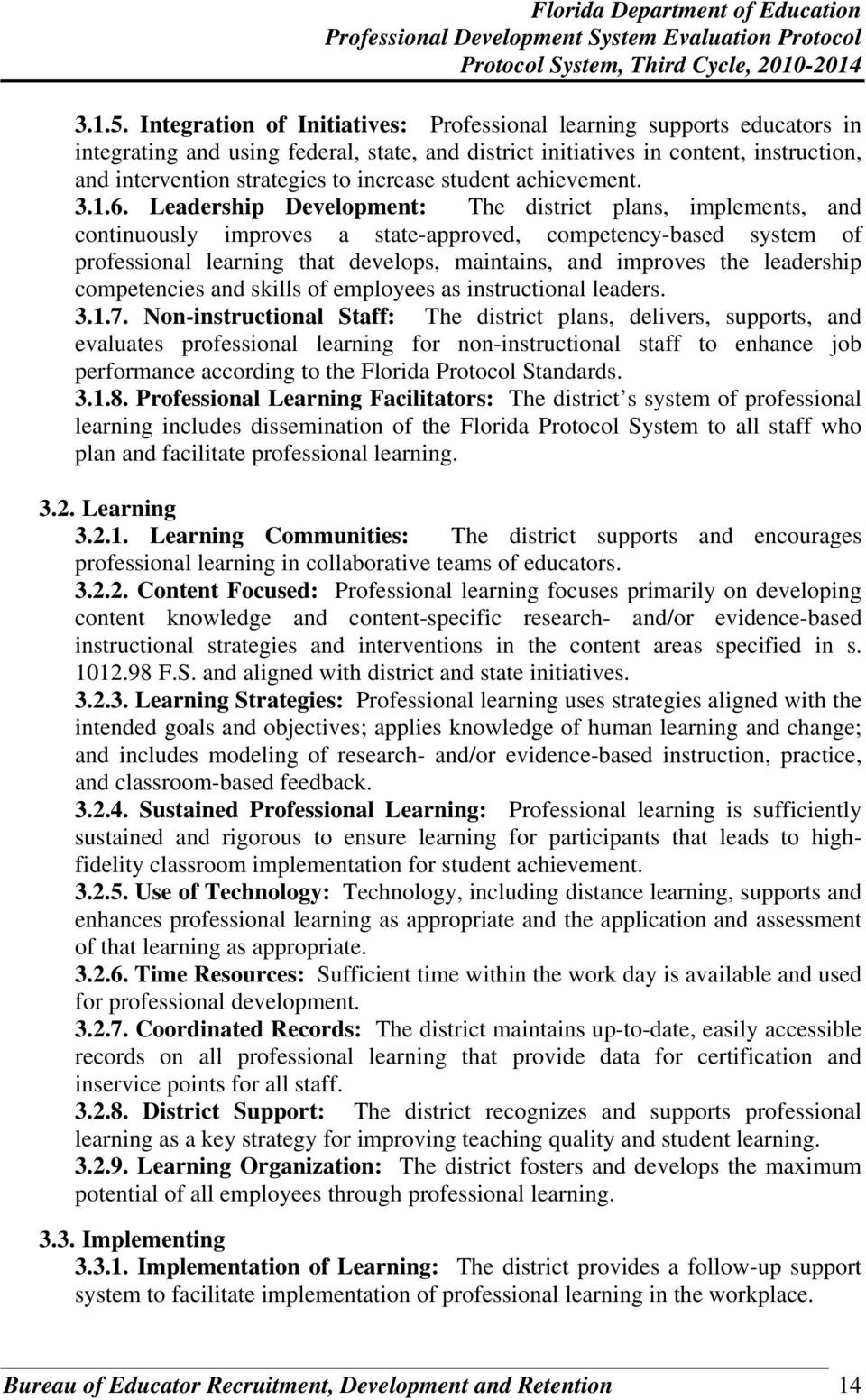
17 Florida Department of Education Professional Development System Evaluation Protocol Protocol System, Third Cycle, Coaching and Mentoring: The district provides mentoring and/or coaching for all educators to ensure high-fidelity classroom implementation of professional learning, with the assistance continuing as needed until educators implement the learning with comfort and accuracy Web-based Resources and Assistance: The district supports the implementation of professional learning through district and school web-based resources and facilitates educator awareness of and access to district web-based resources Evaluating Implementing the System: The district conducts an ongoing formal evaluation of the degree of fidelity with which the district s Professional Development System is implemented Implementation of Learning: The district evaluates at least 10% of the district-level professional learning to assess the level of high-fidelity implementation in the work place Changes in Students: The district assesses the impact of professional learning on student performance Evaluation Measures: The district uses summative and formative data from state or national standardized student achievement measures, when available, or other measures of student learning and behavior such as district achievement tests, progress monitoring, educator-constructed tests, action research results, discipline referrals, and/or portfolios of student work to assess the impact of professional learning Use of Results: The district reviews district- and school-level evaluation data as part of the needs assessment process for the subsequent school year s professional development planning in order to eliminate ineffective programs and strategies and to expand effective ones Fiscal Resources: The district documents that sufficient fiscal resources are used to support professional learning that aligns with school and district goals Student Gains: The district demonstrates an overall increase in student achievement as measured by the Florida Department of Education s district accountability system. Bureau of Educator Recruitment, Development and Retention 15

18 Florida Department of Education Professional Development System Evaluation Protocol Protocol System, Third Cycle, Cross-Level Threads The standards were generated in an organization that provides for multiple levels of review for many aspects of the district s professional development system. Table 1 presents these cross-level connections among the standards. Table 1* Cross-Level Connections Standard Numbers by PLANNING Level Faculty School District Needs Assessment Administrator Review X Generating Professional Development Plans Leadership Development X LEARNING Learning Communities Content Focused Learning Strategies Sustained Professional Learning Use of Technology Time Resources Coordinated Records IMPLEMENTING Implementation of Learning Coaching and Mentoring Web-based Resources and Assistance EVALUATING Implementing the Plan/System Changes in Educator Practices X Changes in Students Use of Results *Includes only standards that appear in more than one level. Bureau of Educator Recruitment, Development and Retention 16

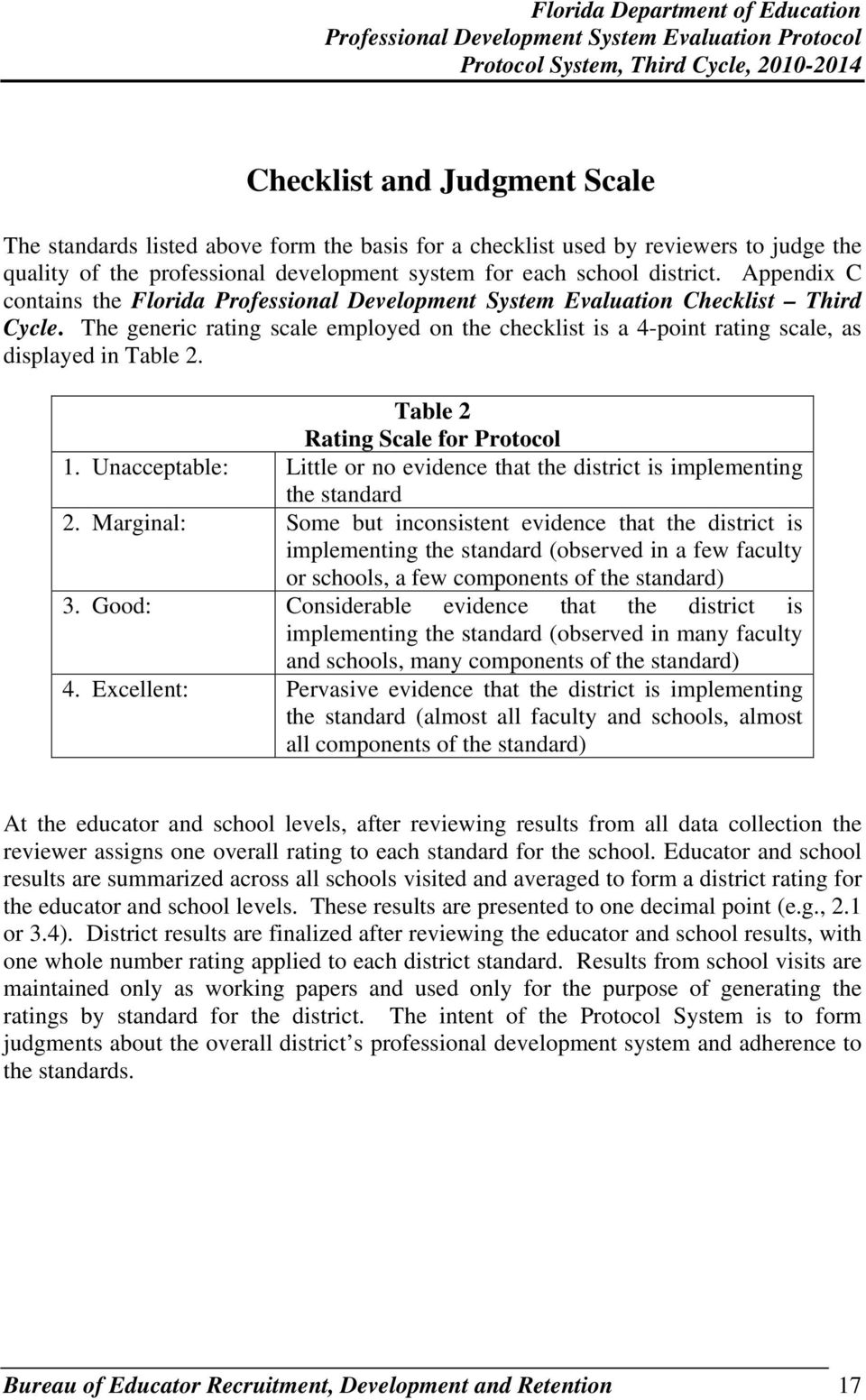
19 Florida Department of Education Professional Development System Evaluation Protocol Protocol System, Third Cycle, Checklist and Judgment Scale The standards listed above form the basis for a checklist used by reviewers to judge the quality of the professional development system for each school district. Appendix C contains the Florida Professional Development System Evaluation Checklist Third Cycle. The generic rating scale employed on the checklist is a 4-point rating scale, as displayed in Table 2. Table 2 Rating Scale for Protocol 1. Unacceptable: Little or no evidence that the district is implementing the standard 2. Marginal: Some but inconsistent evidence that the district is implementing the standard (observed in a few faculty or schools, a few components of the standard) 3. Good: Considerable evidence that the district is implementing the standard (observed in many faculty and schools, many components of the standard) 4. Excellent: Pervasive evidence that the district is implementing the standard (almost all faculty and schools, almost all components of the standard) At the educator and school levels, after reviewing results from all data collection the reviewer assigns one overall rating to each standard for the school. Educator and school results are summarized across all schools visited and averaged to form a district rating for the educator and school levels. These results are presented to one decimal point (e.g., 2.1 or 3.4). District results are finalized after reviewing the educator and school results, with one whole number rating applied to each district standard. Results from school visits are maintained only as working papers and used only for the purpose of generating the ratings by standard for the district. The intent of the Protocol System is to form judgments about the overall district s professional development system and adherence to the standards. Bureau of Educator Recruitment, Development and Retention 17
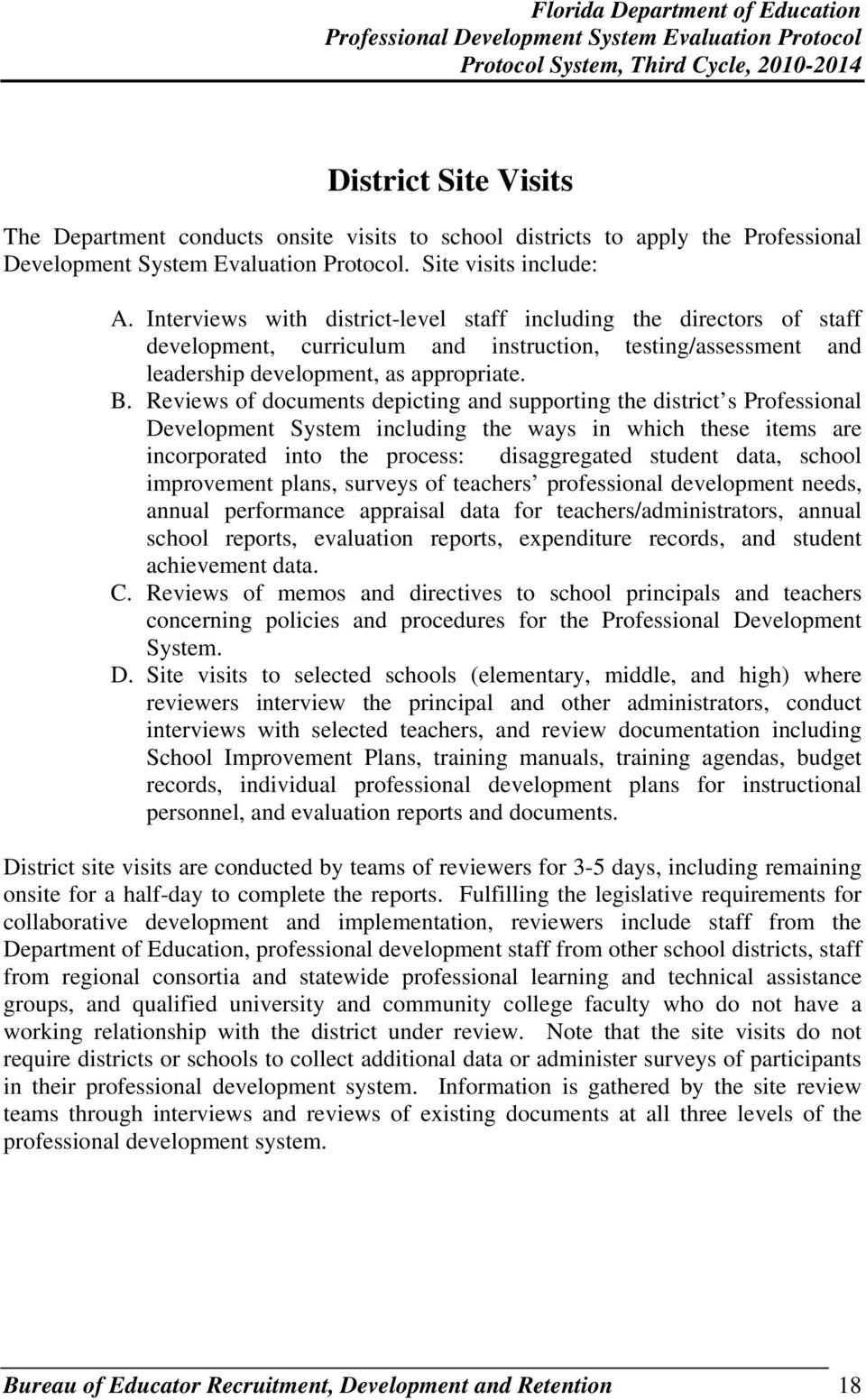
20 Florida Department of Education Professional Development System Evaluation Protocol Protocol System, Third Cycle, District Site Visits The Department conducts onsite visits to school districts to apply the Professional Development System Evaluation Protocol. Site visits include: A. Interviews with district-level staff including the directors of staff development, curriculum and instruction, testing/assessment and leadership development, as appropriate. B. Reviews of documents depicting and supporting the district s Professional Development System including the ways in which these items are incorporated into the process: disaggregated student data, school improvement plans, surveys of teachers professional development needs, annual performance appraisal data for teachers/administrators, annual school reports, evaluation reports, expenditure records, and student achievement data. C. Reviews of memos and directives to school principals and teachers concerning policies and procedures for the Professional Development System. D. Site visits to selected schools (elementary, middle, and high) where reviewers interview the principal and other administrators, conduct interviews with selected teachers, and review documentation including School Improvement Plans, training manuals, training agendas, budget records, individual professional development plans for instructional personnel, and evaluation reports and documents. District site visits are conducted by teams of reviewers for 3-5 days, including remaining onsite for a half-day to complete the reports. Fulfilling the legislative requirements for collaborative development and implementation, reviewers include staff from the Department of Education, professional development staff from other school districts, staff from regional consortia and statewide professional learning and technical assistance groups, and qualified university and community college faculty who do not have a working relationship with the district under review. Note that the site visits do not require districts or schools to collect additional data or administer surveys of participants in their professional development system. Information is gathered by the site review teams through interviews and reviews of existing documents at all three levels of the professional development system. Bureau of Educator Recruitment, Development and Retention 18
21 Florida Department of Education Professional Development System Evaluation Protocol Protocol System, Third Cycle, Review Cycle and Logistics Given the limited human and fiscal resources available for conducting district reviews using the Professional Development System Evaluation Protocol, the Department currently employs a four-year cycle to ensure every school district is reviewed on a timely basis. Figure 2 presents a graphic of the review cycle. Purposeful sampling is used to determine the selection of districts, the order in which these reviews are conducted, the number of districts to visit each year, and the number of schools selected within the district. Figure 2 Review Cycle Plan for Site Visit Follow-up Visit District Review Action Plan Florida Department of Education Bureau of Educator Recruitment, Development and Retention Bureau of Educator Recruitment, Development and Retention 19
22 Florida Department of Education Professional Development System Evaluation Protocol Protocol System, Third Cycle, The system is designed to deploy teams of two reviewers to each of the selected schools and the district office for a whole day. Teams typically arrive in the district in the afternoon of the first day for an introduction to the district, and stay a day at the end of the review to draft the report. Larger districts require larger teams of reviewers and larger numbers of schools visited. Table 3 presents examples of the relationship between the size of the district, the selection of the schools for the site visits, and the size of the team and visit length. Table 3 District Size, School Selection, Team Size, and Visit Length District Size Number of Schools Team Size/Visit Length Selected Small reviewers/4 days Medium reviewers/4 days Large 10 or more 8-20 reviewers/5 days The selection of districts for site visits includes a balance between small, medium, and large districts and geographical distribution across the state for each year. Reviews are conducted in the fall and spring of each year, but avoid as much as possible the month prior to FCAT testing. To the extent possible, the review schedule is coordinated with other state offices and with districts to avoid conflicts. Reviewer Qualifications and Selection Process Reviews are coordinated by staff members of the Bureau of Educator Recruitment, Development and Retention or staff contracted for this purpose. Reviewers for the Protocol System are drawn from the following sources: Department of Education staff, including affiliate offices such as the Florida Diagnostic and Learning Resource System (FDLRS) and Florida Inclusion Network (FIN) District professional development staff Institutions of Higher Education (IHE) with approved programs for teacher education Regional consortia such as the Crown Consortium, Heartland Educational Consortium (HEC), Northeast Florida Educational Consortium (NEFEC), and Panhandle Area Educational Consortium (PAEC) Statewide professional learning and technical assistance centers such as the Florida Center for Reading Research (FCRR) and the Florida Center for Science, Technology, Engineering, and Mathematics (STEM) Bureau of Educator Recruitment, Development and Retention 20
23 Florida Department of Education Professional Development System Evaluation Protocol Protocol System, Third Cycle, Qualifications for reviewers are: Active or retired staff member of one of the organizations listed above 5 years or more in administrative positions in Florida education systems 2 years or more experience in planning, conducting, and/or administering professional development programs at a district or regional level Awareness and Preparation District Staff. The Department conducts ongoing awareness and preparation sessions on the Florida Professional Development System Evaluation Protocol for district staff. These sessions target district staff responsible for professional development with a trainthe-trainer model. District staff may participate with their principals and school professional development contacts. The content of the sessions addresses the standards, uses of the protocol, and recommended preparation for site visits. Reviewers. The Department conducts semi-annual Reviewer Preparation Sessions on the Florida Professional Development System Evaluation Protocol for reviewers who have made a commitment to conducting site visits. No reviewer will be allowed to conduct a site visit without participating in the professional learning. The 2-day reviewer preparation system includes a review and explication of the standards and protocol, procedures for site visits, examples and directions on forming judgments, examples and directions on generating reports, do s and don ts of district/school visits, and practice in using the web-based data entry system. These sessions provide a pool of trained reviewers ready to conduct reviews in the Protocol System. A Reviewer s Guide is available and used during the reviewer preparation sessions to increase the consistency of judgments formed by reviewers. To the extent possible and applicable, the skills-based Reviewer Preparation Sessions were designed using the Professional Development System Evaluation Protocol standards to demonstrate to reviewers the application of the standards. Thus, using Standard , the learning strategies employed apply knowledge of human learning and change including modeling effective review practices as well as role-playing the skills, practice, and feedback. Documentation and Data Analysis The previously listed 4-point rating scale is used by the school review team to generate ratings for each Educator and School Standard for each school visited. The entire team gathers to document Educator and School Standard ratings across all schools visited in the district. Triangulation is used extensively to ensure that the report presents a balanced perspective. Appendix D contains the Team Summary Report Format used by review teams in generating cross-school analyses. Bureau of Educator Recruitment, Development and Retention 21
24 Florida Department of Education Professional Development System Evaluation Protocol Protocol System, Third Cycle, Ratings are averaged across schools to generate an overall district rating for each standard at each level. Thus, a district might receive a rating of 3.7 on standard Individual Needs Assessments; and 1.8 on Administrator Review. At the district level, only one whole number rating is provided that reflects the status of the district on each standard. Results from individual schools are used only as a representative sample of implementation in the entire district and not reported individually to the district. The Department has developed a computer application that facilitates data collection and analysis. Reviewers use laptops to record notes and ratings that are uploaded into a webbased system that generates a comprehensive master file. The application calculates averages across schools and by level of school when appropriate. Team members then draft sections of the report using laptops. Final edits may be conducted through the application or in a separate Word document that can be created. Reporting and Action Planning The Department generates a report for the district that documents the results of the site visit, areas of strength, and any areas in need of improvement. Numerical results are presented as a district rating for each standard at each level of the system. Appendix F contains an example of a completed District Report. Districts are provided an opportunity to review the report for errors in fact prior to public release. These reports are then summarized across districts each year for a report to the Commissioner and Legislature documenting the quality of the professional development systems across the state. Current law specifies that The department shall report annually to the State Board of Education and the Legislature any school district that, in the determination of the department, has failed to provide an adequate professional development system. This report must include the results of the department's investigation and of any intervention provided (s (7) F.S.). Two cut scores are used to help interpret the results. Any standard receiving a rating of 3.5 or higher is identified as exemplary and is commended. These findings are summarized into a technical assistance document that helps other districts learn more about the ways they can improve implementation of that standard and is a searchable web-based data system available on the Department s website. For standards receiving a rating below 2.0, the district must generate an action plan describing to the state the ways in which implementation of the standard will be improved. The Department may send a team to review progress on the action plans as needed, depending on the degree of concern raised during the review and the responses of the district. Bureau of Educator Recruitment, Development and Retention 22
25 Florida Department of Education Professional Development System Evaluation Protocol Protocol System, Third Cycle, District and School Use The Department encourages districts and schools to use the Florida Professional Development System Evaluation Protocol as one method for conducting a self-review of the quality of their professional development systems. Districts may choose to use a stratified purposeful sampling plan to select elementary, middle, and high schools representative of the district for limited site visits to review the status of professional development in their school systems. These reviews can be conducted informally by following procedures similar to those specified for the reviews conducted by the Department, or through other methods devised by the district. The document District Self-Review System is available online from the Department to assist districts in planning and conducting self-reviews using the standards. Web-based Assistance The Department maintains a web-based statewide performance support system at The site contains the documents for the Protocol System, the checklists used in a review, a database of exemplary professional development activities, a listing of available professional development resources and Protocol System training programs, and available assistance. The findings from exemplary practices noted in district reviews are summarized into a technical assistance document that helps other districts learn more about the ways they can improve implementation of that standard and is a searchable web-based data system available on the Department s website. Action Plans for Improvement If a district receives any ratings below 2.0, an Action Plan for Improvement must be submitted to the Department to address the steps to be taken to improve each standard. For each standard receiving a rating below 2.0, the district must generate an Action Plan describing to the state the ways in which implementation of the standard will be improved. Action Plans must be submitted within 45 days following the receipt by the district of the formal letter to the Superintendent conveying the final report. The Action Plan format is located on the Department s website at: Bureau of Educator Recruitment, Development and Retention 23
26 Florida Department of Education Professional Development System Evaluation Protocol Protocol System, Third Cycle, District Preparation for a Review The Protocol System is based on a continuous improvement model. Most districts will already have in place major portions of the standards. In preparation for the review, it is beneficial to review the standards, conduct a self-assessment, and organize the information available at the district level. Some districts use the numbering system for the standards to prepare for the reviews. Various documents are reviewed as part of the evidence base for forming judgments in the Florida Professional Development System Evaluation Protocol. Below is a comprehensive list of the documents. The Checklists contain directions on which documents are needed for specific standards. Prior to Visit District Professional Development Plan System documents District financial report from the Department of Education on the percent of expenditures spent on professional development School Report Cards School Improvement Plans (on website for the school) Leadership Development list of participants 1.0 Faculty Level Individual Professional Development Plans (IPDP) for five selected educators ( and following) Records of participation in professional learning and inservice credit awarded for 5 selected educators Learning community agendas, learning objectives, notes, schedules, and plans related to learning communities. (1.2.1.) Action Research plans, reports or other documentation (1.4.4.) 2.0 School Level Documentation of the use of disaggregated data for planning professional learning (2.1.1.) Needs assessments for professional learning (2.1.1.) School Improvement Plans for last two years School plans for professional learning Bureau of Educator Recruitment, Development and Retention 24
27 Florida Department of Education Professional Development System Evaluation Protocol Protocol System, Third Cycle, School Reading Plan School Technology Plan School Differentiated Accountability plan, if applicable Response to Intervention Model and district/state expectations, when appropriate Documentation of the use of disaggregated student achievement and behavioral data for planning professional learning Florida Continuous Improvement Model documents, when appropriate Individual Professional Development Plans for all educators for the last two years (2.1.2.) Documentation of reviews and analyses of IPDPs across educators by grade/subject area (2.1.2.) Individual Leadership development Plans for school administrators (2.1.5.) Learning community agendas, learning objectives, notes, schedules, and plans (2.2.1.) Calendars documenting professional learning (2.2.6.) Course outlines for planned professional learning Calendars or other schedules maintained by principal/assistant principal showing meetings with educators to review IPDPs Reports of evaluations of school-level professional learning (2.4.1.) End-of-year summaries of SIP progress and outcomes (2.4.4.) 3.0 District Level District Professional Development System Plan Master Inservice Plan District K-12 Reading Plan District Technology Plan District School Improvement Plan, if required School Differentiated Accountability plan Response to Intervention Model and district/state expectations, when appropriate Florida Continuous Improvement Model documents, when appropriate District strategic plans reflecting professional learning initiatives Database for highly qualified teachers Needs assessments for professional learning Documentation of the use of disaggregated student behavioral data for planning professional learning (charts/graphs/displays of school/grade level analyses) District s Leadership Development Program List of participants, current and previous for the Leadership Development Program Checklists and portfolios of participation for the Leadership Development Program Outcome measures of success for the Leadership Development Program Other documentation of the ongoing implementation of the Leadership Development Program Bureau of Educator Recruitment, Development and Retention 25
28 Florida Department of Education Professional Development System Evaluation Protocol Protocol System, Third Cycle, Records of professional learning or dissemination memos related to NSDC and Florida Standards (3.1.8.) Calendars documenting professional learning offerings (3.2.6.) Course outlines for professional learning delivered District documents or professional learning efforts on learning communities Summaries and analyses of end-of-course evaluations (3.4.1.) Summaries and analyses of implementation of planned professional learning (3.4.1.) Summaries of educator participation in professional development and any analyses of percentages of specific teachers participating or additional professional learning conducted to ensure all targeted teachers participated (3.4.1.) Evaluations of professional learning efforts in last four years (3.4.2.) Expenditure reports on professional learning (3.4.6.) Commonly Asked Questions District staff development directors and others have asked many clarifying questions concerning the review site visit process. Some of these commonly posed questions and responses are: 1. What information can and cannot be given to districts? i.e. question guides for reviewers, etc. The Protocol System and the Reviewer s Guide can be shared with districts, including the checklists that contain the questions. Clearly, we do not, however, want districts to prime teachers to answer questions in a specific manner. Also, districts and schools should be aware that the reviewers have been instructed that the checklists contain example questions. Reviewers have been encouraged to ask their own probing questions. Copies of all checklists, manuals and guides are available for downloading from the website. Select Professional Development from the main menu and follow the links to the Professional Development System Evaluation Protocol page. 2. How do districts find out what the details, logistics, etc. are for the visit? What do they need to do to prepare for the visit - both for the review itself and for the travel and accommodations? The Department makes the contacts with the districts and arranges the logistics for the team, with the assistance of the contractor. We appreciate any suggestions on centrally located hotels/motels. To prepare for the visit, district staff should read the Protocol System document, and alert the schools that they will be visited. Districts should also supply the master schedule and list of teachers for each school with directions on how to Bureau of Educator Recruitment, Development and Retention 26
29 Florida Department of Education Professional Development System Evaluation Protocol Protocol System, Third Cycle, locate the school. The Department makes reservations at the hotel, and team members are responsible for their own travel arrangements. 3. Does the district office need to prepare a workroom for the review team? Where? What needs to be in it? The district should have a private space available in each school for the team to meet and interview people. At the district office, on the day of the district review it would be helpful to have a conference room available for interviews. A list of documents is provided in the Reviewer s Guide. 4. Who sets up the meetings and interviews? The Team Leader works with the district staff to organize the schedule of visits to schools and assigns reviewers to complete the schedule. The Team Leader also selects the teachers to interview within each school. The principal or designee needs to make the selected teachers available for interviewing. The interviews usually can be conducted during planning times, although some schools and districts opt for supplying a floating substitute to cover classes. 5. Who should be interviewed at the district level? The district staff decides who is most appropriate for interviews at the district level. In general, these interviews should include the people in the district who have the most direct knowledge of the ways in which professional learning is planned, implemented, and evaluated. In a large district, planning and implementing of professional development programs may be delegated to curriculum supervisors and evaluating may be handled by a separate evaluation department. These people may have valuable input for the review team. In a small district, these responsibilities may all be handled by the district professional development director, or perhaps by a professional development coordinating council. Some districts may have a strong working relationship with a consortium that provides extensive services in planning, implementing, and evaluating professional learning, and a representative from the consortium may be a good person to include in the interviews. In all districts, schedule a separate 30 minute interview for the team with the person who supervises the professional development director. Generate for the team a schedule with the names and positions of the individuals to be interviewed, allowing sufficient time in the schedule for the team to review the documents listed in the standards at the district level. 6. Will the Superintendents have an entry and exit interview/report? If possible, the Superintendent and the director of professional development should be present on the first afternoon for an Introduction Meeting conducted by the Team Leader. An Exit Meeting will be held on the last day with the Team Leader, team members, director of professional development, and other staff as needed to clarify any remaining Bureau of Educator Recruitment, Development and Retention 27
30 Florida Department of Education Professional Development System Evaluation Protocol Protocol System, Third Cycle, questions and responses. No results are presented at this time. The Superintendent does not need to be present at the Exit Meeting. After the final report has been drafted and reviewed by the Department, the Department Staff and contracted manager for the system will meet again with the district director of professional development to review questions about the final report. 7. Do reviewers need to be chauffeured to sites or travel on their own? Will reviewers need maps, contact names, phone numbers in getting them to their review sites? Reviewers do not need to be chauffeured to sites. They will travel on their own. It is helpful, however, to have directions provided to the schools and maps if the directions are tricky to follow. A list of school names, addresses, principal s name, and phone number for the entire visit is also helpful. The Team Leader duplicates the list for reviewers and prepares packets for them. 8. What do reviewers want to see at the three site levels? What needs to be assembled prior to visit? The Reviewers Guide contains a list of documents required for the standards. The reviewers do not need copies of the documentation, but having the information available for review is necessary. The most important pieces at the school level are the individual professional development plans for the teachers selected for interviews (they should bring their plans to the interviews) and the School Improvement Plans (SIP). 9. Who decides the programs to be looked at? Can the district decide the programs? Can programs of only 3 days be reviewed? The school-based reviews are determined by the selection of teachers for interview. From the individual professional development plans of the five teachers selected, the team member selects one or two professional development efforts about which to ask detailed questions. For the entire school, the team members ask the principal detailed questions about several of the professional development activities identified in the SIP. These efforts may vary in length from a 2-hour session to extended numbers of days of professional learning. At the district level, the team members look for documentation of formal evaluations of professional learning as well as asking questions about any of the professional learning efforts reviewed at the schools. 10. What is the definition of Staff Development? NSDC has defined a staff development program as "planned, coherent, in-depth actions and support systems designed and implemented to develop educators' knowledge, attitudes, skills, aspirations and behaviors to improve student achievement." Please also refer to the section in Joellen Killion s book Assessing Impact: Evaluating Staff Development on defining professional development on pp Note also that a new Bureau of Educator Recruitment, Development and Retention 28
31 Florida Department of Education Professional Development System Evaluation Protocol Protocol System, Third Cycle, definition of professional learning is being promulgated by NSDC; this definition was used to revise and generate the Third Cycle of the Protocol System. 11. How soon will we know which schools will be selected and how soon will the principals know which teachers will be selected relative to the review dates for our county? The Department s contractor contacts districts concerning the selection of schools and the process that is followed several weeks prior to the scheduled time of your district s site visit. Principals are not informed which teachers are selected until the week prior to the visit. 12. Which IPDPs will be considered in the review process? Reviewers are instructed to review both the current year and the previous year s IPDP. 13. Will the exit interview with the Superintendent identify individual school findings or will the findings be presented as a composite set of findings for the superintendent? Neither the exit interview nor the reports delivered to the district present findings for individual schools. Only an average across the schools visited for the faculty and school level standards are displayed. The exit meeting does not present any findings but is intended to provide a final opportunity to ask questions and share clarifying information after the team has drafted the report. Bureau of Educator Recruitment, Development and Retention 29
32 Florida Department of Education Professional Development System Evaluation Protocol Protocol System, Third Cycle, Appendix A National Staff Development Council (NSDC) Standards for Staff Development Bureau of Educator Recruitment, Development and Retention 30
33 Florida Department of Education Professional Development System Evaluation Protocol Protocol System, Third Cycle, NSDC Standards for Staff Development (Revised, 2001) CONTEXT S Staff development that improves the learning of all students: Organizes adults into learning communities whose goals are aligned with those of the school and district. (Learning Communities) In this school/district, small learning teams are a primary component of the staff development plan. In this school/district, all teachers are part of ongoing, school-based learning teams that meet several times a week to plan instruction, examine student work, and/or solve problems. In this school/district, school faculties and learning teams focus on school and district goals. Requires skillful school and district leaders who guide continuous instructional improvement. (Leadership) In this school/district, collective bargaining agreements (teacher contracts), calendars, daily schedules, and incentive systems support staff development. In this school/district, leaders recognize staff development as a key strategy for supporting significant improvements. In this school/district, administrators and teacher leaders develop knowledge and skills necessary to be staff development leaders. Requires resources to support adult learning and collaboration. (Resources) In this school/district, staff development occurs primarily during the school day. In this school/district, at least 10 percent of the district s budget is dedicated to staff development. In this school/district, 25 percent of an educator s workday is used for staff development. Bureau of Educator Recruitment, Development and Retention 31
34 Florida Department of Education Professional Development System Evaluation Protocol Protocol System, Third Cycle, PROCESS S Staff development that improves the learning of all students: Uses disaggregated student data to determine adult learning priorities, monitor progress, and help sustain continuous improvement. (Data- Driven) In this school/district, data on student learning provide focus for staff development efforts. In this school/district, teachers gather evidence of improvements in student learning in their classrooms to determine the effects of their staff development on their students. In this school/district, data are disaggregated to ensure equitable treatment of all sub-groups of students. Uses multiple sources of information to guide improvement and demonstrate its impact. (Evaluation) In this school/district, various types of evidence are used to improve the quality of staff development (formative evaluation). In this school/district, various types of evidence are used to determine whether staff development achieved its intended outcomes (summative evaluation). In this school/district, the evaluation of staff development consistently includes all of the following: data concerning knowledge gained by participants, level of implementation, and changes in student learning. Prepares educators to apply research to decision making. (Research- Based) In this school/district, staff development prepares educators to be skillful users of educational research. In this school/district, teams of teachers and administrators methodically study research before adopting improvement strategies. In this school/district, pilot studies and action research are used when appropriate to test the effectiveness of new approaches when research is contradictory or does not exist. Uses learning strategies appropriate to the intended goal. (Design) In this school/district, educators participate in a variety of learning strategies to achieve staff development goals. In this school/district, technology supports educators individual learning. In this school/district, a variety of follow-up activities follow every major change initiative. Bureau of Educator Recruitment, Development and Retention 32
35 Florida Department of Education Professional Development System Evaluation Protocol Protocol System, Third Cycle, Applies knowledge about human learning and change. (Learning) In this school/district, staff development learning methods mirror, as closely as possible, the methods teachers are expected to use with their students. In this school/district, staff development regularly offers opportunities to practice new skills and receive feedback on the performance of those skills. In this school/district, staff development leaders gather and use information about individuals concerns about staff development initiatives to design interventions and follow-up strategies. Provides educators with the knowledge and skills to collaborate. (Collaboration) In this school/district, staff development prepares educators to be skillful members of various groups (for instance, school improvement committees, grade-level teams). In this school/district, staff development provides educators with the skills necessary to surface and productively manage conflict. In this school/district, staff development prepares educators to use technology to collaborate. CONTENT S Staff development that improves the learning of all students: Prepares educators to understand and appreciate all students, create safe, orderly and supportive learning environments, and hold high expectations for their academic achievement. (Equity) In this school/district, educators learn how to create schoolwide practices that convey respect for students, their families, and students cultural backgrounds. In this school/district, staff development prepares educators to establish learning environments that communicate high expectations for the academic achievement of all students. In this school/district, educators learn how to adjust instruction and assessment to match the learning requirements of individual students. Bureau of Educator Recruitment, Development and Retention 33
36 Florida Department of Education Professional Development System Evaluation Protocol Protocol System, Third Cycle, Deepens educators content knowledge, provides them with researchbased instructional strategies to assist students in meeting rigorous academic standards, and prepares them to use various types of classroom assessments appropriately. (Quality Teaching) In this school/district, teachers have many opportunities to develop deep knowledge of their content. In this school/district, staff development expands teachers instructional methods appropriate to specific content areas. In this school/district, staff development teaches classroom assessment skills that allow teachers to regularly monitor gains in student learning. Provides educators with knowledge and skills to involve families and other stakeholders appropriately. (Family Involvement) In this school/district, staff development prepares leaders to build consensus among educators and community members concerning the overall mission and goals for staff development. In this school/district, staff development prepares educators to create relationships with parents to support student learning. In this school/district, technology is used to communicate with parents and the community. Bureau of Educator Recruitment, Development and Retention 34
37 Florida Department of Education Professional Development System Evaluation Protocol Protocol System, Third Cycle, Appendix B Analysis Depicting the Relationship of the National Staff Development Council standards and Florida s Professional Development System Evaluation Protocol Standards Bureau of Educator Recruitment, Development and Retention 35
38 Florida Department of Education Professional Development System Evaluation Protocol Protocol System, Third Cycle, Analysis of the Relationship between Florida s New Protocol Standards and the NSDC Standards for Staff Development Florida Protocol NSDC Standards CONTEXT S Staff development that improves the learning of all students: Organizes adults into learning communities whose goals are aligned with those of the school and district. (Learning Communities) In this school/district, small learning teams are a primary component of the staff development plan. In this school/district, all teachers are part of ongoing, school-based learning teams that meet several times a week to plan instruction, examine student work, and/or solve problems. In this school/district, school faculties and learning teams focus on school and district goals Requires skillful school and district leaders who guide continuous instructional improvement. (Leadership) In this school/district, collective bargaining agreements (teacher contracts), calendars, daily schedules, and incentive systems support staff development. In this school/district, leaders recognize staff development as a key strategy for supporting significant improvements. In this school/district, administrators and teacher leaders develop knowledge and skills necessary to be staff development leaders Requires resources to support adult learning and collaboration. (Resources) In this school/district, staff development occurs primarily during the school day. In this school/district, at least 10 percent of the district s budget is dedicated to staff development. In this school/district, 25 percent of an educator s Bureau of Educator Recruitment, Development and Retention 36
39 Florida Department of Education Professional Development System Evaluation Protocol Protocol System, Third Cycle, workday is used for staff development. PROCESS S Staff development that improves the learning of all students: Uses disaggregated student data to determine adult learning priorities, monitor progress, and help sustain continuous improvement. (Data-Driven) In this school/district, data on student learning provide focus for staff development efforts. In this school/district, teachers gather evidence of improvements in student learning in their classrooms to determine the effects of their staff development on their students. In this school/district, data are disaggregated to ensure equitable treatment of all sub-groups of students. Uses multiple sources of information to guide improvement and demonstrate its impact. (Evaluation) In this school/district, various types of evidence are used to improve the quality of staff development (formative evaluation). In this school/district, various types of evidence are used to determine whether staff development achieved its intended outcomes (summative evaluation). In this school/district, the evaluation of staff development consistently includes all of the following: data concerning knowledge gained by participants, level of implementation, and changes in student learning. Prepares educators to apply research to decision making. (Research-Based) In this school/district, staff development prepares educators to be skillful users of educational research. In this school/district, teams of teachers and administrators methodically study research before adopting improvement strategies. In this school/district, pilot studies and action research are used when appropriate to test the effectiveness of new approaches when research is contradictory or does not exist. Bureau of Educator Recruitment, Development and Retention 37
40 Florida Department of Education Professional Development System Evaluation Protocol Protocol System, Third Cycle, Uses learning strategies appropriate to the intended goal. (Design) In this school/district, educators participate in a variety of learning strategies to achieve staff development goals. In this school/district, technology supports educators individual learning. In this school/district, a variety of follow-up activities follow every major change initiative Applies knowledge about human learning and change. (Learning) In this school/district, staff development learning methods mirror, as closely as possible, the methods teachers are expected to use with their students. In this school/district, staff development regularly offers opportunities to practice new skills and receive feedback on the performance of those skills. In this school/district, staff development leaders gather and use information about individuals concerns about staff development initiatives to design interventions and follow-up strategies. Provides educators with the knowledge and skills to collaborate. (Collaboration) In this school/district, staff development prepares educators to be skillful members of various groups (for instance, school improvement committees, grade-level teams). In this school/district, staff development provides educators with the skills necessary to surface and productively manage conflict. In this school/district, staff development prepares educators to use technology to collaborate. Bureau of Educator Recruitment, Development and Retention 38
41 Florida Department of Education Professional Development System Evaluation Protocol Protocol System, Third Cycle, CONTENT S Staff development that improves the learning of all students: Prepares educators to understand and appreciate all students, create safe, orderly and supportive learning environments, and hold high expectations for their academic achievement. (Equity) In this school/district, educators learn how to create schoolwide practices that convey respect for students, their families, and students cultural backgrounds. In this school/district, staff development prepares educators to establish learning environments that communicate high expectations for the academic achievement of all students. In this school/district, educators learn how to adjust instruction and assessment to match the learning requirements of individual students. Deepens educators content knowledge, provides them with research-based instructional strategies to assist students in meeting rigorous academic standards, and prepares them to use various types of classroom assessments appropriately. (Quality Teaching) In this school/district, teachers have many opportunities to develop deep knowledge of their content. In this school/district, staff development expands teachers instructional methods appropriate to specific content areas. In this school/district, staff development teaches classroom assessment skills that allow teachers to regularly monitor gains in student learning. Provides educators with knowledge and skills to involve families and other stakeholders appropriately. (Family Involvement) In this school/district, staff development prepares leaders to build consensus among educators and community members concerning the overall mission and goals for staff development. In this school/district, staff development prepares educators to create relationships with parents to support student learning. In this school/district, technology is used to communicate with parents and the community. Bureau of Educator Recruitment, Development and Retention 39
42 Florida Department of Education Professional Development System Evaluation Protocol Protocol System, Third Cycle, Appendix C Checklists Bureau of Educator Recruitment, Development and Retention 40
43 1.1 EDUCATOR LEVEL PLANNING DOCUMENTS, QUESTIONS, AND PROBES Individual Needs Assessment: The educator identifies Review a copy of the Individual Professional Development Plan (IPDP) for individual professional learning goals with primary emphasis on the last two years. This document may be called different names, depending student learning needs by reviewing certification needs, classroomlevel disaggregated student achievement and behavioral data related educator has taken in the last two years. Obtain a copy from the principal in on the school district. Review the record of the professional learning the to content area skills, school initiatives, the School Improvement advance if possible. Plan, and school and team goals. Ask: Tell me how your IPDP was created. Describe any data that were used in creating your IPDP. Ask details about when the IPDP was created and who was involved. Probe for: Review of disaggregated student achievement data Relationship to the professional learning listed in the SIP Incorporation of school or team goals Results from previous year s IPDP evaluation Notes: Rating: Administrator Review: The educator meets with a school administrator to review the IPDP and identify additional individual professional learning needs based on performance appraisal data and priorities for students, grade levels, content areas, or the whole school. Notes: Review the record of the professional learning the educator has taken in the last two years. What process is used to review your IPDP? How does the principal ensure that the IPDP educators create are based on the improvements their students need to make? Probe for an individual meeting with the principal or AP to review the IPDP, specific dates, length of the meeting, content discussed. Rating: 41
44 1.1 EDUCATOR LEVEL PLANNING (CONTINUED) DOCUMENTS, QUESTIONS, AND PROBES Individual Professional Development Plan: The educator s Check Individual Professional Development Plans to determine items in Individual Professional Development Plan (IPDP) specifies the (relationship to student performance data, clearly defined professional learning needs related to identified student achievement professional learning objectives, measurable improvement in student goals for those students to which the educator is assigned; aligned performance, changes in the educator s practices resulting from with the educator s level of development; and contains: a) clearly professional learning, evaluation component). defined professional learning goals that specify measurable improvement in student achievement; b) changes in the educator s practices resulting from professional learning; and c) an evaluation plan that determines the effectiveness of the professional learning. Notes: Rating: 1.2 EDUCATOR LEVEL LEARNING DOCUMENTS, QUESTIONS, AND PROBES Learning Communities: The educator participates in NOTE: Learning communities are groups of faculty who meet regularly to collaborative learning communities whose members use a cycle of study more effective learning and teaching practices in order to achieve the continuous improvement to achieve goals that align with individual, identified learning goal of the group. school, and district goals for student achievement. Review Documents including learning community agendas, learning objectives, notes, schedules, and plans. Describe how your school organizes educators into professional learning communities. Notes: Rating: 42
45 1.2 EDUCATOR LEVEL LEARNING (CONTINUED) DOCUMENTS, QUESTIONS, AND PROBES Content Focused: Professional learning focuses primarily on Select from the IPDP one or two professional learning/classes for review, developing content knowledge and content-specific research- and/or including professional learning communities if they have been used as a evidence-based instructional strategies and interventions in the primary method for increasing professional learning. Ask these questions content areas specified in s F.S. and aligned with district and concerning delivery of the professional learning: state initiatives. Describe the professional learning you received on [topic listed in IPDP]. How relevant was the content you received in [topic listed in IPDP] to your needs as an educator? What is the research basis that shows the professional learning will contribute to greater student learning? Generally, how relevant is the content of your professional learning to your needs as an educator responsible for improving student achievement? Notes: Learning Strategies: Professional learning uses strategies aligned with the intended goals and objectives; applies knowledge of human learning and change; and includes modeling of researchand/or evidence-based instruction, practice, and classroom-based feedback. Notes: Rating: Tell me how the professional learning was facilitated on [insert selected topic]. Probe for examples of modeling the skills that were to be used; practice of the skills; feedback on performance during the professional learning session; facilitating the class using the same techniques and strategies to be using with students. Rating: 43
46 1.2 EDUCATOR LEVEL LEARNING (CONTINUED) DOCUMENTS, QUESTIONS, AND PROBES Sustained Professional Learning: Professional learning is Tell me about the amount of time you spent in professional learning on sufficiently sustained and rigorous to ensure learning for participants [insert selected topic]. that leads to high-fidelity classroom implementation for student How was that time organized? achievement. Probe for: number of professional learning sessions, length of time for each session, frequency of sessions, and overall total learning time. How appropriate was the length of time for the skills being taught? Generally, how sustained and intensive is the professional learning you receive, considering the types of skills and knowledge being taught? What level of mastery is usually attained by the end of the sessions? Notes: Rating: Use of Technology: Technology, including distance learning, supports and enhances professional learning as appropriate and the application and assessment of that learning as appropriate. Notes: Describe how technology or distance learning supported and enhanced your recent professional learning in [insert selected topic] and the application and assessment of that learning. Generally, describe how technology was used in the professional learning in which you have participated in the last two years. In what ways was the technology appropriate for the skills being learned? Probe for distance learning, webinars, teleconferences, podcasts, wikis, websites, DVDs, embedded video clips in PowerPoint presentations, Smart Boards, handheld devices or PDAs, graphing calculators, computer programs or displays, and other types of technology. Rating: 44
47 1.2 EDUCATOR LEVEL LEARNING (CONTINUED) DOCUMENTS, QUESTIONS, AND PROBES Time Resources: Sufficient time within the work day is Review the district and school calendars and any other documents available and used for professional learning. containing references to professional learning hours or allotted times. Describe the amount of time allocated for professional learning in this district and school in which teachers must participate. In your experience, is there sufficient time to conduct the professional learning that faculty need? Notes: Rating: Coordinated Records: Educators have easy access to up-todate records of their professional learning. Describe how you find out about the number of inservice points you have earned toward recertification. How easy is it to access this system? Notes: Rating: 45
48 1.3 EDUCATOR LEVEL IMPLEMENTING DOCUMENTS, QUESTIONS, AND PROBES Implementation of Learning: The educator applies newly Describe some specific examples of how you have used in your classroom acquired professional knowledge, skills, dispositions, and behaviors what you learned in the professional learning on [insert selected topic]. to improve his or her practice. Describe any other specific examples of how you applied what you learned in recent professional learning sessions. Notes: Coaching and Mentoring: Skillful coaches, mentors, or others provide sufficient classroom- and school-focused support and assistance to the educator to ensure high-fidelity implementation of professional learning. Notes: Rating: Describe any coaching or mentoring you received following your professional learning on [insert selected topic] to help you implement the new skills/professional learning. Probe for a facilitator, coach or mentor going to classrooms to help educators implement the new skills/professional learning. Describe any other coaching or mentoring you have received recently. Describe the skill level of the coach/mentor assisting you. How effective was the coaching/mentoring? How did the coach/mentor determine that the assistance had been sufficient?? Rating: 46
49 1.3 EDUCATOR LEVEL IMPLEMENTING (CONTINUED) DOCUMENTS, QUESTIONS, AND PROBES Web-based Resources and Assistance: The district provides Describe the web-based resources and assistance you have used for any of educators with web-based resources and assistance to support your recent professional learning. Probe for evidence that the teacher implementation of professional learning. participated in or used a discussion room or bulletin board to talk about the skills, reviewed additional materials posted, or interfaced with the facilitator or a coach/mentor in implementing the newly learned skills or knowledge. Describe any professional learning that is coached or mentored online. Notes: Rating: 1.4 EDUCATOR LEVEL EVALUATING DOCUMENTS, QUESTIONS, AND PROBES Implementing the Plan: The educator and a school Describe the meeting held with your principal or another administrator to administrator conduct an evaluation of the degree of fidelity with determine how much of what was written on your IPDP had been which the IPDP was implemented. implemented. Notes: Rating: 47
50 1.4 EDUCATOR LEVEL EVALUATING (CONTINUED) DOCUMENTS, QUESTIONS, AND PROBES Changes in Educator Practice: The educator evaluates the Describe the ways in which you review how your professional learning impact of all professional learning on his or her practice through has impacted your teaching practice. reflection, assessment, collaborative protocols for examining educator How does this school document that you have used the new skills or practice and work samples, peer visits, and/or professional portfolios. knowledge in the classroom? What are the ways in which you have documented the impact of your professional learning on your teaching practice? Notes: Changes in Students: The educator determines the degree to which his or her professional learning contributed to student performance gains as measured by classroom assessment data. Notes: Rating: Describe how students improved as a result of your professional learning and its application in your classroom. Describe how you shared these results with your administrator. Rating: 48
51 1.4 EDUCATOR LEVEL EVALUATING (CONTINUED) DOCUMENTS, QUESTIONS, AND PROBES Evaluation Methods: The educator uses summative and Describe the evaluation methods used to document changes in student formative data from state or national standardized student performance resulting from the professional learning. achievement measures, when available, or other measures of student learning and behavior such as district achievement tests, progress monitoring, educator-constructed tests, action research results, discipline referrals, and/or portfolios of student work to assess the impact of professional learning. Notes: Rating: Use of Results: The educator uses the results of the IPDP evaluation as part of a continuous improvement process to develop the following year s IPDP, and to revise professional learning goals based on student performance results and documented teaching practice. Notes: Describe how the results from your evaluation of your IPDP were used. Rating: 49
52 2.1 SCHOOL LEVEL PLANNING DOCUMENTS, QUESTIONS, AND PROBES School Needs Assessment: At least annually the school Ask for copies of: identifies professional learning needs through a classroom-byclassroom analysis of disaggregated student achievement data by School Improvement Plan Individual Professional Development Plans content and skill areas, subgroups needing special assistance, and School Plans for Professional Learning other school data. School Reading Plan School Technology Plan School Differentiated Accountability plan, if applicable Response to Intervention Model and district/state expectations, when appropriate Documentation of the use of disaggregated student achievement and behavioral data for planning professional learning Florida Continuous Improvement Model documents, when appropriate Documentation of reviews and analyses of IPDPs across educators by grade/subject area Calendars documenting professional learning Course outlines for planned professional learning Calendars or other schedules maintained by principal/assistant principal showing meetings with educators to review IPDPs Expenditure reports on professional learning Check needs assessment for use of disaggregated data in determining professional learning needs. Notes: Describe the ways in which this school determines the professional learning needs of the faculty. Rating: 50
53 2.1 SCHOOL LEVEL PLANNING (CONTINUED) DOCUMENTS, QUESTIONS, AND PROBES Reviewing Professional Development Plans: The school Review all IPDPs generated for the last two years in the school. Review administrator meets with individual educators to review the IPDP and records of professional learning participation by selected educators for the identify additional individual professional learning needs based on last two years. performance appraisal data and priorities for students, grade levels, Tell me about the process you use to review the development of educators school, content areas or the whole school. IPDPs. Notes: Reviewing Annual Performance Appraisal Data: The school administrator uses information from annual performance appraisals of educators to identify professional learning needs for individuals, teams, or whole-school faculty. Notes: Rating: Review last year s and this year s IPDPs for educators. Describe how Annual Performance Appraisal Data are used in planning for professional learning in this school. Describe any recent examples of groups of educators who needed specific assistance and how it was provided. Rating: 51
54 2.1 SCHOOL LEVEL PLANNING (CONTINUED) DOCUMENTS, QUESTIONS, AND PROBES Generating a School-wide Professional Development Plan: Review the School Improvement Plan, School Technology Plan, School As part of the School Improvement Plan and in collaboration with the Differentiated Accountability plan if appropriate, school professional district s Professional Development System, the school administrator learning calendars, and other related documents. Check to ensure and School Advisory Council generate a school-wide Professional concentration on research- and/or evidence-based professional learning and Development Plan that includes research- and/or evidence-based alignment with disaggregated student achievement data, annual professional development aligned to identified classroom level needs performance appraisal data for educators and administrators, annual school for student achievement, responds to educators' level of development, reports, IPDPs, and school and district strategic planning. and specifies how the plan will be evaluated. Tell me about the process the school uses to incorporate results from evaluations of IPDPs into the School Improvement Plan. How does the school determine that professional learning is based on scientific research and evidence? Notes: Rating: 52
55 2.1 SCHOOL LEVEL PLANNING (CONTINUED) DOCUMENTS, QUESTIONS, AND PROBES Individual Leadership Development Plan: School Review the Individual Leadership Development Plan for the principal and administrators create and implement Individual Leadership other administrators in the building. Development Plans that are based on school and classroom Tell me about the process used to develop your personal Individual disaggregated student achievement and behavior data and the needs of Leadership Development Plan. student groups not making AYP, and contain clearly defined How do the goals in the plan relate to identified student needs within this professional learning goals that specify measurable improvement in school? student performance, improvements in teacher effectiveness, changes Who in this school has an ILDP? Review them. in administrator practices resulting from professional learning, and an evaluation plan that determines the effectiveness of the Individual Leadership Development Plan. Notes: Rating: 53
56 2.2 SCHOOL LEVEL LEARNING DOCUMENTS, QUESTIONS, AND PROBES Learning Communities: School-based professional learning NOTE: Learning communities are groups of faculty who meet regularly to occurs in collaborative teams of adults whose goals are aligned with study more effective learning and teaching practices in order to achieve the the team members IPDPs and the school and district goals for student identified learning goal of the group. achievement. Review Documents including learning community agendas, learning objectives, notes, schedules, and plans. Describe how your school organizes teachers into professional learning communities. Describe the structures of support in place for these groups. Notes: Content Focused: Professional learning focuses primarily on developing content knowledge and content-specific research- and/or evidence-based instructional strategies and interventions in the content areas specified in s F.S. and aligned with district and state initiatives. Notes: Rating: Select from the School Improvement Plan or other documents describing the planned professional learning for the school one or two professional learning programs or efforts for review. Include learning communities if they are prevalent in the school. Ask these questions concerning the professional learning: Describe the professional learning in which your school participated on [topic listed in school s professional learning plan]. How did the school determine that the professional learning on [topic listed in school s professional learning plan] is research- and/or evidencebased? Rating: 54
57 2.2 SCHOOL LEVEL LEARNING (CONTINUED) DOCUMENTS, QUESTIONS, AND PROBES Learning Strategies: Professional learning uses strategies Tell me how the professional learning was facilitated on [insert selected aligned with the intended goals and objectives; applies knowledge of topic]? human learning and change; and includes modeling of research- Probe for examples of modeling the skills that were to be used; practice of and/or evidence-based instruction, practice, and classroom-based the skills; feedback on performance during the professional learning feedback. session; facilitating the class using the same techniques and strategies to be using with students. Notes: Sustained Professional Learning: Professional learning is sufficiently sustained and rigorous to ensure learning for participants that leads to high-fidelity classroom implementation for student achievement. Notes: Rating: How many professional learning sessions did educators participate in for one topic or length of time for the professional learning on [selected topic]? Probe for: number of professional learning sessions, length of time for each session, frequency of sessions, and overall total learning time. How appropriate was the length of time for the skills being taught? Generally, how sustained and intensive is the professional learning in which educators participate, considering the types of skills and knowledge being learned? What level of mastery is usually attained by the end of the sessions? Tell me about the amount of time you spent in professional learning on [insert selected topic]. Rating: 55
58 2.2 SCHOOL LEVEL LEARNING (CONTINUED) DOCUMENTS, QUESTIONS, AND PROBES Use of Technology: Technology, including distance learning, Describe how technology or distance learning supported and enhanced supports and enhances professional learning as appropriate and the the recent professional learning in [insert selected topic] and the application and assessment of that learning as appropriate. application and assessment of that learning. Generally, describe how technology was used to support professional learning at the school in the last two years. In what ways was the technology appropriate for the skills being taught? Probe for distance learning, webinars, teleconferences, podcasts, wikis, websites, DVDs, embedded video clips in PowerPoint presentations, Smart Boards, handheld devices or PDAs, graphing calculators, computer programs or displays, and other types of technology. Notes: Rating: Time Resources: Sufficient time within the work day is available and used for professional learning. Notes: Review the district and school calendars and any other documents containing references to professional learning hours or allotted times. Describe the amount of time allocated for professional learning in this district and school in which teachers must participate. In your experience, is there sufficient time to conduct the professional learning that faculty need? Rating: 56
59 2.2 SCHOOL LEVEL LEARNING(CONTINUED) DOCUMENTS, QUESTIONS, AND PROBES Coordinated Records: School administrators regularly Describe the system used to document participation of educators in generate and review reports on faculty participation in professional professional learning and the number of inservice points earned toward learning. recertification. How easy is it to access this system? Describe the reports generated recently from this system and your use of the reports. Notes: Rating: 2.3 SCHOOL LEVEL IMPLEMENTING DOCUMENTS, QUESTIONS, AND PROBES Implementation of Learning: The school provides followup support to facilitate implementation of professional learning in the implementing newly learned skills and methods. Describe the support the school provides to assist educators in workplace. How do you determine that educators are using the new knowledge and skills in their classroom teaching? Notes: Rating: 57
60 2.3 SCHOOL LEVEL IMPLEMENTING (CONTINUED) DOCUMENTS, QUESTIONS, AND PROBES Coaching and Mentoring: The school provides mentoring Describe any coaching or mentoring programs or activities that are used and/or coaching for all educators to ensure high-fidelity classroom to follow-up on professional learning at this school. Probe for a implementation of professional learning, with the assistance facilitator, coach or mentor going to classrooms to help educators continuing as needed until educators implement the learning with implement the new skills/professional learning. comfort and accuracy. How long does the coaching or mentoring last? What determines when the coaching or mentoring ends? Notes: Web-based Resources and Assistance: The school supports the implementation of professional learning through school and district web-based resources and facilitates educator awareness of and access to district web-based resources. Notes: Rating: What type of web-based resources and assistance have educators been offered as follow-up assistance after professional learning? Probe for specific methods. Rating: 58
61 2.4 SCHOOL LEVEL EVALUATING DOCUMENTS, QUESTIONS, AND PROBES Implementing the Plan: At least annually the school Review the school s SIP and any documentation of the evaluations conducts an evaluation of the degree of fidelity with which the conducted of progress in implementing the SIP in preparation for the next school s Professional Development Plan is implemented. year s planning. Review summaries of educator participation in professional development and any analyses of percentages of targeted teachers participating or additional professional learning conducted to ensure all targeted teachers participated. How does this school document that designated educators participated in planned professional learning for major initiatives? Notes: Rating: Changes in Educator Practice: The school conducts an evaluation of the Professional Development Plan to assess its impact on educator practices at the classroom and/or school level. Notes: How does this school document that educators actually use the skills and knowledge they gained from professional learning in their classrooms? Rating: 59
62 2.4 SCHOOL LEVEL EVALUATING (CONTINUED) DOCUMENTS, QUESTIONS, AND PROBES Changes in Students: The school conducts an evaluation of Describe the way this school evaluates the impact of professional the Professional Development Plan to assess its impact on student learning on student performance levels. What changes have occurred in performance. student performance that resulted from the professional learning faculty received? Notes: Rating: Evaluation Measures: Schools use summative and formative data from state or national standardized student achievement measures, when available, or other measures of student learning and behavior such as district achievement tests, progress monitoring, educator-constructed tests, action research results, discipline referrals, and/or portfolios of student work to assess the impact of professional learning. What evaluation methods were used to document changes in student performance resulting from the professional learning? Have you or faculty in the school been involved in any action research stemming from or associated with recent professional learning? Notes: Rating: 60
63 2.4 SCHOOL LEVEL EVALUATING (CONTINUED) DOCUMENTS, QUESTIONS, AND PROBES Use of Results: School administrators and the School Check to see how evaluations of professional learning were integrated into Advisory Council review school-level evaluation data as part of the the plan. needs assessment process for the subsequent school year s How have the results from the previous year s evaluations of your professional development planning in order to eliminate ineffective school-wide professional learning system been used in planning your programs and strategies and to expand effective ones. school improvement plan and/or the school s professional development plan? Notes: Rating: 61
64 3.1 DISTRICT LEVEL PLANNING DOCUMENTS, QUESTIONS, AND PROBES District Needs Assessment: At least annually the district Ask for copies of: identifies professional learning needs through a school-by-school District Professional Development System analysis of disaggregated student achievement by content area and Master Inservice Plan skills, behavioral data, and other district data. District K-12 Reading Plan District Technology Plan District School Improvement Plan, if required School Differentiated Accountability plan Response to Intervention Model and district/state expectations, when appropriate Florida Continuous Improvement Model documents, when appropriate District strategic plans reflecting professional learning initiatives Database for highly qualified teachers Needs assessments for professional learning Documentation of the use of disaggregated student behavioral data for planning professional learning (charts/graphs/displays of school/grade level analyses) Calendars documenting professional learning offerings Course outlines for professional learning delivered Expenditure reports on professional learning Describe the ways in which this district determines the professional learning needs of the faculty. Check needs assessment for use of disaggregated student achievement and behavioral data and other surveys or methods of collecting information on professional learning needs (3.1.1.). 62
65 Notes: Rating: 63
66 3.1 DISTRICT LEVEL PLANNING (CONTINUED) DOCUMENTS, QUESTIONS, AND PROBES Generating a District-wide Professional Development Review the district professional learning system as described in the plan. System: Based on identified professional learning needs, the district Check to ensure concentration on research- and/or evidence-based generates a district-wide Professional Development System that is professional learning and alignment with disaggregated student research- and/or evidence-based, specifies how the plan will be achievement data, student and instructional personnel needs, School evaluated, and aligns with the Florida Protocol Standards, identified Improvement Plans, annual performance appraisal data for educators and student and educator learning needs, teachers level of development, administrators, annual school reports, and school and district strategic School Improvement Plans, Comprehensive K-12 Reading Plans, planning. Title I Plan, annual performance appraisal data, discipline data, Describe the district s professional learning system. How is it developed? school environment surveys, assessments of parental satisfaction, Who is involved? What does it include? other performance indicators, and the district strategic plan. Tell me about the process the district uses to incorporate results from IPDP evaluations into the District Professional Development System. How is annual performance appraisal data used in planning for professional learning in this district? What role do the School Improvement Plans play in professional learning? How does the district determine that professional learning offerings are based in scientific research or on a firm evidence base? How are educators, teacher-educators of community colleges and state universities, business and community representatives, and local education foundations, consortia, and professional organizations included in the planning process for your District Professional Development System? Notes: Rating: 64
67 3.1 DISTRICT LEVEL PLANNING (CONTINUED) DOCUMENTS, QUESTIONS, AND PROBES Research/Evidence Basis: The district s professional Check the major professional learning efforts to document the basis of the learning is based on research and/or evidence based instructional and effort in research or evidence of effectiveness in increasing student intervention strategies proven to increase student achievement. achievement. Examine the system in place that ensures a clear research or evidence basis for all professional learning efforts. How did the district determine that the professional learning listed in your professional learning system is research- and/or evidence-based? How does the district ensure that professional learning reflects state and district initiatives? Notes: Rating: Content Standards for Student Outcomes: The district s professional learning supports implementing state-adopted content standards for student outcomes. Review the District Professional Development System and Master Inservice Plan to document professional learning that supports and encourages strong content standards. Notes: Rating: 65
68 3.1 DISTRICT LEVEL PLANNING (CONTINUED) DOCUMENTS, QUESTIONS, AND PROBES Integration of Initiatives: Professional learning supports Review the annual checklist of federal and state initiatives, if provided. educators in integrating and using federal, state, and district Review any district initiatives presented by district staff. Review the initiatives in content, instruction, and intervention strategies to District Professional Development System and Master Inservice Plan to increase student achievement. determine adherence of professional learning to federal, state, and district initiatives and priorities. Notes: Rating: Leadership Development: The district plans, implements, and continuously improves a state-approved, competency-based system of professional learning that develops, maintains, and improves the leadership competencies and skills of employees as instructional leaders. Notes: Ask for: District s Leadership Development Program List of participants, current and previous Checklists and portfolios of participation Outcome measures of success Other documentation of the ongoing implementation of the program Describe how this district ensures a leadership development program that provides ongoing, continuous improvement of the skills and knowledge of school and district leaders. Tell us about your Level 1 system. Tell us about your Level 2 system. Rating: 66
69 3.1 DISTRICT LEVEL PLANNING (CONTINUED) DOCUMENTS, QUESTIONS, AND PROBES Non-instructional Staff: The district plans, delivers, supports, Ask for records or documentation of the system used to provide and evaluates professional learning for non-instructional staff to professional learning for non-instructional staff. enhance job performance according to the Florida Protocol Describe how this district plans for, conducts, and evaluates professional Standards. learning for non-instructional staff. Describe the formal policies and procedures in place to ensure professional learning for non-instructional staff. Notes: Rating: Professional Learning Facilitators: The district s system of professional learning includes dissemination of the Florida Protocol System to all staff who plan and facilitate professional learning. Ask for records of professional learning or dissemination memos related to the Florida Protocol Standards. Describe how this district disseminates knowledge about professional learning and the Florida standards for professional learning. Notes: Rating: 67
70 3.2 DISTRICT LEVEL LEARNING DOCUMENTS, QUESTIONS, AND PROBES Learning Communities: The district supports and NOTE: Learning communities are groups of faculty who meet regularly to encourages professional learning in collaborative teams of educators. study more effective learning and teaching practices in order to achieve the identified learning goal of the group. Review any district documents or professional learning efforts on learning communities. Describe how your district supports and encourages professional learning in collaborative groups at the school. Notes: Rating: Content Focused: Professional learning focuses primarily on developing content knowledge and content-specific research- and/or evidence-based instructional strategies and interventions in the content areas specified in s F.S. and aligned with district and state initiatives. Notes: Select from the District Professional Development System one or two professional learning efforts for review. Ask these questions concerning delivery of the professional learning: Describe the professional learning effort of your district on [topic listed in professional learning system]. How did the district determine that the professional learning listed in your professional learning system is research- and/or evidence-based? How does the district ensure that professional learning reflects state and district initiatives? Generally, is the content the educators receive through professional learning relevant to the needs of educators in the schools? Rating: 68
71 3.2 DISTRICT LEVEL LEARNING (CONTINUED) DOCUMENTS, QUESTIONS, AND PROBES Learning Strategies: Professional learning uses strategies Tell me about how the professional learning was conducted. aligned with the intended goals and objectives; applies knowledge of Probes: How did the facilitator model the skills that were to be used? human learning and change; and includes modeling of research- Describe any of these methods that might have been used: practice of and/or evidence-based instruction, practice, and classroom-based the skills; feedback to you on your performance during the professional feedback. learning session; teaching the class using the same techniques and strategies you are to be using with students. Generally, how do the professional learning facilitators model effective teaching practices? Notes: Rating: Sustained Professional Learning: Professional learning is sufficiently sustained and rigorous to ensure learning for participants that leads to high-fidelity classroom implementation for student achievement. Notes: How many professional learning sessions did educators participate in for one topic or length of time for the professional learning? Considering the skills being learned, how appropriate was the length of time for professional learning? Generally, how sustained and intense is the professional learning in which educators participate, considering the types of skills and knowledge being learned? What level of mastery is usually attained by the end of the sessions? Rating: 69
72 3.2 DISTRICT LEVEL LEARNING (CONTINUED) DOCUMENTS, QUESTIONS, AND PROBES Use of Technology: Technology, including distance What kind of technology was used to support the learning? learning, supports and enhances professional learning as appropriate Generally, describe how technology was used to support professional and the application and assessment of that learning as appropriate. learning at the school in the last two years. In what ways was the technology appropriate for the skills being taught? Probe distance learning, podcasts, videos, streaming video, Smart Boards, wikis, handheld computers or PDAs, graphing calculators, websites, online professional learning, computer programs and other types of technology. Notes: Rating: Time Resources: Sufficient time within the work day is available and used for professional development. Notes: Review the district calendar and any other documents containing references to professional learning hours or allotted times. Describe the amount of time allocated for professional learning in this district. In your experience, is there sufficient time to conduct the professional learning that faculty in this district need? Rating: 70
73 3.2 DISTRICT LEVEL LEARNING (CONTINUED) DOCUMENTS, QUESTIONS, AND PROBES Coordinated Records: The district maintains up-to-date, Describe the method this district uses to maintain up-to-date records for easily accessible records on all professional learning that provide data professional learning, including certification and inservice points. for certification and inservice points for all staff. Notes: Rating: District Support: The district recognizes and supports professional learning as a key strategy for improving teaching quality and student learning. What is the role of professional learning in this district in supporting significant improvements in educational programs? How does the district demonstrate that it values professional learning? Notes: Rating: 71
74 3.2 DISTRICT LEVEL LEARNING (CONTINUED) DOCUMENTS, QUESTIONS, AND PROBES Learning Organization: The district fosters and develops What is the relationship of professional learning in this district to the maximum potential of all employees through professional development of human resources? How does the district encourage and learning. support employees to maximize their potential and contribution to the organization? Notes: Rating: 3.3 DISTRICT LEVEL IMPLEMENTING DOCUMENTS, QUESTIONS, AND PROBES Implementation of Learning: The district provides a Describe how the district documents that educators have used what they follow-up support system to facilitate implementation of professional learned in the professional learning in their classrooms. learning in the workplace. How do you determine that educators are using the new knowledge and skills in their classroom teaching? Notes: Rating: 72
75 3.3 DISTRICT LEVEL IMPLEMENTING - CONTINUED DOCUMENTS, QUESTIONS, AND PROBES Coaching and Mentoring: The district provides mentoring Describe any coaching or mentoring programs or activities that are used and/or coaching for all educators to ensure high-fidelity classroom to follow up on professional learning in the district. Probe for facilitators implementation of professional learning, with the assistance or a coach or mentor going to classrooms to help educators implement the continuing as needed until educators implement the learning with new skills/professional learning. comfort and accuracy. How long does the coaching or mentoring last? What determines when the coaching or mentoring ends? Do the facilitators or coaches or mentors go to classrooms to help educators implement the new skills/professional learning? Does anyone else help educators implement the new skills/professional learning? Are any web-based coaching systems in place? How does the district determine that educators have mastered the new skills/professional learning before the coaching/mentoring is discontinued? Notes: Rating: 73
76 3.3 DISTRICT LEVEL IMPLEMENTING (CONTINUED) DOCUMENTS, QUESTIONS, AND PROBES Web-based Resources and Assistance: The district Review district websites and any system to encourage school-based supports the implementation of professional learning through district websites providing web-based resources and assistance. [also check and school web-based resources and facilitates educator awareness of with and ] and access to district web-based resources. What type of web-based resources and assistance have educators been offered as follow-up assistance after professional learning? Probe for specific examples. Notes: Rating: 3.4 DISTRICT LEVEL EVALUATING DOCUMENTS, QUESTIONS, AND PROBES Implementing the System: The district conducts an ongoing Review any summaries and analyses of end-of-course feedback forms. formal evaluation of the degree of fidelity with which the district s Review summaries of educator participation in professional development Professional Development System is implemented. and any analyses of percentages of specific teachers participating or additional professional learning conducted to ensure all targeted teachers participated. Describe the way that this district evaluates whether the major professional learning initiatives for a year have been implemented as planned. How are the results from end-of-course feedback forms used? Notes: Rating: 74
77 3.4 DISTRICT LEVEL EVALUATING (CONTINUED) DOCUMENTS, QUESTIONS, AND PROBES Implementation of Learning: The district evaluates at least How does this district evaluate educator s use of the new 10% of the district-level professional learning to assess the level of high-fidelity implementation in the work place. skills/knowledge in classrooms after receiving professional learning? What formal evaluation of professional learning efforts have been conducted in the last two years? (Ask for copies of any reports.) Review any summaries and analyses of implementation of planned professional learning. Notes: Rating: Changes in Students: The district assesses the impact of professional learning on student performance. Notes: What evidence does this district have that changes have occurred in student performance resulting from the professional learning faculty received? Rating: 75
78 3.4 DISTRICT LEVEL EVALUATING (CONTINUED) DOCUMENTS, QUESTIONS, AND PROBES Evaluation Measures: Districts use summative and What evaluation methods were used to document changes in student formative data from state or national standardized student performance resulting from the professional learning? achievement measures, when available, or other measures of student To what extent does this district organize and support action research learning and behavior such as district achievement tests, progress stemming from or associated with the professional learning received? monitoring, educator-constructed tests, action research results, discipline referrals, and/or portfolios of student work to assess the impact of professional learning. Notes: Rating: Use of Results: The district reviews district- and school-level evaluation data as part of the needs assessment process for the subsequent school year s professional development planning in order to eliminate ineffective programs and strategies and to expand effective ones. Notes: How are the results from the evaluation of the District Professional Development System used? Rating: 76
79 3.4 DISTRICT LEVEL EVALUATING (CONTINUED) DOCUMENTS, QUESTIONS, AND PROBES Fiscal Resources: The district documents that sufficient fiscal Review state and district expenditure records to determine the funding resources are used to support professional learning that aligns with expended for professional learning. school and district goals. How are funds for professional learning expended? Are there sufficient financial resources to conduct the professional learning that faculty in this district need? Notes: Rating: Student Gains: The district demonstrates an overall increase in student achievement as measured by the Florida Department of Education s district accountability system. Notes: Conducted at the state level. Overall Notes/Comments: 77
80 Appendix D Team Summary Report Format 78
81 1.1 EDUCATOR LEVEL PLANNING ENTER TYPE OF SCHOOL (E-ELEMENTARY, M-MIDDLE, H-HIGH ) Individual Needs Assessment: The educator identifies individual professional learning goals with primary emphasis on student learning needs by reviewing certification needs, classroom-level disaggregated student achievement and behavioral data related to content area skills, school initiatives, the School Improvement Plan, and school and team goals Administrator Review: The educator meets with a school administrator to review the IPDP and identify additional individual professional learning needs based on performance appraisal data and priorities for students, grade levels, content areas, or the whole school Individual Professional Development Plan: The educator s Individual Professional Development Plan (IPDP) specifies the professional learning needs related to identified student achievement goals for those students to which the educator is assigned; aligned with the educator s level of development; and contains: a) clearly defined professional learning goals that specify measurable improvement in student achievement; b) changes in the educator s practices resulting from professional learning; and c) an evaluation plan that determines the effectiveness of the professional learning. Summary of 1.1 Educator Level - Planning: School Ratings Overall Rating 79
82 1.2 EDUCATOR LEVEL LEARNING ENTER TYPE OF SCHOOL (E-ELEMENTARY, M-MIDDLE, H-HIGH ) Learning Communities: The educator participates in collaborative learning communities whose members use a cycle of continuous improvement to achieve goals that align with individual, school, and district goals for student achievement Content Focused: Professional learning focuses primarily on developing content knowledge and content-specific research- and/or evidencebased instructional strategies and interventions in the content areas specified in s F.S. and aligned with district and state initiatives Learning Strategies: Professional learning uses strategies aligned with the intended goals and objectives; applies knowledge of human learning and change; and includes modeling of research- and/or evidence-based instruction, practice, and classroom-based feedback Sustained Professional Learning: Professional learning is sufficiently sustained and rigorous to ensure learning for participants that leads to highfidelity classroom implementation for student achievement Use of Technology: Technology, including distance learning, supports and enhances professional learning as appropriate and the application and assessment of that learning as appropriate Time Resources: Sufficient time within the work day is available and used for professional learning Coordinated Records: Educators have easy access to up-to-date records of their professional learning. Summary of 1.2 Educator Level - Learning: School Ratings Overall Rating 80
83 1.3 EDUCATOR LEVEL IMPLEMENTING ENTER TYPE OF SCHOOL (E-ELEMENTARY, M-MIDDLE, H-HIGH ) Implementation of Learning: The educator applies newly acquired professional knowledge, skills, dispositions, and behaviors to improve his or her practice Coaching and Mentoring: Skillful coaches, mentors, or others provide sufficient classroom- and school-focused support and assistance to the educator to ensure high-fidelity implementation of professional learning Web-based Resources and Assistance: The district provides educators with web-based resources and assistance to support implementation of professional learning. Summary of 1.3 Educator Level Implementing: School Ratings Overall Rating 81
84 1.4 EDUCATOR LEVEL EVALUATING ENTER TYPE OF SCHOOL (E-ELEMENTARY, M-MIDDLE, H-HIGH ) Implementing the Plan: The educator and a school administrator conduct an evaluation of the degree of fidelity with which the IPDP was implemented Changes in Educator Practice: The educator evaluates the impact of all professional learning on his or her practice through reflection, assessment, collaborative protocols for examining educator practice and work samples, peer visits, and/or professional portfolios Changes in Students: The educator determines the degree to which his or her professional learning contributed to student performance gains as measured by classroom assessment data Evaluation Methods: The educator uses summative and formative data from state or national standardized student achievement measures, when available, or other measures of student learning and behavior such as district achievement tests, progress monitoring, educator-constructed tests, action research results, discipline referrals, and/or portfolios of student work to assess the impact of professional learning Use of Results: The educator uses the results of the IPDP evaluation as part of a continuous improvement process to develop the following year s IPDP, and to revise professional learning goals based on student performance results and documented teaching practice. Summary of 1.4 Educator Level - Evaluating: School Ratings Overall Rating 82
85 2.1 SCHOOL LEVEL PLANNING ENTER TYPE OF SCHOOL (E-ELEMENTARY, M-MIDDLE, H-HIGH ) School Needs Assessment: At least annually the school identifies professional learning needs through a classroom-by-classroom analysis of disaggregated student achievement data by content and skill areas, subgroups needing special assistance, and other school data Reviewing Professional Development Plans: The school administrator meets with individual educators to review the IPDP and identify additional individual professional learning needs based on performance appraisal data and priorities for students, grade levels, school, content areas, or the whole school Reviewing Annual Performance Appraisal Data: The school administrator uses information from annual performance appraisals of educators to identify professional learning needs for individuals, teams, or whole-school faculty Generating a School-wide Professional Development Plan: As part of the School Improvement Plan and in collaboration with the district s Professional Development System, the school administrator and School Advisory Council generate a school-wide Professional Development Plan that includes research- and/or evidence-based professional development aligned to identified classroom-level needs for student achievement, responds to educators level of development, and specifies how the plan will be evaluated. School Ratings Overall Rating 83
86 2.1 SCHOOL LEVEL PLANNING (CONTINUED) ENTER TYPE OF SCHOOL (E-ELEMENTARY, M-MIDDLE, H-HIGH ) Individual Leadership Development Plan: School administrators create and implement Individual Leadership Development Plans that are based on school and classroom disaggregated student achievement and behavior data and the needs of student groups not making AYP, and contain clearly defined professional learning goals that specify measurable improvement in student performance, improvements in teacher effectiveness, changes in administrator practices resulting from professional learning, and an evaluation plan that determines the effectiveness of the Individual Leadership Development Plan. Summary of 2.1 School Level - Planning: School Ratings Overall Rating 84
87 2.2 SCHOOL LEVEL LEARNING ENTER TYPE OF SCHOOL (E-ELEMENTARY, M-MIDDLE, H-HIGH ) Learning Communities: School-based professional learning occurs in collaborative teams of adults whose goals are aligned with the team members IPDPs and the school and district goals for student achievement Content Focused: Professional learning focuses primarily on developing content knowledge and content-specific research- and/or evidencebased instructional strategies and interventions in the content areas specified in s F.S. and aligned with district and state initiatives Learning Strategies: Professional learning uses strategies aligned with the intended goals and objectives; applies knowledge of human learning and change; and includes modeling of research- and/or evidence-based instruction, practice, and classroom-based feedback Sustained Professional Learning: Professional learning is sufficiently sustained and rigorous to ensure learning for participants that leads to highfidelity classroom implementation for student achievement Use of Technology: Technology, including distance learning, supports and enhances professional learning as appropriate and the application and assessment of that learning as appropriate Time Resources: Sufficient time within the work day is available and used for professional learning Coordinated Records. School administrators regularly generate and review reports on faculty participation in professional learning. Summary of 2.2 School Level - Learning: School Ratings Overall Rating 85
88 2.3 SCHOOL LEVEL IMPLEMENTING ENTER TYPE OF SCHOOL (E-ELEMENTARY, M-MIDDLE, H-HIGH ) Implementation of Learning: The school provides follow-up support to facilitate implementation of professional learning in the workplace Coaching and Mentoring: The school provides mentoring and/or coaching for all educators to ensure high-fidelity classroom implementation of professional learning, with the assistance continuing as needed until educators implement the learning with comfort and accuracy Web-based Resources and Assistance: The school supports the implementation of professional learning through school and district web-based resources and facilitates educator awareness of and access to district webbased resources. Summary of 2.3 School Level Implementing: School Ratings Overall Rating 86
89 2.4 SCHOOL LEVEL EVALUATING ENTER TYPE OF SCHOOL (E-ELEMENTARY, M-MIDDLE, H-HIGH ) Implementing the Plan: At least annually the school conducts an evaluation of the degree of fidelity with which the school s Professional Development Plan is implemented Changes in Educator Practice: The school conducts an evaluation of the Professional Development Plan to assess its impact on educator practices at the classroom and/or school level Changes in Students: The school conducts an evaluation of the Professional Development Plan to assess its impact on student performance Evaluation Measures: Schools use summative and formative data from state or national standardized student achievement measures, when available, or other measures of student learning and behavior such as district achievement tests, progress monitoring, educator-constructed tests, action research results, discipline referrals, and/or portfolios of student work to assess the impact of professional learning Use of Results: School administrators and the School Advisory Council review school-level evaluation data as part of the needs assessment process for the subsequent school year s professional development planning in order to eliminate ineffective programs and strategies and to expand effective ones. Summary of 2.4 School Level - Evaluating: School Ratings Overall Rating 87
90 3.1 DISTRICT LEVEL PLANNING District Needs Assessment: At least annually the district identifies professional learning needs through a school-by-school analysis of disaggregated student achievement by content area and skills, behavioral data, and other district data Generating a District-wide Professional Development System: Based on identified professional learning needs, the district generates a district-wide Professional Development System that is research- and/or evidence-based, specifies how the plan will be evaluated, and aligns with the Florida Protocol Standards, identified student and educator learning needs, educators level of development, School Improvement Plans, Comprehensive K-12 Reading Plans, Title I Plan, annual performance appraisal data, discipline data, school environment surveys, assessments of parental satisfaction, other performance indicators, and the district strategic plan Research/Evidence Basis: The district s professional learning is based on research- and/or evidence-based instructional and intervention strategies proven to increase student achievement Content Standards for Student Outcomes: The district s professional learning supports implementing state-adopted content standards for student outcomes Integration of Initiatives: Professional learning supports educators in integrating and using federal, state, and district initiatives in content, instruction, and intervention strategies to increase student achievement Leadership Development: The district plans, implements, and continuously improves a state-approved, competency-based system of professional learning that develops, maintains, and improves the leadership competencies and skills of employees as instructional leaders Non-instructional Staff: The district plans, delivers, supports, and evaluates professional learning for non-instructional staff to enhance job performance according to the Florida Protocol Standards Professional Learning Facilitators: The district s system of professional learning includes dissemination of the Florida Protocol System to all staff who plan and facilitate professional learning. Summary of 3.1 District Level - Planning: District Rating 88
91 3.2 DISTRICT LEVEL LEARNING District Rating Learning Communities: The district supports and encourages professional learning in collaborative teams of educators Content Focused: Professional learning focuses primarily on developing content knowledge and content-specific researchand/or evidence-based instructional strategies and interventions in the content areas specified in s F.S. and aligned with district and state initiatives Learning Strategies: Professional learning uses strategies aligned with the intended goals and objectives; applies knowledge of human learning and change; and includes modeling of research- and/or evidence-based instruction, practice, and classroom-based feedback Sustained Professional Learning: Professional learning is sufficiently sustained and rigorous to ensure learning for participants that leads to high-fidelity classroom implementation for student achievement Use of Technology: Technology, including distance learning, supports and enhances professional learning as appropriate and the application and assessment of that learning as appropriate Time Resources: Sufficient time within the work day is available and used for professional learning Coordinated Records: The district maintains up-to-date, easily accessible records on all professional learning that provide data for certification and inservice points for all staff District Support: The district recognizes and supports professional learning as a key strategy for improving teaching quality and student learning Learning Organization: The district fosters and develops the maximum potential of all employees through professional learning. Summary of 3.2 District Level - Learning: 89
92 3.3 DISTRICT LEVEL IMPLEMENTING Implementation of Learning: The district provides a follow-up support system to facilitate implementation of professional learning in the workplace. District Rating Coaching and Mentoring: The district provides mentoring and/or coaching for all educators to ensure high-fidelity classroom implementation of professional learning, with the assistance continuing as needed until educators implement the learning with comfort and accuracy Web-based Resources and Assistance: The district supports the implementation of professional learning through district and school web-based resources and facilitates educator awareness of and access to district web-based resources. Summary of 3.3 District Level Implementing: 90
93 3.4 DISTRICT LEVEL EVALUATING District Rating Implementing the System: The district conducts an ongoing formal evaluation of the degree of fidelity with which the district s Professional Development System is implemented Implementation of Learning: The district evaluates at least 10% of the district-level professional learning to assess the level of high-fidelity implementation in the work place Changes in Students: The district assesses the impact of professional learning on student performance Evaluation Measures: The district uses summative and formative data from state or national standardized student achievement measures, when available, or other measures of student learning and behavior such as district achievement tests, progress monitoring, educator-constructed tests, action research results, discipline referrals, and/or portfolios of student work to assess the impact of professional learning Use of Results: The district reviews district- and school-level evaluation data as part of the needs assessment process for the subsequent school year s professional development planning in order to eliminate ineffective programs and strategies and to expand effective ones Fiscal Resources: The district documents that sufficient fiscal resources are used to support professional learning that aligns with school and district goals Student Gains: The district demonstrates an overall increase in student achievement as measured by the Florida Department of Education s district accountability system. Summary of 3.4 District Level - Evaluation: 91
94 Appendix E District Report Format 92
95 Florida Department of Education Bureau of Educator Recruitment, Development and Retention Professional Development System Evaluation Protocol Final Report? County Review, [season] 2010
96 Florida DOE Professional Development System Evaluation Protocol - District Report? County Review, [beginning date] [ending date] Florida Department of Education Professional Development System Evaluation Protocol? County Review, [beginning date] [ending date] Introduction The review of? County School District s Professional Development System using Florida s Professional Development System Evaluation Protocol was conducted between [beginning date] and [ending date]. The team was composed of: [Description of the county and school district] Schools visited were: Selection factors included level of school, geographic area, and student demographics. Within each school 5 teachers were selected for interview based on representation of different grade levels and subject area content levels, excluding teachers with less than two years in? County. Principals were also interviewed as well as other administrators with responsibility for professional development. The following pages provide ratings for each standard in the evaluation system. The rating scale used is: 1. Unacceptable 2. Marginal 3. Good 4. Excellent Ratings for each standard are averaged across all public schools visited in the district. The mid-point of the scale is 2.5. Ratings of 3.5 and higher are considered exemplary, and ratings below 2.0 need improvement. 94
97 Florida DOE Professional Development System Evaluation Protocol - District Report? County Review, [beginning date] [ending date] Findings by Standard District Level - Planning District Needs Assessment: At least annually the district identifies professional learning needs through a school-by-school analysis of disaggregated student achievement by content area and skills, behavioral data, and other district data. Findings: Generating a District-wide Professional Development System: Based on identified professional learning needs, the district generates a district-wide Professional Development System that is research- and/or evidence-based, specifies how the plan will be evaluated, and aligns with the Florida Protocol Standards, identified student and educator learning needs, educators level of development, School Improvement Plans, Comprehensive K-12 Reading Plans, Title I Plan, annual performance appraisal data, discipline data, school environment surveys, assessments of parental satisfaction, other performance indicators, and the district strategic plan. Findings: Research/Evidence Basis: The district s professional learning is based on research- and/or evidence-based instructional and intervention strategies proven to increase student achievement. Findings: Content Standards for Student Outcomes: The district s professional learning supports implementing stateadopted content standards for student outcomes. Findings: 95
98 Florida DOE Professional Development System Evaluation Protocol - District Report? County Review, [beginning date] [ending date] Integration of Initiatives: Professional learning supports educators in integrating and using federal, state, and district initiatives in content, instruction, and intervention strategies to increase student achievement. Findings: Leadership Development: The district plans, implements, and continuously improves a state-approved, competency-based system of professional learning that develops, maintains, and improves the leadership competencies and skills of employees as instructional leaders. Findings: Non-instructional Staff: The district plans, delivers, supports, and evaluates professional learning for noninstructional staff to enhance job performance according to the Florida Protocol Standards. Findings: Professional Learning Facilitators: The district s system of professional learning includes dissemination of the Florida Protocol System to all staff who plan and facilitate professional learning. Findings: District Level - Delivery Learning Communities: The district supports and encourages professional learning in collaborative teams of educators. Findings: 96
99 Florida DOE Professional Development System Evaluation Protocol - District Report? County Review, [beginning date] [ending date] Content Focused: Professional learning focuses primarily on developing content knowledge and contentspecific research- and/or evidence-based instructional strategies and interventions in the content areas specified in s F.S. and aligned with district and state initiatives. Findings: Learning Strategies: Professional learning uses strategies aligned with the intended goals and objectives; applies knowledge of human learning and change; and includes modeling of research- and/or evidence-based instruction, practice, and classroom-based feedback. Findings: Sustained Professional Learning: Professional learning is sufficiently sustained and rigorous to ensure learning for participants that leads to high-fidelity classroom implementation for student achievement. Findings: Use of Technology: Technology, including distance learning, supports and enhances professional learning as appropriate and the application and assessment of that learning as appropriate. Findings: Time Resources: Sufficient time within the work day is available and used for professional development. Findings: 97
100 Florida DOE Professional Development System Evaluation Protocol - District Report? County Review, [beginning date] [ending date] Coordinated Records: The district maintains up-to-date, easily accessible records on all professional learning that provide data for certification and inservice points for all staff. Findings: District Support: The district recognizes and supports professional learning as a key strategy for improving teaching quality and student learning. Findings: Learning Organization: The district fosters and develops the maximum potential of all employees through professional learning. Findings: District Level Follow-up Implementation of Learning: The district provides a follow-up support system to facilitate implementation of professional learning in the workplace. Findings: Coaching and Mentoring: The district provides mentoring and/or coaching for all educators to ensure highfidelity classroom implementation of professional learning, with the assistance continuing as needed until educators implement the learning with comfort and accuracy. Findings: 98
101 Florida DOE Professional Development System Evaluation Protocol - District Report? County Review, [beginning date] [ending date] Web-based Resources and Assistance: The district supports the implementation of professional learning through district and school web-based resources and facilitates educator awareness of and access to district web-based resources. Findings: District Level - Evaluation Implementing the System: The district conducts an ongoing formal evaluation of the degree of fidelity with which the district s Professional Development System is implemented. Findings: Implementation of Learning: The district evaluates at least 10% of the district-level professional learning to assess the level of high-fidelity implementation in the work place. Findings: Changes in Students: The district assesses the impact of professional learning on student performance. Findings: Evaluation Measures: The district uses summative and formative data from state or national standardized student achievement measures, when available, or other measures of student learning and behavior such as district achievement tests, progress monitoring, educator-constructed tests, action research results, discipline referrals, and/or portfolios of student work to assess the impact of professional learning. Findings: 99
102 Florida DOE Professional Development System Evaluation Protocol - District Report? County Review, [beginning date] [ending date] Use of Results: The district reviews district- and school-level evaluation data as part of the needs assessment process for the subsequent school year s professional development planning in order to eliminate ineffective programs and strategies and to expand effective ones. Findings: Fiscal Resources: The district documents that sufficient fiscal resources are used to support professional learning that aligns with school and district goals. Findings: Student Gains: The district demonstrates an overall increase in student achievement as measured by the Florida Department of Education s district accountability system. Findings: 100
103 Florida DOE Professional Development System Evaluation Protocol - District Report? County Review, [beginning date] [ending date] School Level - Planning School Needs Assessment: At least annually the school identifies professional learning needs through a classroom-by-classroom analysis of disaggregated student achievement data by content and skill areas, subgroups needing special assistance, and other school data. Findings: Reviewing Professional Development Plans: The school administrator meets with individual educators to review the IPDP and identify additional individual professional learning needs based on performance appraisal data and priorities for students, grade levels, school, content areas, or the whole school. Findings: Reviewing Annual Performance Appraisal Data: The school administrator uses information from annual performance appraisals of educators to identify professional learning needs for individuals, teams, or whole-school faculty. Findings: Generating a School-wide Professional Development Plan: As part of the School Improvement Plan and in collaboration with the district s Professional Development System, the school administrator and School Advisory Council generate a school-wide Professional Development Plan that includes research- and/or evidence-based professional development aligned to identified classroom-level needs for student achievement, responds to educators level of development, and specifies how the plan will be evaluated. Findings: 101
104 Florida DOE Professional Development System Evaluation Protocol - District Report? County Review, [beginning date] [ending date] Individual Leadership Development Plan: School administrators create and implement Individual Leadership Development Plans that are based on school and classroom disaggregated student achievement and behavior data and the needs of student groups not making AYP, and contain clearly defined professional learning goals that specify measurable improvement in student performance, improvements in teacher effectiveness, changes in administrator practices resulting from professional learning, and an evaluation plan that determines the effectiveness of the Individual Leadership Development Plan. Findings: School Level - Delivery Learning Communities: School-based professional learning occurs in collaborative teams of adults whose goals are aligned with the team members IPDPs and the school and district goals for student achievement. Findings: Content Focused: Professional learning focuses primarily on developing content knowledge and contentspecific research- and/or evidence-based instructional strategies and interventions in the content areas specified in s F.S. and aligned with district and state initiatives. Findings: Learning Strategies: Professional learning uses strategies aligned with the intended goals and objectives; applies knowledge of human learning and change; and includes modeling of research- and/or evidence-based instruction, practice, and classroom-based feedback. Findings: 102
105 Florida DOE Professional Development System Evaluation Protocol - District Report? County Review, [beginning date] [ending date] Sustained Professional Learning: Professional learning is sufficiently sustained and rigorous to ensure learning for participants that leads to high-fidelity classroom implementation for student achievement. Findings: Use of Technology: Technology, including distance learning, supports and enhances professional learning as appropriate and the application and assessment of that learning as appropriate. Findings: Time Resources: Sufficient time within the work day is available and used for professional development. Findings: Coordinated Records. School administrators regularly generate and review reports on faculty participation in professional learning. Findings: School Level Follow-up Implementation of Learning: The school provides follow-up support to facilitate implementation of professional learning in the workplace. Findings: 103
106 Florida DOE Professional Development System Evaluation Protocol - District Report? County Review, [beginning date] [ending date] Coaching and Mentoring: The school provides mentoring and/or coaching for all educators to ensure highfidelity classroom implementation of professional learning, with the assistance continuing as needed until educators implement the learning with comfort and accuracy. Findings: Web-based Resources and Assistance: The school supports the implementation of professional learning through school and district web-based resources and facilitates educator awareness of and access to district web-based resources. Findings: School Level - Evaluation Implementing the Plan: At least annually the school conducts an evaluation of the degree of fidelity with which the school s Professional Development Plan is implemented. Findings: Changes in Educator Practice: The school conducts an evaluation of the Professional Development Plan to assess its impact on educator practices at the classroom and/or school level. Findings: Changes in Students: The school conducts an evaluation of the Professional Development Plan to assess its impact on student performance. Findings: 104
107 Florida DOE Professional Development System Evaluation Protocol - District Report? County Review, [beginning date] [ending date] Evaluation Measures: Schools use summative and formative data from state or national standardized student achievement measures, when available, or other measures of student learning and behavior such as district achievement tests, progress monitoring, educator-constructed tests, action research results, discipline referrals, and/or portfolios of student work to assess the impact of professional learning. Findings: Use of Results: School administrators and the School Advisory Council review school-level evaluation data as part of the needs assessment process for the subsequent school year s professional development planning in order to eliminate ineffective programs and strategies and to expand effective ones. Findings: 105
108 Florida DOE Professional Development System Evaluation Protocol - District Report? County Review, [beginning date] [ending date] Faculty Level - Planning Individual Needs Assessment: The educator identifies individual professional learning goals with primary emphasis on student learning needs by reviewing certification needs, classroom-level disaggregated student achievement and behavioral data related to content area skills, school initiatives, the School Improvement Plan, and school and team goals. Findings: Administrator Review: The educator meets with a school administrator to review the IPDP and identify additional individual professional learning needs based on performance appraisal data and priorities for students, grade levels, content areas, or the whole school. Findings: Individual Professional Development Plan: The educator s Individual Professional Development Plan (IPDP) specifies the professional learning needs related to identified student achievement goals for those students to which the educator is assigned; aligned with the educator s level of development; and contains: a) clearly defined professional learning goals that specify measurable improvement in student achievement; b) changes in the educator s practices resulting from professional learning; and c) an evaluation plan that determines the effectiveness of the professional learning. Findings: 106
109 Florida DOE Professional Development System Evaluation Protocol - District Report? County Review, [beginning date] [ending date] Faculty Level - Delivery Learning Communities: The educator participates in collaborative learning communities whose members use a cycle of continuous improvement to achieve goals that align with individual, school, and district goals for student achievement. Findings: Content Focused: Professional learning focuses primarily on developing content knowledge and contentspecific research- and/or evidence-based instructional strategies and interventions in the content areas specified in s F.S. and aligned with district and state initiatives. Findings: Learning Strategies: Professional learning uses strategies aligned with the intended goals and objectives; applies knowledge of human learning and change; and includes modeling of research- and/or evidence-based instruction, practice, and classroom-based feedback. Findings: Sustained Professional Learning: Professional learning is sufficiently sustained and rigorous to ensure learning for participants that leads to high-fidelity classroom implementation for student achievement. Findings: Use of Technology: Technology, including distance learning, supports and enhances professional learning as appropriate and the application and assessment of that learning as appropriate. Findings: 107
110 Florida DOE Professional Development System Evaluation Protocol - District Report? County Review, [beginning date] [ending date] Time Resources: Sufficient time within the work day is available and used for professional development. Findings: Coordinated Records: Educators have easy access to up-to-date records of their professional learning. Findings: Faculty Level Follow-up Implementation of Learning: The educator applies newly acquired professional knowledge, skills, dispositions, and behaviors to improve his or her practice. Findings: Coaching and Mentoring: Skillful coaches, mentors, or others provide sufficient classroom- and schoolfocused support and assistance to the educator to ensure high-fidelity implementation of professional learning. Findings: Web-based Resources and Assistance: The district provides educators with web-based resources and assistance to support implementation of professional learning. Findings: 108
111 Florida DOE Professional Development System Evaluation Protocol - District Report? County Review, [beginning date] [ending date] Faculty Level - Evaluation Implementing the Plan: The educator and a school administrator conduct an evaluation of the degree of fidelity with which the IPDP was implemented. Findings: Changes in Educator Practice: The educator evaluates the impact of all professional learning on his or her practice through reflection, assessment, collaborative protocols for examining educator practice and work samples, peer visits, and/or professional portfolios. Findings: Changes in Students: The educator determines the degree to which his or her professional learning contributed to student performance gains as measured by classroom assessment data. Findings: Evaluation Methods: The educator uses summative and formative data from state or national standardized student achievement measures, when available, or other measures of student learning and behavior such as district achievement tests, progress monitoring, educator-constructed tests, action research results, discipline referrals, and/or portfolios of student work to assess the impact of professional learning. Findings: Use of Results: The educator uses the results of the IPDP evaluation as part of a continuous improvement process to develop the following year s IPDP, and to revise professional learning goals based on student performance results and documented teaching practice. Findings: 109
112 Appendix F Example District Report 110
113 Florida DOE Professional Development System Evaluation Protocol District Report [Name] County Review, [dates] Florida Department of Education Professional Development System Evaluation Protocol? County Review, [beginning date] [ending date] Introduction The review of? County School District s Professional Development System using Florida s Professional Development System Evaluation Protocol was conducted between [beginning date] and [ending date]. The team was composed of: [Description of the county and school district] Schools visited were: Selection factors included level of school, geographic area, and student demographics. Within each school, 5 teachers were selected for interview based on representation of different grade levels and subject area content levels, excluding teachers with less than two years in? County. Principals were also interviewed as well as other administrators with responsibility for professional development. The following pages provide ratings for each standard in the evaluation system. The rating scale used is: 1. Unacceptable 2. Marginal 3. Good 4. Excellent Ratings for each standard are averaged across all public schools visited in the district. The mid-point of the scale is 2.5. Ratings of 3.5 and higher are considered exemplary, and ratings below 2.0 need improvement. 111
114 Florida DOE Professional Development System Evaluation Protocol District Report [Name] County Review, [dates] Findings by Standard District Level - Planning District Needs Assessment: At least annually the district identifies professional learning needs through a school-by-school analysis of disaggregated student achievement by content area and skills, behavioral data, and other district data. 4 Findings: The district is commended on its implementation of a comprehensive needs assessment process for professional learning. The district conducts an annual needs assessment that includes a school-by-school analysis of disaggregated student achievement data by content area and skills. The district also conducts an annual survey of faculty and staff in all schools on areas of need for professional development and provides results to schools. The district examines the total picture from the survey results and FCAT reports disaggregated by school. Schools examine the disaggregated data to make school-wide decisions for training. The district hired a consultant to train teachers on disaggregating data. Teachers and school administrators incorporate the district s priority into the needs assessment process. Current priorities are a district-wide implementation of a new science curriculum to better prepare students for the FCAT Science test and a continued emphasis on reading in all grade levels Generating a District-wide Professional Development System: Based on identified professional learning needs, the district generates a district-wide Professional Development System that is research- and/or evidence-based, specifies how the plan will be evaluated, and aligns with the Florida Protocol Standards, identified student and educator learning needs, educators level of development, School Improvement Plans, Comprehensive K-12 Reading Plans, Title I Plan, annual performance appraisal data, discipline data, school environment surveys, assessments of parental satisfaction, other performance indicators, and the district strategic plan. 3 Findings: The district s strategic plan drives district initiatives that are supported through professional development planned and delivered from the district level. School Improvement Plans targeting improvements in school student performance levels are used extensively to drive professional development at the school level and reviewed at the district level for additional professional development needs that may need to be addressed by the district. These SIPs reflect in part the common needs for professional development identified on individual teachers IPDPs. The district does not have a comprehensive calendar of professional 112
115 Florida DOE Professional Development System Evaluation Protocol District Report [Name] County Review, [dates] development offerings and activities, although principals and teachers are notified in advance of planned professional development. The district does maintains the required Master Inservice Plan containing components that can be accessed by schools or district staff, and can identify the research base for the major professional development initiatives in the last several years. No process is in place for integrating composite information from the annual appraisal system as part of the district s professional development system or the planning for professional development Research/Evidence Basis: The district s professional learning is based on research- and/or evidence-based instructional and intervention strategies proven to increase student achievement. 4 Findings: The district is commended for the strong focus of all professional development on research- and/or evidence-based instructional and intervention strategies. District staff review all proposed professional learning activities to ensure a sound track record in improving student performance levels, and frequently check listed references through state and national organizations. The regional consortium serving this district is instrumental in providing research related to key district and school efforts Content Standards for Student Outcomes: The district s professional learning supports implementing stateadopted content standards for student outcomes. 2 Findings: The district s Professional Development System focuses primarily on the Next Generation Sunshine State Standards. The district has been delayed, however, in providing teachers with the needed professional learning to implement the new standards. Plans have been generated for the professional learning, but funding has been a limitation Integration of Initiatives: Professional learning supports educators in integrating and using federal, state, and district initiatives in content, instruction, and intervention strategies to increase student achievement. 2 Findings: Restricted funding has limited implementation of this standard. Some professional learning has included coordinated application of Response to Intervention methods and the new Next Generation Standards, but much of the instruction has not included specific content standards. 113
116 Florida DOE Professional Development System Evaluation Protocol District Report [Name] County Review, [dates] Leadership Development: The district plans, implements, and continuously improves a state-approved, competency-based system of professional learning that develops, maintains, and improves the leadership competencies and skills of employees as instructional leaders. 4 Findings: The district is commended for having a state-approved plan for leadership development and demonstrating conclusively that the plan is being implemented as planned. To date, all administrators have generated a Leadership Development Plan using the William Cecil Golden website, and a sampling of 20 administrator plans showed progress on all plans Non-instructional Staff: The district plans, delivers, supports, and evaluates professional learning for noninstructional staff to enhance job performance according to the Florida Protocol Standards. 1 Findings: The district has no formal system for planning and delivering professional learning to non-instructional staff, although paraprofessionals are invited to participate in professional learning opportunities at schools with teachers Professional Learning Facilitators: The district s system of professional learning includes dissemination of the Florida Protocol System to all staff who plan and facilitate professional learning. 2 Findings: The district disseminated the Florida Standards to principals several years ago and has sent out an to principals with a link to the new Third Cycle Standards. No specific sessions have been conducted with district or school staff involved in professional learning to share with them the ways in which the standards apply to their ongoing professional learning activities. District Level - Learning Learning Communities: The district supports and encourages professional learning in collaborative teams of educators. 4 Findings: The district is commended for providing extensive support and encouragement to schools and teachers in implementing professional learning communities. School schedules have been organized to provide an hour of joint planning time at the beginning of school to facilitate learning communities. All school resource teachers participated in learning communities professional learning. 114
117 Florida DOE Professional Development System Evaluation Protocol District Report [Name] County Review, [dates] Content Focused: Professional learning focuses primarily on developing content knowledge and contentspecific research- and/or evidence-based instructional strategies and interventions in the content areas specified in s F.S. and aligned with district and state initiatives. 3 Findings: Professional learning in this district is all directly related to one or more of the content areas specified in the standard. Review of the Master Inservice Plan revealed training objectives that reflect directly the student achievement objectives of the schools and district, and specify the outcome expectations of course offerings. District and state initiatives are being addressed, but more as isolated learning rather than integrated into usable method/content applications appropriate for specific grade levels and content areas Learning Strategies: Professional learning uses strategies aligned with the intended goals and objectives; applies knowledge of human learning and change; and includes modeling of research- and/or evidence-based instruction, practice, and classroom-based feedback. 4 Findings: The district is commended for using learning strategies in professional learning efforts that are appropriate to the intended goal, apply knowledge of human learning and change, and include modeling effective teaching practices as well as practice and feedback. Educators complete end-of-course evaluations that query participants on specific strategies to ensure that appropriate strategies are implemented Sustained Professional Learning: Professional learning is sufficiently sustained and rigorous to ensure learning for participants that leads to high-fidelity classroom implementation for student achievement. 2 Findings: A variety of strategies are implemented to ensure that professional learning is sufficiently sustained and intense to ensure mastery of the needed skills by the participants. The district encourages and provides support for teachers to become professional learning facilitators so that schools have their own in-house professional learning support system. The district also sends newsletters to teachers to refresh their memories and encourage the application of new learning in the classroom. Most professional learning, however, continues to be primarily one-shot short sessions of less than three hours with little continuity across time. 115
118 Florida DOE Professional Development System Evaluation Protocol District Report [Name] County Review, [dates] Use of Technology: Technology, including distance learning, supports and enhances professional learning as appropriate and the application and assessment of that learning as appropriate. 2 Findings: Although some professional learning developed at the district level reflected a variety of technology in the delivery methods, most of the professional learning appears to be lecture-delivered stand-up sessions with some limited use of PowerPoint. The district is beginning, however, a pilot program in distance learning for their new science initiative that should increase the use of technology Time Resources: Sufficient time within the work day is available and used for professional development. 2 Findings: While some district initiatives, such as the new science and mathematics programs, provide job-embedded professional learning through release time during the work day, the majority of the professional learning is delivered after school or during the summer with stipends provided to teachers. Although no set times or days are provided in the district-wide calendar for professional learning, there is the expectation that two of the four preplanning days will be used for professional learning. During the school year, substitute teachers are provided to release teachers from classroom responsibilities to attend some professional learning. Substitutes are also provided so that mentors can be in the classrooms with mentees Coordinated Records: The district maintains up-to-date, easily accessible records on all professional learning that provide data for certification and inservice points for all staff. 4 Findings: The district is commended for providing a system that allows inservice records to be easily accessed and updated frequently. Through the use of MyPoints.org, all staff in the district can maintain an electronic record of their inservice training participation and points, and can easily access their records through a web-based reporting system. 116
119 Florida DOE Professional Development System Evaluation Protocol District Report [Name] County Review, [dates] District Support: The district recognizes and supports professional learning as a key strategy for improving teaching quality and student learning. 2 Findings: The district has recently diverted 50% of the professional learning dollars into other programs. Consequently, the professional learning director has limited resources or support available, and two training positions were eliminated. Although district staff state that the district recognizes and supports professional learning as a key strategy for supporting significant improvements, the reduction in funding reflects lack of support for professional learning Learning Organization: The district fosters and develops the maximum potential of all employees through professional learning. 2 Findings: As part of the district s effort to seek out and foster professional learning and promotion for employees with potential, the district has established a mentoring program for new teachers. The mentor teachers are National Board Certified Teachers. There were no other apparent efforts to grow the organization, and funding cuts have mitigated against organizational and professional growth. District Level Implementing Implementation of Learning: The district provides a follow-up support system to facilitate implementation of professional learning in the workplace. 3 Findings: There was some evidence of a direct correlation between the professional learning received and application of the skills in the classroom. The district uses multiple methods to document follow-up use of skills and knowledge in the classrooms, including 3- minute Walk-Throughs by principals and school administrators, multi-session professional learning in which follow-up is conducted by the instructors, on site coaching, some action research, and studying by Learning Communities. There was some consistent and ongoing use of skills and knowledge tracked through the professional development plans and through summaries by school administrators, but although convincing documentation of the transfer to students is available at the school level, the results are not cumulated at the district level. 117
120 Florida DOE Professional Development System Evaluation Protocol District Report [Name] County Review, [dates] Coaching and Mentoring: The district provides mentoring and/or coaching for all educators to ensure highfidelity classroom implementation of professional learning, with the assistance continuing as needed until educators implement the learning with comfort and accuracy. 2 Findings: Coaching and mentoring occurs as part of a few of the major professional learning efforts in this district; however, it is not a consistent practice. Noted, however, were coaches for the new science program. Coaching and mentoring is an emerging practice in this district and appears to have the beginnings of becoming embedded as standard practice Web-based Resources and Assistance: The district supports the implementation of professional learning through district and school web-based resources and facilitates educator awareness of and access to district web-based resources. 1 Findings: The district does not maintain a website for professional learning follow-up or include web-based follow-up for the major professional learning efforts. Facilitators are encouraged to provide follow-up through s, but no consistent method or system is in place to ensure this practice. District Level - Evaluating Implementing the System: The district conducts an ongoing formal evaluation of the degree of fidelity with which the district s Professional Development System is implemented. 2 Findings: The district indicated that previously they did little to assess the impact of professional learning efforts on comprehensive student growth and teacher improvement. Staff stated that they are working on developing a system for evaluation. The new form addresses the satisfaction of the participants, the knowledge level gained, their anticipated use in the classroom and their anticipated impact on students. 118
121 Florida DOE Professional Development System Evaluation Protocol District Report [Name] County Review, [dates] Implementation of Learning: The district evaluates at least 10% of the district-level professional learning to assess the level of high-fidelity implementation in the work place. 1 Findings: The district has conducted no formal evaluations of professional learning or the extent to which teachers are using the newly learned skills and methods with high fidelity in the classrooms. The district is planning formal evaluations for two new major initiatives in science and reading. The district professional learning staff participated in the training provided by the Florida Department of Education by Joellen Killion and are commended for recognizing the need for and planning to evaluate professional learning Changes in Students: The district assesses the impact of professional learning on student performance. 1 Findings: The district has conducted no formal evaluations that link professional learning to changes in student performance levels. District and school staff review and analyze extensively the annual changes in student achievement on the FCAT, but no documents or analyses were presented relating these results to recent professional learning efforts Evaluation Measures: The district uses summative and formative data from state or national standardized student achievement measures, when available, or other measures of student learning and behavior such as district achievement tests, progress monitoring, educator-constructed tests, action research results, discipline referrals, and/or portfolios of student work to assess the impact of professional learning. 1 Findings: The district strongly emphasizes data-driven decision systems and the use of student achievement results for driving classroom improvements. Lacking, however, is the link to professional learning and its effects on student achievement. Other types of assessments such as teacher-constructed tests and checklists of performance levels were observed at the classroom level, but were not being used as part of evaluation of professional learning. The district is planning in the next school year to implement professional learning for school staff on Action Research, and little awareness or use of Action Research was noted at the school level. Overall, as the district increases the emphasis on more formal evaluations of the effectiveness of professional learning, the ratings in this area will improve. 119
122 Florida DOE Professional Development System Evaluation Protocol District Report [Name] County Review, [dates] Use of Results: The district reviews district- and school-level evaluation data as part of the needs assessment process for the subsequent school year s professional development planning in order to eliminate ineffective programs and strategies and to expand effective ones. 1 Findings: Although the district has a strong data-driven strategic and school improvement planning process, the lack of formal or informal district level evaluation of professional learning limits the use of results as part of the needs assessment process for the next school year s district professional learning planning process or to discontinue professional learning not demonstrating improvements in student performance. Information concerning the effectiveness of professional learning is gathered informally through the strategic planning and school improvement process and through school representatives on the district s professional learning council as well as the close communication among district administrators Fiscal Resources: The district documents that sufficient fiscal resources are used to support professional learning that aligns with school and district goals. 1 Findings: The district recently has eliminated positions for professional learning and diverted funds previously used for professional learning into other expenditure categories. Department of Education records document that less than ½ of 1% of the district resources are currently expended in categories reflecting professional learning Student Gains: The district demonstrates an overall increase in student achievement as measured by the Florida Department of Education s district accountability system. 2 Findings: The district s overall student performance level as demonstrated through weighted average school grades was marginal. The district level grade for 2010 was C, and the total number of school grade points decreased from the previous year. 120
123 Florida DOE Professional Development System Evaluation Protocol District Report [Name] County Review, [dates] School Level - Planning School Needs Assessment: At least annually the school identifies professional learning needs through a classroom-by-classroom analysis of disaggregated student achievement data by content and skill areas, subgroups needing special assistance, and other school data. 3.2 Findings: The use of a variety of sources of data appeared to be standard practice in the schools in planning for professional learning at the school level. There were some instances of faculty surveys conducted for establishing teacher needs, and there was substantial evidence that school-level disaggregated student achievement data were used frequently. The link to specific professional growth for teachers was not as clearly established. In some schools, the data did not reflect individual disaggregated classroom data Reviewing Professional Development Plans: The school administrator meets with individual educators to review the IPDP and identify additional individual professional learning needs based on performance appraisal data and priorities for students, grade levels, school, content areas, or the whole school. 2.8 Findings: In most schools the Individual Professional Development Plans (IPDP) were regularly reviewed by the principal or his/her designee. Some instances were noted in which the principal was involved from the beginning of the development of the plans and used the IPDP process to assist the teacher in looking at the individual student data and determining the professional learning needed to help the teacher make improvements in student learning. In other schools, however, the review was conducted in grade level groups and individual meetings with the teachers occurred on an as needed basis Reviewing Annual Performance Appraisal Data: The school administrator uses information from annual performance appraisals of educators to identify professional learning needs for individuals, teams, or whole-school faculty. 3.2 Findings: The district has integrated the Individual Professional Development Plan with a system of school improvement planning that serves as the annual performance appraisal system for all continuing contract teachers. Annual contract teachers continue to be reviewed using the Florida Performance Measurement System (FPMS). Consequently, most principals are directly aware of the professional learning needs of the instructional staff based on performance appraisals and incorporate this information into the overall SIP plan as well as guidance for individual improvements, although some principals are just beginning to use this new planning 121
124 Florida DOE Professional Development System Evaluation Protocol District Report [Name] County Review, [dates] system. Summarily, principals at many schools provided evidence that annual appraisal data is considered when professional learning needs are determined Generating a School-wide Professional Development Plan: As part of the School Improvement Plan and in collaboration with the district s Professional Development System, the school administrator and School Advisory Council generate a school-wide Professional Development Plan that includes research- and/or evidence-based professional development aligned to identified classroom-level needs for student achievement, responds to educators level of development, and specifies how the plan will be evaluated. 2.8 Findings: There was considerable variation in the process of generating a school-wide professional learning system or even the existence of a school-wide professional learning plan. In some schools, it appeared that the process simply consisted of opening the components in which the school planned to participate during the school year from the district Master In-service Plan. Other schools had also developed a coordinated calendar of professional learning activities for the year or more commonly, the first semester. Although some schools provided convincing evidence that a system for ensuring appropriate planning and subsequent development of a comprehensive school wide plan for scientifically research-based professional learning with appropriate focus was in place, in other schools such evidence was lacking Individual Leadership Development Plan: School administrators create and implement Individual Leadership Development Plans that are based on school and classroom disaggregated student achievement and behavior data and the needs of student groups not making AYP, and contain clearly defined professional learning goals that specify measurable improvement in student performance, improvements in teacher effectiveness, changes in administrator practices resulting from professional learning, and an evaluation plan that determines the effectiveness of the Individual Leadership Development Plan. 4.0 Findings: The district and schools are commended for using the Leadership Development Plan located on the William Cecil Golden website to generate plans for all school administrators in the district. The Individual Leadership Development Plans contain all components of the standard including the school and classroom data on which the plan is based, specific professional learning goals, measurable improvement in student performance, improvements in teacher effectiveness, changes in administrator practices resulting from professional learning, and an evaluation plan. All principals and assistant principals in the schools visited have generated a Leadership Development Plan and have made showed progress in implementing their plans to increase their leadership skills. 122
125 Florida DOE Professional Development System Evaluation Protocol District Report [Name] County Review, [dates] School Level - Learning Learning Communities: School-based professional learning occurs in collaborative teams of adults whose goals are aligned with the team members IPDPs and the school and district goals for student achievement. 3.6 Findings: The district and schools are commended for providing structures to encourage, support and monitor implementation of professional learning communities in schools to achieve common learning goals. The district has reorganized schedules to provide for an hour of common planning time in all schools during which learning communities meet regularly. All educators participate in one or more meaningful learning communities, usually organized by grade level or subject area groupings. Resource specialists, master teachers with specific skills in facilitation, or administrators provide an expert voice to facilitate the new learning of the educators Content Focused: Professional learning focuses primarily on developing content knowledge and contentspecific research- and/or evidence-based instructional strategies and interventions in the content areas specified in s F.S. and aligned with district and state initiatives. 3.8 Findings: The district and schools are commended for the strong content focus of the professional learning in schools. Almost all of the professional learning in which educators recently participated was directly related to the planned professional learning for the schools and had a firm basis in research. Principals expressed their observations of the appropriateness of the professional learning for classroom teachers Learning Strategies: Professional learning uses strategies aligned with the intended goals and objectives; applies knowledge of human learning and change; and includes modeling of research- and/or evidence-based instruction, practice, and classroom-based feedback. 3.2 Findings: In most of the schools, recent professional learning sessions were conducted utilizing practical learning strategies. Overall, most sessions included demonstrations and modeling by the facilitators, practice by the participants, and feedback on performance by the instructors or peers. When the sessions were short (in some cases 1.5 hours), time for practice and feedback was limited. In some schools, however, faculty members continued the practice and feedback in subsequent learning community or other group meetings or planning times. Professional learning facilitators frequently modeled the techniques that were being taught, and often the participating educators took the role of student to make the training more pertinent. There were few reports of lecture-based, talking head delivery. 123
126 Florida DOE Professional Development System Evaluation Protocol District Report [Name] County Review, [dates] Sustained Professional Learning: Professional learning is sufficiently sustained and rigorous to ensure learning for participants that leads to high-fidelity classroom implementation for student achievement. 2.8 Findings: Overall, deliberate efforts to sustain professional learning were moderately evident. There appeared to be pockets of strong, sustained professional learning, especially through the sessions generated and supported by the district, such as the new mathematics and science initiatives. The more common pattern, however, appeared to be different topics on each early release day ending with little or no sustaining subsequent events. In some schools, the faculty met later to continue the professional learning topic, although the continued study was not deliberate nor school driven, but rather something educators organized on their own Use of Technology: Technology, including distance learning, supports and enhances professional learning as appropriate and the application and assessment of that learning as appropriate. 2.6 Findings: Although some professional learning efforts developed at the district level reflect a variety of technology in the delivery methods, most of the professional learning appears to be lecture-delivered stand-up sessions with some limited use of PowerPoint. Professional learning was not consistently delivered through a variety of technologies that support individual learning. Some professional learning incorporated computer software, presentation machines, and videos, but most learning did not use any technology. More complicated technologies, such as interactive varieties, were not readily evident in the bulk of trainings that teachers attended Time Resources: Sufficient time within the work day is available and used for professional development. 1.8 Findings: Although no set professional learning days are provided in the district-wide calendar, there is the expectation that two of the four preplanning days will be used for professional learning. During the school year, substitute teachers are provided to release educators from classroom responsibilities to participate in some professional learning. Substitutes are also provided so mentors can be in the classrooms with mentees. 124
127 Florida DOE Professional Development System Evaluation Protocol District Report [Name] County Review, [dates] Coordinated Records. School administrators regularly generate and review reports on faculty participation in professional learning. 3.7 Findings: The district is commended on maintaining up-to-date records for all professional learning including certification and inservice points that are easily accessible by school faculty and administrators. Principals demonstrated to reviewers the online computer system for tracking inservice points that is easily accessible and described as accurate. Educators have access to their own points, and principals can retrieve information from the system as needed. The Teacher Certification Office notifies teachers approaching their five-year renewal period, keeps track of points, and submits the paperwork for renewal. School Level Implementing Implementation of Learning: The school provides follow-up support to facilitate implementation of professional learning in the workplace. 3.0 Findings: Many principals and/or their designee reported formal and informal methods validating the educators transfer of skills and knowledge gained from professional learning programs to their students. One administrator reported visiting classrooms to observe teachers teaching students how to use computer software that had been part of a professional learning session for all of the educators from the technology trainer on campus. Other administrators shared lesson plans that included strategies educators had learned from professional learning in which they had participated. In some situations, educator-made tests were used to document the transfer to students, as in the example of a trigonometry teacher who participated in professional learning in specific skills that were tracked on students test results. In some schools, frequent formal and informal observations were made by the administration to see how the teachers were implementing what they learned during professional learning sessions. Some principals attended grade level meetings, leader meetings, or learning community meetings and listened to educators discussing the effectiveness of the professional learning that they implemented in their classrooms. Principals expressed their perceptions that with more teachers transferring the knowledge and skills that they gain to the classroom, a greater impact will be seen in student achievement. 125
128 Florida DOE Professional Development System Evaluation Protocol District Report [Name] County Review, [dates] Coaching and Mentoring: The school provides mentoring and/or coaching for all educators to ensure highfidelity classroom implementation of professional learning, with the assistance continuing as needed until educators implement the learning with comfort and accuracy. 2.2 Findings: Principals indicated that although a few educators are involved in coaching or mentoring activities related to their professional learning, many others do not receive these services. District staff are available to provide additional assistance in the form of coaching and mentoring if requested, but there aren t enough district staff available to provide the services to all trained educators. Overall, although the district has coaching and mentoring programs in operation for its new science initiative, most teachers do not receive such assistance at the classroom level Web-based Resources and Assistance: The school supports the implementation of professional learning through school and district web-based resources and facilitates educator awareness of and access to district web-based resources. 1.4 Findings: The district does not maintain a website for professional learning follow-up or include web-based assistance for the major professional learning programs. Facilitators are encouraged to provide support through s, but no consistent method is in place to ensure this practice. It is evident, however, that some web-based assistance is available and being used by a few educators following some of their professional learning efforts. The district may consider providing more support mechanisms to emphasize the necessity of implementation of new initiatives through technology. School Level - Evaluating Implementing the Plan: At least annually the school conducts an evaluation of the degree of fidelity with which the school s Professional Development Plan is implemented. 2.2 Findings: Evaluations of professional learning are conducted informally in some schools. Some principals use classroom observations to determine if educators use new skills in the classroom, although many times the classroom observation systems are not directly linked with any specific skills or techniques targeted in professional learning. There was little evidence that principals required teachers to document their transfer of new skills into the classroom. One example in the area of technology was of a principal who set an expectation that educators would be using a new presentation station when the principal came in for classroom observation. 126
129 Florida DOE Professional Development System Evaluation Protocol District Report [Name] County Review, [dates] Generally, however, administrators seldom review implementation of new skills, and when this happens it is usually through a very informal, undocumented process Changes in Educator Practice: The school conducts an evaluation of the Professional Development Plan to assess its impact on educator practices at the classroom and/or school level. 2.0 Findings: Little evidence was available of formal or informal assessments of the impact of professional learning on educator practices. Some informal reviews are conducted within learning communities and a few grade level or subject area reflections were noted. Generally, however, the emphasis in the schools is on student achievement rather than educator performance or practice levels Changes in Students: The school conducts an evaluation of the Professional Development Plan to assess its impact on student performance. 2.2 Findings: In this district, there is strong emphasis at the school level on student achievement data. There is convincing evidence that schools across all levels document overall the performance levels of students. There is little evidence, however, to show a direct link between student achievement and the professional learning in which educators participate. A few principals require educators to present to them charts and graphs, or portfolios of student work on student test results that document student changes following the implementation of new programs and skills. Other administrators only talk with educators about the implementation of new skills but require no documentation demonstrating the link between new skills implemented by educators and performance levels of students Evaluation Measures: Schools use summative and formative data from state or national standardized student achievement measures, when available, or other measures of student learning and behavior such as district achievement tests, progress monitoring, educator-constructed tests, action research results, discipline referrals, and/or portfolios of student work to assess the impact of professional learning. 2.0 Findings: Most schools are implementing planning systems that are driven by the FCAT and other standardized achievement tests, as well as district achievement tests. Measures cited were teacher-constructed tests, portfolios of student work, and performance checklists. Overall, however, evaluations linking professional learning to student performance level are extremely limited. 127
130 Florida DOE Professional Development System Evaluation Protocol District Report [Name] County Review, [dates] Use of Results: School administrators and the School Advisory Council review school-level evaluation data as part of the needs assessment process for the subsequent school year s professional development planning in order to eliminate ineffective programs and strategies and to expand effective ones. 2.0 Findings: There was little evidence of a direct link between student achievement and professional learning for educators. This gap resulted in a lack of an organized method to evaluate the effectiveness of this year s professional learning to plan for next year s professional learning. Few examples were identified of the need to expand professional learning efforts or decisions to eliminate professional learning that had no effect on improving student performance, in part due to the lack of evidence linking professional learning received to direct measures of student performance. The use of the IPDP results were misdirected and not used to determine whether or not to continue with the professional learning because no link was made to student performance. 128
131 Florida DOE Professional Development System Evaluation Protocol District Report [Name] County Review, [dates] Faculty Level - Planning Individual Needs Assessment: The educator identifies individual professional learning goals with primary emphasis on student learning needs by reviewing certification needs, classroom-level disaggregated student achievement and behavioral data related to content area skills, school initiatives, the School Improvement Plan, and school and team goals. 3.4 Findings: Faculty in the district indicated that as part of their planning process, they performed an individual needs assessment that reflected classroom-level reports of disaggregated student achievement data, school initiatives, the school s School Improvement Plan, educator certification needs, areas of professional growth interests, and individual needs for additional professional learning. Educators consistently rated this activity as either good or excellent Administrator Review: The educator meets with a school administrator to review the IPDP and identify additional individual professional learning needs based on performance appraisal data and priorities for students, grade levels, content areas, or the whole school. 2.6 Findings: Most of the educators interviewed indicated that there was a single meeting held at the end of the year to review Individual Professional Development Plans (IPDPs). This meeting was incorporated into the performance appraisal meeting. Some schools used a process of having their IPDPs reviewed by the principal on an ongoing, individual basis. Practices in other schools included principals or their designees signing off on approval of the IPDPs all on one day, while others completed and signed the plans just the week prior to the visit. In secondary schools often the organizational structure of departments and their chairs served as the vehicle for conducting the review of IPDPs as a group activity. 129
132 Florida DOE Professional Development System Evaluation Protocol District Report [Name] County Review, [dates] Individual Professional Development Plan: The educator s Individual Professional Development Plan (IPDP) specifies the professional learning needs related to identified student achievement goals for those students to which the educator is assigned; aligned with the educator s level of development; and contains: a) clearly defined professional learning goals that specify measurable improvement in student achievement; b) changes in the educator s practices resulting from professional learning; and c) an evaluation plan that determines the effectiveness of the professional learning. 3.0 Findings: Most schools provided classroom and grade level subject area data for use in planning the IPDP. IPDPs were to a great degree directly related to specific student performance data for those areas to which the teacher is assigned, contained clearly defined training objectives, and specified measurable improvement in student performance. The plans included an evaluation component with measurement of the extent to which the training activity accomplished the intended outcome of the professional development, although often there was not a predicted student achievement improvement statement. Faculty Level - Learning Learning Communities: The educator participates in collaborative learning communities whose members use a cycle of continuous improvement to achieve goals that align with individual, school, and district goals for student achievement. 2.1 Findings: Most educators interviewed were not familiar with the concept of learning communities. They reported that most small group work among faculty members was focused on planning, discussion of staff and student needs or on organizing to address curriculum or assessment issues, rather than on dialogue for use of new learning, sharing of best practices, or discussion of professional development issues. 130
133 Florida DOE Professional Development System Evaluation Protocol District Report [Name] County Review, [dates] Content Focused: Professional learning focuses primarily on developing content knowledge and contentspecific research- and/or evidence-based instructional strategies and interventions in the content areas specified in s F.S. and aligned with district and state initiatives. 3.4 Findings: Professional development activities in the plans focus primarily on content knowledge with a firm research basis, including the Sunshine State Standards, subject content, teaching methods, technology, assessment and data analysis, classroom management, parent involvement, and school safety. Professional development activities were not identified or approved by principals if they did not meet one or more of these categories Learning Strategies: Professional learning uses strategies aligned with the intended goals and objectives; applies knowledge of human learning and change; and includes modeling of research- and/or evidence-based instruction, practice, and classroom-based feedback. 3.2 Findings: In most cases, educators interviewed indicated that the delivery of the professional learning sessions they attended were appropriate to the intended goal of the professional learning and the educators needs. Sessions were not merely talking heads or lecture format. Instructors typically taught the sessions using techniques and strategies that educators were expected to use with students. Instructors employed modeling and guided practice as key presentation techniques. Additionally, feedback was often provided to participants to help hone or enhance their skills prior to taking the skills learned back to the classroom. In most cases, clear efforts were made to have educators experience and practice the learning Sustained Professional Learning: Professional learning is sufficiently sustained and rigorous to ensure learning for participants that leads to high-fidelity classroom implementation for student achievement. 2.8 Findings: Although some professional learning sessions in which educators participated were limited or one-day sessions, many educators indicated that the professional learning offered on core content topics was sufficiently sustained. In many cases, educators discussed professional learning that was held in multiple sessions throughout a period of time. Educators indicated that these professional learning sessions allowed the implementation of skills in the classroom and an opportunity for feedback at a following session. Additionally, many sessions were multiple days and allowed for intense learning as well as feedback. 131
134 Florida DOE Professional Development System Evaluation Protocol District Report [Name] County Review, [dates] Use of Technology: Technology, including distance learning, supports and enhances professional learning as appropriate and the application and assessment of that learning as appropriate. 2.4 Findings: Professional learning was not consistently delivered through distance learning and a variety of technologies that support individual learning. Some professional learning involved the use of computer software, presentation machines, and videos but most of the professional learning did not use any technology. More complicated technologies, such as interactive varieties, were not readily evident in the bulk of professional learning in which educators participated Time Resources: Sufficient time within the work day is available and used for professional development. 2.3 Findings: While some initiatives, such as the new science program, provide job-embedded professional learning through release time during the work day, the majority of the professional learning occurs after school or during the summer with stipends provided to educators. Although no set professional learning times or days are provided in the district-wide calendar, there is the expectation that two of the four preplanning days will be used for professional learning. During the school year, substitutes are provided to release educators from classroom responsibilities to attend some professional learning. Substitutes are also provided so that mentors can be in the classrooms with mentees. Schools are encouraged to ensure that times set aside for professional learning are not heavily scheduled with other activities Coordinated Records: Educators have easy access to up-to-date records of their professional learning. 4.0 Findings: All educators interviewed indicated that professional learning records are easily accessed and updated frequently. Educators receive a copy of professional learning records at the start of each school year. Additional records can be obtained by calling the district office and/or asking the school level professional learning representative, and these requested records are provided quickly and efficiently. 132
135 Florida DOE Professional Development System Evaluation Protocol District Report [Name] County Review, [dates] Faculty Level Implementing Implementation of Learning: The educator applies newly acquired professional knowledge, skills, dispositions, and behaviors to improve his or her practice. 2.6 Findings: Some faculty members indicated that they use the knowledge and skills gained in professional learning to instruct students in the classroom, but others said the skills were not applicable in their rooms. Although some administrators observed their teaching and reviewed lesson plans to determine the extent to which they were implementing the new skills, most did not check to see if skills were used in classrooms. Middle and high school faculty were less certain than elementary school staff that they were able to implement what they were taught within their classrooms Coaching and Mentoring: Skillful coaches, mentors, or others provide sufficient classroom- and schoolfocused support and assistance to the educator to ensure high-fidelity implementation of professional learning. 2.6 Findings: The quality of follow-up support varied greatly among schools. Facilitators of some programs or other school-based staff provided good or excellent support and assistance through coaching and mentoring to the faculty member to ensure appropriate application of the knowledge and skills in the classroom. The support was continued as needed until participants were implementing the new knowledge and skills correctly. Many professional learning efforts, however, did not provide this type of support at all Web-based Resources and Assistance: The district provides educators with web-based resources and assistance to support implementation of professional learning. 1.8 Findings: Faculty members were generally unaware of web-based resources, assistance, and discussion groups available to provide follow-up support related to the professional learning completed. A few educators reported receiving addresses from trainers, but had no assistance in implementation after the conclusion of the professional learning. 133
136 Florida DOE Professional Development System Evaluation Protocol District Report [Name] County Review, [dates] Faculty Level - Evaluating Implementing the Plan: The educator and a school administrator conduct an evaluation of the degree of fidelity with which the IPDP was implemented. 2.8 Findings: The extent to which faculty members and school administrators conducted an evaluation that documented that the IPDPs were implemented as written or revised varied according to the administrator s policies and to some extent the size of the school, with smaller schools evidencing greater implementation. All of the IPDPs observed were signed by an administrator to document that the activities were completed. Sometimes this process involved a conference between the faculty member and the administrator, and other times it was solely an exchange of paperwork Changes in Educator Practice: The educator evaluates the impact of all professional learning on his or her practice through reflection, assessment, collaborative protocols for examining educator practice and work samples, peer visits, and/or professional portfolios. 2.3 Findings: Some evaluations included formal and informal reviews of the changes made in educator practice. These reviews were conducted in part in some schools through learning communities. Other examples were noted in end-of-year or end-of-course reviews of professional learning sessions. Many educators, however, indicated no reviews of changes in their educator practices from professional learning were conducted at all Changes in Students: The educator determines the degree to which his or her professional learning contributed to student performance gains as measured by classroom assessment data. 3.0 Findings: Faculty members documented student performance gains resulting from an accumulation of professional learning activities. Some faculty compared results with the results that were predicted to occur. While many of the educators talked about their perceptions that their participation in professional learning activities positively impacted student performance, little documentation linking student changes to professional learning was offered. 134
137 Florida DOE Professional Development System Evaluation Protocol District Report [Name] County Review, [dates] Evaluation Methods: The educator uses summative and formative data from state or national standardized student achievement measures, when available, or other measures of student learning and behavior such as district achievement tests, progress monitoring, educator-constructed tests, action research results, discipline referrals, and/or portfolios of student work to assess the impact of professional learning. 2.8 Findings: Evaluations of the effect of professional learning on student achievement are demonstrated through standardized achievement tests when available or through other achievement measures such as district achievement tests, educator-constructed tests, portfolios, and assessments that accompany specific programs. Little or no action research was observed to be occurring. Isolated instances were noted of schools that participated with a university in researching pilot programs. Educators, however, indicated that they had all they could do to meet state and local curriculum requirements and did not have time to design a formal research project Use of Results: The educator uses the results of the IPDP evaluation as part of a continuous improvement process to develop the following year s IPDP, and to revise professional learning goals based on student performance results and documented teaching practice. 2.6 Findings: Considerable variation was noted in the extent to which results from the IPDP evaluations were used either formally or informally as part of the needs assessment process for the following year or to impact plans for professional development at the school. 135
138 This document was generated by the Florida Department of Education, Bureau of Educator Recruitment, Development and Retention. It is available on the Department s website at: or Bureau of Educator Recruitment, Development and Retention
Florida Department of Education. Professional Development System Evaluation Protocol
 Professional Development System Evaluation Protocol Reviewer s Guide Third Cycle 2010-14 Bureau of Educator Recruitment, Development and Retention April 2010 printing Florida Department of Education Reviewers
SREB State College and Career Readiness Initiative
 SREB State College and Career Readiness Initiative Teacher Development to Increase College and Career Readiness Guidelines and Promising Practices for States College and career readiness is an increasingly
Comprehensive Reading Plan K-12 A Supplement to the North Carolina Literacy Plan. North Carolina Department of Public Instruction 2013-2014
 Comprehensive Reading Plan K-12 A Supplement to the North Carolina Literacy Plan North Carolina Department of Public Instruction 2013-2014 1 TABLE OF CONTENTS INTRODUCTION PAGE 3 NCDPI PAGE 4 STANDARDS-BASED
Q Comp Requirements and Guiding Principles
 Q Comp Requirements and Guiding Principles Program Purposes The purpose of the Q Comp program is for participating school districts, intermediate school districts, integration districts, state schools/academies
Self-Assessment Duval County School System. Level 3. Level 3. Level 3. Level 4
 Standard 1: Purpose and Direction 1.1 The system engages in a systematic, inclusive, and comprehensive process to review, revise, and communicate a system-wide propose for the student success. The system
DRAFT * Statewide Strategic Plan for Science * DRAFT DRAFT * For Board of Regents Discussion * DRAFT. Mission
 Preamble The Statewide Strategic Plan for Science serves as a planning and implementation guide to support newly adopted P-12 science learning standards. The strategic plan begins with mission and vision
Tips for Designing a High Quality Professional Development Program
 BUILDING A COMMUNITY OF R E A D I N G E X P E RT S Tips for Designing a High Quality Professional Development Program PROFESSIONAL DEVELOPMENT. A critical component of Reading First is a strategic, systematic
Wisconsin Educator Effectiveness System. Teacher Evaluation Process Manual
 Wisconsin Educator Effectiveness System Teacher Evaluation Process Manual Updated February 2016 This manual is an interim update to remove inaccurate information. A more comprehensive update for 2016-17
STATE BOARD OF EDUCATION Action Item February 25, 2015
 STATE BOARD OF EDUCATION Action Item February 25, 2015 SUBJECT: Approval of Amendment to Rule 6A-6.05281, Educational Programs for Students in Department of Juvenile Justice Detention, Prevention, Residential,
The Ohio Resident Educator Program Standards Planning Tool. 1 9-1-11 Final
 The Ohio Resident Educator Program Standards Planning Tool 1 The Resident Educator Program Standards Planning Tool The Resident Educator Program Standards Planning Tool is intended to assist district/schools
Principal Practice Observation Tool
 Principal Performance Review Office of School Quality Division of Teaching and Learning Principal Practice Observation Tool 2014-15 The was created as an evidence gathering tool to be used by evaluators
Illinois Center for School Improvement Framework: Core Functions, Indicators, and Key Questions
 Framework: Core Functions, Indicators, and Key Questions The Core Functions and Indicators, which form the structure for the delivery and execution of (Illinois CSI) services, describe the big ideas or
The residency school counselor program does not prepare candidates to design, deliver, and
 STANDARD V: KNOWLEDGE AND SKILLS SCHOOL COUNSELORS -Building on the mission to prepare educators who demonstrate a positive impact on student learning based on the Improvement of Student Achievement act
FRAMEWORK OF SUPPORT: SCHOOL-LEVEL PRACTICE PROFILE
 FRAMEWORK OF SUPPORT: SCHOOL-LEVEL PRACTICE PROFILE S The Framework of Supports are a set of Practice Profiles that serve as an implementation overview of Support for Personalized Learning (SPL). Practice
classroom Tool Part 3 of a 5 Part Series: How to Select The Right
 How to Select The Right classroom Observation Tool This booklet outlines key questions that can guide observational tool selection. It is intended to provide guiding questions that will help users organize
Standards for Online Professional Development
 Standards for Online Guidelines for Planning and Evaluating Online Courses and Programs Southern Regional Education Board 592 10th St. N.W. Atlanta, GA 30318 (404) 875-9211 www.sreb.org For more information,
Possible examples of how the Framework For Teaching could apply to Instructional Coaches
 Possible examples of how the Framework For Teaching could apply to 1b. Specific Examples 1b. Demonstrating Knowledge of Students 1a. Specific Examples 1a. Demonstrating knowledge of Content and Pedagogy
Pittsburgh Public Schools. We Dream Big. We Work Hard. We Promise. Promise-Readiness Corps
 Pittsburgh Public Schools We Dream Big. We Work Hard. We Promise. Promise-Readiness Corps 1 Promise-Readiness Corps (PRC) Salary Plan: Additional Compensation: Residency: FLSA Status: Work Day: Work Year:
EVALUATION RUBRICS FOR COUNSELORS
 EVALUATION RUBRICS FOR COUNSELORS Standards & Elements The evaluation system for school counselors is based on 5 Standards and 13 Elements. These Elements describe important competencies of effective school
Standards for Professional Development
 Standards for Professional Development APRIL 2015 Ohio Standards for Professional Development April 2015 Page 1 Introduction All of Ohio s educators and parents share the same goal that Ohio s students
LEADERSHIP DEVELOPMENT PLAN
 Gadsden County School District LEADERSHIP DEVELOPMENT PLAN Reginald C. James Superintendent of Schools Building a Brighter Future 1 Table of Contents District Mission, Vision, and Beliefs 3 Introduction
2013-2014 SCHOOL IMPROVEMENT PLAN
 Pam Stewart, Commissioner 2013-2014 SCHOOL IMPROVEMENT PLAN School Demographics Jennings Middle School 8799 WILLIAMS RD Seffner, FL 33584 813-740-4575 School Type Title I Free and Reduced Lunch Rate Middle
New York State Professional Development Standards (PDF/Word) New York State. Professional Development Standards. An Introduction
 New York State Professional Development Standards New York State Professional Development Standards (PDF/Word) Background on the Development of the Standards New York State Professional Development Standards
SCIENCE, TECHNOLOGY, ENGINEERING & MATHEMATICS (STEM)
 GENERAL POSITION PAPER STRENGTHENING PRE-COLLEGE SCIENCE, TECHNOLOGY, ENGINEERING & MATHEMATICS (STEM) EDUCATION IN THE U.S. PS14-23 SEPTEMBER 2014 GOVERNMENT RELATIONS 1828 L STREET NW, SUITE 810, WASHINGTON
Louisiana Department of Education 2013 Common District Charter Request for Applications
 Louisiana Department of Education 2013 Common District Charter Request for Applications Table of Contents I. Introduction... 3 II. New and Experienced Operator Application Tracks... 4 III. Charter Application
Wisconsin Educator Effectiveness System. Principal Evaluation Process Manual
 Wisconsin Educator Effectiveness System Principal Evaluation Process Manual Updated February 2016 This manual is an interim update to remove inaccurate information. A more comprehensive update for 2016-17
GEORGIA STANDARDS FOR THE APPROVAL OF PROFESSIONAL EDUCATION UNITS AND EDUCATOR PREPARATION PROGRAMS
 GEORGIA STANDARDS FOR THE APPROVAL OF PROFESSIONAL EDUCATION UNITS AND EDUCATOR PREPARATION PROGRAMS (Effective 9/01/08) Kelly Henson Executive Secretary Table of Contents Standard 1: Candidate Knowledge,
Orange County Small Learning Communities Site Implementation Checklist
 Orange County Small Learning Communities Site Implementation Checklist Cohort V, Year 2, 2006-07 OCDE SLC Goals: 1. Increase student academic performance in literacy & mathematics 2. Provide personalized
Highly Qualified Teacher Component JUNE 2016
 Highly Qualified Teacher Component JUNE 2016 Highly Qualified Teacher Component Summary Each school district shall develop an equitable access plan to ensure that poor and minority students have equitable
ARIZONA State Personnel Development Grant Introduction and Need
 ARIZONA State Personnel Development Grant Introduction and Need The Office of Special Education Programs, U.S. Department of Education awarded a five year State Personnel Development Grant (SPDG) to Arizona.
CASE s ESEA REAUTHORIZATION RECOMMENDATIONS
 A Division Of The Council For Exceptional Children CASE s ESEA REAUTHORIZATION RECOMMENDATIONS Offi c e : 4 7 8.3 3 3.6 8 9 2 Osi g i a n Offi c e C e n tre 1 0 1 K a te l y n C i rc l e, S u i te E Wa
RtI Response to Intervention
 DRAFT RtI Response to Intervention A Problem-Solving Approach to Student Success Guide Document TABLE OF CONTENTS Introduction... 1 Four Essential Components of RtI... 2 Component 1... 3 Component 2...
North Carolina TEACHER. evaluation process. Public Schools of North Carolina State Board of Education Department of Public Instruction
 North Carolina TEACHER evaluation process Public Schools of North Carolina State Board of Education Department of Public Instruction Rubric for Evaluating North Carolina Teachers ( This form should be
Illinois State Board of Education
 Illinois State Board of Education August 2014 Guidance Document Guidance on Building Teacher Evaluation Systems for Teachers of Students With Disabilities, English Learners, and Early Childhood Students
ELEMENTARY AND SECONDARY EDUCATION ACT
 ELEMENTARY AND SECONDARY EDUCATION ACT Comparison of the No Child Left Behind Act to the Every Student Succeeds Act Congress passed the Every Student Succeeds Act (ESSA) 1 to replace the No Child Left
The 20 Non-Negotiable Characteristics of Higher Performing School Systems
 The 20 Non-Negotiable Characteristics of Higher Performing School Systems Aligning District Practices to Support High-Quality Instruction Report Published: April 2011 Authored by: National Center for Educational
Quality of Community School Sponsor Practices Review (QSPR)
 Quality of Community School Sponsor Practices Review (QSPR) Recent legislation, Amended Substitute House Bill 555, requires the Ohio Department of Education (ODE) to develop and implement a sponsor evaluation
Greenville City Schools. Teacher Evaluation Tool
 Greenville City Schools Teacher Evaluation Tool Table of Contents Introduction to Teacher Evaluation 2 Glossary 3 Record of Teacher Evaluation Activities 5 Teacher Evaluation Rubric 6 Self-Assessment 11
The Massachusetts Tiered System of Support
 The Massachusetts Tiered System of Support Chapter 1: Massachusetts Tiered System of Support (MTSS) Overview Massachusetts has developed a blueprint outlining a single system of supports that is responsive
James Rumsey Technical Institute Employee Performance and Effectiveness Evaluation Procedure
 James Rumsey Technical Institute Employee Performance and Effectiveness Evaluation Procedure James Rumsey Technical Institute, a West Virginia state institution, is bound by Policy 5310, Performance Evaluation
CONNECTICUT GUIDELINES FOR THE ISSUANCE OF CONTINUING EDUCATION UNITS REQUIRED FOR CERTIFICATION
 CONNECTICUT GUIDELINES FOR THE ISSUANCE OF CONTINUING EDUCATION UNITS REQUIRED FOR CERTIFICATION Connecticut State Department of Education September 1999 2 CONNECTICUT GUIDELINES FOR THE ISSUANCE OF CONTINUING
Master of Science in Early Childhood Education Singapore, 2004 2005
 Master of Science in Early Childhood Education Singapore, 2004 2005 Sponsored by Wheelock College s Center for International Education, Leadership, and Innovation and RTRC Asia in Singapore Background
Afterschool Professional Development: Resources, Outcomes, and Considerations
 Afterschool Professional Development: Resources, Outcomes, and Considerations For more information, please contact: New York State Afterschool Network (646) 943-8670 [email protected] Introduction and The
PRO-NET. A Publication of Building Professional Development Partnerships for Adult Educators Project. April 2001
 Management Competencies and Sample Indicators for the Improvement of Adult Education Programs A Publication of Building Professional Development Partnerships for Adult Educators Project PRO-NET April 2001
EXAMPLE FIELD EXPERIENCE PLANNING TEMPLATE CCSU MAT Program
 EXAMPLE FIELD EXPERIENCE PLANNING TEMPLATE CCSU MAT Program Secondary Education (Math, History/Social Studies, Science, World Languages) and Special Education (K-12) Goal: The MAT program focuses on preparing
How To Improve Education Planning In Dekalb County Schools
 I. Executive Summary At the request of Superintendent Cheryl Atkinson, Education Planners, LLC (Ed Planners) conducted an evaluation of the curricula-based programs and professional development currently
Framework for Leadership
 Framework for Leadership Date Leader Self-Assessment Evaluator Assessment Domain 1: Strategic/Cultural Leadership Principals/school leaders systemically and collaboratively develop a positive culture to
Using Student Achievement Data to Support Instructional Decision Making
 Using Student Achievement Data to Support Instructional Decision Making Sharnell S. Jackson Data-Driven Innovations Consulting March 18, 2013 1 The Panelists and Co-Authors Laura Hamilton (Chair), RAND
Arkansas Department of Education Rules Governing Professional Development July 2005
 Arkansas Department of Education Rules Governing Professional Development July 2005 1.0 Regulatory Authority 1.01 These Rules shall be known as the Arkansas Department of Education (ADE) Rules Governing
The Pros and Cons of School Counseling Compartments
 Louisiana School Counseling Performance Evaluation Rubric The Louisiana School Counseling Performance Evaluation Rubric Guided by the input of practitioners from around the state and the framework provided
Revisioning Graduate Teacher Education in North Carolina Master of Arts in Elementary Education Appalachian State University
 Revisioning Graduate Teacher Education in North Carolina Master of Arts in Elementary Education Appalachian State University A. A description of how the proposed program has been revisioned to reflect
Master of Science in Early Childhood Education Singapore, 2005 2006
 Master of Science in Early Childhood Education Singapore, 2005 2006 Offered by RTRC Asia in Collaboration with Wheelock College s Center for International Education, Leadership, and Innovation Background
Appendix E. Role-Specific Indicators
 Appendix E. Role-Specific Indicators A frequent topic of debate with regard to educator evaluation both in Massachusetts and across the nation is the extent to which performance rubrics should be specific
School Support System Report and Support Plan. Compass Charter School. October 17-18, 2012
 Rhode Island Department of Education Office of Student, Community and Academic Supports School Support System Report and Support Compass Charter School October 17-18, 2012 1 SCHOOL SUPPORT SYSTEM A Collaborative
Connecticut s Race to the Top Phase I Application Framework
 Connecticut s Race to the Top Phase I Application Framework Application Goal - Improve the educational success of all students from the preschool years through post secondary education by taking the following
Hiawatha Academies School District #4170
 Hiawatha Academies School District #4170 World s Best Workforce Plan All Hiawatha Academies scholars will be empowered with the knowledge, character and leadership skills to graduate from college and serve
TAP Implementation Manual
 TAP Implementation Manual www.tapsystem.org Role of the TAP Implementation Manual The TAP Implementation Manual is an introductory planning tool for site-level or district-level implementation of TAP
Professional Education Competence Program
 Professional Education Competence Program PEC Program Purpose Statement: OVERVIEW The Highlands County Professional Education Competence (PEC) Program, aligned with the Florida Educator Accomplished Practices
Report of the Delaware School Library Survey 2004
 1 Report of the Delaware School Library Survey 2004 On behalf of the Governor s Task Force on School Libraries Delaware USA Prepared by Dr Ross J Todd Director of Research, Center for International Scholarship
Massachusetts Model System for Educator Evaluation
 Massachusetts Model System for Educator Evaluation Part III: Guide to Rubrics and Model Rubrics for Superintendent, Administrator, and Teacher Appendix A. January 2012 Massachusetts Department of Elementary
EDUCATIONAL LEADERSHIP PROGRAM Recognition. Standards:
 EDUCATIONAL LEADERSHIP PROGRAM Recognition Standards: District Level For institutions undergoing NCATE Accreditation and ELCC Program Review For Advanced Programs at the Master, Specialist, or Doctoral
Program Self-Evaluation and ACLS Monitoring Tool. Massachusetts Department of Elementary and Secondary Education Adult and Community Learning Services
 1 Program Self-Evaluation and ACLS Monitoring Tool Massachusetts Department of Elementary and Secondary Education Adult and Community Learning Services 75 Pleasant Street Malden, Massachusetts 02148 Telephone:
Rubric for Evaluating North Carolina s Speech- Language Pathologists
 Rubric for Evaluating North Carolina s Speech- Language Pathologists STANDARD 1: School speech-language pathologists demonstrate leadership, advocacy, collaboration, and ethical practices. School Speech-Language
Georgia Department of Education School Keys: Unlocking Excellence through the Georgia School Standards
 April 17, 2013 Page 2 of 77 Table of Contents Introduction... 5 School Keys History...5 School Keys Structure...6 School Keys Uses...7 GaDOE Contacts...8 Curriculum Planning Strand... 9 Assessment Strand...
Delaware Performance Appraisal System
 Delaware Performance Appraisal System Building greater skills and knowledge for educators DPAS-II Guide for Administrators (Principals) Principal Practice Rubric Updated July 2015 1 INEFFECTIVE A. DEVELOPS
Corrective Action Plan for Michael R. White STEM School
 Corrective Action Plan for Michael R. White STEM School House Bill 525 directs CMSD to develop a school improvement plan for schools identified as in need of corrective action. Investment School Corrective
TEAM PLANNING AND REPORTING
 Chapter 10 TEAM PLANNING AND REPORTING TOOLS: Tool 10.1 Tool 10.2 Tool 10.3 Tool 10.4 Tool 10.5 Sample team plan. 3 pages Team planning template. 3 pages Alternative team planning template. 1 page Team
Administrative Evaluation System
 Administrative Evaluation System 2015 2016 Rule 6A 5.030 Form AEST 2015 Effective Date: October 21, 2015 Updated February 22, 2016 School District of Palm Beach County Dr. Robert Avossa, Superintendent
LOUISIANA SCHOOL COUNSELING. Performance Evaluation Rubric
 LOUISIANA SCHOOL COUNSELING Performance Evaluation Rubric Reformatted for 2013-2014 The Louisiana School Counseling Performance Evaluation Rubric Guided by the input of practitioners from around the state
Essential Principles of Effective Evaluation
 Essential Principles of Effective Evaluation The growth and learning of children is the primary responsibility of those who teach in our classrooms and lead our schools. Student growth and learning can
Marion County Instruction Evaluation System
 MARION COUNTY PUBLIC SCHOOLS Marion County Instruction Evaluation System MCIES 2013-2014 George D. Tomyn, Superintendent Marion County Instructional Evaluation System Philosophy Educating others is a complex
Ayers Institute Leadership Resources: PSEL Alignment
 Professional Standards for al Leaders Standard 1: Mission, Vision, and Core Values Effective educational leaders develop, advocate, and enact a shared mission, vision, and core values of high-quality education
Stages of Instructional Design V. Professional Development
 Stages of Instructional Design V. Professional Development Derived from Gagné, R. M., Briggs, L. J., & Wager, W. W. (1992). Principles of Instructional Design (4th ed.). Fort Worth, TX: Harcourt Brace
Sample Completed Summative Report Form for a Secondary Teacher 1*
 Sample Completed Summative Report Form for a Secondary Teacher 1* This form must be used for each performance appraisal. The duties of the principal may be delegated to a vice-principal in the same school,
Facilitated Modules 60 inservice credits. Assessment and Evaluation 60 inservice credits Facilitated
 FDLRS Professional Development Alternatives Online Modules Course Descriptions www.fl-pda.org Available statewide. Free to Florida educators. Resources and content are reviewed monthly and updated annually
Evaluating teaching. 6.1 What is teacher evaluation and why is it important?
 6 Evaluating Just as assessment that supports is critical for student, teacher evaluation that focuses on providing accurate evidence of practice and supports improvement is central for teachers. Having
DOÑA ANA BRANCH COMMUNITY COLLEGE. Strategic Plan. 2003 Revision THIS DOCUMENT REFLECTS FINAL EDITING COMPLETED APRIL 10, 2003.
 DOÑA ANA BRANCH COMMUNITY COLLEGE Strategic Plan 2003 Revision THIS DOCUMENT REFLECTS FINAL EDITING COMPLETED APRIL 10, 2003. Table of Contents DABCC Mission Statement....................................................
1 REVISOR 8710.4925. C. show verification of completing a Board of Teaching preparation program
 1 REVISOR 8710.4925 8710.4925 READING LEADER. Subpart 1. Scope of practice. A reading leader is authorized to facilitate and provide site-based or districtwide leadership for kindergarten through grade
NPS Formative Assessment Report Form (Counseling, Psychologists, and Social Workers)
 NPS Formative Assessment Report Form (Counseling, Psychologists, and Social Workers) Educators on the Following Plans: Developing Educator Plan Directed Growth Plan Improvement Plan Educator Name/Title:
ACS WASC Accreditation Status Determination Worksheet
 ACS WASC Accreditation Status Determination Worksheet How are students achieving? Is the school doing everything possible to support high achievement for all its students? Directions 1. Discuss the evidence
Results Snapshot: The SIOP Model
 Improve the Academic Achievement of English Learners 3 Ways Pearson Professional Development can help your district close the achievement gap for English learners. 1 2 3 Implement a scientifically validated
2009-10 K-12 Comprehensive Research Based Reading Plans District: Dade
 2009-10 K-12 Comprehensive Research Based Reading Plans District: Dade District Name: Miami-Dade County Public Schools District Contact: Milagros R. Fornell Contact Address: 1450 NE 2nd Avenue, Miami,
Oregon Framework for Teacher and Administrator Evaluation and Support Systems
 Oregon Framework for Teacher and Administrator Evaluation and Support Systems Revised for 2014 2015 State Guidelines for ESEA Waiver & SB 290 OREGON DEPARTMENT OF EDUCATION 255 Capitol St, NE, Salem, OR
Approved by the Virginia Board of Education on September 27, 2012. Virginia Department of Education P. O. Box 2120 Richmond, Virginia 23218-2120
 Advancing Virginia's Leadership Agenda Guidance Document: Standards and Indicators for School Leaders and Documentation for the Principal of Distinction (Level II) Administration and Supervision Endorsement
Standards for School Counseling
 Standards for School Counseling Page 1 Standards for School Counseling WAC Standards... 1 CACREP Standards... 7 Conceptual Framework Standards... 12 WAC Standards The items below indicate the candidate
PRO-NET 2000. A Publication of Building Professional Development Partnerships for Adult Educators Project. April 2002
 Professional Development Coordinator Competencies and Sample Indicators for the Improvement of Adult Education Programs A Publication of Building Professional Development Partnerships for Adult Educators
CHAPTER 2013-225. Committee Substitute for House Bill No. 7029
 CHAPTER 2013-225 Committee Substitute for House Bill No. 7029 An act relating to education; amending s. 1002.321, F.S.; requiring the Department of Education to develop an online catalog of digital learning