
Litigating Elder Abuse and Neglect Cases in Oregon
|
|
|
- Alan Freeman
- 10 years ago
- Views:
Transcription
1 Litigating Elder Abuse and Neglect Cases in Oregon Friday, June 29, a.m. Noon Oregon State Bar Center Tigard, Oregon 3 General CLE or Access to Justice credits

2 Litigating Elder Abuse and Neglect Cases in Oregon The materials and forms in this manual are published by the Oregon State Bar exclusively for the use of attorneys. Neither the Oregon State Bar nor the contributors make either express or implied warranties in regard to the use of the materials and/or forms. Each attorney must depend on his or her own knowledge of the law and expertise in the use or modification of these materials. ii Copyright 2012 OREGON STATE BAR SW Upper Boones Ferry Road P.O. Box Tigard, OR

3 Table of Contents Schedule...v Faculty...v 1. Litigating a Physical Abuse/Neglect Case Against a Long-Term Care Facility... 1 i richard J. Vangelisti, Vangelisti Kocher LLP, Portland, Oregon 2. Litigating the Oregon Statutory Financial Elder Abuse Case... 2 i richard H. Braun, Attorney at Law, Portland, Oregon iii
4 iv

5 Schedule 8:00 Registration 9:00 Elder Physical Abuse and Neglect F Litigating claims for physical neglect against a long-term care facility F Intake and client interview F Causes of action F Formal and informal discovery F Mediation F Trial motions and strategies F Elder abuse prevention tips 10:30 Break 10:45 Litigating the Elder Financial Abuse Case F What constitutes elder abuse and who is protected F Remedies, immunities and procedure F Types of financial elder abuse F Detecting financial elder abuse F Analyzing a potential case F Tips for collecting an elder abuse judgment Noon Adjourn FacuLTy Richard H. Braun, Attorney at Law, Portland. Mr. Braun is an attorney in private practice who specializes in representing victims of professional malpractice, financial fraud, consumer fraud, and parties in estate disputes. He has served on the Oregon State Bar Client Security Fund Committee, Ethics Committee, and State Professional Responsibility Board. Richard J. Vangelisti, Vangelisti Kocher LLP, Portland. Mr. Vangelisti has represented clients in state and federal courts across the country. His trial experience includes personal injury and other civil matters. He is a member and past chair of the Oregon Bench-Bar Joint Commission on Professionalism, a signatory of the Multnomah Bar Association Statement of Diversity Principles, and a member of the Oregon Trial Lawyers Association, the National Bar Association Oregon Chapter, the Washington State Trial Lawyers Association, the United States District Court Historical Society, the American Association for Justice, the Oregon Court Funding Coalition, the Oregon State Bar New Lawyer Mentoring Program, and the Multnomah Bar Association board and Mentor Program. He is the recipient of the 2009 Judge James M. Burns Federal Practice/Professionalism Award and the 2009 Multnomah Bar Association Award of Merit (2009). Mr. Vangelisti is a frequent lecturer and author on litigation, professionalism, and elder law topics. v

6 vi

7 Chapter 1 Litigating a Physical Abuse/ Neglect Case Against a Long-Term Care Facility Richard J. Vangelisti 1 Vangelisti Kocher LLP Portland, Oregon Table of Contents I. Introduction II. Intake and Client Interview A. Intake What to Look For and Considerations B. Use of Agency or Criminal Investigation C. Obtaining Facility Records III. Causes of Action A. Oregon s Elder Abuse Statute B. Washington s Vulnerable Adult Statute C. Negligence D. Negligence Per Se E. Wrongful Death F. Survival Action G. Wrongful Death vs. Survival Action H. Breach of Contract I. Fraud and Oregon s Unlawful Trade Practices Act J. Products Liability K. Proper Parties IV. Damages A. Economic B. Medical Bills C. Collateral Source Rule D. Noneconomic (Also Known as Human) E. Previous Infirm Condition F. Attorney Fees G. Punitive Damages H. Pleading Requirements I. Mitigation of Damages J. Damages Caps K. Comparative Fault Acknowledgements: I wish to acknowledge my good friends Tom Adams and Bill Reed for their contributions to these materials. Any errors of course are mine. 1 i

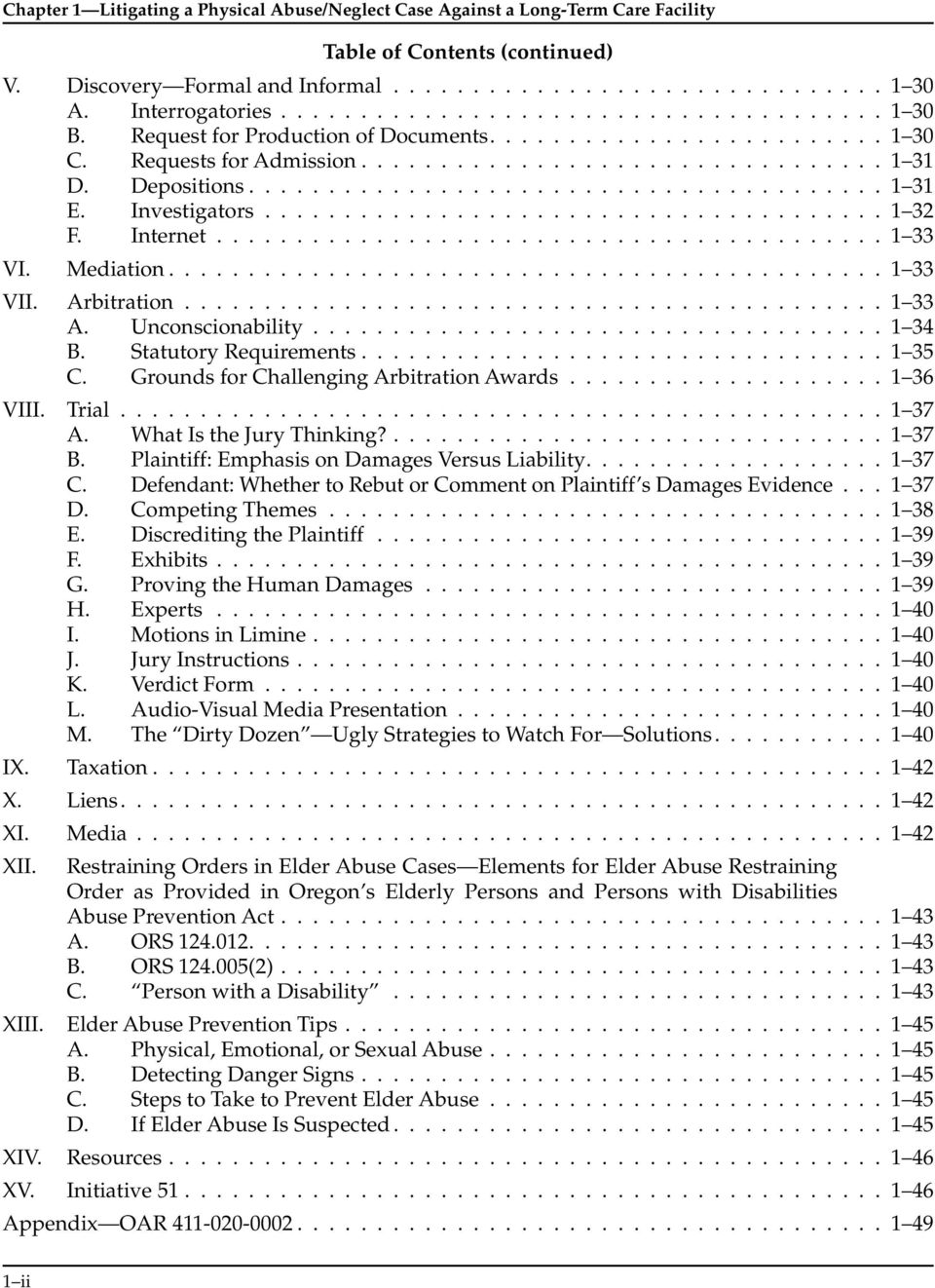
8 Table of Contents (continued) V. Discovery Formal and Informal A. Interrogatories B. Request for Production of Documents C. Requests for Admission D. Depositions E. Investigators F. Internet VI. Mediation VII. Arbitration A. Unconscionability B. Statutory Requirements C. Grounds for Challenging Arbitration Awards VIII. Trial A. What Is the Jury Thinking? B. Plaintiff: Emphasis on Damages Versus Liability C. Defendant: Whether to Rebut or Comment on Plaintiff s Damages Evidence D. Competing Themes E. Discrediting the Plaintiff F. Exhibits G. Proving the Human Damages H. Experts I. Motions in Limine J. Jury Instructions K. Verdict Form L. Audio-Visual Media Presentation M. The Dirty Dozen Ugly Strategies to Watch For Solutions IX. Taxation X. Liens XI. Media XII. Restraining Orders in Elder Abuse Cases Elements for Elder Abuse Restraining Order as Provided in Oregon s Elderly Persons and Persons with Disabilities Abuse Prevention Act A. ORS B. ORS (2) C. Person with a Disability XIII. Elder Abuse Prevention Tips A. Physical, Emotional, or Sexual Abuse B. Detecting Danger Signs C. Steps to Take to Prevent Elder Abuse D. If Elder Abuse Is Suspected XIV. Resources XV. Initiative Appendix OAR ii
9 I. Introduction Oregon has many long-term care facilities such as skilled nursing facilities (SNF), residential care facilities (RCF), and assisted living facilities (ALF). The risk of neglect and abuse does not abate upon admission to a facility. The risk probably increases because elders who are admitted to these facilities are often the most vulnerable, dependent, and sometimes ill. This reality is acknowledged in the extensive system of federal (in the case of SNFs) and state laws intended to protect facility residents from neglect and abuse. Those same laws can be used to hold facilities accountable when a resident suffers neglect or abuse. II. intake and Client Interview A. intake What to Look For and Considerations Thorough client intake of a potential matter is necessary to determine whether there is a sufficient legal and factual basis to assert claims. Additionally, a thorough client intake is necessary to ensure that claims are economically viable to justify a contingency fee arrangement with a lawyer. Victims of abuse and their families rarely can afford to retain a lawyer on an hourly basis to pursue claims against a facility. Facilities and their insurers will often spend hundreds of thousands of dollars to attempt to defeat claims of victims of neglect or abuse in facilities. In some instances, it appears that facilities/insurers use their superior economic strength and litigate every claim without exploring any meaningful attempt to compensate the injured person. Their goal is to create a general deterrence of any injured person who may consider bringing a claim regardless of how meritorious the claim may be. A lawyer should at least obtain the following information before ordering/reviewing the facility and medical records (i.e., hospital) of the victim. 1. Names, contact information, and relationship to victim. 2. Victim s name, DOB, SSN, and marital status. 3. Record of payments to facility and victim s pay source(s) (potential liens). 4. Pending bankruptcy, judgments, and liens. 5. Nature of injuries (photographs), diagnosis, prognosis, and cause of death. 6. Date of injury and discovery of symptoms or first diagnosis. 7. Witnesses, e.g., administrator, director of nursing, RN, LPN, CNA, etc. 8. Did any law enforcement or other public officials investigate the injury? 9. What statements did any person make about the incident? Did anyone take any recorded statement? 10. Does the victim have any pre-existing injuries that could be related to their current injuries? Prior hospitalizations? Prior facilities? 11. List medical providers. 1 1

10 How was the facility chosen (e.g., was it recommend to the family)? 13. Were there any marketing materials from the facility available? 14. Were representations made by the facility prior to placing the victim? 15. Were any notices, citations, and/or surveys posted in the facility? 16. Did the family attend any assessment or care plan meetings? 17. Were there any formal complaints made to the facility or outside organizations? 18. Did the family ever witness abuse of other residents of the facility? 19. Were call lights answered in a timely manner? 20. Was staffing ever an issue? 21. In the case of death, was an autopsy done? Does the family have a copy of the death certificate? 22. Was the victim ever placed in physical or chemical restraints? If so, did they see the victim in those restraints? 23. Did the victim have bruises or bed/pressure sores? 24. Does the victim have a condition that could contribute to the bed sore? 25. Has the victim been diagnosed with Alzheimer s illness or dementia? 26. If the case involves an Alzheimer patient, was the Alzheimer patient in a locked facility? 27. If the case involved an Alzheimer patient, are you aware of any self-abuse? 28. Was the family always notified of changes in the resident s conditions? 29. Was there ever significant weight loss? 30. If so, what was the response by the facility in taking measures to address that weight loss? 31. Did the victim need assistance in eating? 32. Did the patient ever have a swallowing problem? 33. Is there an appointed guardian or power of attorney? Is there a copy? 34. What does the family hope to achieve by bringing a lawsuit? This author s personal opinion is that cases in which there is a definitive injury to an elder is more likely to be economically viable as opposed to a case in which a family has a long laundry list of complaints against a facility. The former is less expensive to develop for a jury, and the latter is more expensive to develop and the additional complexity can harm chances with a favorable jury determination.

11 B. Use of Agency or Criminal Investigation Investigations by adult protective services and local law enforcement can provide valuable sources of evidence of neglect or abuse. The facility complaint reports are available to the public, although identifying information is redacted. Any reports may or may not be admitted at trial depending on the case facts and judge. See the OEC 803(8) public records exception and the OEC 803(6) business records exception and related commentary and cases: Sleigh v. Jenny Craig Weight Loss Ctrs., 61 Or App 262, , 984 P2d 891, modified, rem d on recons, 163 Or App 20 (1999) (803(8); Streight v. Conroy, 279 Or 289, , 566 P2d 1198, 1201 (1977) (803(6)). C. Obtaining Facility Records Records should be requested. 42 C.F.R (2) states that in the case of SNFs: (2) The resident or his or her legal representative has the right (i) Upon an oral or written request, to access all records pertaining to himself or herself including current clinical records within 24 hours (excluding weekends and holidays); and (ii) After receipt of his or her records for inspections, to purchase at a cost not to exceed the community standard photocopies of the records or any portions of them upon request and 2 working days advance notice to the facility. The Oregon version for SNFs is OAR (15) (16), which state that each resident and the resident s legal representative have the right to: (15) Promptly inspect all records pertaining to the resident. (16) Purchase photocopies of records pertaining to the resident. Photocopies requested by the resident must be promptly provided, but in no case require more than two business days (days excluding Saturdays, Sundays and state holidays). OAR (h) states that residents of RCFs and ALFs have the right [t]o have prompt access to review all of their records and to purchase photocopies. Photocopied records must be promptly provided, but in no case require more than two business days (excluding Saturday, Sunday and Holidays). 1 3

12 1 4 III. Causes of Action A. Oregon s Elder Abuse Statute Under Oregon s Elderly Persons and Persons with Disabilities Abuse Prevention Act (EDPAPA) (ORS ), a person may recover the following: A vulnerable person who suffers injury, damage or death by reason of physical abuse or financial abuse may bring an action against any person who has caused the physical or financial abuse or who has permitted another person to engage in physical or financial abuse. The court shall award the following to a plaintiff who prevails in an action under this section: (a) An amount equal to three times all economic damages, as defined in ORS , resulting from the physical or financial abuse, or $500, whichever amount is greater. (b) An amount equal to three times all noneconomic damages, as defined by ORS , resulting from the physical or financial abuse. (c) Reasonable attorney fees incurred by the plaintiff. (d) Reasonable fees for the services of a conservator or guardian ad litem incurred by reason of the litigation of a claim brought under this section. ORS (2). Unfortunately, a resident cannot bring a claim under EDPAPA against a nursing home or like facilities unless it is convicted of a crime of physical abuse specified in ORS (1). ORS (1)(b), ORS (16)(a), (22), (32). A resident may bring a claim under EDPAPA, however, against owners and employees in their individual capacity. As of the time of this writing, no Oregon case has interpreted the Elder Abuse Statute involving claims for physical injury against a longterm care facility. B. washington s Vulnerable Adult Statute Washington has enacted a statute that goes much further in protecting vulnerable adults. Washington s Vulnerable Adult Statute (VAS) (RCW 74.34) provides special protections and legal remedies for the abuse or neglect of vulnerable adults. Long-term care facility residents are covered under the law. RCW Unlike EDPAPA, RCW provides for a statutory cause of action against the facility itself or anyone registered under RCW , even if a crime involving physical abuse has not occurred. The prevailing plaintiff is awarded fees and costs, including attorney fees and the costs for a guardian, guardian ad litem, and any experts necessary for the prosecution of the claim. However, expert testimony is not even required to establish neglect under the statute. Warner v. Regent Assisted Living, 132 Wash. App 126,

13 134 (2006). Moreover, the common law negligence standard does not apply to claims under the VAS. Id. All that needs to be shown is that the vulnerable adult was neglected, as defined under the statute. Id. Under the VAS, statements of family members alone are sufficient to place the claim of neglect before the jury. Id. Neglect is defined in RCW (12) as:... a pattern of conduct or inaction by a person or entity with a duty of care that fails to provide the goods and services that maintain physical or mental health of a vulnerable adult, or that fails to avoid or prevent physical or mental harm or pain to a vulnerable adult; or (b) an act or omission that demonstrates a serious disregard of consequences of such a magnitude as to constitute a clear and present danger to the vulnerable adult s health, welfare, or safety, including but not limited to conduct prohibited under RCW 9A C. Negligence A facility resident or his or her guardian or guardian ad litem may bring a tort claim for injuries caused by negligence in custodial care, premises maintenance, or professional services. The statute of limitations for injuries to persons is two years, although the time may be tolled for disability. ORS (1), ORS ; see also ORS (4) (two-year discovery rule if medical negligence is at issue; five-year statute of repose). The statute of repose for negligent injury to persons is 10 years after the date of the act or omission complained of. ORS (1). If the facility is operated by a governmental body, the Oregon Tort Claims Act requires a notice to be filed within 180 days of the injury. ORS (2). D. Negligence Per Se There are many statutes and regulations regarding long-term care facilities that do not provide for a private cause of action. Even still, these statutes may bolster a negligence claim. Violation of a statute can provide proof by itself of negligence, subject to an emasculating exception. UCJI No The statutes may also provide at trial evidence of whether an actor met the standard of care. UCJI No Some of the statutes and regulations, such as building codes, may provide specific guidance as to the proper standard. While many of the regulations might not add anything to the common law negligence analysis, proving to the jury that the facility did not follow the state s specific guidelines for safety may lend further viability to a claim. Defendants have had limited success in using a motion to dismiss under ORCP 21 to defeat negligence per se claims. The court in Gattman v. Favro, 739 P.2d 572, 86 Or. App. 227 (Or. App., 1987), lists the elements a plaintiff must show: A plaintiff may proceed on such a negligence per se theory when the statute violated so fixes the legal standard of conduct that there is no question of due care left for a factfinder to determine. 1 5
14 1 6 Praegitzer Industries, Inc. v. Rollins Burdick Hunter of Oregon, Inc., 129 Or. App. 628, 632, 880 P.2d 479, 481 (Or. App., 1994) (quoting, 695 P.2d 897 (1985)). Again, this demonstrates that the more specific the statute, the more likely a plaintiff will succeed with negligence per se. The statutes and regulations relevant to a case depend on the type of long-term care facility. The first type is skilled nursing facility (SNF). Federal law also applies to nursing facilities (NF), and Oregon law mentions both SNFs and NFs. For the purposes of this presentation, they are interchangeable, and both will be considered SNFs. OAR (40) provides: Nursing Facility means an establishment with permanent facilities including inpatient beds, that provide medical services, including nursing services, but excluding surgical procedures, and that provide care and treatment for two or more unrelated residents. In this definition, treatment means complex nursing tasks that cannot be delegated to an unlicensed individual. Nursing Facility shall only include facilities licensed and operated pursuant to ORS (2). A residential care facility is defined in OAR (44) as:... a building, complex, or distinct part thereof, consisting of shared or individual living units in a homelike surrounding where six or more seniors and adult individuals with disabilities may reside. The residential care facility offers and coordinates a range of supportive services available on a 24-hour basis to meet the activities of daily living, health, and social needs of the residents as described in these rules. A program approach is used to promote resident self-direction and participation in decisions that emphasize choice, dignity, individuality, and independence. An assisted living facility is defined in OAR (8) as:... a building, complex, or distinct part thereof, consisting of fully, self-contained, individual living units where six or more seniors and adult individuals with disabilities may reside in homelike surroundings. The assisted living facility offers and coordinates a range of supportive services available on a 24-hour basis to meet the activities of daily living, health, and social needs of the residents as described in these rules. A program approach is used to promote resident self-direction and participation in decisions that emphasize choice, dignity, privacy, individuality, and independence. In 1987, Congress passed the Federal Nursing Home Reform Act ( FNHRA ), contained in the Omnibus Budget Reconciliation Act of 1987 ( OBRA 87 ), Pub.L. No , , 1987 U.S.C.C.A.N. (101 Stat.) 1330, to (codified at 42 U.S.C.A. 1395i-3,

15 1396r), which provides for the oversight and inspection of nursing homes that participate in Medicare and Medicaid programs. OBRA 87 applies to SNFs only. A nursing facility must care for its residents in such a manner and in such an environment as will promote maintenance or enhancement of the quality of life of each resident. 42 U.S.C. 1396r(b)(1)(A). A nursing facility must provide services and activities to attain or maintain the highest practicable physical, mental, and psychosocial well-being of each resident in accordance with a written plan of care which (A) describes the medical, nursing, and psychosocial needs of the resident and how such needs will be met; (B) is initially prepared, with the participation to the extent practicable of the resident or the resident s family or legal representative, by a team which includes the resident s attending physician and a registered professional nurse with responsibility for the resident; and (C) is periodically reviewed and revised by such team after each assessment U.S.C. 1396r(b)(2). Under OBRA 87, the Centers for Medicare and Medicaid ( CMS ) have established detailed regulations covering a resident s care. Each resident must receive and the facility must provide the necessary care and services to attain or maintain the highest practicable physical, mental, and psychosocial well-being, in accordance with the comprehensive assessment and plan of care. 42 C.F.R ; see also 42 C.F.R (nursing staff requirements). CMS s interpretive guidelines may be found at Oregon s Nursing Home Patients Bill of Rights can be found at ORS , and these rights include the right to be [f]ree from mental and physical abuse.... ORS (7). The federal guidelines contain a similar list of rights for residents of SNFs, located at 42 C.F.R The applicable state regulations governing SNFs include OAR to and OAR to OAR broadly defines abuse as: (a) Any physical injury to a resident that has been caused by other than accidental means. This includes injuries that a reasonable and prudent individual would have been able to prevent, such as hitting, pinching or striking, or injury resulting from rough handling. (b) Failure to provide basic care or services to a resident that results in physical harm, unreasonable discomfort, or serious loss of human dignity. (c) Sexual contact with a resident, including fondling, caused by an employee, agent, or other resident of a long- 1 7

16 1 8 term care facility by force, threat, duress or coercion, or sexual contact where the resident has no ability to consent. (d) Illegal or improper use of a resident s resources for the personal profit or gain of another individual, borrowing resident funds, spending resident funds without the resident s consent or, if the resident is not capable of consenting, spending resident funds for items or services from which the resident cannot benefit or appreciate, or spending resident funds to acquire items for use in common areas when such purchase is not initiated by the resident. (e) Verbal abuse as prohibited by federal law, including the use of oral, written, or gestured communication to a resident or visitor that describes a resident in disparaging or derogatory terms. (f) Mental abuse as prohibited by law including humiliation, harassment, threats of punishment, or deprivation, directed toward the resident. (g) Corporal punishment. (h) Involuntary seclusion for convenience or discipline. See also 42 C.F.R (b) (federal resident s right to be free from abuse); OAR (7) (Oregon resident s right to be free from abuse); OAR (1) ( Abuse is prohibited. The facility employees, agents and licensee must not permit, aid, or engage in abuse of residents who are under their care. ). More examples of rights contained in the Oregon SNF regulations include the rights to [n]ot be reassigned to a new room within the facility without cause and without adequate preparation for the move in order to avoid harmful effects..., OAR (9), and to [r]eceive care from facility staff trained to provide care that is specific to the resident s disease or medical condition, OAR (22). There are several other sections of the SNF regulations that could be relevant to a negligence per se argument, depending on the facts of the case. A lawyer should look through them for any provisions that might have been violated. Some examples of the types of provisions that could be relevant to certain claims include the following The Quality Assessment and Assurance Committee must conduct an annual review of care practices to ensure quality.... OAR (2). 2. An RN shall ensure completion and documentation of a comprehensive assessment of the resident s capabilities and needs for nursing services within 14 days of admission. Comprehensive assessments shall be updated promptly after any significant change of condition and reviewed no less often than quarterly. This assessment shall be on a form specified by the Division. The assessment shall include the following:... OAR (1)(a).

17 3. Licensed nurse hours must include no less than one RN hour per resident per week. OAR (4)(a). 4. OAR (5)(c) specifies the required ratio of nursing assistants to residents: The number of residents per nursing assistant must not exceed the ratios:.... (B) Beginning April 1, 2009: (i) DAY SHIFT: 1 nursing assistant per 7 residents. (ii) SWING SHIFT: 1 nursing assistant per 11 residents. (iii) NIGHT SHIFT: 1 nursing assistant per 18 residents. 5. OAR provides requirements for certain physician services, such as requiring certain physician positions and detailing the frequency of physician visits. 6. OAR details the requirements for employee orientation and in-service training. 7. OAR provides some guidance into making a safe environment for the residents: (2) Safe Environment. The licensee shall ensure the provision of a safe environment to protect residents from injury. Actions taken by the facility staff shall be consistent with each resident s right to fully participate in his or her own care planning and shall not limit any resident s ability to care for herself/himself: (a) Dangerous Conditions. The licensee shall take all reasonable precautions to protect a resident from possible injury from dangerous conditions; (b) Falling, Wandering, Negligence. The licensee shall take all reasonable precautions to protect a resident from possible injury from falling, wandering, other resident(s), staff and staff negligence; (c) Reasonable Precautions. Reasonable precautions include, but are not limited to, provision and documentation of an assessment and evaluation of resident s condition, medications, and treatments, and completion of a care plan, consistent with OAR ; and, when appropriate: (A) Physician notification; (B) Provision of additional inservice training; and/or (C) Evaluation/adjustment of staffing patterns and supervision. 1 9

18 1 10 (d) The licensee shall take all reasonable precautions to protect a resident from dangerous conditions relating to remodeling or construction. RCFs and ALFs together are subject to their own set of state regulations, which can be found at OAR to Like the SNF regulations, the RCF and ALF regulations contain a residents bill of rights, including the right... [t]o be free from neglect, financial exploitation, verbal, mental, physical or sexual abuse. OAR (1)(f). See also OAR (1) ( Abuse is prohibited. The facility employees, agents and licensee must not permit, aid, or engage in abuse of residents who are under their care ). Abuse is defined for the purposes of the RCF and ALF regulations in OAR (1), which is attached as the Appendix. The RCF and ALF bill of rights also contains a provision, not found in the SNF bill of rights, that a resident has the right [t]o have a safe and homelike environment. OAR (1)(r). Additionally, residents have the right [to] be free from physical restraints and inappropriate use of psychoactive medications. OAR (1)(k). There are several other sections of the RCF and ALF regulations that could be relevant to a negligence per se argument, depending on the facts of the case. A lawyer should look through them for any provisions that might have been violated. Some examples of the types of provisions that could be relevant to certain claims include the following. 1. The facility must develop and implement a written policy that prohibits sexual relations between any facility employee and a resident who did not have a pre-existing relationship. OAR (7)(b). 2. The facility must develop and implement a policy on smoking. OAR (7)(e). 3. A quarterly evaluation of a resident must be performed, addressing the following elements (not exhaustive): Customary routines sleep, dietary, social, and leisure, OAR (5)(a)(A); Mobility ambulation, transfers, assistive devices, OAR (5)(f)(C); Fall risk or history, OAR (5)(m)(A) The facility must have written policies to ensure a resident monitoring and reporting system is implemented 24-hours a day.... OAR (2) The facility must provide health services and have systems in place to respond to the 24-hour care needs of residents.... OAR (1). 6. The facility must conform to various building codes. See generally OAR Regulations for an endorsement of Alzheimer s care units can be found at OAR to OAR (2) defines an Alzheimer s care unit as a special care unit in a designated, separated area for patients and residents with Alzheimer s Disease or

19 other dementia that is locked, segregated or secured to prevent or limit access by a resident outside the designated or separated area. OAR (1) provides standards for the units, including their physical design, physical environment and safety, and egress control. OAR (2) provides regulations regarding staffing, including the requirement of training regarding Alzheimer s disease and other dementia. An individualized care plan shall be developed based upon a psychosocial and physical assessment. OAR (4). In pleading a claim for intentional abuse, it is particularly important to plead that the employee s acts were within the course and scope of employment. See G.L. v. Kaiser Foundation Hospitals, Inc., 306 Or. 54, 757 P.2d 1347 (1988) (hospital not responsible for sexual assault of respiratory therapist; but see dicta regarding long-term care facility at 306 Or at 68); Fearing v. Bucher, 328 Or. 367, 977 P.2d 1163 (1999) (Archdiocese could be found vicariously liable, if acts that were within priest s scope of employment resulted in the acts which led to injury to plaintiff ); Barrington ex rel. Barrington v. Sandberg, 164 Or. App. 292, 991 P.2d 1071 (1999) (police officer s work as supervisor of police cadets was necessary precursor to his misconduct towards female cadet, and the misconduct was direct outgrowth of that work created issue for jury regarding city s respondeat superior liability for officer s intentional tort). E. wrongful Death When the death of a person is caused by the wrongful act or omission of another, the personal representative of the decedent, for the benefit of the decedent s surviving spouse, surviving children, surviving parents and other individuals, if any, who under the law of intestate succession of the state of the decedent s domicile would be entitled to inherit the personal property of the decedent, and for the benefit of any stepchild or stepparent whether that stepchild or stepparent would be entitled to inherit the personal property of the decedent or not, may maintain an action against the wrongdoer, if the decedent might have maintained an action, had the decedent lived, against the wrongdoer for an injury done by the same act or omission. ORS (1). In a wrongful death action, damages may be awarded in an amount that: (a) Includes reasonable charges necessarily incurred for doctors services, hospital services, nursing services, other medical services, burial services and memorial services rendered for the decedent; (b) Would justly, fairly and reasonably have compensated the decedent for disability, pain, suffering and loss 1 11
20 1 12 of income during the period between injury to the decedent and the decedent s death; (c) Justly, fairly and reasonably compensates for pecuniary loss to the decedent s estate; (d) Justly, fairly and reasonably compensates the decedent s spouse, children, stepchildren, stepparents and parents for pecuniary loss and for loss of the society, companionship and services of the decedent; and (e) Separately stated in finding or verdict, the punitive damages, if any, which the decedent would have been entitled to recover from the wrongdoer if the decedent had lived. ORS (2). In wrongful death actions, noneconomic damages are capped at $500,000. ORS (1) ( Except for claims subject to ORS (Definitions for ORS to ) to (ORS to exclusive) and ORS chapter 656, in any civil action seeking damages arising out of bodily injury, including emotional injury or distress, death or property damage of any one person including claims for loss of care, comfort, companionship and society and loss of consortium, the amount awarded for noneconomic damages shall not exceed $500,000. (emphasis added)); Greist v. Phillips, 322 Or. 281, 906 P.2d 789 (1995) (application of statutory cap to wrongful death claim did not violate remedies provision, privileges and immunities provision, or jury trial rights under Oregon Constitution, and application of cap did not violate substantive due process or equal protection under Fourteenth Amendment). The action shall be commenced within three years after the injury causing the death of the decedent is discovered or reasonably should have been discovered by the decedent, by the personal representative or by a person for whose benefit the action may be brought under this section if that person is not the wrongdoer. ORS (1) (emphasis added). In no case may an action be commenced later than the earliest of: (a) Three years after the death of the decedent; or (b) The longest of any other period for commencing an action under a statute of ultimate repose that applies to the act or omission causing the injury, including but not limited to the statutes of ultimate repose provided for in ORS (4), , , and Id. If the facility is operated by a governmental body, the Oregon Tort Claims Act requires a notice to be filed within one year of death.

21 ORS (2). The statute of limitations is two years if the defendant is a governmental body. ORS (9). F. Survival Action Causes of action arising out of injuries to a person, caused by the wrongful act or omission of another, shall not abate upon the death of the injured person, and the personal representatives of the decedent may maintain an action against the wrongdoer, if the decedent might have maintained an action, had the decedent lived, against the wrongdoer for an injury done by the same act or omission. ORS (1). In any such action the court may award to the prevailing party, at trial and on appeal, a reasonable amount to be fixed by the court as attorney fees. ORS (2). Subsection (2) of this section does not apply to an action for damages arising out of injuries that result in death. If an action for wrongful death under ORS is brought, recovery of damages for disability, pain, suffering and loss of income during the period between injury to the decedent and the resulting death of the decedent may only be recovered in the wrongful death action, and the provisions of subsection (2) of this section are not applicable to the recovery. ORS (3). The action shall be commenced within the limitations established in ORS by the injured person and continued by the personal representatives under this section, or within three years by the personal representatives if not commenced prior to death. Id. (emphasis added); see also ORS (1) ( If a person entitled to bring an action dies before the expiration of the time limited for its commencement, an action may be commenced by the personal representative of the person after the expiration of that time, and within one year after the death of the person. ). G. wrongful Death vs. Survival Action The death of an elder who has been injured can raise any issue of whether to assert a wrongful death action and/or a survival action. Because our elders are fragile, any injury to them can cause their immediate death or set off a cascade of events that lead to the death of the resident. A spectrum exists. On the one end, for example, a resident may suffer a fall and break a hip, which in turn often leads to surgery, immobility, failure to thrive over a period of time, pneumonia, and then death. On the other end of the spectrum, a resident may fall and suffer a brain hemorrhage and immediately die as a result. Causation is an important consideration, including a concern about what the death certificate may state as to the cause of death. 1 13
22 1 14 A long list of strategic considerations is at play in deciding whether to pursue one or the other or, alternatively, both simultaneously, in which event an election may be made at a later time. (In some instances, both theories can be submitted to the jury.) A wrongful death action is brought on behalf of the statutory beneficiaries, which may differ from the persons who would benefit under from a recovery to the estate if a survival action is brought. Depending on the circumstances, this may have some impact on who the appropriate client may be to pursue a claim. In the survival action, the plaintiff can recover only the damages related to the injury but not the death. In a wrongful death action, the plaintiff can recover the statutory damages related to the death and, if warranted, the damages for the injury itself for the period of time between injury and death. The prevailing party in a survival action may recover attorney fees while there is no such general provision for a wrongful death claim. Nota Bene: The prevailing party fees provision cuts both ways, though it may not matter to a plaintiff if the estate is insolvent in any event. Wrongful death actions have the statutory cap of $500,000 on noneconomic damages, while a survival action has no cap. Tax considerations may be at play as well, so it is important to contact a specialist if this may be an important factor in deciding which claim to pursue. Finally, how much money may have to be paid back to lien holders may be affected by whether the action is for wrongful death (on behalf of the beneficiaries) or survival action (for the estate). H. Breach of Contract The facility s breach of the contract with the resident may provide a basis for a claim. The contract may provide for a certain level of care that was not met. The statute of limitations for an action on breach of contract is generally six years. ORS Defendants sometime argue that that the two-year statute applies if the liability arises out of contract when a party owes an independent standard of care. See, e.g., Dauven v. St. Vincent Hospital, 130 Or App 584, 883 P2d 241 (1994), subsequent appeal and remand on other grounds, 144 Or App 363 (1996) (plaintiffs could proceed on contract theory when plaintiffs alleged an agreement that set forth hospital s duties). If a breach of contract action is brought for damages, the plaintiff should provide some evidence to the jury as to the amount of damages for services not provided. I. Fraud and Oregon s Unlawful Trade Practices Act A facility s marketing materials or other oral representation may provide the basis for a fraud claim or claim under Oregon s Unlawful Trade Practices Act (UTPA), ORS , A facility s materials can make representations such as 24/7 nurse on duty, safe and secure
23 premises, or superior care. Those representations, however, must be true. A fraud claim generally requires a showing that: (1) the accused had falsely represented a material fact; (2) the accused knew that the representation was false; (3) the misrepresentation was made with the intent to induce the recipient to act or refrain from acting; (4) the recipient justifiably relied on the misrepresentation; and (5) the recipient was damaged by that reliance. Riley Hill General Contractor v. Tandy Corp., 303 Or. 390, , 737 P.2d 595 (1987). To support an allegation of fraud, the misrepresentation need not arise out of an affirmative falsehood active concealment also can satisfy that element. In re Milton O. Brown, 255 Or. 628, , 469 P.2d 763 (1970). A facility s violation of following provisions of ORS of the UTPA may provide the basis for a claim: (e) Represents that real estate, goods or services have sponsorship, approval, characteristics, ingredients, uses, benefits, quantities or qualities that they do not have or that a person has a sponsorship, approval, status, qualification, affiliation, or connection that the person does not have..... (g) Represents that real estate, goods or services are of a particular standard, quality, or grade, or that real estate or goods are of a particular style or model, if they are of another..... (i) Advertises real estate, goods or services with intent not to provide them as advertised, or with intent not to supply reasonably expectable public demand, unless the advertisement discloses a limitation of quantity..... (s) Makes false or misleading representations of fact concerning the offering price of, or the person s cost for real estate, goods or services..... (u) Engages in any other unfair or deceptive conduct in trade or commerce. The statute of limitations for a fraud claims is two years after the date of discovery of the fraud. ORS (1). The statute of limitations for a UTPA claim is one year from the discovery of the unlawful trade practice. ORS (6). 1 15
24 1 16 J. Products Liability If the resident is injured in a facility and a product is at issue, a products liability action should be considered, including any potential claim against the facility as a seller of the product. Oregon s strict products liability statute provides remedies beyond a negligence action for recovery of damages: (1) One who sells or leases any product in a defective condition unreasonably dangerous to the user or consumer or to the property of the user or consumer is subject to liability for physical harm or damage to property caused by that condition, if: (a) The seller or lessor is engaged in the business of selling or leasing such a product; and (b) The product is expected to and does reach the user or consumer without substantial change in the condition in which it is sold or leased. (2) The rule stated in subsection (1) of this section shall apply, even though: (a) The seller or lessor has exercised all possible care in the preparation and sale or lease of the product; and (b) The user, consumer or injured party has not purchased or leased the product from or entered into any contractual relations with the seller or lessor. (3) It is the intent of the Legislative Assembly that the rule stated in subsections (1) and (2) of this section shall be construed in accordance with the Restatement (Second) of Torts sec. 402A, Comments a to m (1965). All references in these comments to sale, sell, selling or seller shall be construed to include lease, leases, leasing and lessor. (4) Nothing in this section shall be construed to limit the rights and liabilities of sellers and lessors under principles of common law negligence or under ORS chapter 72. ORS Punitive damages are also available: (1) In a product liability civil action, punitive damages shall not be recoverable except as provided in ORS (2) Punitive damages, if any, shall be determined and awarded based upon the following criteria: (a) The likelihood at the time that serious harm would arise from the defendant s misconduct; (b) The degree of the defendant s awareness of that likelihood; (c) The profitability of the defendant s misconduct;
25 (d) The duration of the misconduct and any concealment of it; (e) The attitude and conduct of the defendant upon discovery of the misconduct; (f) The financial condition of the defendant; and (g) The total deterrent effect of other punishment imposed upon the defendant as a result of the misconduct, including, but not limited to, punitive damage awards to persons in situations similar to the claimant s and the severity of criminal penalties to which the defendant has been or may be subjected. ORS See also UCJI No (Punitive Damages Products Liability). For a Washington case, see RCW K. Proper Parties In cases against a facility, determining the proper parties can be a challenge. For a variety of reasons, facilities often have numerous entities involved in the establishment and operation of the facility. In a particular case, the facility may have separate entities for investment in the facility, holding company, ownership of the premises, management/ operations, specific services provided to residents, employment of staff, holding the license, among other purposes. For background reading on this issue, see Charles Duhigg, Profits Rise as Care Slips at Nursing Homes, New York Times, September 23, Recently Congress passed the Patient Protection and Affordable Care Act (PPACA), also known as Obamacare. The act includes several provisions increasing transparency in the ownership and management of nursing homes (SNFs only). SNFs are now required to report to the federal and state governments details of all persons or entities who: (1) exercise operational, financial, or managerial control over the facility or part of the facility or that provide policies and procedures or financial or cash management services; (2) lease or sublease real property to the facility; or (3) provide management or administrative services, management or clinical consulting services, or accounting of financial services to the facility. PPACA Starting in March 2013, this information must be made available to the public. Id. IV. Damages Damages means compensation in money for a loss or damage. Black s Law Dictionary, 6th ed. (1990). Damage means [l]oss, injury, or deterioration, caused by the negligence, design, or accident of one person to another, in respect of the latter s person or property. Id. In 1 17
26 1 18 the personal injury context, the damages usually consist of economic (property, medical bill, wage loss, etc.) and noneconomic (pain, mental suffering, emotional distress, and humiliation) damages. In more colloquial terms, recovering damages means giving back what the bad actor took or fixing what the bad actor broke. Liability is the means and damages are the end to make a plaintiff whole. Prepare your jury instructions at an early stage of the case before the filing of the complaint for a plaintiff and before filing an answer for a defendant. This single step will provide for more effective trial preparation. The goal of this section is modest to provide some basic information about proving damages and stimulate thought about effective strategies for plaintiff s and defense counsel in handling damages throughout a case. There is no single tool for every unique case circumstance. Use good judgment and select accordingly from your toolbox. A. Economic Economic damages means objectively verifiable monetary losses including but not limited to reasonable charges necessarily incurred for medical, hospital, nursing and rehabilitative services and other health care services, burial and memorial expenses, loss of income and past and future impairment of earning capacity, reasonable and necessary expenses incurred for substitute domestic services, recurring loss to an estate, damage to reputation that is economically verifiable, reasonable and necessarily incurred costs due to loss of use of property and reasonable costs incurred for repair or for replacement of damaged property, whichever is less. ORS (2)(a). See also UCJI (Damages Economic). B. medical Bills To recover for medical bills, the amounts must be reasonable and incurred on account of necessary medical treatment related to the injury claimed. ORS (2)(a). Expert medical testimony is used to prove medical bills as to the necessity and reasonableness. Requests for admission are often used to establish the claim for medical bills. Consider retaining a life care planner to estimate the future medical, rehabilitative, vocational, and counseling expenses for a catastrophically injured plaintiff. The life care plan is usually based on a doctor s diagnosis, prognosis, and medical needs of the patient. Life care plans can span many years, in which case an expert is needed to calculate the inflation of the medical costs and then reduce to present value. See also UCJI No (Future Economic Damages Present Value).
27 C. Collateral Source Rule At common law, the collateral source rule in Oregon provided that benefits received by a plaintiff from sources independent of the defendant did not diminish the amount of damages recoverable even if the plaintiff received the benefits on account of the injury. Cary v. Burris, 169 Or 24, 28 29, 127 P2d 126 (1942). Collateral benefits included such payments from gratuitous medical care, insurance proceeds, continued salary and wage payments, welfare and pension benefits, and gifts or contributions. 22 Am. Jur. 2D Damages, (1988). In 1987, this common-law rule was substantially modified under ORS (formerly ORS ) to allow courts to deduct certain collateral benefits received from the amount of damages awarded after trial, except for benefits received from certain sources specifically listed in the statute. ORS provides: (1) In a civil action, when a party is awarded damages for bodily injury or death of a person which are to be paid by another party to the action, and the party awarded damages or person injured or deceased received benefits for the injury or death other than from the party who is to pay the damages, the court may deduct from the amount of damages awarded, before the entry of final judgment, the total amount of those collateral benefits other than: (a) Benefits which the party awarded damages, the person injured or that person s estate is obligated to repay; (b) Life insurance or other death benefits; (c) Insurance benefits for which the person injured or deceased or members of that person s family paid premiums; and (d) Retirement, disability and pension plan benefits, and federal social security benefits. (2) Evidence of the benefit described in subsection (1) of this section and the cost of obtaining it is not admissible at trial, but shall be received by the court by affidavit submitted after the verdict by any party to the action. (Emphasis added.) As defined above, a collateral benefit is any benefit received by a plaintiff from sources independent of the defendant. These include insurance benefits for which plaintiff paid premiums. Thus, if a plaintiff receives a benefit from any of the above-listed sources, the court does not have any authority to reduce the damages awarded to a plaintiff for bodily injuries at trial. And while the court does have the authority to deduct from plaintiff s bodily injury damages certain nonqualifying collateral benefits (those benefits not specifically listed in the statute) from the amount of damages awarded by the jury after trial, all evidence of collateral benefits remains inadmissible as evidence during the underlying trial as provided in ORS (2). 1 19
28 1 20 Furthermore, admission of a collateral source benefit at trial, even for limited purposes, has been held to constitute an abuse of discretion and is reversible error. Reinan v. Pacific Motor Trucking Co., 270 Or. 208, , 527 P.2d 256 (1974); Shepler v. Weyerhaeuser Company, 279 Or. 477, , 569 P2d 1040 (1977). A court should not, before trial, force a plaintiff to reduce his/ her total medical expenses incurred, taking into account all collateral source benefits received by plaintiff. If medical expenses were dealt with in this fashion, there would be no need for the court, post-verdict, to adjust any damages award to plaintiff under the collateral source rule. This result would render ORS meaningless, put the court in the position of ruling pretrial which medical bills have been paid, by whom, and determining the amounts still owing or which amounts for which plaintiff is still liable. This would also put plaintiff in the position of having to explain to the jury why plaintiff s total medical charges are a portion of what is reflected on the actual billing statements. In addition, plaintiff would not be able to offer evidence that the total medical charges reflected on plaintiff s medical bills are reasonable in value through her expert testimony, which she is allowed to do by law. See UCJI (citing DeVaux, supra). U.S. District Court Magistrate Stewart extensively analyzed this issue in the context of Medicare write-offs in Liner v. Bellingham, Civil No ST (D. Or. August 6, 2003). Defendants in Liner argued that the term incurred as used in ORS (2)(a) should be interpreted to limit damages to amounts ultimately paid for medical services rendered to plaintiff, which would exclude amounts written off by the providers. There, they relied on the Department of Human Services lien statute ORS , as interpreted in King v. Or. Dep t of Human Services, 142 Or. App. 444, 921 P.2d 1326 (1996). In a thoughtful and well-reasoned opinion, Judge Stewart found defendants argument flawed for several reasons. Liner, pp Judge Owen Panner also has ruled to allow the pleading and proof of the full amount in Cole v. Builder s Square, Civil No PA (D. Or. September 8, 2003). The definitive case in Oregon is White v. Jubitz Corp., 347 Or. 212, 219 P.3d 566 (Or., 2009), in which the Supreme Court affirmed the Court of Appeals and trial court s (Honorable Henry Kantor) denial of defendant s motion to reduce the amount of recoverable medical expenses by the amount written off by Medicare. The injured plaintiff in that case had incurred $38,977 in medical expenses, and Medicare paid $13,426 and wrote off the remainder. The defendant in White had argued that the trial court should reduce the jury award by the portion of the expenses that the medical providers had written off, relying on ORS and (2)(a). With respect to the defendant s ORS argument, the Court stated: By its terms, ORS applies only to civil actions where a party is awarded damages for bodily injury or death. In those actions, subsection (1) permits, but does not require,
29 a trial court to deduct from a plaintiff s award of damages those benefits that a plaintiff receives from a third party. Paragraphs (a) through (d) limit the circumstances in which a court may exercise its discretion to do so. Id. at 222. The Court determined that Medicare benefits of plaintiff (including the benefits of the write offs ) were within the meaning of ORS (d):... we think that the term federal Social Security benefits is comprehensive and includes Medicare benefits. Id. at 230. Thus, the Court concluded that the Medicare collateral source benefits were not to be deducted from the jury award. With respect to ORS (2)(a), which the defendant claimed limited the economic damages to what the plaintiff actually paid or was obligated to pay, the Court determined that defendant was not entitled to have the jury s verdict reduced on that basis: The first problem with that argument is that ORS (2) does not define or limit the compensatory damages that a plaintiff may recover. ORS (2) introduces the definition of economic damages with the phrase as used in this section and therefore defines economic damages for the purposes of ORS ORS (1) indicates that the purpose of that statute is to describe the damages that are subject to a statutory cap (noneconomic damages) and those that are exempt from that cap (economic damages). Because this case does not present an issue relating to the statutory cap, the definition in ORS is not directly applicable. Id. at 232. D. Noneconomic (Also Known as Human) Noneconomic damages means subjective, nonmonetary losses, including but not limited to pain, mental suffering, emotional distress, humiliation, injury to reputation, loss of care, comfort, companionship and society, loss of consortium, inconvenience and interference with normal and usual activities apart from gainful employment. ORS (2)(b) (emphasis added). See also UCJI Nos (Damages Noneconomic) and (Damages Permanent Injury Life Expectancy Mortality Tables). E. Previous Infirm Condition Effective defense counsel will work to show the jury that damages, if any, should be limited only to those suffered and compensable under the law. From the other direction, effective plaintiffs counsel will work to show the jury that the full, reasonable measure of damages as compensable under the law should be provided. The following instructions are helpful. 1 21
30 1 22 UCJI No DAMAGES PREVIOUS INFIRM CONDITION If you find that the [plaintiff/defendant] had a bodily condition that predisposed [him/her] to be more subject to injury than a person in normal health, nevertheless the [plaintiff/defendant] would be liable for any and all injuries and damage that may have been suffered by the [plaintiff/defendant] as the result of the negligence of the [plaintiff/defendant], even though those injuries, due to the prior condition, may have been greater than those that would have been suffered by another person under the same circumstances. UCJI No DAMAGES AGGRAVATION OF PREEXISTING INJU- RY OR DISABILITY In the present case the [plaintiff/defendant] has alleged that the injury which [he/she] sustained as the result of the negligence of the [plaintiff/defendant] aggravated a preexisting [injury/disability] of [his/hers]. In determining the amount of damages, if any, to be awarded the [plaintiff/defendant] in this case, you will allow [him/her] reasonable compensation for the consequences of any such aggravation that you find to have taken place as the result of [plaintiff/defendant] s negligence. The recovery should not include damages for the earlier [injury/disability] but only those that are due to its enhancement or aggravation. F. Attorney Fees Attorney fees are the exception rather than the rule in personal injury cases. But consider that attorney fees are available in survival actions. In any such action the court may award to the prevailing party, at trial and on appeal, a reasonable amount to be fixed by the court as attorney fees. ORS (2). Pursuant to ORCP 68 C(2)(a): A party seeking attorney fees shall allege the facts, statute or rule that provides a basis for the award of such fees in a pleading filed by that party. Attorney fees may be sought before the substantive right to recover such fees accrues. No attorney fees shall be awarded unless a right to recover such fee is alleged as provided in this subsection. The Oregon Elder Abuse Statute s attorney fees provision is located in ORS (2). Washington s Vulnerable Adult Statute s attorney fees provision is located in RCW (3). Attorney fees are also available in a survival action if the injuries did not result in death. ORS (2) (3).
31 G. Punitive Damages Chapter 1 Litigating a Physical Abuse/Neglect Case Against a Long-Term Care Facility Punitive damages are not recoverable in a civil action unless it is proven by clear and convincing evidence that the party against whom punitive damages are sought has acted with malice or has shown a reckless and outrageous indifference to a highly unreasonable risk of harm and has acted with a conscious indifference to the health, safety and welfare of others. ORS (1). If an award of punitive damages is made by a jury, the court shall review the award to determine whether the award is within the range of damages that a rational juror would be entitled to award based on the record as a whole, viewing the statutory and common-law factors that allow an award of punitive damages for the specific type of claim at issue in the proceeding. ORS (2). In addition to any reduction that may be made under subsection (2) of this section, upon the motion of a defendant the court may reduce the amount of any judgment requiring the payment of punitive damages entered against the defendant if the defendant establishes that the defendant has taken remedial measures that are reasonable under the circumstances to prevent reoccurrence of the conduct that gave rise to the claim for punitive damages. In reducing awards of punitive damages under the provisions of this subsection, the court shall consider the amount of any previous judgment for punitive damages entered against the same defendant for the same conduct giving rise to a claim for punitive damages. ORS (3). When seeking punitive damages, practitioners should be familiar with the applicable constitutional issues. See Bocci v. Key Pharmaceuticals, Inc., 190 Or. App. 407, 79 P.3d 908, (2003) (considering ratio issue in light of State Farm v. Campbell, 538 U.S. 408, 123 S.Ct. 1513, 1524, 155 L.Ed.2d 585 (2003)); Bocci v. Key Pharmaceuticals, Inc., 189 Or. App. 349, 76 P.3d 669, (2003); Philip Morris USA v. Williams, 127 S.Ct. 1057, 166 L.Ed.2d 940, 75 USLW 4101, Prod.Liab.Rep. (CCH) P 17,676, 07 Cal. Daily Op. Serv. 1754, 20 Fla. L. Weekly Fed. S 80 (U.S.Or. Feb 20, 2007) (considering issue of evidence of harm to nonparties). If the action is filed in state court, plaintiff may not plead a demand for punitive damages in the initial pleading. ORS (2) provides in part: At the time of filing a pleading with the court, the pleading may not contain a request for an award of punitive damages. At any time after the pleading is filed, a party may 1 23
32 1 24 move the court to allow the party to amend the pleading to assert a claim for punitive damages. The party making the motion may submit affidavits and documentation supporting the claim for punitive damages. The party or parties opposing the motion may submit opposing affidavits and documentation. A court may not award punitive damages against a health practitioner unless there is a showing of malice. ORS The definition of health practitioner does not include a facility itself, and facilities are subject to punitive damages for the wrongful acts of their employees even without a showing of malice. Johannesen v. Salem Hospital, 336 Or 211, 82 P3d 139 (2003). Therefore, Uniform Civil Jury Instruction (UCJI) (Punitive Damages General) applies rather than UCJI (Punitive Damages Health Care Practitioner). The $500,000 cap in ORS does not apply to punitive damages. ORS (3). See also Court/CivilMotionPanel_CivilMotionPanelStatementOf Consensus.pdf (relating to requesting punitive damages). Although the State of Oregon does not help a plaintiff pursue a claim for punitive damages, the government recovers a share of any punitive damages recovery. A large share of any award of punitive damages is taken away from the plaintiff and transferred to the State of Oregon: (1) Upon the entry of a verdict including an award of punitive damages, the Department of Justice becomes a judgment creditor as to the amounts payable under paragraphs (b) and (c) of this section, and the punitive damage portion of an award shall be allocated as follows: (a) Thirty percent is payable to the prevailing party. The attorney for the prevailing party shall be paid out of the amount allocated under this paragraph, in the amount agreed upon between the attorney and the prevailing party. However, in no event may more than 20 percent of the amount awarded as punitive damages be paid to the attorney for the prevailing party. (b) Sixty percent is payable to the Attorney General for deposit in the Criminal Injuries Compensation Account of the Department of Justice Crime Victims Assistance Section, and may be used only for the purposes set forth in ORS chapter 147. However, if the prevailing party is a public entity, the amount otherwise payable to the Criminal Injuries Compensation Account shall be paid to the general fund of the public entity.
33 (c) Ten percent is payable to the Attorney General for deposit in the State Court Facilities and Security Account established under ORS (State Court Facilities and Security Account), and may be used only for the purposes specified in ORS (State Court Facilities and Security Account ) (2)(d). (2) The party preparing the proposed judgment shall assure that the judgment identifies the judgment creditors specified in subsection (1) of this section. (3) Upon the entry of a verdict including an award of punitive damages, the prevailing party shall provide notice of the verdict to the Department of Justice. In addition, upon entry of a judgment based on a verdict that includes an award of punitive damages, the prevailing party shall provide notice of the judgment to the Department of Justice. The notices required under this subsection must be in writing and must be delivered to the Department of Justice Crime Victims Assistance Section in Salem, Oregon within five days after the entry of the verdict or judgment. (4) Whenever a judgment includes both compensatory and punitive damages, any payment on the judgment by or on behalf of any defendant, whether voluntary or by execution or otherwise, shall be applied first to compensatory damages, costs and court-awarded attorney fees awarded against that defendant and then to punitive damages awarded against that defendant unless all affected parties, including the Department of Justice, expressly agree otherwise, or unless that application is contrary to the express terms of the judgment. (5) Whenever any judgment creditor of a judgment which includes punitive damages governed by this section receives any payment on the judgment by or on behalf of any defendant, the judgment creditor receiving the payment shall notify the attorney for the other judgment creditors and all sums collected shall be applied as required by subsections (1) and (4) of this section, unless all affected parties, including the Department of Justice, expressly agree otherwise, or unless that application is contrary to the express terms of the judgment. Note: Section 3, chapter 689, Oregon Laws 2011, provides: Sec. 3. The amendments to ORS (Distribution of punitive damages) by section 1 of this 2011 Act apply only to causes of action that arise on or after the effective date of this 2011 Act [August 2, 2011]. [2011 c.689 3] ORS
34 1 26 Plaintiffs counsel may often as a matter of strategy claim a lower amount of punitive damages as substantial portion of any recovery is handed over to the State of Oregon. See also UCJI No (Punitive Damages General); UCJI No (Punitive Damages Health Care Practitioner). H. Pleading Requirements A pleading which asserts a claim for relief, whether an original claim, counterclaim, cross-claim, or third party claim, shall contain:.... B A demand of the relief which the party claims; if recovery of money or damages is demanded, the amount thereof shall be stated; relief in the alternative or of several different types may be demanded. ORCP 18. Noneconomic damages, however, need not be stated in a specific amount in the complaint. McKenzie v. Pacific Health & Life Ins. Co., 118 Or App 377, 382, 847 P2d 879 (1993). In Oregon state court practice, the claimant must request leave of court to plead a claim for punitive damages: (1) A pleading in a civil action may not contain a request for an award of punitive damages except as provided in this section. (2) At the time of filing a pleading with the court, the pleading may not contain a request for an award of punitive damages. At any time after the pleading is filed, a party may move the court to allow the party to amend the pleading to assert a claim for punitive damages. The party making the motion may submit affidavits and documentation supporting the claim for punitive damages. The party or parties opposing the motion may submit opposing affidavits and documentation. (3) The court shall deny a motion to amend a pleading made under the provisions of this section if: (a) The court determines that the affidavits and supporting documentation submitted by the party seeking punitive damages fail to set forth specific facts supported by admissible evidence adequate to avoid the granting of a motion for a directed verdict to the party opposing the motion on the issue of punitive damages in a trial of the matter; or (b) The party opposing the motion establishes that the timing of the motion to amend prejudices the party s ability to defend against the claim for punitive damages. (4) The court may grant a continuance on a motion under this section to allow a party opposing the motion to
35 conduct such discovery as is necessary to establish one of the grounds for denial of the motion specified in subsection (3) of this section. If the court grants the motion, the court may continue the action to allow such discovery as the defendant may require to defend against the claim for punitive damages. (5) Subject to subsection (4) of this section, the court shall conduct a hearing on a motion filed under this section not more than 30 days after the motion is filed and served. The court shall issue a decision within 10 days after the hearing. If no decision is issued within 10 days, the motion shall be considered denied. (6) Discovery of evidence of a defendant s ability to pay shall not be allowed by a court unless and until the court grants a motion to amend a pleading under this section. ORS (formerly ORS ). The no evidence standard applies. It is clear, then, that by referring to the directed verdict standard in ORS (3), the legislature intended the trial court to determine the sufficiency of evidence supporting a claim for punitive damages under the well-established no evidence standard (or, conversely, the some evidence standard) set out in this court s decision.... Bolt v. Influence, Inc., 333 Or. 572, 579, 43 P.3d 425, 428 (2002). [T]he clear and convincing burden of proof in ORS (1), which refers to the ultimate burden of proof that a plaintiff must meet to recover punitive damages, has no relation to the burden associated with the directed verdict standard used to review the sufficiency of evidence on a motion under ORS (3). A plaintiff satisfies the latter by producing some evidence in support of a prima facie case. Id. See also Court/CivilMotionPanel_CivilMotionPanelStatementOfConsensus.pdf (relating to requesting punitive damages). In federal court, however, the plaintiff is not required to make the showing under ORS to plead a claim for punitive damages. ORS conflicts with the Federal Rules of Civil Procedure and therefore does not apply in diversity cases in federal court. Pruett v. Erickson Air- Crane Co., 183 F.R.D. 248, (D.Or. 1998) (Aiken, J.). Defendants sometimes challenge the court s ruling in Pruett, but the court has been steadfast in rejecting those challenges. See, e.g., Eastwood v. American Family Mut. Ins. Co., 2006 WL at *5 (D.Or. Oct 12, 2006) (Haggerty, J.) (following Pruett and allowing punitive damages amendment); King 1 27
36 1 28 v. Deutsche Bank Ag, 2005 WL at *36 (D.Or. Mar. 8, 2005) (Hubel, J.) (following Pruett and recommending denial of defendants motion to strike punitive damages claim); Burkhart v. L.M. Becker & Co., 2004 WL at *2 (D.Or. Aug. 26, 2004) (Stewart, J.) (following Pruett and allowing amendment to add punitive damages claim). I. mitigation of Damages A person who suffered damage has a duty to exercise reasonable care to avoid increasing that damage. There can be no recovery for increased damage caused by the failure to exercise such case. UCJI No (Damages Avoidable Consequences). J. damages Caps (1) Except for claims subject to ORS to and ORS chapter 656, in any civil action seeking damages arising out of bodily injury, including emotional injury or distress, death or property damage of any one person including claims for loss of care, comfort, companionship and society and loss of consortium, the amount awarded for noneconomic damages shall not exceed $500, ORS (emphasis added). The $500,000 cap has been held to be unconstitutional as applied to personal injury cases not involving death. See Lakin v. Senco Products, Inc., 329 Or 62, 82, 987 P.2d 463, 473 (1999) ( The legislature may not interfere with the full effect of a jury s assessment of noneconomic damages, at least as to civil case in which the right to a jury trial was customary in 1857, or in case of like nature. ) In wrongful death actions, noneconomic damages are capped at $500,000. ORS ; Greist v. Phillips, 322 Or. 281, 906 P.2d 789 (1995) (application of statutory cap to wrongful death claim did not violate remedies provision, privileges and immunities provision, or jury trial rights under Oregon Constitution, and application of cap did not violate substantive due process or equal protection under Fourteenth Amendment). See also Hughes v. PeaceHealth, 344 Or. 142, 178 P.3d 225 (2008) (upholding statute against constitutional challenge). ORS (1) and related provisions were at issue in the Supreme Court s decision of Clarke v. Oregon Health & Sciences Univ., 343 Or 581, 588, 175 P.3d 418, 422 (2007), which held: [W]e hold that (1) OHSU would have been entitled to sovereign immunity at common law and, therefore, plaintiff would have had no common-law claim against OHSU that is entitled to protection under Article I, section 10; (2) because OHSU is entitled to sovereign immunity, the legislature can limit damages recoverable against OHSU to any amount it chooses, unfettered by Article I, section 10 s Remedy Clause; however, (3) the elimination of a cause of action against public employees or agents in ORS (1), as applied to plaintiff s claim against the individual defen-
37 dants, violates the Remedy Clause of Article I, section 10, because the substituted remedy against the public body, as specified in ORS (1), is an emasculated version of the remedy that was available at common law. The $500,000 cap in ORS does not apply to punitive damages. ORS (3). The damage cap in ORS is also not an issue to be considered by the jury. The jury shall not be advised of the limitation set forth in this section. ORS (4). ORS (2) uses a sliding scale based on the time the cause of action arose to limit the liability of the state, and the liability of the state s officers, employees and agents acting within the scope of their employment or duties, to any single claimant... to:.... (c) $1.7 million, for causes of action arising on or after July 1, 2001, and before July 1, (d) $1.8 million, for causes of action arising on or after July 1, 2012, and before July 1, The total amount of damages for all claimants arising out of a single accident or occurrence is also based on a sliding scale, and is limited to:.... (c) $3.4 million, for causes of action arising on or after July 1, 2011, and before July 1, (d) $3.6 million, for causes of action arising on or after July 1, 2012, and before July 1, In a similar manner, ORS uses a sliding scale based on the time the cause of action arose to limit the liability of a local public body, and the liability of the public body s officers, employees and agents acting within the scope of their employment or duties, to any single claimant... to:.... (c) $566,700, for causes of action arising on or after July 1, 2011, and before July 1, (d) $600,000, for causes of action arising on or after July 1, 2012, and before July 1, The total amount of damages for all claimants against a local public body, arising out of a single accident or occurrence, is also based on a sliding scale and is limited to:.... (c) $1,133,300, for causes of action arising on or after July 1, 2011, and before July 1, (d) $1,200,000, for causes of action arising on or after July 1, 2012, and before July 1,
38 1 30 K. Comparative Fault While Oregon no longer has a contributory negligence defense, any award of damages will be affected by comparative fault on negligence. See Oregon s comparative negligence statutes at ORS to ; see also UCJI Nos to (relating to comparative negligence) and UCJI Nos to (relating to apportionment of damages). V. Discovery Formal and Informal Effective lawyers will always start their informal discovery as early as possible, having prepared the jury instructions as a guide. Plaintiff s counsel will secure the concrete evidence of injury such as photographs, news media coverage, torn clothing, rehabilitative aids, etc. Defense counsel will check out Google and any Facebook pages maintained by the plaintiff and talk to the plaintiff s friends about the injury or death. A. Interrogatories Interrogatories are not allowed under the Oregon Rules of Civil Procedure, but they are allowed under the Federal Rules of Civil Procedure. Inquiry should be made into the following areas: F Employees employed at the time of incident and/or injury; F Residents in the facility at the time of incident and/or injury; F Identity of administrator, DNS, CNAs, dietary consultants, etc.; F Existence of documents; F Persons with knowledge of events; F Identity of investigations/violations; F Identity of management and consulting companies; F Identity of members of the Quality Assurance Committee; F Factual bases of defenses; F Prior complaints; F Employee suggestions; and F Prior lawsuits. B. request for Production of Documents Requests should be made for the following documents: F Facility floor plan: F Insurance policy; F Nursing home medical chart (including ADL sheets, MDSs, etc.); F Assessments and care plans for resident; F Narcotics logs; F Revenue/remittance and reimbursements; F Third-party billing information; F Billing file; F Administrative/nursing policies and procedures; F Policies and procedures and resident assessment protocol (RAP);
39 F Corporate guidelines; F Records related to ownership; F Personnel policies and procedures; F Training and in-service records; F Work schedules and time cards; F Census sheets; F Financial and budget information; F Employee personnel files; F Job descriptions; F Staffing agency records; F Government surveys and reports; F HCFA reports; F Complaints; F Internal and external (surveys) reports and investigations; F 911, police, and fire; F Pressure sore reports; F Corporate organizational chart; F Death certificate and/or medical examiner documents and photos; F Pictures; and F Advertising and brochures. C. requests for Admission These should be tailored to pin down the defendants on key liability issues. D. Depositions The following defendant-employees may be deposed in SNF cases: F Administrator (42 C.F.R (2); OAR ); F Director of nursing services (OAR ); F Certified nursing assistants; F Caregivers (who are not required to be licensed by state); F Medical director (42 C.F.R (i); OAR (1)); F House doctors (42 C.F.R ; OAR (2), (4)(a)); and F Custodian of Records. The analogues as applicable in RCF and ALF may be deposed. Depositions of the party may be taken under FRCP 30(b)(6) and ORCP 39 C(6). It may be important to videotape key depositions. These videotapes depositions can be very effective at mediation and subsequently at trial. The goals of defendant taking the plaintiff s deposition are to (1) learn facts; (2) pin down the plaintiff to those facts; and (3) lay any groundwork for discrediting the plaintiff. In elder cases, the plaintiff is often a family member who is serving as the guardian ad litem or personal representative of the estate of the now-deceased resident. Defense counsel may cover the following topics in the plaintiff s deposition as appropriate: 1 31
40 1 32 F Name; F Address; F Social Security number, date of birth, telephone; F Employment and educational history; F Any on-the-job accidents or workers compensation claims; F Previous experiences with lawsuits; F History of activities; F Prior accidents; F Prior injuries and counseling; F Convictions; F Plaintiff s recorded statement or statement to investigator; F Any reports to ER; F Consultation of any nontraditional heath care providers; F Event in question what happened, who, witnesses, emergency personnel, statements made by anyone before, during, after event; F Any and all injuries what they are; F All past and present health care providers; F Intensity (0 10) and duration of pain; F Time to heal; F Treatment history for each injury; F Current condition of each injury; F Any future medical treatment; F Permanency; F Emotional impact (internal vs. external); F Effect of injuries on life; F Counseling; F Past diseases in family; F Any apologies or admissions; F Photographs; F Photographs during deposition; F Plaintiff s pleadings; F What defendant did wrong; F Why plaintiff filed this lawsuit; F When plaintiff first thought about a lawsuit or contacted a lawyer; and F How many times the elder was visited by family. Defense counsel may consider an ORCP 44 examination (also known as IME or DME), but must make the required good cause showing. See Delcastillo v. Norris, 197 Or App 134 (2005), rev den 338 Or 488; see also consensus.pdf (relating to terms and conditions). E. Investigators Private investigators are often an essential part of the litigation team. By interviewing facility employees and particularly any former employees, investigators can obtain information that is not contained
41 in the facility s records. This informal investigation can also provide explanations for irregularities in facility records. Before initiating any contact with employees or former employees of a facility, it is important to be familiar with Oregon s RPC 4.2 (formerly DR 7-104(A)(1)). RPC 4.2 prohibits contact with represented parties except in certain circumstances. For application of the rule in the entity context, guidance may be found in Oregon Formal Ethics Opinions (corporate context) and (governmental context). Employees whose conduct upon which a party intends to hold the facility liable cannot be contacted. Employees who are merely occurrence witnesses, however, may be contacted. F. Internet Information about quality measures, nursing home staffing, and inspection results for particular nursing homes can be found at medicare.gov. Quality measures information comes from resident assessment data that nursing homes routinely collect on all residents at specific intervals during their stay. The information collected pertains to the residents physical, clinical conditions, and abilities. Nursing home staffing information comes from reports that the nursing home reports to its state survey agency. It contains the nursing staff hours for a twoweek period prior to the time of the state inspection. The Centers for Medicare and Medicaid Services receives this data and converts the reported information into the number of staff hours per resident per day. Inspection results information refers to the regulatory requirement that the nursing home failed to meet but does not reflect the entire inspection report. The internet generally is a very rich source of information on a party. If useful information is found, ensure that it is properly preserved for potential use in the proceeding. It is a good idea for a paralegal to preserve the information so he/she may later retrieve and authenticate the information. VI. MediATion Mediation of elder neglect cases generally involves the same considerations applicable to personal injury cases. The only exception is that case value may be greater when an elder is injured. With the aging of the baby boomers and their parents, our community is holding our elders in more esteem. VII. ArbitrATion Some facilities require their prospective residents or respective representatives to waive their constitutional rights to a jury trial. Oregon courts have held that arbitration clauses can be constitutional if the constitutional rights were voluntarily waived. Carrier v. Hicks, 316 Or 341, 352, 851 P2d 581 (1993); Barackman v. Anderson, 338 Or 365, 372, 109 P3d 370 (2005). However, a number of grounds exist to defeat or limit arbitration clauses, including unconscionability and statutory or regulatory requirements. Note that there are also several basic contract requirements that might be lacking, such as offer, acceptance, 1 33
42 1 34 mutual consent, or consideration. The Oregon appellate courts have not addressed arbitration clauses in contracts between a long-term care facility and a prospective resident. A. Unconscionability 1. Oregon. Oregon courts have recognized two categories of unconscionability: procedural and substantive. Vasquez-Lopez v. Ben. Or., Inc., 210 Or App 553, , 152 P3d 940 (2007). Procedural unconscionability is centered on contract formation and is based on the two factors of (a) oppression, the inequality of bargaining power, and (b) surprise, whether the terms are hidden in a prolix printed form drafted by the party seeking to enforce the terms. Id. Though no Oregon courts have analyzed the enforceability of an arbitration clause in a long-term care facility contract, a lawyer may argue that an elderly person, especially with diminished physical or mental health, is on unequal footing with the facility and is unable to navigate prolixity. Substantive unconscionability refers to the one-sided nature of the substantive terms. Id. Though the relative merits of arbitration versus trial for each side can be debated, the specific terms of the arbitration clause may be one-sided and unenforceable. Vasquez-Lopez, 210 Or App at (substantially unconscionable terms included a class action ban, a cost-splitting provision, and a confidentiality agreement); Motsinger v. Lithia Rose-Ft, Inc., 211 Or App 610, 617, 156 P3d 156 (2007) (terms included a requirement that the loser pay the arbitration fees and a term that the arbitration clause only applied to claims brought by the employee). Arguments about the enforceability of a particular arbitration clause depend on the facts and circumstances of each case as applied to the law. 2. Washington. Washington courts also recognize two categories of unconscionability: procedural and substantive. Adler v. Fred Lind Manor, 153 Wn.2d 331, 344,103 P.3d 773, 781 (2005). Procedural unconscionability is the lack of a meaningful choice, considering all the circumstances surrounding the transaction including [t]he manner in which the contract was entered, whether the party had a reasonable opportunity to understand the terms of the contract, and whether the important terms [were] hidden in a maze of fine print. Adler at 345 (internal quotations and citations omitted). Substantive unconscionability involves those cases where a clause or term in the contract is alleged to be one-sided or overly harsh. Shocking to the conscience, monstrously harsh, and exceedingly calloused are terms sometimes used to define substantive unconscionability. Adler at (internal quotations and citations omitted).
43 B. Statutory Requirements Chapter 1 Litigating a Physical Abuse/Neglect Case Against a Long-Term Care Facility 1. Oregon. There are no statutes or regulations in Oregon regarding arbitration clauses in the nursing home context. Arbitration clauses may be subject to the Federal Arbitration Act ( FAA ) (9 U.S.C. 1 et seq.), the Oregon Uniform Arbitration Act (ORS et seq.), the Revised Uniform Arbitration Act ( RUAA ), or a combination. None of these statutes, however, places any relevant restrictions on arbitration agreements: An agreement contained in a record to submit to arbitration any existing or subsequent controversy arising between the parties to the agreement is valid, enforceable and irrevocable except upon a ground that exists at law or in equity for the revocation of a contract. ORS (1). There is a potential issue regarding whether the arbitrator or the court determines the validity of an arbitration clause, but in general it is the duty of the court. Vasquez-Lopez v. Ben. Or., Inc., 210 Or App 553, , 152 P3d 940 (2007). 2. Washington. In Washington, even if an arbitration clause constituted an agreement, it still violates RCW as an impermissible waiver of resident rights. In August 2005, the Department of Social and Health Services convened a workgroup of resident advocates and provider representatives to discuss the use of arbitration agreements in long-term care facilities. On March 1, 2006, the Department issued a Dear Provider letter that determined: Boarding homes must not request or require residents to sign waivers of their rights. RCW Boarding homes must not request or require residents to sign waivers of potential liability for injuries or losses of personal property. RCW Boarding homes may provide a copy of arbitration agreements to residents or their representatives for information purposes, but, if the agreement includes a waiver of a jury trial, attorney s fees and related costs, or other rights, the boarding home may not ask or require the residents or their representatives to sign it.... Residents and representatives should not be presented with arbitration agreements at the time of admission because the resident may be too overwhelmed to understand the implications of the agreement, and may erroneously conclude that the agreement needs to be signed in order to be admitted. Note, however, that in recent decisions, courts, including the U.S. Supreme Court, have found that the FAA may preempt state arbitration agreement restrictions. See, e.g., AT&T Mobility LLC v. Concepcion, 131 S.Ct. 1740, 179 L. Ed. 2d 742 (2011). 1 35
44 1 36 C. Grounds for Challenging Arbitration Awards The substantive grounds for challenging arbitration awards are much narrower than the grounds for appeal from a court. Brewer v. Allstate Insurance Co., 248 Or 558, , 436 P2d 547 (1968). The standard of review on procedural grounds is even narrower. Stroh Container Co. v. Delphi Industries, Inc., 783 F2d 743, (8th Cir), cert. denied, 746 US 1141 (1986). Generally, an award can be vacated or modified only for reasons specified in the applicable arbitration statute. Id. at The Oregon statutory grounds for arbitration challenges include the lack of a final and definite award (ORS (1)(b); RUAA 20(a)(2); 9 U.S.C. 10(a)(4)), corruption, fraud, or undue means (ORS (1)(a)); RUAA 23(a)(1); 9 U.S.C. 10(a)(1)), evident partiality or corruption (ORS (1)(b)(A); RUAA 23(a)(2)(A); 9 U.S.C. 10(a)(2)), misconduct of the arbitrators (ORS (1)(b)(C); 9 U.S.C. 10(a)(3); RUAA 23(a)(2)(C); 9 U.S.C. 10(a)(3)), and arbitrators exceeding their powers (ORS (1)(d); RUAA 23(a)(4); 9 U.S.C. 10(a)(4)). Courts may modify an award based on evident material miscalculation (ORS (1)(a); RUAA 24(a)(1); 9 U.S.C. 11(a)), matter of form not affecting the merits (ORS (1)(c); RUAA 24(a)(3); 9 U.S.C. 11(c)), and for an award not submitted to the arbitrator (ORS (1)(b); RUAA 24(a)(2); 9 U.S.C. 11(b)). There are two nonstatutory grounds for challenging an arbitration award, manifest disregard of the law and public policy. For manifest disregard, an award must be so grossly erroneous as to strike at the heart of the decision-making process. Brewer v. Allstate Insurance Co., 248 Or at 563. Health care providers have various opinions on whether they should use arbitration clauses. Some health care providers follow conventional wisdom, which is that arbitration is more efficient and reduces the risk of a high jury award. Yet other health care providers have reversed course on including arbitration clauses in contracts with patients because their experience is the opposite they have gone back to courts and juries to resolve their disputes. Business lawyers who advise their clients on whether to insert arbitration clause also have starkly different views on whether an arbitration clause is appropriate. Some lawyers advise their health-care provider clients to avoid arbitration because of higher costs, liberal admissibility of evidence, potential for higher awards, and limited ability to challenge any arbitration award. Even those lawyers who advise clients to include arbitration awards should be careful as to drafting the arbitration clause as the terms may provide for a forum or process that is less desirable that a court and jury. Likewise, lawyers defending health care claims may decide not to enforce an arbitration clause depending on the alternative court/jury venue available for the dispute. Similarly, lawyers pursuing claims against a long-term care facility may want to agree to arbitration as opposed to the traditional court/jury venue. These strategic determinations should take into consideration that arbitrators have various views on guideposts for any potential quantum of damages, if liability is found.
45 Some arbitrators attempt to determine the amount of damages by estimating what a particular jury would have done had the case been pursued in the court/jury forum. Other arbitrators, however, disregard what a jury may have done and determine damages exclusively on what the arbitrator himself or herself thinks is fair. Yet other arbitrators take what a jury may have done and consider that only as a mere factor. A disappointing aspect of arbitration is of that the proceedings are usually intended to be private. Thus, important issues of elder neglect can be kept from the public view. VIII. Trial A. what Is the Jury Thinking? If the case is going to trial, the jurors will have an opinion on why the parties dispute has gone this far. They may be asking themselves: Defendant has not taken responsibility for its actions? Plaintiff wants too much money? Someone is being unreasonable in settlement talks? They also will be thinking: What is in this for me (WIFM)? How can I serve justice? Whose fault is the injury to the elder? Was the injury caused by bad luck or stuff happens? B. Plaintiff: Emphasis on Damages Versus Liability Plaintiff s lawyers differ strongly over whether the emphasis should be on liability or damages at trial. Some say larger verdicts are driven by strong evidence of damages, while others say that the trial should be about the defendant and its bad acts. What to emphasize will determine what, when, and how evidence is presented. The opinion of this author is that where to put the emphasis will depend on the facts of each case. If the defendant s conduct is closer to the accident end of the spectrum, damages should be emphasized. If, however, the defendant s conduct was repugnant, then the emphasis should be on liability. Use your good judgment. The use of round tables with other lawyers, conversations with nonlawyers (e.g., barber, taxi driver, barista, etc.), jury consultant, focus group, or mock trial can provide valuable information. C. defendant: Whether to Rebut or Comment on Plaintiff s Damages Evidence Defense counsel may or may not choose to respond to plaintiff s damages evidence. Opinions differ, and again it makes sense to trust your own judgment of what works. Defense counsel may choose not to dignify the plaintiff s damages evidence with any rebuttal evidence or argument. Oftentimes, the defense expert can be too helpful to the plaintiff s case on cross examination. The risk of a defendant not dealing with damages, however, is that the jury may assume that the defendant has admitted the damages. The specter of this risk compels other defense counsel to always rebut or at least talk about the plaintiff s damages proof. 1 37
46 1 38 A middle-of-the-road approach may be to tell the jury that the defendant does not believe that the jury should even have to reach the issue because there is no liability, and then have a defense expert (e.g., economist) on standby in the event the plaintiff s expert goes too far. Yet another approach by defense counsel may be to admit the damages in the case (economic and/or noneconomic), but then argue that the plaintiff is placing too much of a dollar value on those damages. This approach seems counter-intuitive, but it can be effective for the same reasons a defendant may admit liability. This approach can gain a great deal of credibility with the jury and prove to be a helpful step for the jury. A simple variation on this admission approach is to concede some damages up to a point. D. Competing Themes Plaintiff s and defendant s themes, alternating: 1. Elder neglect case no, this is a medical malpractice case; 2. Facility should be held responsible for injury to elder no, facility is not responsible but rather elder himself or herself, elder s family, elder s doctor, other third person, bad luck, or stuff happens as the cause of the injury; 3. Corporate facility indifference no, we have caring caregivers working in our homelike environment; 4. Elder suffered from injury no, elder had too much dementia to suffer and any suffering was from dementia in any event 5. Elder lost dignity no, elder could not suffer humiliation as he/she had frontal lobe atrophy; 6. Lack of training no, although we don t have many records, training was done, and these are experienced caregivers in any event; 7. Case is about defendant s misconduct and what was taken away from the elder no, this case is about the plaintiff s lawyers and what they want; 8. Facility did not provide the care it promised no, facility only had to provide a room and some services as narrowly defined in the services plan ; 9. Applicable regulations establish the standard of care no, they don t; 10. Family loved its elder no, family did not visit as often as it should have or did not go to the hospital when elder was injured; 11. Elders have value no, they have limited awareness and life expectancy; 12. Damages for elder will serve purpose of accountability no, where is the money really going to go and, no, money needs to stay in pocket of facility; 13. Profits over people no, damages not appropriate because we might go out of business;
47 14. Injury to elder caused by decision of corporate management to increase profits for owners/investors by cutting costs, staff, training budget, etc. no, plaintiff s lawyers are attacking the professional caregivers themselves; 15. Facility failed to provide necessary medical care no, our facility is not a medical model, and we are not required to provide any such service; 16. Negligence caused injury to elder no, even if we were negligent, we did not necessarily cause the injury. E. discrediting the Plaintiff Beginning with the early stages of discovery, effective defense strategy may be to somehow discredit the plaintiff and/or his or her claim. Jurors are less likely to fully compensate a plaintiff for damages if they do not like the plaintiff or think the plaintiff does not deserve the recover. It is improper to suggest jury nullification in which a jury does not award full damages provided by the court s instructions, but effective defense counsel may fairly attempt to limit a recovery of damages based on relevant evidence. Comments to the jury about a plaintiff playing the lawsuit lottery cheapen the judicial process and should not be allowed. Plaintiff s counsel should be thinking about these client quality and likeability considerations as early as the intake interview. F. Exhibits Defense counsel may consider blowing up any medical record in which the plaintiff s injuries are characterized as healed and then compare/contrast to any of the plaintiff s claims or deposition testimony. Plaintiff s counsel should prepare for any apparent difference between the medical records and plaintiff s position in the lawsuit. Medical histories in particular are often incorrect. Moreover, information in medical records should be read in context. For example, a neurosurgeon s note that a brain-injured person should need no further intervention does not necessary mean the person is healed. The neurosurgeon is speaking only from a surgical point of view. Plaintiff should be judicious in the use of photographs of plaintiff or the decedent, including injuries, as the jury will not be receptive to an appeal to emotion. G. Proving the Human Damages Per diem arguments are permissible in Oregon. DeMaris v. Whittier, 280 Or. 25, 29, 569 P.2d 605, 607 (1977) ( The argument is not a representation to the jury that plaintiff will lose a specific amount of money per day, but is a suggested course of reasoning from the evidence of his injuries to an award which will include damages for loss of future earning capacity ) (quoting Rich v. Tite-Knot Pine Mill, 245 Or. 185, 202, 421 P.2d 370, 378 (1966)). More explicitly, the court held that a lump sum proper as well as a lump sum multiplied by years of life expectancy is proper. DeMaris at 30,
48 1 40 Nota Bene: The overriding human harm in an elder neglect case is that the defendant s actions deprived the elder of his or her dignity. For the current, definitive approach on arguing human harms, see David Ball on Damages 3 (2011). H. Experts See OEC and related comments. See also Laird C. Kirkpatrick, Oregon Evidence, 5th Ed., sections (2011). I. motions in Limine Please contact the author for sample motions in limine in these cases. See The Dirty Dozen Ugly Strategies to Watch For below for topics to cover. J. Jury Instructions See Oregon Uniform Civil Jury Instructions, Oregon State Bar, sections (2005 Rev. with Supps.). K. Verdict Form Defense always wants more questions; plaintiffs counsel should keep it as simple as possible. A verdict shall set forth separately economic damages and noneconomic damages, if any, as defined in ORS ORS L. Audio-Visual Media Presentation Depending on the size and complexity of the case, audio-visual media presentation may be appropriate at trial. A laptop, projector, and screen can be used to present exhibits, video depositions, and other graphical information. Projection of exhibits at trial for the jury to view is especially effective to ensure that the jury can follow along with the witness and examining attorney. Use of media presentation is more of an art than a science when deciding when and how to use it. Trial attorneys views vary widely. Some successful lawyers intentionally choose a low-tech approach, while others swear by the necessity of the visual presentation in our new digital age. Use your own judgment on whether and how to use media presentation, and as with most trial strategies follow your own ethos. M. The Dirty Dozen Ugly Strategies to Watch For Solutions As in any case, watch out for ugly strategies that may be employed by counsel for a party regardless of whether they may represent the plaintiff or defendant. 1. Problem: Stonewalling in discovery, including uncooperative counsel in deposition scheduling. Solution: Conduct discovery early; notice the deposition and seek court intervention if deponent no shows. 2. Problem: Counsel elects not to comply with court order. Solution: Immediately bring issue to attention of court.
49 3. Problem: Counsel advises that they will make certain thirdparty deponents (usually employees or former employees) available but then does not follow through. Solution: Always serve deposition subpoenas, which are cheap. 4. Problem: Counsel does not follow through with agreements. Solution: Confirm important agreements in writing. 5. Problem: Refusal to mediate as required by rules. Solution: Prepare for trial and seek court intervention to enforce the rule, although the reality is that most facilities/insurers do not prefer to go to trial rather than settle claims. 6. Problem: Counsel drags feet on whether they will accept service of trial subpoenas. Solution: Put a short time limit on the request and be prepared to serve. 7. Problem: Counsel drops numerous motions on opposing counsel on the eve of trial. Solution: Budget time immediately before trial to adequately respond to such motions, which often are make-work. 8. Problem: Refusal to submit exhibit list as required by UTCR 6.080(3). Solution: Ask court to enforce the rule. 9. Problem: Misrepresentations in demonstrative aids. Solution: Ask court to compel opposing party to supply a legible copy of the demonstrative aid and/or allow sufficient time to confirm the accuracy of the information on the demonstrative aid. 10. Problem: Counsel offering numerous experts on identical issues. Solution: Ask court to prohibit this practice under OEC 403 regarding cumulative evidence. If the multiple experts are allowed, argue in response to the jury that the other party was not confident with just one expert so they had to pay additional experts to come and say the same thing. In any event, a party who calls multiple experts on the same issue runs a risk that their experts will disagree with one another on other issues at play. The also run the risk of overtrying their case. 11. Problem: Offering evidence not produced during discovery in response to a discovery request. Solution: Move to exclude evidence on account of discovery violation. 12. Problem: Unsubstantiated argument at trial that certain documents were produced during discovery. Solution: Require that all documents be produced with Bates labels with reference in a cover letter, and, if a party refuses to do so, seek court intervention. In seeking such intervention, note that documents produced after January 1, 2008, must comply with the new ORCP 43 B(2)(a) requirement that documents be organized and labeled to correspond with the categories in the [discovery] request. Production 1 41
50 1 42 of voluminous unnumbered documents would seem not to comply with the labeling requirement. 13. Problem: Refusal by party to authenticate its own documents. Solution: Seek early stipulations on authentication issues or otherwise conduct necessary discovery. 14. Problem: Defense counsel asking permission to put on witnesses in plaintiff s case without agreeing not to call the witness again in defendant s case. Solution: Do not agree. 15. Problem: Counsel mischaracterizes witnesses testimony or what a trial exhibit says. Solution: Object or, alternatively, point out the problem on cross examination or closing arguments. 16. Problem: Disclosing or publishing documents to jury that have not been admitted into evidence. Solution: Motion in limine citing OEC 103(3); sidebar with judge regarding the issue. For general strategies for dealing with unprofessional conduct, see On Professionalism: Professional Strategies for Dealing with Other s Conduct by Richard Vangelisti, published in the May 2008 OSB Bulletin, which can be found at bulletin/08may/unprofessionalism.html. IX. Taxation Require the client to hire a qualified tax attorney or CPA to advise on taxation issues. Taxation issues abound with the recovery of various types of damages and in the circumstance of trusts and estates. Taxation issues can also arise relating to the types of claims that are brought. For example, tax consequences, if any, may differ depending on whether a claim is brought as a survival action on behalf of the estate of the elder or brought as a wrongful death action on behalf of statutory beneficiaries. Confidentiality provisions may have tax consequences. See Dennis Rodman case. Taxation issues should be considered in the intake, claims/ damages drafting, settlement, and judgment collection stages. X. Liens Liens may be asserted by private insurers, the federal government (Medicare or Tricare (military)), or the state government (Medicaid). This critical issue should be considered at the intake, discovery, settlement, and/or judgment stages. This is an issue in which a lawyer who specializes in this area should be consulted. XI. Media Exposing poor care in a facility can heighten public and governmental awareness. Heightened awareness in turn can lead to better industry regulation and practices. Consistent with the interests
51 of a particular client, lawyers may consider being open to inquiries by the press. When communicating with the media, practitioners should be familiar with RPC 3.6 Trial Publicity. See also Kateri Walsh, Engaging the Media: What Lawyers Should Know When Talking to Reporters, Oregon State Bar Bulletin (October 2001). XII. Restraining Orders in Elder Abuse Cases Elements for Elder Abuse Restraining Order as Provided in Oregon s Elderly Persons and Persons with Disabilities Abuse Prevention Act A. ORS A petition under ORS may be filed only in a county in which the petitioner or respondent resides. B. ORS (2) Elderly person means any person 65 years of age or older who is not subject to the provisions of ORS to [not a resident in a long term care facility, also known as a nursing home]. C. Person with a Disability 1. ORS (a) That the respondent be required to move from the residence of the elderly person or person with a disability, if in the sole name of the elderly person or person with a disability or if jointly owned or rented by the elderly person or person with a disability and the respondent, or if the parties are married to each other; ORS (1) (a) An elderly person or a person with a disability who has been the victim of abuse within the preceding 180 days or a guardian or guardian ad litem of an elderly person or a person with a disability who has been the victim of abuse within the preceding 180 days may petition the circuit court for relief under ORS to , if the elderly person or person with a disability is in immediate and present danger of further abuse from the abuser. [ (3) Immediate and present danger under this section includes but is not limited to situations in which the respondent has recently threatened the elderly person or person with a disability with additional abuse.] (b) The elderly person or person with a disability or the guardian or guardian ad litem of the elderly person or person with a disability may seek relief by filing a petition with the circuit court alleging that the elderly person or person with a disability is in immediate and present danger of further abuse from the respondent, alleging that the elderly person or person with a disability has been the vic- 1 43
52 1 44 tim of abuse committed by the respondent within the 180 days preceding the filing of the petition and describing the nature of the abuse and the approximate dates thereof. The abuse must have occurred not more than 180 days before the filing of the petition. 3. ORS (1) Abuse means one or more of the following: (a) Any physical injury caused by other than accidental means, or that appears to be at variance with the explanation given of the injury. (b) Neglect that leads to physical harm through withholding of services necessary to maintain health and well-being. (c) Abandonment, including desertion or willful forsaking of an elderly person or a person with a disability or the withdrawal or neglect of duties and obligations owed an elderly person or a person with a disability by a caregiver or other person. (d) Willful infliction of physical pain or injury. (e) Use of derogatory or inappropriate names, phrases or profanity, ridicule, harassment, coercion, threats, cursing, intimidation or inappropriate sexual comments or conduct of such a nature as to threaten significant physical or emotional harm to the elderly person or person with a disability. (f) [Sweepstakes] (g) Wrongfully taking or appropriating money or property, or knowingly subjecting an elderly person or person with a disability to alarm by conveying a threat to wrongfully take or appropriate money or property, which threat reasonably would be expected to cause the elderly person or person with a disability to believe that the threat will be carried out. (h) Sexual contact with a nonconsenting elderly person or person with a disability or with an elderly person or person with a disability considered incapable of consenting to a sexual act as described in ORS As used in this paragraph, sexual contact has the meaning given that term in ORS For information on representing victims of elder abuse in restraining order hearings or on other pro bono opportunities, please contact Legal Aid Services of Oregon, 921 SW Washington St., #500, Portland OR 97205, (503) , fax: (503)
53 XIII. Elder Abuse Prevention Tips A. Physical, Emotional, or Sexual Abuse Although comprehensive national data is not collected, it is estimated that between 1 and 2 million elderly Americans have been injured, exploited, or otherwise mistreated by someone on whom they depended for care or protection. Though definitions of elder abuse vary, it is generally defined as the intentional or negligent act by any person that causes harm or a serious risk of harm to a vulnerable adult. Elder abuse may take the form of neglect, financial exploitation, abandonment, or physical, emotional, or sexual abuse. Elder abuse can be caused by a stranger, family member, caregiver, or those persons working in a boarding home, residential care facility, assisted living facility, or nursing home. B. detecting Danger Signs An alert friend or family member can detect danger signs of abuse by looking for: 1. Unexplained injuries such as bedsores, pressure sores, cuts, bruises, burns, or fractures; 2. Emotional changes, anxiety, depression or sudden change in behavior; 3. Malnutrition, dehydration, or ongoing infections. C. Steps to Take to Prevent Elder Abuse Families can take a number of steps to prevent elder abuse: 1. Frequently maintain contact with elders to monitor for any danger signs of abuse; 2. Ensure that any caregivers whether family or otherwise are qualified to provide care; 3. Visit with caregivers on a regular basis to ensure that they are providing proper care. 4. If selecting a long-term care facility, collect as much data on the facility as possible. Visit the facility several times, and obtain a copy of its most recent inspection survey. After narrowing a search for a facility to fewer than six, contact the Office of the Long-Term Care Ombudsman (in Oregon, (800) ; in Washington, (800) ) to obtain additional information on particular facilities. D. if Elder Abuse Is Suspected If elder abuse is suspected, there are a number of steps a family should take. 1. Seek medical attention. If an injury is a life-threatening emergency, call 911. Otherwise, depending on the acuity of the injury, the victim should be treated in a hospital or by the victim s primary care physician. 2. Report the suspected elder abuse. If there is an immediate threat to health or safety, call 911. Otherwise, call the Office of the Long- Term Care Ombudsman, which will ensure that the suspected abuse is 1 45
54 1 46 reported to the appropriate law enforcement or adult protective services agency. 3. Follow up with the appropriate governmental authorities to ensure that the suspected elder abuse is fully investigated. For tips on preventing abuse in facilities, please visit XIV. Resources These materials are a work in progress. If there is some additional information that you would like have included, please contact the author. A. Ruben J. Krisztal, Nursing Home Litigation: Pretrial Practice and Trials (2001). B. Ruben J. Krisztal, Case Assessment: Theories, Evidence & Expert (2003). C. Oregon CLE, Damages (1998 & Supp 2007). D. Oregon CLE, Torts (2006 rev.) E. Oregon State Bar, Uniform Civil Jury Instructions (2005 rev. with supps.). F. Laird C. Kirkpatrick, Oregon Evidence, 5th Ed. (2007). G. David Ball on Damages 3 (2011). H. David Ball and Don Keenan, Reptile: Manual of the Plaintiff s Revolution (2009). I. William S. Bailey & Robert W. Bailey, Show the Story: The Power of Visual Advocacy (2011). XV. InitiATive 51 Sandra Day O Connor, Associate Justice of the United States Supreme Court from 1981 to 2006, recently expressed in Parade magazine (February 24, 2008) that as a private citizen, I am anxious about the state of the judiciary in America. She stated: I am not concerned about particular judges or cases, nor am I concerned about the judiciary shifting right or left. What worries me is the manner in which politically motivated interest groups are attempting to interfere with justice. Initiative 51, if passed, would have interfered with justice in Oregon. Initiative 51 was headed towards the November 2008 ballot: Limits Amount of Contingency Fees that Lawyers May Charge Clients for Representation in Civil Case... SECTION 1. In any civil action, no lawyer may charge a client a contingent fee in excess of the following: a.) 25% of the first $25,000 recovered, and b.) 10% of any recovery above $25,000
55 SECTION 2. A contingent fee means a fee where the lawyer is paid a fee as a percentage of any money which is awarded in a legal case. SECTION 3. The contingent fee limitation does not apply to costs and expenses, which may be fully reimbursed to the lawyer. SECTION 4. This Act takes effect upon passage and applies to all contingent fee agreements made on or after the effective date of this act. The chief petitioners of Initiative 51 were Michael Reeder, Glenn Pelikan, and R. Russell Walker. Initiative 51 would dramatically have affected Oregonians ability to retain a lawyer and gain access to the courthouse. Contingent fees are necessary for many low-and middle-income individuals and small businesses who cannot afford to retain legal counsel on an hourly basis. Initiative 51 ran counter to the underpinnings of our democracy, free-market economy, and civil justice system for a number of reasons. First, Initiative 51 was one-sided. It limits what a consumer or small business could pay a lawyer in bringing a legal claim but does not affect what the person or company against whom the claim is brought from paying as much money as it wished to a law firm on an hourly basis. The initiative would give a great advantage to wealthy individuals and companies. Second, Initiative 51 would have interfered with the free market for legal services. The caps in the initiative artificially would have limited what a client could pay for legal services. The caps would have interfered with the client s right to contract. Third, Initiative 51 was unnecessary. Oregon Rule of Professional Conduct 1.5 already provides that lawyers may not charge excessive fees, and the rules provide guidelines on defining a reasonable fee. Initiative 51 would have affected many areas where individuals and small business need a contingency fee available: civil rights, business disputes, injury, consumer cases, securities fraud, construction disputes, fraud, and intellectual property. An Oregon State Bar House of Delegates Resolution called on the OSB Board to oppose this initiative. In the January 2008 OSB Bulletin, OSB President Rick Yugler warned about the Initiative s threat to justice: It is unnecessary and one sided.... We need to inform the public that this measure threatens their access to justice. It interferes with a competitive market for legal services, impacts multiple practice areas, and takes away the keys to the courthouse for many individuals and small businesses who cannot afford to pay a law firm by the hour. Thom Brown, President of the Multnomah Bar Association, made a call to action: 1 47
56 I encourage you to vigorously oppose the measure, not just with your vote, but with your time and money.... MBA members must be leaders (within our profession and community) in defeating every initiative that threatens the independence of our judiciary and fair access to justice for all Oregonians. As lawyers, we are duty-bound to work to ensure access to justice for all segments of society. Oregon State Bar Statement of Professionalism. The opinions expressed in this article are those of the author and not necessarily those of the Oregon State Bar. For more information about Initiative 51, please contact the author at 1 48
57 Appendix OAR Definitions [for the purposes of the RCF and ALF regulations] (1) Abuse means any of the following: (a) (A) (i) (ii) PHYSICAL ABUSE. Physical abuse includes: The use of physical force that may result in bodily injury, physical pain, or impairment; or Any physical injury to an adult caused by other than accidental means. (B) For purposes of this section, conduct that may be considered physical abuse includes but is not limited to: (i) Acts of violence such as striking (with or without an object), hitting, beating, punching, shoving, shaking, kicking, pinching, choking, or burning; or (ii) The use of force-feeding or physical punishment. (C) Physical abuse is presumed to cause physical injury, including pain, to adults in a coma or adults otherwise incapable of expressing injury or pain. (b) NEGLECT. Neglect including: (A) Active or passive failure to provide the care, supervision, or services necessary to maintain the physical health and emotional well-being of an adult that creates a risk of serious harm or results in physical harm, significant emotional harm or unreasonable discomfort, or serious loss of personal dignity. The expectation for care, supervision, or services may exist as a result of an assumed responsibility or a legal or contractual agreement, including but not limited to where an individual has a fiduciary responsibility to assure the continuation of necessary care. (B) Failure of an individual who is responsible to provide care or services to make a reasonable effort to protect an adult from abuse. (C) An elderly person who in good faith is voluntarily under treatment solely by spiritual means through prayer in accordance with the tenets and practices of a recognized church or religious denomination by a duly accredited practitioner shall, for this reason alone, not be considered subjected to abuse by reason of neglect as defined in these rules. (c) ABANDONMENT. Abandonment including desertion or willful forsaking of an adult for any period of time by an individual who has assumed responsibility for providing care, when that desertion or forsaking results in harm or places the adult at risk of serious harm. (d) VERBAL OR EMOTIONAL ABUSE. (A) Verbal or emotional abuse includes threatening significant physical harm or threatening or causing significant emotional harm to an adult through the use of: (i) Derogatory or inappropriate names, insults, verbal assaults, profanity, or ridicule; or (ii) Harassment, coercion, threats, intimidation, humiliation, mental cruelty, or inappropriate sexual comments. (B) For the purposes of this section: (i) Conduct that may be considered verbal or emotional abuse includes but is not limited to the use of oral, written, or gestured communication that is directed to an adult or within their hearing distance, regardless of their ability to comprehend. 1 49
58 (ii) The emotional harm that may result from verbal or emotional abuse includes but is not limited to anguish, distress, fear, unreasonable emotional discomfort, loss of personal dignity, or loss of autonomy. (e) FINANCIAL EXPLOITATION. Financial exploitation including: (A) Wrongfully taking, by means including but not limited to deceit, trickery, subterfuge, coercion, harassment, duress, fraud, or undue influence, the assets, funds, property, or medications belonging to or intended for the use of an adult; (B) Alarming an adult by conveying a threat to wrongfully take or appropriate money or property of the adult if the adult would reasonably believe that the threat conveyed would be carried out; (C) Misappropriating or misusing any money from any account held jointly or singly by an adult; or (D) Failing to use income or assets of an adult for the benefit, support, and maintenance of the adult. (f) SEXUAL ABUSE. Sexual abuse including: (A) Sexual contact with a non-consenting adult or with an adult considered incapable of consenting to a sexual act. Consent, for purposes of this definition, means a voluntary agreement or concurrence of wills. Mere failure to object does not, in and of itself, constitute an expression of consent; (B) Sexual harassment or sexual exploitation of an adult or inappropriately exposing an adult to, or making an adult the subject of, sexually explicit material or language; (C) Any sexual contact between an employee or volunteer of a facility or caregiver and an adult served by the facility or caregiver, unless a pre-existing relationship existed. Sexual abuse does not include consensual sexual contact between an adult and a caregiver who is the spouse or domestic partner of the adult; (D) Any sexual contact that is achieved through force, trickery, threat, or coercion; or (E) An act that constitutes a crime under ORS , , , , , , , , or except for incest due to marriage alone. (g) INVOLUNTARY SECLUSION. Involuntary seclusion of an adult for the convenience of a caregiver or to discipline the adult. (A) Involuntary seclusion may include: (i) Confinement or restriction of an adult to his or her room or a specific area; or (ii) Placing restrictions on an adult s ability to associate, interact, or communicate with other individuals. (B) In a facility, emergency or short-term, monitored separation from other residents may be permitted if used for a limited period of time when: (i) Used as part of the care plan after other interventions have been attempted; (ii) Used as a de-escalating intervention until the facility can evaluate the behavior and develop care plan interventions to meet the resident s needs; or (iii) The resident needs to be secluded from certain areas of the facility when their presence in that specified area would pose a risk to health or safety. 1 50
59 (h) (A) Chapter 1 Litigating a Physical Abuse/Neglect Case Against a Long-Term Care Facility WRONGFUL USE OF A PHYSICAL OR CHEMICAL RESTRAINT OF AN ADULT. A wrongful use of a physical or chemical restraint includes situations where: (i) A licensed health professional has not conducted a thorough assessment prior to implementing a licensed physician s prescription for restraint; (ii) (iii) Less restrictive alternatives have not been evaluated prior to the use of the restraint; or The restraint is used for convenience or discipline. (B) Physical restraints may be permitted if used when a resident s actions present an imminent danger to self or others and only until immediate action is taken by medical, emergency, or police personnel. 1 51
60 1 52
61 Chapter 2 Litigating the Oregon Statutory Financial Elder Abuse Case Richard H. Braun Attorney at Law Portland, Oregon Table of Contents I. Introduction II. Initial Questions A. Who Is The Victim? Who Contacted You? How Can You Get in Contact with the Victim? B. Is The Victim, If a Person, Competent to Direct Litigation? Who Will Your Client Be? C. What Substantive Claims for Relief Are Available to the Victim or His/Her Surrogate? D. Is There Any Chance of a Reasonable Recovery? E. Can You Get Paid for Your Services? III. The Oregon Elder Abuse Statute A. Definition of Financial Abuse ORS (1)(a) B. Species of Financial Abuse C. Who Is Protected by the Act? D. Estates of Elderly or Incapacitated Persons E. Culpable Conduct F. Bystander Liability The Trap for Honest but Negligent Professionals IV. Remedies A. ORS (1) B. ORS C. ORS V. Immunities ORS A. Financial Institutions as Defined by ORS B. Health Care Facilities Defined by ORS C. Any Facility Licensed or Registered Under ORS Chapter D. Broker-Dealers Licensed Under ORS E. Exceptions to Immunity F. Procedure VII. Collection A. Who Has Insurance? B. Making Judgment Nondischargeable in Bankruptcy Appendix Financial Abuse Case List i
62 Chapter 2 Litigating the Oregon Statutory Financial Elder Abuse Case 2 ii
63 I. Introduction Chapter 2 Litigating the Oregon Statutory Financial Elder Abuse Case A person consults you and complains of being ripped off, i.e., someone took money or valuable property belonging to the victim that the other person should not have. The victim appears or sounds elderly. Can you help? Sounds simple, doesn t it? II. Initial Questions A. who Is The Victim? Who Contacted You? How Can You Get in Contact with the Victim? An individual? A trust? A prospective heir? A trust beneficiary? B. is The Victim, If a Person, Competent to Direct Litigation? Who Will Your Client Be? Will you need a conservator, a guardian ad litem, a guardian? If the victim is a trustee and of questionable competence, should a successor trustee be appointed? Is the victim competent to appoint a successor trustee? Does the victim object to appointment of a conservator, guardian ad litem, or successor trustee? C. what Substantive Claims for Relief Are Available to the Victim or His/Her Surrogate? Tort claims? Securities law claims? Commercial fraud claims? Unfair Trade Practice Act Claims? (Watch for reciprocal attorney fee risk, ORS (3)). Equitable claims, i.e. undue influence? Professional malpractice? D. is There Any Chance of a Reasonable Recovery? Is there insurance to cover misdeeds of the perpetrator? Can you state a negligence claim for which there is insurance coverage? Is real property involved? Who are all the interest holders including mortgagees and lien holders? Can encumbrances be nullified or otherwise disposed of? Can you plead a claim that will not be dischargeable in bankruptcy? See below regarding collection. E. Can You Get Paid for Your Services? Can your client afford hourly fees and costs? Are you willing to defer collection of fees for a substantial amount of time? Does a contingent fee make sense? Can you afford to advance costs? Can you afford to lose cost advances? III. The Oregon Elder Abuse STATute ORS (herein EDAPA) grants the statutory cause of action for abuse of elderly or incapacitated persons. Chapter 124 deals generally with abuse of elderly or incapacitated persons. A. definition of Financial Abuse ORS (1)(a) When a person wrongfully takes or appropriates money or property of an elderly or incapacitated person, without regard to whether the person taking or appropriating the money or property has a fiduciary 2 1
64 Chapter 2 Litigating the Oregon Statutory Financial Elder Abuse Case 2 2 relationship with the elderly or incapacitated person. (Emphasis added.) B. Species of Financial Abuse Estate planning frauds, insurance scams, securities fraud, consumer fraud, garden variety theft, and undue influence. Estate planning is a fertile area for fraud on the elderly and often involves one or more of the other species of financial abuse. C. who Is Protected by the Act? See ORS (2). 1. Vulnerable Persons. The act protects vulnerable person[s]. ORS (e). The act breaks vulnerable persons into four categories. Note that none of these categories include heirs, potential heirs, trust beneficiaries, or persons who claim an inheritancy interest in a victim s estate. 2. Persons 65 Years or More of Age. No other qualification required. No disability need be shown. 3. incapacitated Persons. Id. Note that there are two main categories of incapacitated persons. ORS (2) grafts in the definitions in ORS ORS (5): Incapacitated means a condition in which a person s ability to receive and evaluate information effectively or to communicate decisions is impaired to such an extent that the person presently lacks the capacity to meet the essential requirements for the person s physical health or safety. Meeting the essential requirements for physical health and safety means those actions necessary to provide the health care, food, shelter, clothing, personal hygiene and other care without which serious physical injury or illness is likely to occur. Determination of incapacity is not necessarily easy. Schaefer v. Schaefer, 183 Or. App. 513, involved an 86-year-old who lived alone, cared for pets, handled her own finances, prepared her own food, and kept a neat house albeit a foul smelling one, owing apparently to the cats. Suffered occasional memory lapses and mental confusion, could not remember the present day of the week, did not know how much money was automatically deposited in her account, and refused to take certain medications. Held: Incapacity not proved for purposes of imposing guardianship. The Schaefer court held that incapacity requires proof of three elements: (1) the person to be protected has severely impaired perception or communication skills; (2) the person cannot take care of his or her basic needs to such an extent as to be life or health threatening, and (3) the impaired perception or communications skills cause the lifethreatening disability.
65 Chapter 2 Litigating the Oregon Statutory Financial Elder Abuse Case This category does not appear to include functioning persons with disabilities. Query: Is an otherwise healthy, functioning blind person under the age of 65 protected by the Act? See next section. 4. Financially Incapable: ORS (3) Financially incapable means a condition in which a person is unable to manage financial resources of the person effectively for reasons including, but not limited to, mental illness, mental deficiency, physical illness or disability, chronic use of drugs or controlled substances, chronic intoxication, confinement, detention by a foreign power or disappearance. [Emphasis added.] Manage financial resources means those actions necessary to obtain, administer, and dispose of real and personal property, intangible property, business property, benefits, and income. Note that the standard is inability to manage finances effectively. See Grimmett v. Brooks, 193 Or. App. 427 (2004). Evidence of financial incapability included two letters from physicians saying that Grimmett could not handle her own affairs, testimony of others that Grimmett could not manage her affairs and had a poor memory, an incident where Grimmett forgot to turn off stove causing a call to the fire department and decision to turn off power to the stove, Grimmett s inexplicable check to her care facility for $1 million, a pattern of writing NSF checks, and Grimmett s inability to recall important facts in her past. Held: Grimmett was financially incapable for purposes of appointing conservator. 5. Standard of Proof for Meeting Statutory Definitions. Imposition of involuntary or opposed conservator or guardianships require proof by clear and convincing evidence. See Schaefer and Grimmett, supra. EDAPA requires only that the person s condition be as defined in ORS Should victims of abuse be required to show their incapacity or financial incapability by clear and convincing evidence? Arguably, no. Court-imposed guardians and conservators deprive the ward of self-determination rights, whereas a cause of action under the EDA- PA grants rights and relief to the elderly or incapacitated person. Since the purposes of the two proceedings are entirely different, a different standard of proof should apply to each, promoting the policy of protection to the elderly and incapacitated. 6. Persons with a Disability. ORS (e)(D). A person with disabilities who is susceptible to force, threat, duress, coercion, persuasion, or physical or emotional injury because of the person s physical or mental impairment. 2 3
66 Chapter 2 Litigating the Oregon Statutory Financial Elder Abuse Case 2 4 D. Estates of Elderly or Incapacitated Persons ORS (2) permits the personal representative of a person who was elderly or incapacitated at the time of death to bring claims under EDAPA. Guardians, conservators, and attorneys-in-fact of elderly or incapacitated persons may bring suit under EDAPA for the benefit of the elderly or incapacitated person. Id. E. Culpable Conduct 1. direct Liability: Elements. Church v. Woods, 190 Or. App. 112 (2003). a. A taking or appropriation. Any act that diminishes the plaintiff s interest in money or property. Church at 117. b. Of money or property. c. That belongs to an elderly or incapacitated person. Query: Property insurer denies claim by elderly person for fire loss. Litigation establishes that the denial was in bad faith. Were the denied proceeds property belonging to the elderly person? Was the denial a taking? d. The taking must be wrongful. Conduct is wrongful if it is carried out in pursuit of improper motive or by improper means. Church at 118. Examples of improper means set out in Church include: F Violence; F Threats; F Intimidation; F Deceit; F Misrepresentation; F Bribery; F Unfounded litigation; F Defamation; F Disparaging falsehood; F Undue influence. 2. undue Influence. Smith v. Ellison, 171 Or. App. 289 (2000), Penn v. Barrett, 273 Or. 471 (1975), In re Reddaway s Estate, 214 Or. 410 (1958), In re the Estate of Slusarenko, 209 Or. App. 307 (Nov. 15, 2006). a. Defined. Undue influence has been defined as unfair persuasion of a party who is under the domination of the person exercising the persuasion or who by virtue of the relation between them is justified in assuming that that person will not act in a manner inconsistent with his welfare. Restatement (Second) of Contracts 177(1) (1981) (other citations omitted). Smith at 293. b. rights of the Victim. When undue influence is exerted by one party to a contract on the other party and that influence induces assent, the contract is voidable by the victim of the influence. Restatement (Second) of Contracts 177(2). Moreover, when there is a confidential re-
67 Chapter 2 Litigating the Oregon Statutory Financial Elder Abuse Case lationship between the parties, only slight evidence is necessary to establish undue influence. Id. c. Burden on the Defendant. Finally, when there is a confidential relationship coupled with suspicious circumstances, an inference of undue influence arises. That inference may be sufficient to establish undue influence. Id. In re Reddaway s Estate, 214 Or. 410 (1958), regarding burden shifting: Definitions of undue influence couched in terms of the testator s freedom of will are subject in that they invite us to think in terms of coercion and duress, when the emphasis should be on the unfairness of the advantage which is reaped as the result of wrongful conduct. Undue influence does not negative consent by the donor. Equity acts because there is a want of conscience on the part of the donee, not a want of consent on the part of the donor. [Citation omitted.]... This court has held that where a confidential relationship... when taken in connection with other suspicious circumstances may justify a suspicion of undue influence so as to require the beneficiary to go forward with the proof and present evidence sufficient to overcome the adverse inference. [Emphasis added.] The Smith court quoted this language with approval. 3. Confidential Relationship. A confidential relationship exists between two persons when one has gained the confidence of the other and purports to act or advise with the other s interests in mind. Knight v. Woolley Logging Co., 278 Or. 691, 696 (1977) (internal citations omitted).... [A] relationship... such as to indicate a position of dominance by the one in whom confidence is reposed over the other.... Reddaway s Estate, supra. A confidential relationship... means a fiduciary relationship, either legal or technical, wherein there is confidence reposed on the one side with resulting superiority and influence on the other. Kugel v. Pletz, 22 Or. App. 248 (1975). 4. Suspicious Circumstances. See Penn v. Barrett, 273 Or. 471 (1975). a. Procurement participation by the donee in arrangements for the questioned transaction. b. Lack of independent advice for the donor, vendor, or testator. c. Secrecy and haste. d. Change in the donor s attitude toward others. e. Change in the donor s plans for disposition of property or money. f. Transaction is unnatural or unjust. This is the smell test. 2 5
68 Chapter 2 Litigating the Oregon Statutory Financial Elder Abuse Case 2 6 F. Bystander Liability The Trap for Honest but Negligent Professionals ORS (4): An action may be brought under this section against a person for permitting another person to engage in physical or financial abuse if the person knowingly acts or fails to act under circumstances in which a reasonable person should have known of the physical or financial abuse. (Emphasis added.) 1. The Elements. Permits another to engage in abuse by: a. Knowingly acting, or b. Failing to act, c. Under circumstances in which a reasonable person should have known of the abuse, i.e., objective negligence standard. 2. Two Duties a. Knew or should have known of abuse, and b. Failed to act to prevent or stop the abuse. Note: The key to bystander liability is the existence of red flags, i.e., facts known or knowable to the bystander sufficient to submit the question of liability to a jury. When pleading bystander liability it is important to state each and every red flag. Example 1: Attorney represents elderly person who proposes to gift substantial money or property to a charitable organization the attorney has never heard of. Client asks attorney to prepare documentation including a deed to the elderly person s home. Example 2: Same, but attorney knows that the organization is recently formed and has no assets except client s proposed gift. Example 3: Same, but the charitable organization is run by a person with a prior criminal conviction. This fact is not known the attorney, but would be found with an OJIN search. Note: Bystander liability is based in negligence, i.e., knew or should have known of the abuse. This can be critically important to collection since many professionals have insurance for damages caused by negligent acts. Insurance is generally not available for intentional acts. Bystander liability may be covered by insurance if the bystander negligently failed to detect the abuse. IV. Remedies A. ORS (1) 1. ORS (1)(a). Treble (three times) economic damages as defined by ORS Objectively verifiable monetary losses....
69 Chapter 2 Litigating the Oregon Statutory Financial Elder Abuse Case Note: Some defendants argue that damages are limited to the amount the defendant actually received. That argument should fail. This is important in insurance, securities, and real estate fraud cases in which the defendant received only a commission on a sale. But note that the statute defines economic damages as losses, not disgorgement of the defendant s profit. Your client is entitled to recover losses including the defendant s share. 2. ORS (1)(b). Treble (three times) noneconomic damages as defined by ORS Mental suffering, anxiety, distress, etc. 3. ORS (1)(c). Reasonable attorney fees incurred by plaintiff. 4. ORS (1)(d). Reasonable fees for conservator or guardian ad litem. Note: Treble damages available only for actions filed on or after January 1, B. ORS In addition to monetary remedies, the court can order virtually any equitable remedy that makes sense. C. ORS Remedies are cumulative. The remedies available under EDAPA are in addition to any remedies available under any other provision of law. V. Immunities ORS Persons and entities not subject to action without a prior criminal conviction for the same acts. A. Financial Institutions as Defined by ORS Banks with FDIC-insured deposits, 2. Most non-u.s. banks, 3. In- and out-of-state credit unions, 4. Federal credit unions. B. Health Care Facilities Defined by ORS Hospitals, 2. Long-term care facility, 3. Ambulatory surgical center, 4. Freestanding birthing center, 5. Outpatient renal dialysis facility. But not: 1. An establishment furnishing residential care and treatment not meeting federal intermediate care standards, not following a primarily medical model of treatment, prohibited from admitting persons requiring 24-hour nursing care and licensed or approved under 2 7
70 Chapter 2 Litigating the Oregon Statutory Financial Elder Abuse Case 2 8 the rules of the Department of Human Services or the Department of Corrections, and 2. An establishment furnishing primarily domiciliary care. C. Any Facility Licensed or Registered Under ORS Chapter Certain home health care organizations, 2. Hospices. D. Broker-Dealers Licensed Under ORS Definition. A person who engages all or part time in effecting transactions in securities for the account of others or for the person s own account. ORS (1). As a rule of thumb, the individuals who sell securities are general not broker-dealers; the principals of the brokerage house are the broker-dealers. 2. Exceptions. Salespersons, i.e., registered representatives of a broker-dealer, i.e., stockbrokers who do not have a broker-dealer license. Note: It is critically important to determine if financial abuse involved securities. There are state and federal definitions of securities, and they differ in important aspects. Certain insurance policies are securities for federal law purposes, and the people who sell these policies must have proper state and NASD licenses. Securities fraud is beyond the scope of these materials. If the abuse involved securities, it is good practice to consult with a plaintiff s securities fraud lawyer to determine if additional causes of action exist. E. Exceptions to Immunity 1. ORS (2). An action can be brought against any of the above categories of exempt persons and organizations if the person has been criminally convicted of the conduct constituting financial abuse. 2. ORS Effect of criminal conviction whether by plea or verdict: Defendant is estopped from denying the conduct constituting financial abuse. F. Procedure 1. Statute of limitations: Seven years from discovery. ORS Service on the Attorney General within 30 days of filing. ORS (5). Query: Involve the A.G.? Charitable activities division can be helpful. 3. Provisional process. Lis pendens. If title to your client s property is at issue, or if there is a chance the abuser will pledge or sell property, file a lis pendens in the county in which the property is located. See ORS
71 A. who Has Insurance? VII. Collection Chapter 2 Litigating the Oregon Statutory Financial Elder Abuse Case Look for the bystander lawyer or accountant who has professional liability insurance. Oregon lawyers have PLF coverage for negligent acts. The PLF Plan contains a coverage exemption for dishonest or intentional acts. 1. Victim as Client. Attorney owes victim fiduciary duties and duty of competent representation. This can create a higher duty to have known of the abuse by another. However, merely because a client is being abused the lawyer is not liable, there must be facts indicating a reason to believe the client was abused. 2. Victim as Nonclient. Was the victim the intended thirdparty beneficiary of the attorney s work? Negligence action can lie if so in limited cases. B. making Judgment Nondischargeable in Bankruptcy 1. Bankruptcy Code, 11 U.S.C. 523(a)(4): fraud or defalcation as a fiduciary, or embezzlement and larceny. 2. See In re Mirth, 1999 WL (Bankr. D. Idaho). Note: The fraud or defalcation exceptions to discharge require that the debtor be a fiduciary to the creditor. The embezzlement and larceny exceptions do not require a fiduciary relationship. See Mirth for additional detail Sarbannes/Oxley amendment to Bankruptcy Code: Pub. L : 11 U.S.C. 523(a)(19): securities violations; note that even settlement agreements are nondischargeable. 2 9
72 Chapter 2 Litigating the Oregon Statutory Financial Elder Abuse Case 2 10
73 Chapter 2 Litigating the Oregon Statutory Financial Elder Abuse Case Appendix Financial Abuse Case List This list includes every Oregon appellate case that contains a reference to ORS plus selected cases that involve related subjects. 1. Definition of taking or appropriation, ORS (1)(a). Church v. Woods, 190 Or. App. 112 (2003). 2. Discussion of permit for purposes of ORS (5). Miller v. Tabor West Investment Co., LLC, 223 Or. App. 700 (2008). Nola Fadel v. Sami El-Togby, 245 Or. App. 696 (Sept. 28, 2011). 3. Wrongful retention of vulnerable person s property, ORS (1)(b). Hoffart v. Wiggins, 226 Or. App. 545 (2009) (pro se plaintiffs). 4. Undue influence as a form of financial abuse. a. Undue influence found. Church v. Woods, supra. Slusarenko v. Slusarenko, 209 Or. App. 307 (2006) (not an ORS case). Harris v. Jourdan, 218 Or. App. 470 (2008) (not an ORS case). b. Undue influence not found. Spears v. Dizick, 235 Or. App. 594 (2010). 5. Statute of limitations. Landauer v. Landauer, 221 Or. App. 19 (2008). 6. Miscellaneous. Hallberg v. City of Portland, 230 Or. App. 355 (2009) (underlying matter involved a claim of statutory elder financial abuse). 2 11
74 Chapter 2 Litigating the Oregon Statutory Financial Elder Abuse Case 2 12
ASSEMBLY BILL No. 597
 AMENDED IN ASSEMBLY APRIL 14, 2015 california legislature 2015 16 regular session ASSEMBLY BILL No. 597 Introduced by Assembly Member Cooley February 24, 2015 An act to amend Sections 36 and 877 of, and
ASSEMBLY BILL No. 597
 california legislature 2015 16 regular session ASSEMBLY BILL No. 597 Introduced by Assembly Member Cooley February 24, 2015 An act to amend Sections 36 and 877 of, and to add Chapter 6 (commencing with
GENERAL ASSEMBLY OF NORTH CAROLINA SESSION 2011 HOUSE DRH11149-TG-5 (12/01) Short Title: Tort Reform Act of 2011. (Public)
 H GENERAL ASSEMBLY OF NORTH CAROLINA SESSION HOUSE DRH-TG- (/01) D Short Title: Tort Reform Act of. (Public) Sponsors: Referred to: Representatives Blust and Daughtry (Primary Sponsors). 1 A BILL TO BE
HP0868, LD 1187, item 1, 123rd Maine State Legislature An Act To Recoup Health Care Funds through the Maine False Claims Act
 PLEASE NOTE: Legislative Information cannot perform research, provide legal advice, or interpret Maine law. For legal assistance, please contact a qualified attorney. Be it enacted by the People of the
FOR PROPERTY LOSS AND DAMAGE 1
 13-20-801. Short title Colorado Revised Statutes Title 13; Article 20; Part 8: CONSTRUCTION DEFECT ACTIONS FOR PROPERTY LOSS AND DAMAGE 1 This part 8 shall be known and may be cited as the Construction
Construction Defect Action Reform Act
 COLORADO REVISED STATUTES Title 13. Courts and Court Procedure Damages Regulation of Actions and Proceedings Article 20. Actions Part 8. Construction Defect Actions for Property Loss and Damage Construction
AN ACT IN THE COUNCIL OF THE DISTRICT OF COLUMBIA
 AN ACT IN THE COUNCIL OF THE DISTRICT OF COLUMBIA To amend the District of Columbia Procurement Practices Act of 1985 to make the District s false claims act consistent with federal law and thereby qualify
NURSING HOME LITIGATION: PLAINTIFF'S PERSPECTIVE. Benjamin E. Baker, Jr. THE LAW OF THE CASE
 NURSING HOME LITIGATION: PLAINTIFF'S PERSPECTIVE Benjamin E. Baker, Jr. THE LAW OF THE CASE a. Alabama Medical Liability Act In recent years, nursing home neglect and death cases have been on the rise.
51ST LEGISLATURE - STATE OF NEW MEXICO - FIRST SESSION, 2013
 SENATE BILL 1ST LEGISLATURE - STATE OF NEW MEXICO - FIRST SESSION, INTRODUCED BY Joseph Cervantes 1 ENDORSED BY THE COURTS, CORRECTIONS AND JUSTICE COMMITTEE AN ACT RELATING TO CIVIL ACTIONS; CLARIFYING
THE THREAT OF BAD FAITH LITIGATION ETHICAL HANDLING OF CLAIMS AND GOOD FAITH SETTLEMENT PRACTICES. By Craig R. White
 THE THREAT OF BAD FAITH LITIGATION ETHICAL HANDLING OF CLAIMS AND GOOD FAITH SETTLEMENT PRACTICES By Craig R. White SKEDSVOLD & WHITE, LLC. 1050 Crown Pointe Parkway Suite 710 Atlanta, Georgia 30338 (770)
What Everyone Needs to Know About Elder Abuse 1 Rebecca C. Morgan Stetson University College of Law
 What Everyone Needs to Know About Elder Abuse 1 Rebecca C. Morgan Stetson University College of Law I. WHAT IS ELDER ABUSE? A. Although abuse, neglect and exploitation are separate problems with separate
TITLE I REDUCTION OF ABUSIVE LITIGATION
 109 STAT. 737 Public Law 104 67 104th Congress An Act To reform Federal securities litigation, and for other purposes. Be it enacted by the Senate and House of Representatives of the United States of America
CHAPTER 2011-233. Committee Substitute for Committee Substitute for Committee Substitute for Committee Substitute for House Bill No.
 CHAPTER 2011-233 Committee Substitute for Committee Substitute for Committee Substitute for Committee Substitute for House Bill No. 479 An act relating to medical malpractice; creating ss. 458.3175, 459.0066,
Table of Contents. Selected Iowa Wrongful Death Laws and Rules
 Table of Contents 1. What is a wrongful death claim?... 2 2. Who may recover compensation for a wrongful death?... 3 3. How is a wrongful death claim commenced?... 4 4. What types of losses are compensated
WikiLeaks Document Release
 WikiLeaks Document Release February 2, 2009 Congressional Research Service Report RS20519 ASBESTOS COMPENSATION ACT OF 2000 Henry Cohen, American Law Division Updated April 13, 2000 Abstract. This report
Products Liability: Putting a Product on the U.S. Market. Natalia R. Medley Crowell & Moring LLP 14 November 2012
 Products Liability: Putting a Product on the U.S. Market Natalia R. Medley Crowell & Moring LLP 14 November 2012 Overview Regulation of Products» Federal agencies» State laws Product Liability Lawsuits»
OREGON LAW AT-A-GLANCE
 1. ASSUMPTION OF THE RISK: This doctrine was abolished in Oregon. ORS 31.620(2). But see Comparative Negligence below. 2. COLLATERAL SOURCE RULE: The Court may deduct from a damages award certain collateral
Arizona State Senate Issue Paper June 22, 2010 MEDICAL MALPRACTICE. Statute of Limitations. Note to Reader: INTRODUCTION
 Arizona State Senate Issue Paper June 22, 2010 Note to Reader: The Senate Research Staff provides nonpartisan, objective legislative research, policy analysis and related assistance to the members of the
Georgia Board for Physician Workforce
 Board for Physician Workforce Spotlight on National Tort Reform & Reform in the Surrounding States August 2010 Tort reform continues to be a highly debated issue at both the state and national level. In
CALIFORNIA FALSE CLAIMS ACT GOVERNMENT CODE SECTION 12650-12656
 CALIFORNIA FALSE CLAIMS ACT GOVERNMENT CODE SECTION 12650-12656 12650. (a) This article shall be known and may be cited as the False Claims Act. (b) For purposes of this article: (1) "Claim" includes any
General Liability Insurance
 General Liability Insurance Insurance Company: Alberta School Boards Insurance Exchange (ASBIE) Insuring Agreement ASBIE agrees to pay on behalf of the Subscriber all sums that they are legally obligated
SMALL CLAIMS RULES. (d) Record of Proceedings. A record shall be made of all small claims court proceedings.
 SMALL CLAIMS RULES Rule 501. Scope and Purpose (a) How Known and Cited. These rules for the small claims division for the county court are additions to C.R.C.P. and shall be known and cited as the Colorado
PUBLIC ENTITY POLICY LAW ENFORCEMENT LIABILITY COVERAGE FORM OCCURRENCE COVERAGE
 A Stock Insurance Company, herein called the Company PUBLIC ENTITY POLICY LAW ENFORCEMENT LIABILITY COVERAGE FORM OCCURRENCE COVERAGE Various provisions in this policy restrict coverage. Please read the
ILLINOIS LAW MANUAL CHAPTER I CIVIL PROCEDURE. A statute of limitations is a statute establishing a time limit for suing in a civil case,
 If you have questions or would like further information regarding Statutes of Limitations, please contact: Christopher Johnston 312-540-7568 [email protected] Result Oriented. Success Driven. www.querrey.com
PART III MEDICAID LIEN RECOVERY. 1) From the estate of the Medicaid recipient.
 PART III MEDICAID LIEN RECOVERY 1. Basics: 1) For Medicaid benefits that are correctly paid, there are two major instances in which Medicaid may seek to impose and recover liens: 1) From the estate of
Cardelli Lanfear P.C.
 Michigan Prepared by Cardelli Lanfear P.C. 322 West Lincoln Royal Oak, MI 48067 Tel: 248.850.2179 Fax: 248.544.1191 1. Introduction History of Tort Reform in Michigan Michigan was one of the first states
Covering Iowa Law and Courts: A Guide for Journalists. civil lawsuits for money damages. dissolution of marriage (divorce)
 CHAPTER 3: Those cases that are not criminal prosecutions fall under the general heading of civil cases. There are five types of non-criminal cases most commonly seen in Iowa: civil lawsuits for money
Chapter 4 Crimes (Review)
 Chapter 4 Crimes (Review) On a separate sheet of paper, write down the answer to the following Q s; if you do not know the answer, write down the Q. 1. What is a crime? 2. There are elements of a crime.
Individual Pharmacist Professional Liability Insurance Policy
 THIS IS A LEGAL CONTRACT -- PLEASE READ THIS CAREFULLY -- Individual Pharmacist Professional Liability Insurance Policy Table of Contents Page DEFINITIONS... 1 PROFESSIONAL LIABILITY COVERAGE... 3 SUPPLEMENTAL
EMPLOYMENT-RELATED PRACTICES LIABILITY ENDORSEMENT
 POLICY NUMBER: CL CG 04 57 07 09 THIS ENDORSEMENT CHANGES THE POLICY. PLEASE READ IT CAREFULLY. EMPLOYMENT-RELATED PRACTICES LIABILITY ENDORSEMENT This endorsement modifies insurance provided under the
FLORIDA PERSONAL INJURY PROTECTION
 POLICY NUMBER: COMMERCIAL AUTO CA 22 10 01 08 THIS ENDORSEMENT CHANGES THE POLICY. PLEASE READ IT CAREFULLY. FLORIDA PERSONAL INJURY PROTECTION For a covered "auto" licensed or principally garaged in,
MASSACHUSETTS CUSTOMIZED PRACTICE COVERAGE TITLE INSURANCE AGENT LIABILITY COVERAGE UNIT
 (hereinafter called "the Company") MASSACHUSETTS CUSTOMIZED PRACTICE COVERAGE TITLE INSURANCE AGENT LIABILITY COVERAGE UNIT In consideration of the payment of the premium, in reliance upon the statements
Medical Malpractice Reform
 Medical Malpractice Reform 49 This Act to contains a clause wherein the state legislature asks the state Supreme Court to require a plaintiff filing a medical liability claim to include a certificate of
Title 5: ADMINISTRATIVE PROCEDURES AND SERVICES
 Title 5: ADMINISTRATIVE PROCEDURES AND SERVICES Chapter 337-A: PROTECTION FROM HARASSMENT Table of Contents Part 12. HUMAN RIGHTS... Section 4651. DEFINITIONS... 3 Section 4652. FILING OF COMPLAINT; JURISDICTION...
NURSING HOME CARE ACT INTRODUCTION. The Nursing Home Care Act, 210 ILCS 45/1, et seq., was adopted amid concern over
 NURSING HOME CARE ACT INTRODUCTION The Nursing Home Care Act, 210 ILCS 45/1, et seq., was adopted amid concern over reports of inadequate, improper and degrading treatment of patients in nursing homes.
Lowcountry Injury Law
 Lowcountry Injury Law 1917 Lovejoy Street Post Office Drawer 850 Beaufort, South Carolina 29901 Personal Injury Phone (843) 524-9445 Auto Accidents Fax (843) 532-9254 Workers Comp [email protected]
Title 28-A: LIQUORS. Chapter 100: MAINE LIQUOR LIABILITY ACT. Table of Contents Part 8. LIQUOR LIABILITY...
 Title 28-A: LIQUORS Chapter 100: MAINE LIQUOR LIABILITY ACT Table of Contents Part 8. LIQUOR LIABILITY... Section 2501. SHORT TITLE... 3 Section 2502. PURPOSES... 3 Section 2503. DEFINITIONS... 3 Section
Executive summary and overview of the national report for Denmark
 Executive summary and overview of the national report for Denmark Section I Summary of findings There is no special legislation concerning damages for breach of EC or national competition law in Denmark,
WHEN A CHILD MAY HAVE A TORT CLAIM: WHAT S THE CHILD S COURT- APPOINTED ATTORNEY TO DO?
 WHEN A CHILD MAY HAVE A TORT CLAIM: WHAT S THE CHILD S COURT- APPOINTED ATTORNEY TO DO? The Oregon Child Advocacy Project Professor Leslie J. Harris and Child Advocacy Fellows Colin Love-Geiger and Alyssa
2013 IL App (3d) 120130-U. Order filed September 23, 2013 IN THE APPELLATE COURT OF ILLINOIS THIRD DISTRICT A.D., 2013
 NOTICE: This order was filed under Supreme Court Rule 23 and may not be cited as precedent by any party except in the limited circumstances allowed under Rule 23(e)(1). 2013 IL App (3d) 120130-U Order
The Solution for General Partnership Liability Coverage Part
 The Solution for General Partnership Liability Coverage Part In consideration of the payment of the premium and subject to the General Terms and Conditions, the Insurer and the Insureds agree as follows:
Court Services and Offender Supervision Agency for the District of Columbia Policy Statement 1105.1 Effective date: 12/14/2000 Page 2
 Court Services and Offender Supervision Agency for the District of Columbia Page 2 III. DELEGATION OF AUTHORITY The General Counsel is delegated authority pursuant to 28 U.S.C. 2672 to consider, ascertain,
002 Applicant - Applicant shall mean any victim or other eligible party who has properly applied for compensation under the Act.
 - CRIME VICTIM'S REPARATIONS COMMITTEE CHAPTER 1 - DEFINITIONS 001 Act - Act shall mean the Nebraska Crime Victim's Reparation Act, Sections 81-1801 to 81-1842, R.R.S. 1996, as amended. 002 Applicant -
trial court and Court of Appeals found that the Plaintiff's case was barred by the statute of limitations.
 RESULTS Appellate Court upholds decision that malpractice action barred September 2, 2015 The South Carolina Court of Appeals recently upheld a summary judgment obtained by David Overstreet and Mike McCall
Wrongful Death and Survival Actions In Maryland & the District of Columbia
 Open Your Eyes Wrongful Death and Survival Actions In Maryland & the District of Columbia A Wrongful Death Action What is a wrongful death lawsuit? In the context of a medical malpractice lawsuit, wrongful
Filing # 22009228 Electronically Filed 12/29/2014 03:48:06 PM
 Filing # 22009228 Electronically Filed 12/29/2014 03:48:06 PM PENELOPE BELVOIR, as Executor de son Tort for the Pending Estate of Robert Belvoir, Deceased, vs. Plaintiff, ROPES COURSES, INC., FB ORLANDO
The Effect of Product Safety Regulatory Compliance
 PRODUCT LIABILITY Product Liability Litigation The Effect of Product Safety Regulatory Compliance By Kenneth Ross Product liability litigation and product safety regulatory activities in the U.S. and elsewhere
UNITED STATES DISTRICT COURT EASTERN DISTRICT OF MISSOURI EASTERN DIVISION
 Case: 4:12-cv-02030-DDN Doc. #: 42 Filed: 06/19/13 Page: 1 of 8 PageID #: UNITED STATES DISTRICT COURT EASTERN DISTRICT OF MISSOURI EASTERN DIVISION MARY HAYDEN, ) individually and as plaintiff
Question 11 February 2013 Selected Answer 1
 Question 11 February 2013 Selected Answer 1 1. Yes, Hospital is liable for Dan's wrongful debt collection under the TDCA. The Texas Debt Collection acts prohibits a specifically enumerated list of specific
NEW YORK CITY FALSE CLAIMS ACT Administrative Code 7-801 through 7-810 *
 NEW YORK CITY FALSE CLAIMS ACT Administrative Code 7-801 through 7-810 * 7-801. Short title. This chapter shall be known as the "New York city false claims act." 7-802. Definitions. For purposes of this
Personal Injury Litigation
 Personal Injury Litigation The Anatomy of a New York Personal Injury Lawsuit An ebook by Stuart DiMartini, Esq. 1325 Sixth Avenue, 27 th Floor New York, NY 10019 212-5181532 dimartinilaw.com Introduction
INDIANA FALSE CLAIMS AND WHISTLEBLOWER PROTECTION ACT. IC 5-11-5.5 Chapter 5.5. False Claims and Whistleblower Protection
 As amended by P.L.79-2007. INDIANA FALSE CLAIMS AND WHISTLEBLOWER PROTECTION ACT IC 5-11-5.5 Chapter 5.5. False Claims and Whistleblower Protection IC 5-11-5.5-1 Definitions Sec. 1. The following definitions
SPECIMEN. (1) advising, counseling or giving notice to employees, participants or beneficiaries with respect to any Plan;
 In consideration of payment of the premium and subject to the Declarations, limitations, conditions, provisions and other terms of this Policy, the Company and the Insureds agree as follows: I. INSURING
Oklahoma Supreme Court Declares Oklahoma s Lawsuit Reform Act of 2009 Unconstitutional
 Oklahoma Supreme Court Declares Oklahoma s Lawsuit Reform Act of 2009 Unconstitutional On June 4, 2013, the Oklahoma Supreme Court issued two opinions invalidating as unconstitutional numerous Oklahoma
AN ACT. To amend chapter 383, RSMo, by adding thereto thirteen new sections relating to the Missouri health care arbitration act.
 3721L.01I AN ACT To amend chapter 383, RSMo, by adding thereto thirteen new sections relating to the Missouri health care arbitration act. BE IT ENACTED BY THE GENERAL ASSEMBLY OF THE STATE OF MISSOURI,
NATIONAL CONFERENCE OF INSURANCE LEGISLATORS (NCOIL) Proposed Consumer Legal Funding Model Act
 NATIONAL CONFERENCE OF INSURANCE LEGISLATORS (NCOIL) Proposed Consumer Legal Funding Model Act To be considered by the NCOIL Property-Casualty Insurance Committee on July 13, 2012. Sponsored by Rep. Charles
Home Model Legislation Commerce, Insurance, and Economic Development. Consumer Choice Motor Vehicle Insurance Act
 Search GO LOGIN LOGOUT HOME JOIN ALEC CONTACT ABOUT MEMBERS EVENTS & MEETINGS MODEL LEGISLATION TASK FORCES ALEC INITIATIVES PUBLICATIONS NEWS Model Legislation Civil Justice Commerce, Insurance, and Economic
UNITED STATES DISTRICT COURT MIDDLE DISTRICT OF FLORIDA, TAMPA DIVISION
 UNITED STATES DISTRICT COURT MIDDLE DISTRICT OF FLORIDA, TAMPA DIVISION Consumer Financial Protection Bureau and Office of the Attorney General, State of Florida, Department of Legal Affairs, Case No.
WORKERS COMPENSATION SUBROGATION AND THIRD PARTY SETTLEMENTS. B. Industrial Revolution and Workers Compensation Statutes
 I. HISTORICAL BACKGROUND A. Common Law WORKERS COMPENSATION SUBROGATION AND THIRD PARTY SETTLEMENTS Before the advent of workers compensation statutes, the only protection afforded to victims of work place
Senate Bill No. 292 Senator Roberson
 Senate Bill No. 292 Senator Roberson CHAPTER... AN ACT relating to civil actions; providing immunity from civil actions for a board of trustees of a school district or the governing body of a charter school
U.S. NUCLEAR REGULATORY COMMISSION MANAGEMENT DIRECTIVE (MD) Assistant General Counsel for Administration 301-415-1550
 U.S. NUCLEAR REGULATORY COMMISSION MANAGEMENT DIRECTIVE (MD) MD 7.1 TORT CLAIMS AGAINST THE UNITED STATES DT-10-06 Volume 7: Legal and Ethical Guidelines Approved By: Gregory B. Jaczko, Chairman Date Approved:
THE STATE OF FLORIDA...
 TABLE OF CONTENTS I. THE STATE OF FLORIDA... 2 A. FREQUENTLY CITED FLORIDA STATUTES... 2 1. General Considerations in Insurance Claim Management... 2 2. Insurance Fraud... 5 3. Automobile Insurance...
An Overview of the Florida Statutes Dealing with Elder Abuse
 An Overview of the Florida Statutes Dealing with Elder Abuse By: Joseph W. Jay Fleece, III 2014 BaskinFleece Historically, Florida has a large retirement population most of whom are over the age of 65.
CHAPTER 9: NURSING HOME RESPONSIBILITIES REGARDING COMPLAINTS OF ABUSE, NEGLECT, MISTREATMENT AND MISAPPROPRIATION
 CHAPTER 9: NURSING HOME RESPONSIBILITIES REGARDING COMPLAINTS OF ABUSE, NEGLECT, MISTREATMENT AND MISAPPROPRIATION 9.1. PURPOSE Effective protection of residents in long term care facilities from abuse,
CHAPTER 246 HOUSE BILL 2603 AN ACT
 House Engrossed State of Arizona House of Representatives Fifty-second Legislature First Regular Session CHAPTER HOUSE BILL 0 AN ACT AMENDING TITLE, CHAPTER, ARIZONA REVISED STATUTES, BY ADDING ARTICLE
FALSE CLAIMS ACT STATUTORY LANGUAGE
 33 U.S.C. 3729-33 FALSE CLAIMS ACT STATUTORY LANGUAGE 31 U.S.C. 3729. False claims (a) LIABILITY FOR CERTAIN ACTS. (1) IN GENERAL. Subject to paragraph (2), any person who (A) knowingly presents, or causes
PART 15--ADMINISTRATIVE CLAIMS UNDER FEDERAL TORT CLAIMS ACT
 Note: This document contains FAR Part 15 including Amendment 15-4 published in the Federal Register on September 4, 1997. PART 15--ADMINISTRATIVE CLAIMS UNDER FEDERAL TORT CLAIMS ACT Subpart A--General
EXTRACT FOR QUESTION 1
 EXTRACT FOR QUESTION 1 THIS EXTRACT IS TO BE USED FOR QUESTION 1 OF THE BOARD S WRITTEN TEST. THIS EXTRACT CONTAINS SELECTED PROVISIONS OF THE ANNOTATED CODE OF MARYLAND, COURTS AND JUDICIAL PROCEEDINGS
Montana Elder and Persons With Developmental Disabilities Abuse Prevention Act
 Montana Elder and Persons With Developmental Disabilities Abuse Prevention Act 52-3-801. Short title. This part may be cited as the "Montana Elder and Persons With Developmental Disabilities Abuse Prevention
IN THE SUPREME COURT OF TEXAS
 IN THE SUPREME COURT OF TEXAS 444444444444 NO. 11-0425 444444444444 PETROLEUM SOLUTIONS, INC., PETITIONER, v. BILL HEAD D/B/A BILL HEAD ENTERPRISES AND TITEFLEX CORPORATION, RESPONDENTS 4444444444444444444444444444444444444444444444444444
PUBLIC ENTITY RISK MANAGEMENT AUTHORITY MEMORANDUM OF WORKERS COMPENSATION AND EMPLOYERS LIABILITY COVERAGE
 PUBLIC ENTITY RISK MANAGEMENT AUTHORITY MEMORANDUM OF WORKERS COMPENSATION AND EMPLOYERS LIABILITY COVERAGE FOR THE PERIOD JULY 1, 2015 TO JUNE 30, 2016 EFFECTIVE: JULY 1, 2015 PUBLIC ENTITY RISK MANAGEMENT
CORNERSTONE A-SIDE MANAGEMENT LIABILITY INSURANCE COVERAGE FORM
 CORNERSTONE A-SIDE MANAGEMENT LIABILITY INSURANCE COVERAGE FORM THIS IS A CLAIMS MADE POLICY WITH DEFENSE EXPENSES INCLUDED IN THE LIMIT OF LIABILITY. PLEASE READ AND REVIEW THE POLICY CAREFULLY. In consideration
IN THE COURT OF APPEALS OF INDIANA
 FOR PUBLICATION ATTORNEYS FOR APPELLANT: JOHN O. WORTH Worth Law Office Rushville, Indiana ATTORNEY FOR APPELLEE: JULIE A. NEWHOUSE Newhouse & Newhouse Rushville, Indiana RODNEY V. TAYLOR MICHAEL A. BEASON
JENNIFER (COLMAN) JACOBI MMG INSURANCE COMPANY. in the Superior Court (Hancock County, Cuddy, J.) in favor of Jennifer (Colman)
 MAINE SUPREME JUDICIAL COURT Decision: 2011 ME 56 Docket: Han-10-526 Argued: April 12, 2011 Decided: May 10, 2011 Reporter of Decisions Panel: SAUFLEY, C.J., and ALEXANDER, SILVER, MEAD, GORMAN, and JABAR,
GLOSSARY OF SELECTED LEGAL TERMS
 GLOSSARY OF SELECTED LEGAL TERMS Sources: US Courts : http://www.uscourts.gov/library/glossary.html New York State Unified Court System: http://www.nycourts.gov/lawlibraries/glossary.shtml Acquittal A
2015 IL App (1st) 141985-U. No. 1-14-1985 IN THE APPELLATE COURT OF ILLINOIS FIRST JUDICIAL DISTRICT
 2015 IL App (1st) 141985-U No. 1-14-1985 NOTICE: This order was filed under Supreme Court Rule 23 and may not be cited as precedent by any party except in the limited circumstances allowed under Rule 23(e)(1).
VIRGINIA ACTS OF ASSEMBLY -- 2015 SESSION
 VIRGINIA ACTS OF ASSEMBLY -- 2015 SESSION CHAPTER 585 An Act to amend and reenact 38.2-2206 of the Code of Virginia and to amend the Code of Virginia by adding in Article 7 of Chapter 3 of Title 8.01 a
RULE 4-1.5 FEES AND COSTS FOR LEGAL SERVICES
 RULE 4-1.5 FEES AND COSTS FOR LEGAL SERVICES (a) Illegal, Prohibited, or Clearly Excessive Fees and Costs. [no change] (b) Factors to Be Considered in Determining Reasonable Fees and Costs. [no change]
Personal Injury Law: Minnesota Medical Malpractice
 Personal Injury Law: Minnesota Medical Malpractice Medical Malpractice Terms Statutes of Limitations Minnesota Medical Malpractice Laws Medical malpractice includes many forms of liability producing conduct
Compulsory Arbitration
 Local Rule 1301 Scope. Compulsory Arbitration Local Rule 1301 Scope. (1) The following civil actions shall first be submitted to and heard by a Board of Arbitrators: (a) (b) (c) (d) Civil actions, proceedings
Checks written out to cash being negotiated by the elder s caregiver. Checks signed by the senior but filled out by someone else
 Elder Financial Abuse Litigation Guide California Advocates for Nursing Home Reform Inappropriate banking activity, such as unusually large withdrawals or withdrawals from automated banking machines when
D.C., A MINOR V. HARVARD-WESTLAKE SCH., 98 Cal. Rptr. 3d 300. Plaintiff D.C., a student, appealed a Los Angeles Superior Court decision in favor of
 D.C., A MINOR V. HARVARD-WESTLAKE SCH., 98 Cal. Rptr. 3d 300 Raquel Rivera Rutgers Conflict Resolution Law Journal November 22, 2010 Brief Summary: Plaintiff D.C., a student, appealed a Los Angeles Superior
EMPLOYEE BENEFITS LIABILITY COVERAGE FORM
 EMPLOYEE BENEFITS LIABILITY COVERAGE FORM THIS FORM PROVIDES CLAIMS MADE COVERAGE. PLEASE READ THE ENTIRE FORM CAREFULLY. Various provisions in this policy restrict coverage. Read the entire policy carefully
FORM INTERROGATORIES EMPLOYMENT LAW
 ATTORNEY OR PARTY WITHOUT ATTORNEY (Name, State Bar number, and address): TELEPHONE NO.: FAX NO. (Optional): E-MAIL ADDRESS (Optional): ATTORNEY FOR (Name): SUPERIOR COURT OF CALIFORNIA, COUNTY OF SHORT
Chapter No. 367] PUBLIC ACTS, 2001 1 CHAPTER NO. 367 HOUSE BILL NO. 779. By Representatives Briley, Hargett, Pleasant
![Chapter No. 367] PUBLIC ACTS, 2001 1 CHAPTER NO. 367 HOUSE BILL NO. 779. By Representatives Briley, Hargett, Pleasant](/thumbs/27/9856858.jpg "Chapter No. 367] PUBLIC ACTS, 2001 1 CHAPTER NO. 367 HOUSE BILL NO. 779. By Representatives Briley, Hargett, Pleasant") Chapter No. 367] PUBLIC ACTS, 2001 1 CHAPTER NO. 367 HOUSE BILL NO. 779 By Representatives Briley, Hargett, Pleasant Substituted for: Senate Bill No. 261 By Senator Cohen AN ACT to amend Tennessee Code
Chapter No. 367] PUBLIC ACTS, 2001 1 CHAPTER NO. 367 HOUSE BILL NO. 779 By Representatives Briley, Hargett, Pleasant Substituted for: Senate Bill No. 261 By Senator Cohen AN ACT to amend Tennessee Code
LIMITATION OF CERTAIN ACTIONS ACT
 LIMITATION OF CERTAIN ACTIONS ACT CHAPTER 7:09 Act 36 of 1997 Amended by 2 of 2000 Current Authorised Pages Pages Authorised (inclusive) by L.R.O. 1 18.. L.R.O. 2 Chap. 7:09 Limitation of Certain Actions
Last Approval Date: May 2008. Page 1 of 12 I. PURPOSE
 Page 1 of 12 I. PURPOSE The purpose of this policy is to comply with the requirements in Section 6032 of the Deficit Reduction Act of 2005 (the DRA ), which amends Section 1902(a) of the Social Security
How Much Protection Does the Oregon Tort Claims Act Really Provide?
 How Much Protection Does the Oregon Tort Claims Act Really Provide? Session Materials by Jens Schmidt Harrang Long Gary Rudnick P.C. Oregon Public Risk Manager s Fall Conference October 3, 2013 Salishan
STATE OF OREGON TRANSPORTATION COMPENDIUM OF LAW
 STATE OF OREGON TRANSPORTATION COMPENDIUM OF LAW Rodney L. Umberger, Jr. Marc M. Carlton Williams Kastner 888 SW Fifth Avenue, Suite 600 Portland, OR 97204 Phone: (503) 228 7967 Email: [email protected]
SUMMARY OF NEW AND REVISED PATTERN JURY INSTRUCTIONS. MEDICAL MALPRACTICE and TORT REFORM
 SUMMARY OF NEW AND REVISED PATTERN JURY INSTRUCTIONS MEDICAL MALPRACTICE and TORT REFORM Session Law 2011-400/Senate Bill 33 Session Law 2011-283/ House Bill 542 20 June 2012 CIVIL PATTERN JURY INSTRUCTIONS
The Rosenthal Fair Debt Collection Practices Act California Civil Code 1788 et seq.
 The Rosenthal Fair Debt Collection Practices Act California Civil Code 1788 et seq. 1788. This title may be cited as the Rosenthal Fair Debt Collection Practices Act. 1788.1 (a) The Legislature makes the
13 LC 37 1568ER. Senate Bill 202 By: Senators Unterman of the 45th, Mullis of the 53rd and Chance of the 16th A BILL TO BE ENTITLED AN ACT
 Senate Bill 202 By: Senators Unterman of the 45th, Mullis of the 53rd and Chance of the 16th A BILL TO BE ENTITLED AN ACT 1 2 3 4 To amend Article 5 of Chapter 8 of Title 31 of the Official Code of Georgia
6 First-Party Litigation
 I. Overview 6.1 6 First-Party Litigation II. Initial Client Meeting A. In General 6.2 B. Identifying the Proper Insurer 6.3 C. Determining the Types of Benefits Recoverable 1. In General 6.4 2. Work Loss
MINIMUM STANDARDS FOR CERTIFIED NURSE AIDS
 MINIMUM STANDARDS FOR CERTIFIED NURSE AIDS Title 15: Mississippi State Department of Health Part 3: Office of Health Protection Subpart 1: Health Facilities Licensure and Certification Post Office Box
HEALTH GENERAL PROVISIONS INCIDENT REPORTING, INTAKE, PROCESSING AND TRAINING REQUIREMENTS
 TITLE 7 CHAPTER 1 PART 13 HEALTH HEALTH GENERAL PROVISIONS INCIDENT REPORTING, INTAKE, PROCESSING AND TRAINING REQUIREMENTS 7.1.13.1 ISSUING AGENCY: New Mexico Department of Health. [7.1.13.1 NMAC - Rp,