
North Carolina TEACHER EVALUATION PROCESS
|
|
|
- Sibyl Tyler
- 10 years ago
- Views:
Transcription

1 North Carolina TEACHER EVALUATION PROCESS 2009 McREL Developed in collaboration with the NC State Board of Education Revised September

2 STATE BOARD OF EDUCATION The guiding mission of the North Carolina State Board of Education is that every public school student will graduate from high school, globally competitive for work and postsecondary education and prepared for life in the 21st Century. WILLIAM C. HARRISON Chairman :: Fayetteville WAYNE MCDEVITT Vice Chair :: Asheville WALTER DALTON Lieutenant Governor :: Rutherfordton JANET COWELL State Treasurer :: Raleigh JEAN W. WOOLARD Plymouth REGINALD KENAN Rose Hill KEVIN D. HOWELL Raleigh SHIRLEY E. HARRIS Troy CHRISTINE J. GREENE High Point JOHN A. TATE III Charlotte ROBERT TOM SPEED Boone MELISSA E. BARTLETT Roxboro PATRICIA N. WILLOUGHBY Raleigh NC DEPARTMENT OF PUBLIC INSTRUCTION June St. Clair Atkinson, Ed.D., State Superintendent 301 N. Wilmington Street :: Raleigh, North Carolina In compliance with federal law, NC Public Schools administers all state-operated educational programs, employment activities and admissions without discrimination because of race, religion, national or ethnic origin, color, age, military service, disability, or gender, except where exemption is appropriate and allowed by law. Inquiries or complaints regarding discrimination issues should be directed to: Dr. Rebecca Garland, Chief Academic Officer :: Academic Services and Instructional Support 6368 Mail Service Center, Raleigh, NC :: Telephone: (919) :: Fax: (919) For information regarding Educator Recruitment and Development please contact: Lynne Johnson, Director :: Educator Recruitment and Development 6330 Mail Service Center, Raleigh, NC :: Telephone: (919) :: Fax: (919) Visit us on the Web :: McREL Developed in collaboration with the NC State Board of Education Revised September
3 North Carolina Teacher Evaluation Process Introduction North Carolina Educator Evaluation System 4 Purposes of the Evaluation 5 Definitions 5 Teacher and Principal Responsibilities 7 North Carolina Professional Teaching Standards A New Vision of Teaching 7 The Six North Carolina Professional Teaching Standards 8-12 Framework for 21st Century Learning 13 Milestones for Improving Learning and Education 15 Teacher Evaluation Process NC State Board of Education Policy 17 Clarification of Evaluation Procedures for Career-Status Teachers 19 Rubric for Evaluating North Carolina Teachers Explanation of the Rubric and Performance Ratings 20 Rubric for Self-Assessment and Observations 21 Directions for Completing the Rubric 32 Example of How to Complete the Rubric 33 End-of-Year Evaluation Form Example of Scoring the Summary/End-of-Year Rating Form 35 Teacher Summary/End-of-Year Rating Form (Standards I V) 36 Additional Forms Professional Development Plan 42 Record of Teacher Evaluation Activities 45 Appendix A: Code of Ethics for North Carolina Educators 46 Appendix B: NC Professional Teaching Standards Commission Members, Appendix C: Teacher Categories: Evaluation Process Chart Comparison McREL Developed in collaboration with the NC State Board of Education Revised September

4 Introduction The mission of the North Carolina State Board of Education is that every public school student will graduate from high school globally competitive for work and postsecondary education and prepared for life in the 21st century. This mission requires a new vision of school leadership and a new set of skills that teachers must use daily in order to help their students learn 21st century content and master skills they will need when they graduate from high school and enroll in higher education or enter the workforce or the military. According to the North Carolina Professional Teaching Standards Commission, the different demands on 21st century education dictate new roles for teachers in their classrooms and schools. The following define what teachers need to know and do to teach students in the 21st century: Leadership among the staff and with the administration is shared in order to bring consensus and common, shared ownership of the vision and purpose of the work of the school. Teachers are valued for the contributions they make to their classroom and the school. Teachers make the content they teach engaging, relevant, and meaningful to students lives. Teachers can no longer cover material; they, along with their students, uncover solutions. They teach existing core content that is revised to include skills like critical thinking, problem solving, and information and communications technology (ICT) literacy. In their classrooms, teachers facilitate instruction encouraging all students to use 21st century skills so they discover how to learn, innovate, collaborate, and communicate their ideas. The 21st century content (global awareness, civic literacy, financial literacy, and health awareness) is included in the core content areas. Subjects and related projects are integrated among disciplines and involve relationships with the home and community. Teachers are reflective about their practice and include assessments that are authentic and structured and demonstrate student understanding. Teachers demonstrate the value of lifelong learning and encourage their students to learn and grow. North Carolina Educator Evaluation System In October 2008, the NC State Board of Education approved the policy adopting the Rubric for Evaluating North Carolina Teachers and the Teacher Evaluation Process. In September 2011, the policy was updated to include abbreviated evaluations for Career-Status Teachers. This policy outlines the Teacher Evaluation Process described herein. The evaluation instruments are based on the Framework for 21st Century Learning and the North Carolina Professional Teaching Standards. The instruments are designed to promote effective leadership, quality teaching, and student learning while enhancing professional practice and leading to improved instruction. All of the instruments and processes are designed to encourage professional growth, to be flexible and fair to the persons being evaluated, and to serve as the foundation for the establishment of professional goals and identification of professional development needs. The intended purpose of the North Carolina Teacher Evaluation Process is to assess the teacher s performance in relation to the North Carolina Professional Teaching Standards and to design a plan for professional growth. The principal or a designee (hereinafter principal ) will conduct the evaluation process in which the teacher will actively participate through the use of selfassessment, reflection, presentation of artifacts, and classroom demonstration(s). A local board shall use the North Carolina Professional Teaching Standards and North Carolina Teacher Evaluation Process unless it develops an alternative evaluation that is properly validated and that includes standards and criteria similar to those in the North Carolina Professional Teaching Standards and North Carolina Teacher Evaluation Process McREL Developed in collaboration with the NC State Board of Education Revised September
5 Purposes of the Evaluation The teacher performance evaluation process will: Serve as a measurement of performance for individual teachers; Serve as a guide for teachers as they reflect upon and improve their effectiveness; Serve as the basis for instructional improvement; Focus the goals and objectives of schools and districts as they support, monitor, and evaluate their teachers; Guide professional development programs for teachers; Serve as a tool in developing coaching and mentoring programs for teachers; Enhance the implementation of the approved curriculum; and Inform higher education institutions as they develop the content and requirements for teacher training programs. Definitions For purposes of this evaluation process, the following terms are defined below: 1. Abbreviated Evaluation The annual evaluation requirement for career-status teachers can be met by the evaluator conducting two informal (minimum twenty-minute) observations and rating the teacher only on Standards One, Four, and Six of the Teacher Evaluation Process. (See Teacher Evaluation Process.) 2. Action Plan A plan developed by a principal/supervisor with input from the teacher for the purpose of articulating specific actions and outcomes needed in order to improve the teacher s performance. Action plans are developed and administrated under guidelines provided by each LEA. 3. Artifact A product resulting from a teacher s work. Artifacts are natural by-products of a teacher s work and are not created for the purpose of satisfying evaluation requirements. Artifacts are used as evidence to support an evaluation rating and when the evaluator and teacher disagree on the final rating. Teachers may use them as exemplars of their work. Examples of artifacts include these: a. Lesson Plans Teacher s daily plans that demonstrate integration of 21st century skills and coverage of North Carolina s Standard Course of Study. b. North Carolina Teacher Working Conditions Survey A statewide survey of teacher working conditions in five areas time, empowerment, facilities and resources, leadership and professional development conducted on a biennial basis (see Teachers should demonstrate their active participation in the development and implementation of plans to improve the school s working conditions. c. Professional Development Staff development, based on research, data, practice and reflection that focuses on deepening knowledge and pedagogical skills in a collegial and collaborative environment. d. Student Achievement Data Student achievement/testing data available from the North Carolina School Report Card (see e. Student Dropout Data Data about grade 9 12 students who drop out of high school (see f. School Improvement Plan A plan that includes strategies for improving student performance, how and when improvements will be implemented, use of state funds, requests for waivers, etc. Plans are in effect for no more than three years. Teachers should be able to demonstrate their participation in the development of the plan and/or their active support of the plan. g. School Improvement Team documents Work of a team made up of the school executive and representatives of administration, instructional personnel, instructional support personnel, teacher assistants, and parents of children enrolled in the school. The team s purpose is to develop a school improvement plan to strengthen student performance. 4. Beginning Teachers Teachers who are in the first three years of teaching and who hold a Standard Professional 1 License. 5. Career Status Teachers Teachers who have been granted Career Status in their current North Carolina school district. 6. Code of Ethics for North Carolina Educators The standards of professional conduct required of educators. (see See Appendix A. 7. Code of Professional Practice and Conduct for North Carolina Educators The uniform standards of professional conduct for licensed professional educators (see See Appendix A. 8. Data Factual information used as the basis for reasoning, discussion, or planning. 9. Evaluator The person responsible for overseeing and completing the teacher evaluation process. This is usually the school principal, but it may be someone who is designated by the principal to assume these responsibilities McREL Developed in collaboration with the NC State Board of Education Revised September
6 10. Evaluation Process The Teacher Evaluation Process described in this manual is NC State Board of Education Policy. (See Table of Contents) 11. Evidence Documents that demonstrate or confirm the work of the person being evaluated and support the rating on a given element. 12. Orientation Second component of the Teacher Evaluation Process to provide teachers with required documents. While a formal meeting is not required, supervisors may choose to hold this orientation as a group meeting at the beginning of the school year and/or individually as staff is added throughout the year. 13. Peer A teacher who has been trained on the North Carolina Teacher Evaluation Process. 14. Performance Rating Scale (There are different rating scales for standards 1-5 and standard 6.) The ratings for standards 1-6 will determine a teacher s overall status for a school year. (See the definition of status below.) Performance Rating Scale For Standards 1-5: A teacher s overall ratings for standards 1-5 are determined at the end of the year during the Summary Evaluation Conference. The overall ratings for standards 1-5 are as follows: Developing: Teacher demonstrated adequate growth toward achieving standard(s) during the period of performance, but did not demonstrate competence on standard(s) of performance. Proficient: Teacher demonstrated basic competence on standard(s) of performance. Accomplished: Teacher exceeded basic competence on standard(s) of performance most of the time. Distinguished: Teacher consistently and significantly exceeded basic competence on standard(s) of performance. Not Demonstrated: Teacher did not demonstrate competence on or adequate growth toward achieving standard(s) of performance. (Note: If the Not Demonstrated rating is used, the Principal/Evaluator must comment about why it was used.) Performance Rating For Standard 6: A teacher s rating on the sixth standard is determined by a student growth value as calculated by the statewide growth model for educator effectiveness. The student growth value places a teacher into one of three rating categories: Does not meet expected growth: The student growth value for the teacher is lower than what was expected per the statewide growth model. Meets expected growth: The student growth value for the teacher is what was expected per the statewide growth model. Exceeds expected growth: The student growth value for the teacher exceeds what was expected per the statewide growth model. 15. Probationary Teachers Teachers who have not yet been granted Career Status in their current North Carolina school district. 16. Rubric for Evaluating North Carolina Teachers A composite matrix of the following standards, elements, and descriptor of the North Carolina Professional Teaching Standards: a. Performance Standard The distinct aspect of teaching or realm of activities which form the basis for the evaluation of a teacher. b. Performance Elements The sub-categories of performance embedded within the performance standard. c. Performance Descriptors The specific performance responsibilities embedded within the components of a performance element. 17. School Executives Principals and assistant principals licensed to work in North Carolina. 18. Self-assessment Personal reflection about one s professional practice to identify strengths and areas for improvement conducted without input from others. Purposes of the self-assessment are to clarify performance expectations, guide discussions about goalsetting and professional development and program needs, and provide input to the final ratings. 19. Status An overall status for a teacher is determined once the teacher has a three-year rolling average of student growth values to populate Standard 6. There are three categories for status: In Need of Improvement: A teacher who fails to receive a rating of at least proficient on each of the Teacher Evaluation Standards 1-5 or receives a rating of does not meet expected growth on Standard 6 of the Teacher Evaluation Instrument. Effective: A teacher who receives a rating of at least proficient on each of the Teacher Evaluation Standards 1-5 and receives a rating of at least meets expected growth on Standard 6 of the Teacher Evaluation Instrument. Highly Effective: A teacher who receives a rating of at least accomplished on each of the Teacher Evaluation Standards 1-5 and receives a rating of exceeds expected growth on Standard 6 of the Teacher Evaluation Instrument. 20. Teacher A person who holds a valid North Carolina teaching certificate and is employed to instruct, direct or supervise the instructional program. 21. Training State-approved and sponsored training on the teacher rubric and evaluation process required of all teachers and individuals responsible for their evaluation McREL Developed in collaboration with the NC State Board of Education Revised September

7 Teacher and Principal Responsibilities Teacher Responsibilities: Know and understand the North Carolina Professional Teaching Standards. Understand the North Carolina Teacher Evaluation Process. Prepare for and fully participate in each component of the evaluation process. Gather data, artifacts, evidence to support performance in relation to standards and progress in attaining goals. Develop and implement strategies to improve personal performance/attain goals in areas individually or collaboratively identified. Principal/Evaluator Responsibilities: Know and understand the North Carolina Professional Teaching Standards. Participate in training to understand and implement the Teacher Evaluation Process. Supervise the Teacher Evaluation Process and ensure that all steps are conducted according to the approved process. Identify the teacher s strengths and areas for improvement and make recommendations for improving performance. Ensure that the contents of the Teacher Summary Evaluation Report contain accurate information and accurately reflect the teacher s performance. Develop and supervise implementation of action plans as appropriate. North Carolina Professional Teaching Standards The North Carolina State Board of Education charged the North Carolina Professional Teaching Standards Commission to align the Core Standards for the Teaching Profession (1997) with the newly adopted mission. To this end, Commission members, 16 practicing educators from across the state (see Appendix B), considered what teachers need to know and be able to do in 21st century schools. This section contains the first five aligned standards adopted by the North Carolina State Board of Education in June 2007 plus the additional sixth standard adopted in February Why are these Standards important to you? The North Carolina Professional Teaching Standards are the basis for teacher preparation, teacher evaluation, and professional development. Colleges and universities are changing their programs; a new teacher evaluation instrument is being created; and professional development is taking on a new look based on these Standards. Each of these will include the skills and knowledge needed for 21st century teaching and learning. The Standards are provided in the following format so that these pages may be kept in a plan book to guide instruction as we move forward in the 21st century. A New Vision of Teaching The different demands on 21st century education dictate new roles for teachers in their classrooms and schools. The following defines what teachers need to know and do to teach students in the 21st century: Leadership among the staff and with the administration is shared in order to bring consensus and common, shared ownership of the vision and purpose of work of the school. Teachers are valued for the contributions they make to their classroom and the school. Teachers make the content they teach engaging, relevant, and meaningful to students lives. Teachers can no longer cover material; they, along with their students, uncover solutions. They teach existing core content that is revised to include skills like critical thinking, problem solving, and information and communications technology (ICT) literacy. In their classrooms, teachers facilitate instruction encouraging all students to use 21st century skills so they discover how to learn, innovate, collaborate, and communicate their ideas. The 21st century content (global awareness, civic literacy, financial literacy, and health awareness) is included in the core content areas. Subjects and related projects are integrated among disciplines and involve relationships with the home and community. Teachers are reflective about their practice and include assessments that are authentic and structured and demonstrate student understanding. Teachers demonstrate the value of lifelong learning and encourage their students to learn and grow McREL Developed in collaboration with the NC State Board of Education Revised September
8 Standard I: Teachers Demonstrate Leadership Teachers lead in their classrooms. Teachers demonstrate leadership by taking responsibility for the progress of all students to ensure that they graduate from high school, are globally competitive for work and postsecondary education, and are prepared for life in the 21st century. Teachers communicate this vision to their students. Using a variety of data sources, they organize, plan, and set goals that meet the needs of the individual student and the class. Teachers use various types of assessment data during the school year to evaluate student progress and to make adjustments to the teaching and learning process. They establish a safe, orderly environment, and create a culture that empowers students to collaborate and become lifelong learners. Take responsibility for all students learning Communicate vision to students Use data to organize, plan, and set goals Use a variety of assessment data throughout the year to evaluate progress Establish a safe and orderly environment Empower students Teachers demonstrate leadership in the school. Teachers work collaboratively with school personnel to create a professional learning community. They analyze and use local, state, and national data to develop goals and strategies in the school improvement plan that enhances student learning and teacher working conditions. Teachers provide input in determining the school budget and in the selection of professional development that meets the needs of students and their own professional growth. They participate in the hiring process and collaborate with their colleagues to mentor and support teachers to improve the effectiveness of their departments or grade levels. Work collaboratively with all school personnel to create a professional learning community Analyze data Develop goals and strategies through the school improvement plan Assist in determining school budget and professional development Participate in hiring process Collaborate with colleagues to mentor and support teachers to improve effectiveness Teachers lead the teaching profession. Teachers strive to improve the teaching profession. They contribute to the establishment of positive working conditions in their school. They actively participate in and advocate for decision-making structures in education and government that take advantage of the expertise of teachers. Teachers promote professional growth for all educators and collaborate with their colleagues to improve the profession. Strive to improve the profession Contribute to the establishment of positive working conditions Participate in decision-making structures Promote professional growth Teachers advocate for schools and students. Teachers advocate for positive change in policies and practices affecting student learning. They participate in the implementation of initiatives to improve the education of students. Advocate for positive change in policies and practices affecting student learning Participate in the implementation of initiatives to improve education Teachers demonstrate high ethical standards. Teachers demonstrate ethical principles including honesty, integrity, fair treatment, and respect for others. Teachers uphold the Code of Ethics for North Carolina Educators (effective June 1, 1997) and the Standards for Professional Conduct adopted. April 1, 1998 ( Demonstrate ethical principles Uphold the Code of Ethics and Standards for the Professional Conduct 2009 McREL Developed in collaboration with the NC State Board of Education Revised September

9 Standard II: Teachers Establish a Respectful Environment for a Diverse Population of Students Teachers provide an environment in which each child has a positive, nurturing relationship with caring adults. Teachers encourage an environment that is inviting, respectful, supportive, inclusive, and flexible. Encourage an environment that is inviting, respectful, supportive, inclusive, and flexible Teachers embrace diversity in the school community and in the world. Teachers demonstrate their knowledge of the history of diverse cultures and their role in shaping global issues. They actively select materials and develop lessons that counteract stereotypes and incorporate histories and contributions of all cultures. Teachers recognize the influence of race, ethnicity, gender, religion, and other aspects of culture on a student s development and personality. Teachers strive to understand how a student s culture and background may influence his or her school performance. Teachers consider and incorporate different points of view in their instruction. Demonstrate knowledge of diverse cultures Select materials and develop lessons that counteract stereotypes and incorporate contributions. Recognize the influences on a child s development, personality, and performance Consider and incorporate different points of view Teachers treat students as individuals. Teachers maintain high expectations, including graduation from high school, for students of all backgrounds. Teachers appreciate the differences and value the contributions of each student in the learning environment by building positive, appropriate relationships. Maintain high expectations for all students Appreciate differences and value contributions by building positive, appropriate relationships Teachers adapt their teaching for the benefit of students with special needs. Teachers collaborate with the range of support specialists to help meet the special needs of all students. Through inclusion and other models of effective practice, teachers engage students to ensure that their needs are met. Collaborate with specialists Engage students and ensure they meet the needs of their students through inclusion and other models of effective practice Teachers work collaboratively with the families and significant adults in the lives of their students. Teachers recognize that educating children is a shared responsibility involving the school, parents or guardians, and the community. Teachers improve communication and collaboration between the school and the home and community in order to promote trust and understanding and build partnerships with all segments of the school community. Teachers seek solutions to overcome cultural and economic obstacles that may stand in the way of effective family and community involvement in the education of their students. Improve communication and collaboration between the school and the home and community Promote trust and understanding and build partnerships with school community Seek solutions to overcome obstacles that prevent family and community involvement 2009 McREL Developed in collaboration with the NC State Board of Education Revised September

10 Standard III: Teachers Know the Content They Teach Teachers align their instruction with the North Carolina Standard Course of Study. In order to enhance the North Carolina Standard Course of Study, teachers investigate the content standards developed by professional organizations in their specialty area. They develop and apply strategies to make the curriculum rigorous and relevant for all students and provide a balanced curriculum that enhances literacy skills. Elementary teachers have explicit and thorough preparation in literacy instruction. Middle and high school teachers incorporate literacy instruction within the content area or discipline. Teach the North Carolina Standard Course of Study Develop and apply strategies to make the curriculum rigorous and relevant Develop literacy skills appropriate to specialty area Teachers know the content appropriate to their teaching specialty. Teachers bring a richness and depth of understanding to their classrooms by knowing their subjects beyond the content they are expected to teach and by directing students natural curiosity into an interest in learning. Elementary teachers have broad knowledge across disciplines. Middle school and high school teachers have depth in one or more specific content areas or disciplines. Know subject beyond the content they teach Direct students curiosity into an interest in learning Teachers recognize the interconnectedness of content areas/disciplines. Teachers know the links and vertical alignment of the grade or subject they teach and the North Carolina Standard Course of Study. Teachers understand how the content they teach relates to other disciplines in order to deepen understanding and connect learning for students. Teachers promote global awareness and its relevance to the subjects they teach. Know links between grade/subject and the North Carolina Standard Course of Study Relate content to other disciplines Promote global awareness and its relevance Teachers make instruction relevant to students. Teachers incorporate 21st century life skills into their teaching deliberately, strategically, and broadly. These skills include leadership, ethics, accountability, adaptability, personal productivity, personal responsibility, people skills, self-direction, and social responsibility. Teachers help their students understand the relationship between the North Carolina Standard Course of Study and 21st century content which includes global awareness; financial, economic, business and entrepreneurial literacy; civic literacy; and health awareness. Incorporate life skills which include leadership, ethics, accountability, adaptability, personal productivity, personal responsibility, people skills, self-direction, and social responsibility Demonstrate the relationship between the core content and 21st century content that includes global awareness; financial, economic, business and entrepreneurial literacy; civic literacy; and health and wellness awareness Standard IV: Teachers Facilitate Learning for Their Students Teachers know the ways in which learning takes place, and they know the appropriate levels of intellectual, physical, social, and emotional development of their students. Teachers know how students think and learn. Teachers understand the influences that affect individual student learning (development, culture, language proficiency, etc.) and differentiate their instruction accordingly. Teachers keep abreast of evolving research about student learning. They adapt resources to address the strengths and weaknesses of their students. Know how students think and learn Understand the influences on student learning and differentiate instruction Keep abreast of evolving research Adapt resources to address the strengths and weaknesses of students 2009 McREL Developed in collaboration with the NC State Board of Education Revised September

11 Teachers plan instruction appropriate for their students. Teachers collaborate with their colleagues and use a variety of data sources for short- and long-range planning based on the North Carolina Standard Course of Study. These plans reflect an understanding of how students learn. Teachers engage students in the learning process. They understand that instructional plans must be constantly monitored and modified to enhance learning. Teachers make the curriculum responsive to cultural diversity and to individual learning needs. Collaborate with colleagues Use data for short- and long-range planning Engage students in the learning process Monitor and modify plans to enhance student learning Respond to cultural diversity and learning needs of students Teachers use a variety of instructional methods. Teachers choose the methods and techniques that are most effective in meeting the needs of their students as they strive to eliminate achievement gaps. Teachers employ a wide range of techniques including information and communication technology, learning styles, and differentiated instruction. Choose methods and materials as they strive to eliminate achievement gaps Employ a wide range of techniques using information and communication technology, learning styles, and differentiated instruction Teachers integrate and utilize technology in their instruction. Teachers know when and how to use technology to maximize student learning. Teachers help students use technology to learn content, think critically, solve problems, discern reliability, use information, communicate, innovate, and collaborate. Know appropriate use Help students use technology to learn content, think critically, solve problems, discern reliability, use information, communicate, innovate, and collaborate Teachers help students develop critical thinking and problem-solving skills. Teachers encourage students to ask questions, think creatively, develop and test innovative ideas, synthesize knowledge and draw conclusions. They help students exercise and communicate sound reasoning; understand connections; make complex choices; and frame, analyze, and solve problems. Teachers help students work in teams and develop leadership qualities. Teachers teach the importance of cooperation and collaboration. They organize learning teams in order to help students define roles, strengthen social ties, improve communication and collaborative skills, interact with people from different cultures and backgrounds, and develop leadership qualities. Teach the importance of cooperation and collaboration Organize learning teams in order to help students define roles, strengthen social ties, improve communication and collaborative skills, interact with people from different cultures and backgrounds, and develop leadership qualities Teachers communicate effectively. Teachers communicate in ways that are clearly understood by their students. They are perceptive listeners and are able to communicate with students in a variety of ways even when language is a barrier. Teachers help students articulate thoughts and ideas clearly and effectively. Communicate clearly with students in a variety of ways Assist students in articulating thoughts and ideas clearly and effectively 2009 McREL Developed in collaboration with the NC State Board of Education Revised September

12 Teachers use a variety of methods to assess what each student has learned. Teachers use multiple indicators, including formative and summative assessments, to evaluate student progress and growth as they strive to eliminate achievement gaps. Teachers provide opportunities, methods, feedback, and tools for students to assess themselves and each other. Teachers use 21st century assessment systems to inform instruction and demonstrate evidence of students 21st century knowledge, skills, performance, and dispositions. Use multiple indicators, both formative and summative, to evaluate student progress Provide opportunities for self-assessment Use assessment systems to inform instruction and demonstrate evidence of students 21st century knowledge, skills, performance, and dispositions Standard V: Teachers Reflect on Their Practice Teachers analyze student learning. Teachers think systematically and critically about student learning in their classrooms and schools: why learning happens and what can be done to improve achievement. Teachers collect and analyze student performance data to improve school and classroom effectiveness. They adapt their practice based on research and data to best meet the needs of students. Think systematically and critically about learning in their classroom: why learning happens and what can be done to improve student achievement Collect and analyze student performance data to improve effectiveness Teachers link professional growth to their professional goals. Teachers participate in continued, high quality professional development that reflects a global view of educational practices; includes 21st century skills and knowledge; aligns with the State Board of Education priorities; and meets the needs of students and their own professional growth. Participate in continued, high quality professional development Teachers function effectively in a complex, dynamic environment. Understanding that change is constant, teachers actively investigate and consider new ideas that improve teaching and learning. They adapt their practice based on research and data to best meet the needs of their students. Actively investigate and consider new ideas that improve teaching and learning Adapt practice based on data Standard VI: Teachers Contribute to the Academic Success of Students The work of the teacher results in acceptable, measurable progress for students. The work of the teacher results in acceptable, measurable progress for students based on established performance expectations using appropriate data to demonstrate growth McREL Developed in collaboration with the NC State Board of Education Revised September

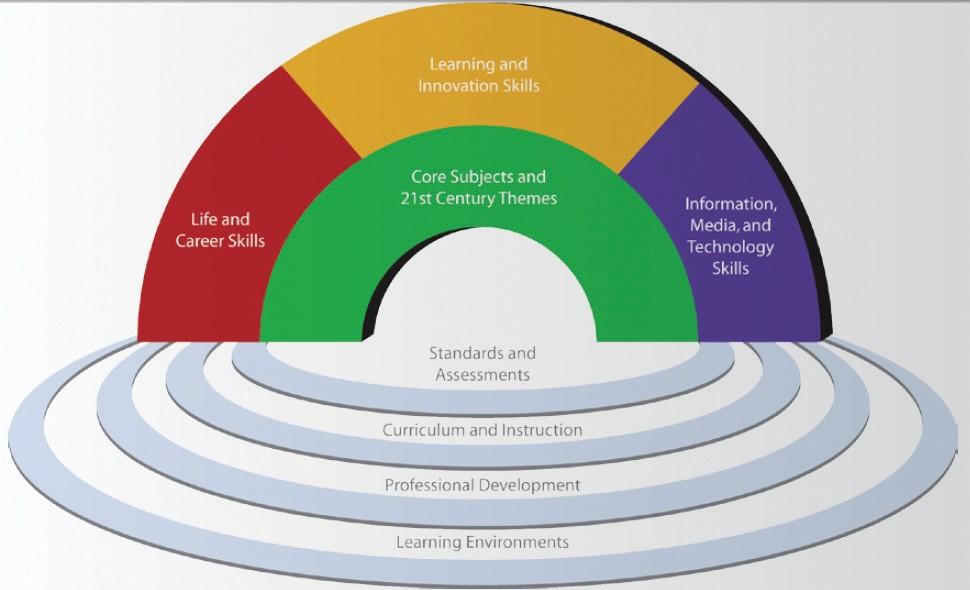
13 Framework for 21st Century Learning The Partnership for 21st Century Skills has developed a vision for 21st century student success in the new global economy. 21 st Century Student Outcomes and Support Systems 21st Century Student Outcomes The elements described in this section as 21st century student outcomes (represented by the rainbow) are the skills, knowledge and expertise students should master to succeed in work and life in the 21st century. Core Subjects and 21st Century Themes Mastery of core subjects and 21st century themes is essential for students in the 21st century. Core subjects include English, reading or language arts, world languages, arts, mathematics, economics, science, geography, history, government and civics. We believe schools must move beyond a focus on basic competency in core subjects to promoting understanding of academic content at much higher levels by weaving 21st century interdisciplinary themes into core subjects: Global Awareness Financial, Economic, Business and Entrepreneurial Literacy Civic Literacy Health Literacy Learning and Innovation Skills Learning and innovation skills are what separate students who are prepared for increasingly complex life and work environments in the 21st century and those who are not. They include: Creativity and Innovation Critical Thinking and Problem Solving Communication and Collaboration 2009 McREL Developed in collaboration with the NC State Board of Education Revised September

14 Information, Media and Technology Skills People in the 21st century live in a technology and media-driven environment, marked by access to an abundance of information, rapid changes in technology tools and the ability to collaborate and make individual contributions on an unprecedented scale. To be effective in the 21st century, citizens and workers must be able to exhibit a range of functional and critical thinking skills, such as: Information Literacy Media Literacy ICT (Information, Communications and Technology) Literacy Life and Career Skills Today s life and work environments require far more than thinking skills and content knowledge. The ability to navigate the complex life and work environments in the globally competitive information age requires students to pay rigorous attention to developing adequate life and career skills, such as: Flexibility and Adaptability Initiative and Self-Direction Social and Cross-Cultural Skills Productivity and Accountability Leadership and Responsibility 21st Century Support Systems Developing a comprehensive framework for 21st century learning requires more than identifying specific skills, content knowledge, expertise and literacies. An innovative support system must be created to help students master the multi- dimensional abilities required of them in the 21st century. The Partnership has identified five critical support systems that ensure student mastery of 21st century skills: 21st Century Standards Assessment of 21st Century Skills 21st Century Curriculum and Instruction 21st Century Professional Development 21st Century Learning Environments For more information, visit the Partnership s Web site at Used with permission McREL Developed in collaboration with the NC State Board of Education Revised September

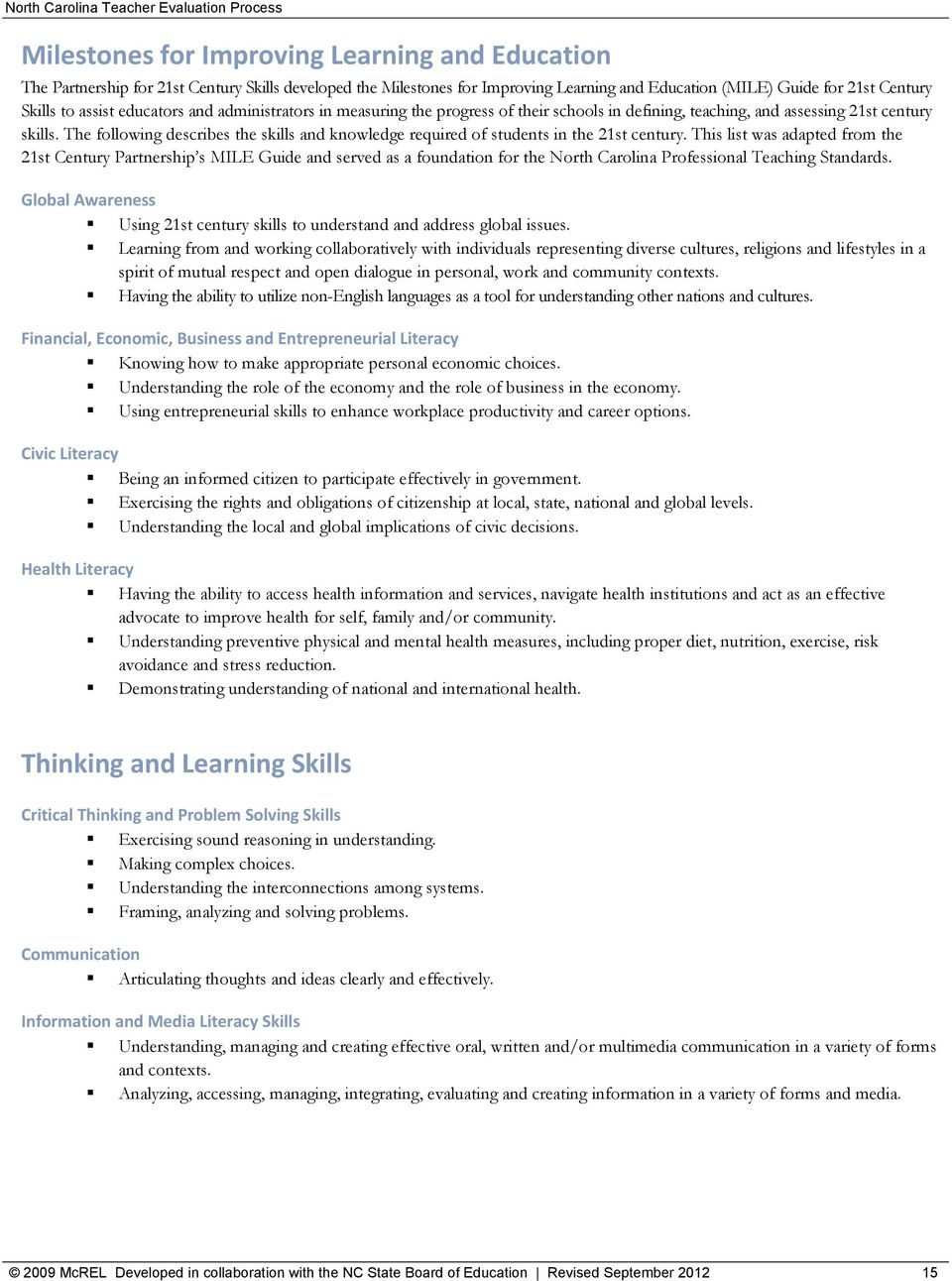
15 Milestones for Improving Learning and Education The Partnership for 21st Century Skills developed the Milestones for Improving Learning and Education (MILE) Guide for 21st Century Skills to assist educators and administrators in measuring the progress of their schools in defining, teaching, and assessing 21st century skills. The following describes the skills and knowledge required of students in the 21st century. This list was adapted from the 21st Century Partnership s MILE Guide and served as a foundation for the North Carolina Professional Teaching Standards. Global Awareness Using 21st century skills to understand and address global issues. Learning from and working collaboratively with individuals representing diverse cultures, religions and lifestyles in a spirit of mutual respect and open dialogue in personal, work and community contexts. Having the ability to utilize non-english languages as a tool for understanding other nations and cultures. Financial, Economic, Business and Entrepreneurial Literacy Knowing how to make appropriate personal economic choices. Understanding the role of the economy and the role of business in the economy. Using entrepreneurial skills to enhance workplace productivity and career options. Civic Literacy Being an informed citizen to participate effectively in government. Exercising the rights and obligations of citizenship at local, state, national and global levels. Understanding the local and global implications of civic decisions. Health Literacy Having the ability to access health information and services, navigate health institutions and act as an effective advocate to improve health for self, family and/or community. Understanding preventive physical and mental health measures, including proper diet, nutrition, exercise, risk avoidance and stress reduction. Demonstrating understanding of national and international health. Thinking and Learning Skills Critical Thinking and Problem Solving Skills Exercising sound reasoning in understanding. Making complex choices. Understanding the interconnections among systems. Framing, analyzing and solving problems. Communication Articulating thoughts and ideas clearly and effectively. Information and Media Literacy Skills Understanding, managing and creating effective oral, written and/or multimedia communication in a variety of forms and contexts. Analyzing, accessing, managing, integrating, evaluating and creating information in a variety of forms and media McREL Developed in collaboration with the NC State Board of Education Revised September
16 Creativity and Innovation Skills Demonstrating originality and inventiveness in work. Developing, implementing and communicating new ideas to others. Being open and responsive to new and diverse perspectives. Collaboration Skills Demonstrating ability to work effectively with diverse teams. Being willing to be helpful and make necessary compromises to accomplish a common goal. Contextual Learning Skills Having the ability to take advantage of education in a variety of contexts both inside and outside the classroom; understanding that knowledge is acquired within a context. ICT literacy Using technology in the course of attaining and utilizing 21st century skills. Life Skills Leadership Using interpersonal and problem-solving skills to influence more than one person toward a goal. Having the ability to leverage strengths of others to accomplish a common goal. Ethics Demonstrating integrity and ethical behavior in personal, workplace and community contexts. Accountability Setting and meeting high standards and goals for one s self and others. Adaptability Adapting to varied roles and responsibilities. Tolerating ambiguity and changing priorities. Personal Productivity Utilizing time efficiently and manage workload. Being punctual and reliable. Personal Responsibility Exercising personal responsibility and flexibility in personal, workplace and community contexts. People Skills Working appropriately and productively with others. Self-Direction Monitoring one s own understanding and learning needs. Demonstrating initiative to advance professional skill levels. Having the ability to define, prioritize and complete tasks without direct oversight. Demonstrating commitment to learning as a lifelong process. Social Responsibility Acting responsibly with the interests of the larger community in mind McREL Developed in collaboration with the NC State Board of Education Revised September

17 Teacher Evaluation Process The intended purpose of the North Carolina Teacher Evaluation Process is to assess the teacher s performance in relation to the North Carolina Professional Teaching Standards and to design a plan for professional growth. The principal or a designee (hereinafter principal ) will conduct the evaluation process in which the teacher will actively participate through the use of selfassessment, reflection, presentation of artifacts, and classroom demonstration(s). A local board shall use the North Carolina Professional Teaching Standards and North Carolina Teacher Evaluation Process unless it develops an alternative evaluation that is properly validated and that includes standards and criteria similar to those in the North Carolina Professional Teaching Standards and North Carolina Teacher Evaluation Process. Process The North Carolina Teacher Evaluation Process shall include the following components: Component 1: Training Before participating in the evaluation process, all teachers, principals and peer evaluators must complete training on the evaluation process. Component 2: Orientation Within two weeks of a teacher s first day of work in any school year, the principal will provide the teacher with a copy of or directions for obtaining access to a copy of: A. The Rubric for Evaluating North Carolina Teachers; B. This policy; and C. A schedule for completing all the components of the evaluation process. Copies may be provided by electronic means. Component 3: Teacher Self-Assessment Using the Rubric for Evaluating North Carolina Teachers, the teacher shall rate his or her own performance at the beginning of the year and reflect on his or her performance throughout the year. Component 4: Pre-Observation Conference Before the first formal observation, the principal shall meet with the teacher to discuss the teacher s self- assessment based on the Rubric for Evaluating North Carolina Teachers, the teacher s most recent professional growth plan, and the lesson(s) to be observed. The teacher will provide the principal with a written description of the lesson(s). The goal of this conference is to prepare the principal for the observation. Pre-Observation conferences are not required for subsequent observations. Component 5: Observations A. A formal observation shall last at least forty-five minutes or an entire class period. B. Probationary Teachers a. The principal shall conduct at least three formal observations of all probationary teachers. b. A peer shall conduct one formal observation of a probationary teacher. C. Career Status Teachers a. Career teachers shall be evaluated annually. b. During the year in which a career status teacher participates in a summative evaluation, the principal shall conduct at least three observations, including at least one formal observation. During observations, the principal and peer (in the case of a probationary teacher) shall note the teacher s performance in relationship to the applicable Standards on the Rubric for Evaluating North Carolina Teachers McREL Developed in collaboration with the NC State Board of Education Revised September

18 Component 6: Post-Observation Conference The principal shall conduct a post-observation conference no later than ten school days after each formal observation. During the post-observation conference, the principal and teacher shall discuss and document on the Rubric the strengths and weaknesses of the teacher s performance during the observed lesson. Component 7: Summary Evaluation Conference and Scoring the Teacher Summary Rating Form Prior to the end of the school year and in accordance with LEA timelines, the principal shall conduct a summary evaluation conference with the teacher. During the summary evaluation conference, the principal and teacher shall discuss the teacher s selfassessment, the teacher s most recent Professional Growth Plan, the components of the North Carolina Teacher Evaluation Process completed during the year, classroom observations, artifacts submitted or collected during the evaluation process and other evidence of the teacher s performance on the Rubric. At the conclusion of the North Carolina Teacher Evaluation Process, the principal shall: A. Give a rating for each Element in the Rubric; B. Make a written comment on any Element marked Not Demonstrated ; C. Give an overall rating of each Standard in the Rubric; D. Provide the teacher with the opportunity to add comments to the Teacher Summary/End-of-Year Rating Form; E. Review the completed Teacher Summary/End-of-Year Rating Form with the teacher; and F. Secure the teacher s signature on the Record of Teacher Evaluation Activities and Teacher Summary/End-of-Year Rating Form. Component 8: Professional Development Plans Individual Growth Plans Teachers who are rated at least Proficient on all the Standards on the Teacher Summary/End-of-Year Rating Form shall develop an Individual Growth Plan designed to improve performance on specifically identified Standards and Elements. Monitored Growth Plans A teacher shall be placed on a Monitored Growth Plan whenever he or she: A. Is rated Developing on one or more Standards on the Teacher Summary/End-of-Year Rating Form; and B. Is not recommended for dismissal, demotion or nonrenewal. A Monitored Growth Plan shall, at a minimum, identify the Standards and Elements to be improved, the goals to be accomplished and the activities the teacher should undertake to achieve Proficiency, and a timeline which allows the teacher one school year to achieve Proficiency. A Monitored Growth Plan that meets those criteria shall be deemed to satisfy the requirements of N.C. Gen. Stat. 115C-333(b). Directed Growth Plans A teacher shall be placed on a Directed Growth Plan whenever he or she: A. Is rated 1. Not Demonstrated on any Standard on the Teacher Summary/End-of-Year Rating Form; or 2. Developing on one or more Standards on the Teacher Summary/End-of-Year Rating Form for two sequential years: and B. Is not recommended for dismissal, demotion or nonrenewal. The Directed Growth Plan shall, at a minimum, identify the Standards and Elements to be improved, the goals to be accomplished, the activities the teacher shall complete to achieve Proficiency, a timeline for achieving Proficiency within one school year or such shorter time as determined by the LEA. A Directed Growth Plan that meets those criteria shall be deemed to satisfy the requirements of N.C. Gen. Stat. 115C-333(b) McREL Developed in collaboration with the NC State Board of Education Revised September

19 Component 9: Effective Dates and Effect on Licensing and Career Status Effective with the school year, LEAs may evaluate teachers using this policy. Effective with the school year, all teachers in North Carolina will be evaluated using this policy unless a local board develops an alternative evaluation that is properly validated and that includes standards and criteria similar to those in the North Carolina Professional Teaching Standards and North Carolina Teacher Evaluation Process in which case the local board shall use that instrument. Beginning Teachers Effective , beginning teachers must be rated Proficient on all five North Carolina Professional Teaching Standards on the most recent Teacher Summary/End-of-Year Rating Form in order to be eligible for the Standard Professional 2 License. Probationary Teachers Effective , a principal must rate a probationary teacher as Proficient on all five North Carolina Professional Teaching Standards on the most recent Teacher Summary/End-of-Year Rating Form before recommending that teacher for career status. Process for Abbreviated Annual Evaluations The annual evaluation requirement for career-status teachers can be met through the Teacher Evaluation Process set forth above, or an abbreviated evaluation. An abbreviated evaluation consists of the evaluator rating only Standards One, Four, and Six of the Teacher Evaluation Process. The abbreviated evaluation process for Standards One, Four, and Six remains consistent with the Teacher Evaluation Process described above with the exception of the requirement for observations. Teachers receiving an abbreviated evaluation should receive two informal observations of a minimum of twenty minutes each. Observers shall note the teacher s performance in relationship to Standard One and Four on the Rubric for Evaluating North Carolina Teachers. Teachers receiving an abbreviated evaluation may request that the evaluator conduct a formal observation as described above. Clarification of Evaluation Procedures for Career-Status Teachers A career-status teacher participates in a full evaluation process during the teacher s license renewal year. During a full year of evaluation, the principal shall conduct at least three observations, including at least one formal observation and two other observations either formal or informal. The principal should rate all elements and all standards on the Summary/End-of-Year Rating Form during the year a career-status teacher renews his/her license. (See Appendix C.) In school years when a career-status teacher is not renewing his/her license, the principal may choose to conduct an abbreviated evaluation. As set forth in the above policy, the principal conducts at least two informal observations using the abbreviated rubric and the abbreviated Summary/End-of-Year Rating Form. The teacher may request a full evaluation. (See Appendix C.) 2009 McREL Developed in collaboration with the NC State Board of Education Revised September

20 Rubric for Evaluating North Carolina Teachers Explanation of the Rubric and Performance Ratings The following rubric was developed to align with and exemplify the North Carolina Professional Teaching Standards I-V approved by the North Carolina State Board of Education in June The rubric should be used in conjunction with the standards descriptions. The rubric will be used by the principal during teacher observations to check descriptors that describe levels of performance and by the teacher during self-assessment. After all observations have been completed, the number of checks per descriptor will guide the principal to determine the performance rating for each element. (See Directions for Scoring the Summary/End-of-Year Rating Form.) Together, these materials form the core of the North Carolina Teacher Evaluation process. After all observations have been completed, teacher performance will be noted as follows: Developing: Teacher demonstrated adequate growth toward achieving standard(s) during the period of performance, but did not demonstrate competence on standard(s) of performance. Proficient: Teacher demonstrated basic competence on standard(s) of performance. Accomplished: Teacher exceeded basic competence on standard(s) of performance most of the time. Distinguished: Teacher consistently and significantly exceeded basic competence on standard(s) of performance. Not Demonstrated: Teacher did not demonstrate competence on or adequate growth toward achieving standard(s) of performance. (Note: If the Not Demonstrated rating is used, the Principal/Evaluator must comment about why it was used.) These levels are cumulative across the rows of the rubric. The Developing teacher may exemplify the skills expected of a teacher who is new to the profession or an experienced teacher who is working in a new content area or grade level, or who needs a new skill in order to meet the standard. A Proficient teacher must exhibit the skills and knowledge described under the Developing header as well as those under Proficient. Likewise, a Distinguished teacher exhibits all of the skills and knowledge described for that element across the row. The Not Demonstrated rating should be used when the teacher is performing below expectations and is not making adequate growth toward becoming proficient on the element. This rating is also used when the principal is not able to check any of the descriptors for the element being rated. If a teacher is rated as Not Demonstrated, then a comment must be made as to why McREL Developed in collaboration with the NC State Board of Education Revised September

21 Observation North Carolina Teacher Evaluation Process Rubric for Evaluating North Carolina Teachers (Required for Self-Assessment and for Observations) This form should be used for the teacher self-assessment, classroom observation, and the summary evaluation. Name: School: Evaluator: Start Time: Date: District: Title: End Time: Standard I: Teachers Demonstrate Leadership Element Ia. Teachers lead in their classrooms. Teachers demonstrate leadership by taking responsibility for the progress of all students to ensure that they graduate from high school, are globally competitive for work and postsecondary education, and are prepared for life in the 21st century. Teachers communicate this vision to their students. Using a variety of data sources, they organize, plan, and set goals that meet the needs of the individual student and the class. Teachers use various types of assessment data during the school year to evaluate student progress and to make adjustments to the teaching and learning process. They establish a safe, orderly environment, and they create a culture that empowers students to collaborate and become lifelong learners. Developing Proficient Accomplished Distinguished Not Demonstrated (Comment Required) Understands how they contribute to students graduating from high school. Takes responsibility for the progress of students to ensure that they graduate from high school. Communicates to students the vision of being prepared for life in the 21st century. Encourages students to take responsibility for their own learning. Uses data to understand the skills and abilities of students. Provides evidence of data driven instruction throughout all classroom activities. Evaluates student progress using a variety of assessment data. Uses classroom assessment data to inform program planning. Establishes a safe and orderly classroom. Creates a classroom culture that empowers students to collaborate. Empowers and encourages students to create and maintain a safe and supportive school and community environment. Element Ib. Teachers demonstrate leadership in the school. Teachers work collaboratively with school personnel to create a professional learning community. They analyze and use local, state, and national data to develop goals and strategies in the school improvement plan that enhances student learning and teacher working conditions. Teachers provide input in determining the school budget and in the selection of professional development that meets the needs of students and their own professional growth. They participate in the hiring process and collaborate with their colleagues to mentor and support teachers to improve the effectiveness of their departments or grade levels. Attends professional learning community meetings. Participates in professional learning community. Assumes a leadership role in professional learning community. Collaborates with colleagues to improve the quality of learning in the school. Displays awareness of the goals of the school improvement plan. Participates in developing and/or implementing the school improvement plan. Collaborates with school personnel on school improvement activities. Assumes a leadership role in implementing school improvement plan throughout the building McREL Developed in collaboration with the NC State Board of Education Revised September
22 Observation observation North Carolina Teacher Evaluation Process Element Ic. Teachers lead the teaching profession. Teachers strive to improve the teaching profession. They contribute to the establishment of positive working conditions in their school. They actively participate in and advocate for decision-making structures in education and government that take advantage of the expertise of teachers. Teachers promote professional growth for all educators and collaborate with their colleagues to improve the profession. Developing Proficient Accomplished Distinguished Not Demonstrated (Comment Required) Has knowledge of opportunities and the need for professional growth and begins to establish relationships with colleagues. Contributes to the: improvement of the profession through professional growth. establishment of positive working relationships. Promotes positive working relationships through professional growth activities and collaboration. Seeks opportunities to lead professional growth activities and decision-making processes. school s decision- making processes as required. Element Id. Teachers advocate for schools and students. Teachers advocate for positive change in policies and practices affecting student learning. They participate in the implementation of initiatives to improve the education of students. Knows about the policies and practices affecting student learning. Supports positive change in policies and Practices affecting student learning. Participates in developing policies and practices to improve student learning. Actively participates, promotes, and provides strong supporting evidence for implementation of initiatives to improve education. Element Ie. Teachers demonstrate high ethical standards. Teachers demonstrate ethical principles including honesty, integrity, fair treatment, and respect for others. Teachers uphold the Code of Ethics for North Carolina Educators (effective June 1, 1997) and the Standards for Professional Conduct adopted April 1, ( Understands the importance of ethical behavior as outlined in the Code of Ethics for North Carolina Educators and the Standards for Professional Conduct. Demonstrates ethical behavior through adherence to the Code of Ethics for North Carolina Educators and the Standards for Professional Conduct. Knows and upholds the Code of Ethics for North Carolina Educators and the Standards for Professional Conduct. Models the tenets of the Code of Ethics for North Carolina Educators and the Standards for Professional Conduct and encourages others to do the same. Comments: 2009 McREL Developed in collaboration with the NC State Board of Education Revised September
23 Observation North Carolina Teacher Evaluation Process Examples of Artifacts: Lesson plans Class rules and procedures National Board Certification Journals Participation in the Teacher Working Discipline Records Student handbooks Condition Survey Student work Professional Learning Communities School improvement planning Membership in professional organizations Service on committees Formal and informal mentoring Relevant data Surveys Standard II: Teachers Establish a Respectful Environment for a Diverse Population of Students Element IIa. Teachers provide an environment in which each child has a positive, nurturing relationship with caring adults. Teachers encourage an environment that is inviting, respectful, supportive, inclusive, and flexible. Developing Proficient Accomplished Distinguished Not Demonstrated (Comment Required) Appreciates and understands the need to establish nurturing relationships. Establishes an inviting, respectful, inclusive, flexible, and supportive learning environment. Maintains a positive and nurturing learning environment. Encourages and advises others to provide a nurturing and positive learning environment for all students. Element IIb. Teachers embrace diversity in the school community and in the world. Teachers demonstrate their knowledge of the history of diverse cultures and their role in shaping global issues. They actively select materials and develop lessons that counteract stereotypes and incorporate histories and contributions of all cultures. Teachers recognize the influence of race, ethnicity, gender, religion, and other aspects of culture on a student s development and personality. Teachers strive to understand how a student s culture and background may influence his or her school performance. Teachers consider and incorporate different points of view in their instruction. Acknowledges that diverse cultures impact the world. Displays knowledge of diverse cultures, their histories, and their roles in shaping global issues. Uses materials or lessons that counteract stereotypes and acknowledges the contributions of all cultures. Promotes a deep understanding of cultures through the integration of culturally sensitive materials and ideas throughout the curriculum. Demonstrates awareness of the diversity of students in the classroom. Acknowledges the influence of race, ethnicity, gender, religion, socioeconomics, and culture on a student s development and attitudes. Consistently incorporates different points of view in instruction. Capitalizes on diversity as an asset in the classroom. Element IIc. Teachers treat students as individuals. Teachers maintain high expectations, including graduation from high school, for students of all backgrounds. Teachers appreciate the differences and value the contributions of each student in the learning environment by building positive, appropriate relationships. Holds high expectations of students. Communicates high expectations for all students. Encourages and Helps students hold high values contributions expectations for themselves of students, regardless of and their peers. of background or ability McREL Developed in collaboration with the NC State Board of Education Revised September
24 Observation observation North Carolina Teacher Evaluation Process Element IId. Teachers adapt their teaching for the benefit of students with special needs. Teachers collaborate with the range of support specialists to help meet the special needs of all students. Through inclusion and other models of effective practice, teachers engage students to ensure that their needs are met. Developing Proficient Accomplished Distinguished Not Demonstrated (Comment Required) Recognizes that students have a variety of learning needs. Is knowledgeable of effective practices for students with special needs. Collaborates with specialists who can support the special learning needs of students. Provides unique learning opportunities such as inclusion and research-based, effective practices for students with special needs. Understands the roles of and collaborates with the full range of support specialists to help meet the special needs of all students. Anticipates the unique learning needs of students and solicits assistance from within and outside the school to address those needs. Effectively engages special needs students in Adapts instruction for the in learning activities benefit of students with and ensures their special needs and helps unique learning needs colleagues do the same are met. for their students. Element IIe. Teachers work collaboratively with the families and significant adults in the lives of their students. Teachers recognize that educating children is a shared responsibility involving the school, parents or guardians, and the community. Teachers improve communication and collaboration between the school and the home and community in order to promote trust and understanding and build partnerships with all segments of the school community. Teachers seek solutions to overcome cultural and economic obstacles that may stand in the way of effective family and community involvement in the education of their students. Responds to family and community concerns. Communicates and collaborates with the home and community for the benefit of students. Recognizes obstacles to family and community participation and conscientiously seeks solutions to overcome them. Promotes trust and understanding throughout the school community. Comments: Examples of Artifacts: Student profiles Communications w/parents/community Student surveys Professional development on cultural Cooperation with ESL teachers attitudes and awareness Lessons that integrate international content Use of technology to incorporate cultural Documentation of referral data and use of IEPs awareness into lessons 2009 McREL Developed in collaboration with the NC State Board of Education Revised September
25 Observation North Carolina Teacher Evaluation Process Standard III: Teachers Know the Content They Teach Element IIIa. Teachers align their instruction with the North Carolina Standard Course of Study. In order to enhance the North Carolina Standard Course of Study, teachers investigate the content standards developed by professional organizations in their specialty area. They develop and apply strategies to make the curriculum rigorous and relevant for all students and provide a balanced curriculum that enhances literacy skills. Elementary teachers have explicit and thorough preparation in literacy instruction. Middle and high school teachers incorporate literacy instruction within the content area or discipline. Developing Proficient Accomplished Distinguished Not Demonstrated (Comment Required) Demonstrates an awareness of the North Carolina Standard Course of Study and references it in the preparation of lesson plans. Understands the North Carolina Standard Course of Study and uses it in preparation of lesson plans, and applies strategies to make the curriculum rigorous and relevant. Develops and applies strategies based on the North Carolina Standard Course of Study and standards developed by professional organizations to make the curriculum balanced, rigorous and relevant. Assists colleagues in applying such strategies in their classrooms. Elementary: Begins to integrate literacy instruction in selected lessons. Secondary: Recognizes the importance of integrating literacy strategies within the content areas. Elementary: Integrates effective literacy instruction throughout the curriculum. Secondary: Incorporates a wide variety of literacy skills within content areas to enhance learning. Elementary: Evaluates and reflects upon the effectiveness of literacy instruction. Secondary: Evaluates and reflects upon the effectiveness of literacy instruction within content areas. Elementary: Makes necessary changes to instructional practice to improve student learning. Secondary: Makes necessary changes to instructional practice to improve student learning. Element IIIb. Teachers know the content appropriate to their teaching specialty. Teachers bring a richness and depth of understanding to their classrooms by knowing their subjects beyond the content they are expected to teach and by directing students natural curiosity into an interest in learning. Elementary teachers have broad knowledge across disciplines. Middle school and high school teachers have depth in one or more specific content areas or disciplines. Demonstrates a basic level of content knowledge in the teaching specialty to which assigned. Demonstrates an appropriate level of content knowledge in the teaching specialty to which assigned. Applies knowledge of subject beyond the content in assigned teaching specialty. Motivates students to investigate the content area to expand their knowledge and satisfy their natural curiosity. Extends knowledge of subject beyond content in their teaching specialty and sparks students curiosity for learning beyond the required course work McREL Developed in collaboration with the NC State Board of Education Revised September
26 Observation observation North Carolina Teacher Evaluation Process Element IIIc. Teachers recognize the interconnectedness of content areas/disciplines. Teachers know the links and vertical alignment of the grade or subject they teach and the North Carolina Standard Course of Study. Teachers understand how the content they teach relates to other disciplines in order to deepen understanding and connect learning for students. Teachers promote global awareness and its relevance to subjects they teach. Developing Proficient Accomplished Distinguished Not Demonstrated (Comment Required) Understand the links between grade/subject and the North Carolina Standard Course of Study. Displays global awareness. Demonstrates knowledge of links between grade/subject and the North Carolina Standard Course of Study. Promotes global awareness and its relevance to the subjects. Demonstrates knowledge of the links and vertical alignment of the grade or subject area and the North Carolina Standard Course of Study. Relates content to other disciplines. Integrates global awareness activities throughout lesson plans and classroom instructional practices. Collaborates with teachers from other grades or subject areas to establish links between disciplines and influence school-wide curriculum and teaching practice. Promotes global awareness and its relevance to all faculty members, influencing curriculum and teaching practices throughout the school. Element IIId. Teachers make instruction relevant to students. Teachers incorporate 21 st century life skills into their teaching deliberately, strategically, and broadly. These skills include leadership, ethics, accountability, adaptability, personal productivity, personal responsibility, people skills, self- direction, and social responsibility. Teachers help their students understand the relationship between the North Carolina Standard Course of Study and 21 st century content, which includes global awareness; financial, economic, business and entrepreneurial literacy; civic literacy and health awareness. Identifies relationships between the North Carolina Standard Course of Study and life in the 21 st century. Identifies relationships between the core content and 21 st century content. Integrates core content and 21 st century content throughout lesson plans and classroom instructional practices. Deepens students understandings of 21 st century skills and helps them make their own connections and develop new skills. C Comments Examples of Artifacts: Display of creative student work Content standards Use of NC Standard Course of Study Lesson plans 2009 McREL Developed in collaboration with the NC State Board of Education Revised September
27 Observation observation North Carolina Teacher Evaluation Process Standard IV: Teachers facilitate learning for their students Element IVa. Teachers know the ways in which learning takes place, and they know the appropriate levels of intellectual, physical, social, and emotional development of their students. Teachers know how students think and learn. Teachers understand the influences that affect individual student learning (development, culture, language proficiency, etc.) and differentiate their instruction accordingly. Teachers keep abreast of evolving research about student learning. They adapt resources to address the strengths and weaknesses of their students. o Developing Proficient Accomplished Distinguished Not Demonstrated (Comment Required) Understands developmental levels of students and recognizes the need to differentiate instruction. Understands developmental levels of students and appropriately differentiates instruction. Identifies appropriate developmental levels of students and consistently and appropriately differentiates instruction. Encourages and guides colleagues to adapt instruction to align with students developmental levels. Assesses resources needed to address strengths and weaknesses of students. Reviews and uses alternative resources or adapts existing resources to take advantage of student strengths or address weaknesses. Stays abreast of current research about student learning and emerging resources and encourages the school to adopt or adapt them for the benefit of all students. Element IVb. Teachers plan instruction appropriate for their students. Teachers collaborate with their colleagues and use a variety of data sources for short- and long-range planning based on the North Carolina Standard Course of Study. These plans reflect an understanding of how students learn. Teachers engage students in the learning process. They understand that instructional plans must be consistently monitored and modified to enhance learning. Teachers make the curriculum responsive to cultural differences and individual learning needs. Recognizes data sources important to planning instruction. Uses a variety of data for short- and long-range planning of instruction. Monitors and modifies instructional plans to enhance student learning. Monitors student performance and responds to individual learning needs in order to engage students in learning. Monitors student performance and responds to cultural diversity and learning needs through the school improvement process. Element IVc Teachers use a variety of instructional methods. Teachers choose the methods and techniques that are most effective in meeting the needs of their students as they strive to eliminate achievement gaps. Teachers employ a wide range of techniques including information and communication technology, learning styles, and differentiated instruction. Demonstrates awareness of the variety of methods and materials necessary to meet the needs of all students. Demonstrates awareness or use of appropriate methods and materials necessary to meet the needs of all students. Ensures the success of all students through the selection and utilization of appropriate methods and materials. Stays abreast of emerging research areas and new and innovative materials and incorporates them into lesson plans and instructional strategies McREL Developed in collaboration with the NC State Board of Education Revised September
28 Observation observation North Carolina Teacher Evaluation Process Element IVd. Teachers integrate and utilize technology in their instruction. Teachers know when and how to use technology to maximize student learning. Teachers help students use technology to learn content, think critically, solve problems, discern reliability, use information, communicate, innovate, and collaborate. Developing Proficient Accomplished Distinguished Not Demonstrated (Comment Required) Assesses effective types of technology to use for instruction. Demonstrates knowledge of how to utilize technology in instruction. Integrates technology with instruction to maximize student learning. Provides evidence of student engagement in higher level thinking skills through the integration of technology. Element IVe. Teachers help students develop critical-thinking and problem-solving skills. Teachers encourage students to ask questions, think creatively, develop and test innovative ideas, synthesize knowledge, and draw conclusions. They help students exercise and communicate sound reasoning; understand connections; make complex choices; and frame, analyze, and solve problems. Understands the importance of developing students critical thinking and problem-solving skills. Demonstrates knowledge of processes needed to support students in acquiring critical thinking skills and problem-solving skills. Teaches students the processes needed to: think creatively and critically, develop and test innovative ideas, synthesize knowledge, draw conclusions, exercise and communicate sound reasoning, understand connections, make complex choices, and frame, analyze and solve problems. Encourages and assists teachers throughout the school to integrate critical thinking and problem solving skills into their instructional practices. Element IVf. Teachers help students work in teams and develop leadership qualities. Teachers teach the importance of cooperation and collaboration. They organize learning teams in order to help students define roles, strengthen social ties, improve communication and collaborative skills, interact with people from different cultures and backgrounds, and develop leadership qualities. Provides opportunities for cooperation, collaboration, and leadership through student learning teams. Organizes student learning teams for the purpose of developing cooperation, collaboration, and student leadership. Encourages students to create and manage learning teams. Fosters the development of student leadership and teamwork skills to be used beyond the classroom McREL Developed in collaboration with the NC State Board of Education Revised September
29 Observation perceptive listeners and are able to communicate with students in a variety of ways even when language is a barrier. Teachers help students articulate thoughts and ideas clearly and effectively. Developing Proficient Accomplished Distinguished Not Demonstrated (Comment Required) observation Element IVg. Teachers communicate effectively. Teachers communicate in ways that are clearly understood by their students. They are Demonstrates the ability to effectively communicate with students. Uses a variety of methods for communication with all students. Creates a variety of methods to communicate with all students....and Anticipates possible student misunderstandings and proactively develops teaching techniques to mitigate concerns. Provides opportunities for students to articulate thoughts and ideas. Consistently encourages and supports students to articulate thoughts and ideas clearly and effectively. Establishes classroom practices which encourage all students to develop effective communication skills. Establishes school-wide and grade appropriate vehicles to encourage students throughout the school to develop effective communication skills. Element IVh. Teachers use a variety of methods to assess what each student has learned. Teachers use multiple indicators, including formative and summative assessments, to evaluate student progress and growth as they strive to eliminate achievement gaps. Teachers provide opportunities, methods, feedback, and tools for students to assess themselves and each other. Teachers use 21 st century assessment systems to inform instruction and demonstrate evidence of students 21 st century knowledge, skills, performance, and dispositions. Uses indicators to monitor and evaluate student progress. Assesses students in the attainment of 21 st century knowledge, skills, and dispositions. Uses multiple indicators, both formative and summative, to monitor and evaluate student progress and to inform instruction. Provides evidence that students attain 21 st century knowledge, skills and dispositions. Uses the information gained from the assessment activities to improve teaching practice and student learning. Provides opportunities for students to assess themselves and others. Teaches students and encourages them to use peer and selfassessment feedback to assess their own learning. Encourages and guides colleagues to assess 21 st century skills, knowledge, and dispositions and to use the assessment information to adjust their instructional practice. C Comments Examples of Artifacts: Lesson plans Documentation of differentiated instruction Display of technology used materials used to promote critical thinking and Professional development problem solving Use of student learning teams Collaborative lesson planning 2009 McREL Developed in collaboration with the NC State Board of Education Revised September
30 Observation observation North Carolina Teacher Evaluation Process Standard V: Teachers Reflect on Their Practice Element Va. Teachers analyze student learning. Teachers think systematically and critically about student learning in their classrooms and schools: why learning happens and what can be done to improve achievement. Teachers collect and analyze student performance data to improve school and classroom effectiveness. They adapt their practice based on research and data to best meet the needs of students. Developing Proficient Accomplished Distinguished Not Demonstrated (Comment Required) Recognizes the need to improve student learning in the classroom. Provides ideas about what can be done to improve student learning in the classroom. Thinks systematically and critically about learning in the classroom: why learning happens and what can be done to improve student achievement. Provides a detailed analysis about what can be done to improve student learning and uses such analyses to adapt instructional practices and materials within the classroom and at the school level. Element Vb. Teachers link professional growth to their professional goals. Teachers participate in continued, high-quality professional development that reflects a global view of educational practices; includes 21 st century skills and knowledge; aligns with the State Board of Education priorities; and meets the needs of students and their own professional growth. Understands the importance of professional development. Participates in professional development aligned with professional goals. Participates in professional development activities aligned with goals and student needs. Applies and implements knowledge and skills attained from professional development consistent with its intent. Element Vc. Teachers function effectively in a complex, dynamic environment. Understanding that change is constant, teachers actively investigate and consider new ideas that improve teaching and learning. They adapt their practice based on research and data to best meet the needs of their students. Is knowledgeable of current research-based approaches to teaching and learning. Considers and uses a variety of researchbased approaches to improve teaching and learning. Actively investigates and considers alternative, researchbased approaches to improve teaching and learning and uses such approaches appropriately. Adapts professional practice based on data and evaluates impact on student learning. C Comments Examples of Artifacts: Lesson plans Completion of professional development Formative assessments Participation in professional learning Student work community Professional Development Plan Formative and summative assessment data 2009 McREL Developed in collaboration with the NC State Board of Education Revised September
31 Rubric for Evaluating North Carolina Teachers Signature Page Teacher Signature Date Principal/Evaluator Signature Date Peer Signature, if applicable Date Comments Attached: Yes No Principal/Evaluator Signature (Signature indicates question above regarding comments has been addressed). Date Peer Signature, if applicable (Signature indicates question above regarding comments has been addressed). Date Note: The teacher s signature on this form represents neither acceptance nor approval of the report. It does, however, indicate that the teacher has reviewed the report with the evaluator and may reply in writing. The signature of the principal or evaluator verifies that the report has been reviewed and that the proper process has been followed according to North Carolina State Board of Education Policy for the Teacher Evaluation Process McREL Developed in collaboration with the NC State Board of Education Revised September
32 Directions for Completing the Rubric Completing the Rubric for Self-Assessment The teacher will complete a self-assessment based on the Rubric for Evaluating North Carolina Teachers in preparation for the Pre- Observation Conference. The self-assessment is a personal reflection about one s professional practice to identify strengths and areas for improvement conducted without input from others. Purposes of the self-assessment are to clarify performance expectations, guide discussions about goal-setting and professional development and program needs, and provide input to the final, end-of-year ratings. The teacher should complete the rubric by checking descriptors that characterize strengths and consider descriptors that have not been checked as areas for improvement. The teacher shall measure his or her own performance at the beginning of the year and reflect on his or her performance throughout the year. Completing the Rubric for Observations The principal or evaluator will complete the Rubric for Evaluating North Carolina Teachers during teacher observations. A check in the first column (Observation) of the rubric form means that the evaluator should be able to observe the items in that row during routine classroom observations. The evaluator checks descriptors that are observed during the lesson and considers evidence of additional performance responsibilities demonstrated by the teacher. If the observer is not able to mark any of the descriptors for an element, then the Not Demonstrated column is used. In such case, the observer must write a comment about what was observed and suggestions for improving performance. During each post-observation conference, the principal and teacher discuss and document on the rubric the strengths and weaknesses of the teacher s performance during the observed lesson. Directions for Scoring the Summary/End-of-Year Rating Form After all observations have been completed, the number of checks per descriptor should be added together for scoring the elements of each standard. The principal can review completed rubrics from different observations to guide ratings for each element. The rating for an element is the lowest rating for which all descriptors are marked during the evaluation cycle. After the rating for each element is determined, an overall rating for each standard can be scored. Overall ratings of standards should not be determined until the end of the year during the Summary Evaluation Conference. During the Summary Evaluation Conference, the principal and teacher shall discuss the teacher s self-assessment, the teacher s most recent Professional Development Plan, the components of the North Carolina Teacher Evaluation Process completed during the year, classroom observations, artifacts submitted or collected during the evaluation process and other evidence of the teacher s performance on the rubric. The Summary/End-of-Year Rating Form is to be jointly reviewed by the teacher and evaluator during the Summary Evaluation Conference. When a teacher is rated as Developing or Not Demonstrated, the principal or evaluator should strongly encourage the teacher to develop a goal to address the area(s) where proficiency has not been reached McREL Developed in collaboration with the NC State Board of Education Revised September
33 Observation North Carolina Teacher Evaluation Process Example of How to Complete the Rubric (Self-assessment and observation) Standard I: Teachers demonstrate leadership a. Teachers lead in their classrooms. Teachers demonstrate leadership by taking responsibility for the progress of all students to ensure that they graduate from high school, are globally competitive for work and postsecondary education, and are prepared for life in the 21 st century. Teachers communicate this vision to their students. Using a variety of data sources, they organize, plan, and set goals that meet the needs of the individual student and the class. Teachers use various types of assessment data during the school year to evaluate student progress and to make adjustments to the teaching and learning process. They establish a safe, orderly environment, and create a culture that empowers students to collaborate and become lifelong learners. Developing Proficient Accomplished Distinguished not Demonstrated (comment required) Understands how they contribute to students graduating from high school. Takes responsibility for the progress of students to ensure that they graduate from high school. Communicates to students the vision of being prepared for life in the 21 st century. Encourages students to take responsibility for their own learning. Uses data to understand the skills and abilities of students Provides evidence of data driven instruction throughout all classroom activities. Establishes a safe and orderly classroom. Evaluates student progress using a variety of assessment data. Creates a classroom culture that empowers students to collaborate. Uses classroom assessment data to inform program planning. Empowers and encourages students to create and maintain a safe and supportive school and community environment. b. Teachers demonstrate leadership in the school. Teachers work collaboratively with school personnel to create a professional learning community. They analyze and use local, state, and national data to develop goals and strategies in the school improvement plan that enhances student learning and teacher working conditions. Teachers provide input in determining the school budget and in the selection of professional development that meets the needs of students and their own professional growth. They participate in the hiring process and collaborate with their colleagues to mentor and support teachers to improve the effectiveness of their departments or grade levels. Attends professional learning community meetings. Displays awareness of the goals of the school improvement plan Participates in professional learning community. Participates in developing and/or implementing the school improvement plan. Assumes a leadership role in professional learning community. Collaborates with school personnel on school improvement activities. Collaborates with colleagues to improve the quality of learning in the school. Assumes a leadership role in implementing school improvement plan throughout the building McREL Developed in collaboration with the NC State Board of Education Revised September
34 Observation North Carolina Teacher Evaluation Process c. Teachers lead the teaching profession. Teachers strive to improve the teaching profession. They contribute to the establishment of positive working conditions in their school. They actively participate in and advocate for decision-making structures in education and government that take advantage of the expertise of teachers. Teachers promote professional growth for all educators and collaborate with their colleagues to improve the profession. Developing Proficient Accomplished Distinguished Not Demonstrated (comment required) Has knowledge of opportunities and the need for professional growth and begins to establish relationships with colleagues. Contributes to the: improvement of the profession through professional growth. establishment of positive working relationships Promotes positive working relationships through professional growth activities and collaboration. Seeks opportunities to lead professional growth activities and decisionmaking processes. school s decision-making processes as required. d. Teachers advocate for schools and students. Teachers advocate for positive change in policies and practices affecting student learning. They participate in the implementation of initiatives to improve the education of students. Knows about the policies and practices affecting student learning. Supports positive change in policies and practices affecting student learning. Participates in developing policies and practices to improve student learning. Actively participates, promotes, and provides strong supporting evidence for implementation of initiatives to improve education. e. Teachers demonstrate high ethical standards. Teachers demonstrate ethical principles including honesty, integrity, fair treatment, and respect for others. Teachers uphold the Code of Ethics for North Carolina Educators (effective June 1, 1997) and the Standards for Professional Conduct adopted April 1, ( Understands the importance of ethical behavior as outlined in the Code of Ethics for North Carolina Educators and the Standards for Professional Conduct. Demonstrates ethical behavior through adherence to the Code of Ethics for North Carolina Educators and the Standards for Professional Conduct. Knows and upholds the Code of Ethics for North Carolina Educators and the Standards for Professional Conduct. Models the tenets of the Code of Ethics for North Carolina Educators and the Standards for Professional Conduct and encourages others to do the same. Comments Examples of Artifacts: Lesson plans Relevant data Formal and informal mentoring Journals Class rules and procedures Surveys Student handbooks Participation in The Teacher Working National Board Certification Student work Condition Survey Discipline records School improvement planning Professional Learning Communities Service on committees Membership in professional organizations 2009 McREL Developed in collaboration with the NC State Board of Education Revised September
35 Developing Proficient Accomplished Distinguished Not Demonstrated North Carolina Teacher Evaluation Process Example of Scoring the Summary/End-of-Year Rating Form Summary Rating Form for Teachers Standard I: Teachers demonstrate leadership A. Leads in the classroom X B. Leads in the school X c. Leads the teaching profession X D. Advocates for the school and students X E. Demonstrates high ethical standards X Standard II: Teachers establish a respectful environment for a diverse population Overall Rating for Standard I A. Provides an environment that is inviting, respectful, supportive, inclusive and flexible X B. Embraces diversity in the school community and in the world X C. Treats students as individuals X D. Adapts teaching for the benefit of students with special needs X E. Works collaboratively with families and significant adults in the lives of their students X Standard III: Teachers know the content they teach Overall Rating for Standard II A. Aligns instruction with the North Carolina Standard Course of Study X B. Knows the content appropriate to the teaching specialty X C. Recognizes the interconnectedness of content areas/disciplines X D. Makes instruction relevant to students X Overall Rating for Standard III Standard IV: Teachers facilitate learning for the students A. Knows the ways in which learning takes place, and the appropriated levels of intellectual, physical, social, and emotional development of students B. Plans instruction appropriate for students X C. Uses a variety of instructional methods X D. Integrates and utilizes technology in instruction X E. Helps students develop critical-thinking and problem-solving skills X F. Helps students work in teams and develop leadership qualities X G. Communicates effectively X H. Uses a variety of methods to assess what each student has learned X Overall Rating for Standard IV Standard V: Teachers reflect on their own practice A. Analyzes student learning X B. Links professional goals X C. Functions effectively in a complex, dynamic environment X Overall Rating for Standard V X X X X X X Comments: Evidence or documentation that supports rating: Teacher demonstrates a willingness to collaborate and participates in the staff development effort to improve instruction to meet the individual needs of students. Unit plans and/or lessons plans Teacher s classroom is a safe (physically and emotionally) environment Recommended actions for improvement: Seek opportunities to be more involved in the committees designed to improve the school environment School improvement team membership 2009 McREL Developed in collaboration with the NC State Board of Education Revised September
36 Teacher Summary/End-of-Year Rating Form (Required) This form is to be jointly reviewed by the teacher and evaluator or designee during the Summary Evaluation Conference conducted at the end of the year. Principals are required to complete this form for Initially Licensed Teachers. The principal s designee may complete it for Probationary Teachers who are not Initially Licensed teachers and for Career Teachers. Name: School: School Year: Evaluator: District: Date Completed: Evaluator s Title: Probationary Teacher Career Status Teacher (Please check one) Standard I: Teachers Demonstrate Leadership Elements Developing Proficient Accomplished Distinguished Not Demonstrated A. Teachers lead in their classrooms. B. Teachers demonstrate leadership in the school. C. Teachers lead the teaching profession. D. Teachers advocate for schools and students. E. Teachers demonstrate high ethical standards. Overall rating for Standard I Comments: Recommended Actions for Improvement: Resources needed to complete these actions: Evidence or documentation to support rating: Lesson Plans School Improvement Planning Teacher Working Conditions Surveys Journals Service on Committees Professional Learning Communities National Board Certification Student Handbooks Relevant Data Membership in Professional Organizations Discipline Records Student Work Class Rules and Procedures Formal and Informal Mentoring 2009 McREL Developed in collaboration with the NC State Board of Education Revised September
37 Standard II: Teachers Establish a Respectful Environment for a Diverse Population of Students Elements Developing Proficient Accomplished Distinguished A. Teachers provide an environment in which each child has a positive, nurturing relationship with caring adults. B. Teachers embrace diversity in the school community and in the world. Not Demonstrated C. Teachers treat students as individuals. D. Teachers adapt their teaching for the benefit of students with special needs. E. Teachers work collaboratively with the families and significant adults in the lives of their students. Overall rating for Standard II Comments: Recommended Actions for Improvement: Resources needed to complete these actions: Evidence or documentation to support rating: Student Profiles Documentation of Referral Data and Use of IEPs Student Surveys Communications with Parents/Community Cooperate with ESL Teachers Lessons that Integrate International Content Use of Technology to incorporate cultural awareness into Lessons 2009 McREL Developed in collaboration with the NC State Board of Education Revised September
38 Standard III: Teachers Know the Content They Teach Elements Developing Proficient Accomplished Distinguished A. Teachers align their instruction with the North Carolina Standard Course of Study. Not Demonstrated B. Teachers know the content appropriate to their teaching specialty. C. Teachers recognize the interconnectedness of content areas/disciplines. D. Teachers make instruction relevant to students. Overall rating for Standard III Comments: Recommended Actions for Improvement: Evidence or documentation to support rating: Display of Creative Student Work Use of Standard Course of Study Lesson Plans Content Standards Resources needed to complete these actions: 2009 McREL Developed in collaboration with the NC State Board of Education Revised September
39 Standard IV: Teachers Facilitate Learning for Their Students Elements Developing Proficient Accomplished Distinguished A. Teachers know the ways in which learning takes place, and they know the appropriate levels of intellectual, physical, social, and emotional development of their students. B. Teachers plan instruction appropriate for their students. Not Demonstrated C. Teachers use a variety of instructional methods. D. Teachers integrate and utilize technology in their instruction. E. Teachers help students develop critical thinking and problem-solving skills. F. Teachers help students work in teams and develop leadership qualities. G. Teachers communicate effectively. H. Teachers use a variety of methods to assess what each student has learned. Overall rating for Standard IV Comments: Evidence or documentation to support rating: Lesson Plans Documentation of Differentiated Instruction Display of technology used Recommended Actions for Improvement: Materials used to promote Critical Thinking and Problem Solving Professional Development Collaborative Lesson planning Resources needed to complete these actions: Use of student learning teams 2009 McREL Developed in collaboration with the NC State Board of Education Revised September
40 Standard V: Teachers Reflect on Their Practice A. Teachers analyze student learning. Elements Developing Proficient Accomplished Distinguished Not Demonstrated B. Teachers link professional growth to their professional goals. C. Teachers function effectively in a complex, dynamic environment. Overall rating for Standard V Comments: Recommended Actions for Improvement: Resources needed to complete these actions: Evidence or documentation to support rating: Lesson Plans Completion of Professional Development Formative Assessments Participation in Professional Learning Community Student Work Formative and Summative Assessment Data Professional Development Plan Teacher Signature Date Principal/Evaluator Signature Date Comments Attached: Yes No Principal/Evaluator Signature (Signature indicates question above regarding comments has been addressed). Date Note: The teacher s signature on this form represents neither acceptance nor approval of the report. It does, however, indicate that the teacher has reviewed the report with the evaluator and may reply in writing. The signature of the principal or evaluator verifies that the report has been reviewed and that the proper process has been followed according to North Carolina State Board of Education Policy for the Teacher Evaluation Process McREL Developed in collaboration with the NC State Board of Education Revised September
41 Standard VI: Teachers Contribute to the Academic Success of Students The work of the teacher results in acceptable, measurable progress for students based on established performance expectations using appropriate data to demonstrate growth. A teacher's rating on the sixth standard is determined by a student growth value as calculated by the statewide growth model for educator effectiveness. For the school year, the student growth value is a weighted measure: 70% based on the student growth value for the individual students taught by the educator 30% based on the student growth value for the entire school For the school year, the student growth value for a teacher in a currently non-tested grade or subject is 100% based on the student growth value for the entire school. All local school boards shall use student growth values generated through a method approved by the State Board of Education. Does not meet expected growth Meets expected growth Exceeds expected growth The student growth value for the teacher is lower than what was expected per the statewide growth model. The student growth value for the teacher is what was expected per the statewide growth model. The student growth value for the teacher exceeds what was expected per the statewide growth model. Note: Standard VI is included in the observation rubric as part of the overall teacher evaluation; however, ratings for this Standard are not completed by the evaluator. No further work is needed with Standard VI to complete the observation McREL Developed in collaboration with the NC State Board of Education Revised September
42 Professional Development Plan (Required) School Year: Year: Career Status Lateral Entry: Name: Position/Subject Area: School: Mentor: Position/Subject Area: (Required in the first three years for all beginning teachers) School: A. NC Professional Teaching Standards Standard(s) to be addressed: 1. Teachers Demonstrate Leadership 2. Teachers Establish a Respectful Environment for a Diverse Population of Students 3. Teachers Know the Content They Teach Element(s) to be addressed: 4. Teachers Facilitate Learning for Their Students 5. Teachers Reflect on Their Practice B. Teacher s Strategies Goals for Elements Activities/Actions Expected Outcomes and Evidence of Completion Resources Needed Timeline Goal 1: Goal 2: Teacher s Signature: Date: Mentor s Signature: Date: Administrator s Signature: Date: Plan: Individual Monitored Directed 2009 McREL Developed in collaboration with the NC State Board of Education Revised September
43 Professional Development Plan Mid-Year Review To be completed by (date): Teacher: Academic Year: C. Evidence of Progress Toward Specific Standards of Elements to be Addressed/Enhanced D. Narrative Teacher s Comments: Mentor s Comments: Administrator s Comments: Teacher s Signature: Mentor s Signature: Administrator s Signature: Date: Date: Date: 2009 McREL Developed in collaboration with the NC State Board of Education Revised September
44 Professional Development Plan End-of-Year Review To be completed by (date): Teacher: Academic Year: E. Evidence of Progress Toward Specific Standards of Elements to be Addressed/Enhanced F. Goal 1 was successfully completed. Goal 2 was successfully completed. Yes No Yes No G. Narrative Teacher s Comments: Mentor s Comments: Administrator s Comments: Teacher s Signature: Mentor s Signature: Administrator s Signature: Date: Date: Date: 2009 McREL Developed in collaboration with the NC State Board of Education Revised September
45 Record of Teacher Evaluation Activities (Required) Teacher Name: School: ID#: School Year: Position/Assignment: Evaluator: Title: Teacher Background (Briefly describe the teacher s educational background, years of experience, teaching assignment, and any other factors that may impact the evaluation): The North Carolina Teacher Evaluation is based, in part, on informal and formal observations and conferences conducted on the following dates: Activity Date Teacher Signature Evaluator Signature Orientation Pre-Observation Conference Observation #1 Post-Observation Conference #1 Pre-Observation Conference (optional) Observation #2 Post-Observation Conference #2 Pre-Observation Conference (optional) Observation #3 Post-Observation Conference #3 Pre-Observation Conference (optional) Observation #4 (if required) Post-Observation Conference #4 (if required) Summary Evaluation Conference Professional Development Plan Completed 2009 McREL Developed in collaboration with the NC State Board of Education Revised September
46 Appendix A: Code of Ethics for North Carolina Educators Adopted by the State Board of Education June 5, 1997 Preamble The purpose of this Code of Ethics is to define standards of professional conduct. The responsibility to teach and the freedom to learn, and the guarantee of equal opportunity for all are essential to the achievement of these principles. The professional educator acknowledges the worth and dignity of every person and demonstrates the pursuit of truth and devotion to excellence, acquires knowledge, and nurtures democratic citizenship. The educator strives to maintain the respect and confidence of colleagues, students, parents and legal guardians, and the community, and to serve as an appropriate role model. The educator exemplifies a commitment to the teaching and learning processes with accountability to the students, maintains professional growth, exercises professional judgment, and personifies integrity. To uphold these commitments, the educator: I. Commitment to the Student A. Protects students from conditions within the educator s control that circumvent learning or are detrimental to the health and safety of students. B. Maintains an appropriate relationship with students in all settings; does not encourage, solicit, or engage in a sexual or romantic relationship with students, nor touch a student in an inappropriate way for personal gratification, with intent to harm, or out of anger. C. Evaluates students and assigns grades based upon the students demonstrated competencies and performance. D. Disciplines students justly and fairly and does not deliberately embarrass or humiliate them. E. Holds in confidence information learned in professional practice except for professional reasons or in compliance with pertinent regulations or statutes. F. Refuses to accept significant gifts, favors, or additional compensation that might influence or appear to influence professional decisions or actions. II. Commitment to the School and School System A. Utilizes available resources to provide a classroom climate conducive to learning and to promote learning to the maximum possible extent. B. Acknowledges the diverse views of students, parents and legal guardians, and colleagues as they work collaboratively to shape educational goals, policies, and decisions; does not proselytize for personal viewpoints that are outside the scope of professional practice. C. Signs a contract in good faith and does not abandon contracted professional duties without a substantive reason D. Participates actively in professional decision-making process and supports the expression of professional opinions and judgments by colleagues in decision-making processes or due process proceedings. E. When acting in an administrative capacity: a. Acts fairly, consistently, and prudently in the exercise of authority with colleagues, subordinates, students, and parents and legal guardians. b. Evaluates the work of other educators using appropriate procedures and established statutes and regulations. c. Protects the rights of others in the educational setting, and does not retaliate, coerce, or intentionally intimidate others in the exercise of rights protected by law. d. Recommends persons for employment, promotion, or transfer according to their professional qualifications, the needs and policies of the LEA, and according to the law. III. Commitment to the Profession A. Provides accurate credentials and information regarding licensure or employment and does not knowingly assist others in providing untruthful information. B. Takes action to remedy an observed violation of the Code of Ethics for North Carolina Educators and promotes understanding of the principles of professional ethics. C. Pursues growth and development in the practice of the profession and uses that knowledge in improving the educational opportunities, experiences, and performance of students and colleagues McREL Developed in collaboration with the NC State Board of Education Revised September
47 Code of Professional Practice and Conduct for North Carolina Educators The North Carolina State Board of Education (SBE) has adopted rules to establish uniform standards of professional conduct for licensed professional educators throughout the state. These rules have been incorporated into Title 16 of the North Carolina Administrative Code and have the effect of law. These rules shall be the basis for State Board of Education review of performance of professional educators and are binding on every person licensed by the State Board of Education. Violation of the standards shall subject an educator to investigation and possible disciplinary action by the State Board of Education or local school district. Section Code of Professional Practice and Conduct for North Carolina Educators 16 NCAC 6C The Purpose and Applicability of the Rules of Professional Conduct for Educators The purpose of these rules is to establish and uphold uniform standards of professional conduct for licensed professional educators throughout the State. These rules shall be binding on every person licensed by the SBE, hereinafter referred to as educator or professional educator, and the possible consequences of any willful breach shall include license suspension or revocation. The prohibition of certain conduct in these rules shall not be interpreted as approval of conduct not specifically cited. History Note: Authority G.S. 115C-295.3; Eff. April 1, NCAC 6C The Standards of Professional Conduct for NC Educators A. The standards listed in this Section shall be generally accepted for the education profession and shall be the basis for State Board review of performance of professional educators. These standards shall establish mandatory prohibitions and requirements for educators. Violation of these standards shall subject an educator to investigation and disciplinary action by the SBE or LEA. B. Professional educators shall adhere to the standards of professional conduct contained in this Rule. Any intentional act or omission that violates these standards is prohibited. 1. Generally recognized professional standards. The educator shall practice the professional standards of federal, state, and local governing bodies. 2. Personal conduct. The educator shall serve as a positive role model for students, parents, and the community. Because the educator is entrusted with the care and education of small children and adolescents, the educator shall demonstrate a high standard of personal character and conduct. 3. Honesty. The educator shall not engage in conduct involving dishonesty, fraud, deceit, or misrepresentation in the performance of professional duties including the following: a. Statement of professional qualifications; b. Application or recommendation for professional employment, promotion, or licensure; c. Application or recommendation for college or university admission, scholarship, grant, academic award, or similar benefit; d. Representation of completion of college or staff development credit; e. Evaluation or grading of students or personnel; f. Submission of financial or program compliance reports submitted to state, federal, or other governmental agencies; g. Submission of information in the course of an official inquiry by the employing LEA or the SBE related to facts of unprofessional conduct, provided, however, that an educator shall be given adequate notice of the allegations and may be represented by legal counsel; and h. Submission of information in the course of an investigation by a law enforcement agency, child protective services, or any other agency with the right to investigate, regarding school-related criminal activity; provided, however, that an educator shall be entitled to decline to give evidence to law enforcement if such evidence may tend to incriminate the educator as that term is defined by the Fifth Amendment to the U.S. Constitution. 4. Proper remunerative conduct. The educator shall not solicit current students or parents of students to purchase equipment, supplies, or services from the educator in a private remunerative capacity. An educator shall not tutor for remuneration students currently assigned to the educator s classes, unless approved by the local 2009 McREL Developed in collaboration with the NC State Board of Education Revised September
48 superintendent. An educator shall not accept any compensation, benefit, or thing of value other than the educator s regular compensation for the performance of any service that the educator is required to render in the course and scope of the educator s employment. This Rule shall not restrict performance of any overtime or supplemental services at the request of the LEA; nor shall it apply to or restrict the acceptance of gifts or tokens of minimal value offered and accepted openly from students, parents, or other persons in recognition or appreciation of service. 5. Conduct with students. The educator shall treat all students with respect. The educator shall not commit any abusive act or sexual exploitation with, to, or in the presence of a student, whether or not that student is or has been under the care or supervision of that educator, as defined below: a. Any use of language that is considered profane, vulgar, or demeaning; b. Any sexual act; c. Any solicitation of a sexual act, whether written, verbal, or physical; d. Any act of child abuse, as defined by law; e. Any act of sexual harassment, as defined by law; and f. Any intentional solicitation, encouragement, or consummation of a romantic or physical relationship with a student, or any sexual contact with a student. The term romantic relationship shall include dating any student. 6. Confidential information. The educator shall keep in confidence personally identifiable information regarding students or their family members that has been obtained in the course of professional service, unless disclosure is required or permitted by law or professional standards, or is necessary for the personal safety of the student or others. 7. Rights of others. The educator shall not willfully or maliciously violate the constitutional or civil rights of a student, parent/legal guardian, or colleague. 8. Required reports. The educator shall make all reports required by Chapter 115C of the North Carolina General Statutes. 9. Alcohol or controlled substance abuse. The educator shall not: a. Be under the influence of, possess, use, or consume on school premises or at a school-sponsored activity a controlled substance as defined by N.C. Gen. Stat./90-95, the Controlled Substances Act, without a prescription authorizing such use; b. Be under the influence of, possess, use, or consume an alcoholic beverage or a controlled substance on school premises or at a school-sponsored activity involving students; or c. Furnish alcohol or a controlled substance to any student except as indicated in the professional duties of administering legally prescribed medications. d. Compliance with criminal laws. The educator shall not commit any act referred to in G.S. 115C-332 and any felony under the laws of the United States or of any state. 10. Public funds and property. The educator shall not misuse public funds or property, funds of a school-related organization, or colleague s funds. The educator shall account for funds collected from students, colleagues, or parents/legal guardians. The educator shall not submit fraudulent requests for reimbursement, expenses, or pay. 11. Scope of professional practice. The educator shall not perform any act as an employee in a position for which licensure is required by the rules of the SBE or by Chapter 115C or the North Carolina General Statutes during any period in which the educator s license has been suspended or revoked. 12. Conduct related to ethical violations. The educator shall not directly or indirectly use or threaten to use any official authority or influence in any manner that tends to discourage, restrain, interfere with, coerce, or discriminate against any subordinate or any licensee who in good faith reports, discloses, divulges, or otherwise brings to the attention of an LEA, the SBE, or any other public agency authorized to take remedial action, any facts or information relative to actual or suspected violation of any law regulating the duties of persons serving in the public school system including but not limited to these Rules. History Note: Authority G.S. 115C-295.3; Eff. May 1, McREL Developed in collaboration with the NC State Board of Education Revised September
49 Appendix B: Code of Ethics for North Carolina Educators North Carolina Professional Teaching Standards Commission Members, Carolyn Williams, Commission Chair, Wake County David Corsetti, Commission Vice Chair, Wake County Dianne Jackson, Secretary, Treasurer, Chapel Hill/Carrboro City Brian Freeman, Member at Large, Robeson County Diana Beasley, Hickory City Sheree Covey, Dare County Eddie Davis III, NCAE Felicia Eybl, Charlotte-Mecklenburg Jack Hoke, Alexander County Sarah Holden, Moore County Tammy Jordan, Bladen County Allison Ormond, Rockingham County Dr. Delores Parker, NC Community Colleges Dr. Donna Simmons, Gardner-Webb University Meg Turner, Buncombe County Ruth Wormald, Wake County Carolyn McKinney, Executive Director Connie Barbour, Program Assistant For More Information: Carolyn McKinney, Executive Director 6328 Mail Service Center Raleigh, NC Phone: Fax: McREL Developed in collaboration with the NC State Board of Education Revised September
50 Teacher Self-Assessment Professional Development Plan Pre-Observation Conference Formal Observation (with post-conference) Formal Observation (with post-conference) Formal Observation (with post-conference) Peer Observation (with post-conference) Informal Observation Informal Observation Summative Evaluation Conference Summary Rating Form North Carolina Teacher Evaluation Process Appendix C: North Carolina Teacher Evaluation Process With Option for Abbreviated Evaluation for Career-Status Teachers Category of Teachers Probationary Teachers Career-Status Teachers in License Renewal Year X X X X X X X X X X X X X Two additional observations are required beyond the one formal observation. These may be formal or informal observations. X X X X Abbreviated Evaluation for Career- Status Teachers X X X On Standards 1 and 4 X On Standards 1 and 4 X On Standards 1, 4, and 6 X On Standards 1, 4, and 6 Not reflected in this table are the training and orientation that are provided to all teachers at the beginning of each school year McREL Developed in collaboration with the NC State Board of Education Revised September
North Carolina Professional Teaching Standards
 North Carolina Professional Teaching Standards For every student in North Carolina, a knowledgeable, skilled compassionate teacher...a star in every classroom. As Approved by the State Board of Education
TEACHER. evaluation process. North Carolina. Public Schools of North Carolina State Board of Education Department of Public Instruction
 North Carolina TEACHER evaluation process Public Schools of North Carolina State Board of Education Department of Public Instruction North Carolina Teacher Evaluation Process State Board of Education The
North Carolina School Nurse Evaluation Process
 North Carolina School Nurse Evaluation Process Users Guide May 2013 Acknowledgements The North Carolina Department of Public Instruction gratefully acknowledges the School Nursing Evaluation Development
North Carolina TEACHER. evaluation process. Public Schools of North Carolina State Board of Education Department of Public Instruction
 North Carolina TEACHER evaluation process Public Schools of North Carolina State Board of Education Department of Public Instruction Rubric for Evaluating North Carolina Teachers ( This form should be
Colorado Professional Teaching Standards
 Colorado Professional Teaching Standards Standard I: Teachers demonstrate knowledge of the content they teach a. Teachers provide instruction that is aligned with the Colorado Academic Standards and their
North Carolina School- Based Occupational Therapist Evaluation Process
 North Carolina School- Based Occupational Therapist Evaluation Process Users Guide May 2013 1 2 Acknowledgements The North Carolina Department of Public Instruction gratefully acknowledges the School-Based
North Carolina. Teacher Working Conditions Standards. North Carolina Professional Teaching Standards Commission
 North Carolina Teacher Working Conditions Standards North Carolina Professional Teaching Standards Commission STATE BOARD OF EDUCATION WILLIAM C. HARRISON Chairman Fayetteville WAYNE MCDEVITT Vice Chair
North Carolina Instructional Technology Facilitator Evaluation System. Users Guide
 North Carolina Instructional Technology Facilitator Evaluation System Users Guide July 2013 STATE BOARD OF EDUCATION The guiding mission of the North Carolina State Board of Education is that every public
North Carolina School Social Worker Evaluation Process. Users Guide
 North Carolina School Social Worker Evaluation Process Users Guide September 2013 STATE BOARD OF EDUCATION The guiding mission of the North Carolina State Board of Education is that every public school
How To Teach Authentic Learning
 Alignment of Standard I: Teachers Demonstrate Leadership A. Teachers lead in their classrooms. Take responsibility for all students learning Week 1: Multimedia Book: Authentic Learning in the Digital Age
North Carolina School Counselor Evaluation Process
 North Carolina School Counselor Evaluation Process Users Guide September 2013 STATE BOARD OF EDUCATION The guiding mission of the North Carolina State Board of Education is that every public school student
North Carolina School Psychologist Evaluation Process. Users Guide
 North Carolina School Psychologist Evaluation Process Users Guide September2013 STATE BOARD OF EDUCATION The guiding mission of the North Carolina State Board of Education is that every public school student
NORTH CAROLINA PROFESSIONAL SCHOOL SOCIAL WORK STANDARDS
 NORTH CAROLINA PROFESSIONAL SCHOOL SOCIAL WORK STANDARDS Every public school student will graduate from high school globally competitive for work and postsecondary education and prepared for life in the
NORTH CAROLINA PROFESSIONAL SCHOOL SOCIAL WORK STANDARDS
 NORTH CAROLINA PROFESSIONAL SCHOOL SOCIAL WORK STANDARDS Every public school student will graduate from high school globally competitive for work and postsecondary education and prepared for life in the
P21 Framework Definitions
 P21 Framework Definitions To help practitioners integrate skills into the teaching of core academic subjects, the Partnership has developed a unified, collective vision for learning known as the Framework
PRINCIPAL AND ASSISTANT PRINCIPAL
 North Carolina School Executive: PRINCIPAL AND ASSISTANT PRINCIPAL E VALUATION PR OCESS Public Schools of North Carolina State Board of Education Department of Public Instruction 2009 McREL Developed in
A New Vision for School Counseling. Standard 1: School Counselors Demonstrate Leadership, Advocacy, and Collaboration
 North Carolina Professional School Counseling Standards AS APPROVED BY THE STATE BOARD OF EDUCATION ON DECEMBER 4, 2008 A New Vision for School Counseling The demands of twenty-first century education
Rubric for Evaluating North Carolina s School Social Workers (Required)
 Rubric for Evaluating North Carolina s School Social Workers (Required) STANDARD 1: School Social Workers Demonstrate Leadership. School Social Workers demonstrate leadership by promoting and enhancing
NORTH CAROLINA SCHOOL SPEECH-LANGUAGE PATHOLOGIST EVALUATION PROCESS
 NORTH CAROLINA SCHOOL SPEECH-LANGUAGE PATHOLOGIST EVALUATION PROCESS STATE BOARD OF EDUCATION The guiding mission of the North Carolina State Board of Education is that every public school student will
North Carolina School-Based Occupational Therapy Assistant Evaluation Process
 North Carolina School-Based Occupational Therapy Assistant Evaluation Process Users Guide Spring 2014 1 Acknowledgements The North Carolina Department of Public Instruction gratefully acknowledges the
... and. Uses data to help schools identify needs for prevention and intervention programs.
 Rubric for Evaluating North Carolina s School Psychologists Standard 1: School psychologists demonstrate leadership. School psychologists demonstrate leadership by promoting and enhancing the overall academic
North Carolina INSTRUCTIONAL CENTRAL OFFICE STAFF EVALUATION PROCESS
 North Carolina Instructional Central Offi ce Staff Evaluation Process North Carolina INSTRUCTIONAL CENTRAL OFFICE STAFF EVALUATION PROCESS Public Schools of North Carolina State Board of Education Department
NC TEACHER EVALUATION PROCESS SAMPLE EVIDENCES AND ARTIFACTS
 STANDARD I: ELEMENT A: Teachers demonstrate leadership Teachers lead in their classroom Developing Has assessment data available and refers to it to understand the skills and abilities of students Accesses
Arkansas Teaching Standards
 Arkansas Teaching Standards The Arkansas Department of Education has adopted the 2011 Model Core Teaching Standards developed by Interstate Teacher Assessment and Support Consortium (InTASC) to replace
Rubric for Evaluating North Carolina s School counselors
 Rubric for Evaluating North Carolina s School counselors Rubric for Evaluating North Carolina s School Counselors Standard 1: school counselors demonstrate leadership, advocacy, and collaboration. Professional
DRAFT For use in 2012-13 validation process only Rubric for Evaluating North Carolina s School counselors
 Rubric for Evaluating North Carolina s School counselors Rubric for Evaluating North Carolina s School Counselors Standard 1: school counselors demonstrate leadership, advocacy, and collaboration. Professional
A New Vision for School Social Work. Standard 1: School Social Workers Demonstrate Leadership. Intended Purpose of the Standards
 North Carolina Professional School Social Work Standards AS APPROVED BY THE STATE BOARD OF EDUCATION ON DECEMBER 4, 2008 A New Vision for School Social Work The demands of twenty-first century education
Crosswalk of the New Colorado Principal Standards (proposed by State Council on Educator Effectiveness) with the
 Crosswalk of the New Colorado Principal Standards (proposed by State Council on Educator Effectiveness) with the Equivalent in the Performance Based Principal Licensure Standards (current principal standards)
North Carolina Professional Technology Facilitator Standards
 North Carolina Professional Technology Facilitator Standards Every public school student will graduate from high school, globally competitive for work and postsecondary education and prepared for life
Rubric for Evaluating North Carolina s Instructional Technology Facilitators
 Rubric for Evaluating North Carolina s Instructional Technology Facilitators Standard 1: Instructional Technology Facilitators demonstrate leadership. Not Demonstrated Developing Proficient Accomplished
Masters Comprehensive Exam and Rubric (Rev. July 17, 2014)
 1 Educational Leadership & Policy Studies Masters Comprehensive Exam and Rubric (Rev. July 17, 2014) The comprehensive exam is intended as a final assessment of a student s ability to integrate important
21ST CENTURY STUDENT OUTCOMES:
 Revised Framework for 21st Century Learning The Partnership for 21st Century Skills has developed a unified, collective vision for 21st century learning that can be used to strengthen American education.
TOOL KIT for RESIDENT EDUCATOR and MENT OR MOVES
 Get to Know My RE Observe Collect Evidence Mentor Moments Reflect Review Respond Tailor Support Provide Provide specific feedback specific Feedback What does my RE need? Practice Habits Of Mind Share Data
Rubric for Evaluating NC s School Counselors +
 + NORTH CAROLINA PROFESSIONAL SCHOOL COUNSELING STANDARDS Every public school student will graduate from high school globally competitive for work and postsecondary education and prepared for life in the
North Carolina School Library Media Coordinators Standards
 North Carolina School Library Media Coordinators Standards Every public school student will graduate from high school, globally competitive for work and postsecondary education and prepared for life in
Section Two: Ohio Standards for the Teaching Profession
 12 Section Two: Ohio Standards for the Teaching Profession 1 Teachers understand student learning and development and respect the diversity of the students they teach. Teachers display knowledge of how
Rubric for Evaluating North Carolina s School-Based Occupational Therapists
 Rubric for Evaluating North Carolina s School-Based Occupational Therapists Standard 1: School-based therapists demonstrate leadership, advocacy, and collaborative and ethical Element a. Leadership. School-based
Revisioning Graduate Teacher Education in North Carolina Master of Arts in Elementary Education Appalachian State University
 Revisioning Graduate Teacher Education in North Carolina Master of Arts in Elementary Education Appalachian State University A. A description of how the proposed program has been revisioned to reflect
NATIONAL STANDARDS Lesson 1: Healthy Me!
 NATIONAL STANDARDS ers HEALTH EDUCATION STANDARDS (GRADES 3-5) Source: National Health Education Standards, Achieving Excellence, Second Edition (2007), Joint Committee on National Health Education Standards
CALIFORNIA PRELIMINARY ADMINISTRATIVE CREDENTIAL EXAMINATION (CPACE)
 Education Code section 44270.5 allows an examination alternative to the Administrative Services preparation program as long as the examination is aligned with the current Administrative Services Program
Rubric for Evaluating Colorado s Specialized Service Professionals: School Social Workers
 Rubric for Evaluating Colorado s Specialized Service Professionals: School Social Workers Definition of an Effective School Social Worker Effective school social workers are vital members of the education
St. Charles School District. Counselor Growth Guide and. Evaluation Documents
 St. Charles School District Growth Guide and Evaluation Documents 2014-2015 City of St. Charles School District MISSION The City of St. Charles School District will REACH, TEACH, and EMPOWER all students
2015-16 Rubric for Evaluating Colorado s Specialized Service Professionals: Physical Therapists
 2015-16 Rubric for Evaluating Colorado s Specialized Service Professionals: Physical Therapists Definition of an Effective Physical Therapist Effective school physical therapists are vital members of the
Intended Purpose of the Standards. Vision for School Psychology. Organization of the Standards
 North Carolina Professional School Psychology Standards AS APPROVED BY THE STATE BOARD OF EDUCATION ON OCTOBER 1, 2009 Vision for School Psychology The demands of twenty-first century education dictate
NCNSP Design Principle 1: Ready for College
 College Credit College Ready Skills (High School) Course of Study NCNSP Design Principle 1: Ready for College Students are tracked according to past performance into regular and honors level courses. All
MASTER OF ARTS IN ELEMENTARY EDUCATION
 MASTER OF ARTS IN ELEMENTARY EDUCATION The Master of Arts in Education builds upon the instructional expertise, leadership qualities, and skills of experienced educators. The program is aligned with the
PRESERVICE. PROFESSIONAL STANDARDS FOR QUEENSLAND TEACHERS (graduate level): A guide for use with preservice teachers QUEENSLAND COLLEGE OF TEACHERS
 PRESERVICE PROFESSIONAL STANDARDS FOR TEACHERS (graduate level): March 2009 INTRODUCTION The Professional Standards for Queensland Teachers underpin all stages of teachers professional learning throughout
GLOBAL-READY TEACHER COMPETENCY FRAMEWORK: STANDARDS AND INDICATORS
 GLOBAL-READY TEACHER COMPETENCY FRAMEWORK: STANDARDS AND INDICATORS GLOBAL-READY TEACHER COMPETENCY FRAMEWORK All learners whether adult or child acquire the attitudes, skills and knowledge needed for
2015-16 Rubric for Evaluating Colorado s Specialized Service Professionals: School Counselors
 2015-16 Rubric for Evaluating Colorado s Specialized Service Professionals: School Counselors Definition of an Effective School Counselor Effective school counselors are vital members of the education
Performance Factors and Campuswide Standards Guidelines. With Behavioral Indicators
 Performance Factors and Campuswide Standards Guidelines With Behavioral Indicators Rev. 05/06/2014 Contents PERFORMANCE FACTOR GUIDELINES... 1 Position Expertise... 1 Approach to Work... 2 Quality of Work...
Celebrate Success. NC is a Leader in Educator Evaluation. Personnel
 Celebrate Success NC is a Leader in Educator Evaluation Statewide nline Evaluation Tool for Teachers Aligned Teacher and Principal Process Direct Connection to Professional Development Goals Direct Link
PROCEDURAL SAFEGUARDS:
 PROCEDURAL SAFEGUARDS: HANDBOOK ON PARENTS RIGHTS SEPTEMBER 2008 Revised April 2009 PUBLIC SCHOOLS OF NORTH CAROLINA State Board of Education Department of Public Instruction :: Exceptional Children Division
Teacher Evaluation. Missouri s Educator Evaluation System
 Teacher Evaluation Missouri s Educator Evaluation System Teacher Evaluation Protocol Introduction Missouri s Educator Evaluation System was created and refined by hundreds of educators across the state.
InTASC. Model Core Teaching Standards: A Resource for State Dialogue
 InTASC Model Core Teaching Standards: A Resource for State Dialogue Developed by CCSSO s Interstate Teacher Assessment and Support Consortium (InTASC) April 2011 The Council of Chief State School Officers
Model for Practitioner Evaluation Manual SCHOOL COUNSELOR. Approved by Board of Education August 28, 2002
 Model for Practitioner Evaluation Manual SCHOOL COUNSELOR Approved by Board of Education August 28, 2002 Revised August 2008 Model for Practitioner Evaluation Guidelines and Process for Traditional Evaluation
GEORGIA STANDARDS FOR THE APPROVAL OF PROFESSIONAL EDUCATION UNITS AND EDUCATOR PREPARATION PROGRAMS
 GEORGIA STANDARDS FOR THE APPROVAL OF PROFESSIONAL EDUCATION UNITS AND EDUCATOR PREPARATION PROGRAMS (Effective 9/01/08) Kelly Henson Executive Secretary Table of Contents Standard 1: Candidate Knowledge,
Illinois Professional Teaching Standards
 Illinois Professional Teaching Standards Preamble: We believe that all students have the potential to learn rigorous content and achieve high standards. A well-educated citizenry is essential for maintaining
Curriculum and Instruction: A 21st Century Skills Implementation Guide
 Curriculum and Instruction: A 21st Century Skills Implementation Guide Produced by To succeed in college, career and life in the 21st century, students must be supported in mastering both content and skills.
Oregon Framework for Teacher and Administrator Evaluation and Support Systems
 Oregon Framework for Teacher and Administrator Evaluation and Support Systems Revised for 2014 2015 State Guidelines for ESEA Waiver & SB 290 OREGON DEPARTMENT OF EDUCATION 255 Capitol St, NE, Salem, OR
North Carolina Academically or Intellectually Gifted Program Standards
 North Carolina Academically or Intellectually Gifted Program Standards State Board of Education Policy GCS-U-000 October 2015 Historical Overview of Academically or Intellectually Gifted (AIG) in NC North
PRO-NET. A Publication of Building Professional Development Partnerships for Adult Educators Project. April 2001
 Management Competencies and Sample Indicators for the Improvement of Adult Education Programs A Publication of Building Professional Development Partnerships for Adult Educators Project PRO-NET April 2001
Rubric for Evaluating North Carolina s Speech- Language Pathologists
 Rubric for Evaluating North Carolina s Speech- Language Pathologists STANDARD 1: School speech-language pathologists demonstrate leadership, advocacy, collaboration, and ethical practices. School Speech-Language
Principal Appraisal Overview
 Improving teaching, leading and learning T e x a s P r i n c i p a l E va l u a t i o n S y s t e m Principal Appraisal Overview Design and Development a collaborative effort McREL International Texas
FRAMEWORK OF SUPPORT: SCHOOL-LEVEL PRACTICE PROFILE
 FRAMEWORK OF SUPPORT: SCHOOL-LEVEL PRACTICE PROFILE S The Framework of Supports are a set of Practice Profiles that serve as an implementation overview of Support for Personalized Learning (SPL). Practice
2015-16 Rubric for Evaluating Colorado s Specialized Service Professionals: School Social Workers
 2015-16 Rubric for Evaluating Colorado s Specialized Service Professionals: School Social Workers Definition of an Effective School Social Worker Effective school social workers are vital members of the
2015-16 Rubric for Evaluating Colorado s Specialized Service Professionals: Speech-Language Pathologists
 2015-16 Rubric for Evaluating Colorado s Specialized Service Professionals: Speech-Language Pathologists Definition of an Effective Speech-Language Pathologist Effective speech-language pathologists are
Principal Practice Observation Tool
 Principal Performance Review Office of School Quality Division of Teaching and Learning Principal Practice Observation Tool 2014-15 The was created as an evidence gathering tool to be used by evaluators
MILLIKIN TEACHING STANDARDS
 MILLIKIN TEACHING STANDARDS Millikin Teaching Standards are correlated to and modifications of Illinois Professional Teaching Standards. Modifications reflect Millikin s mission and the education unit
Approved by the Virginia Board of Education on September 27, 2012. Virginia Department of Education P. O. Box 2120 Richmond, Virginia 23218-2120
 Advancing Virginia's Leadership Agenda Guidance Document: Standards and Indicators for School Leaders and Documentation for the Principal of Distinction (Level II) Administration and Supervision Endorsement
Norfolk Public Schools Teacher Performance Evaluation System
 Norfolk Public Schools Teacher Performance Evaluation System The Norfolk Public Schools does not discriminate on the basis of race, sex, color, national origin, religion, age, political affiliation, veteran
Using Teacher Working Conditions Survey Data in the North Carolina Educator Evaluation Process
 Using Teacher Working Conditions Survey Data in the North Carolina Educator Evaluation Process by Eric Hirsch and Andrew Sioberg Table of Contents List of Tables... ii About this Guide... iii Who Should
New Hampshire Department of Education Special Education Program Approval and Improvement Process
 New Hampshire Department of Education Special Education Program Approval and Improvement Process The mission of NHDOE Special Education Program Approval is to improve education results for all learners.
Standards for Certification in Early Childhood Education [26.110-26.270]
![Standards for Certification in Early Childhood Education [26.110-26.270]](/thumbs/24/3436110.jpg "Standards for Certification in Early Childhood Education [26.110-26.270]") I.B. SPECIFIC TEACHING FIELDS Standards for Certification in Early Childhood Education [26.110-26.270] STANDARD 1 Curriculum The competent early childhood teacher understands and demonstrates the central
I.B. SPECIFIC TEACHING FIELDS Standards for Certification in Early Childhood Education [26.110-26.270] STANDARD 1 Curriculum The competent early childhood teacher understands and demonstrates the central
Committee On Public Secondary Schools. Standards for Accreditation
 Committee On Public Secondary Schools Standards for Accreditation Effective 2011 New England Association of Schools & Colleges 3 Burlington Woods Drive, Suite 100 Burlington, MA 01803 Tel. 781-425-7700
Name: School: School Year: Evaluator: District: Date Completed: Evaluator s Title:
 School Social Worker Summary Rating Form (Required) This form is to be jointly reviewed by the schools social worker and evaluator or designee during the Summary Evaluation Conference conducted at the
Self-Assessment Duval County School System. Level 3. Level 3. Level 3. Level 4
 Standard 1: Purpose and Direction 1.1 The system engages in a systematic, inclusive, and comprehensive process to review, revise, and communicate a system-wide propose for the student success. The system
SBEC/TExES Framework for Principal Certification
 SBEC/TExES Framework for Principal Certification The following SBEC Principal Domains, Competencies and supporting standards represent the knowledge, skills and dispositions principal candidates should
Alignment of State Standards and Teacher Preparation Program Standards
 Alignment of State Standards and Teacher Preparation Program Standards Hilda Medrano Jaime Curts The University of Texas Pan American (UTPA), at the most southern tip of South Texas is located about 20
Rubric for Evaluating Colorado s Specialized Service Professionals: School Psychologists Definition of an Effective School Psychologist
 Rubric for Evaluating Colorado s Specialized Service Professionals: School Psychologists Definition of an Effective School Psychologist Effective school psychologists are vital members of the education
ELPS 606 INTERNSHIP PORTFOLIO PROCEDURES AND REQUIREMENTS UNIVERSITY OF NORTHERN COLORADO COLLEGE OF EDUCATION
 PRINCIPAL INTERNSHIP IN EDUCATIONAL LEADERSHIP INTERNSHIP PORTFOLIO PROCEDURES AND REQUIREMENTS UNIVERSITY OF NORTHERN COLORADO COLLEGE OF EDUCATION DIVISION OF EDUCATIONAL LEADERSHIP AND POLICY STUDIES
Alabama Standards for Instructional Leaders
 Alabama Standards for Instructional Leaders To realize the mission of enhancing school leadership among principals and administrators in Alabama resulting in improved academic achievement for all students,
ON THE SAME PAGE EFFECTIVE IMPLEMENTATION OF COLLEGE- AND CAREER-READY STANDARDS THROUGH LABOR-MANAGEMENT COLLABORATION
 TM ON THE SAME PAGE EFFECTIVE IMPLEMENTATION OF COLLEGE- AND CAREER-READY STANDARDS THROUGH LABOR-MANAGEMENT COLLABORATION This publication has been adapted from Assessing Implementation of the Common
Model for Practitioner Evaluation Manual SCHOOL PSYCHOLOGIST. Approved by Board of Education August 28, 2002
 Model for Practitioner Evaluation Manual SCHOOL PSYCHOLOGIST Approved by Board of Education August 28, 2002 Revised August 2008 Model for Practitioner Evaluation Guidelines and Process for Traditional
Mississippi Statewide Teacher Appraisal Rubric M-STAR
 Mississippi Statewide Teacher Appraisal Rubric M-STAR Introduction and Process Guide May 2012 2192_05/12 Contents Introduction... 1 Purpose of Teacher Performance Evaluation... 1 Teacher Evaluation Process...
Rubric for Evaluating Colorado s Specialized Service Professionals: School Nurses
 Rubric for Evaluating Colorado s Specialized Service Professionals: School Nurses Definition of an Effective School Nurse Effective school nurses are vital members of the education team. They are properly
*Performance Expectations, Elements and Indicators
 C o m m o n C o r e o f L e a d i n g : Connecticut School Leadership Standards *Performance Expectations, Elements and Indicators *For further information, visit: http://www.sde.ct.gov/sde/cwp/view.asp?a=2641&q=333900
North Carolina Standards for School Executives
 North Carolina Standards for School Executives As Approved by the State Board of Education December 2006 and July 2011 Revised May 2, 2013 EDUCATOR EFFECTIVENESS DIVISION www.ncpublicschools.org/educatoreffectiveness
Masters of Reading Information Booklet. College of Education
 Masters of Reading Information Booklet College of Education Department of Teaching and Learning Bloomsburg University's Masters in Reading/Reading Certification degree program provides theoretical, analytical
Indiana s Department of Education STEM Education Implementation Rubric
 Indiana s Department of Education STEM Education Rubric The rubric that follows provides an outline for the implementation of STEM attributes in schools. The rubric is designed to show varying levels of
The Standards for Leadership and Management: supporting leadership and management development December 2012
 DRIVING FORWARD PROFESSIONAL STANDARDS FOR TEACHERS The Standards for Leadership and Management: supporting leadership and management development December 2012 Contents Page The Standards for Leadership
Mandan Public Schools
 Mandan Public School District Career & Technical Education 2010 1 Table of Contents Table of Contents...2 Preface...4 Writing Committee Members...5 Vision, Mission, Slogan and Philosophy...5 Philosophy
Members of the Alabama State Board of Education. Governor Bob Riley President of the State Board of Education. District
 2 Members of the Alabama State Board of Education Governor Bob Riley President of the State Board of Education District I Mr. Randy McKinney President Pro Tem II Mrs. Betty Peters III Mrs. Stephanie Bell
Framework and Guidelines for Principal Preparation Programs
 THE FRAMEWORK FOR PRINCIPAL PREPARATION PROGRAM GUIDELINES PENNSYLVANIA DEPARTMENT OF EDUCATION 1 Purpose Of all the educational research conducted over the last 30 years in the search to improve student