
MIDDLESEX COUNTY, NEW JERSEY (ALL JURISDICTIONS)
|
|
|
- Phillip French
- 9 years ago
- Views:
Transcription

1 VOLUME 1 OF 3 MIDDLESEX COUNTY, NEW JERSEY (ALL JURISDICTIONS) Middlesex County This Preliminary FIS report only includes revised Floodway Data Tables and revised Flood Profiles. The unrevised components will appear in the final FIS report. COMMUNITY NAME COMMUNITY NUMBER COMMUNITY NAME COMMUNITY NUMBER CARTERET, BOROUGH OF NORTH BRUNSWICK, TOWNSHIP OF CRANBURY, TOWNSHIP OF OLD BRIDGE, TOWNSHIP OF DUNELLEN, BOROUGH OF PERTH AMBOY, CITY OF EAST BRUNSWICK, TOWNSHIP OF PISCATAWAY, TOWNSHIP OF EDISON, TOWNSHIP OF PLAINSBORO, TOWNSHIP OF HELMETTA, BOROUGH OF SAYREVILLE, BOROUGH OF HIGHLAND PARK, BOROUGH OF SOUTH AMBOY, CITY OF JAMESBURG, BOROUGH OF SOUTH BRUNSWICK, TOWNSHIP OF METUCHEN, BOROUGH OF SOUTH PLAINFIELD, BOROUGH OF MIDDLESEX, BOROUGH OF SOUTH RIVER, BOROUGH OF MILLTOWN, BOROUGH OF SPOTSWOOD, BOROUGH OF MONROE, TOWNSHIP OF WOODBRIDGE, TOWNSHIP OF NEW BRUNSWICK, CITY OF EFFECTIVE: PRELIMINARY JANUARY 31, 2014 Federal Emergency Management Agency FLOOD INSURANCE STUDY NUMBER 34023CV001B

2 NOTICE TO FLOOD INSURANCE STUDY USERS Communities participating in the National Flood Insurance Program have established repositories of flood hazard data for floodplain management and flood insurance purposes. This Flood Insurance Study (FIS) may not contain all data available within the repository. It is advisable to contact the community repository for any additional data. Part or all of this FIS may be revised and republished at any time. In addition, part of this FIS may be revised by the Letter of Map Revision process, which does not involve republication or redistribution of the FIS. It is, therefore, the responsibility of the user to consult with community officials and to check the community repository to obtain the most current FIS components. Initial Countywide FIS Effective Date: July 6, 2010 Revised Countywide FIS Date: TBD - to incorporate new detailed coastal flood hazard analyses, to add Base Flood Elevations, floodway, and Special Flood Hazard Areas; to change zone designations and Special Flood Hazard Areas; and to reflect updated topographic information. This Preliminary FIS report only includes revised Floodway Data Tables and revised Flood Profiles. The unrevised components will appear in the final FIS report.

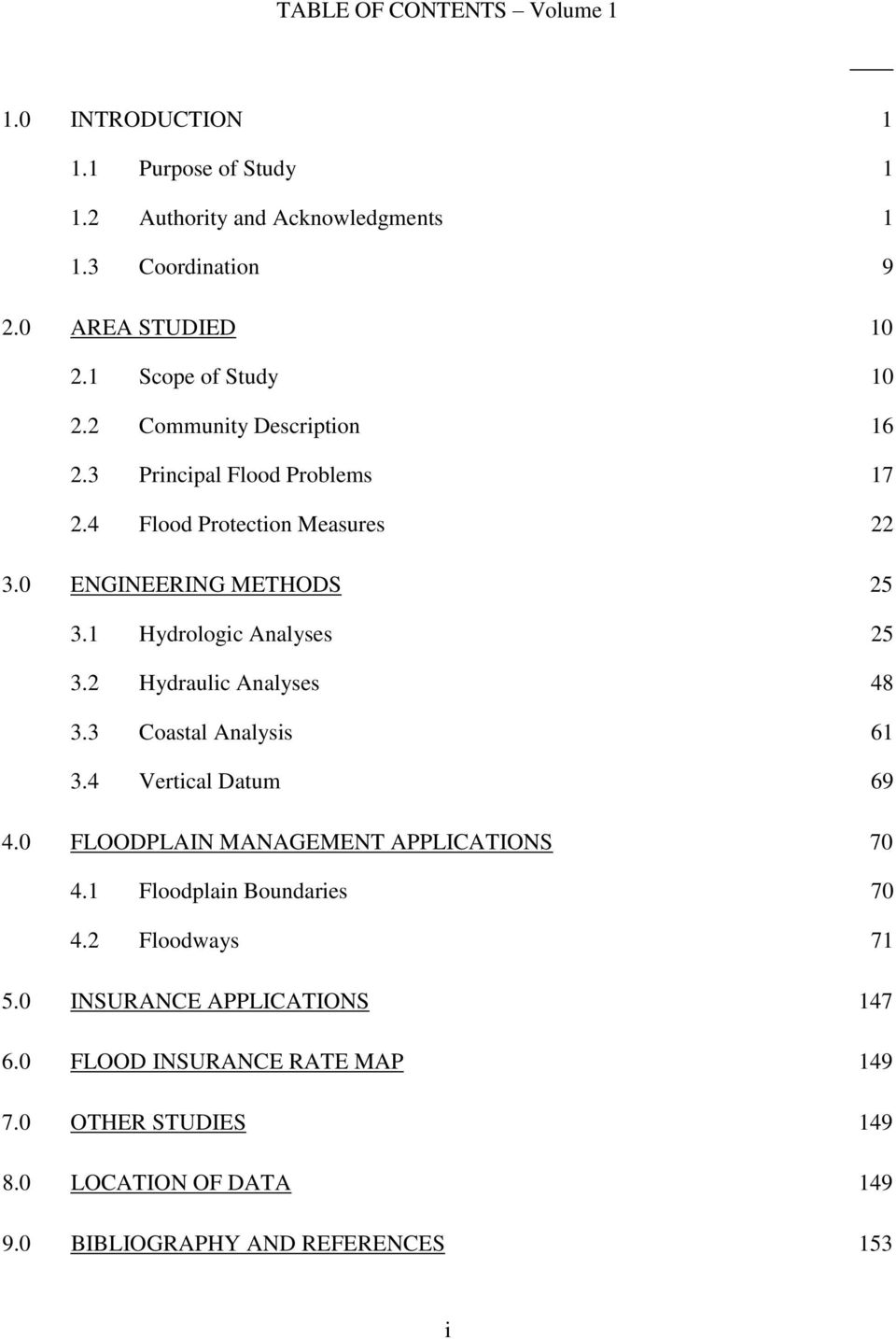
3 TABLE OF CONTENTS Volume INTRODUCTION Purpose of Study Authority and Acknowledgments Coordination AREA STUDIED Scope of Study Community Description Principal Flood Problems Flood Protection Measures ENGINEERING METHODS Hydrologic Analyses Hydraulic Analyses Coastal Analysis Vertical Datum FLOODPLAIN MANAGEMENT APPLICATIONS Floodplain Boundaries Floodways INSURANCE APPLICATIONS FLOOD INSURANCE RATE MAP OTHER STUDIES LOCATION OF DATA BIBLIOGRAPHY AND REFERENCES 153 i
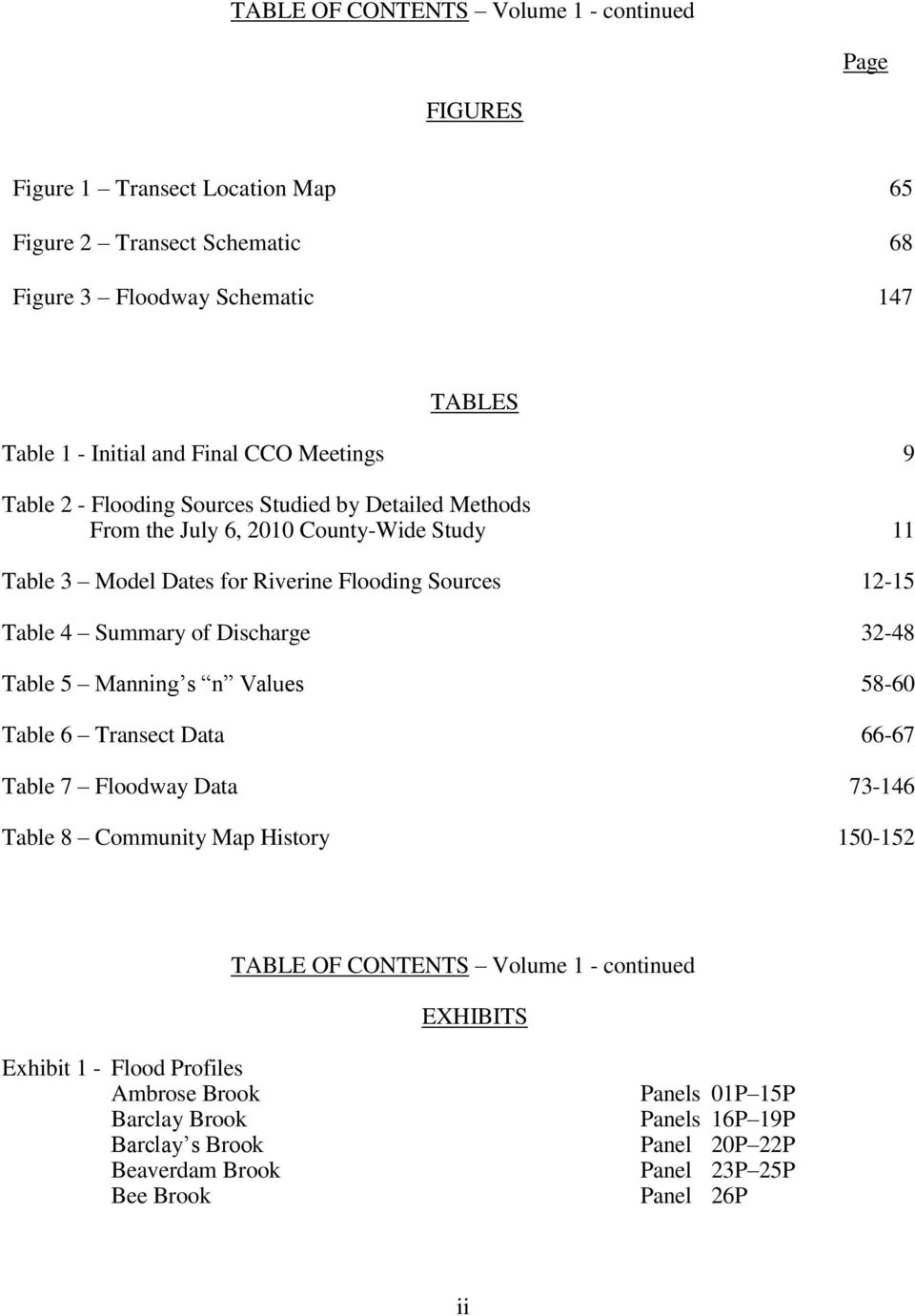
4 TABLE OF CONTENTS Volume 1 - continued Page FIGURES Figure 1 Transect Location Map 65 Figure 2 Transect Schematic 68 Figure 3 Floodway Schematic 147 TABLES Table 1 - Initial and Final CCO Meetings 9 Table 2 - Flooding Sources Studied by Detailed Methods From the July 6, 2010 County-Wide Study 11 Table 3 Model Dates for Riverine Flooding Sources Table 4 Summary of Discharge Table 5 Manning s n Values Table 6 Transect Data Table 7 Floodway Data Table 8 Community Map History TABLE OF CONTENTS Volume 1 - continued EXHIBITS Exhibit 1 - Flood Profiles Ambrose Brook Barclay Brook Barclay s Brook Beaverdam Brook Bee Brook Panels 01P 15P Panels 16P 19P Panel 20P 22P Panel 23P 25P Panel 26P ii
5 TABLE OF CONTENTS Volume 1 continued Exhibit 1 - Flood Profiles - continued Bentley s Brook Bog Brook Bonhamtown Brook Bonygutt Brook Bound Brook Boundary Branch Mill Brook No. 1 Carters Brook Cedar Brook No. 1 Cedar Brook No. 2 Cedar Brook No. 3 Panel 27P Panel 28P Panel 29P Panels 30P 32P Panels 33P 40P Panels 41P 42P Panels 43P 48P Panels 49P 53P Panels 54P 55P Panels 56P 57P TABLE OF CONTENTS Volume 2 July 6, 2010 EXHIBITS - continued Exhibit 1 - Flood Profiles - continued Clear Brook Coppermine Brook Cow Yard Brook Cranbury Brook Crossway Creek Deep Run Devils Brook Dismal Brook Diversion Channel Doty s Brook Great Ditch Green Brook Heards Brook Heathcote Brook Heathcote Brook Branch Ireland Brook Iresick Brook Lawrence Brook Mae Brook Manalapan Brook Matawan Creek Matchaponix Brook Panels 58P 59P Panel 60P Panel 61P Panels 62P 71P Panels 72P 73P Panels 74P 81P Panels 82P 85P Panels 86P 87P Panel 88P Panels 89P 93P Panel 94P Panels 95P 97P Panels 98P 100P Panels 101P 106P Panel 107P Panels 108P 111P Panels 112P 114P Panels 115P 121P Panels 122P 124P Panels 125P 130P Panel 131P Panels 132P 135P iii

6 TABLE OF CONTENTS Volume 2 - continued EXHIBITS - continued Exhibit 1 - Flood Profiles - continued Mile Run Mill Brook No. 1 Mill Brook No. 2 Millstone River Oakeys Brook Panels 136P 139P Panels 140P 141P Panel 142P Panels 143P 151P Panels 152P 156P TABLE OF CONTENTS Volume 3 July 6, 2010 EXHIBITS - continued Exhibit 1 - Flood Profiles - continued Parkway Branch Pumpkin Patch Brook Rahway River Raritan River Robinsons Branch Robinsons Branch Tributary Sawmill Brook No. 1 Sawmill Brook No. 2 Shallow Brook Six Mile Run Six Mile Run Branch South Branch Rahway River South River Spa Spring Creek Stream Stream Sucker Brook Switzgable Brook Ten Mile Run Tennents Brook Tributary A to Lawrence Brook Tributary No. 1 to Sucker Brook Tributary No. 1 to Ten Mile Run Tributary No. 2 to Ten Mile Run Tributary to Carters Brook Tributary to Cedar Brook No. 3 Tributary to Cranbury Brook Tributary to Heathcote Brook Tributary to Lawrence Brook Panels 157P 158P Panels 159P 160P Panels 161P 163P Panels 164P 171P Panels 172P 173P Panel 174P Panels 175P 179P Panel 180P Panels 181P 184P Panels 185P 186P Panels 187P 188P Panels 189P 192P Panels 193P 196P Panels 197P 198P Panels 199P 202P Panels 203P 205P Panels 206P 207P Panel 208P Panels 209P 210P Panels 211P 214P Panel 215P Panel 216P Panels 217P 218P Panel 219P Panel 220P Panel 221P Panel 222P Panels 223P 224P Panel 225P iv

7 TABLE OF CONTENTS Volume 3 - continued EXHIBITS - continued Exhibit 1 - Flood Profiles - continued Tributary to Manalapan Brook Panel 226P Tributary to Mile Run Panel 227P Tributary to Millstone River Panel 228P Tributary to Oakeys Brook Panel 229P Tributary to Sawmill Brook No. 2 Panel 230P Tributary to Six Mile Run Branch Panels 231P 232P West Branch Mill Brook No. 1 Panels 233P 234P Wigwam Brook Panels 235P 237 Woodbridge River Panels 238P 242P Exhibit 2 - Flood Insurance Rate Map Index Flood Insurance Rate Map v
8 FLOOD INSURANCE STUDY MIDDLESEX COUNTY, NEW JERSEY (ALL JURISDICTIONS) 1.0 INTRODUCTION 1.1 Purpose of Study This countywide Flood Insurance Study (FIS) investigates the existence and severity of flood hazards in, or revises and updates previous FISs/Flood Insurance Rate Maps (FIRMs) for the geographic area of Middlesex County, including the Boroughs of Carteret, Dunellen, Helmetta, Highland Park, Jamesburg, Metuchen, Middlesex, Milltown, Sayreville, South Plainfield, South River, and Spotswood; the Cities of New Brunswick, Perth Amboy, and South Amboy; and the Townships of Cranbury, East Brunswick, Edison, Monroe, North Brunswick, Old Bridge, Piscataway, Plainsboro, South Brunswick, and Woodbridge; referred to collectively as Middlesex County. This FIS aids in the administration of the National Flood Insurance Act of 1968 and the Flood Disaster Protection Act of This FIS has developed flood risk data for various areas of the county that will be used to establish actuarial flood insurance rates. This information will also be used by Middlesex County to update existing floodplain regulations as part of the Regular Phase of the National Flood Insurance Program (NFIP), and will also be used by local and regional planners to further promote sound land use and floodplain development. Minimum floodplain management requirements for participation in the NFIP are set forth in the Code of Federal Regulations at 44 CFR, In some States or communities, floodplain management criteria or regulations may exist that are more restrictive or comprehensive than the minimum Federal requirements. In such cases, the more restrictive criteria take precedence and the State (or other jurisdictional agency) will be able to explain them. 1.2 Authority and Acknowledgments The sources of authority for this FIS are the National Flood Insurance Act of 1968 and the Flood Disaster Protection Act of The original July 6, 2010 countywide FIS was prepared to include all jurisdictions within Middlesex County into a countywide format FIS. Information on the authority and acknowledgments for each jurisdiction with a previously printed FIS report included in this countywide FIS is shown below. This FIS was prepared to include all jurisdictions within Middlesex County in a countywide format. Information on the authority and acknowledgments for each 1

9 jurisdiction included in this countywide FIS, as compiled from their previously printed FIS reports, is shown below. Carteret, Borough of: Cranbury, Township of: Dunellen, Borough of: East Brunswick, Township of: the hydrologic and hydraulic analyses from the original FIS report, dated November 1976 were prepared by the U.S. Army Corps of Engineers (USACE) for the Federal Emergency Management Agency (FEMA), under Inter- Agency Agreement No. IAA-H-16-75, Project Order No. 16. In the revision for the FIS dated April 15, 1992, the hydrologic analyses for Arthur Kill and the Rahway River were prepared by Camp, Dresser, and McKee, Inc., while preparing the FIS for the contiguous City of New York, New York. That work was completed in December the hydrologic and hydraulic analyses from the original FIS report, dated September 1979 were prepared by the New Jersey Department of Environmental Protection (NJDEP) for FEMA, under Contract No. H For the FIS dated November 17, 1981, the hydrologic and hydraulic analyses for that study were conducted by Justin and Courtney, Inc., under subcontract to the NJDEP. the hydrologic and hydraulic analyses from the FIS report dated February 4, 1988, were prepared by the Natural Resources Conservation Service (NRCS) of Somerset, New Jersey, for FEMA, under Contract No. IAA-H-23-74, Project Order No. 10. The updated hydrologic and hydraulic analyses for Green Brook were prepared by the NJDEP, Division of Water Resources, Bureau of Floodplain Management. This work was completed in July the hydrologic and hydraulic analyses from the original FIS report, dated July 6, 1981, and January 6, 1982, Flood Insurance Rate Map (FIRM) (hereinafter referred to as the 1982 FIS), were prepared by the NJDEP, Division of Water Resources, Bureau of Floodplain Management, for FEMA, under Contract No. H Mapping was supplied by the Township of East Brunswick and by the updated State of New Jersey Flood Hazard Report Nos. 2, 7, and 8. 2

10 That work was completed in October The hydrologic and hydraulic analyses for the 1982 FIS were performed by Anderson-Nichols and Company, Inc., under subcontract to the NJDEP. Survey and topographic data were supplied by GEOD Aerial Mapping, Inc., under subcontract with Anderson-Nichols and Company, Inc. Tidal flood data were determined by Tetra Tech, Inc. For the May 3, 1990, FIS report, the hydraulic analyses for Cedar Brook No. 3 were prepared by Lynch, Carmody, Guiliano & Karol, P.A. For the September 18, 1986, FIS report, the updated tidal analysis for Raritan Bay was performed by Camp, Dresser and McKee for FEMA during the preparation of the FIS for the City of New York. That work was completed in December Edison, Township of: the hydrologic and hydraulic analyses represents a revision from the original FIS report, dated December 1982 by the USACE for FEMA. For the FIS report, dated December 19, 1984, the hydrologic and hydraulic analyses for the Raritan River were performed by the NJDEP. The original tidal analysis for the Raritan River was performed by the NJDEP. The updated version was prepared by RBA Group for FEMA, under Contract No. EMW-C Helmetta, Borough of: Highland Park, Borough of: the hydrologic and hydraulic analyses from the April 16, 1984, FIS report, were prepared by the NJDEP for FEMA, under Contract No. H That work was completed in October The hydrologic and hydraulic analyses for that study were conducted by Justin & Courtney, Inc., under subcontract to the NJDEP. the hydrologic and hydraulic analyses, for the FIS dated December 1976, were performed by the USACE, New York District, for the Federal Insurance Administration (FIA), under Inter- Agency Agreement No. IAA-H-2-73, Project Order No. 4. This work, which was completed in June 1973, covered all flooding sources affecting the Borough of Highland Park. 3

11 Jamesburg, Borough of: Metuchen, Borough of: Middlesex, Borough of: Milltown, Borough of: Monroe, Township of: the hydrologic and hydraulic analyses from the November 1983 FIS report, were prepared by the NJDEP for FEMA, under Contract No. H The study was performed by Justin & Courtney, Inc., under subcontract to the NJDEP. That work was completed in October the hydrologic and hydraulic analyses from the June 1979 FIS report, were prepared by the New Jersey Division of Water Resources for the FIA, under Contract No. H That work was completed in October The study was performed by McPhee, Smith, Rosenstein Engineers, under subcontract to the New Jersey Division of Water Resources. the hydrologic and hydraulic analyses from the March 18, 1986, FIS report, represent a revision of the original analyses by the USACE. The updated version was prepared by The RBA Group for FEMA, under Contract No. EMW-C That work was completed in October the hydrologic and hydraulic analyses from the August 4, 1980, FIS report, were performed by the NJDEP, Division of Water Resources, Bureau of Floodplain Management for the FIA under Contract No. H That work was completed in August The study was prepared by Anderson-Nichols and Company, Inc., for the NJDEP, Division of Water Resources, Bureau of Floodplain Management. GEOD Aerial Mapping, Inc., supplied the survey and topographic data to Anderson-Nichols. the hydrologic and hydraulic analyses from the original October 1981 FIS report, were performed by Justin & Courtney, Inc., under subcontract to the NJDEP. That work was completed in October The second revision was prepared by Dewberry & Davis under agreement with FEMA. Flood boundaries on Clear Brook and the Possum Hollow Road Drainage Channel were revised based on updated topographic maps submitted by the community. That work was completed in July In the third revision, from the November 6, 1991, FIS 4

12 report, analyses were performed by Carr Engineering Associates, P.A., to reflect the effects of a channelization project on Clear Brook and an unnamed tributary to Clear Brook. This work was completed in June That work was prepared by the NJDEP for FEMA, under Contract No. H New Brunswick, City of: the hydrologic and hydraulic analyses from the June 1979 FIS report, were prepared by the NJDEP, Division of Water Resources, Bureau of Floodplain Management for the FIA, under Contract No. H This work was completed in October Survey and topographic data were supplied by GEOD Aerial Mapping, Inc., under subcontract with Anderson-Nichols and Company, Inc., under subcontract to the NJDEP, Division of Water Resources, Bureau of Floodplain Management. Tidal flood data were determined by Tetra Tech, Inc., which has conducted an extensive tidal study of the eastern seaboard of the United States. Approval to use this data for insurance applications was obtained from the FIA. North Brunswick, Township of: the hydrologic and hydraulic analyses from the November 1979 FIS report, were prepared by the NJDEP, Division of Water Resources, Bureau of Floodplain Management for the FIA, under Contract No. H This work was completed in December The report was prepared by Anderson Nichols and Company, Inc., Boston, Massachusetts, for the NJDEP, Division of Water Resources, Bureau of Floodplain Management. Survey, topographic data, and topographic mapping were supplied by GEOD Aerial Mapping, Inc., Oak Ridge, New Jersey, under subcontract to Anderson Nichols and Company. The mapping for Lawrence Brook, however, was an update of mapping in Flood Hazard Report No. 7. Old Bridge, Township of: the hydrologic and hydraulic analyses from the original August 1982 FIS report, were prepared by URS Company, Inc., for FEMA, under Contract No. H The original study was completed in August The hydrologic and hydraulic analyses in that study for the South 5
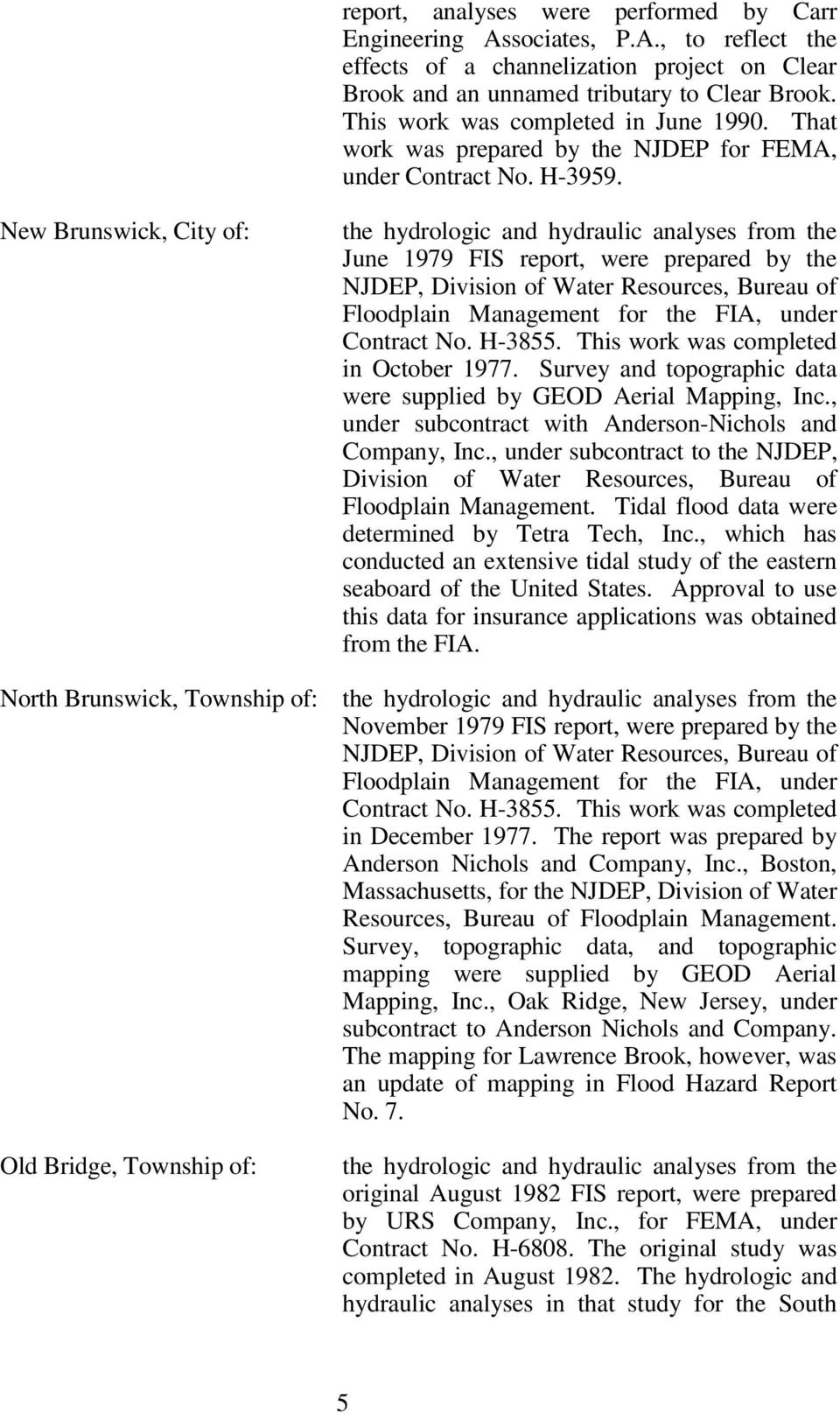
13 River and Matchaponix Brook were obtained from the FISs for the Townships of Monroe and East Brunswick, and the Borough of Spotswood. The addition of the wave height analysis was prepared by Dewberry and Davis for FEMA, under Contract No. EMW-C-0543; this was completed in July The updated study, from the October 16, 1987, FIS report were prepared by Dewberry and Davis. The Township of Old Bridge Department of Engineering and Planning and the NJDEP provided technical data. This work was completed in September Perth Amboy, City of: Piscataway, Township of: Plainsboro, Township of: Sayreville, Borough of: the hydrologic and hydraulic analyses of the revision of the original study from the November 1, 1983, FIS report, prepared by Tetra Tech, Inc., for FEMA, under Contract No. H The updated version was prepared by Tetra Tech, Inc., under agreement with FEMA. This work was completed in August the hydrologic and hydraulic analyses from the July 18, 1983, FIS report, were prepared by the USACE, New York District, for FEMA, under Inter-Agency Agreement No. IAA-H-7-76, Project Order No. 11. The hydrologic and hydraulic analyses for Bonygutt Brook, Bound Brook, Ambrose Brook, and Doty s Brook were conducted by T & M Associates under subcontract to the USACE. This work was completed in January the hydrologic and hydraulic analyses from the December 19, 1984, FIS report, were prepared by the NJDEP for FEMA, under Contract No. H The hydrologic and hydraulic analyses for that study were conducted by Justin & Courtney, Inc., under subcontract to the NJDEP. This work was completed in November the hydrologic and hydraulic analyses from the original June 1977 FIS report, were performed by the NJDEP for FEMA, under Contract No. H The original work was completed in June The updated stillwater analysis was performed by Camp, Dresser and McKee for FEMA during the preparation of the FIS for the City of New York. The New York study was 6

14 completed in December The addition of the wave height analysis was performed by Dewberry & Davis and completed in July South Amboy, City of: the hydrologic and hydraulic analyses of the revision from the August 1981 FIS report, were performed by Tetra Tech, Inc., for FEMA. The Tetra Tech work was completed in August The updated analysis for the Raritan River was prepared by Camp, Dresser and McKee for FEMA during the preparation of the FIS for the City of New York. The New York study was completed in December The updated version was prepared by Dewberry & Davis, under agreement with FEMA. That work was completed in June South Brunswick, Township of: the hydrologic and hydraulic analyses from the December 18, 1985, FIS report, were prepared by the NJDEP for FEMA, under Contract No. H The hydrologic and hydraulic analyses were performed by O Brien & Gere Engineers, Inc., under subcontract to the NJDEP. This work was completed in March South Plainfield, Borough of: South River, Borough of: Spotswood, Borough of: the hydrologic and hydraulic analyses from the February 1980 FIS report, were performed by the NJDEP, for the FIA, under Contract No. H This work was completed in June the original hydrologic and hydraulic analyses from the May 1977 FIS report, were performed by the NJDEP for FEMA, under Contract No. H The original work was completed in May The updated tidal analysis for the South River was performed by Camp, Dresser and McKee for FEMA during the preparation of the FIS for the City of New York. The New York study was completed in December the original hydrologic and hydraulic analyses from the August 1977 FIS report, were prepared by the NJDEP, Division of Water Resources, Bureau of Floodplain Management, for FEMA, under Contract No. H The work for the original study was completed in August The hydrologic and hydraulic analyses for Cedar Brook in this revision were prepared by Lynch, 7
15 Carmody, Guiliano, & Karol, P.A., under agreement with FEMA. The work for this revision was completed in December Woodbridge, Township of: the original hydrologic and hydraulic analyses from the January 1979 FIS report, were revised by Anderson Nichols, Inc., for FEMA. The updated version was prepared by the NJDEP, Division of Water Resources, Bureau of Floodplain Management, under agreement with FEMA, Contract No. H This study was completed in January The hydrologic and hydraulic analyses in the updated study were computed by Richard Browne Associates under subcontract to the NJDEP, Division of Water Resources, Bureau of Floodplain Management. The wave height analysis for this study was prepared by Dewberry and Davis for FEMA, under Contract No. H-EMW-C That work was completed in July For the July 6, 2010 countywide study, revised hydrologic and hydraulic analyses for Boundary Branch Mill Brook No. 1, Coppermine Brook, Mill Brook No. 1, South Branch Rahway River, and West Branch Mill Brook No. 1, were prepared for FEMA by Leonard Jackson Associates. Also, floodplains for all detailed study, unrevised streams have been redelineated using updated topographic data provided to FEMA by Middlesex County. Revised hydraulic analyses for the Raritan River were prepared by Dewberry under Contract No. EMW-2000-CO This work was completed in November Additionally, flood hazards previously assessed using approximate methods were re-analyzed throughout the county and results were then mapped using the Middlesex County topographic data. This work was completed in July Finally, the hydrology and hydraulic analyses for Matawan Creek were taken from the Monmouth County (All Jurisdictions) FIS dated September 25, 2009 (FEMA, 2009). For the [date] countywide revision, the coastal wave height analysis along Arthur Kill, Raritan Bay and Raritan River were prepared by Risk Assessment Mapping and Planning Partners (RAMPP) for FEMA under contract No.HSFEHQ-09-D- 0369, task order HSFE02-09-J This work was completed in Base map information shown on this FIRM was provided in digital format by the State of New Jersey Office of Information Technology. This information was derived from digital orthophotos produced at a scale of 1:2,400 with 1-foot pixel resolution from photography dated April The projection used for the production of this FIRM is New Jersey State Plane, FIPSZONE The horizontal datum was NAD 83, GRS80 spheroid. Differences in datum, spheroid, projection, or State Plane zones used in the 8

16 production of FIRMs for adjacent counties may result in slight positional differences in map features at the county boundaries. These differences do not affect the accuracy of information shown on the FIRM. 1.3 Coordination Consultation Coordination Officer s (CCO) meetings may be held for each jurisdiction in this countywide FIS. An initial CCO meeting is held typically with representatives of FEMA, the community, and the study contractor to explain the nature and purpose of a FIS, and to identify the streams to be studied by detailed methods. A final CCO meeting is held typically with representatives of FEMA, the community, and the study contractor to review the results of the study. The dates of the initial and final CCO meetings held for jurisdictions within Middlesex County are shown in Table 1, "Initial and Final CCO Meetings." TABLE 1 - INITIAL AND FINAL CCO MEETINGS Community Initial CCO Date Final CCO Date Borough of Carteret * April 29, 1976 Township of Cranbury March 15, 1976 July 9, 1981 Borough of Dunellen * June 6, 1975 Township of East Brunswick May 12, 1975 January 21, 1981 Township of Edison June 10, 1981 February 23, 1984 Borough of Helmetta March 15, 1976 November 7, 1983 Borough of Highland Park Borough of Jamesburg March 15, 1976 June 28, 1983 Borough of Metuchen May 5, 1975 September 25, 1978 Borough of Middlesex April 6, 1983 April 9, 1985 Borough of Milltown * April 4, 1979 Township of Monroe March 15, 1976 March 16, 1984 City of New Brunswick May 12, 1975 June 26, 1978 Township of North Brunswick May 12, 1975 May 8, 1979 Township of Old Bridge June 1980 August 6, 1984 City of Perth Amboy September 1975 June 10, 1983 Township of Piscataway June 23, 1975 August 10, 1982 Township of Plainsboro March 15, 1976 May 25, 1983 Borough of Sayreville * July 18, 1979 City of South Amboy September 1975 June 23, 1982 Township of South Brunswick March 1976 December 5, 1984 Borough of South Plainfield May 5, 1975 August 21, 1978 Borough of South River * August 28, 1978 Borough of Spotswood May 12, 1975 November 21, 1978 Township of Woodbridge November 10, 1976 December 16, 1981 *Data not available 9

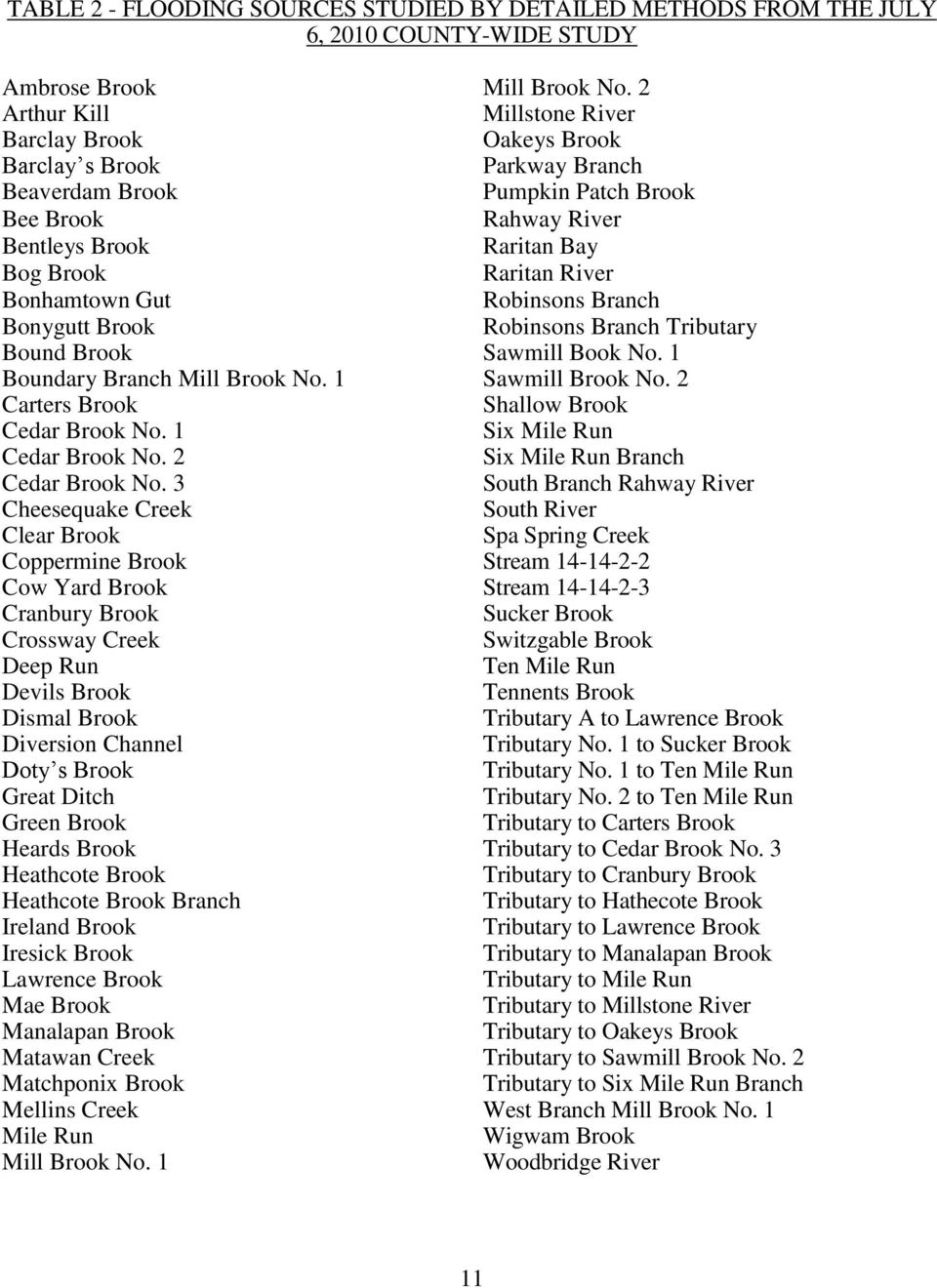
17 For the July 6, 2010 countywide FIS, initial CCO meetings were held December 6 and 8, These meetings were attended by representatives of the Cities of New Brunswick, Perth Amboy, and South Amboy; the Boroughs of Carteret, Helmetta, Highland Park, Jamesburg, Metuchen, Middlesex, Milltown, Sayreville, South Plainfield, South River, and Spotswood; the Townships of Cranbury, East Brunswick, Edison, Monroe, Old Bridge, Piscataway, Plainsboro, and Woodbridge; the New Jersey Department of Environmental Protection (NJDEP), FEMA, and Michael Baker, Jr., Inc. Final CCO meetings for the July 6, 2010 countywide study were held February 5 and 6, These meetings were attended by representatives of the Cities of New Brunswick, Perth Amboy, and South Amboy; the Boroughs of Carteret, Jamesburg, Metuchen, Middlesex, Milltown, and Spotswood; and the Townships of East Brunswick, Edison, Old Bridge, Piscataway, Plainsboro, South Brunswick, and Woodbridge; the NJDEP, FEMA, Dewberry, and Leonard Jackson Associates. For the [TBD] countywide revision, an initial CCO meeting was held on August 24, 2011, and attended by representatives of NJDEP, RAMPP, FEMA, and local officials.. The Flood Risk Review (FRR) meeting was held on August 21, The results of the study were reviewed at the final CCO meeting held on, and attended by representatives of. All concerns raised at that meeting have been addressed in this study. 2.0 AREA STUDIED 2.1 Scope of Study This FIS covers the incorporated areas of the geographic area of Middlesex County, New Jersey. All or portions of the flooding sources listed in Table 2, "Flooding Sources Studied by Detailed Methods from the July 6, 2010 County-Wide Study," were studied by detailed methods. For the July 6, 2010 County-wide study, limits of detailed study are indicated on the Flood Profiles (Exhibit 1) and on the FIRM (Exhibit 2). The areas studied were selected with priority given to all known flood hazard areas and areas of projected development and proposed construction. 10

18 TABLE 2 - FLOODING SOURCES STUDIED BY DETAILED METHODS FROM THE JULY 6, 2010 COUNTY-WIDE STUDY Ambrose Brook Mill Brook No. 2 Arthur Kill Millstone River Barclay Brook Oakeys Brook Barclay s Brook Parkway Branch Beaverdam Brook Pumpkin Patch Brook Bee Brook Rahway River Bentleys Brook Raritan Bay Bog Brook Raritan River Bonhamtown Gut Robinsons Branch Bonygutt Brook Robinsons Branch Tributary Bound Brook Sawmill Book No. 1 Boundary Branch Mill Brook No. 1 Sawmill Brook No. 2 Carters Brook Shallow Brook Cedar Brook No. 1 Six Mile Run Cedar Brook No. 2 Six Mile Run Branch Cedar Brook No. 3 South Branch Rahway River Cheesequake Creek South River Clear Brook Spa Spring Creek Coppermine Brook Stream Cow Yard Brook Stream Cranbury Brook Sucker Brook Crossway Creek Switzgable Brook Deep Run Ten Mile Run Devils Brook Tennents Brook Dismal Brook Tributary A to Lawrence Brook Diversion Channel Tributary No. 1 to Sucker Brook Doty s Brook Tributary No. 1 to Ten Mile Run Great Ditch Tributary No. 2 to Ten Mile Run Green Brook Tributary to Carters Brook Heards Brook Tributary to Cedar Brook No. 3 Heathcote Brook Tributary to Cranbury Brook Heathcote Brook Branch Tributary to Hathecote Brook Ireland Brook Tributary to Lawrence Brook Iresick Brook Tributary to Manalapan Brook Lawrence Brook Tributary to Mile Run Mae Brook Tributary to Millstone River Manalapan Brook Tributary to Oakeys Brook Matawan Creek Tributary to Sawmill Brook No. 2 Matchponix Brook Tributary to Six Mile Run Branch Mellins Creek West Branch Mill Brook No. 1 Mile Run Wigwam Brook Mill Brook No. 1 Woodbridge River 11
19 Riverine flooding sources throughout the county have been studied by detailed methods at different times and, prior to the July 6, 2010 countywide FIS, often on a community-by-community basis. Table 3, Model Dates for Riverine Flooding Sources below represents the hydraulic modeling dates for the detailed study flooding sources in the county. TABLE 3 MODEL DATES FOR RIVERINE FLOODING SOURCES MOST RECENT STREAM NAME COMMUNITY MODEL DATE Ambrose Brook Borough of Middlesex October 1984 Ambrose Brook Township of Piscataway January 1982 Barclay Brook Township of Old Bridge August 1982 Barclay's Brook Borough of Jamesburg October 1981 Barclay's Brook Township of Monroe October 1981 Beaverdam Brook Township of East Brunswick October 1977 Bee Brook Township of Plainsboro November 1981 Bentley's Brook Township of Monroe October 1981 Bog Brook Borough of Milltown, Township of East October 1977 Brunswick Bonhamtown Brook Borough of Metuchen October 1977 Bonhamtown Brook Township of Edison December 1982 Bonygutt Brook Borough of Dunellen July 1986 Bonygutt Brook Borough of Middlesex October 1984 Bonygutt Brook Township of Piscataway January 1982 Bound Brook Borough of Middlesex October 1984 Bound Brook Borough of South Plainfield June 1977 Bound Brook Township of Edison December 1982 Bound Brook Township of Piscataway January 1982 Boundary Branch of Borough of Highland Park Mill Brook August 2008 Carters Brook Township of South Brunswick March 1984 Cedar Brook No. 1 Township of Cranbury September 1979 Cedar Brook No. 1 Township of Monroe October 1981 Cedar Brook No. 1 Township of Plainsboro November 1981 Cedar Brook No. 2 Borough of South Plainfield June 1977 Cedar Brook No. 3 Borough of Spotswood December 1988 Cedar Brook No. 3 Township of East Brunswick May

20 TABLE 3 MODEL DATES FOR RIVERINE FLOODING SOURCES- continued MOST RECENT STREAM NAME COMMUNITY MODEL DATE Cheesequake Creek Borough of Sayreville June 1977 Clear Brook Township of Monroe June 1990 Coppermine Brook Township of Edison August 2008 Cow Yard Brook Township of South Brunswick March 1984 Cranbury Brook Township of Cranbury September 1979 Cranbury Brook Township of Monroe October 1981 Cranbury Brook Township of Plainsboro November 1981 Crossway Creek Borough of Sayreville June 1977 Deep Run Township of Old Bridge August 1982 Devils Brook Township of Plainsboro November 1981 Devils Brook Township of South Brunswick March 1984 Dismal Brook Borough of Metuchen October 1977 Dismal Brook Township of Edison December 1982 Diversion Channel Township of North Brunswick December 1977 Doty's Brook Township of Piscataway January 1982 Great Ditch Township of South Brunswick March 1984 Green Brook Borough of Middlesex October 1984 Green Brook Borough of Dunellen July 1986 Heards Brook Township of Woodbridge January 1979 Heathcote Brook Township of South Brunswick March 1984 Heathcote Brook Township of South Brunswick Branch March 1984 Ireland Brook Township of East Brunswick October 1977 Ireland Brook Township of South Brunswick March 1984 Iresick Brook Township of Old Bridge August 1982 Lawrence Brook Borough of Milltown, City of New Brunswick, Township of East Brunswick October 1977 Lawrence Brook Township of North Brunswick December 1977 Lawrence Brook Township of South Brunswick March 1984 Mae Brook Township of North Brunswick December 1977 Manalapan Brook Borough of Helmetta, Borough of Jamesburg, Township of Monroe October 1981 Manalapan Brook Borough of Spotswood August 1977 Matchaponix Brook Borough of Spotswood August 1977 Matchaponix Brook Township of Old Bridge, Township of Monroe October 1981 Mellins Creek Borough of Sayreville June 1977 Mile Run City of New Brunswick October 1977 Mile Run Township of North Brunswick, December

21 TABLE 3 MODEL DATES FOR RIVERINE FLOODING SOURCES- continued MOST RECENT STREAM NAME COMMUNITY MODEL DATE Mill Brook No.1 Borough of Highland Park August 2008 Mill Brook No.2 Township of Edison December 1982 Millstone River Township of Cranbury September 1979 Millstone River Township of Monroe October 1981 Millstone River Township of Plainsboro November 1981 Millstone River Township of South Brunswick March 1984 Oakeys Brook Township of South Brunswick, Township of North Brunswick March 1984 Parkway Branch Township of Woodbridge January 1979 Pumpkin Patch Brook Township of Woodbridge January 1979 Rahway River Township of Woodbridge January 1979 Raritan River Borough of Sayreville, Township of Piscataway, City of New Brunswick, Borough of Middlesex, Township of East Brunswick, Township of Edison August 2008 Robinsons Branch Township of Edison December 1982 Robinsons Branch Township of Edison December 1982 Tributary Sawmill Brook No. 1 Township of East Brunswick, Borough of October 1977 Milltown Sawmill Brook No. 2 Borough of Helmetta, Township of Monroe October 1981 Shallow Brook Township of Cranbury September 1979 Shallow Brook Township of Monroe October 1981 Shallow Brook Township of Plainsboro November 1981 Shallow Brook Township of South Brunswick March 1984 Six Mile Run Branch Township of South Brunswick March 1984 Six Mile Run Township of North Brunswick December 1977 South Branch Township of Woodbridge August 2008 Rahway River South River Borough of Sayreville June 1977 South River Borough of South River May 1977 South River Borough of Spotswood August 1977 South River Township of East Brunswick October 1977 South River Township of Old Bridge August 1982 Spa Spring Creek City of Perth Amboy August 1981 Spa Spring Creek Township of Woodbridge January 1979 Stream Borough of South Plainfield June 1977 Stream Borough of South Plainfield June 1978 Sucker Brook Borough of Milltown August
22 TABLE 3 MODEL DATES FOR RIVERINE FLOODING SOURCES- continued MOST RECENT STREAM NAME COMMUNITY MODEL DATE Sucker Brook Switzgable Brook Ten Mile Run Tennents Brook Tennents Brook Tributary A to Lawrence Brook Tributary No. 1 to Sucker Brook Tributary No. 1 to Ten Mile Run Tributary No. 2 to Ten Mile Run Tributary to Carters Brook Tributary to Cedar Brook No. 3 Tributary to Cranbury Brook Tributary to Heathcote Brook Tributary to Lawrence Brook Tributary to Manalapan Brook Tributary to Mile Run Tributary to Millstone River Tributary to Oakeys Brook Tributary to Sawmill Brook No. 2 Tributary to Six Mile Run Branch West Branch Mill Brook No. 1 Wigwam Brook Woodbridge River Woodbridge River Township of North Brunswick, Township of South Brunswick Township of South Brunswick Borough of Sayreville Township of Old Bridge Township of South Brunswick Township of North Brunswick Township of South Brunswick Township of South Brunswick Township of South Brunswick Borough of Spotswood Township of Monroe Township of South Brunswick Township of South Brunswick Township of Monroe New Brunswick Township of Cranbury Township of South Brunswick Borough of Helmetta Township of South Brunswick Borough of Highland Park Township of Monroe, Borough of Jamesburg City of Perth Amboy Township of Woodbridge December 1977 March 1984 March 1984 June 1977 August 1982 March 1984 December 1977 March 1984 March 1984 March 1984 August 1977 October 1981 March 1984 March 1984 October 1981 October 1977 September 1979 March 1984 October 1981 March 1984 August 2008 October 1981 August 1981 January
23 All or portions of numerous flooding sources in the county were studied by approximate methods. Approximate analyses were used to study those areas having a low development potential or minimal flood hazards. For the July 6, 2010 countywide FIS, all areas of approximate flood hazard analyses were updated using the topography provided by Middlesex County and the flood frequency estimation techniques developed by the U.S. Geological Survey (USGS). The [date] FIS revision includes a new coastal analysis and mapping for 25 miles of shoreline. 2.2 Community Description Middlesex County is located in the central part of New Jersey. There are 25 communities in Middlesex County. The Boroughs of Dunellen and Middlesex, and the Township of Piscataway are located in the northwest portion of the county. The Boroughs of Highland Park, Metuchen, and South Plainfield, and the Township of Edison are located in the northern portion of the county. The Borough of Carteret, the City of Perth Amboy, and the Township of Woodbridge are located in the northeast portion of the county. The City of New Brunswick and the Townships of North Brunswick and South Brunswick are located in the western portion of the county. The Boroughs of Milltown, Sayreville, South River, and Spotswood, and the Township of East Brunswick are located in the central portion of the county. The City of South Amboy and the Township of Old Bridge are located in the eastern part of the county. The Township of Plainsboro is located in the southwest portion of the county. The Boroughs of Helmetta and Jamesburg and the Township of Cranbury are located in the southern portion of the county. The Township of Monroe is located in the southeast portion of the county. Middlesex County is bordered to the north by Union County, New Jersey; to the northwest by Somerset County, New Jersey; to the northeast by Richmond County, New York; to the south by Monmouth County, New Jersey; and to the southwest by Mercer County, New Jersey. According to the 2012 U.S. Census Bureau, the population of Middlesex County was 823,041, and the land area was square miles (U.S. Census Bureau, 2012). The topography of the county consists of marshes and wetlands along coastal and floodplains in the east. Geological formations and early glacial ages have left Lawrence Brook and other streams, with a natural divide between deposits consisting of varying characteristics. Portions of the county consist of clay soils underlain by rock formations while other areas consist of Quaternary glacial deposits of sand and gravel underlain by Cretaceous bedrock. The climate of Middlesex County is mostly continental due to the predominance of winds from the interior. Average seasonal temperatures range from 39 degrees Fahrenheit ( F) in January to 87 F in July, with extremes of -17 F below zero to 16
24 106 F. Average annual precipitation is 45 inches, while relative humidity averages about 70 percent (U.S. Department of Commerce and National Oceanic and Atmospheric Administration; ). 2.3 Principal Flood Problems Past history of flooding in Middlesex County indicates that flooding of varied origin may be experienced in any season of the year since New Jersey lies within the major storm tracks of North America. In Middlesex County, the low-lying areas along streams are subject to periodic flooding. Flooding during the winter months is less frequent, but spring flooding compounded by snowmelt and ice has occurred. The more extensive floods have occurred in late summer and fall, usually associated with tropical disturbances moving northward along the Atlantic Coast. Two major floods that have occurred were Hurricane Doria in August 1971 and the flooding in Middlesex County of 1975 as a result of a continuing period of heavy rains. The 1975 flooding was produced from the combination of a tropical storm system arriving immediately following a storm which had already rainsoaked the area. Although varied flooding was experienced throughout Middlesex County, the maximum discharge on record at the Lawrence Brook gage occurred during this 1975 flood. This record discharge at Farrington Dam is similar to the discharge calculated for the 1-percent annual chance (100-year) flood (4,920 cubic feet per second (cfs)). In the Townships of Plainsboro and Cranbury, on July 21, 1975, the gaging station (No ) at Plainsboro on the Millstone River registered a flood flow of 3,970 (cfs). Flood flows from the storm in Plainsboro caused damage to roads and several highway bridges. In the Township of Cranbury, on July 21, 1975, Cranbury Brook flooded the central area of the Village of Cranbury. Damage was primarily flooded basements, though there was some shallow flooding of first-floor areas. All of the major streams in the Township of Monroe are subject to periodic flooding. The principal area of flooding is in the floodplain of Matchaponix Brook. Flood flows were recorded on Manalapan Brook in 1968 and 1975 at Spotswood, which is just north of Monroe. The flows reflected flooding from both Manalapan Brook and Matchaponix Brook, which join upstream of the gaging station. In the Borough of Jamesburg, flooding occurs from overflow of Manalapan Brook, Barclay s Brook, and Lake Manalapan. Floods were recorded on Manalapan Brook in 1968 and 1975 at the gaging station at Spotswood, which is approximately 5.5 miles downstream from Jamesburg. In the Borough of Helmetta, Manalapan Brook has been subject to periodic flooding. Floods were recorded in 1958, 1975, 1989, and 2007 at the gaging 17
25 station (No ) located approximately 2 miles downstream from Helmetta at Spotswood. There are no other records of flood problems in the Borough of Helmetta. In the Township of South Brunswick, numerous low-lying areas are subject to flooding caused by the overflow of the streams in the area. In recent years, flooding has occurred along the Millstone River at the confluence of Heathcote Brook, along Heathcote Brook and its tributaries, along Ten Mile Run and Six Mile Run, and along Lawrence Brook, Oakeys Brook, and Cow Yard Brook. On Lawrence Brook, floods were recorded in 1927, 1928, 1938, 1944, 1959, 1967, 1968, 1971, 1975, and Most damage was to highways and associated works. In the Township of North Brunswick, recorded gage history of flooding in the area began in 1927 at the gage on Lawrence Brook. Since then, a number of major and minor floods have been experienced, as indicated by peak stages and discharges recorded at the gage at Farrington Dam (USGS gage no ). The maximum recorded discharge for the gage is 4,920 cfs, which occurred in July North Brunswick has experienced flooding at various locations throughout the township such as along U.S. Route 1 and in some commercial developments. During the 1975 flood, Milltown Road was inundated and the police reported that roads were full of stalled and abandoned vehicles. Some of the flooding has been attributed to local drainage problems and is not considered as part of this study. In the City of New Brunswick, the recorded gage history of flooding in the area began in 1903 for the Raritan River and in 1927 for Lawrence Brook. Since then, a number of major and minor floods have been experienced as indicated by peak stages and discharges recorded at the gage on the Raritan River at Calco Dam (USGS Gage No ) and the gage on Lawrence Brook at Farrington Dam (USGS Gage No ). The maximum recorded discharges for the gages are 82,900 cfs at Calco Dam, which occurred in September 1999, and 4,920 cfs at Farrington Dam, which occurred in July The City of New Brunswick has experienced flooding along the Raritan River and Lawrence Brook, with the more serious flooding being in the vicinity of Burnet Street near Lawrence Brook and Landing Road near the Raritan River. At times, the severity of this flooding has made it necessary to evacuate residents by boat. In the City of South Amboy, many major floods have occurred since recent past. On November 25, 1950, a fierce northeaster struck the city with gale-force winds and more than 3 inches of precipitation. During the passage of that storm, a maximum tidal height of 9.5 feet was recorded at Perth Amboy. South Amboy, as well as most of New Jersey, was deluged on November 6-7, 1953, by heavy rains as a northeaster moved up the Atlantic coast. Striking the area with gale-force winds, the storm produced a tidal elevation of 8.9 feet at Perth Amboy. On September 12, 1960, the study area and most of New Jersey was hit by Hurricane Donna. Pounding the entire coastline with heavy rains 18
26 accompanied by winds of nearly 70 miles per hour (mph), this storm caused the greatest flood of record in South Amboy. The concurrence of the hurricane tidal surge with the mean high tide resulted in a record maximum tide of 10.0 feet at South Amboy. In South Amboy, on March 6-8, 1962, a storm, generating winds of 45 mph, with gusts up to 70 mph, remained in the New Jersey region for 60 hours. This unusually long duration coincided with five successive high spring tides. Severe flooding conditions along the entire coastline of New Jersey resulted from the high storm waters, strong waves, and gale-force winds. The city was hit by a disastrous flood on August 27, On that date, a warm front passed through the city. Severe thunderstorms associated with the front deluged the city with over 6 inches of rain. The flooding situation intensified as Tropical Storm Doria swept through the area later that evening and during the morning hours of the next day. The total rainfall from the thunderstorms and Tropical Storm Doria was almost 9 inches at Perth Amboy. A similar situation occurred on September 11-14, 1971, as heavy rains associated with violent thunderstorms preceded Tropical Storm Heidi. These two storms resulted in 140 million dollars in property damage throughout the State of New Jersey. The Township of Old Bridge is subject to tidal flooding along Cheesequake Creek, and both tidal and fluvial floods on Tennents Brook, Iresick Brook, Deep Run, and the South River. The township also experiences fluvial flooding along Barclay Brook and Matchaponix Brook. Despite the numerous streams and lowlying areas found within the township, flood damage has been relatively minor. This is largely due to the fact that development in the natural floodplain areas of the streams in the community has been minimal. In general, the flood damages that occurred in the past have been due to inadequate storm drainage. The Borough of Milltown has reported flooding at two locations on Lawrence Brook, the Riva Avenue Bridge and the Raritan River Railroad crossing downstream, of Main Street. Flooding in the area of Main Street and Washington Avenue has been attributed to the structure at the railroad crossing. The flooding of 1975 forced the closing of Main Street and three bridges to traffic. Sandbagging by the police was necessary to keep floodwaters out of the headquarters in Main Street. The post office, power substation municipal garage also had been affected. The Borough of Highland Park experiences periodic flooding from the Raritan River, Mill Brook No. 1, West Branch Mill Brook No. 1, Boundary Branch Mill Brook No. 1, and Cedar Creek. The Township of East Brunswick has experienced flooding along the Raritan and South Rivers, with the more serious flooding along Lawrence Brook. Stream flooding or local flooding has been reported along each of the major streams in the township. Serious flooding has occurred at almost all crossings of Irelands Brook. Flooding has been reported along Beaverdam Brook and on the upstream portion of Sawmill Brook. For public safety during the 1975 flood, it was 19
27 necessary to close six roads, including State Route 18, Tices Lane, Rues Lane, and Cranbury Road. The Borough of Sayreville has experienced flooding along the Raritan and South Rivers, with the more serious flooding contained in the vicinity of the Bordentown-Amboy Turnpike near Robert Street. At times, the severity of this flooding has made it necessary to evacuate residents by boat. The Borough of South River has experienced flooding along the South River, with the more serious flooding being in the area of the main business section near Veteran Memorial Bridge. Also, tidal flooding has been experienced along Causeway and Freeman Streets. The Borough of Spotswood has experienced flooding along the South River, Manalapan Brook, Matchaponix Brook, Cedar Brook, and Tributary to Cedar Brook. Localized flooding has been reported in several sections of the borough, particularly to the northeast of the railroad tracks; the most severe problem is located in the area between Crescent Avenue and New Brunswick Avenue. The City of Perth Amboy and the Borough of Carteret are subject to flooding conditions resulting from tropical storms, extratropical cyclones, and to a lesser extent, severe thunderstorm activity. Most of the of the serious flood problems are attributed to tropical storms, especially hurricanes, which produce high tidal surges and associated wave action on Raritan River (in Carteret), Raritan Bay, and Arthur Kill. In the Township of Woodbridge the flooding along the Raritan River is principally tidal from the Raritan Bay. Both the Rahway and Woodbridge Rivers are inundated by the 1-percent annual chance tidal flood from Arthur Kill. The 1-percent annual chance tidal flood also inundates the lower portions of Heards Brook and most of Spa Spring. Both the South Branch Rahway River and Pumpkin Patch Brook are periodically subject to riverine flooding. There are essentially no major flooding problems within the Borough of Metuchen. Little specific flood information is available for the streams in the Township of Edison, but it is known that floods occurred as early as 1903 in the general area and again in 1916, 1928, and The Borough of South Plainfield has experienced recurrent flooding problems along the major portion of streams. Recorded flooding history for Bound Brook dates back to 1833; since that time, six major floods have occurred in the Bound Brook drainage basin (October 9, 1903; July 26, 1916; July 23, 1938; May 29, 1968; August 28, 1971; and August 2, 1973). 20
28 In the Borough of Dunellen, as storms approach and cross the Watchung Mountains from the south or east, rainfall becomes intensified on the southeastern side of the mountains resulting in damaging erosion and sediment deposition. In the Borough of Middlesex, recorded history of flooding in the Greek Brook basin goes back as far as Flooding on Green Brook has been described as flashy or producing severe flood conditions due to the high intensity of rainfall for a short duration. Flood damage in the basin is more common and severe than elsewhere in the Raritan River basin because of encroachments that have and are taking place in the floodplains. At some locations, conditions are so bad that buildings have been constructed over the top of the stream, and the floodplains have been virtually eliminated. This situation has been further aggravated by construction of numerous hydraulically inadequate bridges along Green Brook. Flooding in the Bound Brook Basin is very closely interrelated with flooding in the Green Brook Basin. The Township of Piscataway has had isolated cases of serious flooding in the past. Areas adjacent to the Raritan River have become inundated during severe storms. Flooding along Ambrose Brook, characteristically floods roads and underpasses, most notably the Reading Railroad underpass and the Interstate Route 287 underpass on Possumtown Road. Bonygutt Brook causes some local roadway flooding, particularly in the area of Rock Avenue. The most serious flooding problem occurs on Bound Brook, just downstream of New Market Lake. On September 22, 1992, Tropical Storm Danielle produced rain fall across much of New Jersey. The southwest portion of the state experienced over 3 inches of rain. The storm washed out miles of beaches along the coastline. Hurricane Floyd originally made landfall in Cape Fear, North Carolina, as a Category 2 hurricane on September 16, The storm crossed over North Carolina and southeastern Virginia, before briefly entered the western Atlantic Ocean. The storm reached New Jersey on September 17, Record breaking flooding was recorded throughout the State of New Jersey. The Raritan River basin experienced record floods of up to 4.5 ft. higher than any previous record flood crest. The areas of Bound Brook and Manville were especially hit hard. A Federal Emergency Declaration was issued on September 17, Overall damage estimates for Hurricane Floyd, in the State of New Jersey are estimated around $250 million dollars. Hurricane Irene came ashore in Little Egg Inlet in Southern New Jersey; on August 28, In anticipation of the storm, Governor Chris Christy declared a state of emergency on August 25 th, with President Obama reaffirming the declaration on August 27 th. Mandatory evacuations were ordered throughout the State of New Jersey. Wind Speeds were recorded at 75 mph and rain totals reached over 10 inches in many parts of the state. Over 3,500 customers lost power, in Middlesex County, during the storm. Overall damage estimates, for Middlesex County, came to over 100 million dollars. (Associated Press, 2011) 21
29 Hurricane Sandy came ashore as an immense tropical storm in Brigantine, New Jersey, on October 29, Sandy dropped heavy rain on the area; almost a foot in some areas. Wind gust were recorded at 90 mph. A full moon made the high tides 20 percent higher than normal and amplified the storm surge. The New Jersey shore suffered the most damage. Some barrier island communities suffered severe wash over including the creation of two temporary inlets. Seaside communities were damaged and destroyed up and down the coastline. NOAA s gage # at Sandy Hook, NJ; the high water mark (which is considered as a stillwater elevation without waves) was 9.21 ft. NAVD88 at 6:00 PM on October 29, The Middlesex County Utilities Authority noted that the three pumping stations went off line during the storm; South Amboy, Edison and Sayreville. Some 235, 000 Middlesex County households had lost power during the storm. Initial reports suggest that 87,000 homes and businesses were damaged or destroyed by the storm. Governor Chris Christy declared a state of emergency on October 31. Hurricane Sandy is estimated to cost the State of New Jersey over $36 billion (Associated Press, 2012). 2.4 Flood Protection Measures FEMA specifies that all levees must have a minimum of 3-foot freeboard against 1-percent annual chance flooding to be considered a safe flood protection structure. The National Weather Service provides municipalities with an early warning of expected flooding, particularly in the case of intense hurricanes. There are no major flood control structures or measures existing, authorized, or proposed in the Boroughs of Highland Park, Metuchen, and South River; in the Cities of Perth Amboy and South Amboy; and in the Townships of Old Bridge and Piscataway. The Township of Piscataway provides for the cleaning of stream channel and drainage facilities of debris and siltation as required. While there are a number of dams located within the South River Basin, they were not designed with capacities for flood control. There are dams located on Devils Brook and Shallow Brook; however, they do not affect the flood flows. There are no flood protection works in the Townships of Cranbury, Monroe, Plainsboro, and South Brunswick, and the Boroughs of Jamesburg and Spotswood. New construction is subject to the requirements of a township ordinance restricting construction in floodplain areas in accordance with FEMA initial land-use regulation requirements. The New Jersey Department of Environmental Protection (NJDEP) has adopted rules, regulations, and minimum standards concerning development and use of 22
30 land, which apply to development in the Boroughs of Helmetta, Milltown, Sayreville, South River and Spotswood, and the City of New Brunswick, and to the Townships of East Brunswick, Monroe, North Brunswick, and South Brunswick. An arrangement is in effect with the Township of Cranbury that, when the floodgates are opened at Brainerd Lake in Cranbury, Plainsboro is notified. This provides approximately two hours warning for Plainsboro Pond to be watched for rising water levels. The Borough of South Plainfield has lowered the water-surface elevation at Spring Lake in an attempt to increase retention. Since the storm of August 2-3, 1973, emergency funds have been used to clear and snag Green Brook and to remove some of the vegetation that had impeded flow in the past. Fill was removed from the floodplain of Green Brook to the encroachment limit as outlined in Flood Hazard Report No. 3 (State of New Jersey, DEP, 1972). In an effort to tackle flood problems on a regional basis, the Green Brook Flood Control project was initiated. The New Jersey Department of Environmental Protection has partnered with the New York District of the Corps of Engineers to build in Central New Jersey the Green Brook Flood Control Project. NJDEP has partnered with Somerset and Middlesex Counties. The project is supported by the 13 impacted communities and the Green Brook Flood Control Commission. The Bound Brook portion of the protection is at the lower end of the Green Brook basin and has been the focus of the design and the construction. The structural elements of the Bound Brook Flood Works will be certifiable by FEMA and will provide a 150 year level of protection. The construction of the Bound Brook Flood Works was started in The Bound Brook Flood Works will cost about 110 million dollars. The Bound Brook Flood Works consists of an array of the following Structural and Non-Structural Flood Control options: Earthen Levees, Concrete Flood Walls, Closable Flood Barriers, Removal of a five span railroad bridge and embankment, Multiple Bridge Raisings, Large Pumping Stations, Upgrading of multiple elements of major elements of the Bound Brook Storm Water collection system, Buy-outs and Flood Proofing of an Apartment Complex. This is an environmental friendly project with a mitigation of wetlands impacts being addressed at the Finderne Farms site in near-by Bridgewater. (NJDEP 2014) In the Township of Edison, the only flood protection structures within the study area are located along Bonhamtown Brook in the form of diversion tunnels on Bernard Street and Dorothy Avenue. The diversion tunnels convey flows directly to Mill Brook. The township has also attempted to increase culvert openings on several streams to reduce flooding upstream. There are some non-structural measures of flood protection being used to aid in the prevention of future flood 23
31 damage. These are in the form of land-use regulations adopted by Edison to control building in the floodplains. The Boroughs of Sayreville and Milltown have no formal structural measures designed specifically for flood protection, but flows on the Raritan River are regulated by Spruce Run and Round Valley reservoirs. In the Township of East Brunswick, flows in the lower portion of Lawrence Brook are regulated within the township by the Farrington Reservoir. The reservoir has a storage capacity of 655 million gallons. The township has no other formal structural measures designed specifically for flood protection; flows on the Raritan River are regulated by the Spruce Run and Round Valley Reservoirs. The levee located within the township does not meet the FEMA freeboard requirement. While there are a number of dams within the Lawrence Brook Basin, they were not designed with capacities for flood control. Several minor channel improvements have been made along Pumpkin Patch Brook. These were primarily to prevent erosion and do not affect the flood elevations significantly. In the Township of Woodbridge, the levee constructed on the north side of the South Branch Rahway River between Wood Avenue and the Garden State Parkway protects that area of the industrial park from storms up to a 1-percent annual chance recurrence interval. This levee does not meet FEMA specifications; flood boundaries have been delineated outside the levee. The replacement of the New Dover Road bridge and the channel improvements from the Rahway River upstream to the county park have significantly reduced flooding. Heards Brook and its tributary have been improved from its mouth upstream to Metuchen Avenue. These improvements include a system of trapezoidal and rectangular concrete channels, a well-defined earthen channel, and a massive culvert project under the railroad crossing. Wedgwood Brook has also been improved from its mouth upstream to the railroad embankment. In the Borough of Carteret, flood protection measures include filling in land in low areas to provide higher elevations before construction, and installing check valves on storm and sanitary lines to prevent back-up in areas of low development. In the Township of North Brunswick, the Farrington Dam regulates flows in the lower portions of Lawrence Brook. This reduces the flows in that area of the township between Milltown and New Brunswick. The township contains no other formal structural measures designed for flood protection. This township uses the U.S. Department of Housing and Urban Development Flood Boundary and Floodway Map in a manner consistent with sound floodplain zoning. The City of New Brunswick has no formal structural measures designed specifically for flood protection. But flows on the Raritan River are regulated by the 24
32 Spruce Run and Round Valley Reservoirs. Flows in the lower portion of Lawrence Brook are regulated by the Farrington Reservoir (capacity 655 million gallons). Lake Manalapan Dam is located on the southern corporate limits of Jamesburg with the Township of Monroe. It provides a minimal amount of flood protection to the Borough of Jamesburg, as it affects flows on Manalapan Brook. Middlesex County has no levee type structure that would require analysis of levee failure and removal under Section D of the Draft Atlantic Ocean and Gulf of Mexico Coastal Guidelines update. In alignment with standard practice used in other FEMA studies, all coastal armoring structures and beach stabilization structures have been included in the analysis without adjusting the analysis to remove the structure or reduce the effects of the structure. 3.0 ENGINEERING METHODS For the flooding sources studied in detail in the county, standard hydrologic and hydraulic study methods were used to determine the flood hazard data required for this FIS. Flood events of a magnitude which are expected to be equaled or exceeded once on the average during any 10-, 50-, 100-, or 500-year period (recurrence interval) have been selected as having special significance for floodplain management and for flood insurance rates. These events, commonly termed the 10-, 50-, 100-, and 500-year floods, have a 10-, 2-, 1-, and 0.2-percent chance, respectively, of being equaled or exceeded during any year. Although the recurrence interval represents the long term average period between floods of a specific magnitude, rare floods could occur at short intervals or even within the same year. The risk of experiencing a rare flood increases when periods greater than 1 year are considered. For example, the risk of having a flood which equals or exceeds the 100-year flood (1-percent chance of annual exceedence) in any 50-year period is approximately 40 percent (4 in 10), and, for any 90-year period, the risk increases to approximately 60 percent (6 in 10). The analyses reported herein reflect flooding potentials based on conditions existing in the county at the time of completion of this FIS. Maps and flood elevations will be amended periodically to reflect future changes. 3.1 Hydrologic Analyses Hydrologic analyses were carried out to establish the peak discharge-frequency relationships for the flooding sources studied in detail affecting the county. Each community within Middlesex County has a previously printed FIS report. The hydrologic analyses described in those reports prior to the June 6, 2010 countywide FIS have been compiled and are summarized below. Discharges for Bee Brook, Cow Yard Brook, Six Mile Run Branch, Switzgable Brook, Tributary to Carters Brook, Tributary to Cedar Brook, Tributary to 25
33 Heathcote Brook, Tributary to Lawrence Brook, Tributary to Manalapan Brook, Tributary to Millstone River, Tributary No.1 to Sucker Brook, Tributary to Six Mile Run, Tributary to No. 1 to Ten Mile Run, Tributary to No.2 to Ten Mile Run were determined using the Rational Method, which obtains flows using the watershed, a coefficient of runoff based on surface conditions within the watershed, and the intensity of rainfall based on concentration time. Varying values of the runoff coefficient were used for different flood frequencies as suggested in the Modified Rational Method of Estimating Flood Flows (National Resources Committee, 1938). Discharges for Barclay Brook, Barclay s Brook, Beaverdam Brook, Bentley s Brook, Bog Brook, Carters Brook, Cedar Brook No. 1, Cedar Brook No. 2, Cheesequake Creek, Clear Brook, Cranbury Brook, Crossway Creek, Deep Run, Devils Brook, Doty s, Great Ditch, Heards Brook, Heathcote Brook, Heathcote Brook Branch, Ireland Brook, Iresick Brook, Mae Brook, Mellins Creek, Mile Run, Oakeys Brook, Parkway Branch, Pumpkin Patch Brook, Sawmill Brook, Shallow Brook, Six Mile Run, South Branch Rahway River, Stream , Stream , Sucker Brook, Ten Mile Run, Tennents Brook, Tributary to Cranbury Brook, Tributary to Mile Run and Tributary to Oakeys Brook were based on the method for estimating flood-peak magnitudes shown in Special Report 38 (U.S. Department of the Interior, 1974). This method is based on a multiple regression analysis used to develop mathematical relationships between hydrologic characteristics and flood discharges at the various recurrence intervals (50-, 10-, 2-, 1-annual chance flood) obtained from gaging station data. Flood information from 103 sites was used in making the analysis. Hydrologic parameters included drainage area, main channel slope, surface storage area, and an index of manmade impervious cover based on basin population and development conditions. The 0.2- percent annual chance flood was extrapolated from the lower frequency floods. Peak discharges for Robinsons Branch and Robinsons Branch Tributary were based on stream flow records at the USGS gage (No ) at Milton Lake. Values for the 10-, 2-, 1-, and 0.2-percent annual chance flood calculated from a log- Pearson Type III statistical distribution of the annual peak flows from 1940 through 1977, using a weighted gage skew coefficient (Water Resources Council, 1976 & 1967). The flows calculated at the gage were transposed to other specific sites along Robinson Branch and Robinsons Branch Tributary using the drainage areadischarge formula shown above. A transfer coefficient of 0.85 was used since the resulting discharges agreed well with those used in the FIS for Scotch Plains (U.S. Department of Housing and Urban Development, 1977). Peak discharge-frequency relationships for Matawan Creek were based on a statistical analysis of the stream flow at the discontinued Lake Lefferts stream gage located in the Borough of Matawan (period of record: ). Floodfrequency analysis procedures from the Water Resource Council Bulletin 17 (Water Resource Council, 1976) were used. A log-pearson Type III distribution of annual peak flows at this stream gage was used to determine values of 10-, 2-, 1-, and 0.2- percent annual chance peak discharges (Water Resource Council, 1967). Flows 26
34 calculated at this gage were transposed to different drainage areas using a drainage area-discharge relationship. Peak discharges for Mill Brook No. 2 and Bonhamtown Brook were computed using Special Report 38 at the downstream limits of detailed study and the Rational Method at the upstream corporate limits (NJDEP, 1976). Discharges along specific portions of the streams are influenced by the diversion tunnels on Bonhamtown Brook that divert flow from it to Mill Brook above the natural confluence of the streams. The natural and diverted flows for the selected recurrence intervals were determined by hydraulic analyses of the streams and tunnel system. In the Township of Brunswick, the upper portion of Lawrence Brook (below Monmouth Junction Road and Ridge Road), there is no watershed ridge line between Switzgable Brook and Lawrence Brook. It was necessary to reduce the discharges in the lower portion of Lawrence Brook and increase the discharges for Switzgable Brook and Heathcote Brook. In the Township of North Brunswick, the upper portion of Oakeys Brook, a diversion channel under the railroad made it necessary to reduce discharges in the main stream. This splitting of the total discharge values was performed through an analysis of both the main stream and the diversion channel to ensure hydraulic continuity at the downstream and upstream ends of the diversion. For the Rahway River, peak discharges were calculated using the USACE HEC-1 flood hydrograph computer package (USACE, 1973). The HEC-1 model was developed by the USACE Hydrologic Engineering Center (HEC) for the New York District of the USACE in 1976 (USACE, 1976). The model separated the Rahway River into 13 sections of similar hydrologic and hydraulic characteristics, developed flood hydrographs for each section, and routed and combined these hydrographs down the river. The entire model was calibrated to reproduce measured hydrographs at both the USGS gaging stations located at Springfield and Rahway, New Jersey. For Tributary to Sawmill Brook No. 2, hydrologic analyses were developed using a method for estimating flood-peak magnitudes (U.S. Department of the Interior, 1974). The method is based on a multiple regression analysis used to develop mathematical relationships between flood discharges at the various recurrence intervals (50-, 10-, 2-, and 1-percent annual chance flood) obtained from gaging station data and hydrologic characteristics. Flood information from 103 sites was used in making the analysis. Hydrologic parameters included stream drainage area, main channel slope, surface storage area, and an index of manmade impervious cover based on basin population and development conditions. The 0.2-annual chance flood discharge value was extrapolated from the lower frequency floods. In the Township of Piscataway, peak discharge-frequency relationships were developed for Ambrose Brook and Bound Brook using methods outlined in Special Report 38 (NJDEP, 1974). Special Report 38 is based on a regression analysis of 103 gages in New Jersey and is used to estimate peak flood magnitudes having 27
35 selected recurrence intervals for drainage areas larger than 1.0 square mile with various degrees of suburban development. The parameters of basin size, channel slope, surface storage and population density are used in this method. In the Borough of Middlesex, peak discharges for floods of selected recurrence intervals for the lower portion of Green Brook and Bound Brook were obtained from the Supplemental Flood Hazard Study X (NJDEP, Unpublished). Peak discharges for floods of the selected recurrence intervals on the upper portion of Green Brook were developed using the following drainage area-discharge relationship: Q 1 /Q 2 = (A 1 /A 2 ) T Where Q 1 is the resulting peak discharge at the site, Q 2 is the peak discharge at the site immediately downstream, A 1 and A 2 are the drainage areas at the two sites, and T is the transfer coefficient. The transfer coefficients used at the various sites on Green Brook are listed below: Location T Just upstream of the confluence of Ambrose Brook 0.73 Just upstream of the confluence of Bound Brook 0.24 Just upstream of the confluence of Bonygutt Brook 0.28 The same transfer relationship was used to develop discharges for Ambrose Brook from its confluence with Green Brook. The transfer coefficients range from 0.86 to In the Borough of Dunellen, the same parameters used in modeling the Bound Brook watershed formed the basis for the development of peak discharges for Bonygutt Brook. Due to the small size of the Bonygutt Brook subwatershed, it was necessary to adjust (lower) discharges as small contributing drainage areas produced the peak at points further upstream. Also, the railroad culvert was routed as a discharge-reducing structure and the appropriate adjustments were made on peak discharges downstream from that point. In the Township of Piscataway and in the Borough of Middlesex, peak dischargefrequency relationships were developed for Bonygutt Brook using methods outlined in Special Report 38 (U.S. Department of the Interior, 1974). In the Borough of Highland Park, water-surface elevations of floods of the selected recurrence intervals were computed through use of the USACE HEC-2 stepbackwater computer program. 28
36 In the Township of Edison, discharges for Bound Brook and Dismal Brook were calculated using Special Report 38 (U.S. Department of the Interior, 1974). The resulting discharge-frequency curves were adjusted to coincide with the discharge information in Flood Hazard Report No. 15 (NJDEP, 1973). The flows were transposed to specific sites along Bound Brook and Dismal Brook using the drainage area-discharge formula shown above. A transfer coefficient of 0.71 was used since the resulting discharges agreed well with those used in the FISs for South Plainfield and Metuchen (FEMA, 1979 & 1977). In the Borough of Metuchen, peak discharge-frequency relationships were developed for Dismal Brook using methods outlined in Special Report 38 (NJDEP, 1974). In the Borough of South Plainfield, discharges for Bound Brook to its confluence with Cedar Brook No. 2 were calculated using Special Report 38, prepared by the USGS in cooperation with the NJDEP (U.S. Department of the Interior, 1974). The resulting frequency-discharge curves were adjusted to coincide with the discharge information from Flood Hazard Report No. 15, published by the NJDEP (1973). Discharges for the remainder of Bound Brook within the borough were determined by the USACE for the Piscataway FIS (U.S. Department of Housing and Urban Development, unpublished). In the Borough of Dunellen, discharges for Green Brook were then computer based on rainfall-frequency relationships as adjusted in accordance with the dischargefrequency data obtained from USGS gage No on Green Brook at Plainfield, New Jersey (U.S. Department of Commerce, 1963). Frequency analysis of historic events indicates that Tropical Storm Doria has a recurrence interval of approximately 100 years on Green Brook. Portions of the watershed, however, experienced flood peaks that approached the 0.2-percent annual chance frequency level. The storm of August 2-3, 1973, has a recurrence interval greater than 500 years on Green Brook in the Borough of Dunellen. This storm has a recurrence interval of approximately 150 years on Bonygutt Brook. These findings appear to be consistent with the rainfall patterns and stream flow conditions prior to these flood events. In considering floods of such magnitude, the washing out of bridges, scouring of stream banks, and temporary restrictions due to debris carried by the flood are unpredictable. This makes greater precision in determining peakfrequency relationships beyond the scope of this study. In the Township of Plainsboro, flood flows for the Millstone River were based on stream gage records. Flows calculated for the gage located at Kingston (No years of record for Township of Plainsboro FIS, dated December 1984) were transposed to specific locations on the Millstone River according to the following drainage area-discharge formula: Q T /Q G = (A 1 /A 2 ) T Where Q T is the discharge at a specific location, A 1 is the drainage area at that point, Q G is the discharge at the gage, A 2 is the drainage area at the gage, and T is 29
37 the transfer exponent. A value for T of 0.75 was used for the Millstone River. Values of the 10-, 2-, 1-, 0.2-annual chance flood peak discharges were calculated at the gage using a log-pearson Type III analysis of annual peak flow data and the natural gage skew (Water Resources Council, 1967). For the portion of the Millstone River studied in the Township of Cranbury, a value of 0.75 was considered to be representative for T. In the Township of Monroe, there are several gaging stations on the Millstone River. Discharge data for the three gaging stations were obtained and evaluated. Only data for the gaging station (No ) at Blackwell s Mills were adopted for this study, since the station has a long period of record with reliable data. For the Monroe FIS dated April, 1985, 55 years of record were used in the log-pearson Type III analysis of computed peak discharge values (Water Resource Council, 1967). Discharges for the Millstone River were obtained based on the ratio from Flood Hazard Report No. 12 and the discharge for the gaging station (NJDEP, 1973). In the Township of South Brunswick, discharges for Lawrence Brook and the Millstone River were based on stream gage records. Values for the discharges were calculated at the gage using a log-pearson Type III analysis of annual peak flow data and the natural gage skew (Water Resource Council, 1967). Flows calculated at the gaging station (No , 68 years of record) at Farrington Dam on Lawrence Brook were transposed to specific locations on Lawrence Brook according to the following drainage area-discharge formula: Q T /Q G = (A 1 /A 2 ) T A value of 0.5 was used for the transfer exponent T. The transposed discharges from the equation were then weighted with discharges obtained using the regional equation from Special Report 38 (U.S. Department of the Interior, 1974). Peak discharges for Spa Spring Creek were determined using an average of the Rational Method and the Special Report 38 relationships. The two methods were used because the drainage area for the stream varies from 0.6 and 1.4 square miles and is close to the acceptable drainage area limits of both methods (the upper limit for the Rational Method and the lower limit for the Special Report 38 method). Runoff coefficients for the Rational Method were estimated by field observations based on published values for different land uses (Ven Te Chow, 1959). Peak discharges for Wigwam Brook were determined using the Rational Method in the Township of Monroe and the Special Report 38 method in the Borough of Jamesburg. Peak discharges for the Woodbridge River in the Township of Woodbridge were determined using Flood Runoff index curves developed by the New Jersey Department of Conservation and Economic Development, now the Department of Environmental Protection (New Jersey Department of Conservation and Economic Development, 1951). 30
38 In the Boroughs of Helmetta, Jamesburg, and Spotswood, and the Township of Monroe, the gaging stations located on the South River at Old Bridge (No ) and on Manalapan Brook at Spotswood (No ) were the principal sources of data for defining discharge-frequency relationships for Manalapan Brook and Matchaponix Brook. The gages have been in operation since 1939 and 1957, respectively. Values of peak discharges were obtained from a log- Pearson Type III distribution of annual peak flow data (Water Resources Council, 1967). Discharges for Manalapan Brook and Matchaponix Brook were determined based on the ratio from Flood Hazard Reports No. 17 and No. 8 and the discharge for the two gaging stations (NJDEP, 1974 & 1973). In the Borough of Spotswood, Matchaponix Brook was studied with a log-pearson Type III analysis of annual peak flow data and natural gage skew (Water Resources Council, 1976). Flows calculated for the gages located in Spotswood and at Old Bridge were transposed to specific locations according to the following drainage area-discharge formula: Q T /Q G = (A 1 /A 2 ) T A value of 0.5 was used for T for Matchaponix Brook. Flows for Lawrence Brook, Raritan River, and South River were based on stream gage records. Values for the 10-, 2-, 1-, and 0.2-annual chance flood peak discharges were calculated at the gages using a log-pearson Type III analysis of annual peak flow data and the natural gage skew (Water Resources Council, 1976). Flows calculated for gages located on the Raritan River at Calco Dam, on the South River at Old Bridge, and on Lawrence Brook at Farrington Dam were transposed to specific locations according to the following standard area-discharge formula: Q 1 /Q 2 = (A 1 /A 2 ) T For the Raritan River, a value of 0.8 was used for T, which corresponds to a previous study for this portion of the river. For the South River and Lawrence Brook, a value of 0.5 was considered to be more representative. Information on the methods used to determine peak discharge-frequency relationships for the streams restudied as part of the July 6, 2010 countywide FIS are shown below. Peak discharge-frequency relationships were developed for Mill Brook No. 1, Boundary Branch Mill Brook No.1 and West Branch Mill Brook No. 1, using methods outlined in Special Report 38 (U.S. Department of the Interior, 1974). Special Report 38 is based on a regression analysis of 103 gages in New Jersey and is used to estimate peak flood magnitudes having selected recurrence intervals for drainage areas larger than 0.63 square mile with various degrees of suburban development. The parameters of basin size, channel slope, surface storage and population density are used in this method. Peak discharges on the South Branch Rahway River from the effective Township of Woodbridge FIS were utilized from the beginning of the hydraulic model to the 31
39 confluence with Coppermine Brook. Upstream of the confluence with Coppermine Brook, methods and procedures outlined in New Jersey Special Report 38 (U.S. Department of the Interior, 1974) were utilized to determine peak discharges. Peak discharges on Coppermine Brook were calculated utilizing Special Report 38. No new detailed hydrologic analyses were carried out for the [date] countywide FIS revision study. A summary of the drainage area-peak discharge relationships for all the streams studied by detailed methods is shown in Table 4, "Summary of Discharges." TABLE 4 - SUMMARY OF DISCHARGES DRAINAGE FLOODING SOURCE AREA PEAK DISCHARGES (cfs) AND LOCATION (sq. miles) 10-PERCENT 2-PERCENT 1-PERCENT 0.2-PERCENT AMBROSE BROOK At confluence with Green Brook ,760 2,735 3,265 4,575 At Middlesex Piscataway corporate limits ,600 2,480 2,990 4,180 At Hoes Lane ,325 2,070 2,500 3,485 Upstream of Doty s Brook ,040 1,635 1,977 2,650 At Lake Nelson Dam ,170 1,425 1,915 At So. Washington Avenue ,071 1,300 1,410 BARCLAY BROOK At confluence with Matchaponix Brook ,140 1,390 2,110 Upstream of confluence with first tributary just above Englishtown Road ,335 Upstream of confluence with third tributary upstream of Englishtown Road ,210 At its confluence with Manalapan Brook ,300 Upstream of Forge Street ,220 Upstream of confluence of an unnamed tributary BEAVERDAM BROOK 1 Downstream of confluence with Lawrence Brook ,000 Downstream of limit of detailed study Discharge values reduced downstream of restrictive New Jersey Turnpike culvert 32
40 TABLE 4 - SUMMARY OF DISCHARGES - continued FLOODING SOURCE AND LOCATION DRAINAGE AREA (sq. miles) 10-PERCENT PEAK DISCHARGES (cfs) 2- PERCENT 1-PERCENT 0.2-PERCENT BEE BROOK At confluence with Devils Brook BENTLEY'S BROOK At confluence with Millstone River ,215 1,940 BOG BROOK At confluence with Lawrence Brook At Kuhlthau Avenue At upstream Milltown East Brunswick corporate limits Downstream of limit of detailed study BONHAMTOWN BROOK At confluence with Mill Brook At Edison Metuchen corporate limits BONYGUTT BROOK At confluence with Green Brook At Middlesex Dunellen corporate limits At Dunellen Piscataway corporate limits ,425 1, BOUND BROOK At Middlesex Piscataway corporate limits At confluence with Green Brook Just upstream of Stream Just upstream of Stream Upstream of New Market Lake Dam Just upstream of Cedar Brook No ,530 1,640 1,640 1,640 1, ,800 3,100 3,100 3,100 3,100 2,000 3,550 4,050 4,050 4,050 4,050 2,600 6,000 7,600 7,600 7,600 7,600 5,000 33
41 TABLE 4 - SUMMARY OF DISCHARGES- continued DRAINAGE PEAK DISCHARGES (cfs) FLOODING SOURCE AREA 2- AND LOCATION (sq. miles) 10-PERCENT PERCENT 1-PERCENT 0.2-PERCENT BOUND BROOK- CONTINUED Just upstream of the second crossing of railroad ,800 2,400 4,500 Approximately 800 feet downstream of Woodbrook Road ,350 1,800 3,300 At Railroad ,220 2,235 BOUNDARY BRANCH MILL BROOK NO. 1 At confluence with Mill Brook No CARTERS BROOK At confluence with Heathcote Brook ,035 1,615 At Raymond Road ,070 At Mid Point At Old Road CEDAR BROOK NO. 1 At confluence with Cranbury Brook ,200 1,930 Upstream of confluence of Tributary No ,000 1,610 Upstream of confluence of Tributary No ,165 At Cranbury-Monroe corporate limits At Applegarth Road CEDAR BROOK NO. 2 At confluence with Bound Brook ,152 1,861 2,120 3,300 CEDAR BROOK NO. 3 At confluence with Manalapan Brook Downstream of confluence with Tributary to Cedar Brook No Upstream of confluence with Tributary of Cedar Brook No At Spotswood-East Brunswick corporate limits
42 TABLE 4 - SUMMARY OF DISCHARGES - continued FLOODING SOURCE AND LOCATION DRAINAGE AREA (sq. miles) 10-PERCENT PEAK DISCHARGES (cfs) 2- PERCENT 1-PERCENT 0.2-PERCENT CHEESEQUAKE- MELLINS CREEK At downstream Old Bridge Sayreville corporate limits Downstream of the confluence of Crossway Creek Upstream of confluence of Crossway Creek Downstream of Garden State Parkway Downstream of confluence of Mellins Creek At mouth of Mellins Creek At upstream Old Bridge Sayreville corporate limits CLEAR BROOK At confluence with Cranbury Brook At Union Valley-Half Acre Road * 385 * * COPPERMINE BROOK Upstream of confluence with South Branch Rahway River ,100 COW YARD BROOK At confluence with Oakeys Brook At Black Horse Lane At Deans Road CRANBURY BROOK At confluence with the Millstone River At Cranbury-Plainsboro corporate limits Upstream of confluence of Cedar Brook No. 1 Upstream of Main Street Upstream of railroad Upstream of confluence of Clear Brook ,180 1,120 1, ,450 1,380 1,230 1, ,295 2,190 1,960 1,755 1,455 1,085 *Data not available 35
43 TABLE 4 - SUMMARY OF DISCHARGES - continued DRAINAGE PEAK DISCHARGES (cfs) FLOODING SOURCE AREA 2- AND LOCATION (sq. miles) 10-PERCENT PERCENT 1-PERCENT 0.2-PERCENT CRANBURY BROOK- CONTINUED Upstream of confluence of Tributary to Cranbury Brook At Longstreet Road CROSSWAY CREEK At confluence with Cheesequake Creek ,130 Downstream of Garden State Parkway Upstream of Garden State Parkway Approximately 880 feet upstream of Frank Avenue culvert DEEP RUN At Old Bridge-Sayreville corporate limits ,545 1,875 2,845 Upstream of confluence with tributary from Burnt Fly Bog 9.4 1,260 2,030 2,485 3,800 DEVILS BROOK At confluence with the Millstone River ,245 1,535 2,445 Upstream of confluence of Bee Brook ,165 1,435 2,285 Upstream of confluence of Shallow Brook ,425 At the Plainsboro-South Brunswick corporate limits ,020 At Culver Road At Hay Press Road DISMAL BROOK At its confluence with Bound Brook ,460 At the Edison-Metuchen corporate limits ,030 DOTY'S BROOK At confluence with Ambrose Brook ,215 At Corporate Place South
44 TABLE 4 - SUMMARY OF DISCHARGES - continued DRAINAGE PEAK DISCHARGES (cfs) FLOODING SOURCE AREA 2- AND LOCATION (sq. miles) 10-PERCENT PERCENT 1-PERCENT 0.2-PERCENT GREAT DITCH Upstream of confluence with Lawrence Brook GREEN BROOK At confluence with Raritan River ,500 11,000 12,500 16,750 Just upstream of confluence of Ambrose Brook ,300 9,240 10,500 14,070 Just upstream of confluence of Bound Brook ,270 7,730 8,800 11,765 Just upstream of confluence of Bonygutt Brook ,095 7,470 8,500 11,370 Approximately 780 feet from Warrenville Road ,720 6,200 8,500 14,400 Downstream of North Washington Avenue ,650 6,100 7,900 14,400 HEARDS BROOK At mouth ,010 1,230 1,810 At Elmwood Avenue ,350 At State Route HEATHCOTE BROOK At Delaware & Raritan Canal viaduct ,611 2,666 3,286 5,065 Upstream of confluence of Carters Brook ,141 1,931 2,391 3,705 Upstream of confluence of Heathcote Brook Branch ,316 1,636 2,550 Upstream of confluence of Switzgable Brook At a point just east of the intersection of U.S. Route 1 and New Road HEATHCOTE BROOK BRANCH At confluence with Heathcote Brook ,280 37
45 TABLE 4 - SUMMARY OF DISCHARGES - continued DRAINAGE PEAK DISCHARGES (cfs) FLOODING SOURCE AREA 2- AND LOCATION (sq. miles) 10-PERCENT PERCENT 1-PERCENT 0.2-PERCENT IRELAND BROOK At confluence with Lawrence Brook ,300 At Fresh Ponds Road ,290 Upstream of Fresh Ponds Road ,250 At the South Brunswick- East Brunswick corporate Limits ,200 Downstream of limit of detailed study ,050 IRESICK BROOK At mouth Upstream of confluence with first tributary above Duhernal Lake LAWRENCE BROOK At confluence with Raritan River ,405 4,385 5,590 9,360 At New Brunswick-North Brunswick corporate limit ,385 4,350 5,545 9,280 Downstream of confluence with Sawmill Brook No ,310 4,220 5,375 9,000 Upstream of confluence with Sawmill Brook No ,200 4,020 5,120 8,570 Downstream of confluence with Bog Brook ,160 3,945 5,025 8,410 Upstream of confluence with Bog Brook ,120 3,870 4,925 8,250 Downstream of confluence with Sucker Brook ,110 3,855 4,910 8,220 Upstream of confluence with Sucker Brook ,065 3,775 4,805 8,050 At Farrington Dam ,060 3,760 4,790 8,020 Downstream of confluence with Beaverdam Brook ,010 3,670 4,675 7,830 Upstream of confluence with Beaverdam Brook ,940 3,545 4,515 7,555 Downstream of confluence with Mae Brook ,915 3,495 4,455 7,455 Upstream of confluence with Mae Brook ,850 3,375 4,300 7,205 38
46 TABLE 4 - SUMMARY OF DISCHARGES - continued DRAINAGE PEAK DISCHARGES (cfs) FLOODING SOURCE AREA 2- AND LOCATION (sq. miles) 10-PERCENT PERCENT 1-PERCENT 0.2-PERCENT LAWRENCE BROOK- CONTINUED Downstream of confluence with Ireland Brook ,845 3,370 4,295 7,190 Upstream of confluence with Ireland Brook ,610 2,940 3,750 6,275 At the North Brunswick- South Brunswick corporate limit ,590 2,900 3,695 6,185 Upstream of confluence of Oakeys Brook ,144 1,934 2,414 3,825 Upstream of U.S. Route ,104 1,864 2,334 3,705 Upstream of Deans-Rhode Hall Road ,044 1,764 2,214 3,495 Upstream of confluence of Great Ditch ,064 1,685 Upstream of Major Road ,265 Upstream of railroad tracks MAE BROOK At confluence with Lawrence Brook ,250 Downstream of Route Approximately 70 feet downstream from Adams Station Lane MANALAPAN BROOK Upstream of confluence of Matchaponix Brook ,165 1,905 2,310 3,515 Downstream of confluence of Cedar Brook No ,160 1,900 2,305 3,510 Upstream of confluence of Cedar Brook No ,120 1,825 2,215 3,375 At Spotswood-Monroe corporate limits ,120 1,830 2,210 3,370 Upstream of Daniel Road ,100 1,790 2,170 3,310 At Spotswood-Helmetta- Monroe corporate limits ,090 1,785 2,165 3,296 Upstream of confluence of Tributary No ,080 1,770 2,150 3,270 Upstream of confluence of Sawmill Brook No ,010 1,650 2,010 3,050 Upstream of confluence of Tributary to Manalapan Brook ,630 1,970 3,000 39
47 TABLE 4 - SUMMARY OF DISCHARGES - continued DRAINAGE PEAK DISCHARGES (cfs) FLOODING SOURCE AREA 2- AND LOCATION (sq. miles) 10-PERCENT PERCENT 1-PERCENT 0.2-PERCENT MANALAPAN BROOK- CONTINUED At the Monroe-Jamesburg corporate limits ,630 1,970 3,000 Upstream of confluence of Wigwam Brook ,530 1,850 2,820 Upstream of railroad ,495 1,810 2,760 Upstream of School House Road ,465 1,775 2,710 Upstream of Hoffman Street Road ,430 1,730 2,630 Upstream of confluence of Tributary No ,400 1,690 2,580 At county boundary ,195 1,450 2,205 MATAWAN CREEK At USGS Gaging Station at Lake Lefferts Dam ,080 2,030 2,590 4,410 At New Brunswick Road ,555 1,990 3,380 MATCHAPONIX BROOK At confluence with South River ,950 3,090 3,640 5,170 Upstream of Old Texas Road ,910 3,020 3,560 5,060 Upstream of confluence of Barclay Brook ,760 2,790 3,280 4,660 Upstream of confluence of Tributary No ,680 2,660 3,140 4,460 Upstream of confluence of Tributary No ,620 2,560 3,020 4,260 Upstream of Old Bridge- Englishtown Road ,600 2,540 2,990 4,250 Upstream of Union Hill Road ,580 2,510 2,950 4,190 At county boundary ,570 2,480 2,930 4,150 MILE RUN At Raritan River ,210 1,850 2,215 3,000 At Hamilton Avenue ,370 1,645 2,250 Downstream Tributary to Mile Run ,015 1,225 1,660 At Livingston Avenue At Georges Road
48 TABLE 4 - SUMMARY OF DISCHARGES - continued DRAINAGE PEAK DISCHARGES (cfs) FLOODING SOURCE AREA 2- AND LOCATION (sq. miles) 10-PERCENT PERCENT 1-PERCENT 0.2-PERCENT MILL BROOK NO. 1 At confluence with Raritan River ,025 1,236 1,799 Upstream of confluence with West Branch Mill Brook No ,174 Upstream of confluence with Boundary Branch Mill Brook No MILL BROOK NO. 2 At the railroad bridge ,060 1,290 1,910 Upstream of the confluence of Bonhamtown Brook ,120 1,640 MILLSTONE RIVER At county boundary ,330 11,355 13,545 19,420 At South Brunswick- Plainsboro corporate limits ,925 10,725 12,800 18,350 Above confluence of Stony Brook ,885 7,570 9,030 12,950 Above confluence of Little Bear Brook ,230 6,555 7,820 11,215 Above confluence of Big Bear Brook ,600 5,575 6,650 9,535 Above confluence of Cranberry Brook ,600 4,025 4,800 6,885 At Plainsboro-Cranbury corporate limits ,445 3,785 4,515 6,475 Upstream of confluence of Rocky Brook ,525 2,360 2,815 4,035 At Cranbury-Monroe corporate limits ,280 1,985 2,365 3,395 Upstream of confluence of Bentley s Brook ,335 1,590 2,280 At county boundary ,095 1,305 1,870 OAKEYS BROOK At confluence with Lawrence Brook ,200 1,490 2,100 Upstream of Diversion Channel ,060 1,500 At U.S. Route At Mid Point At Kroy Road At Henderson Road
49 TABLE 4 - SUMMARY OF DISCHARGES - continued FLOODING SOURCE AND LOCATION DRAINAGE AREA (sq. miles) 10-PERCENT PEAK DISCHARGES (cfs) 2- PERCENT 1-PERCENT 0.2-PERCENT PARKWAY BRANCH At the mouth ,050 PUMPKIN PATCH BROOK At county boundary At Inwood Avenue , RAHWAY RIVER Downstream of confluence of South Branch Rahway River ,874 8,175 9,932 14,984 RARITAN RIVER At the Sayreville-South Amboy corporate limits At Washington Canal At downstream East Brunswick-Edison - Sayreville corporate limits (confluence of the South River) Downstream of Lawrence Brook Upstream of Lawrence Brook Upstream of Mile Run Downstream of Mile Run Upstream of Queens Bridge 1, , ,600 42,820 38,540 38,300 36,850 36,600 36,530 33,000 54,170 53,210 47,890 47,590 45,780 45,100 45,390 41,000 62,090 60,990 54,890 54,560 52,480 52,100 52,030 47,000 80,950 79,160 71,240 70,800 68,120 67,600 67,530 61,000 ROBINSONS BRANCH Downstream of confluence of Robinsons Branch Tributary At Inman Avenue At Tingley Road , ,730 1, ROBINSONS BRANCH TRIBUTARY At Inman Avenue At the 84-inch diameter culvert SAWMILL BROOK NO. 1 1 At confluence with Lawrence Brook Downstream of Cranberry Road DISCHARGE VALUES REDUCED DOWNSTREAM OF RESTRICTIVE NEW JERSEY TURNPIKE CULVERT 42
50 TABLE 4 - SUMMARY OF DISCHARGES - continued DRAINAGE PEAK DISCHARGES (cfs) FLOODING SOURCE AREA 2- AND LOCATION (sq. miles) 10-PERCENT PERCENT 1-PERCENT 0.2-PERCENT SAWMILL BROOK NO. 2 At confluence with Manalapan Brook Upstream of confluence of Tributary to Sawmill Brook At upstream Helmetta corporate limits SHALLOW BROOK At confluence with Devils Brook ,340 At Plainsboro-South Brunswick corporate limits ,185 At Mid Point ,090 At U.S. Route At the South Brunswick- Monroe corporate limits At New Jersey Turnpike SIXMILE RUN At County Boundary Downstream of Hidden Lake Drive Downstream of Cozzens Lane At limit of detailed study SIX MILE RUN BRANCH At State Route Upstream of the confluence of Tributary to Six Mile Run Branch At Stillwell Road At a point approximately 1,200 feet upstream of Stillwell Road SOUTH BRANCH RAHWAY RIVER At the County Boundary ,450 2,250 2,700 3,970 At Gills Lane ,450 1,760 2,600 At upstream confluence with Parkway Branch ,100 1,330 1,980 Upstream of confluence with Coppermine Brook
51 TABLE 4 - SUMMARY OF DISCHARGES - continued DRAINAGE PEAK DISCHARGES (cfs) FLOODING SOURCE AREA 2- AND LOCATION (sq. miles) 10-PERCENT PERCENT 1-PERCENT 0.2-PERCENT SOUTH RIVER At confluence with Raritan River ,905 6,010 7,050 9,650 Upstream of Washington Canal ,875 5,965 6,995 9,580 Downstream of confluence of Tennents Brook ,785 5,830 6,835 9,360 Upstream of confluence of Tennents Brook ,615 5,575 6,540 8,955 Upstream of confluence of Deep Run ,345 5,145 6,035 8,265 Downstream of Duhernal Dam ,310 5,090 5,975 8,175 At confluence of Matchaponix Brook ,185 4,900 5,750 7,870 SPA SPRING CREEK At confluence with Woodbridge River ,100 At Convery Boulevard STREAM At confluence with Bound Brook STREAM At confluence with Bound Brook ,200 SUCKER BROOK At confluence with Lawrence Brook ,100 At powerline crossing ,050 Downstream of confluence with Tributary to Sucker Brook Upstream of confluence with Tributary No. 1 to Sucker Brook At limit of detailed study
52 TABLE 4 - SUMMARY OF DISCHARGES - continued FLOODING SOURCE AND LOCATION DRAINAGE AREA (sq. miles) 10-PERCENT PEAK DISCHARGES (cfs) 2- PERCENT 1-PERCENT 0.2-PERCENT SWITZGABLE BROOK At confluence with Heathcote Brook ,030 TEN MILE RUN At State Route 27 Upstream of confluence of Tributary No. 2 to Ten Mile Run At Hastings Road , TENNENTS BROOK At Sayreville-Old Bridge corporate limits At upstream limits of Tennents Pond ,410 1,165 TRIBUTARY A TO LAWRENCE BROOK At New Road TRIBUTARY NO. 1 TO SUCKER BROOK At confluence with Sucker Brook At limit of detailed study TRIBUTARY NO. 1 TO TEN MILE RUN At confluence with Ten Mile Run At Mid Point At Allstone Road TRIBUTARY NO. 2 TO TEN MILE RUN At confluence with Ten Mile Run At Leahy Road At a point approximately 167 feet upstream of Rumson Road
53 TABLE 4 - SUMMARY OF DISCHARGES - continued FLOODING SOURCE AND LOCATION DRAINAGE AREA (sq. miles) 10-PERCENT PEAK DISCHARGES (cfs) 2- PERCENT 1-PERCENT 0.2-PERCENT TRIBUTARY TO CARTERS BROOK At confluence with Carters Brook At State Route TRIBUTARY TO CEDAR BROOK NO. 3 At confluence of Cedar Brook No. 3 At midpoint At upstream Spotswood- East Brunswick corporate limits TRIBUTARY TO CRANBURY BROOK At confluence with Cranbury Brook At Union Valley-Gravel Hill Road TRIBUTARY TO HEATHCOTE BROOK At confluence with Heathcote Brook At State Route TRIBUTARY TO LAWRENCE BROOK At confluence of Lawrence Brook Upstream of an Unnamed tributray TRIBUTARY TO MANALAPAN BROOK At confluence with Manalapan Brook TRIBUTARY TO MILE RUN At confluence of Mile Run At Route 91 Jersey Avenue At Somerset Street ,160 1,
54 TABLE 4 - SUMMARY OF DISCHARGES - continued DRAINAGE PEAK DISCHARGES (cfs) FLOODING SOURCE AREA 2- AND LOCATION (sq. miles) 10-PERCENT PERCENT 1-PERCENT 0.2-PERCENT TRIBUTARY TO MILLSTONE RIVER At confluence with Millstone River At a point 3,447 feet upstream of mouth TRIBUTARY TO OAKEYS BROOK At confluence with Oakeys Brook At Black Horse Lane At U.S. Route At Henderson Road At a point approximately 6,000 feet upstream of Confluence with Oakeys Brook TRIBUTARY TO SAWMILL BROOK NO. 2 At confluence with Sawmill Brook No TRIBUTARY TO SIX MILE RUN BRANCH At confluence with Six Mile Run Branch At Sand Hills Road At limit of detailed study WEST BRANCH MILL BROOK NO. 1 At confluence with Mill Brook No WIGWAM BROOK At confluence with Manalapan Brook ,075 At the Monroe- Jamesburg corporate limits At a point approximately 3,700 feet upstream of Monroe-Jamesburg corporate limits
55 TABLE 4 - SUMMARY OF DISCHARGES - continued DRAINAGE PEAK DISCHARGES (cfs) FLOODING SOURCE AREA AND LOCATION (sq. miles) 10-PERCENT 2-PERCENT 1-PERCENT 0.2-PERCENT WOODBRIDGE RIVER At confluence with Arthur Kill 9.9 2,120 2,590 2,740 2,850 Upstream of confluence of Spa Spring Creek 8.0 1,780 2,180 2,310 2,400 Upstream of confluence of Heards Brook 4.6 1,370 1,670 1,770 1,840 Upstream of confluence of Wedgewood Brook ,210 1,280 1,330 At Omar Avenue Hydraulic Analyses Analyses of the hydraulic characteristics of flooding from the source studied were carried out to provide estimates of the elevations of floods of the selected recurrence intervals. Users should be aware that flood elevations shown on the FIRM represent rounded whole-foot elevations and may not exactly reflect the elevations shown on the Flood Profiles or in the Floodway Data tables in the FIS report. For construction and/or floodplain management purposes, users are encouraged to use the flood elevation data presented in this FIS in conjunction with the data shown on the FIRM. Cross sections were determined from topographic maps and field surveys. All bridges, dams, and culverts were field surveyed to obtain elevation data and structural geometry. All topographic mapping used to determine cross sections is referenced in Section 4.1. Locations of selected cross sections used in the hydraulic analyses are shown on the Flood Profiles (Exhibit 1). For stream segments for which a floodway was computed (Section 4.2), selected cross section locations are also shown on the FIRM (Exhibit 2). Each incorporated community within Middlesex County has a previously printed FIS report. The hydraulic analyses described in those reports prior to the July 6, 2010 countywide FIS have been compiled and are summarized below. The rivers in the Township of North Brunswick are part of the Raritan River Basin system. To ensure consistency, a continuous backwater analysis starting at the mouth of the Raritan River was performed. The Township of North Brunswick is contained within the scope of this analysis which encompasses seven communities in the immediate area. Riverine flood elevations for the 10- through 0.2-percent annual chance flood events were calculated using a tide elevation of 4.6 feet North American Vertical Datum (NAVD 88) as a starting condition at the mouth of the Raritan River. The calculated Raritan River flood elevations at the junction with 48
56 Lawrence Brook were used as starting water-surface elevations for the backwater analysis of Lawrence Brook. Similarly, the backwater analyses of Tributary No. 1 to Sucker Brook, Oakeys Brook, Six Mile Run, Mile Run, and Diversion Channel were conducted in the same manner. Starting water-surface elevations for Mae Brook were performed using the slope/area method. Along the detailed study reach of the streams, an analysis of hydraulic characteristics was conducted to establish flood elevations for the selected recurrence intervals. Cross sections for the backwater analysis were taken at appropriate locations to compute the significance of natural and manmade obstructions upon flood flows. The valley portion of these was obtained photogrammetrically, while the below water portion was determined by actual field surveys conducted by GEOD Aerial Mapping, Inc. (GEOD Aerial, 1976). Where possible, bridge and dam plans were utilized, and where plans were not available, all significant hydraulic features of structures were measured in the field. Using this cross-sectional data in the USACE HEC-2 backwater computer program enabled the computation of water-surface elevations for floods of the selected recurrence intervals (USACE, 1973). Where possible, computed water-surface elevations were compared with recorded gage data and were also in agreement to a tolerance of 0.5 foot (U.S. Department of the Interior, 1976). In the Township of North Brunswick, the approximate 1-percent annual chance flooding for the Hidden Lake area was developed by interpolation of depths from curves contained in Water Resources Circular No. 14 which depict depths of flooding as a function of the mean annual flood for coastal and non-coastal plains in the State of New Jersey (New Jersey, Department of Conservation and Economic Development and the Division of Water Policy and Supply, 1964). These depths were translated to the mapping with the final delineation being tempered with regard to past flood history and on-site examinations. In the Township of Cranbury, overbank cross sections for the streams studied in detail were obtained from aerial photographs (Quinn and Associates, 1976). The below-water sections were obtained by field measurement. In the Township of Edison, cross sections were located above and below bridges, at control locations along the stream lengths, and at significant changes in ground relief, land use, and land cover. Stream channel sections were field surveyed and combined with available topographic data on the overbanks. All bridges and culverts were field surveyed to obtain elevation data and structural geometry. The HEC-2 computer program and hand calculations were used to determine the hydraulic operation of the diversion tunnels on Bonhamtown Brook along Bernards Street and Dorothy Avenue. The HEC-2 model for the Raritan River is based on Flood Hazard Report No. 2 for the Raritan River (New Jersey Department of Environmental Protection, 1982). 49
57 In the Township of Edison, cross-section data were obtained from topographic maps compiled from aerial photographs (Quinn & Associates, 1976); below-water sections were obtained by field measurement. Cross sections were located at close intervals above and below bridges and culverts in order to compute the significant backwater effects of these structures in the urbanized areas. In the Township of East Brunswick, cross sections for the backwater analyses were taken at appropriate locations to compute the significance of natural and manmade obstructions on flood flows. The valley portion of the cross sections was obtained photogrammetrically, while the below-water portion was determined by field surveys (GEOD Aerial, 1976). Where possible, bridge and dam plans were utilized; where plans were not available, all significant hydraulic features of structures were field measured. On undeveloped reaches, or on long reaches between structures, cross sections were located at regular intervals and at changes in valley configuration. At structures, to determine their ability to pass flood flows, cross sections were taken at close intervals upstream and downstream of structures and used in conjunction with their significant hydraulic structures. In the Township of Plainsboro, overbank cross-section data were obtained from topographic maps compiled from aerial photographs (A.D.R., 1973; Quinn and Associates, 1976). In the Township of Piscataway, cross sections for the backwater analyses of the Raritan River, Ambrose Brook, Doty s Brook, and Bonygutt Brook were field surveyed and located at close intervals above and below bridges and culverts in order to compute the significant backwater effects of these structures. Cross sections for the backwater analyses of Bound Brook were provided by the NJDEP, Division of Water Resources, as used in their Raritan River Flood Hazard Report No. 15 (Anderson-Nichols and Company, 1973). The information was field checked to ensure accuracy and updated where necessary. In the Borough of Metuchen, channel cross sections and partial overbank cross sections were obtained through field surveys. The overbanks were extended using topographic maps as prepared by Geod Corporation from an aerial survey (Geod Corporation, 1976). All bridges and culverts were surveyed to obtain elevation data and structural geometry. In the Borough of Metuchen, starting conditions for Dismal Brook and Bonhamtown Brook studied in detail were determined by slope-energy methods. In the Borough of South Plainfield, cross-section information from Flood Hazard Report No. 15 (New Jersey Department of Environmental Protection, 1974) was used for Bound Brook and for the lower portion of Cedar Brook No. 2 to Kenyon Avenue. For the remaining streams, channel cross sections and partial overbank cross sections were obtained through field surveys. The overbanks were extended using 50
58 the NJDEP topographic maps, dated April 26, 1971 (New Jersey Department of Environmental Protection, 1971). In the Borough of South River, cross sections for the backwater analysis of the South River were taken at appropriate locations to compute the significant effects of natural and manmade obstructions on flood flows. The valley portion of these cross sections was obtained photogrammetrically (A. O. Quinn Associates, 1968; GEOD Aerial, 1976). The below-water portion was determined by field surveys (GEOD Aerial, 1976). Where possible, bridge and dam plans were utilized; where plans were not available, all significant hydraulic features of structures were measured in the field. In either undeveloped segments or long segments between structures, cross sections were located at regular intervals and at changes in valley configuration. To determine the ability of structures to pass flood flows, cross sections were taken at close intervals upstream and downstream and used in conjunction with the significant hydraulic features of the structures. In the Borough of Middlesex, cross sections for the backwater analyses of the Raritan River were developed by the USACE from Flood Hazard Report No. 2 for the river (New Jersey Department of Environmental Protection, 1972). Bridge opening geometry and underwater cross sections were obtained from the Works Progress Administration (Works Progress Administration, 1937). For Green Brook and Bound Brook, cross sections were developed using the Supplemental Flood Hazard Report X (New Jersey Department of Environmental Protection, unpublished). For Ambrose Brook and Bonygutt Brook, cross sections and bridge opening geometry were field surveyed to obtain elevation data. In the Borough of Helmetta, overbank cross-section data for the streams studied by detailed methods were obtained from topographic maps compiled from aerial photographs (Quinn and Associates of Horsham, 1976). In the Borough of Milltown, cross sections for the backwater analysis were taken at appropriate locations to compute the significance of natural and manmade obstructions upon flood flows. The valley portion of these was obtained photogrammetrically, while the below-water portion was determined by field surveys (GEOD Aerial, 1976). In the Borough of Milltown, in undeveloped reaches, or on long reaches between structures, cross sections were located at regular intervals and at changes in valley configuration. At structures, to determine their ability to pass flood flows, cross sections were taken at close intervals up and downstream and used in conjunction with the significant hydraulic features of the structure. In the Borough of Milltown, at some locations along study streams, hydraulic conditions may create a situation of supercritical flow. Because of the inherent instability of such a condition, an assumption of critical flow has been adopted for the backwater analyses of this study. 51
59 In the City of Perth Amboy, cross-section data and structural geometry were obtained from the channel improvements study developed by Killam Associates (Killam Associates, 1974). Cross-section data and structural geometry for Spa Spring Creek were determined using field survey. In the Township of Woodbridge, cross-section data and bridge and culvert geometry for the Rahway River and the South Branch Rahway River were field surveyed by the USACE for their studies in the basin (USACE, 1973). The crosssection data and structure geometry for the Woodbridge River were obtained from the channel improvements study developed by Killam Associates (Killam Associates, 1974). Cross-section data from the mouth of Heards Brook upstream to Gorham Avenue was also obtained from channel improvement plans (Killam Associates, 1976). Cross-section and structure data for Heards Brook upstream from Gorham Avenue upstream, and for Parkway Branch, Pumpkin Patch Brook, and Spa Spring were field surveyed by Richard Browne Associates for this study. In the Borough of Spotswood, field surveys were conducted by Lynch, Carmody, Guiliano, & Karol, P.A. In the Township of Old Bridge, channel cross sections and partial overbank cross sections for the streams studied by detailed methods were obtained through field surveys. The overbanks were extended using topographic maps compiled from aerial photographs (Topographic Data Consultants, 1980; New Jersey Department of Environmental Protection, Middlesex County, no date; County of Middlesex, no date). For Matawan Creek, water-surface elevations of floods of the selected recurrence intervals were computed through use of the USACE HEC-2 stepbackwater computer program. In the Township of Cranbury, water-surface elevations for the streams studied by detailed methods were computed through use of the USACE HEC-2 step-backwater computer program (USACE, 1973). Starting water-surface elevations for Cranbury Brook and Tributary to Millstone River in the Township of Cranbury were taken from the computed elevations of the Millstone River at these streams confluences. Starting water-surface elevations for Cedar Brook were taken from the computed elevations on Cranbury Brook at the confluence of Cedar Brook. In the Township of Edison, starting water-surface elevations for Mill Brook were obtained from the previous FIS for Edison (FEMA, 1982). Starting water-surface elevations for Dismal Brook, Robinsons Branch Tributary, and Bonhamtown Brook in the Township of Edison, were based on coincidental flood heights on the receiving main streams. The Robinsons Branch model was calibrated to measured high-water marks from the August 1971 storm. Starting water-surface elevations for Bentley s Brook in the Township of Monroe were determined assuming coincident peaks at its confluence with the Millstone 52
60 River. Starting water-surface elevations for Barclay s Brook and Wigwam Brook were determined assuming coincident peaks at their respective confluence with Manalapan Brook. Starting water-surface elevations for Tributary to Cranbury Brook and Clear Brook were determined assuming coincident peaks at their respective confluence with Cranbury Brook. Starting water-surface elevations for Tributary to Manalapan Brook were determined using critical depth calculations. For the streams studied by approximate methods, the extent of the 1-percent annual chance flood was determined using depth-discharge-frequency relations for coastal and non-coastal floodplain sites in New Jersey. In the Township of East Brunswick, where possible, computed water-surface elevations were compared with recorded gage data and were also in agreement to a tolerance of 0.5 foot (U.S. Department of the Interior, 1976). The May 3, 1990, FIS for the Township of East Brunswick was based on a revised HEC-2 analysis for Cedar Brook No. 3. All hydraulic input data used in the revised model are consistent with the 1982 FIS. The streams in the study area are part of the Raritan River basin and, to ensure consistency, a continuous backwater analysis starting at the mouth of the Raritan River was performed. The Township of East Brunswick is contained within the scope of this analysis, which encompasses seven communities in the immediate area. Riverine elevations for the 10-, 2-, 1-, and 0.2-percent annual chance floods were calculated using a tidal elevation of 5.7 feet as a starting condition at the mouth of the Raritan River. The calculated Raritan River elevations at the junctions were used as the starting water-surface elevations for the backwater analyses of the South River and Lawrence Brook. Similarly, the backwater analyses of Cedar Brook No. 3, Irelands Brook, and Beaverdam Brook were conducted in the same manner, with the exception of Big Brook. In the Township of East Brunswick, due to the large differences in drainage area between Lawrence Brook and Bog Brook, a probability analysis was performed which showed that these streams would not peak concurrently. For Bog Brook, in the vicinity of its confluence, a series of backwater calculations was conducted using conditions that would be less severe than those resulting from assuming concurrent peaks. For each frequency flood, two starting combinations were examined. One is based on the respective tributary flow in combination with a moderate main stem water-surface elevation, and a second is based on a moderate tributary flow in combination with the respective main stem water-surface elevation. For example, a 1-percent annual chance discharge for Bog Brook was used in combination with a 10-percent annual chance flood elevation on Lawrence Brook as a starting water surface and vice versa. These combinations produced an envelope of curves for each frequency flood. Within this envelope area, the higher water surfaces are considered reasonable for flooding conditions of the given frequency and are presented on the profiles. 53
61 Since the Washington Canal carries the majority of the South River flow through the swamp area encompassing it, the backwater analysis of the South River was routed through the Washington Canal upstream to its confluence with the South River. Thus, the model bypasses the downstream segment of the South River. Starting water-surface elevations for the Millstone River were obtained from the FIS for the Township of South Brunswick (FEMA, 1985). Starting water-surface elevations for Devils Brook, Shallow Brook, Bee Brook, Cranbury Brook, and Cedar Brook No. 1 in the Township of Plainsboro were calculated by coincident peak flow assumptions from their respective main stems. In the Township of Plainsboro, for the streams studied by approximate methods, the extent of the 1-percent annual chance flood was determined using depth-dischargefrequency relationships for coastal and non-coastal plain sites in New Jersey (New Jersey Department of Environmental Protection, 1974). In the Township of South Brunswick, starting water-surface elevations for Lawrence Brook and the Millstone River were obtained from the FISs for the Townships of East Brunswick and Franklin, respectively (FEMA, 1981, 1979). Starting water-surface elevations for Six Mile Run Branch and Ten Mile Run were determined by normal depth calculations. Starting water-surface elevations for the Tributary to Carters Brook, Carters Brook, Heathcote Brook Branch, Tributary to Six Mile Run Branch, Six Mile Run Branch, Cow Yard Brook, Tributary to Oakeys Brook, Great Ditch, Tributary to Lawrence Brook, Switzgable Brook, Heathcote Brook, Tributary Nos. 1 and 2 to Ten Mile Run, and Tributary to Heathcote Brook studied by detailed methods were determined assuming coincident peak flows. Starting water-surface elevations on the Millstone River were taken from the FIS for the Borough of Manville (U.S. Department of Housing and Urban Development, 1978). In the Township of Piscataway, starting water-surface elevations for Bound Brook and Bonygutt Brook were determined by analysis of rating curves developed by McPhee, Smith and Rosenstein, engineers who performed a basin-wide study of the area. Starting water-surface elevations for the 10- and 1-percent annual chance floods for Ambrose and Doty s Brooks were obtained from a study by T & M Associates (T & M Associates, 1981). The 2- and 0.2-percent annual chance starting water-surface elevations for Ambrose and Doty s Brooks were determined by extrapolating the 10- and 1-percent annual chance water-surface elevations. In the Borough of South Plainfield, for Stream , starting water-surface elevations were determined by using the New Brunswick Avenue bridge as the control structure. Stream and Cedar Brook in the Borough of South Plainfield are all tributaries to Bound Brook; thus, the starting water-surface elevations were taken from the Bound Brook profile. In the Borough of Dunellen, water-surface elevations obtained from the FISs for the Borough of Middlesex and the Township of Green Brook were used where 54
62 Bonygutt Brook forms the corporate limits between these communities and the Borough of Dunellen (U.S. Department of Housing and Urban Development, 1976; FEMA, 1988). For areas of Bonygutt Brook that were not studied in the Middlesex and Green Brook studies, backwater computations using standard NRCS computer programs were used to determine water-surface profiles (U.S. Department of Agriculture, 1972). Bernoulli s Theorem was applied to the total energy head at each cross section, and Manning s formula was used to determine friction losses between cross sections. At road and railroad crossing structures, water-surface computations were made for open channel flow, pressure flow, and weir flow, or a combination of those. Starting water-surface elevations for Green Brook were obtained from the FIS for the Township of Green Brook (FEMA, 1988). In the Borough of Middlesex, water-surface elevations of floods of the selected recurrence intervals for the Raritan River were computed using the USGS E-431 step-backwater computer program (U.S. Department of the Interior, 1974). In the Borough of Middlesex, starting water-surface elevations for Green Brook were determined assuming coincident peaks at its confluence with the Raritan River. Starting water-surface elevations for Bound Brook were determined assuming coincident peaks at its confluence with Green Brook. Starting watersurface elevations for Ambrose Brook and Bonygutt Brook were determined using normal depth calculations. In the Borough of Helmetta, starting water-surface elevations for Sawmill Brook No. 2 and Tributary to Sawmill Brook No. 2 were taken at their respective confluence assuming coincident peak flows. In the Borough of Milltown, the rivers in the study area are part of the Raritan River Basin system, so, to ensure consistency, a continuous backwater analysis starting at the mouth of the Raritan River was performed. The Borough of Milltown is within the scope of this analysis, which encompasses seven communities in the immediate area. Riverine flood elevations for the selected recurrence intervals were calculated using a tide elevation of 4.6 feet NAVD as a starting condition at the mouth of the Raritan River. The calculated Raritan River flood elevations at the confluence with Lawrence Brook were used as the starting water surface for the backwater analysis of Lawrence Brook. The backwater analyses of Bog Brook and Sucker Brook were conducted in the same manner. In the Borough of Milltown, starting elevations for Sawmill Brook were performed using the slope/area method. In the Borough of Jamesburg, starting water-surface elevations for Manalapan Brook were obtained from the FIS for the Township of Monroe and were coordinated with Flood Hazard Report No. 8 (FEMA, 1987; New Jersey Department of Environmental Protection, 1972). In the City of New Brunswick, the rivers in the study area are part of the Raritan River Basin system and to ensure consistency, a continuous backwater analysis 55
63 starting at the mouth of the Raritan River was performed. The City of New Brunswick is contained within the scope of this analysis, which encompasses seven communities in the immediate area. Riverine flood elevations for the 10- through 0.2-percent annual chance flood events were calculated using a tidal elevation of 4.6 feet as a starting condition at the mouth of the Raritan. The calculated Raritan River flood elevations at the junction with Lawrence Brook were used as starting water-surface elevations for the backwater analysis of Lawrence Brook. Similarly, the backwater analysis of the Tributary to Mile Run was conducted in the same manner. In the Township of Woodbridge, starting water-surface elevations on the Rahway and Woodbridge Rivers were taken from the 10-percent annual chance tide level on Arthur Kill. Normal depth, taken from slope/area calculations, was used for the starting water-surface elevations for Parkway Branch, Spa Spring Creek, and Heards Brook. The HEC-2 model used for the Rahway River was originally coded in 1974 as part of a Special Flood Hazard Information Report prepared for the New York District of the USACE (USACE, 1975). This model was adjusted in 1976 as part of the comprehensive hydrologic-hydraulic analyses prepared by the USACE Hydrologic Engineering Center (USACE, 1976). Although the coding of the model is deficient in certain areas when compared to current criteria, the hydraulic parameters were adjusted so that the final model duplicated historical field-surveyed flood marks along the entire river. In order to develop a valid floodway with this model for flood insurance purposes (Section 4.2), certain parameters had to be adjusted so that the model geometry agreed with the mapping used for delineation. Since these adjustments generally did not alter the calibrated water-surface elevations by more than one or two tenths of a foot, it was decided by FEMA that the adjusted model would be used for this study after it was updated to reflect current conditions in the watershed (e.g., bridges that were replaced or washed out since the original model was developed). New HEC-2 models were developed for Parkway Branch, Pumpkin Patch Brook, the Woodbridge River, Spa Spring, and Heards Brook. In the Township of Woodbridge, normal depth from slope/area calculations was used as the starting water-surface elevation for Pumpkin Patch Brook (FEMA, September 20, 2006). Within the City of Rahway, starting water-surface elevations for South Branch Rahway River were obtained from a known water-surface elevation from Arthur Kill (FEMA, September 2006). In the Borough of Sayreville, starting water-surface elevations for Robinson River, Tennents Brook, and Crossway Creek studied in detail, except for the South River, were calculated using the Raritan Bay tidal elevation of 5.7 feet. Starting water- 56
64 surface elevations for the South River were taken at its confluence with the Raritan River. Since the Washington Canal carries the majority of the South River flow through the swamp area encompassing it, the backwater analysis of the South River was routed through the Washington Canal upstream to its confluence with the South River. Thus, the model bypasses the downstream segment of the South River. In the Borough of Spotswood, the calculated Raritan River flood elevations at the confluence of the South River were used as the starting water-surface elevation for the backwater analysis of the South River. Similarly, concurrent peaks were assumed for the starting conditions for the backwater analysis of the Tributary to Cedar Brook. In the Township of Old Bridge, for Iresick Brook, the starting water-surface elevations were determined using critical depth over the control structure at Riverdale Road. For Barclay Brook and Deep Run, starting water-surface elevations were determined using the slope/area method. For the July 6, 2010 countywide FIS, water surface elevations of floods of the selected recurrence intervals were computed using the USACE HEC-RAS standard step-backwater computer software (USACE, 2004). Starting water-surface elevations for the Mill Brook No.1 was obtained from the effective NOAA Tide & Currents data for New Brunswick, NJ, Tide Gage on Raritan River, Station ID Starting water-surface elevations for Boundary Branch Mill Brook No.1, Coppermine Brook, and West Branch Mill Brook No.1 were obtained utilizing the slope/area method. Starting water-surface elevations for South Branch Rahway River were obtained from the effective Township of Woodbridge FIS. Flood profiles were drawn showing computed water-surface elevations for floods of the selected recurrence intervals. The hydraulic analyses for this FIS were based on unobstructed flow. The flood elevations shown on the profiles are thus considered valid only if hydraulic structures remain unobstructed, operate properly, and do not fail. No new hydraulic analyses were carried out for the [date] countywide FIS revision. Roughness factors (Manning's "n") used in the hydraulic computations were chosen by engineering judgment and were based on field observations of the streams and floodplain areas. Roughness factors for all streams studied by detailed methods are shown in Table 5, "Manning's "n" Values." 57
65 TABLE 5 - MANNING'S "n" VALUES Stream Channel n Overbank n Ambrose Brook Barclay Brook Barclay's Brook Beaverdam Brook Bee Brook Bentley's Brook Bog Brook Bonhamtown Brook Bonygutt Brook Bound Brook Boundary Branch Mill Brook No Carters Brook Cedar Brook No Cedar Brook No Cedar Brook No Cheesequake Creek Clear Brook Coppermine Brook Cow Yard Brook Cranbury Brook Crossway Creek Deep Run Devils Brook Dismal Brook Diversion Channel * Doty's Brook Great Ditch Green Brook Heards Brook Heathcote Brook Heathcote Brook Branch Ireland Brook Iresick Brook Lawrence Brook Mae Brook Manalapan Brook Matawan Creek *Data not available 58
66 TABLE 5 - MANNING'S "n" VALUES- continued Stream Channel n Overbank n Matchaponix Brook Mellins Creek Mile Run Mill Brook No Mill Brook No Millstone River Oakeys Brook Parkway Branch Pumpkin Patch Brook Rahway River Raritan River Robinsons Branch Robinsons Branch Tributary Sawmill Brook No Sawmill Brook No Shallow Brook Sixmile Run Six Mile Run Branch South Branch Rahway River South River Spa Spring Creek Stream Stream Sucker Brook Switzgable Brook Ten Mile Run Tennents Brook Tributary No. 1 to Sucker Brook Tributary No. 1 to Ten Mile Run Tributary No. 2 to Ten Mile Run Tributary to Carters Brook Tributary to Cedar Brook No Tributary to Cranbury Brook Tributary to Heathcote Brook Tributary to Lawrence Brook Tributary to Manalapan Brook Tributary to Mile Run Tributary to Mill Brook Tributary to Millstone River Tributary to Oakeys Brook Tributary to Sawmill Brook No
67 TABLE 5 - MANNING'S "n" VALUES- continued Stream Channel n Overbank n Tributary to Six Mile Run Branch West Branch Mill Brook No West Branch Rahway River Wigwam Brook Woodbridge River Locations of selected cross sections used in the hydraulic analyses are shown on the Flood profiles (Exhibit 1). For stream segments for which a floodway was computed (Section 4.2), selected cross sections are also shown on the FIRM (Exhibit 2). All elevations are referenced to the North American Vertical Datum of 1988 (NAVD 88). Qualifying bench marks within a given jurisdiction that are cataloged by the National Geodetic Survey (NGS) and entered into the National Spatial Reference System (NSRS) as First or Second Order Vertical and have a vertical stability classification of A, B, or C are shown and labeled on the FIRM with their 6- character NSRS Permanent Identifier. Bench marks cataloged by the NGS and entered into the NSRS vary widely in vertical stability classification. NSRS vertical stability classifications are as follows: Stability A: Monuments of the most reliable nature, expected to hold position/elevation well (e.g., mounted in bedrock) Stability B: Monuments which generally hold their position/elevation well (e.g., concrete bridge abutment) Stability C: Monuments which may be affected by surface ground movements (e.g., concrete monument below frost line) Stability D: Mark of questionable or unknown vertical stability (e.g., concrete monument above frost line, or steel witness post) In addition to NSRS bench marks, the FIRM may also show vertical control monuments established by a local jurisdiction; these monuments will be shown on the FIRM with the appropriate designations. Local monuments will only be placed on the FIRM if the community has requested that they be included, and if the monuments meet the aforementioned NSRS inclusion criteria. 60
68 To obtain current elevation, description, and/or location information for bench marks shown on the FIRM for this jurisdiction, please contact the Information Services Branch of the NGS at (301) , or visit their Web site at It is important to note that temporary vertical monuments are often established during the preparation of a flood hazard analysis for the purpose of establishing local vertical control. Although these monuments are not shown on the FIRM, they may be found in the Technical Support Data Notebook associated with this FIS and FIRM. Interested individuals may contact FEMA to access this data. 3.3 Coastal Analysis The FEMA, Region II office, initiated a study in 2009 to update the coastal storm surge elevations within the states of New York and New Jersey including the Atlantic Ocean, the Barnegat Bay, the Raritan Bay, the Jamaica Bay, the Long Island Sound and their tributaries. The study replaces outdated coastal analyses as well as previously published storm surge stillwater elevations for all FIS Reports in the study area, including Middlesex County, NJ, and serves as the basis for updated FIRMs. The coastal study for the New Jersey Atlantic Ocean coast and New York City coast was conducted for FEMA by RAMPP under contract HSFEHQ-09-D-0369 task order HSFE02-09-J The end-to-end storm surge modeling system includes the Advanced Circulation Model for Oceanic, Coastal and Estuarine Waters (ADCIRC) for simulation of 2- dimensional hydrodynamics. ADCIRC was dynamically coupled to the unstructured numerical wave model Simulating Waves Nearshore (unswan) to calculate the contribution of waves to total storm surge (FEMA, 2010). The resulting model system is typically referred to as SWAN+ADCIRC (FEMA, 2010). A seamless modeling grid was developed to support the storm surge modeling efforts. The modeling system validation consisted of a comprehensive tidal calibration followed by a validation using carefully reconstructed wind and pressure fields for six major flood events for the Region II domain: the 1938 hurricane, the Great Atlantic Hurricane of 1944, Hurricane Donna, Hurricane Gloria, and two extra-tropical storms, from 1984 and Model skill was assessed by quantitative comparison of model output to wind, wave, water level and high water mark observations. The model was then used to simulate 30 historical extra-tropical storms and 157 synthetic hurricanes to create a synthetic water elevation record from which the 10-, 2-, 1-, and 0.2- percent annual chance of exceedence elevations were determined. Two of the more recent storm events, Hurricane Irene and Hurricane Sandy were not used in this study for validation. Both Hurricane Irene and Hurricane Sandy occurred during the study or after this storm surge was completed. Hurricane Irene was a major rainfall event and did not produce major coastal tidal flooding. The climatology of Hurricane Sandy, at this time, is not well studied. 61
69 Wave setup results in an increased water level at the shoreline due to the breaking of waves and transfer of momentum to the water column during hurricanes and severe storms. For the New York and New Jersey surge study, wave setup was determined directly from the coupled wave and storm surge model. The total stillwater elevation (SWEL) with wave setup was then used for the erosion and wave modeling. The stillwater elevations for the 10-, 2-, 1-, and 0.2- percent annual chance floods determined for the primary sources of flooding in Middlesex County: the Arthur Kill, Raritan River, Raritan Bay are shown in Table 6, Transect Data. The analyses reported herein reflect the stillwater elevations due to tidal and wind setup effects. If the elevation on the FIRM is higher than the elevation shown in this table, a wave height, wave runup, and/or wave setup component likely exists, in which case, the higher elevation should be used for construction and/or floodplain management purposes. Coastal flooding along the Arthur Kill, Raritan River and Raritan Bay are in the northeastern part of the county. Along the Arthur Kill, the shoreline is comprised of a mix of lower-lying areas towards the north and south end and medium density residential areas. The fetch length across the Arthur Kill varies from approximately 0.2 to 1 miles. The fetch length across the Raritan Bay varies from approximately 2 to 4 miles, across Raritan River varies from approximately 0.5 to 1 miles. The coastal hydraulic analysis for this revision involved transect layout, field reconnaissance, erosion analysis, and overland wave modeling including wave setup, wave height and wave run-up analysis. Transects represent the locations where the overland wave height analysis was modeled and are placed with consideration given to topography, land use, shoreline features and orientation, and the available fetch distance. Each transect was placed to capture the dominant wave direction, typically perpendicular to the shoreline and extended inland to a point where coastal flooding ceased. Along each transect, wave heights were computed considering the combined effects of changes in ground elevation, obstructions, and wind contributions. Transects were placed along the shoreline along all sources of primary flooding in Monmouth County, as illustrated on the FIRMs and in the Transect Location Map provided in Figure 1. Transects also represent locations visited during field reconnaissance to assist in parameterizing obstructions and observing shore protection features. Erosion was modeled at transects where a dune was identified; this included sections of the Raritan Bay and most of the Atlantic Ocean shoreline. A review of the geology and shoreline type in Monmouth County supported using FEMA s standard erosion methodology for primary frontal dunes, referred to as the
70 rule, (FEMA, 2007). Beach profiles collected before and after Hurricane Sandy were also used to qualitatively assess the beach response during an extreme event and found to be in good agreement with standard erosion methodology. Erosion was also modeled at steep bluffs vulnerable to a fetch greater than 5 miles found along the Raritan Bay and the Atlantic Ocean. The field reconnaissance data along with imagery collected after Hurricane Sandy was used to identify the resilience of shore protection in preventing bluff erosion during storm events. For transects where bluff erosion was applicable, a retreat-style erosion method was applied allowing between 150 and 540 ft 2 of material to be eroded targeting a horizontal retreat distance between 10 and 30 ft, depending on the height of the bluff. The methodology for analyzing the effects of wave heights associated with coastal storm surge flooding is described in a report prepared by the National Academy of Sciences (NAS) (NAS, 1977). This method is based on three major concepts. First, depth-limited waves in shallow water reach maximum breaking height that is equal to 0.78 times the stillwater depth. The wave crest is 70 percent of the total wave height above the stillwater level. The second major concept is that wave height may be diminished by dissipation of energy due to the presence of obstructions, such as sand dunes, dikes and seawalls, buildings and vegetation. The amount of energy dissipation is a function of the physical characteristics of the obstruction and is determined by procedures prescribed in NAS Report. The third major concept is that wave height can be regenerated in open fetch areas due to the transfer of wind energy to the water. This added energy is related to fetch length and depth. Simulations of inland wave propagation were conducted using FEMA s Wave Height Analysis for Flood Insurance Studies (WHAFIS) model Version 4.0 (FEMA, August 2007). WHAFIS is a one-dimensional model that was applied to each transect in the study area. The model uses the total stillwater and starting wave information extracted from the coupled wave and storm surge model. In Table 6, Transect Data, the 10-, 2-, 1-, and 0.2-percent annual chance stillwater elevations for each transect are provided along with the starting wave height and period. Simulations of wave transformations were then conducted with WHAFIS taking into account the storm-induced erosion and overland features of each transect. The model outputs the combined flood elevation from the total SWEL and wave height along each cross-shore transect allowing for the establishment of base flood elevations (BFEs) and flood zones from the shoreline to points inland within the study area. Wave heights were calculated to the nearest 0.1 foot, and BFEs were determined at whole-foot increments along the transects. Wave runup is defined as the maximum vertical extent of wave uprush on a beach or structure. FEMA s 2007 Guidelines and Specifications require the 2% wave runup level be computed for the coastal feature being evaluated (cliff, coastal bluff, dune, or structure) (FEMA, February 2007). The 2% runup level is the 63
71 highest 2 percent of wave runup affecting the shoreline during the 1-percentannual-chance flood event. Each transect defined within the Region II study area was evaluated for the applicability of wave runup, and if necessary, the appropriate runup methodology was selected and applied to each transect. Runup elevations were then compared to WHAFIS results to determine the dominant process affecting BFEs and associated flood hazard levels. Based on wave runup rates, wave overtopping was computed following the FEMA 2007 Guidelines and Specifications. The results of the overland wave height and runup calculations are accurate until local topography, vegetation, or cultural development within the community undergoes major changes. Consequently between transects, elevations were interpolated using topographic maps, land-use and land-cover data, and engineering judgment to determine the extent of coastal flood zones. 64
72 Figure 1 Transect Location Map 65
73 TABLE 6 - TRANSECT DATA Starting Wave Conditions for the 1% Starting Stillwater Elevations (ft NAVD88) Annual Chance Range of Stillwater Elevations*(ft NAVD88) Significant Peak 10% 2% 1% 0.2% Flood Wave Wave Annual Annual Annual Annual Source Transect Coordinates Height Period Chance Chance Chance Chance ARTHUR N KILL 1 W ARTHUR N KILL 2 W ARTHUR N KILL 3 W ARTHUR N KILL 4 W ARTHUR N KILL 5 W ARTHUR N KILL 6 W ARTHUR N KILL 7 W ARTHUR N KILL 8 W ARTHUR N KILL 9 W ARTHUR N KILL 10 W ARTHUR N KILL 11 W RARITAN N RIVER 12 W RARITAN N RIVER 13 W RARITAN N RIVER 14 W RARITAN N RIVER 15 W RARITAN N RIVER 16 W RARITAN N RIVER 17 W RARITAN N RIVER 18 W RARITAN N RIVER 19 W * For Transects with a constant Stillwater Elevation,only one number is provided to represent both the starting value and the range. 66
74 Flood Source Transect TABLE 6 - TRANSECT DATA- continued Starting Wave Conditions for the 1% Annual Chance Significant Peak Wave Wave Coordinates Height Period Starting Stillwater Elevations (ft NAVD88) Range of Stillwater Elevations*(ft NAVD88) 1% 0.2% 2% Annual Annual Annual Chance Chance Chance 10% Annual Chance RARITAN RIVER 20 N W RARITAN N RIVER 21 W RARITAN N RIVER 22 W RARITAN N RIVER 23 W RARITAN N BAY 24 W RARITAN N BAY 25 W RARITAN N BAY 26 W RARITAN N BAY 27 W RARITAN N BAY 28 W RARITAN N BAY 29 W RARITAN N BAY 30 W RARITAN N BAY 31 W RARITAN N BAY 32 W RARITAN N BAY 33 W RARITAN N BAY 34 W * For Transects with a constant Stillwater Elevation,only one number is provided to represent both the starting value and the range. Areas of coastline subject to significant wave attack are referred to as coastal high hazard zones. The USACE has established the 3-foot breaking wave as the criterion for identifying the limit of coastal high hazard zones. The 3-foot wave has been determined to be the minimum size wave capable of causing major 67
75 damage to conventional wood frame or brick veneer structures. The one exception to the 3-foot wave criteria is where a primary frontal dune exists. The limit of the coastal high hazard area then becomes the landward toe of the primary frontal dune or where a 3-foot or greater breaking wave exists, whichever is most landward. The coastal high hazard zone is depicted on the FIRMs as Zone VE, where the delineated flood hazard includes wave heights equal to or greater than three feet. Zone AE is depicted on the FIRMs where the delineated flood hazard includes wave heights less than three feet. A depiction of how the Zones VE and AE are mapped is shown in Figure 2, Transect Schematic.. Post-storm field visits and laboratory tests have confirmed that wave heights as small as 1.5 feet can cause significant damage to structures when constructed without consideration to the coastal hazards. Additional flood hazards associated with coastal waves include floating debris, high velocity flow, erosion, and scour which can cause damage to Zone AE-type construction in these coastal areas. To help community officials and property owners recognize this increased potential for damage due to wave action in the AE zone, FEMA issued guidance in December 2008 on identifying and mapping the 1.5-foot wave height line, referred to as the Limit of Moderate Wave Action (LiMWA). While FEMA does not impose floodplain management requirements based on the LiMWA, the LiMWA is provided to help communicate the higher risk that exists in that area. Consequently, it is important to be aware of the area between this inland limit and the Zone VE boundary as it still poses a high risk, though not as high of a risk as Zone VE, see Figure 2 "Transect Schematic". Figure 2 Transect Schematic 68
76 3.4 Vertical Datum All FISs and FIRMs are referenced to a specific vertical datum. The vertical datum provides a starting point against which flood, ground, and structure elevations can be referenced and compared. Until recently, the standard vertical datum in use for newly created or revised FISs and FIRMs was the National Geodetic Vertical Datum of 1929 (NGVD 29). With the finalization of the North American Vertical Datum of 1988 (NAVD 88), many FIS reports and FIRMs are being prepared using NAVD 88 as the referenced vertical datum. All flood elevations shown in this FIS report and on the FIRM are referenced to NAVD 88. Structure and ground elevations in the community must, therefore, be referenced to NAVD 88. It is important to note that adjacent communities may be referenced to NGVD 29. This may result in apparent differences in base flood elevations across the corporate limits between the communities. Prior versions of the FIS report and FIRM were referenced to NGVD 29. When a datum conversion is effected for an FIS report and FIRM, the Flood Profiles and base flood elevations (BFEs) reflect the new datum values. To compare structure and ground elevations to 1-percent annual chance flood elevations shown in the FIS and on the FIRM, the subject structure and ground elevations must be referenced to the new datum values. As noted above, the elevations shown in this FIS report and on the FIRMs for Middlesex County are referenced to NAVD 88. Ground, structure, and flood elevations may be compared and/or referenced to NGVD 29 by applying a standard conversion factor. The conversion factor to NGVD 29 is +1.1 feet. The conversion between datums may be expressed as an equation: NAVD feet = NGVD 29 The BFEs shown on the FIRM represent whole-foot rounded values. For example, a BFE of will appear as 102 on the FIRM and will appear as 103. Therefore, users that wish to convert the elevations in this FIS to NGVD 29 should apply the stated conversion factor(s) to elevations shown on the Flood Profiles and supporting data tables in the FIS report, which are shown at a minimum to the nearest 0.1 foot. For more information on NAVD 88, see Converting the National Flood Insurance Program to the North American Vertical Datum of 1988, FEMA Publication FIA- 20/June 1992, or contact the Vertical Network Branch, National Geodetic Survey, Coast and Geodetic Survey, National Oceanic and Atmospheric Administration, Rockville, Maryland (Internet address 69
77 4.0 FLOODPLAIN MANAGEMENT APPLICATIONS The NFIP encourages State and local governments to adopt sound floodplain management programs. To assist in this endeavor, each FIS provides 1-percent annual chance floodplain data, which may include a combination of the following: 10-, 2-, 1-, and 0.2-percent annual chance flood elevations; delineations of the 1- and 0.2-percent annual chance floodplains; and 1-percent annual chance floodway. This information is presented on the FIRM and in many components of the FIS, including Flood Profiles, Floodway Data tables, and Summary of Stillwater Elevation tables. Users should reference the data presented in the FIS as well as additional information that may be available at the local community map repository before making flood elevation and/or floodplain boundary determinations. 4.1 Floodplain Boundaries To provide a national standard without regional discrimination, the 1-percent annual chance flood has been adopted by FEMA as the base flood for floodplain management purposes. The 0.2-percent annual chance flood is employed to indicate additional areas of flood risk in the county. For the streams studied in detail, the 1- and 0.2-percent annual chance floodplain boundaries have been delineated using the flood elevations determined at each cross section. Between cross sections, the boundaries were interpolated using bare earth digital elevation data provided by Middlesex County. The topographic data was composed of bare earth mass points and 3-D breaklines. The point elevation data is comprised mostly of LiDAR with some spot heights generated from aerial photography flown within the same year in support of digital orthophotography acquisition. The 3-D breaklines were produced from 1"=1,000' high-precision color aerial photography collected in 2002 using photogrammeteric methods. Water surface elevation triangular irregular networks (TINs) were created from the model cross sections and intersected with the bare earth ground TIN to produce the floodplain corridor. The resulting floodplains were smoothed and incorporated in the DFIRM. Topographic elevation data for Middlesex County were derived from a continuous Light Detection and Ranging (LiDAR) dataset collected from early December 2006 to February 2007 and reviewed by the U.S. Geological Survey (USGS, 2010). Final seamless Digital Elevation Model (DEM) products were developed at a 1- meter horizontal resolution. RAMPP used the Universal Transverse Mercator (UTM) Zone 18, in meters as the horizontal coordinate system. The vertical datum used for was North American Vertical Datum of 1988 (NAVD88) in meters. For the coastal analysis, the data was converted to the State Plane New Jersey FIPS 2900 (feet) horizontal coordinate system, and the vertical units were converted from meters to feet. The 1- and 0.2-percent annual chance floodplain boundaries are shown on the FIRM (Exhibit 2). On this map, the 1-percent annual chance floodplain boundary corresponds to the boundary of the areas of special flood hazards (Zones A and AE), and the 0.2-percent annual chance floodplain boundary corresponds to the boundary of areas of moderate flood hazards. In cases where the 1- and 0.2-percent 70
78 annual chance floodplain boundaries are close together, only the 1-percent annual chance floodplain boundary has been shown. Small areas within the floodplain boundaries may lie above the flood elevations but cannot be shown due to limitations of the map scale and/or lack of detailed topographic data. For the streams studied by approximate methods, only the 1-percent annual chance floodplain boundary is shown on the FIRMs (Exhibit 2). These boundaries were also delineated using the topographic data provided by Middlesex County. 4.2 Floodways Encroachment on floodplains, such as structures and fill, reduces flood-carrying capacity, increases flood heights and velocities, and increases flood hazards in areas beyond the encroachment itself. One aspect of floodplain management involves balancing the economic gain from floodplain development against the resulting increase in flood hazard. For purposes of the NFIP, a floodway is used as a tool to assist local communities in this aspect of floodplain management. Under this concept, the area of the 1-percent annual chance floodplain is divided into a floodway and a floodway fringe. The floodway is the channel of a stream, plus any adjacent floodplain areas, that must be kept free of encroachment so that the 1-percent annual chance flood can be carried without substantial increases in flood heights. Minimum federal standards limit such increases to 1.0 foot, provided that hazardous velocities are not produced. However, the State of New Jersey has established criteria limiting the increase in flood heights to 0.2 foot. Thus, floodways having no more than a 0.2-foot surcharge have been delineated for this countywide FIS. The floodways in this FIS are presented to local agencies as minimum standards that can be adopted directly or that can be used as a basis for additional floodway studies. The floodways presented in this FIS were computed for certain stream segments on the basis of equal conveyance reduction from each side of the floodplain. Floodway widths were computed at cross sections. Between cross sections, the floodway boundaries were interpolated. The results of the floodway computations are tabulated for selected cross sections (Table 7). The computed floodways are shown on the FIRM (Exhibit 2). In cases where the floodway and 1-percent annual chance floodplain boundaries are either close together or collinear, only the floodway boundary is shown. Portions of the floodways for Green Brook, Matawan Creek, Mile Run, Millstone River, Rahway River, and Raritan River, extend beyond the county boundary. Near the mouths of streams studied in detail, floodway computations are made without regard to flood elevations on the receiving water body. Therefore, "Without Floodway" elevations presented in Table 7, Floodway Data, for certain downstream cross sections of Ambrose Brook, Barclay Brook, Bonygutt Brook, Boundary Branch Mill Brook No. 1, Cheesequake Creek, Crossway Creek, Deep Run, Dismal Brook, Doty s Brook, Heards Brook, Lawrence Brook, Mellins Creek, 71
79 Mill Brook No. 1, Parkway Branch, Rahway River, Raritan River, Sawmill Brook No. 1, Shallow Brook, South River, Spa Spring Creek, Stream , Sucker Brook, Tennents Brook, Tributary to Manalapan Brook, and Woodbridge River, are lower than the regulatory flood elevations in that area, which must take into account the 1-percent annual chance flooding due to backwater from other sources. Encroachment into areas subject to inundation by floodwaters having hazardous velocities aggravates the risk of flood damage, and heightens potential flood hazards by further increasing velocities. A listing of stream velocities at selected cross sections is provided in Table 7, "Floodway Data." In order to reduce the risk of property damage in areas where the stream velocities are high, the community may wish to restrict development in areas outside the floodway. The area between the floodway and 1-percent annual chance floodplain boundaries is termed the floodway fringe. The floodway fringe encompasses the portion of the floodplain that could be completely obstructed without increasing the water-surface elevation of the 1-percent annual chance flood by more than 1.0 foot at any point. Typical relationships between the floodway and the floodway fringe and their significance to floodplain development are shown in Figure 3, Floodway Schematic. 72
80 FLOODING SOURCE CROSS SECTION DISTANCE WIDTH (FEET) Cedar Brook No. 3 A 84, B 84, C 85, D 86, E 87, F 90, G 92, H 92, I 93, Cheesequake Creek A 4, FLOODWAY SECTION AREA (SQUARE FEET) MEAN VELOCITY (FEET PER SECOND) REGULATORY BASE FLOOD WATER-SURFACE ELEVATION (FEET NAVD) WITHOUT FLOODWAY WITH FLOODWAY INCREASE * Clear Brook A 1, , B 1, C 2, D 2, E 3, F 3, , G 3, , H 4, I 4, J 5, K 5, , L 5, Feet above mouth of Raritan River Coastal flooding effects control NFIP regulatory Base Flood Elevations in this 2 Feet above origin of study area. Riverine floodway data are provided for the purpose of a no-rise analysis in 3 Feet above confluence of Cranbury Brook accordance with floodway determinations for development within the SFHA. * Data superseded by updated coastal analyses TABLE 7 FEDERAL EMERGENCY MANAGEMENT AGENCY MIDDLESEX COUNTY, NJ FLOODWAY DATA (ALL JURISDICTIONS) CEDAR BROOK NO. 3 CHEESEQUAKE CREEK CLEAR BROOK 87
81 FLOODING SOURCE CROSS SECTION DISTANCE 1 WIDTH (FEET) FLOODWAY SECTION AREA (SQUARE FEET) MEAN VELOCITY (FEET PER SECOND) REGULATORY BASE FLOOD WATER-SURFACE ELEVATION (FEET NAVD) WITHOUT FLOODWAY WITH FLOODWAY INCREASE Crossway Creek A 3, , * B 5, * C 7, * D 7, * E 8, F 8, G 11, H 11, I 12, J 12, K 12, L 13, Feet above Origin of Study (Origin of Study is located approximately 1,120 feet downstream of State Route 35) 2 Coastal flooding effects control NFIP regulatory Base Flood Elevations in this area. Riverine floodway data are provided for the purpose of a no-rise analysis in accordance with floodway determinations for development within the SFHA. * Data superseded by updated coastal analyses TABLE 7 FEDERAL EMERGENCY MANAGEMENT AGENCY MIDDLESEX COUNTY, NJ (ALL JURISDICTIONS) FLOODWAY DATA CROSSWAY CREEK 92
82 Deep Run FLOODING SOURCE CROSS SECTION DISTANCE 1 WIDTH (FEET) FLOODWAY SECTION AREA (SQUARE FEET) MEAN VELOCITY (FEET PER SECOND) REGULATORY BASE FLOOD WATER-SURFACE ELEVATION (FEET NAVD) WITHOUT FLOODWAY WITH FLOODWAY INCREASE A 1, , * B 4, , * C 6, * D 8, , E 10, , F 11, , G 14, , H 16, , I 18, , J 20, , K 23, L 26, , M 29, N 30, O 31, P 33, Q 35, , R 38, , Feet above Bordentown Avenue (County Highway 615) 2 Coastal flooding effects control NFIP regulatory Base Flood Elevations in this area. Riverine floodway data are provided for the purpose of a no-rise analysis in accordance with floodway determinations for development within the SFHA. * Data superseded by updated coastal analyses TABLE 7 FEDERAL EMERGENCY MANAGEMENT AGENCY MIDDLESEX COUNTY, NJ (ALL JURISDICTIONS) FLOODWAY DATA DEEP RUN 93
83 FLOODING SOURCE CROSS SECTION DISTANCE 1 WIDTH (FEET) FLOODWAY SECTION AREA (SQUARE FEET) MEAN VELOCITY (FEET PER SECOND) REGULATORY BASE FLOOD WATER-SURFACE ELEVATION (FEET NAVD) WITHOUT FLOODWAY WITH FLOODWAY INCREASE Heards Brook A * B 1, * C 2, * D 3, E 3, F 3, G 4, H 4, I 4, J 5, K 5, L 5, M 6, N 6, O 6, P 7, Feet above confluence with Woodbridge River 2 Coastal flooding effects control NFIP regulatory Base Flood Elevations in this area. Riverine floodway data are provided for the purpose of a no-rise analysis in accordance with floodway determinations for development within the SFHA. * Data superseded by updated coastal analyses TABLE 7 FEDERAL EMERGENCY MANAGEMENT AGENCY MIDDLESEX COUNTY, NJ (ALL JURISDICTIONS) FLOODWAY DATA HEARDS BROOK 98
84 FLOODING SOURCE CROSS SECTION DISTANCE 1 WIDTH (FEET) Iresick Brook A B 1, C 2, D 3, E 4, F 4, G 5, H 6, I 6, J 7, K 7, L 9, M 10, N 10, O 11, FLOODWAY SECTION AREA (SQUARE FEET) MEAN VELOCITY (FEET PER SECOND) REGULATORY BASE FLOOD WATER-SURFACE ELEVATION (FEET NAVD) WITHOUT FLOODWAY WITH FLOODWAY INCREASE Feet above confluence with Duhernal Lake TABLE 7 FEDERAL EMERGENCY MANAGEMENT AGENCY MIDDLESEX COUNTY, NJ (ALL JURISDICTIONS) FLOODWAY DATA IRESICK BROOK 102
85 FLOODING SOURCE CROSS SECTION DISTANCE 1 WIDTH (FEET) FLOODWAY SECTION AREA (SQUARE FEET) MEAN VELOCITY (FEET PER SECOND) REGULATORY BASE FLOOD WATER-SURFACE ELEVATION (FEET NAVD) WITHOUT FLOODWAY WITH FLOODWAY INCREASE Lawrence Brook A 53, , * B 55, , * C 55, , * D 55, , * E 56, , * F 57, , * G 58, , * H 58, , * I 58, * J 58, , * K 59, , L 59, , M 59, , N 59, , O 59, , P 61, , Q 63, , R 65, , S 67, , T 67, , U 69, , V 70, , W 71, , X 72, , Y 72, , Z 73, , Feet above mouth of Raritan River 2 Coastal flooding effects control NFIP regulatory Base Flood Elevations in this area. Riverine floodway data are provided for the purpose of a no-rise analysis in accordance with floodway determinations for development within the SFHA. * Data superseded by updated coastal analyses TABLE 7 FEDERAL EMERGENCY MANAGEMENT AGENCY MIDDLESEX COUNTY, NJ (ALL JURISDICTIONS) FLOODWAY DATA LAWRENCE BROOK 103
86 FLOODING SOURCE CROSS SECTION DISTANCE 1 WIDTH (FEET) Lawrence Brook (continued) AA 74, AB 74, AC 75, AD 75, AE 75, AF 76, AG 77, AH 78, AI 78, AJ 78, AK 79, AL 80, AM 81, AN 81, AO 85, AP 87, AQ 87, AR 87, AS 87, AT 89, AU 92, AV 94, AW 94, AX 96, AY 98, AZ 98, FLOODWAY SECTION AREA (SQUARE FEET) MEAN VELOCITY (FEET PER SECOND) 1, , , , , , , , , , , , , , , , , , , , , , , , , , REGULATORY BASE FLOOD WATER-SURFACE ELEVATION (FEET NAVD) WITHOUT FLOODWAY WITH FLOODWAY INCREASE Feet above mouth of Raritan River TABLE 7 FEDERAL EMERGENCY MANAGEMENT AGENCY MIDDLESEX COUNTY, NJ (ALL JURISDICTIONS) FLOODWAY DATA LAWRENCE BROOK 104
87 FLOODING SOURCE CROSS SECTION DISTANCE 1 WIDTH (FEET) Lawrence Brook (continued) BA 99, BB 100, BC 100, BD 101, BE 102, BF 102, BG 102, BH 104, BI 106, BJ 106, BK 107, BL 107, BM 109, BN 110, BO 111, BP 111, BQ 112, BR 113, BS 114, BT 115, BU 116, BV 117, BW 117, BX 118, BY 120, BZ 121, FLOODWAY SECTION AREA (SQUARE FEET) MEAN VELOCITY (FEET PER SECOND) 1, , , , , , , , , , , , REGULATORY BASE FLOOD WATER-SURFACE ELEVATION (FEET NAVD) WITHOUT FLOODWAY WITH FLOODWAY INCREASE Feet above mouth of Raritan River TABLE 7 FEDERAL EMERGENCY MANAGEMENT AGENCY MIDDLESEX COUNTY, NJ (ALL JURISDICTIONS) FLOODWAY DATA LAWRENCE BROOK 105
88 FLOODING SOURCE CROSS SECTION DISTANCE 1 WIDTH (FEET) Lawrence Brook (continued) CA 122, CB 122, CC 123, CD 124, CE 125,512 1,013 FLOODWAY SECTION AREA (SQUARE FEET) MEAN VELOCITY (FEET PER SECOND) REGULATORY BASE FLOOD WATER-SURFACE ELEVATION (FEET NAVD) WITHOUT FLOODWAY WITH FLOODWAY INCREASE , , , Mae Brook A 97, B 99, C 101, D 101, E 101, F 102, G 103, H 104, I 105, J 105, K 106, L 107, Feet above mouth of Raritan River TABLE 7 FEDERAL EMERGENCY MANAGEMENT AGENCY MIDDLESEX COUNTY, NJ (ALL JURISDICTIONS) FLOODWAY DATA LAWRENCE BROOK MAE BROOK 106
89 FLOODING SOURCE CROSS SECTION DISTANCE WIDTH (FEET) Pumpkin Patch Brook A 5, B 5, C 6, D 7, E 7, F 7, G 8, H 8, I 9, J 10, K 10, Rahway River A 4, /441 3 B 7, /359 3 C 9, /205 3 D 12, /181 3 E 15, /424 3 F 17, /148 3 FLOODWAY SECTION AREA (SQUARE FEET) MEAN VELOCITY (FEET PER SECOND) REGULATORY BASE FLOOD WATER-SURFACE ELEVATION (FEET NAVD) WITHOUT FLOODWAY WITH FLOODWAY INCREASE , * , * , * , * , * , * Feet above confluence with Robinsons Branch 2 Feet above confluence with Arthur Kill 3 Width/width within county boundary 4 Coastal flooding effects control NFIP regulatory Base Flood Elevations in this area. Riverine floodway data are provided for the purpose of a no-rise analysis in accordance with floodway determinations for development within the SFHA. * Data superseded by updated coastal analyses TABLE 7 FEDERAL EMERGENCY MANAGEMENT AGENCY MIDDLESEX COUNTY, NJ (ALL JURISDICTIONS) FLOODWAY DATA PUMPKIN PATCH BROOK RAHWAY RIVER 123
90 FLOODING SOURCE CROSS SECTION DISTANCE 1 WIDTH (FEET) FLOODWAY SECTION AREA (SQUARE FEET) MEAN VELOCITY (FEET PER SECOND) REGULATORY BASE FLOOD WATER-SURFACE ELEVATION (FEET NAVD) WITHOUT FLOODWAY WITH FLOODWAY INCREASE Raritan River A 14,873 1,930 35, * B 29,133 1,950 19, * C 36,633 4,253 23, * D 48, , * E 53, , * F 54, , * G 57,793 1,065 15, * H 59, , * I 64, , J 67, , K 78, , L 83, , M 89, , N 94, , O 97, , Feet above confluence with Raritan Bay 2 Width extends beyond county boundary 3 Coastal flooding effects control NFIP regulatory Base Flood Elevations in this area. Riverine floodway data are provided for the purpose of a no-rise analysis in accordance with floodway determinations for development within the SFHA. * Data superseded by updated coastal analyses TABLE 7 FEDERAL EMERGENCY MANAGEMENT AGENCY MIDDLESEX COUNTY, NJ (ALL JURISDICTIONS) FLOODWAY DATA RARITAN RIVER 124
91 FLOODING SOURCE CROSS SECTION DISTANCE WIDTH (FEET) FLOODWAY SECTION AREA (SQUARE FEET) MEAN VELOCITY (FEET PER SECOND) REGULATORY BASE FLOOD WATER-SURFACE ELEVATION (FEET NAVD) WITHOUT FLOODWAY WITH FLOODWAY South Branch Rahway River (continued) AA 20, , AB 20, , AC 20, AD 21, AE 21, AF 22, AG 23, AH 23, AI 24, AJ 25, , AK 26, , AL 27, AM 27, , INCREASE South River A 38, ,760 16, * B 39, ,485 22, * C 45, ,585 11, * D 45, , * E 45, , * F 48, , * G 48, , * H 49, ,155 8, * I 53, , * Feet above confluence with Rahway River 2 Feet above mouth of Raritan River 3 Coastal flooding effects control NFIP regulatory Base Flood Elevations in this area. Riverine floodway data are provided for the purpose of a no-rise analysis in accordance with floodway determinations for development within the SFHA. * Data superseded by updated coastal analyses TABLE 7 FEDERAL EMERGENCY MANAGEMENT AGENCY MIDDLESEX COUNTY, NJ (ALL JURISDICTIONS) FLOODWAY DATA SOUTH BRANCH RAHWAY RIVER SOUTH RIVER 132
92 FLOODING SOURCE CROSS SECTION DISTANCE 1 WIDTH (FEET) FLOODWAY SECTION AREA (SQUARE FEET) MEAN VELOCITY (FEET PER SECOND) REGULATORY BASE FLOOD WATER-SURFACE ELEVATION (FEET NAVD) WITHOUT FLOODWAY WITH FLOODWAY INCREASE South River (continued) J 55, , * K 60, , * L 61, , * M 64, , * N 65, , * O 66,780 1,576 10, * P 67, , * Q 68, , * R 69, , * S 69, , * T 69, , * U 70, , * V 70, , * W 71,960 1,114 8, * X 72,640 1,191 7, * Y 74, , * Z 74, , * AA 74,300 1,540 11, * AB 77, , * AC 79, , * AD 81,450 1,994 4, Feet above mouth of Raritan River 2 Coastal flooding effects control NFIP regulatory Base Flood Elevations in this area. Riverine floodway data are provided for the purpose of a no-rise analysis in accordance with floodway determinations for development within the SFHA. * Data superseded by updated coastal analyses TABLE 7 FEDERAL EMERGENCY MANAGEMENT AGENCY MIDDLESEX COUNTY, NJ (ALL JURISDICTIONS) FLOODWAY DATA SOUTH RIVER 133
93 FLOODING SOURCE CROSS SECTION DISTANCE WIDTH (FEET) FLOODWAY SECTION AREA (SQUARE FEET) MEAN VELOCITY (FEET PER SECOND) REGULATORY BASE FLOOD WATER-SURFACE ELEVATION (FEET NAVD) WITHOUT FLOODWAY WITH FLOODWAY INCREASE Spa Spring Creek A * B * C 1, * D 1, * E 2, * F 2, G 2, H 3, I 3, Stream A B C 1, D 1, E 1, F 3, , G 3, H 4, I 4, J 5, K 5, , L 6, M 6, N 7, Feet above confluence with Woodbridge River 2 Feet above downstream side of New Brunswick Avenue 3 Coastal flooding effects control NFIP regulatory Base Flood Elevations in this area. Riverine floodway data are provided for the purpose of a no-rise analysis in accordance with floodway determinations for development within the SFHA. * Data superseded by updated coastal analyses TABLE 7 FEDERAL EMERGENCY MANAGEMENT AGENCY MIDDLESEX COUNTY, NJ (ALL JURISDICTIONS) FLOODWAY DATA SPA SPRING CREEK STREAM
94 FLOODING SOURCE CROSS SECTION DISTANCE WIDTH (FEET) FLOODWAY SECTION AREA (SQUARE FEET) MEAN VELOCITY (FEET PER SECOND) REGULATORY BASE FLOOD WATER-SURFACE ELEVATION (FEET NAVD) WITHOUT FLOODWAY WITH FLOODWAY INCREASE Tennents Brook A 58, , * B 60, , * C 62, , * D 62, * E 63, , * F 64, , * G 69, , H 70, , I 73, J 74, K 76, L 77, M 78, N 78, O 79, Tributary A to Lawrence Brook A , B ,310 3, C 2, ,053 2, D 3, ,201 3, E 3, , F 4, ,016 2, Feet above mouth of Raritan River 2 Feet above confluence with Lawrence Brook 3 Coastal flooding effects control NFIP regulatory Base Flood Elevations in this area. Riverine floodway data are provided for the purpose of a no-rise analysis in accordance with floodway determinations for development within the SFHA. * Data superseded by updated coastal analyses TABLE 7 FEDERAL EMERGENCY MANAGEMENT AGENCY MIDDLESEX COUNTY, NJ (ALL JURISDICTIONS) FLOODWAY DATA TENNENTS BROOK TRIBUTARY A TO LAWRENCE BROOK 137
95 FLOODING SOURCE CROSS SECTION DISTANCE WIDTH (FEET) FLOODWAY SECTION AREA (SQUARE FEET) MEAN VELOCITY (FEET PER SECOND) REGULATORY BASE FLOOD WATER-SURFACE ELEVATION (FEET NAVD) WITHOUT FLOODWAY WITH FLOODWAY Wigwam Brook (continued) O 5, P 5, Q 6, , R 6, S 6, INCREASE Woodbridge River A , * B 1, , * C 2, , * D 3, , * E 4, , * F 5, , * G 7, , * H 8, , * I 10, , * J 11, , * K 11, * L 12, * M 13, , * N 15, , * O 17, , * P 18, , * Q 20, , * R 21, * Feet above confluence with Manalapan Brook 2 Feet above confluence with Arthur Kill 3 Coastal flooding effects control NFIP regulatory Base Flood Elevations in this area. Riverine floodway data are provided for the purpose of a no-rise analysis in accordance with floodway determinations for development within the SFHA. * Data superseded by updated coastal analyses TABLE 7 FEDERAL EMERGENCY MANAGEMENT AGENCY MIDDLESEX COUNTY, NJ (ALL JURISDICTIONS) FLOODWAY DATA WIGWAM BROOK WOODBRIDGE RIVER 145
96 FLOODING SOURCE CROSS SECTION DISTANCE 1 WIDTH (FEET) FLOODWAY SECTION AREA (SQUARE FEET) MEAN VELOCITY (FEET PER SECOND) REGULATORY BASE FLOOD WATER-SURFACE ELEVATION (FEET NAVD) WITHOUT FLOODWAY WITH FLOODWAY INCREASE Woodbridge River (continued) S 21, , * T 23, , * U 24, , * V 24, * W 25, , * X 26, , * Feet above confluence with Arthur Kill 2 Coastal flooding effects control NFIP regulatory Base Flood Elevations in this area. Riverine floodway data are provided for the purpose of a no-rise analysis in accordance with floodway determinations for development within the SFHA. * Data superseded by updated coastal analyses TABLE 7 FEDERAL EMERGENCY MANAGEMENT AGENCY MIDDLESEX COUNTY, NJ (ALL JURISDICTIONS) FLOODWAY DATA WOODBRIDGE RIVER 146
97 Figure 3 Floodway Schematic 5.0 INSURANCE APPLICATIONS For flood insurance rating purposes, flood insurance zone designations are assigned to a community based on the results of the engineering analyses. The zones are as follows: Zone A Zone A is the flood insurance rate zone that corresponds to the 1-percent annual chance floodplains that are determined in the FIS by approximate methods. Because detailed hydraulic analyses are not performed for such areas, no base flood elevations or depths are shown within this zone. Zone AE Zone AE is the flood insurance rate zone that corresponds to the 1-percent annual chance floodplains that are determined in the FIS by detailed methods. In most instances, whole-foot base flood elevations derived from the detailed hydraulic analyses are shown at selected intervals within this zone. 147
98 Zone AH Zone AH is the flood insurance rate zone that corresponds to the areas of 1-percent annual chance shallow flooding (usually areas of ponding) where average depths are between 1 and 3 feet. Whole-foot base flood elevations derived from the detailed hydraulic analyses are shown at selected intervals within this zone. Zone AO Zone AO is the flood insurance rate zone that corresponds to the areas of 1-percent annual chance shallow flooding (usually sheet flow on sloping terrain) where average depths are between 1 and 3 feet. Average whole-foot depths derived from the detailed hydraulic analyses are shown within this zone. Zone AR Area of special flood hazard formerly protected from the 1-percent annual chance flood event by a flood control system that was subsequently decertified. Zone AR indicates that the former flood control system is being restored to provide protection from the 1-percent annual chance or greater flood event. Zone A99 Zone A99 is the flood insurance rate zone that corresponds to areas of the 1-percent annual chance floodplain that will be protected by a Federal flood protection system where construction has reached specified statutory milestones. No base flood elevations or depths are shown within this zone. Zone V Zone V is the flood insurance rate zone that corresponds to the 1-percent annual chance coastal floodplains that have additional hazards associated with storm waves. Because approximate hydraulic analyses are performed for such areas, no base flood elevations are shown within this zone. Zone VE Zone VE is the flood insurance rate zone that corresponds to the 1-percent annual chance coastal floodplains that have additional hazards associated with storm waves. Whole-foot base flood elevations derived from the detailed hydraulic analyses are shown at selected intervals within this zone. Zone X Zone X is the flood insurance rate zone that corresponds to areas outside the 0.2- percent annual chance floodplain, areas within the 0.2-percent annual chance floodplain, and to areas of 1-percent annual chance flooding where average depths are less than 1 foot, areas of 1-percent annual chance flooding where the contributing drainage area is less than 1 square mile, and areas protected from the 1-percent annual chance flood by levees. No base flood elevations or depths are shown within this zone. 148
99 Zone D Zone D is the flood insurance rate zone that corresponds to unstudied areas where flood hazards are undetermined, but possible. 6.0 FLOOD INSURANCE RATE MAP The FIRM is designed for flood insurance and floodplain management applications. For flood insurance applications, the map designates flood insurance rate zones as described in Section 5.0 and, in the 1-percent annual chance floodplains that were studied by detailed methods, shows selected whole-foot base flood elevations or average depths. Insurance agents use the zones and base flood elevations in conjunction with information on structures and their contents to assign premium rates for flood insurance policies. For floodplain management applications, the map shows by tints, screens, and symbols, the 1- and 0.2-percent annual chance floodplains. Floodways and the locations of selected cross sections used in the hydraulic analyses and floodway computations are shown where applicable. This countywide FIRM presents flooding information for the entire geographic area of Middlesex County. Historical data relating to the maps prepared for each community, is presented in Table 8, "Community Map History." 7.0 OTHER STUDIES Information pertaining to revised and unrevised flood hazards for each jurisdiction within Middlesex County has been compiled into this FIS. Therefore, this FIS supersedes all previously printed FIS reports, FIRMs, and/or FBFMs for all of the incorporated and unincorporated jurisdictions within Middlesex County, and should be considered authoritative for the purposes of the NFIP. This is a multi-volume FIS. Each volume may be revised separately, in which case it supersedes the previously printed volume. Users should refer to the Table of Contents in Volume 1 for the current effective date of each volume; volumes bearing these dates contain the most up-to-date flood hazard data. 8.0 LOCATION OF DATA Information concerning the pertinent data used in preparation of this FIS can be obtained by contacting FEMA, Federal Insurance and Mitigation Division, 26 Federal Plaza, Room 1337, New York, New York
100 COMMUNITY NAME INITIAL IDENTIFICATION FLOOD HAZARD BOUNDARY MAP REVISIONS DATE FIRM EFFECTIVE DATE FIRM REVISIONS DATE Carteret, Borough of January 9, 1974 None November 15, 1978 April 15,1992 Cranbury, Township of May 10, 1974 Dunellen, Borough of August 31, 1973 December 27, 1974 May 17, 1982 None April 1, 1977 February 4, 1988 East Brunswick, Township of January 23,1974 April 15, 1977 January 6, 1982 September 18, 1986 May 3, 1990 Edison, Township of December 28, 1973 June 4, 1976 August 16, 1982 June 19, 1985 Helmetta, Borough of June 28, 1974 Highland Park, Borough of April 20, 1973 Jamesburg, Borough of June 28, 1974 Metuchen, Borough of November 5, 1976 Middlesex, Borough of July 10, 1971 February 27, 1976 October 16, 1984 None June 1, 1977 February 6, 1976 May 15, 1984 None December 4, 1979 None July 10, 1971 July 1, 1974 January 9, 1976 March 18, 1986 Milltown, Borough of May 3, 1974 July 2, 1976 February 4, 1981 TABLE 8 FEDERAL EMERGENCY MANAGEMENT AGENCY MIDDLESEX COUNTY, NJ (ALL JURISDICTIONS) COMMUNITY MAP HISTORY 150
101 COMMUNITY INITIAL NAME IDENTIFICATION Monroe, Township of March 8, 1974 FLOOD HAZARD BOUNDARY MAP REVISIONS DATE FIRM EFFECTIVE DATE FIRM REVISIONS DATE January 7, 1977 April 17, 1985 April 3, 1987 November 6, 1991 September 30, 1995 February 4, 1998 New Brunswick, City of June 15, 1973 North Brunswick, Township of June 28, 1974 Old Bridge, Township of June 28, 1974 March 19, 1976 December 4, 1979 None May 1, 1980 April 30, 1976 November 15, 1985 October 16, 1987 October 23, 1981 August 3, 1992 Perth Amboy, City of June 21, 1974 June 4, 1976 December 18, 1979 May 1, 1984 Piscataway, Township of June 28, 1974 Plainsboro, Township of May 31, 1974 Sayreville, Borough of December 28, 1973 June 4, 1976 January 18, 1984 July 9, 1976 June 19, 1985 April 16, 1976 March 16, 1981 January 16, 1987 South Amboy, City of February 1, 1974 December 12, 1975 December 4, 1979 June 1, 1983 September 4, 1986 South Brunswick, Township of January 16, 1974 September 24, 1976 December 18, 1985 TABLE 8 FEDERAL EMERGENCY MANAGEMENT AGENCY MIDDLESEX COUNTY, NJ (ALL JURISDICTIONS) COMMUNITY MAP HISTORY 151
102 COMMUNITY INITIAL NAME IDENTIFICATION South Plainfield, Borough of February 22, 1974 FLOOD HAZARD BOUNDARY MAP FIRM REVISIONS DATE EFFECTIVE DATE March 5, 1976 August 1, 1980 FIRM REVISIONS DATE South River, Borough of April 5, 1974 March 5, 1976 June 4, 1980 September 18, 1986 Spotswood, Borough of July 6, 1973 March 5, 1976 December 18, 1979 August 20, 1982 February 16, 1990 Woodbridge, Township of June 2, 1972 None June 2, 1972 July 1, 1974 April 30, 1976 September 1, 1983 TABLE 8 FEDERAL EMERGENCY MANAGEMENT AGENCY MIDDLESEX COUNTY, NJ (ALL JURISDICTIONS) COMMUNITY MAP HISTORY 152
103 9.0 BIBLIOGRAPHY AND REFERENCES Abrams Aerial Survey. (Perth Amboy, New Jersey, January 1976). Aerial Contour Maps, Scale 1:6,000, Contour Interval 2 feet. A. D. R. Associates, Inc. (Township of Plainsboro, Middlesex County, New Jersey, 1973). Topographic Maps compiled from aerial photographs, Scale 1"=100', Contour Interval 2 Feet. Aero Service, Inc. (1966). Topographic Maps of Borough of South Plainfield, New Jersey, Scale 1:2,400 and 1:4,800, Contour Interval 1 and 2 feet. Anderson-Nichols & Co., Inc. (Dunnellen, New Jersey, December 1982). Topographic Maps, Scale 1:2,400, Contour Interval 10 feet. Anderson-Nichols and Company, Inc., for the State of New Jersey, Department of Environmental Protection, Division of Water Resources. (1973). Flood Hazard Report No. 15: Delineation of Flood Hazard Areas, Raritan River Basin, Bound Brook, Cedar Brook. A. O. Quinn and Associates of Horsham, Pennsylvania. (South River, New Jersey, 1968). Topographic Maps compiled from aerial photographs, Scale 1:2,400, Contour Interval 5 feet. A. O. Quinn and Associates. (1968). Photogrammetric Mapping. Horsham, Pennsylvania. Associated Press, (2011) Associated Press, (2012) Beard, Leo R. (1962). Statistical Methods in Hydrology. Borough of Sayreville. (December 1973 and January 1974). Street Map and Zoning Map. Sayreville, New Jersey. Borough of South Plainfield. (January 1974). Storm Sewerage and Drainage Improvements, Topographic Maps of the Borough of South Plainfield, reduced to scale 1:9,600, Contour Interval 5 feet. Borough of South River. (January 1976). Street Map. South River, New Jersey. Borough of South River. (January 1972). Zoning Map. South River, New Jersey. Borough of South River. (1970). History of South River. South River, New Jersey. Candeub and Sliessig Associates. (1976). Borough of Metuchen, Environmental Resources Inventory. Candeub and Sliessig Associates. (1967). Borough of Metuchen, Master Plan. 153
104 City of New Brunswick. (February 14, 1969). Report Upon Stream Improvements and Flood Relief for Mile Run. Elson T. Killam Associates, Inc. (author). New Jersey. County of Middlesex, New Jersey, Office of County Engineer. Existing Aerial Topographic Maps Deep Run Area, Old Bridge Township, New Jersey, Scale 1:600, Contour Interval 1 foot. D. Johnstone and W. P. Cross. (1949). Elements of Applied Hydrology. Ronald Press Company. New York. Elson T. Killam Associates, Inc. (1976). Heards Brook Channel Improvement Design Plans. Milburn, New Jersey. Elson T. Killam Associates, Inc. (1974). Report to the Township of Woodbridge on the Woodbridge River. Milburn, New Jersey. Elson T. Killam Associates, Inc. (August 1972). Storm Drainage Plan and Program for Middlesex County, New Jersey. Trenton, New Jersey. Elson T. Killam Associates, Inc., prepared for the Township of East Brunswick (November 1966). Report on Basis of Design of Storm Drainage Improvements. New Jersey. Federal Emergency Management Agency. (May 3, 1990). Flood Insurance Study, Township of East Brunswick, Middlesex County, New Jersey. Washington, D.C. Federal Emergency Management Agency. (February 16, 1990). Flood Insurance Study, Borough of Spotswood, Middlesex County, New Jersey. Washington, D.C. Federal Emergency Management Agency. (October 16, 1987). Flood Insurance Study, Township of Old Bridge, Middlesex County, New Jersey. Federal Emergency Management Agency, Federal Insurance Administration. (April 3, 1987). Flood Insurance Study, Township of Monroe, Middlesex County, New Jersey. Federal Emergency Management Agency. (January 16, 1987). Flood Insurance Study, Borough of Sayreville, Middlesex County, New Jersey. Washington, D.C. Federal Emergency Management Agency. (September 18, 1986). Flood Insurance Study, Borough of South River, Middlesex County, New Jersey. Washington, D.C. Federal Emergency Management Agency, Federal Insurance Administration. (September 18, 1986). Flood Insurance Study, Township of East Brunswick, Middlesex County, New Jersey. Washington, D.C. Federal Emergency Management Agency, Federal Insurance Administration. (December 18, 1985). Flood Insurance Study, Township of South Brunswick, Middlesex County, New Jersey. Federal Emergency Management Agency. (June 19, 1985). Flood Insurance Study, Township of Edison, Middlesex County, New Jersey. Washington, D.C. 154
105 Federal Emergency Management Agency. (March 18, 1985). Flood Insurance Study, Township of Aberdeen, Monmouth County, New Jersey. Washington, D.C. Federal Emergency Management Agency. (October 16, 1984). Flood Insurance Study, Borough of Helmetta, Middlesex County, New Jersey. Washington, D.C. Federal Emergency Management Agency. (May 15, 1984). Flood Insurance Study, Borough of Jamesburg, Middlesex County, New Jersey. Washington, D.C. Federal Emergency Management Agency. (September 1, 1983). Flood Insurance Study, Township of Woodbridge, Middlesex County, New Jersey. Washington, D.C. Federal Emergency Management Agency. (July 18, 1983). Flood Insurance Study, Township of Piscataway, Middlesex County, New Jersey. Washington, D.C. Federal Emergency Management Agency. (June 9, 1983). Flood Insurance Study, Township of Piscataway, Middlesex County, New Jersey. Washington, D.C. Federal Emergency Management Agency. (June 1, 1983). Flood Insurance Study, City of South Amboy, Middlesex County, New Jersey. Washington, D.C. Federal Emergency Management Agency. (May 16, 1983). Flood Insurance Study, City of New York, Bronx, Queens, New York, Kings, and Richmond Counties, New York. Washington, D.C. Federal Emergency Management Agency. (March 16, 1983). Flood Insurance Study, Township of East Windsor, Mercer County, New Jersey. Washington, D.C. Federal Emergency Management Agency. (March 1, 1983). Flood Insurance Study, Township of Woodbridge, Middlesex County, New Jersey. Washington, D.C. Federal Emergency Management Agency. (February 15, 1983). Flood Insurance Study, Borough of Bound Brook, Somerset County, New Jersey. Washington, D.C. Federal Emergency Management Agency. (May 17, 1982). Flood Insurance Study, Township of Cranbury, Middlesex County, New Jersey. Washington, D.C. Federal Emergency Management Agency. (April 9, 1982). Flood Insurance Study, Township of Marlboro, Monmouth County, New Jersey. Washington, D.C. Federal Emergency Management Agency. (March 30, 1982). Flood Insurance Study, Borough of South Bound Brook, Somerset County, New Jersey. Washington, D.C. Federal Emergency Management Agency. (March 2, 1982). Flood Insurance Study, Township of Clark, Union County, New Jersey. Washington, D.C. Federal Emergency Management Agency, Federal Insurance Administration. (January 20, 1982). Flood Insurance Study, Township of Millstone, Monmouth County, New Jersey. Washington, D.C. Federal Emergency Management Agency. (Revised February 1981). Users Manual for Wave Height Analysis. Washington, D.C. 155
106 Federal Emergency Management Agency, Federal Insurance Administration. (May 15, 1980). Flood Insurance Study, Township of Franklin, Somerset County, New Jersey. Washington, D.C. Federal Emergency Management Agency, Federal Insurance Administration. (May 1, 1980). Flood Insurance Study, Township of North Brunswick, Middlesex County, New Jersey. Washington, D.C. Federal Emergency Management Agency, Federal Insurance Administration. (April 22, 1980). Statement of Work for Modifications of Flood Insurance Studies to Include Wave Crest Elevations. Washington, D.C. Federal Emergency Management Agency, Federal Insurance Administration. (February 1, 1980). Flood Insurance Study, Borough of South Plainfield, Middlesex County, New Jersey. Washington, D.C. Federal Emergency Management Agency, Federal Insurance Administration. (December 18, 1979). Flood Insurance Study, City of Perth Amboy, Middlesex County, New Jersey. Washington, D.C. Federal Emergency Management Agency, Federal Insurance Administration. (December 4, 1979). Flood Insurance Study, City of New Brunswick, Middlesex County, New Jersey. Washington, D.C. Federal Emergency Management Agency, Federal Insurance Administration. (July 16, 1979). Flood Insurance Study, Borough of Madison, Middlesex County, New Jersey. Washington, D.C. Federal Emergency Management Agency, Federal Insurance Administration. (June 18, 1979). Flood Insurance Study, Borough of Spotswood, Middlesex County, New Jersey. Washington, D.C. Federal Emergency Management Agency, Federal Insurance Administration. (June 4, 1979). Flood Insurance Study, Borough of Metuchen, Middlesex County, New Jersey. Washington, D.C. Federal Emergency Management Agency, Federal Insurance Administration. (June 1, 1978). Flood Insurance Study, Township of Bridgewater, Somerset County, New Jersey. Washington, D.C. Federal Emergency Management Agency, Federal Insurance Administration. (Unpublished). Flood Insurance Study, Township of Plainsboro, Middlesex County, New Jersey. Federal Emergency Management Agency. (Unpublished). Township of Green Brook, Somerset County, New Jersey. Federal Emergency Management Agency. (Unpublished). Township of Princeton, Mercer County, New Jersey. Flood Insurance Study, Flood Insurance Study, 156
107 Federal Emergency Management Agency. (Unpublished). Flood Insurance Study, Township of West Windsor, Mercer County, New Jersey. Federal Emergency Management Agency, Federal Insurance Administration. (Unpublished). Flood Insurance Study, City of Rahway, Union County, New Jersey. Federal Emergency Management Agency, Federal Insurance Administration. (Unpublished). Flood Insurance Study, Township of Clark, Union County, New Jersey. Federal Emergency Management Agency, Region II Coastal Storm Surge Study Reports, Federal Emergency Management Agency. Major Disaster Declarations. Disaster Declarations for New Jersey. Accessed June 25, GEOD Aerial Mapping, Inc., of Oak Ridge, New Jersey. (Township of East Brunswick, Middlesex County, New Jersey, 1976; Dismal Brook, Mill Brook, and Bonhamtown Brook, March 1976 and March 1979, City of New Brunswick, Middlesex County, 1975; Township of North Brunswick, Middlesex County, Oak Ridge, New Jersey, 1976; South River, New Jersey, 1976). Orthophotographic Maps, Scale 1:2,400, Contour Interval 5 feet. GEOD Aerial Mapping, Inc. (Oak Ridge, New Jersey, 1976). Orthophotographic Maps, Scale 1:200, Contour Interval 5 feet. GEOD Aerial Mapping, Inc. (Lawrence River, Borough of Milltown, Middlesex County, Oak Ridge, New Jersey, 1976). Topographic Maps, Scale 1:2,400, Contour Interval 5 feet. Geod Corporation. (New Jersey, March 1976; Borough of Sayreville, New Jersey, 1976). Photographic Maps, Scale 1:2,400, Contour Interval 5 feet. Hammer, Greene, Siler Associates, prepared for the Middlesex County Planning Board. (June 1969). Population, Housing, and Income Study, Middlesex County Study Area, New Jersey. Kemble and Widner. (1964). The Geology and Geography of New Jersey, New Jersey Historical Series, Volume 19. D. Van Nostrand Company, Inc. Princeton, New Jersey. Keystone Aerial Survey, Inc., of Philadelphia, Pennsylvania. (March 1979). Aerial Photographs, Township of Woodbridge, New Jersey, Scale 1:1,000. Lockwood, Kessler, and Bartlett, Inc. (July 1964). Preliminary Plans, Storm Sewerage and Drainage Improvements, Borough of South Plainfield, Middlesex County, New Jersey. Lynch, Carmody & Dombrowski, of Monroe, New Jersey. (Monroe, New Jersey, September 1976). Clearbrook Asbuilt and Grading Plan, Scale 1:240, Contour Interval 1 foot. Metuchen Chamber of Commerce. (1973). This is Metuchen. 157
108 Middlesex County Planning Board. (August 1972). Comprehensive Plan No. 24, Storm Drainage Plan and Program. New Brunswick, New Jersey. Middlesex County Planning Board. (May 1970). Land Use Inventory and Analysis, Terminal Facilities, A Locational Analysis, Forecasts : People, Jobs, and Land. National Academy of Sciences. (1977). Methodology for Calculating Wave Action Effects Associated with Storm Surges. Washington, D.C. National Hurricane Research Project. (March 1957). Report No. 5, Summary of Meteorological Factors Pertinent to Reduction of Loss of Life and Property in Hurricane Situations. National Resources Committee. (1938). Modified Rational Method of Estimating Flood Flows. M. Bernard (author). Washington, D.C. New Jersey Department of Conservation and Economic Development and the Division of Water Policy and Supply, in cooperation with the U.S. Department of the Interior, Geological Survey. (1964). Flood Depth Frequency in New Jersey, Circular 14. New Jersey Department of Environmental Protection, Division of Water Resources. (February 1973). Flood Hazard Report No. 15, Delineation of Flood Hazard Areas, Raritan River Basin, Bound Brook Cedar Brook. Personal phone conversation. (October 1995). U.S. Department of Commerce, Bureau of the Census. Washington, D.C. Quinn and Associates of Horsham, Pennsylvania. (Township of Cranbury, New Jersey, 1977; Middlesex, New Jersey, 1968). Topographic Maps, compiled from aerial photographs, Scale 1:2,400, Contour Interval 5 feet. Quinn and Associates of Horsham, Pennsylvania. (Middlesex, New Jersey, 1971). Topographic Maps compiled from aerial photographs, scale 1:1,200, Contour Interval 2 feet. Quinn and Associates of Horsham, Pennsylvania. (Borough of Helmetta, Middlesex County, 1970, Revised 1976; Jamesburg, New Jersey, 1970, Revised 1976; Township of Plainsboro, Middlesex County, Pennsylvania, 1976; South Brunswick, New Jersey, 1976). Topographic Maps compiled from aerial photographs, Scale 1"=200', Contour Interval 5 feet. Quinn and Associates of Horsham, Pennsylvania. (Township of Cranbury, New Jersey, December 1976). Aerial Photographs, Scale 1:2,400. Quinn and Associates of Horsham, Pennsylvania. (Monroe, New Jersey, December 1976). Topographic Maps compiled from aerial photographs, Scale 1:2,400, Contour Interval 5 feet. Quinn and Associates of Horsham, Pennsylvania. (South Brunswick, New Jersey, 1975). Aerial Photographs, Scale 1"=1,000'. 158
109 Raritan Valley Regional Chamber of Commerce. Middlesex county Industrial Directory. Trenton, New Jersey. Real Estate Data, Inc. (August 1976). Real Estate Atlas of Middlesex County, New Jersey, Scale 1:12,000. Schoor, DePalma & Gillen, Inc., of Matawan, New Jersey. (Borough of Spotswood, Middlesex County, New Jersey, April 24, 1978). Topographic Maps, Scale 1:100, Contour Interval 2 feet. State of New Jersey, Department of Environmental Protection. (1976). Photogrammetric Mapping. New Jersey. State of New Jersey, Department of Environmental Protection, and Anderson-Nichols and Company, Inc. (Revised 1982). Flood Hazard Report No. 2, Delineation of Flood Hazard Areas, Raritan River. Trenton, New Jersey. State of New Jersey, Department of Labor and Industry. (December 1981). New Jersey Population per Household, 1970 & Trenton, New Jersey. State of New Jersey, Department of Labor and Industry. (March 1981). New Jersey 1980 Census Counts of Population and Housing. Trenton, New Jersey. State of New Jersey. (January 1975). Population Estimates for New Jersey, Official State Estimates. Trenton, New Jersey. State of New Jersey, Department of Environmental Protection, Division of Water Resources, prepared by Anderson-Nichols & Company, Inc. (March 1973). Flood Hazard Report No. 17, Matchaponix Brook System. Trenton, New Jersey. State of New Jersey, Department of Environmental Protection, Division of Water Resources. (March 1973). Flood Hazard Report No. 2, Delineation of Flood Hazard Areas, Matchaponix Brook System. Trenton, New Jersey. State of New Jersey, Department of Environmental Protection, Division of Water Resources. (February 1973). Delineation of Flood Hazard Areas, Raritan River Basin, Flood Hazard Report No. 12, Millstone River-Rocky Brook. Trenton, New Jersey. State of New Jersey, Department of Environmental Protection, and Anderson-Nichols and Company, Inc. (February 1973). Flood Hazard Report No. 15, Delineation of Flood Hazard Areas, Raritan River Basin, Bound Brook and Cedar Brook. Trenton, New Jersey. State of New Jersey, Department of Environmental Protection, Division of Water Resources. (October 1972). Delineation of Flood Hazard Areas, Flood Hazard Report No. 8, South River and Manalapan Brook. Trenton, New Jersey. State of New Jersey, Department of Environmental Protection, Division of Water Resources. (September 1972). Delineation of Flood Hazard Areas, Flood Hazard Report No. 7, Lawrence Brook. Trenton, New Jersey. 159
110 State of New Jersey, Department of Environmental Protection, Division of Water Resources. (March 1972). Delineation of Flood Hazard Areas, Flood Hazard Report No. 2, Raritan River. Trenton, New Jersey. State of New Jersey, Department of Environmental Protection. (1972). Delineation of Flood Hazard Areas, Raritan River Basin, Flood Hazard Report No. 3 Green Brook. Trenton, New Jersey. State of New Jersey, Department of Environmental Protection. (April 26, 1971). Topographic Maps of the Borough of South Plainfield, New Jersey, Scale 1:2,400, Contour Interval 2 feet. State of New Jersey, Department of Environmental Protection, Division of Water Resources, Bureau of Floodplain Management. (Unpublished). Supplemental Flood Hazard Study X. State of New Jersey, Department of Conservation and Economic Development, Division of Water Policy and Supply, in cooperation with the U.S. Department of the Interior, Geological Survey. (February 1969). Extent and Frequency of Floods in Upper Millstone River Basin in Vicinity of Hightstown, New Jersey. George M. Farlekas (author). Trenton, New Jersey. State of New Jersey, Bureau of Geology and Topography. (1969). The Story of New Jersey s Civil Boundaries, John P. Snyder (author). Trenton, New Jersey. State of New Jersey, Department of Conservation and Economic Development, Division of Water Policy and Supply. (1964). Water Resources Circular No. 14, Flood Depth- Frequency in New Jersey. Trenton, New Jersey. State of New Jersey, Department of Conservation and Economic Development. (June 1951). Flood Runoff Index Curves. Trenton, New Jersey. State of New Jersey, Department of Environmental Protection, Division of Water Resources. Existing Topographic Maps Compiled from Aerial Photographs, Scale 1:2,400, Contour Interval 5 feet. Old Bridge, New Jersey. Tetra Tech, Inc. (May 1977). Coastal Flooding Handbook, Parts I and II. Pasadena, California. T & M Associates. (February 1981). Ambrose Doty s Brooks Flood Control Study. Red Bank, New Jersey. Topographic Data Consultants, Inc., of New Jersey. (Old Bridge, New Jersey, May 1980). Aerial Photographs, Scale 1:960. Topographic Data Consultants, Inc., of Berlin, New Jersey. (Old Bridge, New Jersey, October 1980). Topographic Maps, Scale 1:4,800, Contour Interval 4 feet. Topographic Map of the Borough of Carteret, New Jersey, Scale 1:7,200, Contour Interval 10 feet. (November 1975). 160
111 Topographic Map of Township of Piscataway, Middlesex County, New Jersey. (January 3, 1973). Scale 1:1,200, Reduced to 1:4,800, Contour Interval 2 feet. Township of Edison. (Robinsons Branch and Robinsons Branch Tributary, 1970). Topographic Maps, Scale 1:4,800, Contour Interval 2 feet. Township of Monroe. (1968, Revised January 31, 1975). Map of Township of Monroe, Middlesex County, New Jersey, Scale 1"=1,000'. Township of North Brunswick. (February 1975). Street Map. Township of South Brunswick, Engineering Department. (February 28, 1975). Topographic Stream Maps, Scale 1"=100', Contour Interval 2 feet. Township of Woodbridge, New Jersey. (1961). Topographic Mapping, Scale 1:2,400, Contour Interval 2 feet. Union County Planning Board. (September 1975). Regional Flood Control Plan for Cedar Brook, Feasibility Study, Union County, New Jersey. U.S. Army Corps of Engineers, Hydrologic Engineering Center. (April 2004). HEC- RAS River Analysis System, Version Davis, California. U.S. Army Corps of Engineers, Hydrologic Engineering Center. (November 1976). Special Projects Memo No. 469, Hydrologic-Hydraulic Simulation, Rahway River Basin, New Jersey. Davis, California. U.S. Army Corps of Engineers, Galveston District. (1975). Identifying Coastal High Hazard Zones. Galveston, Texas. General Guidelines for U.S. Army Corps of Engineers, New York District. (1975). Special Flood Hazard Information Report for the Rahway River. New York. U.S. Army Corps of Engineers, New York District. (1975). Special Flood Hazard Information Report for the South Branch Rahway River. New York. U.S. Army Corps of Engineers, New York District. (1974). Feasibility Report for Flood Control for Robinsons Branch of the Rahway River. New York. U.S. Army Corps of Engineers, Hydrologic Engineering Center. (October 1973). HEC-2 Water-Surface Profiles, Generalized Computer Program. Davis, California. U.S. Army Corps of Engineers, New York District. (1973). Cross Section Data for the Rahway River and South Branch Rahway River. New York. U.S. Army Corps of Engineers. (1973, Unpublished). Green Brook Subbasin of the Raritan River Basin Interim Survey Report for Flood Control. New York, New York. U.S. Army Corps of Engineers, New York District, prepared for the Monmouth County Planning Board and the New Jersey Department of Environmental Resources. (July 161
112 1972). Tidal Flood Plain Information, Sandy Hook Bay and Raritan Bay Shore Areas, Monmouth County, New Jersey. New York. U.S. Army Corps of Engineers, New York District. (November 1960). Raritan Bay and Sandy Hook Bay, New Jersey, Cooperative Beach Erosion Control and Interim Hurricane Study. New York. U.S. Department of Agriculture, Soil Conservation Service. (August 1972). National Engineering Handbook, Section 4, Hydrology. Washington, D.C. U.S. Department of Agriculture, Soil Conservation Service. (1965). Technical Release No. 20, Computer Program, Project Formulation, Hydrology. Washington, D.C. U.S. Department of Commerce, National Oceanic and Atmospheric Administration. ( ). Climatological Data, New Jersey. Asheville, North Carolina. U.S. Department of Commerce, National Oceanic and Atmospheric Administration. (1975). Tropical Cyclone Deck 993. Asheville, North Carolina. National Climatic Center. U.S. Department of Commerce, National Oceanic and Atmospheric Administration. (May 1975). Technical Report NWS-15, Some Climatological Characteristics of Hurricanes and Tropical Storms, Gulf and East Coasts of the U.S. F. P. Ho, R. W. Schwerdt, and H. B. Goodyear (authors). Asheville, North Carolina. National Climatic Center. U.S. Department of Commerce, Bureau of the Census. (2013) Census of Population, Number of Inhabitants, New Jersey. Washington, D.C. U.S. Department of Commerce. (April 1970). ESSA Technical Memorandum WBTM, Hydro 11, Joint Probability Method of Tide Frequency Analysis Applied to Atlantic City and Long Beach Island, New Jersey. V. A. Meyers (author). Washington, D.C. U.S. Department of Commerce, Weather Bureau. (1965). Technical Paper No. 55, Tropical Cyclones of the North Atlantic Ocean, C. W. Cry (author). Washington, D.C. U.S. Department of Commerce, Weather Bureau. (1961, Revised 1963). Technical Paper No. 40, Rainfall Frequency Atlas of the United States. Washington, D.C. U.S. Department of Housing and Urban Development, Federal Insurance Administration. (Flood Insurance Study report dated May 1978, Flood Insurance Rate Map dated November 15, 1978). Flood Insurance Study, Borough of Carteret, Middlesex County, New Jersey. Washington, D.C. U.S. Department of Housing and Urban Development, Federal Insurance Administration. (June 1, 1977). Flood Insurance Study, Borough of Highland Park, Middlesex County, New Jersey. Washington, D.C. 162
113 U.S. Department of Housing and Urban Development, Federal Insurance Administration. (March 30, 1977). Flood Insurance Study, Township of Scotch Plains, Union County, New Jersey. Washington, D.C. U.S. Department of Housing and Urban Development, Federal Insurance Administration. (March 15, 1977). Flood Insurance Study, Township of Manalapan, Monmouth County, New Jersey. Washington, D.C. U.S. Department of Housing and Urban Development, Federal Insurance Administration. (November 24, 1976). Flood Insurance Study, City of Linden, Union County, New Jersey. Washington, D.C. U.S. Department of Housing and Urban Development, Federal Insurance Administration. (October 1, 1976). Flood Insurance Study, Borough of Dunellen, Middlesex County, New Jersey. Washington, D.C. U.S. Department of Housing and Urban Development, Federal Insurance Administration. (September 15, 1976). Flood Insurance Study, Township of Green Brook, Somerset County, New Jersey. Washington, D.C. U.S. Department of Housing and Urban Development, Federal Insurance Administration. (July 1976). Flood Hazard Boundary Map, Borough of Milltown, Middlesex County, New Jersey. Washington, D.C. U.S. Department of Housing and Urban Development, Federal Insurance Administration. (January 9, 1976). Flood Insurance Study, Borough of Middlesex, Middlesex County, New Jersey. Washington, D.C. U.S. Department of Housing and Urban Development, Federal Insurance Administration. (February 18, 1975). Flood Hazard Boundary Map, Borough of Helmetta, Middlesex County, New Jersey. U.S. Department of Housing and Urban Development, Federal Insurance Administration. (June 28, 1974). Flood Hazard Boundary Map, Borough of Jamesburg, Middlesex County, New Jersey. U.S. Department of Housing and Urban Development, Federal Insurance Administration. (May 31, 1974). Flood Hazard Boundary Map, Township of Plainsboro, Middlesex County, New Jersey. U.S. Department of Housing and Urban Development, Federal Insurance Administration. (June 15, 1973). Flood Hazard Boundary Map, City of New Brunswick, Middlesex County, New Jersey. U.S. Department of the Interior, Geological Survey. (Arthur-Kill, New York-New Jersey, 1981; New Brunswick, New Jersey, 1970; South Amboy, New Jersey, 1970; New Brunswick, New Jersey, 1954, Photorevised 1970; Jamesburg, New Jersey, 1953, Photorevised 1970; Freehold, New Jersey, 1953, Photorevised 1970; Hightstown, New Jersey, 1954, Photorevised 1970; Monmouth Junction, New Jersey, 1954, Photorevised 1970). 7.5-Minute Series Topographic Map, Scale 1:24,000, Contour Interval 10 feet. 163
114 U.S. Department of the Interior, Geological Survey. (August 1978). Log-Pearson Type III Flood Frequency Analysis. Reston, Virginia. U.S. Department of the Interior, Geological Survey, Water Resources Division. (August 1976). Gage Data, Expanded Rating Tables. Washington, D.C. U.S. Department of the Interior, Geological Survey. (June 1976). Water Resources Data for New Jersey, Water Year Trenton, New Jersey. U.S. Department of the Interior, Geological Survey. (1976). Water Data Report Nj-75-1, Water Resources Data for New Jersey. Washington, D.C. U.S. Department of the Interior, Geological Survey. (Published Annually, ). Water Resources Data for New Jersey, Part I, Surface Water Records. Trenton, New Jersey. U.S. Department of the Interior, Geological Survey. in cooperation with New Jersey Department of Environmental Protection (1974). Special Report 38, Magnitude and Frequency of Floods in New Jersey with Effects of Urbanization. Stephen J. Stankowski (author). Trenton, New Jersey. U.S. Department of the Interior, Geological Survey. (March 1974). Open-File Report, Computer Program E-431, Users Manual, Computer Applications for Step-Backwater Analyses. James O. Shearman (author). Washington, D.C. U.S. Department of the Interior, Geological Survey. (Trenton, New Jersey, 1973) Water Resources Data for New Jersey Part 1, Surface Water Records. Trenton, New Jersey. U.S. Department of the Interior, Geological Survey. (1972). Special Report 37, Floods of August and September 1971 in New Jersey. Stephen J. Stankowski (author). Trenton, New Jersey. U.S. Department of the Interior, Geological Survey. (1968). Water-Supply Paper 1672, Magnitude and Frequency of Floods in the United States, Part 1-B, North Atlantic Slope Basins, New York to York River. Richard H. Tice (author). Washington, D.C. U.S. Department of the Interior, Geological Survey. (1967). Water-Supply Paper 1849, Roughness Characteristics of Natural Channels. Harry H. Barnes, Jr. (author). Washington, D.C. U.S. Department of the Interior, Geological Survey, in cooperation with the State of New Jersey, Department of Conservation and Economic Development, Division of Water Policy and Supply. (January 1966). Extent and Frequency of Inundation of Flood Plain in Vicinity of Princeton, New Jersey. J. A. Bettendorf (author). Trenton, New Jersey. U.S. Department of the Interior, Geological Survey. (1964). Water Resources Circular 13, Floods in New Jersey, Magnitude and Frequency. Trenton, New Jersey. U.S. Department of the Interior, Geological Survey. (Hightstown, New Jersey, 1954, Photorevised 1970; Jamesburg, New Jersey, 1953, Photorevised 1970; Plainfield, New Jersey; Perth Amboy, New Jersey-New York, 1970; Plainfield, New Jersey, 1970; 164
115 Marlboro, New Jersey, 1970; Freehold, New Jersey, 1970; Keyport, New Jersey, 1970; South Amboy, New Jersey, 1970; Princeton, New Jersey, 1954, Photorevised 1970) Minute Series Topographic Maps, Scale 1:24,000, Contour Interval 20 feet. United States Geological Survey, (2010) Ven Te Chow. (1959). Open-Channel Hydraulics. New York. McGraw-Hill. Water Resources Council. (June 1977). Guidelines for Determining Flood Flow Frequency, Bulletin 17A. Washington, D.C. Water Resources Council. (March 1976). Guidelines for Determining Flood Flow Frequency, Bulletin 17. Washington, D.C. Water Resources Council. (December 1967). A Uniform Technique for Determining Flood Flow Frequency, Bulletin 15. Washington, D.C. Widmer, Kimble. (1964). The Geology and Geography of New Jersey. Trenton, New Jersey. Works Progress Administration, Division of Women s and Professional Projects. (1937). Riparian and Stream Survey. Trenton, New Jersey. State of New Jersey Department of Environmental Protection, (2014) 165
116 DOWNSTREAM FLOODING CONTROLLED BY RARITAN BAY ELEVATION IN FEET (NAVD 88) CULVERT GARDEN STATE PARKWAY E F G H STREAM DISTANCE IN FEET ABOVE ORIGIN OF STUDY* *ORIGIN OF STUDY IS LOCATED APPROXIMATELY 1,120 FEET DOWNSTREAM OF STATE ROUTE 35 LEGEND 0.2% ANNUAL CHANCE FLOOD 1% ANNUAL CHANCE FLOOD 2% ANNUAL CHANCE FLOOD 10% ANNUAL CHANCE FLOOD STREAM BED CROSS SECTION LOCATION FEDERAL EMERGENCY MANAGEMENT AGENCY FLOOD PROFILES MIDDLESEX COUNTY, NJ CROSSWAY CREEK (ALL JURISDICTIONS) 72P
117 DOWNSTREAM FLOODING CONTROLLED BY SOUTH RIVER ELEVATION IN FEET (NAVD 88) STREAM DISTANCE IN FEET ABOVE BORDENTOWN AVENUE D LEGEND 0.2% ANNUAL CHANCE FLOOD 1% ANNUAL CHANCE FLOOD 2% ANNUAL CHANCE FLOOD 10% ANNUAL CHANCE FLOOD STREAM BED CROSS SECTION LOCATION E FEDERAL EMERGENCY MANAGEMENT AGENCY FLOOD PROFILES MIDDLESEX COUNTY, NJ DEEP RUN (ALL JURISDICTIONS) 75P
118 35 35 DOWNSTREAM FLOODING CONTROLLED BY ARTHUR KILL ELEVATION IN FEET (NAVD 88) SCHOOL STREET H AMBOY AVENUE LEGEND 0.2% ANNUAL CHANCE FLOOD 1% ANNUAL CHANCE FLOOD 2% ANNUAL CHANCE FLOOD 10% ANNUAL CHANCE FLOOD STREAM BED D E F G CROSS SECTION LOCATION STREAM DISTANCE IN FEET ABOVE CONFLUENCE WITH WOODBRIDGE RIVER I FEDERAL EMERGENCY MANAGEMENT AGENCY FLOOD PROFILES MIDDLESEX COUNTY, NJ HEARDS BROOK (ALL JURISDICTIONS) 99P
119 FEDERAL EMERGENCY MANAGEMENT AGENCY FLOOD PROFILES MIDDLESEX COUNTY, NJ (ALL JURISDICTIONS) CONFLUENCE WITH DUHERNAL LAKE RIVERDALE AVENUE DAM IRESICK BROOK DAM ENGLISHTOWN ROAD COUNTY HIGHWAY % ANNUAL BACKWATER FROM DUHERNAL LAKE CULVERT A B C D E F LEGEND 0.2% ANNUAL CHANCE FLOOD 1% ANNUAL CHANCE FLOOD 2% ANNUAL CHANCE FLOOD 10% ANNUAL CHANCE FLOOD STREAM BED CROSS SECTION LOCATION CULVERT STREAM DISTANCE IN FEET ABOVE CONFLUENCE WITH DUHERNAL LAKE 112P ELEVATION IN FEET (NAVD 88)
120 35 35 TOR= L LS=38.0 DOWNSTREAM FLOODING CONTROLLED BY RARITAN RIVER U V WESTONS MILL DAM 1 RYDERS LANE COUNTY HIGHWAY 617 STATE ROUTE 18 WESTONS MILL DAM 2 LEGEND 0.2% ANNUAL CHANCE FLOOD 1% ANNUAL CHANCE FLOOD 2% ANNUAL CHANCE FLOOD 10% ANNUAL CHANCE FLOOD STREAM BED CROSS SECTION LOCATION 30 FEDERAL EMERGENCY MANAGEMENT AGENCY FLOOD PROFILES MIDDLESEX COUNTY, NJ (ALL JURISDICTIONS) LAWRENCE BROOK -5 K M O T N P Q R S STREAM DISTANCE IN FEET ABOVE MOUTH OF RARITAN RIVER 116P ELEVATION IN FEET (NAVD 88)
121 50 50 DOWNSTREAM FLOODING CONTROLLED BY RARITAN BAY TOR= RAILROAD STATE ROUTE 27 CONFLUENCE OF MILL BROOK NO I J LEGEND 0.2% ANNUAL CHANCE FLOOD 1% ANNUAL CHANCE FLOOD 2% ANNUAL CHANCE FLOOD 10% ANNUAL CHANCE FLOOD STREAM BED CROSS SECTION LOCATION 40 FEDERAL EMERGENCY MANAGEMENT AGENCY FLOOD PROFILES MIDDLESEX COUNTY, NJ RARITAN RIVER (ALL JURISDICTIONS) -20 STREAM DISTANCE IN FEET ABOVE CONFLUENCE WITH RARITAN BAY 168P ELEVATION IN FEET (NAVD 88)
122 FEDERAL EMERGENCY MANAGEMENT AGENCY FLOOD PROFILES MIDDLESEX COUNTY, NJ (ALL JURISDICTIONS) SOUTH RIVER DOWNSTREAM FLOODING CONTROLLED BY RARITAN BAY CONFLUENCE OF MANALAPAN BROOK AND MATCHAPONIX BROOK LEGEND 0.2% ANNUAL CHANCE FLOOD 1% ANNUAL CHANCE FLOOD 2% ANNUAL CHANCE FLOOD 10% ANNUAL CHANCE FLOOD STREAM BED AD CROSS SECTION LOCATION STREAM DISTANCE IN FEET ABOVE MOUTH OF RARITAN RIVER 196P ELEVATION IN FEET (NAVD 88)
123 FEDERAL EMERGENCY MANAGEMENT AGENCY FLOOD PROFILES AMBOY AVENUE DOWNSTREAM FLOODING CONTROLLED BY ARTHUR KILL 0 MIDDLESEX COUNTY, NJ (ALL JURISDICTIONS) SPA SRPING CREEK CONFLUENCE WITH WOODBRIDGE RIVER STREAM DISTANCE IN FEET ABOVE CONFLUENCE WITH WOODBRIDGE RIVER F LEGEND 0.2% ANNUAL CHANCE FLOOD 1% ANNUAL CHANCE FLOOD 2% ANNUAL CHANCE FLOOD 10% ANNUAL CHANCE FLOOD STREAM BED CROSS SECTION LOCATION P ELEVATION IN FEET (NAVD 88)
124 DOWNSTREAM FLOODING CONTROLLED BY RARITAN BAY ELEVATION IN FEET (NAVD 88) LEGEND 0.2% ANNUAL CHANCE FLOOD STREAM DISTANCE IN FEET ABOVE MOUTH OF RARITAN RIVER G 1% ANNUAL CHANCE FLOOD 2% ANNUAL CHANCE FLOOD 10% ANNUAL CHANCE FLOOD STREAM BED CROSS SECTION LOCATION FEDERAL EMERGENCY MANAGEMENT AGENCY FLOOD PROFILES MIDDLESEX COUNTY, NJ TENNENTS BROOK (ALL JURISDICTIONS) 212P
CHICKASAW COUNTY, MISSISSIPPI, AND INCORPORATED AREAS
 CHICKASAW COUNTY, MISSISSIPPI, AND INCORPORATED AREAS Chickasaw County Community Name Community Number CHICKASAW COUNTY 280269 (UNINCORPORATED AREAS) HOUSTON, CITY OF 280030 NEW HOULKA, TOWN OF 280067
UNION COUNTY, FLORIDA AND INCORPORATED AREAS
 UNION COUNTY, FLORIDA AND INCORPORATED AREAS COMMUNITY NAME COMMUNITY NUMBER LAKE BUTLER, CITY OF 120595 RAIFORD, TOWN OF 120593 UNION COUNTY 120422 (UNINCORPORATED AREAS) WORTHINGTON SPRINGS, CITY OF
MONMOUTH COUNTY, NEW JERSEY (ALL JURISDICTIONS)
 VOLUME 1 OF 3 This Preliminary FIS report only includes revised Floodway Data Tables and revised Flood Profiles. The unrevised components will appear in the final FIS report. MONMOUTH COUNTY, NEW JERSEY
Multi-Jurisdictional Hazard Mitigation Plan
 Flooding General Flooding is the leading cause of death among all types of natural disasters throughout the United States, with its ability to roll boulders the size of cars, tear out trees, and destroy
GRADY COUNTY, GEORGIA AND INCORPORATED AREAS
 GRADY COUNTY, GEORGIA AND INCORPORATED AREAS Community Name Community Number CAIRO, CITY OF 130097 GRADY COUNTY (UNINCORPORATED AREAS) 130096 WHIGHAM, CITY OF 130674 Grady County EFFECTIVE: August 18,
Lower Raritan Watershed Management Area Stormwater & Flooding Subcommittee Strategy Worksheet LRSW-S3C1
 Strategy Name: Reduce Existing Potential for Flood Damages LRSW-S3C1. Develop and implement a program to: Minimize flood damages through the use of structural measures. Minimize flood damages through the
PUTNAM COUNTY, FLORIDA AND INCORPORATED AREAS
 PUTNAM COUNTY, FLORIDA AND INCORPORATED AREAS PUTNAM COUNTY Community Name Community Number CRESCENT CITY, CITY OF 120408 INTERLACHEN, TOWN OF 120391 PALATKA, CITY OF 120273 POMONA PARK, TOWN OF 120418
5.14 Floodplains and Drainage/Hydrology
 I-70 East Final EIS 5.14 Floodplains and Drainage/Hydrology 5.14 Floodplains and Drainage/Hydrology This section discusses floodplain and drainage/hydrology resources and explains why they are important
How To Study Floodway
 FLOOD INSURANCE STUDY ARLINGTON COUNTY, VIRGINIA COMMUNITY NAME COMMUNITY NUMBER ARLINGTON COUNTY (UNINCORPORATED AREAS) 515520 Arlington County Effective: August 19, 2013 Federal Emergency Management
NEW CASTLE COUNTY, DELAWARE AND INCORPORATED AREAS
 NEW CASTLE COUNTY, DELAWARE AND INCORPORATED AREAS Community Name Community Number ARDEN, VILLAGE OF 100052 *AREDENCROFT, VILLAGE OF 100057 ARDENTOWN, VILLAGE OF 100058 *BELLEFONTE, TOWN OF 100021 DELAWARE
Salem County, New Jersey Flood Hazard Mapping Status Report for Property Owners
 Salem County, New Jersey Flood Hazard Mapping Status Report for Property Owners Salem County, New Jersey Flood Hazard Mapping Status Report for Property Owners FLOOD INSURANCE Who Should Purchase Flood
LAFAYETTE COUNTY, FLORIDA AND INCORPORATED AREAS
 LAFAYETTE COUNTY, FLORIDA AND INCORPORATED AREAS COMMUNITY NAME COMMUNITY NUMBER LAFAYETTE COUNTY 120131 (UNINCORPORATED AREAS) MAYO, TOWN OF 120132 Lafayette County SEPTEMBER 29, 2006 Federal Emergency
7.0 OTHER STUDIES 8.0 LOCATION OF DATA
 7.0 OTHER STUDIES Johnson Engineering prepared the Lee County Surface Water Management Plan for the Board of Lee County Commissioners in 1992. Johnson reviewed and modeled hydrology and hydraulics for
Overview of the National Flood Insurance Program (NFIP) and Recent Flood Mapping Efforts. Richard Zingarelli
 Overview of the National Flood Insurance Program (NFIP) and Recent Flood Mapping Efforts Richard Zingarelli State NFIP Program Coordinator Commonwealth of Massachusetts Department of Conservation and Recreation
FEMA Flood Zone Designations
 Note: SFHA "Special Flood Hazard Area" FEMA Flood Zone Designations Zone VE Zone A Zone AE Zone X Zone X500 UNDES along coasts subject to inundation by the 100-year flood with additional hazards due to
ROSEAU COUNTY, MINNESOTA
 Roseau County ROSEAU COUNTY, MINNESOTA AND INCORPORATED AREAS Community Name Community Number BADGER, CITY OF 270412 GREENBUSH, CITY OF 270413 *ROOSEVELT, CITY OF 270781 ROSEAU, CITY OF 270414 ROSEAU COUNTY
Stream Channel Cross Sections for a Reach of the Boise River in Ada County, Idaho
 U.S. Department of the Interior U.S. Geological Survey In cooperation with Federal Emergency Management Agency, City of Boise, City of Garden City, City of Eagle, and Ada County Stream Channel Cross Sections
TABLE OF CONTENTS. This document was prepared by. URS Group, Inc. 200 Orchard Ridge Drive, Suite 101 Gaithersburg, MD 20878. In Association with:
 Delaware and Susquehanna River Basin Flood Data Assessment Pennsylvania May 2008 Federal Emergency Management Agency Department of Homeland Security 500 C Street, SW Washington, DC 20472 TABLE OF CONTENTS
Federal Emergency Management Agency
 ORANGE COUNTY, TEXAS AND INCORPORATED AREAS COMMUNITY NAME BRIDGE CITY, CITY OF ORANGE, CITY OF ORANGE COUNTY UNINCORPORATED AREAS PINE FOREST, CITY OF PINEHURST, CITY OF ROSE CITY, CITY OF VIDOR, CITY
Using LIDAR to monitor beach changes: Goochs Beach, Kennebunk, Maine
 Geologic Site of the Month February, 2010 Using LIDAR to monitor beach changes: Goochs Beach, Kennebunk, Maine 43 o 20 51.31 N, 70 o 28 54.18 W Text by Peter Slovinsky, Department of Agriculture, Conservation
TENNESSEE GAS PIPELINE COMPANY, L.L.C.
 TENNESSEE GAS PIPELINE COMPANY, L.L.C. HYDROLOGIC & HYDRAULIC CALCULATIONS FOR WATERBODIES CROSSED BY CONNECTICUT PIPELINE EXPANSION PROJECT CONNECTICUT LOOP Submitted by: Tennessee Gas Pipeline Company,
Federal Emergency Management Agency (FEMA) Preliminary Flood Insurance Rate Maps (FIRMs) and Preliminary Flood Insurance Study (FIS) for New York City
 March 10, 2014 Submitted electronically via http://www.nyc.gov Mayor s Office of Long Term Planning and Sustainability c/o Flood Map Comments 253 Broadway, 10th Floor New York, NY 10007 Federal Emergency
FLOOD STUDY Monmouth County, NJ. FEMA REGION II July 13, 2011 14:00
 FLOOD STUDY Monmouth County, NJ FEMA REGION II July 13, 2011 14:00 Agenda Introductions FEMA Strategic Plan & Risk Mapping, Assessment, and Planning (Risk MAP) Goals Risk MAP Program Overview Meeting Objectives
Flooding in the Middle Koyukuk River Basin, Alaska August 1994
 Flooding in the Middle Koyukuk River Basin, Alaska August 1994 By David F. Meyer U.S. GEOLOGICAL SURVEY Water-Resources Investigations Report 95-4118 Prepared in cooperation with the FEDERAL EMERGENCY
How to Read a Flood Insurance Rate Map Tutorial. Developed September 2000 Updated June 2003
 How to Read a Flood Insurance Rate Map Tutorial Developed September 2000 Updated June 2003 Learning Objectives: The Objectives of the tutorial are: 1. To show the various types of flood maps, 2. To describe
Hurricanes and Storm Surge www.hcfcd.org/tropicalweather
 Hurricanes and Storm Surge www.hcfcd.org High-level winds fl ow outward Strong surface winds spiral inward EYE Calm, sometimes cloudfree, sinking air Air sinks in calm area at the storm s eye THUNDERSTORMS
Mercer County, New Jersey Flood Hazard Mapping Status Report for Property Owners
 Mercer County, New Jersey Flood Hazard Mapping Status Report for Property Owners Mercer County, New Jersey Flood Hazard Mapping Status Report for Property Owners FLOOD INSURANCE Who Should Purchase Flood
Flood Emergency Response Planning: How to Protect Your Business from a Natural Disaster RIC005
 Flood Emergency Response Planning: How to Protect Your Business from a Natural Disaster RIC005 Speakers: Tom Chan, CEO, Global Risk Miyamoto Greg Bates, Principal, Global Risk Consultants Learning Objectives
ROSE CREEK WATERSHED HYDROLOGIC, HYDRAULIC, SEDIMENT TRANSPORT, AND GEOMORPHIC ANALYSES TASK 1 EXISTING DATA AND INFORMATION SUMMARY REPORT BACKGROUND
 ROSE CREEK WATERSHED HYDROLOGIC, HYDRAULIC, SEDIMENT TRANSPORT, AND GEOMORPHIC ANALYSES TASK 1 EXISTING DATA AND INFORMATION SUMMARY REPORT BACKGROUND The Rose Creek Watershed (RCW) consists of three planning
The City of Ottawa Flood Hazards
 The City of Ottawa Flood Hazards The City of Ottawa is located in North Central LaSalle County, approximately 45 miles West of Joliet and 90 miles South of Rockford. The primary water course and sources
DISTRICT OF COLUMBIA WASHINGTON, D.C.
 DISTRICT OF COLUMBIA WASHINGTON, D.C. REVISED: SEPTEMBER 27, 2010 Federal Emergency Management Agency FLOOD INSURANCE STUDY NUMBER 110001V000A NOTICE TO FLOOD INSURANCE STUDY USERS Communities participating
Flood Facts 2F.1. Flood Facts
 Flood Facts 2F.1 Engage Flood Facts To introduce students to the causes and effects of flooding in Western Australia. Flooding occurs in the Australian environment as part of the natural water or hydrologic
BREVARD COUNTY, FLORIDA AND INCORPORATED AREAS
 BREVARD COUNTY, FLORIDA AND INCORPORATED AREAS Community Name Community Number BREVARD COUNTY (UNINCORPORATED AREAS) 125092 CAPE CANAVERAL PORT AUTHORITY 120619 CAPE CANAVERAL, CITY OF 125094 COCOA, CITY
7) Coastal Storms: Multi-Hazard Analysis for New York City
 7) Coastal Storms: Multi-Hazard Analysis for New York City a) Hazard Profile i) Hazard Description Coastal storms, including nor'easters, tropical storms, and hurricanes, can and do affect New York City.
FLOOD PROTECTION BENEFITS
 IV. (340 points) Flood Protection Benefits A. Existing and potential urban development in the floodplain (50) 1. Describe the existing and potential urban development at the site and the nature of the
Town of Brewster FEMA Flood Maps
 Town of Brewster FEMA Flood Maps This PDF is a collection of materials related to the FEMA flood mapping for the National Flood Insurance Program. It includes the FEMA Flood Insurance study for Barnstable
A Flood Warning System for City of Findlay, Ohio
 A Flood Warning System for City of Findlay, Ohio Matt Whitehead US Geological Survey, Ohio Water Science Center 6480 Doubletree Avenue Columbus, Ohio 43229 Abstract The U.S. Geological Survey (USGS) and
Swannanoa River Flood Risk Management Study
 Swannanoa River Flood Risk Management Study Measures Evaluated to Reduce Future Flood Damages City of Asheville U.S. Army Corps of Engineers Flooding History Part of the 132 square mile Swannanoa River
Burnt River Black River and Gull River Flood Contingency Plan
 Burnt River Black River and Gull River Flood Contingency Plan Objective: The objective of this plan is to preplan and prepare for flooding events in the Burnt River, Black River and Gull River area of
The Basics of Chapter 105 Waterways and Wetlands Permitting in PA
 The Basics of Chapter 105 Waterways and Wetlands Permitting in PA April 17, 2013 Goal To develop a basic understanding of PA Department of Environmental Protection (DEP) and US Army Corps of Engineers
CRS 610 Ventura County Flood Warning System Website
 CRS 610 Ventura County Flood Warning System Website Purpose This document gives instructions and a description of the information available via the Ventura County Watershed Protection District s (VCWPD)
Mercer County, New Jersey Flood Hazard Mapping Status Report for Property Owners
 Mercer County, New Jersey Flood Hazard Mapping Status Report for Property Owners Mercer County, New Jersey Flood Hazard Mapping Status Report for Property Owners FLOOD INSURANCE Who Should Purchase Flood
Planning for sea level rise. Assessing development in areas prone to tidal inundation from sea level rise in the Port Phillip and Westernport Region
 Planning for sea level rise Assessing development in areas prone to tidal inundation from sea level rise in the Port Phillip and Westernport Region Table of contents Introduction 1 New flood levels for
Shooks Run Drainage Study Basic Terminology
 Shooks Run Drainage Study Basic Terminology PREPARED FOR: PREPARED BY: City of Colorado Springs CH2M DATE: April 9, 2015 Introduction This document is intended to provide an introduction to Colorado Springs
Standard Operating Procedures for Flood Preparation and Response
 Standard Operating Procedures for Flood Preparation and Response General Discussion Hurricanes, tropical storms and intense thunderstorms support a conclusion that more severe flooding conditions than
The AIR Inland Flood Model for the United States In Spring 2011, heavy rainfall and snowmelt produced massive flooding along the Mississippi River,
 The AIR Inland Flood Model for the United States In Spring 2011, heavy rainfall and snowmelt produced massive flooding along the Mississippi River, inundating huge swaths of land across seven states. As
Tookany Creek Flood Damage Reduction Feasibility Study Section 205 Continuing Authorities Program
 Tookany Creek Flood Damage Reduction Feasibility Study Section 205 Continuing Authorities Program Field Inspection Notes 27 29 September 2012 Introduction The U.S. Army Corps of Engineers (Corps), in
Atlantic County, New Jersey Flood Hazard Mapping Status Report
 Atlantic County, New Jersey Flood Hazard Mapping Status Report T his fact sheet provides background information on the National Flood Insurance Program (NFIP) administered by the Federal Emergency Management
URBAN DRAINAGE CRITERIA
 URBAN DRAINAGE CRITERIA I. Introduction This division contains guidelines for drainage system design and establishes a policy for recognized and established engineering design of storm drain facilities
CITY OF PHILADELPHIA, PENNSYLVANIA PHILADELPHIA COUNTY
 CITY OF PHILADELPHIA, PENNSYLVANIA PHILADELPHIA COUNTY CITY OF PHILADELPHIA The Preliminary FIS report does not include unrevised Floodway Data Tables or unrevised Flood Profiles. These unrevised components
NATURAL RESOURCES & NATURAL FEATURES
 A3 NATURAL RESOURCES & NATURAL FEATURES INTRODUCTION This chapter will discuss the topography, geology, soils, and other natural features found in Casco Township. The identification of the natural features
Presented by: Michael DePue, PE, CFM Annual Georgia Association of Floodplain Management Conference Lake Lanier Islands, Georgia March 23, 2010
 Flood Types and Characteristics Presented by: Michael DePue, PE, CFM Annual Georgia Association of Floodplain Management Conference Lake Lanier Islands, Georgia March 23, 2010 Agenda Why study flood types?
2013 Annual Climate Summary for the Southeast United States
 Months of heavy rain forced the U.S. Army Corp of Engineers to open the spillways at Lake Hartwell, located at the headwaters of the Savannah River along the South Carolina-Georgia border, on July 9,.
New Brunswick s Flood Risk Reduction Strategy. Province of New Brunswick PO 6000, Fredericton NB E3B 5H1. www.gnb.ca
 New Brunswick s Flood Risk Reduction Strategy i New Brunswick s Flood Risk Reduction Strategy Province of New Brunswick PO 6000, Fredericton NB E3B 5H1 2014 www.gnb.ca ISBN 978-1-4605-0533-5 (print edition)
Heavy Rainfall from Hurricane Connie August 1955 By Michael Kozar and Richard Grumm National Weather Service, State College, PA 16803
 Heavy Rainfall from Hurricane Connie August 1955 By Michael Kozar and Richard Grumm National Weather Service, State College, PA 16803 1. Introduction Hurricane Connie became the first hurricane of the
TROPICAL STORM ALLISON. Prepared by: John P. Ivey, PE, CFM Halff Associates, Inc. ASCE
 TROPICAL STORM ALLISON June 5-9, 5 2001 Prepared by: John P. Ivey, PE, CFM Halff Associates, Inc. ASCE Spring 2002 Meeting Arlington, Texas March 27-30, 2002 Tropical Storm Allison (TSA) The most extensive
MAP TYPES FLOOD HAZARD BOUNDARY MAP MAP READING & FLOOD INSURANCE STUDIES. FHBM Flood Hazard Boundary Map. FIRM Flood Insurance Rate Map
 FLOODPLAIN MANAGEMENT 101 MAP READING & FLOOD INSURANCE STUDIES MAP TYPES FHBM Flood Hazard Boundary Map FIRM Flood Insurance Rate Map FBFM Flood Boundary and Floodway Map DFIRM Digital Flood Insurance
NATIONAL FLOOD INSURANCE PROGRAM TRANSITION TO NAVD 88. Elmer C Knoderer, P. E. Dewberry & Davis 8401 Arlington Boulevard Fairfax, VA 22031-4666
 NATIONAL FLOOD INSURANCE PROGRAM TRANSITION TO NAVD 88 Elmer C Knoderer, P. E. Dewberry & Davis 8401 Arlington Boulevard Fairfax, VA 22031-4666 BIOGRAPHICAL SKETCH Elmer C Knoderer received his B. S. in
This section provides a profile and vulnerability assessment for the flood hazard.
 5.4.3 FLOOD This section provides a profile and vulnerability assessment for the flood hazard. HAZARD PROFILE This section provides profile information including description, location, extent, previous
FLOOD INSURANCE STUDY
 FLOOD INSURANCE STUDY WESTMORELAND COUNTY, VIRGINIA AND INCORPORATED AREAS COMMUNITY NAME COMMUNITY NUMBER COLONIAL BEACH, TOWN OF 510172 *MONTROSS, TOWN OF 510116 WESTMORELAND COUNTY (UNINCORPORATED AREAS)
The answers to some of the following questions are separated into two major categories:
 Following the recent flooding events for Front Range communities in Colorado, property owners, communities, and the National Flood Insurance Program are being presented with some new challenges in the
Floodplain 8-Step Process in accordance with Executive Order 11988: Floodplain Management. New Jersey Department of Environmental Protection
 Floodplain 8-Step Process in accordance with Executive Order 11988: Floodplain Management New Jersey Department of Environmental Protection U.S. Department of Housing and Urban Development Community Development
VOLUSIA COUNTY, FLORIDA AND INCORPORATED AREAS
 VOLUSIA COUNTY, FLORIDA AND INCORPORATED AREAS VOLUSIA COUNTY Community Name Community Number DAYTONA BEACH, CITY OF 125099 DAYTONA BEACH SHORES, CITY OF 125100 DeBARY, CITY OF 120672 DELAND, CITY OF 120307
ebb current, the velocity alternately increasing and decreasing without coming to
 Slack water (slack tide): The state of a tidal current when its velocity is near zero, especially the moment when a reversing current changes its direction and its velocity is zero. The term is also applied
This paper provides a concise description of
 13 UNIVERSITIES COUNCIL ON WATER RESOURCES ISSUE 130, PAGES 13-19, MARCH 2005 Overview of Flood Damages Prevented by U.S. Army Corps of Engineers Flood Control Reduction Programs and Activities James J.
Frequently Asked Questions (FAQs) 1. Why is the City of Tucson getting new flood hazard maps? 2. Who is responsible for modernizing the maps?
 Frequently Asked Questions (FAQs) 1. Why is the City of Tucson getting new flood hazard maps? 2. Who is responsible for modernizing the maps? 3. What is a Flood Hazard Map? 4. What are the benefits of
Structural Damage Due to Floods
 Structural Damage Due to Floods By Craig D. Rogers, P.E. The Federal Emergency Management Agency (FEMA) reports that each year approximately 90 percent of all disaster-related property damage results from
Flood After Fire Fact Sheet
 FACT SHEET Flood After Fire Fact Sheet Risks and Protection Floods are the most common and costly natural hazard in the nation. Whether caused by heavy rain, thunderstorms, or the tropical storms, the
Passaic County, New Jersey Flood Hazard Mapping Status Report
 Passaic County, New Jersey Flood Hazard Mapping Status Report This fact sheet provides background information on the National Flood Insurance Program (NFIP) administered by the Federal Emergency Management
A. Flood Management in Nevada
 Nevada Division of Water Planning A. Flood Management in Nevada Introduction Flooding has been a concern for Nevada communities since the first settlers moved to the territory in the mid-1800 s. Fourteen
Town of Chatham Department of Community Development
 Town of Chatham Department of Community Development TOWN ANNEX 261 GEORGE RYDER ROAD 02633 CHATHAM, MA TELEPHONE (508) 945-5168 FAX (508) 945-5163 FEMA FLOOD MAP UPDATE & PROPOSED ZONING BYLAW AMENDMENT
Updated Federal Emergency Management Agency Flood Insurance Rate Maps and Zoning Ordinance Update. July 16, 2015 Policy Committee
 Updated Federal Emergency Management Agency Flood Insurance Rate Maps and Zoning Ordinance Update July 16, 2015 Policy Committee FEMA Map Update Costal Analysis and mapping study by FEMA in 2009 Changes
The IPCC Special Report on Managing the Risks of Extreme Events and Disasters to Advance Climate Change Adaptation
 The IPCC Special Report on Managing the Risks of Extreme Events and Disasters to Advance Climate Change Adaptation A changing climate leads to changes in extreme weather and climate events 2 How do changes
London Borough of Waltham Forest LOCAL FLOOD RISK MANAGEMENT STRATEGY. Summary Document
 LOCAL FLOOD RISK MANAGEMENT STRATEGY Summary Document October 2013 Local Flood Risk Management Strategy Summary 1 Introduction 2 Partner responsibilities 3 What do we know about flooding in the borough?
Flash Flood Science. Chapter 2. What Is in This Chapter? Flash Flood Processes
 Chapter 2 Flash Flood Science A flash flood is generally defined as a rapid onset flood of short duration with a relatively high peak discharge (World Meteorological Organization). The American Meteorological
SANTA ROSA COUNTY, FLORIDA AND INCORPORATED AREAS
 SANTA ROSA COUNTY, FLORIDA AND INCORPORATED AREAS Santa Rosa County REVISED: Federal Emergency Management Agency FLOOD INSURANCE STUDY NUMBER 12113CV000A NOTICE TO FLOOD INSURANCE STUDY USERS Communities
Flood Risk Management
 Flood Risk Management Value of Flood Risk Management Every year floods sweep through communities across the United States taking lives, destroying property, shutting down businesses, harming the environment
Flood Risk Management
 Flood Risk Management Value of Flood Risk Management Value to Individuals and Communities Every year floods sweep through communities across the United States taking lives, destroying property, shutting
Types of flood risk. What is flash flooding? 3/16/2010. GG22A: GEOSPHERE & HYDROSPHERE Hydrology. Main types of climatically influenced flooding:
 GG22A: GEOSPHERE & HYDROSPHERE Hydrology Types of flood risk Main types of climatically influenced flooding: 1. Flash (rapid-onset) 2. Lowland (slow-rise) 3. Coastal (not covered here) But! Causal factors
ECONOMIC ANALYSIS FLOOD DAMAGE REDUCTION. Lower Carmel River Floodplain Restoration and Enhancement Project
 ECONOMIC ANALYSIS FLOOD DAMAGE REDUCTION Lower Carmel River Floodplain Restoration and Enhancement Project I. Description of the Project and its Relationship to Other Projects in the Proposal The Lower
Stormwater Master Plan August 2014
 Stormwater Master Plan August 2014 Town of Merrillville This Document Contains: Prepared for: Merrillville Stormwater Utility Mr. Matthew Lake, M.S. Executive Director 7404 Broadway Merrillville, IN 46410
Climate of Illinois Narrative Jim Angel, state climatologist. Introduction. Climatic controls
 Climate of Illinois Narrative Jim Angel, state climatologist Introduction Illinois lies midway between the Continental Divide and the Atlantic Ocean, and the state's southern tip is 500 miles north of
STATUS REPORT FOR THE SUBMERGED REEF BALL TM ARTIFICIAL REEF SUBMERGED BREAKWATER BEACH STABILIZATION PROJECT FOR THE GRAND CAYMAN MARRIOTT HOTEL
 STATUS REPORT FOR THE SUBMERGED REEF BALL TM ARTIFICIAL REEF SUBMERGED BREAKWATER BEACH STABILIZATION PROJECT FOR THE GRAND CAYMAN MARRIOTT HOTEL performed by Lee E. Harris, Ph.D., P.E. Consulting Coastal
Post-Flood Assessment
 Page 1 of 7 Post-Flood Assessment CHAPTER 4 AGENCY COORDINATION Agency coordination is an essential element for the operation of the flood management systems in the Central Valley. Due to the nature of