
Doing Business Mozambique
|
|
|
- William Nichols
- 9 years ago
- Views:
Transcription
1 Public Disclosure Authorized Doing Business 2010 Mozambique Public Disclosure Authorized Public Disclosure Authorized Public Disclosure Authorized

2 2009 The International Bank for Reconstruction and Development / The World Bank 1818 H Street NW Washington, D.C Telephone Internet [email protected] All rights reserved A copublication of The World Bank and the International Finance Corporation. This volume is a product of the staff of the World Bank Group. The findings, interpretations, and conclusions expressed in this volume do not necessarily reflect the views of the Executive Directors of the World Bank or the governments they represent. The World Bank does not guarantee the accuracy of the data included in this work. Rights and Permissions The material in this publication is copyrighted. Copying and/or transmitting portions or all of this work without permission may be a violation of applicable law. The World Bank encourages dissemination of its work and will normally grant permission to reproduce portions of the work promptly. For permission to photocopy or reprint any part of this work, please send a request with complete information to the Copyright Clearance Center, Inc., 222 Rosewood Drive, Danvers, MA 01923, USA; telephone ; fax ; Internet: All other queries on rights and licenses, including subsidiary rights, should be addressed to the Office of the Publisher, The World Bank, 1818 H Street NW, Washington, DC 20433, USA; fax: ; [email protected]. Additional copies of Doing Business 2010: Reforming through Difficult Times, Doing Business 2009, Doing Business 2008, Doing Business 2007: How to Reform, Doing Business in 2006: Creating Jobs, Doing Business in 2005: Removing Obstacles to Growth and Doing Business in 2004: Understanding Regulations may be purchased at ISBN: E-ISBN: DOI: / ISSN: Library of Congress Cataloging-in-Publishing Data has been applied for. Printed in the United States.

3 Current features News on the Doing Business project Rankings How economies rank-from 1 to Reformers Short summaries of DB2010 reforms, lists of reformers since DB2004 and a ranking simulation tool Historical data Customized data sets since DB Methodology and research The methodologies and research papers underlying Doing Business Download reports Access to Doing Business reports as well as subnational and regional reports, reform case studies and customized country and regional profiles Subnational and regional projects Differences in business regulations at the subnational and regional level Law Library Online collection of business laws and regulations relating to business and gender issues Contents Introduction 1 and Aggregate Rankings Starting a Business 5 Dealing with Construction Permits 10 Employing Workers 15 Registering Property 19 Getting Credit 24 Protecting Investors 28 Paying Taxes 32 Trading Across Borders 36 Enforcing Contracts 40 Closing a Business 44 Doing Business Reforms Local partners More than 8,000 specialists in 183 economies who participate in Doing Business Reformers Club Celebrating the top 10 Doing Business reformers Business Planet Interactive map on the ease of doing business

4 Doing Business 2010: Reforming Through Difficult Times is the seventh in a series of annual reports investigating regulations that enhance business activity and those that constrain it. Doing Business presents quantitative indicators on business regulations and the protection of property rights that can be compared across 183 economies, from Afghanistan to Zimbabwe, over time. A set of regulations affecting 10 stages of a business s life are measured: starting a business, dealing with construction permits, employing workers, registering property, getting credit, protecting investors, paying taxes, trading across borders, enforcing contracts and closing a business. Data in Doing Business 2010: Reforming Through Difficult Times are current as of June 1, 2009*. The indicators are used to analyze economic outcomes and identify what reforms have worked, where, and why. The Doing Business methodology has limitations. Other areas important to business such as an economy s proximity to large markets, the quality of its infrastructure services (other than those related to trading across borders), the security of property from theft and looting, the transparency of government procurement, macroeconomic conditions or the underlying strength of institutions, are not studied directly by Doing Business. To make the data comparable across economies, the indicators refer to a specific type of business, generally a local limited liability company operating in the largest business city. Because standard assumptions are used in the data collection, comparisons and benchmarks are valid across economies. The data not only highlight the extent of obstacles to doing business; they also help identify the source of those obstacles, supporting policymakers in designing reform. The data set covers 183 economies: 46 in Sub-Saharan Africa, 32 in Latin America and The Caribbean, 27 in Eastern Europe and Central Asia, 24 in East Asia and Pacific, 19 in the Middle East and North Africa and 8 in South Asia, as well as 27 OECD high-income economies as benchmarks. The following pages present the summary Doing Business indicators for Mozambique. The data used for this country profile come from the Doing Business database and are summarized in graphs. These graphs allow a comparison of the economies in each region not only with one another but also with the good practice economy for each indicator. The good-practice economies are identified by their position in each indicator as well as their overall ranking and by their capacity to provide good examples of business regulation to other countries. These good-practice economies do not necessarily rank number 1 in the topic or indicator, but they are in the top 10. More information is available in the full report. Doing Business 2010: Reforming Through Difficult Times presents the indicators, analyzes their relationship with economic outcomes and recommends reforms. The data, along with information on ordering the report, are available on the Doing Business website ( * Except for the Paying Taxes indicator that refers to the period January to December of Note: Doing Business 2008 and Doing Business 2009 data and rankings have been recalculated to reflect changes to the methodology and the addition of new countries (in the case of the rankings). 1

5 Economy Rankings - Ease of Doing Business Mozambique is ranked 135 out of 183 economies. Singapore is the top ranked economy in the Ease of Doing Business. Mozambique - Compared to global good practice economy as well as selected economies: Mozambique's ranking in Doing Business 2010 Rank Doing Business 2010 Ease of Doing Business 135 Starting a Business 96 Dealing with Construction Permits 159 Employing Workers 156 Registering Property 151 Getting Credit 127 Protecting Investors 41 Paying Taxes 97 Trading Across Borders 136 Enforcing Contracts 129 Closing a Business 136 2

6 Summary of Indicators - Mozambique Starting a Business Procedures (number) 10 Time (days) 26 Cost (% of income per capita) 19.3 Min. capital (% of income per capita) 0.0 Dealing with Construction Permits Procedures (number) 17 Time (days) 381 Cost (% of income per capita) Employing Workers Difficulty of hiring index (0-100) 67 Rigidity of hours index (0-100) 33 Difficulty of redundancy index (0-10) 20 Rigidity of employment index (0-100) 40 Redundancy costs (weeks of salary) 134 Registering Property Procedures (number) 8 Time (days) 42 Cost (% of property value) 11.3 Getting Credit Strength of legal rights index (0-10) 2 Depth of credit information index (0-6) 4 Public registry coverage (% of adults) 2.3 Private bureau coverage (% of adults) 0.0 Protecting Investors Extent of disclosure index (0-10) 5 Extent of director liability index (0-10) 4 Ease of shareholder suits index (0-10) 9 Strength of investor protection index (0-10) 6.0 Paying Taxes Payments (number per year) 37 Time (hours per year) 230 Profit tax (%) 27.7 Labor tax and contributions (%) 4.5 Other taxes (%) 2.1 Total tax rate (% profit) 34.3
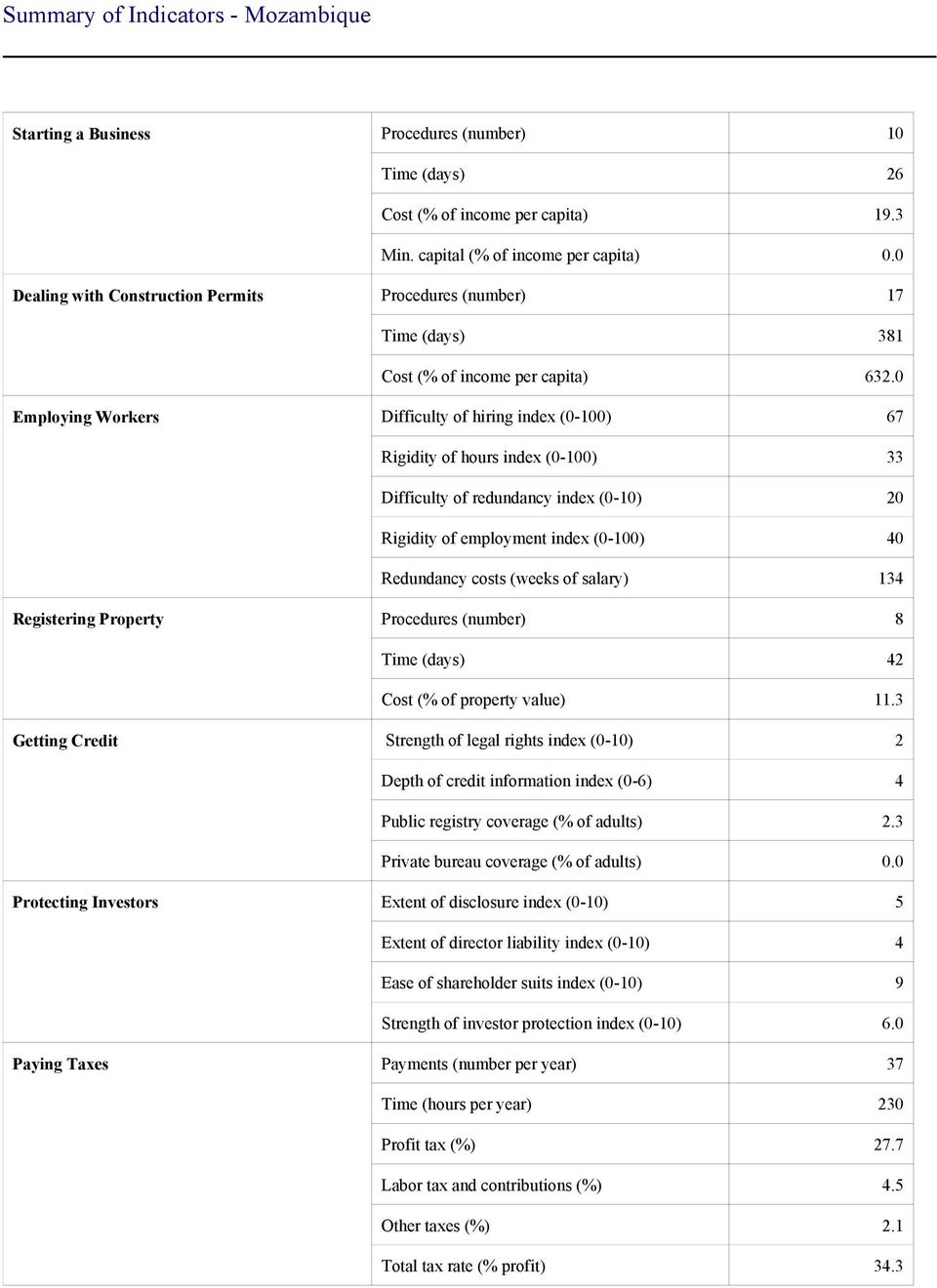
7 4 Trading Across Borders Documents to export (number) 7 Time to export (days) 23 Cost to export (US$ per container) 1100 Documents to import (number) 10 Time to import (days) 30 Cost to import (US$ per container) 1475 Enforcing Contracts Procedures (number) 30 Time (days) 730 Cost (% of claim) Closing a Business Recovery rate (cents on the dollar) 15.2 Time (years) 5.0 Cost (% of estate) 9
8 When entrepreneurs draw up a business plan and try to get under way, the first hurdles they face are the procedures required to incorporate and register the new firm before they can legally operate. Economies differ greatly in how they regulate the entry of new businesses. In some the process is straightforward and affordable. In others the procedures are so burdensome that entrepreneurs may have to bribe officials to speed up the process or may decide to run their business informally. Analysis shows that burdensome entry regulations do not increase the quality of products, make work safer or reduce pollution. Instead, they constrain private investment; push more people into the informal economy; increase consumer prices and fuel corruption. Methodology The data on starting a business is based on a survey and research investigating the procedures that a standard small to medium -size company needs to complete to start operations legally. This includes obtaining all necessary permits and licenses and completing all required inscriptions, verifications and notifications with authorities to enable the company to formally operate. Procedures are recorded only where interaction is required with an external party. It is assumed that the founders complete all procedures themselves unless professional services (such as by a notary or lawyer) are required by law. Voluntary procedures are not counted, nor are industry specific requirements and utility hook-ups. Lawful shortcuts are counted. It is assumed that all in formation is readily available to the entrepreneur, that there has been no prior contact with officials and that all government and nongovernment entities involved in the process function without corruption. Survey Case Study The business: is a limited l iability company conducting general commercial activities is located in the largest business city is 100% domestically owned has a start-up capital of 10 times income per capita has a turnover of at least 100 times income per capita has between 10 and 50 employees does not qualify for any special benefits does not own real estate 5

9 1. Historical data: Starting a Business in Mozambique Starting a Business data Doing Business 2008 Doing Business 2009 Doing Business 2010 Rank Procedures (number) Time (days) Cost (% of income per capita) Min. capital (% of income per capita) The following graphs illustrates the Starting a Business indicators in Mozambique over the past 3 years: 6

10 3. Steps to Starting a Business in Mozambique It requires 10 procedures, takes 26 days, and costs % GNI per capita to start a business in Mozambique. List of Procedures: 1. Obtain certification of unique name (certidão de reserva de nome) at the Commercial Registrar Office of Maputo (Conservatória do Registo Comercial) 2. Open a provisional bank account, deposit minimum capital, and obtain a verification of deposit with a local bank 8. Declare the beginning of activity and register job candidates at the provincial employment center 9. Register workers with the social security system 10. Subscribe a workmen s compensation insurance coverage 3. Register with the Commercial Registrar Office of Maputo (Conservatória de Registo Comercial); request a commercial registry certificate; publish company statutes in the official gazette (Bolhetim da República) 4. Register for taxes and obtain NUIT from Repartição de Finanças 5. Apply for an operational license (alvará) from the Presidente of Conselho Municipality 6. Receive inspection from Ministry of Health and Fire Department and Ministry of Commerce and Industry 7. Declare the beginning of activity at the tax department (Repartição de Finanças) 7

11 More detail is included in the appendix. 4. Benchmarking Starting a Business Regulations: Mozambique is ranked 96 overall for Starting a Business. Ranking of Mozambique in Starting a Business - Compared to good practice and selected economies: 8

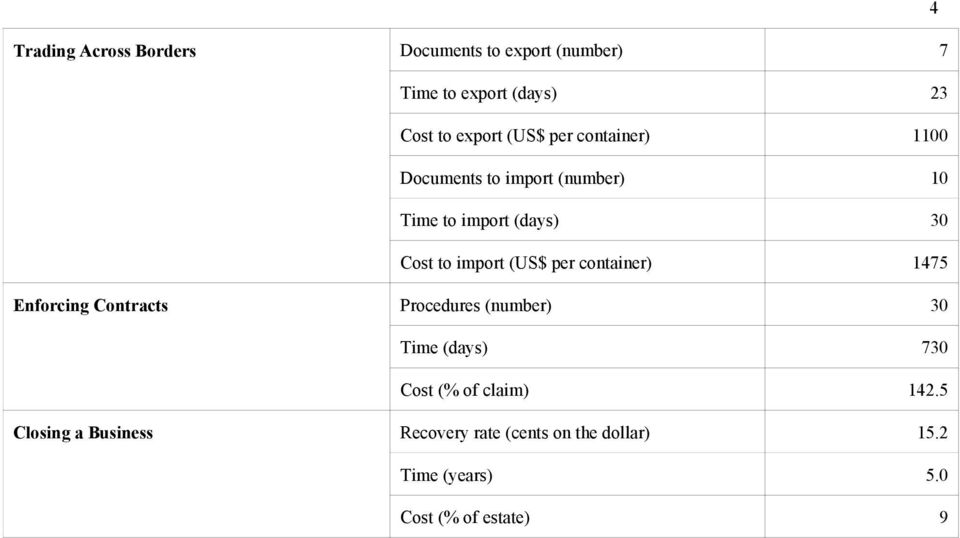
12 The following table shows Starting a Business data for Mozambique compared to good practice and comparator economies: Good Practice Economies Procedures (number) Time (days) Cost (% of income per capita) Min. capital (% of income per capita) Denmark* 0.0 New Zealand* Selected Economy Mozambique Comparator Economies Angola Botswana Mauritius South Africa Tanzania * The following economies are also good practice economies for : Procedures (number): Canada Cost (% of income per capita): Slovenia 9
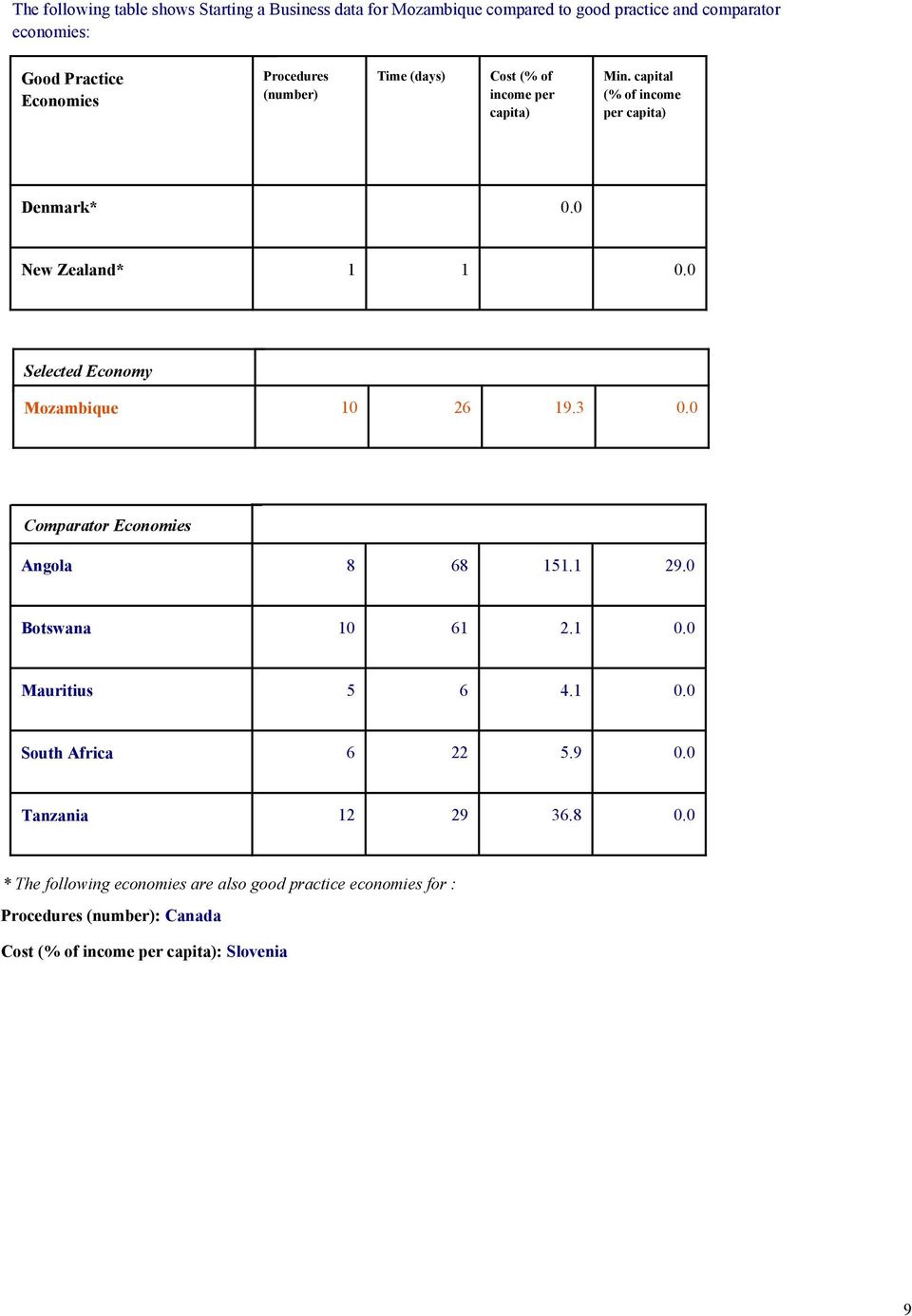
13 Once entrepreneurs have registered a business, what regulations do they face in operating it? To measure such regulation, Doing Business focuses on the construction sector. Construction companies are under constant pressure from government to comply with i nspections, with licensing and safety regulations, from customers to be quick and cost-effective. These conflicting pressures point to the tradeoff in building regulation; the tradeoff between protecting people (construction workers, tenants, passersby) and keeping the cost of building affordable. In many economies, especially poor ones, complying with building regulations is so costly in time and money that many builders opt out. Builders may pay bribes to pass inspections or simply build illegally, leadi ng to hazardous construction. Where the regulatory burden is large, entrepreneurs may tend to move their activity into the informal economy. There they operate with less concern for safety, leaving everyone worse off. In other economies compliance is simple, straightforward and inexpensive, yielding better results. Methodology The indicators on dealing with construction permits record all procedures officially required for an entrepreneur in the construction industry to build a warehouse. These include su bmitting project documents (building plans, site maps) to the authorities, obtaining all necessary licenses and permits, completing all required notifications and receiving all necessary inspections. They also include procedures for obtaining utility conne ctions, such as electricity, telephone, water and sewerage. The time and cost to complete each procedure under normal circumstances are calculated. All official fees associated with legally completing the procedures are included. Time is recorded in calendar days. The survey assumes that the entrepreneur is aware of all existing regulations and does not use an intermediary to complete the procedures unless required to do so by law. Survey Case Study The business: is a small to medium-size limited liabilit y company is located in the largest business city is domestically owned and operated, in the construction business has 20 qualified employees The warehouse to be built : is a new construction (there was no previous construction on the land) has complete architectural and technical plans prepared by a licensed architect will be connected to electricity, water, sewerage (sewage system, septic tank or their equivalent) and one land phone line. The connection to each utility network will be 32 feet, 10 inches ( 10 meters) long. will be used for general storage, such as of books or stationery. The warehouse will not be used for any goods requiring special conditions, such as food, chemicals or pharmaceuticals. will take 30 weeks to construct (excluding all delays due to administrative and regulatory requirements). 10
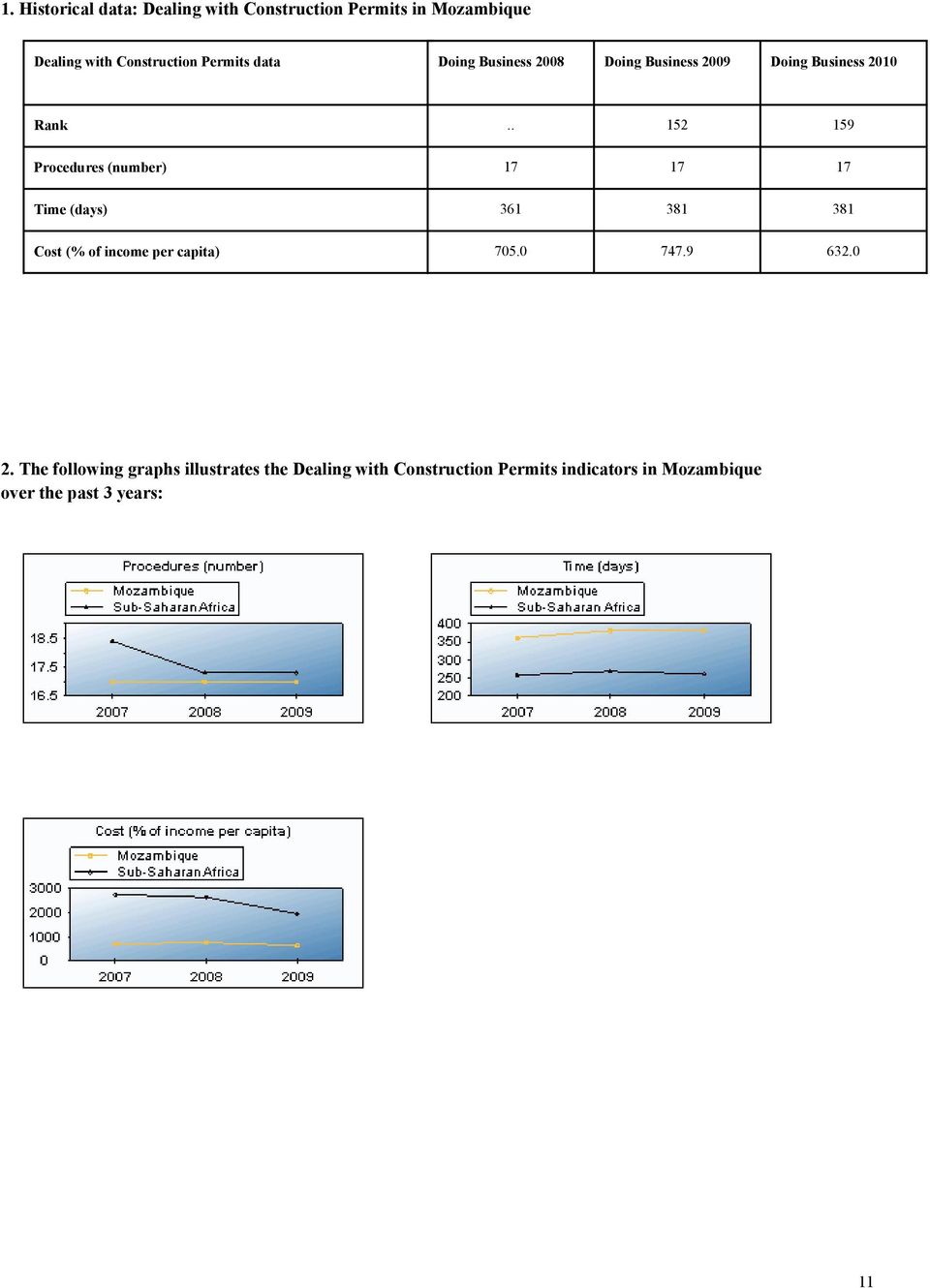
14 1. Historical data: Dealing with Construction Permits in Mozambique Dealing with Construction Permits data Doing Business 2008 Doing Business 2009 Doing Business 2010 Rank Procedures (number) Time (days) Cost (% of income per capita) The following graphs illustrates the Dealing with Construction Permits indicators in Mozambique over the past 3 years: 11
15 3. Steps to Building a Warehouse in Mozambique It requires 17 procedures, takes 381 days, and costs % GNI per capita to build a warehouse in Mozambique. List of Procedures: 1. Request and obtain the right to the use and enjoyment of the land 2. Request and obtain topographic plan 3. Request and obtain building permit from Department of Construction and Urbanization 4. Receive inspection from Municipality - I 5. Receive inspection from Municipality - II 6. Request electricity connection from National Directorate of Energy 7. Request power connection from Electricity of Mozambique 10. Request water and sewage connection 11. Receive inspection and obtain approval of plumbing plan from water department 12. Connect to water and sewage services 13. Request and obtain phone connection 14. Request final inspection 15. Receive final inspection 16. Request and obtain occupancy permit 17. Register the new building at the property registration 8. Receive inspection and obtain approval of electrical plan from electricity department 9. Connect to electricity services of Electricity of Mozambique 12

16 More detail is included in the appendix. 4. Benchmarking Dealing with Construction Permits Regulations: Mozambique is ranked 159 overall for Dealing with Construction Permits. Ranking of Mozambique in Dealing with Construction Permits - Compared to good practice and selected economies: 13
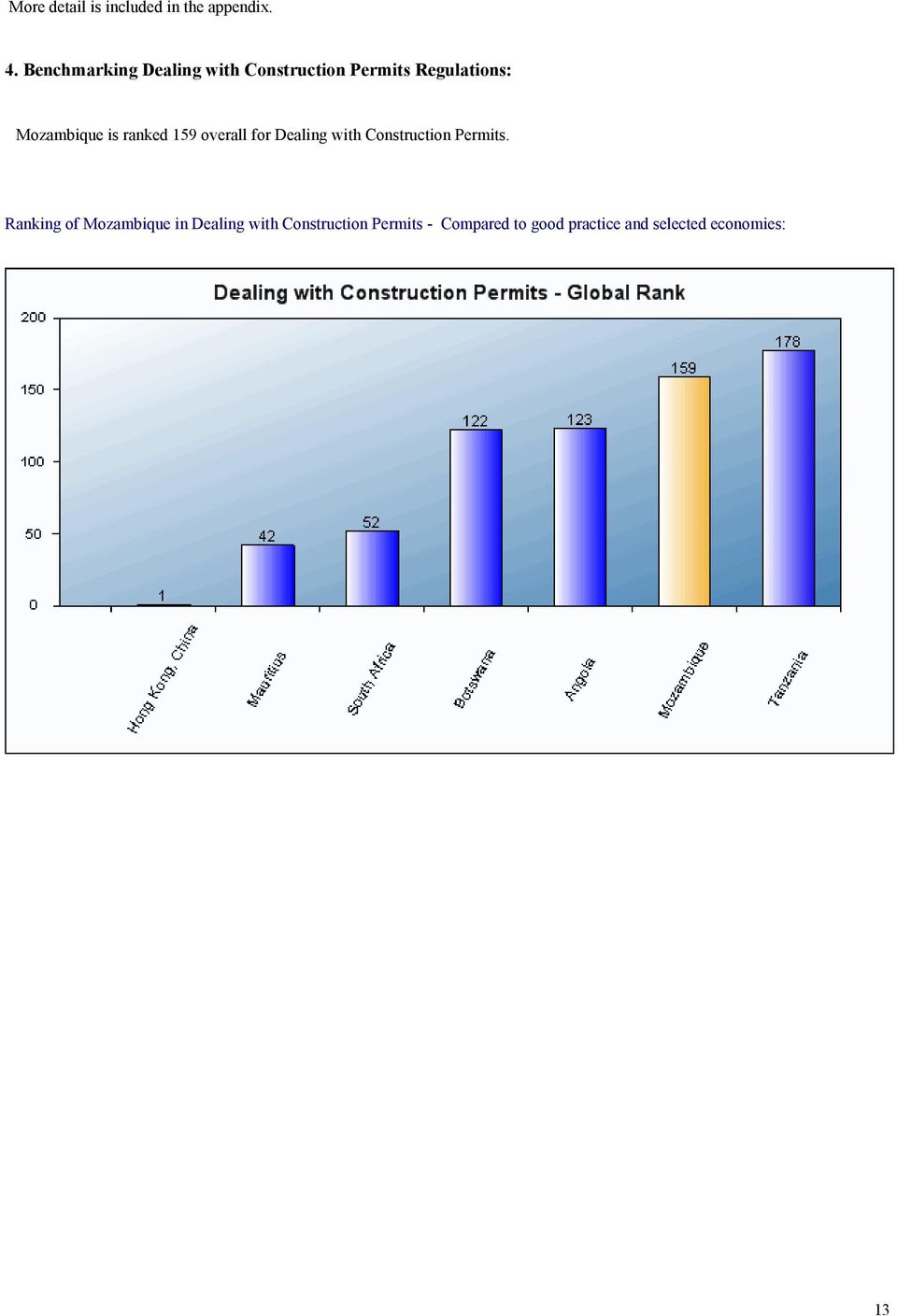
17 The following table shows Dealing with Construction Permits data for Mozambique compared to good practice and comparator economies: Good Practice Economies Procedures (number) Time (days) Cost (% of income per capita) Denmark 6 Qatar 0.6 Singapore 25 Selected Economy Mozambique Comparator Economies Angola Botswana Mauritius South Africa Tanzania

18 Economies worldwide have established a system of laws and institutions intended to protect workers and guarantee a minimum standard of living for its population. This system generally encompasses four bodies of law: employment, industrial relations, social security and occupational health and safety laws. Employment regulations are needed to allow efficient contracting between employers and workers and to protect workers from discriminatory or unfair treatment by employers. Doing Business measures flexibility in the regulation of hiring, working hours and dismissal in a manner consistent with the conventions of the International Labour Organization (ILO). An economy can have the most flexible labor regulations as measured by Doing Business while ratifying and complying with all conventions directly relevant to the factors measured by Doing Business and with the ILO core labor standards. No economy can achieve a better score by failing to comply with these conventions. Governments all over the world face the challenge of finding the right balance between worker protection and labor market flexibility. But in developing countries especially, regulators often err to one extreme, pushing employers and workers into the informal sector. Analysis across economies shows that while employment regulation generally increases the tenure and wages of incumbent workers, overly rigid regulations may have undesirable side effects. These include less job creation, smaller company size, less investment in research and develop ment, and longer spells of unemployment and thus the obsolescence of skills, all of which may reduce productivity growth. Methodology Two measures are presented: a rigidity of employment index and a redundancy cost measure. The rigidity of employment in dex is the average of three sub-indices: difficulty of hiring, rigidity of hours and difficulty of redundancy. Each index takes values between 0 and 100, with higher values indicating more rigid regulation. The difficulty of hiring index measures the flexi bility of contracts and the ratio of the minimum wage to the value added per worker. The rigidity of hours index covers restrictions on weekend and night work, requirements relating to working time and the workweek taking into account legal provisions that refer specifically to small to medium-size companies in the manufacturing industry in which continuous operation is economically necessary, as well as mandated days of annual leave with pay. The difficulty of redundancy index covers workers legal protections against dismissal, including the grounds permitted for dismissal and procedures for dismissal (individual and collective): notification and approval requirements, retraining or reassignment obligations and priority rules for dismissals and reemployme nt. The Redundancy cost indicator measures the cost of advance notice requirements, severance payments and penalties due when terminating a redundant worker, expressed in weeks of salary. Survey Case Study The business: is a limited liability company o perating in the manufacturing sector is located in the largest business city is 100% domestically owned has 60 employees The company is also assumed to be subject to collective bargaining agreements in economies where such agreements cover more than half the manufacturing sector and apply even to firms not party to them. 15

19 1. Historical data: Employing Workers in Mozambique Employing Workers data Doing Business 2008 Doing Business 2009 Doing Business 2010 Rank Redundancy costs (weeks of salary) Rigidity of employment index (0-100) The following graphs illustrates the Employing Workers indicators in Mozambique over the past 3 years: 16

20 3. Benchmarking Employing Workers Regulations: Mozambique is ranked 156 overall for Employing Workers. Ranking of Mozambique in Employing Workers - Compared to good practice and selected economies: 17

21 The following table shows Employing Workers data for Mozambique compared to good practice and comparator economies: Good Practice Economies Rigidity of employment index (0-100) Redundancy costs (weeks of salary) Hong Kong, China* 0 New Zealand* 0 Selected Economy Mozambique Comparator Economies Angola Botswana Mauritius 18 4 South Africa Tanzania * The following economies are also good practice economies for : Rigidity of employment index (0-100): Australia, Brunei Darussalam, Kuwait, Marshall Islands, Singapore, St. Lucia, Uganda, United States Redundancy costs (weeks of salary): Denmark, Iraq, Marshall Islands, Micronesia, Fed. Sts., Palau, Puerto Rico, Tonga, United States 18
22 Formal property titles help promote the transfer of land, encourage investment and give entrepreneurs access to formal credit markets. But a large share of property in developing economies is not formally registered. Informal titles cannot be used as security in obtaining loans, which limits financing opportunities for businesses. Many governments have recognized this and started extensive property titling programs. But bringing assets into the formal sector is only part of the story. The more difficult and costly it is to formally transfer property, the greater the chances that formalized titles will quickly become informal again. Eliminating unnecessary obstacles to registering and transferring property is therefore important for economic development. Efficient property registration reduces transaction costs and helps to formalize property titles. Simple procedures to register property are also associated with greater perceived security of property rights and less corruption. That benefits all entrepreneurs, especially women, the young and the poor. The rich have few problems protecting their property rights. They can afford to invest in security systems and other measures to defend their property. But small entrepreneurs cannot. Reform can change this. Methodology Doing Business records the full sequence of procedures necessary for a business (buyer) to purchase a property from another business (seller) and to transfer the property title to the buyer s name. The property of land and building will be tran sferred in its entirety. The transaction is considered complete when the buyer can use the property as collateral for a bank loan. Local property lawyers and officials in property registries provide information on required procedures as well as the time and cost to complete each one. For most economies the data are based on responses from both. Based on the responses, three indicators are constructed: number of procedures to register property time to register property (in calendar days) official costs to register property (as a percentage of the property value) Survey Case Study The buyer and seller: are limited liability companies are private nationals (no foreign ownership) are located in periurban area of the largest business city conduct general commercial activities The property: consists of land and a 2 -story building (warehouse) is located in the periurban commercial zone of the largest business city The land area is m 2 (6,000 square feet). The warehouse has a total area of 929 m 2 (10,000 square feet). has a value equal to 50 times income per capita The seller company owned the property for the last 10 years. is registered in the land registry and/or cadastre and is free of all disputes. 19
23 1. Historical data: Registering Property in Mozambique Registering Property data Doing Business 2008 Doing Business 2009 Doing Business 2010 Rank Procedures (number) Time (days) Cost (% of property value) The following graphs illustrates the Registering Property indicators in Mozambique over the past 3 years: 20
24 3. Steps to Registering Property in Mozambique It requires 8 procedures, takes 42 days, and costs % of property value to register the property in Mozambique. List of Procedures: 1. Obtain a Real Estate Registry certificate of the property from the Real Estate Registry Office 2. Obtain a certificate from the Tax Authority regarding the value of the property 3. Lawyer prepares the draft sale and purchase agreement 4. Payment of transfer tax (SISA) at the Municipal Tax Office 5. Submit the draft sale and purchase agreement to the public notary to verify and issue the notarial deed of purchase 6. Apply for registration of the building at the Real Estate Registry Office 7. Submit the notarial deed at the Municipal Tax Office 8. Submit the notary deed to the Cadastre Services Registry More detail is included in the appendix. 21
25 4. Benchmarking Registering Property Regulations: Mozambique is ranked 151 overall for Registering Property. Ranking of Mozambique in Registering Property - Compared to good practice and selected economies: 22
26 The following table shows Registering Property data for Mozambique compared to good practice and comparator economies: Good Practice Economies Procedures (number) Time (days) Cost (% of property value) New Zealand* 2 Norway* 1 Saudi Arabia 0.0 Selected Economy Mozambique Comparator Economies Angola Botswana Mauritius South Africa Tanzania * The following economies are also good practice economies for : Procedures (number): United Arab Emirates Time (days): Saudi Arabia, Thailand, United Arab Emirates 23
27 Firms consistently rate access to credit as among the greatest barriers to their operation and growth. Doing Business constructs two sets of indicators of how well credit markets function: one on credit registries and the other on legal rights of borrowers and lenders. Credit registries, institutions that collect and distribute credit information on borrowers, can greatly expand access to credit. By sharing credit information, they help lenders assess risk and allocate credit more efficiently. They also free entrepreneurs from having to rely on personal connections alone when trying to obtain credit. Methodology Credit information: three indicators are constructed: depth of credit information index, which measures the extent to which the rules of a credit information system facilitate lending based on the scope of information distributed, the ease of access to information and the quality of information public registry coverage, which reports the number of individuals and firms covered by a public credit re gistry as a percentage of the adult population private bureau coverage, which reports the number of individuals and firms, covered by a private credit bureau as a percentage of the adult population Legal Rights: the strength of legal rights index measures the degree to which collateral and bankruptcy laws protect the rights of borrowers and lenders. Ten points are analyzed: Can a business use movable assets as collateral while keeping possession of the assets, and can any financial institution accept such assets as collateral? Does the law allow a business to grant a non -possessory security right in a single category of revolving movable assets, without requiring a specific description of the secured assets? Does the law allow a business to grant a non pos sessory security right in substantially all of its assets, without requiring a specific description of the secured assets? Can a security right extend to future or after -acquired assets and extend automatically to the products, proceeds or replacements of the original assets? Is general description of debts and obligations permitted in collateral agreements and in registration documents, so that all types of obligations and debts can be secured by stating a maximum rather than a specific amount between the parties? Is a collateral registry in operation that is unified geographically and by asset type as well as being indexed by the name of the grantor of a security right? Are secured creditors paid first when a debtor defaults outside an insolvency procedure or when a business is liquidated? Are secured creditors subject to an automatic stay or moratorium on enforcement procedures when a debtor enters a court-supervised reorganization procedure? Are parties allowed to agree in a collateral agreement that the lender may enforce its security right out of court? Legal Rights Survey Case Study The Debtor: is a Private Limited Liability Company has its headquarters and only base of operations in the largest business city obtains a loan from a local bank (the Cred itor) for an amount up to 10 times income (GNI) per capita Both debtor and creditor are 100% domestically owned. 24
28 1. Historical data: Getting Credit in Mozambique Getting Credit data Doing Business 2008 Doing Business 2009 Doing Business 2010 Rank Strength of legal rights index (0-10) Depth of credit information index (0-6) Private bureau coverage (% of adults) Public registry coverage (% of adults) The following graphs illustrates the Getting Credit indicators in Mozambique over the past 3 years: 25
29 3. Benchmarking Getting Credit Regulations: Mozambique is ranked 127 overall for Getting Credit. Ranking of Mozambique in Getting Credit - Compared to good practice and selected economies: 26
30 The following table shows Getting Credit data for Mozambique compared to good practice and comparator economies: Good Practice Economies Strength of legal rights index (0-10) Depth of credit information index (0-6) Public registry coverage (% of adults) Private bureau coverage (% of adults) New Zealand* Portugal 81.3 Singapore* 10 United Kingdom 6 Selected Economy Mozambique Comparator Economies Angola Botswana Mauritius South Africa Tanzania * The following economies are also good practice economies for : Strength of legal rights index (0-10): Hong Kong, China, Kenya, Kyrgyz Republic, Malaysia Private bureau coverage (% of adults): Argentina, Australia, Canada, Iceland, Ireland, Norway, Sweden, United Kingdom, United States 27 countries have the highest credit information index. 27
31 Companies grow by raising capital, either through a bank loan or by attracting equity investors. Selling shares allows companies to expand without the need to provide collateral and repay bank loans. However, investors worry about their money, and look for laws that protect them. A study finds that the presence of legal and regulatory protections for investors explains up to 73% of the decision to invest. In contrast, company characteristics explain only between 4% and 22%*. Good protections for minority sh areholders are associated with larger and more active stock markets. Thus both governments and businesses have an interest in reforms strengthening investor protections. Methodology To document some of the protections investors have, Doing Business mea sures how economies regulate a standard case of selfdealing, use of corporate assets for personal gain. Three indices of investor protection are constructed based on the answers to these and other questions. All indices range from 0 to 10, with higher values indicating more protections or greater disclosure. The three indices are: The extent of disclosure index covers approval procedures, requirements for immediate disclosure to the public and shareholders of proposed transactions, requirements for disclosure in periodic filings and reports and the availability of external review of transactions before they take place. The extent of director liability index covers the ability of investors to hold Mr. James and the board of directors liable for damages, the ability to rescind the transaction, the availability of fines and jail time associated with self -dealing, the availability of direct or derivative suits and the ability to require Mr. James to pay back his personal profits from the transaction. The ease of shareholder suits index covers the availability of documents that can be used during trial, the ability of the investor to examine the defendant and other witnesses, shareholders access to internal documents of the company, the appointment of an inspector to investigate the transaction and the standard of proof applicable to a civil suit against the directors. These three indices are averaged to create the strength of investor protection index. Survey case study Mr. James, a director and the majority shareholder of a public company, proposes that the company purchase used trucks from another company he owns. The price is higher than the going price for used trucks. The transaction goes forward. All required approvals are obtained, and all required disclosures made, though the transaction is prejudicial to the purchasing company. Shareholders sue the interested parties and the members of the board of directors. Several questions arise: Who approves the transaction? What information must be disclosed? What company documents can investors access? What do minority shareholders have to prove to get the transaction stopped or to receive compensation from Mr. James? *Doidge, Kardyi and Stulz (2007) 28
32 1. Historical data: Protecting Investors in Mozambique Protecting Investors data Doing Business 2008 Doing Business 2009 Doing Business 2010 Rank Strength of investor protection index (0-10) The following graph illustrates the Protecting Investors index in Mozambique compared to best practice and selected Economies: New Zealand South Africa Mauritius Botswana Mozambique Angola Tanzania Note: The higher the score, the greater the investor protection. 29
33 3. Benchmarking Protecting Investors Regulations: Mozambique is ranked 41 overall for Protecting Investors. Ranking of Mozambique in Protecting Investors - Compared to good practice and selected economies: 30
34 The following table shows Protecting Investors data for Mozambique compared to good practice and comparator economies: Good Practice Economies Strength of investor protection index (0-10) New Zealand 9.7 Selected Economy Mozambique 6.0 Comparator Economies Angola 5.7 Botswana 6.0 Mauritius 7.7 South Africa 8.0 Tanzania
35 Taxes are essential. Without them there would be no money to provide public amenities, infrastructure and services which are crucial for a properly functioning economy. But particularly for small and medium size companies, they may opt out and choose to op erate in the informal sector. One way to enhance tax compliance is to ease and simplify the process of paying taxes for such businesses. Methodology The Doing Business tax survey records the effective tax that a small and medium company must pay and the administrative costs of doing so. Three indicators are constructed: number of tax payments, which takes into account the method of payment, the frequency of payments and the number of agencies involved in our standardized case study. time, which measures the number of hours per year necessary to prepare and file tax returns and to pay the corporate income tax, value added tax, sales tax or goods and service tax and labor taxes and mandatory contributions. total tax rate, which measures the amount of taxes and mandatory contributions payable by the company during the second year of operation. This amount, expressed as a percentage of commercial profit, is the sum of all the different taxes payable after accounting for various deductions and exemptions. Survey case study TaxpayerCo is a medium-size business that started operations last year. Doing Business asks tax practitioners in 183 economies to review TaxpayerCo s financial statements and a standard list of transactions that the company completed during the year. Respondents are asked how much in taxes and mandatory contributions the business must pay and what the process is for doing so. The business starts from the same financial position in each economy. All the taxes and mandatory contributions paid during the second year of operation are recorded. Taxes and mandatory contributions are measured at all levels of government and include corporate income tax, turnover tax, all labor taxes and contributions paid by the company (including mandatory contrib utions paid to private pension or insurance funds), property tax, property transfer tax, dividend tax, capital gains tax, financial transactions tax, vehicle tax, sales tax and other small taxes (such as fuel tax, stamp duty and local taxes). A range of standard deductions and exemptions are also recorded. 32
36 1. Historical data: Paying Taxes in Mozambique Paying Taxes data Doing Business 2008 Doing Business 2009 Doing Business 2010 Rank Total tax rate (% profit) Payments (number per year) Time (hours per year) The following graphs illustrates the Paying Taxes indicators in Mozambique over the past 3 years: 33
37 3. Benchmarking Paying Taxes Regulations: Mozambique is ranked 97 overall for Paying Taxes. Ranking of Mozambique in Paying Taxes - Compared to good practice and selected economies: 34
38 The following table shows Paying Taxes data for Mozambique compared to good practice and comparator economies: Good Practice Economies Payments (number per year) Time (hours per year) Total tax rate (% profit) Maldives* 1 0 Timor-Leste 0.2 Selected Economy Mozambique Comparator Economies Angola Botswana Mauritius South Africa Tanzania * The following economies are also good practice economies for : Payments (number per year): Qatar 35
39 The benefits of trade are well documented; as are the obstacles to trade. Tariffs, quotas and distance from large markets greatly increase the cost of goods or prevent trading altogether. But with bigger ships and faster planes, the world is shrinking. Glo bal and regional trade agreements have reduced trade barriers. Yet Africa s share of global trade is smaller today than it was 25 years ago. So is the Middle East s, excluding oil exports. Many entrepreneurs face numerous hurdles to exporting or importing goods, including delays at the border. They often give up. Others never try. In fact, the potential gains from trade facilitation may be greater than those arising from only tariff reductions. Methodology Doing Business compiles procedural requirements for trading a standard shipment of goods by ocean transport. Every procedure and the associated documents, time and cost, for importing and exporting the goods is recorded, starting with the contractual agreement between the two parties and ending with delivery of the goods. For importing the goods, the procedures measured range from the vessel s arrival at the port of entry to the shipment s delivery at the importer s warehouse. For exporting the goods, the procedures measured range from the packing of the goods at the factory to their departure from the port of exit. Payment is by letter of credit and the time and cost for issuing or securing a letter of credit is taken into account. Documents recorded include port filing documents, customs declaration and clearance documents, as well as official documents exchanged between the parties to the transaction. Time is recorded in calendar days, from the beginning to the end of each procedure. Cost includes the fees levied on a 20 -foot container in U.S. dollars. All the fees associated with completing the procedures to export or import the goods are included, such as costs for documents, administrative fees for customs clearance and technical control, terminal handling charges and inland transport. The cost measure does not include tariffs or duties. Economies that have efficient customs, good transport networks and fewer document requirements, making compliance with export and import procedures faster and cheaper, are more competitive globally. That can lead to more exports; and exports are associated with faster growth and more jobs. Conversely, a need to file many documents is associated with more corruption in customs. Faced with long delays and frequent demands for bribes, many traders may avoid customs altogether. Instead, they smuggle goods across the border. This defeats the very purpose in having border control of trade to levy taxes and ensure high quality of goods. Survey case study To make the data comparable across countries, several assumptions about the business and the traded goods are used: The business is of medium size. The business employs 60 people. The business is located in the peri-urban area of the economy s largest business city. The business is a private, limited liability company, dom estically owned, formally registered and operating under commercial laws and regulations of the economy. The traded goods are ordinary, legally manufactured products transported in a dry-cargo, 20-foot FCL (full container load) container. 36
40 1. Historical data: Trading Across Borders in Mozambique Trading Across Borders data Doing Business 2008 Doing Business 2009 Doing Business 2010 Rank Cost to export (US$ per container) Cost to import (US$ per container) Documents to export (number) Documents to import (number) Time to export (days) Time to import (days) The following graphs illustrates the Trading Across Borders indicators in Mozambique over the past 3 years: 37
41 3. Benchmarking Trading Across Borders Regulations: Mozambique is ranked 136 overall for Trading Across Borders. Ranking of Mozambique in Trading Across Borders - Compared to good practice and selected economies: 38
42 The following table shows Trading Across Borders data for Mozambique compared to good practice and comparator economies: Good Practice Economies Documents to export (number) Time to export (days) Cost to export (US$ per container) Documents to import (number) Time to import (days) Cost to import (US$ per container) Denmark* 5 France 2 2 Malaysia 450 Singapore Selected Economy Mozambique Comparator Economies Angola Botswana Mauritius South Africa Tanzania * The following economies are also good practice economies for : Time to export (days): Estonia 39
43 Where contract enforcement is efficient, businesses are more likely to engage with new borrowers or customers. Doing Business tracks the efficiency of the judicial system in resolving a commercial dispute, following the step -bystep evolution of a commercial sale dispute before local courts. The data is collected through study of the codes of civil procedure and other court regulations as well as through surveys completed by local litigation lawyers (and, in a quarter of the countries, by judges as well). Justice delayed is often justice denied. And in many economies only the rich can afford to go to court. For the rest, justice is out of reach. In the absence of efficient courts, firms undertake fewer investments or business transactions. And they prefer to involve only a small group of people who know each other from previous dealings. Methodology Rankings on enforcing contracts are based on 3 sub-indicators: number of procedures, which are defined as any interaction between the parties or between them and the judge or court officer. This includes steps to file the case, steps for trial and judgment and steps necessary to enforce the judgment. time, which counts the number of calendar days from the moment the Seller files the lawsuit in court until payme nt is received. This includes both the days on which actions take place and the waiting periods in between. cost, which is recorded as a percentage of the claim (assumed to be equivalent to 200% of income per capita). Three types of costs are recorded: court costs (including expert fees), enforcement costs (including costs for a public sale of Buyer s assets) and attorney fees. Survey case Study The dispute concerns a contract for the sale of goods between two businesses (the Seller and the Buyer). Both are located in the economy s largest business city. The Seller sells and delivers goods, worth 200% of the economy s income per capita, to the Buyer. The Buyer refuses to pay on the grounds that they were not of adequate quality. The Seller sues the Buyer to recover the amount under the sales agreement (200% of the economy s income per capita). The claim is filed before a court in the economy s largest business city with jurisdiction over commercial cases worth 200% of the income per capita and is disputed on the merits. Judgment is 100% in favor of the Seller and is not appealed. The Seller enforces the judgment and the money is successfully collected through a public sale of Buyer s assets. 40
44 1. Historical data: Enforcing Contracts in Mozambique Enforcing Contracts data Doing Business 2008 Doing Business 2009 Doing Business 2010 Rank Procedures (number) Time (days) Cost (% of claim) The following graphs illustrates the Enforcing Contracts indicators in Mozambique over the past 3 years: 41
45 3. Benchmarking Enforcing Contracts Regulations: Mozambique is ranked 129 overall for Enforcing Contracts. Ranking of Mozambique in Enforcing Contracts - Compared to good practice and selected economies: 42
46 The following table shows Enforcing Contracts data for Mozambique compared to good practice and comparator economies: Good Practice Economies Procedures (number) Time (days) Cost (% of claim) Bhutan 0.1 Ireland 20 Singapore 150 Selected Economy Mozambique Comparator Economies Angola Botswana Mauritius South Africa Tanzania
47 The economic crises of the 1990s in emerging markets, from East Asia to Latin America, from Russia to Mexico, raised concerns about the design of bankruptcy systems and the ability of such systems to help reorganize viable companies and close down unviable ones. In countries where bankruptcy is inefficient, unviable businesses linger for years, keeping assets and human capital from being reallocated to more productive uses. Bottlenecks in bankruptcy cut into the amount claimants can recover. In countries w here bankruptcy laws are inefficient, this is a strong deterrent to investment. Access to credit shrinks, and nonperforming loans and financial risk grow because creditors cannot recover overdue loans. Conversely, efficient bankruptcy laws can encourage entrepreneurs. The freedom to fail, and to do so through an efficient process, puts people and capital to their most effective use. The result is more productive businesses and more jobs. The Doing Business indicators identify weaknesses in the bankruptcy l aw as well as the main procedural and administrative bottlenecks in the bankruptcy process. In many developing countries bankruptcy is so inefficient that creditors hardly ever use it. In countries such as these, reform would best focus on improving contra ct enforcement outside bankruptcy. Methodology Three measures are constructed from the survey responses: the time to go through the insolvency process, the cost to go through the process and the recovery rate, how much of the insolvency estate is recovered by stakeholders, taking into account the time, cost, depreciation of assets and the outcome of the insolvency proceeding. Survey case study The data on closing a business are developed using a standard s et of case assumptions to track a company going through the step -bystep procedures of the bankruptcy process. It is assumed that: the company is a domestically owned the company is a limited liability corporation operating a hotel in the country s largest business city the company has 201 employees, 1 main secured creditor and 50 unsecured creditors Assumptions are also made about the future cash flows. The case is designed so that the company has a higher value as a going concern, that is, the efficient outcome is either reorganization or sale as a going concern, not piecemeal liquidation. The data are derived from questionnaires answered by attorneys at private law firms. 44
48 1. Historical data: Closing Business in Mozambique Closing a Business data Doing Business 2008 Doing Business 2009 Doing Business 2010 Rank Time (years) Cost (% of estate) Recovery rate (cents on the dollar) The following graphs illustrates the Closing Business indicators in Mozambique over the past 3 years: 45
49 3. Benchmarking Closing Business Regulations: Mozambique is ranked 136 overall for Closing a Business. Ranking of Mozambique in Closing Business - Compared to good practice and selected economies: 46
50 The following table shows Closing Business data for Mozambique compared to good practice and comparator economies: Good Practice Economies Recovery rate (cents on the dollar) Time (years) Cost (% of estate) Ireland 0.4 Japan 92.5 Singapore* 1 Selected Economy Mozambique Comparator Economies Angola Botswana Mauritius South Africa Tanzania * The following economies are also good practice economies for : Cost (% of estate): Colombia, Kuwait, Norway 47
51 Number of reforms in Doing Business 2010 Rank Economy Positive Reform Negative Reform Starting a Business Dealing with Construction Permits Employing Workers Registering Property Getting Credit Protecting Investors Paying Taxes Trading Across Borders Enforcing Contracts Closing a Business Total number of reforms 1 Rwanda 7 2 Kyrgyz Republic 7 3 Macedonia, FYR 7 4 Belarus 6 5 United Arab Emirates 3 6 Moldova 3 7 Colombia 8 8 Tajikistan 5 9 Egypt, Arab Rep Liberia 3 Mozambique 2 Tanzania 0 South Africa 1 Botswana 2 Angola 3 Mauritius 6 Note: Economies are ranked on the number and impact of reforms, Doing Business selects the economies that reformed in 3 or more of the Doing Business topics. Second, it ranks these economies on the increase in rank in Ease of Doing Business from the previous year. The larger the improvement, the higher the ranking as a reformer. 48
52 Angola Angola made it easier to pay taxes by introducing mandatory electronic filing of social security for businesses with more than 20 employees. The land registry was digitized and split into two units each covering half the land in Luanda accelerating procedures needed to transfer property. Trade across borders was expedited with a customs improvement program that streamlined procedures and lowered trade times and costs. Belarus Belarus eased the process for getting construction permits by simplifying approval processes. Restrictions relating to redundancy dismissals were eased by raising the threshold for prior notification requirements. Tax payments were made more convenient through increased use of electronic systems reducing tax compliance times while lower ecological and turnover tax rates and a reduction in the number of payments for property tax reduced the tax burden on businesses. Property registration continues to improve, with faster processing and elimination of the requirement for notarization. Business start-up was eased by simplifying registration formalities, abolishing the minimum capital requirement, limiting the role of notaries, and removing the need for a company seal approval. Implementation of a risk-based management system and improvement of border crossing operations reduced transit times for trade. Botswana Botswana eased business start-up by making tax registration more efficient and streamlining the process for obtaining a business license. Introduction of case management and improved use of information technology has contributed to more efficient resolution of commercial disputes. But property registration was made more difficult by requiring that the tax agency be notified of valued added tax payments. Colombia Colombia passed several decrees continuing its efforts to regulate the profession of insolvency administrators. The government eased the construction permit process with a new construction decree that categorizes building projects based on risk and allows electronic verification for certain documents. Access to credit improved thanks to a new credit information law that guarantees the right of borrowers to inspect their own data and new rules that make it mandatory for credit providers to consult and share information with credit bureaus. The tax burden on businesses was eased with the introduction of electronic tax filing and payment, and some payments were reduced. An amendment to the Company Law strengthened investor protections by making it easier to sue directors in cases of prejudicial transactions between interested parties. Property registration was made easier by making it possible to obtain required certificates online and by making standard preliminary sale agreements available free of charge. Business start-up was made easier by creating a public-private health provider that enables faster affiliation of employees and through a tool that allows online pre-enrollment with the social security office. Implementation of an electronic declaration system has expedited customs clearance. Egypt, Arab Rep. Kyrgyz Republic The Arab Republic of Egypt, a former global leading reformer and a regional leading reformer in 2008/09, continued to make it easier to deal with construction permits by issuing executive articles for the 2008 construction law and eliminating most preapprovals for construction permits. Contract enforcement was expedited with the creation of commercial courts. Access to credit information has expanded with the addition of retailers to the database of the private credit bureau. Finally, company start-up was eased by the removal of the minimum capital requirement. The Kyrgyz Republic eased the process for getting construction permits by streamlining the fee structure, introducing a risk-based system of approval and building control, allowing low-risk projects to conduct an internal building control process, and simplifying the process for obtaining utility connections. Requirements relating to redundancy dismissals and worker reassignment were eased. Access to credit was enhanced by making secured lending more flexible and allowing general descriptions of encumbered assets and of debts and obligations. In addition, amendments to the Civil Code provide for automatic extension of security rights to proceeds of the original assets. The tax burden on businesses was eased by reducing the rates for several taxes and the number of payments for several. Surveying and notarization requirements were made optional for property registration, and business start-up was eased by eliminating the minimum capital requirement, reducing the registration time, and abolishing various post-registration fees and the need to open a bank account before registration. The elimination of six previously required documents and the simplification of inspection procedures has sped up trading across borders. 49
53 Liberia Macedonia, FYR Mauritius Moldova Mozambique Rwanda South Africa Liberia eased the process for getting construction permits by lowering the permit fee and cost of obtaining a power generator, abolishing the requirement to obtain a tax waiver certificate before submitting documents to obtain a building permit, and making fixed telephone connections more readily available for public use with the reopening of the national phone company. Business start-up was eased by removing the need to obtain an environmental impact assessment when forming a general trading company. The trade process was expedited by creating a one-stop shop bringing together various ministries and agencies, and streamlining the inspection regime. The Former Yugoslav Republic of Macedonia has been reforming the construction permit process, shortening waiting times but raising fees. Worker hiring was made more flexible by allowing greater use of fixed-term contracts, easing restrictions on working hours, and making redundancy dismissals more flexible. The public credit bureau increased its coverage by introducing a better database that includes more information and by lowering the minimum loan threshold. Social security payments were classified in five groups, and social security contribution rates reduced. Investor protections were increased by regulating the approval of transactions between interested parties, increasing disclosure requirements in annual reports, and making it easier to sue directors in cases of prejudicial transactions between interested parties. Property registration was eased with the introduction of new time limits at the real estate cadastre reducing the average time to register a title deed by eight days and a non-encumbrance certificate can now be obtained from the real estate registry instead of through the court. Business start-up was simplified by integrating procedures at a one-stop shop. Mauritius made employing workers easier with more flexible redundancy procedures, removing the requirement for authorization to dismiss one or a group of workers and lowering dismissal costs. A new insolvency law introduced a rehabilitation procedure for companies as an alternative to winding up and defines the rights and obligations of creditors and debtors as well as sanctions for those who abuse the system. A specialized commercial division of the supreme court was created, improving contract enforcement. Access to credit information was strengthened by allowing the licensing of private credit information bureaus and expanding the bureaus coverage to all credit facilities. Property registration was made easier by setting a limit of 15 days to obtain final property titles from the land registry. The introduction of electronic submissions of customs declarations and bills of lading has expedited trade. Moldova lowered the rates for social security contributions paid by employers. Property registration was simplified by eliminating the requirement for a cadastral sketch, reducing procedures from six to five and days from 48 to 5. Business start-up was eased by implementing an expedited company registration service. Mozambique simplified business start-up by eliminating requirements for minimum capital and bank deposits. Administrative improvements in customs have helped reduced the time required to clear traded goods. Rwanda improved the process for dealing with distressed companies with a new law aimed at streamlining reorganization. Employing workers was made easier by abolishing the maximum duration for fixed-term contracts and allowing unlimited renewals of such contracts, as well as by allowing redundancy procedures to be more flexible, with consultation and notification of third parties no longer required. Getting credit was made easier with a new secured transactions act and insolvency act to make secured lending more flexible, allowing a wider range of assets to be used as collateral and a general description of debts and obligations. In addition, out of court enforcement of collateral has become available to secured creditors, who also now have top priority within bankruptcy. A new company law has strengthened investor protections by requiring greater corporate disclosure, director liability, and shareholder access to information. Property registration was simplified by decreasing the number of days required to transfer a property. Business start-up was eased by eliminating a notarization requirement; introducing standardized memorandums of association; enabling online publication; consolidating name checking, registration fee payment, tax registration, and company registration procedures; and shortening the time required to process completed applications. By implementing administrative changes such as increased operating hours and enhanced cooperation at the border, along with the removal of some documentation requirements for importers and exporters Rwanda has improved trading times. South Africa eased the tax burden on businesses by abolishing the stamp duty. 50
54 Tajikistan Tanzania Tajikistan amended its insolvency law, aiming to reduce statutory time limits and the costs of proceedings. Changes were introduced that simplified the construction permit process, reducing procedures and time. A new law on credit histories improves access to credit information by creating a private credit bureau. Investor protections were strengthened with amendments to the joint stock company law, increasing disclosure requirements for transactions involving conflicts of interest, allowing for greater director liability, and giving shareholders the chance to request that harmful related-party transactions be rescinded. The state duty for property transfer has quadrupled, raising the cost of registering property by 2.8 percent of a property s value. Business start-up was eased by reducing the minimum capital requirement and shortening the time to obtain a tax identification number. Tanzania made it harder to obtain construction permits, adding additional procedures and costs. United Arab Emirates The United Arab Emirates shortened the time for delivering building permits by improving its online system for processing applications. Business start-up was eased by simplifying the documents needed for registration, abolishing the minimum capital requirement, and removing the requirement that proof of deposit of capital be shown for registration. Greater capacity at the container terminal, elimination of the terminal handling receipt as a required document, and an increase in trade finance products, have improved trade processes. 51
55 APPENDICES Starting a Business in Mozambique This table summarizes the procedures and costs associated with setting up a business in Mozambique. STANDARDIZED COMPANY Legal Form: Sociedade por Quotas (LDA) - Closely-Held Limited Liability Company Minimum Capital Requirement: City: Maputo Registration Requirements: No: Procedure Time to complete Cost to complete 1 Obtain certification of unique name (certidão de reserva de nome) at 1 77 the Commercial Registrar Office of Maputo (Conservatória do Registo Comercial) 2 Open a provisional bank account, deposit minimum capital, and obtain 1 0 a verification of deposit with a local bank 3 Register with the Commercial Registrar Office of Maputo (Conservatória de Registo Comercial); request a commercial registry certificate; publish company statutes in the official gazette (Bolhetim da República) Register for taxes and obtain NUIT from Repartição de Finanças Apply for an operational license (alvará) from the Presidente of Conselho Municipality 6 * Receive inspection from Ministry of Health and Fire Department and 8 0 Ministry of Commerce and Industry 7 Declare the beginning of activity at the tax department (Repartição de 1 0 Finanças) 8 * Declare the beginning of activity and register job candidates at the 1 50 provincial employment center 9 * Register workers with the social security system * Subscribe a workmen s compensation insurance coverage 1 0 * Takes place simultaneously with another procedure. 52
56 Procedure 1 Obtain certification of unique name (certidão de reserva de nome) at the Commercial Registrar Office of Maputo (Conservatória do Registo Comercial) Time to complete: 1 Cost to complete: 77 Comment: Procedure 2 The Registrar Office of Maputo was computerized and name verification can be done in a day. Open a provisional bank account, deposit minimum capital, and obtain a verification of deposit with a local bank Time to complete: 1 Cost to complete: 0 Comment: Before having the articles of association notarized, limited liability companies (sociedades por quotas) must open a bank account to prove that at least 50% of the required minimum capital has been paid. The bank account must be opened in the company name that was approved by the Registrar Office of Maputo, which issued the certification of the unique name. Procedure 3 Register with the Commercial Registrar Office of Maputo (Conservatória de Registo Comercial); request a commercial registry certificate; publish company statutes in the official gazette (Bolhetim da República) Time to complete: 5 Cost to complete: 1475 Comment: To register a company with the Commercial Registrar Office of Maputo, the following costs apply: - A nominal fixed fee is charged for company matriculation. - The registration fees vary according to share capital: amounts up to MZN 5 million are taxable at a 2% rate, and amounts over MZN 5 million are taxable at a 1% rate. - A variable fee is payable for administrative costs up to a maximum of MZN 1,000. Procedure 4 This registration is final because the Commercial Registrar coordinates the publication of the company statutes in the Official Gazette. The fixed fee for online publication is MZN 475 per year for a 25-line page. Publication can take 3 days to 1 week. Register for taxes and obtain NUIT from Repartição de Finanças Time to complete: 1 Cost to complete: 0 Comment: Procedure 5 Apply for an operational license (alvará) from the Presidente of Conselho Municipality Time to complete: 14 Cost to complete: 266 Comment: To apply for an operating license, the company promoters must file the following documents: - Letter of application with an authenticated signature, containing the company name and its head office, the proposed commercial activity, including the classes of merchandise 53
57 offered or services provided, and the address of the company s registered offices. - Certificate of incorporation issued by the Commercial Registrar or copy of the articles of association (the provisional registration is adequate). - Personal identity documents (notarized copies). - Lease (notarized copy). If the company owns the premises, it must evidence ownership by submitting the Real Estate Registrar Office certificate when applying for the operating license. If the operational permit is required, the Ministry of Industry and Commerce coordinates the necessary inspections by the health, fire, public health, and other relevant agencies. Fee schedule for operating license application: - Import-export company: MZN 2,500 plus MZN 500 for each class of goods imported or exported. - Wholesaler or retailer: MZN 250 for each shop. - Fire and public health inspections: MZN 160, payable to the Center for Environmental Hygiene. Procedure 6 Upon inspection, the company can obtain a provisional license (alvará), which is a statement confirming that the company has passed the inspection. The final license takes longer because it is printed in a special format and signed. Owing to a recent reform, the licensing process can be completed at a one-stop shop, which offers a limited number of types of licenses. The one-stop shop forwards the documentation to the relevant agencies. Receive inspection from Ministry of Health and Fire Department and Ministry of Commerce and Industry Time to complete: 8 Cost to complete: 0 Comment: Procedure 7 Although this inspection takes no more than an hour to complete, it can take more than a week to schedule an appointment with the Ministry of Health. The inspection is coordinated, so there is one joint inspection involving the different ministries. Declare the beginning of activity at the tax department (Repartição de Finanças) Time to complete: 1 Cost to complete: 0 Comment: After the tax reform, a unique income tax system has replaced the old. Form "Modelo M/01" must be filed to register, under a different taxpayer number, for income tax withholding (imposto sobre o rendimento do trabalho), secção A, and Form 44 is used to register for complementary tax.since 2002, there is no Imposto sobre Rendimento do Trabalho Secção A. This tax was replace by Corporate Income Tax ("Imposto sobre o Rendimento das Pessoas Colectivas") and Personal Income Tax ("Imposto sobre o Rendimegto das Pessoas Singulares"). Procedure 8 For VAT and corporate income tax, the notification of the beginning of business activity must be submitted 15 days before commencement. This notification must be submitted to the tax department of the appropriate fiscal district the form Modelo 6. In addition, this process requires the filing of Modelo 5 (in triplicate) and an authenticated copy of the operating license. The company is assigned unique taxpayer number (numero unique de identificação tributária) in 15 days, and an individual file for all taxes is opened. Declare the beginning of activity and register job candidates at the provincial employment center Time to complete: 1 54
58 Cost to complete: 50 Comment: Procedure 9 To register employees at the provincial employment center, the employer must request work cards within 30 days of the start of employment agreements, submit a schedule of work hours, and declare the employment of national workers in 30 days of the start of their respective employment agreement. An employer with more than 10 employees must open a file (processo individual) and prepare four copies of a specific form for each worker, listing the name, position, skills, sex, date of birth, identity card number, date of entry, date of last promotion, wage or salary, and number of hours worked each month. These four copies are presented to the Employment Center, which after stamping them keeps three copies and returns one to the employer for public posting. This chart must be updated and approved annually by the Ministry of Labor. Together with this form, the employer must submit the company s annual holiday s plan (plano de férias) and each employee s work card (MZN 5,000 each), which includes identity information and the employee s signature. Upon stamping, the Employment Center returns them to the company, which distributes them to each worker as an employee identification card. Register workers with the social security system Time to complete: 1 Cost to complete: 0 Comment: Procedure 10 The employer must register the company within 15 days of the start of business activity and register employees within 15 days of the start of their employment agreements. A special form (boletim de identificação de beneficiaries) must be filled out for each employee and submitted to the Instituto Nacional de Seguranca Social within 15 days of signing the labor contract, accompanied by an authenticated copy of that employee s identity card, an authenticated copy of the operational license, and the company s numero unique de identificação tributária (nuit). A special form (ficha da empresa) must be filed for each company. Subscribe a workmen s compensation insurance coverage Time to complete: 1 Cost to complete: 0 Comment: 55
59 Dealing with Construction Permits in Mozambique The table below summarizes the procedures, time, and costs to build a warehouse in Mozambique. BUILDING A WAREHOUSE Date as of: January 2009 Estimated Warehouse Value: City: Maputo Registration Requirements: No: Procedure Time to complete Cost to complete 1 Request and obtain the right to the use and enjoyment of the land 120 days MZN * Request and obtain topographic plan 120 days MZN Request and obtain building permit from Department of Construction and Urbanization 60 days MZN 6,503 4 Receive inspection from Municipality - I 1 day no charge 5 Receive inspection from Municipality - II 1 day no charge 6 Request electricity connection from National Directorate of Energy 7 days no charge 7 * Request power connection from Electricity of Mozambique 1 day MZN 6,837 8 * Receive inspection and obtain approval of electrical plan from electricity department 1 day no charge 9 * Connect to electricity services of Electricity of Mozambique 53 days MZN 37, * Request water and sewage connection 1 day MZN 4, * Receive inspection and obtain approval of plumbing plan from water department 1 day no charge 12 * Connect to water and sewage services 43 days no charge 13 * Request and obtain phone connection 2 days MZN 2, Request final inspection 1 day no charge 15 Receive final inspection 1 day no charge 56
60 16 Request and obtain occupancy permit 95 days MZN 2, Register the new building at the property registration 45 days MZN 410 * Takes place simultaneously with another procedure. 57
61 Procedure 1 Request and obtain the right to the use and enjoyment of the land Time to complete: 120 days Cost to complete: MZN 300 Comment: The company must obtain the right to the use and enjoyment of the land from the Municipal Council of Maputo City, Department of Construction and Urbanization (DCU), because all land is state owned. The priceto obtain the approval may vary depending on the location of the plot. BuildCo s land plot is obtained properly and does not require preliminary consultation with District s administrator. It also does not need the location sketch assuming that was obtained before. Procedure 2 Procedures 1 and 2 are done simultaneously. It takes at least 120 days to obtain a preliminary document that allows the builder to request the building permit. The right to use of the land must be requested before beginning construction. Even if the company had this title in the past, it would still need to make sure that the stated use of the land in the title is compatible with the new use. Request and obtain topographic plan Time to complete: 120 days Cost to complete: MZN 325 Comment: Procedure 3 The company should obtain the topographic plan from the Municipal Council of Maputo City, Department of Construction and Urbanization (DCU). Additional documents to be submitted to the DCU: a) Plan; b) Architectural project of the building and c) Term of Responsibility of the author of the architectural project. Fee is MZN 225:MZN 150 is paid to the DCU and MZN 75 is paid to the Water Sanitation Department. However, in practice companies end up paying MZN 325. Request and obtain building permit from Department of Construction and Urbanization Time to complete: 60 days Cost to complete: MZN 6,503 Comment: Procedure 4 The company should submit an application to the municipal council with the full detailed plan attached. The cost is MZN 5 to MZN 10 per square meter. In the present case, the total cost would be MZN 5 x 1,300.6 = MZN 6,503. There is a time limit of a month, and silence is construed to mean consent. In practice, investors do not make use of the "silence-is-consent" rule because they are afraid their investment would be demolished if they start construction without a license. In 2008 the Municipality of Maputo started an internal reorganization process which caused a backlog and increased the time from 45 to 90 days. The Building Permit may be used to apply for water, light, sewage, and telephone connections. Receive inspection from Municipality - I Time to complete: Cost to complete: Comment: 1 day no charge Inspections may during construction. According to law, two to three inspections should be carried out by the municipality and by the labor inspectorate. However, in practice, these inspections rarely occur. When they are undertaken, these inspections are announced by the inspector, who informs BuildCo of the inspection date. Normally, an inspection is 58
62 Procedure 5 carried out when the concrete is poured. BuildCo must keep a construction book, where all the important information about the construction is entered. The inspectors use this book to check the actual state of the construction, as well as its conformity with the submitted project. Receive inspection from Municipality - II Time to complete: Cost to complete: 1 day no charge Comment: Procedure 6 Request electricity connection from National Directorate of Energy Time to complete: Cost to complete: Comment: 7 days no charge The company must obtain approval from the National Directorate of Energy for mediumand high-voltage connections before contacting Electricity of Mozambique. Procedure 7 Request power connection from Electricity of Mozambique Time to complete: 1 day Cost to complete: MZN 6,837 Comment: Procedure 8 The connection is completed through Electricity of Mozambique, which first conducts an inspection to check the availability of resources and then makes the actual connection. The company is charged for the cable, which can cost around USD 40 per meter. Receive inspection and obtain approval of electrical plan from electricity department Time to complete: Cost to complete: Comment: 1 day no charge The company must provide the site plan. The typical waiting time for the inspection is about 4 weeks. Procedure 9 Connect to electricity services of Electricity of Mozambique Time to complete: 53 days Cost to complete: MZN 37,416 Comment: Procedure 10 Request water and sewage connection Time to complete: 1 day 59
63 Cost to complete: MZN 4,700 Comment: Obtaining the connection is immediate because the utility provider is already informed and has approved the project. Procedure 11 Receive inspection and obtain approval of plumbing plan from water department Time to complete: Cost to complete: Comment: 1 day no charge The company must supply the (layout) drawings. The typical waiting time is about 4 weeks. Procedure 12 Connect to water and sewage services Time to complete: Cost to complete: 43 days no charge Comment: Procedure 13 Request and obtain phone connection Time to complete: 2 days Cost to complete: MZN 2,580 Comment: Obtaining the connection is immediate because the utility provider is already informed and has approved the project. The cost is 10 per meter of cable. Procedure 14 Request final inspection Time to complete: Cost to complete: Comment: 1 day no charge The applicant can request a final inspection only when the construction is fully terminated. The final inspection must take place within 30 days. Under the new initiative of streamlining the process of building control and fighting corruption the Municipality of Maputo requires the request for final inspection be made at the its main office of Department of Construction and Urbanization. Rationale behind this step is that before companies would request from their respective district office of Department of Construction and Urbanization and could possible have established personal ties. That might have been used to wield their favorable decision. The new rule of visiting the Municipality led to increase of time for the inspection by 5 days. Procedure 15 Receive final inspection Time to complete: Cost to complete: 1 day no charge 60
64 Comment: Procedure 16 The final inspection is carried out by the fire department, the health department, the water department, and other appropriate agencies. This inspection is coordinated by the municipal authority. Request and obtain occupancy permit Time to complete: 95 days Cost to complete: MZN 2,000 Comment: In order to obtain the occupancy permit, it is necessary to request a certificate of improvements, pay all relevant taxes, and attach the building permit. Procedure 17 Register the new building at the property registration Time to complete: 45 days Cost to complete: MZN 410 Comment: It is necessary to register the building for real property tax purposes. For this the certificate of occupancy must be obtained and presented for registration at Conservatoria do Registro. 61
65 Employing Workers in Mozambique Employing workers indices are based on responses to survey questions. The table below shows these responses in Mozambique. Employing Workers Indicators (2009) Answer Score Difficulty of hiring index (0-100) 66.7 Are fixed-term contracts prohibited for permanent tasks? Yes 1 What is the maximum duration of fixed-term contracts (including renewals)? (in months) What is the ratio of mandated minimum wage to the average value added per worker? Difficulty of redundancy index (0-10) 20.0 Is the termination of workers due to redundancy legally authorized? Yes 0 Must the employer notify a third party before terminating one redundant worker? Yes 1 Does the employer need the approval of a third party to terminate one redundant worker? No 0 Must the employer notify a third party before terminating a group of 9 redundant workers? Yes 1 Does the employer need the approval of a third party to terminate a group of 9 redundant workers? Is there a retraining or reassignment obligation before an employer can make a worker redundant? No 0 No 0 Are there priority rules applying to redundancies? No 0 Are there priority rules applying to re-employment? No 0 Redundancy costs (weeks of salary) What is the notice period for redundancy dismissal after 20 years of continuous employment? (weeks of salary) What is the severance pay for redundancy dismissal after 20 years of employment? (weeks of salary) What is the legally mandated penalty for redundancy dismissal? (weeks of salary) 0.0 Rigidity of employment index (0-100) Rigidity of hours index (0-100) Can the workweek extend to 50 hours (including overtime) for 2 months per year to respond to a seasonal increase in production? Yes
66 What is the maximum number of working days per week? 6 0 Are there restrictions on night work and do these apply when continuous operations are economically necessary? Are there restrictions on "weekly holiday" work and do these apply when continuous operations are economically necessary? What is the paid annual vacation (in working days) for an employee with 20 years of service? No 0.00 Yes Note: The first three indices measure how difficult it is to hire a new worker, how rigid the regulations are on working hours, and how difficult it is to dismiss a redundant worker. Each index assigns values between 0 and 100, with higher values representing more rigid regulations. The overall Rigidity of Employment Index is an average of the three indices. 63
67 Registering Property in Mozambique This topic examines the steps, time, and cost involved in registering property in Mozambique. STANDARDIZED PROPERTY Property Value: 483, City: Maputo Registration Requirements: No: Procedure Time to complete Cost to complete 1 * Obtain a Real Estate Registry certificate of the property from the Real Estate Registry Office 3-14 days (simultaneous with procedure 2) MZN 75 2 * Obtain a certificate from the Tax Authority regarding the value of the property 3-14 days (simultaneous with procedure 1) MZN Lawyer prepares the draft sale and purchase agreement 1-14 days MZN 12,000 MZN 30,800 4 Payment of transfer tax (SISA) at the Municipal Tax Office 3 days 2% of property value (SISA-transfer tax) + 20% of the transfer tax (municipal charge- adicional autarquico ) 5 Submit the draft sale and purchase agreement to the public notary to verify and issue the notarial deed of purchase 1-8 days 0.2% of property value (stamp duty) + Notarial fees according to the following schedule: 0.4% of property value up to the first MZN 5 million % of property value for the excess of MZN 5 million. 6 Apply for registration of the building at the Real Estate Registry Office 2-7 days Registration fees according to the following schedule: 0.4% of property value up to the first MZN 5 million % of property value for the excess of MZN 5 million. 7 * Submit the notarial deed at the Municipal Tax Office 3-14 days (simultaneous with procedure 8) MZN
68 8 * Submit the notary deed to the Cadastre Services Registry 7-14 days (simultaneous with procedure 7) MZN 150 * Takes place simultaneously with another procedure. 65
69 Procedure 1 Obtain a Real Estate Registry certificate of the property from the Real Estate Registry Office Time to complete: 3-14 days (simultaneous with procedure 2) Cost to complete: MZN 75 Comment: Procedure 2 A Real Estate Registry certificate is obtained at the Conservatória do Registo Predial. The certificate shows all the owners of the property/ beneficiaries of the use and benefit right, and is valid for 90 days. If the owner does not have a copy of the current real property registration, then the DCU reference number must be obtained in order for the Registrar to locate the book and page on which the property is registered. Obtain a certificate from the Tax Authority regarding the value of the property Time to complete: 3-14 days (simultaneous with procedure 1) Cost to complete: MZN 100 Comment: Procedure 3 A certificate (registro matricial) with the value of the property is obtained from the tax authority or Repartição das Finanças. Lawyer prepares the draft sale and purchase agreement Time to complete: 1-14 days Cost to complete: MZN 12,000 MZN 30,800 Comment: A lawyer prepares the sale and purchase agreement. It is necessary to have the underlying land and property title deed and real property registration in order to have all the necessary property description and land plot demarcation details. The form of the description varies from rural areas to municipalities. The actual sales instrument is relatively simple but the additional administrative/registry detail complicates the preparation. Procedure 4 Payment of transfer tax (SISA) at the Municipal Tax Office Time to complete: 3 days Cost to complete: 2% of property value (SISA-transfer tax) + 20% of the transfer tax (municipal charge- adicional autarquico ) Comment: Procedure 5 The property must have been registered for real property taxes (municipal or national), all of the real property tax must have been paid (for which a tax clearance must be obtained), and the owner and the purchaser must be registered for tax purposes (NUIT). A SISA tax receipt is obtained to be submitted with the sale and purchase agreement to the notary and the name of the buyer is registered with the Tax Office. The SISA tax has been reformed by Decree 46/2004 of October 27, cutting it from previous levels around 10%. In the past, the 10% tax that applied to Maputo was not fully paid since the market value of the property was never quoted. This change unifies the level of the transfer tax with the rest of the country that already had taxes around 2%. Submit the draft sale and purchase agreement to the public notary to verify and issue the notarial deed of purchase 66
70 Time to complete: Cost to complete: Comment: 1-8 days 0.2% of property value (stamp duty) + Notarial fees according to the following schedule: 0.4% of property value up to the first MZN 5 million % of property value for the excess of MZN 5 million. The lawyer/parties submit the draft sale and purchase agreement to the public notary, who verifies the documentation and prepares the notarial deed of sale and purchase for signature. The Real Estate Registry certificate and the SISA payment certificate must be submitted, together with Companies' Registry certificates of the parties and copies of the ID's of their representatives who will execute the notarial deed on their behalf. Copies of quota-holders/directors resolutions and/or powers of attorney may also be required pursuant to the relevant companies' articles of association. In some cases it may be possible to notarize the deed faster if the parties, instead of the notary, prepare the deed themselves and give it to the notary on a disk to notarize. Procedure 6 Apply for registration of the building at the Real Estate Registry Office Time to complete: Cost to complete: Comment: 2-7 days Registration fees according to the following schedule: 0.4% of property value up to the first MZN 5 million % of property value for the excess of MZN 5 million. The notary deed of sale and purchase is submitted to the Real Estate Registry Office, together with an application requesting the registration of ownership over the property, on the buildings and of the right of use and fruition over the land, in the name of the buyer. Simultaneously with the request for registration (or sequentially depending on the practice), a certificate of the registration is requested, usually an integral certificate which provides the owner with copies of the pages on which the title is recorded. This is a cautionary measure in the event that the registry books are damaged or destroyed (as happened in the 2000 floods) or disappear somehow. Procedure 7 Submit the notarial deed at the Municipal Tax Office Time to complete: 3-14 days (simultaneous with procedure 8) Cost to complete: MZN 150 Comment: Procedure 8 The notary deed is submitted to the Municipal Tax Office by the parties, together with an application requesting the registration of the buyer as the owner of the property for purposes of Municipal Property Tax Registration. Submit the notary deed to the Cadastre Services Registry Time to complete: 7-14 days (simultaneous with procedure 7) Cost to complete: MZN 150 Comment: This procedure is to register the land (use) in the name of the buyer. The notarial deed is submitted to the Cadastre Services Registry by the parties, together with an application for registration of the property in favor of the buyer, to update the Cadastre. If there is a land use and benefit title, the amendment of the title is requested. The new owner's name is registered inside the title document as is the cross-reference to the Real Property Registry recordings. 67
71 Getting Credit in Mozambique The following table summarize legal rights of borrowers and lenders, and the availability and legal framework of credit registries in Mozambique. Getting Credit Indicators (2009) Indicator Private bureau coverage (% of adults) Private credit bureau Public credit registry score 4 Are data on both firms and individuals distributed? No Yes 1 Are both positive and negative data distributed? No Yes 1 Does the registry distribute credit information from retailers, trade creditors or utility companies as well as financial institutions? No No 0 Are more than 2 years of historical credit information distributed? No No 0 Is data on all loans below 1% of income per capita distributed? No Yes 1 Is it guaranteed by law that borrowers can inspect their data in the largest credit registry? No Yes 1 Coverage Number of individuals 0 275,827 Number of firms 0 8,604 Strength of legal rights index (0-10) Can any business use movable assets as collateral while keeping possession of the assets; and any financial institution accept such assets as collateral? Does the law allow businesses to grant a non possessory security right in a single category of revolving movable assets, without requiring a specific description of the secured assets? Does the law allow businesses to grant a non possessory security right in substantially all of its assets, without requiring a specific description of the secured assets? May a security right extend to future or after-acquired assets, and may it extend automatically to the products, proceeds or replacements of the original assets? Is a general description of debts and obligations permitted in collateral agreements, so that all types of obligations and debts can be secured by stating a maximum amount rather than a specific amount between the parties? Is a collateral registry in operation, that is unified geographically and by asset type, as well as indexed by the grantor's name of a security right? Do secured creditors have absolute priority to their collateral outside bankruptcy procedures? 2 Yes No No No No No No Do secured creditors have absolute priority to their collateral in bankruptcy procedures? No 68
72 During reorganization, are secured creditors' claims exempt from an automatic stay on enforcement? Yes Does the law authorize parties to agree on out of court enforcement? No 69
73 Protecting Investors in Mozambique The table below provides a full breakdown of how the disclosure, director liability, and shareholder suits indexes are calculated in Mozambique. Protecting Investors Data (2009) Indicator Extent of disclosure index (0-10) 5 What corporate body provides legally sufficient approval for the transaction? (0-3; see notes) Immediate disclosure to the public and/or shareholders (0-2; see notes) Disclosures in published periodic filings (0-2; see notes) Disclosures by Mr. James to board of directors (0-2; see notes) Requirement that an external body review the transaction before it takes place (0=no, 1=yes) Extent of director liability index (0-10) 4 Shareholder plaintiff's ability to hold Mr. James liable for damage the Buyer-Seller transaction causes to the company. (0-2; see notes) Shareholder plaintiff's ability to hold the approving body (the CEO or board of directors) liable for damage to the company. (0-2; see notes) Whether a court can void the transaction upon a successful claim by a shareholder plaintiff (0-2; see notes) Whether Mr. James pays damages for the harm caused to the company upon a successful claim by the shareholder plaintiff (0=no, 1=yes) Whether Mr. James repays profits made from the transaction upon a successful claim by the shareholder plaintiff (0=no, 1=yes) Whether fines and imprisonment can be applied against Mr. James (0=no, 1=yes) Shareholder plaintiff's ability to sue directly or derivatively for damage the transaction causes to the company (0-1; see notes) Ease of shareholder suits index (0-10) 9 Documents available to the plaintiff from the defendant and witnesses during trial (0-4; see notes) Ability of plaintiffs to directly question the defendant and witnesses during trial (0-2; see notes) Plaintiff can request categories of documents from the defendant without identifying specific ones (0=no, 1=yes) Shareholders owning 10% or less of Buyer's shares can request an inspector investigate the transaction (0=no, 1=yes)
74 Level of proof required for civil suits is lower than that for criminal cases (0=no, 1=yes) Shareholders owning 10% or less of Buyer's shares can inspect transaction documents before filing suit (0=no, 1=yes) 1 1 Strength of investor protection index (0-10) 6.0 Notes: Extent of Disclosure Index What corporate body provides legally sufficient approval for the transaction? 0=CEO or managing director alone; 1=shareholders or board of directors vote and Mr. James can vote; 2=board of directors votes and Mr. James cannot vote; 3 = shareholders vote and Mr. James cannot vote Immediate disclosure to the public and/or shareholders 0=none; 1=disclosure on the transaction only; 2=disclosure on the transaction and Mr. James' conflict of interest Disclosures in published periodic filings 0=none; 1=disclosure on the transaction only; 2=disclosure on the transaction and Mr. James' conflict of interest Disclosures by Mr. James to board of directors 0=none; 1=existence of a conflict without any specifics; 2= full disclosure of all material facts Director Liability Index Shareholder plaintiff s ability to hold Mr. James liable for damage the Buyer-Seller transaction causes to the company 0= Mr. James is not liable or liable only if he acted fraudulently or in bad faith; 1= Mr. James is liable if he influenced the approval or was negligent; 2= Mr. James is liable if the transaction was unfair, oppressive or prejudicial to minority shareholders Shareholder plaintiff s ability to hold the approving body (the CEO or board of directors) liable for for damage to the company 0=members of the approving body are either not liable or liable only if they acted fraudulently or in bad faith; 1=liable for negligence in the approval of the transaction; 2=liable if the transaction is unfair, oppressive, or prejudicial to minority shareholders Whether a court can void the transaction upon a successful claim by a shareholder plaintiff 0=rescission is unavailable or available only in case of Seller's fraud or bad faith; 1=available when the transaction is oppressive or prejudicial to minority shareholders; 2=available when the transaction is unfair or entails a conflict of interest Shareholder plaintiffs ability to sue directly or derivatively for damage the transaction causes to the company 0=not available; 1=direct or derivative suit available for shareholders holding 10% of share capital or less Shareholder Suits Index Documents available to the plaintiff from the defendant and witnesses during trail Score 1 each for (1) information that the defendant has indicated he intends to rely on for his defense; (2) information that directly proves specific facts in the plaintiff s claim; (3) any information that is relevant to the subject matter of the claim; and (4) any information that may lead to the discovery of relevant information. Ability of plaintiffs to directly question the defendant and witnesses during trial 0=no; 1=yes, with prior approval by the court of the questions posed; 2=yes, without prior approval 71
75 Paying Taxes in Mozambique The table below addresses the taxes and mandatory contributions that a medium-size company must pay or withhold in a given year in Mozambique, as well as measures of administrative burden in paying taxes. Tax or mandatory contribution Payments (number) Notes on Payments Time (hours) Statutory tax rate Tax base Totaltax rate (% profit) Notes on TTR stamp duty 1 Value added tax (VAT) % value added Fuel tax 1 vehicle tax 1 annual fee based on production year and capacity of vehicle Tax on interest % interest income 0.51 Municipal property tax 2 01.% to 1% building value 0.54 Municipal tax on economical activity *1.5* Social security contributions % gross salaries 4.51 Corporate income tax % taxable profits Totals
76 Notes: a) data not collected b) VAT is not included in the total tax rate because it is a tax levied on consumers c) very small amount d) included in other taxes e) Withheld tax f) electronic filling available g) paid jointly with another tax Name of taxes have been standardized. For instance income tax, profit tax, tax on company's income are all named corporate income tax in this table. When there is more than one statutory tax rate, the one applicable to TaxpayerCo is reported. The hours for VAT include all the VAT and sales taxes applicable. The hours for Social Security include all the hours for labor taxes and mandatory contributions in general. 73
77 Trading Across Borders in Mozambique These tables list the procedures necessary to import and exports a standardized cargo of goods in Mozambique. The documents required to export and import the goods are also shown. Nature of Export Procedures (2009) Duration (days) US$ Cost Documents preparation Customs clearance and technical control Ports and terminal handling Inland transportation and handling Totals Nature of Import Procedures (2009) Duration (days) US$ Cost Documents preparation Customs clearance and technical control Ports and terminal handling Inland transportation and handling Totals Export Bill of lading Cargo release order Commercial invoice Customs export declaration Inspection report from scanner Packing list Pre-shipment inspection clean report of findings Terminal handling receipts Import Bill of lading Cargo release order Certificate of origin 74
78 Commercial invoice Customs import declaration Delivery order Inspection report from scanner Packing list Pre-shipment inspection clean report of findings Terminal handling receipts Enforcing Contracts in Mozambique This topic looks at the efficiency of contract enforcement in Mozambique. Nature of Procedure (2009) Indicator Procedures (number) 30 Time (days) 730 Filing and service 90.0 Trial and judgment Enforcement of judgment Cost (% of claim)* Attorney cost (% of claim) 98.5 Court cost (% of claim) 24.0 Enforcement Cost (% of claim) 20.0 Court information: Maputo District Court ("Tribunal Judicial do Distrito") * Claim assumed to be equivalent to 200% of income per capita. 75
79 76
80 77
Doing Business 2010. Rwanda
 Doing Business 2010 Rwanda 2009 The International Bank for Reconstruction and Development / The World Bank 1818 H Street NW Washington, D.C. 20433 Telephone 202-473-1000 Internet www.worldbank.org E-mail
A copublication of The World Bank and the International Finance Corporation.
 Guyana 2010 The International Bank for Reconstruction and Development / The World Bank 1818 H Street NW Washington, DC 20433 Telephone 202-473-1000 Internet www.worldbank.org All rights reserved. 1 2 3
A copublication of The World Bank and the International Finance Corporation.
 Mozambique 2010 The International Bank for Reconstruction and Development / The World Bank 1818 H Street NW Washington, DC 20433 Telephone 202-473-1000 Internet www.worldbank.org All rights reserved. 1
Economy Profile 2016 Maldives
 Economy Profile 2016 2 2016 The International Bank for Reconstruction and Development / The World Bank 1818 H Street NW, Washington, DC 20433 Telephone: 202-473-1000; Internet: www.worldbank.org Some rights
Economy Profile: Antigua and Barbuda
 Economy Profile: 2 2013 The International Bank for Reconstruction and Development / The World Bank 1818 H Street NW, Washington, DC 20433 Telephone: 202-473-1000; Internet: www.worldbank.org All rights
Economy Profile 2016 Papua New Guinea
 Economy Profile 2016 2 2016 The International Bank for Reconstruction and Development / The World Bank 1818 H Street NW, Washington, DC 20433 Telephone: 202-473-1000; Internet: www.worldbank.org Some rights
Economy Profile 2016 Russian Federation
 Russian??Federation Economy Profile 2016 2 2016 The International Bank for Reconstruction and Development / The World Bank 1818 H Street NW, Washington, DC 20433 Telephone: 202-473-1000; Internet: www.worldbank.org
Regional Profile 2016
 Public Disclosure Authorized Public Disclosure Authorized Public Disclosure Authorized Public Disclosure Authorized Regional Profile 2016 Asia-Pacific Economic Cooperation (APEC) 103359 2 2016 The International
Regional Profile: Latin America
 Regional Profile: Latin America 2 2013 The International Bank for Reconstruction and Development / The World Bank 1818 H Street NW, Washington, DC 20433 Telephone: 202-473-1000; Internet: www.worldbank.org
Economy Profile 2016 Sweden
 Economy Profile 2016 2 2016 The International Bank for Reconstruction and Development / The World Bank 1818 H Street NW, Washington, DC 20433 Telephone: 202-473-1000; Internet: www.worldbank.org Some rights
Central African Republic Country Profile 2011
 Central African Republic Country Profile 2011 Public Disclosure Authorized Public Disclosure Authorized Public Disclosure Authorized Public Disclosure Authorized Region: Sub-Saharan Africa Income Group:
Regional Profile: Common Market for Eastern and Southern Africa (COMESA)
 Regional Profile: Common Market for Eastern and Southern Africa 2 2013 The International Bank for Reconstruction and Development / The World Bank 1818 H Street NW, Washington, DC 20433 Telephone: 202-473-1000;
How To Do Business Globally
 Economy Profile 2016 2 2016 The International Bank for Reconstruction and Development / The World Bank 1818 H Street NW, Washington, DC 20433 Telephone: 202-473-1000; Internet: www.worldbank.org Some rights
What to reform. Pakistan. Pakistan. Pakistan. Cost (% of income per capita) Pakistan. Paying taxes. Closing a. Employing workers
 COUNTRY PROFILES 45 COUNTRY PROFILE PAKISTAN Ranks 2nd overall in South Asia, in the upper half of countries globally Ranking BEST (1) SINGAPORE CANADA JAPAN UNITED STATES NEW ZEALAND UNITED KINGDOM NEW
Economy Profile 2016 Saudi Arabia
 Economy Profile 2016 2 2016 The International Bank for Reconstruction and Development / The World Bank 1818 H Street NW, Washington, DC 20433 Telephone: 202-473-1000; Internet: www.worldbank.org Some rights
Economy Profile 2016 Sierra Leone
 Economy Profile 2016 2 2016 The International Bank for Reconstruction and Development / The World Bank 1818 H Street NW, Washington, DC 20433 Telephone: 202-473-1000; Internet: www.worldbank.org Some rights
A copublication of The World Bank and the International Finance Corporation.
 Czech Republic 2011 The International Bank for Reconstruction and Development / The World Bank 1818 H Street NW Washington, DC 20433 Telephone 202-473-1000 Internet www.worldbank.org All rights reserved.
Economy Economy Profile: St. Ghana
 Economy Profile: 2 2013 The International Bank for Reconstruction and Development / The World Bank 1818 H Street NW, Washington, DC 20433 Telephone: 202-473-1000; Internet: www.worldbank.org All rights
Economy Profile: Hong Kong SAR, China
 Economy Profile: 2 2013 The International Bank for Reconstruction and Development / The World Bank 1818 H Street NW, Washington, DC 20433 Telephone: 202-473-1000; Internet: www.worldbank.org All rights
Economy Economy Profile: St. Angola
 Economy Profile: 2 2013 The International Bank for Reconstruction and Development / The World Bank 1818 H Street NW, Washington, DC 20433 Telephone: 202-473-1000; Internet: www.worldbank.org All rights
Doing Business in Australia and Hong Kong SAR, China
 Doing Business in Australia and Hong Kong SAR, China Mikiko Imai Ollison Private Sector Development Specialist Nan Jiang Private Sector Development Specialist Washington, DC October 29, 2013 What does
A copublication of The World Bank and the International Finance Corporation.
 Bulgaria 2011 The International Bank for Reconstruction and Development / The World Bank 1818 H Street NW Washington, DC 20433 Telephone 202-473-1000 Internet www.worldbank.org All rights reserved. 1 2
Doing Business in 2004 Poland Country Profile
 A Project Benchmarking the Regulatory Cost of Doing Business in over 130 countries Doing Business in 2004 Poland Country Profile Monitoring, Analysis and Policy Unit Investment Climate Department World
Economy Profile: Bangladesh
 Economy Profile: 2 2013 The International Bank for Reconstruction and Development / The World Bank 1818 H Street NW, Washington, DC 20433 Telephone: 202-473-1000; Internet: www.worldbank.org All rights
Economy Profile 2015 Equatorial Guinea
 Economy Profile 2015 2 2014 The International Bank for Reconstruction and Development / The World Bank 1818 H Street NW, Washington, DC 20433 Telephone: 202-473-1000; Internet: www.worldbank.org All rights
Mexico Country Profile 2010. Region: Latin America & Caribbean Income Group: Upper middle income Population: 105,280,515 GNI per capita: US$8,340.
 Mexico Country Profile 2010 Region: Latin America & Caribbean Income Group: Upper middle income Population: 105,280,515 GNI per capita: US$8,340.00 Contents Introduction Business Environment Obstacles
Economy Profile 2015 United Kingdom
 Economy Profile 2015 2 2014 The International Bank for Reconstruction and Development / The World Bank 1818 H Street NW, Washington, DC 20433 Telephone: 202-473-1000; Internet: www.worldbank.org All rights
Regional Profile: Organization for the Harmonization of Business Law in Africa (OHADA)
 Regional Profile: Organization for the Harmonization of Business Law in Africa (OHADA) 2 2013 The International Bank for Reconstruction and Development / The World Bank 1818 H Street NW, Washington, DC
Starting a Business Questionnaire www.doingbusiness.org
 Starting a Business Questionnaire www.doingbusiness.org Dear Contributor, We would like to thank you for your participation in the Doing Business project. Your expertise in the area of Starting a Business
Country tables. Reform making it easier to do business Reform making it more difficult to do business
 145 Country tables AFGHANISTAN South Asia GNI per capita (US$) 585 Ease of doing business (rank) 168 Low income Population (m) 35.3 Starting a business (rank) 28 Registering property (rank) 174 Trading
Economy Profile 2015 Uruguay
 Economy Profile 2015 2 2014 The International Bank for Reconstruction and Development / The World Bank 1818 H Street NW, Washington, DC 20433 Telephone: 202-473-1000; Internet: www.worldbank.org All rights
Economy Economy Profile: St. Italy
 Economy Profile: 2 2013 The International Bank for Reconstruction and Development / The World Bank 1818 H Street NW, Washington, DC 20433 Telephone: 202-473-1000; Internet: www.worldbank.org All rights
Economy Profile 2016 Gabon
 Economy Profile 2016 2 2016 The International Bank for Reconstruction and Development / The World Bank 1818 H Street NW, Washington, DC 20433 Telephone: 202-473-1000; Internet: www.worldbank.org Some rights
Economy Profile 2016 Puerto Rico (U.S.)
 Economy Profile 2016 2 2016 The International Bank for Reconstruction and Development / The World Bank 1818 H Street NW, Washington, DC 20433 Telephone: 202-473-1000; Internet: www.worldbank.org Some rights
Economy Profile 2016 Congo, Rep.
 Economy Profile 2016 2 2016 The International Bank for Reconstruction and Development / The World Bank 1818 H Street NW, Washington, DC 20433 Telephone: 202-473-1000; Internet: www.worldbank.org Some rights
The Doing Business report presents
 Doing Business 2016 Distance to frontier and ease of doing business ranking The Doing Business report presents results for two aggregate measures: the distance to frontier score and the ease of doing business
Dealing with construction permits
 60 Dealing with construction permits Dealing with construction permits is easiest in Hong Kong, where it takes 6 procedures and 67 days to complete this process. From June 2011 to June 2012 Doing Business
Distance to frontier
 Doing Business 2013 Fact Sheet: Sub-Saharan Africa Of the 50 economies making the most improvement in business regulation for domestic firms since 2005, 17 are in Sub-Saharan Africa. From June 2011 to
The Determinants of Global Factoring By Leora Klapper
 The Determinants of Global Factoring By Leora Klapper Factoring services can be traced historically to Roman times. Closer to our own era, factors arose in England as early as the thirteenth century, as
The Basics of Bankruptcy and Insolvency Law. Jeffrey C. Carhart
 The Basics of Bankruptcy and Insolvency Law Jeffrey C. Carhart TYPES OF INSOLVENCY PROCEEDINGS Liquidation in Bankruptcy Proposals in Bankruptcy involving re-organizations or going concern sales Re-organizations
English Translation Of Implementing Regulation of the Real Estate Finance Law
 English Translation Of Implementing Regulation of the Real Estate Finance Law Chapter One Definitions and General Provisions Article 1 The following terms and phrases wherever mentioned in this Regulation
January 9, 2006. The Self Help Legal Center. Southern Illinois University School Of Law Carbondale, IL 62901 (618) 453-3217
 January 9, 2006 The Self Help Legal Center Southern Illinois University School Of Law Carbondale, IL 62901 (618) 453-3217 2 TABLE OF CONTENTS Table of Contents 2 Disclaimer 3 Warning to all readers 4 Who
Dealing with Construction Permits. What is Measured? Why it Matters
 Page 1 of 9 Dealing with Construction Permits This topic tracks the procedures, time and costs to build a warehouse including obtaining necessary licenses and permits, completing required notifications
What Happens If I Cannot Keep Up With My Debt Payments?
 What Happens If I Cannot Keep Up With My Debt Payments? Owing money is called being in debt. It can be stressful if you are having trouble keeping up with your bill payments, or you are worried about being
On Corporate Debt Restructuring *
 On Corporate Debt Restructuring * Asian Bankers Association 1. One of the major consequences of the current financial crisis is the corporate debt problem being faced by several economies in the region.
This year s report presents results
 Doing Business 2015 Going Beyond Efficiency Distance to frontier and ease of doing business ranking This year s report presents results for 2 aggregate measures: the distance to frontier score and the
Resolving Insolvency Questionnaire www.doingbusiness.org
 Resolving Insolvency Questionnaire www.doingbusiness.org Dear Contributor, We would like to thank you for your participation in the Doing Business project. Your expertise in the area of Insolvency is essential
Order of creditor and shareholder ranking on a company s insolvency
 Order of creditor and shareholder ranking on a company insolvency This table is part of the PLC multi-jurisdictional guide to restructuring and insolvency law. For a full list of jurisdictional Q&As visit
The Asian Bankers Association (ABA) And Formal Workout Regime
 Position Paper PROVIDING THE LEGAL AND POLICY ENVIRONMENT TO SUPPORT EFFECTIVE INFORMAL WORKOUT REGIMES IN THE ASIA-PACIFIC REGION 1. The Asian Bankers Association (ABA) considers robust insolvency and
Starting a Business in Israel
 Starting a Business in Israel Inspiration Invention Innovation Content: Page 1. Business Entities....... 2 a. Company...... 2 b. Foreign Company (e.g. a branch)...... 2 c. Partnership...... 3 d. Self Employed......
BETTER THAN NOTHING LIMITING THE PRIORITY FOR TAXES IN INSOLVENCY TO ENHANCE UNSECURED CREDITOR RECOVERIES. Barbara K. Day *
 INTRODUCTION BETTER THAN NOTHING LIMITING THE PRIORITY FOR TAXES IN INSOLVENCY TO ENHANCE UNSECURED CREDITOR RECOVERIES Barbara K. Day * Suppose a company with assets valued at $20 million has just filed
CONSUMER RIGHTS AND A BANKRUPT BUSINESS
 Last Revised 03/03/04 23 CONSUMER RIGHTS AND A BANKRUPT BUSINESS 23. 1. Introduction This Consumer rights chapter describes your rights when a business which owes you money or services declares bankruptcy.
Sri Lanka Tax Profile
 Sri Lanka Tax Profile Produced in conjunction with the KPMG Asia Pacific Tax Centre Updated: September 2014 Contents 1 Corporate Income Tax 1 2 Income Tax Treaties for the Avoidance of Double Taxation
Doing Business 2015 Fact Sheet: Sub-Saharan Africa
 Doing Business 2015 Fact Sheet: Sub-Saharan Africa Thirty-five of 47 economies in Sub-Saharan Africa implemented at least one regulatory reform making it easier to do business in the year from June 1,
Comparison of Limited Partnerships in the BVI, the Cayman Islands, Guernsey and Jersey
 Comparison of Limited Partnerships in the BVI, the Cayman Islands, Guernsey and Jersey This table has been prepared to provide a comparison of the laws of the British Virgin Islands (BVI), the Cayman Islands,
Report on Government Information Requests
 Report on Government Information July 1 - December 31, 2015 Apple takes our commitment to protecting your data very seriously and we work incredibly hard to deliver the most secure hardware, software and
A copublication of The World Bank and the International Finance Corporation.
 Philippines 2010 The International Bank for Reconstruction and Development / The World Bank 1818 H Street NW Washington, DC 20433 Telephone 202-473-1000 Internet www.worldbank.org All rights reserved.
Additional Terms and Conditions
 Page 1 of 35 Additional Terms and Conditions The following set of additional terms and conditions is attached as Schedule B to Canadian Imperial Bank of Commerce Residential Mortgages in Newfoundland and