
Rehabilitation after critical illness
|
|
|
- Todd Pope
- 9 years ago
- Views:
Transcription
1 Quick reference guide Issue date: March 2009 Rehabilitation after critical illness NICE clinical guideline 83 Developed by the Centre for Clinical Practice at NICE

2 Patient-centred care This is a quick reference guide that summarises the recommendations NICE has made to the NHS in Rehabilitation after critical illness (NICE clinical guideline 83). Who should read this booklet? This quick reference guide is for secondary care healthcare professionals and other staff who care for adults in critical care. Who wrote the guideline? The guideline was developed by the Centre for Clinical Practice at NICE following the short clinical guideline process. The Centre worked with a group of healthcare professionals (including consultants in medicine and psychology, nurses, physiotherapists and occupational therapists), patient and carers, and technical staff, who reviewed the evidence and drafted the recommendations. The recommendations were finalised after public consultation. For more information on how NICE clinical guidelines are developed, go to Patient-centred care Treatment and care should take into account patients individual needs and preferences. Good communication is essential, supported by evidence-based information, to allow patients to reach informed decisions about their care. Follow Department of Health advice on seeking consent if needed. If the patient agrees, families and carers should have the opportunity to be involved in decisions about treatment and care. NICE clinical guidelines are recommendations about the treatment and care of people with specific diseases and conditions in the NHS in England and Wales. This guidance represents the view of NICE, which was arrived at after careful consideration of the evidence available. Healthcare professionals are expected to take it fully into account when exercising their clinical judgement. However, the guidance does not override the individual responsibility of healthcare professionals to make decisions appropriate to the circumstances of the individual patient, in consultation with the patient and/or guardian or carer, and informed by the summary of product characteristics of any drugs they are considering. Implementation of this guidance is the responsibility of local commissioners and/or providers. Commissioners and providers are reminded that it is their responsibility to implement the guidance, in their local context, in light of their duties to avoid unlawful discrimination and to have regard to promoting equality of opportunity. Nothing in this guidance should be interpreted in a way that would be inconsistent with compliance with those duties.

3 Rehabilitation care pathway Rehabilitation care pathway Definitions Short clinical assessment: a brief clinical assessment to identify patients who may be at risk of developing physical and non-physical morbidity. During the critical care stay If patient at risk Perform a comprehensive clinical ass to identify current rehabilitation need to agree short-and medium-term reha Start rehabilitation as early as clinica This includes providing an individualised, Comprehensive clinical assessment: a more detailed assessment to determine the rehabilitation needs of patients who have been identified as being at risk of developing physical and non-physical morbidity. Functional assessment: an assessment to examine the patient s daily functional ability. Before discharge from critical care If patient at risk Perform a comprehensive clinical rea to identify rehabilitation needs. It sho symptoms that developed during the to agree or review and update short- Short-term rehabilitation goals: goals for the patient to reach before they are discharged from hospital. Medium-term rehabilitation goals: goals to help the patient return to their normal activities of daily living after they are discharged from hospital. Physical morbidity: problems such as muscle loss, muscle weakness, musculoskeletal problems including contractures, respiratory problems, sensory problems, pain, and swallowing and communication problems. Non-physical morbidity: psychological, emotional and psychiatric problems, and cognitive dysfunction. During wardbased care Before discharge to home or community If patient at risk Perform a comprehensive clinical reassessment This should be the same as the comprehensive reassessment before critical care discharge. Perform a functional assessment of p Assess the impact of the functional a Review, agree and update short-and If continuing rehabilitation needs are ide Multidisciplinary team (MDT): a team of healthcare professionals with the full spectrum of clinical skills needed to offer holistic care to patients with complex problems. The team may be a group of people who normally work together or who only work together intermittently. At 2 3 months after critical care discharge Review the patient and perform a fu Refer the patient to the appropriate r non-physical morbidity that was not p If anxiety or depression is suspected, If PTSD is suspected or the patient ha NICE clinical guideline 83 Quick reference guide

4 Short clinical assessment ssment s bilitation goals. lly possible structured rehabilitation programme, measures to prevent avoidable physical and non-physical morbidity, and nutrition support. Short clinical assessment ssessment uld pay attention to: physical, sensory and communication problems; underlying factors such as pre-existing psychological or psychiatric dis critical care stay (for example delusions or intrusive memories, anxiety or panic episodes, nightmares or flashbacks, depression) and medium-term rehabilitation goals. Short clinical assessment Based on the comprehensive clinical reassessment and agreed updated short-and medium-te goals Provide an individualised, structured rehabilitation programme (developed and delivered by an MDT a structured and supported self-directed rehabilitation manual for at least 6 weeks after critical care For patients with symptoms of stress related to traumatic incidents, refer to PTSD (NICE clinical guid initiate appropriate preventative strategies. hysical and non-physical dimensions ssessment on the patient s activities of daily living. medium-term rehabilitation goals based on the functional assessment. ntified before the patient is discharged, ensure that arrangements are in place, including appropriate referrals for necessary ongoing care, b nctional reassessment (face to face) based on the first functional assessment ehabilitation or specialist services if: the patient is recovering at a slower rate than anticipated, or the patient has developed unanticipated reviously identified. refer to the stepped care models in Anxiety (NICE clinical guideline 22) and Depression (NICE clinical guideline 23). s significant symptoms of post-traumatic stress, refer to PTSD (NICE clinical guideline 26).

5 Key principle of care stress; and any rm rehabilitation ). Consider offering e discharge. deline 26) and before discharge. physical and/or If patient at low risk If patient at low risk If patient at low risk Key principle of care To ensure continuity of care, healthcare professional(s) with the appropriate competencies should coordinate the patient s rehabilitation care pathway. Key elements of the coordination are as follows. Ensure the short-and medium-term rehabilitation goals are reviewed, agreed and updated throughout the patient s rehabilitation care pathway. Ensure the delivery of the structured and supported self-directed rehabilitation manual, when applicable. Liaise with primary/community care for the functional reassessment at 2 3 months after critical care discharge. Ensure information, including documentation, is communicated as appropriate to any other healthcare settings. Give patients the contact details of the healthcare professional(s) on discharge from critical care, and again on discharge from hospital. Information and support During the critical care stay, give information about: the patient s illness, interventions and treatments, equipment used, any short-and/or long-term physical and non-physical problems if applicable. This should be delivered more than once. Before discharge from critical care or as soon as possible after being discharged from critical care, give information about: the rehabilitation care pathway and, if applicable, emphasise the information about possible physical and non-physical problems the differences between critical care and ward-based care and the transfer of clinical responsibility to a different medical team sleeping problems, nightmares and hallucinations and the readjustment to ward-based care, if applicable. Before discharge to home or community, give information about: the patient s physical recovery (based on the goals set if applicable) and how to manage activities of daily living diet and any other continuing treatments driving, returning to work, housing and benefits (if applicable); also local support services general guidance for the family/carer on what to expect and how to support the patient at home. Give the patient their own copy of the critical care discharge summary. NICE clinical guideline 83 Quick reference guide

6 Implementation tools Implementation tools NICE has developed tools to help organisations implement this guidance ( Further information Ordering information You can download the following documents from A quick reference guide (this document) a summary of the recommendations for healthcare professionals. Understanding NICE guidance a summary for patients and carers. The full guideline all the recommendations, details of how they were developed, and reviews of the evidence they were based on. For printed copies of the quick reference guide or Understanding NICE guidance, phone NICE publications on or [email protected] and quote: N1825 (quick reference guide) N1826 ( Understanding NICE guidance ). Related NICE guidance NICE has published clinical guidelines on acutely ill patients in hospital, anxiety, dementia, depression, head injury, MI: secondary prevention, nutrition support in adults, post-traumatic stress disorder (PTSD) and stroke. NICE is developing guidance on delirium. For information, see Updating the guideline This guideline will be updated as needed, and information about the progress of any update will be available at National Institute for Health and Clinical Excellence MidCity Place 71 High Holborn London WC1V 6NA N1825 1P 85k Mar 09 ISBN National Institute for Health and Clinical Excellence, All rights reserved. This material may be freely reproduced for educational and not-forprofit purposes. No reproduction by or for commercial organisations, or for commercial purposes, is allowed without the express written permission of NICE.

Low back pain. Quick reference guide. Issue date: May 2009. Early management of persistent non-specific low back pain
 Issue date: May 2009 Low back pain Early management of persistent non-specific low back pain Developed by the National Collaborating Centre for Primary Care About this booklet This is a quick reference
Post-traumatic stress disorder (PTSD): the treatment of PTSD in adults and children
 Post-traumatic stress disorder (PTSD): the treatment of PTSD in adults and children Understanding NICE guidance information for people with PTSD, their advocates and carers, and the public March 2005 Information
Borderline personality disorder
 Understanding NICE guidance Information for people who use NHS services Borderline personality disorder NICE clinical guidelines advise the NHS on caring for people with specific conditions or diseases
Antisocial personality disorder
 Understanding NICE guidance Information for people who use NHS services Antisocial personality disorder NICE clinical guidelines advise the NHS on caring for people with specific conditions or diseases
Adefovir dipivoxil and peginterferon alfa-2a for the treatment of chronic hepatitis B. Issue date: February 2006
 Issue date: February 2006 Adefovir dipivoxil and peginterferon alfa-2a for the treatment of chronic Understanding NICE guidance information for people with chronic, their families and carers, and the public
Glaucoma. Quick reference guide. Issue date: April 2009. Diagnosis and management of chronic open angle glaucoma and ocular hypertension
 Issue date: April 2009 Glaucoma Diagnosis and management of chronic open angle glaucoma and ocular hypertension Developed by the National Collaborating Centre for Acute Care About this booklet This is
Leukapheresis for inflammatory bowel disease
 Issue date: June 2005 Leukapheresis for inflammatory bowel disease Understanding NICE guidance information for people considering the procedure, and for the public Information about NICE Interventional
NHS. Percutaneous endoscopic colostomy. National Institute for Health and Clinical Excellence. Issue date: March 2006
 NHS National Institute for Health and Clinical Excellence Issue date: March 2006 Percutaneous endoscopic colostomy Understanding NICE guidance information for people considering the procedure, and for
Post-traumatic stress disorder overview
 Post-traumatic stress disorder overview A NICE pathway brings together all NICE guidance, quality standards and materials to support implementation on a specific topic area. The pathways are interactive
Borderline personality disorder
 Issue date: January 2009 Borderline personality disorder Borderline personality disorder: treatment and management NICE clinical guideline 78 Developed by the National Collaborating Centre for Mental Health
Stroke rehabilitation
 Costing report Stroke rehabilitation Published: June 2013 http://guidance.nice.org.uk/cg162 This costing report accompanies the clinical guideline: Stroke rehabilitation (available online at http://guidance.nice.org.uk/cg162).
NICE Pathways bring together all NICE guidance, quality standards and other NICE information on a specific topic.
 bring together all NICE guidance, quality standards and other NICE information on a specific topic. are interactive and designed to be used online. They are updated regularly as new NICE guidance is published.
NICE Pathways bring together all NICE guidance, quality standards and other NICE information on a specific topic.
 bring together all NICE guidance, quality standards and other NICE information on a specific topic. are interactive and designed to be used online. They are updated regularly as new NICE guidance is published.
Donepezil, galantamine, rivastigmine and memantine for Alzheimer s disease
 Understanding NICE guidance Information for people who use NHS services Donepezil, galantamine, rivastigmine and memantine for Alzheimer s disease NICE technology appraisal guidance advises on when and
Drug treatments for neuropathic pain
 Understanding NICE guidance Information for people who use NHS services Drug treatments for neuropathic pain NICE clinical guidelines advise the NHS on caring for people with specific conditions or diseases
Acutely ill patients in hospital
 Acutely ill patients in hospital Recognition of and response to acute illness in adults in hospital Issued: July 2007 NICE clinical guideline 50 guidance.nice.org.uk/cg50 NICE 2007 Contents Introduction...
Treatments for drug misuse
 Understanding NICE guidance Information for people who use NHS services Treatments for drug misuse NICE clinical guidelines advise the NHS on caring for people with specific conditions or diseases and
Rheumatoid arthritis inadults
 Understanding NICE guidance Information for people who use NHS services Rheumatoid arthritis inadults NICE clinical guidelines advise the NHS on caring for people with specific conditions or diseases and
REHABILITATION MEDICINE by PROFESSOR ANTHONY WARD
 REHABILITATION MEDICINE by PROFESSOR ANTHONY WARD What is Rehabilitation Medicine? Rehabilitation Medicine (RM) is the medical specialty with rehabilitation as its primary strategy. It provides services
NHS. Surgical repair of vaginal wall prolapse using mesh. National Institute for Health and Clinical Excellence. 1 Guidance.
 Issue date: June 2008 NHS National Institute for Health and Clinical Excellence Surgical repair of vaginal wall prolapse using mesh 1 Guidance 1.1 The evidence suggests that surgical repair of vaginal
Alcohol use disorders: sample chlordiazepoxide dosing regimens for use in managing alcohol withdrawal
 Alcohol use disorders: sample chlordiazepoxide dosing regimens for use in managing alcohol withdrawal February 2010 NICE clinical guidelines 100 and 115 1 These sample chlordiazepoxide dosing regimens
Identifying and treating long-term kidney problems (chronic kidney disease)
 Understanding NICE guidance Information for people who use NHS services Identifying and treating long-term kidney problems (chronic kidney disease) NICE clinical guidelines advise the NHS on caring for
Oxford Centre for Enablement Continuing Disability Management Service Day Hospital Information
 Oxford University Hospitals NHS Trust Oxford Centre for Enablement Continuing Disability Management Service Day Hospital Information Contents About the Oxford Centre for Enablement What does the service
Depression in children and young people. Quick reference guide. Issue date: September 2005
 Quick reference guide Issue date: September 2005 Depression in children and young people Identification and management in primary, community and secondary care Clinical Guideline 28 Developed by the National
Intermediate care and reablement
 Factsheet 76 May 2015 About this factsheet This factsheet explains intermediate care, a term that includes reablement. It consists of a range of integrated services that can be offered on a short term
NICE Pathways bring together all NICE guidance, quality standards and other NICE information on a specific topic.
 bring together all NICE guidance, quality standards and other NICE information on a specific topic. are interactive and designed to be used online. They are updated regularly as new NICE guidance is published.
Clinical guideline Published: 28 January 2009 nice.org.uk/guidance/cg78
 Borderline personality disorder: recognition and management Clinical guideline Published: 28 January 2009 nice.org.uk/guidance/cg78 NICE 2009. All rights reserved. Your responsibility The recommendations
Health Professionals who Support People Living with Dementia
 Clinical Access and Redesign Unit Health Professionals who Support People Living with Dementia (in alphabetical order) Health Professional Description Role in care of people with dementia Dieticians and
NICE Pathways bring together all NICE guidance, quality standards and other NICE information on a specific topic.
 Rehabilitation for movement difficulties after stroke bring together all NICE guidance, quality standards and other NICE information on a specific topic. are interactive and designed to be used online.
Radiofrequency ablation of varicose veins
 NHS National Institute for Clinical Excellence Radiofrequency ablation of varicose veins Understanding NICE guidance information for people considering the procedure, and for the public September 2003
Photorefractive (laser) surgery for the correction of refractive errors
 Issue date: March 2006 Photorefractive (laser) surgery for the correction of Understanding NICE guidance information for people considering the procedure, and for the public Information about NICE Interventional
SECTION B THE SERVICES COMMUNITY STROKE REHABILITATION SPECIFICATION 20XX/YY
 SECTION B THE SERVICES COMMUNITY STROKE REHABILITATION SPECIFICATION 20XX/YY SECTION B PART 1 - SERVICE SPECIFICATIONS Service specification number Service Commissioner Lead Provider Lead Period Date of
Step 4: Complex and severe depression in adults
 Step 4: Complex and severe depression in adults A NICE pathway brings together all NICE guidance, quality standards and materials to support implementation on a specific topic area. The pathways are interactive
Step 2: Recognised depression in adults persistent subthreshold depressive symptoms or mild to moderate depression
 Step 2: Recognised depression in adults persistent subthreshold depressive symptoms or mild to moderate depression A NICE pathway brings together all NICE guidance, quality standards and materials to support
UTI in children. Quick reference guide. Issue date: August 2007. Urinary tract infection in children: diagnosis, treatment and long-term management
 Issue date: August 2007 UTI in children Urinary tract infection in children: diagnosis, treatment and long-term management Developed by the National Collaborating Centre for Women s and Children s Health
NICE: REHABILITATION AFTER STROKE GUIDELINE. Sue Thelwell Stroke Services Co-ordinator UHCW NHS Trust
 NICE: REHABILITATION AFTER STROKE GUIDELINE Sue Thelwell Stroke Services Co-ordinator UHCW NHS Trust Content About me! NICE Rehabilitation after Stroke to include background, remit and scope, guideline
Learning Disabilities
 Learning Disabilities Positive Practice Guide January 2009 Relieving distress, transforming lives Learning Disabilities Positive Practice Guide January 2009 Contents 1. Background and policy framework
Care Programme Approach (CPA)
 Care Programme Approach (CPA) The Care Programme Approach (CPA) is the system that is used to organise many people s care from 'secondary mental health services'. This factsheet explains what you should
Working Together for Better Mental Health
 Working Together for Better Mental Health One in five Australian adults experience some form of mental illness each year. It can affect people of all ages and from all walks of life. The causes may be
`çããçå=jéåí~ä= aáëçêçéêëw=^åñáéíó=~åç= aééêéëëáçå. aêk=`=f=lâçåü~ jéçáå~ä=aáêéåíçê lñäé~ë=kep=cçìåç~íáçå=qêìëí=
 `çããçå=jéåí~ä= aáëçêçéêëw=^åñáéíó=~åç= aééêéëëáçå aêk=`=f=lâçåü~ jéçáå~ä=aáêéåíçê lñäé~ë=kep=cçìåç~íáçå=qêìëí= Overview: Common Mental What are they? Disorders Why are they important? How do they affect
Diagnosis and management of ADHD in children, young people and adults
 Issue date: September 2008 Attention deficit hyperactivity disorder Diagnosis and management of ADHD in children, young people and adults NICE clinical guideline 72 Developed by the National Collaborating
Local Offer: Community Paediatrics (West Lancashire)
 Local Offer: Community Paediatrics (West Lancashire) Service Provider Nominated Individual Ormskirk & District General Hospital Southport and Ormskirk NHS Trust Dr Anthony Asakpa Speciality Doctor Community
NICE Pathways bring together all NICE guidance, quality standards and other NICE information on a specific topic.
 Safe staffing for nursing in adult inpatient wards in acute hospitals overview bring together all NICE guidance, quality standards and other NICE information on a specific topic. are interactive and designed
Depression in children and young people. Identification and management in primary, community and secondary care
 NICE guideline May 2005 Issue date: September 2005 Depression in children and young people Identification and management in primary, community and secondary care Clinical Guideline 28 Developed by the
What is vascular dementia?
 alzheimers.org.uk What is vascular dementia? Vascular dementia is the second most common form of dementia after Alzheimer s disease. It is caused by problems in the supply of blood to the brain. This factsheet
Alcohol-use disorders: alcohol dependence. Costing report. Implementing NICE guidance
 Alcohol-use disorders: alcohol dependence Costing report Implementing NICE guidance February 2011 (February 2011) 1 of 37 NICE clinical guideline 115 This costing report accompanies the clinical guideline:
IMPROVING YOUR EXPERIENCE
 Comments trom the Aberdeen City Joint Futures Brain Injury Group The Aberdeen City Joint Futures Brain Injury Group is made up of representatives from health (acute services, rehabilitation and community),
Organising and planning services for people with a personality disorder
 Organising and planning services for people with a personality disorder A NICE pathway brings together all NICE guidance, quality standards and materials to support implementation on a specific topic area.
J/601/2874. This unit must be assessed in accordance with Skills for Care and Development s QCF Assessment Principles.
 Unit 13: Dementia Awareness Unit code: DEM 201 Unit reference number: J/601/2874 QCF level: 2 Credit value: 2 Guided learning hours: 17 Unit summary The aim of the unit is to enable learners to gain knowledge
Parkinson s Disease: Factsheet
 Parkinson s Disease: Factsheet Tower Hamlets Joint Strategic Needs Assessment 2010-2011 Executive Summary Parkinson s disease (PD) is a progressive neuro-degenerative condition that affects a person s
Policy for Preventing and Managing Critical Incident Stress
 Policy for Preventing and Managing Critical Incident Stress Document reference number HSAG 2012/3 Document developed by Revision number 1.0 Document approved by Consultation with 14 September 2012 Presented
Lambeth and Southwark Action on Malnutrition Project (LAMP) Dr Liz Weekes Project Lead Guy s & St Thomas NHS Foundation Trust
 Lambeth and Southwark Action on Malnutrition Project (LAMP) Dr Liz Weekes Project Lead Guy s & St Thomas NHS Foundation Trust Page 0 What is the problem? Page 1 3 million (5 % population) at risk of malnutrition
National Institute for Health and Care Excellence. NICE Quality Standards Consultation Idiopathic Pulmonary Fibrosis
 National Institute for Health and Care Excellence NICE Quality Standards Consultation Idiopathic Pulmonary Fibrosis Closing date: 5pm Tuesday 23 September 2014 Organisation Title Name Job title or role
Quality standard Published: 11 June 2015 nice.org.uk/guidance/qs89
 Pressure ulcers Quality standard Published: 11 June 2015 nice.org.uk/guidance/qs89 NICE 2015. All rights reserved. Contents Introduction... 6 Why this quality standard is needed... 6 How this quality standard
A BETTER TOMOR W. A balanced approach to Occupational Therapy & Case Management REHAB OPTIONS
 A BETTER TOMOR W Beech House, 54b High Street, Chapmanslade, Wiltshire, BA13 4AN T: 01373 832459 [email protected] www.rehaboptions.co.uk Registered in England & Wales No 5860678 Designed by Plum
Nursing and Midwifery Contribution to Public Health. Improving health and wellbeing
 Nursing and Midwifery Contribution to Public Health Improving health and wellbeing June 2013 1 Nursing and Midwifery Contribution to Public Health Introduction The challenges we face in terms of population
Making sense of cognitive behaviour therapy (CBT)
 Making sense of cognitive behaviour therapy (CBT) Making sense of cognitive behaviour therapy What is cognitive behaviour therapy? 4 How does negative thinking start? 6 What type of problems can CBT help
IAPT OUTLINE SERVICE SPECIFICATION
 IAPT OUTLINE SERVICE SPECIFICATION Improving Access to Psychological Therapies Programme (IAPT) The IAPT Programme is a Department of Health initiative to improve access to psychological therapies. It
General Hospital Information
 Inpatient Programs General Hospital Information General Information The Melbourne Clinic is a purpose built psychiatric hospital established in 1975, intially privately owned by a group of psychiatrists
Lewy body dementia Referral for a Diagnosis
 THE Lewy Body society The more people who know, the fewer people who suffer Lewy body dementia Referral for a Diagnosis Lewy Body Dementias REFERRAL FOR A DIAGNOSIS In the UK people with all forms of dementia
Substance misuse and behavioural addictions
 Substance misuse and behavioural addictions Information about our services for primary healthcare professionals PROVIDING QUALITY INSPIRING INNOVATION DELIVERING VALUE Our substance misuse and behavioural
Service Overview. and Pricing Guide
 Service Overview and Pricing Guide Millard Health s Service Overview and Pricing Guide Millard Health provides rehabilitation services for both work-related and non-work-related injuries. The rehabilitation
Date: 06/06/2014 Our ref: 4496. I write in response to your request for information in relation to treatment for endometrial cancer in NHS Lothian.
 Lothian NHS Board Waverley Gate 2-4 Waterloo Place Edinburgh EH1 3EG Telephone 0131 536 9000 Fax 0131 536 9088 www.nhslothian.scot.nhs.uk Date: 06/06/2014 Our ref: 4496 Enquiries to: Bryony Pillath Extension:
Treating harmful drinking and alcohol dependence
 Understanding NICE guidance Information for people who use NHS services Treating harmful drinking and alcohol dependence NICE clinical guidelines advise the NHS on caring for people with specific conditions
SAM KARAS ACUTE REHABILITATION CENTER
 SAM KARAS ACUTE REHABILITATION CENTER 1 MEDICAL CARE Sam Karas Acute Rehabilitation The Sam Karas Acute Rehabilitation Center is a comprehensive and interdisciplinary inpatient unit. Medical care is directed
Care Programme Approach (CPA)
 Care Programme Approach (CPA) The Care Programme Approach (CPA) is used to plan many people s mental health care. This factsheet explains what it is, when you should get and when it might stop. The Care
Acutely ill patients in hospital. Recognition of and response to acute illness in adults in hospital
 Issue date: July 2007 Acutely ill patients in hospital Recognition of and response to acute illness in adults in hospital NICE clinical guideline 50 Developed by the Centre for Clinical Practice at NICE
Contents. Overview Treatments Inpatient Services Day Programs The Clinic What are the Costs? How to Get Started How to Find Us
 Lakeside Clinic Contents Overview Treatments Inpatient Services Day Programs The Clinic What are the Costs? How to Get Started How to Find Us Overview At some point in their lives, as many as one-in-five
Borderline personality disorder
 Borderline personality disorder Treatment and management Issued: January 2009 NICE clinical guideline 78 guidance.nice.org.uk/cg78 NICE 2009 Contents Introduction... 3 Person-centred care... 5 Key priorities
Expert Witness Services for Personal Injury Lawyers
 Advanced Assessments Ltd Expert witnesses and Psychologists A Member of the Strategic Enterprise Group 180 Piccadilly, London, W1J 9HP T: 0845 130 5717 Expert Witness Services for Personal Injury Lawyers
The Acute Neurological Rehabilitation Unit
 The Acute Neurological Rehabilitation Unit Welcome The Wellington Hospital s Acute Neurological Rehabilitation Unit is the largest private unit in the UK, with 60 rooms specifically designed for neurological
Nursing and midwifery actions at the three levels of public health practice
 Nursing and midwifery actions at the three levels of public health practice Improving health and wellbeing at individual, community and population levels June 2013 You may re-use the text of this document
Cancellation/No Show Policy
 Cancellation/No Show Policy If you are unable to keep your scheduled appointment we require a 24 hour advance notice. Failure to provide this notice will result in a $50.00 cancellation/no show fee. You
Hamilton Health Sciences Acquired Brain Injury Program
 Overview of Program The Acquired Brain Injury (ABI) Program at the Regional Rehabilitation Centre, Hamilton General Hospital serve the rehabilitation needs of adults with acquired brain injuries and their
Key Terms. Chapter 38. Disability, p. 640. Rehabilitation, p. 640. Rehab (cont) p. 640. Rehab. (cont), p. 640
 Key Terms Chapter 38 Rehabilitation & Restorative Care Activities of daily living (ADL s) Disability Rehabilitation Restorative aide Restorative nursing care Disability, p. 640 Is any loss, absent, or
REHABILITATION. begins right here
 REHABILITATION begins right here Select Rehabilitation Hospital of Denton offers you a new direction in medical rehabilitation. Our 44-bed, state-of-the-science hospital offers unparalleled treatment to
Clinical Guidelines for Stroke Management
 Stop stroke. Save lives. End suffering. Clinical Guidelines for Stroke Management quick guide for physiotherapy This summary is an implementation tool designed to raise the awareness of the recommendations
The Priory Hospital Roehampton
 The Priory Hospital Roehampton Expert mental health and addiction treatment A REAL AND LASTING DIFFERENCE FOR EVERYONE WE SUPPORT Priory is the UK's leading provider of therapy and consultant-led mental
The Ida Kayne Transitional Care Unit
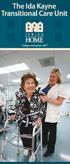 The Ida Kayne Transitional Care Unit Short-Term Rehabilitative Care for Seniors The Ida Kayne Transitional Care Unit (TCU) at the Los Angeles Jewish Home is designed to help seniors successfully transition
Traumatic Stress. and Substance Use Problems
 Traumatic Stress and Substance Use Problems The relation between substance use and trauma Research demonstrates a strong link between exposure to traumatic events and substance use problems. Many people
Service delivery interventions
 Service delivery interventions S A S H A S H E P P E R D D E P A R T M E N T O F P U B L I C H E A L T H, U N I V E R S I T Y O F O X F O R D CO- C O O R D I N A T I N G E D I T O R C O C H R A N E E P
Sunderland Psychological Wellbeing Service
 Sunderland Psychological Wellbeing Service Information for Referrers Offering a range of psychological therapies across Sunderland. To make a referral call 0191 566 5454 A partnership between Northumberland,
Assessment Blueprint for Stroke Medicine. Mini- DOPS MSF SESR CBD TP A R area
 Assessment Blueprint for troke Medicine DOP MF ER CBD TP A R 1. ACUTE TROE OBJECTIVE - TO PROVIDE THE TRAINEE WITH THE NOWLEDGE AND ILL TO CONTRIBUTE TO A COMPREHENIVE PECIALIT ERVICE FOR PATIENT WITH
Psychology Externship Program
 Psychology Externship Program The Washington VA Medical Center (VAMC) is a state-of-the-art facility located in Washington, D.C., N.W., and is accredited by the Joint Commission on the Accreditation of