
Food Safety Management System For
|
|
|
- John Bradford
- 9 years ago
- Views:
Transcription

1 Food Safety Management System For Completed by on Review Dates Signed Signed Signed Signed Signed Signed Published and printed by Amber Valley Borough Council, Town Hall, Market Place, Ripley, Derbyshire DE5 3BT

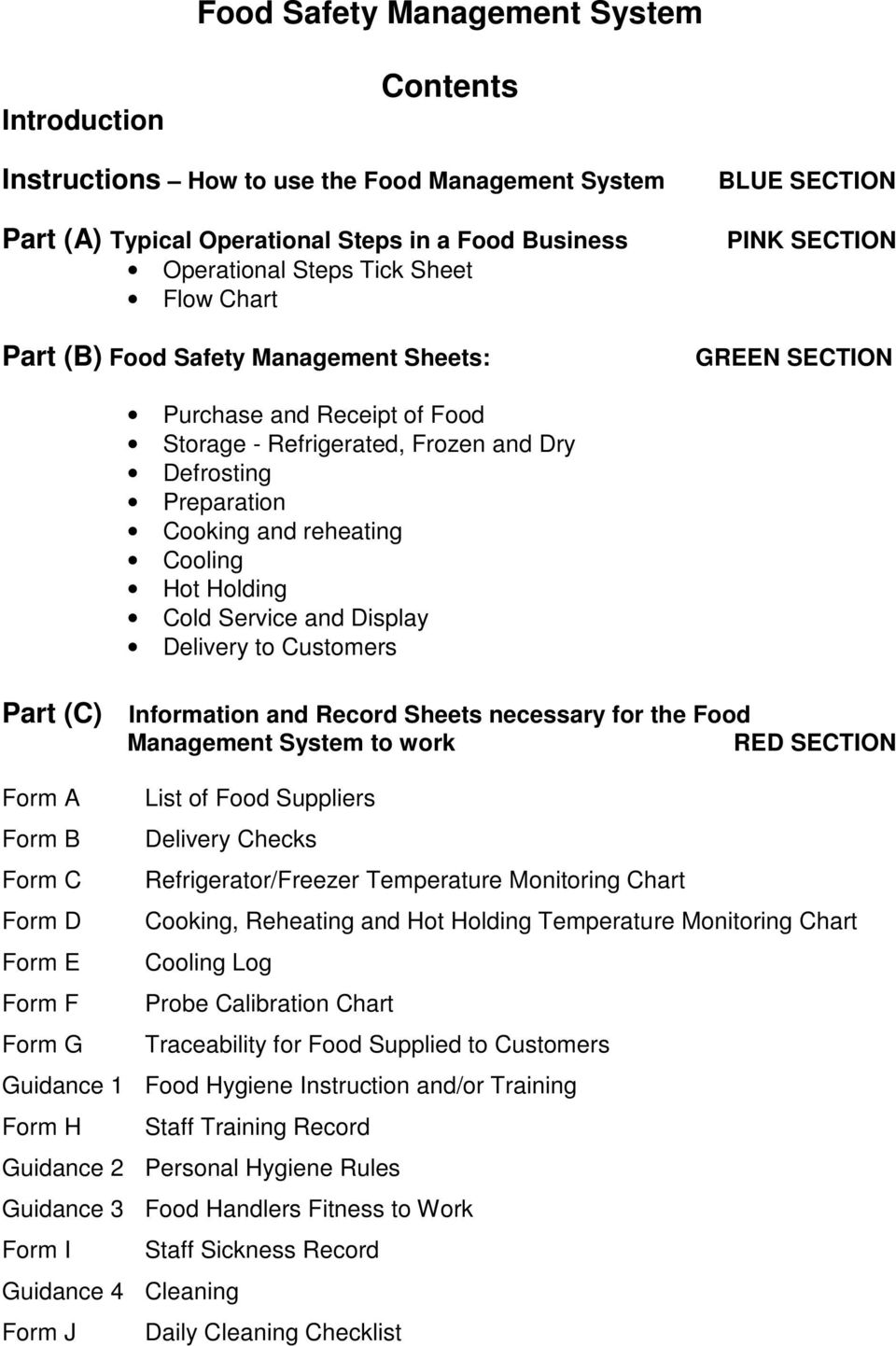
2 Food Safety Management System Introduction Contents Instructions How to use the Food Management System Part (A) Typical Operational Steps in a Food Business Operational Steps Tick Sheet Flow Chart Part (B) Food Safety Management Sheets: BLUE SECTION PINK SECTION GREEN SECTION Purchase and Receipt of Food Storage - Refrigerated, Frozen and Dry Defrosting Preparation Cooking and reheating Cooling Hot Holding Cold Service and Display Delivery to Customers Part (C) Information and Record Sheets necessary for the Food Management System to work RED SECTION Form A Form B Form C Form D Form E Form F Form G List of Food Suppliers Delivery Checks Refrigerator/Freezer Temperature Monitoring Chart Cooking, Reheating and Hot Holding Temperature Monitoring Chart Cooling Log Probe Calibration Chart Traceability for Food Supplied to Customers Guidance 1 Food Hygiene Instruction and/or Training Form H Staff Training Record Guidance 2 Personal Hygiene Rules Guidance 3 Food Handlers Fitness to Work Form I Guidance 4 Cleaning Form J Staff Sickness Record Daily Cleaning Checklist
3 Form K Weekly Cleaning Checklist Form L Monthly Cleaning Checklist Form M Cleaning Chemicals Guidance 5 Pest Control Form N Pest Control Monitoring Records Form O Details of your Waste Collection Company Guidance 6 Catering and Food Allergens and Intolerance Guidance 7 High Risk Foods Guidance 8 Hazardous Practices Guidance 9 Food Poisoning Guidance 10 Glass Breakage policy Guidance 11 Detailed Information on HACCP

4 Introduction to the Food Management System The Food Hygiene (England) Regulations 2006 require food business operators to put into place and maintain a Food Safety Management System based on the principles of HACCP (Hazard Analysis Critical Control Point). Food Businesses have always been required to produce food that is safe to eat but these new Regulations say that businesses must be able to show what they do to make food safely and have this written down. Simply put Say what you do, do what you say and prove it with records. Amber Valley Borough Council has produced this Pack to help small businesses work through the process of writing a Food Management System in a logical way. Throughout the pages there are places for you to fill in what you do in your business. It is intended to be used as a starting point and gives examples rather than answers. This is not the only way of complying with the Law. There are many other systems available such as the Food Standards Agency s Safer Food Better Business which can be accessed free of charge on their website at or you can of course develop your own system. There are templates, references and details of further sources of information at the back of this file that may also help you. What do I need to do? To comply with the legislation it is necessary to identify, control, monitor and record the points in the operation where food hazards may occur. Food Hazards include anything that may harm the consumer. Food Hazards fall into one of the following groups:- Bacterial Hazards. Bacteria or other organisms may be present in food and may cause food poisoning. For example, harmful bacteria may survive if cooking is inadequate. Bacteria may multiply if chilled high risk food is not kept cold enough. Chemical Hazards for example by cleaning chemicals, pest baits. Physical Hazards, such as glass, metal, plastic contamination. How do I use this Pack? This pack is split into three parts, A, B and C. By working through these parts, you will be guided through the stages of your operation and will identify the food safety controls that you need to implement. There are also examples of record sheets at the back of the pack that you may find appropriate for you to use in your business to help show what you are doing to make food safely. If you already keep records, you may wish to keep the layout you already have and refer to them in the appropriate section of the file.

5 What do I do next? The next section guides you through completing the forms provided in this Pack. If you have any questions or queries, you can contact the Amber Valley Borough Council Regulation Unit on What do I do when I have completed the Pack? It is important that all staff are aware and understand the parts they play in your Food Management System. Make sure you have enough blank copies of the monitoring forms, for example fridge temperature monitoring forms, for staff to complete. Ensure your staff know what you expect them to do, how to do it, what form to use if required and who to report to if things go wrong. At your next food hygiene inspection, your completed documentation will be requested in order for you to show that you have identified the appropriate controls necessary for your business to produce safe food. You must ensure that the Management System is kept up to date, and do a review of it when things change in your business, such as when the menu changes, new equipment is installed or new staff start work.

6 Instructions How to use the Food Safety Management System There are 3 parts to the Food Safety Management System which must be completed in order Part A Typical Operational Steps in a Food Business (Pink Section) Part B Food Management Sheets (Green Section) Part C Information and Record Sheets necessary for the Food Management System to work (Red Section) Part (A) Typical Operational Steps in a Food Business (Pink Section) Look at the typical operational steps in a food business (Pink Sheet) and tick those that apply to your business. It is important to look at your menu and also consider any specials or seasonal dishes/sauces etc when completing the chart. This will help you to fill in the correct Food Management System sheets in Part (B).

7 Part (B) Food Safety Management Sheets (Green Section) Take out the relevant Food Management Sheets (Green Sheets) that you identified in Part (A) as operational steps in the business. Complete all 5 Sections on each sheet as follows: Section (1) Hazards which can occur at this stage; Bacterial/ Physical/ Chemical (Please circle if applicable delete if not) You must identify hazards that are present at that operational step. Hazards are described in the Introduction. Simply circle the hazards that apply and cross out those that do not apply (see the examples below). Example: Part (B) Food Safety Management System - Cooking and Reheating Section (1) Bacterial, Physical and Chemical hazards may all be relevant at this stage. Therefore all hazards are circled Section (1) Hazards which can occur at this stage Bacterial / Physical / Chemical (delete if not applicable) Section (2) Safe Cooking & Reheating Plan (Tick the box if applicable cross the box if not applicable) Staff supervised / instructed and trained in Food Hygiene (See Supervision Instruction Training Guidance 1 and fill in Form H) Calibrated probe used to check temperatures. (Fill in Form F) Probe Sanitised before every use High Risk Foods cooked and/or reheated to a temperature of at least 75 c for 30 seconds at the centre (Fill in Form D) Meat and poultry cooked until juices run clear/no blood present and to a core temperature of at least 75ºc for 30 seconds (or an equivalent time/temperature ratio, to kill bacteria) Manufacturers cooking and reheating instructions followed Reheat food only once. Check temperature to ensure above 75 c (Fill in Form D) Section (3) Safe checks What checks should be carried out? How often? What records shall I keep? (For example, Check temperature of the centre of food using a probe thermometer. Fill in Form D write down when this will be done and how often) Section (4) Who does the checks? Section (5) What should be done if things go wrong?

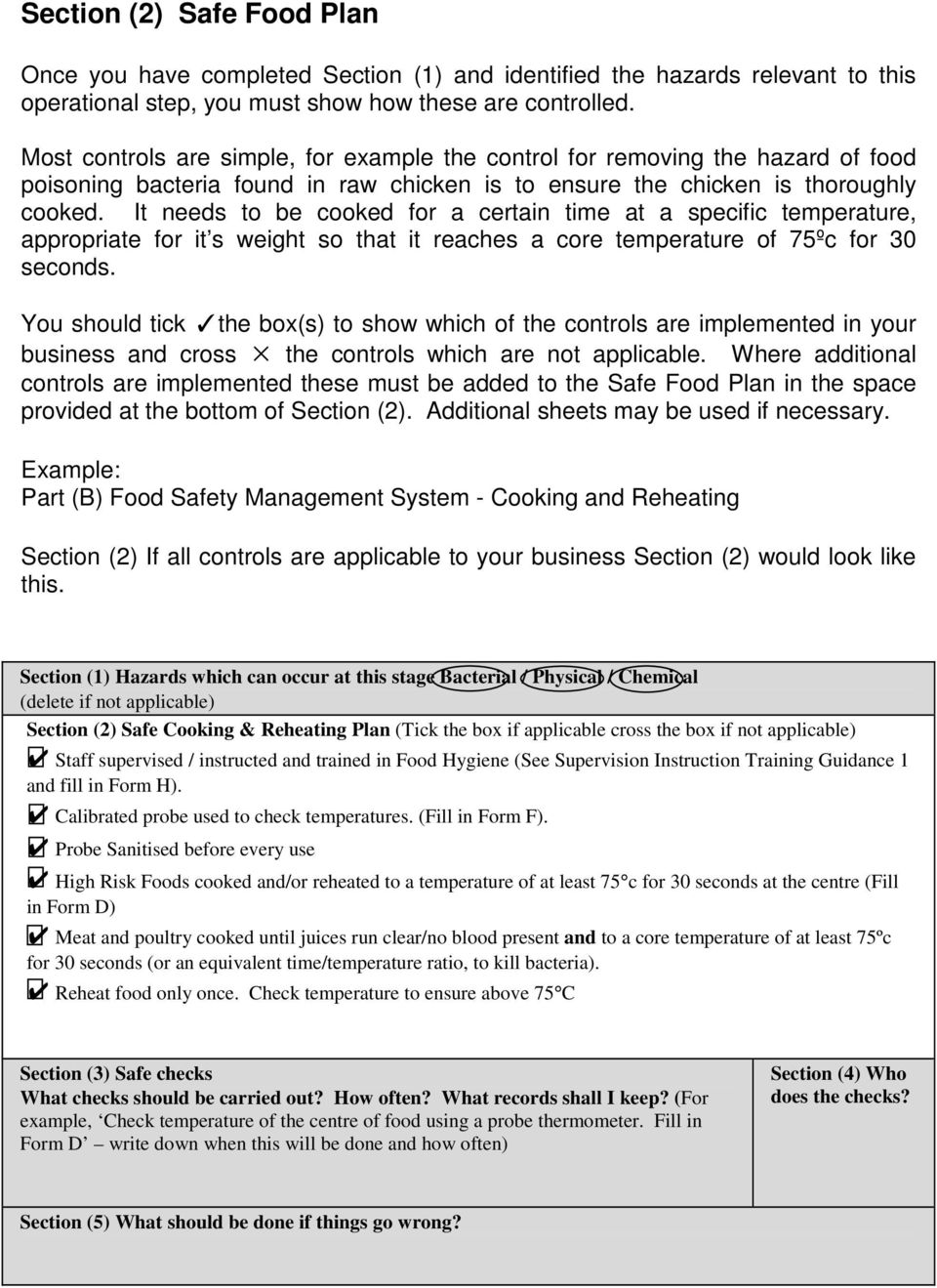
8 Section (2) Safe Food Plan Once you have completed Section (1) and identified the hazards relevant to this operational step, you must show how these are controlled. Most controls are simple, for example the control for removing the hazard of food poisoning bacteria found in raw chicken is to ensure the chicken is thoroughly cooked. It needs to be cooked for a certain time at a specific temperature, appropriate for it s weight so that it reaches a core temperature of 75ºc for 30 seconds. You should tick the box(s) to show which of the controls are implemented in your business and cross the controls which are not applicable. Where additional controls are implemented these must be added to the Safe Food Plan in the space provided at the bottom of Section (2). Additional sheets may be used if necessary. Example: Part (B) Food Safety Management System - Cooking and Reheating Section (2) If all controls are applicable to your business Section (2) would look like this. Section (1) Hazards which can occur at this stage Bacterial / Physical / Chemical (delete if not applicable) Section (2) Safe Cooking & Reheating Plan (Tick the box if applicable cross the box if not applicable) Staff supervised / instructed and trained in Food Hygiene (See Supervision Instruction Training Guidance 1 and fill in Form H). Calibrated probe used to check temperatures. (Fill in Form F). Probe Sanitised before every use High Risk Foods cooked and/or reheated to a temperature of at least 75 c for 30 seconds at the centre (Fill in Form D) Meat and poultry cooked until juices run clear/no blood present and to a core temperature of at least 75ºc for 30 seconds (or an equivalent time/temperature ratio, to kill bacteria). Reheat food only once. Check temperature to ensure above 75 C Section (3) Safe checks What checks should be carried out? How often? What records shall I keep? (For example, Check temperature of the centre of food using a probe thermometer. Fill in Form D write down when this will be done and how often) Section (4) Who does the checks? Section (5) What should be done if things go wrong?
9 Section (3) Safe Checks In this Section you must identify what checks are carried out, how often the checks are carried out and what records you keep to prove that food was safe to serve. If you do it, prove it. Records are very important and may help with a legal defence known as a due diligence defence should formal action be taken against your business. Example: Part (B) Food Safety Management System Cooking and Reheating Section (3) Check the temperature of cooked and reheated food with a probe thermometer, to ensure it has reached a core temperature of 75 c for 30 seconds (or equivalent) and record on the temperature monitoring record sheet. Section (1) Hazards which can occur at this stage Bacterial / Physical / Chemical (delete if not applicable) Section (2) Safe Cooking & Reheating Plan (Tick the box if applicable cross the box if not applicable) Staff supervised / instructed and trained in Food Hygiene (See Supervision Instruction Training Guidance 1 and fill in Form H). Calibrated probe used to check temperatures. (Fill in Form F). Probe Sanitised before every use High Risk Foods cooked and/or reheated to a temperature of at least 75 c for 30 seconds at the centre (Fill in Form D) Meat and poultry cooked until juices run clear/no blood present and to a core temperature of at least 75ºc for 30 seconds (or an equivalent time/temperature ratio, to kill bacteria). Reheat food only once. Check temperature to ensure above 75 C 3) Safe checks What checks should be carried out? How often? What records shall I keep? (For example, Check temperature of the centre of food using a probe thermometer. Fill in Form D write down when this will be done and how often) 4) Who does the checks? 5) What should be done if things go wrong?


10 Section (4) Who does the checks? In this Section you must identify who is responsible for the safe checks listed in Section (3). You should think about holiday and sickness cover. Make sure the record sheets for these safe checks are completed by the person identified Example: Part (B) Food Safety Management System - Cooking and Reheating Section (4) Section (1) Hazards which can occur at this stage Bacterial / Physical / Chemical (delete if not applicable) Section (2) Safe Cooking & Reheating Plan (Tick the box if applicable cross the box if not applicable) Staff supervised / instructed and trained in Food Hygiene (See Supervision Instruction Training Guidance 1 and fill in Form H). Calibrated probe used to check temperatures. (Fill in Form F). Probe Sanitised before every use High Risk Foods cooked and/or reheated to a temperature of at least 75 c for 30 seconds at the centre (Fill in Form D) Meat and poultry cooked until juices run clear/no blood present and to a core temperature of at least 75ºc for 30 seconds (or an equivalent time/temperature ratio, to kill bacteria). Reheat food only once. Check temperature to ensure above 75 C Section (3) Safe checks What checks should be carried out? How often? What records shall I keep? (For example, Check temperature of the centre of food using a probe thermometer. Fill in Form D write down when this will be done and how often) Section (4) Who does the checks? Section (5) What should be done if things go wrong?

11 Section (5) What should be done if things go wrong? This Section needs to include brief instructions of what action is taken if the Safe Checks show something is wrong, for example: Inform the Owner/ manager immediately. If food has been in the danger zone (8ºc 63ºc) for more than 4 hours destroy it. If food is not cooked thoroughly, continue cooking to ensure a core temperature of 75 c for 30 seconds (or equivalent). Example: Part (B) Food Safety Management System - Cooking and Reheating Section (5) Section (1) Hazards which can occur at this stage Bacterial / Physical / Chemical (delete if not applicable) Section (2) Safe Cooking & Reheating Plan (Tick the box if applicable cross the box if not applicable) Staff supervised / instructed and trained in Food Hygiene (See Supervision Instruction Training Guidance 1 and fill in Form H). Calibrated probe used to check temperatures. (Fill in Form F). Probe Sanitised before every use High Risk Foods cooked and/or reheated to a temperature of at least 75 c for 30 seconds at the centre (Fill in Form D) Meat and poultry cooked until juices run clear/no blood present and to a core temperature of at least 75ºc for 30 seconds (or an equivalent time/temperature ratio, to kill bacteria). Reheat food only once. Check temperature to ensure above 75 C Section (3) Safe checks What checks should be carried out? How often? What records shall I keep? (For example, Check temperature of the centre of food using a probe thermometer. Fill in Form D write down when this will be done and how often) Section (4) Who does the checks? Section (5) What should be done if things go wrong?

12 Part (C) What should I do next? (Red Section) You should now complete any of the record sheets in Part C (Red Section) that relate to the things you do in your business. For example: You should complete the record sheets that have been identified in Part B, such as the Supplier list (Form A), Temperature Monitoring Charts (Forms C and D), Staff Training Record (Form H), Cleaning Schedules (Forms J, K and L) and Pest Control (Form N) so they reflect your business. You must make sure who ever is named in the who does the checks boxes are carrying out those checks and completing the monitoring sheets such as temperature checks for deliveries, storage, cooking and hot hold and probe calibration. (Forms B, C, D, and F) That you have traceability for food coming into and out of your business. This can be done by completing the traceability records for the food you buy (and sell to other businesses) and by labelling food you store. (Forms B and G) You must give staff training on the system so they understand how it works and their duties to carry out any checks. Review The Food Safety Management System should be reviewed at regular intervals to make sure it still reflects what you are doing. It should be reviewed at least annually or when any major changes happen, for example if you change suppliers for food, or chemicals, or you have a new member of staff. You should put the date for the next review on the front sheet.

13 Part (A) Typical Operational Steps in a Food Business Tick the operations that are applicable to your business and see flow chart. Purchase and Receipt of Food Tick this box if you buy food yourself and / or have food delivered from reputable company. Storage (dry goods, refrigerated, and frozen) Tick this box if goods are received and placed into storage before use. Defrosting Tick this box if foods are defrosted prior to preparation or use. Preparation Tick this box if any operation involves handling of food e.g. peeling and preparation of salad and vegetables, making a pie, preparing sandwiches or stuffing a chicken. Cooking and Reheating Tick this box if foods are cooked after preparation and /or foods are reheated whether made on the premises or bought in. Cooling Tick this box if food is cooled after cooking as it is not intended for immediate use. Hot Holding Tick this box if food is prepared hot and kept hot until service. Service and Display Tick this box if food is served cold from the fridge and / or displayed chilled. Delivery to customers and businesses Tick this box if food is transported from one premises to another before being sold. Include food delivered to stalls and mobile vehicles.

14 Flow Chart PURCHASE RECEIPT STORAGE - ROOM TEMPERATURE OR CHILLED STORAGE - FROZEN PREPARATION DEFROST COOKING COOL FREEZE DEFROST STORAGE - CHILLED OR FROZEN REHEAT HOT HOLD SERVE OR DELIVER COLD SERVE OR DELIVER HOT SERVE OR DELIVER COLD SERVE OR DELIVER HOT USE OF LEFTOVERS WASHING UP

15 Part (B) Food Safety Management Sheet Purchase and Receipt of Food Reputable suppliers, correct date codes and temperatures will ensure safe food Section (1) Hazards which can occur at this stage Bacterial / Physical / Chemical (delete if not applicable) Section (2) Safe Purchase and Receipt Plan (tick the box if applicable cross the box if not applicable) Staff supervised / instructed and trained in Food Hygiene (See Supervision Instruction Training Guidance 1 and fill in Form H) Approved & reputable supplier list and contact details. (Fill in Form A) Suppliers vehicles clean Delivery personnel wearing clean over clothing and practicing good hygiene Date codes checked on delivery Temperatures checked on delivery- refrigerated colder than 8ºc and frozen colder than 18ºc (Fill in Form B) Visual check of packaging clean and not damaged (Fill in Form B) Food stored promptly after delivery Food collected in my vehicle, stored in hygienic way, at correct temperatures- refrigerated colder than 8ºC and frozen colder than 18ºc Section (3) Safe checks What checks should be carried out? How often? What records shall I keep? (For example. Temperatures checked of refrigerated foods delivered with a probe thermometer to ensure 8ºc or colder every delivery and recorded on Form B) Section (4) Who does the checks? Section (5) What should be done if things go wrong? (For example. If chilled ready to eat food delivery temperature is above 8ºc reject delivery)

16 Part (B) Food Safety Management System Storage Refrigerated, Frozen and Dry Food Food must be stored at the correct temperature and be covered so that it is free from contamination. Section (1) Hazards which can occur at this stage Bacterial / Physical / Chemical (delete if not applicable) Section (2) Safe Food Storage Plan (tick the box if applicable, cross the box if not applicable) Staff supervised / instructed and trained in Food Hygiene (See Supervision Instruction Training Guidance 1 and fill in Form H) All refrigerators, refrigerated displays and refrigerated vehicles must keep food at or colder than 8oc or at the temperature stated on food labels (Fill in Form C) Keep frozen food at or colder than -18 c (Fill in Form C) Place chilled food in refrigerator within 15 minutes of delivery to premises Service all refrigerators/freezers regularly Food covered, wrapped or in pest proof containers Stock rotation in place, food used within its best before or use by date Cleaning chemicals stored away from food Raw and cooked foods separated sufficiently to avoid cross contamination e.g. cooked foods stored above raw food in the refrigerator/ separate labelled refrigerators/ separate part of walk-in fridge Storage space adequate Storage areas clean and free from pests Pest control measures in place (Fill in Guidance 5 and/ or Form N) When freezing food, label with date frozen and date it should be used by All stored foods correctly labelled with Use By or Best Before Dates Chilled high risk food prepared used on site within 3 days of production Food used within 3 days once original packing is opened or within Use By date if shorter Following the Glass Breakage Policy (See Guidance 10) Section (3) Safe checks What checks should be carried out? How often? What records shall I keep? (For example. Once a package is open, place sealed container and label with a use-by date.) Section (4) Who does the checks?

17 Section (5) What should be done if things go wrong? (For example. If fridge not operating at or below 8oc, call Emergency Refrigeration Engineer. Phone no: ).

18 Part (B) Food Safety Management System Defrosting Defrost thoroughly to ensure proper cooking and in a way that prevents cross contamination Section (1) Hazards which can occur at this stage Bacterial / Physical / Chemical (delete if not applicable) Section (2) Safe Defrosting plan (tick the box if applicable cross the box if not applicable) Staff supervised / instructed and trained in Food Hygiene (See Supervision Instruction Training Guidance 1 and fill in Form H) All perishable foods thawed on a tray in the refrigerator. Raw meat and poultry at the very bottom of fridge Defrosting in microwave Defrosting in sink, under running water, away from cooked and ready to eat foods and in designated sink. Clean and sanitise the sink after defrosting. Foods covered for protection whilst defrosting Raw meat, poultry and fish placed on sufficiently deep drip trays to contain thawing liquid Centre of all food checked to ensure thoroughly thawed Label defrosted food for use later with date defrosted and provide a use-by date e.g within 2 days Thawed products NEVER refrozen Defrost raw food away from high risk food Section (3) Safe Checks What checks should be carried out? How often? What records shall I keep? (For example. Defrost raw meat in a deep tray below ready to eat foods in the refrigerator.) Section (4) Who does the checks? Section (5) What should be done if things go wrong? (For example. If product still frozen, put back refrigerator until completely thawed, or defrost in microwave.)

19 Part (B) Food Safety Management System Preparation Prevent bacterial/ physical/ chemical contamination of food. Section (1) Hazards which can occur at this stage Bacterial / Physical / Chemical (delete if not applicable) Section (2) Safe Preparation Plan (tick the box if applicable cross the box if not applicable) Staff supervised / instructed and trained in Food Hygiene (See Supervision Instruction Training Guidance 1 and fill in Form H) Sanitise food contact surfaces before use (See Cleaning Guidance 4 and Forms J, K and L). Hand washing using bactericidal soap and hot water Hands hygienically dried Separate cloths used for raw and ready to eat areas Use separate work surfaces/preparation areas for raw and high risk foods Use separate equipment for raw and high risk food e.g. tongs, forks, meat slicers, scales, vacuum packers etc. Use colour coded equipment for raw and high risk foods Cleaning chemicals safely stored away from preparation areas Windows / doors fly screened if opened regularly Limit time that food is at ambient temperature Removal of foreign objects from the preparation area Purchase pre washed foods where practicable Wash and sanitise all salad products during preparation with a chlorine based food safe product, in accordance with the manufactures instructions High risk foods kept cool and prepared as quickly as possible Section (3) Safe checks What checks should be carried out? How often? What records shall I keep? (For example. Use separate areas for preparation of raw and ready to eat foods.) Section (4) Who does the checks? Section (5) What should be done if things go wrong? (For example. If preparation surface contaminated, remove contamination, clean and sanitize area before use.)

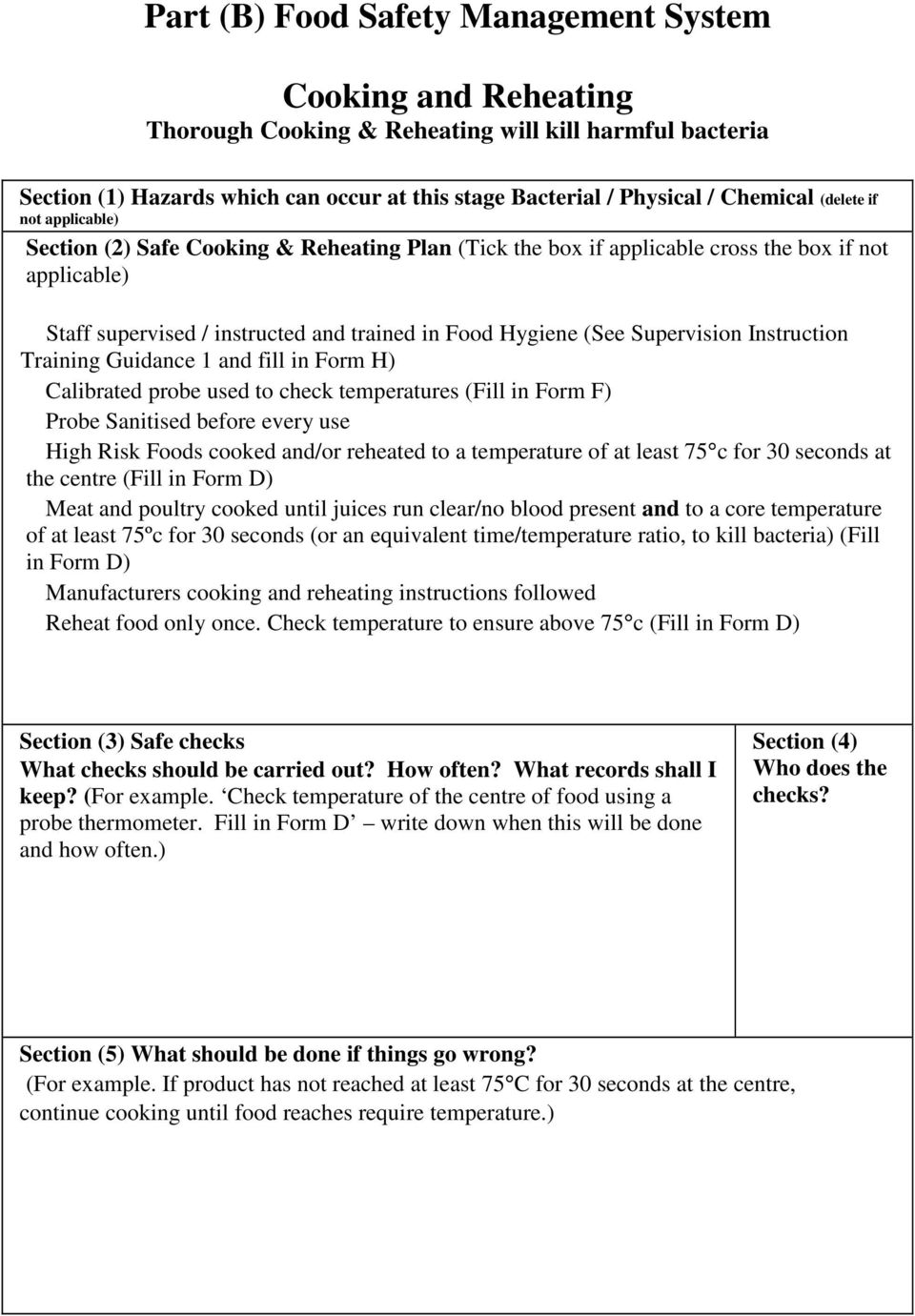
20 Part (B) Food Safety Management System Cooking and Reheating Thorough Cooking & Reheating will kill harmful bacteria Section (1) Hazards which can occur at this stage Bacterial / Physical / Chemical (delete if not applicable) Section (2) Safe Cooking & Reheating Plan (Tick the box if applicable cross the box if not applicable) Staff supervised / instructed and trained in Food Hygiene (See Supervision Instruction Training Guidance 1 and fill in Form H) Calibrated probe used to check temperatures (Fill in Form F) Probe Sanitised before every use High Risk Foods cooked and/or reheated to a temperature of at least 75 c for 30 seconds at the centre (Fill in Form D) Meat and poultry cooked until juices run clear/no blood present and to a core temperature of at least 75ºc for 30 seconds (or an equivalent time/temperature ratio, to kill bacteria) (Fill in Form D) Manufacturers cooking and reheating instructions followed Reheat food only once. Check temperature to ensure above 75 c (Fill in Form D) Section (3) Safe checks What checks should be carried out? How often? What records shall I keep? (For example. Check temperature of the centre of food using a probe thermometer. Fill in Form D write down when this will be done and how often.) Section (4) Who does the checks? Section (5) What should be done if things go wrong? (For example. If product has not reached at least 75 C for 30 seconds at the centre, continue cooking until food reaches require temperature.)
21 Part (B) Food Safety Management System Cooling Harmful bacteria will multiply slower if high risk foods are cooled quickly Section (1) Hazards which can occur at this stage Bacterial / Physical / Chemical (delete if not applicable) Section (2) Safe Cooling Plan (Tick the box if applicable cross the box if not applicable) Staff supervised / instructed and trained in Food Hygiene (See Supervision Instruction Training Guidance 1 and fill in Form H) Food cooled to below 8 c as quickly as possible within 90 minutes (Fill in Form E) Small joints of meat used <2.5Kg Food cooled in shallow, pre cooled trays and small portions to ensure speedy cooling Food placed in refrigerator as soon as temperature of cooling food approaches room temperature but "hot" food not placed in refrigerator Cooling takes place in an insect proof area, used only for high risk foods Cool cooked foods away from raw foods Use blast chiller to cool foods quickly Section (3) Safe checks What checks should be carried out? How often? What records shall I keep? (For example. Cool on clean sanitized surface, away from raw preparation area) Section (4) Who does the checks? Section (5) What should be done if things go wrong? (For example. Ensure that food is adequately cooled before putting into refrigerator)
22 Part (B) Food Safety Management System Hot holding Harmful bacteria will not multiply if high-risk foods are kept hot enough. Section (1) Hazards which apply to this stage Bacterial / Physical / Chemical (please delete if not applicable) Section (2) Safe Hot Holding Plan. Staff supervised / instructed and trained in Food Hygiene (See Supervision Instruction Training Guidance 1 and fill in Form H) Keep hot foods above 63ºc (Fill in Form D) Food to be hot held only once Pre-heat hot holding equipment Place food in bain-marie /hot cabinet immediately after cooking or reheating Stir hot liquids regularly Ensure no risk of contamination by foreign bodies or chemicals Section (3) Safe checks. What checks should be carried out? How often? What records shall I keep? (For example. Sneeze guard fitted to prevent contamination by public) Section (4) Who does the checks? Section (5) What should be done if things go wrong? (For example. Throw away hot food kept below 63ºC for more than 2 hours)
23 Part (B) Food Safety Management Sheet Cold Service and Display of Food Food must be kept at or below 8 c until and during service. Food to be left at room temperature for minimum time (max 4 hours). Section (1) Hazards which can occur at this stage Bacterial / Physical / Chemical (delete if not applicable) Section (2) Safe Cold Service and Display of Food Plan (tick the box if applicable cross the box if not applicable) Staff supervised / instructed and trained in Food Hygiene (See Supervision Instruction Training Guidance 1 and fill in Form H) Chilled display to be switched on in advance of service sessions, allowing time for correct temperatures to be reached. Never top up containers of food. Always exchange them and throw away leftovers. Check temperature at least once during session and record (Fill in Form C) Food not allowed to go above 8 c Leave buffet food, sandwiches etc in the fridge until ready to serve. At end of session all food removed from display. Dispose of food if it has been stored at room temperature for more than 4 hours Section (3) Safe checks What checks should be carried out? How often? What records shall I keep? (For example, check temperature of refrigerated foods with a probe thermometer to ensure 8ºc or colder and record on monitoring form (Fill in Form C)) Section (4) Who does the checks? Section (5) What should be done if things go wrong? (For example. If chilled ready to eat food is above 8ºc for more than 4 hours throw it away)
24 Part (B) Food Safety Management System Delivery to Customers Correct date codes and temperatures will ensure safe food Section (1) Hazards which may occur at this stage Bacterial / Physical / Chemical (delete if not applicable) Section (2) Safe Delivery Plan (tick the box if applicable cross the box if not applicable) Staff supervised / instructed and trained in Food Hygiene (See Supervision Instruction Training Guidance 1 and fill in Form H) Delivery vehicles clean Delivery personnel wearing clean over clothing and practicing good hygiene Date codes on products Temperatures checked on delivery- colder than 8ºc refrigerated, colder than 18ºc frozen and more than 63 c for hot deliveries (Fill in Form B) Visual check of packaging clean and not damaged All packaging is food safe Separate storage for raw and cooked foods to avoid cross contamination Customers with allergies given advice (See Guidance 6) Section (3) Safe checks What checks should be carried out? How often? What records shall I keep? (For example. Check temperature of refrigerated foods delivered with a probe thermometer to ensure colder than 8ºC.) Section (4) Who does the checks? Section (5) What should be done if things go wrong? (For example. If food is out of temperature control for more than 4 hours then destroy the food)
25 Part (C ) Information and Record Sheets necessary for The Food Safety Management System to Work Form A List of Food Suppliers Form B Delivery Checks Form C Refrigerator/Freezer Temperature Monitoring Chart Form D Cooking, Reheating and Hot Holding Temperature Monitoring Chart Form E Cooling Log Form F Probe Calibration Chart Form G Traceability for Food Supplied to Customers Guidance 1 Food Hygiene Instruction and/or Training Form H Staff Training Record Guidance 2 Personal Hygiene Rules Guidance 3 Food Handlers Fitness to Work Form I Staff Sickness Record Guidance 4 Cleaning Form J Daily Cleaning Checklist Form K Weekly Cleaning Checklist Form L Monthly Cleaning Checklist Form M Cleaning Chemicals Guidance 5 Pest Control Form N Pest Control Monitoring Records Form O Details of your Waste Collection Company Guidance 6 Guidance for caterers on Food Allergens and Intolerance Guidance 7 High Risk Foods Guidance 8 Hazardous Practices Guidance 9 Food Poisoning Guidance 10 Glass Breakage policy Guidance 11 Detailed Information on HACCP
26 List of Food Suppliers Form A Keeping details of suppliers is a legal requirement. Full Name of Company Address and Phone Number Food Supplied For further information on record keeping contact Amber Valley Borough Council, Environmental Services, Regulation Unit, P.O Box 17, Town Hall Ripley, Derbyshire. DE5 3BT. Telephone A copy of this generic form is available from: in the a-z section of this web page under food safety management system Related documents.
27 Delivery Checks Form B Date Supplier Temperature Condition Date Codes Initials Targets for Delivery Checks Temperature: Chilled food 8ºc or colder. Frozen Food 18ºc or colder. Date Codes: Food date coded to give enough shelf life, and within use by date Contamination; Packaging and food in good condition. Driver good standard of personal hygiene. Inside of vehicle clean. For further information on record keeping contact Amber Valley Borough Council, Environmental Services, Regulation Unit, P.O Box 17, Town Hall Ripley, Derbyshire. DE5 3BT. Telephone A copy of this generic form is available from: in the a-z section of this web page under Food Safety Management System Related documents.
28 Refrigerator/Freezer Temperature Monitoring Form C Month Date Time Unit 1 Unit 2 Unit 3 Unit 4 Unit 5 Unit 6 Signature Corrective Action Unit Refrigerators Freezers Target Temperature Colder than 8 o C Colder than 18 o C In the event of equipment failure contact immediately. For further information on record keeping contact Amber Valley Borough Council, Environmental Services, Regulation Unit, P.O Box 17, Town Hall Ripley, Derbyshire. DE5 3BT. Telephone A copy of this generic form is available from: in the a-z section of this web page under Food Safety Management System Related documents.
29 Cooking, Reheating and Hot Holding Temperature Monitoring Chart Form D Month Date Time Type of food checked Hot food Temp Reheating Temp Hot holding Temp Signature Corrective Action Target Temperature Cooking 75 o C for 30 seconds or 80 o C for 6 seconds Hot Holding Above 63 o C Reheating 75 o C for 30 seconds or 80 o C for 6 seconds In the event of an incorrect temperature contact immediately. For further information on record keeping contact Amber Valley Borough Council, Environmental Services, Regulation Unit, P.O Box 17, Town Hall Ripley, Derbyshire. DE5 3BT. Telephone A copy of this generic form is available from: in the a-z section of this web page under Food Safety Management System Related documents.
30 Cooling Log Form E Centre temperature: 75 c or above after cooking. Note: Ensure the thermometer probe is sterile before and after use and is calibrated at regular intervals. Cool foods to Centre Temperature: <8 c in 90 minutes. Date Product Start Centre Temp ( c) Time at start of Cooling Time at end of Cooling Temp at end of cooling Comments/Actions Taken Signature For further information on record keeping contact Amber Valley Borough Council, Environmental Services, Regulation Unit, P.O Box 17, Town Hall Ripley, Derbyshire. DE5 3BT. Telephone A copy of this generic form is available from: in the a-z section of this web page under Food Safety Management System Related documents.
31 Probe Calibration Chart Form F Year Probe number Month January Hot Method Temp ( c) Cold Method Temp ( c) Signature Corrective Action February March April May June July August September October November December To check the probe thermometer is working correctly either: Cold: Agitate the probe thermometer in a cup of melting ice and water. The thermometer should read between 1 o C and 1 o C. Hot: Agitate the probe thermometer in boiling (unsalted) water. thermometer should operate between 99 o C and 101 o C. The If the thermometer is operating outside this range either repair/replace the probe thermometer. In the event of a wrong temperature contact immediately. For further information on record keeping contact Amber Valley Borough Council, Environmental Services, Regulation Unit, P.O Box 17, Town Hall Ripley, Derbyshire. DE5 3BT. Telephone A copy of this generic form is available from: in the a-z section of this web page under Food Safety Management System Related documents.
32 Traceability for Food Supplied to Customers Form G Date of Delivery Name of Customer Address & Contact Details Product Quantity For further information on record keeping contact Amber Valley Borough Council, Environmental Services, Regulation Unit, P.O Box 17, Town Hall Ripley, Derbyshire. DE5 3BT. Telephone A copy of this generic form is available from: in the a-z section of this web page under Food Safety Management System Related documents.
33 Food Hygiene Supervision Instruction and/ or Training Guidance 1 Definition of Food Handler - Any person who handles or prepares food whether open (unwrapped) or packaged. Food includes alcoholic and non alcoholic drinks and ice. All food handlers must be properly supervised and instructed and/or formally trained to ensure that they work hygienically. A greater degree of supervision may be needed for: New, agency or temporary staff awaiting formal training. Staff handling high risk foods. Less experienced staff. Staff who have received training or instruction to see if they have understood and are undertaking safe practices. Supervision will depend upon the competence and experience of individual food handlers. Small food operations should place greater emphasis on formal training to enable unsupervised work with occasional monitoring. The training needed will depend on the actual job of the food handler and the type of food that they handle. The table below is a summary for recommended training needs in food premises. Note that it is a specific legal requirement for Managers and those responsible for developing and maintaining the premises Food Safety Management System or HACCP system to receive appropriate training. Training level Category of Staff Category A Handle low risk or wrapped food only. Level 1 /Essentials e.g. Food Safety Awareness in Catering / Retail; Introduction into Food Safety for Manufacturing Guide to compliance - before starting work for the first time Level 2 / Foundation e.g. Award in Food Safety in Catering / Retail / Manufacturing Level 3 / Intermediate e.g. Award in Food Safety Supervising in Catering / Manufacturing / Award in Implementing Food Safety Management Systems / Award in HACCP for food Manufacture Level 4 / Advanced e.g. Award in Food Safety Management in Catering; Award in Food Safety Management for Manufacturing Category B Food handlers who prepare open high risk foods. Category C Food handlers who also have a supervisory role. Category D Food handlers who also have a management role Guide to compliance - before starting work for the first time Guide to compliance - before starting work for the first time Guide to compliance - before starting work for the first time Guide to compliancerecommended within 4 weeks; 8 weeks part-time staff Guide to compliance recommended within 4 weeks; 8 weeks part-time staff Guide to compliancerecommended within 4 weeks; 8 weeks part-time staff Guide to compliance recommended within 3 months Guide to compliancerecommended within 3 months Guide to compliance recommended within 3 months
34 Level 1 Essentials of food hygiene Before anyone is allowed to start work for the first time, a food handler must receive written or verbal instruction in the Essentials of Food Hygiene. There are formal courses available for this or if you have someone competent in your business, they could undertake this. Guide to compliance for all food handlers Before anyone is allowed to start work for the first time, a food handler must receive written or verbal instruction in the Essentials of Food Hygiene, which provide an understanding of hygiene. Advice on good practice All other staff employed in the business should also receive similar instruction as a matter of good practice. Any visitors to the premises should also be instructed on those rules that relate to personal hygiene. The essentials of food hygiene Keep yourself clean and wear clean clothing. Always wash your hands thoroughly: before handling food, after using the toilet, handling raw foods or waste, before starting work, after every break, after blowing your nose. Tell your supervisor, before commencing work, of any skin, nose, throat, stomach or bowel trouble or infected wound. You are breaking the law if you do not. Ensure cuts and sores are covered with a waterproof, high visibility dressing. Avoid unnecessary handling of food. Do not smoke, eat or drink in a food room, and never cough or sneeze over food. If you see something wrong tell your supervisor. Do not prepare food too far in advance of service. Keep perishable food either refrigerated or piping hot. Keep the preparation of raw and cooked food strictly separate. When reheating food ensure it gets piping hot. Clean as you go. Keep all equipment and surfaces clean. Follow any food safety instructions either on food packaging or from your supervisor. Below are further examples on courses accredited by the Chartered Institute of Environmental Health for catering businesses, which show the kind of training available and content at each level. Level 2 Award in Food Safety in Catering / Retail / Manufacturing Level 2 Award in food Safety in Catering The overall aim is to provide candidates with a good understanding and knowledge of food safety. Topics to be covered should include:- The Law Food Safety hazards Refrigeration, chilling and cold holding of foods Cooking, hot holding and reheating of foods Food handling Principles of safe food storage Cleaning Food premises and equipment Course Duration - 6 hours Assessment method: Multiple choice examination
35 Level 3 Award in Supervising Food Safety in Catering; Award in implementing Food Safety Management Systems Level 3 Award in Supervising Food Safety in Catering This level qualification is aimed at Managers and supervisors in medium and large manufacturing or catering businesses those responsible for the development and maintenance of HACCP- based food safety management procedures and / or supervising the work of others. Supervisory management Legislation Temperature control (chilling, cooking) Cleaning Contamination control Applying and monitoring good hygiene practices Implementing good food safety procedures Course Duration - 3 days long with assessment by Multiple choice paper and examination Level 3 Award in Implementing Food Safety Management Procedures This level qualification is aimed at proprietors and site managers of small and medium businesses in catering and hospitality. This qualification will assist ordinary business people to understand and implement a simple food safety management system. This level of qualification will help candidates to implement a food management system based on the principles of HACCP. The qualification covers the following topics: The 12 steps in the HACCP process Controls required to ensure food safety Use of a management tool such as the FSA s Safer Food Better Business pack Course Duration - 6 hours. Assessment method: Assignment Level 4 - Award in Managing Food Safety in Catering Level 4 Award in Managing Food Safety in Catering Designed for managers and supervisors and senior hygiene personnel. This qualification covers the following topics: n Bacteriology Food-borne illnesses Physical contamination of food Food storage, temperature control and preservation Design and construction of food premises and equipment Cleaning and disinfection Course duration- five day Assessment method: two assignments and an examination Pest control Personal Hygiene Training Strategies Legislation Management control techniques
36 Further information There are other food safety training courses accredited by other organisations than the Chartered Institute of Environmental Health. These include: The Royal Society for Public Health (RSPH) Society of Food Hygiene Technology (SOFHT) You need to determine the level of training needed for you and each level of your staff. Advice can be obtained from your food safety inspector at Amber Valley Borough Council. Local Food Hygiene Course contacts Chartered Institute of Environmental Health New College, Nottingham. Telephone: Broxtowe Borough Council, Foster Avenue, Beeston, Nottingham.NG9 1AB. Telephone: South East Derbyshire College, Field Road, Ilkeston, Derbyshire, DE7 5RS. Telephone: Derby City Council, Celtic House, Friary Street, Derby, DE1 1QX. Telephone: YMCA Derbyshire, The Campus, 770 London Road, Derby DE24 8UT. Telephone: EMM Training and Consultancy Ltd, 16 Dorest Gardens, West Bridgford NG2 7UH. Telephone: Adult Community Education Centre, Alfreton Park. Telephone: Adult Community Education Centre, Peverel House, Mill Lane, Codnor, Derbyshire. DE5 9QF. Telephone: Mackworth College, Derby. Telephone: SLIC Training, Bradbury House, Goytside Rd, Chesterfield S40 2PH. Telephone: Derbyshire Dales District Council, Matlock, Derbyshire. Telephone: Chesterfield College, Infirmary Road, Chesterfield, Derbyshire. S41 7NG. Telephone: Belper Centre, Holbrook Road, Derbyshire. DE56 1PA. Telephone: Nottingham Trent University, Brackenhurst, Southwell, Nottingham. NG25 0QF. Telephone: Leicester City Council. New Walk Centre, Welford Place, Leicester. LE1 6ZG (also run courses in other languages). Telephone: Guy Marsh, Turning Point Training, Codnor Park, Derbyshire. Telephone: Training Solutions, Ravenshead. Telephone: THIS COUNCIL DOES NOT ENDORSE OR RECOMMEND THE ABOVE PERSONS OR COMPANIES. THERE ARE MANY BUSINESSES OFFERING TRAINING WHO ARE LISTED IN THE YELLOW PAGES TELEPHONE DIRECTORY. Information compiled Sept 2010 by: Amber Valley Borough Council Environmental Services Regulation Unit PO Box 17, Town Hall Ripley, Derbyshire, DE5 3BT
37 Staff Training Record Form H NO. OF EMPLOYEES/FOOD HANDLERS - PART TIME... FULL TIME... Please specify date of the course employees have completed. Name of Food Handler Job Title Essentials of Food Hygiene Hygiene Awareness Refresher Training Foundation Food Hygiene (Level 2) Intermediate Food Hygiene (Level 3) Advanced Food Hygiene Other (please specify) Nb. Include relief food handlers Signature Date A copy of this generic form is available from: in the a-z section of this web page under Food Safety Management System Related documents.
38 Personal Hygiene Rules Guidance 2 Every person working in a food handling area must maintain a high degree of personal cleanliness. The following rules of personal hygiene must be adhered to at all times: 1. Always wash your hands thoroughly using hot water and soap; Before starting work Before handling foods After handling raw foods After visiting the toilet After every break After blowing your nose or touching your face or hair 2. Remove all jewellery, except for plain wedding rings before starting work. 3. Keep fingernails short and clean; do not use nail varnish. 4. Keep cuts, burns or other wounds covered with a brightly coloured waterproof dressing. 5. Do not smoke in any room where food is handled or stored. 6. Do not lick fingers when handling food or wrapping materials. 7. Do not pick your nose, teeth or ears, or scratch your head. 8. Do not cough or sneeze over food. 9. Always wear clean washable over clothing when handling food. Food handlers preparing open food should also wear a head covering. 10. If you are suffering from, or suspect you may be suffering from an illness likely to be transmitted through food, you must inform the Manager. This includes infected wounds, skin infections, sores, diarrhoea or vomiting. The following rules then apply: Anyone with diarrhoea and/or vomiting must not handle food. They can return to food handling duties once they have been symptom free for 48 hours. Food handlers with infected wounds, skin infections or sores on their hands, face, neck or scalp must be excluded from work until they have healed. Food handlers whose eyes, ears, or mouth are weeping/discharging must not handle food until they are better. 11. Do not eat or drink whilst handling/preparing food. 12. Do not wear perfume whilst handling/preparing food.
39 Food Handlers: Fitness to Work Guidance 3 Food handlers and businesses have legal obligations to avoid contaminating food. Food handlers suffering from certain illnesses can contaminate food, which can be responsible for causing food poisoning. Food handlers must: Practice good personal hygiene Maintain good hygiene standards in the workplace and Report infectious or potentially infectious conditions to management. Anyone who has diarrhoea and/or vomiting or a gastrointestinal infection must immediately report to their manager and leave the food handling area. Following these types of illnesses, food handlers must not return to work until; They have not vomited for 48 hours (if they have taken treatment, 48 hours after treatment has stopped) 48 hours after their first normal stool (faeces) Good hygiene practice, particularly hand washing must be followed. Normally food handlers suffering from diarrhoea or vomiting or gastrointestinal infection would leave the premises, but they could be given safe alternative work i.e. work that does not involve direct contact with open food or with surfaces and equipment in areas where open food is stored or processed. Where individuals do not leave the premises, advice must be sought from Environmental Services. Anyone who has scaling, weeping or discharging lesions on an exposed part of their skin (face, neck, hands, arms or scalp), which cannot be adequately covered, must not handle food, or food contact surfaces/equipment. Food handlers suffering from typhoid/paratyphoid fever, E coli 0157 and Hepatitis A must stay off work longer. In these cases you should contact this Department and a GP for advice about the exclusion of food handlers and their return to work. Further information on fitness to work can be found on the Food Standards Agency Website at:
40 Staff must report to the Manager; Staff Sickness Record Form I 1. As soon as possible if they are suffering from; Vomiting Diarrhoea Septic Skin Lesions (boils, infected cuts etc) Discharge from ears, nose or any other site 2. On returning to work and before starting work, following an illness or any of the above. 3. If any member of their household is suffering from diarrhoea and/or vomiting. 4. After returning from a holiday during which they suffered an attack of vomiting and /or diarrhoea. REFER TO FOOD HANDLERS FITNESS TO WORK GUIDANCE 3. Date Staff Name Illness Agreed Action Date Illness Started Date Returned to Work For further information on record keeping contact Amber Valley Borough Council, Environmental Services, Regulation Unit, P.O Box 17, Town Hall Ripley, Derbyshire. DE5 3BT. Telephone A copy of this generic form is available from: in the a-z section of this web page under Food Safety Management System Related documents.
41 Cleaning Guidance 4 High standards of cleanliness are important to ensure the safety and quality of products and a safe and healthy working environment for customers and staff. Cleaning Terms Detergent A chemical (e.g. washing up liquid) used to remove grease, dirt and food. Disinfectant A chemical that kills bacteria. Surfaces must be clean of grease, dirt and food before using a disinfectant. Sanitiser A two-in-one product that acts as a detergent and disinfectant. Dilution rate Most cleaning chemicals are concentrated, so you need to add water to dilute them before they can be used. It is important to follow the manufacturers instructions, too little or too much water may mean the chemical might not work effectively. Contact Time This is how long the cleaning chemical needs to be left on the item/surface you are cleaning. The chemical needs to have an adequate contact time to work properly. It is important to follow the manufacturers instructions. Cleaning Schedules To help maintain the level of hygiene within the premises, it is recommended that a cleaning schedule programme is prepared and implemented. This should set out the frequencies that rooms, including fixtures and fittings, should be cleaned as well as the cleaning chemicals and methods used. To ensure that it functions properly, employees should be trained in the correct cleaning techniques. Once any area has been cleaned, the employee responsible should sign a record sheet which would give management a clear indication that the area concerned had been cleaned. To monitor the effectiveness of the programme, management should carry out frequent hygiene audits to ensure that the level of cleanliness is satisfactory. In summary when writing your cleaning schedule you should consider; What is to be cleaned Who is to clean it When is it to be cleaned How it is to be cleaned The time necessary to clean it The chemicals, materials and equipment to be used The correct dilution rates for chemicals The contact time required for the chemical to work
42 Safety Precautions - check your Health and Safety Risk Assessment and COSSH documents in relation to cleaning. Protective clothing to be worn Who is responsible for checking and recording that it has been cleaned Cleaning Cloths To prevent the spread of harmful bacteria use single-use wiping/ dish cloths wherever possible and throw them away after each task. If using re-useable cloths, make sure they are thoroughly washed, disinfected and dried between tasks (not just when they look dirty). Ideally, wash cloths in a washing machine on a hot cycle (i.e. 90 c). If you wash and disinfect cloths by hand, make sure all food and dirt has been removed before disinfection.
43 Daily Cleaning Checklist Form J WEEK COMMENCING:... Area/Equipment Method of cleaning Personal Protective Equipment Signed by Cleaner M T W T F S S Comments For further information on record keeping contact Amber Valley Borough Council, Environmental Services, Regulation Unit, P.O Box 17, Town Hall Ripley, Derbyshire. DE5 3BT. Telephone A copy of this generic form is available from: in the a-z section of this web page under Food Safety Management System Related documents.
44 Weekly Cleaning Checklist Form K WEEK COMMENCING:... Area/Equipment Method of cleaning Personal Protective Equipment Signed by Cleaner Comments For further information on record keeping contact Amber Valley Borough Council, Environmental Services, Regulation Unit, P.O Box 17, Town Hall Ripley, Derbyshire. DE5 3BT. Telephone A copy of this generic form is available from: in the a-z section of this web page under Food Safety Management System Related documents.
45 Monthly Cleaning Checklist Form L MONTH... Area/Equipment Method of cleaning Personal Protective Equipment Signed by Cleaner Comments For further information on record keeping contact Amber Valley Borough Council, Environmental Services, Regulation Unit, P.O Box 17, Town Hall Ripley, Derbyshire. DE5 3BT. Telephone A copy of this generic form is available from: in the a-z section of this web page under Food Safety Management System Related documents.
46 Name of Chemical Cleaning Chemicals Form M Use Dilution Rate Contact Time Safety Precautions For further information on record keeping contact Amber Valley Borough Council, Environmental Services, Regulation Unit, P.O Box 17, Town Hall Ripley, Derbyshire. DE5 3BT. Telephone A copy of this generic form is available from: in the a-z section of this web page under Food Safety Management System Related documents.
47 Pest Control Guidance 5 Premises must be checked regularly for signs of pests. Pests include insects, rodents and birds. Small footprints in dust, droppings, holes in walls, gnawed goods or packaging, grease or smear marks are all signs of the presence of rodents. Bodies of insects, live insects, excreta (small splashes/smears on surfaces), webbing, nests, maggots, piles of sand, egg and egg cases, pupae are signs of insects. Employees should be trained to recognise the signs of pests. It is the responsibility of all staff to notify Immediately should an infestation be suspected. Details of Pest Control Contractor Company Name Address Contact No. Frequency of Visits Should Pest Control checks be carried by the business, records of these checks should be kept (See Form N). Persistent pest problems must be dealt with by a competent Pest Control Contractor. Pest Prevention To prevent infestation, the building structure must be maintained in a good condition with good fitting doors and no holes in the walls floors or ceilings. Gaps around pipe work must be sealed. Manholes and gullies must not be broken or missing. Install flying insect screens to regularly opened doors and windows. Deliveries must be checked for signs of pests. Do not accept a delivery if it shows signs of infestation. Store food at least 250mm off the ground and open packets in sealed containers. Clean up spillages immediately and keep dry goods storage areas dry. Store refuse in bins with lids and ensure frequent collection.
48 Date Pest Control Monitoring Record Form N Area Signs of Infestation Y or N Action Taken Signature For further information on record keeping contact Amber Valley Borough Council, Environmental Services, Regulation Unit, P.O Box 17, Town Hall Ripley, Derbyshire. DE5 3BT. Telephone A copy of this generic form is available from: in the a-z section of this web page under Food Safety Management System Related documents.
49 Details of your Waste Collection Company Form O Name Contact Details Frequency of Visits Keep the refuse area clean and tidy to prevent the attraction and harbourage of pests.
50 Catering and Food Allergens and Intolerance Guidance 6 In the UK about ten people die every year from an allergic reaction to food, and many more end up in the hospital. In most cases, the food that causes the reaction is from a restaurant or takeaway. A new European law came into effect on 1 st January 2005 (Regulation (EC) 178/ 2002) that prohibits unsafe food being placed on the market. When deciding whether a food is unsafe the information a business provides to its customers, including menu descriptions, price lists and the information provided by serving staff will be taken into account. For a person with a food allergy, dishes containing the food they react to are unsafe. Businesses must therefore ensure that they give people with food allergies the information they need about whether the food they react to is contained in a particular dish. If someone with a food allergy asks you whether a dish contains a certain food, you should never guess the answer. Find out the information the customer wants and let them decide if they can eat the food. What foods cause allergic reactions? In theory any food could cause an allergic reaction but the following most commonly causes them: Cereals containing gluten Peanuts (also called groundnuts) Nuts, such as almonds, hazelnuts, walnuts, brazil nuts, cashews, pecans, pistachios and macadamia nuts Fish Shellfish Sesame seeds Eggs Milk (including milk products e.g. yoghurt, cream, cheese, butter and milk glazed food) Soya Celery and celeriac Mustard Sulphur dioxide and sulphites at levels above 10mg/kg or 10mg/litre expressed as S0 2 (found in meat products, fruit juice drinks, dried fruit, wine) Lupin (found in some types of bread and pastries) Some people need to avoid certain foods because of a food intolerance e.g. gluten, a protein found in wheat, rye barley, and oats or lactose, the sugar found in milk.
51 What you can do Display a notice (and also a message on the menu) to inform customers with food allergies that they can ask staff for advice about what dishes contain. Check the ingredients list of anything you buy in. Check the complete recipes of all your products so that you can fully answer questions. Always store foods separately in closed containers, especially peanuts, nuts, seeds, milk powder and flour. If a dish contains one of the foods that can cause severe allergic reactions, make sure that you state it in the name of the dish or the description on the menu e.g. strawberry mousse with almond shortbread. If you use unrefined nut or seed oils in cooking or in dressings, state this on the menu and/or on a notice displayed at the serving area. When you have been asked to prepare a meal that doesn t contain a certain food, make sure that you don t cook it in oil that has already been used to cook other foods that could cause contamination. Make sure work surfaces and equipment have been thoroughly cleaned. Wash your hands thoroughly before preparing food. Train your staff to check with the kitchen every time someone asks for a meal that doesn t contain a certain food. Advise staff if you change the ingredients of a food. For more information and advice about allergies visit
52 High risk foods are foods which: High Risk Foods Guidance 7 will support the growth of food poisoning bacteria (or the formation of toxins) AND which are ready to eat, or have gone through most, if not all, steps in their preparation which might control such hazards. Foods such as sandwiches, pizzas, salads, hot meals. Cooked products containing meat, fish, cheese etc. Cooked products (for reheating) pies, ready made meals, etc. Smoked or cured meats. Smoked or cured fish. Raw oily fish that have not been preserved e.g. mackerel, tuna, sardines etc. Dairy based desserts. Ripened soft or moulded cheese e.g. Brie, Danish Blue, etc. Some types of prepared vegetable salads including those containing fruit. Foods labelled/described as needing to be kept at a specific temperature. Foods bearing a use-by date.
53 Hazardous Practices Guidance 8 The most common causes of food poisoning outbreaks, in order of significance are: The use of raw egg in uncooked or partially cooked dishes, e.g. mousse, tiramisu, soft meringue, hollandaise sauce, cake decorating etc. Preparation too far in advance, e.g. preparation of food for a large buffet or gravy, well in advance of use, without adequate refrigerated storage. Storage of food at room temperature, e.g. Brie cheese put out on a cheese board or cooked rice left out for more than 4 hours. Inadequate cooling, e.g. large joints of meat cooked in the morning and left to cool at room temperature until required for use in the evening. Inadequate reheating, e.g. partly cooked beef burgers only warmed through on griddle for service. Contaminated processed food, e.g. unpasteurised cheeses contaminated with high levels of bacteria, such as Listeria. Undercooking, e.g. large poultry/boned and rolled joints cooked to a temperature of less than 75 C at the core. Inadequate thawing, of for example, frozen chickens, leaving ice crystals in the core, which prevent thorough cooking in the normal time. Cross contamination, e.g. by the handling of cooked or ready to eat foods, without having washed your hands thoroughly after handling raw meat or vegetables.
54 Food Poisoning Guidance 9 Food poisoning is caused by eating food which is contaminated. Most contamination is caused by bacteria. Sources of bacteria are people, air, raw foods, animals, insects, refuse, dust and dirt and water, which is not for drinking. People carry bacteria in their hair, ears, nose, throat, intestines (guts) and on skin, particularly hands. Raw foods likely to contain bacteria are meat, poultry, fruit and vegetables (especially soil vegetables) fish, and shellfish. Work surfaces, knives, cloths and unwashed hands are vehicles for passing on bacteria to food. Chemicals, including pesticides, bleach and other cleaning materials, can contaminate food if not used carefully, which can cause chemical poisoning. Food poisoning bacteria can make us ill and last for days and in extreme circumstances can kill. The following chart details the common food poisoning organisms. Type of food poisoning Salmonella Clostridium perfringens Staphylococcus aureus Campylobacter Where the bacteria comes Onset from time Raw meat, eggs, poultry, 6 72 animals hours (Usually hours) Raw meat, soil, excreta, insects 8 22 hours Skin, nose, boils, cuts, raw milk 1 6 hours Meat, poultry, pets, unpasteurised milk 1 10 Days (Usually 2-5days) Symptoms Abdominal pains, diarrhoea, fever, vomiting, dehydration. Abdominal pain, diarrhoea Vomiting, abdominal pains, lower that normal temperature Diarrhoea, stomach pain, high temperature, aching limbs. Bacteria need warmth, food, moisture and time to multiply. Food poisoning bacteria can only be detected in a laboratory; they do not usually affect the taste or smell of the food.
55 VIRAL FOOD POISONING Viruses can also cause food poisoning symptoms. Those commonly associated with food poisoning are Small Round Structured Viruses and Norwalk-like viruses. Type Norwalk-like Where the virus comes from Food Shellfish, vegetables, faecal, oral. Aerosols vomit particles Surfaces door handles, toilets, washbasins. Onset time Symptoms hours Sudden vomiting, nausea, diarrhoea, abdominal pain, possible fever WHAT TO DO IF YOU RECEIVE AN ALLEGATION OF FOOD POISONING You will become involved in food poisoning investigations when: i) a food handler reports that he or she is suffering from diarrhoea and/or vomiting; ii) persons purchasing food from, or eating at, the premises, complain that they have subsequently been ill. If you are notified or a suspected case of food poisoning you must immediately contact the Regulation Unit. You must then make enquiries to find out: i) whether any staff have been ill ii) which food or meals were implicated and how they were handled or prepared; and iii) whether or not any person was affected. If you become aware of an outbreak of food poisoning: i) stop serving any more food and stop any more food being eaten; ii) telephone a doctor or ambulance if necessary (if people are ill on the premises); iii) retain any remaining food, cans, cartons or other forms of food packaging, which may be needed to trace suspect foods; iv) inform the owners of the business food business operator; v) prepare a relevant menu list and details of food preparation, storage temperatures, methods of cooking, cooling or reheating; vi) if possible, make a complete list of persons consuming the suspect meal, including their addresses and telephone numbers; vii) prepare a complete list of all food handlers and other staff, especially those involved with the suspect meal. Absent staff should be included, the reason for the absence should be given vii) make available your list of suppliers; viii) remain available on the premises to give the necessary information to the investigating officer iv) when the investigation has been completed, thoroughly clean and disinfect the premises.
56 Glass Breakage Policy Guidance 10 The use of glass in food preparation areas or any area where open food is handled or displayed must be avoided. The following precautions should be followed: 1. The use of ordinary glass, porcelain and enamelware in food preparation areas should be avoided. Wherever possible use stainless steel or toughened plastic equivalents. 2. Diffusers should be fitted to all fluorescent light tubes or these light fittings must be fitted with safety coated light strips. 3. Glass containers, glass mirrors and other glass must all be removed from food preparation areas (stainless steel or toughened plastic could be used instead). 4. Other glass equipment or storage containers must be avoided where possible. In the event of any glass breakage it is important to ensure that: 1. The Manager is notified. 2. Food preparation must stop where glass contamination is likely. 3. All products adjacent to the breakage must be examined and in the event of possible contamination be discarded. 4. The glass/fragments must be carefully cleared up and transferred to a suitable container, i.e. a cardboard box marked Broken Glass Take Care. 5. All surfaces in the immediate area of the breakage must be carefully wiped with a wet cloth to remove glass fragments. 6. Protective clothing must be checked for glass splinters and changed if necessary. 7. The whole area following cleaning must be inspected carefully and only declared clear by the Manager. 8. A written record must be kept of all breakage incidents and this should include products contaminated (if any), date, time, place and actions taken. For further information on record keeping contact Amber Valley Borough Council, Environmental Services, Regulation Unit, P.O Box 17, Town Hall Ripley, Derbyshire. DE5 3BT. Telephone
57 Detailed Information on HACCP Guidance 11 What does the law require? From 1 st January 2006 every food operator needed to put in place, implement and maintain a permanent documented procedure or procedures based on the HACCP (Hazard Analysis Critical Control Points) principles. What does this mean? In order to meet this requirement, every food operator must undertake the following:- 1. Identify the steps in your food preparation activities where there are food hazards that must be prevented, eliminated or reduced to levels that will make the food safe. Decide what food hazards there are in your food business. 2. Decide which of these steps are critical to food safety Critical Points i.e. that something must happen to make the food safe. Decide where the hazards must be controlled. 3. Decide how these critical points will be eliminated or otherwise managed (the controls ) and what corrective action is needed if the control fails. Decide how the food will be made safe. 4. Establish and undertake monitoring procedures at these Critical Points. Decide when and who will monitor the food operation to ensure the food is safe 5. Review your Management System to check it is working, relevant and suitable. 6. Provide documentation and records in line with the nature and size of the food business to demonstrate the effective application of the measures mentioned above. What do these terms mean? Food Hazards this means food safety hazards that have the potential to cause harm to health, i.e. what could go wrong in terms of:- Bacterial Hazards or other organisms that cause food poisoning; Chemical Hazards for example by cleaning materials, pests baits; and Physical hazards, such as glass, metal or plastic contamination. Critical Points this is where a control must be in place to eliminate a hazard or reduce the danger it poses to an acceptable level. For example, cooking is a critical point because the process kills bacteria and it must be carried out correctly to kill bacteria so they can t cause illness. After cooking, food will need to be handled in such a way so that it is not contaminated again prior to service. Controls each critical control point should have a control target. This refers to the practices and what you do to eliminate the hazard or reduce the risk of it occurring to an acceptable level. For example the control for cooking would be to ensure the food that is being cooked reaches a specified temperature for a specified time to ensure food poisoning bacteria are killed so food poisoning will not occur.
RELEVANT HACCP CHARTS: Preparation, Service
 HOUSE RULES PERSONAL HYGIENE 4.8 RELEVANT HACCP CHARTS: Preparation, Service PERSONAL HYGIENE HOUSE RULES Why is personal hygiene important? People working in your business can contaminate food or spread
Good Hygiene Practices for Catering at Outdoor Events
 Good Hygiene Practices for Catering at Outdoor Events The following pages of advice are based on the requirements of Regulation (EC) 852/2004 on the Hygiene of Foodstuffs The Food Hygiene (England) Regulations
General food hygiene rules
 General food hygiene rules Why food hygiene is important? Good food hygiene is essential to ensure that the food you and your family eats is safe. Poor hygiene procedures in your home can put you at risk.
FOOD POISONING. Information Leaflet. Your Health. Our Priority. Infection Prevention Stepping Hill Hospital
 FOOD POISONING Information Leaflet Your Health. Our Priority. Page 2 of 5 What is Food Poisoning? Food poisoning is an illness that occurs after eating or drinking anything that is contaminated. Usually
Food delivery & storage
 screen 1 Food delivery & storage 7. Rubbish bags in the way of deliveries This screen shows a delivery scene with a number of potential hazards to food safety. As a starting point students are encouraged
Preparing Food at Home advice and legal requirements www.eastbourne.gov.uk/homecatering
 Preparing Food at Home advice and legal requirements www.eastbourne.gov.uk/homecatering Introduction This advice is aimed at people preparing food for others beside their immediate family either: a) on
4. HOUSE RULES TEMPERATURE CONTROL
 4. HOUSE RULES TEMPERATURE CONTROL The House Rules Section contains 9 sub-sections each of which covers a particular subject of food safety management. Every House Rule sub-section begins with guidance
FOOD SAFETY MANAGEMENT SYSTEM Based on the principles of Hazard Analysis Critical Control Points (HACCP)
 Adult Services FOOD SAFETY MANAGEMENT SYSTEM Based on the principles of Hazard Analysis Critical Control Points (HACCP) for use in ENTER NAME OF residential, nursing or day care centre CONTENTS Page 1.0
Health and Safety Department. Health and Safety Policy. Version Author Revisions Made Date 1 Paul Daniell First Draft (in this format) 11 July 2014
 Food Safety Policy July 2014 (v2).docx Food Safety Policy Originator name: Section / Dept: Implementation date: Clive Parkinson Health and Safety Department July 2014 Date of next review: July 2016 Related
FOOD HYGIENE & KITCHEN SAFETY
 FOOD HYGIENE & KITCHEN SAFETY [These are as collated for use at Union Baptist Church. We acknowledge the excellent work done by the Galashiels Presbytery in preparing the original document from which much
Hygiene Standards for all Food Businesses
 Hygiene Standards for all Food Businesses Food hygiene laws are not simply a list of rules. They are intended to let food business operators assess the risks to food safety in their business and apply
Table of Contents. Introduction... 1. Personal Hygiene... 2. Temperature Control... 5. Cross-contamination... 6. Cleaning and Sanitizing...
 Table of Contents Introduction... 1 Food Handler Certification Program... 1 Personal Hygiene... 2 Temperature Control... 5 Cross-contamination... 6 Cleaning and Sanitizing... 6 Dishwashing... 7 Food Storage...
Name of Business. Record 1- Approved Food Suppliers List
 Record 1- Approved Food Suppliers List Supplier No. Details of Supplier (Name, address, contact details) Product Description Approved Supplier Date approved Corrective Action Reject suppliers that do not
Food Safety Guide for Family Day Care Educators
 Food Safety Guide for Family Day Care Educators Department of Health and Human Services About this Guide This Guide is designed to help Family Day Care (FDC) Educators make safe and healthy meals for the
There may be an additional section covering health and safety concerns which fall outside the scope of the national food hygiene rating scheme.
 Public Protection (food & safety) Food Premises Inspection Report Name of Business: The Merchants of Spice Address of food business: 30-32 Colegate, Norwich, NR3 1BG Date of Inspection: 5 November 2015
HYGIENE IN THE GALLEY
 HYGIENE IN THE GALLEY - good advice for self-assessment aboard Guidance for company and ship s management and galley crew Good hygiene is thinking twice about things when cooking for others. To limit the
Level 2 Award in. Food Safety in Catering (QCF) Specification. Ofqual Accreditation Number 600/0343/1
 Level 2 Award in Food Safety in Catering (QCF) Specification Ofqual Accreditation Number 600/0343/1 Ofqual Accreditation Start Date 01/01/2011 Ofqual Accreditation End Date 30/07/2018 Ofqual Certification
STANDARD OPERATING PROCEDURE S (SOP S) FOR HAZARDOUS ANALYSIS CRITICAL CONTROL POINT (HACCP) PLANS
 STANDARD OPERATING PROCEDURE S (SOP S) FOR HAZARDOUS ANALYSIS CRITICAL CONTROL POINT (HACCP) PLANS RECEIVING: All food must be from approved sources. Foods must be wholesome and not adulterated. No home-prepared
The course and qualification may be taken as a stand-alone certificate, or as part of a wider course of training.
 Level 2 Foundation Award in Food Hygiene January 2016 Guided Learning Hours 7 Total Qualification Time 7 Ofqual Qualification Number 601/8306/8 Description: The RSPH Foundation Award in Food Hygiene is
Developing a school food safety plan based on HACCP system. (for school lunch box caterers)
 Developing a school food safety plan based on HACCP system (for school lunch box caterers) (I) Background/Introduction To further reduce food waste and disposable containers, the Government launched a
NHS Foundation Trust WARD FOOD HYGIENE POLICY
 Infection Control Committee NHS Foundation Trust WARD FOOD HYGIENE POLICY Page 1 of 9 1 CONTENTS 1 Introduction 2 Responsibility 3 Training 4 Occupational Health 5 Patient/Residents 6 Hand Hygiene 7 Protective
Health and Safety Performance Standard HSPS 006 Food Safety
 Health and Safety Performance Standard HSPS 006 Food Safety HSPS.006/Safety, Health and Environment Unit/SCM/27.09.04 1 Safety, Health and Environment Unit Title Reference Number Food Safety HSPS 006 DOCUMENT
Food safety checklist How well does your food business rate?
 FOOD SAFETY RATING GUIDE Food safety checklist How well does your food business rate? Under Council s Eat Safe Brisbane food safety rating scheme, all licensed food businesses within Brisbane will be issued
This quick guide provides a summary of food safety and labelling advice for small scale home producers of chutneys, pickles, flavoured oils and jams.
 This quick guide provides a summary of food safety and labelling advice for small scale home producers of chutneys, pickles, flavoured oils and jams. General Food Safety Advice Registration Food business
Qualification Specification HABC Level 3 Award in Supervising Food Safety in Catering (QCF)
 www.highfieldabc.com Qualification Specification HABC Level 3 Award in Supervising Food Safety in Catering (QCF) Qualification Number: 500/5471/5 Highfield House Heavens Walk Lakeside Doncaster South Yorkshire
University Food Safety Policy
 Food Safety Series September 2012 University Food Safety Policy Contents Page number 1. Policy Statement 1 2. Breach of Policy 1 3. Responsibilities and Roles 2 4. Food Safety and External Catering Providers
02.11 Food and Nutrition Services
 02.11 Purpose Audience To assure proper and safe food handling, storage, and preparation. All Department of employees. Personnel The following guidelines shall be used to monitor proper and safe food handling,
SAFE HEALTHY CHILDREN A Health and Safety Manual for Childcare Providers
 TABLE OF CONTENTS Chapter 7: Food Storage and Preparation Safe Food: Food Storage and Preparation 7.1 Requirements of the Day Nurseries Act... 7.2 Recommendations of the Medical Officer of Health... 7.2
REQUIREMENTS FOR TRADE SHOWS
 REQUIREMENTS FOR TRADE SHOWS All Trade Show Booth operators who give out food samples must be approved before the event and licensed by Regina Qu Appelle Health Region prior to opening. Food sold for immediate
Good Hygiene Practices - presentation by -
 Good Hygiene Practices - presentation by - National Environment Agency 9 May 2006 Introduction Outline Personal hygiene Environmental hygiene Food hygiene Hygiene Common elements Personal hygiene Environmental
Address of food business: 25 Ranworth Road, Norwich, NR5 8EB Date of Inspection: 27 July 2015
 Public Protection (food & safety) Food Premises Inspection Report Name of Business: Spiral Spuds Address of food business: 25 Ranworth Road, Norwich, NR5 8EB Date of Inspection: 27 July 2015 Risk Rating
Hygiene Rules in the Catering Sector
 INFORMATION Hygiene Rules in the Catering Sector More than 100,000 cases of illness are reported every year in Germany that may have been caused by microorganisms in food, in particular bacteria, viruses
Home Food Safety Myths and Facts for Consumers. The Partnership for Food Safety Education
 10 Home Food Safety Myths and Facts for Consumers The Partnership for Food Safety Education 2014 For more Home Food Safety Mythbusters go to www.fightbac.org Myth #1 Freezing foods kills harmful bacteria
Workbook for Developing an Active Food Safety Management System
 Workbook for Developing an Active Food Safety Management System A food safety management system will help to minimize the risk of foodborne illness in your food service establishment. It includes all the
Ensure appropriate food safety practices are followed whilst food is prepared, cooked and served
 This Unit has the following elements: Element 1 (3GEN1.1) Element 2 (3GEN1.2) Apply and monitor your organisation s food safety procedures Identify and respond to food safety hazards Candidate Name: Assessment
HACCP Plan Designing a HACCP Plan for Your Facility. Calvert County Health Department Division of Environmental Health
 HACCP Plan Designing a HACCP Plan for Your Facility Calvert County Health Department Division of Environmental Health What is a HACCP Plan? HACCP stands for Hazard Analysis Critical Control Point. It is
FOOD HANDLERS GUIDELINES
 FOOD HANDLERS GUIDELINES MEDICAL SURVEILLANCE OF FOOD HANDLERS AMPATH 2007 We are what we eat One thing that we all have in common-we eat! And we eat every day. The Economic research service suggests that
Level 4 Award in Food Safety Management for Manufacturing
 Level 4 Award in Food Safety Management for Manufacturing December 2008 This qualification has a Credit Value of 6 Description This qualification covers all of the necessary aspects of food hygiene and
Food Safety Evaluation Checklist. Directions
 Food Safety Checklist The following self-assessment can help you find food safety gaps in your operation. It can also help you put food safety systems, such as active managerial control, into place. This
Flood Information for Food Businesses
 Flooding Advice Flood Information for Food Businesses Public Health If your food business has been flooded there could be a serious risk to public health from infection and food contamination. Do not prepare
Requirements for Temporary Food Establishments
 Requirements for Temporary Food Establishments Public Health-Madison and Dane County Environmental Health Division 2701 International Lane, Suite 204 Madison, WI 53704 (608) 243-0330 6/8/09 Requirements
Food Safety: Temperature control of potentially hazardous foods
 Food Safety: Temperature control of potentially hazardous foods Guidance on the temperature control requirements of Standard 3.2.2 Food Safety Practices and General Requirements First printed edition August
Version: 3.0. Food Safety and Hygiene Policy. Name of Policy: Effective From: 03/05/2012
 Policy No: OP46 Version: 3.0 Name of Policy: Food Safety and Hygiene Policy Effective From: 03/05/2012 Date Ratified 09/08/2011 Ratified Patient Environment Action Group Review Date 01/08/2013 Sponsor
The original inspection report is reproduced below with brief notes showing what was found at the time of the re-rating visit <in blue>.
 National Food Hygiene Rating Scheme Re-rating Premises: Adults with disabilities Daycare at the Hamlet Centre Original Inspection Date: 16.01.2012 Request Date: 31.05.2012 Re-rating Visit Date: 13.09.2012
Draft. Draft. Procedures to maintain food safety. Food safety requirements and regulations. Introduction. Key terms.
 Learning aim A TOPIC A.1 Procedures to maintain food safety Introduction Within a hospitality business, all staff need to be aware of and comply with food safety and health and safety procedures. Consider
FOOD SAFETY MANAGEMENT SYSTEM
 FOOD SAFETY MANAGEMENT SYSTEM Latest Revision May 2014 Reviewer: H&S Mgr. Next Revision January 2016 Compliance Food Hygiene (England & Wales) Regulations 2006 Associated Policies Contents All H&S Policies
Daily Temperature Chart Instructions
 Daily Chart Instructions It s a MUST DO -- Taking & recording food eratures with an accurate stem thermometer is a critical element to insuring your restaurant, your employees, and your chain are serving
PERSONAL GÄSTER. Guide Book FOR SERVERS AND SELLERS OF FOOD, CLASS II BEER, TOBACCO AND OTC MEDICINES
 PERSONAL GÄSTER Guide Book FOR SERVERS AND SELLERS OF FOOD, CLASS II BEER, TOBACCO AND OTC MEDICINES WHAT WAS THE RULE AGAIN? You may already know which rules apply to servers and sellers of food, Class
The Professional Food Handlers Guide. (In compliance with new Australian Food Safety Standards)
 The Professional Food Handlers Guide. (In compliance with new Australian Food Safety Standards) H Y GIENIC SOLUTIO N S This booklet is designed by Kimberly-Clark to assist you and your staff in achieving
Yorketown Community Children s Centre. Food Safety and Healthy Eating Policy
 Yorketown Community Children s Centre Food Safety and Healthy Eating Policy Policy Number 1 Link to CCQA Principles Family Day Care Quality Assurance (FDCQA) Quality Practices Guide (2004) Principle 4.2
Practice Test. 1. Which of the following statements is true? After touching raw ground beef, it is important to:
 Practice Test This test shows you what you might see on the food handler certification test. You can use the book to look up the answers. The certification test is made up of 32 questions and you will
YOUR GUIDE TO HACCP. Public Protection Service, PO Box 14, Trafford Town Hall, Talbot Road, Stretford, Trafford, M32 OYZ
 YOUR GUIDE TO HACCP Public Protection Service, PO Box 14, Trafford Town Hall, Talbot Road, Stretford, Trafford, M32 OYZ Telephone: 0161 912 4916 Fax: 0161 912 1113 www.trafford.gov.uk Page 1 of 52 20/02/06
Volume RESTAURANT X. 123 Main Street, Phoenix, Arizona. Food Safety Manual
 Volume 1 RESTAURANT X 123 Main Street, Phoenix, Arizona Food Safety Manual RESTAURANT X Food Safety Training Manual Note to New Author Thank you for your interest and your enthusiasm in developing your
Introduction. Chapter 1
 Contents Chapter 1 Introduction 1 Chapter 2 What is a Food Safety Plan 2 Chapter 3 How to implement a Food Safety Plan 3 Stage 1: Planning Stage 2: Draw a flow diagram Stage 3: Develop a Food Safety Plan
Food Safety Guidance for Farmers Markets
 Food Safety Guidance for Farmers Markets Anyone selling food or drink from a market stall must comply with food hygiene legislation. Foods which are categorised as high risk include cooked meats, fish
Template for Review and Update of the Child Nutrition Food Safety Plan i
 Taking Care of Business: Food Safety and Finance for School Foodservice Template for Review and Update of the Child Nutrition Food Safety Plan Our Town District Child Nutrition Food Safety Plan City, Mississippi
Camp Food Safety. High risk foods. Introduction
 Camp Food Safety S Item Code FS320004 May/04 Edition no 1 (103808) 0845 300 1818 Introduction This factsheet is designed to give basic guidance for food safety at camp. More detailed information is available
Level 4 Award in HACCP Management for Food
 Level 4 Award in HACCP Management for Food Manufacturing July 2009 This qualification has a Credit Value of 4 Ofqual Qualification Number 500/66523/3 40 Guided Learning Hours Description Hazard Analysis
4. HOUSE RULES TRAINING
 4. HOUSE RULES TRAINING The House Rules Section contains 9 sub-sections each of which covers a particular subject of food safety management. Every House Rule sub-section begins with guidance and then provides
Cider/Perry Making on a small (Craft) scale
 Cider/Perry Making on a small (Craft) scale Recommended Food Safety/Standards Guide. This guide has been created to assist small scale cider/perry producers, not just with maintaining standards but also
Standard 3.2.2. Food Safety Practices and General Requirements
 Standard 3.2.2 Food Safety Practices and General Requirements AUSTRALIA NEW ZEALAND FOOD STANDARDS CODE CHAPTER 3 (AUSTRALIA ONLY) A GUIDE TO THE FOOD SAFETY STANDARDS SECOND EDITION, JANUARY 2001 AUSTRALIA
Food safety guide for food businesses
 Food safety guide for food businesses Class 3 Temperature Time Cross-contamination Hygiene Allergens Food safety guide for food businesses Class 3 If you would like to receive this publication in an accessible
Receiving and Storage
 Receiving and Storage Lesson 10 Overview Receiving and Storage Time 30 minutes Purpose To explain the relationship between receiving, food storage, and food safety Objectives At the conclusion of this
INFECTION CONTROL POLICY
 INFECTION CONTROL POLICY Infection control is the name given to a wide range of policies, procedures and techniques intended to prevent the spread of infectious diseases amongst staff and service users.
Food Poisoning Facts By Dr Yunes Teinaz Acting Head of Environmental Health London Borough of Hackney
 Food Poisoning Facts By Dr Yunes Teinaz Acting Head of Environmental Health London Borough of Hackney The World Health Organization (WHO) reports that each year two billion illnesses are caused by unsafe
Address of food business: 17-27 Orford Place, Norwich, NR1 3QA Date of Inspection: 25 September 2014 Date of revisit: 8 th April 2015
 Public Protection (food & safety) Food Premises Inspection Report Name of Business: Pizza Hut Address of food business: 17-27 Orford Place, Norwich, NR1 3QA Date of Inspection: 25 September 2014 Date of
BRC Food Safety Management System Implementation Workbook
 We have written this workbook to assist in the implementation of your BRC food safety management system. The workbook is divided into 8 steps that are designed to assist you in implementing your food safety
Food Safety is in Your Hands! Alejandra Menjivar Community Nutrition Educator & Alejandra Navarro Community Nutrition Educator
 Food Safety is in Your Hands! Alejandra Menjivar Community Nutrition Educator & Alejandra Navarro Community Nutrition Educator Today s Class Food Safety is Important Good Personal Hygiene Receiving and
Hygiene and Infection. Control advice in the home
 Introduction The Infection Control Department Mid-Western Regional Hospital, Ennis, wrote this booklet with Clare Primary Community and Continuing Care and C-Diff Patients and Families Group. This booklet
IFS Food Safety and Quality Management System
 This is an ideal package for Food Manufacturers looking to meet the requirements of the IFS Food Standard for quality and food safety of food products. Ensure your Food Safety & Quality Management System
Tool for the development of a Food Safety Program for Catering and Retail premises. Program. Food Safety. March 2008
 To ol fo r th e d e ve l o p m e n t of a Fo o d Safety Program for C a t e r i n g a n d R e t a i l p r e m i s e s Program Tool for the development of a Food Safety Program for Catering and Retail premises
2009 HSC Hospitality Sample Answers
 2009 HSC Hospitality Sample Answers This document contains sample answers, or, in the case of some questions, answer may include. These are developed by the examination committee for two purposes. The
Let s see if I can convince you
 Chapter 33: Page 328 How many times have you been sick in the past year? Once, twice, three times? What if I told you there are ways to keep from getting sick so many times? Would you do it? Let s see
BRC Food Safety and Quality Management System. New Issue 7
 New Issue 7 This is an ideal package for Food Manufacturers looking to meet BRC Global Standard for Food Safety (Issue 7 2015) for Food Safety Quality Management Systems. Our BRC Food Safety Quality Management
Keep It Healthy! Food Safety Employee Guide
 Keep It Healthy! Food Safety Employee Guide Your Guide to Preventing Foodborne Illness Food Protection Program 450 W State St Boise, ID 83720-0036 www.foodsafety.idaho.gov *The information provided in
National Food Handling Benchmark 2000/2001
 A report of two Australian surveys of food businesses across the States and Territories of Australia prepared for The Australia New Zealand Food Authority National Food Handling Benchmark 2000/2001 Report
FIVE KEYS TO SAFER FOOD MANUAL
 FIVE KEYS TO SAFER FOOD MANUAL DEPARTMENT OF FOOD SAFETY, ZOONOSES AND FOODBORNE DISEASES FIVE KEYS TO SAFER FOOD MANUAL DEPARTMENT OF FOOD SAFETY, ZOONOSES AND FOODBORNE DISEASES INTRODUCTION Food safety
Food Safety Guidelines for the Preparation and Display of Sushi. June 2007 NSW/FA/FI005/0706
 Food Safety Guidelines for the Preparation and Display of Sushi June 2007 NSW/FA/FI005/0706 Contents Food Safety Guidelines for Sushi Contents...1 Introduction...3 Purpose and Scope...4 Acknowledgements...4
ABU DHABI FOOD CONTROL AUTHORITY. Food Poisoning. www.facebook.com/adfca1. www.twitter.com/adfca. www.youtube.com/adfcamedia
 Food Poisoning جهاز أبوظبي للرقابة الغذائية ABU DHABI FOOD CONTROL AUTHORITY Food Poisoning www.facebook.com/adfca1 www.twitter.com/adfca www.youtube.com/adfcamedia Creating awareness among the consumers
Important Information for Vendors at Temporary Events
 Important Information for Vendors at Temporary Events As a food vendor, you are responsible for ensuring that your operation complies with the Colorado Retail Food Establishment Rules and Regulations.
Food Safety and Quality Management System
 Introduction The company has planned, established, documented and implemented a food safety and quality management system for the site, which is maintained in order to continually improve its effectiveness
Food Safety Is Top Priority
 In this chapter, find answers to the following questions: Why is food safety a top priority?... (page 2) What is a foodborne illness and foodborne outbreak?... (page 2) Foodborne Illness... (page 2) Foodborne
TEMPORARY EVENT APPLICATION
 www.camdencounty.com TEMPORARY EVENT APPLICATION Dear Special Event Participant: Enclosed is a copy of the Requirements for Temporary Food Service Operation and Special Event Fact Sheet. To obtain approval
Tool for the development of a Food Safety Program for Childcare facilities. a Food Safety Program
 Tool for the development of a Food Safety Program for Childcare facilities Program Tool for the development of a Food Safety Program for Childcare facilities October 2008 Food Safety 1 Disclaimer The information
Hertfordshire Catering Food Safety Statement
 HERTFORDSHIRE COUNTY COUNCIL DATE: 28 th October 2008 VERSION: 1 REVIEW DATE: April 2009 SUBJECT: Hertfordshire Catering: Food Safety Management System This document sets out the standards for Food Safety
Waste Management Policy
 Waste Management Policy Revised April 2013 1 Contents Page Content Page No. Clinical Waste 3 - The handling and disposal of Clinical and Soiled 3 - Policy 3 - Warning - The collection of Clinical Waste
HOME BAKERS & CAKE MAKERS FOOD BUSINESS START UP ADVICE
 HOME BAKERS & CAKE MAKERS FOOD BUSINESS START UP ADVICE Before you get started make sure you have considered the following: 1. INSURANCE Just in case things go wrong, we strongly recommend you to take
Sanitary Food Preparation & Safe Food Handling
 70 Feeding Infants 10 Sanitary Food Preparation & Safe Food Handling Babies are more susceptible to bacteria than older children, and unsanitary food conditions can cause serious infections. General cleanliness,
MOBILE FOOD A GUIDE TO PERMITTING IN ALBUQUERQUE
 MOBILE FOOD A GUIDE TO PERMITTING IN ALBUQUERQUE PAVE THE WAY FOR SUCCESS WHAT YOU NEED TO KNOW TO PERMIT AND OPERATE A MOBILE FOOD UNIT IN ALBUQERQUE. PERMITS AND FEES Mobile food units are required to
How to Prepare Powdered Infant Formula in Care Settings
 How to Prepare Powdered Infant Formula in Care Settings This booklet contains new information to help you prepare powdered infant formula for bottle-feeding and cup-feeding as safely as possible. Powdered
FOOD SAFETY FOR HOME BAKERS
 FOOD SAFETY FOR HOME BAKERS Contents Page Inspections 2 Food Hygiene Rating Scheme 2 Registering your Business 3 Other considerations and business opportunities 3 Food Safety Management Plan How to complete
Iowa State University Food Sales or Service Agreement
 Food Sales or Service Agreement (1) Read this agreement and make note of all topics that pertain to your organization s event. (2) Complete pages 1-3 and submit to the at least one week prior to your event.
ON FARM FOOD SAFETY - REDUCING THE RISK
 ON FARM FOOD SAFETY - REDUCING THE RISK The Basics of Employee Hygiene Food safety starts on the farm, and the everyday activities and actions of you and your employees can greatly affect the safety of
Temporary Food Service
 Public Health Inspection Services Community Health Head Office Frontier Mall 11427 Railway Ave. East NORTH BATTLEFORD, SK. S9A 1E9 Tel: (306)446-6400 Fax: (306)446-6018 Temporary Food Service Food Vendor
Candidate Study Guide for the Illinois Food Service Sanitation Manager Examinations
 Candidate Study Guide for the Illinois Food Service Sanitation Manager Examinations This information is intended to help you prepare for the Illinois Food Service Sanitation Manager Examinations. Part
What Is. Norovirus? Learning how to control the spread of norovirus. Web Sites
 Web Sites Centers for Disease Control and Prevention (CDC) http://www.cdc.gov/norovirus/index.html Your Local Health Department http://www.azdhs.gov/diro/lhliaison/countymap.htm What Is Ocument dn Norovirus?
Food manager certification/recertification training Food manager orientation of food safety programs Preparation for food management employment
 NEHA 720 South Colorado Boulevard, Suite 1000-N Denver, Colorado 80246-1926 Tel (303) 756-9090 ext. 340 Fax (303) 691-9490 Email [email protected] Web www.nehatraining.org Two-Day Syllabus NEHA
TEMPORARY FOOD ESTABLISHMENT EVENT APPLICATION
 CONSOLIDATED HUMAN SERVICES Health Department Environmental Health TEMPORARY FOOD ESTABLISHMENT EVENT APPLICATION This application must be submitted to Onslow County Health Department at least fifteen