
DRAKENSTEIN PERFORMANCE MANAGEMENT SYSTEM. Municipality Munisipaliteit umasipala POLICY FRAMEWORK:
|
|
|
- Lambert Crawford
- 10 years ago
- Views:
Transcription
1 Of all the decisions an executive makes, none is as important as the decisions about people, because they determine the performance capacity of the organisation. (Peter Drucker as noted by the Business Day, 22 July DRAKENSTEIN Municipality Munisipaliteit umasipala POLICY FRAMEWORK: PERFORMANCE MANAGEMENT SYSTEM PREPARED BY: IDP/ PMS Unit; Drakenstein Municipality Civic Center, Bergriver Boulevard P.O. Box 1, PAARL, 1234 Republic of South Africa 15 August 2008

2 DRAKENSTEIN MUNICIPALITY POLICY FRAMEWORK: PERFORMANCE MANAGEMENT SYSTEM TABLE OF CONTENTS 1. Introduction 2. Background 3. Policy and Legislative Overview 3.1 White Paper on Local Government (1998) 3.2 Constitution of the RSA, Municipal Systems Act, 2000 (Act 32 of 2000) 3.4 The Municipal Planning and Performance Management Regulations (No 796, 24 August 2001) 3.5 Local Government: Performance management Regulations for Municipal Managers and Managers Directly Accountable to Municipal managers, 2006 (No. R 805, 1 August 2006) 4. Performance Management Perspective 4.1 Main principles for performance management 4.2 Purpose of performance management System 4.3 Objectives of performance management 5. Performance Management Context 5.1 Performance Management Compliance 5.2 Overview of Performance Management System 5.3 Components and levels of performance Management 5.4 Performance Management of Service Providers 6. Institutional Context for Performance Management 6.1 Integration between IDP and PMS 6.2 Integration between components and levels of performance management 6.3 Staff participation in and capacity development for performance management 6.4 Performance Auditing 6.5 Community participation in performance management
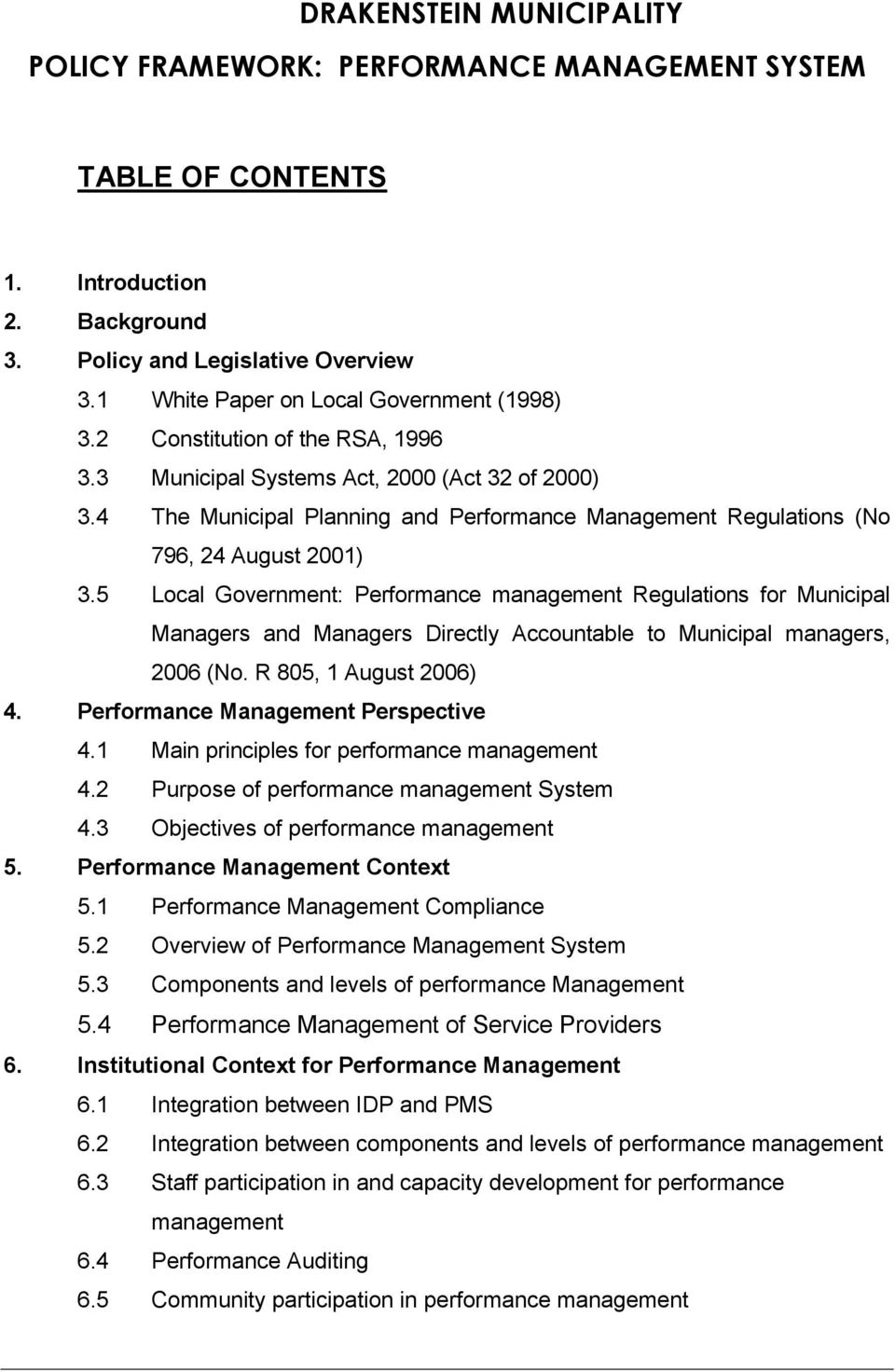
3 7. Roles and responsibilities in Performance Management 7.1 Roles in performance management 7.2 Delegation to manage the Performance Management System 7.3 Responsibilities in performance Management 7.4 Performance management Project Team 8. Performance Management Process Development 8.1 Planning for Performance Management 8.2 Performance facilitation 9. Performance Auditing Legal Requirements Internal Audits Internal Auditors Performance Audit Committee 10. Employee Performance Management 10.1 Employees covered by the Municipal PMS 10.2 Framework for employee performance management 10.3 Roles and responsibilities in Employee Performance Management 10.4 Employee Performance Management Process Overview 10.5 Guidelines for fixed term contractual staff performance agreements 10.6 Employee Development 11. Building Capacity and Infrastructure Capacity for Performance Management Training and Support for Roleplayers Additional capacity Resourcing 12. Performance of the Councillors 13. Compensating Excellence Mayoral Award 14. Conclusion References
4 1 Introduction Integrated Development Planning and Performance Management were introduced to realise the developmental role of local government. Whilst the IDP provides a framework for strategic decision-making, performance management must ensure that the desired results are achieved during implementation to ensure the correctness of the strategic direction of the objectives, strategies and projects put forward by the IDP. Performance management is a strategic approach to management, which equips leaders, managers, workers and stakeholders at different levels with a set of tools and techniques to regularly plan, continuously monitor, periodically measure and review performance of the organisation in terms of indicators and targets for efficiency, effectiveness and impact. A Performance Management System (PMS) entails a framework that describes and represents how the municipality s cycle and processes of performance planning, monitoring, measurement review, reporting and improvement will be conducted, organised and managed, including determining the different role players. This policy document guides the development of a PMS for the Drakenstein Municipality (DM). It also forms the basis of aligning the Integrated Development Plan (IDP) with the operational business plans, performance areas and performance indicators of the various departments of the DM. One of the hallmarks of leading-edge local governments has been the successful application of performance measurement to gain insight into, and make judgements about, the municipalities and the effectiveness and efficiency of its programmes, processes, and people. However, leading municipalities do not stop at the gathering and analysis of performance data. These municipalities use performance measurement to
5 drive improvements and successfully translate vision and strategies into action. In other words, they use performance measurement processes for managing their municipalities. People determine the performance capacity of municipalities and are therefore crucial for the Drakenstein Municipality to align the strategy of its business with its intangible assets, namely knowledge, creativity, innovation, employees skills and organisational culture. The importance of performance management on creating jobs, housing, community safety, social infrastructure and the delivery of basic services is underrated because many performance management systems are complex and burdensome. The amount of paperwork is also to be blamed for the pitfalls of performance systems in South Africa. It is the intention of this delivery-focused policy framework to create a platform and infrastructure to manage the DM as a leading-edge municipality in South Africa. The purpose of this policy is to make provision for the development of a Performance Management System for Drakenstein Municipality and to establish a culture of performance management in terms of the requirements and provisions of Chapter 4 of the Municipal Systems Act, 2000 (Act 32 of 2000). 2. Background The Municipal Systems Act of 2000, requires local governments to develop a PMS. It concludes that Integrated Development Planning, Budgeting and Performance Management are powerful aspects that can assist municipalities to develop an integrated perspective on development in their area. It is against this background that this policy document for developing and implementing a PMS for the Drakenstein Municipality (DM) should be approached.

6 The broad functions of a policy document of this nature are to: standardise terminology provide a broad framework which will enable adjustments and refinements over time give direction for processes to effectively implement policy phase in policy implementation comply with regulations under the Municipal Systems and Financial Management Acts The scope of this policy document covers all categories of DM staff. The purpose of this policy document is to (within the legal framework of the Municipal Systems Act) develop a performance management framework for the DM. This framework caters for the initiation, development, implementation, reporting and rewarding of performance management within the Municipality. The policy framework offers the DM a platform to implement, assess, monitor, measure, review, manage and reward performance throughout the municipality. It is important to note that a PMS is dynamic and will change and develop over time to reflect the unique features of the DM environment. This policy framework aligns itself with improved performance in the DM with the express aim of achieving its stated objectives and levels of performance. A system implies the integration of all processes, which collectively cause such a system to function. A system is therefore made up of separate, but inter-related parts or components that are linked together and which, collectively operate as a system. Performance management is largely dependent on other processes like the IDP, budgeting and human resources management and development. A Performance Management System (PMS) therefore also integrates distinctive processes or components around performance in order for such a system to be developed, managed and operated.
7 3. Policy & Legislative Overview The following Policy and Legislative provisions governs performance management in the local government sphere: 3.1 White Paper on Local Government (1998) The White Paper on Local Government (1998), introduced the practice of performance management for local government as a tool to facilitate their developmental role. Such practice further serves to increase the accountability of the municipality and the trust of the community in such municipality. 3.2 Constitution of the RSA, 1996 The Constitution of the RSA, 1996, Section 152, which deals with the objects of local government, paves the way for performance management with the requirements for an accountable government. Many of the democratic values and principles in terms of Section 195(1) of the Constitution can also be linked with the concept of performance management, with reference to the principles of, inter alia, the promotion of the efficient, economic and effective use of resources, accountable public administration, displaying transparency by making available information, being responsive to the needs of the community, and by facilitating a culture of public service and accountability amongst staff. 3.3 Municipal Systems Act, 2000 (Act 32 of 2000) The Municipal Systems Act, 2000 (Act 32 of 2000) also picks up on these concepts and principles of accountability in Sections 4, 6, and 8. Section 11(3) specifically states that a municipality exercises its executive or legislative authority by, inter alia, the setting of targets for delivery; monitoring and regulating municipal services provided by service providers; monitoring the impact and effectiveness of any services, policies, programmes or plans; and establishing and implementing performance management systems.

8 Chapter 6 of the Systems Act deals specifically with performance management in local government. In terms of Section 38, a municipality must establish a Performance Management System (PMS); promote a culture of performance management among political structures, office bearers & councillors and its administration, and administer its affairs in an economical, effective, efficient and accountable manner. Section 39 stipulates that the Executive Committee (Exco) is responsible for the development of a PMS, for which purpose they may assign responsibilities to the Municipal Manager. The Exco is also responsible for submitting the PMS to Council for approval. Section 40 stipulates that a Municipality must establish mechanisms with which to monitor and review the PMS. In terms of Section 41, the core components of a PMS are to (i) set Key Performance Indicators (KPIs), (ii) set measurable performance targets (PTs), (iii) monitor performance & measure and review annually, (iv) take steps to improve performance, and (v) establish a process of regular reporting. Section 42 requires that the community, in terms of the provisions of Chapter 4 of the Act, which deals with Public Participation, should be involved in the development, implementation and review of the PMS, and also that the community be involved with the setting of KPIs & PTs for the municipality. In terms of section 43 the general key performance indicators to be applied by all municipalities may be prescribed by regulation. Section 44 stipulates that the KPIs and PTs in the PMS of the municipality must be made known both internally and externally in a manner described by the Council. In terms of section 45, the results of the performance measurement must be audited as part of the internal auditing processes and annually by the Auditor General. Section 46 also requires that the municipality prepare an annual report consisting of a (i) performance report, (ii) financial statements; (iii) audit report on financial statements; and (iv) any other reports in terms of legislative requirements. This report must be tabled within one month of receiving the audit report. In terms of section 46(3) the Municipal Manager must give
9 proper notice of meetings at which the annual report will be tabled and submit information on same to the Auditor General & the MEC for Local Government. Section 46(4) stipulates that a Municipality must adopt the annual report and make copies available within 14 days, to the Auditor General, the MEC for Local Government and any others as may be prescribed by regulation. 3.4 The Municipal Planning and Performance Management Regulations (No 796, 24 August 2001) The regulations deal with provisions for the following aspects of the PMS: (a) The framework that describes and represents the municipality s cycle and processes for the PMS and other criteria and stipulations [S7], and the adoption of the PMS [S8]; (b) The setting and review of Key Performance Indicators (KPIs) [S9 & 11]; (c) The General KPIs which municipalities have to report on [S10], and which include: (i) (ii) (iii) (iv) (v) (vi) (vii) Households with access to basic services Low income households with access to free basic services Capital budget spent in terms of the IDP Job creation in terms of the LED programme Employment equity with target groups in the three highest levels of management The implementation of work skills plan The financial viability of the municipality. (d) (d) (e) The setting of performance targets, and the monitoring, measurement and review of performance [S 12, 13]; Internal Auditing of performance measurements [S14]; Community participation in respect of performance management [S15]
10 3.5 Local Government: Municipal Performance Regulations for Municipal Managers and Managers directly accountable to Municipal Managers, 2006 (No R. 805, 1 August 2006) These regulations seek to set out how the performance of Municipal Managers and Managers directly accountable to Municipal Managers will be uniformly directed, monitored and improved. The regulations includes the following: (a) (b) (c) Chapter 2 deals with the requirements and provisions of the employment contracts; Chapter 3 deals with the performance agreements, which must include prescribed Key Performance Areas and Core Competency Requirements. Chapter 4 deals with the content of a Job Description for Municipal Managers. 4. Performance Management Perspective In accordance with the Policy and Legislative rationale, the following provisions will serve to guide the development and implementation of the performance management system: 4.1 Main principles for performance management The following principles will serve to inform and guide the performance management system: (a) The PMS must be feasible in terms of the resources available and appropriate to the circumstances of the municipality. The cost of the PMS must therefore not exceed the benefits that are derived from it. For this reason the PMS must not be complex in nature and should thus ensure that the municipality can operate and maintain such system without huge
11 costs or effort. The PMS must, however, have the necessary integrity to serve the purpose it is intended for; and (b) A PMS must serve as an enabling mechanism and emphasis must be placed on the importance of supporting employees in achieving their performance objectives and targets. Performance monitoring and assessment must thus be viewed and treated as a means to facilitate performance through appropriate, but reasonable support in the case of underperformance, and not serve as a means for unjust disciplinary action. The implementation of performance management, which involves monitoring and evaluation, will be approached as performance facilitation in order to place the emphasis on the enabling of performance. The monitoring and assessment of individual performance must at all times be impartial, fair and objective. 4.2 Purpose of Performance Management System (a) (b) (c) (d) (e) (f) (g) (h) Translate its vision, mission and IDP into clear measurable outcomes, indicators and performance levels that define success, and that are shared throughout the municipality and with DM s customers and stakeholders. Provide a tool for assessing, managing, and improving the overall health and success of business processes and systems. Create a culture of best practices. Continue to shift from prescriptive and simply audit oversight to ongoing, forward-looking and compliance-based strategic partnerships involving inter alia agencies, communities, citizens and other stakeholders. Promote accountability. Include measures of quality, cost, speed, customer service, and employee alignment, motivation, and skills to provide an in-depth, predictive PMS. Create pressures for change at various levels. Replace existing assessment models with a consistent approach to performance measurement and management.

12 (i) (j) Achieve sustainable improvements in Service Delivery to the community Link IDP to team (departmental) and individual performance 4.3 Objectives of performance management (a) (b) (c) (d) (e) (f) (g) In general, to establish a productive and performance-orientated culture in the municipality and to ensure that services are rendered efficiently, effectively and with the desired impact; At strategic level, to ensure that the strategies of the municipality are appropriate and successful for the achievement of the strategic objectives through the implementation of the IDP. In short, it must ensure that the correct things are being done; At operational level, to facilitate a collective effort towards the achievement of strategic objectives of the municipality through the successful implementation of actions and the execution of functions and duties, the optimal use of resources, and the creation of means and opportunities to address and improve performance. In short, it must ensure that the things are being done correctly; At individual employee level, to have clarity regarding job expectations and to provide regular feedback on performance and to participate in efforts to address and improve performance; At Councillor level, to facilitate positive leadership and ensure accountability for the decisions that direct municipal service delivery; and For the community, to understand the type, level, standard and timing of services that they may expect from the municipality and to receive feedback on such progress and success. For service providers who render contracted services to the municipality, to stipulate, agree on and monitor the deliverables and such specifications.

13 5. Performance Management Context 5.1 Performance Management Compliance To ensure full compliance the municipality will: (a) (b) (c) (d) (e) (f) (g) (h) Make change happen by mobilising the municipality. Clarify and manage roles, responsibilities and expectations between the public and the municipality, between politicians and officials and among officials. Communicate these roles, responsibilities and expectations within the municipality and to the public. Deepen democracy by encouraging public participation through the communication of performance information and the creation of appropriate mechanisms. Create a mechanism for efficient decision-making on the allocation of resources. Introduce a diagnostic tool that indicates that the municipality is doing things right and also doing the right things. Redefine if necessary the incentive structure by rewarding successes and alternatively identifying opportunities for growth, learning and development. Ensure that the process of developing the system will be inclusive, participatory, transparent, simple and realistic, fair/objective, developmental and non-punitive.

14 5. 2 Overview of Performance Management System The Municipal System Act requires municipalities to develop a PMS suitable for their own circumstances and must therefore continuously ensure that the PMS is relevant and realistic and performance driven. The PMS will cover the following two aspects: (a) PMS Policy Framework. It describes and represents how the municipality s cycle and processes of performance planning, monitoring, measurement, review, reporting and improvement will be conducted, organized and managed, including determining the roles of the different players. (b) Performance management model. It represents all the administrative products of the implementation of the PMS Policy framework, and includes formats with choices about what aspects or dimensions of performance will be measured. Different models give different pictures of performance by emphasizing different measurable dimensions. The model that a municipality develops will influence which indicators it decides to use, and how it will group these indicators together into areas of performance. Practical guideline document(s) should be developed to encapsulate the performance model for the municipality. In developing a PMS, it must be ensured that the system: (i) (ii) (iii) (iv) Complies with all the requirements set out in the Municipal Systems and Financial Management Acts, and associated regulations. Demonstrates how to operate and managed the system from the planning stage up to the stages of performance review and reporting Clarifies the roles and responsibilities of each role player, including the local community, in the functioning of the system Clarifies the processes of implementing the system within the framework of the IDP process
15 Sustainability Report Service Delivery and Budget Implementation Plan Annual Report (v) (vi) (vii) Determines the frequency of reporting and the lines of accountability for performance Relates to the municipality s employee performance management processes Provides for the procedure by which the system is linked to the municipality s Integrated Development Planning processes 5.3 Components and Levels of Performance Management Performance management will be conducted in two distinct components, and each such component on two different levels to deal with different aspects of performance information Organisational Performance Management Organisational performance management deals with the performance of the organisation, and consist of two separate, but inter-related levels which each deals with a specific aspect of performance. Table 3.1: Organisational Performance Management Components Strategic Level - Planning Operational level - Implementation IDP Development Status: Strategic KPI's (Outcomes Targets) Corporate SDBIP: High level strategic deliverables Ops. Business Plans Service Level Compliance: Operational KPI's (Output Targets) Business/ Functional SDBIP: Detailed operational deliverables

16 (a) Strategic level performance Strategic level performance deals with measuring the success of the municipality in achieving its developmental agenda by means of implementing the IDP and its associated Operational Business Plans. Such performance overview will also provide the overall status on the sustainability of the municipality. (i) In terms of the IDP, performance measurement should chiefly inform the organisation if it is doing the right things to produce the desired outcomes/ impact to achieve its vision. This is achieved by measuring the developmental state through such outcome targets. (ii) In terms of the associated Operational Business Plans, performance measurement should chiefly inform the organisation if it is doing the required things right by producing the necessary outputs or deliverables to achieve the desired outcome or impact at strategic level. This is achieved by measuring the compliance with service level standards. (b) Operational level performance Operational level performance deals with business operations for the purpose of measuring whether the operational service delivery targets have been successfully achieved through the implementation of Operational Business Plans. Such performance are monitored and measured in terms of Service Delivery and Budget Implementation Plans (SDBIP). (i) In terms of the IDP, the high level organisational SDBIP informs the organisation if it s operational performance in terns of strategic high-level service delivery targets. (ii) In terms of the associated Operational Business Plans, the respective associated SDBIP s informs the organisation if it s operational performance in terms of specific operational service delivery targets.
17 5.3.2 Individual Employee Performance Management Employee performance management deals with the performance of individual staff members, and informs the municipality if its staff measures up to their respective job expectations and delivering on their job targets that contribute towards the operational targets and ultimate development agenda of the IDP. Employees will be dealt with in two separate classes which needs to be managed differently. (a) Municipal Manager and Managers directly accountable to the Municipal Manager In accordance with the provisions of the Municipal Systems Act, 2000 (Act 32 of 2000), individual performance agreements that are linked to remuneration benefits will be entered into with the Municipal Manager and all other management staff who are directly accountable to this position. (b) All permanent appointed staff Individual performance agreements will be developed for all permanent appointed staff in accordance with their job descriptions and job expectations in terms of relevant Operational Business Plans. For staff in management and/or supervisory positions, the relevant SDBIP will serve as a major source for developing such performance agreements. 5.4 Performance Management of Service Providers In accordance with the applicable legislative requirements, any service provider to the municipality should also be subjected to the measurement of performance. The Supply Chain Management Function will be responsible to develop, implement, and coordinate the performance management of service providers in terms of the SCM processes, whilst the applicable service

18 department who procure and make use of such service providers, will be operationally responsible to apply and manage such performance of the subject service provider. 6. Institutional Context for Performance Management 6.1 Integration between IDP and PMS The IDP process and the performance management process are seamlessly integrated. The IDP fulfils the planning stage of Performance Management and Performance Management fulfils the implementation management, monitoring and evaluation of the IDP process. The IDP and PMS processes therefore needs to be viewed and managed as an integral part of each other. Although the development of the PMS is a separate process, it has very strong parallels with the preparation and development phases of the IDP. It is also crucial that the continuous development of the PMS identifies overlaps and is used to calibrate the synergies between the IDP and performance measurement and performance management of the DM. To ensure an effective basis for performance management, the IDP process also needs to identify the associated steps for the PMS at each stage to provide for the requirements of the PMS. 6.2 Integration between components and levels of performance management The performance management process must take regard to the inter-relationships between the different components and levels of performance management and must be fully integrated and aligned during implementation. Such integration will compliment the strategic planning and management process to ensure that a collective contribution towards achieving the overall development agenda is reached.
19 6.3 Staff participation in and capacity development for performance management It is necessary to involve all staff at all levels in the performance management process, be it for either the organisational or individual employee components. Each manager/ supervisor must make a consertive effort to introduce, involve and train all staff members on the theory and practice of performance management. Participation by staff in organisational performance will ensure buy in and a better understanding of staff s particular individual position and role in the bigger development agenda pf the IDP. In the light of performance facilitation, it is therefore also important to build the necessary capacity amongst staff members in terms of performance management. Such capacity building may include, amongst others, the necessary training, support, and mentoring on performance management. 6.4 Performance Auditing Performance auditing, as a legislative requirement, must be part of the internal auditing processes and should be carried out on a regular basis during monitoring, evaluation and assessment of performance. The necessary mechanisms, systems and processes must be developed in terms of the provisions of the applicable regulations for performance auditing. A performance audit committee must also be appointed and fulfils its duties in accordance with the provisions of the applicable regulations. 6.5 Community Participation in performance management The community needs to be involved in the development of KPIs, as well as the monitoring, evaluation and assessment of performance as provided for in terms of the provisions of the applicable regulations. The community also needs to be informed about KPIs and performance. The different roles at each stage of the PMS process must be determined during the performance management cycle. The structures and processes for this public participation will be managed in accordance with the provisions of the council s policy on participative governance and communications.
20 7. Roles and Responsibilities in Performance Management In terms of applicable legislative prescriptions and good practise, the following roles and responsibilities in the PMS process will apply: 7.1 Roles in Performance Management The most important role players with regard to developing and managing the PMS, are the Executive Committee or Executive Mayor and his or her committee, whichever the case may be, the Municipal Manager, Heads of Departments, the IDP Manager, and the Internal Auditor. The Municipal Systems Act (2000) places the responsibility on the Council to adopt a PMS, while holding the Executive Committee or Executive Mayor and his or her Committee; whichever the case may be, responsible for the development and management of the system. The Executive Mayor of DM delegates the responsibility for the development and management of the performance management system to the municipal manager, who will be assisted by a PMS Project Team. 7.2 Delegation to manage the Performance Management System The Municipal Manager will, in terms of Section 38 of the Municipal Systems Act, 2000 (Act 32 of 2000), be responsible to develop, uphold, and manage the PMS, as directed by the Executive Committee or Executive Mayor and his or her Committee, whichever the case may be. 7.3 Responsibilities in Performance Management In developing and managing the PMS, the Municipal Manager will be assisted as follows:
21 (a) The official responsible for the strategic management functions of the IDP/ PMS will assist to uphold and implement the PMS process in general, and specifically facilitate and coordinate organisational performance management; (b) The official responsible for the human resource management function will facilitate individual employee performance management; (c) The Senior management team will be principally be responsible for the implementation of the PMS, and in accordance with their managerial function and organisational functions and duties, collectively drive all components and levels of performance management in practice. (d) The official responsible for the internal auditing function will be responsible for the performance auditing functions measurements in terms of Section 45 of the Municipal Systems Act, 2000 (Act 32 of 2000);. (e) The official responsible for the financial services function will be responsible for the financial related information of the PMS. 7.4 Performance Management Project Team To assist the Municipal Manager in the task of developing and implementing the PMS, he or she may appoint a PMS Project Team in accordance with such mandate and applicable terms of reference to fulfil such anticipated task. The PMS Project Team will operate under the guidance of the Municipal Manager who will always serve in the capacity as Project Leader of the PMS Project Team. The PM Team should be responsible for the following core activities: (a) (b) (c) (d) (e) Responsible for the development and implementation of the PMS. Ensuring the implementation and compliance of all legal aspects in respect of the PMS policy. Facilitating further development and refinement of the PMS. Continuously supporting implementation, assessment, review, monitoring and computerising of the process. Responsible for compiling the annual status report to the Council.
22 The Municipal Manager and the PM Team will have the authority to appoint and co-op: (i) (ii) Specialists to assist with its core responsibilities. Co-opted specialists should have practical experience of the South African local government environment. Departmental co-ordinators to assist with the development and implementation of the organisational PMS. The PM team will report to the Municipal Manager, who will in turn account to the Executive Mayor and finally Council. 8. Performance Management Process To facilitate the development, implementation and ongoing annual management of the PMS an appropriate implementation strategy, preferably based on the IDP process and as part of an overall strategic management system, must be developed and reported on. The responsible officials will keep the municipality informed about the transformation, development, implementation and review of the PMS in order to: Communicate these roles, responsibilities and expectations within the municipality and to the public; Encourage public participation through the communication of performance information and the creation of appropriate mechanisms; Ensure that the process of developing the system will be inclusive, participatory, transparent, simple and realistic, fair and objective, developmental and nonpunitive. As already stated, this PMS must serve as an enabling mechanism and
23 emphasis must be placed on the importance of supporting employees in achieving their performance objectives and targets; On the introduction of the PMS, officials will be made aware of and understand the need for performance management. This will include the principles that will govern its development and use in the municipality. The municipal leadership must ensure that performance management establishes the accountability of the municipality to the citizens and communities, of the administration to the Council, of line functions to executive management and of employees to the municipality. The performance management process follows a cycle of actions that involve planning, implementation, monitoring, evaluation, assessment (measurement), review, reporting, improvement and auditing. These actions can be divided into three distinct phases, namely: the performance planning phase, followed by the performance facilitation phase, and finally, the assessment and review phase. 8.1 Planning for Performance Management The purpose of the performance planning phase is to develop the necessary performance products that will make the measurement of performance possible. It involves decisions on what should be measured, how, when and by whom it would be measured. The IDP and its associated Operational Business Plans to facilitate its operationalisation, delivers products such as a set of delivery priorities that are translated into strategic and operational objectives, key performance areas and a set of identified activities and projects that contribute to the achievement of the aforementioned and a financial plan. These priorities and associated development agendas are essentially the issues that the municipality pronounces to focus on to address the needs of the community. The statement of objectives requires a tangible, measurable and unambiguous commitment, which is achieved by developing a range of performance indicators to identify what will be measured, and the performance targets to actually measure the performance. The performance model will determine the architecture of the performance planning formats.
24 8.1.1 Key Performance Indicators (KPIs): A Key Performance Indicator (KPI) qualifies the main aspect that needs to be achieved and thus measure the progress being made in achieving the objectives. It should therefore specify the object or deliverables to be achieved and the means by which it will be measured. Depending on the nature of such KPI, it may also include specifications regarding the quantity and standards of the object, and usually includes the timing or projected phasing of delivery. Key Performance Indicators may be both strategic and operational in nature. The KPI s must be relevant to the competencies of Local Government. The number of indicators should serve the purpose of providing an adequate view of performance. For this reason there should not be not too few to skew the picture nor be too many to make it costly and unmanageable. A balanced set of indicators that cover most areas should preferably be used. Indicators should also be set for all entities and service providers when service delivery agreements are entered into. Such indicators are to be informed by the relevant KPIs. The municipality will use indicators as a communication tool between all levels of staff, and between the administration and council. It will also serve to identify the gaps between IDP strategies and the operational plans of the various departments. All indicators should be measurable, simple, precise, relevant, adequate and objective. (a) Types of Indicators The following types of indicators will be used: (i) Baseline indicators These are indicators that measure conditions before a project or programme is implemented. (ii) Input Indicators
25 These are indicators that measure what it costs the municipality to purchase the essentials for producing desired outputs (economy), and whether the municipality achieves more with less, in resources terms (efficiency) without compromising quality. The economy indicators may be the amount of time, money or number of people it took the municipality to deliver a service. (iii) Output Indicators (measures of success) (iv) These are the indicators that measure whether a set of activities or processes yields the desired products or deliverables. They thus measure effectiveness i.e., doing things correctly, and are typical associated with operational KPI s. They are usually expressed in quantitative terms. Outcome Indicators These are the indicators that measure the impact or net effect of the products or services of the products/programmes in terms of the achievement of the overall objectives. These indicators are strategically the most important to determine. It is thus about the relationship between outputs and outcomes and measures if the outputs succeed in achieving the desired outcomes or improvements, i.e. doing the right things. The municipality does not always have full and complete control over those aspects that are measured by outcome indicators. It thus measures the influence it has on conditions or developments in the area. As it is the strategic objectives of the IDP that should determine the desired outcomes of activities, it is important to determine if the outputs over which we have control, are the correct ways with which to address such issues.
26 (b) Identification of Indicators The following aspects will be considered when identifying indicators: Priorities and objectives and key performance areas set in the IDP. The activities and processes identified in the IDP for achieving the developmental objectives as well as the earmarked resources. Whether data is available for its measurement in the municipal area. (c) Setting of KPIs Key performance indicators must be set in respect of each of the development priorities and objects referred to in section 26(c) of the Act. It must also be ensured that key performance indicators inform the indicators set for all its administrative units and employees as well as every municipal entity and service provider with whom the municipality has entered into a service delivery agreement. The following SMART criteria will apply for the objectives, KPAs and KPI s: S - specific M - measurable A - achievable R - realistic T - time-framed (d) National KPIs General key performance indicators are prescribed in terms of Section 43 of the Municipal System Act (2000). The municipality takes cognisance of these indicators and will report on them as is required by the Act.
27 (e) Review of KPIs The municipality will review its key performance indicators annually as part of the performance review process or whenever it amends its IDP in terms of Section 34 of the Municipal System Act (2000) Performance Targets Performance targets are the planned level of performance or the milestones the municipality sets for itself for each indicator identified. A baseline measurements and service standards must be identified, which will serve as the measurement of the chosen indicator(s) at the start of the period. In setting targets, it is important to know how the municipality is performing at the current moment. This step also tests whether the chosen indicator is in fact measurable and whether there are any problems. The targets need to be realistic, measurable and be commensurate with available resources and capacity. The public need to be consulted on their needs and expectations in setting a target. Politicians need to give clear direction as to the importance of the target and how it will address the public need. Targets should be informed by the development needs of communities and the development priorities of the municipality. The municipality must for each financial year set performance targets for each of the key performance indicators set by it. A performance target must be practical and realistic. It must measure the efficiency, effectiveness, quality and impact of the performance of the municipality. It must also identify administrative components, structures, bodies or persons for whom a target has been set. It is important that the set target is commensurate with available resources and the DM s capacity. Finally targets need to be consistent with the municipality s development priorities and objectives set out in its IDP.
28 In order to measure progress in terms of a target during monitoring and evaluation (as discussed below), intermediate milestones, if applicable, should be specified with the same criteria as for performance targets. 8.2 Performance Facilitation The purpose of the performance facilitation phase is to monitor, evaluate, review and report on performance. Performance monitoring is an ongoing process that runs parallel to the implementation of the agreed IDP, and is informed by the targets and milestones determined during the planning phase. It should thus serve as an early warning mechanism to determine if the plans are delivering the outputs according to specifications, and if such outputs have the desired outcomes or impact. During the annual cycle of performance measurement, the progress on performance in terms of reaching strategic objectives and the implementation of operational action plans, should be monitored on a regular basis. Formal monitoring should be done on regular but reasonable intervals, and can be complimented by a system of informal monitoring. Any problems experienced with regard to implementation, as determined through monitoring, should be addressed by identifying the reasons for such underperformance. The mechanisms and support required to facilitate enhanced performance must also be identified and put in place. During monitoring the reasons and/ or causes for underperformance must therefore be considered, as well as any measures that were already being implemented during implementation to address such underperformance. This information must be used to determine the appropriate corrective actions with which to improve performance Performance Assessment and Reviews Performance monitoring is done in accordance with performance assessments and reviews. Performance assessment represents an analysis, which requires the interpretation of the measurements to determine the status of targets, to determine the reasons for deviations and consider and recommended corrective action.
29 Performance review is a process where the municipality, after measuring its own performance, assesses whether it is doing the right thing. The first method to conduct performance reviews is to look at whether the current level of performance is better than that of the previous year, using baseline indicators. The second method is to look at the municipality s performance by comparison with other similar ones, by way of a benchmarking exercise. The third method is to look at what the people think about the performance of the municipality across the range of services, by way of customer surveys or other community feedback mechanisms. This review approach is consistent with the best value review framework of challenge, compare, consult and compete. The framework calls for the municipality to challenge the current level of performance, compare it to others, consult with the customers or communities and find ways of competing with others to provide best value in service delivery. The final end-year assessments serves as the basis for the IDP review, which includes the necessary amendment of indicators and the setting of new targets and milestones. The final performance assessment must also be audited as part of the internal auditing process. (a) Who Conducts Performance Assessments and Reviews? It is crucial that line managers are continuously analysing the measurements that they are generating. They are best placed, having an in-depth understanding of their sector, to analyse whether targets are met currently, and will be met in the future, what the contributing factors are to the level of performance and what remedial action needs to be taken. This will constitute a preliminary analysis and should be done by respective line managers for objectives and indicators that lie within their area of accountability.
30 It is useful to have a corporate analysis of performance. This analysis should examine performance across the municipality in terms of all its priorities. To be successful, capacity for this level of analysis should be available. In order to fulfil the objective of ensuring accountability, performance reviews are conducted in terms of the ongoing monitoring, evaluation and reporting phase Monitoring and Evaluation Framework The monitoring framework must: Identify the roles of the different role players in monitoring and measuring the municipality s performance. Allocate specific tasks to the gathering of data and submission of reports. Determine the data that must be collected in order to assess performance, how that data is to be collected, stored, verified and analysed and how reports on that data are to be compiled. Provide for reporting to the different role-players and stakeholders. Be designed in a manner that enables the municipality to detect early indications of under-performance. Provide for corrective measures where under-performance has been identified. Compare current performance with previous performance by using previous targets/ milestones and/ or baseline indicators. The municipality must accordingly develop and implement mechanisms, systems and processes for the monitoring, measurement and review of performance in respect of the performance indicators and performance targets set by it.
31 The guidelines for the monitoring system are as follows: Supervisors Monitor and Review performance of individuals or groups of employees reporting directly to them, depending on the type of employee PMS that is adopted Technical and Operational Managers Monitor and Review operational SDBIP performance monthly and Strategic Service Delivery Compliance annually. Executive Management (Municipal Manager and his / her Management Team Monitor and Review strategic SDBIP performance quarterly and Strategic Sustainability annually: Review performance in order to intervene promptly on operational matters where poor performance or the risks thereof occur. Review performance before reporting to politicians so that they can prepare, control the quality of performance reports submitted and ensure that adequate response strategies are proposed in cases of poor performance. Review performance prior to being conducted by standing, portfolio or committees. Standing/ Portfolio Monitor and Review performance of functions respective to their Committees portfolios, i.e. Operational SDBIP s quarterly and Strategic Service Levels Annually. Mayoral Committee Monitor and Review performance of the administration, and should remain strategic. Strategic SDBIP quarterly and Strategic Sustainability annually. The Municipal Manager should remain accountable for reporting on performance at this level. Council Monitor and Review performance of the Municipal Council, its committees and the administration on an annual basis, in the form of a tabled annual report at the end of the financial year. Public Monitor and Review performance of the Municipality and public representatives (Councillors) in the period between elections. It is required by legislation that the public be involved in reviewing municipal performance at least annually. Table : Lines of Accountability in respect of Performance Monitoring
32 8.2.3 Improving Performance While good and excellent performance must also be constantly improved to meet the needs of citizens and improve their quality of life, it is poor performance in particular that needs to be improved as a priority. In order to do this, it is important that the causal and contributing reasons for poor performance are analysed. Poor performance may arise out of one or more of the following: Poor systems and processes. Inappropriate structures. Lack of skills and capacity. Inappropriate organisational culture. Absence of appropriate strategy. Lack of commitment form individuals To improve performance, the appropriate response strategy should be chosen: Restructuring is a possible solution for an inappropriate structure. Process and system improvement will remedy poor systems and processes. Training and sourcing additional capacity can be useful where skills and capacity are lacking. Change management and education programmes can address organisational culture issues. The revision of strategy by key decision-makers can address shortcomings in this regard. Consideration of alternative service delivery strategies should be explored.
33 Performance analysis is a requirement in order to identify poor performance. The Municipal Manager must implement the appropriate response strategy to improve performance Reporting on Performance Reporting on performance measurement is an integral part of performance management and requires that the municipality document the relevant and useful performance information in a simple and accessible format, and present this information to the specific target group. Performance management in local government is a tool to ensure accountability, and it is necessary that the reporting process follow the lines of accountability in terms of the monitoring framework as provided for during the performance cycle. The report format should be based on the formats provided for such purpose. (a) Tracking and Managing the Reporting Process To ensure that the reporting process runs smoothly and effectively, it will be necessary to centrally coordinate, timetable, track and monitor reporting processes and analyse performance reports at an organisational level. (b) Publication of Performance Reports Two types of performance reports will be compiled, a technical and popular performance report. The annual report is required by legislation to be made available to the public. It is advisable that, within the resources and capacity as well as the restraints of the DM, the public be more frequently informed of performance information through accessible media means.
34 (c) Public Feedback Mechanisms Public feedback on reported performance can be obtained if the municipality institute dedicated mechanisms for submitting such feedback and the public is made aware of such mechanisms. Such mechanisms should be considered in terms of the municipality s communication strategy and policy on participative governance. (d) Public Hearings Public hearings can be held to report to communities on municipal performance and engage communities in a review of past performance and the identification of future priorities. These public hearings can be held as often as the municipality can afford, within resources and capacity restraints. (e) Performance Report to PAWC. An annual performance report in accordance with the requirements in terms of the applicable legislation must be compiled and submitted to the MEC for Local Government. 9. Performance Auditing In order for the PMS to enjoy credibility and legitimacy from the public and other stakeholders, performance reports will be audited. Audits should ensure that reported performance information is accurate, valid and reliable.
35 9.1 Legal Requirements The requirement according to the Municipal Systems Act (2000) is that the annual performance report must be audited internally, before being tabled and made public. The Auditor General will also audit its annual performance report/questionnaire after being reviewed by the Council. The annual report must then be audited by the Auditor General and thereafter be submitted to the MEC for local government in the province. The MEC is required to complete a consolidated annual report of the performance of all municipalities in the province, identifying poor performing municipalities and proposing remedial action. The MEC must then submit it to the national minister. The national minister will present a consolidated report of all nine provinces to parliament. 9.2 Internal Audits Over and above the legal requirements, at least bi-annual performance reports tabled to the Mayoral Committee must undergo some form of internal audit. A variety of social, economic and service delivery indicators should be audited. Where the internal audit capacity needs to be complemented with new skills, it is advisable to contract with specialists in particular sectors. Often, over and above verification of information, audits require more in-depth expert analysis of why poor performance is occurring. It is important to involve stakeholders such as citizens, community organisations, Non Governmental Organisations (NGOs), employees and trade unions in the audit process. This will increase the credibility and legitimacy of the performance reports and the audit process. The municipality will develop and implement mechanisms, systems and processes for auditing the results of performance measurements as part of its internal auditing processes. Any auditing will include assessments of the following:
36 (a) The functionality of the municipalty s PMS. (b) Whether the PMS complies with the Municipal Systems Act (2000). (c) The extent to which the performance measurements are reliable in measuring performance of the set indicators. 9.3 Internal Auditors The DM s internal auditors must: (a) (b) On a continuous basis audit the performance measurements of the DM. Submit quarterly reports on their audits to the Municipal Manager and Performance Audit Committee (PAC). 9.4 Performance Audit Committee The municipality must on an annual basis appoint and budget for a PAC consisting of at three to five members, the majority of which may not be involved in the municipality as a councillor or an employee. The PAC must include at least one person who is knowledgeable in performance management. The municipality may utilise any audit committee established in terms of other applicable legislation as the envisaged PAC, in which case the provisions of this sub-regulation, read with the necessary changes, apply to such an audit committee. The council of the municipality must designate a member of the PAC who is not a councillor or an employee of the municipality as chairperson of the committee. If the chairperson of the PAC is absent from a specific meeting of the committee, the members present must elect a chairperson to act for that meeting. In the event of a vacancy occurring amongst the members of the PAC, the municipality must fill that vacancy until the vacancy is filled. The municipality will provide secretariat services for its PAC. A member of the PAC who is not a councillor or an employee of the municipality may be remunerated taking into account the tariffs determined by the South African Institute of Chartered Accountants in consultation with the Auditor General.
37 The PAC must meet at least twice during the financial year of the municipality. A special meeting of the PAC may be called by any member thereof. The PAC may determine its own procedures after consultation with the Executive Mayor or the Executive Committee of the municipality as the case may be. The PAC must: Review the reports submitted to it. Review the municipality s PMS and make recommendations in this regard to the Municipal Council. At least twice during a financial year submit an audit report to the Municipal Council. In reviewing the municipality s performance and the management thereof, the PAC must focus on the economy, efficiency, and effectiveness and impact in so far as the KPIs and performance targets set by the municipality are concerned. The PAC may: Communicate directly with the Council, Municipal Manager or the internal and external auditors. Access any municipal records containing information that is needed to perform its duties or exercise its powers. Request any relevant person to attend any of its meetings, and, if necessary, to provide information requested by the committee. Investigate any matter it deems necessary for the performance of its duties and the exercise of its powers.
38 10. Employee Performance Management The performance of a municipality is integrally linked to that of staff. If employees do not perform, a municipality will fail. It is therefore important to manage both at the same time. The relationship between organisation performance and employee performance cascades from the IDP to Operational Business Plans to Individual Performance Agreements. A performance agreement is an agreement between an employee (the Municipal Manager or his direct reports) and his/her manager (Executive Mayor, or the Municipal Manager), which regulates the performance required for a particular position and the consequences of the performance. The relationship between Organisational and Employee performance is aligned throughout the PMS cycle, and also cascades through the ranks of staff. The IDP yields a set of indicators and targets. These become an undertaking of the municipality to the community. These should be incorporated into the Municipal Manager s performance agreement, as he/she is responsible for the implementation of the IDP. The Municipal Manager may assign relevant indicators to the managers reporting to him. These indicators would then become the indicators and targets of such managers to be incorporated in their performance agreement. The manager in turn may cascade these indicators and targets to lower levels in line with the scope of responsibilities at that level Employees Covered by the Municipal PMS
39 All staff will participate in the Municipal PMS. The staff will be divided into two categories to manage and reward the performance of municipal employees. (a) Fixed term Contractual Staff These include the Municipal Manager and Managers directly responsible to the Municipal Manager. The Municipal Systems Act 32 of 2000 requires that the Municipal Manager sign a fixed term contract and a performance agreement and suggests that the managers or executive directors reporting to the Municipal Manager do the same. Performance reward is directly linked to financial benefits. The performance of this category of staff will be conducted and managed in accordance with the applicable regulations. Where contracts has been entered into before the effective commencement of this policy, and any provisions of subject contract is not aligned with the provisions of this policy, such provision of the subject contract will continue to apply until such contract has been terminated in terms of the provisions of the subject contract. (b) All other staff not covered by the category of fixed term contractual staff. Performance agreements will be entered with all staff in this category. Such performance agreements, in format, detail and scope, should be appropriate in accordance with the corresponding level of leadership and responsibility. The link to and type of reward needs to be determined by Council, but may be largely non-financial rewards Framework for Employee Performance Management The Municipal Manager must, within the parameters of an employee PMS, set up a detailed operational framework for employee performance of staff. Such framework must inter-alia clarifies the different organisational staff levels and associated distinctions in leadership roles.
40 The framework will be directed by the following parameters: Contract staff Non-contract staff Municipal Executive Manager Directors Type of review Performance Performance Job Description/ Contract/ Agreement Contract/ Agreement Performance Agreement Frequency of Bi-annually Bi-annually Bi-annually assessment Responsibility for Executive Mayor or Municipal Manager or Immediate assessment/ through applicable through applicable Managers Review regulations regulations Reward system Bonus as per Bonus as per contract Non-cash awards contract Internal Auditing Yes Yes Yes Roles and Responsibilities in Employee Performance Management Manager s/supervisor s role in Performance Management (a) The Manager s/supervisor s role in the Performance Management Process includes the following: Setting objectives with employees in such a way that continuous improvement is encouraged Monitoring employees performance against these objectives Using performance management process to coach employees. This involves giving ongoing feedback to employees and assessing their performance.
41 Using reward and recognition to reinforce good performance Managing poor performance appropriately Training, coaching and developing employees (b) To be successful in managing performance the Manager/Supervisor needs to: Communicate the municipality s strategic objectives and the department goals to employees and show them how their work contributes to the success of then Municipality Help employees to set challenging but realistic objectives and work with employees to help them achieve these objectives Identify knowledge, skills and behaviours needed by the employee to achieve the objectives and performance standards that have been set Ensure that employees know what is expected of them and why Create a climate that encourages employees natural motivation. A Manager/Supervisor must be aware of how his/her management style impacts on the way it feels to work in his/her department Conduct a mid-year review with the employee to ensure that the objectives are still relevant and to assess the employee s progress to date against the objectives Complete an individual learning plan together with the employee that caters for the employee s specific developmental needs in relation to the Municipality Employee s role in Performance Management The employee must take an active role in the performance management process. The employee s role includes: Suggesting challenging but realistic objectives that will support the Municipality s strategies and departmental goals
42 Developing and implementing action plans so that they can achieve their objectives Taking responsibility for the standard of their performance by trying to improve and develop themselves Keeping their Manager/Supervisor informed about how well they are doing in relation to their objectives Keeping their Manager/Supervisor informed of any problems or potential problems which may affect their ability to achieve some or all of their objectives and performance standards Making suggestions on how they can improve their performance Asking their Manager/Supervisor for information, help or advice to assist them in meeting their objectives Asking for feedback from others, including their Manager/Supervisor so that they can monitor their own performance 10.4 Employee Performance Management Process Overview Although the performance process are the same for all staff, there are distinct differences between the types or sections of employees covered by performance management in municipalities. The individual performance management process can be divided into four phases The Planning Phase (What is the employee expected to do this year) During this phase the Executive Mayor and the Municipal Manager and then the Municipal Manager and his/her direct reports, plan what work the Municipal Manager and each Manager will be required to do during the financial year. This will chiefly be informed by the IDP targets and associated organisational SDBIP.
43 This requires completing a performance plan which will detail what the Manager s objectives are, what the deadline dates and weightings are, and what the performance indicators or evidence is that will be used to prove that the objectives have been achieved. This planning meeting will help to: Link individual work to the IDP of the Municipality; Identify the knowledge, skills and behaviours needed to achieve the objectives; Help managers to start thinking about action plans in order to achieve the objectives in the performance plan From the management levels this exercise must be cascaded throughout the organisation. Technical and Operational Managers performance plans will be informed by the relevant Operational Business Plans and Associated SDBIP s, and lower ranking staff s performance plans will be informed by the immediate manager s performance plan The Coaching Phase (How well is employee doing during the year) Coaching must happen all the time so that the employee always knows how well he/she is doing. Coaching can be informal or formal and it allows the employee to discuss with his/her manager progress against the performance plan and to decide if anything needs to be changed before the formal performance review in June. The purpose of coaching is as follows: For the manager to make clear what he/she expects of the employee To give positive feedback when the employee does well; to let the employee know when he/she is not doing something well and to help him/her to do it better Managers must conduct formal quarterly reviews. The purpose is to give the employee feedback on his/her performance thus far and check that the objectives are still relevant. The employee will not be scored at this stage
44 The Reviewing Phase (How well has employee done now that it is end of year) This is a formal meeting between the manager and the employee at the end of the financial year to rate the employee using the performance plan that was set at the beginning of the financial year (a) Appeals Procedure Should Employees not agree with the content of their performance agreement after the planning discussion or with the final scores that are allocated to them by their Manager/Supervisor after the review discussions, they may elect to follow the municipal s grievance procedure. (b) Managing Poor Performance Should an employee not be achieving the objectives in hi/her performance agreement the Manager/Supervisor should assist the Employee by managing his/her performance more closely. It is not appropriate that the first time an employee hears about his/her nonperformance is at the formal performance review. Employees must be coached and given feedback throughout the year. Poor performance must be dealt with in accordance with the municipality s Managing poor performance policy The Rewarding Phase (What recognition will employees get for outstanding performance) A separate meeting should be held between the manager and the employee to show the link between the employee s final performance score and reward.
45 (a) Rewards for fixed term contractual managers For fixed term contractual managers this will be determined by the relevant regulations. The reward meeting must be held after all the performance reviews for the Municipal Manager and his/her direct reports have been held and after the appropriate political authority have finalized and agreed to the performance related pay for that particular financial year. (b) Rewards for other staff The performance reward system applied to fixed term contractual managers is different from the performance reward system applied to the rest of the employees. Their performance reward is not directly linked to pay but non-cash rewards. The advantages of non-cash rewards are: The memory value is high. The reward is reinforced by peer admiration. They can be tailored to municipality goals and individual preferences. The municipality can control the duration and impact of these type of awards. The reward can be instant and frequent. There are three types of non-cash rewards within the PMS: (i) Formal Rewards linked to personal assessment this reward is allocated to an individual and is determined by the score on the employee s assessment. The formal rewards may include e.g. free leave days, attendance of a conference/seminar relevant to his/her work, or a work tool that will enhance his/her ability to perform better in his/her job. Given out at the end of formal review, June.
46 (ii) (iii) Achievement Awards these rewards measure the achievements of an individual or functions/department against other individuals or functions/departments. They do not therefore link directly to the PMS of employees, but are an additional effective way to encourage and recognize outstanding performance. Informal rewards very low cost and linked to motivational team building. The framework and process for applying any of the above non-financial reward schemes must ensure consistency, transparency, fairness and affordability Guidelines for Fixed Term Contractual Staff Performance Agreements Link between a Contract of Employment and a Performance Agreement The contract of employment and the performance agreement are separate documents with different legal characters and consequences. The employment contact for the Municipal Manager and the executive directors and managers reporting directly to him should require that the parties conclude performance agreements within a reasonable period of time. The employment contract should be directly linked to the performance agreement, so that the results are measurable. In other words, it will impact directly on the employment relationship if the performance agreement is not signed or fulfilled. The diagram below illustrates the circular process of the above-mentioned link. The following definitions are applicable: Contract of Employment: An agreement in terms of which a person (the employee) works for another (the employer) in exchange for remuneration.
47 Performance Agreement: An agreement between an employee and his/her manager, which regulates the performance required for a particular position and the consequences of the performance. Performance Plan: A schedule to a performance agreement which sets out in detail the performance requirements of the particular position referred to in the performance agreement. Performance Charter: A performance charter is a working discussion document, which describes the entire position Essential Features of a Performance Agreement (MSA 2000). These essential features are as follows: It must be concluded within a reasonable period of time and thereafter within one moth after the beginning of the financial year of the municipality (section 57 (2)(a)). Performance objectives and targets (section 57 (4)(a)) which are practical, measurable and based on the key performance indicators set out from time to time in the municipality s IDP (section 57(5)). Time frames within which the performance targets must be met (section 57(4)(a). Standards and procedures for evaluating performance (section 57(4)(b)). The consequences of substandard performance (section 57(4)(c) Guidelines and Documents for a Performance Agreement. There are nine parts to the agreement (SALGA, 2003): (a) (b) Performance agreement. A statement about the purpose of the position.
48 (c) (d) (e) (f) (g) (h) (i) A scorecard detailing key objectives and their related performance indicators, weightings and target dates. Information about the knowledge, skills and behaviours required to perform the job. Performance review procedure. Consolidated score sheet. Link performance to reward Individual learning plan./personal Development Plan Control sheet Employee Development The link to Training and Development Every employee is required to have an individual learning plan (ILP) that is prepared at the end of the formal performance review. These plans should form a key part of the sills development planning process. Individual learning plans provide the opportunity for Managers/Supervisors and employees to jointly identify training and development needs in order to improve job performance and to support individual development. The ILP, which must be completed annually, records the actions agreed to improve performance and to develop skills and competencies. It must be developed to improve the ability of the Employee in their current job but also enable employees to take on wider responsibilities and extend their capacity to undertake a broader role where appropriate. It should also contribute to enhancing the potential of individuals to carry out higher-level jobs. This plan therefore contributes to the achievement of continuous development of employees within DM. This ILP should be used by the head of the department to develop a comprehensive unit level skills plan. Managers are encouraged to use development activities other than training courses when preparing the learning plan. Such development activities may include:
49 On-the-job training: This involves structured training in which the subject matter expert within the department/unit works with the employee to build that employee s skill level Involvement in specific project or task force Secondment to another section/department to deepen understanding of work flow Self study: This requires employee to conduct research in a particular field/area in order to develop knowledge in that field/area Mentoring: This involves identifying a senior person within the department or organisation who act as a teacher, role model, trusted advisor, challenger, encourager and counsellor Reading Part time study Delegation of an aspect of the Manager s/supervisor s work to the employee to stretch the employee Individual Learning Plans The main benefit of individual learning plans are that it : Provide a structured framework for assessing the skill needs of individuals against organisational imperatives Assist Managers/Supervisors and employees to identify the competencies needed for their current position Assist the training and development department to develop a consolidated workplace skills plan for the organisation and to determine training costs Help employees to plan and achieve their career goals Increase employee motivation and commitment to the organisation Guidelines for employee development Managers should keep the following issues in mind when discussing employee development:
50 Discussions should be employee-driven. Encourage employees to take an active role. Focus on development in current job Look at how to maximise the use of employee s strengths and talents Tie training programs to individual development Be realistic regarding advancement opportunities Use task forces and special projects as opportunities for development in particular areas Create mentorship where appropriate Attempt to understand employee s motivation and interests Follow up periodically throughout the year 11. Building Capacity and Infrastructure 11.1 Capacity for Performance Management The success of the implementation of the PMS rests on the capacity of line managers, executive management, councillors, citizens and communities to fulfil their roles. It is therefore important to train and support the various stakeholders in the DM area Training and Support for Role Players All stakeholder groups will need some level of training and support to fulfil their commitments in planning, monitoring, reviewing and improving performance. Training and support should be customised for each group: (a) Employees: Training and ongoing support will need to be provided for employees in order for them to fulfil their roles in improving performance. This can be integrated into other forms of employee training.
51 (b) (c) (d) Managers: Training and ongoing support will need to be provided for managers in order for them to fulfil their roles in improving performance. This can be integrated into other forms of management training. Councillors: A special training and support programme for councillors could be integrated into a holistic councillor-training programme. Public: Some form of ongoing public education campaign on their role in managing municipal performance would be practical and useful. A training programme for the leadership of civic and community organisations can be strategic. Basic training courses includes: Performance Management Systems - how PM works Manager/Supervisor as coach developing coaching skills Conducting performance review sessions effective conducting of formal performance review sessions 11.3 Additional Capacity Additional capacity will also be required for: Collating, documenting and managing a database of performance management plans, reports and outcomes of reviews. Measuring all central and long term indicators. Analysing all performance measures at a corporate level. Tracking and managing the performance reporting and review process. Conducting internal audits of performance. Documenting and archiving all relevant documentation. Reviewing the performance management process and suggesting improvements.
52 11.4 Resourcing It is preferable to provide all the above-mentioned additional functions within the municipality and if necessary that external service providers only be contracted if internal capacity is constrained or where specialists are needed. The majority of the project team as well as the project leader are municipal employees. Municipal employees, rather than external contractors, are in a better position to understand the municipality, its needs, and the dynamics between stakeholders and consultative processes. In order to ensure that the PMS is useful and effective, it is important to regularly evaluate the PMS in terms of all its users. At least once a year, preferably after the annual review process it may be useful, together with a sample group that is representative of all stakeholders, and key decision-makers in the municipality, to evaluate the PMS. If within the resources of the municipality, it may be useful to commission an independent organisation to evaluate the PMS, possibly after the first year and every three years thereafter. These evaluations should result in an improvement plan for the performance management that should be implemented immediately afterwards. Networking and sharing knowledge with other municipalities locally and internationally will enhance the usefulness and effectiveness of the municipal PMS. 12. Performance Of The Councillors The Executive Mayor has the prerogative to develop a performance management framework for the Councillor s in office.
53 13. Compensating Excellence Mayoral Award Competitiveness amongst the regions and DM departments will ensure that excellence be pursued. Furthermore, internal benchmarking and recognition of the highest level of performance will render the necessary prestige for performance management within the DM. The establishment of a Mayoral Award for Excellence will focus all departments on the importance of performance and will also enhance a culture of performance management. 14. Conclusion PMS cannot be implemented or transplanted directly from another organisation or copied from a text book or taken from the shelf. Each municipality or department or region is unique due to the ever-changing environment in which they operate. Therefore, when developing and implementing a PMS, it is essential that this intervention is properly understood and tested, before implementation, in order to facilitate effective performance. No PMS operates in isolation as it is a systems-wide intervention which ensures control in the ultimate achievement of vision/mission, strategic objectives and goals. It is therefore important that the municipality takes ownership and grows into its own PMS with the help of experts. It is important to note that a PMS is dynamic and will change and develop over time to reflect the unique features of the municipality. The municipal environment is no exception to this phenomenon and this policy framework lends itself to improvement and positive changes with even more focussed alignment to its objectives and performance levels.
54 References Auditor-General (South Africa) Audit checklists for developing, implementing and review of the Performance Management System of South African municipalities. Bloom, J Proposal for developing and implementing a Performance Management System for the Drakenstein Municipality. March Business Day If people are the business, it pays to look after them. 22 July (Peter Drucker as noted by Leather) City of Cape Town Performance Management Policy and Procedure. June 2005 Department Development Planning and Local Government. (DPLG) Performance Management Guidelines for Municipalities. Ekurhuleni Metro Organisational development: Performance management status report. Financial Management Act. Hough, J Presentation of a PMS for the Council of the Drakenstein Municipality. April Kaplan, RS. & Norton, DP The strategy-focused organisation. Harvard Business School Press. Boston, Mass. Local Government: Municipal Systems Act, 2000 (Act No. 32 of 2000). Palmer development group Performance management in local government. Newsletter 7 of Prepared by Nishendra Moodley. Portfolio Committee on Provincial and Local Government Report on Study Tour of Municipalities. Report of the Portfolio Committee on Provincial and Local Government on the Study Tour of Municipalities, dated 15 April 2003.
55 Schutte, H Are performance measurements relevant to municipalities? Institute of Municipal Financial Officers. On-site assistant with the office of the South African Auditor- General. South African Local Government Association (SALGA) Performance Management Policy & Procedure Document for South African Municipalities. March Weclogo Local Government Training Programme: Performance Management, Weclogo, Oakdale, South Africa.
Performance Management System
 Performance Management System A POLICY FRAMEWORK GUIDE Of all the decisions an executive makes, none is as important as the decisions about people, because they determine the performance capacity of the
PERFORMANCE MANAGEMENT SYSTEM
 . CAPE WINELANDS DISTRICT MUNICIPALITY. PERFORMANCE MANAGEMENT SYSTEM A POLICY and FRAMEWORK GUIDE Document review and approval Revision history Version Author Date reviewed 1 2 3 4 5 This document has
Saldanha Bay Municipality Performance Management Policy
 Saldanha Bay Municipality Performance Management Policy June 2011 (R23/6-11) Table of Contents 1. Introduction 4 1.1 What constitutes performance management? 4 1.2 Purpose of the policy 4 2. Policy and
Handbook for municipal finance officers Performance management Section J
 1. Introduction The Department of Provincial and Local Government (DPLG) defined performance management as a strategic approach to management, which equips leaders, managers, employees and stakeholders
STEVE TSHWETE LOCAL MUNICIPALITY
 STLM Performance Management System Framework 1 STEVE TSHWETE LOCAL MUNICIPALITY PERFORMANCE MANAGEMENT SYSTEM FRAMEWORK 2015-16 REVIEW STLM Performance Management System Framework 2 Contents CHAPTER 1...
MODIMOLLE MUNICIPALITY PERFORMANCE MANAGEMENT SYSTEM FRAMEWORK
 MODIMOLLE MUNICIPALITY PERFORMANCE MANAGEMENT SYSTEM FRAMEWORK 1 TABLE OF CONTENTS 1. EXECUTIVE SUMMARY... 3 2. BACKGROUND... 4 3. PURPOSE AND OBJECTIVES OF PERFORMANCE MANAGEMENT SYSTEM... 6 4. LEGISLATIVE
OKHAHLAMBA LOCAL MUNICIPALITY
 2012 PERFORMANCE MANAGEMENT (PMS) POLICY FRAMEWORK OKHAHLAMBA LOCAL MUNICIPALITY This document outlines the details of the management policy framework for the Okhahlamba/ Okhahlamba. Processes to be followed
LEJWELEPUTSWA DISTRICT MUNICIPALITY
 LEJWELEPUTSWA DISTRICT MUNICIPALITY PERFORMANCE MANAGEMENT POLICY INDEX Introduction 3 Background 4 Definitions 7 Legislative Framework 8 Overview of Performance Management 9 The Performance Management
LUKHANJI MUNICIPALITY PERFORMANCE MANAGEMENT FRAMEWORK
 LUKHANJI MUNICIPALITY PERFORMANCE MANAGEMENT FRAMEWORK INTRODUCTION The Municipal Systems Act, 2000, which requires a municipality to establish a performance management system that is: Commensurate with
MATATIELE MUNICIPALITY FRAMEWORK FOR INSTITUTIONAL PERFORMANCE MANAGEMENT
 MATATIELE MUNICIPALITY FRAMEWORK FOR INSTITUTIONAL PERFORMANCE MANAGEMENT 1 TABLE OF CONTENTS 1. INTRODUCTION... 1 2. DEFINITION OF PERFORMANCE MANAGEMENT... 2 3. PURPOSE OF THE PMS FRAMEWORK... 2 4. POLICY
Oudtshoorn Municipality. Performance Management Framework / Policy
 Oudtshoorn Municipality Performance Management Framework / Policy July 2011 2 Table of Contents 1. Introduction 4 2. Objectives and Benefits of a Performance Management System 5 2.1 Objectives 5 2.2 Benefits
ORGANISATIONAL PERFORMANCE MANAGEMENT SYSTEM
 ORGANISATIONAL PERFORMANCE MANAGEMENT SYSTEM Page 273 of 392 PERFORMANCE MANAGEMENT SYSTEM The Management System draws together the information and analysis required at all levels to monitor and evaluate
BERGRIVIER MUNICIPALITY
 BERGRIVIER MUNICIPALITY PERFORMANCE MANAGEMENT SYSTEM POLICY BK 3885 of 26 June 2012 2 Table of Contents 1. Definitions................ 04 2. Why performance Management............ 08 2.1 Legal Framework................
ANNEXURE 1 Policy for Managing the Performance of Section 57 Employees of the City of Johannesburg
 ANNEXURE 1 Policy for Managing the Performance of Section 57 Employees of the City of Johannesburg August Section 57 Performance Management Policy Table of Contents 1 SECTION 1 - Introduction... 1 1.1
FRAMEWORK FOR IMPLEMENTING PERFORMANCE MANAGEMENT
 FRAMEWORK FOR IMPLEMENTING PERFORMANCE MANAGEMENT As amended on 26 May 2014 Framework for implementing performance management Adopted by the Mayoral Committee on 15 May 2013. Amendments adopted by the
ANNEXURE D: DRAFT INTEGRATED PERFORMANCE MANAGEMENT FRAMEWORK AND POLICY
 Fpae City of Human Origins ANNEXURE D: DRAFT INTEGRATED PERFORMANCE MANAGEMENT FRAMEWORK AND POLICY Table of Contents 1. Introduction... 4 2. Legislative and Policy Framework... 5 2.1 The Constitution
Greater Tubatse Municipality Performance Management Framework 2010/11
 Greater Tubatse Municipality Performance Management Framework 2010/11 GTM Performance Management Framework Page 1 Table of Contents 1. BACKGROUND OVERVIEW...6 1.1. Purpose...6 1.2. Scope of Application...6
Department of Provincial and Local Government. Performance Management Guide for Municipalities
 Department of Provincial and Local Government Performance Management Guide for Municipalities 2001 What gets measured get done If you don t measure results, you can t tell success from failure If you can
Performance Management System Framework. Organisational Performance. June 2008 (adopted by council on the 27 th June 2008)
 1 Performance Management System Framework Organisational Performance June 2008 (adopted by council on the 27 th June 2008) 1 2 Contents No Details Page No. PART 1 1 Executive Summary 3 2 List of Acronyms
CHAPTER SEVEN PERFORMANCE MANAGEMENT
 235 CHAPTER SEVEN PERFORMANCE MANAGEMENT 7.1 INTRODUCTION Integrated development planning enables the achievement of the planning stage of performance management. Performance management then fulfills the
SOL PLAATJE MUNICIPALITY
 SOL PLAATJE MUNICIPALITY INTEGRATED PERFORMANCE MANAGEMENT POLICY FRAMEWORK Approved by Council: 7 July 201o In terms of Council resolution: C322 322/10 2 Table of Contents 1. Introduction 3 2. Policy
City of Johannesburg. ANNEXURE 2 Group Performance Management Framework
 City of Johannesburg ANNEXURE 2 Group Performance Management Framework August 2009 Table of Contents 1 INTRODUCTION... 4 2 LEGISLATIVE FRAMEWORK... 6 3 GROUP PERFORMANCE MANAGEMENT FRAMEWORK OBJECTIVES...
Principles for the audit committee s role in performance management
 Principles for the audit committee s role in performance management The information contained in this guidance paper is provided for discussion purposes. As such, it is intended to provide the reader and
9.2 POLICIES AND LEGISLATIVE FRAMEWORK FOR PERFORMANCE MANAGEMENT
 9. PERFORMANCE MANAGEMENT SYSTEM 9.1 OVERVIEW A performance Management System refers to the processes and systems for measuring, monitoring, reviewing, assessing performance, and then initiating steps
8. ORGANISATIONAL PERFORMANCE MANAGEMENT SYSTEM
 8. ORGANISATIONAL PERFORMANCE MANAGEMENT SYSTEM The Municipal Systems Act, enacted in November 2000, requires all municipalities to: Develop a performance management system Set s, monitor and review performance
POLICY AND PROCEDURAL FRAMEWORK FOR THE IMPLEMENTATION OF ORGANIZATIONAL PERFORMANCE MANAGEMENT
 POLICY AND PROCEDURAL FRAMEWORK FOR THE IMPLEMENTATION OF ORGANIZATIONAL PERFORMANCE MANAGEMENT The UGU District Municipality has an adopted OPMS policy and procedural framework which was approved by Council
(24 August 2001 to date) LOCAL GOVERNMENT: MUNICIPAL SYSTEMS ACT 32 OF 2000
 (24 August 2001 to date) LOCAL GOVERNMENT: MUNICIPAL SYSTEMS ACT 32 OF 2000 (Gazette No. 21776, Notice No. 1187, dated 20 November 2000. Commencement date: 1 March 2001 unless otherwise indicated) [Proc.
INDIVIDUAL PERFORMANCE MANAGEMENT POLICY. For. Section 57 and Non-section 57 Senior Management of Ethekwini Municipality
 INDIVIDUAL PERFORMANCE MANAGEMENT POLICY For Section 57 and Non-section 57 Senior Management of Ethekwini Municipality Performance Monitoring and Evaluation (PME) Office of the City Manager TABLE OF CONTENTS
CHAPTER 10 PERFORMANCE MANAGEMENT SYSTEM
 INTRODUCTION One of the hallmarks of a transforming and accountable city that is committed to improving quality of life for its citizens, is the successful application of its performance management system.
Performance management system. Chapter
 Performance management system Chapter 6 Introduction The Performance Management System (PMS) is one of the mechanisms through which the City aims to improve organisational and individual performance to
KEY PERFORMANCE INFORMATION CONCEPTS
 Chapter 3 KEY PERFORMANCE INFORMATION CONCEPTS Performance information needs to be structured to demonstrate clearly how government uses available resources to deliver on its mandate. 3.1 Inputs, activities,
Framework for Managing Programme Performance Information
 Framework for Managing Programme Performance Information Published by the National Treasury Private Bag X115 Pretoria 0001 South Africa Tel: +27 12 315 5948 Fax: +27 12 315 5126 The Framework for Managing
CHAPTER 1 GENERAL INTRODUCTION
 CHAPTER 1 GENERAL INTRODUCTION 24 CHAPTER1 GENERAL INTRODUCTION 1.1 INTRODUCTION AND BACKGROUND This report provides a record of the activities undertaken by George Municipality during the 2010/2011 financial
Performance management
 Performance management CHAPTER The Performance Management System (PMS) is one of the mechanisms through which the City aims to improve organisational and individual performance to enhance service delivery.
Amathole District Municipality
 Performance Management Framework Contact Details Contact The Municipal Manager, Chris Magwangqana Postal address P.O. Box 320 Physical address 40 Cambridge Street, East London, Eastern Cape, 5200 Telephone
BUDGET MANAGEMENT AND OVERSIGHT POLICY
 ANNEXURE 15 BUDGET MANAGEMENT AND OVERSIGHT POLICY Budgets FINANCE DEPARTMENT City of Cape Town 1 Table of Contents 1. DEFINITIONS AND ABBREVIATIONS 3 2. PROBLEM STATEMENT 4 3. DESIRED OUTCOME 4 4. STRATEGIC
The city of Joburg is measuring up
 to global standards The city of Joburg is measuring up CHAPTER 10 PERFORMANCE MANAGEMENT YTEM INTRODUCTION Citizens of outh Africa expect that the policy and regulatory changes introduced by government
Promote a culture of performance management among its political structures, Political office bearers and councilors and is administration: and
 Annexure A Part 1 Local Government Municipal Systems Act, (MSA), 2000 Section 38 Establishment of Performance Management System A municipality must: (a) Establish a performance engagement system that:
The Framework for Strategic Plans and Annual Performance Plans is also available on www.treasury.gov.za
 Published by the National Treasury Private Bag X115 Pretoria 0001 South Africa Tel: +27 12 315 5948 Fax: +27 12 315 5126 The Framework for Strategic Plans and Annual Performance Plans is also available
Framework Programme Performance Information. Dr. Annatjie Moore Provincial Performance Management Directorate 12 June 2008
 Framework Programme Performance Information Dr. Annatjie Moore Provincial Performance Management Directorate 12 June 2008 Overview Budget Reform Process Legislative Framework Performance Management and
PERFORMANCE MANAGEMENT POLICY FRAMEWORK POLICY
 PERFORMANCE MANAGEMENT POLICY FRAMEWORK POLICY ITEM A-CORP (L11-2013) CM 26/11/2013 CORPORATE SERVICE OVERSIGHT COMMITTEE: REVISED EMM PERFORMANCE MANAGEMENT POLICY FRAMEWORK POLICY RESOLVED 1. That the
THE SOUTH AFRICAN HERITAGE RESOURCES AGENCY MANAGEMENT OF PERFORMANCE INFORMATION POLICY AND PROCEDURES DOCUMENT
 THE SOUTH AFRICAN HERITAGE RESOURCES AGENCY MANAGEMENT OF PERFORMANCE INFORMATION POLICY AND PROCEDURES DOCUMENT ACCOUNTABLE SIGNATURE AUTHORISED for implementation SIGNATURE On behalf of Chief Executive
Performance Management Made Simple. Performance Management Made Simple. Achieved Results
 OFFICE OF THE MEC TEL: 033 264 5522 FAX: 033 392 0027 EMAIL: [email protected] PHYSICAL ADDRESS 1 ST FLOOR, FNB HOUSE, REDLANDS ESTATE WEMBLEY, PIETERMARITZBURG, 3201 OFFICE OF THE HEAD OF
Policy Performance Management System Sedibeng District Municipality
 Policy Performance Management System Sedibeng District Municipality 1 P a g e TABLE OF CONTENTS 1 ACRONYMS... 3 2. TERMINOLOGY... 4 3. INTRODUCTION & BACKGROUND... 6 3.1 LEGISLATIVE REQUIREMENTS...6 3.2
Application of King III Corporate Governance Principles
 APPLICATION of KING III CORPORATE GOVERNANCE PRINCIPLES 2013 Application of Corporate Governance Principles This table is a useful reference to each of the principles and how, in broad terms, they have
Project Governance A N T I C I P A T I N G A N A U D I T
 Project Governance A N T I C I P A T I N G A N A U D I T Public sector Project Management characteristics Multi-million rand projects Often National interest projects Subject to intense scrutiny Uncertainty
ANNEXURE 3 THE CITY OF JOHANNESBURG S MONITORING AND EVALUATION FRAMEWORK FINAL
 ANNEXURE 3 THE CITY OF JOHANNESBURG S MONITORING AND EVALUATION FRAMEWORK FINAL May 2012 ii Page CONTENTS 1. WHY: The Monitoring and Evaluation Framework An overview... 1 1.1. Introducing the Monitoring
Application of King III Corporate Governance Principles
 Application of Corporate Governance Principles Application of Corporate Governance Principles This table is a useful reference to each of the principles and how, in broad terms, they have been applied
QUAๆASSURANCE IN FINANCIAL AUDITING
 Table of contents Subject Page no. A: CHAPTERS Foreword 5 Section 1: Overview of the Handbook 6 Section 2: Quality Control and Quality Assurance 8 2. Quality, quality control and quality assurance 9 2.1
$ % &' ( &) * &) $!# *
 ! " # " # $ % &' ( &) * &) $!# * *) +, 2.1 The Purpose of Integrated Development 4 2.2 The Legal Status of the IDP 4 2.3 Timeframe for Completion 4 2.4 The similarity between Integrated Development Planning
CONTRACT MANAGEMENT POLICY POLICY ADOPTED BY COUNCIL ON???? AT ITEM C.????
 CONTRACT MANAGEMENT POLICY POLICY ADOPTED BY COUNCIL ON???? AT ITEM C.???? 1 1. PRE-AMBLE All transactions undertaken by the Cape Winelands District Municipality involves a contract whether explicitly
The Companies Act The Social and Ethics Committee and the management of the Ethics Performance of the Company
 The Companies Act The Social and Ethics Committee and the management of the Ethics Performance of the Company The Social and Ethics Committee During the public hearings on the Companies Bill conducted
The Municipal Infrastructure Grant Programme
 The Municipal Infrastructure Grant Programme An Introductory Guide Prepared by Department of Provincial and Local Government March 2004 TABLE OF CONTENTS 1. Introduction... 1 1.2 About this document...
DEPARTMENT OF LOCAL GOVERNMENT AND COMMUNITY SERVICES. Performance Indicators Information Paper
 DEPARTMENT OF LOCAL GOVERNMENT AND COMMUNITY SERVICES Performance Information Paper 1. Introduction Performance management is the process of setting agreed objectives and monitoring progress against these
MUNICIPALITY: EMPLOYEE PERFORMANCE MANAGEMENT FRAMEWORK
 MUNICIPALITY: EMPLOYEE PERFORMANCE MANAGEMENT FRAMEWORK SECTION 54&56 MUNICIPAL EMPLOYEES AND NON-SECTION 54&56 MUNICIPAL EMPLOYEES PERFORMANCE MANAGEMENT 1 ACRONYMS AAP ALM CAR CMC CCR MM SALGA EA HOD
ETHEKWINI MUNICIPALITY BUDGET POLICY
 ETHEKWINI MUNICIPALITY BUDGET POLICY TABLE OF CONTENTS Page No Definitions (i) (iii) 1. INTRODUCTION 1 2. OBJECTIVE OF THE POLICY 1 3. BUDGETING PRINCIPLES 1 4. BUDGET PREPARATION PROCESS 1 4.1 Formulation
POLICY GOVERNING PLANNING and APPROVAL of CAPITAL PROJECTS
 ANNEXURE 18 POLICY GOVERNING PLANNING and APPROVAL of CAPITAL PROJECTS Budgets FINANCE DEPARTMENT City of Cape Town 1 Policy governing the planning and approval of capital projects Table of Contents 1
ACCOUNTING OFFICERS CHIEF FINANCIAL OFFICERS HEADS OF PROCUREMENT GUIDELINE FOR BID COMMITTEE MEMBERS
 ACCOUNTING OFFICERS CHIEF FINANCIAL OFFICERS HEADS OF PROCUREMENT GUIDELINE FOR BID COMMITTEE MEMBERS Supply Chain Management Office Practice Note Number SCM-03 of 2005 1 Context The Public Finance Management
Procurement guidance Managing and monitoring suppliers performance
 Procurement guidance Managing and monitoring suppliers performance Procurement guidance: Managing and monitoring suppliers performance Page 2 of 16 Table of contents Table of contents... 2 Purpose of the
The Compliance Universe
 The Compliance Universe Principle 6.1 The board should ensure that the company complies with applicable laws and considers adherence to non-binding rules, codes and standards This practice note is intended
PROJECT MANAGEMENT GUIDELINES NATIONAL TRANSPORT AUTHORITY
 PROJECT MANAGEMENT GUIDELINES FOR PROJECTS FUNDED BY THE NATIONAL TRANSPORT AUTHORITY (UP TO 20 MILLION IN VALUE) december 2011 Table of Contents Section A 1. Introduction 4 1.1 Purpose 4 1.2 Applicability
Saldanha Bay Municipality. Risk Management Strategy. Inclusive of, framework, procedures and methodology
 Inclusive of, framework, procedures and methodology Contents 1 Introduction 1 1.1 Legislative Framework and best practice 1 1.2 Purpose of Enterprise Risk Management 2 1.3 Scope and Applicability 3 1.4
INDICATIVE GUIDELINES ON EVALUATION METHODS: EVALUATION DURING THE PROGRAMMING PERIOD
 EUROPEAN COMMISSION DIRECTORATE-GENERAL REGIONAL POLICY Thematic development, impact, evaluation and innovative actions Evaluation and additionality The New Programming Period 2007-2013 INDICATIVE GUIDELINES
Part B1: Business case developing the business case
 Overview Part A: Strategic assessment Part B1: Business case developing the business case Part B2: Business case procurement options Part B3: Business case funding and financing options Part C: Project
Fundamental Principles of Public-Sector Auditing
 ISSAI 100 The International Standards of Supreme Audit Institutions, or ISSAIs, are issued by INTOSAI, the International Organisation of Supreme Audit Institutions. For more information visit www.issai.org
Module 2: The Project Initiation Stage
 Overview Initiation stage is highly instrumental in the life cycle of a project as it defines the boundaries of the project gives clarity to all participants about the objectives, scope, cost timescale
Department of Performance Monitoring and Evaluation in the Presidency. Management Performance Assessment Tool (MPAT) User's Guide
 Department of Performance Monitoring and Evaluation in the Presidency Management Performance Assessment Tool (MPAT) User's Guide Contact Details Ismail Akhalwaya DDG:PSOA Branch DPME [email protected] Contents
Public Service Corporate Governance of Information and Communication Technology Policy Framework
 Public Service Corporate Governance of Information and Communication Technology Policy Framework December 2012 i EXECUTIVE SUMMARY Government transformation is, at a strategic level, informed by government-wide
OVERSTRAND MUNICIPALITY
 C 3 / 001 OVERSTRAND MUNICIPALITY CONTRACT MANAGEMENT POLICY Approved by Council 28 May 2015 Implementation date: 1 July 2015 TABLE OF CONTENTS C 3 / 002 1. PRE-AMBLE 2 2. DEFINITIONS 3 3. ABBREVIATIONS
Notion VTec Berhad (Company No. 637546-D) Board Charter
 1. Introduction In achieving the objectives of transparency, accountability and effective performance for Notion VTec Berhad ( Notion or the Company ) and its subsidiaries ( the Group ), the enhancement
INTERNAL AUDIT FRAMEWORK
 INTERNAL AUDIT FRAMEWORK April 2007 Contents 1. Introduction... 3 2. Internal Audit Definition... 4 3. Structure... 5 3.1. Roles, Responsibilities and Accountabilities... 5 3.2. Authority... 11 3.3. Composition...
CONTRACT MANAGEMENT FRAMEWORK
 CONTRACT MANAGEMENT FRAMEWORK August 2010 Page 1 of 20 Table of contents 1 Introduction to the CMF... 3 1.1 Purpose and scope of the CMF... 3 1.2 Importance of contract management... 4 1.3 Managing contracts...
Fundamental Principles of Performance Auditing
 ISSAI 300 ISSAI 300 The International Fundamental Standards Principles of Supreme of Performance Audit Institutions, Auditing ISSAIs, are issued by INTOSAI, the International Organisation of Supreme Audit
ENTERPRISE RISK MANAGEMENT POLICY
 ENTERPRISE RISK MANAGEMENT POLICY TITLE OF POLICY POLICY OWNER POLICY CHAMPION DOCUMENT HISTORY: Policy Title Status Enterprise Risk Management Policy (current, revised, no change, redundant) Approving
Performance Management Framework
 Purpose of the framework: To explain how we manage in Poole. It applies to all directly managed services of the Council. Introduction: Effective management at the council will: Ensure our goals are prioritised
ANNUAL PERFORMANCE PLAN
 ANNUAL PERFORMANCE PLAN 2014 2015 DEPARTMENT: PERFORMANCE MONITORING AND EVALUATION Annual Plan 2014/15 FOREWORD Minister Collins Chabane Deputy Minister Obed Bapela The Department of Monitoring and Evaluation
INTEGRATED PLANNING AND REPORTING
 Government of Western Australia Department of Local Government INTEGRATED PLANNING AND REPORTING Framework and Guidelines Integrated Planning and Reporting Framework and Guidelines p1. Contents Foreword
Network Rail Infrastructure Projects Joint Relationship Management Plan
 Network Rail Infrastructure Projects Joint Relationship Management Plan Project Title Project Number [ ] [ ] Revision: Date: Description: Author [ ] Approved on behalf of Network Rail Approved on behalf
ClOP CHAPTER 1351.39. Departmental Information Technology Governance Policy TABLE OF CONTENTS. Section 39.1
 ClOP CHAPTER 1351.39 Departmental Information Technology Governance Policy TABLE OF CONTENTS Section 39.1 Purpose... 1 Section 39.2 Section 39.3 Section 39.4 Section 39.5 Section 39.6 Section 39.7 Section
Appendix 14 CORPORATE GOVERNANCE CODE AND CORPORATE GOVERNANCE REPORT
 Appendix 14 CORPORATE GOVERNANCE CODE AND CORPORATE GOVERNANCE REPORT The Code This Code sets out the principles of good corporate governance, and two levels of recommendations: code provisions; and recommended
pggm.nl PGGM Remuneration Guidelines for Portfolio Companies
 pggm.nl PGGM Remuneration Guidelines for Portfolio Companies 2 December 2014 Preamble For a long time now, shareholders have focussed on remuneration policies and structures. We believe that the time has
IMFO Annual Conference October 2015. Breakaway Session 3: mscoa and the Local Government Accountability Cycle. National Treasury I 6 October 2015
 IMFO Annual Conference October 2015 Breakaway Session 3: mscoa and the Local Government Accountability Cycle National Treasury I 6 October 2015 Objectives of the local government financial management reform
Request for feedback on the revised Code of Governance for NHS Foundation Trusts
 Request for feedback on the revised Code of Governance for NHS Foundation Trusts Introduction 8 November 2013 One of Monitor s key objectives is to make sure that public providers are well led. To this
The criteria and guidelines Best Belgian Sustainability Report 2013 - Edition 2014
 The criteria and guidelines Best Belgian Sustainability Report 2013 - Edition 2014 In order to progressively move to G4 guidelines as adopted in May 2013 by the Global Reporting Initiative (GRI) and to
GUIDE ON DEVELOPING SERVICE STANDARDS
 GUIDE ON DEVELOPING SERVICE STANDARDS Contents 1. Background... 3 2. Why the Guide/ Toolkit?... 4 3. Service Delivery Planning Value Chain Components... 4 4. Definition and types of Service Standards...
Advisory Guidelines of the Financial Supervisory Authority. Requirements regarding the arrangement of operational risk management
 Advisory Guidelines of the Financial Supervisory Authority Requirements regarding the arrangement of operational risk management These Advisory Guidelines have established by resolution no. 63 of the Management
Mapping of outsourcing requirements
 Mapping of outsourcing requirements Following comments received during the first round of consultation, CEBS and the Committee of European Securities Regulators (CESR) have worked closely together to ensure
THE GROUP S CODE OF CORPORATE GOVERNANCE
 THE GROUP S CODE OF CORPORATE GOVERNANCE REVISED SEPTEMBER 2012 CONTENTS INTRODUCTION..... p. 4 A) RULES OF OPERATION OF UNIPOL GRUPPO FINANZIARIO S.p.A. s MANAGEMENT BODIES....... p. 6 A.1 BOARD OF DIRECTORS....
Municipal finance management skills training programme
 Municipal finance management skills training programme LEARNER GUIDELINES AND LOGBOOK Integrating Municipal Financial Management Qualification (NQF Level 6) into workplace learning activities NATIONAL
Solvency Assessment and Management: Pillar II Sub Committee Governance Task Group Discussion Document 81 (v 3)
 Solvency Assessment and Management: Pillar II Sub Committee Governance Task Group Discussion Document 81 (v 3) Governance, Risk Management, and Internal Controls INTERIM REQUIREMENTS CONTENTS 1. INTRODUCTION
Project Assessment Framework Establish service capability
 Project Assessment Framework Establish service capability July 2015 Component of the Project Assessment Framework (PAF) This document forms part of the Project Assessment Framework, as outlined below.
RISK MANAGEMENT FRAMEWORK 2013-2014 OKHAHLAMBA LOCAL MUNICIPALITYITY
 RISK MANAGEMENT FRAMEWORK 2013-2014 OKHAHLAMBA LOCAL MUNICIPALITYITY Page 1 CONTENTS 1. Foreword by the Mayor... 3 2. Background... 4 2.1 Introduction... 4 2.2 Overall purpose of the Enterprise Risk Management
Richmond-upon-Thames Performance Management Framework
 Richmond-upon-Thames Performance Management Framework Introduction Everyone at the Council has a role in Performance Management. It is therefore important that we all understand what is involved. This
Middlesbrough Manager Competency Framework. Behaviours Business Skills Middlesbrough Manager
 Middlesbrough Manager Competency Framework + = Behaviours Business Skills Middlesbrough Manager Middlesbrough Manager Competency Framework Background Middlesbrough Council is going through significant
UoD IT Job Description
 UoD IT Job Description Role: Projects Portfolio Manager HERA Grade: 8 Responsible to: Director of IT Accountable for: Day to day leadership of team members and assigned workload Key Relationships: Management