
Psychology
|
|
|
- Kellie Debra Rodgers
- 10 years ago
- Views:
Transcription
1 Course Guide Psychology Course Organiser Prof Elizabeth Austin ([email protected]) Course Secretary Ms Stephanie Fong ([email protected]) Teaching Coordinator Dr Marieke Gartner ([email protected]) Contents 1. Course Aims and Objectives 2. Intended Learning Outcomes 3. Lecture Times and Locations 4. Lecture Content 5. PPLS Undergraduate Student Handbook 6. Tutorials 7. Assessment information 8. Learn 9. Useful Information 10. Common Marking Scheme Department of Psychology School of Philosophy, Psychology and Language Sciences University of Edinburgh 1

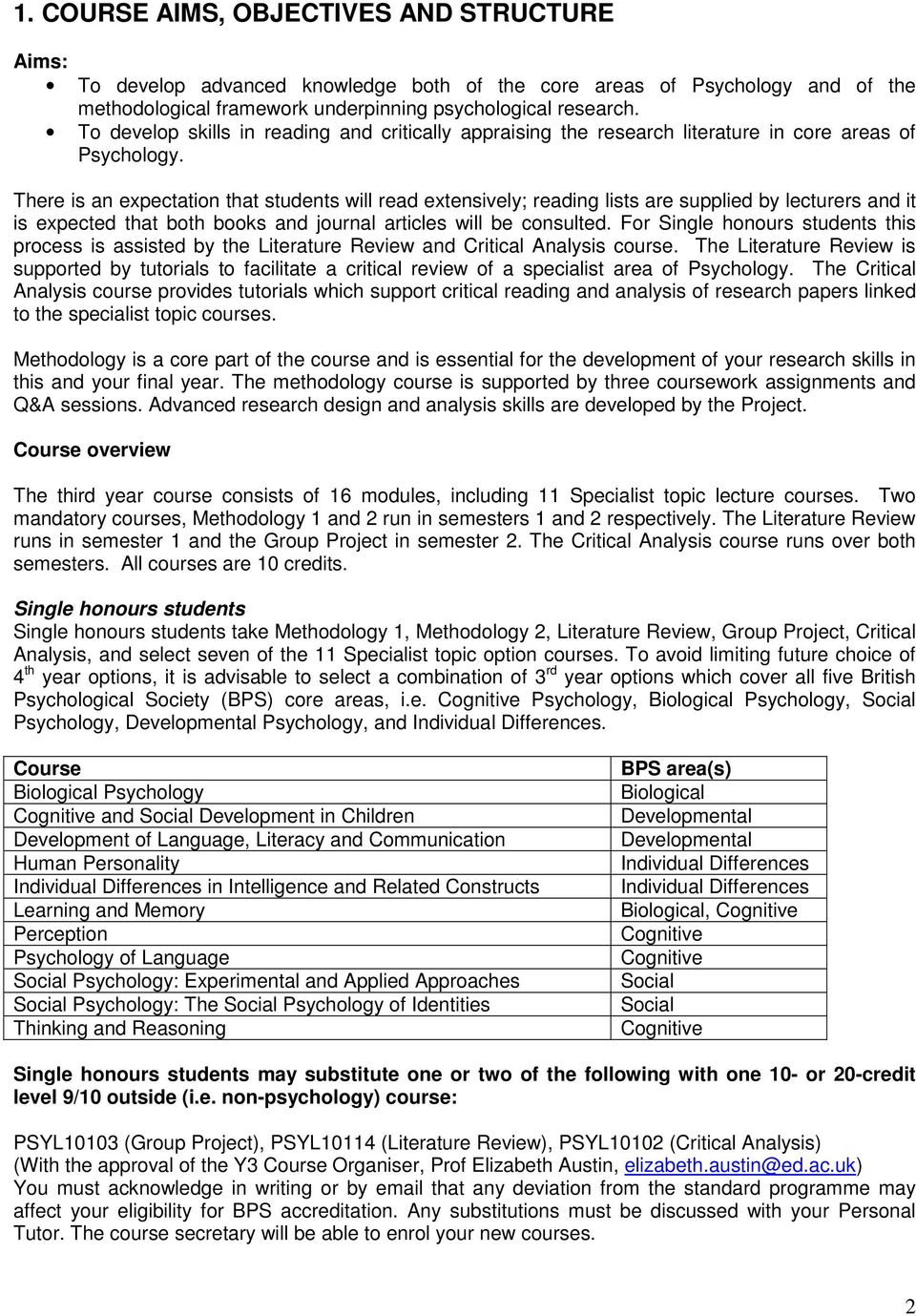
2 1. COURSE AIMS, OBJECTIVES AND STRUCTURE Aims: To develop advanced knowledge both of the core areas of Psychology and of the methodological framework underpinning psychological research. To develop skills in reading and critically appraising the research literature in core areas of Psychology. There is an expectation that students will read extensively; reading lists are supplied by lecturers and it is expected that both books and journal articles will be consulted. For Single honours students this process is assisted by the Literature Review and Critical Analysis course. The Literature Review is supported by tutorials to facilitate a critical review of a specialist area of Psychology. The Critical Analysis course provides tutorials which support critical reading and analysis of research papers linked to the specialist topic courses. Methodology is a core part of the course and is essential for the development of your research skills in this and your final year. The methodology course is supported by three coursework assignments and Q&A sessions. Advanced research design and analysis skills are developed by the Project. Course overview The third year course consists of 16 modules, including 11 Specialist topic lecture courses. Two mandatory courses, Methodology 1 and 2 run in semesters 1 and 2 respectively. The Literature Review runs in semester 1 and the Group Project in semester 2. The Critical Analysis course runs over both semesters. All courses are 10 credits. Single honours students Single honours students take Methodology 1, Methodology 2, Literature Review, Group Project, Critical Analysis, and select seven of the 11 Specialist topic option courses. To avoid limiting future choice of 4 th year options, it is advisable to select a combination of 3 rd year options which cover all five British Psychological Society (BPS) core areas, i.e. Cognitive Psychology, Biological Psychology, Social Psychology, Developmental Psychology, and Individual Differences. Course Biological Psychology Cognitive and Social Development in Children Development of Language, Literacy and Communication Human Personality Individual Differences in Intelligence and Related Constructs Learning and Memory Perception Psychology of Language Social Psychology: Experimental and Applied Approaches Social Psychology: The Social Psychology of Identities Thinking and Reasoning BPS area(s) Biological Developmental Developmental Individual Differences Individual Differences Biological, Cognitive Cognitive Cognitive Social Social Cognitive Single honours students may substitute one or two of the following with one 10- or 20-credit level 9/10 outside (i.e. non-psychology) course: PSYL10103 (Group Project), PSYL10114 (Literature Review), PSYL10102 (Critical Analysis) (With the approval of the Y3 Course Organiser, Prof Elizabeth Austin, [email protected]) You must acknowledge in writing or by that any deviation from the standard programme may affect your eligibility for BPS accreditation. Any substitutions must be discussed with your Personal Tutor. The course secretary will be able to enrol your new courses. 2
3 Combined honours students Combined honours students must take Methodology 1, Methodology 2, and between 20 and 40 further credits of Psychology 3 courses (the number of credits varies according to the specific degree programme). Further information relating to specific combined programmes is available from To avoid limiting future choice of 4 th year options, it is advisable to select these credits as a combination of the option courses which cover as many as possible of the BPS core areas. It is the responsibility of combined honours students, in consultation with their Personal Tutor, to ensure that they are registered for courses in Psychology consistent with their Degree Programme Table. Intercalated medical students You will register for two Specialist topic courses and Methodology 1 in addition to completing requirements of the Psychology 4 syllabus (see Psychology 4 course handbook). General/Ordinary degree students For the degree of BA (Humanities & Social Science), or BSc (General) and BSc Ordinary (Psychology), (Science & Engineering), you will take between credits worth of courses offered in Psychology 3, normally consisting of Specialist topic courses. Students wishing to enrol on the Group Project or Literature Review should seek permission from the Y3 Course Organiser. You may select outside courses to make up the remainder of your curriculum in consultation with your Personal Tutor and the 2014/15 Degree Regulations and Programmes of Study. Visiting students Full year students may select courses offered in Specialist topics, Methodology 1 & 2 and Group Project, and may substitute Psychology courses with other courses offered by the University. You should consult your Personal Tutor here and at your home institution about the substitutions you wish to make, as a variety of outside courses are on offer from the University. You may substitute a small number of Y3 courses, by arrangement with the Y3 Course Organiser, with courses in Psychology 4. Semester 1 only students may select courses from Specialist topics and Methodology 1. Semester 2 only students may select courses from Specialist topics, Group Project and Methodology 2. You may substitute Y3 courses, by arrangement with the Y3 Course Organiser, with courses in Psychology 4. Teaching Coordinator The Teaching Coordinator for 3 rd and 4 th year is Dr Marieke Gartner (Room G10, [email protected]). The Teaching Coordinator acts as the first point of contact for students with course-related queries (e.g. tutorials, preparation and submission of coursework, help with study skills, clarification of information in the course handbook or on Learn). Please contact her if you have questions or concerns related to the course; if necessary your enquiry will be referred on for further action (e.g. to a module organiser). 3

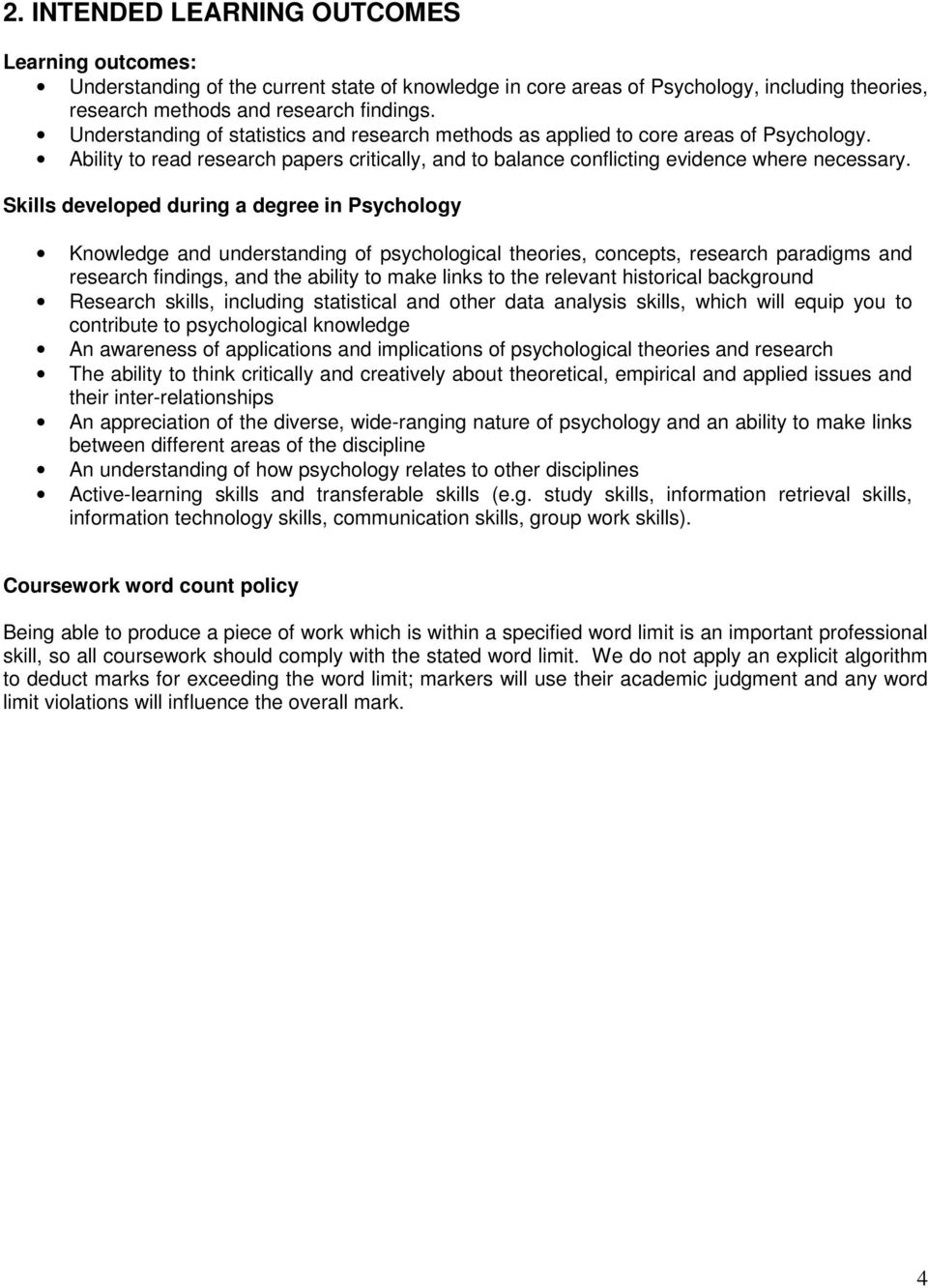
4 2. INTENDED LEARNING OUTCOMES Learning outcomes: Understanding of the current state of knowledge in core areas of Psychology, including theories, research methods and research findings. Understanding of statistics and research methods as applied to core areas of Psychology. Ability to read research papers critically, and to balance conflicting evidence where necessary. Skills developed during a degree in Psychology Knowledge and understanding of psychological theories, concepts, research paradigms and research findings, and the ability to make links to the relevant historical background Research skills, including statistical and other data analysis skills, which will equip you to contribute to psychological knowledge An awareness of applications and implications of psychological theories and research The ability to think critically and creatively about theoretical, empirical and applied issues and their inter-relationships An appreciation of the diverse, wide-ranging nature of psychology and an ability to make links between different areas of the discipline An understanding of how psychology relates to other disciplines Active-learning skills and transferable skills (e.g. study skills, information retrieval skills, information technology skills, communication skills, group work skills). Coursework word count policy Being able to produce a piece of work which is within a specified word limit is an important professional skill, so all coursework should comply with the stated word limit. We do not apply an explicit algorithm to deduct marks for exceeding the word limit; markers will use their academic judgment and any word limit violations will influence the overall mark. 4
5 3. LECTURE TIMES AND LOCATIONS All lectures held in F21, 7 George Square except for Methodology 1 and Methodology 2, which will be held in Old College, Lecture Theatres 270 and 183 respectively, and the Bizarre Bodies session for Perception, held in the Anatomy Lecture Theatre, Teviot Doorway 3, Wed 17 Sept, 5-6 pm. Course Introduction In Week 1 the Perception lecture is replaced by an introduction to the course given by the Y3 Course Organiser, Prof Elizabeth Austin at 2pm on Monday 15 th September in F21, 7 George Square. Students will be responsible for knowing what the essay deadlines are and planning their time accordingly. SEMESTER 1, BLOCK 1 (weeks 1-5 commencing 15 September 2014) Day Time Code Course Staff Mon PSYL10116 *Perception Dr Elena Gherri Tues PSYL10110 Social Psychology: Experimental and Dr Billy Lee Applied Approaches Thurs PSYL10034 Methodology 1 Dr Wendy Johnson Fri PSYL10113 Biological Psychology Dr Thomas Bak *Starts in Week 2, replaced by the Course Introduction session (for all 3 rd year students) in Week 1 There will be a Critical Analysis lecture on Wednesday Week 1 (17 th September) 1-3pm F21. All students registered for this course should attend this lecture. SEMESTER 1 BLOCK 2 (Weeks 7-11 commencing 27 October 2014) Day Time Code Course Staff Mon PSYL10111 Thinking and Reasoning Dr Adam Moore Tues PSYL10112 Social Psychology: The Social Psychology Prof Andy McKinlay of Identities Thurs PSYL10034 Methodology 1 Dr Wendy Johnson SEMESTER 2 BLOCK 3 (Weeks 1-5 commencing 12 January 2015) Day Time Code Course Staff Mon PSYL10115 Individual Differences in Intelligence and Dr Wendy Johnson Related Constructs Tues PSYL10108 Learning & Memory Dr Alexa Morcom Thurs PSYL10035 Methodology 2 Dr Sue Widdicombe Fri PSYL10121 Cognitive and Social Development in Dr Nic Chevallier Children There will be a Critical Analysis lecture on Wednesday Week 2 (21 st January) 1-3pm F2. All students registered for this course should attend this lecture. SEMESTER 2 BLOCK 4 (Weeks 7-11 commencing 23 February 2015) Day Time Code Lecture Topic Staff Mon PSYL10109 Psychology of Language Dr Patrick Sturt Tues PSYL10105 Human Personality Dr René Mõttus Thurs PSYL10035 Methodology 2 Dr Sue Widdicombe Fri PSYL10106 Development of Language, Literacy and Communication Dr Morag Donaldson Students are expected to be present in Edinburgh during teaching weeks. Students should refrain from committing to any holiday etc. arrangements during exam periods until the exam timetable has been confirmed by Academic Registry. Alternative exam scheduling is NOT available to accommodate holiday arrangements. Week 6 - INNOVATIVE LEARNING WEEK (17 th 21 st February 2015). Normal teaching slots will be suspended and in their place will be a range of other activities such as master classes, a research day, a science fair, and guest lectures. More information will follow nearer the time so please check the School website where details will be available on the PPLS Events page: 5

6 4. COURSE CONTENT BIOLOGICAL PSYCHOLOGY (PSYL10113) Course Organiser: Dr Thomas Bak Lecturers: Dr Thomas Bak, Dr Sarah MacPherson Aims: This series of lectures introduces a range of topics, which illustrate possible biological approaches to the study of mental processes and the 'evolution of mind'. Objectives: To give an understanding of the range of biological approaches that can be applied to the study of mental processes and brain function. The topics covered range in specificity and level of analysis, and include communication and intelligence in nonhuman primates, broader aspects of the evolution of animal cognition, the neurobiology of emotion and foundations of functional anatomy of animal and human brain. Outcomes: By the end of this course, you should be able to understand the role of the evidence from animal behaviour in current debates about human nature and its genetic and environmental determinants recognise the main stages in the evolution of the nervous system in animals and they ways in which they can lead to a better understanding of human behaviour give at least two examples to explain the way in which 'comparative' studies (of the abilities of animals) can contribute to questions about the origins of human abilities explain the similarities and differences between communication and social structure in different species describe the functional and anatomical organisation of the human brain Lecture Content Lecturer 1 Introduction to the course/brain video and model distribution SM/THB 2 The evolution of the nervous system I: the first 3 billion THB years 3 The evolution of the nervous system II: conquering the land THB 4 The neurobiology of emotion SM 5 Brain quiz (feedback event)/the biology of human nature THB References Dr Thomas Bak Shettleworth, S.J. (1998). Cognition, Evolution and Behaviour. Oxford: Oxford University Press. Byrne, R. (1995). The Thinking Ape. Evolutionary Origins of Intelligence. Oxford: Oxford Press. Macphail, E.M. (1998). The Evolution of Consciousness. Oxford: Oxford University Press. McFarland, D. (1998). Animal Behaviour. Pearson Prentice Hall (3rd Edition). Dr Sarah MacPherson **Carlson, N.R. (2012). Physiology of Behavior. Allyn and Bacon (11th Edition). Rose, S. (2003). The Making of Memory. Random House. Squire, L. & Kandel, E.R. (2000). Memory: From Mind to Molecules. W.H.Freeman. LeDoux, J. (1998). The Emotional Brain: The Mysterious Underpinnings of Emotional Life. Phoenix. **Primary textbook. Other readings (chapters from other books) will be specified for each of the lectures. Brain Quiz Unlike in previous years, the Brain Quiz this year will not be part of the exam. Instead, it will be a feedback event, in which the students get a chance to answer questions about brain anatomy and function with the opportunity of an immediate feedback, allowing them to assess the progress made so far. 6

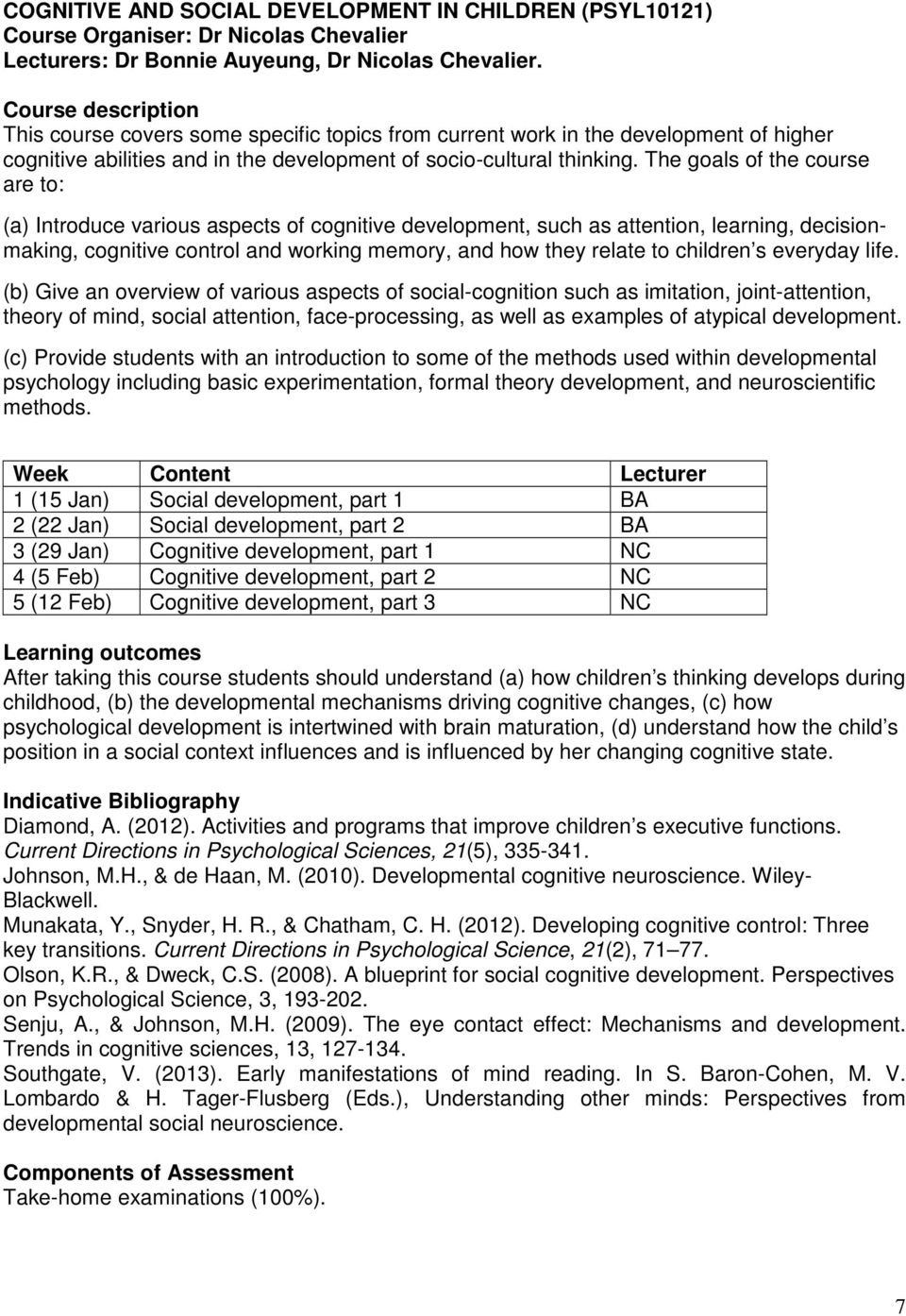
7 COGNITIVE AND SOCIAL DEVELOPMENT IN CHILDREN (PSYL10121) Course Organiser: Dr Nicolas Chevalier Lecturers: Dr Bonnie Auyeung, Dr Nicolas Chevalier. Course description This course covers some specific topics from current work in the development of higher cognitive abilities and in the development of socio-cultural thinking. The goals of the course are to: (a) Introduce various aspects of cognitive development, such as attention, learning, decisionmaking, cognitive control and working memory, and how they relate to children s everyday life. (b) Give an overview of various aspects of social-cognition such as imitation, joint-attention, theory of mind, social attention, face-processing, as well as examples of atypical development. (c) Provide students with an introduction to some of the methods used within developmental psychology including basic experimentation, formal theory development, and neuroscientific methods. Week Content Lecturer 1 (15 Jan) Social development, part 1 BA 2 (22 Jan) Social development, part 2 BA 3 (29 Jan) Cognitive development, part 1 NC 4 (5 Feb) Cognitive development, part 2 NC 5 (12 Feb) Cognitive development, part 3 NC Learning outcomes After taking this course students should understand (a) how children s thinking develops during childhood, (b) the developmental mechanisms driving cognitive changes, (c) how psychological development is intertwined with brain maturation, (d) understand how the child s position in a social context influences and is influenced by her changing cognitive state. Indicative Bibliography Diamond, A. (2012). Activities and programs that improve children s executive functions. Current Directions in Psychological Sciences, 21(5), Johnson, M.H., & de Haan, M. (2010). Developmental cognitive neuroscience. Wiley- Blackwell. Munakata, Y., Snyder, H. R., & Chatham, C. H. (2012). Developing cognitive control: Three key transitions. Current Directions in Psychological Science, 21(2), Olson, K.R., & Dweck, C.S. (2008). A blueprint for social cognitive development. Perspectives on Psychological Science, 3, Senju, A., & Johnson, M.H. (2009). The eye contact effect: Mechanisms and development. Trends in cognitive sciences, 13, Southgate, V. (2013). Early manifestations of mind reading. In S. Baron-Cohen, M. V. Lombardo & H. Tager-Flusberg (Eds.), Understanding other minds: Perspectives from developmental social neuroscience. Components of Assessment Take-home examinations (100%). 7
8 CRITICAL ANALYSIS (PSYL10102) Course Organiser: Dr David Carmel Course aims: The general aims of the course are: - To facilitate critical reading and analysis of psychological research reports - To show how design principles and statistics are applied in psychological research, and how research is actually done - To encourage careful, deep consideration the value of published research studies These aims will be achieved principally via tutorials with groups of approximately 12 students. Each tutorial session will be devoted to discussing a single research paper, which will be distributed to all students in advance of the session. The most important thing to do in this course is to read the paper before coming to class! Structure: The tutor will start each tutorial session by providing discussion points, which will draw on the aims and learning outcomes of the course in a manner which is appropriate for the paper under discussion and the stage of the course (i.e., questions will be more generic towards the start of the course and more specific and focused as students gain in analytic skills). The papers will be drawn from the 3rd year lecture courses taking place concurrently with the tutorial sessions and will be suggested by academic staff teaching those courses. There will also be two lectures one at the start of Semester 1 and the other a couple of weeks into Semester 2. The Semester 1 lecture will provide background information about the course; the Semester 2 lecture will provide further material to prepare students for more advanced work building on the skills developed in semester 1. Lecture 1 Wednesday 17 th September, F21 1-3pm Lecture 2 Wednesday 21 st January, F21 1-3pm Learning outcomes By the end of the course, students will be able to: - Review research articles comprehensively and critically - Understand the rationale, logic and purpose of a research project - Identify any hypotheses stated - Describe and assess the suitability of the methods adopted - Assess the soundness of the experimental designs used - Assess the suitability of the statistical treatment of the results - Assess the interpretation of the results and the adequacy of the statistical inferences drawn - Evaluate a paper s discussion section - Decide whether the conclusions reached are justified - Judge whether a contribution to psychological knowledge has been made - Propose solutions to the shortcomings of published research - Identify alternative ways of answering the research question(s) - Suggest, and potentially design, further research studies to follow up the findings of a published research paper Course Assessment: 1) Within-tutorial MCQ quizzes (20%; a short quiz at the beginning of each of the 12 tutorials; students must complete at least 10 of these, worth 2% each - the best 10 quizzes will count toward the final mark). 2) Short critique of a paper, end of Semester 1, 1000 words (25%) 8

9 3) Take-home exam (critique of a previously unseen paper, time to return 4 days) end of Semester 2, 2000 words (55%) References: Barber, P. (2003). Critical analysis of psychological research II: delivering a course for inclusion in the core curriculum for psychology. Psychology Learning and Teaching 3, Meltzoff, J. (1998). Critical Thinking About Research: Psychology And Related Fields. Washington: American Psychological Association. Girden, E. (2001). Evaluating Research Articles From Start To Finish. California: Sage Publications. Solso, R.L. & Maclin, M.K. (2007). Experimental Psychology: A Case Approach (8th Edition). Boston: Allyn And Bacon. Elmes, D.G., Kantowitz, B.H. & Roediger, H.L. (2003). Research Methods In Psychology (7th Edition).Belmont, Ca: Wadsworth/Thomson Learning. Kantowitz, B.H., Roediger, H.L. & Elmes, D.G. (2005). Experimental Psychology: Understanding Psychological Research (8th Edition). Belmont, Ca: Wadsworth/Thomson Learning. Smith, J.A., Flowers, P. & Larkin, M. (2009). Interpretative Phenomenological Analysis. Theory, Method And Research. London: Sage. Smith, J.A. & Eatough, V. (2007). Interpretative Phenomenological Analysis. In: Lyons, E. & Coyle, A. Analysing Qualitative Data In Psychology. London: Sage, pp

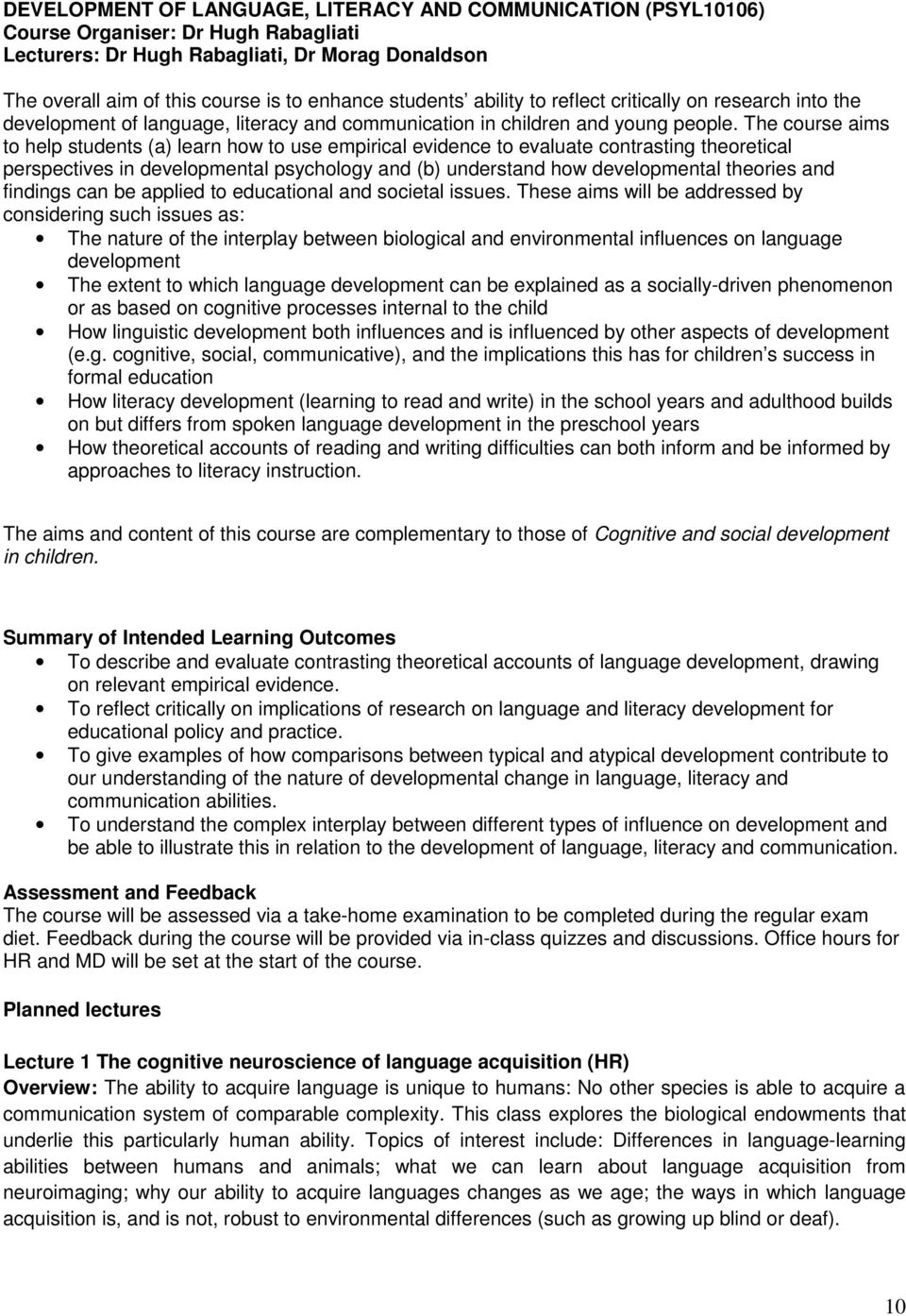
10 DEVELOPMENT OF LANGUAGE, LITERACY AND COMMUNICATION (PSYL10106) Course Organiser: Dr Hugh Rabagliati Lecturers: Dr Hugh Rabagliati, Dr Morag Donaldson The overall aim of this course is to enhance students ability to reflect critically on research into the development of language, literacy and communication in children and young people. The course aims to help students (a) learn how to use empirical evidence to evaluate contrasting theoretical perspectives in developmental psychology and (b) understand how developmental theories and findings can be applied to educational and societal issues. These aims will be addressed by considering such issues as: The nature of the interplay between biological and environmental influences on language development The extent to which language development can be explained as a socially-driven phenomenon or as based on cognitive processes internal to the child How linguistic development both influences and is influenced by other aspects of development (e.g. cognitive, social, communicative), and the implications this has for children s success in formal education How literacy development (learning to read and write) in the school years and adulthood builds on but differs from spoken language development in the preschool years How theoretical accounts of reading and writing difficulties can both inform and be informed by approaches to literacy instruction. The aims and content of this course are complementary to those of Cognitive and social development in children. Summary of Intended Learning Outcomes To describe and evaluate contrasting theoretical accounts of language development, drawing on relevant empirical evidence. To reflect critically on implications of research on language and literacy development for educational policy and practice. To give examples of how comparisons between typical and atypical development contribute to our understanding of the nature of developmental change in language, literacy and communication abilities. To understand the complex interplay between different types of influence on development and be able to illustrate this in relation to the development of language, literacy and communication. Assessment and Feedback The course will be assessed via a take-home examination to be completed during the regular exam diet. Feedback during the course will be provided via in-class quizzes and discussions. Office hours for HR and MD will be set at the start of the course. Planned lectures Lecture 1 The cognitive neuroscience of language acquisition (HR) Overview: The ability to acquire language is unique to humans: No other species is able to acquire a communication system of comparable complexity. This class explores the biological endowments that underlie this particularly human ability. Topics of interest include: Differences in language-learning abilities between humans and animals; what we can learn about language acquisition from neuroimaging; why our ability to acquire languages changes as we age; the ways in which language acquisition is, and is not, robust to environmental differences (such as growing up blind or deaf). 10
11 Outcomes: Students should be able to 1) Demonstrate an understanding of many of the major issues in the cognitive neuroscience of language acquisition. 2) Think critically about the interplay of biological and environmental influences in child development. 3) Critically evaluate scientific arguments and evidence in this field. References: Setting the theoretical stage Gleitman, L. and Newport, E. (1995). The invention of language by children: Environmental and biological influences on the acquisition of language. In L. Gleitman & M. Liberman (Eds.) An invitation to cognitive science: Language. Cambridge, MA: MIT Press. Kuhl, P. (2004). Early language acquisition: cracking the speech code. Nature Reviews Neuroscience, 5(11): Fisher, S. and Marcus, G. (2006). The eloquent ape: genes, brains and the evolution of language. Nature Reviews Genetics, 7(1):9 20. Language creation in humans and birds Senghas, A., Kita, S., and Ozyurek, A. (2004). Children creating core properties of language: Evidence from an emerging sign language in Nicaragua. Science, 305(5691):1779. versus Feher, O., Wang, H., Saar, S., Mitra, P., and Tchernichovski, O. (2009). De novo establishment of wildtype song culture in the zebra finch. Nature, 459(7246): Language learning in unusual conditions Bedny, M., Pascual-Leone, A., Dodell-Feder, D., Fedorenko, E., & Saxe, R. (2011). Language processing in the occipital cortex of congenitally blind adults. Proceedings of the National Academy of Sciences, 108(11), Lecture 2 The development of word meaning, and the interplay of social and cognitive factors in development (HR) Overview: In learning a language, children acquire a socially and culturally shaped medium for transmitting complex internal thoughts. To what extent should the acquisition of language be explained as a socially-driven phenomenon, and to what extent should it be explained based on cognitive processes internal to the child? Word learning presents a case-study for this fascinating question, as children have to link a world they are only beginning to understand to the arbitrary sounds of their language. We will explore how the mapping between sound and meaning, and the structure of our semantic system, develop, and evaluate whether theories based on social or cognitive factors better explain the data. Outcomes: This section focuses on evaluating the explanatory abilities of different theories. Students should learn about both social and cognitive approaches to investigating word learning, and the surprising and fascinating phenomena uncovered during these investigations, but the focus will be on how to use data points to compare and contrast theories. References: Setting the theoretical stage Bloom, P., & Markson, L. (1998). Capacities underlying word learning. Trends in Cognitive Sciences, 2(2), Snedeker, J. (2009). Word Learning. In L. R. Squire (Ed.), Encyclopedia of Neuroscience (pp ). Amsterdam, Netherlands: Elsevier. 11

12 Empirical work and supporting discussion Akhtar, N., Carpenter, M., & Tomasello, M. (1996). The role of discourse novelty in early word learning. Child Development, 67(2), Fisher, C. (2002). Structural limits on verb mapping: the role of abstract structure in 2.5 year olds interpretations of novel verbs. Developmental Science, 5(1), Frank, M. C., Goodman, N. D., & Tenenbaum, J. B. (2009). Using speakers' referential intentions to model early cross-situational word learning. Psychological Science, 20(5), Halberda, J. (2003). The development of a word-learning strategy. Cognition, 87(1), B23-B34. Woodward, A. L. (2000). Constraining the problem space in early word learning. In R.M. Golinkoff & Hirsh-Pasek, K. (Eds.) Becoming a word learner: A debate on lexical acquisition, Oxford, UK: OUP Lecture 3 Language development in society (HR) Overview: Language is the key to human communication and the glue that holds society together. Complex cultural tools like reading, mathematics all rely on linguistic ability, as does formal education generally. This lecture explores how linguistic development influences our ability to interact with society. In particular, we examine a) how variation in linguistic ability can impede development in other areas, b) what factors predict linguistic development, and c) what sort of interventions might improve outcomes. We will study both typical and atypical (e.g., language impaired) populations. Outcomes: This section focuses on evaluating how psychological theories can be applied in society. Students should learn about theories of language development, methods for evaluating linguistic abilities in large samples, and how linguistic ability relates to other developmental outcomes. Key references: Fernald, A., Marchman, V. A. & Weisleder, A. (2012). SES differences in language processing skill and vocabulary are evident at 18 months. Developmental Science Hart, B., & Risley, T Meaningful differences in the everyday experience of young American children. Baltimore, MD: Brookes Publishing. Heckman, J. J. (2006). Skill formation and the economics of investing in disadvantaged children. Science, 312(5782), Huttenlocher, J., Haight, W., Bryk, A., & Seltzer, M. (1991). Early vocabulary growth: relation to language input and gender. Developmental Psychology, 27, Ramey, C.T., & Ramey, S.L. (2004). Early learning and school readiness: can early intervention make a difference? Merrill Palmer Quarterly, 50, Lecture 4 Reading development (MD) Overview: Literacy development (learning to read and write) is central to children s education. It builds on the oral language, cognitive and social skills developed in the preschool years, but it also brings new challenges and new opportunities. We will explore how the demands that children face in learning to read relate to other aspects of development, e.g. by considering the role of phonological skills in the recognition of individual written words and the role of inferential abilities in text comprehension. Theoretical and practical implications of research studies of children with typical reading development and children with reading difficulties will be discussed. Outcomes: Students should be able to (i) describe similarities and differences between reading development and oral language development, (ii) give examples of the types of difficulties that children may have in learning to read, (iii) understand the complexity of the relationships between reading development and other aspects of development, (iv) illustrate this complexity with evidence from research studies, (v) discuss implications for reading instruction. 12
13 Key references: Perfetti, C. A., Landi, N. and Oakhill, J. (2008). The acquisition of reading comprehension skill. In M. J. Snowling and C. Hulme (eds.) The Science of Reading: A Handbook. Oxford: Blackwell. (Chapter 13), doi: / ch13 Snowling, M. J. and Göbel, S. M. (2010). Reading development and dyslexia. In U. Goswami (ed.) The Wiley-Blackwell Handbook of Childhood Cognitive Development, Second edition, Oxford: Wiley- Blackwell. (Chapter 20) doi: / ch20 Snowling, M.J. and Hulme, C. (2011). Evidence-based interventions for reading and language difficulties: Creating a virtuous circle. British Journal of Educational Psychology, 81, Lecture 5 Writing development (MD) Overview: As children and young people progress through the educational system, the ability to produce written text becomes increasingly important, and writing tasks become increasingly complex and diverse. We will explore how writing development interacts both with other aspects of the individual s cognitive and linguistic development and with features of the social/instructional context. We will consider research evidence relating both to typical writing development and to children with writing difficulties, as well as to primary, secondary and tertiary levels of education. Outcomes: Students should be able to (i) describe and evaluate cognitive and contextual accounts of writing development, (ii) understand the complexity and diversity of the demands involved in producing written text, (iii) give examples of how the ability to cope with these demands varies developmentally, across individuals and across contexts, (iv) reflect on the implications of research on writing development for educational practice and for their own writing skills. Key references: Dockrell, J. (2009). Causes of delays and difficulties in the production of written text. In R. Beard, D. Myhill, M. Nystrand and J. Riley (eds.) The Sage Handbook of Writing Development. London: Sage. (Chapter 33.) DOI: / Graham, S., Gillespie, A. and McKeown, D. (2013). Writing: importance, development and instruction. Reading and Writing, 26, McCune, V. (2004). Development of first-year students conceptions of essay writing. Higher Education, 47,
14 HUMAN PERSONALITY (PSYL10105) Course Organiser: Dr René Mõttus Lecture Content 1 Conceptualizations of personality traits 2 Measurement of traits 3 Underpinnings of traits 4 Correlates of traits 5 Beyond traits Aim: The course will give an overview of the major topics in current personality research. Objectives: To provide a framework for understanding how personality differences between people as well as personality variation/processes within people can be conceptualised and studied. Learning outcomes: By the end of the course, students should know: main concepts and theoretical positions in current personality psychology major findings in personality genetics and biology and their theoretical relevance major findings pertaining to personality trait development major findings regarding the predictive validity of personality traits some alternative conceptualizations of personality beside the trait approach The main textbook: Matthews, G., Deary, I.J. & Whiteman, M.C. (2009). Personality Traits. 3rd Edition. Cambridge: Cambridge University Press. Additional and/or background reading Funder, D. C. (1991). Global Traits: A Neo-Allportian Approach to Personality. Psychological Science, 2, Caspi, A., & Roberts, B. W. (2001). Personality Development across the Life Course: The Argument for Change and Continuity. Psychological Inquiry, 12, Roberts, B. W., Kuncel, N. R., Shiner, R., Caspi, A., & Goldberg, L. R. (2007). The Power of Personality. Perspectives on Psychological Science, 2, Cervone, D. (2005). Personality Architecture: Within-Person Structures and Processes. Annual review of psychology, 56, Cramer, A. O. J., van der Sluis, S., Noordhof, A., Wichers, M., Geschwind, N., Aggen, S. H., Borsboom, D. (2012). Dimensions of Normal Personality as Networks in Search of Equilibrium: You Can t Like Parties if You Don t Like People. European Journal of Personality, 26,

15 INDIVIDUAL DIFFERENCES IN INTELLIGENCE AND RELATED CONSTRUCTS (PSYL10115) Course Organiser and Lecturer: Dr Wendy Johnson, Lecture Content 1 Structure and measurement of intelligence 2 Biology of intelligence 3 Development of intelligence 4 Relations of intelligence with education, interests, motivation, occupational and health outcomes 5 Cognitive style, creativity, and other abilities Aim: To provide understanding of the current status of research on intelligence and personality traits: their structure, aetiology and impacts. Objectives: To provide a framework for understanding how individual differences in intelligence and related psychological domains such as creativity, mood and motivation are conceptualised and studied. To outline how intelligence: - emerges from genetic and environmental factors, - is understood from a biological perspective - develops over the lifespan, and - relates to important life outcomes, including health, occupational success and social relationships. Learning outcomes: By the end of the course, you should be able to discuss critically the differential approach to the study of cognitive abilities and related constructs. You should understand and be able to discuss the structures of cognitive abilities and related traits; putative causes of individual differences; evolution and biological underpinnings of individual differences; their stability and development; and the relations of intelligence with life outcomes. The main textbook for the course is: Detterman, D.K. (2008). The Science of Human Intelligence. Unpublished draft, available on Learn. Additional and/or background reading Buss, D. M., & Hawley, P.H. (Eds., 2010): The Evolution of Personality and Individual Differences. New York: Oxford University Press. Chamorro-Premuzic, T., von Stumm, S., & Furnham, A. (Eds., 2011). The Wiley-Blackwell Handbook of Individual Differences. Wiley-Blackwell. Deary, I.J. (2000). Looking Down on Human Intelligence: From Psychometrics to the Brain. Oxford: Oxford University Press. Flynn, J.R. (2007). What Is Intelligence? Cambridge: Cambridge University Press. Hunt, E. (2011). Human Intelligence. Cambridge: Cambridge University Press. Nettle, D. (2009). Evolution and Genetics for Psychology. Oxford: Oxford University Press. Plomin, R., DeFries, J., McClearn, G., & McGuffin, P. (2008). Behavioral Genetics. 5 th Edition. New York: Worth. References to required and recommended journal articles will be provided in the lectures. 15

16 LEARNING AND MEMORY (PSYL10108) Course Organiser: Dr Alexa Morcom Lecturers: Dr Alexa Morcom, Dr Sarah MacPherson Course Summary This course aims to give an understanding of long-term memory at a range of levels of analysis. It begins with memory failures and preservation in amnesia, then considers the basic neurobiology of the hippocampus. Next a human cognitive neuroscience perspective on memory provides the framework for applications to learning skills, and an understanding of false memory and eyewitness testimony. The main course content is presented in lectures, with additional class discussions. The course is supported by autonomous peer-learning groups with a revision and feedback session in the final week. Lecture Content Lecturer 1 Amnesia and memory systems SMP 2 The hippocampus and the neurobiology of memory SMP 3 Human learning and episodic memory AM 4 Constructive memory: its successes and failures AM 5 Revision and feedback session AM & SMP Learning outcomes: By the end of the course, you should be able to: Describe and discuss the kinds of memory preserved and impaired in amnesia Understand the basic neurobiology of the hippocampus and its disruption in amnesia Evaluate cognitive neuroscientific insights into human memory and their implications for how we learn and study Discuss the constructive nature of human memory and its pitfalls for eyewitness evidence Background reading For this course, you are expected to take the initiative in following up on references and to read material on lecture topics that goes beyond the precise content of the lectures and of the recommended textbooks. Reading of peer-reviewed journal articles is advised and some selections of these will be recommended. Essential reading The following texts: Purves, D., Cabeza, R., Huettel, S.A., LaBar, K.,S., Platt, M.L., & Woldorff, M.G. (2013). Principles of Cognitive Neuroscience. Chapter 8: Memory: Varieties and Mechanisms (pp ) and Chapter 9: Declarative Memory (pp ). Sinauer, Sunderland, MA. Schacter, D. L., Guerin, S. A., & St Jacques, P. L. (2011). Memory distortion: an adaptive perspective. Trends in Cognitive Sciences, 15(10), Carlson, N.R. (2012). Physiology of Behavior. Allyn and Bacon (11th Edition). Chapter 13. Other useful reading Chapter 5 of the following text: Smith, E.E., & Kosslyn, S.M. (2006), Cognitive Psychology: Mind and Brain. Pearson. This chapter is available online: Additional selected readings and links may be posted on Learn prior to the lectures. 16
17 METHODOLOGY 1 (PSYL10034) Course Organiser: Dr Wendy Johnson Lecturers: Prof Elizabeth Austin, Dr Alex Doumas, Dr Wendy Johnson, Dr Rene Mottus Demonstrator: Ms Aja Murray This course is taught using a combination of lectures and practical exercises. The course of lectures and the exercises are compulsory for all single and combined honours students. Together with Methodology 2, the course is designed to provide students with a good range of methodology skills required for research and project work in psychology, especially the Y4 dissertation. Methodology 1 focuses on inferential statistical approaches to data analysis. The goals are to provide students with the skills both to conduct and interpret inferential statistics in the context of psychological research. Practical exercises using SPSS are included and acquiring skills in using this package is an important aspect of the course. To derive full benefit from these, each exercise should be completed using the computers in the University public-access laboratories in advance of the timetabled question and answer session. You are strongly encouraged to purchase the book by Field listed in the references, or a similar SPSS-based text, to assist with completing the exercises. Learning outcomes Understanding of experimental design issues in psychological research, including issues associated with the gathering of both quantitative and qualitative data. Understanding and use of the concept of statistical power. Understanding of the data analysis methods covered in the course. Week Content Lecturer 1 ANOVA 1 WJ 2 ANOVA II WJ 3 ANOVA Practical Session and practical assignment distributed AM 4 Regression I; ANOVA practical assignment due AD 5 Regression II AD 6 Regression Practical Session and practical assignment distributed AM 7 Power Analysis; Regression assignment due RM 8 Factor Analysis I EA 9 Factor Analysis II EA 10 Factor Analysis Practical Session and practical assignment distributed AM 11 Factor Analysis assignment due References Field, A. (2009). Discovering Statistics Using SPSS, 3 rd Edition. London: Sage Publications, Ltd. Cohen, J. (1992). A power primer. Psychological Bulletin, 112, (This paper will be available at the university main library and on Learn). Supplement Wilcox, R.R. (2011). Modern Statistics for the Social and Behavioral Sciences: A Practical Introduction. New York: Taylor & Francis. Additional Reading Gigerenzer, G., Gaissmaier, W., Kurz-Milcke, E., Schwartz, L. M., & Woloshin, S. (2007). Helping doctors and patients make sense of health statistics. Psychological Science in the Public Interest, 8, Recommended reference for intercalated medical students Howitt, D. & Cramer, D. (2008). Introduction to Statistics in Psychology *(4 th Edition). Essex: Pearson Education Limited. *Please note that we have specified the 4 th Edition of this book and not the most recent 5 th Edition because the 5 th Edition contains a number of errors in the mathematical formulas. Please make sure that you refer to the 4 th Edition when revising. 17

18 METHODOLOGY 2 (PSYL10035) Course Organiser: Dr Sue Widdicombe Lecturers: Dr Thomas Bak, Prof. Tim Bates, Dr Morag Donaldson, Dr Billy Lee, Dr Mante Nieuwland, Dr Sue Widdicombe. This course is lecture-based and compulsory for all single honours students. Together with Methodology 1, the content of the course is designed to provide students with the full range of methodology skills required for research and project work in psychology. Methodology 2 focuses on qualitative and experimental approaches to research design and implementation, and on qualitative data analysis. In this course, staff with expertise in the use of particular methodologies will discuss the following points: what research questions can the technique answer and what are its limitations; what do you need to take into account when designing a project using the technique; what are the potential pitfalls and how can you avoid them; what should you be aware of when evaluating research papers that use the technique? In addressing these questions, students will gain exposure to a wide array of research methods used in psychological research. Learning outcomes: By the end of this course, you should understand the rationale underlying qualitative methodologies, and know about various means of collecting qualitative data, and related conceptual issues; have a basic practical understanding of how to do discursive psychology; understand the underlying rationale and process of interpretative phenomenological analysis (IPA); understand experimental design issues in psychological research understand the quantitative data collection and analysis methods covered in this course. Week Content Lecturer Part One: Qualitative Methodologies 1 Discursive Psychology 1: Theory and Rationale SW 2 Discursive Psychology 2: Methods and Issues in Data Collection SW 3 Discursive Psychology 3: Data Analysis SW Discursive Psychology Practical Session Interpretative Phenomenological Analysis Innovative Learning Week Part Two: Quantitative Methods 7 Experimental design and rationale TB 8 Scale construction TB 9 Designing studies with children MD 10 Cognitive Neuroimaging: Studying the mind through the brain MN 11 Single-case studies ThB References Forrester, M. (2010). Doing Qualitative Research in Psychology: A Practical Guide. London: Sage. Langdridge, D. (2007). Phenomenological Psychology: Theory, Research and Method. Pearson. See chapters 2, 5, and 7. (week 5) Wetherell, M., Taylor, S. and Yates, S.J. (2001) Discourse as Data: A guide for analysis. London: Sage. (weeks 1-4) Willig, C. (2008). Introducing Qualitative Research in Psychology: Adventures in theory and method. 2 nd Edition. Buckingham: Open University Press. (weeks 1-4) Willig, C. and Stainton-Rogers, W. (2008) The SAGE handbook of Qualitative Research in Psychology. London: Sage. See chapters 4 (Wilkinson & Kitzinger), and 5 (Wiggins & Potter). (weeks 1-4) Wooffitt, R. (2005) Conversation Analysis and Discourse Analysis: A comparative and critical introduction. London: Sage. (weeks 1-4) Crocker, L., & Algina, A. (1986). Introduction to Classical and Modern Test Theory. Austin, TX: Holt, Rinehart, & Winston. (week 8) Teti, D.M. (ed.) (2006). Handbook of Research Methods in Developmental Science. Oxford: Wiley- Blackwell. (Specific chapters to be notified later.) (week 9) SW BL 18

19 Luck, S.J. (2005). An Introduction to the Event-Related Potential Technique. Cambridge, MA.: MIT Press (Chapter 1 up to page 34) (week 10) Huettel, S.A., Song, A.W. & McCarthy, G. (2009). Functional Magnetic Resonance Imaging, 2nd edition. Sunderland, MA.: Sinauer Associates (Chapter 1 up to page 15) (week 10) Crawford JR, Garthwaite PH & Gray CD (2003). Wanted: fully operational definitions of dissociations in single-case studies. Cortex 39: (see also other papers in this issue) (week 11) 19

20 PERCEPTION (PSYL10116) Course Organiser: Dr Elena Gherri Lecturers: Dr Elena Gherri, Dr Rob McIntosh Course Summary This course examines the perception of the external world, and one's own body and movement. The course will cover the use of vision and the body senses to guide actions, and the bidirectional interactions between perception and action. It will also consider the representation of our bodies as a feat of multisensory integration, the dynamic flexibility of this body representation, and the experience of body ownership and agency. The main course content is presented in lectures, with additional in-class discussions. Lecture Content Lecturer Introduction Bizzare Bodies* RMc 1 Perception, action, cognition RMc 2 Seeing, being, doing RMc 3 Body, self, agency RMc 4 The body in the brain EG 5 Perception-action links EG * Bizarre Bodies will take place in the Anatomy Lecture Theatre, Teviot Doorway 3, Wednesday 17th September, from 5-6 pm. Background reading The reading list for this course consists of peer-reviewed journal articles, and some book chapters. Additional selected readings and links will be posted on Learn prior to the lectures. Students are expected to take the initiative in following up on references and to read material on lecture topics that goes beyond the precise content of the lectures and of the recommended reading list. Bizzare Bodies In advance of the more formal Perception lectures (weeks 2-6), there will be an extra 'fun' session in Week 1: this will be a special Psychology 3 performance of the Bizarre Bodies show that was part of the Edinburgh Fringe Festival this year. The session will introduce some of the key concepts of this course in an accessible way, through a series of live demonstrations, and will provide a useful gentle introduction for the course to follow. There will also be the opportunity for Psychology 3 students to get involved in wider public engagement and science communication, related to this show, throughout this academic year. Lecture 1: Perception, action, cognition (RMc) Overview: We will introduce the concept of embodied cognition, and highlight its influence within Psychology in recent decades. As a key example, we will outline Milner and Goodale s Two Visual Streams model of human vision, which, over the last 20 years, has revolutionised our understanding of human visual processing. This model emphasises that human vision is not unitary, but that visual information is processed in different brain areas, in different ways, for different behavioural purposes. This model will be illustrated through neuropsychological symptoms arising from damage to different 20
21 parts of the system. In particular, Visual Form Agnosia, Blindsight and Optic Ataxia will be used to argue that our use of vision for action can be dissociated from our conscious experience of the visual world. Outcomes: Students should understand the concept of embodied cognition, and the key points of distinction between constructivist and ecological approaches to perception. Students should be able to describe how the Two Visual Streams model has has altered our conception of visual processing, from a serial to a parallel architecture, and has highlighted the importance of considering action in understanding vision. Students should be able to define and describe Visual Form Agnosia, Blindsight and Optic Ataxia. Key references: A brief, broad-brushstrokes introduction to Milner & Goodale s model can be found here: Goodale MA & Milner AD (2006). One brain - two visual systems. The Psychologist, 19: A more complete, accessible overview, is the 'popular science' book: Goodale MA & Milner AD. (2004, second edition 2013) Sight unseen. Oxford University Press. Lecture 2: Seeing, being, doing (RMc) Overview: This lecture will concern the visual control of action, empahsising that successful action requires visual information about the external world to be combined with perception of the body s posture and location. The first half of the session will focus on the information available to us in perceiving our own body, and what happens when this sensory information is disturbed. In the second half, some basic control principles for action will be described, focusing on feedback control and forward modelling. Key concepts in both parts of the session will be illustrated by experimental evidence, and neuropsychological symptoms. Outcomes: Students should be able to describe what sensory information is available to the brain in building up a representation of the body s posture and position in space. Students should be able to describe and diagram the difference between a classical model of motor control, with feed-forward and feedback-based components, and more contemporary models incorporating forward modelling. Students should be able to define and describe Phantom Limb Phenomena and Peripheral Deafferentation. Key references: An excellent introduction to the sensorimotor foundations of action is provided in Chapter 3 of James Tresilian s textbook, which provides much more background detail on the sensory basis of body representation than it is possible to give in the lecture. Tresilian, J. R. (2012). Sensorimotor control and learning. New York: Palgrave Macmillan. Chapter 3: Sensorimotor Foundations (especially Section2 3.3 and 3.4). This lecture will include discussion of Peripheral Deafferentation. Popular accounts of patients with this rare and devastating condition can be found here Cole J. (1995) Pride and a daily marathon. London : Bradford Books. Sacks O. (1985) The man who mistook his wife for a hat. London: Duckworth. Chapter 3: the disembodied lady. And here is a reasonably accessible account of the forward modelling in action: Desmurget M & Grafton S. (2000) Forward modelling allows feedback control for fast reaching movements. Trends in Cognitive Sciences 4:
22 Lecture 3: Body, self, agency (RMc) Overview: This lecture will pick up on the idea of forward modelling of action, and consider how this control principle might be extended to understand how we distinguish between the sensory consequences of our own actions, and other events in the world. More generally, how is our awareness of our own actions determined, how do we distinguish our own actions from those of others. A scheme proposed by Frith, Wolpert & Blakemore (2000) will be presented, which can potentially account for a range of abnormalities in the experience of action. These include phantom limbs, anosognosia (unawareness denial of paralysis), and delusions of control associated with schizophrenia. Outcomes: Students should be able to describe and diagram the Frith, Wolpert & Blakemore (2000) model of action awareness, and how it proposes to account for a range of abnormal bodily experiences. Students should be able to substantiate this account of the model with relevant experimental and neuropsychological evidence. Students should be able to define and describe Anosognosia for Hemiplegia, Anarchic Hand Sign, Utilisation Behaviour and Delusions of Control. Key references: The critical background readings for this lecture relate to the main model discussed. A relatively accessible account of the model is given here: Blakemore, S. J., Wolpert, D. M., & Frith, C. D. (2002). Abnormalities in the awareness of action. Trends in cognitive sciences, 6(6), The more substantive paper on which the above article was based is here: Frith, C. D., & Wolpert, D. M. (2000). Abnormalities in the awareness and control of action. Philosophical Transactions of the Royal Society of London. Series B: Biological Sciences, 355(1404), Lecture 4: The body in the brain (EG) Overview: There are multiple representations of the body in the brain. These representations allow observers to move their body through space, by continuously monitoring the body position together with the location of relevant objects in its surroundings. We will evaluate evidence from a variety of different sources (from neurophysiology to neuroimaging to neuropsychology) investigating the neural mechanisms underpinning the brain representations of the body and of the space around it and their multisensory nature. In addition, we will also consider the extraordinary flexibility of these representations which can be quickly adjusted to include objects that look like real body parts as well as objects that have similar functions to real body parts (such as tools). Outcomes: Students should be able to describe and critically evaluate scientific evidence demonstrating the multisensory nature of body representations in the brain and to reflect on the factors that mediate the flexibility of such representations. Key references: Spence, C. & Driver, J., 2004 Crossmodal Space and Crossmodal attention. Oxford: Oxford University Press.[chapter 3] Knoblich et al., (Eds) Human body perception from inside out. Oxford: Oxford University Press. [chapters 3 & 4] Holmes & Spence, The body schema and the multisensory representation(s) of peripersonal space. Cognitive processing, 5(2), Maravita, Spence & Driver, Multisensory Integration and the Body Schema: Close to Hand and Within Reach. Current Biology, 13, R531 R539. Maravita & Iriki, Tools for the body (schema). Trends in Cognitive Sciences, 8(2),
23 Lecture 5: Perception-action links (EG) Overview: Classic theories of cognition describe perception and action as peripheral processes separate from each other. However, these processes can be tightly linked. We will discuss a number of evidence demonstrating that specific categories (or features of) of stimuli automatically activate certain motor responses. More specifically, we will evaluate evidence showing how the processing of certain (visual) features of objects can automatically evoke motor plans that are appropriate to interact with these objects and how the observation of goal directed actions activates the same echoing mechanisms within the brain responsible for the planning of the same actions. Outcomes: Students should be able to critically evaluate scientific evidence demonstrating actionperception links and to reflect on the implications of these evidences for theories of cognition. Key references: Action perception links: Engel, Maye, Kurthen & Koenig, (2013). Where s the action? The pragmatic turn in cognitive science. Trends in Cognitive Sciences 17 (5): McBride, Boy, Husain & Sumner, (2012). Automatic motor activation in the executive control of action. Frontiers in Human Neuroscience. doi: /fnhum Bosbach & Prinz (2007). Perceptual resonance: action-induced modulation of perception. Trends in Cognitive Science, 11(8), Affordances: Humphreys (2001). Objects, affordances action! The Psychologist, 14(8), Young (2006). Are different affordances sub-served by different neural pathways? Brain and Cognition, 62, Maranesi, Bonini & Fogassi, (2014). Cortical processing of object affordances for self and others' action. Frontiers in Psychology. doi: /fpsyg Mirror Neurons: Kessler & Garrod (2013). Editorial: Cortex Discussion Forum on The meaning of mirror neurons. Cortex, 49 (10), Rizzolatti & Craighero (2004). The mirror neurons system. Annual Review Neuroscience, 27,
24 PSYCHOLOGY GROUP PROJECT (PSYL10103) Course Organiser: Dr Antje Nuthmann Learning outcomes: 1) Gain experience of collaborative team research. 2) Further develop existing skills in designing and conducting psychological research. 3) Further develop existing skills in analysis and writing up of research results. 4) Gain experience of working with electronic bibliographic databases. Project assignment and choice In week 8, the project list link will be sent to students via and posted online at Fblackboard%2Fexecute%2Flauncher%3Ftype%3DCourse%26id%3D_7280_1%26url%3D You will be asked to sign to ONE group project of your choice via MyEd in Learn. The class will be notified in week 10 when the signup becomes live. (note: visiting undergraduates will be assigned to projects on an availability basis). Group sizes are approximately 5-6 students per project. The Group Project experience will differ from supervisor to supervisor. Some will require more work to develop the materials, others will require more work to collect the data, and still others will require the use of more sophisticated statistical techniques. This is what makes research interesting, and is not something that can be compared or controlled between different projects Guidance on meeting structure and working on the project The project provides students with experience of group-based collaborative research work. Students will design and conduct a psychological study in an area relevant to the research interests of the staff member who supervises the project. Project results are submitted in the form of An APA-style journal article. Projects provide an opportunity for students to engage in discussion with a staff member for approximately one hour each week (time, place and frequency of meetings are arranged with the project supervisor). These meetings are intended to function as a tutorial equivalent. Students will be required to spend approximately three hours per week across the semester for successful completion of data collection, analysis and write-up of the work. Supervisors normally schedule weekly negotiated meetings with their group. It is however also important that groups communicate with each other e.g. by , and meet at other times in order to progress the project rather than simply relying on meetings arranged with the project supervisor. There are bookable group study rooms available in the Main Library. It is important that the data-gathering phase of the project is completed well in advance of the hand-in deadline, allowing sufficient time for data entry, analysis, and writing the report. Resources The Psychology Library, University Main Library and Teaching Learning Assessment Centre in Moray House all have study skill materials available to give you guidance on conducting and writing up projects. The following references might be useful: Collins, S.C., & Kneale, P.E. (2001). Study skills for psychology students: a practical guide. London: Arnold. Bell, J. (2005). Doing your research project. Buckingham: Open University Press. (4 th ed). Dunn, D. (2011). A short guide to writing about psychology (3 rd ed). London: Longman. [Main Library Field, A., & Hole, G. (2003). How to design and report experiments. Thousand Oaks: Sage. Forshaw, M. (2004). Your undergraduate psychology project: a BPS guide. Oxford: Blackwell. Heffernan, T.M. (2000). A Student's guide to studying psychology. Hove: Psychology Press 24
25 Landrum, R.E. (2008). Undergraduate Writing in Psychology: Learning to Tell the Scientific Story. Washington, DC: APA. [Main Library] Sternberg, R.J. (2003). The Psychologist's companion: a guide to scientific writing for students and researchers (4 th ed). Cambridge: CUP (especially Chapter 3, 7 & 8). Project report Each student writes up an individual APA-style report of no more than 3000 words (excluding title page, references, figure/table legends, excerpts and abstract, the latter of which should be no more than 150 words), which should be typed or word-processed and should be in the form of a journal article. A stated word count should be included on the front cover. Supervisors can provide help with general issues of report structure, but do not read drafts of student s work. Each student MUST produce their own independently written report. In particular, although project groups will generally wish to discuss data-analytic strategies, with guidance from the supervisor, all data analyses presented in a student s project report must be performed independently. Submission deadline and extensions All projects must be submitted by 4pm on Thursday 19 th March. Failure to comply with the deadline without special circumstances will incur marks penalties as follows: 5% per day will be deducted up to 5 working days. More than 5 working days late, a mark of zero will be given. Where special circumstances are responsible for a loss of study time and for information on extensions, see p5 at the link provided. Submission The Group Project must be word processed, and submitted in TWO FORMATS by the deadline. 1. TWO hard copies (type-written, double spaced, using 12 point fonts) You must attach a coversheet to each copy and complete one declaration of own work form which can be found in the Resource Room on the ground floor of the Dugald Stewart Building. Please post in the box marked PSYCHOLOGY outside the Teaching Office, ground floor, Room G0.6 in Dugald Stewart Building. 2. ONE electronic copy must also be submitted in *Turnitin via a link in Learn. *Turnitin is plagiarism detection software. We may submit a random sample of the project write-ups to the software and we will use the software where the marker has a suspicion regarding plagiarism. Project mark scheme Projects are marked with reference to the criteria listed below. Background and literature review. Does this section give an appropriate background to the study? Is it critically argued, presenting important information about methodology and implications of previous studies? How compelling is the rationale for the present study: do the research questions and/or hypotheses follow logically from the literature reviewed? Methods. Are the methods clearly justified? Are the methods original and/or an improvement on the norm? Is the section clearly laid out? Does it describe the selection and recruitment of subjects, the procedures and measures of the investigation, and the strategy for analysis (if the analysis strategy is 25
26 not here, is it explained in the results section)? Are the planned analyses appropriate to the topic (i.e., will the analyses test the chosen hypotheses or research questions)? Results. Does the presentation of results follow the analysis strategy? Are the results relevant to the hypotheses/research questions? Are the analyses conducted and presented competently, and are the results clearly and logically presented? Do the results strike a good balance between explaining and showing all the necessary and important findings (qualitative or quantitative) with the help of clear tables or figures, without including excess text, unnecessary analyses, or redundant tables or figures? Discussion. Is the section more than just a re-statement of the results section? Is it clear that the implications of the findings are understood? Are the results discussed with reference to other studies in the field? Are the present study s strengths and weaknesses insightfully discussed? Are the conclusions justified, and any recommendations for future research sensible? Overall assessment: style of writing; independence of student. Is the thesis well laid out? Are claims in the text supported by citations? Is the writing grammatical, with correct paragraph structure, complete sentences, proper spelling and punctuation? How well does the text flow? How original and insightful was the project and the write-up? How independent was this student? Is there one standard style of referencing followed, and is it applied consistently throughout? Is the reference section complete? 26
27 PSYCHOLOGY LITERATURE REVIEW (PSYL10114) Course Organiser: Dr Catharine Gale This course involves the production of a critical review paper covering an area of the psychological research literature. Learning outcomes Ability to use bibliographic databases to identify a core literature to review. Appreciation of the importance of different methodologies in the topic area, with understanding of issues (as appropriate to topic) such as experimental design and power/sample size. Ability to critically appraise an area and suggest profitable avenues for future research. Choice of topics Students will either choose from a selection of topics provided by teaching staff (available at or suggest their own topic. In the latter case you must directly contact the member of staff to make sure that s/he is prepared to supervise the topic, which you choose; this should be done early in Semester 1. The literature review topic must be one for which there is either an existing psychological literature or one in which students can use their psychology background to inform them of progress in the topic. Assessment is by means of a 3,500 word critical review. A form will be available on Learn and you will list six topics from six DIFFERENT supervisors in order of preference and submit the form via a box in the Psychology library by Thursday noon, 18 th September. You will be assigned your highest preference topic possible, given constraints on group sizes for the tutorials. Please note that you must name six DIFFERENT supervisors, otherwise your choices are not valid and you will be assigned randomly to a supervisor. Students who do not submit a form by the above deadline will be assumed to be prepared to be assigned a topic. Guidance on tutorials and preparation Three tutorials will be offered at times negotiated with your supervisor. It is recommended that the first one takes place in week 3, with the timing of the later tutorials being agreed between the tutorial group and the supervisor. Please note that tutorial attendance is a requirement of the course and no additional support will be given to those students who persistently fail to attend tutorials. The tutorials will guide you through the stages of your literature review. The process will not be identical for all topics and students. However, you might use your tutorials to discuss the following: Tutorial 1 Title Proposal and Abstract. You will agree with your supervisor a working title that reflects your intended review area and purpose. You will work on an abstract that should summarise the main themes and delineate specific issues to be investigated. In the tutorial you will discuss inclusion and exclusion criteria for your proposed review. Tutorial 2 Identification and Discussion of Key Articles: By this tutorial you will have identified some of the key articles around which your review will be based. These may include a recent review article, a seminal research paper, or perhaps a series of articles on an unresolved issue. Bring these articles with you and be prepared to discuss how your review will be insightful, original, or significant. Tutorial 3 Structure and Presentation: By now you will have read most articles that comprise your review. This tutorial will focus on writing and presentational issues and you will plan how to logically structure your expertise into a coherent review paper Supervisor comments on draft reviews Supervisors will provide feedback on ONE draft of the review, provided that it is submitted to them by Friday 21 st November. 27
28 Submission deadline All literature reviews must be submitted by 4pm on Thursday 22 nd January. Failure to comply with the deadline without special circumstances will incur marks penalties as follows: 5% per day will be deducted up to 5 working days. More than 5 working days late, a mark of zero will be given. Where special circumstances are responsible for a loss of study time and for information on extensions, see p5 at the link provided. Submission The literature review must be word processed, and submitted in TWO FORMATS by the deadline. 1. TWO hard copies (type-written, double spaced, using 12 point fonts) You must attach a coversheet to each copy and complete one declaration of own work form which can be found in the Resource Room on the ground floor of the Dugald Stewart Building. Please post in the box marked PSYCHOLOGY outside the Teaching Office, 4 th floor, Room 4.5 in Dugald Stewart Building. 2. ONE electronic copy must also be submitted in *Turnitin via a link in Learn. *Turnitin is plagiarism detection software. We may submit a random sample of the project write-ups to the software and we will use the software where the marker has a suspicion regarding plagiarism. Word limit The literature review must not exceed 3,500 words in length, exclusive of the title, abstract, figures and tables and the reference list. The abstract should not exceed 150 words. All literature reviews should provide a stated word count for the abstract and the review on the front coversheet. The adherence to the word limit is as important as the adherence to the submission deadlines. Nowadays, more and more scientific journals as well as conferences enforce strict word limits and submissions, which do not respect these, are immediately rejected. Learning to write within a given word limit is, therefore, a very important part of academic training. While we do not apply an explicit algorithm to deduct marks for exceeding the word limit, markers will use their academic judgement and any word limit violations will influence the overall mark. References All work referred to in the body of the review should be listed in a references section at the end. In listing references, the format employed by BPS publications must be used. Guidance on topic selection and writing The aim of the exercise is to write a paper which provides a critical review of the literature on a topic in psychology. So you first need to find a topic which interests you, and on which a manageable amount of literature has been written. Your topic should be neither too broad nor too narrow. If one and only one book/journal paper has been written on some topic, there is little point in trying to review that - that would be a review of one piece of literature, rather than a review of an area of literature. As a rule of thumb, it is difficult to write a review on a topic which has less than ten relevant publications. You must decide what an appropriate number of references is your mark does not depend on the absolute number. At the same time, try to avoid being over-ambitious, trying to review too broad an area - e.g., a review of the work on 'maternal deprivation' in man and animals from Bowlby and Spitz to the present day. Here, the literature is too vast, and so you could not possibly consult even a substantial part of it at first hand. It is important to avoid writing something which is just an improved version of a first-year essay in which you present material culled second-hand from textbooks and review papers. Rather, you should show that you can draw your own conclusions from a reasonable body of original work you have 28
29 consulted directly. If there are important published reviews in your chosen area, you should be careful not to simply précis these you have to come to your own view of the literature, and it is important to be able to show that you have done so. For example, you might be better to cover in detail work published since a major review (using it only as the background to your survey) rather than running the risk of just regurgitating the previous author's conclusions. You should report and discuss literature which you have read and digested yourself. You should not lift 'your' list of references, to support some point in your argument, straight from somebody else's article, nor (normally) report another author's summary of references that you have not consulted yourself. There may be some cases in which it is appropriate to report on material you have not been able to get hold of, but if you do need to do this you must make clear (e.g. by quotation marks, by an appropriate phrase in your text, etc.) that this part of the review is secondhand, and where it comes from. Also, in the References section of your review, make it clear which articles have not been read first-hand, e.g. by adding "(not consulted)" or "cited by X, 19xx". The important thing is to identify clearly which of the references you have not seen directly, so the reader can be sure that everything else is material you have read first-hand. Some useful hints on defining a topic area and on the other steps in writing a literature review can be found in Chapter 2 ( Steps in writing the library research paper ) in Sternberg, R.J. (1995), The Psychologist s Companion, 3rd edition. Cambridge: Cambridge University Press. Above all, remember that: We are not looking for evidence that you have read an area of literature which you then recount: in 1987 Smith conducted a study which showed... ; then in 1988 Brown did a study... However, in 1989 Jones... This comes across as a catalogue. What we are looking for is evidence of critical thought. Having read this area of literature, do you understand the issues? You need to say not only what studies (or what main studies) have been done, but also indicate the claims. And what are the counterclaims? How are we to interpret competing results and claims? What are the main methodological issues in this area? What are the main theoretical issues? Are there any applied issues? And so on. What is absent in the literature? Would another perspective have been more appropriate? Other s comments on the research? So, it is intended to be a critical, evaluative, thoughtful exercise, which gives you a chance to demonstrate to your reader that you can read up on a topic, think about it, and identify the main issues for yourself. When writing your review, provide an Abstract of not more than 150 words. Indicate your topic and the structure of your review in an Introduction; then feel free to use sections and section headings if this helps to reveal your review's structure and organisation; provide a Conclusions section at the end; then list your References in the BPS format: Miller, G.A. (1966). Psychology: The Science of Mental Life. Harmondsworth: Penguin. Shepherd, R., & Gale, A. (1982). EEG correlates of hemispheric difference during a rapid calculation task. British Journal of Psychology, 73, Finally, what is the connection between the literature review and the honours dissertation in 4th year? If a student wants to complete a dissertation in an area related to their 3 rd year literature review, this is acceptable (provided a member of staff agrees to supervise the topic). It is more usual (and gives the student a more diverse learning experience) to complete a review in one area, and conduct a dissertation in a different area. Students who choose a 4th year dissertation topic which overlaps their literature review topic should note that it is NOT permissible to re-submit any part of the text of their literature review within the dissertation; the two pieces of work, literature review and dissertation, are required to be distinct. 29
30 Support materials The Psychology Library and University Main Library have study skill materials available to give you guidance on conducting and writing up a library based research project/literature review. Study skills support and materials are also available from the Institute for Academic Development ( In addition a selection of literature reviews carried out in previous years is available in the Psychology library. The following references might also be useful: Collins, S.C. & Kneale, P.E. (2001). Study skills for psychology students: a practical guide. London: Arnold. Hart, C. (1998). Doing a literature review: releasing the social science research imagination. London: Sage. Heffernan, T.M. (2000). A Student's guide to studying psychology. Hove: Psychology Press Sternberg, R.J. (1993). The Psychologist's companion: a guide to scientific writing for students and researchers. Cambridge: CUP (especially Chapter 2). Literature Review mark scheme Reviews are marked with reference to the criteria listed below. Selection of what to review. Are the inclusion/exclusion criteria for the literature covered valid? Do the selected papers cover the stated topic well? Is the number of references included about right? Are there any obvious gaps in coverage, arbitrariness, or lack of coherence in the selection of material? (Possible problems: too much literature being covered leading to lack of coherence, too little being covered for the review task to be challenging.) Presentation/clarity. Is the choice of topic well-motivated in the introduction? Is the review logically structured? Are both the background to the topic and the actual research findings clearly described? Is the level of detail appropriate? Could a reader non-expert in the area learn from this review? Understanding of statistical/methodological issues. Are statistical/methodological issues discussed clearly? Does the student show a proper appreciation of issues (as appropriate to topic) such as experimental design, power/sample size, sampling etc.? Does the discussion of the results of studies reviewed show understanding of the how the data were analysed? Are design/analysis issues treated in sufficient detail? Demonstration of critical skills. Are the results of research in the topic area critically evaluated rather than merely summarised? Is this piece of work a truly critical review rather than a one-sided description/presentation of a particular theoretical perspective? Is there identification of weaknesses and strengths in theory, methodology, interpretation etc., both at the level of individual studies and in the field as a whole? How well is the problem of dealing with contradictory research findings and assessing where the balance of the evidence lies dealt with? Is there evidence of independent thinking? Quality of discussion and conclusions. Is there a clear and well-argued summary of what this literature shows and also of problems, unresolved questions within the topic area? Does the discussion include good suggestions for work that needs to be done to move the area forward? 30
31 PSYCHOLOGY OF LANGUAGE (PSYL10109) Course Organiser: Dr Patrick Sturt Lecturer: Dr Patrick Sturt Aims: To illustrate core issues in cognitive psychology through a discussion of the processing and mental representation of language. Objectives: To examine the routes from language input to understanding, and from concept to language. To become familiar with theoretical models of language processing and representation, with a particular emphasis on information flow. The course will pay particular attention to the way in which experimental evidence is used to back up theoretical claims. Where relevant, we will also discuss evidence from language disorders. Outcomes: By the end of this series of lectures you should be able: to critically assess the experimental evidence for and against current cognitive theories to explain two or three major issues of dispute, and demonstrate why these issues are important within cognitive psychology. Lecture Content Lecturer 1 Understanding words PS Harley (2014), Chapter 6; Traxler & Gernsbacher (2006), Chapter 10 2 Understanding sentences PS Harley (2014), Chapters 10, 12 Traxler & Gernsbacher (2006), Chapter 12 3 Producing words PS Harley (2014), Chapter 13 Traxler & Gernsbacher (2006), Chapter 2 4 Producing sentences PS Harley (2014), Chapter 13 Gaskell, Chapter 27 5 Conversation and language use Harley (2014), Chapter 14 Traxler & Gernsbacher (2006), Chapter 23 PS Assessment: Exam Feedback: In-class feedback exercises will be used to check understanding (e.g. multiple choice questions at the beginning or end of the session as appropriate) and peer-led discussions will be used in an on-going, informal manner. References Harley, T.A. (2014). The psychology of language: From data to theory (4th Edition). Hove: Psychology Press. Traxler, M.J., and Gernsbacher, M.A. (2006). Handbook of Psycholinguistics (2nd Edition) Academic Press Gaskell, G. (2007) Oxford Handbook of Psycholinguistics Oxford University Press 31
32 SOCIAL PSYCHOLOGY: EXPERIMENTAL AND APPLIED APPROACHES (PSYL10110) Course Organiser: Dr Billy Lee Lecturers: Dr. Billy Lee, Dr. Stephen Loughnan Course Summary: This course will outline and discuss advances in experimental social psychology, covering key areas of the discipline such as the attitude-behaviour relationship, social cognition, stereotyping, and non-verbal behaviour. The emphasis will be on the research studies through which contemporary social psychology is conducted, and the special challenges posed by social psychology s aim to produce a systematic study of social behavior. The course will focus on the application of social psychology to real world issues e.g. health-related behavior and behavioural change. Lecture 1: Stereotypes and Prejudice Lecture introduces major socio-cognitive theories of stereotyping. Then looks at contemporary research on the nature of stereotypes, including SCM, dehumanization, and dementalization. Finally, it looks at the evaluative tone of stereotypes, introducing prejudice. Work will primarily be of a cognitive and neuroscientific perspective. Readings: 1. Macrae, N.C., Milne, A.B., & Bodenhausen, G.V. (1994) Stereotypes as energy-saving devices: A peek inside the cognitive toolbox. Journal of Personality and Social Psychology, 66, Steele, C. M. (1997). A threat in the air: How stereotypes shape intellectual identity and performance. American Psychologist, 52, Madon, S., Willard, J., Guyll, M., & Scherr, K. (2011). Self-Fulfilling prophecies: Mechanisms, power, and links to social problems. Social and Personality Psychology Compass, 5, Lecture 2: Prejudice and Discrimination Lecture continues from the previous, expanding the model of prejudice. This leads to work on discrimination, how, when, where, and why prejudices become discrimination. It will cover deliberative and non-conscious, automatic forms of discrimination. Readings: 1. *Pearson, A., Dovidio, J., & Gaertner, S. (2009). The nature of contemporary prejudice: Insights from aversive racism. Social and Personality Psychology Compass, 3, Brewer, M. (1999). The Psychology of prejudice: Ingroup love and outgroup hate?". Journal of Social Issues 55, Agerström, J., Rooth, D-O. (2011). The role of automatic obesity stereotypes in real hiring discrimination. Journal of Applied Psychology, 96, Lecture 3: Reducing Discrimination, Prejudice, and Stereotyping This lecture will examine how we might reduce discrimination, prejudice, and stereotyping. We will look at contact theory, common and multiple categorization, and other approaches. Readings: 1. *Paluck, E. L., & Green, D. P. (2009). Prejudice reduction: What works? A review and assessment of research and practice. Annual Review of Psychology, 60, Crisp, R., & Turner, R. (2009). Can imagined interactions produce positive perceptions?: Reducing prejudice through simulated social contact. American Psychologist, 64, Williams, D. (2004). Improving race relations in higher education: The jigsaw classroom as a missing piece to the puzzle. Urban Education, 39, Kunst, J., Thomsen, L., Sam, D. (2014). Late Abrahamic reunion? Religious fundamentalism negatively predicts dual Abrahamic group categorization among Muslims and Christians. European Journal of Social Psychology. Lecture 4: Nonverbal communication: empathy and imitation This lecture will look at empathy from both an experimental and an applied perspective including the use of empathy in counselling. Readings: 1. Bavelas, J.B., Black, A., Lemery, C.R. & Mullett, J. (1986). "I show how you feel": Motor mimicry as acommunicative act. Journal of Personality and Social Psychology, 50, Chartrand, T.L. & Bargh J.A. (1999). The Chameleon Effect: The perception-behaviour link and social interaction. Journal of Personality and Social Psychology, 76,
33 3. Niedenthal, P.M., Brauer, M., Halberstadt, J. B. & Innes-Ker, A. H. (2001). When did her smile drop? Facial mimicry and the influences of emotional state on the detection of change in emotional expression. Cognition and Emotion, 15, Sonnby-Borgstrom, M. & Jonsson, P. (2004). Dismissing-avoidant pattern of attachment and mimicry reactions at different levels of information processing. Scandinavian Journal of Psychology, 45, Lecture 5: Nonverbal communication: personality and relationship This lecture will look at experimental research on nonverbal behavioural expressions of social status, interpersonal relationship, and attachment style. Readings: 1. Coats, E.J. & Feldman, R.S. (1996). Gender differences in nonverbal correlates of social status. Personality and Social Psychology Bulletin, 22, Fraley, R.C. and Shaver P.R. (1998). Airport Separations: A naturalistic study of adult attachment dynamics in separating couples. Journal of Personality and Social Psychology. 75, Hall, J.A., Smith LeBeau, L., Gordon Reinoso, J. & Thayer, F. (2001). Status, gender, and nonverbal behaviour in candid and posed photographs: A study of conversations between university employees. Sex Roles, 44, Tucker, J.S. & Anders, S.L. (1998). Adult attachment style and nonverbal closeness in dating couples. Journal of Nonverbal Behavior, 22, Learning Outcomes To understand recent advances in experimental and applied social psychology; To understand methodological issues in the experimental study of social behaviour; To discuss applications of social psychology to real world issues, and demonstrate awareness of issues in experimental social psychology. 33
34 SOCIAL PSYCHOLOGY: THE SOCIAL PSYCHOLOGY OF IDENTITIES (PSYL10112) (Module Organiser Prof Andrew McKinlay) Lecturers: Prof Andrew McKinlay, Steve Loughnan Course Summary This course will outline and discuss two theoretical approaches to the social psychological study of identities: the social identity approach and discourse analysis. This will progress students theoretical and conceptual knowledge and understanding beyond pre-honours level. It will cover in depth key areas of the social psychology of identity. One part of the course will examine the work of discourse analysts using a broadly social constructionist approach. The emphasis here will be on how identities are developed, maintained and challenged in talk and text. The other will examine the experimental social psychological study of identity represented by the work of social identity and social categorization theorists. The emphasis here will be on how social identities can be viewed as real-world factors that have a causal effect on behaviour. The course will focus on a variety of different identities, including, national, ethnic, gender and sexuality identities. Lecture Content Discourse Analysis Discourse & Gender Identities Discourse & National Identities Social Identity Theory and Self-Categorization Theory Current and future directions in SIT and SCT Lecturer AMcK AMcK AMcK SL SL Learning Outcomes By the end of the course, you should be able to discuss recent advances in the discursive tradition in identity research be able to discuss recent advances in social identity theory and self-categorization theory; have a firm and critical appreciation of methodological issues pertaining to the discursive and experimental study of social identity be able to demonstrate awareness of the contrasting strengths of these two approaches to the study of identity The main textbooks: McKinlay, A. & McVittie, C. (2011). Identities in Context: Individuals and Discourse in Action. Oxford: Wiley-Blackwell Additional and/or background reading Lecture 1: Edwards, D. & Potter, J. (2005). Discursive psychology, mental states and descriptions. In H. te Molder & J. Potter (Eds.) Conversation and Cognition. Cambridge: Cambridge University press. Lecture 2: Finn, M. & Henwood, K. (2009). Exploring masculinities within men s identificatory imaginings of first-time fatherhood. British Journal of Social Psychology, 48, McKinlay, A. & McVittie, C. (2011). This is jist my life noo : Gender identities in a Scottish occupational community. Discourse & Society, 22 (2). Lecture 3: Condor, S., Figgou, L., Abell, J., Gibson, S., & Stevenson, C. (2006). They're not racist Prejudice denial, mitigation and suppression in dialogue. British Journal of Social Psychology, 45,
35 Kirkwood, S., McKinlay, A. & McVittie, C. (2013). The mutually constitutive relationship between place and identity: The role of place-identity in discourse on asylum seekers and refugees. Journal of Community & Applied Social Psychology, 23, Lecture 4: Ellemers, N., Spears, R., & Doosje, B. (2002). Self and social identity. Annual Review of Psychology, 53, Lecture 5: Swann, W., Jetten, J., Gomez, A., Whitehouse, H., & Bastian, B. (2012). When group membership gets personal; A theory of identity fusion. Psychological Review, 119,
36 THINKING AND REASONING (PSYL10111) Course Organiser: Dr Adam Moore Aims: To illustrate core issues in cognitive psychology through a discussion of mental representations, problem solving, and reasoning, with a focus on models of cognition. Objectives: To examine the effects that our mental representations have on our efforts to make sense of the world around us, and solve problems in the real world. To understand how people make use of knowledge in order to solve problems. Outcomes: By the end of this series of lectures you should be able: to critically assess the experimental evidence for and against current cognitive theories to explain two or three major issues of dispute, and demonstrate why these issues are important within cognitive psychology. to understand normative and descriptive models of cognition and assess the value of different approaches to modelling cognitive processes Lecture Content Lecturer 1 Introduction, incubation, insight, types of problems, AM Problem Space Theory 2 Analogy & Analogical Reasoning AM 3 Mental models, mental rules, deduction, induction AM 4 Heuristics and Biases in thinking AM 5 Bayesian Reasoning AM Some References: Anderson, J.R. (2005). Cognitive psychology and its implications (6th Edition). New York, NY: Worth. Brosnan, M.J. (Ed.) (1996). Cognitive functions: Classic readings in representation and reasoning. Dartford: Greenwich University Press. Chater, N. & Oaksford, M. (1999). Ten years of the rational analysis of cognition. Trends in Cognitive Sciences, 3(2), p Eysenck, M.W., & Keane, M.T. (2005). Cognitive psychology (5th Edition). Hove: Psychology Press. Marr, D. (1982). Vision: A Computational Approach, pp (starting from Sec. 1.2). Freeman and Co., San Francisco. Robertson, S.I. (2001). Problem solving. Hove: Psychology Press. 36
37 5. PPLS UNDERGRADUATE STUDENT HANDBOOK The PPLS Undergraduate Student Handbook has more information on Student Support and academic guidance; late coursework and plagiarism; illness and disability adjustments, and useful sources of advice. The Handbook can be found here: 6. TUTORIALS Tutorials are a core part of the Critical Analysis, Literature Review and Group Project students taking these courses should attend all tutorials. Critical Analysis There are six one-hour tutorials in each semester. The arrangements for signing up for tutorial groups will be explained in the course lecture in week 1, semester 1. Literature Review Students generally meet as a group with their supervisor for three one-hour tutorials in semester 1; some supervisors may adopt a different arrangement. See the course entry in section 4 for tutorial guidance. Group Project Project groups generally meet with their supervisor for one hour weekly in semester 2; some supervisors may adopt a different arrangement. See the course entry in section 4 for guidance on project meetings and working as a group. 7. ASSESSMENT INFORMATION Coursework feedback Methodology 1 A practical assignment using empirical data in SPSS is given at the end of each practical session, due the beginning of class time the following week. Each assignment is worth 20 marks toward the 160- mark total at the end of the semester. Feedback on the practical assignments will be given overall at the next practical session, and individual marked assignments will be returned at that time as well. There will be written overall feedback on the last assignment, returned with the marked assignments two weeks after it is due. Other coursework For the Literature Review, Group Project, Critical Analysis coursework, and coursework for the topic courses feedback will be provided on a comment sheet. This may provide a basis for further discussion between the student and the supervisor/tutor/lecturer. The purpose of such discussions is to provide the student with additional feedback and to provide information which will assist them in improving future work; these sessions should not be used to dispute the mark assigned to the piece of work (see later in this section for further information on University regulations applying to mark appeals). Perception/ Take-home exam Students will answer 2 short coursework questions (word limit 1000 each). Each question will be worth 50% of the overall mark. Time to return 7 days from release of questions 37
38 Tutorials/project meetings provide opportunities for students to monitor their progress, raise questions, and discuss relevant methodological issues. Literature Reviews and Projects undergo a moderation process to check the marks and mark distribution for each group. Critical analysis coursework will be marked/moderated by the course organiser and other staff members. Psychology 258 marking policy Psychology uses a 258 marking policy. This means that, in marking student work, we award a low (2) medium (5) or high (8) mark within each decile band of the scale. Thus, marks will end in 2, 5 or 8. This forces us to be more categorical about the merit of a piece of work, avoiding marks around the grade boundaries. This policy is based on External Examiner advice that any finer distinctions are unlikely to be meaningful. Similar policies are common in other Universities. The policy does not apply to pieces of work where there is mechanical marking scheme (e.g. multiple choice assessment, some methodology assignments). Marks that do not end in 2, 5 or 8 are possible when the mark reflects an average across multiple pieces of work (e.g. exams with more than one essay). Feedback timetable for return of coursework marks Component of assessment Submission deadline (by Return date* 4pm on date specified) Critical Analysis short critique 4th December 2014 Wbg 12th January 2015 Critical Analysis take-home exam 3rd April th May 2015 Group Project 19th March 2015 Wbg 20th April 2015 Human Personality coursework 9th April th April 2015 Individual Differences in Intelligence 12th March nd April 2015 coursework Learning and Memory coursework 5th March th March 2015 Literature Review 22nd January th February 2015 Perception take-home exam 14th November th December 2014 Thinking and Reasoning coursework 17th November th December 2014 *Timing may be later for a student who has an extension granted for coursework. Otherwise, work will be returned on or before the date shown; if this date changes the class will be notified. The take-home exams for Development of Language, Literacy and Communication, and Cognitive and Social Development in Children will be scheduled to take place at a suitable point in the regular exam diet. Coursework word count policy Being able to produce a piece of work which is within a specified word limit is an important professional skill, so all coursework should comply with the stated word limit. We do not apply an explicit algorithm to deduct marks for exceeding the word limit; markers will use their academic judgment and any word limit violations will influence the overall mark. 38
39 EXAMINATIONS A rigorous system of checks and balances, which involves check marking, moderation, external examiners, and exam boards is in place to ensure the highest standards of assessment and feedback on the course. In addition, staff are usually very happy to be approached for specific feedback within their area of expertise. However, except in extraordinary circumstances, requests for degree exam marks to be reviewed will not normally be considered (see later in this section for further information on University regulations applying to mark appeals). Monday 8 December Friday 19 December exam period Monday 28 April Friday 22 May exam period Feedback timetable for return of exam marks Component of assessment Submission deadline Return date provisional exam marks posted N/A wbg 26th January 2015 on Learn Semester 2 exam marks N/A available from Academic Registry Exam feedback sessions will also be arranged. The session for semester 1 exams will take place in semester 2 (generally timetabled during Innovative Learning Week); this will provide you with the opportunity to look at your exam scripts and speak to staff about your performance. The purpose of this event is to allow you to identify strengths and areas for improvement that you can work on prior to the semester 2 exams. Before speaking to staff about your scripts, you will be encouraged to assess your own work as you read through it in relation to the common marking scheme and related questions. All students are encouraged to attend. A similar session covering the semester 2 exams will be scheduled for 4th year students in semester 1 of the following academic year. All the above marks are provisional until confirmed by the honours Exam Board in June. These marks, together with Semester 2 exam marks, are returned to Academic Registry after the board meeting, and final marks become available on the student database shortly afterwards. December exam marks are released the week beginning 26th January, providing feedback for Semester 1 performance. Please consult the University Common Marking Scheme in Section 10 for detailed descriptors of marking criteria. These descriptors will provide you with further information on the standard of your work. Students may contact the Module Organiser of the course if they have any concerns about their performance. In exceptional cases the exam scripts may be retrieved and viewed under supervision, and provide a basis for further feedback and discussion between the lecturer and student concerned. Feedback and Feedforward You will get many feedback or feedforward opportunities in your courses. Feedback could be in the form of an essay, a draft write-up, self-generated or peer feedback, small group discussions or quizzes within lectures etc. Feedforward might include a discussion of how to write an essay, or prepare for an exam. Feedback is essential to learning and it takes many forms. We strongly encourage you to use all forms of feedback, including: Asking and answering questions in lectures or classes Asking questions of your Course Organiser or lecturer in their office hours 39
40 Discussing your work with lecturers and examiners on Psychology's dedicated Feedback Days (third year students) Actively participating in your tutorials Talking about your ideas outside class with fellow Psychology students Participating in PsychSoc discussion groups, study-skills events, debates and talks: Participating in the British Psychological Society, including undergraduate conferences: If you have any suggestions on how to improve feedback further, please contact either: Your Tutor (pre-honours students) Your Course Organiser Your Personal Tutor The PPLS Student Support Office Dr Sarah MacPherson, Director of Undergraduate Teaching Assessment Regulations Undergraduate Assessment Regulations: Students will be issued with marks for first semester courses. These marks are however provisional and are subject to confirmation by the Board of Examiners which meets in the summer. Students who are taking Psychology 3 courses as part of an Ordinary/General degree programme are eligible to resit examinations that they have failed at the first attempt. Students who are taking Psychology 3 courses as part of an honours degree programme are only permitted one assessment attempt (ie are not eligible to resit failed examinations). However, if an honours student is absent from one or more examinations due to medical or other special circumstances, the Special Circumstances Committee and the Board of Examiners (in June) will consider the case and decide on an appropriate course of action. Possible decisions include permitting or requiring the student to sit the missed examinations as a first attempt in the August diet. Students who fail courses in third year amounting to not more than 40 credits may, at the discretion of the Board of Examiners, be awarded these credits by aggregation, provided their mean mark across the full 120 credits of their third year programme of study is at least 40% and they satisfy any other specific requirements of the degree programme. For Ordinary/General degree students, the award of credits by aggregation may be used to enable a student to graduate. For honours degree students, the award of credits by aggregation may be used to enable a student to progress to year 4 of honours. Honours students who fail courses with circumstances that do not fall under these conditions (eg more than 40 credits failed, or a mean mark of less than 40%) will not be allowed to progress to the 4th year of honours and will instead be required to take extra courses in order to qualify for an Ordinary/General degree. The two honours years have equal weighting in the final degree classification, ie year 3 and year 4 each count 50% towards the final degree. (The only exception to this is students taking year 3 at an overseas university; for these students degree classification is based entirely on their year 4 marks.) 40
41 Examination Timetable Students are responsible for ascertaining their examination times. Examination timetables are published by Academic Registry on their website It is possible that some examinations will be scheduled on Saturdays. As stated in the University's Degree Examination Regulations, "candidates for degree examinations may not appear for examination at times other than those prescribed, or at a place other than the designated one, except in cases of serious illness, injury or physical handicap, or on grounds of religious scruples or unavoidable overlapping of examination hours, or in other exceptional circumstances". Any students who think they will be affected by exceptional circumstances of this type should notify the Course Organiser at the earliest possible opportunity. Examination Results As soon as the results for degree examinations are available, they will be issued by Academic Registry to students via the Edinburgh Student Portal (MyEd) sometime in mid June but it is not possible to specify exact dates. Please do not telephone Academic Registry or Psychology staff to ask for your results as University policy does not allow results to be given over the 'phone. In cases of exceptional difficulty, you should consult your Personal Tutor. Year 3 honours students' results contribute to their final degree class at the end of Year 4. There are no re-sit examinations for honours level courses. However, students who are absent from one or more examinations due to medical or other special circumstances, may, at the discretion of the Board of Examiners, be permitted or required to sit these examinations as a first attempt in the August diet. In this instance, students are strongly advised to avoid making plans which might conflict with resit examinations until they know their examination results Examination appeals procedure & procedure for notifying extenuating circumstances The University's appeals procedure regarding examination results is outlined fully in the Undergraduate Assessment Regulations Students should particularly note the following extract from the regulations: 16.1 This Section sets out the mechanism and grounds for appeal. For the purpose of this Section, examination is understood to include any written, practical or oral examination, continuously assessed coursework or dissertation which counts towards the final assessment Factors which may adversely affect a student s performance in an examination or in assessed coursework over the year, such as personal illness or the illness of a close relative or partner, must be drawn to the attention of the Examiners in writing by the student as soon as possible and, in any event, before the meeting of the Board of Examiners. (See 9.11 to 9.13.) 16.3 A student may appeal against an examination result on the grounds of: (a) substantial information directly relevant to the quality of performance in the examination which for good reason was not available to the examiners when their decision was taken. Ignorance of the requirement mentioned in paragraph (16.2) above to report timeously factors which may have adversely affected a student's performance, or failure to report such factors on the basis that the student did not anticipate an unsatisfactory result in the examination, can never by themselves constitute good reason; and/or (b) alleged irregular procedure or improper conduct of an examination. For this purpose conduct of an examination includes conduct of a meeting of the Board of Examiners. 41
42 Assessment Structure Course Components of assessment Biological Psychology MCQ exam Critical Analysis Within-tutorial quizzes (20%) Short critique of a paper, end of S1, 1000 words (25%) Take-home exam (critique of a previously unseen paper, time to return 4 days.) end of S2, 2000 words (55%) Cognitive and Social Development in Children Take-home exam Development of Language, Literacy and Take-home exam Communication Group Project 3000-word report Human Personality 1000-word essay Individual Differences in Intelligence and Related 1000-word essay Constructs Learning and Memory Two short coursework questions (word limit 1000 each), one from each section of the course. Each question will be worth 50% of the overall mark. Literature Review 3500-word review Methodology 1 Final mark = 37.5% assignments % exam Exam (2hrs) Answer 4 compulsory questions A calculator is required for the exam Methodology 2 Exam (2hrs) in two sections. Students must answer questions from each section. Perception Take-home exam. Students will answer 2 short coursework questions (word limit 1000 each). Each question will be worth 50% of the overall mark. Time to return 7 days from release of questions Psychology of Language Exam Social Psychology: Experimental and Applied Exam (2hrs), answer two questions, one from Approaches each section Social Psychology: The Social Psychology of Exam (2hrs), answer two questions, one from Identities each section Thinking and Reasoning Coursework 20% (600-word summary of a critical paper) Exam (1 1/2 hours) answer one question, 80% 42
43 8. LEARN You should regularly check your university and check for announcements on the course Learn page, which can be assessed from your MyEd page via The course Learn page will provide information concerning: General information and announcement about the course Lecture notes and PowerPoint slides Tutorial arrangements Information about assessment arrangements 9. USEFUL INFORMATION British Psychological Society accreditation (BPS) The single and combined honours degree programmes in Psychology which are listed below are accredited by the British Psychological Society (BPS) as conferring eligibility for the Graduate Basis for Chartered Membership (GBC), provided the minimum standard of a Lower Second Class honours is achieved, in addition to successfully completing the research project (Dissertation in Psychology Year 4). This is the first step towards becoming a Chartered Psychologist. If you intend to practice as a professional psychologist, you first need to obtain an undergraduate degree that confers eligibility for GBC. Then you would need to undertake further training in the form of a relevant postgraduate degree and supervised practice before you would be eligible to become a Chartered Psychologist and to work independently as a psychologist. For further information, see: The following degree programmes are accredited by the BPS as conferring eligibility for GBC: Single Honours MA (Hons) Psychology BSc (Hons) Biological Sciences (Psychology) BSc (Hons) Psychology Combined Honours MA (Hons) Psychology & Business Studies MA (Hons) Psychology & Linguistics MA (Hons) Philosophy & Psychology MA (Hons) Sociology & Psychology BSc (Hons) Artificial Intelligence & Psychology For single honours degrees, all standard pathways, as specified in the relevant Degree Programme Table (DPT), are accredited. For combined honours degrees, accreditation is conditional on students taking the Year 3 Methodology 1 and Methodology 2 courses, Dissertation in Psychology (Year 4) and a selection of year 3 year 4 courses which cover all of the following core areas of Psychology: Cognitive Psychology Biological Psychology Social Psychology Developmental Psychology Individual Differences The following honours degree programmes are not accredited as conferring eligibility for GBC: BMedSci (Hons) Psychology MA (Hons) Cognitive Science MA Cognitive Sciences (Humanities) 43
44 The degrees of students who spend their Junior Honours Year abroad do not automatically confer eligibility for Chartered Membership of the BPS. However, such students may apply to the BPS for GBC on an individual basis, after graduation (on payment of the relevant BPS membership fee). If you are considering doing this, it is important that you select honours level courses to cover the 5 core areas, and courses equivalent to Y3 Methodology 1 and Y3 Methodology 2 (qualitative component). On your return, in final year, you must cover the remaining of the 5 core areas you did not cover abroad, with a maximum of 3 core areas covered abroad being allowed to count. Most ERASMUS destinations do not, understandably, offer Qualitative Methods courses taught in English. Therefore, students returning from ERASMUS exchanges should take Y3 Methodology 2, unless they have taken a qualitative methods course in the host language. Some ERASMUS destinations (University of Amsterdam and Complutense University of Madrid) do not, at the moment, offer advanced Quantitative Methods courses taught in English, and students returning from these destinations should, in addition, take Y3 Methodology 1. Both quantitative and qualitative methods courses should be freely available to International Exchange students to English-speaking parts of the world. In all cases, exchange students should consult with the International Coordinator at destination, as well as the Exchanges Coordinator here in Edinburgh, when selecting courses and finalising your Learning Agreement. Note that up to 20 Edinburgh-equivalent (10 ECTS) credits may be taken in outside courses. Exploring your career options (Janet Forsyth, Careers Adviser) What Next after University? Support from your University Careers Service Honours years are an excellent time to start researching your future after graduation, if you haven t already done so. Whatever your ideas work, further study, gap year, volunteering, gaining experience, whatever stage you re at clued up or clueless, and anything in between, the Careers Service can support you in your journey from university to your future after graduation. We work with students and graduates from day one, to 2 years after graduation. We offer information, advice and guidance on: Career direction Gaining experience Job hunting CVs, applications and interviews Further study and more, via our website, careers information centre, individual discussion with a careers adviser, programme of talks and events, and other media. Browse our website for further information, or call in and see us on the 3 rd floor of the Central Library Building. And specifically for Psychology students, check out your dedicated Psychology careers pages > psychology > undergraduate. Be inspired by: Case studies of recent Edinburgh psychology graduates. Psychology Student Employability Guide- careers, career-planning and case-studies in the psychology professions and beyond. Options with a Psychology degree and more. Finally, look out for notices and s about Careers Service activity in the school of PPLS. 44
45 Psychology library Psychology is extremely fortunate in having its own library, in part, supported by the Stirling-Boyd bequest and the Drever Fund and staffed during semester-time, by a full-time librarian, Mrs Karen Fleet. The collection is used extensively by third and fourth year students and by postgraduates and academic staff. All students must register with the librarian before using this facility. Access is by matriculation card. This library space is now shared with Philosophy, as after formation of the School of PPLS, the Haldane and Psychology libraries amalgamated. Of particular benefit to students is the extensive collection of reprints used in the lecture courses, and multiple copies of key texts. All books in the Psychology library are also housed in the main university library. In addition there are a number of journals which are uniquely located here. There is also a resource room with computing and video facilities. STUDENTS ON A TIER 4 VISA As a Tier 4 student, the University of Edinburgh is the sponsor of your UK visa. The University has a number of legal duties to manage our sponsorship of your visa. These include: monitoring your attendance on your programme and reporting to the Home Office where you suspend or withdraw from your studies, complete them early, fail to register or are repeatedly absent to the point of being excluded from studies. As a student with a Tier 4 visa sponsored by the University of Edinburgh, the terms of your visa require you to, (amongst others): Ensure you have a correct and valid visa for studying at the University of Edinburgh, which, if a Tier 4 visa, requires that it is a visa sponsored by the University of Edinburgh; Attend all of your University classes, lectures, tutorials, etc where required. This includes participating in the requirements of your course including submitting assignments, attending meetings with tutors and attending examinations.if you cannot attend due to illness, for example, you must inform your School. This includes attending Tier 4 Census sessions when required throughout the academic session. Please note that any relating to your Tier 4 sponsorship, including census dates and times will be sent to your University address - you should therefore check this regularly. Further details on the terms and conditions of your Tier 4 visa can be found in the Downloads section at Information or advice about your Tier 4 immigration status can be obtained by contacting the International Student Advisory Service, located at the International Office, 33 Buccleuch Place, Edinburgh EH8 9JS [email protected] 45
46 Psychometric tests Many students will wish to use psychometric tests in their research projects. Psychology houses a store of tests, and students may borrow some of these tests from the librarian. Some general information about choosing and locating tests, together with some information about specific types of test, e.g. personality, can be found at the following links: OUT OF HOURS WORKING FOR ALL STAFF, PGs & STUDENTS Normal working week (servitor cover) Monday to Friday am to 5.30 pm After hours working (no servitor cover) Monday to Friday pm to 9.00 pm Saturday and Sunday am to 9.00 pm Building entry after hours Staff and postgraduates holding a university staff card and Y3/Y4 undergraduates only, holding a valid matriculation card which allows access to the building, may do normal work in offices, computer labs and library after hours. The late working book (servitor s desk by the entry door) should ALWAYS be signed on entering and leaving the building. Vacate the building by 9.30 pm Front gate is locked by university security at 10.00pm Monday to Sunday Research work after hours (Non-Participants) Research work, which does not involve especially hazardous activities or the use of participants, may be carried out after hours, provided that explicit permission has been given by a supervisory member of the academic staff, after due consideration of the risks, and adequate supervision is employed. Research work after hours (Participants) Before any research work using participants is carried out within the department, the relevant ethical permission must be obtained. If the researcher is testing participants out of hours, then the following rules must be followed: No participant may be admitted to the building less than one hour before the end of working hours. Therefore, the last participant access is 8 pm. Visitors and participants must be signed into the late working book on arrival, and signed out on exit. Participants must be escorted from the building by the researcher (ie the researcher must witness them leave the building). If participant payment is offered, researchers should keep no more than one payment in the testing room. This is to minimise vulnerability to theft. It is strongly recommended that researchers testing participants after hours should not work alone, but should work in pairs or groups, to minimise personal vulnerability. Security checks The University security staff have the authority to ask the identity of anyone found in the building outside normal working hours and to check this information against the late working book. 46
47 10. COMMON MARKING SCHEME University of Edinburgh EXTENDED COMMON MARKING SCHEME: Extended Common Marking Scheme Letter Grade Range Descriptor Degree Class A A A Excellent 1st B Very Good 2.1 C Good 2.2 D Pass 3rd E Marginal Fail F Clear fail G H 0-9 Bad fail Comments for markers and students These descriptors are guidelines for assessing work on similar criteria across the range of marks, but they do not provide a formula for generating a mark. It is clear, for example, that a piece of work may be excellent in one respect and substandard in another. Markers will have to make decisions on aggregate. Note that some descriptors will be more appropriate for essay or project assessment than for examination answers. Notable changes from our old criteria include: 1) More emphasis on scholarly apparatus Failure to acknowledge sources properly via in-text references and bibliography can fail an essay. 2) A view on irrelevant material. - Students are not at liberty to answer exam questions which were not set. Irrelevant answers should normally be assigned a failing mark. Markers should note that, for those examination scripts with a sticker stating specific learning difficulties, no penalties for poor spelling, grammar, and punctuation should be incurred, unless these are being directly assessed and are core to an understanding of the course see: This request is a reasonable adjustment under the Disability Discrimination Act and is particularly important in examination situations, where support for spelling/grammar is unavailable or is not assured. A Excellent Outstanding in every respect, the work is well beyond the level expected of a competent student at their level of study. It Shows creative, subtle, and/or original independent thinking Demonstrates breadth of knowledge and deep understanding of the subject matter Draws on a wide, relevant literature base Demonstrates an excellent standard of synthesis and evaluation and a critical and insightful analysis of the literature Is well focused, with concentration on the main issues to be addressed Presents a compelling case by means of clear logically structured argument or debate, well supported with evidence 47
48 Is written with flair Has, where appropriate, complete and correct referencing Is flawless in grammar and spelling A Excellent Outstanding in some respects, the work is often beyond what is expected of a competent student at their level of study. It Shows original, sophisticated independent thinking Demonstrates a thorough understanding of the subject matter Draws on a wide, relevant literature base Demonstrates critical and insightful analysis of the literature Is well focused, with concentration on the main issues to be addressed Presents a strong case by means of clear, logically structured argument or debate, supported with evidence Shows a good standard of academic writing Has, where appropriate, complete and correct referencing Shows a high standard of grammar and spelling A Excellent Very good or excellent in most respects, the work is what might be expected of a very competent student. It Explores the topic under discussion fully Shows some complex and/or sensitive independent thinking Complexity and or sensitivity is reflected in the argument Demonstrates a sound understanding of the subject matter Draws in a wide relevant literature base Demonstrates critical analysis of the literature Is well focused, with concentration on the main issues to be addressed Presents a good case by means of clear logically structured argument or debate, supported by evidence Shows a competent standard of fluent academic writing Has, where appropriate, complete and correct referencing Shows a good standard of grammar and spelling B Very Good Good or very good in most respects, the work displays thorough mastery of the relevant learning outcomes. It Demonstrates a good understanding of the area in question Draws on adequate references Demonstrates good synthesis, analysis, reflection and evaluation of the literature Concentrates on the main issues to be addressed Presents an adequate case by means of clear, well structured, logical argument supported with evidence. Has, where appropriate, complete and correct referencing of sources Shows a good standard of grammar and spelling C Good The work clearly meets requirements for demonstrating the relevant learning outcomes. It Shows evidence of sufficient knowledge and understanding of the material Uses references appropriately to support the argument, though they may be limited in number or reflect restricted reading. Demonstrates limited critical analysis and evaluation of sources of evidence. Addresses the area in question clearly and coherently Has satisfactory structure, presentation, and expression Has, where appropriate, complete referencing of sources, though there may be minor flaws in referencing technique 48
49 D Pass The work meets minimum requirements for demonstrating the relevant learning outcomes. It Demonstrates a sufficient level of knowledge and understanding but at a basic level, and there may be minor inaccuracies Lacks detail, elaboration or explanation of concepts and ideas. Displays limited synthesis and analysis of the literature Presents a highly descriptive account of the topic with no real critical analysis Presents a weak argument which is not logically structured or which lacks clarity or is based on unsubstantiated statements Has, where appropriate, complete referencing of sources, though there may be flaws in referencing technique. Has largely satisfactory expression, though there may be minor spelling or grammatical errors E Marginal fail The work fails to meet minimum requirements for demonstrating the relevant learning outcomes. It Does not demonstrate a sufficient level of knowledge and understanding Utilises only limited reference sources and offers poor analysis of them May not adequately address the area in question, because its content is too limited or because there are some inaccuracies Presents a poorly structured, poorly developed, or incoherent argument, or no argument at all Has an awkward writing style or poor expression of concepts Has incomplete or inadequately presented references Shows a lack of attention to spelling and grammar. F Clear fail The work is very weak or shows a decided lack of effort. It Displays very poor or confused knowledge and understanding Does not address the area in question. Presents no argument or one based on irrelevant and erroneous content Displays an unacceptable academic writing style and /or presentation Has incomplete or inadequately presented references, if any G Bad fail The work is extremely weak. It Displays no knowledge or understanding of the area in question Presents incomplete, muddled, and/or irrelevant material Provides no coherent discussion of the area in question Has incomplete or inadequately presented references, if any H 0-9 Bad fail The work is of very little consequence, if any, to the area in question. It is incomplete in every respect. Adapted from Lowrey, McQueen & Robertson (2005) by Ellen Gurman Bard, Peter Milne, Martha Whiteman. Lowrey, J., McQueen, A., Robertson, A. (2005, May). College Undergraduate Studies Committee (HSS) Report of Working Group on ECMS, Edinburgh: University of Edinburgh CHSS UGSC. 49
Dr V. J. Brown. Neuroscience (see Biomedical Sciences) History, Philosophy, Social Anthropology, Theological Studies.
 Psychology - pathways & 1000 Level modules School of Psychology Head of School Degree Programmes Single Honours Degree: Joint Honours Degrees: Dr V. J. Brown Psychology Neuroscience (see Biomedical Sciences)
Unit Options and Core Texts
 Unit Options and s BSc Health Psychology (Full-Time) Core units Year 1 Foundations to Psychology Introduction to Psychological Research and Data Analysis Psychology in Everyday Life Health and Wellbeing
PS3021, PS3022, PS4040
 School of Psychology Important Degree Information: B.Sc./M.A. Honours The general requirements are 480 credits over a period of normally 4 years (and not more than 5 years) or part-time equivalent; the
THE UNIVERSITY OF EDINBURGH. PROGRAMME SPECIFICATION M.A. Honours in Psychology and Business Studies1
 THE UNIVERSITY OF EDINBURGH PROGRAMME SPECIFICATION M.A. Honours in Psychology and Business Studies1 1) Awarding Institution: University of Edinburgh 2) Teaching Institution: University of Edinburgh 3)
PROGRAMME SPECIFICATION MSc Developmental and Educational Psychology. Teaching Institutions: UCL Institute of Education
 PROGRAMME SPECIFICATION MSc Developmental and Educational Psychology Awarding body: University College London Teaching Institutions: UCL Institute of Education Name of final award: Master of Science (MSc)
Department of Psychology
 The Information contained in this handbook does NOT take precedence over University documentation, the University Calendar, or announcements made in class or on departmental notice boards. Department of
PROGRAMME SPECIFICATION UNDERGRADUATE PROGRAMMES KEY FACTS. School of Arts and Social Sciences Department or equivalent Department of Psychology
 PROGRAMME SPECIFICATION UNDERGRADUATE PROGRAMMES KEY FACTS Programme name Psychology Award BSc (Hons) School School of Arts and Social Sciences Department or equivalent Department of Psychology UCAS Code
PSYCHOLOGY COURSES IN ENGLISH (2013-2014)
 PSYCHOLOGY COURSES IN ENGLISH (2013-2014) Most of the study units possible to do in English are so called literature examinations or book exams (marked BE), which include independent reading and a written
PROGRAMME SPECIFICATION MA/MSc Psychology of Education and the MA Education (Psychology)
 PROGRAMME SPECIFICATION MA/MSc Psychology of Education and the MA Education (Psychology) Awarding Institution: Institute of Education, University of London Teaching Institution: Institute of Education,
Awarding Institution: Institute of Education, University of London. Teaching Institutions: Institute of Education, University of London
 PROGRAMME SPECIFICATION MSc Psychology of Education Awarding Institution: Institute of Education, University of London Teaching Institutions: Institute of Education, University of London Details of accreditation
Teaching, Learning and Assessment Policy
 Teaching, Learning and Assessment Policy The purpose of this policy document is to explain the School of Psychology s strategy regarding teaching, learning and assessment and how the School seeks to develop
BA (Honours) PSYCHOLOGY
 BA (Honours) PSYCHOLOGY BA (Honours) PSYCHOLOGY Why study Psychology at Strathclyde? Psychology is principally concerned with human behaviour. Through the scientific study of humans, psychology offers
MSc Applied Child Psychology
 MSc Applied Child Psychology Module list Modules may include: The Child in Context: Understanding Disability This module aims to challenge understandings of child development that have emerged within the
PROGRAMME SPECIFICATION UNDERGRADUATE PROGRAMMES KEY FACTS. School of Arts and Social Sciences Department or equivalent Department of Psychology
 PROGRAMME SPECIFICATION UNDERGRADUATE PROGRAMMES KEY FACTS Programme name Psychology Award BSc (Hons) School School of Arts and Social Sciences Department or equivalent Department of Psychology UCAS Code
Please bear in mind the following when finalising your choices: You must have an even balance of Autumn and Spring Term modules.
 FINAL YEAR MODULE OPTIONS FOR 2015/2016 Dear Students FINAL YEAR MODULE OPTIONS 2015-16 Now that you have had the briefing session, here are the guidelines to assist you with choosing your final year modules.
What will I study? Year One core modules currently include:
 What will I study? Year One core modules currently include: Introduction to Psychology You will examine how psychology research is conducted and interpreted; a range of perspectives in psychology, including
LONDON SCHOOL OF COMMERCE. Programme Specifications for the. Cardiff Metropolitan University. MSc in International Hospitality Management
 LONDON SCHOOL OF COMMERCE Programme Specifications for the Cardiff Metropolitan University MSc in International Hospitality Management 1 Contents Programme Aims and Objectives 3 Programme Learning Outcomes
PROGRAMME SPECIFICATION MSc in Child Development. Awarding body: University College London. Teaching Institution: UCL Institute of Education
 PROGRAMME SPECIFICATION MSc in Child Development Awarding body: University College London Teaching Institution: UCL Institute of Education Details of accreditation by a professional/statutory body The
Programme Specification
 LOUGHBOROUGH UNIVERSITY Programme Specification Information Technology & Physics Please note: This specification provides a concise summary of the main features of the programme and the learning outcomes
Psychology. Undergraduate
 Undergraduate Psychology Psychology encompasses a range of disciplines that share an interest in understanding how humans and other animals interpret and respond to their mental and physical world. It
PSYC3016 Developmental Psychology 2011 COURSE OUTLINE
 PSYC3016 Developmental Psychology 2011 COURSE OUTLINE Unit of Study Code: Coordinator: Other Teaching Staff: PSYC3016 Assoc. Prof. Pauline Office: Room 423 Brennan MacCallum Building Phone: 9351 2001 E-mail:
Behavioural and Cognitive Neuroscience
 PSYC 3014 Behavioural and Cognitive Neuroscience Unit of Study Code: Coordinator: Other Lecturing Staff: PSYC3014 Dr Laura Corbit Office: Room 243 Top South Badhma Phone: Phone: 9351 7074 E-mail: [email protected]
PROGRAMME SPECIFICATION
 Programme Specification Section 1: Basic Data Awarding institution/body Teaching institution Faculty responsible for programme University of the West of England University of the West of England Faculty
MSc in Cognitive Neuroscience (full-time) For students entering in 2013/4. Relevant QAA subject Benchmarking group(s): Life Sciences Faculty
 MSc in Cognitive Neuroscience (full-time) For students entering in 2013/4 Awarding Institution: Teaching Institution: Relevant QAA subject Benchmarking group(s): Faculty: Programme length: Date of specification:
College of Arts and Sciences. Psychology
 100 INTRODUCTION TO CHOLOGY. (4) An introduction to the study of behavior covering theories, methods and findings of research in major areas of psychology. Topics covered will include the biological foundations
PROGRAMME SPECIFICATION KEY FACTS. Programme name Journalism AND Psychology. Department or equivalent Journalism. Total UK credits 360 Total ECTS 180
 PROGRAMME SPECIFICATION KEY FACTS Programme name Journalism AND Psychology Award BA (Hons) School School of Arts Department or equivalent Journalism UCAS Code CP85 Programme code UJJAPS Type of study Full
UNIVERSITY OF ULSTER: COLERAINE PROGRAMME SPECIFICATION. COURSE TITLE: B.Sc. (HONS) SOCIAL PSYCHOLOGY/ B.Sc. (HONS) SOCIAL PSYCHOLOGY with DPP
 25 UNIVERSITY OF ULSTER: COLERAINE PROGRAMME SPECIFICATION COURSE TITLE: B.Sc. (HONS) SOCIAL PSYCHOLOGY/ B.Sc. (HONS) SOCIAL PSYCHOLOGY with DPP PLEASE NOTE: This specification provides a concise summary
COURSE DESCRIPTIONS 2014-2015
 COURSE DESCRIPTIONS 2014-2015 Course Definitions, Designators and Format Courses approved at the time of publication are listed in this bulletin. Not all courses are offered every term. Refer to the online
AP Psychology Course Syllabus 2014-15
 AP Psychology Course Syllabus 2014-15 Instructor: Rev. Gregory Bork Title: AP Psychology Grade Level: 11-12 Course Length: 2 semesters Credit: 1 credit Prerequisites: none Description: A college-level
Course outline. Code: PSY202 Title: Physiological Psychology
 Faculty of Arts and Business School of Social Sciences Teaching Session: Semester 1 Year: 2015 Course Coordinator: Dr Tamara De Regt Room: T2.11 Phone: (07)5459 4481 Email: [email protected] Course outline
Programme Specification. MRes Developmental Psychology. Valid from: September 2012 Faculty of Health & Life Sciences
 Programme Specification MRes Developmental Psychology Valid from: September 2012 Faculty of Health & Life Sciences SECTION 1: GENERAL INFORMATION Awarding body: Teaching institution and location: Final
Programme Specification and Curriculum Map for MA TESOL
 Programme Specification and Curriculum Map for MA TESOL 1. Programme title MA TESOL 2. Awarding institution Middlesex University 3. Teaching institution Middlesex University 4. Programme accredited by
Faculty of Education, Health and Sciences. PROGRAMME SPECIFICATION BSc Psychology Online. Valid from September 2012. 1 www.derby.ac.
 Faculty of Education, Health and Sciences PROGRAMME SPECIFICATION BSc Online Valid from September 2012 1 www.derby.ac.uk/ehs CONTENTS SECTION ONE: GENERAL INFORMATION... 1 SECTION TWO: OVERVIEW AND PROGRAMME
School of Psychology PSYC 332: Behaviour Analysis 2013-Trimester 1. Lecturers: N Buist M Hunt A Macaskill
 School of Psychology PSYC 332: Behaviour Analysis 2013-Trimester 1 This course introduces students to advanced study in the fields of applied and experimental behaviour analysis. Unlike some branches of
MA EDUCATION MA Education: Childhood and Youth Studies MA Education: Higher Education MA Education: Leadership and Management MA Education: TESOL
 Programme Specification MA EDUCATION MA Education: Childhood and Youth Studies MA Education: Higher Education MA Education: Leadership and Management MA Education: TESOL PGCert Artist Teacher PGCert Challenging
PSYCHOLOGY PROGRAM LEARNING GOALS, LEARNING OUTCOMES AND COURSE ALLIGNMENT MATRIX. 8 Oct. 2010
 PSYCHOLOGY PROGRAM LEARNING GOALS, LEARNING OUTCOMES AND COURSE ALLIGNMENT MATRIX 8 Oct. 2010 Departmental Learning Goals and Outcomes LEARNING GOAL 1: KNOWLEDGE BASE OF PSYCHOLOGY Demonstrate familiarity
Psychology. REQUIREMENTS FOR A MAJOR IN PSYCHOLOGY (B.A.): 12 courses (45-49 credits)
 Psychology MAJOR, MINOR PROFESSORS: Bonnie B., George W. (chair) ASSOCIATE PROFESSORS: Richard L. ASSISTANT PROFESSOR: Tiffany A. The core program in psychology emphasizes the learning of representative
DRAFT TJ PROGRAM OF STUDIES: AP PSYCHOLOGY
 DRAFT TJ PROGRAM OF STUDIES: AP PSYCHOLOGY COURSE DESCRIPTION AP Psychology engages students in a rigorous appraisal of many facets of our current understanding of psychology. The course is based on the
All LJMU programmes are delivered and assessed in English. Psychology
 PROGRAMME SPECIFICATION Bachelor of Science with Honours in Applied Sport Psychology Awarding institution Teaching institution UCAS Code JACS Code Programme Duration Language of Programme Subject benchmark
South Portland, Maine 04106 Title: Introduction to Psychology Course Number: PSYC 100 Credit Hours: 3 Total Contact Hours: 45
 South Portland, Maine 04106 Title: Introduction to Psychology Course Number: PSYC 100 Credit Hours: 3 Total Contact Hours: 45 Instructor : Roya Hejabian, LMSW Office : Harborview Hall Office Hours: By
Undergraduate Psychology
 Undergraduate Psychology Faculty of Science Studying psychology at Bristol was the first time I d been encouraged to question the science to understand it isn t one big unified entity, but a patchwork
London School of Commerce. Programme Specification for the. Cardiff Metropolitan University. Bachelor of Arts (Hons) in Business Studies
 London School of Commerce Programme Specification for the Cardiff Metropolitan University Bachelor of Arts (Hons) in Business Studies 1 Contents Page 1. Aims and Objectives 3 2. Programme Learning Outcomes
PROGRAMME SPECIFICATION MSc Speech, Language and Communication Needs in Schools: Advanced Practice
 PROGRAMME SPECIFICATION MSc Speech, Language and Communication Needs in Schools: Advanced Practice Awarding body: Institute of Education, University of London / City University London Teaching Institutions:
Awarding Institution: Institute of Education University of London. Teaching Institutions: Institute of Education University of London
 PROGRAMME SPECIFICATION BA/BSc Psychology with Education Awarding Institution: Institute of Education University of London Teaching Institutions: Institute of Education University of London Professional/statutory
PSYC 1000A General Psychology 2014-15, 1 st Term Department of Psychology The Chinese University of Hong Kong
 PSYC 1000A General Psychology 2014-15, 1 st Term Department of Psychology The Chinese University of Hong Kong 1. Course Description: What is the course about? This is a course introducing psychology, the
UNIVERSITY OF BELGRADE FACULTY OF PHILOSOPHY. Part two: INFORMATION ON DEGREE PROGRAMS
 Part two: INFORMATION ON DEGREE PROGRAMS Part two: Information on Degree Programs Philosophy Bachelor s Degree Philosophy Master s Degree Philosophy Doctoral Degree Sociology Bachelor s Degree Sociology
UNIVERSITY OF YORK POSTGRADUATE PROGRAMME SPECIFICATION
 UNIVERSITY OF YORK POSTGRADUATE PROGRAMME SPECIFICATION This document applies to students who commence the programme(s) in: Awarding institution University of York Department(s) Psychology Award(s) and
Undergraduate Psychology Major Learning Goals and Outcomes i
 Undergraduate Psychology Major Learning Goals and Outcomes i Goal 1: Knowledge Base of Psychology Demonstrate familiarity with the major concepts, theoretical perspectives, empirical findings, and historical
Syllabus Psychology 100
 Syllabus Psychology 100 Professor: Dr. Franklin Thompson Office: 204 South Hall Phone: 207-768-9417 e-mail: [email protected] University of Maine at Presque Isle Psy 100 Section 3 General Psychology
Psychology, Early Childhood Studies, Counselling Date specification last up-dated May 2014
 Child Psychology Final award Intermediate awards available UCAS code Details of professional body accreditation BSc (Hons) Cert. HE, DipHE, BSc C823 British Psychological Society Relevant QAA Benchmark
PSYC3017 Social Psychology
 PSYC3017 Social Psychology Coordinator: Other Lecturing Staff: Dr. Ilan Dar- Nimrod Office: Room 420 Brennan MacCallum Building Phone: 9351 2908 Email: ilan.dar- [email protected] Dr. Karen Gonsalkorale
Programme Specifications
 Programme Specifications MASTER OF PHILOSOPHY IN ARCHITECTURE AND URBAN DESIGN (MAUD) 1 Awarding body University of Cambridge 2 Teaching institution Department of Architecture 3 Accreditation details None
Qualitative Data Analysis
 Qualitative Data Analysis Module No POLS 305 Level 5 Credits 5 Pre-requisite Social Science Research Methods Student study hours Module leader Email Phone Number Office 60 hrs approx. 20 hrs lecture and
Specialisation Psychology
 Specialisation Psychology Semester 1 Semester 2 An Introduction to Doing Research Politics, Power and Governance I Philosophy of the Social Sciences Economics, Markets and Organisations I Rhetoric Law,
1 Awarding institution Liverpool John Moores University 2 Teaching institution university LIVERPOOL JOHN MOORES UNIVERSITY
 PROGRAMME DETAIL SPECIFICATION Programme Summary 1 Awarding institution Liverpool John Moores University 2 Teaching institution university LIVERPOOL JOHN MOORES UNIVERSITY 3a Programme accredited by: 3b
MA APPLIED LINGUISTICS AND TESOL
 MA APPLIED LINGUISTICS AND TESOL Programme Specification 2015 Primary Purpose: Course management, monitoring and quality assurance. Secondary Purpose: Detailed information for students, staff and employers.
Psychology. Academic Requirements. Academic Requirements. Career Opportunities. Minor. Major. Mount Mercy University 1
 Mount Mercy University 1 Psychology The psychology major presents a scientific approach to the study of individual behavior and experience. The goal of the major is to provide an empirical and theoretical
British Psychological Society Graduate Basis for Chartered Membership
 BA Psychology and Philosophy For students entering Part 1 in 2011/2 Awarding Institution: Teaching Institution: Relevant QAA subject Benchmarking group(s): Faculty: Programme length: Date of specification:
Faculty of Health & Human Sciences School of Psychology
 Faculty of Health & Human Sciences School of Psychology Programme Specification for Psychology Undergraduate Programmes BSc (Hons) Psychology BSc (Hons) Psychology major with approved minor subjects Each
Programme Specification and Curriculum Map for BSc Psychology with Human Resource Management
 Programme Specification and Curriculum Map for BSc Psychology with Human Resource Management 1. Programme title BSc Psychology with Human Resource Management 2. Awarding institution Middlesex University
Course/programme leader: Tina Cartwright (from Sept 2014)
 PROGRAMME SPECIFICATION Course record information Name and level of final award: Name and level of intermediate awards: Awarding body/institution: Status of awarding body/institution: Location of delivery:
Programme Specification (Undergraduate) Date amended: August 2012
 Programme Specification (Undergraduate) Date amended: August 2012 1. Programme Title(s) and UCAS code(s): BSc Biological Sciences C100 BSc Biological Sciences (Biochemistry) C700 BSc Biological Sciences
Requirements. Elective Courses (minimum 9 cr.) Psychology Major. Capstone Sequence (14 cr.) Required Courses (21 cr.)
 PSYCHOLOGY, B.A. Requirements Total minimum number of credits required for a major in leading to the B.A. degree 120. Total minimum number of credits for a minor in psychology 18. Total minimum number
Department: PSYC. Course No.: 132. Credits: 3. Title: General Psychology I. Contact: David B. Miller. Content Area: CA 3 Science and Technology
 Department: PSYC Course No.: 132 Credits: 3 Title: General Psychology I. Contact: David B. Miller Content Area: CA 3 Science and Technology Catalog Copy: 132. General Psychology I Course Information: (a)
All LJMU programmes are delivered and assessed in English
 PROGRAMME SPECIFICATION Bachelor of Arts with Honours in Early Childhood Studies Awarding institution Teaching institution UCAS Code JACS Code Programme Duration Language of Programme Subject benchmark
PROGRAMME SPECIFICATION Postgraduate Diploma / Master of Science Psychology
 Faculty of Education, Health and Sciences PROGRAMME SPECIFICATION Postgraduate Diploma / Master of Science Psychology Valid from September 2012 www.derby.ac.uk/ehs 1 CONTENTS SECTION ONE: GENERAL INFORMATION...
Required Text Schacter, Daniel L. Introducing Psychology with Updates on DSM-5 (2nd ed.). Worth Publishers. (2014).
 1 General Psychology PSY 1010-52H CRN 26527 Spring 2015 Instructor & Contact Information Colin Metzger, M.S. Phone: 435.256.7869 Email: [email protected] Lecture: Thursdays 6:00 pm to 8:30 pm, Dixie State
Teaching Institutions: Institute of Education, University of London
 PROGRAMME SPECIFICATION MA Higher and Professional Education Awarding body: Institute of Education, University of London Teaching Institutions: Institute of Education, University of London Name of final
Bachelor of Science with Honours in Forensic Psychology and. All LJMU programmes are delivered and assessed in English.
 PROGRAMME SPECIFICATION Bachelor of Science with Honours in Forensic Psychology and Criminal Justice Awarding institution Teaching institution UCAS Code JACS Code Programme Duration Language of Programme
PROGRAMME SPECIFICATION: BSc Developmental Psychology
 PROGRAMME SPECIFICATION: BSc Developmental Psychology 1 Awarding institution/body University of Worcester 2 Teaching institution University of Worcester 3 Programme accredited by British Psychological
Study Program Handbook Psychology
 Study Program Handbook Psychology Bachelor of Arts Jacobs University Undergraduate Handbook Chemistry - Matriculation Fall 2015 Page: ii Contents 1 The Psychology Study Program 1 1.1 Concept......................................
Course Descriptions. Seminar in Organizational Behavior II
 Course Descriptions B55 MKT 670 Seminar in Marketing Management This course is an advanced seminar of doctoral level standing. The course is aimed at students pursuing a degree in business, economics or
Anthropology Single Honours (BSc)
 Programme Specification Anthropology Single (BSc) Valid from: September 202 Faculty of Humanities and Social Sciences Department of Social Sciences SECTION : GENERAL INFORMATION Awarding body: Teaching
PROGRAMME SPECIFICATION BSc Forensic Psychology
 PROGRAMME SPECIFICATION BSc Forensic Psychology 1 Awarding institution/body University of Worcester 2 Teaching institution University of Worcester 3 Programme accredited by British Psychological Society;
How To Pass A Criminology Course
 Programme Specification MSc in Forensic Psychology Entry Requirements: Applicants for this course must have a good Honours degree (2:1 or better) in Psychology that confers Graduate Basis for Registration
Introduction to Psychology (PSY 105E O FALL 2013) Weisz
 INTRODUCTION TO PSYCHOLOGY 105 PDE Specification: On Line This is a three-credit course and requires the equivalent of 42 hours of classroom learning. A traditional course is equivalent to three class
Programme Specification
 Programme Specification Where appropriate outcome statements have be referenced to the appropriate Benchmarking Statement (BS) 1 Awarding Institution Queen Margaret University 2 Teaching Institution Queen
Masters in Information Technology
 Computer - Information Technology MSc & MPhil - 2015/6 - July 2015 Masters in Information Technology Programme Requirements Taught Element, and PG Diploma in Information Technology: 120 credits: IS5101
Introduction to 30th Anniversary Perspectives on Cognitive Science: Past, Present, and Future
 Topics in Cognitive Science 2 (2010) 322 327 Copyright Ó 2010 Cognitive Science Society, Inc. All rights reserved. ISSN: 1756-8757 print / 1756-8765 online DOI: 10.1111/j.1756-8765.2010.01104.x Introduction
School of Advanced Studies Doctor Of Management In Organizational Leadership. DM 004 Requirements
 School of Advanced Studies Doctor Of Management In Organizational Leadership The mission of the Doctor of Management in Organizational Leadership degree program is to develop the critical and creative
Valid from: September 2016 Faculty of Technology Design & Environment/ Solihull College
 Programme Specification BSc Honours Electronic Engineering (Final Year Programme) Valid from: September 2016 Faculty of Technology Design & Environment/ Solihull College SECTION 1: GENERAL INFORMATION
How To Become A Financial Economist
 Programme Specification Master of Science Financial Economics Valid from: September 2014 Faculty of Business SECTION 1: GENERAL INFORMATION Awarding body: Teaching institution and location: Final award:
PSYCHOLOGY FACULTY: Amber Garcia, Chair Michael Casey Susan Clayton Gary Gillund Grit Herzmann Brian Karazsia (on leave Fall 2015) John Neuhoff Amy
 PSYCHOLOGY FACULTY: Amber Garcia, Chair Michael Casey Susan Clayton Gary Gillund Grit Herzmann Brian Karazsia (on leave Fall 2015) John Neuhoff Amy Jo Stavnezer Barbara Thelamour Claudia Thompson Psychology
PSYC 3200-C Child Psychology 3 SEMESTER HOURS
 PSYC 3200-C Child Psychology 3 SEMESTER HOURS Dewar College of Education Valdosta State University Department of Psychology and Counseling Conceptual Framework: Guiding Principles (DEPOSITS) (adapted from
Programme Specification for BSc (Hons) Clinical Psychology. 1. Awarding institution/body University of Worcester
 Programme Specification for BSc (Hons) Clinical 1. Awarding institution/body University of Worcester 2. Teaching institution University of Worcester 3. Programme accredited by British Psychological Society;
PROGRAMME SPECIFICATION POSTGRADUATE PROGRAMMES
 PROGRAMME SPECIFICATION POSTGRADUATE PROGRAMMES KEY FACTS Programme name Speech and Language Therapy Award Postgraduate Diploma/ MSc School School of Health Sciences Department or equivalent Division of
Programme Specification. BA (Hons) Religion and Theology. Valid from: September 2012 Faculty of Humanities and Social Sciences
 Programme Specification BA (Hons) Religion and Valid from: September 2012 Faculty of Humanities and Social Sciences SECTION 1: GENERAL INFORMATION Awarding body: Teaching institution and location: Final
CRITICAL AND CREATIVE THINKING RUBRIC GRADUATE PROGRAMS
 CRITICAL AND CREATIVE THINKING RUBRIC GRADUATE PROGRAMS Adapted from the AACU LEAP rubrics, the Bases of Competence skills, Ontario Council of Academic Vice-Presidents Graduate Degree Level Expectations,
PSYCHOLOGY COURSES THAT COUNT
 PSYCHOLOGY COURSES THAT COUNT Department of Psychology Why study Psychology at Sunderland? Psychology courses at Sunderland will equip you with all the knowledge and skills you need to pursue a career
2) Teaching Institution: The University of Edinburgh, SHSC (School of Health in Social Science)
 THE UNIVERSITY OF EDINBURGH PROGRAMME SPECIFICATION FOR MSc in Mental Health and Well-Being of Children, Young People and Families 1) Awarding Institution: The University of Edinburgh 2) Teaching Institution:
2014-2015. REGULATIONS FOR THE POSTGRADUATE CERTIFICATE IN PSYCHOLOGY (PCPsych) (See also General Regulations) Admissions requirements
 1 2014-2015 REGULATIONS FOR THE POSTGRADUATE CERTIFICATE IN PSYCHOLOGY (PCPsych) (See also General Regulations) Admissions requirements PS 1. To be eligible for admission to the courses leading to the