
LEARN Charter School Network Charter Proposal for Chicago Heights School District 170
|
|
|
- Joleen O’Connor’
- 10 years ago
- Views:
Transcription
1 LEARN Charter School Network Charter Proposal for Chicago Heights School District 170 December 15, 2014
2 Table of Contents Executive Summary Introduction I. Mission and Core Values Local Needs Assessment Local Education Assets Student Achievement Local Education Challenges and Needs The Benefit of a LEARN Charter School Drivers of Success Education Plan The Curriculum and Instructional Approach Curriculum: Evidence of Effectiveness Meeting the Needs of All Learners a. Meeting the Needs of English Language Learners b. Support for Accelerated Students c. Meeting the Needs of Students with Disabilities d. Meeting the Needs of Students Who Require Extended Year Services Meeting Students' Social and Emotional Needs a. Student Support Services Team b. Multi-Tiered System of Supports Assessment and Data-Driven Instruction Academic Goals School Culture and Climate School Calendar and Daily Schedule School Policies a. Student Code of Conduct b. School Safety c. Promotion/Retention Professional Development a. Induction Period b. Professional Learning Schedule and Plan c. Network-Based Professional Development d. Professional Learning Program Evaluation e. Teacher Evaluation f. Developing Teacher Leaders Student Recruitment a. Student Recruitment Strategy b. Admissions Policy

3 Leadership, Oversight, Staffing & Operations T 1. Design Team Capacity Board of Directors a. Board Structure b. Board Members Staffing Model Staff Recruitment Hiring Process School Operations Leadership Network Operation Support to Schools Operations Support to Schools from Outside Providers Technology Insurance and Liability Operations Management Timeline Community Involvement Community Partnerships Parent Advisory Council Parental Involvement Plan Local Hiring Facilities FACILITIES 1. Potential Sites ADA Accessibility Financials Business and Foundation Partners Internal Financial Controls Budget

4 EXECUTIVE SUMMARY LEARN Charter School Network, an Illinois 501(c)(3) nonprofit organization, is a proven provider of K-8 college preparatory education for traditionally underserved students, enrolling primarily minority and low-income children. Our first school opened in 2001, and we now operate eight elementary and middle schools in the Chicago area, including in the city of North Chicago. Of the 3,600 students currently enrolled in our schools, 89% are low-income, 89% are African American, and 9% are Hispanic. We hope to partner with Chicago Heights District 170 in creating a K-8 school that provides a new, high-quality option for families while also accelerating student achievement for the district as a whole. Mission & Results The mission of LEARN Charter School Network ( LEARN ) is to provide children with the academic foundation and ambition to earn a college degree. We choose to focus specifically on elementary education (K-8) because we believe that the ambition and academic foundation for college must be sown and cultivated early in a child s academic career. We believe that students racial, ethnic or economic background should not predict their academic achievement, and our academic results bear out this belief. LEARN s Hispanic, low-income, limited English proficient, and African American students are significantly outperforming the state average for their peers in each of these subgroups. Our most important outcomes, however, are those that are directly aligned to our mission as a college preparatory elementary school: high school success and college enrollment. To ensure that we are achieving these outcomes, we track LEARN alumni throughout high school and college. Our results to date are strong: 95% of LEARN alumni graduate from high school, and 95% of LEARN alumni attend college, with 71% enrolling in 4-year colleges or universities and 24% enrolling first in 2-year colleges. Drivers of Success The following drivers have been critical to our success in achieving our college preparatory mission: Student Support Services. To ensure that students' social and emotional needs are addressed so that barriers to learning are removed, LEARN provides extensive support services with a socialworker or counselor based at each site, as well as a network-wide team of specialists. Each of our schools also follows a social and emotional learning curriculum that explicitly teaches students skills such as managing conflicts and emotions, working as a team, building respectful relationships, and making responsible decisions. Talent. LEARN receives approximately 3,000 applications and interviews over 1,000 candidates each year to select the best instructors and leaders for the schools within the Network. Our Network recruits top talent from local, regional, and national education partners and universities. We seek out and hire exceptional teachers because we know that teachers have a greater impact on student success than any other factor in a school. Low Student-to-Teacher Ratio. We intentionally keep classes small (typically ranging from 20 to 25) in order to provide individualized and differentiated instruction to our students. 4

5 Longer and More School Days. We provide an extended school day (8:30 am to 4:00 pm) and an extended school year, with only a six week summer break, to ensure that our students have sufficient time for instruction in core subjects, as well as enrichment classes. Rigorous Academic Program. In order to prepare students for college preparatory high schools, we provide a rigorous academic program, differentiated to serve the needs of all children, including those significantly below grade level and advanced scholars who need additional challenges or acceleration. Strong Management Support. As an established charter school network, we are able to provide each new campus with solid and extensive support for all aspects of the school s academic, socialemotional, and operational needs. An analysis released by the Civic Federation in October 2014 uses 13 indicators of financial condition to provide a snapshot of the fiscal health of four Chicago Charter schools or networks between fiscal years 2007 and The analysis indicated strong fiscal health for the LEARN Charter School Network. 1 Education Plan We believe that all children can excel when provided with a high-quality curriculum, high-expectations, and engaging lessons tailored to their individual level, combined with individualized support. We have selected from the best research-based programs and emphasize project-based instruction that guides students to ask relevant, deep questions and apply their findings to the real world. In math and language arts, students receive small group instruction tailored to their instructional level or their needs with respect to a specific skill or concept. Student progress is continually monitored and students are regrouped or singled out for individual help from the classroom teacher or an Academic Interventionist to ensure that all are appropriately challenged and supported. Those with special needs are evaluated by an intervention team and provided with additional academic, health, and social/emotional services. Within our academic program, LEARN places a special emphasis on the STEM (science, technology, engineering and math) skills so in demand in today's economy. In addition to small-group STEM projects, students in grades 5-8 attend one or two additional 45 minute STEM classes per week with hands-on projects in engineering and robotics. These classes provide an additional opportunity to apply their math and science learning and also make connections to careers. Beyond core academic subjects, students receive four enrichment classes weekly in visual and performing arts, technology, physical education and Spanish. Community Need In the spring of 2014, LEARN partnered with the Illinois Network of Charter Schools (INCS) to conduct a needs assessment of communities in the Chicagoland area, in order to identify communities with a need for and an interest in a LEARN Charter School. This assessment analyzed communities based on academic achievement and school district size in addition to qualitative input from local stakeholders 1 The Civic Federation, "The Financial Viability of Chicago Charter Schools: Financial Analysis of Selected Chicago Charter Schools," October 2014, (accessed November 12, 2014). 5

6 and residents, including local pastors, retired educators, elected officials and area business leaders. LEARN subsequently reached out to and met with Superintendent Amadio, along with other District 170 officials, and conducted additional outreach to Chicago Heights residents and local organizations. We also conducted canvassing to further assess the level of community interest in a Chicago Heights campus of LEARN Charter School. In addition to concerns about student performance at some district schools, parents and community members highlighted the following challenges and needs with respect to education in Chicago Heights: A lower student-to-teacher ratio and more individualized instruction for students A need to provide excellent programming and instruction for students transferring during the school year (student mobility) A lack of skilled workers to fill positions in STEM fields, such as mid-level manufacturing jobs which require computer technology skills and experience District 170 is already providing families with options, such as a STEM magnet school. We believe that a LEARN charter school in Chicago Heights would provide another vital option for families and would strengthen the district as a whole. A LEARN charter school would help the district to improve student achievement in all student subgroups in grades K-8 and increase the number of students who are prepared for rigorous college preparatory coursework at the high school level. It could also yield opportunities for professional development and the mutual sharing of best practices to improve education for all students. 6

7 INTRODUCTION 1. Mission and Core Values The mission of LEARN Charter School Network ( LEARN ) is to provide children, especially low-income students and students of color who have been historically underserved in American schools, with the academic foundation and ambition to earn a college degree. We know that students, regardless of race, income or circumstance, who attend a college preparatory high school and graduate from college, are far more capable of securing quality employment, leading fulfilling lives, improving their communities and becoming productive citizens of society. We choose to focus specifically on elementary education (K-8) because we believe that the ambition and academic foundation for college must be sown and cultivated early in a child s academic career. LEARN s educational program is guided by five Core Values that define and shape the culture and environment at all LEARN schools and that we believe are essential in propelling our students forward. These are (1) Culture of Respect, (2) High Expectations, (3) Safe and Nurturing Environment, (4) Focus on the Whole Child, (5) Family Involvement. Please see the Description of Culture and Climate for more detail on these values. Since opening our doors as a charter school in 2001, LEARN has grown from one school serving 110 students to a thriving Network of eight charter schools serving nearly 3,600 students in the Chicagoland area, including the city of North Chicago. The LEARN Charter School Network is an Illinois 501(c)(3) nonprofit organization, governed by a nonprofit board of directors. LEARN s twelve board members provide fiduciary oversight, governance and approve all major strategic decisions. In addition, they include a mix of long-time members and newer members with complementary skills, experiences, and community connections. Together with the LEARN board, our lean Network office, led by highly-qualified, experienced staff in areas including academics, student supports and operations, provides leadership and support to each campus to ensure the high quality of all LEARN schools. With guidance from the nationally recognized Charter School Growth Fund and under leadership from our board of directors and President and CEO, Greg White, LEARN is poised for additional growth in order to extend our impact to more students and communities. We propose to open LEARN Charter School - Chicago Heights Campus in September 2015 in Chicago Heights School District 170, with 200 students in grades K-3 and to add one grade level per year until we reach full enrollment of 600 in We believe that our combination of a rigorous curriculum, quality and data-driven instruction, high teacher expectations, and focus on the whole child will propel the children we serve on to success in high school, college and future careers, providing lasting benefit to our students and their families, the district and the broader Chicago Heights community. 2. Local Needs Assessment In the spring of 2014, LEARN partnered with the Illinois Network of Charter Schools (INCS) to conduct a needs assessment of communities in the Chicagoland area, in order to identify communities with a need for and an interest in a LEARN Charter School. This assessment analyzed communities based on academic achievement and school district size in addition to qualitative input from local stakeholders and residents, including local pastors, retired educators, elected officials and area business leaders. 7

8 LEARN subsequently reached out to and met with Superintendent Amadio, along with other District 170 officials, and conducted additional outreach to Chicago Heights residents and local organizations, including both meetings and canvassing, to further assess the level of interest in a Chicago Heights campus of LEARN Charter School. Based on this analysis, LEARN identified Chicago Heights as a community for further exploration. LEARN subsequently reached out to and met with Superintendent Amadio, along with other District 170 officials, and conducted additional outreach to Chicago Heights residents in order to further assess the level of interest in a Chicago Heights campus of LEARN Charter School. We have met with the following organizations and individuals in order to gain an understanding of the community, its needs and priorities from their perspective. Those listed below have not endorsed LEARN, but have shared their knowledge and insight about the Chicago Heights community. We believe that it is essential to be in continuous dialogue with community residents and organizations in order to understand the unique assets and needs of that community and hope to form lasting relationships with these and other local organizations. We greatly appreciate the strong support we have received thus far from Pastor Lawrence Blackful and Bethel Community Church, members of the Chicago Heights Area Ministerial Council. Alderman Perez Aunt Martha s Bethel Community Church Chicago Heights Area Ministerial Council Chicago Heights Public Schools - District 170 Chicago Southland Chamber of Commerce Chief of Staff for Mayor Gonzales - Lisa Aprati City Clerk Lori Wilcox St. Agnes South Suburban Mayors and Managers Association State Representative Jones Our analysis and outreach in Chicago Heights have yielded the following findings: 3. Local Education Assets Chicago Heights public schools have much to celebrate, including a new STEM Magnet Academy in August 2013, several well-regarded elementary schools and the creation of an innovative Pre-K program and curriculum, developed with funding from Griffin family and in partnership with professors from University of Chicago and Harvard The STEM Magnet Academy, which currently shares space with Washington-McKinley, provides studentcentered learning experiences and a rigorous, technologically-infused curriculum which incorporates real-world problems and projects. The school also has a partnership with Project Lead the Way which offers coding and technology courses. STEM is selective-enrollment, requiring a GPA of 3.25 in core classes, an interview, and a writing sample. STEM draws students at the middle school level from across District 170. Outside of the public school district, there are a number of private schools, including parochial 8

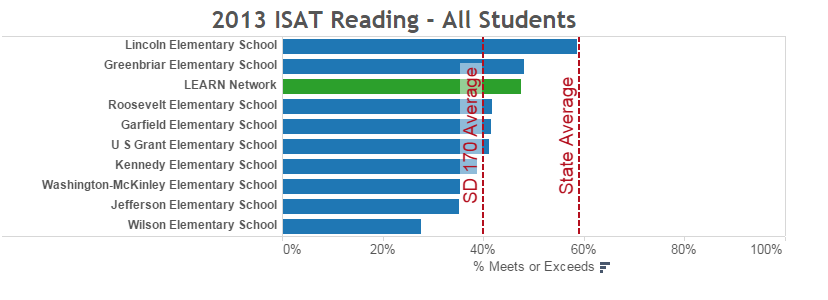
9 schools at the elementary level and Marian Catholic High School. Chicago Heights is also near several institutions of higher education, including the South Suburban College and Prairie State College, which offer both traditional and nontraditional programs. Chicago Heights students and their families also benefit from a strong network of social service providers, both in the city of Chicago Heights and throughout the south suburbs. In our conversations with stakeholders, many named Aunt Martha s, the Jones Center and other organizations that provide services to support Chicago Heights residents. 4. Student Achievement The following charts include student achievement data from the 2013 ISAT for District 170 elementary and middle schools and LEARN Charter School Network, as well as the Illinois state average for ISAT achievement in each student subgroup shown. All data was drawn from the Illinois State Board of Education (ISBE) report cards. 2 We begin with composite data for all students in reading and math, respectively, followed by results for subgroups, including Hispanic students, black students, students with limited English proficiency, and students with Individual Education Plans (IEPs). The charts also show how District 170 schools are performing in relation to each other, to the state and district averages for all students, to the state and district averages for each subgroup, and to the LEARN Network, highlighted in green. Subgroups are ordered by their relative size in District 170, from largest to smallest. Figure 1 2 We include only 2013 data here because, at the time of writing, 2014 ISAT data was not available for all schools. 9


10 Figure 2 Figure 3 Figure 4 10


11 Figure 5 Figure 6 Figure 7 11

12 Figure 8 Figure 9 Figure 10 12

13 As Figures 1-10 show, in 2013, a number of Chicago Heights elementary schools outperformed state averages for some specific subgroups. Of note, almost all schools exceeded state averages in math and reading for students with limited English proficiency. In math, most schools also met or exceeded state averages for Hispanic students. In addition, three schools exceeded state averages for black students in reading (Lincoln, Grant, and Greenbriar) and two schools exceeded state averages for black students in math (Washington-McKinley and Kennedy). At the same time, the data highlight student achievement challenges. The majority of Chicago Heights elementary schools performed below the state average for black students in both reading and math. Most schools also performed below the state average in math for Hispanic students and students with Limited English Proficiency. Many schools are also trailing the overall state average in math or reading by more than 20 percentage points. In addition, the performance of students with IEPs in Chicago Heights falls below state averages for that subgroup in both reading and math at all but one school. At the high school level, District 170 feeds into Bloom Township High School District 206. District 206 shows some upwards trends but also a need for improvement. In 2013, 24% of students in the district met or exceeded standards on the Prairie State Achievement Test (PSAE) composite and the four year graduation rate was 65%. In 2014, performance improved with 26% of students meeting or exceeding on the PSAE, while the 4-year graduation rate rose to 68%. However, in 2014, only 13% of students met the "college-ready" benchmark of 21 on the ACT, according to the Illinois Report Card. While a number of district elementary schools are performing relatively well in some subjects or for some subgroups, the data above suggest that there is a need for improvement at the elementary and middle school levels in the district. Furthermore, the outcomes at the high school level suggest that while some high school students from Chicago Heights and surrounding communities are succeeding and graduating from District 206 well-prepared for college, the majority of students are not. 5. Local Education Challenges and Needs In addition to concerns about student performance at some district schools, parents and community members highlighted the following challenges and needs with respect to education in Chicago Heights: A lower student-to-teacher ratio and more individualized instruction for students A need to provide excellent programming and instruction for students transferring during the school year (student mobility) A lack of skilled workers to fill positions in STEM fields, such as mid-level manufacturing jobs which require computer technology skills and experience As a result of our outreach to measure interest in LEARN, we have received 1,020 petition signatures in support of opening a LEARN charter school in Chicago Heights. 6. The Benefit of a LEARN Charter School District 170 is already providing families with options, such as the STEM magnet school. In addition, when filtering for all students in Chicago Heights SD 170, Lincoln Elementary School and Greenbriar Elementary School are both yielding strong academic results in reading and math respectively. We 13

14 believe that a LEARN charter school in Chicago Heights would provide another vital option for Chicago Heights families and would strengthen the district as a whole. A LEARN charter school would help the district to improve student achievement in all student subgroups in grades K-8 and increase the number of students who are prepared for rigorous college preparatory coursework at the high school level. In addition to educating students within our walls, we hope to partner with district schools on mutual sharing of best practices and professional development opportunities. LEARN has a 13-year track record of raising the achievement of traditionally underserved low-income and minority students. Our network overall enrolls 3,600 students. Of these students, 89% are lowincome, 89% are African American and 9% are Hispanic. In addition, we serve 154 English Learners throughout our Network. We do not believe that students racial, ethnic or economic background should predict their academic achievement, and our academic results bear out this belief. As shown in Figures 1-9 above, LEARN s low-income, African American and Hispanic students are significantly outperforming the state average of their peers in each of these subgroups. In our experience across eight schools, we have found that new students enter our network with a wide range of abilities, academic strengths, and challenges. In existing LEARN schools, the percentage of our student population with special education needs is 12.5%. We are especially proud of our success in growing students achievement over time. As demonstrated in the following chart, of LEARN students enrolled in our Chicago campuses for one year, only 39% met or exceeded standards on the 2013 ISAT. However, among students who attended LEARN for 5 or more years, 66% met or exceeded standards. LEARN Chicago Campuses ISAT Results by Years at LEARN Similarly, at LEARN North Chicago which opened in Fall 2012, students enrolled at the school for two 14

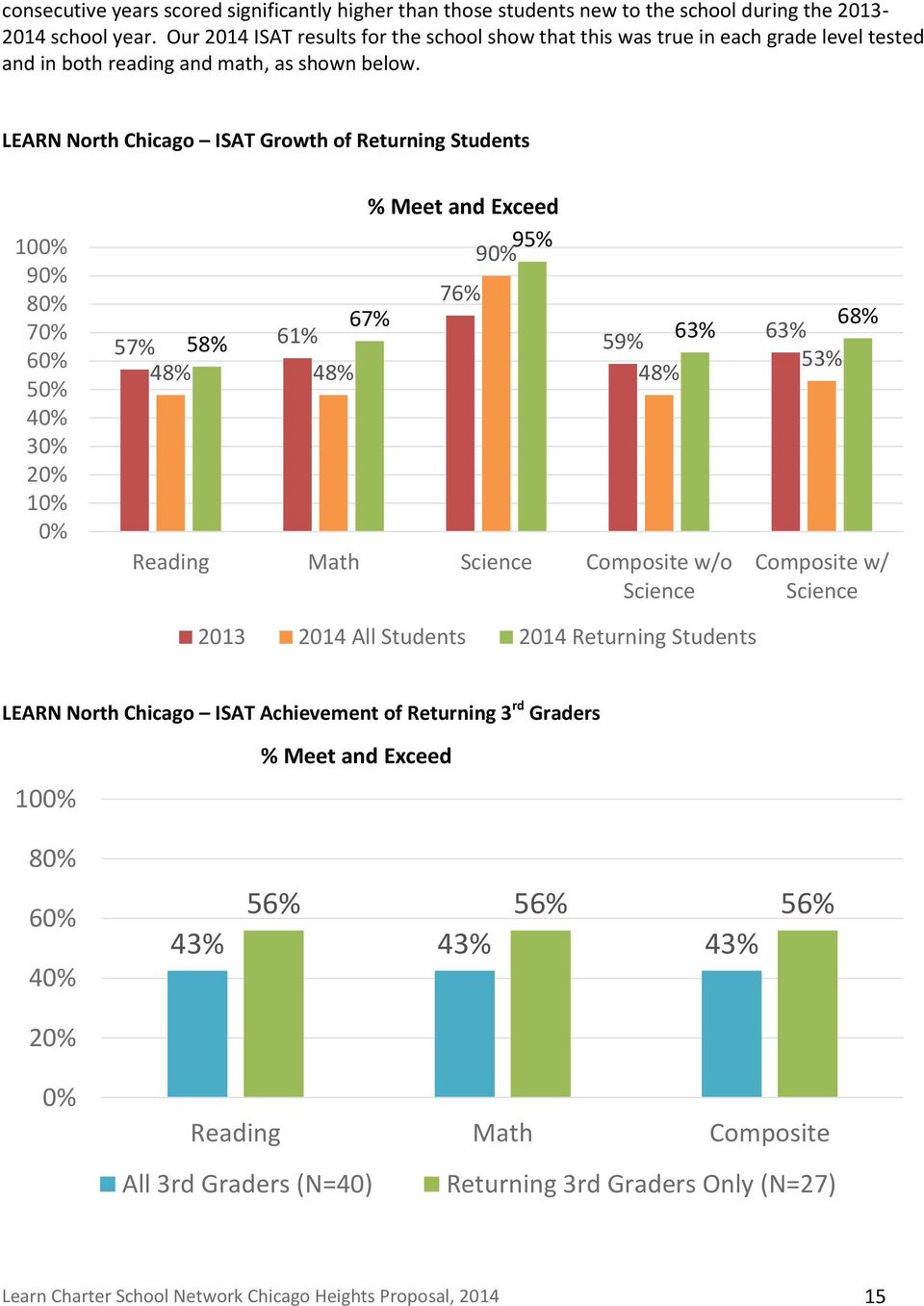
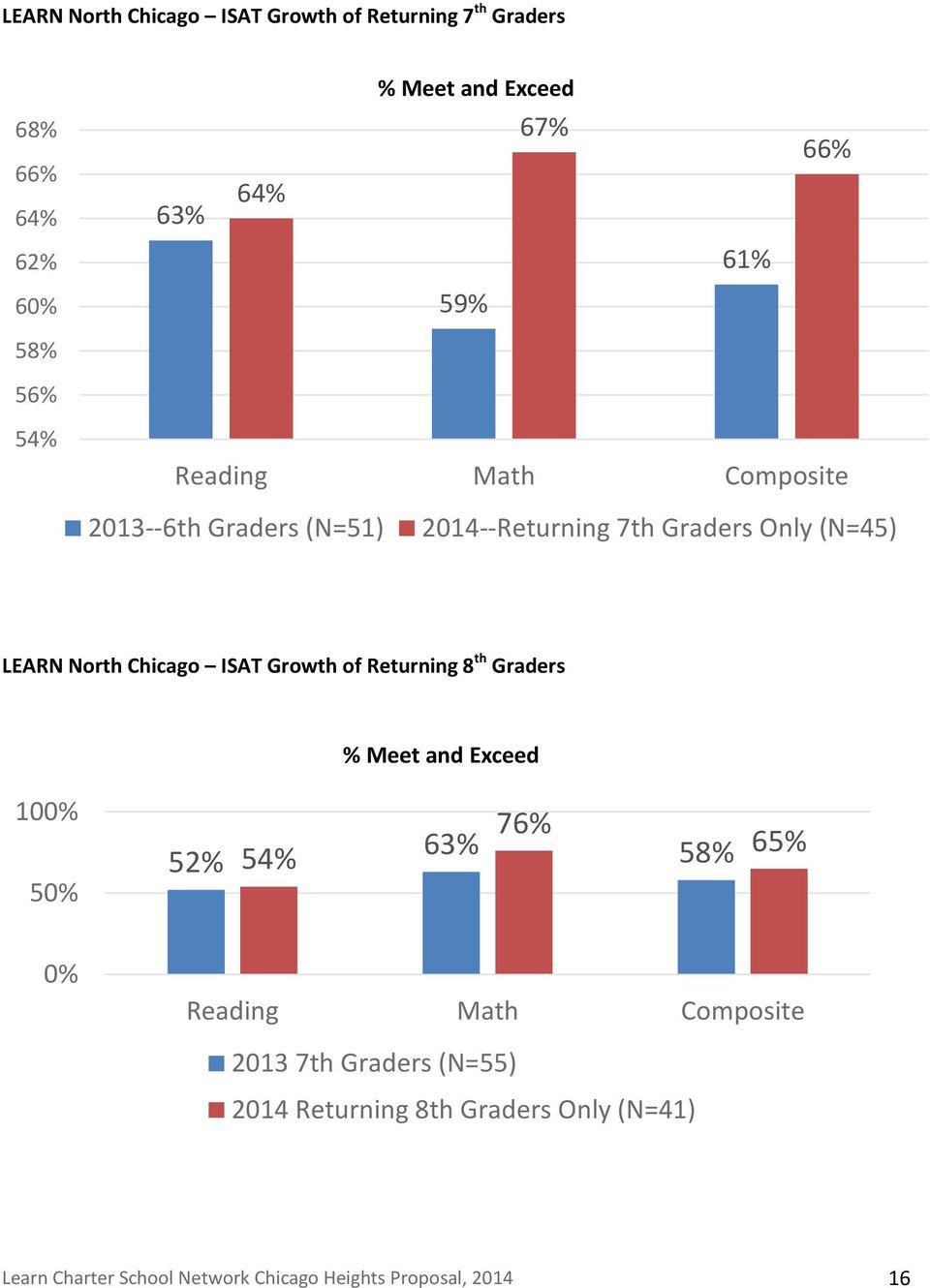
15 consecutive years scored significantly higher than those students new to the school during the school year. Our 2014 ISAT results for the school show that this was true in each grade level tested and in both reading and math, as shown below. LEARN North Chicago ISAT Growth of Returning Students 100% 90% 80% 70% 60% 50% 40% 30% 20% 10% 0% 67% 57% 58% 61% 48% 48% % Meet and Exceed 95% 90% 76% 59% 63% 48% Reading Math Science Composite w/o Science 68% 63% 53% Composite w/ Science All Students 2014 Returning Students LEARN North Chicago ISAT Achievement of Returning 3 rd Graders 100% 80% 60% 40% % Meet and Exceed 56% 56% 56% 43% 43% 43% 20% 0% Reading Math Composite All 3rd Graders (N=40) Returning 3rd Graders Only (N=27) 15
16 LEARN North Chicago ISAT Growth of Returning 7 th Graders 68% 66% 64% 62% 60% 58% 56% 54% % Meet and Exceed 67% 66% 63% 64% 61% 59% Reading Math Composite th Graders (N=51) Returning 7th Graders Only (N=45) LEARN North Chicago ISAT Growth of Returning 8 th Graders % Meet and Exceed 100% 50% 52% 54% 76% 63% 58% 65% 0% Reading Math Composite th Graders (N=55) 2014 Returning 8th Graders Only (N=41) 16

17 The results from the Northwestern Evaluation Association (NWEA) Measures of Academic Progress (MAP) assessment provide another example of LEARN students academic growth. On average, new students entering LEARN have ranked in the 37th percentile according to NWEA Measures of Academic Progress assessment. Over time, we have succeeded in substantially increasing their performance. Below, we provide a snapshot of growth during one school year: From Fall 2013 to Spring 2014, LEARN students performance across all of our campuses increased from the 46th percentile of national attainment to the 53rd exceeding the national average for all students. In addition, in each of the last two years, over 70% of LEARN North Chicago s students have grown a year or more, placing LEARN North Chicago among the top 10% for growth of schools using this assessment nationwide. Our most important outcomes, however, are those that are directly aligned to our mission as a college preparatory elementary school: graduation from a college preparatory high school and college success. To ensure that we are achieving these outcomes, we track LEARN alumni throughout high school and college. Our results to date are strong: 95% of LEARN alumni graduate from high school, and 95% of LEARN alumni attend college, with 71% enrolling in 4-year colleges or universities and 24% enrolling first in 2- year colleges. In Chicago Heights, we anticipate that our student population will roughly mirror that of the district. According to the Illinois Report Card, 95% of District 170 students were low-income, 59% were Hispanic, 35% were Black, 4% were White and 22% were English Learners. One percent of students were classified as homeless and 14% were students with disabilities. Our program will be designed to meet the needs of all students so that all LEARN scholars can achieve at high levels. We fully anticipate that LEARN will succeed in dramatically accelerating achievement for Chicago Heights students as we have done at our existing campuses. 17

18 7. Drivers of Success Throughout this proposal, we will describe the many components of our approach that help us to achieve our mission as a college preparatory elementary school. Here, we wish to highlight the following key drivers that have contributed to our success to date and that we believe will lay the groundwork for success with Chicago Heights students, as well: Student Support Services. LEARN serves a significant population of low-income (89%) and minority students from some of the most disadvantaged neighborhoods in the area. As a result, our students come to us with a range of challenges and traumas, and we believe children cannot learn unless their social and emotional needs are addressed. We ensure all LEARN schools have a social-worker or counselor on site and employ additional psychologists and support staff at the network level to support our campuses. Each of our schools also follows a social and emotional learning curriculum that explicitly teaches students skills such as managing conflicts and emotions, working as a team, building respectful relationships and making responsible decisions. In addition to providing immediate benefits to our students and broader school community, these practices are important because character development and social and emotional strength will play a vital role in students high school, college and workplace success. Talent. LEARN receives approximately 3,000 applications and interviews over 1,000 candidates each year to select the best instructors and leaders for the schools within the Network. Our Network recruits top talent from local, regional, and national education partners and universities. We seek out and hire exceptional teachers because we know that teachers have a greater impact on student success than any other factor in a school. Low Student-to-Teacher Ratio. We intentionally keep classes small (typically ranging from 20 to 25) in order to provide individualized and differentiated instruction to our students. Longer and More School Days. We provide an extended school day (8:30 am to 4:00 pm) and year, with only a six week summer break, to ensure that our students have sufficient time for instruction in core subjects, as well as enrichment classes. Rigorous Academic Program. In order to prepare students for college preparatory high schools, we provide a rigorous academic program, differentiated to serve the needs of all children, including those significantly below grade level and advanced scholars who need additional challenges or acceleration. Within our academic program, LEARN places a special emphasis on the STEM (science, technology, engineering and math) skills so in demand in today's economy. LEARN focuses on providing students with a strong foundation in STEM subjects and creates opportunities for projectbased learning that inspire students and instill them with a sense of the possibilities for creativity and teamwork involved in STEM careers. Strong Management Support. As an established network, we are able to provide each new campus with solid and extensive support for all aspects of the school s academic, social-emotional and operational needs. An analysis released by the Civic Federation in October 2014 uses 13 indicators of financial condition to provide a snapshot of the fiscal health of four Chicago charter schools or networks between fiscal years 2007 and The analysis indicated strong fiscal health for the 18

19 LEARN Charter School Network during the five-year period, with 12 positive indicators, 1 adequate indicator, and 0 negative indicators. 3 3 The Civic Federation, "The Financial Viability of Chicago Charter Schools: Financial Analysis of Selected Chicago Charter Schools," October 2014, (accessed November 12, 2014). 19

20 EDUCATION PLAN At LEARN, we believe that all of our scholars can excel when provided with high quality instruction directed by skilled and caring teachers. Beginning with clear learning outcomes, teachers provide explicit modeling and guided instruction, with ample independent practice to move students to mastery. We aim to produce life-long learners with the confidence and skills to pursue meaningful careers and make substantial contributions to their communities. 1. Curriculum and Instruction LEARN students engage in four core subjects English language arts, mathematics, science, and social studies as well as in enrichment courses in technology, visual and performing arts, Spanish, and physical education. Our instructional approach is based on the understanding that all students are individuals who come to us at different academic levels and with a variety of skills, talents and needs. We differentiate instruction and do whatever it takes to support student learning, for students across the educational spectrum, from those who are struggling to accelerated learners who are ready to go farther and dig deeper into subject matter and skill development. Using the workshop model in English language arts and math, teachers employ a structure that allows for small, flexible grouping, and the targeting of instruction on the specific skills and concepts that need to be reinforced. Small groups may include students focusing on mastering a portion of the lesson, providing time for more intensive teaching. Groups may also contain students with a variety of skill levels but a similar interest in a particular book or project, allowing the stronger learners to model good learning behaviors for those who are struggling. We train and expect our staff to be able to compose their groups thoughtfully and tactically to maximize instructional time. English Language Arts Following the Common Core State Standards, we provide a balanced literacy program with high quality literature and informational text to instill a love of reading along with instruction in phonics, grammar, and effective writing. Using Lucy Calkins Units of Study developed at Columbia University, teachers are able to challenge and support students at every instructional level using a variety of evidence-based instructional strategies. Reading Workshop. For reading workshop, teachers use assessment data to determine each student s instructional level. Teachers then develop guided reading groups to teach students at their own level. Since those at the same reading level may still vary in their mastery of specific reading skills such as understanding embedded phrases or complex letter-sound relationships teachers also organize "strategy groups" to target students needing extra instruction and practice with specific skills. In shared reading, teachers read a book aloud to model expression and comprehension strategies and to build children's vocabulary. Students then reread these books during independent practice to build fluency. In independent reading, children read a book at their own level and respond to the text in writing tasks. Teachers are able to carefully monitor the progress of every student and target identified individual students or groups for extra support. Drawing from a database of K-8 fiction and nonfiction, we provide reading material at the 26 reading levels (A-Z) identified by the Fountas and Pinnell Text Level Gradient. This structure ensures that students are able to develop and use decoding and comprehension strategies that allow them to read 20
21 progressively more complex texts, whether independently or in small groups. Younger students engage in a daily word study component, which includes phonemic awareness, phonics, spelling instruction, and vocabulary. Teachers also draw on the Leveled Literacy Intervention program, a Fountas and Pinnell curriculum, designed for students who need extra intensive small group reading instruction. Writing Workshop. Writing instruction combines mini-lessons focused on standards-aligned goals (for example: using evidence to supporting an argument, followed by guided practice and extended time for independent writing.) During this time, teachers circulate through the room, providing feedback and correction, and the also confer with individual students. Teachers help students analyze and revise their writing, using a rubric that focuses on criteria fully aligned with the Common Core State Standards and LEARN s unpacked benchmarks. At each grade level, students develop deeper mastery of argument, informational, and narrative writing. Mathematics Math instruction is aimed at students demonstrating mastery of the Common Core State Standards. It is taught in kindergarten to 5th grade with the University of Chicago's Everyday Mathematics program and in the middle school grades through the Connected Math Project developed at Michigan State University. Both programs are closely aligned to the Common Core Standards and support students in developing fluency and automaticity with basic facts and computation, while deepening conceptual knowledge and problem solving skills. Math instruction, like literacy, includes explicit teaching, followed by both guided and independent practice designed to build student mastery. Following a workshop model similar to that used in language arts, LEARN teachers build students' skill and knowledge by tailoring instruction to meet individual and small group needs. Our 90-minute math block is made up of three core components: whole-group lessons, leveled small groups/stations, and independent work. Students are regrouped throughout the school year according to their progress to ensure all are fully challenged and supported. In addition, our Academic Interventionist works with small groups of students throughout the day, either in the classroom or in a pull-out group. Students are also able to reinforce their skills with independent practice using software such as DreamBox, Study Island, and Accelerated Reading/Math. In addition to daily instruction, we incorporate Explorations, projects that occur at least once every quarter and allow students to apply their mathematics learning while practicing teamwork and writing skills. For example, teams might apply their knowledge of ratio and proportion, area, and measurement to design playgrounds drawn to scale, accompanied by written explanations. Science Our science curriculum has three major goals: for students to (1) participate in and understand the scientific process, which includes developing questions and hypotheses, collecting data, and reporting findings orally and in writing; (2) to acquire a base of knowledge in physical, biological, and earth sciences; and (3) to further develop literacy skills through close reading of primary source documents and informational text. 21
22 LEARN has already begun to transition to the new Next Generation Science Standards (which will be required as of ), and will do so for all schools and grade levels by fall Our existing curriculum already meets many of the new standards. For many years we have focused on in-depth scientific exploration through hands on-projects, complex problem-solving and the incorporation of literacy skills. In grades K-3, students build scientific knowledge through hands-on investigations using the Full Option Science System ( FOSS ) kits developed at the University of California at Berkley. For instance, 2nd-graders construct and test parachutes and balloon rockets to understand air pressure; 3rd-graders analyze and identify rodent bones and compare them to human bones to learn about the skeletal system. Language arts and mathematics are woven into the FOSS program. Books accompany each scientific topic and children learn to record and present data, and discuss and write about their findings. We also draw on the Smithsonian Institution s Science and Technology Concepts ( STC ) program at all grade levels to teach certain concepts. We will provide similar professional development and curriculum supplements to meet the new Next Generation Science Standards. The middle school grades will use the Science Education for Public Understanding Program ( SepUP ), which connects scientific investigations to societal issues such as groundwater contamination or the spread of infectious disease. It also integrates math, reading, and writing skills, and small group problemsolving. In a unit on risk assessment, for instance, students roll number cubes and flip coins to learn about probability, read historic case studies about the spread of disease, and then are presented with a hypothetical life-and-death scenario which they must work in small groups to resolve, grounding their written plan in scientific explanation. SepUP develops students as scientific thinkers who can interpret evidence to develop a deeper understanding of scientific concepts and processes. Each week, students in grades 5 8 attend one or two additional 45 minute STEM classes through Project Lead the Way. With hands on projects in engineering and robotics, students have an additional opportunity to apply their math and science learning and also make connections to careers. Social Studies Our Social Studies curriculum builds the skills and general knowledge addressed in the Illinois gradelevel benchmarks while also strengthening Common Core information text skills through the close reading of primary source documents and non-fiction. In addition, we are moving towards full implementation of the C3 Social Studies Framework, the new standards for social studies. We integrate five major Social Studies themes Politics/Government, Economics, History, Geography, Identity and Culture into our three units of study: (1) Canon of Knowledge common grade-level study topics ensuring that our students are equipped with general knowledge about our society and history, and are explicitly examining topics addressed in the state standards (2) Country Studies each class chooses a country to study and examines it through the lens of two or three of the five Social Studies themes mentioned above (3) African American and Hispanic American History and Diaspora students examine the life of an individual in context of major social studies themes, which builds their understanding of the 22
23 biography genre and experience with longer works of non-fiction. Enrichment LEARN schools provide weekly enrichment classes which expand core learning and strengthen college readiness. All students engage in weekly classes in four areas: (1) Visual and Performing Arts, (2) Technology (3) Physical Education and (4) World Languages (Spanish). The instruction in these classes adheres to state standards and is designed to respond to student and school needs and interests. Students participate in field studies throughout the year, including in and out of school field trips, guest performances, and school music and drama productions. These opportunities allow our students to explore personal interests and experience the joy of creative and physical growth in a rich variety of activities. In addition to in-class supports, we also offer after school programming for all students. Opportunities vary at each campus and include small group and individual tutoring in math and/or reading, games-based programs in both reading and math, enrichment for students who are working well above grade level, as well as additional enrichment activities such as sports and clubs. In our existing schools, our elective before and after school programming provides additional physical fitness opportunities for our students, including basketball, soccer, and track. Music options include choir and instrumental instruction. Our new middle school has launched an elected student government that will represent the student body on school-level decisions that would benefit from their input. Some LEARN campuses also provide programming before and after school hours. These offerings vary across campuses and include sports, cheerleading, dance, yearbook, band, reading or math tutoring, and other academic classes or extracurricular clubs. For example, our North Chicago campus offers the following this year: art club, robotics club, 7 th and 8 th grade basketball. We will work with parents and local community partners to determine before- and after-school offerings in Chicago Heights. For more detail on the LEARN curriculum, please see Appendix A-C. for ELA & Math Program Frameworks, Sample Standards & Benchmarks and Sample Sequence Reports & Complexity Tables. 2. Curriculum: Evidence of Effectiveness The instructional materials and programs we have purchased to support our curriculum and practices have been heavily researched and have shown strong positive growth for all student demographic groups, including educationally disadvantaged minority, low-income, and ELL populations. Because there is so much supporting evidence behind these programs, we list the relevant research links below. LEARN s track record of student achievement, described earlier in this application, provides further evidence of the effectiveness of our chosen curricular with our target student population of low-income and minority children. Everyday Math Fountas & Pinnell FOSS Engineering is Elementary
24 Science and Technology Concepts Science Education for Public Understanding Program Units of Study for Teaching Reading Meeting the Needs of All Learners In our experience across eight schools, we have found that new students enter our network with a wide range of abilities, academic strengths, and challenges. On average, these students have ranked in the 37th percentile according to NWEA s MAP assessment. While a majority of our students fall into this category, a significant percent are at or above grade level. The key to meeting the needs of our students, regardless of their academic level, has been our use of a variety of ongoing assessments to monitor their academic growth and to inform classroom instruction. In this section, we describe how we meet the needs of specific student populations and how we ensure that LEARN is addressing the individual academic and social-emotional needs of all our students. In the following section, we describe our Assessment and Data-Driven Instructional System in detail. 3a. Meeting the Needs of English Language Learners LEARN uses a home language survey to identify students who speak a primary language other than English. Based on this survey, students are screened to assess whether they are eligible for English Learner services. We expect the percentage of English Learners in our Chicago Heights school population to meet or exceed the 22% population of the district. English learners are expected to meet the same high academic standards as all students and to have full access to the same curriculum. Using the screening instrument World Class Instructional Design Assessment (WIDA) and language proficiency standards, the school will select the program models that best fit the student population. Depending on the number of students eligible for English Learner services, LEARN will offer either Transitional Bilingual Education (for 20 or more English learners of the same language classification) and/or Transitional Program of Instructions (for 19 or fewer English learners of any single language classification other than English.) Both of these models are consistent with ISBE guidelines. The program will be based on the WIDA English Language Development Standards, supporting students developing language use in academic contexts so that scholars can participate successfully in school. The standards framework consists of five components, including: Can Do Philosophy Guiding Principles of Language Development Age-appropriate Academic Language in Sociocultural Contexts Performance Definitions Strands of Model Performance Indicators Literature is available for students in multiple languages. To support English learners in the classroom, 24
25 LEARN teachers use evidence-based instructional strategies with a high probability or increasing student achievement. Support is provided through whole group instruction, small groups, one-on-one assistance, and after school. The progress of English Learners is monitored annually with WIDA ACCESS, an English language proficiency assessment that measures progress in listening comprehension, speaking, reading and writing. LEARN will consult with Chicago Heights parents during the authorization and incubation process to ensure that our EL program will meet the needs of its learners. To support the full involvement of bilingual parents in their children's education, we will establish a standing parent advisory committee for families of English Learners to allow ongoing parent input on designing and assessing the program to ensure that their children's needs are met. In addition, translators will be available for parent-teacher conferences. Parents will also have real-time on-line access to their children's grades and attendance data through our electronic parent portal, which can be viewed in multiple languages. LEARN plans to staff our English Learners program with highly qualified educators. LEARN s Senior Manager of Teaching and Learning currently coordinates Network-wide screening and assessment. LEARN has experience supporting English Learners, with significant populations at two of our eight schools. Our Director of Student Services, Chief Academic Officer, and Senior Manager of Teaching and Learning are collaborating to learn from leaders in the field and to implement the most effective EL program, to meet and exceed the ISBE requirements for English Learners. We are currently recruiting a Network English Learners coordinator and plan to recruit EL faculty for our Chicago Heights school with the appropriate level of staffing to support English Learners. We plan to collaborate closely with the District to learn about their own effective approaches with TPI and TBE programs. We are actively collaborating with the INCS English Learners Working Group and visiting effective local EL programs in a number of district-run schools and charter schools. 3b. Support for Accelerated Students We recognize that the whatever it takes mindset we employ with our struggling students is an appropriate approach for all students. Our small group differentiated instruction for accelerated learners seeks to go farther and dig deeper in all subject matters. An accelerated student can also take additional course in the grade above him/her to provide for a more challenging curriculum. LEARN North Chicago has offered this for select students. For example, currently there is a 7 th grade boy taking 8 th grade classes. Furthermore, our Academic Interventionists work with accelerated students in advanced math and reading groups both inside the classroom and in pull-out groups. 3c. Meeting the Needs of Students with Disabilities It is our belief that a child is better served in an inclusion program rather than a pullout program. For those students found to require an IEP, we first consider providing accommodations in the general classroom. Accordingly, special education intervention is provided one-on-one within the classroom so a student does not lose the benefit of the classroom experience or the instruction of their peers. When we do have some students for whom inclusion does not provide enough support, those students will receive additional time in our self- contained/resource room with the learning resources teacher, and every effort will be made to provide those additional services at a time when the student will not miss an academic lesson in the primary classroom. In some cases, curriculum may be modified insofar as volume of work or the method for demonstrating proficiency is concerned. 25
26 Through Child Find, the process through which all children (up to age 21) who may be in need of special education services are identified, located and evaluated, LEARN provides screenings, assessments (in and out of the classroom), observations and the collection of data that help to supply the information necessary in providing support for students who are not making academic progress. If through the collection of data and the lack of adequate progress made with Tier 1 and Tier 2 of our Multi-Tiered Support System (see below) supports, a student is recommended for a full evaluation for an Individualized Education Plan (IEP), the Student Support Services (SSS) team, teacher and parent will convene a multidisciplinary team to review and assess if the data supports the need for an IEP. A student's IEPs is drawn up by our SSS Team of multidisciplinary professionals and includes the student's' parent and classroom teacher. If it is determined that the students academic struggles are primarily a result of a learning and/or behavioral disability, ruling out all other factors (i.e. health, physical), the team will create an individualized plan with accommodations and modifications that are measurable, attainable, and geared toward helping the student to be successful. We determine whether a students' academic struggles are primarily due to a learning disability or whether the root cause is health, physical, behavioral or some combination of factors. The level of need in each area determines the intensity of services. Strategies included in the IEP are grounded in scientific research. We ensure that each of our students receives the accommodations necessary to become an active, engaged learner. LEARN strives to place students requiring IEPs in the least restrictive environment. Their individual growth is continually monitored to ensure that they are on-track to meet their individual yearly goals. Weekly IEP team meetings at each campus review the plans for students who are not making adequate progress. Internal audits allow us to verify that all students are receiving appropriate services for the duration specified in their IEPs. District special education audits hold us accountable as well. In addition, we use an evaluation process that has members of the Network Student Support Services Team shadow students who are not making sufficient progress through their school day to determine where they need additional support. Every semester the SSS Team also visits both self-contained special education classrooms and general classrooms with special education students to evaluate school practices. Teachers are provided with feedback and ideas for additional instructional or behavioral management strategies that might result in better student progress. The Principal is also provided with a written report with suggested improvements that can guide school-wide professional development. IEPs are reviewed and revised at least once every year. Per federal law, a complete battery of tests is offered once every three years to re-assess whether students are receiving appropriate services. Since the prevalence of specific disabilities, such as autism or ADHD, may vary from campus to campus, the SSS team works closely with our Human Resources Department to recruit special education teachers whose experience and training best match the needs of students at each site. LEARN employs the full range of specialists including occupational therapists, physical therapists, speech and language therapists, social workers, counselors, and psychologists. All of our campuses are ADA compliant. 3d. Meeting the Needs of Students Who Require Extended Year Services LEARN offers a variety of summer enrichment programs designed to reinforce instruction offered during 26
27 our already extended school year. In the event that additional services are warranted, we will work with Chicago Heights School District 170 to locate a seat at a student's neighborhood school during the six weeks we are not in session. We will provide a plan to be followed during this break with specific goals and collect information about student progress from the providing school. 4. Meeting Students Social and Emotional Needs As with many of the communities that LEARN has chosen to provide a high-quality education, our students are faced with a myriad of challenges such as incarcerated relatives, homelessness, grief and loss, depression, anger, abuse, and neglect. These issues, if left unaddressed, can undermine learning. 4a. Student Support Services Team In response to the growing needs of our students, we expanded our Student Support Services Team (SSS Team) to include a Network-wide Director of Student Support Services coordinating the team's efforts, additional special education teachers, and an exceptional number of full-time providers. These include: Three Network school psychologists Two Network case managers One or more social workers or school counselors at each campus Four nurses A Network occupational therapist and a part-time physical therapist Three full-time and two part-time speech and language pathologists The full-time social worker or counselor at each campus provides a range of services. These may include small therapeutic groups, individual counseling and family counseling as well as supports for families in crisis. We are able to refer families facing homelessness or food insecurity to appropriate services or even provide school uniforms or gift cards to grocery stores for those in temporary crisis. LEARN Charter School Network shall provide an educational environment that treats all students with dignity and respect. Our goal is to recruit and retain students living in the communities we serve. Every LEARN Charter School Network student shall have equal access to the same free and appropriate educational opportunities as students who are not homeless and/or in transitional living situations. This commitment to the educational rights of homeless children, youth, and youth not living with a parent or guardian, applies to all services, programs, and activities provided or made available by LEARN Charter School Network. In each community we serve, we establish relationships with local mental health service providers who can receive referrals for students who need more intensive support. These agencies can also provide professional development and advise our staff on serious cases. 4b. Multi-Tiered System of Supports In order to monitor and ensure that we are meeting the academic and social-emotional needs of all students, we use a Multi-Tiered System of Supports (MTSS). MTSS is an evidence-based framework that uses data-based problem-solving to integrate academic and behavioral instruction and intervention. The framework is designed to provide all students with the best opportunities to succeed academically and behaviorally in school. MTSS focuses on providing high quality instruction and interventions in varying intensities (multiple tiers) matched to student need, and monitoring progress frequently to make decisions about changes in instruction or goals. Other critical components of MTSS are Professional Development and Learning, Shared Leadership, and Family, School and Community Partnering. LEARN uses MTSS to help identify students who are most at risk and provide them with the academic, health, 27
28 behavioral and social-emotional services needed to be academically successful. LEARN s approach to curriculum and instruction is aligned to our MTSS, incorporating practices such as the workshop model of instruction that lend themselves to differentiation. Earlier in this section, we described some of the interventions used with students who progress to Tiers 2 or 3 of the MTSS. For example, we use the Fountas and Pinnell Leveled Literacy Intervention program to meet the needs of struggling readers. We firmly believe that in addition to direct academic intervention, social/emotional services are essential to the academic success of our students. At LEARN, the social/emotional services provided for students at each tier are as follows: Tier 1 In the first tier are services provided to all students such as a social/emotional curriculum that teaches skills like self-regulation. This first level of defense decreases the number of students requiring more intensive interventions. Tier 2 In the second tier are services provided for 15-20% of students with more specialized social/emotional needs. These might include small therapeutic groups or social skills groups led by a school social worker or counselor. Tier 3 The third tier addresses the needs of a very specialized population that have received services in the first two tiers and still require more individualized attention and more intensive services. This might include individual counseling from a social worker or school psychologist or a referral to a hospital or community mental health agency. Students in this tier are monitored more closely to determine if they require support past Tier 3, which is a formal individualized education plan ( IEP ). A Program of Academic Student Success ( PASS ) plan is used when conferencing with parents to set academic goals and strategies to support an academic or social area in which a student is struggling. Teachers, parents and students work together on writing the plan. An instructor or parent can request to do a PASS plan at any time during the school year. Except for children identified with a significant cognitive impairment, all students are expected to meet the same academic standards Students' who are receiving Tier 2 and 3 supports are carefully monitored through data collection that includes surveys of teachers and parents about student behavior, selfreports by the students themselves, and data reflecting academic progress. Intervention strategies are adjusted as needed. SSESSMENTS AND SCHOOL-WIDE DATA 5. Assessment and Data-Driven Instruction As described earlier, assessment and data-based instructional decisions are central to our success at meeting our students needs and accelerating their achievement. To monitor students academic progress and inform classroom instruction, teachers rely on daily formative assessments of students class work, end-of-unit assessments, and performance assessments created by classroom teachers. In addition, we use several formative assessments at intervals throughout the year: NWEA Measures of Academic Progress and Fountas and Pinnell s Benchmark Assessment System. The NWEA Measures of Academic Progress (MAP) is an adaptive, computer-based assessment, taken by scholars in grades K-8 three times per year in reading, math and, in some grades, 28
29 science. We selected MAP as an assessment tool because it allows student academic growth to be tracked across the year and from grade to grade and compared to a national average. Growth and achievement data from MAP is used to develop individual, classroom, and school-wide instructional strategies. For the last two years students in our network have achieved an annual average increase of 7 percentile points on MAP s national percentile ranking. According to the Charter School Growth Fund, one of our largest funders, our MAP results show that our students growth places us among the top performers in their national portfolio of schools, and that our thorough understanding of MAP makes us one of the most sophisticated users of this data. The Benchmark Assessment System (BAS) is an individualized diagnostic assessment that provides more detailed information with respect to students reading levels and specific reading skill development needs. We use BAS data to place students in flexible learning groups for targeted instruction based on the reading skill that needs to be strengthened, not simply their overall reading level. In addition, we use the data to help students select independent reading (both fiction and non-fiction texts) and to organize book clubs. Through the school year, the LEARN Network has used the Illinois State Achievement Tests (ISAT) to determine students achievement levels at a discrete point in time. We use ISAT results as a measure of our schools and network s achievement compared with others in the district and state. When the state of Illinois transitions to PARCC (Partnership for Assessment of Readiness for College and Career) in spring of 2015, LEARN will use that assessment data to evaluate students proficiency with respect to the Common Core State Standards in English Language Arts and Math. To prepare for success on the PARCC, all LEARN teachers teach and assess the Core Standards daily, and the Network is engaged in significant work to construct standards-aligned formative assessments which teachers can use throughout the year to inform classroom instruction. Summary of Formative and Summative Assessments Assessment Purpose Frequency NWEA MAP (K-8) To help drive instruction in the classroom To assess students individual progress including their growth rate and changes in national percentile rank over time 3 times/ year Month Administered September, January, May BAS (K-8) To identify appropriate reading levels and help drive instruction in the classroom To gauge individual student progress throughout the year 3-5 times/ year August, October, January, April, June 29
30 PARCC (3-8) in 2015 To gauge school progress over time and relative to other schools in district and state; to assess students proficiency with Common Core State Standards 1 time/ year March, May Taken altogether, our formative and summative assessments are used to guide our instruction so that it is appropriately differentiated; to set interim goals and evaluate individual teachers, grade levels, schools, and our collective network; to appraise our programs and policies; and to track our progress in positioning our students to be prepared for honors and/or Advanced Placement courses in college preparatory high schools and programs. After each assessment is administered, teachers meet with leadership team members to analyze results. These meetings may be comprised of different team members at each campus, but they all seek to achieve the same three goals: (1) accurately and completely assess each student s academic level, including strengths and areas for growth; (2) use the data to design a program of learning to meet all students needs; and (3) periodically throughout the year determine each student s progress toward their individualized annual goals. Our network s Department of Teaching & Learning provides schoolwide workshops and one-on-one trainings on data analysis and data-driven instruction. See Appendix D. Data Chat Template for one of several tools teachers use to analyze data and formulate an instructional plan. Simultaneously, at the Network level, our Board Academic Achievement Committee reviews and analyzes the results and works with principals to evaluate programs and policies and identify best practices to be recommended across the Network. This committee is tasked with identifying schoolwide and/or network-wide areas of improvement on everything from re-evaluating the math program and math block schedule to understanding student attrition and retention challenges. 6. Academic Goals In order to achieve our college preparatory mission, we have set the following school-level goals for LEARN Chicago Heights: By year end of three (3), LEARN Chicago Heights will exceed the district average with respect to students meeting and exceeding standards on the PARCC assessment By end of year three (3), at least 60% of LEARN students will meet expected growth targets on the NWEA MAP assessment in Reading and Math. [1] By end of year two (2), LEARN Chicago Heights will meet or exceed the district attendance average. In addition to these academic goals, LEARN sets and will track the following outcome goals for its future alumni: Beginning with the initial cohort of eighth graders, at least 80% of LEARN Chicago Heights alumni will attend a college preparatory high school, defined as a high school or program within a high school from which at least 80% of graduates are accepted into college. At least 90% of LEARN Chicago Heights alumni will graduate from high school in four years. [1] Once baseline data is collected in Year 1, LEARN will be able to set attainment goals for the NWEA MAP, as well. 30
31 At least 90% of LEARN Chicago Heights alumni will matriculate to colleges or universities, with at least 60% attending four-year colleges. In addition to following all reporting requirements for state assessments, LEARN will report on its progress toward these goals annually to the local school board, as well as to parents and other local stakeholders. Should the LEARN Chicago Heights campus fail to meet these goals or fall behind in meeting benchmarks toward them, the Academic Achievement Committee of the LEARN Board, with input from school and Network staff, would develop and carefully monitor a clear plan for Corrective Action. Such a plan could include the replacement of the school leader or leadership team, if needed. 7. School Culture and Climate LEARN s educational program is guided by five core values, listed below, that define and shape the culture of all our schools. One: Culture of Respect LEARN s culture of respect is expected between and among staff, parents, students and the communities that LEARN serves. Respect is reflected in LEARN s open door policy, a guiding principle in effect at all LEARN schools. Administration and instructors are always available to talk to parents and guardians. We believe it is the right, privilege and responsibility of each individual to contribute to and work in an environment of trust and cooperation. Two: High Expectations LEARN believes that the use of data helps instructors and school leaders develop targeted instructional strategies for excellence. LEARN uses school-wide instructional monitoring to ensure that academic expectations are being met consistently throughout the year. Since LEARN provides numerous resources to instructors, instructors are held accountable for student performance. Three: Safe and Nurturing Environment LEARN is committed to providing a safe and nurturing environment for our scholars to learn. As soon as a child walks through the door, LEARN promotes a sense of well-being and warmth. A goal at LEARN is to provide a safe haven for children. We aim to provide a place where learning takes place and students gain a sense of acceptance and pride. Four: Focus on the Whole Child In order to prepare students to be successful, we believe that we must also expose children to art, culture, physical fitness and a broader education that encompasses more than core academic subjects. LEARN has partnered and collaborated with many organizations both formally and informally to offer the students that we serve a broad range of activities. Additionally, under the leadership of our Director of Student Support Services, LEARN employs a team of highly-qualified individuals that specifically support the social and emotional needs of our students. LEARN aims to provide an optimal learning environment for all students and remains committed to focusing on the positive development of our scholars. Five: Family Involvement LEARN fundamentally understands the importance of partnering with families to fully develop the potential of each scholar. We believe it takes a community family members, educators, role models and other children to create and sustain a supportive, productive and engaging learning environment. 31
32 These core values, along with adherence to evidence-based practices, including small classroom size, low student-to-teacher ratio and differentiated instruction, are foundational frameworks that are established at an organizational level and promoted through each LEARN campus. Scholars experience LEARN s core values through their day-to-day experience in the school, as well as through explicit teaching. When they enter school each day, they are greeted warmly by staff members and proceed to classrooms where they are welcomed further by teachers and peers as they participate in morning meeting. They wear uniforms to support our safe, orderly environment and to highlight their professional responsibility as scholars. They enter homerooms named after college campuses and engage in discussion about college from their first day of kindergarten through eighth grade graduation and beyond. This takes the form of teachers and other staff engaging students in an ongoing dialogue about college and how our rigorous curriculum will prepare them for high school and college success. It also includes career days which expose our scholars to professionals who have attended college, college tours and explicit support for our seventh and eighth graders to identify their best fit high school and, in the case of selective schools or programs, to apply and gain acceptance. As part of our focus on the whole child, in addition to our extensive focus on social-emotional support based on individual student needs, all LEARN students participate in a social curriculum that focuses on teaching our scholars to be cooperative, assertive and responsible, to show empathy and to demonstrate self-discipline. This takes place, for example, during morning meeting, and is reinforced throughout the school day. In addition, our campuses host Community Meetings each Friday in order to bring the entire school community together and reinforce our school values. This is also an opportunity to celebrate those scholars who meet and exceed our high expectations. While each Principal is expected to uphold the five non-negotiable core values, they possess the autonomy to develop school-specific academic and cultural initiatives, such as the student choir at LEARN-Romano Butler campus or student government at the middle school level. These initiatives will serve as a way for campus leaders to distinguish themselves and provide a way to address the academic and cultural needs of each unique school community. 8. School Calendar and Daily Schedule All LEARN schools incorporate both a longer school day and a longer school year than most traditional public schools. LEARN students attend school from 8:30 4:00 or 7.5 hours each day. Our school calendar typically includes 197 student instructional days, 3 report card days and 10 professional development days. In response to the needs of our students and parents, we offer an extended school day and an extended school year. Many of our students begin school significantly below average, and we use the additional instructional time to accelerate their learning and get them college-ready by the time they leave us, which NWEA tells us is around the 70 th percentile by 8 th grade. We provide a daily 90-minute Math block, 2-hour English/Language Arts block, and Science and/or Social Studies in every grade. Equally important, every student has lunch and recess and enrichment classes (such as gym, art, music, world language, and technology) every day. Our intention is to foster the love of learning, while giving them the time and resources to work deeply in each subject area with sufficient breaks and rest periods in between. 32
33 There are built-in differences between the primary grades and the middle school grades that support the developmental needs of the respective age groups. For example, phonics instruction and word work are part of the primary grades schedule as these young students begin to learn how to read, while disciplinary literacy is embedded in the middle school humanities block as older students read to learn content and concepts in a deeper way. Spread throughout the school year, teachers benefit from approximately 10 professional learning days. These learning sessions are delivered by a combination of the network Teaching and Learning team and the school leaders, and are designed to improve teachers instructional practice so that they can increase student achievement. Some of our most recent trainings include how to: teach to the Common Core Standards, use evidence-based strategies, and use formative assessments and datadriven instruction. Please see Appendix E. Proposed School Year Calendar and Appendix F. Sample Daily Schedules. 9. School Policies 9a. Student Code of Conduct Please see Appendix G. LEARN Student-Parent Handbook, which explains our student code of conduct and expectations. Our Student Code of Conduct has a special emphasis on working with parents and staff and demonstrating flexibility when considering the age of the students involved and the severity and intent of the offense. 9b. School Safety With regard to safety, our Operations team annually shares the Network s six senses of ensuring safety for students and adults in our buildings: (1) Stop unfamiliar and unescorted persons (2) One way in/one way out (3) Lock all doors and windows after drop off and dismissal (4) Designate a first person in and last person out for each building (5) Enforce a buddy system for all staff leaving the building in the evenings 9c. Promotion/Retention Determining a child s readiness for promotion to the next grade level is a complex decision, which involves input from the child s parent/guardian under the constraints of the rules below. To be promoted to the next grade, two or more of the following requirements must be met: Requirement 1: Core Academic Classes The student has earned a C- or better in all core subjects (reading, writing, math, science, social studies). Requirement 2: Standardized Assessments Based on internal assessments (MAP and STEP/BAS) and external assessments (ISAT/PARCC), a student must not be more than one year below grade level in any core academic classes. Requirement Number 3: Attendance A student has less than ten unexcused absences. More than 20 unexcused absences may result in non-promotion. (Note: Our policy states that three tardies equal one unexcused absence.) 10. Professional Development LEARN understands that great teachers choose to work at schools that have a strong teacher learning community. Our professional development program builds a sense of common purpose among faculty 33
34 and shared responsibility for student learning. The primary goal of the program is to support teachers in meeting school-wide goals for improved student learning. A secondary, but important goal is to fully develop the staff as educators who have individual professional goals of their own. A third and final program goal is develop a leadership pipeline and grow the teaching staff so that they can take on roles as teacher-leaders or even administrators. 10a. Induction Period At each new LEARN campus, we conduct two weeks of professional development for new teachers and one week for returning teachers. Time is devoted to LEARN s culture and core values, common school culture and language, and team-building. Teachers receive intensive training on Common Core-aligned instructional planning, assessments, instructional methods (eg. readers and writers workshop, differentiated instruction) and implementing curriculum (eg., Everyday Math and FOSS) in each subject area. Specific induction sessions include: MAP three sessions for new users to address what is it, how is it used in the classroom, how is it used by the network, how to navigate to the tables, how to analyze the results, how to apply your findings Everyday Math four half-day sessions with separate training for new users and experienced users by grade bands; training provided by staff from University of Chicago s Center for Elementary Mathematics and Science Education staff (some of whom authored the text) Math Leadership Training Institute monthly training of the trainers on how to support teachers in implementing good math practices FOSS three sessions throughout the school year for new users; separate sessions will be provided for groups of modules Balanced Literacy initial training will be provided to teachers around balanced literacy instruction as well as in individualized assessment using STEP and BAS. Additional literacy training will be provided throughout the school year on an as identified basis See Appendix H. Sample Induction Agenda, our professional development schedule and Appendix I. Sample Teacher Common Core Training Agenda. 10b. Professional Learning Schedule and Plan Our professional development structure is as follows: Bi-weekly all-faculty site-based PD sessions followed with implementation supports Bi-weekly collaborative planning sessions focused on analyzing data to plan small group instruction and plan for units of study Professional study groups for teachers to read professional literature and discuss how to put it into practice in their classrooms Individual Professional Development Plans Ten dedicated Professional Development Days during the school year Our schools use Professional Learning Communities as the cornerstone of their professional development program to improve teaching and learning. These meetings are an opportunity to review student work, analyze assessment data, and troubleshoot classroom practices and teaching concepts. What makes these meetings unique is that the topics are teacher-directed, though the meeting may be led by any of the staff members, including a school leader. They are held once or twice a month, meeting for an hour each time. Alternating weeks are reserved for common grade level planning time. 34
35 Development and planning time is used to focus on one particular school-wide instructional goal that was either collectively agreed upon as a goal, or identified based on MAP and STEP results. This is typically led by a leadership team member and may involve bringing in outside consultants and experts. 10c. Network-Based Professional Development We have built into our calendar ten full-day professional development days. These sessions currently are focused on supporting the implementation of Common Core State Standards, along with its "Instructional Shifts" pedagogy. The Network has recently significantly expanded resources for teaching and learning, with a Chief Academic Officer, Data Analyst, Director of Teaching and Learning, two Senior Managers of Teaching and Learning, and a coach of the school-based instructional coaches. 10d. Professional Learning Program Evaluation Each of our principals has school-wide professional development goals unique to their respective campuses. In conjunction with their leadership teams, our principals set guidelines for how and when they will be measured, and formulate a plan on how to achieve those goals. Student academic outcomes as well as separate teacher, student, and parent surveys factor into the assessment of the program s progress. For Chicago Heights, it will be essential that the Student Support Services team is involved in helping to set these goals and monitor progress towards them. Similarly, their expertise will be required in the professional development of the staff so that teachers are effectively able to work with students on academic as well as non-academic challenges. 10e. Teacher Evaluation Teachers are formally evaluated through a comprehensive cycle which occurs once or twice a year. A uniform performance assessment plan is followed, based on an instructional framework with a strong evidence base (Charlotte Danielson s Framework for Teaching.) New teachers are evaluated at 120 days to ensure they are on track for expected progress. The performance evaluation document is shared with teachers at the beginning of the year so they are clear about what is expected and what is being measured and how. The first evaluation weights academic outcomes, instructional planning, instructional practices, classroom environment and professionalism on a uniform four-point scale. In the final evaluation, academic outcomes, namely MAP and PARCC results, count for 60% of the total evaluation rating. The information used to complete these evaluations is based on on-going (typically weekly, unscheduled) classroom observations and evidence gathering, followed by weekly feedback conferences between leaders and teachers. The data collection and actual completion of the evaluation forms is an enormous and important undertaking by principals and assistant principals, school, and involves support from the Network s human resources personnel as well. Principals also meet with their teachers one-on-one, sometimes referred to as check-ins to gauge the their level of satisfaction with the overall school environment and solicit ideas for areas of improvement. This is a vital way in which the principals and the Network learn about the needs and interests of its staff, and can respond to the betterment of the schools over all. 35
36 10f. Developing Teacher Leaders Similar to our belief that differentiation is important for our students, we know that we must provide individualized support for our teachers. Thus, teachers each have their own professional development goals which are shared and discussed with their school leadership team who, along with the instructional coaches, provide teachers with one-on-one coaching. With their coaches, teachers create an implementation plan with progress checks built-in to ensure they are working towards these goals throughout the year. Teachers may elect to demonstrate leadership through the facilitation of team meetings, leading special initiatives at the school level, co-facilitating a network-wide professional learning day, and participating in Principal and Teacher Leadership Institute mathematics leadership development session. 11. Student Recruitment LEARN will open the Chicago Heights school serving grades K-3 and grow by one additional grade every year. Each grade will have two classes of approximately 20 to 25 students per class. Primary grades (K-3) will be supported by two teachers per classroom, while intermediate (3-5) and middle school grades will have one teacher per classroom. Enrollment Chart Grades K - 3 K - 4 K - 5 K 7 K - 8 Student Enrollment This enrollment plan allows us to start on a smaller scale and establish a strong culture based on our five core values, as well as make any needed adjustments as we continue to better understand the specific needs of Chicago Heights students. 11a. Student Recruitment Strategy LEARN will partner with community organizations to introduce Chicago Heights families to our school's values and educational program. Information sessions led by our Principal and Recruitment Managers will ensure that all families have the opportunity to make an informed decision about entering our lottery. These partnerships will include, but are not limited to, the Jones Memorial Community Center and local churches and daycare centers. In addition, LEARN will publicize the Chicago Heights school opening on the internet and through community media (e.g. local newspapers, billboards and radio stations.) We will also execute at least two direct mail campaigns to all households with school-aged children within a two-mile radius of the school site. We are also interested in working with community leaders and the district to identify sectors of the community, such as the east side of Chicago Heights, to prioritize in direct mail campaigns and other outreach. 11b. Admissions Policy In accordance Illinois Charter School Law, LEARN schools are open to all students who reside in the district in which that school operates. If there are more applications than available seats, LEARN uses a 36
37 lottery system. Once available seats at each school have been filled, applicants will be placed on waiting lists by grade in the order that they were drawn in the lottery. Any slots that become available will be offered to those waiting, in the order that they are listed. Brothers and sisters of LEARN scholars who are currently enrolled at the LEARN school for a given school year will be given Sibling Preference in the following year. If there are a greater number of siblings applying than there are available slots at a given campus, siblings will be placed in a Sibling Lottery for that campus which will be drawn before applicants in the general pool. 37
38 LEADERSHIP, OVERSIGHT, STAFFING & OPERATIONS T 1. Design Team Capacity The LEARN Design Team is comprised of individuals who are passionate about providing a high quality education to underserved communities. Together, they bring significant experience starting and operating charter schools with multiple areas of expertise including teaching and learning, finance, operations, student support, community engagement, and development. President and CEO, Gregory White, has led and overseen the growth of the LEARN Network from one school serving 330 students to eight schools serving almost 3,600 students. Under his guidance, both as CEO and as a decade-long Board member, LEARN has transformed into a sophisticated organization whose track record has attracted national attention. Director of Finance, Joycelynn Stone, manages the finance and accounting functions of our charter network. She has over twenty years of experience in providing business start up consulting, budgeting, forecasting, and audit coordination and tax preparation. Our Chief Academic Officer of Teaching & Learning, Elizabeth Goettl, brings over ten years of experience teaching in grades K-12; 17 years as a school principal at three schools; two years as Assistant Superintendent, three years as President/CEO of a high school; five years as Chief Academic Officer for the nation-wide Cristo Rey Network; current efforts with the LEARN Charter School Network have developed her knowledge and skills to support high-performing learning communities. Our Chief Talent Officer, Christina Jordan, brings over eight years of experiences in operations and human resources (HR) management. Prior to LEARN, she served as Director of HR for Success Academy Charter Schools and the Noble Network of Charter Schools, the largest charter networks in New York City and Chicago respectively. At Success, she scaled the HR function through a rapid twoyear expansion from 9 to 32 schools. She leverages her private and non-profit sector experience managing talent recruitment, on-boarding, employee relations, performance management, HRIS, compensation, and payroll to lead recruitment and HR strategy and operations for LEARN. Director of Technology and Facilities, Chris Maynard, is responsible for streamlining all facilities and technology operations. Chris manages the custodial, maintenance, safety and security, and construction for LEARN s eight school facilities. Chris also has over 25 years of experience managing technology and has identified, defined and implemented key technology initiatives that support organizational goals in collaboration with senior management and internal stakeholders. Chris manages external vendor partnerships, develops appropriate and timely contingency plans and oversees all aspects of system testing and quality assurance reviews. Director of Development, Kristen Denison, works in concert with LEARN s CEO and Board of Directors to cultivate and steward new and existing institutional and individual donors, and is also responsible for grants and gift management, marketing, messaging and external relations. Her goal is to free school leaders from the onus of managing key stakeholder relationships so that attention can be focused on driving instruction. Each year, Kristen leads fundraising efforts in excess of $3 million in support of LEARN schools. 38
39 Director of Student Support Services, Ramona Robertson, manages the Student Support Services team made up of special education teachers, social workers, counselors, case managers, clinicians and external social service partners across all campuses. She brings 14 years of experience working with and addressing the social/emotional needs students in urban schools and an additional seven years of experience working within child welfare. Senior Project Manager, Jamila Trimuel, serves as lead point person for this Chicago Heights proposal. In addition, she is also charged with building relationships with key stakeholders in the communities we serve. She brings eight years of experience in project management and strategic planning in the health care industry and five years leading non-profit mentoring and leadership development programs for youth in the Chicagoland area. Senior Manager of Data & Assessments, Dao Kambara, is responsible for execution and analysis of interim and annual student assessments and also provides curriculum support and data analysis as needed by the schools and the CMO. Dao was instrumental in LEARN s implementation of MAP and continues to help LEARN push the envelope as part of our Teaching and Learning team. See Appendix J. Resumes for the Learn Design Team. 2. Board of Directors The Board plays a significant role in overseeing both the operational and academic aspects of our Network. It includes both long-time members who have been instrumental to LEARN's past successes and new members who embrace LEARN s core values and are eager to help lead the Network s growth. All possess a complementary mix of skills, experience and community connections. 2a. Board Structure The main roles and responsibilities of the LEARN Board of Directors include: Leadership Selection The Board is responsible for hiring, coaching, evaluating and supporting the Network s President & CEO. Planning and Policymaking The Board sets the vision and mission of the growing Network and ensures effective organizational planning. For Chicago Heights, it will establish the major milestones for growth and success. Oversight The Board sets and monitors CEO and Network performance standards to ensure maximized growth opportunities. Accountability for Educational and Organizational Outcomes The Board monitors and strengthens the organization's programs and monitors the success of LEARN s academic program, as measured by internal and external assessments. Fundraising The Board is responsible for ensuring funds are available to carry out the mission of LEARN and that available resources are effectively aligned to achieve LEARN s established outcomes. The LEARN Board has four standing committees that provide recommendations to the Board: the Academic Achievement Committee, the Finance Committee, the Development Committee and the Real Estate Committee. The Academic Achievement Committee works with the CEO and school principals to evaluate LEARN s educational strategy and establish achievement metrics. The committee regularly 39
40 monitors the consistency and effectiveness of LEARN s educational programs. The Finance Committee ensures accurate financial budgeting, tracking and reporting by overseeing all accounting, bookkeeping, and financial matters. Additional oversight responsibilities include the provision of timely reports for Board decision-making and ensuring that all financial transactions of the schools are transparent and readily available for public inspection. The Development Committee ensures that the LEARN Network raises sufficient funds to support growth and expansion of the Network. The Real Estate Committee works with the CEO and Director of Technology and Facilities to evaluate real estate options, negotiate lease/purchase agreements, and provide oversight on construction projects. 2b. Board Members Loren Beadle, Chairman of the Board of Directors CEO, Island Sport, LLC Loren is the founder of Tara Business Ventures, a venture fund based in Chicago, Illinois. He is also the owner and CEO of Island Sport, LLC, a retailer based near Charleston, South Carolina, and a former partner at Accenture, a $30+ billion global consulting and technology company. During his distinguished 23-year career at Accenture, he led the company s Midwest retail consulting practice, with over 800 employees and $100+ million in annual revenues. Loren holds a BS in systems analysis from Miami University. In addition to supporting LEARN, Loren actively participates in a number of educational and charitable organizations in and around Chicago. He is also currently helping to lead a $500 million capital campaign for his alma mater, Miami University. See Appendix K. Bio for Loren Beadle, LEARN Board Chairman. Janice Lucchesi, Board Treasurer - Vice President of Tax, North American Businesses, Akzo Nobel Inc. Treasurer of LEARN s Board of Directors, Lucchesi has over 25 years of experience in tax, including 12 years in public accounting and in her current position with Akzo Nobel Inc. She is a member of the Executive Committee of the International Fiscal Association, Board of Chicago Finance Exchange, The Tax Council, Illinois CPA Society, and on the Advisory Board of the George Washington University/IRS Annual International Institute on International Taxation. Lucchesi holds a bachelor s degree from Rice University and earned a masters degree in management from Northwestern University s Kellogg Graduate School of Management. Jennifer D. Molinar, Board Secretary Molinar brings an array of legal expertise to the Learn Charter School Board. She is currently an attorney for CVS Caremark where she specializes in litigation management. Previously she worked in both the private and public legal sectors for Kirkland & Ellis LLP and the United States Attorney s Office. Molinar also has educational experience having taught in New Orleans as a Teach for America Corps Member and is a current member of the Hispanic Lawyers Association and the American Bar Association. She graduated with honors from Dartmouth College with a bachelor of arts in government and religion and earned her law degree from the University of Chicago School of Law. Bryan A. Schneider Schneider is Director & Legal Counsel of Government Affairs at Walgreens Health Service. He brings an assortment of experiences and professional skill sets to the LEARN board. He has received professional accreditations practicing law and also as a certified public accountant. Prior to his current position, where he remains responsible for the development and management of governmental 40
41 initiatives at the federal, state, and local levels for Walgreens Health Services, Schneider worked with law firms Sidley Austin LLP and Harris Kessler & Goldstein. He is a current serving member on the Illinois State Board of Elections. Schneider received his bachelor of science in accountancy from Tri-State University. Furthermore, Schneider graduated magna cum laude from University of Wisconsin Law School, and earned a master s degree in business administration with a concentration in finance from the DePaul University Graduate School of Business. Charles Campbell Campbell has over 30 years of financial and management consulting experience throughout the private sector. He began his finance career at Arthur Andersen & Co. and soon thereafter became Sr. Vice President and Chief Financial Officer of Kitchens for Sarah Lee of Sara Lee Corp. Campbell has held several upper management positions throughout his career, demonstrating both his diversified skill set and in-depth knowledge across an assortment of industries. He currently is a Partner in strategic management consulting for The Everest Group. Campbell graduated from Stanford University with a bachelor s degree in economics and earned a master s degree in business administration from the University of Chicago Graduate School of Business. Leslie J. Anderson - Senior Vice President/District Market Manager at Harris Bank, Leslie comes to LEARN s Board with 18 years of banking experience and expertise. She is currently with Harris Bank where she is responsible for the growth and development of the Chicago Market Business District which consists of businesses with revenues up to $50 million. She began her career in banking at NBD Bank Chicago where she completed a formal credit training program, spent two years as an internal auditor, and served as a lender in their Asset Based lending group. For the past six years, Leslie spent her time with Fifth Third Bank as Vice President/Team Leader responsible for developing their Chicago Middle Market Banking group and establishing the bank's Middle Market Healthcare team. Leslie holds a B.S. in finance from Hampton University (Hampton, VA) and an MBA from Northwestern University's Kellogg Graduate School of Management. Vineeta Raketich - Raketich is Managing Director, Global Operations & Client Relations at Harris Associates. Vineeta, who has twenty years of business experience, joined her current firm Harris Associates L.P. in In addition to her Managing Director roles she serves as a Vice President for The Oakmark Funds. Previously, she was Supervisor, Mutual Fund and Institutional Services with Harris Associates L.P.; and an Analyst at The Barnes Alliance. Vineeta holds a BS in finance from DePaul University and a master of science in taxation from DePaul University. Susan Snyder Snyder is a former Vice President of Market Operations for AT&T Wireless. Over the course of her career, Snyder held a variety of positions and led efforts in marketing, sales, and strategic planning. Snyder also served as the Winnetka Park Board Commissioner for eight years. Snyder received her BS from the University of the Pacific and her MBA from Harvard Graduate School of Business. Daniel T. Fahner Fahner focuses his practice on a broad range of commercial litigation matters, as well as corporate internal investigations and compliance and FCPA investigations. He also has substantial regulatory experience in the areas of immigration and disability rights. Fahner has experience in all phases of litigation and has represented litigants in state and federal courts, as well as in arbitrations and mediations. From 2007 to 2009, Fahner served in the United States Department of Justice. As Counsel to the Assistant Attorney General in the Civil Rights Division, he supervised the enforcement of federal antidiscrimination statues, including the Americans with Disabilities Act and a wide variety of 41
42 employment and immigration laws. As Senior Counsel for the Office of Legal Policy, Fahner analyzed complex legal and regulatory issues and coordinated the Department s efforts on a number of policy initiatives, including those involving disability rights and immigration. He also conducted judicial vets for potential nominees for Article III judgeships. In both capacities, he regularly worked with the White House, other Executive Branch agencies and Congress on regulatory and legislative issues. From 2005 to 2007, Fahner served at the United States Department of Homeland Security as Special Assistant to the Assistant Secretary in charge of Immigration and Customs Enforcement. In that capacity, he handled a wide variety of policy and legal issues related to ICE's enforcement of immigration and customs laws. Prior to his time in government service, he was an associate in the Litigation Department of Greenberg Traurig s Chicago office from 2001 to Fahner received his bachelor's degree in political science from the University of Michigan followed and his JD from Northwestern University School of Law. Margaret V. Romano Life Trustee- Romano has been instrumental in the development and transformation of LEARN Charter Elementary School from its initial stages. She has experience teaching in the Chicago Public School system and has familiarized herself with the LEARN philosophy by volunteering at the Lawndale Community School (what is now LEARN Charter School) for 25 years. She has served on the LEARN board for over 20 years and was honored as a Life Trustee on the LEARN Charter School board in Romano earned her bachelor s degree in education from the Chicago Teachers College. 3. Staffing Model We firmly believe that it is critical for every student to be taught by a highly-qualified and committed educator. In addition to our certified classroom teachers, schools are staffed with additional academic and non-academic personnel, which include: Academic Personnel Position Academic Interventionist Enrichment Teachers/Aides Description Assists identified students with supplementary instruction based on student needs, working with them one-on-one or in small groups. Provide enrichment classes like Technology, Art, Spanish, Music and Physical Education Student Support Personnel Position Description High School Supports broader student body, and assists our middle school students and Placement Advisor families in navigating the high school selective enrollment application process; High School Placement Advisor will be hired in Year 4. English Learner Specialist Develops and implements the curriculum and professional development to support instruction for all English learners. Two EL Specialists will be hired in Year 1. 42
43 STEM Specialist Social Worker / School Counselor Special Education Paraprofessional School Nurse Expose students to STEM (Science, Technology, Engineering, and Math)-related fields, the process of working as part of a team, and the importance of critical thinking, knowledge application, and communication skills to solve scientific problems collaboratively. Hired in Year 1 Addresses social/emotional needs of students dealing with trauma, such as homelessness, grief and loss, depression, anger management, abuse, and neglect; One will be hired in Year 1, and an additional Social Worker/School Counselor is projected to be hired in Year 4 Under the direction of the school principal, the special education teacher plans and provides for appropriate learning experiences for students with disabilities in a variety of educational settings hired in Year 1. Provides limited medical attention, administers prescribed medication and ensures the school is in medical/health compliance with District/State guidelines; Will be hired in Year 1 (part-time). Critical to the success of the school will be the Leadership Team: Leadership Team Position Principal Description The principal is ultimately responsible for all aspects of the school s culture, academic success and operations. Assistant Principal Instructional Coach Office Manager Will act as a second in command under the Principal as the school grows with responsibilities that include parent relations, discipline, school policy/programs and community relationships; will be hired in Year 1. Brings deep content and curriculum knowledge, will work with the Principal to set school goals and lead professional development and performance management of teachers as well as developing the school community and culture; Will be hired in Year 1. Takes responsibility for managing student and school records, assists with school compliance and acts as first point of contact for parents; will be hired in Year 1. See Appendix L. Sample Job Descriptions for descriptions of the following positions: Principal, Assistant Principal, Instructional Coach, Academic Interventionists, Office Manager, K-2 Classroom Instructor, 3-5 Classroom Instructor, Middle School Math Instructor. 4. Staff Recruitment The Human Resources Department works closely with principals to develop a strategic approach to hiring new teachers and staff and to reassign existing employees transferring within the Network. We recently hired a new Chief Talent Officer to lead the Human Resources department and build its capacity to 43
44 support the Network's future growth. Currently the department includes our Assistant Director of Human Resources, Matt Smith, who has primary responsibility for leading and managing talent recruitment. The recruitment effort is supported by our Senior Manager of Human Resources, Melinda Sabido and our Human Resources Associate, JacQuisha Gray. LEARN sees the recruitment and hiring of exceptional teachers as one of our organization s most important tasks. It is crucial that we attract and select instructional staff with the necessary experience, skills, and dispositions to teach in an urban environment. During a rigorous hiring process that includes four interviews and a demonstration lesson, we seek evidence that candidates are ready to support and challenge students regardless of their instructional level or cultural background. For instance, teachers must show that they understand how to analyze use student work and test data to identify students needs and plan instruction. They must demonstrate that they share our core values of high expectations, respect for students and families and attention to whole-child development. We seek out teachers with a passion for their profession and a drive to work collaboratively with colleagues and with parents to help all students' reach their full potential. Appointing outstanding principals is likewise a top priority. To ensure a pipeline of excellent candidates, we continually work to develop the skills of our instructional coaches and assistant principals. Training and mentoring our own future principals means that candidates step into new positions with proven skills in management and instructional leadership, commitment to our five core values, and knowledge of our programs and practices. We have identified several leaders within our Network who could assume this role and plan to finalize school leader selection soon after authorization. In addition, we will identify an assistant principal who will complement the skills and experience of the school leader. This individual may come from the LEARN Network, the Chicago Heights area, or through a national search. LEARN principals are recruited through our Human Resource Team and selected by the President/CEO, with input of senior leaders and principals. Principals are supervised, supported, and evaluated by a designated supervisor. Every principal reports to either the President/CEO, the Chief Academic Officer, or the Senior Principal. In the summer of the school year, each principal develops specific and measurable school goals for the coming academic year. Each goal includes key metrics to evaluate the goal, along with specific action steps and a timeline for each goal. Through regularly scheduled school visits and frequent communication, the principal receives ongoing feedback and support in accomplishment of those goals and in problem solving and decisions around day to day school leadership needs. Principals receive a written, summative evaluation in the spring of each school year. We believe that it is important for our employees, including administrators, teachers and support staff to reflect the great diversity of the students we serve and the world they live in. Wherever possible, we will make every effort to hire local talent (including parents) for various staff positions. In Chicago Heights, this will also include those who live in the community and have particular experience working with students in the South Suburbs. Our recruitment process is thorough and aimed at attracting the best candidates, with an emphasis on hiring locally. In opening our North Chicago campus we advertised open positions with the local chamber of commerce and local newspapers. Upon receiving our charter approval we held a job fair specifically for that campus at a local park district location. The event enabled us to introduce LEARN to the community and while identifying some exceptional candidates. We plan on hosting similar events in 44
45 Chicago Heights. Networking with local education, civic, religious, and elected leaders is another important recruitment strategy. We will develop new relationships in the Chicago Heights area through contacting employment ministries at local churches, connecting with educational nonprofits, reaching out to local chambers of commerce, and attending community events. Open positions will also be advertised on-line and in local papers, including the Southtown Star, the Daily Herald- South Suburbs Edition, The Times of Northwest Indiana- South Suburbs Edition. As LEARN's reputation grows, we find that our recruitment efforts are gaining considerable momentum. Our staff has become increasingly well-qualified and diverse in terms of age, background and ethnicity. Since talent attracts talent, we encourage our employees to refer strong candidates for open positions, and approximately 20% of our new staff each year comes through such referrals. Attracting the most promising new teachers is also part of our strategy. Towards that end, we will network with national and regional education schools and professional contacts. In addition, we will target specific colleges and universities in the area including (but not limited to): Chicago State University South Suburban College Governors State University Purdue University Calumet Calumet College of St. Joseph Prairie State College Teacher salaries within our network are organized into salary bands, with teachers assigned to a band based on experience and the results of performance evaluations that include both classroom observations by an administrator and their success in producing strong academic outcomes for students. Salaries vary by community or district served, but we review salaries at local schools to ensure that our teacher compensation meets or exceeds that of other area schools. 5. Hiring Process Our hiring process is split into phases and outlined below: Hiring Process Responsibility Human Resources Action A Recruitment Services Agreement will be reached between the Chicago Heights campus Principal and the LEARN Human Resources Department that includes External Posting Resources: career websites, charter organizations, university and college career centers AND Sourcing Strategy Resources (including but not limited to): Teach for America, New Leaders for New Schools, Academy for Urban School Leadership, Golden Apple Scholars, University of Chicago Urban Teacher Program, Inner City Teaching Corps 45
46 APPLI CAN T POO L DEV ELOP MEN T ONBOARDING NEW HIRE PROCESS PRE-OFFER APPLICANT SCREENING Applicants Human Resources Hiring Manager and Principals All applicants are encouraged apply for positions via AppliTrack through our website Each applicant is required to respond to three essay questions. Prescreen applicants for minimum qualifications. Create candidate summary for Hiring Manager and enter notes into AppliTrack If candidate is not a fit, do not go to next step HR sends rejection letter Conduct interview to determine if there is a level of interest to initiate the Demo Lesson (requires interview rubric) If NO Human Resources will send rejection letter If YES Demo Lesson is arranged by Hiring Manager or Principal If successful in the Demo Lesson Applicant is interviewed and endorsed by an organizational leader or panel All candidates should be asked to do a writing sample during the hiring process to demonstrate necessary communication skills and critical thinking **(Principals and/or Hiring Manager have the option of using additional rubrics to interview candidates which are aligned to the Illinois teaching standards. This process may call for a Scenario Presentation or School Observation.) Hiring Manager Conduct written references or observations Hiring Manager with Human Resources Hiring Manager Discuss compensation recommendation Prepare the offer letter, secure the appropriate package of employment related documents, and submit to the CEO to get approval to make the offer. All offer letters must have CEO s signature to be valid. Extend Offer of Employment upon approval Human Resources Prepare new hire packet and start new hire process with payroll initiate receipt of a signed offer letter by new employee agreeing to the terms of employment with LEARN Human Resources Employee attends New Employee Orientation Hiring Manager New Orientation Check-list Professional Development Performance Expectations Review Process and Procedures for department Hiring Manager and Human Resources Networking with community leaders, schools of education, etc. 6. School Operations Leadership All LEARN schools are supported by a cohesive and knowledgeable LEARN Charter School Network, which is headed by an experienced leadership team comprised of the following individuals: The President & CEO is responsible for the strategic direction of the organization, leveraging the expertise of the Board of Directors, fundraising, and achieving all financial, academic and operational goals. 46
47 The Chief Academic Officer of Teaching & Learning oversees all LEARN curriculum programs and works directly with principals to develop and implement best practices. The Chief Talent Officer oversees all personnel related duties including leadership and staff recruitment, benefits, on-boarding, performance management. The Manager of Data & Assessments is responsible for implementation and analysis of interim and annual student assessments and also provides curriculum support and data analysis as needed by the schools and the Network. The Director of Development is responsible for leading all fundraising efforts to support our schools, including new and existing donor cultivation, grant writing and reporting, public relations, and external relations. The Director of Finance manages and oversees all school-level and organizational finances. The Director of Technology and Facilities manages and monitors all major building and operational initiatives for all LEARN campuses. In addition, he or she identifies and evaluates new facilities and their financial feasibility to support Network expansion efforts. Ensuring the safety and security of the staff and students is also included with this role. The Director is also responsible for overseeing the technology team to plan strategically for future IT needs and ensuring that the Network has the necessary IT support. The Director of Student Support Services manages and oversees the Student Support Services team made up of special education teachers, social workers /counselors, case managers and external social service partners across all campuses. 7. Network Operation Support to Schools One function of the Network is to help alleviate some school responsibility for non-academic functions, so that school leadership and staff can focus on developing a supportive school culture and accelerating academic achievement. The Network provides seamless services, which include: Compliance: The CMO receives and consolidates all compliance reporting requests. The Director of Finance works closely with the Network Compliance and School Leaders to collect requisite data for reporting and ensure that the schools are in 100% compliance with our authorizer and ISBE, as well as Federal Department of Education guidelines and mandates. The CEO Dashboard report submitted to the CEO each week includes a section detailing whether or not the Network is at 100% compliance. Data and Assessment: With the help of our technology team and individual school leaders, our Teaching and Learning Team coordinates the implementation of interim and annual assessments for all campuses across the Network. This includes MAP testing three times a year (fall, winter, spring) as well as the PARCC for required grade levels in March and May. When results are available, the Data Analyst analyzes and communicates to leaders all available data at the campus and the Network level, measuring growth in LEARN scholars and comparing our results to national and state norms in a variety of ways to evaluate our programs and results. Campus and student level data is analyzed, organized, and provided to the schools to inform instruction and planning, as well as to include in faculty performance evaluations. Network wide data is presented to the President & CEO, Board members and school leaders at our Board Academic Achievement meetings, where the data is used to identify 47
48 and address any issues and questions, plan for future improvements to our programming, and celebrate successes along the way. Development: The LEARN Development Team ensures that instructional staff have the resources needed to be successful. Together with LEARN s CEO and Board of Directors, the Development Officer and Development Associate are responsible for all prospecting, cultivating, and stewarding of new and existing institutional and individual donors. The goal is to free school leaders from the onus of managing donor relationships so that attention can be focused on students and instruction. Additionally, grants and gift management, marketing and messaging, as well as external relations are managed by the Development Department. The Development Team will lead efforts to secure start-up and ongoing funding needed for the Chicago Heights school to succeed. Facilities: On a daily basis, the Facilities Manager works with the schools to manage and monitor the facilities operations of each school, ensuring that LEARN locations are clean and secure. Financial Management: Led by our Director of Finance (DOF), the CMO manages and oversees all school-level and organizational finances to ensure that LEARN maintains a clean audit and meets financial goals. These responsibilities include monthly and annual financial statement development, payroll, budgeting, procurement, as well as maintaining our banking relationships for financing, treasury, and cash management needs. The DOF also drives the annual budget process, setting deadlines and working with school principals to plan ahead for the next school year. The DOF serves as the primary liaison to the Board Finance Committee, which acts as a governing body to evaluate the proposed budget and grant preliminary approval before presenting to the full Board for final approval. Human Resources and Personnel Management: All human resources services are centralized at the CMO and managed by our Human Resources ( HR ) Team. Supervised by our Chief Talent Officer, the HR Team works with school leaders to identify staffing needs and drives the process to recruit, interview and hire highly-qualified and talented leadership and staff at all levels, as well as promote and/or reappoint existing staff. The HR team is also responsible for administration of benefits, organization of employee records, on-boarding of new employees, and monitoring of staff satisfaction and concerns through employee surveys. In addition, the HR team assists with coordination of Network-wide celebrations and awards. Information Technology (IT) Support: The LEARN Technology Team is responsible for addressing all technology needs for LEARN staff across the network including troubleshooting and installation and maintenance of software. In addition, the Technology Team makes sure that campuses have the necessary technological equipment and resources needed to help facilitate learning and administer computer adapted progress monitoring. Supervised by the Director of Technology and Facilities the Tech Team is also responsible for strategic planning and rollout of new initiatives to incorporate new technologies and allow the Network to increase in efficiency. Real Estate: The CMO manages all facilities-related responsibilities throughout the Network. The Director of Technology and Facilities (DTF) drives the negotiation and renewal of lease or purchase agreements and coordinates all major building initiatives 48
49 including expansion, relocation, renovation and/or construction so that we can accommodate the changing needs of each campus. The DTF acts as primary liaison with the Board Real Estate Committee to ensure that LEARN is aligned in its real estate strategy as we continue to grow and expand. Student Support Services: Our Director of Student Support Services ( DSST ) leads the Student Support Services team, which is comprised of Special Education instructors, social workers /counselors and external social service partners at each of the campuses. The DSST establishes and guides Network strategy with regard to student intervention and support and works with her team to also equip parents and the broader LEARN staff with tools to address the social /emotional needs of students so that they can flourish academically. DSST also works together with her team and school leaders to identify additional areas for education and discussion with our students and create or establish programming to address these issues (e.g. Bullying and Sexual Health Education). Given the location of the school outside of Chicago and the projected need of the student population, Chicago Heights will have a dedicated roster of Student Support Staff and clinicians who will dual-report to the Principal and the DSST. Teaching and Learning: Comprised of our Chief Academic Officer, Director of Teaching & Learning, Data Analyst, and two Senior Managers of Teaching and Learning, our Teaching & Learning Team leads Network efforts to refine and enhance curriculum, design and deliver professional development for our instructional staff. This includes providing coaching and training to the Network as a whole, as well as to specific grade levels and/or classrooms, as well as helping to execute interim assessments and analyze data to better instruction. The T&L Team also works with our team of principals to determine Network strategy and policy as it relates to academic achievement. Please see the following documents for further information about LEARN's leadership, staffing and operations, as well as the proposed organizational chart for LEARN Chicago Heights: Appendix M. Sample School Leader Performance Review Appendix N. Principal Goal Setting Template Appendix O. LEARN Network Organizational Charts Appendix P. LEARN Chicago Heights Proposed Organizational Chart Appendix Q. LEARN Organizational Documents, which includes the following: LEARN By-laws, LEARN Articles of Incorporation, Proof of filing for 501c3 status Appendix R. LEARN Employee Handbook 8. Operations Support to Schools from Outside Providers One of LEARN s advantages is the power of our experienced and established Network. We will draw on our existing relationships and experiences to deliver timely and effective services so that the school will have processes in place and be ready to open in September Where possible, we will also look to build partnerships with firms within the Chicago Heights area. 49
50 SERVICE Planned Provider or Provider Type School Staff Responsible Timeline for Securing Service Estimated Costs Accounting & Bookkeeping Existing LEARN Network Auditing Plante Moran LEARN Network Existing relationship Included in Network Fee Included in Network Fee Custodial / Maintenance LaCosta Services Office Manager, with support of LEARN Network Existing relationship $80,000 per year Food Service Food Service Providers Office Manager, with support of LEARN Network Existing relationship All children eat free as we are under the CEP program Healthcare Blue Cross / Blue Shield, Delta Dental, Sun Life LEARN Network Existing Relationship Insurance Various LEARN Network Existing relationship Payroll Security Transportation Rich Wooten & Associates Existing LEARN Network Operations Manager, with support of LEARN CMO Existing relationship Included in Network Fee Included in Network Fee Included in Network Fee $150 / day, if needed LEARN requests that the district provide bus transportation to students enrolled in LEARN Chicago Heights who reside at least 1 ½ miles from the campus, within District Technology LEARN recognizes that technology is a powerful tool that we must continue to expand and deploy effectively as we seek to achieve our mission. Technology is one of our enrichment classes and also part of everyday classroom instruction. Our classrooms are fully equipped with computers, software, projectors, document cameras, among other technology. New technologies such as SMART boards and other interactive white boards are being evaluated throughout the network. At the school level, student information systems, as well as computer-adapted assessments allow our instructors to continually improve and further individualize instruction for their students. At the management level, we continually strive to use systems and software that allow our leaders to increase efficiency and improve communication, such as by providing parents with real-time on-line access to their children's grades and attendance data using PowerSchool, which can be viewed in multiple languages. 50
51 LEARN has put into place a number of key technology components that support our schools in operating effectively and efficiently. 1. Establishment of technological infrastructure, including security and standards, continuously maintained and updated. 2. Employment of infrastructure with the ability to scale seamlessly as schools incorporate more students, staff, and campus programs (business and education applications), and the functionality to include all peripheral devices such as SMART boards, copiers, printers, laptops, and desktops. 3. Communication with parents and other community members through: Website Our website allows us to share key information to potential supporters, teachers, parents and students, and prospective employees. Intranet The Intranet allows the storage of key information (such as curriculum and assessment documents for teachers to access) which is catalogued, secured and housed in a central area. These tools also bridge the distance between our campuses and provide access to all LEARN resources, when needed. To provide support to Chicago Heights staff and ensure that we achieve identified goals, we have in place a strong Network Instructional Technology team in addition to technology teachers at each campus. With the rapid growth of our Network, we have incorporated monitoring and asset management tools which have made us better able to determine the health of our IT infrastructure and schedule replacement of outdated appliances before they negatively impact our organization. 10. Insurance and Liability Learn maintains the level of insurance required to adequately cover all of the schools, employees and students in their network. Learn has contracted with GCG Financial, a multi-state broker who has helped not-for-profit and for-profit companies select insurance providers for over 30 years. In the risk management area, we currently have the following insurance providers, who provide the following coverage and the limits: Insurance Company Types of Coverage Limits Cincinnati Insurance Companies Commercial General Liability- $2M General Aggregate Automobile Liability $1M Umbrella Liability $10M Educators E&O $4m Hartford Underwriters Insurance Worker s Compensation and $500k Employer s Liability Travelers Crime/3 rd Party Coverage $200k 51
52 11. Operations Management Timeline Month January Activity Authorization February Negotiate / finalize charter agreement with District 170 Announce Principal Negotiate building lease Formally retain/engage architect and construction team March April May June July August September Set construction plan and timeline Secure any needed financing/fundraising commitment Finalize operating & capital budget and get Board Approval Setup LEARN Chicago Heights accounts within internal finance & technology systems Begin construction on building and grounds Hire Office Manager Begin hiring teachers and staff Informational public meetings with Chicago Heights residents Direct mail campaign to Chicago Heights households with school-aged children Assess specific technology infrastructure needs Continue construction on building and grounds Informational public meetings with Chicago Heights residents Direct mail campaign to Chicago Heights households with school-aged children Continue construction on building and grounds Select/order furniture and technology equipment Hire process complete Enrollment Lottery Continue construction on building and grounds Install / upgrade any necessary technology infrastructure Continue student recruitment efforts, if necessary Continue construction on building and grounds Continue student recruitment efforts, if necessary All Network Professional Development Day Receive furniture, begin setup of school/classrooms Staff Induction Parent Orientation / New Student Enrollment SCHOOL OPENS OPEBEGINS 52
53 COMMUNITY INVOLVEMENT LEARN believes that community involvement and partnerships are integral to the success of our schools. We feel that the Chicago Heights school can serve as an entity which brings together all parts of the community to work together towards the common goal of providing the city's children with a high quality education. With the assistance of the Network Community Engagement Coordinator and Network leaders, the new school leadership team will pursue key community partnerships in three major areas: Academics, Afterschool / Co-curricular Programs and Social and Emotional Needs. 1. Community Partnerships As we grow and intensify the STEM focus within our curriculum, we will look to key partnerships with area medical and engineering firms and schools to provide opportunities for our students to see and experience real world applications of STEM components. This could take the form of guest speakers, hands-on workshops or even externships with South Suburban College or Prairie State College. We envision this to be an effective way to pique the interest and curiosity of our students, particularly those in the upper grades, and motivate them to pursue these subject areas outside of the classroom. At all LEARN schools, we look to community partnerships to provide after-school programming as well as supplement our co-curricular offerings. As LEARN has grown, we have seen an increasing need to address the social and emotional needs of our students. While the LEARN school in Chicago Heights will have a Student Support Team, in our experience, we cannot fully address the breadth of needs that might arise without the help of strategic partners such as UCAN and Catholic Charities. We will look to these partners to both augment our services on-campus during the day, as well as comprise the list of organizations that we can refer families needing intensive or long-term support. Beyond these three major areas, LEARN will look to local churches, neighborhood councils/block clubs and organizations like the Southland Chamber of Commerce to ensure that we keep abreast of changing needs and concerns in the broader community. 2. Parent Advisory Council The LEARN School in Chicago Heights will have a Parent Advisory Council ( PAC ) that will provide LEARN parents with an additional way to engage in their child s education, as well as an official forum to give feedback to the principal, make suggestions and voice any concerns. The PAC will be led by parent leaders in partnership with the school s Principal, who will serve as the liaison between school leadership and the larger Network. The PAC also welcomes any member of the larger community who would like to get involved with the school. 3. Parental Involvement Plan We believe that all parents deserve to feel respected and welcome at their children's school. As with all LEARN campuses, the Chicago Heights school will maintain an open-door policy for its parents and families. In addition, we propose that the building remain open before and after school to provide a childcare option for working parents. Family involvement is one of LEARN s five core values, as we know that our students' academic success depends on a solid, nurturing foundation at home. On report card pick-up days, parents are 53
54 required to meet with teachers to discuss their children's progress, review their class work, and to collaborate in setting their academic goals. Each of our campuses creates its own family-focused activities to help parents support their children's learning and to build a sense of community among families, teachers, and administrators. Activities include open houses and academic-themed events such as literacy night, math games night, and ISAT preparation night. This year, we hired a full-time Senior Project Manager, Jamila Trimuel, who has been charged with building and maintaining strategic partnerships with organizations and key stakeholders in the communities we serve. As such, we have partnered with STAND for Children to provide eight-week parent engagement classes. Topics include understanding standardized tests, goal setting, and college readiness. We piloted our first class in North Chicago and over 50 parents registered. We anticipate bringing these parent engagement courses to all of our schools within the network. For Chicago Heights, our Principal will form a Parent Advisory Council so that LEARN can continue to ensure that the voice and perspective of all our parents is taken into account as we make decisions. Please refer to Community Involvement section of this proposal for additional detail. Furthermore, our Student Support Services team also offers a series of parent workshops throughout the year, focused on topics identified through surveys with parents, staff, and the Student Support Services Team. This team helps the school leadership staff explain and enforce the Student/Parent handbook, which details what students and parents can expect from LEARN (including policies and procedures) and explains what the school expects from the students and their families. As detailed in our proposal, we propose hiring an on-site Student Support Services Team to address our student s social and emotional needs. 4. Local Hiring LEARN is committed to hiring from the local community as we staff our school and fill any contractor positions for ongoing projects. We have a history of doing so, as evidenced by the recent rehab and renovation of our Hunter Perkins Campus in Auburn Gresham, where we partnered with the local Alderman and employed over 20 workers from the community. When we first began discussion about the needs of the community, LEARN was immediately on board with the idea of hiring local workers from our neighborhood. They remained true to that commitment throughout the building renovation process, which we are particularly grateful for given the current economy. I am proud to have LEARN as a part of my ward and look forward to continued partnership with their dedicated leadership and staff. Alderman Lona Lane, 18th Ward, City of Chicago. 54
55 FACILITIES 1. Potential Sites Our Director of Technology and Facilities has done a preliminary review of potential options, which include: 724 W. 195 th Street, Chicago Heights, IL This facility was previously a Catholic school with classrooms, offices, a gym and a library and so will require minimal investment to open for grades K-3 in With over 33,000 square feet of space, the facility can comfortably house LEARN Chicago Heights for two years and then be expanded to twice that square footage to accommodate the school's final projected enrollment. There is sufficient outdoor space for student activities and parking for staff and visitors. The location allows for traffic flow to be easily managed. We expect the rental rate will be about $12 to $15 per square foot McKinley Ave, Chicago Heights, IL This facility is an empty warehouse of 40,000 square feet and will require an estimated total investment of $5 million to convert to a K-3 school and then to expand in phases to accommodate the school's final K-8 enrollment. The adjacent property would be developed into a parking lot and a side lot into an outdoor space for student activities. Traffic flow can be easily managed at this location. Key Milestones for Facilities: Identify viable location to operate View and research opportunities Identify possible investments necessary for the opportunities identified Identify alignment of space requirements to needs for the following areas: o o o o o o Classrooms Support Services Administration Activities (indoor/outdoor) Food service Other Prioritize the opportunities based on need and availability. Timeline: Some of these items will be accomplished simultaneously. Total estimated time is 5 to 6 months. Secure facility (upon acceptance of Charter application) 1 Month Architectural Design 1 Month Demolition 1 Month Construction 3 Months Technology Install 2 Months Punch List/ Update 1 Month Furniture/Fixture Install 2 Weeks School Opens. 55
56 Chris Maynard, LEARN Director of IT / Safety & Security / Facilities will be responsible for: Facility Identification Construction Technology Joycelynn Stone, LEARN Director of Finance will be responsible for: Financial Lease/Purchase Payments for construction Our Facilities team is well-versed in managing process and negotiations in each of the above three categories. As illustrated by the chart below, our current Real Estate portfolio spans all of these options. School LEARN Romano Butler LEARN Excel LEARN Campbell LEARN South Chicago LEARN Hunter Perkins LEARN North Chicago LEARN 7 LEARN 8 Description Built as new construction and owned by LEARN Renovated industrial building and owned by LEARN Private lease, co-share with day-care & community center Co-share with District school Rehabbed / renovated existing school, owned by LEARN Renovated Navy facility Renovated industrial building and owned by LEARN Renovated industrial building and owned by LEARN 2. ADA Accessibility LEARN is committed to ensuring that our building and programs are accessible to all staff, students and family members. All of the buildings that we currently own are in full ADA compliance, including the newest building that we designed and renovated in East Garfield Park. We fully intend that the school building in Chicago Heights will also be compliant. With the support of the LEARN Network, school leadership in Chicago Heights will be responsible for making sure that all ADA compliance requirements are met. If a needed accommodation is related to the hiring process, the Principal or Assistant Principal will take the lead. If the need is related to facilities or operations, the Operations Manager will be the point person. Finally, if related to specific services for students and families, the Student Support Services team will take primary responsibility. Specific tasks / responsibilities are laid out in the chart below: Responsibility Addressing accommodations in hiring and Employment Ensuring relocation of activities from any in accessible room / space identified on ADA report School Leader Principal, with the support of the Human Resources department in the Network Principal and Operations Manager, with the support of the Director of Real Estate and Operations in the CMO 56
57 Obtaining accommodations for parents/visitors to school events who have hearing or visual impairments Ensuring proposed website and IT are accessible to persons with disabilities Operations Manager, Office Manager and Student Support Team, with the support of the Director of Student Support Services in the CMO Operations Manager, Office Manager and Student Support Team, with the support of the Director of Student Support Services in the CMO 57
58 FINANCIALS 1. Business and Foundation Partners Managed by LEARN s Development Department, the Network consistently meets or exceeds its annual fundraising goals. LEARN s robust donor pipeline and experience cultivating substantial philanthropic support helps to ensure each LEARN school has the resources required to provide students with the academic and social/emotional supports to be successful. LEARN has established many strong partnerships with philanthropic organizations and families, many of whom generously make multi-year commitments and seek to invest in the Network and the scalability of our academic programs. For example, the Charter School Growth Fund awarded LEARN a $4.8 million, six- year grant to support the growth of the Network. In 2010, Oprah Winfrey acknowledged LEARN as one of six charter schools nationally who is getting it right, granting LEARN $1 million to support its growth. The Walton Family Foundation is also a long-term supporter of LEARN, historically granting each new school a six-figure start-up grant. Additional annual philanthropic supporters include the Perkins Malo Hunter Foundation, Crown Family Philanthropies, the Steans Family Foundation, the David Herro Charitable Foundation, the Winnetka Family Partnership, New Schools for Chicago, the Mayer and Morris Kaplan Family Foundation, the Field Foundation of Illinois, A Better Chicago, and Walgreens Corporation. Due to strong philanthropic support, the LEARN Network's Development Department has been able to consistently meet or exceed its annual fundraising goals. Our robust donor pipeline and experience cultivating substantial philanthropic support helps to ensure each of our schools has the full range of academic and social/emotional supports necessary for student success. In fact, LEARN has consistently raised over $3M each year since FY2012 (FY12 - $3,956,591; FY13 - $5,054,535; FY14 - $3,958,338). 2. Internal Financial Controls Our Director of Finance works closely with our President & CEO, our Board Treasurer and other members of our Finance Committee throughout the year to ensure that LEARN maintains a stable financial position and is in compliance with charter authorizer and government regulations. Our Finance Department produces monthly financial reports that are approved by the Finance Committee and presented at Board meetings which take place approximately every other month (six meetings total). In addition, every month the Principals receive a Profit & Loss statement which lets them know how much they actually spent compared to the budget for that month. Individual campus budgets (both operating and capital) for each school year are first proposed by the Principal and submitted to both the Director of Finance and the President & CEO for their review. In a series of meetings, the budget is negotiated and revised among those three individuals before submission to the Board Finance Committee. If the Board Finance Committee approves, the budget goes to the full Board for its final approval. This iterative process takes place between January and May of the prior school year. Annual budgets for each campus as well as the CMO must be approved by both the Finance Committee as well as the full Board before they are finalized. Once approved, LEARN cannot spend beyond the budgeted amount without approval from the President and & CEO and (depending on the amount) the consent of the Board. On a day to day basis, LEARN recently implemented Financial Edge, a new procurement and requisition 58
59 system to streamline and further formalize approval processes. Expenditures at the schools are primarily approved and overseen by individual school Principals. Any requisition over $1,000 will flow directly to our CEO, who must see supporting documentation and give approval before any funds are distributed. To provide further oversight on very large expenditures, any check over $20,000 can only be signed by either our Board Treasurer or Board Chairman. As a Network, LEARN engages an independent firm to conduct an annual audit, which it submits to our Board for review every year. Please see Appendix S Audit Report for findings from our 2012 audit. 3. Budget In addition to the proposed budget listed in the Budget Narrative Form, LEARN has projected a Year 0 start-up cost to get the building functional and purchase necessary items so that the school is ready for students on day one. The chart below illustrates these estimates: Item Estimated Cost Furniture, Fixture and Equipment $200,000 Technology $8,3450 Building Improvements $500,000 Total $783,450 Our Board has fully approved a significant multi-year commitment to be used towards start-up and capital expenditures. In addition, LEARN will work with other sources to potentially secure funding to address the need above (particularly with regard to building improvements). In the appendix attached to this application is a six year budget (Year 0-5) projecting the income, expense, and potential capital outlay of the proposed charter school in District 170. (See Appendix T. LEARN Chicago Heights Financial Schedule and Narrative.) We have projected this budget based upon the unique needs of the Chicago Heights community (e.g. English Language Learners, Social Workers) and based upon our experience in opening and operating charter schools. We project a K-8 school that will start with 200 students and ramp up to 500 students by year 5 (with a maximum capacity of 600). The assumptions behind the different Income and Expense amounts are located in the Narrative section of the budget; however we would like to highlight the following: 1. In addition to the normal income categories (e.g. per capita tuition charge) we plan to raise $1.9 million dollars over 6 years to support the school operations. This additional funding will come from a combination of Loans ( from IFF, BMO Harris, etc), grants (e.g. Walton Family Foundation) and general contributions from Foundations and individuals. LEARN has a strong track record of exceeding our philanthropic goals and we are confident that we are confident that we will continue to do so. 2. In the start-up phase of the budget (Year 0), we have included salary expense for the Principal and Office Manager that we hire to execute our instructional and operational plan as well as the Capital Outlay (Building rehab, technology and furniture) necessary to get the school up and running. Based on our experience, we need a contingency expense equal to about 10% of total expenses. These funds are needed to defray any unexpected costs or additional significant investments. 59
Hiawatha Academies School District #4170
 Hiawatha Academies School District #4170 World s Best Workforce Plan All Hiawatha Academies scholars will be empowered with the knowledge, character and leadership skills to graduate from college and serve
WiggleWorks Aligns to Title I, Part A
 WiggleWorks Aligns to Title I, Part A The purpose of Title I, Part A Improving Basic Programs is to ensure that children in high-poverty schools meet challenging State academic content and student achievement
YOUNG FIVES PROGRAM 2009-2012 THREE-YEAR SINGLE PLAN FOR STUDENT ACHIEVEMENT. Palo Alto Unified School District
 YOUNG FIVES PROGRAM THREE-YEAR SINGLE PLAN FOR STUDENT ACHIEVEMENT 2009-2012 Palo Alto Unified School District DISTRICT GOAL: Create an exceptional learning environment that engages, challenges, and supports
BUILDING CURRICULUM ACCOMMODATION PLAN
 BUILDING CURRICULUM ACCOMMODATION PLAN 2014-2015 ERIC STARK, PRINCIPAL KATE PERETZ, ASSISTANT PRINCIPAL Alone we can do so little; together we can do so much. Helen Keller FRANKLIN PUBLIC SCHOOLS VISION
2014-2015 School Profile
 Our Mission 2014-2015 School Profile Visit us! Campus Address: 26720 40 th Avenue South Kent, WA 98032 Front Office: 253.945.5187 Fax: 253.945.5191 CEEB Code: 480559 TAF Academy Principal: Paul Tytler
Brooklyn Prospect Charter School Special Educational Needs (SEN) Policy
 Our School Brooklyn Prospect Charter School Special Educational Needs (SEN) Policy Brooklyn Prospect Charter School (BPCS) is committed to supporting all students academic and personal growth, teaching
The Massachusetts Tiered System of Support
 The Massachusetts Tiered System of Support Chapter 1: Massachusetts Tiered System of Support (MTSS) Overview Massachusetts has developed a blueprint outlining a single system of supports that is responsive
DRAFT. Denver Plan 2014. Every Child Succeeds
 Denver Plan 2014 Every Child Succeeds 100 80 Introduction Every child takes that first step into their first day of school with butterflies and talent, potential and dreams. It s the day that the door
District 2854 Ada-Borup Public Schools. Reading Well By Third Grade Plan. For. Ada-Borup Public Schools. Drafted April 2012
 District 2854 Ada-Borup Public Schools Reading Well By Third Grade Plan For Ada-Borup Public Schools Drafted April 2012 Literacy Team: Alayna Wagner- RTI Leader, Second Grade Teacher Jordan Johnson- RTI
Geographic Area - Humboldt Park
 SABIN Geographic Area - Humboldt Park Official School Name Albert R Sabin Elementary Magnet School Address 2216 W Hirsch St Chicago, Illinois 60622 Number Of Students Served Capacity Utilization Adjusted
ACTION 100 and Students Receiving Special Education Services
 ACTION 100 and Students Receiving Special Education Services Approximately 12% of students in grades K-12 currently receive special education services. These students include: those with diagnosed learning
Executive Summary. Oregon City Service Learning Academy
 Oregon City School District 62 Tim Graham 1306 12th St Oregon City, OR 97045 Document Generated On November 2, 2014 TABLE OF CONTENTS Introduction 1 Description of the School 2 School's Purpose 4 Notable
Admission Policies: Minimum
 Our Mission: Alexsander Academy 1090 Powers Place Alpharetta, GA 30009 Maya Mehanna, Education Director: [email protected] Stefanie Smith, Executive Director: [email protected] 404-839-5910
Implementing RTI Using Title I, Title III, and CEIS Funds
 Implementing RTI Using Title I, Title III, and CEIS Funds Key Issues for Decision-makers U.S. Department of Education 1 As Response to Intervention, or RTI expands across the country, the question we at
Project-Based Learning for all students entering Kindergarten to Grade 12. Used by Missouri school districts since 2000! New STEM. Courses for 2016!
 Used by Missouri school districts since 2000! Created for Missouri Students Project-Based Learning for all students entering Kindergarten to Grade 12 New STEM Courses for 2016! Reduce Summer Learning Loss
Executive Summary. Monroe County Middle School
 Monroe County Schools Dr. Efrem Yarber, Principal 66 Thornton Road Forsyth, GA 31029 Document Generated On January 3, 2016 TABLE OF CONTENTS Introduction 1 Description of the School 2 School's Purpose
NC TEACHER EVALUATION PROCESS SAMPLE EVIDENCES AND ARTIFACTS
 STANDARD I: ELEMENT A: Teachers demonstrate leadership Teachers lead in their classroom Developing Has assessment data available and refers to it to understand the skills and abilities of students Accesses
Community Unit School District 303 s EIGHT STEPS College Readiness A Parent s Resource
 Community Unit School District 303 s EIGHT STEPS to College Readiness A Parent s Resource Do you want your child to graduate from college? D303 s EIGHT STEPS to A Parent s Resource The Eight Steps to
Professionals Responsible for Campus Turnaround Plan Development: Name:
 Date of Board Grades Served: 6 8 Approval: 5/23/2016 Consecutive School Years Rated Academically Unacceptable/Improvement Required: Dr. Terrence Eaton Ron Gonzales Jonathan Smith Dr. Velma Wilson Diane
Pathways in Technology Early College High School (P-TECH) STEM Pathways to College & Careers
 Pathways in Technology Early College High School (P-TECH) STEM Pathways to College & Careers United States and China CTE Meeting Washington, DC August 8-9, 2012 The context for our work: Why P-TECH matters
Revisioning Graduate Teacher Education in North Carolina Master of Arts in Elementary Education Appalachian State University
 Revisioning Graduate Teacher Education in North Carolina Master of Arts in Elementary Education Appalachian State University A. A description of how the proposed program has been revisioned to reflect
TENNESSEE STATE BOARD OF EDUCATION
 TENNESSEE STATE BOARD OF EDUCATION HIGH SCHOOL POLICY 2.103 ELEMENTS OF SCHOOL-WIDE REFORM The following policy will be effective beginning with the ninth grade class entering high school during the 2009-2010
Hamilton Southeastern Schools
 Hamilton Southeastern Schools Response to Instruction (RtI) Guide October 2013 Contents HSE Mission Statement. 3 Response to Instruction.. 3 Components of RtI....... 3 HSE Tiered Model........ 5 RtI Tiers
M.A. in Special Education / 2013-2014 Candidates for Initial License
 M.A. in Special Education / 2013-2014 Candidates for Initial License Master of Arts in Special Education: Initial License for Teachers of Students with Moderate Disabilities (PreK-8 or 5-12) Candidates
Nevis Public School District #308. District Literacy Plan Minnesota Statute 120B.12, 2011 2015-2016. Learning together... Achieving quality together.
 Nevis Public School District #308 District Literacy Plan Minnesota Statute 120B.12, 2011 2015-2016 Learning together... Achieving quality together. SCHOOL BOARD Chairperson: Vice Chairperson: Treasurer:
Illinois Center for School Improvement Framework: Core Functions, Indicators, and Key Questions
 Framework: Core Functions, Indicators, and Key Questions The Core Functions and Indicators, which form the structure for the delivery and execution of (Illinois CSI) services, describe the big ideas or
How To Improve Your School
 DETROIT PUBLIC SCHOOLS August 19, 2013 Carver Elementary-Middle School 18701 Paul Street Detroit, Michigan 48228-3868 Annual Education Report (AER) Cover Letter (2012-2013) Dear Parents and Community Members:
COVER SHEET. Organization name: Powerful Schools. Organization address: 3401 Rainier Ave S, Suite C, Seattle, WA 98144
 City of Seattle Families and Education Levy Attachment 1 Request for Qualifications Elementary Social, Emotional, Behavioral and Family Support Organization Information: Organization name: Powerful Schools
BROOKLAND PUBLIC SCHOOL GIFTED AND TALENTED EDUCATION HANDBOOK
 BROOKLAND PUBLIC SCHOOL GIFTED AND TALENTED EDUCATION HANDBOOK PROGRAM OVERVIEW Philosophy: The Brookland School District believes that within its boundaries are students for whom the regular classroom
MASTER OF SCIENCE IN EDUCATION PROGRAM
 DIVISION OF GRADUATE STUDIES Raymond Carty, Graduate/Online Studies The Division of Graduate Studies ensures that its graduates have specialized training that results in a firm grounding in the areas of
OPERATING STANDARDS FOR IDENTIFYING AND SERVING GIFTED STUDENTS
 OPERATING STANDARDS FOR IDENTIFYING AND SERVING GIFTED STUDENTS Ohio Administrative Code 3301-51-15 March 2008 3301-51-15 Operating standards for identifying and serving gifted students. (A) Definitions
Master of Arts in Educational Administration, Principal Endorsement Program Course Sequence and Descriptions
 Master of Arts in Educational Administration, Principal Endorsement Program Course Sequence and Descriptions EDU 615 Principal as School Leader (3 credit hours) In this course, candidates will develop
Framework and Guidelines for Principal Preparation Programs
 THE FRAMEWORK FOR PRINCIPAL PREPARATION PROGRAM GUIDELINES PENNSYLVANIA DEPARTMENT OF EDUCATION 1 Purpose Of all the educational research conducted over the last 30 years in the search to improve student
Monroe Public Schools English Language Learner Program Description and Guidelines Revised, Fall 2012
 Monroe Public Schools Language Learner Program Description and Guidelines Revised, Fall 2012 It is the policy of Monroe Public Schools not to discriminate on the basis of race, color, national origin,
Generation Next Leadership Council SPECIAL SESSION
 Generation Next Leadership Council SPECIAL SESSION AGENDA June 11, 2014 9:00 9:45am Minneapolis Public Schools 1250 W. Broadway, Minneapolis Assembly Room S1-404, 1st Floor 9:00 AM Introduction R.T. Rybak
Michigan Merit Curriculum High School Graduation Requirements
 Michigan Merit Curriculum High School Graduation Requirements 45 Understanding Michigan s graduation requirements will enable you to help your child obtain a high school diploma and ultimately succeed
QUESTIONS AND ANSWERS MassCore Updated October 16, 2015
 GENERAL QUESTIONS 1. What is? is a recommended, rigorous course of study based on standards in Massachusetts s curriculum frameworks that aligns high school coursework with college and career expectations.
NW COLORADO BOCES ALTERNATIVE LICENSURE PROGRAM
 NW COLORADO BOCES ALTERNATIVE LICENSURE PROGRAM 1 *For specific online course requirements, please refer to the attached course handout entitled Comprehensive Online Teacher Induction Program and Alternative
School & Program Guide. A Family Centered Public Cyber Charter School
 School & Program Guide A Family Centered Public Cyber Charter School 1 ccaeducate.me CCA: A Family Service Organization With An Expertise In Education Each and every child can learn, and Commonwealth Charter
A study of the effectiveness of National Geographic Science
 E x e c u t i v e S u m m a r y Improving science content and inquiry standards mastery of fourth-grade students: A study of the effectiveness of National Geographic Science Chicago Public Schools 2010
Educational Practices REFERENCE GUIDE. Aligned to the AdvancED Standards for Quality Schools
 Educational Practices REFERENCE GUIDE Aligned to the AdvancED Standards for Quality Schools Table of Contents Introduction... 3 Purpose and Direction... 4 Governance and Leadership... 5 Duties of the Governing
Holland Elementary School Local Stakeholder Group Recommendations to the Commissioner Submitted January 6, 2014
 Holland Elementary School Local Stakeholder Group Recommendations to the Commissioner Submitted January 6, 2014 Holland Elementary School was designated by Commissioner Chester as chronically underperforming
Georgia s New Tests. Language arts assessments will demonstrate: Math assessments will demonstrate: Types of assessments
 Parents Guide to New Tests in Georgia In 2010, Georgia adopted the Common Core State Standards (CCSS) in English language arts and mathematics and incorporated them into the existing Georgia Performance
Principles to Actions
 Principles to Actions Executive Summary In 1989 the National Council of Teachers of Mathematics (NCTM) launched the standards-based education movement in North America with the release of Curriculum and
Where Children Learn How To Learn
 S C H O O L 275 PINNACLE ROAD I ROCHESTER, NEW YORK 14623 WWW.NORMANHOWARD.ORG I 585.334.8010 THE NORMAN HOWARD SCHOOL I N D E P E N D E N T, C O - E D U C A T I O N A L School for Students with Learning
Bland County Public Schools. Six-Year Comprehensive School Improvement Plan 2015-2021
 Bland County Public Schools Six-Year Comprehensive School Improvement Plan 2015-2021 Introduction Bland County is located in the southwestern portion of the Commonwealth of Virginia. The County lies within
School Improvement Plan
 School Improvement Plan Single Building District School Year: 2012-2013 ISD/RESA: Kent ISD School Name: Michigan Virtual Charter Academy Grades Served: K,1,2,3,4,5,6,7,8,9,10,11,12 Mrs Stephanie D Hargens
U.S. Department of Education - EDCAPS G5-Technical Review Form (New)
 U.S. Department of Education - EDCAPS G5-Technical Review Form (New) Status: Submitted Last Updated: 8/25/214 5:25 PM Technical Review Coversheet Applicant: Reader #1: ********** Success Academy Charter
TOOL KIT for RESIDENT EDUCATOR and MENT OR MOVES
 Get to Know My RE Observe Collect Evidence Mentor Moments Reflect Review Respond Tailor Support Provide Provide specific feedback specific Feedback What does my RE need? Practice Habits Of Mind Share Data
Targeted Reading Intervention for Students in Grades K-6 Reading results. Imagine the possibilities.
 Voyager Passport Targeted Reading Intervention for Students in Grades K-6 Reading results. Imagine the possibilities. You can make a diff The Reality of Illiteracy According to recent statistics, the average
Standard Two: Knowledge of Mathematics: The teacher shall be knowledgeable about mathematics and mathematics instruction.
 Performance-Based Standards for Colorado Teachers The following shall serve as standards for the licensing of all teacher education candidates in Colorado and reflect the knowledge and skills required
CULTIVATING EQUITY AND EXCELLENCE. Strategic Plan
 CULTIVATING EQUITY AND EXCELLENCE 2015 2020 Strategic Plan Dear Hartford Public Schools Community, A strategic plan gives organizations, and communities, permission to believe that great things are possible.
What is Quality Schools Development? Why are we doing this?
 What is Quality Schools Development? Why are we doing this? All students deserve quality schools in their neighborhoods that help them thrive academically, socially, and emotionally. Right now, several
English Learner Program Description White Bear Lake Area Schools
 English Learner Program Description White Bear Lake Area Schools March, 2012 Please direct questions to: Kathleen Daniels Director of Special Services [email protected] 1 The purpose of this
THE FRAMEWORK FOR INSTRUCTIONAL COACH ENDORSEMENT GUIDELINES PENNSYLVANIA DEPARTMENT OF EDUCATION
 THE FRAMEWORK FOR INSTRUCTIONAL COACH ENDORSEMENT GUIDELINES PENNSYLVANIA DEPARTMENT OF EDUCATION TABLE OF CONTENTS Definition of an Endorsement Certificate... 3 Introduction to Instructional Coach Endorsement
AND LEARNING 21st Century Teaching and Learning
 21ST CENTURY TEACHING AND LEARNING 21st Century Teaching and Learning Dr. Grace Surdovel, Director of Master's Programs/Faculty of Practice The Master of Science in Education with a major in 21st Century
Frequently Asked Questions Contact us: [email protected]
 Frequently Asked Questions Contact us: [email protected] 1 P a g e Contents Identification of a Priority, Focus, or Reward School... 4 Is a list of all Priority, Focus, and Reward Schools available to
EDUC 605 Curriculum Development and Assessment.. 3 cr
 MASTER OF ARTS IN EDUCATION The Master of Arts in Education degree program combines online learning with practical and applied learning in the classroom. The master s candidate must earn and successfully
Kathryn Baron Contributing writer, Education Week. Follow Kathryn on Twitter: @TchersPet
 Kathryn Baron Contributing writer, Education Week Follow Kathryn on Twitter: @TchersPet Partners in Time: Building School-Community Models Expert Presenters: Martin J. Blank, president, Institute for Educational
Executive Summary. McWillie Elementary School
 Jackson Public School District Ms. Sara Pearson, Principal 4851 McWillie Circle Jackson, MS 39206 Document Generated On January 29, 2014 TABLE OF CONTENTS Introduction 1 Description of the School 2 School's
Standards for Advanced Programs in Educational Leadership
 Standards for Advanced Programs in Educational Leadership for Principals, Superintendents, Curriculum Directors, and Supervisors NATIONAL POLICY BOARD FOR EDUCATIONAL ADMINISTRATION Published January,
21st Century Community Learning Center
 21st Century Community Learning Center Grant Overview The purpose of the program is to establish 21st CCLC programs that provide students with academic enrichment opportunities along with activities designed
2015-2016 Instructional Management Plan
 Greenwood Public School District Dr. Montrell Greene, Superintendent Dr. June Leigh, Director of Curriculum 2015-2016 Instructional Management Plan Greenwood Public School District Academic Education Department
Memphis School of Excellence
 Memphis School of Excellence Tuition-Free Exemplary College Preparatory School Excellence & Equity in Science & Education www.sememphis.org Mission: The mission of the Memphis School of Excellence (MSE)
The Condition of College & Career Readiness 2013. National
 The Condition of College & Career Readiness 2013 National 2013 by ACT, Inc. All rights reserved. The ACT college readiness assessment is a registered trademark of ACT, Inc., in the U.S.A. and other countries.
Global engagement. An International Baccalaureate education for all
 Learning stories Language and learning Inclusive education Global engagement Multiple programme schools Learning stories from the IB continuum share examples of good practice from IB World Schools in order
WORLD S BEST WORKFORCE PLAN
 WORLD S BEST WORKFORCE PLAN ANNUAL REPORT 2014 2015 School Year South Early Learning Center, North Intermediate, Saint Peter Middle/High School 1 Saint Peter Public Schools World s Best Workforce Report
Practices Worthy of Attention YES College Preparatory School Houston Independent School District Houston, Texas
 Houston Independent School District Houston, Texas Summary of the Practice. in Houston, Texas, is an openenrollment public school serving students in grades 6 12 from populations that are historically
MARZANO SCHOOL LEADERSHIP EVALUATION MODEL
 TEACHER & LEADERSHIP EVALUATION MARZANO SCHOOL LEADERSHIP EVALUATION MODEL Prepared by Learning Sciences Marzano Center Center for Teacher and Leadership Evaluation April 2012 1 TEACHER & LEADERSHIP EVALUATION
Muhammad Ali Presents Go the Distance! Aligns to Title I, Part A. June 2007 1
 11 Muhammad Ali Presents Go the Distance! Aligns to Title I, Part A The purpose of Title I, Part A Improving Basic Programs is to ensure that children in high-poverty schools meet challenging State academic
Wythe County Public Schools Comprehensive Plan 2013-2019
 Wythe County Public Schools Comprehensive Plan 2013-2019 VISION Educating Students for Success in a Changing World MISSION The mission of Wythe County Public Schools, in partnership with our community,
Special Education Program Descriptions 2014-2015
 Special Education Program Descriptions 2014-2015 Stillwater Central School District 1068 Hudson Avenue Stillwater, New York 12180 Introduction This document provides descriptions of the special education
2013 Marzano School Leader Evaluation Model Rubric
 2013 Marzano School Leader Evaluation Model Rubric Exclusive partners with Dr. Robert J. Marzano for the Teacher Evaluation Model and School Leader Evaluation Model Learning Sciences International 175
LAKE SILVER ELEMENTARY
 Page 1 of 17 Accountability, Research, and Assessment School Improvement Plan 2010-2011 School Improvement Plan LAKE SILVER ELEMENTARY Approved by: Principal: 9/27/2010 Area Superintendent: 10/19/2010
Oh, that explains it. Michigan Merit Curriculum High School Graduation Requirements
 Oh, that explains it Michigan Merit Curriculum High School Graduation Requirements November 2006 Table of Contents Introduction... 1 Overview... 2 Non-Public and Home School Requirements... 4 Earning Credit...
Technical Assistance Manual
 Operating Standards for Identifying and Serving Gifted Students OAC 3301-51-15 March 2008 Published by Gifted Services Unit Office of Exceptional Children Section A. Definitions Section A: Definitions
Assessments in Florida
 Parents Guide to new Assessments in Florida In 2010, Florida adopted the new world-class Common Core State Standards (CCSS), which Florida customized to meet the state s needs and which now inform the
Hood River County School District K-12 Guidance and Counseling Program Overview
 Hood River County School District K-12 Guidance and Counseling Program Overview Serving the Students of Hood River County 1 June 2015 Comprehensive Guidance and Counseling Framework Mission The Guidance
Middleborough Public Schools
 Middleborough Public Schools Pupil Personnel Services Special Education Program Descriptions 2011-2012 pg. 1 Special Education Mission Statement The Special Education Department is committed to providing
Middle School Course Catalog
 Middle School Course Catalog 2015-2016 1 P a g e Mater Academy of Nevada School Mission Statement The mission of Mater Academy of Nevada is to provide an innovative, challenging, multi-cultural education,
Practices Worthy of Attention High Tech High San Diego Unified School District San Diego, California
 San Diego Unified School District San Diego, California Summary of the Practice. is a charter school set up with the mission of giving students an interdisciplinary and hands-on education so they can be
WV e-learning 2013-2014. Early Childhood Classroom Assistant Teacher. Requirements for Authorization
 WV e-learning 2013-2014 Early Childhood Classroom Assistant Teacher Requirements for Authorization Early Childhood Classroom Assistant Teacher - Permanent Authorization 2 Early Childhood Classroom Assistant
Trinity Christian College Palos Heights, Illinois
 Palos Heights, Illinois 2010 UNDERGRADUATE ELEMENTARY Teacher Preparation Program Design D+ While its overall design has numerous weaknesses, including the fact that the institution does not play the pivotal
Metropolitan Nashville Public Schools Office of Innovation
 Metropolitan Nashville Public Schools Office of Innovation Charter School Application Recommendation Report Rocketship Education Tennessee Submitted By Rocketship Education Tennessee Evaluation Team Art
www.thinkcollegenow.org
 A Small, Public, College-Prep Elementary School in the Oakland Unified School District Vision: All Think College Now students will have the tools to choose their life s path and desired occupation with
2014/15 Strategic Update for the Community
 An update to last year s Unparalleled Altitude To realize our goal of being a world-class district, we have several years of climbing to complete. This update is the climb for the 2014/15 school year.
Class of 2020: Action Plan for Education
 Class of 2020: Action Plan for Education Student Bill of Rights I. Each student has the right to feel safe in and proud of a school. II. Each student deserves an engaging educational experience that provides
Park Community Charter School Kaukauna Area School District. Information Technology Plan. (July 1, 2011 June 30, 2014)
 Park Community Charter School Kaukauna Area School District Information Technology Plan 2011 2014 (July 1, 2011 June 30, 2014) Park Community Charter School Information Technology Plan 2011-2014 Page 1
CALIFORNIA PRELIMINARY ADMINISTRATIVE CREDENTIAL EXAMINATION (CPACE)
 Education Code section 44270.5 allows an examination alternative to the Administrative Services preparation program as long as the examination is aligned with the current Administrative Services Program
Performance Goal 1: All students will reach high standards, at a minimum, attaining proficiency or better in reading and mathematics by 2013-2014.
 Performance Goal 1: All students will reach high standards, at a minimum, attaining proficiency or better in reading and mathematics by 2013-2014. Planned Improvement in Student Performance in Reading
The University of the State of New York The State Education Department DIAGNOSTIC TOOL FOR SCHOOL AND DISTRICT EFFECTIVENESS (DTSDE)
 The University of the State of New York The State Education Department DIAGNOSTIC TOOL FOR SCHOOL AND DISTRICT EFFECTIVENESS (DTSDE) BEDS Code 51110106007 School Name West Side Elementary School School
Recruitment & Hiring. How a disciplined hiring process can help schools choose the right team.
 Recruitment & Hiring How a disciplined hiring process can help schools choose the right team. MARCH 2012 The first step is choosing the right team. Recruitment and hiring can bring in strong teachers and