
A Practical Guide for Using InRoads V8i Select Series 2
|
|
|
- Melvin Cobb
- 9 years ago
- Views:
Transcription
1 A Practical Guide for Using InRoads V8i Select Series 2 Colorado Department of Transportation CADD and Engineering Innovation Updated March 9, E Arkansas Avenue Denver, CO (303)

2 A Practical Guide for Using InRoads V8i SS2 Page 2 Colorado Department of Transportation

3 A Practical Guide for Using InRoads V8i SS2 This document has been prepared for the Colorado Department of Transportation by: Colorado Department of Transportation Project Development Branch CDOT CADD Department 4201 East Arkansas Ave., Rm 290 Denver, CO And the following Sub-consultants: Cad Productivity Incorporated PO Box Nashville, TN Copyright Copyright 2011 Colorado Department of Transportation. All Rights Reserved Many of the designations used by manufacturers and sellers to distinguish their products are claimed as trademarks. MicroStation and InRoads are trademarks of Bentley Systems Incorporated. Where other designations appear in this book, and the authors were aware of a trademark claim, the designations have been capitalized. The Colorado Department of Transportation (CDOT) has accepted this document. By accepting this document, CDOT assumes ownership and all responsibilities associated with this document. This information is subject to change without notice Disclaimer Notice of Disclaimer: CDOT provides documents on an as is basis. All warranties and representations of any kind with regard to said documents are disclaimed, including the implied warranties of merchantability and fitness for a particular use. Under no circumstances will CDOT, or any of its officers or employees be liable for any consequential, incidental, special or exemplary damages even if appraised of the likelihood of such damages occurring. CDOT does not warrant the documents against deficiencies of any kind. The use of any of these documents for work which is under contract with CDOT, does not relieve the contractor from any obligation assumed by the contract, or from complete and proper fulfillment of the terms of the contract, nor does it entitle the contractor to compensation for damages or loss which could be attributed to such use. Notice This manual may be freely copied or distributed for the purpose of providing the Colorado Department of Transportation and Colorado customers a consistent guide to using the Bentley suite of products to meet CDOT's design and drafting standards. Software Versions Bohannan Huston, Inc. Meridian One 9785 Maroon Circle Suite 140 Englewood, CO The Envision Group 8517 Excelsior Drive Suite 205 Madison, WI The software products referred to in this publication are furnished under a license and may only be used in accordance with the terms of such license. This document intended for use with the following software versions: MicroStation version InRoads version CDOT Configuration Version Colorado Department of Transportation Page 3

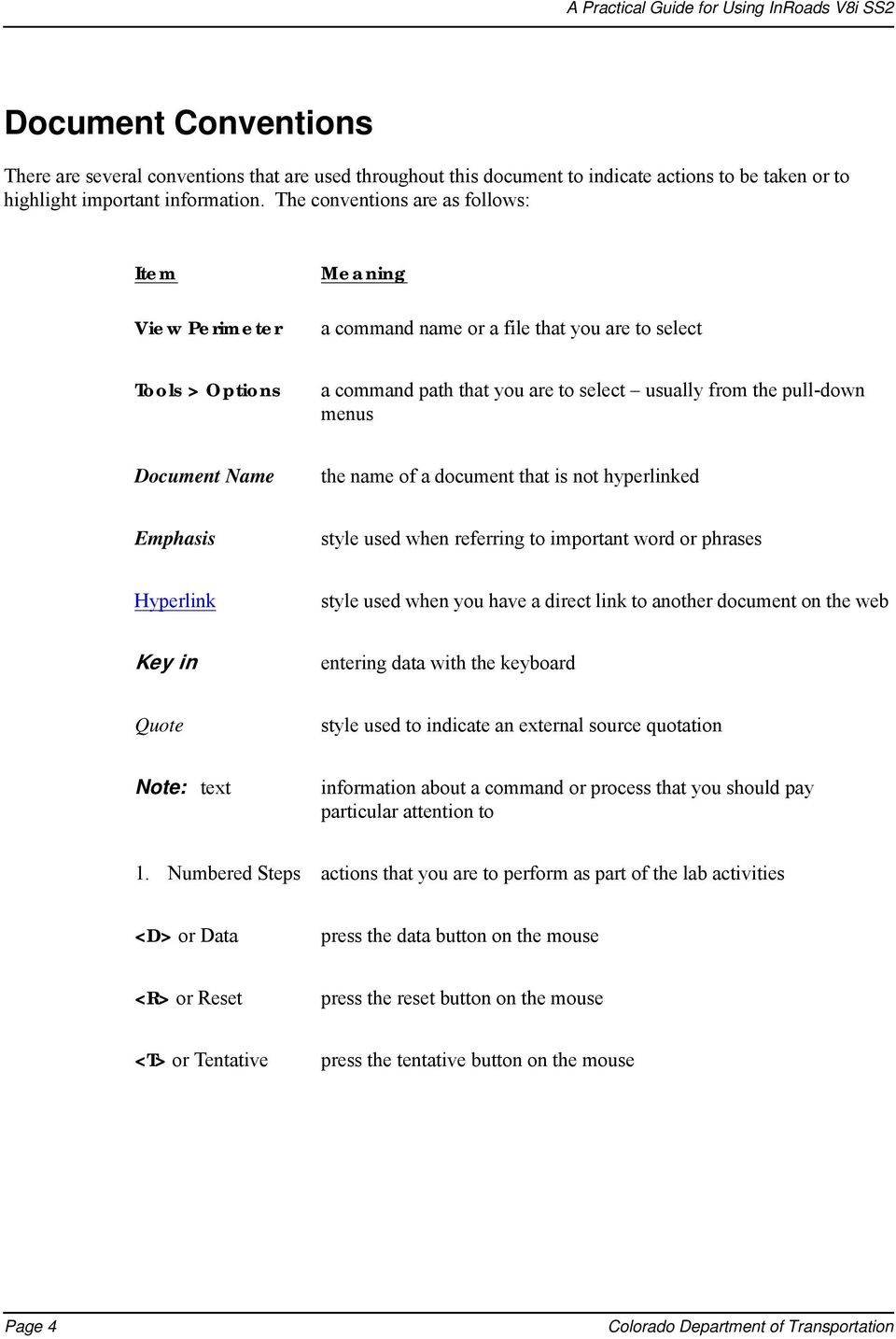
4 A Practical Guide for Using InRoads V8i SS2 Document Conventions There are several conventions that are used throughout this document to indicate actions to be taken or to highlight important information. The conventions are as follows: Item View Perimeter Meaning a command name or a file that you are to select Tools > Options a command path that you are to select usually from the pull-down menus Document Name the name of a document that is not hyperlinked Emphasis style used when referring to important word or phrases Hyperlink style used when you have a direct link to another document on the web Key in entering data with the keyboard Quote style used to indicate an external source quotation Note: text information about a command or process that you should pay particular attention to 1. Numbered Steps actions that you are to perform as part of the lab activities <D> or Data press the data button on the mouse <R> or Reset press the reset button on the mouse <T> or Tentative press the tentative button on the mouse Page 4 Colorado Department of Transportation
5 Preface (Under Development) How to contact CDOT CADD Manager Message from CADD Manager real success of manual is through participation by the users for updates Living document this is the opportunity to influence the development of the document How to use this manual Colorado Department of Transportation Page 5

6 Preface (Under Development) A Practical Guide for Using InRoads V8i SS2 Page 6 Colorado Department of Transportation

7 Table of Contents Document Conventions Preface (Under Development) Chapter 1 - Chapter 2 - Chapter 3 - Getting Started In InRoads InRoads V8i Resource Locations Delivered InRoads V8i Resources V8i User Created InRoads Files Project Requirements for InRoads V8i Creating the Project Directory Project File Setup Converting to V8i InRoads Project Setup Project Defaults Creating a New Project Default Editing an Existing Project Default Discipline Project Defaults InRoads Resources Loading a DTM Loading an ALG InRoads Options InRoads Locks Feature Filter Lock Feature Highlight Lock Style Lock Write Modes Delete Ink Locate Lock Point Snap Station Lock Report Lock COGO Audit Trail Lock The Options dialog box The Precision tab The Factors tab InRoads Toolbars Initial Surface Procedures Reviewing Surface Data Surface Properties Feature Properties Feature Selection Filters A Practical Guide for Using InRoads V8i SS2 Page 7

8 A Practical Guide for Using InRoads V8i SS2 Chapter 4 - Chapter 5 - Locks affecting Features Component Properties Interrogate Surface Tracking Viewing a Surface Locks affecting Surface Displays Viewing the DTM Perimeter Viewing Triangles Viewing Contours Viewing Features Viewing Components Update 3-D/Plan Surface Displays Surface Fundamentals Introduction to DTMs DTM Point Types Random Breakline Contour Points Interior Exterior Surface Triangulation Intelligent DTMs Feature Names Feature Styles Named Symbology Creating a DTM ASCII (text) Files Surface from graphics DTM Utilities Active Surface Copy Surface Delete Surface Rename Surface Save Surface Inital Geometry Procedures Geometry Data Review Geometry Data from Survey The Geometry Project Generic Geometry Project Sample Roadway Design Geometry Project Sample Survey Geometry Project Sample Cogo Buffer Contents Sample Right of Way Geometry Project Geometry Terminology and Attributes Terminology of Geometry Data Types Style Manager Overview Page 8 Colorado Department of Transportation

9 A Practical Guide for Using InRoads V8i SS2 Chapter 6 - Geometry Point Symbology Geometry Management Geometry Management Tools Setting Active Geometry Copy Geometry Delete Geometry Rename Geometry Saving an Alignment Viewing Horizontal Geometry Viewing the Active Horizontal Alignment Viewing All Of The Alignments In A Geometry Project Displaying Stationing View Horizontal Annotation Main Tab Tabling Tab Styles Tab Curve Set Annotation General Leaf Annotation Leaf Reviewing Geometry Activating the Review Geometry Command Tracking Settings Displaying Tracking Data Defining Horizontal Alignments Creating Geometry Options Dialog Items About geometry point names Writing the active alignment keypoints to the Cogo Buffer Typical Workflow Creating New Geometry Horizontal Curve Set commands Defining Horizontal Curves Setting the Beginning Station Equations Horizontal Event Points Horizontal Elements Check Integrity Importing alignments From graphics Cogo Commands - Overview Cogo Point commands Cogo Traverse commands Cogo Intersection Commands Create/Edit Alignment by Cogo Points Geometry Utilities Colorado Department of Transportation Page 9
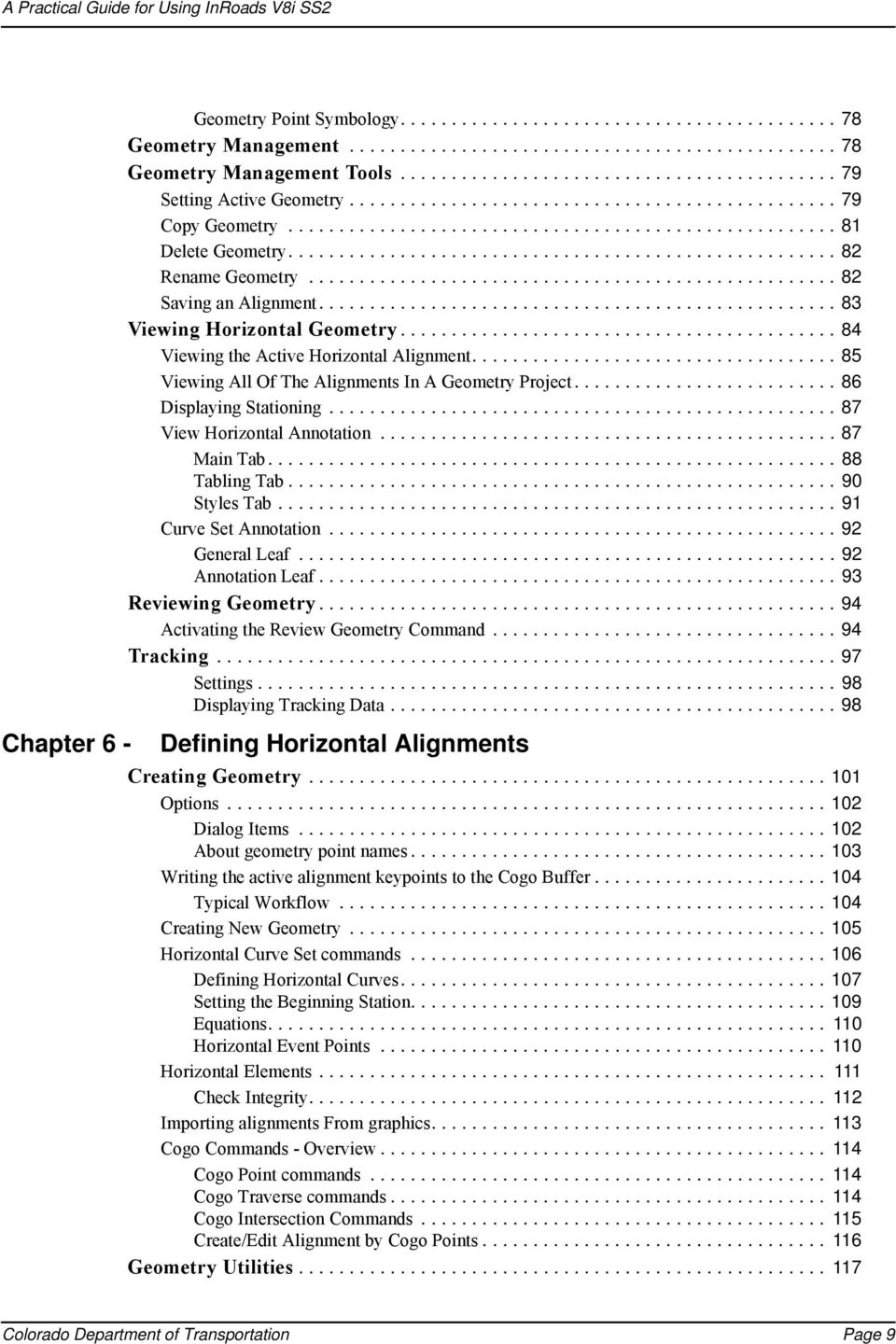
10 A Practical Guide for Using InRoads V8i SS2 Chapter 7 - Chapter 8 - Transposing Alignments Transposing an alignment Inversing Between Alignments - Overview Transforming Geometry - Overview Offset Alignments - overview Appendix A - ICS Geometry Input ICS Command Summary Control Commands Parameter Commands Report Commands Point Commands Figure Commands Locate Commands Transformation Commands Divide Commands Intersect Commands Curve Commands Alignment Commands Parallel Commands COGO Parameter Abbreviations Abbreviations for the ICS input commands Profiles Creating Profiles Settings for the Create Profile Dialog Box Create Profile - General Leaf Create Profile - Source Leaf Create Profile - Include Leaf Create Profile - Offsets Leaf Controls - Limits leaf Displaying the Profile Updating Profiles Profile Set and Mode Surface Leaf Offsets Leaf Crossing Features Leaf Projected Features Leaf Styles and Filter Buttons Profile Annotation General Leaf Projecting A Vertical Alignment From Another Horizontal Alignment On To A Profile Defining Vertical Geometry Creating Vertical Alignments Creating Profiles See the Profiles chapter for more information on creating profiles Creating a new Vertical Alignment Slot Using the Vertical Curve Set Commands Dynamics The Vertical Design Calculator Page 10 Colorado Department of Transportation
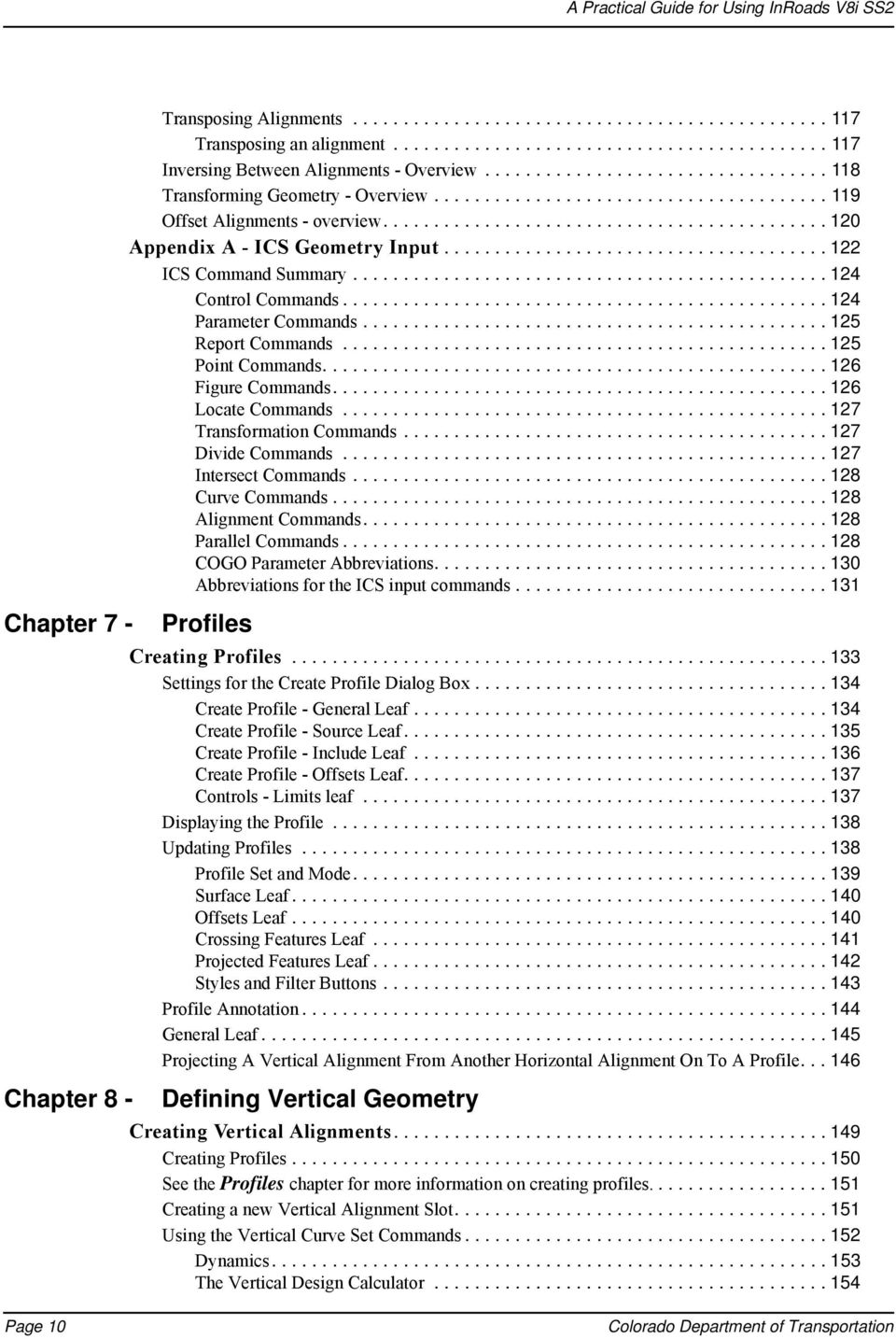
11 A Practical Guide for Using InRoads V8i SS2 Chapter 9 - Keyins To create a vertical alignment Editing Vertical Alignments Editing a VPI using the Define Vertical Curve Set command Editing a VPI using the Move Vertical PI command Adding a Vertical PI Inserting a Vertical PI Adding Vertical Event Points Exploring Vertical Alignments Reviewing Vertical Alignments To review a vertical alignment Displaying Vertical Alignments To Display a Vertical Alignment Annotating Vertical Alignments To Annotate a Vertical Alignments Tracking Vertical Geometry Management Tools Managing Vertical Alignment Saving a Vertical Alignment To save a geometry project (option 1) To save a geometry project (option 2) Typical Sections Template Library Standard Template Library Project Template Library Creating a Project Template Library Copying existing Templates to a Project Template Library Create Template Menu Bar Library Tree Active Template Tree Preview Current Template Information Display Options Active Template Display Dynamic Settings Test Mode Organization of the Template Library Templates Pavement Sections Curb and Gutter Shoulder Sections End Conditions Sections Component and Point Properties Components Linear Elements Fixed Shape Elements Colorado Department of Transportation Page 11

12 A Practical Guide for Using InRoads V8i SS2 Variable Shape Elements Template Development Components Template Points Point Constraints Labels Creating Components Typical CDOT Surfacing Component Complex Surfacing Component Subbase component End Condition components Display Rules and Parent Components Sections Using Components to Build a Section Templates Building a symmetrical template Building an Asymmetrical Template Modifying Templates to Fit a Project Chapter 10 - Roadway Modeling Roadway Designer Introduction to Roadway Designer Roadway Designer Prerequisites Starting Roadway Designer Working Modes Roadway Designer Menu Structure Processing your data Creating and Managing Corridors Introduction to Corridors Creating Corridors Template Drops Introduction to Template Drops Typical Section Change Example Interval Change Example Typical Section Change Creating Template Drops Editing a Template from the Template Drops Dialog Box Updating A Template From the Template Library Point Controls Introduction to Point Controls Point Control Types Adding Point Controls Editing Standard Point Controls Superelevation Introduction to Superelevation The Superelevation Wizard Superelevation Wizard Results Calculating the Initial Superelevation Controlling Superelevation Displays Editing Superelevation Page 12 Colorado Department of Transportation
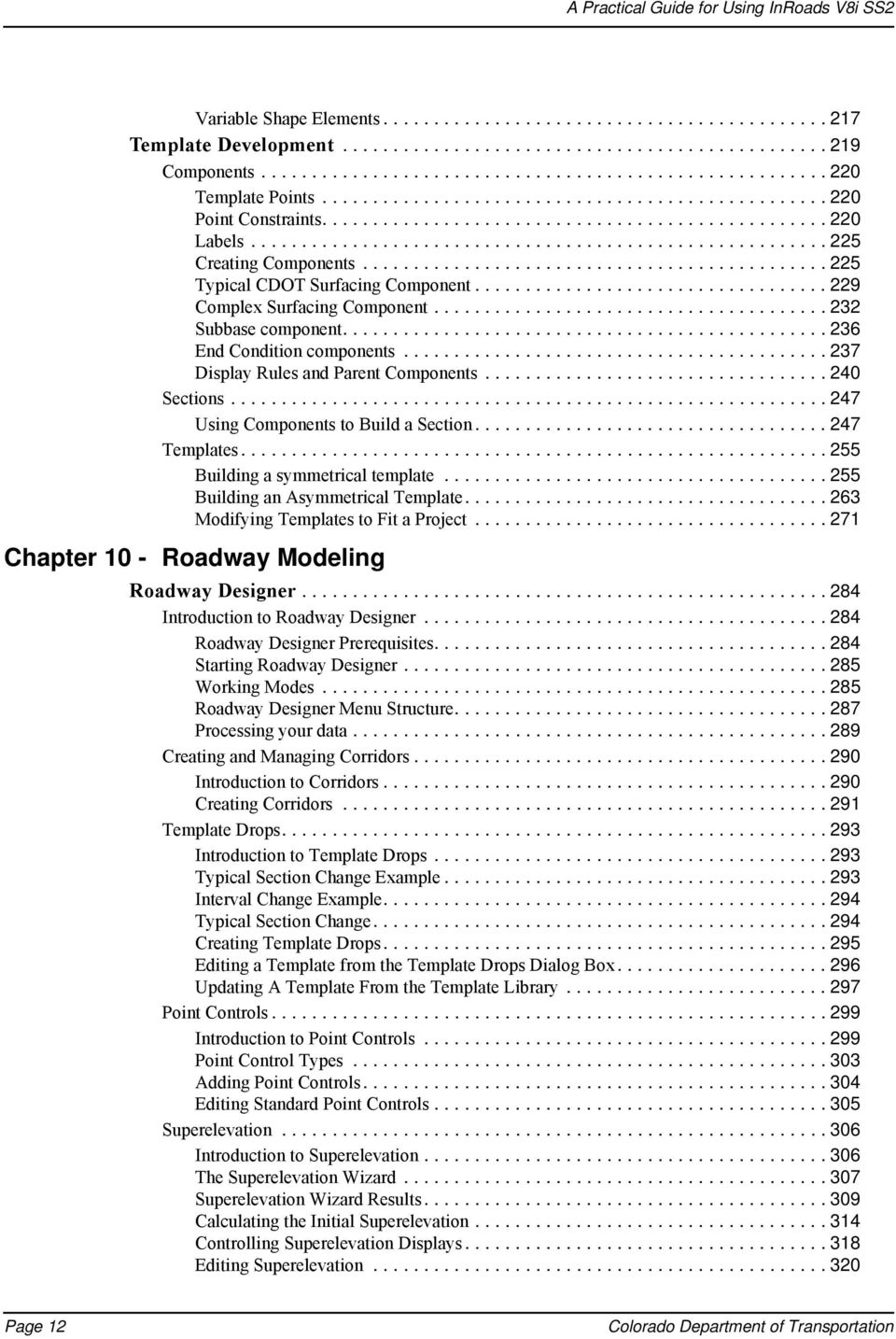
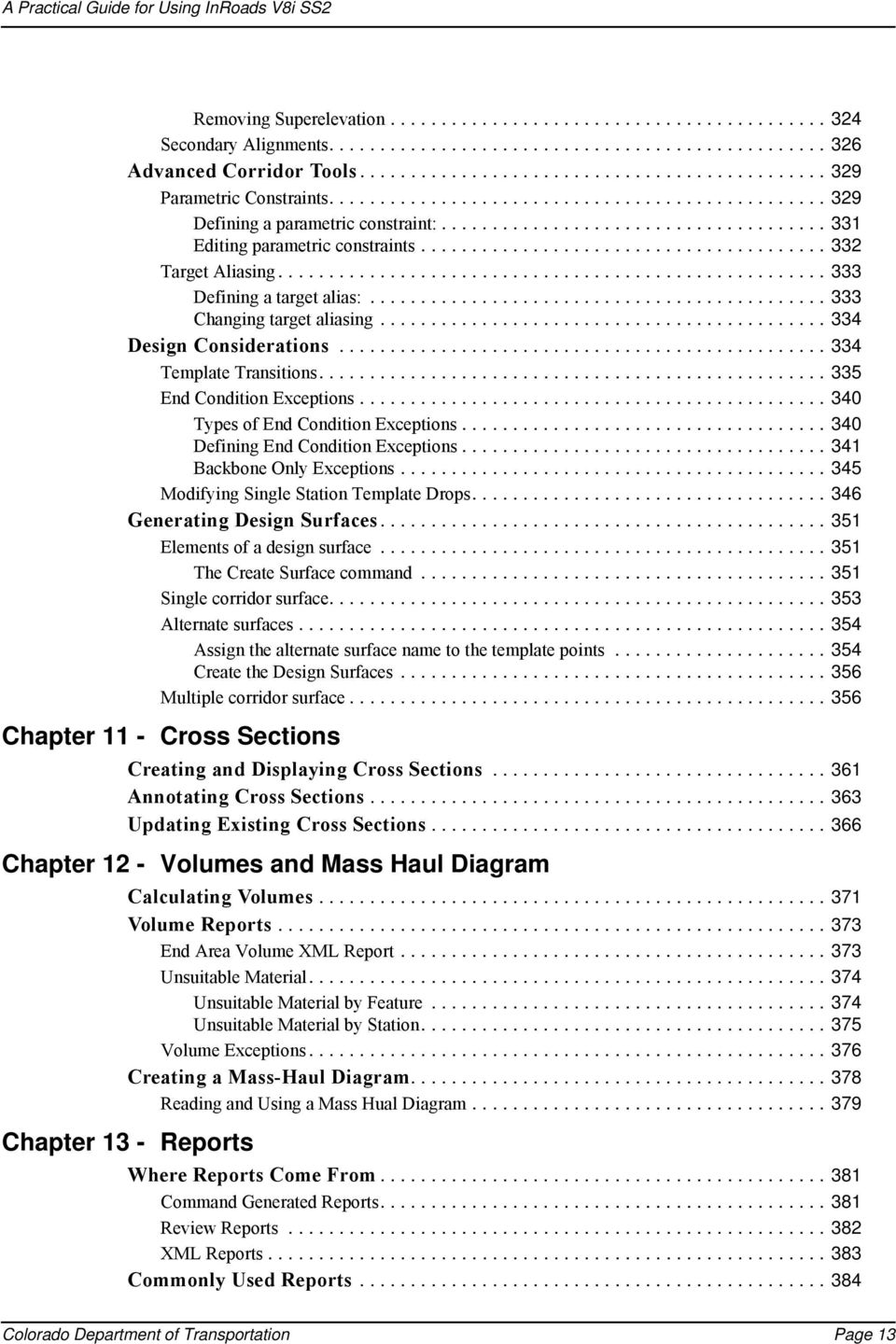
13 A Practical Guide for Using InRoads V8i SS2 Removing Superelevation Secondary Alignments Advanced Corridor Tools Parametric Constraints Defining a parametric constraint: Editing parametric constraints Target Aliasing Defining a target alias: Changing target aliasing Design Considerations Template Transitions End Condition Exceptions Types of End Condition Exceptions Defining End Condition Exceptions Backbone Only Exceptions Modifying Single Station Template Drops Generating Design Surfaces Elements of a design surface The Create Surface command Single corridor surface Alternate surfaces Assign the alternate surface name to the template points Create the Design Surfaces Multiple corridor surface Chapter 11 - Cross Sections Creating and Displaying Cross Sections Annotating Cross Sections Updating Existing Cross Sections Chapter 12 - Volumes and Mass Haul Diagram Calculating Volumes Volume Reports End Area Volume XML Report Unsuitable Material Unsuitable Material by Feature Unsuitable Material by Station Volume Exceptions Creating a Mass-Haul Diagram Reading and Using a Mass Hual Diagram Chapter 13 - Reports Where Reports Come From Command Generated Reports Review Reports XML Reports Commonly Used Reports Colorado Department of Transportation Page 13
14 A Practical Guide for Using InRoads V8i SS2 End Area Volume Reports Station Base and Station Offset Reports Geometry Reports Formatting XML Reports Chapter 14 - Creating Plan Sheets Required Resources Opening Plan and Profile Generator Plan and Profile Generator Preferences Plan and Profile Generator Tabs Main Tab Plan Controls Tab Profile Controls Tab Sheet Layout Tab Border and Title Tab Symbols and Details tab Executing the Command User Input Command Processes Viewing Sheets VDF File Saving a VDF File Loading a VDF File Editing Sheets Moving Reference Files Chapter 15 - Surface Editing Tools Locks Feature Filter Feature Highlight Pen / Pencil Delete Ink Locate Graphics / Locate Features Point Snap Feature Properties Creating Features Import Surface from Graphics Accessing Design Surface commands Generate Longitudinal Feature The Main tab The Controls Tab Here, you ll notice that there are triangles cutting across the corners, causing some erroneous contours. See the process for Place Features in this chapter for a suggestion on how to combat this situation and further enhance the surface Place Feature The Set Elevation Box Generate Transverse Feature Fillet Features Page 14 Colorado Department of Transportation

15 A Practical Guide for Using InRoads V8i SS2 Generate Sloped Surface Apply Template Project Line to Surface Modifying Features Accessing Edit Surface Commands Generate Longitudinal Feature Set Slope Along Feature Drape Surface Edit Feature Point Delete Feature Point Reverse Feature Direction Delete Feature Partial Delete Break Feature Join Features Trim Features Extend Features Intersect Features Delete Triangle Copy Portion of Surface Merge Surfaces Resolve Crossing Segments Generate Grade Contour Compress Surface Colorado Department of Transportation Page 15

16 A Practical Guide for Using InRoads V8i SS2 Page 16 Colorado Department of Transportation
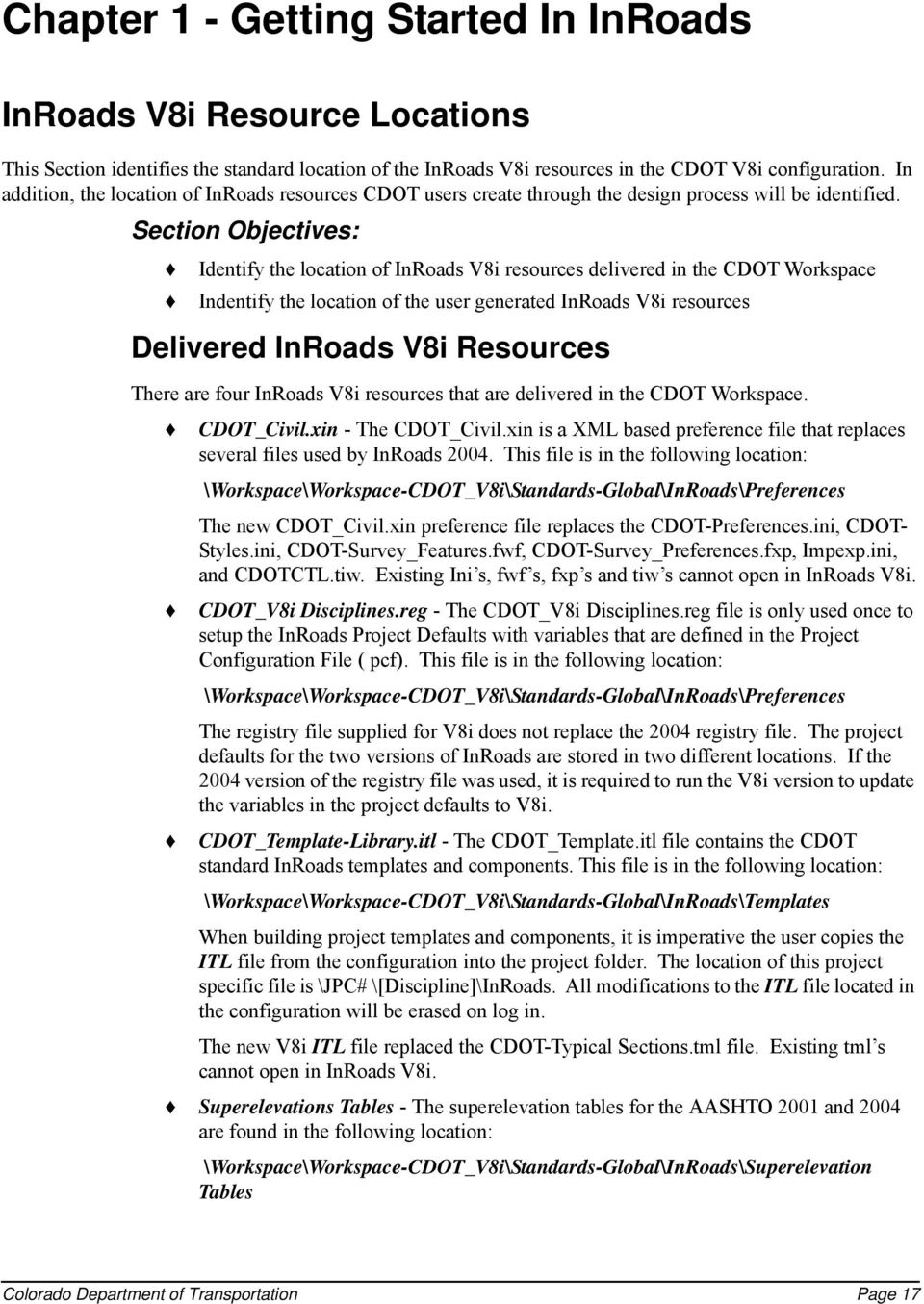
17 Chapter 1 - Getting Started In InRoads InRoads V8i Resource Locations This Section identifies the standard location of the InRoads V8i resources in the CDOT V8i configuration. In addition, the location of InRoads resources CDOT users create through the design process will be identified. Section Objectives: Identify the location of InRoads V8i resources delivered in the CDOT Workspace Indentify the location of the user generated InRoads V8i resources Delivered InRoads V8i Resources There are four InRoads V8i resources that are delivered in the CDOT Workspace. CDOT_Civil.xin - The CDOT_Civil.xin is a XML based preference file that replaces several files used by InRoads This file is in the following location: \Workspace\Workspace-CDOT_V8i\Standards-Global\InRoads\Preferences The new CDOT_Civil.xin preference file replaces the CDOT-Preferences.ini, CDOT- Styles.ini, CDOT-Survey_Features.fwf, CDOT-Survey_Preferences.fxp, Impexp.ini, and CDOTCTL.tiw. Existing Ini s, fwf s, fxp s and tiw s cannot open in InRoads V8i. CDOT_V8i Disciplines.reg - The CDOT_V8i Disciplines.reg file is only used once to setup the InRoads Project Defaults with variables that are defined in the Project Configuration File ( pcf). This file is in the following location: \Workspace\Workspace-CDOT_V8i\Standards-Global\InRoads\Preferences The registry file supplied for V8i does not replace the 2004 registry file. The project defaults for the two versions of InRoads are stored in two different locations. If the 2004 version of the registry file was used, it is required to run the V8i version to update the variables in the project defaults to V8i. CDOT_Template-Library.itl - The CDOT_Template.itl file contains the CDOT standard InRoads templates and components. This file is in the following location: \Workspace\Workspace-CDOT_V8i\Standards-Global\InRoads\Templates When building project templates and components, it is imperative the user copies the ITL file from the configuration into the project folder. The location of this project specific file is \JPC# \[Discipline]\InRoads. All modifications to the ITL file located in the configuration will be erased on log in. The new V8i ITL file replaced the CDOT-Typical Sections.tml file. Existing tml s cannot open in InRoads V8i. Superelevations Tables - The superelevation tables for the AASHTO 2001 and 2004 are found in the following location: \Workspace\Workspace-CDOT_V8i\Standards-Global\InRoads\Superelevation Tables Colorado Department of Transportation Page 17
18 Chapter 1 - Getting Started In InRoads A Practical Guide for Using InRoads V8i SS2 V8i User Created InRoads Files Throughout the design process several InRoads files will be created by the user. These files are named with the Job Project Code (JPC) number and are stored in the \JPC# \[Discipline]\InRoads folder. JPC#.rwk - The rwk file is the InRoads Project file. It contains the location of the files used for the project. InRoads uses this file to load and save data to multiple files at one time. The location varies by the discipline that creates the file. This location is \JPC# \[Discipline]\InRoads. The rwk file in V8i is the same file extension and serves the same purpose as the rwk file in InRoads Existing rwk s must be edited to reflect the new files used in InRoads V8i. JPC#.dtm - The dtm file is the InRoads Digital Terrain Model file and is stored in the project. The existing dtm is located in \JPC# \ROW_Survey\InRoads\DTM\. The location of the proposed dtm s will vary by the discipline that creates the file. This location is \JPC# \[Discipline]\InRoads. InRoads 2004 generated design dtm s will open in V8i but will not have the same functionality as InRoads V8i dtm s. This process doesn t require a translation. Existing dtm s generated by the survey division work properly with either version of the software. JPC#.alg - The alg file is the InRoads Geometry file and is stored in the project. The location will vary by the discipline that creates the file. This location is \JPC# \[Discipline]\InRoads. InRoads 2004 generated alg s will open in V8i with no translation. The horizontal and vertical alignments are fully functional. Superelevations defined in the 2004 alg are not used by InRoads V8i. They can be imported in the new Roadway Designer, ird file or recreated using the Superelevation Wizard. Importing the superelevation will require editing in the new interactive superelevation diagrams. JPC#.ird - The ird file is the InRoads Roadway Definition file and is stored in the project. The location will vary by the discipline that creates the file. This location is \JPC# \[Discipline]\InRoads. The new InRoads V8i ird file replaced the rwl file in InRoads It contains the corridor definition, template drops, point controls, and superelevation data. Existing rwl files cannot be opened in InRoads V8i. Section Summary: Identify the location of InRoads V8i resources delivered in the CDOT Workspace Indentify which InRoads V8i resource files need to be copied to the project file and why Indentify the location of the user generated InRoads V8i resources Page 18 Colorado Department of Transportation

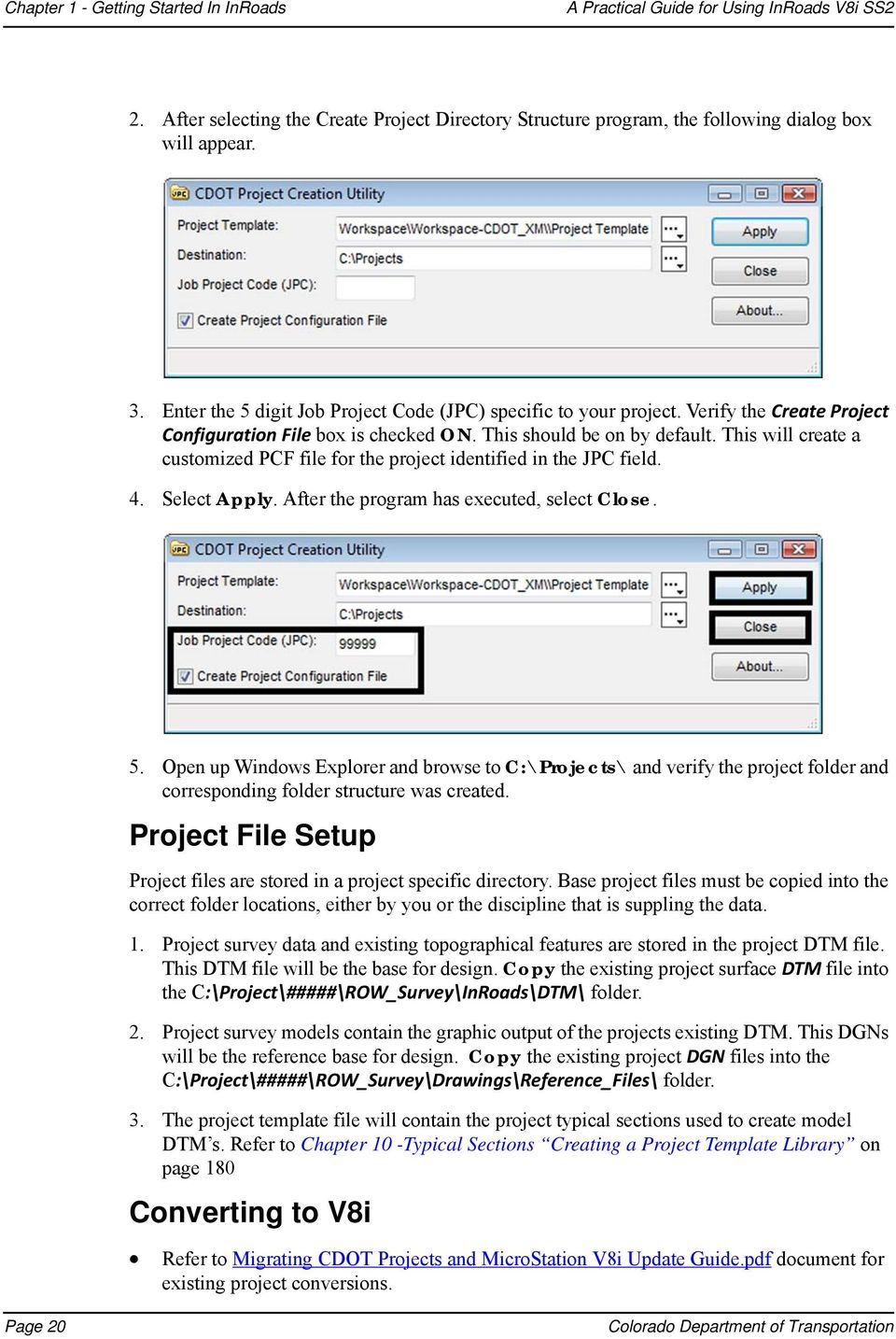
19 A Practical Guide for Using InRoads V8i SS2 Chapter 1 - Getting Started In InRoads Project Requirements for InRoads V8i Several changes have been made to the InRoads environment that impacts the current CDOT workspace. A new workspace has been developed for the V8i environment located at C:\Workspace\Workspace CDOT_V8i as opposed to the 2004 environment located at C:\Program Files\Workspace CDOT\. This section explores these changes and how a project setup should be completed. Proper project setup will greatly increase productivity and reduce errors. Section Objectives: Create a project folder using the Project Creation Utility Store project specific files in correct folders Creating the Project Directory The project directory structure is created using the CDOT Project Creation Utility to performs two functions; first it creates a project specific folder and file structure based on CDOT standards, and second, it creates a Project Configuration File (PCF) which stores variables to simplify file management for the user. The PCF file is utilized by both MicroStation and InRoads environments. 1. The project directory is created by running the Project Creation Utility program. To access this program go to Start > All Programs >_CDOT_CADD_Information > 8.11.xx V8i > Create V8i Project Directory Structure. Colorado Department of Transportation Page 19

20 Chapter 1 - Getting Started In InRoads A Practical Guide for Using InRoads V8i SS2 2. After selecting the Create Project Directory Structure program, the following dialog box will appear. 3. Enter the 5 digit Job Project Code (JPC) specific to your project. Verify the Create Project Configuration File box is checked ON. This should be on by default. This will create a customized PCF file for the project identified in the JPC field. 4. Select Apply. After the program has executed, select Close. 5. Open up Windows Explorer and browse to C:\Projects\ and verify the project folder and corresponding folder structure was created. Project File Setup Project files are stored in a project specific directory. Base project files must be copied into the correct folder locations, either by you or the discipline that is suppling the data. 1. Project survey data and existing topographical features are stored in the project DTM file. This DTM file will be the base for design. Copy the existing project surface DTM file into the C:\Project\#####\ROW_Survey\InRoads\DTM\ folder. 2. Project survey models contain the graphic output of the projects existing DTM. This DGNs will be the reference base for design. Copy the existing project DGN files into the C:\Project\#####\ROW_Survey\Drawings\Reference_Files\ folder. 3. The project template file will contain the project typical sections used to create model DTM s. Refer to Chapter 10 -Typical Sections Creating a Project Template Library on page 180 Converting to V8i Refer to Migrating CDOT Projects and MicroStation V8i Update Guide.pdf document for existing project conversions. Page 20 Colorado Department of Transportation
21 A Practical Guide for Using InRoads V8i SS2 Chapter 1 - Getting Started In InRoads Section Summary: InRoads Project Setup Roadway design and modeling are significantly different in InRoads V8i. Template and roadway libraries will need to be redone. Several changes have been made to the InRoads environment that impact the current CDOT workspace. Prior to opening or creating InRoads data, proper setup of the InRoads environment will streamline loading and saving project files created in InRoads. Section Objectives: Identify how to setup a new Project Default Identify how to edit an existing Project Default Identify how to load a DTM Identity how to load an ALG Project Defaults InRoads project defaults perform two functions; first they load the appropriate CDOT standard resource files such as the standard XIN file, annotation resources, XML style sheets, etc. Additionally, they define default paths to project specific directory folders that contain project data such as DTM s, alignments, survey data, etc. Creating a New Project Default To create a project specific Project Default Configuration: 1. Open the Project Defaults by Selecting, File > Project Defaults Colorado Department of Transportation Page 21
22 Chapter 1 - Getting Started In InRoads A Practical Guide for Using InRoads V8i SS2 2. <D> on the New button. 3. Enter in the Name of the New Configuration, and <D> on OK. 4. Fill in Preferences by <D> in the data entry field and <D> the Browse button. Note: The Default Preferences section specifies files. These files will load into InRoads directly. The Default Directory Paths section specifies a folder, not files. Any files within the folder will not load, but when opening the file the browse dialog box will open to that folder. 5. Browse to the C:\Workspace\Workspace-CDOT_V8i\Standards- Global\InRoads\Preferences folder. Page 22 Colorado Department of Transportation
23 A Practical Guide for Using InRoads V8i SS2 Chapter 1 - Getting Started In InRoads 6. Select CDOT_Civil.xin and <D> on the Open button. 7. When finished identifying files and folders <D> on Apply and <D> on Close. Editing an Existing Project Default To edit a project specific Project Default Configuration: 1. Open the Project Defaults by selecting, File > Project Defaults Colorado Department of Transportation Page 23
24 Chapter 1 - Getting Started In InRoads A Practical Guide for Using InRoads V8i SS2 2. Select the project to modify by <D> on the Configuration Name pull down. 3. Edit the Files and Folder paths that are required. 4. <D> on Apply when finished. Discipline Project Defaults The workflow, CDOT InRoads V8i Project Defaults Management.pdf, utilizes a Project Configuration File (PCF) which is created at the start of a project. This PCF file is created by running the Project Creation Utility. The resulting PCF stores system variables to simplify file management for the user. This PCF file is utilized by both the MicroStation and InRoads environments. InRoads Resources Prior to designing in InRoads V8i, load the base InRoads project resource files. Loading a DTM To open a DTM file: 1. Open an existing DTM file by selecting, File > Open. Page 24 Colorado Department of Transportation
25 A Practical Guide for Using InRoads V8i SS2 Chapter 1 - Getting Started In InRoads 2. Change the file type to Surfaces (*dtm) by <D> on Files of Types: Note: Once the file type is selected, the path will change if identified in the Project Defaults. Colorado Department of Transportation Page 25
26 Chapter 1 - Getting Started In InRoads A Practical Guide for Using InRoads V8i SS2 3. <D> on file 12345_existingground.dtm and <D> on Open. 4. <D> on Cancel to close the dialog box. 5. <D> on the Surfaces tab to view the loaded DTM. Page 26 Colorado Department of Transportation
27 A Practical Guide for Using InRoads V8i SS2 Chapter 1 - Getting Started In InRoads Loading an ALG To open an ALG file: 1. Open an existing ALG file by selecting, File > Open. 2. Change the file type to Geometry Projects (*.alg) by <D> on Files of Types: Colorado Department of Transportation Page 27
28 Chapter 1 - Getting Started In InRoads A Practical Guide for Using InRoads V8i SS2 Note: When the file type is selected, the Look in folder location will change to the path defined in the Project Defaults. 3. <D> on file 12345DES_Geometry.alg and <D> on Open. 4. <D> on Cancel to close the dialog box. 5. <D> on the Geometry tab to view the loaded ALG. Section Summary: Understand the process to create a new Project Default in InRoads Understand the process to edit an existing Project Default in InRoads Understand Projects Defaults when using the CDOT_V8i Disciplines.reg file with a PCF Understand the process to load a DTM Understand the process to load an ALG Page 28 Colorado Department of Transportation
29 Chapter 2 - InRoads Options InRoads has a number of options and global settings that affect the availability of commands and operation of the program. This chapter discusses the locks and options settings for InRoads V8i. Chapter Objectives: InRoads Locks Discuss the function of each of the InRoads Locks. Discuss the Options dialog box and identify the tabs that users can modify. The locks in InRoads determine what can be displayed, how displayed items are updated, and how items are selected for use by the program. Section Objectives: Describe the Feature Filter Lock Describe the Feature Highlight Lock Describe the Style Lock Describe Write modes. Describe the Locate Lock Describe the Snap Lock Describe the Station Lock Describe the Report Lock Describe adding toolbars. Feature Filter Lock The Feature Filter lock is used to limit the number of features displayed in menu pick lists, based on used defined criteria. This lock has two parts, the Filter Name drop down menu and the Feature Filter Lock (on/off switch). Filter Name Lists the name of the Feature Filter that is currently active. It has no affect if the Feature Filter lock is off. If the Feature Filter lock is o n, it will limit dialog boxes to showing only the features that pass the filter. Feature Filters are stored in the CDOT- Civil.xin file and are accessed by using the drop-down arrow next to the name. Feature Filter lock If on, activates the current filter. If off, has no affect and all surface features are shown in boxes that list features. Feature Highlight Lock Colorado Department of Transportation Page 29
30 Chapter 2 - InRoads Options A Practical Guide for Using InRoads V8i SS2 This lock highlights features in the MicroStation view window that are selected in an InRoads dialog box. This lock should be left off until needed because many of the InRoads dialog boxes open with all of the features selected and it can take a long time to highlight all the features. Style Lock The Style lock, if on, forces many of the Surface View commands to display the requested data (triangles, contours, etc.) without bringing up the dialog box. The preference used is the one associated with the surface under Surface > Surface Properties. Style lock also forces the Cross Section Annotation command to use the named symbology associated with the feature for annotation properties. If off, the Style lock has no affect. Write Modes The Write Mode determines how InRoads graphic elements will behave when the data that generated the graphics changes. There are two modes; Pencil and Pen. Pencil mode - The graphics are updated whenever the same display command is selected again. For example, if contours are displayed, then a different preference is selected and they are displayed again, the old contours are deleted and new contours are displayed. Pen mode - The graphics are not updated when the same display command is selected again. Instead, another copy is placed in the design file. Delete Ink Delete Ink overrides the Pen mode so that the graphics are treated like Pencil mode and the old ones are removed before new ones are placed. Note: The Write mode of an element is saved with that element. For example, contours that are displayed in pencil mode will still be deleted if the command is reused, even if the Write mode has been switched to Pen mode. Locate Lock Page 30 Colorado Department of Transportation
31 A Practical Guide for Using InRoads V8i SS2 Chapter 2 - InRoads Options There are several commands in InRoads that will work on either DTM Features or on MicroStation graphical elements (Drape Surface, for example). These commands will look for features if toggled to Locate Features and for MicroStation elements if it is set to Locate Graphics. It is shown here in Locate Graphics Point Snap mode. Point Snap is used primarily when creating geometry and for some surface editing commands. It can lock on to COGO points or feature vertices, or it can import a geometry element s length and bearing into a dialog box input field. Point Snap has three modes: No Snap, Point Snap and Element Snap No Snap No affect. This is the mode used most often. Point Snap Some geometry commands (especially cogo commands) will lock onto the nearest geometry point s coordinates when you select something graphically. This is useful when you need to identify a PC or PT, for example. Also, some DTM editing commands, such as Partial Delete Feature, will lock onto the vertices or points that make up the feature. Element Snap In Geometry when commands require a distance or a bearing, the Element Snap can be used. An existing geometry element needs to be identified (such as part of an existing alignment) and it will read the elements length or bearing (whichever is required). Station Lock Station lock locks onto even stations in the event that the alignment does not start on an even station. The station will be determined by the interval that is specified. For example, if an alignment is stationed at 100 ft. intervals, the displays will show even 100 ft. stations. This affects not only station displays but virtually everything that uses a stationing interval, such as cross sections, profiles and modeling. Colorado Department of Transportation Page 31
32 Chapter 2 - InRoads Options A Practical Guide for Using InRoads V8i SS2 Report Lock Some commands will return information if this lock is on. For example, if a cogo point is stored and the Report lock is on, a Results box will pop open showing the coordinate and point number of the new point. If the Results box is left open, it will keep a running list of messages, which can be saved to a text file if desired. COGO Audit Trail Lock This lock is used to create a text file of the results of all COGO commands that were executed. The data stored here is the same that is displayed in the Results window, if the Report Lock is on. Section Summary: The Feature Filter lock is used to limit the number of choices in surface related dialog boxes. The Feature Highlight Lock Shows features selected in an InRoads dialog box in the MicroStation view window also. It should only be used when needed as it can be slow to update. The Style Lock tells InRoads to use predefined settings when displaying data. It also takes away the users ability to make settings changes. The Write modes determine if InRoads graphics are updated when the command is rerun or not. The Locate Lock is used snap to either surface features or MicroStation graphics. The Snap Lock is used to snap to COGO points or feature vertices, or to place geometry element data into dialog box input fields. Station Lock forces processing to occur at even (*+00.00) stations, even when the alignment starts at an odd station. The Report Lock allows InRoads to supply the user with feedback. The COGO Audit Trail lock does the same thing as the report lock, but just for COGO commands. The Options dialog box The Options dialog box contains global settings that affect the overall function of the InRoads software. Most of the settings are predefined for CDOT work and do not have to be modified. However, some settings affect element display and must be changed by the user to fit their needs. Page 32 Colorado Department of Transportation
33 A Practical Guide for Using InRoads V8i SS2 Chapter 2 - InRoads Options Section Objectives: Describe the Options Precision tab. Describe the Options Factors tab. The Precision tab The settings on this tab determine the number of decimal places InRoads displays in the dialog boxes. To change the precision: 1. Select File > Project Options from the InRoads menu bar. 2. <D> the Precision tab. 3. Use the drop down menus to set the desired precision. Colorado Department of Transportation Page 33
34 Chapter 2 - InRoads Options A Practical Guide for Using InRoads V8i SS2 4. <D> Apply to accept the change. 5. <D> Close to dismiss the dialog box. The Factors tab The settings on the Factors tab controls scale factors for MicroStation elements displayed by InRoads. InRoads displays three element types; Lines, Cells, and Text. Each element type has a Factors setting. To access the Factors settings: 1. Select FIle > Project Options from the InRoads menu bar. 2. <D> the Factors tab. The Text Scale Factor and the Cell Scale Factor should both be set to the same value, equal to the plot scale for the drawing. The Line Style Scale Factor should be set to 1, this is modified by the Annotation Scale set in MicroStation. Page 34 Colorado Department of Transportation
35 A Practical Guide for Using InRoads V8i SS2 Chapter 2 - InRoads Options To change the Factors settings: 3. Toggle the Lock icon open. 4. Key in the desired value for the Text Scale Factor. 5. Key in the desired value for the Cell Scale Factor. Note: The Text Scale Factor and the Cell Scale Factor should match. 6. Key in 1 for the Line Style Scale Factor. 7. <D> Apply to accept the change then <D> Close to dismiss the Options dialog box. Section Summary: The options dialog box contains settings used throughout the InRoads program. Users should only have to access the Precision and Factors tabs. Precision settings change the readout in InRoads dialog boxes. Factors affect the display of MicroStation elements created from InRoads. The Line Stle Scale Factor is affected by the MicroStation Annotation Scale but the Text Scale Factor and the Cell Scale Factor are not. InRoads Toolbars Section Objectives: Demonstrate how to access InRoads toolbars. Colorado Department of Transportation Page 35
36 Chapter 2 - InRoads Options A Practical Guide for Using InRoads V8i SS2 Most of the InRoads commands are located on toolbars as well as on the pulldown menus. These toolbars as accessed through the Tools > Customize dialog. Toolbars can be turned on and off at will. You can also create your own toolbars using the customize dialog. Initially, toolbars are docked on the InRoads menu, but may be pulled off of it and will remember their last location when they are closed and reopened. Section Summary: Use InRoads toolbars for easy access to commands that are used often Chapter Summary:The InRoads locks can be used to limit items in pick lists, force the program to used predefined display settings, automatically update graphics when data is changed, locate particular data types, and adjust processing locations. Options are used to set the precision displayed in dialog boxes and set the scale factor for MicroStation elements created from InRoads. Page 36 Colorado Department of Transportation
37 Chapter 3 - Initial Surface Procedures In the CDOT process, existing ground surfaces are created by Survey and any proposed models by Design. When presented with either of these for the first time, it is good practice to review the surface information and familiarize yourself with the data contained in the surface. It is also good to double-check the surface for any errors or omissions before they become larger issues after the surface has been used for modeling or volume calculations. Using the techniques outlined here, you can review the data in the surface and view the data graphically, both of which allow you to check for problems and familiarize yourself with the data. Chapter Objectives: To become familiar with the process used to analyze the data in an unknown surface. To be able to view DTM data graphically for a visual analysis of a surface. Reviewing Surface Data InRoads provides useful tools for reviewing surface data, including surface point data as well as the properties of features and components that are contained in the surface. Section Objectives: To learn the techniques available to review surface information before viewing the data. To be able to spot potential issues in a surface prior to it causing major problems. Surface Properties The Surface Properties dialog allows you to change the name, description or preference associated with the surface. By accessing the Advanced tab, you can also set the named symbology to be used when displaying the surface ground line in profiles and cross sections. The Advanced tab also allows the establishment of Offsets that can later be displayed when creating or updating a profile. The Surface Properties dialog is accessed from several locations including the More option on the Triangulate Surface dialog. It may also be accessed directly from the pull-down menu or from the right-click menu in the workspace bar of the InRoads menu. Colorado Department of Transportation Page 37
38 Chapter 3 - Initial Surface Procedures A Practical Guide for Using InRoads V8i SS2 1. Select Surface > Surface Properties On the Main tab, you can: 2. Select a Surface from the drop-down - this is set to the active surface by default. 3. Change the Name of the DTM as it is shown in dialog boxes. This does not change the name of the DTM file on the hard drive. 4. Change the Description of the surface. 5. Set the Maximum Length - see the explanation on Maximum Length in the Triangulation section. 6. Set a Preference. The available preferences are surface display preferences. Selecting one here and toggling on the Style lock forces the view commands to use this preference and does not allow the dialog box to display for View Contours, Triangles, etc. 7. Set the Type of the surface. The type is critical to how the surface reacts in End Area Volumes. Options include Existing, Design, Substratum and Ignore. For details on these options, see the InRoads Online Help. 8. Extended Data Checks - toggle on to check DTM integrity (during triangulation) for crossing breaklines and miss-matched elevations. 9. Lock Triangulation - sets the triangulation so InRoads commands will not automatically retriangulate the surface. For example, if this is a surface from survey that you do not want to alter, toggle this option on. Note: Compressing the surface retriangulates it even if this option is on. Page 38 Colorado Department of Transportation
39 A Practical Guide for Using InRoads V8i SS2 Chapter 3 - Initial Surface Procedures 10. The Data Range category allows you to select a type of features and review the coordinate range it includes. 11. The Data Totals allow you to review the numbers of points and features for each type of feature. 12. The Report button generates a separate window summarizing surface properties. The generated report can be printed, written to the CAD file, or stored as an ASCII file. Colorado Department of Transportation Page 39
40 Chapter 3 - Initial Surface Procedures A Practical Guide for Using InRoads V8i SS2 On the Advanced tab: 13. Cross Section Symbology sets the named symbology used for the display of ground lines on cross sections. In the CDOT XIN file, there are symbologies created for use here. T_Existing_Ground for the existing topo and D_SURFACE_* for design surfaces. 14. Use Features Only prevents the surface line on the cross section from following the triangles. Instead, it is drawn by connecting the dots between the features in the surface. This should typically be off for existing surfaces and on for design surfaces. 15. Profile Symbology sets the named symbology used for the display of ground lines on profiles. In the CDOT XIN file, there are symbologies created for use here. T_Existing_Ground for the existing topo and D_SURFACE_* for design surfaces. 16. Lock Symbologies will force each of the offsets to use the same symbology specified above. 17. The Offset category is for establishing surface offsets for display on profiles. Up to 16 offsets may be specified by defining the offset distance - positive values for offsets to the right and negative values for offsets to the left of the centerline. Each offset may have its own symbology. 18. Choose Apply if you make any changes. 19. Choose Close. Page 40 Colorado Department of Transportation
41 A Practical Guide for Using InRoads V8i SS2 Chapter 3 - Initial Surface Procedures Feature Properties The Feature Properties dialog allows you to review a DTM by analyzing the individual features, and make changes to names, descriptions, etc. 1. Select Surface > Feature > Feature Properties. 2. Select the Surface from the drop-down. 3. The Feature list shows all the features in the selected surface along with their styles and descriptions. Note: The dialog honors the active feature filter if the Feature Filter lock is on. Important! Features that appear red indicate their Style cannot be found in the currently loaded XIN file. Check to see if the correct Style is associated with the feature. If so, check to see that the correct XIN is loaded. 4. The Name and Description of the highlighted feature may be edited. Note: Options other than Name can be edited for multiple features at one time. Select the features from the list using <Ctrl> or <Shift> keys or by using the Right-click menu to Select All. 5. If features are edited, before choosing Apply, the Refresh/Display in Plan View option can be toggled on to update the graphics with the new attributes. Colorado Department of Transportation Page 41
42 Chapter 3 - Initial Surface Procedures A Practical Guide for Using InRoads V8i SS2 6. For a listing of the coordinates for each vertex in a feature, highlight the feature and select List Points. This is a good way to evaluate the elevations of the feature. See the InRoads Online Help for additional information on other options. 7. If changes are made to a feature, be certain to choose Apply. 8. Close the dialog when done reviewing the features. Feature Selection Filters Feature Selection Filters provide a method of segregating features for use in other commands. For example, if you are working with the breaklines that form a ditch, you can use a selection filter containing just those breaklines, then turn on the Feature Filter Lock. Future commands that use features will show only those specified by the filter as being available. Page 42 Colorado Department of Transportation
43 A Practical Guide for Using InRoads V8i SS2 Chapter 3 - Initial Surface Procedures Feature Filters are stored in CDOT-Preferences.ini. The CDOT configuration contains predefined filters. Locks affecting Features Filter Name Lists the name of the Feature Filter that is currently active. It has no affect if the Feature Filter lock is off. If the Feature Filter lock is on, it will limit dialog boxes to showing only the features that are within the filter. Feature Filters are stored in the XIN file and are accessed by using the drop-down arrow next to the name. Feature Filter lock If on, activates the current filter. If off, has no affect and all surface features are shown in boxes that list features. Shown here in the off position. Feature Highlight lock If on, when you choose a feature from a dialog box, the feature will graphically highlight whether it is displayed in the design file or not. Shown here in the off position. This lock should typically be kept off; if on, the opening of dialogs that list features is much slower as all the features will highlight initially. Colorado Department of Transportation Page 43
44 Chapter 3 - Initial Surface Procedures A Practical Guide for Using InRoads V8i SS2 Component Properties The Component Properties dialog allows you to review each of the components contained in the selected surface. You can also make changes to the Name, Description and Style as necessary. Important! The Style associated with a component determines how the component s volume is categorized in End Area Volumes. Components with like Styles are automatically totaled in the reports. 1. Select Surface > Feature > Component Properties. 2. Select the Surface from the drop-down. 3. The Component list shows all the components in the selected surface along with their styles and descriptions. Important! Components that appear red indicate their Style cannot be found in the currently loaded XIN file. Check to see if the correct Style is associated with the component. If so, check to see that the correct XIN is loaded. 4. The Name and Description of the highlighted feature may be edited and a new Style assigned. Note: Options other than Name can be edited for multiple features at one time. Select the features from the list using <Ctrl> or <Shift> keys or by using the Right-click menu to Select All. 5. Select List to generate a report of the Start and Stop stations of the highlighted component along with a list of the features making up the component. 6. Choose Apply if there are changes made to a component. 7. Choose Close Page 44 Colorado Department of Transportation
45 A Practical Guide for Using InRoads V8i SS2 Chapter 3 - Initial Surface Procedures Interrogate Surface Interrogate Surface is used to report information about surface components at a given coordinate. The command generates a report listing each component encountered at the specific location, including the elevation. If the component is encountered twice (for example the top and bottom of a lift), it is listed twice in the report, with an elevation for each occurrence. This command is only valid for design surfaces containing components. 1. Select Surface > Utilities > Interrogate Surface. 2. Select the Surface you want to inquire on from the drop-down list. 3. Choose Apply. 4. <D> at the location (or key in a coordinate) where you want to inquire. 5. The information on each component encountered at the location is listed in the dialog. 6. Continue Data Pointing and the report information will update with the new location information. 7. Choose Close. Note: The horizontal alignment used in creating the surface must be loaded as well as the surface. Colorado Department of Transportation Page 45
46 Chapter 3 - Initial Surface Procedures A Practical Guide for Using InRoads V8i SS2 Tracking The Tools > Tracking > Tracking command allows you to move your cursor and get a readout of the coordinate location and the interpolated elevation, as long as you are in a triangulated area. By toggling on the information you want, then choosing Activate, you can also Data point at any location and have the information written into the design file. Note that the station and offset are also available for tracking when a geometry project is loaded and has an active alignment. Page 46 Colorado Department of Transportation
47 A Practical Guide for Using InRoads V8i SS2 Chapter 3 - Initial Surface Procedures Section Summary: The Surface Properties dialog gives an overall picture of the surface in question including data coordinate ranges. Here, you can often spot elevations that are out of the ordinary range. Feature Properties allows the analysis of surface data on an individual feature level, including elevations of the vertices of features. Feature Selection Filters allow you to create a subset or group of features to view or review. Component Properties show the individual components that make up a surface. DTM issues, such as bad elevations can often be spotted using Review commands. If you want surface coordinate or slope information, use the Tracking tool. You can also write this information into the DGN file. If you have a geometry project loaded, this command will also provide station / offset data. Colorado Department of Transportation Page 47
48 Chapter 3 - Initial Surface Procedures A Practical Guide for Using InRoads V8i SS2 Viewing a Surface After reviewing surface data, you may also want to visually inspect the surface data. InRoads offers several surface view commands that can be used to spot surface problems and to become familiar with the surface. Section Objectives: To learn how the View Surface commands work in InRoads. To learn how to use the Locks that affect DTM displays. To be able to apply the appropriate preference to meet CDOT standards. Locks affecting Surface Displays Two locks affect surface displays. Style lock If Style lock is on, the dialog box for the view command is not displayed. Instead, the display will be executed using the active surface and the preference assigned to the surface in the Surface > Surface Properties dialog. Important! If you choose one of the View Surface commands and the dialog box does not appear, most likely the Style lock is on. Pen / Pencil and Delete Ink If the Pencil mode is selected (as shown here), the graphics are updated whenever the same display command is selected again. For example, if you display the contours, then change to a different preference and display again, the old contours are deleted and the new contours are displayed. If Pen mode is selected there are two options. If Delete Ink is off, the graphics are not updated when the same display command is selected again. Instead, another copy is placed in the design file. If Delete Ink is on, the graphics are treated like Pencil mode and the old one removed before the new ones are placed. Page 48 Colorado Department of Transportation
49 A Practical Guide for Using InRoads V8i SS2 Chapter 3 - Initial Surface Procedures Viewing the DTM Perimeter The perimeter of a DTM is an outline of the current triangles, and therefore can only be displayed after a surface is triangulated. It should not be confused with an exterior boundary, which actually limits the triangulation. However, if there is an exterior boundary on the surface, the perimeter will be in the same location. 1. Choose Surface > View Surface > Perimeter. 2. Select Preferences and choose the appropriate CDOT preference. 3. Choose Load, then Close the Preference dialog. 4. Select the Surface from the drop-down list. 5. Select Apply and the perimeter is drawn in the MicroStation file. 6. Select Close. Colorado Department of Transportation Page 49
50 Chapter 3 - Initial Surface Procedures A Practical Guide for Using InRoads V8i SS2 Viewing Triangles It is sometimes useful to display triangles when evaluating a surface. You can check to see if a feature is triangulating, if the triangles are being formed correctly or if there are erroneous or extraneous triangles in your model. 1. Choose Surface > View Surface > Triangles. 2. Select Preferences and choose the appropriate CDOT preference. 3. Choose Load, then Close the Preference dialog. Note: If you are just displaying triangles for review, you may skip the preference step and use the default CDOT preference. 4. Select the Surface from the drop-down list. 5. The Colored Model toggle will display the triangles, and if two adjacent features share the same Style, the triangles formed in between the features are color-coded according to the plan symbology of the Style. Page 50 Colorado Department of Transportation
51 A Practical Guide for Using InRoads V8i SS2 Chapter 3 - Initial Surface Procedures 6. Select Apply and the triangles are drawn in the MicroStation file. 7. Select Close. Note: The triangle display is a MicroStation graphic group. If you need to delete the triangles, they will delete as one if the Graphic Group lock is on. Viewing Contours The contours for a model may be displayed using the Surface > View Surface > Contours command. There are several preferences available in this command, depending upon the type of surface and contours you want to display. 1. Choose Surface > View Surface > Triangles. Colorado Department of Transportation Page 51
52 Chapter 3 - Initial Surface Procedures A Practical Guide for Using InRoads V8i SS2 2. Select Preferences and choose the appropriate CDOT preference. The preferences are named according to proposed or existing and the interval. All display major and minor contours and the elevation labels. In addition, the Proposed preference displays major and minor depression contours. The preferences also set the level for displaying the contours, which in turn sets the ByLevel symbology. 3. Choose Load, then Close the Preference dialog. 4. If you do not want labels, you may toggle them off. 5. Select the Surface from the drop-down list. 6. Select Apply and the contours are drawn in the MicroStation file. 7. Select Close. For information on additional options, see the InRoads Online Help. Note: The contour display is a MicroStation graphic group. If you need to delete the contours, they will delete as one if the Graphic Group lock is on. Page 52 Colorado Department of Transportation
53 A Practical Guide for Using InRoads V8i SS2 Chapter 3 - Initial Surface Procedures Viewing Features The features for a model may be displayed using the Surface > View Surface > Features command. There are several preferences available in this command, depending upon the type of surface and contours you want to display. 1. Choose Surface > View Surface > Features. 2. Select the Surface from the drop-down. 3. The Feature list shows all the features in the selected surface along with their styles and descriptions. Note: The dialog honors the active feature filter if the Feature Filter lock is on. Important! Features that appear red indicate their Style cannot be found in the currently loaded XIN file. Check to see if the correct Style is associated with the feature. If so, check to see that the correct XIN is loaded. 4. Highlight the feature or features you want to display. You can right-click and choose Select All, None or Invert the selection. Colorado Department of Transportation Page 53
54 Chapter 3 - Initial Surface Procedures A Practical Guide for Using InRoads V8i SS2 5. Select Apply and the features are drawn in the MicroStation file, using the associated Style to determine the Named Symbology to use. 6. Select Close. Note: The feature display is not a MicroStation graphic group. If you need to delete the features, they must be deleted individually, as a selection set, with a fence or using Update 3D/Plan Surface Display as described below. Viewing Components Components are 3D shapes created by Roadway Designer as defined in Templates. They typically only reside in proposed models. Since they are critical to accurate volume calculations when shown on cross sections, it is often necessary to view them in the design file for evaluation purposes. 1. Choose Surface > View Surface > Components. 2. Select the Surface from the drop-down. Page 54 Colorado Department of Transportation
55 A Practical Guide for Using InRoads V8i SS2 Chapter 3 - Initial Surface Procedures 3. The Component list shows all the features in the selected surface along with their styles and descriptions. Important! Components that appear red indicate their Style cannot be found in the currently loaded XIN file. Check to see if the correct Style is associated with the component. If so, check to see that the correct XIN is loaded. If not, you can change the Style associated with a component using Surface > Feature > Component Properties. 4. Highlight the component or components you want to display. You can right-click and choose Select All, None or Invert the selection. 5. Select Apply and the components are drawn in the MicroStation file, using the associated Style to determine the Named Symbology to use. 6. Select Close. Colorado Department of Transportation Page 55
56 Chapter 3 - Initial Surface Procedures A Practical Guide for Using InRoads V8i SS2 Update 3-D/Plan Surface Displays The Update 3D/Plan Surface Display command is very useful for displaying surface information in the MicroStation file. Rather than choosing individual surface display commands, you can use this one command to display the perimeter, triangles, contours, features, etc. What makes it even more useful is the option to turn these same displays off. The one down-side to using this command is the inability to choose a preference to control the display. If Style lock is off, the displays requiring a preference automatically use the Preferred Preference as defined by the XIN file - in this case, the preference named CDOT. If Style lock is on, they use the preference assigned to the surface in Surface Properties. 1. Choose Surface > Update 3D/Plan Surface Display. 2. If using a fence, select the appropriate Fence Mode. 3. Select the Surface from the drop down menu. 4. Toggle the Item or Items to turn on or off in the design file. 5. Highlighting features from the Features list displays those features in the design file. Note: The dialog honors the active feature filter if the Feature Filter lock is on. Important! Features that appear red indicate their Style cannot be found in the currently loaded XIN file. Check to see if the correct Style is associated with the feature. If so, check to see that the correct XIN is loaded. 6. Select Close. Note: The feature display is not a MicroStation graphic group. If you need to delete the features, this is a very handy method, since you do not have to create a selection set or make certain they are inside a fence to delete the entire set of features at once. Section Summary: The view surface commands provide a visual look at the DTM. Several preferences are available to ensure the displays meet CDOT standards. Page 56 Colorado Department of Transportation
57 A Practical Guide for Using InRoads V8i SS2 Chapter 3 - Initial Surface Procedures The Update 3D/Plan Surface Display dialog is a quick interface to most of the surface display commands. Chapter Summary: DTMs should be reviewed and checked for accuracy when presented for the first time, or when created. Existing ground DTMs are created by Survey and can be reviewed and/or viewed as a check and familiarization process. Review commands provide a means of checking elevations, features, styles, etc. without displaying the DTM in the MicroStation file. View commands display the DTM for a visual check. Colorado Department of Transportation Page 57
58 Chapter 3 - Initial Surface Procedures A Practical Guide for Using InRoads V8i SS2 Page 58 Colorado Department of Transportation
59 A Practical Guide for Using InRoads V8i SS2 Chapter 4 - Surface Fundamentals Chapter 4 - Surface Fundamentals A digital terrain model (DTM) is a mathematical representation of topography that includes points and triangles and is often referred to as a surface. The triangles allow the DTM to provide elevation information at any location by interpolating the elevations of the three points making up the triangle in question. Using Delauney s criteria, InRoads calculates the smallest triangles possible for a given set of point data. Delauney s criteria states that any triangle formed may be circumscribed and no other point will fall within the circle. Linear features must sometimes violate Delauney s criteria in order to hold a constant slope between points. In other words, linear features will not allow triangles to cross them. You may load as many DTMs as you need into memory when using InRoads. It is typical to have several DTMs loaded, since you will have an original and several design surfaces (such as multiple finished grades or alternative surfaces). At any given time, only one surface is active, meaning it will be the default when using any command requiring a surface. When a digital terrain model is saved to the hard drive, it takes on an extension of DTM. Chapter Objectives: To learn what a DTM is and how it is used in the CDOT design process. To learn the capabilities of an intelligent DTM and what it means for a DTM s use in design. To learn how to manipulate DTMs after they have been created. Introduction to DTMs Before working with either existing or design surfaces, a basic understanding is needed of what is contained in a surface. This section introduces you to the different DTM point types and the purpose of these points. It also explains the concept of intelligent features in a surface and the proper use of features styles and named symbologies associated with these features. Section Objectives: To become familiar with the point types used in a DTM and how they affect triangulation. To learn the make-up of an intelligent DTM including how Features, Styles and Named Symbologies work together. To learn the basics of how a DTM is created. DTM Point Types Everything that is used in a DTM is a feature, and each feature is assigned a point type. The point type determines how the feature reacts during triangulation. Random points triangulate to the closest point around them, while the other, linear, features will not allow triangles to cross meaning they hold a constant slope between their points. The following point types can be used in an InRoads DTM. Random Normal topo shots Colorado Department of Transportation Page 59
60 Chapter 4 - Surface Fundamentals A Practical Guide for Using InRoads V8i SS2 Often used for spot shots, local highs and lows Breakline Used to represent linear features such as ditches, ridges, and edges of pavement, and named accordingly No triangles cross breaklines they take precedence over random points Must have at least two points to form a breakline (lines, linestrings, curvestrings and complex chains are acceptable for import) Can be densified or thinned Contour Points Use when data comes from contours, e.g., digitized from aerial maps Work much like breaklines with a constant elevation Converts lines, linestrings, curvestrings and complex chains into DTM points Can be densified or thinned Inferred breaklines Only used with contour points Generated by the software Eliminate flat spots by forcing a slope on every triangle Add overhead to your surface Interior Used to model holes in your surface where there is unknown survey data or areas you do not want considered in the DTM Requires at least three points to model a closed shape No triangles are formed inside an interior boundary You can have more than one interior boundary per surface, but they can not overlap Exterior Define limits of triangulation Requires at least three points to model a closed shape There is only one exterior boundary per surface Page 60 Colorado Department of Transportation
61 A Practical Guide for Using InRoads V8i SS2 Chapter 4 - Surface Fundamentals Surface Triangulation In order for a surface to be used for contouring, modeling, etc., it must be triangulated. The original ground surface received from Survey will already be triangulated, however, if any changes or edits are made to a surface it will have to be triangulated again before the changes show up in displays of the surface either in Plan, Profile or Cross Section. To triangulate a surface: 1. Select Surface > Triangulate Surface Note: A surface may also be triangulated by right-clicking it in the InRoads Explorer menu and selecting Triangulate from the list of available commands. 2. Choose the Surface from the drop-down list The Maximum Length prevents the formation of any triangles with a leg longer than what is specified. This is useful for eliminating long, slender extraneous triangles that often appear around the edges of a surface, but care must be taken that the value entered is not small enough to prevent the formation of good triangles in the middle of the surface. If the value is set to 0.00, it is ignored and all triangles are formed. Extended Data Checks evaluate the surface for crossing or overlapping features. Leave this toggle off for faster processing unless you receive an error when triangulating. 3. Apply and the surface is triangulated. 4. Results show you the numbers of points and triangles formed, as well as the elapsed time. For more information, <D> the More button to access the Surface Properties dialog box. Colorado Department of Transportation Page 61
62 Chapter 4 - Surface Fundamentals A Practical Guide for Using InRoads V8i SS2 Intelligent DTMs InRoads digital terrain models are intelligent models. By using Feature Names, Feature Styles and Named Symbologies as described below, the models will know what types of features can be displayed in which views as well as the symbology to use for displays. Feature Names Everything in a DTM is a feature and every feature must have a unique name. Often, when creating new features, you will be asked to supply a Seed Name. This seed name is used as the base for a unique feature name. For example, if you use creek as the Seed Name, and you load more than one (with a level or selection set, for example) the second will be named creek1, third creek2, etc. Page 62 Colorado Department of Transportation
63 A Practical Guide for Using InRoads V8i SS2 Chapter 4 - Surface Fundamentals A feature can be either triangulating, such as breaklines representing ditches, centerlines, etc. or it can be non-triangulating, such as utilities that are below or above the ground surface. These types of non-triangulating features can be shown on cross section, profiles and in plan view without affecting the triangulated network. Feature names are stored within the DTM. Feature Styles Feature Styles are assigned to features in the DTM. They control where and what the features is allowed to display, as well as assigning a named symbology. For example, when you assign a feature style to a feature, you are determining if it can be displayed in plan using lines, points and/or annotation; if it can be displayed in sections using points and/or annotation, etc. Feature Styles are stored in CDOT-Preferences.ini. Named Symbology Named Symbologies are just what they sound like setups, such as color, weight, line style, font that can be saved by name. They even go one step farther allowing these setups to share a name while establishing different symbologies for plan, cross sections and profiles. This way, one entity that uses a named symbology can still display using different setups in plan vs. cross section vs. profile. Just about anywhere you assign symbology, you can use a named symbology instead. CDOT named symbologies are setup to use ByLevel symbology. Named Symbologies are stored in CDOT-Preferences.ini. Creating a DTM In the CDOT Process, the existing ground DTM is provided by Survey and proposed DTMs are created by InRoads tools such as Roadway Designer. However, there may be times when you may have to create or supplement one of these DTMs. If so, the data used to create the DTM may be in one of several formats. The most common formats are described below. ASCII (text) Files ASCII data can be loaded from several different formats. Using File > Text Import Wizard, you can specify the format for your data. This wizard takes you through the import process step by step. Some commonly used formats include: x,y,z northing, easting, elevation station, offset, elevation (baseline alignment required) Note: These formats can have additional columns for pen-up, pen-down to define separate linear elements in one file, for feature names, features styles, etc. See the InRoads Online Help for additional information. Colorado Department of Transportation Page 63
64 Chapter 4 - Surface Fundamentals A Practical Guide for Using InRoads V8i SS2 Surface from graphics Graphical data is sometimes used to generate existing or proposed surfaces using File > Import > Surface > From Graphics. When using graphics, some key points are listed below. Elevations may be taken from the element or from surface (if the surface has been triangulated already). Elevations may be taken from text if you re loading random points that are graphically displayed in the correct location, with text listing the elevations. Linear features that contain curves can be densified using the chord height tolerance (set under Tools > Options > Tolerances). Linear elements can be densified by setting a maximum segment length or a point density interval. Points on linear elements can be thinned upon input using the Thin (and Tolerance) option. See the InRoads Online Help for additional information. In the Surface Editing Tools chapter of this document, you will find additional information on creating features using a variety of tools. Page 64 Colorado Department of Transportation
65 A Practical Guide for Using InRoads V8i SS2 Chapter 4 - Surface Fundamentals Section Summary: Random points are for local high/low topo shots. Linear features in a DTM ensure a constant slope between the feature points. Exterior and Interior features limit the location of triangles (an exterior forms a boundary and an interior forms a hole). Each feature in a DTM has a unique name. Features are named to make them intelligent. Styles control where a feature can display and assign it a named symbology for it s graphical attributes. Feature Styles and Named Symbologies are stored in CDOT-Preferences.ini. You can supplement a DTM with data from text files (ASCII) or from MicroStation graphics. Colorado Department of Transportation Page 65
66 Chapter 4 - Surface Fundamentals A Practical Guide for Using InRoads V8i SS2 DTM Utilities There are several DTM utilities that allow you to manipulate the DTM after it has been created, both internally in InRoads memory and externally on the hard drive. Section Objectives: To learn how to manipulate a DTM as a whole. Active Surface When you access commands in InRoads that require a surface, they always default to the Active surface. In most cases, you can simply use a drop-down in the command's dialog box to change to a different surface. However, in some circumstances you are not given that opportunity. Two examples include: when Style lock is on and you use a View Surface command, and when you use Apply Template with a template whose end condition seeks the Active Surface. In these cases, you must first set the Active surface. 1. Select Surface > Active Surface. 2. From the list of loaded surfaces, highlight the one you want. 3. Choose Apply. 4. Choose Close. An alternate method is to right-click on the surface in the workspace or explorer portion of the menu and select Set Active. Note: The active surface is shown in the menu with a red box around the surface icon. Page 66 Colorado Department of Transportation
67 A Practical Guide for Using InRoads V8i SS2 Chapter 4 - Surface Fundamentals Copy Surface InRoads surfaces have a name that is used in all the dialog boxes (the internal name) and a name that is used on the hard drive (the external name). Although it is recommended, these two names are not required to match. However, you cannot have two surfaces loaded that are seen as being the same. Therefore, if you copy a surface on the hard drive, InRoads does not realize that it is a separate surface. If you load the original and the copy, it will assume you re loading the same surface twice and will ask if you want to overwrite the first one loaded. Instead of making the copy in this manner, use the Copy Surface command inside InRoads. 1. Select Surface > Copy Surface. 2. Select the Surface you want to copy with the drop-down list in the From category. 3. In the To category, specify a Name, Description and Preference for the copy. (This is the internal name.) 4. Choose Apply. 5. Choose Close. The new surface should now be saved to the hard drive. See the section on Saving Surfaces for additional details. Colorado Department of Transportation Page 67
68 Chapter 4 - Surface Fundamentals A Practical Guide for Using InRoads V8i SS2 Delete Surface The Delete Surface command removes a surface from memory, but does not affect the surface on the hard drive. If you are using the Create Surface option within Roadway Designer, you do not have to delete the surface. Instead toggle on Empty Surface and it will remove the data from the surface before creating the new model. The Delete Surface command should be used when you are through with a surface but are not ready to exit InRoads, or if you want to re-use the name of a surface, but do not need its current contents. 1. Select Surface > Delete Surface. 2. Select the Surface you want to remove from memory from the list of loaded surfaces. 3. Toggle on Delete Surface Contents Only if you want to keep the name and other surface attributes but not the features. 4. Choose Apply. 5. Choose Close. An alternate method is to right-click on the surface in the workspace or explorer portion of the menu and select Close to completely remove the surface from memory, or Empty to remove only the contents. Page 68 Colorado Department of Transportation
69 A Practical Guide for Using InRoads V8i SS2 Chapter 4 - Surface Fundamentals Rename Surface The Rename Surface command is used to change the internal name of a surface. It also allows you to change the Description and Preference associated with a surface. 1. Select Surface > Rename Surface. 2. Select the Surface you want to rename from the drop-down list in the From category. 3. Key in the new name in the To category. 4. Change the Description and/or Preference as desired. 5. Choose Apply. 6. Choose Close. The surface should be saved to the hard drive after making the change. Important! Do not use the rename command to make a copy of a surface. For example, do not rename a surface and then try to load the original surface again. InRoads still sees the surfaces as the same and will not allow both to be loaded. Instead, use Surface > Copy Surface. Colorado Department of Transportation Page 69
70 Chapter 4 - Surface Fundamentals A Practical Guide for Using InRoads V8i SS2 Save Surface Surfaces can be saved using several methods including: Choose File > Save > Surface The active surface is saved. Right-click on the Surface in the Explorer menu and chose Save The surface you highlighted is saved. If the surface has never been saved, either of the above methods will bring up the Save > As box as shown below. 1. Choose File > Save As 2. Set the Files of Type to *.dtm 3. Choose the Active surface you want to save 4. The File name field should populate with the active surface name. If you want the hard drive name to be different, key in the File name 5. <D> Apply. Page 70 Colorado Department of Transportation
71 A Practical Guide for Using InRoads V8i SS2 Chapter 4 - Surface Fundamentals Note: Surfaces have both an internal name that appears in the dialog boxes in InRoads and a name on the hard drive that has a.dtm extension. It is recommended that these names be the same, and care should be taken to make certain you have chosen the correct surface name to match the file name you specify. Otherwise, you could accidentally save over a file on the hard drive with the wrong surface. The surface may also be saved as part of the project or RWK file. Section Summary: The active surface is the default one used in many commands, but can typically be changed with a Surface drop-down option in the command. If Style lock is on, the active surface is more critical for View commands, since the command only works on the active surface. Surfaces can be renamed, but InRoads still sees the surface as the same one. Surfaces can be copied, in which case InRoads sees them as different surfaces. Colorado Department of Transportation Page 71
72 Chapter 4 - Surface Fundamentals A Practical Guide for Using InRoads V8i SS2 Chapter Summary: Intelligent DTMs are critical to the CDOT design process. Existing DTMs are created by survey and provide the basis for modeling proposed surfaces. Existing and proposed DTMs are used to compute volumes. Page 72 Colorado Department of Transportation
73 Chapter 5 - Inital Geometry Procedures Geometry describes the path that the proposed roadway will follow over the existing ground. This chapter covers the geometry file structure for various specialty groups, geometry management concepts, and some of the tools to view, review, and edit geometry. Chapter Objectives: Review various geometry file structures. Examine the Style Manager. Discuss geometry file management. Describe how to set geometry active. Review the Copy, Rename, and Delete geometry commands. Describe how to display a variety of horizontal geometry items into the MicroStation file. Describe how to use Tracking. Geometry Data Review Section Objectives: Describe the types of data available from survey geometry. Describe the hierarchy within a geometry project. Describe the layout of typical geometry project for various specialty groups. Geometry Data from Survey Survey data will be used as a foundation for our initial geometry work. The survey staff exports linear elements from the survey fieldbook as alignments and Cogo points at all survey shot locations. This data may be used for: Establishing the centerline of existing roadways Flow-lines of existing stream or other drainage Locations of existing retaining walls or bridge geometry Locations of existing signs or utilities Existing pavement limits or curb and/or gutter locations The goal is to review some of the geometry data the survey staff produces. The Geometry Project The geometry project, commonly referred to as the ALG file, is the data file that stores horizontal and vertical alignments, and cogo points (called the cogo buffer). An older geometry file may also contain superelevation data. The hierarchical relationship between the data stored in a geometry project is illustrated below. Colorado Department of Transportation Page 73
74 Chapter 5 - Inital Geometry Procedures A Practical Guide for Using InRoads V8i SS2 Generic Geometry Project Multiple geometry projects can be loaded into memory. However, only one geometry project can be active at a given time. Within the active geometry project, a single horizontal and a single vertical alignment can be active at any given time. Sample Roadway Design Geometry Project A typical design geometry project may contain horizontal alignments for the mainline, side roads, ditches, or alternative designs. Each horizontal alignment may have associated vertical alignments and superelevation solutions. Page 74 Colorado Department of Transportation
75 A Practical Guide for Using InRoads V8i SS2 Chapter 5 - Inital Geometry Procedures Sample Survey Geometry Project (Exported from a Fieldbook) Sample Cogo Buffer Contents A typical geometry project generated from a survey fieldbook will contain Cogo points for each point surveyed. These Cogo points are indexed with the shot number recorded in the field during collection. In addition to the Cogo points, horizontal and associated vertical alignments are created for each linear feature surveyed in the field such as; edge of oil, ditch or stream shots, or centerline shots. These alignments inherit their name from a combination of the survey collection code and an incremental index number. Colorado Department of Transportation Page 75
76 Chapter 5 - Inital Geometry Procedures A Practical Guide for Using InRoads V8i SS2 Sample Right of Way Geometry Project A typical Right of Way geometry project may contain only Cogo points and horizontal alignments. The horizontal alignments may represent existing or proposed ROW limits, easement limits, section lines, and parcels. A parcel is defined as an alignment that closes on itself. Section Summary: The Survey groups collects and stores a variety of terrain information as geometry. This data can be useful when developing a design project. The hierarchy within an alg file is, from top down: Geometry Project, Horizontal Alignment, Vertical Alignment The Cogo Buffer is on the same level as horizontal alignments in the hierarchy, but has no children. However, cogo points contained in th ebuffer can be used to define a horizontal alignment. The data created and stored in a geometry project may be different or have different uses for each specialty group, but the hierarchy will remain the same. Page 76 Colorado Department of Transportation
77 A Practical Guide for Using InRoads V8i SS2 Chapter 5 - Inital Geometry Procedures Geometry Terminology and Attributes Section Objectives: Describe the various type of geometry data. Terminology of Geometry Data Types Geometry Project - All geometry, whether it s horizontal, vertical, or cogo points is stored in a single digital container called a Geometry Project. To put it another way, individual horizontal, vertical, or cogo points cannot be written to disk by themselves, only within a geometry project. The same is true for loading data; only geometry projects can be loaded, not individual alignments. Cogo Point - Store the x, y, and z coordinate for a specific point. The information is in the following format: name, x, y, and z Horizontal Alignment - describes a horizontal path through the project Vertical Alignment - describes a vertical path through the project Geometry Styles - Geometry Styles are saved settings that can be assigned to a geometry alignment or cogo point. The Geometry Style definition stores how the alignment or cogo point will be displayed in the CAD file. Geometry Styles can be assigned to Points, Lines, Arcs, and Spirals; each style will have settings for planimetrics and annotation display. The Geometry Styles are defined in the Style Manager dialog box. Style Manager Overview The Style Manager is used to create, edit, and delete the Geometry Styles for Points, Lines, Arcs, and Spirals. The symbology is edited through the Named Symbology Manager which can be accessed from the Style Manager. Because the styles for surface features, survey features, and geometry are all stored in the xin file, the Style Manager Has filters to segregate the different types of styles. Colorado Department of Transportation Page 77
78 Chapter 5 - Inital Geometry Procedures A Practical Guide for Using InRoads V8i SS2 Select Tools > Style Manager Geometry Point Symbology Geometry Point Symbology is a saved setting for horizontal and vertical alignment keypoints (vertices). Each vertex will be defined in the alignment as 1of 33 possible alignment keypoints such as: POB, PC, PI, PT, TS, PVT, PVT, etc. Each Geometry Point can be saved as a point Symbol Font or Cell definition depending on the annotation settings. geometry point symbology is stored in the xin file and is accessed through the Named Symbology Manager. Section Summary: There are three types of geometry data in InRoads V8i: Cogo Points, Horizontal Alignments, and Vertical Alignments. InRoads 2004 also has Seperelevation in the geometry project. Geometry, surface feature, and survey styles are all stored in the xin file. Filters can be used to isolate the geometry styles. Editing the xin file (through Style Manager or Named Symdology Manager) is only temporary. The edited attributes will be changed back the next time you log into your computer. Geometry Management Section Objectives: Discuss when it is appropriate to create unit specific geometry projects. When the Survey/ROW group exports geometry from an InRoads Survey Fieldbook, the Geometry Style assigned to the geometry element is based on the InRoads Feature Style assigned to the surveyed element. If the associated Geometry Style is not found, the Style Default is used. After exporting, the user can change the geometry style associated with existing geometry and apply appropriate symbology. This is true if working with geometry generated from field survey information or from geometry created in the design process. As standard procedure, CDOT may wish to direct each discipline to maintain independent geometry projects for specific projects. By doing so, the various disciplines would be responsible for maintaining their data and also be responsible for coordinating with other workgroups to ensure everyone is working with the correct foundation geometry. Possible scenarios: When Survey exports the fieldbook to a geometry project it is stored in: Drive:\JPC#\ROW\InRoads\Geometry\ as JPC#FB2006_02_06_A.alg (FieldBook A dated February 06, 2006 or otherwise named) Design may have use for selective items such as the centerline of road, fences, utilities, etc. as alignments and/or Cogo points, but not need or want alignments and Cogo points for every single observation taken in the field. For efficiency, not to mention segregation of data, the roadway design discipline may wish to store the alignments they develop in: Drive:\JPC#\DESIGN\InRoads\ as JPC#Design.alg (or otherwise named) Hydraulics or Traffic may desire alignments for drainage structures, waterways, or pavement design or marking. There may be no need for Design or Survey to access this data and vice versa. Page 78 Colorado Department of Transportation
79 A Practical Guide for Using InRoads V8i SS2 Chapter 5 - Inital Geometry Procedures Segregating geometry by discipline specific geometry projects lessen the possibility of loss of data through the regeneration of data. If the survey staff collects additional data or otherwise makes edits to the electronic fieldbook, they will have to re-export (regenerate) the Geometry Project to provide current information. In doing so, the possibility exists to over-write geometry created by other means. Additionally, allowing individual disciplines the ability to create geometry as needed eliminates the task of managing who has read/write access to a single master geometry project and when access would be available. However, it does raise the issue of communication. If the disciplines are dependent on geometry information developed by others, it is imperative that down-stream users of that information are consulted and notified of relevant changes. Section Summary: Each specialty group should maintain there own geometry file for a specific project. This reduces the possibility of data being changed or lost due to the actions of someone else. Maintaining seperate geometry projects requires good communication between all groups involved with the project so that no one is using inaccurate data. Geometry Management Tools Section Objectives: Describe how to set geometry active. Discuss the Copy, Delete, and Rename Geometry commands. Describe how to save geometry. Setting Active Geometry In order to use an alignment for commands like Tracking or placing MicroStation elements with station/offset key ins, the desired alignment must be set active. The active geometry is identified in the InRoads Explorer by a red box around the geometry s icon. A geometry project or alignment can be set active by: Colorado Department of Transportation Page 79
80 Chapter 5 - Inital Geometry Procedures A Practical Guide for Using InRoads V8i SS2 1. Select Geometry > Active Geometry from the InRoads menu bar. This displays the Active Geometry dialog box. 2. In the Active Geometry dialog box, set the geometry Type using drop down menu. 3. Highlight the desired geometry from the list at the bottom of the dialog box. 4. <D> Apply to make the geometry active. 5. Reset the Type as needed to select different levels of geometry to set as active. <D> Close to dismiss the the Active Geometry dialog box when finished. Geometry can also be set active by accessing the right click menu from the InRoads Explorer. 1. <D> the Geometry tab at the bottom of the InRoads Explorer. 2. <R> on the desired geometry. Page 80 Colorado Department of Transportation
81 A Practical Guide for Using InRoads V8i SS2 Chapter 5 - Inital Geometry Procedures 3. Select Set Active from the right click menu. Copy Geometry Copy Geometry can be used to copy geometry from within the same geometry project, or from project to project. Colorado Department of Transportation Page 81
82 Chapter 5 - Inital Geometry Procedures A Practical Guide for Using InRoads V8i SS2 Delete Geometry Delete Geometry removes the selected geometry from the internal memory. If the geometry project is then saved, the deleted data will be removed from the hard drive as well. The Delete Contents Only toggle deletes the data but retains the placeholder within the geometry project. Rename Geometry Rename Geometry is used to change the name of a geometry project or individual alignment. It is also used to add/modify a description and change the style attached to the selected geometry. Page 82 Colorado Department of Transportation
83 A Practical Guide for Using InRoads V8i SS2 Chapter 5 - Inital Geometry Procedures Saving an Alignment Alignments are not saved individually. Instead, they are saved when the geometry project is saved. Since you are working on a copy of the geometry project that is loaded in memory, saving is a good idea whenever you make changes to your alignment, and mandatory before exiting assuming you want to save your changes. Geometry projects can be saved using several methods including: Choose File > Save > Geometry Project The active geometry project is saved. Right-click on the Geometry Project in the Explorer menu and chose Save The geometry project you highlighted is saved. If the geometry project has never been saved, either of the previous methods will bring up the Save > As box shown below. Colorado Department of Transportation Page 83
84 Chapter 5 - Inital Geometry Procedures A Practical Guide for Using InRoads V8i SS2 Choose File>Save As Set the Files of Type to (*.alg) Choose the geometry project you want to save (in the Active category) Key in the file name (or use the default) Choose Save and the file is saved. Note: Geometry projects have both an internal name that appears in the dialog boxes in InRoads and a name on the hard drive that has an.alg extension. Care should be taken to make certain you have chosen the correct geometry project name to match the file name you specify. Otherwise, you could accidentally save over a file on the hard drive with the wrong geometry project. The geometry project may also be saved as part of the project file or.rwk, which you will be using in your lab activity. Section Summary: When InRoads commands, other than Roadway Designer, reference geometry, they will look at the active geometry only, unless the dialog box being used has an option to specify other geometry. The Copy, Delete, and Rename Geometry commands wonk on whole geometry items only (Geometry projects, horizontal anilgments, or vertical alignments). The tools to edit alignment components are discusse din th enext chapter. Be careful when saving a geometry project, the name seen in InRoads does not have to be the same as the one on the hard drive. Viewing Horizontal Geometry Section Objectives: Describe the methods to individual view horizontal alignments. Page 84 Colorado Department of Transportation
85 A Practical Guide for Using InRoads V8i SS2 Chapter 5 - Inital Geometry Procedures Describe how to view all of the horizontal alignments in a geometry project at once. Describe the View Stationing command. Describe the Veiw Horizontal Annotation and Curve Set Annotation commands. Horizontal geometry is used as a reference line for determining stations and offset distances in a set of design plans. In InRoads, viewing a horizontal alignment places graphic elements representing that alignment into the MicroStation dgn file. The various methods od displaying horizontal geometry information are described below. Viewing the Active Horizontal Alignment To display the active horizontal alignment into the MicroStation dgn file: 1. Select Geometry > View Geometry > Active Horizontal from the InRoads menu bar. An alignment can also be viewed (displayed) from the right click menu. 1. <D> the Geometry tab at the bottom of the InRoads Explorer. 2. <R> on the desired geometry. Colorado Department of Transportation Page 85
86 Chapter 5 - Inital Geometry Procedures A Practical Guide for Using InRoads V8i SS2 3. Select View from the right click menu. Note: Using the right click menu to view an alignment also sets that alignment active. Viewing All Of The Alignments In A Geometry Project All of the alignment within a single geometry project can be displayed at one time. To view all of the horizontal alignments in the active geometry project: 1. Select Geometry > View Geometry > All Horizontals trom the InRoads menu bar. All of the alignments within a geometry project can also be viewed (displayed) from the right click menu. 1. <D> the Geometry tab at the bottom of the InRoads Explorer. 2. <R> on the desired geometry project. Page 86 Colorado Department of Transportation
87 A Practical Guide for Using InRoads V8i SS2 Chapter 5 - Inital Geometry Procedures Select View All Horizontals from the right click menu. Note: Using the right click menu to view all horizontal alignment sets the selected geometry project active. Displaying Stationing To display the stationing of an alignment in the design file, select Geometry > View Geometry > Stationing. There are several standard CDOT preferences to choose from, depending upon the type of alignment you re stationing as well as the station interval. Choose the appropriate preference, then Apply to see the stationing. The Station lock, if on, will force the display to even stations. View Horizontal Annotation Depending on the options selected, the user can define which alignments or Cogo points are annotated. This dialog is accessed by selecting: Geometry > View Geometry > Horizontal Annotation Colorado Department of Transportation Page 87
88 Chapter 5 - Inital Geometry Procedures A Practical Guide for Using InRoads V8i SS2 Main Tab Apply Style Section Section - This section is used to determine the style used for the annotation. Assigned - This option uses the geometry style assigned to the alignment or cogo point. Active - This option uses the styles selected in the drop down menus in this section. Override - If the Active option is selected, selecting Override will use styles selected in the drop down menus in this section. In addition, the style assigned to the geometry element is changed to the active style. Horizontal Alignments Section - This area is used to select the alignment(s) to be annotated. The Include field is used to specify the desired alignmnet(s). Wildcards can be used to select multiple alignments. An alignment can be selected graphically using the target button. Cogo Points Section - This area is used to select the cogo points to be annotated. The Include field is used to specify the desired cogo points. Wildcards and point ranges can be used to select multiple points. A cogo point can be selected graphically using the target button. Selected Section These areas show the items that will be annotated. Alignments and cogo points can be annotated at the same time Page 88 Colorado Department of Transportation
89 A Practical Guide for Using InRoads V8i SS2 Chapter 5 - Inital Geometry Procedures Display as Complex Linestring - When on, the alignment is displayed as a complex linestring (a single graphic element). When off, each element of the alignment is a seperate graphic element, though they are part of the same graphic group. Display Section - This area is used to specify the types of points and alignment elements to be displayed. Points - When toggled on, the points symbols for the indicated point types are displayed. On-Alignment - POB, POE, PC, and PT are examples of on-alignment points. Off-Alignment - PI, and CC are examples of off-alignment points. Event Points - These are stations of interest that the user adds to the alignment. Station Equations - These alter the normal stationing of the alignment, usually to match that of another alignment. Elements - When toggled on, the indicated alignment elements are displayed. Radials - Lines from the center of curve (CC) to the PC and PT. Chords - A line from the PC to the PT. Tangents - This is the line from the PC or PT to the PI. For a compound or spiral curve it is from the PC or PT on the end curve to the PI on the main curve. Subtangents - This is the line from the PC or PT to the PI. IT is displayed for each curve element in a compound curve. Annotate Section - This section is used to identify what geometry element types will be annotated and how it will look. Points - Text on/off for alignment keypoints or Cogo points Elements - Text on/off for Bearing & Distance annotation Dual Dimension - Imperial and Metric annotation Try Alternate Styles - On/off for using alternate geometry styles Extend Beyond Element - The annotation is placed even if it does not fit within the extents of the element. This applies only to lines and circular arcs and to annotation placed along the element. Colorado Department of Transportation Page 89
90 Chapter 5 - Inital Geometry Procedures A Practical Guide for Using InRoads V8i SS2 Tabling Tab The CDOT configuration is not set up to use tabling, so this tab is not described. Page 90 Colorado Department of Transportation
91 A Practical Guide for Using InRoads V8i SS2 Chapter 5 - Inital Geometry Procedures Styles Tab The Styles tab is used to specify the display properties of geometry points and elements. The styles specified here are used to display all point symbols, and if specified, for element and annotation styles as well. Point Section - This area is used to specify the style used for the following geometry points: PC - point of curvature PI - point of intersection CC - center of curvature PT - point of tangency TS - tangent to spiral SC - spiral to curve CS - curve to spiral SPI - spiral point of intersection PCC - point of compound curvature PRC - point of reverse curvature SS - spiral spiral POB - point of beginning POE - point of ending ST - spiral to tangent Event Points Station Equations Override Point Stype with Alignment Style - When selected, the annotation text of points is displayed using the alignments style. The point symbol uses the style specified above. When toggled off, the style specified above is used for both the point symbol and the annotation. Display Alignment Points Similar to Cogo Points - When selected, alignment points are displayed using the Cogo point style. Colorado Department of Transportation Page 91
92 Chapter 5 - Inital Geometry Procedures A Practical Guide for Using InRoads V8i SS2 Element Section - This area is used to specify the style used for the following geometry element types: Radials Cords Tangents Subtangents Override Element Style with Alignment Style - when selected, geometry elements are displayed with the alignment's style. When toggled off, they are displayed with the style specified above. Curve Set Annotation Annotating horizontal alignments to the CDOT standard is a two step process covered in the CDOT Annotating Horizontal and Vertical Alignments workflow. The process uses the Horizontal Annotation command described above to annotate the linear geometry segments. Curve Set Annotation is used to annotate circular and spiral curves. To annotate the curves on an alignment, select Geometry > View Geometry > Curve Set Annotation from the InRoads menu bar. General Leaf Settings on the General leaf are used to specify what part of the alignment is annotated. Station Limits - Determines where along the alignment that annotation will occur. When toggled off, the whole alignment is annotated. When on, only curves within the station extents are annotated. Annotate Each Element of Curve Set - When on, each part of a compound curve is annotated as a seperate entity. When off a compound curve is annotated with one set of curve data for the whole curve set. Page 92 Colorado Department of Transportation
93 A Practical Guide for Using InRoads V8i SS2 Chapter 5 - Inital Geometry Procedures Drop Station Equation Name - Station equations have an alph(letter) component to the station. When this toggle is on, the alph component of the station is dropped from the annotation display. Annotation Leaf The Annotation leaf is used to specify what information is included in the annotation. The toggle headings describe what will be annotated. The columns prrform the following functions: Column - This determines the postition of the annotation. 1 is the leftmost column moving to the right as the numbers increase. These are not absolute column numbers, however. They indicate the order in which the data is placed when two or more items occupy the same row. Colorado Department of Transportation Page 93
94 Chapter 5 - Inital Geometry Procedures A Practical Guide for Using InRoads V8i SS2 Row - With the Column entry, this determines the postition of the annotation. 1 is the topmost row moving to the down as the numbers increase. These are not absolute row numbers, however. They indicate the order in which the data is placed when two or more items occupy the same column. Prefix - this is text added to the front of the data. Suffix - this is data added to the end of the data. Precision - This determines the number of decimal places displayed for the data. Format - Specifies the style that station and slope data is doisplayed. Note: columns are seperated by a single space. Therefore, additional editing may be required to make the annotation more readable if multiple columns are used. Section Summary: Annotating an alignment to the CDOT standard is a two step process. Refer to the, CDOT Annotating Horizontal and Vertical Alignments workflow for details on this process. Point Symbology for horizontal annotation is taken from the Styles tab and not the alignment. Reviewing Geometry The data within a geometry project can be accessed in ways other than by displaying it to MicroStation. The most common is Review Geometry. Activating the Review Geometry Command To review a horizontal alignment select Geometry > Review Horizontal from the InRoads menu bar. Page 94 Colorado Department of Transportation
95 A Practical Guide for Using InRoads V8i SS2 Chapter 5 - Inital Geometry Procedures The Review Horizontal Alignment dialog box can also be displayed by right clicking on the alignment in the InRoads explorer or information panels and selecting Review from the menu. Once the Review Horizontal Alignment dialog box is displayed, different alignments can be slelcted for review. Use the Geometry Project and Horizontal Alignment drop down menus to select the desired alignments. Alignments can be viewed in one of three different Modes. The most commonly used mode is Alignment, which displays all of the data in one window. The other two modes are Curve Sets and Element. Examples of each mode are shown below: Colorado Department of Transportation Page 95
96 Chapter 5 - Inital Geometry Procedures A Practical Guide for Using InRoads V8i SS2 Alignment Mode: Curve Sets Mode: Page 96 Colorado Department of Transportation
97 A Practical Guide for Using InRoads V8i SS2 Chapter 5 - Inital Geometry Procedures Element Mode: Note: The Element Mode activates the navagation buttons on the right side of the dialog box. These are used to select different alignment elements for viewing. Section Summary: Use Review Geometry to become familiar with the different alignments in the project. Tracking When using the Element Mode, the alignment element represented by the data in the dialog box is also highlighted in the MicroStation view window. Tracking is used to obtain location information about MicroStation elements in relation to the active horizontal alignment. Section Objectives: Describe general Tracking. Describe Horizontal Alignment Tracking. There are two methods of tracking a horizontal alignment. Colorado Department of Transportation Page 97
98 Chapter 5 - Inital Geometry Procedures A Practical Guide for Using InRoads V8i SS2 Tools > Tracking > Tracking Tracks both the active horizontal alignment and the active surface. After applying the command, data point a location in the design file and the requested information is displayed graphically. The listed elevation is read from the surface at the cursor location, not at the alignment. Settings The Settings button is used to display the Tracking Symbology dialog box. It is used to turn on or off the data types displayed in the Tracking dialog box. It is also used to define the symbology for tracking data displayed in the MicroStation dgn file. Displaying Tracking Data To display the data in the Tracking dialog box to the MicroStation dgn file, <D> on the desired location. To select an exact point on a grapic element, <T> to the desired point then <D>. Page 98 Colorado Department of Transportation
99 A Practical Guide for Using InRoads V8i SS2 Chapter 5 - Inital Geometry Procedures Tools > Tracking > Horizontal Alignment Tracks the horizontal alignment with a perpendicular line to your cursor. Gives a Station, Offset, Elevation readout in the message field, where the elevation is read from the active vertical alignment at the given station, not from the DTM. Chapter Summary: If a second horizontal alignment is selected, the offset will be between the two alignments, perpendicular to the first. Section Summary: Both tracking options report stations relative to the active alignment. General Tracking gives elevation data based on the active surface, Horizontal Alignment Tracking gives elevation data based on the active Vertical Alignment. General Tracking data can be displayed into the MicroStation dgn file. The Geometry Project contains Horizontal Alignments, Vertical Alignments, and Cogo Points. Multiple geometry projects can be loaded at one time, but only the active project will be accessed by the program when executing a command. Geometry Styles are stored in the CDOT_Civil.xin file along with Survey and Surface styles. Changes to the styles should be requested through the CADD Manager s office. The Copy, Rename, and Delete Geometry commands work on geometry projects and horizontal and vertical alignments as a whole. To learn about modifying alignment elements, see Defining Horizontal Alignments. Viewing geometry writes the data graphically into the MicroStation dgn file. Viewing annotation writes text data about the alignment into the MicroStation dgn file. The review geometry command displays alignment data in a dialog box. The data in the dialog box can be written to a text file. Tracking is used to identify station locations of items displayed in the MicroStation dgn file. With general Tracking, the data can be written into the dgn file. Colorado Department of Transportation Page 99
100 Chapter 5 - Inital Geometry Procedures A Practical Guide for Using InRoads V8i SS2 Page 100 Colorado Department of Transportation
101 Chapter 6 - Defining Horizontal Alignments InRoads provides a number of options to create new alignments and modify existing ones. This chapter examines the most common methods for defining horizontal geometry. Chapter Objectives: Creating Geometry Outline the typical work flow for creating horizontal geometry. Explain how to create new geometry placeholders. Discuss the Horizontal Curve Set commands. Describe the Horizontal Element tools. Explain how to import an alignment from a graphic element. Give an overview of Cogo commands. Discuss some of the useful tools in the Geometry Utilities menu. There are multiple methods for creating horizontal geometry in InRoads. These methods include: Horizontal Curve set commands, Horizontal Element commands, Importing various text files, Importing from graphics, various Cogo commands, and Creating parallel/offset alignments. Section Objectives: Discuss InRoads Options that affect geometry. Describe how to add data to the Cogo Buffer. Describe the Horizontal Curve Set PI commands. Describe the Horizontal Curve Set Define Curve command. Describe the Horizontal Curve Set stationing commands. Give an overview of the Horizontal Element commands. Describe Importing an alignment from graphics. Give an overview of the Cogo commands. Colorado Department of Transportation Page 101
102 Chapter 6 - Defining Horizontal Alignments A Practical Guide for Using InRoads V8i SS2 Options A review of the geometry options from InRoads Options relative to geometry are found from the menu bar under File > Project Options [Geometry] tab. Dialog Items Plotting Height: - The elevation for drawing horizontal geometry Seed Alignment Name: - Initial name assigned to newly created geometry unless specified otherwise. Seed Point Name: - Initial name assigned to new cogo points. Curve Definition: - Horizontal: - Arc or Chord definitions Vertical: - Parabolic or Circular Measure: -Along arc or along chord for curve definition Degree of Curve Length: - Specifies central angle that subtends this distance Unit Station Length: - Distance between major station intervals Define Transitions: - Defines spiral transitions by Length or Spiral constant Spiral Definition: - Defines default method for defining spiral transitions ICS Coordinate Sequence: - Defines input order of Northing/Easting s for ICS batch input files. Vertical Angle Reference: - Defines vertical angle measurement in ICS files. Page 102 Colorado Department of Transportation
103 A Practical Guide for Using InRoads V8i SS2 Chapter 6 - Defining Horizontal Alignments Angular Mode: - Specifies orientation for angles Point Name During Edits: - Defines whether names are assigned to geometry points during creation or editing. Default Access Modes- Specifies if the access to the geometry data is read only or read/ write. Horizontal Alignments - Used to specify if the horizontal alignments are read only or read/write. Cogo Buffer - Used to specify if thecogo Buffer is read only or read/write. About geometry point names Alignment key-points (PC, PI, PT, CC, etc) exist in one of three states: Unnamed Named Cogo Points Reviewing an alignment displays the geometry point name. The above screenshot shows both named and unnamed points. If Point Name During Edits is set to Named on the Options > Geometry menu; alignment keypoints are generated with a name based on the next available ID as specified in the Seed Point Name field. The specified seed point name can be alpha, numeric, or alphanumeric characters. The assigned name is also reserved in the Cogo buffer. However the point is not written to the Cogo Buffer automatically. Colorado Department of Transportation Page 103
104 Chapter 6 - Defining Horizontal Alignments A Practical Guide for Using InRoads V8i SS2 Writing the active alignment keypoints to the Cogo Buffer Select Geometry > Horizontal Curve Set > Events In the above example, all alignment key-points that were not previously assigned a name are written to the Cogo buffer beginning with the ID number of 200. Note: The command Geometry > Utilities > Assign Names can be used to add, delete, or rename geometry points. Typical Workflow A predefined workflow for creating geometry is not dictated by InRoads. However, a common workflow might be: 1. Create or open an existing geometry project 2. Create horizontal alignments (or Cogo points) 3. Assign stationing for alignments Page 104 Colorado Department of Transportation
105 A Practical Guide for Using InRoads V8i SS2 Chapter 6 - Defining Horizontal Alignments 4. Define alignment station equations, if any 5. Define alignment key-points (unique points of interest) 6. Review alignments 7. View created alignments 8. Display stationing for alignments 9. Annotate created alignments 10. Graphics clean-up Creating New Geometry In order to create a new alignment, you must first have a geometry project loaded. If you need to create a new one, choose File > New > Geometry set the Type to Geometry Project and enter a Name and Description. Once the geometry project is loaded (and active), you may create a new alignment name. Select File > New > Geometry (if you have closed the dialog) and set the Type to Horizontal Alignment. Enter the Name, Description and select a Style. Apply after filling in the appropriate information, then you may proceed with either the Horizontal Curve Set or Horizontal Element tools to enter the alignment data. Colorado Department of Transportation Page 105
106 Chapter 6 - Defining Horizontal Alignments A Practical Guide for Using InRoads V8i SS2 Horizontal Curve Set commands The Horizontal Curve Set commands make up an easy way to create alignments. They consist of five primary commands described below, and may be access from a toolbar (shown) or from the pulldown under Geometry > Horizontal Curve Set. Add PI Add PI is used to create a PI that begins a new alignment, or to add a PI onto either end of an existing alignment. Insert PI Insert PI is used to add a PI to an existing alignment between two existing PIs. Move PI Move PI is used to change the location of an existing PI. Delete PI Delete PI is used to remove a PI from an existing alignment. For removing more than one PI, you must choose and Accept each one individually. To remove all PIs associated with an alignment, but leave the alignment name, right-click on the alignment name in the Explorer menu and choose Empty. Page 106 Colorado Department of Transportation
107 A Practical Guide for Using InRoads V8i SS2 Chapter 6 - Defining Horizontal Alignments Defining Horizontal Curves Define Horizontal Curve Set is used to create a curve between alignment tangents or to revise an existing curve definition. The Previous and Next buttons can used to step sequentially through the alignment. The Select button can be used to graphically identify an alignment location for editing. As alignment components are selected, they highlight in the MicroStation view. The Radius 1: field is for input of the radius of a single circular curve. Leading and Trailing Transition fields are for the input of spiral curve radii. Colorado Department of Transportation Page 107
108 Chapter 6 - Defining Horizontal Alignments A Practical Guide for Using InRoads V8i SS2 The Curve Calculator is used to compute curve data for circular or spiral curves. In addition to deflection angle, one other curve criteria must be defined and locked prior to selecting the Compute button. The curve solutions can be passed to the parent dialog by selecting OK. The Design Calculator is used to compute or look up curve data to meet design criteria. Page 108 Colorado Department of Transportation
109 A Practical Guide for Using InRoads V8i SS2 Chapter 6 - Defining Horizontal Alignments Setting the Beginning Station The default station at the beginning of a newly created alignment is To change it, select Geometry > Horizontal Curve Sets > Stationing. Set the beginning station of the active alignment by keying in the desired new station and choosing Apply. The options for Vertical Alignments should be considered carefully. Do Not Update will leave there stationing as is, Synchronize Starting Stations will update their stationing to match that of the horizontal and Maintain Station Difference will keep any difference in the current starting stations, such as when the vertical alignment does not start at the beginning of the horizontal. Note: InRoads does not require you to key in the + when entering a station. It will add the plus sign for you based on your preferences. Colorado Department of Transportation Page 109
110 Chapter 6 - Defining Horizontal Alignments A Practical Guide for Using InRoads V8i SS2 Equations If there are inequalities in your alignment, you may assign station equations. These equations can be either gap or overlap equations. To assign an equation, select Geometry > Horizontal Curve Sets > Stationing. At the bottom of the dialog, choose New. In the resulting box, enter the Back Station and the Ahead Station, with the ahead station prefixed with an equation name. When choosing a name for the equation, remember that from this point in the alignment forward, stationing will be referred to by this name preceding the station so the shorter the name, the easier it will be for key-ins, etc. You can have multiple equations in one alignment if necessary. Horizontal Event Points Horizontal Event points are points associated with an alignment that are not actually a part of the geometry of the alignment the way a PC, PT, or PI are. They are used for points that need to be annotated with stations and offsets, for points where you need special sections cut or for points where you want to be certain Roadway Designer drops a template. Page 110 Colorado Department of Transportation
111 A Practical Guide for Using InRoads V8i SS2 Chapter 6 - Defining Horizontal Alignments Select Geometry > Horizontal Curve Sets > Events. Horizontal Event Points may be added as either Station and Offset (they move with the alignment if it is relocated or re-stationed) or as Northing and Easting (they remain fixed by coordinate values. The station and offset values relate back to the alignment and update as the alignment shifts). This dialog can also be used to create Cogo points or to assign Cogo points at alignment vertices. Horizontal Elements The Horizontal Element tools allow you to create alignments without knowing the PI information. They may be accessed from the toolbar shown above, or from the pulldown under Geometry > Horizontal Elements. There are several advantages to this method. One of the greatest advantages of the horizontal element alignments is that they do not have to be continuous. For example, you can create elements that have the most constraints, leaving gaps between them, and then join them together with unconstrained tangents and curves. Another advantage is the ease with which reverse and compound curves can be created, as well as curves greater than 180 degrees. Colorado Department of Transportation Page 111
112 Chapter 6 - Defining Horizontal Alignments A Practical Guide for Using InRoads V8i SS2 When creating elements, you have three basic placement options for linear elements and the same three options for circular elements. These options are just for placement; once an element is placed and accepted, it is treated the same as any other element no matter the placement method. Fixed placement is used when you know exactly where the element is going to be located and you, in effect, lock it in place using a combination of coordinates, pass-through points, bearings or radii. When using the fixed placement options, the resulting elements are not tangent or coincident with any existing elements. This placement option is used to place standalone elements. Floating placement is used to establish elements coincident and tangent to an existing element with a pass-through point and a radius (for curves) and with a pass-through point or a bearing for lines. They force the alignment to be coincident and tangent at the end where they join and will lengthen or shorten the element they are being attached to as necessary to meet the criteria specified. They will only ensure tangency and coincidence at the end where they are attached to an existing element. The floating placement options will not connect two existing elements. Free placement is used to connect two existing elements. It ensures coincidence and tangency at both ends where it connects to the existing elements. The existing elements may lengthen or shorten as necessary, but will not change locations. To create a horizontal element alignment, first give the alignment a name description and style, then use a combination of the fourteen commands to define the alignment. (The fifteenth command is for checking and correcting problems with the integrity of the alignment, described below.) Check Integrity The Check Integrity command on the Horizontal Element toolbar allows you to check the coincidence and tangency of horizontal alignments. The Element tools allow you to place the different components of the alignment in whatever order you wish, therefore it is not uncommon for the elements to be out of order. This is one of the situations where Check Integrity can help, since you cannot only check the integrity, but make changes to the elements to correct integrity problems. Page 112 Colorado Department of Transportation
113 A Practical Guide for Using InRoads V8i SS2 Chapter 6 - Defining Horizontal Alignments Importing alignments From graphics If alignments are already defined graphically or in an electronic text file, they may be imported into InRoads without having to re-enter the data. Alignments that has already been drawn graphically may be imported using File > Import > Geometry > From Graphics. You can import Horizontal Alignments, Horizontal and Vertical Alignments, Cogo Points or Event Points. If the alignment has curves, it is typically best to toggle on Resolve Gaps and Nontangencies. If the alignment was drawn as a series of lines and/or arcs that have not been complexed, toggle on All Selected Elements Added to Single Alignment (you must first define a Fence or Selection Set of the elements, and the elements will import in the order of creation, even though they re added to the same alignment). After specifying the Name (which defaults if you don t supply one), the Description and the Style, choose Apply. If you have first created a Selection Set or defined a fence, you will be asked to Accept the contents. If you have not, you ll be asked to identify the element. In either case, after accepting, an alignment or alignments will be added to the geometry project listed in the Target section. Colorado Department of Transportation Page 113
114 Chapter 6 - Defining Horizontal Alignments A Practical Guide for Using InRoads V8i SS2 Cogo Commands - Overview Coordinate geometry commands are delivered with InRoads. There is no need to exit, start, or launch another product to access them. These commands provide an alternative method for creating horizontal alignments. One of the main differences in creating the Cogo alignments (sometimes referred to as figures) and other alignments is that Cogo alignments require that the points be established first, then joined together to form the alignments. Once created, Cogo points and alignments are, in most cases, interchangeable with other horizontal points and alignments. There are a few key differences, however: Cogo points are always numbered as you go (beginning with the seed number established in Tools > Options > Geometry or with the next available number. Cogo points can stand alone, such as when locating a fire hydrant or signs. There are several toolbars devoted to coordinate geometry described here. These same commands may be found under the Geometry heading on the pull-down menu. Cogo Point commands Use the Cogo Points commands to create, edit, copy, delete, or navigate to Cogo points. These commands can be accessed through tool bars or by selecting Geometry pull-down menu. Cogo Traverse commands Page 114 Colorado Department of Transportation
115 A Practical Guide for Using InRoads V8i SS2 Chapter 6 - Defining Horizontal Alignments The Traverse commands can be used to generate Cogo points from known locations by inputting distance and bearing to the point being constructed (Direction Traverse). It may also be used for locating points by Angle or Deflection. Additionally, alignments and radial points can be created based on the statues of the Insert Point. Cogo Intersection Commands The Intersection commands can be used to generate point locations based on known points, alignments, stationing, and/or offsets. Colorado Department of Transportation Page 115
116 Chapter 6 - Defining Horizontal Alignments A Practical Guide for Using InRoads V8i SS2 Create/Edit Alignment by Cogo Points Alignments are created by chaining existing Cogo points together using the Create/Edit Alignment command. It is not necessary to create the alignment name prior to using this command; it may be entered here, along with a Description and Style. The points defining the alignment are listed in the Alignment Definition. The alignment can be defined graphically by selecting the Start button or the definition (or edits) can be keyed into the Alignment Definition field. See the Bentley Help or InRoads Reference Guide for additional information on InRoads Cogo. Section Summary: The data on the Options > Geometry tab is preset to CDOT standards. With the possible exception of Plotting Height and Seed names, this data should be left as is. Most of the commands that are used to create alignments do not add the geometry point generated to the Cogo buffer automatically. However, they can be added afterwards. New geometry is not written to the hard drive until the geometry project is saved. There are no dialog boxes associated with the Horizontal Curve Set PI commands. Prompts for these commands are displayed in the lower left corner of the MicroStation window. Use the Curve Calculator and the Design Calculator to compute the radius for curves. The beginning station and station equations for an alignment are defined using the Horizontal Curve Set > Stationing command. The Horizontal Curve Set > Events command is used to add stations of importance to the alignment and alignment points to the Cogo Buffer. Event points can also be used by other commands like Roadway Designer and Create Cross Sections to calculate data at those stations. Page 116 Colorado Department of Transportation
117 A Practical Guide for Using InRoads V8i SS2 Chapter 6 - Defining Horizontal Alignments Horizontal Element tools can be used to create unconnected alignment elements within a single alignment. The Horizontal Element Check Integrity tool can be used on alignments created by any method. It is especially useful for trouble shooting alignments imported from graphics. Cogo commands are primarily used by the ROW/Survey specialty group. Geometry Utilities Geometry utilities act upon existing geometry to modify that geometry or create new geometry. Section Objectives: Discuss the Transpose Alignment command. Discuss the Inverse command. Discuss the Transform Geometry command. Discuss the Transposing Alignments Transposing an alignment reverses the direction of that alignment. Tangent sections are reversed and left-hand curves become right-hand curves. The beginning stationing value is retained; however, any station equations previously defined are deleted. Associated vertical alignments are also reversed. You may find the need to transpose an alignment if it was surveyed in a direction opposite from the direction you wish to design (up-stream vs. down stream). Other instances may be if you create an alignment by importing from graphics. InRoads will generate the alignment in the direction the MicroStation graphic was drawn which is not necessarily in the direction of up-station. Or you may simply create an alignment in the wrong direction using any of the InRoads geometry commands. The transpose alignment command is found under the pull-down menu: Geometry > Utilities > Transpose The command executes once the alignment (s) for transform are chosen and Apply is selected. The user will have to redisplay any associated stationing or annotation of the transformed alignment(s). Transposing an alignment 1. Use the review tools to evaluate the horizontal alignmentsand determine the direction they are running. Note: Alignments created by exporting an electronic fieldbook assume the direction of the data collection. 2. Select Geometry > Utilities > Transpose. Colorado Department of Transportation Page 117
118 Chapter 6 - Defining Horizontal Alignments A Practical Guide for Using InRoads V8i SS2 3. Select the desired alignment and <D> Apply. 4. Review the alignment to verify the transposition. 5. Save the geometry project. Inversing Between Alignments - Overview Page 118 Colorado Department of Transportation
119 A Practical Guide for Using InRoads V8i SS2 Chapter 6 - Defining Horizontal Alignments Another useful geometry utility is Geometry > Utilities > Inverse Direction. This command can be used to interactively inverse between data points identified graphically. Enabling the geometry point snap will lock data points to defined alignment or Cogo keypoints. Executing a second graphic data point will post the inversed data to the MicroStation file. Transforming Geometry - Overview Entire geometry projects, individual alignments, or Cogo points can be transformed by moving, scaling, or rotating selected items. The transform command is found under the pull-down menu Geometry > Utilities > Transform Shown above is the transformation of alignment Alternate B. The alignment has been moved 100 feet east and 100 feet north as indicated in the delta coordinate values defined in Original Point & Destination Point fields. Additionally the alignment has been rotated 22 degrees clockwise. The point of rotation is about the coordinates defined in the Original Point fields. Note: This command does not create a copy of the specified alignment. It will transform the original alignment specified. Use the Geometry > Copy Geometry command prior to use if a copy is desired. Colorado Department of Transportation Page 119
120 Chapter 6 - Defining Horizontal Alignments A Practical Guide for Using InRoads V8i SS2 Offset Alignments - overview Choose Geometry > Utilities > Parallel Horizontal Alignment Items to examine are: Mode - There are three modes; Specify, Interactive By Station, and Interactive By Element. Specify - This option uses the data in the From area of the dialog box to determine the length and location of the new alignment. Interactive By Station - This option identifies the length and location of the new alignment based on data clicks made in the MicroStation View window. This option can use partial elements at the beginning and end of the new alignment. Interactive By Element - This option also identifies the length and location of the new alignment based on data clicks made in the MicroStation View window. However, this option uses the full length of all elements identified. From - This area is used to identify the source, length, and offset of the new alignment within the dialog box. Horizontal Alignment - This drop down menu is used to specify the source of the offset alignment. Station Limits - This option is used to specify the length of the new alignment in relation to the source alignment. When toggled off the full length of the source alignment is used. Offset - This option determines the location to the left or right for the new alignment. Positive offsets are to the right, negative offsets are to the left of the source alignment. To - This area is used to specify the attributes of the new alignment. Name - The name for the new alignment is entered here. If left blank, the Seed Name from the Options dialog box is used. Description - The description for the new alignment is entered here. If left blank, no description is attached to the alignment. Page 120 Colorado Department of Transportation
121 A Practical Guide for Using InRoads V8i SS2 Chapter 6 - Defining Horizontal Alignments Style - This drop down menu specifies the style for the new alignment. Copy Event Points - When on, event points from the source that are within the extents of the new alignment are added to the new alignment. Note: The new alignmnet s stationing is equated to the source alignment. Section Summary: The Transpose command is used to change the direction of the alignment. The elements remain in their original locations, but the end of the element is now the beginning. The Inverse command computes the distance and bearing between two alignment points. The Transform command is used to chane an alignment from one measurement system to another. The Parallel Horizontal Alignment is used to copy all or part of an alignment a specified distance from its source. Chapter Summary: New geometry is created in the heirarchial order as it is defined in the geometry project. The Horizontal Curve Set commands are the most common method used for creating new horizontal alignments Import from Graphics is used to make geometry from MicroStation elements. Horizontal Element and Cogo commands can be used to create solutions where inconsistancies occur using other methods. Use the Parallel horizontal Alignment command to create the basis fo offset control lines. Colorado Department of Transportation Page 121
122 Chapter 6 - Defining Horizontal Alignments A Practical Guide for Using InRoads V8i SS2 Appendix A - ICS Geometry Input Text files may be imported in several formats, one of the easiest is to create an.ics file (Interactive Coordinate geometry Subsystem). This file type was first used with a product of the same name many years ago, but is still in use with InRoads today. It takes the format of commands along with the input for those commands. For example a text file of coordinates can be formatted in an.ics file by adding a Store command at the top and formatting the file similar to the one shown below. Choose File > Import > Geometry > ICS. Browse to find the file, and then choose Apply. Page 122 Colorado Department of Transportation
123 A Practical Guide for Using InRoads V8i SS2 Chapter 6 - Defining Horizontal Alignments The cogo points will be added to the active geometry project. You may then use Geometry > Utilities > Create/Edit Alignment to join the points, forming an Alignment and Geometry > Horizontal Curve Sets > Define Curves to add curves to the alignment. You can also accomplish these same tasks within the.ics file. See the Bentley Help topic Alpha Cogo. InRoads contains an alphanumeric interface for running Interactive Coordinate Geometry Subsystem (ICS) commands. This interface is also referred to as Cogo Classic and can be used to run batch runs of geometry commands. ICS can be accessed through the Windows start menu by selecting: Start > All Programs > Bentley > InRoads Group XM > Cogo Classic Colorado Department of Transportation Page 123
124 Chapter 6 - Defining Horizontal Alignments A Practical Guide for Using InRoads V8i SS2 ICS Command Summary Control Commands CREATE PROJECT name description LOAD PROJECT name SAVE PROJECT fname AUDIT FILE mode file.ext mode: 0 - opens an existing file of the specified name so that data can be added to the end of the file 1 - opens a new file of the name specified -1 - closes the existing file OUTPUT FILE mode file.ext mode: 0 - records all input and output records in the output file 1 - suppresses recording of input and only records output -1 - closes the existing file Page 124 Colorado Department of Transportation
125 A Practical Guide for Using InRoads V8i SS2 Chapter 6 - Defining Horizontal Alignments AUTO PLOT preference /z /!fnam This command turns on the graphic auto plot lock and sets the active preference for automatically plotting points and figures in the design file. Issuing the command again with fnum equal to 0 will turn the auto plot lock off in the graphic environment. Example: AUTO PLOT 0!ALIGN1 # turns auto plot lock on and # sets the active preference to ALIGN1 AUTO PLOT 0 # turns off auto plot lock Parameter Commands SET HEIGHT HtFS1 hi1 htbs1 /htfs2 /hi2 /htbs2 SET PARAMETER dir 0 = north azimuth 1 = bearing SET PROTECTION set prot 0 = Point Protection ON 1 = Point Protection OFF SET REFERENCE Sets the vertical angle reference: v = horizon z = zenith SET SEQUENCE seq Sets the coordinate sequence: x = x,y,z n = n,e,e SET TOLERANCE dtol /atol Sets a distance tolerance dtol and angle tolerance atol for the following conditions: - Colinearity of points on tangents - Curve and spiral symmetry - Curve and spiral tangency with subtangents - Figure continuity at tangent points Report Commands ANGLES pbs poc desfs Computes and reports angles from pbs at poc to points in desfs. AREA DIRECTION des Computes and reports the area and boundary courses of the closed figure defined by des. DESCRIBE ALIGNMENT Hfg /x /sbeg /send Lists the following alignment data for Hfg at interval x: - coordinates and station of PC, PI, PT, CC - distances and directions of tangents - PI deflection angles Colorado Department of Transportation Page 125
126 Chapter 6 - Defining Horizontal Alignments A Practical Guide for Using InRoads V8i SS2 - curve data DESCRIBE VERT ALIGN sbeg /send Describes the active vertical alignment, including points of vertical inflection, curvature, tangency, high and low points, and grades. DISTANCE des Computes and reports distances between points in des. INVERSE DIRECTION des Computes and reports distances and directions between points in des. LIST COORDINATES des /mode Lists the coordinates of each point in des. LIST FIGURES des Lists the figures and figure descriptions in des. TRAVERSE ANGLES des Computes and reports the lengths and the interior angles of lines in the traverse defined in des. STATIONS AND OFFSETS desal2 /x /sbeg /send Computes and lists the stations and offsets of points in desal2 from the active horizontal alignment. Point Commands STORE n c1 c2 /z /p /!fnam -OR- p c1 c2 /z /-cno /!fnam Stores point n with coordinates c1, c2, and z. If optional p is specified, n takes its value. If optional -cno is specified as -1, -2, or -3 the coordinate c1, c2, or z is modified, respectively. DELETE COORDINATES des Deletes points in des from the.tdp project file. DEFINE Z p z Defines the elevation of point p. POINT DESCRIPTION des *description Defines the alpha description for the known point(s) in des. Figure Commands STORE FIGURE nfg des /pal sal Defines the figure nfg in the.tdp file as the list of points in des. DELETE FIGURE fg Deletes the figure descriptions (but not points) from the.tdp project file. FIGURE DESCRIPTION des *description Defines the alpha description for the known figure(s) in des. Page 126 Colorado Department of Transportation
127 A Practical Guide for Using InRoads V8i SS2 Chapter 6 - Defining Horizontal Alignments Locate Commands ANGLE RESECTION p1 p2 p3 ang1 ang2 /n EXTEND ARC ppc pcc npt [arc] LEVEL RUN pbs rbs LOCATE ANGLE pbs poc nfs ang [dis] /vafs /[off] /vabs pvb LOCATE DEFLECTION pbs poc nfs defl [dis] /vafs /[off] /vabs /pvb LOCATE DIRECTION p n dir [dis] /va /[off] LOCATE FROM ALIGNMENT n sn /[off] /rod Locates a point n along the active alignment at station sn at an optional offset off and rod reading rod. rod = rod reading if Level Run is active rod = elevation if Level Run is non-active LOCATE LINE p1 p2 n [dis] /va /[off] /Mdis TANGENT n1 pcc1 [r1] n2 pcc2 [r2] /dir /ext TANGENT OFFSET n pof p1 p2 Transformation Commands COMPUTE TRANSFORM desfrom desto This command is initially used to set the rotation/translation values to be used in the transformation process. The "desfrom" values are two points that are located in the relative coordinate system. The "desto" values are two points in the rotated/translated coordinate system that directly correspond with the two points in the relative coordinate system. The relationship between these two sets of points is that the measured distance must be exactly the same between each set of points (no scaling allowed). TRANSFORM COORDINATES des This command can be executed at any time, on any set of points/figures, AFTER the Compute Transform command has been processed. This command works with points or figures. Divide Commands DIVIDE ARC ppc ppt pcc div /n Divides a clockwise arc with center pcc into div equal segments between ppc and ppt. Stores the resultant coordinates as n, n+1, etc. DIVIDE FIGURE des div /n Divides the figure des into div equal parts. Stores the resultant coordinates as n, n+1, etc. DIVIDE LINE p1 p2 div /n Divides line p1 p2 into div equal parts. Stores the resultant coordinates as points n, n+1, etc. Colorado Department of Transportation Page 127
128 Chapter 6 - Defining Horizontal Alignments A Practical Guide for Using InRoads V8i SS2 Intersect Commands ARC ARC INTERSECT n pcc1 [r1] pcc2 [r2] pid ARC LINE DIRECTION n pcc [r] p dir pid /[off] ARC LINE POINTS n pcc [r] p1 p2 pid /[off] CURVE SPIRAL n [r] pcc pid pts dirbt [ls] [dc] CURVE SPIRAL POINTS n [r] pcc pid pts psit psc DIRECTION INTERSECT n p1 dir1 p2 dir2 /[off1] /[off2] /va1 /va2 FIGURE ARC INTERSECT n fg pcc r pid /[offg] FIGURE FIGURE INTERS n fg1 fg2 pid /[off1] /[off2] FIGURE LINE INTERSECT n fg p dir pid /[offg] /[off] LINE SPIRAL n p1 p2 pid pts dirbt [ls] [dc] LINE SPIRAL POINTS n p1 p2 pid pts psit psc POINTS DIRECTION INTER n p1 p2 p3 dir /[off1] /[off2] /va POINTS INTERSECT n p1 p2 p3 p4 /[off1] /[off2] SPIRAL SPIRAL n pts1 dirbt1 [ls1] [dc1] pts2 dirbt2 [ls2] [dc2] /pid SPIRAL SPIRAL POINTS n pts1 dirbt1 [ls1] [dc1] pts2 psit psc2 /pid Curve Commands FIT CURVE pbt ppi pat npc ncc npt /[r] -OR- ppc poc ppt Alignment Commands SET ALIGNMENT Hfg /pal /sal /Vfg Activates a horizontal alignment and optionally defines the stationing. CLEAR ALIGNMENT Clears the active alignment, and makes the active alignment Cogo. POINTS ON ALIGNMENT x /n /[off] /sbeg /send /odd Locates and lists coordinates of points n, n+1, etc. at each interval x along the active alignment at an optional offset off between sbeg and send with odd defining station lock on or off. odd = 1 - Station Lock on odd = 0 - Station Lock off FIT ALIGNMENT nts pbt ppi [dc] [ls1] [ls2] defl sign Parallel Commands PARALLEL LINE p1 p2 [off] /n1 n2 Locates points parallel with the line p1 p2 at an offset distance off, and stores them as n1 and n2. PARALLEL FIGURE des /[off] /n /nfg /dz Page 128 Colorado Department of Transportation
129 A Practical Guide for Using InRoads V8i SS2 Chapter 6 - Defining Horizontal Alignments Locates a new parallel figure to des at an offset distance off, and stores points of the new figure as n, n+1, etc. and the new figure as nfg with an elevation difference of dz. For an open figure: For a closed figure: +off = to the right +off = external -off = to the left -off = internal Colorado Department of Transportation Page 129
130 Chapter 6 - Defining Horizontal Alignments A Practical Guide for Using InRoads V8i SS2 COGO Parameter Abbreviations Parameter Description Parameter Description ang angle p known point atol angle tolerance pal point on the alignment arc arc distance pat point of the ahead tangent -AL alignment pbs point of the backsight c1,c2 coordinates 1 and 2 pbt point of the back tangent cid Cno spiral curve identification; thisparameter is not used by Simple Spiral, key in any number from 0 to 999. the field number of a coord to change in an existing point [ ] - parameters shown in the square brackets utilize the Input Combined Grid Factor pid poc known point that indicates which intersection is to be chosen; positive is near, negative is far from the pid occupied point OR point on the curve CC center of curve pof point that perpendicularly offsets the pt. to be calculated Dc degree of curve pvb point of the vertical backsight defl deflection angles PC point of curvature delta delta angle PI point of intersection des point or figure description PT point of tangency desc alpha description r# curve radius dir direction rbs rod reading of the backsight dirbt direction to the back tangent rod rod reading or elevation dis distance s station div number of divisions sal station on the alignment dtol distance tolerance sbeg beginning station dz elevation difference send ending station ext externality seq coordinate sequence (x or n) fg figure sign sign of angle fnam feature name sn station fname file name SC spiral to curve point fnum feature number SIT point of spiral intersection -FS foresight TS tangent to spiral point Gdis geodetic distance va vertical angle Hfg horizontal figure vabs vertical angle to backsight hi# height of instrument vafs vertical angle to foresight ht# height of target Vfg vertical figure ls# spiral arc length x station distance Mdis measured distance z elevation mode input/output mode n unknown point name name of file nfg unknown figure odd station lock on/off off offset offg offset from figure Page 130 Colorado Department of Transportation
131 A Practical Guide for Using InRoads V8i SS2 Chapter 6 - Defining Horizontal Alignments Abbreviations for the ICS input commands Abbreviation Command Comment an r angle resection an angles a a i arc arc intersect a d area directions a f audit file a l d arc line direction a l p arc line points a p auto plot assigns feature name/number to all of the following commands, i.e.: a p house store loc ang c a clear alignment c g f combined grid factor c pr create project c s p curve spiral points c s curve spiral c t compute transform def z define z del c delete coordinate del f delete figure des a describe alignment des v describe vertical di a divide arc di f divide figure di i direction intersect di l divide line dis distances exi exit ext a extent arc f ar i figure arc intersect f al fit alignment f c fit curve f d figure description f f i figure figure intersect f l i figure line intersect i d inverse direction i f input file l a locate angle l c list coordinate l de locate deflection l di locate direction Colorado Department of Transportation Page 131
132 Chapter 6 - Defining Horizontal Alignments A Practical Guide for Using InRoads V8i SS2 l fi list figure "list figure (point des, i.e. 1-4) -1" lists all figures that points in the parentheses are located in. l fr a locate from alignment l l locate line l pa load parameters l pr load project l r level run l s p line spiral points l s line spiral o f output file pa f parallel figure pa l parallel line pl c plot curve pl l plot line pl p plot point pl s plot shape po de point description po di i point direction intersect po i points intersect po o a points on alignment sa pa save parameters sa pr save project se a set alignment se d set display "set display 0" turns scrolling off and "set display 1" turns scrolling On se h set height se pa set parameters se r set reference se s set sequence se t set tolerance sp s spiral spiral sp s p spiral spiral points s a o station and offset s f store figure s store t a traverse angle t c transform coordinates t o tangent offset t tangent Page 132 Colorado Department of Transportation
133 Chapter 7 - Profiles A profile represents the ground surface along a specified path. A profile of the horizontal alignment showing the existing surface ground line is required before creating the vertical alignment, also known as the design profile. Typically, at least to profile sets will be generated. One set is created for the plan sheets by Plan and Profile Generator and is covered in a later chapter. The other is a working profile that is used to create the vertical alignment and other design elements. Chapter Objectives: Describe the Create Profile dialog box. Discuss the Update Profile dialog box.examine the Annotate Profile dialog box. Creating Profiles Describe Projecting a vertical alignment to a profile. Section Objectives: Explain what preferences do. Discuss the settings on the Source, Include, and Offsets leaves of the Create Profile branch. Discuss the settings on the Limits leaf of the Controls branch. Select Evaluation > Profile > Create Profile. Colorado Department of Transportation Page 133
134 Chapter 7 - Profiles A Practical Guide for Using InRoads V8i SS2 There are several CDOT preferences for the different vertical exaggerations. Choose the appropriate one under Preferences and Load it to establish the settings in the dialog. Because preferences reset the menu with predefined settings, the preference should be selected prior to making any changes to the dialog box. Settings for the Create Profile Dialog Box The settings for Axes, Grid, and Details are controlled by the Preferences and are not described here. Items under the Create Profile and Controls branches are set by the user and are discussed below. Create Profile - General Leaf The General leaf is where the user makes the initial choices about the profile display. Items to examine on this leaf are: Set Name - By default this is set to the active horizontal alignment s name. InRoads uses the set name to determining which profile will be used when updating or annotating a profile if more than one exists in the drawing (dgn) file. Direction - Left to Right is the default value. This matches the typical alignment directions of west to east and south to north. If the horizontal alignment runs east to west or north to south, the Right to Left option can be selected. Exaggeration - These values are controlled by the Preference selected. If different values are required use the key in fields provided to enter the desired values. Page 134 Colorado Department of Transportation
135 A Practical Guide for Using InRoads V8i SS2 Chapter 7 - Profiles Surfaces - Toggle on the check box for each surface to be included in the profile display. By default, the first surface loaded with the Existing type is toggled on. Create Profile - Source Leaf The Source leaf is used to specify the path along which surface data is collected for the ground line. Items to examine on this leaf are: Create - This option is used to specify if a profile window (grid) and surface data or just a profile window is displayed. If Window Only is selected, the profile grid will be created based on the Elevation Limits set on the Controls > Limits leaf (described below), even if they are toggled off. Alignment - This option is used to select the horizontal alignment along which surface data is collected. Use the drop down menu to select the desired alignment. Graphics - A MicroStation graphic element can be used to define the path for a profile. The graphic element can be a line, linestring, complex chain or closed shape. The element must be within the perimeter of one of the selected surfaces in order for the command to work. Alignment - Typically, a profile created along a graphic element can not be annotated or updated because there is no data for the graphic in the geometry project for the program to consult. Entering a name in the Alignment field causes the program to create a horizontal alignment from the graphic element which is stored in the active geometry project. Multipoint - This is option works similar the Graphics option except instead of selecting a graphic element data points are used to locate the path for the profile. Alignment - Typically, a profile created along from data points can not be annotated or updated because there is no data for the graphic in the geometry project for the program to consult. Entering a name in the Alignment field causes the program to create a horizontal alignment from the data points which is stored in the active geometry project. ASCII - This option uses a text file to create the profile. This text file contains two columns, one with the station and the other with the ground elevation. The filename is specified on the ASCII leaf. Colorado Department of Transportation Page 135
136 Chapter 7 - Profiles A Practical Guide for Using InRoads V8i SS2 Create Profile - Include Leaf The Include leaf is used to specify additional information to be displayed in the profile window. Items to examine on this leaf are: Crossing Features - This option displays surface features that run perpendicular to the alignment or defined path. Projected Features - This option displays surface features that run parallel to the alignment or defined path. Bandwidth - This is the distance to the left and right of the profile path that data is collected for the display of projected features. Include Features - This is used to specify whether feature data is collected inside or outside the bandwidth. Clip Features - When on features are clipped when they pass outside of the display area (inside or outside bandwidth specified above). When off, features partially inside the display area are displayed in their entirety. Display Planimetrics - This displays a graphic element that follows the path of the profile. This can be handy for Multipoint profiles. Show Data Outside Elevation - When on, any data inside the bandwidth will be displayed whether it is inside the profile window or not. When off, Only data that falls inside the profile s elevation range will be displayed. Note: This option displays all crossing features and all projected features within the bandwidth. If specific features are desired, they should be displayed using the Update Profile command. Page 136 Colorado Department of Transportation
137 A Practical Guide for Using InRoads V8i SS2 Chapter 7 - Profiles Create Profile - Offsets Leaf Offsets collect surface data at a specified distance from the profile path. The offset information is stored in the Surface Properties (See Initial Surface Procedures for more information). Toggle on the desired offsets to have that data displayed in the profile. Controls - Limits leaf The Limits leaf is used to set a specified size to the profile window.items to examine on this leaf are: Elevation - This is used to set the high and low elevations that will be displayed for the profile grid. From Cogo Points -When selected, the high and low elevation fields are filled in with data collected from the active geometry project s cogo buffer. The fields can be edited after the program populates the field. Colorado Department of Transportation Page 137
138 Chapter 7 - Profiles A Practical Guide for Using InRoads V8i SS2 From Regression Points - When selected, the high and low elevation fields are filled in with data collected from the active geometry project s horizontal regression buffer. The fields can be edited after the program populates the field. Station - This sets the start and stop stations for the profile window. Window Clearance - This sets a minimum number of grids that will appear above and/or below the data line. Grids will be rounded up to the nearest interval specified in the Axes branch. Displaying the Profile Once the desired settings are made <D> the Apply button then <D> in the MicroStation view window. The <D> in the view locates the lower left corner of the profile grid when the direction is set to Left to Right. It is the lower right corner when the direction is set to Right to Left. Section Summary: Preferences are predefined settings that can affect every leaf in the dialog box. Select the desired Preference before making other changes to the dialog box. With the exception o of the Create Profile branch and the Controls branch, all other settings are handled by the preference. Profiles generated from Graphics or Multipoint can not be updated because InRoads does not normally save the path by which they were created. Using the Alignment filed for profiles generated from Graphics or Multipoint saves the path of these as horizontal alignments in the active geometry project. Updating Profiles If there are changes that need to be made to the profile after it is cut, such as turning on or off a surface or features, or updating surfaces or features that have been modified, you can update the profile. Section Objectives: Describe how each update Mode works. Discuss the settings on the various leaves. Page 138 Colorado Department of Transportation
139 A Practical Guide for Using InRoads V8i SS2 Chapter 7 - Profiles Discuss the Style and Filter buttons. Select Evaluation > Profile > Update Profile. There are four leaves used to update the profile, Surface, Offsets, Crossing Features, and Projected Features. These are explained below. Profile Set and Mode The Profile Set drop down menu is used to select the profile to be updated when more than one profile set exists within the dgn file. The Mode is common to all leaves. It is used to specify how data is modified. There are three options; Refresh, Display On, and Display Off. Refresh - This option is used to update existing data in the profile. Display On - This option displays items not currently shown in the profile. Display Off - This option deletes items currently displayed in the profile. Colorado Department of Transportation Page 139
140 Chapter 7 - Profiles A Practical Guide for Using InRoads V8i SS2 Surface Leaf The Surface leaf is used to identify which surfaces) is to be modified. Offsets Leaf The Offsets leaf is used to update surface offsets. There are two areas in this leaf, Surfaces and Offsets. Surfaces - This area is used to identify the surface(s) that contain the offsets to be modified. Offsets - This area is used to select the offset to be modified. Page 140 Colorado Department of Transportation
141 A Practical Guide for Using InRoads V8i SS2 Chapter 7 - Profiles Note: Changes to the offset data are made in the Surface Properties dialog box (See Initial Surface Procedures for more information). Crossing Features Leaf The Crossing Features leaf is used to identify features that are perpendicular to the profile path for updating. There are two areas on this leaf; Surfaces and Crossing Features. Surfaces - This area is used to identify the surface(s) that contain the features to be updated. Crossing Features - This area is used to select the specific features to be modified. Features in the list are shown in one of three colors; black, grey, and red. Black - This color indicates that the Feature Style allows this feature to be displayed in the profile Grey - This color indicates that the Feature Style does not allow the feature to be displayed in the profile. Red - This color indicates that the Feature Style does not exist in the xin file and is, therefore, not a valid CDOT style. Colorado Department of Transportation Page 141
142 Chapter 7 - Profiles A Practical Guide for Using InRoads V8i SS2 Projected Features Leaf The Projected Features leaf is used to identify features that are parallel to the profile path for updating. There are three areas on this leaf; Surfaces, Projected Features, and Bandwidth. Surfaces - This area is used to identify the surface(s) that contain the features to be updated. Projected Features - This area is used to select the specific features to be modified. Features in the list are shown in one of three colors; black, grey, and red. Black - This color indicates that the Feature Style allows this feature to be displayed in the profile Grey - This color indicates that the Feature Style does not allow the feature to be displayed in the profile. Red - This color indicates that the Feature Style does not exist in the xin file and is, therefore, not a valid CDOT style. Bandwidth - This is the distance to the left and right of the profile path that data is collected for the display of projected features. Include Features - This is used to specify whether feature data is collected inside or outside the bandwidth. Clip Features - When on features are clipped when they pass outside of the display area (inside or outside bandwidth specified above). When off, features partially inside the display area are displayed in their entirety. Page 142 Colorado Department of Transportation
143 A Practical Guide for Using InRoads V8i SS2 Chapter 7 - Profiles Styles and Filter Buttons The Style and Filter buttons are used to access the Style Manager and Feature Select Filter respectively. The Style Manager is used to change feature style properties and the Feature Select Filter is used to limit the number of features displayed in the dialog box. Styles - This button displays the Edit Style dialog box for the feature highlighted in the list box. The Edit Styles dialog box is used to temporarily modify a style to allow a feature to be displayed in the profile. The toggles to do this are shown in the illustration below. Colorado Department of Transportation Page 143
144 Chapter 7 - Profiles A Practical Guide for Using InRoads V8i SS2 Note: Modifying a style changes data in the CDOT_Civil.xin file. This file is managed by ServerCop and will be overwritten at the next log in, wiping out any changes made to the styles. To request a permanent change to a style, contact the CADD Managers office. Filter - This button activates the Feature Selection Filter dialog box. The use of feature selection filters is explained in InRoads Options and Initial Surface Procedures. Once the desired settings have been made, <D> the Apply button to update the profile. <D> Close to dismiss the dialog box. Section Summary: The Mode is used to specify whether data is added, removed, or updated. Features should be added to the profile from this dialog box because it allows control over what features are displayed and the Create Profile command does not. Projected features run roughly parallel to the profile s path. Crossing features run roughly perpendicular to it. Feature styles should only be changed to allow an item to be displayed in the profile. Changes to styles will be overwritten at log in. Use feature selection filters to reduce the items listed in a list box when searching for specific features. Profile Annotation Section Objectives: Discuss the profile annotation preferences. Describe items on the General leaf. Page 144 Colorado Department of Transportation
145 A Practical Guide for Using InRoads V8i SS2 Chapter 7 - Profiles Annotation is used to put text data in the profile. Typically, this is in the form of existing ground and proposed ground elevations. There are two Preferences set up for CDOT annotation. The CDOT preference displays existing and proposed ground elevations. CDOT Superelevation Diagram adds the superelevation diagram to the surface data. The desired preference should be selected prior to making changes in the dialog box. The preference sets the information in the other leaves of the dialog box, so the user only needs to look at the General leaf. General Leaf The General leaf is used to specify where data is taken from for the annotation. The items to examine are: Profile Set - This is used to specify which profile to annotate when more than one exists in the dgn file. Vertical Alignment - Proposed elevations are taken from the vertical alignment selected with this drop down menu. Surface - Existing elevations are taken from the surface selected with this drop down menu. Cant Alignment - This is used in rail applications and will not affect roadway design data. Corridor - This drop down menu is used to specify the corridor that contains the superelevation data to be annotated. Superelevation Control Lines - This area is used to select which superelevation control lines are used to create the superelevation diagram. Colorado Department of Transportation Page 145
146 Chapter 7 - Profiles A Practical Guide for Using InRoads V8i SS2 After the desired settings are made, <D> the Apply button to display the annotation. The illustration below is an example of annotation using the CDOT Superelevation Diagram preference. The green text (to the left of the grid line) represents the existing ground elevations. The red text (to the right of the grid line) is the proposed elevations. The superelevation diagram is placed below the profile grid. Section Summary: There are two preferences that manage profile annotation; CDOT for most uses and CDOT Superelevation Diagram when the superelevation diagram is required. There is a separate command for annotating vertical geometry. The Annotate Profile command is mainly concerned with adding surface data annotation. Projecting A Vertical Alignment From Another Horizontal Alignment On To A Profile The ability to display the vertical alignment from one horizontal alignment into the profile of another will come in handy when designing merging roadways. Section Objectives: Discuss the Alignments to Profile command Page 146 Colorado Department of Transportation
147 A Practical Guide for Using InRoads V8i SS2 Chapter 7 - Profiles To display a projected vertical alignment select Evaluation > Profile > Alignments to Profile from the InRoads menu bar. Chapter Summary: The following items should be examined: Profile Set - This is used to select the profile that will be updated when more than one profile exists in the dgn file. Limits - Station Limits are used to define a specific area where the projected alignment will be displayed. To use Station Limits, toggle on Station and key in the Start and Stop stations. Interval - The projected alignment is not a display of the geometry elements of the selected vertical alignment. Instead, elevations of the projected alignment are plotted in the profile at corresponding stations and connected by a linestring. The interval determines the stations where data is collected. Alignments to Project - this field is used to specify the alignment(s) that will be displayed in the profile. Key in the alignment name to specify the desired alignment. a wildcard, the *, can be used to specify multiple verticals. The alignment can also be identified by using the target button and selecting a graphic of the horizontal alignment that contains the desired vertical alignment. After the desired settings are made, <D> Apply to display the projected alignment into the profile. <D> Close to dismiss the dialog box. Section Summary: Use this command to aid in merging one vertical alignment into another. Projected alignments can not be annotated. Profiles are used when designing vertical alignments. A profile consists of a path (horizontal alignment, graphic element, or series of data points) and the elevations of a surface under that path. Use Update Profile to add additional details like crossing and projected features. Annotate the working profile with the existing ground elevations. It will make it easier to determine elevations at particular stations. Use projected alignments when designing a merging roadway. Colorado Department of Transportation Page 147
148 Chapter 7 - Profiles A Practical Guide for Using InRoads V8i SS2 Page 148 Colorado Department of Transportation
149 Chapter 8 - Defining Vertical Geometry In InRoads, your project s vertical alignment is created after establishing the centerline path or horizontal alignment. This vertical geometry is stored in the InRoads geometry project (the ALG file). In the geometry project hierarchy, the vertical alignment is a child to the horizontal alignment. Therefore, you must first create the project s horizontal alignment before creating a vertical alignment child underneath the horizontal parent. Chapter Objectives: InRoads provides tools to help you design the vertical geometry within AAHSTO or CDOT project guidelines. You can also create multiple vertical alignments for each horizontal alignment if you wish to analyze different alternative alignments for cut/fill balancing or other design criteria (vertical curve designs, vertical grades, stopping sight distances, etc.) This chapter explains how and when to use the Vertical Curve Set tools to create your vertical geometry, as well as other tools that you can use to display, modify and annotate this geometry. Explain how vertical alignments are created and their relationship to other project data in the CDOT process. Investigate different options for reporting on vertical alignment geometry data and learn when to use each option. Explain how to effectively maintain and manage vertical alignments with InRoads. Creating Vertical Alignments The process of creating a vertical alignment requires that you first create a horizontal centerline alignment. You can then create a profile of the existing ground conditions along this horizontal alignment. It is directly on this existing ground profile grid where you lay out or create your vertical alignment. You can use the Vertical Curve Set tools to place vertical PIs and then define your vertical curves on the profile. You can then move/edit VPIs and curve data as necessary to meet your project s design criteria. A Practical Guide for Using Inroads V8i SS2 Page 149
150 Colorado Department of Transportation Once you ve established your vertical geometry using the best InRoads tools for your design situation, you can: Display your vertical alignment on the profile grid Annotate critical geometry data and other information directly on the alignment. Produce geometry reports noting information like entrance and exit grades and lengths, PVC and PVT locations, high and low point locations, vertical curve lengths, k and r values, etc. This information is not only critical for interim design checks, but also for final project documentation. Section Objectives:< Demonstrate how vertical alignment slots are created in the geometry project. Explain how the Vertical Curve Set tools are used to create a vertical alignment. Explain how precision keyins are used for placing vertical alignment VPIs. Explain how to edit alignment points (adding, inserting, moving or deleting VPIs). Explain how to edit vertical curve data. Demonstrate how to add vertical events to the alignment. Creating Profiles A profile of the horizontal alignment showing the existing surface ground line is required before creating a vertical alignment. The vertical geometry is then created directly on this profile grid. Select Evaluation > Profile > Create Profile and then select the appropriate profile preference. Make sure the correct horizontal alignment is active for profiling on the Source leaf. Multiple surfaces may be shown on one profile by selecting them in the Surfaces window on the General leaf. You may also show features that cross the alignment and projected features on the profile. These may be toggled on from the Include leaf before creating the profile. Page 150 A Practical Guide for Using Inroads V8i SS2
151 Chapter 8 - Defining Vertical Geometry Note: There is no option to select specific features from the Create Profile dialog box. Therefore, it may be better to display features from the Update Profile command. See the Profiles chapter for more information on creating profiles. Creating a new Vertical Alignment Slot In order to create a new vertical alignment, you must first have a geometry project loaded, with a parent horizontal alignment active. A Practical Guide for Using Inroads V8i SS2 Page 151
152 Colorado Department of Transportation Once the geometry project is loaded (and correct horizontal is active), you may create a new alignment name using the File > New > Geometry command. For additional information on creating new geometry, see the chapter Initial Geometry Procedures. Using the Vertical Curve Set Commands Use the Vertical Curve Set tools to create the initial vertical alignment. These tools consist of five primary commands described below. Add Vertical PI used to create a VPI that begins a new alignment, or to add a VPI onto either end of an existing alignment. Insert Vertical PI used to add a VPI to an alignment between two existing VPIs. Move Vertical PI used to change the location of an existing vertical VPI. Delete Vertical PI used to remove a VPI from an existing alignment. For removing more than one VPI, you must choose and accept each one individually. To remove all VPIs associated with an alignment, but leave the alignment name, right-click on the alignment name in the InRoads Explorer window and choose Empty. Page 152 A Practical Guide for Using Inroads V8i SS2
153 Chapter 8 - Defining Vertical Geometry Define Vertical Curve used to create a curve at a VPI on an alignment, or to revise an existing curve on an alignment. The Previous and Next buttons are used to step through the alignment. The tangents forming the VPI where the curve is to be defined will be highlighted graphically. The Vertical PI section of this dialog box allows you to edit the edit the location of a vertical PI. For more information see the section Editing Vertical Alignments. The Vertical Curve section of the dialog box is where you enter your vertical curve information. Options for defining vertical curves include: Length of Curve specify the length of the vertical curve. r=(g2-g1)/l specify the rate of change. Middle Ordinate specify the middle ordinate or external distance. Pass-through specify the pass-through point by station and elevation. K=L/(g2-g1) specify the vertical curve K value. Unsymmetrical Length specify the length from the PVC to the PVI and the distance from the PVI to the PVC. Note: You must Apply after defining each VPI or curve. If you make a mistake and place a VPI in the wrong location or define a vertical curve incorrectly, you can select Undo to return the alignment to its previous values. Only one Undo action is available. Dynamics The Dynamics dialog allows you to set intervals for placement of the vertical PIs. It locks your cursor into the desired station, elevation and/or grade intervals. This is also useful when editing a VPI because you can lock on a station interval, for example, when moving a VPI. A Practical Guide for Using Inroads V8i SS2 Page 153
154 Colorado Department of Transportation The Vertical Design Calculator The Vertical Design Calculator is used to compute or look up curve data to ensure your design criteria are met. This tool uses the AASHTO green book design guidelines to compute your curve data based on values you input for: Design speed Headlight sight distance or Curve length. When using the Vertical Design Calculator, ensure that you re using the correct Vertical Design Checks.txt table, which contains data from the 2001 AAHSTO manual. The table file is located in the C:\Workspace\Workspace-CDOT_XM\Standards-Global\InRoads\Design Checks folder in the CDOT workspace. Page 154 A Practical Guide for Using Inroads V8i SS2
155 Chapter 8 - Defining Vertical Geometry Keyins There are additional keyins that can be useful when creating a vertical alignment and using the Add, Insert or Move PI commands. These include: SE=station,elevation Example: SE=34500,8421 Use this keyin to place a VPI at a specific station and elevation. DG=distance,grade Example: DG=1500,-2.5% or DG=1500,-.025 Use this keyin to place a VPI at a specific horizontal distance and grade from the previous VPI. Specify the grade as either a decimal or use the percent sign as shown in the example. To create a vertical alignment 1. Select File > Open to load the geometry project into InRoads memory. 2. In the InRoads Explorer, select the Geometry tab, right click on the correct horizontal alignment and Set Active. 3. Select File > Open to load the existing surface into InRoads memory. 4. Create a profile of the existing ground along the horizontal alignment. Select Evaluation>Profile>Create Profile. A Practical Guide for Using Inroads V8i SS2 Page 155
156 Colorado Department of Transportation 5. On the Create Profile dialog box, select Preferences and Load the desired preference for the profile display. 6. On the Create Profile dialog box General leaf, make sure the existing ground surface is toggled on. Page 156 A Practical Guide for Using Inroads V8i SS2
157 Chapter 8 - Defining Vertical Geometry 7. <D> Apply and then <D> to identify the location of the profile s lower left corner. 8. You re now ready to create a new vertical alignment. Select File > New > Geometry and select the Vertical Alignment tab. 9. Key-in a Name and Description for the alignment and then select the Style. 10. <D> Apply, then <D> Close to dismiss the dialog box. 11. Now input the alignment data. Select Geometry > Vertical Curve Set >Add PI. A Practical Guide for Using Inroads V8i SS2 Page 157
158 Colorado Department of Transportation 12. Enable Dynamics locks for Station, Elevation or Grade (if desired). 13. <D> Apply. Note: As you drag the cursor in profile window, Station, Elevation and Grade dynamically displays in InRoads status window 14. Enter a data point <D> or snap to a location to define the first VPI, or use the SE= keyin to place it at a specific Station, Elevation location. 15. Place additional VPIs with data points <D> or by using either SE= or DG= (Distance, Grade) keyins. 16. <R> when finished placing VPIs. 17. <R> again out of the Add PI command. Page 158 A Practical Guide for Using Inroads V8i SS2
159 Chapter 8 - Defining Vertical Geometry 18. You re now ready to add Vertical Curves data. Select Geometry > Vertical Curve Set > Define Curve. Note: The first two vertical tangents are highlighted. 19. Set Calculate By to the desired method (Length of Curve, Unsymmetrical Length, etc.) and enter the vertical curve value. Note: Select Design Calc to use AAHSTO design guidelines to look up or compute curve data. 20. <D> Apply to define the curve. 21. Use the Next button to move to the next set of vertical tangents to define the next vertical curve. 22. Close the Define Vertical Curve dialog box when done. A Practical Guide for Using Inroads V8i SS2 Page 159
160 Colorado Department of Transportation Editing Vertical Alignments There are several options for editing or modifying a vertical PI or curve after it has been placed. Editing a VPI using the Define Vertical Curve Set command While the primary purpose of the Define Vertical Curve Set command is to define a curve between two vertical tangents, you can also use this command to edit the VPI between these two tangents. By default, the fields in the Vertical PI section of the dialog box are populated with values that describe the position of the current VPI relative to the previous and next VPIs. However, you can change these values and then Apply to redefine the location of the VPI. Set the Define PVI By option to the method you want to use to determine the PVI location. The four options are: Station and Elevation Station and Entrance Grade Station and Exit Grade Entrance and Exit Grades You can move the PVI location using any of these methods. To edit a VPI using the Define Vertical Curve Set command 1. Select Geometry > Vertical Curve Set > Define Curve. 2. Identify the curve set containing the VPI you want to move. Note: You can use the First/Last or Previous/Next buttons to highlight the curve or use the Target button to graphically select the curve on the profile. Note: You do not have to have a curve defined to edit the VPI. InRoads treats a VPI as a zero length curve. If no curve is defined, the entrance and exit tangents at the VPI are highlighted. Page 160 A Practical Guide for Using Inroads V8i SS2
161 Chapter 8 - Defining Vertical Geometry 3. Set the Define PVI By to the desired option for specifying the move. 4. Key in the new values for either Station, Elevation, Entrance Grade or Exit Grade (depending on the method selected). 5. <D> Apply. The VPI is moved to the new location. For example, if the Define PVI By option is set to Entrance and Exit Grades you can key in new Entrance Grade and Exit Grade values. the VPI is repositioned based on the intersection of those grades projected from the previous and next VPIs. Editing a VPI using the Move Vertical PI command This command repositions PVIs on the active vertical alignment. Any curves at the moved vertical PI are recomputed and updated. To edit a VPI using the Move Vertical PI command 1. Select Geometry > Vertical Curve Set > Move PI or the Move PI command from the Vertical Curve Set toolbar. Note: The dialog box appears, and you are prompted to identify the element. A Practical Guide for Using Inroads V8i SS2 Page 161
162 Colorado Department of Transportation 2. Using the Station, Elevation, Grade, Distance, and Constraint options on the dialog box, you can you can set an interval to control the position of the VPI being placed while using this command. The cursor position is constrained or locked into the interval specified by the values you provide. If no options are selected, the VPI may be moved to any location between it's neighboring VPIs. 3. <D> Apply. 4. <D> near the VPI you want to move. Note: The VPI is attached to your cursor. The command only looks for vertical points (VPIs), therefore you do not have to snap to the VPI. Just place a data point and you will pick up the closest VPI. 5. Specify the new location, either graphically or by precision key-in. Note: You are prompted to Accept or Reject the overall solution. Depending on the specifications, the warning message Solution Overlaps may be displayed. 6. <D> to accept the new location. Updating curves Use the Constraint parameter when you make an edit that affects the adjacent curves. For example, changing the elevation of the current PVI would cause the following to be recomputed: exit grade of the previous curve, entrance and exit grade of the current curve, and entrance grade of the next curve. The previous curve would be recomputed by holding the original PVI station and elevation as well as the entrance grade. The exit grade would be recomputed by holding the length of curve. The next curve would be recomputed by holding the original PVI station and elevation as well as the exit grade. The entrance grade would be recomputed by holding the length of curve. Page 162 A Practical Guide for Using Inroads V8i SS2
163 Chapter 8 - Defining Vertical Geometry In adjacent curves, the length of curve is either preserved or recomputed, based on the setting of the Constraint parameter. Adding a Vertical PI If you need to add a vertical PI onto the end of the alignment, use the Add Vertical PI command. Do not use this command to add a VPI between two existing VPIs. If you need to do this, use the Insert Vertical PI command. To add a VPI on to the end of a vertical alignment 1. Select Geometry > Vertical Curve Set > Add PI. Note: You can also select Add PI from the Vertical Curve Set toolbar. 2. Using the Station, Elevation, Grade, Distance, and Constraint options on the dialog box, you can you can set an interval to control the position of the VPI being placed while using this command. The cursor position is constrained or locked into the interval specified by the values you provide. If no options are selected, the VPI may be moved to any location between it's neighboring VPIs. 3. <D> Apply. Note: You are prompted to Identify Alignment End. 4. <D> beyond the end of the alignment where you want to add a VPI (either at the beginning or end of the alignment). Note: The VPI is attached to your cursor. The command only looks for vertical points (VPIs), therefore you do not have to snap to the VPI. Just place a data point and you will pick up the closest VPI. 5. You are prompted to Specify Point/Reject. Specify a location for the new VPI, either graphically with a <D> or by precision keyin. 6. <D> to accept the new location. 7. <R> when done. 8. <R> again out of the Add Vertical PI command. 9. Close the Add Vertical PI box. Inserting a Vertical PI If you need add a VPI between two existing VPIs, you can insert the VPI on an existing vertical tangent using the Insert Vertical PI command. A Practical Guide for Using Inroads V8i SS2 Page 163
164 Colorado Department of Transportation To insert a vertical PI 1. Select Geometry > Vertical Curve Set > Insert PI. Note: You can also select Insert Vertical PI from the Vertical Curve Set toolbar. 2. Using the Station, Elevation, Grade, Distance, and Constraint options on the dialog box, you can you can set an interval to control the position of the VPI being placed while using this command. The cursor position is constrained or locked into the interval specified by the values you provide. If no options are selected, the VPI may be moved to any location between it's neighboring VPIs. 3. <D> Apply. 4. You are prompted to Identify Element. 5. <D> on the vertical tangent where you want to insert the new VPI. Note: As you move your cursor, it will rubber-band along the tangent. 6. You are prompted to Specify Point/Reject. Specify a location for the new VPI, either graphically with a <D> or by precision keyin. Note: Your are prompted to Accept overall solution/reject. 7. <D> to accept the new location. 8. <R> again out of the Add Vertical PI command. Adding Vertical Event Points Vertical Events are any special location on the vertical alignment that you may want to display and annotate on the alignment, or where you may want to later cut a cross section. (for example, at a bridge approach or culvert). Later, when you create a corridor along this alignment, you have the option to drop templates at event points and cut a cross section at the events. To add vertical events points to your alignment 1. Select Geometry > Vertical Curve Set > Events. 2. Set the Define By option to either Single Station or Multiple Stations. Note: Single Station is used to define one event point. Multiple Stations define multiple events over a station range. Page 164 A Practical Guide for Using Inroads V8i SS2
165 Chapter 8 - Defining Vertical Geometry 3. Key-in the Station for the event or use the target button to graphically select it on the profile grid. 4. If creating multiple events, set Locate By to either Segment Distance (if event points fall at even increments along the alignment) or Number of Segments (for event points spaced equidistantly along the station range). Then, key-in the appropriate values. 5. Toggle on Add Horizontal Event Points if you wish to add an event point on the horizontal alignment (to show with horizontal stationing). 6. <D> Apply. A Practical Guide for Using Inroads V8i SS2 Page 165
166 Colorado Department of Transportation Note: This adds the event point(s) to the alignment. The vertical events can be displayed and annotated with the Vertical Annotation command. See the section Annotating Vertical Alignments for more information. Section Summary: A profile must be created and displayed before you can create a vertical alignment. The Vertical Curve Set tools are used to lay out the initial VPI locations on the vertical alignment. The SE= and DG= precision keyins are used to define specific VPI locations. The Define Vertical Curve command is used to create a curve at a VPI location. There are several methods for creating vertical curves (length of curve, unsymmetrical length, r value, k value, etc.) The Vertical Design Calculator is used to look up or compute vertical curve data based on AAHSTO design guidelines. VPI locations can be edited using several different methods including the Move Vertical PI command and the Define Vertical Curve command. VPIs can be added or inserted on a vertical alignment after it has been created. Vertical Event points are special locations on the vertical alignment that can be displayed or annotated on the alignment. Cross sections can also be cut at these locations. Exploring Vertical Alignments After creating the vertical alignment, you can obtain all of the alignment s geometry data in report format. This information can be graphically annotated directly on the alignment graphics on the profile. You can also interactively track the alignment to obtain alignment information at a specific point location (station, offset, elevation, grade, etc.) Section Objectives: Explain how to generate a vertical alignment geometry report. Demonstrate how to display the vertical alignment on the profile grid. Demonstrate how to annotate the vertical alignment point, tangent and curve data. Explain how to interactively obtain vertical alignment data at specific points. Reviewing Vertical Alignments Reviewing vertical alignments is similar to reviewing horizontal alignments. The Review Vertical Alignment dialog allows you to easily change between multiple Geometry Projects, Horizontal, and Vertical alignments. Page 166 A Practical Guide for Using Inroads V8i SS2
167 Chapter 8 - Defining Vertical Geometry To review a vertical alignment 1. Select Geometry > Review Vertical. A Practical Guide for Using Inroads V8i SS2 Page 167
168 Colorado Department of Transportation Note: The review dialog can also be opened by right-clicking on the alignment in the InRoads Explorer window. Displaying Vertical Alignments There are several methods for displaying vertical alignments in InRoads. The method you choose is based on the desired display. If you choose one of the methods other than Vertical Annotation, a geometry style controls the level and therefore the symbology of the display. Geometry styles are associated with individual alignments when they are created. The CDOT standard styles have been pre-defined and are stored in the CDOT-Civil.xin file, accessed through the Tools > Style Manager dialog. To display the active alignment, choose Geometry > View Geometry > Active Vertical and the active alignment will display on every profile (created from the vertical s parent horizontal) in the design file showing points and line work (no annotation). Page 168 A Practical Guide for Using Inroads V8i SS2
169 Chapter 8 - Defining Vertical Geometry To display any alignment, right-click on the alignment name in the Explorer window and choose View. The chosen alignment will display on every profile (created from the vertical s parent horizontal) in the design file showing points and line work (no annotation). A Practical Guide for Using Inroads V8i SS2 Page 169
170 Colorado Department of Transportation To display the alignment and annotate it at the same time, choose Geometry > View Geometry > Vertical Annotation. This command uses a preference to define the symbology of the vertical alignment and to define what and how the alignment is annotated. There are several CDOT preferences available for different types of vertical alignments. To Display a Vertical Alignment 1. Select Geometry > View Geometry > Active Vertical to display a graphic of the active vertical alignment. Note: Alternately in the you can right-click on the vertical alignment in the InRoads Explorer window and select View. Page 170 A Practical Guide for Using Inroads V8i SS2
171 Chapter 8 - Defining Vertical Geometry Annotating Vertical Alignments If you wish to display and annotate the vertical alignment, you can use the Vertical Annotation command. This command does not use a geometry style to display the alignment. Instead, you select a preference to not only display the alignments points, tangent lines and vertical curves, but to annotate this geometry as well. The preference determines: Which points will be displayed (VPIs, VPCs, low points, high points, vertical event points, etc.) and what will be annotated (Station, Elevation, etc.). The display of the vertical tangents and what will be annotated (grade, slope length, etc.) The display of the vertical curves and what will be annotated (length, entrance grade, exit grade, sight distance, etc.) The location of the annotation along leader or witness lines. To Annotate a Vertical Alignments 1. Select Geometry > View Geometry > Vertical Annotation to view vertical alignment annotation. 2. Verify the appropriate Horizontal, and Vertical Alignments are identified in addition to the Profile Set. A Practical Guide for Using Inroads V8i SS2 Page 171
172 Colorado Department of Transportation 3. Select Preferences, Load the desired preference then Close the Preferences box. 4. Take some time and along the top of the Vertical Annotation dialog investigate the remaining tabs and the individual settings loaded by the preference for each tab. Note that vertical event points can be displayed and annotated on the Points tab. Page 172 A Practical Guide for Using Inroads V8i SS2
173 Chapter 8 - Defining Vertical Geometry 5. <D> Apply Note: Edit the MDS text on the vertical curve annotation to show the actual design speed. 6. Close the Vertical Annotation dialog box when done. Tracking Vertical alignments can be interactively queried similar to horizontal alignments using the Tracking commands. There are two tracking options: A Practical Guide for Using Inroads V8i SS2 Page 173
174 Colorado Department of Transportation Tools > Tracking > Horizontal Alignment tracks the horizontal alignment with a perpendicular line to your cursor. It gives a Station, Offset, Elevation readout in the message field, where the elevation shown is that of the active vertical alignment at the given station. Tools > Tracking > Vertical Alignment tracks the vertical alignment on the profile grid with a vertical line to your cursor. It gives a Station, vertical Offset, Elevation and vertical alignment Grade readout at the location of your cursor. Section Summary:< Use the Review Vertical Alignment report to generate standard point, tangent and curve data on the vertical alignment. Use Geometry > View Geometry > Active Vertical to display the vertical alignment on the profile grid using the assigned geometry style (line work only). Page 174 A Practical Guide for Using Inroads V8i SS2
175 Chapter 8 - Defining Vertical Geometry Use Geometry > View Geometry> Vertical Annotation to display and annotate the vertical alignment using a CDOT preference. Use Tools > Tracking > Horizontal Alignment to obtain vertical alignment elevation at any point on the alignment. Use Tools > Tracking > Vertical Alignment to obtain offset and grade information between your cursor and point on the profile. Vertical Geometry Management Tools While working with vertical alignment, there are several tools that can help you manage your data. Also, after you have created your alignment, it is important to save the geometry project with the new vertical alignment data. Section Objectives:< Explain how to manage your vertical alignment data. Demonstrate how to save your vertical geometry. Managing Vertical Alignment There are several utilities that can help manage your vertical geometry. These options, which are accessed from the right-click shortcut menu in the InRoads Explorer, include: New to create alignment slot information (name, description, style, etc.) Set Active to select the vertical alignment for creating and editing. A Practical Guide for Using Inroads V8i SS2 Page 175
176 Colorado Department of Transportation Copy to copy a vertical alignment from the same or different geometry project (e.g. when creating alternative vertical alignments, you can copy a previously created alignment and edit the copy to create the alternate alignment). Delete to delete a vertical alignment from the geometry project. Note: This command works in memory. Be sure to save the geometry project if you no longer want the alignment in the geometry project. Empty to empty the data out of a vertical alignment but keep the alignment slot information (name, description, style, etc.) In addition, use the Geometry pull-down menu to access the following: Rename Geometry to rename a vertical alignment. For example, when you are using an existing geometry project with alignments from Survey, you can use the Rename Geometry command to give the alignments project specific names. Saving a Vertical Alignment Alignments are not saved individually. Instead, they are saved when the geometry project is saved. Since you are working on a copy of the geometry project that is loaded in memory, saving is a good idea whenever you make changes to your alignment, and mandatory before exiting assuming you want to save your changes. Geometry projects can be saved using two options. To save a geometry project (option 1) 1. Make sure the geometry project you want to save is active. If not, right-click on the geometry project from the InRoads Explorer window and choose Set Active. 2. Choose File > Save > Geometry Project. Note: The active geometry project is saved. Page 176 A Practical Guide for Using Inroads V8i SS2
177 Chapter 8 - Defining Vertical Geometry To save a geometry project (option 2) 1. Right-click on the Geometry Project in the InRoads Explorer window and chose Save Note: The geometry project you highlighted is saved. 2. If the geometry project has never been saved, either of the previous methods will bring up the Save > As box shown below. 3. Set the Files of Type to (*.alg) 4. Choose the geometry project you want to save (from the Active list) Note: After choosing the name from the Active list, the File name field is populated with the internal name of the geometry project. The File name is the hard drive name. 5. If you want to change the name, key in a new file name or keep the default (the default is recommended). A Practical Guide for Using Inroads V8i SS2 Page 177
178 Colorado Department of Transportation Chapter Summary:< Note: Geometry projects have both an internal name that appears in the dialog boxes in InRoads and a name on the hard drive that has an.alg extension. Care should be taken to make certain you have chosen the correct geometry project name to match the file name you specify. Otherwise, you could accidentally save over a file on the hard drive with the wrong geometry project. It is recommended that your hard drive name match your internal (active) name. 6. <D> Apply and the file is saved. Section Summary: Use the InRoads Explorer right-click short cut menu to manage your vertical alignment data. The Delete Geometry command deletes vertical alignment (and other geometry data) from InRoads memory. Be sure to save the geometry project on the hard disk if you no longer want the alignment in the project. The Empty command will empty all alignment data, but keep the slot information. Alignments cannot be saved individually. You must save the entire geometry project with the new alignment data. It is recommended that your geometry project s hard drive name match your internal (active) name to avoid confusion and the possibility of overwriting data. A general understanding of how to create an InRoads profile is required before creating and working with vertical alignments. Vertical alignments are part of the InRoads geometry project and stored in the *.alg file. Vertical alignments are children to the parent horizontal alignment. Therefore, you must have created a horizontal alignment before creating a vertical child underneath it. You can create multiple vertical alignments underneath one horizontal for different design scenarios. A vertical alignment can be used along with a horizontal to define a corridor in Roadway Designer. After creating the vertical alignment, you can obtain geometry data from the alignment from several different sources including reports, interactive tracking, and graphical annotations. Page 178 A Practical Guide for Using Inroads V8i SS2
179 Chapter 9 - Typical Sections Whether you work on roadways or retaining walls, typical sections (known as templates in InRoads V8i) provide the tools necessary for creating 3D models for your proposed designs. Anything that can be defined by a typical cross section and horizontal and vertical alignments (not just roadways) can be modeled with templates. For example: channels, walls, ditches and dams can all be modeled using this approach. The way a template and its points are defined is critical to how it will behave during the modeling process. The resulting model created from the templates is used to provide critical information to Construction. This information is generated from various reports like the Cross Section staking report (see the Roadway Modeling and Reports chapters for more information). Typical sections are stored in a template library (ITL) which is saved on the hard drive with an extension of *.itl. A standard template library file is based on the CDOT Roadway Design Guide 2005 and the CDOT M&S Standard Plans 2006 Edition. Chapter Objectives: Template Library To become familiar with how typical sections fit into CDOT s design process. To learn how to match the CDOT standard templates to your design criteria. To gain an understanding of when to use the completed templates included in the default template library on your projects. To learn how to prepare typical sections that match your design criteria if the standard ones do not. Section Objectives: To create a project-specific template library using the CDOT standard template library. To copy templates from other jobs for use in a project-specific template library. To become familiar with the Create Template interface for creating and editing templates. Templates are stored in a template library (.itl). CDOT has created a standard template library that contains several CDOT-specific templates. These CDOT standard templates are based on: Typical sections shown in the CDOT 2005 Roadway Design Guide manual Roadway components or features shown in the CDOT M&S Standard Plans 2006 Edition Clear Zone criteria CDOT s Cut and Fill slope requirements Standard Template Library The CDOT standard templates are developed and maintained to facilitate the design process for CDOT projects. The path for CDOT s standard template library is C:\Workspace\Workspace CDOT_V8i\Standards Global\InRoads\Templates\ CDOT_Template Library.itl. The library consists of models of typical sections as defined in the CDOT 2005 Roadway Design Guide and other typical sections commonly encountered by CDOT designers. Colorado Department of Transportation Page 179
180 Chapter 9 - Typical Sections A Practical Guide for Using InRoads V8i SS2 Project Template Library The CDOT library should be copied to the project folder and modified as needed for a particular project or design situation. This is accomplished by copying the CDOT_Template Library.itl to the C:\Projects\JPC#\ Discipline\InRoads\ folder before editing. Important! Changes made to the standard CDOT_Template Library.itl in the \Standards Global folder will be overwritten by CDOT s file management software ServerCop during log in. Creating a Project Template Library To create a project specific template library: 1. From the InRoads main menu, select the Templates bottom tab. 2. <R> on Template Library in the InRoads Explorer and select Open from the menu. 3. Navigate to C:\Workspace\Workspace-CDOT_V8i\Standards- Global\InRoads\Templates. 4. Highlight the CDOT_Template Library.itl file and <D> Open. 5. <R> on the CDOT_Template_Library.itl file in the information pane and select Save As. Page 180 Colorado Department of Transportation
181 A Practical Guide for Using InRoads V8i SS2 Chapter 9 - Typical Sections 6. Navigate to the project s InRoads folder (C:\Projects\12345\Design\InRoads\ in this example). 7. In the Save As dialog box, key in the desired Name such as 12345_Template Library.itl. 8. <D> Save. Note: The file may also be copied using Windows commands. Update the *.rwk file to load the new template library. This ensures the new template library will open with the other InRoads data for the project. 9. From the InRoads main menu choose File > Save As. 10. In the Project Save As dialog box, navigate to the design folder (C:\Projects\12345\Design\InRoads\ in this example). 11. Choose Projects (*.rwk) from the Save as type: field 12. Choose an existing project file from the Save As dialog box by highlighting it or key in the name of a new project file. (For this example rwk is used.) 13. Click on the Options button. Colorado Department of Transportation Page 181
182 Chapter 9 - Typical Sections A Practical Guide for Using InRoads V8i SS2 14. From the Template Library tab of the Project Options dialog box, verify the filename of the template library is correct and toggle on Update. (The Add automatically toggles on as well.) 15. Click OK to accept the changes in the Project Options dialog box. 16. Click Save to save the InRoads Project file. 17. Click Cancel to dismiss the Save As dialog box. 18. To load the project template library from this point on, open the Project file (12345.rwk). Copying existing Templates to a Project Template Library Templates created for previous projects can be used in the current project. These templates should be copied from their original libraries into the current project s library. This avoids confusion and the possibility of altering the wrong template. To copy a template into the project template library from another library: 1. Select Modeler > Create Template from the InRoads menu bar. 2. From the Create Template menu bar, select Tools > Template Library Organizer. 3. In the Template Library Organizer dialog box, <D> the button. Page 182 Colorado Department of Transportation
183 A Practical Guide for Using InRoads V8i SS2 Chapter 9 - Typical Sections 4. In the Open Template Library dialog box, navigate to the folder of the source template library (C:\Projects\55555\Design\InRoads\ in this example). 5. Highlight the source template library and <D> Open. The selected library is displayed in the right Available In area of the Template Library Organizer dialog box. 6. Expand the right template library to show the template you want to copy. 7. Expand the left template library to show where you want the template to reside. 8. Drag the desired template from the right library and drop it in the left (55555_HMA_4Lane in this example). Note: Be certain to drop the template in the correct location. If it is dropped in space and not in a folder, the template is not copied. 9. Repeat for any other templates you need to copy. Colorado Department of Transportation Page 183
184 Chapter 9 - Typical Sections A Practical Guide for Using InRoads V8i SS2 10. <D> OK when finished. Note: The left Available In pane is the library currently loaded in InRoads. Templates can be copied from the left library to the right as well. Note: Templates are copied into the IRD file when setting up Template Drops (see the Roadway Modeling chapter for details). If a template you need resides in the IRD, you can open the IRD file here and copy template(s) from the IRD into your ITL. Page 184 Colorado Department of Transportation
185 A Practical Guide for Using InRoads V8i SS2 Chapter 9 - Typical Sections Create Template The Create Template dialog (accessed from Modeler > Create Template) is used to create or edit templates within the loaded template library. It is a visual interface that allows you to see the template as it s being created and to test the end conditions prior to using the template in Roadway Designer. The Create Template dialog contains several areas as shown and described below. Menu Bar The Menu Bar consists of four pull-down menus. Colorado Department of Transportation Page 185
186 Chapter 9 - Typical Sections A Practical Guide for Using InRoads V8i SS2 File Menu The File menu is used to create, load and save the template library (ITL). Important! While working in Create Template, you are working in your computer s memory and you should periodically save your ITL file, such as after any major template edits. If you do not save changes to your ITL file, you will be asked to save upon exiting from the dialog. Once you have closed the dialog, unsaved changes are lost. To translate a previous InRoads version TML file (InRoads V8.5 and earlier) to the new ITL format, select File > Import TML and specify the TML file. Important! Be careful! Templates are drastically different in this version of InRoads than in 8.5 and prior versions. If you convert a template you must carefully check every aspect of the components and points to ensure they converted properly. In most instances, you are better off creating the template in the current version rather than converting. To import a template from graphics, you can use File > Import Template. You must first draw the template with MicroStation, then make a selection set from the graphics before selecting this option. Edit The Edit menu contains standard edit functions that apply to the highlighted template or folder. See the Edit Commands section in the InRoads Online Help for more information. Add Add > Simple, Constrained, Unconstrained, Null Point, End Condition and Overlay/Stripping: Used to create new components in the active template. Note: Each of the above Add options is described in greater detail in the Components section of this chapter. Tools Tools > Template Library Organizer: Allows templates, point names and folders to be copied between two libraries. See the previous section on Copying existing Templates to a Project Template Library for additional details. Page 186 Colorado Department of Transportation
187 A Practical Guide for Using InRoads V8i SS2 Chapter 9 - Typical Sections Tools > Apply Feature Name Override: Allows multiple point names in a template to create one feature in the resulting surface. Highlight the point names in the dialog and key in the name you want the combined feature to have, then <D> Apply. For example, use this when multiple Cut or Fill slopes would normally result in multiple features, but the desired result is one continuous feature instead. The feature names turn red in the template display to note the override is used. This can also be accomplished in the Point Properties for each of the points in question. This option may also be useful when transitioning between two templates using different named points that you want to result in one continuous feature. For example, if the two templates use CL and Centerline, respectively, you may toggle on Apply Feature Name Override for both and use the same name for the resulting feature. Tools > Options: Allows the setting of default naming options for components and points. It also controls whether Affixes are used and if so, what they are. Steps can be set here for the placement of points and components on a grid, similar to MicroStation s Grid lock. Tools > Dynamic Settings: Toggles on or off the Dynamic Settings box. See the Dynamic Settings section of this chapter for additional information. Colorado Department of Transportation Page 187
188 Chapter 9 - Typical Sections A Practical Guide for Using InRoads V8i SS2 Library Tree The Library tree is shown on the left pane of the Create Template dialog. Folders may be expanded or collapsed as necessary to see the template(s) available for copying or editing. The active template has a red box around its icon and is shown in the large template view at right. The highlighted template is shown in the Preview below the tree. Right-click on a folder to create a new folder or template, or access several of the Edit functions. See the Edit Commands section in the InRoads Online Help for more information. Right-click on a template to access several of the Edit functions. In addition, you can use: Set Active: Makes the template active (available for editing and shown in the large template view at right). Template Documentation Link...: Assigns a link to the template. This is very useful for documenting the template, section or individual component in the template. You can link a template to almost any type of file, including a word processor document, spreadsheet, text files or web page that explains or defines the template. The file is for reference only and does not affect the processing of the template. Page 188 Colorado Department of Transportation
189 A Practical Guide for Using InRoads V8i SS2 Chapter 9 - Typical Sections Display: Brings up the template display dialog, allowing the display of the template on a grid in the MicroStation file. This can be used as the basis for your typical section drawing as an alternative to the CDOT Typical Section Program. Active Template Tree The pane on the left of Create Template can also be used to access the Active Template tree. At the bottom of the pane, select Active Template. Then, expand the portion of the template you want to access: either Points, Components or Display Rules. For each option, you can rightclick and Edit or Delete the individual items. Note: This is the only place where you can change the name of a Display Rule. At the bottom of the pane, there is an box displaying information about the highlighted item. It is informational only. Preview The pane at the left bottom of Create Template displays a preview of the highlighted template. From this pane, you can drag the template into the Active Template view to make a copy. You can drag it by the default drag-point (shown as a cyan box) or by any other point in the template. Dragging a template into itself is allowed. Colorado Department of Transportation Page 189
190 Chapter 9 - Typical Sections A Practical Guide for Using InRoads V8i SS2 Current Template Information The Current Template information is listed for the active template. In this area, you can add or change the template description but not the name. To change the name, right click the template in the library tree and choose Rename. Display Options The active template may be shown as Components (typical) or as Constraints (usually used when analyzing the constraints assigned). Point Names may be toggled on or off as desired. Display All Components will show any components in the template that are currently not displayed because of Display Rules. These components appear as dashed lines. Important! Active Template Display When reviewing an unfamiliar template, it is always good to toggle on Display All Components so you can see any hidden components. This view shows the active template. You may delete or rename templates in the list at left, but in order to make changes to a template it must be shown in this view. A template can be activated by double-clicking it in the library tree or by right-clicking on the template and choosing Set Active. At the bottom left of the view are the active template View Controls These MicroStation-like controls allow you to Zoom In, Zoom Out, change the exaggeration in X or Y, Window Area and Fit the template in the window. Also on this set of commands are short-cuts to Undo and Redo as well as the toggle for Dynamic Settings. The Undo and Redo buffers are cleared when another template is activated or you close the dialog. Page 190 Colorado Department of Transportation
191 A Practical Guide for Using InRoads V8i SS2 Chapter 9 - Typical Sections Mouse Controls The mouse wheel may be used to zoom in and out in this view. Clicking the wheel and holding it down while moving the mouse pans. Hover Options Over a Point Hovering over a point brings up a pop-up of point information. Over a Line (component) Hovering over a line of a component brings up a pop-up of component and segment information. Right-click menus Right-clicking in the Active Template Display area brings up a menu. There are different menus available, depending upon where and when you click: in a clear area, on a point, on a line (component), while creating a component or while dragging component. Some of the commands are also found on the pull-down menus. When a right-click menu is active, the commands may be selected using either the left <D> or right <R> mouse button. Colorado Department of Transportation Page 191
192 Chapter 9 - Typical Sections A Practical Guide for Using InRoads V8i SS2 Right-click in a clear area. Add New Component > Simple, Constrained, Unconstrained, Null, End Condition and Overlay/Stripping: Used to create a new component in the active template. See the Component section for details. Template Documentation Link...: Assigns a link to the template. See the description in the previous section. Check Point Connectivity...: Checks the template to see if any two points are closer together than the specified Tolerance. If there are, a box appears that lists the points for a specific location and allows you to choose which is to be deleted. If you want to keep both, choose <Esc>. Then, the next set of points are brought up. This is the same as Merging Points, but it seeks out the points for merging rather than having to select them individually. Delete Components: Notice this is plural, which means you can <D> and drag your cursor across any number of components and they are deleted when you let go. Change Template Origin: While this command is on all three right-click menus, it functions differently depending upon whether it is selected while rightclicking on a point or not. On a point, it moves the template so that the point selected is at the 0,0 coordinate. If not on a point, it prompts you to identify the point you want to move to the 0,0 coordinate. Note: Remember, the 0,0 coordinate is where the template is applied to the horizontal and vertical alignment. Delete Constraints from All Points: Removes all constraints from all points regardless of how they are set. Set Dynamic Origin: This allows the Dynamic Origin (magenta box) to be moved to a different location. See the Dynamic Settings section later in this chapter for more details. Important! The Dynamic Origin (magenta box) is not where the template is applied to the horizontal and vertical alignment. Page 192 Colorado Department of Transportation
193 A Practical Guide for Using InRoads V8i SS2 Chapter 9 - Typical Sections Right-click on a point. All of the clear area right-click options, plus: Move Point: Allows the point to be moved graphically, or if Dynamic Settings is active the key-ins can be used. This command is only available for points that have no constraints (appear green and can be moved anywhere) or one constraint (appear yellow and must hold the value of the one constraint, e.g. if it has a slope constraint, it must be moved along that slope). Note: Red points cannot be moved unless at least one constraint is released. You can, however, Edit the constrained point and move it by changing the constraint value(s). Edit Point: Brings up the Point Properties dialog and allows the editing of Names, Styles, Constraints, etc. See the section on Points for details. Add Constraint: Allows the addition of a constraint to the point and prompts for the identification of the parent for the constraint, along with the value for the constraint. Add Full Constraint adds Horizontal and Vertical constraints at the same time. See the section on Point Constraints for additional details on available constraints and when to use each. Delete Constraints: Menu options change depending upon the constraints currently assigned to the point. Allows the deletion of both or of individual constraints. Delete Point: Removes the point from the template. If the point is between two points in a component, the remaining points are connected. Delete From Components (Make Null): Removes the association of the point from the its component(s), but leaves the point along with its constraints intact. Test Point Controls: Allows testing of constraint behavior as if external controls are applied to the point. Colorado Department of Transportation Page 193
194 Chapter 9 - Typical Sections A Practical Guide for Using InRoads V8i SS2 Right-click on a line. All of the clear area right-click options, plus: Edit Component: Brings up the Component Properties dialog and allows the editing of Name, Description, Styles, etc. See the section on Components for details. Insert Point: Allows the placement of a new point in between two existing points. The point may be placed graphically or with key-ins using the Dynamic Settings box. Add Point: Only available when right-clicking on a segment of an open component. Allows the placement of a new point at the end of the component closest to where you click. Unmerge Component Points: Any common points between the component selected and other components are copied so that each component has only unique points. The copied points are named Copy of [original name]. Has no effect if the component does not share points with other components. Set Component Display Rules: Brings up the Component Display Conditional Expressions dialog, which allows the creation or editing of Display Rules, and/or the assigning of Rules to the component selected. See the section on Display Rules for additional details. Delete Component: Notice this is singular, which means it will delete only the component selected. If the line selected is common to multiple components, you are prompted for which you want to delete. Page 194 Colorado Department of Transportation
195 A Practical Guide for Using InRoads V8i SS2 Chapter 9 - Typical Sections Right-click while using Add > Simple: Change Placement Point: By default, the Add > Simple command places the component by the upper left point of the parallelogram. Choosing this command moves the placement point to each of the other points successively around the component. Mirror: Creates a second identical component (except for naming) mirrored about a vertical line at the 0 horizontal coordinate. Reflect: Creates the component in the opposite direction. Cancel: Stops the command without creating a component. Set Dynamic Origin: See the Dynamic Settings section later in this chapter for more details. Right-click while using Add > Constrained, Unconstrained: Finish: Stops the placement of the component. Use this after the last point is entered. Closed Shape: Makes the component being placed a closed shape. Important! Leaving Closed Shape toggled off and drawing the component closed is NOT the same as having Closed Shape toggled on. This is a component property and may be changed later, however. Components must be listed as Closed in order for them to be used in end-area volume calculations. Mirror: Creates a second identical component (except for naming) mirrored about a vertical line at the 0 horizontal coordinate. Undo Last: Removes only the last point created. This is very useful when you enter a wrong point, but don t want to start over or wait until finished to correct the error in point properties. Cancel: Stops the command and does not keep any entered points. Set Dynamic Origin: See Dynamic Settings below. Right-click while dragging a template into the Active Template View. All of these commands are the same as described in the Right click while using Add > Simple section above. Colorado Department of Transportation Page 195
196 Chapter 9 - Typical Sections A Practical Guide for Using InRoads V8i SS2 Dynamic Settings The Dynamic Settings dialog can be very helpful when creating and editing templates. You can toggle on the dialog by selecting Tools > Dynamic Settings or by choosing the Dynamic Settings icon on the view controls toolbar in the Active Template view. The dialog changes depending upon if you are dealing with general components (as shown on the left) or end conditions (as shown on the right). There are several options within the Dynamic Settings: The read-out can be shown as either X: and Y: or <D> on the label and it converts to X: and Slope:. This readout is from the Dynamic Origin which is shown as the small magenta box. Steps: Lists the steps or intervals as defined in Tools > Options and may also be entered here, either in X and Y master units or in X and Slope, depending upon the readout selected. Point Name: When creating a new point, the name listed is used. It may be chosen from the drop-down (which comes from the Point Name List) or keyed in. If a component is created, this name is used as the seed name for all the points. Point Style: If the Name is chosen from the drop-down, the Style is populated automatically from the Point Name List. If the name is keyed in, the Style may be chosen from the drop-down (which comes from the Styles in the current XIN). This style is assigned to the corresponding feature when the design surface is created by Roadway Designer. Apply Affixes: Toggles on or off the Affixes, which are set in Tools > Options. Key-ins: The drop-down menu lists the different key-ins that can be used when locating a point or component: xy= x-value,y-value based on the template grid dl= delta x-value,delta y-value from the previous point hs= delta x-value,slope from the previous point vs= delta y-value,slope from the previous point ol= delta x-value,delta y-value from the Dynamic Origin (magenta box) os= delta x-value,slope from the Dynamic Origin (magenta box) Page 196 Colorado Department of Transportation
197 A Practical Guide for Using InRoads V8i SS2 Chapter 9 - Typical Sections Set Dynamic Origin: This allows the Dynamic Origin (magenta box) to be moved to a different location. Use this when the point being placed is offset a known x and y or x and slope from a point that is not the previous one located. Set the Dynamic Origin on the reference point, then use the ol or os key-ins listed above to locate the new point. Important! The Dynamic Origin is not where the template is applied to the horizontal and vertical alignment. The template is applied at the 0,0 coordinate in the template grid. For clarity, you can keep the Dynamic Origin at the 0,0 coordinate when not using it as noted above. Additional options for End Condition Points are described in the CDOT End Conditions area of this chapter. Test Mode This command activates the Test End Conditions dialog as shown. To test the end conditions: 1. Choose the command while the template in question is active. If there are priority conflicts you will first be asked to choose the order of processing for the end conditions. 2. Select a target from the list of Available Targets (generated from the active template s end conditions). 3. Choose Draw and place the target in the desired position. If more than one target is listed, you may need to place all the targets before seeing a result. 4. After drawing the targets, you may select Failure Report for a list of end conditions that did not meet their targets. 5. Check Priorities allows the order of end conditions to be changed. 6. Check Duplicates checks the solution to see if there are multiple occurrences of the same feature name. Colorado Department of Transportation Page 197
198 Chapter 9 - Typical Sections A Practical Guide for Using InRoads V8i SS2 7. In the Display Rules area, there is a list of the Display Rules found in the template. To force a temporary True or False results to see the outcome, select the rule and <D> on the True/False toggle. 8. Reset removes the targets and starts the process of testing over again. Section Summary: The CDOT standard template library can be copied to start your project-specific library. Templates can be copied from previous projects. The Create Template dialog is used to create and edit templates. Right-click menus are available in the Create Template dialog. The commands they contain are context sensitive and depend upon where you are and what you are doing when you right click, for example: in a clear area, on a point or on a line of a component. The Dynamic Settings box allows you to use key-ins for precision placement of points and components. The Dynamic Origin (magenta box) is not where the template is applied. The 0,0 coordinate of the template is applied to the horizontal and vertical alignments. Page 198 Colorado Department of Transportation
199 A Practical Guide for Using InRoads V8i SS2 Chapter 9 - Typical Sections Organization of the Template Library Section Objectives: To learn how the CDOT standard template library is structured and where to look for the necessary templates for your project. To learn how to modify the standard templates if necessary to meet your design criteria. To become familiar with the standard templates, sections and components available by reviewing how the standard templates are put together. To learn how the templates will work based on their component and point properties. The CDOT_Template Library is structured with complete templates at the top of the folder structure and individual template pieces (called components) at the bottom. The purpose of this folder structure is to: 1) Make completed templates more accessible in Roadway Designer and 2) To emphasize that when building a new template, the first step is to create an empty template. Note: In InRoads terminology, a template refers to everything in the template library that is not a folder or the point name list. To help with communication and training, CDOT has further categorized the contents of the template library into templates, sections, and components based on the completeness of the data they contain. Each folder level in the template library (Templates, Sections, and Components) refers to the completeness of the template as follows: 1 Templates folder contains complete templates with the basic components of roadway cross sections. 2 Sections Pavement folder contains portions of a roadway cross section including pavement and sub base for lanes, shoulders, curb and gutter, and medians. 3 Sections End Conditions folder contains Z-slope components, cut and fill slopes, and curb and gutter templates. 4 Components contain individual building blocks for defining sections or templates. The illustration below shows the standard template library s top level folder structure as it appears in the Create Template dialog box. Colorado Department of Transportation Page 199
200 Chapter 9 - Typical Sections A Practical Guide for Using InRoads V8i SS2 Templates This folder contains standard templates based on the CDOT 2005 Roadway Design Guide. Modify these templates as needed. Save new or copied complete templates to this folder. InRoads V8i allows great flexibility in designing templates. With the advent of components, the design models used for CDOT s V configurations adhere as much as possible to the CDOT 2005 Roadway Design Guide and the CDOT Standard Plans- M&S Standard 2006 Edition. The illustrations on the next several pages show the six templates included in the Templates folder as they appear in the Create Template dialog box. Figure 1: HMA_Divided_TypeA_4Lane HMA_Divided_TypeA_4Lane This is the typical design for a four lane divided highway based on Figure 4 1 of the 2005 Roadway Design Guide. Each Pavement Section contains: 12 ft lanes (two lanes) 4 ft inside shoulders 12 ft outside shoulders Normal Crown Cross slope Page 200 Colorado Department of Transportation
201 A Practical Guide for Using InRoads V8i SS2 Chapter 9 - Typical Sections Figure 2: Pavement Section Detail from Figure 1:HMA_Divided_TypeA_4Lane on page 200 The Hot Mix Asphalt pavement is 15 thick, made up of five lifts: 2 in top lift 3 in middle lifts (three lifts) 4 in bottom lift 6 in layer of Aggregate Base Course Class 6 Figure 3: End Conditions Detail The end conditions show the clear zone treatment and possible cut and fill slopes based on 6:1, 4:1 and 3:1 slopes. Please refer to the End Conditions section of this manual for a detailed discussion on the subject. Colorado Department of Transportation Page 201
202 Chapter 9 - Typical Sections A Practical Guide for Using InRoads V8i SS2 Figure 3:End Conditions Detail on page 201 defines possible cut and fill solutions that tie the pavement section to the existing ground and are based on Table 4 2 Fill Slopes of the 2005 Roadway Design Guide. This end condition includes: Z-Slope with a horizontal measurement of 12 from the edge of pavement and a slope of 6 to 1 (3) fill slopes; 6 to 1, 4 to 1, and 3 to 1 (3) cut slopes; 6 to 1, 4 to 1, and 3 to 1 Figure 4: CONC_Divided_TypeA_4Lane CONC_Divided_TypeA_4Lane This is the typical design for a four lane concrete highway based on Figure 4 2 of the 2005 Roadway Design Guide. Each pavement section contains: 12 ft lanes (two lanes) 4 ft inside shoulders 12 ft outside shoulders The concrete thickness is 9 in 12 in ABC Class 6 base extends 2 ft past the edge of concrete and tapers down to the POSS as shown in the detail below End condition treatments are as shown from HMA_Divided_TypeA_4Lane Page 202 Colorado Department of Transportation
203 A Practical Guide for Using InRoads V8i SS2 Chapter 9 - Typical Sections Figure 5: CONC_Ramp CONC_Ramp The ramp template based on Figure 4 3 of the 2005 Roadway Design Guide. The typical standard pavement section for single lane ramp for CDOT has a 15 ft lane, 4 ft and 6 ft shoulders. The pavement section contains: 15 ft lane 12 ft inside shoulder 6 ft outside shoulder The concrete pavement is 11 in thick 3 ft wide Hot Mix Asphalt pavement for guardrail type 3, 2 in thick, is placed along the shoulder edge. Refer to CDOT M&S Standards M End condition treatments are as shown for HMA_Divided_TypeA_4Lane Colorado Department of Transportation Page 203
204 Chapter 9 - Typical Sections A Practical Guide for Using InRoads V8i SS2 Figure 6: HMA_Urban_4Lane HMA_Urban_4Lane This urban highway template is based on Figure 4 4 of the 2005 Roadway Design Guide. It contains: 12 ft lanes in each direction in a normal crown (two lanes) The asphalt pavement is 8 in thick, made up of: 2 in top lift 3 in middle lift 3 in bottom lift 6 in layer of ABC Class 6 base runs under the asphalt to 12 in past the curb and gutter Type2-IIB curb section is used at the edge of pavement. This type of curb and gutter section allows the slope of the gutter pan to match the pavement cross slope for cross slopes greater than +4% or less than -4% Figure 7: Type2-IIB Curb Section Note: To see the all the attached sections toggle on Display All Components in the Display section of the Create Template dialog box. The template is developed this way so that the end conditions connect properly to the top back of curb. Refer to Curb and Gutter discussions under the Pavement Sections of this manual for additional discussion on Curb and Gutter. Page 204 Colorado Department of Transportation
205 A Practical Guide for Using InRoads V8i SS2 Chapter 9 - Typical Sections Figure 8: HMA_Crowned_B10 HMA_Crowned_B10 This is a typical two lane normal crown template based on Figure 4 5 of the 2005 Roadway Design Guide. It contains: (1) 12 ft lane in each direction 12 ft Shoulders The asphalt pavement is 8 in thick, made up of: 2 in top lift 3 in middle lift 3 in bottom lift A 6 in layer of ABC extends 2 ft past the bottom lift on each side End condition treatments are as shown for HMA_Divided_TypeA_4Lane Colorado Department of Transportation Page 205
206 Chapter 9 - Typical Sections A Practical Guide for Using InRoads V8i SS2 Figure 9: HMA_Full_Depth_Widening_2Lane HMA_Full_Depth_Widening_2Lane This template is for use on widening and resurfacing projects based on the Edge of Pavement Detail in Figure 4 5 of the 2005 Roadway Design Guide. It contains: 12 ft lane overlay to each side of the centerline 12 ft shoulders built to a full depth of 8 in of asphalt HMA is a 2 in thick overlay pavement and 8 in thick at the shoulders. It is made up of: 2 in top lift that extends 24 ft to each side of the centerline 4 in leveling layer under the 2 inch top lift 12 ft to each side of centerline A stripping component that can be adjusted to define milling depth. 3 in middle lift under the new 12 ft shoulders 3 in bottom lift under the new 12 ft shoulders A 6 in layer of ABC Class 6 under the shoulders extends 2 ft past the bottom lift on each side End condition treatments are as shown for HMA_Divided_TypeA_4Lane Page 206 Colorado Department of Transportation
207 A Practical Guide for Using InRoads V8i SS2 Chapter 9 - Typical Sections Pavement Sections The 2 Sections Pavement folders contain full depth segments of the roadway pavement cross section of a template. Pavement sections are partial templates. They represent one segment of the total pavement. For example, sections from the Driving Lane Sections folder represent a single pavement section from the finished grade to the subgrade. The reader is encouraged to explore the contents of the Pavement Sections sub-directories since only some of the sections are displayed or discussed below. The folder structure for pavement sections is shown in the illustration below. Curb and Gutter The Curb and Gutter Sections folder shown above contains Curb and Gutters as defined in the CDOT Standard Plans-M&S Standards M In the folder; C/G_Type2 IB is curb and Gutter Type 2 (Section IB) C/G_Type2 IIB, is curb and Gutter Type 2 (Section IIB) C/G_Type2 IM is curb and Gutter Type 2 (Section IM) and C/G_Type2 IIM is curb and Gutter Type 2 (Section IIM) The Curb and Gutters are modeled such that: 1. When the curb and gutter is attached to pavement with cross slope of less than 4% while more than -4%, the gutter cross slope will be as defined in CDOT M&S Standards M When the curb and gutter is attached to pavement with cross slope greater than 4% or less than -4%, the gutter cross slope will match the cross slope of the pavement. Important! The desire to have the gutter match the cross slope of the pavement is not a given. This is a design decision left up to the CDOT designer or engineer in charge of the project. While the curb and gutter sections in the CDOT standard template library reflect this decision, they can be modified for other design situations. See the section Display Rules and Parent Components on how to use different design criteria with these sections. Colorado Department of Transportation Page 207
208 Chapter 9 - Typical Sections A Practical Guide for Using InRoads V8i SS2 Gutter Pan Cross Slope example The CDOT M&S Standard M was used to model the Type2 IIB curb and gutter section. The Type2 IIB curb and gutter section shown here is a good example of how the new software is used to accommodate CDOT design decisions. Figure 10: C/G_Type2-IIB Pavement Less Than 4% Figure 11: C/G_Type2-IIB Pavement Greater Than 4% Figure 10:C/G_Type2-IIB Pavement Less Than 4% - 10 shows C/G_Type2 IIB in a normal cross slope condition and Figure 11:C/G_Type2-IIB Pavement Greater Than 4% - C/G_Type2 IIB Pavement Greater Than 4% shows C/G_Type2 IIB in a superelevated cross slope condition. Page 208 Colorado Department of Transportation
209 A Practical Guide for Using InRoads V8i SS2 Chapter 9 - Typical Sections Shoulder Sections Shoulders The figure below shows standard shoulder sections and how they are applied to a template design. HMA_Inside_Shoulder_5Lifts 12z and HMA_Outside_Shoulder_5Lifts 12z The stairstep design of the pavement edge is based on the Edge of Pavement Detail in Figure 4 5 of the CDOT 2005 Roadway Design Guide. Both sections contain: 12 ft wide outside shoulder The Hot Mix Asphalt pavement is 15 in thick, made up of five lifts: 2 in top lift 3 in middle lifts (three lifts) 4 in bottom lift 6 in layer of ABC, Class 6 base Both inside and outside shoulders are created for the right side of the pavement section. The Mirror or Reflect command is used to place the left side version for this shoulder section. Colorado Department of Transportation Page 209
210 Chapter 9 - Typical Sections A Practical Guide for Using InRoads V8i SS2 End Conditions Sections The 3 Sections End Conditions folder contains predefined sections for end conditions complete with multiple cut and fill solutions. This folder is divided into groups for Curb and Gutter side slopes and Z slopes. End conditions refer to roadside designs associated with the unpaved clear zone area or roadside safety items like Guardrail type 7, Guardrail type 3 and cut and fill slopes. End Conditions treatment or the selection of roadside safety items is influenced by several factors. These factors will vary even within the project. Below are some of the factors that will influence End conditions or component selection: 1. Clear Zone requirements 2. Design Speed and traffic volumes 3. Roadway Category or designation 4. Local terrain 5. Structures and obstructions 6. Right of Way limitations 7. Drainage requirements 8. Project budget 9. Local preferences For CDOT, the primary reference material for the determination of End Conditions requirements based on Clear Zone, design speed and traffic volume is the Roadside Design Guide, 2006 Edition, published by American Association of State Highway and Transportation Officials (AASHTO). Other references include: CDOT 2005 Roadway Design Guide CDOT Standard Plans - M&S Standards The designer needs to be familiar with the project, factors influencing design decisions and the above references. Page 210 Colorado Department of Transportation
211 A Practical Guide for Using InRoads V8i SS2 Chapter 9 - Typical Sections Z-Slope End Conditions Z Slope End Condition sections describe the horizontal width and slope of the Z-Slope component. For Example, Z12_6_to_1 defines a Z-Slope component that measures 12 horizontally and has a slope of 6 to 1. The dimensions for the Z-Slope components come from Figures 4 1 and 4 5 of the CDOT 2005 Roadway Design Guide. Cut and fill slopes are based on Table 4 2 Fill Slopes of the CDOT 2005 Roadway Design Guide. Component and Point Properties Component and Point Properties are major factors in determining how components are modeled. These properties are covered in more detail in later sections of this document but for now it is necessary to mention a few details regarding some of these properties. In the Component Properties dialog, all of the cut and fill components have their Target set to the active surface. This allows the same end condition to be used on multiple projects without having to edit each component that lists the target. When multiple end condition components begin at the same location in the template, the Priority determines the order of processing. The lowest numbered Priority is used first. If the slope does not intercept the existing ground (or other listed target), the next lowest priority is tried, and so on. Once a solution is found, processing stops for that location and no other slopes are tried. If no solution is found, the end condition fails and no sideslope is formed for that location. Processing occurs at each station where a template is dropped. See the Roadway Modeling chapter for more details on Template Drops. Colorado Department of Transportation Page 211
212 Chapter 9 - Typical Sections A Practical Guide for Using InRoads V8i SS2 One differentiating factor for end condition sections is whether or not the checkbox for End Condition Is Infinite point property is toggled on. When toggled off, the maximum length of the end condition is determined by its constraint. When on, the end condition can extend past the distance defined in the constraint. Standard fill height maximums for each slope were used to determine the default horizontal measurement (the horizontal constraint value in the Point Properties dialog box) for each slope. The horizontal measurement is not important for slopes that are allowed to be infinite, although it cannot be Page 212 Colorado Department of Transportation
213 A Practical Guide for Using InRoads V8i SS2 Chapter 9 - Typical Sections Following is an example end condition section. Figure 12: Z12_6_to_1 End Condition Detail Z12_6_to_1 This section contains: (1) Fixed Z-Slope component measuring 12 horizontally and a slope of 6 to 1. (1) 6 to 1 fill slope measuring 12 horizontally. Priority is set to 1. (1) 4 to 1 fill slope measuring 58 horizontally. Priority is set to 2. (1) 3 to 1 fill slope measuring 60 horizontally. End Condition is Infinite is toggled on. Priority is set to 3. (1) 6 to 1 cut slope measuring 12 horizontally. Priority is set to 4. (1) 4 to 1 cut slope measuring 58 horizontally. Priority is set to 5. (1) 3 to 1 cut slope measuring 60 horizontally. End Condition is Infinite is toggled on. Priority is set to 6. Colorado Department of Transportation Page 213
214 Chapter 9 - Typical Sections A Practical Guide for Using InRoads V8i SS2 Components This folder contains the components used to build sections and complete templates. They are sorted into subfolders based on their use. The illustration below shows the subfolder structure of the 4 Components folder of the standard template library as it appears in the Create Template dialog box. The standard components can be grouped into three functional categories: linear elements fixed shape elements variable shape elements The examples below represent typical component designs from each of these categories and the unique elements of the different component types. Linear Elements Components in the End Conditions folder fall into the linear elements category. These components are simple linear elements generally used to define options for side slopes. Page 214 Colorado Department of Transportation
215 A Practical Guide for Using InRoads V8i SS2 Chapter 9 - Typical Sections A typical end condition component, like the one illustrated below, is a single line segment. The right point is constrained to the origin (the left point) with a horizontal and a slope constraint. The information for defining end condition components comes from Chapter 4 of the 2005 Roadway Design Guide. Figure 13: Fill_6_to_1 Fill_6_to_1 The typical end condition component, like the one illustrated above, is a single line segment. Its properties are: Check for Interception Place Point at Interception Horizontal constraint with a Value of 12 Slope constraint with a Value of % Both constraints have the point POSS as the Parent Colorado Department of Transportation Page 215
216 Chapter 9 - Typical Sections A Practical Guide for Using InRoads V8i SS2 Fixed Shape Elements The majority of the remaining components are classified as fixed shape elements. Fixed shape elements typically remain constant throughout a model unless design criteria dictates otherwise, in which case they are modified by Superelevation Controls, Points Controls or Parametric Constraints. See the Roadway Modeling chapter for additional details. The shape may be a polygon or it may be more complex like curb and gutter. Important! These components have the component property Close Shape toggled on in order to be used in End-Area Volume calculations. Figure 14: Typical Fixed Shape Element ABC_Lane This component is typical of most surfacing and subbase components. It contains: 4 points The top right point is constrained to the origin with horizontal and slope constraints. The value of the horizontal constraint is 12. The value of the Slope constraint is -2.00%. The two bottom points are constrained to the points above by horizontal and vertical constraints. The value of the horizontal constraint is 0. The value of the vertical constraint is These values are the same on both points. Page 216 Colorado Department of Transportation
217 A Practical Guide for Using InRoads V8i SS2 Chapter 9 - Typical Sections Variable Shape Elements There are few exceptions to the previous example. Currently those exceptions are limited to the Guardrail Type 7 CE component in the \Barriers & Misc Components\Guardrail Type 7 folder and both Wing Wall_Cast in Place components in the \Barriers & Misc Components\Walls folder. Shapes of variable components are not fixed but depend on other design criteria and are used in areas of the project where a variety of field conditions require on-demand changes to the component design. The two component types previously mentioned are illustrated below. Median Barrier Example Figure 15: Guardrail Type 7-CE Guardrail_Type 7 CE This illustration shows how the shape of the barrier varies with the elevation changes of the travelways on either side of the median in a divided highway. This barrier has base width of 23 at a height of 34 or less. When the height is 34 or more, the base varies in width from 23 to a maximum of The design is based on the CDOT M Guardrail Type 7 F Shape Barrier standard. Details of this component include: Two points on the bottom of the barrier are tied to the elevation on their respective side of the median. The barrier height and width vary with the elevation difference between the two sides. To learn how to apply this median barrier, see Lab 3.4 in the Labs for InRoads V8i guide. Colorado Department of Transportation Page 217
218 Chapter 9 - Typical Sections A Practical Guide for Using InRoads V8i SS2 Wing Wall Example WingWall_Cast in Place Fixed Base - This component is set up to adjust the wall height from pavement surface to the top of the wall based on maximum fill heights. It is used when the wall rises above the level of the roadway surface. Its sister component, WingWall_Cast in Place Fixed Top is used when the wall drops below the level of the roadway surface. The design of this component is based on the CDOT M Wingwalls for Pipe or Box Culverts standard. As the maximum fill height for a wall height is reached, the wall height rises and the base of the wall expands to set base widths. Is made up of 10 wall components with different base widths. Display Rules are used that only allow the display of the proper wall component based on the height of the wall. Section Summary: The CDOT standard template library is organized into Templates, Pavement Sections, End Condition Sections and Components. Figure 16: WingWall Cast-in-Place Fixed Base There are several example templates in the completed template folders that you can use asis or modify to fit your design criteria. Pavement Sections contain multiple components and can be used to build completed templates if one of the standard templates does not fit your design criteria. End Condition Sections match CDOT s the standard sideslope design criteria. Components are the basic building blocks that can be used to build sections and templates. Page 218 Colorado Department of Transportation
219 A Practical Guide for Using InRoads V8i SS2 Chapter 9 - Typical Sections Template Development Section Objectives: To become familiar with the different areas of the standard template library and how the sections and components can be used to create templates. To develop a background knowledge of how Points and Point Constraints work so the CDOT standard templates can be used more effectively. To learn the differences between Component types and how each is used in the CDOT template library. To learn how to apply basic Component Properties to control their display in the plan and cross sections. To learn how to create more complex components using the Parent and Display Rule component properties. When constructing a template in InRoads, it is best to use the largest assembly that meets the design criteria. For example, if a 2 lane road with paved shoulders is required, the HMA_Crowned_B10 template may be used and lane, shoulder widths and lift thicknesses adjusted as required. If a standard template is used, it should be copied and renamed prior to editing. This will identify the template as being used for the project. It should be noted, however, that because the surfacing components are merged most templates are not suitable for a major overhaul. It would be tedious to add an additional lane to the HMA_Crowned_B10 template, for example. Therefore, the sample templates should only be used if they are very close to the desired design. If there is not a template that will work, the sections should be used to create the desired template. There are sections available that cover most design situations with minor modifications. Modifications to the sections should be done prior to placing the section in the template. Editing the section before placing it in the template will reduce the amount of editing required if the section is used more than once. It should be noted that most sections are set up to be placed on the right side of the origin. To place a section to the left of the origin, Reflect the section during placement. If the template design is symmetrical, the section can be placed on both sides using the Mirror option. Certain specialty components may be required for a project (Type 7 Guardrail and Walls, for example). The component folders also contain these special components as well as all of the parts used to create the sections and templates. Components can be used in the template or used to build a new section, if required. Finally, if there is not a component that can be used, a new component can be built. If the new component is a single unique part, it can be built directly in the template. If the new component is used multiple times, it should be created by itself in the proper component folder. This makes it easier to place the component in a template multiple times, or to place the component in multiple templates. The information presented below is in reverse order to the sequence presented above. This was done so that the templates can be explained from the smallest building block to the complete template. Colorado Department of Transportation Page 219
220 Chapter 9 - Typical Sections A Practical Guide for Using InRoads V8i SS2 Components This section describes how template components are made and how they are edited. Examples from the template library are used to highlight key points. Template Points All components are made up of points. The points used to define a template become breakline features in the resulting design model. A template point is assigned a name and a style (which, in turn has a named symbology assigned) that determine the name and the style of the feature when the design surface is created with Roadway Designer. The features are then saved as part of the surface. Each point on the template must have a unique name. If the same name is used twice, it is appended with a numeric counter. Point Constraints Each point in a template can have constraints to determine how the points are allowed to move and their connectivity within a template. Many of the constraints have values such as distances or slopes from reference points. These reference points are called Parents. When a point moves, any point that lists it as a Parent is affected. Since the affected point may also be a parent for other points, there is a domino-type effect. Depending upon the constraint, 0, 1 or 2 parent(s) may be required. Parent points do not have to reside in the same component as the affected point. Important! Point Controls and Parametric Constraints override Point Constraints. For more information, see Point Controls and Parametric Constraints in the Roadway Modeling chapter. Points may be: Fully constrained (two constraints). Fully constrained points appear as RED plus signs on the template. Most points on a standard template should be fully constrained. An example of a fully constrained point is shown here. The SubBase_Laneline Top point is constrained Horizontally and Vertically to the Conc_Laneline Top point. When the Conc_Laneline Top moves, the SubBase_Laneline Top point moves with it, maintaining horizontal and vertical distances as defined by the constraint values. Page 220 Colorado Department of Transportation
221 A Practical Guide for Using InRoads V8i SS2 Chapter 9 - Typical Sections Partially constrained (one constraint). Partially constrained points appear as YELLOW plus signs on the template. It is sometimes beneficial to remove one constraint from a fully constrained point just for testing. For example, you may remove the slope constraint, then move a point to ensure the points below follow (as during superelevation), or that a Display Rule works correctly. Unconstrained (no constraints). Unconstrained points appear as GREEN plus signs on the template. Typically unconstrained points are points that will be assigned to follow a certain path, such as the Centerline of the template which follows the horizontal and vertical alignments. Other points that you know are to be controlled with point controls, such as the centerline of another set of lanes (as in a divided highway) following different horizontal and vertical alignments may also be unconstrained. In general, points other than the centerline should be fully constrained unless there are special circumstances dictating otherwise. For an example, see the Point Controls section of the Roadway Modeling chapter. Colorado Department of Transportation Page 221
222 Chapter 9 - Typical Sections A Practical Guide for Using InRoads V8i SS2 There are several different types of constraints you can place on points: Horizontal: Requires 1 Parent. The point is locked by a horizontal distance from the parent, as specified by the Value entered. An example can be found in most of the CDOT templates including the Section HMA_DrivingLane 2Lifts. Here, the HMA_Lift2_Laneline Top point is horizontally constrained to the HMA_Lift1_Laneline Top parent point by a value of 0.00, meaning it will always have the same width from centerline as its Parent. Vertical: Requires 1 Parent. The point is locked by a vertical distance from the parent, as specified by the Value entered. An example can be found in most of the CDOT templates including the Section HMA_DrivingLane 2Lifts. Here, the HMA_Lift2_Laneline Top point is vertically constrained to the HMA_Lift1_Laneline Top parent point by a value of , meaning it always maintains this depth from the top. Slope: Requires 1 Parent. The point is locked by a slope from the parent, as specified by the Value entered. Page 222 Colorado Department of Transportation
223 A Practical Guide for Using InRoads V8i SS2 Chapter 9 - Typical Sections An example can be found in most of the CDOT templates including the Section HMA_DrivingLane 2Lifts. Here the HMA_Lift1_Laneline Top point is slope constrained to the HMA_Lift1_Centerline Top parent point by a value of -2.0%. Vector Offset: Requires 2 Parents. The point is locked onto a vector as defined by the 2 parents. The point may be offset perpendicular from the vector by entering a Value. Positive values are offsets to the right of the vector, Negative values to the left. An example can be found in many of the CDOT templates including HMA_Crowned_B10. Here the RT_HMA_Lift1_Laneline Top point is locked onto the vector defined by HMA_Lift1_Centerline Top to RT_HMA_Lift1_EOP Top, with a 0.00 Offset. Note: The Parent points defining the vector do not have to be on either side of the constrained point, nor do they have to be in the same component. They are simply used to define a vector and can be anywhere in the template. This is most often used when the Parents form a vector that is variable during modeling, such as in superelevation, and you want the constrained point to follow the variable vector. Project to Surface: No Parent point is required, but a parent direction and a surface value must be specified. The point projects in the direction selected until it intercepts the surface listed. An example can be found in several of the CDOT templates. Important! If two adjacent points in the same component project to the same surface, the component will trace the surface in between the points. Colorado Department of Transportation Page 223
224 Chapter 9 - Typical Sections A Practical Guide for Using InRoads V8i SS2 Project to Design: No Parent is required. The point is projected at the slope or vector defined by the second constraint and stops when it encounters the design model. This is most often used when a subgrade must tie to a variable sideslope. The Value listed determines the maximum distance the projection can go and a positive value forces the projection to the right, negative to the left. A zero Value allows an unlimited distance to either the right or left, whichever interception is closer. Horizontal Maximum: Requires 2 Parents. The point is locked to a horizontal distance from whichever parent is further to the right, with the distance specified by the Value. Horizontal Minimum: Requires 2 Parents. The point is locked to a horizontal distance from whichever parent is further to the left, with the distance specified by the Value. Vertical Maximum: Requires 2 Parents. The point is locked to a vertical distance from whichever parent is higher, with the distance specified by the Value. An example can be found in the CDOT template Guardrail_Type 7 CE. This barrier is designed to be used as a median barrier in a divided highway. The barrier changes height based on the elevations of the different connect points, but must maintain a certain height above whichever connect point is higher. The constraints for the Barrier Top are shown. When this barrier is used between sets of lanes that follow different verticals, the top of the barrier will always remain a set height above the higher of the vertical alignments. Vertical Minimum: Requires 2 Parents. The point is locked to a vertical distance from whichever parent is lower, the distance specified by the Value. An example can be found in the CDOT template Guardrail_Type 7 CE. This barrier is designed to be used as a median barrier in a divided highway. The barrier changes height based on the elevations of the different connect points, but the base must be below whichever connect point is lower. The constraints for the Barrier Toe are shown. (The parents are the Barrier Toe points which are derived from the Connect points.) Page 224 Colorado Department of Transportation
225 A Practical Guide for Using InRoads V8i SS2 Chapter 9 - Typical Sections Angle Distance: Requires 2 Parents. The point is locked to an angle from the line defined by the two parents and a distance along the defined angle from Parent 1. This is used when you want to maintain a rigid shape, even when the base rotates. An example would be a rigid barrier sitting on pavement that rotates in superelevation. Style: No Parent is required. The Style constraint overrides the other constraints as needed. When toggled on, a Style is specified. When the template is used in Roadway Designer, the active surface and geometry project are searched for an alignment or feature with the specified style. If found, the template point follows the feature or alignment. If the Horizontal toggle is on, this overrides the constraint controlling the horizontal placement of the point. If the Vertical toggle is on, this overrides the constraint controlling the vertical placement of the point. If the Both toggle is on, this overrides both of the listed point constraints and a variable slope and width is used to connect with the feature or alignment. A negative range value sets a horizontal limit and forces a search to the left, positive to the right. If the range is set to 0, the closest instance of the Style is found. Labels All of the constraints with the exception of Style and Project to Design can have a Label. A Label is a variable that can be assigned start and stop values (by station range) in Roadway Designer using Parametric Constraints. If a Parametric Constraint is assigned for the label, the value in the template is ignored. If no Parametric Constraint is assigned for the label, the value listed for the constraint in the template is used. For example, you can assign the same label to each of the lower points in a lift, then with one entry in the Parametric Constraints dialog, you can change the lift depth for the entire alignment or any station range, even across multiple templates as long as the same labels are used in the different templates. Labels must be keyed in for the first use in a template, then are available in the drop-down in for future use in that template. See the Parametric Constraints section of the Roadway Modeling chapter for details. Creating Components A component is a series of points that forms either an open or closed shape used in defining a typical section or template. Components typically represent different types of roadbed materials or sideslopes (asphalt lifts, aggregate base, subgrade, cut, fill, etc.). Components are named and assigned styles (materials). The Style assigned to the component controls its display in Create Template, Roadway Designer and Cross Sections. In addition, the Style associated with the component assigns the category of the volume if the component is used in end-area volumes. There are six different methods of adding new components: Simple, Constrained, Unconstrained, Null Point, End Condition and Overlay/Stripping. Colorado Department of Transportation Page 225
226 Chapter 9 - Typical Sections A Practical Guide for Using InRoads V8i SS2 The first three of these methods create standard components. With each, the first point placed is unconstrained unless it is snapped onto an existing point that already has constraints. The method used to create a general component does not stay with the component once it is created. The points created with either of these methods can be edited or deleted and new points can be inserted. A component created with the Simple command initially consists of four points that form a parallelogram. The shape is defined by slope, width and thickness (default values: 2%, 12 ft and 0.4 ft, respectively). The Simple method can be used to create a pavement lift, for example. The upper-right point is constrained to the placement point by slope and horizontal constraints, while the two lower points are constrained to the points above them by horizontal and vertical constraints. With the following options, you can either sketch in the points that you want, then edit or add constraints to determine the precise locations of each point, or you can use the key-ins available through the Dynamic Settings. See the previous section on Dynamic Settings for key in details. A component created with the Constrained command is initially made up of points where each is constrained to the previous one with horizontal and vertical constraints, so that if the initial point is moved, all of the other points move as well. A component created with the Unconstrained command consists of points with no constraints (the points can move independent of each other). Page 226 Colorado Department of Transportation
227 A Practical Guide for Using InRoads V8i SS2 Chapter 9 - Typical Sections There are three specialized components: A Null Point is a component made up of one point that is initially unconstrained. Null Points can be Parents for points in other components, in effect being used for reference. For example, a Null Point can be assigned to follow a right-of-way limit (alignment or feature) using Point Controls in Roadway Designer, then used as the horizontal constraint for a sideslope preventing it from exceeding the limit. Another example is when the control point on a divided highway is the imaginary point where the two pavement sections would intercept in the middle, such as the Control point in the HMA_Divided_TypeA_4Lane CDOT template. In this case, the template is based off the Control point, but the point is not part of any of the components. Note: Null Points, by definition, are not triangulated. They may, however, be added to the design surface as non-triangulated features when using the Create Surface command. See the Roadway Modeling Chapter for additional details. End conditions are components that can seek targets like surfaces, alignments or features, and typically form the sideslopes of the design. Multiple end conditions may be used together to form a complete sideslope and multiple sideslopes or alternates may begin at the same location on the template. When this occurs, the end conditions are assigned a priority determining the order in which they are processed with the first one able to form a complete sideslope being the one that is used at that location while any other sideslopes are discarded. CDOT End Conditions are discussed in the following section. Colorado Department of Transportation Page 227
228 Chapter 9 - Typical Sections A Practical Guide for Using InRoads V8i SS2 Overlay/Stripping components can be built to either add leveling courses below pavement overlays or as stripping components to mill existing pavement. Page 228 Colorado Department of Transportation
229 A Practical Guide for Using InRoads V8i SS2 Chapter 9 - Typical Sections Typical CDOT Surfacing Component The average surfacing component is a closed shape of four points. It defines a single layer of a specific material (in this example it s hot mix asphalt). Both the points and the shape itself have a list of attributes called properties. Component Properties The following steps illustrate how to change component attributes. To edit the component properties: 1. <R> on a line of the shape and choose Edit Component from the menu (you can also <D><D> on the line to display the Component Properties dialog). 2. Key in the desired Name. 3. Key in the desired Description. 4. Select the desired Style from the drop down menu. 5. <D> Apply to accept the changes. Note: Components use generic styles for the material they represent. Access styles for specific grades of material (based on the Pay Item Code Book) through the Component Properties dialog. Colorado Department of Transportation Page 229
230 Chapter 9 - Typical Sections A Practical Guide for Using InRoads V8i SS2 Point Properties The following steps illustrate how to change point attributes. 1. <R> on the point and choose Edit Point from the menu to access the Point Properties. (You can also <D><D> on the Point to display the Point Properties dialog.) 2. Key in the desired Name. The name can also be selected from the drop down menu. Selecting a name from the menu also changes the Surface Feature Style. Names selected from the menu can then be edited if necessary. 3. Select the desired Surface Feature Style. 4. Select a Type for Constraint 1. See the previous section on constraints for additional information on the options available. 5. Select a Parent 1 using the drop down menu or the target button. Select the Parent 2 if required by the constraint type. 6. Key in a Value. 7. Key in a Label if desired. See the previous section on Labels for more information. 8. <D> Apply to accept the change. 9. <D> Close to dismiss the Point Properties dialog. Page 230 Colorado Department of Transportation
231 A Practical Guide for Using InRoads V8i SS2 Chapter 9 - Typical Sections Point properties for the example surfacing component: The point HMA_Lift1_Laneline Top has two constraints (which makes it fully constrained). Constraint 1 is a Horizontal constraint measured from the point HMA_Lift1_Centerline Top with a Value 0f 12. This sets the width of the component. Constraint 2 is also measured from HMA_Lift1_Centerline Top. It is a Slope constraint that defines the cross-slope of the component, which is set to a Value of 2.00%. Horizontal and slope constraints are typically used when defining the top point of a component. The point HMA_Lift2_Centerline Top also has two constraints. Constraint 1 is a Horizontal constraint with a Value of 0, which places the point directly under its Parent 1 (HMA_Lift1_Centerline Top). Colorado Department of Transportation Page 231
232 Chapter 9 - Typical Sections A Practical Guide for Using InRoads V8i SS2 Constraint 2 has a Value of 0.17 (2 ) that defines the thickness of the component (measured from its Parent 1 point, HMA_Lift1_Centerline Top). The point HMA_Lift2_Laneline Top has the same constraints as HMA_Lift2_Centerline Top, except the Parent 1 is HMA_Lift1_Laneline Top for both constraints. This configuration of point constraints is the most efficient set-up for pavement components. It allows the user to change the width of the component by controlling a single point (HMA_Lift1_Laneline Top) while maintaining a constant pavement thickness. Complex Surfacing Component On resurfacing projects its common that a leveling course is required below the pavement overlay lift. Additionally pavement stripping (milling) is also a common requirement. Page 232 Colorado Department of Transportation
233 A Practical Guide for Using InRoads V8i SS2 Chapter 9 - Typical Sections A leveling course or courses can be added to define the depth and composition (component style) of material to be placed. The above illustration contains a single leveling course designed to a maximum depth of 4 inches. Based on project needs this component can be configured to achieve either a maximum depth or achieve variable depths. Through various top/bottom options it allows the flexability to provide a multitude of solutions. The intent of the shown component is to have the top constrained to a overlay component allowing the leveling course to follow superelevation or other controls applied to the overlay course. The bottom option can specifiy a defined depth or be configured with a zero depth causing the bottom of the leveling course to follow existing conditions at any depth. As defined, the bottom of the leveling course will tie into the higher of existing conditions, or 4 inches below the bottom of the overlay. Colorado Department of Transportation Page 233
234 Chapter 9 - Typical Sections A Practical Guide for Using InRoads V8i SS2 A stripping component is unique that it is defined by it s bottom, constructs vertically and overlays other components in the template. This component also contains options for contraining it s vertical limit to meet project needs. The critical part of building a stripping component is to activeate the toggle that defines it as a stripping component (vs. a leveling component). Page 234 Colorado Department of Transportation
235 A Practical Guide for Using InRoads V8i SS2 Chapter 9 - Typical Sections A variation of a typical surfacing component is HMA_Outside_Shldr Lift2. This component has two additional points that define the stair-step found at the edge of asphalt. The three bottom points are defined in the same manner as a typical surfacing component for the point HMA_Lift2_Laneline Top. Also, HMA_Lift2_Hinge Top is defined like HMA_Lift1_Laneline Top above. However, the constraints on point HMA_Lift2_EOP Top are different. Constraint 2 uses Vector Offset. This type of constraint projects a line through the two parent points (HMA_Lift2_Shoulder Top and HMA_Lift2_Hinge Top). The Value defines a perpendicular offset to that projected line (a positive value is to the right and a negative value is to the left). Because the value in this example is 0, the child point is placed on the projected line. This constraint forces the segment between points HMA_Lift2_Hinge Top and HMA_Lift2_EOP Top to match the cross-slope of the segment to its left and maintain the continuity of the cross-slope, even through transitions for super elevation. Colorado Department of Transportation Page 235
236 Chapter 9 - Typical Sections A Practical Guide for Using InRoads V8i SS2 Subbase component Subbase components have many of the same features used in surfacing components. The SubBase_Outside_Shoulder component has five points that define the subbase under the shoulder. They are set up like the corresponding points in Surfacing Example 2. However, the POSS uses a Horizontal and a Slope constraint. This is done in order to maintain the slope from the Subbase_EOP Top to the POSS. Page 236 Colorado Department of Transportation
237 A Practical Guide for Using InRoads V8i SS2 Chapter 9 - Typical Sections End Condition components End condition components are used to form the sideslopes of the design. For example, they project from the design pavement to the existing ground. Therefore, they have some unique component and point properties. Component Properties The component properties for End Conditions have an additional area for End Condition Properties. These properties list the Target Type and Priority for processing end condition components. Colorado Department of Transportation Page 237
238 Chapter 9 - Typical Sections A Practical Guide for Using InRoads V8i SS2 Target Type This property determines what the end condition will try to intercept. The Target Type affects the way the side slope is constructed. Feature XYZ, Alignment XYZ, and Style XYZ will override the slope constraint and use whatever slope is necessary to tie to the target location. All other Target Types observe the slope constraint to locate the point. Additional drop down menus are displayed below the Target Type. These are used to list the target of the type specified in the Target Type. The information required for each Target Type is: Surface Set to Active (which will tie to whatever surface is active) or to a specific surface. Surface is the most common Target Type and used by most CDOT standard sideslopes. Elevation Enter the target elevation in the Vertical Offset field. This can be useful for setting elevations of benches, for example. Feature XY, Feature Elevation, and Feature XYZ Identify a surface (Active can be used) and the Feature Name that you want to seek. For example, you may need to tie into an existing curb or an existing ditch feature. Alignment XY, Alignment Elevation, and Alignment XYZ All must have a horizontal alignment specified. Alignment Elevation and Alignment XYZ also need the Vertical Alignment identified. For example, Alignment Elevation can be used to tie a special ditch into the elevation of a vertical alignment. Style XY, Style Elevation, and Style XYZ Specify a Style. These targets work just like the previous Feature and Alignment targets, except the sideslope looks for a Style used in the active surface or geometry project instead of a specific feature or alignment listed by name. For example, if you are wanting to tie into an existing curb, but the curb is made up of multiple features, you can tie into the style for the curb and the sideslope finds the first occurrence at each template drop. Note: The most often used Target Type is Surface. Page 238 Colorado Department of Transportation
239 A Practical Guide for Using InRoads V8i SS2 Chapter 9 - Typical Sections Priority This property determines the order in which end condition components are processed. The processing order is from the lowest numbered priority to the highest. The flattest slopes are set to the lowest numbered priority so that they are processed first. If you do not set the priorities ahead of time, they can be set when the end conditions are tested. Point Properties For points that are part of an end condition, four additional check boxes for End Condition Properties are added to the Point Properties. Check for Interception - If on, the point checks for an interception of the target between the previous point and this one. In general, turn this option on for the last point in a cut or fill definition. An example of where it would be turned off is for the foreslope of a ditch that has a flat bottom. Place Point at Interception - When on, the point will be constructed where it contacts the target. When off, the point is constructed as defined by its constraints. Turn on this option in most cases when Check for Interception is on. End Condition is Infinite When on, the point will extend past its defined width in order to contact its target. When off the point must reach its target within its defined width in order to be constructed. This option is used for the steepest cut and fill slope defined in the template. Since it is off for shallower sideslopes, they will not extend beyond their constrained horizontal distance. Do Not Construct When on, the point will be solved for as normal, but will not be used when creating the component. Colorado Department of Transportation Page 239
240 Chapter 9 - Typical Sections A Practical Guide for Using InRoads V8i SS2 Display Rules and Parent Components Display Rules and Parent Components are component properties that determine when a component is displayed. They are often useful for turning off and on different components based on what is happening in other areas of the template and therefore can be used to assist in changing the template based on certain CDOT design decisions. Display Rules are conditional expressions defined by horizontal or vertical offsets between specified points, the slope between two points, or the display of another component. For example, when the distance between two inside edges in a divided template is > X, a median ditch component can be turned on ; when it is < X, a barrier can be turned on and the median ditch turned off. A Parent Component controls the display of associated components. For example, a specific component is displayed only when its Parent component is displayed. Use Display Rules to change the basic shape or type of a component used under certain conditions, as in the Curb & Gutter through superelevation example below. Use Display Rules to have InRoads decide between a series of components, such as testing the height of wall needed and using different, but standard width bases based on that height, as in the Wing Wall example below. Use Parent components for a group of components that operate as a unit and are turned on or off together, as illustrated in the Benching example. Curb & Gutter through superelevation An example of a design decision being built into a template can be found in the CDOT typical section library in the curb and gutter sections. The Curb and Gutters are modeled with unique elements. The elements unique to the Curb and Gutter section are the two curb components attached; one component is modeled with a standard cross slope for the gutter pan and the other is modeled to match the cross slope of the pavement. If this is not desired, see the note at the end of the section on changing or eliminating this decision. The assumed design decision is: When the cross slope is between +4% and - 4%, a -1 per foot slope is used for the gutter. When the cross slope is greater than +4% or less than - 4%, the slope of the gutter pan matches the cross slope of the driving lanes. Conforming to the design standard or design decision in this case is accomplished using Display Rules. Display Rules are a list of criteria that determine when a particular component is displayed. The Parent Component property is also used. Components that are associated with a Parent component are only displayed when the Parent Component is displayed. In this example the curb components are parents to the ABC components. This insures that the proper ABC components are displayed together with their respective curb components. This is necessary due to the different slope constraints of the two components described in the previous section. In this example, using the component C/G_Type2 IIB, the slope of the gutter pan changes based on the cross slope of the driving lanes (typically needed through superelevated areas). This would be extremely difficult to modify the component using point controls. However this can be accomplished easily using Display Rules. Page 240 Colorado Department of Transportation
241 A Practical Guide for Using InRoads V8i SS2 Chapter 9 - Typical Sections To create a Display Rule: 1. <R> on the component and select Edit Component. Note: Display Rules can be created while editing any component in the template, then assigned to other components as necessary. 2. <D> the Edit button next to the Display Rules field. This displays the Component Display Conditional Expression dialog box. 3. To create a new rule, <D> Add. This will bring up the Display Rule dialog box. Note: The Template Display Rules at the bottom of this dialog list all the rules available in the active template. The area at the top of the dialog show the rules assigned to the particular component being edited. Colorado Department of Transportation Page 241
242 Chapter 9 - Typical Sections A Practical Guide for Using InRoads V8i SS2 4. Key in a Name for the rule (spaces are removed from the name automatically). Note: The Display Rule name cannot be changed in this dialog once it has been created. To change the name, go to the active template tree, right-click on the Display Rule and choose Edit. 5. Key in a Description. 6. Select the Type from the drop down menu. Select the component or point names as required. For the Component Is Displayed type, a component name is selected. For all other types, first and second points are selected. Note: For a list of the different Types available and how they are used, see the Display Rule section of the InRoads Online Help. 7. Select the mathematical expression to be used. 8. Key in the Value that the expression is tested against. 9. <D> OK. This dismisses the Display Rule dialog box. In the rule displayed above, if the slope between point Laneline Top and point Curb Gutter top is less than or equal to +4.00% or -4.00% (because Absolute Slope is used) then the component will be displayed. This is determined at every template drop during processing. 10. Back on the Component Display Conditional Expression dialog box, highlight the desired rule from the Template Display Rules list. 11. <D> the Selected Rule button. This adds the rule to the Conditional Expression. Page 242 Colorado Department of Transportation
243 A Practical Guide for Using InRoads V8i SS2 Chapter 9 - Typical Sections 12. <D> OK. 13. In the Component Properties dialog box, <D> Apply. 14. <D> Close to complete the process. This component will now be displayed while the pavement component has a cross slope between +4% and -4%. Important! If the decision is made that the gutter must match the pavement cross slope at a different slope, edit each of these rules and change the value to a different slope. If you do not want the match the pavement slope in super, edit the section, toggle on Display All Components and delete the two dashed-line components. Then, Delete the two Display Rules or remove them from the two components. Colorado Department of Transportation Page 243
244 Chapter 9 - Typical Sections A Practical Guide for Using InRoads V8i SS2 Wing walls Multiple Display Rules can be used to further define when a component is to be displayed. In the component WingWall_Cast in Place Fixed Base, a number of separate components have been used to define the base of the wall. The particular component used is determined by the height of the wall. As in the previous example, this involves an assumed design decision and can be changed as needed. The component WingWall h3 uses two Display Rules. Greater_2.5ft, displays the component if the vertical difference between points Wall_Top Front and Swale Toe is greater than 2.5 feet. Less_3.5ft, displays the component if the difference between the points Wall_Top Front and Swale Toe is less than or equal to 3.5 feet. The And between the rules means that both rules must be true before the component can be displayed. To add multiple display rules to a component: 1. <R> on the component and select Edit Component. 2. <D> the WingWall h3 component. 3. <D> the Edit button next to the Display Rules field. This displays the Component Display Conditional Expression dialog box. 4. Highlight the desired rule from the Template Display Rules (Greater_2.5ft in the example). 5. <D> the Selected Rule button. Page 244 Colorado Department of Transportation
245 A Practical Guide for Using InRoads V8i SS2 Chapter 9 - Typical Sections 6. <D> the desired Boolean Operator button (AND in the example). 7. Highlight the next display rule to be used (Less_3.5ft in the example). 8. <D> the Selected Rule button. 9. Repeat steps 5, 6, and 7 until all the desired rules are added. 10. <D> OK. 11. <D> Apply on the Component Properties to save the display rule. Note: Rules can also be grouped using the parentheses. Colorado Department of Transportation Page 245
246 Chapter 9 - Typical Sections A Practical Guide for Using InRoads V8i SS2 Benching The display of one component can be tied to the display of another by setting a Parent Component. Using the HMA_Urban_4Lane template as an example, the Benching components are children of the C/G_Type2 IIB components (and the cut and fill components are children of the benching components). This displays the sideslopes attached to the curb with the 1 per foot gutter slope only when that curb is displayed. The parent component must exist within the template. To select a parent component: 1. <R> on the child component and select Edit Component. 2. Select the Parent Component using the drop down menu or the target button. 3. <D> Apply on the Component Properties dialog box to save the change. 4. <D> Close to dismiss the Component Properties dialog box. Page 246 Colorado Department of Transportation
247 A Practical Guide for Using InRoads V8i SS2 Chapter 9 - Typical Sections Sections Components are used to build larger assemblies in the CDOT standard ITL called Sections (which are used in turn to build templates). A section is a combination of components that are copied from within the template library and pasted into the new section. Any time a group of components will be used more than once (in the same template or in other templates) it should be built as a section. Building sections makes it easier to assemble templates because multiple components are placed at one time. Using Components to Build a Section This example illustrates the steps used to create an 11 driving lane section with three lifts of asphalt and an aggregate base. 1. Expand the template library folder structure to show 2 Sections Pavement > Driving Lane Sections > Hot Mix Asphalt. 2. <R> on the Hot Mix Asphalt folder and select New > Template from the menu. 3. Key in the name for the new section (HMA_11ft_DrivingLane-3Lifts in this example). Colorado Department of Transportation Page 247
248 Chapter 9 - Typical Sections A Practical Guide for Using InRoads V8i SS2 4. Expand the template library folder structure to show 4 Components > Aggregate Bases > Driving Lanes. 5. <R> on ABC_Lane and select Rename. 6. Key in the new name (ABC_11ft-Lane for this example). 7. <D> <D> on the ABC_11ft-Lane component in the template library to make the ABC_11ft-Lane active. 8. <D> <D> on the ABC_Laneline-Top point to edit the Point Properties. 9. Change the Value of Constraint 1 (the Horizontal constraint) to <D> Apply, then <D> Close. Figure 17: Set Horizontal Constraint Note: To change the thickness of the component, edit the Vertical constraint on the two bottom points of the component. Page 248 Colorado Department of Transportation
249 A Practical Guide for Using InRoads V8i SS2 Chapter 9 - Typical Sections The aggregate base component is ready for use. Next, modify the asphalt lane components. 11. Expand the template library folder structure to show 4 Components > Pavements > Hot Mix Asphalt > Lanes. 12. Repeat steps 5 through 10 above for HMA_Lane-Lift1, HMA_Lane-Lift2, and HMA_Lane-Lift3. Rename the lanes and change the value of Constraint 1 to Select Tools > Options from the Create Template menu bar. 14. Turn off the Apply Affixes check box. 15. Set the Step Options to 0.1 for both X and Y. Colorado Department of Transportation Page 249
250 Chapter 9 - Typical Sections A Practical Guide for Using InRoads V8i SS2 16. <D> OK. 17. Select Tools > Dynamic Settings. Steps 13 through 17 make it easier to place data into a new section. Turning off the affixes prevents getting LT_LT_ and RT_LT_, etc. appended to point names. The Step options create an invisible grid that helps when placing components. The Dynamic Settings is a dialog box where the step interval can be changed and precision key-ins can be used to place components. The next steps place the components into the new section. 18. <D> <D> on the new section (HMA_11ft_DrivingLane 3Lifts). Page 250 Colorado Department of Transportation
251 A Practical Guide for Using InRoads V8i SS2 Chapter 9 - Typical Sections 19. <D> on the HMA_11ft- Lane-Lift1. This will display the component in the Preview window. Figure 18: HMA_11ft-Lane-Lift1 Component 20. <D> and hold on the green + in the Preview window. Colorado Department of Transportation Page 251
252 Chapter 9 - Typical Sections A Practical Guide for Using InRoads V8i SS2 21. Move the pointer into the magenta square in the Template View Window. The Dynamic Settings dialog box will show 0.00 for X and Y when the pointer is on the template origin. Important! This assumes the magenta square is located at the 0,0 coordinate in the template view. If it is not, you can use Set Dynamic Origin to move it there, or make certain you drop the template on the 0,0 coordinate. You can also right-click on the insertion point after it s dropped and choose Set Template Origin to move it to 0,0. Figure 19: Place First Component 22. Release the left mouse button to place the component. 23. <D> on the HMA_11ft- Lane-Lift2. This will display the component in the Preview window 24. <D> and hold on the green + in the Preview window. Page 252 Colorado Department of Transportation
253 A Practical Guide for Using InRoads V8i SS2 Chapter 9 - Typical Sections 25. Move the pointer onto the HMA_Lift2_Centerline Top point. The + turns white to indicate that the points are in the same location. Figure 20: Place Second Component 26. Release the left mouse button to place the component. 27. Repeat steps 23 through 26 for HMA_11ft Lane Lift3 and ABC_11ft Lane. 28. All of the components that make up the section are now placed. However, the point names used between lift 3 and the ABC need to be changed. When components are connected, shared points take the point name of the component placed first. 29. <D> <D> on the point HMA_Lift4_Centerline-Top to display the Point Properties dialog box. 30. Use the Name drop down menu to select ABC_Centerline-Top. 31. <D> Apply. 32. <D> Close to dismiss the Point Properties dialog box. Colorado Department of Transportation Page 253
254 Chapter 9 - Typical Sections A Practical Guide for Using InRoads V8i SS2 Figure 21: Change Point Properties 33. <D> <D> on HMA_Lift4_Laneline-Top to display the Point Properties dialog box. 34. Use the Name drop down menu to select ABC_Laneline-Top. The section is now ready for use in a template. Figure 22: Final HMA_11ft_DrivingLane-3Lifts Page 254 Colorado Department of Transportation
255 A Practical Guide for Using InRoads V8i SS2 Chapter 9 - Typical Sections Templates Building a symmetrical template This example uses the lane section created above along with modified shoulder sections and end conditions to create a complete two lane template. Select Tools > Options from the Create Template menu bar. 1. Turn on the Apply Affixes check box. 2. <D> OK. When Sections and Components are placed, the point names are appended with LT_ and RT_. This will replace the default 1, 2, etc. that is affixed to duplicate point names. 3. Expand the template library folder structure to show 1 Templates. Colorado Department of Transportation Page 255
256 Chapter 9 - Typical Sections A Practical Guide for Using InRoads V8i SS2 4. <R> on the 1- Templates and select New > Template. 5. Key in a Name for the template (HMA_2Lane-11ft_Shldr-4ft). 6. <D> <D> on HMA_2Lane-11ft_Shldr-4ft. This makes the new template active. 7. Expand the template library folder structure to show 2 Sections - Pavements > Driving Lane Sections > Hot Mix Asphalt. 8. <D> on the HMA_11ft_DrivingLane-3Lifts section so that it is displayed in the Preview window. Page 256 Colorado Department of Transportation
257 A Practical Guide for Using InRoads V8i SS2 Chapter 9 - Typical Sections 9. In the Preview window, <D> and hold the green Move the pointer into the Template View window and <R> while still holding the left mouse button. This displays a right click menu. When the right click menu is displayed, the left mouse button can be released. 11. Select Mirror (using either the left or right mouse button). 12. Move the pointer to the template origin (magenta square). The Dynamic Settings dialog box will show 0.00 for X and Y when the pointer is on the template origin. Colorado Department of Transportation Page 257
258 Chapter 9 - Typical Sections A Practical Guide for Using InRoads V8i SS2 Important! This assumes the magenta square is located at the 0,0 coordinate in the template view. If it is not, you can use Set Dynamic Origin to move it there, or make certain you drop the template on the 0,0 coordinate. You can also right-click on the insertion point after it s dropped and choose Set Template Origin to move it to 0, <D> to place the sections. By selecting Mirror from the right click menu, both the left and right driving lanes were placed at the same time. Turning on the Affixes labeled the left side points with the LT_ prefix and the right side points with the RT_ prefix. 14. Expand the template library folder structure to show 2 Sections - Pavements > Shoulder Sections > Hot Mix Asphalt. 15. <D> <D> on the HMA_Outside_Shoulder_3Lifts-12z. The section is displayed in the window. This section models a shoulder to match the pavement section as well as the proper edge of pavement configuration. However, the 12 foot width must be reduced to 4 feet. 16. <D> <D> on the point HMA_Lift1_EOP-Top to display the Point Properties dialog box. 17. Change the Value of Constraint 1 (the Horizontal constraint) to <D> Apply. Page 258 Colorado Department of Transportation
259 A Practical Guide for Using InRoads V8i SS2 Chapter 9 - Typical Sections 19. <D> Close. Notice that by changing a single point (HMA_Lift1_EOP Top), all of the lifts in the section were modified. The width of the ABC lift must be modified, otherwise, it will protrude above the finished grade of the side slope. 20. <D> <D> on the point ABC_EOP-Top to display the Point Properties dialog box. 21. Change the Value of Constraint 1 (the Horizontal constraint) to <D> Apply. Colorado Department of Transportation Page 259
260 Chapter 9 - Typical Sections A Practical Guide for Using InRoads V8i SS2 23. <D> Close. Next, add the shoulders to the driving lanes. 24. <D> <D> HMA_2Lane-11ft_Shldr-4ft. 25. <D> on the HMA_Outside_Shoulder_3Lifts-12z. 26. In the Preview window, <D> and hold on the green Move the pointer onto the point RT_HMA_Lift1_Laneline-Top so that the + turns white then release the left mouse button. Note: Mirror is still on, so both shoulders are placed. All of the components that make up the driving surface have been placed. Next, the vertical lines inside the template are removed. This will make each lift a single component. Page 260 Colorado Department of Transportation
261 A Practical Guide for Using InRoads V8i SS2 Chapter 9 - Typical Sections 28. Place the pointer on one of the vertical lines and <R> to display the right click menu. 29. Select Merge Components. This removes the vertical line from the template. 30. Repeat steps 25 and 26 for all of the vertical lines inside the template. The final result is illustrated below: Finally, the end conditions are added to the template. 31. Expand the template library folder structure to show 3 Sections End Conditions > Z-Slope End Conditions > Low Speed End Conditions. 32. <D> on the Z12_4_to_1 section. 33. In the Preview window, <D> and hold on the green +. Colorado Department of Transportation Page 261
262 Chapter 9 - Typical Sections A Practical Guide for Using InRoads V8i SS2 34. Move the pointer onto the point RT_HMA_Lift1_EOP-Top so that the + turns white then release the left mouse button. Both end conditions are placed and the template is complete. Note: The vertical lines that appear inside the template in the illustration above are actually the point symbols. The points themselves are not connected vertically since the components were merged. Page 262 Colorado Department of Transportation
263 A Practical Guide for Using InRoads V8i SS2 Chapter 9 - Typical Sections Building an Asymmetrical Template This example builds one half of a divided highway. It has two 12 driving lanes, a 4 shoulder on the right and a 10 shoulder on the left. The pavement is 12 concrete. Start by creating an empty template. 1. Expand the template library folder structure to show 1 Templates. 2. <R> on the 1- Templates folder and select New > Template. 3. Key in a name for the template (CONC_Divided_4Lane_Left-Side). Make a copy of a concrete pavement section and edit the copy to match the pavement design. 4. Expand the template library folder structure to show 2 Sections - Pavements > Driving Lane Sections > Concrete. 5. <R> on the CONC_Pvmt_12ftx13in section and select Copy from the right click menu. Colorado Department of Transportation Page 263
264 Chapter 9 - Typical Sections A Practical Guide for Using InRoads V8i SS2 6. <R> on the Concrete folder and select Paste from the right click menu. 7. <R> on the CONC_Pvmt_12ftx13in1section (this is the copy created in steps 5 and 6) and select Rename from the right click menu. 8. Key in a new name (CONC_Pvmt_12ftx12in). 9. <D> <D> on the CONC_Pvmt_12ftx12in section. 10. <D> <D> on the SubBase_Centerline-Top point. 11. Change the Value for Constraint 2 (the Vertical constraint) to <D> Apply. 13. <D> Close. Page 264 Colorado Department of Transportation
265 A Practical Guide for Using InRoads V8i SS2 Chapter 9 - Typical Sections 14. Repeat steps 10 through 13 for the point SubBase_Laneline-Top, SubGrade_Centerline-Top, and SubGrade_Laneline-Top. Edit existing concrete shoulder sections to match the pavement design. 15. Expand the template library folder structure to show 2 Sections - Pavements > Shoulder Sections > Concrete. 16. <D> <D> the CONC_Inside_Shoulder-4ft-12z Section. 17. <D> <D> on the SubBase_Shoulder-Top point. 18. Change the Value for Constraint 2 (the Vertical constraint) to <D> Apply. Colorado Department of Transportation Page 265
266 Chapter 9 - Typical Sections A Practical Guide for Using InRoads V8i SS2 20. <D> Close. 21. Repeat steps 10 through 13 for the point SubBase_Hinge-Top. 22. <D> <D> on the CONC_Outside_Shoulder-10ft-12z section. 23. Repeat steps 17 through 21 for the same points in this section. Assemble the template from the modified sections and add the appropriate end conditions. 24. Expand the template library folder structure to show 1 Templates. 25. <D> <D> on the CONC_Divided_4Lane_Left-Side template. 26. <D> on the CONC_Pvmt_12ftx12in section. 27. In the Preview window, <D> and hold on the green Move the pointer into the Template View window and <R> while still holding the left mouse button. This displays a right click menu. When the right click menu is displayed, the left mouse button can be released. Page 266 Colorado Department of Transportation
267 A Practical Guide for Using InRoads V8i SS2 Chapter 9 - Typical Sections 29. Select Reflect (using either the left or right mouse button). 30. If Mirror is on, <R> on Mirror to turn it off. 31. Move the pointer to the template origin and <D> to place the section. 32. In the Preview window, <D> and hold on the green +. Note: the same section is used to place the second driving lane. 33. Move the pointer onto the LT_Conc_Laneline-Top point and release the left mouse button to place the section. 34. <D> on the CONC_Outside_Shoulder-10ft-12z section. 35. In the Preview window, <D> and hold on the green Move the pointer onto the LT_Conc_Laneline-Top1 point and release the left mouse button to place the section. 37. <D> the CONC_Inside_Shoulder-4ft-12z section. 38. In the Preview window, <D> and hold on the green Move the pointer into the Template View window and <R>. Select Reflect. This turns the reflect option off. Colorado Department of Transportation Page 267
268 Chapter 9 - Typical Sections A Practical Guide for Using InRoads V8i SS2 40. Move the pointer onto the Conc_Centerline-Top point. <D> to place the section. All of the components for the driving surface have been placed. The template looks like the illustration below. Remove the vertical lines from inside the template. 41. Place the pointer on one of the vertical lines and <R> to display the right click menu. 42. Select Merge Components. This removes the vertical line from the template. 43. Repeat steps 41 and 42 for all of the vertical line inside the template. 44. Rename points (indicated in the illustration below) to reflect their location. 45. <D> <D> on the Conc_Centerline-Top point. 46. Select Conc_Shoulder-Top from the Name drop down menu. 47. Change the name to Conc_ Inside_Shoulder-Top. Page 268 Colorado Department of Transportation
269 A Practical Guide for Using InRoads V8i SS2 Chapter 9 - Typical Sections 48. <D> Apply. 49. Repeat steps 44 through 47 for the other five points. Select the appropriate material name for each point. Substitute Outside_ for the three left-most points and Inside_ for the three right-most points. The template should look like the illustration below. 50. <D> Close to close the Point Properties dialog. Finish the template by attaching the end conditions. 51. Expand the template library folder structure to show 3 Sections End Conditions > Z-Slope End Conditions > High Speed End Conditions. Colorado Department of Transportation Page 269
270 Chapter 9 - Typical Sections A Practical Guide for Using InRoads V8i SS2 52. <D> on the Z12_6_to_1 section. 53. In the Preview window, <D> and hold on the green Move the pointer onto the RT_Conc_EOP-Top point. Release the left mouse button to place the end condition. 55. Using the same end condition section in the Preview window, <D> and hold on the green Move the pointer into the Template View window and <R>. Select Reflect. This turns the Reflect option on. 57. Move the pointer onto the LT_Conc_EOP-Top point. <D> to place the section. This completes the template. Page 270 Colorado Department of Transportation
271 A Practical Guide for Using InRoads V8i SS2 Chapter 9 - Typical Sections Modifying Templates to Fit a Project In some instances, the sample templates can be used for a project with only minor modifications. The first example uses the HMA_Urban_4Lane template and modifies it by adding a sidewalk component behind the curb. The second example starts with the HMA_Crowned_B10 template and adds a new component for Lime Treated Subgrade. Adding Sidewalk to a Curb & Gutter Template This example builds a new section containing the 4"_CONC_Sidewalk component with the Bench_4_6_to_1 end condition section attached. Next, the HMA_Urban_4Lane template is copied and the end conditions are deleted from the copy. Finally, the Sidewalk and End Condition section is added to the template. 1. Select Tools > Options from the Create Template menu bar. 2. Turn off the Apply Affixes check box. 3. Set the Step Options to 0.10 for both X and Y. 4. <D> OK. 5. Expand the template library folder structure to show 4 Components > Sidewalks & Bike Paths > Sidewalks. 6. <R> on the 4"_CONC_Sidewalk component and select Copy from the menu. Colorado Department of Transportation Page 271
272 Chapter 9 - Typical Sections A Practical Guide for Using InRoads V8i SS2 7. Expand the template library folder structure to show 3 Sections End Conditions Curb & Gutter Sections. 8. <R> on the Curb & Gutter Sections folder and select Paste. 9. <R> on the 4"_CONC_Sidewalk component, that is in the Curb & Gutter Sections folder, and select Rename. 10. Key in a Name (4"_CONC_Sidewalk_End-Cond for this example). 11. <D> <D> on the 4"_CONC_Sidewalk_End-Cond section. 12. <D> on the Bench_4_6_to_1 section. 13. In the Preview window, <D> and hold on the green Move the pointer onto the CONC_Sidewalk_Back-Top point. Right-click and toggle make certain Reflect and Mirror are both off. Release the left mouse button to place the end condition. 15. <D> <D> on the Benching component to display the Component Properties window. 16. Set the Parent Component to CONC_Sidewalk <D> Apply. 18. <D> Close. Setting up the parent/child relationships for the section will make it easier to continue the process when the sections are added to the template. Each Curb & Gutter section has two Curb components (one for a normal cross slope and one to match the cross slope of the driving lanes) and the sidewalk/end condition section has to be attached to each. By setting the parent/child relationship in the section, when the section is placed in the template, only one component will have to be edited to make the template work properly. Page 272 Colorado Department of Transportation
273 A Practical Guide for Using InRoads V8i SS2 Chapter 9 - Typical Sections Next, the HMA_Urban_4Lane template is copied and the existing end conditions are removed. 19. Select Tools > Options from the Create Template menu bar. 20. Toggle on the Apply Affixes check box. 21. <D> OK. 22. Expand the template library folder structure to show 1 Templates. 23. <R> on the HMA_Urban_4Lane template and select Copy from the menu. 24. <R> on the 1 Templates and select Paste from the menu. 25. <R> on the HMA_Urban_4Lane1 template and select Rename from the menu. 26. Key in a Name (12345_ HMA_Urban_4Lane for this example). 27. <D> <D> on the 12345_ HMA_Urban_4Lane template. 28. Toggle on the Display All Components check box. This will show components currently hidden by Display Rules. 29. Move the pointer into the Template View window (but not on a component) and <R>. 30. Select Delete Components from the menu. Colorado Department of Transportation Page 273
274 Chapter 9 - Typical Sections A Practical Guide for Using InRoads V8i SS2 31. Position the pointer near the component(s) to be deleted, <D> and hold. Drag through the component(s). Release the left mouse button to complete the process. Important! Be careful not to touch components that are to be kept. The Delete Components command is only in effect through one drag operation. Once the left mouse button is released, the command must be picked again to delete more components. Note: If a component is deleted by mistake, select Edit > Undo (or Ctrl+Z) to replace the deleted components. To complete the template, add the sidewalk/end condition section and make the sidewalk component a child of the curb. 32. Expand the template library folder structure to show 3 Sections End Conditions Curb & Gutter Sections. 33. Make certain Apply Affixes is toggled on. 34. <D> on the 4"_CONC_Sidewalk_End-Cond section. 35. In the Preview window, <D> and hold on the green Move the pointer into the Template View window and <R> while still holding the left mouse button. This displays a right click menu. When the right click menu is displayed, the left mouse button can be released. 37. Select Mirror (using either the left or right mouse button). Page 274 Colorado Department of Transportation
275 A Practical Guide for Using InRoads V8i SS2 Chapter 9 - Typical Sections 38. Move the pointer onto the RT_Curb-Back-Top point and release the left mouse button to place the section. 39. <D> <D> on the RT_CONC_Sidewalk-4" component. 40. In the Component Properties dialog box, set the Parent Component to RT_C/ G_Type2-IIB. 41. <D> Apply. 42. <D> Close. 43. Repeat steps 38 through 41 on the corresponding components on the left side. 44. <D> <D> on the RT_Curb_Gutter-top point. 45. Change the Value of Constraint 2 (the Slope constraint) to 5.00%. 46. <D> Apply. Colorado Department of Transportation Page 275
276 Chapter 9 - Typical Sections A Practical Guide for Using InRoads V8i SS2 47. <D> Close. 48. Repeat steps 43 through 46 on the LT_Curb_Gutter-top point (the slope Value will be -5.00% on this side). Changing the slope constraint will imitate a supered condition causing the normal curb and its child components not to be displayed. It will activate the display of the supered curb. These steps will form the pavement into a V. This will make it easier to place the remaining sidewalk/end condition sections. The pavement will be rotated back to its normal position after the sections are placed. 49. Using the same section in the Preview window, <D> and hold on the green Move the pointer onto the RT_Curb-Back-Top1 point and release the left mouse button to place the section. 51. <D> <D> on the RT_CONC_Sidewalk-4"1 component. 52. In the Component Properties dialog box, set the Parent Component to RT_C/ G_Type2-IIB <D> Apply. 54. <D> Close. 55. Repeat steps 50 through 53 on the corresponding components on the left side. 56. <D> <D> on the RT_Curb_Gutter-top point. 57. Change the Value of Constraint 2 (the Slope constraint) to -2.00%. 58. <D> Apply. 59. <D> Close. 60. Repeat steps 43 through 46 on the LT_Curb_Gutter-top point (the slope Value will be 2.00% on this side). Page 276 Colorado Department of Transportation
277 A Practical Guide for Using InRoads V8i SS2 Chapter 9 - Typical Sections The template is now complete. Adding a Subgrade Component to a Template The HMA_Crowned_B10 template will be modified by creating a new component. This component, representing lime treated subgrade, will be 1 thick and the width of the ABC component that is already in the template. 1. Expand the template library folder structure to show 1 Templates. 2. <R> on the HMA_Crowned_B10 template and select Copy from the menu. 3. <R> on the 1 Templates and select Paste from the menu. 4. <R> on the HMA_Crowned_B101 template and select Rename from the menu. 5. Key in a Name (12345_ HMA_Crowned_B10 for this example). 6. <D> <D> on the 12345_ HMA_Crowned_B10 template. 7. Move the pointer into the Template View window (but not on a component) and <R>. 8. Select Add New Component > Constrained from the menu. 9. In the Name field of the Current Component area, key in a name for the new component (Lime_Treated_Subgrade in this example). Colorado Department of Transportation Page 277
278 Chapter 9 - Typical Sections A Practical Guide for Using InRoads V8i SS2 10. Use the drop down menu to select the desired Style (D_Subbase for this example). 11. Move the pointer onto the LT_SubBase_EOP Top point and <D>. 12. Continuing to the right, <D> on each point across the bottom of the existing ABC component. 13. <D> the same number of new points (in this case 7) below the ABC component. 14. <R> in the Template View window (but not on a component). 15. Select Finish from the menu. All of the points are contained in the new component. Editing the point constraints will move each point to its proper location. Page 278 Colorado Department of Transportation
279 A Practical Guide for Using InRoads V8i SS2 Chapter 9 - Typical Sections 16. <D> <D> on the point LT_3 to display the Point Properties dialog box. 17. Select SubGrade_EOP-Top from the Name drop down menu. 18. Append LT_ to the name so that it reads LT_SubGrade_EOP Top. 19. Under Constraint 1 (the Horizontal constraint), set the Parent 1 to LT_SubBase_EOP-Top. 20. Set the Value to Under Constraint 2 (the Vertical constraint), set the Parent 1 to LT_SubBase_EOP- Top. 22. Set the Value to <D> Apply. 24. <D> Close. 25. Repeat steps 16 through 24 for each of the remaining points. Choose an appropriate name for each of the points. The Parent 1 is the same for the Horizontal and the Vertical constraint. The parent point is the point directly above the edited point. The Values for the constraints are the same for all points. Colorado Department of Transportation Page 279
280 Chapter 9 - Typical Sections A Practical Guide for Using InRoads V8i SS2 The completed template is shown below. Section Summary: Components are the building blocks for Sections and Templates. There are 5 methods of creating components, but only 3 types of components: General, Null and End Conditions. Component Properties allow the editing of names, styles, etc. and help define how the components react in different situations. Component Properties for End Condition components contain the target information. Components are made up of Points. Points are constrained to other points to define the shape of the components and therefore the template. Changing the constraints may affect more than one point, since the constrained point may also be a parent of another point. There are many different types of Constraints and it is very important to use the correct ones when creating a new point. Display Rules and Parent/Child components can be used to turn on and off components during modeling based on the occurrence of other components, or the result of a mathematical expression derived from the differences between points (horizontal, vertical, slope, etc.) Start a new template with the most complete example available that fits your design needs. Standard templates may be copied and modified by changing component properties and/or point properties. Standard sections may be copied into a new template to create a project-specific design. Standard components may be copied into a new template to create a new section. Even if your design requires a template that is not completed, many of the components and sections are found in the standard template library and may be used to create new templates. Page 280 Colorado Department of Transportation
281 A Practical Guide for Using InRoads V8i SS2 Chapter 9 - Typical Sections Chapter Summary: The default template library is located in the C:\Workspace\Workspace CDOT_V8i\Standards Global\InRoads\Templates folder The CDOT template library contains several categories of templates in various stages of development, including: Components (the building blocks), Sections (multiple components forming partial templates, such as all the lifts for a lane), and Finished Templates (multiple components that form a complete typical section). When evaluating the typical sections needed for a project, you should look first to the standard template library to save time and effort in building your typicals. For non-standard and more complex typicals, the building blocks and /or tools are available to create your own templates to accomplish your design. Colorado Department of Transportation Page 281
282 Chapter 9 - Typical Sections A Practical Guide for Using InRoads V8i SS2 Page 282 Colorado Department of Transportation
283 A Practical Guide for Using InRoads V8i SS2 Chapter 10 - Roadway Modeling Chapter 10 - Roadway Modeling Roadway Modeling is the process of creating a 3D design surface or surfaces of your proposed roadway project. The modeling process utilizes the roadway typical sections discussed in the last chapter and applies these sections to a corridor (a path representing the location of your project). As the typical sections are pushed along this path, end condition components tie-in to the existing surface (or any other targets you specify) to create your cut and fill sideslopes. Template points are then connected to created 3D longitudinal breakline features along the corridor. Triangulation creates planar surfaces between breakline feature points from which elevations can be interpolated. The resulting 3D surface is known as the proposed model. InRoads Roadway Designer is the interface between engineering design data and the proposed surface model. Chapter Objectives: To understand how roadway modeling is accomplished using CDOT standard design criteria and InRoads XM. To learn how to create a preliminary model of your project. To further define your model by introducing right and left turn lanes, ramps, acceleration lanes, etc. To learn how CDOT establishes superelevation design criteria to maintain vehicle stability at the designed speed for each curve on your project. To learn how to vary pavement or subgrade depths over a specified range. To learn different methods of editing your design model to correct sideslope problems or fit your design to real world conditions. To learn how to create a 3D design surface of your project. Colorado Department of Transportation Page 283
284 Chapter 10 - Roadway Modeling A Practical Guide for Using InRoads V8i SS2 Roadway Designer Roadway Designer is a new interactive approach to modeling with templates in InRoads, allowing you to see the results of your the results of your design simultaneously in plan, profile, and cross section before creating your proposed surface. Roadway Designer is a tool used to: Specify the project path (horizontal and vertical alignments or surface features) Identify the templates to be used for modeling Control template locations along the project path and define transitions Define paths for points that don t parallel the centerline, such as tapers Define superelevation Create the design surface a 3D model of the proposed design Section Objectives: To utilize Roadway Designer as a tool to input design data for modeling purposes. To understand the full functionality of Roadway Designer and its tools. To use and interpret plan, profile, section and superelevation diagram information in Roadway Designer s Standard and Superelevation modes. To understand what data is needed to before using Roadway Designer for modeling. To understand what data is created by Roadway Designer and where it is stored. To learn what commands are available on Roadway Designer s menu. To learn how to process Roadway Designer data to create a preliminary view of your design in plan, profile and cross section. To learn how to create a corridor. To learn when and how to add template drops to your corridor. To edit template drops and synchronize templates drops with the template library changes. To understand how Point Controls work and when to use them. To add point controls to your design to minimize template drops. To understand the CDOT process of adding superelevation to your roadway. To utilize the Superelevation Table Wizard to calculate the initial superelevation. To edit the results of the Superelevation Table Wizard to meet your project s design criteria. To understand when and how to use Secondary Alignments. Introduction to Roadway Designer Roadway Designer Prerequisites Before running Roadway Designer, you must first have: Page 284 Colorado Department of Transportation
285 A Practical Guide for Using InRoads V8i SS2 Chapter 10 - Roadway Modeling A horizontal and vertical alignment that defines your proposed location (the project centerline and profile grade). You can also use a surface feature to define the path. An existing surface or surfaces. These provide the targets for your end conditions. If your target(s) are not surfaces, these targets must also be loaded. One or more templates to define the typical section of the proposed design. Starting Roadway Designer From the InRoads Explorer menu, select Modeler > Roadway Designer to open the Roadway Designer dialog box. Working Modes In the Roadway Designer dialog box, you can see the results of your model run and work with your data using two different two modes: Standard and Superelevation. Standard Mode Standard mode includes views for plan, profile and cross section. Plan Display shows the corridor s path, template drops, transition zones, perimeter of the active surface and limits of the active corridor. You can doubleclick a transition zone to edit template transitions (see Design Consideration Template Transitions later in this chapter. Profile Display shows the corridor s vertical path along with the active surface. Colorado Department of Transportation Page 285
286 Chapter 10 - Roadway Modeling A Practical Guide for Using InRoads V8i SS2 Cross Section Display shows the cross section surfaces and components at the current station. You can hover over a point or component to get additional information (name, offset, elevation, style, constraints, material, slope, width, etc.) Double-clicking the cross section display activates the Edit Station command, which allows you to interactively edit any station along the corridor. Points and components can be edited at the single station to correct any problems along the alignment (see Modifying Single Station Template Drops in this chapter). Superelevation Mode Superelevation Mode adds a fourth view, the Superelevation diagram. Use the Display Superelevation button shown in the diagram below to toggle between superelevation and standard mode. When Display Superelevation is on, a color-coded superelevation diagram is shown. This diagram displays station/cross slope control lines for superelevated points in the template. You can right-click to interactively edit superelevation in this view. InRoads uses extensive color coding in both standard and superelevation modes to illustrate design parameters in plan, profile, cross section and superelevation views. The plan display shows a color-coded representation of cross-slope along the corridor. The colors vary as the template cross-slope changes through superelevation transitions. The cross section display shows a color-coded view of the template backbone along with the cross slope annotations. Page 286 Colorado Department of Transportation
287 A Practical Guide for Using InRoads V8i SS2 Chapter 10 - Roadway Modeling The profile display shows a color-coded view of all points on the template backbone. You can right-click to control which points are displayed, which allows for interactive viewing of superelevation transitions in vertical sag curves. For more information on superelevation and color coding, see the Superelevation section in this chapter. Roadway Designer Menu Structure File Menu All Roadway Designer data is stored in an InRoads Roadway Designer (IRD) file, which is stored as a *.ird file on the hard drive. You should first create an IRD file for your project before any work is done in Roadway Designer. File > New: Creates a new IRD file to store all Roadway Designer data for your project. File > Open: Opens an existing IRD file. You can also open the IRD file using the File > Open command from the InRoads Explorer menu. File > Save: Saves changes to the IRD file. Important! While working in Roadway Designer, you are working in your computer s memory and you should periodically save your IRD file. If you do not Save changes to your IRD file, you will be asked to save upon exiting from the Roadway Designer dialog, as you will lose changes otherwise. Therefore, it is important to save often! File > Save As: Allows you to specify a file name and folder location for your IRD file. The first time you save, you are prompted with the File > Save As dialog box. File > Import RWL: Translates a previous InRoads version RWL file (InRoads V8.5 and earlier) to the new IRD format. You must specify both the RWL file and the template library file (TML) used in conjunction with the RWL file (or translate the TML file first and then load the corresponding ITL file). This is useful if you are migrating project data from a previous version of InRoads to the V8.9 version. Note: Be careful! This is not a one-to-one conversion and many items needed for Roadway Designer are not translated. You must open the converted IRD file and make necessary changes. You may consider creating a new IRD from scratch and entering the existing project information. Discuss your options with your project manager before proceeding. File > Close: Closes the Roadway Designer dialog box. You can also choose the Close button in the upper right. Corridor Menu This section introduces the Corridor menu. Colorado Department of Transportation Page 287
288 Chapter 10 - Roadway Modeling A Practical Guide for Using InRoads V8i SS2 Note: All of the commands found on the Corridor pull-down menu can also be accessed on the Corridor button bar located directly below the pull-down menus. The Corridor menu is used to setup the following data, which is then used in the modeling process: Corridor > Corridor Management: Creates a corridor either a horizontal and vertical alignment or surface feature defining the path of your project. Corridor > Template Drops: Specifies a start/stop station range for applying the various templates along the corridor. The area along the corridor between different templates is know as the template transition zone. Corridor > Point Controls: Used to set up and manage horizontal and vertical controls for points in a template for widening lanes, introducing ramps, maintaining right-of-way, etc. Point controls are also used for superelevation controls. Corridor > End Condition Exceptions: Options for modifying end conditions (e.g. cut and fill sideslopes) along a station range without introducing additional template drops and editing template transitions. There are two different types of End Condition Exceptions: Overrides to replace the end condition on the right and/or left side Transitions to smooth out rapidly changing end conditions over a station range Corridor > Display References: Used to display alignments and surface features in the Roadway Designer plan and cross section views. Graphics cannot be referenced. Corridor > Secondary alignments: Used to specify alignments that 'kink' the template. The template is run perpendicular to the mainline until it reaches the secondary alignment, then it becomes perpendicular to it. Corridor > Key Stations: Similar to event points on an alignment, Key Stations are special stations where you want to drop a template and display a cross section (utility, culvert or railroad crossings, drive entrances, intersections, etc.). Unlike event points, which are stored in the ALG file, Key Stations are stored in the IRD file. Corridor > Create Surface: Creates a surface (DTM) or surfaces from the roadway design data. You can create a separate surface for each corridor, including subgrade surfaces, or you can create one merged surface by combining multiple corridors in the design. Superelevation Menu See the Superelevation section later in this Chapter. Tools Menu Tools > Parametric Constraints: Used to override labeled point constraint values over a station range without requiring additional template drops. Parametric constraints are commonly used to vary such criteria as pavement thickness, sidewalk width and cross slopes over a station range in the corridor. Tools > Target Aliasing: Allows you to override the end condition target defined in the template and specify additional surfaces or corridors as targets in a prioritized order. Page 288 Colorado Department of Transportation
289 A Practical Guide for Using InRoads V8i SS2 Chapter 10 - Roadway Modeling Tools > Curve Widening: Used in widening projects to add horizontal point controls to move points on curves further away from the centerline when widening lanes or edges. Tools > Vertical Gore Tool: Allows you to create surface features representing the min/max elevation range of a ramp s vertical alignment to meet cross slope rollover and other design criteria. These features can be shown on the profile to help design gore area cross slopes and match them to the mainline and the ramp cross slopes. Tools > Design Input Report (ird file): Generates an XML report from your Roadway Designer setup data. After selecting this command, choose one of the style sheets (XSL files) from the Roadway folder in the Report Browser to format the report. Tools > Results Report: Generate XML reports of the roadway design results. After selecting this command, choose one of the style sheets (XSL files) from the Roadway folder in the Report Browser to format the report. Tools > Options: Used to set up additional processing and display options for Roadway Designer. This includes options for dropping templates at specified event points, displaying references and template transitions in plan view, and displaying cut and fill volumes in cross section view. These concepts are explained in more detail later in this chapter. Additional information can be found by reviewing the topic Roadway Designer Overview in the InRoads Online Help. Processing your data Roadway Designer processes your templates along all specified stations of the corridor. Each view display (plan, profile and section) shows the results of your processed model at each station along the corridor. This allows you to preview the results of your model prior to creation of the 3D design surface. Once you have set up your Roadway Designer data and saved the IRD file, you will need to process the data along the corridor in order to model the project. You can process Roadway Designer data using several different options including: Stepping through the stations on your corridor using the station navigation buttons (first station, previous, next and last station) as shown below. Note: This processes your model one station at a time. You can see the results of your template drops and other setup options at each station in the plan, profile and section views. The station interval is set up in Template Drops. Colorado Department of Transportation Page 289
290 Chapter 10 - Roadway Modeling A Practical Guide for Using InRoads V8i SS2 Dragging the current station locator along your corridor in plan or profile displays. Note: The model is processed along the range you drag the station locator. You can double-click anywhere along the corridor in the plan view and the current station locator will jump to that location. Processing starts from this location. Processing is skipped in between. The skipped area is shown as two yellow lines. Selecting Process All to process all stations along the corridor Creating and Managing Corridors A CDOT corridor consists of a designated length of roadway and the area within the roadway s right-of-way, including all assets such as buildings, trees, guardrails, etc. The corridor defined by InRoads is represented by the horizontal and vertical alignments and all features generated from the typical sections used to create design models (dtm s). A surface feature can also be used as a substitute for alignments. Introduction to Corridors Creating a corridor is the first step in the InRoads Roadway Designer process. A corridor is a way to associate a horizontal and vertical path for the centerline and profile grade and define limits along the path for modeling purposes. A corridor consists of either: A horizontal and vertical alignment or A surface feature. The type of project will typically dictate the type of corridor you choose: New highway or roadway projects will typically have proposed horizontal and vertical alignments established for the roadway centerline and profile grade. Page 290 Colorado Department of Transportation
291 A Practical Guide for Using InRoads V8i SS2 Chapter 10 - Roadway Modeling If you re modeling a ditch or other corridor based on a surface feature, use the surface feature option. For example, overlay projects may have a surface feature representing the existing centerline provided by Survey (however, this surface feature may also be imported into the geometry project as an alignment). After designating the path, you assign a name for this path, which is known as the corridor. The corridor is the path along which you will drop templates to model the roadway. Your design can consist of one corridor or multiple corridors (e.g. a mainline and ramps). After the design is complete, you can create a separate surface for each corridor or one surface from multiple corridors. All of the Roadway Designer data is saved with the corridor (template drops, point controls, superelevation, parametric constraints, etc.) The corridor is then saved to the IRD file. Note: Before creating a corridor, you must have your geometry project loaded (or surface if you re using a feature to define the corridor). Creating Corridors To create a corridor: 1. Select Modeler > Roadway Designer from the main InRoads menu. 2. From the Roadway Designer menu bar, select Corridor > Corridor Management or <D> the Corridor Management icon from the button bar. 3. In the Manage Corridors dialog box, key in a Name for the corridor. 4. Select the Type from the drop down menu. The most common type used is Alignment. 5. Select the Horizontal Alignment the drop down menu. 6. Select the Vertical Alignment the drop down menu. Colorado Department of Transportation Page 291
292 Chapter 10 - Roadway Modeling A Practical Guide for Using InRoads V8i SS2 Note: If Feature is selected for the Type (step 4), select the Surface and Feature for steps 5 and Key in the PI Rounding Tangent. Typically this will be 0. This is used to control the template s orientation as it approaches a curve-less PI in order to prevent overlapping of template drops. Note: Specifying a PI Rounding Tangent does not affect alignments with curves at all PIs. It also does not affect alignment stationing. To limit the corridor length along an alignment or feature: 8. Toggle on the Station check box. 9. Key in the Start station. 10. Key in the Stop station. Note: The target button can be used to select the Start and Stop stations from the MicroStation view window. 11. <D> Add to create the Corridor. Page 292 Colorado Department of Transportation
293 A Practical Guide for Using InRoads V8i SS2 Chapter 10 - Roadway Modeling 12. Select File > Save to save the IRD file with the new corridor. Template Drops Template drops are used to specify which templates are used, their locations, and their interval for a particular corridor. Template drops establish the station ranges for roadway transitions. Introduction to Template Drops Template drops are defined whenever the typical section of the roadway changes or where the template drop interval changes. Typical section changes include: Lane transitions (e.g. two to four lane transition). A rural section with shoulders to an urban section with curb and gutter. An undivided section to a divided highway section. Template drop interval changes include: Areas where additional definition is needed in the model (e.g. rapidly changing terrain). Areas where cross sections are needed at more frequent intervals than the standard template drop interval. The following examples illustrate when it is appropriate to add template drops. Typical Section Change Example Two lane to four lane transition between station and Station Interval Template _HMA_2Lane _HMA_2Lane _HMA_4Lane Colorado Department of Transportation Page 293
294 Chapter 10 - Roadway Modeling A Practical Guide for Using InRoads V8i SS2 Typical Section Change Example Two lane to four lane transition between station and Station Interval Template _HMA_4Lane _HMA_2Lane Interval Change Example Rapidly changing terrain between stations and where 5 foot drops are needed. Station Interval Template _HMA_2Lane _HMA_2Lane _HMA_4Lane _HMA_4Lane _HMA_4Lane _HMA_4Lane _HMA_2Lane Even though the same four lane template is specified at station , , and , there are no superfluous entries because of interval change between stations and The following examples illustrate when it is not appropriate to add template drops. Typical Section Change Two lane to four lane to four lane urban section. Station Interval Template _HMA_2Lane _HMA_2Lane _HMA_4Lane _HMA_4Lane _HMA_4Lane _Urban_4Lane The fourth entry at station is not needed because there was no change to the typical section or interval between stations and It is considered a superfluous entry in the table. Page 294 Colorado Department of Transportation
295 A Practical Guide for Using InRoads V8i SS2 Chapter 10 - Roadway Modeling Creating Template Drops Template Drops are created as follows: Note: The template library must be opened prior to selecting the Template Drops command. You can only select templates from the loaded ITL file. 1. From the Roadway Designer menu bar, select Corridor > Template Drops or <D> the Template Drops icon from the button bar. 2. In the Template Drops dialog box, select the Corridor using the drop down menu. 3. Key in the starting Station for the template (the start station of the corridor will be selected by default). 4. Key in the Interval for the template drops. 5. Expand the Template Library folder to show the contents of the 1 Templates folder. 6. Highlight the desired template. 7. <D> the Add button. 8. Repeat steps 3 through 7 above to add additional template drops. 9. <D> Close to dismiss the Template Drops dialog box. Note: If a template, station or interval is incorrect, highlight the entry, make the change and then choose Change. The templates are copied from the template library (ITL file) to the roadway design file (IRD file). Colorado Department of Transportation Page 295
296 Chapter 10 - Roadway Modeling A Practical Guide for Using InRoads V8i SS2 Important! There is no dynamic link between templates in the library and template drops. Changes to templates in the roadway design file (IRD) will not affect templates in the template library (ITL). Likewise, changes to templates in the template library are not automatically updated in the roadway design file. Therefore, the following are two options for editing templates that are used in the modeling process. Editing a Template from the Template Drops Dialog Box You may want to modify a standard template through an entire template drop station range without modifying the template in the template library. This allows you to use the standard template at another drop location without having to create a separate template in the library. Note: This type of edit is usually the exception rather than the rule and is not often done. However, there may be special situations that warrant this type of edit, which is accomplished by editing the template directly from the Template Drops dialog box. Important! To modify a template in this manner: These modifications will only be used for the station range highlighted. The changes in the template are not carried over to the template library. Instead, the modified template resides in the IRD file only. 1. In Template Drops, highlight the desired template in the Current Template Drops area. 2. <D> the Edit button. The Editing Roadway Designer Template Drop dialog box appears. 3. Modify the template as described in Chapter 2 Defining Templates in this document. 4. <D> OK to complete the edit. Page 296 Colorado Department of Transportation
297 A Practical Guide for Using InRoads V8i SS2 Chapter 10 - Roadway Modeling Templates that have been modified will be shown in red in the Current Template Drops section of the Template Drops dialog box. Also, the Revised in field will read IRD. Updating A Template From the Template Library All changes made to a template in the template library must be updated in the Roadway Designer. This is accomplished by synchronizing the template from the library with the template in the Template Drops dialog box. Templates within the template drops list that do not match those in the template library will be shown in red. The Revised In column indicates where the template was changed. Templates modified using the Create Templates dialog box have ITL in the Revised In column. Those modified in the Roadway Designer have IRD. To update a template drop to match the Template Library: 1. Highlight the desired template in the Current Template Drops area. 2. <D> the Synchronize with Library button. Colorado Department of Transportation Page 297
298 Chapter 10 - Roadway Modeling A Practical Guide for Using InRoads V8i SS2 3. If the selected template drop was modified in the Roadway Designer dialog box, a warning message will be displayed. 4. Select Yes to change the template to match the Library. Select No to leave it as modified. Note: To an IRD edited template elsewhere, you can copy it back to the ITL file using the Template Library Organizer. After templates are synchronized with the library, the template text changes from red to black in the Templates Drop box. Important! When templates in the IRD file are synchronized with the ITL file, template transitions are re-established and the transitions must be redefined if they were previously edited. For more information on editing template transitions see Design Consideration Template Transitions later in this chapter. You may see other color coded text in the Current Template Drops section of the Template Drops dialog box. The table below is a summary: Item Color Indication Station text Red Alignment geometry has been modified and the station is no longer valid Template text Red The template was modified in the template library and doesn t match the template in Roadway Designer Template text Blue The template does not exist in the template library Template Library Red The template library from which the template was placed is not the template library currently open For practice on creating corridors and template drops, see Lab 4 Corridors and Template Drops in the InRoads Lab Guide. Page 298 Colorado Department of Transportation
299 A Practical Guide for Using InRoads V8i SS2 Chapter 10 - Roadway Modeling Point Controls Point Controls are used to override the template point constraints and redefine the location of points relative to an alignment, feature, or other corridor point. Using Point Controls will reduce the number of templates required for modeling, especially for corridors varying in lane and/or median width. There are many uses for point controls, including: Divided highways that follow different horizontal and vertical alignments. Introduction of right and left turn lanes. Introduction of ramps, acceleration lanes, etc. Following existing surface features for an overlay project. Superelevation of template points. Placement of independent ditches (ditches that follow a different path from the centerline). Maintaining sideslopes within right-of-ways. Introduction to Point Controls Point Controls are defined in the Roadway Designer. Use Point Controls when you want to vary the location of template points without having to create multiple templates and multiple template drops in your corridor. For example, when introducing a right turn lane, instead of creating multiple right-turn lane templates and template drops for all the intermediate transition points, you could instead use Point Controls to assign the right lane point to follow a separate right turn alignment. You can also follow stations and offsets from the mainline alignment (for linear transitions) using either Point Controls or Parametric Constraints (see the section, Parametric Constraints, later in this chapter). Note: Point Controls override the point constraints defined in the template. Point Controls are defined and managed in Roadway Designer by selecting Corridor > Point Controls from the Roadway Designer menu bar. Colorado Department of Transportation Page 299
300 Chapter 10 - Roadway Modeling A Practical Guide for Using InRoads V8i SS2 There are a number of options that determine how the point will be controlled. These options are: Mode Three modes are available, Horizontal, Vertical, and Both. Horizontal This option moves the point in the Left/Right plane. The point is moved closer to or further from the control based on other settings in the point control dialog box. A horizontal control affects any horizontal-type constraint. It does not override a vertical constraint, so slopes and vertical offsets are maintained. Example: A right turn lane that maintains the thru lane cross slope but develops through tapers or reverse curves. Vertical This option moves the point in the Up/Down (elevation) plane. A vertical control modifies a Vertical, Vector Offset, and Slope constraint. Example: Points that follow the mainline horizontal (lanes, edges, etc.) but rotate off the mainline vertical alignment in superelevation. Both This option moves the point in both planes. A Both control overrides all point constraints. Example: A divided highway where one set of lanes follows the mainline and the other set has its own horizontal and vertical alignment. Page 300 Colorado Department of Transportation
301 A Practical Guide for Using InRoads V8i SS2 Chapter 10 - Roadway Modeling Control Type This determines the element type that the point will follow. Additional pull down menus are displayed based on the Mode selected. The choices are: Alignment The point follows the specified horizontal and/or vertical alignment. This option is available for all modes. Example: A right edge point following a right turn lane alignment with a reverse curve. Feature The point follows the specified feature horizontally and/or vertically. This option is available for all modes. Example: An edge point following an existing edge of pavement feature for an overlay project. Style The point follows a feature or alignment with the specified style horizontally and/or vertically. Example: An edge point following multiple edge of pavement features for an overlay project where the features have different names but the same style. If more than one feature at the same station uses the specified style, the point follows the feature that was created first. A Range can be specified when searching for a style. This is a maximum horizontal distance from the point s original location to search for the style. This option is available for all modes. When specifying the range: A negative range searches to the left. A positive range searches to the right. A zero value finds the closest style. Colorado Department of Transportation Page 301
302 Chapter 10 - Roadway Modeling A Practical Guide for Using InRoads V8i SS2 Corridor Point The point follows a template point used in another corridor. The specified point is followed horizontally and/or vertically. This option can be used with all three modes. Example: A shoulder point in the mainline corridor following an edge point in a separate ramp corridor. This can be accomplished live in the Roadway Designer without having to create a surface from the controlling corridor. This is usually defined over a specified station range. Superelevation This option is used by the Superelevation Wizard to create the point controls for superelevation. It is also used for point controls on manually created superelevation control lines or those imported from a previous versions of InRoads. This option is only used with the Vertical mode. Example: Edge points following superelevation control lines representing the points cross slope. The control lines are those displayed on the superelevation diagram view in the Roadway Designer. Elevation Difference This option adds or subtracts the elevation of the specified vertical alignment to the elevation of the corridor s vertical alignment. This option can be used to create superelevation without using the wizard by building a vertical alignment to represent the elevation changes for the point. This option is only used with the Vertical mode. These alignments are often called vertical difference alignments. Example: Edge points following independent difference vertical alignments in superelevation. Note: These are not the same as Superelevation Control Lines created using the Superelevation Wizard or the Create Single Control Line command. For more information on how vertical point controls work in superelevation see the Superelevation section later in this Chapter. Elevation and Grade This option starts the point at a specified elevation. It then follows the specified grade to the end station. This option is only used with the Vertical mode. Example: A ditch point that follows an independent vertical path (starting elevation and grade) from the mainline vertical alignment. Note: If the ditch point is constrained horizontally but not with a slope, the foreslope varies. If the ditch is constrained with a slope, but not horizontally, the foreslope is kept and the width varies to meet the new elevation. Page 302 Colorado Department of Transportation
303 A Practical Guide for Using InRoads V8i SS2 Chapter 10 - Roadway Modeling Station Limits These set the beginning and ending stations for the control. The stations default to the length of the controlling element and its location relative to the corridor alignment stationing. Horizontal Offsets This is used to move the point a specified distance to the left or right of the control element. If the Start offset and Stop offsets are different, the point location varies linearly between the start and stop. Vertical Offsets This is used to move the point a specified distance above or below the control element. If the Start offset and Stop offsets are different, the point location varies linearly between the start and stop. Note: If a separate alignment is not available for a point to follow, you can also vary the point by following horizontal and/or vertical offsets from the mainline alignment. This is useful for linear lane transitions (e.g. right turn lanes). However, if more complicated geometry for the lane is required (like a reverse curve), a separate alignment is needed. Priority This determines which control is used on a point with conflicting point controls. When there is a conflict, the control with the lower priority is used. Note: Orange stations in the Point Controls list indicate points with overlapping or conflicting controls. The Control with the lowest priority is used. Red stations indicate an invalid station. The station may not exist because of changes to the alignment or the stations were keyed-in incorrectly. This could also mean that the alignment is missing. The following table summarizes the control types available for each Point Control mode: Point Control Types Horizontal Vertical Both Alignment X X X Feature X X X Style X X X Corridor Point X X X Superelevation Elev. Difference Elev. & Grade X X X Note: Once point controls are established, process the model to see the results. Colorado Department of Transportation Page 303
304 Chapter 10 - Roadway Modeling A Practical Guide for Using InRoads V8i SS2 Important! Adding Point Controls To add a Point Control: Even though point controls override template point constraints, the constraints still play a role in the final result. By default, point controls override the constraint that most closely matches the control type. For example, a vertical control will override a vertical or slope constraint rather than a horizontal constraint. While it is generally accepted best practice to fully constrain all points (with the exception of the centerline) in standard templates, there are situations where the constraints may need to be released in order to achieve the desired results with your point control. For example, if the point is horizontally and slope constrained and you assign a vertical control, the slope will change to meet the control. However, if the point has only a slope constraint and you assign a vertical control, the point will change horizontally by sliding along the slope constraint until it reaches the vertical assigned by the control. 1. Select Corridor > Point Controls from the Roadway Designer menu bar or <D> the Point Controls button from the button bar. 2. Select the Point to control using the locate button and selecting the point from the cross section display, or select the point from the drop down menu. 3. Toggle on the desired Mode. 4. Select the Control Type to control from the drop down menu. Page 304 Colorado Department of Transportation
305 A Practical Guide for Using InRoads V8i SS2 Chapter 10 - Roadway Modeling 5. Use the drop down menus and key-in fields to specify the controlling element. The options change based on the Control Type selected as shown below. 6. If you wish to limit the control within the default length of the controlling element, use the Start and Stop Station Limits. 7. In the Horizontal Offsets area, key in the desired Start offset. 8. Key in the desired Stop offset. 9. In the Vertical Offsets area, key in the desired Start offset. 10. Key in the desired Stop offset. 11. Key in the Priority for the control. 12. <D> the Add button to complete the control. 13. Repeat steps 2 through 12 for additional controls. 14. <D> the Close button to dismiss the Point Controls dialog box. Editing Standard Point Controls 1. Select Corridor > Point Controls from the Roadway Designer menu bar or <D> the Point Controls button from the button bar. 2. Highlight the desired control in the Horizontal and Vertical Controls area. 3. Make the desired changes using the menus in the upper part of the dialog box. Colorado Department of Transportation Page 305
306 Chapter 10 - Roadway Modeling A Practical Guide for Using InRoads V8i SS2 4. <D> the Change button to accept the changes. Note: You can temporarily disable a point control without deleting it by toggling off Enable in the control list. Superelevation Superelevation modifies a template through a curve so that vehicles can maintain stability at the designed speed. Once you establish your template drops and make necessary template edits, you are ready to add superelevation to your roadway (if needed). For basic superelevation terminology, refer to the Glossary located in the InRoads online Help under Supplemental Information > General. Introduction to Superelevation The InRoads superelevation commands compute the necessary super rate and determine how the road will transition from normal crown to full superelevation as well as the locations of these transitions for each curve in the corridor, based on your design criteria. To establish superelevation on your roadway you will: a. Use the Superelevation Table Wizard to establish your initial superelevation for the roadway. This saves time and effort when creating the initial superelevation point controls and control lines. b. Edit the superelevation point properties as necessary to override the Wizard setting and tailor the superelevation to your project s design criteria. The Superelevation Menu The Superelevation Menu is used to set up superelevation design criteria. Commands include: Superelevation > Create Superelevation Wizard: Used to step through the process of entering superelevation criteria. There are three available methods to input the data: AASHTO, Fixed Length or Table. CDOT uses the Table method. After running the wizard, superelevation control lines are automatically created and assigned to template points (through Point Controls) to determine how the points (edges, lanes, etc.) will rotate in super. Page 306 Colorado Department of Transportation
307 A Practical Guide for Using InRoads V8i SS2 Chapter 10 - Roadway Modeling Superelevation > Create Single Control Line: An alternate method of setting up superelevation criteria by manually creating superelevation control lines, which controls the cross slope of template points in superelevation. This is also useful if you need to change the cross slope of the roadway when you re not truly in superelevation, such as matching the vertical grade of the main roadway for an approach road. Superelevation > Apply Shoulder Rollover Lock: Allows you to create special superelevation control lines and assign point controls to shoulder points, which determine how shoulders will rotate in super. CDOT does not use rollover locks in standard situations, since the shoulders are fully superelevated. Superelevation > Import Superelevation: Allows you to import an ASCII superelevation file (pipe delimited format) to create superelevation control lines and assign point controls. Superelevation > Import Superelevation from Alignment: Allows you to import superelevation data from an InRoads alignment created in previous versions of InRoads (version 8.5 and earlier). This creates superelevation control lines matching the previous super table. Superelevation > Superelevation Report: Allows you to generate an XML report of the superelevated points and/or their corresponding control lines. Note: The Superelevation Table Wizard (CDOT s preferred method of setting up superelevation criteria) is explained below. For information on other methods or the concept of superelevation in general, refer to Superelevation Overview in the InRoads Online Help file. The Superelevation Wizard The Superelevation Wizard steps you through the process of entering your superelevation criteria. This criteria includes selecting the appropriate CDOT superelevation rate table. Note: CDOT uses the Table method to calculate superelevation rates. This method complies with AASHTO guidelines and incorporates CDOT s superelevation standards by utilizing custom superelevation tables located in the CDOT workspace. The CDOT superelevation tables specify maximum superelevation rates, along with spiral transition lengths, for a range of curve radii. The tables are text files, which can be opened in Notepad or any word processor. They are categorized by a maximum superelevation rate and a design speed. For example, a table named 06_55.sup contains CDOT standards for a 6% maximum superelevation rate at 55 mph design speed. An example table is shown below: Colorado Department of Transportation Page 307
308 Chapter 10 - Roadway Modeling A Practical Guide for Using InRoads V8i SS2 For more information on superelevation rate tables, see Superelevation Rate Table (.sup) Descriptions in the InRoads Online Help. Additional superelevation criteria that is set via the Wizard includes: The pivot point location (e.g. centerline, inside edge), The range point locations (to designate the fully superelevated portion of the template), The station range for different design criteria and The number of lanes to be superelevated. Page 308 Colorado Department of Transportation
309 A Practical Guide for Using InRoads V8i SS2 Chapter 10 - Roadway Modeling The illustration below shows an example of pivot and range point locations for a template cross slope as it rotates through superelevation. In this example, the template pivots about the crown point and the range points (the top of gutter points) define the range of points that will rotate to full super. The Wizard stores this information in superelevation Sections. These Sections are just a set of super criteria applied to a station range along the corridor. If the super criteria change at any point along the corridor, you will end one section and start another. Superelevation Wizard Results When finished, the wizard automatically creates: The superelevation control lines for each point superelevated on the template and Colorado Department of Transportation Page 309
310 Chapter 10 - Roadway Modeling A Practical Guide for Using InRoads V8i SS2 The vertical point controls for these points. The four Roadway Designer views are updated as follows: The plan display shows a color-coded diagram that represents the cross-slopes for the components within the template backbone. The cross section display shows a color-coded view of the template backbone along with the cross slope annotations. See the illustrations below for more information on how to interpret superelevation color coding in these views: Page 310 Colorado Department of Transportation
311 A Practical Guide for Using InRoads V8i SS2 Chapter 10 - Roadway Modeling Yellow, orange and red indicate slopes to the left as noted in the table below.. Green, teal and blue indicate slopes to the right as noted in the table below. Colorado Department of Transportation Page 311
312 Chapter 10 - Roadway Modeling A Practical Guide for Using InRoads V8i SS2 White indicates a cross slope less than 0.5%. The profile display shows color-coded grade lines for all points on the template backbone. However, you can right-click to control which template points are displayed (i.e. the left and right edges of roadway). Page 312 Colorado Department of Transportation
313 A Practical Guide for Using InRoads V8i SS2 Chapter 10 - Roadway Modeling The superelevation diagram shows the control lines that represent a percent cross slope. The control lines in the superelevation diagram view are the graphical representations of cross slope over a station range (stationing or length along the x-axis and cross slope on the y-axis). A horizontal line represents a constant cross slope along a station range, whereas a sloped line represents a linear change in cross slope along a station range. An infinite number of control lines can be assigned to an infinite number of points in a corridor. The control lines can be created to control any change in cross slope between two points in the template (i.e. sidewalk, gutters, etc.) The control lines are colored in the diagram for visual clarification only. Unlike the plan, profile and cross section views, the line colors do not correlate to any superelevation values. The Wizard automatically creates the vertical point controls that correspond to each superelevation point control line. You can open the Point Controls dialog box to review the vertical point controls created by the Superelevation Wizard. The Wizard also calculates superelevation rates for each curve on the horizontal alignment and stores these in the geometry project (ALG file). The superelevation section definitions (the point controls and control line information) are stored in the IRD file. Colorado Department of Transportation Page 313
314 Chapter 10 - Roadway Modeling A Practical Guide for Using InRoads V8i SS2 Calculating the Initial Superelevation To use the Superelevation Wizard: 1. Select Superelevation > Create Superelevation Wizard > Table from the Roadway Designer menu bar. 2. In the Table Wizard dialog box, select the desired super table. These are located in the C:\Workspace\Workspace CDOT_XM\Standards Global\InRoads\Superelevation Tables\ folder. Note: If the curves need different design speeds or maximum super rates (i.e. different tables), highlight the curves to load from this table, then select Load Values From Table. Repeat for each curve that needs a different table. 3. <D> the Load Values From Table button. Page 314 Colorado Department of Transportation
315 A Practical Guide for Using InRoads V8i SS2 Chapter 10 - Roadway Modeling The rate values are read from the table and updated for each horizontal curve set listed in the dialog box or highlighted. 4. <D> Next. 5. <D> the ADD button on the Superelevation Section Definitions pane. This displays the Add Super Elevation Section dialog box. 6. Use the drop down menu or the target button to select the Crown Point. 7. Use the drop down menu or the target button to select the Left Range Point. 8. Use the drop down menu or the target button to select the Right Range Point. Colorado Department of Transportation Page 315
316 Chapter 10 - Roadway Modeling A Practical Guide for Using InRoads V8i SS2 Note: The range points define the points at the outermost edge of the fully superelevated portion of the template. In the example below, these are the left and right edge of pavement points on the CDOT HMA_Crowned_B10 template. 9. Select the desired Number of Lanes, either 2 or Key in the desired Runoff Length Multiplication Factor. Note: This is typically only used when there are more than four lanes. 11. Set the Station limits, if needed. Note: Station limits are used to define superelevation section criteria limits. If superelevation design criteria change (such as different pivot points, range points or different number of lanes), then you must create a new section to specify the different criteria. However, using multiple tables along the alignment does not require multiple sections. 12. <D> OK. Page 316 Colorado Department of Transportation
317 A Practical Guide for Using InRoads V8i SS2 Chapter 10 - Roadway Modeling 13. Repeat steps 5 through 12 to add additional sections if any super design criteria changes. 14. <D> Next on the Superelevation Section Definitions pane. This displays the Superelevation Controls pane. Note: This box lists point controls that are created automatically when you go through the Wizard. The point controls determine the vertical location (by defining a cross slope) of template points (those at and inside the range points) while rotating in superelevation. Use the Edit button to make changes in the control lines as needed. Use the Delete button to remove unnecessary point controls, like lane line points that may be control by constraints set in the template. 15. <D> Finish. This completes the superelevation, and dismisses the Superelevation Wizard. Colorado Department of Transportation Page 317
318 Chapter 10 - Roadway Modeling A Practical Guide for Using InRoads V8i SS2 The Wizard creates superelevation control lines and uses point controls to assign them to the template points within the superelevation range. You will need to process your design to see the superelevation results. Each point control corresponds to a control line on the superelevation diagram. The superelevation control lines are displayed on the superelevation diagram view in Roadway Designer. The control lines represent the percent cross slope (vertical axis) at each station (horizontal axis) for each point that is superelevated in the super range. Controlling Superelevation Displays You can set which control lines are displayed in the superelevation diagram: Page 318 Colorado Department of Transportation
319 A Practical Guide for Using InRoads V8i SS2 Chapter 10 - Roadway Modeling 1. Right-click in the superelevation diagram and select Superelevation Display List. 2. In the Available Superelevation list, select the control for the line you want to display. Note: You can press the Ctrl or Shift keys and select multiple point controls to display more than one control line. Colorado Department of Transportation Page 319
320 Chapter 10 - Roadway Modeling A Practical Guide for Using InRoads V8i SS2 3. <D> Apply. The superelevation diagram is updated with the control line display. Editing Superelevation After the Wizard has calculated the initial superelevation, you may need to edit some of the superelevation criteria like a point s cross slope or max super rate, the normal crown, runoff or full super locations, etc. You can do this in the superelevation diagram using one of the following methods: Editing superelevation point properties (via dialog box settings). Graphically moving superelevation points (using dynamic settings). Editing Curve Set Stations (in table format). Editing Superelevation Point Properties 1. From the Roadway Designer, <D> on the Display Superelevation button if you re not already viewing the superelevation diagram. Page 320 Colorado Department of Transportation
321 A Practical Guide for Using InRoads V8i SS2 Chapter 10 - Roadway Modeling 2. <D> <D> on the point to edit in the superelevation diagram. This displays the Superelevation Point Properties dialog box. 3. Change the Name, Station, Cross Slope, Type, or Constraints as desired. 4. <D> Apply after the desired changes are made. 5. <D> Close to dismiss the Superelevation Point Properties dialog box. Moving Superelevation Control Points 1. From the Roadway Designer, <D> on the Display Superelevation button if you re not already viewing the superelevation diagram. Colorado Department of Transportation Page 321
322 Chapter 10 - Roadway Modeling A Practical Guide for Using InRoads V8i SS2 2. Right-click on the superelevation control line point to edit and select Move Point. 3. In the x+xx,x% field, enter the desired station and cross slope to move the point. Note: Use the syntax <Station, Cross Slope> when keying in the Dynamic Settings box. Express the cross slope as either a % or decimal (e.g ,5% or ,.05). Editing Curve Set Stations Another option for editing superelevation is to use the Edit Curve Set Stations tool. To use this tool: 1. From the Roadway Designer, <D> on the Display Superelevation button if you re not already viewing the superelevation diagram. 2. Right-click in the superelevation diagram control line view. 3. Select Edit Curve Set Stations from the right-click menu while your cursor is in the super diagram view. Page 322 Colorado Department of Transportation
323 A Practical Guide for Using InRoads V8i SS2 Chapter 10 - Roadway Modeling 4. Use the Curve Set controls to select the desired curve and verify the desired Section Name is correct from the drop down menu. 5. <D> on the Show Curve Set Information button to display curve data in the lower right corner of the dialog box. 6. Data for other curves within the super section can be added or removed from the list by using the and buttons to the right of the data area. Use the top buttons for data before the current curve, use the bottom ones for after the current curve. Note: Red stations denote points outside the current curve set. 7. Stations and Cross Slopes in white cells can be modified. Press the Tab key to move to the next editable field. 8. Reverse Crown stations are edited by toggling off the Constrained check box. If the Constrained check box is toggled back on, the station will revert back to its original value. Colorado Department of Transportation Page 323
324 Chapter 10 - Roadway Modeling A Practical Guide for Using InRoads V8i SS2 Note: Changing previously constrained stations may result in kinks in the control line. 9. <D> Apply to accept the changes. 10. <D> the Undo button to discard any changes, if desired. Removing Superelevation If you make a mistake after running the initial superelevation setup (after running the Wizard) or when editing superelevation and you want to start over with the Wizard, you can remove the superelevation point controls and control lines. When removing super you have two options, you can either: Remove individual superelevation point controls or Remove the entire superelevation section (all point controls for all curves within that section). Page 324 Colorado Department of Transportation
325 A Practical Guide for Using InRoads V8i SS2 Chapter 10 - Roadway Modeling To remove super: 1. Right-click in the superelevation diagram control line view and select Superelevation Display List To delete just one control line, select the associated point controls from the list of Available Superelevations. Note: You can press the Ctrl key and select multiple point controls to delete more than one control line. 3. Select Delete. Colorado Department of Transportation Page 325
326 Chapter 10 - Roadway Modeling A Practical Guide for Using InRoads V8i SS2 4. To delete all control lines for a superelevation section, select the Section from the Superelevation Section list (all point controls should highlight). 5. Select Delete. For additional practice modifying superelevation, see Lab 5 The Superelevation Wizard in the InRoads Lab Guide Secondary Alignments When modeling your roadway, you may need to apply your template perpendicular along two different alignments. For example when modeling an intersection, you want to drop the template perpendicular to the centerline alignment, but also to the intersection return edges on the outside. In this case, you can specify the intersection return as a secondary alignment and have the template bend perpendicular when it encounters the this alignment (see the illustration below). Secondary alignments may be applied in two ways: They modify the angle of the part of the template outside secondary alignment and change the width to the specified template point to the secondary alignment when specified with Point Controls. They modify the angle of the part of the template outside secondary alignment but do not change the template width when specified with Corridor > Secondary Alignments. Page 326 Colorado Department of Transportation
327 A Practical Guide for Using InRoads V8i SS2 Chapter 10 - Roadway Modeling In the intersection illustration below, the green line represents the template placement in relation to the corridor alignment (the light blue line) and the secondary alignment (the orange line). This secondary alignment was assigned using Point Controls. To specify a secondary alignment: 1. Select Corridor > Secondary Alignments. 2. Select the Secondary Alignment from the drop down list. Colorado Department of Transportation Page 327
328 Chapter 10 - Roadway Modeling A Practical Guide for Using InRoads V8i SS2 3. Specify a Start and Stop station range for InRoads to treat the alignment as secondary and bend the template. 4. Specify any Start and Stop Offsets from the alignment. 5. Select Add. The alignment will only be treated as secondary through the station range specified. Note: You can only have one secondary alignment per station range. Note: To have the template widen and kink, create a point control as previous defined and toggle on the Secondary Alignment option. Section Summary: Roadway Designer is an interactive design modeling tool which allows you to see the results of your design and then make edits before creating your proposed 3D surface. Before running Roadway Designer, you must have a horizontal or vertical alignment, an existing surface and one or more templates. The results of this interactive and iterative design process are shown in Roadway Designer s plan, profile and cross section views. Design data for modeling is stored in the IRD file. A corridor defines a path for your project and can be defined with a horizontal and vertical alignments or with a surface feature. Templates Drops specify which templates are applied where along the corridor for modeling purposes. If templates are changed in the ITL file, then the template drops must be synchronized with the library to see the changes update in Roadway Designer. Point Controls are used to vary a template point by assigning the point to follow a different path. Establishing Point Controls can effectively reduce the number of templates and template drops required for modeling, especially when introducing turn lanes, ramps, etc. A point can be controlled using horizontal point controls, vertical point controls or both. There are several different types of controls that a point can follow including horizontal and/or vertical alignments, horizontal and/or vertical surface features, a feature style assigned to multiple features, or a point in another corridor. Superelevation is added to your roadway model using the Superelevation Table Wizard. Superelevation mode adds a fourth view to the Roadway Designer a superelevation diagram control line view. The Superelevation Wizard automatically creates vertical point controls for certain backbone template points (lanes, edges, shoulders, etc.) as well as the super control lines for each of these points. The super control lines are displayed in the superelevation diagram control line view. Page 328 Colorado Department of Transportation
329 A Practical Guide for Using InRoads V8i SS2 Chapter 10 - Roadway Modeling Superelevation can be edited by either editing point properties, graphically moving the super control line points, or editing a Curve Set table. Secondary alignments are used when you want to bend the template so that it is applied perpendicular to the secondary alignment (ramps, intersections, etc.). Advanced Corridor Tools You can take advantage of a couple of InRoads advanced corridor tools in certain design situations: If you need to vary template points frequently over several different station ranges, you can use Parametric Constraints, which saves time creating multiple templates and template drops. If you are working with multiple target surfaces or corridors, or designing a divided highway that may tie to multiple surfaces, then you can use Target Aliasing to set priority tie-ins. Section Objectives: To learn how and when to use Parametric Constraints to vary template points. To learn how to assign labels to point constraints. To learn how to assign multiple surfaces and corridors as end condition targets using target aliasing. Parametric Constraints Parametric Constraints are another method of modifying template points during processing in Roadway Designer. These override the value of a point s constraints for the specified station range. This option is only available on point constraints that have been assigned constraint labels in the template library (as shown below). Colorado Department of Transportation Page 329
330 Chapter 10 - Roadway Modeling A Practical Guide for Using InRoads V8i SS2 Parametric Constraints are defined in the Roadway Designer and can be used to move labeled points in a template without having to edit the points in the template library. Some examples of when you could use parametric constraints include: Varying lift or subgrade depths over a specified station range or Introducing linear lane transitions using station/offset values (this can also be done with horizontal Point Controls). If you wanted to increase the thickness of a lift (e.g. HMA_Lift1), you could edit every point in the lift component on the template and change the vertical constraint value. This would be tedious and time consuming, especially if you had multiple template drops (you would have to edit the same points on every template used). Instead, you could assign an asphalt depth label to each vertical point constraint in the template Point Properties. Then, you just have to set up one parametric constraint entry to vary this label constraint over a specified station range. When the template is outside this range, it will revert to the thickness as defined in the template. Any point constraint that has been assigned a label can be varied using parametric constraints. The workflow example below illustrates how to introduce a linear lane transition by varying an edge of pavement point from 12 to 24 feet from the centerline over a 250 ft. station range Page 330 Colorado Department of Transportation
331 A Practical Guide for Using InRoads V8i SS2 Chapter 10 - Roadway Modeling Defining a parametric constraint: 1. Select Tools > Parametric Constraints from the Roadway Designer menu bar. This displays the Parametric Constraints dialog box. 2. Select the Constraint Label that you want to vary from the drop down menu. Note: The label must first be assigned to the point constraint in the template library. If you assign the label after establishing template drops, you must synchronize the template. 3. Key in the Start Value. 4. Key in the Stop Value. 5. In the Station Limits area, key in or select the Start station. 6. Key in or select the Stop station. 7. <D> Add. 8. Repeat steps 2 through 7 above to create additional parametric constraints. <D> Close when finished. Colorado Department of Transportation Page 331
332 Chapter 10 - Roadway Modeling A Practical Guide for Using InRoads V8i SS2 Editing parametric constraints 1. From the Parametric Constraints dialog box, highlight the desired entry. The data entry fields are populated with the data from the selected entry. 2. Enter the desired data into the data entry fields. 3. <D> Change to complete the modification. Note: You can Export parametric constraint values to a text file and edit them in a text editor or a spreadsheet program like Excel. After editing the values, you can Import them back in to Parametric Constraints. To delete a parametric constraint: 4. From the Parametric Constraints dialog box, highlight the desired entry. 5. <D> Delete to remove the entry from the list. Page 332 Colorado Department of Transportation
333 A Practical Guide for Using InRoads V8i SS2 Chapter 10 - Roadway Modeling Target Aliasing Target aliasing is used to redefine the end condition targets assigned in the template library. Multiple targets can be prioritized, and the software attempts to solve the next target should the higher priority fail. Target Aliasing creates a prioritized list of surfaces, surface features, and/or corridor solutions that the current corridor can tie to. For example: When you want to tie into multiple targets, as in when you are modeling across adjacent existing surfaces and need to tie to whichever is present at a given location. When you want to tie to one surface if it is available, but a secondary surface if it is not. This may occur in the case of a divided highway being modeled as two corridors where you would like one set of lanes to tie to the other design surface if it s close enough and to the existing if it s not. This can be accomplished by creating the first design surface and using it as an alias for the existing, or both corridors can be modeled at the same time by using the corridor as the alias for the existing surface. Target aliasing can also be used to remap the active surface. In many cases, a template can be simplified by only targeting active surface. However the active surface can easily change. By hard mapping the target alias to the existing surface of choice, you can mitigate opportunities to process the wrong active surface. Also, this allows you to see multiple surfaces in the cross section display window. Defining a target alias: 1. Select Tools > Target Aliasing from the Roadway Designer menu bar. This displays the Target Aliasing dialog box. 2. Select the desired Target. The target list is built from targets defined in the template s end condition components. 3. In the left pane of the Target Aliasing dialog box, highlight the first target to be solved for. Note: This list will change based on the target selected in step <D> Add to move the selected item to the right pane. 5. Repeat steps 3 and 4 to add additional items. 6. <D> OK to complete the process. Colorado Department of Transportation Page 333
334 Chapter 10 - Roadway Modeling A Practical Guide for Using InRoads V8i SS2 Changing target aliasing The items selected, as well as their order can be modified. To make changes in Target Aliasing: 1. Select Tools > Target Aliasing from the Roadway Designer menu bar. This displays the Target Aliasing dialog box. 2. Select the desired Target. 3. Select the desired alias from the right pane of the Target Aliasing dialog box. 4. <D> the Move Up or Move Down buttons to change the order of the alias list. 5. <D> the Remove button to delete the alias from the list. 6. <D> OK to complete the changes. The template end condition will seek the first target in the alias list. If it fails to intercept the first target, the end condition will seek the second target and so on. If the Use Closest option is toggled on, the closest of the listed aliases that is encountered is used as the target. Section Summary: Design Considerations Parametric constraints can be used to vary points in a template without having to edit the points in the template library. In order to set up parametric constraints you must first assign a label to the point s constraints in the template library. The label is used as the constraint variable. Parametric constraints are useful to varying pavement lift or subgrade depths or for introducing linear lane transitions. Target Aliasing is used to create a prioritized list of surfaces, surface features, and/or corridor solutions for target tie-ins. Target Aliasing is useful when you are tying into multiple adjacent existing surfaces. Target Aliasing is also used to set up priorities for divided highways tie-ins (to either the existing surface or adjacent lane surface). There are other design considerations that need to be addressed such as: How to handle transitions between different templates on your corridor. Page 334 Colorado Department of Transportation
335 A Practical Guide for Using InRoads V8i SS2 Chapter 10 - Roadway Modeling How to smooth out end condition transitions or replace end conditions over a station range. How to modify a single template drop to fit real a world condition Section Objectives: To learn how to review and edit template transitions for proper point connections between templates on your corridor. To learn when you should edit template transitions. To understand the two different types of end condition exceptions. To learn how to modify end conditions and create end condition overrides and transitions without introducing template drops. To learn how to make a single station template edit to correct minor sideslope problems. Template Transitions Template transitions occur when two different templates are specified in the Template Drops dialog box. The transition occurs along the entire length between template drop stations. Template transitions are shown color coded in the plan view of the Roadway Designer. After entering your template drops, the Roadway Designer s plan view is updated to show the template transition range (the station range between different templates in the template drop list). The actual drop stations appear as orange lines in plan along the corridor. The template transition range is color coded as follows: Red None of the points between the two templates are connected. Yellow Like named points have been connected by the software, but some points remain unconnected. A typical cause is a different number of points between templates. Light Blue The transition has been reviewed by the user, but there are points still unconnected. Colorado Department of Transportation Page 335
336 Chapter 10 - Roadway Modeling A Practical Guide for Using InRoads V8i SS2 Dark Blue All of the template points are connected. Note: End condition points are not connected by this process; they are automatically connected. InRoads automatically connects like point names between the two different templates, so it would be unusual to see a red template transition since CDOT uses standard point names contained in the template library. Therefore most template transitions will initially appear dark blue or yellow. Other points, however, must be manually connected. You can review and manually connect points by double-clicking on the colored template transition zone in the Roadway Designer plan view. This opens the Edit Transition dialog box. Page 336 Colorado Department of Transportation
337 A Practical Guide for Using InRoads V8i SS2 Chapter 10 - Roadway Modeling After connecting the points in this dialog, you can preview how the templates transition will behave from start to end by using a transition slider bar. If your transition doesn t preview correctly, you may need to release some point constraints. For example, if you re transitioning from a two lane to a four lane template, the outer-most edge points may have horizontal constraints that need releasing in order to widen out for the additional lanes. You can edit point constraints directly from this dialog box, just like you do in the template editor. If you missed some point connections after this process, your transition will appear light blue in plan view. Repeat the process until all points are connected and the transition appears dark blue. Note: You may want to review the transition initially and then wait on making any manual point connections if you plan to later synchronize template library changes to the IRD file. After reviewing the transition, it will appear light blue as a reminder that you need to set the transition after all template changes are complete. Important! Synchronizing the template library to the IRD file will overwrite your template transitions and you will lose any edits previously made. Always wait until all template changes have been synchronized with the IRD file before editing template transitions. Colorado Department of Transportation Page 337
338 Chapter 10 - Roadway Modeling A Practical Guide for Using InRoads V8i SS2 To edit a template transition: 1. Locate the transition in the plan view of Roadway Designer and <D> <D> in the colored area. This displays the Edit Transition dialog box. 2. <D> on a bold + sign then <D> on the desired connection point on the other template. Note: Unconnected points appear bold. If you re unsure how points are to be connected, hover over the point to get a point name read-out. Note: The second point selected could have other points connected to it. Page 338 Colorado Department of Transportation
339 A Practical Guide for Using InRoads V8i SS2 Chapter 10 - Roadway Modeling 3. The orientation of the two templates can be changed to make it easier to see. <R> on the desired template and select Move Template. 4. Repeat steps 2 and 3 until all points are connected. 5. To change a connection, <R> on the desired connection line and select Delete. The connection is removed and can be relocated as described above. 6. <D> OK to complete the transition. The Edit Transition Midpoint dialog box is displayed. 7. Modify point constraints to make the transition work properly. <R> on the desired point and select either, Edit Point or one of the Delete Constraint options (usually a horizontal constraint needs to be deleted). Note: You can also add or edit point constraints from this dialog box, just like you do in the template editor. The constraint release or edits apply only to the transition range. 8. Repeat step 7 as needed. Colorado Department of Transportation Page 339
340 Chapter 10 - Roadway Modeling A Practical Guide for Using InRoads V8i SS2 9. Use the Transition slider at the bottom of the dialog box to test the transition. 10. To change point connections, select Cancel in the Edit Transition Midpoint dialog box to return to the Edit Transition dialog box. 11. When editing is complete select the OK button. This dismisses the Edit Transition Midpoint dialog box. The transition color in the Roadway Designer plan view changes to dark blue when all points are connected. End Condition Exceptions End Condition Exceptions are used to modify end conditions through a station range along the corridor without requiring the creation of additional template drops. This is a powerful tool that allows you to fine tune areas where end conditions may have rapidly changing sideslopes or areas where sideslopes may fall outside of right-of-way boundaries. Roadway Designer allows you to preview the end condition exception edits via the cross section view before creating your design surface. This means you don t have to perform tedious surface features edits to achieve these results. Types of End Condition Exceptions End Conditions Exceptions fall into two categories: Page 340 Colorado Department of Transportation
341 A Practical Guide for Using InRoads V8i SS2 Chapter 10 - Roadway Modeling End condition overrides the end condition slope and/or width is overridden, or replaced, with the edited end condition or a completely new end condition for the specified station range. Example 1: Overriding a 6:1 sideslope from the template with a 3:1 override sideslope through a 300 ft. station range where the 6:1 sideslope falls outside the right-of-way limits. Example 2: Replacing a v-bottom ditch from the template with a flat bottom override ditch through a specified cut range along the corridor. End condition transitions used to smooth out an end condition over a station range where the sideslope is changing due to terrain conditions. This is similar to template transitions except the transition occurs on an end condition component. Example: Smoothing out a fill slope that changes back and forth between a 6:1 and a 3:1 slope over a 200 ft. station range. This is replaced with a gradual 6:1 to 3:1 transition over the same interval. End condition exceptions are specified on either the right or left side. If you only need the exception on the left side, for example, you can maintain the template end condition on the right side. Or, you can set up different exceptions on the right and left side depending on the terrain conditions and sideslope behavior. There is also a Backbone Only option that removes end conditions from the station range specified, which is useful in bridge or culvert areas. InRoads uses a color coding system in Roadway Designer s plan view to denote the two different types of exceptions: Light Blue represents end condition overrides. Dark Blue represents end condition exceptions. Note: End condition exceptions are shown on the outside of the corridor to distinguish them from template transitions zones. which are shown inside. Defining End Condition Exceptions Defining an end condition exception is a two part process: a. Adding the exception entry by specifying the station range and designating it as a left/ right override or left/right transition. b. Editing the exception to modify the behavior of the end condition (this is similar to editing a point on a template and/or editing a template transition). Follow the steps below to define an end condition exception: 1. Select Corridor > End Condition Exceptions from the Roadway Designer menu bar, or <D> on the End Condition Exceptions button from the button bar to open the End Condition Exceptions dialog box. Colorado Department of Transportation Page 341
342 Chapter 10 - Roadway Modeling A Practical Guide for Using InRoads V8i SS2 End Condition Transitions To define an End Condition Transition, first add the entry: 1. In the End Condition Exceptions dialog box, key in the Start station or use the locate station button and select the station from the plan view. Note: You can use the Ctrl key to select the station from the drawing file. 2. Key in the Stop station. 3. Toggle on the desired transition side (Left Transition or Right Transition). 4. <D> Add. The data is listed in the End Condition Exceptions area of the dialog box. Next, edit the entry to define the transition: 5. Highlight the desired entry in the End Condition Exceptions list. Page 342 Colorado Department of Transportation
343 A Practical Guide for Using InRoads V8i SS2 Chapter 10 - Roadway Modeling 6. <D> Edit. The Edit Transition dialog box is displayed. 7. Follow steps 2 through 11 in the Template Transitions section to complete the transition. Note: You may need to set a point as Infinite through the transition range by right-clicking and editing the point in the Edit Transition Midpoint dialog. End Condition Overrides To modify or completely change an end condition through specified station range, first add the entry: 1. In the End Condition Exceptions dialog box, key in the Start station or use the locate station button and select the station from the plan view. Note: You can use the Ctrl key to select the station from the drawing file. 2. Key in the Stop station. 3. Toggle on the desired override side (Left Override or Right Override). Colorado Department of Transportation Page 343
344 Chapter 10 - Roadway Modeling A Practical Guide for Using InRoads V8i SS2 4. <D> Add. The data is listed in the End Condition Exceptions area of the dialog box. Next, edit the entry to define the override: 5. Highlight the desired entry in the End Condition Exceptions list. 6. <D> Edit. The Override dialog box is displayed. Page 344 Colorado Department of Transportation
345 A Practical Guide for Using InRoads V8i SS2 Chapter 10 - Roadway Modeling 7. Edit the end condition. This dialog box works just like the Create Template dialog box (see the Defining Templates chapter in this document) except that only the end condition can be modified. Note: All of the templates from the loaded template library are available for use when editing the override. Therefore, if you want to replace the end condition, you can delete the current end condition while in the Override box and then drag and drop a new end condition from the library onto your template. Deleting or modifying end conditions through this command does not delete them from the template in the template library. It is best practice to create or modify the end condition that you wish to use as the override first in the library. Important! Even though the Override dialog shows only the first station of the edit range, you may encounter multiple sideslope requirements over the course of the override. Therefore, be certain to include both cut and fill sideslopes if both will be encountered. 8. <D> OK to complete the edit. Backbone Only Exceptions There is an option to turn off the end condition without having to edit the exception. This works for both transitions and exceptions, though in a slightly different manner. To create a Backbone Only exception: 1. In the End Condition Exceptions dialog box, key in the Start station. 2. Key in the Stop station. Colorado Department of Transportation Page 345
346 Chapter 10 - Roadway Modeling A Practical Guide for Using InRoads V8i SS2 3. Toggle on the desired override or transition side. 4. Toggle on Backbone Only. 5. <D> Add. The data is listed in the End Condition Exceptions area of the dialog box. Note: If a transition is selected, the end condition is deleted from all template drops between the Start and Stop stations, excluding the Start and Stop stations. If an override is used, the end condition is deleted from all template drops between the Start and Stop stations, including the Start and Stop stations. Modifying Single Station Template Drops There may be instances where an end condition needs to be modified at only one station instead of a range of stations. This occurs when: A sideslope ties at an odd location due to existing terrain conditions or Where you want to tie a sideslope to a specific location (like an existing ditch) or Where you want to pull a sideslope inside the right-of-way at just one station. Page 346 Colorado Department of Transportation
347 A Practical Guide for Using InRoads V8i SS2 Chapter 10 - Roadway Modeling In these cases, you can modify a single station template drop. The figures below illustrate an example where you would want to edit a single station template to modify the location of the sideslope. Single station template drops can be modified within the Roadway Designer section view. Changing a template in this manner creates a new entry in the Template Drops dialog box. The data for the changed template is stored in the IRD file as shown below. Synchronizing this template drop will not change the template back to its original condition. To remove the edit, you must highlight it in the template drops and select Delete. Important! Modifying templates in this manner should be done sparingly to correct minor problems at single locations. Stations modified in this manner will not be processed by designer, in effect freezing them in time and space. For example, changing the alignment will no longer change this template drop! Note: For larger scale edits over a defined station range along the corridor, use other Roadway Designer tools like End Conditions Exceptions, Parametric Constraints, Point Controls, etc. Colorado Department of Transportation Page 347
348 Chapter 10 - Roadway Modeling A Practical Guide for Using InRoads V8i SS2 To edit a single template drop: 1. Select the station to edit with the Station Indicator. 2. Double-click in the section view. The Edit Template At Station Only dialog box appears. 3. This dialog box works just like the Create Template dialog box (see the Defining Templates chapter in this document). All points and components can be modified, deleted, or replaced. Example of Modifying Single Template Drop In this example a template drop is cutting a ditch in the middle of an area of fills. This example demonstrates how to remove the ditch from this template drop. 1. Station is selected with the Station Indicator. 2. Double-click in the section view to display the Edit Template At Station Only dialog box. 3. <R> on the LT_Top-Of-Cut point. Page 348 Colorado Department of Transportation
349 A Practical Guide for Using InRoads V8i SS2 Chapter 10 - Roadway Modeling 4. Select Move Point from the right click menu. 5. Move the point to the desired location and <D>. Because it is an end condition, it will snap to the existing surface. Note: For reference, the original end condition component location displays in light blue. Colorado Department of Transportation Page 349
350 Chapter 10 - Roadway Modeling A Practical Guide for Using InRoads V8i SS2 6. <D> OK to accept the change. The modification is reflected in the Roadway Designer section view. Section Summary: Template transitions occur between different templates in the template drop list. Template transition zones are color-coded in plan view to indicate the status of point connections between templates. InRoads automatically connects like point names between two different templates. Other points must be manually connected. Edit the template transition to manually connect the template points. Synchronizing the template library to the IRD file will overwrite your template transitions and you will lose any edits previously made. Generally wait until all template changes have been synchronized with the IRD file before editing template transitions. End Condition Exceptions allow you to fine tune end conditions without creating additional templates or template drops. There are two types of end condition exceptions: end condition overrides and end condition transitions. End condition overrides replaces the template end condition with a modified one or a completely new end condition from the template library. End condition transitions are used to smooth out an end condition over a station range where the sideslope is changing due to terrain conditions. End condition exceptions are color coded in plan view to indicate either overrides or transitions. Modify a single station template to correct minor sideslope tie-in problems. When you edit a single station from the Roadway Designer cross section view, a new entry is created in the Template Drops box and stored in the IRD file. Deleting a single station template drop will change the template back to its original condition and the changes will be lost. Page 350 Colorado Department of Transportation
351 A Practical Guide for Using InRoads V8i SS2 Chapter 10 - Roadway Modeling Generating Design Surfaces The goal of the roadway modeling process is to create a 3D terrain model or surface of your proposed design. Roadway Designer provides numerous tools necessary to input the engineering data to create, preview and modify your design interactively so that you can see the results of the modeling process and make necessary edits before creating the final design surface. After the interactive design iterations are complete, you re then ready to generate the design surface. Section Objectives: To understand the concept of surface features and components. To understand the difference between triangulated and untriangulated features. To understand how to use the Create Surface command to take your Roadway Designer data to a 3D surface. To learn how to create a design surface from a single corridor. To understand the difference between a finished grade surface and alternate surfaces and learn how to create alternate surfaces. To learn how to create one surface from multiple corridors. Elements of a design surface A design surface contains both features and components including: Triangulated Features Unless specified in the component, the topmost set of points in the template are triangulated and used to create the finished grade surface. Untriangulated Features Those features below the finished grade surface are stored within the dtm as untriangulated features. They can be displayed in plan, cross sections, or profiles, but are not used in creating the surface. Components These are the material definitions built into the template. They are used to adjust end area volume calculations. Components can also be shown on cross sections. You can create vertical components (like pavement lifts or walls), and show these true vertical components on your cross sections since they are not part of the triangulated network when you generate a design surface. When calculating end area volumes, you can choose to exclude component volumes from the mass ordinate volume if you want separate material volumes for each component. When creating a design surface, you have the option of creating: A single surface the finished grade from topmost set of template points. Separate finished and alternate surfaces e.g. for subgrade surfaces. A multiple corridor surface combining design surfaces from multiple corridors (mainline, ramps, crossing streets, etc.) into one surface. The Create Surface command Use the Create Surface command to create a proposed surface or surfaces from the data stored in the Roadway Designer IRD file. Colorado Department of Transportation Page 351
352 Chapter 10 - Roadway Modeling A Practical Guide for Using InRoads V8i SS2 This command contains several options including: Surface Name when the surface is created, you have the opportunity to give it a name. The name becomes the name of the resulting surface. If you toggle on New Surface for Each Corridor, the Corridor name instead becomes the surface name. Create Surfaces From select the corridor(s) used to create the design surface(s). Clipping Options if running multiple corridors, use this option to determine how the surfaces will be clipped in overlapping regions. This option is used in conjunction with Target Aliasing. The corridor that uses Target Aliasing will be used to clip the other corridor. Empty Design Surface if the surface has already been created, turn this option on to delete all features from the current surface before re-creating it. This ensures you don t have leftover, duplicate or bogus features in your surface. Create Alternate Surfaces toggle on this option if you ve assigned template subgrade points to an alternate surface name. In addition to the finished surface, the alternate surface(s) are created. Triangulate Surface turn this option on to automatically triangulate surface feature points to create the triangulated network (in addition to adding the features and components to the surface). If this option is turned off, you can triangulate the surface later using the Surface > Triangulate Surface command. Remove Loops turn this option on to eliminate loops on features or overlapping features that may cause surface problems. Loops/overlaps occur with non-colinear alignments and can occur with secondary alignments (e.g. intersection returns). Page 352 Colorado Department of Transportation
353 A Practical Guide for Using InRoads V8i SS2 Chapter 10 - Roadway Modeling Add Exterior Boundary turn this option on to automatically create an exterior boundary for the design surface(s). An exterior boundary defines the limits of triangulation. No triangles will form outside the exterior boundary, thereby eliminating bogus or bad triangles from forming in corners or concave areas. After turning this option on, specify a feature Style for the boundary, which controls it s display properties. Single corridor surface Use the Create Surface command to create the design surface (DTM) from the selected corridor(s). To create a design surface: 1. Select Corridor > Create Surface form the Roadway Designer menu bar or <D> the Create Surface button from the button bar. 2. Key in a Name for the surface. 3. The following check boxes should be toggled on, except in special circumstances: Empty Design Surface, Add Exterior Boundary, Triangulate Surface, and Remove Loops. 4. Set the Exterior Boundary Style to Exterior Boundary. 5. Toggle on other options as needed. Colorado Department of Transportation Page 353
354 Chapter 10 - Roadway Modeling A Practical Guide for Using InRoads V8i SS2 6. Select the corridors to be modeled from the Create Surface(s) From area. 7. <D> Apply. The design dtm is created and a Results window is displayed. 8. The Results report contains point control information and other settings used in the corridor. Save and/or Print the Results file as desired. 9. <D> Close on the Results dialog box. 10. <D> Close on the Create Surfaces dialog box. Alternate surfaces Typically, when a design dtm is created from Roadway Designer only the finished grade is constructed as a triangulated model. The subsurface points are stored in the design dtm as untriangulated points. To create surface from subsurface points (or a combination of finished grade and subsurface points) the Alternate Surface option is used. This option requires that you first assign an alternate surface name to the point via the template point properties before using Roadway Designer for modeling. Note: A template point can belong to the finished grade surface plus one alternate surface. To create an Alternate Surface: Assign the alternate surface name to the template points Note: If these steps were done before the corridor was created, skip to step the Create Design Surfaces section below. 1. Select Modeler > Create Template from the InRoads menu bar. Page 354 Colorado Department of Transportation
355 A Practical Guide for Using InRoads V8i SS2 Chapter 10 - Roadway Modeling 2. <D><D> on the desired template from the Template Library pane of the Create Template dialog box. 3. <D><D> on the desired point. 4. Toggle on the Alternate Surface check box. 5. Key in the Name for the Alternate Surface. Note: Use the same name for all points used to create the alternate surface. After it is keyed in the first time in a template, it is available in the drop-down list for other points. 6. <D> the Apply Button. 7. <D> Close. 8. Repeat steps 3 through 7 to add additional points to the alternate surface. 9. Select File > Save from the Create Template menu and Close the Create Template dialog box. 10. Select Modeler > Roadway Designer from the InRoads menu bar. 11. Select File > Open from Roadway Designer menu bar and open the desired IRD file. 12. Select Corridor > Template Drops. 13. Synchronize the entries as needed. 14. Close the Template Drops dialog box. Colorado Department of Transportation Page 355
356 Chapter 10 - Roadway Modeling A Practical Guide for Using InRoads V8i SS2 Create the Design Surfaces 1. Select Corridor > Create Surface. 2. Toggle on the Create Alternate Surfaces check box. 3. Make the other settings as desired. 4. <D> Apply. The alternate surface(s) are created along with the finished grade surface. It is stored in its own DTM. Multiple corridor surface With InRoads XM, ramps and crossing streets can be combined into a single model (DTM). To use the clipping options with combined surfaces, Target Aliasing must be used (see Target Aliasing section in this chapter). To create a combine corridor: 1. Select Modeler > Roadway Designer from the InRoads menu bar. 2. Select File > Open from Roadway Designer menu bar and open the desired IRD files. 3. Select Corridor > Create Surface. 4. In the Create Surface(s) From area, highlight the corridors for the combined surface. Page 356 Colorado Department of Transportation
357 A Practical Guide for Using InRoads V8i SS2 Chapter 10 - Roadway Modeling 5. <D> the Clipping Options button. 6. In the Clipping Options dialog box, <D> in the Clipping Option column to select the desired method. The corridor that uses Target Aliasing will be used to clip the other corridor using one of the following methods: Clip All All components and features are removed from the clipped corridor in the overlap area. This option is mainly used for intersections. Clip End Conditions Only Only the end condition components and features are removed from the clipped corridor in the overlap area. This option is mainly used for entrance and exit ramps. Clip None All components and features from both corridors are retained. 7. <D> OK to return to the Create Surface dialog box. 8. Make the other settings as desired. Colorado Department of Transportation Page 357
358 Chapter 10 - Roadway Modeling A Practical Guide for Using InRoads V8i SS2 9. <D> Apply. The combined surface is created. 10. <D> Close to dismiss the Create Surface dialog box. Section Summary: A design surface is composed of triangulated and untriangulated features as well as components. Triangulated features are the linear features that result from the topmost set of points in the template and are used to create the finished grade surface. Untriangulated features are linear features that result from the points below the finished grade do not contribute to the triangulated network, unless they are specified as an alternate surface. Additional untriangulated features can come from components, such as barriers, where Component Properties are set to Exclude from Triangulation. Components are typically material definitions that can be shown on cross section and used in volume calculations. They can also be shown in plan view, where you can dynamically rotate the view to visually analyze the components in 3D. Use the Create Surface command to process your Roadway Design data to a 3D design surface. When using the Create Surface command, you have the option to create a finished grade surface from one corridor (with or without alternate surfaces) or a merged surface by combining corridors. To create an alternate surface, you must first assign an alternate surface name to the template point. A point can belong to the finished grade surface plus one alternate surface. Alternate surfaces typically are used for subgrade surfaces and you can create as many alternate surfaces as you like. Each point, however, can only be part of one alternate surface. Chapter Summary: Roadway modeling is the process of creating a 3D design surface or surfaces of your proposed roadway by applying roadway typical sections along a corridor and tying the template end conditions into an existing surface or other target. Roadway Designer is the tool used to accomplish the modeling process in InRoads. The initial design is created using CDOT design criteria and engineering data as input information to the modeling process. Several tools allow you to refine your model by creating transitions, introducing lanes, ramps, etc. CDOT s superelevation design criteria is used to add superelevation to your design. You can model, review, and edit your design in an interactive and iterative process until you have successfully refined your roadway design. Some of the refinements you can make include modifying transitions, adjusting lift depths, adjusting sideslopes to fall within right-of-ways, replacing end conditions where needed and correcting sideslope problems at specific locations. Page 358 Colorado Department of Transportation
359 A Practical Guide for Using InRoads V8i SS2 Chapter 10 - Roadway Modeling Once you model is finalized, you can create a 3D design surface from the Roadway Designer data. Colorado Department of Transportation Page 359
360 Chapter 10 - Roadway Modeling A Practical Guide for Using InRoads V8i SS2 Page 360 Colorado Department of Transportation
361 Chapter 11 - Cross Sections Changes in template design and the data stored in the DTM have made it necessary to change the Create Cross Section dialog box. At the same time, the dialog box layout has been redesigned. To display a set of Cross Sections: Chapter Objectives: Demonstrate the process of creating and displaying cross section Illustrate how to annotate a set of cross sections Describe updating cross sections Creating and Displaying Cross Sections While completing the following steps, pay particular attention to the preferences and settings used to create and display cross sections. Understanding what preferences and settings to use whill save a lot of time. 1. Select Evaluation > Cross Section > Cross Sections from the InRoads bar menu. 2. From the Create Cross Sections dialog box, <D> the Preferences button. 3. From the Preferences dialog box, highlight the desired preference and <D> Load. 4. <D> Close to dismiss the Preferences dialog box. 5. Toggle on the surfaces to include in the cross sections. 6. Select Include from the dialog box explorer. Colorado Department of Transportation Page 361
362 Chapter 11 - Cross Sections A Practical Guide for Using InRoads V8i SS2 7. Verify that Components is toggled on. 8. Toggle on other options as desired. Note: The user does not have the option to choose which features are displayed from this dialog box. All features from the selected surfaces that can be displayed will be displayed. Note: Annotate runs the Annotate Cross Section command using the preference specified in the Surface Properties for the annotation preference. Note: Volumes runs the End Area Volumes command using the Tools > Options > General > Preferred Preference as the preference for the volumes command. 9. Select Controls > Limits from the dialog box explorer. 10. Set the Station Limits as desired. 11. Select Controls > Critical Sections from the dialog box explorer. Page 362 Colorado Department of Transportation
363 A Practical Guide for Using InRoads V8i SS2 Chapter 11 - Cross Sections 12. Toggle on the desired critical sections. 13. <D> Apply, then <D> in the view window to place the cross sections. 14. <D> Close to dismiss the Create Cross Sections dialog box. Annotating Cross Sections 1. Select Annotate Cross Section > General from the dialog box explorer. 2. From the Annotate Cross Sections dialog box, <D> the Preferences button. 3. From the Preferences dialog box, Highlight the desired preference and <D> Load. 4. <D> Close to dismiss the Preferences dialog box. 5. Select the desired Cross Section Set from the drop down menu or use the target button. Colorado Department of Transportation Page 363
364 Chapter 11 - Cross Sections A Practical Guide for Using InRoads V8i SS2 6. Toggle on the surface(s) to annotate. 7. Select Points from the dialog box explorer. 8. Toggle on Include Points to display point annotation. 9. Select Segments > General from the dialog box explorer. Page 364 Colorado Department of Transportation
365 A Practical Guide for Using InRoads V8i SS2 Chapter 11 - Cross Sections 10. Toggle on Include Segments to display segment annotation. 11. Select Features > General from the dialog box explorer. 12. Toggle on Include Features to display feature annotation. 13. Select Features > Annotate from the dialog box explorer. Colorado Department of Transportation Page 365
366 Chapter 11 - Cross Sections A Practical Guide for Using InRoads V8i SS2 14. Highlight the features to annotate. Note: Only features that are currently displayed in the cross sections can be annotated. 15. <D> Apply to annotate the cross sections. 16. <D> Close to dismiss the dialog box. Updating Existing Cross Sections Cross sections retain their association with the surfaces and features they display and therefore they can be updated as desired. Update Cross Section is used for three general situations; when the currently displayed data has changed, when new data is needed, and when currently displayed data needs to be removed from the sections. The process for updating cross sections is described below. 1. Select Cross Sections > Update Cross Section from the InRoads bar menu. 2. On the General leaf, select the Cross Section Set to be updated using the drop down menu or <D> the target button then <D> on the desired cross section. 3. Toggle on the desired Mode. These are: Refresh - used to update existing cross section data. Display On - used to add additional data to the cross sections. Display Off - used to remove data from the cross sections. 4. Set the Station Range as desired. To update the whole cross section set, toggle off Station Range. To update part of the set, toggle on Station Range and key in the desired Start and Stop stations. Page 366 Colorado Department of Transportation
367 A Practical Guide for Using InRoads V8i SS2 Chapter 11 - Cross Sections 5. Features that fall above or below the cross section grid are not usually displayed. To display those features, toggle on Show Features Outside Elevation Range. 6. Select the Surfaces leaf. 7. Highlight the surface(s) to be updated. 8. To update the components in a design surface, select the Surfaces leaf. Colorado Department of Transportation Page 367
368 Chapter 11 - Cross Sections A Practical Guide for Using InRoads V8i SS2 9. Highlight the surface with the components to be updated. 10. Select the Components leaf. 11. In the Component list, select the desired component(s). To select all of the components, <R> in the Component list and <D> Select All. Page 368 Colorado Department of Transportation
369 A Practical Guide for Using InRoads V8i SS2 Chapter 11 - Cross Sections To add or modify surface features in the cross sections, select the Crossing Features and/or the Projected Features leaves. Crossing features generally run parallel to the alignment. Typical crossing features are pavement features in the design surface, right of way lines, or utility lines. Projected features generally run perpendicular to the alignment. Typically, these are drainage structures or utility lines. To display or update Crossing Features: 12. Select the Crossing Features leaf. 13. In the Surface list, select the desired surface(s). 14. In the Feature list, select the desired features(s). To select all of the features, <R> in the Feature list and <D> Select All. To add or modify projected features: 15. Select the Projected Features leaf. 16. In the Surface list, select the desired surface(s). 17. In the Feature list, select the desired features(s). To select all of the features, <R> in the Feature list and <D> Select All. Colorado Department of Transportation Page 369
370 Chapter 11 - Cross Sections A Practical Guide for Using InRoads V8i SS2 The Bandwidth sets the distance fromthe cross section station that data can be used for display. To set the Bandwidth: 18. Toggle on Redefine. 19. Key in the desired Ahead and Back values. After making all of the desired settings: 20. <D> Apply to execute the command, then <D> Close to dismiss the Update Cross Section dialog box. Important! Always use this command to turn off features displayed from a design surface before running Roadway Modeler and recreating the same surface. Otherwise, the features will not be recognized by the new surface and cannot be turned off or updated later. Chapter Summary: Use the predefined preferences before changing the dialog box settings. Cross section annotation and volume data can be displayed when cross sections are generated. These options use the surface Preference and the Preferred Preference. Annotate Cross Section is used to add text data to the cross sections. Update Cross Section is used to redisplay modified data, add new data, and remove unwanted data from cross sections. Page 370 Colorado Department of Transportation
371 Chapter 12 - Volumes and Mass Haul Diagram The changes in templates and surface data have made it necessary to change end area volumes as well. The use of components stored in the design surface allows the program to calculate volumes with greater accuracy than previously. To calculate End Area Volumes: Chapter Objectives: Calculate basic end area volumes. Create an end area volume report. Add unsuitable material to calculations. Add a volume exception. Generate a Mass Haul diagram. Calculating Volumes 1. Select Evaluation > Cross Sections > Cross Sections from the InRoads menu bar. 2. Select the End-Area Volumes folder from the dialog box explorer. 3. Select the General leaf from the dialog box explorer. 4. Select the desired Cross Section Set from the drop down menu. 5. Toggle on the desired surfaces. 6. Toggle on Cubic Yards in the Imperial Units area. 7. Toggle on Create XML Report if desired. Colorado Department of Transportation Page 371
372 Chapter 12 - Volumes and Mass Haul Diagram A Practical Guide for Using InRoads V8i SS2 8. Toggle on Station Limits if desired. If used, key in Start Station and Stop Station. 9. Select Classification leaf from the dialog box explorer. 10. To change the status of a material, <D> in the Mass Ordinate cell of the desired material. Include adds the material to the volume calculation, Exclude does not add the material to the volume calculation. 11. Select Annotation leaf from the dialog box explorer. Page 372 Colorado Department of Transportation
373 A Practical Guide for Using InRoads V8i SS2 Chapter 12 - Volumes and Mass Haul Diagram 12. Toggle on or off the desired objects. Volume Reports 13. <D> Apply to calculate the volume. Cut and fill areas and volumes are displayed under each cross section. 14. <D> Close to dismiss the dialog box. End Area Volume XML Report If Create XML Report was toggled on in Step 7 above, a Bentley InRoads Report Browser window is displayed. This window uses style sheets to determine the layout of the data. To select a style sheet: 1. Select Tools > Style Sheet Root from the Bentley InRoads Report Browser menu bar. The Browse For Folder dialog box is displayed. 2. Navigate to: C:\Workspace\Workspace CDOT\Standards Global\InRoads\XML Style Sheets\ 3. <D> OK. The style sheet folder structure is displayed in the left pane of the Bentley InRoads Report Browser. 4. <D> on the Evaluation folder to expose its style sheets. Colorado Department of Transportation Page 373
374 Chapter 12 - Volumes and Mass Haul Diagram A Practical Guide for Using InRoads V8i SS2 5. <D> on the desired end-area volume style sheets to format the data in the right pane. The formatted data can be copied and pasted into Excel or Word. Unsuitable Material InRoads has the option to modify end area calculations for unsuitable material (like topsoil and muck). There are two options for determining the area of unsuitable material: by feature and by station extents. If both are used, the station extents override the feature method. Unsuitable Material by Feature Before using this option a closed shape feature(s) must be created that defines the area of the material. The feature(s) do not have to reflect the actual elevation of the surface. It can be placed in its own surface at a zero elevation. To use the Unsuitable Material by Feature option: 1. Repeat steps 1 through 10 under Calculating Volumes. 2. Select the Unsuitable Material by Feature leaf from the dialog box explorer. 3. Select the desired Surface from the drop down menu. 4. Key in the desired Depth. 5. Highlight the desired features from the Available Closed Features area. Page 374 Colorado Department of Transportation
375 A Practical Guide for Using InRoads V8i SS2 Chapter 12 - Volumes and Mass Haul Diagram 6. <D> Add. The data is added to the Unsuitable Materials list. 7. <D> Apply to calculate the volumes. The area of unsuitable material is shown on the cross sections. Note: Unsuitable material located under fill is included in the Mass Ordinate calculation. This occurs because materials removed from under fills must be replaced with embankment material. 8. <D> Close to dismiss the End Area Volumes dialog box. Unsuitable Material by Station There are no prerequisites for using this option. To use the Unsuitable Material by Station option: 1. Repeat steps 1 through 10 under Calculating Volumes. 2. Select the Unsuitable Material by Station leaf from the dialog box explorer. 3. Select the Start Station using the drop down menu. 4. Select the Stop Station using the drop down menu. Colorado Department of Transportation Page 375
376 Chapter 12 - Volumes and Mass Haul Diagram A Practical Guide for Using InRoads V8i SS2 5. Select the Style using the drop down menu. 6. Key in the Cut Depth 7. Key in the Fill Depth. 8. <D> Add. The data is added to the Unsuitable Materials list. 9. <D> Apply to calculate the volumes. The area of unsuitable material is shown on the cross sections. The calculations and displays are the same as those used for the Unsuitable Material by Feature option. 10. <D> Close to dismiss the End Area Volumes dialog box. Volume Exceptions Volume exceptions are used to remove the amount of earthwork calculated for an area where no work is done but is present in the design model (in the area of a bridge, for example). Using a volume exception allows the user to create a single design dtm for the project and still account for areas where no earthwork will take place. The cross section set must have a cross section at the beginning station of the exception and the ending station of the exception. Horizontal Event Stations or Key Stations (from Roadway Designer) can be used to include these stations if they do not fall on normal intervals. To set up a volume exception: 1. Repeat steps 1 through 10 under Calculating Volumes. 2. Repeat the steps under Unsuitable Material by Feature and/or Unsuitable Material by Station, if needed. 3. Select the Volume Exceptions leaf from the dialog box explorer. 4. Select the Start Station from the drop down menu. This is the last station where a volume will be calculated before the exception. 5. Select the Stop Station from the drop down menu. This is the last station where no volume will be calculated at the end of the exception. Page 376 Colorado Department of Transportation
377 A Practical Guide for Using InRoads V8i SS2 Chapter 12 - Volumes and Mass Haul Diagram 6. <D> Add. This adds the data to the Volume Exception area. 7. <D> Apply to calculate the volumes. Below is an example of an End-Area Volume Report with an exception. 8. <D> Close to dismiss the End Area Volumes dialog box. Colorado Department of Transportation Page 377
378 Chapter 12 - Volumes and Mass Haul Diagram A Practical Guide for Using InRoads V8i SS2 Creating a Mass-Haul Diagram A mass-haul diagram looks like a profile but the ground line represents the amount of earthwork. It is, in fact, using the Mass Ordinate for the data line. Set up the End Area Volumes dialog box as desired. To display a Mass Haul diagram: 1. Select End-Area Volumes from the dialog box explorer. 2. Toggle on Plot Mass Haul Diagram. 3. Select Mass Haul Diagram from the dialog box explorer. 4. <D> the Preferences button. 5. Select the desired preference then <D> Load and Close. The mass-haul diagram is generated when the end-area volumes are calculated. 6. <D> the Apply button. Page 378 Colorado Department of Transportation
379 A Practical Guide for Using InRoads V8i SS2 Chapter 12 - Volumes and Mass Haul Diagram 7. After the end-area volumes are calculated, you are prompted to identify the location for the mass haul diagram. 8. <D> to identify the location of the lower left corner of the diagram. Below is an example of a mass haul diagram. Reading and Using a Mass Hual Diagram A mass haul diagram illustrates the accumulated algebraic sum of the cubic yards of earthwork on a project. These diagrams are used as an aid in balancing earthwork, computing haul distances, and calculating quantities. The mass haul diagram is laid out with Stations running horizontallly and cubic yards of earthwork running vertically. Items of interest in the diagram are: Colorado Department of Transportation Page 379
380 Chapter 12 - Volumes and Mass Haul Diagram A Practical Guide for Using InRoads V8i SS2 Mass Line - This is the data line of the mass haul diagram. It is a graphic representation of the Mass Ordinate that is displayed on cross sections and in the end area volume report. Chapter Summary: Excavation - This is shown by a rise in the data line when read going up station. Embankment - This is shown by a drop in the data line when read going up station. Point of Maximum Earthwork - This is where the volumes change from a net excavation to a net embankment. Point of Minimum Earthwork - This is where the volumes change from a net embankment to a net excavation. Base Line - This indicates the limits of an area of balanced earthwork (where excavation and embankment have equal values). The arrow indicates the direction of haul. Borrow (or Waste) - This indicates an area where additional material will have to be brought in from off-site in the case of borrow. Waste indicates an area where excess material must be disposed of. It is up to the designer to indicate the Base Lines, Point of Maximum Earthwork, Point of Minimum Earthwork, and areas of Borrow or Waste on the mass haul diagram. Other items that can be added to the diagram are haul volumes for each base line, volumes for areas of borrow and waste, and sheet estimate volumes. Surfaces are compared based on their Type property. There must be an Existing and at least one Design type surface loaded to calculate volumes. The end area volume report can be created when the volumes are calculated. Unsuitable material locations can be defined based on a station range or a closed feature. Volumes within these areas are adjusted to account for the removal of this material. Volume exceptions ignore earthwork quantities through a given cross section range. This allows the user to calculate a single quantity for the project instead of separate quantities between each area of no construction. The Mass-Haul Diagram command uses the raw data from the end area volume report to create its data line. Choose the Mass-Haul preference that best suits the amound of earthwork on the job. Small jobs can use the CDOT preference (1000 Cu. Yds. per major grid) while large jobs should use the CDOT preference (10,000 Cu. Yds. per major grid). When reading a mass haul diagram, if the data line rises that indicates a net excavation (cut) area. A dropping data line indicates an area of net embankment (fill). Page 380 Colorado Department of Transportation
381 Chapter 13 - Reports Reports are a method of taking data stored in the various InRoads files and presenting it in a readable format. Chapter Objectives: To describe where the data used to generate reports is stored. To present commonly used reports. To create various reports and use different report styles. To learn how to change the basic format of XML Reports. Where Reports Come From Command Generated Reports Some reports are generated automatically as part of a command s execution. These are typically displayed in a Results window. An example of this type of report comes from processing a corridor in Roadway Designer. The data in the Results window can be saved by selecting the Save As button. The saved file is in Plain Text format and can be opened in Notepad, Wordpad, or Word. The data can also be printed by selecting the Print button. Command generated reports are enabled/disabled by toggling on or off the Report Lock. The Report Lock is under Tools > Lock on the InRoads menu bar or on the button bar. Colorado Department of Transportation Page 381
382 Chapter 13 - Reports A Practical Guide for Using InRoads V8i SS2 the format of command generated reports is set in the program and cannot be changed. Review Reports Review reports are generated by reviewing data (usually horizontal or vertical geometry). These are displayed by selecting Geometry > Review Horizontal, Review Vertical or Review Geometry Point from the InRoads menu bar or by <R> on the desired alignment and selecting Review. Page 382 Colorado Department of Transportation
383 A Practical Guide for Using InRoads V8i SS2 Chapter 13 - Reports The format of alignment review reports can be modified in a limited manner by selecting the Mode. The modes available for horizontal alignments are Alignment, Element, and Curve Set. The modes for Vertical alignments are Alignment and Element. The data displayed is based on the mode is as follows: Alignment Data pertaining to all elements of the alignment is displayed. Element Data pertaining to a single element of the alignment is displayed. Element data is accessed using the First, Last, Next, and Previous buttons in the report dialog box. Curve Set Data pertaining to all of the arc elements is displayed. The data in the Review window can be saved by selecting the Save As button. The saved file is in plain text (TXT) format and can be opened in Notepad, Wordpad, or Word. The data can also be printed by selecting the Print button. XML Reports With the exception of the End Area Volume report, which is created from the command s dialog box, XML reports are accessed from Tools > XML Reports from the InRoads menu bar. Colorado Department of Transportation Page 383
384 Chapter 13 - Reports A Practical Guide for Using InRoads V8i SS2 The reports are displayed in the Bentley InRoads Report Browser. XML Style Sheets are used to format the data. The report format is changed by selecting the desired style sheet from the style sheet list on the left side of the dialog box. Commonly Used Reports There are many reports and formats that can be generated from InRoads. Some of the more common reports used by CDOT are described in this section. End Area Volume Reports The End Area Volume report presents data generated by InRoads in a tabular format. This report is generated from the End Area Volumes command. A set of cross sections with an existing surface and a design surface is required to create this report. Create an End Area Volume report using the following steps: 1. Select Evaluation > Cross Section > Cross Sections from the InRoads menu bar. 2. Select End-Area Volumes > General from the dialog box explorer. Page 384 Colorado Department of Transportation
385 A Practical Guide for Using InRoads V8i SS2 Chapter 13 - Reports 3. Toggle on Create XML Report. 4. Make the other settings in the End Area Volumes dialog box as desired. These options are explained in Chapter 12 -Volumes and Mass Haul Diagram. 5. <D> Apply. The Bentley InRoads Report Browser is displayed. 6. Select the desired style sheet from the Evaluation folder. The following style sheets are used with the End Area Volume report: Colorado Department of Transportation Page 385
386 Chapter 13 - Reports A Practical Guide for Using InRoads V8i SS2 BasicEndAreaVolumeBalanceStation.xsl This style sheet shows calculated and adjusted areas and volumes, a grand total, and highlights balanced stations. BasicVolume.xsl - This style sheet shows calculated and adjusted areas and volumes and a grand total. EndAreaVolume.xsl This style sheet displays the same information as the BasicEndAreaVolumeBalanceStation.xsl style sheet with added quantities information for cut and fill included. EndAreaVolumePageTotals.xsl - This style sheet shows calculated and adjusted areas and volumes, Added Quantities volumes, a grand total, and page totals Page 386 Colorado Department of Transportation
387 A Practical Guide for Using InRoads V8i SS2 Chapter 13 - Reports EndAreaVolumeStationRange.xsl - This style sheet shows calculated and adjusted areas and volumes, Added Quantities volumes, and Station Range Totals. The station range is set to 700 feet. MultipleMaterialVolumes.xsl - This style sheet shows calculated and adjusted areas and volumes. It also calculates quantities for existing substrata surfaces. Volumes.xsl - This style sheet shows calculated and adjusted areas and volumes and the areas and volumes for component materials and unsuitable material. Station Base and Station Offset Reports These reports are used to calculate the offset distance between two horizontal alignments, a horizontal alignment and a surface feature, or two surface features. They operate in a similar manner. They both measure from the alignment or feature selected on the General leaf (in the From area) to the specified alignment or feature. Measurements are made perpendicular to the From alignment or feature. Stationing for the Station Base report is controlled by the From alignment or feature. The specified alignment or feature (identified on the Horizontal Alignments and Features leaves) control stationing for Station Offset reports. The Station Base and Station Offset Reports are useful in determining gore stations and distances to the right of way. To create a Station Base or Station Offset report (the station base report is used in this example) follow the steps below: Colorado Department of Transportation Page 387
388 Chapter 13 - Reports A Practical Guide for Using InRoads V8i SS2 1. Select Tools > XML Reports > Station Base from the InRoads menu bar. 2. On the General leaf of the Station Base Report dialog box, select the desired Horizontal Alignment. In this example SH 86 is used. 3. Select the Include leaf. 4. In the Horizontal Points area, toggle on On-Alignment. 5. Toggle on Interval. Page 388 Colorado Department of Transportation
389 A Practical Guide for Using InRoads V8i SS2 Chapter 13 - Reports 6. In the Interval field, key in Select the Horizontal Alignments leaf. 8. In the Include field, key in the desired alignment name (Off Ramp in this example) and press the Tab key. 9. <D> Apply. This displays the Bentley InRoads Report Browser. Colorado Department of Transportation Page 389
390 Chapter 13 - Reports A Practical Guide for Using InRoads V8i SS2 10. In the Bentley InRoads Report Browser, select the StationBaseSingle.xsl from the StationOffset folder in the left pane. 11. Review the report in the left pane. The important columns are: Column 1 This is the station on the From alignment. This is where the measurement originates. Column 4 This is the station on the alignment selected on the Horizontal Alignments leaf. It is the point measured to. Column 5 This is the distance measured. Other style sheets that are used with the Station Base and Station Offset reports are: Page 390 Colorado Department of Transportation
391 A Practical Guide for Using InRoads V8i SS2 Chapter 13 - Reports StationBaseCoordinates.xsl This style sheet displays the From alignment station, the offset distance, and the X, Y, and Z coordinates of the specified alignment. The Z coordinate is the specified alignment s vertical alignment. Note: The vertical alignment listed under Specified Alignment Coordinates is the the child of the Active Alignment. The data in the Z column comes from the vertical alignment attached to the Specified Alignment. StationBaseVerticalClearance.xsl - This style sheet displays the From alignment station, the offset distance, and the elevation difference between the From vertical alignment and the specified vertical alignment. This report is useful when defining vertical alignments for merging alignments. Geometry Reports A geometry report can be used with a large number of style sheets to produce legal descriptions, calculate areas, and review alignment data. These reports can be generated for a single alignment or multiple alignments. To create a geometry report: 1. Select Tools > XML Reports > Geometry from the InRoads menu bar. This displays the Geometry Reports dialog box. 2. In the Include field of the Horizontal Alignments area, key in the desired alignment name. An * can be used to select all of the alignments in the geometry project. 3. In the Include field of the Cogo Points area, key in the desired point name. An * can be used to select all of the cogo points in the geometry project. 4. Toggle on Include Vertical Alignments, if desired. 5. Toggle on Include Vertical Event Points, if desired. Colorado Department of Transportation Page 391
392 Chapter 13 - Reports A Practical Guide for Using InRoads V8i SS2 6. Toggle on Include Horizontal Event Points, if desired. 7. Toggle on Interval and key in a value, if desired. With the Interval toggled off, data is collected at alignment cardinal points only. When the Interval is toggled on, data is collected at the interval along the alignment and at the cardinal points. 8. <D> Apply to create the report. The Bentley InRoads Report Browser is displayed. Most of the style sheets in the Geometry and CDOT folders can be used with geometry reports. Some useful style sheets are shown in the illustration below as they appear in the style sheet explorer. Page 392 Colorado Department of Transportation
393 A Practical Guide for Using InRoads V8i SS2 Chapter 13 - Reports Examples of the style sheets highlighted above are shown here. These are by no means the only style sheets that should be used. They are, however, representative of the type of geometry report formats. Area.xsl This style sheet displays the area in square feet, the area in acres, and the length of the perimeter for closed alignments. Colorado Department of Transportation Page 393
394 Chapter 13 - Reports A Practical Guide for Using InRoads V8i SS2 HorizontalAndVerticalAlignmentReview.xsl - This style sheet displays information on all selected horizontal and vertical alignments. The format is the same as the geometry Review Reports (show previously). This report lists the data for the horizontal alignment followed by the data for its vertical alignments. ListCoordinatesStation.xsl - This style sheet displays the X, Y, and Z values along the selected alignment at the specified interval. The Z coordinate comes from the vertical alignment. Page 394 Colorado Department of Transportation
395 A Practical Guide for Using InRoads V8i SS2 Chapter 13 - Reports CDOT Permanent Easement Description.xsl - This style sheet was designed specifically for CDOT. It displays the alignment in the proper format for a permanent easement. This report is meant to be saved as a text file and completed in Word. Formatting XML Reports When viewing a Command or Review report, things like precision, station format, and slope format must be set prior to creating the report. With XML reports, data formatting can be changed after the report is generated. To change the data format in an XML report: 1. Create the desired report as described above. 2. In the Bentley InRoads Report Browser, select Tools > Format Options from the menu bar. 3. In the Format Options dialog box, make the desired changes using the drop down menus. Changes appear in the report as they are made. The illustration below shows the various options available. 4. <D> Close to dismiss the Format Options dialog box. Colorado Department of Transportation Page 395
396 Chapter 13 - Reports A Practical Guide for Using InRoads V8i SS2 Chapter Summary: Reports come from executing a command (like processing Roadway Designer), reviewing geometry, or creating XML reports. Some commonly used reports are End Area Volumes, Station Base and Station Offset, and Geometry reports. Using the Format Options with the Bentley InRoads Report Browser allows you to make minor changes to the format of the generated report. Page 396 Colorado Department of Transportation
397 Chapter 14 - Creating Plan Sheets Plan sheets are used to convey design information to various entities involved with the project. These include various design disciplines within CDOT, design and construction contractors outside of CDOT, and the general public who may be impacted by the project. Typically, plan sheets are issued at three stages of the project; FIR (Field Inspection Review), FOR (Final Office Review), and AD (Advertisement). CDOT uses the concept of model files and sheet files to create plan sheets. Model files contain design data and sheet files contain the border and information relative to the border. For more information on sheet files and model files, consult the CDOT Sheet File Creation and CDOT Working with Model Files and Sheet Files workflows. Using the model file and sheet file concept greatly reduces the time required for preparing because the model data is updated automatically and only the relevant information in the sheet border needs to be changed. The InRoads Plan and Profile Generator automates the process of creating sheet files and attaching the model files to them. Chapter Objectives: Discuss the resources required to run the Plan and Profile Generator Describe the Plan and Profile Generator preferences Discuss user input required on the Plan and Profile Generator tabs Discuss editing sheet station extents Discuss moving reference files within the sheet border Required Resources Prior to running the Plan and Profile Generator, certain InRoads and MicroStation resources must be loaded and/or set. The MicroStation resources required are: JPC#_Prof.dgn The sheet profiles generated from the command are placed in this file. This file should be opened when starting Plan and Profile Generator. General.cel This cell library contains the default sheet border (SHEET_Design-Sheet ) and north arrow used by the command to create the P&P sheets. It must be attached to the JPC#_Prof.dgn and the Seed Host File (explained later) for the Plan and Profile Generator to operate correctly. The General.cel library is located in the following folder: C:\ Wokspace\Workspace-CDOT_XM\Standardslobal\MicroStation\cells\General.cel Plan Drawing Files Design drawing files and survey topo files are used to create the plan portion of the sheets. These should be located in the proper folders within the project s directory structure. Plot Scale Before running the Plan and Profile Generator command, determine the final plot scale of the drawings being created. Current preferences exist for 20, 40, 50, 100, 200, and 500 scale plots. This should match the Annotation Scale of the drawings used to create the sheets. Colorado Department of Transportation Page 397
398 Chapter 14 - Creating Plan Sheets A Practical Guide for Using InRoads V8i SS2 Note: Annotation Scale does not affect graphic elements displayed by InRoads. The scale factor of the elements is determined by the Factors settings in the InRoads Options dialog box (Tool > Options then <D> the Factors tab). The following InRoads resources are required: Horizontal Alignment - Plan view limits are defined relative to a horizontal alignment (length and right/left offsets). Therefore, a project specific Geometry Project must be loaded into memory. Digital Terrain Models - Profile view limits are determined by the vertical relief of profiled DTM s. At least one project specific DTM must be loaded into memory. InRoads Scale Factors - The Global Scale Factor controls text size, cell scale, and linestyle scale. It must be set to match the Plan & Profile Generator preference (horizontal scale) selected. Select Tools > Options then <D> the Factors tab to set the desired scale (or use the Global Scale Factor add-in). Opening Plan and Profile Generator The Plan and Profile Generator dialog box is assceesed by selecting Drafting > Plan and Profile Generator from the InRoads menu bar. Plan and Profile Generator Preferences Preferences control various settings within the Plan and Profile Generator dialog box. They define the clipping boundary for the plan view, set the vertical exaggeration for the profiles, and define sheet layouts. Developed Preferences are: 100 Scale Double Plan 100 scale (plot factor) double plan sheet 100 Scale Full Plan Sheet 100 scale (plot factor) plan sheet 100 Scale Full Profile 10x 100 scale (plot factor) full sheet profile with 10 times vertical exaggeration applied 100 Scale Double Profile 10x 100 scale (plot factor) double profile sheet with 10 times vertical exaggeration applied 100 Scale Full Profile 1x scale (plot factor) full sheet profile with 1 times vertical exaggeration applied 100 Scale Full Profile 2x scale (plot factor) full sheet profile with 2 times vertical exaggeration applied 100 Scale P&P (1x Vert) scale (plot factor) plan & profile with 1 times vertical exaggeration applied 100 Scale P&P (2x Vert) scale (plot factor) plan & profile with 2 times vertical exaggeration applied 100 Scale P&P (5x Vert) scale (plot factor) plan & profile with 5 times vertical exaggeration applied 100 Scale ROW Plan Sheet The preferences listed above have been duplicated for 20, 40, 50, 200, and 500 scales where it is appropriate. Page 398 Colorado Department of Transportation
399 A Practical Guide for Using InRoads V8i SS2 Chapter 14 - Creating Plan Sheets Note: Selecting a preference does not set the Global Scale Factors. Setting the Global Scale Factors is described above in Required Resources. Plan and Profile Generator Tabs The Plan and Profile Generator dialog box contains nine tabs that control various settings used with the command. The Main, Plan Controls, Profile Controls, Sheet Layout, Border and Title and Symbols and Details tabs require user input prior to executing the command. Settings on the Sheet Index tab are used during the editing process to relocate the plan and profile views within the sheet border. The tabs requiring user input are described below. Main Tab The settings on this tab determine the type of sheet being created (Plan and Profile, Plan only, or Profile only). It also specifies the alignment and station extents used for the sheets. The toggles along the left side of the tab determine the sheet type. They are set by the preference selected and require no user input. On the right side of the tab, the horizontal alignment and station limits are defined by the user. To set these options: 1. Select the desired Horizontal Alignment using the drop-down menu. The active alignment is set by default. 2. In the Station Limits area, key in the Start station. 3. Key in the desired Stop station. Colorado Department of Transportation Page 399
400 Chapter 14 - Creating Plan Sheets A Practical Guide for Using InRoads V8i SS2 The Length option determines the station extents for each sheet. This is set by preference selected. Plan Controls Tab The settings on this tab determine the width of the plan area and the model files used for the sheets. The key in fields at the top of the tab set the width of the plan area. These are set by the selected preference and require no user input. Model files make up the plan portion of the sheet. To select model files: 1. <D> on the Plan Controls tab. 2. <D> the Model Files button. This displays the Open Model File dialog box. 3. Navigate to the desired directory. Typically, this will be: C:\Projects\JPC#\Dicipline\Drawings\Reference Files\ for design data C:\Projects\JPC#\ROW_Survey\Drawings\Reference Files\ for existing data 4. Highlight the desired files. 5. <D> Open. This dismisses the Open Model File dialog box and adds the selected files to the Model Files list box. Page 400 Colorado Department of Transportation
401 A Practical Guide for Using InRoads V8i SS2 Chapter 14 - Creating Plan Sheets 6. Repeat steps 1 through 4 to add additional files. To remove a file from the Model Files list: 7. Highlight the desired file. 8. Press the Delete key. Profile Controls Tab The settings on this tab determine the size and placement (within the dgn file) of the sheet profiles. All options except Set Name, Vertical Alignment, Surface, and Profile Elevation Shifts are defined by the preference and require no user input. To set the Set Name, Vertical Alignment, Surface, and Profile Elevation Shifts: 1. <D> on the Profile Controls tab. 2. In the Set Name field, key in the desired Name (the default Set Name is the active horizontal alignment at the time the dialog box was opened). 3. Select the desired Profile Preference from the drop down menu. Colorado Department of Transportation Page 401
402 Chapter 14 - Creating Plan Sheets A Practical Guide for Using InRoads V8i SS2 4. Select the desired Vertical Alignment from the drop down menu. 5. Select the desired Corridor from the drop down menu. 6. Toggle on the desired Surface(s). The existing ground surface should be selected for display and highlighted. The highlighted surface is used to determine profile shifts when the elevation changes in data will not fit inside the profile window. 7. Toggle on the desired Profile Elevation Shift. This determines the horizontal location where a profile shift can occur. Shift at Major Stations are at 500 foot intervals Shift at Minor Stations are at 100 foot intervals Shift Where Needed is at the closest even station Do Not Shift allows the profile to be as large as necessary to contain the data. The profile window may overlap the plan area with this option. Sheet Layout Tab This tab controls how the sheet files are made and how the borders are laid out in the files. The only field on this tab that requires user input is the Host File field. To edit the Host File field: 1. <D> on the Profile Controls tab. 2. <D> the button for the Host File. The Save As dialog box is displayed. Page 402 Colorado Department of Transportation
403 A Practical Guide for Using InRoads V8i SS2 Chapter 14 - Creating Plan Sheets 3. Navigate to the C:\Projects\JPC#\Dicipline\Drawings\ directory (C:\Projects\12345\Design\Drawings\ for this example). 4. In the File name field, key in the desired Name (12345DES_PnP.dgn for this example). 5. <D> Save. This dismisses the Save As dialog box and inserts the data into the Host File field. v Border and Title Tab This tab is used to specify the border cell for the plan sheets. To specify a border cell: 1. <D> the Border and Title tab. 2. Select the desired cell using the Name drop down menu. The default cell is SHEET_Design Sheet (which is used in this example). Colorado Department of Transportation Page 403
404 Chapter 14 - Creating Plan Sheets A Practical Guide for Using InRoads V8i SS2 Symbols and Details tab This tab is used to specify the North Arrow cell for the plan sheets. To specify a North Arrow cell: 1. <D> the Symbols and Details tab. Page 404 Colorado Department of Transportation
405 A Practical Guide for Using InRoads V8i SS2 Chapter 14 - Creating Plan Sheets 2. Select the desired cell using the Name drop down menu. The default cell is SHEET_North Arrow (which is used in this example). Executing the Command There is minimal user input in executing the Plan and Profile Generator command but a lot happens on the screen. The user input required and a description of the command s processing is given below. User Input 1. <D> Apply. This can be done from any tab in the dialog box. 2. <D> the location in the MicroStation view window for the lower left corner of the profile set. Command Processes Once the location for the profile set has been identified, The command works through the following processes: A new profile set is created. This set contains one or more profiles for each sheet (sheets with an elevation shift will contain more than on profile). This information is on the Profile Controls tab. A copy of the Seed Host File is created. The name in the Host File field is used for this file. This information is on the Sheet Layout tab. Plan view reference limits are established and a Clipping Boundary is created. This information is on the Plan Controls tab. Colorado Department of Transportation Page 405
406 Chapter 14 - Creating Plan Sheets A Practical Guide for Using InRoads V8i SS2 The Model Files and sheet profile(s) are attached as reference files. This information is on the Plan Controls tab (model files)and the View Layout tab (reference location within the sheet border). The sheet border cell is placed in the generated drawing. This information is on the Border and Title tab. The North arrow is placed in the generated drawing. This information is on the Symbols and Details tab. Match Lines and Stations are placed in the generated drawing. This information is on the Match Lines tab. With the exception of the first step, these steps are repeated for each sheet created. After the last sheet is created, the Sheet Index tab of the Plan and Profile dialog box is populated with data on each sheet. Viewing Sheets The Sheet Index tab can be used to navigate between plan and profile sheets easily. To dusplay a sheet in MicroStation: 1. <D> the Sheet Index tab. 2. Highlight the desired sheet from the Sheet Index list (sheet 3 in this example). 3. <D> the Show Sheet button. The highlighted sheet is opened in the MicroStation session. Page 406 Colorado Department of Transportation
407 A Practical Guide for Using InRoads V8i SS2 Chapter 14 - Creating Plan Sheets VDF File The View Definition File (*.vdf) save the dialog box settings made for the Plan and Profile Generator. This file can be used to recreate a set of plan sheets as originally laid out, or as a starting point for a new plan set. Saving a VDF File To save the *.vdf file: 1. <D> the Sheet Index tab. 2. <D> the Save button. This displays the Save VDF File dialog box 3. In the Save VDF File, Navigate to the desired folder (C:\Projects\12345\Design\InRoads for this example). 4. In the File Name field, key in the desired name. Colorado Department of Transportation Page 407
408 Chapter 14 - Creating Plan Sheets A Practical Guide for Using InRoads V8i SS2 5. <D> Save. This creates the file and closes the Save VDF File dialog box. Loading a VDF File To load a *.vdf file: 1. <D> the Sheet Index tab. 2. <D> the Open button. The Open VDF File dialog box is displayed. 3. Navigate to the folder containing the *.vdf file. 4. Highlight the desired file. Page 408 Colorado Department of Transportation
409 A Practical Guide for Using InRoads V8i SS2 Chapter 14 - Creating Plan Sheets 5. <D> Open. This dismisses the Open VDF File dialog box and updates the the Plan and Profile Generator dialog box. Editing Sheets The Plan and Profile Generator creates the sheet extents based on the length of the alignment divided by the length of a sheet. This can result in important design features on the edge of a sheet or split between sheets. The example below illustrates how to adjust the sheet extents. In this example, the project starts at station and ends at station Running the Plan and Profile Generator has yielded the following sheet extents: 12345DES_PnP1.dgn to DES_PnP2.dgn to DES_PnP3.dgn to DES_PnP4.dgn to DES_PnP5.dgn to Colorado Department of Transportation Page 409
410 Chapter 14 - Creating Plan Sheets A Practical Guide for Using InRoads V8i SS2 On sheet 12345DES_PnP3.dgn, there is an intersection approximately 200 (2 paper scale). The illustration below shows this sheet. By centering the intersection in the sheet, the intersection design will be displayed on a single sheet and the total number of plan sheets can be reduced to 4. To accomplish this, follow the steps below: 1. Open the profile drawing used for the first Plan and Profile Generator run (12345_DES_Prof.fgn in this example). 2. Using MicroStation, delete the existing profile set. 3. Using InRoads, display the Plan and Profile Generator dialog box. Note: If InRoads has been closed since the first set of plan sheets were created, load the VDF file as described above. 4. Select the Sheet Index tab. Page 410 Colorado Department of Transportation
411 A Practical Guide for Using InRoads V8i SS2 Chapter 14 - Creating Plan Sheets 5. Note the Sheet Rotation of sheets 1 and 2. This is required in a later step. 6. Select the Main tab. 7. Toggle on Use Plan Views. 8. Highlight the desired Plan Views from the list (3 in this example) 9. <D> the Edit button. The Edit Plan View dialog box is displayed. 10. In the Edit Plan View dialog box, key in for the Start station. This shifts the intersection 600 (6 in paper units) to the right, moving it to the center of the sheet. 11. Key in for the Stop station. This makes the sheet 1400 (14 in paper units) long. Colorado Department of Transportation Page 411
412 Chapter 14 - Creating Plan Sheets A Practical Guide for Using InRoads V8i SS2 12. <D> Apply. The Adjust Plan Views dialog box is displayed. 13. In the Adjust Plan Views dialog box, toggle on Adjust all views to maintain view lengths. This changes the stationing on the other sheets to match with the changes on sheet <D> Ok. 15. A message is displayed reading, Update view name in corresponding sheets?. <D> Yes. This changes the view names to match the modified sheet extents. 16. Back in the Edit Plan View dialog box, <D> Close to dismiss the dialog box. 17. On the Plan and Profile Generator Main tab, highlight 1 in the Plan Views list. 18. Press the Delete key. 19. <D> Yes in the Confirm Single View Delete dialog box. Page 412 Colorado Department of Transportation
413 A Practical Guide for Using InRoads V8i SS2 Chapter 14 - Creating Plan Sheets 20. <D> OK in the This view exists on sheet 1 message window. 21. Highlight 1 in the Profile Views list. 22. Press the Delete key. 23. <D> Yes in the Confirm Single View Delete dialog box. Colorado Department of Transportation Page 413
414 Chapter 14 - Creating Plan Sheets A Practical Guide for Using InRoads V8i SS2 24. <D> OK in the This view exists on sheet 1 message window. During this process the data for the first sheet has changed. This change is the result of a problem with the software. It is corrected by editing the Plan Views entry. 25. Highlight Index 1 in the Plan Views list. 26. <D> the Edit button. 27. In the Edit Plan View dialog box, key in for the Start station. 28. Key in for the Stop station. 29. Key in 105^00 00 in the Rotation field. This is the angle noted in step 5 above. Page 414 Colorado Department of Transportation
415 A Practical Guide for Using InRoads V8i SS2 Chapter 14 - Creating Plan Sheets 30. <D> Apply. The Adjust Plan Views dialog box is displayed. 31. In the Adjust Plan Views dialog box, toggle on Do not adjust any other views. This changes the first sheet only. 32. <D> Ok. 33. A message is displayed reading, Update view name in corresponding sheets?. <D> No. This changes the view names to match the modified sheet extents. 34. Back in the Edit Plan View dialog box, <D> Close to dismiss the dialog box. 35. <D> Apply. This can be done from any tab in the dialog box. 36. <D> Yes in the, DO you want to regenerate Profile Views? message. 37. <D> the location in the MicroStation view window for the lower left corner of the profile set. Colorado Department of Transportation Page 415
416 Chapter 14 - Creating Plan Sheets A Practical Guide for Using InRoads V8i SS2 The dgn files are recreated using the new data. The illustration below shows the placement of the intersection. 38. Save the VDF file as explained above. Page 416 Colorado Department of Transportation
417 A Practical Guide for Using InRoads V8i SS2 Chapter 14 - Creating Plan Sheets Moving Reference Files Curves on the alignment can cause the plan reference files to display partially outside of the sheet border. If the curve is not too severe, the reference files can be brought inside the border by repositioning them. Continuing the example above, sheet 12345DES_PnP4.dgn has its plan reference files partially outside of the sheet border. They need to be moved.6 (paper units) down to fit within the border. To adjust the plan reference file location: 1. Display the Plan and Profile Generator dialog box. Note: If InRoads has been closed since this set of plan sheets were created, load the VDF file as described above. 2. Select the Sheet Index tab. 3. Highlight 4 in the Sheet Index list. Colorado Department of Transportation Page 417
418 Chapter 14 - Creating Plan Sheets A Practical Guide for Using InRoads V8i SS2 4. <D> the Show Sheet button to display the sheet in the MicroStation view window. 5. In the Sheet Views area of the Sheet Index tab, highlight 4 Plan from the list. 6. <D> Edit. The Edit Sheet Views dialog box is displayed. 7. In the Edit Sheet Views dialog box, key in 7.90 in the Anchor Y field. Page 418 Colorado Department of Transportation
419 A Practical Guide for Using InRoads V8i SS2 Chapter 14 - Creating Plan Sheets 8. <D> OK. 9. <D> the Regenerate Sheet button to update the dgn file. 10. <D> Yes in the This sheet border and its data will be deleted and re created. Do you wish to continue? message box. The sheet is redisplayed with the reference files in their new location. The illustration below shows the finished sheet. 11. Save the VDF file as explained above. 12. <D> Close to dismiss the Plan and Profile Generator dialog box. Chapter Summary: Resources required to run the Plan and Profile Generator include an empty DGN files for the profiles and sheet borders, DGN files containing plan data, cell library containing cells called by the command, and InRoads ALG and DTM files for the project. Colorado Department of Transportation Page 419
420 Chapter 14 - Creating Plan Sheets A Practical Guide for Using InRoads V8i SS2 The Plan and Profile Generator preferences are used to make most of the required setting changes. The Main, Plan Controls, Profile Controls, Sheet Layout, Border and Title and Symbols and Details tabs require user input. Important design elements should be located in the middle of the plan sheet if possible. Sheet station extents are edited to reposition these elements within the sheet border. There are times when the plan reference file need to be moved inside the sheet border. This is done on the Sheet Index tab in the Sheet Views area. Page 420 Colorado Department of Transportation
421 Chapter 15 - Surface Editing Tools It is not unusual for a project to require more detail than a surface generated by Roadway Designer can provide. Nor is it unusual to need a surface that cannot be easily created using templates. A few of the many examples that may require an additional level of detail include: Intersections Interchanges Divided highways Bridge abutments Borrow pits Pedestrian refuges Ponds Parking areas Rather than try to build a final surface by using typical sections alone, then merging or running many corridors at once to build a parking lot, for example, you can build breakline features for your surface using multiple methods. With this approach, you can use a variety of tools to contribute to the model. Instead of trying to force one workflow (e.g. Typical Sections and Modeling) to create everything, use individual commands designed specifically to create or modify features, combining their resulting breaklines for your overall model. Section Objectives: To learn techniques for refining a design DTM, such as a composite model made up of more than one design surface. To accomplish project-specific design scenarios by manipulating individual features. To learn how to manipulate features for grading in areas that don t lend themselves to the Roadway Modeling process, such as slopes around bridges, borrow pits or ponds. To learn where the Surface Creation and Editing tools fit into the overall CDOT Design process and how they can be used to your advantage. Colorado Department of Transportation Page 421
422 Chapter 15 - Surface Editing Tools A Practical Guide for Using InRoads V8i SS2 Locks Before working with features, there are lock settings that should be understood: Feature Filter, Feature Highlight, Pen/Pencil, Delete Ink, Locate Features / Locate Graphics and Point Snap/Element Snap/No Snap. Suggestions on when to use each are listed below. For additional details on the locks, see the InRoads Online Help. Feature Filter Feature filters can be created to segregate the features listed in InRoads dialog boxes. For example, you can create a filter based on any number of criteria, such as whether or not a feature is triangulated. When you toggle on the lock, only features that meet the active filter criteria are shown in dialogs, and therefore available for editing. This can be handy, for example, when you are working with a surface containing hundreds or thousands of features, but you only want to see/edit edges of oil. Set up a filter to look for only features with oil in the name, then toggle the lock on. Filters are stored in your XIN file and standard filters already exist for your use. Feature Highlight When the Feature Highlight lock is toggled on, any command that includes a feature list field will highlight the feature in plan view when it is selected in the list, whether it is displayed or not. This is a good check to visually verify the feature you want to display and / or edit. Important! Pen / Pencil Turning on the Feature Highlight lock slows the opening of dialog boxes that include feature lists. When the features you are editing are displayed with Pen/Pencil set to Pencil, the modified features are kept up-to-date in the graphics file. If set to Pen, original graphics are left in place and modified features are added, resulting in multiple graphical copies of features, although the DTM only contains the most recent update. Delete Ink When Delete Ink is toggled on, the Pen setting acts very much like Pencil, as all previous versions (Pencil or Pen) of a feature are deleted when the feature is modified. Page 422 Colorado Department of Transportation
423 A Practical Guide for Using InRoads V8i SS2 Chapter 15 - Surface Editing Tools Locate Graphics / Locate Features Several of the commands described in this chapter are dual purpose. They can create features or they can create graphics. Likewise, they can use graphics or features as input. On most commands, you will note this difference when you Apply the command and it prompts for either features or elements, based on this lock s setting. For others, the current Locate mode is shown at the top of the dialog box, some also have a Generate Graphics Only toggle. Point Snap When using Partial Delete or Break Feature, the Point Snap limits the selected points to existing points on the feature. In other words, no new points are added at the beginning and end of the break. Element Snap has no effect on surface editing tools. For information on how the snaps affect geometry, see the InRoads Online Help. Feature Properties The Feature Properties command (Surface > Feature > Feature Properties) provides a list of all of the features contained in the surface and the style assigned to each feature. Use this dialog box for a variety of functions including: Changing feature properties like Name, Description, Point Type, Point Density Interval, etc. Making a non-triangulating feature part of the triangulated network, or vice-versa. Assigning the feature a parent name or secondary style for filtering purposes. In addition, you can select List Points to generate a report on basic feature information along with the feature s length and coordinate information for each vertex on the feature. This is helpful when checking a feature s elevation. Note: If the feature s Style doesn t exist in the current XIN, it will display red in the list. Colorado Department of Transportation Page 423
424 Chapter 15 - Surface Editing Tools A Practical Guide for Using InRoads V8i SS2 Creating Features There are many options within InRoads that assist in CDOT s design process besides typical sections and roadway modeling. Using these tools, you can build surfaces from scratch or add to previously created surfaces (design or existing). Section Objectives: To be able to create new features from scratch. To develop an understanding of when each of the feature creation commands should be used. To learn techniques that will help refine existing surface models by adding features. Import Surface from Graphics MicroStation graphics can be imported into a surface to form features. If you are comfortable drawing with MicroStation, you might find it useful to first draw what you want in the design file, then import the graphics as features as opposed to creating the features from scratch. This is especially useful in situations where the graphics are relatively simple, or when you want the new feature to take on the elevations of a known surface so you do not have to worry about setting the z-coordinate manually. You can also use this command to create a flat feature, then use Generate Longitudinal Feature (GLF) to add elevations. See the Generate Longitudinal Feature section in this chapter for details. 1. Draw the graphics with MicroStation. 2. Select File > Import > Surface > From Graphics. 3. Specify the Surface where the feature is being imported. Page 424 Colorado Department of Transportation
425 A Practical Guide for Using InRoads V8i SS2 Chapter 15 - Surface Editing Tools Note: If the surface has not been created, you may type the name in and it will be created when you Apply. 4. Specify the Load From option. Note: To use a selection set, choose the Single option. When you Apply, you ll be asked if you want to use the active selection set. See the InRoads Online Help for information on the other options in this dialog. 5. <D> Apply and follow the prompts to load your feature(s) into the surface. Accessing Design Surface commands While there are many commands in InRoads that create features, several of them are grouped under Design Surface. You can access them from the Surface > Design Surface pulldown menu, or from the Design Surface toolbar. Most are described in the following section. Colorado Department of Transportation Page 425
426 Chapter 15 - Surface Editing Tools A Practical Guide for Using InRoads V8i SS2 Generate Longitudinal Feature Generate Longitudinal Feature (GLF) is used to create and/or modify 3D MicroStation elements or features in a DTM. It is an extremely powerful tool that allows much easier manipulation in 3D than MicroStation alone. When using this command to create a new feature, one of the easiest methods is to draw the feature in plan view with MicroStation without regard to the elevation, then use GLF to copy the element, creating a feature while adding elevations at the same time. In this example, a drain line is added to the bottom of a pond. The design calls for the drain to start at a fixed elevation and proceed at a longitudinal grade along the prescribed route. 1. Use MicroStation to draw the drain line in the plan view. 2. Select Surface > Generate Longitudinal Feature. Page 426 Colorado Department of Transportation
427 A Practical Guide for Using InRoads V8i SS2 Chapter 15 - Surface Editing Tools The Main tab 1. Specify the Surface where a feature is being added or modified. Note: The Exterior Arc is used when the new feature is horizontally offset from the original. In this case, it is set to 5^. When the copy is offset to the outside of a corner, the resulting feature will fan out from the corner in 5^ increments, giving the effect of a fillet. The smaller the setting, the smoother the fillet. Reference Feature This category is for specifying how many vertices will be created in the resulting feature. Either Interval, Stroke Tolerance or both must be toggled on. Interval is a master-unit setting that determines how often along the reference feature or element a new vertex is created. 1. In this case, the Interval is toggled on and set to 10. In general, this setting should reflect a similar interval to the surrounding features. Here, the pond bottom has a similar interval. 2. Toggle on Stroke Tolerance. This option has two functions: First, if the reference element contains a curve or arc, this setting is used to stroke the curve or arc into a series of vertices. See the InRoads Online Help for more information. Second, it ensures the creation of a vertex at each occurrence of a vertex in the reference. Longitudinal Feature 1. Set the Mode to New. Longitudinal Feature options are available or not depending upon two things: If Generate Graphics Only is toggled on or off if on, several of the feature settings do not apply, since only graphics result from the command. In this case, it is toggled off. If the Mode is New or Modify if Modify, several of the feature settings do not apply, as they are already established for the feature or element being modified. 2. Key in a Name for the new feature. 3. Assign the new feature a Feature Style. Hint: If there is already a feature using the desired style, save time by selecting it as the Name to populate the Feature Style field, then type over the name with your new one. 4. Select a Point Type from the drop-down. 5. For Point Density key in 0. Colorado Department of Transportation Page 427
428 Chapter 15 - Surface Editing Tools A Practical Guide for Using InRoads V8i SS2 Note: Point Density is a densification factor applied to the feature when it is triangulated. Fixed vertices are not added to the feature using this option but triangulation vertices are. This setting can be added or changed after the fact in Feature Properties. Note: The Duplicate Names area is only applicable if you have chosen a name that already exists in the surface. The options are: Append: The feature added is appended to the end of the named feature. As points are added, there is rubberbanding in the graphics file to show which end of the feature is being appended. If it is not the desired end, use Surface > Edit Surface > Reverse Feature Direction to first change the orientation of the original feature Replace: The old feature is removed and the new one added in its place Rename: A numeric suffix is added onto the name and used for the new feature 6. Toggle off Exclude from Triangulation. Note: Toggle this option on if the feature is a utility, right-of-way, or some other breakline that you want to show on profiles and cross sections but do not want to affect the triangulation. 7. Toggle off Remove Loops. Note: If Remove Loops is on, this option will remove the loops when you are copying a feature or element with horizontal offsets that would result in loops in interior corners. 8. Toggle off Triangulate Surface. Note: Toggle on Triangulate Surface if it s desired to see results of re-triangulation after each feature is added or modified. Page 428 Colorado Department of Transportation
429 A Practical Guide for Using InRoads V8i SS2 Chapter 15 - Surface Editing Tools The Controls Tab On this tab, the horizontal and vertical location of the new or modified feature is set. For details on each of the options, see the InRoads Online Help. 1. For the Horizontal Start and Stop Offsets key in 0, since the drain line has been drawn in the correct horizontal location. 2. Set the Vertical Method to Elevation/Longitudinal Slope. Here, the beginning of the drain line starts at 5142 and will slope at -1%. 3. <D> Apply. Note: You are prompted to identify Primary and Reference elements or features based on the Locate Graphics / Locate Features lock settings. This lock may be toggled in the middle of the command, so you can identify a Primary Feature, then toggle to Locate Graphics and identify a Reference Element. Remember, the Primary element or feature is what you are copying or modifying and the Reference is for: Applying the interval Specifying what the result is perpendicular to, and Stroking For a situation such as the drain line created here, the original element is both the Primary and Reference. 4. <D> on the drain line for the Primary element and <D> to accept. 5. <D> on the drain line for the Reference element and <D> to accept. Colorado Department of Transportation Page 429
430 Chapter 15 - Surface Editing Tools A Practical Guide for Using InRoads V8i SS2 Note: Once the Primary and Reference are identified and accepted, the Identify Location prompt is shown. When the copy or modification is horizontally offset, it is necessary to <D> on the side of the desired result. When it s not horizontally offset, you can accept anywhere. 6. Since there is no horizontal in this case, <D> anywhere in the view to finalize the result. 7. View the triangles (Surface > View Surface > Triangles) and contours (Surface > View Surface > Contours) to see the results. Here, you ll notice that there are triangles cutting across the corners, causing some erroneous contours. See the process for Place Features in this chapter for a suggestion on how to combat this situation and further enhance the surface. Page 430 Colorado Department of Transportation
431 A Practical Guide for Using InRoads V8i SS2 Chapter 15 - Surface Editing Tools Place Feature The Place Feature command is used to create individual 3D features in a DTM. This is useful in various situations, such as adding a utility to a DTM, controlling triangulation in a specific area, or just adding a breakline for a portion of the design. In this example, a breakline is added to enhance the triangulation of a sloped bottom pond. Notice how the contours do not follow the shape of the pond bottom in the corners. Colorado Department of Transportation Page 431
432 Chapter 15 - Surface Editing Tools A Practical Guide for Using InRoads V8i SS2 Displaying the triangles shows why; in the corners the triangles have all three points touching the edge of the pond bottom, with nothing projecting to the drain line in the middle of the pond. Breaklines can help resolve this issue, resulting in a better surface model. 1. Select Surface > Design Surface > Place Feature. 2. Specify the Surface to add the feature to in the drop-down list. Note: If it is a brand new surface, the name can be typed in here and the surface is created when the command is applied. Note: The Feature area of the dialog is automatically populated with information from the first feature in the active surface. This is the area where the new feature information is entered. 3. Either key in a Name or choose one from the drop-down. Note: See the Duplicate Name information below regarding what happens if an existing feature name is chosen. Page 432 Colorado Department of Transportation
433 A Practical Guide for Using InRoads V8i SS2 Chapter 15 - Surface Editing Tools 4. Enter a Description (optional). 5. Choose a Feature Style from the drop-down list that matches the feature being created. These styles are stored in CDOT s XIN file. Hint: If there is already a feature using the desired style, save time by selecting it as the Name to populate the Feature Style field, then type over the name with your new one. 6. Set the Point Type to Breakline. In general, this command is used to create breakline features, although you can also create Random, Contour, Interior or Exterior features. Random features do not show up on cross sections or profiles. Note: The Duplicate Names area is only applicable if you have chosen a name that already exists in the surface. Append: The feature added is appended to the end of the named feature. As points are added, there is rubberbanding in the graphics file to show which end of the feature is being appended. If it is not the desired end, use Surface > Edit Surface > Reverse Feature Direction to first change the orientation of the original feature. Replace: The old feature is removed and the new one added in its place. Rename: A numeric suffix is added onto the name and used for the new feature. 7. Toggle off Exclude from Triangulation. Note: Toggle this option on if the feature is a utility, right-of-way, or some other breakline that you want to show on profiles and cross sections but do not want to affect the triangulation. 8. Toggle off Triangulate Surface. Note: Toggle this option on if it s desired to see results of re-triangulation after each feature is added. 9. Toggle off all options under Dynamic Settings and Intervals. Note: These options are intervals, not actual values. For example, if you set the Distance interval to 100, the vertices of the feature being placed are locked into multiples of 100 master units apart. This is useful if the breakline represents pipe that must be placed in fixed lengths, for example. 10. <D> Apply to open the Set Elevation dialog box and begin the process of entering the feature. Colorado Department of Transportation Page 433
434 Chapter 15 - Surface Editing Tools A Practical Guide for Using InRoads V8i SS2 The Set Elevation Box A second dialog appears when the command is applied. This dialog allows the elevation of the cursor to be overridden for each vertex. 1. Toggle off both Specify Elevation and Elevation from Surface. If you toggle on Specify Elevation the elevation of each vertex can be entered. If you toggle on Elevation from Surface each vertex pulls its elevation from the listed surface. This surface does not have to be the same as the to which the feature is being added. An Elevation Adjustment is also allowed for adding the feature a specified distance above or below the listed surface. This is useful for specifying coverage for a utility. If you leave both toggles off the elevations are taken from the cursor location (element s elevation if you snap to something or active depth if you do not). 2. Snap to the drain line end, then the pond bottom, to pick up the elevations and place the feature. Note: Additional features can be added as necessary. Page 434 Colorado Department of Transportation
435 A Practical Guide for Using InRoads V8i SS2 Chapter 15 - Surface Editing Tools 3. Triangulate the surface (Surface > Triangulate Surface) when done, and view the contours to see any improvement. This process is iterative and a choice must be made as to the value of continual refinement to the DTM, the goal being not to pass the point of diminishing returns. Colorado Department of Transportation Page 435
436 Chapter 15 - Surface Editing Tools A Practical Guide for Using InRoads V8i SS2 Generate Transverse Feature The Generate Transverse Feature command creates a new feature that consists of lines at a specified interval connecting two known features. The lines are perpendicular to, and the interval is specified along, a reference feature. You can also work in Graphics Only mode and identify MicroStation elements as either of the known or the reference lines. Transverse features are useful when triangulation is not forming the slopes between the two known features as you need. For example, if one feature has less points that the other, there may be large, irregular triangles formed, or if one or both of the known features have concave areas where triangles are cutting across and touching only one of the features. In the diagram below, notice the sideslopes in the fill area are created with triangles that are not perpendicular to the centerline. This could happen in cases where you create the sideslope after the backbone model is formed or when you re using Surface Edit tools to create a new model. 1. Choose Surface > Design Surface > Generate Transverse Feature. Page 436 Colorado Department of Transportation
437 A Practical Guide for Using InRoads V8i SS2 Chapter 15 - Surface Editing Tools 2. Specify the Surface to add the feature to in the drop-down list. Note: If it is a brand new surface, the name can be typed in here and the surface is created when the command is applied. 3. For Exterior Arc, key in 5^. Note: The Exterior Arc is used when the reference feature has exterior corners between the two known features. In this case, it is set to 5^. When the transverse feature is created to the outside of a corner, the resulting feature lines will fan out from the corner in 5^ increments, giving the effect of a fillet. The smaller the setting, the smoother the fillet. Reference Feature This category is for specifying at how many locations that transverse lines will be created in the resulting feature. Either Interval, Stroke Tolerance or both must be toggled on. 4. Set the interval to 25. In general, this setting should reflect a similar interval to the surrounding features. Note: Interval is a master-unit setting that determines how often along the reference feature or element a new transverse line is created. 5. Toggle on Stroke Tolerance and set to Note: Stroke Tolerance has two functions: First, if the reference element is a curve or arc, this setting is used to stroke the curve or arc into a series of vertices. See the InRoads Online Help for more information. Second, it ensures the creation of a vertex at each occurrence of a vertex in the reference feature or element. 6. Toggle Generate Graphics Only off. If on, several of the feature settings do not apply since only graphics result from the command. 7. Key in a new Name for the transverse feature you re creating. 8. Choose a Feature Style that matches the feature being created. These styles are stored in CDOT s XIN file. Hint: If there is already a feature using the desired style, select it as the Name to populate the Feature Style field, and then type over the name with your new name. 9. Set the Point Type to Breakline. In general, this command is used to create breakline features, although you can also create Random, Contour, Interior or Exterior features. Random feature do not show up on cross sections or profiles. Use breaklines for that purpose, even though they do not have to be triangulated. For details on other options, see the InRoads Online Help. Colorado Department of Transportation Page 437
438 Chapter 15 - Surface Editing Tools A Practical Guide for Using InRoads V8i SS2 10. <D> Apply and follow the prompts and <D> to identify the Primary, Secondary and Reference lines. Note: These can be either graphics or features as specified by the Locate Graphics / Locate Features lock. Here, the POSS is the Primary Feature (where the transverse lines are coming from), the Fill slope is the Secondary Feature (where the transverse lines are going) and the POSS is the Reference (what the transverse lines are perpendicular to, and where the interval is measured). Notice in this case, you may need to add additional features to catch each of the vertices in the new toe of slope. Page 438 Colorado Department of Transportation
439 A Practical Guide for Using InRoads V8i SS2 Chapter 15 - Surface Editing Tools Fillet Features The Fillet Features command is used to create a 3D fillet between two existing elements or features. The result can be either a new feature or a graphic element, depending upon the Generate Graphics Only toggle. While it can be used anytime a fillet is needed, one of the most common uses is to create a return for a driveway. Intersection returns are typically handled with templates. See the Roadway Modeling chapter for additional details. Note: This command produces a 3D linestring or feature, not a true arc. Note: The Multi-Center Curve command can also be used in this situation, creating a horizontal and vertical alignment for the 3D return, followed by running a template for the return. To create a driveway fillet: 1. Select Surface > Design Surface > Fillet Features. 2. Select the Destination Surface where you want the fillet placed. In this case, it s the proposed model. 3. Set the Radius desired for the fillet. 4. For Interval key in Toggle off Stroke Tolerance. Note: The Interval and Stroke Tolerance determine the density of the vertices in the resulting feature. 6. Specify the Name of the feature. Hint: If you choose a name that exists already, it will populate the Feature Style and the Point Type so you don t have to. You can then type over the existing name with a new one. 7. Select Reference Features 1 from the drop-down list or use the target locator button to graphically select the feature. Colorado Department of Transportation Page 439
440 Chapter 15 - Surface Editing Tools A Practical Guide for Using InRoads V8i SS2 8. Repeat for Reference Feature 2. Note: Reference Feature 1 and 2 are the features from which you are creating the fillet. The order in which you select the features determines the direction of the resulting fillet feature (direction is from 1 to 2). For details on the other options, see the InRoads Online Help. 9. <D> Apply and when prompted, identify the quadrant where you want the fillet. 10. Accept with a <D>. Page 440 Colorado Department of Transportation
441 A Practical Guide for Using InRoads V8i SS2 Chapter 15 - Surface Editing Tools Generate Sloped Surface The Generate Sloped Surface (GSS) command can be used anywhere you need to generate a slope extending from a known feature or graphic element to a surface. In this case, it is used to create a sideslope for a pond. 1. Select Surface > Design Surface > Generate Sloped Surface. Note: The Current Locate Mode is determined by the Locate Features / Locate Graphics lock. 2. Set the Source Surface to the surface where the origin of the slope is located. 3. Set the Intercept Surface to the surface that you are intercepting with the slope. Note: You can also tie into an elevation, such as when you want to bench the slope at an elevation. 4. Set the Destination Surface to the surface where the slopes are placed. The surface can exist already, or you can type in the name of a new one and it is created when you Apply. 5. Key in the values for the Cut and Fill Slopes. Note: For the Cut and Fill Slopes, there is a percentage and a To: option. Use this when you want to transition between two sideslopes. Colorado Department of Transportation Page 441
442 Chapter 15 - Surface Editing Tools A Practical Guide for Using InRoads V8i SS2 6. Toggle off Apply to Both Sides. Note: Use Apply to Both Sides when you want slopes extending from both sides of the feature or element, such as when you are creating a ditch. For details on the other options, see the InRoads Online Help. 7. <D> Apply and when prompted, identify the feature you re sloping from. 8. When prompted, <D> to identify the beginning point of the sideslope, then <D> again for the ending point. Optionally, you <R> to use the entire feature, as shown here. 9. <D> to accept the sideslope on the side of the original feature where you want the sideslopes to be formed. Page 442 Colorado Department of Transportation
443 A Practical Guide for Using InRoads V8i SS2 Chapter 15 - Surface Editing Tools Apply Template Apply Template basically allows you to use any MicroStation element or InRoads feature as the horizontal and vertical control for creating a DTM from a template, without having to set up a corridor using Roadway Designer. This is very useful, for example, when creating: Sideslopes from a pond or pit that are more complex than Generate Sloped Surface is capable of producing Walls created without Designer, such as the terraced walls under an interchange bridge While the same templates can be used for Roadway Designer s Template Drops and the Apply Template command, keep in mind that Apply Template cannot transition between different templates or use any of the other advanced modeling options available in Designer such as Point Controls and Parametric Constraints. In this example, a pond is being modeled from a known bottom (created previously with Generate Longitudinal Feature). The sideslope of the pond is set to slope up to a certain elevation, berm and then proceed in cut until interception with the existing ground. Note: Most CDOT end condition templates are created with the Target listed as Active Surface. If this is the case for the template being used with Apply Template, be certain the correct surface is active before Applying. 1. Select Surface > Design Surface > Apply Template. 2. Toggle off Generate Graphics Only, or the command will not create features. 3. Specify the Design Surface. Colorado Department of Transportation Page 443
444 Chapter 15 - Surface Editing Tools A Practical Guide for Using InRoads V8i SS2 Note: The Design Surface is where the resulting features are placed, not the target surface for the template. 4. Toggle off Mirror and Reflect. Note: The direction of the graphic or feature determines the direction the template is run. If necessary, you can reverse the direction (for a graphic, use Change Element Direction; for a feature, use Reverse Feature Direction) or you can Reflect the template. If you want to run the template down both sides of the graphic or feature, select Mirror. 5. Select your template from the library and set the other options as shown. For details on the other options, see the InRoads Online Help. 6. <D> Apply and identify the graphic or feature the slopes are coming from (in this case, the pond bottom). Note: You are prompted based on your Locate Graphics / Locate Features toggle for either a Primary Element or a Primary Feature. 7. <D> on the bottom of the pond to identify it as the Primary. 8. Next, you are prompted for the Reference. <D> on the bottom of the pond as the reference. Note: The template is applied perpendicular to the Reference, and the interval is applied to the Reference. In this case, the bottom of the pond is both the Primary and the Reference. An example of when they might not be the same is when you are applying the template to an edge of pavement, but you want the results perpendicular to the centerline alignment. 9. You are then prompted to identify the beginning (and subsequently the end) of the pond bottom or if you Reset <R>, the entire feature is used. In this case, <R> to identify the entire pond bottom. Notice also there is tracking so you can see the direction of the feature. 10. <D> to accept the solution and the sideslopes are created. Note: When the Triangulate Surface option is toggled on, the features created by Apply Template are incorporated into the triangulated DTM. 11. View the triangles or contours to see the results. Page 444 Colorado Department of Transportation
445 A Practical Guide for Using InRoads V8i SS2 Chapter 15 - Surface Editing Tools Project Line to Surface The Project Line to Surface command is useful when you need to know where a certain slope intercepts a surface before creating a sideslope. It can also be used for line-of-site studies. The input for the command is a MicroStation graphic to start from and the result of this command is a MicroStation line; no features are used or created. 1. Select Surface > Design Surface > Project Line to Surface. 2. Set the Surface to the one you want to intercept. 3. Key in a Slope of the resulting line. 4. Toggle on Dynamics. 5. <D> Apply. 6. When prompted, snap to the element you re sloping from. Note: In the direction defined by the location of the cursor, a line extends until it intercepts the given surface. A <D> creates the line as an element. If you want to come from the same point in a different direction, you can continue to move your cursor and <D> wherever necessary. In this case, multiple points are checked along the element to see where the slope intercepts. The endpoints of these lines could be joined with a linestring and loaded as a feature for the toe of slope, or you can now use Generate Sloped Surface to create the features after identifying the desired slope with the Project Line to Surface command. Colorado Department of Transportation Page 445
446 Chapter 15 - Surface Editing Tools A Practical Guide for Using InRoads V8i SS2 Section Summary: Design surfaces do not have to be created from Roadway Designer alone. Commands that create features allow you to enhance a surface created with other tools or create a new surface from scratch. Templates can be used with surface manipulation commands without using Roadway Designer or setting up corridors. Features resulting from these commands can be used in combination with Roadway Designer, such as for Point Controls or horizontal and verticals control for a corridor. Page 446 Colorado Department of Transportation
447 A Practical Guide for Using InRoads V8i SS2 Chapter 15 - Surface Editing Tools Modifying Features There are many options within InRoads that assist in manipulating design models by changing current features. These tools are used when creating surfaces from scratch, such as ponds or parking lots, or when modifying previously created models such as roadways developed with Roadway Designer. Section Objectives: To be able to modify horizontal and vertical locations of existing features. To develop an understanding of when each of the feature editing commands should be used. To learn techniques that refine existing surface models by modifying features. Accessing Edit Surface Commands While there are many commands in InRoads that modify features, several of them are grouped under Edit Surface. You can access them from the Surface > Edit Surface pull-down menu, or from the Edit Surface toolbar. Most are described in the following section. Colorado Department of Transportation Page 447
448 Chapter 15 - Surface Editing Tools A Practical Guide for Using InRoads V8i SS2 Generate Longitudinal Feature Generate Longitudinal Feature (GLF) is used to create and/or modify 3D MicroStation elements or features in a DTM. It is an extremely powerful tool that allows much easier manipulation in 3D than MicroStation alone. When using this command to modify existing features, several of the options are not available, as they are already set for the feature (such as Name, Style, etc). For information on using GLF, see the Generate Longitudinal Feature topic in the Creating Features section of this chapter. Page 448 Colorado Department of Transportation
449 A Practical Guide for Using InRoads V8i SS2 Chapter 15 - Surface Editing Tools Set Slope Along Feature The Set Slope Along Feature command is used when you need to modify elevations of points in a feature by defining a slope along the feature, but you do not want to modify the XY location of any of the points. For example, use this command when you need to ensure a drain line slopes to a low point on the feature. In this example, a low point is needed in the middle of a return. 1. Select Surface > Set Slope Along Feature. 2. Set the Surface to the surface containing the feature you are changing. 3. Select the Feature from the drop-down list, or use the Locate button to select the feature graphically. For this example: 4. Set the Back and Ahead Points to the points you want to hold constant. 5. Set the Target to the point you want to assign a new elevation. 6. In the Target section, toggle on Lock for the Point and Elevation and key in the elevation. Note: When setting the target, you have the option of locking two of several inputs to create the desired results. In this case, we want the Target Point locked (so a new point is not created), and we want the Elevation locked for that point. All points between the Back and Ahead are adjusted in elevation to accommodate the modified point. Colorado Department of Transportation Page 449
450 Chapter 15 - Surface Editing Tools A Practical Guide for Using InRoads V8i SS2 7. <D> Apply to modify the feature. For details on using the other Target options, see the InRoads Online Help. Page 450 Colorado Department of Transportation
451 A Practical Guide for Using InRoads V8i SS2 Chapter 15 - Surface Editing Tools Drape Surface Drape Surface is used when you want to force a graphic element or a feature (based on the Locate Graphic / Locate Feature toggle) to take on the elevations of an existing DTM. This command increases the number of vertices, since not only are the original vertices assigned the elevations of the surface, but a vertex is added everywhere a triangle is crossed. The exception is when Drape Vertices Only is on, in which case only the original vertices are assigned new elevations. The Destination Surface determines the elevations and is where the new feature is created if the Destination and Features Surfaces are not the same. (If they are the same, the feature is modified.) In the following example, the outer perimeter of a pond is known, so to begin modeling the pond, this perimeter must first be draped onto the existing surface. If the perimeter was draped as a feature, it would then reside in the existing surface model. Since the pond is modeled in a separate surface, it is draped as a graphic, then imported. 1. Set the Locate Graphics / Locate Features toggle to Locate Graphics. 2. Draw the perimeter of the pond with MicroStation if it doesn t already exist. 3. Select Surface > Design Surface > Drape Surface. 4. Set the Input Mode to Single. Note: You can use a Level or Fence from the drop-down. You can also use a MicroStation selection set by having it active first, then choosing Single. Colorado Department of Transportation Page 451
452 Chapter 15 - Surface Editing Tools A Practical Guide for Using InRoads V8i SS2 5. Toggle off Destination Level and Delete Original Graphic. Note: If Destination Level is toggled on, the new draped graphic is created on that level. If not, it is created on the level of the original graphic, which may or may not be deleted based on the Delete Original Graphics toggle. 6. For Scale key in 1. Note: The Scale is used to exaggerate the display of the results. It does not affect the actual elevations if creating a feature. 7. For Elevation Adjustment key in 0. Note: Elevation Adjustment is used when you want to add or subtract a set amount from the elevation of each vertex. For example, you can use this to drape an underground utility to 6 below the existing ground. 8. <D> Apply and <D> on the graphic to drape. 9. <D> to accept the results and the new graphic is created. Important! If you want to drape a feature onto one surface but have it placed in another, you can use the Drape Vertical option in Generate Longitudinal Feature or Import Surface from Graphics with the Drape option. The draped graphic may now be imported or used with either Generate Sloped Surface or Apply Template. Page 452 Colorado Department of Transportation
453 A Practical Guide for Using InRoads V8i SS2 Chapter 15 - Surface Editing Tools Edit Feature Point Edit Feature Point is useful when you need to edit or delete one vertex of a feature at a time. For example, if you have a spike in a surface caused by a zero-elevation point that was accidentally included in a breakline, use this command to delete it. 1. Select Surface > Edit Surface > Edit Feature Point. 2. Set the Surface to the surface that contains the feature you want to edit 3. Select the Feature that you want to edit. 4. Select the feature Point that you want to edit. Note: You can step through the points, or you can use the Locate button to choose the point graphically. When the point is active, there is a target symbol identifying it in the MicroStation view. If the Center View option is toggled on, MicroStation will center the current view on the selected point. 5. Change the Northing, Easting and/or the Elevation by keying in new values or by using the appropriate Locate button and setting the values graphically. 6. Select the More >> button to access additional options for setting the location of the active point. These options are similar to those found on the Set Slope Along Feature command. Note: You can edit more than one point in a feature before you choose Apply, but changes are not made in the surface or reflected graphically until you do. 7. <D> Apply to edit the point(s). For details on the other options, see the InRoads Online Help. Colorado Department of Transportation Page 453
454 Chapter 15 - Surface Editing Tools A Practical Guide for Using InRoads V8i SS2 Delete Feature Point The Delete Feature Point is useful when you want to delete Random points in a DTM that are outside of an elevation range. For example, if you have several points with a zero elevation, you can use this command to get rid of them all at once without having to find and delete them individually. Note: The features containing the points that are out of the Range to Keep specified must be highlighted before choosing Apply. Only Random point features are shown in the dialog, and you can use Feature Filters to further limit the features shown. Reverse Feature Direction The Reverse Feature Direction command is very much like the Change Element Direction command in MicroStation. It is useful when you have a feature running in one direction and you would like it to run in the other. For example, if you are using the feature for the horizontal and vertical control in a corridor (in place of a horizontal and vertical alignment) and the feature was built in the opposite direction you want your model created. 1. Select Surface > Edit Surface > Reverse Feature Direction. 2. When prompted, <D> to identify the feature. 3. Once highlighted, the name of the feature is shown in the message field and you can Accept <D> or Reject <R> the feature. Reject it and the next closest feature is highlighted for you to Accept or Reject. Note: There is no dialog box for this command, so be sure to read the prompts. Page 454 Colorado Department of Transportation
455 A Practical Guide for Using InRoads V8i SS2 Chapter 15 - Surface Editing Tools Delete Feature The Delete Feature command allows you to remove one or more features from a surface. In the dialog box, the list of features is controlled by the Feature Filter lock, so you can segregate out just the features you want to see, if necessary. 1. Choose Surface > Edit Surface > Delete Feature. Note: If there is a fence active, you can choose from Ignore, Inside or Outside options. These modes act like the Clip option in MicroStation. If a feature extends out both sides of the fence, using the Inside option results in a feature with a gap. 2. In the feature list, <D> to highlight the feature or features you want to delete. <R> on the list for a menu that allows you to Select All, Select None or Invert Selection. Note: Select All can be accessed with <CTRL> A and Select None with <CTRL> N without right-clicking. 3. <D> Apply and the feature or features selected are deleted from the surface. 4. Select Results to see how many feature points were removed with the action. (Results will only show points deleted from Random, Breakline and Interior Features, even though other types may be deleted.) Note: If you want to delete all the features in a surface, <R> on the surface in the Explorer portion of the InRoads menu and select Empty. o Colorado Department of Transportation Page 455
456 Chapter 15 - Surface Editing Tools A Practical Guide for Using InRoads V8i SS2 Partial Delete The Partial Delete command works much like the MicroStation Partial Delete, except it works with features. The MicroStation display of the feature is also updated if it was originally displayed in Pencil Mode. 1. Select Surface > Edit Surface > Partial Delete. 2. When prompted, <D> on the feature to identify it. 3. <D> to Accept the feature or <R> to Reject the feature when it highlights and its name appears in the prompt field. 4. <D> on a Starting point for the delete. 5. <D> on an Ending point for the delete. The results are one feature with a gap where you partially deleted it. To make two features out of the gapped feature, see the following Break Feature command. Note: There is no dialog box for this command, so be sure to read the prompts. Important! Break Feature When you Partial Delete a feature, a point is added at each end of the delete. If you want to only retain original points in the feature, turn the Snap lock to Point Snap and the starting and ending points of the deletion are forced to fall on existing vertices. Break Feature quite simply make two features out of one. The second feature has the same name as the first with a counter appended on the end. This command does not leave a gap, but rather leaves the two features with a common point where they meet. If the feature already has a gap, you can break the feature at either end of the gap to get two features. 1. Select Surface > Edit Surface > Break Feature. 2. <D> the feature you want to break. 3. Accept <D> if the correct feature name is shown, Reject <R> if not. 4. Once the feature is accepted, a tracking line is displayed from the feature to your cursor. Locate the point where you want to break the feature and <D>. Note: There is no dialog box for this command, so be sure to read the prompts. Important! When you break a feature, a point may be added to each feature at the break point. If you want to only retain original points in the feature, turn the Snap lock to Point Snap and the break point is forced to fall on an existing vertex. Page 456 Colorado Department of Transportation
457 A Practical Guide for Using InRoads V8i SS2 Chapter 15 - Surface Editing Tools Join Features The Join Features command is very similar to the MicroStation Create Complex Chain command. It allows you to select two or more features to combine into one. Where it differs from the MicroStation command is in how the features are accepted. In MicroStation, you can select that next line with the accept of the current one. In joining features, you much select and accept each feature before moving on to the next one. Use the Join Feature command when you want to combine more than one feature to use as the basis of a Roadway Designer Corridor, the Apply Template command, or as a target for an end condition, for example. 1. Select Surface > Edit Surface > Join Features. 2. <D> on the first feature, and <D> again to accept if it is the one that highlights and whose name is listed in the prompt field. Note: The first feature selected determines the name of the resulting combined feature. 3. <D> on the second feature and <D> again to accept. The second feature is deleted as it becomes part of the original feature. 4. Continue to identify features and accept them until you have all the features you want combined. Important! When the feature do not touch, they are joined with a straight line closure. If the features overlap, they will still overlap after combining (i.e. they are not trimmed automatically). Since overlaps may cause DTM tolerance problems when triangulating, you can Trim or Partial Delete the features prior to joining. For more information about these commands, see their sections in this chapter. Colorado Department of Transportation Page 457
458 Chapter 15 - Surface Editing Tools A Practical Guide for Using InRoads V8i SS2 Trim Features The Trim Features command is similar to the Trim command in MicroStation. It allows you to trim a single feature or groups of features based on a cutting feature or cutting element. You can use Trim Features after combining features from different models where there is overlap, for example. 1. Select Surface > Edit Surface > Trim Features. Note: Notice the current Locate Mode, which is controlled by the Locate Graphics / Locate Features lock. This determines whether you can identify a graphic element or a feature as the cutting element. 2. Select the Surface where the features reside. Note: If you are clipping with a feature, it must reside in the same surface. If it does not, you can display it graphically, then use the Locate Graphics toggle. 3. In the feature list, highlight one or more features using the <Shift> or <Ctrl> keys when necessary. <R> on the list for a menu that allows you to Select All, Select None or Invert the current selection. (You can use Feature Filters to narrow the list of features.) Note: Select All can be accessed with <CTRL> A and Select None with <CTRL> N without right-clicking. 4. In the Elevation section: Select Do Not Change when you want all features to retain their original elevations. Select Match at Intersection when you want the feature being clipped to adjust their elevations at the clip point to match that of the clipping feature or element. Page 458 Colorado Department of Transportation
459 A Practical Guide for Using InRoads V8i SS2 Chapter 15 - Surface Editing Tools 5. Select one of the Mode options. The Mode refers to how many trims you want to make on each feature. One Section is typical, when you want to trim the end of a feature back to another. Use To One Side when you want to only keep the portion of a feature that is on one side of another. For example, if you have a wetland feature and a ROW feature that overlap back and forth, and you re only concerned with the wetland if it s inside of your ROW. Highlight the wetland feature in your feature list, then identify the ROW as the clipping feature. With the mode set to To One Side, you ll be able to keep all parts of the wetland that are on one side of the ROW. Colorado Department of Transportation Page 459
460 Chapter 15 - Surface Editing Tools A Practical Guide for Using InRoads V8i SS2 6. <D> Apply and select the clipping graphic or feature. 7. <D> to Accept the clipping graphic or feature. 8. <D> on the side you want to delete. Extend Features The Extend Features command is similar to the Extend Line command in MicroStation. It allows you to extend a single feature or groups of features until interception with another feature or graphic element. 1. Select Surface > Edit Surface > Extend Features. 2. Select the Surface where the feature(s) you are extending reside. If you are extending to a feature, it must reside in the same surface. If it does not, you can display it graphically, then use the Locate Graphics toggle. 3. In the feature list, highlight one or more features using the <Shift> or <Ctrl> keys when necessary. <R> on the list for a menu that allows you to Select All, Select None or Invert the current selection. (You can use Feature Filters to narrow the list of features.) Note: Select All can be accessed with <CTRL> A and Select None with <CTRL> N without right-clicking. 4. In the Elevation Section Select Do Not Change when you want the features to extend at the same slope as the last segment of the feature. Select Match at Intersection when you want the feature being extended to match the elevation of the feature or element to which it s being extended. 5. <D> Apply and select the graphic or feature to which you re extending. Note: The Locate Graphics / Locate Features lock determines whether you can identify a graphic or a feature. Page 460 Colorado Department of Transportation
461 A Practical Guide for Using InRoads V8i SS2 Chapter 15 - Surface Editing Tools 6. <D> to Accept the graphic or feature. Intersect Features The Intersect Features command is similar to the Extend Elements to Intersection command in MicroStation. It allows you to extend two features until they intercept, and optionally change the elevation of the second to match that of the first at the intersection point.. 1. Select Surface > Edit Surface > Intersect Features. 2. Select the Surfaces and Features you are intersecting. If you are not matching elevations, the order does not matter. 3. <D> Apply. 4. You are prompted to accept the intersection to keep. If there is more than one intersection, you can move your cursor to see additional intersections and <D> to keep the one you want. Colorado Department of Transportation Page 461
462 Chapter 15 - Surface Editing Tools A Practical Guide for Using InRoads V8i SS2 Delete Triangle The Delete Triangle command allows you to delete one or more triangles from a surface. It is useful when the triangulation routine creates triangles that you do not wish to keep. Sometimes, this is most obvious when creating contours which are derived from the triangles. 1. Select Surface > Edit Surface > Delete Triangle. 2. Select the Surface where the triangles exist. 3. <D> Apply. If you are deleting one triangle: 4. <D> on the same triangle twice, and <D> to Accept. If you are deleting a series of adjacent triangles: Page 462 Colorado Department of Transportation
463 A Practical Guide for Using InRoads V8i SS2 Chapter 15 - Surface Editing Tools 5. <D> on a starting point and move the cursor, drawing a line across the triangles you want to delete. 6. <D> to end the selection. 7. <D> again to accept the highlighted triangles as the ones to delete. Note: The triangles do not have to be displayed. When you select them, they highlight. If you drag the cursor across a series of triangles, they are temporarily displayed; only the highlighted ones when you accept are actually deleted. Important! If you delete triangles and the surface is re-triangulated, the triangles are recreated. To make certain the deletions are permanent, you can either add an exterior if the triangles are on the edge of the model as shown in this example, or add an interior if they are on the inside. Colorado Department of Transportation Page 463
464 Chapter 15 - Surface Editing Tools A Practical Guide for Using InRoads V8i SS2 Copy Portion of Surface The Copy Portion of Surface command is for copying features from one surface into another. You can combine two surfaces by copying all features, or you can selectively choose features to copy. When copying an exterior from one surface to another, keep in mind there can only be one exterior in a surface and the last exterior added will be the exterior used in the surface. 1. Select Surface > Edit Surface > Copy Portion of Surface. 2. Specify the Source Surface where the feature currently resides. 3. Specify the Destination Surface where the features are going. If the surface does not exist, you can key in the name and it will be created when the command is applied. 4. In the feature list, highlight one or more features to copy using the <Shift> or <Ctrl> keys when necessary. <R> on the list for a menu that allows you to Select All, Select None or Invert the current selection. (You can use Feature Filters to narrow the list of features.) Note: Select All can be accessed with <CTRL> A and Select None with <CTRL> N without right-clicking. 5. <D> Apply to copy the features. For details on other options, see the InRoads Online Help. Page 464 Colorado Department of Transportation
465 A Practical Guide for Using InRoads V8i SS2 Chapter 15 - Surface Editing Tools Merge Surfaces The Merge Surfaces command combines two surfaces. It is most useful for creating an asdesigned model, since it removes the portion of an Original surface that overlaps a Design surface. After using this command, you can create contours for the combined model showing what the surface should look like after the design is built. 1. Select Surface > Edit Surface > Merge Surfaces. 2. Specify the Original and Design surfaces. 3. Specify the Destination Surface where the combined model is created. Note: If the surface does not exist, you can key in the name and it will be created when the command is applied. While you can replace the existing surface with the combined, it is not recommended. 4. <D> Apply and the surfaces are combined and the resulting merged surface is triangulated as shown in these before and after cross sections. For details on other options, see the InRoads Online Help. Colorado Department of Transportation Page 465
466 Chapter 15 - Surface Editing Tools A Practical Guide for Using InRoads V8i SS2 Note: Multiple merges typically begin to bog down the surface. This is not a good option for combining several surfaces, such as for the different models that may be created in designing an interchange. Use either Copy Portion of Surface or run multiple corridors at once with Roadway Designer. Resolve Crossing Segments The Resolve Crossing Segments command assists in correcting crossing linear features in a surface. When two linear features cross at the same elevation, a point is assumed at the crossing and the surface triangulates as normal. When the features cross but at different elevations, the software cannot triangulate the area since triangles cannot cross linear features. This command resolves those situations. 1. Select Surface > Utilities > Resolve Crossing Segments. 2. Key in the Delta Tolerance. This is the maximum difference in elevation you allow this command to correct. Anything larger and the crossing will be reported as unresolved. 3. If you have several crossings and there is a dominant feature or features, you can create a Feature Filter, toggle on Use Dominant Feature and select it from the list. For example, if you have several drives that cross edges of pavement, you can set up a filter to filter everything but the edge of pavement features. In that case, anywhere there is a crossing within the specified vertical tolerance, the crossing is resolved by adding a point at the elevation of the edge of pavement. 4. Select one of the Match Elevation options. Note: If the crossing does not involve an edge of pavement, or if it involves two edges of pavement, the Match Elevation toggle controls, forcing the new point to take on the elevation of the High feature, Low feature, or the Median elevation between. 5. <D> Apply and the crossing segments that meet the Delta Tolerance criteria are resolved. Page 466 Colorado Department of Transportation
467 A Practical Guide for Using InRoads V8i SS2 Chapter 15 - Surface Editing Tools 6. Select Results to see a report of which feature crossings were resolved and which were left unresolved. For details on other options, see the InRoads Online Help. Note: If the crossing features are in an existing ground surface, you should report the problem to the Survey group for correction. Generate Grade Contour The Generate Grade Contour command is a great tool for finding a path down a sideslope that meets a certain longitudinal grade. For example, if you need to create a haul road into a pit or an access road down a sideslope and you are required to meet a certain longitudinal grade, this command helps designate the path. Here, it is used to traverse the sideslope of a pond, helping define the path of an access road. 1. Generate Grade Contour is an Application Add-in, so toggle it on before starting. 2. Select Surface > Utilities > Generate Grade Contour. 3. Select the Surface from the drop-down. 4. Key in the longitudinal Slope desired. 5. Key in the Maximum Distance for the path created. 6. Key in (or use the Locate button to define) the starting Direction. Note: The direction does not actually define a fixed direction for the resulting path. It just lets the command know the general direction you want the path to take (i.e. to the right or left around the pond in this example). 7. Toggle on Dynamics to see the path before accepting it. 8. <D> Apply. 9. Move your cursor along the slope and a path dynamically follows. Colorado Department of Transportation Page 467
468 Chapter 15 - Surface Editing Tools A Practical Guide for Using InRoads V8i SS2 10. <D> where you want the path to start. The result is a 3D MicroStation linestring that follows the defined longitudinal slope, traversing the surface selected. Vertices are created for the linestring at each crossing of a triangle. You can now import the graphic as a horizontal and vertical alignment using File > Import > Geometry from Graphics, refine the alignments as necessary, and use them in Roadway Designer to create the access road. Compress Surface When working with features in a surface, you are often deleting portions of features or deleting points in features. These points are marked for deletion in the surface and are no longer triangulated, but are not actually removed from the surface. Since they cannot be recovered, they are taking up space and memory unnecessarily and should be periodically removed from the surface using Compress Surface. This command not only removes points that have been deleted with surface editing commands, but also removes any duplicate Random points, or Random points that are duplicates of other type points. 1. Select Surface > Utilities > Compress Surface. 2. Select the Surface you want to compress from the drop-down menu. 3. <D> Apply and the points are removed. Section Summary: Features can be manipulated within a surface using tools similar to MicroStation editing tools. Point elevations, slopes of features and location of features or individual points can all be modified. Page 468 Colorado Department of Transportation
469 A Practical Guide for Using InRoads V8i SS2 Chapter 15 - Surface Editing Tools There are tools available for modifying features one at a time, and also for modifying groups of features. Chapter Summary: Create and Edit feature tools allow you to design surfaces that do not fit the mold of a typical section following a horizontal and vertical alignment. Using these tools with surfaces created by Roadway Designer allow you to refine and enhance your designs that do fall into the category of templates following a horizontal and vertical alignment. Using each InRoads Surface Creation or Surface Editing tool for what it does best allows you to be more efficient in your design process. The Surface Creation and Editing tools can be an integral part of the CDOT design process when used to their full potential. Colorado Department of Transportation Page 469
470 Chapter 15 - Surface Editing Tools A Practical Guide for Using InRoads V8i SS2 Page 470 Colorado Department of Transportation
471 Index A Alignments 111, 112 C Check Integrity 112 Cogo 113 Curve Set 105, 106, 109, 110 D Digital Terrain Model 99 E Elements Horizontal 111 Equations 110 Floating 112 Free 112 G Geometry Project 83, 105 H Horizontal Elements 111, 113 I InRoads 35, 36, 84, 109, 113 Integrity 112 S Stationing 87, 109, 110 F Fixed 112 U Update 109, 139 A Practical Guide for Using InRoads V8i SS2 Page 471
472 A Practical Guide for Using InRoads V8i SS2 Page 472 Colorado Department of Transportation
Describe the Create Profile dialog box. Discuss the Update Profile dialog box.examine the Annotate Profile dialog box.
 A profile represents the ground surface along a specified path. A profile of the horizontal alignment showing the existing surface ground line is required before creating the vertical alignment, also known
A Practical Guide for Using MicroStation V8i Select Series 2
 A Practical Guide for Using MicroStation V8i Select Series 2 CADD and Engineering Innovation Updated May 17, 2011 4201 E Arkansas Avenue Denver, CO 80222 (303) 512-5204 http://www.dot.state.co.us/designsupport/
Reports are a method of taking data stored in the various InRoads files and presenting it in a readable format.
 Reports are a method of taking data stored in the various InRoads files and presenting it in a readable format. Chapter Objectives: To describe where the data used to generate reports is stored. To present
Introduction. Purpose of this Module. Objectives of this Module
 Introduction Welcome to the module series. This module is your first step toward learning how to complete various details of your project in 3D using the Bentley InRoads software. Purpose of this Module
CDOT Monumentation Sheets
 CDOT Monumentation Sheets This document describes the process used to assemble a Right of Way Monumentation Sheet. An InRoads XML report is used to display the required data from the geometry project.
Appendix D - Workflows / Tips and Tricks
 Appendix D - Workflows / Tips and Tricks It is a well known fact that most users of software applications use only a small amount of the commands and tools available to them. CDOT has created a Tips and
FDOT Roadway Design and 3D Modeling
 State of Florida Department of Transportation FDOT Roadway Design and 3D Modeling CE-11-0138, CE-11-0139, and CE-11-0140 User Training Manual October 30, 2014 ENGINEERING / CADD SYSTEMS OFFICE TALLAHASSEE,
Practice Workbook. QuickStart for Roadway Modeling Using OpenRoads
 Practice Workbook This workbook is designed for use in Live instructor-led training and for OnDemand selfstudy. The explanations and demonstrations are provided by the instructor in the classroom, or in
LAB 31 - Create End Conditions to Search a Surface
 LAB 31 - Create End Conditions to Search a Surface This lab demonstrates the ability of an end condition to target multiple surfaces, using target aliasing. In this exercise, a template is edited and new
Pro/ENGINEER Wildfire 4.0 Basic Design
 Introduction Datum features are non-solid features used during the construction of other features. The most common datum features include planes, axes, coordinate systems, and curves. Datum features do
TABLE OF CONTENTS. INTRODUCTION... 5 Advance Concrete... 5 Where to find information?... 6 INSTALLATION... 7 STARTING ADVANCE CONCRETE...
 Starting Guide TABLE OF CONTENTS INTRODUCTION... 5 Advance Concrete... 5 Where to find information?... 6 INSTALLATION... 7 STARTING ADVANCE CONCRETE... 7 ADVANCE CONCRETE USER INTERFACE... 7 Other important
CHAPTER 7 PROCESSING SURVEY DATA
 CHAPTER 7 PROCESSING SURVEY DATA Downloading the Trimble Survey Controller TSC2/TSC3 7-2 Introduction to InRoads Survey 7-3 Creating a Design File 7-3 Preferences 7-8 Viewing the Data 7-10 Correcting Errors
CATIA Drafting TABLE OF CONTENTS
 TABLE OF CONTENTS Introduction...1 Drafting...2 Drawing Screen...3 Pull-down Menus...4 File...4 Edit...5 View...6 Insert...7 Tools...8 Drafting Workbench...9 Views and Sheets...9 Dimensions and Annotations...10
LAB 14 - Modifying Single Template Drops and Target Alias-
 Labs for InRoads V8i SS2 LAB 14 - Modifying Single Template Drops and Target Aliasing This lab demonstrates the procedure for editing a single template drop and setting up a corridor for target aliasing.
W13. Storm Drainage Layout with InRoads Storm & Sanitary. XM Edition TRN010130-1/0001
 W13 Storm Drainage Layout with InRoads Storm & Sanitary XM Edition TRN010130-1/0001 Copyright Information Trademarks AccuDraw, Bentley, the B Bentley logo, MDL, MicroStation and SmartLine are registered
Road Rehabilitation and Reconstruction Using AutoCAD Civil 3D
 Road Rehabilitation and Reconstruction Using AutoCAD Civil 3D Contents Introduction... 3 Introduction to Corridor Targets... 3 Surface Targets... 4 Width and Offset Targets... 5 Elevation or Slope Targets...
FDOT Plans Production Tools
 FDOT State Kit for AutoCAD Civil 3D Mike Racca CADD APPLICATIONS SUPPORT Florida Department of Transportation (ECSO) Email: [email protected] Phone: 850-245-1631 GENERAL Civil 3D Plan Production
Generative Drafting. Page 1 1997 2001 DASSAULT SYSTEMES. IBM Product Lifecycle Management Solutions / Dassault Systemes
 Generative Drafting Page 1 Tutorial Objectives Description This Tutorial is an introduction to Generative Drafting. Message To show how CATIA V5 allows the user to automatically generate associative drafting
Asset Track Getting Started Guide. An Introduction to Asset Track
 Asset Track Getting Started Guide An Introduction to Asset Track Contents Introducing Asset Track... 3 Overview... 3 A Quick Start... 6 Quick Start Option 1... 6 Getting to Configuration... 7 Changing
Workflow MP 1- MicroStation Printing
 Workflow MP 1- MicroStation Printing This document guides you through the basic functions of MicroStation printing. It is used for printing single sheets on a sheet by sheet basis. See workflow document
AutoCAD Civil 3D 2010 ESSENTIALS
 AutoCAD Civil 3D 2010 ESSENTIALS SDC PUBLICATIONS Schroff Development Corporation www.schroff.com Better Textbooks. Lower Prices. Visit our website to learn more about this and other books: AutoCAD Civil
Avaya Network Configuration Manager User Guide
 Avaya Network Configuration Manager User Guide May 2004 Avaya Network Configuration Manager User Guide Copyright Avaya Inc. 2004 ALL RIGHTS RESERVED The products, specifications, and other technical information
THURSTON COUNTY PUBLIC WORKS DEPARTMENT Design and Construction Division. CADD & Civil 3D User Guidelines. v2.0_12_12_09
 THURSTON COUNTY PUBLIC WORKS DEPARTMENT Design and Construction Division CADD & Civil 3D User Guidelines v2.0_12_12_09 THURSTON COUNTY PUBLIC WORKS DEPARTMENT DESIGN AND CONSTRUCTION DIVISION CADD & Civil
PLAY VIDEO. Close- Closes the file you are working on and takes you back to MicroStation V8i Open File dialog.
 Chapter Five Menus PLAY VIDEO INTRODUCTION To be able to utilize the many different menus and tools MicroStation V8i offers throughout the program and this guide, you must first be able to locate and understand
Chapter 3D ROADWAY DESIGN
 Chapter 16 3D ROADWAY DESIGN 16.1 INTRODUCTION Contractors have been looking for, and adopting, many tools and methods to cut costs and improve profit margins. Contractors who construct ODOT s highways
Chapter 23: Drafting in Worksheet View
 Chapter 23: Drafting in Worksheet View Worksheet View is a powerful, 2D production drafting module. Here you can find all of the drawing and editing tools needed to create fast, accurate, detailed working
CHAPTER 20. GEOPAK Road > 3D Tools > 3D Modeling
 CHAPTER 20 3D Modeling 20.1 Introduction Objectives Project Manager - Create 3D cross sections from 2D cross sections - Interpolate between 3D cross sections to create B-spline surfaces. - Use Drive Through
Business Portal for Microsoft Dynamics GP. Key Performance Indicators Release 10.0
 Business Portal for Microsoft Dynamics GP Key Performance Indicators Release 10.0 Copyright Copyright 2007 Microsoft Corporation. All rights reserved. Complying with all applicable copyright laws is the
How To Create A View Frame In 3D
 12/4/2008-10:00 am - 11:30 am Room:Palazzo O-P (5th) The Secrets of Cutting Plan and Profile Sheets in AutoCAD Civil 3D Michelle Rasmussen - Application Engineer, IMAGINiT Technologies CV304-1P In this
Chapter 1. Creating Sketches in. the Sketch Mode-I. Evaluation chapter. Logon to www.cadcim.com for more details. Learning Objectives
 Chapter 1 Creating Sketches in Learning Objectives the Sketch Mode-I After completing this chapter you will be able to: Use various tools to create a geometry. Dimension a sketch. Apply constraints to
Project Setup and Data Management Tutorial
 Project Setup and Heavy Construction Edition Version 1.20 Corporate Office Trimble Navigation Limited Engineering and Construction Division 5475 Kellenburger Road Dayton, Ohio 45424-1099 U.S.A. Phone:
Microsoft Word 2010 Prepared by Computing Services at the Eastman School of Music July 2010
 Microsoft Word 2010 Prepared by Computing Services at the Eastman School of Music July 2010 Contents Microsoft Office Interface... 4 File Ribbon Tab... 5 Microsoft Office Quick Access Toolbar... 6 Appearance
Available in Base or Survey Standard or Survey Professional series with different modules add-ons to suit your technical requirement and budget.
 World First Leading the Surveying and Civil Engineering software application, civilcad 6 is the world first application of its kind to run in the Plug and Go concept. Delivered pre-installed on a customised
Scribe Online Integration Services (IS) Tutorial
 Scribe Online Integration Services (IS) Tutorial 7/6/2015 Important Notice No part of this publication may be reproduced, stored in a retrieval system, or transmitted in any form or by any means, photocopying,
Scientific Graphing in Excel 2010
 Scientific Graphing in Excel 2010 When you start Excel, you will see the screen below. Various parts of the display are labelled in red, with arrows, to define the terms used in the remainder of this overview.
Introduction to Autodesk Inventor for F1 in Schools
 F1 in Schools race car Introduction to Autodesk Inventor for F1 in Schools In this course you will be introduced to Autodesk Inventor, which is the centerpiece of Autodesk s Digital Prototyping strategy
Creating Drawings in Pro/ENGINEER
 6 Creating Drawings in Pro/ENGINEER This chapter shows you how to bring the cell phone models and the assembly you ve created into the Pro/ENGINEER Drawing mode to create a drawing. A mechanical drawing
Layout Tutorial. Getting Started
 Getting Started Layout Tutorial This tutorial will explain how create a layout template, send views to a layout page, then save the document in PDF format. In this tutorial you will learn about: Creating
Introduction to Autodesk Inventor for F1 in Schools
 Introduction to Autodesk Inventor for F1 in Schools F1 in Schools Race Car In this course you will be introduced to Autodesk Inventor, which is the centerpiece of Autodesk s digital prototyping strategy
FOR WINDOWS FILE SERVERS
 Quest ChangeAuditor FOR WINDOWS FILE SERVERS 5.1 User Guide Copyright Quest Software, Inc. 2010. All rights reserved. This guide contains proprietary information protected by copyright. The software described
Civil 3D 2009 New Features
 Civil 3D 2009 New Features User Interface Workspaces and menus Menu Browser Using the large icon in the upper left corner of your screen, you can access all menus and also search for any command, recent
EPM Performance Suite Profitability Administration & Security Guide
 BusinessObjects XI R2 11.20 EPM Performance Suite Profitability Administration & Security Guide BusinessObjects XI R2 11.20 Windows Patents Trademarks Copyright Third-party Contributors Business Objects
Software Application Tutorial
 Software Application Tutorial Copyright 2005, Software Application Training Unit, West Chester University. No Portion of this document may be reproduced without the written permission of the authors. For
Ten Easy Steps to Intersections in AutoCAD Civil 3D
 in AutoCAD Civil 3D Robert Gadbaw Team Blue22 Ltd. CV110-2L This class takes students step by step through creating an intersection using Civil 3D 2009. Students will learn about alignments, profiles,
Writer Guide. Chapter 15 Using Forms in Writer
 Writer Guide Chapter 15 Using Forms in Writer Copyright This document is Copyright 2005 2008 by its contributors as listed in the section titled Authors. You may distribute it and/or modify it under the
CATIA Basic Concepts TABLE OF CONTENTS
 TABLE OF CONTENTS Introduction...1 Manual Format...2 Log on/off procedures for Windows...3 To log on...3 To logoff...7 Assembly Design Screen...8 Part Design Screen...9 Pull-down Menus...10 Start...10
Getting Started With DraftSight A Guide For AEC Users
 Getting Started With DraftSight A Guide For AEC Users DraftSight.com Facebook.com/DraftSight Welcome to DraftSight a valuable tool for any AEC professional! DraftSight is more than a free, professional-grade
Appendix A How to create a data-sharing lab
 Appendix A How to create a data-sharing lab Creating a lab involves completing five major steps: creating lists, then graphs, then the page for lab instructions, then adding forms to the lab instructions,
WHAT S NEW IN WORD 2010 & HOW TO CUSTOMIZE IT
 WHAT S NEW IN WORD 2010 & HOW TO CUSTOMIZE IT The Ribbon... 2 Default Tabs... 2 Contextual Tabs... 2 Minimizing and Restoring the Ribbon... 3 Customizing the Ribbon... 3 A New Graphic Interface... 5 Live
SMART NOTEBOOK 10. Instructional Technology Enhancing ACHievement
 SMART NOTEBOOK 10 Instructional Technology Enhancing ACHievement TABLE OF CONTENTS SMART Notebook 10 Themes... 3 Page Groups... 4 Magic Pen... 5 Shape Pen... 6 Tables... 7 Object Animation... 8 Aligning
The CAD interface is comprised of two different screens: the graphic/drawing screen and the text screen.
 That CAD Girl J ennifer dib ona Website: www.thatcadgirl.com Email: [email protected] Phone: (919) 417-8351 Fax: (919) 573-0351 Overview of AutoCAD or IntelliCAD with Carlson Software Screens and
Business Portal for Microsoft Dynamics GP 2010. User s Guide Release 5.1
 Business Portal for Microsoft Dynamics GP 2010 User s Guide Release 5.1 Copyright Copyright 2011 Microsoft. All rights reserved. Limitation of liability This document is provided as-is. Information and
Step 2: Headings and Subheadings
 Step 2: Headings and Subheadings This PDF explains Step 2 of the step-by-step instructions that will help you correctly format your ETD to meet UCF formatting requirements. Step 2 shows you how to set
What is a Mail Merge?
 NDUS Training and Documentation What is a Mail Merge? A mail merge is generally used to personalize form letters, to produce mailing labels and for mass mailings. A mail merge can be very helpful if you
Publisher 2010 Cheat Sheet
 April 20, 2012 Publisher 2010 Cheat Sheet Toolbar customize click on arrow and then check the ones you want a shortcut for File Tab (has new, open save, print, and shows recent documents, and has choices
UOFL SHAREPOINT ADMINISTRATORS GUIDE
 UOFL SHAREPOINT ADMINISTRATORS GUIDE WOW What Power! Learn how to administer a SharePoint site. [Type text] SharePoint Administrator Training Table of Contents Basics... 3 Definitions... 3 The Ribbon...
11 Printing Designs. When you have completed this chapter, you will be able to:
 11 Printing Designs Creating printed documents is the end we have worked towards from the beginning of this course. We have already been introduced to it very briefly with Printing - A First Look on page
Task Card #2 SMART Board: Notebook
 Task Card #2 SMART Board: Notebook Objectives: Participants will learn how to utilize the SMART Notebook. Table of Contents: Launching The SMART Notebook Page 1 Entering Text Page 1 Top Toolbar Page 2
Hands-on Practice. Hands-on Practice. Learning Topics
 Using Microsoft PowerPoint Software on a SMART Board Interactive Whiteboard You make presentations for a reason to communicate a message. With a SMART Board interactive whiteboard, you can focus the attention
Layouts, Plotting, Printing
 Layouts, Plotting, Printing Sacramento City College Engineering Design Technology Layouts, Plotting, Printing 1 Objectives Print and plot a drawing. Set up layouts using title blocks and viewports. Create
Layout Tutorial. Chapter 10: Getting Started
 Chapter 10: Layout Tutorial In this tutorial we will create a layout template, send a few views to a layout page, then save this document in PDF format. In this tutorial you will learn about: Creating
Chapter 15 Using Forms in Writer
 Writer Guide Chapter 15 Using Forms in Writer OpenOffice.org Copyright This document is Copyright 2005 2006 by its contributors as listed in the section titled Authors. You can distribute it and/or modify
Quick Start Program Advanced Manual ContactWise 9.0
 Quick Start Program Advanced Manual ContactWise 9.0 Copyright 2010 GroupLink Corporation. All Rights Reserved. ContactWise is a registered trademark of GroupLink Corporation. All other trademarks are the
BLUECIELO MERIDIAN ASSET MANAGEMENT MODULE 2014
 BLUECIELO MERIDIAN ASSET MANAGEMENT MODULE 2014 User's Guide Manual BlueCielo ECM Solutions bluecieloecm.com December 09 2014 LEGAL NOTICE 2014 BlueCielo ECM Solutions B. V. Polarisavenue 1 2132 JH Hoofddorp
Layout Tutorial. Chapter 10: Getting Started
 Chapter 10: Layout Tutorial In this tutorial we will create a layout template, send a few views to a layout page, then save this document in PDF format. In this tutorial you will learn about: Creating
VERITAS NetBackup 6.0
 VERITAS NetBackup 6.0 Backup, Archive, and Restore Getting Started Guide for UNIX, Windows, and Linux N15278C September 2005 Disclaimer The information contained in this publication is subject to change
Maplex Tutorial. Copyright 1995-2010 Esri All rights reserved.
 Copyright 1995-2010 Esri All rights reserved. Table of Contents Introduction to the Maplex tutorial............................ 3 Exercise 1: Enabling Maplex for ArcGIS and adding the Labeling toolbar............
LANDWorksCAD for AutoCAD and Bricscad. Professional Landscape Design Software. Reference and User Manual. CAD International
 LANDWorksCAD for AutoCAD and Bricscad Professional Landscape Design Software Reference and User Manual CAD International www.cad.com.au www.cadinternational.com 2006-2012 - All rights reserved This page
What s New V 11. Preferences: Parameters: Layout/ Modifications: Reverse mouse scroll wheel zoom direction
 What s New V 11 Preferences: Reverse mouse scroll wheel zoom direction Assign mouse scroll wheel Middle Button as Fine tune Pricing Method (Manufacturing/Design) Display- Display Long Name Parameters:
Microsoft Visual Studio Integration Guide
 Microsoft Visual Studio Integration Guide MKS provides a number of integrations for Integrated Development Environments (IDEs). IDE integrations allow you to access MKS Integrity s workflow and configuration
Producing Utility Plans for FDOT CE-11-0110
 STATE OF FLORIDA DEPARTMENT OF TRANSPORTATION Producing Utility Plans for FDOT CE-11-0110 Course Guide December 28, 2006 ENGINEERING / CADD SYSTEMS OFFICE TALLAHASSEE, FLORIDA http://www.dot.state.fl.us/ecso/
Symantec Enterprise Vault
 Symantec Enterprise Vault Guide for Microsoft Outlook 2003/2007 Users 10.0 Light Outlook Add-In Symantec Enterprise Vault: Guide for Microsoft Outlook 2003/2007 Users The software described in this book
Falcon Document Management Software VDOT Training Guide For the Windows Document Manager to be used in conjunction with PowerScope
 Falcon Document Management Software VDOT Training Guide For the Windows Document Manager to be used in conjunction with PowerScope Version 1.0 1 The Falcon/DMS Document Manager (Introduction) The Document
Hands On Exercise Using the SHA Detail Model (Bridge)
 Let s look at an example: Hands On Exercise Using the SHA Detail Model (Bridge) In this exercise, the standard shadetail2d.dgn has been used to create a new file (pbr- BD01_chapter2.dgn). Additional elements
Business Insight Report Authoring Getting Started Guide
 Business Insight Report Authoring Getting Started Guide Version: 6.6 Written by: Product Documentation, R&D Date: February 2011 ImageNow and CaptureNow are registered trademarks of Perceptive Software,
Autodesk Civil 3D Styles: A Guide to the Fundamentals
 AUTODESK CIVIL 3D WHITE PAPER Autodesk Civil 3D Styles: A Guide to the Fundamentals About the Author: Mark Scacco, PE, is the founder and president of Engineered Efficiency, Inc., a technology consulting
Using Spreadsheets, Selection Sets, and COGO Controls
 Using Spreadsheets, Selection Sets, and COGO Controls Contents About this tutorial... 3 Step 1. Open the project... 3 Step 2. View spreadsheets... 4 Step 3. Create a selection set... 10 Step 4. Work with
Welcome to CorelDRAW, a comprehensive vector-based drawing and graphic-design program for the graphics professional.
 Workspace tour Welcome to CorelDRAW, a comprehensive vector-based drawing and graphic-design program for the graphics professional. In this tutorial, you will become familiar with the terminology and workspace
2.0. Quick Start Guide
 2.0 Quick Start Guide Copyright Quest Software, Inc. 2007. All rights reserved. This guide contains proprietary information, which is protected by copyright. The software described in this guide is furnished
Introduction to GEOPAK
 1 Introduction to GEOPAK OBJECTIVES The objectives of this chapter are an introduction to GEOPAK, overview of file names, and discussion of User Preferences. INTRODUCTION GEOPAK is a comprehensive software
DCA. Document Control & Archiving USER S GUIDE
 DCA Document Control & Archiving USER S GUIDE Decision Management International, Inc. 1111 Third Street West Suite 250 Bradenton, FL 34205 Phone 800-530-0803 FAX 941-744-0314 www.dmius.com Copyright 2002,
UNICORN 6.4. Administration and Technical Manual
 UNICORN 6.4 Administration and Technical Manual Page intentionally left blank Table of Contents Table of Contents 1 Introduction... 1.1 Administrator functions overview... 1.2 Network terms and concepts...
System 800xA Tools. System Version 5.1. Power and productivity for a better world TM
 System 800xA Tools System Version 5.1 Power and productivity for a better world TM System 800xA Tools System Version 5.1 NOTICE This document contains information about one or more ABB products and may
Test Generator. Creating Tests
 Test Generator Creating Tests Table of Contents# Cognero Overview... 1 Cognero Basic Terminology... 2 Logging On to Cognero... 3 Test Generator Organization... 4 Question Sets Versus Tests... 4 Editing
Using Excel for Business Analysis: A Guide to Financial Modelling Fundamentals
 Excel 2003 Instructions Using Excel for Business Analysis: A Guide to Financial Modelling Fundamentals contains extensive instructions for using Excel 2010 and Excel for Mac 2011. There are a few instances
How to create pop-up menus
 How to create pop-up menus Pop-up menus are menus that are displayed in a browser when a site visitor moves the pointer over or clicks a trigger image. Items in a pop-up menu can have URL links attached
SMART Ink 1.5. Windows operating systems. Scan the following QR code to view the SMART Ink Help on your smart phone or other mobile device.
 SMART Ink 1.5 Windows operating systems User s guide Scan the following QR code to view the SMART Ink Help on your smart phone or other mobile device. Trademark notice SMART Ink, SMART Notebook, SMART
User Guidance. CimTrak Integrity & Compliance Suite 2.0.6.19
 CimTrak Integrity & Compliance Suite 2.0.6.19 Master Repository Management Console File System Agent Network Device Agent Command Line Utility Ping Utility Proxy Utility FTP Repository Interface User Guidance
CATIA Wireframe & Surfaces TABLE OF CONTENTS
 TABLE OF CONTENTS Introduction... 1 Wireframe & Surfaces... 2 Pull Down Menus... 3 Edit... 3 Insert... 4 Tools... 6 Generative Shape Design Workbench... 7 Bottom Toolbar... 9 Tools... 9 Analysis... 10
Introduction to Measurement Tools
 Introduction to Measurement Tools Revu's built-in measurement tools make it easy to take length, area, perimeter, diameter, volume and radius measurements, count from PDFs and perform area cutouts. Compatibility
Understand the Sketcher workbench of CATIA V5.
 Chapter 1 Drawing Sketches in Learning Objectives the Sketcher Workbench-I After completing this chapter you will be able to: Understand the Sketcher workbench of CATIA V5. Start a new file in the Part
Microsoft Word 2010. Quick Reference Guide. Union Institute & University
 Microsoft Word 2010 Quick Reference Guide Union Institute & University Contents Using Word Help (F1)... 4 Window Contents:... 4 File tab... 4 Quick Access Toolbar... 5 Backstage View... 5 The Ribbon...
How To Backup A Database In Navision
 Making Database Backups in Microsoft Business Solutions Navision MAKING DATABASE BACKUPS IN MICROSOFT BUSINESS SOLUTIONS NAVISION DISCLAIMER This material is for informational purposes only. Microsoft
AutoCAD Structural Detailing 2011. Getting Started with AutoCAD Structural Detailing, Reinforcement module
 AutoCAD Structural Detailing 2011 Getting Started with AutoCAD Structural Detailing, Reinforcement module 2010 Autodesk, Inc. All Rights Reserved. Except as otherwise permitted by Autodesk, Inc., this
Business Portal for Microsoft Dynamics GP. Electronic Document Delivery Release 10.0
 Business Portal for Microsoft Dynamics GP Electronic Document Delivery Release 10.0 Copyright Copyright 2007 Microsoft Corporation. All rights reserved. Complying with all applicable copyright laws is
Digital Marketing EasyEditor Guide Dynamic
 Surveys ipad Segmentation Reporting Email Sign up Email marketing that works for you Landing Pages Results Digital Marketing EasyEditor Guide Dynamic Questionnaires QR Codes SMS 43 North View, Westbury
Business Portal for Microsoft Dynamics GP. Requisition Management User s Guide Release 10.0
 Business Portal for Microsoft Dynamics GP Requisition Management User s Guide Release 10.0 Copyright Copyright 2007 Microsoft Corporation. All rights reserved. Complying with all applicable copyright laws