
Web-based home rehabilitation gaming system for balance training
|
|
|
- Douglas Manning
- 9 years ago
- Views:
Transcription
1 Web-based home rehabilitation gaming system for balance training V I Kozyavkin, O O Kachmar, V E Markelov, V V Melnychuk, B O Kachmar International Clinic of Rehabilitation, 37 Pomiretska str, Truskavets, 82200, UKRAINE [email protected] ABSTRACT Currently, most systems for virtual rehabilitation and motor training require quite complex and expensive hardware and can be used only in clinical settings. Now, a low-cost rehabilitation game training system has been developed for patients with movement disorders; it is suitable for home use under the distant supervision of a therapist. It consists of a patient-side application installed on a home computer and the virtual rehabilitation Game Server in the Internet. System can work with different input gaming devices connected through USB or Bluetooth, such as a Nintendo Wii balance board, a Nintendo Wii remote, a MS Kinect sensor, and custom-made rehabilitation gaming devices based on a joystick. The same games can be used with all training devices. Assessment of the Home Rehabilitation Gaming System for balance training was performed on six patients with Cerebral Palsy, who went through daily training sessions for two weeks. Preliminary results showed balance improvement in patients with Cerebral Palsy after they had completed home training courses. Further studies are needed to establish medical requirements and evidence. 1. INTRODUCTION Recent experimental evidence suggests that virtual reality technologies have great potential in the neurological rehabilitation of patients suffering from movement and balance disorders (Adamovic et al, 2009). Recovery of motor skills depends on neuroplasticity that is driven by repetition, intensity, motivation, and task-oriented training. Currently, there are many different systems designed for virtual rehabilitation and motor training, but most hardware is quite complex and expensive and can be used only in clinical settings. Low-cost, commercially available gaming systems such as Nintendo Wii and Xbox Kinect are widely used at home and have a high potential for movement training (Deutsch et al, 2008). However, such typical games are too difficult for neurological patients, whereas therapists have no means to carry out distant supervision of home training sessions. For more than twelve years, specially developed rehabilitation games with gaming devices have been used at our International Clinic of Rehabilitation in order to stimulate motor training in patients with Cerebral Palsy (CP) (Kachmar et al, 2001). Now, gaming rehabilitation has become one of the components of the multimodal rehabilitation system and is used on a regular, daily basis (Kozyavkin et al, 2004). However, movement training should be continued in home settings after the patient has been discharged from the clinic. The objective of our work was to develop a low-cost rehabilitation game training system for patients suffering from movement disorders, which would be suitable for home use and under the distant supervision of a therapist. The second aim was to make a preliminary assessment of its benefits for training balance in patients with Cerebral Palsy. 2. DESCRIPTION OF THE TRAINING SYSTEM The Home Rehabilitation Gaming System was developed to provide game training at home under the supervision of a therapist. It consists of two main parts: а) a patient-side application installed on a home computer the Game Device Controller (GDC), and b) a virtual rehabilitation Game Server in the Internet. The GDC main functions are to connect gaming hardware, convert data from different hardware to one format, send the game controlling data to the games, and receive feedback. 167

2 In our system, GDC can work with different input gaming devices connected through USB or Bluetooth: a Nintendo Wii balance board, a Nintendo Wii remote, a MS Kinect sensor, custom-made rehabilitation gaming devices based on a joystick, and several other. Such an approach allows us to use the same games with all training devices and not develop separate games for each device. Of course, there are some restrictions for game scenarios, and games for disabled persons should not be too complicated. The virtual rehabilitation Game Server performs the following tasks: User management there are different types of users: the patient, therapist, game developer, and systems administrator, all of whom have different interfaces and access rights to the system. Repository for rehabilitation games with training guidelines there are instruction for each game, including required gaming devices, training positions, and a short game legend. Usage statistics stores and presents graphs on data about game scores, the duration and time of each training session. Messaging message support exchange between patients and therapists. The general structure of the system is presented in Fig. 1. Browser Game Server Patient GDC Rehabilitation Game Internet Game Developer Therapist Figure 1. Scheme of the Web-based virtual rehabilitation system. 3. REHABILITATION GAMES Rehabilitation games constitute the most important component of the home training system. They should be rather simple, appropriate for the person with movement disorders and, at the same time, entertaining and fun enough so that the training process does not become boring. Widespread tools, such as the Adobe Flash platform and AS3 language have been selected for game development. A special game user interface was implemented to simplify adding new games to the system and testing them with different training devices. Since the system is multilingual, the game messages are not included directly into the games, but are obtained from the server, depending on the language selected during registration. Typically, patients with motor disorders have a limited range of motion. Therefore, before the training session starts, each game is calibrated according to the patient s individual possibilities. He/she needs to perform one or two movements within maximal range and later, games will require the patient to carry out movements that are appropriate for his/her abilities. The games were developed according to a systems standard so that the results of different training sessions could be evaluated. Each game has five levels of difficulty. The first level is quite simple so that even patients with significant movement disorders are able to complete it. Each subsequent level requires more accurate and faster responses. The complexity of the last level is appropriate for a healthy child aged seven to eight years. A unified scoring system is used in the games. A completed first level earns the patient ten points, the second fifteen, the third, fourth and fifth twenty-five points each. The maximal game score comes to 100 points. The score, time, and duration of each gaming session are stored in the database. Currently, there are six games in the system and our team continues working on new ones. Several game screenshots are presented in Fig REHABILITATION GAMING HARDWARE The following types of rehabilitation gaming hardware are used in the home training system: a) Nintendo Wii balance board, b) Nintendo Wii remote, c) Universal Gaming Device, d) Microsoft Kinect motion sensor. 168

3 Figure 2. Screenshots of rehabilitation games. (a) (b) (c) (d) Figure 3. Rehabilitation gaming hardware used in the system: a) Nintendo WII balance board b) Nintendo WII remote, c) Universal Gaming Device, d) Microsoft Kinect. The Nintendo Wii balance board has four pressure sensors located in each corner of the board; information about center of pressure displacement is transmitted to the computer over the wireless Bluetooth connection. Balance training exercises are performed in different positions standing, sitting, kneeling, etc. The Nintendo Wii remote has two accelerometers, making it possible to define its inclination in the gravity field. The Wii remote, attached to a patient s body part, transmits information about its position. For example, if the remote is attached to the patient s chest, the games can be played by bending the body sideways. The Universal Gaming Device is a custom-made simple electrogoniometer developed at the International Clinic of Rehabilitation. It can be used for tracking movements of elbow, wrist, knee, and ankle joints. Two levers of the device, attached above and below the joint, track flexion/extension movements and are used to control the game. The Microsoft Kinect motion sensor tracks all body movements. However, in our training system, we choose to track only one or two body parts that are aimed for training. These body parts and required movements are defined in exercise setups and are used for game controlling. 5. HOME TRAINING Before starting home training sessions, the physical therapist evaluates the patient and draws up a relevant training program, indicating recommended games, training positions, and the frequency and duration of sessions. He registers the patient in the system and trains the child and his parents how to use the system. The patient or his/her parents should ensure that they have all the required hardware at home; they should download and install Game Device Controller software on the computer, and check the connection of gaming hardware to computer. After setting up the home computer, the patient logs in to the system on the Webpage, selects the recommended games and starts his/her training session. 169
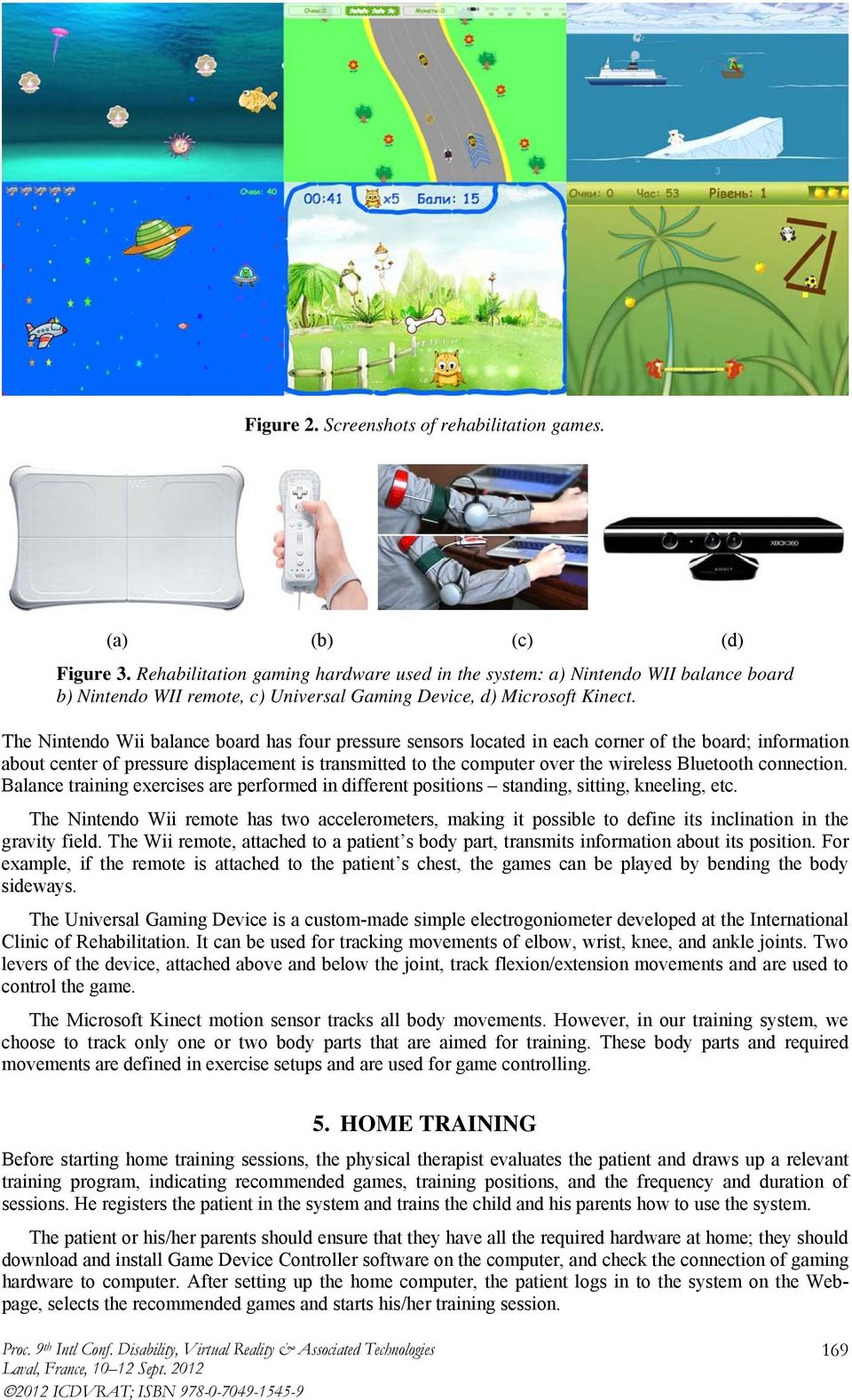
4 Figure 4. Results and duration of the training sessions are presented as charts. Information about the duration and time of the gaming sessions, as well as game scores are stored in the system and can be viewed in the form of graphs. This information is accessible to the therapist so that the program may be adjusted, if necessary. 6. BALANCE TRAINING EXERCISES The Game Training System can be used as a supplementary treatment option for patients with different motor problems. This article describes its usage for patients with balance problems. The system is available at and its usage is free for patients and therapists. A personal computer with an Internet connection and a Bluetooth adapter, a Nintendo Wii balancing board, and a Nintendo Wii remote are required to conduct home balance training exercises. Balance training exercises are aimed at developing coordinated left-right and forward-backward weight-shifting skills and maintaining position. The patient stands or sits on the balance board; while performing specific exercises; at the same time, he/she controls the movements of computer game characters. Figure 5. Gaming sessions for balance training. Balance training is performed in the following positions: a) standing on the board and shifting body weight left-right, b) standing and shifting body weight forward-backward, standing with support, d) sitting on the board, e) standing with one foot in front of the other, e) kneeling. 170
5 Figure 6. Training positions for balance exercises. 7. STABILOMETRY AS A DIAGNOSTIC TOOL MEASURING EQUILIBRIUM Patients with balance disorders can use our system, which includes a specials diagnostic tool a game called Stabilometry, aimed at evaluating balance disorders. The child should stand still on the balance board for fifteen seconds. Two parameters are calculated: the mean velocity of center of pressure () displacement and area of displacement. Figure 7. The Stabilometry game is a tool for testing equilibrium. The mean velocity of displacements indicates how briskly the patients sway movements are, whereas the area of shows the range of these movements. Higher velocities and larger areas indicate poor balance. The Stabilometry game has not been validated or certified as a clinical diagnostic tool; it is just an additional tool for patients and parents. 8. PRELIMINARY SYSTEM ASSESSMENT Preliminary assessment of the Home Rehabilitation Gaming System for balance training was performed on six patients with Cerebral Palsy, who went through daily training sessions for two weeks. Patients with spastic forms of Cerebral Palsy, aged five to eleven years, cooperative with normal mental development, were selected for the study. All parents and patients were informed and gave their consent for participation. The therapist evaluated each child and drew up relevant training program, indicating recommended games, training positions, and timing. The first two treatment sessions were performed at the rehabilitation center together with the therapist. He registered the patient in the system and trained the child and his parents how to use the system and carry out gaming exercises at home. For a period of two weeks (twelve sessions), patients conducted daily home training sessions, each lasting thirty minutes. The patients then returned to the rehabilitation center for the second evaluation. The patients were assessed according to standard evaluation systems, whereas their motor development was classified according to the Gross Motor Function Classification System (GMFCS), the Pediatric Balance Scale, and Stabilometry testing. The Gross Motor Function Classification System (GMFCS) is a five level classification system that describes the gross motor function of children with Cerebral Palsy. Children at Level I can generally walk 171

6 without restrictions, but tend to be limited in some of the more advanced motor skills. Children at Level V are generally very limited in their ability to move around even with the use of assistive technology (Palisano et al, 1997). The Pediatric Balance Scale (PBS) is an instrument with proven reliability and validity, designed to evaluate the child s balance function, including his/her ability to move around in the surrounding environment (Franjoine et al, 2003). It is a modification of Berg s Balance Scale, developed as a balance measure for school-age children with mild to moderate motor impairments. The scale consists of fourteen tasks; each has a scoring scale from 0 to 4 points; the maximum score is 56. The distribution of patients according to age, gender, diagnosis, and GMFCS level is presented in Table 1. The majority of patients were in the five-to-eight-year-old group, predominantly with hemiplegic Cerebral Palsy. Four of them were classified at Level I of motor development; one walked with limitation (Level II), and one girl with spastic tetraplegia was able to walk only with assistance (Level III). Table 1. Distribution of patients according to diagnosis, age and GMFCS level. Patient Age (years) Gender (M/F) Diagnosis GMFCS level A 5 M CP, spastic right-sided hemiplegia І B 5 F CP, spastic right-sided hemiplegia ІІ C 7 F CP, spastic right diplegia І D 7 M CP, spastic right-sided hemiplegia І E 11 M CP, spastic left-sided hemiplegia І F 8 F CP, spastic tetraplegia ІІІ 9. RESULTS AND DISCUSSION Assessment results of six patients before and after a two-week home gaming training course are presented in Table 2. The same information is presented as charts in Fig. 8. Table 2. Balance testing results of six patients with Cerebral Palsy before and after home game training. Patient, age GMFCS level diagnosis, Before training Balance Scale Velocity Area After training Balance Scale Velocity A, 5 years Level I, hemiplegia B, 5 years Level II, hemiplegia C, 7 years Level I, diplegia D, 7 years Level I, hemiplegia E, 11 years Level I, hemiplegia F, 8 years Level III, tetraplegia Area 5 172
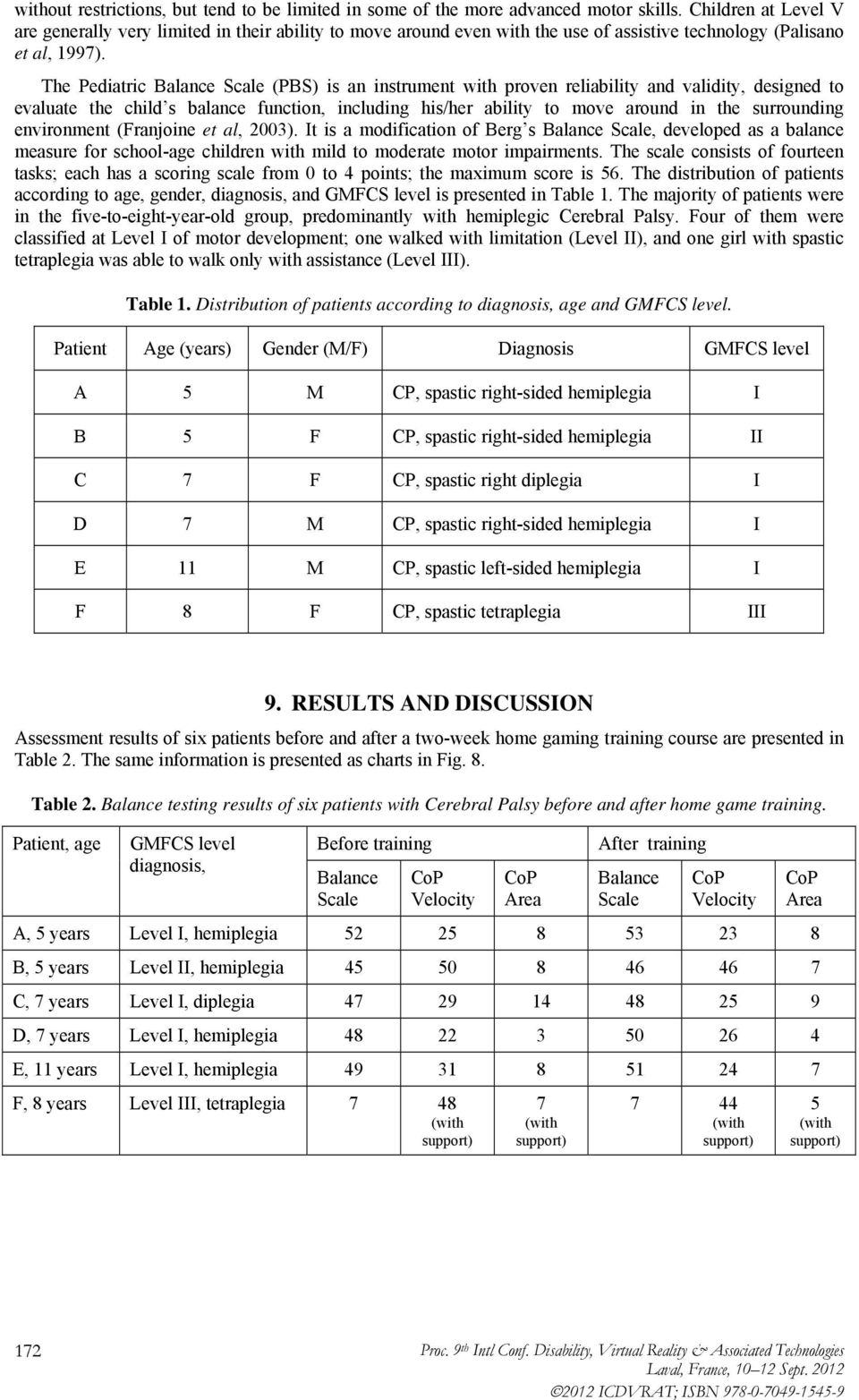
7 Pediatric Balance Scale A E C F D B Center of pressure velocity F C A D B E Center of pressure Area C D A E B F 0 before after 0 before after 0 before after Figure 8. Graphical representation of balance testing data of six patients with Cerebral Palsy before and after game training courses. 10. CONCLUSIONS A Home Rehabilitation Gaming System was developed in order to transfer the virtual rehabilitation of patients with motor disorders from clinical to home settings. Studies indicate the feasibility of this Home Rehabilitation Gaming System to train the patients balance function. Preliminary results show balance improvement in patients with Cerebral Palsy after home training courses. Further studies are needed to establish medical requirements and evidence. Acknowledgements: The authors would like to express their gratitude to the administration of the International Clinic of Rehabilitation for their support in developing the system, as well as to doctors and therapists for testing the system and offering critical and constructive suggestions. The Home Rehabilitation Gaming System is available free-of-charge to both therapists and patients at: ( 11. REFERENCES S V Adamovic, G Fluet, E Tunik, A S Merians (2009), Sensorimotor Training in Virtual Reality: A Review, Journal of NeuroRehabilitation, Volume 25, Number 1, pp J E Deutsch, M Borbely, J Filler, K Huhn, P Guarrera-Bowlby (2008), Use of a Low-Cost, Commercially Available Gaming Console (Wii) for Rehabilitation of an Adolescent with Cerebral Palsy, Phys Ther., 88, pp M R Franjoine, J S Gunther, M J Taylor (2003), Pediatric balance scale: a modified version of the Berg Balance Scale for the school-aged child with mild to moderate motor impairment, Pediatr Phys Ther., Summer; 15, pp V O Kachmar, O O Kachmar (2001), Computer Gaming Devices in Motor Disorder Rehabilitation, In Intensive Neurophysiological Rehabilitation System (method of Prof. V.I.Kozyavkin, Research work ed. by V. Kozyavkin), Multi-M, Lviv, pp V Kozyavkin, O Kachmar (2004), Rehabilitation with the Ease of Game, Cerebral Palsy Magazine, September, pp R Palisano, P Rosenbaum, S Walter, D Russell, E Wood, B Galuppi (1997). Development and reliability of a system to classify gross motor function in children with cerebral palsy, Developmental Medicine & Child Neurology, 39, pp

Lean on Wii: Physical Rehabilitation With Virtual Reality and Wii Peripherals
 Lean on Wii: Physical Rehabilitation With Virtual Reality and Wii Peripherals Fraser ANDERSON 1, Michelle ANNETT, Walter F. BISCHOF Department of Computing Science, University of Alberta Abstract. In recent
EFFECT OF VIBRATORY PLATFORM THERAPY ON POSTURE IN CHILDREN WITH CEREBRAL PALSY: A PILOT STUDY
 EFFECT OF VIBRATORY PLATFORM THERAPY ON URE IN CHILDREN WITH CEREBRAL PALSY: A PILOT STUDY Pierina MAGNA a, Natalia JERIA a, Carlos ALVAREZ a,b, Chiara RIGOLDI c & Manuela GALLI c a Departamento de Kinesiología
Gait Analysis Laboratory Centro de Rehabilitación Infantil Teletón Estado de México
 Gait Analysis Laboratory Centro de Rehabilitación Infantil Teletón Estado de México Dr. Demetrio Villanueva Ayala Doctorado en Biomecánica, CINVESTAV Dr. Juan Carlos Pérez Moreno Especialista en Medicina
Correlation between ICIDH handicap code and Gross Motor Function Classification System in children with cerebral palsy
 Correlation between ICIDH handicap code and Gross Motor Function Classification System in children with cerebral palsy Eva Beckung* PT PhD; Gudrun Hagberg BA BM PhD, Department of Pediatrics, Göteborg
Division of Biomedical Engineering, Chonbuk National University, 567 Baekje-daero, deokjin-gu, Jeonju-si, Jeollabuk-do 561-756, Republic of Korea 3
 Upper Extremity Rehabilitation Program Using Inertial Sensors and Virtual Reality for Patients with Upper Extremity Hemiplegia due to Disorders after Stroke Je-Nam Kim 1, Mun-Ho Ryu 2,3, Yoon-Seok Yang
In This Issue... From the Coordinator by Amy Goldman... 2. Early AAC Intervention: Some International Perspectives by Mary Jo Cooley Hidecker...
 Unless otherwise noted, the publisher, which is the American Speech-Language-Hearing Association (ASHA), holds the copyright on all materials published in Perspectives on Augmentative and Alternative Communication,
Cerebral Palsy. www.teachinngei.org p. 1
 Cerebral Palsy What is cerebral palsy? Cerebral palsy (CP) is a motor disability caused by a static, non-progressive lesion (encephalopathy) in the brain that occurs in early childhood, usually before
Fall Detection System based on Kinect Sensor using Novel Detection and Posture Recognition Algorithm
 Fall Detection System based on Kinect Sensor using Novel Detection and Posture Recognition Algorithm Choon Kiat Lee 1, Vwen Yen Lee 2 1 Hwa Chong Institution, Singapore [email protected] 2 Institute
Physical Therapy and Occupational Therapy Services of Young Children with Cerebral Palsy
 Physical Therapy and Occupational Therapy Services of Young Children with Cerebral Palsy Denise Begnoche, PT, DPT, Lisa Chiarello, PT, PhD, PCS, Doreen Bartlett, PT, PhD, Robert Palisano, PT, ScD Hui-Ju
Intelligent Submersible Manipulator-Robot, Design, Modeling, Simulation and Motion Optimization for Maritime Robotic Research
 20th International Congress on Modelling and Simulation, Adelaide, Australia, 1 6 December 2013 www.mssanz.org.au/modsim2013 Intelligent Submersible Manipulator-Robot, Design, Modeling, Simulation and
Announcement. Department of Public Welfare (DPW) Medication Administration Program. Registration Now Open
 Pennsylvania Department of Public Welfare Office of Developmental Programs Announcement PA Department of Public Welfare Medication Administration Program Registration Now Open ODP Communication Number:
Developmental Disabilities
 RIGHTS UNDER THE LAN TERMAN ACT Developmental Disabilities Chapter 2 This chapter explains: - What developmental disabilities are, - Who is eligible for regional center services, and - How to show the
Predicting the development of communication skills by children with motor disorders
 Predicting the development of communication skills by children with motor disorders Dr Lindsay Pennington, Dr Mark Pearce, Professor Allan Colver, Professor Helen McConachie, Newcastle University Dr Mary
CLINICAL OUTCOME SCORES FOR THE FAMILY HOPE CENTER FOR 13.0 YEARS, COMPARED TO NATIONAL SAMPLE OF OUTPATIENT REHABILITATION FOR SIMILAR DIAGNOSES
 CLINICAL OUTCOME SCORES FOR THE FAMILY HOPE CENTER FOR 13.0 YEARS, COMPARED TO NATIONAL SAMPLE OF OUTPATIENT REHABILITATION FOR SIMILAR DIAGNOSES This document references data from a Report compiled and
Computer Games and Virtual Worlds: New Modalities of Rehabilitation and Therapy
 Computer Games and Virtual Worlds: New Modalities of Rehabilitation and Therapy Walt Scacchi Institute for Software Research and Center for Computer Games and Virtual Worlds University of California, Irvine
Cerebral palsy, neonatal death and stillbirth rates Victoria, 1973-1999
 Cerebral Palsy: Aetiology, Associated Problems and Management Lecture for FRACP candidates July 2010 Definitions and prevalence Risk factors and aetiology Associated problems Management options Cerebral
The Use of the Lokomat System in Clinical Research
 International Neurorehabilitation Symposium February 12, 2009 The Use of the Lokomat System in Clinical Research Keith Tansey, MD, PhD Director, Spinal Cord Injury Research Crawford Research Institute,
FREQUENTLY ASKED QUESTIONS ABOUT PHYSICAL THERAPY, OCCUPATIONAL THERAPY, AND ADAPTED PHYSICAL EDUCATION SERVICES
 FREQUENTLY ASKED QUESTIONS ABOUT PHYSICAL THERAPY, OCCUPATIONAL THERAPY, AND ADAPTED PHYSICAL EDUCATION SERVICES 1. What is adapted physical education? Adapted physical education is a diversified program
Design Analysis of Everyday Thing: Nintendo Wii Remote
 1 Philip Stubbs Design Analysis of Everyday Thing: Nintendo Wii Remote I. Introduction: Ever since being released in November 2006, the Nintendo Wii gaming system has revolutionized the gaming experience
Learn the steps to identify pediatric muscle weakness and signs of neuromuscular disease.
 Learn the steps to identify pediatric muscle weakness and signs of neuromuscular disease. Guide for therapists/specialists Questions and comments to: [email protected] Surveillance and Referral
Thermodynamic efficiency of an actuator that provides the mechanical movement for the driven equipments:
 1. Introduction 1.1. Industry Automation Industry automation is the term that describes a vital development programme of a production community where the project engineers build up automated manufacturing
Exergaming: Video Games as a form of Exercise
 Exergaming: Video Games as a form of Exercise Neehar Reddy Cherabuddi Department of Computer Science Brown University Providence, Rhode Island 02906 Project website: http://www.cs.brown.edu/people/awilson/exergaming-home.html
Cerebral Palsy: Intervention Methods for Young Children. Emma Zercher. San Francisco State University
 RUNNING HEAD: Cerebral Palsy & Intervention Methods Cerebral Palsy & Intervention Methods, 1 Cerebral Palsy: Intervention Methods for Young Children Emma Zercher San Francisco State University May 21,
Florida 4-H Consumer Choices 2010-11 Study Topics. Student Guide. Video Game Systems. Introduction and Background
 Florida 4-H Consumer Choices 2010-11 Study Topics Student Guide Video Game Systems Introduction and Background Buying a video game system is a big decision that can cost hundreds of dollars, so it is important
Potential for new technologies in clinical practice
 Potential for new technologies in clinical practice International Neurorehabilitation Symposium University of Zurich Feb 12-13th 2009 Prof Jane Burridge Jane Burridge Feb 2009 Introduction Societal drivers
Critical Review: Sarah Rentz M.Cl.Sc (SLP) Candidate University of Western Ontario: School of Communication Sciences and Disorders
 Critical Review: In children with cerebral palsy and a diagnosis of dysarthria, what is the effectiveness of speech interventions on improving speech intelligibility? Sarah Rentz M.Cl.Sc (SLP) Candidate
Lab 2 Sensor Modeling Introduction to the Wiimote and the Wiimote LABVIEW Interface
 Lab 2 Sensor Modeling Introduction to the Wiimote and the Wiimote LABVIEW Interface 1. Objective In this lab, you will: i. Become familiar with the Wiimote ii. Understand the LABVIEW Bluetooth interface
Kinect Interface to Play Computer Games with Movement
 Kinect Interface to Play Computer Games with Movement Program Install and Hardware Setup Needed hardware and software to use the Kinect to play computer games. Hardware: Computer running Windows 7 or 8
ADHDInitiative. The Vermont A MULTIDISCIPLINARY APPROACH TO ADHD FOR FAMILIES/CAREGIVERS, EDUCATIONAL & HEALTH PROFESSIONALS
 The Vermont ADHDInitiative A MULTIDISCIPLINARY APPROACH TO ADHD FOR FAMILIES/CAREGIVERS, EDUCATIONAL & HEALTH PROFESSIONALS ACKNOWLEDGEMENTS: This work and its resulting improvements in the care provided
Neuro-rehabilitation in Stroke. Amit Kumar Neuro-Occupational Therapist
 Neuro-rehabilitation in Stroke Amit Kumar Neuro-Occupational Therapist Neuro-rehabilitation A process whereby patients who suffer from impairment following neurologic diseases regain their former abilities
Live a life with fewer limits Orthopaedic Services
 Live a life with fewer limits Orthopaedic Services Crittenton Orthopaedic Services Repair. Restore. Return. A full range of services for full motion living. From the strains and sprains children experience
Alexander Nikov. 4.2. Usability Testing. 1. What is a Usability Test? Usability Testing Questions. 2. Who are the Test Participants?
 COMP 3220 Human-Computer Interaction Usability Testing Questions 4.2. Usability Testing Alexander Nikov 1. What is a Usability Test? 2. Who are the Test Participants? 3. Why Usability Test? 4. Why Doesn
A Monitored Student Testing Application Using Cloud Computing
 A Monitored Student Testing Application Using Cloud Computing R. Mullapudi and G. Hsieh Department of Computer Science, Norfolk State University, Norfolk, Virginia, USA [email protected], [email protected]
DRIVER REHABILITATION OVERVIEW
 DRIVER REHABILITATION OVERVIEW What is included in a Driving Evaluation? The purpose of the evaluation is to determine if the individual s medical condition, medications, functional limitations and/ or
Rehabilitation Robotics What Lies Ahead?
 Rehabilitation Robotics What Lies Ahead? W Zev Rymer Rehabilitation Institute of Chicago 3/3/09 International Neurorehabilitation Symposium 2009 1 Outline focus on stroke recovery Robot-assisted therapy
New Technologies and Their Role in Enhancing Neurological Recovery
 REHABILITATION CARE 2014: under the ACA Patient Centered Medical Home for Persons with Disability: Acute Neurology, Medicine, Surgery services seamlessly blending into Acute inpatient Rehabilitation Ambulatory
NANYANG TECHNOLOGICAL UNIVERSITY
 NANYANG TECHNOLOGICAL UNIVERSITY Division of Information Studies Wee Kim Wee School of Communication & Information Digitally Mediated Fitness Games for Corporate Wellness CI6299 Critical Inquiry Proposal
Physiotherapy for the severely paretic arm and hand in patients with acquired brain injury - Virtual reality combined with task specific practice
 Physiotherapy for the severely paretic arm and hand in patients with acquired brain injury - Virtual reality combined with task specific practice Christian Gunge Riberholt, PT MR Nakayama et al, 1994 (Copenhagen
INFORMATION TECHNOLOGY TECHNICIAN I/II
 INFORMATION TECHNOLOGY TECHNICIAN I/II CITY OF HAYWARD DEFINITION To perform responsible technical duties related to computer hardware and software customer support; provide project support for new and
SAFETY GUIDANCE MATERIAL
 SAFETY GUIDANCE MATERIAL SAFETY MANAGEMENT MONDAY MARCH 23,GUIDANCE 2015 This safety resource was written for the scrap industry by the scrap industry and was developed to assist you in making your scrap
Occupational Therapy
 Occupational Therapy I. Policy University Health Alliance (UHA) will reimburse for occupational therapy when it is determined to be medically necessary and when it meets the medical criteria guidelines
Universal Exercise Unit (UEU)
 -- www.genius4kids.com -- Universal Exercise Unit (UEU) I. The History of Universal Exercise Unit (UEU): The Universal Exercise Unit was designed and developed in the 1940s by a well-known orthopedic surgeon,
Knee Pain/OA Physical Therapy Approaches
 Knee Pain/OA Physical Therapy Approaches G. Kelley Fitzgerald, PT, PhD, FAPTA Professor, Department of Physical Therapy, School of Health and Rehabilitation Sciences Director, Physical Therapy Clinical
YouGrabber playful therapy for finger, hand and arm rehabilitation
 playful therapy for finger, hand and arm rehabilitation Intensive and motivating training For hospitals, clinics and patients at home Award-winning Swiss therapy system swiss technology Our patients see
Installation Guide For Exchange Reporter Plus
 Installation Guide For Exchange Reporter Plus Zoho Corp. 1 Table of Contents Contact ZOHO Corp.... 4 Contact ZOHO Corp.... 4 Technical Support... 4 Getting Started... 5 System Requirements... 5 Hardware
Cerebral Palsy. 1 - Introduction. An informative Booklet for families in the Children and Teens program
 Cerebral Palsy 1 - Introduction An informative Booklet for families in the Children and Teens program Centre de réadaptation Estrie, 2008 Preface Dear parents, It is with great pleasure that we present
People First Language. Style Guide. A reference for media professionals and the public
 People First Language Style Guide A reference for media professionals and the public What is People First Language? People First Language (also referred to as Person First ) is an accurate way of referring
Providing Professional Care in Rehabilitation Services
 For more information about Inspira Rehab Care or for a patient evaluation, please contact any one of our facilities: Inspira Rehab Care Bridgeton Health Center 333 Irving Avenue Bridgeton, NJ 08302 (856)
Cerebral Palsy. Causes
 Cerebral Palsy Cerebral Palsy (sera brul PAUL zee) (CP) is an injury or abnormality of the developing brain that affects movement. This means that something happened to the brain or the brain did not develop
Professional Development: Applied Behavior Analysis Video Series
 Autism Overview: Course 1 Autistic Spectrum Disorders, including Asperger s Disorder and Pervasive Developmental Disorder, are neurological disorders that can have a significant impact on all areas of
SCOPE OF RESPONSIBILITY: Staffing Responsibility May guide the work of other staff or volunteers.
 Job Title: Network Support Specialist Job Level: Level 4 Work Unit: Reports To: Information Technology Information Technology Coordinator POSITION SUMMARY: Evaluates, analyzes, tests, and troubleshoots
Cerebral Palsy. In order to function, the brain needs a continuous supply of oxygen.
 Cerebral Palsy Introduction Cerebral palsy, or CP, can cause serious neurological symptoms in children. Up to 5000 children in the United States are diagnosed with cerebral palsy every year. This reference
Basic Standards for Residency Training in Child and Adolescent Psychiatry
 Basic Standards for Residency Training in Child and Adolescent Psychiatry American Osteopathic Association and American College of Osteopathic Neurologists and Psychiatrists Adopted 1980 Revised, 1984
Adults with Cerebral Palsy
 Linköping Studies in Health Sciences, Thesis No. 91 Adults with Cerebral Palsy - living with a lifelong disability Karin Sandström Division of Physiotherapy Department of Medical and Health Sciences Linköping
Cerebral palsy can be classified according to the type of abnormal muscle tone or movement, and the distribution of these motor impairments.
 The Face of Cerebral Palsy Segment I Discovering Patterns What is Cerebral Palsy? Cerebral palsy (CP) is an umbrella term for a group of non-progressive but often changing motor impairment syndromes, which
Tone Management in Cerebral Palsy. Jenny Wilson, MD [email protected] OHSU and Shriners Hospital for Children October, 2015
 Tone Management in Cerebral Palsy Jenny Wilson, MD [email protected] OHSU and Shriners Hospital for Children October, 2015 Disclosures I am involved in a Dysport sponsored research study Goals Describe
Arkansas Department of Health and Human Services Division of Medical Services P.O. Box 1437, Slot S-295 Little Rock, AR 72203-1437
 Arkansas Department of Health and Human Services Division of Medical Services P.O. Box 1437, Slot S-295 Little Rock, AR 72203-1437 Fax: 501-682-2480 TDD: 501-682-6789 & 1-877-708-8191 Internet Website:
SECTION 2 PHYSICAL THERAPY SERVICES. BY INDEPENDENT PHYSICAL THERAPISTS (including Group Practices) Not in Rehabilitation Centers
 Division of Health Care Financing Updated July 2009 SECTION 2 PHYSICAL THERAPY SERVICES BY INDEPENDENT PHYSICAL THERAPISTS (including Group Practices) Not in Rehabilitation Centers Table of Contents 1
Department of Occupational Therapy Doctorate of Occupational Therapy Program
 Occupational Performance Perspectives Department of Occupational Therapy Doctorate of Occupational Therapy Program Curriculum Content Threads Course Credits 600 Occupational Engagement & Participation
Determining Your MAC Address in Windows XP
 Determining Your MAC Address in Windows XP 1. Click Start then choose Run. 2. Type cmd into the Open: field and press the Enter key. 3. Type ipconfig /all at the prompt and press the Enter key. (Note:
Early Signs of Puberty in Very Young Children with Cerebral Palsy and Similar Conditions by Susan Agrawal
 www.complexchild.com Early Signs of Puberty in Very Young Children with Cerebral Palsy and Similar Conditions by Susan Agrawal Occasionally I see a parent on a message board asking about early signs of
By Dr. Mindy Aisen CEO and Director United Cerebral Palsy Research and Educational Foundation www.ucpresearch.org CEREBRAL PALSY RESEARCH
 By Dr. Mindy Aisen CEO and Director United Cerebral Palsy Research and Educational Foundation www.ucpresearch.org CEREBRAL PALSY RESEARCH Main Sources of Federal Funding for Cerebral Palsy and Disability
Keywords web based medical management, patient database on cloud, patient management and customized applications on tablets, android programming.
 Functional Description of Online Medical Management System Using Modern Technology Priyanka Patil, Sruthi Kunhiraman, Rohini Temkar VES Institute of Technology, Chembur, Mumbai Abstract Today s web based
Cisco TelePresence Manager
 Cisco TelePresence Manager 1.3 Simplifying the Experience: Meeting Scheduling and Management Cisco TelePresence Manager is an integral part of the Cisco TelePresence experience that creates the feeling
Fitness Fundamentals
 Fitness Fundamentals Participate 2-3/week Duration 30-60 minutes Intensity moderate to vigorous Exercises should be developmentally appropriate, enjoyable and varied. Benefits can include increased Careful
1. What is Cerebral Palsy?
 1. What is Cerebral Palsy? Introduction Cerebral palsy refers to a group of disorders that affect movement. It is a permanent, but not unchanging, physical disability caused by an injury to the developing
RESPIRATORY THERAPIST CLASSIFICATION SERIES
 STATE OF WISCONSIN CLASSIFICATION SPECIFICATION RESPIRATORY THERAPIST CLASSIFICATION SERIES Effective Date: June 16, 1985 Modified Effective: November 5, 2000 Modified Effective: May 6, 2001 I. INTRODUCTION
Aase Frostad Fasting, Specialist clinical psychology/neuropsychology, Huseby resource centre for the visual impaired
 Aase Frostad Fasting, Specialist clinical psychology/neuropsychology, Huseby resource centre for the visual impaired Assessing the potentialities of children with disabilities. Presentation at the Conference
DEPARTMENT OF PHYSICAL THERAPY Modifications to the 2015-2017 Graduate Catalog. Page 139
 DEPARTMENT OF PHYSICAL THERAPY Modifications to the 2015-2017 Graduate Catalog Program of Study Semester 6 Semester 6 Spring PHTH 6530 Psychosocial Behavioral Issues II 2 PHTH 6540 Prosthetics & Orthotics
Electronic Health Records (EHR) An Educational Session
 Electronic Health Records (EHR) An Educational Session Prepared For Presented By JP Killeen & Associates, Inc. 1707 Osage Street, Suite 405 Alexandria, Virginia 22302 703.575.8562 John P.
Safe Connect Game Console Detection
 Safe Connect Game Console Detection This document outlines the process for connecting gaming consoles to a Safe Connect managed network. Impulse Point 6810 New Tampa Highway Lakeland, FL 33815 863-802-3738
College of Education. Special Education
 357 INITIAL PRACTICUM IN SPECIAL EDUCATION. (1) An introductory supervised field experience for special education majors. Students will participate in two special education programs as teacher aides. Placements
School Age Services INTERVENTION SERVICES FOR CHILDREN WITH DEVELOPMENTAL DELAYS
 INTERVENTION SERVICES FOR CHILDREN WITH DEVELOPMENTAL DELAYS Feel Good About Giving School Age Services EASTER SEALS SUPERIOR CALIFORNIA 3205 Hurley Way Sacramento, CA 95864 (916) 679-3155 www.myeasterseals.org
SCHREIBER PEDIATRIC REHAB CENTER OF LANCASTER COUNTY SCOPE OF CARE. Characteristics of Persons Served
 SCHREIBER PEDIATRIC REHAB CENTER OF LANCASTER COUNTY SCOPE OF CARE Ages: Children ages birth to 21 years of age may be served. Characteristics of Persons Served Cultural: Medical Status: Diagnosis(es):
Proceedings of Meetings on Acoustics
 Proceedings of Meetings on Acoustics Volume 19, 2013 http://acousticalsociety.org/ ICA 2013 Montreal Montreal, Canada 2-7 June 2013 Speech Communication Session 2aSC: Linking Perception and Production
Cerebral Palsy. 1995-2014, The Patient Education Institute, Inc. www.x-plain.com nr200105 Last reviewed: 06/17/2014 1
 Cerebral Palsy Introduction Cerebral palsy, or CP, can cause serious neurological symptoms in children. Thousands of children are diagnosed with cerebral palsy every year. This reference summary explains
Jaya Rachwani Parshotam DOB: 09/15/1986 E-mail: [email protected] Phone number: 212.998.9058 CURRICULUM VITAE
 Jaya Rachwani Parshotam DOB: 09/15/1986 E-mail: [email protected] Phone number: 212.998.9058 CURRICULUM VITAE CURRENT POSITION Postdoctoral Fellow Infant Action Lab, Psychology Department New York University
Parental controls on Xbox 360, Xbox One, Nintendo Wii, PlayStation 3 and PlayStation 4
 Parental controls on Xbox 360, Xbox One, Nintendo Wii, PlayStation 3 and PlayStation 4 All games consoles and hand held gaming devices can be used to access the internet. Your child can download games
Physical & Occupational Therapy Authorization FAQs
 Physical & Occupational Therapy Authorization FAQs 1. What are the authorization requirements for the UM program? The utilization management program requires providers to obtain authorization after the
Post-Doctoral Fellowship in Clinical Psychology
 SULLIVAN CENTER FOR CHILDREN 2015-2016 Post-Doctoral Fellowship in Clinical Psychology 3443 W. Shaw Fresno, California 93711 Phone: 559-271-1186 Phone: 559-271-1186 Fax: 559-271-8041 E-mail: [email protected]
ICD 10: Final Steps for Successful Implementation
 ICD 10: Final Steps for Successful Implementation Gayle R. Lee, JD Matt Elrod, PT, DPT, MEd, NCS Presenters Gayle Lee, JD, has more than 15 years of experience working on health care issues impacting the
Passive Range of Motion Exercises
 Exercise and ALS The physical or occupational therapist will make recommendations for exercise based upon each patient s specific needs and abilities. Strengthening exercises are not generally recommended
Program Specification for Master Degree in: Child & Adolescent Psychiatry
 Cairo University Faculty of Medicine Program Specification for Master Degree in: Child & Adolescent Psychiatry Program type: single Program code: CHIPS 817 Department offering the program: Department of
Cerebral palsy also known as CP is a condition caused by injury to the parts of the brain that control our
 Cerebral Palsy NICHCY Disability Fact Sheet #2 June 2010 Jennifer s Story Jen was born 11 weeks early and weighed only 2½ pounds. The doctors were surprised to see what a strong, wiggly girl she was. But
Neurodegenerative diseases Includes multiple sclerosis, Parkinson s disease, postpolio syndrome, rheumatoid arthritis, lupus
 TIRR Memorial Hermann is a nationally recognized rehabilitation hospital that returns lives interrupted by neurological illness, trauma or other debilitating conditions back to independence. Some of the
Subject: Health; health insurance; autism spectrum disorders. Statement of purpose: This bill proposes to require health insurers6
 2010 Page 1 1 2 3 4 5 S.262 Introduced by Senators Carris and Campbell Referred to Committee on Finance Date: Janaury 5, 2010 Subject: Health; health insurance; autism spectrum disorders Statement of purpose:
Gross and fine motor function and accompanying impairments in cerebral palsy
 Gross and fine motor function and accompanying impairments in cerebral palsy K Himmelmann* MD; E Beckung PT PhD; G Hagberg BA BM PhD; P Uvebrant MD PhD, Department of Paediatrics, The Queen Silvia Children
Who Needs Parental Controls?
 A Survey Of Awareness, Attitudes, And Use Of Online Parental Controls Findings From A National Survey Among Parents Supported by: A Survey Of Awareness, Attitudes, And Use Of Online Parental Controls Findings
Therapeutic Recreation: Effects of a Riding Protocol on a Child with Cerebral Palsy
 May 2009 Rose Flammang, SPT Katrina Francis, SPT Therapeutic Recreation: Effects of a Riding Protocol on a Child with Cerebral Palsy The purpose of our research project was to Evaluate the effect of a