
ON-SITE SOLAR GENERATION AT METRO OPPORTUNITIES & IMPLEMENTATION
|
|
|
- Annice Morgan
- 9 years ago
- Views:
Transcription
1 ON-SITE SOLAR GENERATION AT METRO OPPORTUNITIES & IMPLEMENTATION

2 CONTENTS Introduction...3 Why go solar?...4 What type of solar is best?...6 Where should solar be developed?...8 Implementation...10 Disclaimer: This study was commissioned by the Washington Metropolitan Area Transportation Authority (Metro) and prepared by AECOM. AECOM has endeavored to ensure that the reported data and information contained in this report are complete, accurate, and relevant. All estimates, assumptions, and extrapolations are based on methodological techniques employed by AECOM and believed to be reliable. AECOM assumes no responsibility for inaccuracies in reporting by the client, its agencies, representatives, or any other third party data source used in the preparation of this report. AECOM makes no warranty or representation concerning any of the estimated or Published December 1, 2015 Prepared by: Alexander Quinn, Dale Gauthier, Christine Safriet, Andrew Agopian, Kelly Rytel, Danny Gold AECOM 300 California Street, Suite 400 San Francisco, CA Prepared for: Washington Metropolitan Area Transit Authority 600 5th Street, NW Washington, DC 20001
3 3 INTRODUCTION Metro s Sustainability Agenda was launched in 2014 to recognize and strengthen Metro s role in supporting regional sustainability. The Agenda sets concrete, ambitious performance targets that guide the Authority and the region on the path to becoming the most sustainable in the nation. As part of the Sustainability Agenda, Metro committed to achieving 30% of its electricity from renewable resources, where financially feasible, by Given the Authority s significant real estate assets, Metro has a unique opportunity to generate solar energy on-site in support of this target. By leveraging many of its existing real estate assets, the Authority can reduce electricity costs, reduce its risk exposure to energy pricing, and provide significant impetus to accelerate renewable energy production in the D.C. region. This report seeks to quantify how investment in on-site solar energy production can benefit both the Authority and the region and determine the optimal level of solar deployment Metro should pursue. The report has been divided into four sections that outline why solar power deployment is timely for Metro: 1) How implementing solar helps Metro move towards achieving its Sustainability Agenda target 2) What solar typology would be appropriate 3) Where to prioritize solar sites offered to the market for investment 4) A timeline and process for how to implement solar installations on Metro s properties EXECUTIVE SUMMARY

4 4 WHY GO SOLAR? It is estimated that by pursuing the priority sites identified in this report and achieving commercial operation by the end of 2016, Metro s potential electricity cost savings could total nearly $3.2 million over a 20-year PPA term. 1 THE OPPORTUNITY Installing solar on Metro s assets is financially advantageous and can contribute to Metro s Sustainability Agenda. Clean on-site electricity promotes the maximum value of Metro station areas and focuses development on otherwise underutilized rooftops and air rights to generate clean energy. PPA STRUCTURE Metro can achieve cost savings and mitigate development risks through a Power Purchase Agreement (PPA) to purchase on-site solar energy generated on Metro property. This contract structure has been successfully implemented by both public and private sectors, including the Department of Defense, the Government of the District of Columbia, and Montgomery County. Through a PPA, the opportunity to maximize renewable power generation and electricity costs savings can be combined with a well-managed risk profile. Under a PPA project financing, construction, operation, and maintenance are executed by a third-party developer/operator. This allows Metro to maximize the financial benefits of on-site solar technology with the support of an experienced solar developer. Specifically, a PPA would result in: Long-term electricity cost savings from Metro s operating budget with a hedge against unpredictable brown power rates. It is estimated that on-site solar development can deliver electricity cost savings of $3.2 million over the next 20 years. 1 The final value of operating savings to Metro depends on price and escalation terms negotiated in the PPA agreement. Limited to no capital investment required from Metro, as capital investments are made by a third party. A firm electricity price for the contracting period, typically 20 years and protection against unpredictable price increases for Metro. Lower electricity prices for Metro compared to financing and owning solar installations, as certain tax incentives and credits are only available to the private sector. Ability to benefit from economies of scale and expedient project delivery by contracting with a firm that specializes in solar installation and operations. 1 Bluefi n LLC Solar Assessment, January values presented in 2015 dollars
5 UPDATE In December 2015 the FITC tax credit was extended at 30% through 2019 and will then drop to 26% in 2020, 22% in 2021, and 10% thereafter. This FITC extension provides a significant opportunity for Metro to continue to obtain a favorable PPA rate through future solar projects as the solar marketplace continues to grow. The sole compensation for a third party developer/operator for financing, designing, constructing, and maintaining the solar system is the income generated based on the kilowatt-hours of electricity produced. As host, Metro would agree to purchase all power generated from the system during the contract term. Metro would have no payment obligations during the design or construction phases of the project and would only begin making electricity payments after the system is fully operational. Solar PPA contracts are typically structured to provide the third party operator with ownership of any solar renewable energy credits (SRECs) 2 for a defined term. Private developers typically benefit from any available federal energy investment tax credit. These terms bring down the overall cost of development and allow the provider to offer lower energy prices through the PPA. The Federal Incentive Tax Credit (FITC) currently provides a significant financial incentive to potential development partners by allowing developers to deduct 30% of the capital costs of solar installation from their tax liability. FITC is currently set to expire on December 31, The subsequent reduction in the tax credit from 30% to 10% will significantly impact providers ability to deliver low energy prices. The solar energy industry is lobbying to extend this tax credit, however, the outcome remains uncertain. Delivering projects before December 31, 2016 presents a significant opportunity for Metro to obtain a reduced PPA rate over the term of a contract that will not be as favorable after the credit is reduced. SOLAR LEASE/LICENSE REVENUE An alternative to a PPA is a solar lease/license agreement. While the market for lease/license contracts remains nascent, this type of agreement would also provide Metro with a low-risk opportunity to take advantage of assets that can accommodate solar systems. Through this structure, any electricity generated on vacant or underutilized roof space, land, and parking locations would be sold to a commercial, community, or wholesale off-taker 3 and Metro would be compensated with a lease/license payment. Metro would not commit to consuming the power produced while still benefiting from fixed payments. This revenue stream could bring significant value to Metro by financing site infrastructure upgrades such as parking lot lighting. 2 An SREC is created upon generation of one megawatt hour (MWh) of renewably-sourced energy. SRECs signify the environmental benefi ts of solar and can be sold an open market in some states. SREC market prices vary widely and are dependent upon jurisdictional laws which mandate Renewable Portfolio Standards (RPS) a mandate for utilities to procure renewable energy. 3 Within a PPA agreement, the off-taker is the entity purchasing the power generated by the solar panels. EXECUTIVE SUMMARY

6 6 WHAT TYPE OF SOLAR IS BEST? Metro s assets provide a variety of opportunities for solar system installations to achieve economies of scale that would attract competitively priced contracts or lease/license payments. Differing solar typologies can fit seamlessly within a variety of Metro properties and land assets, including: Ground mount systems, used for open spaces such as underutilized brownfield sites with constraints that would prevent typical development. Rooftop systems, which include fixed-mount technologies for the tops of buildings and existing structures. Canopy structures for parking lots/parking structures, which are structures that are raised above the vehicles to generate solar power. In addition to shading and protection from the elements, canopy structures include lighting and may provide opportunities for electric vehicle charging stations. Canopy structures for service and inspection Metrorail yards, which are structures above the rail right-of-way. Once installed they would also provide protection from weather impact to switches, railcars and track equipment. Ground Mount Ground mounts are used for open spaces and areas. These systems can be fixed-tilt or tracking and often use 72-cell modules. Row to row spacing is determined by lot size, lot configuration, and access needs. This typology is more expensive than the rooftop systems but less expensive than the canopy structures. Ground Mount

7 7 Rooftop System at Metro s Largo Water Treatment Facility Rooftop Systems Rooftop systems are built on the rooftops of buildings and structures. These systems are fixed-tilt generally using 60-cell modules mounted to the roofs of existing buildings and structures. This typology is the least expensive of the three types. Canopy Structures Canopy structures are used for parking lots and parking structure roofs. This typology is the most expensive of the three types. Two subtypes of canopy structures would be appropriate for Metro. 1. Double cantilevered canopy. Also known as a T frame, this type of structure is most efficient for cars parked in rows head-to-head. The width of a double cantilevered canopy is constructed to stretch the entire length of the parking row. 2. Single cantilevered canopy. This structure is appropriate where cars are parked in a single row. This type can stretch to nearly the length of the row. Similar to parking lots, canopies can be installed on the rooftop (top deck) of parking structures. This requires more engineering compared to a canopy system in a ground level parking lot to connect the steel structure of the canopy to an existing concrete parking structure. Otherwise, the systems are similar. An ancillary benefit of canopy structures is the shading and general weather protection provided to cars parked beneath them. Both parking lot and parking structure canopies are typically fixed tilt, and can make use of either 60- or 72-cell module formats. In the case of Metro, railyard tracks could be covered with a steel frame and PV modules could be mounted to the frame in a fashion similar to traditional roof-mounted systems. There are fewer limitations regarding interior and perimeter access pathways compared to a rooftop or a ground-mounted system which require interior and perimeter access pathways. Parking Lot Canopy Parking Structure Canopy EXECUTIVE SUMMARY

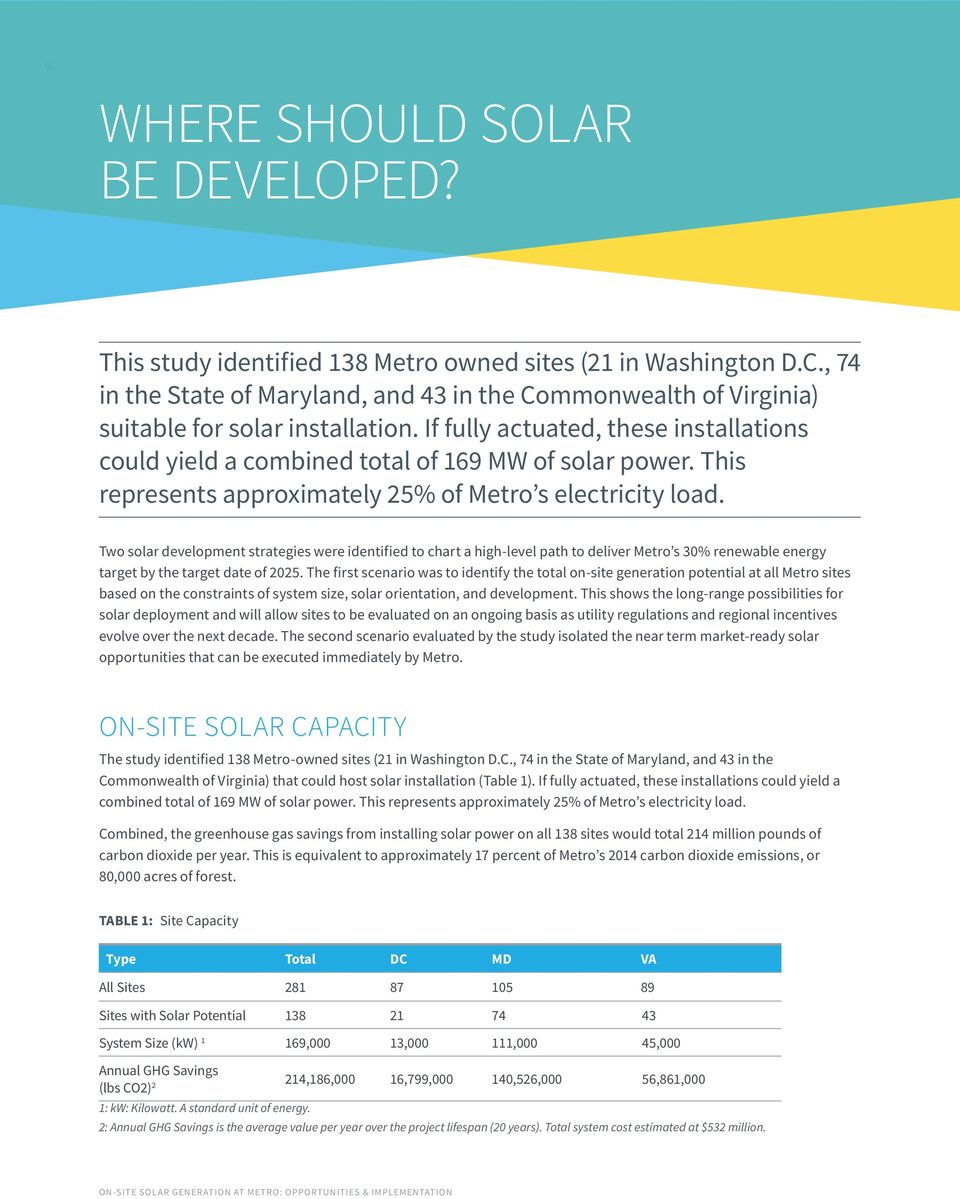
8 8 WHERE SHOULD SOLAR BE DEVELOPED? This study identified 138 Metro owned sites (21 in Washington D.C., 74 in the State of Maryland, and 43 in the Commonwealth of Virginia) suitable for solar installation. If fully actuated, these installations could yield a combined total of 169 MW of solar power. This represents approximately 25% of Metro s electricity load. Two solar development strategies were identified to chart a high-level path to deliver Metro s 30% renewable energy target by the target date of The first scenario was to identify the total on-site generation potential at all Metro sites based on the constraints of system size, solar orientation, and development. This shows the long-range possibilities for solar deployment and will allow sites to be evaluated on an ongoing basis as utility regulations and regional incentives evolve over the next decade. The second scenario evaluated by the study isolated the near term market-ready solar opportunities that can be executed immediately by Metro. ON-SITE SOLAR CAPACITY The study identified 138 Metro-owned sites (21 in Washington D.C., 74 in the State of Maryland, and 43 in the Commonwealth of Virginia) that could host solar installation (Table 1). If fully actuated, these installations could yield a combined total of 169 MW of solar power. This represents approximately 25% of Metro s electricity load. Combined, the greenhouse gas savings from installing solar power on all 138 sites would total 214 million pounds of carbon dioxide per year. This is equivalent to approximately 17 percent of Metro s 2014 carbon dioxide emissions, or 80,000 acres of forest. TABLE 1: Site Capacity Type Total DC MD VA All Sites Sites with Solar Potential System Size (kw) 1 169,000 13, ,000 45,000 Annual GHG Savings 214,186,000 16,799, ,526,000 56,861,000 (lbs CO2) 2 1: kw: Kilowatt. A standard unit of energy. 2: Annual GHG Savings is the average value per year over the project lifespan (20 years). Total system cost estimated at $532 million.
9 9 TABLE 2: Greenhouse Gas Impact Analysis Sites with Solar Potential (190) Total Annual GHG Savings (lbs CO2) 1 214,186,000 Metro Total GHG Emissions, ,284,279,000 17% Potential GHG Savings - Equivalent to the annual GHG emissions from 20,800 vehicles 1: Annual GHG Savings is the average value per year over the project lifespan MARKET-READY SITES Following an extensive roof condition study across all Metro facilities, nine (9) sites have been identified that demonstrate significant potential for near-term, positive economic returns for Metro. These Phase 1 sites provide the best short-term opportunity for Metro. Crucially, they could provide electricity at prices equal to or below Metro s current rates, offer limited or no escalation in costs over a 20-year period, generate positive economic returns for a prospective third-party provider, and form the first phase of Metro s on-site solar investment strategy. These sites comprise a total of eight (8) to twelve (12) megawatts of solar capacity, are estimated to provide approximately $3 million in savings over the next 20 years, and will save 4,000 metric tons of greenhouse gas emissions per year when fully operational. These sites should be considered Metro s highest priority for moving forward with a near-term solar implementation strategy. The system size of individual Phase 1 sites allow for construction completion in 6 months or less per site, so that all sites can be placed into service prior to December 31, 2016 and claim the 30% FITC. It is recommended that Metro continue to leverage roof condition data collected as impacts of the tax credit changes on the regional solar market pricing is more fully understood as the renewable energy market evolves. TABLE 3: Summary of Phase 1 Sites Sites Located in D.C. 1 Sites Located in MD 8 Total System Size Annual GHG Savings* Potential Operating Cost Savings to Metro* * Final value will be determined by PPA contact terms 8-12 MW 4,000 metric tons of greenhouse gas emissions Estimated at $3.2 million OFF-SITE SOLAR Though solar generation potential at Metro is extensive, Metro s on site solar development locations are not all currently developable. Construction and siting constraints, a lack of solar market drivers such as a renewable portfolio standards, and net metering in some jurisdictions significantly will limit full on-site solar deployment at some locations. Given these constraints, it is recommended that the remainder of Metro s 30% target be evaluated as off-site utility grade renewable energy generation. The solar market has recently seen the emergence of an approach that locates commercial-scale solar within the same regional utility transmission organization in order to take advantage of economies of scale. Using this approach, George Washington University, American University, and the George Washington University Hospital combined to secure 52MW of off-site solar in a dedicated utility scale solar plant specifically commissioned for them. Other dedicated utility scale sites have been developed by private sector entities, such as Google and Amazon. Metro should consider conducting a detailed financial evaluation of this option in parallel with the development of financially feasible on-site locations as it seeks to achieve its 30% renewable target by EXECUTIVE SUMMARY

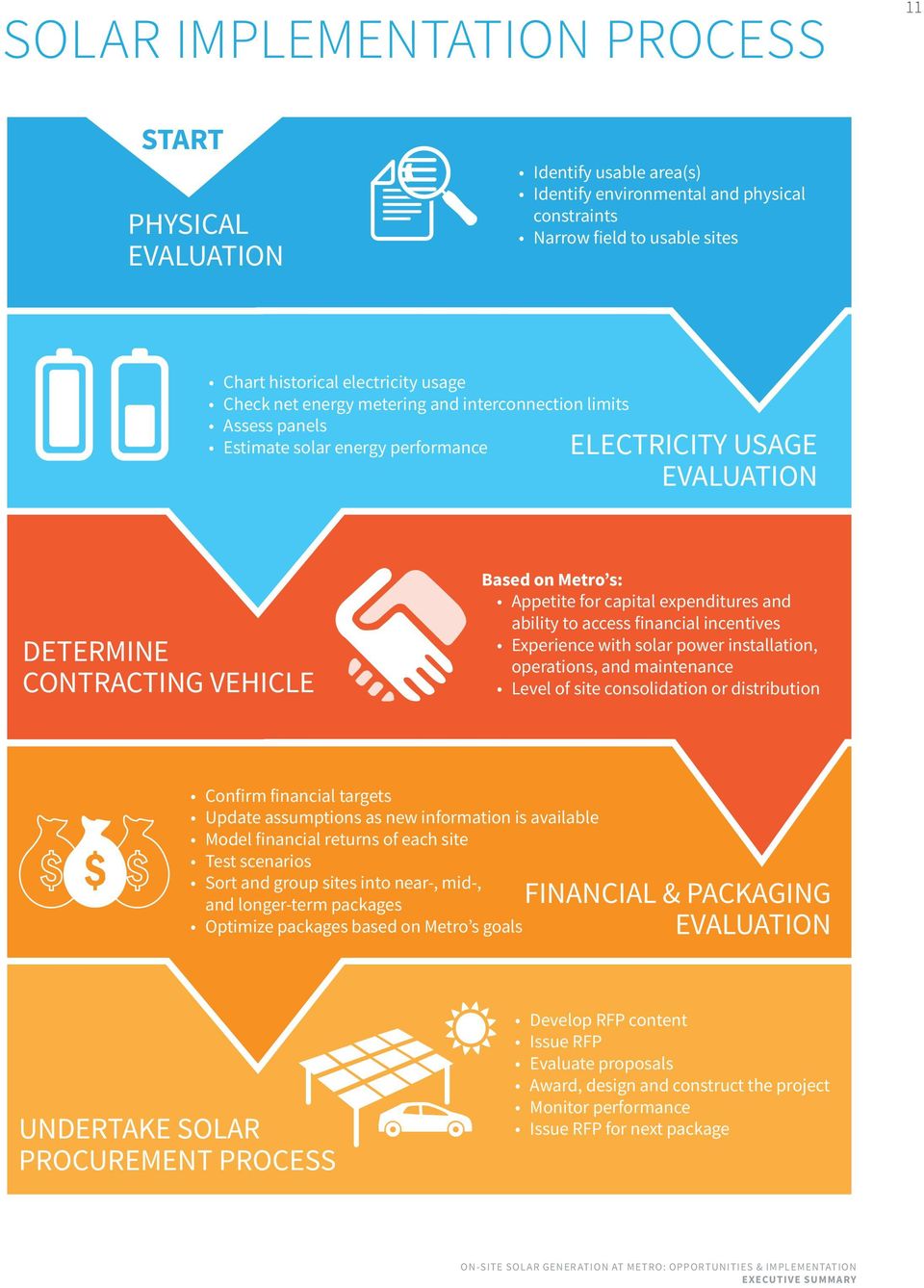
10 10 IMPLEMENTATION Through the deployment of on-site solar, Metro will generate electricity cost savings, update critical customer facing infrastructure, create employment and training opportunities, and make measurable progress towards meeting Metro s Sustainability Initiative goals. In order to implement the solar plan outlined above, Metro will: 1. Identify priority sites that are unconstrained by development potential as identified in this report. 2. Issue an RFP in the fall of 2015 focused on the most valuable sites for PPA or license returns. 3. Negotiate and award solar PPA or lease/license contract(s) in late 2015 and early Begin construction on first sites in early 2016 to maximize the number of sites that are operational by December 31, 2016 ahead of the expiring solar tax. 5. Evaluate the impact of the expiration of the FITC on the solar market pricing and deliver additional phase(s) of solar sites to the market for development in

11 SOLAR IMPLEMENTATION PROCESS 11 START PHYSICAL EVALUATION Identify usable area(s) Identify environmental and physical constraints Narrow field to usable sites Chart historical electricity usage Check net energy metering and interconnection limits Assess panels Estimate solar energy performance ELECTRICITY USAGE EVALUATION DETERMINE CONTRACTING VEHICLE Based on Metro s: Appetite for capital expenditures and ability to access financial incentives Experience with solar power installation, operations, and maintenance Level of site consolidation or distribution Confirm financial targets Update assumptions as new information is available Model financial returns of each site Test scenarios Sort and group sites into near-, mid-, and longer-term packages Optimize packages based on Metro s goals FINANCIAL & PACKAGING EVALUATION UNDERTAKE SOLAR PROCUREMENT PROCESS Develop RFP content Issue RFP Evaluate proposals Award, design and construct the project Monitor performance Issue RFP for next package EXECUTIVE SUMMARY
12

An Airport Sustainable Energy Strategy
 An Airport Sustainable Energy Strategy Addressing the Ecology, Equity & Economics of Airport s Energy Usage March 2015 Paul Manasjan - Director, Environmental Affairs San Diego County Regional Airport
Direct Investment, Synthetic PPA s ABC Member Bulk Procurement. Garrett Sprague, A Better City
 Direct Investment, Synthetic PPA s ABC Member Bulk Procurement Garrett Sprague, A Better City Barriers to Investing in Renewables 1. Many large institutions not aware of the opportunity. 2. Inertia of
SOLAR POWER IN SANTA CLARA COUNTY MARKETS AND DEVELOPMENT TRENDS
 SOLAR POWER IN SANTA CLARA COUNTY MARKETS AND DEVELOPMENT TRENDS COUNTY OF SANTA CLARA PLANNING OFFICE APRIL 2010 1 FOR MORE INFORMATION ABOUT THIS PAPER OR SANTA CLARA COUNTY S PV PROGRAM, CONTACT KATJA
From Concept to Contract:
 AltaTerra Working Paper 13 October 2008 From Concept to Contract: Hewlett-Packard s San Diego Solar Power Project by Jon Guice and Don Bray Executive Summary Hewlett-Packard, the world s largest information
Solar Power in Schools: Opportunities. Marta Tomic Solar Clean Energy Program Manager
 Solar Power in Schools: Opportunities Marta Tomic Solar Clean Energy Program Manager Site Specific Nature of Solar Solar photovoltaic (PV) pricing depends on site selection Roof mount vs ground mount Orientation
Banking on Renewables
 RURAL INFRASTRUCTURE BRIEFINGS Banking on Renewables These Briefings showcase different facets of the rural infrastructure industries: power, energy, and utilities; water utilities; and communications.
Appendix F. DRECP Energy Development Assumptions and the BLM LUPA
 Appendix F DRECP Energy Development Assumptions and the BLM LUPA F DRECP Proposed LUPA and Final EIS DRECP ENERGY DEVELOPMENT ASSUMPTIONS AND THE BLM LUPA F.1 Introduction This appendix briefly summarizes
Residential Consumer Guide to Solar Power
 Residential Consumer Guide to Solar Power 505 9 th Street NW Suite 800 Washington DC 20004 202.682.0556 www.seia.org Table of Contents Residential Consumer Guide to Solar Power... 2 Introduction... 2 How
Residential Consumer Guide to Solar Power June 2015
 Residential Consumer Guide to Solar Power 505 9 th Street NW Suite 800 Washington DC 20004 202.682.0556 www.seia.org SEIA RESIDENTIAL CONSUMER GUIDE TO SOLAR POWER Introduction How Solar Works Panels (or
Unique, Powerful Partnership Brings Clean, Renewable Energy to the Denver Housing Authority
 CONTACT: Stella L. Madrid I 720.219.9059 Community Affairs Officer [email protected] For Immediate Release: July 19, 2012 Unique, Powerful Partnership Brings Clean, Renewable Energy to the Denver
Challenges to the Electricity Sector: California s Efforts at Long-term Decarbonisation
 Challenges to the Electricity Sector: California s Efforts at Long-term Decarbonisation 14 th IEA-IETA-EPRI Annual Workshop on Greenhouse Gas Emission Trading October 8, 2014 Agenda California s Long-Range
How to Earn the LEED Green Power Credit
 3D EG REES WH ITE PAPER How to Earn the LEED Green Power Credit Using on-site and off-site renewable energy to mitigate the impact of greenhouse gas emissions associated with a LEED project s energy use
Vectren Integrated Resource Plan (IRP) Stakeholder Meeting 3 of 3. Discussion of Analysis Results September 24, 2014
 Vectren Integrated Resource Plan (IRP) Stakeholder Meeting 3 of 3 Discussion of Analysis Results September 24, 2014 IRP Timeline 2 1. Identify key objectives and metrics Complete 2. Gather information
U.S. EPA s Green Power Partnership
 Innovative Procurement Models for Renewable Electricity U.S. EPA s Green Power Partnership Tuesday, March 31, 2015 Smart & Sustainable Campus Conference Baltimore, Maryland Speakers & Agenda Speakers Agenda
To assist you with getting started with the SRECs program, find enclosed a copy of the following:
 [Current Date] Dear New Jersey Solar System Owner: New Jersey s Renewable Portfolio Standard (RPS) requires electricity suppliers to secure a portion of their electricity from solar facilities connected
CNMEC REC PROGRAM. The REC meter will be read monthly by CNMEC. Payment for RECs will be calculated using the monthly readings from the REC meter.
 CNMEC REC PROGRAM Renewable Energy Certificates (RECs) are tradable, non-tangible energy commodities that represent proof that 1 megawatt-hour (1000 kilowatt-hours) of electricity were generated from an
PV Farms Solar Electric Power for Wholesale Distribution
 PV Farms Solar Electric Power for Wholesale Distribution UC ENERGY WEEK 2010 California Solar Energy Workshop UC Davis Energy Institute Davis, California Larry Asera Chairman/CEO Asera Group, Inc. May
Energy Savings through Solar Energy for Municipalities
 Energy Savings through Solar Energy for Municipalities September 2014 2014 Sunvestment Group www.sunvestmentgroup.com Topics to Cover Who We Are RER Energy Group Sunvestment Group Why Now for Solar Energy
Rooftop Revenues. How Your Business Can Profit from Solar Energy.
 Rooftop Revenues How Your Business Can Profit from Solar Energy. White Paper Introduction The decision to implement a solar PV system, once dismissed as an overly expensive investment, can now be backed
SUSTAINABLE ENERGY BLUEPRINT
 SUSTAINABLE ENERGY BLUEPRINT A PLAUSIBLE STRATEGY FOR ACHIEVING A NO-NUCLEAR, LOW- CARBON, HIGHLY-EFFICIENT AND SUSTAINABLE ENERGY FUTURE The following statement outlines an ambitious but doable strategy
SOLAR PURCHASE POWER AGREEMENT (PPA) FREQUENTLY ASKED QUESTIONS. UPDATED: October 28, 2015
 SOLAR PURCHASE POWER AGREEMENT (PPA) FREQUENTLY ASKED QUESTIONS UPDATED: October 28, 2015 1. Why Solar? Solar energy one of the cleanest and most abundant renewal energy sources available in Texas. Displacing
Solar Project Financing Commercial Power Purchase Agreements (PPAs) & PPA Market Rates for SCE Territory
 Solar Energy in Inland Southern California: The Future is Now The University of California, Riverside Solar Project Financing Commercial Power Purchase Agreements (PPAs) & PPA Market Rates for SCE Territory
Local Solar. bikeriderlondon / Shutterstock.com. Local Solar Power
 bikeriderlondon / Shutterstock.com Local Solar Power Production of electricity from fossil fuels creates pollution, including smog and green house gas emissions. Combining the abundance of sunshine our
CPUC California Solar Initiative 2010 Impact Evaluation
 CPUC California Solar Initiative 2010 Impact Evaluation Final Report Executive Summary Submitted to: Southern California Edison and California Public Utilities Commission Energy Division Prepared by: Itron,
SOLON. Solar Solutions for Wastewater Treatment Plants EN. SOLON Solar Solutions for Wastewater Treatment Plants.
 SOLON. Solar Solutions for Wastewater Treatment Plants EN SOLON Solar Solutions for Wastewater Treatment Plants. 3 Solar power pays off for the environment. Purchasing solar energy today will save up to
CLEAN LA SOLAR PROGRAM. Mary Leslie, Los Angeles Business Council
 CLEAN LA SOLAR PROGRAM LADWP FEED-IN TA R I F F Mary Leslie, Los Angeles Business Council Agenda 1. The Context: Clean energy and policy landscape in California 2. Review of LADWP Feed-in Tariff Program
The Environmental Commission and the Department of Public Utilities or Engineering Department should lead and be involved with this tool.
 Solar Energy Demonstration Project For more information, see www.sustainablejersey.com The sun s rays are a 100% clean and renewable source of energy, and solar (along with wind), are the two fastest-growing
DOE Announces $1B Loan Guarantee Fund For Distributed Energy Projects
 RESEARCH North America Alternative Energy Smart Grid DOE Announces $1B Loan Guarantee Fund For Distributed Energy Projects Financing Structure Aimed At Innovative Large-Scale Distributed Energy Projects
Call today to discuss your solar project: 518-636-0518 or [email protected]
 WHO SHOULD CONSIDER APPLYING FOR A NYSERDA GRANT WITH GROSOLAR? WHAT IS THE INITIAL PROCESS? 1) Speak to grosolar about your high energy use or available property. LARGE POWER USERS such as Towns & Cities
SolarFlair Energy Inc. 190 Pleasant St, Ashland, MA
 SolarFlair Energy Inc. 190 Pleasant St, Ashland, MA 132 panels on our roof! About SolarFlair Energy Inc. We ve always been local! Founded in Hopkinton in 2007, moved to Framingham in 2010 and now we have
Leasing Residential PV Systems BY MICHAEL RUTBERG; ANTONIO BOUZA, ASSOCIATE MEMBER ASHRAE
 This article was published in ASHRAE Journal, December 2013. Copyright 2013 ASHRAE. Posted at www.ashrae.org. This article may not be copied and/or distributed electronically or in paper form without permission
Renewable Energy Generation in the Highway Right-of-Way FHWA-HEP-16-052
 Renewable Energy Generation in the Highway Right-of-Way FHWA-HEP-16-052 Contents 1. Introduction... 2 2. Compatible with U.S. DOT Priorities... 2 3. Renewable Energy Highway Projects: Key Information...
California Energy Commission 2015 Accomplishments
 California Energy Commission 2015 Accomplishments Responding to California s Drought Responded to the state's historic drought and Governor Edmund G. Brown Jr. s Executive Order B-29-15 by approving new
A Discussion of PEM Fuel Cell Systems and Distributed Generation
 A Discussion of PEM Fuel Cell Systems and Distributed Generation Jeffrey D. Glandt, M. Eng. Principal Engineer, Solutions Engineering May 2011 The information contained in this document is derived from
PG&E and Renewable Energy. Chuck Hornbrook Senior Manager Solar and Customer Generation
 PG&E and Renewable Energy Chuck Hornbrook Senior Manager Solar and Customer Generation PG&E and our Business What we do: Deliver safe, reliable, and environmentally responsible gas and electricity to approximately
A Case Study: Solar Panels at Boston College
 A Case Study: Solar Panels at Boston College Annie Meyer 1, 2014 Farhin Zaman Elizabeth Norton GE 580 Environmental Studies Senior Seminar Boston College Chestnut Hill, MA April Introduction Solar Photovoltaic:
TOWN OF CARRBORO NORTH CAROLINA
 TOWN OF CARRBORO NORTH CAROLINA TRANSMITTAL PLANNING DEPARTMENT DELIVERED VIA: HAND MAIL FAX EMAIL To: From: Board of Aldermen David Andrews, Town Manager Department Directors Chris Lazinski, Consultant
Proposal prepared for Happy Solar Owner
 Happy Solar Owner 1234 Sunny Lane Portland, OR 97201 Mailing Address: Happy Solar Owner 1234 Sunny Lane Portland, OR 97201 RE: SolarWorld Sunkits System Proposal: CASSK-## Presented by: SolarWorld Authorized
By: Crystal Warren IMPLEMENTATION OF SOLAR PANELS ON COMMERCIAL PROPERTIES AND THE COST-BASED INCENTIVES
 By: Crystal Warren IMPLEMENTATION OF SOLAR PANELS ON COMMERCIAL PROPERTIES AND THE COST-BASED INCENTIVES MY PLAN Encourage commercial property/business owners to install solar panels to reduce the amount
Owner s Procurement Forum
 Washington Metropolitan Area Transit Authority Construction Management Association of America National Capitol Chapter Owner s Committee Owner s Procurement Forum February 24, 2015 OVERVIEW of WMATA INFRASTRUCTURE:
Solar barriers to entry for low and middle Income Marylanders: Identifying roadblocks and proposing solutions
 Solar barriers to entry for low and middle Income Marylanders: Identifying roadblocks and proposing solutions While Maryland ranks 14 th in the nation is solar capacity installed and the state has established
Ensuring a Continued Policy for Promoting Renewable Energy U.S. Carbon Cap-And-Trade and Renewable Energy Certificates: A Preliminary Discussion
 saines & jacobson 31 Ensuring a Continued Policy for Promoting Renewable Energy U.S. Carbon Cap-And-Trade and Renewable Energy Certificates: A Preliminary Discussion Richard Saines, Baker & McKenzie; REIL
Corona Department of Water & Power (DWP) Solar Partnership Program Guidelines and Application
 Corona Department of Water & Power (DWP) Solar Partnership Program Guidelines and Application DWP s new Solar Partnership Program is available to help offset your investment in a PV system and get you
FINANCING SCENARIOS FOR SOLAR
 FINANCING SCENARIOS FOR SOLAR Jaimes Valdez March 31, 2015 Comparative Financing Models of Solar Energy Systems in Washington State Introduction The solar energy marketplace is rapidly evolving, and a
Austin Energy Resource, Generation and Climate Protection Plan to 2025: An Update of the 2020 Plan
 Austin Energy Resource, Generation and Climate Protection Plan to 2025: An Update of the 2020 Plan INTRODUCTION The Austin City Council adopted the Austin Climate Protection Plan (ACPP) in 2007 to build
CUMBERLAND COUNTY UTILITIES AUTHORITY
 CUMBERLAND COUNTY UTILITIES AUTHORITY 333 Water Street BRIDGETON, NEW JERSEY 08302 REQUEST FOR PROPOSALS TO: Provide Turnkey Design-build Services For Photovoltaic (Solar) Generation System September 2009
Suntuity Solar Power: Frequently Asked Questions:
 Suntuity Solar Power: Frequently Asked Questions: SOLAR POWER FOR YOU FINANCIAL BENEFITS OF SOLAR POWER LEASING A SOLAR POWER SYSTEM ENVIRONMENTAL BENEFITS OF SOLAR POWER FINDING THE RIGHT SOLAR POWER
Sol Systems, LLC VIRGINIA REGISTRATIO N
 VIRGINIA REGISTRATIO N Have you already installed a solar energy system or have plans to install one? If so, Sol Systems can help you turn your solar renewable energy credits (SRECs) into income. H O W
Financing Options for Commercial Solar Projects
 2010 Financing Options for Commercial Solar Projects EXECUTIVE SUMMARY Thanks to a range of innovative financing options, transitioning to solar energy has never been more affordable for businesses and
Solar Asset Management and Performance Monitoring: Panel-to- Grid
 High Performance Monitoring Solar Asset Management and Performance Monitoring: Panel-to- Grid Justin Robinson Program Manager DAS October 1, 2012 Draker Company Overview Oldest, largest U.S. Based independent
Change is in the Air What Businesses Need to Know. Thomas M. Donnelly, San Francisco Brian L. Sedlak, Chicago Thomas V.
 Change is in the Air What Businesses Need to Know Thomas M. Donnelly, San Francisco Brian L. Sedlak, Chicago Thomas V. Skinner, Chicago California s Efforts to Reduce Greenhouse Gas Emissions Renewable
Running the Electric Meter Backwards: Real-Life Experience with a Residential Solar Power System
 Running the Electric Meter Backwards: Real-Life Experience with a Residential Solar Power System Brooks Martner Lafayette, Colorado University of Toledo Spring 2015 PHYS 4400 - Principles and Varieties
Levelized Cost and Levelized Avoided Cost of New Generation Resources in the Annual Energy Outlook 2015
 June 2015 Levelized Cost and Levelized Avoided Cost of New Generation Resources in the Annual Energy Outlook 2015 This paper presents average values of levelized costs for generating technologies that
THE WORLD S STANDARD FOR SOLAR
 LEASE LEASE PROPOSAL PROPOSAL FOR RAY FOR DARBY, [HOMEOWNER SUSTAINABLE NAME] Ray Darby, Sustainable Energy Group Grass Valley, CA 95949 THE WORLD S STANDARD FOR SOLAR Now Available for Zero Down THE PLANET
Powering Your Home with Solar Energy
 Powering Your Home with Solar Energy Putting Your Roof to Work The sun is waiting to turn your roof into its own miniature electrical power plant. Using solar energy to power your home not only lowers
MASSACHUSETTS RESIDENTIAL GUIDE TO SOLAR POWER
 MASSACHUSETTS RESIDENTIAL GUIDE TO SOLAR POWER Front cover photo: Elena Elisseeva/Bigstock Flickr.com/mjmonty Table of Contents Introduction 1 Solar PV System Components 3 Sizing and Optimizing Your Solar
Addressing Barriers to Renewable Energy Procurement. In association with the EPA Green Power Partnership
 Addressing Barriers to Renewable Energy Procurement In association with the EPA Green Power Partnership September 19, 2012 CORPORATE GOALS Corporations are increasingly interested renewable energy. The
BOOST PROFITS WITH SOLAR POWER:
 1 BOOST PROFITS WITH SOLAR POWER: 5 Things Every Commercial Property Owner Needs to Know Before Investing in Rooftop Solar WHITEPAPER FEB. 26, 2014 2 TABLE OF CONTENTS Introduction...3 How Rooftops Can
Solarize Frequently Asked Questions (a)
 Solarize Frequently Asked Questions (a) Solarize Old Lyme, www.solarizect.com/oldlyme Solarize Lyme, www.solarizect.com/lyme Q. What is Solarize Connecticut? A. Solarize Connecticut is a town-state sponsored
Considering Renewable Energy: Solar and Wind by Wynn Calder and Craig Schultz
 Environmentally Sustainable Schools Leadership Series March 2012 Considering Renewable Energy: Solar and Wind by Wynn Calder and Craig Schultz Now is an especially interesting time to think about investing
FACT SHEET. NEM fast facts:
 (NEM) operates on one of the world s longest interconnected power systems, stretching from Port Douglas in Queensland to Port Lincoln in South Australia and across the Bass Strait to Tasmania a distance