
Manufacturing Creativity: Production, Performance,
|
|
|
- Ira Merritt
- 9 years ago
- Views:
Transcription
1 Korea Journal, vol. 53, no. 4 (winter 2013): Korean National KOREA Commission JOURNAL for / UNESCO, WINTER 2013 Manufacturing Creativity: Production, Performance, and Dissemination of K-pop* Gil-Sung PARK Abstract The rise of K-pop (Korean pop) as a new global music genre has wrought theoretical turmoil within the field of cultural studies. This article argues that the global ascendance of K-pop can primarily be attributed to the passionate support of inter-asian audiences. However, the actual production, performance, and dissemination of K-pop contents have little to do with the Asian pop-culture system. Although the manufacture of K-pop music and its performers depends on Korean talent and management, K-pop producers tend to rely heavily on the global music industries of North America and Europe for their creative content. The global dissemination of K-pop would not have been possible without global social network service (SNS) sites such as YouTube, Facebook, and Twitter none of which are owned or operated by Asians. This article argues that the manufacturing of creativity in non-western music, as illustrated by the case of Hallyu, involves three stages: globalization of creativity, localization of musical contents and performers, and global dissemination of the musical contents through social media. Keywords: K-pop (Korean pop), Hallyu, creativity, music industry, globalization, localization, social network service (SNS) sites * This research was supported by a Korea University Grant. The author gives special thanks to Kang Sou-Hwan, Park Jung-Ha, Oh Hayeon, Ye Weibo, and Song Choo Eui for their assistance with data collection and management. Gil-Sung PARK is Professor of Sociology at Korea University and Adjunct Professor at Utah State University. [email protected].

2 Manufacturing Creativity: Production, Performance, and Dissemination of K-pop 15 Introduction K-pop s (Korean pop) recent explosion onto the global music scene has caused a stir among cultural studies scholars, particularly those specializing in Japanese pop culture. Scholars from Japan and elsewhere have long argued that K-pop, like other genres of Hallyu, is merely a derivative of J-pop or Japanese popular culture (see inter alia, Iwabuchi 2004, 2013; Chua 2004, 2012). For instance, it has been widely claimed that Psy s Gangnam Style and multiple hits by Girls Generation were only able to achieve their enormous popularity both regionally (i.e., in Asia) and globally due to their cultural and geographical affiliation with the larger Asian (or inter-asian) cultural system, which was established and dominated by Japan, India, and China (Iwabuchi 2004, 2013; Park 2006; Hirata 2008; Ryoo 2009; Shim 2011). These arguments seem dubious at best, given K-pop s unprecedented simultaneous success in China, India, Japan, Europe, and the United States, something never achieved by Indian, Chinese, or Japanese pop music. But all that aside, these responses reflect the confusion that the K-pop phenomenon has created within academia. This article agrees with the cultural hybrid argument that K-pop s global ascendance has been significantly driven by the passionate support of inter-asian audiences. However, the actual production, performance, and dissemination of K-pop contents have little to do with the so-called Asian pop-culture system, which would entail K-pop producers globally promoting their artists by actively mimicking Chinese, Japanese, or Indian popular music. Instead, after drawing upon Korean talent pools and management to generate music and performers, K-pop producers rely heavily on the global music industries of North America and Europe for creativity. The global dissemination of K-pop content would not have been possible without the global social network service (SNS), including YouTube, Facebook, and Twitter, none of which are owned or operated by Asians. The manufacturing of creativity in non-western music involves three stages: (1) globalization of creativity, (2) localization of musical contents and performers, and (3) global dissemination of musical contents through SNS. Pop Asianism or cultural hybrid arguments are fundamentally

3 16 KOREA JOURNAL / WINTER 2013 flawed in that they inherently imply that Asian popular culture is a purely mimetic system with no creativity, or at least much less creative than the European or American popular cultural systems. Viewing K-pop within the context of pop Asianism reduces the entire Korean music industry to a mimetic machine that assiduously copies Western or Japanese pop culture (Iwabuchi 2004, 2013; Jung 2011; Shim 2011). This article argues that K-pop represents a unique system of the global division of labor, geared towards the creation of a new Korea-led system of manufacturing creativity, which encourages and mass produces innovative music and musical performances. Within this system of global division of labor, manufacturing creativity is not an oxymoron or a cliché for the exploitation of young Korean artists. Instead, manufacturing creativity signifies opening the entire global music industry to musical talents and audiences from all corners of the world, allowing them to participate in an endless interactive communication and discourse about music from both central and peripheral countries. This article briefly documents the K-pop phenomena under a new system of manufacturing creativity, followed by a lengthy theoretical discussion of that term. The article ends with a discussion of the relationship between K-pop and the global music industry, which is actively adopting or adapting to the system of manufacturing creativity. K-pop Phenomenon Understanding the K-pop phenomenon requires the knowledge of K-pop s sustainable business model that is firmly based on musical talent and creativity. K-pop, which is defined as a new Korean popular music genre for export (Oh and Park 2012), has existed as an independent pop music genre for more than two decades, as its starting point can be traced to 1992, with the debut of Seo Taiji and Boys and their new genre of hip-hop dance music (Lie 2012). The explosive popularity of the group s Hayeoga in Korea motivated them to give concerts in Japan, but the endeavor

4 Manufacturing Creativity: Production, Performance, and Dissemination of K-pop 17 proved in the end to be unsuccessful. However, since 1998, K-pop has been massively exported to China, Japan, Southeast Asia, the United States, and Europe. Of these export markets, K-pop has had the most success in Japan, which has very strict piracy laws and is thus boastfully considered to be the world s second largest popular music market (Yoo 2013). Thus far, a number of K-pop acts have found great success in Japan and China, including BoA, H.O.T., Shinhwa, S.E.S., TVXQ (or Tohoshinki in Japan), Super Junior, Babyvox, Se7en, Skull, BIGBANG, Rain, Wonder Girls, SS501, Kara, Girls Generation, etc. (see inter alia, Shin 2009; Siriyuvasak and Shin 2007; Lie 2012). In addition to this continuing success, K-pop has also produced a large number of new hit songs and singers. According to my innovation index for popular music, which multiplies the number of new songs in the top-20 every four weeks by the number of new singers or groups in the same chart, indicates that Japan has the highest innovation ratio, while the United States has the lowest score. Korea ranks in the middle between Japan and the United States. While the innovation index does not directly correlate to the global popularity and influence of the songs and singers, it does reveal patterns in the popular music industries of various countries. For example, the United States, which represents the world s largest popular music market, tends to focus on creating songs that sell consistently and stay on the charts longer than Japanese or Korean songs. Japan, the second largest pop music market, aims for quick-selling hits with much less longevity, while Korea, a developing pop music market with strong export growth, mixes the Japanese and U.S. strategies. Among the three markets, Japan is the most turbulent, while the United States is the most stable, indicating that the latter is dominated by large recording companies. The Korean market is also quite stable, with large entertainment companies controlling a large portion of the market. However, Korea also shows more innovation than the United States, clearly indicating that the success of a K-pop song relies on a mix of innovation and sustainability. Thus, the K-pop market seems to be striving for an ideal mix of relative stability and an average level of innovation.

5 18 KOREA JOURNAL / WINTER Korea USA Japan Figure 1. Innovation Index for Popular Music in Three Countries ( ) Source: Author s modification of Billboard Charts (September 2011 May 2013). Note: Figures are for weeks 1 to 86 under observation. Manufacturing Creativity In the field of social science, research on creativity has affirmed that the novel combinations in creative destruction that mark instances of radical innovation prohibit the process of manufacturing. Since creativity cannot be divided up and reduced into constituent parts, novel combinations cannot be generated through a typical manufacturing division of labor (see inter alia, Schumpeter 1962; Nooteboom 2000; Nonaka and Takeuchi 1995; Nonaka and Konno 2003; Csikszentmihalyi 1996). Every society, including domains or disciplinary fields, offers infinite possibilities for combinations, but only those combinations that can change the society can be labeled novel and destructive (Csikszentmihalyi 1996, 28). Changes to existing domains are typically attributed to individual geniuses (e.g., Da Vinci, Edison, Picasso, Einstein, etc.). These individuals either work alone or as part of a small team of creative researchers, which would indicate that such creativity can never be manufactured. Thus far, studies on K-pop have yet to reach a consensus on whether K-pop is a creative domain, or if it is merely changing the domain of the

6 Manufacturing Creativity: Production, Performance, and Dissemination of K-pop 19 music industry or popular music. Although many non-koreans working in the field of popular music might not consider K-pop to be as creative as American popular music or J-pop, Koreans working in the field consider the current K-pop phenomenon to be absolutely revolutionary. Never before has a Korean musical artist rocked the world by achieving popularity on the scale of today s artists, such as Psy, Rain, Girls Generation, TVXQ, and 2PM. These pop music acts are dramatically expanding the domain of K-pop from a local and national art into a globalized music business. As Csikszentmihalyi (1996, 25) and Crossan et al. (1999) have quite lucidly demonstrated, creativity typically involves having one s creative ideas approved by the external community, through an arduous process of interpreting, integrating, and institutionalizing creative intuition. This concept is contradictory to the above definition of creativity, which posits an internal, individualized, and therefore purely intuitive process. In K-pop, like any other popular music genre, the external community or the agents of interpretation, integration, and institutionalization are numerous, diverse, and exceptionally diligent, evaluating songs on an almost weekly basis through sales charts, fan blogs, fan activities, and concert participation. If K-pop has dramatically expanded the domain of Korean popular music to Asia and even to the world, and it is constantly being evaluated by a large number of diverse and external stakeholders, it is necessary to ask how K-pop is manufactured, thus enabling a new concept of manufacturing creativity. As Figure 1 indicates, K-pop is much more innovative and creative than U.S. pop music in terms of musical diversity, while K-pop has more longevity on average than J-pop. By situating itself between Japan and the United States, K-pop provides its fans with the best of both worlds: creativity and longevity. The popularity of K-pop is staggering, given the relatively small population and the low number of popular music artists, as compared to the United States or Japan. How can the K-pop industry successfully sustain itself while manufacturing creativity? The answer lies in the concept of connect and development (C&D), popularized by Proctor and Gamble s

7 20 KOREA JOURNAL / WINTER 2013 (P&G) new innovation strategy (Huston and Sakkab 2006). In C&D, unlike in research and development (R&D), the internal process of innovation or creativity is often bypassed in favor of borrowing, buying, or outsourcing creativity and innovation to external communities. Larry Huston and Nabil Sakkab, R&D directors at P&G, who work closely with the company s CEO A. G. Lafley, explain the raison d'être of C&D as follows: [M]ost of P&G's best innovations had come from connecting ideas across internal businesses. And after studying the performance of a small number of products we'd acquired beyond our own labs, we knew that external connections could produce highly profitable innovations, too. Betting that these connections were the key to future growth, Lafley made it our goal to acquire 50 percent of our innovations outside the company. The strategy wasn't to replace the capabilities of our 7,500 researchers and support staff, but to better leverage them. Half of our new products, Lafley said, would come from our own labs, and half would come through them (Huston and Sakkab 2006, 3). 1 Although outsourcing creativity is now common in many international business enterprises, the practice of internally reprocessing creative ideas that have been externally generated still seems fairly new to the entertainment industry in Asia. As I will explain in the final section, this unfamiliarity means that the internal reprocessing being done by K-pop producers is even more challenging than that being done in the labs of P&G, since there is no precedence for how to apply C&D in the cultural industry. In fact, this practice is so anomalous that it requires another internal creativity process, which I call localizing musical contents and performers. This process is a manufacturing stage that occurs after the globalization of creativity and before the global dissemination of the musical contents through SNS. Nonetheless, as Table 1 indicates, all three major entertainment companies in the K-pop industry have actively outsourced creativity and 1. Italics from the original.

8 Manufacturing Creativity: Production, Performance, and Dissemination of K-pop 21 reprocessed it in their own labs to generate megahits in Korea, Asia, and the rest of the world. It would seem that the K-pop industry has already mastered the art of C&D in the popular music domain, just as the process of C&D revolutionized Hallyu in general, and Korean pop music in particular. The case of SM Entertainment is particularly emblematic of how K-pop producers globalize creativity, internally localize creativity, and globally disseminate their music through SNS. Table 1. K-pop s Globalization Drive Company Producer (K-pop artist) Composer (K-pop artist) Choreographer (K-pop artist) Distributor SM Entertainment YG Entertainment Teddy Riley (Girls Generation) Polow da Don (Girls Generation) Will.i.am (2NE1) Rodney Jerkins (Se7eN) Busbee (Girls Generation) Alex James (Girls Generation) Kalle Engstrom (Girls Generation) Nick Bass Oslo Recordings (Super Junior, (Super Junior) SHINee) Jeff Hoeppner (f(x)) Misha Gabriel Thomas Troelsen (f(x)) (BoA, SHINee) Wellem Laseroms (f(x)) Nao Tanaka (BoA) Ryoji Sonoda (BoA, TVXQ) Thomas Troelsen (SHINee) Daishi Dance (BIGBANG) Nagao Dai (Se7eN) YouTube JYP Entertainment Nick Cannon (Wonder Girls) Claude Kelly (Wonder Girls) Jonte (Wonder Girls) Source: Oh and Park (2012, 379).

9 22 KOREA JOURNAL / WINTER 2013 The Strategy of Creativity at SM Entertainment SM Entertainment (hereafter, SM) founded in 1995 by Lee Soo-man, a former singer-songwriter and entertainment manager, is generally considered to be the largest entertainment management firm in Korea, with an annual revenue of $90 million. From its onset, Lee has held the most pivotal role in the firm, taking it upon himself to direct and choreograph the entire process of recruiting and training young music talent, hiring composers, and producing and marketing music videos and albums. This type of one-man show is quite rare in the music industry, and is only possible because of the relatively small size of SM. Over the last two decades, SM has expanded exponentially, in terms of overall size, human resources, and revenue. Thus, in May 2005, the management of the company was divided between the creative department, led by Lee Soo-man, and the business department, led by Kim Young-min. Also, creativity management is mostly conducted by a 14- member A&R (artists and repertoire) team, under Lee s direct control and supervision. The most important distinction between SM and other music companies both domestic and international has been the company s fierce pursuit for globalization since its earliest days. As Table 1 shows, SM globally outsources various aspects of its music production more frequently and more diversely than either YG or JYP, which typically rely on domestic music talents, including Psy, who consistently works with Yoo Gun-hyung for music composition (e.g., Gangnam Style and Gentleman ). Chris Lee, a supervisor of the A&R and Production Teams at SM, confirmed that, since its establishment, SM has focused on performers who were talented at both singing and dancing. 2 The company s model was Michael Jackson, who regularly showcased his revolutionary combination of singing and dancing skills in various music videos on MTV. In fact, Teddy Riley, co-producer of Jackson s 1991 album Dangerous, worked closely with Chris Lee to compose and produce the Girls Generation hit 2. Chris Lee, interview by the author, December 21, 2012.

10 Manufacturing Creativity: Production, Performance, and Dissemination of K-pop 23 song, The Boys. Lee recalled that [Riley] told me last year [2011] that K-pop would be a global phenomenon, and I m now really surprised to see it actually happening. 3 The concept of music globalization came from Lee Soo-man himself, who studied in the United States in the early 1980s and often watched Jackson s videos on MTV. However, Lee s globalization project was fraught with difficulties, since SM had no close contacts in the American or European music industries. They had to resort to simply writing s to or leaving phone messages for major Western composers and producers. The idea of outsourcing the songwriting and composition, rather than simply mimicking Western songs in Korea, was introduced in order to preserve the originality and creativity of SM s songs. Notably, Western composers have traditionally shied away from working in Korea, where intellectual property laws are not strictly enforced, because they usually rely on royalties for their income. SM s global strategy of outsourcing has nonetheless evolved through trial and error, with a stiff learning curve that was elevated by the Korean ethos of speeding up the process by skipping some of the essential learning stages. By hook or by crook, SM was eventually able to expand their international business network, thanks in large part to the Swedish music producer Pelle Lidell, who runs a music camp for the European and North American popular music industry. SM first connected with Lidell at the global music conference MIDEM, through an Australian music entrepreneur named Hayden Bell, who wrote I Spy for SM s leading singer BoA. According to Chris Lee, Lidell helped SM establish the music camp Fantasia (Fantastic Asia), which spawned several songs for SM: Fantasia Camp continued for four days and three nights without rest. Lidell invited SM representatives and 21 composers and musicians to create 21 different songs exclusively for SM. As the producer, Lidell covered all the costs. Each team included one track writer [for percussion, instrumental, and recording], one top-line writer [for melody], and one lyricist. On the first night, each of the seven teams wrote one song, and then on the next night they switched around the teams and 3. Chris Lee, interview by the author, December 21, 2012.

11 24 KOREA JOURNAL / WINTER 2013 did it all over again. So by the end of the third night, SM had 21 new songs. It was simply amazing to witness the entire process of producing one song per night, which had been unimaginable in Korea. 4 SM is now boastful of their strategic partnership with Lidell, who has allowed them to complete their outsourcing network. However, simply globalizing or outsourcing music composition does not always guarantee success on the global scale, as JYP and YG have learned all too well. Japanese J-pop managers have thus far avoided outsourcing composition to global sources, since their domestic music market is huge enough to support an internal music production system. Therefore, the internal processes of finishing, mastering, and assembling a song are just as important as the outsourcing. Chris Lee carefully explained how Lee Soo-man controls the entire process of finishing: For example, take the song Twinkle, the first song by TaeTiSeo (TTS), which came out in early In that song, Lee Soo-man told me to change the lyric easily visible to instantly visible. He definitely wants to be involved in every little detail, including the lyrics, the instruments, the title, the melody, everything. He literally produces the whole song. His process is not the norm in our business, because he s not happy to just outsource the music to some composers and then record the songs with the artists. For him, producing involves a meticulous step-by-step process of refining, changing, and finishing the song. Sometimes the end result is completely different from the original music score. 5 The secret of SM s success, therefore, derives from this internal process of modifying the original creative work to make it more viral to the actual listeners, whoever and wherever they may be. This is not the same as merely copying universal trends in global popular music. Instead, SM acquires samples of universal musical content from Europe and the United States and then modifies them into a unique SM composition that is not yet globally universal, but has the potential to become the next global norm. 4. Chris Lee, interview by the author, December 21, Chris Lee, interview by the author, December 21, 2012.

12 Manufacturing Creativity: Production, Performance, and Dissemination of K-pop 25 However, the internal modification process (or localization) requires a set of creative skills (i.e., tacit knowledge) that no one else at SM seems to have mastered yet, except for Lee Soo-man. Chris Lee considers this to be a serious problem: For example, Yu Yeong-jin, Lee Soo-man s composer, had to train for three years before he could learn how to satisfy Lee s eyes and ears. The mass manufacturing of creativity presents a big problem. At SM, there s only one person who can manage and coordinate music videos, costumes, television broadcasting, and everything else. Therefore, we need a second Lee Soo-man. Right now, we re systematizing this process. Lee is actually having us write a manual for producing music. So now every department at SM has a manual that includes Lee s production knowhow, CT (cultural technology), and creativity. The manuals let us bypass Lee in our tasks, so we re no longer totally reliant on him. But he still often intervenes in the process. Hopefully, these teams represent the foundation of the mass manufacturing [of creativity]. We need geniuses, but we also need apprentices. Lee Soo-man is developing the apprentice system here. 6 Production requires creativity and processes created by geniuses, but the SM style of localization also demands a steady supply of high-quality performers, which is the most important factor in local production of K-pop. Manufacturing creativity in the SM fashion requires a stable of top performers at a relatively cheaper cost. Unlike popular music performers from other countries, K-pop artists must learn how to speak (or at least pronounce words correctly) in Korean, English, Japanese, and Chinese. On top of their linguistic abilities, K-pop artists must dance and sing exceptionally well, both alone and in groups, and they also often act in musicals, TV dramas, and movies. To find attractive and gifted young performers and then train them in all of these skills at a reasonable cost is extremely difficult. And in order to get a decent return on such an investment, they must be transformed into global celebrities. 6. Chris Lee, interview by the author, December 21, 2012.

13 26 KOREA JOURNAL / WINTER 2013 Writing a manual for manufacturing creativity is very difficult, but then so is the process of artist management, which is a key function of the A&R team. SM s CEO Kim Young-min has emphasized that performance contracts with SM are not exploitive: The cultures and languages of Korea, China, and Japan are so different from each other that you must have special training to overcome the cultural and linguistic differences. So we ask our trainees to go through many educational hurdles. They go to normal school during the day, and then receive after-school training that lasts until late at night. But this is no different than typical middle or high school kids, who go to after-school programs to cram for college entrance exams. Of course, one difference is that education at SM is free. We pay for the teachers, facilities, equipment, costumes, and virtually everything the trainees need. The contracts used to be for five years, until BoA signed a seven-year contract with Avex Entertainment in Japan. Avex demanded a seven-year contract, and after long legal consultation, we agreed to it. BoA was a huge success, so we don t regret that contract, which was unprecedented in Korea. But then Girls Generation had to sign a tenyear contract for their deal in the United States, so now we have tenyear contracts at SM. Outsiders may think this sounds like a slave contract, but they must consider the number of years of free training that the artists get in order to become elite performers. 7 Chris Lee, who is in charge of all the trainees at SM, concurred with Kim s argument: We are extremely selective in choosing performers, so just to make it to our program, all SM trainees must defy the odds of 10,000 or more to one. Therefore, whether it be their own choice or the will of their parents, these young trainees are ready to devote their body and soul to perfecting their artistic skills at SM. We consider that SM s role is to fulfill the desire of the trainees. Actually, it would be more accurate to say that the A&R staff members are the slaves, not the trainees. During 7. Kim Young-min, interview by the author, July 18, 2012.

14 Manufacturing Creativity: Production, Performance, and Dissemination of K-pop 27 training, SM pays for every single cost incurred by the pupils. Critics often accuse us of imprisoning them until they make their debuts, but all of our trainees are free to quit any time they like. Just like teachers in regular schools, we are teaching them how to sing and dance. Just like schools, we have rules, too. For example, trainees cannot date another trainee; they cannot use their cell phone during practice. These basic rules in no way violate the human rights of these kids. 8 SM has clearly mastered the process of outsourcing creativity, while internally supplying and training talented young artists. The most surprising aspect of SM s international strategy has been the swiftness of its success and huge profitability, which are unprecedented among other non-western music entrepreneurs. What is Global in the Global Music Industry? The final stage of disseminating and distributing K-pop involves both local and global music distributors, including Avex in Japan and itunes and YouTube in the United States and rest of the world. Among these, the single most important source of profit for SM is the SM Town channel on YouTube (Oh and Park 2012). In other words, SM s success hinges on an entirely new aspect of the global music industry, where distribution is becoming more and more centralized by international platforms such as itunes and YouTube (Oh and Park 2012). This dramatic change also augurs a shift from the traditional strategy of business-to-customer (B2C) marketing (i.e., concerts and appearances) to business-to-business (B2B) distribution (i.e., music producers relying on itunes and YouTube). Traditional record labels and companies, which were once the largest component of the global music industry, are slowly dying out, replaced by mobile or internet-based music streaming or downloading services, a process called unbundling (Hilderbrand 2007; Mangold and Faulds 2009; Elberse 2009; Oh and Park 2012). 8. Chris Lee, interview by the author, July 18, 2012.

15 28 KOREA JOURNAL / WINTER 2013 Other Asian or non-european music entertainment firms have not been able to easily emulate SM, even though the company s organizational structure and business strategy are known to the public. The same could be said of Korean companies trying to compete with Samsung or LG. Both YG and JYP have tried the option of mimetic isomorphism (DiMaggio and Powell 1983), by using the same type of Korean input (e.g., talents, resources, social capital, etc.), but thus far they have fallen far short of SM s achievements in terms of international networking and total revenue. YG s recent mega success with Psy s Gangnam Style and Gentleman was only made possible by Psy s realization of the importance of YouTube. JYP s international strategy of getting its group, the Wonder Girls, to tour with the Jonas Brothers in the United States yielded only minor results. Some have suggested that Chinese music companies could easily emulate K-pop s success (Maliangkay 2010, 37). But singers from Hong Kong and Taiwan have thus far been unable to break through in the Japanese popular music market, unlike K-pop singers, who have received promotional assistance from Korean-Japanese entertainers and producers. For several reasons, Chinese musical artists are not likely to penetrate the Japanese music market (let alone the U.S. market) for the next 10 to 20 years. First and foremost, Chinese music producers still rely heavily on copying Korean and Japanese music without localizing it with specific Chinese color or flavor. Second, like most J-pop singers, Chinese entertainers tend to lack the physique of their Korean counterparts. Third, the choreography and training of singers in China is lackluster compared to Korea or Japan. Fourth, the most successful Western composers are unwilling to sell their music to China due to copyright issues. Finally, many Chinese singers are reluctant to sell their talents to Chinese producers, who have no access to the international cultural network, which has very different standards and values from those in China. Then what does global mean in the global music industry, for Asians and non-asians? As the SM case illustrates, the process of globalization-localization-globalization' (G L G') can be very economically successful for producing popular culture in a postcolonial region. The G-L-G' cycle of manufacturing creativity incorporates C&D (composer

16 Manufacturing Creativity: Production, Performance, and Dissemination of K-pop 29 outsourcing); R&D (internal training and refinement); and SNS distribution of music (R&D of a new medium in the United States). In this sense, musical entertainment in postcolonial regions can prosper by outsourcing musical composition in order to formulate strong international partnerships by cultivating an advanced system for training local talent (Oh 2009) and by taking advantage of a highly developed SNS structure to globally distribute its materials. Table 2. K-pop s G-L-G' Process Global outsourcing (G) Local manufacturing (L) Global distribution (G') Input process European, American, Japanese composers Manufacturing process Education and training; choreography; musical variation; and refinement Distribution process Japanese, European, American distributors As Table 2 shows, each of these processes is challenged by competitors in the global music industry. For example, in the global manufacturing of creativity, non-american, non-european, and non-japanese track guys or melody composers can produce world-class popular music, as evidenced by the huge success of Los del Rio s Macarena and Psy s Gangnam Style. Thus far, however, only Spanish and Korean singers have been able to generate such wide success without relying on the global track guys, indicating that those countries have been able to localize their music in a way that other countries cannot easily emulate. Based on this evidence, in the twenty-first century, global success in the popular music industry requires insti-

17 30 KOREA JOURNAL / WINTER 2013 tutional connections within the production and distribution markets, as well as a concrete local foundation as a potential springboard to propel artists from postcolonial regions into the global music industry. Conclusion The rise of K-pop as a new global music genre has caused turmoil among cultural studies scholars, particularly those interested in Japanese pop culture, who have persistently argued that K-pop, like other elements of Hallyu, is a derivative of J-pop or Japanese popular culture. Furthermore, such critics argue that Psy s Gangnam Style and the hit songs of Girls Generation have become popular throughout Asia and much of the world by benefitting from the larger inter-asian cultural system, which was established and dominated by Japan, India, and China. This article agrees that K-pop s global ascendance was primarily driven by the passionate support of inter-asian audiences. However, the actual production, performance, and dissemination of K-pop contents, in fact, have little to do with the so-called Asian pop culture system. Instead, K-pop producers rely heavily on the global music industry in North America and Europe for creativity, while domestically producing performers and managers. The global dissemination of K-pop contents would not be possible without global SNS sites such as YouTube, Facebook, and Twitter, none of which originate from Asia. The manufacturing of creativity in Korean music involves three stages: globalization of creativity, localization of musical contents and performers, and the global dissemination of the musical contents through SNS. This article strongly emphasizes that the localization process has been the most important component for making K-pop a global music genre. Moreover, this process is clearly independent from Japanese or Chinese influences, as it is based on Korean methods for music adaptation, talent training, and performance management. The K-pop industry has established a system of manufacturing creativity that involves outsourcing creativity to European and North Ameri-

18 Manufacturing Creativity: Production, Performance, and Dissemination of K-pop 31 can artists and producers. The process of outsourcing also reflects a Korean-style work ethic that involves a tenacious persuasion of global producers for creativity outsourcing despite apparent impossibility. Finally, the G-L-G process is completed by the digital distribution of K-pop. This system of manufacturing creativity is new, not only in Asia, but throughout the world, and has influenced other Asian pop music producers to emulate the process. However, localization remains the most difficult hurdle for other countries to cross. Future studies of K-pop should attempt to elaborate the localization process in more detail. REFERENCES Chua, Beng Huat Conceptualizing an East Asian Popular Culture. Inter- Asia Cultural Studies 5.2: Structure, Audience and Soft Power in East Asian Pop Culture. Hong Kong: Hong Kong University Press. Crossan, Mary M., Henry W. Lane, and Roderick E. White An Organizational Learning Framework: From Intuition to Institution. Academy of Management Review 24.3: Csikszentmihalyi, Mihaly Creativity: Flow and the Psychology of Discovery and Invention. New York: Harper Collins. DiMaggio, Paul J., and Walter W. Powell The Iron Cage Revisited: Institutional Isomorphism and Collective Rationality in Organizational Fields. American Sociological Review 48.2: Elberse, Anita Bye Bye Bundles: The Unbundling of Music in Digital Channels. Journal of Marketing 74.3: Hankyoreh Aidol yukseong siseutem idaero joeunga (Is the Idol Training System Acceptable as It Is?). June 18, Hirata, Yukie Touring Dramatic Korea : Japanese Women as Viewers of Hallyu Dramas and Tourists on Hallyu Tours. In East Asian Pop Culture: Analyzing the Korean Wave, edited by Beng Huat Chua and Koichi Iwabuchi, Hong Kong: Hong Kong University Press. Hilderbrand, Lucas YouTube: Where Cultural Memory and Copyright Converge. Film Quarterly 61.1: Huston, Larry, and Nabil Sakkab Connect and Develop: Inside Procter

19 32 KOREA JOURNAL / WINTER 2013 and Gamble s New Model for Innovation. Harvard Business Review 84.3: 1-9. Iwabuchi, Koichi When the Korean Wave Meets Resident Koreans in Japan: Intersections of the Transnational, the Postcolonial and the Multicultural. In East Asian Pop Culture: Analyzing the Korean Wave, edited by Beng Huat Chua and Koichi Iwabuchi, Hong Kong: Hong Kong University Press.. Forthcoming. Korean Wave as Method Advancing the Studies of East Asian Media Culture Connections. In The Korean Wave (Hallyu), South Korea Popular Culture, edited by John Lie. New York: Palgrave. Jung, Sun Korean Masculinities and Transnational Consumption: Yonsama, Rain, Oldboy, K-pop Idols. Hong Kong: Hong Kong University Press. Lie, John What Is the K in K-pop? South Korean Popular Music, the Culture Industry, and National Identity. Korea Observer 43.3: Maliangkay, Roald Keep Your Enemies Closer: Protecting Korea s Pop Culture in China. Korean Histories 2.1: Mangold, W. Glynn, and David Faulds Social Media: The New Hybrid Element of the Promotion Mix. Business Horizons 52.4: Nonaka, Ikujiro, and Hirotaka Takeuchi The Knowledge Creating Company. Oxford: Oxford University Press. Nonaka, Ikujiro, and Noboru Konno Chishiki sozo no hohoron: narejji waka no saho 知 識 創 造 の 方 法 論 : ナレッジワーカーの 作 法 (The Methodology of Knowledge: The Creativity of Knowledge Workers). Tokyo: Tokyo Keizai Shinposha. Nooteboom, Bart Learning and Innovation in Organizations and Economies. Oxford: Oxford University Press. Oh, Ingyu Hallyu: The Rise of Transnational Cultural Consumers in China and Japan. Korea Observer 40.3: Oh, Ingyu, and Gil-Sung Park From B2C to B2B: Selling Korean Pop Music in the Age of New Social Media. Korea Observer 43.3: Park, So-ra Munhwajeok harin gwanjeom-eseo bon hallyu-wa junggugin-ui hanguk deurama sobi (Consumption of Korean Dramas by Chinese and Korean Audiences in Aspect of Cultural Discount). In Jungguk-ui hallyu, eotteoke ihaehal geosinga (How Should We Understand Hallyu in China?), edited by Jang Soo-Hyun, Seoul: Hakkobang. Ryoo, Woongjae Globalization, or the Logic of Cultural Hybridization: The Case of the Korean Wave. Asian Journal of Communication 19.2: Schumpeter, Joseph Capitalism, Socialism and Democracy. New York: Harper and Row. Shim, Doo Bo Waxing the Korean Wave. Asia Research Institute Working

20 Manufacturing Creativity: Production, Performance, and Dissemination of K-pop 33 Paper Series No Shin, Hyunjoon Have You Ever Seen the Rain? And Who ll Stop the Rain?: The Globalizing Project of Korean Pop (K Pop). Inter Asia Cultural Studies 10.4: Siriyuvasak, Ubonrat, and Hyunjoon Shin Asianizing K Pop: Production, Consumption and Identification Patterns among Thai Youth. Inter Asia Cultural Studies 8.1: Yoo, Jae Hyuk Ilbon eumak sijang mannyeon 2 wi?: segye choedae migukgwa daedeunghaejyeo (Is the Japanese Music Market Always Second Place?: It s Now Similar in Size to That of the World s Largest, the United States). Korea Economic Daily, April 17, newsview.php?aid=

How do K-pop Spread Around the World
 ENGLISH DEPARTMENT, FU JEN CATHOLIC UNIVERSITY GRADUATION PROJECT 2016 How do K-pop Spread Around the World Computer Research & Knowledge Management James Liang [ 在 此 處 鍵 入 文 件 摘 要 摘 要 通 常 是 文 件 內 容 的
Lessons from K-pop s Global Success
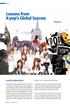 Focus Lessons from K-pop s Global Success SEO Min-Soo K-pop s global reach On the heels of the successful launch of Korean TV dramas in foreign markets, K-pop began to make inroads in China, Japan and
The Globalization of K-Pop: Korea s Place in the Global Music Industry 1
 The Globalization of K-Pop: Korea s Place in the Global Music Industry 1 Paper Delivered at the International Conference: The Miracle Narrative of the Korean Cultural Industries: Perspectives from the
Adam Doige musician, promoter, producer, sales rep
 Adam Doige musician, promoter, producer, sales rep Entertainment Business: A&R Coordinator Alternate Titles -A&R Representative, A&R Rep, Artist and Repertoire Coordinator, A&R Staffer, Talent Acquisition
Social Media Marketing - From Bowling to Pinball
 Social Media Marketing - From Bowling to Pinball By Svend Hollensen, Associate Professor, University of Southern Denmark and Anthony Raman, MCInst.M., RPM In the physical marketplace different communication
From B2C to B2B: Selling Korean Pop Music in the Age of New Social Media*
 365 From B2C to B2B: Selling Korean Pop Music in the Age of New Social Media* Ingyu Oh** Gil-Sung Park*** The once prevailing myth held among scholars of East Asian Studies that Hallyu, or the Korean Wave,
Media Today, 5 th Edition. Chapter Recaps & Study Guide. Chapter 10: The Recording Industry
 1 Media Today, 5 th Edition Chapter Recaps & Study Guide Chapter 10: The Recording Industry Like many other industries, the recording industry has been impacted strongly by digital technologies, but the
Mass Media Technologies and Popular Music Genres: K-pop and YouTube*
 Korea Journal, vol. 53, no. 4 (winter 2013): 34-58. 34 Korean National KOREA Commission JOURNAL for / UNESCO, WINTER 2013 Mass Media Technologies and Popular Music Genres: K-pop and YouTube* Ingyu OH and
Secrets From OfflineBiz.com Copyright 2010 Andrew Cavanagh all rights reserved
 Secrets From OfflineBiz.com Copyright 2010 Andrew Cavanagh all rights reserved The Lucrative Gold Mine In Brick And Mortar Businesses If you've studied internet marketing for 6 months or more then there's
Table of Contents 2 Information: 3 Taylor Swift Biography: Music Career 4 Taylor Swift Biography: Movie Career 5 Taylor Swift Awards:
 Table of Contents 2 Information: 3 Taylor Swift Biography: Music Career 4 Taylor Swift Biography: Movie Career 5 Taylor Swift Awards: 2 Taylor Swift Information: Taylor Swift Profile: Birth name: Taylor
Material that may be used without obtaining permission:
 Copyright Circular 2: fair use guidelines and examples This document provides guidelines on copyright issues for faculty, staff, and students who wish to create digital course or research materials. Understanding
EDM THE AUDIENCE ANALYSIS
 EDM THE AUDIENCE ANALYSIS Methodology Our goal was to understand the unique behavioral tendencies and topics of conversation among electronic dance music (EDM) fans. Additionally, we wanted to surface
Understanding Tourists' Involvement with Pop Culture : A Case of Korean Pop Music
 University of Massachusetts - Amherst ScholarWorks@UMass Amherst Tourism Travel and Research Association: Advancing Tourism Research Globally Turning Insights Into Actions ~ the Crucial Role of Tourism
Institutional Entrepreneurs 1
 Preliminary draft Comments are welcome Institutional Entrepreneurs 1 David Daokui Li Tsinghua University Hong Kong University of Science and Technology Junxin Feng Hongping Jiang Tsinghua University December
www.pwc.com Consumer Intelligence Series: The friendship factor: how teens are influenced about media and content
 www.pwc.com Consumer Intelligence Series: The friendship factor: how teens are influenced about media and content The friendship factor: how teens are influenced about media and content Consumer discovery
The Cult of Shinhwa, an Original K-Pop Band: South Korea s Prime Cultural Export
 The Cult of Shinhwa, an Original K-Pop Band: South Korea s Prime Cultural Export Nikolai V. Ostapenko As a part of the so-called Korean Wave, Korean pop music, better known as K-pop, is becoming increasingly
Entrepreneurship and Innovation Strategy - Mini-Project Spotify s Ecosystem
 Entrepreneurship and Innovation Strategy - Mini-Project Spotify s Ecosystem Diego Diaz, Luis Gonzalez, Henrique Thielen Description Origin Spotify is a Swedish music streaming platform that offers digitally
Freemium 101. A brief introduction to the freemium business model
 A brief introduction to the freemium business model What is freemium? e word freemium is made up from the words free and premium. It describes a business model where you give a core product away for free
Careers in the Music Business
 Careers in the Music Business Careers in Music Business/Management Personal Manager (or Artist Manager, Agent) Personal managers represent one or more musical groups or artists and oversee all aspects
Connect Digital Education And Work September, 2015
 Connect Digital Education And Work September, 2015 Interview with Kay Krafft, CEO Bertelsmann Education Two years ago Kay Krafft would never have dreamed that he would one day find himself in a hospital
Online Video 2013. Kristen Purcell Associate Director for Research, Pew Internet Project. www.pewresearch.org OCTOBER 10, 2013
 www.pewresearch.org OCTOBER 10, 2013 Online Video 2013 Over the past four years, the percent of American adult internet users who upload or post videos online has doubled from 14% in 2009 to 31% today.
How to make online video work for your business
 How to make online video work for your business Video marketing for the web works, but there are a few things to consider making sure you get the most out of it. Lee Walker of Blue Chew Digital explains
RESEARCH IN MUSIC EDUCATION AND SOUND ARTS (Completed in, and/or about New Zealand)
 Te Puna Puoru National Centre for Research in Music Education and Sound Arts (MERC) invites you to contribute to the national database of research in music education and sound arts. Fill in the template
The rise of the digital multi-tasker. Executive Summary. KPMG s Digital Debate. January 2013. kpmg.com/digitaldebate
 The rise of the digital multi-tasker Executive Summary KPMG s Digital Debate January 2013 kpmg.com/digitaldebate Contents 02 introduction The digital debate 03 Key findings An insatiable appetite for media
Proposed Minor in Media Studies. Department of Communication. University of Utah
 Proposed Minor in Media Studies Department of Communication University of Utah The minor in Media Studies is designed to serve students who have interests and/or needs to develop enhanced knowledge related
Producing Pop: Culture and Conflict in the Popular Music Industry
 GOLDSMITHS Research Online Book Negus, Keith Producing Pop: Culture and Conflict in the Popular Music Industry You may cite this version as: Negus, Keith. 2011. Producing Pop: Culture and Conflict in the
AUSTRALIAN MULTI-SCREEN REPORT QUARTER 3 2014
 AUSTRALIAN MULTI-SCREEN REPORT QUARTER 3 TV AND OTHER VIDEO CONTENT ACROSS MULTIPLE SCREENS The edition of The Australian Multi-Screen Report provides the latest estimates of screen technology penetration
THE HIRING REPORT. the state of hiring in china 2015. THE TOP 9 What professionals in China really want in a new role in 2015
 THE HIRING REPORT the state of hiring in china 2015 THE TOP 9 What professionals in China really want in a new role in 2015 THE NEW KING Why work life balance is now the No 1 priority of senior executives
Creative Scotland, Youth Music Initiative. Case Study Young Music Makers in Edinburgh. Helping young people believe in themselves.
 Creative Scotland, Youth Music Initiative Case Study Young Music Makers in Edinburgh Helping young people believe in themselves. About this case study This case study was developed as part of Creative
Media converging in the palm of your hand
 Media converging in the palm of your hand A Parent Guide Cell Phones and Your Kids Are cell phones the new media of this generation? Find out what s around the bend and what to watch out for. Parent Guide
The Asian media landscape is turning digital
 The Asian media landscape is turning digital How can marketers maximise their opportunities? Copyright 2012 The Nielsen Company. i The Asian media landscape is turning digital. How can marketers maximise
Making the Internet Business-Ready
 Making the Internet Business-Ready If you ve ever shopped online, downloaded music, watched a web video or connected to work remotely, you ve probably used Akamai. Our solutions help to deliver the best
Review of Music, Dance and Drama codes
 Review of Music, Dance and Drama codes Purpose Due to an increase in music courses being offered the current W3 codes are not sufficient. Secondary subject areas for Composing, Conducting, Singing and
[Figure 1] East Asian smartphone game market scale (according to country/region) (Prediction) (Prediction) (Prediction)
![[Figure 1] East Asian smartphone game market scale (according to country/region) (Prediction) (Prediction) (Prediction)](/thumbs/27/10429923.jpg "[Figure 1] East Asian smartphone game market scale (according to country/region) (Prediction) (Prediction) (Prediction)") Survey materials Press release July 29, 2014 CyberZ, Inc. The East Asian Smartphone Game Market Scale is 916.8 Billion Yen (Two Times the Previous Year) and Will Reach the One Trillion Yen Mark in 2014
Survey materials Press release July 29, 2014 CyberZ, Inc. The East Asian Smartphone Game Market Scale is 916.8 Billion Yen (Two Times the Previous Year) and Will Reach the One Trillion Yen Mark in 2014
Rock-N-Happy Heart: The Devotional By Yancy. by Yancy
 Rock-N-Happy Heart: The Devotional By Yancy by Yancy 1 73 Day 1-Dreams Will Come True Once upon a time a long time ago, I was a little girl with a dream. I loved to sing. (My parents have told that me
How do the most successful companies use social media? By Nora Ganim Barnes
 How do the most successful companies use social media? By Nora Ganim Barnes 8 Spring 2010 Tweeting blogging and to the top The Center for Marketing Research at the University of Massachusetts Dartmouth,
Knowledge Management Process: The Care and Feeding of Knowledge Workers
 Knowledge Management Process: The Care and Feeding of Knowledge Workers Anna E. Flynn, Ph.D., C.P.M., Associate Professor and Research Associate ISM and CAPS Research 480-752-6276 Ext 3140; [email protected]
Effective Monetization of Music on Mobile
 Effective Monetization of Music on Mobile Every year, the music industry suffers huge losses from piracy and illegal downloads. To minimize these losses and achieve strong growth, the industry needs to
Advantages of money voip >>>CLICK HERE<<<
 Advantages of money voip. Aside from the fact that this option has the potential to become quite lucrative, it can also give you the leisure to work from home if you feel like it. Advantages of money voip
Asian Animation Industry 2015: Strategies Trends & Opportunities
 Brochure More information from http://www.researchandmarkets.com/reports/3073228/ Asian Animation Industry 2015: Strategies Trends & Opportunities Description: The most authoritative Animation Industry
THE BENEFITS OF ONLINE COMMUNITIES WHITEPAPER PRESENTED BY SHARETRONIX
 THE BENEFITS OF ONLINE COMMUNITIES WHITEPAPER PRESENTED BY SHARETRONIX ONLINE COMMUNITIES ARE A COMMON STARTING POINT DURING THE BUYING JOURNEY TODAY, AS PEOPLE CONDUCT RESEARCH, READ PRODUCT REVIEWS,
Student Film Festival 2016
 Student Film Festival 2016 May 12, 2016 Cypress College CCCPLX 216 6:00pm Eligibility Requirements GUIDELINES Film Festival entrants must be currently enrolled in a college or high school *Films must have
Sydney office - 2016 Firm Profile. Sydney NSW 2000. http://www.klgates.com/ Telephone: (02) 9513 2000. Facsimile: (02) 9513 2399
 Sydney office - 2016 Firm Profile Firm Name: Office address: Website: K&L Gates Level 31, 1 O'Connell Street, Sydney NSW 2000 http://www.klgates.com/ Telephone: (02) 9513 2000 Facsimile: (02) 9513 2399
MTV vs. Cartoon Network in the United States and Brazil
 MTV vs. Cartoon Network in the United States and Brazil Jan Young MBA 04 2004 by The Trustees of Columbia University in the City of New York. All rights reserved. CHAZEN WEB JOURNAL OF INTERNATIONAL BUSINESS
Distribution and. Marketing Solutions. for the Digital Age
 Distribution and Marketing Solutions for the Digital Age ONErpm delivers scalable distribution and marketing solutions to help creators succeed in the digital age. As consumption shifts away from units
The Design Study of High-Quality Resource Shared Classes in China: A Case Study of the Abnormal Psychology Course
 The Design Study of High-Quality Resource Shared Classes in China: A Case Study of the Abnormal Psychology Course Juan WANG College of Educational Science, JiangSu Normal University, Jiangsu, Xuzhou, China
N o n - G o v t a n d N o n - P r o f i t A g e n c i e s Foundations and independent. that are committed to specific social and cultural interests.
 M M A P M U S I C P R O D U C T I O N D e f i n i t i o n o f T e r m s S U S T A I N I N G A N D E N H A N C I N G M U S I C A L D I V E R S I T Y THIS IMPLIES CONTINUITY AND AFFIRMATIVE ACTION IN ENABLING
Digital Asset Management: Three Tickets To The Blockbuster Content Marketing Show
 Digital Asset Management: Three Tickets To The Blockbuster Content Marketing Show By RobeRt Rose, Chief Strategist, Content Marketing Institute welcome North Plains are delighted to sponsor Digital Asset
LABELS AT WORK: THE MUSIC BUSINESS IN THE DIGITAL AGE #LABELSATWORK
 LABELS AT WORK: THE MUSIC BUSINESS IN THE DIGITAL AGE #LABELSATWORK contents 1. The Digital Revolution / Reinventing the Music Business 2. Investing in Talent 3. 4. 5. 6. 7. Artist Royalties Holding Steady
New Harmonies Scavenger Hunt. Instructions: The questions are divided by kiosk topics, and the kiosk title is at the top of each section.
 1 Instructions: The questions are divided by kiosk topics, and the kiosk title is at the top of each section. INTRODUCTION Section Fill in the blanks: 1. American roots music rises out of America s story
Understanding women s habits Women s forum - October 13 to 15, 2011
 Women s State of the Media Democracy 2011 International research center into media habits and interactions Understanding women s habits Women s forum - October 13 to 15, 2011 Presentation of the State
Social Media Marketing for Local Businesses by Jeff Sneeringer
 By: Jeff Sneeringer of Sneeringer Associates [email protected] 717-226-3489 1 The Social Media Factor: What is Social Media? Social Media is a red-hot buzz phrase that, like it or not, is here
Where Is Interactive Marketing Heading?
 Trend Report Changhee Han _ [email protected] Chakyung Bae _ [email protected] 2013 ad:tech London Where Is Interactive Marketing Heading? ad:tech is an international seminar on interactive marketing
Protecting Your Ideas: An Introduction to Intellectual Property Rights. By Sasha G. Rao and Andrew J. Koning
 Protecting Your Ideas: An Introduction to Intellectual Property Rights By Sasha G. Rao and Andrew J. Koning You have an idea. Something that s going to revolutionize the industry. You re excited, but before
B2B Display Advertising : Find, Nurture, and Harvest
 B2B Display Advertising : Find, Nurture, and Harvest Find, Nurture Harvest with B2B Display Ads 1 21st Century Most people don t realize just how deeply Internet technology has disrupted the traditional
2015 Content Marketing Survey by Zeentree.com 2015 CONTENT MARKETING SURVEY
 2015 CONTENT MARKETING SURVEY Page 1 The results are in and revealed for the Middle East Content Marketing Survey 2015. Content marketing has been responsible for much of the marketing buzz for at least
SOCIAL MEDIA. About Infosys. The Rise of Social Media in Financial Services Balancing Risk and Reward
 The Rise of Social Media in Financial Services Balancing Risk and Reward SOCIAL MEDIA About Infosys Many of the world s most successful organizations rely on Infosys to deliver measurable business value.
Principles of Measuring Advertising Effectiveness
 Print article Close window Principles of Measuring Advertising Effectiveness By David Olson Testing the effectiveness of advertising is a big business. With the cost of producing a commercial at $500,000
The British Film Industry by Numbers. Alex Tosta
 The British Film Industry by Numbers Alex Tosta The Bigger Picture Global revenue of the film industry in 2013 was 57 billion UK accounts for 1% of the world s population, but accounts for 7% of global
Outlook on the development of Hangzhou Silk and Women s Wear Fashion Industry
 Xu Tusong Deputy Director of Hangzhou Economic and information technology commission Outlook on the development of Hangzhou Silk and Women s Wear Fashion Industry The fashion industry refers to a series
Return on Investment from Inbound Marketing through Implementing HubSpot Software
 Return on Investment from Inbound Marketing through Implementing HubSpot Software January 2010 Prepared By: Melissa DiBella MBA Class of 2010 MIT Sloan School of Management Massachusetts Institute of Technology
K-POP. A New Force in Pop Music. K-POP: A New Force in Pop Music. Korean Culture No.2. Copyright 2011 by Korean Culture and Information Service
 K-POP Korean Culture No.2 K-POP: A New Force in Pop Music Copyright 2011 by Korean Culture and Information Service K-POP A New Force in Pop Music All Rights Reserved. No part of this book may be reproduced
Investigate the relationship between Total Quality Management (TQM) and Human Resources Management (HRM)
 Investigate the relationship between Total Quality Management (TQM) and Human Resources Management (HRM) 1Ehsan Behdadmanesh,2Maryam Moharrampour*,3 Sara Esfandiyari, 4Adib Asgarzadeh 1Department of Accounting,
A-H 106 RENAISSANCE THROUGH MODERN ART. (3) Historical development of Western art and architecture from the fourteenth century through the present.
 101 INTRODUCTION TO VISUAL STUDIES. (3) The course introduces students to the concepts and techniques of visual literacy. It explores a full spectrum of man-made visual forms encountered by contemporary
HYUNJI LEE Department of Communication University of Missouri 108 Switzler Hall Columbia, MO 65211 [email protected]
 Hyunji Lee 1 HYUNJI LEE Department of Communication University of Missouri 108 Switzler Hall Columbia, MO 65211 [email protected] EDUCATION Ph.D. in Communication, University of Missouri, Columbia,
Topic 1 Wealth Management
 Topic 1 Wealth Management 1. Background Moderator: Hansjörg Germann, As Head of Strategy Development at Zurich, Mr. Germann is responsible for all aspects of the strategic asset allocation for the group
Video as a Public Relations Tool
 October 2007 THOMSON FINANCIAL Video as a Public Relations Tool Lights...camera...Public relations professionals will be increasing their use of video as a communications tool, according to feedback Thomson
www.tvk24.com Jan 2015
 Available Nationwide / 24-Hour Korean American Network www.tvk24.com Jan 2015 About the Networks Launched in 2005, Television Korea 24, Inc., ( TVK24 ) operates two networks, TVK and TVK2. TVK is the first
IJMSS Vol.03 Issue-01, (January 2015) ISSN: 2321-1784 Impact Factor- 3.259
 A STUDY ON PERCEPTION OF JOB SEEKERS ON RECRUITMENT THROUGH SOCIAL MEDIA APPLICATION Mr. DINESH.N 1 Dr. MAHESH KUMAR.K.R. 2 Research Scholar, Research Supervisor, Research and Development Centre Research
Catching the K-Pop Wave: Globality in the Production, Distribution, and Consumption of South Korean Popular Music
 Vassar College Digital Window @ Vassar Senior Capstone Projects 2012 Catching the K-Pop Wave: Globality in the Production, Distribution, and Consumption of South Korean Popular Music Sarah Leung Follow
Can you imagine a world where music flows into our homes much like water or
 The Future of Music: Manifesto for the Digital Music Revolution By David Kusek and Gerd Leonhard Boston, Massachusetts: Berklee Press, 2005, ISBN 0-87639-059-9 Price $16.95, pp. 193 Reviewed by Ron Giambalvo
Filling. Funnel. the. A small business guide to Inbound Marketing. Get found. Get liked. Get Business. By Bob Brill. Filling the Funnel.
 Filling the Funnel. Filling the Funnel A small business guide to Inbound Marketing By Bob Brill Get found Get liked Get Business A small business guide to Inbound Marketing. Get found Get liked Get Business
Premier Internet Marketing Workshop
 Premier Internet Marketing Workshop Module 1 Advanced Search Engine Optimization (SEO) & Link Building Search engine optimization (SEO) is the act of tweaking a site using both on-site as well as offsite
How To Do Both
 STRATEGY AND LEADERSHIP MAGAZINE INTERVIEW INNOVATING BY DOING BOTH : CISCO MANAGES CONTRADICTIONS THAT DRIVE GROWTH AND PROFIT (Published on www.emeraldintelligence.com and in Strategy and Leadership
DEVELOPING A SOCIAL MEDIA STRATEGY
 DEVELOPING A SOCIAL MEDIA STRATEGY Creating a social media strategy for your business 2 April 2012 Version 1.0 Contents Contents 2 Introduction 3 Skill Level 3 Video Tutorials 3 Getting Started with Social
Marketing Mobile Applications Analysis & Theory. Exploratory Research by Alex Mendelson
 Marketing Mobile Applications Analysis & Theory Exploratory Research by Alex Mendelson Background & Introduction In 1993 Paget Press Inc. released a software distribution called Electronic AppWrapper.
Social networking guidelines and information
 Social networking guidelines and information Introduction Social media is an emerging and changing landscape. The digital marketing communications team and corporate communications have a social media
China s Mobile Gaming Market: A Quantitative Deep Dive Part 2: The Gamers Republic
 China s Mobile Gaming Market: A Quantitative Deep Dive Part 2: The Gamers Republic China s mobile gaming industry underwent an unprecedented explosive growth in 2013. In the first installment China s Mobile
You Must Promote You
 You Must Promote You The college softball recruiting process can be very challenging to understand. At times, it can be extremely confusing and frustrating for players and their families. As an organization,
Outlook 2011: Survey Report
 Web Analytics Association Outlook 2011: Survey Report page 1 Web Analytics Association Outlook 2011: Survey Report Prepared by the Web Analytics Association February 2011 All Rights Reserved Web Analytics
Whitepaper Video Marketing for Restaurants
 Video Marketing for Restaurants Restaurants are Using Online Video to Reach More Consumers and Boost Brand Impact Online video is becoming ever more present in consumer life therefore businesses have started