
CESD Section 504 Compliance System Forms and Procedures
|
|
|
- Anastasia Wiggins
- 9 years ago
- Views:
Transcription
1 CESD Section 504 Compliance System Forms and Procedures RICHARDS LINDSAY & MARTÍN, L.L.P Pond Springs Road, Suite 300 Austin, Texas Telephone (512) Facsimile (512) , 2009 RICHARDS LINDSAY & MARTÍN, L.L.P. For use or adaptation by public school districts with this copyright information intact. All other rights reserved. ***An important note about the ADA Amendments Act of 2008 (ADAAA). In January of 2009, the provisions of the ADAAA went into effect. This legislation significantly changed Section 504 eligibility. To date, the U.S. Department of Education (USDE) has not issued guidance, although the Office for Civil Rights (OCR) has updated a Q&A document to address, in a preliminary way, these changes. This document, Protecting Students with Disabilities: Frequently Asked Questions about Section 504 and the Education of Children with Disabilities, a revised March 27, 2009 FAQ from OCR-Chicago, is available on the OCR website at The Revised Q&A was not intended as the final USDE guidance on these issues, as noted in its opening paragraph. OCR is currently evaluating the impact of the Amendments Act on OCR s enforcement responsibilities under Section 504 and Title II of the ADA, including whether any changes in regulations, guidance, or other publications are appropriate. Until USDE issues guidance (or perhaps new regulations), any discussion of the ADAAA s impact on the K-12 Section 504 free appropriate public education, and changes to Section 504 forms, requires speculation. These forms reflect our best efforts to address the changes consistently with historical OCR guidance. If you choose to use these forms or make changes to your school s 504 process based on these forms, involve your school attorney in the discussion. The following materials should not be viewed as the only method of Section 504 compliance. In response to requests from CESD members, the following materials were created in These forms are updated each year for the Fall 504 Conference. We sought to build and maintain a set of operational guidelines that implemented the 504 regulations, and a set of forms to assist the school in implementing the guidelines. By creating the guidelines and forms as a system, we sought to ensure consistency in language and action and, to the extent possible, have the forms guide 504 Committees through their tasks to ensure that proper procedures are followed. There are many ways to articulate the rules and to gather, analyze, and communicate the information necessary for 504 compliance. This system is merely one method of achieving procedural compliance. These documents were designed to work as a whole, and not to be used separately from each other. If you choose to use a single document or a few forms from these materials, understand that you must review the rest of the your system of compliance to ensure that it is consistent with the CESD materials you use, and to ensure that as a result of your entire program, your district is in compliance. In the CESD Compliance System, 504 compliance with a particular regulation is sometimes handled by several forms working in concert. Unless all of the forms are used, an element of compliance may not be met. For example, the referral form, the parental consent and notice form, the two input forms and the evaluation form combine to provide coverage of the compliance issues arising from 504 evaluation. Deleting any of those forms or important elements of the forms may jeopardize compliance. Feel free to use this system as a reference point for evaluating your district s system. Analyze the areas covered here to determine whether your forms and procedures adequately meet the 504 requirements. Remember that no system of compliance is effective if the individuals called upon to implement it do not understand what is expected or how the system works. Training in whatever system your district creates or adopts is essential to ensure that teachers and others are referring potentially eligible students, evaluations and placements are properly made, and that the required accommodations are implemented. For use or adaptation by public school districts with this copyright information intact. All other rights reserved. Page 1 of 42
2 Your state law may require additional modifications to this system. Check with your local school attorney. While these materials have a Texas accent, they are based on federal law. For example, you will see references to the Texas Assessment (TAKS), ARD Committees (the Texas designation for the IEP Team), as well as two forms unique to Texas. The dyslexia form (Form 13) addresses requirements of the Texas Dyslexia Law, and Form 14 addresses Texas General Education Homebound rules. CESD 504 COMPLIANCE SYSTEM DOCUMENTS 1. Operational Guidelines: The structural framework for the District s 504 program. This document describes how the District will operate the program and implement the 504 regulations, including when the various forms will be used, by whom, and how. 2. Procedures for 504 Due Process Hearing: This document lays out the procedures for responding to a request for a hearing under 504, describing the District s responsibilities, choosing a hearing officer, and the rules for operating the hearing itself. 3. Child Find Notice: Provided in both English and Spanish, this document provides notice of the District s 504 duties to parents of potentially eligible 504 students Referral: This is the document which begins the process of 504 for a child. It gathers basic information on the child s academic, behavioral and social progress at school, and serves as the basis for the Coordinator s determination of whether a 504 Evaluation should be sought. 5. Notice and Consent for Initial Evaluation under 504: Following the receipt of the Referral and the decision that a 504 Evaluation should be pursued, this form is sent home to the parents to gain consent for initial evaluation. Included with it is a copy of Form 6, the Notice of Parent Rights. 6. Notice of Parent Rights under 504: A short document (provided to the parent in English or Spanish) to inform parents of their rights under 504. This document is provided to the parent after referral, regardless of whether the decision is made to evaluate under Teacher Input for 504 Evaluation: A document designed to seek information from a student s teacher or teachers about classroom performance. 8. Parent Input for 504 Evaluation: A document designed to seek information from the parent about the child s functioning and activities at home. It also provides the parents an opportunity to be involved in the process. 9. Notice of 504 Meeting: Sent to the parent prior to each 504 meeting, describing what will occur and giving the time, and place of the meeting. Note that this form does not assume that parents are members of the 504 Committee. If that is the case in your district, modify the form accordingly Evaluation: This form is used by the 504 Committee during the evaluation meeting. It prompts the Committee to ask the right questions and to review the required data and includes the Notice of 504 Evaluation Results. This notice is sent to the parents following an Evaluation to indicate what occurred. This form is designed to be used following any type of 504 Evaluation (initial, re-evaluation, etc.). Note that other documents are often required to be attached to this notice for delivery to the parents Student Accommodation Plan: Should the 504 Committee determine that the student is eligible, it uses this form to create a placement. The completed plan is delivered to the parent and school personnel and third-party contractors who have the duty to implement the plan Evaluation and Manifestation Determination: When disciplinary removals trigger the need for evaluation, this document walks the Committee through the required questions. This form also now includes a Notice of Evaluation to inform the parents of the results of the manifestation determination. 13. Texas Dyslexia Program Evaluation Supplement: When the 504 Committee is performing an evaluation that includes possible eligibility in the Texas Dyslexia program, this form should be used in conjunction with Form 10, For use or adaptation by public school districts with this copyright information intact. All other rights reserved. Page 2 of 42

3 the 504 Evaluation form. This supplement assists the committee in meeting the additional evaluation requirements established by Texas state law and the Revised Procedures Concerning Dyslexia (i.e., the Blue Book). 14. General Education Homebound. This form is designed to assist Texas 504 Committees in determining whether homebound services are available under regular education for 504-eligible students, and what types of services are appropriate. It should be used in conjunction with the 504 Evaluation form (Form 10). What s new in the CESD Forms for ? To make a suggestion for next year s revision, contact CESD at [email protected] 1. Additional explanations added to the cover page to address the lack of USDE guidance to date and the importance of discussing changes to the school s Section 504 process with the school attorney. 2. In the Operational Guidelines (Form 1), reference to gathering data on mitigating measures, as well as historical medical and mental health data added to evaluation section to address episodic conditions and conditions in remission (page 4); language on Committees evaluating students consistently with the ADAAA (p. 5); additional flexibility added to location where Section 504 records are kept to include any location determined appropriate by the campus or district (p. 5); additional personnel listed to supervise plan implementation (p. 6); additional explanation provided with respect to triggers for re-evaluation (p. 6); evaluation consideration for students no longer served by special education due to revocation of consent (p. 7); fine-tuning of language on interaction with regular education intervention efforts (p. 7-8); addition of statement on mitigating measures and accommodation plans as item 15, together with re-numbering of final guideline sections (p. 8). 3. In the Section 504 Referral (Form 4), section added requiring the listing of mitigating measures currently in use for the student (p. 14); sections added requiring identification of episodic impairments and impairments in remission (p. 15). 4. In the Notice and Consent for Initial Section 504 Evaluation (Form 5), various changes are made to enable the parent to indicate either consent for evaluation or refusal to consent (p. 17). 5. In the Section 504 Notice of Parent Rights in both English and Spanish (Form 6), mitigating measures is added to information to be considered during evaluation (pp. 19 & 21). 6. In the Parent Input (Form 8), a series of questions was added with respect to both impairments in remission and episodic impairments (p. 26). 7. In the Section 504 Evaluation (Form 10), the entire second page on the eligibility questions (p. 29) was re-drafted to include changes to major life activities (including the new list of major life activities, and the list of major bodily functions taken directly from the ADAAA), notes added to the various questions to address the impact of episodic impairments, and impairments in remission, as well as changes to the results of evaluation to provide for an eligible student who is not in need of accommodation due to mitigating measures or an impairment in remission with no resulting current need for services (p. 30). 8. In the Section 504 Accommodation Plan (Form 11), General Education Homebound was added in the list of accommodations (p. 33). 9. In the Manifestation Determination (Form 12), language was added to the second question to allow the possibility that there was no failure to implement the 504 Accommodation Plan (p. 37). 10. In the Texas Dyslexia Supplement (Form 13) the guidance with respect to committee knowledge was revised for clarity, the required knowledge was arranged in a check-box form similar to that used to demonstrate a properly constituted 504 committee (p. 39). 11. And again, until USDE issues guidance (or perhaps new regulations), any discussion of the ADAAA s impact on the K-12 Section 504 free appropriate public education, and changes to Section 504 forms, requires speculation. These forms reflect our best efforts to address the changes consistently with historical OCR guidance. If you choose to use these forms or make changes to your school s 504 process based on these forms, involve your school attorney in the discussion. For use or adaptation by public school districts with this copyright information intact. All other rights reserved. Page 3 of 42

4 Operational Guidelines for Section 504 Section 504 Operational Guidelines Form 1, page 1 of 5 1. Child Find. As part of the on-going identification and referral process, the District will make reasonable efforts to identify and locate every qualified disabled student residing within the District who is not receiving a public education. The District shall inform the parents or guardians of these potentially eligible students (who may be attending private or homeschools) of the District s duties under 504. As part of the Child Find effort the District shall annually publish the Child Find Notice in local newspapers, student handbooks, and/or place the Notice in locations likely to be seen by parents of eligible students (such as supermarkets, pediatrician s offices, etc.). Additionally, every teacher within the District should have information regarding the District s overall early intervention process, understand how to initiate a 504 Referral and know how to identify students who should be referred. 2. Referral. When a 504 referral has been initiated, the Section 504 Referral Form [hereinafter, Referral Form ] should be quickly forwarded to the Campus or District 504 Coordinator [hereinafter Coordinator ]. The Referral Form is designed to be filled in by the person initiating the referral, but may be supplemented as necessary by the Coordinator, utilizing information from the student s cumulative folder or other sources. From that basic information, the Coordinator will determine whether a 504 Evaluation is necessary. If no 504 Evaluation is required, the Coordinator shall forward the Parent Rights form to the parents, with a note explaining why the Referral did not lead to a 504 Evaluation at this time. 3. Consent for Evaluation. If a 504 Evaluation is necessary, the Coordinator should send to the parent Notice of Parent Rights under 504 [hereinafter, Parent Rights ], together with a Notice and Consent for Initial Evaluation under 504 Form [hereinafter, Notice and Consent ], and a Parent Input for Section 504 Evaluation Form [hereinafter, Parent Input ]. If no parental consent is received for 504 Evaluation, the Coordinator should remind the parent every semester (or at other intervals as determined by the District) of the District s continued desire to conduct an Evaluation under Evaluation. When the consent is received from the parent, the Coordinator should: a. Gather evaluation data and coordinate/direct the completion of the various Input Documents. The evaluation data consists of information from a variety of sources, including efforts and results of early intervention activities, aptitude and achievement testing, teacher recommendations, student s historical and current physical and mental condition (including data on conditions in remission and episodic conditions), social or cultural background, adaptive behavior, and mitigating measures; the Teacher Input form to be completed by one or more teachers, and the Parent Input form with information about the student s activities/behaviors at home, and any other data the parent would like the Committee. Should current special education data exist (an evaluation upon which a student was either dismissed from special education or upon which a finding of no IDEA eligibility was made), that data should also be considered. b. Ensure that should formalized testing be considered by the 504 Committee as evaluation data, the tests: 1) Have been validated for the specific purpose for which they are used and are administered by trained personnel in accordance with the instructions provided by the tests creators; 2) Include those tailored to assess specific areas of educational need and are not merely designed to provide a single intelligence quotient; 3) Are selected and administered to ensure that when a test is administered to a student with impaired sensory, manual, or speaking skills, the tests results accurately reflect the student s aptitude or achievement level or whatever other factor the test purports to measure, rather than reflecting the student s impaired sensory, manual, or speaking skills (except where those skills are the factors that the test purports to measure). c. Determine who will be in the group of knowledgeable people [hereinafter, the 504 Committee or Committee ] (including persons with knowledge of the child, the meaning of the evaluation data and the placement options). For use or adaptation by public school districts with this copyright information intact. All other rights reserved. Page 4 of 42

5 Section 504 Operational Guidelines Form 1, page 2 of 5 d. Schedule a 504 Evaluation by the Committee. e. Give the parents notice of the time and place of the evaluation meeting, inviting the parent to attend if that is the District s policy. Written notice, while not required, is preferred, and can be accomplished utilizing the Notice of Section 504 Meeting form. At the 504 Evaluation, the Committee should: a. Draw upon information from a variety of sources, including, but not limited to, efforts and results of early intervention activities, aptitude and achievement testing, teacher recommendations, physical condition, social or cultural background, adaptive behavior and the Parent and Teacher/Administrator input forms; b. Ensure that all information reviewed in the evaluation is documented and carefully considered, and that Section 504 decisions are made consistently with the Americans with Disabilities Act Amendments Act of 2008, including appropriate consideration of mitigating measure (as provided in paragraph 15 of these Operational Guidelines), recognition of changes made to major life activities, the appropriate consideration of impairments that are episodic or in remission, and Congressional declarations on the definition of substantial limitation. d. Complete the Section 504 Evaluation form. If the student is determined to be eligible [hereinafter, eligible student ], the Committee moves on to the Section 504 Student Accommodation Plan [hereinafter, Accommodation Plan ] form to develop accommodations. If no eligibility is found, the parents are so informed in writing. At the conclusion of the Evaluation/Placement meeting, the Coordinator provides notice to the parent (Notice of Section 504 Evaluation Results form) of the 504 Committee s findings, and copies of the completed Evaluation form and the Accommodation Plan (if eligible). 5. Records. Section 504 records, including any evaluation data, shall be kept in a separate 504 folder under the control of the Coordinator, as part of the student s cumulative folder, or in any other location determined to be appropriate by the district or campus. Regardless of location, the District will maintain the confidentiality of 504 records as required by the Family Educational Rights and Privacy Act (FERPA). Where 504 records are kept separately from the cumulative folder, a reference to the records and their location will be placed in the cumulative folder to ensure that the campus with responsibility for the student is aware of its 504 obligations to the eligible student and that personnel and third-party contractors who have a duty to implement the plan have access to necessary records including the plan itself. 6. Free Appropriate Public Education (FAPE). No eligible student may be excluded by the District from receiving a public elementary or secondary education. When considering the educational placement for eligible students, the Committee will ensure that the services provided are: a. Appropriate. The 504 services are designed to meet the individual needs of the eligible student as adequately as the needs of nondisabled students, and are based upon adherence to the regulatory procedures relating to educational setting, evaluation and placement, and procedural safeguards. The Committee may place an eligible student in a program that the District does not operate in order to satisfy this requirement, but in so doing, the District remains responsible for ensuring that the requirements of 504 are met. b. Free. An eligible student s educational program provided under 504 is provided without cost to the parent of the eligible student, regardless of where those services are provided or by whom. Should the Committee determine that placement in a program not operated by the District is required for the eligible student to receive FAPE, the District shall ensure that adequate transportation is provided to and from the program at no greater cost than would be incurred by the eligible student or his or her parents or guardians if the student were placed in the program operated by the District. The only costs of educational services that may be assessed the eligible student are those borne by nondisabled students and their parents (such as tickets to athletic events, purchases of yearbooks, gym clothes, etc.). When the District has made available a FAPE as required by 504, and the eligible For use or adaptation by public school districts with this copyright information intact. All other rights reserved. Page 5 of 42

6 student or his or her parents or guardians choose to place the student in a private school, the District is not required to pay for the eligible student s education in the private school. Section 504 Operational Guidelines Form 1, page 3 of 5 7. Least Restrictive Environment (LRE). The Committee shall create a placement for the eligible student that ensures the provision of educational services with persons who are not disabled to the maximum extent possible appropriate to the needs of the eligible student. The Committee will presume that the regular classroom is the appropriate placement, unless it is demonstrated that the eligible student s education in the regular classroom with the use of supplementary aids and services cannot be achieved satisfactorily. Should the Committee place an eligible student in a setting other than the regular classroom, it shall take into account the proximity of the alternative setting to the eligible student s home. 8. NonAcademic Services & Extracurricular Activities. The District shall ensure that the provision of nonacademic and extracurricular services and activities (such as meals, recess, counseling services, physical recreational athletics, transportation, health services, recreational activities, special interest groups or clubs sponsored by the recipients, referrals to agencies which provide assistance to handicapped persons, and employment of students, including both employment by the recipient and assistance in making available outside employment) are provided so that: a. Eligible students are afforded an equal opportunity to participate in such service and activities. b. Eligible students participate with nondisabled students to the maximum extent appropriate to the needs of the eligible student. Counseling. Should the District provide personal, academic, or vocational counseling, guidance, or placement services to its students, those services shall be provided without discrimination on the basis of disability. The District shall ensure that disabled students are not counseled toward more restrictive career objectives than are nondisabled students with similar interests and abilities. Physical education and athletics. In providing physical education courses and athletics and similar programs and activities to any of its students, the District will not discriminate on the basis of disability. Disabled students shall have equal opportunity to participate in the District s physical education courses, as well as interscholastic, club, or intramural athletics operated or sponsored by the District. The District will offer disabled students physical education and athletic activities that are separate or different from those offered to nondisabled students only if separation or differentiation is consistent with the requirements of LRE and only if no qualified disabled student is denied the opportunity to compete for teams or to participate in courses that are not separate or different. Comparable Facilities. If the District operates a facility that is identifiable as being for disabled students, the District will ensure that the facility and the services and activities provided there are comparable to the other facilities, services and activities of the District. 9. Implementation of the Accommodation Plan. The Coordinator (or designee) should ensure that the student s Accommodation Plan is delivered to each teacher, campus administration, and any other employee or third-party contractor who has responsibility to implement the plan. Monitoring of Accommodation Plan implementation should be accomplished through the PDAS (or other teacher appraisal process), through walkthroughs, and informal checks of the student s academic, behavioral and social progress by the Coordinator and other appropriate personnel. 10. Re-Evaluation. Annually (preferably at the end of each school year), the 504 Committee should meet to conduct a re-evaluation. Re-evaluation should also occur prior to any significant change of placement and whenever necessary to ensure the continued provision of FAPE. Give the parents notice of the time and place of the reevaluation meeting, inviting the parent to attend if that is the District s policy. Written notice, while not required, is preferred, and can be accomplished utilizing the Notice of Section 504 Meeting form. If the student remains eligible, the Committee should focus on the student s changing needs due to the effects of different classroom subject matter, school demands and other factors for the school year to come. Should the Committee determine that the student is no longer eligible, the Committee should dismiss the student from 504. The parent shall be given notice of the results of the re-evaluation. For use or adaptation by public school districts with this copyright information intact. All other rights reserved. Page 6 of 42

7 Section 504 Operational Guidelines Form 1, page 4 of Discipline. Should the District attempt a disciplinary removal of the eligible student from his educational placement for a term of more than ten consecutive school days, the 504 Committee must first conduct an evaluation. Prior to the evaluation, the Coordinator shall give the parents notice of the time and place of the evaluation meeting, inviting the parent to attend if that is the district s policy. Written notice, while not required, is preferred, and can be accomplished utilizing the Notice of Section 504 Meeting form. The Committee s evaluation should determine: (1) was the conduct in question caused by, or directly and substantially related to the student s disabilities?; and (2) was the conduct in question the direct result of the school s failure to implement the student s 504 plan? If a link is found, a disciplinary removal of longer than ten consecutive school days cannot occur. Removals for less than ten days can be effected without 504 Committee approval, subject to the pattern of exclusion rule. A series of short removals (including teacher removals under of the Education Code) over the course of the school year that exceeds ten total days may constitute a pattern of exclusion that triggers applicable procedural safeguards (a manifestation determination evaluation and a right to due process). The Committee will meet to conduct an evaluation prior to the tenth cumulative day of removals during a school year, to determine: (1) was the conduct in question caused by, or directly and substantially related to the student s disabilities? and (2) was the conduct in question the direct result of the school s failure to implement the student s 504 plan? Prior to the evaluation, the Coordinator shall give the parents notice of the time and place of the evaluation meeting, inviting the parent to attend if that is the district s policy. Written notice, while not required, is preferred, and can be accomplished utilizing the Notice of Section 504 Meeting form. If at the evaluation meeting a link is determined, the disciplinary removal cannot occur. An eligible student who currently is engaging in the illegal use of drugs or in the use of alcohol may be removed from his educational placement for a drug or alcohol offense to the same extent that such disciplinary action is taken against nondisabled students. Further, no 504 Evaluation is required prior to the removal and no 504 due process hearing is available. 12. Interaction with Special Education. Each student referred and evaluated for special education who does not qualify and each student dismissed from special education shall be evaluated for possible 504 eligibility. If at any time the 504 Committee determines that the disabled student needs special education or related aids and services in order to receive educational benefit, a special education referral should be initiated. With respect to students who are no longer served by special education due to parents revocation of consent for continued special education services, the school will determine on a case-by-case basis, whether the student should be referred to Section 504 for evaluation, and provide Notice of Section 504 Rights should the student not be referred. The school should make reasonable efforts to explain to the parents the 504 process and potential protections in these situations. Should the parents refuse consent for a 504 evaluation, the school will document such refusal. 13. Interaction with Texas Dyslexia Program. In accordance with State Board of Education Rule and the Revised Procedures Concerning Dyslexia (Blue Book), prior to testing a student individually for Dyslexia and/or prior to placing a student in the Dyslexia Instructional Program, the District must refer and evaluate under Section 504, utilizing forms 10 and 13. Placement of a 504-eligible student into the Dyslexia Instructional Program may only be accomplished by a properly constituted 504 Committee. If at any time the 504 Committee determines that the disabled student needs special education and related services in order to receive educational benefit, a special education referral should be initiated. Should a student already be special education eligible, a dyslexia evaluation for that student must occur under the direction of the student s ARD Committee. 14. Interaction with regular education Early Intervention efforts. In an effort to meet the needs of struggling students as early as possible, and to reduce the misidentification of students in both Section 504 and special education, the District uses an early intervention process, referred to as the CARE team. This simple, campus-based process is designed to assist students struggling for any number of reasons (family issues, lack of motivation, poverty, etc) and in any number of ways (academically, socially, behaviorally) by providing, appropriate to the For use or adaptation by public school districts with this copyright information intact. All other rights reserved. Page 7 of 42
8 student s needs, differentiated instruction, as well as additional regular education intervention programs, services and opportunities that may vary from campus to campus. Data from these efforts is shared with the parent, and will Section 504 Operational Guidelines Form 1, page 5 of 5 become part of any Section 504 or special education evaluation. These efforts are available to all students, including students with disabilities. Should regular education, together with these early intervention efforts be insufficient to meet the needs of the struggling student, and there are grounds to suspect that the student has a physical or mental impairment, the District will seek parental consent for an evaluation under Section 504 or special education, as appropriate to the student. 15. Mitigating Measures and Development of Section 504 Plans. Pursuant to the ADAAA, the determination of whether an impairment substantially limits a major life activity shall be made without regard to the ameliorative effects of mitigating measures such as medication, medical supplies, equipment, or appliances, low-vision devices (which do not include ordinary eyeglasses or contact lenses), prosthetics including limbs and devices, hearing aids and cochlear implants or other implantable hearing devices, mobility devices, or oxygen therapy equipment and supplies; use of assistive technology; reasonable accommodations or auxiliary aids or services; or learned behavioral or adaptive neurological modifications. The ameliorative effects of the mitigating measures of ordinary eyeglasses or contact lenses shall be considered in determining whether an impairment substantially limits a major life activity. Accommodation plans, however, shall not be developed unless needed, at the time, in order for the student to have his needs met as adequately as those of nondisabled students. Should need develop, the Section 504 Committee shall develop an appropriate Accommodation Plan. 16. Procedural Protections. The District will ensure that a system of procedural safeguards is in place with respect to actions regarding the identification, evaluation, and educational placement of disabled students. The system shall include notice, an opportunity for the parent or guardian of the disabled student to examine relevant records, an impartial hearing with opportunity for participation by the student s parent or guardian and representation by counsel, and a review procedure. The impartial hearing is governed by the District s Procedures for 504 Due Process Hearings. Parents of eligible students may also present grievances to the Section 504 Coordinator. 17. Parent Language. If the District determines that the dominant language of the parent is Spanish, the District will ensure effective notice in Spanish and services necessary to provide the parent an opportunity for effective participation in the 504 process. If the District determines that the dominant language of the parent is not English or Spanish, the District will make a good faith effort to accomplish notice and provide an opportunity for effective parent participation in the 504 process through other means. 18. Duty to Not Discriminate. The District shall ensure that no qualified disabled person shall, on the basis of disability, be excluded from participation in, be denied the benefits of, or otherwise be subjected to discrimination under any District program or activity. 19. Retaliation prohibited. No District officer, employee, or contractor shall retaliate against any person because of his or her exercise of rights under Section Disability-based harassment. The District will promptly investigate all claims of disability-based harassment and take reasonable action to stop future recurrence. Where evidence of disability-based harassment is found pursuant to an investigation, and the District believes that the harassment has adversely impacted upon the ability of a disabled student to have equal access to the District s programs or activities, or the disabled student s entitlement to a free, appropriate public education, a 504 Committee meeting will be called to consider the impact of the harassment and determine whether changes to the student s accommodation plan are required. 21. Review Procedure. Should the parent disagree with the identification, evaluation, or placement decision of a 504 Committee or the decision of a 504 hearing officer, the parent may appeal to state or federal court, or seek relief pursuant to a grievance to the District s 504 Coordinator. For use or adaptation by public school districts with this copyright information intact. All other rights reserved. Page 8 of 42

9 Section 504 Due Process Hearing Procedures Section 504 Hearing Procedures Form 2, page 1 of 3 Right to Due Process. In the event a parent or guardian [hereinafter parent ] wishes to contest an action or omission on the part of the District with regard to the identification, evaluation, or placement of a disabled child under 504 of the Rehabilitation Act of 1973 [ 504 ], the parent has a right to an impartial hearing before an impartial hearing officer. Omissions on the part of the District with regard to a disabled child might include, for example, the District's failure to identify a child eligible for services under 504. Thus, a child s identification as eligible for services under 504 is not an absolute prerequisite to the right to due process. Parent Participation & Representation. A parent has the right to participate, speak, and present information at the due process hearing, and to be represented by legal counsel or any other type of advocate or representative of their choice at their expense. If a parent is to be represented by a licensed attorney at the due process hearing, he or she must inform the District s 504 Coordinator and the appointed hearing officer of that fact in writing at least seven (7) calendar days prior to the hearing date. Failure to notify the 504 Coordinator and the appointed hearing officer of that fact in writing shall constitute good cause for a continuance of the hearing date. (See "Continuances" below). Initiation of Due Process Procedures. A parent who wishes to challenge a District s action or omission with regard to the identification, evaluation, or placement of a disabled child must submit a written Request for a Due Process Hearing to the District s 504 Coordinator. Such a written request must make clear that the parent is seeking a due process hearing under 504 before an impartial 504 Hearing Officer. The written request may be made on a form provided by the District for that purpose. If an intent to seek a due process hearing under 504 is not clear from the face of a Request, the District s 504 Coordinator may contact the parent to clarify the Request and ascertain whether the parent wishes to initiate a 504 due process hearing. The Coordinator may also assist the parent in clarifying any questions regarding due process rights under 504. The reasonable time involved in ascertaining whether an ambiguous or unclear Request seeks a due process hearing under 504 shall toll the time lines set forth in these procedures (meaning that such time will not count toward the time line days specified in these procedures). If after such communication, the District is still unsure whether the parent is requesting a due process hearing under 504, the District shall initiate due process procedures, and the appointed Hearing Officer will hold a pre-hearing conference to decide whether the parent is seeking a due process hearing under 504, and whether the Hearing Officer has jurisdiction to entertain the claims and issues raised by the parent. (See "Pre-Hearing Conferences" below). Appointment of a Hearing Officer. Within fifteen (15) days of the date of receipt of a clear Request for a Due Process Hearing, the District will appoint an impartial Hearing Officer to preside over the hearing and issue a decision. The Hearing Officer will be hired by the District as an independent contractor at no expense to the parent. The Hearing Officer shall not be a current employee of the District, and shall not be related to any member of the District s Board of Trustees to a degree prohibited under the Texas Nepotism Statute. The Hearing Officer need not be an attorney, but shall be familiar with the requirements of 504 and the District s Hearing Procedures under 504. The District s choice of an impartial Hearing Officer is final and may not be made an issue at the due process hearing, since such an issue would not relate to the identification, evaluation, or placement of a disabled child under 504. If a parent disputes the impartiality of the appointed Hearing Officer, he or she may raise such issue in a review of the Hearing Officer's opinion by a court of competent jurisdiction (See "Review Procedure" below), or in a complaint to the appropriate Office for Civil Rights regional office (See "Complaints to the Office for Civil Rights (OCR)" below ). Scheduling of Hearing. The appointed Hearing Officer shall issue an Order Setting Hearing Date to the parent and the District s 504 Coordinator in writing at his or her earliest opportunity. Such Order shall set a date for a hearing to be held within fifteen (15) days of the date of issuance of the Hearing Officer s Order. The Order shall also set forth a mutually agreeable time and place for the hearing. Pre-Hearing Conference. The Hearing Officer may also order a Pre-Hearing Conference at which the parent or his or her representative will state and clarify the issues to be addressed at the hearing. The Pre-Hearing Conference can For use or adaptation by public school districts with this copyright information intact. All other rights reserved. Page 9 of 42
![child under 504 of the Rehabilitation Act of 1973 [ 504 ], the parent has a right to an impartial hearing before an impartial hearing officer.](/docs-images/44/18438638/images/page_9.jpg "Omissions on the part of the District with regard to a disabled child might include, for example, the District's failure to identify a child eligible for services under 504.")
10 also serve to resolve preliminary matters, clarify jurisdictional issues, and answer the parties questions regarding the hearing process. Section 504 Hearing Procedures Form 2, page 2 of 3 Dismissals. If, after the Pre-Hearing Conference, the Hearing Officer finds that the parent, as a matter of law, alleges and raises no factual claims or legal issues that come within his or her jurisdiction as a 504 Hearing Officer, he or she may dismiss the hearing and issue an order to that effect explaining the bases for such finding. Continuances. Upon a showing of good cause, the Hearing Officer, at his or her discretion, may grant a continuance of the hearing date and set a new hearing date by issuing a written Amended Order Setting Hearing. Conduct of Hearing. The hearing shall be conducted in an informal, non-adversarial manner. The parties shall address the Hearing Officer by name (i.e. Mr. or Ms.). The hearing shall be closed or open to the public, at the parent s request. The parties are free to provide the Hearing Officer with information or opinion as to the validity and weight to be given the information presented to him or her. Neither the Federal nor Texas Rules of Evidence or Civil Procedure, however, will apply. The Hearing Officer is not required to entertain any legal evidentiary objections to the admissibility, authenticity, or probative value of either oral testimony or documentary exhibits offered at the hearing. In the exercise of his or her discretion, however, the Hearing Officer may reasonably limit testimony and introduction of documentary exhibits for reasons of relevance. (See also "Submission of Documentary Exhibits" below ). Recording. Instead of a formal written transcript produced by a court reporter, the entire due process hearing will be tape-recorded. The parent may obtain a copy of the tape recording at his or her request. In order for an accurate recording to be made, the parties and witnesses shall introduce themselves at the beginning of their presentations. If a parent proceeds to a review of the due process hearing decision to a court of competent jurisdiction (See "Review Procedure" below), the District will prepare a written transcript of the hearing tape recording to be offered to the court as an exhibit. Witnesses. Witnesses will present their information in narrative form, without the traditional question and answer format of legal proceedings. Cross-examination of witnesses will not be allowed, but a party may request that the Hearing Officer, at his or her discretion, ask a witness a certain question. Format for Presentations. The parent will present its case first, by making an opening statement which outlines the parent s position on all issues, presenting personally, calling additional witnesses, and making a closing argument. All of the preceding may be done either personally or through counsel, except for personal presentations or statements. At the end of the District s presentation, the Parent may offer a short response to the District s case. The above format is not required, but may be helpful in organizing the presentation of the case to the Hearing Officer. Submission of Documentary Exhibits. As part of their presentations, the parties may submit any reports, evaluations, correspondence, notes, or any other documents that may support their positions and that the Hearing Officer will admit at his or her discretion. Each separate documentary exhibit submitted to the Hearing Officer by either party must be marked numerically (i.e., Parent 1, Parent 2; District 1, District 2, etc.).the Hearing Officer may, in the exercise of his or her discretion, reasonably limit the number of documents to be submitted for his or her review, as well as the number of witnesses and the length and/or scope of their presentations or statements. Written Closing, Arguments or Briefs. The parties may submit, at the Hearing Officer s discretion, a written Closing Argument summarizing and characterizing the information presented at the hearing, and providing legal authority in support of their position. Time lines for the submission of Closing Arguments shall be set by the Hearing Officer at the conclusion of the hearing. Closing of Hearing. At the conclusion of all presentations, the Hearing Officer will close the hearing and set a date for the issuance of the written decision. The Hearing Officer may make an oral ruling at the conclusion of the hearing or take the case under advisement, but must in all cases issue a written opinion addressing and ruling on all issues raised by the Petitioner and indicating what corrective action, if any, the District must take. Formal findings of fact and conclusions of law, however, are not required. Any issue or claim raised by the parent that is left For use or adaptation by public school districts with this copyright information intact. All other rights reserved. Page 10 of 42

11 unaddressed by the Hearing Officer in his or her decision will be deemed to have been denied to the parent. The decision must be issued to both parties within fifteen (15) days after the hearing. Decision Time line. A decision must be issued within forty-five (45) days after the date the Request for a Due Process Hearing is received by the district. Section 504 Hearing Procedures Form 2, page 3 of 3 Remedies and Relief. The Hearing Officer must confine his or her orders and rulings to those matters that involve identification, evaluation, or placement of children under 504 and to the provisions of the regulations implementing 504. If a parent has raised issues or claims outside of the areas of identification, evaluation, or placement, that are not within the Hearing Officer's jurisdiction, the Hearing Officer will make appropriate findings to that effect either in the written decision, or at any time prior to the issuance of a decision (for example, at a Pre-Hearing Conference). A Hearing Officer may not award attorneys' fees as a part of relief granted to a parent. Review Procedure. If not satisfied by the decision of the Hearing Officer, a parent may seek review of the hearing decision in a court of competent jurisdiction, generally the closest federal district court. Complaints to the Office for Civil Rights (OCR). At any time, a parent may file a complaint with OCR if he or she believes that the District has violated any provision or regulation of 504. The filing of a complaint does not affect the hearing process or the time lines set forth above. OCR addresses 504 complaints separately and independently of the local hearing process, in accordance with the guidelines set forth in OCR's Complaint Resolution Manual. For use or adaptation by public school districts with this copyright information intact. All other rights reserved. Page 11 of 42
12 Section 504 Child Find Notice Form 3, page 1 of Child Find Notice [To be placed on District letterhead] Pursuant to Section 504 of the Rehabilitation Act of 1973, the District has a duty to identify, refer, evaluate and if eligible, provide a free, appropriate public education to disabled students. For additional information about the rights of parents of eligible children, or for answers to any questions you might have about identification, evaluation and placement into Section 504 programs, please contact the District s Section 504 Coordinator Darrell Ryan at or by mail at th Place, Big Spring, TX Aviso Sobre La Identificación de Estudiantes Incapacitados bajo la Sección 504 Bajo la Sección 504 del Decreto de Rehabilitación de 1973, el Distrito Escolar esta obligado a identificar, referir, evaluar, y proporcionar servicios educativos apropriados y gratuitos a estudiantes incapacitados que califican para recibir servicios bajo esta ley. Si usted desea mas información sobre los derechos de padres de niños incapacitados, o si tiene preguntas sobre la identificación, evaluación, y colocación de niños en el programa de Sección 504, favor de ponerse in contacto con el Coordinador de 504 del Distrito Darrell Ryan al numero , o por correo a la siguiente dirección: th Place, Big Spring, TX For use or adaptation by public school districts with this copyright information intact. All other rights reserved. Page 12 of 42
13 For use or adaptation by public school districts with this copyright information intact. All other rights reserved. Page 13 of 42

14 Section 504 Referral (Attach extra pages as necessary) Section 504 Referral Form 4, page 1 of 4 Student: Student ID #: Date of Birth: Grade: Referral Date: Campus: Referred by: Position/Relation to Student: Reason for Referral (attach additional pages if necessary): Attendance Is this student enrolled in school? Yes If No, explain. This student has been absent days out of school days this school year. Reason(s): This student was absent days out of school days last school year. Reason(s): List schools previously attended: Student Grade Reports Current Year Grade Report by Grading Period - Year Grades - Year Grades Subject Final Subject Subject Over time, this student s grades: (check the appropriate box) have become higher each year stayed about the same each year have become lower each year dropped suddenly in grade Data not available Has the student ever been retained? for retention(s) If YES, list grade level(s) where retention occurred and reason For use or adaptation by public school districts with this copyright information intact. All other rights reserved. Page 14 of 42

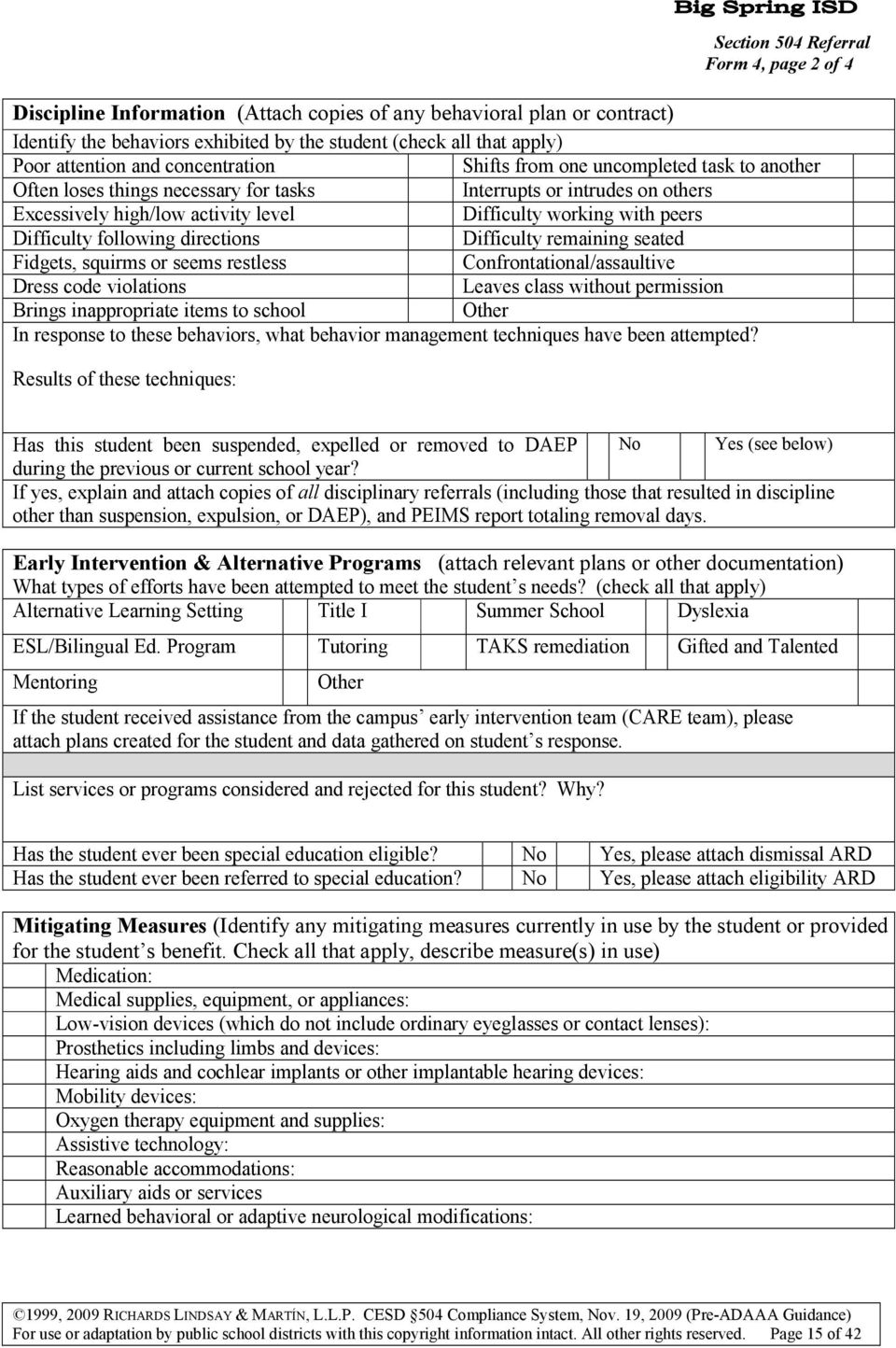
15 Section 504 Referral Form 4, page 2 of 4 Discipline Information (Attach copies of any behavioral plan or contract) Identify the behaviors exhibited by the student (check all that apply) Poor attention and concentration Shifts from one uncompleted task to another Often loses things necessary for tasks Interrupts or intrudes on others Excessively high/low activity level Difficulty working with peers Difficulty following directions Difficulty remaining seated Fidgets, squirms or seems restless Confrontational/assaultive Dress code violations Leaves class without permission Brings inappropriate items to school Other In response to these behaviors, what behavior management techniques have been attempted? Results of these techniques: Has this student been suspended, expelled or removed to DAEP No Yes (see below) during the previous or current school year? If yes, explain and attach copies of all disciplinary referrals (including those that resulted in discipline other than suspension, expulsion, or DAEP), and PEIMS report totaling removal days. Early Intervention & Alternative Programs (attach relevant plans or other documentation) What types of efforts have been attempted to meet the student s needs? (check all that apply) Alternative Learning Setting Title I Summer School Dyslexia ESL/Bilingual Ed. Program Tutoring TAKS remediation Gifted and Talented Mentoring Other If the student received assistance from the campus early intervention team (CARE team), please attach plans created for the student and data gathered on student s response. List services or programs considered and rejected for this student? Why? Has the student ever been special education eligible? No Yes, please attach dismissal ARD Has the student ever been referred to special education? No Yes, please attach eligibility ARD Mitigating Measures (Identify any mitigating measures currently in use by the student or provided for the student s benefit. Check all that apply, describe measure(s) in use) Medication: Medical supplies, equipment, or appliances: Low-vision devices (which do not include ordinary eyeglasses or contact lenses): Prosthetics including limbs and devices: Hearing aids and cochlear implants or other implantable hearing devices: Mobility devices: Oxygen therapy equipment and supplies: Assistive technology: Reasonable accommodations: Auxiliary aids or services Learned behavioral or adaptive neurological modifications: For use or adaptation by public school districts with this copyright information intact. All other rights reserved. Page 15 of 42
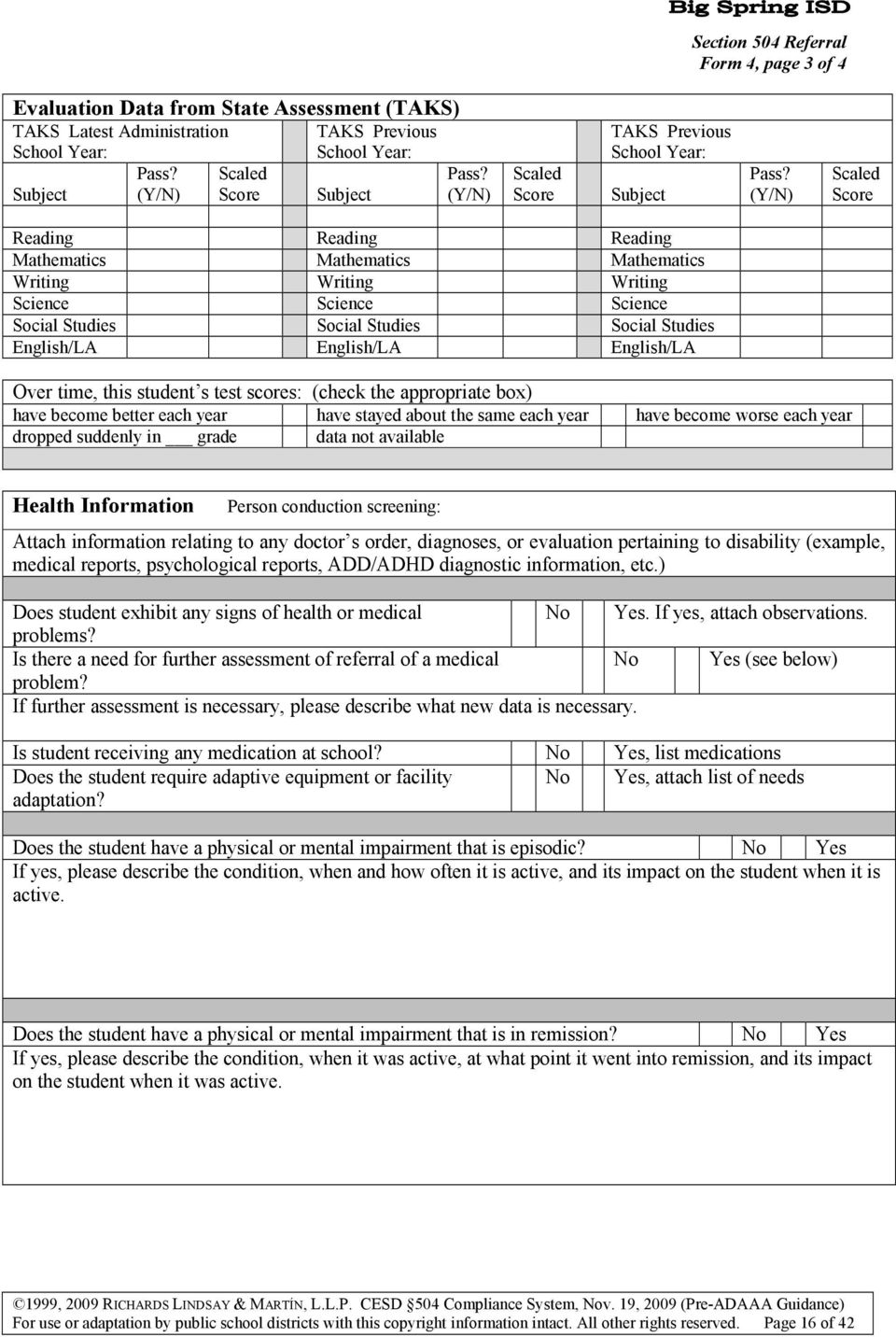
16 Section 504 Referral Form 4, page 3 of 4 Evaluation Data from State Assessment (TAKS) TAKS Latest Administration School Year: TAKS Previous School Year: Pass? Scaled Pass? Subject (Y/N) Score Subject (Y/N) Scaled Score TAKS Previous School Year: Subject Pass? (Y/N) Scaled Score Reading Reading Reading Mathematics Mathematics Mathematics Writing Writing Writing Science Science Science Social Studies Social Studies Social Studies English/LA English/LA English/LA Over time, this student s test scores: (check the appropriate box) have become better each year have stayed about the same each year have become worse each year dropped suddenly in grade data not available Health Information Person conduction screening: Attach information relating to any doctor s order, diagnoses, or evaluation pertaining to disability (example, medical reports, psychological reports, ADD/ADHD diagnostic information, etc.) Does student exhibit any signs of health or medical No Yes. If yes, attach observations. problems? Is there a need for further assessment of referral of a medical No Yes (see below) problem? If further assessment is necessary, please describe what new data is necessary. Is student receiving any medication at school? No Yes, list medications Does the student require adaptive equipment or facility No Yes, attach list of needs adaptation? Does the student have a physical or mental impairment that is episodic? No Yes If yes, please describe the condition, when and how often it is active, and its impact on the student when it is active. Does the student have a physical or mental impairment that is in remission? No Yes If yes, please describe the condition, when it was active, at what point it went into remission, and its impact on the student when it was active. For use or adaptation by public school districts with this copyright information intact. All other rights reserved. Page 16 of 42
17 Vision Type of screening: Date of screening (Vision examination must have been administered within a year from the date of referral) Visual acuity before correction: Right Left Visual acuity with correction: Right Left Interpretation of results: Section 504 Referral Form 4, page 4 of 4 As a result of the screening, is there any indication of a need for further assessment or adjustment? No Yes, please explain. Has any follow-up treatment been recommended? No Yes, please explain. Hearing Date of most recent screening: Type of screening: Results: Interpretation of results: As a result of the screening, is there any indication of a need No Yes. If yes, explain. for further assessment or adjustment? Has any follow-up treatment been recommended? No Yes, please explain. For use or adaptation by public school districts with this copyright information intact. All other rights reserved. Page 17 of 42

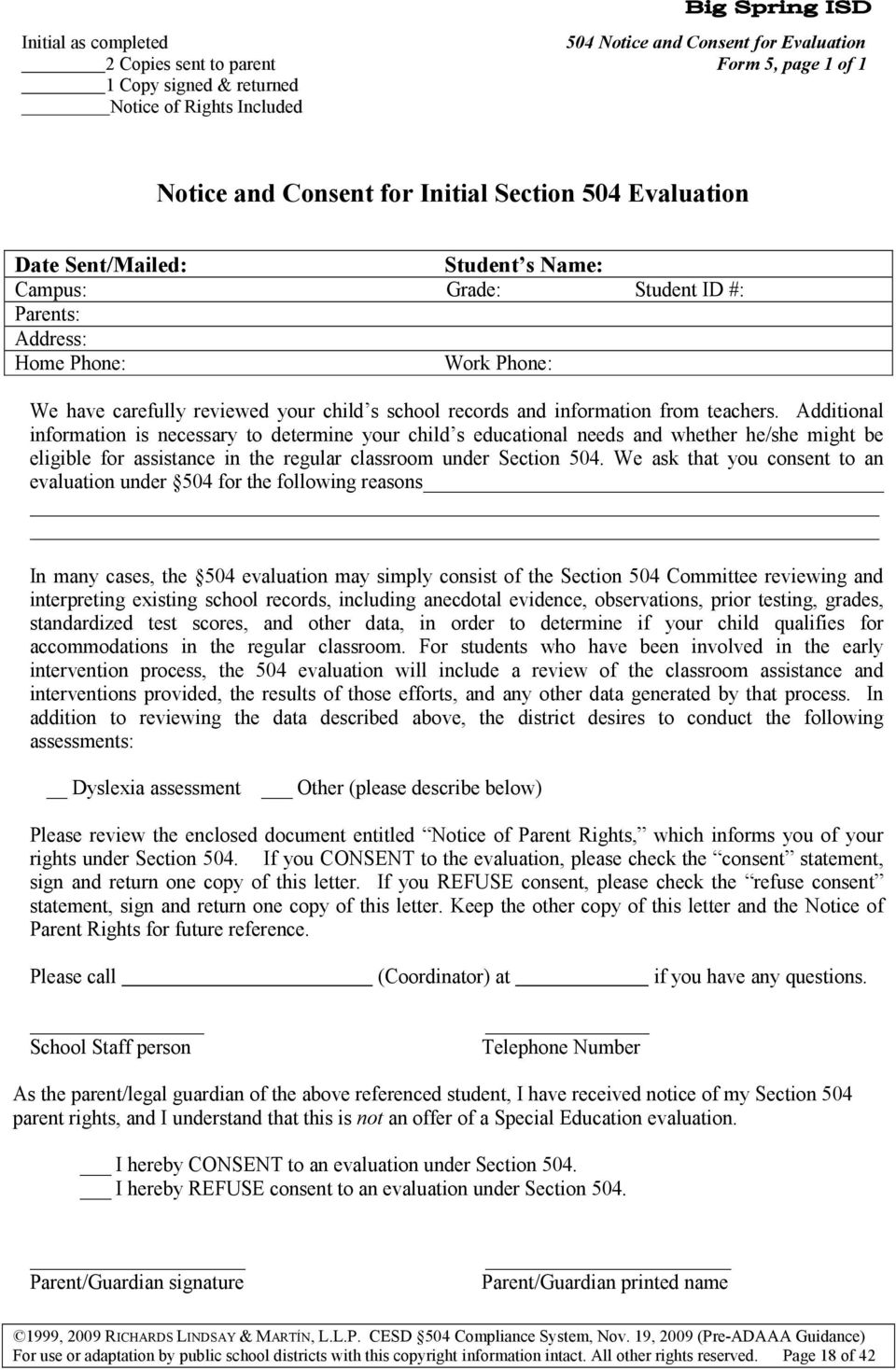
18 Initial as completed 504 Notice and Consent for Evaluation 2 Copies sent to parent Form 5, page 1 of 1 1 Copy signed & returned Notice of Rights Included Notice and Consent for Initial Section 504 Evaluation Date Sent/Mailed: Student s Name: Campus: Grade: Student ID #: Parents: Address: Home Phone: Work Phone: We have carefully reviewed your child s school records and information from teachers. Additional information is necessary to determine your child s educational needs and whether he/she might be eligible for assistance in the regular classroom under Section 504. We ask that you consent to an evaluation under 504 for the following reasons In many cases, the 504 evaluation may simply consist of the Section 504 Committee reviewing and interpreting existing school records, including anecdotal evidence, observations, prior testing, grades, standardized test scores, and other data, in order to determine if your child qualifies for accommodations in the regular classroom. For students who have been involved in the early intervention process, the 504 evaluation will include a review of the classroom assistance and interventions provided, the results of those efforts, and any other data generated by that process. In addition to reviewing the data described above, the district desires to conduct the following assessments: Dyslexia assessment Other (please describe below) Please review the enclosed document entitled Notice of Parent Rights, which informs you of your rights under Section 504. If you CONSENT to the evaluation, please check the consent statement, sign and return one copy of this letter. If you REFUSE consent, please check the refuse consent statement, sign and return one copy of this letter. Keep the other copy of this letter and the Notice of Parent Rights for future reference. Please call (Coordinator) at if you have any questions. School Staff person Telephone Number As the parent/legal guardian of the above referenced student, I have received notice of my Section 504 parent rights, and I understand that this is not an offer of a Special Education evaluation. I hereby CONSENT to an evaluation under Section 504. I hereby REFUSE consent to an evaluation under Section 504. Parent/Guardian signature Parent/Guardian printed name For use or adaptation by public school districts with this copyright information intact. All other rights reserved. Page 18 of 42
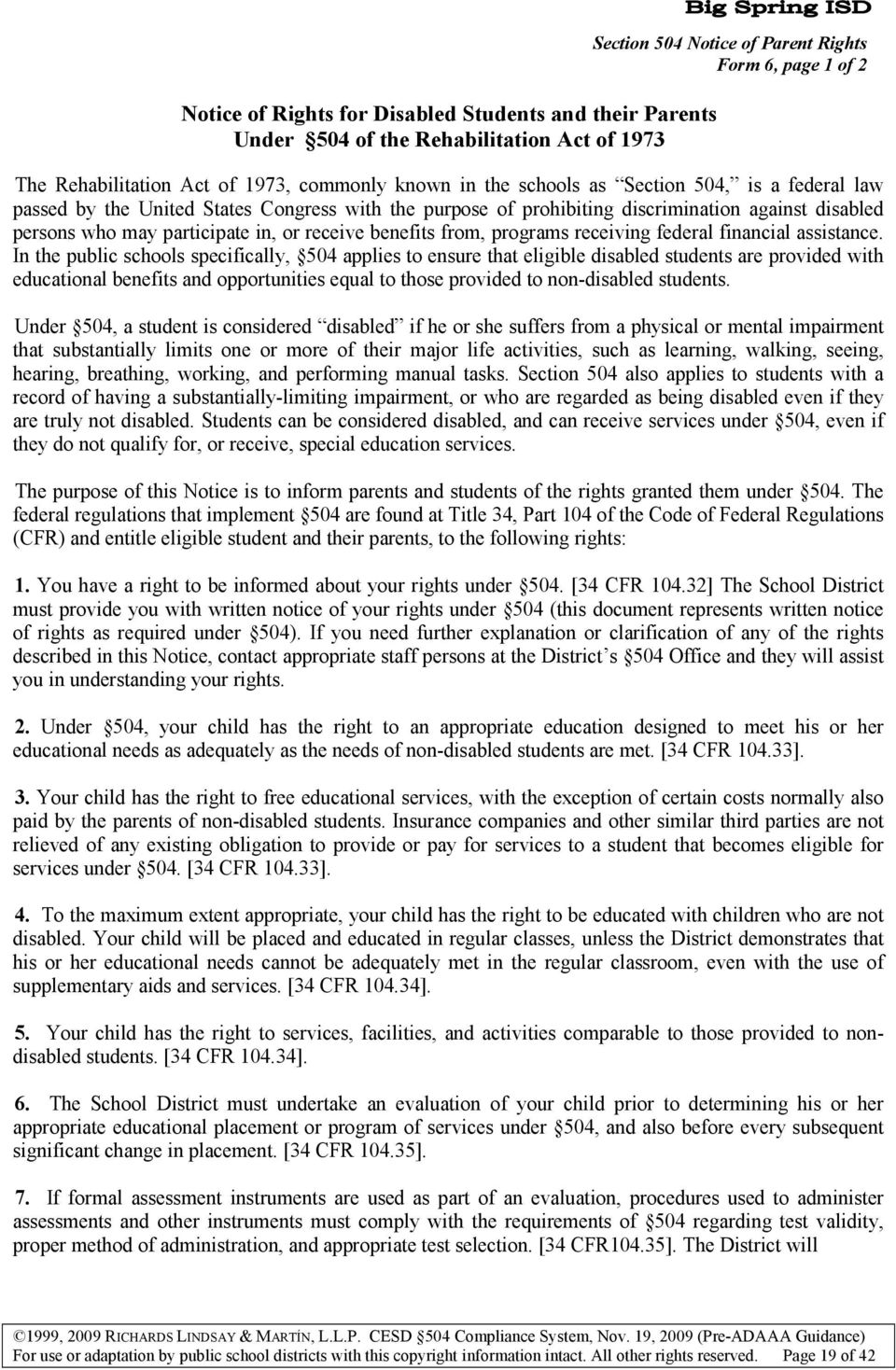
19 Notice of Rights for Disabled Students and their Parents Under 504 of the Rehabilitation Act of 1973 Section 504 Notice of Parent Rights Form 6, page 1 of 2 The Rehabilitation Act of 1973, commonly known in the schools as Section 504, is a federal law passed by the United States Congress with the purpose of prohibiting discrimination against disabled persons who may participate in, or receive benefits from, programs receiving federal financial assistance. In the public schools specifically, 504 applies to ensure that eligible disabled students are provided with educational benefits and opportunities equal to those provided to non-disabled students. Under 504, a student is considered disabled if he or she suffers from a physical or mental impairment that substantially limits one or more of their major life activities, such as learning, walking, seeing, hearing, breathing, working, and performing manual tasks. Section 504 also applies to students with a record of having a substantially-limiting impairment, or who are regarded as being disabled even if they are truly not disabled. Students can be considered disabled, and can receive services under 504, even if they do not qualify for, or receive, special education services. The purpose of this Notice is to inform parents and students of the rights granted them under 504. The federal regulations that implement 504 are found at Title 34, Part 104 of the Code of Federal Regulations (CFR) and entitle eligible student and their parents, to the following rights: 1. You have a right to be informed about your rights under 504. [34 CFR ] The School District must provide you with written notice of your rights under 504 (this document represents written notice of rights as required under 504). If you need further explanation or clarification of any of the rights described in this Notice, contact appropriate staff persons at the District s 504 Office and they will assist you in understanding your rights. 2. Under 504, your child has the right to an appropriate education designed to meet his or her educational needs as adequately as the needs of non-disabled students are met. [34 CFR ]. 3. Your child has the right to free educational services, with the exception of certain costs normally also paid by the parents of non-disabled students. Insurance companies and other similar third parties are not relieved of any existing obligation to provide or pay for services to a student that becomes eligible for services under 504. [34 CFR ]. 4. To the maximum extent appropriate, your child has the right to be educated with children who are not disabled. Your child will be placed and educated in regular classes, unless the District demonstrates that his or her educational needs cannot be adequately met in the regular classroom, even with the use of supplementary aids and services. [34 CFR ]. 5. Your child has the right to services, facilities, and activities comparable to those provided to nondisabled students. [34 CFR ]. 6. The School District must undertake an evaluation of your child prior to determining his or her appropriate educational placement or program of services under 504, and also before every subsequent significant change in placement. [34 CFR ]. 7. If formal assessment instruments are used as part of an evaluation, procedures used to administer assessments and other instruments must comply with the requirements of 504 regarding test validity, proper method of administration, and appropriate test selection. [34 CFR104.35]. The District will For use or adaptation by public school districts with this copyright information intact. All other rights reserved. Page 19 of 42
20 Section 504 Notice of Parent Rights Form 6, page 2 of 2 appropriately consider information from a variety of sources in making its determinations, including, for example: aptitude and achievement tests, teacher recommendations, reports of physical condition, social and cultural background, adaptive behavior, health records, report cards, progress notes, parent observations, and scores on TAKS tests, and mitigating measures, among others. [34 CFR ]. 8. Placement decisions regarding your child must be made by a group of persons (a 504 committee) knowledgeable about your child, the meaning of the evaluation data, possible placement options, and the requirement that to the maximum extent appropriate, disabled children should be educated with nondisabled children. [34 CFR ]. 9. If your child is eligible for services under 504, he or she has a right to periodic evaluations to determine if there has been a change in educational need. Generally, an evaluation will take place at least every three years. [34 CFR ]. 10. You have the right to be notified by the District prior to any action regarding the identification, evaluation, or placement of your child. [34 CFR ] 11. You have the right to examine relevant documents and records regarding your child (generally documents relating to identification, evaluation, and placement of your child under 504). [34 CFR ]. 12. You have the right to an impartial due process hearing if you wish to contest any action of the District with regard to your child s identification, evaluation, or placement under 504. [34 CFR ]. You have the right to participate personally at the hearing, and to be represented by an attorney, if you wish to hire one. 13. If you wish to contest an action taken by the 504 Committee by means of an impartial due process hearing, you must submit a Notice of Appeal or a Request for Hearing to the District's 504 Coordinator at the address below. A date will be set for the hearing and an impartial hearing officer will be appointed. You will then be notified in writing of the hearing date, time, and place. Darrell Ryan, th Place, Big Spring, TX If you disagree with the decision of the hearing officer, you have a right to seek a review of that decision before a court of competent jurisdiction (normally, your closest federal district court). 15. You also have a right to present a grievance or complaint to the District s 504 Coordinator (or designee), who will investigate the situation, take into account the nature of the complaint and all necessary factors, and respond appropriately to you within a reasonable time. 16. You also have a right to file a complaint with the Office for Civil Rights (OCR) of the Department of Education. The address of the OCR Regional Office that covers this school district is: Director, Office for Civil Rights, Region VI 1999 Bryan Street, Suite 1620, Dallas, Texas , Tel For use or adaptation by public school districts with this copyright information intact. All other rights reserved. Page 20 of 42
![tests, and mitigating measures, among others. [34 CFR 104.35]. 8.](/docs-images/44/18438638/images/page_20.jpg "Placement decisions regarding your child must be made by a group of persons (a 504 committee) knowledgeable about your child, the meaning of the evaluation data, possible placement options, and the")
21 Section 504 Notice of Parent Rights Form 6, page 1 of 2 Aviso a Padres de Estudiantes Incapacitados de sus Derechos Legales bajo la Sección 504 del Decreto de Rehabilitación de 1973 El Decreto de Rehabilitación de 1973, conocido generalmente como la Sección 504, es una ley federal legislada por el Congreso de los Estados Unidos. El propósito de esta ley es de prohibir discriminación contra estudiantes incapacitados y asegurar que tengan oportunidades y beneficios educativos tan adequados como los de estudiantes sin incapacidades. Bajo la Sección 504, un estudiante es considerado incapacitado si padece de un impedimento o condición física o mental que limita substanciálmente una de sus actividades vitales, como la de aprender, caminar, ver, oir, hablar, respirar, trabajar y desempeñar tareas manuales. La ley tambien protege a estudiantes que han tenido un impedimento o condición física o mental substancial en el pasado, o que son considerados incapacitados aunque realmente no lo son. Estudiantes pueden ser considerados incapacitados bajo la Sección 504 y pueden recibir asistencia educativa bajo esa ley aunque no reciban educación especial. El propósito de este Aviso es de explicarle los derechos legales garantizados bajo la Sección 504 a estudiantes incapacitados y a sus padres. Los reglamentos federales que dan efecto a la Sección 504 (los cuales se encuentran en el Título 34, Parte 104 del Código Federal de Reglamentos, o CFR) otorgan a los padres de familia y a estudiantes incapacitados los siguientes derechos: 1. Usted tiene derecho a ser informado de sus derechos bajo la Sección 504. [34 CFR ]. El distrito escolar debe darle información escrita sobre sus derechos (este Aviso precísamente sirve para informarle de sus derechos). Si necesita que le expliquen o clarifiquen cualquier de los siguientes derechos, los dirigentes apropiados del distrito escolar le ayudarán a resolver sus preguntas. 2. Bajo la Sección 504, su hijo/a tiene derecho a una educación apropriada diseñada para satisfacer sus necesidades educativas individuales tan adecuádamente como las de estudiantes sin incapacidades. [34 CFR ]. 3. Su hijo/a tiene derecho a servicios educativos gratuitos, con la excepción de gastos que normalmente se les cobran tambien a estudiantes sin incapacidades (o a sus padres). Compañías de seguros, y otras terceras personas similares, no son libres de sus obligaciones normales para proporcionar o pagar por servicios para un estudiante considerado incapacitado bajo la Sección 504. [34 CFR ]. El recibir asistencia educativa bajo la Sección 504 no disminuye su derecho a recibir otra asistencia pública o privada de cualquier tipo. 4. Su hijo/a tiene derecho a ser colocado en el ambiente educativo que permita máximo contacto y relaciones con estudiantes sin incapacidades. [34 CFR ]. A menos que sus necesidades educativas no puedan ser satisfechas ahí, su hijo/a será colocado en clases regulares. 5. Su hijo/a tiene derecho a equipo, clases, edificios, servicios y actividades comparables a las que son proporcionadas a estudiantes sin incapacidades. [34 CFR ]. 6. Su hijo/a tiene derecho a una evaluación antes de determinar una colocación educativa o programa de asistencia bajo la Sección 504, y tambien antes de cualquier cambio importante en colocación subsequente. [34 CFR ]. 7. Procedimientos utilizados para administrar pruebas y otras evaluaciones educativas deben cumplir con los requisitos de la Sección 504 en cuanto a la validez de las pruebas, su forma de administración, y las For use or adaptation by public school districts with this copyright information intact. All other rights reserved. Page 21 of 42
22 areas necesarias de evaluación. [34 CFR ]. El distrito considerará apropiadamente información de diversas fuentes y orígenes, incluyendo, por ejemplo: pruebas de aptitudes y aprovechamiento, Section 504 Notice of Parent Rights Form 6, page 2 of 2 recomendaciones de maestros, reportes de condición física, antecedentes sociales y culturales, análysis de comportamiento adaptado, reportes médicos, calificaciones, reportes de progreso, observaciones de los padres, anécdotas de maestros, calificaciones en los exámenes estatales, y medidas aliviantes, entre otras. [34 CFR ]. 8. Las decisiones de colocación educativa deben realizarse por un grupo de personas (llamado el comité 504) que conocen la situación de su hijo/a, el significado de los resultados de las evaluaciones, las opciones de colocación, y la obligación legal de asegurar el ambiente educativo que permita el máximo contacto con estudiantes no incapacitados. [34 CFR ]. 9. Si es considerado incapacitado bajo la Sección 504, su hijo/a tendrá derecho a que se le den nuevas pruebas y evaluaciones a ciertos tiempos, para determinar si sus necesidades educativas han cambiado. Generalmente evaluaciones educativas se pondrán al corriente para cada niño incapacitado por lo menos cada tres años. [34 CFR ] 10. Usted tiene derecho a que el distrito escolar le avise antes de tomar cualquier acción en relación a la identificación, evaluación o colocación educativa de su hijo/a. [34 CFR ]. 11. Usted tiene derecho a examinar archivos y documentos relacionados a la educación de su hijo/a (normalmente archivos y documentos con relación a la identificación, evaluación o colocación educativa de su hijo/a). [34 CFR ]. 12. Usted tiene derecho a una audiencia imparcial si no esta de acuerdo con las acciones del distrito en relación a la identificación, evaluación, o colocación educativa de su hijo/a. Usted tiene la oportunidad de participar personalmente en tal audiencia y de ser representada por un abogado, si desea contratarlo. [34 CFR ]. 13. Si desea protestar o disputar las acciones del Comité 504 del distrito a traves de una audiencia imparcial, debe presentar un Aviso de Apelación escrito ante el Coordinador 504 del distrito, en la siguiente dirección. Se fijará una fecha para una audiencia ante un oficial imparcial, y serán notificados por escrito de la fecha, hora, y lugar de la audiencia. Darrell Ryan, th Place, Big Spring, TX Si usted está en desacuerdo con la decisión final del oficial imparcial de audiencia, tiene derecho a apelar esa decisión a una corte de jurisdicción adequada; normalmente, la corte federal local. [34 CFR ]. 15. Tambien tiene el derecho de presentar una queja local al Coordinador de 504 del Districto Escolar (o su dirigente), quien investigara la situacion, considerara los temas de la queja y todo factor necesario, y respondera apropiadamente a usted en un plazo de tiempo razonable. 16. Usted también tiene el derecho a presentar una queja ante la Oficina de Derechos Civiles de el Departamento de Educación de los Estados Unidos. La dirección de la Oficina Regional a la cual pertenece a este distrito es: Director, Office for Civil Rights, Region VI 1999 Bryan Street, Suite 1620, Dallas, Texas , Tel For use or adaptation by public school districts with this copyright information intact. All other rights reserved. Page 22 of 42
23 Teacher Input for Section 504 Evaluation Section 504 Teacher Input Form 7, page 1 of 1 Student Name: Student ID #: Grade: Teacher s Name: Subject Matter: Date: Instructional Rating Rate the concerns you have about this student. For each skill, mark: 1= Poor 2=Below Average 3=Average 4=Above Average 5=Superior N=Not observed N N Reading Skills Tests Math Skills Follows oral directions Written Expression Follows written directions Spelling Organizational skills Classroom work Interaction with staff Homework Behavioral Rating Rate this student s behavior in relation to other students of the same AGE. For each behavior, mark: 1= Poor 2=Below Average 3=Average 4=Above Average 5=Superior N=Not observed N Generally cooperates or complies with teacher requests. Adapts to new situations without getting upset. Accepts responsibility for own actions. Makes and keeps friends at school. Works cooperatively with others. Has an even, usually happy, disposition. Appropriate attention and concentration Compliance with teacher directives Brings necessary materials to class Fidgets, squirms or seems restless Completes tasks on time Stays on task, is easily redirected Remains seated Takes turns, waits for turn What have you done differently in your classroom to meet this student s educational/behavioral student s needs? What were the results of these efforts? For use or adaptation by public school districts with this copyright information intact. All other rights reserved. Page 23 of 42
24 Section 504 Parent Input Form 8, page 1 of 4 Parent Input for Section 504 Evaluation The information requested will greatly assist the 504 Committee in evaluation of your child. If you have additional information that you want the Committee to consider (and that is not requested here) please feel free to attach additional pages. Disregard any question that makes you uncomfortable. If you would prefer to provide this information by phone, please contact at. Student Name: Address: School: General Information Mother s Name: Occupation: Father s Name Occupation: With whom does the child live? Date of Birth: Phone: Grade: Level of Education Level of Education Relationship to child: Other Children in the Home (attach additional page if necessary) Name Age Relationship Other Adults in the student s Home Relationship to student Do any family members have learning problems? If yes, please explain Compared to other children in the family, this child s development was: (check one) Slower About the same Faster At what age, in months, was the student able to do the following: Sat without support Crawled Walked without support Used spoon fairly well First word Reasonably well-toilet trained The Student s Friends & Activities Does the student prefer to play/socialize with Girls Boys No preference Does the student have friends his/her own age? Yes No Does the student have friends who are younger than the student? Yes No Does the student have friends who are older than the student? Yes No For use or adaptation by public school districts with this copyright information intact. All other rights reserved. Page 24 of 42
25 The Student at Home Please check each item available for the student s use at home: Computer Books Tape recorder CD player Video games Television Educational toys Radio What kinds of activities does your family do together? (Read, play games, camp, etc.) Section 504 Parent Input Form 8, page 2 of 4 Have there been any important changes within the family during the last three years (For example, changes, moves, births, deaths, serious illnesses, separations, divorce) With whom in the family is the student particularly close? Has the student even been separated from the family due to family problem, health reasons, etc? If yes, please explain. How did the student react to the separation? Describe the student s behavior at home with peers, siblings, neighbors, and parents. (For example, is the student generally well-behaved? Social? Affectionate? Withdrawn? What methods of discipline are used with this student at home? (For example, spanking, extra chores, early bedtimes, taking away of privileges; is he/she given rewards for good behavior?) How does the student react to discipline? Who is usually disciplines the student at home? The primary language in the home is: How long has the student lived in the United States? What time does the student go to bed at night? Does the student eat breakfast? What does the student do when not in school? (Please list the student s common indoor and outdoor activities.) Does your student have a part-time job after school or on weekends? If yes, please provide the average number of hours worked per week. The Student at School Has your student talked to you about difficulties or problems at school? Please explain: Do you think your student is having difficulties in school? Yes No If you think your student is having difficulties, please explain your concerns. For use or adaptation by public school districts with this copyright information intact. All other rights reserved. Page 25 of 42
26 Section 504 Parent Input Form 8, page 3 of 4 What do you think is causing the student s difficulties at school? When did you first notice the difficulties? If you have discussed these concerns with the school, please indicate when and with whom you shared your concerns: If your student qualified for Section 504, what services or accommodations do think are necessary so that the student can participate and benefit from school? Childhood & Medical History Has your student ever had the following? Never Began at age? Ended at age? Still has problem Frequent fevers Frequent earaches Frequent vomiting Thumbsucking Nightmares Sleepwalking Head banging Rocking of body Teeth grinding Bedwetting Fingernail biting Temper tantrums Run away from home Lost consciousness Convulsions Current Medical Treatment & Medication Doctor s reports, letters and diagnoses can be very helpful to the 504 Committee. Please attach the student s medical records so that the Committee can have a more complete picture of your child. If you would prefer, you may give the District written consent to seek those records from your doctors directly. Please notify (504 Coordinator) at to get the necessary form. Please identify any medical problem for which your student is currently receiving medical care: Does your student appear to have any other physical health problems for which the student is not currently receiving medical care? Please list all medications currently taken by your student (over the counter and prescription). Please describe any side effects the student experiences from these medications. Please identify any medication(s) taken by your student for over 1 year: For use or adaptation by public school districts with this copyright information intact. All other rights reserved. Page 26 of 42
27 Please describe any hospital stays by your student, including the date, reason for the stay, the duration, and the result of treatment. Section 504 Parent Input Form 8, page 4 of 4 Does your child have a medical condition or illness with symptoms that are sometimes more serious than other times? If yes, please answer the following questions: What is the name of the condition or illness? When and how often is the condition or illness a problem for your child? How does the condition or illness affect your child when the symptoms are most serious? Did your child used to have a serious medical condition or illness that has gone away? If yes, please answer the following questions: What is the name of the condition or illness that your child used to have? When did your child suffer from the condition or illness? How did the condition or illness affect your child when the symptoms were most serious? Is the condition or illness likely to return? Is there any other information about your student or family that you would like the Section 504 Committee to consider when evaluating your student for Section 504 eligibility? If so, please provide it here. Signature of Parent Date Signature and Position of person assisting (if any) Date For use or adaptation by public school districts with this copyright information intact. All other rights reserved. Page 27 of 42
28 Notice of Section 504 Meeting Form 9, page 1 of 1 Notice of Section 504 Meeting Date: Student s Name ID # Campus Dear Mr./Mrs./Ms. Parent/Guardian/Surrogate/Adult Student This letter is to inform you that the Section 504 Committee is planning a meeting to discuss your child s educational needs. We have scheduled a meeting at (time), on (date), at (location). While parents are not required members of Section 504 Committees, we would very much appreciate your input. Your insights and contributions will be quite helpful to us in effecting the best decisions possible. The meeting is scheduled for the following reason[s]: Initial evaluation for eligibility Annual review Three-year re-evaluation Manifestation Determination (prior to disciplinary removal constituting a change in placement) Other: Following the meeting, we will notify you of the 504 Committee s decision in writing. Please call me at if you have any questions. Sincerely, Section 504 Coordinator For use or adaptation by public school districts with this copyright information intact. All other rights reserved. Page 28 of 42
29 Section 504 Evaluation Form 10, page 1 of 4 Section 504 Evaluation Student: Student ID #: Date of Birth: Grade: Campus: Previous Campus: Referred by: Position/Relation to Student: Date of Referral: Date of Evaluation: Procedural Checklist: Four things must be verified before the 504 evaluation can occur (check when completed) Verify that the parent consented to 504 initial evaluation Verify that the parent received Notice of Parent Rights under 504 Verify the method by which the parent was informed of the date, time, and place for this evaluation in writing by phone in person Other? Verify membership of the Section 504 Committee, which must include persons with knowledge of each of the following three areas: (1) the student (2) the meaning of the evaluation data, and (3) the placement options. (See below) NOTE: If the Committee is also evaluating the student for eligibility in the Texas Dyslexia Program, please also complete Form 13 to ensure compliance with the Texas Dyslexia Law. If the Committee is considering General Education Homebound, please also complete Form Committee Membership: List each member attending and check the area of knowledge they provide (attach an additional sheet if necessary). Each area of knowledge must be present on the committee. Name Position/Title Knowledge of. Child Evaluation data Placement options Child Evaluation data Placement options Child Evaluation data Placement options Child Evaluation data Placement options Child Evaluation data Placement options Evaluation Data Considered from a Variety of Sources The Committee reviewed and carefully considered the following data gathered from a variety of sources, including the Referral Document. [Please check each that applies, or attach copies of the data.] Parent input Student work portfolio Grade reports Special education records (specify) Standardized Tests and Other Tests Disciplinary records/referrals Early Intervention data Mitigating measures Teacher/Administrator Input Other School Health Information Other For use or adaptation by public school districts with this copyright information intact. All other rights reserved. Page 29 of 42
30 Medical evaluations/diagnoses Other NOTE: If information from a conversation or other data in unwritten form was considered, please document that oral data relied upon by attaching written notes summarizing the conversation or data.) Section 504 Evaluation Form 10, page 2 of 4 Section 504 Eligibility Determination As directed by Congress in the ADAAA, the Section 504 Committee understands that the definition of disability shall be construed in favor of broad coverage of individuals under this Act, to the maximum extent permitted by the terms of this Act. Does the student have a physical or mental impairment? If so, please identify the impairment(s) in the box below. Notes (1) This is an educational determination only, and not a medical diagnosis for purposes of treatment. (2) Episodic impairments and impairments in remission should also be listed here. If you answered yes to Question 1, identify the impairment(s) here. Question 1 Yes No Does the physical or mental impairment affect one or more major life activities (including major bodily functions)? If so, identify the major life activity or major bodily function by checking the appropriate box or boxes. Note: For an impairment in remission, identify the activity or function affected when the disability was present. Question 2 Yes No Major Life Activities include, but are not limited to: Major Bodily Functions include but are not limited to: Caring for oneself Bending The immune system Respiratory function Performing manual tasks Speaking Digestive function Circulatory function Seeing Breathing Normal cell growth Endocrine function Hearing Learning Bowel function Other: Eating Reading Bladder function Sleeping Concentrating Neurological function Other: Walking Thinking Brain function Standing Communicating Reproductive function Lifting Other: Working Does the physical or mental impairment substantially limit a major life activity? Notes: (1) Substantially limits does not mean significantly restricted. (2) The ADAAA requires that when making this determination, the Committee should not consider the ameliorative effects of mitigating measures (except for ordinary eyeglasses or contact lenses). (3) The fact that the impairment is episodic (the impact of the impairment is sometimes substantially limiting, but not always), or in remission, does not preclude eligibility if the impairment would substantially limit a major life activity when active. Does the student need Section 504 accommodations in order for his/her educational needs to be met as adequately as those of non-disabled peers? Notes: (1) If the student s needs are so extreme as to require special education Question 3 Yes Question 4 No For use or adaptation by public school districts with this copyright information intact. All other rights reserved. Page 30 of 42
31 and related services, a referral to special education should be considered. (2) If the student s impairment is in remission, or the student s needs are currently met by mitigating measures, the student is not in need of a Section 504 Accommodation Plan and is not eligible for FAPE. Yes No Section 504 Evaluation Form 10, page 3 of 4 Analyzing the Results of the Committee s Answers 1. If all four questions are answered YES, the student is eligible for both the nondiscrimination and FAPE (Section 504 Accommodation Plan) protections of Section 504. The Section 504 Committee will create a Section 504 Accommodation plan for this student. 2. If only the first three questions are answered YES, the student is eligible for the nondiscrimination protections of Section 504, but the Section 504 Committee will not create a Section 504 Accommodation Plan at this time as the student s needs are being met as adequately as his nondisabled peers. Should need develop, the Section 504 Committee shall develop an appropriate Section 504 Accommodation Plan. 3. If any of the first three answers is NO, the student is not eligible for Section 504 nondiscrimination protection and is not eligible for a Section 504 Accommodation plan. Section 504 Committee s Decision The Section 504 Committee s analysis of the eligibility criteria as applied to the evaluation data indicates that at this time: The student is not eligible under Section 504. The student is eligible under Section 504, and will receive a Section 504 Accommodation Plan that governs the provision of a free appropriate public education to the student, together with the nondiscrimination protections of Section 504. The student is eligible for the nondiscrimination protections of Section 504, but will not require a Section 504 Accommodation Plan because the physical or mental impairment is in remission, and there is no current need for services. Should need develop, the Section 504 Committee shall develop an appropriate Section 504 Accommodation Plan. The student is eligible for the nondiscrimination protections of Section 504, but will not require a Section 504 Accommodation Plan because the student s needs are met as adequately as his nondisabled peers due to the positive effect of mitigating measures currently in use. Should need develop, the Section 504 Committee shall develop an appropriate Section 504 Accommodation Plan. The student remains eligible under Section 504, and will receive an updated Section 504 Accommodation Plan that governs the provision of a free appropriate public education to the student, together with nondiscrimination protection. (Annual and re-evaluations) The student is no longer eligible for Section 504 and is exited from the program. The student will now receive regular education without Section 504 services. (Dismissal) The student has been determined special education eligible by an ARD Committee/IEP Team. Consequently, the student is no longer served through a Section 504 Committee and is exited from the program. The student will receive a free appropriate education through the ARD Committee/IEP Team. As part of the 504 evaluation, the Committee considered your student s eligibility for the Texas Dyslexia Program. The student is is not eligible for services in the Dyslexia Program. Other (please describe) For use or adaptation by public school districts with this copyright information intact. All other rights reserved. Page 31 of 42
32 Notice of Section 504 Evaluation Results Form 10, page 4 of 4 Notice of Section 504 Evaluation Results Date Dear Parent/Guardian/Adult Student, This letter is to inform you that the Section 504 Committee had a meeting on to discuss your student (student s name). A copy of the evaluation form is attached. After careful review of relevant evaluation data indicated on page 1, the Section 504 Committee analyzed the data to answer the Section 504 eligibility questions on page 2. While the evaluation document provides more detail on the Committee s decision, by way of summary, the Committee determined that (provide brief summary of decision) A copy of the 504 Committee s evaluation is enclosed. If your student was determined 504-eligible, a copy of the 504 Plan is also attached. If you have any questions concerning this decision, please call me at. I will be more than happy to discuss any questions that you may have. Sincerely, Section 504 Coordinator Encl. (Initial as completed) (1) Completed Evaluation (2) 504 Accommodation Plan (if eligible) For use or adaptation by public school districts with this copyright information intact. All other rights reserved. Page 32 of 42
33 Section 504 Accommodation Plan Form 11, page 1 of 4 Section 504 Student Accommodation Plan [Please Note: If the student s placement is General Education Homebound, services for the student should be documented on Form 14. This form is not to be used for General Education Homebound.] Date: Student Name: Student ID: School: Date of Birth: Phone: Grade: Type of meeting generating initial plan or changes to 504 plan Initial Evaluation Annual Review Failure or Discipline Review Three Year Reevaluation Other: Certificate of Plan Distribution (Please indicate date distributed to parent and each person responsible for plan implementation, or N/A as appropriate) Date Person Responsible Date Person Responsible Parent/Adult Student Administrator English/Language Arts teacher Counselor Math teacher Other: Science teacher Other: Social Studies teacher Other: PE teacher Other: Fine Arts teacher Other: Vocational teacher Other: Signature of 504 Coordinator or other person verifying delivery of plan: Matching of Need and Accommodations. Please use the following tool to ensure that each of the student s needs identified in the evaluation are addressed in the accommodation plan. (Attach additional pages where necessary). Each student need identified by the evaluation Accommodation(s) designed to address the need For use or adaptation by public school districts with this copyright information intact. All other rights reserved. Page 33 of 42
34 Section 504 Accommodation Plan Form 11, page 2 of 4 Student Name: Student ID: Campus: Grade: Accommodation Plan Begins: Accommodation Plan Ends: Each teacher/employee who serves this student shall review and implement these accommodations under the supervision of the designated administrator or campus 504 coordinator. For questions or concerns about the 504 plan, contact. Required Accommodations (by class) While checklist accommodations are convenient, they are also subject to confusion. Use the notes page to ensure appropriate understanding and implementation. Note also that the following items are not the only accommodations available under 504. List classes from student s schedule and indicate accommodations required for each class. 1. Oral Testing 2. Other Testing Accommodation 3. Taped Texts 4. Highlighted Textbooks 5. Taped lecture 6. Note-taking assistance 7. Extended Time (by %) 8. Shortened Assignment 9. Peer assistance/tutoring 10. Reduced paper/pencil tasks 11. Use of calculator 12. Preferential seating 13. Assignment notebook 14. Organizational strategies 15. Re-teach difficult concepts 16. Use of manipulatives 17. Team teaching 18. Supplemental materials 19. Cooling-off period 20. Progress reports (frequency?) Regular Discipline? Yes No [If no, behavior plan (page 3) must be completed and attached] Texas Dyslexia Services (Form 13): hours per week of dyslexia program services. TAKS Bundle? Yes No Related Services (provide detail on information and notes page) Tutorials Transportation Counseling Other General Education Homebound (Form 14) hours of homebound instruction per week pursuant Form 13 THIS PLAN IS CONFIDENTIAL and should only be made available to individuals with a legitimate educational interest or as otherwise allowed by FERPA. For use or adaptation by public school districts with this copyright information intact. All other rights reserved. Page 34 of 42
35 Section 504 Accommodation Plan Form 11, page 3 of 4 Section 504 Behavior Intervention Plan [This form must be used when the 504 Committee determines that regular discipline is inappropriate.] Student Name: School: Date of Plan: Student ID: Please list below each behavior, reinforcement, consequence and person responsible for administering the reinforcement or consequence. Appropriate intervention is based on assessment data, discipline history, social history, parent reports and other data. Behaviors targeted for intervention: Please select or add the appropriate behavior interventions for this student. Please use the notes and information page to explain choices and to ensure compliance. Clearly defined limits Journal of daily behaviors Proximity seating Frequent reminder of rules Reinforce appropriate behavior Cooling off period Reduce distracting stimuli Supervised unstructured time Peer intervention Consistent routine Behavioral contract (attach) Other Other Other Other Communicate behavioral progress or status with parents through (check one): Weekly tracking form Notes home Phone call Daily tracking form Parent conference When a communication other than a tracking form is chosen, describe the frequency of required contact here (when particular behaviors occur, every two weeks, etc). When a targeted behavior occurs, the following occurs: Targeted Behavior Reward for desired behavior Consequence for undesired behavior Person responsible for Reward or consequence For use or adaptation by public school districts with this copyright information intact. All other rights reserved. Page 35 of 42
36 Section 504 Accommodation Plan Additional Notes and Information Page Section 504 Accommodation Plan Form 11, page 4 of 4 While checklist accommodations are convenient, they can also lead to confusion. Please use this page to ensure that the decisions of the Section 504 Committee are clear to school personnel and anyone else who has responsibility to implement the plan or supervise its implementation. For example, where extended time for assignments is checked, indicate the amount of extended time to be provided (by number of minutes or by percentage, for example). Where other testing accommodation is checked, provide detail as to how the test should be adapted or the student s testing experience is to be accommodated. This page should also be used to explain or provide detail for any other area where the accommodation plan is unclear or subject to confusion. For use or adaptation by public school districts with this copyright information intact. All other rights reserved. Page 36 of 42
37 Section 504 Manifestation Determination Evaluation Section 504 Manifestation Determination Form 12, page 1 of 3 Procedural Checklist: Both boxes must be checked before the 504 evaluation for manifestation determination can occur. Verify how the parent was informed of the date, time, and place for this evaluation in writing by phone in person Other? Verify membership of the Section 504 Committee, which must include persons with knowledge of each of the following three areas: (1) the student (2) the meaning of the evaluation data, and (3) the placement options. (See below) Student: Student ID #: Campus: Date of Evaluation: 504 Committee Membership: List each member attending and check the area of knowledge they provide (attach an additional sheet if necessary). Each area of knowledge must be present on the committee. Name Position/Title Knowledge of. Child Evaluation data Placement options Child Evaluation data Placement options Child Evaluation data Placement options Child Evaluation data Placement options Child Evaluation data Placement options Evaluation Data Considered from a Variety of Sources The Committee reviewed and carefully considered the following data gathered from a variety of sources, including the Referral Document. [Please check each that applies, or attach copies of the data.] Parent input Student work portfolio Grade reports Special education records (specify) Standardized Tests and Other Tests Disciplinary records/referrals Early Intervention data Medical evaluations/diagnoses Teacher/Administrator Input Witness statements School Health Information Other NOTE: If information from a conversation or other data in unwritten form was considered, please document that oral data relied upon by attaching written notes summarizing the conversation or data.) For use or adaptation by public school districts with this copyright information intact. All other rights reserved. Page 37 of 42
38 Section 504 Manifestation Determination Form 12, page 2 of 3 Behavior subject to disciplinary action (The 504 Committee does not address whether or not the alleged behavior occurred): List each of the student s Section 504 qualifying physical or mental impairments: The Section 504 Committee reviewed and discussed the data listed above. Based on this review, the Committee has made the following determinations: Question #1: Was the conduct in question caused by, or directly and substantially Yes No related to the student s disabilities? Question #2: Was the conduct in question the direct result of the school s failure to implement the student s Section 504 plan, if there was any such failure? Yes No Results: If either of the questions are answered yes, the behavior must be considered to be a manifestation of the student s disability. In that event, the student cannot be expelled or placed in the school s disciplinary alternative education setting (DAEP) for more than 10 school days. Committee Notes: For use or adaptation by public school districts with this copyright information intact. All other rights reserved. Page 38 of 42
39 Section 504 Manifestation Determination Form 12, page 3 of 3 Notice of Section 504 Manifestation Determination Evaluation Results [Use this form to ensure that parents are provided with notice of the results of the manifestation determination evaluation meeting. Attach the completed manifestation determination Form 12 together with the 504 Plan (if the student s plan was changed)] Date Dear Parent/Guardian/Adult Student, This letter is to inform you that the Section 504 Committee had a meeting on to discuss your student (student s name). A copy of the manifestation determination evaluation form is attached. After careful review of relevant evaluation data indicated on page 1, the Section 504 Committee analyzed the data to answer the manifestation determination questions on page 2. While the evaluation document provides more detail on the Committee s decision, by way of summary, the Committee determined that (provide brief summary of decision) A copy of the 504 Committee s manifestation determination evaluation is enclosed. If your student s Section 504 plan was changed during the meeting, a copy of the new 504 Plan is also attached. If you have any questions concerning this decision, please call me at. I will be more than happy to discuss any questions that you may have. Sincerely, Section 504 Coordinator Encl. (Initial as completed) (1) Completed Manifestation Determination Evaluation Form (2) 504 Accommodation Plan (if changed made) For use or adaptation by public school districts with this copyright information intact. All other rights reserved. Page 39 of 42
40 Texas Dyslexia Program Evaluation Supplement Form 13, page 1 of 2 Texas Dyslexia Program Evaluation Supplement [The following form is to be used when the 504 Committee is considering the Texas Dyslexia Program eligibility together with 504 eligibility. The requirements here are in addition to those on Form 10.] Student: Student ID #: Campus: Date of Evaluation: 504 Committee Membership: The Blue Book requires a properly constituted 504 Committee in addition to members with knowledge of various aspects of dyslexia assessment and services. Use this chart to document proper attendance for Blue Book purposes. Each type of knowledge must be present for the Committee to be properly constituted under Texas law for Dyslexia purposes. In addition, document the proper federal membership using the chart on Form 10. Name of Committee Member Position/Title Knowledge of.. The reading process Dyslexia and related disorders Dyslexia instruction District or charter school, state & federal guidelines for assessment The reading process Dyslexia and related disorders Dyslexia instruction District or charter school, state & federal guidelines for assessment The reading process Dyslexia and related disorders Dyslexia instruction District or charter school, state & federal guidelines for assessment Evaluation Data. The evaluation data reviewed by the 504 Committee to make the Dyslexia Program eligibility decision included data from the following areas (mark with a check to document that each area of required data was reviewed.) Observations of the teacher, district or charter school staff, and/or parent Data gathered from the classroom (including student work and results of classroom measures) and information found in the student s cumulative folder (including the developmental and academic history of the student). The results of administered assessments (including both formal and informal measures), appropriate for the student s level of reading development, including: reading real words in isolation; decoding nonsense words; phonological awareness; letter knowledge (name and associated sound); rapid naming; fluency/rate and accuracy; reading comprehension; and written spelling. Data-based documentation of student progress during instruction and intervention LPAC documentation (where applicable) All other accumulated data regarding the development of the student s learning and the student s educational needs. Dyslexia Program Eligibility. In making the determination of dyslexia program eligibility, and in addition to the factors to be considered to determine 504 eligibility (Form 10), the Committee considered the factors required by the Dyslexia Blue Book and as fully described therein. Check each area of consideration with Agree or Disagree as determined by the 504 Committee. Agree Disagree Dyslexia Program Eligibility Factors The student has received conventional (appropriate) reading instruction; The student has experienced an unexpected lack of appropriate progress in the areas of reading and written spelling; The student has adequate intelligence (an average ability to learn in the absence of print or in other academic areas); The student exhibits characteristics associated with dyslexia; AND The student s lack of progress was not due to sociocultural factors such as language differences, irregular attendance and lack of experiential background. For use or adaptation by public school districts with this copyright information intact. All other rights reserved. Page 40 of 42
41 Texas Dyslexia Program Evaluation Supplement Form 13, page 2 of 2 Results of Dyslexia Evaluation. If the Committee marked Agree in response to each of the preceding five statements, the student is eligible for the Texas Dyslexia program. If the Committee answered any of the previous five statements with Disagree, the student is not eligible for the dyslexia program based on Blue Book criteria, and can only be placed there by a Section 504 Committee or ARD Committee as required to provide the student with a free appropriate public education (FAPE). Based on the evaluation data reviewed, and the answers to the required statements, the Committee has determined that (check one): The student is eligible for the Texas Dyslexia The student is NOT eligible for the Texas Program. Dyslexia Program. Eligibility for the Texas Dyslexia Program does not necessarily create eligibility under Section 504. Eligibility under Section 504 is determined based on federal eligibility requirements and analysis addressed in Form 10. That analysis will likely focus, at least in part, on the impact of the student s dyslexia on the major life activity of reading (as opposed to the broader major life activity of learning ). Special Instructions for implementing the decision: 1. For students eligible for both the Dyslexia Program and Section 504: The Committee should develop appropriate accommodations using Form 11. The Dyslexia Bundle may be provided to this student if the student meets the requirements provided in the current TAKS Coordinator s Manual. Use of the Bundle should be documented on the 504 Accommodation Plan in the space provided. 2. For students determined eligible for Section 504, but not for the Dyslexia Program: The Committee should consider appropriate accommodations utilizing Form For students eligible for the Dyslexia Program but not eligible for Section 504: The Committee should consider appropriate accommodations including placement in the dyslexia program. These accommodations and services should be documented on the appropriate local form. Do not use Form 11 for a student who is not 504-eligible. The Dyslexia Bundle may be provided to this student if the student meets the requirements provided in the current TAKS Coordinator s Manual. Use of the Bundle should be documented on the appropriate local form, pursuant to the District s policies and procedures. For use or adaptation by public school districts with this copyright information intact. All other rights reserved. Page 41 of 42
42 Texas General Education Homebound Supplement Form 14, page 1 of 2 Texas General Education Homebound Supplement [The following form is to be utilized when the 504 Committee is considering placement in General Education Homebound (GEH). The homebound eligibility decision is made as part of the Section 504 evaluation, utilizing this form, in conjunction with Form 10. The homebound placement decision for a student who is 504 eligible is made in conjunction with Form 11.] Date: Student Name: Student ID: School: Student Address: Date of Birth: Phone: Grade: GEH Committee Membership. While 504 eligibility is determined by a group of knowledgeable persons, including persons with knowledge of the child, the meaning of the evaluation data, and the placement options, General Education Homebound placement requires the attendance of three specific people: (1) a campus administrator; (2) a teacher of the student; and (3) the parent or guardian of the student. The required groups can and should overlap to satisfy requirements under both 504 and GEH. Check the boxes to indicate compliance with attendance requirements. 504 Committee Membership: documented on Form 10 GEH Committee Membership Requirements (provide name of person attending) Campus Administrator Teacher of the student Parent/Guardian of the student Eligibility for General Education Homebound. Pursuant to the Student Attendance Accounting Handbook, the following questions must be answered to determine GEH eligibility. Yes No The Committee has received, and attaches to this form, a letter from a doctor that meets the following conditions: (1) Indicates that the above-referenced student is expected to be confined at home or hospital bedside for a minimum of four weeks. The weeks need not be consecutive. (2) Indicates that the confinement is for medical reasons only. (3) The medical condition is documented by a physician licensed to practice in the United States. Yes No Based on the physician s letter, together with the Committee s review of current evaluation data (including parent input, teacher/administrator input, grade reports, work samples, results of standardized tests, etc., as indicated on the 504 evaluation form (Form 10)), the Committee determines that the student is eligible for general education homebound services, and that such services shall be provided to the student as indicated below. Results: Where both questions are answered with Yes, the student is eligible for General Education Homebound, and the Committee shall determine the type(s) and amount of instruction to be provided. If the student is also Section 504 eligible, the committee should also consider whether accommodations on Form 11 are appropriate in addition to the homebound services on page 2 of this form. If either question is answered No, the student is not eligible for GEH services, but may be Section 504 eligible if so determined pursuant to Form 10, resulting in the need for the creation of a 504 Accommodation plan using Form 11. For use or adaptation by public school districts with this copyright information intact. All other rights reserved. Page 42 of 42
43 Texas General Education Homebound Supplement Form 14, page 2 of 2 General Education Homebound Services. General Education Instruction, by a certified regular education teacher, will be provided in the following subject areas (list subject areas to be addressed by homebound instruction): for a total of (#) hours per week of direct one-to-one instruction. [Students served at home through GEH will earn eligible days in attendance based on the number of hours the student is served at home per week by a certified regular education teacher. One hour of instruction equals one day in attendance for the first three hours of GEH instruction each week. When four or more hours of GEH instruction are provided, the student earns an entire week (five full days) of attendance.] Optional services to be considered in addition to direct instruction. Check all those that apply: Access to textbooks, assignments, projects and tests for self-study in the following subject areas: Access to classroom teachers by phone in the following subject areas: Extended time for completion of projects in the following subject areas: Access to Novanet, Plato, educational software, distance learning, correspondence courses, or other on-line instruction. If yes, please detail services to be made available to the student: Other Formal transition from General Education Homebound to the classroom. If the Committee believes that a formal transition period is required for the student s return to school, please detail the transition calendar or steps for the transition here. [Note, the 504 Committee should complete a 504 Accommodation Plan (Form 11) prior to the student s return to school from homebound should the student remain eligible upon his return to school.] Additional documentation required for attendance accounting purposes: General Education Homebound services begin on (date): General Education Homebound services terminate on (date): The teacher providing General Education Homebound instruction will maintain a log of contact hours and other appropriate documentation related to the provision of these services. For use or adaptation by public school districts with this copyright information intact. All other rights reserved. Page 43 of 42
CESD Section 504 Compliance System Forms and Procedures ***An important note about the ADA Amendments Act of 2008 (ADAAA).
 CESD Section 504 Compliance System Forms and Procedures RICHARDS LINDSAY & MARTÍN, L.L.P. 13091 Pond Springs Road, Suite 300 Austin, Texas 78729 Telephone (512) 918-0051 Facsimile (512) 918-3013 www.504idea.org
South Dakota Parental Rights and Procedural Safeguards
 South Dakota Parental Rights and Procedural Safeguards Special Education Programs Revised July 2011 Prior Written Notice... 1 Definition of Parental Consent... 3 Definition of a Parent... 3 Parental Consent...
Students. With. for. Public. Free. Appropriate. Requirements Under Section 504 of The Rehabilitation Act of 1973
 for Students With Disabilities: Free Appropriate Public Education Requirements Under Section 504 of The Rehabilitation Act of 1973 Free Appropriate Public Education for Students With Disabilities: Requirements
SPECIAL EDUCATION RIGHTS OF PARENTS AND CHILDREN UNDER FEDERAL AND STATE REQUIREMENTS
 SPECIAL EDUCATION RIGHTS OF PARENTS AND CHILDREN UNDER FEDERAL AND STATE REQUIREMENTS The Individuals with Disabilities Education Act Amendments of 1997 (IDEA 97) is a federal special education law that
CHAPTER 16. SPECIAL EDUCATION FOR GIFTED STUDENTS
 CHAPTER 16. SPECIAL EDUCATION FOR GIFTED STUDENTS Sec. GENERAL PROVISIONS 16.1. Definitions. 16.2. Purpose. 16.3. Experimental programs. 16.4. Strategic plans. 16.5. Personnel. 16.6. General supervision.
A Parent & Educator Guide to Free Appropriate Public Education (under Section 504 of the Rehabilitation Act of 1973)
 A Parent & Educator Guide to Free Appropriate Public Education (under Section 504 of the Rehabilitation Act of 1973) Jim Rich Director Special Services Puget Sound ESD July 2010 Table of Contents Introduction
504 or IEP: Which is Right for my Child?
 504 or IEP: Which is Right for my Child? Students with disabilities can receive educational plans under one of two federal laws. One is Section 504 of the Rehabilitation Act of 1973, whose plan is commonly
Your Family s Special Education Rights
 VIRGINIA DEPARTMENT OF EDUCATION DIVISION OF SPECIAL EDUCATION AND STUDENT SERVICES Your Family s Special Education Rights VIRGINIA PROCEDURAL SAFEGUARDS NOTICE SPECIAL EDUCATION PROCEDURAL SAFEGUARDS
INDIVIDUALS WITH DISABILITIES EDUCATION ACT NOTICE OF PROCEDURAL SAFEGUARDS
 INDIVIDUALS WITH DISABILITIES EDUCATION ACT NOTICE OF PROCEDURAL SAFEGUARDS Tennessee Department of Education Division of Special Education Department of Education February 11, 2008; Publication Authorization
 TO: AEA Directors of Special Education Student and Family Support Services Staff Early Childhood Services Staff FR: Thomas A. Mayes DA: June 28, 2011 RE: Revocation of Consent for Continued Special Education
Legal Issues in Special Education
 Legal Issues in Special Education Susan Larson Etscheidt, Ph.D. University of Northern Iowa This session will feature several legal issues of interest to educational leaders, including student discipline
Annual Public Notice of Special Education Services and Programs
 Annual Public Notice of Special Education Services and Programs It is the responsibility of the Pennsylvania Department of Education to ensure that all children with disabilities residing in the Commonwealth,
How To Resolve A Complaint Of Discrimination In The United States
 ANN ARBOR PUBLIC SCHOOLS TITLE IX GRIEVANCE PROCEDURES PURPOSE: The purpose of these procedures is to secure, at the lowest possible level, prompt and equitable resolutions of complaints based on sex discrimination,
EDUCATIONAL RIGHTS FOR STUDENTS WITH DISABILITIES
 GENERAL LEGAL RIGHTS EDUCATION CHAPTER 3 Education is seen by most people as the key to opening the doors of opportunity. For people with disabilities, these doors were often closed before the enactment
Part B PROCEDURAL SAFEGUARDS NOTICE
 Part B PROCEDURAL SAFEGUARDS NOTICE New York State Education Department PROCEDURAL SAFEGUARDS NOTICE Rights for Parents of Children with Disabilities, Ages 3-21 As a parent, you are a vital member of the
Seven Generations Charter School 154 East Minor Street Emmaus, PA 18049. Board of Trustees Policy
 Seven Generations Charter School 154 East Minor Street Emmaus, PA 18049 Board of Trustees Policy Disciplinary Exclusions of Special Education Students Policy There are special rules in Pennsylvania for
Notice of Special Education Procedural Safeguards for Students and Their Families
 Special Education A service, not a place. Notice of Special Education Procedural Safeguards for Students and Their Families Requirements under Part B of the Individuals with Disabilities Education Act,
Special Education Procedural Safeguards
 Special Education Procedural Safeguards Rights for Parents and Children School District of For more information or questions regarding your child s special education services contact: Director of Special
Parent s Guide to SPECIAL EDUCATION
 Parent s Guide to SPECIAL EDUCATION in MISSOURI Missouri Department of Elementary and Secondary Education Division of Special Education D. Kent King, Commissioner of Education Revised September 2008 This
WHAT HAPPENS IF MY CHILD IS HAVING TROUBLE LEARNING IN SCHOOL?
 TABLE OF CONTENTS INTRODUCTION... 1 WHAT HAPPENS IF MY CHILD IS HAVING TROUBLE LEARNING IN SCHOOL?... 2 STEPS TO GETTING SERVICES... 3 ANSWERS TO FREQUENTLY ASKED QUESTIONS... 9 REQUEST FOR ASSISTANCE...
Part B PROCEDURAL SAFEGUARDS NOTICE
 Part B PROCEDURAL SAFEGUARDS NOTICE New York State Education Department PROCEDURAL SAFEGUARDS NOTICE Rights for Parents of Children with Disabilities, Ages 3-21 As a parent, you are a vital member of the
Please note that this Act can also be viewed online on the Illinois General Assembly website at www.ilga.gov.
 Please note that this Act can also be viewed online on the Illinois General Assembly website at www.ilga.gov. SCHOOLS (105 ILCS 10/) Illinois School Student Records Act. (105 ILCS 10/1) (from Ch. 122,
Annual Public Notice of Special Education & Early Intervention Services and Programs
 Annual Public Notice of Special Education & Early Intervention Services and Programs It is the responsibility of the Pennsylvania Department of Education to ensure that all children with disabilities residing
SPECIAL EDUCATION IN MASSACHUSETTS
 SPECIAL EDUCATION IN MASSACHUSETTS Children's Law Center of Massachusetts 298 Union Street Lynn, MA 01901 (781) 581-1977 *updated February 2013 Introduction.1 When is a student eligible for special education
Parent s Guide to SPECIAL EDUCATION
 Parent s Guide to SPECIAL EDUCATION in MISSOURI Missouri Department of Elementary and Secondary Education Division of Special Education D. Kent King, Commissioner of Education Revised September 2008 ADDENDUM
KANSAS STATE DEPARTMENT OF EDUCATION PARENT RIGHTS IN SPECIAL EDUCATION (Procedural Safeguards)
 KANSAS STATE DEPARTMENT OF EDUCATION PARENT RIGHTS IN SPECIAL EDUCATION (Procedural Safeguards) Both you and the school share in your child s education. If you or the school has issues or concerns about
Sp e c i a l. Ed u c a t i o n. National disability
 Sp e c i a l Ed u c a t i o n & Th e La w M e m b e r o f t h e National disability R i g h t s N e t w o r k This publication was prepared by the Disability Law Center of Alaska, The Protection and Advocacy
A Parent s Guide To Special Education Services
 A Parent s Guide To Special Education Services (Including Procedural Rights and Safeguards) Los Angeles Unified School District Revised June 2009 966-12-18950 [Rev. June 2009 Parent s Guide to Special
Q&A: Revocation of Parental Consent for the Provision of Special Education Services
 Q&A: Revocation of Parental Consent for the Provision of Special Education Services The (MDE) Division of Compliance and Monitoring has developed this document to address questions raised by parents and
GUILFORD COUNTY SCHOOL SYSTEM SECTION 504 OF THE REHABILITATION ACT OF 1973 Revised following ADA Amendment of 2008
 GUILFORD COUNTY SCHOOL SYSTEM SECTION 504 OF THE REHABILITATION ACT OF 1973 Revised following ADA Amendment of 2008 INTRODUCTION Section 504 of the Rehabilitation Act of 1973 prohibits discrimination against
Annual Public Notice of Special Education Services and Programs for Students with Disabilities
 1 Annual Public Notice of Special Education Services and Programs for Students with Disabilities Mastery Charter School publishes the following Annual Notice in the school s Parent-Student Handbook and
SUMMARY OF CHANGES COMMERCIAL ARBITRATION RULES
 SUMMARY OF CHANGES COMMERCIAL ARBITRATION RULES Amended and Effective October 1, 2013 SIGNIFICANT CHANGES: 1. Mediation R-9. Mediation: Mediation is increasingly relied upon and is an accepted part of
Special Accommodations and Services for Students with Special Needs Section 504
 Policy 607 Education Programs Special Accommodations and Services for Students with Special Needs Section 504 I. Purpose The purpose of this policy is to ensure that the school district provides a full
Section 504 and IDEA Comparison Chart
 Page 1 of 6 Section 504 and IDEA Comparison Chart By NCLD Editorial Team 51 Comments School can be a stressful environment for the child and a time of vulnerability. Appropriate accommodations and modifications
CHILD FIND POLICY and ANNUAL PUBLIC NOTICE OF SPECIAL EDUCATION STUDENTS AND PROGRAMS FOR STUDENTS WITH DISABILITIES
 CHILD FIND POLICY and ANNUAL PUBLIC NOTICE OF SPECIAL EDUCATION STUDENTS AND PROGRAMS FOR STUDENTS WITH DISABILITIES It is the policy of YouthBuild Philadelphia Charter School that all students with disabilities,
Assistive Technology
 Tips from the Special Education Section: Reminders to the Field The following tips are compiled from the monthly updates. They are sorted by topical areas, and will be updated quarterly. Assistive Technology
EAST QUOGUE UNION FREE SCHOOL DISTRICT PROGRAMS FOR STUDENTS WITH DISABILITIES UNDER THE IDEA AND NEW YORK EDUCATION LAW ARTICLE 89 Policy 4321
 I. General The Board of Education shall make available a free appropriate public education to all students with disabilities who reside within the School District and are eligible for special education
SAN DIEGO COUNTY WATER AUTHORITY EMERGENCY STORAGE PROJECT LABOR AGREEMENT. Appendix B
 SAN DIEGO COUNTY WATER AUTHORITY EMERGENCY STORAGE PROJECT LABOR AGREEMENT Appendix B Workers Compensation. 1. The Contractor and the Union parties to the Emergency Storage Project Labor Agreement (the
eci early childhood intervention Planning Transition conference or Meeting Next Steps Terms You may hear Resources Timelines Regulations
 beyond early childhood intervention eci Planning Moving on from the Texas Early Childhood Intervention (ECI) Program! This booklet will help your family make the transition from ECI. Transition conference
PROCEDURE FOR ADJUSTING GRIEVANCES FOR SUPPORT STAFF
 PROCEDURE FOR ADJUSTING GRIEVANCES FOR SUPPORT STAFF Preamble The School Board adopts the following procedure for adjusting grievances to provide, in accordance with the statutory mandate of 22.1-79(6)
Parent s Guide to Special Education
 Revised 2010 Parent s Guide to Special Education Virginia Department of Education Division of Special Education and Student Services Table of Contents Introduction....3 Understanding Special Education
FAIRFAX COUNTY PUBLIC SCHOOLS PROCEDURES REQUIRED FOR IMPLEMENTATION OF SPECIAL EDUCATION REGULATIONS IN VIRGINIA S PUBLIC SCHOOLS
 FAIRFAX COUNTY PUBLIC SCHOOLS PROCEDURES REQUIRED FOR IMPLEMENTATION OF SPECIAL EDUCATION REGULATIONS IN VIRGINIA S PUBLIC SCHOOLS Table of Contents Child Find... 2 Screening... 3 General Screening Procedures...
OSPI Special Education Technical Assistance Paper No. 5 (TAP 5) REVISED
 OSPI Special Education Technical Assistance Paper No. 5 (TAP 5) REVISED The Individuals with Disabilities Education Act (IDEA): Evaluation Procedures Under Part B Note: All TAPS are posted on OSPI s Web
Administrative Bulletin
 STATE OF CALIFORNIA DEPARTMENT OF JUSTICE DATE: 1/27/2015 NO. 15-03 EXPIRES: Indefinite DISTRIBUTION: A - MANAGEMENT Administrative Bulletin x B - MGMT& SUPERVISORY C - ALL EMPLOYEES SUBJECT Equal Employment
NOTICE OF PROCEDURAL SAFEGUARDS
 SAN DIEGO UNIFIED SCHOOL DISTRICT Eugene Brucker Education Center 4100 Normal Street Annex 6 San Diego, CA 92103 (619) 725-7600 NOTICE OF PROCEDURAL SAFEGUARDS TABLE OF CONTENTS PAGE # INTRODUCTION 2 NOTICE,
Memorandum of Understanding
 Memorandum of Understanding The Department of Assistive and Rehabilitative Services and the Texas Education Agency I TEXAS EDUCATION AGENCY I. PURPOSES The purposes of this Memorandum of Understanding
The Manual for Parents and Students About Special Education Services in Texas
 The Manual for Parents and Students About Special Education Services in Texas 2012 Revised and Updated September 2011 A JOINT PROJECT OF www.thearcoftexas.org www.disabilityrightstx.org Table of Contents
PROCEDURAL SAFEGUARDS NOTICE
 PARENT AND CHILD RIGHTS IN SPECIAL EDUCATION PROCEDURAL SAFEGUARDS NOTICE New Mexico Public Education Department, 120 South Federal Place, Room 206, Santa Fe, New Mexico 87501 About Special Education Special
42 U.S.C. 12131 12134; 28 C.F.R. pt. 35. For general information about the ADA, please see www.ada.gov. 3
 U.S. Department of Justice Civil Rights Division U.S. Department of Education Office for Civil Rights Office of Special Education and Rehabilitative Services Introduction Frequently Asked Questions on
Effective Date: November 14, 2003 Page 1 of 1
 1086.0.0 DHS MEDIATION/GRIEVANCE POLICY (Gov s Proclamations EO 86-1, 7-16-85 & EO93-01, 7-1-93) 1086.0.1 This policy establishes procedures for resolving workplace disputes and disciplinary issues. 1086.0.2
NORTH CAROLINA WESLEYAN COLLEGE POLICY ON GENDER DISCRIMINATION AND SEXUAL HARASSMENT
 NORTH CAROLINA WESLEYAN COLLEGE POLICY ON GENDER DISCRIMINATION AND SEXUAL HARASSMENT It is the policy of North Carolina Wesleyan college that unlawful gender discrimination in any form, including sexual
INTERNATIONAL SOCIETY OF ARBORICULTURE (ISA) CERTIFICATION PROGRAM ETHICS CASE PROCEDURES
 INTERNATIONAL SOCIETY OF ARBORICULTURE (ISA) CERTIFICATION PROGRAM ETHICS CASE PROCEDURES INTRODUCTION. The ISA Certification Board develops and promotes high ethical standards for the Certified Arborist
Catholic Conference of Ohio
 Catholic Conference of Ohio Q&A DOCUMENT TO ASSIST PARENTS OF SPECIAL NEEDS CHILDREN AND SERVE AS A RESOURCE FOR CATHOLIC SCHOOLS ENROLLING CHILDREN WITH DISABILITIES 1. What is the Individual Disability
Re: OCR Docket #15-09-6001
 Dave L. Armstrong, Esq. Vice President for Enrollment and Legal Counsel Notre Dame College 4545 College Road South Euclid, Ohio 44121 Dear Mr. Armstrong: Re: OCR Docket #15-09-6001 I am pleased to confirm
Kansas Special Education Services. Process Handbook
 Kansas Special Education Services Process Handbook JUNE 2011 ACKNOWLEDGEMENTS Special Education Services wishes to thank the KASEA Organization and the Regional Representatives that participated in the
LOS ANGELES UNIFIED SCHOOL DISTRICT Policy Bulletin
 TITLE: Section 504 of the Rehabilitation Act of 1973 NUMBER: ISSUER: BUL-4692.2 DATE: October 8, 2013 David Holmquist, General Counsel ROUTING Educational Service Centers Administrators of Operations Principals
How to Request an Initial Evaluation for Special Education Eligibility
 2222 West Braker Lane Austin, Texas 78758 MAIN OFFICE 512.454.4816 TOLL-FREE 800.315.3876 FAX 512.323.0902 How to Request an Initial Evaluation for Special Education Eligibility If you or someone you know
Parent Rights & Responsibilities in Nevada Early Intervention
 P a g e 1 Parent Rights & Responsibilities in Nevada Early Intervention What are my rights and why are they important? Rights protect your family and child. All families enrolled in early intervention
RHODE ISLAND DEPARTMENT OF HUMAN SERVICES OFFICE OF REHABILITATION SERVICES Section 115.12 POLICY AND PROCEDURES MANUAL Rev. 11/00
 APPEALS/IMPARTIAL DUE PROCESS (HEARING AND MEDIATION) I. LEGAL AUTHORITY: The Workforce Investment Act of 1998, Section 102(a), (d); 29 USC 722(c) and 34 CFR 361.57; Rhode Island General Laws 42-35 entitled
ARIZONA CENTER FOR DISABILITY LAW
 ARIZONA CENTER FOR DISABILITY LAW A SELF-ADVOCACY GUIDE What to Do if Your Child is: Restrained, Secluded, Bullied, Harassed, Abused or Neglected at School KNOW YOUR RIGHTS 5025 East Washington Street,
Attorney Guidelines for Student Representation
 Attorney Guidelines for Student Representation In order to best serve the student, your client, who is involved in a disciplinary matter at East Carolina University ( ECU / University ), the following
TOPIC 2 FREE APPROPRIATE PUBLIC EDUCATION (FAPE) AND LEAST RESTRICTIVE ENVIRONMENT (LRE)
 TOPIC 2 FREE APPROPRIATE PUBLIC EDUCATION (FAPE) AND LEAST RESTRICTIVE ENVIRONMENT (LRE) Contents A. Free Appropriate Public Education (FAPE). 1. Provision of FAPE.. 2. Private School Students (Services
CHAPTER 7 UNIFORM COUNTY BOARD OF EQUALIZATION PRACTICE AND PROCEDURE RULES
 CHAPTER 7 UNIFORM COUNTY BOARD OF EQUALIZATION PRACTICE AND PROCEDURE RULES Section 1. Authority. These Uniform County Board of Equalization Practice and Procedure Rules are promulgated by authority of
Regulation Special Education and Related Services for Eligible Students
 Regulation Special Education and Related Services for Eligible Students The purpose of the district s special education program regulations is to address program areas where state and federal regulations
Houston County Schools. Policy Regarding Homebound Services (Updated 2013)
 Houston County Schools Policy Regarding Homebound Services (Updated 2013) 1 Superintendent Date: 2 Houston County Schools Policy Regarding Homebound Services In accordance with School Board Policy, Houston
Special Education Operating Guidelines
 Special Education Operating Guidelines Special Education Cooperative Cotulla ISD, Dilley ISD, Pearsall ISD Revised as of June 2011 Special Education Operating Guidelines The Special Education Cooperative
MEDIATION PROCEDURES FOR RESOLVING BUSINESS-TO-BUSINESS DISPUTES
 6465 Wayzata Blvd., Suite 470 Minneapolis, MN 55426 Phone: 800-474-2371 Fax: 952-345-1160 www.adrforum.com MEDIATION PROCEDURES FOR RESOLVING BUSINESS-TO-BUSINESS DISPUTES July 11, 2014 1 FORUM Request
Introduction (916) 653-0799 (800) 952-5665.
 Introduction On January 1, 2000, California's Whistleblower Protection Act (WPA) (Government Code sections 8547 et seq.) was significantly amended. The Legislature amended this law to strengthen protections
PART B NOTICE OF PROCEDURAL SAFEGUARDS PARENTAL RIGHTS FOR PUBLIC SCHOOL SPECIAL EDUCATION STUDENTS
 PART B NOTICE OF PROCEDURAL SAFEGUARDS PARENTAL RIGHTS FOR PUBLIC SCHOOL SPECIAL EDUCATION STUDENTS The material contained in this document is intended to provide general information and guidance regarding
Resolution Agreement Cincinnati State Technical and Community College OCR Docket No. 15-13-2209
 Resolution Agreement Cincinnati State Technical and Community College OCR Docket No. 15-13-2209 Cincinnati State Technical and Community College (the College) submits the following agreement to the U.S.
Delaware UCCJEA 13 Del. Code 1901 et seq.
 Delaware UCCJEA 13 Del. Code 1901 et seq. 1901. Short title This chapter may be cited as the Uniform Child Custody Jurisdiction and Enforcement Act. 1902. Definitions As used in this chapter: (1) "Abandoned"
20 U.S.C. 1415 PROCEDURAL SAFEGUARDS
 20 U.S.C. 1415 PROCEDURAL SAFEGUARDS Introduction On November 17, 2004, a House-Senate Conference Committee agreed on changes to reauthorize the Individuals with Disabilities Education Act (IDEA). On Friday,
HIPAA BUSINESS ASSOCIATE AGREEMENT
 HIPAA BUSINESS ASSOCIATE AGREEMENT THIS BUSINESS ASSOCIATE AGREEMENT (hereinafter Agreement ) is between COVERED ENTITY NAME (hereinafter Covered Entity ) and BUSINESS ASSOCIATE NAME (hereinafter Business
COMBUSTION ENGINEERING 524(g) ASBESTOS PI TRUST ALTERNATIVE DISPUTE RESOLUTION (ADR) PROCEDURES
 COMBUSTION ENGINEERING 524(g) ASBESTOS PI TRUST ALTERNATIVE DISPUTE RESOLUTION (ADR) PROCEDURES Pursuant to Section 5.10 of the Combustion Engineering 524(g) Asbestos PI Trust Distribution Procedures (
Regulations of Florida A&M University. 10.103 Non-Discrimination Policy and Discrimination and Harassment Complaint Procedures.
 Regulations of Florida A&M University 10.103 Non-Discrimination Policy and Discrimination and Harassment Complaint Procedures. (1) It is the policy of Florida A & M University that each member of the University
Resolution Agreement Southern Virginia University Case Nos. 11-14-2288 and 11-14-2290
 Resolution Agreement Southern Virginia University Case Nos. 11-14-2288 and 11-14-2290 Southern Virginia University (the University) agrees to fully implement this resolution agreement (the Agreement) to
UTILITY COMPLAINT HANDLING PROCEDURES OF THE NEW YORK STATE PUBLIC SERVICE COMMISSION
 UTILITY COMPLAINT HANDLING PROCEDURES OF THE NEW YORK STATE PUBLIC SERVICE COMMISSION New York s Utility Project Law Manual 6th Edition 2013 New York s Utility Project P.O. Box 10787 Albany, NY 12201 1-877-669-2572
CHAPTER 4: IEP/IFSP PLANNING STANDARDS
 Rochester Public Schools: Total Special Education System Manual CHAPTER 4: IEP/IFSP PLANNING STANDARDS T a b l e o f C o n t e n t s Chapter 4: IEP/IFSP Planning Standards Date of Last Revision Introduction:
Michigan State University Office of Institutional Equity COMPLAINT PROCEDURES
 Michigan State University Office of Institutional Equity COMPLAINT PROCEDURES The Office of Institutional Equity ( OIE ) is responsible for ensuring the University s compliance with federal and state laws
The Health and Benefit Trust Fund of the International Union of Operating Engineers Local Union No. 94-94A-94B, AFL-CIO. Notice of Privacy Practices
 The Health and Benefit Trust Fund of the International Union of Operating Section 1: Purpose of This Notice Notice of Privacy Practices Effective as of September 23, 2013 THIS NOTICE DESCRIBES HOW MEDICAL
PERMANENT COURT OF ARBITRATION OPTIONAL RULES FOR ARBITRATING DISPUTES BETWEEN TWO STATES
 PERMANENT COURT OF ARBITRATION OPTIONAL RULES FOR ARBITRATING DISPUTES BETWEEN TWO STATES 39 OPTIONAL ARBITRATION RULES TWO STATES CONTENTS Introduction 43 Section I. Introductory Rules 45 Scope of Application
Section 504 Procedures Manual
 Section 504 Procedures Manual Department of Special Services Fairfax County Public Schools February 2016 Table of Contents Purpose of Section 504... 3 Identification and Evaluation Procedures... 4 Referral...
QuickGuide: The General Educator & Section 504 Issues
 QuickGuide: The General Educator & Section 504 Issues Provided by California Teachers Association Instruction & Professional Development QuickGuide: The General Educator & Section 504 Issues First edition
TITLE 135 LEGISLATIVE RULE WEST VIRGINIA COUNCIL FOR COMMUNITY AND TECHNICAL COLLEGE EDUCATION
 TITLE 135 LEGISLATIVE RULE WEST VIRGINIA COUNCIL FOR COMMUNITY AND TECHNICAL COLLEGE EDUCATION SERIES 35 CORRESPONDENCE, BUSINESS, OCCUPATIONAL, and TRADE SCHOOLS SECTION 1. GENERAL 1.1 Scope - Rule regarding
Public Information Program
 Public Information Program Public Records Policy Purpose This policy is adopted pursuant to the Government Records Access and Management Act Utah Code Ann. 63G-2-701 ( GRAMA ) and applies to District records
Bylaws of the Lawyer-Client Fee Dispute Resolution Committee of the Cleveland Metropolitan Bar Association. Enacted November 18, 2015
 Bylaws of the Lawyer-Client Fee Dispute Resolution Committee of the Cleveland Metropolitan Bar Association Enacted November 18, 2015 Preamble and Purpose 1.) Background. Under Rule V, Section 5 of the
SETTLEMENT AGREEMENT BETWEEN THE
 SETTLEMENT AGREEMENT BETWEEN THE U.S. DEPARTMENT OF HEALTH AND HUMAN SERVICES OFFICE FOR CIVIL RIGHTS AND THE STATE OF GEORGIA DEPARTMENT OF HUMAN SERVICES OCR TRANSACTION NUMBER: 09-102792 Table of Contents
Traveling the Special Education Highway. A Parent s Guide to a Successful Journey. Arizona Department of Education Exceptional Student Services
 Traveling the Special Education Highway A Parent s Guide to a Successful Journey Arizona Department of Education Exceptional Student Services Revised 2015 TRAVELING THE SPECIAL EDUCATION HIGHWAY The Individuals
This definition of special education comes from the Individuals with Disabilities Education Act (IDEA), Public Law 105-17.
 Questions Often Asked About Special Education Services By the National Dissemination Center for Children with Disabilities (NICHCY), 1999. Public Domain. I think my child may need special help in school.
Advanced Section 504 Training. Presented by: Diane Marshall-Freeman, Partner Becky P. Feil, Associate
 Advanced Section 504 Training Presented by: Diane Marshall-Freeman, Partner Becky P. Feil, Associate 1 Advanced Section 504 Brief Overview of Section 504 Advanced Training Scenarios Q & A 2 Overview of